
triangles Crossword Puzzles
Pre-Calc Vocab Project 2024-07-10

Across
- The set of possible inputs for a given function(x values)
- half of the perimeter. Used to find the area of a triangle when s-s-s is known.
- opposite/hypotenuse
- the point (0,0) on a rectangular coordinate system.
- the inverse function of an exponential which is used to find missing values of powers when the base and final number are known.
- Standard unit of measurement for an angle
- logarithmic function with the base of euler’s number
- a function that is defined on a sequence of intervals.
- the line which a given curve approaches but never touches or crosses.
- opposite/adjacent
- triangles which do not contain a right angle(90 degrees)
- the value that a function approaches as the input approaches a specified value
- a function in its most basic form
- hypotenuse/adjacent
- named after German mathematician Bernard Riemann, it is used to approximate the area under a curve over an interval by dividing it up into rectangles.
- hypotenuse/opposite
Down
- description of changes to a parent function
- adjacent/hypotenuse
- irrational expression which can be expressed as 2.71828….
- a circle that has a radius of 1 unit and is centered at the origin
- an expression that defines a relationship between two variables(usually x & y or f(x) and x)
- sin, cosine, tangent, cotangent, secant, & cosecant
- the space (usually measured in degrees or radians) between two rays
- adjacent/opposite
- A point in which the function does not exist
- the edge of a geometric figure
- The set of possible outputs for a given function(y values)
- the eighteenth letter of the greek alphabet used to describe mathematical sums
- the square of a side of a triangle equals the sum of the squares of the remaining sides minus twice the product of those sides and the cosine of the angle between them.
- When rewriting 𝑓 ( 𝑥 ) as a piecewise function, _____ is the interval over which each line is defined
- The angle made by taking the radius and wrapping it round the circle.
- a triangular arrangement of numbers that gives the coefficients in the expansion of any binomial expression
- the ratio of each side of a plane triangle to the sine of the opposite angle is the same for all three sides and angles.
- f^-1
34 Clues: f^-1 • adjacent/opposite • opposite/adjacent • adjacent/hypotenuse • opposite/hypotenuse • hypotenuse/adjacent • hypotenuse/opposite • the edge of a geometric figure • a function in its most basic form • Standard unit of measurement for an angle • description of changes to a parent function • A point in which the function does not exist • ...
Chapter Two 2016-04-20

Across
- effects: Add pattern and texture to a background
- Letters display prominently by adding a ____ behind text
- Hold shift key and drag Rectangle shape to draw a ____
- properties: your name, class name, and keywords
- fills: Picture or ____ uses a specific file to simulate material
- Colors button: On the Design tab; contains a square with four colors
- options: repeat the background image
- Holding the shift key while dragging draws a ____
- increments: Brightness and contrast are changed in predefined ____
- weight: Line thickness
- Semi-transparent images; visible when held up to a light
- Shadows, reflections, glow, bevel, and 3-D rotation
- The Transparency slider setting of 0 is fully ____
- finish: gives a dull and rough effect
- Format Painter changes mouse to a ____
- fill: Color shade gradually progressing to another shade
- Font Size buttons: Enlarge the selected characters in predetermined amounts
- Determines the overall lightness or darkness of image
- Painter: Allows you to copy formatting from object to object
- The Transparency slider setting of 100% is fully ____
- Named group of formatting characteristics
- Offer rules and style guidelines
Down
- Content that makes up the interior of a shape
- gallery: provides a variety of symbols
- outline: Exterior border surrounding each letter or symbol
- view: Click File on the Ribbon to open the ____
- intensity: can be modified by changing the brightness and contrast
- To move background from the slide borders by percentage
- handle: Green circle attached to the selected graphic
- fill : one color used throughout the entire slide
- shapes: Circles, squares, and triangles
- colors: Colors for secondary features on a slide
- Difference between the darkest and lightest areas of image
- edge: Angled and gives the effect of a three-dimensional object
- Font Size buttons: Reduce the characters' size in the same predetermined point sizes
- slide: introduces the presentation to the audience
- Allows you to see through the background
- color: Fundamental color of a PowerPoint slide
- rectangle: a selected graphic appears surrounded by this
- Decorative effects for text
- handles: Small squares and circles found on a selection rectangle
- By default, PowerPoint ____ the first word of a paragraph
- Sought to create works independent of language
- slider: indicates the amount of opaqueness
- color: Contrasts with the background color of the slide
- preview: not an option with the background textures and fills
46 Clues: weight: Line thickness • Decorative effects for text • Offer rules and style guidelines • options: repeat the background image • gallery: provides a variety of symbols • finish: gives a dull and rough effect • Format Painter changes mouse to a ____ • shapes: Circles, squares, and triangles • Allows you to see through the background • ...
1st Semester VOCAB 2017-12-06

Across
- The _______ of the exterior angles of a n-gon is 360 degrees
- at least one diagonal is outside the polygon in order to make this
- a polygon that is equiangular and equilateral
- begins at a point and extends infinitely in one direction
- same size and shape
- line segment that connects two nonconsecutive vertices
- CPCTC: "__________ part of congruent triangles are congruent"
- The sum of the angles in a _________ is 1,080 degrees
- A point where two angles begin or meet
- segment that consists of two endpoints & all points between them are collinear
- Property in a proof that states that AB = AB
- Segment that connects one midpoint to another midpoint.
- a line that intersects a circle at one point
- a line segment joining a vertex to the midpoint of the opposing side
- two lines that do not intersect and are coplanar
- A triangle can be constructed if the sum of its two sides is _________than the third
- point of concurrency for the angle bisectors in a triangle
- A _______ is a way to show something is true
- triangle that has all three angles measuring between 0 and 90 degrees
Down
- triangle whose angles and sides are all different
- This is an example of the longest chord in a circle
- angles that share a vertex and common side & forms a line
- if the measure of an angle is 30 degrees, the measure of its ______ angle is 330 degrees
- a line segment whose endpoints lie on the circle
- intersection that forms 90 degree angles
- point of concurrency for the altitudes in a triangle
- when a set of lines has a point in common
- a line segment through a vertex and perpendicular to a line containing the base
- two angles whose sum is 90 degrees
- formed by two rays that share a common endpoint
- on the same line
- on the same plane
- congruent angles formed by two intersecting lines; share a common vertex; no common side
- divides segment or angle into two congruent parts
- point on a segement that is the same distance from both enpoints
- This is half of the diameter
- arc that is larger than a semicircle
- Pairs of angles that share a vertex and common side & forms a line
- the sum of the two ______ interior angles is equal to the exterior angle
- SSA and ________ cannot prove triangle congruency
40 Clues: on the same line • on the same plane • same size and shape • This is half of the diameter • two angles whose sum is 90 degrees • arc that is larger than a semicircle • A point where two angles begin or meet • intersection that forms 90 degree angles • when a set of lines has a point in common • Property in a proof that states that AB = AB • ...
radio 2017-08-17

Across
- in radio amateur use, bi-directional communication on a single frequency
- passive two-terminal electrical component that stores electrical energy in a magnetic field when electrical current flows through it
- the direction of a magnetic or electrical field
- a device used to store an electric charge, consisting of one or more pairs of conductors separated by an insulator
- an electronic circuit (or computer program in a software-defined radio) that is used to recover the information content from the modulated carrier wave
- used for measuring the input impedance of antenna systems in radio applications
- the process of configuring an instrument to provide a result for a sample within an acceptable range
- the layer of the earth's atmosphere which contains a high concentration of ions and free electrons
- an arrangement of resistors which reduces the strength of a radio or audio signal
- one or more cells, in which chemical energy is converted into electricity and used as a source of power
- an array of dipole antennas mounted in such a manner that every element of each antenna is in an extension, with respect to its long axis, of its counterparts in the other antennas in the array, usually mounted vertically in order to increase overall gain and directivity in the horizontal direction
Down
- used when it is possible to transmit and receive simultaneously
- an electronic device that can increase the power of a signal
- the measurement of a network of triangles in order to determine distance and relative positions of points spread over an area
- the behaviour of radio waves as they travel from one point to another
- an aerial consisting of two poles or sections to the radiating element - in its most common it is a half-wavelength long at the frequency of operation
- used to generate electricity, or one that is used to make chemical reactions possible by applying electricity
- a horizontal dipole fed at the centre with parallel wire transmission line
- two concentric conductors separated by an insulator
- an instruments for converting sound waves into electrical energy
- an electrical component that limits the flow of electrical current in a circuit
- a conductive substance with a low melting point used to connect components in a circuit
- typically an electrical transformer used to connect an unbalanced circuit to a balanced one
- a specific range of frequencies in the radio frequency spectrum
24 Clues: the direction of a magnetic or electrical field • two concentric conductors separated by an insulator • an electronic device that can increase the power of a signal • used when it is possible to transmit and receive simultaneously • a specific range of frequencies in the radio frequency spectrum • an instruments for converting sound waves into electrical energy • ...
Critique Vocabulary 2013-02-28

Across
- A color or shade of color.
- Source Direction and quality of light illuminating the photographed scene.
- Light A light source that comes from a scattered light source as from a cloudy sky, or light bulb under a lamp shade.
- The range of tones from dark to light.
- The rough image cast by an object
- How a surface feels.
- The vantage point from which the photograph was taken; generally used when discussing a photograph taken from an unusual or exaggerated vantage point.
- The arrangement or structure of the formal elements that make up an image.
- The subject, topic or information captured in a photograph.
- Direct light as from the sun or a bare light bulb. Specular light sources create hard lined shadows.
- Movement How the viewer’s eye moves around within the frame of the photograph.
- The entire area that makes up the photograph. Can refer to the depth or shallowness of the image. Negative space and positive space make up the whole picture. Spatial illusions can create depth or lack thereof.
Down
- of View The place from which a photographer takes a photograph.
- The overall design of a photograph.
- of Field The range of allowable focusing error which will still produce an acceptable sharp image.
- of Interest The objects(s) which appears most prominently and/or most clearly focused in a photograph.
- The areas that appear clearest or sharpest in the photograph.
- Shape Shape based on natural objects such as trees, mountains, leaves, etc.
- The main object or person(s) in a photograph.
- The difference in darkness or density between one tone and another. Strong visual differences between light and dark, varying textures, sizes, etc.
- The intensity of light multiplied by the length of time it falls on a light-sensitive material; specifically, the combination of shutter speed and aperture.
- The distribution of visual elements in a photograph. Symmetrical balance distributes visual elements evenly in an image. Asymmetrical balance is found when visual elements are not evenly distributed in an image.
- shape Simple rectilinear or curvilinear shapes found in geometry, such as circles, squares, triangles, etc.
- Lines or shapes occurring over and over that create a pattern.
- An image that emphasizes formal elements (line, shape, etc) rather than specific, recognizable objects.
- Something distinguished from its surroundings by its outline.
- What the photographer has placed within the boundaries of the photograph.
27 Clues: How a surface feels. • A color or shade of color. • The rough image cast by an object • The overall design of a photograph. • The range of tones from dark to light. • The main object or person(s) in a photograph. • The subject, topic or information captured in a photograph. • The areas that appear clearest or sharpest in the photograph. • ...
7th Math OCCT "Memory Jogger" 2013-04-15

Across
- Triangle with no congruent sides
- When solving equations, the operation that will 'undo' multiplication
- Quadrilateral that only has one pair of parallel sides
- Put all of the data in numerical order, then pick the middle value
- When 2 ratios are equal; you can use 'cross-products' to solve it
- The graph of the inequality x > -6 points this way
- Figures that are same shape, different size
- Calculate the percentage value, then subtract from original price
- Positive & negative numbers, and zero
- With integers, 1 of the 2 operations when you use our "Happy/Grumpy" rule
- The 2nd thing we do in Order of Operations
- Graphing a "less than or equal" sign uses a _____ circle
- With integers, the operation when you "Keep-Change-Change"
- The y-intercept is the place on the y-____ where a graphed line crosses
- A shape on a coordinate plane makes a mirror image across an axis
- What you do to 2 fractions to see if they are equivalent ratios
- 8x + 9 = 41 is an example of a ___-step equation
- Adding all the sidelengths of a shape
- Calculate the percentage value, then add to original price
- Quadrilateral that looks like a diamond
- The most frequently occurring value(s) in a data set
Down
- A graphed line that is going up is a _____ relationship
- Base & _____ are needed to calculate area of triangles & parallelograms
- On a circle, this is half of the diameter
- To compare fractions, you need to have this in common
- 36 is an example of a ____ square
- Triangle with all 3 angles less than 90 degrees
- When 2 angle measures are added to form 180 degrees
- A shape on a coordinate plane is slid up/down and/or left/right
- Another word for perimeter of a circle
- We find corresponding & alternate interior angles on parallel lines cut by a ______
- To change a percent to a decimal, move the decimal point 2 places this way
- With integers, the operation when you use "Same signs, add & keep..." song
- In a data set, the high value minus the low value
- Equal, or same
- Comparison of 2 numbers by division
- With PEMDAS, you always multiply before divide; True or False?
- Also known as 'average'
- When paying for dinner, this is a percentage of your meal that you add on
- A shape on a coordinate plane gets bigger or smaller
- The square ____ of 81 is 9
- Rise over Run
42 Clues: Rise over Run • Equal, or same • Also known as 'average' • The square ____ of 81 is 9 • Triangle with no congruent sides • 36 is an example of a ____ square • Comparison of 2 numbers by division • Positive & negative numbers, and zero • Adding all the sidelengths of a shape • Another word for perimeter of a circle • Quadrilateral that looks like a diamond • ...
Elements and Principles of Art and Design 2013-01-31

Across
- The amount of depth in an artwork. Around, between, above, inside, outside are all words we use to describe this element. Can be used in both 2D and 3D artworks.
- The assortment of different elements in a work of art. These differences create interest and contrast.
- This is created when attention is drawn to one or more parts of a design. The point where the viewers eye is immediately drawn. Also known as the focal point.
- This adds excitement to an artwork. This principle directs the eye through the artwork. The element of line is especially helpful to this principle.
- This refers to the relationships of size in an artwork. Also known as scale.
- Both sides of a design do not match, but are still visually balanced.
- How bright or dull a color appears.
- This happens when there are large difference between elements in an art work. (Ex. hot vs. cool colors or light vs. shadow or geometric vs. organic shapes.)
- The most basic element of art. Has thickness, direction, and movement, can be interrupted and show emotion in a work of art.
- When a line crosses over itself. Is either geometric or organic.
Down
- Adding black to a color.
- This is the 3D quality of a shape. Cubes, spheres, and pyramids are examples of this. Can be both geometric and organic.
- The guidelines to assist in organizing the elements in a work of art.
- When divided in two, both halves of design match or are very similar.
- This is the sense of stability in an artwork or the appearance of evenness in a design.
- Has three main properties- hue, value, and intensity.
- The seven basic building blocks of visual art. You can't make art with out at least one.
- Free formed usually reflecting nature and have no definite name.
- Mathematical and easily reproduced such as squares, triangles, circles, etc.
- Simply the name of a color. (red, green, orange)
- texture. The way something looks like it feels. It is created by artists and is shown visually in an artwork.
- The surface quality or "feel" of a an object ( rough, smooth soft, etc.)
- This is the sense that all parts belong together in a work of art creating harmony, wholeness.
- texture. The texture you can physically feel.
- The range of lightness to darkness of colors or black, white and all the tints and shades between.
- Adding white to a color.
26 Clues: Adding black to a color. • Adding white to a color. • How bright or dull a color appears. • texture. The texture you can physically feel. • Simply the name of a color. (red, green, orange) • Has three main properties- hue, value, and intensity. • Free formed usually reflecting nature and have no definite name. • ...
Art history crossword 2023-11-16

Across
- What is a rich outer robe or shawl worn by women in ancient Greece, hanging in loose folds and sometimes drawn over the head.
- - the ancient writing system of Mesopotamia, Persia, etc. - would be inscribed in clay tablets
- Smile - An expression that reveals what era a sculpture would be from.
- Also known as the Flavian Amphitheater, this iconic Roman structure was commissioned by Emperor Vespasian and completed around 80 CE. It could hold up to 50,000 spectators and is a prime example of Roman engineering and architectural innovation.
- What system did the Byzantines for dome making, by placing a dome over a square, and making 4 curved triangles?
- Large sarcophagus dating to the 3rd century CE, depicting a battle between Romans and Goths. The detailed relief carvings reflect the chaotic state of the Roman Empire during this time, mirroring the instability of the era. Fill in the blank ___Battle Sacrophoagus
- - central hallway of the church, intended for accommodating congregations
- - delicate, translucent drapery, reveals the shape of the figure underneath
- - most prolific Byzantine emperor
- - An archaic Egyptian representation of male youth.
- -- the color of royalty
Down
- - Ancient Greek vase with two handles and a narrow neck
- -First name of the emperor on a Bronze statue from Rome, circa 175 CE, depicting Emperor on horseback. The monumental image reflects his reforms and contributions to Western democracies, showcasing a moment of clemency toward a captive
- - A way of directing devotees to move in a circular way through a space in order to gain a higher spiritual understanding.
- - a stance in which the weight is carried on one side of the body, revealing a relaxation of the body and potential for movement
- - The Buddhist’s word for reaching enlightenment
- - the crackdown on religious images in early Byzantium
- - a square space between the triglyphs in a doric frieze
- a dome-shaped structure erected as a Buddhist shrine
- - The last era of Greek art that brought expression and less idealism to its art.
- - The term for what Greeks called themselves
- Once had the name Siddhartha Gautama
- an Ancient Greek cup with a rounded base and thin stem to support
- - halo behind Buddha, ‘light of glory,’ divinity
- - rounded end of a church, domed ceiling, represented the head of Jesus on the cross
- How many scenes does the art piece The life and Death of the Buddha, frieze from Gandhara, Pakistan,
- -- architectural style did the Arch on constantine employ?
27 Clues: -- the color of royalty • - most prolific Byzantine emperor • Once had the name Siddhartha Gautama • - The term for what Greeks called themselves • - The Buddhist’s word for reaching enlightenment • - halo behind Buddha, ‘light of glory,’ divinity • - An archaic Egyptian representation of male youth. • a dome-shaped structure erected as a Buddhist shrine • ...
Geometry A Unit 5 Vocabulary 2020-12-08

Across
- lines that lie in the same plane and do not intersect
- an equation that states that two ratios are equal to each other
- in a dilation, the constant ratio between the distance from the center of dilation and a point on the image and the distance from the center of dilation and the corresponding point on the pre-image
- in a dilation, the fixed point that is collinear with each point on the pre-image and the corresponding point on the image
- a transformation of the plane that preserves angle measures
- the identification of a relationship using multiplication and the prediction of the value of one quantity based on the value of another
- a comparison of the relative sizes of two quantities
- a line segment that has direction
- triangles that have corresponding angles that are congruent and corresponding side lengths that are in proportion
Down
- a pair of sides that have the same relative position in two congruent or similar figures
- a point that marks the beginning or the end of a ray or line segment
- a geometric shape before a transformation occurs
- a one-to-one mapping of all the points of one figure to another figure in a plane
- for two positive numbers, a and b, the positive number x that satisfies a/x = x/b
- a point on a line segment that is equidistant from the two endpoints
- a pair of angles that have the same relative position in two congruent or similar figures
- two or more polygons in which corresponding angles are congruent and the lengths of corresponding sides are in proportion
- a segment that connects the midpoints of two sides of a triangle
- in a polygon, a perpendicular segment from a vertex to the opposite side or to the line containing the opposite side
- in a plane, a transformation in which each point on the image lies on the same line as the corresponding point on the pre-image and a fixed point called the center of dilation, and results in an enlargement or reduction of a figure
- the side of a right triangle that is opposite the right angle and is always the longest side of the triangle
- the result of a transformation of a geometric shape
- in a right triangle, either of the two sides forming the right angle
23 Clues: a line segment that has direction • a geometric shape before a transformation occurs • the result of a transformation of a geometric shape • a comparison of the relative sizes of two quantities • lines that lie in the same plane and do not intersect • a transformation of the plane that preserves angle measures • ...
JL's (Actually Possible?!) Trigonometry Crossword 2024-03-20

Across
- (leave out “angle”) acute angle between the terminal side of theta and x-axis
- (leave out “angle”) angle which the terminal side lies on an axis
- the set of all “x” or independent/input values of a function
- (leave out “angles”) two angles that add up to 90 degrees
- (no spaces) a circle centered at the origin with the radius of 1 unit
- (not statistics) the set of all “y” or dependent/output values of a function
- 2pi/omega, how long one complete cycle is
- inverse function of sine
- (leave out “identities”) trigonometric identities derived from the a^2+b^2=c^2 formula
- |A| in a sinusoid, controls the height of a wave, also known as “stretch factor”
- (leave out “shift”) -phi/period, controls the shift right or left
- opposite/adjacent
- (leave out “side”) side where the angle (moving away from the initial side) stops
- 1/cosine
- opposite/hypotenuse
- cosine/sine
- (leave out “angles”) two angles that add up to 180 degrees
- modification of an existing graph to produce another graph (ex. reflection/dilation/translation)
Down
- (leave out “shift”) B in a sinusoid, controls the shift up or down, also known as “baseline”
- math dealing with the relationships between the sides and angles of triangles (more specific than geometry)
- 4 regions of a graph separated by the x and y axis (named respectively: I, II, III, IV)
- (write 2pi before the letter) a letter commonly multiplied with 2pi to express all solutions
- not the anatomy term– waveform of a trigonometric sine function
- adjacent/hypotenuse
- unit of angle measurement denoted as RAD
- inverse function of cosine
- (leave out “value”) a value that is known with complete certainty (ex. 0.33 is not, ⅓ is)
- a number related to another because they multiply to 1 (ex. sec to cos)
- unit of angle measurement denoted as DEG
- part of a line with a fixed starting point that extends infinitely in one direction
- inverse function of tangent
- 8th greek letter of the alphabet (spelled out) as a placeholder for an unknown angle
- 1/sine
- period/4
- (leave out “angles”) angles with the same terminal and initial side, but has different values (360deg or 2pi more/less)
- figure formed by two lines or rays that share a common vertex
36 Clues: 1/sine • 1/cosine • period/4 • cosine/sine • opposite/adjacent • adjacent/hypotenuse • opposite/hypotenuse • inverse function of sine • inverse function of cosine • inverse function of tangent • unit of angle measurement denoted as RAD • unit of angle measurement denoted as DEG • 2pi/omega, how long one complete cycle is • (leave out “angles”) two angles that add up to 90 degrees • ...
Wall Art & Mirrors 2023-02-16

Across
- a beachy white style + tiny rocks
- opposite of smooth + coastal inlet
- opposite of first + say hello with hand
- a defined abdomen + digestive ______ + sedimentary rock
- persons participating in riding catching waves + "A Room with a ______" is a 1980's film starring Maggie Smith, Helena Bonham Carter, Julian Sands and Daniel Day-Lewis
- to teach on the job, you throw someone in the _________.
- colour of traditional wedding dress + navigational aid for sailors (but resides on land)
- not North + busy place on a weekend of 30 degrees
- gate _____ (uninvited, but turn up) + a periodic disturbance through a medium
- turbulent, blustery wild weather + syn: ocean
- gradually grow faint (past) + main love interest in Mama Mia
- a store known for colourful bedding. Rhyme: the many strands you have on your head
- greek god of sun.
- area behind coast, or shoreline of river
- _____ Stardust by David Bowie
- Italy, Germany and France are ______ countries + boundary of land and sea
- Frankie is to frank, like _____ is to Ove.
- military pants + tan/green colour. When there are pretty colours in the sky to the West, it's a _________.
- Friend on Facebook, _____ on Instagram. + an infinitely long object with no width or depth (geometry)
- syn: unsurpassed + syn: loved deeply
Down
- a city in Southern California known for spas, hotels and style
- rhyme: Dolly Parton song "_____, _____, ______, ________ I'm begging of you please don't take my man"
- plant used for sugar production: sugar _____. + a curved doorway
- to receive consent, you first must _____.
- opposite of rainy + coastal inlet
- Bob _____ sang "Mr Tamborine Man", "Blown' in the wind" and "Like a Rolling Stone"
- post morning, pre evening + I can only live where there is light, but I die if the light shines on me
- syn: handmade, hand_______ + caloquial for squares, circles, triangles etc.
- A beach city in LA and a song by Miley Cyrus + the NZ equivalent to Foxtel
- a network of lines that form squares
- Cover me in ________, shower me with good times (PINK)+ to avoid taxes people have an off-______ account.
- "where is my mind" artist + syn: more than
- opposite of straight + used to keep boat to dock
- a shallow wave caused by gravitational pull between sun, moon, earth. In folklore, meant Tsunami
- a misogynist recently arrested in Romania: Andrew ______.
- River, Ocean, Forest etc + No concrete existence
- a very common french name (male)
- ____ & arrow + syn: lair
- actor in "21 Jump Street", "Magic Mike" and "Dear John"
39 Clues: greek god of sun. • ____ & arrow + syn: lair • _____ Stardust by David Bowie • a very common french name (male) • a beachy white style + tiny rocks • opposite of rainy + coastal inlet • opposite of smooth + coastal inlet • a network of lines that form squares • syn: unsurpassed + syn: loved deeply • opposite of first + say hello with hand • ...
Radiation Protection 2025-02-18

Across
- 1/12th the mass of an atom of Carbon-12
- Neutron ________ occurs when a nuclide decays and ejects a neutron
- Region in which if voltage increases there is no increase in pulse height
- Minimum cubic foot required for alpha air sample
- In EDEX; weighting factor is .10 for this body location
- System that maintains reactor water purity to limit chemical and corrosive action
- Part of a valve that mates with the body and supports the stem, disk and actuator
- "If the calculated sum of the ______ is greater than or equal to 1.0 then Part 37 applies."
- System that further reduces activity levels or gaseous waste
- "Risky" attitude; not taking extra steps to obtain more information
- Mid-energy photon interaction
- Scintillation detectors are good at detecting this type of radiation
- curies, energy in MeV, photon yield %
- maximum quantity of hazardous material for which there is specific labeling or packaging exception
- reaction in which the nucleus of an atom splits into two or more smaller nuclei
- Stop, think, act, review
- type of contamination monitor sensitive only to gamma radiation; used for items
- Regulates the transportation of radioactive materials
- ____ work authority is the right and responsibility of all employees at CNS.
- annual limit on intake
- Analysis, Design, Development, Implementation, Evaluation
- to "clean up" contamination
- Inheritable change produced by the absorption of ionizing radiation
- used for large area smears
- Quantity that relates to the activity levels in which leak testing of a source is not required.
Down
- record that provides evidence of business-related activities
- In semi-conductors; the _______ band is the lower band of allowed states.
- a medium which will stop or effectively attenuate radiation
- Significant Operating Experience Report
- System used for emergency core cooling for small and intermediate line breaks
- Solving for length of right triangles
- model of instrument sensitive to beta and alpha radiation; used for personnel
- collected, typically on charcoal filters
- Energy stored in an object
- Minimizes IGSCC
- As low as reasonably achievable
- In gamma spec; centerline of the peak
- Same number of protons
- Effective Dose Equivalent External
- Dry Cask Storage
- EDE+CEDE
- Underwater GM detector
- __________ and Feed Water system provides dependable, high-quality supply of makeup water to the reactor.
- Acronym for RP response during a radioactive spill
- A person who authorizes entry into primary containment during reactor power operations.
45 Clues: EDE+CEDE • Minimizes IGSCC • Dry Cask Storage • Same number of protons • annual limit on intake • Underwater GM detector • Stop, think, act, review • Energy stored in an object • used for large area smears • to "clean up" contamination • Mid-energy photon interaction • As low as reasonably achievable • Effective Dose Equivalent External • Solving for length of right triangles • ...
Critique Vocabulary 2013-02-28

Across
- What the photographer has placed within the boundaries of the photograph.
- Direct light as from the sun or a bare light bulb. Specular light sources create hard lined shadows.
- The overall design of a photograph.
- The intensity of light multiplied by the length of time it falls on a light-sensitive material; specifically, the combination of shutter speed and aperture.
- The vantage point from which the photograph was taken; generally used when discussing a photograph taken from an unusual or exaggerated vantage point.
- Movement How the viewer’s eye moves around within the frame of the photograph.
- of Interest The objects(s) which appears most prominently and/or most clearly focused in a photograph.
- of Field The range of allowable focusing error which will still produce an acceptable sharp image.
- Light A light source that comes from a scattered light source as from a cloudy sky, or light bulb under a lamp shade.
- of View The place from which a photographer takes a photograph.
- The arrangement or structure of the formal elements that make up an image.
- How a surface feels.
- Shape Shape based on natural objects such as trees, mountains, leaves, etc.
- Something distinguished from its surroundings by its outline.
- The range of tones from dark to light.
Down
- The difference in darkness or density between one tone and another. Strong visual differences between light and dark, varying textures, sizes, etc.
- The rough image cast by an object
- Source Direction and quality of light illuminating the photographed scene.
- The main object or person(s) in a photograph.
- The distribution of visual elements in a photograph. Symmetrical balance distributes visual elements evenly in an image. Asymmetrical balance is found when visual elements are not evenly distributed in an image.
- Lines or shapes occurring over and over that create a pattern.
- shape Simple rectilinear or curvilinear shapes found in geometry, such as circles, squares, triangles, etc.
- An image that emphasizes formal elements (line, shape, etc) rather than specific, recognizable objects.
- A color or shade of color.
- The subject, topic or information captured in a photograph.
- The areas that appear clearest or sharpest in the photograph.
- The entire area that makes up the photograph. Can refer to the depth or shallowness of the image. Negative space and positive space make up the whole picture. Spatial illusions can create depth or lack thereof.
27 Clues: How a surface feels. • A color or shade of color. • The rough image cast by an object • The overall design of a photograph. • The range of tones from dark to light. • The main object or person(s) in a photograph. • The subject, topic or information captured in a photograph. • The areas that appear clearest or sharpest in the photograph. • ...
Kaylee's Crossword! 2014-02-11

Across
- circle is any straight line segment that passes through the center of the circle and whose endpoints lie on the circle. It can also be defined as the longest chord of the circle
- triangle: has an angle greater than 90%
- exact position or location on a plane surface
- objects with negligible width and depth. Lines are an idealization of such objects line segment
- angles having the same vertex and having a common side between them.
- angleAn angle whose measure is between 0° and 90°.
- The idealized ruler
- figure formed by two rays, called the sides of the angle, sharing a common endpoint, called the vertex of the angle
- angles: when two angle cross by another line
- rectangular, square, circular or semicircular measuring instrument, typically made of transparent plastic or glass, for measuring angles.
- the linear distance around the edge of a closed curve or circular object.
- a nine sided shape
- traditionally a plane figure that is bounded by a finite chain of straight line segments closing in a loop to form a closed chain or circuit.
- interior angles: when two lines are crossed by one another
- A chord of a circle is a geometric line segment whose endpoints both lie on the circle. A secant line, or just secant, is the line extension of a chord.
- linesalways the same distance apart (called "equidistant"), and will never meet
- all about shapes like lines, circles and triangles ... shapes that can be drawn on a flat surface
Down
- side angle
- quadrilateral with four right angles collinear points
- a line that starts at a given point and goes off for ever in some direction.
- middle point in a line segment
- simple quadrilateral with two pairs of parallel sides square: 4 sided shape. all the sides are equal
- triangle: triangle that has two sides of equal length
- polygon with seven sides and seven angles
- lines
- figures or objects that have the same shape and size, or if one has the same shape and size as the mirror image of the other.
- 5 sided shape
- 8 sided shape.
- circle or sphere is the length of a line segment from its center to its perimeter
- triangle
- angles:
- a plane shape
- quantity that expresses the extent of a two-dimensional surface or shape, or planar lamina, in the plane.
33 Clues: lines • angles: • triangle • side angle • 5 sided shape • a plane shape • 8 sided shape. • a nine sided shape • The idealized ruler • middle point in a line segment • triangle: has an angle greater than 90% • polygon with seven sides and seven angles • angles: when two angle cross by another line • exact position or location on a plane surface • ...
MIXED MATHS 2019-12-10

Across
- A line with a start point but no end point (it goes to infinity)
- interest Where interest is calculated on both the amount borrowed and any previous interest.
- Curved outwards
- root a value that, when multiplied by itself, produces a specified quantity
- A number says how many times to use that number in a multiplication
- number any number that can be written in the form of a+bi
- for any two points in the interval a positive change in x results in a zero change in f(x)
- a positive change between size or quantity
- The ratio of a circle's circumference to it's diameter
- An expression that can have constants, variables and exponents, that can be combined using addition, subtraction, multiplication and division
- A number with no fractional part
- a quantity representing the power to which a fixed number (the base) must be raised to produce a given number.
- when a real number that can be written as a simple fraction
- The longest side on a right triangle
- Equation An equation that makes a straight line when it is graphed
- value How far a number is from zero
- a central angle that intercepts an arc s equal in length to the radius r of the circle.
- first, outside, inner, last
- a unit of angular measure equal to 1/180th of a straight angle
Down
- A line segment connecting two points on a curve
- a relation that associates each value in the domain with exactly one value in the range
- a quantity representing the power to which a given number or expression is to be raised
- hypotenuse/opposite
- The line that divides something into two equal parts
- this is formed by the intersection of a plane with two equal cones on opposites of the same vertex.
- the Greek word for “measurement of triangles.”
- The length of the adjacent side divided by the length of the hypotenuse
- Opposite in effect
- adjacent/hypotenuse
- maximum a value f(c) that is greater than or equal to all range values of f on some open interval containing c
- Coordinates A way to pinpoint where you are on a map or graph by how far along or how far up or down the graph is
- interest Interest calculated as a percent of the original loan
- The differnce between the lowest and highest numbers.
- The amount of 3 dimensional space and object occupy
- square A number made by squaring a whole number.
- The distance from the center to the circumference of a circle
36 Clues: Curved outwards • Opposite in effect • hypotenuse/opposite • adjacent/hypotenuse • first, outside, inner, last • A number with no fractional part • value How far a number is from zero • The longest side on a right triangle • a positive change between size or quantity • the Greek word for “measurement of triangles.” • A line segment connecting two points on a curve • ...
History of 1955 & Family Trivia 2020-12-22

Across
- Best Film Oscar Winner (3 words)
- world series champs
- Prado Singer of the top song Cherry Pink and Apple Blossom White
- Weston Consolidated School first-grade teacher
- High School Car
- State where the first glass factory was built
- Famous actor killed in car crash
- Month moved to Denver from Gallup
- fast food chain opened
- Music Teacher
- Vaccine came out for ____
- What noble prize was not awarded
- Meaning lion-strong
- Built the Alberts farm starting in 1905
- Best Water
- Name of hospital in Gallup (2 words)
- Chrysler sold the Dodge __ ____, a car marketed to women with a designer purse and more
- Refused to give up seat
- Triangles' South Dakota Chapter was established in 19__
- First real date for Melvin and Doris
- Popular girl name
- Sheri's dad's middle name
- Cost 23 cents per gallon
- Value of 1 ounce of gold
- Position in College
- The hot new game
- Proposal
- moldable toy
- December has 3 modern birthstone: blue zicorn, blue topaz and ___
- Triangle
- Place of the first date Sheri and you went on (2 words)
- Won the superbowl
- Before SDSM&T football were the Hardrockers, they were known as the ____
- First edition of ____ book of records published (a brewing company that kept records with the first being written in this year)
- Yellow kids toy
- First engineering work state for Leonard
Down
- Hobby
- Greatest place on earth opened
- The most deadly accident in motorsport history
- _____ and the Sting played at the first date you took the love of your life on
- Miss America, Lee Meriwether's home state
- Wrote Chronicles of Narnia
- First tractor you bought
- TV invention
- phrase put on money
- Student loan company Sheri worked at in Aurora, CO
- Alberts farm was the first in Amherst area to get a ____
- TV club debuts... hint: your grandchildren still watch it
- Stephanie's maiden name
- AKC registered German Shepard cost ___ dollars
- Sang the December Billboard #1 song
- What grade was Nick when Sheri started working at the school
- Jolly good fellows drink whiskey _____
- Fashion statement for men
- New device to quickly heat food
- ____-CIO, two labor unions united
- First tap dancer recorded doing the moonwalk Mr. _____
- famous scientist died
- Oliver
- Funny TV Lady
- Your heart was stolen here
- $1.00 minimum
- Muriel's maiden name
- High school coach
- Wide Obi Style belt
65 Clues: Hobby • Oliver • Proposal • Triangle • Best Water • TV invention • moldable toy • Music Teacher • Funny TV Lady • $1.00 minimum • High School Car • Yellow kids toy • The hot new game • Popular girl name • Won the superbowl • High school coach • world series champs • phrase put on money • Meaning lion-strong • Position in College • Wide Obi Style belt • Muriel's maiden name • famous scientist died • ...
Unit 2 - Classical Civilizations 2020-10-05

Across
- In the Roman Republic, the laws of the _______ was displayed publicly in the Forum.
- Greek philosopher who thought the best way to get people to think was to ask them questions
- author of the Iliad and the Odyssey; examples of epic Greek literature
- Chinese political philosophy which emphasizes relationships between people
- Greek philosopher whose teachings influenced modern scientific method
- type of cultural diffusion by Alexander the Great which blended elements of Greek, Egyptian, Indian, and Persian culture
- term for a Roman army unit of 5000 stationed throughout the empire to keep the peace
- Chinese philosophy known for harsh laws and strict punishments
- term which means ‘love of wisdom;’ discipline which involves study of existence, knowledge, ethics, or beauty
- ancient Greek city-state ruled by limited direct democracy
- Roman emperor who issued the Edict of Milan, which made persecution of Christians illegal in 313 AD
- The first Roman emperor; he changed his name from Octavian to "the exalted one."
- this shape, which is basically a 360 degree arch, was used by the Romans a lot
Down
- original name of the Indian prince upon whose teachings Buddhism is based
- Macedonian king who carried out his father’s dream of conquering the Persian Empire, as well as North Africa and Western India
- Greek mathematician who studied the fundamentals of geometry and triangles.
- term for a Roman structure for bringing water across long distances
- Greek astronomer who estimated the earth’s circumference
- Buddhist term for the state in which a soul no longer has to be reborn again
- political term which refers to people electing representatives
- term for a Greek city-state
- network of trade routes connecting China to the West, which was opened during the Han dynasty
- Qin Shi Huangdi ordered the building of the ___ ___ to help with the problem of invasions by Mongols.
- Roman emperor who divided the empire in half
- Latin name for two-hundred year period of Roman peace and prosperity begun by Augustus
- Maurya era emperor of India whose building of Rock Edicts helped to spread Buddhism
- term for someone who spreads religious ideas
- term for the law-making body of the Roman Republic
- Both a military general who conquered Gaul and a term for the Roman emperor
- collective term for Greek and Roman art and literature
- term for a Roman official who represented the interests of middle-class people (plebeians)
- term for an Indian shrine where Buddhist relics were kept
32 Clues: term for a Greek city-state • Roman emperor who divided the empire in half • term for someone who spreads religious ideas • term for the law-making body of the Roman Republic • collective term for Greek and Roman art and literature • Greek astronomer who estimated the earth’s circumference • term for an Indian shrine where Buddhist relics were kept • ...
1920's - Brie 2019-02-25

Across
- what enabled people to travel much further afield than foot or horse had permitted?
- what had to be redesigned and rebuilt to accomodate the automobile, new road rules had to be introduced, standardized road signs erected, and methods of controlling traffic (like traffic lights) implemented in densely populated areas?
- what had been popular during and after the first world war was suited to the new music tempos and so it flourished.?
- what required much higher road clearances than modern cars due to the poor state of roads and tracks, hence the large diameter skinny tires of the day which were effective at cutting through mud to reach more solid ground?
- most important baseball player of 1920's
- who discovered Tutankhamen's tomb and artifacts in 1922 Egyptian motifs were the rage. While many of the designers of the 1920's based their jewelry on geometric forms: circles, arcs, squares, rectangles and triangles etc. there were other designers who took their inspiration from nature.
- 1880, Springfield, Ohio - 1927, New York City, studied at Kenyon College in 1902, where he found an audience for drawing in the school yearbooks.
- listen for entertainment
- The first movie theatres were called what?
Down
- was introduced to the public in the Ziegfield Follies of 1923 by the all black cast Afro-American Broadway musical "Running Wild", and became so popular that even today, it is still a symbol for the 1920s Jazz Age.
- July 25, 1870 - March 30, 1966, an American painter and illustrator born in Philadelphia, Pennsylvania.
- also known as the "bob" introduced by Louise Brooks
- be accepted as priests of the Anglican Church if their own communions would reciprocate, while it was asked of the Protestant Churches that they would allow their ministers to submit to reordination by Anglican or Episcopal bishops.
- more conservative generation who saw what in particular as decadent?
- The 1920's movie _______ experience was largely dominated by silent movies but saw the introduction of synchronized sound.
- the movement that began in post wwi european avant-garde literary and art circles
- passed down from mother to daughter were a popular recreational activity in the 1920's, especially when the introduction of electric lighting meant the dark hours of winter and evenings could be gainfully employed.
- a movement in decorative arts that also affected architecture.
- Young women with short bobbed hairstyles, close fitting hats and short skirts were referred to as what?
- young men with ukeleles, racoon coats and bell-bottom trousers were called what?
20 Clues: listen for entertainment • most important baseball player of 1920's • The first movie theatres were called what? • also known as the "bob" introduced by Louise Brooks • a movement in decorative arts that also affected architecture. • more conservative generation who saw what in particular as decadent? • ...
Trigonometry Crossword 2024-05-14

Across
- Represented by a coefficient less than one next to the function
- The small angle formed opposing the terminal angle
- Represented by a coefficient less than one next to the variable value
- Represented by a coefficient less than one next to the variable value
- An angle by which the terminal side moves counterclockwise
- The four regions defined by their x and y coordinates
- The highest point of a graph
- Represented by x=0
- The relationship between triangles and side lengths
- All x values that a graph passes through
- Two rays that share an endpoint
- The y coordinate on a graph that the wavelength cannot pass through
- Represented by adj/opp
- The measurement of angles
- The y coordinates on a graph that the wavelength passes through
- equalities that contain trigonometric functions
- Represented by hyp/opp
- The vertical line in the middle of a graph
- Represented by opp/adj
- Represented by adj/hyp
- The distance from start to finish in a loop
- Represented by a coefficient greater than one next to the function
- The center of a wavelength
- the function that illustrates the most basic form of that function (e.g. sinx, cosx, tanx)
- a function that repeatedly loops
- The translation of a wave to the up or down
- The side length that moves away from the initial side
- The distance from the midpoint to the maximum
Down
- Vertex at origin with a ray
- All y values that a graph passes through
- A complete pattern of a loop
- if placed on an axis, the shape reflects upon itself
- Represented by opp/hyp
- the mnemonic used to solve for sine, cosine, and tangent values
- An angle by which the terminal side moves clockwise
- A triangle that contains a right angle
- A circle centered at the origin with a radius of one unit
- A set of three numbers that are a part of the pythagorean theorem
- Represented by a²+b²=c²
- Represented by y=0
- The translation of a wave to the left or right
- The sidelength next to the right angle
- The horizontal line in the middle of a graph
- Represented by tan(π/2)
- The opposite
- A pair of numbers used to determine position
- Represented by hyp/adj
- Represented by 180/π
- The side length on the x-axis at standard position
- The sidelength opposing the right angle
- The longest side of a right triangle
- The lowest point of a graph
52 Clues: The opposite • Represented by x=0 • Represented by y=0 • Represented by 180/π • Represented by opp/hyp • Represented by adj/opp • Represented by hyp/opp • Represented by opp/adj • Represented by adj/hyp • Represented by hyp/adj • Represented by a²+b²=c² • Represented by tan(π/2) • The measurement of angles • The center of a wavelength • Vertex at origin with a ray • ...
Math II Vocab 2023-05-31

Across
- even integers that come right after each other
- the interval going left to right, y-values are increasing
- lines that form four right angles
- two angles whose measurements add up to 180
- the middle of a line segment
- line segment joining the midpoints of two sides of a triangle
- states that the mid-segment of a triangle is parallel and half the size of the third side
- where the graph crosses the x-axis
- a^2+b^2=c^2
- adjacent over hypotenuse
- a geometric figure made up of two rays that have the same endpoint
- an exponent written as a fraction
- y is replaced with f(x)
- two angles whose measurements add up to 90
- lines that never intersect
- consists of two endpoints and all of the points in between the points
- two angles who share a common vertex and whose non-common sides form opposite rays
- integers that come right after each other
- a statement that two ratios are equal
- two non-overlapping angles that share a common side and a common vertex
- the sum of the interior angles of a triangle is 180
- a line, segment, or ray that intersects a segment at its midpoint and creates four right angles
- the highest or lowest point of a parabola
Down
- odd integers that come right after each other
- a line that cuts through the vertex
- any point equidistant from the endpoints of a segment is on the perpendicular bisector of the segment
- corresponds with each of the x values in the domain
- values that can be substituted for X
- opposite over hypotenuse
- angle of ______: looking up
- angle of ______: looking down
- corresponding parts of congruent triangles are congruent
- the interval going left to right, y-values are decreasing
- a comparison of two quantities and can as a to b, a : b or a/b
- two adjacent angles whose noncommon opposite sides form opposite rays
- opposite over adjacent
- a line that intersects two or more lines
- a line, segment, or ray that hits at a vertex and cuts the angle into two congruent angles
- has only one point and goes on forever in one direction
- where the graph crosses the x-axis
- an infinitely thin and infinitely long collection of points extending in two opposite directions
41 Clues: a^2+b^2=c^2 • opposite over adjacent • y is replaced with f(x) • opposite over hypotenuse • adjacent over hypotenuse • lines that never intersect • angle of ______: looking up • the middle of a line segment • angle of ______: looking down • lines that form four right angles • an exponent written as a fraction • where the graph crosses the x-axis • where the graph crosses the x-axis • ...
Unit 1/2 Word Search: Test Your Knowledge!! 2024-03-08

Across
- Where the perpendicular bisectors connect at a common point. This word is similar to circumference.
- Bisector A line that passes through the midpoint of a line segment and connects the lone at a right angle.
- A property of a triangle that is 2 sides equal. To prove that a triangle is isosceles, you must solve using the length of a line segment.
- A three-sided shape that has multiple properties. It can be scalene, isosceles, and equilateral.
- This is parallel to the opposite side, and it is half the length of the parallel side. In order to calculate this, it is necessary to find the slope twice.
- A method used to solve the system of equations. You either add or subtract the 2 equations together to get the equation of one variable.
- A value that can help you solve a problem, that makes the equation true.
- A four sided shape that can be a square, a rectangle, a rhombus, a kite, a trapezoid, etc.
Down
- of Equations The idea of having two or more linear equations working together. They can be parallel, perpendicular, or infinite.
- A quadrilateral that has 2 pairs of parallel sides. Like the other quadrilateral, they bisect at 90 degrees, and their adjacent sides meet at right angles.
- The perpendicular that descends from the triangle's vertex to its opposite side.
- A quadrilateral that has 4 sides that are equal in length. You must solve it by using distance.
- A quadrilateral that has 4 equal sides. The diagonals bisect at 90 degrees.
- A line segment that joins a corner of a triangle to the midpoint of the opposite side.
- A property of the three side shape (that was listed) that has no equal sides.
- A quadrilateral that is SIMILAR to a rhombus. However, there are 2 parallel sides, which are opposite.
- The location where the triangle altitudes join.
- The average of the corresponding coordinates of the endpoints. You must divide the corresponding coordinates by 2.
- Something that divides the median into a 2:1 ratio from the vertex of the triangles. The medians of a triangle intersect at this point. In order to verify this, you must solve it by using distance.
- A property of a triangle that has 3 equal sides.
- A method of solving linear equations by replacing a variable with a different equation to solve for that variable.
- of Intersection A place where two lines intersect.
22 Clues: The location where the triangle altitudes join. • A property of a triangle that has 3 equal sides. • of Intersection A place where two lines intersect. • A value that can help you solve a problem, that makes the equation true. • A quadrilateral that has 4 equal sides. The diagonals bisect at 90 degrees. • ...
Similar Terms 2026-02-22

Across
- way a figure is facing
- number that tells how much a figure changes in size
- triangle with all sides equal
- picture used to show a math idea
- having the same value or ratio
- used when finding area scale factor
- geometry using ordered pairs
- similarity based on side angle side
- fixed value in a proportion
- form or outline of a figure
- triangle with all angles equal
- visual way to show information
- space inside a figure
- becoming bigger or smaller
- explaining why a statement is true
- starting figure
- exactly the same in shape and size
- math sentence with an equal sign
- rule proven to be true
- line that intersects other lines
- finding length area or perimeter
- segment joining midpoints of two sides of a triangle
- matching sides or angles in similar figures
- resizing figures while keeping shape
- finding a value using similar figures
- how big or small something is
- part of a line with two endpoints
- triangles with equal corresponding angles
- sides with equal ratios
- longest side of a right triangle
- any shape in geometry
- relationship showing equal ratios
Down
- used to resize figures in similarity
- perpendicular segment from a vertex
- having the same shape
- polygon with three sides
- triangle with one right angle
- operation used in solving proportions
- rule accepted without proof
- distance around a figure
- comparison written using ratios
- rule used to identify similar figures
- becoming different
- polygon with four sides
- straight edge of a polygon
- similarity based on two equal angles
- way a ratio is written
- number between two others in a proportion
- figure after resizing or comparison
- distance between two points
- shorter side of a right triangle
- point where two sides meet
- lines that never meet
- logical thinking in math
- point where resizing begins
- formed by two intersecting lines
- examining similarities or differences
- segment from a vertex to the midpoint of the opposite side
- comparison of two quantities
- three dimensional figure
- connection between quantities
- similarity based on three proportional sides
- plane with x and y axes
- another word for mean
- closed figure with straight sides
- same shape but not necessarily the same size
- an equation showing two equal ratios
67 Clues: starting figure • becoming different • having the same shape • space inside a figure • lines that never meet • another word for mean • any shape in geometry • way a figure is facing • way a ratio is written • rule proven to be true • polygon with four sides • plane with x and y axes • sides with equal ratios • polygon with three sides • distance around a figure • logical thinking in math • ...
7th Dale Velliquette 2013-08-26

Across
- Exactly equal in size and shape.the sides or segments have the exact same length. its angles have the exact same measure.
- A flat surface that can extend forever in length and width but has no thickness. The surface of a calm sea and a flat valley are all physical models of a plane.
- An assertion that can be proved true using the rules of logic.it is proven from axioms, postulates, or other ______ already known to be true.
- A space figure with two parallel polygonal bases that are the same shape and the same size.
- The point on a line segment that divides the given line segment into two congruent parts.
- An angle that measures 90° or /2 radians. It is the angle between two perpendicular lines such as the corner of a square or two perpendicular planes such as the wall and the ground.
- Points or lines that all lie in the same plane.
- A complete circular arc. it also means the distance around the the outside of a circle.
- A line segment where two faces of a polyhedron meet.
- A pair of angles that add up to 90°.
- An angle that has measure more than 90° and less than 180°.
- A unit of measure used to measure the magnitude of an angle, equal in magnitude to 1/360 of a complete revolution.
- A line segment between two points on the circle or sphere which passes through the center.
- Two angles in a plane which share a common vertex and a common side but do not overlap.
- A corner point of a geometric figure. For a polygon, vertices are where adjacent sides meet. For an angle, it is where the two rays making up the angle meet.
- A three dimensional figure with a single base tapering to an apex. The base can be any simple closed curve.
- Also called non-coplanar lines. They are straight lines that are neither parallel, nor intersecting. They lie in different planes.
- A closed plane figure bounded by at least three line segments.
- are the angles opposite each other when two lines cross
- A geometric object that has no dimension and is used to indicate a location.
- Two angles that add up to 180°.
- The geometric figure formed by two points. it is a straight path connecting two points and extending beyond the points in both directions.
- A closed plane figure bounded by at least three line segments.
- A pair of numbers that describe the position of a point on a coordinate plane by using the horizontal and vertical distances from the two reference axes.
- Two angles that are adjacent (share a leg) and supplementary (add up to 180°)
- If the denominator of a fraction is 0
Down
- Lying on the same line.
- A space figure with two parallel polygonal bases that are the same shape and the same size.
- The length of the boundary around a shape or a figure.
- two lines that are equal length that never cross
- An additional geometric figure that is constructed to assist in solving a problem or producing a proof.
- two rays with a common endpoint that point in opposite directions and form a straight line.
- An angle that has measure less than 90°.
- The distance from the center of a circle to any point on its circumference.
- Intuitively speaking, curved away from the eye. the figure is a set of points some of whose chords include points that are in the set.
- angles opposite one another at the intersection of two lines. ______ angles are congruent.
- The side of a right triangle opposite the right angle. Note: it is the longest side of a right triangle.
- All points between two given points (including the given points themselves).
- A line segment, line, or plane that divides a geometric figure into two congruent halves.
- A perfect round ball. A sphere is a closed solid bounded by a surface on which all points are equidistant from a central point called the center.
- A polyhedron whose one face is a polygon and the other faces are triangles with one common vertex. This polygon is the base of the it. The other triangles are the lateral faces. The common vertex of these lateral faces is the vertex of the it. The segment from the vertex perpendicular to the base is called the altitude of the it. The length of the altitude is called the height of the it. The intersections of the adjacent lateral faces are called the lateral edges of it
- Intuitively speaking, curved outward or toward the eye.it is curve is a set of points any of whose chords do not include any point that is not in the set.
- Two rays sharing a common endpoint. it is typically measured in degrees or radians.
- A statement accepted as true without proof. A postulate should be so simple and direct that it seems to be unquestionably true.
- Two lines that intersect at right angles.
- The surface included within a closed figure, measured by the number of square units needed to cover the surface.
- A three-dimensional geometric figure with parallel congruent bases. The bases can be shaped like any closed plane figure (not necessarily a circle) and must be oriented identically.
- A planar surface of a solid figure.
48 Clues: Lying on the same line. • Two angles that add up to 180°. • A planar surface of a solid figure. • A pair of angles that add up to 90°. • If the denominator of a fraction is 0 • An angle that has measure less than 90°. • Two lines that intersect at right angles. • Points or lines that all lie in the same plane. • two lines that are equal length that never cross • ...
Lab Safety 2014-09-17

Across
- What would you search on the mayo intranet to locate a Safety Data Sheet (SDS) for a chemical you work with in the lab.
- The "A" in PASS stands for what
- Hazards signage with pictograms. ____sign on outside of laboratory door. Hint: Color
- Sharps should be properly disposed in a ____ bin.
- ____ would be the number to call for the following emergencies: medical or non-medical, chemical or radioactive material spill, security event, fire or to request at Safety Data Sheet. Hint: Spell out the number
- First designated meeting location for code red. Hilton ___ floor, east hallway
- Standard _____ means all patients and lab speicmens should be handled as if they were infectious and capable of transmitting disease.
- During this warning you should move to a shelter away from windows.
- Adhering to policies and procedures, report patient/ visitor events and unsafe conditions, notify supervisor of opportuniites for improvement etc are all ways of improving _____safety.
- The proper disposal of chemical, biological, radioactive, sharps, trash and recycling waste can be found in the ____ recipe binder.
- An unanticipated, unplanned, unscheduled, undesired occurrence that causes or has the potential for causing personal injury.
- The "R" in CLEAR stands for what
- DLMP safety suggestions, Mayo Safety Suggestion/Concern, contact supervisor, Employee Incidient Report Form, call 911 in Emergency. These would all be examples of how to report a _____ concern.
- Using tongs, forcepts or broom/dustpan and disposing in green glass container or red sharps container would all be proper ways of disposing broken ____.
- Use this form to report an event that has occured.
Down
- Code One
- The Mayo ___ management web page describes proper disposal of wastes generated in the lab.
- Chemical Purge button for chemical spill is located near _____.
- The "C" in RACE stands for what
- In the event of a _____ spill, use eyewash/shower, use checmical spill kit if available, evacuate if necessary, call 911, activate chemical air purge button, submit Employee Incident Report.
- Fire pull stations are located near building ____.
- For a needle stick or body fluid exporsure you should call _____ health.
- The "E" in EPP stands for what
- Fire extinguishers are located near the red ____.
- _____ washing is the most important thing you can do to reduce the risk of healthcare-acquired infections and promot infections control.
- Code Red
- Code ____ means mass casualities
- Second designated meeting location for code red. Northwest ___ Lobby.
- Code _____ means multiple casualities
- The Red and Blue emergency response sign is located above clean ____.
30 Clues: Code One • Code Red • The "E" in EPP stands for what • The "C" in RACE stands for what • The "A" in PASS stands for what • Code ____ means mass casualities • The "R" in CLEAR stands for what • Code _____ means multiple casualities • Sharps should be properly disposed in a ____ bin. • Fire extinguishers are located near the red ____. • ...
Pi Day Precalculus Crossword 2023-03-17

Across
- An adjective describing two angles that share a terminal side.
- The study of angles, often using right triangles.
- The number being raised to a power using logarithms.
- One unit to measure angles. With this unit, a circle has 360 of them.
- A mathematical expression that defines the relationship between two variables.
- (side) A straight line from where an angle ends.
- Usually exponential, this process increases a quantity of something over time.
- An adjective describing two angles with measures that add up to 180°.
- The inverse function that involves exponents and bases.
- The word used to describe angles between the x-axis and the terminal side of the angle.
- An adjective describing two angles with measures that add up to 90°.
- (side) A straight line from where an angle starts.
- Another name for the x-intercepts of a function.
- The figure formed by two lines or rays with a common intersecting point.
Down
- one fourth of a Cartesian plane or two-dimensional coordinate plane.
- Defined by the formula (a + bi)(a - bi), these factors have a reciprocal relationship.
- An expression or constant that represents to what power another expression or constant is raised to. It is written typically in the top right corner of an expression or constant.
- Set of x-values in a function.
- Set of y-values in a function.
- A line with a fixed starting point, but no endpoint (with the endpoint being an arrow).
- These types of solutions are derived from the process of solving a mathematical problem, but they are not real nor valid answers that are applicable to the problem.
- Another unit to measure angles. With this unit, a circle has 2π of them.
- The point on a graph where a line crosses the x-axis or y-axis.
- The highest point of a parabola.
- A line or curve that the line or curve of a graph never touches, but approaches.
- A polynomial equation with the highest power being of the second degree.
- A word describing a particular type of interest. Many people use this type of interest to grow their savings.
- Usually exponential, this process decreases a quantity of something over time.
- An expression or constant that divides evenly through another expression or constant.
- The longest side of a right triangle that is opposite of its right angle.
30 Clues: Set of x-values in a function. • Set of y-values in a function. • The highest point of a parabola. • (side) A straight line from where an angle ends. • Another name for the x-intercepts of a function. • The study of angles, often using right triangles. • (side) A straight line from where an angle starts. • The number being raised to a power using logarithms. • ...
Pre Calc 2022-04-28

Across
- The # of times a value is the root of a polynomial function
- and angle measure equivalent to one "radius" length around a circle
- relation in which each element in the domain corresponds to exactly one element in the range (each x has only one y - the x's do not repeat)
- there is a gap or brake in the graph (over its domain)
- the trigonometric function that is equal to the ratio of the side adjacent to an acute angle (in a right-angled triangle) to the hypotenuse.
- The name for the graph of the reciprocal function
- A change in the location or specific shape of a parent function, without changing its general shape
- of a matrix is a special number that can be calculated from a square matrix.
- set of ordered pairs
- x's or domain
- is a rectangular array of numbers or other mathematical objects for which operations such as addition and multiplication are defined.
- ax^2+bx+c
- Function is continuous if its hand drawn graph over an interval can be drawn w/o lifting pencil from paper
- the name for a graph of the quadratic function
Down
- is a real number. We often use the term scalar in the context of vectors or matrices, to stress that a variable such as is just a real number and not a vector or matrix.
- set of all x values
- measures of triangles
- y's or range (b/c the value of y depends on the value of x)
- half of the distance between the minumum and maximum output values of a sine or cosine function
- set of all y values
- the trigonometric function that is equal to the ratio of the side opposite a given angle (in a right triangle) to the hypotenuse.
- two trig functions whose angles add to 90 or are complementary. They have the same ratio.
- a function w/ a finite number of elements
- The x-values for which f(x)=o
- a straight line or plane that touches a curve or curved surface at a point, but if extended does not cross it at that point.
- when the left side of an equation is equal to the right side for all values of the variable for which both sides are defined
- a mathematical relationship or rule expressed in symbols.
27 Clues: ax^2+bx+c • x's or domain • set of all x values • set of all y values • set of ordered pairs • measures of triangles • The x-values for which f(x)=o • a function w/ a finite number of elements • the name for a graph of the quadratic function • The name for the graph of the reciprocal function • there is a gap or brake in the graph (over its domain) • ...
geometry 2024-05-13

Across
- set of points that has infinite lengths
- a line that goes around an enclosed circle
- number of cubic units contained
- just a point on a map
- two triangles are congruent if corresponding if corresponding sides are congruent
- a point that divides the segment into two
- segment from the vertex of a triangle to the midpoint of the opposite side
- two lines that intersect to form right angles
- when you try to guess something before you figure it out
- points that lie on the same line
- when someone guesses something
- two angles whose sum is 180 degrees
- a math class
- is a prisiom where all sides are square
- polygon which is equiliangar
- trianle with all angles congruent
- the top of something
- line in the plane of a circle
- two coplanar angles with a common vertex and a common side between them
- the non adjacent angles formed by two intersecting lines
- angle whose measure is 180 degrees
- union of three or more coplanar segments meets exactly in the middle
- segments that have the same length
- triangle with at least two sides congrient
- parallelogram with a right angle
- triangle with a right angle
- straight line passing through the center of a figure
- the figure formed by three segments joining together all 90 degrees
- line ray segment or plane
- the amount of something inside of it
- triangle that it perpendicular tot he line on the opposite side
- triangle with no sides congruent
Down
- a ball
- when lines cross over each other
- triangle with all sides congruent
- ray that divides an angle into two congruent adjacent angles
- angle whose measure is greater then 90 degrees
- triangle with a obtuse angle
- two lines are parallel if they are coplanar and do not intersect
- an angle with a degree under 90
- quadraterial with both pairs of opposite sides parallel
- angles that have the same measure
- two angles whos sum is 90 degrees
- it is the part of line that contains the end point
- are noncoplanar lines they will not intersect
- set of points
- parallelogram with consecutive sides congruent
- two lines that intersect to form right angles
- triangle with all acute angles
- point that don't stay on the same line
- part of a line that consists of two points
- sum of the area all its face
- angle whose measure is 90 degrees
53 Clues: a ball • a math class • set of points • the top of something • just a point on a map • line ray segment or plane • triangle with a right angle • triangle with a obtuse angle • polygon which is equiliangar • sum of the area all its face • line in the plane of a circle • when someone guesses something • triangle with all acute angles • number of cubic units contained • ...
Mathematics Crossword 2024-06-09

Across
- A polygon with all interior angles equal is called a
- A quantity representing the amount of rotation is called
- The process of expressing a number as the product of its prime factors is called
- A number that has only two factors, 1 and itself, is called a
- A mathematical expression involving one or more variables is called an
- A mathematical expression representing repeated multiplication of the same number.
- The branch of mathematics dealing with the study of triangles and their properties is called
- The number that appears most frequently in a data set is called the
- The process of finding the value of a variable or expression that satisfies an equation is called
- The branch of mathematics dealing with the study of spatial relationships and properties of shapes is called
- This theorem states that in a right-angled triangle, the square of the length of the hypotenuse is equal to the sum of the squares of the lengths of the other two sides.
- A straight line segment passing through the center of a circle and having its endpoints on the circumference is called a
- The number obtained by adding all the data values and dividing by the total number of values is called the
- A mathematical statement that asserts that two expressions are equal, often represented by the symbol "=".
Down
- The process of arranging objects in a specific order is called
- The measure of the space occupied by a solid figure is its
- A line that divides a line segment into two equal parts at a right angle is called a
- The numerical value of a term that contains variables is called its
- A number that can be expressed as the ratio of two integers, where the denominator is not zero.
- The distance around the boundary of a two-dimensional shape is called its
- The process of finding the numerical value of an expression is called
- This theorem states that the interior angles of a triangle add up to 180 degrees.
- A straight line that touches a curve at a single point without crossing it is called a
- A line that intersects two or more other lines at distinct points is called a
- The point where two sides of a polygon meet is called a
- A mathematical expression representing the difference between the largest and smallest values in a data set.
- A statement that asserts that one quantity is greater than another is called an
27 Clues: A polygon with all interior angles equal is called a • The point where two sides of a polygon meet is called a • A quantity representing the amount of rotation is called • The measure of the space occupied by a solid figure is its • A number that has only two factors, 1 and itself, is called a • The process of arranging objects in a specific order is called • ...
Unit 1/2 Word Search: Test Your Knowledge!! 2024-03-08

Across
- A method used to solve the system of equations. You either add or subtract the 2 equations together to get the equation of one variable.
- Where the perpendicular bisectors connect at a common point. This word is similar to circumference.
- A property of the three side shape (that was listed) that has no equal sides.
- This is parallel to the opposite side, and it is half the length of the parallel side. In order to calculate this, it is necessary to find the slope twice.
- A quadrilateral that has 4 equal sides. The diagonals bisect at 90 degrees.
- A value that can help you solve a problem, that makes the equation true.
- A three-sided shape that has multiple properties. It can be scalene, isosceles, and equilateral.
- The perpendicular that descends from the triangle's vertex to its opposite side.
- The location where the triangle altitudes join.
- A quadrilateral that has 4 sides that are equal in length. You must solve it by using distance.
- A method of solving linear equations by replacing a variable with a different equation to solve for that variable.
- A property of a triangle that has 3 equal sides.
Down
- The average of the corresponding coordinates of the endpoints. You must divide the corresponding coordinates by 2.
- Bisector A line that passes through the midpoint of a line segment and connects the lone at a right angle.
- A line segment that joins a corner of a triangle to the midpoint of the opposite side.
- A property of a triangle that is 2 sides equal. To prove that a triangle is isosceles, you must solve using the length of a line segment.
- The idea of having two or more linear equations working together. They can be parallel, perpendicular, or infinite.
- A quadrilateral that is SIMILAR to a rhombus. However, there are 2 parallel sides, which are opposite.
- Something that divides the median into a 2:1 ratio from the vertex of the triangles. The medians of a triangle intersect at this point. In order to verify this, you must solve it by using distance.
- A quadrilateral that has 2 pairs of parallel sides. Like the other quadrilateral, they bisect at 90 degrees, and their adjacent sides meet at right angles.
- of Intersection A place where two lines intersect.
- A four sided shape that can be a square, a rectangle, a rhombus, a kite, a trapezoid, etc.
22 Clues: The location where the triangle altitudes join. • A property of a triangle that has 3 equal sides. • of Intersection A place where two lines intersect. • A value that can help you solve a problem, that makes the equation true. • A quadrilateral that has 4 equal sides. The diagonals bisect at 90 degrees. • ...
𝓖𝓮𝓷𝓮𝓻𝓪𝓵 𝓚𝓷𝓸𝔀𝓵𝓮𝓭𝓰𝓮 2024-09-29

Across
- A proposed explanation made on the basis of limited evidence as a starting point.
- A group of stars forming a recognizable pattern.
- A medieval chemical science aiming to convert base metals into gold.
- A relationship between two different organisms that live together and benefit from each other.
- The branch of biology that studies the relationships between organisms and their environment.
- A ghostly apparition or something that is elusive.
- Related to the smallest amount of energy in a physical system.
- The molecule that carries genetic instructions in all living things.
- The measure of electric potential difference between two points.
- An ancient Greek mathematician known for his theorem about right triangles.
- A concept in Hinduism and Buddhism; it refers to energy centers in the body.
- A system of recording information in a way that makes it difficult to change or hack.
- The variety of life in the world or in a particular habitat.
- An astronomical event where one celestial body moves into the shadow of another.
- The practice of maintaining ecological balance and conserving resources.
Down
- A step-by-step procedure for calculations, often used in computer programming.
- The process by which green plants use sunlight to make food.
- A period of revival in art, literature, and learning in Europe.
- Present, appearing, or found everywhere.
- A geological formation that erupts lava, ash, and gases.
- A famous tragedy written by William Shakespeare about ambition and fate.
- A figure of speech that involves describing something as if it is something else.
- An optical instrument that creates changing patterns of color.
- A vital gas we breathe, produced by plants during photosynthesis.
- The process by which different kinds of living organisms develop over time.
- The art of effective or persuasive speaking and writing.
- Essential or fundamental; a key component in a system.
- A concept in Chinese philosophy symbolizing the duality of nature.
- The belief that the positions of celestial bodies can influence human affairs.
- A spoken or written account of connected events; a story.
- A statement that contradicts itself but might be true.
- A substance used to stimulate the production of antibodies to provide immunity.
- A substance with a pH less than 7; known for having a sour taste.
- A large ocean wave caused by an underwater earthquake.
- A small body from space that burns up upon entering the Earth's atmosphere.
35 Clues: Present, appearing, or found everywhere. • A group of stars forming a recognizable pattern. • A ghostly apparition or something that is elusive. • Essential or fundamental; a key component in a system. • A statement that contradicts itself but might be true. • A large ocean wave caused by an underwater earthquake. • ...
Fun Friday Fun Facts 2025-05-09

Across
- What process keeps the sun burning
- You use this to unlock things
- Earrings, Hula, Basketball
- This takes up most of the Earth
- crisp, deep-fried wontons filled with a creamy mixture of crab meat, cream cheese, and seasonings
- The only comic book character who gotten written approval by the President to break the Hays Codes
- An apple a day keeps the ______ away
- a stock character in Italian Commedia dell'arte, specifically a comic servant often associated with a black half-mask and a costume adorned with bright triangles and diamond shapes
- Most farm animals have these instead of feet
- The original Boy Band
- The only female character for a fast-food restaurant
- The most populated in city in Africa, Egypt's Capital
- What bird is Edgar Allen Poe associated with?
- Cyan, Yellow, ______ are the Primary Colors
- the branch of science concerned with the nature and properties of matter and energy
- The mountain range the west of the US
- The Roman Goddess of the Harvest
- Native to Central Africa but more commonly associated with Asia, this plant can be used as decoration in houses but can grow rapidly and become invasive outside
- Harry, Ron, and _________
- What country is Timbuktu actually in
- A circular, traditionally fried pastry associated with breakfast, police, and Homer Simpson
Down
- The Montagues vs the ________
- How many days are in the typical American school year
- Christine Daaé was both taught by and incredibly scared of this person
- The longest river in South America
- The closest star to Earth
- Anti-Mario
- This musician is known as the Queen of Jazz
- A member of a powerful military caste in feudal Japan, especially a member of the class of military retainers of the daimyos
- New York City has 2 NFL teams; the Giants and the _______
- Who is the messenger of the Greek Gods
- Italy, Germany, and Japan formed this during World War 2
- People say these look like Panda's, but these nocturnal mammals look more like a cartoon robber
- The famous, bank robbing couple from the 1930's
- The Acronym for the rainbow
- Happy, Dopey, Grumpy, Sneezy, _______, Bashful, and Doc
- The last name of the President voted in in 1988
- Another name for corn, this inspired the name of an activity that takes place in corn fields
38 Clues: Anti-Mario • The original Boy Band • The closest star to Earth • Harry, Ron, and _________ • Earrings, Hula, Basketball • The Acronym for the rainbow • The Montagues vs the ________ • You use this to unlock things • This takes up most of the Earth • The Roman Goddess of the Harvest • What process keeps the sun burning • The longest river in South America • ...
MATH CROSSWORD 2020-05-31

Across
- allows you to find the derivative of y with respect to x without having to solve the given equation for y
- the value that the function approaches as its argument approaches a
- defined as the instantaneous rate of change, or slope, at a specific point of a function
- vertical lines which correspond to the zeroes of the denominator of a rational function
- function, a real-valued function whose graph does not have any breaks or holes.
- refers to the idea that under certain circumstances (namely if the function we are examining is continuous), we can evaluate
- assigns numbers to functions in a way that can describe displacement, area, volume, and other concepts that arise by combinination
- an integral, but only when it can be set up in a special way.
- branch of mathematics that studies relationships between side lengths and angles of triangles
- the given derivative of the unknown function
- symbol used to represent an arbitrary element of a set.
- horizontal/vertical oblique line whose distance from the graph of a function keeps decreasing and approaches zero but never
Down
- occurs when the polynomial in the numerator is a higher degree than the polynomial in the denominator.
- refers to a technique for evaluating limits that requires finding and eliminating common factors
- the part of mathematics in which letters and other general symbols are used to represent numbers and quantities in formula
- The derivative is the instantaneous rate of change of a function with respect to one of its variables
- way of adding slices to find the whole. Integration can be used to find areas, volumes, central points and many useful things
- rule formula used to find the derivatives of products of two or more functions.
- an expression involving two functions whose limit cannot be determined solely from the limits of the individual functions.
- method of finding limits, by simply substituting x with a.
- limit only considers values of a function that approaches a value from either above or below.
- binary relation over two sets that associates to every element of the first set exactly one element of the second set.
- must be used whenever the function y is being differentiated because of our assumption that y may be expressed as a function
- This differentiation process can be continued to find the third, fourth, and successive derivatives of f( x),
- states that given an integral function f(x), we can compute the definite integral of f(x) by finding first its indefinite
25 Clues: the given derivative of the unknown function • symbol used to represent an arbitrary element of a set. • method of finding limits, by simply substituting x with a. • an integral, but only when it can be set up in a special way. • the value that the function approaches as its argument approaches a • ...
Crosswords - 2nd class 2020-05-27

Across
- flying object that uses rotating blades instead of wings
- famous table game in which you buy properties and houses with fake money
- type of voting system in which people are obliged to vote
- australian airline
- capital city of Russia
- a person from Wales is called what?
- last name of the prime-minister of Australia
- string instrument with which you use a bow
- famous fruit from New Zealand
- a person whose job is to defend others in court
- "the king of beers"
- second airport of Osaka
- first western country to arrive in Japan
- the "old continent"
- Australian city in the north
- where the first atomic bomb was dropped
- African country that used to be called Rhodesia
- what we use in our eyes when we don't see well.
- island in Japan with many US military bases
- country in latin america with many japanese descendants
- what do you use to protect yourself from rain?
- famous sports in australia
- three red diamonds
- melted stone and minerals that comes out of volcanoes
- when an airplane it is not on time, it is (...)
- type of energy that uses uranium in power plants
Down
- you use pedals and your legs
- name of virus, beer and also "crown" in spanish
- dairy food that is solid and you eat with a spoon
- object made of printed paper where we can read the news
- a train that goes undergrounds
- railway company that passes in Ishibashi
- konbini brand with white and blue stripes
- english word for "hashi"
- Polish composer who wrote many famous "nocturnes"
- most fundamental law of a country
- japanese food made with triangles/circles of rice
- a region in France that is also the name of a drink
- what do you call a car that is moved by fuel and electricity?
- name of an animal (bird) that is also the name of a country
- australian animal
- what day is today?
- fish whose meat is pink
- when does Santa Claus leave you presents?
- famous bitter vegetable from okinawa
- country where Tel Aviv is
- German city with a name similar to hamburger
- the flying insect that gives us honey
- A country that no longer exists. It was composed of Servia, Croatia, Bosnia, among others.
- japanese company that makes computers and nuclear reactors
50 Clues: australian animal • australian airline • what day is today? • three red diamonds • "the king of beers" • the "old continent" • capital city of Russia • second airport of Osaka • fish whose meat is pink • english word for "hashi" • country where Tel Aviv is • famous sports in australia • you use pedals and your legs • Australian city in the north • famous fruit from New Zealand • ...
Geometry Crossword Puzzle (Have Fun!) 2015-05-13

Across
- It's a segment of a circle. It can be considered like a bicycle tire rather than a pie of pizza.
- It literally means the "measure of triangles". It pertains to sine, cosine, and tangent.
- He was a famous mathematician. A classic example of one of his theorems is a 3-4-5 triangle.
- It's a line segment that connects a vertex of a triangle with the midpoint of the side opposite to the vertex. A word associated with it is "centroid".
- It's a line segment drawn from the center of a circle to a point on the circle. It is commonly used to find the area of a circle.
- It involves the use of a compass and straightedge. It's a topic everyone is frustrated with, at least once.
- She is a geometry teacher. She is loved by everyone of her students.
- It's a term used to describe lines that do not lie on the same plane. Those lines are also not touching.
- It's the quantity of something per unit measure. It's often described as mass/volume
- Its a segment that connects any two vertices of a polygon but it is not a side of the polygon. It can also be considered at the longest possible line within a polygon.
- It's an area formed by two radii of a central angle. It can be described like a pizza slice to an entire pie.
- It's a term formed by two rays joined at a common endpoint. It is typically measured in degrees.
Down
- It's a term describing the geometric object being divided into two congruent parts. This is what a median does.
- It's the intersection of a 3-D solid and a plane. The intersection always appears 2-D.
- It's a diagram showing an argument for a conclusion from certain evidence. It is often used to prove a theorem, postulate, or similarity.
- It's a term used to describe two opposite angles formed by two intersecting lines. It can also be considered as a relationship between angles.
- It's a quadrilateral with four rights angles. It also has four congruent sides.
- It's a term used to describe numbers that cannot be expressed as "a/b". An example is pi.
- It's the center of the circle inscribed in a triangle. It can be found by finding the point of concurrency between the angle bisectors.
- It's a term used to describe a triangle with no equal sides. It has no property other than that.
20 Clues: She is a geometry teacher. She is loved by everyone of her students. • It's a quadrilateral with four rights angles. It also has four congruent sides. • It's the quantity of something per unit measure. It's often described as mass/volume • It's the intersection of a 3-D solid and a plane. The intersection always appears 2-D. • ...
MATH014-Assignment #1 2015-06-13

Across
- A quadrilateral with no parallel sides.
- A trapezoid which contains two right angles.
- The endpoints of each side of the polygon.
- The center of mass of the triangle.
- A triangle with a right angle.
- A general term for four-sided polygon.
- The center of the largest circle that can be inscribed in a triangle.
- A quadrilateral in which the opposite sides are parallel.
- The perimeter of the circle.
- A parallelogram in which all sides are equal.
- The study of geometric figures that can be drawn on a two-dimensional surface.
- A triangle with two congruent sides and two congruent triangles.
- A quadrilateral with one pair of parallel sides.
- line A line that intersects the circle in two points.
- An expression of equality between two ratios.
- A triangle with no congruent sides and no congruent angles.
- The amount of two-dimensional space that a plane figure occupies.
- Angle formed between two adjacent sides.
- A Latin word which means congruent.
- The line which contains the orthocenter, centroid, and the circumcenter.
Down
- The point of intersection of the medians of a triangle.
- The line segment joining any two non-adjacent vertices.
- The angle opposite to the base.
- The distance between two parallel sides of a quadrilateral.
- A parallelogram in which the interior angles are all right angles.
- An angle that is adjacent to and supplementary to an interior angle of the polygon.
- The side that is perpendicular to the altitude.
- Pairs of sides that share a common endpoint.
- A line segment which joins any two adjacent vertices.
- The area bounded by any two concentric circles.
- Divides an angle of a triangle into two congruent angles.
- The center of the circle circumscribing a triangle.
- A triangle with three congruent angles.
- A closed plane figure formed by line segments.
- A conic with an eccentricity that is less than 1.
- A special type of rectangle in which all sides are equal.
- A conic section in which the eccentricity is equal to 1.
- A polygon that is neither equiangular nor equilateral.
- Circles that have different radii but have common center.
- Angle that is equal to one-half the measure of its intercepted arc.
- The line segment connecting the midpoint of a side and the opposite vertex.
- A triangle with no right triangle.
42 Clues: The perimeter of the circle. • A triangle with a right angle. • The angle opposite to the base. • A triangle with no right triangle. • The center of mass of the triangle. • A Latin word which means congruent. • A general term for four-sided polygon. • A quadrilateral with no parallel sides. • A triangle with three congruent angles. • Angle formed between two adjacent sides. • ...
Geometry 2014-03-06
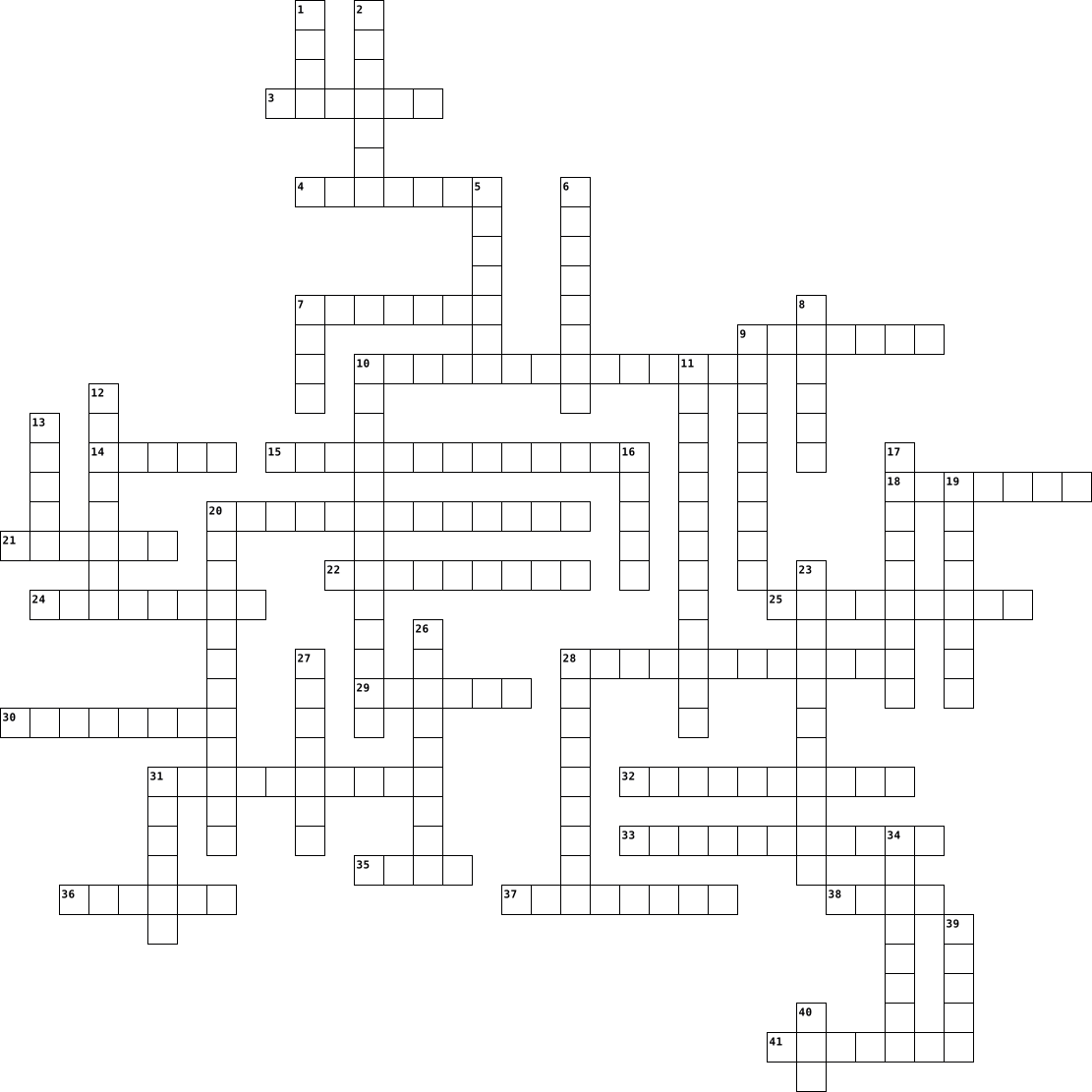
Across
- middle point within a circle
- geometric tool used to draw circles and parts of circles
- triangle with no congruent sides
- parallelogram with congruent sides
- an example for which the conjecture is incorrect
- rise over run
- lines that intersect to form right angles
- same shape, different size
- two angles whose measures have sum of 180
- any quantity with magnitude and direction
- reasoning based on logic
- angles whose sides are opposite rays (measures are congruent)
- quadrilateral with one pair of parallel sides
- angle whose vertex is the center of a circle or regular polygon
- distance from the center to a vertex of a regular polygon
- angles with a common side and vertex
- a segment that joins two midpoints
- "flip"
- theorem used to find missing lengths in right triangles
- non-coplanar lines that do not intersect
- parallelogram with congruent sides, all angles are 90 degrees
- "turn"
- quadrilateral with no parallel sides
- a trigonometry ratio that works because the slope of any angle does not change
Down
- a series of infinite points
- perpendicular distance from the center to a side of a regular polygon
- part of a line with two endpoints
- coplanar lines or planes that do not intersect
- a trigonometry ratio that works because the ratio between the rise and the hypotenuse for any angle does not change
- a trigonometry ratio that works because the ratio between the run and the hypotenuse for any angle does not change
- parallelogram with congruent diagonals
- two angles whose measures have sum of 90
- quadrilateral with two pairs of parallel sides
- a line, ray, or segment that intersects an angle, line or segment at the midpoint
- formed by two rays with the same endpoint
- angle whose measure is 90 degrees
- trapezoid or triangle with at least two congruent sides
- a point that divides a segment into two congruent segments
- ruler with no markings
- "slide"; maps all points of a figure the same distance in the same direction
- reasoning based on patterns
- a closed plane figure with at least 3 sides
- equal
- a segment whose endpoints are a vertex and the midpoint of the opposite side
- a perpendicular segment from a vertex to the line containing the opposite side
- a location
- a part of a line that extends in one direction
47 Clues: equal • "flip" • "turn" • a location • rise over run • ruler with no markings • reasoning based on logic • same shape, different size • a series of infinite points • reasoning based on patterns • middle point within a circle • triangle with no congruent sides • part of a line with two endpoints • angle whose measure is 90 degrees • parallelogram with congruent sides • ...
geometry 2024-05-13

Across
- set of points that has infinite lengths
- a line that goes around an enclosed circle
- number of cubic units contained
- just a point on a map
- two triangles are congruent if corresponding if corresponding sides are congruent
- a point that divides the segment into two
- segment from the vertex of a triangle to the midpoint of the opposite side
- two lines that intersect to form right angles
- when you try to guess something before you figure it out
- points that lie on the same line
- when someone guesses something
- two angles whose sum is 180 degrees
- a math class
- is a prisiom where all sides are square
- polygon which is equiliangar
- trianle with all angles congruent
- the top of something
- line in the plane of a circle
- two coplanar angles with a common vertex and a common side between them
- the non adjacent angles formed by two intersecting lines
- angle whose measure is 180 degrees
- union of three or more coplanar segments meets exactly in the middle
- segments that have the same length
- triangle with at least two sides congrient
- parallelogram with a right angle
- triangle with a right angle
- straight line passing through the center of a figure
- the figure formed by three segments joining together all 90 degrees
- line ray segment or plane
- the amount of something inside of it
- triangle that it perpendicular tot he line on the opposite side
- triangle with no sides congruent
Down
- a ball
- when lines cross over each other
- triangle with all sides congruent
- ray that divides an angle into two congruent adjacent angles
- angle whose measure is greater then 90 degrees
- triangle with a obtuse angle
- two lines are parallel if they are coplanar and do not intersect
- an angle with a degree under 90
- quadraterial with both pairs of opposite sides parallel
- angles that have the same measure
- two angles whos sum is 90 degrees
- it is the part of line that contains the end point
- are noncoplanar lines they will not intersect
- set of points
- parallelogram with consecutive sides congruent
- two lines that intersect to form right angles
- triangle with all acute angles
- point that don't stay on the same line
- part of a line that consists of two points
- sum of the area all its face
- angle whose measure is 90 degrees
53 Clues: a ball • a math class • set of points • the top of something • just a point on a map • line ray segment or plane • triangle with a right angle • triangle with a obtuse angle • polygon which is equiliangar • sum of the area all its face • line in the plane of a circle • when someone guesses something • triangle with all acute angles • number of cubic units contained • ...
Beginnig of the Year Crossword 2024-10-11

Across
- The amount of space inside a two-dimensional shape, measured in square units.
- A quadrilateral with opposite sides that are parallel and equal in length.
- Price: The cost of one item or one unit of a product, which helps compare prices when shopping.
- The bottom surface of a shape or figure, which is often used as a reference point for measuring height.
- Ratios that express the same relationship between numbers, even if the numbers themselves are different (e.g., 1:2 is equivalent to 2:4).
- A flat surface of a three-dimensional shape.
- The measurement of how tall a shape is, often measured from the base to the top.
- To break down a shape or figure into smaller, simpler parts.
- A three-dimensional shape made up of flat polygonal faces, edges, and vertices.
- A two-dimensional representation of a three-dimensional shape, showing all its faces laid out flat.
- A line segment where two faces of a three-dimensional shape meet.
- Diagram: A visual model that uses rectangles to represent numbers in a ratio, helping to solve problems involving part-to-whole relationships.
Down
- A three-dimensional shape with two parallel, congruent bases and rectangular lateral faces connecting them.
- A polygon with four sides and four angles.
- A three-dimensional shape with a polygonal base and triangular faces that meet at a common vertex.
- A way to organize information in rows and columns, often used to display data or relationships.
- A visual representation that uses two parallel lines to show the relationship between two sets of numbers, helping to understand ratios and equivalent ratios.
- A comparison of two quantities, often written as a fraction or using a colon (e.g., 3:4).
- The speed at which something happens or is done, often referring to the rate of movement or progress.
- A term used to express a rate or ratio, indicating "for each" (e.g., miles per hour).
- Area: The total area of the surfaces of a three-dimensional shape, measured in square units.
- A closed figure made up of straight line segments, with at least three sides (e.g., triangles, quadrilaterals).
- An area defined by specific boundaries, which can be two-dimensional or three-dimensional.
- A point where two or more line segments meet in a polygon or three-dimensional shape.
- To create a shape or figure by combining smaller shapes or components.
- Rate: When two or more ratios or rates are equal, indicating they are proportionally equivalent.
26 Clues: A polygon with four sides and four angles. • A flat surface of a three-dimensional shape. • To break down a shape or figure into smaller, simpler parts. • A line segment where two faces of a three-dimensional shape meet. • To create a shape or figure by combining smaller shapes or components. • ...
Trigonometry Terms! 2024-10-07

Across
- (Tier 2) A relationship or expression involving one or more variables
- (Tier 1) The measurement or extent of something from end to end
- (Tier 2) A specialist in a particular branch of study, especially the humanities; a distinguished academic
- (Tier 1) The measurement from base to top
- (Tier 1) The measure in degrees between two intersecting lines or surfaces at or close to the point where they meet
- (Tier 2) A straight line that makes a right angle (90 degrees) with another line
- (Tier 2) A statement that the values of two mathematical expressions are equal (indicated by the sign =)
- (Tier 1) A number that describes how steep a line is, calculated as the ratio of the vertical change (rise) to the horizontal change (run) between two points on that line
- (Tier 1) To get the size/ amount/ or degree of (something) by using an instrument or device marked in standard units or by comparing it with an object of known size
- (Tier 3) The branch of mathematics concerned with the properties and relations of points/ lines/ surfaces/ solids/ and higher dimensional analogs
- (Tier 1) A rule or connection that describes how two or more sets of numbers or variables are connected to each other
Down
- (Tier 3) The trigonometric function the ratio of the side opposite side to the given angle over the hypotenuse side of the given angle
- (Tier 3) The trigonometric function the ratio of the side adjacent side to the given angle over the hypotenuse side of the given angle
- (Tier 2) A diagram showing the relation between variable quantities - typically of two variables - each measured along one of a pair of axes at right angles
- (Tier 3) A quantity representing the power to which a fixed number (the base) must be raised to produce a given number
- (Tier 3) The branch of mathematics dealing with the relations of the sides and angles of triangles and with the relevant functions of any angles
- (Tier 1) A plane figure with three straight sides and three angles
- (Tier 3) The trigonometric function the ratio of the side opposite side to the given angle over the adjacent side of the given angle
- (Tier 2) A function that serves to “undo” another function
- (Tier 2) The quantitative relation between two amounts showing the number of times one value contains or is contained within the other (every fraction can be considered this)
- (Tier 3) The longest side of a right triangle - opposite the right angle
21 Clues: (Tier 1) The measurement from base to top • (Tier 2) A function that serves to “undo” another function • (Tier 1) The measurement or extent of something from end to end • (Tier 1) A plane figure with three straight sides and three angles • (Tier 2) A relationship or expression involving one or more variables • ...
Geometry Vocabulary 2023-05-29

Across
- 2 angles next to each other (adjacent)that when you add them together they = 180
- tool shaped like a "t" that can be used to: draw a straight line, check for a 90 degree angle, and measure the length of a line segment
- "v" shaped tool with a point at one end and pencil on the other. It is used to draw arcs and circles
- a triangle made up of 3 acute angles
- a triangle with an obtuse angle
- an angle that measures anywhere between 91 and 180
- a series of points joined together that extend in opposite directions forever
- triangle with 2 equal sides and 2 equal angles
- a triangle with a right angle
- a shape with 3 sides, 3 angles, and 3 vertices
- formed by two lines that share a common end point
- the original number flipped upside down with the opposite sign
- tool with an edge that is straight and is used to draw a straight line
- number that tells you how steep a line is
- to turn something so it is the mirror image of itself
- triangle with 3 equal sides and 3 equal angles
- a line that starts at a given point and goes off in one direction without stopping
- tool shaped like a half moon used to measure angles
- 2 angles that have the same measurement
Down
- an angle that measures less than 90
- the angle formed when 2 perpendicular lines cross and perfectly square
- any 2 angles that are next to one another and share the same vertex
- 2 lines that cross one another and form right angles
- 2 angles that are formed when 2 lines cross. they are also congruent.
- the point where the two lines meet in an angle
- a specific location and is drawn as a dot
- 2 triangles that have different sides but equal angles
- lines that have no points in common and never cross
- moving a shape without turning or flipping it
- straightedge with measurement marks to determine the length of a line segment
- a series of points joined together with a starting and ending point
- triangle with no equal sides and no equal angles
- changing the size of a shape but keeping the shape the same
- tool with a solid based and evenly spaced pegs used with rubber bands to create various shapes
- to rotate the shape around a fixed point
- an angle that measures 180. it is also a straight line
- 2 angles next to each other (adjacent) that when you add them together they = 90
37 Clues: a triangle with a right angle • a triangle with an obtuse angle • an angle that measures less than 90 • a triangle made up of 3 acute angles • 2 angles that have the same measurement • to rotate the shape around a fixed point • a specific location and is drawn as a dot • number that tells you how steep a line is • moving a shape without turning or flipping it • ...
Geometry Vocabulary 2023-05-29

Across
- 2 angles next to each other (adjacent)that when you add them together they = 180
- tool shaped like a "t" that can be used to: draw a straight line, check for a 90 degree angle, and measure the length of a line segment
- "v" shaped tool with a point at one end and pencil on the other. It is used to draw arcs and circles
- a triangle made up of 3 acute angles
- a triangle with an obtuse angle
- an angle that measures anywhere between 91 and 180
- a series of points joined together that extend in opposite directions forever
- triangle with 2 equal sides and 2 equal angles
- a triangle with a right angle
- a shape with 3 sides, 3 angles, and 3 vertices
- formed by two lines that share a common end point
- the original number flipped upside down with the opposite sign
- tool with an edge that is straight and is used to draw a straight line
- number that tells you how steep a line is
- to turn something so it is the mirror image of itself
- triangle with 3 equal sides and 3 equal angles
- a line that starts at a given point and goes off in one direction without stopping
- tool shaped like a half moon used to measure angles
- 2 angles that have the same measurement
Down
- an angle that measures less than 90
- the angle formed when 2 perpendicular lines cross and perfectly square
- any 2 angles that are next to one another and share the same vertex
- 2 lines that cross one another and form right angles
- 2 angles that are formed when 2 lines cross. they are also congruent.
- the point where the two lines meet in an angle
- a specific location and is drawn as a dot
- 2 triangles that have different sides but equal angles
- lines that have no points in common and never cross
- moving a shape without turning or flipping it
- straightedge with measurement marks to determine the length of a line segment
- a series of points joined together with a starting and ending point
- triangle with no equal sides and no equal angles
- changing the size of a shape but keeping the shape the same
- tool with a solid based and evenly spaced pegs used with rubber bands to create various shapes
- to rotate the shape around a fixed point
- an angle that measures 180. it is also a straight line
- 2 angles next to each other (adjacent) that when you add them together they = 90
37 Clues: a triangle with a right angle • a triangle with an obtuse angle • an angle that measures less than 90 • a triangle made up of 3 acute angles • 2 angles that have the same measurement • to rotate the shape around a fixed point • a specific location and is drawn as a dot • number that tells you how steep a line is • moving a shape without turning or flipping it • ...
6th Final Review 2025-05-12

Across
- This type of energy is stored and is due to an objects position
- This heat energy only happens with direct contact of a solid
- An example of this is Athlete's foot
- This pathogen is non-living
- This root means balance
- This pathogen requires anti-biotics to get better
- The smallest unit of matter
- Cells combine to make...
- This Earth sphere includes all living things on Earth
- This heat energy comes in the form of hot liquid or gas rising, and cool liquid or gas sinking
- This is the layer of the atmosphere that is furthest from Earth
- This root means green
- This is a force when two objects' surfaces rub together
- Atoms combine to form a...
- This root means similar
- The basic unit of all life
- These all have jobs inside the cell to help it function
- membrane Organelle that determines what enters and exits the cell
- This body system breaks down food into nutrients
- Tissues combine to make...
- This landform can be found in Florida once chemical weathering wears away at a cavern long enough
- Organelle that stores water, food, and waste
- This classification is always lower case in binomial nomenclature
- Organelle that is jelly like and holds other organelles in place
Down
- Organelle that turns food into energy
- This is a force that is constantly affecting us and helps keep us grounded
- Humans belong to this domain
- Organ systems combine to make this...
- This body system moves oxygen and nutrient rich blood around the body
- This type of cell contains membrane bound organelles
- The ozone layer can be found in this layer of the atmosphere
- This type of energy is from an objects motion
- This body system provides support, structure, and movement
- This body system brings oxygen into the body
- Humans belong to this kingdom
- This body system gets rid of waste
- This body system sends and receives signals
- This Earth sphere includes all frozen water on Earth
- This type of wearing away of landforms can happen either chemically or physically
- This is the layer of the atmosphere that is closest to Earth
- Organelle that is the command center of the cell, reads DNA
- Organelle that helps with photosynthesis
- This body system protects from disease
- This classification is always capitalized in a binomial nomenclature
- This landform happens with smaller rivers meet up with larger bodies of water and deposit sediment in triangles at the mouth of the river
45 Clues: This root means green • This root means balance • This root means similar • Cells combine to make... • Atoms combine to form a... • The basic unit of all life • Tissues combine to make... • This pathogen is non-living • The smallest unit of matter • Humans belong to this domain • Humans belong to this kingdom • This body system gets rid of waste • An example of this is Athlete's foot • ...
Art 2025-08-13

Across
- a two-dimensional area enclosed by lines.
- Art, creative work made using computers or digital devices.
- using differences to create emphasis or interest.
- artwork depicting a person’s face.
- Media, combining various artistic materials in one artwork.
- showing strong feelings or emotions.
- black drawing medium used for lines and shading.
- giving the illusion of depth and three-dimensionality.
- the visual perception of light reflected off objects.
- how something feels or looks like it would feel.
- transferring ink from a block or plate to paper.
- breaking objects into geometric shapes to show multiple views.
- paint that is thinned and mixed with water.
- Art, inspired by popular culture, advertising, and comics.
- using different elements for interest.
- having identical or balanced parts on each side.
- pioneer of cubism and modern art.
- when all parts of an artwork work together harmoniously.
- quick-drying synthetic paint.
- background information about art’s time, place, or culture.
- shaping materials into three-dimensional art.
- creating visual stability by arranging elements.
- making artwork by assembling different materials.
- dreamlike and imaginative compositions.
Down
- creating depth by depicting light and shadow.
- artwork using only one color or one palette.
- artwork showing outdoor scenery.
- a source of creative ideas or motivation.
- natural, flowing shapes found in nature.
- guiding the viewer’s eye throughout an artwork.
- drawing attention to the most important part of the artwork.
- regular shapes like squares, circles, and triangles.
- art that doesn’t directly represent reality.
- full of brightness and energy.
- making transitions smooth between colors or tones.
- American artist celebrated for large flower paintings.
- examine the parts and meaning of an artwork.
- the lightness or darkness of colors or areas.
- relationship of size between objects and parts.
- painting style with visible brushstrokes and light.
- a three-dimensional object or illusion of three dimensions.
- repeating designs, shapes, or motifs.
- malleable earth for ceramics and sculpture.
- Kahlo, Mexican artist known for self-portraits expressing emotion.
- Life, arrangement of objects like fruit or flowers.
- repeating elements to create movement or excitement.
- da Vinci, famous for works like Mona Lisa and The Last Supper.
- the way an artist applies skills and tools.
- a mark with length and direction; a continuous mark made on a surface.
- the area around or within objects in artwork.
50 Clues: quick-drying synthetic paint. • full of brightness and energy. • artwork showing outdoor scenery. • pioneer of cubism and modern art. • artwork depicting a person’s face. • showing strong feelings or emotions. • repeating designs, shapes, or motifs. • using different elements for interest. • dreamlike and imaginative compositions. • natural, flowing shapes found in nature. • ...
Revision of Triangles 2022-01-21

Across
- acute Each angle of an acute angled triangle is
Down
- two In an isosceles triangle , any __ sides are equal in length.
2 Clues: acute Each angle of an acute angled triangle is • two In an isosceles triangle , any __ sides are equal in length.
Basic Design Elements and Principles 2021-01-17

Across
- is the surface quality of an object in a piece of art.
- It is known as a beat or visual temp. It refers to a frequent repetition of elements to create a movement's look and feel.
- is an element of art that contours, outlines or defines a shape. It can be thick or thin, loose, sharp, curvy or straight. It simply be a mark that goes from one point to another, or it can be used to outline a form.
- In order to establish the appearance of equality in weight or value, it refers to the proper arrangement of objects in a design. It provides a design of stability and structure.
- In order to illustrate their differences or establish visual interest, or a focal point, it refers to the juxtaposition of various elements of design.
Down
- is the first and simplest element of visual design. It serves as the focus of something visual, and therefore draws attention.
- In a design, it simply refers to maintaining a certain format of your design. It is sometimes represented as a regular arrangement of elements (shapes, lines, colors) or motifs that are alternate or repeated.
- It refers to the arrangement of elements to give the audience the impression that a cohesive whole must be created by all parts of the design or piece in harmony in which all parts of the pattern make other parts feel complete.
- is when a line crosses itself or intersects with other lines to create an enclosed space. It can be geometric, such as circles, squares, rectangles or triangles.
- is used to add interest to an art object. These are represented on a color wheel, an important tool for an artist.
- in designing it refers to one aspect of a work of art being given specific attention. It can be accomplished by means of positioning, contrast, color, scale, repetition, etc.
- can be described as the distance around and/or the area between design objects or elements.
- is very similar to the element of design shape. The difference is that the term is form is used in art work that has three dimensions instead of two as shapes.
13 Clues: is the surface quality of an object in a piece of art. • can be described as the distance around and/or the area between design objects or elements. • is used to add interest to an art object. These are represented on a color wheel, an important tool for an artist. • ...
Basic Design Elements and Principles 2021-01-17

Across
- In order to illustrate their differences or establish visual interest, or a focal point, it refers to the juxtaposition of various elements of design.
- is very similar to the element of design shape. The difference is that the term is form is used in art work that has three dimensions instead of two as shapes.
- in designing it refers to one aspect of a work of art being given specific attention. It can be accomplished by means of positioning, contrast, color, scale, repetition, etc.
- is the first and simplest element of visual design. It serves as the focus of something visual, and therefore draws attention.
- In order to establish the appearance of equality in weight or value, it refers to the proper arrangement of objects in a design. It provides a design of stability and structure.
- is the surface quality of an object in a piece of art.
- is an element of art that contours, outlines or defines a shape. It can be thick or thin, loose, sharp, curvy or straight. It simply be a mark that goes from one point to another, or it can be used to outline a form.
Down
- It is known as a beat or visual temp. It refers to a frequent repetition of elements to create a movement's look and feel.
- can be described as the distance around and/or the area between design objects or elements.
- In a design, it simply refers to maintaining a certain format of your design. It is sometimes represented as a regular arrangement of elements (shapes, lines, colors) or motifs that are alternate or repeated.
- is used to add interest to an art object. These are represented on a color wheel, an important tool for an artist.
- is when a line crosses itself or intersects with other lines to create an enclosed space. It can be geometric, such as circles, squares, rectangles or triangles.
- It refers to the arrangement of elements to give the audience the impression that a cohesive whole must be created by all parts of the design or piece in harmony in which all parts of the pattern make other parts feel complete.
13 Clues: is the surface quality of an object in a piece of art. • can be described as the distance around and/or the area between design objects or elements. • is used to add interest to an art object. These are represented on a color wheel, an important tool for an artist. • ...
Basic Design Elements and Principles 2021-01-17

Across
- In order to illustrate their differences or establish visual interest, or a focal point, it refers to the juxtaposition of various elements of design.
- is very similar to the element of design shape. The difference is that the term is form is used in art work that has three dimensions instead of two as shapes.
- in designing it refers to one aspect of a work of art being given specific attention. It can be accomplished by means of positioning, contrast, color, scale, repetition, etc.
- is the first and simplest element of visual design. It serves as the focus of something visual, and therefore draws attention.
- In order to establish the appearance of equality in weight or value, it refers to the proper arrangement of objects in a design. It provides a design of stability and structure.
- is the surface quality of an object in a piece of art.
- is an element of art that contours, outlines or defines a shape. It can be thick or thin, loose, sharp, curvy or straight. It simply be a mark that goes from one point to another, or it can be used to outline a form.
Down
- It is known as a beat or visual temp. It refers to a frequent repetition of elements to create a movement's look and feel.
- can be described as the distance around and/or the area between design objects or elements.
- In a design, it simply refers to maintaining a certain format of your design. It is sometimes represented as a regular arrangement of elements (shapes, lines, colors) or motifs that are alternate or repeated.
- is used to add interest to an art object. These are represented on a color wheel, an important tool for an artist.
- is when a line crosses itself or intersects with other lines to create an enclosed space. It can be geometric, such as circles, squares, rectangles or triangles.
- It refers to the arrangement of elements to give the audience the impression that a cohesive whole must be created by all parts of the design or piece in harmony in which all parts of the pattern make other parts feel complete.
13 Clues: is the surface quality of an object in a piece of art. • can be described as the distance around and/or the area between design objects or elements. • is used to add interest to an art object. These are represented on a color wheel, an important tool for an artist. • ...
Special Right Triangles 2023-11-16

Across
- isosceles right triangle
Down
- right triangle
2 Clues: right triangle • isosceles right triangle
Circles and Triangles 2013-05-22

Across
- Perpendicular segment from
Down
- Type of triangle with three angles less than 90 degrees
2 Clues: Perpendicular segment from • Type of triangle with three angles less than 90 degrees
Type of Triangles 2024-07-25

Across
- has one 90° angle
Down
- has three congruent sides and three congruent angles
2 Clues: has one 90° angle • has three congruent sides and three congruent angles
Concepts from Mathematics for FIMATH students by K. SALAH EDDINE 2021-12-21

Across
- The branch of mathematics that deals with the relationships between the sides and the angles of Triangles and the calculations based on them.
- They are mathematical elements used to represent an entity with both direction and magnitude. They are drawn to look similar to a ray since they are usually represented as a line segment with an endpoint on one side and an arrow on the other.
- is a branch of mathematics that involves solving equations and inequalities to find an unknown quantity.
- It is a way of comparing groups of numbers in a population based on data collected from a sample of the population. It includes how to find and interpret descriptive elements of the population sample.
Down
- it is the study of points, lines, planes, and anything that can be made from those three things. It includes everything from angles to trapezoids to cylinders.
- it is the study of things in motion or things that are changing. The word itself comes from a Latin word meaning “pebble” because pebbles used to be used in calculations.
- is the study of events and how likely they are to happen. This likelihood is usually expressed as a fraction. The denominator expresses the total number of possible events in a given situation while the numerator expresses the number of ways that the indicated event can happen. Sometimes this fraction is converted to a decimal or a percentage, depending on the situation.
- In general, it deals with all of the basic notions of numbers, including place value and comparisons. It also includes the fundamental operations of addition, subtraction, multiplication, division and their properties.
8 Clues: is a branch of mathematics that involves solving equations and inequalities to find an unknown quantity. • The branch of mathematics that deals with the relationships between the sides and the angles of Triangles and the calculations based on them. • ...
quadlilateral 2023-04-28

Across
- parallelogram is a quadrilateral with two pairs of parallel sides. The opposite sides of a parallelogram are equal in length, and the opposite angles are equal in measure. Also, the interior angles on the same side of the transversal are supplementary.
- rectangle is a quadrilateral in which all angles are right angles. A rectangle is a parallelogram, so its opposite sides are equal. The diagonals of a rectangle are equal and bisect each other.
Down
- square is a quadrilateral with 4 equal sides and 4 right angles. A shape with four sides of equal length.
- kite is a quadrilateral that has 2 pairs of equal-length sides and these sides are adjacent to each other. Properties: The two angles are equal where the unequal sides meet. It can be viewed as a pair of congruent triangles with a common base.
- rhombus is a quadrilateral whose all four sides are equal in length and opposite sides are parallel to each other. However, the angles are not equal to 90°. A rhombus with right angles would become a square. Another name for rhombus is 'diamond' as it looks similar to the diamond suit in playing cards.
- is a quadrilateral with one pair of opposite parallel sides. In the trapezium, ABCD, side AB is parallel to side CD.
6 Clues: square is a quadrilateral with 4 equal sides and 4 right angles. A shape with four sides of equal length. • is a quadrilateral with one pair of opposite parallel sides. In the trapezium, ABCD, side AB is parallel to side CD. • ...
Crossword Puzzle 2023-05-18

Across
- - the same, if a sequence of rigid motions and dilations that takes the first figure onto the second
- - a solid figure that has one special face called the base. All the other faces are triangles that meet at a single vertex called the apex.
- - a quadrilateral with four right angles. Each right angle is 90 degrees
- - a solid figure composed of two parallel, congruent faces connected by parallelograms. A prism must include flat sides.
- - a cone is a three dimensional figure with a circular base and a point on the base is connected to the apex by a line of segment. An example of a cone is a traffic cone.
- - a three dimensional figure with two parallel, congruent, circular bases, formed by translating one base to the other. Each pair of corresponding points on the bases is connected by a line segment Rhombus - A quadrilateral with four congruent sides. Also known as a diamond.
- angle - an angle formed by two rays whose endpoints are the center of a circle. The radius vectors from from the arms of a central angle
- - the region inside a circle lying between two radii of the circle. Think of a pie slice
- quadrilateral - a quadrilateral whose vertices all lie on the same circle. Also known as a inscribed quadrilateral
Down
- - an arrangement of figures that covers the entire plane without gaps or overlaps, have done this in class
- - two lines that don't intersect are called parallel. We can also call segments parallel if they extend into parallel lines.
- - a three dimensional figure in which all cross sections in every direction are circles. Basketball is an example.
- - The part of a circle lying between two points on the circle. Two arcs have congruent angles.
- of symmetry - a line of symmetry for a figure is a line such that reflection across the line takes the figure onto itself. A vertical line down the middle of a heart would be a line of symmetry.
- bisector - a line through the midpoint of the segment that is perpendicular to it. It divides the segment right at the midpoint Rigid Transformations - a translation, rotation, or reflection. These are mainly used on the coordinate plane
- of rotation - A line about which a two dimensional figure is rotated to produce a three dimensional figure, called a solid of rotation. Also known as axis of revolution
- - a statement that has been proved mathematically, pythagorean _______
- - the mass of a substance per unit volume. Helps to determine the volume of an object
18 Clues: - a statement that has been proved mathematically, pythagorean _______ • - a quadrilateral with four right angles. Each right angle is 90 degrees • - the mass of a substance per unit volume. Helps to determine the volume of an object • - the region inside a circle lying between two radii of the circle. Think of a pie slice • ...
Chapter 14 Bureaucracy 2019-03-03

Across
- Corporations: A government agency that operates like a business corporation, created to secure greater freedom of action and flexibility for a particular program.
- Operating Procedures: These procedures are used by bureaucrats to bring uniformity to complex organizations. Uniformity improves fairness and makes personnel interchangeable.
- the use of governmental authority to control or change some practice in the private sector
- Principle: The idea that hiring should be based on entrance exams and promotion ratings to produce administration by people with talent and skill.
- Regulatory Commission: A government agency or commission with regulatory power whose independence is protected by Congress.
- The lifting of government restrictions on business, industry, and professional activities.
- Bureaucrats: A phrase referring to those bureaucrats who are in constant contact with the public and have considerable administrative discretion.
- Rating: A schedule for federal employees, ranging from GS 1 to GS 18, by which salaries can be keyed to rating and experience.
- of Personnel Management: The office in charge of hiring for most agencies of the federal government, using elaborate rules in the process.
- Orders: a rule or order issued by the president to an executive branch of the government and having the force of law.
- Implementation: Carrying out a policy through government agencies and courts
Down
- Granting favors or giving contracts or making appointments to office in return for political support
- Civil Service Act: Passed in 1883, an Act that created a federal civil service so that hiring and promotion would be based on merit rather than patronage.
- Act: The 1939 act to prohibit civil servants from taking activist roles in partisan campaigns. This act prohibited federal employees from making political contributions, working for a particular party, or campaigning for a particular candidate.
- and Control Policy: Typical system of regulation whereby gov. tells business how to reach certain goals,checks that these commands are fallowed, and punishes offender
- Discretion: The ability of bureaucrats to make choices concerning the best way to implement congressional or executive intentions
- a system of government in which most of the important decisions are made by state officials rather than by elected representatives.
- System: Alternative to command and control, with marketlike strategies such as rewards used to manage public policy.
- Executive Service: Established by Congress in 1978 as a flexible, mobile corps of senior career executives who work closely with presidential appointees to manage government.
- Service: A system of hiring and promotion based on the merit principle and the desire to create a nonpartisan government service.
- Triangles: A mutually dependent relationship between bureaucratic agencies, interest groups, and congressional committees or subcommittees. They dominate some areas of domestic policymaking.
21 Clues: Implementation: Carrying out a policy through government agencies and courts • the use of governmental authority to control or change some practice in the private sector • The lifting of government restrictions on business, industry, and professional activities. • ...
Restaurants and Food Brands. YUM YUM! 2020-03-21

Across
- some people refer to teeth as
- barbe a papa
- sweet candy straw
- white glove guy helps with dinner
- this make chocolate milk in your bowl
- i loved the breakfast burritos from
- 2 guys make icecream
- Danish ice cream
- a devilish good drink
- hancock liked to make
- use these for smores
- andy warhol made art of soup from
- breakfast near moms
- greendragon, california,crunch
- peanut butter cups
- pizza delivery used most often to house
- whopper
- 5$ footlongs!
- stewie cant pronounce this properly
- Toucan Sam is the mascot for
- snack that survives a nuclear attack
- nastiest gum ever
- mixed with coke you get an explosion
- fireworks in your mouth
- who wants to go to .. by themselves
- chinese buffet
- better call saul ended up working at
- best fish tacos
- jeffrey as a cookie
- nathan favourite fast food place
- youre not you when youre hungry
- boobies and wings
- mayor west likes to eat
- finger lickin good
- youll have a gold key in this chocolate bar
- my favourite chip kinda snack
- family of burgers
- gives you the poops
- favourite coffee place
- they make your hamburger a beautiful thing
Down
- my favourite chocolate bar
- Bee happy
- hard chocolate chip cookies
- expensive steak
- the first one in canada opened in Niagara Falls
- toaster pastry
- budda boom budda ching
- spanish donut
- fourgirls
- Two scoops of raisins in every box
- can i get a grande low fat soy latte no whip
- you like to spread this on toast
- chocolate the tastes like coffee
- roast beef sandwiches
- fast deep dish pizza
- dip these in salsa
- famous pancake and syrup
- cheesy triangles
- mexican grill
- cheesy 9 min dinner
- is this a poopy or a ..
- harold and kumar go to..
- you spit these on the floor of your truck
- they have a hot now sign
- 101 chicken wing flavours
- pizza buffets
- have a break, have a
- blizzard brrr
- eat these with sausages and sour cream
- youll find a prize at the bottom of this snack
- these are the best pancakes ive ever had and ive been to..
- huge portions and famous for dessert
- makes boxed cakes
- hard and tart candy
- instant noodle soup
- when youre here, youre family
- in Hallpass they go to .. to find ladies
- they found a finger in the chili at
78 Clues: whopper • Bee happy • fourgirls • barbe a papa • spanish donut • 5$ footlongs! • mexican grill • pizza buffets • blizzard brrr • toaster pastry • chinese buffet • expensive steak • best fish tacos • Danish ice cream • cheesy triangles • sweet candy straw • nastiest gum ever • makes boxed cakes • boobies and wings • family of burgers • peanut butter cups • dip these in salsa • finger lickin good • breakfast near moms • ...
Geometry Terms 2014-11-30

Across
- A straight line extending from the center of a circle or sphere to the circumference or surface.
- A polygon with 5 sides and 5 angles.
- A closed three-dimensional figure.
- Have the same measure and corresponding sides are in proportion.
- A polygon with exactly four sides.
- A ____ is a flat, two-dimensional object.
- When three or more lines meet at a single point.
- If angle A is an acute angle in a right triangle.
- The point where the three altitudes meet, making them concurrent.
- An ______ of a triangle is a line segment connecting a vertex to the line containing the opposite side and perpendicular to that side.
- Part of a line between two points.
- A two-dimensional representation of a three-dimensional object.
- A quadrilateral with four right angles
- A regular quadrilateral.
- A location in space - a dot on a piece of paper.
- An _____ is a line segment where two faces intersect.
- The intersection point of two sides of a plane figure.
- It is made of straight line segments.
- A ____ is a quadrilateral that has two pairs of adjacent sides congruent (the same length).
Down
- The segment connecting two consecutive midpoints of a triangle.
- Means the "if" and "then" parts of a sentence are switched.
- A "straight" line that begins at a certain point and extends infinitely in one direction.
- A quadrilateral having both pairs of opposite sides parallel to each other.
- A rectangle having all four sides of equal length.
- The ________ in a right triangle is the side of the triangle that is opposite to the right angle.
- This point is the same distance from each of the three vertices of the triangles.
- All corresponding lengths are the same, and if all corresponding angles have the same measure.
- The line segment between two points on a given curve.
- The set of all points in a plane that are equidistant from a given point in the plane, which is the center of the ____.
- A quadrilateral that has all four sides congruent.
- The length of the side opposite to angle A divided by the length of the hypotenuse of the triangle.
- A ______ is a segment connecting any vertex of a triangle to the midpoint of the opposite side.
- The point where the three angle bisectors meet.
- A circle's ______ is a segment that passes through the center and has its endpoints on the circle.
- The intersection of a graph with one of the axes.
- The _______ of a triangle is the point where the three medians meet.
- Connects two points via the shortest path and continues indefinitely (forever) in both directions.
37 Clues: A regular quadrilateral. • A closed three-dimensional figure. • A polygon with exactly four sides. • Part of a line between two points. • A polygon with 5 sides and 5 angles. • It is made of straight line segments. • A quadrilateral with four right angles • A ____ is a flat, two-dimensional object. • The point where the three angle bisectors meet. • ...
complete the crossword puzzle below. 2018-01-06

Across
- the length of the opposite side divided by the length of the adjacent side
- in the word quadrilateral, lateral means?
- Expression that consists of algebraic terms, operation symbols or bracket signs
- the quantitative relation between two amounts showing the number of times one value contains or is contained within the other
- the space (usually measured in degrees) between two intersecting lines or surfaces at or close to the point where they meet.
- exponent all numbers,letters,expression raise to 0 power is equal to 1
- has equal sides and every angle is a right angle (90°)
- it means four
- The expression b²-4ac
- Quadratic graphs that are part of curved family
- the trigonometric function that is equal to the ratio of the side opposite a given angle (in a right triangle) to the hypotenuse
- Equations that have one or more algebraic fractions
- the product of two irrational numbers
- The angle above horizontal that an observer must look to see an object that is higher than the observer
- An expression that involves radical sign (√͞ or √)
- we can obtain this ratio by multiplying or dividing both parts by the same constant.
- longest side of a right-angled triangle
- A relationship of variation between two variables in which the product is a constant
Down
- a quantity representing the power to which a given number or expression is to be raised, usually expressed as a raised symbol beside the number or expression (e.g., 3 in 23 = 2 × 2 × 2)
- a theorem in geometry: the square of the length of the hypotenuse of a right triangle equals the sum of the squares of the lengths of the other two sides.
- mathematical relationship between two variables that can be expressed by an equation in which one variable is equal to a constant times the other
- an angle between 90 degree-180 degree
- The angle below horizontal that an observer must look to see an object that is lower than the observer
- quadrilateral with four right angles
- the branch of mathematics dealing with the relations of the sides and angles of triangles and with the relevant functions of
- A relationship of variation between two variables in which one is a constant multiple of the other
- the trigonometric function that is equal to the ratio of the side adjacent to an acute angle (in a right-angled triangle) to the hypotenuse.
- it involves nth root
- plural of index
- of symmetry A graph that passes through its minimum/maximum point
30 Clues: it means four • plural of index • it involves nth root • The expression b²-4ac • quadrilateral with four right angles • an angle between 90 degree-180 degree • the product of two irrational numbers • longest side of a right-angled triangle • in the word quadrilateral, lateral means? • Quadratic graphs that are part of curved family • ...
complete the crossword puzzle below 2018-01-03

Across
- Expression that consists of algebraic terms, operation symbols or bracket signs
- exponent all numbers,letters,expression raise to 0 power is equal to 1
- an angle between 90 degree-180 degree
- the space (usually measured in degrees) between two intersecting lines or surfaces at or close to the point where they meet.
- a theorem in geometry: the square of the length of the hypotenuse of a right triangle equals the sum of the squares of the lengths of the other two sides.
- A relationship of variation between two variables in which the product is a constant
- Equations that have one or more algebraic fractions
- the quantitative relation between two amounts showing the number of times one value contains or is contained within the other
- the branch of mathematics dealing with the relations of the sides and angles of triangles and with the relevant functions of
- a quantity representing the power to which a given number or expression is to be raised, usually expressed as a raised symbol beside the number or expression (e.g., 3 in 23 = 2 × 2 × 2)
- of symmetry A graph that passes through its minimum/maximum point
- has equal sides and every angle is a right angle (90°)
- mathematical relationship between two variables that can be expressed by an equation in which one variable is equal to a constant times the other
- the product of two irrational numbers
- Quadratic graphs that are part of curved family
Down
- the length of the opposite side divided by the length of the adjacent side
- it involves nth root
- we can obtain this ratio by multiplying or dividing both parts by the same constant.
- The expression b²-4ac
- The angle below horizontal that an observer must look to see an object that is lower than the observer
- plural of index
- it means four
- longest side of a right-angled triangle
- the trigonometric function that is equal to the ratio of the side adjacent to an acute angle (in a right-angled triangle) to the hypotenuse.
- quadrilateral with four right angles
- The angle above horizontal that an observer must look to see an object that is higher than the observer
- An expression that involves radical sign (√͞ or √)
- in the word quadrilateral, lateral means?
- the trigonometric function that is equal to the ratio of the side opposite a given angle (in a right triangle) to the hypotenuse
- A relationship of variation between two variables in which one is a constant multiple of the other
30 Clues: it means four • plural of index • it involves nth root • The expression b²-4ac • quadrilateral with four right angles • an angle between 90 degree-180 degree • the product of two irrational numbers • longest side of a right-angled triangle • in the word quadrilateral, lateral means? • Quadratic graphs that are part of curved family • ...
complete the crossword puzzle below. 2018-01-04

Across
- it means four
- The angle below horizontal that an observer must look to see an object that is lower than the observer
- mathematical relationship between two variables that can be expressed by an equation in which one variable is equal to a constant times the other
- the quantitative relation between two amounts showing the number of times one value contains or is contained within the other
- A relationship of variation between two variables in which the product is a constant
- it involves nth root
- the trigonometric function that is equal to the ratio of the side opposite a given angle (in a right triangle) to the hypotenuse
- the branch of mathematics dealing with the relations of the sides and angles of triangles and with the relevant functions of
- a quantity representing the power to which a given number or expression is to be raised, usually expressed as a raised symbol beside the number or expression (e.g., 3 in 23 = 2 × 2 × 2)
- plural of index
- The angle above horizontal that an observer must look to see an object that is higher than the observer
- an angle between 90 degree-180 degree
- the space (usually measured in degrees) between two intersecting lines or surfaces at or close to the point where they meet.
- the product of two irrational numbers
Down
- Expression that consists of algebraic terms, operation symbols or bracket signs
- longest side of a right-angled triangle
- has equal sides and every angle is a right angle (90°)
- we can obtain this ratio by multiplying or dividing both parts by the same constant.
- a theorem in geometry: the square of the length of the hypotenuse of a right triangle equals the sum of the squares of the lengths of the other two sides.
- The expression b²-4ac
- Quadratic graphs that are part of curved family
- Equations that have one or more algebraic fractions
- of symmetry A graph that passes through its minimum/maximum point
- A relationship of variation between two variables in which one is a constant multiple of the other
- quadrilateral with four right angles
- the trigonometric function that is equal to the ratio of the side adjacent to an acute angle (in a right-angled triangle) to the hypotenuse.
- the length of the opposite side divided by the length of the adjacent side
- in the word quadrilateral, lateral means?
- An expression that involves radical sign (√͞ or √)
- exponent all numbers,letters,expression raise to 0 power is equal to 1
30 Clues: it means four • plural of index • it involves nth root • The expression b²-4ac • quadrilateral with four right angles • an angle between 90 degree-180 degree • the product of two irrational numbers • longest side of a right-angled triangle • in the word quadrilateral, lateral means? • Quadratic graphs that are part of curved family • ...
Triviaish 2024-04-11

Across
- Egyptian god of funerals and care for the dead
- the first 6 letters on the keyboard
- Greek goddess of marriage
- not a planet anymore
- Egyptian god of peace lions are and wind
- planet that smells like rotten eggs
- the aplpha bet
- Egyptian goddess of pleasure
- the study of history of life on earth
- Egyptian god of pre creation and post creation
- Egyptian goddess of the sky stars and cosmos
- our planet
- Greek god of the underworld
- Greek god of wine
- Egyptian god of earth farming and fertility
- Greek goddess of wild animals
- Greek Goddess of war
- Egyptian god of the dead and the underworld
- princess in yellow dress
- Greek god of the ocean and earthquakes
- Egyptian Goddess of moisture
- Greek titan, mother of zeus
- the bet alpha
- Greek god of lightning
- Egyptian god of healing protection the sun and the sky
- tiny red organge planet
- the brach of math that deals with shapes, lined, etc.
- Greek Titan, Father of Hestia, Demeter, Hera, Hades, Poseidon, and Zeus
- Egyptian goddess of love healing fertility magic and the moon
- the gas humans and animals need to live
- Greek God of war
- the branch of math that deals with triangles and there angles and sides and their relationships
- the study of makeup and beauty
Down
- Greek god of artisans and valcanoes
- blue gas planet
- the gas that humans breathe out
- the study of the weather
- hottest planet
- planet with rings
- Greek god of archery music and dance
- Egytptian goddess the sky
- sour candy in the shape of children
- the belief in one god
- how humans turn oxygen into energy
- Largest planet
- the belief in many gods
- Greek goddess of agriculture
- giant flaming ball of gas
- Greek messenger god
- get 'Krissed'
- Egyptian god said to have created the cosmos
- a person who doesn't believe in god
- Greek goddess of the earth
- the study of rocks
- Egyptian god of the sun
- Egyptian god of thunderstorms eclipses and earthquakes
- what plants do to get energy
- SKSKSKSKSKS AND I OoP water bottle
- Primary Producers
- the chemical formula of water
- the study of stars and space
- planet closest to the sun
- Greek Goddess of love and beauty
- the study of life
- the study of dentistry and teeth
- hit a yellow ball with a bat
66 Clues: our planet • get 'Krissed' • the bet alpha • hottest planet • the aplpha bet • Largest planet • blue gas planet • Greek God of war • planet with rings • Greek god of wine • Primary Producers • the study of life • the study of rocks • Greek messenger god • not a planet anymore • Greek Goddess of war • the belief in one god • Greek god of lightning • the belief in many gods • Egyptian god of the sun • ...
Les structures 2024-05-28

Across
- Il est doté d’une entretoise faite de triangles pour fournir un soutien supplémentaire.
- Une force qui peut changer lorsqu’elle agit sur une structure.
- Le poids le plus grand qu’une structure peut supporter et maintenir l’intégrité structurelle.
- Une force qui pousse dans des directions opposées.
- L’endroit où la force entre en contact avec la structure.
- Un poids ou une source de pression qui crée une force externe sur une structure.
- Elles sont créées sans toucher un autre objet.
- La force qui attire un corps vers le centre de la Terre.
- Elles reposent sur un arrangement d’ossature constitué de pièces reliées entre elles. Elles peuvent être bidimensionnelles ou tridimensionnelles.
- La taille de la force.
- Quelque chose qui a une taille, une forme et un but précis et qui peut supporter une charge.
- Une force d’étirement qui dilate ou s’allonge.
- Une force qui comprime ou presse quelque chose ensemble.
- Le but ou la capacité d’une structure à faire quelque chose.
- Utilise une couche extérieure pour fournir un support.
- Il a des câbles suspendus à des tours pour supporter la charge.
- Elles sont créées lorsque deux objets se touchent.
- Une force qui exerce un mouvement de torsion.
- Une force qui agit sur un objet ou une structure depuis l’extérieur de la structure.
- Cela décrit une chose qui est identique des deux côtés.
Down
- L’étude de la manière dont les meubles et les lieux de travail peuvent être aménagés pour permettre aux gens de travailler confortablement et efficacement.
- Il a une forme semi-circulaire pour supporter la charge. Les murs de soutènement fournissent un support supplémentaire.
- Un poids qui ne change pas.
- Un dispositif qui peut détecter ou mesurer une certaine condition.
- La force de tirer.
- La taille et les matériaux d’une structure.
- Elles sont fabriquées à partir d’une seule pièce de matériau solide.
- La beauté et le goût artistique de quelque chose.
- Une force qui agit à l’intérieur de la structure.
- Une ligne imaginaire qui peut aller dans n’importe quelle direction, à condition que la partie de l’objet située des deux côtés soit réfléchie.
- C’est simple, avec une poutre horizontale soutenue par des piliers.
- Le centre moyen du poids dans une structure.
- La force de pousser.
- L’endroit d’où vient la force.
34 Clues: La force de tirer. • La force de pousser. • La taille de la force. • Un poids qui ne change pas. • L’endroit d’où vient la force. • La taille et les matériaux d’une structure. • Le centre moyen du poids dans une structure. • Une force qui exerce un mouvement de torsion. • Elles sont créées sans toucher un autre objet. • Une force d’étirement qui dilate ou s’allonge. • ...
Geomotry Cross word puzzle. 2024-05-15

Across
- The point exactly halfway along a segment.
- The distance around a circle.
- An angle whose vertex is the center of the circle.
- An arc measuring less than 180 degrees.
- Angles that have the same measure.
- A part of a line with two endpoints.
- In a right triangle, the square of the hypotenuse is equal to the sum of the squares of the other two sides.
- The set of all points equidistant from a central point.
- Points that lie on the same flat surface.
- A portion of the circumference of a circle.
- An infinite flat surface.
- The ratio of the length of the side opposite an acute angle to the hypotenuse in a right triangle.
- Perpendicular segment from the vertex of a solid to the opposite base.
- A parallelogram with four right angles.
- A line that divides a figure into two congruent halves.
- Two angles whose sum is 90 degrees.
- An angle that measures exactly 90 degrees.
- An arc measuring more than 180 degrees.
- A triangle with all angles congruent.
- A set of points in space equidistant from a fixed point.
- A quadrilateral with one pair of parallel sides.
- A line that divides an angle into two equal parts.
- The sum of the areas of the lateral faces.
- Angles formed by two chords in a circle.
- A polygon with three sides and three angles.
- A line segment joining a vertex to the midpoint of the opposite side.
- An angle larger than a right angle but less than a straight angle.
Down
- A triangle with one angle greater than 90 degrees.
- Circles with the same radius.
- The distance around a polygon.
- A quadrilateral with opposite sides parallel.
- A closed figure formed by straight lines.
- A polygon with four sides.
- A polygon with all sides and angles congruent.
- The amount of space occupied by a solid.
- Triangles with corresponding sides and angles equal.
- Lines that intersect at right angles.
- A solid with two congruent circular bases.
- A straight path extending infinitely in both directions.
- A parallelogram with all sides equal.
- An angle smaller than a right angle.
- A triangle with one angle equal to 90 degrees.
- A prism where all sides are squares.
- Segments that have the same length.
- A line segment joining two points on the circle.
- A comparison of two quantities using division.
- A prism whose lateral faces are rectangles.
- A line touching a circle at exactly one point.
- Lines that never intersect and are in the same plane.
- The measure of the space enclosed by a surface.
50 Clues: An infinite flat surface. • A polygon with four sides. • Circles with the same radius. • The distance around a circle. • The distance around a polygon. • Angles that have the same measure. • Segments that have the same length. • Two angles whose sum is 90 degrees. • A part of a line with two endpoints. • An angle smaller than a right angle. • ...
Math Mayhem 2024-12-14

Across
- Angles or sides that are in the same relative position in two geometrical shapes.
- A systematic deviation from the true value in statistical measurements.
- Operations or terms that follow one another in order, such as successive approximations.
- The process of estimating values outside a known range based on existing data.
- The bottom number of a fraction that shows how many parts the whole is divided into.
- A type of number that cannot be expressed as a fraction of two integers.
- The possible results of an experiment or probability event.
- A line that divides an angle or segment into two equal parts.
- The point halfway between two points, often found by averaging their coordinates.
- A transformation that moves every point of a figure the same distance in the same direction.
- Two events are independent if the occurrence of one does not affect the probability of the other.
- A decimal that repeats indefinitely, like a repeating decimal.
- The powers or exponents to which a number is raised in an expression.
- Symbols used to group terms or expressions in mathematics.
- The digits in a number that carry meaningful information.
- Mathematical statements that show the relationship between expressions that are not equal.
- A closed figure with straight sides, such as triangles, quadrilaterals, etc.
- A number expressed as a fraction of 100.
- The process of breaking down an expression into its factors or components.
Down
- A statistical measure that expresses the extent to which two variables are related.
- The limits or constraints that define the range of values for a variable.
- The process of reducing an expression to its simplest form.
- The number obtained by dividing 1 by a given number or expression.
- The process of adding or multiplying quantities together to form a new result.
- A mathematical equation stating that two ratios are equivalent.
- Mathematical relationships where each input has exactly one output.
- Numbers that involve the square root of negative numbers, represented by 'i'.
- The number of times an event occurs in a given set of data.
- The slope of a line, representing the rate of change between two points.
- The reciprocal of a number or the opposite of an operation.
- The process of finding an approximate value based on available data.
- The geometric method of drawing shapes using only a compass and straightedge.
- A figure is inscribed in another when it is entirely contained within it, touching the boundaries.
- The angle measured clockwise from the north direction to the line connecting two points.
34 Clues: A number expressed as a fraction of 100. • The digits in a number that carry meaningful information. • Symbols used to group terms or expressions in mathematics. • The process of reducing an expression to its simplest form. • The possible results of an experiment or probability event. • The number of times an event occurs in a given set of data. • ...
complete the crossword puzzle below. 2018-01-03

Across
- in the word quadrilateral, lateral means?
- has equal sides and every angle is a right angle (90°)
- the trigonometric function that is equal to the ratio of the side adjacent to an acute angle (in a right-angled triangle) to the hypotenuse.
- the product of two irrational numbers
- The angle above horizontal that an observer must look to see an object that is higher than the observer
- quadrilateral with four right angles
- Expression that consists of algebraic terms, operation symbols or bracket signs
- plural of index
- we can obtain this ratio by multiplying or dividing both parts by the same constant.
- A relationship of variation between two variables in which one is a constant multiple of the other
- mathematical relationship between two variables that can be expressed by an equation in which one variable is equal to a constant times the other
- the trigonometric function that is equal to the ratio of the side opposite a given angle (in a right triangle) to the hypotenuse
- The expression b²-4ac
- of symmetry A graph that passes through its minimum/maximum point
- longest side of a right-angled triangle
- a theorem in geometry: the square of the length of the hypotenuse of a right triangle equals the sum of the squares of the lengths of the other two sides.
- exponent all numbers,letters,expression raise to 0 power is equal to 1
Down
- an angle between 90 degree-180 degree
- a quantity representing the power to which a given number or expression is to be raised, usually expressed as a raised symbol beside the number or expression (e.g., 3 in 23 = 2 × 2 × 2)
- An expression that involves radical sign (√͞ or √)
- Quadratic graphs that are part of curved family
- The angle below horizontal that an observer must look to see an object that is lower than the observer
- Equations that have one or more algebraic fractions
- the length of the opposite side divided by the length of the adjacent side
- it involves nth root
- it means four
- the branch of mathematics dealing with the relations of the sides and angles of triangles and with the relevant functions of
- A relationship of variation between two variables in which the product is a constant
- the quantitative relation between two amounts showing the number of times one value contains or is contained within the other
- the space (usually measured in degrees) between two intersecting lines or surfaces at or close to the point where they meet.
30 Clues: it means four • plural of index • it involves nth root • The expression b²-4ac • quadrilateral with four right angles • an angle between 90 degree-180 degree • the product of two irrational numbers • longest side of a right-angled triangle • in the word quadrilateral, lateral means? • Quadratic graphs that are part of curved family • ...
Excel Module 1(Mrs. White) 2022-03-21

Across
- a blinking vertical line that appears when you click in a paragraph, cell, or textbox
- an arithmetic symbol used to start a formula
- an interface that you see when opening a new or existing document in Excel
- the printed page is taller than it is wide
- information necessary for a formula or function to calculate a function
- the view that contains commands that let you manage the file and program settings
- a button that appears after using the fill handle
- an area on the left end of the status bar that indicates the program's status
- a search box on the ribbon that is used to find a command or access the application Help system
- the excel view that shows how the sheet will look when printed
- a cell address that refers to a specific cell and does not change when you copy the formula
- numbers, formulas, and functions used in calculations
- terms added to a file's Document Properties that help locate the file in search
- Triangles that lets you navigate to additional sheet tabs when available
- a quick, simple chart located within a cell that serves as a visual indicator of data trends
- a column chart turned on its side so that the length of each bar is based on its value
Down
- in a formula, a symbol that performs mathematical calculations
- the worksheet is wider than it is tall
- the area above the worksheet gird where you enter/edit data in the active cell
- a group of cells in a rectangular block in a worksheet
- A named operation that replaces the action of an arithmetic expression
- a mathematical statement in a spreadsheet or table cell that calculates a value
- the sequence of which operators are applied in a calculation
- a temporary windows storage area that holds the selections you copy or cut so you can use them later
- the dark rectangle that outlines the active cell in the worksheet
- a box to the left of the formula bar that shows the cell reference/name of the active cell
- a program used to present numeric data
- a cell address that automatically changes to reflect the new location when the formula is copied or moved
- a feature that automatically suggests text, numbers, or dates to insert based on previous entries
- the excel view that shows the context of the sheet but not a preview of how the sheet will look when printed
- A cell's location, expressed by its column letter and row number
31 Clues: the worksheet is wider than it is tall • a program used to present numeric data • the printed page is taller than it is wide • an arithmetic symbol used to start a formula • a button that appears after using the fill handle • numbers, formulas, and functions used in calculations • a group of cells in a rectangular block in a worksheet • ...
Geometry Crossword Puzzle 2022-05-16

Across
- This is a quadrilateral having only one pair of parallel sides. To find the area of it, the formula A=1/2(B1+B2)h.
- This is an angle whose vertex is on the circle and sides contain chords. The measure of the inscribed angle is equivalent to half the intercepted arc.
- These are angles that match each other in position. These angles are congruent.
- This is a polyhedron in which the base is a polygon and the lateral faces are triangles with a common vertex. It has three main parts: the base, apex, and faces.
- These are angles that add up to 180 degrees. 50 degrees and 130 degrees are an example of this.
- This is a straight line that intersects a circle. It intersects at two points.
- This is the perpendicular distance from the center of a regular polygon to a side. It is required to find the area of a regular polygon.
- This is a straight line that touches a circle at only one point. This never enters the circle's interior.
- This is a line that intersects two or more coplanar lines at distinct points. These can be used to help determine if two lines are parallel.
- These are angles that add up to make 90 degrees. 60 degrees and 20 degrees are an example of this.
- Name a shape with 5 sizes. Each interior angle should be 36 degrees.
Down
- This is an angle whose vertex is the center of the circle. To find the measure, you need to divide the arc length by the radius length.
- This is the distance around a circle. The formula is C=2πr.
- This is when the points in the original figure move an identical distance along parallel lines, creating the image. The image and preimage will be congruent.
- This is the amount of space that a 3-D figure occupies. The most basic formula for this is V=Bh.
- These are angles that lie on the outside of two lines. They are also on opposite sides of the transversal.
- This is the set of all points in space that is given to distance from a point. This shape has no corners or edges.
- These are coplanar lines that do not intersect. They are always the same distance apart.
- These are angles that are between the two lines and are on the same side of the transversal. They are supplementary.
- Name a shape with 6 sizes. Each interior angle should be 60.
- This is the distance along an arc. The formula is s=rθ.
21 Clues: This is the distance along an arc. The formula is s=rθ. • This is the distance around a circle. The formula is C=2πr. • Name a shape with 6 sizes. Each interior angle should be 60. • Name a shape with 5 sizes. Each interior angle should be 36 degrees. • This is a straight line that intersects a circle. It intersects at two points. • ...
Geometry Crossword 2022-05-18

Across
- The distance from the center of a circle to any point on its circumference. The formula to find this is r=C/2π
- the distance around a circle. The formula to find it is 2πr or πd.
- sum of the area of the lateral faces of a figure. This does not include the bases of the figure
- the perpendicular distance from the center of a regular polygon to the side of the polygon. It is used to find the area of a regular polygon.
- sum of the areas of all the faces of a figure. This does include the bases of the figure
- The line directly in the middle of a point in the original and its corresponding point in the image. This is how you determine where a reflection goes
- Any angle that is larger than 90 degrees. They also cannot be larger than 180 degrees.
- An angle that measures exactly 90 degrees. A rectangle contains four of these.
- a polygon that has all sides congruent and all angles congruent. The formula to find the area is A=1/2ap
Down
- an angle whose vertex is on the circle and the sides contain chords. The measure of the angle is half of the measure of its arc
- the full length of the circle running from the edge, through the midpoint, to the other side. The formula for this is d=2r
- an angle with a vertex at the center of a circle and sides that are radii of the circle. The measure of the angle is the same as the measure of its arc.
- a function that changes the size of an object without changing its shape. This is a non-rigid movement.
- a quadrilateral that only has two sides parallel. The formula to find the area is A=½(b1+b2)h
- Polyhedron in which the base is a polygon and the lateral faces are triangles with a common vertex. The formula to find its volume is V=1/3πr^2h
- a segment with one endpoint on a circle, one endpoint outside the circle, and one point between the endpoints that intersect the circle. The sides of inscribed angles are usually secant segments
- two angles that add up to 180 degrees. Those two angles would make a flat line together
- Any angle less than 90 degrees. An equilateral triangle contains three of these.
- the amount of space a 3D figure occupies. It uses cubic units, like cm^3
- a set of points in space that is a given distance from a point. The formula to find the surface area is SA=4πr^2
20 Clues: the distance around a circle. The formula to find it is 2πr or πd. • the amount of space a 3D figure occupies. It uses cubic units, like cm^3 • An angle that measures exactly 90 degrees. A rectangle contains four of these. • Any angle less than 90 degrees. An equilateral triangle contains three of these. • ...
Performance Task 2021-05-12

Across
- is any text where the main purpose is to present a point of view and seeks to persuade a reader
- was an Italian sculptor of the Renaissance
- anything that has mass and volume (occupies space)
- the state of being in good health, especially as an actively pursued goal.
- is a genre of South Asian music, the other being film, various varieties of pop, regional folk, religious and devotional music
- the written or printed signs representing vocal or instrumental sound.
- isang uri ng lathalain na tumatalakay sa mga kasalukuyang kaganapan sa labas at loob ng isang bansa
- is a statistical term used to describe a straight-line relationship between two variables.
- isang kataga sa wikang Filipino na ang kahulugan ay pagbigay ng bunyi, gantimpala, o pagkilala matapos ang isang gawain o serbisyong mataas, malaki, at napakahalaga ang naging ambag sa isang tao, bagay, lugar, kompanya, o pangyayari
- ang nagsisilbing daan upang ang bawat isa sa atin ay magkaroon ng ugnayan
- is a decennial assembly of bishops of the Anglican Communion convened by the Archbishop of Canterbury
- was a powerful office set up within the Catholic Church to root out and punish heresy throughout Europe and the Americas
- is a belief or judgment that falls short of absolute conviction
- kasaysayan ng kabayanihan, kuwento ng romansa, palasintahan, pag-iibigan, kuwento ng pag-iibigan
Down
- pinilakang tabing, ay isang larangan na sinasakop ang mga gumagalaw na larawan bilang isang anyo ng sining o bilang bahagi
- the presentation of an image on a surface, especially a movie screen.
- The white area at the base of a fingernail.
- is a method for visually representing three-dimensional objects in two dimensions in technical and engineering drawings
- branch of mathematics concerned with the properties and relations of points, lines, surfaces, solids, and higher dimension
- covering on the upper surface of the tip of the finger and toe in humans and other primates.
- a protective and waxy or hard layer covering the epidermis
- The sum of the three interior angles of a is always 180°.
- is a small localized object to which can be ascribed several physical or chemical properties such as volume, density or mass
- the quality of being thankful; readiness to show appreciation for and to return kindness.
- firm and stable in shape; not liquid or fluid.
- Proven Real
- they have the same shape and size, or if one has the same shape and size as the mirror image of the other
- is simply a “helper” view, which shows the slanted part of the object as it actually is.
28 Clues: Proven Real • was an Italian sculptor of the Renaissance • The white area at the base of a fingernail. • firm and stable in shape; not liquid or fluid. • anything that has mass and volume (occupies space) • The sum of the three interior angles of a is always 180°. • a protective and waxy or hard layer covering the epidermis • ...
Carlos Vazquez crossword 2019-05-31

Across
- angle angle whose measure is 180 degrees.
- Has no size , length ,width , or height. Has no size, length,.it is represented by a dot and named by a capital letter .
- congruent polygons lying in parallel planes.
- branch of mathematics that deals with points , lines , planes and solid and examines their properties.
- of a triangle segment from the vertex of a triangle.
- triangle two triangles are congruent if corresponding sides congruent.
- triangle triangle with no sides congruent.
- angle angle whose measure is 90 degrees.
- are whose endpoint are endpoint of a diameter.
- line in the plane of the circle that intersects the circle in one point.
- triangle triangle with all angles congruent.
- chord that passes through the center of the circle.
- the set of points in a plane that are equidistant from a fixed point called the center.
- has a vertex and circular base.
- point points that lie on the same plane.
- polygon with 6 side
- point points that do not lie on the same plane.
- final statement
- parallelogram with consecutive sides congruent.
- quadrilateral with exactly one pair of opposite parallel.
- all sides congruent and all four angles.
- angle 180 degrees
- set of all points.
- logical explantion
- highest point
Down
- set of points which has infinite length bit no width or height.
- of a triangle segment from the vertex of a triangle perpendicular to the line containing the opposite side.
- bisector ray that divides an angle into two congruent adjacent angles.
- a guess
- faces faces of a prism that are not its bases.
- of any surface is the number of square units.
- quadrilateral with both pairs of opposite sides parallel.
- polygon with 7 sides
- polygon polygon which is equilateral and equiangular.
- parallelogram with right angle.
- is the part of a line that contains an endpoint and all points between them.
- has two congruent circular base in parallel planes.
- lines are noncoplanar lines they will not intersect.
- equation that states two rations are equal.
- consists of two points and continuous part of a circle.
- statement form by negativity both hypothesis
- segment that connects 2 points
- part of a line consist of two points called endpoint and all points between them.
- angle triangle that has all acute angles.
- line that intersects a circle in two points.
- angles the non-adjacent angles formed by two intersecting lines.
- are are whose measure in less than a semi-circle or 180 degrees.
- given point called center
- comparison of two numbers by division.
49 Clues: a guess • highest point • final statement • angle 180 degrees • set of all points. • logical explantion • polygon with 6 side • polygon with 7 sides • given point called center • segment that connects 2 points • parallelogram with right angle. • has a vertex and circular base. • comparison of two numbers by division. • all sides congruent and all four angles. • ...
Geomotry Cross word puzzle. 2024-05-15

Across
- An angle smaller than a right angle
- A triangle with one angle greater than 90 degrees
- A prism whose lateral faces are rectangles
- A triangle with one angle equal to 90 degrees
- A prism where all sides are squares
- An angle that measures exactly 90 degrees
- A quadrilateral with opposite sides parallel
- The sum of the areas of the lateral faces
- A line that divides an angle into two equal parts
- A polygon with all sides and angles congruent
- A parallelogram with all sides equal
- A straight path extending infinitely in both directions
- The ratio of the length of the side opposite an acute angle to the hypotenuse in a right triangle
- The measure of the space enclosed by a surface
- A solid with two congruent circular bases
- Points that lie on the same flat surface
- An infinite flat surface
- The distance around a polygon
- Angles that have the same measure
- Lines that intersect at right angles
- A parallelogram with four right angles
- Angles formed by two chords in a circle
- A quadrilateral with one pair of parallel sides
- In a right triangle, the square of the hypotenuse is equal to the sum of the squares of the other two sides
Down
- A triangle with all angles congruent
- An angle larger than a right angle but less than a straight angle
- A polygon with four sides
- Triangles with corresponding sides and angles equal
- A line that divides a figure into two congruent halves
- An angle whose vertex is the center of the circle
- Circles with the same radius
- A portion of the circumference of a circle
- Perpendicular segment from the vertex of a solid to the opposite base
- The amount of space occupied by a solid
- An arc measuring less than 180 degrees
- Lines that never intersect and are in the same plane
- Segments that have the same length
- A line segment joining a vertex to the midpoint of the opposite side
- The set of all points equidistant from a central point
- Two angles whose sum is 90 degrees
- The point exactly halfway along a segment
- A set of points in space equidistant from a fixed point
- A closed figure formed by straight lines
- A part of a line with two endpoints
- The distance around a circle
- A polygon with three sides and three angles
- A line segment joining two points on the circle
- A line touching a circle at exactly one point
- A comparison of two quantities using division
49 Clues: An infinite flat surface • A polygon with four sides • Circles with the same radius • The distance around a circle • The distance around a polygon • Angles that have the same measure • Segments that have the same length • Two angles whose sum is 90 degrees • An angle smaller than a right angle • A prism where all sides are squares • A part of a line with two endpoints • ...
Geomotry Cross word puzzle. 2024-05-15

Across
- A parallelogram with all sides equal.
- Angles that have the same measure.
- Circles with the same radius.
- The set of all points equidistant from a central point.
- Angles formed by two chords in a circle.
- A solid with two congruent circular bases.
- The amount of space occupied by a solid.
- A quadrilateral with one pair of parallel sides.
- A part of a line with two endpoints.
- The distance around a polygon.
- The sum of the areas of the lateral faces.
- A portion of the circumference of a circle.
- An arc measuring more than 180 degrees.
- Lines that intersect at right angles.
- A straight path extending infinitely in both directions.
- A line that divides an angle into two equal parts.
- A parallelogram with four right angles.
- The ratio of the length of the side opposite an acute angle to the hypotenuse in a right triangle.
- A comparison of two quantities using division.
- A polygon with four sides.
- An angle whose vertex is the center of the circle.
- The measure of the space enclosed by a surface.
- A polygon with all sides and angles congruent.
- Points that lie on the same flat surface.
Down
- A triangle with all angles congruent.
- The distance around a circle.
- Two angles whose sum is 90 degrees.
- A triangle with one angle equal to 90 degrees.
- The point exactly halfway along a segment.
- A line segment joining two points on the circle.
- Triangles with corresponding sides and angles equal.
- An angle smaller than a right angle.
- Lines that never intersect and are in the same plane.
- In a right triangle, the square of the hypotenuse is equal to the sum of the squares of the other two sides.
- Perpendicular segment from the vertex of a solid to the opposite base.
- Segments that have the same length.
- A line that divides a figure into two congruent halves.
- A prism whose lateral faces are rectangles.
- A line touching a circle at exactly one point.
- A prism where all sides are squares.
- An arc measuring less than 180 degrees.
- A line segment joining a vertex to the midpoint of the opposite side.
- A polygon with three sides and three angles.
- A triangle with one angle greater than 90 degrees.
- A set of points in space equidistant from a fixed point.
- A quadrilateral with opposite sides parallel.
- An angle that measures exactly 90 degrees.
- A closed figure formed by straight lines.
48 Clues: A polygon with four sides. • The distance around a circle. • Circles with the same radius. • The distance around a polygon. • Angles that have the same measure. • Two angles whose sum is 90 degrees. • Segments that have the same length. • An angle smaller than a right angle. • A part of a line with two endpoints. • A prism where all sides are squares. • ...
AP Gov Vocab 2023-04-28

Across
- grants Federal grants given more or less automatically to states or communities to support broad programs in areas such as community development and social services. compare categorical grants
- A strategy unique to the Senate whereby opponents of a piece of legislation use their right to unlimited debate to prevent the Senate from ever voting on a bill
- discretion The authority of administrative actors to select among various responses to a given problem
- executive agency The government agencies not accounted for by cabinet departments, independent regulatory commissions, and government corporations
- A way of organizing a nation so that two or more levels of government have formal authority over the same land and people
- grants Federal categorical grants distributed according to a formula specified in legislation or in administrative regulations
- Transferring responsibility for policies from the federal government to state and local governments
- poll Public opinion surveys used by major media pollsters to predict electoral winners with speed and precision
- An economic system in which individuals and corporations, not the government, own the principal means of production and seek profits
- The principle that government should not meddle in the economy
- clause The final paragraph of Article I, Section 8, of the Constitution, which authorizes Congress to pass all laws "necessary and proper" to carry out the enumerated powers
- legislature A legislature divided into two houses
- Those already holding office
Down
- grants Federal grants that can be used only for specific purposes
- Groups such as parties or interest groups
- institutions The political channels through which people's concerns become political issues on the policy agenda
- exercise clause A First Amendment provision that prohibits government from interfering with the practice of religion
- powers Powers of the federal government that go beyond those enumerated in the Constitution
- Direct group involvement in the electoral process, for example, by helping to fund campaigns, getting members to work for candidates, and forming political action committees
- action A policy designed to give special attention to or compensatory treatment for members of some previously disadvantaged group
- veto A type of veto occurring when Congress adjourns within 10 days of submitting a bill to the president and the president simply lets the bill die by neither signing nor vetoing it
- Party leaders who work with the majority leader or minority leader to count votes beforehand and lean on waverers whose votes are crucial to a bill favored by the party
- triangles Also known as subgovernments, a mutually dependent, mutually advantageous relationship between bureaucratic agencies, interest groups, and congressional committees or subcommittees
23 Clues: Those already holding office • Groups such as parties or interest groups • legislature A legislature divided into two houses • The principle that government should not meddle in the economy • grants Federal grants that can be used only for specific purposes • powers Powers of the federal government that go beyond those enumerated in the Constitution • ...
PreCalc Crossword 2020-05-07

Across
- a real number regardless of its sign
- go from term to term by multiplication
- a quantity expressed as a sum or difference of two terms
- a sum of the set of terms in a sequence
- a function made up of pieces over different intervals
- Sn= n/2[2a+(n-1)d]
- a decrease which follows an exponential function
- greater than zero
- the value that a function (or sequence) "approaches" as the input (or index) "approaches" some value
- number a number that can be written as a fraction
- adjacent/hypotenuse
- a quantity that may change within the context of a mathematical problem or experiment (x,y,z)
- a true mathematical statement
- a polynomial of the second degree
- an angle in standard position whose terminal side falls upon a coordinate axis
- the base of a natural log
- increases in value
- the symbol used to indicate a square root
- A = A0ekt
- 3.14
- greater than 90 degrees
- decreases in value
- go from term to term by addition.
- function f (−x) = −f (x)
- opposite/hypotenuse
- a test used to determine if something is a function
- the branch of mathematics dealing with the relations of the sides and angles of triangles and with the relevant functions of any angles
Down
- less than 90 degrees
- ex. 4!
- an equation in which the highest power of an unknown quantity is a square
- an equation which is true regardless of what values are substituted for any variables
- a numerical or constant quantity placed before and multiplying the variable
- a straight line that limits the value of a curve
- a method for determining the maximum number of positive zeros for a polynomial
- opposite/adjacent
- made up of a base, number(x), and exponent
- used for division, factoring and finding zeros
- compares two values, showing if one is less than, greater than, or simply not equal to another value
- set of all input values
- directly adding values of a matrix
- a rectangular selection of numbers in brackets or parentheses
- The change in the value of a quantity divided by the elapsed time
- An equation that makes a straight line when it is graphed
- set of all input values x
- a list of numbers
- a relation in which every input results in only one output
- use the previous number (a1 is given to you)
- where a line touches the x-axis
- csc,sec,cot
- less than zero
50 Clues: 3.14 • ex. 4! • A = A0ekt • csc,sec,cot • less than zero • greater than zero • opposite/adjacent • a list of numbers • Sn= n/2[2a+(n-1)d] • increases in value • decreases in value • adjacent/hypotenuse • opposite/hypotenuse • less than 90 degrees • set of all input values • greater than 90 degrees • the base of a natural log • set of all input values x • function f (−x) = −f (x) • ...
Définitions de Mathématiques 2019-05-12

Across
- Un angle plat est un angle dont les cotés forment une seule …
- Diviser le nombre a par b : b est le ...
- je suis une corde qui passe par le centre du cercle.
- quadrilatère qui a 4 cotes de même mesure.
- je sers a tracer des cercles.
- je suis un segment du cercle dont les extrémités sont le centre et un point du cercle.
- diviser un nombre par un nombre b revient à chercher combien de fois je dois faire plus b pour trouver un résultat proche de ...
- objet mathématique qui commence en un point et qui continue a .
- Dans un calcul qui comprend des additions, des soustractions et des multiplications, on commence toujours par les …
- Polygone qui a quatre côtés.
- Triangle ayant 3 cotes de même mesure. C’est un triangle …
- homme qui nous a transmis un célèbre théorème sur les triangles rectangles.
- je sers a tracer une droite ou un segment.
- Triangle qui a 1 angle droit. C’est un triangle …
- La bissectrice d un angle est une droite qui coupe l’angle en 2 angles de même … en passant par le sommet de l’angle.
- Triangle qui a 2 cotes de même longueur. C’est un triangle …
- je suis un segment dont les extrémités sont deux points du cercle .
- on dit que deux droites sont perpendiculaires si elles forment un angle …
Down
- La division euclidienne donne comme quotient un entier avec si besoin un reste qui sera un…
- je sers a tracer des cercles.
- Diviser le nombre a par b : a est le …
- Pour une division décimale on doit toujours préciser le rang d’...
- objet mathématique composé d’une infinité de points placés dans un certain ordre.
- dire que trois sont sur une même droite revient a dire que les points sont …
- un angle plein est un angle dont les cotés sont …
- quadrilatère qui a ses cotes opposes 2 a 2.
- Comment appelle-t-on le fait d’additionner plusieurs fois le même nombre.
- a et b deux entiers on dit que a est un diviseur de b si le reste de la division euclidienne de b par a est …
- comment s appelle l ensemble des points situés a égale distance de A et de B ?
- on m’utilise pour tracer des angles droits.
- objet mathématique qui commence en un point et qui se termine en un autre point.
- Dans une division euclidienne on a toujours un reste plus … que le diviseur.
- quadrilatère qui n’a que 2 côtés parallèles.
- Mathématicien de la Grèce antique ayant donné son nom à un type de division.
- dividende = quotient*diviseur+…
- figure géométrique constituée de points situés à égale distance d’un unique point.
- quadrilatère qui a 4 angles droits et 4 cotes de même mesure.
37 Clues: Polygone qui a quatre côtés. • je sers a tracer des cercles. • je sers a tracer des cercles. • dividende = quotient*diviseur+… • Diviser le nombre a par b : a est le … • Diviser le nombre a par b : b est le ... • quadrilatère qui a 4 cotes de même mesure. • je sers a tracer une droite ou un segment. • quadrilatère qui a ses cotes opposes 2 a 2. • ...
Geometry Crossword Puzzle 2023-05-12

Across
- A formula used to find the distance between two points
- Points that are on the same line
- Two angles that both have the degree sum of 90
- Made up of points with no thickness and extends infinitely in both directions
- A line/segment perpendicular to a segment to its midpoint.
- All sides are corresponding and proportional
- Angle with a degree of 90
- Postulate If L, M, and N are on the same line then LM + MN = LM
- A line that divides a angle into two equal parts
- All equal sides and four right angles
- Two angles that are the same measure
- A set of points from a given point in the center
- Two segments that have the same length
- Two lines that intersect at a right angle
- Two angles that both have the degree sum of 180
- Adjacent angles that are supplementary
- A line consisting of two endpoints
- Two angles that have a common side and vertex
- A formula used to find a midpoint between two endpoints
- The "run" of a line segment
- Angle with a degree of 180
- A segment with endpoints connected on the circle
- Two lines that never cross each other
- *2 radius
Down
- The point of the tangent line that intersects the circle
- A line that extends in one direction forever
- A line that intersects a segment at the midpoint
- The "rise" of a line segment
- A line segment with an associated direction
- A angle with a vertex at the center
- A portion of the edge of the circle with two endpoints
- A arc with a measure greater then 180
- A angle with a vertex on the circle
- A line that intersects one place on the circle
- Two angles that are across from each other
- Four right angles and Diagonals are congruent
- A location with no shape or size
- Angle with a degree less than 90
- Half of the circle equals 180
- Angle with a degree greater than 90
- A common endpoint of a angle
- Intersection of two rays at a endpoint
- Two corresponding angle that are congruent and triangles are the similar
- A line that intersects two places on the circle
- If <ABD and <DBC are adjacent then it equals to <ABC
- Endpoints at the center and on the circle(half)
- Two corresponding sides/proportional also angle are congruent.
- A flat surface made up of 3 points extending infinitely in all directions
- A arc with a measure less then 180
- Points that are on the same plane
50 Clues: *2 radius • Angle with a degree of 90 • Angle with a degree of 180 • The "run" of a line segment • The "rise" of a line segment • A common endpoint of a angle • Half of the circle equals 180 • Points that are on the same line • A location with no shape or size • Angle with a degree less than 90 • Points that are on the same plane • A line consisting of two endpoints • ...
Pd 2 circumlocution 2022-11-09

Across
- C'est un endroit ou on aime dormir. C'est carré. C'est un grand objet. C'est dans la maison, à la chambre.
- C'est un animal avec des lignes noires et blanches. c'est bon à courir et il habite dans le desert en Afrique.
- C'est une activité et un loisir. ça sert à voyager. C'est les petits cercles sur un chaussure. C'est amusant!
- C'est comme marcher mais c'est dans l'eau ou l'océan.
- C'est un nom. C'est quand il n'y a pas de soleil. Tu portes des bottes. C'est beaucoup de petits cercles blancs. C'est en hiver.
- C’est un animal, c’est petit. C’est un mélange de noire et blanc, et il aime beaucoup dormir. Il habite en Australie.
- c'est un véhicule. C'est simple. Il y a juste un cercle, pas deux. C'est comme une bicyclette, mais ce n'est pas.
- C'est quand un oeil est ouvert et l'autre oeil n'est pas ouvert.
- C'est un endroit où il y a les triangles rouges, jaunes, et oranges dans une maison. Si on est à coté de cet endroit, on va avoir chaud. C'est bon en hiver.
- C'est une activité. Une personne fait ça quand elle n'a pas le temps de crosier la rue... mais il croise la rue.
- C'est un petit fruit. c’est violet et rond.
- C’est quelque chose que tu portes au lit. Ça resemble un peu comme un costume, mais ce n’est pas. C'est pour les bébés ou c'est un type de pyjama.
Down
- C'est de la nourriture. C'est marron et c'est un objet carré. L'objet est fait de chocolat et de sucre. C'est délicieuse.
- C'est comme cuisiner. C'est quand on fait les desserts dans la cuisine. C'est quand on utilise le lait, les oeuf, et le chocolat.
- C'est un animal. Il est grand. Il habite dans la forêt. Il aime manger et dormir. Attention au camping!
- c'est de la nourriture, c'est un grand objet et c'est orange. C'est pour les tartes en novembre.
- C'est une action de bébé. C'est quand un bebe est un peu grand, c'est comment un bebe va avant marcher.
- C'est un animal. Il a une corne. Il est grand et gris. Il habite en Afrique.
- C'est un sentiment. C’est quand on veut manger mais il y n’a pas de la nourriture.
- C'est une véhicule noir et blanc. Il a des lumières rouges et bleus.
- c’est un animal orange clair. C’est un grand chat en Afrique.
- C'est quand tu te relaxes et c'est quand tu fermes les yeux.
- C'est un adjectif. C'est quand tu veux dormir.
- C'est un fruit. C'est jaune et marron. C'est bon en été. C'est tropical.
24 Clues: C'est un petit fruit. c’est violet et rond. • C'est un adjectif. C'est quand tu veux dormir. • C'est comme marcher mais c'est dans l'eau ou l'océan. • C'est quand tu te relaxes et c'est quand tu fermes les yeux. • c’est un animal orange clair. C’est un grand chat en Afrique. • C'est quand un oeil est ouvert et l'autre oeil n'est pas ouvert. • ...
Winter Celebrations 2022-11-24

Across
- What are the Hanukkah spinning tops called?
- Hanukkah is also known as the festival of what?
- Which color candle symbolizes unity?
- In which modern-day country was St. Nicholas born in?
- How many branches does a Hanukkah menorah – or chanukiah – have?
- Who is allowed to celebrate Kwanzaa?
- In Home Alone, where are the McCallisters going on vacation when they leave Kevin behind?
- What marks the end of winter?
- Which country did eggnog come from?
- All of the other reindeer refused to let Rudolf join in any reindeer __________.
- Chocolate __________ are a traditional Hanukkah treat.
- In Charles Dickens' A Christmas Carol, what was the first name of Scrooge?
- Regarding the winter solstice, polar night occurs in the whole __________.
- In many cultures, what does the winter solstice symbolize?
- Winter Solstice is not always the same __________.
- Which color candle symbolizes the future?
- How many days are in Kwanzaa's holiday?
- The triangles on the Times Square ball made from __________ crystals.
- What is lit every night of the Hanukkah holiday?
- Temperature-wise, days get __________ after Winter Solstice?
- What metal replaced iron in the Times Square New Year's Eve Ball?
Down
- December __________ is the first day of Kwanzaa.
- Winter Solstice is the __________ day of the year for the Northern Hemisphere.
- The holiday of Kwanzaa was introduced in 19__.
- Santa Claus is also known by what name?
- The winter solstice marks the __________ of winter.
- How many feet in diameter is the Times Square New Year's Eve Ball?
- Which popular Christmas beverage is also called "milk punch?"
- January __________ is the last day of Kwanzaa.
- What does Hanukkah mean in Hebrew?
- What is the address of the Times Square New Year's Eve Ball?
- How many versions of the Times Square New Year's Eve Ball have there been to date?
- Which country is credited with starting the Christmas tree tradition as we now know it?
- In total, how many candles are lit during Hanukkah?
- How many nights does Hanukkah last?
- Which color candle symbolizes the struggle out of slavery?
- In the movie It's a Wonderful Life, every time a bell rings an angle gets their __________.
- How many times does the winter solstice happen each year?
- How many ghosts show up in A Christmas Carol?
- The geometrical shape of the Times Square New Year's Eve Ball is a __________ sphere.
- Working hand-in-hand with Saint Nicholas, who delivers punishment to children on the naughty list?
- During the winter solstice, the sun travels the __________ path through the sky.
- The movie Miracle on 34th Street is based on a real-life department store. What is it?
43 Clues: What marks the end of winter? • What does Hanukkah mean in Hebrew? • Which country did eggnog come from? • How many nights does Hanukkah last? • Which color candle symbolizes unity? • Who is allowed to celebrate Kwanzaa? • Santa Claus is also known by what name? • How many days are in Kwanzaa's holiday? • Which color candle symbolizes the future? • ...
Unit 2 2023-01-23

Across
- the office in charge of hiring for most agencies of the federal government, using elaborate rules in the process
- tape (bureaucracy) excessive bureaucracy or adherence to rules and formalities, especially in public business.
- A government agency with responsibility for making and enforcing rules to protect the public interest in some sectors of the economy and for judging disputes over these rules
- service A body of government employees who are hired and promoted through a system based on the merit principle and the desire to create a nonpartisan government service.
- subgovernments, iron triangles consist of interest groups, government agencies, and congressional committees or subcommittees that have a mutually dependent, mutually advantageous relationship; they dominate some areas of domestic policymaking
- the lifting of government restrictions on business, industry, and professional activities
- Labor Relations Board created to regulate labor-management relations
- a hierarchical authority structure that uses task specialization, operates on the merit principle, and behaves with impersonality.
- one of the key inducements used by party machines. A patronage job, promotion, or contract is one that is given for political reasons rather than for merit or competence alone.
- Act a federal law prohibiting government employees from active participation in partisan politics while on duty. The same law applies at all times to federal employees in sensitive positions.
- principle the idea that hiring should be based on entrance exams and promotion ratings to produce administration by people with talent and skill.
- charged with governing banks and, even more importantly, regulating the supply of money and thus interest rates
Down
- An alternative to command-and-control, with market-like strategies such as rewards used to manage public policy.
- charged with licensing radio and TV stations and regulating their programming in the public interest as well as with regulating interstate long-distance telephone rates, cable television, and the Internet
- policy regulatory strategy where the government sets a requirement and then enforces individual and corporate actions to be consistent with meeting the requirement.
- Executive Service an elite cadre of about 9,000 federal government managers at the top of the civil service system
- Act 1883 law that created a Civil Service Commission and stated that federal employees could not be required to contribute to campaign funds nor be fired for political reasons
- regulations originating with the executive branch. Executive orders are one method presidents can use to control the bureaucracy.
- a schedule for federal employees, ranging from GS 1 to GS 18, by which salaries can be keyed to rating and experience
- The use of governmental authority to control or change some practices in the private sector
20 Clues: Labor Relations Board created to regulate labor-management relations • the lifting of government restrictions on business, industry, and professional activities • The use of governmental authority to control or change some practices in the private sector • ...
Unit 2 2023-01-23

Across
- the office in charge of hiring for most agencies of the federal government, using elaborate rules in the process
- policy regulatory strategy where the government sets a requirement and then enforces individual and corporate actions to be consistent with meeting the requirement.
- a hierarchical authority structure that uses task specialization, operates on the merit principle, and behaves with impersonality.
- regulations originating with the executive branch. Executive orders are one method presidents can use to control the bureaucracy.
- principle the idea that hiring should be based on entrance exams and promotion ratings to produce administration by people with talent and skill.
- The use of governmental authority to control or change some practices in the private sector
- the lifting of government restrictions on business, industry, and professional activities
- A government agency with responsibility for making and enforcing rules to protect the public interest in some sectors of the economy and for judging disputes over these rules
- Labor Relations Board created to regulate labor-management relations
- one of the key inducements used by party machines. A patronage job, promotion, or contract is one that is given for political reasons rather than for merit or competence alone.
- Act 1883 law that created a Civil Service Commission and stated that federal employees could not be required to contribute to campaign funds nor be fired for political reasons
Down
- charged with governing banks and, even more importantly, regulating the supply of money and thus interest rates
- Act a federal law prohibiting government employees from active participation in partisan politics while on duty. The same law applies at all times to federal employees in sensitive positions.
- charged with licensing radio and TV stations and regulating their programming in the public interest as well as with regulating interstate long-distance telephone rates, cable television, and the Internet
- An alternative to command-and-control, with market-like strategies such as rewards used to manage public policy.
- excessive bureaucracy or adherence to rules and formalities, especially in public business.
- service A body of government employees who are hired and promoted through a system based on the merit principle and the desire to create a nonpartisan government service.
- subgovernments, iron triangles consist of interest groups, government agencies, and congressional committees or subcommittees that have a mutually dependent, mutually advantageous relationship; they dominate some areas of domestic policymaking
- Executive Service an elite cadre of about 9,000 federal government managers at the top of the civil service system
- a schedule for federal employees, ranging from GS 1 to GS 18, by which salaries can be keyed to rating and experience
20 Clues: Labor Relations Board created to regulate labor-management relations • the lifting of government restrictions on business, industry, and professional activities • excessive bureaucracy or adherence to rules and formalities, especially in public business. • The use of governmental authority to control or change some practices in the private sector • ...
Dead Poets Society 2022-09-29

Across
- Too strong to be defeated or changed
- A boring or overly formal person
- Something that does not have the qualities or values that it should have, and as a result is often considered wrong or offensive
- A belief, custom or way of doing something that has existed for a long time among a particular group of people; a set of these beliefs or customs
- The quality of being extremely good
- To take somebody to the police or somebody in authority because they have committed a crime
- Behaviour, attitudes, etc. that show a fall in standards, especially moral ones, and an interest in pleasure and fun rather than more serious things
- To officially make somebody leave a school or an organization
- A private school for children between the ages of 7 and 13 that prepares to go to college
- Solid waste matter that is passed from the body through the bowels
- A person who accepts and deals with a situation as it really is and does not try to pretend that it is different
- A feeling of great shock or fear
- A school or school session that enables students to accelerate progress toward their diploma or degree, they can also make up credits lost through absence or failure
- The type of mathematics that deals with the relationship between the sides and angles of triangles
Down
- Unenrolling in a course due to low grades or disinterest
- The practice of training people to obey rules and orders and punishing them if they do not; the controlled behaviour or situation that is the result of this training
- An American collegiate athletic conference comprising eight private research universities in the Northeastern United States. Cambridge, Princeton, Harvard, Yale…
- To tell somebody in authority about something wrong that somebody else has done, to betray someone
- Wrong because you have understood or judged a situation badly
- A student who received a scholarship from the National Merit Scholarship Corporation on the basis of scholastic record, personal character, and score on a test administered nationally
- A person who believes that people only do things to help themselves, rather than for good or sincere reasons
- The student who has the highest grades in a particular group of students and who gives the valedictory speech at a graduation ceremony
- Very strange or unusual and difficult to explain
- Great respect for somebody
- To be enrolled or registered somehow on a course of some sort
- To come together in a small and/or specific group, often to discuss something privately
- A person who has a university degree
27 Clues: Great respect for somebody • A boring or overly formal person • A feeling of great shock or fear • The quality of being extremely good • Too strong to be defeated or changed • A person who has a university degree • Very strange or unusual and difficult to explain • Unenrolling in a course due to low grades or disinterest • ...
Semester 2 EOC Vocab Review 2026-05-20

Across
- an angle with its vertex on the edge of a circle
- a specific portion of the area of a circle, looks like a pizza slice
- triangle with 1 angle more than 90 degrees
- a closed 2d shape with some number of angles and sides made of segments
- triangle with all angles less than 90 degrees
- the specific face of a 3d figure that defines the shape
- triangle with 3 sides congruent (also called equiangular)
- the distance from the center to the edge of a circle
- triangle with 1 angle exactly 90 degrees
- the measure/ratio that describes the direction of a line on a grid
- the 2d side of a 3d figure
- the longest distance across a circle, goes through the center
- a trig function to find an angle measure using the opposite and adjacent sides
- a trig function to find an angle measure using the adjacent side and hypotenuse
- the measure of space inside a 2d figure
- the angle inside a polygon, formed by 2 sides
- the elements in both sets, A and B
- the 2 sides of a right triangle connecting to the right angle
- the joining of 2 subsets, A or B
- when lines/sides intersect at exactly 90 degrees
- a 3d shape that has 2 bases, the lateral faces are rectangles
- the measurement of length between two points
- the middle point of a circle
Down
- an angle formed by 2 lines/chords intersecting inside a circle, cuts 2 arcs
- the measure of the space inside a 3d figure
- triangle no sides congruent
- triangle with 2 sides congruent
- the most general label for the group of 4-sided polygons
- when a set has no elements in it
- a 3d shape that has 1 base, the lateral faces are triangles
- an angle formed when 2 lines/chords interact outside a circle, cuts 2 arcs
- a trig function to find an angle measure using the opposite side and hypotenuse
- an angle in a circle with its vertex at the center
- a specific section of the length of the curve of a circle
- the middle location between two points or the ends of a segment
- the angle formed by extending a side of a polygon outside the shape
- when lines/sides never intersect or even get closer together
- the side of a right triangle opposite the right angle
- describes a polygon with all sides/angles congruent
- all the elements NOT in a specific subset
- formula used to find the length of sides of a right triangle
- to cut a segment or an angle exactly in two halves
42 Clues: the 2d side of a 3d figure • triangle no sides congruent • the middle point of a circle • triangle with 2 sides congruent • when a set has no elements in it • the joining of 2 subsets, A or B • the elements in both sets, A and B • the measure of space inside a 2d figure • triangle with 1 angle exactly 90 degrees • all the elements NOT in a specific subset • ...
Art History 2023-09-03

Across
- The Baroque period had lots of fancy details and dramatic scenes in art. Paintings and sculptures from this time are very detailed and often show exciting moments.
- Realism is about painting things exactly as they look in real life. Artists like Gustave Courbet made paintings that look just like the real world.
- Deco Art Deco is all about stylish and geometric shapes. It was popular in the 1920s and 1930s, and you can see it in buildings, furniture, and posters from that time.
- Cubism is a style where artists break things into geometric shapes, like squares and triangles. It looks like they took apart objects and put them back together in a cool way.
- Art Abstract art is all about shapes and colors that don't represent anything real. It's like a puzzle, and you can think about what it means to you.
- Romanticism is full of emotions and nature. Artists painted beautiful landscapes and dramatic scenes. It's like they were telling stories with their art.
- Fauvism is about using bold and wild colors. Artists like Henri Matisse used colors that don't always match reality, but it made their art exciting and fun.
- The Renaissance was a time when art became more realistic and detailed. Artists like Leonardo da Vinci and Michelangelo created beautiful paintings and sculptures.
Down
- Art Pop Art is about using everyday objects and making them look like art. Artists like Andy Warhol painted soup cans and pictures of celebrities.
- Neoclassicism is about going back to the art styles of ancient Greece and Rome. Artists made statues and paintings that looked like they came from a long time ago.
- Post-Impressionists like Vincent van Gogh used bright colors and thick brushstrokes to express their feelings. Their art is full of energy and movement.
- Impressionism is about painting what you see in a moment. Artists like Monet and Renoir painted scenes with lots of colors and light. They made it look like the sun was shining in their paintings.
- Expressionism In this style, artists use big splashes of color and bold brushstrokes to express their feelings. It's like they're painting their emotions on the canvas.
- Surrealism is all about strange, dreamy art. Painters like Salvador Dali made paintings that didn't always make sense, but they were interesting to look at.
- Rococo is all about pretty and delicate art. Artists used pastel colors and decorated things like furniture and rooms with fancy designs.
15 Clues: Rococo is all about pretty and delicate art. Artists used pastel colors and decorated things like furniture and rooms with fancy designs. • Art Pop Art is about using everyday objects and making them look like art. Artists like Andy Warhol painted soup cans and pictures of celebrities. • ...
Art History 2023-09-03

Across
- Neoclassicism is about going back to the art styles of ancient Greece and Rome. Artists made statues and paintings that looked like they came from a long time ago.
- Fauvism is about using bold and wild colors. Artists like Henri Matisse used colors that don't always match reality, but it made their art exciting and fun.
- Realism is about painting things exactly as they look in real life. Artists like Gustave Courbet made paintings that look just like the real world.
- Romanticism is full of emotions and nature. Artists painted beautiful landscapes and dramatic scenes. It's like they were telling stories with their art.
- The Baroque period had lots of fancy details and dramatic scenes in art. Paintings and sculptures from this time are very detailed and often show exciting moments.
- The Renaissance was a time when art became more realistic and detailed. Artists like Leonardo da Vinci and Michelangelo created beautiful paintings and sculptures.
- Post-Impressionists like Vincent van Gogh used bright colors and thick brushstrokes to express their feelings. Their art is full of energy and movement.
Down
- Cubism is a style where artists break things into geometric shapes, like squares and triangles. It looks like they took apart objects and put them back together in a cool way.
- Expressionism In this style, artists use big splashes of color and bold brushstrokes to express their feelings. It's like they're painting their emotions on the canvas.
- Art Abstract art is all about shapes and colors that don't represent anything real. It's like a puzzle, and you can think about what it means to you.
- Impressionism is about painting what you see in a moment. Artists like Monet and Renoir painted scenes with lots of colors and light. They made it look like the sun was shining in their paintings.
- Surrealism is all about strange, dreamy art. Painters like Salvador Dali made paintings that didn't always make sense, but they were interesting to look at.
- Rococo is all about pretty and delicate art. Artists used pastel colors and decorated things like furniture and rooms with fancy designs.
- Deco Art Deco is all about stylish and geometric shapes. It was popular in the 1920s and 1930s, and you can see it in buildings, furniture, and posters from that time.
- Art Pop Art is about using everyday objects and making them look like art. Artists like Andy Warhol painted soup cans and pictures of celebrities.
15 Clues: Rococo is all about pretty and delicate art. Artists used pastel colors and decorated things like furniture and rooms with fancy designs. • Art Pop Art is about using everyday objects and making them look like art. Artists like Andy Warhol painted soup cans and pictures of celebrities. • ...
Art History 2023-09-03

Across
- The Baroque period had lots of fancy details and dramatic scenes in art. Paintings and sculptures from this time are very detailed and often show exciting moments.
- Realism is about painting things exactly as they look in real life. Artists like Gustave Courbet made paintings that look just like the real world.
- Deco Art Deco is all about stylish and geometric shapes. It was popular in the 1920s and 1930s, and you can see it in buildings, furniture, and posters from that time.
- Cubism is a style where artists break things into geometric shapes, like squares and triangles. It looks like they took apart objects and put them back together in a cool way.
- Art Abstract art is all about shapes and colors that don't represent anything real. It's like a puzzle, and you can think about what it means to you.
- Romanticism is full of emotions and nature. Artists painted beautiful landscapes and dramatic scenes. It's like they were telling stories with their art.
- Fauvism is about using bold and wild colors. Artists like Henri Matisse used colors that don't always match reality, but it made their art exciting and fun.
- The Renaissance was a time when art became more realistic and detailed. Artists like Leonardo da Vinci and Michelangelo created beautiful paintings and sculptures.
Down
- Art Pop Art is about using everyday objects and making them look like art. Artists like Andy Warhol painted soup cans and pictures of celebrities.
- Neoclassicism is about going back to the art styles of ancient Greece and Rome. Artists made statues and paintings that looked like they came from a long time ago.
- Post-Impressionists like Vincent van Gogh used bright colors and thick brushstrokes to express their feelings. Their art is full of energy and movement.
- Impressionism is about painting what you see in a moment. Artists like Monet and Renoir painted scenes with lots of colors and light. They made it look like the sun was shining in their paintings.
- Expressionism In this style, artists use big splashes of color and bold brushstrokes to express their feelings. It's like they're painting their emotions on the canvas.
- Surrealism is all about strange, dreamy art. Painters like Salvador Dali made paintings that didn't always make sense, but they were interesting to look at.
- Rococo is all about pretty and delicate art. Artists used pastel colors and decorated things like furniture and rooms with fancy designs.
15 Clues: Rococo is all about pretty and delicate art. Artists used pastel colors and decorated things like furniture and rooms with fancy designs. • Art Pop Art is about using everyday objects and making them look like art. Artists like Andy Warhol painted soup cans and pictures of celebrities. • ...
Art History 2023-09-03

Across
- The Baroque period had lots of fancy details and dramatic scenes in art. Paintings and sculptures from this time are very detailed and often show exciting moments.
- Realism is about painting things exactly as they look in real life. Artists like Gustave Courbet made paintings that look just like the real world.
- Deco Art Deco is all about stylish and geometric shapes. It was popular in the 1920s and 1930s, and you can see it in buildings, furniture, and posters from that time.
- Cubism is a style where artists break things into geometric shapes, like squares and triangles. It looks like they took apart objects and put them back together in a cool way.
- Art Abstract art is all about shapes and colors that don't represent anything real. It's like a puzzle, and you can think about what it means to you.
- Romanticism is full of emotions and nature. Artists painted beautiful landscapes and dramatic scenes. It's like they were telling stories with their art.
- Fauvism is about using bold and wild colors. Artists like Henri Matisse used colors that don't always match reality, but it made their art exciting and fun.
- The Renaissance was a time when art became more realistic and detailed. Artists like Leonardo da Vinci and Michelangelo created beautiful paintings and sculptures.
Down
- Art Pop Art is about using everyday objects and making them look like art. Artists like Andy Warhol painted soup cans and pictures of celebrities.
- Neoclassicism is about going back to the art styles of ancient Greece and Rome. Artists made statues and paintings that looked like they came from a long time ago.
- Post-Impressionists like Vincent van Gogh used bright colors and thick brushstrokes to express their feelings. Their art is full of energy and movement.
- Impressionism is about painting what you see in a moment. Artists like Monet and Renoir painted scenes with lots of colors and light. They made it look like the sun was shining in their paintings.
- Expressionism In this style, artists use big splashes of color and bold brushstrokes to express their feelings. It's like they're painting their emotions on the canvas.
- Surrealism is all about strange, dreamy art. Painters like Salvador Dali made paintings that didn't always make sense, but they were interesting to look at.
- Rococo is all about pretty and delicate art. Artists used pastel colors and decorated things like furniture and rooms with fancy designs.
15 Clues: Rococo is all about pretty and delicate art. Artists used pastel colors and decorated things like furniture and rooms with fancy designs. • Art Pop Art is about using everyday objects and making them look like art. Artists like Andy Warhol painted soup cans and pictures of celebrities. • ...
Shapes 2023-10-10
Across
- A round shape with no corners or edges. It is perfectly symmetrical and has the same distance from its center to any point on its circumference.
- A shape with three sides and three angles. Triangles can have different types of angles such as acute, obtuse, or right angles.
- A symbol commonly associated with love and affection. The heart shape has two rounded curves at the top and comes to a point at the bottom. It is often depicted in red color.
- A straight shape with a pointed end on one side and feathers or fins on the other side . Arrows are used for direction or as symbols representing speed , movement ,or progress !
- A shape with four sides and four right angles. Opposite sides of a rectangle are equal in length, but adjacent sides may have different lengths.
- A shape with four sides that are equal in length but not necessarily perpendicular to each other . Diamonds have two acute angles and two obtuse angles !
- A shape with five straight sides and five angles. The angles of a regular pentagon measure 108 degrees each, while an irregular pentagon may have different angle measurements.
Down
- A shape with multiple pointed ends that resemble a star. Stars have a symmetrical pattern and can have various numbers of points, such as five-pointed or six-pointed stars.
- A curved shape that resembles a partial moon or a curved sliver of light. The crescent shape is smooth and does not have any corners or edges.
- Bolt A jagged line-shaped symbol representing lightning during thunderstorms . Lightning bolts are associated with electricity , power ,and sudden bursts of energy !
- A shape with four equal sides and four right angles. All sides of a square are the same length, and it has four corners.
- A shape with eight straight sides and eight angles . All the interior angles of a regular octagon measure 135 degrees each ,while an irregular octagon may have different angle measurements !
- A soft, fluffy shape that resembles the form of clouds in the sky . Clouds can take various shapes and sizes , ranging from small puffs to large billowy formations !
- A shape with six straight sides and six angles. All the interior angles of a regular hexagon measure 120 degrees each, while an irregular hexagon may have different angle measurements.
14 Clues: A shape with four equal sides and four right angles. All sides of a square are the same length, and it has four corners. • A shape with three sides and three angles. Triangles can have different types of angles such as acute, obtuse, or right angles. • ...
Geometry Terms 2014-11-30

Across
- A location in space - a dot on a piece of paper.
- A polygon with 5 sides and 5 angles.
- Means the "if" and "then" parts of a sentence are switched.
- A circle's ______ is a segment that passes through the center and has its endpoints on the circle.
- The point where the three angle bisectors meet.
- All corresponding lengths are the same, and if all corresponding angles have the same measure.
- An ______ of a triangle is a line segment connecting a vertex to the line containing the opposite side and perpendicular to that side.
- A quadrilateral that has all four sides congruent.
- A quadrilateral with four right angles
- A ______ is a segment connecting any vertex of a triangle to the midpoint of the opposite side.
- The point where the three altitudes meet, making them concurrent.
- If angle A is an acute angle in a right triangle.
- A quadrilateral having both pairs of opposite sides parallel to each other.
- A rectangle having all four sides of equal length.
- The line segment between two points on a given curve.
- A regular quadrilateral.
- Have the same measure and corresponding sides are in proportion.
- A ____ is a quadrilateral that has two pairs of adjacent sides congruent (the same length).
- The ________ in a right triangle is the side of the triangle that is opposite to the right angle.
- A closed three-dimensional figure.
Down
- A two-dimensional representation of a three-dimensional object.
- The intersection of a graph with one of the axes.
- It is made of straight line segments.
- The set of all points in a plane that are equidistant from a given point in the plane, which is the center of the ____.
- Part of a line between two points.
- This point is the same distance from each of the three vertices of the triangles.
- A straight line extending from the center of a circle or sphere to the circumference or surface.
- A "straight" line that begins at a certain point and extends infinitely in one direction.
- An _____ is a line segment where two faces intersect.
- A polygon with exactly four sides.
- The intersection point of two sides of a plane figure.
- When three or more lines meet at a single point.
- Connects two points via the shortest path and continues indefinitely (forever) in both directions.
- The segment connecting two consecutive midpoints of a triangle.
- A ____ is a flat, two-dimensional object.
- The _______ of a triangle is the point where the three medians meet.
- The length of the side opposite to angle A divided by the length of the hypotenuse of the triangle.
37 Clues: A regular quadrilateral. • Part of a line between two points. • A polygon with exactly four sides. • A closed three-dimensional figure. • A polygon with 5 sides and 5 angles. • It is made of straight line segments. • A quadrilateral with four right angles • A ____ is a flat, two-dimensional object. • The point where the three angle bisectors meet. • ...
INT Math 1 ~ CH 7 Math Notes Crossword 2023-03-17

Across
- The symbol for _______ is ~
- The __________ interior angles are the angles that are formed inside the two parallel lines, opposite of the transversal.
- Scalene Right Triangle has all sides _________ and one angle is 90º
- The study of geometry on a ________ grid.
- Side Side Side
- _________ that use the minimum number of congruent corresponding parts to prove that two triangles are congruent.
- Isosceles Triangle has two sides congruent and two _____ angles congruent
- The _________ Property states that for any three terms, a, b, and c, if a=b, and b=c, then a=c.
- Regular _______ five congruent sides and five congruent angles
- The ratio between a length of the representation (such as a map, model, or diagram) and the corresponding length of the actual object is called ______ factor.
- The _________ Property states that for any two terms, a and b, if a=b, then b=a.
- Quadrilateral with all sides congruent, opposite sides parallel (sometimes called a diamond)
- Quadrilateral with opposite sides parallel and congruent
- A segment joining the midpoints of two sides of a triangle.
- A Regular _______: six congruent sides, six congruent angles
- The _________ Property states that a term is equal to itself.
- The sum of the measures of the interior angles in any triangle is 180 is call the ______ Angle Sum Theorem.
- Quadrilateral with four congruent sides, opposite sides parallel, and four angles are 90º
- polygon with four sides and four angles
Down
- Quadrilateral with one pair of parallel sides
- A two-dimensional closed figure of three or more line segments (sides) connected end to end.
- Quadrilateral with two pairs of consecutive sides that are congruent.
- If two figures are congruent, their __________ parts are congruent to each other.
- A _________ Triangle with all three sides and all three angles congruent
- Side Angle Side
- Movements of figures that preserve their shape and size are called ______ transformations.
- The corresponding angles and sides of __________ polygons have equal measures.
- Quadrilateral with opposite sides parallel and congruent and four angles are 90º
- An Isosceles Trapezoid has two sides are _________, and the other two sides are congruent, base angles are congruent
- A point that divides a segment into two segments of equal length.
- Angle Side Angle
- each of the pairs of opposite angles made by two intersecting lines (opposite of horizontal)
- Hypotenuse Leg
- A _________ uses ovals connected by arrows to show the logical structure of the argument.
- An _________ Right Triangle with two congruent legs and one angle is 90º
- A _______ Triangle with all sides and all angles are different
- All points the same distance from a center point
- Angle Angle Side
38 Clues: Side Side Side • Hypotenuse Leg • Side Angle Side • Angle Side Angle • Angle Angle Side • The symbol for _______ is ~ • polygon with four sides and four angles • The study of geometry on a ________ grid. • Quadrilateral with one pair of parallel sides • All points the same distance from a center point • Quadrilateral with opposite sides parallel and congruent • ...
Hot Crossword Bun 2022-04-16

Across
- Two thirds of the world’s chocolate is grown in West ____.
- This bird lays the world's largest egg.
- The number of people at the Last Supper.
- This baby farm animal is associated with (and eaten on) Easter.
- Another name for twelve eggs.
- These brilliant yellow flowers bloom in springtime.
- Peter Rabbit’s siblings are called Flopsy, Mopsy and __________.
- Our word for chocolate comes from the Nahuatl word ‘xocolātl’. Which people spoke Nahuatl?
- E.B. the rabbit is from this 2011 animated feature film.
- At the Last Supper, Jesus likened his body to bread and his blood to ____.
- 'The Tale of Peter Rabbit' was written by the author ______ Potter.
- “Buona Pasqua” is “Happy Easter” in which language?
- This chocolate bar had the now-banned slogan ‘It’s not for girls.’
- Name the disciple who betrayed Jesus.
- Name the rabbit from Disney's Bambi.
- In Australia, Easter takes place during this season.
- Two days ago it was _____ Friday.
- Left till last in the tub, these chocolate bars have a coconut filling
- The stone heads or ‘Moai’ of the Rapa Nui were erected on _____ Island.
- Lent lasts for this many days.
Down
- The Sunday before Easter is known as ____ Sunday.
- Studded with jewels, gold and pearls, _______ eggs are an iconic symbol of the old Russian Empire.
- The number of days between Jesus' death and resurrection.
- It’s Easter 2004: the UK No.1 Single is ‘5 Colours In Her Hair’. But who sung it?
- The hit musical concerning the life of Christ, 'Jesus Christ Superstar', is composed by Broadway legend Andrew Lloyd ______.
- Which country eats the most chocolate per capita in the world?
- Angora wool comes from this kind of animal.
- Chocolate comes from which bean?
- Finish the slogan: “P-P-Pick up a _____.”
- It’s Easter 1989: the UK No.1 Single is ‘Like a Prayer’. But who sung it?
- The yellow part of the egg.
- How many different colours of Smarties are there?
- Who was the first person to see Jesus after the Resurrection?
- Finish the slogan: “Have a break… Have a ______.”
- He’s Alive, a song about Jesus, was an Easter hit for country music cowgirl Dolly ____.
- Finish the idiom: “Don’t put all your eggs in one ______.”
- True or False: Easter is on the same day every year.
- What colour is Peter Rabbit’s jacket?
- This bird lays the world's smallest egg.
- Which duck-billed mammal lays eggs?
- Toblerone chocolate comes in triangles and has a famous mountain as a logo. Which mountain?
- “I am the egg man” is a line from the song 'I Am The Walrus', a bizarre hit from famous band The _____.
42 Clues: The yellow part of the egg. • Another name for twelve eggs. • Lent lasts for this many days. • Chocolate comes from which bean? • Two days ago it was _____ Friday. • Which duck-billed mammal lays eggs? • Name the rabbit from Disney's Bambi. • What colour is Peter Rabbit’s jacket? • Name the disciple who betrayed Jesus. • This bird lays the world's largest egg. • ...
1st Semester VOCAB 2017-12-06

Across
- point on a segement that is the same distance from both enpoints
- at least one diagonal is outside the polygon in order to make this
- angles that share a vertex and common side & forms a line
- point of concurrency for the angle bisectors in a triangle
- This is half of the diameter
- on the same line
- begins at a point and extends infinitely in one direction
- a line that intersects a circle at one point
- A point where two angles begin or meet
- point of concurrency for the altitudes in a triangle
- divides segment or angle into two congruent parts
- two angles whose sum is 90 degrees
- on the same plane
- triangle whose angles and sides are all different
- segment consists of two endpoints & all points between them are collinear (two words)
- The sum of the angles in a _________ is 1,080 degrees
- line segment that connects two nonconsecutive vertices
- a polygon that is equiangular and equilateral
- Midpoint this property uses the following formula (two words)
- Sum Conjecture that states that the sum of all the angles in a triangle equal 180 degrees (two words)
- when a set of lines has a point in common
Down
- A triangle can be constructed if the sum of its two sides is _________than the third
- arc that is larger than a semicircle
- two lines that do not intersect and are coplanar
- the sum of the two ______ interior angles is equal to the exterior angle
- This is an example of the longest chord in a circle
- a line segment whose endpoints lie on the circle
- Segment that connects one midpoint to another midpoint.
- same size and shape
- a line segment through a vertex and perpendicular to a line containing the base
- point of concurrency for the perpendicular bisectos in a triangle
- triangle that has all three angles measuring between 0 and 90 degrees
- a line segment joining a vertex to the midpoint of the opposing side
- congruent angles formed by two intersecting lines; share a common vertex; no common side
- CPCTC: "__________ part of congruent triangles are congruent"
- The _______ of the exterior angles of a n-gon is 360 degrees
- Property in a proof that states that AB = AB
- intersection that forms 90 degree angles
- Pairs angles that share a vertex and common side & forms a line (two words)
- formed by two rays that share a common endpoint
- SSA and ________ cannot prove triangle congruency
- if the measure of an angle is 30 degrees, the measure of its ______ angle is 330 degrees
- A _______ is a way to show something is true
43 Clues: on the same line • on the same plane • same size and shape • This is half of the diameter • two angles whose sum is 90 degrees • arc that is larger than a semicircle • A point where two angles begin or meet • intersection that forms 90 degree angles • when a set of lines has a point in common • a line that intersects a circle at one point • ...
1st Semester VOCAB 2017-12-06

Across
- at least one diagonal is outside the polygon in order to make this
- on the same plane
- point on a segement that is the same distance from both enpoints
- formed by two rays that share a common endpoint
- on the same line
- a polygon that is equiangular and equilateral
- angles that share a vertex and common side & forms a line
- triangle that has all three angles measuring between 0 and 90 degrees
- if the measure of an angle is 30 degrees, the measure of its ______ angle is 330 degrees
- congruent angles formed by two intersecting lines; share a common vertex; no common side
- This is an example of the longest chord in a circle
- Segment that connects one midpoint to another midpoint.
- SSA and ________ cannot prove triangle congruency
- Midpoint this property uses the following formula (two words)
- same size and shape
- A point where two angles begin or meet
- two angles whose sum is 90 degrees
- A triangle can be constructed if the sum of its two sides is _________than the third
- segment consists of two endpoints & all points between them are collinear (two words)
- The sum of the angles in a _________ is 1,080 degrees
- line segment that connects two nonconsecutive vertices
- a line segment joining a vertex to the midpoint of the opposing side
- The _______ of the exterior angles of a n-gon is 360 degrees
Down
- A _______ is a way to show something is true
- point of concurrency for the angle bisectors in a triangle
- arc that is larger than a semicircle
- Sum Conjecture that states that the sum of all the angles in a triangle equal 180 degrees (two words)
- Pairs angles that share a vertex and common side & forms a line (two words)
- divides segment or angle into two congruent parts
- two lines that do not intersect and are coplanar
- Property in a proof that states that AB = AB
- when a set of lines has a point in common
- begins at a point and extends infinitely in one direction
- point of concurrency for the perpendicular bisectos in a triangle
- triangle whose angles and sides are all different
- a line segment whose endpoints lie on the circle
- a line segment through a vertex and perpendicular to a line containing the base
- intersection that forms 90 degree angles
- CPCTC: "__________ part of congruent triangles are congruent"
- point of concurrency for the altitudes in a triangle
- the sum of the two ______ interior angles is equal to the exterior angle
- a line that intersects a circle at one point
- This is half of the diameter
43 Clues: on the same line • on the same plane • same size and shape • This is half of the diameter • two angles whose sum is 90 degrees • arc that is larger than a semicircle • A point where two angles begin or meet • intersection that forms 90 degree angles • when a set of lines has a point in common • A _______ is a way to show something is true • ...
Geometry Crossword Puzzle 2023-05-12

Across
- A formula used to find the distance between two points
- Points that are on the same line
- Two angles that both have the degree sum of 90
- Made up of points with no thickness and extends infinitely in both directions
- A line/segment perpendicular to a segment to its midpoint.
- All sides are corresponding and proportional
- Angle with a degree of 90
- Postulate If L, M, and N are on the same line then LM + MN = LM
- A line that divides a angle into two equal parts
- All equal sides and four right angles
- Two angles that are the same measure
- A set of points from a given point in the center
- Two segments that have the same length
- Two lines that intersect at a right angle
- Two angles that both have the degree sum of 180
- Adjacent angles that are supplementary
- A line consisting of two endpoints
- Two angles that have a common side and vertex
- A formula used to find a midpoint between two endpoints
- The "run" of a line segment
- Angle with a degree of 180
- A segment with endpoints connected on the circle
- Two lines that never cross each other
- *2 radius
Down
- The point of the tangent line that intersects the circle
- A line that extends in one direction forever
- A line that intersects a segment at the midpoint
- The "rise" of a line segment
- A line segment with an associated direction
- A angle with a vertex at the center
- A portion of the edge of the circle with two endpoints
- A arc with a measure greater then 180
- A angle with a vertex on the circle
- A line that intersects one place on the circle
- Two angles that are across from each other
- Four right angles and Diagonals are congruent
- A location with no shape or size
- Angle with a degree less than 90
- Half of the circle equals 180
- Angle with a degree greater than 90
- A common endpoint of a angle
- Intersection of two rays at a endpoint
- Two corresponding angle that are congruent and triangles are the similar
- A line that intersects two places on the circle
- If <ABD and <DBC are adjacent then it equals to <ABC
- Endpoints at the center and on the circle(half)
- Two corresponding sides/proportional also angle are congruent.
- A flat surface made up of 3 points extending infinitely in all directions
- A arc with a measure less then 180
- Points that are on the same plane
50 Clues: *2 radius • Angle with a degree of 90 • Angle with a degree of 180 • The "run" of a line segment • The "rise" of a line segment • A common endpoint of a angle • Half of the circle equals 180 • Points that are on the same line • A location with no shape or size • Angle with a degree less than 90 • Points that are on the same plane • A line consisting of two endpoints • ...
8th Grade Final Crossword Puzzle 2024-05-09

Across
- The element of art that refers to hue (or chroma). It is usually arranged in a wheel.
- The term for the middle area in a landscape. It usually has some detail, but not a lot.
- An element of art that refers to the depth of an art work or the area it occupies.
- An element of art defined as: "a path created by a point moving in space". They can be straight, wavy, curvy, etc.
- The term for the area that is closest in a landscape. It usually has a lot of detail.
- This color palette is made from red, orange, and yellow.
- The term for when a color is mixed with black to make it darker. (Oil Pastel Worksheet)
- The element of art that refers to how something feels or how it appears to feel.
- A drawing technique made from a series of small dots. (Oil Pastel Worksheet)
- Another word for hue. (Oil Pastel Worksheet)
- This color palette is made from blue, green, and purple.
- A two-dimensional element of art that can be defined as geometric or organic. Triangles, rectangles, and circles are in this category.
- The drawing medium that is made from oil and pigment. (Two Words - No Space)
Down
- Red, Blue, and Yellow are these types of colors.
- The process of mixing two or more colors together with oil pastel. (Oil Pastel Worksheet)
- A term for a piece of art that depicts a given environment. It is usually outside and may show mountains, rivers, lakes, or other natural features.
- The term for a color palette that is made from two colors that are across from each other on the color wheel.
- The area that is farthest away in a landscape. It has almost no detail and usually has a blue or cool tint to it.
- The element of art that refers to how light or dark something is.
- An element of art that refers to a shape with three dimensions.
- The term for when a color is mixed with white to make it lighter. (Oil Pastel Worksheet)
- The first step in creating an oil pastel drawing - usually done with pencil to help lay out your drawing before you begin working with pastels.
- An art style that is primarily made from a series of small dots. (We did a project in this style last nine weeks).
- Orange, Purple, and Green are these types of colors.
- The process of putting two or more oil pastel colors on top of each other. (Oil Pastel Worksheet).
25 Clues: Another word for hue. (Oil Pastel Worksheet) • Red, Blue, and Yellow are these types of colors. • Orange, Purple, and Green are these types of colors. • This color palette is made from red, orange, and yellow. • This color palette is made from blue, green, and purple. • An element of art that refers to a shape with three dimensions. • ...
Kallie Bowmer 2024-05-14

Across
- If A,B,and C are colinear points and B is between a and C then AB+BC=AC
- any two angles whose sum is 180 Degrees
- intersecting secants and tangent outside the circle
- The Hypotenuse and any lone leg of a right triangle are congruent
- Two angles that are net to each other and share a common side
- seven sided figure
- Adjacent over adjacent
- Corresponding parts of congruent triangles are congruent
- ten sided figure
- a(B+C) then A(B+C)= AB+AC
- two parallel lines are cut by a transveral then pairs of corresponding angles are cogruent
- Opposite over adjacent
- Only one pair of opposite sides and parallel
- two angles and a side opposite them are congruent
- if A=B the B=A
- Two pairs of consecutive congruent sides
- eight-sided figure
- intersectingg chords inside the circle
- to flip the x and y axis
- Two angles across from each other on intersecting line. they are always congruent
- If a quadrilaintersectingrallelogram then its opposite sides are congruent
- if A=B and B=C then A=C
- Sin A over A equals sing b over b equals sin c over c
- two parallel lines are cut by a transversal then the pair of alternate interior angles are congruent
- Four right angles, diagonals are congruent
- if AB≅CD and EF≅CD then AB≅EF
- opposite sides are parallel, opposite sides are congruent
- when two parallel lines are intersected by a transversal, then the exterior angles formed on either side of the transversal are equal.
- Three pairs of congruent sides
- two angles and an included side opposite are congruent
Down
- Any two congruent whose sum is 90 Degrees
- if A=B then A may be a=a
- a=b then AxC=BxC
- if AB≅CD then CD≅AB
- two sides and an included angle are congruent
- for any segment Ab,≅ AB
- a=b then a-c=b-c
- A=b then a+b=B+C
- when the two lines are parallel, then the consecutive interior angles are supplementary to each other.
- intersecting secants outside the circle
- if Ab≅CD then AB=CD
- if M is the midpoint of AB then Am=MB
- (x,y)-> (Kx,Ky
- a=b then A/B=B/C
- Two angles that are adjacent and supplementary they form a straight line
- Nonparallel sides, Diagonals are congruent, base angles are congruent
- Has all the properties of parallelograms rectangles and rhombi
- nine sideds figure
- Opposite over hypotenuse
- four congruent sides,diagonals are congruent
50 Clues: (x,y)-> (Kx,Ky • if A=B the B=A • a=b then AxC=BxC • a=b then a-c=b-c • A=b then a+b=B+C • a=b then A/B=B/C • ten sided figure • seven sided figure • eight-sided figure • nine sideds figure • if AB≅CD then CD≅AB • if Ab≅CD then AB=CD • Adjacent over adjacent • Opposite over adjacent • for any segment Ab,≅ AB • if A=B and B=C then A=C • if A=B then A may be a=a • to flip the x and y axis • ...
the puzzle about nothing 2025-11-21

Across
- Elaine’s on-again, off-again boyfriend
- fruit that helped george get his mojo
- skill george claims to know to get hired abbr.
- Frank Costanza's collector item
- healthy snack that claimed to fat free
- lifestyle choice that George's ex turns to after dating him
- Musician turned restaurateur, Kenny
- Kichy decoration Jerry bought Elaine as a peace offering
- nickname for Jerry's girlfriend when he can't remember her name
- Girlfriend's item that falls into the toilet
- seasonal fruit akin to the aurora borealis
- Japanese tv show "super terrific..." that aired Jerry's pilot
- make of jerry's stolen car
- elaine's boyfriend makes art in the shape of...
- George’s fiancée who died licking envelopes
- Estelle Costanza gets cosmetic surgery on her
- the real name of Elaine's boyfriend
- fragrance idea stolen by Calvin Klein
- Nickname of Elaine's boyfriend
- Newman's dream mail route
- Candy bar brand of test that George gives at the dealership
- Elaine loses sleep due to her neighbor's dog
- Coffee shop central to the show
- retro candy dispenser
- Jerry’s parents’ Florida community
- Item Jerry throws away after it touched the bathroom floor
- bakery item that comes in chocolate or cinnamon
- Jerry buys a box of this from Lloyd Braun
Down
- Liquid alterantive Kramer uses to prevent Jerry's car from overheating
- office item that Jack Klompus offers Jerry
- fabric material that traps in heat
- famous Jon who George believes is the previous owner of a car he buys
- strange meat that Jerry stuffs in his pockets
- chocolate treats that prevented an infection
- Famous bread from Schnitzler's
- What happens to a man after he's been swimming
- first basemen who asks Jerry to help him move
- adjective used to describe babies & Elaine alike
- the sound George's suit makes
- Company where George pretends to work
- Kramer installs one in his apartment and causes a blackout
- Elaine’s dance, notoriously awful
- George's fiancee
- George’s dream occupation
- Morty Seinfeld's fate of the condo board at The Pines of Mar Gables
- Muffin type that ultimately gets Elaine fired
- Elaine helps George cheat on this
- Elaine’s favorite contraceptive, discontinued
- baby name fit for a boy or a girl
- PLACE drama tv series that jerry secretly loves
- Sue Ellen Mischke's top
- Mr. Pitt's childhood favorite cartoon
- Elaine's sax playing boyfriend tune
- Newman’s occupation
- The best part of the muffin, according to Elaine
- The show’s fictional superhero
- dentist to the stars
- item responsible for burning down Susan's father's cabin
- Kramer's attorney, Jackie...
59 Clues: George's fiancee • Newman’s occupation • dentist to the stars • retro candy dispenser • Sue Ellen Mischke's top • George’s dream occupation • Newman's dream mail route • make of jerry's stolen car • Kramer's attorney, Jackie... • the sound George's suit makes • Famous bread from Schnitzler's • Nickname of Elaine's boyfriend • The show’s fictional superhero • ...
geometry extra credit 2026-01-19

Across
- turning a figure around a fixed point
- states that the points on a line can be matched with real numbers
- if a=b and b=c then a=c
- a quadrilateral with all sides equal in length
- used in proofs after you have already proven the triangles are congruent
- a statement formed by swapping the hypothesis and conclusion of a conditional statement
- the length between two points
- a 3-sided polygon
- geometric figure which extends in two directions without ending
- a quadrilateral with 4 equal sides and 4 right angles
- a quadrilateral with both pairs of opposite sides parallel
- having the same shape and size
- a quadrilateral with 4 right angles
- a set of points that suggest a flat surface
- a four-sided polygon
- a portion of a line which contains end points and all points between them
- geometric object before transformation has been applied
- flipping a shape over a line preserving congruence
- a statement that is accepted without proof (common sense)
- sliding a figure from one place to another without rotating it
- a segment from a vertex to the midpoint of the opposite side
- if a point M is the midpoint of a line segment AB, then AM=1/2AB and BM=1/2AB
- line that divides an angle into 2 equal angles
- the basic of all geometric figures with no size or shape
Down
- a perpendicular segment from a vertex to the line containing the opposite side
- a rule for triangle congruence using 2 angles and the included side
- set of coplanar points that are radius distance from the center
- two angles that share a common side and vertex
- a geometric object after a transformation has been applied
- a directed line segment that has a beginning and an end and goes in one direction
- a line through the midpoint of a segment that is perpendicular to that segment
- if two lines are parallel and intersected by a transversal, then corresponding angles are congruent
- part of a line with one endpoint and extends in one direction
- lines, rays, or segments that intersect to form 90° angle
- if BX is the bisector of ∠ABC, then m∠ABX=1/2m∠ABC and m∠XBC=1/2m∠ABC
- a closed figure formed by 3 or more line segments
- if 2 angles are supplementary to congruent angles, then they are congruent
- a line that intersects two or more lines at distinct points
- coplanar lines that never intersect
- a point where 2 or more lines, rays, segments meet or intersect
40 Clues: a 3-sided polygon • a four-sided polygon • if a=b and b=c then a=c • the length between two points • having the same shape and size • a quadrilateral with 4 right angles • coplanar lines that never intersect • turning a figure around a fixed point • a set of points that suggest a flat surface • two angles that share a common side and vertex • ...
Cold War Vocab 2026-03-31

Across
- Asustained period of geopolitical, ideological, and economic tension between and the US USSR following World War II.
- The most destructive type of nuclear weapon, using nuclear fusion to release immense energy.
- A military doctrine and national security policy stating that a full-scale nuclear attack by one nuclear-armed state on another with similar capabilities would result in the complete annihilation of both the attacker and defender.
- A 20th-century Cold War competition between the USA and USSR for supremacy in space exploration technology.
- The policy of preventing the expansion of a hostile political power
- An informal, powerful alliance between a nation’s military, defense industry, and political leaders, where private companies supply weapons and services, influencing government policy to ensure high defense spending.
- An independent U.S. government agency established in 1947 responsible for providing national security intelligence to senior policymakers.
- American CIA pilot
Down
- A Cold War-era military doctrine where a state commits to responding to any significant aggression with overwhelming nuclear force, rather than relying on conventional weapons.
- Countries that are formally independent and sovereign but under heavy political, economic, and military influence or control from a stronger foreign power.
- A conflict where belligerents restrict their objectives, targets, or resources used, stopping short of total national destruction or all-out, existential fighting.
- A formal document issued by a government or authority that creates an entity, defines its rights, or outlines the principles of a group.
- The ideological, political, and physical boundary that divided Europe into two separate areas—Soviet-controlled Eastern Europe and democratic Western Europe—from the end of World War II (1945) until the end of the Cold War (1991).
- A sovereign state with a lower average standard of living, underdeveloped industrial base, and a low Human Development Index (HDI) compared to developed countries.
- A Cold War defense strategy implemented by the Kennedy administration in 1961 to provide a wide range of diplomatic, political, and military options to combat communist aggression.
- The highest point, peak, or apex of a mountain, hill, or abstract concept.
- The practice of pushing dangerous situations to the absolute limit of safety—the "brink"—to force an opponent to back down and make concessions.
- A Soviet-led military and political alliance established on May 14, 1955, during the Cold War.
- "Loosening" or "relaxation," used in politics to describe the easing of strained relations, tensions, or hostilities between adversarial nations.
- A technique used in surveying, navigation, and technology to determine a precise location or point by measuring angles from a known baseline, forming triangles.
- Actions, information, or objects that are hidden, secret, or not openly practiced, often implying intentional concealment or stealth.
21 Clues: American CIA pilot • The policy of preventing the expansion of a hostile political power • The highest point, peak, or apex of a mountain, hill, or abstract concept. • The most destructive type of nuclear weapon, using nuclear fusion to release immense energy. • A Soviet-led military and political alliance established on May 14, 1955, during the Cold War. • ...
Ladies Nite Out Crossword 2025 2025-05-05

Across
- First woman inducted into the Bowling Hall of Fame
- Country with competitive lawn bowling
- The highest score in a bowling game
- Name of our crazy and fun league
- Name of 2024-2025 Ladies Nite Out President
- Name of 2024-2025 Ladies Nite Out Secretary
- The last player to bowl in a team
- Material used to make the first bowling balls
- The 5 Pin is sometimes referred to this
- Month National Bowling Day is celebrated in United States
- Lone narrow path on which ball is rolled toward pins
- Number of holes for most bowling balls
- Name of 2024-2025 Ladies Nite Out Vice President
- The triangles on the bowling lane
- Achieved when player does not leave any open frames in a game
- Italian bowling sport using lighter balls
- Popular arcade game that shares similarities with bowling
- Host city for 2025 USBC Women's Championships
- Objects you knock down at the end of the bowling lane
- Most common type of bowling land surface
- National governing body of bowling
- Where we bowl on Tuesday evening
- Set of three games bowled consecutively
- Any frame without a strike or a spare
- The grooves that look like little long ditches on either side of a bowling lane
Down
- Machine that brings back ball and often breaks at HiJoy
- Horizontal line on the floor at the beginning of the lane
- Reason we bowl
- When all pins are knocked down on the first ball roll of a frame
- A pin positioned directly behind another
- Number of pins set up at beginning of each frame
- A curve a bowling ball takes as it travels down lane
- Ideal target area between pins for a strike
- What is know when bowler rolls two consecutive strikes
- Player scores three consecutive strikes
- Color of standard bowling pin
- County that first began teaching bowling in schools as a physical activity
- County where the International Bowling Federation headquarter resides
- Object players use to roll down the lane
- Levels the playing field by adding extra points for some
- One of ten divisions of play in a game of bowling
- First female bowler to win a Pro Bowlers Association title
- term used when bowler leaves a 7 and 10 pin standing after a roll
- Actor who starred in "The Big Lebowski"
- What a player scores when they knock down all pins with two throws
- Name of 2024-2025 Ladies Nite Out Sgt in Arms
- Max number of rolls per frame
47 Clues: Reason we bowl • Color of standard bowling pin • Max number of rolls per frame • Name of our crazy and fun league • Where we bowl on Tuesday evening • The last player to bowl in a team • The triangles on the bowling lane • National governing body of bowling • The highest score in a bowling game • Country with competitive lawn bowling • Any frame without a strike or a spare • ...
Grade7_Geometry Overview 2025-11-17

Across
- Angles Angles located outside two parallel lines and on opposite sides of a transversal; they are equal.
- The point at which a line or curve intersects an axis on a graph.
- Two angles that share a common side and vertex, and do not overlap.
- A transformation that slides a figure from one position to another without turning it.
- The total measure of all angles in a polygon; for a triangle, it is 180 degrees.
- A transformation in which a figure is turned around a fixed point.
- A point where two or more lines or edges meet.
- When two figures have the same shape but may differ in size, achieved through a sequence of transformations.
- Lines in a plane that never meet; they are always the same distance apart.
- When two figures are identical in shape and size, and one can be transformed into the other via translation, rotation, or reflection.
- A transformation producing a mirror image of a figure over a line.
- Angles on the inside of a polygon.
- The original figure before a transformation.
- A transformation that alters the size of a figure but not its shape by expanding or contracting it by a scale factor relative to a fixed point.
- A line that passes through two lines in the same plane at two distinct points.
- Angles Angles located inside two parallel lines and on opposite sides of a transversal; they are equal.
Down
- A general term for four specific ways to manipulate the shape or position of a figure: translation, rotation, reflection, or dilation.
- Angles opposite each other when two lines cross; they are equal.
- A transformation in which the original figure and its image are congruent.
- An angle formed outside a polygon when one side is extended.
- Angles in the same relative position at each intersection when a transversal crosses two lines.
- The point that divides a line segment into two equal parts.
- A two-dimensional surface on which points are plotted and located using a pair of numbers (coordinates).
- A number which scales, or multiplies, some quantity in a dilation.
- A method for determining the similarity of two triangles if two angles of one triangle are equal to two angles of another triangle.
- A line that divides a figure into two identical parts, each a mirror image of the other.
- A line around which a shape is rotated.
- Two angles whose measures add up to 90 degrees.
- Lines that intersect at a right angle (90 degrees).
- The resulting figure after a transformation.
30 Clues: Angles on the inside of a polygon. • A line around which a shape is rotated. • The original figure before a transformation. • The resulting figure after a transformation. • A point where two or more lines or edges meet. • Two angles whose measures add up to 90 degrees. • Lines that intersect at a right angle (90 degrees). • ...
complete the crossword puzzle below. 2018-01-04

Across
- of symmetry A graph that passes through its minimum/maximum point
- the space (usually measured in degrees) between two intersecting lines or surfaces at or close to the point where they meet.
- it means four
- exponent all numbers,letters,expression raise to 0 power is equal to 1
- A relationship of variation between two variables in which the product is a constant
- it involves nth root
- a quantity representing the power to which a given number or expression is to be raised, usually expressed as a raised symbol beside the number or expression (e.g., 3 in 23 = 2 × 2 × 2)
- the branch of mathematics dealing with the relations of the sides and angles of triangles and with the relevant functions of
- plural of index
- The angle below horizontal that an observer must look to see an object that is lower than the observer
- Quadratic graphs that are part of curved family
- the length of the opposite side divided by the length of the adjacent side
- an angle between 90 degree-180 degree
- in the word quadrilateral, lateral means?
- An expression that involves radical sign (√͞ or √)
Down
- mathematical relationship between two variables that can be expressed by an equation in which one variable is equal to a constant times the other
- we can obtain this ratio by multiplying or dividing both parts by the same constant.
- the trigonometric function that is equal to the ratio of the side opposite a given angle (in a right triangle) to the hypotenuse
- Equations that have one or more algebraic fractions
- the trigonometric function that is equal to the ratio of the side adjacent to an acute angle (in a right-angled triangle) to the hypotenuse.
- longest side of a right-angled triangle
- The expression b²-4ac
- the quantitative relation between two amounts showing the number of times one value contains or is contained within the other
- Expression that consists of algebraic terms, operation symbols or bracket signs
- a theorem in geometry: the square of the length of the hypotenuse of a right triangle equals the sum of the squares of the lengths of the other two sides.
- quadrilateral with four right angles
- The angle above horizontal that an observer must look to see an object that is higher than the observer
- has equal sides and every angle is a right angle (90°)
- the product of two irrational numbers
- A relationship of variation between two variables in which one is a constant multiple of the other
30 Clues: it means four • plural of index • it involves nth root • The expression b²-4ac • quadrilateral with four right angles • the product of two irrational numbers • an angle between 90 degree-180 degree • longest side of a right-angled triangle • in the word quadrilateral, lateral means? • Quadratic graphs that are part of curved family • ...