
world war 2 Crossword Puzzles
World War Two vocabulary 2017-03-29

Across
- what is the process or action of appeasement?
- how do you call people who follows Judaism?
- what is an information, especially of a biased or misleading nature, used to promote a political cause or point of view.
- what is the theory where all property is owned by community?
- What does the picture represent?
- Which country signed non-aggressive pact with Germany in 1939?
- what is the name of the war between Japan and China in 1937?
- what is the name of the German leader who provoked World War 2
- what is a country governed by a dictator.
Down
- What economic crisis had hit Germany by the 1920s?
- Japan attacked which place in 1931 to gain natural resources?
- What is the name of Japanese suprise attack on December 7th 1941
- What is the prison and work camps called?
- what do you call mass murder of Jews and other people by the Nazis
- which country is missing from The Axis? Germany, Italy, and?
- who came to power in 1922 in Italy and helped found the poltical ideology of fascism
- what do you call a belief that a country should maintain a strong military capability?
- how do you call when you feel loyalty and devotion to your country?
- What is an often negative preconceived opinion or feelings towards something or someone
- what is an authoritarian and nationalistic right-wing system of government and social organization.
20 Clues: What does the picture represent? • What is the prison and work camps called? • what is a country governed by a dictator. • how do you call people who follows Judaism? • what is the process or action of appeasement? • What economic crisis had hit Germany by the 1920s? • which country is missing from The Axis? Germany, Italy, and? • ...
The First World War 2020-03-05

Across
- Germany’s promise not to sink merchant ships without warning and without saving lives
- policy of military preparedness and building up weapons
- situation which nations or alliances have equal rights
- organization to settle disputes between workers and management during the war
- a form of loan to the government to pay for the war
- organization of nations that would work together to settle disputes, protect democracy and prevent future wars
- U.S law requiring young men to register for the military draft
- small German submarines
- passenger ship sunk by German U-boats during WW1
- strategy of surrounding troop-transport ships with destroyer or cruisers for protection
- Great Britain, France and Russia
- payments for damages and expenses caused by the war
- alliance between Great Britain, France and Russia
- French premier at the Paris Peace Conference
- German telegram proposing an alliance between Germany and Mexico
- head of the War Industries Board during WW1
- president Wilson’s plan for peace following WW1
- archduke of Austria whose assassination triggered WW1
Down
- organization to promote American support for the war
- a policy of not being involved in the affairs of other nations
- Germany, Austria-Hungary and the Ottoman Empire
- treaty ending WW1
- leaders of the U.S, Britain, France, and Italy at the Paris Peace Conference
- head of the Committee on Public Opinion
- Supreme Court decision explaining limits of free speech
- alliance between Germany, Austria-Hungary and Italy
- head of the Senate Foreign Relations committee and leader of the group who wanted changes in the Treaty of Versailles
- fighting from trenches
- people who seek the equal distribution of wealth and the end of all private property
- the right of people to decide their own political status
- German emperor during WW1
- posters, newspaper stories, and other materials designed to influence people’s opinions
- British prime minister at the Paris Peace Conference
33 Clues: treaty ending WW1 • fighting from trenches • small German submarines • German emperor during WW1 • Great Britain, France and Russia • head of the Committee on Public Opinion • head of the War Industries Board during WW1 • French premier at the Paris Peace Conference • Germany, Austria-Hungary and the Ottoman Empire • president Wilson’s plan for peace following WW1 • ...
World War One Review 2020-11-18

Across
- Head of the CPI, whipped up support for the war
- This country dropped out of the war after revolution in 1917
- Anything used to try and persuade others
- Nasty condition caused by wet socks, wet boots, mud, standing around
- Chicago newspaper urging black people north for new opportunities
- Term used for leaving the trench
- Term used to describe large scale movement of African Americans North during the war
- Proposed, but failed peacekeeping group proposed by Wilson following war
- A buildup of weapons, guns, bombs, tanks, etc.
- Promise by Germany to the US to stop sinking unarmed ships
- A strong feeling of pride in one's country
- Cause of war related to competing to control and gain colonies, empires
- The Espionage and Sedition Acts limited this during the war
- Germany threatened and bullied this neutral nation, upset many
- Wilson's plan for post-war world
- Agreements between countries to help one another in war
- Name for Germany's failed final offensive
Down
- His assassination sparked WWI
- Payments for war damages demanded by Britain and France
- Nickname given to Germany's "shock troops"
- To stay out of the war, not to choose sides
- System used by the US to counteract Germany's sub advantage
- The Selective Service Act established this to gather troops for war
- A conscientious one would not wish to fight
- This formally ended the war
- Playful nickname given to US troops who took a while to get going
- The US wanted Peace without...
- Cease fire, agreement to halt fighting
- Bernard Baruch headed this agency to "beef up" wartime production
- Nickname for the area between trenches in WWI
- Served as US President during the War
- Germany sent the Zimmermann Telegram to this country, trying to get them to attack America
32 Clues: This formally ended the war • His assassination sparked WWI • The US wanted Peace without... • Term used for leaving the trench • Wilson's plan for post-war world • Served as US President during the War • Cease fire, agreement to halt fighting • Anything used to try and persuade others • Name for Germany's failed final offensive • Nickname given to Germany's "shock troops" • ...
the second world war 2021-04-27

Across
- US president that declared war on Japan
- Germany, Japan and italy
- major naval battle in the pacific theater
- young jewish girl who wrote a diary while hiding from the nazis
- Led the 3rd army
- prejudice against jewish people
- the largest jewish concentration camp
- event that caused the US to enter the war
- invasion of normandy
Down
- secret police
- Stopped Japans southward advanced
- Location of pearl harbor
- dictator of the soviet union
- Germany's dictator
- US great britain and the soviet union
- Italys dictator
- germany invaded this country in 1939
- Americas 33rd president
- "Lighting War"
- having pride in ones country
20 Clues: secret police • "Lighting War" • Italys dictator • Led the 3rd army • Germany's dictator • invasion of normandy • Americas 33rd president • Location of pearl harbor • Germany, Japan and italy • dictator of the soviet union • having pride in ones country • prejudice against jewish people • Stopped Japans southward advanced • germany invaded this country in 1939 • ...
world war II sports 2021-04-27

Across
- similar to baseball played with a larger ball
- individuals, pairs, or groups perform on skates on ice
- rectangular field with goalposts at each end.
- uses a racket that hits a rubber felt ball over or around a net
- played during WWII
- racing boats using oars.
- bat-and-ball game played between two teams of eleven players on a field at the centre of which is a 22-yard pitch with a wicket at each end, each comprising two bails balanced on three stumps
- racing of automobiles for competition
- sport or activity of riding a bicycle
Down
- what got cancelled due to WWII
- combat sport where two people throw punches at each other
- take turns batting and fielding
- players use various clubs to hit balls into a series of holes on a course in as few strokes as possible
- competitors race each other in travelling a certain distance on skates
- where the summer olympics were going to be held in 1944
- shooting a ball through the defender's hoop while preventing the opposing team from shooting through their own hoop
- horses ridden by jockeys over a set distance, for competition.
- The object of the game is to kick the ball into the opposing team's goal.
- based on running with the ball in hand
- two teams play against each other by trying to manoeuvre a ball or a puck into the opponent's goal using a stick
20 Clues: played during WWII • racing boats using oars. • what got cancelled due to WWII • take turns batting and fielding • racing of automobiles for competition • sport or activity of riding a bicycle • based on running with the ball in hand • similar to baseball played with a larger ball • rectangular field with goalposts at each end. • ...
World War ii Crossword 2021-04-20

Across
- A battle started after workers carried out a petition asking for better working conditions
- Another term for "temporary government"
- revolution that involved woman textile workers
- A Nationalist Party led by Sun Yixian
- What type of workers stormed the Winter Palace in petrograd
- local councils consisting of workers, peasants, and soldiers
- a campaign of terror directed at eliminating anyone who threatened stalin's power
- man who became president of the new republic of China
- large, government-owned farms
- group from Ukraine that murdered officials, torched the property of collectives and burned their own crops and grain in protest
- A group of what murdered Rasputin?
Down
- what was the name of the major leader of the Bolsheviks?
- what was Russia named in 1922 in honor of the councils that helped launch the Bolshevik Revolution.
- what did the Bolsheviks rename their party
- What did Lenin suffer from in
- Japanese attack on the Russians at Port Arthur, Manchuria.
- a government that takes total, centralized, state control over every aspect of public and private life.
- Blood condition that Nicholas and Alexandras son, Alexis suffered from
- A country that was not prepared for wwii because of weak generals and poorly equipped troops
- what did Russia become a large producer of around 1900?
- commander of the Bolshevik Red Army
21 Clues: What did Lenin suffer from in • large, government-owned farms • A group of what murdered Rasputin? • commander of the Bolshevik Red Army • A Nationalist Party led by Sun Yixian • Another term for "temporary government" • what did the Bolsheviks rename their party • revolution that involved woman textile workers • man who became president of the new republic of China • ...
World War II Crossword 2022-05-30

Across
- The Allied forces’ “miracle” evacuation, saving them from a horrible loss
- The naval battle that lasted from the start to the end of WWII
- The group of people Hitler thought to be the “master race” possessing blonde hair, blue eyes, and white ethnicity
- His corpse was strung up on a metal pole, the end of a cruel and powerful leader
- The event that occurred hours before the Battle of Hong Kong and led to the USA joining the war with the Allies
- Soldiers jumping out of planes, a good number weren’t real to appear more substantial in size
- Working women would use _______ to tie their hair back
- The beach that 14 000 Canadian soldiers captured on D-Day
- Italian fascist gangs who helped Mussolini rise to power
- What Churchill dubbed the “soft underbelly” of Europe and an invasion that was a component of the Italian Campaign
- She became a symbol for working women during WWII
- The previous name of the city Volgograd
- Japan’s declaration of war caused unavailability and rationing of ___ in the Far East
- Hitler's greatest mistake in WWII; the attack that broke Germany and the Soviet Union’s non-aggression pact
- The breaking of this agreement caused Stalin much grief
- The WWII alliance between 3 totalitarian states
- A military tactic named after a rodent, used in Stalingrad
- At the end of the war, Japanese Canadians were forced to “relocate”
- Code name for the Normandy Invasion
- A flowering gift to Canada for liberating the Netherlands
- Estonia, Lituania, Latvia
- The policy that Canada practiced of wanting to remain indifferent about issues in other countries
- Women who married Canadian soldiers overseas and caused a huge influx of immigrants after the war
- Secured “peace for our time”, as claimed by the British Prime Minister Chamberlain, Forced to resign as British Prime minister during WWII
- Manuverable warships protecting vulnerable convoys
- Young rebels against clothing restrictions
Down
- Code name for the development of the atomic bomb, to which Canada contributed uranium in 1942
- Japan withdrew from the League of Nations to continue invading _______
- It was held in Canada over conscription during 1942
- A failed artist
- It overtook agriculture as the most crucial component of Canada’s economy
- The name for the day Hong Kong, a British colony, fell to the Japanese Empire
- New German war tactic
- It is used to breed desirable offspring
- Secret German police force used to uphold fascist government
- At the start of the war, Canada practiced _______ to avoid conscription mandates and returning into debt after a slow recovery from the Depression
- Proved the Canadian government’s determination to improve the war effort, allowing conscription for home defence and eventually “zombies” for overseas service (acronym)
- The cipher device that's development led to the first computer
- Women who worked in the Canadian navy as operators, mechanics, coders, and drivers (acronym)
- A crucial piece of technology in winning the Battle of Britain
- A huge Canadian contribution to the war effort that trained more than 130 000 pilots, navigators, flight engineers, air gunners, ground crew, and radio operators (acronym)
- People of Japanese, German, and Italian descent living in Canada
- How(l) the Germans liked to attack Allied boats
- The alliance that kept its name from WWI
- Canada’s _______ policy lead it to provide significant amounts of military and economic support to the Allies during WWII and caused a boom in the Canadian economy from increased demand for production
- Japanese Canadians _____ workers were considered “unfair competition”
- The right to vote
- Present in Canadian society throughout the war, leading to the denial of Jewish refugees and affecting Canada’s immigration policies
- Germany’s action with Austria that breached one of the terms of the Treaty of Versailles
- German for “the leader”
- A devastating battle claimed to be both a valuable learning experience and a wasteful slaughter of Allied soldiers
51 Clues: A failed artist • The right to vote • New German war tactic • German for “the leader” • Estonia, Lituania, Latvia • Code name for the Normandy Invasion • It is used to breed desirable offspring • The previous name of the city Volgograd • The alliance that kept its name from WWI • Young rebels against clothing restrictions • How(l) the Germans liked to attack Allied boats • ...
World War 1 Biggie 2022-11-14

Across
- The group that consisted of France, United States, Russia, and United Kingdom during WW1
- Loyalty and pride in your nation
- A ship that can travel underwater
- A tax imposed by a government on goods and services imported from other countries
- The group that consisted of Ottoman Empire, Germany, and Bulgaria during WW1
- A revolution in Russia that eventually overthrew the government during this time
- A government ruled by a dictator
- To expand a countries territory by taking over another country
Down
- A war in which all major countries are associated in
- A ship that was sunken by German submarines which provoked the US to join WW1
- The dictator that ruled Germany after WW1
- The leader of Russia that was overthrown during the Russian Revolution
- This warfare was used during WW1
- He became the leader of Russia and introduced communism after WW1
- A treaty that officially ended WW1
- The belief that a country should have a strong military
- His assasination sparked WW1
- This government took over Germany after WW1
- A peace agreement to end war between 2 countries
- A german philosopher created and believed strongly in communism
20 Clues: His assasination sparked WW1 • This warfare was used during WW1 • Loyalty and pride in your nation • A government ruled by a dictator • A ship that can travel underwater • A treaty that officially ended WW1 • The dictator that ruled Germany after WW1 • This government took over Germany after WW1 • A peace agreement to end war between 2 countries • ...
The Second World War 2018-01-29

Across
- les décombres
- mourir
- avoir le mal du pays
- un évacué
- se battre
- la campagne
- soldats
- famille d'accueil
- chutes de métal, vieux métaux
- le métro
Down
- bombarder
- tuer
- protéger
- détruire
- quitter, partir
- extinction des feux
- un abri
- le rationnement
- effrayé
- evacuate evacuer
- en sécurité
- couvre feu
22 Clues: tuer • mourir • un abri • effrayé • soldats • protéger • détruire • le métro • bombarder • un évacué • se battre • couvre feu • la campagne • en sécurité • les décombres • quitter, partir • le rationnement • evacuate evacuer • famille d'accueil • extinction des feux • avoir le mal du pays • chutes de métal, vieux métaux
Slavery/World War One 2018-02-23

Across
- passage The journey from Africa to America
- the person who would watch the slaves to make sure they were working hard enough
- When you have intense pride in your country and are willing to go to war for it
- resistance which is non-violent
- The surname of the president who freed the slaves
- People who campaigned to end slavery
- Night The name of the Christmas carol the soldiers sang in the trenches
- foot A disease which many soldiers suffered from due to standing in wet muddy trenches
- The surname of the most famous conductor of the underground railroad
- The name of the war minister during WW1
- Women who were protesting to get the vote for women
Down
- The surname of the abolitionist who was an English politician
- A method used to influence the way people think or convince them to do something
- The name of the TV show which starred Kunte Kinte
- War When a country is at war with itself
- Women who made weapons and ammunition during the war
- This is where slaves would live and work
- Where slaves were purchased
- Ferdinand The archduke who was assassinated
- A type of resistance which involved fire
- Shock A psychological illness which affected many soldiers in the trenches
21 Clues: Where slaves were purchased • resistance which is non-violent • People who campaigned to end slavery • The name of the war minister during WW1 • War When a country is at war with itself • This is where slaves would live and work • A type of resistance which involved fire • passage The journey from Africa to America • Ferdinand The archduke who was assassinated • ...
World War I Review 2024-03-07

Across
- England, France, Russia Group
- This document from Germany to Mexico led to the U.S. entry into WWI
- The reason Russia dropped out of the war in 1917
- One sided information intended to persuade its audience
- Term for glorifying and preparing for war that was a cause of WWI
- Germany was forced to pay these at the end of WWI
- The term that means intense pride in your country that was a cause of WWI
- Agreements to come to the aid of another country
- Used for the first time in WWI, they broke through the trenches
- Royal who was assassinated to start WWI
Down
- Title of German leader in WWI
- The treaty that ended WWI
- Germany, Austria-Hungary, Ottoman Empire Group
- Germany's sneaky weapon that attacked unseen
- term for the area between the trenches in WWI.
- Term for the end of fighting that took place on 11/11/1918
- British Ship sank by Germany in 1915 that killed 128 Americans
- Taking over colonies to enrich the mother country that was a cause of WWI
- Delivered by artillery shell it choked and burned its victims
- Used for the first time in war, they were famous for dogfights
20 Clues: The treaty that ended WWI • Title of German leader in WWI • England, France, Russia Group • Royal who was assassinated to start WWI • Germany's sneaky weapon that attacked unseen • Germany, Austria-Hungary, Ottoman Empire Group • term for the area between the trenches in WWI. • The reason Russia dropped out of the war in 1917 • ...
World War II Vocabulary 2024-02-14

Across
- Head of the Manhattan Project.
- Decisive Pacific naval battle in 1942.
- Allied Pacific strategy in WWII.
- Hitler's political ideology.
- Coalition led by Germany, Italy, Japan.
- Ideology advocating classless societies.
- U.S. naval base attacked in 1941.
- French military leader and statesman.
- Japanese suicide pilots in WWII.
- Italian fascist dictator.
- Absolute government control.
- U.S. legislation limiting foreign involvement.
- Coalition against the Axis in WWII.
- German dictator in WWII.
- Soviet leader during WWII.
Down
- U.S. aid to Allies before entering WWII.
- Key participant in World War II.
- 33rd U.S. President during WWII.
- Victory in Europe, May 8, 1945.
- Major Pacific battle in 1945.
- Biased information for political ends.
- Critical Pacific battle in 1945.
- Hitler's autobiographical manifesto.
- Forced relocation of Japanese-Americans.
- U.S. effort to build atomic bombs.
- Absolute ruler with unchecked power.
- Authoritarian nationalist ideology.
27 Clues: German dictator in WWII. • Italian fascist dictator. • Soviet leader during WWII. • Hitler's political ideology. • Absolute government control. • Major Pacific battle in 1945. • Head of the Manhattan Project. • Victory in Europe, May 8, 1945. • Key participant in World War II. • 33rd U.S. President during WWII. • Critical Pacific battle in 1945. • Allied Pacific strategy in WWII. • ...
The First World War 2024-04-12

Across
- The primary method of fighting between the two sides.
- The goal for strong defensive and offensive forces.
- The month and day the U.S. entered the war.
- News intended to mislead or influence.
- A very dangerous area between trenches.
- The disease that heavily affected the U.S. during the war.
- The last name of the general who commanded the American Expeditionary Force.
- The name of the treaty that was signed to "end" the war.
- A heavily armored vehicle that allowed for more movement on the frontlines.
Down
- The name of the act that required men to register to be selected for military service.
- Britain, France, and Russia was in one of these together.
- The name of the speech Wilson gave before congress.
- Sent to Mexico by Germany to encourage Mexico to enter war with the U.S.
- The goal to expand economic and political power.
- Germany was required to pay these, costing roughly $33 billion.
- The name of the alliance Germany, Austria-Hungary, and Italy were a part of.
- The person who was assassinated that triggered the war.
- One of the acts that punished speaking against the U.S. war efforts.
- Pride for one's country.
- The second act that punished speaking against the U.S. war efforts.
20 Clues: Pride for one's country. • News intended to mislead or influence. • A very dangerous area between trenches. • The month and day the U.S. entered the war. • The goal to expand economic and political power. • The name of the speech Wilson gave before congress. • The goal for strong defensive and offensive forces. • The primary method of fighting between the two sides. • ...
World War 1 Review 2024-04-26

Across
- They were discouraged from enlisting
- Where Flanders Fields is located
- When the energy and resources of everyone within a country are mobilized towards the war effort, takes priority over everything else
- This referred to cowards
- They helped fill the gap in the labour market during the WW1
- Where the battle of the Somme took place
- National War Memorial stands there today,
- A situation in which neither side can make substantial progress
- Someone on your side
Down
- Canadian Prime Minister going into the war
- “No man’s... “
- Underwater menace.
- Compulsory military service
- Germany, Austria-Hungary, Bulgaria and the Ottoman Empire
- Canada’s best known “ace” pilot
- Name given to November 11th
- His assasination sparked the war
- Men were often thought to be cowards, as it wasn’t realized that this was a mental problem
- Country that entered the war in 1917
- The battle that the Australians were a large part of
20 Clues: “No man’s... “ • Underwater menace. • Someone on your side • This referred to cowards • Compulsory military service • Name given to November 11th • Canada’s best known “ace” pilot • Where Flanders Fields is located • His assasination sparked the war • They were discouraged from enlisting • Country that entered the war in 1917 • Where the battle of the Somme took place • ...
World War 1 Review 2024-10-03

Across
- Serbian Terrorist
- Indigenous were famed for being excellent
- Extreme pride for one's country
- source made recently about the past
- International organization
- Most of WWI was a
- German Airship
- An itching problem for the soldiers
- Many battlefields were in this country.
Down
- payment for the war
- He created the 14 point plan
- Austrian archduke
- Source originates from the past
- First used during World War One
- battle where poisonous gas was used
- These were dug along the Western Front
- Agreement to stop fighting
- Britain, France and Russia formed the triple
- Area between two trenches
- Agreement to defend another country
- German submarine
21 Clues: German Airship • German submarine • Serbian Terrorist • Austrian archduke • Most of WWI was a • payment for the war • Area between two trenches • Agreement to stop fighting • International organization • He created the 14 point plan • Source originates from the past • First used during World War One • Extreme pride for one's country • battle where poisonous gas was used • ...
World War 1 crossword 2025-03-17

Across
- - last name of Great Britians Prime Minister During WW1
- - Vapor used for the first time in WW1 to kill an enemy
- - Consits of Great Britian, USA, Russia, and France
- - having extreme pride or support for your country.
- - Last Name of French Prime Minister During WW1
- - a long cut in the ground used for Millitary defense.
- - An agreement to stop fighting.
- - Name of British Passanger Ship sunk by German Uboat
- - The domination of one country over another.
Down
- - Treaty that formally ended WW1.
- - biassed information used to promote or persuade you.
- - Name of the telegraph that was intercepted but Requested Mexico to enter WW1
- - Consists of Austria-Hungruy, Germany, and the Ottoman Empire
- - Last Name of USA President during WW1
- - A group that agress to work together and support one another.
- - The belief by a government that they need to have a strong army.
- - Last name of the Austrian Archduke who was assinated
- - a heavy armored fighting vehicle carrying guns
- - Last name of the last Tsar in Russia.
- - Serbian nationalist group that assinated Archduke Ferdinand
20 Clues: - An agreement to stop fighting. • - Treaty that formally ended WW1. • - Last Name of USA President during WW1 • - Last name of the last Tsar in Russia. • - The domination of one country over another. • - Last Name of French Prime Minister During WW1 • - a heavy armored fighting vehicle carrying guns • - Consits of Great Britian, USA, Russia, and France • ...
World War 1 Review 2025-01-23

Across
- Military observation of a region to locate an enemy or strategic features.
- Theatre of war between Russia and Germany.
- Triple _______' Germany, Austria-Hungary, the Ottoman Empire and allies.
- Heir to the Austro-Hungarian empire.
- A country’s policy of taking over lands to rule over them.
- Organization founded at the Paris Peace Conference.
- Not helping or supporting either side in a conflict.
- Theatre of war fought in France, Belgium, and Germany.
- Loans to the government of Canada that could be cashed in with interest later on.
- Military weapons including guns and ammunition.
- Terrorist group responsible for assassinating Franz Ferdinand
Down
- Belief that a country should maintain a strong military capability and be prepared to use it.
- Reduction or removal of military resources.
- Union between countries for mutual benefit.
- Information presented to sway public opinion or convince you of a different perspective.
- A person killed or injured in war.
- Agreement made by opposing sides in a war to stop fighting .
- A ditch used for military defense.
- Psychological symptoms caused by prolonged exposure to warfare.
- Triple _______; Britain, France, Russia, and allies.
- Treaty of _______; signed in 1919 that effectively ended WWI.
21 Clues: A person killed or injured in war. • A ditch used for military defense. • Heir to the Austro-Hungarian empire. • Theatre of war between Russia and Germany. • Reduction or removal of military resources. • Union between countries for mutual benefit. • Military weapons including guns and ammunition. • Organization founded at the Paris Peace Conference. • ...
World War I Crossword 2025-03-06

Across
- the right of people to choose their own form of government
- Franz Ferdinand was assassinated in this country
- glorification of the military
- the spreading of ideas to promote a cause or to damage an opposing cause
- When a nation prepares its military forces for war
- Formal agreement between two or more nations or powers to cooperate and come together in one's defense
- a deadlock in which neither side is able to defeat the other
- Characterized by trench warfare, stretched from Belgium to Switzerland
- US President that was president during the end of WWI
- Name of a fight between two airplanes
- Large gas-filled balloons
- policy of supporting neither side during the war
- an agreement to end fighting
Down
- final set of demands
- This telegram was sent by the Germans to Mexico, The Germans hoped that Mexico would attack the US
- payments for war damages
- Domination by one country of the political, economic, or cultural life of another country or region
- Line of fighting between Russia and Germany and Austria-Hungary
- The treaty that ended WWI was signed in this city in 1918
- This American liner was blown up in 1915
- an ideology that elevates one nation or nationality above all others and that places primary emphasis on promotion of its culture and interests as opposed to those of other nations, nationalities, or supranational groups
- a nonbinding agreement
- groups of merchant ships protected by warships
- a war that is unrestricted in terms of the weapons used, the territory or combatants involved, or the objectives pursued, especially one in which the laws of war are disregarded.
- This common fighting tactic was used primarily on the western front of World War I. It's the main reason a stalemate occurred on the Western Front
25 Clues: final set of demands • a nonbinding agreement • payments for war damages • Large gas-filled balloons • an agreement to end fighting • glorification of the military • Name of a fight between two airplanes • This American liner was blown up in 1915 • groups of merchant ships protected by warships • Franz Ferdinand was assassinated in this country • ...
World War I Review 2024-03-14

Across
- What sank that helped the U.S. to enter the war?
- The purpose of the Paris Peace Conference discussed the League of Nations, terms of the treaty and _____.
- What type of hardship lead to the Russian Revolution?
- Who represented the United States as the "Big Three" during the Paris Peace talks?
- Which front was the most mobile & fluid warfare?
- What battle was the turning point of the war that stopped German advance?
- Who gave the Allies fresh troops and supplies to help them win with war?
- Which country was the first to introduce conscription?
- Who did the Germans send a telegram to hoping to provoke war?
- Which treaty ended World War I?
- Who lead the Bolsheviks?
Down
- Who was murdered that is considered a cause of WWI?
- The Triple Entente was made up of the United Kingdom, Russia and ___?
- The Treaty of Versailles restricted Germany's military size and they lost what?
- Propaganda spread what kind of information?
- What is considered the official end of WWI on November 11, 1918?
- What revolution caused Russia to withdrawal from the war?
- What was the League of Nations supposed to prevent?
- Which country suffered the most casualties from the war?
- Who else was a confidant to Lenin aside from Stalin?
- The Central Powers were Austia-Hungary, the Ottoman Empire and ____
- Which country withdrew from WWI due to internal strife?
- What type of warfare was common during the war?
23 Clues: Who lead the Bolsheviks? • Which treaty ended World War I? • Propaganda spread what kind of information? • What type of warfare was common during the war? • What sank that helped the U.S. to enter the war? • Which front was the most mobile & fluid warfare? • Who was murdered that is considered a cause of WWI? • What was the League of Nations supposed to prevent? • ...
World War One (1) 2025-06-11

Across
- The process of signing up new soldiers
- Acronym for the main Australian military force during WWI
- Painful infection caused by standing in wet trenches
- The lasting impact of WWI on Australian identity
- The combined forces of Australian and New Zealand troops
- Act allowing the Australian government greater control during WWI
- The killed and wounded in battle
- A major Western Front battle where Australians fought in 1916
- These personal messages connected soldiers to home
- French village heavily bombarded where Australians fought in 1916
- Site of a famous Australian Light Horse charge in 1917
- Strategic strait targeted during the Gallipoli campaign
- Country where many Australians fought on the Western Front
- Term for returning wounded soldiers to Australia and aiding recovery
- Slang term for Britain used by Australian soldiers
- Psychological trauma experienced by WWI soldiers
- Highest award for bravery in the Australian military
- A controversial proposal to force men into military service
- Australia’s most iconic WWI campaign, fought in Turkey in 1915
- Site of a fierce battle and Anzac bravery at Gallipoli
Down
- Commemoration held annually on April 25
- Extra troops sent to replace the wounded or dead
- Iconic piece of the Australian army uniform
- The beach at Gallipoli where Anzacs first landed
- The deadly zone between enemy trenches
- Organisation that provided aid to wounded soldiers
- Australian Prime Minister who strongly supported conscription
- Soldiers lived and fought in these muddy, narrow battle zones
- The main fighting area in France and Belgium
- Posters and media used to encourage enlistment
- The act of signing up to join the military
- Blade fixed to the end of a rifle used in trench warfare
- Chemical weapon first used by Germans, later feared by Anzacs
- Mounted troops famous for fighting in the Middle East
- French village where Australians fought in 1917
- Signed on 11 November 1918, ending the war
- Famous Australian general known for his leadership
37 Clues: The killed and wounded in battle • The process of signing up new soldiers • The deadly zone between enemy trenches • Commemoration held annually on April 25 • The act of signing up to join the military • Signed on 11 November 1918, ending the war • Iconic piece of the Australian army uniform • The main fighting area in France and Belgium • ...
World War I Vocab 2025-05-14

Across
- The Triple Entente was an...
- Loyalty and devotion to a nation
- The ________ of Austria-Hungary was murdered
- Rosie the Riveter
- The main person in power in the UK
- The main person in power in Germany
- A situation in which neither side can move, also used in chess
- A geographic area in South East Europe
- ______ Nations; formed after WWI
- Ruling over another nation
- When the people of a country are forced to share labor and resources equally
Down
- Judging other cultures; seeing your culture as the 'natural' one
- A Serbian Nationalist Group; they started world war one.
- Love of you military
- The country blamed for WWI
- An agreement made by opposing sides in a war to stop
- Survival of the fittest
- A system where there is private ownership of the means of production.
- Walls dug in the ground; you hide in them and shoot from them
- France, Great Britain, Russia
20 Clues: Rosie the Riveter • Love of you military • Survival of the fittest • The country blamed for WWI • Ruling over another nation • The Triple Entente was an... • France, Great Britain, Russia • Loyalty and devotion to a nation • ______ Nations; formed after WWI • The main person in power in the UK • The main person in power in Germany • A geographic area in South East Europe • ...
World War I Review 2026-04-16

Across
- Sold during WWI to raise $ for war
- Movement of African Americans to northern cities
- Holiday now celebrated on 11/11
- British passenger liner sunk by Germany in 1915
- _________ gun led to trench warfare
- _________ Powers: Britain, France, Russia, Italy, & the U.S.
- Treaty of ____________.
- Name of the telegram intercepted by the British
- Basic rights and freedoms of citizens
- Gained suffrage following WWI
- Deadly outbreak during and after the war
Down
- Area between the trenches
- Save______________!
- US policy in 1914
- Event that sparked WWI
- Wilson's ________ Points
- Used to "sell" the war to the people
- _________ Powers: Austria-Hungary, Germany, Bulgaria, & Ottoman Empire
- ___________ gardens
- Armored vehicle first used in WWI
- Serbian nationalists who assassinated Ferdinand
- Agreement to stop fighting
- Famous painting commissioned after the war
- Selective ___________ Act; established the draft
- Unrestricted __________ warfare
- Nation forced to accept blame for the war
- President of the US during WWI
- Another term for submarine
28 Clues: US policy in 1914 • Save______________! • ___________ gardens • Event that sparked WWI • Treaty of ____________. • Wilson's ________ Points • Area between the trenches • Agreement to stop fighting • Another term for submarine • Gained suffrage following WWI • President of the US during WWI • Holiday now celebrated on 11/11 • Unrestricted __________ warfare • ...
Chapter 16 Review 2021-05-18

Across
- This amendment gave African American men the right to vote
- To murder for political reasons
- This was the leading cause of death for Civil War soldiers
- A mandatory term of military service
- A certificate offered for sale to the public with the promise that the government will pay the money back, usually with interest
- Civil War _______ were fed poorly, often died of disease, often died of hunger, and lived in extremely uncomfortable conditions
- People who listened to the Gettysburg Address were asked to think about the ideas of this founding document (3)
- Lincoln and Grant offered very generous terms when Lee surrendered on _____ 9, 1865
- Lee finally surrendered at this Virginia town
- About 625,000 total soldiers ______ during the Civil War
- The ________ changed its main commanding general often throughout the war
- The amendment ended slavery in the United States
- The Emancipation Proclamation said that slavery would end here if the seceded states didn’t give up and return to the Union
- When the rules and laws of war are ignored and all available resources are used to defeat the enemy (2)
- This Union victory was the turning point of the war
- During General Sherman’s _________, he and the Union army travelled from Atlanta to Savannah and practiced the total war strategy (4)
- At the start of the war, Lincoln said he would not end _________ because he needed the support of the Border States
- Grant and the Union army finally captured this capital city of the Confederacy
- This amendment guaranteed African Americans equal protection under the law
- A person who has served in the military
Down
- Lincoln changed the focus of the war with his _________ (2)
- The Emancipation Proclamation also announced that _________ could join the Union army (2)
- The courageous 54th regiment from this state proved that African Americans could fight as well as anyone
- This general had great success for the North and became Lincoln’s final choice to command the Union army, but was controversial because of his army had many casualties (last name only)
- It upset many that _______ people could find exemptions for the draft
- This was the last stronghold on the Mississippi River for the Confederacy that Grant finally captured for the North
- The ______ won the Civil War
- The right of an arrested person to be brought before a judge before going to jail (2)
- Lincoln suspended habeas corpus to silence Northerners who _______ the war
- The era following the Civil War was known as ________
- The Gettysburg Address was a speech given by this man (last name only)
- The __________ Act helped Americans find affordable land and more quickly settle the West
- The value of Confederate money went _______ after they printed much more money
33 Clues: The ______ won the Civil War • To murder for political reasons • A mandatory term of military service • A person who has served in the military • Lee finally surrendered at this Virginia town • The amendment ended slavery in the United States • This Union victory was the turning point of the war • The era following the Civil War was known as ________ • ...
Civil War crossword 2023-02-22

Across
- side of the war that wanted to brake off
- what battle had the most casualties in the civil war
- the name the Confederates gave their ¨new country¨ abbreviated
- the president of the union during the war
- The proclamation declared that all slaves are in rebellious states are free
- the state that was the fist to secede
- to brake away and or to leave
- how many years was the war
Down
- what kind of war did the Confederates fight
- who won the war?
- the president of the Confederates during the war
- side of the war that wanted to stop slavery
- a person that wants to abolish slavery
- military strategy used by the union to block in the Confederates/ a naval blockade
- first battle of the war
- led troops through the Confederate state of Georgia and destroyed Confederates chance war
- first battle with casualties
- battle of Antietam is also known as?
- black soldiers could fight for this side
- why the wars battles go by 2 different names
20 Clues: who won the war? • first battle of the war • how many years was the war • first battle with casualties • to brake away and or to leave • battle of Antietam is also known as? • the state that was the fist to secede • a person that wants to abolish slavery • side of the war that wanted to brake off • black soldiers could fight for this side • ...
World War 2 - Pacific 2012-05-06

Across
- Allied attack of Japanese cities - Spring 1945 (2 Words)
- Country surrendered, but not unconditionally - September 1945
- Japan attacks the US - December 1941 (2 Words)
- Atomic bombs were dropped on Nagasaki and _________ - August 1945
- Invaded by Japan - September 1931
Down
- Start of conflict in Pacific Theater, Japan invaded this nation - July 1937
- Japan linked with Germany and Italy to form Axis - September 1940 (2 Words)
- Rape of ________ - December 1937
- Battle of _________, first US defeat of Japan - June 1942
9 Clues: Rape of ________ - December 1937 • Invaded by Japan - September 1931 • Japan attacks the US - December 1941 (2 Words) • Allied attack of Japanese cities - Spring 1945 (2 Words) • Battle of _________, first US defeat of Japan - June 1942 • Country surrendered, but not unconditionally - September 1945 • Atomic bombs were dropped on Nagasaki and _________ - August 1945 • ...
world war 2 crossword 2021-12-23

Across
- Food allowance
- The second name is churchill
- A plane that dropped bombs
- People who fought on land
Down
- Where the people went when bombs were being dropped
- People that fought in the air
- People that fought at sea
- Women had to wear this while working
- Leader of Germany
9 Clues: Food allowance • Leader of Germany • People that fought at sea • People who fought on land • A plane that dropped bombs • The second name is churchill • People that fought in the air • Women had to wear this while working • Where the people went when bombs were being dropped
World War 2 Crossword 2023-05-26

Across
- German military mode of transportation
- Gun Weapon
- world superpower
- main country a part of WW2
Down
- important mode of
- illegal action
- famous dictator
- second largest country
- weapon
9 Clues: weapon • Gun Weapon • illegal action • famous dictator • world superpower • important mode of • second largest country • main country a part of WW2 • German military mode of transportation
Latinos 2026-05-14

Across
- Last name of the president who visited chavez during his fast.
- Brought Latinos to the U.S to fill critical agricultural and railroad labor shortages caused by World War 2.
- Latin Americans payed for doing their jobs.
- Conducted the longest lasting hunger strike in 1988.
Down
- Founded by Cesar Chavez and Dolores Huerta.
- Unfair treatment of people based on where their from.
- Granted farm workers the legal right to form unions and bargain for better wages.
- The action of coming into the country.
- Lack of sanitaton in cities caused an outbreak of these.
- formed these when they wanted better pay.
- Men going to war opened more of these
11 Clues: Men going to war opened more of these • The action of coming into the country. • formed these when they wanted better pay. • Founded by Cesar Chavez and Dolores Huerta. • Latin Americans payed for doing their jobs. • Conducted the longest lasting hunger strike in 1988. • Unfair treatment of people based on where their from. • ...
U.S. Presidents 2024-02-21

Across
- The number of presidents that are carved into Mount Rushmore
- He served on the Supreme Court after leaving the office of president
- President from Georgia nicknamed Jimmy
- Grover who served two non-consecutive terms as president
- President during the Civil War
- Roosevelt who served four terms as president
- The president is the leader of this branch of government
- The first president
- Married to Hillary, he was once the governor of Arkansas
- First African-American president
- Became president after Lincoln was assassinated
- He gave the order to drop the atomic bomb on Japan
- Last name of father and son presidents both named George
Down
- The 5th president who was known for the foreign policy doctrine named after him
- Roosevelt who spoke softly and carried a big stick
- He is sometimes called the Father of the Constitution
- He helped bring an end to the Cold War between the US and Russia
- He was a Union general during the Civil War
- He wrote the Declaration of Independence
- He was supreme commander of the Allied forces during World War 11
- He was assassinated while riding in a convertible car in Dallas, Texas
- The only president to resign from office
- President during World War I
- Last name of the second and sixth presidents
- Polk and Buchanan shared this most common first name
25 Clues: The first president • President during World War I • President during the Civil War • First African-American president • President from Georgia nicknamed Jimmy • He wrote the Declaration of Independence • The only president to resign from office • He was a Union general during the Civil War • Roosevelt who served four terms as president • ...
Roman Religion 2022-11-29

Across
- cult who makes the dead emperors a god
- a story on how the world works
- the god of the sky
- when you smash grapes you get this god
- the guy who loves war
- lady who loves war
- the god when you die
- the god who burns down the world
- Olympus where gods and goddess live
Down
- what rome did to the greek gods
- the month named after a god
- multiple female gods
- god of thieves
- the sea is free rain
- the greatest music of all god
15 Clues: god of thieves • the god of the sky • lady who loves war • multiple female gods • the sea is free rain • the god when you die • the guy who loves war • the month named after a god • the greatest music of all god • a story on how the world works • what rome did to the greek gods • the god who burns down the world • Olympus where gods and goddess live • ...
AS 300 - C3L3 - World War 2 2024-05-07

Across
- Invasion, conquest, and control of a nation or territory by foreign armed forces
- The mass murder of some six million Jews, mostly in death camps
- A unit that has two or more elements
- An air force unit consisting of two or more flights
- The destruction of property by enemy agents in time of war
- A legal ban on commerce
- The equipment and supplies of a military force
- The act of cutting or destroying an enemy’s advance through firepower
- The German Air Force
Down
- Military persons lost through death, wounds, injury, imprisonment, or missing in action
- Soviet Union, and China, Germany, Italy, and Japan
- An infantry Soldier who is trained to parachute, often behind enemy lines
- Britain, France, the United States
- Accompany
- A war conducted with great speed and force
- A large geographic area in which military operations are coordinated
- A nation that does not enter alliances with other countries
17 Clues: Accompany • The German Air Force • A legal ban on commerce • Britain, France, the United States • A unit that has two or more elements • A war conducted with great speed and force • The equipment and supplies of a military force • Soviet Union, and China, Germany, Italy, and Japan • An air force unit consisting of two or more flights • ...
chapter 30-31 2015-03-24

Across
- the ship that the british sunk that ended german war efforts
- the mass destruction of the jewish people
- gandhi protested the tax on this product
- this natural resource from nigeria brought profits to the british
- japan bombed this base in hawaii
- symbolic in the struggle between the germans and the soviets
- jews and slavs were not part of hitlers _________
- method of protest involving the refusal to obey unfair laws
- someone who opposes the use war and violence
- called the attack on december 7 "a date that will live in infamy"
- joining of austria to germany
- where d day took place
- year long retreat that killed more than 90,000 troops
- in return for help in the war india got this from great britian
- he declared china a republic
- this group along with the jews came into conflict with palestine
- the growth of this social class made the labor unions larger
Down
- britian this nation controlled palestine after the World War I
- "sit down war"
- took place on june 6,1944
- allied plan to land troops in france
- killed mussolini
- later named manchukuo
- gandhi encouraged indians to ______ british cloths
- majority in the indian nationalist movement
- what name did reza pahlavi give persia
- means "truth force"
- "lightning war"
- the allied invasion of italy began with the conquer of this island
- volunteered for suicide missions
- first place that japan dropped a bomb on United States
- after World War One japan was the worlds third largest ______ power
- a series of air raids
- led by Mao Zedong the communist formed this
- minority in the indian nationalist movement
- second place that japan dropped a bomb on United States
36 Clues: "sit down war" • "lightning war" • killed mussolini • means "truth force" • later named manchukuo • a series of air raids • where d day took place • took place on june 6,1944 • he declared china a republic • joining of austria to germany • japan bombed this base in hawaii • volunteered for suicide missions • allied plan to land troops in france • what name did reza pahlavi give persia • ...
Cold War 2026-03-11

Across
- A 1962 confrontation between the U.S. and USSR over Soviet nuclear missiles placed in Cuba.
- A long period of tension and rivalry between the United States and the Soviet Union after World War II.
- A military alliance created in 1955 between the Soviet Union and several Eastern European communist countries.
- A war from 1950–1953 between communist North Korea and democratic South Korea, with U.S. and UN forces supporting the South.
- A military alliance formed in 1949 by the United States, Canada, and Western European nations to defend against the Soviet Union.
- A failed 1961 attempt by U.S.-backed Cuban exiles to overthrow Fidel Castro.
- A U.S. program that gave billions of dollars to rebuild Western European economies after World War II.
- A term used to describe the political and ideological division between Western Europe and communist Eastern Europe.
- A conflict where the U.S. and USSR supported opposing sides without fighting each other directly.
- Both sides recognized the danger of nuclear conflict - Mutually Assured Destruction
- Negotiations between the U.S. and USSR to limit nuclear weapons.
- The last leader of the Soviet Union who introduced major reforms in the 1980s.
- dramatic increase in birth rates following the end of World War II
- A U.S. policy aimed at stopping the spread of communism to other countries.
- A U.S. policy promising military and economic aid to countries threatened by communism.
Down
- A period of reduced tensions between the U.S. and Soviet Union during the 1970s.
- The first artificial satellite, launched by the Soviet Union in 1957.
- The belief that if one country fell to communism, nearby countries would also become communist.
- Strategic Defense Initiative (SDI) — A proposed U.S. missile defense system announced by Reagan, sometimes called
- 1945 meeting between “Big 3” (FDR, Stalin, Churchill) to discuss post-war Europe.
- A campaign in the U.S. during the 1950s accusing many people of being communists without strong evidence.
- U.S. president during the Cuban Missile Crisis and early 1960s Cold War tensions.
- A wall built in 1961 by East Germany to stop people from fleeing to West Berlin.
- U.S. president in the 1980s who increased pressure on the Soviet Union during the Cold War.
- Free Market Economy, Private Ownership, Consumer-driven for public.
- Competition between the U.S. and USSR to build larger and more powerful weapons, especially nuclear weapons.
- The Soviet leader at the end of World War II who helped start the Cold War tensions.
- The communist leader who ruled Cuba after the Cuban Revolution in 1959.
- An economic organization of communist countries led by the Soviet Union.
- A massive operation where the U.S. and its allies flew supplies into West Berlin after the Soviets blocked land routes in 1948–1949.
30 Clues: Negotiations between the U.S. and USSR to limit nuclear weapons. • dramatic increase in birth rates following the end of World War II • Free Market Economy, Private Ownership, Consumer-driven for public. • The first artificial satellite, launched by the Soviet Union in 1957. • The communist leader who ruled Cuba after the Cuban Revolution in 1959. • ...
Tristens Judaism crossword-Albert Einstein 2023-12-12

Across
- the second world war
- Ideas of right and wrong
- collection of oral teachings
- jews living outside of their homeland
- God promised this land to the isrealites
- Religous teachers
- the hasty escape from egypt
- the seventh day of the week
- the christmas for jews
Down
- a special kind of bread that the jews eat at Hanukkah
- ten expectations/commandment given to moses
- the quality of being just and good with God
- The belief in one God
- a teacher or proclaimer of the will of God
- First five books of the bible
- the first world war
16 Clues: Religous teachers • the first world war • the second world war • The belief in one God • the christmas for jews • Ideas of right and wrong • the hasty escape from egypt • the seventh day of the week • collection of oral teachings • First five books of the bible • jews living outside of their homeland • God promised this land to the isrealites • ...
Tristens Judaism crossword-Albert Einstein 2023-12-12

Across
- the second world war
- Ideas of right and wrong
- collection of oral teachings
- jews living outside of their homeland
- God promised this land to the isrealites
- Religous teachers
- the hasty escape from egypt
- the seventh day of the week
- the christmas for jews
Down
- a special kind of bread that the jews eat at Hanukkah
- ten expectations/commandment given to moses
- the quality of being just and good with God
- The belief in one God
- a teacher or proclaimer of the will of God
- First five books of the bible
- the first world war
16 Clues: Religous teachers • the first world war • the second world war • The belief in one God • the christmas for jews • Ideas of right and wrong • the hasty escape from egypt • the seventh day of the week • collection of oral teachings • First five books of the bible • jews living outside of their homeland • God promised this land to the isrealites • ...
Unit 4: Imperialism/WWI 2023-10-23

Across
- President Wilson came up with his own ideas on how to maintain world peace, including League of Nations.
- The only point of Wilson's Fourteen Points that was accepted into the Treaty of Versailles.
- The act of expanding control over different parts of the world in order to gain resources, power, etc.
- Office of War Information (OWI) produced posters to try and sell the war to the American public.
- President Roosevelt as an extension of his "Big Stick Diplomacy" staged a revolution in this country to acquire the land for a canal to cut down travel time between Pacific & Atlantic.
- President Wilson aimed to keep America neutral in WWI until we were attacked, or affected.
- America created the ____________ of trade with China as new markets were needed.
- After a violent overthrow of the Queen, Hawaii was ________ to the United States.
Down
- Sinking of this ship by German U-Boats provided another reason why US got into WWI.
- Germany, Austria-Hungary & Turkey formed the Triple Alliance.
- Ended with the Treaty of Paris (1798) that provided Cuban independence, and the acquisition of Cuba, Philippines, and Guam.
- General ______________ led the American Expeditionary Forces (AEF) that aided the Allied Powers in World War I.
- One of the reasons the United States was brought into WWI.
- The act of exaggerating stories that brought America into the Spanish American War over Cuba atrocities.
- Congressional Medal of Honor winner from WWI.
- Build up of military technologies, such as tanks, airplanes, etc.
- France, Great Britain & Russia made up the Triple Entente.
- The Selective Service Act instituted a _____ that required all men of a certain age to enlist for the war.
- Pride in your country at the expense of other countries.
19 Clues: Congressional Medal of Honor winner from WWI. • Pride in your country at the expense of other countries. • One of the reasons the United States was brought into WWI. • France, Great Britain & Russia made up the Triple Entente. • Germany, Austria-Hungary & Turkey formed the Triple Alliance. • Build up of military technologies, such as tanks, airplanes, etc. • ...
history crossword 2020-06-18

Across
- is the pronouncement of the people summoned by the President of the Republic,
- The reform movement led to the drafting of another constitution. The process began with attempts at reform in 1988
- It refers to money borrowed from a source outside the country
- it's a blue Colombian party
- as a series of riots that occurred in the capital of Colombia
- was an event that lasted a thousand days
- This mechanism for citizen participation consists of the political right of all Colombians
- In the struggle to pass the federal constitution of 1787 began to take shape
Down
- It is the call made to the people to approve or reject a draft legal norm
- Colombia is a democratic country, in this democratic country, people are the people who determine the direction of the country
- It officially began on 1 September 1939 and continued until 2 September 1945
- ended world war one
- Franz Ferdinand his pregnant wife Sophie, which caused the First World War.
- is the one in which the citizens become creditors of the same
- it's a red Colombian party
- It began on July 28, 1914 and ended on November 11, 1918
- is the political right of a group of citizens to present Draft Legislative Act
17 Clues: ended world war one • it's a red Colombian party • it's a blue Colombian party • was an event that lasted a thousand days • It began on July 28, 1914 and ended on November 11, 1918 • is the one in which the citizens become creditors of the same • It refers to money borrowed from a source outside the country • ...
Newspaper crossword puzzle 2026-02-19

Across
- ECONOMIC POLICY — Lenin’s 1921 economic reform
- — Leader of the Bolsheviks
- — Radical socialist faction led by Lenin
- LITOVSK — 1918 treaty exiting WWI
- — Theory developed by Karl Marx
- — 1917 uprising overthrowing monarchy
- UNION — Nation formed in 1922
- II — Last Russian tsar
Down
- — Anti-Bolshevik forces
- — Workers’ councils
- — Leader after Lenin
- — Economic crisis contributing to unrest
- — Payments demanded from Germany
- ARMY — Revolutionary military force
- — Political system adopted after revolution
- OF VERSAILLES — 1919 peace settlement ending WWI
- GOVT — Temporary 1917 government
- WAR ONE — 1914–1918 global conflict
- WAR — War in Russia from 1917–1921
19 Clues: — Workers’ councils • — Leader after Lenin • II — Last Russian tsar • — Anti-Bolshevik forces • — Leader of the Bolsheviks • UNION — Nation formed in 1922 • — Theory developed by Karl Marx • — Payments demanded from Germany • GOVT — Temporary 1917 government • LITOVSK — 1918 treaty exiting WWI • WAR — War in Russia from 1917–1921 • ARMY — Revolutionary military force • ...
Bill, Moon, and Tides 2025-04-15

Across
- Used to show the rotation of the Earth.
- We take 365.25 days to go around the sun.
- Gaining light, looks like a breakfast pastry.
- The upper half of the world.
- The solstice with the shortest day.
- Moon is fully lit by the sun.
- 2 high and 2 low tides at the same height.
- Type of current that moves horizontally.
- Density current moves like this.
- Days are the same length around the world.
Down
- 2 high and 2 low tides at different heights.
- Losing light, looks "hunched".
- Moon and Sun pull on the Earth to create a tidal _____.
- 1 high and 1 low tide per day.
- Moon's this creates the tides.
- Coastal water where fresh and salt water meets.
- Gaining light.
- The solstice with the longest day.
- Losing light.
- The lower half of the world.
- When the moon is between the sun and earth.
- Gaining light, half way to full.
- AKA Tsunami
23 Clues: AKA Tsunami • Losing light. • Gaining light. • The lower half of the world. • The upper half of the world. • Moon is fully lit by the sun. • Losing light, looks "hunched". • 1 high and 1 low tide per day. • Moon's this creates the tides. • Gaining light, half way to full. • Density current moves like this. • The solstice with the longest day. • The solstice with the shortest day. • ...
Period 7 APUSH 2023-04-04

Across
- organization formed during the Red Scare to protect free speech rights
- dominant civil rights leader of the 1920s. He was militaristic and radically rejected the lack of equality by proposing a migration to Africa, but was imprisoned and deported.
- A group of writers and journalists who exposed corporate malfeasance and political corruption close to the beginning of the 20th century
- committee organized by isolationists in 1940 to oppose the entrance of the United States into World War II
- amendment to the Cuban constitution that blocked Cuba from making a treaty with any country except the United States and gave the United States the right to intervene in Cuban affairs
- series of raids led by Attorney General A. Mitchell Palmer on radical organizations that peaked in January 1920, when federal agents arrested six thousand citizens and aliens and denied them access to legal counse
- The sinking of this ship started the Spanish-American war
- President of the United States during WWI
- assertion that the U.S. would act as a “policeman” in the Caribbean region to protect U.S. interests in Latin America.Treaty of Versailles - saddled Germany with a debt of $33 billion in war damages.
- Identified by President Franklin D. Roosevelt as the most basic human rights: freedom of speech, freedom of religion, freedom from want, and freedom from fear
- massive movement of African Americans north after World War I opened job opportunities
- fell into an economic crisis early in the 1920s due to less demand and lower prices for food after World War I
- saddled Germany with a debt of $33 billion in war damages
- upheld the right of industrial workers to join unions and established the National Labor Relations Board
- amendment to the 1898 U.S. declaration of war against Spain disclaiming any intention by the United States to occupy Cuba
- Federal New Deal program that provided government-funded public works jobs to millions of unemployed Americans during the Great Depression in areas ranging from construction to the arts
- expanded the number of people paying income taxes from 3.9 million to 42.6 million. These taxes on personal incomes and business profits paid half the cost of World War II
- small but vocal group of Americans who pushed for greater U.S. involvement in Europe
- law that created the Federal Deposit Insurance Corporation (FDIC), which insured deposits up to $2,500 (and now up to $250,000), also prohibited banks from making risky, unsecured investments with customers’ deposits
- session during the first few months of Franklin Roosevelt’s administration in which Congress enacted fifteen major bills that focused primarily on four problems: banking failures, agricultural overproduction, the business slump, and soaring unemployment
- villages full of shacks located in cities filled with unemployed Americans
Down
- imporved farming techniques during dust bowl
- association of industrialists and business leaders opposed to government regulation. In the era of the New Deal, the group promoted free enterprise and capitalism through a publicity campaign of radio programs, motion pictures, billboards, and direct mail
- The term for women who embodied fast lives in the 1920s
- group of 15,000 unemployed World War I veterans who set up camps near the Capitol building in 1932 to demand immediate payment of pension awards
- A period where the government went after communists and other radical ideologies
- This Program when enacted helped retirees
- order signed by President Roosevelt that authorized the War Department to force Japanese Americans from their West Coast homes and hold them in relocation camps for the rest of the war
- intercepted dispatch that urged Mexico to join the Central Powers and promised that if the United States entered the war, Germany would help Mexico recover Texas, New Mexico, and Arizona
- known as the GI Bill, legislation authorizing the government to provide World War II veterans with funds for education, housing, and health care, as well as loans to start businesses and buy homes
- conference in which Britain and France agreed to allow Germany to annex the Sudetenland in return for Hitler’s pledge to seek no more territory
- Legislation that sought to avoid entanglement in foreign wars while protecting trade
- political party founded in 1916 that fought for an Equal Rights Amendment to the U.S. Constitution in the early twentieth century
- document warning European countries against colonization of the Western Hemisphere
- thought the federal government should not get involved in the economy, blamed for the great depression
- The act that made it a crime to criticise the government or its officials
- severely limited immigration, especially from Southern and Eastern Europe
- Principles for a new world order proposed in 1919 by President Woodrow Wilson as a basis for peace negotiations at Versailles
- international organization bringing together world governments to prevent future hostilities, proposed by President Woodrow Wilson in the aftermath of World War I
- Project Top-secret project authorized by Franklin Roosevelt in 1942 to develop an atomic bomb ahead of the Germans
- date of the Allied invasion of northern France. opened a second front against the Germans and moved the Allies closer to victory in Europe
- series of dust storms from 1930 to 1941 during which a severe drought afflicted the semiarid states of Oklahoma, Texas, New Mexico, Colorado, Arkansas, and Kansas
- anticommunist hysteria that swept the United State first after World War I
- plan by Franklin D.Roosevelt intended to bring economic relief, recovery, and reforms to the country after the Great Depression
44 Clues: This Program when enacted helped retirees • President of the United States during WWI • imporved farming techniques during dust bowl • The term for women who embodied fast lives in the 1920s • The sinking of this ship started the Spanish-American war • saddled Germany with a debt of $33 billion in war damages • ...
Revolutionary to Independence - Section 1 2021-10-06

Across
- What many frontiersmen did to the Proclamation of 1763
- Country that won the French & Indian War(2 wds)
- One of its goals was to avoid future conflicts with Native Americans(3 wds)
- Reason why much of the land was given to Native Americans in the Proclamation of 1763(2 wds)
- What the colonists didn't have in Parliament during the Stamp Act
- Treaty that forced France to give up all its North American Colonies, Canada, and all land west to the Mississippi River(4 wds)
- The financial state Britain was in after winning the war
- a group affiliated with the Sons of Liberty that was established to oppose the Stamp Act(2 wds)
- It basically means that England allowed the colonies to govern themselves
Down
- Known as the Seven Year's War in Europe(4 wds)
- Joined forces with the French in the French & Indian War(2 wds)
- How colonists felt about the Proclamation of 1763
- What British Parliament did to the Stamp Act due to colonial pressure
- What colonists did after hearing about the Stamp Act
- Required colonists to buy a government stamp for every paper document(2 wds)
15 Clues: Known as the Seven Year's War in Europe(4 wds) • Country that won the French & Indian War(2 wds) • How colonists felt about the Proclamation of 1763 • What colonists did after hearing about the Stamp Act • What many frontiersmen did to the Proclamation of 1763 • The financial state Britain was in after winning the war • ...
Albert Camus Crossword 2023-03-28

Across
- Albert's second idea to make the world a utopia. Demonstrated in his book The Rebel, the idea of the _____
- The theater Albert got his ideas for The Stranger was influenced by _____ politcal ideals
- What Albert believed we need no God to create
- Camus was the editor in chief for the newspaper ____
- Umbrella term for the philosophy Albert made
- Religious stance of Albert
- Place of origin of Albert Camus
Down
- City Albert moved to after the death of his father
- Primary writing piece Camus is known for, explains his idea of absurdity
- Albert lived with his mother and brother in extreme ______
- World war Albert participated in
- Book written to explain how to make society a utopia: The ____
- A reasonable person in an ___________ world
- World war Albert's father died in
- Type of existentialism Albert create
15 Clues: Religious stance of Albert • Place of origin of Albert Camus • World war Albert participated in • World war Albert's father died in • Type of existentialism Albert create • A reasonable person in an ___________ world • Umbrella term for the philosophy Albert made • What Albert believed we need no God to create • City Albert moved to after the death of his father • ...
Chapter 15 Review 2021-05-18

Across
- This amendment gave African American men the right to vote
- To murder for political reasons
- This was the leading cause of death for Civil War soldiers
- A mandatory term of military service
- A certificate offered for sale to the public with the promise that the government will pay the money back, usually with interest
- Civil War _______ were fed poorly, often died of disease, often died of hunger, and lived in extremely uncomfortable conditions
- People who listened to the Gettysburg Address were asked to think about the ideas of this founding document (3)
- Lincoln and Grant offered very generous terms when Lee surrendered on _____ 9, 1865
- Lee finally surrendered at this Virginia town
- About 625,000 total soldiers ______ during the Civil War
- The ________ changed its main commanding general often throughout the war
- The amendment ended slavery in the United States
- The Emancipation Proclamation said that slavery would end here if the seceded states didn’t give up and return to the Union
- When the rules and laws of war are ignored and all available resources are used to defeat the enemy (2)
- This Union victory was the turning point of the war
- During General Sherman’s _________, he and the Union army travelled from Atlanta to Savannah and practiced the total war strategy (4)
- At the start of the war, Lincoln said he would not end _________ because he needed the support of the Border States
- Grant and the Union army finally captured this capital city of the Confederacy
- This amendment guaranteed African Americans equal protection under the law
- A person who has served in the military
Down
- Lincoln changed the focus of the war with his _________ (2)
- The Emancipation Proclamation also announced that _________ could join the Union army (2)
- The courageous 54th regiment from this state proved that African Americans could fight as well as anyone
- This general had great success for the North and became Lincoln’s final choice to command the Union army, but was controversial because of his army had many casualties (last name only)
- It upset many that _______ people could find exemptions for the draft
- This was the last stronghold on the Mississippi River for the Confederacy that Grant finally captured for the North
- The ______ won the Civil War
- The right of an arrested person to be brought before a judge before going to jail (2)
- Lincoln suspended habeas corpus to silence Northerners who _______ the war
- The era following the Civil War was known as ________
- The Gettysburg Address was a speech given by this man (last name only)
- The __________ Act helped Americans find affordable land and more quickly settle the West
- The value of Confederate money went _______ after they printed much more money
33 Clues: The ______ won the Civil War • To murder for political reasons • A mandatory term of military service • A person who has served in the military • Lee finally surrendered at this Virginia town • The amendment ended slavery in the United States • This Union victory was the turning point of the war • The era following the Civil War was known as ________ • ...
World War II Review 2021-03-11

Across
- Italian dictator, fascist, outlawed political parties, controlled the press
- The systematic murders of the Jews and others by Nazis in Eastern Europe
- Trials that charged individuals and held individuals accountable for actions during war-time, held in Germany
- German dictator, anti-Semitic, scapegoat, main aggressor in Europe
- One of the Japanese cities destroyed by a U.S. atomic bomb
- Victory in Japan Day in August 1945
- One of the Japanese cities destroyed by a U.S. atomic bomb
- U.S. First Lady and wife of FDR
- Great Britain, France, USSR, U.S., and Canada
- Soviet Union dictator, five year plans, collective farms, great purge, modernization, initially signed agreement with Germany (Nazis)
Down
- British Prime Minister, inspired Brits during the Battle of Britain, wrote Atlantic Charter, Lend-Lease deal with FDR
- Where Japanese-Americans were relocated following executive order 9066
- The U.S. project that developed the atomic bombs
- Japanese attack on U.S. on December 7, 1941
- The Allied invasion of Germany controlled France on June 6, 1944
- Alliance between Germany, Japan, and Italy
- Group of African American pilots who were incredibly successful despite experiencing discrimination and segregation
- U.S. President during WWII, supported democracy in Europe, wrote Atlantic Charter
- In 1940, a series of air attacks and bombings, radar allowed for self-defense
- Became president after FDR died in 1945, decided to use the atomic bomb on Japan to end the war
- Victory in Europe Day on May 8, 1945
21 Clues: U.S. First Lady and wife of FDR • Victory in Japan Day in August 1945 • Victory in Europe Day on May 8, 1945 • Alliance between Germany, Japan, and Italy • Japanese attack on U.S. on December 7, 1941 • Great Britain, France, USSR, U.S., and Canada • The U.S. project that developed the atomic bombs • One of the Japanese cities destroyed by a U.S. atomic bomb • ...
World War II Conclusion 2021-03-04

Across
- What is the name of the German air force called?
- Who was the leader of Germany?
- What are Germany, Italy, and Japan?
- Who was the Communist leader of the Soviet Union?
- What is lightning warfare used by Germans?
- Who was Japan's general?
- What was the site of the Allied invasion in France?
- What is the British air force called?
- What is the code name for DDAY?
- Who was Great Britain's prime minister who succeeded Chamberlain?
- What is the name of a Japanese pilot who would fly their plane at U.S. ships?
- What is a ruler called who has total control over a country?
- What military strategy did the U.S. use in the Pacific Theater?
- What was the site where the 2nd atomic bomb was dropped?
Down
- Who was the President of the U.S. during WWII?
- What is the name of the policy that grants concessions to avoid war at all costs?
- What was the name of the battleship where Japanese officials surrendered the war?
- What is another name for the draft when men have to register for military service when they turn 18?
- What attack led the U.S. to declare war on Japan?
- Who was the German Field Marshall known as the "desert fox"?
- Who was the U.S. General who led the army in Calais?
- What was the name of the French town where the Allies tricked Hitler into thinking the Allies were going to land?
- What are the United States, Canada, France, and Great Britain?
- Where was the first atomic bomb dropped?
- Who is the U.S. General who fought in Africa and Europe and later became a U.S. president?
- Who succeeded FDR?
- What was the name of the project to build the atomic bomb called?
27 Clues: Who succeeded FDR? • Who was Japan's general? • Who was the leader of Germany? • What is the code name for DDAY? • What are Germany, Italy, and Japan? • What is the British air force called? • Where was the first atomic bomb dropped? • What is lightning warfare used by Germans? • Who was the President of the U.S. during WWII? • ...
World War One Gas 2021-01-02

Across
- most people have a bad idea or opinion about it.
- Something that is like what a soldier would do or be.
- a big big bullet
- forced to leave because of danger. Left.
- Deaths or severe injuries.
- dignity, noble, the right thing.
- not able to breathe.
- to do something to cause someone severe pain and suffering so you can get information or other things from them.
- people "freak out" and worry a lot.
- a series of laws and agreements about war.
- very large bullets from large guns.
- A person who tells about the important news events.
Down
- The world that is good and has rules and order.
- Said to be bad.
- To think about and care for people.
- Very bad things that happen.
- Things that explode and damage and destroy
- Getting sores that swell up and get worse.
- The people
- A kind of gas that stings and hurts your lungs. Usually not deadly.
- A weapon that throws fire.
- rule or agreement or law.
- treating someone in a way that is not human.
- Shape of container use to gas enemies.
- Thinking someone or something is good.
- silent, deadly, killed people during the war.
- Not allowed
27 Clues: The people • Not allowed • Said to be bad. • a big big bullet • not able to breathe. • rule or agreement or law. • A weapon that throws fire. • Deaths or severe injuries. • Very bad things that happen. • dignity, noble, the right thing. • To think about and care for people. • people "freak out" and worry a lot. • very large bullets from large guns. • ...
The First World War 2020-03-05

Across
- Germany’s promise not to sink merchant ships without warning and without saving lives
- policy of military preparedness and building up weapons
- situation which nations or alliances have equal rights
- organization to settle disputes between workers and management during the war
- a form of loan to the government to pay for the war
- organization of nations that would work together to settle disputes, protect democracy and prevent future wars
- U.S law requiring young men to register for the military draft
- small German submarines
- passenger ship sunk by German U-boats during WW1
- strategy of surrounding troop-transport ships with destroyer or cruisers for protection
- Great Britain, France and Russia
- payments for damages and expenses caused by the war
- alliance between Great Britain, France and Russia
- French premier at the Paris Peace Conference
- German telegram proposing an alliance between Germany and Mexico
- head of the War Industries Board during WW1
- president Wilson’s plan for peace following WW1
- archduke of Austria whose assassination triggered WW1
Down
- organization to promote American support for the war
- a policy of not being involved in the affairs of other nations
- Germany, Austria-Hungary and the Ottoman Empire
- treaty ending WW1
- leaders of the U.S, Britain, France, and Italy at the Paris Peace Conference
- head of the Committee on Public Opinion
- Supreme Court decision explaining limits of free speech
- alliance between Germany, Austria-Hungary and Italy
- head of the Senate Foreign Relations committee and leader of the group who wanted changes in the Treaty of Versailles
- fighting from trenches
- people who seek the equal distribution of wealth and the end of all private property
- the right of people to decide their own political status
- German emperor during WW1
- posters, newspaper stories, and other materials designed to influence people’s opinions
- British prime minister at the Paris Peace Conference
33 Clues: treaty ending WW1 • fighting from trenches • small German submarines • German emperor during WW1 • Great Britain, France and Russia • head of the Committee on Public Opinion • head of the War Industries Board during WW1 • French premier at the Paris Peace Conference • Germany, Austria-Hungary and the Ottoman Empire • president Wilson’s plan for peace following WW1 • ...
World War I - Review 2020-03-30

Across
- President Wilson asked to declare war on Germany to protect _______.
- Before W.W.I., the U.S. practiced ___________ and wanted to stay out of foreign affairs.
- As a neutral nation (before we joined the war), the U.S. ________ with both Germany and Great Britain.
- When a nation creates a larger military and builds more submarines and ships to compete with other countries.
- The fighting style used during WWI would best be described as ________ warfare.
- _____ (spell it out) million soldiers were killed in WWI.
- The year the U.S. joined WWI 19__ (spell it out).
- President of the U.S. during World War I.
- This war technology was first used by the Germans during WWI.
- When a strong nation takes control of a weaker nation.
- Germany, Austria-Hungary, Bulgaria and the Ottoman Empire made up the ________ ___________.
- The assassination of Archduke Franz Ferdinand was the ______ of the war.
Down
- Great Britain, France, Russia, and Belgium made up the _________ _________.
- Germany sent this to Mexico to join the Central Powers and promised Mexico U.S. states in return.
- This is what drove the Serbs to assassinate Franz Ferdinand (extreme pride).
- Nickname for WWI.
- Switzerland was _______ (or didn't pick a side) during WWI.
- The type of German boat that sunk the Lusitania.
- This was used by both the central and allied powers to sway public opinion.
- Countries that are "friends"
20 Clues: Nickname for WWI. • Countries that are "friends" • President of the U.S. during World War I. • The type of German boat that sunk the Lusitania. • The year the U.S. joined WWI 19__ (spell it out). • When a strong nation takes control of a weaker nation. • _____ (spell it out) million soldiers were killed in WWI. • ...
The World at War 2020-06-05

Across
- ... between Germany and the allied was signed
- The policy of glorifying military power
- ...of the United States
- Italy joined the two contries and formed...
- This area was a stretch of battlefield along German
- ...of France
- the two signed an...
- Is the type of warfare soldiers fought
- Deadlocked region in northern france become
- They were known as... because of their location
- Britain made another entente with france and Russia
- Who two years later become ruler of germany
Down
- Submarines would sink without warning
- president wilson had drawn up......
- Named after is designer, General Alfred Graf
- Govermets also used... ,one-sided information
- the guiding idea behind these points was...
- The countries devoted all their resources to the war
- ...Was to be an international association
- Great britain,france and Russia were...
- The gorvernmets ernmets turned to...
21 Clues: ...of France • the two signed an... • ...of the United States • president wilson had drawn up...... • The gorvernmets ernmets turned to... • Submarines would sink without warning • Is the type of warfare soldiers fought • Great britain,france and Russia were... • The policy of glorifying military power • ...Was to be an international association • ...
World War I Crossword 2021-10-18

Across
- An alliance between Germany, Austria-Hungary and Italy in the years before WWI.
- In WWI, the region of Northern France where the forces of the Allies and the Central Powers battled each other.
- an international organization formed in 1920 to promote cooperation and peace among nations, U.S.A. never joined
- A form of warfare in which opposing armies fight each other from trenches dug in the battlefield.
- A telegram Germany Sent to Mexico to convince Mexico to attack the U.S., but brought the U.S.A. into the war
- Treaty that ended WW I, blamed Germany for WW I and handed down harsh punishment.
- A policy of extending a country's power and influence through diplomacy or military force.
- wanting one's own country, pride in one's country
- A policy of nonparticipation in international economic and political relations
- Russian founder of the Bolsheviks, leader of the Russian Revolution, and first head of the USSR
- Russian Czar during WWI; unpopular with Russian people; overthrown in March 1917; executed by Bolsheviks after November Revolution (1917)
- A series of proposals in which U.S. president Woodrow Wilson outlined a plan for achieving a lasting peace after World War I.
Down
- The generation who became disillusioned with society after World War I
- beginning in 1915, before U.S. entry into World War I, a movement led by former president Theodore Roosevelt that called on the government to increase U.S. military strength and convince Americans of the need for U.S. involvement in the war
- A military alliance between Great Britain, France, and Russia in the years before WWI.
- U.S. president during WWI, created Fourteen Points
- The revolution against the Tsarist government which led to the abdication of Nicholas II and the creation of a provisional government in March 1917.
- territories set up by the League of Nations and administered by western powers
- Mental injuries caused by the stress of war, such as PTSD
- a German submarine that was the first submarine employed in warfare, initially used during WW1
- Foot rot caused by long periods of time in wet boots
- A policy of glorifying military power and keeping a standing army always prepared for war
- Kaiser of Germany during WWI
- A conflict in which the participating countries devote all their resources to the war effort
- the devastated strip of land between the two opposing trenches
- Payment for war damages, such as those that Germany paid after WWI
- agreements between nations to aid and protect one another
- information, especially of a biased or misleading nature, used to promote or publicize a particular political cause or point of view.
28 Clues: Kaiser of Germany during WWI • wanting one's own country, pride in one's country • U.S. president during WWI, created Fourteen Points • Foot rot caused by long periods of time in wet boots • Mental injuries caused by the stress of war, such as PTSD • agreements between nations to aid and protect one another • ...
World War One TEST 2021-11-04

Across
- ceasefire
- the only way a women could serve in World War One
- payments Germany had to make after loosing the war for the damages they caused
- expelling individuals from the country
- the spreading of ideas to influence the peoples opinion
- The belief that people in a territory should be able to choose their own government
- spying for government information
- Strike in one area
- loyalty of devotion to a nation
- Russia,France, United Kingdom
Down
- Gardens planted by Americans to feed their families during the war
- required people to enter military service
- goods that are illegal to possess, import or export
- Germany, Italy, and Austria Hungary
- telegram that made American enter the war
- the german invention that sunk the Lusitania
- assassinated by a serbian nationalist
- Forest where Germany and France battled and finally opened a hole in the German lines.
- Lead a party in the overtaking of the Russian government, leading them out of the war.
- traveling in a large group for safety
- Party that took over the russian government
- fear of a communist uprising
- known for guerilla warfare tactics of surprise on the border
- Warfare that used surprise attacks
24 Clues: ceasefire • Strike in one area • fear of a communist uprising • Russia,France, United Kingdom • loyalty of devotion to a nation • spying for government information • Warfare that used surprise attacks • Germany, Italy, and Austria Hungary • assassinated by a serbian nationalist • traveling in a large group for safety • expelling individuals from the country • ...
World War 1 Crossword 2022-04-01

Across
- Germany would help Austria-Hungary whenever they need to be supported.
- is an area that didn't belong to either side. It was usually deserted as soldiers would then be unprotected if they were on those grounds.
- Feeling of patriotism and pride for their country or ethnic group.
- The military is allowed to do anything they would like regardless of government policies. The government creates and maintains a group the fight against their enemies.
- Involves governments, economies, and populations in a war that is taken to a different level compared to most other wars in history.
- Going out of the trenches to attack. (something soldiers were told during World War 1.
- are formed because of mutual benefit and are between several countries or organizations.
- A terrorist society that would viloently try to fulfill their goals.
- A fight that each side tried to wear down the other using making the other side lose its will to fight. (Equipment, supplies, soldiers)
- Extending power and authority of one country to other countries.
Down
- A British policy about the navy stated that the military must be stronger than ay other two navies.
- This was designed to try and keep troops protected from machine guns and air attacks. This prolonged the war.
- Russia tried to advocate a union with all Slavic people of the Balkans because they wanted to have a warm-water port.
- an empire by creating colonies or an area of authority)
- Central Powers Three countries would support each other if they were attacked.
- Germany wanted to attach France through Belgium. This was created to avoid a two-front war.
- Two or more countries try to have a better military than the other/s.
- Is also known as the Allied Powers. Three countries have a somewhat alliance.
- What the Schlieffen Plan was created to avoid. (WW1)
- Threat that you must either comply with them or face disastrous consequences.
20 Clues: What the Schlieffen Plan was created to avoid. (WW1) • an empire by creating colonies or an area of authority) • Extending power and authority of one country to other countries. • Feeling of patriotism and pride for their country or ethnic group. • A terrorist society that would viloently try to fulfill their goals. • ...
World War 1 Crossword 2022-04-01

Across
- A British policy about the navy stated that the military must be stronger than ay other two navies.
- Germany wanted to attach France through Belgium. This was created to avoid a two-front war.
- Germany would help Austria-Hungary whenever they need to be supported.
- Two or more countries try to have a better military than the other/s.
- Is also known as the Allied Powers. Three countries have a somewhat alliance.
- What the Schlieffen Plan was created to avoid. (WW1)
- Threat that you must either comply with them or face disastrous consequences.
- Going out of the trenches to attack. (something soldiers were told during World War 1.
- Feeling of patriotism and pride for their country or ethnic group.
- Central Powers Three countries would support each other if they were attacked.
- Russia tried to advocate a union with all Slavic people of the Balkans because they wanted to have a warm-water port.
Down
- Extending power and authority of one country to other countries.Making an empire by creating colonies or an area of authority)
- This was designed to try and keep troops protected from machine guns and air attacks. This prolonged the war.
- A fight that each side tried to wear down the other using making the other side lose its will to fight. (Equipment, supplies, soldiers)
- Involves governments, economies, and populations in a war that is taken to a different level compared to most other wars in history.
- A terrorist society that would viloently try to fulfill their goals.
- is an area that didn't belong to either side. It was usually deserted as soldiers would then be unprotected if they were on those grounds.
- Imperialism resulted from this because of the raw goods needed to supply factories and create new markets.
- are formed because of mutual benefit and are between several countries or organizations.
- The military is allowed to do anything they would like regardless of government policies. The government creates and maintains a group the fight against their enemies.
20 Clues: What the Schlieffen Plan was created to avoid. (WW1) • Feeling of patriotism and pride for their country or ethnic group. • A terrorist society that would viloently try to fulfill their goals. • Two or more countries try to have a better military than the other/s. • Germany would help Austria-Hungary whenever they need to be supported. • ...
World War 1 Crossword 2022-04-01

Across
- Central Powers Three countries would support each other if they were attacked.
- A terrorist society that would viloently try to fulfill their goals.
- A fight that each side tried to wear down the other using making the other side lose its will to fight. (Equipment, supplies, soldiers)
- Germany would help Austria-Hungary whenever they need to be supported.
- Feeling of patriotism and pride for their country or ethnic group.
- Russia tried to advocate a union with all Slavic people of the Balkans because they wanted to have a warm-water port.
- A British policy about the navy stated that the military must be stronger than ay other two navies.
- Threat that you must either comply with them or face disastrous consequences.
- Going out of the trenches to attack. (something soldiers were told during World War 1.
- is an area that didn't belong to either side. It was usually deserted as soldiers would then be unprotected if they were on those grounds.
Down
- Involves governments, economies, and populations in a war that is taken to a different level compared to most other wars in history.
- Germany wanted to attach France through Belgium. This was created to avoid a two-front war.
- Imperialism resulted from this because of the raw goods needed to supply factories and create new markets.
- This was designed to try and keep troops protected from machine guns and air attacks. This prolonged the war.
- What the Schlieffen Plan was created to avoid. (WW1)
- Is also known as the Allied Powers. Three countries have a somewhat alliance.
- Two or more countries try to have a better military than the other/s.
- Extending power and authority of one country to other countries.Making an empire by creating colonies or an area of authority)
- The military is allowed to do anything they would like regardless of government policies. The government creates and maintains a group the fight against their enemies.
- are formed because of mutual benefit and are between several countries or organizations.
20 Clues: What the Schlieffen Plan was created to avoid. (WW1) • Feeling of patriotism and pride for their country or ethnic group. • A terrorist society that would viloently try to fulfill their goals. • Two or more countries try to have a better military than the other/s. • Germany would help Austria-Hungary whenever they need to be supported. • ...
The First World War 2021-11-09

Across
- a policy of extending the rule of authority of one country over other countries or territories
- consisted of France, Russia, and Britain who all loosely agreed to support each other when needed
- consisted of Germany, Austria- Hungary, and Italy, who all agreed to support each other if attacked
- an official British policy regarding the navy
- the desire of a government or people that a country should maintain a strong military capability and be prepared to use it aggressively to defend or promote national interests
- disputed ground between the front lines or trenches of two opposing armies, where soldiers fire rifles and guns when there are movement detected
- a war in which a country must fight on two distinct fronts
- having a strong feeling of patriotism and pride in one’s country
Down
- a union or association formed for mutual benefit, especially between countries or organizations
- an attack planned by Germany to France through the neutral country of Belgium
- a standard war tactic
- a result of trench warfare, where it was impossible for on side to gain the upper hand
- a terrorist organization that supported violent action to achieve its goals
- occurs when two or more countries are in competition to become the best equipped military
- the famous cheque that meant Germany would support Austria-Hungary no matter what
- where soldiers leave the safety of their trenches and attack the enemy
- where all the resources of a nation are organized for one purpose, to win the war
- the cause of imperialism
- a threat which states that one must meet certain conditions or face dire consequences
- nationalism within an ethnic group that does not have its own country or desire for independence from a dominant ethnic group
20 Clues: a standard war tactic • the cause of imperialism • an official British policy regarding the navy • a war in which a country must fight on two distinct fronts • having a strong feeling of patriotism and pride in one’s country • where soldiers leave the safety of their trenches and attack the enemy • ...
World War One Crossword 2022-02-11

Across
- When a country tries to make its military as powerful a possible in case of an attack.
- An alliance between Britan, France,and Russia
- A fight between planes in the air.
- War with no rules.
- An alliance between Germany, Austria-Hungary, and Italy.
- An agreement made by two sides in a war to ceasefire.
- The agreement that set up the world for life after WWI.
- An agreement between two countries to come to each others aid in times of need.
- Advertising made to make people support to believe something they usually wouldn't.
- A military campaign in WWI where the Allied Powers tried to take control of the Turkish Straits
- A rigid type of plane invented by Germans in WWI
Down
- When a more powerful countries takes economic control of a smaller country.
- a plan made by president Wilson for the end of the war and life after the war.
- A situation where neither side can make any further moves.
- A style of fighting made in WWI where people fire across a battlefield from holes dug into the ground.
- A type of warfare where the goal is to kill as many people as possible.
- When a country doesn't join either side in a war.
- A plan for Germans to wage war on two fronts.
- A ship transporting supplies from the US to Britian, the Germans sunk it and 128 Americans died.
- A clause in the treaty of versailles that made Germany take full blame for WWI
- a coded message intercepted by the US where Germany offered US lands to Mexico in exchange for help in WWI.
- When an enemy blocks off use of trading ships by sea.
- When one side gives another money for war costs.
23 Clues: War with no rules. • A fight between planes in the air. • An alliance between Britan, France,and Russia • A plan for Germans to wage war on two fronts. • When one side gives another money for war costs. • A rigid type of plane invented by Germans in WWI • When a country doesn't join either side in a war. • An agreement made by two sides in a war to ceasefire. • ...
World War II Crossword 2022-02-01

Across
- A device used to detect enemy aircraft.
- Nickname for conscripted soldiers defending the Canadian homeland.
- A device used to find the position of enemy submarines.
- The vote held by Mackenzie King concerning conscription.
- A Canadian-American group of elite paratoopers known as the Devil's ____.
- Canadian forces chased the Germans out of this country after the battle of Scheldt.
- A medicine that was mass-produced and provided to Allied soldiers during the war.
- Canadians were tasked with clearing a supply route and lost over 6300 troops in the battle of ____.
- The area of the Allied attack which began Operation Overlord.
- This country had the fourth largest navy in the world by the end of WWII.
Down
- German u-boats that travel in a group.
- The first area victim to the atomic bomb.
- The capital of Japan, which was bombed by American air forces.
- Strategically placed defenses guarding the Germans from an Allied attack on Normandy.
- Leader of Italy who was looking to build an empire.
- Leader of Germany who can be held responsible for the death of millions.
- The president of the United States who ordered the drop of the nuclear bomb on Hiroshima.
- First country Italy invaded in WWII.
- The day Operation Overlord was launched.
- Operation _____ was the plan to end the war in Europe.
- When Canadian forces arrived in Britain unprepared, they trained with wooden bullets. This was known as the ____ war.
- The city in which 300,000 Allied troops were rescued by navy and fishing boats.
- The leader of Russia during WWII.
- The longest battle of the war, between German navy and u-boats and Allied navy and air force, was know as the Battle of the ___.
24 Clues: The leader of Russia during WWII. • First country Italy invaded in WWII. • German u-boats that travel in a group. • A device used to detect enemy aircraft. • The day Operation Overlord was launched. • The first area victim to the atomic bomb. • Leader of Italy who was looking to build an empire. • Operation _____ was the plan to end the war in Europe. • ...
World War I-8MA 2022-04-25

Across
- this ship was sunk on May 7th by a German U-Boat.
- person who tries to stir up war.
- this was a law that required people of a certain age to serve in the military.
- anyone who refuses to fight in any war because they believe that war is evil.
- an acronym stating the causes of WWI.
- groups of people or countries who form together
- believes people as a whole rather than private individuals should own all property and share the profits.
- Germany declared war on this country on August 1st.
- they received better pay if they were in war industries than during peacetime.
- Austria-Hungary declared war on this country in July.
- they wanted Bosnia to break away from Austria-Hungary and join Serbia.
- These powers were Germany Austria-Hungary, Bulgaria and the Ottoman Empire.
- give up power.
- this fueled rivalries among powerful nations.
- Russian emperors.
- unable to read or write.
- rapid spread of a contagious disease.
- this telegram urged Mexico to attack the US.
- a new weapon used during WWI
- pride in one's nation
- Wilson's plan for peace.
Down
- He assassinated the archduke with a pistol.
- people who wanted the US to stay out of all World issues.
- deadlock in which neither side is strong enough to win.
- another name for submarine.
- This act tried to enlarge US armed forces
- spreading of ideas that help a cause or hurt an opposing cause.
- managing government through departments run by appointed officials.
- the sale of these bonds raised just over half what the US spend on this war.
- France, Britain, and Russia.
- an agreement to stop fighting.
- Germany declared war on this country on August 3rd
- Germany formed this alliance with Austria-Hungary and Italy.
- a new type of warfare used during WWI.
- cash payments for losses suffered.
- a policy of building up strong armed forces to prepare for a war.
- He was assassinated on June 28th.
- This Alliance was called the Triple ________ and was formed by France, Russia, and Britain.
- a type of chemical used in warfare
- the most important treaty of the Peace of Paris.
- uses threats and violence to promote a cause.
- more than a half million Americans died of this during 1918.
- "German Emperor"
43 Clues: give up power. • "German Emperor" • Russian emperors. • pride in one's nation • unable to read or write. • Wilson's plan for peace. • another name for submarine. • France, Britain, and Russia. • a new weapon used during WWI • an agreement to stop fighting. • person who tries to stir up war. • He was assassinated on June 28th. • cash payments for losses suffered. • ...
The Second World War 2018-01-29

Across
- en sécurité
- extinction des feux
- un évacué
- détruire
- tuer
- famille d'accueil
- effrayé
- le rationnement
- le métro
- un abri
- les décombres
- couvre feu
Down
- mourir
- se battre
- avoir le mal du pays
- quitter, partir
- la campagne
- chutes de métal, vieux métaux
- protéger
- evacuate evacuer
- bombarder
- soldats
22 Clues: tuer • mourir • effrayé • un abri • soldats • détruire • protéger • le métro • se battre • un évacué • bombarder • couvre feu • en sécurité • la campagne • les décombres • quitter, partir • le rationnement • evacuate evacuer • famille d'accueil • extinction des feux • avoir le mal du pays • chutes de métal, vieux métaux
World War II Puzzle 2018-04-26

Across
- Eisenhower: led operation torch over 100,000 troops in Morocco and Algeria
- Churchill: British Prime minister who never gave in and wanted to fight back
- of Guadalcanal: U.S. marines battled for the Guadalcanal airfield, after 6 months of battling the Japanese abandoned for the lost of men
- Rommel: German general who led tank forces in surprise attack against the British
- Promised to rescue Italy, economically and rebuilding armed forces
- Franco: General who led the revolt in the facist style
- The invasion of Normandy, was the largest sea attack in history
- MacArthur: General who commanded the allied forces in the pacific
- Giving in to an aggressor to keep peace
- Yamanoto: Japans greatest naval strategist, called an attack on U.S. fleet in Hawaii
- Political leader who volunteered for the German army
Down
- belief that political ties to other countries should be avoided
- Powers: An agreement between Italy, France and Japan
- A political militant movement that emphasized loyalty to the state
- Hitler promised living space
- Conference: Meeting of Germany, Italy, France and Britain, discussing the Sudetenland
- de Gaulle: French general who set up exile in London
- Charter: deceleration held by Roosevelt and Churchill that upheld free trade and right to believe in own government
- Depression: A Severe economic slump that followed the collapse of the stock market 1929
- Reich: Hitlers plan to absorb Austria and Czechoslovakia
- Aggression Pact: Pact between Russia and Germany for no war for 10 years
- Harbor: December 7th 1941 Japanese attack in Hawaii, Japan wanted to conquer
22 Clues: Hitler promised living space • Giving in to an aggressor to keep peace • Powers: An agreement between Italy, France and Japan • de Gaulle: French general who set up exile in London • Political leader who volunteered for the German army • Franco: General who led the revolt in the facist style • Reich: Hitlers plan to absorb Austria and Czechoslovakia • ...
World War II Crossword 2016-11-06

Across
- New technology that was instrumental in the aerial war between Britain and Germany in 1940, referred to as the “Battle of Britain”
- The region of China which Japan invaded in 1931
- Original code name for Juno Beach
- Demilitarized zone according to the Treaty of Versailles
- About 373,000 women worked in this kind of job during the war
- This country was prominently not consulted during the Munich agreement
- Prime minister of Britain during the beginning of WWII
- The name for Ethiopia in 1935, when Italy attacked them
- A short, violent attack meant to accomplish a sudden takeover of an area
- Air force of the Germans during WWII
- Political ideology followed by Adolf Hitler, Benito Mussolini, and Francisco Franco
- The _ Memorandum (1937)
- The title which Mussolini took when he took over Italy
Down
- The D-Day beach with the least Allied casualties
- The Italian city in which Canadians started using the technique of “mouseholing”
- Code name for the operation that began on D-Day
- Canada, India, and Hong Kong were part of the British ______
- Britain, France, Italy, and Germany were all members before 1933
- Section of Czechoslovakia the Germans initially wanted
- “______ Front”- an alliance between Italy, France, and England against Germany in 1935
- The battle that got both Japan and the United States involved in the war
- Treaty that ended WWI, with significant negative consequences for the Germans
- The strategy of choice for many countries in the League of Nations (Britain especially)
- This was the subject of some controversy in Canada, although not as much as it was in the last world war
- Book written by Hitler in 1925
- Founded by Bill Stephenson in 1941
- Term used for the event of Austria joining Germany
- The encryption machine used by the Germans that was said to be “uncrackable”
- The title to which Hitler was first appointed
- Most mine-rigged area in the war
- The ______ line, France’s main line of defense against Germany
31 Clues: The _ Memorandum (1937) • Book written by Hitler in 1925 • Most mine-rigged area in the war • Original code name for Juno Beach • Founded by Bill Stephenson in 1941 • Air force of the Germans during WWII • The title to which Hitler was first appointed • Code name for the operation that began on D-Day • The region of China which Japan invaded in 1931 • ...
World War 1 Crossword 2018-12-13

Across
- A war that ends all wars started here.
- the theory that a political event in one country will cause similar events in neighboring countries, like a falling _____________.
- Effect,the theory that a political event in one country will cause similar events in neighboring countries, like a falling _____________.
- Something that was uphold-ed by English for no reason causing a bigger war.
- This guy death is one of the many factors starting WW 1.
- This is use to put fear into the masses in a country
- A plan intended to ensure German victory over a Franco-Russian alliance by holding off Russia with minimal strength and swiftly defeating France by a massive flanking movement through the Low Countries, called the _______________.
- The English made this during July 4, 1776.
- Patriotic feeling, principles, or efforts.
- In this age people as a whole where together getting smarter rather then a group of people.
- A bigger country taking a smaller weaker country by force fast.
Down
- This is a City which someone famous died that kinda started WW 1.
- (of a country or its government) prepare and organize (troops) for active service.
- The __________________ was the Balkans in the early part of the 20th century preceding World War I.
- The first nations has made a ______in Canada.
- ______________ generally means relating to someone's family, home, or home country.
- In military terminology, a __________ is a war in which fighting takes place on two geographically separate fronts.
- This dude killed someone who was he?
- The ________________ was a secret agreement between Germany, Austria-Hungary, and Italy.
- The _______________ was the military alliance formed between Russia, Great Britain and France before World War I.
- A country wants to do its best to protect its citizens and grow
- This was a piece of land owned by the french then taken by Germans.
- All country's in Europe thought it was a good idea to do this at one point.
- Let the people control what happens to there country.
- A country or area under the full or partial political control of another country, typically a distant one, and occupied by settlers from that country.
- A union or association formed for mutual benefit, especially between countries or organizations.
26 Clues: This dude killed someone who was he? • A war that ends all wars started here. • The English made this during July 4, 1776. • Patriotic feeling, principles, or efforts. • The first nations has made a ______in Canada. • This is use to put fear into the masses in a country • Let the people control what happens to there country. • ...
World War 1 Crossword 2018-12-13

Across
- The first nations has made a ______in Canada.
- A plan intended to ensure German victory over a Franco-Russian alliance by holding off Russia with minimal strength and swiftly defeating France by a massive flanking movement through the Low Countries, called the _______________.
- Something that was uphold-ed by English for no reason causing a bigger war.
- This is use to put fear into the masses in a country
- A union or association formed for mutual benefit, especially between countries or organizations.
- This guy death is one of the many factors starting WW 1.
- This was a piece of land owned by the french then taken by Germans.
- A war that ends all wars started here.
- Effect,the theory that a political event in one country will cause similar events in neighboring countries, like a falling _____________.
- (of a country or its government) prepare and organize (troops) for active service.
- A bigger country taking a smaller weaker country by force fast.
- This dude killed someone who was he?
- A country or area under the full or partial political control of another country, typically a distant one, and occupied by settlers from that country.
- ______________ generally means relating to someone's family, home, or home country.
- All country's in Europe thought it was a good idea to do this at one point.
- Let the people control what happens to there country.
- the theory that a political event in one country will cause similar events in neighboring countries, like a falling _____________.
Down
- The ________________ was a secret agreement between Germany, Austria-Hungary, and Italy.
- In military terminology, a __________ is a war in which fighting takes place on two geographically separate fronts.
- A country wants to do its best to protect its citizens and grow
- The __________________ was the Balkans in the early part of the 20th century preceding World War I.
- Patriotic feeling, principles, or efforts.
- In this age people as a whole where together getting smarter rather then a group of people.
- The English made this during July 4, 1776.
- The _______________ was the military alliance formed between Russia, Great Britain and France before World War I.
- This is a City which someone famous died that kinda started WW 1.
26 Clues: This dude killed someone who was he? • A war that ends all wars started here. • The English made this during July 4, 1776. • Patriotic feeling, principles, or efforts. • The first nations has made a ______in Canada. • This is use to put fear into the masses in a country • Let the people control what happens to there country. • ...
World War I Begins 2013-09-12

Across
- plural capitalized.
- war a war in which a belligerent engages in the complete mobilization of all available resources and population.
- a sign that gets shot at
- not restricted.
- enlistment of people in some sort of national service, most often military service.
- organization authorized by its greater society to use lethal force, usually including use of weapons, in defending its country.
- he process of working together to the same end
- a form of communication aimed towards influencing the attitude of the community toward some cause or position.
- he making of amends for a wrong one has done, by paying money to or otherwise helping those who have been wronged.
- warfare a form of land warfare using occupied fighting lines consisting largely of trenches.
- nounce one's throne.
- whole that comprehends a number of intricate parts, especially one with interconnected or mutually related parts.
Down
- is a fundamental change in power or organizational structures that takes place in a relatively short period of time.
- the mental and emotional state of a person.
- act of assembling and making both troops and supplies ready for war.
- economy an economic system in which decisions regarding production and investment are embodied in a plan formulated.
- a official order or commission to do something.
- a situation in a war where the warring parties agree to stop fighting.
- help.
- communism was the economic and political system that existed in Soviet Russia during the Russian Civil War.
20 Clues: help. • not restricted. • plural capitalized. • nounce one's throne. • a sign that gets shot at • the mental and emotional state of a person. • he process of working together to the same end • a official order or commission to do something. • act of assembling and making both troops and supplies ready for war. • ...
World War One Terms 2015-03-28

Across
- A military draft
- The Austro-Hungarian Archduke
- Government fixed provisions on resources
- Germany vs. Russia
- A tactic Germany used to get Mexico to side with them
- Ceasefire
- U.S.A peace proposal
- Germany, Austria-Hungary, Bulgaria, and Ottoman Empire are known as
- Germany's solution to defeat France and Russia
- Britain, France, Italy, and U.S.A led this conference
- This means that the nations devoted all their resources to win
- Nations glorified military power and kept an army prepared for war
Down
- Germany vs. France
- This ended WWI
- Germany, Italy, and Austria-Hungary formed this
- An opportunity to work out any grievances between nations
- People of Serbia
- France, Britain, Russia, and U.S.A are known as
- France, England, and Russia formed this
- Pride for your nation
20 Clues: Ceasefire • This ended WWI • A military draft • People of Serbia • Germany vs. France • Germany vs. Russia • U.S.A peace proposal • Pride for your nation • The Austro-Hungarian Archduke • France, England, and Russia formed this • Government fixed provisions on resources • Germany's solution to defeat France and Russia • Germany, Italy, and Austria-Hungary formed this • ...
World War 1 Crossword 2015-12-06

Across
- System of pricing determined by the government.
- Special war bonds sold to support the Allied cause during World War 1.
- pledge by the German government in 1916 that its submarines would warn ships before attacking.
- 1917 law authorizing a draft of young men for military service.
- Power to make decisions about one's own future.
- 1917 note by a German diplomat proposing an alliance with Mexico.
- Deliberate murder of an entire people.
- Collapse of the czar's government in Russia in 1917, leading ultimately to the Bolsheviks takeover.
- Turning clocks ahead one hour for the summer.
- Distributing goods to consumers in a fixed amount.
- President Wilson's proposal in 1918 for a postwar European peace.
- Tactic in which senators take the floor, begin talking, and refuse to stop talking to permit a vote on a measure.
Down
- Russia, France, Great Britain, and later the United States.
- Germany and Austria-Hungary.
- Cease-fire or truce.
- Ruler with unlimited power.
- policy of aggressively building up a nation's armed forces in preparation for war.
- Name given to American troops in Europe in World War 1.
- German submarine.
- Situation in which neither side in a conflict is able to gain the advantage.
- the readying of troops for war.
- Group of armed and unarmed ships deployed to protect merchant ships from attack.
- Speech or actions that encourage rebellion.
- Citizen who takes the law into his or her own hands.
24 Clues: German submarine. • Cease-fire or truce. • Ruler with unlimited power. • Germany and Austria-Hungary. • the readying of troops for war. • Deliberate murder of an entire people. • Speech or actions that encourage rebellion. • Turning clocks ahead one hour for the summer. • System of pricing determined by the government. • Power to make decisions about one's own future. • ...
World War I Vocab 2023-12-04

Across
- The process of drafting soldiers into military service.
- An agreement between countries to help each other in time of need.
- Britain, France, & Russia
- An agreement to end fighting.
- Where the treaty ending the war was signed.
- German submarines.
- New weapon of WWI that made trench warfare necessary.
- Ditches used as protection during WWI.
- British passenger ship that was sunk by a German submarine.
- Building an empire by taking over other countries.
- The German plan to defeat France quickly by invading through Belgium.
Down
- The spreading of ideas to promote a cause or damage an opposing cause.
- Archduke of Austria-Hungary whose assassination ignited WWI.
- Using all of the nation’s resources for a war effort.
- Germany, Austria-Hungary,Italy
- A new weapon of WWI that blinded, choked, or burned its victims.
- A policy in which military preparedness is of primary importance to a state.
- Communist group that would take power in Russia in 1917.
- A strong feeling of pride in one’s country.
- Payment for war damage.
20 Clues: German submarines. • Payment for war damage. • Britain, France, & Russia • An agreement to end fighting. • Germany, Austria-Hungary,Italy • Ditches used as protection during WWI. • Where the treaty ending the war was signed. • A strong feeling of pride in one’s country. • Building an empire by taking over other countries. • ...
World War I (Jacobs) 2023-12-04

Across
- A large-scale and violent event or upheaval, often causing widespread destruction.
- Relating to the system or era of government under a Tsar (an emperor or supreme ruler in Russia).
- The vocabulary or terminology specific to a particular time period or context.
- A state of confusion, disorder, or agitation; a noisy commotion caused by a crowd of people.
- A state of being unwell or ill; a disease or an illness.
- Large and powerful territories ruled by an emperor or sovereign.
- A term denoting something that significantly alters the course of events or strategies.
- The forefront or leading position in a movement, field, or development; pioneers or leaders in a particular endeavor.
- Courage and bravery, especially in the face of danger or adversity.
- Individuals responsible for operating telecommunication systems, connecting and assisting callers.
- To undergo trials or challenges to determine strength, capability, or endurance.
- Conflict, discord, or struggle, especially of a prolonged or bitter nature.
- A policy of extending a country's power and influence through diplomacy or military force, often involving the acquisition and control of other territories or nations.
- A member of the Russian Social-Democratic Workers' Party that seized power in the October Revolution of 1917, led by Vladimir Lenin, and established a communist government.
- Resistance or disagreement; a competing force against something.
- A change in direction, situation, or outcome.
- Hostile or violent behavior.
- The recollection or thought of past events or experiences.
- Assistance, support, or relief provided in times of distress or difficulty; aid or help given to someone in need.
- The area where the two opposing armies or forces meet and fight during a war.
- Kind or mild; not harsh or severe.
Down
- Territories governed by a nation on behalf of the League of Nations.
- Supporting or additional groups created to assist the main organization or military force.
- Deliverance from harm, destruction, or difficulty; preservation or rescue from peril.
- A distinctive and significant period or era marked by particular events or characteristics.
- To announce or proclaim with authority; to serve as a sign or indication of something to come.
- Military forces sent for a specific mission or task, often to a foreign country.
- Intense and passionate feeling or enthusiasm towards a cause, idea, or pursuit.
- Growing or expanding rapidly; developing or flourishing.
- Involving a sudden and violent upheaval or disaster, often resulting in immense change or destruction.
- The separation of people based on race, ethnicity, or other factors, often leading to unequal treatment or restricted rights.
- A sign or indication of something to come; a precursor or herald of future events.
- A period of intense fear of communism and radicalism.
- Lacking strength or power; not strong.
- The act of rising or moving upward, often referring to a climb or progression in status or power.
- Extremely distressing, disturbing, or agonizing; causing intense worry or anguish.
- A guiding or signaling light; metaphorically, something serving as a guiding principle or inspiration.
- Harassment or mistreatment, especially due to race, religion, or beliefs.
- A widespread occurrence of an infectious disease that affects many people over a large area or worldwide.
39 Clues: Hostile or violent behavior. • Kind or mild; not harsh or severe. • Lacking strength or power; not strong. • A change in direction, situation, or outcome. • A period of intense fear of communism and radicalism. • A state of being unwell or ill; a disease or an illness. • Growing or expanding rapidly; developing or flourishing. • ...
World War II Theaters 2023-03-02

Across
- The official start of World War II
- Suicide planes
- Turning point in the Pacific
- June 6th 1944
- Prime Minister of Great Britain
- The French and British made a last ditch escape here
- Largest Naval Battle in history
- US and GB's meeting to outline the goals of WWII
- A period of time where everyone sat around waiting for each other to attack
- Useless diplomatic strategy used by the Allies to prevent war
- The Unconditional surrender of Japan happened here
- Hitler's last offensive effort
- September 2nd, 1945
- President after FDR Dies
- Firebombing of Tokyo
Down
- Project to develop atomic bombs
- Lighting war used by Germans
- Hitler's invasion of the Soviet Union
- May 9th, 1945
- Aleutian Islands off the coast of...
- Executive Order 9066 put people where?
- The Allied invasion of Europe STARTED where?
- The goal of the taking islands in the Pacific
- Method used to drop the atomic bombs on Japan
- Turning point for the Soviet Union
- Last island during Island Hopping Campaign
- Largest Battleships built for the United States
- The Winter War was the Soviet Union Vs who?
- The battle of Britain was a fight to control what?
- Destroyer that survived 30 Kamikaze Planes
- December 7th, 1941
- All aspects of society dedicated to the war effort
32 Clues: May 9th, 1945 • June 6th 1944 • Suicide planes • December 7th, 1941 • September 2nd, 1945 • Firebombing of Tokyo • President after FDR Dies • Lighting war used by Germans • Turning point in the Pacific • Hitler's last offensive effort • Project to develop atomic bombs • Prime Minister of Great Britain • Largest Naval Battle in history • The official start of World War II • ...
World War II Crossword 2023-04-02

Across
- A fictional character designed to encourage women to join the workforce during WWII.
- This country bordered Germany and the USSR.
- Great Britain, the Soviet Union, and the United States during WWII.
- You could only buy a set amount of a certain good so that the majority of that good could be sent overseas to help the war effort.
- Italy's dictator during WWII.
- The first Japanese city to be bombed by the United States during WWII.
- The American president who ordered the drop of bombs on Japan during WWII.
- USSR's dictator during WWII.
- A political philosophy developed my Karl Marx that denounces capitalism and the ownership of private property.
- The second Japanese city to be bombed by the United States during WWII.
- The belief that "pure-blooded" Germans with blonde hair and blue eyes were the superior race.
- June 6, 1944.
- Germany, Italy, and Japan during WWII.
- This was Hitler's attempt to systemically end the Jewish ethnic group in Europe by slowly killing them off.
- Britain's prime minister during WWI.
- Germany's dictator during WWII.
Down
- A policy that allowed the US to lend war supplies to any nation in the Allied Forces.
- A preconceived, often negative, opinion about a race, gender, or religion that is not based on fact or reason.
- Hatred, hostility, or discrimination targeted towards Jewish people.
- Prison work camps used by Hitler to house Jewish people during WWII.
- These were detention centers designed to hold Japanese American citizens during WWII.
- a leader who rules with total authority, often in a cruel or brutal manner.
- an ecconomic condition when money loses its value, but the cost of goods increases.
- "Nationalist Socialist German Worker's Party."
- This was the first major Japanese defeat during WWII.
- America's president for the majority of WWII.
- A political philosophy in which total power is given to a governing body at the expense of individual freedom.
- Accepting demands in order to avoid conflicts.
- The site of a surprise attack on the United States by the Japanese on December 17, 1941.
- Japan's dictator during WWII.
30 Clues: June 6, 1944. • USSR's dictator during WWII. • Italy's dictator during WWII. • Japan's dictator during WWII. • Germany's dictator during WWII. • Britain's prime minister during WWI. • Germany, Italy, and Japan during WWII. • This country bordered Germany and the USSR. • America's president for the majority of WWII. • "Nationalist Socialist German Worker's Party." • ...
World War I Review 2024-04-11

Across
- Scheme to attack France to the west and then rush to Russia in the east after.
- Countries devote all resources to war effort
- Germans announced that submarines would sink any vessel without warning
- Armies traded huge losses of life for small land gains.
- One-sided information designed to persuade support for a war
- People could only buy small amounts of certain items
- During this mission, Allied forces wanted to take Constantinople.
- Area of space between trenches
- Military alliance between Great Britain, France and Russia in the years preceding WWI
Down
- Germany will help reconquer Mexico territory, they will be German allies
- military alliance between Germany, Austria-Hungary, and Italy in the years preceding WWI
- Deadlocked region in Northern France
- Group of countries coming together to promote peace.
- II Ruler of Germany, Forced former leader Otto Von Bismarck to resign
- policy of glorifying military power and keeping an army prepared for war at all times
- The Treaty of Versailles placed sole responsibility for the war on this country.
- Who won at the Battle of Somme?
- Nickname for the Eastern Front of the war
- Who won at the Battle of Verdun?
- Agreement to stop fighting
20 Clues: Agreement to stop fighting • Area of space between trenches • Who won at the Battle of Somme? • Who won at the Battle of Verdun? • Deadlocked region in Northern France • Nickname for the Eastern Front of the war • Countries devote all resources to war effort • Group of countries coming together to promote peace. • People could only buy small amounts of certain items • ...
WORLD WAR I REVIEW 2024-03-19

Across
- "THE DATA SHOWS THAT ..."
- INNOCENT VICTIMS
- CARD GAME ... 21
- NICHOLAS II
- THE PRESIDENT'S FINAL HURDLE
- LEADER
- "CRUSH GERMANY!!!"
- AMERICA'S BEGINNING
- BIAS
- MARINE CORPS' LEGENDS
- ENGLAND'S PRIME MINISTER
- WORLDWIDE KILLER
- YOU CANNOT SAY OR DO ANYTHING WE DON'T LIKE!
Down
- HOME OF BASEBALL'S NEW YORK GIANTS
- AMERICA ON HIGH ALERT
- ASSASSIN
- THE WORLD MUST BE KEPT SAFE FOR ____
- NOT INVOLVED
- AMERICA'S PURPOSE IN MEUSE-ARGONNE
- ROYALTY
20 Clues: BIAS • LEADER • ROYALTY • ASSASSIN • NICHOLAS II • NOT INVOLVED • INNOCENT VICTIMS • CARD GAME ... 21 • WORLDWIDE KILLER • "CRUSH GERMANY!!!" • AMERICA'S BEGINNING • AMERICA ON HIGH ALERT • MARINE CORPS' LEGENDS • ENGLAND'S PRIME MINISTER • "THE DATA SHOWS THAT ..." • THE PRESIDENT'S FINAL HURDLE • HOME OF BASEBALL'S NEW YORK GIANTS • AMERICA'S PURPOSE IN MEUSE-ARGONNE • ...
World War 1 Vocab 2024-03-14

Across
- a law that gave U.S. Federal government the right to raise a national army through conscription
- a German submarine used in WW1 or WW2
- formally ending WW1
- allow each person to have only a fixed amount of (a particular commodity)
- England, France, Russia, United State (1917)
- heir apparent to the thrones of Austria and Hungary whose assassination precipitated the outbreak of WW1
- a statement of principles for peace that was to be used for peace negotiations in order to end WW1
- who could build up the strongest military with the most weapons
- identification with ones nation and support for its interests, especially to the exclusion or detriment of the interests of other nations
- a ship that Germany sent a torpedo at and it sunk, one of the reasons why America joined WW1
Down
- when a strong country takes over a week country
- warfare in which opposing armed forces attack, counterattack, and defend from relatively permanent systems of trench's dug into the ground
- an international organization, headquartered in Geneva, Switzerland, created after the First World War to provide a forum for resolving international disputes
- The court ruled that freedom of speech and freedom of the press under the first amendment could be limited only if the words in the circumstances created "a clear and present danger"
- u-boats would not warn targets and attacked merchant ships along with allied warships
- the state of not supporting or helping either side in a conflict, disagreement
- the dissemination of information-facts,arguments, rumors, half-truths, or lies - to influence public opinion
- a coded message sent to Mexico, proposing a military alliance against the U.S.
- president during WW1 and designed the fourteen points and created the league of nations
- a debt obligation issued by the U.S. Department of the Treasury in conjunction with the Federal Reserve
- Made it a crime for American citizens to "print, utter, or publish ... any false, scandalous, and malicious writing" about the government
- act broadly sought to crack down on wartime activities considered dangerous or disloyal
- a union or association formed for mutual benefit, especially between countries or organizations
- Germany, Austria-Hungary, Ottoman Empire
24 Clues: formally ending WW1 • a German submarine used in WW1 or WW2 • Germany, Austria-Hungary, Ottoman Empire • England, France, Russia, United State (1917) • when a strong country takes over a week country • who could build up the strongest military with the most weapons • allow each person to have only a fixed amount of (a particular commodity) • ...
World War 1 Crossword 2024-03-27

Across
- Due to lack of fruits and Vegetables
- The Crop Canada Sent to Europe
- Planks placed on the ground for soldiers to walk on
- A strong feeling of love/devotion to ones country
- Canada's most Celebrated Battle
- The country that joined the war in the last 100 days
- President of United States
- The leader of Germany
- Due to too much moisture in boots
- Trenches Dug out into no mans land
- Large whole created by explosion
- Knives attatched to soldiers rifles
Down
- How soldiers travelled through the trenches
- The triple alliance is also known as
- The battle that dealt with Chlorine Gas
- Brown The man who shot down the Red Barron
- Assassinated by Gavrilo Princip
- The leading Canadian Ace in WW1
- The most dangerous place to be, where soldiers fight
- The mental disorder soldiers face
20 Clues: The leader of Germany • President of United States • The Crop Canada Sent to Europe • Canada's most Celebrated Battle • Assassinated by Gavrilo Princip • The leading Canadian Ace in WW1 • Large whole created by explosion • The mental disorder soldiers face • Due to too much moisture in boots • Trenches Dug out into no mans land • Knives attatched to soldiers rifles • ...
World War I vocabulary 2024-04-08

Across
- A strong sense of pride and loyalty to one's nation.
- A situation in which neither side in a conflict is able to make progress or gain an advantage.
- Long, narrow ditches dug into the ground where soldiers fought from and lived during the war.
- A type of large German airship used in bombing raids during WWI.
- The process of assembling troops and supplies for war.
- Not taking sides in a conflict or war.
- The act of murdering a prominent person, often for political reasons.
- Payments or other actions as compensation for war damage.
- German Emperor during WWI.
- The belief in building up strong armed forces to prepare for war.
- "War of ________": A prolonged war or period of conflict during which each side seeks to gradually wear down the other.
- President of the United States during WWI.
- A formal agreement or partnership between countries to support and defend each other.
- A firearm designed to be fired from the shoulder and used by infantry soldiers during WWI.
Down
- People who are killed, wounded, captured, or missing during a war.
- The suppression or control of information or expression, particularly during wartime.
- Prime Minister of the United Kingdom during WWI.
- The policy or practice of acquiring full or partial political control over another country.
- Controlling the amount of goods people can buy during wartime to ensure enough supplies for the military.
- A policy of extending a country's power and influence through diplomacy or military force.
- Heir to the Austro-Hungarian Empire whose assassination triggered the start of WWI.
- The area where fighting occurs between opposing forces.
- The isolation of a place by enemy ships or troops to prevent the entrance or exit of goods and people.
- Military weapons and equipment.
- Last Emperor of Russia who abdicated during WWI
- A person who believes in peace and is opposed to war or violence.
- The use of weapons and military force in a conflict.
- A watercraft capable of independent operation underwater, used for naval warfare.
- Prime Minister of France during WWI.
- An agreement to stop fighting; a truce.
- Information, often biased or misleading, used to promote a particular political cause or point of view.
31 Clues: German Emperor during WWI. • Military weapons and equipment. • Prime Minister of France during WWI. • Not taking sides in a conflict or war. • An agreement to stop fighting; a truce. • President of the United States during WWI. • Last Emperor of Russia who abdicated during WWI • Prime Minister of the United Kingdom during WWI. • ...
Post World War II 2024-05-05

Across
- Allies' response to Soviet blockade of West Berlin
- an international peacekeeping organization
- Competition between the U.S. and USSR to explore outer space
- Increase in birth rates after the war
- U.S. economic aid to war-torn Europe
- the stockpiling of nuclear weapons as a deterrent of nuclear war
- Barrier built to divide East and West Germany
- government handles all decision-making; people have no choice
- Military alliance formed to fight against Soviet influence
- Benefits for military veterans returning home
Down
- divided into two countries-East (communist), West (democratic)
- War Controversial conflict involving the U.S. in Southeast Asia
- name for the divide between communist and non-communist countries
- U.S. and Soviet Union emerged as global _______________.
- _________ conflict between North and South Korea
- Tension-filled rivalry between the U.S. and Soviet Union
- the interstate ________ system allowed Americans to easily travel the country
- type of government in which the people elect leaders to run government
- First satellite launched into orbit by the USSR
- Strategy to prevent the spread of communism
20 Clues: U.S. economic aid to war-torn Europe • Increase in birth rates after the war • an international peacekeeping organization • Strategy to prevent the spread of communism • Barrier built to divide East and West Germany • Benefits for military veterans returning home • First satellite launched into orbit by the USSR • _________ conflict between North and South Korea • ...
World War I Review 2023-04-24

Across
- Promotes the interest of a nation
- The name of the campaign in the Ottoman Empire that led to many deaths due to the heat
- Name of German submarines used in WWI
- An area united by nationalism
- The Treaty of Versailles put all the blame on this country and made them pay all war costs
- Name of the US president during WWI
- Two or more countries that pledge to help each other out (plural)
- The name of the Serbian nationalist group that killed Archduke Franz Ferdinand
- The popular policy of America in the 19th century based on staying out of foreign affairs
- Alliance of France, Britain, Russia, USA, and Italy
- Proposed by President Wilson, this body would be a group of countries working together to keep the peace
- The Battle of the Somme saw the first use of this military machinery
- An area torn apart by nationalism
- The ________ Government that was established right after Tsar Nicholas abdicated
Down
- The nickname of the area between the trenches
- The area known as the "powder keg" of Europe
- Woodrow Wilson's guidelines that outlined self-determination, free trade, etc.
- The holiday in 1914 where a truce happened between the Germans and the British
- This flower became a popular symbol of remembrance after WWI
- Name of the empire falling apart at the start of WWI
- Alliance of Germany, Austria-Hungary, Italy, and the Ottomans
- The deadliest battle of WWI, could be contributed to poor planning on the behalf of the British
- The belief that a country should maintain a strong military presence
- Name of the Communist party of Russia that overthrew the Tsar
- Name of the most well-known commerical liner sunk by the Germans
- A policy of extending a country's power
- Events inspired by nationalism that led to the death of powerful individuals
- The type of warfare made famous by WWI.
28 Clues: An area united by nationalism • Promotes the interest of a nation • An area torn apart by nationalism • Name of the US president during WWI • Name of German submarines used in WWI • A policy of extending a country's power • The type of warfare made famous by WWI. • The area known as the "powder keg" of Europe • The nickname of the area between the trenches • ...
World War I Review 2022-12-21

Across
- a truce or agreement to stop fighting
- a treaty between countries that they have each others backs
- a kind of war in which all resources and people are utilized for the war effort
- A kind of warfare in which both sides dig ditches protected by barbed wire
- the last name of the German Foreign Secretary who sent a note to Mexico asking for their help
- Germany was forced to pay _________ for the war
- this flower is considered to be one of the official symbols of WWI rememberance
- the region under Austria-Hungarian & Ottoman control known as a "powder keg"
- this is considered to be the spark or short term cause of WWI
- the League of Nations was formed to keep worldwide _________
- the alliance between Germany, Austria-Hungary & the Ottomans
- this group of people were targeted by the Turks
Down
- the belief in maintaining a strong military
- A kind of war in which both sides wait for the other to collapse first
- it was on this front that most of the fighting took place during WWI
- This is used by governments to influence how you think or act
- the boat sunk by German U-boats that had many American citizens on it
- the Treaty of _________ was the peace treaty signed to officially end WWI
- the acronym for the causes of World War I
- the alliance between Britain, France & Russia
- the name of Germany's plan to make fighting a two front war easier by launching a surprise attack on France
- when neither side is winning or losing
22 Clues: a truce or agreement to stop fighting • when neither side is winning or losing • the acronym for the causes of World War I • the belief in maintaining a strong military • the alliance between Britain, France & Russia • Germany was forced to pay _________ for the war • this group of people were targeted by the Turks • ...
World War I Vocabulary 2022-11-14

Across
- involvement, and especially
- between nations
- German Empire, Austro-Hungarian
- policy of aggressive military
- not officially end a war but
- protected by barbed-wire
- or military
- treaty that ended WWI written by the
- a final proposition, condition, or
- belgium, and United States
- an American infantryman especially
- for political reasons
- murder by sudden or secret attack
- out of foreign wars
- Ottoman Empire, Bulgaria
- secret Serbian terrorist society
Down
- warfare in which the opposing
- of overseas political and
- status
- time to discuss a peace treaty
- attack and counterattack from
- intense loyalty and devotion to a
- Great Britain, France, Russia,
- determination by the people of a
- financial penalties that must be paid
- A belief that a nation should steer
- unit of their own future
- countries only
- An agreement to stop fighting. This
- Pacts or treaties that promise
- a defeated nation
31 Clues: status • or military • countries only • between nations • a defeated nation • out of foreign wars • for political reasons • protected by barbed-wire • unit of their own future • Ottoman Empire, Bulgaria • of overseas political and • belgium, and United States • involvement, and especially • not officially end a war but • warfare in which the opposing • attack and counterattack from • ...
World War 1 Review 2023-01-06

Across
- Where it all began?
- A communist.
- Sunk by a German U-Boat.
- Contributed to Hitler's rise to power.
- Where 128 Americans died.
- A symbol of French Resistance.
- Term for Germans in poster propaganda.
- United States merchant ships deal with this.
- Involved the country of Belgium.
- Killed Ferdinand.
- He wanted America neutral and a war without hate.
- The future heir to Austria-Hungary.
Down
- This ended Russia's involvement in WW1.
- A way to give money for the war.
- Destroyed most of the Russian Army.
- Became communist in 1917.
- A communication between Germany and Mexico.
- A conservation effort.
- United States, Britain, France, Italy.
- Created trench warfare
- Britain used this first in WW1.
- The Red Baron.
- First used poison gas in WW1.
- CPI
- York, a Tennessee WW1 hero.
25 Clues: CPI • A communist. • The Red Baron. • Killed Ferdinand. • Where it all began? • A conservation effort. • Created trench warfare • Sunk by a German U-Boat. • Became communist in 1917. • Where 128 Americans died. • York, a Tennessee WW1 hero. • First used poison gas in WW1. • A symbol of French Resistance. • Britain used this first in WW1. • A way to give money for the war. • ...
World War One Crossword 2022-10-03

Across
- Battle in which Germans advanced so fast that they ran out of supplies
- What does the "I" in MAIN stand for?
- What does the "M" in MAIN stand for?
- Battle of ______ (longest battle fought in wwi)
- Plane with three wings
- Battle of _____ (deadliest day in British history)
- Hundred Days _________ (surprise attack on Germany led by the Allies)
- What does the "N" in MAIN stand for?
- The stance that the US took at the beginning of the war
- German submarine
- What does the "A" in MAIN stand for?
- Type of combat where both sides dig trenches for protection against each other
- Canon that shot Paris, France from 75 miles away
Down
- A foot condition caused by the unhygienic place the soldiers were in
- Act that required men to register with the government and be randomly selected for military service
- Also known as "shell shock"
- A heavy vehicle that could withstand gunfire
- Treaty of __________ (Treaty that ended WWI
- System that had merchant ships sail under the protection of larger ships
- Space between trenches
- Name of the ship sunk by German U-boats that led to the US entering WWI
- Trenches were usually built in a ______ design
- Archduke _____ Ferdinand
- Most used type of gas in WWI
24 Clues: German submarine • Plane with three wings • Space between trenches • Archduke _____ Ferdinand • Also known as "shell shock" • Most used type of gas in WWI • What does the "I" in MAIN stand for? • What does the "M" in MAIN stand for? • What does the "N" in MAIN stand for? • What does the "A" in MAIN stand for? • Treaty of __________ (Treaty that ended WWI • ...
World War II Crossword 2022-05-31

Across
- How(l) the Germans liked to attack Allied boats
- It overtook agriculture as the most crucial component of Canada’s economy
- Japan’s declaration of war caused unavailability and rationing of ___ in the Far East
- Code name for the development of the atomic bomb, to which Canada contributed uranium in 1942
- Hitler's greatest mistake in WWII; the attack that broke Germany and the Soviet Union’s non-aggression pact
- At the end of the war, Japanese Canadians were forced to “relocate”
- People of Japanese, German, and Italian descent living in Canada
- A devastating battle claimed to be both a valuable learning experience and a wasteful slaughter of Allied soldiers
- Working women would use _______ to tie their hair back
- It is used to breed desirable offsprings
- What Churchill dubbed the “soft underbelly” of Europe and an invasion that was a component of the Italian Campaign
- The WWII alliance between 3 totalitarian states
- At the start of the war, Canada practiced _______ to avoid conscription mandates and returning into debt after a slow recovery from the Depression
- The cipher device that's development led to the first computer
- Canada’s _______ policy lead it to provide significant amounts of military and economic support to the Allies during WWII and caused a boom in the Canadian economy from increased demand for production
- The name for the day Hong Kong, a British colony, fell to the Japanese Empire
- A flowering gift to Canada for liberating the Netherlands
- The Allied forces’ “miracle” evacuation, saving them from a horrible loss in France
- It was held in Canada over conscription during 1942
- Secured “peace for our time”, as claimed by the British Prime Minister Chamberlain Forced to resign as British Prime minister during WWII
- The beach that 14 000 Canadian soldiers captured on D-Day
- Japan withdrew from the League of Nations to continue invading _______
- Manuverable warships protecting vulnerable convoys
- Secret German police force used to uphold fascist government
- Italian fascist gangs who helped Mussolini rise to power
- New German war tactic
- A military tactic named after a rodent, used in Stalingrad
Down
- The previous name of the city Volgograd
- Code name for the Normandy Invasion
- The breaking of this agreement caused Stalin much grief
- German for “the leader”
- A huge Canadian contribution to the war effort that trained more than 130 000 pilots, navigators, flight engineers, air gunners, ground crew, and radio operators (acronym)
- The naval battle that lasted from the start to the end of WWII
- Japanese Canadians _____ workers were considered “unfair competition”
- The right to vote
- Women who worked in the Canadian navy as operators, mechanics, coders, and drivers (acronym)
- Estonia, Lituania, Latvia
- A crucial piece of technology in winning the Battle of Britain
- Women who married Canadian soldiers overseas and caused a huge influx of immigrants after the war
- She became a symbol for working women during WWII
- The event that occurred hours before the Battle of Hong Kong and led to the USA joining the war with the Allies
- Germany’s action with Austria that breached one of the terms of the Treaty of Versailles
- Young rebels against clothing restrictions
- Proved the Canadian government’s determination to improve the war effort, allowing conscription for home defence and eventually “zombies” for overseas service (acronym)
- The group of people Hitler thought to be the “master race” possessing blonde hair, blue eyes, and white ethnicity
- A failed artist
- His corpse was strung up on a metal pole, the end of a cruel and powerful leader
- Soldiers jumping out of planes, a good number weren’t real to appear more substantial in size
- Present in Canadian society throughout the war, leading to the denial of Jewish refugees and affecting Canada’s immigration policies
- The alliance that kept its name from WWI
50 Clues: A failed artist • The right to vote • New German war tactic • German for “the leader” • Estonia, Lituania, Latvia • Code name for the Normandy Invasion • The previous name of the city Volgograd • It is used to breed desirable offsprings • The alliance that kept its name from WWI • Young rebels against clothing restrictions • How(l) the Germans liked to attack Allied boats • ...
World War I Crossword 2022-05-03

Across
- King of Germany during WWI
- American commander who led American troops in Europe during WWI
- When a country calls to _______ their troops, it means to assemble and organize the national military resources
- Sinking of this ship brought the U.S. into WWI
- ________ letter/telegram was the attempt of Germany to bring Mexico into WWI, angering the U.S.
- Battle that witnessed the first use of modern tanks
- ended the war between Russia and the Central powers
- Leader of Italy during WWI
- Assassinated Archduke Francis Ferdinand
- Number of _______ casualties exceeded those of soldiers
- Type of warfare that resulted in the use of masks
- He was the British general of British troops in France during WWI
- _____ warfare involved digging, barbed wire, and "no mans land"
- Battle that had the only major naval engagement in WWI
- President of France during WWI
- Wrote the Serbian Ultimatum making it purposefully difficult
- The Battle of ______ was the past "open" battle of the Western Front
- one of the two original countries that had conflict which sparked WWI
- WWI witnessed the "________ of war"-people were seen as dispensable pawns
- ______ systems caused small conflicts to escalate into large wars
- The second of the two original countries that had conflict which sparked WWI
- ____'s 14 points; called for the right of self-determination by countries and formed the League of nations
- He was a top French commander during WWI
- What the German fleet of ships was known as
- the place Archduke Francis Ferdnand visited in hopes to ease tension with Serbia
Down
- These were used to drop bombs on the enemy as well as find out the enemy's position
- American president during WWI
- His death caused a chain reaction which sparked WWI
- Top German commander during WWI; Inspirational during The Battle of Tannenberg
- _____ Plan that called for the Germans to totally destroy the French Forces by outflanking them
- Gained empowerment as a result of WWI
- WWI is considered the first ________ war
- German chancellor during WWI who favored war
- Becomes a world power as a result of WWI
- Treaty of _______ leads to WWII
- Political leader, but not President, of France during WWI (last name)
- "the war to end all wars"
- Name of Francis Ferdinand's wife who was also assassinated
- Was part of the Triple Entente
- was the leader of Great Britian during WWI
- Longest battle of WWI
- The main country blamed for WWI
- League of ______ an international organization dedicated to keeping peace
- WWI creates conditions for his rise to power
- The ally country of Austria-Hungary who had to pledge support in case of a war
- The name given to Great Britian's navy
- Raymond ________ was not one of the leaders collectively known as the big four
- Name for the powers that fought against
- Was a member of the Triple Alliance
- The Second Battle of _____ was the first battle to see the use of chemical weapons
- _____ Truce of 1914; the cease-fire between German and France troops in Western trenches
- This country wasn't part of the Triple Entente but later joined them as the Allied Powers
52 Clues: Longest battle of WWI • "the war to end all wars" • King of Germany during WWI • Leader of Italy during WWI • American president during WWI • Was part of the Triple Entente • President of France during WWI • Treaty of _______ leads to WWII • The main country blamed for WWI • Was a member of the Triple Alliance • Gained empowerment as a result of WWI • ...
World War 1 Review 2024-10-02

Across
- The Canadian ace who shot down the Red Baron.
- This was a trench problem that soldiers could not get rid of.
- A group of ships travelling together for protection.
- A truce; agreement to end war.
- These were found scavenging food in the trenches.
- Weapons that could go over all types of land.
- A condition caused by perpetually wet feet; can lead to gangrene and amputation.
- The battle that helped Canada forge a sense of national identity.
- A ship sunk by German uboats; 128 American citizens drowned.
Down
- Canada's most prolific ace.
- Battle where Germans used chlorine gas on Canadian troops for the first time.
- Another word for submarines.
- A battle in the air between airplanes.
- A situation in which neither side can make substantial progress.
- An excellent pilot who has shot down five enemy planes.
- Compulsory military service.
- A tool to help pay for the war; was supposed to be temporary.
- Country that entered the war in 1917.
- A type of warfare where enemies try to wear down each other's resources.
- Canadian harbour town devastated by an explosion caused by colliding ships.
20 Clues: Canada's most prolific ace. • Another word for submarines. • Compulsory military service. • A truce; agreement to end war. • Country that entered the war in 1917. • A battle in the air between airplanes. • The Canadian ace who shot down the Red Baron. • Weapons that could go over all types of land. • These were found scavenging food in the trenches. • ...
World War II Memories 2025-02-24

Across
- Bombed in 1941
- Grew food at home
- War posters and ads
- City hit by atomic bomb
- Germany, Italy, and Japan
- German dictator
- Mandatory military service
- Leader of Britain
- Common term for soldiers
- Fights battles on water
- Heavy military vehicles
Down
- Heavy bombing in London
- Victory in Europe Day
- Secret code machine
- June 6, 1944 invasion
- Second atomic bomb city
- U.S., Britain, and friends
- Tragic time for millions
- Saving food and supplies
- The Riveter’s first name
20 Clues: Bombed in 1941 • German dictator • Grew food at home • Leader of Britain • Secret code machine • War posters and ads • Victory in Europe Day • June 6, 1944 invasion • Heavy bombing in London • Second atomic bomb city • City hit by atomic bomb • Fights battles on water • Heavy military vehicles • Tragic time for millions • Saving food and supplies • The Riveter’s first name • ...
Oscar's Volcano Poem 2018-12-06

Across
- Where was the World Cup held?
- Where did Donald Trump and Kim Jong Un meet?
- Which country won the soccer world cup?
- What is the most popular cryptocurrency?
- What was the particular moon this year called?
- This year there was a rescue of a boys ____ team.
- The cricket team of Australia was ____
- What fruit had needles placed inside?
Down
- What disasters are happening in 2018?
- What is the most popular song in 2018?
- There is a war in Syria and ____
- Which inventor died this year?
- Where does NASA want to land a probe
- Trump Who is the USA president in 2018?
- What is fake food this year? Artificial ____
- What is this sport event called? ____ Games
- What is the most popular dance move in 2018?
- What is the most popular game in 2018?
- and France Which two teams in the soccer world cup made it into the finals?
- What war is its 100th anniversary?
20 Clues: Where was the World Cup held? • Which inventor died this year? • There is a war in Syria and ____ • What war is its 100th anniversary? • Where does NASA want to land a probe • What disasters are happening in 2018? • What fruit had needles placed inside? • What is the most popular song in 2018? • The cricket team of Australia was ____ • What is the most popular game in 2018? • ...
Oscar's Volcano Poem 2018-12-06
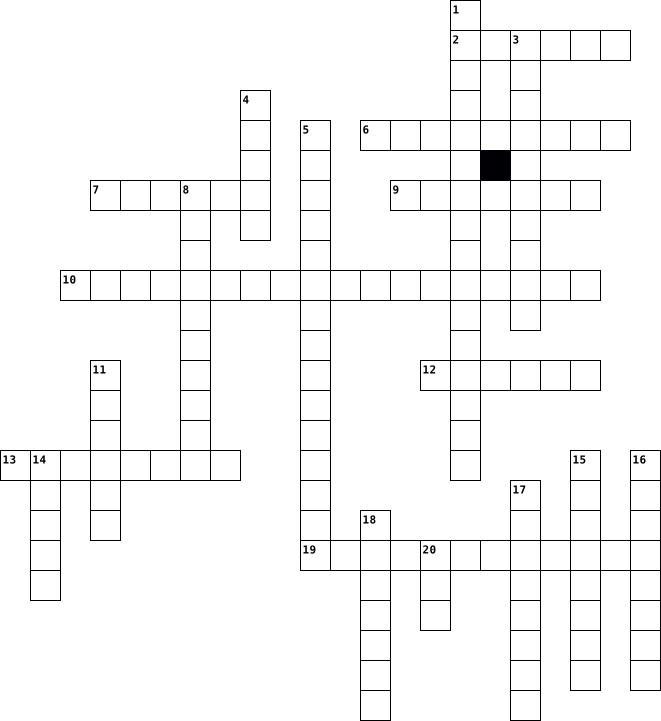
Across
- Where was the World Cup held?
- Where did Donald Trump and Kim Jong Un meet?
- Which country won the soccer world cup?
- What is the most popular cryptocurrency?
- What was the particular moon this year called?
- This year there was a rescue of a boys ____ team.
- The cricket team of Australia was ____
- What fruit had needles placed inside?
Down
- What disasters are happening in 2018?
- What is the most popular song in 2018?
- There is a war in Syria and ____
- Which inventor died this year?
- Where does NASA want to land a probe
- Trump Who is the USA president in 2018?
- What is fake food this year? Artificial ____
- What is this sport event called? ____ Games
- What is the most popular dance move in 2018?
- What is the most popular game in 2018?
- and France Which two teams in the soccer world cup made it into the finals?
- What war is its 100th anniversary?
20 Clues: Where was the World Cup held? • Which inventor died this year? • There is a war in Syria and ____ • What war is its 100th anniversary? • Where does NASA want to land a probe • What disasters are happening in 2018? • What fruit had needles placed inside? • What is the most popular song in 2018? • The cricket team of Australia was ____ • What is the most popular game in 2018? • ...
Geography Study Guide 2024-05-14

Across
- Location of the Amazon Rainforest
- cultral hearth for 3 monotheistic religions
- modern dictatorship
- high dependency ratio with an elderly-declining population
- Leeward side of mountain range-mountain barriers
- largest population in the world
- Arab Spring began here
- Monsoon season-hearth for Polytheistic Hinduism
- special democracy
- civil war and refugees crisis
- constitutional monarchy
- Berlin conference drew the political map of Africa
Down
- harsh racial codes firing assimilation of native populations
- Continental position-climate Factors
- Highst range in the world-elevation climate factor-convergent boundary
- Largest desert in the world
- large tertiary-based economy in the US-Disney
- one of the last few remaining traditional monarchies
- racial discrimination-apartheid
- the Taliban-religious extremism-civil conflict-war-popp growing region
- large-scale migration due to violence-refugees fleeing genocide in sudan
- Common annual risk of tornados
- largest natural gas reserves
- theocracy
24 Clues: theocracy • special democracy • modern dictatorship • Arab Spring began here • constitutional monarchy • Largest desert in the world • largest natural gas reserves • civil war and refugees crisis • Common annual risk of tornados • racial discrimination-apartheid • largest population in the world • Location of the Amazon Rainforest • Continental position-climate Factors • ...
Summative Review: MANIA and the Causes of WWI 2021-03-17

Across
- mutual defense agreements
- the conquest of foreign lands to create or expand an empire
- at the time, people called WWI the _______ War.
- the political murder of a prominent person for political purposes
- most important branch of the military that connected the world’s colonies, trading centers, and commerce.
- the name of the Archduke of Austria-Hungary who was assassinated launching WWI
- country over which France and Germany conflicted during the Scramble for Africa
- Germany instigated Austria-Hungary into declaring war on Serbia by offering this, which essentially said Germany would do whatever was necessary to help Austria-Hungary
- the name of the 19 year old who assassinated the Archduke and of Austria-Hungary and his pregnant wife
- this Revolution led to the mechanization of warfare and the mass production of weapons making WWI “The First Modern War”
- This country was actually neutral, but was was dragged into the war regardless due to a German invasion
- the Bosnian, Serb nationalist group responsible for the assasinatpn of the Archduke of Austria-Hungary
Down
- the belief that all nations (cultural/ethnic groups) should have their own country exclusively
- region in Austria-Hungary in which Serb nationalism too hold
- This country preemptively declared war on both Russia and France
- the Triple ______ consisted of Italy, Germany, and Austria- Hungary
- the increase in the empower and influence of a country’s military through the build up of the armaments and personnel of the military
- the Triple ______ consisted of Russia, Britain, and France
- this naval race resulted from the idea that: “Whoever controls the waves controls the world.”
- WWI expanded from a European war into a world war because many countries, such as Britain and France, possessed these
- continent nearly entirely colonized just prior to WWI
21 Clues: mutual defense agreements • at the time, people called WWI the _______ War. • continent nearly entirely colonized just prior to WWI • the Triple ______ consisted of Russia, Britain, and France • the conquest of foreign lands to create or expand an empire • region in Austria-Hungary in which Serb nationalism too hold • ...
World war 1 (Michael Collier) 2021-03-03

Across
- the person who was assassinated before the War started
- a final proposal or statment of conditions
- In World war 1 the alliances of Germany and Austria-Hungary
- drafting of civilians serve in the army
- France VS. Germany France led by Nivelle poorly defended Germans lost
- Alliance between Germany, Italy, Austria Hungry
- A large ridge dirigible designed to carry passengers or bomb
- a state of peace agreed to between opponents so they can discuss peace terms
- when nations joined together to support each other.
- A german submarine that was the first submarine
- made for gunpowder
- of nations Countries teamed up to protect Europe
- used mainly for scouting enemy ground forces later used as fighters or bombers
- An alliance between Britain, France, and Russia
- Emphasises the life of the mind and feelings rather than the realistic external details of everyday life
Down
- war from inside trenches
- Most deaths of any war to this date
- Policy of building up strong armed forces to prepare for war
- baron German pilots who shot down over 80 planes
- and epidemic that is geographically widespread
- the channeling of a nations entire resources into a war effort
- A collection of merchant ships with an escort of warships
- Britain France and Russia
- information that is spared for the purpose of promoting some cause
- A telegram Germany sent to Mexico to convince the US
- Killed almost 30 million worldwide Spread between military camps
- Tettorie between rival trenches very dangers
- the treat imposed on Germany by the Allied powers in 1920 after the end of World War 1
- Atomic bombs, tanks trench warfare
- A situation in which no progress can be made
30 Clues: made for gunpowder • war from inside trenches • Britain France and Russia • Atomic bombs, tanks trench warfare • Most deaths of any war to this date • drafting of civilians serve in the army • a final proposal or statment of conditions • Tettorie between rival trenches very dangers • A situation in which no progress can be made • ...
CLASSICAL GREECE 2023-10-17

Across
- THIS MAN WAS THE LEADER OF ATHENS DURING THE 'GOLDEN AGE'
- THE GREAT PERSIAN KING THAT FOUGHT AGAINST ALEXANDER
- THE GREAT GREEK HERO THAT FOUGHT IN THE TROJAN WAR
- WHERE ALEXANDER THE GREAT WAS FROM
- THE WORLD'S FIRST HISTORIAN
- THE STUDY OF PLANTS
- THE PELOPONNESIAN WAR WAS WON BY THIS CITY STATE
- THE FIERCE BEAST THAT WAS USED TO HELP CONTROL THE ISLAND OF CRETE
- THE GREEK CITY-STATE THAT ROSE UP AGAINST ALEXANDER AND WAS DESTROYED
- THIS WORD REFERS TO A 'LOVER OF WISDOM'
- THE TEMPLE BUILT TO HONOR THE GODDESS ATHENA
- ALEXANDER'S TITLE WHEN HE CONQUERED EGYPT
- POWERFUL CIVILIZATION THAT WERE RUN BY MILITARY KINGS ON THE GREEK MAINLAND
Down
- THIS WAS THE NAME OF ALEXANDER'S HORSE
- THE FATHER OF MODERN MEDICINE
- THE OLYMPICS WERE HELD TO HONOR WHAT GOD?
- THE GREAT PHILOSOPHER TUTORED ALEXANDER THE GREAT
- THIS WAS THE HIGHEST HONOR GIVEN TO ATHLETES AT THE OLYMPIC GAMES
- THIS PHILOSOPHER IS CONSIDERED THE GREATEST TEACHER OF ALL TIME
- THE CITY WHERE ALEXANDER DIED
- LEGENDARY CIVILIZATION THAT WAS WRITTEN ABOUT BY THE PHILOSOPHER PLATO
- THIS WORD MEANS TO HAVE A FEAR OF HEIGHTS
- THE CIVILIZATION THAT BEGAN ON THE ISLAND OF CRETE IN 2,OOO B.C.
- THE WAR FOUGHT BETWEEN ATHENS AND SPARTA
- THE SCHOOL THAT PLATO OPENED IN ANCIENT GREECE
- THESE PEOPLE MOVED INTO THE ANCIENT GREEK WORLD, BUT LEFT NO WRITTEN RECORDS
- MUCH OF WHAT WE KNOW ABOUT THE TROJAN WAR COMES TO US FROM THIS MAN
- DURING THE PELOPONESSIAN WAR ONE THIRD OF THE PEOPLE OF ATHENS DIED AS A RESULT OF WHAT?
- THIS WAS THE FEARED AND SUCCESSFUL GREEK MILITARY FORMATION
29 Clues: THE STUDY OF PLANTS • THE WORLD'S FIRST HISTORIAN • THE FATHER OF MODERN MEDICINE • THE CITY WHERE ALEXANDER DIED • WHERE ALEXANDER THE GREAT WAS FROM • THIS WAS THE NAME OF ALEXANDER'S HORSE • THIS WORD REFERS TO A 'LOVER OF WISDOM' • THE WAR FOUGHT BETWEEN ATHENS AND SPARTA • THE OLYMPICS WERE HELD TO HONOR WHAT GOD? • THIS WORD MEANS TO HAVE A FEAR OF HEIGHTS • ...
WW1 CrossWord 2023-09-20

Across
- The country east of Germany
- Underwater ship.
- The first major amphibious operation in modern warfare.
- a formally concluded and ratified agreement between countries.
- A battle that was one of the longest, bloodiest, and most-ferocious battles of the war, located in France.
- The battle marked the Germans' first use of poison gas as a weapon.
- Heir to the imperial throne of the Austro-Hungarian empire.
- When opposing forces encounter on two geographically separate fronts.
- The country in between France and Russia
- In case of the outbreak of war, Germany would attack France first and then Russia.
- A type of combat in which the opposing sides attack, counterattack, and defend from relatively permanent systems of trenches dug into the ground.
- Powers, Germany, Austria-Hungary, Bulgaria and the Ottoman Empire.
- A British passenger ship that was owned by the Cunard Line and was first launched in 1906.
- A Serbian nationalist group.
- a joint operation between British and French forces intended to achieve a decisive victory over the Germans on the Western Front.
Down
- An aspiration to secure Germany's position among the established world powers of the time and to realize a foreign policy that was global in scope.
- One of the central powers that annexed Bosnia
- One of the most significant political figures of modern Germany.
- An alliance between Great Britain, France, and Russia.
- killed Archduke Franz Ferdinand, and set the wheels of world war in motion.
- Destruction of the Russian Second Army and the suicide of its commanding general, Alexander Samsonov.
- Empire, An empire that has declining power and lost Bosnia due to it.
- The country surrounded by water.
- The alliance between Germany and Austria-Hungary.
- The country west of Germany
- Powers, France, the United Kingdom, Russia, the United States, Italy, and Japan
- Symbol of the worst horrors of the First World War.
- The battle were the French saved the capital city of Paris from capture.
- The top scoring flying ace of World War I
- A final demand or statement of terms.
30 Clues: Underwater ship. • The country east of Germany • The country west of Germany • A Serbian nationalist group. • The country surrounded by water. • A final demand or statement of terms. • The country in between France and Russia • The top scoring flying ace of World War I • One of the central powers that annexed Bosnia • The alliance between Germany and Austria-Hungary. • ...
The first 30 Presidents 2022-03-22

Across
- a memorial of him was built in Washington, D.C
- president who oversaw the largest territorial expansion in American history
- he advocated agricultural technology, an educated electorate, and civil rights for African Americans.
- the last president before the start of the Civil War
- led America into war in order to “make the world safe for democracy.”
- Vice President for Thomas Jefferson
- the first president to serve without being elected to office
- the first American president to be impeached
- best remembered for his classic set of bushy sideburns
- the first president to ride in an automobile
- the only president in American history to serve two non-consecutive terms in office
- Principle author of the Declaration of Independence
Down
- President served in the shortest time
- the youngest person to become president of the United States
- created the League of Nations after World War I
- Leader of the Tennessee militia
- led the Union Armies to victory over the Confederacy in the American Civil War
- oversaw the end of Reconstruction
- First President of the U.S
- most known for the Compromise of 1850
- Second President of the U.S
- The first President to be photographed
- grandson of President William Henry Harrison
- The second shortest President
- his policies may have helped to push the United States into Civil War
- Best known for his negotiation of the Louisiana Purchase in 1803
- national war hero for his battles in the Mexican War
- elected President and later became the tenth Chief Justice of the United States, the only person to have served in both of these offices.
28 Clues: First President of the U.S • Second President of the U.S • The second shortest President • Leader of the Tennessee militia • oversaw the end of Reconstruction • Vice President for Thomas Jefferson • President served in the shortest time • most known for the Compromise of 1850 • The first President to be photographed • grandson of President William Henry Harrison • ...
Sports Stuff 2024-12-01

Across
- Distance to throw a strike (1st part)
- Hour limit of World Championship Ironman
- City of World Championship Ironman
- 5 required items to wear in Soccer per Law#4 in alphabetical order (first two)
- Food of US Masters in Atlanta GA (1 of 2, two words)
- Most wins in Coney Island competition goes to
- Pickleball was named after what breed of dog (2nd word)
- Sport invented in Massachusetts (1 of 2)
- One sport to start with a faceoff (2 words)
- Another sport to start with a faceoff
Down
- 5 required items to wear in Soccer per Law#4 in alphabetical order (last three)
- Coney Island competition consumption
- Distance to throw a strike (2nd part)
- Bird figure in synchronized swimming (1 of 2)
- US city with certified Olympic Luge track (2 of 2)
- Food of US Masters in Atlanta GA (2 of 2, two words)
- Pickleball was named after what breed of dog (1st word)
- Bird figure in synchronized swimming (2 of 2)
- Sport invented in Massachusetts (2 of 2)
- US city with certified Olympic Luge track (1 of 2)
- Sport where competition is called a Regatta (2 of 2)
- Primary technique used in Shot Put (1 of 2)
- Sport where competition is called a Regatta (1 of 2)
- Primary technique used in Shot Put (2 of 2)
24 Clues: City of World Championship Ironman • Coney Island competition consumption • Distance to throw a strike (2nd part) • Distance to throw a strike (1st part) • Another sport to start with a faceoff • Hour limit of World Championship Ironman • Sport invented in Massachusetts (2 of 2) • Sport invented in Massachusetts (1 of 2) • Primary technique used in Shot Put (1 of 2) • ...
World War II Vocabulary 2023-04-18

Across
- a harbor near Honolulu, on S Oahu, in Hawaii: surprise attack by Japan on the U.S. naval base and other military installations December 7, 1941.
- U.S. government research project (1942–45) that produced the first atomic bombs
- a mass political movement that emphasizes extreme nationalism, militarism, and the supremacy of both the nation and the single, powerful leader over the individual citizen.
- the first Black military aviators in the U.S. Army Air Corps (AAC),
- an Austrian-born German politician who was the dictator of Germany from 1933 until his suicide in 1945
- a policy of remaining apart from the affairs or interests of other groups, especially the political affairs of other countries.
- allowed the U.S. government to lend or lease war supplies to any nation vital to U.S. defense,
- a German submarine used in World War I or World War II.
Down
- A political leader of the twentieth century. A Democrat, Truman was president from 1945 to 1953. In 1944, after representing Missouri in the Senate, ...
- a person not in the armed services or the police force.
- an American statesman and political leader who served as the 32nd president of the United States
- a bomb that derives its destructive power from the rapid release of nuclear energy by fission of heavy atomic nuclei, causing damage through heat, blast, and radioactivity
- media icon associated with female defense workers during World War II
- travel from one island to another, especially as a tourist in an area of small islands.
- the day (June 6, 1944) in World War II on which Allied forces invaded northern France by means of beach landings in Normandy.
- the name given to American Indians who used their tribal language to send secret communications on the battlefield.
16 Clues: a person not in the armed services or the police force. • a German submarine used in World War I or World War II. • the first Black military aviators in the U.S. Army Air Corps (AAC), • media icon associated with female defense workers during World War II • U.S. government research project (1942–45) that produced the first atomic bombs • ...
Bessie Coleman - American Flyer 2022-05-18

Across
- Bessie Coleman _______ in a plane accident on April 30, 1926.(paragraph 12)
- Flight school was very easy for Bessie Coleman, True or False? (paragraph 7)
- Why was life hard for Bessie Coleman when she was a child? (paragraph 2)
- Bessie Coleman was also the _______ African American woman to fly an airplane.
- Bessie was ________ of her own accomplishments and she was proud to be an African American.
- Where did Bessie hear stories about World War I? (paragraph 6)
- On June 15, 1921 Bessie Coleman received her international pilot's _________.
- Bessie Coleman was a good student, true or false? (paragraph 4)
- Bessie learned to speak _______ so she could go to flight school in France and become a pilot.
Down
- Bessie Coleman was famous and she _______ countless African Americans to become pilots.
- What was Bessie Coleman's dream? (paragraph 6)
- Bessie Coleman was the first African American to get an international ________ license.
- Bessie decided she wanted to be a pilot when she listened to men tell ________ about World War I.
- Where was Bessie Coleman born?
- Bessie Coleman's parents worked hard as cotton __________.
- Many people still _______ Bessie Coleman for her amazing accomplishments as the first African American international pilot.
- Bessie Coleman wanted other African Americans to learn to ________. (paragraph 11)
17 Clues: Where was Bessie Coleman born? • What was Bessie Coleman's dream? (paragraph 6) • Bessie Coleman's parents worked hard as cotton __________. • Where did Bessie hear stories about World War I? (paragraph 6) • Bessie Coleman was a good student, true or false? (paragraph 4) • Why was life hard for Bessie Coleman when she was a child? (paragraph 2) • ...
Chapter 16 Review 2021-05-18

Across
- Lincoln changed the focus of the war with his _________ (2)
- The right of an arrested person to be brought before a judge before going to jail (2)
- The amendment ended slavery in the United States
- This was the last stronghold on the Mississippi River for the Confederacy that Grant finally captured for the North
- The era following the Civil War was known as ________
- The __________ Act helped Americans find affordable land and more quickly settle the West
- Grant and the Union army finally captured this capital city of the Confederacy
- This Union victory was the turning point of the war
- This general had great success for the North and became Lincoln’s final choice to command the Union army, but was controversial because of his army had many casualties (last name only)
- Lincoln suspended habeas corpus to silence Northerners who _______ the war
- A mandatory term of military service
- About 625,000 total soldiers ______ during the Civil War
- To murder for political reasons
- The courageous 54th regiment from this state proved that African Americans could fight as well as anyone
- The ________ changed its main commanding general often throughout the war
- The Emancipation Proclamation said that slavery would end here if the seceded states didn’t give up and return to the Union
- The Gettysburg Address was a speech given by this man (last name only)
Down
- The Emancipation Proclamation also announced that _________ could join the Union army (2)
- People who listened to the Gettysburg Address were asked to think about the ideas of this founding document (3)
- This amendment guaranteed African Americans equal protection under the law
- A person who has served in the military
- A certificate offered for sale to the public with the promise that the government will pay the money back, usually with interest
- Civil War _______ were fed poorly, often died of disease, often died of hunger, and lived in extremely uncomfortable conditions
- At the start of the war, Lincoln said he would not end _________ because he needed the support of the Border States
- During General Sherman’s _________, he and the Union army travelled from Atlanta to Savannah and practiced the total war strategy (4)
- The ______ won the Civil War
- Lee finally surrendered at this Virginia town
- When the rules and laws of war are ignored and all available resources are used to defeat the enemy (2)
- This amendment gave African American men the right to vote
- This was the leading cause of death for Civil War soldiers
- The value of Confederate money went _______ after they printed much more money
- It upset many that _______ people could find exemptions for the draft
- Lincoln and Grant offered very generous terms when Lee surrendered on _____ 9, 1865
33 Clues: The ______ won the Civil War • To murder for political reasons • A mandatory term of military service • A person who has served in the military • Lee finally surrendered at this Virginia town • The amendment ended slavery in the United States • This Union victory was the turning point of the war • The era following the Civil War was known as ________ • ...
Greek Mythology 2022-07-17

Across
- persephone
- fleece
- world
- fire
- gift
- rainbow
- prometheus
- sailors
- sun
- cyclops
- box
Down
- before
- drown
- sun
- hestia
- leader
- heel
- horse
- wife
- labyrinth
- gold
- war
- weapon
- cause
- river
25 Clues: sun • war • sun • box • heel • fire • wife • gift • gold • drown • world • horse • cause • river • before • hestia • fleece • leader • weapon • rainbow • sailors • cyclops • labyrinth • persephone • prometheus
Period 8 Terms Puzzle 2025-04-02

Across
- 33rd President of the United States. Led the U.S. to victory in WWII making the ultimate decision to use atomic weapons for the first time. Shaped U.S. foreign policy regarding the Soviet Union after the war.
- the first artificial satellite into Earth's orbit by Russia
- The war in the Pacific, most islands were involved, Japan tried to take these islands and sent 65 bombing raids all the way to Australia.
- a period of geopolitical tension between the United States and the Soviet Union that lasted from 1947 to 1991
- code name for the secret United States project set up in 1942 to develop atomic bombs for use in World War II
- A military strategy used during World War II that involved selectively attacking specific Japanese-held islands and bypassing others
- foreign policy strategy used by the United States during the Cold War to stop the spread of communism and the expansion of the Soviet Union
- refers to the political repression and persecution of left-wing individuals during the Second Red Scare, characterized by fear of communism and the Soviet Union
- a conflict fought between North Korea and South Korea, and their allies, from 1950 to 1953
Down
- Fighting that took place on the continent of Europe against Hitler and Mussolini.
- the act of assembling and preparing a nation's military forces, including reserves, as well as harnessing its industrial and economic resources, to actively engage in war
- a US program that provided economic aid to Western and Southern European countries after World War II
- a foreign policy that pledged the United States to support democratic nations threatened by authoritarian forces
- Japanese bombing of ships in Hawaiian harbor; resulted in FDR's request for declaration of war against Japan; Germany and Italy responded with declarations of war
14 Clues: the first artificial satellite into Earth's orbit by Russia • Fighting that took place on the continent of Europe against Hitler and Mussolini. • a conflict fought between North Korea and South Korea, and their allies, from 1950 to 1953 • a US program that provided economic aid to Western and Southern European countries after World War II • ...
WH Final Exam Review Part 1 2023-01-08

Across
- top of the social class in Rome were the
- We study history so that we can build on its success and avoid its
- Something that is verifiable is a
- Pottstown is 35 miles Northwest of Philadelphia would be an example of this type of location.
- What were the 2 types of slaves in Rome: Public and
- The streets and buildings of Pottstown are examples of this type of geographic characteristics.
- The Punic War was a war fought between Rome and
- The hills and rivers of Pottstown are examples of this type of geographic characteristics.
- To achieve salvation, medieval Christians believed that they must receive the, example Baptism and Marriage
- Something that is a judgment based on facts is
- This class made up 65% of the Roman population.
- a religion that is only really popular in South Asia
- Mountain range that ran through the center of Italy
Down
- Religions, such as Hinduism, that worship multiple gods are called
- Pottstown is located 40° 14' 43" N / 75° 39' 0" W is an example of this type of location.
- This School of Thought is interested more in worldly and philosophical matters than spiritual matters
- line on the map that divides the globe at 0 degrees Longitude
- The study of people places and how they interact with their environment.
- The 2 duties of all Roman citizens was to fight and to
- This religion worships the forces of nature
- Name of the war that occured bc Rome wanted Sicily so that they can control more of the trade in the Mediterranean
- line on the map that divides the world in half at 0 degrees Latitude
- Made up of 300 elected Roman officials to make laws and taxes.
- Rome is located on this peninsula
24 Clues: Something that is verifiable is a • Rome is located on this peninsula • top of the social class in Rome were the • This religion worships the forces of nature • Something that is a judgment based on facts is • The Punic War was a war fought between Rome and • This class made up 65% of the Roman population. • What were the 2 types of slaves in Rome: Public and • ...