
cells Crossword Puzzles
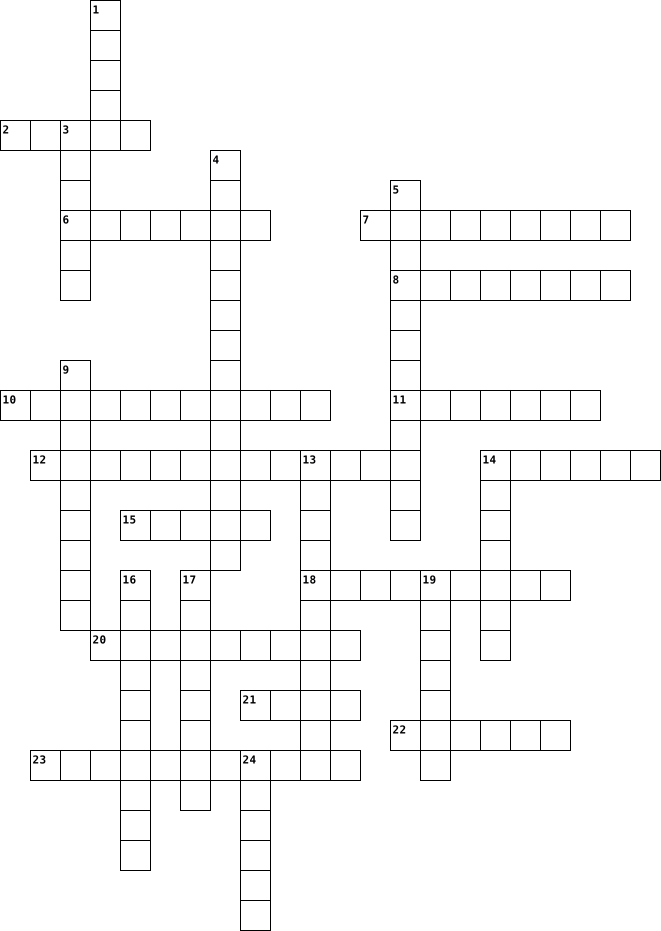
Unit 7 Vocabulary 2026-02-15

Across
- stage of early development in mammals that consists of a hollow ball of cells
- one of a family of proteins that regulates the cell cycle in eukaryotic cells
- a fertilized egg
- cells that are capable of developing into most, but not all, of the body's cell types
- the presence of cancerous cells that have the ability to spread to other sites in the body (metastasize) or to invade nearby (locally) and destroy tissue
- one of two identical "sister" parts of a duplicated chromosome
- disorder in which some of the body's cells lose the ability to control growth
- therapy the treatment of disease, especially cancer, using X-rays or similar forms of radiation.
- developing stage of a multicellular organism
- phase of mitosis in which the distinct individual chromosomes begin to spread out into a tangle of chromatin
- unspecialized cell that can give rise to one or more types of specialized cells
- treatment that uses certain parts of a person's immune system to fight diseases such as cancer
- substance found in eukaryotic chromosomes that consists of DNA tightly coiled around histones
- cells that are able to develop into any type of cell found in the body (including the cells that make up the extraembryonic membranes and placenta)
- division of the cytoplasm to form two separate daughter cells
- type of reproduction in which cells from two parents unite to form the first cell of a new organism
- the development of secondary malignant growths at a distance from a primary site of cancer
- period of the cell cycle between cell divisions in which the cell grows
- phase of mitosis in which the chromosomes separate and move to opposite ends of the cell
Down
- agent with the capacity to cause cancer in humans
- process in which cells become specialized in structure and function
- series of events in which a cell grows, prepares for division, and divides to form two daughter cells
- tumor, or growth that is not cancerous (does not spread into nearby tissues)
- growth of new blood vessels that tumors need to grow
- type of reproduction in which one parent cell produces two identical offspring (daughter cells)
- threadlike structure within the nucleus that contains genetic information that is passed on from one generation to the next
- type of asexual reproduction in which an organism replicates its DNA and divides in half, producing two identical daughter cells
- phase of mitosis in which the chromosomes line up across the center of the cell
- cell with limited potential to develop into many types of differentiated cells
- drug treatment that uses powerful chemicals to kill fast-growing cells in your body
- any change in the DNA sequence
- the process of programmed cell death
- first and longest phase of mitosis in which the genetic material inside the nucleus condenses and the chromosomes become visible
- region of a chromosome where the two sister chromatids attach
34 Clues: a fertilized egg • any change in the DNA sequence • the process of programmed cell death • developing stage of a multicellular organism • agent with the capacity to cause cancer in humans • growth of new blood vessels that tumors need to grow • region of a chromosome where the two sister chromatids attach • division of the cytoplasm to form two separate daughter cells • ...
Cell Division 2022-04-02

Across
- the name for the single cell that results from fertilization
- determine the gender of the fetus
- division produces 4 cells each with half the original number of chromosomes
- name for reproductive cells of a sexual reproducing organism
- a cell with 2 sets of chromosomes
- when male and female gametes combine
- stage when chromosomes line on the equator
- longest stage for most cells, involves growth and copying of DNA
- stage when the nuclei reappear
Down
- name for "regular" body cells of an organism
- chromosomes, one from each parent, that carry info for same traits
- division of the cytoplasm into two cells
- produces fibers to move chromosomes
- structure which holds chromatids together
- stage when chromosomes begin to move to poles
- any chromosome not involved in determining the gender
- a cell with one set of chromosomes
- stage when chromosomes first coils and appear
- division that produces 2 identical "body" cells
19 Clues: stage when the nuclei reappear • determine the gender of the fetus • a cell with 2 sets of chromosomes • a cell with one set of chromosomes • produces fibers to move chromosomes • when male and female gametes combine • division of the cytoplasm into two cells • structure which holds chromatids together • stage when chromosomes line on the equator • ...
Plants, Animals, and Prokaryotic Cell Crossword 2017-10-28

Across
- vacuole/large fluid filled sac that provides structural support in plant cells
- green organelle that contains chlorophyll
- wall/structural layer surrounding plant cells
- energy currency through respiration
- digestive enzymes
- body/processes an packaged proteins and lipids
- water which protects bacteria from desiccation
- DNA and is found in a eukaryotic cell
- sacs used to transport substances around cells
Down
- vacuole/small fluid filled sac used for temporary storage in animal cells
- fiber that attaches to a bacteria cells surface
- gel like material within a cell
- to the nucleus and is located in a prokaryote
- by the nuclear envelope
- reticulum/transports synthesized proteins in vesicles to the golgi body
- like material inside the cell membrane
- of protein synthesis
- tail like structure found on prokaryotic cells
- envelope/surrounds the gentetic material and nucleolus
19 Clues: digestive enzymes • of protein synthesis • by the nuclear envelope • gel like material within a cell • energy currency through respiration • DNA and is found in a eukaryotic cell • like material inside the cell membrane • green organelle that contains chlorophyll • to the nucleus and is located in a prokaryote • wall/structural layer surrounding plant cells • ...
Plants, Animals, and Prokaryotic Cell Crossword 2017-10-28

Across
- vacuole/small fluid filled sac used for temporary storage in animal cells
- reticulum/transports synthesized proteins in vesicles to the golgi body
- like material inside the cell membrane
- digestive enzymes
- wall/structural layer surrounding plant cells
- body/processes an packaged proteins and lipids
- energy currency through respiration
- gel like material within a cell
- envelope/surrounds the gentetic material and nucleolus
- sacs used to transport substances around cells
Down
- green organelle that contains chlorophyll
- by the nuclear envelope
- of protein synthesis
- DNA and is found in a eukaryotic cell
- tail like structure found on prokaryotic cells
- to the nucleus and is located in a prokaryote
- water which protects bacteria from desiccation
- fiber that attaches to a bacteria cells surface
- vacuole/large fluid filled sac that provides structural support in plant cells
19 Clues: digestive enzymes • of protein synthesis • by the nuclear envelope • gel like material within a cell • energy currency through respiration • DNA and is found in a eukaryotic cell • like material inside the cell membrane • green organelle that contains chlorophyll • wall/structural layer surrounding plant cells • to the nucleus and is located in a prokaryote • ...
Microbiology Chapter 3 2026-01-29

Across
- negative thin peptidoglycan, outer membrane, and protects from antibiotics
- groups of four single cells
- arrangement flagella attached at one or both ends of a cell
- movement of bacteria in response to chemical signals
- allow tight adhesion between fimbriae and
- chemotaxis movement away from chemical stimulus
- used in conjugation between bacterial cells
Down
- chains of single cells
- is the connection and exchange of genetic material
- pairs of single cells
- chemotaxis moving toward a nutrient
- bacterial cells
- positive thick peptidoglycan and teichoic acids
- grape-like clusters of cells
- a polysaccharide coating outside the bacteria structure
- cells which helps bacteria colonize and infect host tissues
16 Clues: bacterial cells • pairs of single cells • chains of single cells • groups of four single cells • grape-like clusters of cells • chemotaxis moving toward a nutrient • allow tight adhesion between fimbriae and • used in conjugation between bacterial cells • chemotaxis movement away from chemical stimulus • is the connection and exchange of genetic material • ...
biology unit 2025-01-28

Across
- idea that all living things are composed of cells
- Threadlike structures made of DNA molecules that contain the genes.
- basic unit of life
- made of one cell
- makes protein
- An organelle found in large numbers in most cells,
- cells without a nucleus
- a living thing
- brain of the cell
- Wall A rigid layer of nonliving material that surrounds the cells of plants and some other organisms.
- DNA segments that serve as the key functional units in hereditary transmission.
- made up multiple cells
Down
- A tiny cell structure that carries out a specific function within the cell
- Membrane A cell structure that controls which substances can enter or leave the cell.
- organisms that get their food from other organisms.
- a jelly like fluid
- cells with a nucleus
- organisms that make their own food.
- stores water salts and proteins
- An organelle where photosynthesis occurs, found in plant cells.
- Membrane A cell structure that controls which substances can enter or leave the cell.
21 Clues: makes protein • a living thing • made of one cell • brain of the cell • a jelly like fluid • basic unit of life • cells with a nucleus • made up multiple cells • cells without a nucleus • stores water salts and proteins • organisms that make their own food. • idea that all living things are composed of cells • An organelle found in large numbers in most cells, • ...
4 – Mitosis 2026-04-18

Across
- Cell fluid
- fibres Move chromosomes
- Nuclei reform
- Chromosomes condense
- Cytoplasm divides
- Chromatids separate
- Cell division producing identical diploid cells
Down
- reproduction One parent producing identical offspring
- Chromosomes align
- cells Cells formed after division
- One set of chromosomes
- cells Body cells
- chromatids Identical chromosome copies
- Two sets of chromosomes
- Join chromatids
15 Clues: Cell fluid • Nuclei reform • Join chromatids • Chromosomes align • cells Body cells • Cytoplasm divides • Chromatids separate • Chromosomes condense • One set of chromosomes • Two sets of chromosomes • fibres Move chromosomes • cells Cells formed after division • chromatids Identical chromosome copies • Cell division producing identical diploid cells • ...
4 – Mitosis 2026-04-18

Across
- Chromosomes align
- Cytoplasm divides
- Two sets of chromosomes
- Nuclei reform
- cells, Cells formed after division
- fibres, Move chromosomes
- Cell division producing identical diploid cells
Down
- cells, Body cells
- Chromatids separate
- reproduction, One parent producing identical offspring.
- One set of chromosomes
- Join chromatids
- Cell fluid
- Chromosomes condense
- chromatids, Identical chromosome copies
15 Clues: Cell fluid • Nuclei reform • Join chromatids • cells, Body cells • Chromosomes align • Cytoplasm divides • Chromatids separate • Chromosomes condense • One set of chromosomes • Two sets of chromosomes • fibres, Move chromosomes • cells, Cells formed after division • chromatids, Identical chromosome copies • Cell division producing identical diploid cells • ...
Final project in Biology 2021-06-07

Across
- and C-H have high energy
- things store energy in molecules
- make glucose with the process of photosynthesis
- are made of cells
- cells can change into other kinds of cells
- contains the largest pool of organic carbon
- is the important part of science
- is characteristic or condition
- moves from a plant’s leaves to all of its cells
- have different versions
- eat plants
- eat other animals
Down
- also a glucose polymer
- is the total mass of organisms in a given area
- performed cellular respiration
- also do cellular respiration
- made oxygen
- occurs in the leaf
- of a plant’s mass comes from the carbon dioxide that goes into its leaves
- has 2 bonds
- cells have the same DNA and genes
21 Clues: eat plants • made oxygen • has 2 bonds • are made of cells • eat other animals • occurs in the leaf • also a glucose polymer • have different versions • and C-H have high energy • also do cellular respiration • performed cellular respiration • is characteristic or condition • things store energy in molecules • is the important part of science • cells have the same DNA and genes • ...
Blood and Circulation 2025-01-14

Across
- The main artery carrying oxygenated blood.
- Breathing
- Protein in red blood cells that binds to oxygen.
- The muscular organ that pumps blood.
- Blood passes through the heart twice.
- The fluid part of blood.
- Rhythmic contraction and relaxation of the heart.
- Vessels that carry blood back to the heart.
- Cells that carry oxygen.
- Vessels that carry blood away from the heart.
Down
- Pumps deoxygenated blood to the lungs.
- Cells that fight infections.
- The liquid that carries nutrients.
- Tiny blood vessels connecting arteries to veins.
- Pumps oxygenated blood to the body.
- White blood cells that produce antibodies.
- Blood flow
- Cells that help in blood clotting.
- Prevents blood from flowing backward.
19 Clues: Breathing • Blood flow • The fluid part of blood. • Cells that carry oxygen. • Cells that fight infections. • The liquid that carries nutrients. • Cells that help in blood clotting. • Pumps oxygenated blood to the body. • The muscular organ that pumps blood. • Blood passes through the heart twice. • Prevents blood from flowing backward. • Pumps deoxygenated blood to the lungs. • ...
Cardio-Pulmonary System Review! 2024-09-20

Across
- ___ blood cells carry oxygen and carbon dioxide
- Muscle that moves the lungs
- "The voice box"
- Largest vein in the body
- Where oxygen moves into our blood
- ___ blood cells fight disease
- Closes to keep food out of our lungs
- The only liquid part of blood
Down
- "The wind pipe"
- Oxygen binds to ___ in red blood cells
- Protein inside red blood cells
- Takes blood away from the heart
- ___ vein & artery connect to lungs
- Vessels that deliver blood to cells
- Stops bleeding by plugging wounds
- largest artery in the body
- Brings blood back to the heart
- Heart's lower chambers
- Heart's upper chamber, where blood enters
19 Clues: "The wind pipe" • "The voice box" • Heart's lower chambers • Largest vein in the body • largest artery in the body • Muscle that moves the lungs • ___ blood cells fight disease • The only liquid part of blood • Protein inside red blood cells • Brings blood back to the heart • Takes blood away from the heart • Stops bleeding by plugging wounds • Where oxygen moves into our blood • ...
Microscope,Prokaryotes and Eukaryotes 2022-02-15

Across
- NO Nucleus
- Inside is the linear DNA
- Know the structure, function, and how they work with other organelles
- Move
- move and eat
- move and eat
- More then one cell
- Amoeba
- Genetic Material!
- Eukaryotic cells evolved from prokaryotic cells over time into eukaryotes
Down
- Not an organelle, Surrounds all organelles
- Food, Water, Minerals, Enzymes, Minerals, Waste is stored
- Keeping the perfect stable environment for the cell
- Provides structure!
- Multiply eyepiece X objective lens you are using to find total magnification
- Works with the chloroplasts to create ATP energy
- Scanning and Electron transmission microscopes
- In both eukaryotic and prokaryotic cells!
- one cell only
- All cells come from pre-existing cells
20 Clues: Move • Amoeba • NO Nucleus • move and eat • move and eat • one cell only • Genetic Material! • More then one cell • Provides structure! • Inside is the linear DNA • All cells come from pre-existing cells • In both eukaryotic and prokaryotic cells! • Not an organelle, Surrounds all organelles • Scanning and Electron transmission microscopes • Works with the chloroplasts to create ATP energy • ...
Parts of cell- Eva 2022-12-01

Across
- only life process "reproduce"
- Controls the cell
- site of protein that makes synthesis
- package proteins around the cell
- where aerobic resp happens
- diffusion of water
- transport from the cell on part to another
- cells are simple and more primitive
- capture energy from sunlight
- area from high to low concentration\
Down
- create energy for the cell
- it protects and supports the plant cell
- they often come in pairs
- cells are more complex
- found in both animal cells and plants cells
- it is a clear gel like fluids
- store food and water for the cell
- break down old cells
- performs a specialized function within a cell
19 Clues: Controls the cell • diffusion of water • break down old cells • cells are more complex • they often come in pairs • create energy for the cell • where aerobic resp happens • capture energy from sunlight • only life process "reproduce" • it is a clear gel like fluids • package proteins around the cell • store food and water for the cell • cells are simple and more primitive • ...
All About Block 10 2023-05-02

Across
- Lubb dup.
- Movement of carbon dioxide and oxygen.
- The central organ of the cardiovascular system
- The air we breathe in is ___ in oxygen.
- The liquid medium in blood.
- New red blood cells are produced in the ___ marrow.
- A large skeletal muscle that lies underneath the lungs.
- White blood cells are ___ than red blood cells.
- The site of gas exchange.
- The divider that separates the left and right sideS of the heart.
Down
- The thoracic cavity.
- An average person has about 30 ___ red blood cells.
- A solid in blood.
- The sternum.
- High blood pressure.
- ___ blood cells transport oxygen to cells in all parts of the body.
- A type of blood movement that supplies blood to the kidneys.
- A large blood vessel that carries blood away from the heart.
- The air we breathe out is ___ in oxygen.
19 Clues: Lubb dup. • The sternum. • A solid in blood. • The thoracic cavity. • High blood pressure. • The site of gas exchange. • The liquid medium in blood. • Movement of carbon dioxide and oxygen. • The air we breathe in is ___ in oxygen. • The air we breathe out is ___ in oxygen. • The central organ of the cardiovascular system • White blood cells are ___ than red blood cells. • ...
Plants, Animals, and Prokaryotic Cell Crossword 2017-10-28

Across
- body/processes an packaged proteins and lipids
- digestive enzymes
- vacuole/large fluid filled sac that provides structural support in plant cells
- energy currency through respiration
- DNA and is found in a eukaryotic cell
- water which protects bacteria from desiccation
- vacuole/small fluid filled sac used for temporary storage in animal cells
- like material inside the cell membrane
- reticulum/transports synthesized proteins in vesicles to the golgi body
- of protein synthesis
Down
- fiber that attaches to a bacteria cells surface
- tail like structure found on prokaryotic cells
- by the nuclear envelope
- to the nucleus and is located in a prokaryote
- wall/structural layer surrounding plant cells
- sacs used to transport substances around cells
- green organelle that contains chlorophyll
- gel like material within a cell
- envelope/surrounds the gentetic material and nucleolus
19 Clues: digestive enzymes • of protein synthesis • by the nuclear envelope • gel like material within a cell • energy currency through respiration • DNA and is found in a eukaryotic cell • like material inside the cell membrane • green organelle that contains chlorophyll • to the nucleus and is located in a prokaryote • wall/structural layer surrounding plant cells • ...
Plants, Animals, and Prokaryotic Cell Crossword 2017-10-28

Across
- vacuole/small fluid filled sac used for temporary storage in animal cells
- green organelle that contains chlorophyll
- of protein synthesis
- vacuole/large fluid filled sac that provides structural support in plant cells
- digestive enzymes
- by the nuclear envelope
- water which protects bacteria from desiccation
- reticulum/transports synthesized proteins in vesicles to the golgi body
- envelope/surrounds the gentetic material and nucleolus
- DNA and is found in a eukaryotic cell
Down
- wall/structural layer surrounding plant cells
- energy currency through respiration
- gel like material within a cell
- sacs used to transport substances around cells
- tail like structure found on prokaryotic cells
- body/processes an packaged proteins and lipids
- like material inside the cell membrane
- to the nucleus and is located in a prokaryote
- fiber that attaches to a bacteria cells surface
19 Clues: digestive enzymes • of protein synthesis • by the nuclear envelope • gel like material within a cell • energy currency through respiration • DNA and is found in a eukaryotic cell • like material inside the cell membrane • green organelle that contains chlorophyll • wall/structural layer surrounding plant cells • to the nucleus and is located in a prokaryote • ...
Organelles crossword by Rithik 2020-09-23

Across
- Make proteins with the info they get from the nucleus, the "Legos" of the cell, in both plant and animal cells
- Digests old material, "Lysol" of the cell, in both plant and animal cells
- They help assemble proteins and lipids, the "conveyor belt" of the cell, in both plant and animal cells
- Stores material and removes excess water out of the cell, the "storage container" of the cell, big in plant cells and smaller in animal cells
- Stores DNA which has the information to make new molecules, in both plant and animal cells, the "brain" of the cell
- Jell-like substance that organelles float in, "Jello" of the cell, in both plant and animal cells
- Turn food into energy through cellular respiration, the "battery" of the cell, in both plant and animal cells
- More complex type of cell, membrane bound organelles, plant and animal cells
Down
- Gives the cell its shape, is called the "skeleton" of the cell, in both plant and animal cells
- Modify and package proteins, the "FedEx" of the cell, in both plant and animal cells
- Regulates what goes in and out of the cell, "picket fence" of the cell, in both plant and animal cells
- Found only in plant cells, supports and protects the cell, "brick wall" of the cell
- Found only in animal cells, helps in cell division
- Less complex type of cell, no membrane bound organelles, bacteria and archaea
- Converts sunlight into food for autotrophs, found in plant cells only, the "battery" of the cell
15 Clues: Found only in animal cells, helps in cell division • Digests old material, "Lysol" of the cell, in both plant and animal cells • More complex type of cell, membrane bound organelles, plant and animal cells • Less complex type of cell, no membrane bound organelles, bacteria and archaea • ...
Immune system crossword- RN,RS,SS 2023-10-17

Across
- Stimulated by T cells.
- Blocks viral binding sites.
- Immune response that involves antibodies.
- Cells that secrete antibodies.
- Most abundant antibody in immune responses.
- Co‐receptor that assists the T cell receptor in communicating with APC.
- Immune system that targets pathogens specifically.
- Produces white blood cells.
- Immune response that does not involve antibodies.
Down
- mix of antibodies that bind to multiple epitopes.
- Cytolytic proteins that perforate the cell.
- Response when memory cells are triggered.
- Memorizes previous antigens that have been in the body.
- Give rise to plasma or memory B cells.
- Y shaped proteins that bind to antigens.
- Response occurs at same time as B cells.
- Cell that consumes foreign pathogens.
17 Clues: Stimulated by T cells. • Blocks viral binding sites. • Produces white blood cells. • Cells that secrete antibodies. • Cell that consumes foreign pathogens. • Give rise to plasma or memory B cells. • Y shaped proteins that bind to antigens. • Response occurs at same time as B cells. • Response when memory cells are triggered. • Immune response that involves antibodies. • ...
Cells Crossword Puzzle 2023-10-06

Across
- Use energy from sunlight to make glucose(photosynthesis);found only in producers
- membrane Surrounds the outside of ALL cells, also called plasma membrane, controls what enters or leaves
- Function in moving cells, in moving fluids, or moving small particles across the cell surface; short + numerous on cells
- Organism made up of ONE cell
- stated that all cells comes from pre-existing cells
- Cell with NO nucleus or membrane-bound organelles; simple
- Help move large molecules or aid in cell recognition
- Body Modify + store + package molecules from ER for storage or transport out of cell; looks like a stack of pancakes
- Proteins Attracted on the surface of the cell membrane
- Microscopic, perform various functions for the cell, found in the cytoplasm, may or may not be membrane bound
- Vacuole Regulate water intake by pumping out excess; found in protista
- developed the microscope
- ER Lacks ribosomes on its surface; makes cell products that are USED INSIDE the cell like special lipids called steroids
- Proteins Embedded completely through the membrane
- Contains the normal activities of the cell, contains DNA
- ONLY in animal cells, appear during cell division forming spindle fiber; pull chromosome pairs apart
- Material DNA
- Envelope Double membrane surrounding the nucleus, nuclear membrane, connected to the ER; contains nuclear pores for materials to enter or leave
- Grow and repair by cells division
- Inside the nucleus; makes messenger RNA(mRNA)
- The state of steady internal + physical + chemical +social conditions maintained by living systems
- Found in all cells; jelly line substance enclosed by the cell membrane, contains the organelles
- Organism made up of MANY cells
Down
- Structure Nucleus, cell membrane, cytoplasm with membrane bound organelle
- Powerhouse of the cell, generate cellular energy ATP
- stated that all plants ARE MADE OF CELLS
- Wall Non-living layer, made of cellulose in plants, support and protect the cell; outside the cell membrane
- Structure Nucleoid contains DNA,surrounded by cell wall and membrane, contains ribosomes in the cytoplasm
- Helps cell maintain the cell shape, move organelles; thread-like
- Function in moving cells, in moving fluids, or moving small particles across the cell surface; longer and fewer on cells
- Heads that contain glyceral + phosophate + are hydrophilic, tails made up of fatty acids that are hydrophobic, makes up a bilayer
- Turning different genes on and off
- stared that all animal ARE MADE OF CELLS
- Fluid filled sacks for storage, store cell sap includes sugars, proteins, minerals, lipids, wastes, salts, water, and ensymes
- Protein factories for cell, joins amnio acids to make proteins
- ER Network of hollow membrane tubules, ribosomes on its surface; helps export proteins out of the cell
- Cells that HAVE nucleus and membrane-bound organelles; complex
- Contain digestive enzymes; breakdown food, bacteria, worn out cell parts for cells
- theory Basic structure in organisms,composed of one or more cells, all cells come from pre-existing cells
- observed dead cells in cork,"the cell"
40 Clues: Material DNA • developed the microscope • Organism made up of ONE cell • Organism made up of MANY cells • Grow and repair by cells division • Turning different genes on and off • observed dead cells in cork,"the cell" • stated that all plants ARE MADE OF CELLS • stared that all animal ARE MADE OF CELLS • Inside the nucleus; makes messenger RNA(mRNA) • ...
Chapter 24 2013-05-23

Across
- a substance that kills cells or interferes with their functions
- network of cells, tissues, organs, and chemials that fights off pathogens
- wearing long sleeves can prevent you from what?
- a person with this will have skin and eyes that are slightyly yellow
- white blood cells that attacks invading pathogens
- specialized white blood cells that coordinates and performs many funtions of specific immunity
- pieces of genetic material surrounded by a protein coat
- a communicable disease whose incidence in humans has increased within that past two decades or threatens to increase in the near future
- a substance that is capable of triggering an immune response
- these cells trigger the production of B cells and Killer T cells
Down
- protein that acts against a specific antigen
- an organism that carries and transmits pathogens to humans or other animals
- reaction to tissue damage caused by injury or infection
- what is the first line of defense against pathogens
- the state of being protected against a particular disease
- single-celled microorganisms
- yellowing of the skin and eyes
- single-celled organisms that are larger and more complax than bacteria
- organism that causes disease
- many pathogens are transmitted by what type of contact
20 Clues: single-celled microorganisms • organism that causes disease • yellowing of the skin and eyes • protein that acts against a specific antigen • wearing long sleeves can prevent you from what? • white blood cells that attacks invading pathogens • what is the first line of defense against pathogens • many pathogens are transmitted by what type of contact • ...
Lymph and Immunity 2013-11-04

Across
- final five proteins in complement system, embed themselves into the bacteriums membrane
- class of immunity that follows a tetanus shot, and results when the body makes T cells and antibodies following a vaccine
- class of immunity that occur when the body produces antibodies or T cells, follows an infection with measels
- phagocytic white blood cells that congregate in area where invasion is likely
- class of immunity that occurs through breast feeding, and results when the fetus acquires antibodies from the mother
- accumulation of pus within a cavity
- once a bacterium swells it
- is any molecule that triggers an immune response
- first line of defense against infection
- proteins circulating the bloodstream in inactive form
- these mature in the thymus
Down
- fever
- these mature in the bone marrow
- follows an injection for rabies
- destroys foreign cells or host cells that have become infected
- type of immune response that takes longer than the primary immune response
- Helper T cells support an immune attack by secreting this which attracts neutrophils, natural killer cells
- immunoglobins
- lye in the small intestines and prevent microorganisms from breaking into the intestines
- fluid and ______ rush into the bacterium and cause it to swell
20 Clues: fever • immunoglobins • once a bacterium swells it • these mature in the thymus • these mature in the bone marrow • follows an injection for rabies • accumulation of pus within a cavity • first line of defense against infection • is any molecule that triggers an immune response • proteins circulating the bloodstream in inactive form • ...
Biology 2019-05-09
Across
- Cell Plant cells are the basic unit of life in organisms
- Where a cell can sense light
- System breaks down food into nutrients and eliminates waste.
- Something that is alive
- System Takes in oxygen and removes waste.
- Control center of the cell
- Consisting of many cells
- Moves in a colonies
- How a paramecium moves
- System Collects waste from cells and removes it from the body.
- Any number of organized in a cell
- Wall Plant cells outer wall.
- Cell An animal cell is a type of cell that dominates most of the tissue cells
- System Carries needed substances to cells, contains blood cells that fight diseases.
Down
- System Group of organs that work together.
- Uses a pseudopod to grab food.
- the process in which a plant makes
- The powerhouse of the cell
- Used to grab food.
- Only has 1 cell
- like a storage container.
- Uses cilia to move.
- How a volvox moves
- Moves with a flagellum and uses an eyespot to sense sunlight.
- any of the distinct types of material of which animals or plants are made
25 Clues: Only has 1 cell • Used to grab food. • How a volvox moves • Moves in a colonies • Uses cilia to move. • How a paramecium moves • Something that is alive • Consisting of many cells • like a storage container. • The powerhouse of the cell • Control center of the cell • Where a cell can sense light • Wall Plant cells outer wall. • Uses a pseudopod to grab food. • ...
blood 2024-05-17

Across
- The name of the fluid part of the blood
- what is the hollow region of a blood vessel called
- white blood cells can engulf pathogens to kill them, or make proteins called what?
- which vessel has a wide lumen
- which blood vessel is only one cell thick
- What typical animal cell part do red blood cells not have
- which tissue in an artery can stretch and recoil
- which blood vessel has thick walls of elastic and muscle tissue
- how would you describe the pressure of the blood in an artery
- By what process do gases move
- The plasma carries 2 waste materials, one is carbon dioxide, name the other
- What gas do red blood cells carry
Down
- Name the cell fragments that help blood clot
- Name the pigment present in red blood cells
- A sugar carried int he blood plasma (used in respiration)
- blood cells The cells that kill pathogens in the body
- what do platelets help the blood do
- which tissue in an artery can cause the vessel to widen and narrow
- What do white blood cells produce to neutrlaise bacterial toxins
- what do veins have to help prevent backflow
20 Clues: which vessel has a wide lumen • By what process do gases move • What gas do red blood cells carry • what do platelets help the blood do • The name of the fluid part of the blood • which blood vessel is only one cell thick • Name the pigment present in red blood cells • what do veins have to help prevent backflow • Name the cell fragments that help blood clot • ...
Cell Division -- Mitosis 2022-03-01

Across
- a malfunction in the cell cycle can lead to this
- part of mitosis where chromosomes line up in the middle of the cell
- part of mitosis where chromatids are pulled to opposite poles of the cell
- animal cells create this "pinching" during cytokinesis
- type of cell division that occurs in somatic cells
- plant cells form this during cytokinesis, and it eventually develops into the cell wall
- makes more cells within an individual
- type of cells that have circular DNA
- part of mitosis where chromosomes condense and nuclear envelope breaks down
- part of mitosis where nuclear envelope reforms around chromatin
Down
- this type of cell division occurs in prokaryotic cells
- connects sister chromatids
- one of the purposes of cell division
- one form a chromosome can be in
- part of interphase where DNA is synthsized/duplicated
- segment of DNA that codes for a particular protein
- longest phase of the cell cycle
- parent cell splits into two identical daughter cells during this step
- order of mitosis
- the g in g1 and g2 stands for ____
- these are made of DNA and proteins
- life span of a cell
- a cell or organism consisting of two sets of chromosomes
23 Clues: order of mitosis • life span of a cell • connects sister chromatids • one form a chromosome can be in • longest phase of the cell cycle • the g in g1 and g2 stands for ____ • these are made of DNA and proteins • one of the purposes of cell division • type of cells that have circular DNA • makes more cells within an individual • a malfunction in the cell cycle can lead to this • ...
The Cell Process. 2025-12-11

Across
- difference in potential energy
- nucear division
- proten making
- transport of molecules across the membrane
- nutrients to energy
- division
- Vesicles containing waste
- two new cells
- moving substanes
- cell growth
- cells becomme specialized
Down
- ell membrane folds inward to engulf materials
- communication with other cells
- glucose break down
- cell death
- reproduction cells
- builds proteins
- dna copying
18 Clues: division • cell death • dna copying • cell growth • proten making • two new cells • nucear division • builds proteins • moving substanes • glucose break down • reproduction cells • nutrients to energy • Vesicles containing waste • cells becomme specialized • communication with other cells • difference in potential energy • transport of molecules across the membrane • ...
Plants, Animals, and Prokaryotic Cell Crossword 2017-10-28

Across
- digestive enzymes
- to the nucleus and is located in a prokaryote
- reticulum/transports synthesized proteins in vesicles to the golgi body
- by the nuclear envelope
- sacs used to transport substances around cells
- tail like structure found on prokaryotic cells
- of protein synthesis
- water which protects bacteria from desiccation
Down
- vacuole/small fluid filled sac used for temporary storage in animal cells
- energy currency through respiration
- envelope/surrounds the gentetic material and nucleolus
- body/processes an packaged proteins and lipids
- gel like material within a cell
- green organelle that contains chlorophyll
- like material inside the cell membrane
- DNA and is found in a eukaryotic cell
- fiber that attaches to a bacteria cells surface
- wall/structural layer surrounding plant cells
- vacuole/large fluid filled sac that provides structural support in plant cells
19 Clues: digestive enzymes • of protein synthesis • by the nuclear envelope • gel like material within a cell • energy currency through respiration • DNA and is found in a eukaryotic cell • like material inside the cell membrane • green organelle that contains chlorophyll • to the nucleus and is located in a prokaryote • wall/structural layer surrounding plant cells • ...
Unit 7 Vocab. 2026-02-06

Across
- fission–type of asexual reproduction in which an organism replicates its DNA and divides in half, producing two identical daughter cells
- phase of mitosis in which the chromosomes line up across the center of the cell
- of a chromosome where the two sister chromatids attach
- development of secondary malignant growths at a distance from a primary site of cancer
- reproduction--type of reproduction in which cells from two parents unite to form the first cell of a new organism
- of mitosis in which the distinct individual chromosomes begin to spread out into a tangle of chromatin
- change in the DNA sequence
- presence of cancerous cells that have the ability to spread to other sites in the body (metastasize) or to invade nearby (locally) and destroy tissue
- therapy--the treatment of disease, especially cancer, using X-rays or similar forms of radiation.
- the process of programmed cell death
- of the cell cycle between cell divisions in which the cell grows
- of a family of proteins that regulates the cell cycle in eukaryotic cells
- growth of new blood vessels that tumors need to grow
- with the capacity to cause cancer in humans
- that are capable of developing into most, but not all, of the body's cell types
- stage of a multicellular organism
- first and longest phase of mitosis in which the genetic material inside the nucleus condenses and the chromosomes become visible
- of the cytoplasm to form two separate daughter cells
Down
- cycle--series of events in which a cell grows, prepares for division, and divides to form two daughter cells
- treatment that uses certain parts of a person's immune system to fight diseases such as cancer
- with limited potential to develop into many types of differentiated cells
- cell–unspecialized cell that can give rise to one or more types of specialized cells
- of two identical "sister" parts of a duplicated chromosome
- fertilized egg
- stage of early development in mammals that consists of a hollow ball of cells
- in which some of the body's cells lose the ability to control growth
- in which cells become specialized in structure and function
- that are able to develop into any type of cell found in the body (including the cells that make up the extraembryonic membranes and placenta)
- found in eukaryotic chromosomes that consists of DNA tightly coiled around histones
- drug treatment that uses powerful chemicals to kill fast-growing cells in your body
- structure within the nucleus that contains genetic information that is passed on from one generation to the next
- reproduction-- type of reproduction in which one parent cell produces two identical offspring (daughter cells)
- tumor, or growth that is not cancerous (does not spread into nearby tissues)
- of mitosis in which the chromosomes separate and move to opposite ends of the cell
34 Clues: fertilized egg • change in the DNA sequence • stage of a multicellular organism • the process of programmed cell death • with the capacity to cause cancer in humans • growth of new blood vessels that tumors need to grow • of the cytoplasm to form two separate daughter cells • of a chromosome where the two sister chromatids attach • ...
Body Systems Crossword Puzzle 2021-04-09

Across
- Produces gametes
- An automatic response of the nervous system
- Used to absorb nutrients from food
- Sends electrical signals to and from the brain
- A type of nerve cell found in the nervous system
- Oxygen in, Carbon Dioxide out
- Uses white blood cells to protect against disease
- Transportation for molecules and cells
- Provides "inside and outside" movement
- Tissue made from protective skin cells
Down
- Tissue made of cells used to support the body
- Produces hormones that determine "maleness" and "femaleness"
- First line of protection from pathogens
- Tissue made of cells that transmit electrical signals
- Tissue made of contracting cells
- Acts as a filter to protect against disease
- Produces blood cells
- Removes water waste from the body
18 Clues: Produces gametes • Produces blood cells • Oxygen in, Carbon Dioxide out • Tissue made of contracting cells • Removes water waste from the body • Used to absorb nutrients from food • Transportation for molecules and cells • Provides "inside and outside" movement • Tissue made from protective skin cells • First line of protection from pathogens • ...
Chapter 8 Review 2023-11-28

Across
- structure found outside of the membrane in plant cells that supports & protects the cell
- _______diffusion; movement of particles across the membrane, from high to low concentration, through protein channels
- breaks down compounds & gets rid of materials that cell can no longer use
- gave cells their name
- organism with cells that contain a nucleus
- contains the cell's genetic material & controls many of the cell's activities
- makes proteins
- organelle that captures sunlight and converts it into chemical energy for plants
- single-celled organism lacking a nucleus
Down
- requires energy to move materials across the cell membrane
- this structure serves as the cell's boundary from its environment
- regulates what materials can enter and leave the cell
- area of the cell outside of the nucleus
- organelle responsible for sorting and packaging proteins
- group of structures that help the cell maintain shape & move
- said cells come from pre-existing cells
- converts the chemical energy stored in food into compounds that the cell can use
- said all animals have cells
- movement of particles from high to low concentration
- a group of similar cells that perform a particular function
20 Clues: makes proteins • gave cells their name • said all animals have cells • area of the cell outside of the nucleus • said cells come from pre-existing cells • single-celled organism lacking a nucleus • organism with cells that contain a nucleus • movement of particles from high to low concentration • regulates what materials can enter and leave the cell • ...
BHS 316 EXAM REVIEW 2026-01-21

Across
- Term for when antigens bind and connect multiple receptors at once, activating the cell
- Fast responding white blood cell that is a major early phagocyte in inflammation
- Large immune cell that engulfs pathogens and debris in tissues
- Substance that triggers lymphocytes to divide without needing a specific antigen
- Immune cells like B cells and T cells that drive adaptive immunity
- Complement fragments that trigger inflammation and attract immune cells
Down
- Antigen The specific antigen that matches a particular B cell or T cell receptor
- Chemical signals that guide immune cells to sites of infection or injury
- Normally harmless substance that triggers an allergic immune response
- White blood cells in the blood that can mature into macrophages or dendritic cells
- Antiviral signaling pathway that helps cells resist viral replication
- Small signaling proteins immune cells use to communicate and coordinate responses
- Protein released by cytotoxic cells that forms pores in target cell membranes
- contain powerful chemicals and enzymes which can destroy bacteria
- Signal on endothelial cells that tells leukocytes where to slow down and stick
15 Clues: Large immune cell that engulfs pathogens and debris in tissues • contain powerful chemicals and enzymes which can destroy bacteria • Immune cells like B cells and T cells that drive adaptive immunity • Normally harmless substance that triggers an allergic immune response • Antiviral signaling pathway that helps cells resist viral replication • ...
Jack and Joes 2013-05-16

Across
- This N. contains the cells DNA (7)
- Required for photosynphisis in leaf pallasade cells (11)
- The Cell ........ Controls what goes in and out of the cell (8)
- Plant cells have a permanent ...... (7)
- The process in which a father cell creates two daughter cells (7)
- The stain used to view onion cells more clearly (6)
Down
- A living being (8)
- Made by groups of tissues of the same type (6)
- The substance of all steriotypical cells (9)
- Gives a steriotypical plant cell its shape (8)
- Cells which have one single purpose are S........ (11)
- These cells have no Nucleus (8)
- This process enables organisms to reproduce sexually (7)
- Oragan ....... are a collection of organs working together for the same purpose (7)
- A group of cells of the same type (6)
15 Clues: A living being (8) • These cells have no Nucleus (8) • This N. contains the cells DNA (7) • A group of cells of the same type (6) • Plant cells have a permanent ...... (7) • The substance of all steriotypical cells (9) • Made by groups of tissues of the same type (6) • Gives a steriotypical plant cell its shape (8) • The stain used to view onion cells more clearly (6) • ...
The Cell 2024-11-19

Across
- we have more ___ cells than human cells in our body
- organelles responsible for capturing energy from the sun and converting it to chemical energy
- allows some substances in the cell and keeps others out
- whip-like appendages that help prokaryotic cells to move
- the brains of the cell
- scientist's last name who discovered cells
- simple, small cell with no nucleus
Down
- cells of the same kind grouped together
- tiny factories that make things cells need to function, like proteins
- mostly water, the stuff that fills up the rest of the cell
- cell parts such as the nucleus, ribosomes, etc.
- where the cell gets its energy
- thick, rigid barrier found outside of the cell membrane in plant cells
- cells that are more complex than prokaryotic cells with a defined nucleus
- gets rid of waste and unwanted substances
15 Clues: the brains of the cell • where the cell gets its energy • simple, small cell with no nucleus • cells of the same kind grouped together • gets rid of waste and unwanted substances • scientist's last name who discovered cells • cell parts such as the nucleus, ribosomes, etc. • we have more ___ cells than human cells in our body • ...
Sensory organs: Histology of the hearing and balance 2025-12-15

Across
- (pillar) cells Which cells provide structural support in the organ of Corti?
- What fluid is contained within the membranous labyrinth?
- ampullaris What sensory structure is found in the semicircular ducts?
- cells What are the main sensory receptor cells for hearing?
- What are the hair-like projections of vestibular hair cells called?
- labyrinth What is the osseous cavity of the inner ear called?
- What is the expanded region of a semicircular duct called?
- carbonate What mineral composes the otoliths?
Down
- and equilibrium What is the main function of vestibular sensory cells?
- What fluid fills the bony labyrinth?
- nerve Which nerve carries balance-related sensory information?
- membrane What gelatinous layer covers the macula?
- nerve Which nerve transmits auditory impulses to the brain?
- apparatus Which part of the inner ear is responsible for balance?
- and saccule In which structures are the maculae located?
- of Corti Where are the auditory sensory receptors located?
- Which part of the inner ear is responsible for hearing?
- membrane Which membrane overlies the organ of Corti?
- of Corti What space separates the inner and outer hair cells?
- What sensory structure detects linear acceleration and head position?
20 Clues: What fluid fills the bony labyrinth? • carbonate What mineral composes the otoliths? • membrane What gelatinous layer covers the macula? • membrane Which membrane overlies the organ of Corti? • Which part of the inner ear is responsible for hearing? • What fluid is contained within the membranous labyrinth? • ...
Circulation Crossword Puzzle By Abbie Tichauer 2022-02-07

Across
- Cancer in white blood cells
- Protein in red blood cells
- Protein found in scabs
- Example. Bacteria
- Blood sugar goes up
- Carries blood to the heart
- Makes antibodies
Down
- Carries blood away from the heart
- Iron poor blood- feel tired
- Blood cells that make leukocytes
- Liquid part of the blood
- Blood cells that carry oxygen
- White blood cells that engulf foreign things
- High in fiber(green foods)
- Tissues made up of cells
15 Clues: Makes antibodies • Example. Bacteria • Blood sugar goes up • Protein found in scabs • Liquid part of the blood • Tissues made up of cells • Protein in red blood cells • High in fiber(green foods) • Carries blood to the heart • Cancer in white blood cells • Iron poor blood- feel tired • Blood cells that carry oxygen • Blood cells that make leukocytes • Carries blood away from the heart • ...
Specialized Cells 2024-03-26

Across
- These cells are located on the leaves of plants, right below the epidermis and cuticle that is the outermost layer of the leaf
- Also known as cardiac muscle cells, they are cells only found in the heart
- These cells receive and send messages from the body to the brain and back to the body
- These cells help bring water up the stems of plants
- Also known as the ovum, this is the female reproductive cell, produced by most mammals
- These cells are responsible for movements under voluntary control
- These cells are made in the bone marrow and carry oxygen from the lungs to all parts of the body
Down
- Each pair of these cells are curved around the stoma of the plant
- Involuntary, striated muscle cells
- These cells are adapted in the respiratory tracts to form an transport of mucus along airways
- These cells help bring sugar and nutrients down the stem and throughout the plant
- These cells are part of the body's immune system. They help the body fight infection
- These cells function as an extension of plant epidermal cells in growing plant roots
- This is the male reproductive cell, produced by most mammals
14 Clues: Involuntary, striated muscle cells • These cells help bring water up the stems of plants • This is the male reproductive cell, produced by most mammals • Each pair of these cells are curved around the stoma of the plant • These cells are responsible for movements under voluntary control • Also known as cardiac muscle cells, they are cells only found in the heart • ...
Plants, Animals, and Prokaryotic Cell Crossword 2017-10-28

Across
- gel like material within a cell
- envelope/surrounds the gentetic material and nucleolus
- vacuole/large fluid filled sac that provides structural support in plant cells
- sacs used to transport substances around cells
- like material inside the cell membrane
- energy currency through respiration
- to the nucleus and is located in a prokaryote
- vacuole/small fluid filled sac used for temporary storage in animal cells
- reticulum/transports synthesized proteins in vesicles to the golgi body
- fiber that attaches to a bacteria cells surface
Down
- water which protects bacteria from desiccation
- by the nuclear envelope
- tail like structure found on prokaryotic cells
- DNA and is found in a eukaryotic cell
- digestive enzymes
- wall/structural layer surrounding plant cells
- green organelle that contains chlorophyll
- of protein synthesis
- body/processes an packaged proteins and lipids
19 Clues: digestive enzymes • of protein synthesis • by the nuclear envelope • gel like material within a cell • energy currency through respiration • DNA and is found in a eukaryotic cell • like material inside the cell membrane • green organelle that contains chlorophyll • wall/structural layer surrounding plant cells • to the nucleus and is located in a prokaryote • ...
Mitosis and Meiosis 2023-10-13

Across
- cell division of somatic cells
- cells with same genetic makeup as parent cell
- body cells
- strict sequential order of the life of a cell
- membrane that separates the nucleus from the rest of the cell
- third phase of mitosis; chromatids move to opposite sides of the cell
- in between phase of the cell cycle when DNA is duplicated
- cell division with germ cells
- cells involved in reproduction
Down
- acronym for the 4 phases of mitosis
- 2nd phase of mitosis where the chromosomes line up in the middle of the cell
- helps in the formation of spindle fibers
- controls the movement and separation of chromosomes
- chromosome splits in half to create 2 of these during mitosis
- unwound DNA during Interphase
- holds two chromatids together
- 4th phase of mitosis when 2 nuclear membranes form to create 2 cells
- tightly packed DNA used in cell division
- two identical chromatids
19 Clues: body cells • two identical chromatids • unwound DNA during Interphase • holds two chromatids together • cell division with germ cells • cell division of somatic cells • cells involved in reproduction • acronym for the 4 phases of mitosis • helps in the formation of spindle fibers • tightly packed DNA used in cell division • cells with same genetic makeup as parent cell • ...
Parts of a Cell 2022-12-05

Across
- the tool that helps you see a cell
- the scientist that called box-shaped structures cells
- the place for all cell reactions
- the scientist that determined all plants are made of cells.
- the cell that has a rectangular shape
- The first scientist to observe bacteria and cells.
- the control center for a cell
Down
- What makes proteins
- a famous scientist that did not contribute to the cell theory
- the scientist proposed that all cells could only form from other cells
- what transports proteins
- what stores energy
- the barrier that surrounds the cell
- the one part of the cell that is only in animals
- the scientist that concluded all animals are made of cells.
- the storage for food, water, and waste
- the part of a cell that both plants and animals have
- the cell that has a circular shape
- what holds the organelles
- the part of a cell that only plants have
20 Clues: what stores energy • What makes proteins • what transports proteins • what holds the organelles • the control center for a cell • the place for all cell reactions • the tool that helps you see a cell • the cell that has a circular shape • the barrier that surrounds the cell • the cell that has a rectangular shape • the storage for food, water, and waste • ...
Circulatory System Crossword 2024-11-08

Across
- - The largest artery in the body, carrying blood from the heart to the rest of the body.
- - Small blood cells that help stop bleeding by forming clots.
- - The muscular organ that pumps blood throughout the body.
- - The throbbing of blood as it moves through the arteries.
- - A gas carried by blood to body tissues, needed for energy.
- System - Another name for the circulatory system, which includes the heart and blood vessels.
- - Flaps in the heart and veins that keep blood flowing in one direction.
- Blood Cells - Blood cells that fight infections.
- Dioxide - A waste gas removed from the body by the blood.
Down
- - Blood vessels that carry blood away from the heart.
- - The liquid part of blood that carries cells and nutrients.
- - Tiny blood vessels where oxygen and nutrients are exchanged with cells.
- - The two lower chambers of the heart that pump blood out.
- - A protein in red blood cells that carries oxygen.
- - Blood vessels that carry blood back to the heart.
- Vessels - Tubes that carry blood; includes arteries, veins, and capillaries.
- Blood Cells - Blood cells that carry oxygen throughout the body.
- - The continuous movement of blood through the heart and blood vessels.
- - The two upper chambers of the heart that receive blood.
- - The fluid that carries oxygen, nutrients, and waste products around the body.
20 Clues: Blood Cells - Blood cells that fight infections. • - A protein in red blood cells that carries oxygen. • - Blood vessels that carry blood back to the heart. • - Blood vessels that carry blood away from the heart. • - The two upper chambers of the heart that receive blood. • Dioxide - A waste gas removed from the body by the blood. • ...
THE CELL 2021-03-03

Across
- It is the movement that allows water to pass through the membrane.
- It is the jelly-like material inside of the cell, where the organelles are.
- It is the "Power house" of the cell, where the respiration happens.
- In plant cells this organelle controls the water balance of the cell.
- It is the organelle that synthesizes proteins in the cell.
- It is the cell of the animals and humans beings.
- The cell división process that produces four different daughter cells.
- The energy the cell produces in the respiration process.
- Animal cells only have a membrane, but plant cells also have...
- The types of cells that have a defined nucleus and organelles.
- The movement of materials from a place of high concentration to one of low concentration.
Down
- The process in which the cell produce energy.
- It is the cell of the plants.
- A cell división process that produces two daughter cells.
- It is an organelle that only the plant cells have and it is important for the photosynthesis.
- It is the brain of the cell, it keeps the genetic material or DNA.
- The layer that surrounds and protect the cells.
- The small organs of the cell.
- It is where ribosomes are located and where proteins are made.
19 Clues: It is the cell of the plants. • The small organs of the cell. • The process in which the cell produce energy. • The layer that surrounds and protect the cells. • It is the cell of the animals and humans beings. • The energy the cell produces in the respiration process. • A cell división process that produces two daughter cells. • ...
Chapt 12 innate defense 2026-03-19

Across
- defenses ex: phagocytes cells, NK cells, antimicrobial proteins, inflammatory response
- only has innate immunity
- is composed of polysaccharides
- mediated response (T cells) ex: cytotoxic cells (CTL) defend against infection in body cells, helper cells(Th) orchestrate the response
- pattern recognition receptors found innate immune cells
- animals have innate immunity
- the ____system enables an animal to avoid,or limit may infections
- rely on their exoskeleton as a physical barrier against infection
- agents that have potential to cause disease
- immunity ex: recognition of traits shared by broad ranges of pathogens, using a small set of receptors, rapid response
Down
- defenses ex: skin, mucous membrane, secretions
- of an innate immune PRR and PAMPs activates rapid internal response to common traits of a broad range of pathogens
- immunity ex: recognition of traits specific to particular pathogens, using a vast array of receptors,slower response
- response (B cells) ex: antibiotics defend against infection in body fluids
- are the only ones that have adaptive(acquired) immunity
- peptides are released by hemocytes that disrupt the plasma membranes of fungi and bacteria
- circulate within lymph and carry out phagocytosis in invertebrates, there is no blood
- the enzyme in the digestion system that breaks down bacterial cell walls protecting against pathogens
- pattern associated molecular patterns found on potential pathogens
- system of mammals has a circulatory system of blood and lymph
20 Clues: only has innate immunity • animals have innate immunity • is composed of polysaccharides • agents that have potential to cause disease • defenses ex: skin, mucous membrane, secretions • are the only ones that have adaptive(acquired) immunity • pattern recognition receptors found innate immune cells • system of mammals has a circulatory system of blood and lymph • ...
Unit 3 Exam Corrections DC Bio 2021-11-08

Across
- A condition in which an individual suffers from an insufficient amount of red blood cells or hemoglobin
- What hemoglobin is called after assuming a different shape than normal due to its binds to oxygen
- The lymphatic organ in which t cells mature
- Disease-causing agents
- The scientific name for Platelets
- A protein that combines with and disables specific pathogens
- A programmed cell death of plasma cells that still exist after an infectious threat has passed
- The scientific name for White Blood Cells
- An inherited clotting disorder that causes clotting deficiency
- The rupturing of red blood cells
Down
- A thin, long appendage on a cell (usually bacteria)
- Hemoglobin gives up its oxygen molecules and resumes its normal shape
- Human immunodeficiency virus
- The scientific name for Red Blood Cells
- Acquired immunodeficiency syndrome
- The fluid inside lymphatic vessels
- The largest lymphatic organ; filters blood
- elements Cell and cell fragments suspended in the blood plasma
- The pigment in red blood cells that carries oxygen through the blood and is responsible for the red color or RBCs and blood
19 Clues: Disease-causing agents • Human immunodeficiency virus • The rupturing of red blood cells • The scientific name for Platelets • Acquired immunodeficiency syndrome • The fluid inside lymphatic vessels • The scientific name for Red Blood Cells • The scientific name for White Blood Cells • The largest lymphatic organ; filters blood • The lymphatic organ in which t cells mature • ...
Crossword 2016-09-26

Across
- organelle found in eukaryotic cells. thick protuberances that project from the much larger cell body
- organelle in the cytoplasm of eukaryotic cells containing degradative enzymes enclosed in a membrane. centrioles minute cylindrical organelle near the nucleus in animal cells, occurring in pairs and involved in the development of spindle fibers in cell division
- (in green plant cells) a plastid that contains chlorophyll and in which photosynthesis takes place.
- slender threadlike structure, especially a microscopic whiplike appendage that enables many protozoa, bacteria, spermatozoa, etc., to swim.
- an organelle found in large numbers in most cells, in which the biochemical processes of respiration and energy production occur. It has a double membrane, the inner layer being folded inward to form layers (cristae).
- a microscopic membrane of lipids and proteins that forms the external boundary of the cytoplasm of a cell or encloses a vacuole, and that regulates the passage of molecules in and out of the cytoplasm.
- cells contain a nucleus surrounded by a membrane and whose DNA is bound together by proteins (histones) into chromosomes.
- a minute cylindrical organelle near the nucleus in animal cells, occurring in pairs and involved in the development of spindle fibers in cell division.
- cells which do not have a cell nucleus, and lack other things eukaryotes
- space or vesicle within the cytoplasm of a cell, enclosed by a membrane and typically containing fluid.
Down
- small dense spherical structure in the nucleus of a cell during interphase.
- any of a number of organized or specialized structures within a living cell.
- a microscopic network of protein filaments and tubules in the cytoplasm of many living cells, giving them shape and coherence
- present in most eukaryotic cells, typically a single rounded structure bounded by a double membrane, containing the genetic material.
- scientific theory which describes the properties of cells.
- a network of tubular membranes within the cytoplasm of the cell, occurring either with a smooth surface or studded ribosomes Involved in the transport of materials.
- minute particle consisting of RNA and associated proteins, found in large numbers in the cytoplasm of living cells. They bind messenger RNA and transfer RNA to synthesize polypeptides and proteins
- of vesicles and folded membranes within the cytoplasm of most eukaryotic cells, involved in secretion and intracellular transport.
- the material or protoplasm within a living cell, excluding the nucleus.
- rigid layer of polysaccharides lying outside the plasma membrane of the cells of plants, fungi, and bacteria. In the algae and higher plants, it consists mainly of cellulose.
20 Clues: scientific theory which describes the properties of cells. • the material or protoplasm within a living cell, excluding the nucleus. • cells which do not have a cell nucleus, and lack other things eukaryotes • small dense spherical structure in the nucleus of a cell during interphase. • ...
B1 Revision 2018-05-01

Across
- in a dilute sugar solution potato ..... mass
- this is where proteins are synthesised
- root hair cells increase this
- the process by which oxygen enters cells
- in diffusion gases/liquids move from a high to low ...
- increasing this speeds up the rate of diffusion
- these are found in the head of a sperm cell
- this is a feature of a plant cell but not an animal cell
- this is where photosynthesis takes place
Down
- this is the variable you measure
- in a high concentration sugar solution potato ..... mass
- this is what plant cell walls are made from
- nerve cells carry these
- root hair cells absorb this by osmosis
- this is the variable you change
- this describes a nerve cell
- this is the structure that controls what enters/leaves the cell
- this feature is present in both plant and bacterial cells
- this is the variable you keep the same
- muscle cells contain a lot of these to transfer energy
20 Clues: nerve cells carry these • this describes a nerve cell • root hair cells increase this • this is the variable you change • this is the variable you measure • root hair cells absorb this by osmosis • this is where proteins are synthesised • this is the variable you keep the same • the process by which oxygen enters cells • this is where photosynthesis takes place • ...
Unit 3 2021-10-13

Across
- synthesis phase
- third phase of mitosis, chromosomes separate and move towards opposite poles
- cells with nucleus
- second phase of mitosis, chromosomes line up across center
- series of events that cells go through as they divide
- in between period of the cell cycle between cell divisions
- division of nucleus prophase, metaphase, anaphase, and telophase
- mass of abnormal cells
- tumor abnormal tissue mass that spreads
Down
- second growth phase of cell cycle
- disorder in which some of the body's cells lose the ability to control growth
- first gap, or growth phase
- individual chromosomes begin to spread out into a tangle of chromatin
- cells with no nucleus
- a mass of abnormal cells that remains at the site of origin
- first and longest phase of mitosis
- a threadlike structure of nucleic acids and protein, found in nucleus
- granular material visible within the nucleus
- division of cytoplasm
- one of a family of proteins that regulates cell cycle
20 Clues: synthesis phase • cells with nucleus • cells with no nucleus • division of cytoplasm • mass of abnormal cells • first gap, or growth phase • second growth phase of cell cycle • first and longest phase of mitosis • tumor abnormal tissue mass that spreads • granular material visible within the nucleus • series of events that cells go through as they divide • ...
DNA Crossword 2021-12-03

Across
- molecules coded for by genes
- cells with a nucleoid region instead of a nucleus
- cells with membrane bound organelles
- DNA is found here in eukaryotic cells
- material used to make gel
- a pyrimidine that bonds with adenine
- this process separates DNA fragments by size
- this solution contains soap and breaks open the cell/nuclear membrane
- DNA from a person of interest is often collected using a
- POWERHOUSE OF THE CELL!!
- DNA is tightly coiled into these structures
Down
- the shape of DNA
- charge on DNA
- DNA fragments of know length
- this process copies DNA
- DNA wraps around this protein
- this process cuts DNA at specific sequences
- building blocks of DNA
- specialized parts of cells
- a pyrimidine that bonds with guanine
- sequences of DNA that codes for a protein/trait
- all the genes in an organism
- the smallest unit of life
- causes DNA to precipitate or become visible
- number of chromosomes in most human cells
25 Clues: charge on DNA • the shape of DNA • building blocks of DNA • this process copies DNA • POWERHOUSE OF THE CELL!! • material used to make gel • the smallest unit of life • specialized parts of cells • molecules coded for by genes • DNA fragments of know length • all the genes in an organism • DNA wraps around this protein • cells with membrane bound organelles • ...
Human body 2022-05-20

Across
- what color blood cells fight infection
- removes old or damaged red blood cells
- move in a circle, returning to the same point
- chemicals made by white blood cells that bind to a specific antigen
- this system fights infections from bacteria, viruses and fungi
- the yellowish, fluid part of the blood
- collects in the arteries and limits the blood flow
- the body's pump
- what color blood cells carry oxygen
- this is where the blood cells deposit carbon dioxide
Down
- simple, one-celled microscopic organisms
- first defense against ingested or inhaled pollutants
- connect veins to the arteries
- the heart is the size or your _______
- these assist with blood clotting
- a disease that spreads rapidly in a particular area and makes many people sick
- an infectious organism that reproduces within the cells of an infected host
- system that helps with the body's immune system
- return blood to the heart
- carry blood away from the heart
- colorless liquid that flows through the lymphatic system
21 Clues: the body's pump • return blood to the heart • connect veins to the arteries • carry blood away from the heart • these assist with blood clotting • what color blood cells carry oxygen • the heart is the size or your _______ • what color blood cells fight infection • removes old or damaged red blood cells • the yellowish, fluid part of the blood • ...
Blood 2022-11-29

Across
- 60% of whole blood
- segmented nucleus, pale-staining cytoplasm, 12μm diameter
- segmented nucleus; red granules in cytoplasm; in birds
- nucleated platelets; avian/reptilian/amphibian/fish
- sickled-shaped cells that form after O2 exposure
- rare to find in healthy animals, approx. 15μm; purple/blue granules; contain histamine
- 8% of plasma
- differentiate into macrophages; antigen presentation to t-lymphocytes; iron storage and recycling; often large and vacuolated
- function: inflammation & immune response
- different colored RBC due to excessive stain
- neutrophils/heterophils, eosinophils, basophils
- monocytes and lymphocytes
- 90% of plasma
Down
- shape of RBCs
- neutrophil nucleus before it becomes segmented
- dense chromatin nucleus, trace amount of cytoplasm; b-cells, plasma cells, t-cells; lifespan days to years
- X00,000; life spans: week
- segmented nucleus, pale cytoplasm, pink granules, anti-parasitic
- fully differentiated B-cells; large; clock-shaped nucleus (clumped chromatin), tear-drop shaped cell; clear Golgi zone
- X,000,000; life spans: months
- 40% of whole blood
- X,000; life spans: hours-days or years
- second most numerous blood cell; clotting; role in primary inflammatory response; no nucleus; red/purple granules
23 Clues: 8% of plasma • shape of RBCs • 90% of plasma • 60% of whole blood • 40% of whole blood • X00,000; life spans: week • monocytes and lymphocytes • X,000,000; life spans: months • X,000; life spans: hours-days or years • function: inflammation & immune response • different colored RBC due to excessive stain • neutrophil nucleus before it becomes segmented • ...
Chapter 18 & 21.1 The Circulatory System: Blood and The Lymphatic and Immune System 2020-04-25

Across
- The line of defense that consist of external barriers.
- A disease causing organism or chemical.
- Where T cells mature.
- The study of blood.
- The interaction of protein factors to produce a clot.
- Any large molecule capable of triggering an immune response.
- Fluid portion of the blood.
- Abnormal elevation in body temperature.
- Accumulation of pus in a tissue cavity.
- The leukocyte that would help a patient combat a parasitic tapeworm infection.
- Migrates into the tissues where it transforms into a macrophage.
Down
- Circulate for about 120 days before they die.
- AKA white blood cell.
- The oxygen-carrying protein in red blood cells.
- Type of T cells that attack foreign cells.
- Cell fragments produced from megakaryocytes.
- Type of immunity that is mediated by B cells and the antibodies they secrete.
- AKA Lymphocytes and monocytes.
- The granulocyte that has large dark-staining granules that contain heparin and histamine.
- The rupture of red blood cells.
20 Clues: The study of blood. • AKA white blood cell. • Where T cells mature. • Fluid portion of the blood. • AKA Lymphocytes and monocytes. • The rupture of red blood cells. • A disease causing organism or chemical. • Abnormal elevation in body temperature. • Accumulation of pus in a tissue cavity. • Type of T cells that attack foreign cells. • ...
Meiosis 2024-05-18

Across
- A set of four chromatids
- Gametes in males
- Diploid cells spilt and make haploid cells
- This is created when sperm and egg are met.
- The homologous chromosome pairs line up in the middle
- Spindle fibers pull homologous chromosome pairs and they spilt and travel to opposite poles
- The diploid cells prepare to split and the centrioles move to opposite sides
- Cell splits and makes diploid cells
Down
- When everything in the cell duplicates
- When the homologous pairs swap genetic information
- The pairing of homologous chromosome pairs
- The region where the chromatids attach
- The sister chromatids are pulled apart to opposite poles by the spindle fibers
- Crossing over occurs, cell prepares to spilt, and the centrioles move to opposite poles
- Gametes in females
- Process of making gametes in 8 steps
- The chromosomes line up in a single file line
- Chromosomes that have the same structure and the same sequence of genes
- Sperm and egg cells
- Body Cells
20 Clues: Body Cells • Gametes in males • Gametes in females • Sperm and egg cells • A set of four chromatids • Cell splits and makes diploid cells • Process of making gametes in 8 steps • When everything in the cell duplicates • The region where the chromatids attach • The pairing of homologous chromosome pairs • Diploid cells spilt and make haploid cells • ...
Respiratory system 2023-04-29

Across
- this happens in your lungs
- Tiny pieces of cells
- How do substances move in and out of cells?
- it is used in short bursts of vigorous exercise
- _________carry blood to cells
- tubes from the trachea leading to your lungs
- when muscles in your airway contract, this causes ______.
- where gas exchange takes place
- breathing takes oxygen in and removing waste _______.
- what do red blood cells transport?
- these movements reduce the volume in your lungs
- sheet of muscle which your chest protects from the rest of the organs
- one alveolus is surrounded by a network of blood vessels called?
Down
- what kind of acid does Anaerobic Respiration produce?
- people use _________ in case of an asthma attack.
- Some white blood cells make special proteins called______.
- takes place is specialised structures in cells called ______?
- process in which oxygen is needed to break down food molecules
- what kind of muscles contract when you breathe in?
- moves air in and out of your lungs
20 Clues: Tiny pieces of cells • this happens in your lungs • _________carry blood to cells • where gas exchange takes place • moves air in and out of your lungs • what do red blood cells transport? • How do substances move in and out of cells? • tubes from the trachea leading to your lungs • it is used in short bursts of vigorous exercise • ...
Honors Anatomy Lymphatic & Immune Systems Review 2025-05-06

Across
- Where lymph gets filtered
- Mechanical barrier
- The first and second lines of defense
- Lymphatic capillaries are more ______ than blood capillaries
- Includes tonsils, Peyer's patches, and the appendix
- Anything that causes an immune response
- Most abundant WBC; does phagocytosis
- Triggered by NK cells
- _____ proteins including interferons and complement proteins
- Red bone marrow and thymus are ______ lymphoid organs
- Proteins made by B cells that bind to antigens and neutralize pathogens
Down
- Microorganism that can cause disease
- The third line of defense
- ______ immunity; overseen by B cells
- Main warriors of the immune system
- Like an internal chemical alarm
- Inhibits pathogens from multiplying and increases metabolic rate of cells
- ______ immunity; directed by T lymphocytes
- Phagocytic cells that also activate T cells
- Macronutrient transported through lacteals
- Function of the lymphatic system is to return ____ fluids back to the blood
- Part of adaptive immunity but not innate immunity
- Goal of the immune system
- Protein-containing fluid that moves through lymphatic vessels
24 Clues: Mechanical barrier • Triggered by NK cells • The third line of defense • Where lymph gets filtered • Goal of the immune system • Like an internal chemical alarm • Main warriors of the immune system • Microorganism that can cause disease • ______ immunity; overseen by B cells • Most abundant WBC; does phagocytosis • The first and second lines of defense • ...
Biology Crossword Activity: Cells 2026-04-21

Across
- Chromosomes are made of this.
- Known as the delivery system of the cell.
- Deoxyribonucleic acid's abbreviated form.
- Largest cell organelle.
- Organelles which store either starch, or glycogen, and fat containing globules.
- Cells which store ATP and have their own DNA which can replicate.
- Thread-like structures found in the nucleoplasm.
- A more specific name fore the golgi complexes in plants.
- Last name of the man who added to the cell theory that all cells arise from pre-existing cells.
Down
- Tool used to magnify images for detailed view of small structures.
- Smallest cells which range from approximately 0.3-0.5 micrometres.
- The semi-liquid substance which occupies most part of the cell within the membrane.
- Organelle found only in plant cells.
- These are green-coloured plastids.
- Shape of White Blood Cells.
- Also called "Suicide bags."
- Longest cell.
- Last name of the person who coined the term "cell."
- Organelle which forms spindle fibres, with the help of asters
- The number of chromosomes majority of humans have.
20 Clues: Longest cell. • Largest cell organelle. • Shape of White Blood Cells. • Also called "Suicide bags." • Chromosomes are made of this. • These are green-coloured plastids. • Organelle found only in plant cells. • Known as the delivery system of the cell. • Deoxyribonucleic acid's abbreviated form. • Thread-like structures found in the nucleoplasm. • ...
Biology Unit 3 Vocab 2025-10-27

Across
- strong, supporting layer around the cell membrane in some cells
- cell organelle that breaks down lipids, carbohydrates, and proteins into small molecules that can used by the rest of the cell
- microscopic, hair-like projections on the surfaces of some cells and of certain organisms
- cellular transport where substances move against a concentration gradient. (requires energy)
- process by which particles tend to move from an area where they are more concentrated to an area where they are less concentrated
- the process by which cells move materials from within the cell into the extracellular fluid.
- groups of organs and tissues that work together
- organism whose cells contain a nucleus
- microscope that uses multiple lenses and light to enlarge the image of a sample
- a process by which liquid droplets are ingested by living cells; it is one type of endocytosis
- groups of cells that work together (same job)
- thin, flexible barrier that surrounds all cells; regulates what enters and leaves the cell
- process by which solids are ingested by living cells; it is another type of endocytosis
- the process by which cells move materials out of the cell
- when comparing two solutions, the solution with the greater concentration of solutes
- property of biological membranes that allows some substances to pass across it while others cannot; also called semi permeable membrane
Down
- fluid portion of the cell outside the nucleus
- cells can develop in different ways to have different features to help them carry out a special task to help the organism function
- a process through which bulk amounts of specific molecules can be imported into a cell after binding to cell surface receptors.
- process of diffusion in which molecules pass across the membrane through cell membrane channels
- group of tissues that work together
- when the concentration of two solutions is the same
- tiny sacs that transport material within or outside the cell.
- cell organelle that stores materials such as water, salts, proteins, and carbohydrates
- unicellular organism that lacks a nucleus
- diffusion of water through a selectively permeable membrane
- network of protein filaments in a eukaryotic cell that gives the cell its shape and internal organization and is involved in movement
- a microscopic hair-like tail used by cells and microorganisms for movement (usually only 1 or 2)
- pressure that must be applied to stop water from diffusing across a selectively permeable membrane
- when comparing two solutions, the solution with the lesser concentration of solutes
- fundamental concept of biology that states that all living things are composed of cells; that cells are the basic units of structure and function in living things; and that new cells are produced from existing cells
- Microscope--a microscope with high magnification that uses electron beams in place of light
32 Clues: organism whose cells contain a nucleus • unicellular organism that lacks a nucleus • fluid portion of the cell outside the nucleus • group of tissues that work together • groups of organs and tissues that work together • when the concentration of two solutions is the same • groups of cells that work together (same job) • ...
Organelles 2021-10-14

Across
- lipid synthesizer without ribosomes
- processes, modifies, and packages proteins for transports out of cell
- membrane bound sacs that store and transport material within the cell
- gel substance found inside the cell membrane
- organizes microtubules to help separate duplicated chromosomes in animal cells
- made of DNA
- transports and exports proteins with ribosomes attached
- network made of microtubules, filaments, and microfilaments that maintain cell shape
- converts sunlight into chemical energy in plant cells
- holes that allow things to pass in and out of nucleus
- stores food, water, and waste and is larger in plant cells
Down
- a long filament that helps with movement
- converts chemical energy into ATP by cellular respiration
- the region where ribosomes are made
- protects DNA and controls cell activity
- breaks down old parts and bacteria in animal cells
- controls what enters and exits the cell
- protects and supports plant cells
- sites of protein synthesis
- cytoplasm inside the nucleus
- numerous hair-like things that help with movement of fluids for cells
21 Clues: made of DNA • sites of protein synthesis • cytoplasm inside the nucleus • protects and supports plant cells • lipid synthesizer without ribosomes • the region where ribosomes are made • protects DNA and controls cell activity • controls what enters and exits the cell • a long filament that helps with movement • gel substance found inside the cell membrane • ...
Immune System 2022-03-23

Across
- cell that engulfs large particles or whole cells
- when our own immune system protects us from a pathogen
- largest lymphatic organ
- help fight infection
- protection from a pathogen by immunity gained from someone else
- when germs develop the ability to defeat the drugs designed to kill them
- filter lymph for bacteria and tumor cells
- when a cell engulfs large particles or whole cells
Down
- occurs from contact with a disease causing agent
- large white blood cell that engulfs pathogens and cellular debris
- found in the blood and lymph tissue
- invasion of the body by harmful parasites
- organism that causes disease
- defends the body against infecton
- develops through deliberate exposure
- specialized defense protein
- large white blood cell that attacks pathogen-infected cells and cancer cells
- responsible for cell-mediated immunity
- responsible for antibody-mediated immunity
- sometimes called immunizations
- develops from stem cells in the bone marrow
- fluid found in the lymphatic system
22 Clues: help fight infection • largest lymphatic organ • specialized defense protein • organism that causes disease • sometimes called immunizations • defends the body against infecton • found in the blood and lymph tissue • fluid found in the lymphatic system • develops through deliberate exposure • responsible for cell-mediated immunity • invasion of the body by harmful parasites • ...
Cell Crossword 2021-08-26

Across
- (plant cells only) organelle that goes through photosynthesis
- the organelle that creates and stores the energy
- small round membrane enclosed organelle that breaks down materials so they can be reused
- When these were invented it was the first time we saw cells
- small structures inside cells
- instructions for the cell processes
- the smallest unit of living things
- made of one cell
- as your body digests proteins they break into ________ _______.
- a network of protein filaments that gives shape and support
- the smallest unit of a substance that maintains the properties of the substance
Down
- gel like liquid that fills the cell
- molecules including fats, oils, waxes, and phospholipids
- Flattened sacs or tubes that receive the proteins
- made of many cells
- small units of nucleic acids
- membrane surrounds the cell, and controls what comes in
- cells without nucleus
- cells with a nucleus
- a membrane bound organelle that stores water and waste
- a sphere shaped organelle that produces the protein
- molecules including sugars, starches and fibers
22 Clues: made of one cell • made of many cells • cells with a nucleus • cells without nucleus • small units of nucleic acids • small structures inside cells • the smallest unit of living things • gel like liquid that fills the cell • instructions for the cell processes • molecules including sugars, starches and fibers • the organelle that creates and stores the energy • ...
Cell Crossword 2021-08-26

Across
- (plant cells only) organelle that goes through photosynthesis
- the organelle that creates and stores the energy
- small round membrane enclosed organelle that breaks down materials so they can be reused
- When these were invented it was the first time we saw cells
- small structures inside cells
- instructions for the cell processes
- the smallest unit of living things
- made of one cell
- as your body digests proteins they break into ________ _______.
- a network of protein filaments that gives shape and support
- the smallest unit of a substance that maintains the properties of the substance
Down
- gel like liquid that fills the cell
- molecules including fats, oils, waxes, and phospholipids
- Flattened sacs or tubes that receive the proteins
- made of many cells
- small units of nucleic acids
- membrane surrounds the cell, and controls what comes in
- cells without nucleus
- cells with a nucleus
- a membrane bound organelle that stores water and waste
- a sphere shaped organelle that produces the protein
- molecules including sugars, starches and fibers
22 Clues: made of one cell • made of many cells • cells with a nucleus • cells without nucleus • small units of nucleic acids • small structures inside cells • the smallest unit of living things • gel like liquid that fills the cell • instructions for the cell processes • molecules including sugars, starches and fibers • the organelle that creates and stores the energy • ...
Lymphatic and Immune System 2014-02-24
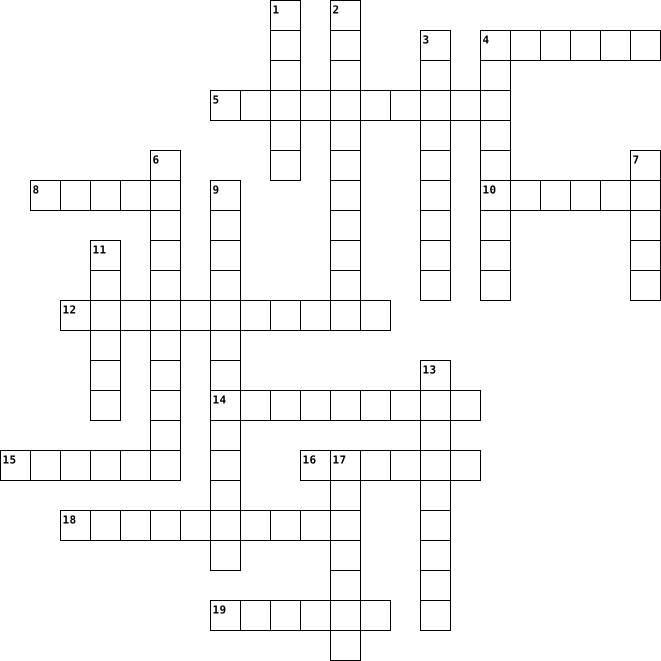
Across
- A T cell that presents antigens to other T cells
- Cells that eat antigens
- fluid not drained by the lymphatic vessels
- A lymphocyte that remembers how to react when an antigen is presented for a second time
- Type of white blood cells involved in adaptive immunity
- Cell that produces histamine
- Lymphocytes that circulate throughout the body looking for antigens
- One of two secondary lymphoid organs where lymphocytes meet anitgens
- Another word for immunoglobulin
- Immunity that develops after an antigen is presented, such as a vaccien
Down
- Immunity that is always in place and doesn't require an antigen to activate
- A disease where the body's immune system fights itself
- A T cell that destroys antigens
- Chemical that causes the the inflammatory reaction
- Phagocytic cell in the tissue
- fluid carried by the immune system
- Where the B Cells mature, and all blood stem cells come from
- Where the T Cells mature
- Hypersensitivity to an antigen, such as pollen
- Immunity that passes across the placenta during pregnancy
20 Clues: Cells that eat antigens • Where the T Cells mature • Cell that produces histamine • Phagocytic cell in the tissue • Another word for immunoglobulin • A T cell that destroys antigens • fluid carried by the immune system • fluid not drained by the lymphatic vessels • Hypersensitivity to an antigen, such as pollen • A T cell that presents antigens to other T cells • ...
Cancer Cure? 2024-03-12

Across
- chimeric antigen receptor T-cell therapy
- a unit of hereditary material
- a doctor who cares for children with cancer
- soft tissue within bones makes blood cells
- type of white blood cell normally help
- a state of unconsciousness
- the DNA of the T-cells they’d gathered.
- protect the body against disease.
- naturally attack invaders in the body.
Down
- a large, biological molecule
- a disease that causes inflammation throughout the joints of the body.
- help to form clots that stop a wound from bleeding.
- a disease caused by abnormal cell growth.
- a drug treatment that uses powerful chemicals to kill fast-growing cells in your body.
- program again or differently.
- carry oxygen to other cells throughout the body.
- research studies that test a medical, surgical, or behavioral intervention in people.
- a molecule that carries instructions for how a cell functions.
- a machine that helps a patient breathe.
- don’t recognize they are harmful
20 Clues: a state of unconsciousness • a large, biological molecule • program again or differently. • a unit of hereditary material • don’t recognize they are harmful • protect the body against disease. • type of white blood cell normally help • naturally attack invaders in the body. • a machine that helps a patient breathe. • the DNA of the T-cells they’d gathered. • ...
cell membrane 2024-05-08

Across
- molécules that transmit energy within cells
- control center of the cell
- rigid outlayer in the plant cells
- facilitate faster rate of water transport
- hydrophillic head and hydrophobic tail
- molecule present in fat and oils
- lipid molecule that helps stabilize the cell membrane’s fluidity
- movement of molecules from an área of high concentration to lower
- molecule atracted to water
- process by which cells release substances from the vesicles
Down
- tail used for movement
- flexible bindary sorrounding the cell
- Network of protein filaments within cells, providing structural support and facilitating movement.
- changes in water potential impact translocation rates in plants
- organelle responsible for producing energy throught cell respiration
- small fluid within the cell membrane, involved in transport
- lower solute compared to another compared to another solution
- process by which cells take in substances in their enviroment
- smallest unit of life
- organelle responsible for packaging and processing proteins for secretion
- gel like within cells
21 Clues: smallest unit of life • gel like within cells • tail used for movement • control center of the cell • molecule atracted to water • molecule present in fat and oils • rigid outlayer in the plant cells • flexible bindary sorrounding the cell • hydrophillic head and hydrophobic tail • facilitate faster rate of water transport • molécules that transmit energy within cells • ...
Module 10 Crossword 2024-07-15

Across
- types of chromosomes that undergo crossing-over in meiosis
- plant cells use a cell __________ to complete cytokinesis
- having two sets of chromosomes (2n)
- nuclear division resulting in four unique cells
- phase of mitosis when sister chromatids move to opposite poles
- phase of mitosis when DNA condenses and nuclear membrane disintegrates
- reproduction producing genetically identical offspring
- division of the cytoplasm
- phase of mitosis when chromosomes align at equator
Down
- form of DNA condensed for cell division
- animal cells use a cleavage __________ to complete cytokinesis
- along with development and repair, a reason multicellular organisms use mitosis
- two sister __________ with identical DNA comprise a replicated chromosome
- part of Interphase when DNA replication occurs
- phase of mitosis when DNA relaxes and nuclear membrane reforms
- nuclear division resulting in two identical cells
- reproductive cells (sperm and eggs)
- reproduction process that is slower, but produces more genetic variation
- having one set of chromosomes (n)
- portion of the cell cycle where cells spend most of their time
20 Clues: division of the cytoplasm • having one set of chromosomes (n) • reproductive cells (sperm and eggs) • having two sets of chromosomes (2n) • form of DNA condensed for cell division • part of Interphase when DNA replication occurs • nuclear division resulting in four unique cells • nuclear division resulting in two identical cells • ...
Blood Vocab 2024-09-18

Across
- The liquid component of blood
- Proteins found on the surface of red blood cells.
- Blood type O is _____________
- Blood type O- is a universal ___________
- Transports oxygenated blood
- Blood type AB+ is a universal _________
- Measures percentage of blood and plasma
- Organ that recycles iron
- Protein in blood that contains iron and transports oxygen
- Transports deoxygenated blood
- When someone is AB, they share characteristics of A and B
- The type of tissue that blood belongs in
- Blood disease spread by mosquitoes
Down
- Hormone that increases production of red blood cells
- Disorder that causes a low red blood cell count
- Person trained to draw blood from a patient
- Color of deoxygenated blood is dark ____
- Formation of blood cells in bone marrow
- Which Rh factor is dominant?
- A person with blood type A will have Anti-B ___________
- Condition with low red blood cells and no white blood cells
- White blood cells
22 Clues: White blood cells • Organ that recycles iron • Transports oxygenated blood • Which Rh factor is dominant? • The liquid component of blood • Blood type O is _____________ • Transports deoxygenated blood • Blood disease spread by mosquitoes • Formation of blood cells in bone marrow • Blood type AB+ is a universal _________ • Measures percentage of blood and plasma • ...
Integumentary and Skeletal System 2025-09-15

Across
- an enveloping later of an organism
- the skull, vertebral column, ribs, and sternum
- the second layer of skin; consists of connective tissue, nerve cells, muscle fibers, sweat and oil glands, and hair follicles
- the outer superficial later of skin
- less dense bone and has many cavities that contain bone marrow; found in the center of short or flat bons and at the end of long bones
- consists of stored fat; is found in many other bones
- cells that break down bone cells, which are then replaced by new tissue
- tough bands of connective tissue that hold together joint bones
- oil glands that lubricate skin and hair
- produces red and white blood cells and platelets; found in the humerus, femur, sternum, ribs, vertebrae, and pelvis
Down
- a pigment that absorbs light energy
- narrow cavities in the dermis that hair cells grow out of
- the bones of the shoulders, arms, hands, hips, legs, and feet
- bone forming cells
- living bone cells
- tough, flexible connective tissue that covers the surface of bones that move against each other in joints
- the formation of bone from osteoblasts
- dense and strong bone that provides strength and protection
- a protein that waterproofs and protects the cells and tissues that lie underneath
19 Clues: living bone cells • bone forming cells • an enveloping later of an organism • a pigment that absorbs light energy • the outer superficial later of skin • the formation of bone from osteoblasts • oil glands that lubricate skin and hair • the skull, vertebral column, ribs, and sternum • consists of stored fat; is found in many other bones • ...
B5 Lesson 4: Stem Cells 2013-02-11

Across
- A ............. cell is a cell that is capable of developing into many different cells, but not all of them
- Meristem cells in plants are an example of ............. cells
- Adult stem cells are not completely .................
- Example of what adult stem cells can be used to grow for medical treatments
- Cells produced with the same ........ as you won't be rejected by your body
- After an egg cell has been fertilised it divides by ............. to form an embryo
Down
- Type of cloning that uses adult stem cells
- All of the genes in totipotent cells have the potential to become ...........
- Are added to cells in therapeutic cloning to help make some genes active and induce dividing
- Stem cells found in ................ are an example of multipotent cells
- Type of cloning that uses embryonic stem cells
- After the ................. embryonic stem cells form tissues and organs
- Type of system that will detect foreign cells (dangerous or not) and fight them off
13 Clues: Type of cloning that uses adult stem cells • Type of cloning that uses embryonic stem cells • Adult stem cells are not completely ................. • Meristem cells in plants are an example of ............. cells • Stem cells found in ................ are an example of multipotent cells • After the ................. embryonic stem cells form tissues and organs • ...
Weeks 12/13 Crossword 2023-03-28

Across
- elevated body temperature
- first phagocyte on the scene
- chemical defense that destroys peptidoglycan
- antigen presenting cells involved in activating T and B cells
- white blood cells engulfing and destroying microbes
- T cell that targets virus-infected cells
- non-specific immune response involving antibodies that destroys bacteria and enveloped viruses
- cell-secreted chemical that work with perforins to induce apoptosis
- contains salt and alters osmotic pressure of microbes
- being immune or insusceptible to a pathogen because of past exposure/immunization
- cell-secreted chemical that can poke holes in cells
- a professional phagocyte
- acid in stomach to break down food and foreign microbes
- vaccine involving entire killed microbe
- large antibody/antigen complexes usually created usually involving IgM
- antibody involved in allergic reactions
- physically washes mouth and can contain antimicrobial chemicals
- antibody dimer found in secretions
- process activated when body is infected or injured
- targets bacterial cell membranes
- binds to MHC-I
- t cells that activate both cytotoxic t cells and b cels
- binds to MHC-II
- common molecular patterns found in microbes and recognized by phagocytes
- antibody pentamer and first antibody produced during an initial infection
- oil on skin that protects hair follicles and inhibits the growth of microbes
Down
- defense cells looking for missing or abnormal MHC-I
- signal sent out by virus-infected cells to warn neighboring cells and activate immune response
- presence of commensal microbes that prevents the growth of pathogens
- vaccine involving specific pieces of a microbe
- vaccine involving a live but weakened microbe
- makes antibodies and memory cells
- vesicle inside phagocytes containing digestive chemicals
- community immunity when enough people have been vaccinated
- immunity created from contracting an infection
- vesicle created when microbe is initially engulfed by phagocyte
- receiving antibodies but not creating immune memory
- phagocytes found in the skin
- antibodies binding to microbes and preventing them from moving or binding or functioning normally
- migration of white blood cells out of blood vessels and in to tissues
- receptors on white blood cells that can bind with PAMPs
- mechanical defense that moves microbes up and out of the lungs
- antibodies making it easy for macrophages to find microbes
- also known as a B cell receptor
- chemical signals secreted by cells
- skin first line of physical defense
- what an antibody binds to
- vaccine hooking a microbial polysaccharide to an immune-inducing protein
- binds up excess iron
- most plentiful antibody in the blood and can cross the placenta
50 Clues: binds to MHC-I • binds to MHC-II • binds up excess iron • a professional phagocyte • elevated body temperature • what an antibody binds to • first phagocyte on the scene • phagocytes found in the skin • also known as a B cell receptor • targets bacterial cell membranes • makes antibodies and memory cells • chemical signals secreted by cells • antibody dimer found in secretions • ...
Crossword 2016-09-26

Across
- rigid layer of polysaccharides lying outside the plasma membrane of the cells of plants, fungi, and bacteria. In the algae and higher plants, it consists mainly of cellulose.
- any of a number of organized or specialized structures within a living cell.
- minute particle consisting of RNA and associated proteins, found in large numbers in the cytoplasm of living cells. They bind messenger RNA and transfer RNA to synthesize polypeptides and proteins
- an organelle found in large numbers in most cells, in which the biochemical processes of respiration and energy production occur. It has a double membrane, the inner layer being folded inward to form layers (cristae).
- the material or protoplasm within a living cell, excluding the nucleus.
- organelle in the cytoplasm of eukaryotic cells containing degradative enzymes enclosed in a membrane. centrioles minute cylindrical organelle near the nucleus in animal cells, occurring in pairs and involved in the development of spindle fibers in cell division
- cells which do not have a cell nucleus, and lack other things eukaryotes
- space or vesicle within the cytoplasm of a cell, enclosed by a membrane and typically containing fluid.
- a microscopic network of protein filaments and tubules in the cytoplasm of many living cells, giving them shape and coherence
- a microscopic membrane of lipids and proteins that forms the external boundary of the cytoplasm of a cell or encloses a vacuole, and that regulates the passage of molecules in and out of the cytoplasm.
Down
- organelle found in eukaryotic cells. thick protuberances that project from the much larger cell body
- cells contain a nucleus surrounded by a membrane and whose DNA is bound together by proteins (histones) into chromosomes.
- a network of tubular membranes within the cytoplasm of the cell, occurring either with a smooth surface or studded ribosomes Involved in the transport of materials.
- scientific theory which describes the properties of cells.
- of vesicles and folded membranes within the cytoplasm of most eukaryotic cells, involved in secretion and intracellular transport.
- slender threadlike structure, especially a microscopic whiplike appendage that enables many protozoa, bacteria, spermatozoa, etc., to swim.
- a minute cylindrical organelle near the nucleus in animal cells, occurring in pairs and involved in the development of spindle fibers in cell division.
- small dense spherical structure in the nucleus of a cell during interphase.
- (in green plant cells) a plastid that contains chlorophyll and in which photosynthesis takes place.
- present in most eukaryotic cells, typically a single rounded structure bounded by a double membrane, containing the genetic material.
20 Clues: scientific theory which describes the properties of cells. • the material or protoplasm within a living cell, excluding the nucleus. • cells which do not have a cell nucleus, and lack other things eukaryotes • small dense spherical structure in the nucleus of a cell during interphase. • ...
Weeks 12/13 Crossword 2023-03-28

Across
- makes antibodies and memory cells
- vesicle created when microbe is initially engulfed by phagocyte
- t cells that activate both cytotoxic t cells and b cels
- receiving antibodies but not creating immune memory
- vesicle inside phagocytes containing digestive chemicals
- also known as a B cell receptor
- chemical signals secreted by cells
- binds to MHC-II
- acid in stomach to break down food and foreign microbes
- oil on skin that protects hair follicles and inhibits the growth of microbes
- community immunity when enough people have been vaccinated
- cell-secreted chemical that can poke holes in cells
- presence of commensal microbes that prevents the growth of pathogens
- migration of white blood cells out of blood vessels and in to tissues
- being immune or insusceptible to a pathogen because of past exposure/immunization
- phagocytes found in the skin
- defense cells looking for missing or abnormal MHC-I
- vaccine involving a live but weakened microbe
- contains salt and alters osmotic pressure of microbes
- what an antibody binds to
- white blood cells engulfing and destroying microbes
- vaccine hooking a microbial polysaccharide to an immune-inducing protein
- targets bacterial cell membranes
- cell-secreted chemical that work with perforins to induce apoptosis
- antibody dimer found in secretions
- process activated when body is infected or injured
Down
- vaccine involving entire killed microbe
- a professional phagocyte
- first phagocyte on the scene
- mechanical defense that moves microbes up and out of the lungs
- binds up excess iron
- elevated body temperature
- antibody involved in allergic reactions
- antibodies binding to microbes and preventing them from moving or binding or functioning normally
- non-specific immune response involving antibodies that destroys bacteria and enveloped viruses
- physically washes mouth and can contain antimicrobial chemicals
- binds to MHC-I
- vaccine involving specific pieces of a microbe
- antibodies making it easy for macrophages to find microbes
- receptors on white blood cells that can bind with PAMPs
- T cell that targets virus-infected cells
- immunity created from contracting an infection
- antibody pentamer and first antibody produced during an initial infection
- antigen presenting cells involved in activating T and B cells
- most plentiful antibody in the blood and can cross the placenta
- skin first line of physical defense
- chemical defense that destroys peptidoglycan
- signal sent out by virus-infected cells to warn neighboring cells and activate immune response
- large antibody/antigen complexes usually created usually involving IgM
- common molecular patterns found in microbes and recognized by phagocytes
50 Clues: binds to MHC-I • binds to MHC-II • binds up excess iron • a professional phagocyte • elevated body temperature • what an antibody binds to • first phagocyte on the scene • phagocytes found in the skin • also known as a B cell receptor • targets bacterial cell membranes • makes antibodies and memory cells • chemical signals secreted by cells • antibody dimer found in secretions • ...
Histology 2020-10-03

Across
- secrete by shedding cytoplasm
- produce and secrete mucus
- secrete by exocytosis
- single layer
- false appearance of multiple layers
- mesenchyme and umbilical cord mucus
- junction transmits signals btwn cells
- blood & lymph
- fluid fills the spaces btwn cells
- secrete hormones into bloodstream
- bottom of a cell
- provides structure & strength to cell
- similar to desmosomes
- multiple layers
- cells that secrete chemicals
- fills space between organs & tissues
- top of a cell
Down
- Matrix of cells in EC material
- similar to adherens
- junction establishes cellular polarity
- secrete chemicals into ducts
- taller than wide
- bone and cartilage
- returns to shape after stretching
- replacement with scar tissue
- most common protein in body
- structural cells in glands
- loose (areolar) and dense
- secrete by bursting gland cell
- flat, thin
- replacement with the same cell
- senses stimuli and carries information
- Tightly packed cells in sheets
- junction initiates change movement
- cube-shaped
- Fibers that contract & generate force
36 Clues: flat, thin • cube-shaped • single layer • blood & lymph • top of a cell • multiple layers • taller than wide • bottom of a cell • bone and cartilage • similar to adherens • secrete by exocytosis • similar to desmosomes • produce and secrete mucus • loose (areolar) and dense • structural cells in glands • most common protein in body • secrete chemicals into ducts • replacement with scar tissue • ...
Immunology 316 Exam #1 2022-10-11

Across
- Protein produced in the liver involved in the lectin pathway
- Second signal needed to activate B cells
- Cytokine that can kill tumors and virus infected cells
- Immune response with memory
- Name of the receptor that recognizes pathogen patterns
- To tag pathogens for phagocytosis
- Immune response without memory
- Name of a cell that matures into a macrophage
- The name of a cell that ingests cellular components
- Chemicals that lead other immune cells to the site of damage
- The place where T cells mature
Down
- Name of the vein that returns lymph to the bloodstream
- Clustered BCRs
- The place where macrophages live
- White blood cell that is known as the "sentinel"
- What active B cells produce
- The organ responsible for producing complement proteins
- Name of the receptor that tells NK cells to not kill
- Vesicle within the macrophage containing the bacterium
- White blood cell that is known as the "foot soldier"
- Region of antibody where antigens can bind
21 Clues: Clustered BCRs • What active B cells produce • Immune response with memory • Immune response without memory • The place where T cells mature • The place where macrophages live • To tag pathogens for phagocytosis • Second signal needed to activate B cells • Region of antibody where antigens can bind • Name of a cell that matures into a macrophage • ...
Integumentary System 2024-01-15

Across
- a layer of stem cells connected to the dermis that make new cells
- the narrowing of dermal blood vessels
- cells that combine with nerve endings to make sensory receptors for touch
- sweat glands in the armpit and groin
- cells that ingest foreign invaders
- contain capillaries that supply nutrients
- the opening of dermal blood vessels
- muscles that can cause the hair to stand upright
- a layer of dermis that contains dense connective tissue
Down
- the system that includes the skin
- cells that allow skin to feel pressure/vibrations
- where the blood vessels, glands, hair follicles, & nerves are located
- a layer of dead cells
- produce melanin
- made of fat; not technically a layer of skin
- the outer most layer of the skin
- the central core of a hair
- produce keratin
- a chemical pigment that shields against UV radiation
- where the fingernail grows
- sweat glands on the palms and feet
- glands that lubricate/soften skin and hair
22 Clues: produce melanin • produce keratin • a layer of dead cells • the central core of a hair • where the fingernail grows • the outer most layer of the skin • the system that includes the skin • cells that ingest foreign invaders • sweat glands on the palms and feet • the opening of dermal blood vessels • sweat glands in the armpit and groin • the narrowing of dermal blood vessels • ...
Cancer Cure? 2024-03-12

Across
- chimeric antigen receptor T-cell therapy
- a unit of hereditary material
- a doctor who cares for children with cancer
- soft tissue within bones makes blood cells
- type of white blood cell normally help
- a state of unconsciousness
- the DNA of the T-cells they’d gathered.
- protect the body against disease.
- naturally attack invaders in the body.
Down
- a large, biological molecule
- a disease that causes inflammation throughout the joints of the body.
- help to form clots that stop a wound from bleeding.
- a disease caused by abnormal cell growth.
- a drug treatment that uses powerful chemicals to kill fast-growing cells in your body.
- program again or differently.
- carry oxygen to other cells throughout the body.
- research studies that test a medical, surgical, or behavioral intervention in people.
- a molecule that carries instructions for how a cell functions.
- a machine that helps a patient breathe.
- don’t recognize they are harmful
20 Clues: a state of unconsciousness • a large, biological molecule • program again or differently. • a unit of hereditary material • don’t recognize they are harmful • protect the body against disease. • type of white blood cell normally help • naturally attack invaders in the body. • a machine that helps a patient breathe. • the DNA of the T-cells they’d gathered. • ...
Vocabulary crossword 2024-10-24

Across
- Events that takes place in a cell as it grows and divides
- Body cells growing uncontrollably and spreading to other parts of the body
- Process of cell duplication or reproduction
- Three germ layers forming organelles in the body
- Condensed structure made of DNA RNA and proteins in the nucleus
- Spreading of cancer cells around the body
- The division of a cell into two replicated cells with same genetic material.
- Basic unit of heredity passed from parent to child
- Region of repetitive dna sequences at the end of a chromosome
Down
- Pair of daughter stands of a replicated chromosome.
- region of the chromosome to which the spindle fiber is attached during cell division
- Organelle that helps cells to divide and make copies of themselves
- Cluster of dividing cells made by fertilized egg
- a series of cell and tissue movements which the blastula stage embryo folds inward to produce a three-layered embryo
- Structure found in nucleus made of DNA and proteins into genes
- Process of Immature cells turning into mature cells with special functions
- Cells that can develop into different types of cells in the body
17 Clues: Spreading of cancer cells around the body • Process of cell duplication or reproduction • Cluster of dividing cells made by fertilized egg • Three germ layers forming organelles in the body • Basic unit of heredity passed from parent to child • Pair of daughter stands of a replicated chromosome. • Events that takes place in a cell as it grows and divides • ...
Anatomy & Physiology: Blood 2021-01-12

Across
- iron containing protein that carries red blood cells.
- also known as white blood cells. play a role in the immune system. make up less that 1% of total blood volume.
- the largest of leukocytes. u-shaped. exit the blood to mature into macrophages.
- when antibodies bind to antigens on erythrocytes. clumping of the erythrocytes.
- type of granulocyte. reacts with purple stain hematoxylin. make up 1% of leukocytes.
- the fluid portion of blood
- b lymphocytes that bind to specific antigens.
- enhance immune response, destroy cancer cells, destroy cells infected with viruses.
- type of granulocyte. most numerous type of leukocyte making up 60 to 70%. does not interact strongly with either dyes.
Down
- type of granulocyte. interacts strongly with red dye eosin. makes up 4% of leukocytes.
- the value of red blood cells in the total blood volume.
- also known as red blood cells. function to carry oxygen around the body.
- cells that lack visible cytoplasmic granules.
- cells that contain cytoplasmic granules.
- a solution that contains proteins produced by B lymphocytes.
- produce proteins called antibodies.
- glycoproteins found on the cell surface.
- cellular fragments involved in blood clotting.
- type of agranulocyte. 2nd most numerous leukocyte making up 20 to25%.
19 Clues: the fluid portion of blood • produce proteins called antibodies. • cells that contain cytoplasmic granules. • glycoproteins found on the cell surface. • cells that lack visible cytoplasmic granules. • b lymphocytes that bind to specific antigens. • cellular fragments involved in blood clotting. • iron containing protein that carries red blood cells. • ...
Transport in Plants 2020-03-16

Across
- Bundle Cluster of xylem and phloem vessels.
- The polymer deposited in xylem vessels to strengthen them.
- Cells Cells associated with phloem vessels and involved in the production of ATP for loading sucrose into sieve tubes.
- Plants adapted to living in dry conditions.
- Gaps between cell walls allowing flow of substances such as minerals between cells.
- Meristem cells involved in the production of new xylem and phloem tissue.
- An inner layer of meristem cells.
- Plants adapted to living in water.
Down
- Pathway through which water moves through cell walls.
- Strip Part of the root which cannot be penetrated by water.
- Equipment used to investigate the rate of transpiration.
- Stream Movement of water up the stem.
- Attractive forces between water molecules.
- An outer later of cells which supply the xylem vessels with water.
- Tiny holes in leaves through which water evaporates.
- Evaporation of water from the surface of a plant.
- Perforated end wall of adjacent phloem cells.
- Tissue that transports products of photosynthesis.
- Pathway through which water enters the cytoplasm and moves from one cell to another through plasmodesmata.
- Tissue that transports water and minerals.
20 Clues: An inner layer of meristem cells. • Plants adapted to living in water. • Stream Movement of water up the stem. • Attractive forces between water molecules. • Tissue that transports water and minerals. • Plants adapted to living in dry conditions. • Perforated end wall of adjacent phloem cells. • Bundle Cluster of xylem and phloem vessels. • ...
Crossword 2016-09-26

Across
- organelle found in eukaryotic cells. thick protuberances that project from the much larger cell body
- present in most eukaryotic cells, typically a single rounded structure bounded by a double membrane, containing the genetic material.
- (in green plant cells) a plastid that contains chlorophyll and in which photosynthesis takes place.
- of vesicles and folded membranes within the cytoplasm of most eukaryotic cells, involved in secretion and intracellular transport.
- small dense spherical structure in the nucleus of a cell during interphase.
- cells which do not have a cell nucleus, and lack other things eukaryotes
- organelle in the cytoplasm of eukaryotic cells containing degradative enzymes enclosed in a membrane. centrioles minute cylindrical organelle near the nucleus in animal cells, occurring in pairs and involved in the development of spindle fibers in cell division
- a microscopic membrane of lipids and proteins that forms the external boundary of the cytoplasm of a cell or encloses a vacuole, and that regulates the passage of molecules in and out of the cytoplasm.
- any of a number of organized or specialized structures within a living cell.
- minute particle consisting of RNA and associated proteins, found in large numbers in the cytoplasm of living cells. They bind messenger RNA and transfer RNA to synthesize polypeptides and proteins
- an organelle found in large numbers in most cells, in which the biochemical processes of respiration and energy production occur. It has a double membrane, the inner layer being folded inward to form layers (cristae).
- scientific theory which describes the properties of cells.
Down
- space or vesicle within the cytoplasm of a cell, enclosed by a membrane and typically containing fluid.
- a network of tubular membranes within the cytoplasm of the cell, occurring either with a smooth surface or studded ribosomes Involved in the transport of materials.
- a microscopic network of protein filaments and tubules in the cytoplasm of many living cells, giving them shape and coherence
- a minute cylindrical organelle near the nucleus in animal cells, occurring in pairs and involved in the development of spindle fibers in cell division.
- the material or protoplasm within a living cell, excluding the nucleus.
- rigid layer of polysaccharides lying outside the plasma membrane of the cells of plants, fungi, and bacteria. In the algae and higher plants, it consists mainly of cellulose.
- slender threadlike structure, especially a microscopic whiplike appendage that enables many protozoa, bacteria, spermatozoa, etc., to swim.
- cells contain a nucleus surrounded by a membrane and whose DNA is bound together by proteins (histones) into chromosomes.
20 Clues: scientific theory which describes the properties of cells. • the material or protoplasm within a living cell, excluding the nucleus. • cells which do not have a cell nucleus, and lack other things eukaryotes • small dense spherical structure in the nucleus of a cell during interphase. • ...
The Vocabulary Man: crossword puzzle 2022-02-14

Across
- The gelatinous liquid that fills the inside of a cell.
- A complex of vesicles and folded membranes within the cytoplasm of most eukaryotic cells.
- The primary carrier of energy in cells.
- A network of membranous tubules within the cytoplasm of a eukaryotic cell.
- The process by which cells take in substances from outside of the cell by engulfing them in a vesicle.
- A igid layer of polysaccharides lying outside the plasma membrane of the cells of plants, fungi, and bacteria.
- The movement of molecules across a cell membrane into a region of higher concentration, assisted by enzymes and requiring energy.
- the spontaneous passage or diffusion of water or other solvents through a semipermeable membrane.
- The process by which cells move materials from within the cell into the extracellular fluid.
- A cylindrical organelle composed mainly of a protein.
- A single-celled organism that lacks a nucleus, and other membrane-bound organelles.
- The ability to differentiate between different types of molecules.
- A solution that contains more dissolved particles than is found in normal cells and blood.
- A membrane-bound organelle which is present in cells.
- The molecules diffuse across the plasma membrane with assistance from membrane proteins.
Down
- The membrane found in all cells.
- A subcellular structure that has one or more specific jobs to perform in the cell.
- An instrument that makes an enlarged image of a small object.
- A macromolecular machines that perform biological protein synthesis.
- The cells from which all other cells with specialized functions are generated.
- plasma membrane.
- A two-layered arrangement of phosphate and lipid molecules that form a cell membrane.
- an organelle found in most cells which processes of respiration and energy production occur.
- A dissolved substance especially.
- The net movement of molecules from an area where they are at a higher concentration to areas where they are at a lower concentration.
- A solution that contains fewer dissolved particles than is found in normal cells and blood.
- The smallest unit that can live on its own.
- A solutions contain equal concentrations of impermeable solutes on either side of the membrane.
- The substances that are used to dissolve the solutes used in the formulation.
- A membrane-bound cell organelle that contains digestive enzymes.
- Any cell or organism that possesses a clearly defined nucleus .
- The process by which dividing cells change their functional or phenotypical type.
- A plastid that contains chlorophyll and in which photosynthesis takes place.
- A membrane-bound organelle that contains the cell's chromosomes.
34 Clues: plasma membrane. • The membrane found in all cells. • A dissolved substance especially. • The primary carrier of energy in cells. • The smallest unit that can live on its own. • A cylindrical organelle composed mainly of a protein. • A membrane-bound organelle which is present in cells. • The gelatinous liquid that fills the inside of a cell. • ...
The Vocabulary Man: crossword puzzle 2022-02-14

Across
- The molecules diffuse across the plasma membrane with assistance from membrane proteins.
- The membrane found in all cells.
- The process by which cells take in substances from outside of the cell by engulfing them in a vesicle.
- The cells from which all other cells with specialized functions are generated.
- A two-layered arrangement of phosphate and lipid molecules that form a cell membrane.
- A cylindrical organelle composed mainly of a protein.
- the spontaneous passage or diffusion of water or other solvents through a semipermeable membrane.
- A igid layer of polysaccharides lying outside the plasma membrane of the cells of plants, fungi, and bacteria.
- A solutions contain equal concentrations of impermeable solutes on either side of the membrane.
- A membrane-bound cell organelle that contains digestive enzymes.
- A plastid that contains chlorophyll and in which photosynthesis takes place.
- The smallest unit that can live on its own.
- A subcellular structure that has one or more specific jobs to perform in the cell.
- An instrument that makes an enlarged image of a small object.
- plasma membrane.
- The substances that are used to dissolve the solutes used in the formulation.
- A macromolecular machines that perform biological protein synthesis.
Down
- The ability to differentiate between different types of molecules.
- The primary carrier of energy in cells.
- A membrane-bound organelle that contains the cell's chromosomes.
- A solution that contains more dissolved particles than is found in normal cells and blood.
- A complex of vesicles and folded membranes within the cytoplasm of most eukaryotic cells.
- A solution that contains fewer dissolved particles than is found in normal cells and blood.
- A single-celled organism that lacks a nucleus, and other membrane-bound organelles.
- Any cell or organism that possesses a clearly defined nucleus .
- The net movement of molecules from an area where they are at a higher concentration to areas where they are at a lower concentration.
- The process by which dividing cells change their functional or phenotypical type.
- The movement of molecules across a cell membrane into a region of higher concentration, assisted by enzymes and requiring energy.
- an organelle found in most cells which processes of respiration and energy production occur.
- A network of membranous tubules within the cytoplasm of a eukaryotic cell.
- The process by which cells move materials from within the cell into the extracellular fluid.
- A dissolved substance especially.
- A membrane-bound organelle which is present in cells.
- The gelatinous liquid that fills the inside of a cell.
34 Clues: plasma membrane. • The membrane found in all cells. • A dissolved substance especially. • The primary carrier of energy in cells. • The smallest unit that can live on its own. • A cylindrical organelle composed mainly of a protein. • A membrane-bound organelle which is present in cells. • The gelatinous liquid that fills the inside of a cell. • ...
Cells Crossword Puzzle 2023-09-22

Across
- Cell organelle known as the "powerhouse" of the cell
- A condition in which cells undergo rapid and abnormal growth often resulting in the death of the cells and organism
- Cell organelle used in the manufacture of proteins
- Cell organelle which serves to "package" materials for export from the cell
- An organism in which the smaller structures are covered by a membrane
- Several types of scientific instruments used by scientists to observe small objects
- Organelle in the plant cells containing chlorophyll, the pigment necessary for photosynthesis
- The "packages" formed by the Golgi apparatus
- The widely accepted belief that all living things are composed of individual cells along with the fact that all cells come from other cells
- The outer part of plant cells providing support
- Smaller organ-like structures found within cells, each with a specific function
- The so called "brain" of the cell which contains the genetic material known as DNA
Down
- An organelle in eukaryotic cells which functions to control the movement of proteins and fats
- The membrane that covers the outside of an individual cell selectively allowing materials to move in and out of the cell
- The outer covering of the nucleus
- An organism in which the smaller structures are not covered by a membrane
- Long thread-like material containing DNA found in the cell nucleus
- The contents of a cell
- A continuous sequence of events in the life of a cell
19 Clues: The contents of a cell • The outer covering of the nucleus • The "packages" formed by the Golgi apparatus • The outer part of plant cells providing support • Cell organelle used in the manufacture of proteins • Cell organelle known as the "powerhouse" of the cell • A continuous sequence of events in the life of a cell • ...
Tissues 2020-05-21

Across
- Type of matrix present in bone.
- Microscopic pores in leaves
- Cells are filled with fat globules
- Outermost layer of cells, usually single layered.
- Parenchyma cells containing chlorophyll.
- Tissue that makes up the husk of coconut.
- Attaches bone to bone.
Down
- Except this other phloem cells are living.
- Smoothens bone surface at joints.
- Sclerenchyma cells are thickened due to this substnce
- Most common simple permanent tissue.
- Connect muscle to bone.
- Meristematic tissue present at the tip of roots and
- Makes cork cells impervious to gases.
- Fluid matrix in blood.
- Framework that supports our body.
16 Clues: Fluid matrix in blood. • Attaches bone to bone. • Connect muscle to bone. • Microscopic pores in leaves • Type of matrix present in bone. • Smoothens bone surface at joints. • Framework that supports our body. • Cells are filled with fat globules • Most common simple permanent tissue. • Makes cork cells impervious to gases. • Parenchyma cells containing chlorophyll. • ...
Tissues 2020-05-21

Across
- Microscopic pores in leaves
- Except this other phloem cells are living.
- Smoothens bone surface at joints.
- Framework that supports our body.
- Cells are filled with fat globules
- Sclerenchyma cells are thickened due to this substnce
- Tissue that makes up the husk of coconut.
- Meristematic tissue present at the tip of roots and
- Fluid matrix in blood.
Down
- Most common simple permanent tissue.
- Outermost layer of cells, usually single layered.
- Makes cork cells impervious to gases.
- Type of matrix present in bone.
- Connect muscle to bone.
- Parenchyma cells containing chlorophyll.
- Attaches bone to bone.
16 Clues: Attaches bone to bone. • Fluid matrix in blood. • Connect muscle to bone. • Microscopic pores in leaves • Type of matrix present in bone. • Smoothens bone surface at joints. • Framework that supports our body. • Cells are filled with fat globules • Most common simple permanent tissue. • Makes cork cells impervious to gases. • Parenchyma cells containing chlorophyll. • ...
Cell Cycle Vocabulary Review 2024-11-26

Across
- these type of cells are body cells
- prokaryotic DNA has this shape
- condensed DNA
- location of eukaryotic chromosomes
- protein that holds sister chromatids together
- these type of cells are reproductive cells (pl.)
- cells contain two sets of chromosomes
- cells contain one set of chromosomes
Down
- this type of organism divides for growth
- type of protein eukaryotic DNA is wrapped around
- a single strand of a chromosome
- eukaryotic DNA wrapped around histone proteins
- this type of organism divides to reproduce
- location of prokaryotic chromosomes
- these form when chromatids are copied
- decondensed state of chromosomes
16 Clues: condensed DNA • prokaryotic DNA has this shape • a single strand of a chromosome • decondensed state of chromosomes • these type of cells are body cells • location of eukaryotic chromosomes • location of prokaryotic chromosomes • cells contain one set of chromosomes • these form when chromatids are copied • cells contain two sets of chromosomes • ...
Chapter 4 2013-05-13

Across
- The name of a tumor in the muscle tissue
- The Muscle tissue that works with tendons
- _______ Tumors that spread throughout the body
- Smooth Muscle is sometimes referred to as ______ Tissue
- Single layer of Epithelial cells that looks like multiple layers
- Epithelial cells that are square
- The gland that secretes hormones
- Hyaline is an example of what?
- The basic unit of nervous tissue
- _______ Tumors do not move around the body (Normally)
- Epithelial cells that are flat and irregular
- The Muscle tissue that works with the heart
Down
- Single layer of Epithelial cells
- Multiple layers of Epithelial cells
- Which Tissue contains the matrix?
- The Dense Connective Tissue that has random fiber arrangements
- The gland that secretes to the outside of our body
- Epithelial cells that are long and narrow
- The name of a tumor in cartilage
- The ear is mainly made of which connective tissue?
- Areolar is an example of which Connective Tissue?
21 Clues: Hyaline is an example of what? • Single layer of Epithelial cells • Epithelial cells that are square • The gland that secretes hormones • The name of a tumor in cartilage • The basic unit of nervous tissue • Which Tissue contains the matrix? • Multiple layers of Epithelial cells • The name of a tumor in the muscle tissue • The Muscle tissue that works with tendons • ...
Cell Structure and Function 2017-05-05

Across
- outermembrane of the nucleus
- chromosomes carry
- powerhouse of the cell
- sac-like structures which store water,food and wastes
- two types of cells
- full form of ATP
- helps in transport substance within the cell
- miniature nucleus which has proteins Nucleolus
- cells were discovered by
- liquid in the nucleus
- the procees of which new cells are formed is known as
- together nucleus and cytoplasm called
- suicide bags of the cell
Down
- cells that have a well defined nucleus and organelles
- organelles in plant cells
- secrete substances and enzymes
- regulate cell division
- surrounding the cytoplasm
- brain of the cell
- two german biologists
- green colour plastids
- jelly-like substance in a cell
- cells that lack a well defined nucleus and organelles
- green coloured pigment
- theard like structures inside nucleus
- scattered in the cytoplasm are small structures called
- make proteins
- helps amoeba to move and feed
28 Clues: make proteins • full form of ATP • brain of the cell • chromosomes carry • two types of cells • two german biologists • green colour plastids • liquid in the nucleus • regulate cell division • powerhouse of the cell • green coloured pigment • cells were discovered by • suicide bags of the cell • organelles in plant cells • surrounding the cytoplasm • outermembrane of the nucleus • ...
Structures and functions of organelles 2023-09-29

Across
- major components of the cytoskeleton
- reticulum makes proteins and lipids
- paired barrel-shaped organelles located in the cytoplasm of animal cells near the nuclear envelope
- wall Rigid barrier that protects the cell
- membrane-enclosed organelles that contain an array of enzymes capable of breaking down all types of biological polymers
- the gel like matrix of the cytoplasm
- makes food in plant cells
- makes protein
- stores genetic information
- membrane separates the cell from the environment
- plant cell organelles that convert light energy into relatively stable chemical energy via the photosynthetic process
Down
- breaks down unwanted material
- stores water in plant cells
- apparatus sorts proteins
- protein filaments in the cytoplasm of eukaryotic cells that form part of the cytoskeleton
- contain enzymes involved in a variety of metabolic reactions
- makes energy for the cell
- The interior contents of the cell
- a highly regulated membrane barrier that separates the nucleus from the cytoplasm in eukaryotic cells.
- membrane separates the interior of the cell from the outside environment
- envelope a highly regulated membrane barrier that separates the nucleus from the cytoplasm in eukaryotic cells.
- ships materials around the cell
22 Clues: makes protein • makes energy for the cell • makes food in plant cells • stores genetic information • stores water in plant cells • breaks down unwanted material • ships materials around the cell • apparatus sorts proteins • The interior contents of the cell • major components of the cytoskeleton • the gel like matrix of the cytoplasm • reticulum makes proteins and lipids • ...
Cell Review Cartee 2024-01-23

Across
- The movement of molecules from an area of high to low concentration
- The basic structural and functional unit of all forms of life
- Organisms Organism that is composed of many cells
- Organelle that contains digestive chemicals
- Jelly-like substance
- Transport The movement of things in and out of the cell without the use of energy.
- Cell Cells found in animals.
- Theory All organisms are made of cells (one or more)
- Wall extra computer layer that is very rigid and tough,
- Bodies The cell’s packaging
- Transport Moving things inside and outside of the cell membrane.
Down
- The cell’s powerhouse,
- Much more complex types of cells
- The cell’s “control center”
- Protein-making factories in a cell.
- Cell Organisms Organisms that exist that are composed of a single cell
- Temporary storage
- Membrane A protective double membrane surrounding the nucleus
- Reticulum The cell’s transport organelle
- A small structure found inside the nucleus
- They process and release energy,
- Cells Cells found in plants
- Very simple, single-celled bacteria
- Membrane there is a layer on the outside of the cell that holds the cell together
- In plant cells only,
25 Clues: Temporary storage • Jelly-like substance • In plant cells only, • The cell’s powerhouse, • The cell’s “control center” • Cells Cells found in plants • Bodies The cell’s packaging • Cell Cells found in animals. • Much more complex types of cells • They process and release energy, • Protein-making factories in a cell. • Very simple, single-celled bacteria • ...
Immunity 2024-03-13

Across
- acquired through brief exposures to a disease
- Cells that help the body fight disease
- defends against common germs
- the ability to resist the effects of antibiotics
- protective proteins produced by the immune system
- line of defense immune cells that target specific antigens
- causes the body to make an immune response
- type of white blood cell that makes antibodies
- sends signals that direct other immune cells
- line of defense White blood cells destroy bacteria
- circulates through tissue to destroy cellular debris
Down
- acquired through exposure to the organism causing the disease
- All cells that are a part of the immune system in the blood
- used to stimulate the response to a disease
- A segment of nucleic acid surrounded by proteins
- attacks foreign organisms and substances
- inhibits the growth or lifespan of a bacterium
- helps the body fight infections and other diseases
- Cells that play a majority of the roles in the immune system
- A cycle a virus can use to reproduce inside a host cell
20 Clues: defends against common germs • Cells that help the body fight disease • attacks foreign organisms and substances • causes the body to make an immune response • used to stimulate the response to a disease • sends signals that direct other immune cells • acquired through brief exposures to a disease • inhibits the growth or lifespan of a bacterium • ...
DNA Replication and Cell Cycle 2024-11-22

Across
- The shape of DNA is a Double __________.
- Phase of Mitosis where the chromosomes line up in the middle of the cell.
- Sugar found in RNA.
- DNA replication is known as this____________________.
- Replaces Thymine in RNA.
- S Phase of the cell cycle is where DNA _____________.
- Sugar in DNA
- Happens after Telophase and divides the new cells into 2 individual cells.
- When cells divide uncontrollably
Down
- Enzyme that builds the new DNA strand.
- Pairs with Guanine during DNA Replication.
- Weak bonds between the base pairs in DNA
- Enzyme that unwinds and unzips the DNA molecule.
- The number of checkpoints in the cell cycle.
- _____________ in proteins that control the cell cycle causes cancer.
- DNA is _____________ stranded.
- Phase of Mitosis where the nucleus disappears and the chromosomes appears.
- When cells self-destruct (cell suicide).
- Cells created during Mitosis will be genetically ___________ to the cells they came from.
- Acronym (letters) we use to remember the order of the phases of Mitosis.
20 Clues: Sugar in DNA • Sugar found in RNA. • Replaces Thymine in RNA. • DNA is _____________ stranded. • When cells divide uncontrollably • Enzyme that builds the new DNA strand. • Weak bonds between the base pairs in DNA • The shape of DNA is a Double __________. • When cells self-destruct (cell suicide). • Pairs with Guanine during DNA Replication. • ...
Introduction to Bryophytes 2026-06-07

Across
- Specialized leaf cells containing one large oil body and lacking chloroplasts
- Unique organelle in liverwort leaf cells, absent in mosses and hornworts
- Thread-like structure that grows when a spore germinates
- Special basal-corner leaf cells that control leaf movement
- Hood-like tissue covering the developing capsule
- Cell wall thickenings found at the corners of leaf cells in some liverworts
- Depend on moisture in the environment
- Specialized conducting cells inside bryophytes
- Anchoring to the substrate
- Moss habit: sporophyte produced at laterally on stem
- Dominant haploid stage in bryophytes
- Thin tubular organ protects the developing capsule
Down
- Central sterile tissue found inside the capsule
- Symbiotic organisms found in hornwort cavities
- Cells that aid spore dispersal through hygroscopic movement
- Specialized organelle involved in the synthesis of starch
- Flask-shaped reproductive organ
- Small ventral leaves also known as amphigastria
- What does Nostoc fix that is required by hornworts?
- Reproductive units in non-flowering plants
20 Clues: Anchoring to the substrate • Flask-shaped reproductive organ • Dominant haploid stage in bryophytes • Depend on moisture in the environment • Reproductive units in non-flowering plants • Symbiotic organisms found in hornwort cavities • Specialized conducting cells inside bryophytes • Central sterile tissue found inside the capsule • ...
Lymphatic System 2026-05-14

Across
- Type — Classification of blood based on antigens present (A, B, AB, or O)
- — Fluid that circulates through the lymphatic system and carries white blood cells
- Donor — O- blood type that can be given to anyone
- Tissue — Tissue containing lymphocytes and immune cells
- Gland — Gland in the chest that produces and matures T cells (especially in children)
- — Protein in blood plasma that attacks and neutralizes foreign antigens
- Factor — Protein that determines if blood is positive (+) or negative (-)
- — Organ that filters blood, produces lymphocytes, and stores blood cells
- System — Body's defense system that fights pathogens and disease
- Nodes — Small organs that filter lymph and trap pathogens and dead cells
- Recipient — AB+ blood type that can receive any blood type
- Duct — Largest lymphatic vessel that drains lymph from the lower body and left side
Down
- — Transfer of blood from one person to another
- — White blood cells that fight infection (includes B cells and T cells)
- — Harmful microorganism (bacteria, virus, etc.) that causes disease
- Capillaries — Tiny vessels that collect tissue fluid and begin the lymphatic system
- — Destruction of red blood cells (occurs with incompatible blood transfusions)
- — Protein on the surface of cells that triggers an immune response
- System — Network of vessels and organs that filters fluid and fights infection
- Lymphatic Duct — Lymphatic vessel that drains the upper right portion of the body
20 Clues: — Transfer of blood from one person to another • Donor — O- blood type that can be given to anyone • Tissue — Tissue containing lymphocytes and immune cells • Recipient — AB+ blood type that can receive any blood type • System — Body's defense system that fights pathogens and disease • — Protein on the surface of cells that triggers an immune response • ...
immune system 2023-03-16

Across
- the changes that occur within a cell as it undergoes programmed cell death
- the antigen receptor on B cells
- the process by which an MHC molecule binds to a fragment of an intracelluar protein atigen and carries it to the cell surface
- a protein secreted by plasma cells that binds to a particular antigen and marks it for elimination
- long-lasting immunity conferred by the action of a person's B cells and T cells
- the kind of defense that is mediated by B lymphocytes and T lymphocytes
- a surface protein that binds to class I MHC molecules on target cells
- a surface protein that binds to class II MHC molecules on antigen-presenting cells
- molecules that are restricted
- genetically determined classes of human blood
- a cell that ingests bacteria and viruses and destroys them
Down
- the general term for a surface protein
- an immunological disorder in which the immune system turns against self
- a macromolecule that elicits an immune response by lymphocytes
- the branch of acquired immmunity that involves the activation of cytotoxic T cells
- found on nearly all nucleated cells
- an acute, whole-body, life-threating, allergic response
- the name of the late stages of HIV infection
- a type of lymphocyte that develops to maturity in the bone marrow
19 Clues: molecules that are restricted • the antigen receptor on B cells • found on nearly all nucleated cells • the general term for a surface protein • the name of the late stages of HIV infection • genetically determined classes of human blood • an acute, whole-body, life-threating, allergic response • a cell that ingests bacteria and viruses and destroys them • ...
Crossword 2016-09-26

Across
- slender threadlike structure, especially a microscopic whiplike appendage that enables many protozoa, bacteria, spermatozoa, etc., to swim.
- a microscopic network of protein filaments and tubules in the cytoplasm of many living cells, giving them shape and coherence
- rigid layer of polysaccharides lying outside the plasma membrane of the cells of plants, fungi, and bacteria. In the algae and higher plants, it consists mainly of cellulose.
- (in green plant cells) a plastid that contains chlorophyll and in which photosynthesis takes place.
- a microscopic membrane of lipids and proteins that forms the external boundary of the cytoplasm of a cell or encloses a vacuole, and that regulates the passage of molecules in and out of the cytoplasm.
- small dense spherical structure in the nucleus of a cell during interphase.
- organelle found in eukaryotic cells. thick protuberances that project from the much larger cell body
- a network of tubular membranes within the cytoplasm of the cell, occurring either with a smooth surface or studded ribosomes Involved in the transport of materials.
- organelle in the cytoplasm of eukaryotic cells containing degradative enzymes enclosed in a membrane. centrioles minute cylindrical organelle near the nucleus in animal cells, occurring in pairs and involved in the development of spindle fibers in cell division
- any of a number of organized or specialized structures within a living cell.
- scientific theory which describes the properties of cells.
Down
- of vesicles and folded membranes within the cytoplasm of most eukaryotic cells, involved in secretion and intracellular transport.
- an organelle found in large numbers in most cells, in which the biochemical processes of respiration and energy production occur. It has a double membrane, the inner layer being folded inward to form layers (cristae).
- cells which do not have a cell nucleus, and lack other things eukaryotes
- the material or protoplasm within a living cell, excluding the nucleus.
- a minute cylindrical organelle near the nucleus in animal cells, occurring in pairs and involved in the development of spindle fibers in cell division.
- cells contain a nucleus surrounded by a membrane and whose DNA is bound together by proteins (histones) into chromosomes.
- present in most eukaryotic cells, typically a single rounded structure bounded by a double membrane, containing the genetic material.
- minute particle consisting of RNA and associated proteins, found in large numbers in the cytoplasm of living cells. They bind messenger RNA and transfer RNA to synthesize polypeptides and proteins
- space or vesicle within the cytoplasm of a cell, enclosed by a membrane and typically containing fluid.
20 Clues: scientific theory which describes the properties of cells. • the material or protoplasm within a living cell, excluding the nucleus. • cells which do not have a cell nucleus, and lack other things eukaryotes • small dense spherical structure in the nucleus of a cell during interphase. • ...
Plant Science Chapter 4 Crossword 2026-01-12

Across
- Small openings on plant leaves and stems that allow gas exchange (CO₂ in, O₂ out) and transpiration.
- Vascular tissue in plants that transports water and dissolved minerals from roots to other parts of the plant.
- The central part of a plant root or stem containing vascular tissue (xylem and phloem).
- A type of cell division that produces gametes (sperm and egg cells) with half the number of chromosomes of the parent cell.
- Hollow protein tubes in the cytoskeleton that maintain cell shape, guide organelle movement, and form the spindle during cell division.
- Regions of undifferentiated plant cells that can divide and develop into various tissues, responsible for plant growth.
- Membrane-bound organelles that produce energy (ATP) through cellular respiration.
- The living part of a plant cell, including the cytoplasm, nucleus, and other organelles, but not the cell wall.
- The basic structural and functional unit of all living organisms.
Down
- A cell organelle that modifies, sorts, and packages proteins and lipids for transport inside or outside the cell.
- Membrane-bound organelles in cells used for storage of water, nutrients, and waste; large in plant cells.
- Thin, thread-like protein fibers in the cytoskeleton that help with cell shape, movement, and division.
- The molecule that carries genetic information in cells.
- Small organelles that break down fatty acids and detoxify harmful substances using enzymes.
- Groups of similar cells that work together to perform a specific function.
- Organisms whose cells have a nucleus and other membrane-bound organelles.
- Small structures in cells that synthesize proteins by translating RNA.
- A rigid outer layer found in plant cells, fungi, and some bacteria that provides structure and protection.
- Membrane-bound organelle in eukaryotic cells that contains the cell’s DNA and controls activities.
19 Clues: The molecule that carries genetic information in cells. • The basic structural and functional unit of all living organisms. • Small structures in cells that synthesize proteins by translating RNA. • Organisms whose cells have a nucleus and other membrane-bound organelles. • Groups of similar cells that work together to perform a specific function. • ...
unit 3 2021-10-26

Across
- The second growth phase of the cell cycle, consisting of the portion of interphase after DNA synthesis occurs, prepares for M phase
- Division of the nucleus. Continuous process that is divided into four phases, Prophase, Metaphase, Anaphase, and Telophase, makes identical body cells
- disorder in which some of the body's cells lose the ability to control growth
- one of a family of proteins that regulates the cell cycle in eukaryotic cells
- division of the cytoplasm to form two separate daughter cells plant cells: cell plate and animal cells: cleavage furrow
- A mass of abnormal cells that develops when cancerous cells divide and grow uncontrollably.
- first and longest phase of mitosis, during which the chromosomes become visible and the centrioles separate and take up positions on the opposite sides of the nucleus
- An abnormal tissue mass that can spread into neighboring tissue and to other parts of the body; a cancerous tumor.
- the third phase of mitosis, during which the chromosome pairs separate and move toward opposite poles
- series of events that cells go through as they grow and divide
Down
- the first gap, or growth phase and creation of new organelles
- The synthesis phase of the cell cycle; the portion of interphase during which DNA is replicated.
- phase of mitosis in which the distinct individual chromosomes begin to spread out into a tangle of chromatin, 2 nuclear envelopes form, nucleolus become visible
- a mass of abnormal cells that remains at the site of origin
- granular material visible within the nucleus; consists of DNA tightly coiled around proteins
- in between period of the cell cycle between cell divisions, includes G1, S and G2
- one of two identical "sister" parts of a duplicated chromosome
- a threadlike structure of nucleic acids and protein found in the nucleus of most living cells, carrying genetic information in the form of genes.
- second phase of mitosis, during which the chromosomes line up across the center of the cell
19 Clues: a mass of abnormal cells that remains at the site of origin • the first gap, or growth phase and creation of new organelles • one of two identical "sister" parts of a duplicated chromosome • series of events that cells go through as they grow and divide • disorder in which some of the body's cells lose the ability to control growth • ...
Renal and Immune Systems 2020-03-02

Across
- A molecule that triggers an immune response
- Thrombin converts this into fibrin
- True or false: Most sore throats are viral and so antibiotics are useless
- The ‘C’ in PCT
- Literally ‘foot cells’, these cells form part of the barrier between the glomerulus and Bowman’s capsule
- Glucose is reabsorbed in the PCT along with sodium by this mechanism
- These proteins consist of heavy chains and light chains
- The biological term for ‘clotting’
- B cells differentiate into these effector cells
- Cells whose job it is to engulf other cells and debris
- The pathological process underlying heart attacks and strokes
- The arteriole that carries blood away from the glomerulus
- Water moves out by osmosis in this limb of the loop of Henle
- The capillary part of the renal corpuscle
- This is pumped out of the ascending limb of the loop of Henle
- The form of nitrogenous waste mammals produce
- A cell produced by fusing a myeloma cell and a B cell
- These lymphocytes produce antibodies
- A disease that crosses a species barrier
- The structural and functional unit of the kidney, composed of the renal corpuscle and renal tubule
Down
- He developed a vaccine for smallpox
- Artificial filtration of the blood
- Approximately this percent of fluid reaching the kidneyes is filtered into the renal tubules
- Identical antibodies produced by hybridoma cells, and which recognize a specific antigen
- The process by which antibodies clump pathogens together
- In addition to blood cells, these are also not filtered in the renal corpuscle
- Acid that birds use to excrete nitrogen
- The study of patterns of disease
- These phagocytic cells present antigens on their surface to helper T cells
- The process by which antibodies mark pathogens for destruction
- When a person is in this state, their posterior pituitary would respond by secreting ADH
- Excretory tubules in insects
- An organism whose internal solute concentrations match its environment
- A common cause of renal failure
- A ‘chain-reaction’-type sequence of events, like clotting, where one reaction triggers the next one
- These tubes carry urine from the kidneys to the bladder
- The hormone that makes the collecting duct more permeable to water
- Something that causes disease
- Chain’s partner in developing penicillin as an antibiotic
- Besides mast cells, the other cells that secrete histamine
- This part of the kidney has a high interstitial osmolarity which increases with depth
- HIV infects these cells
42 Clues: The ‘C’ in PCT • HIV infects these cells • Excretory tubules in insects • Something that causes disease • A common cause of renal failure • The study of patterns of disease • Artificial filtration of the blood • Thrombin converts this into fibrin • The biological term for ‘clotting’ • He developed a vaccine for smallpox • These lymphocytes produce antibodies • ...
Electrochemistry crossword puzzle 2015-03-23

Across
- The --------------------difference developed at the glass membrane is a measure of pH.
- Anode in Ni-Cd cell -------------------------
- In primary cells the cell becomes ----- when all the reactants are converted
- A Good battery should have ---------------------capacity
- Recharge batteries are also called as ----------------cells
- Does the cells work when the EMF of the cell is negative?
- LaF3 crystal is used as a solid membrane in --------electrode.
- Primary cell in which Zinc and carbon rod are used as electrodes
- Conductance of a solution increases with increase in --------------
- Primary reference electrode example in short -----
- When 6 lead acid cells are connected in series the voltage produced is-------
- Ion selective electrode which is sensitive to Hydrogen ion concentration
- Units of conductance
- Number of lead acid cells used to run a car----------
- Solar cells convert ---------------energy into electrical energy
- --------Gas is liberated at cathode in Ni-Cd cell.
- Dilute sulphuric acid is used as --------------------in lead acid storage battery.
- Two or more electrochemical cells when connected in series electrically form a ------------------
- The main application of electrochemical cells is to generate ---------energy.
- In electrochemical series electrodes are arranged in the increasing order of their standard---------potentials
- is the anode during discharging process in a Lead acid battery
- The cells in which high energy conversion takes place and are ecofreindly ------------------
- light weight Primary cell with 3V capacity --------
- Example of typical electrochemical cell -----------
Down
- Example of Fuel cell ------------------------------
- Battery commonly used in cars ----------------------
- Electrolyte used in Ni-Cd cell -----------------.
- In an electrolytic cell Redox reactions are ---------------
- In dry cells MnO2 acts as an -------------------------
- The electrode potential can be determined by _______________equation.
- The most commonly used secondary battery among lithium cells
- cell reactions are made --------------by passing current in opposite direction.
- The useful product obtained by the usage of fuel cells in space ships is ------------------------
- The potential difference between two electrodes in an electrochemical cell gives -------of the cell.
- Electrodes used in Methanol –oxygen Fuel cell ---
- Ni-Cd cell is an example of -------------------cell
- Ion selective electrodes are sensitive to a -------ion
- cells in which cell reactions are not reversible are called
- Flow of charge in a material is called
- Specific Conductance of a solution decreases with increase in ---------------------------
- Li-MnO2 cell is an example of lithium cell with ----------------cathode.
- Ni-Cd cell is preferred because of its -----------voltage.
42 Clues: Units of conductance • Flow of charge in a material is called • Anode in Ni-Cd cell ------------------------- • Electrolyte used in Ni-Cd cell -----------------. • Electrodes used in Methanol –oxygen Fuel cell --- • Primary reference electrode example in short ----- • --------Gas is liberated at cathode in Ni-Cd cell. • ...
Menu Project - Dessert 2023-12-04

Across
- a cell that has the unique property of self-renewal as well as the ability to develop into other types of specialized cells, such as blood cells
- a muscular vessel that carries oxygen- and nutrient-rich blood under high pressure from the heart to other parts of the body
- a procedure in which blood collected from a volunteer donor is transferred to another person
- a congenital or inherited bleeding disorder caused by a shortage of clotting factors in the blood
- a clump of platelets and blood proteins (also known as a thrombus) that form a plug at the site of an injured blood vessel to prevent excessive bleeding. A clot may also form inside a blood vessel and block that vessel, which is called a thrombosis or a blood clot.
- a mineral that is important for maintaining many body functions and an integral part of hemoglobin, the molecule in your blood that carries oxygen to the tissues of the body
- the process by which blood clots
- a protein in red blood cells that carries oxygen to other cells in your body; often abbreviated HGB, Hb, or Hg
- a type of blood cancer that occurs when abnormal lymphocytes (a type of white blood cell) multiply and collect in the lymph nodes and other tissues, impairing the function of the body's immune system
- the specialized fluid in your body that has many functions, including carrying oxygen and nutrients to other tissues, forming clots in response to injury, and carrying defensive cells and antibodies that fight infection
Down
- the percentage of the whole blood volume that is made up of red blood cells; it is abbreviated Hct
- a marker protein on cells of the body or foreign substances, such as a virus or bacteria
- a vessel that carries blood low in oxygen away from the body's organs and back to the heart
- an abnormal and uncontrolled growth of cells
- a type of cancer found in the blood and bone marrow that is caused by the production of abnormal white blood cells
- an abnormal mass of cells, which can be cancerous or benign
- the liquid component of blood that transports blood cells throughout the body along with nutrients, waste products, antibodies, proteins, and chemical messengers such as hormones
- a small cell fragment (also known as a thrombocyte) involved in the blood's clotting process
- a blood condition in which a person either does not have enough red blood cells or has red blood cells that do not function properly
- the scientific study of cancer
20 Clues: the scientific study of cancer • the process by which blood clots • an abnormal and uncontrolled growth of cells • an abnormal mass of cells, which can be cancerous or benign • a marker protein on cells of the body or foreign substances, such as a virus or bacteria • a vessel that carries blood low in oxygen away from the body's organs and back to the heart • ...
Biology Extra Credit 2025-10-27

Across
- folds inside mitochondria that increase surface area.
- said all cells come from other cells.
- jelly-like fluid inside the cell where organelles are found.
- provide strength and support.
- makes energy (ATP) for the cell.
- discovered cells by looking at cork under a microscope
- control center of the cell; contains DNA.
- long, whip-like tail used for movement.
- describes the cell membrane as flexible and made of many moving parts.
- a small structure inside a cell that has a specific job.
- makes lipids and helps detoxify the cell.
- first to observe living cells under a microscope
- short, hair-like structures that move substances or the cell.
- fluid inside the mitochondria.
- network of fibers that gives shape and helps movement.
- the smallest unit of life that can carry out all life processes
- said all plants are made of cells.
- states that all living things are made of cells, cells are the basic unit of life, and all cells come from other cells.
- the liquid part of the cytoplasm (without organelles).
- on rough ER; make proteins for export or membranes.
- makes ribosomes inside the nucleus.
- a simple cell without a nucleus (like bacteria).
- does photosynthesis (makes food from sunlight).
- break down fats and detoxify harmful substances.
- plastid that gives plants red, orange, or yellow color.
Down
- compares a cell’s surface area to its volume; limits how big a cell can get.
- said all animals are made of cells.
- organelles in plant cells that store or make food.
- rigid layer outside the cell membrane that supports plant cells.
- fluid around the thylakoids inside chloroplasts.
- colorless plastid that stores starch.
- the outer layer that controls what enters and leaves the cell
- float in cytoplasm and make proteins used inside the cell.
- break down waste and old cell parts.
- thin threads that help the cell move and keep its shape.
- disk-shaped part inside chloroplasts that holds chlorophyll.
- stacks of thylakoids.
- a complex cell with a nucleus and organelles.
- large sac that stores water and helps keep cell shape.
- double membrane that surrounds the nucleus.
- thick tubes that help with structure and movement.
- strands of DNA and proteins found in the nucleus.
- has ribosomes; helps make and transport proteins.
- green pigment that captures sunlight.
- help with cell division in animal cells.
- packages and ships proteins and lipids.
46 Clues: stacks of thylakoids. • provide strength and support. • fluid inside the mitochondria. • makes energy (ATP) for the cell. • said all plants are made of cells. • said all animals are made of cells. • makes ribosomes inside the nucleus. • break down waste and old cell parts. • said all cells come from other cells. • colorless plastid that stores starch. • ...
Henrietta Lacks Review 2021-01-26

Across
- Henrietta’s Gynecologist at Johns Hopkins
- author
- the cancer that killed George Gey
- Had her first child at age 14 and married her cousin at age 20
- the virus that caused Henrietta's cancer
- typical cancer treatment in the 50s
- found religion in prison
- an enzyme found in cancer cells that allows cancer cells to regenerate indefinitely
- the hospital Henrietta goes to for treatment
- after 24 hours in Gey's lab Henrietta's cells ____
- Claimed to have cultured “immortal” chicken heart cells
Down
- Helped to raise Henrietta’s younger children after she died
- goddess of death
- has no anger towards the doctors who took Henrietta's cells
- aka Lacks Town
- Wanted to prove that carcinoma in situ was just as deadly as invasive carcinoma
- The type of cancer Henrietta is diagnosed with
- of the infamous syphilis study
- David's nickname
- _____ limit- Normal cells only divide a specific number of times, and then they stop growing and begin to die.
- Gey's wife
- Diagnosed with epilepsy and institutionalized
22 Clues: author • Gey's wife • aka Lacks Town • goddess of death • David's nickname • found religion in prison • of the infamous syphilis study • the cancer that killed George Gey • typical cancer treatment in the 50s • the virus that caused Henrietta's cancer • Henrietta’s Gynecologist at Johns Hopkins • the hospital Henrietta goes to for treatment • ...
Science Girl Cells/Taxonomy 2016-12-08

Across
- nonliving, disease causing particles
- saw single celled organisms in pond water under a microscope he invented
- packaging of proteins
- all plants made of cells
- without oxygen
- storage area in cell
- have membrane bound organelles
- boundry of cell that is selectively permeable
- obtain food by both finding it and making it
- make food by either chemosynthesis (chem. reactions) or photosynthesis
- used for cell division
- all animals made of cells
- looked at cells (boxlike structures) on cork under a microscope
- Wall rigid structure that supports, protects, and shapes cell
Down
- cells arise only from preexisting cells
- folded membrane that transports materials around the cell
- breaks down/digests waste
- movement of molecules from high to low concentration
- find food
- powerhouse of cell and site of cellular respiration
- only in plant cells, perform photosynthesis and give green color
- with oxygen
- lack membrane bound organelles, bacteria
- proteins attached to ER
- control center of cell, contains DNA and RNA
25 Clues: find food • with oxygen • without oxygen • storage area in cell • packaging of proteins • used for cell division • proteins attached to ER • all plants made of cells • breaks down/digests waste • all animals made of cells • have membrane bound organelles • nonliving, disease causing particles • cells arise only from preexisting cells • lack membrane bound organelles, bacteria • ...