
cells Crossword Puzzles
Unit 3 2022-10-23

Across
- The indentation of a dividing cell which forms into a bridge that connects the 2 daughter cells
- first growth
- the hereditary material in humans and almost all other organisms
- the series of events that takes place in a cell as it grows and divides
- step of the cell cycle in which the cell must faithfully separate the chromosomes and cytoplasm, yielding two daughter cells
- any of a group of proteins active in controlling the cell cycle and in initiating DNA synthesis the phase where dna is replicated
- period when cell is in non-dividing state
- cell with 2 sets of chromosomes
- the material of which the chromosomes of organisms are composed
Down
- A plate that forms between the 2 dividing chromosomes. Only in plant cells
- second growth/prepare for division
- any cell of a living organism other than the reproductive cells
- a reproductive cell of an animal or plant
- a threadlike structure of nucleic acids and protein found in the nucleus of most living cells
- cell with 1 set of chromosomes
- process of nuclear division in eukaryotic cells that occurs when a parent cell divides to produce two identical daughter cells
- each of the two threadlike strands into which a chromosome divides during cell division
- unchecked cell growth
18 Clues: first growth • unchecked cell growth • cell with 1 set of chromosomes • cell with 2 sets of chromosomes • second growth/prepare for division • a reproductive cell of an animal or plant • period when cell is in non-dividing state • any cell of a living organism other than the reproductive cells • the material of which the chromosomes of organisms are composed • ...
Unit 1 cells crossword puzzle 2022-10-04

Across
- tunnels that transport material around eukaryotic cells
- a body's internal healthy state of balance
- organisms are made of many cells;can only be eukaryotic
- rod-shaped and responsible for making energy
- Jelly like liquid inside of all cells
- all living things are made of cells
Down
- cell with no nucleus so DNA floats in the cytoplasm
- controls all cell activities
- stores food,water,& waste in eukaryotic cells
- captures sunlight to make food in plant cells
- regulates entry & exit of materials into & out of the cell
- organisms are made of only one cell;can be prokaryotic or eukaryotic
- cell with nucleus so DNA protected in the nucleus
- outside shell of plant cells that supports,protects,and gives shape
14 Clues: controls all cell activities • all living things are made of cells • Jelly like liquid inside of all cells • a body's internal healthy state of balance • rod-shaped and responsible for making energy • stores food,water,& waste in eukaryotic cells • captures sunlight to make food in plant cells • cell with nucleus so DNA protected in the nucleus • ...
Exam Review #4 - Immunology 2021-10-20

Across
- antibody isotype that is usually membrane bound on B cells and acts as the B cell receptor
- antibody isotype that is found in mucosa
- can bind to CD80 or CD86; key co-stimulatory signal to tell the T cell to activate; on all naive mature T cells when they leave the thymus
- T cell proliferation from a single activated T cell
- antibody isotype with the longest antibody half life; opsonizes pathogens; induces phagocytosis; induces classic complement; transported via transcytosis across placenta
- the type of t cells the help protect epithelial and mucosal barriers, defense against extracellular bacteria and fungi; secretes IL-17 and IL-22
- a disease that results in low or no T cells; clinically presents as frequent and sever infections, especially viral, and fungal; universally fatal before 2 years old
- the type of B cell that is a non-dividing cell until re-stimulated with antigen at a later time; make high affinity IgG, IgA, or IgE and express them on plasma membrane
- x-linked immunodeficiency; defects in WASP which typically aids cytoskeletal actin rearrangement; this primarily affects leukocytes and platelets
- the type of B cell that is non-dividing, antibody-secreting
- the type of T cells that are the classic helper cells of cell-mediated response; help control intracellular infections; makes cytokines IFN-gamma, TNF-alpha, and IL-2
- the type of t cells that reside in secondary lymph tissues and interact with B cells in germinal centers; induced by IL-21; secretes IL-21
- search for infected (or cancerous) cells and kill them; induce target cell apoptosis via perforin, granzymes, FasL; also activate macrophages via IFN gamma
- expressed on activated T cells, binds to PD-L1 or L2
Down
- the type of signaling used when a T cell makes IL-2 that acts on itself
- induces T cell proliferation and enhances T cell survival
- large chromosomal deletion on chromosome 22, poor or absent thymus development; treat with thymic transplant
- the cell type that is short-lived and migrates to tissues to control the infection
- antibody isotype that acts as the B cell receptor; sereted it can opsonize pathogens and induce classic complement
- the type of t cell that develop in thymus and peripheral tissues, usually are specific for self-antigens, prevent autoimmunity; induced by IL-10 and TGF beta
- antibody isotype that is secreted to protect from parasites and venoms; involved in allergy development
- a bacterial toxin that can bind the TCR on the external side and results in widespread, non-specific T cell activation, cytokine release, and toxic shock
- the cell type that is long-lived and are quiescent until a later exposure to antigen years later
- found on T cells; binds ICAM-1 on APCs; helps in cell-cell adhesion
- binds to B71 or B72, prevents APCs from stimulating other T cells
- the type of t cells that control helminth infections, and the defense from toxins, venoms, and insect bites; they also play a role in allergies and asthma; secrete IL-4, IL-5, and IL-13
26 Clues: antibody isotype that is found in mucosa • T cell proliferation from a single activated T cell • expressed on activated T cells, binds to PD-L1 or L2 • induces T cell proliferation and enhances T cell survival • the type of B cell that is non-dividing, antibody-secreting • binds to B71 or B72, prevents APCs from stimulating other T cells • ...
Immune System Crossward 2025-05-23

Across
- The body's ability to resist infection
- Mucosa-associated lymphoid tissue
- Inflammation of the lymph nodes
- Condition where the immune system attacks the body
- White blood cell involved in fighting parasites
- T cell that moderates the immune response
- Chemical released during allergic reactions
- Human leukocyte antigen important in immune recognition
- Gland where T cells mature
- Swelling caused by excess fluid trapped in tissues
- Body's extreme response to infection
- Type of cytokine that regulates immune responses
- Introduction of a vaccine to produce immunity
- T cell that activates B cells and cytotoxic T cells
- Molecule on T cells that binds to antigens
- Relating to the network that carries lymph
- Cell that displays antigens to T cells
- Inflammation of lymph vessels
- Body's response to injury or infection
- Substance used to stimulate the production of antibodies
- Immune response against transplanted tissue
- Largest lymphatic duct in the body
- Protein that binds to a specific antigen
- White blood cell that attacks infected cells directly
- Antibody-producing B cell
- White blood cell that produces antibodies
- The study of the immune system
- Surgical removal of the spleen
- The fluid part of blood that carries cells and proteins
- Lymphoid tissue in the small intestine
- Fluid that circulates through the lymphatic system
- Group of proteins that help destroy pathogens
- Normal protein that should not trigger immune response
- Center within lymph nodes where B cells mature
- Lymphatic capillary in the small intestine
Down
- Cancer of the lymphatic system
- Organ that filters blood and helps fight infection
- Process by which specific lymphocytes proliferate
- Protein that inhibits virus replication
- White blood cell involved in allergic reactions
- Disease-causing microorganism
- Drug used to kill or inhibit bacteria
- Cell that engulfs and digests foreign invaders
- Surgical removal of the thymus
- Substance that triggers an immune response
- Condition where the immune system is impaired
- Part of an antigen recognized by the immune system
- An overreaction of the immune system to harmless substances
- Non-specific defense mechanism you're born with
- Lymphatic tissue located behind the nasal cavity
- Signaling protein released by immune cells
- T cell that kills infected or cancerous cells
- T or B cells that remember previous invaders
- Type of white blood cell that engulfs microbes
- Lymphatic tissues located at the back of the throat
- Fat-rich lymph from the digestive system
- Immune response tailored to specific pathogens
- Type of white blood cell that becomes a macrophage
- A clear fluid that travels through the lymphatic system
- Type of white blood cell involved in immune response
- Natural killer cell that destroys infected or cancerous cells
- Large phagocytic cell that engulfs pathogens
- Small swellings where lymph is filtered and lymphocytes are found
- Antigen-antibody combination that can cause inflammation
- Smallest vessel of the lymphatic system
- The marrow here produces immune cells
66 Clues: Antibody-producing B cell • Gland where T cells mature • Disease-causing microorganism • Inflammation of lymph vessels • Cancer of the lymphatic system • Surgical removal of the thymus • The study of the immune system • Surgical removal of the spleen • Inflammation of the lymph nodes • Mucosa-associated lymphoid tissue • Largest lymphatic duct in the body • ...
Unit 1 & 2- Cells and Body Systems 2026-04-17

Across
- processes substances like protein and lipids and stores energy
- captures energy from the sun and converts it into energy that can be used by the cells. Only in organisms that perform photosynthesis.
- An organism made up of one cell.
- Nutrients the body uses to build and maintain its cells and tissues
- fats and oils that store energy in cells
- Broken down to glucose to provide energy.
- the natural process where particles spread out, moving from an area of high concentration to an area of low concentration
- The basic unit of structure and function in all living things
- the system that removes waste from your body and controls water balance
- how it is made and how the parts are put together
- receives proteins and distributes to other parts of the cell
- the job or specialized activities
- Consists of skeletal muscles, tendons that connect muscles to bones, and ligaments that attach bones together to form joint
- clear gel that fills the cell, carries nutrients and proteins throughout the cell
- The cells and tissues that recognize and attack foreign substances in the body
- the parts of a cell
- the network of nerve cells and fibers that transmits nerve impulses between parts of the body.
- Membrane thin, flexible barrier that controls what substance enter and exit the cell
- contains the cells DNA and controls the cell's activities
- process cells use to pass material through the cell membrane against the normal flow
Down
- Protects and supports body organs and provides a framework the muscles use to support movement. Made up of bones and joints
- Wall protects and supports the cell. Is not found in animal cells
- Glands secrete hormones that regulate processes such as growth, reproduction, and nutrient use (metabolism) by body cells.
- process by which organisms maintain a relatively stable internal environment
- Theory idea that all living things are composed of cells, cells are the basic units of structure and function in living things, and new cells are produced from existing cells
- An organism made up of many cells
- a signal to which an organism responds
- different tissues that function together
- Breaks down food into absorbable units that enter the blood for distribution to body cells.
- break down food into smaller parts and breaks down old cell parts
- Consists of the skin, mucous membranes, hair, and nail
- stores water, food and other materials
- (aka cardiovascular system) This system works as the transportation highway for the body. It consists of the heart, blood, and blood vessels. It transports substances such as oxygen, carbon dioxide, and nutrients in the body.
- An action or change in behavior that occurs as a result of a stimulus.
- A system of organs, functioning in the process of gas exchange between the body and the environment, consisting especially of the nose, nasal passages, nasopharynx, larynx, trachea, bronchi, and lungs.
- a group of organs that work together to perform a specific function
- A group of similar cells that work together to perform a specific function.
- converts the energy in food into energy that can be used by the cell
- the movement of materials (like oxygen or water) across a cell membrane without using the cell's energy
- An instrument that makes small objects look larger
40 Clues: the parts of a cell • An organism made up of one cell. • An organism made up of many cells • the job or specialized activities • a signal to which an organism responds • stores water, food and other materials • different tissues that function together • fats and oils that store energy in cells • Broken down to glucose to provide energy. • ...
Biology Vocab. Chapter 10 2021-12-10

Across
- any of a number of proteins associated with the cycle of cell division which are thought to initiate certain processes of mitosis
- the final phase of cell division, between anaphase and interphase, in which the chromatids or chromosomes move to opposite ends of the cell and two nuclei are formed
- a substance, such as a vitamin or hormone, which is required for the stimulation of growth in living cells
- an undifferentiated cell of a multicellular organism which is capable of giving rise to indefinitely more cells of the same type, and from which certain other kinds of cell arise by differentiation
- able to do everything, to develop into any type of cell in the body
- The production of offspring by combining genetic information from two parents (male and female) that inherits different traits
- a type of cell division that results in two daughter cells each having the same number and kind of chromosomes as the parent nucleus
- the resting phase between successive mitotic divisions of a cell
- the second stage of cell division, between prophase and anaphase, during which the chromosomes are lines up in the middle of the cell and become attached to the spindle fibers
- an unborn or unhatched offspring in the process of development, in particular a human offspring during the period from approximately the second to the eighth week after fertilization
- can develop into most, but not all, of the body’s cell types
- the cytoplasmic division of a cell at the end of mitosis
- A threadlike structure of nucleic acids and protein found in the nucleus that carries genetic information in the form of genes
- a disease caused by an uncontrolled division of abnormal cells in a part of the body
- A complex of DNA and protein/histones found in eukaryotic cells
- each of the two threadlike strands into which a chromosome divides longitudinally during cell division
- the first stage of cell division, before metaphase, during which the chromosomes become visible as paired chromatids and the nuclear envelope disappears
Down
- the region of a chromosome to which the microtubules of the spindle attach
- During the cell cycle, a cell grows, prepares for division, and divides to form two daughter cells
- Process by which cells become specialized
- a hollow ball of cells with a cluster of cells inside known as the inner cell mass
- the death of cells which occurs as a normal and controlled part of an organism's growth or development
- a minute cylindrical organelle near the nucleus in animal cells, occurring in pairs and involved in the development of spindle fibers in cell division
- The production of genetically identical offspring from a single parent
- can develop into many types of differentiated cells
- a swelling of a part of the body, generally without inflammation, caused by an abnormal growth of tissue, whether benign or malignant
- The process by which a cell divides into two new daughter cells
- the stage of mitotic cell division in which the chromosomes move away from one another to opposite poles of the spindle
28 Clues: Process by which cells become specialized • can develop into many types of differentiated cells • the cytoplasmic division of a cell at the end of mitosis • can develop into most, but not all, of the body’s cell types • The process by which a cell divides into two new daughter cells • A complex of DNA and protein/histones found in eukaryotic cells • ...
AS Chpt1 Cell Structure 2019-09-29

Across
- the partially permeable membrane that surrounds plant vacuoles
- the loosely coiled form of chromosomes during interphase of the cell cycle; chromatin is made of DNA and proteins and is visible as loosely distributed patches or fibres within the nucleus when stained
- a spherical organelle found in eukaryotic cells; contains digestive (hydrolytic) enzymes and has a variety of destructive functions, such as removal of old cell organelles
- the number of times greater that an image is than the actual object
- wall surrounding prokaryote, plant and fungal cells; contains a strengthening material which protects the cell from mechanical damage, supports it and prevents it from bursting
- a relatively large organelle found in eukaryotic cells, but absent from prokaryotic cells; contains the cell’s DNA and therefore controls the activities of the cell
- apparatus an organelle found in eukaryotic cells; consists of a stack of flattened sacs; vesicles carry their contents to other parts of the cell, often to the cell surface membrane for secretion; the organelle chemically modifies the molecules it transports
- a pore-like structure found in plant cell walls; these structures of neighbouring plant cells line up to form tube-like pores through the cell walls, allowing the controlled passage of materials from one cell to the other; the pores contain ER and are lined with the cell surface membrane
- containing a nucleus and other membrane-bound organelles
- an organelle found in eukaryotic cells; a large, permanent central _____ is a typical feature of plant cells, where it has a variety of functions, including storage of biochemicals such as salts, sugars and waste products; temporary ________, such as phagocytic ______ (also known as phagocytic vesicles), may form in animal cells
Down
- does not contain a nucleus or any other membrane-bound organelles; includes bacteria and archeans
- a functionally and structurally distinct part of a cell, e.g. a ribosome or mitochondrion
- the ability to distinguish between two objects very close together; the higher the resolution of an image, the greater the detail that can be seen
- a tiny organelle found in large numbers in all cells; prokaryotic ones are smaller (20 nm diameter) than eukaryotic ones (25 nm diameter); made of protein and ribosomal RNA and consist of two subunits; they are the sites of protein synthesis in cells
- reticulum a network of flattened sacs running through the cytoplasm of eukaryotic cells; molecules, particularly proteins, can be transported through the cell inside the sacs separate from the rest of the cytoplasm; continuous with the outer membrane of the nuclear envelope
- a small structure, one or more of which is found inside the nucleus; is usually visible as a densely stained body; its function is to manufacture ribosomes using the information in its own DNA
- the organelle in eukaryotes in which aerobic respiration takes place
- the photosynthetic organelle in eukaryotes
- one of two small, cylindrical structures, made from microtubules, found just outside the nucleus in animal cells, in a region known as the centrosome; they are also found at the bases of cilia and flagella
- the contents of a cell, excluding the nucleus
20 Clues: the photosynthetic organelle in eukaryotes • the contents of a cell, excluding the nucleus • containing a nucleus and other membrane-bound organelles • the partially permeable membrane that surrounds plant vacuoles • the number of times greater that an image is than the actual object • the organelle in eukaryotes in which aerobic respiration takes place • ...
Spreadsheets: Google Sheets 2024-01-19

Across
- The vertical spaces within a spreadsheet; labeled ABC
- Counts the number of cells within a range that meet the given condition
- Any built-in formula for performing calculations. Examples: SUM, AVE, MIN, MAX
- The horizontal spaces within a spreadsheet; labeled 123
- cells containing text that informs what data is contained in the rest of the cells in that row
- The small square in the lower right corner of a selected cell. It shows crosshairs when selected
- stops the topmost row(s) or leftmost column(s) from moving as the user scrolls through the document
- begin a list with a Z or the highest number
- counts the total number of values in a range
- Number formatting, text formatting, text alignment, text rotation are some of the option found within the _____ tab.
- The selected set of data in a table; two cell names separated by a colon
- returns the minimum value in a range
- Where rows and columns intersect (it's the address of the cell)
- The ____ option allows you to emphasize cells or cell ranges using thick lines.
- An effect to keep your eyes from skipping when reading data across a row
- adds all the numbers in a range to provide a total
- prevents changing cell content and formulas accidentally
- This option (accessed by right-clicking a column letter) allows you to create a new column and push existing columns either left or right
- content that repeats in a consistent way
Down
- the formatting characteristics of a data set changes when user-specified conditions are met. For example, setting a red fill color for all cells containing a value of less than 60%.
- A layout of calculated information arranged in rows & columns
- a series of values and operators put together to perform calculations
- Visual representations of numerical data within a spreadsheet
- rearrange the order of a range of cells or the rows based on ABC or 123 order
- This option allows you to properly sort the data contained in a spreadsheet table (range) by a column heading. It's accessed by clicking Data -> Sort Range -> then clicking _______.
- Accessing the content of another cell (in either a formula or a function) is called a ___________.
- This option (accessed by right-clicking a row number) allows you to create a new row and push existing rows either up or down
- boxes created where the columns and rows meet
- cells containing text that informs what data is contained in the rest of the cells in that column
- The option to keep cells within view when scrolling
- Double-clicking on a chart will open the _______
- to repeat, to copy, or to duplicate data or a formula
- begin a list with an A or a 1
- Uploading data to your Google Sheet from another type of spreadsheet software is accessed by the ____ option
- copy data to adjacent cells
- return the maximum value in a range
- adds all the numbers in a range, & then divides the total by the total number of values
- changing the appearance of a cell or cells.
- combine two or more cells within a single rectangular area into a merged cell
- When referring to multiple adjacent cells
40 Clues: copy data to adjacent cells • begin a list with an A or a 1 • return the maximum value in a range • returns the minimum value in a range • content that repeats in a consistent way • When referring to multiple adjacent cells • begin a list with a Z or the highest number • changing the appearance of a cell or cells. • counts the total number of values in a range • ...
Chapter 5 Histology 2012-05-18

Across
- a connective tissue that is dominated with empty looking cells, found in subcutaneous fats, used for thermal insulation and energy storage
- enlargement of preexisting cells
- a muscle tissue that is notstriated, has one nucleus, and is involuntary
- a primary tissue that specializes in internal communication
- glands composed of mucin and water
- a muscle tissue that is striated, multi-nucleated, and voluntary
- a primary tissue that contracts in response to stimuli
- in bones, when osteoblasts are building the matrix and get trapped they become ____________ trapped in lacunae
- epithelium single layer of tall cells, it's found in the inner lining of the stomach and intestines, and is good for absorption and secretion of mucous
- a gland that secretes their contents into the blood
- epithelium that has two or more layers with round cells, found around sweat gland ducts, and it contributes to sweat and hormone secretion
- abnormal growht resulting in the development of a tumor
- a connective tissue made up of reticular fibers and cells, found in lymph nodes and is a supportive structure for lymphatic organs
- the layer of tissue between epithelial tissue and underlying connective tissue
- epithelium that is a single later of square/round cells, it's found in the liver and thyroid, and is good for absorption and secretion
- a junction that is like a zipper and makes it impossible for substances to pass through cells
- cells the secrete heparin and histamine
- the replacement of dead or damaged cells by the same type of cells as before
- a type of cartilage that has chondrocytes in clusters, is located at moveable joints at the ends of bones to ease joint movements
- a gland that has contact with the surface by way of a duct
- a fluid connective tissue composed of RBCs, WBCs, platelets, and plasma
- surrounds the cell, fibers and ground substance
- a junction that is a water filled pore and allows certain solutes to pass through
- a stratified epithelium that has multiple layers that become increasingly flat with dead cells superficially
- fibers that make up tendons, ligaments, and other deep tissues
- glands that are watery; milk, sweat, tears
Down
- normal death of cells
- tissue growth through cell multiplication
- the replacement of damaged tissue with a scar
- a densely packed connective tissue with fibers running in random directions, found in deeper portions of the dermis, very durable
- a junction that is like a snap to keep cells from pulling apart
- epithelium that has rounded cells that can be stretched from 6 to 2 layers and it's found in the urinary tract
- epithelium that looks multilayers but is not, it's found in the respiratory tract, and secretes and propels mucus
- a cell in nervous tissue that detects stimuli, responds quickly, and transmits information
- a stratified epithelium that has multiple layers that become increasingly flat and there are no dead cells on the surface layer
- a connective tissue that is densely packed and parallel, found in tendons and ligaments to bind them to tissues and bones to resist stress
- epithelium that is a single layer of thin cells, it's found in alveoli of the lungs, and is good for diffusion and transport
- a primary tissue where there is more matrix than cell, are supplied with blood vessels, and functions consist of binding organs, movement, protection, storage, etc.
- premature, pathological death of tissue
- large phagocytic cells
- body tissues mature middle layer that gives rise to muscle, bone, and blood
- a type of cartilage that have chondrocytes in rows found in the pubic symphysis and intervertebral discs, resists compression and absorbs shock
- glands that release whole cells; sperm and egg cells
- a muscle tissue that is striated, has one nucleus, and is involuntary
- a primary tissue that is typically superficial or open to an internal cavity, the cells apical surface is exposed, there are no blood vessels, and it depends on diffusion
- a connective tissue that is a loose arrangement of collagen and elastin that underlyes most epithelia to bind it to deeper tissues
- this type of cell produce collagen fibers and ground substance to form the matrix
- body tissues mature outer layer that gives rise to the epidermis and nervous system
- body tissues mature inner layer that gives rise to the mucous membranes of the digestive and respiratory tract, and digestive glands
- a component of ground substance that attracts Na and holds water; helps maintain a water and electrolyte balance
- the shrinkage of tissue by number or size
- a type of cartilage with elastic fibers found in the external ear and epiglottis, provides flexibility and elastic support
52 Clues: normal death of cells • large phagocytic cells • enlargement of preexisting cells • glands composed of mucin and water • premature, pathological death of tissue • cells the secrete heparin and histamine • tissue growth through cell multiplication • the shrinkage of tissue by number or size • glands that are watery; milk, sweat, tears • ...
Chapter 5 Crossword Puzzle 2025-01-08

Across
- An organelle in plant cells that holds materials and helps maintain the cell’s shape through turgor pressure.
- Structures found within the cytoplasm of cells that perform the various functions cells need to stay alive.
- The cellular organelle that processes and packages proteins in preparation for secreting them from a cell.
- Describes a solution whose solute concentration is less than the solute concentration of the cytoplasm in a cell.
- A group of cells that are specialized to perform a particular function.
- Describes a solution whose solute concentration is equal to the solute concentration of the cytoplasm in a cell.
- A thin layer of phospholipids and proteins that defines the boundary of a cell.
- The structure within cells that helps define their shape, maintains internal organization, and aids in division and movement.
- A cellular signaling mechanism in which the product of a particular process inhibits the process itself.
- The cellular organelle that directs the protein-building process.
- Describes cells lacking a true nucleus and membrane-bound organelles.
- An organism consisting of only one cell.
- The non-membrane-bound region in prokaryotic cells that contains most of the genetic material.
- Transports compounds around the cell and helps maintain the cell’s shape; processes fats and breaks down toxic substances in liver cells.
- The movement of substances across a cell membrane without the need for energy.
- (1) Individual organisms of the same species living closely together. (2) A group of cells that live and work together. Unlike in a multicellular organism, cells in a colony may break away and survive on their own.
- A cellular signaling mechanism in which the product of a particular process enhances the process itself.
- A cellular organelle that functions in the organization of microtubules.
- A group of two or more organs that work together to perform a particular function.
- A stack of disk-shaped thylakoids within a chloroplast.
- The genetic material of eukaryotic cells consisting of DNA and associated proteins.
- Describes a solution whose solute concentration is greater than the solute concentration of the cytoplasm in a cell.
- The pressure exerted by water in a full central vacuole upon the cytoplasm and cell membrane of a plant cell; maintains plant rigidity.
Down
- The diffusion of water molecules through a semipermeable membrane.
- An organism consisting of two or more cells and whose cells may not live independently apart from the organism.
- One of the fundamental models of biology that states that cells are the smallest form of life, come from preexisting cells, are the basic building blocks of all life forms, and carry out life processes to maintain homeostasis.
- A rigid structure made by cells of plants, fungi, and most bacteria to surround the cell membrane.
- A type of passive transport in which substances can move across a cell membrane through special protein channels embedded in the membrane.
- The cellular organelle in which aerobic respiration takes place to release energy from food.
- (1) The membrane-bound region of a eukaryotic cell that contains the genetic material. (2) The central portion of an atom where protons and neutrons are located.
- Extension of the cytoskeleton; often covers an entire cell or a portion of a cell; shorter than flagella; propels the cell through its environment; moves particles past the cell.
- Transports compounds around the cell and helps maintain the cell’s shape; is studded with ribosomes and processes the proteins made by ribosomes.
- The two layers of phospholipids that make a cell membrane.
- A cellular organelle that contains digestive enzymes.
- The internal balance within the systems of living organisms that must be kept stable in order to maintain life. Processes that maintain homeostasis include getting nutrition, expelling wastes, and responding to the environment.
- A non-pigmented cellular organelle found in plant cells whose functions include storing starches, lipids, and proteins.
- A protective coat found outside the cell walls of many bacteria.
- Describes cells having a true nucleus as well as membrane-bound organelles.
- A cellular organelle found in plant cells that contains the pigment chlorophyll and is the site where photosynthesis takes place.
- The thick fluid inside cells that contains the organelles. Also called the cytosal.
- A spherical structure within a eukaryotic cell’s nucleus where ribosomes are manufactured.
- A structure made of two or more tissues that work together to perform a particular function.
- The movement of substances across a cell membrane from regions of low concentration to regions of high concentration by any means that requires the use of energy.
- A whip-like cellular organelle similar in structure to a cilium but longer and used primarily for movement in many bacteria.
44 Clues: An organism consisting of only one cell. • A cellular organelle that contains digestive enzymes. • A stack of disk-shaped thylakoids within a chloroplast. • The two layers of phospholipids that make a cell membrane. • A protective coat found outside the cell walls of many bacteria. • The cellular organelle that directs the protein-building process. • ...
Cell Cycle 2021-12-13

Across
- The first part of the cell cycle and its purpose is to produce replicated and synthesized DNA for cell division.It is the longest portion of the cell cycle. There’s
- DNA replication and chromosome duplication occurs
- - Body Cells, Diploid (two sets of chromosomes) Divide by Mitosis
- portions to the interphase (90%).
- Before cell division, cells must organize and package their DNA before division.
- This consists of two sections - Mitosis and cytokinesis.
- Factors hormones that are released by cells that stimulate cell growth, the signal transduction pathway is started. CDKs activate which leads to cell cycle progression
- - A protein in centromere where spindle fibers attach to during mitosis/meiosis
- - Reproductive Cells (eggs/sperm), Haploid (one set of chromosomes) Divide by Meiosis
- Two daughter nucleus, chromosomes less condensed
- - A region in the middle of a chromosome, dividing it into two parts
- Chromatin begin to thicken, Nucleoli disappear, and the spindle fibers begin to form
- Animals: cleavage furrow forms and splits cell. Plants: cell plate form and splits cell
- Enzymes that get activated by a specific cyclin which have specific effects that regulate key events in the cell cycle
Down
- Fibers - long strands of protein that move to each side of the cell
- Sister chromatids (two identical chromatids) separate and go to opposite sides, cell gets longer
- Things that make sure the cell cycle is functioning correctly and nothing is going on. Regulation in a cell involves internal control systems that consist of the following…
- dependence Attaches to other cells or the extracellular matrix in order for cell division to occur
- A protein involved in regulation in the cell cycle
- - Located in the nucleus, made up of proteins and DNA organized into genes.
- It is a cancer of the body's blood-forming tissues, including the bone marrow and the lymphatic system. In simple terms, cancer is defined as the uncontrolled growth of abnormal cells.Many types of leukemia exist. Some forms of leukemia are more common in children. Other forms of leukemia occur mostly in adults. Leukemia usually involves the white blood cells. Bone marrow makes blood cells so if theyŕe negatively affected by cancer, new blood cells cannot be created leading to only abnormal cells remaining. All cancers do not regulate the Cell Cycle and that is how they are all similar. New cells aren’t created so only the abnormal cells are left.
- -A type of protein found in chromosomes. Histones bind to DNA, help give chromosomes their shape, and help control the activity of genes
- - “subunit” of chromatin Nucleosomes are made up of DNA wrapped around histone complexes in a pattern that is universal only in eukaryotic cells.
- Centrosomes on opposite sides, chromosomes lined up in center, microtubules attached to kinetochore
- cell grows and carries out normal cellular functions
- - a structure in a chromosome which holds DNA and protein. Stores all DNA and Protein in cells.
- It is defined as the life of a cell from its formation until its division. More simply, a series of events that takes place in a cell as it grows and divides.
- when nucleus divides
28 Clues: when nucleus divides • portions to the interphase (90%). • Two daughter nucleus, chromosomes less condensed • DNA replication and chromosome duplication occurs • A protein involved in regulation in the cell cycle • cell grows and carries out normal cellular functions • This consists of two sections - Mitosis and cytokinesis. • ...
Microbio chpt 13 2025-04-03

Across
- Gram negative diplococci
- An organism's potential to cause disease
- Colonize Lymph organs, Develop in red bone marrow, self antigens don't affect it.
- High number of normal biota
- Generation of antibodies, triggers immune response.
- Swelling of the brain.
- Bloody diarrhea
- Part of a molecule that is recognized by the immune system.
- T-cell receptors,Complement proteins, cytokines.
- Links to carrier molecule to become immunogenic.
- Skin, mucus membranes, Resident microbes
- Crosses placenta to fetus, 80% circulating.
- The only pentamer, 10% in plasma.
- Marks cells as self to avoid being destroyed.
- Stem cell in red blood marrow, mature in thymus, Colonize lymphatic tissue and organs.
- Antibody mediated, B-Cells.
- When a T-cell makes contact with an antigen it becomes...
- B-cell membrane antigen receptor.
- transmission of organism during trip through birth canal
- Helps Tc cells and B cells take action.
- Marrow Where B-cells mature
- Stage in infection where organisms multiply the quickest.
- bacterial capsules in immunogens
- Found on surface of B-cell, secreted as antibody.
- barrier Stops bacteria and antibiotics from entering the brain.
- Third level of protection
- Routes are Subcutaneous,Intramuscular,Intradermal.
- toxin that prevents control of muscle contraction resulting in intense muscle spasms
- antigen phagocytized by antigen
- Phagosome fuses with enzyme
- Cell mediated, T-Cells.
- B-Cell
Down
- Can cause toxic shock syndrome.
- sebaceous glands, eyelids,skin, stomach, intestine.
- Immunity to future exposure of antigen, launch quick attack.
- disease is caused by the virus entering the skin through a cut or bite
- 2nd level of protection
- Immunity against a certain pathogen.
- ability to cause damage to its host
- strain of E. coli has acquired a gene for toxin production from another species of bacteria
- Where T and B cells to it s your special
- When the body is reexposed to a pathogen it reacts quick enough that symptoms don't develop.
- Mast cells, helps release histamines, eosinophils.
- Attack foreign cells, diseased host cells.
- Carry out Attack, Tc cells.
- Stimunlates primary and memory response.
- chemical produced by microorganisms that is poisonous to other organisms
- membranes surrounding brain
- Infection starts in hospitals.
- Heat stable bacillus
- Does not spread host to host.
- barriers 1st level of protection
- Where Antigen binding sites are found.
- Antibodies make crosslinks and form large clumps.
- Plasma, dimer in mucus, tears, saliva, intestinal secretion, and prevents adhering to epithelia.
- Controls response.
- produces a toxin that prevents the release of acetylcholine causing flaccid paralysis.
- the processes involved in the second and third line of defense.
- A type of T-cell that destroys abnormalities in tissue.
- Polio
- Where T-cells mature
- Number of organisms needed for an infection to proceed
62 Clues: Polio • B-Cell • Bloody diarrhea • Controls response. • Heat stable bacillus • Where T-cells mature • Swelling of the brain. • 2nd level of protection • Cell mediated, T-Cells. • Gram negative diplococci • Third level of protection • High number of normal biota • Carry out Attack, Tc cells. • membranes surrounding brain • Antibody mediated, B-Cells. • Marrow Where B-cells mature • ...
Immune System Crossward 2025-05-23

Across
- The body's ability to resist infection
- Mucosa-associated lymphoid tissue
- Inflammation of the lymph nodes
- Condition where the immune system attacks the body
- White blood cell involved in fighting parasites
- T cell that moderates the immune response
- Chemical released during allergic reactions
- Human leukocyte antigen important in immune recognition
- Gland where T cells mature
- Swelling caused by excess fluid trapped in tissues
- Body's extreme response to infection
- Type of cytokine that regulates immune responses
- Introduction of a vaccine to produce immunity
- T cell that activates B cells and cytotoxic T cells
- Molecule on T cells that binds to antigens
- Relating to the network that carries lymph
- Cell that displays antigens to T cells
- Inflammation of lymph vessels
- Body's response to injury or infection
- Substance used to stimulate the production of antibodies
- Immune response against transplanted tissue
- Largest lymphatic duct in the body
- Protein that binds to a specific antigen
- White blood cell that attacks infected cells directly
- Antibody-producing B cell
- White blood cell that produces antibodies
- The study of the immune system
- Surgical removal of the spleen
- The fluid part of blood that carries cells and proteins
- Lymphoid tissue in the small intestine
- Fluid that circulates through the lymphatic system
- Group of proteins that help destroy pathogens
- Normal protein that should not trigger immune response
- Center within lymph nodes where B cells mature
- Lymphatic capillary in the small intestine
Down
- Cancer of the lymphatic system
- Organ that filters blood and helps fight infection
- Process by which specific lymphocytes proliferate
- Protein that inhibits virus replication
- White blood cell involved in allergic reactions
- Disease-causing microorganism
- Drug used to kill or inhibit bacteria
- Cell that engulfs and digests foreign invaders
- Surgical removal of the thymus
- Substance that triggers an immune response
- Condition where the immune system is impaired
- Part of an antigen recognized by the immune system
- An overreaction of the immune system to harmless substances
- Non-specific defense mechanism you're born with
- Lymphatic tissue located behind the nasal cavity
- Signaling protein released by immune cells
- T cell that kills infected or cancerous cells
- T or B cells that remember previous invaders
- Type of white blood cell that engulfs microbes
- Lymphatic tissues located at the back of the throat
- Fat-rich lymph from the digestive system
- Immune response tailored to specific pathogens
- Type of white blood cell that becomes a macrophage
- A clear fluid that travels through the lymphatic system
- Type of white blood cell involved in immune response
- Natural killer cell that destroys infected or cancerous cells
- Large phagocytic cell that engulfs pathogens
- Small swellings where lymph is filtered and lymphocytes are found
- Antigen-antibody combination that can cause inflammation
- Smallest vessel of the lymphatic system
- The marrow here produces immune cells
66 Clues: Antibody-producing B cell • Gland where T cells mature • Disease-causing microorganism • Inflammation of lymph vessels • Cancer of the lymphatic system • Surgical removal of the thymus • The study of the immune system • Surgical removal of the spleen • Inflammation of the lymph nodes • Mucosa-associated lymphoid tissue • Largest lymphatic duct in the body • ...
Cell Motility 2014-04-20

Across
- a protein complex that serves as a nucleating site for actin at the leading edge of motion
- the process by which a cell directs actin polymerization at the leading edge, forms focal adhesions, contracts myosin at the rear while releasing rear connections, and moves forward
- when axon growth cones follow a gradient of diffusable factors
- factors that are produced and act within a single cell
- a form of sexual reproduction in yeast where two oppositely oriented yeast cells follow mating factor and protrude towards each other
- an experiment where a factor is removed from a group of cells; if the cells without the factor do not respond normally, it is autonomous; if they do respond normally, it is non-autonomous
- are necessary for a cell to initiate a certain action prior to a signal being given
- cells follow a gradient of diffusable factors
- cells follow an applied voltage
- a g-protein that regulates the actin polymerization pathway at the leading edge
Down
- factors that are produced from surrounding cells and act as cues to guide a cell
- guide cells to perform a specific action
- a form of asymmetric cell division in yeast initiated by localizing ash1 mRNA to a specific part of the cell
- cells follow a gradient of stiffness
- the main protein type that is associated with focal adhesions
- cells follow a gradient of immobilized molecules
- a g-protein that regulates stress fiber formation, myosin contractility, and focal adhesion formation
17 Clues: cells follow an applied voltage • cells follow a gradient of stiffness • guide cells to perform a specific action • cells follow a gradient of diffusable factors • cells follow a gradient of immobilized molecules • factors that are produced and act within a single cell • the main protein type that is associated with focal adhesions • ...
science work 2023-10-20

Across
- - protein filaments in the cytoplasm of eukaryotic cells that form part of the cytoskeleton
- - cell organelle that breaks down lipids, carbohydrates, and proteins into small molecules that can be used by the rest of the cell
- - flexible double-layered sheet that makes up the cell membrane and forms a barrier between the cell and its surroundings
- - organism whose cells contain a nucleus
- - fluid portion of the cell outside the nucleus
- - specialized structure that performs important cellular functions within a eukaryotic cell
- - network of protein filaments in a eukaryotic cell that gives the cell its shape and internal organization and is involved in movement
- - strong, supporting layer around the cell membrane in some cells
Down
- - thin, flexible barrier that surrounds all cells; regulates what enters and leaves the cell
- - tubular structured polymers which are found throughout the cytoplasm and forms a component of the cytoskeleton
- - cell organelle that stores materials such as water, salts, proteins, and carbohydrates
- - fundamental concept of biology that states that all living things are composed of cells; that cells are the basic units of structure and function in living things; and that new cells are produced from existing cells
- - property of cellular membranes that only allows certain molecules to enter or exit the cell.
- - in cells, structure that contains the cell's genetic material in the form of DNA
- - unicellular organism that lacks a nucleus
- - bubble-like membranous structure that stores and transports cellular products, and digests metabolic wastes within the cell
- - basic unit of all forms of life
17 Clues: - basic unit of all forms of life • - organism whose cells contain a nucleus • - unicellular organism that lacks a nucleus • - fluid portion of the cell outside the nucleus • - strong, supporting layer around the cell membrane in some cells • - in cells, structure that contains the cell's genetic material in the form of DNA • ...
Lymphatic System 2023-05-26

Across
- descendants of activated B and T cells
- often described as blind end tubes
- plasma leaked from capillaries that occupies space between tissue cells
- protects against fungi, parasites, intracellular viral infections, cancer cells
- slow down the activities of B and T cells once the infection is controlled
- other name for anitbodies
- interstitial fluid that has been absorbed by lymphatic capillaries
Down
- kill virus-invaded body cells and cancerous body cells
- engulf and digest antigens
- lymphoid nodules in the pharynx wall
- cells that bind with specific antigens presented by macrophages
- organisms that cause disease
- protects against bacterial and viral infections
13 Clues: other name for anitbodies • engulf and digest antigens • organisms that cause disease • often described as blind end tubes • lymphoid nodules in the pharynx wall • descendants of activated B and T cells • protects against bacterial and viral infections • kill virus-invaded body cells and cancerous body cells • ...
Class lX ><Chapter no. 06><Tissues> 2022-09-01

Across
- Epithelial cells often acquire additional _____ cells
- The covering or protective tissues in the animal body are _________ tissues
- _____ tissues are of two main types – meristematic and permanent
- fibres and the phloem parenchyma
- which tissue is
- called a nerve ______
- a group of cells that have similar structure and that function together as a unit.
Down
- for movement in our body.
- what is made up of five types of cells:
- All the leaving organisms are made of?
- cells, sieve tubes, companion cells,
- Bone is an example of what tissue?
- Blood has a fluid (liquid) matrix called?
- The signal that passes along the nerve fibre
14 Clues: which tissue is • called a nerve ______ • for movement in our body. • fibres and the phloem parenchyma • Bone is an example of what tissue? • cells, sieve tubes, companion cells, • All the leaving organisms are made of? • what is made up of five types of cells: • Blood has a fluid (liquid) matrix called? • The signal that passes along the nerve fibre • ...
Cell Organelles 2026-03-26

Across
- Cells that have a nucleus
- Cells that do not have a nucleus
- Controls what enters or leaves the cell
- Large structure containing water and glucose for plant cells
- Controls the cell and stores DNA as chromosomes
- Small structures that are used for protein synthesis
- Gives cells structure
Down
- Used to help cells swim
- Form of DNA found in bacterial cells
- Site of aerobic respiration in the cell
- Circles of DNA found in prokaryotic cells
- Contains green pigment chlorophyll, site of photosynthesis
- Jelly-like substance where most chemical reactions happen in the cell
13 Clues: Gives cells structure • Used to help cells swim • Cells that have a nucleus • Cells that do not have a nucleus • Form of DNA found in bacterial cells • Site of aerobic respiration in the cell • Controls what enters or leaves the cell • Circles of DNA found in prokaryotic cells • Controls the cell and stores DNA as chromosomes • ...
Exam Review 2022-08-03

Across
- proteins that initiate splicing genes
- where t cells are educated
- calm T cells down post-infection
- cells that produce chemokine
Down
- (MALT)that can develop before birth
- cell death contained in a vesicle
- cells that cause anaphylactic shock
- cells that cause organ rejection
- secondary lymphoid organ,filters blood
- less common non-traditional cell
- works with CD8 as a co-receptor
- antibodies naive B cells first make
- antibody that is secreted in milk
13 Clues: where t cells are educated • cells that produce chemokine • works with CD8 as a co-receptor • cells that cause organ rejection • calm T cells down post-infection • less common non-traditional cell • cell death contained in a vesicle • antibody that is secreted in milk • (MALT)that can develop before birth • cells that cause anaphylactic shock • ...
Immune System Crossword 2022-11-10

Across
- an agent that causes disease in the organisms that it invades
- destructive protein that creates a pore in the target cell and is used by NK cells and killer T cells
- attraction of molecular complementarity between antigen and antibody molecules
- leukocyte that responds to parasites and is involved in the allergic response
- type of white blood cell that circulates in the blood and lymph and differentiates into macrophages after it moves into infected tissue
- leukocyte that produces inflammatory molecules in response to large pathogens and allergens
- a type of immunity that has memory
- immunity that occurs naturally because of genetic factors or physiology and is not induced by infection or vaccination
- spectrum of maladaptive immune responses toward harmless foreign particles or self antigens; occurs after tissue sensitization and includes immediate-type (allergy)-delayed-type- and autoimmunity
- watery fluid that bathes tissues and organs with protective white blood cells and does not contain erythrocytes
- protein that is produced by plasma cells after stimulation by an antigen; also known as an immunoglobulin
- failure or insufficiency or delay at any level of the immune system that may be acquired or inherited
- protease that enters target cells through perforin and induces apoptosis in the target cells
- chemical messenger that regulates cell differentiation-proliferation-gene expression and cell trafficking to effect immune responses
- antibody that incorrectly marks “self” components as foreign and stimulates the immune response
- an organism that is invaded by a pathogen or parasite
Down
- phagocytic leukocyte that engulfs and digests pathogens
- immune cell that processes antigen material and presents it on the surface of other cells to induce an immune response
- small component of an antigen that is specifically recognized by antibodies, B cells, and T cells
- localized redness or swelling or heat and pain that results from the movement of leukocytes and fluid through opened capillaries to a site of infection
- immune reaction that results from immediate hypersensitivities in which an antibody-mediated immune response occurs within minutes of exposure to a harmless antigen
- process that enhances phagocytosis using proteins to indicate the presence of a pathogen to phagocytic cells
- type of hypersensitivity to self antigens
- antigen-specific B or T lymphocyte cell that does not differentiate into effector cells during the primary immune response but that can immediately become an effector cell upon re-exposure to the same pathogen,
- cytokine that inhibits viral replication and modulates the immune response
- leukocyte that releases chemicals usually involved in the inflammatory response
- an immune cell that secrets antibodies; these cells arise from B cells that were stimulated by antigens
- immunity that arises from the transfer of antibodies from one individual to another to provide temporary protection against pathogens
- leukocyte that is histologically identifiable by its large nuclei and small cell size with very little cytoplasm
- foreign or “non-self” protein that triggers the immune response
- large phagocytic cell that engulfs foreign particles and pathogens
- total binding strength of a multivalent antibody with antigen
32 Clues: a type of immunity that has memory • type of hypersensitivity to self antigens • an organism that is invaded by a pathogen or parasite • phagocytic leukocyte that engulfs and digests pathogens • an agent that causes disease in the organisms that it invades • total binding strength of a multivalent antibody with antigen • ...
AS Chpt1 Cell Structure 2019-09-29

Across
- a tiny organelle found in large numbers in all cells; prokaryotic ones are smaller (20 nm diameter) than eukaryotic ones (25 nm diameter); made of protein and ribosomal RNA and consist of two subunits; they are the sites of protein synthesis in cells
- the photosynthetic organelle in eukaryotes
- the number of times greater that an image is than the actual object
- a pore-like structure found in plant cell walls; these structures of neighbouring plant cells line up to form tube-like pores through the cell walls, allowing the controlled passage of materials from one cell to the other; the pores contain ER and are lined with the cell surface membrane
- a relatively large organelle found in eukaryotic cells, but absent from prokaryotic cells; contains the cell’s DNA and therefore controls the activities of the cell
- the loosely coiled form of chromosomes during interphase of the cell cycle; chromatin is made of DNA and proteins and is visible as loosely distributed patches or fibres within the nucleus when stained
- one of two small, cylindrical structures, made from microtubules, found just outside the nucleus in animal cells, in a region known as the centrosome; they are also found at the bases of cilia and flagella
- wall surrounding prokaryote, plant and fungal cells; contains a strengthening material which protects the cell from mechanical damage, supports it and prevents it from bursting
- a functionally and structurally distinct part of a cell, e.g. a ribosome or mitochondrion
- a spherical organelle found in eukaryotic cells; contains digestive (hydrolytic) enzymes and has a variety of destructive functions, such as removal of old cell organelles
Down
- apparatus an organelle found in eukaryotic cells; consists of a stack of flattened sacs; vesicles carry their contents to other parts of the cell, often to the cell surface membrane for secretion; the organelle chemically modifies the molecules it transports
- an organelle found in eukaryotic cells; a large, permanent central _____ is a typical feature of plant cells, where it has a variety of functions, including storage of biochemicals such as salts, sugars and waste products; temporary ________, such as phagocytic ______ (also known as phagocytic vesicles), may form in animal cells
- the organelle in eukaryotes in which aerobic respiration takes place
- reticulum a network of flattened sacs running through the cytoplasm of eukaryotic cells; molecules, particularly proteins, can be transported through the cell inside the sacs separate from the rest of the cytoplasm; continuous with the outer membrane of the nuclear envelope
- containing a nucleus and other membrane-bound organelles
- the contents of a cell, excluding the nucleus
- does not contain a nucleus or any other membrane-bound organelles; includes bacteria and archeans
- the ability to distinguish between two objects very close together; the higher the resolution of an image, the greater the detail that can be seen
- a small structure, one or more of which is found inside the nucleus; is usually visible as a densely stained body; its function is to manufacture ribosomes using the information in its own DNA
- the partially permeable membrane that surrounds plant vacuoles
20 Clues: the photosynthetic organelle in eukaryotes • the contents of a cell, excluding the nucleus • containing a nucleus and other membrane-bound organelles • the partially permeable membrane that surrounds plant vacuoles • the number of times greater that an image is than the actual object • the organelle in eukaryotes in which aerobic respiration takes place • ...
Biology Vocab. Chapter 10 2021-12-10

Across
- any of a number of proteins associated with the cycle of cell division which are thought to initiate certain processes of mitosis
- the final phase of cell division, between anaphase and interphase, in which the chromatids or chromosomes move to opposite ends of the cell and two nuclei are formed
- a substance, such as a vitamin or hormone, which is required for the stimulation of growth in living cells
- an undifferentiated cell of a multicellular organism which is capable of giving rise to indefinitely more cells of the same type, and from which certain other kinds of cell arise by differentiation
- able to do everything, to develop into any type of cell in the body
- The production of offspring by combining genetic information from two parents (male and female) that inherits different traits
- a type of cell division that results in two daughter cells each having the same number and kind of chromosomes as the parent nucleus
- the resting phase between successive mitotic divisions of a cell
- the second stage of cell division, between prophase and anaphase, during which the chromosomes are lines up in the middle of the cell and become attached to the spindle fibers
- an unborn or unhatched offspring in the process of development, in particular a human offspring during the period from approximately the second to the eighth week after fertilization
- can develop into most, but not all, of the body’s cell types
- the cytoplasmic division of a cell at the end of mitosis
- A threadlike structure of nucleic acids and protein found in the nucleus that carries genetic information in the form of genes
- a disease caused by an uncontrolled division of abnormal cells in a part of the body
- A complex of DNA and protein/histones found in eukaryotic cells
- each of the two threadlike strands into which a chromosome divides longitudinally during cell division
- the first stage of cell division, before metaphase, during which the chromosomes become visible as paired chromatids and the nuclear envelope disappears
Down
- the region of a chromosome to which the microtubules of the spindle attach
- During the cell cycle, a cell grows, prepares for division, and divides to form two daughter cells
- Process by which cells become specialized
- a hollow ball of cells with a cluster of cells inside known as the inner cell mass
- the death of cells which occurs as a normal and controlled part of an organism's growth or development
- a minute cylindrical organelle near the nucleus in animal cells, occurring in pairs and involved in the development of spindle fibers in cell division
- The production of genetically identical offspring from a single parent
- can develop into many types of differentiated cells
- a swelling of a part of the body, generally without inflammation, caused by an abnormal growth of tissue, whether benign or malignant
- The process by which a cell divides into two new daughter cells
- the stage of mitotic cell division in which the chromosomes move away from one another to opposite poles of the spindle
28 Clues: Process by which cells become specialized • can develop into many types of differentiated cells • the cytoplasmic division of a cell at the end of mitosis • can develop into most, but not all, of the body’s cell types • The process by which a cell divides into two new daughter cells • A complex of DNA and protein/histones found in eukaryotic cells • ...
Anatomy: Module 2A 2025-09-24

Across
- Multiple layers with flattened cells at the surface — common where abrasion occurs (e.g., skin).
- Epithelial function — detecting stimuli such as touch, pressure, or chemical signals.
- Tissue type that supports, binds, and protects (contains cells embedded in an extracellular matrix).
- Single layer of tall, rectangular cells; common lining in stomach and intestine.
- The free or ‘top’ surface of an epithelial cell (often has microvilli/cilia).
- A sealing junction between epithelial cells that prevents passage between cells.
- Glands that secrete hormones directly into the bloodstream (no ducts).
- Small, finger-like membrane protrusions that increase surface area for absorption (e.g., intestine).
- Epithelial function — keeps out pathogens and mechanical damage.
- Epithelial function — movement of molecules from a lumen into cells (e.g., gut).
- Farther from the surface of the body; the bones are \_\_\_ to the muscles.
- Strong anchoring junctions that connect intermediate filaments between neighboring cells (resist mechanical stress).
- Composite structure (two words) composed of basal lamina + reticular lamina — anchors epithelium to connective tissue.
- Tissue specialized for contraction and force generation.
- Closer to the midline of the body; the big toe is \_\_\_ to the little toe.
- Hair-like projections that move mucus and trapped particles (found in trachea).
- Non-cellular material produced by cells of connective tissue; provides structural support and biochemical cues to cells.
- Glands that secrete via ducts onto epithelial surfaces (e.g., sweat, saliva).
- Stratified squamous epithelium without a layer of surface keratin — found on moist surfaces like oral mucosa.
Down
- Appears layered because nuclei are at different levels, but every cell touches the basal lamina; often ciliated in the respiratory tract.
- Single layer of flat cells adapted for diffusion and filtration (e.g., alveoli).
- Closer to the surface of the body; the skin is \_\_\_ to the muscles.
- Tough structural protein that accumulates in the superficial epidermis and helps prevent water loss.
- Specialized epithelium that stretches (found in urinary bladder).
- The lower, attached surface of an epithelial cell that faces connective tissue.
- Away from the midline; the ears are \_\_\_ to the nose.
- Mucus-secreting epithelial cell, abundant in respiratory and intestinal epithelium.
- Toward the back of the body (synonymous with dorsal).
- Toward the front of the body (synonymous with ventral).
- Channel-forming junctions that allow ions and small molecules to pass directly between adjacent cells.
- Tissue specialized for rapid communication and control (neurons & glia).
- One of the four primary tissue types that covers surfaces and forms glands.
- Farther from the point of attachment of a limb to the trunk; the fingers are \_\_\_ to the wrist.
- Stratified squamous epithelium whose surface cells are dead and full of a tough protein — found in epidermis.
- Single layer of cube-shaped cells, often in kidney tubules.
- Thin adhesive sheet of the basement membrane that anchors epithelium to connective tissue.
- Nearer to the point of attachment of a limb to the trunk; the elbow is \_\_\_ to the wrist.
- Epithelial function — production and release of substances (via glands).
38 Clues: Toward the back of the body (synonymous with dorsal). • Away from the midline; the ears are \_\_\_ to the nose. • Toward the front of the body (synonymous with ventral). • Tissue specialized for contraction and force generation. • Single layer of cube-shaped cells, often in kidney tubules. • Epithelial function — keeps out pathogens and mechanical damage. • ...
CELL PUZZLE 2020-04-30

Across
- sorts, stores, modifies&exports secretory products
- breaks down "hydrogen peroxide"
- double membrane, surrounds nucleus
- stores genetic information
- breakdown of macromolecules in animal cells
- keep turgor pressure in plants
- transportation between organelles
- site of ribosome biogenesis
- the cell which has a nucleus enclosed within membranes
- involved in cell division
Down
- responsible for detoxification, production of lipids, storage of Ca
- membrane bound, large in plant cells and small in animal cells
- removes excessive amount of H2O
- responsible for protein synthesis
- contains ribosomes, produce proteins
- fluid-filling part of the cell
- stores food
- site of aerobic respiration and ATP production
- responsible for photosynthesis in plant cells
19 Clues: stores food • involved in cell division • stores genetic information • site of ribosome biogenesis • fluid-filling part of the cell • keep turgor pressure in plants • removes excessive amount of H2O • breaks down "hydrogen peroxide" • responsible for protein synthesis • transportation between organelles • double membrane, surrounds nucleus • contains ribosomes, produce proteins • ...
FELICIA HANSEN_ BVB201: IMMUNE SYSTEM 2022-10-18

Across
- Antibodies (proteins) have heavy and light chains with ___ linkages to maintain form.
- The signalling cascade of an activated T cell is generated by what recruiting tyrosine kinase Lck.
- B cells may also be stimulated by what type of T cell?
- B cells are considered to be ___, this is due to each B cell having a different receptor which means each type will only bind to the matching antigen.
- Granzymes are a family of what type of proteases.
- When the immune system is exposed to a ___ for the second time, memory T and B cells are stimulated and enact either the cell-mediated or antibody-mediated immune response (respectively).
- The first line of defence (innate immune system) includes skin, normal flora and ___ membranes & secretions.
- A leukocyte and granulocyte that releases toxins to kill bacteria and parasites, but also causes damage to tissue.
- The initial time lag to begin producing antibodies to an antigen is approximately ___ days.
- Memory cells remain dormant within the body until ___ by the second exposure to an antigen.
Down
- Mitosis is a process that results in more cells and __ of cells into plasma or memory B cells.
- T and B cell responses occur _______.
- Located in the chest, this gland is one site of production for lymphocytes: specifically, T-cells.
- A mix of antibodies that bind to multiple epitopes.
- IgM is an immunoglobulin that has a general structure of a pentamer, meaning it has ___ repeating units.
- Activation of a ____ molecule leads to antigen cell lysis.
- The correct name for “killer T cells” is ___ T cell.
17 Clues: T and B cell responses occur _______. • Granzymes are a family of what type of proteases. • A mix of antibodies that bind to multiple epitopes. • The correct name for “killer T cells” is ___ T cell. • B cells may also be stimulated by what type of T cell? • Activation of a ____ molecule leads to antigen cell lysis. • ...
Topic 14. Stem Cells 2025-03-24

Across
- The __________ of stem cells decreases when cells differentiate.
- The first cell cycles of fertilized egg are driven by ________ mRNA and proteins in the egg whereas subsequent cell divisions and protein synthesis are driven by the embryonic gene activation
- Umbilical cord can be a source of multipotent stem cells which can be frozen for future therapeutic use and for ___________transfer.
- Besides fibroblasts, ________can be reprogrammed into adult stem cells.
- For safety purposes, it is important to test the induced multipotent or pluripotent stem cells for ___________ potential or neoplastic growth.
- The formation and thickening of the fertilization envelop that surrounds the fertilised egg is caused by the_______ of hydrolytic enzymes stored in vesicles.
- Hematopoietic stem cells are multipotent blood stem cells comprising of the _____ and myeloid progenitor cells
- In _________ cloning, nucleus from patient’s somatic cell is transfer to a enucleated oocyte from a donor to generate an embryo that can provide stem cells that is immunologically compatible with donor patient for transplantation
Down
- _________stem cells are derived from 1-2 cell stage of an embryo and have unlimited ability to form other cell or tissue types and even the embryo itself.
- When B-cell receptor (BCR) is autoreactive, SLP65 inhibit signal transduction, FOXO is unphosphorylated which will upregulate the transcription of Rag 1 and Rag 2 for activation of Ig light chain gene recombination leading to B-cell receptor class _________ and B cell differentiation or maturation.
- Pluripotent stem cells can be identified using distinct surface ______ to indicate the extent of differentiation.
- Interspecies mating is prevented due to the _______ binding of protein on sperm to the receptor on egg cell.
- Stem cells renewal mechanisms include obligatory ___________replication and stochastic differentiation
- An alternate approach for tissue therapy is to____________ terminally differentiated cells to dedifferentiate into multipotent proliferative cells with the capacity to regenerate all components of a damaged tissue.
- Stem cell lines developed in the lab need to undergo pluripotency assessment by ________test, comparing transcriptomic profile of the derived cell line with a reference stem cell in the database to rule out contamination as well as genetic and epigenetic abnormality that affects the gene expression pattern.
15 Clues: The __________ of stem cells decreases when cells differentiate. • Besides fibroblasts, ________can be reprogrammed into adult stem cells. • Stem cells renewal mechanisms include obligatory ___________replication and stochastic differentiation • Interspecies mating is prevented due to the _______ binding of protein on sperm to the receptor on egg cell. • ...
body tissues | topic 2 2023-09-07

Across
- tissue that works in the brain and spinal cord. Consists in neurons and neuroglia.
- tissue that is the most abundant and widely distributed in the body. Its functions are for support, protection, fill spaces, produces blood cells and binds organs together.
- cells that have potential to turn into any cell
- epithelium with single layer of cells which functions are: diffusion, osmosis, filtration, secretion and absorption.
- epithelium that has two or more layers of cells, protects tissues in locations for wear and tear lines.
- tissue that consists of elongated cells called muscle fibers that use АТР to generate force.
- microscopic examination of epithelium cells, may indicate cancer or a precancerous condition.
- epithelium with single layer of cells, appears to be layered but each cell touches the basement membrane.
Down
- tissue with similar cells that work together to carry out a specific function
- epithelium with a rectangular shape which is taller and wider
- epithelium that can be a single cell or a group of cells that secrets substances into ducts, surface or into blood.
- epithelium are made out of flat cells
- epithelium with cubed shaped cells
13 Clues: epithelium with cubed shaped cells • epithelium are made out of flat cells • cells that have potential to turn into any cell • epithelium with a rectangular shape which is taller and wider • tissue with similar cells that work together to carry out a specific function • tissue that works in the brain and spinal cord. Consists in neurons and neuroglia. • ...
The Integumentary System 2021-11-08

Across
- Longer, coarser hairs
- Entire cell is destroyed during secretion
- Cells that produce melanin
- Macrophage-like dendritic cells
- Fine, short hairs
Down
- Cells associated with sensory nerve endings
- Cells in the epidermis that produce keratin
- Pigment that makes light skin look pink
- "Hot sweat" glands
- Made of keratin, corresponds to claws and hooves
- Vesicles are secreted via exocytosis
- Apical portion of cell is lost during secretion
- Orange pigment from carrots and yellow veggies
13 Clues: Fine, short hairs • "Hot sweat" glands • Longer, coarser hairs • Cells that produce melanin • Macrophage-like dendritic cells • Vesicles are secreted via exocytosis • Pigment that makes light skin look pink • Entire cell is destroyed during secretion • Cells associated with sensory nerve endings • Cells in the epidermis that produce keratin • ...
Topic 14. Stem Cells 2025-03-24

Across
- Pluripotent stem cells can be identified using distinct surface ______ to indicate the extent of differentiation.
- In _________ cloning, nucleus from patient’s somatic cell is transfer to a enucleated oocyte from a donor to generate an embryo that can provide stem cells that is immunologically compatible with donor patient for transplantation.
- Hematopoietic Stem cells are multipotent blood stem cells comprising of the _____ and myeloid progenitor cells
- The formation and thickening of the fertilization envelop that surrounds the fertilised egg is caused by the_______ of hydrolytic enzymes stored in vesicles.
- Stem cell lines developed in the lab need to undergo pluripotency assessment by ________test, comparing transcriptomic profile of the derived cell line with a reference stem cell in the database to rule out contamination as well as genetic and epigenetic abnormality that affects the gene expression pattern.
- Umbilical cord can be a source of multipotent stem cells which can be frozen for future therapeutic use and for ___________transfer.
- Stem cells that are from 1-2 cell stage of an embryo and have unlimited ability to form other cell or tissue types and even the embryo itself.
- The first cell cycles of fertilized egg are driven by ________ mRNA and proteins in the egg whereas subsequent cell divisions and protein synthesis are driven by the embryonic gene activation
- Besides fibroblasts, ________can be reprogrammed into adult stem cells.
- Interspecies mating is prevented due to the _______ binding of protein on sperm to the receptor on egg cell.
Down
- When B-cell receptor (BCR) is autoreactive, SLP65 inhibit signal transduction, FOXO is unphosphorylated which will upregulate the transcription of Rag 1 and Rag 2 for activation of Ig light chain gene recombination leading to B-cell receptor class _________ and B cell differentiation or maturation.
- An alternate approach for tissue therapy is to____________ terminally differentiated cells to dedifferentiate into multipotent proliferative cells with the capacity to regenerate all components of a damaged tissue.
- For safety purposes, it is important to test the induced multipotent or pluripotent stem cells for ___________ potential or neoplastic growth.
- Stem cells renewal mechanisms include obligatory ___________replication and stochastic differentiation
- The __________ of stem cells decreases when cells differentiate.
15 Clues: The __________ of stem cells decreases when cells differentiate. • Besides fibroblasts, ________can be reprogrammed into adult stem cells. • Stem cells renewal mechanisms include obligatory ___________replication and stochastic differentiation • Interspecies mating is prevented due to the _______ binding of protein on sperm to the receptor on egg cell. • ...
Health Care Review (Hosa, Vocabulary #1) 2021-09-23

Across
- One side of the Hosa triangle
- Hosa Advisor
- Creating a stable environment within the human body.
- Represents purity of purpose.
- Two different forms of a particular gene.
- Study of cells
- Without life
- White cell with a singular nucleus
- Another side of the Hosa triangle
- Having two cusps
Down
- A substance that is against(kills) bacteria
- Requirement for Hosa Competitive Events.
- Red blood cells
- The compassion of Hosa members.
- White blood Cells
- Blood condition in which someone is without enough healthy red blood cells to carry adequate oxygen to body tissues.
- Resembles fat.
- A life story about oneself.
- Another side of the Hosa triangle
- Loyality to the Health Care Profession.
20 Clues: Hosa Advisor • Without life • Resembles fat. • Study of cells • Red blood cells • Having two cusps • White blood Cells • A life story about oneself. • One side of the Hosa triangle • Represents purity of purpose. • The compassion of Hosa members. • Another side of the Hosa triangle • Another side of the Hosa triangle • White cell with a singular nucleus • ...
Biology Vocab. Chapter 10 2021-12-10

Across
- any of a number of proteins associated with the cycle of cell division which are thought to initiate certain processes of mitosis
- the final phase of cell division, between anaphase and interphase, in which the chromatids or chromosomes move to opposite ends of the cell and two nuclei are formed
- a substance, such as a vitamin or hormone, which is required for the stimulation of growth in living cells
- an undifferentiated cell of a multicellular organism which is capable of giving rise to indefinitely more cells of the same type, and from which certain other kinds of cell arise by differentiation
- able to do everything, to develop into any type of cell in the body
- The production of offspring by combining genetic information from two parents (male and female) that inherits different traits
- a type of cell division that results in two daughter cells each having the same number and kind of chromosomes as the parent nucleus
- the resting phase between successive mitotic divisions of a cell
- the second stage of cell division, between prophase and anaphase, during which the chromosomes are lines up in the middle of the cell and become attached to the spindle fibers
- an unborn or unhatched offspring in the process of development, in particular a human offspring during the period from approximately the second to the eighth week after fertilization
- can develop into most, but not all, of the body’s cell types
- the cytoplasmic division of a cell at the end of mitosis
- A threadlike structure of nucleic acids and protein found in the nucleus that carries genetic information in the form of genes
- a disease caused by an uncontrolled division of abnormal cells in a part of the body
- A complex of DNA and protein/histones found in eukaryotic cells
- each of the two threadlike strands into which a chromosome divides longitudinally during cell division
- the first stage of cell division, before metaphase, during which the chromosomes become visible as paired chromatids and the nuclear envelope disappears
Down
- the region of a chromosome to which the microtubules of the spindle attach
- During the cell cycle, a cell grows, prepares for division, and divides to form two daughter cells
- Process by which cells become specialized
- a hollow ball of cells with a cluster of cells inside known as the inner cell mass
- the death of cells which occurs as a normal and controlled part of an organism's growth or development
- a minute cylindrical organelle near the nucleus in animal cells, occurring in pairs and involved in the development of spindle fibers in cell division
- The production of genetically identical offspring from a single parent
- can develop into many types of differentiated cells
- a swelling of a part of the body, generally without inflammation, caused by an abnormal growth of tissue, whether benign or malignant
- The process by which a cell divides into two new daughter cells
- the stage of mitotic cell division in which the chromosomes move away from one another to opposite poles of the spindle
28 Clues: Process by which cells become specialized • can develop into many types of differentiated cells • the cytoplasmic division of a cell at the end of mitosis • can develop into most, but not all, of the body’s cell types • The process by which a cell divides into two new daughter cells • A complex of DNA and protein/histones found in eukaryotic cells • ...
Muscle/Nervous 2020-09-17

Across
- Location of nervous tissue
- Non-striated and Involuntary muscle
- Striated and involuntary muscle tissue
- Term meaning one nucleus
- Phagocytic nervous tissue cells
- Attached by skeletal muscle tissue
- Another name for skeletal muscle tissue
- the study of tissues
- Striated & voluntary muscles
Down
- Location of cardiac muscle tissue
- Organs that contain smooth muscle tissue
- Area of connection between cells of the cardiac muscle (2 words)
- Location of nervous tissue (2 words)
- Term meaning more than one nucleus
- Nerve cells
- Type of muscle control smooth muscle has
- location of the nervous tissue
- Type of muscle control skeletal muscle has
- Muscle cells; change shape by becoming shorter and thicker
19 Clues: Nerve cells • the study of tissues • Term meaning one nucleus • Location of nervous tissue • Striated & voluntary muscles • location of the nervous tissue • Phagocytic nervous tissue cells • Location of cardiac muscle tissue • Term meaning more than one nucleus • Attached by skeletal muscle tissue • Non-striated and Involuntary muscle • Location of nervous tissue (2 words) • ...
Breast Cancer 2014-05-22

Across
- Action towards a person or animal etc.
- An overgrowth of cells forming in a lump
- A spread of diseases
- Treatment to help kill cancer
- Opposite of a man
- Use of high energy x-ray to destroy cancer cells
- Removal of breast tissue to be looked at
- Invading or tending to
- Peice of matter with irregulare shape
- Tiny structures found in living organisms
- Group of cells
Down
- Treatment as an operation
- A person licened in medicine
- The use or aplication of medicine
- A breast x-ray
- Loss of hair from the head or body
- The process of determining a diseaase
- To cause growth of expand
- Expand and increase
19 Clues: A breast x-ray • Group of cells • Opposite of a man • Expand and increase • A spread of diseases • Invading or tending to • Treatment as an operation • To cause growth of expand • A person licened in medicine • Treatment to help kill cancer • The use or aplication of medicine • Loss of hair from the head or body • The process of determining a diseaase • ...
Science Living Things Vocabulary 2022-08-31

Across
- where genetic material is stored and controls the cell's growth and reproduction
- a system of ideas that explains many related observations and is supported by a body of evidence acquired by scientific investigation
- describes the basic characteristics of all cells and organisms
- (mitochondrion) the site of cellular respiration, which releases energy for use by the cell
- an organelle found in plant and algae cells where photosynthesis occurs
- a fluid filled vesicle that contains food, water and waste. Plant cells have a large central vacuole that stores water.
- rigid structure that surrounds the cell membrane in plant cells; provide structure and support
- deoxribonucleic acid; a molecule that it presents in all living cells and that contains information that determines traits
- protective, flexible barrier that controls what goes in and out of the cell
Down
- the arrangement of parts in an organism
- cells with a nucleus
- cells without a defined nucleus; usually smaller than eukaryotic cells
- structure within a cell that have special functions to keep the cell working
- one of the structures in the nucleus that are made up of DNA and protein
- the special, normal or proper activity of an organ or part.
- gel-like liquid inside a cell; helps cell maintain shape and is about 80% water
- the smallest functional and structural unit of all living things
17 Clues: cells with a nucleus • the arrangement of parts in an organism • the special, normal or proper activity of an organ or part. • describes the basic characteristics of all cells and organisms • the smallest functional and structural unit of all living things • cells without a defined nucleus; usually smaller than eukaryotic cells • ...
Immune System 2025-06-02

Across
- A group of molecules on cell surfaces that display fragments of proteins for recognition by immune cells.
- The ability to resist or recover from infection or disease.
- A cell that targets and destroys infected or cancerous cells without prior activation.
- A small organ near the large intestine that contains immune tissue and may support gut immunity.
- Signaling proteins released by infected cells that help defend against viral spread
- A cell that activates other immune cells by releasing signaling molecules.
- The process of engulfing and digesting pathogens or debris.
- A cell that processes and presents antigens to activate other immune cells.
Down
- A cell that captures antigens and presents them to other immune cells to trigger a response.
- A cell that directly attacks and destroys infected or abnormal cells.
- A non-specific, immediate form of defense present from birth.
- An organ that filters blood, removes old cells, and helps mount immune responses.
- A type of defense that is specific, develops over time, and creates long-term protection.
- A cell that remains in the body after an infection to provide a faster response if re-exposed.
- A type of white blood cell involved in recognizing and responding to specific invaders.
- A branch of defense involving substances in body fluids, primarily targeting extracellular pathogens.
- A protein that binds to foreign substances to help neutralize or eliminate them.
17 Clues: The ability to resist or recover from infection or disease. • The process of engulfing and digesting pathogens or debris. • A non-specific, immediate form of defense present from birth. • A cell that directly attacks and destroys infected or abnormal cells. • A cell that activates other immune cells by releasing signaling molecules. • ...
UB Section 2 Vocab & Vocab Choice Board 2022-03-11

Across
- Group of tissues that work together to perform a specific function.
- the natural process among organisms by which new individuals are generated and the species perpetuated.
- Group of organs that work together to perform a certain task such as digestion or breathing.
- Painful sores on the stomach lining often caused by the micro-organism H pylori
- Usually unicellular organisms that can be seen only through a microscope
- Describes a membrane with very small openings that allow particles of some substances but not other to pass through.
- The basic unit of life
Down
- Diffusion of water through a selectively permeable membrane.
- Type of connective tissue found in the bone that produces red blood cells
- Thin structure that encloses all the contents of plant and animal cells has tiny openings that allow particles of some substances but not others to pass through.
- Made of more than one cell
- Hair-like extensions that protrude from the surface of some unicellular organisms and from some cells in multicellular organisms.
- any of the cellular elements of the blood, as white blood cells or red blood cells.
- Structures in cells that perform a certain function
- The movement of particles of a substance from an area of higher concentration to an area of lower concentration.
- Group of similar cells working together to perform a specific function
- Foot-like projections on an amoeba used for movement and capturing food.
17 Clues: The basic unit of life • Made of more than one cell • Structures in cells that perform a certain function • Diffusion of water through a selectively permeable membrane. • Group of tissues that work together to perform a specific function. • Group of similar cells working together to perform a specific function • ...
Chapter 9 The Links in Life's Chain 2018-01-16

Across
- Physical separation of one cell into two daughter cells.
- One of two identical strands of chromatin that makes up chromosomes in its duplicated state.
- A structural unit containing part or all of an organism's genome, consisting of DNA & its associated proteins.
- Complete collection of that organisms genetic information.
- 46______ that is the same in function and size.
- Reproduction carried out by prokaryotic cells in which the chromosomes replicate and cell pinches between the attachment points of the 2 resulting chromosomes to form 2 new cells.
- Is not a physical structure but instead is a plane located midway between the poles of a dividing cell.
- Portion of the cells cycle that includes both mitosis and cytokinesis.
- Repeating a pattern of growth, genetic duplication, and division, seen in most cells.
Down
- The study of physical inheritance among living things.
- A molecule complex composed of DNA and associated proteins that makes up the chromosomes of Eukaryotic organisms.
- A pictorial arrangement of a full set of an organism's chromosomes.
- Protein fibers that are part of eh cells cytoskeleton or internal fiber network.
- Portion of the cells cycle in which the cell simultaneously carries out its work. Preparation for the division duplicates its chromosomes.
- Separation of cells duplicated chromosomes prior to cytokines.
- Cellular structure that acts as an organizing center for the assembly of microtubules.
- In cell division the microtubules are active.
17 Clues: In cell division the microtubules are active. • 46______ that is the same in function and size. • The study of physical inheritance among living things. • Physical separation of one cell into two daughter cells. • Complete collection of that organisms genetic information. • Separation of cells duplicated chromosomes prior to cytokines. • ...
U4A Because I Have To 2024-10-24

Across
- Structure in an animal cell that helps to organize cell division
- Threadlike structures within the nucleus that contains genetic information passed on from one generation to the next.
- Part of eukaryotic cell division during which the cell nucleus divides
- Process in which a cell divides into two new daughter cells
- Spread to other sites in the body
- An embryo at the stage following the blastula, when it is a hollow cup-shaped structure having three layers of cells.
- Substance found in eukaryotic cells that consists of DNA tightly coiled around histones.
- The process of formation of organs from three germ layers.
- Region of a chromosome where the two sister chromatids attach
Down
- Disorder in which some of the body's cells lose the ability to control growth
- One of two identical “sister” parts of a duplicated chromosome
- Sequence of DNA that codes for a protein and thus determines a trait; factor that is passed from parent to offspring
- Stage of early development in mammals that consists of a hollow ball of cells
- Process in which cells become specialized in structure and function
- Series of events in which a cell grows, prepares for division, and divides to form two daughter cells
- Repetitive DNA at the end of a eukaryotic chromosome
- Unspecialized cell that can give rise to one or more types of specialized cells
17 Clues: Spread to other sites in the body • Repetitive DNA at the end of a eukaryotic chromosome • The process of formation of organs from three germ layers. • Process in which a cell divides into two new daughter cells • Region of a chromosome where the two sister chromatids attach • One of two identical “sister” parts of a duplicated chromosome • ...
The wacky history of cell theory 2025-08-28

Across
- Helped conclude that cells did come from preexisting cells with his research
- The cell is the basic unit of structure and ________ in organisms
- Both type of cells reproduce _________ meaning reproduction by a single parent
- are are multicellular with nuclei and membrane bound organelles
- Discovered bacteria by looking at dental scrapings calling them animacules
- All organisms are composed of one or more _______
Down
- are unicellular, no true nuclei, and non membrane bound organelles
- All cells come from ____________ cells
- Both prokaryotes and eukaryotes have _______ which is genetic material
- Came up with the term "cell" as he was looking at a piece of cork under his microscope
- he made the crucial discovery that plants are composed of cells
- Eukaryotic cells DNA is found in the ________
- he made the crucial discovery that animals are composed of cells
13 Clues: All cells come from ____________ cells • Eukaryotic cells DNA is found in the ________ • All organisms are composed of one or more _______ • he made the crucial discovery that plants are composed of cells • are are multicellular with nuclei and membrane bound organelles • he made the crucial discovery that animals are composed of cells • ...
UB Section 2 Vocab & Vocab Choice Board 2022-03-11

Across
- Group of tissues that work together to perform a specific function.
- the natural process among organisms by which new individuals are generated and the species perpetuated.
- Group of organs that work together to perform a certain task such as digestion or breathing.
- Painful sores on the stomach lining often caused by the micro-organism H pylori
- Usually unicellular organisms that can be seen only through a microscope
- Describes a membrane with very small openings that allow particles of some substances but not other to pass through.
- The basic unit of life
Down
- Diffusion of water through a selectively permeable membrane.
- Type of connective tissue found in the bone that produces red blood cells
- Thin structure that encloses all the contents of plant and animal cells has tiny openings that allow particles of some substances but not others to pass through.
- Made of more than one cell
- Hair-like extensions that protrude from the surface of some unicellular organisms and from some cells in multicellular organisms.
- any of the cellular elements of the blood, as white blood cells or red blood cells.
- Structures in cells that perform a certain function
- The movement of particles of a substance from an area of higher concentration to an area of lower concentration.
- Group of similar cells working together to perform a specific function
- Foot-like projections on an amoeba used for movement and capturing food.
17 Clues: The basic unit of life • Made of more than one cell • Structures in cells that perform a certain function • Diffusion of water through a selectively permeable membrane. • Group of tissues that work together to perform a specific function. • Group of similar cells working together to perform a specific function • ...
science project crossword 2021-09-08

Across
- one of the structures in the nucleus that are made up of DNA and protein
- a fluid filled vesicle that contains food, water and waste. plant cells have a large central vacuole that store only water
- where genetic material is stored and controls the cell's growth and reproduction
- the smallest functional and structural unit of a living thing
- cells with a nucleus
- structures within a cell that have special functions to keep the cell working
- cells without a defined nucleus; usually smaller than eukaryote cells
Down
- the site of cellular respiration, which releases energy for use by the cell
- protective, flexible barrier that controls what goes in and out of the cell
- rigid structure that surrounds the cell membrane in plant cells; provides structure and support
- the arrangement pf parts in an organism
- an organelle found in plant and algae cells where photosynthesis occurs
- the special, normal or proper activity of an organ or part
- gel-like liquid inside a cell; helps cell maintain shape and is about 80% water
- describes the basic characteristics of all cells and organisms
- deoxyribonucleic acid, a molecules that is present in all living cells that contains information that determines traits
- a system of idea that explain many related observations and is supported by a body of evidence acquired by scientific investigation
17 Clues: cells with a nucleus • the arrangement pf parts in an organism • the special, normal or proper activity of an organ or part • the smallest functional and structural unit of a living thing • describes the basic characteristics of all cells and organisms • cells without a defined nucleus; usually smaller than eukaryote cells • ...
MICR 2054 2021-04-09

Across
- part of the blood clotting cascade
- Modified exotoxin used in vaccination
- Target of the antibody
- oily secretion of the skin
- Eating up antigens and other things
- traps microorganisms. Mechanical barrier.
- redness, heat, pain, altered function
- Vaccines given to everyone
- B cell that lasts/remembers antigen
Down
- direct killer cells; target of HIV
- released by damaged cells produces pain in the affected area
- Produced by B-lymphocytes
- protein secreted by viral infected cells
- gets nutrition from host without harming it
- remembered antibody production
- rocess by which neutrophils pass between cells of the endothelial wall
- inflammation in the lungs
- Chemical that causes an allergic response
- Chemical that digests peptidoglycan
19 Clues: Target of the antibody • Produced by B-lymphocytes • inflammation in the lungs • oily secretion of the skin • Vaccines given to everyone • remembered antibody production • direct killer cells; target of HIV • part of the blood clotting cascade • Eating up antigens and other things • Chemical that digests peptidoglycan • B cell that lasts/remembers antigen • ...
Muscle/Nervous 2020-09-17

Across
- Term meaning one nucleus
- Striated & voluntary muscles
- Type of muscle control smooth muscle has
- Location of nervous tissue (2 words)
- Type of muscle control skeletal muscle has
- Location of cardiac muscle tissue
- Location of nervous tissue
- Area of connection between cells of the cardiac muscle (2 words)
- Striated and involuntary muscle tissue
Down
- Phagocytic nervous tissue cells
- location of the nervous tissue
- Attached by skeletal muscle tissue
- Muscle cells; change shape by becoming shorter and thicker
- Term meaning more than one nucleus
- Another name for skeletal muscle tissue
- Alternating light and dark cross-markings
- Non-striated and Involuntary muscle
- Nerve cells
- the study of tissues
19 Clues: Nerve cells • the study of tissues • Term meaning one nucleus • Location of nervous tissue • Striated & voluntary muscles • location of the nervous tissue • Phagocytic nervous tissue cells • Location of cardiac muscle tissue • Attached by skeletal muscle tissue • Term meaning more than one nucleus • Non-striated and Involuntary muscle • Location of nervous tissue (2 words) • ...
CELL PROJECT ELIAS 2023-02-22

Across
- Sunlight is converted to sugar at this organelle
- Powerhouse of the cell
- semi-permeable membrane surrounding the cell
- transports and repackages
- DNA is found here
- A cell without a nucleus
- chemical process that converts sunlight to sugar
- protein factories
Down
- A cell with a nucleus
- surrounds and protects plant cells
- person who named cells
- These cells contain chloroplasts
- does not contain a cell wall
- stores food and water for the cell
- Hereditary material found in the cell
- break down of old parts at this location
- Organelles located in this liquid
- division of the nucleus
- first to realize animals are made of cells
19 Clues: DNA is found here • protein factories • A cell with a nucleus • person who named cells • Powerhouse of the cell • division of the nucleus • A cell without a nucleus • transports and repackages • does not contain a cell wall • These cells contain chloroplasts • Organelles located in this liquid • surrounds and protects plant cells • stores food and water for the cell • ...
The Heart 2023-10-07
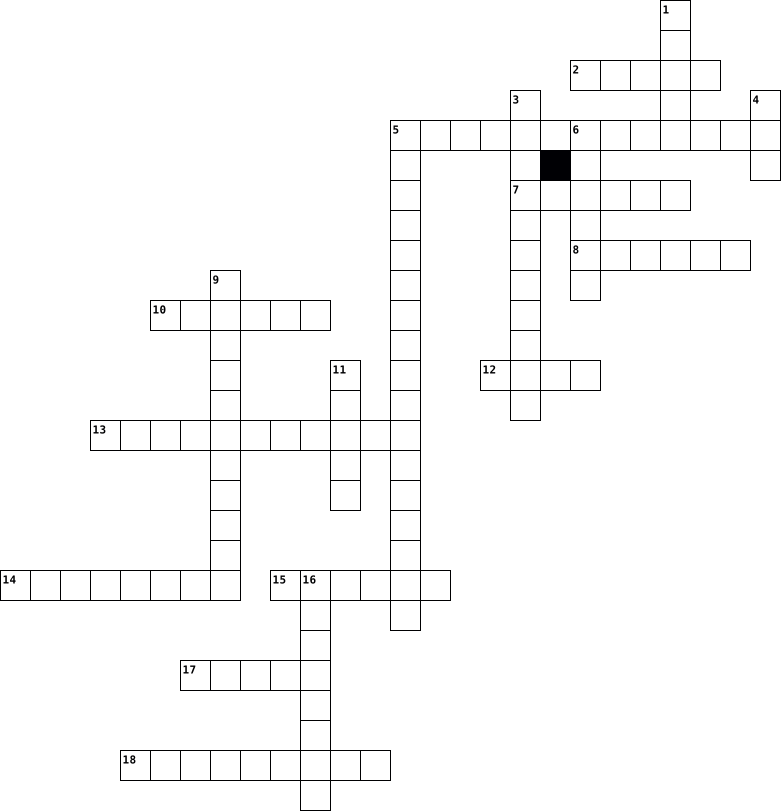
Across
- Sends electrical impulses to the heart
- The muscle tissue of the heart
- Is a Word that refers to the heart
- Blood gets this from the lungs
- Yellow liquid in your blood
- Number of Chambers in the heart
- A group of muscles that work on their own
- Name of the rooms in the heart
- Keep blood flowing in one direction
- Blood Cells Cells that kill germs
- Stops bleeding when you get a cut
Down
- Blue Blood Vessels
- Blood flowing
- Blood Cells Cells that carry oxygen
- Heart, Arteries, Veins and Capillaries
- Dioxide You breathe this out of your body
- Very small blood vessels
- Pumps Blood
- Red Blood Vessels
19 Clues: Pumps Blood • Blood flowing • Red Blood Vessels • Blue Blood Vessels • Very small blood vessels • Yellow liquid in your blood • The muscle tissue of the heart • Blood gets this from the lungs • Name of the rooms in the heart • Number of Chambers in the heart • Blood Cells Cells that kill germs • Stops bleeding when you get a cut • Is a Word that refers to the heart • ...
Cell Review Crossword 2025-11-03

Across
- organelle involved in photosynthesis
- part of the microscope that the slide sits on
- microscope part that comes in 4x, 10x, and 40x
- organelle you can find in plant cells, but not animal cells
- all cells have this around them
- powerhouse of the cell
- type of ER without ribosomes
- all living things are made of these
- protein factory
- post office of the cell; packages & distributes
- type of cell without a nucleus
- DNA
- location of DNA in eukaryotic cells
Down
- type of ER with ribosomes
- type of cell with a nucleus
- like a highway, modifies & transports materials
- outermost boundary of a plant cell
- sugar in RNA
- the liquid inside of the cell
- prokaryotic cells are also generally known as this
20 Clues: DNA • sugar in RNA • protein factory • powerhouse of the cell • type of ER with ribosomes • type of cell with a nucleus • type of ER without ribosomes • the liquid inside of the cell • type of cell without a nucleus • all cells have this around them • outermost boundary of a plant cell • all living things are made of these • location of DNA in eukaryotic cells • ...
Topic 14. Stem Cells 2025-03-24

Across
- Pluripotent stem cells can be identified using distinct surface ______ to indicate the extent of differentiation.
- In _________ cloning, nucleus from patient’s somatic cell is transfer to a enucleated oocyte from a donor to generate an embryo that can provide stem cells that is immunologically compatible with donor patient for transplantation
- Hematopoietic stem cells are multipotent blood stem cells comprising of the _____ and myeloid progenitor cells
- The formation and thickening of the fertilization envelop that surrounds the fertilised egg is caused by the_______ of hydrolytic enzymes stored in vesicles.
- Stem cell lines developed in the lab need to undergo pluripotency assessment by ________test, comparing transcriptomic profile of the derived cell line with a reference stem cell in the database to rule out contamination as well as genetic and epigenetic abnormality that affects the gene expression pattern.
- Umbilical cord can be a source of multipotent stem cells which can be frozen for future therapeutic use and for ___________transfer.
- _________stem cells are derived from 1-2 cell stage of an embryo and have unlimited ability to form other cell or tissue types and even the embryo itself.
- The first cell cycles of fertilized egg are driven by ________ mRNA and proteins in the egg whereas subsequent cell divisions and protein synthesis are driven by the embryonic gene activation
- Besides fibroblasts, ________can be reprogrammed into adult stem cells.
- Interspecies mating is prevented due to the _______ binding of protein on sperm to the receptor on egg cell.
Down
- When B-cell receptor (BCR) is autoreactive, SLP65 inhibit signal transduction, FOXO is unphosphorylated which will upregulate the transcription of Rag 1 and Rag 2 for activation of Ig light chain gene recombination leading to B-cell receptor class _________ and B cell differentiation or maturation.
- An alternate approach for tissue therapy is to____________ terminally differentiated cells to dedifferentiate into multipotent proliferative cells with the capacity to regenerate all components of a damaged tissue.
- For safety purposes, it is important to test the induced multipotent or pluripotent stem cells for ___________ potential or neoplastic growth.
- Stem cells renewal mechanisms include obligatory ___________replication and stochastic differentiation
- The __________ of stem cells decreases when cells differentiate.
15 Clues: The __________ of stem cells decreases when cells differentiate. • Besides fibroblasts, ________can be reprogrammed into adult stem cells. • Stem cells renewal mechanisms include obligatory ___________replication and stochastic differentiation • Interspecies mating is prevented due to the _______ binding of protein on sperm to the receptor on egg cell. • ...
Topic 14. Stem Cells 2025-03-24

Across
- An alternate approach for tissue therapy is to____________ terminally differentiated cells to dedifferentiate into multipotent proliferative cells with the capacity to regenerate all components of a damaged tissue.
- For safety purposes, it is important to test the induced multipotent or pluripotent stem cells for ___________ potential or neoplastic growth.
- In _________ cloning, nucleus from patient’s somatic cell is transfer to a enucleated oocyte from a donor to generate an embryo that can provide stem cells that is immunologically compatible with donor patient for transplantation.
- The __________ of stem cells decreases when cells differentiate.
- Stem cells renewal mechanisms include obligatory ___________replication and stochastic differentiation
- Umbilical cord can be a source of multipotent stem cells which can be frozen for future therapeutic use and for ___________transfer.
- Interspecies mating is prevented due to the _______ binding of protein on sperm to the receptor on egg cell.
- The first cell cycles of fertilized egg are driven by ________ mRNA and proteins in the egg whereas subsequent cell divisions and protein synthesis are driven by the embryonic gene activation
- When B-cell receptor (BCR) is autoreactive, SLP65 inhibit signal transduction, FOXO is unphosphorylated which will upregulate the transcription of Rag 1 and Rag 2 for activation of Ig light chain gene recombination leading to B-cell receptor class _________ and B cell differentiation or maturation.
Down
- Pluripotent stem cells can be identified using distinct surface ______ to indicate the extent of differentiation.
- Besides fibroblasts, ________can be reprogrammed into adult stem cells.
- The formation and thickening of the fertilization envelop that surrounds the fertilised egg is caused by the_______ of hydrolytic enzymes stored in vesicles.
- Stem cell lines developed in the lab need to undergo pluripotency assessment by ________test, comparing transcriptomic profile of the derived cell line with a reference stem cell in the database to rule out contamination as well as genetic and epigenetic abnormality that affects the gene expression pattern.
- Stem cells that are from 1-2 cell stage of an embryo and have unlimited ability to form other cell or tissue types and even the embryo itself.
- Hematopoietic Stem cells are multipotent blood stem cells comprising of the _____ and myeloid progenitor cells
15 Clues: The __________ of stem cells decreases when cells differentiate. • Besides fibroblasts, ________can be reprogrammed into adult stem cells. • Stem cells renewal mechanisms include obligatory ___________replication and stochastic differentiation • Interspecies mating is prevented due to the _______ binding of protein on sperm to the receptor on egg cell. • ...
Cell Crossword 2022-09-12

Across
- the special, normal or proper activity of an organ or part.
- gel-like liquid in a cell; helps maintain shape and is made of about 80% of water.
- one of the structures inside of the nucleus that are made up of DNA and proteins.
- describes the basic characteristics of all cells and organisms.
- protective, flexible barrier that controls what goes in and out of the cell.
- a fluid filled vesicle that contains food, water, and waste. Plants have one large vacuole that contains water.
- deoxyribonucleic acid, a molecules that is present in all living cells and determines traits.
- the site of cellular respiration, which releases energy use by the cell.
- cells without a defined nucleus; usually smaller than eukaryotic cells.
- the smallest unit of functional and structural living thning.
Down
- a system of ideas that explains many related observations and is supported by a body of evidence acquired by scientific investigation.
- structures within a cell that have special functions to keep the cell working.
- cells with a nucleus.
- organelle that is found in plant and algae cells where photosynthesis occurs.
- where genetic material is stored and controls the cells growth and reproduction.
- rigid structure that surrounds the cell membrane and is only in plant cells; provides structure and support.
- the arrangement of parts in an organism.
17 Clues: cells with a nucleus. • the arrangement of parts in an organism. • the special, normal or proper activity of an organ or part. • the smallest unit of functional and structural living thning. • describes the basic characteristics of all cells and organisms. • cells without a defined nucleus; usually smaller than eukaryotic cells. • ...
Cell Crossword 2022-09-12

Across
- the special, normal or proper activity of an organ or part.
- gel-like liquid in a cell; helps maintain shape and is made of about 80% of water.
- one of the structures inside of the nucleus that are made up of DNA and proteins.
- describes the basic characteristics of all cells and organisms.
- protective, flexible barrier that controls what goes in and out of the cell.
- a fluid filled vesicle that contains food, water, and waste. Plants have one large vacuole that contains water.
- deoxyribonucleic acid, a molecules that is present in all living cells and determines traits.
- the site of cellular respiration, which releases energy use by the cell.
- cells without a defined nucleus; usually smaller than eukaryotic cells.
- the smallest unit of functional and structural living thning.
Down
- a system of ideas that explains many related observations and is supported by a body of evidence acquired by scientific investigation.
- structures within a cell that have special functions to keep the cell working.
- cells with a nucleus.
- organelle that is found in plant and algae cells where photosynthesis occurs.
- where genetic material is stored and controls the cells growth and reproduction.
- rigid structure that surrounds the cell membrane and is only in plant cells; provides structure and support.
- the arrangement of parts in an organism.
17 Clues: cells with a nucleus. • the arrangement of parts in an organism. • the special, normal or proper activity of an organ or part. • the smallest unit of functional and structural living thning. • describes the basic characteristics of all cells and organisms. • cells without a defined nucleus; usually smaller than eukaryotic cells. • ...
UB Section 2 Vocab & Vocab Choice Board 2022-03-11

Across
- Group of tissues that work together to perform a specific function.
- the natural process among organisms by which new individuals are generated and the species perpetuated.
- Group of organs that work together to perform a certain task such as digestion or breathing.
- Painful sores on the stomach lining often caused by the micro-organism H pylori
- Usually unicellular organisms that can be seen only through a microscope
- Describes a membrane with very small openings that allow particles of some substances but not other to pass through.
- The basic unit of life
Down
- Diffusion of water through a selectively permeable membrane.
- Type of connective tissue found in the bone that produces red blood cells
- Thin structure that encloses all the contents of plant and animal cells has tiny openings that allow particles of some substances but not others to pass through.
- Made of more than one cell
- Hair-like extensions that protrude from the surface of some unicellular organisms and from some cells in multicellular organisms.
- any of the cellular elements of the blood, as white blood cells or red blood cells.
- Structures in cells that perform a certain function
- The movement of particles of a substance from an area of higher concentration to an area of lower concentration.
- Group of similar cells working together to perform a specific function
- Foot-like projections on an amoeba used for movement and capturing food.
17 Clues: The basic unit of life • Made of more than one cell • Structures in cells that perform a certain function • Diffusion of water through a selectively permeable membrane. • Group of tissues that work together to perform a specific function. • Group of similar cells working together to perform a specific function • ...
Spreadsheets 2017-02-22

Across
- =E4+E7 is called
- identified by numbers (horizontal)
- a specific location Example Cell A4
- "-" is used to __________ Cells
- cell that is selected and ready to receive information
- "+" is used to _________ Cells
- Identified by Letters (Vertical)
- is a format applied to cell data to emphasize subcategories
Down
- individual locations on a spreadsheet
- applied to spreadsheet components for the purpose of organizing and clarifying information.
- is an arrangement of cells in columns and rows used to organize, analyze, calculate, and report information, usually in numerical form.
- Used to format cell data for the purpose of clarifying organizing information
- group/block of cells. Example--- A6:E16
- "*" is used to ___________ Cells
- is used to combine two or more cells
15 Clues: =E4+E7 is called • "+" is used to _________ Cells • "-" is used to __________ Cells • "*" is used to ___________ Cells • Identified by Letters (Vertical) • identified by numbers (horizontal) • a specific location Example Cell A4 • is used to combine two or more cells • individual locations on a spreadsheet • group/block of cells. Example--- A6:E16 • ...
Landon Bales CELL CYCLE 2026-01-20

Across
- index Measure of how fast cells are dividing
- Stage of mitosis when chromosomes line up in the middle
- plate Structure that forms between plant cells during division
- Final stage of mitosis when new nuclei form
- First stage of mitosis when chromosomes become visible
- Area where two sister chromatids are joined
- cycle Series of stages a cell goes through as it grows and divides
- Spread of cancer cells to other parts of the body
Down
- Division of the cell’s cytoplasm into two cells
- Identical halves of a duplicated chromosome
- Stage when sister chromatids are pulled apart
- Process where one cell divides to make two identical cells
- furrow Indentation that forms as animal cells divide
- Substances that can cause cancer
- Structures that carry genetic information (DNA)
- Disease caused by uncontrolled cell division
16 Clues: Substances that can cause cancer • Identical halves of a duplicated chromosome • Final stage of mitosis when new nuclei form • Area where two sister chromatids are joined • index Measure of how fast cells are dividing • Disease caused by uncontrolled cell division • Stage when sister chromatids are pulled apart • Division of the cell’s cytoplasm into two cells • ...
chapter 3 2026-01-29

Across
- Bunches of flagella emerging from the same site
- MEMBRANE Phospholipid bilayer that encloses the cytoplasm
- Small, bristle-like fibers on the surface of many bacterial cells
- Responsible for persistent colonization of teeth and medical devices
- Groups of four single cells
- Movement of bacteria in response to chemical signals
- ACIDS Gram-positive cell wall component that links the cell wall to the plasma membrane
- Flagella dispersed randomly over the surface of the cell
- Pairs of single cells
Down
- Structures formed by many pathogenic bacteria that increase disease-causing ability
- Grape-like clusters of cells
- Protect against harsh environmental conditions
- Flagella at both poles of the cell
- Chains of single cells
- Used in conjugation between bacterial cells
15 Clues: Pairs of single cells • Chains of single cells • Groups of four single cells • Grape-like clusters of cells • Flagella at both poles of the cell • Used in conjugation between bacterial cells • Protect against harsh environmental conditions • Bunches of flagella emerging from the same site • Movement of bacteria in response to chemical signals • ...
Circulatory System 2022-05-26

Across
- give red blood cells the bright red look
- carries blood away from the heart
- receive blood from the atria
- carries blood towards the heart
- recognize foreign antigens, and stimulate macrophages, B cells, and other T cells
- joins each artery and vein
Down
- a muscle that separates the atria and the ventricles
- makes up 45% of red blood cells
- activated by helper T cells or presence of a foreign antigen. Kill foreign cells by puncturing a hole in their membrane.
- are produced in the thymus gland
- create antibodies
- filled with incoming blood
- the liquid part of the blood
- located in the middle of your chest and vital for circulation
- breaks down quickly in the blood
15 Clues: create antibodies • filled with incoming blood • joins each artery and vein • the liquid part of the blood • receive blood from the atria • makes up 45% of red blood cells • carries blood towards the heart • are produced in the thymus gland • breaks down quickly in the blood • carries blood away from the heart • give red blood cells the bright red look • ...
Microbiology C2 Bacteria & Archaea 2026-01-28

Across
- bunches of flagella emerging from the same site
- responsible for persistent colonization of teeth, plastic catheters, and implanted medical devices
- extrachromosomal DNA
- small bristle-like fibers sprouting off the surface of many bacterial cells
- flagella are dispersed randomly over the surface of the cell
- airs of single cells
- prokaryotes that contain unique membrane lipids and cell wall components when compared to bacteria
Down
- a polysaccharide coating outside the bacteria structure
- grape-like clusters of cells
- the connection and exchange of genetic material between bacterial cells
- groups of four single cells
- chains of single cells
- movement of bacteria in response to chemical signals
- a polysaccharide crosslinked with protein units
- nonessential circular small pieces of DNA in the bacteria
15 Clues: extrachromosomal DNA • airs of single cells • chains of single cells • groups of four single cells • grape-like clusters of cells • bunches of flagella emerging from the same site • a polysaccharide crosslinked with protein units • movement of bacteria in response to chemical signals • a polysaccharide coating outside the bacteria structure • ...
Landon Bales CELL CYCLE 2026-01-20

Across
- plate Structure that forms between plant cells during division
- Disease caused by uncontrolled cell division
- index Measure of how fast cells are dividing
- Area where two sister chromatids are joined
- Stage when sister chromatids are pulled apart
- Division of the cell’s cytoplasm into two cells
- Process where one cell divides to make two identical cells
- Structures that carry genetic information (DNA)
Down
- Final stage of mitosis when new nuclei form
- furrow Indentation that forms as animal cells divide
- Identical halves of a duplicated chromosome
- Substances that can cause cancer
- Stage of mitosis when chromosomes line up in the middle
- First stage of mitosis when chromosomes become visible
- Spread of cancer cells to other parts of the body
- cycle Series of stages a cell goes through as it grows and divides
16 Clues: Substances that can cause cancer • Final stage of mitosis when new nuclei form • Identical halves of a duplicated chromosome • Area where two sister chromatids are joined • Disease caused by uncontrolled cell division • index Measure of how fast cells are dividing • Stage when sister chromatids are pulled apart • Division of the cell’s cytoplasm into two cells • ...
About cells 2023-09-19

Across
- ...........stem cells supply new cells as an organism grows and to replace cells that get damaged.
- ........... stem cells supply new cells for an embryo as it grows and develops into a baby.
- Cancer cells don't ..... together
- ........... don't stop growing and dividing
- A stem cell is a cell with the unique ability to develop into .... cell types in the body
Down
- Induced pluripotent stem cells, or ‘iPS cells’, are stem cells that scientists make in the ......
- provide new cells for the body as it grows, and replace specialised cells that are damaged or lost.
- Cancer cells can lose the ......... on their surface that keep normal cells in the right place.
- There are ......... main types of stem cell
- Cancer cells can ignore the ..... that tell them to self destruct
- our body are made up of different type of.....
11 Clues: Cancer cells don't ..... together • There are ......... main types of stem cell • ........... don't stop growing and dividing • our body are made up of different type of..... • Cancer cells can ignore the ..... that tell them to self destruct • A stem cell is a cell with the unique ability to develop into .... cell types in the body • ...
Plant and animal cells 2023-08-25

Across
- -where genetic material is stored and controls the cell's growth and reproduction
- – cells with a nucleus
- - rigid structure that surrounds the cell membrane in plant cells; provide structure and support.
- – gel-like liquid inside a cell; helps cell maintain shape and is about 80% water.
- - describes the basic characteristics of all cells and organisms
- – a fluid-filled vesicle that contains food, water and waste. Plant cells have a large central vacuole that stores water.
- the smallest functional and structural unit of all living things
- – deoxyribonucleic acid, a molecules that is present in all living cells and that contains information that determines traits.
- –structures within a cell that have special functions to keep the cell working.
Down
- – an organelle found in plant and algae cells where photosynthesis occurs.
- – cells without a defined nucleus; usually smaller than eukaryotic cells
- (mitochondrion) – the site of cellular respiration, which releases energy for use by the cell.
- – the arrangement of parts in an organism
- – one of the structures in the nucleus that are made up of DNA and protein
- - protective, flexible barrier that controls what goes in and out of the cell.
- – the special, normal or proper activity of an organ or part.
- – a system of ideas that explains many related observations and is supported by a body of evidence acquired by scientific investigation.
17 Clues: – cells with a nucleus • – the arrangement of parts in an organism • – the special, normal or proper activity of an organ or part. • - describes the basic characteristics of all cells and organisms • the smallest functional and structural unit of all living things • – cells without a defined nucleus; usually smaller than eukaryotic cells • ...
Immune System 2021-10-18

Across
- General term for viruses or bacteria (when attacking an entity
- Small secreted proteins released by cells have a specific effect on the interactions and communications between cells.
- Variant of antibodies that are artificially produced and recognise
- A cell that engulfs and digests foreign entities
- Term for an immune response in which an antibody binds to and blocks the activity of an antigen
- A medically administered attenuated virus/bacteria that trigger an immune response and memory cells
- Term for blood cells that respond to chemicals released by pathogens and cells during infection.
- epitope
- White blood cells
Down
- Cell division (process)
- Class of antibodies that include saliva, tears and milk
- Type of cells that arise from T-cell dependent reactions in the germinal center and are the critical cell type for immune response to re-challenge from an antigen
- A large, Y-shaped protein used by the immune system to identify and neutralize foreign objects such as pathogenic bacteria and viruses
- bind to receptors on helper T cells stimulating rapid mitosis (cell division;proliferation) and bind to receptors on cytoxic T cells and B cells stimulating cell mediated and humoral immunity.
- Classification of defenses that act immediately or within hours of a pathogen's appearance in the body.
- serine proteases that trigger programmed cell death
- If the antigen is recognised by the immune system, B & T _________ happen at the same time.
- There are two types of specific immune response:Cell-mediated and _______
18 Clues: epitope • White blood cells • Cell division (process) • A cell that engulfs and digests foreign entities • serine proteases that trigger programmed cell death • Class of antibodies that include saliva, tears and milk • General term for viruses or bacteria (when attacking an entity • Variant of antibodies that are artificially produced and recognise • ...
MS-LS-1.1 2025-03-21

Across
- Structures in the nucleus made of DNA that carry instructions for growth and reproduction
- Unicellular organisms, usually prokaryotes, that can live almost anywhere and form colonies
- The control center of a eukaryotic cell that holds DNA and directs activities like MRS GREN
- A tool that magnifies tiny things, like cells, so we can study them
- Unicellular or multicellular organisms with chloroplasts that make food from sunlight
- A unicellular organism with no nucleus - its DNA floats free inside
- A group of organs that work together to carry out a major life process
- membrane The outer layer of all cells that controls what goes in and out
- A living thing made of just one cell that does all life processes by itself
Down
- An organism with cells that have a nucleus to hold DNA
- Parts inside cells that use sunlight to make food
- A structure made of different tissues that work together to perform a big job in an organism
- The order of how living things are built: cells→tissues→organs→ systems→ organism
- A unicellular eukaryote that uses respiration to break down sugar and can reproduce quickly
- A living thing made of many cells that work together to perform life processes
- Wall A tough outer layer around plant cells that provides structure
- The molecule inside cells that carries instructions for life, like growth and reproduction
- Groups of similar cells working together to do a specific job in a multicellular organism
18 Clues: Parts inside cells that use sunlight to make food • An organism with cells that have a nucleus to hold DNA • A tool that magnifies tiny things, like cells, so we can study them • A unicellular organism with no nucleus - its DNA floats free inside • Wall A tough outer layer around plant cells that provides structure • ...
vocab set 6 2021-04-18

Across
- cell division that results in 4 daughter cells
- identical copies formed by DNA
- a cell that contains a single set of organisms
- the swapping of genetic material
- a cell that contains two copies of each chromosome
- a way in which flowers reproduce using pollen
Down
- a cycle where cells grow and divide
- diploid cells
- asexual reproduction of a plant
- an organisms reproduction cells
- when a parent cell splits into two body cells
- combining a male gamete with a female gamete
- the material of which the chromosomes of organisms other then bacteria are composed
- protein structure that divides the genetic material
- a type of cell division that results with 2 daughter cells having the same kind and amount of chromosomes
15 Clues: diploid cells • identical copies formed by DNA • asexual reproduction of a plant • an organisms reproduction cells • the swapping of genetic material • a cycle where cells grow and divide • combining a male gamete with a female gamete • when a parent cell splits into two body cells • a way in which flowers reproduce using pollen • ...
sources and sinks 2021-10-18

Across
- incoming solar energy is absorbed by
- by moving water vapor, latent heat can warm and accelerate rising air currents in _____.
- what develops where cells meet
- warm air ______
- circulation pattern
- We call the equatorial convection cells
- Convection cells circulate air, moisture, and heat around the ______
Down
- where does the sun shine directly overhead
- each gram of evaporating water absorbs 580 calories of energy as it transforms from _____ to gas.
- We call the mid-latitude and polar cells ______ and polar cells,
- Warmed air expands, becomes ______ than the cooler air above it
- Convection cells expand and shift how often.
- Circulation is more vigorous near
- Solar energy absorbed by the ground eventually re-radiates as long-wave infrared energy or _______.
- Convection currents distribute
15 Clues: warm air ______ • circulation pattern • what develops where cells meet • Convection currents distribute • Circulation is more vigorous near • incoming solar energy is absorbed by • We call the equatorial convection cells • where does the sun shine directly overhead • Convection cells expand and shift how often. • ...
cells and genetics 2013-02-28

Across
- a substance that produces a genetic mutation
- D.N.A. un-abbreviated
- these are found inside of all cells
- these are made from cells
- this substance can create red blood cells
- one who studies genes
- the genetic process in which genes and diseases are passed down
- This is a pathogen that cannot be cured or killed
- the total number of genes in a species
- The act of taking an organisms D.N.A. and creating another exact organism
Down
- these are made from tissue
- shape of a strand of D.N.A.
- a type of bacteria, virus, or other microscopic organism. That can cause a disease
- the study of genes
- this cell has no membrane bound organelles
- genetic modification
- this type of cell is found in many places in the body, but is often thought of as a disease
- these are the smallest thing that can live
- this is the brain of a cell
- This is created in the cell to expand the cell
20 Clues: the study of genes • genetic modification • D.N.A. un-abbreviated • one who studies genes • these are made from cells • these are made from tissue • shape of a strand of D.N.A. • this is the brain of a cell • these are found inside of all cells • the total number of genes in a species • this substance can create red blood cells • this cell has no membrane bound organelles • ...
Cells Unit review 2013-02-18

Across
- Process that allows organisms to use the energy stored in food
- Cell is the basic unit of life is a component of the ___________
- Unicellular organism that provides most of the oxygen in the earth’s atmosphere
- Bacteria that moves by rotating a flagellum.
- Property of a barrier that allows all substances to pass through it
- Movement of substances into and out of a cell
- Cells that make up the structure that supports our bodies
- Process that causes a gummy bear to swell when submerged in water
- Cells are created from existing cells through this process
- Unicellular organism
- Gatekeepers of our body
- Organelle that splits into two before cell division begins
Down
- Gives color to the organelles that are difficult to see under a microscope
- Powerhouse of the cell
- Organ system that helps expel solid waste from the body
- Folded organelle that makes proteins
- Assistive technology that helps individuals with paralysis
- The jelly like substance in a cell
- The rigid structure that surrounds the plant cell membrane
- Cells that absorb nutrients from the soil and transport it to the stem
- Unicellular organism that moves by changing shape
- False feet
- Tiny organelles that help make proteins
- Process that limits the size of a cell
- Organ system that protects the body by destroying foreign organisms
- Largest organ in the human body
- Organelle that breaks down food and digests wastes
27 Clues: False feet • Unicellular organism • Powerhouse of the cell • Gatekeepers of our body • Largest organ in the human body • The jelly like substance in a cell • Folded organelle that makes proteins • Process that limits the size of a cell • Tiny organelles that help make proteins • Bacteria that moves by rotating a flagellum. • Movement of substances into and out of a cell • ...
The Cells Processes 2013-11-20

Across
- The last stage of the cell cycle.
- The first phase of mitosis.
- The DNA ladder rung that pairs with C.
- Another name for energy in the respiration equation.
- The DNA ladder rung that pairs with T.
- A process a cell uses to make energy without oxygen.
- In the photosynthesis equation, what word is above the arrow?
- Stem cells use __________ to change.
- The DNA ladder rung that pairs with A.
Down
- A stage of the cell cycle that has phases.
- The process in which cells transfer oxygen to energy.
- The DNA ladder rung that pairs with G.
- Cells undergo a sequence of events to split, called the cell _____.
- How do plants obtain food?
- _____ is found in chromatin.
- The third phase of mitosis.
- An animal that cannot make its own food.
- The phase of mitosis where the chromosomes line up at the middle of the cell.
- The stage of the cell cycle where the nuclear membrane dissolves.
- The phase of mitosis where the cell splits.
20 Clues: How do plants obtain food? • The first phase of mitosis. • The third phase of mitosis. • _____ is found in chromatin. • The last stage of the cell cycle. • Stem cells use __________ to change. • The DNA ladder rung that pairs with G. • The DNA ladder rung that pairs with C. • The DNA ladder rung that pairs with T. • The DNA ladder rung that pairs with A. • ...
Cells- Emma B 2014-10-06

Across
- the maximum magnification for a light microscope
- the maximum magnification for the TEM
- organelle that helps transport proteins
- a network of fibres throughout the cells cytoplasm that helps maintain the cells shape
- the largest organelle containing DNA
- organelle involved in developing lipids
- an organism lacking a true nucleus
- the organelle involved in packaging and modifying molecules
- a cell with a membrane bound nucleus
- how large the image appears compared to its actual size
- organelles containing a large range of digestive enzymes
- where ATP is made
- membranous cisternae of the chloroplast in plants
- the round granular structure within the nucleus
Down
- the maximum magnification for the SEM
- used to stain nuclei blue
- the inner folded membrane in the mitochondria
- the resolution of electron microscopes
- the ability of the lens to distinguish the difference between two very close points clearly
- a space containing fluid, can be found between the membranes of flattened sacs in the golgi apparatus
- used mainly for movement in unicelluar organisms
- help support and shape the cell
- a microscope that uses a focused beam of electrons and creates 3d images
- an organelle studded with ribosomes
- the source of energy made in the mitochondria
- mass of genetic material composed of DNA and proteins
- a microscope that uses a focused beam of electrons and creates 2d images
27 Clues: where ATP is made • used to stain nuclei blue • help support and shape the cell • an organism lacking a true nucleus • an organelle studded with ribosomes • the largest organelle containing DNA • a cell with a membrane bound nucleus • the maximum magnification for the SEM • the maximum magnification for the TEM • the resolution of electron microscopes • ...
Cells unit crossword 2015-01-27

Across
- same size as your fist, shaped like a bean
- two tubes that split from the trachea
- the strong muscle below the lungs
- circular muscle at the end of the urethra
- strong muscle that pumps blood around the body
- the organ that releases metabolic waste and excess water
- WALL the outermost layer of a plant cell
- system that carries messages from the brain to the rest of the body
- where photosynthesis takes place
- organ that stores bile
- joins muscle to bone
- the process of water molecules moving from high to low concentration
- produce antibodies
- organ that contains hydrochloric acid
- organ that produces testosterone
- organ that produces insulin
- organ that produces estrogen
Down
- the re-crystalizing of salt and sugar in your kidney
- vessels that carry blood away from the heart
- prevents grinding of bones
- produces energy for a cell
- tiny branch-like tubes that split from the bronchi
- long tube that goes from the pharynx to the stomach
- also known as the swine flu
- grape-like structures at the end of the bronchioles
- organ that forces food down the pharynx
- the system responsible for removing waste
- also known as windpipe
- organ that changes ammonia to urea
- what the lungs exhale
- makes blood cells
- the balancing of fluids, body temperature and blood pressure
- sacks of air that inhale oxygen and exhale carbon dioxide
- thin flap that prevents food from going down the trachea
- vessels that carry blood to the heart
35 Clues: makes blood cells • produce antibodies • joins muscle to bone • what the lungs exhale • also known as windpipe • organ that stores bile • prevents grinding of bones • produces energy for a cell • also known as the swine flu • organ that produces insulin • organ that produces estrogen • where photosynthesis takes place • organ that produces testosterone • ...
Cells and Microscopes 2015-05-15

Across
- This scientist invented the first compound microscope
- The process of transforming light energy into chemical energy
- The place on a microscope where you place the slide
- Where your instructions can be found
- nm
- A type of microscope (strongest magnification)
- The piece on the objective lenses which allows you to see through
- You can find this cell in the brain
- The object that magnifies a slide on a microscope
- What protects the inside of a plant cell
- The fluid filled space of the cell
- The part of the microscope you look through
- Controls what goes in and out of a cell
- The cells that flow through your blood and are red in colour
- The process cells use to multiply
- This was invented from the work of three different scientists
- The blinds for the light reaching the stage in the microscope
Down
- A type of microscope (not strongest magnification)
- The cell that swims to a female egg
- The green cell that is the site of photosynthesis
- um
- This cell is responsible for the energy production within the cell
- The function a cell uses to eat
- The building block of life
- He invented the term 'the cell'
- The process cells use to self destruct or die
- All cells come from _______ cells
- The only cells that have cell walls
- Where the cell stores water, food and nutrients
29 Clues: nm • um • The building block of life • The function a cell uses to eat • He invented the term 'the cell' • All cells come from _______ cells • The process cells use to multiply • The fluid filled space of the cell • The cell that swims to a female egg • You can find this cell in the brain • The only cells that have cell walls • Where your instructions can be found • ...
Cells In Science 2015-05-17

Across
- ________ allow different things to come in and out of a cell.
- The creator of the first compound microscope.
- This is only on a plant cell and hold together the cell.
- This is the control center of the cell.
- A ________ is an optical instrument that magnifies the image of an object.
- This cell swims to the egg to make a baby:)
- ________ describes the properties of cells.
- Its a measuring form for to measure micro cells.
- A _______________ is a cell found inside of your body.This cell is know for its colour.
- If you burnt your hand what cell would tell your brain it hurts?
Down
- ______ is the death of cells and its part of a cells growth and development.
- A _____ cell is a cell that was already there.
- ______ allows DNA to replicate.
- ______ is a cycle plant cells go though.The cycle is needs sunlight, carbon dioxide and water
- ________ is the 'Power house' of the cell.
- A type of lens that is attached to the optical device.
- This is something that makes your magnification bigger or smaller.
- This microscope has two eye lenses.
- One thousand-millionth of a metre. (starts with N)
- A living ____. This must come from an already living ___.
- ______ stores water, food and nutrients.
- A ________ controls what goes in and out of a cell.
- The____ moves up and down allowing your to focus your object.
- Site of photosynthesis ( green in colour )
- There is an animal cell and a _____
- Hooke Captain Hook; First person to make a microscope
- This allows a certain amount of light into your microscope.
- There are three different ____ on a microscope.
- A fluid filled space inside a cell.
29 Clues: ______ allows DNA to replicate. • This microscope has two eye lenses. • There is an animal cell and a _____ • A fluid filled space inside a cell. • This is the control center of the cell. • ______ stores water, food and nutrients. • ________ is the 'Power house' of the cell. • Site of photosynthesis ( green in colour ) • This cell swims to the egg to make a baby:) • ...
Cells and Microscopes 2015-05-13

Across
- These things make up living things.
- Something only found in cells in plants
- cell This is found in a plant
- The fluid that is inside the cell
- Storage bubbles found in cells
- A function of the cell that self destructs
- A membrane-bound organelle found in most eukaryotic cells
- A way of measuring cells
- a thing which uses a lens close to the object being viewed to collect light
- Something on a microscope that is near the stage
- A cell that is attracted to eggs
- Something that is on a microscope that we look through to see
- one of the functions of the cell
- This structure is in both animals and plant cells
- Something that protects the cell and control what goes into and out of the cell
- A scientific theory which describes the properties of cells
Down
- A cell that is only in plants and is green
- A microscope that employs visible light to detect small objects
- This person was the first to invent a compound microscope
- A way in which plants make food
- A cell that can affect us when we hit our funny bone
- A cell which is in our blood
- The knob we change to change the magnification
- A function of the cell that divides
- Alls sells come from this
- A way we measure cells
- A part of the microscope that lets the light through
- The part of the microscope that we place the slide on
- This person was the first to come up with the term "the cell"
29 Clues: A way we measure cells • A way of measuring cells • Alls sells come from this • A cell which is in our blood • cell This is found in a plant • Storage bubbles found in cells • A way in which plants make food • A cell that is attracted to eggs • one of the functions of the cell • The fluid that is inside the cell • These things make up living things. • ...
Chapter 6 Cells 2015-10-16

Across
- The mechanism above the light source on a microscope that changes the amount of light entering the objective lens.
- A body structure that is composed of different kinds of tissues that work together to perform a specific function.
- An organelle found in plant and algae cells where photosynthesis occurs.
- An organism, tissue or cells viewed under a microscope.
- The movement of a substance from an area of high concentration to an area of low concentration.
- A microscope slide and a coverslip, with a drop of liquid and a specimen between them.
- The level of light received on a plant surface that influences the rate of photosynthesis.
- A type of cell that does not have a cell wall, chloroplasts or a large vacuole. Found in animals.
- A type of cell sexual reproduction to make a new organism.
- A type of cell that lines the internal surfaces of organs and tracts; i.e. digestive, respiratory and reproductive tracts.
- Part of the microscope that is used to fine focus the image on high power.
- A collection of organs working together to perform a range of functions within the body.
- Cellular respiration in the presence of oxygen. Creates 36 energy molecules.
- An optical instrument used for viewing very small objects, such as animal or plant cells, typically magnified several hundred times.
- Muscle that is attached to the bones of the skeleton and provides the force that moves the bones.
- The process by which cells use glucose and oxygen to produce energy. A break down reaction. C6H1206+6O2-->6CO2+6H20+energy
- Part of a microscope used to hold the specimen onto the stage for viewing.
- A type of cell that contains a cell wall, large vacuole and sometimes chloroplasts.
- A green pigment found in the chloroplasts of plants, algae, and some bacteria. Required for photosynthesis.
- Part of the microscope found on the revolving nosepiece which give the second point of magnification; usually 3-4 of these (4x, 10x, 40x and 100x)
- A type of cell used for movement and strength.
- The eyepiece lens x the objective lens
- A thin piece of glass used to place over the specimen on a wet-mount slide.
- The understanding that all living things are made of cells; that cells are the basic unit of life; and that all cells come from pre-existing cells.
- A type of cell that makes many glands in the body; i.e. pancreas, adrenals, thyroid etc.
- The movement of water from an area of high water concentration to an area of low water concentration through a semi-permeable membrane.
- A chemical used to make cell structures more visible when viewed under a microscope.
- A rigid structure that surrounds the cell membrane and provides support to the cell.
- A type of cell used to transmit electrical messages around the body.
- The basic unit of structure in all living things.
Down
- A slide with a specimen that is sealed and usually stained to make it easier to view the specimen
- A simple sugar that is made by plants and is an important source of energy.
- The energy source required for photosynthesis to occur.
- A jellylike fluid inside the cell in which the organelles are suspended and chemical reactions occur.
- Part of the microscope that connects the eyepiece lens to the objective lenses.
- A type of cell used to insulate and protect organs. Can also be used for energy.
- The process where cells differentiate to carry out a specific function.
- Cellular respiration in the absence of oxygen. Creates only 2 energy molecules.
- Part of the microscope that is used to focus the image on low power.
- Allows some substances through, but not others.
- A type of cell that is used to create hard, but flexible structures for support.
- A storage molecule in plants made entirely of glucose.
- A fluid filled organelle found mostly in plant cells that stores water and dissolved substances.
- The control centre of the cell. Contains DNA which gives instructions for the functioning of the cell.
- A type of organism made from many cells.
- A collection of cells of the same type that work together to perform a specific function.
- Another name for the light source on a microscope.
- lens Part of the microscope that provides the initial point of magnification; the lens where your eye goes.
- A process used by plants, some algae and bacteria to convert light energy into chemical energy (glucose); a build up reaction. 6CO2+6H20-->C6H1206+6O2
- Part of a microscope that holds the objective lenses.
- Cells found on the outside of many organisms for protection.
- Part of a microscope where the specimen (slide) is placed for viewing.
- An organelle in cells where cellular respiration takes place.
- A type of organism made from a single cell.
- A cell structure that controls which substances can enter or leave the cell. Known as semi-permeable.
- Microscopic blood vessel through which exchanges take place between the blood and cells of the body.
- A type of cell that carries oxygen to every part of the body.
- A unicellular organism; moves using its flagella and have chloroplasts to absorb sunlight.
- Part of the microscope that supports the microscope at the bottom.
59 Clues: The eyepiece lens x the objective lens • A type of organism made from many cells. • A type of organism made from a single cell. • A type of cell used for movement and strength. • Allows some substances through, but not others. • The basic unit of structure in all living things. • Another name for the light source on a microscope. • ...
Cells Unit vocab. 2015-10-19

Across
- Ex. cryptosporidium, toxoplasma Gondi
- Ex. Black death
- Cell that has a nucleus and other membrane-bound organelles
- Asexual reproduction in which a cell divides into two equal parts
- Theory that states that all organisms are made of cells
- Basic unit of life
- Ex viroid, prion
- Ex. asexual reproduction
- "flu"- commonly epidemic disease caused by rapidly mutating virus
- Rapid outbreak of a disease that affects many people
- Ex. HIV, herpes, varicella, hepatitis B
Down
- Ex. lysosomes, nucleus, mitochondria
- Poison released by an organism
- Infectious particle made only of a strand of either DNA or RNA surrounded by a protein coat
- Ex. HIV, herpes, varicella, hepatitis B
- Ex. classified as a plant, animal, fungus
- Ex. Escherichia coli bacterium
- Ex. subunit vaccines
- Ex. penicillin such as penicillin and amoxicillin
- Organism that is within the kingdom bacteria
- Virus that weakens the immune system by reproducing and destroying T cells
- Changing, organized group of related11 parts that interact to form a whole
22 Clues: Ex. Black death • Ex viroid, prion • Basic unit of life • Ex. subunit vaccines • Ex. asexual reproduction • Poison released by an organism • Ex. Escherichia coli bacterium • Ex. lysosomes, nucleus, mitochondria • Ex. cryptosporidium, toxoplasma Gondi • Ex. HIV, herpes, varicella, hepatitis B • Ex. HIV, herpes, varicella, hepatitis B • Ex. classified as a plant, animal, fungus • ...
Introduction to Cells 2015-12-03

Across
- A measure of disorder or randomness.
- "The theory that all living things are made of cells, that cells are the basic units of organisms, and that cells come only from existing cells"
- An organelle found in large numbers in most cells, in which the biochemical processes of respiration and energy production occur.
- Found in animal cells, contain chemicals that break down certain materials. Breaks down dead cells.
- Having a higher concentration of solute than another solution.
- A hollow rod of the protein tubulin in the cytoplasm of all eukaryote cells that make up cilia, flagella, spindle fibers, and other cytoskeletal structures of cells
- A green photosynthetic pigment found in the chloroplasts of plants, algae, and some bacteria.
- single-celled or non-cellular spherical or spiral or rod-shaped organisms lacking chlorophyll that reproduce by fission
- An organism, a consumer, that obtains organic food molecules by eating other organisms or their by-products.
- A substance that is dissolved in a solution.
- A process used by plants and other autotrophs to capture light and energy and use it to power chemical reactions that convert carbon dioxide and water into oxygen and energy-rich carbohydrates, such as sugars and starches.
- Cytoplasmic organelles at which proteins are synthesized.
- Metabolic processes that produce energy (ATP) for all the life processes.
- A rigid layer of nonliving material that surrounds the cells of plants and some other organisms.
- A molecule that is made up of amino acids and that is needed to build and repair body structures and to regulate processes in the body.
- A jelly-like fluid, composed primarily of water, inside the cell in which the organelles are suspended,
- Organelles in both plants and animals that break down peroxide, a toxic byproduct of cell respiration
- An organism that obtains energy by feeding on other organisms, another name for heterotroph.
- Biomolecules consisting of a phosphate group, 5 carbon sugar, and nitrogenous bases
- the substance in which the solute dissolves.
- An organism that gets energy by breaking down the remains of dead organisms or animal wastes and consuming or absorbing the nutrients.
Down
- Having a lower concentration of solute than another solution
- transport of particles from an area of low concentration to an area of high concentration that uses energy provided by ATP or a difference in electrical charges across a cell membrane.
- A process in which a cell releases substances to the extracellular environment by fusing a vesicular membrane with the plasma membrane, separating the membrane at the point of fusion and allowing the substance to be released.
- Cell organelle that stores materials such as water, salts, proteins, and carbohydrates
- A measurement of how much solute exists within a certain volume of solvent
- A process in which a unicellular organism (the "host") engulfs another cell, which lives within the host cell and ultimately becomes an organelle in the host cell; also refers to the hypothesis that mitochondria and plastids were formerly small prokaryotes that began living within larger cells.
- An organelle found in plant and algae cells where photosynthesis occurs
- A category of essential nutrient that includes sugars, starches, and dietary fiber, provides stored chemical energy for the organisms
- Having the same solute concentration as another solution.
- body A structure in a cell that receives proteins and other newly formed materials from the endoplasmic reticulum, packages them, and distributes them to other parts of the cell.
- A small, membrane-bound sac that transports subjects in and out of cells.
- reticulum A system of membranes that is found in a cell's cytoplasm and that assists in the production, processing, and transport of proteins and in the production of lipids.
- Diffusion of water through a selectively permeable membrane
- Active transport process where a cell engulfs materials with a portion of the cell's plasma membrane and releases the contents inside of the cell.
- Organism. producers, that are able to make their own food
- A cell structure that contains nucleic acids, the chemical instructions that direct all the cell's activities.
- transport that requires no energy, movement of molecules from high to low concentration, Moves with the concentration gradient
- An organism, an autotroph, that can make its own food.
- a slender threadlike structure, especially a microscopic whiplike appendage that enables many protozoa, bacteria, spermatozoa, etc., to swim.
- A unicellular organism that lacks a nucleus and membrane bound organelles
- A cell that contains a nucleus and membrane bound organelles
- Found inside the nucleus and produces ribosomes
- membrane A thin, phospholipid and protein molecule bilayer that encapsulates a cell and controls the movement of materials in and out of the cell through active or passive transport.
- Energy-rich organic compounds, such as fats, oils, and waxes, that are made of carbon, hydrogen, and oxygen.
- Movement of molecules from an area of higher concentration to an area of lower concentration.
46 Clues: A measure of disorder or randomness. • A substance that is dissolved in a solution. • the substance in which the solute dissolves. • Found inside the nucleus and produces ribosomes • An organism, an autotroph, that can make its own food. • Having the same solute concentration as another solution. • Cytoplasmic organelles at which proteins are synthesized. • ...
cells and microscopes 2016-09-15

Across
- have 3 or more lenses to choose from
- - jelly- like fluid to hold all the organelles in place
- cell- a neuron.
- - the process by which plants
- - surrounds the cell, controlling what goes into and out of the cell.
- - s a part of the cell cycle in which chromosomes in a cell nucleus
- - only in plant cells
- -uses a lens close to the object being viewed to collect light
- - is a unit of spatial measurement that is 10-9 meter
- - a space or vesicle within the cytoplasm of a cell,
- - exist at or from an earlier time.
- -often referred to as the 'control centre'
Down
- - the death of cells which occurs as a normal and controlled part of an organism's growth or development.
- - in the microscope to see the object
- No. units in 1 m is 1,000,000
- - is a scientific theory which describes the properties of cells.
- - in the human body
- -magnifying lenses to examine small objects
- - in the microscope ,Allows you to direct ambient light up through the hole
- the scientist who came up with the term the cell.
- a plastid in green plant cells which contains chlorophyll and in which photosynthesis takes place.
- the power labelled on it is x10
- - found in large numbers in most cells
- - building blocks of life
- - invented the micrscope
- - a form of active transport in which a cell transports molecules
- a cell
27 Clues: a cell • cell- a neuron. • - in the human body • - only in plant cells • - invented the micrscope • - building blocks of life • No. units in 1 m is 1,000,000 • - the process by which plants • the power labelled on it is x10 • - exist at or from an earlier time. • have 3 or more lenses to choose from • - in the microscope to see the object • - found in large numbers in most cells • ...
Cells & Organization Puzzle 2020-02-19

Across
- organelle containing chromosomal DNA, controls all cellular activites
- makes proteins and carries out protein synthesis
- genetic info of cell wall
- used for movement in the cell
- converts light into energy for plant cells (photosynthesis)
- second part of binomial nomenclature and the lowest level of taxonomic classification
- rER- makes proteins to be exported or stored in the cell sER- makes lipids
- change or the process of change by which an organism or species becomes better suited to its environment
- removal of water while building up a compound
- the science of classification
- long term energy storage
- first part used in binomial nomenclature
- unicellular organisms that lack a nucleus and membrane-bound organelles
- unicellular/multicellular organisms that have a nucleus and membrane-bound organelles
- aids in animal cell reproduction
- any of a number of organized or specialized structures within a living cell
- a diagram that shows the evolutionary relationships among a group of organisms
Down
- a simple sugar which is an important energy source in living organisms and is a component of many carbohydrates.
- breaks down molecules of sugar to release energy
- highest category in taxonomic classification
- organisms that cause disease
- controls what enters and leaves the cell
- circular chromosome of DNA
- a simple organic compound containing a carboxyl
- short term energy storage
- the structure or arrangement of related or connected items
- a system of organization used to name and group organisms in a logical manner
- a molecule containing a very large number of atoms
- all cells are made up of cells; cells are the basic units of organization; cells come from pre-existing cells
- nonliving strands of genetic material with a protein coat
- addition of water while breaking apart a molecule
- a substance that provides nourishment essential for growth and the maintenance of life
- polymers of amino acids and made by ribosomes
- provides support and structure to plant cells, made of cellulose
- a compound linked to a phosphate group
35 Clues: long term energy storage • genetic info of cell wall • short term energy storage • circular chromosome of DNA • organisms that cause disease • used for movement in the cell • the science of classification • aids in animal cell reproduction • a compound linked to a phosphate group • controls what enters and leaves the cell • first part used in binomial nomenclature • ...
4 brain cells 2020-03-28

Across
- Selena and Sheri have a hand signal for this food
- one of Shannon’s cats
- where Sheri was born
- glorias moon
- Shannon’s sun sign
- most likely to throw up on a night out
- where Sheri went to visit Chelsea
- Sheri’s fave anime according to Shannon
- what Sheri always drunkenly talks about on the bus/sober everywhere
- the name of Shannon’s hype beast boy
- name of Shannon’s other cat
- Selena’s sun/Sheri’s rising
- last name of the person who requests the most photos taken of her but takes the worst pics of others
- who is most swole in the group
- where we all work
- what brand is bedazzled hat guy’s hat
Down
- where Shannon went to high school
- selena and Sheri’s moon sign
- most likely to black out and text an ex
- who Gloria has a tattoo of
- name of this virus/beer
- what print did Tom dye his buzz cut
- Sheri is ______ intolerant
- the element of Sheri’s big 3
- cards that Gloria and Sheri have that are witchy
- the sign of Selena’s model lay/Shannon’s chaotic moon sign
- how many times was Shannon and Selena supposed to see Noel and Cody by now
- first word in Shannon’s finsta handle
- time for _______
- where Stephanie frequents
- name of bunny Sheri had for 3 days
- the type of meal we go for most often
- the studio that makes Sheri and Shannon’s fave movie
- the name of Selena’s elephant
34 Clues: glorias moon • time for _______ • where we all work • Shannon’s sun sign • where Sheri was born • one of Shannon’s cats • name of this virus/beer • where Stephanie frequents • who Gloria has a tattoo of • Sheri is ______ intolerant • name of Shannon’s other cat • Selena’s sun/Sheri’s rising • selena and Sheri’s moon sign • the element of Sheri’s big 3 • the name of Selena’s elephant • ...
Cells and organs 2020-04-21

Across
- a cell that carries oxygen
- the outer layer of an animal cell
- a pouch containing sap
- bunch of cells working together
- a special cell
- a complexe lot of parts working together
- make something bigger
- a substance that is getting digested
- a worrying feeling
- something you use to magnify
- / a living being
Down
- a cell found in a plant
- the outer layer of a plant cell
- a cell found in an animals body
- the part of a cell full of enzymes
- a lot of tissue
- the part of a cell that controls it
- you find on a slide show
- to be covered in cilia
- the thing that makes chlorophyll
- the male reproductive cell
21 Clues: a special cell • a lot of tissue • / a living being • a worrying feeling • make something bigger • a pouch containing sap • to be covered in cilia • a cell found in a plant • you find on a slide show • a cell that carries oxygen • the male reproductive cell • something you use to magnify • the outer layer of a plant cell • a cell found in an animals body • bunch of cells working together • ...
Cells and Tissues 2020-09-03

Across
- Transport that does not require energy
- All of the contents inside of a cell
- Headquarters of the cell, contains DNA
- Powerhouse of cell, makes ATP
- Diffusion for water, uses aquaporins
- Discovered the cell
- Tissue in charge of support
- Study of body parts
- Tissue in charge of covering body
Down
- Diffusion for larger molecules, uses protein channels
- Transport that requires energy
- Tissue in charge of control
- Stage where cell splits
- Diffusion for small molecules
- This ER holds ribosomes after leaving nucleus
- Longest stage of the cell cycle, DNA preparation
- Stage where DNA splits
- Body's ability to maintain a stable internal condition
- Study of parts functions
- Tissue in charge of movement
- Makes ribosomes
- Smallest structural unit that makes our body
- Packages and modifies proteins
23 Clues: Makes ribosomes • Discovered the cell • Study of body parts • Stage where DNA splits • Stage where cell splits • Study of parts functions • Tissue in charge of control • Tissue in charge of support • Tissue in charge of movement • Diffusion for small molecules • Powerhouse of cell, makes ATP • Transport that requires energy • Packages and modifies proteins • ...
Cells and Organelles 2018-10-09

Across
- breaks down wastes (animal cell)
- fluid that fills up the cell (maintains pressure of the cell)
- conducts the cell's activities
- organelles found in plant and animal cells that carry out respiration
- are only found in plant cells and protects it from injury
- found in plant cells and uses the sun's energy to give energy the cell can use
- breaks down waste (plant cell)
- center of the nucleus (chromosomes (bundled D.N.A.) + it begins the protein making process
- opening in the leaf for water and gas molecules to move through
- makes protein the cell needs
- creates protien
- packaging protein into vesicles
- molecules move from area of low concentration to high concentration using ENERGY
- allows specific molecules to enter
Down
- process by which molecules move through the cell membrane
- less water than the cell
- organism gaining energy without energy
- stores water and nutrients the cells need to survive
- protects the interior of nucleus allows material to enter and exit the nucleus
- molecules move through the cell membrane without using energy required
- allows certain molecules to enter the cell
- after exercising
- molecules are engulfed (swallowed) and work their way into the cell
- more water than the cell
- controls what molecules pass in in or out
- diffusion of water
- loose strands of D.N.A.
27 Clues: creates protien • after exercising • diffusion of water • loose strands of D.N.A. • less water than the cell • more water than the cell • makes protein the cell needs • conducts the cell's activities • breaks down waste (plant cell) • packaging protein into vesicles • breaks down wastes (animal cell) • allows specific molecules to enter • organism gaining energy without energy • ...
Organelles in Cells 2018-11-06

Across
- lysosomes one of the functions of Golgi Apparatus
- found on single-celled organisms
- Membrane controls what enters and exits the cell
- Where does cellular respiration occur in a cell
- provides structure and connects all organelles (including the cell membrane)
- attached to rough endoplasmic reticulum -AND- floating free in the cell
- Apparatus builds lysosomes
- Cytoplasm Structure
- self destruct button of the cell
- surrounded by a membrane with tiny holes/ the brain of the cell
- short hairs surrounding a cell
Down
- Two types of Endoplasmic Reticulum
- layers of membranes
- found in the nucleus/ contains all the information a cell needs
- one or more long tails attached to a cell
- Nucleus located in the cell
- the _______ stores nutrients, water, and waste
- provides food for plants -AND- photosynthesis (converts sun energy into sugars)
- molecules are dissolved in it for the cell to use
- only in plants
- gives the shape to a cell
21 Clues: only in plants • layers of membranes • Cytoplasm Structure • gives the shape to a cell • Apparatus builds lysosomes • Nucleus located in the cell • short hairs surrounding a cell • found on single-celled organisms • self destruct button of the cell • Two types of Endoplasmic Reticulum • one or more long tails attached to a cell • the _______ stores nutrients, water, and waste • ...
Chapter 2 - Cells 2016-11-21

Across
- A random change in the DNA
- A cell structure that performs a specific function for the cell
- One of two identical strands of DNA that make up a chromosome
- A cell that does not contain a nucleus or other membrane-bound organelles
- A mass of cells that continue to grow and divide without any obvious function in the body
- The structure that holds chromatids together as chromosomes
- The phase of the cell cycle during which the cell performs its normal functions and its genetic material is copied in preparation for the cell division
- The first stage of mitosis, in which the chromosomes become visible and the nuclear membrane dissolves
- A transport mechanism for moving chemicals into and out of the cell, from an area of higher concentration to an area of lower concentration
Down
- The third phase of mitosis, in which the centromere splits and sister chromatids separate into daughter chromosomes, and each moves toward opposite ends of the cell
- A structure in the cell nucleus made up of a portion of the cell’s DNA, condensed into a structure that is visible under a light microscope
- The material in the nucleus of a cell that contains all of the cell’s genetic information
- The movement of a fluid, usually water, across a membrane toward an area of high solute concentration
- The stage in the cell cycle when the cytoplasm divides to form two identical daughter cells
- A broad group of diseases that result in uncontrolled cell division
- The second stage of mitosis, in which the chromosomes line up in the middle of the cell
- A cell that contains a nucleus and other organelles, each surrounded by a thin membrane
- The process of cancer cells breaking away from the original (primary) tumour and establishing another (secondary) tumour elsewhere in the body
- The final phase of mitosis, in which the chromatids unwind and a nuclear membrane reforms around the chromosomes at each end of the cell
- The stage of the cell cycle in which the DNA in the nucleus is divided
20 Clues: A random change in the DNA • The structure that holds chromatids together as chromosomes • One of two identical strands of DNA that make up a chromosome • A cell structure that performs a specific function for the cell • A broad group of diseases that result in uncontrolled cell division • The stage of the cell cycle in which the DNA in the nucleus is divided • ...
Cells and Microscopes 2017-03-09

Across
- The part of the microscope that connects the tube to the base.
- Provides support and protection for the cell.
- Coined the term "cell" after observing that cork consisted of tiny chambers.
- Breaks down sugar molecules to release usable energy.
- Supports and protects cell organelles.
- Provides protection, and controls movement of materials.
- Changes the amount of light that passes through the stage.
- Tiny membrane-bound structures that perform special functions in the cell.
- The flat plate where the slides are placed for observation.
- Controls all cell activities, and contains genetic material info.
- The part of the microscope that holds the objective lenses.
Down
- Stores food, water, and waste.
- A microscopic single-celled organism which has neither a distinct nucleus with a membrane nor other specialized organelles.
- I release oxygen as waste.
- Use energy from the sun to make food for the plant.
- Breaks down larger food molecules into smaller ones. Digests old cell parts.
- Processes and packages molecules, like lipids, and proteins.
- The bottom support of the microscope.
- Produces proteins.
- Organisms composed of one or more cells containing visibly evident nuclei and organelles.
20 Clues: Produces proteins. • I release oxygen as waste. • Stores food, water, and waste. • The bottom support of the microscope. • Supports and protects cell organelles. • Provides support and protection for the cell. • Use energy from the sun to make food for the plant. • Breaks down sugar molecules to release usable energy. • ...
Introduction to Cells 2017-10-02

Across
- my category includes genetic materials
- green pigmented presented in plants
- captures energy from sunlight , changes it, forms energy cells can use to make food(hint: animal cells do not have them)
- receives materials from the endoplasmic recticulum, packages them up, and distributes them to other parts of the cell
- carry out specific functions within a cell
- grain sized organelles that produce proteins
- controls the substances coming in and out of a cell
- a group of specific cells that work together for one function
- I am useful for a fast energy source
- magnify's an image or object to make it look larger than it appears
- layer that surrounds plants and some other organisms
- gel like substance that fills the region between the necleous and the cell membrane
Down
- organelle with a network of membranes that produce many substances, sometimes ribosomes get stuck
- basic unit of structure and function in living things
- stores needed materials for a cell such as food and water
- explanation of the relationship between cells and living things
- converts energy stored in food to energy a cell can use to function
- contain substances that break down larger particles into smaller particles
- controls the cell
- large roll in muscle development
- important for insulation
21 Clues: controls the cell • important for insulation • large roll in muscle development • green pigmented presented in plants • I am useful for a fast energy source • my category includes genetic materials • carry out specific functions within a cell • grain sized organelles that produce proteins • controls the substances coming in and out of a cell • ...
Cells and Tissues 2016-08-11

Across
- Contains digestive enzymes
- The power-house of the cell
- Packages and modifies proteins
- A fat cell
- The site for ribosome production
- The energy unit within a cell
- Functions in protein synthesis
- Germ layer for connective tissues
- The liquid within the cytoplasm
- The brain of the cell
Down
- Composed of DNA and protein
- Glands with duct
- The only liquid connective tissue
- One cell layer thick
- The liquid within the nucleus
- A non-functional unit within a cell
- The most abundant fibre
- Meaning false
- One function of epithelial tissues
- The division of somatic cells
- Osseous connective tissue
- The fibre type to be found in pinna
- DNA segment that carries a blueprint for building proteins
23 Clues: A fat cell • Meaning false • Glands with duct • One cell layer thick • The brain of the cell • The most abundant fibre • Osseous connective tissue • Contains digestive enzymes • Composed of DNA and protein • The power-house of the cell • The liquid within the nucleus • The division of somatic cells • The energy unit within a cell • Packages and modifies proteins • ...
Cells and All 2020-10-01

Across
- The liquid that is found in all cells
- A double membrane that surrounds the nucleus
- The cells outer layer that protects the inside of the cell
- The smallest living unit that makes up all living things
- Cells that perform special functions in multicellular organisms
- What are structures in the nucleus that are made of DNA and protein
- An organism that doesn't contain a nucleus
- I'm made up of a group of cells that perform a certain function
- Tiny organelles that make ATP energy
Down
- I am semipermeable layer
- I'm made up of a group of tissues that perform a certain task
- The semifluid substance of a cell that is external to the nuclear membrane and internal to the cellular membrane
- A large sac that stores water and enzymes
- I am a system of living things()
- An organism that has a nucleus
- Small organelles made of protein and RNA
- I hold up the cell cell and give it shape
- I am an outer layer that is only in plant cells
- I am found in every eukaryote and I do not exist in prokaryotes
- The genetic code for all living things
20 Clues: I am semipermeable layer • An organism that has a nucleus • I am a system of living things() • Tiny organelles that make ATP energy • The liquid that is found in all cells • The genetic code for all living things • Small organelles made of protein and RNA • A large sac that stores water and enzymes • I hold up the cell cell and give it shape • ...
AP Biology - Cells 2020-09-22

Across
- Where ribosomes would be located that make proteins that will be secreted from the cell.
- Site of glucose synthesis.
- In addition to the nucleus, the mitochondria and chloroplast contain this molecule.
- A large ? is a characteristic of a plant cell.
- The internal membrane system of a eukaryotic cell allows the __ of the cells different functions.
- Where proteins and lipids are modified, packaged and shipped out of the cell.
- Regulates what goes in and out of the cell.
- Before a food vacuole can start digesting the contents of the vacuole, it must fuse with a __.
- Where glucose is converted to ATP.
- Whip-like tail made of microtubules.
- An example of a lysosome storage disease.
Down
- Gives cells their shape, anchors and moves organiells.
- As the diameter of a cell increases, the surface area to volume ratio __.
- Cells that make proteins primarily for their own use would find the ribosomes in the __.
- Cellulose containing structures found in plants.
- Lysosomes help to do this with worn out cell materials.
- An intercellular connection found between plant cells.
- The smooth ER is involved in the __ of Ca + ions.
- Both chloroplast and mitochondria produce this.
- The smooth ER is involved in the detoxification of poisons in the __.
- Aid animal cells during mitosis.
- __ are sythesized in the smooth ER.
- Another name for starch.
23 Clues: Another name for starch. • Site of glucose synthesis. • Aid animal cells during mitosis. • Where glucose is converted to ATP. • __ are sythesized in the smooth ER. • Whip-like tail made of microtubules. • An example of a lysosome storage disease. • Regulates what goes in and out of the cell. • A large ? is a characteristic of a plant cell. • ...
Cells by Eric 2020-09-28

Across
- All organisms are composed of similar units of organization called cells. (2 words)
- Do not have a nucleus or a membrane enclosed organelles, but they still have genetic material. Always unicellular.
- Condensed DNA that is ready for mitosis.
- Maintains the cells form through microfilaments and microtubules.
- Separates the inside of the cell from its environment. It also controls what comes in and out. (2 words)
- The control center of the cell. Contains DNA
- The cell’s genetic material. Dictates what the cell will do and how it will do it.
- Membrane enclosed passageway for transporting materials such as proteins. (2 words)
- Specialized parts of the cell that have unique jobs to perform.
Down
- Sack like structures that store different materials.
- Collects garbage or damaged worn out cell parts. They are filled with enzymes that break down the cellular debris.
- Receives vesicles or customized proteins that cells can use. (2 words)
- Where photosynthesis happens in cells.
- The powerhouse of the cell. It makes ATP molecules during the cellular respiration process, which provide energy for the cell's activities.
- They make proteins.
- Tangled, spread out DNA found inside the nuclear membrane
- Jelly like fluid in cells
- Supports plant cell shape and protects itself. (2 words)
- Structure where ribosomes are made inside the nucleus.
- Smallest living units of an organism.
- Have organelles which include a nucleus and other special parts. Advance and complex.
21 Clues: They make proteins. • Jelly like fluid in cells • Smallest living units of an organism. • Where photosynthesis happens in cells. • Condensed DNA that is ready for mitosis. • The control center of the cell. Contains DNA • Sack like structures that store different materials. • Structure where ribosomes are made inside the nucleus. • ...
Cells and Macromolecules 2021-08-17

Across
- controls what gets in and out of a cell
- cell organelle that contains digestive enzymes
- the layer outside the cell membrane in plant
- the building block of carbohydrates
- reactants "acted on" by an enzyme
- jellylike substance in a cell
- structure in nucleus that produces ribosomes
- types of prokaryotic cells
- term for cells with a "true" nucleus
- control center of the cell - DNA is located here
- these provide long-term energy
Down
- term for cells without a true nucleus
- an example of a nucleic acid
- found in plant cells,used for photosynthesis
- proteins speed up reaction
- terms for fats that are liquid at room temperature
- a polysaccharide found in cell walls of plants
- organelle that packages & distributes protein
- made up of amino acids
- fluid filled sac used for storage in a cell
- organelle that produces proteins
- these provide quick energy
- organelle that produces energy
23 Clues: made up of amino acids • proteins speed up reaction • these provide quick energy • types of prokaryotic cells • an example of a nucleic acid • jellylike substance in a cell • organelle that produces energy • these provide long-term energy • organelle that produces proteins • reactants "acted on" by an enzyme • the building block of carbohydrates • ...
Cells and Systems 2024-06-24

Across
- Organelle that stores water, nutrients, and waste products in plant cells.
- Functional units of the kidneys where filtration and urine formation occur.
- Organelles responsible for energy production in cells.
- Specialized structures within a cell that perform specific functions.
- Instruments used for magnifying small objects or specimens.
- Tube through which urine passes from the bladder out of the body.
- Chamber on the right side of the heart that pumps blood to the lungs.
- Organ system responsible for coordinating sensory input and motor responses.
- Tiny air sacs in the lungs where gas exchange takes place.
- Organs that filter waste products from the blood to form urine.
- Tube that carries food from the throat to the stomach.
- Windpipe; tube connecting the larynx to the lungs.
- Organelles in plant cells where photosynthesis occurs.
- Organisms composed of a single cell.
- Organ where food is digested and partially broken down.
- Physical breakdown of food into smaller pieces during digestion is called ______ digestion.
- Multiplying the optical lens and the objective lenses _________. Is a calculation of total _____________ for a microscope.
- Blood vessels that carry blood back to the heart.
- The Rigid outer layer that surrounds the cell in plant cells is called the cell _______.
- Organ system responsible for removing waste products from the body.
- Organ that detoxifies chemicals and metabolizes drugs in the body.
- Structures composed of tissues that work together to perform specific functions.
Down
- Smaller branches of the bronchi within the lungs.
- Waves of muscular contractions that move food through the digestive tract.
- Tubes that branch from the trachea and carry air into the lungs.
- Movement of particles from an area of higher concentration to lower concentration.
- Main lens closest to the object in a microscope or telescope.
- Blood vessels that carry blood away from the heart.
- Organ that pumps blood throughout the body.
- Organ system responsible for gas exchange in the body.
- Groups of similar cells that perform a specific function.
- Basic structural and functional units of all living organisms.
- Movement of water molecules across a selectively permeable membrane.
- Pair of organs where gas exchange occurs.
- Dome-shaped muscle beneath the lungs that helps with breathing.
- The _______ intestine is a long, coiled tube where most digestion and absorption of nutrients occurs.
- Changes in the environment detected by sensory receptors.
- Tiny blood vessels where gas exchange occurs between blood and tissues.
- Chamber of the left side of the heart that receives oxygenated blood from the lungs.
- The _____ intestine is the organ where water is absorbed and solid waste is formed.
- Complex eye structure found in insects and some crustaceans.
- Organ that stores urine before it is excreted from the body.
- system Organ system responsible for transporting blood and nutrients throughout the body.
- glands Glands that produce saliva to moisten food and begin the digestion process.
- Gel-like substance inside cells where organelles are suspended.
- Tubes that carry urine from the kidneys to the bladder.
46 Clues: Organisms composed of a single cell. • Pair of organs where gas exchange occurs. • Organ that pumps blood throughout the body. • Smaller branches of the bronchi within the lungs. • Blood vessels that carry blood back to the heart. • Windpipe; tube connecting the larynx to the lungs. • Blood vessels that carry blood away from the heart. • ...
Cells Revision Crossword 2024-05-13

Across
- Barrier that controls what comes in and out of a cell
- Site of respiration in the cell
- Control centre of the cell that contains DNA
- Long thin cell with a high number of chloroplasts
- Used to adjust the image in a microscope
- looking carefully and in detail at an object
- eyepiece lens magnification x objective lens magnification
- Where you look in a microscope.
- A cell with a tail that carries male genetic material
- the amount of particles in a given volume
- Strengthens the cell and is made from cellulose
- Carries electrical impulses through the body
Down
- Cell that transports oxygen through the body
- A unicellular organism found nearly everywhere.
- A cell adapted to do a specific job
- Site of photosynthesis
- The movement of particles along a concentration gradient
- Where the sample goes in a microscope
- Keeps the cell firm
- Site of chemical reactions in cell
- A unicellular found in fresh water only.
- The scientist who discovered cells
- A living thing made of cells
- The building block of life
24 Clues: Keeps the cell firm • Site of photosynthesis • The building block of life • A living thing made of cells • Site of respiration in the cell • Where you look in a microscope. • Site of chemical reactions in cell • The scientist who discovered cells • A cell adapted to do a specific job • Where the sample goes in a microscope • Used to adjust the image in a microscope • ...
Cells- Asper K 2024-02-16

Across
- Developed from the singlecelled versions
- Complex, larger, nucleus
- A finger-like extension
- Uses cilia to move
- Simple, small, plasmid
- First life on earth
- Moving in reaction to chemicals
Down
- Phospholipid Bi-Layer around organelles
- Both have this, one in a nucleus and one in a plasmid
- Consuming solid foods
- Life that arose due to the oxygen
- Second life on earth
- A long whip like structure
- Uses pseudopods to move and capture food
- Other type of prokaryote
- Consuming liquid foods
- Moving in reaction to light
- Type of prokaryote
- Uses flagellum to move
- Hair-like projections
20 Clues: Uses cilia to move • Type of prokaryote • First life on earth • Second life on earth • Consuming solid foods • Hair-like projections • Consuming liquid foods • Simple, small, plasmid • Uses flagellum to move • A finger-like extension • Complex, larger, nucleus • Other type of prokaryote • A long whip like structure • Moving in reaction to light • Moving in reaction to chemicals • ...
Unit 3: Cells 2024-02-05

Across
- Cell structure that forms a maze of passageways in which proteins and other materials are carried from one part of the cell to another
- Unwinds the double helix
- A solution in which the concentration of solutes is less than that of the cell
- Final stage of cell division, in between anaphase and interface. Chromatids move to opposite ends of the cell and two nuclei are formed
- Process by which a cell divides into two new daughter cells
- Part of cell division where chromosomes become visible, the nuclear envelop dissolves, and spindles form
- Mass of rapidly dividing cells that can damage surrounding tissue
- Substance found in eukaryotic chromosomes that consists of DNA tighly coiled around histones
- Region of chromosomes where two sister chromatids attatch
- Makes protein through protein synthesis
- A single cell that develops into a multi-celled organism
- Type of reproduction where two parents combine their genetic material to produce a new organism, which differs from both parents
- unspecialized cells that retain the ability to become a wide variety of specialized cells
- Organism containing a nucleus & other organelles that are bound by membranes
- Part of the cell containing DNA & RNA and is responsible for growth and production
- Rigid layer of nonliving material that surrounds the plant cells
- Process requiring energy that moves materials across a cell membrane against a concentration difference
- Hairlike projections that extend from the plasma membrane and are used for locomotion
- Found inside the nucleus, produces ribosomes
- Process in which the cells become specialized in structure & function
- Diffusion of water through a selective permeable membrane
- Enzyme involved in DNA replication that joins induvidual nucleotides to produce a DNA molecules
- Programmed cell death
- Type of reproduction where a single parent reproduces by itself
- Process by which organisms maintain a relatively stable internal environment
Down
- Final binding of nicks in DNA during synthesis and repair
- an organisms entire "genetic package"
- Power house of the cell and the site of ATP production
- The regular sequence of growth & division that cells undergo
- Chromosomes line up in the middle of the cell
- Phase of mitosis where the chromosomes separate and move to opposite ends of the cell
- Thread like structures made of DNA molecules that contain the genes (often represented by X)
- A unicellular organism that lacks a nucleus & membrane-bound organelles
- Family of proteins that regulate the cell cycle of eukaryotic cells
- Cell organelle that stores materials such as water, salts, proteins, and carbohydrates
- Organelle containing digesting enzymes
- movement of specific molecules through protein channels from low to high concentration (with the gradient)
- A double layer if phospholipids that make up plasma and organelle membranes
- The basic unit of structure & function in living things
- A network of fibers that holds the cell together, helps the cell to keep its shape, and aids in movement
- Plant & Algae organelle where photosynthesis occurs
- A solution in which the concentration of solutes is higher than that of the cell
- Any malignant growth or tumor caused by abnormal and uncontrolled cell division
- A long, whiplike structure that helps a cell move
- Animal cell organelle that aids in cell division
- Requires no energy, movement of molecules from low to high concentration (moves with the gradient)
- Specialized structure that performs important cellular functions within a eukaryotic cell
- System of membranes that modifies & packages proteins for export by cell
- a solution in which the concentration of solutes is essentially equal to that of the cell which resides in the solution
- All living things are made of cell; cells are the basic unit of structure & function in living things; new cells are produced from living cells
50 Clues: Programmed cell death • Unwinds the double helix • an organisms entire "genetic package" • Organelle containing digesting enzymes • Makes protein through protein synthesis • Found inside the nucleus, produces ribosomes • Chromosomes line up in the middle of the cell • Animal cell organelle that aids in cell division • A long, whiplike structure that helps a cell move • ...
cells x word 2024-02-09

Across
- nickname for chloroplast
- nickname for nucleus
- nickname for cytoplasm
- cell membrane nickname
- nickname for cell wall
- provide cell with protein
- nickname for mitochondria
- gives the cell energy molecules
- nickname for chromatin
- lets things in and out
- only found in plant cells that contain chlorophyll
- structures within cytoplasm that makes the cell function
- what lets things in and out of the cell
- nickname for lysosomes
Down
- supplies the cell with water
- the security guard of the cell
- moves lipids from nucleus to cell membrane
- conveyor belt of the cell
- moves out waste products
- nickname for golgi bodies
- nickname for ribosomes
- holds the dna tells the cell information
- nickname for rough endoplasmic reticulum
- jell like substance
- nickname for vacuole
- support and structure of the cell
- controls what happens in the nucleus
- nickname for nucleolus
- outside layer of cell
- directs activities in the cell
30 Clues: jell like substance • nickname for nucleus • nickname for vacuole • outside layer of cell • nickname for cytoplasm • cell membrane nickname • nickname for cell wall • nickname for ribosomes • nickname for chromatin • lets things in and out • nickname for nucleolus • nickname for lysosomes • nickname for chloroplast • moves out waste products • conveyor belt of the cell • ...
All About Cells 2023-02-20

Across
- organisms that make their own food
- Lets things in and out of the cell
- what cell membranes are and it means the will let something in and out of the cell
- Moves matrials form the nucleous to cell membrane
- gives a plant cell support
- when materials need energy to help them move through a cell membrane
- are organisms that can't make their own food
- when molecules move from a high area to a low are of concentration
- Stores water
- occurs when oxgen levels are low
- Removes waste products
- Moves things from nucleus to cell membrane
- moves used protein out of the cell
- when a particle is too large to enter a active or passive transport
- when a cell uses no energy to move particles in and out of the cell
- A set of blueprints to a new cell
Down
- Allows thing in and out of the nucleous
- when producers or consumers break down food in their cells to release unstable energy
- Control center
- Changes food into energy
- factorizes ribosomes
- A jello like substance,moves through cells
- the total of all chemical activities of an organism that enables it to stay alive
- The diffusion of water through a cell membrane
- Producers that make thier own food by changing energy from the sun into sugar
- helps make food
- when a particle is too large to exit the cell so material fuses with the cell membrane and is realsed
- when molecules are distributed evenly through a space
- occurs when oxygen is present
- this part helps when cells divide into two
30 Clues: Stores water • Control center • helps make food • factorizes ribosomes • Removes waste products • Changes food into energy • gives a plant cell support • occurs when oxygen is present • occurs when oxgen levels are low • A set of blueprints to a new cell • organisms that make their own food • Lets things in and out of the cell • moves used protein out of the cell • ...
11 Biology - Cells 2023-03-31

Across
- Organisms that can produce their own food using energy from sunlight or other sources.
- The gel-like substance that fills the cell and contains organelles.
- The organelles responsible for protein synthesis.
- Organelles that produce ATP, the energy currency of the cell, through cellular respiration.
- The diffusion of water molecules across a semi-permeable membrane from an area of lower solute concentration to an area of higher solute concentration.
- ____ transport: The movement of substances across a membrane with the concentration gradient, without requiring energy.
- _____ fission: A form of asexual reproduction in which a single cell divides into two identical cells.
- Cell ____ The scientific theory that all living things are composed of cells, which are the basic structural and functional units of life.
- A network of protein fibers that provides support and shape to cells.
- The organelle that contains the genetic material of a eukaryotic cell.
- A type of cell with a nucleus and membrane-bound organelles.
- Cell ____ The semi-permeable membrane surrounding a cell that controls the exchange of materials between the cell and its environment.
- Organisms that rely on other organisms for food.
Down
- An organelle involved in protein and lipid synthesis, consisting of a network of membranes and tubes.
- The movement of particles from an area of higher concentration to an area of lower concentration, driven by the concentration gradient.
- Surface area-to-volume ___
- Concentration _______ The difference in concentration of a substance between two regions, which can drive passive or active transport.
- An organelle involved in modifying, sorting, and packaging proteins for transport.
- Allowing only certain substances to pass through a membrane while excluding others.
- A type of cell without a nucleus or membrane-bound organelles, typically smaller than eukaryotic cells.
- An organelle involved in transport and storage of materials within the cell.
21 Clues: Surface area-to-volume ___ • Organisms that rely on other organisms for food. • The organelles responsible for protein synthesis. • A type of cell with a nucleus and membrane-bound organelles. • The gel-like substance that fills the cell and contains organelles. • A network of protein fibers that provides support and shape to cells. • ...
macromolecules and cells 2023-08-30

Across
- holds organelles
- An organelle found in plant and algae cells where photosynthesis occurs
- large molecules where genetic information is stored
- removes waste in cell
- involved in cell division
- the hereditary material in humans and almost all other organisms
- control center
- large, complex molecules that play many critical roles in the body
- temporary storage
- atoms or small molecules that bond together to form more complex structures such as polymers
- create proteins via translation
- basic unit of life
- site of protein synthesis
- provides energy for cell and has the protein
- fatty waxy or oily compounds
Down
- a chemical element that is the simplest and lightest of all chemical elements
- A rigid layer of nonliving material that surrounds the cells of plants and some other organisms.
- a substance made up of more than one identical molecule
- makes carbs and lipids
- A naturally abundant, nonmetallic element that occurs
- makes ribosomes
- a molecule containing a very large number of atoms, such as a protein, nucleic acid, or synthetic polymer.
- makes proteins
- controls what comes in and out
- folds and packages proteins
25 Clues: control center • makes proteins • makes ribosomes • holds organelles • temporary storage • basic unit of life • removes waste in cell • makes carbs and lipids • involved in cell division • site of protein synthesis • folds and packages proteins • fatty waxy or oily compounds • controls what comes in and out • create proteins via translation • provides energy for cell and has the protein • ...
Protists and Cells 2021-09-24

Across
- tiny hair-like structures
- green pigment inside chloroplasts
- lives in colonies
- the "brain" of the cell
- regulates materials entering and exiting the cell
- provides structure and support for plant cells
- a single-celled protist that moves with cilia
- whip-like tail
- false feet
- where photosynthesis takes place
- an organism that must consume other organisms for energy
Down
- the smallest unit of living matter
- the "Powerhouse" of the cell
- storage for water, nutrients, or waste
- an autotroph AND heterotroph
- a single-celled protist that moves by pseudopods
- a jelly-like substance inside all cells
- an organism that moves by flagella
- small structures inside a cell with specific functions
- an organelle that senses sunlight
- an organism whose cells have a nucleus
- a single-celled organism from the Kingdom Protista
- an organism that can make its own food
- an organism whose cells DO NOT have a nucleus
- genetic material found in the nucleus
- an organism that moves by cilia
26 Clues: false feet • whip-like tail • lives in colonies • the "brain" of the cell • tiny hair-like structures • the "Powerhouse" of the cell • an autotroph AND heterotroph • an organism that moves by cilia • where photosynthesis takes place • green pigment inside chloroplasts • an organelle that senses sunlight • the smallest unit of living matter • an organism that moves by flagella • ...
Cells: Structure & Functions 2021-10-24

Across
- an organelle within the cells of plants and certain algae
- a continuous membrane system that forms a series flattened sacs within the cytoplasm of eukaryotic cells
- a solution that contains fewer dissolved particles than is found in normal cells and blood
- any of the single-celled or multicellular organisms whose cells contains a distinct, membrane-bound nucleus
- to the measure of the amount of a subcomponent in a solution
- a complex of vesicles and folded membranes within the cytoplasm of most eukaryotic cells, involved in secretion and intracellular transport
- the basic membrane-bound unit that contains the fundamental molecules of life and of which all living things are composed
- the net passive movement of molecules or particles from regions of higher to regions of lower concentration
- a structural layer next to the cell membrane with the primary role of giving the cell rigidity and protection from mechanical stress
- a solution that contains more dissolved particles than is found in normal cells and blood
- organic substances that maintain a constant pH over a given range by neutralizing the effects of hydrogen ions
- a thick solution that fills each cell and is enclosed by the cell membrane
Down
- a structure found inside the nucleus of a cell; made up of proteins and DNA organized into genes
- a slender threadlike structure, especially a microscopic appendage that enables many protozoa, bacteria, spermatozoa, etc. to swim
- the process of moving molecules across a cellular membrane through the use of cellular energy
- the ability or tendency of the body or a cell to seek and maintain a condition of equilibrium
- something having a strong affinity for water
- compounds do not easily dissolve in water
- a cell organelle that helps process and package proteins and lipid molecules
- a solution that has the same salt concentration as cells and blood
- a cellular particle made of RNA and protein that serves as the site for protein synthesis in the cell
- the cell membrane as a tapestry of several types of molecules that are constantly moving
22 Clues: compounds do not easily dissolve in water • something having a strong affinity for water • an organelle within the cells of plants and certain algae • to the measure of the amount of a subcomponent in a solution • a solution that has the same salt concentration as cells and blood • a thick solution that fills each cell and is enclosed by the cell membrane • ...
Cells and microscopes 2021-11-03

Across
- This type of cell has a cell wall and chloroplasts.
- The pigment inside of chloroplasts that absorbs light is this colour.
- Piece of glass you place under a microscope
- Where photosynthesis happens.
- A name for a whole living thing.
- A part of a cell.
- Cell ______, gives a plant cell its shape and stops it from bursting.
- Contains cell sap and sugars inside plant cells.
- Cell ________ - Controls what enters and exits a cell.
- Part of a cell that releases energy
- What you have to do to make an image clear through a microscope
Down
- A type of organisms that can sometimes cause disease.
- The building blocks of life, all organisms are made of these. We have about 4 trillion of them.
- The chemical reactions inside of a cell take place here.
- Part you look through on a microscope or a camera.
- _____organisms - Tiny single cells organisms. Everything is covered in them and you can remove them by washing your hands.
- The very thin piece of glass you place over a glass slide. (2 words)
- Orange/brown chemical used to stain onion cells.
- Space in a plant cell filled with watery sap.
- What microscopes do to what you are looking at.
- The control centre of the cell.
21 Clues: A part of a cell. • Where photosynthesis happens. • The control centre of the cell. • A name for a whole living thing. • Part of a cell that releases energy • Piece of glass you place under a microscope • Space in a plant cell filled with watery sap. • What microscopes do to what you are looking at. • Orange/brown chemical used to stain onion cells. • ...