
discoveries and inventions Crossword Puzzles
UNIT 5: INVENTIONS (Vocabulary) 2023-03-15

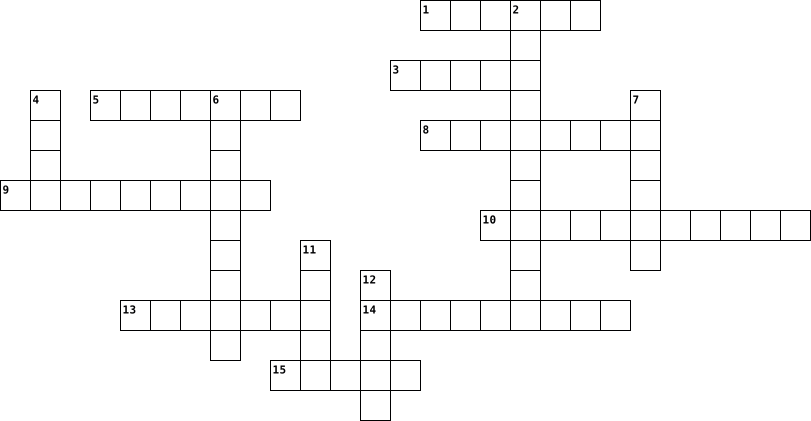
Across
- a piece of computer equipment, especially a small one such as a smartphone
- a scientific test that is done in order to study what happens and to gain new knowledge
- the machines and electronic parts in a computer or other electronic system
Down
- the things that are needed for a particular purpose or activity
- a room or building used for scientific research, experiments, testing, etc.
- the programs used by a computer for doing particular jobs
6 Clues: the programs used by a computer for doing particular jobs • the things that are needed for a particular purpose or activity • a piece of computer equipment, especially a small one such as a smartphone • the machines and electronic parts in a computer or other electronic system • a room or building used for scientific research, experiments, testing, etc. • ...
unit13 2025-03-06

Across
- The long lecture started to _____ the students, and they struggled to stay awake.
- He had to _____ to get his friend’s attention across the crowded room.
- Water began to _____ from the ceiling after the rainstorm.
- The school _____ is beautiful with large trees and green lawns.
- The _____ reported on the story about the upcoming storm.
- My grandmother gave me a _____ necklace that I will keep forever.
- She has a _____ for painting and spends hours working on her art.
- We need to stick to our _____ if we want to save money for the trip.
- The poet wrote a beautiful _____ about the changing seasons.
- He loves to _____ around in circles at the playground.
- The coffee tasted _____ because I forgot to add sugar.
- There was a _____ of people trying to catch the last train.
- The group went on an _____ to explore the mountains.
- She felt like an _____ when she helped her friend after the accident.
- The _____ of the blanket made me feel comfortable on the cold night.
- Their _____ to the beach took longer than expected because of traffic.
- _____ must work together to protect the environment.
- The _____ flew high above the clouds on its way to another country.
- You need to _____ the key to unlock the door.
- The _____ looked stunning in her white dress on her wedding day.
- They went on a _____ walk along the beach during sunset.
- Technology has helped _____ make many important discoveries.
- The teacher will _____ the students into groups for the project.
- The lawyer met with a new _____ to discuss the case.
Down
- Her _____ at the party made everyone feel happy and excited.
- The _____ in my room is filled with all my favorite novels.
- The _____ from the campfire kept us warm during the cold night.
- The _____ of the lion could be heard from a distance.
- She tried to _____ the toothpaste out, but there was barely any left.
- The _____ of the missing cookies was finally solved by the detective.
- The detective found a _____ that helped him solve the case.
- He is very _____ and loves trying new activities like rock climbing.
- She carried a _____ of sand to build a castle on the beach.
- The old _____ in the corner was used to store apples.
- I had a _____ for breakfast this morning.
- She was _____ to start her new book and finish it in one day.
- He used a towel to _____ the spilled water off the table.
- Smoking can cause _____ to your health in the long run.
- The teacher gave us a _____ about the upcoming test.
- In many stories, the _____ tries to trick people into doing bad things.
- She won an _____ for being the best student in the class.
- Too much sugar is _____ to your teeth and health.
- She let out a loud _____ when she saw the spider on her desk.
- He filled the _____ with water to wash the car.
44 Clues: I had a _____ for breakfast this morning. • You need to _____ the key to unlock the door. • He filled the _____ with water to wash the car. • Too much sugar is _____ to your teeth and health. • The group went on an _____ to explore the mountains. • _____ must work together to protect the environment. • The teacher gave us a _____ about the upcoming test. • ...
Mesopotamia 2023-11-09

Across
- 1895-539 BC. empire in Mesopotamia; Hammurabi was one of its rulers
- 2334-2218 BC. the first empire in the world, founded by Sargon the Great who unified Mesopotamia under his rule.
- the ruler of the Babylonian Empire from 1792 BC to 1750 BC, whose most enduring legacy is the code of laws he put together.
- code a set of laws
- the spreading of ideas or products from one culture to another.
- a law code enacted by Hammurabi, the king of Babylonia around 1772 BC
- the area of land nearby and parallel to a river
- an arc of rich farmland in Southwest Asia, between the Persian Gulf and the Mediterranean Sea.
- the digging up of earth in order to search for something such as remains.
- a system or organization in which people or groups are ranked one above the other according to status or authority.
- a grouping of people in a society based usually based on wealth, religion, ethnicity, or other factors
- a series of rulers from the same family.
- 3500-1650 BC. a region in the Middle East between the Tigris and Euphrates Rivers, part of the land making up the Fertile Crescent, meaning "land between the rivers" in Greek, where the first early river valley civilizations started
- a conqueror from Akkad who defeated the city-states of Sumer about 2350 BC, creating the world’s first empire.
- a skilled worker, such as a weaver or a potter, who makes goods by hand.
- a long-lasting pattern of organization in a community.
- the belief in many gods
- a city and its surrounding lands functioning as an independent political unit.
Down
- a system of writing with wedge-shaped symbols, invented by Sumerians around 3000 BC.
- the development of skills in a specific kind of work
- kingdom of northern Mesopotamia that became the center of one of the great empires of the ancient Middle East. The people were famous for their cruelty and fighting prowess and were monumental builders, as shown by archaeological sites at Nineveh, Ashur, and Nimrūd.
- a period in human history, beginning around 3000 BC in some areas, during which people began using bronze, rather than copper or stone, to fashion tools and weapons.
- a Southwest Asian people who helped to destroy the Assyrian Empire.
- all the different ways a distinct group of people interact with one another and their environment and pass these ways down from generation to generation over time
- a new method of addressing a problem
- the supply of water to land or crops to help growth, typically by means of channels.
- the relative social, professional, or other standing of someone or something.
- ways of applying knowledge, tools, and inventions to meet people's needs.
- a form of trade in which people exchange goods and services without the use of money.
- a temple, in the form of a stepped pyramid, which literally means “mountain of god.”
- a professional record-keeper.
- a mixture of chemical elements in which at least one is a metal
- a human-made object.
- a form of culture characterized by an economy that produces food surpluses, cities, social classes, specialized jobs, developed systems of government, religion, and learning, achievements in technology, art, and monumental architecture, and systems of record keeping
34 Clues: code a set of laws • a human-made object. • the belief in many gods • a professional record-keeper. • a new method of addressing a problem • a series of rulers from the same family. • the area of land nearby and parallel to a river • the development of skills in a specific kind of work • a long-lasting pattern of organization in a community. • ...
Entrepreneurship 2024-06-13

Across
- _____ Based; a type of business that is operated from one's own living space
- An acronym; what an investor should expect to earn after the sale of their investment
- The available assets of a company that can be converted into cash quickly
- A Canadian E-commerce website
- Often seen as an alternative to entrepreneurship, someone from within the company rises to a leadership role
- A corporation's attempt at selling its product by promoting
- _____ Entrepreneur; ex. Mike Rovers (Second Chance Ministries)
- A portion of a company's profits for each unit sold is taken by a private investor
- Act of purchasing a location instead of an entire company
- The state or right of owning a business
- An image that often represents a company
- A word, phrase, or object registered to represent a company or product
Down
- A corporation or business' primary audience
- _____ Boss; a TV show about a company executive working a lower-level position
- Someone who creates things as an occupation
- _____ Den; the Canadian and British versions of #18
- A Canadian E-commerce company that primarily specifies in delivering groceries directly to your door
- _____ Inventions; an invention created by an inventor from our country!
- The state or right of co-owning a business
- A company's ability to maintain a neutral cash flow when selling a product or service
- Canadian _____ Law; a law that protects Canadian businesses' products or ideas when filed
- An entrepreneur's moral principals
- _____ recognition; an entrepreneur's ability to recognize an opening in the market
- _____ Tank; an American TV show featuring wealthy investors looking to invest in a company
- An often short-lived trend
- A company always tries to _____ its product for profit
- _____ Industries; a non-profit that specializes in offering convicted felons a second chance
- _____ Festival; a failed attempt at a music festival headed by Billy McFarland
- _____ Statement; a company's statement on how much money they generate
- _____ Market; who a company specifically tailors their product to
30 Clues: An often short-lived trend • A Canadian E-commerce website • An entrepreneur's moral principals • The state or right of owning a business • An image that often represents a company • The state or right of co-owning a business • A corporation or business' primary audience • Someone who creates things as an occupation • _____ Den; the Canadian and British versions of #18 • ...
Magnetism & Electricity 2019-11-04

Across
- A class of physical phenomena that are mediated by magnetic fields. Electric currents and the magnetic moments of elementary particles give rise to a magnetic field, which acts on other currents and magnetic moments.
- The SI unit of electromotive force, the difference of potential that would drive one ampere of current against one ohm resistance.
- The emission of electrons or other free carriers when light hits a material. Electrons emitted in this manner can be called photoelectrons. This phenomenon is commonly studied in electronic physics and in fields of chemistry such as quantum chemistry and electrochemistry.
- A body of water or air moving in a definite direction, especially through a surrounding body of water or air in which there is less movement.
- Vector field that describes the magnetic influence of electric charges in relative motion and magnetized materials.
- A stable subatomic particle with a charge of negative electricity, found in all atoms and acting as the primary carrier of electricity in solids.
- Natural frequency of vibration determined by the physical parameters of the vibrating object.
- A type of elementary particle. It is the quantum of the electromagnetic field including electromagnetic radiation such as light and radio waves, and the force carrier for the electromagnetic force. The invariant mass of the photon is zero; it always moves at the speed of light in a vacuum.
- The reinforcement or prolongation of sound by reflection from a surface or by the synchronous vibration of a neighboring object.
- A rock mineral and one of the main iron ores, with the chemical formula Fe₃O₄. It is one of the oxides of iron, and is ferrimagnetic; it is attracted to a magnet and can be magnetized to become a permanent magnet itself. It is the most magnetic of all the naturally-occurring minerals on Earth.
Down
- A material or object that produces a magnetic field.
- The SI unit of frequency, equal to one cycle per second.
- A form of medical imaging that measures the response of the atomic nuclei of body tissues to high-frequency radio waves when placed in a strong magnetic field, and that produces images of the internal organs.
- In physics, electromagnetic radiation refers to the waves of the electromagnetic field, propagating through space, carrying electromagnetic radiant energy. It includes radio waves, microwaves, infrared, light, ultraviolet, X-rays, and gamma rays.
- Danish physicist and chemist who discovered that electric currents create magnetic fields.
- The maximum displacement or distance moved by a point on a vibrating body or wave measured from its equilibrium position. It is equal to one-half the length of the vibration path.
- Region at each end of a magnet where the external magnetic field is strongest. A bar magnet suspended in Earth's magnetic field orients itself in a north–south direction. The north-seeking pole of such a magnet, or any similar pole, is called a north magnetic pole.
- The flow of electrons. All matter is made up of atoms, and an atom has a center, called a nucleus. The nucleus contains positively charged particles called protons and uncharged particles called neutrons.
- An English scientist who contributed to the study of electromagnetism and electrochemistry. His main discoveries include the principles underlying electromagnetic induction, diamagnetism and electrolysis.
- The number of occurrences of a repeating event per unit of time. It is also referred to as temporal frequency, which emphasizes the contrast to spatial frequency and angular frequency. The period is the duration of time of one cycle in a repeating event, so the period is the reciprocal of the frequency.
20 Clues: A material or object that produces a magnetic field. • The SI unit of frequency, equal to one cycle per second. • Danish physicist and chemist who discovered that electric currents create magnetic fields. • Natural frequency of vibration determined by the physical parameters of the vibrating object. • ...
AND and AND ... 2024-11-20

Across
- Having a repeated design.
- An artist’s workspace.
- A roof window.
- A stand for a canvas.
- A painter’s protective outfit.
- Marked with a spill.
Down
- It heats a room or cooks food.
- To show something in art or words.
- A painter’s color tray.
- The opposite of tidy.
- A quick drawing.
- The feeling of a place.
- Simple and countryside-like.
- To throw things around.
14 Clues: A roof window. • A quick drawing. • Marked with a spill. • The opposite of tidy. • A stand for a canvas. • An artist’s workspace. • A painter’s color tray. • The feeling of a place. • To throw things around. • Having a repeated design. • Simple and countryside-like. • It heats a room or cooks food. • A painter’s protective outfit. • To show something in art or words.
Age of Explore Vocab 2022-01-18

Across
- Dom Henrique of Portugal, Duke of Viseu, better known as ____ _____ the Navigator, was a central figure in the early days of the Portuguese Empire and in the 15th-century European maritime discoveries and maritime expansion
- involved the transportation by slave traders of various enslaved African people, mainly to the Americas. The slave trade regularly used the triangular trade route and its Middle Passage, and existed from the 16th to the 19th centuries.
- (1st Count of Vidigueira) was a Portuguese explorer and the first European to reach India by sea. His initial voyage to India by way of Cape of Good Hope was the first to link Europe and Asia by an ocean route, connecting the Atlantic and the Indian oceans and therefore, the West and the Orient.
- trade between three ports or regions. It thus provides a method for rectifying trade imbalances between the above regions.
- signed in Tordesillas, Spain on 7 June 1494, and authenticated in Setúbal, Portugal, divided the newly-discovered lands outside Europe between the Portuguese Empire and the Spanish Empire, along a meridian 370 leagues west of the Cape Verde islands, off the west coast of Africa.
- a form of foreign rule; a country or area under the full or partial political control of another country, typically a distant one, and occupied by settlers from that country
- founded in 1607, it was the first successful permanent English settlement in what would become the United States. The settlement thrived for nearly 100 years as the capital of the Virginia colony; it was abandoned after the capital moved to Williamsburg in 1699 (famously known for its citizens resorting to cannibalism).
- a conqueror, especially one of the Spanish conquerors of Mexico and Peru in the 16th century.
- the exchange of diseases, ideas, food. crops, and populations between the New World and the Old World following the voyage to the Americas by Christopher Columbus in 1492
Down
- a theater of the Seven Years' War, which pitted the North American colonies of the British Empire against those of the French, each side being supported by various Native American tribes.
- were the English settlers who came to North America on the Mayflower and established the Plymouth Colony in what is today Plymouth, Massachusetts.
- an economic policy that is designed to maximize the exports and minimize the imports for an economy. It promotes imperialism, colonialism, tariffs and subsidies on traded goods to achieve that goal
- The Columbian Exchange caused population growth in Europe by bringing new crops from the Americas and started Europe's economic shift towards it. Colonization disrupted ecosytems, bringing in new organisms like pigs, while completely eliminating others like beavers.
- the stage of the Atlantic slave trade in which millions of enslaved Africans were forcibly transported to the Americas as part of the triangular slave trade
- a Portuguese mariner and explorer. In 1488, he became the first European navigator to round the southern tip of Africa and to demonstrate that the most effective southward route for ships lay in the open ocean, well to west of the African coast.
- an Italian explorer and navigator who completed four voyages across the Atlantic Ocean, opening the way for the widespread European exploration and colonization of the Americas.
16 Clues: a conqueror, especially one of the Spanish conquerors of Mexico and Peru in the 16th century. • trade between three ports or regions. It thus provides a method for rectifying trade imbalances between the above regions. • ...
History 2022-11-07

Across
- played a prominent role in the union and became an organizer for the Knights of Labor in the 1870s. Her ambitious drive to educate and organize laborers was so effective that some her opponents called her "the most dangerous woman in America." She was also known as Mother Jones.
- head of the American Railway Union (ARU), he supported the Pullman strikers.
- an Irish Catholic machinist and the mayor of Scranton, Pennsylvania, became leader of the Knights of Labor. Under his leadership, membership was expanded rapidly.
- economic system in which private business runs most industries, and competition determines how much goods cost and workers are paid
- Law prohibiting monopolies and trusts that restrained trade
- patented the telephone in March 1876
- political theory that proposes that all people should collectively own property as the means of production and that individual ownership should not be allowed
- one of the first national labor unions in the United States, organized in 1869, after 1879 it included workers of different races, genders, and skills
- one founder of the Standard Oil Company. After earning a small fortune in the wholesale food businesses, he entered the growing oil refining industry in 1863. He used vertical integration to make his company more competitive.
- Incident in which a bomb exploded during a labor protest held in Haymarket Square in Chicago, killing several police officers.
- Entered the iron and steel business in the early 1860s. A Scottish-born American industrialist and philanthropist who founded the Carnegie Steel Company in 1892. His company dominated the steel industry. In 1902, he sold his company to J.P. Morgan for nearly $500 million. He retired the world's richest man. He donated more than $350 million to charity.
- Exclusive right to manufacture or sell an invention
- railroad railroad that crossed the continental United States; completed in 1869
- efficient method of making steel; developed by British inventor Henry Bessemer and American inventor William Kelly in the 1850s
Down
- ownership of several companies that make the same product
- Union founded in 1886 by Samuel Gompers for skilled workers
- a pioneer of the railroad industry. By 1869, he had gained control over the New York Central Railroad and two other lines that connected the Central with New York City. He also controlled lines between Chicago, Cleveland, New York and Toledo. At the time of his death in 1877, he controlled more than 4,500 miles of railroad track. His personal fortune was estimated at $100 million.
- Year of intense worker strikes and violent labor confrontations in the united States.
- ownership of businesses involved in each step of a manufacturing process
- exclusive economic control of an industry
- was another pioneer of communications technology. His first major invention was a telegraph that could send up to four messages over the same wire simultaneously. He and his fellow researchers made significant discoveries and advances in electricity, lightbulbs, phonographs, and early motion pictures
- belief that the economy will prosper if businesses are left free from government regulation and allowed to compete in a free market.
- machine patented by Samuel Morse in 1837; sent messages over long distances by using electric current to transmit a system of dots and dashes over wire
- arrangment grouping several companies under a single board of directors to eliminate competition
- theory adapted by philosopher Herbert Spencer from Charles Darwin's theory of evolution; argued that society progresses through completion, with the fittest rising to positions of wealth and power
- company the sells shares of ownership called stock to investors in order to raise money
26 Clues: patented the telephone in March 1876 • exclusive economic control of an industry • Exclusive right to manufacture or sell an invention • ownership of several companies that make the same product • Union founded in 1886 by Samuel Gompers for skilled workers • Law prohibiting monopolies and trusts that restrained trade • ...
Arjun Kurup - Chapter 10 Crossword Vocab. Puzzle 2022-04-21

Across
- -A large group of plants/trees under cultivation
- -To use tariff to promote American buisness
- -A cotton processing machine
- -A plant that is used for fabric often, source of most slave labor
- -A machine that sends messages over electrical wires using Morse code
- -Non-proccesed materials
- -To collect the produce of a plant
- -To protest something by avoiding it, such as a product
- -A period taking place after the War of 1812 which had a resounding desire for unity
- -To cultivate land
- -A canal that travels through upstate New York
- -When America turned from a preindustrial economy to a more industrially oriented economy
- -A machine that has machinery to break down flour
- -To exchange goods with another body
- -To calm down in violence/severity
- -The compromise that allowed people to have slaves in Missouri
- -Spirits
- -An artifical waterway which allows boats to pass or to channel water
- -An anti-slavery rebellion on 1831
- -Cloth & Clothes made from cotton and other materials
- -To rebel agianst something, typically violent
- -A personal possesion
- -Laws that protect the people
- -To rid of something, typically governmental
- -A machine that cuts oats and other plants using a scythe like mechanism.
- -The parts of a machine that can be substituted for something else
Down
- -To be loyal to one part of the country
- -Trade of slaves within the U.S
- -People that make inventions/breakthroughs
- -To have large control over the trade of some item(s)
- -A device that uses running water for energy
- -Land fit for growing plants due to healthy amounts of nutrients
- -A machine that combines thread
- -To support your own nation & their interests
- -The document that acknowledges that the United States doesn’t appreciate monarchy
- - A method of production in which a large crew of people would work in a single location
- -Peaceful protest
- -Something that existed before a war
- -To ban trade with a country
- -An older term for an attitude towards womans rights
- -To expand
- -Someone who is forced to work and can be bought as property against their will
- -Tracks that trains ride on
- -To resist against something
- -An area that isn’t organized
- -An era in which industrial production of goods took over more hand-made work
- -Powers that the congress had that weren’t explicitly stated in the constitution
- -Someone who supports the abolition of something
- -To cultivate land
- -A boat powered by a steam engine
50 Clues: -Spirits • -To expand • -Peaceful protest • -To cultivate land • -To cultivate land • -A personal possesion • -Non-proccesed materials • -Tracks that trains ride on • -A cotton processing machine • -To ban trade with a country • -To resist against something • -An area that isn’t organized • -Laws that protect the people • -Trade of slaves within the U.S • -A machine that combines thread • ...
Study Game Group 2 2024-09-26

Across
- Which sampling method does a researcher randomly select a certain number of people from a population for their research?
- When you're making a causal inference, you need to meet 3 conditions such as, covariation, time-order relationship and elimination of plausible alternative clauses. What is this called?
- What kind of science is it called when people believe the earth is flat?
- What is a variable in an experiment that is manipulated and is not affected by the other variables?
- What is the relationship between two variables, that uses a range of -1 to 1 values called?
- An experiment is conducted to observe the benefits of electrolytes on an athlete’s performance. In this experiment, some athletes took more time to rest and recover than others. What kind of variable would this be considered?
- What is it called when you are randomly selecting a random number of people from a population for a research study?
- A researcher is conducting an experiment on how different types of soil affects the growth process of a flower. In this specific scenario, what variable would the height of the flower be?
- A researcher wants to figure out which college has the most and best student life in the Midwest. The researcher asks a set of fixed questions to receive answers and opinions of the students. This is what concept?
Down
- After the conclusion of a group of researchers study in how the changing of soil would affect the growth of a garden vegetable, they decide to repeat the study, only this time, they change the amount of water that the plants receive. What kind of st would this be considered as?
- If researchers wanted to study whether or not highschoolers learning math on paper or on a computer screen is better. They would keep them in their math classes since they are already in class and it would be no ideal to mess around with their schedules, the researchers would just make the condition go to them rather than the students going to different classrooms with different conditions. What is this experimental method called?
- A study is being conducted on University of Minnesota students to find out the average GPA for the whole college. The researcher divides the total population into multiple groups by what college they are in and randomly selects students from each of the groups. Which sampling method is this?
- When selecting a random sample, where do researchers normally pull participants from?
- Being able to comply with new research and discoveries, constructive peer review, considers new findings, allows critique, accurate outcomes, precise measurements, and reduces claims of usefulness are all key features of which concept?
14 Clues: What kind of science is it called when people believe the earth is flat? • When selecting a random sample, where do researchers normally pull participants from? • What is the relationship between two variables, that uses a range of -1 to 1 values called? • What is a variable in an experiment that is manipulated and is not affected by the other variables? • ...
Chapters 8,9,10 Vocab 2024-11-11

Across
- an oligopoly with only two firms
- when an existing firm uses sharp but temporary price cuts to discourage new competition
- the conditions in an industry, such as number of sellers, how easy or difficult it is for a new firm to enter, and the type of products that are sold
- a firm in a perfectly competitive market that must take the prevailing market price as given
- the additional revenue gained from selling one more unit
- producing the optimal quantity of some output; the quantity where the marginal benefit to society of one more unit just equals the marginal cost
- a government rule that gives the inventor the exclusive legal right to make, use, or sell the invention for a limited time
- each firm faces many competitors that sell identical products
- a branch of mathematics that economists use to analyze situations in which players must make decisions and then receive payoffs based on what decisions the other players make
- the long-run process of firms reducing production and shutting down in response to industry losses
- point level of output where the marginal cost curve intersects the average variable cost curve at the minimum point of AVC; if the price is below this point, the firm should shut down immediately
- a game in which the gains from cooperation are larger than the rewards from pursuing self-interest
- the long-run process of firms entering an industry in response to industry profits
- to entry the legal, technological, or market forces that may discourage or prevent potential competitors from entering a market
- legal prohibitions against competition, such as regulated monopolies and intellectual property protection
- methods of production kept secret by the producing firm
Down
- a perceived demand curve that arises when competing oligopoly firms commit to match price cuts, but not price increases
- many firms competing to sell similar but differentiated products
- any action that firms do to make consumers think their products are different from their competitors'
- product a product that consumers perceive as distinctive in some way
- where all firms earn zero economic profits producing the output level where P = MR = MC and P = AC
- firms and organizations that fall between the extremes of monopoly and perfect competition
- when firms act together to reduce output and keep prices high
- profit of one more unit of output, computed as marginal revenue minus marginal cost
- economic conditions in the industry, for example, economies of scale or control of a critical resource, that limit effective competition
- the body of law including patents, trademarks, copyrights, and trade secret law that protect the right of inventors to produce and sell their inventions
- a situation in which one firm produces all of the output in a market
- removing government controls over setting prices and quantities in certain industries
- a form of legal protection to prevent copying, for commercial purposes, original works of authorship, including books and music
- level of output where the marginal cost curve intersects the average cost curve at the minimum point of AC; if the price is at this point, the firm is earning zero economic profits
- an identifying symbol or name for a particular good and can only be used by the firm that registered that trademark
- when a few large firms have all or most of the sales in an industry
- a group of firms that collude to produce the monopoly output and sell at the monopoly price
33 Clues: an oligopoly with only two firms • methods of production kept secret by the producing firm • the additional revenue gained from selling one more unit • when firms act together to reduce output and keep prices high • each firm faces many competitors that sell identical products • many firms competing to sell similar but differentiated products • ...
Fairy tales 2024-02-29
Across
- A dense, wooded area or natural environment featuring trees, vegetation, wildlife, and mysterious or magical elements commonly depicted in fairy tales, folklore, and fantasy stories as a setting for adventures, quests, or encounters with supernatural beings or creatures.
- The mysterious or supernatural force, power, or ability to manipulate and control natural elements, events, or outcomes through spells, incantations, rituals, or magical objects, commonly associated with witches, wizards, sorcerers, and enchanted beings in fairy tales and fantasy stories.
- A genre of literature, film, or storytelling characterized by imaginative and fantastical elements, settings, creatures, or events that diverge from reality and involve magic, mythical creatures, supernatural powers, or extraordinary phenomena.
- Valuable or precious objects, wealth, or rewards hidden, sought after, or protected by characters in stories, legends, or fairy tales, often symbolizing material or spiritual riches, knowledge, or virtues such as love, courage, or friendship.
- A person, animal, creature, or entity portrayed or represented in a story, play, film, or work of literature, possessing traits, emotions, motivations, and actions that drive the plot forward and engage the audience's interest and empathy.
- The ability or faculty of the mind to create, visualize, or form mental images, ideas, concepts, or scenarios that are not present to the senses, often employed in storytelling, art, play, or problem-solving to explore creativity, innovation, and alternative possibilities.
- The quality or ability to confront fear, danger, uncertainty, or adversity with bravery, determination, and confidence, often demonstrated by characters in fairy tales, legends, and myths who face challenges, villains, or monsters in pursuit of their goals or quests.
- An exciting or daring experience, journey, or quest undertaken by characters in a story, often involving challenges, risks, obstacles, discoveries, and triumphs, and providing opportunities for growth, learning, and transformation.
- A narrative or tale, often fictional, told to entertain, inform, or convey a message, typically featuring characters, plot, setting, conflict, and resolution, and enjoyed by listeners or readers of all ages, including children's stories, fairy tales, myths, and legends.
Down
- The magical or spellbinding quality or charm associated with fairy tales, fantasies, or stories featuring supernatural elements, enchanting creatures, or mystical settings, captivating the imagination and evoking wonder, awe, or fascination in the audience.
- A traditional story, legend, or narrative that explains natural phenomena, cultural customs, religious beliefs, or historical events through symbolic or metaphorical means, often featuring gods, heroes, monsters, or supernatural beings and passed down orally through generations.
- An exciting or daring experience, journey, or quest undertaken by characters in a story, often involving challenges, risks, obstacles, discoveries, and triumphs, and providing opportunities for growth, learning, and transformation.
- A traditional or historical narrative, often based on real events or people but embellished with mythological, heroic, or supernatural elements, and passed down through generations as part of a community's cultural heritage, identity, or collective memory.
- A journey, adventure, or mission undertaken by a hero, protagonist, or group of characters in pursuit of a specific goal, object, or destination, often involving trials, challenges, allies, enemies, and personal growth, as depicted in epic tales, myths, and legends.
- A mythical or supernatural being often depicted as small, humanoid, and possessing magical powers, wings, and the ability to grant wishes or intervene in human affairs, commonly featured in fairy tales, folklore, and fantasy literature as benevolent or mischievous creatures.
15 Clues: An exciting or daring experience, journey, or quest undertaken by characters in a story, often involving challenges, risks, obstacles, discoveries, and triumphs, and providing opportunities for growth, learning, and transformation. • ...
APUSH Unit 6 2026-05-04

Across
- Powerful urban political organizations that thrived by providing immigrants and the poor with social services in exchange for votes and loyalty
- Steel manufacturing technique that made mass production of steel cheaper and faster fueling railroad construction and industrial growth
- Economic philosophy arguing that government should not intervene in the economy
- Business structure that allowed wealthy industrialists to consolidate multiple corporations under one entity, further concentrating wealth and eliminating competition
- Rapid growth of cities driven by industrialization and migration from both abroad and within the United States
- Theory used to justify the wealth of the rich as natural and inevitable by applying the theory of survival of the fittest to economic and social life
- Political party created by agrarian activists and others calling for a stronger governmental role in regulating railroads, currency, and the economy TRANSCONTINENTALRAILROAD Network of rail lines connecting the East and West coasts that opened new markets promoted economic growth and created new western communities
- Protestant reform movement that applied Christian ethics to social problems such as poverty, inequality, and child labor arguing that society itself needed to be saved
- Confined territories to which the U.S. government relocated American Indian tribes after violating treaties and crushing armed resistance on the frontier
- Term describing the post Civil War era of rapid industrialization extreme wealth inequality political corruption and dramatic social change
- Use of machinery to replace human labor in agriculture and industry that dramatically increased production and contributed to declining prices
- Progressive reformer who founded Hull House in Chicago and championed the rights of immigrants women and the poor during the Gilded Age
- Federal policy that broke up American Indian tribal lands into individual allotments in an effort to assimilate Native peoples and open remaining land to white settlers (1887)
- Integration business strategy in which a company controls all stages of production from raw materials to finished goods
- System of racial separation enforced through violence, Supreme Court decisions, and local political tactics
- Federal law that barred Chinese laborers from immigrating to the United States (1882)
- Term used to describe powerful industrialists who built massive fortunes through ruthless business practices and exploitation of workers
Down
- Rapidly growing western settlements that sprang up around railroad lines and mining discoveries
- System of state and local laws enforcing racial segregation and discrimination against African Americans following Reconstruction
- Supreme Court decision that upheld racial segregation under the doctrine of separate but equal (1896)
- Social group that expanded during the Gilded Age as corporations needed managers and clerical workers, and as access to education and consumer culture grew
- Native American spiritual movement that spread across the Great Plains
- Organization of workers that battled management over wages and working conditions through strikes, collective bargaining, and political advocacy
- Treaty between the U.S. government and Sioux Nation that was later violated when gold was discovered in the Black Hills (1868)
- Anti immigrant movement that sought to limit the political power and cultural influence of newcomers, particularly those from southern and eastern Europe and Asia
- Andrew Carnegie's idea that wealthy business leaders had a moral obligation to use their fortunes to improve society through philanthropy
- Populist demand to coin silver alongside gold to expand the money supply and relieve the economic burden on indebted farmers and the poor
- Supreme Court case that established that American born children of immigrants are citizens under the Fourteenth Amendment (1898)
- Federal law passed to limit the power of trusts and monopolies (1890)
- African Americans who migrated from the post-Reconstruction South to Kansas and other western states seeking land, freedom, and escape from racial violence (1879)
- Act that promoted western settlement by offering land grants to settlers who agreed to farm the land, contributing to the displacement of American Indians (1862)
- Term describing the post-Reconstruction vision of some industrialization in the South
- Invention that transformed American urban life, extended the workday, and symbolized the era of technological innovation driving industrial growth (1879)
- Federal Indian boarding school in Pennsylvania that forcibly assimilated Native American children by stripping them of their languages, cultures, and tribal identities (1879)
- Overcrowded and unsanitary urban housing where large numbers of immigrant and working class families lived
35 Clues: Federal law passed to limit the power of trusts and monopolies (1890) • Native American spiritual movement that spread across the Great Plains • Economic philosophy arguing that government should not intervene in the economy • Term describing the post-Reconstruction vision of some industrialization in the South • ...
Inventions in our life 2013-02-14

Across
- a flying vehicle with wings and one or more engines
- The... helps us send texts and pictures along telephone lines.
- You can communicate easily and quickly with the help of the...
Down
- a piece of electrical equipment with a screen on which you can watch programmes with moving pictures and sounds
- the activity of broadcasting programmes for people to listen to
- ... can do almost everything, but it cannot think.
6 Clues: ... can do almost everything, but it cannot think. • a flying vehicle with wings and one or more engines • The... helps us send texts and pictures along telephone lines. • You can communicate easily and quickly with the help of the... • the activity of broadcasting programmes for people to listen to • ...
Inventions of Benjamin Franklin 2024-11-13

Across
- created after he was getting older and realized his eyesight was starting to worsen
- invented after the kite expeirimeant he wanted to protect buildings with
- basically a fire place with less smoke created
Down
- worn on the feet of swimmers to this day to swim faster and better
- glasses together that made a noise
- created when his brother was in immense pain over his kidneys
6 Clues: glasses together that made a noise • basically a fire place with less smoke created • created when his brother was in immense pain over his kidneys • worn on the feet of swimmers to this day to swim faster and better • invented after the kite expeirimeant he wanted to protect buildings with • ...
Magnetism & Electricity 2019-11-04

Across
- A class of physical phenomena that are mediated by magnetic fields. Electric currents and the magnetic moments of elementary particles give rise to a magnetic field, which acts on other currents and magnetic moments.
- The SI unit of electromotive force, the difference of potential that would drive one ampere of current against one ohm resistance.
- The emission of electrons or other free carriers when light hits a material. Electrons emitted in this manner can be called photoelectrons. This phenomenon is commonly studied in electronic physics and in fields of chemistry such as quantum chemistry and electrochemistry.
- A body of water or air moving in a definite direction, especially through a surrounding body of water or air in which there is less movement.
- Vector field that describes the magnetic influence of electric charges in relative motion and magnetized materials.
- A stable subatomic particle with a charge of negative electricity, found in all atoms and acting as the primary carrier of electricity in solids.
- Natural frequency of vibration determined by the physical parameters of the vibrating object.
- A type of elementary particle. It is the quantum of the electromagnetic field including electromagnetic radiation such as light and radio waves, and the force carrier for the electromagnetic force. The invariant mass of the photon is zero; it always moves at the speed of light in a vacuum.
- The reinforcement or prolongation of sound by reflection from a surface or by the synchronous vibration of a neighboring object.
- A rock mineral and one of the main iron ores, with the chemical formula Fe₃O₄. It is one of the oxides of iron, and is ferrimagnetic; it is attracted to a magnet and can be magnetized to become a permanent magnet itself. It is the most magnetic of all the naturally-occurring minerals on Earth.
Down
- A material or object that produces a magnetic field.
- The SI unit of frequency, equal to one cycle per second.
- A form of medical imaging that measures the response of the atomic nuclei of body tissues to high-frequency radio waves when placed in a strong magnetic field, and that produces images of the internal organs.
- In physics, electromagnetic radiation refers to the waves of the electromagnetic field, propagating through space, carrying electromagnetic radiant energy. It includes radio waves, microwaves, infrared, light, ultraviolet, X-rays, and gamma rays.
- Danish physicist and chemist who discovered that electric currents create magnetic fields.
- The maximum displacement or distance moved by a point on a vibrating body or wave measured from its equilibrium position. It is equal to one-half the length of the vibration path.
- Region at each end of a magnet where the external magnetic field is strongest. A bar magnet suspended in Earth's magnetic field orients itself in a north–south direction. The north-seeking pole of such a magnet, or any similar pole, is called a north magnetic pole.
- The flow of electrons. All matter is made up of atoms, and an atom has a center, called a nucleus. The nucleus contains positively charged particles called protons and uncharged particles called neutrons.
- An English scientist who contributed to the study of electromagnetism and electrochemistry. His main discoveries include the principles underlying electromagnetic induction, diamagnetism and electrolysis.
- The number of occurrences of a repeating event per unit of time. It is also referred to as temporal frequency, which emphasizes the contrast to spatial frequency and angular frequency. The period is the duration of time of one cycle in a repeating event, so the period is the reciprocal of the frequency.
20 Clues: A material or object that produces a magnetic field. • The SI unit of frequency, equal to one cycle per second. • Danish physicist and chemist who discovered that electric currents create magnetic fields. • Natural frequency of vibration determined by the physical parameters of the vibrating object. • ...
Magnetism & Electricity 2019-11-04

Across
- A body of water or air moving in a definite direction, especially through a surrounding body of water or air in which there is less movement.
- Natural frequency of vibration determined by the physical parameters of the vibrating object.
- A rock mineral and one of the main iron ores, with the chemical formula Fe₃O₄. It is one of the oxides of iron, and is ferrimagnetic; it is attracted to a magnet and can be magnetized to become a permanent magnet itself. It is the most magnetic of all the naturally-occurring minerals on Earth.
- A form of medical imaging that measures the response of the atomic nuclei of body tissues to high-frequency radio waves when placed in a strong magnetic field, and that produces images of the internal organs.
- The maximum displacement or distance moved by a point on a vibrating body or wave measured from its equilibrium position. It is equal to one-half the length of the vibration path.
- The SI unit of frequency, equal to one cycle per second.
- Region at each end of a magnet where the external magnetic field is strongest. A bar magnet suspended in Earth's magnetic field orients itself in a north–south direction. The north-seeking pole of such a magnet, or any similar pole, is called a north magnetic pole.
- Danish physicist and chemist who discovered that electric currents create magnetic fields.
- A type of elementary particle. It is the quantum of the electromagnetic field including electromagnetic radiation such as light and radio waves, and the force carrier for the electromagnetic force. The invariant mass of the photon is zero; it always moves at the speed of light in a vacuum.
Down
- The flow of electrons. All matter is made up of atoms, and an atom has a center, called a nucleus. The nucleus contains positively charged particles called protons and uncharged particles called neutrons.
- The emission of electrons or other free carriers when light hits a material. Electrons emitted in this manner can be called photoelectrons. This phenomenon is commonly studied in electronic physics and in fields of chemistry such as quantum chemistry and electrochemistry.
- The number of occurrences of a repeating event per unit of time. It is also referred to as temporal frequency, which emphasizes the contrast to spatial frequency and angular frequency. The period is the duration of time of one cycle in a repeating event, so the period is the reciprocal of the frequency.
- In physics, electromagnetic radiation refers to the waves of the electromagnetic field, propagating through space, carrying electromagnetic radiant energy. It includes radio waves, microwaves, infrared, light, ultraviolet, X-rays, and gamma rays.
- A class of physical phenomena that are mediated by magnetic fields. Electric currents and the magnetic moments of elementary particles give rise to a magnetic field, which acts on other currents and magnetic moments.
- A material or object that produces a magnetic field.
- The reinforcement or prolongation of sound by reflection from a surface or by the synchronous vibration of a neighboring object.
- Vector field that describes the magnetic influence of electric charges in relative motion and magnetized materials.
- An English scientist who contributed to the study of electromagnetism and electrochemistry. His main discoveries include the principles underlying electromagnetic induction, diamagnetism and electrolysis.
- A stable subatomic particle with a charge of negative electricity, found in all atoms and acting as the primary carrier of electricity in solids.
- The SI unit of electromotive force, the difference of potential that would drive one ampere of current against one ohm resistance.
20 Clues: A material or object that produces a magnetic field. • The SI unit of frequency, equal to one cycle per second. • Danish physicist and chemist who discovered that electric currents create magnetic fields. • Natural frequency of vibration determined by the physical parameters of the vibrating object. • ...
Discoveries from Ancient Cultures 2021-12-01

Across
- is an instrument used to detect and record earthquakes
- a hard strong building material made by mixing a cementing material
Down
- an optical instrument designed to make distant objects appear nearer
- material manufactured in thin sheets from the pulp of wood or other fibrous substances, used for writing, drawing
4 Clues: is an instrument used to detect and record earthquakes • a hard strong building material made by mixing a cementing material • an optical instrument designed to make distant objects appear nearer • material manufactured in thin sheets from the pulp of wood or other fibrous substances, used for writing, drawing
Unit 5 Exam Study Guide: The Renaissance 2024-02-14

Across
- This person would lie, cheat and steal. He was willing to break the law and violate ethical norms to become a pioneer in his research field. He would take students on field trips to the local cemetery to acquire new subjects for research. He even bribed judges to sentence people to death to get more cadavers to dissect.
- This artist had a variety of talents including inventing, engineering, painting, sculpting and even… dissecting.
- Business was booming for these artistic professionals after the discovery of what Europeans called the “New World.”
- These infamous nomadic conquers of Asia were mostly unknown in Europe before the travels and writings of Marco Polo.
- Before the Printing Press was invented, nearly all books in Europe were hand written copies of this book.
- As dangerous as it is lucrative, this ancient series of trade networks connects Western Europe to Eastern Asia.
- Formerly only available to the wealthy and political elite, this ability became more prevalent among the common people with the invention of the printing press.
- This country is known as the epicenter of the Renaissance
- This Italian scientist, known for improving the telescope, made discoveries that supported the heliocentric model, including observing the phases of Venus. His advocacy for the Copernican system and his rejection of Aristotelian cosmology brought him into conflict with the Catholic Church, leading to his trial and house arrest.
- This word means “rebirth,” and is used to describe the European time period after the Dark Ages - where art, science and learning flourished..
Down
- This machine revolutionized literacy, as books became cheaper to produce and faster to copy. Before this invention, books were copied by hand.
- This Polish Renaissance astronomer authored "On the Revolutions of the Celestial Spheres," proposing a heliocentric model where the Sun, not the Earth, was the center of the universe, a revolutionary idea that laid the groundwork for modern astronomy but wasn’t fully accepted until years after his death.
- One of the most famous paintings of all time, this masterpiece by Leonardo da Vinci is exemplary of the advancement of Renaissance art.
- Emphasizing the value of the individual, grounded in logical reason, and inspired by the classic art and literature of ancient Greece and Rome; this philosophy focuses on the achievements and potential of humanity. Many who followed this philosophy were devout Christians, but they wanted governments to be secular (non-religious).
- This was a common hobby of Leonardo da Vinci and Andreas Vesalius… so long as a dead body is involved
- In this era of European history, nearly 90% of the population were peasants living in warring city states. Secular advancements were limited during this time period which lasted several centuries. Pseudo-science prevailed, and the masses suffered for it. As a result, many Europeans began to lose trust in the highest level of government at the time, the catholic church.
- You wouldn’t want to be one of these subjects needed for Vesalius's groundbreaking and controversial research
- This Italian explorer traveled the silk road. In Asia, he earned the trust of Kubla Khan, the Great Khan of the Mongols. He traveled as far as Beijing, China before returning home to Italy.
- This not so “New” world sparked a boom in cartography.
- The grandson of Genghis Khan, and who later befriended Marco Polo.
- Another term for the medieval period, this era is defined by historians as lasting from the fall of the Roman empire to the beginning of the Renaissance.
- Particularly admired by humanists, this time period is considered to be the ‘ancient past’ before the middle ages. Sometimes referred to as the Roman Classic Era.
22 Clues: This not so “New” world sparked a boom in cartography. • This country is known as the epicenter of the Renaissance • The grandson of Genghis Khan, and who later befriended Marco Polo. • This was a common hobby of Leonardo da Vinci and Andreas Vesalius… so long as a dead body is involved • ...
I am standing on the shoulders of giants! 2025-05-10

Across
- Observed plant cells with a microscope and published a book of his illustrations. (English, 1635-1703)
- Physician who devised a simple solution to re-hydrate cholera patients that involves a pinch of salt and a fistful of sugar in a ratio of water. (American, 1941-2024)
- Mapped over 2,000 cholera deaths in a small area of London, England and suspected that a water pump contaminated with diarrhea from a victim is the cause. Known as the first epidemiologist. (English, 1818-1858)
- Recorded data on over 28,000 pea plants over 8 years discovering the basic principles of heredity that laid the mathematical foundation for genetics. (Austrian)
- (American) Discovery of the most complete remains of a Tyrannosaurus rex in South Dakota on August 12, 1990, in the Cheyenne River Reservation. (American, 1949-)
- Molecular biologists, geneticist,s and zoologists who co-authored an academic paper proposing the double helix structure of the DNA molecule. (American, 1928-2004 & English, 1916-2004 respectively)
- Designed small tools and developed techniques that are used in modern heart surgery, despite limited education due to racial prejudices. (American, 1910-1985)
- 1880-1930)
- developed a process that uses heat to kill harmful bacteria in food and extend its shelf life. Pasteurization has made milk one of the safest foods in the world. It kills harmful bacteria that can cause diseases like tuberculosis, typhoid fever, and listeria. (French, 1822-1295)
- Creator of a tool used by biologists to predict the probability of possible genotypes of offspring. (English, 1822-1884)
- Defied her family's wishes and instead trains nurses to care for soldiers of the Crimean war by providing clean bedding and better nutrition. (English, 1820-1910)
Down
- Studied Alexis St. Martin, later known as the "guy with the hole in his stomach", to learn about stomach acid after St. Martin was accidentally shot in the stomach, leaving a opening that allowed this US army doctor to observe the digestive process directly. His experiments are noted to be momentous and also unethical. (American, 1785-1853)
- Horrified that he would only be remembered as the inventor of a technology that killed millions of people, dynamite, he established that prizes in the following categories be awarded every October: physics, chemistry, physiology or medicine, literature, peace, economics. (Swedish, 1833-1896)
- Observed that a mold, that happened to contaminate two of his uncovered petri dish, kills staphylococcus bacteria. He calls the mold penicillin. (Scottish, 1881-1955)
- Observed that that people infected with cowpox were immune to deadly smallpox- He then scraped an 8-year-old boy and infects him with material collected from a cowpox sore on the hand of a milkmaid, creating the world's first successful vaccine. (English, 1749-1823)
- Known as "The Science Guy". (American, 1955-)
- A fossil collector, dealer, and paleontologist who became known when she was a child for her discoveries in Jurassic marine fossil beds in the cliffs along the English Channel . (English, 1799-1847)
- A zoologist, ethologist, and ornithologist who shared the 1973 Nobel Prize in Physiology for his research known today as acquired traits. (Austrian, 1903-1989)
- Used sound wave data and her artistic skills to produce the first scientific map of the Atlantic Ocean floor providing evidence of the theory of Continental Drift. (American, 1920-2006)
- First person to see and describe live, single-celled organisms, such as bacteria- some in his own saliva & mucus. (Dutch, 1632-1723)
- A polar explorer, meteorologist, climatologist, geophysicist, astronomer who formulated the continental drift hypothesis. He supported his theory with evidence from rocks and tropical plant fossils found in the Arctic.
- A chemist and X-ray crystallographer whose work was central to understanding the structure of DNA. (English, 1920-1958)
- A naturalist, geologist, and biologist who is best known for his theory of evolution by natural selection. (English, 1809-1882)
23 Clues: 1880-1930) • Known as "The Science Guy". (American, 1955-) • Observed plant cells with a microscope and published a book of his illustrations. (English, 1635-1703) • A chemist and X-ray crystallographer whose work was central to understanding the structure of DNA. (English, 1920-1958) • ...
Standing on the Shoulders of Giants- my 7th grade year! 2025-05-17

Across
- A polar explorer, meteorologist, climatologist, geophysicist, astronomer who formulated the continental drift hypothesis. He supported his theory with evidence from rocks and tropical plant fossils found in the Arctic.(German, 1880-1930)
- A fossil collector, dealer, and paleontologist who became known when she was a child for her discoveries in Jurassic marine fossil beds in the cliffs along the English Channel . (English, 1799-1847)
- Observed that a mold, that happened to contaminate two of his uncovered petri dish, kills staphylococcus bacteria. He calls the mold penicillin. (Scottish, 1881-1955)
- Discovery of the most complete remains of a Tyrannosaurus rex in South Dakota on August 12, 1990, in the Cheyenne River Reservation. (American, 1949-)
- First person to see and describe live, single-celled organisms, such as bacteria- some in his own saliva & mucus. (Dutch, 1632-1723)
- developed a process that uses heat to kill harmful bacteria in food and extend its shelf life. Pasteurization has made milk one of the safest foods in the world. It kills harmful bacteria that can cause diseases like tuberculosis, typhoid fever, and listeria. (French, 1822-1295)
- Horrified that he would only be remembered as the inventor of a technology that killed millions of people, dynamite, he established that prizes in the following categories be awarded every October: physics, chemistry, physiology or medicine, literature, peace, economics. (Swedish, 1833-1896)
- Observed that that people infected with cowpox were immune to deadly smallpox- He then scraped an 8-year-old boy and infects him with material collected from a cowpox sore on the hand of a milkmaid, creating the world's first successful vaccine. (English, 1749-1823)
- Designed small tools and developed techniques that are used in modern heart surgery, despite limited education due to racial prejudices. (American, 1910-1985)
- A chemist and X-ray crystallographer whose work was central to understanding the structure of DNA. (English, 1920-1958)
- Mapped over 2,000 cholera deaths in a small area of London, England and suspected that a water pump contaminated with diarrhea from a victim is the cause. Known as the first epidemiologist. (English, 1818-1858)
Down
- A zoologist, ethologist, and ornithologist who shared the 1973 Nobel Prize in Physiology for his research known today as acquired traits. (Austrian, 1903-1989)
- Defied her family's wishes and instead trains nurses to care for soldiers of the Crimean war by providing clean bedding and better nutrition. (English, 1820-1910)
- Molecular biologists, geneticist,s and zoologists who co-authored an academic paper proposing the double helix structure of the DNA molecule. (American, 1928-2004 & English, 1916-2004 respectively)
- A naturalist, geologist, and biologist who is best known for his theory of evolution by natural selection. (English, 1809-1882)
- Observed plant cells with a microscope and published a book of his illustrations. (English, 1635-1703)
- Studied Alexis St. Martin, later known as the "guy with the hole in his stomach", to learn about stomach acid after St. Martin was accidentally shot in the stomach, leaving a opening that allowed this US army doctor to observe the digestive process directly. His experiments are noted to be momentous and also unethical. (American, 1785-1853)
- Known as "The Science Guy". (American, 1955-)
- Recorded data on over 28,000 pea plants over 8 years discovering the basic principles of heredity that laid the mathematical foundation for genetics. (Austrian)
- Used sound wave data and her artistic skills to produce the first scientific map of the Atlantic Ocean floor providing evidence of the theory of Continental Drift. (American, 1920-2006)
- Creator of a tool used by biologists to predict the probability of possible genotypes of offspring. (English, 1822-1884)
- Physician who devised a simple solution to re-hydrate cholera patients that involves a pinch of salt and a fistful of sugar in a ratio of water. (American, 1941-2024)
22 Clues: Known as "The Science Guy". (American, 1955-) • Observed plant cells with a microscope and published a book of his illustrations. (English, 1635-1703) • A chemist and X-ray crystallographer whose work was central to understanding the structure of DNA. (English, 1920-1958) • ...
«Culture and education at the turn of times» 2023-04-09

Across
- Founder of the Society of Russian Dramatic Writers, writer.
- Russian-Ukrainian writer, playwright, prose writer and literary critic, one of the most mysterious and brilliant writers, a classic of Russian literature. His works are notable for ridiculing human vices.
- The first Russian natural scientist of world significance in the middle of the 18th century, one of the founders of physical chemistry, poet, historian.
- Privy Councilor, Russian statesman of a conservative orientation, graduate of the law faculty of Moscow State University. Minister of the Interior and Secretary of State under Alexander III and Nicholas II.
- Painter, one of the founding members of the Association of Traveling Art Exhibitions.
- Virtuoso pianist and conductor. Founder of the Moscow Conservatory.
- Russian writer, philosopher, religious thinker of the late 19th - early 20th centuries.
- Russian painter of the late 14th - early 15th centuries. He painted the Church of the Holy Trinity in the Trinity Monastery, to which his main masterpiece belongs - the icon "Trinity"
- Historian, publicist, teacher and public figure, corresponding member of the Imperial St. Petersburg Academy of Sciences.
- Russian writer, public and political figure of the second half of the 20th century. Lived and worked in the USSR, Switzerland, USA and Russia. Winner of the Nobel Prize in Literature (1970).
- Publicist and literary critic, translator, revolutionary democrat.
- Soviet and Russian physicist, academician, Nobel Prize in Physics 2000
- Soviet physicist, academician of the Academy of Sciences of the USSR (1953), Nobel Peace Prize winner (1975), activist in the human rights movement.
- The victory on the Kulikovo field was won by the prince
- The world's first astronaut. He flew into space in April 1961. Hero of the Soviet Union.
Down
- Entrepreneur, philanthropist, collector of Russian fine arts, founder of the Tretyakov Gallery.
- He was appointed commander-in-chief of the Russian army during the Patriotic War against Napoleon in August 1812 .
- Soviet and Russian musician and conductor, public figure of the second half of the 20th century, defender of human rights and spiritual freedom.
- Writer, diplomat, linguist, historian, economist - Griboedov was a "universal man", one of the smartest people of his time. He is best known as the author of the comedy in verse - Woe from Wit.
- General designer of space rockets. Academician of the Academy of Sciences of the USSR (1958).
- Philologist and linguist, vice-president of the Russian Imperial Academy of Sciences.
- Founder of Russian romanticism. Teacher, mentor of princes. Pushkin considered him his teacher. Member of the progressive society "Arzamas" under the nickname Svetlana.
- Russian composer, conductor of the second half of the 19th century.
- Russian scientist-chemist of the late nineteenth century. Among the most famous discoveries is the periodic law of chemical elements, one of the fundamental laws of the universe.
- Russian poet of the first quarter of the 19th century, creator of the modern Russian literary language.
- Reformer of the Russian language. It was he who introduced such words familiar to us as “love”, “responsibility”, “attraction”. One of the first Karamzin began to use the letter "e".
- Outstanding Russian artist, teacher and publicist. The founder of realism in Russian painting, he also worked in the style of impressionism. Author of numerous portraits, historical canvases and paintings on everyday subjects.
- the world's first female astronaut. She flew into space in 1963.
- Soviet and Russian artist, painter, teacher
- A significant Russian painter of the last quarter of the 19th century, a generally recognized master of the "mood landscape", a member of the Imperial Academy of Arts.
- Soviet ballerina. People's Artist of the USSR. Twice Hero of Socialist Labor
31 Clues: Soviet and Russian artist, painter, teacher • The victory on the Kulikovo field was won by the prince • Founder of the Society of Russian Dramatic Writers, writer. • the world's first female astronaut. She flew into space in 1963. • Publicist and literary critic, translator, revolutionary democrat. • ...
Reviewing the Renaissance 2025-02-07

Across
- a worldview centered around the nature & importance of humanity itself that emerged out of the rediscovery of ancient art, science, philosophy, and knowledge in the late Middle Ages
- the support, encouragement, privilege, or financial aid that a powerful person or organization bestows upon another. Today this is often called philanthropy.
- The former capital of the Byzantine Empire that fell to Ottoman conquerors in 1453. The Latin & Greek speaking elites that fled the city relocated primarily in Venice & Florence, bringing their knowledge & safely secured texts from Antiquity back to Europe after centuries of that knowledge becoming lost for centuries.
- The famous Renaissance artist personally hired by the Catholic Pope to paint the Sistine Chapel. This artist also created the towering marble statue known as The David, depicting a larger-than-life depiction of David from the Biblical story against Goliath.
- The name of the most prominent wealthy family of Renaissance Italy; this family heavily contributed to the arts, financing large scale public projects, churchs, and unique art pieces that have stood the test of time centuries later
- A famous Renaissance artist, inventor and scientist that helped define the era with his original designs, inventions, and masterpieces
- The personal church of the Pope within the large museum-palace complex known as The Vatican
Down
- One of Leonardo Da Vinci's most famous painting depicting a mysterious, yet oddly captivating woman
- One of Leonardo Da Vinci's most famous paintings depicting Jesus of Nazareth surrounded by his most faithful followers on the night before his arrest by the Roman occupiers of Judaea
- Literally meaning "rebirth," referring to a period of European history defined by a return to Classical ideals of perfection, reason, and scientific innovation that followed a long medieval period dominated by sin, superstition, and the loss of ancient knowledge.
- One of the two primary Renaissance cities that exploded in wealth and art during the late Middle Ages. It is most known for its massive Duomo cathedral and adjacent tower overlooking the orange-clad city.
- The late medieval German invention that led to an exponential growth of literacy, the creation of books, and the retranslation of ancient texts, thereby kicking off an artistic and scientific revolution
- One of the two primary Renaissance cities that exploded in wealth and art during the late Middle Ages. It is most known for its many canals that run through its streets, allowing one to navigate the city both on foot and by small boat. Sadly, the city is dramatically sinking today.
13 Clues: The personal church of the Pope within the large museum-palace complex known as The Vatican • One of Leonardo Da Vinci's most famous painting depicting a mysterious, yet oddly captivating woman • A famous Renaissance artist, inventor and scientist that helped define the era with his original designs, inventions, and masterpieces • ...
Economics 11/11 2024-11-11

Across
- an identifying symbol or name for a particular good and can only be used by the firm that registered that trademark
- producing the optimal quantity of some output; the quantity where the marginal benefit to society of one more unit just equals the marginal cost
- an oligopoly with only two firm
- where all firms earn zero economic profits producing the output level where P = MR = MC and P = AC
- legal prohibitions against competition, such as regulated monopolies and intellectual property protection
- a group of firms that collude to produce the monopoly output and sell at the monopoly price
- the long-run process of firms reducing production and shutting down in response to industry losses
- a situation in which one firm produces all of the output in a market
- a game in which the gains from cooperation are larger than the rewards from pursuing self-interest
- economic conditions in the industry, for example, economies of scale or control of a critical resource, that limit effective competition
- each firm faces many competitors that sell identical products
- a form of legal protection to prevent copying, for commercial purposes, original works of authorship, including books and music
- level of output where the marginal cost curve intersects the average variable cost curve at the minimum point of AVC; if the price is below this point, the firm should shut down immediately
- when an existing firm uses sharp but temporary price cuts to discourage new competition
- the body of law including patents, trademarks, copyrights, and trade secret law that protect the right of inventors to produce and sell their inventions
- firms and organizations that fall between the extremes of monopoly and perfect competition
- profit of one more unit of output, computed as marginal revenue minus marginal cost
Down
- the legal, technological, or market forces that may discourage or prevent potential competitors from entering a market
- a product that consumers perceive as distinctive in some way
- many firms competing to sell similar but differentiated products
- a perceived demand curve that arises when competing oligopoly firms commit to match price cuts, but not price increases
- methods of production kept secret by the producing firm
- the additional revenue gained from selling one more unit
- when firms act together to reduce output and keep prices high
- a firm in a perfectly competitive market that must take the prevailing market price as given
- level of output where the marginal cost curve intersects the average cost curve at the minimum point of AC; if the price is at this point, the firm is earning zero economic profits
- a branch of mathematics that economists use to analyze situations in which players must make decisions and then receive payoffs based on what decisions the other players make
- removing government controls over setting prices and quantities in certain industries
- any action that firms do to make consumers think their products are different from their competitors'
- when a few large firms have all or most of the sales in an industry
- the conditions in an industry, such as number of sellers, how easy or difficult it is for a new firm to enter, and the type of products that are sold
- the long-run process of firms entering an industry in response to industry profits
- a government rule that gives the inventor the exclusive legal right to make, use, or sell the invention for a limited time
33 Clues: an oligopoly with only two firm • methods of production kept secret by the producing firm • the additional revenue gained from selling one more unit • a product that consumers perceive as distinctive in some way • when firms act together to reduce output and keep prices high • each firm faces many competitors that sell identical products • ...
Magnetism & Electricity 2019-11-04

Across
- A stable subatomic particle with a charge of negative electricity, found in all atoms and acting as the primary carrier of electricity in solids.
- A form of medical imaging that measures the response of the atomic nuclei of body tissues to high-frequency radio waves when placed in a strong magnetic field, and that produces images of the internal organs.
- The SI unit of frequency, equal to one cycle per second.
- Vector field that describes the magnetic influence of electric charges in relative motion and magnetized materials.
- A rock mineral and one of the main iron ores, with the chemical formula Fe₃O₄. It is one of the oxides of iron, and is ferrimagnetic; it is attracted to a magnet and can be magnetized to become a permanent magnet itself. It is the most magnetic of all the naturally-occurring minerals on Earth.
- The number of occurrences of a repeating event per unit of time. It is also referred to as temporal frequency, which emphasizes the contrast to spatial frequency and angular frequency. The period is the duration of time of one cycle in a repeating event, so the period is the reciprocal of the frequency.
- A body of water or air moving in a definite direction, especially through a surrounding body of water or air in which there is less movement.
Down
- The emission of electrons or other free carriers when light hits a material. Electrons emitted in this manner can be called photoelectrons. This phenomenon is commonly studied in electronic physics and in fields of chemistry such as quantum chemistry and electrochemistry.
- A type of elementary particle. It is the quantum of the electromagnetic field including electromagnetic radiation such as light and radio waves, and the force carrier for the electromagnetic force. The invariant mass of the photon is zero; it always moves at the speed of light in a vacuum.
- In physics, electromagnetic radiation refers to the waves of the electromagnetic field, propagating through space, carrying electromagnetic radiant energy. It includes radio waves, microwaves, infrared, light, ultraviolet, X-rays, and gamma rays.
- A class of physical phenomena that are mediated by magnetic fields. Electric currents and the magnetic moments of elementary particles give rise to a magnetic field, which acts on other currents and magnetic moments.
- The SI unit of electromotive force, the difference of potential that would drive one ampere of current against one ohm resistance.
- Natural frequency of vibration determined by the physical parameters of the vibrating object.
- Region at each end of a magnet where the external magnetic field is strongest. A bar magnet suspended in Earth's magnetic field orients itself in a north–south direction. The north-seeking pole of such a magnet, or any similar pole, is called a north magnetic pole.
- The reinforcement or prolongation of sound by reflection from a surface or by the synchronous vibration of a neighboring object.
- Danish physicist and chemist who discovered that electric currents create magnetic fields.
- The maximum displacement or distance moved by a point on a vibrating body or wave measured from its equilibrium position. It is equal to one-half the length of the vibration path.
- A material or object that produces a magnetic field.
- An English scientist who contributed to the study of electromagnetism and electrochemistry. His main discoveries include the principles underlying electromagnetic induction, diamagnetism and electrolysis.
- The flow of electrons. All matter is made up of atoms, and an atom has a center, called a nucleus. The nucleus contains positively charged particles called protons and uncharged particles called neutrons.
20 Clues: A material or object that produces a magnetic field. • The SI unit of frequency, equal to one cycle per second. • Danish physicist and chemist who discovered that electric currents create magnetic fields. • Natural frequency of vibration determined by the physical parameters of the vibrating object. • ...
Tech Terms 1, 2 & 3 2026-05-08

Across
- Property Protected creations such as music, art, inventions, or written works.
- Engines Tools used to search for information online, such as Google and Bing.
- The standard language used to create and structure content on web pages, such as text, links, and images.
- A worldwide network that connects computers and devices to share information.
- A website or webpage that contains regular posts, updates, or articles.
- The process of copying data or files from the internet or another computer to your device.
- A unit of digital information made up of 8 bits and commonly used to represent a single character of text.
- Read-Only Memory; permanent memory that stores startup instructions for a computer.
- A computer or system that provides data, resources, or services to other computers.
- Functions of a Computer Input, processing, storage, and output.
- Programs and applications that run on a computer.
- Devices Devices that display or produce information from a computer, such as monitors and printers.
- Wide Web A system of websites and web pages accessed through the Internet using a web browser.
- System Software that manages computer hardware and provides a user interface, such as Windows or Linux.
- Programs used to access the internet, such as Google Chrome and Mozilla Firefox.
- A file format designed to display documents consistently across different devices while preserving layout, fonts, and graphics.
- Language The lowest-level programming language made of binary numbers (0s and 1s) that a computer can understand directly.
Down
- Methods Ways to save copies of data, such as cloud storage and external drives.
- A Uniform Resource Locator; the web address used to locate a resource on the internet.
- A unit of digital storage equal to about 1 million bytes.
- The Central Processing Unit; the main part of a computer that processes instructions, runs programs, and controls operations.
- The smallest unit of information in computing and digital communications. It can have a value of either 0 or 1.
- Shortcuts Print: Ctrl + P, Copy: Ctrl + C, Paste: Ctrl + V.
- The physical parts of a computer, such as the keyboard, monitor, and CPU.
- Malicious software designed to harm, damage, or exploit computers and systems, such as viruses or ransomware.
- Address A unique numerical label assigned to a device on a network to identify and communicate with it.
- or Reboot Boot means starting a computer and loading the operating system. Reboot means restarting the computer.
- A wired networking technology used to connect devices in a local area network (LAN) using cables.
- Domain Name System; a system that translates website names into IP addresses.
- Devices Devices used to enter data into a computer, such as a keyboard and mouse.
- The main circuit board that connects and allows communication between computer components.
- Reality A computer-generated environment that simulates a real or imaginary world.
- A security system that monitors and controls network traffic to protect against unauthorized access.
- Open-Source Software; software that anyone can use, modify, and share.
- Divide The gap between people who have access to technology and the internet and those who do not.
- Small pieces of data stored by websites in your browser to remember information like login details and preferences.
- The process of coding information to keep it secure and protect it from unauthorized access.
- Random Access Memory; temporary memory a computer uses while programs are running.
- Personally Identifiable Information; personal data that can identify someone, such as a name, address, or Social Security number.
- Drive A storage device used to save data and programs permanently on a computer.
40 Clues: Programs and applications that run on a computer. • A unit of digital storage equal to about 1 million bytes. • Shortcuts Print: Ctrl + P, Copy: Ctrl + C, Paste: Ctrl + V. • Functions of a Computer Input, processing, storage, and output. • Open-Source Software; software that anyone can use, modify, and share. • ...
Church History Final Review: Focus on Units 3 and 4 2014-05-28

Across
- This encyclical was written in 1891 by Leo XIII to address workers' rights. It's considered the first social encyclical.
- Bishop _______ (first & last name) fought for the creation of a separate Catholic school system in NYC.
- A French Peasant who was captured by pirates & ministered to the poor (last name)
- In this sacrament, a bishop anoints a person with oil to endow them with the gifts of the Holy Spirit. They become further initiated into the Christian community.
- This "ism" keeps religion out of public life and was a goal of the French revolutionaries.
- Inspired by dePaul, deMarillac created this group of women.
- Holy Orders and Marriage are sacraments of ____________.
- This sacraments is administered in part by the bishop laying hands on a man who feels called to service to the Church.
- The social philosophy belies that only the "fittest" are meant to thrive in modern society. It adapts the principles of evolution to society.
- Reconciliation and Anointing of the Sick are sacraments of ___________.
- The _____ was written by Pius IX as a condemnation of modernism.
- This doctrine holds that Mary was born without original sin.
- This word's original meaning is "to bind oneself to".
- The first American Catholic saint who converted to the faith (last name)
Down
- This sacrament is most appropriate if a person has done something to estrange himself from loved ones, or from his own integrity.
- This economic system put ownership in the communal hands of workers. Its goal is to create a classless society.
- This sacrament reminds us of the way that Jesus touched those with leprosy and made blind men see.
- A ______ simply conveys information without having a deeper meaning.
- This saint is considered the father of the modern education system (last name).
- A ________ can be a simple object; however, it points to a meaning that is greater than itself.
- This Vatican I document discusses papal infallibility.
- The _____________ states that God can be known through was is visible.
- This Vatican I document discusses the way that both faith and reason are not only both necessary, but one does not work without the other.
- This worldview sees God as a distant and uninterested "watchmaker".
- Jews and ____________ prefer to focus on their sacred texts rather than representing God through images.
- The first Catholic colony in America.
- - A pope must speak in this capacity in order to speak infallibly. This Latin term translates to "from the chair".
- The Biblical story of the "Road to Emmaus" in which disciples recognize Jesus as they sit to eat is most related to this sacrament.
- If there is an extreme emergency, any fully initiated lay person can administer this one time sacrament to another person.
- Bishop _____ (first & last name) was the first American bishop who established Georgetown and had a respect for American democracy.
- Baptism, Confirmation, and Eucharist are sacraments of ________.
- This is the only sacrament in which a priest is not the ordinary minister.
- This economic system values profit for private owners of industry.
- In the 1990s, John Paul II apologized to this man for the church's rejection of his discoveries (last name).
34 Clues: The first Catholic colony in America. • This word's original meaning is "to bind oneself to". • This Vatican I document discusses papal infallibility. • Holy Orders and Marriage are sacraments of ____________. • Inspired by dePaul, deMarillac created this group of women. • This doctrine holds that Mary was born without original sin. • ...
«Culture and education at the turn of times» 2023-04-09

Across
- Privy Councilor, Russian statesman of a conservative orientation, graduate of the law faculty of Moscow State University. Minister of the Interior and Secretary of State under Alexander III and Nicholas II.
- Entrepreneur, philanthropist, collector of Russian fine arts, founder of the Tretyakov Gallery.
- He was appointed commander-in-chief of the Russian army during the Patriotic War against Napoleon in August 1812 .
- Soviet and Russian physicist, academician, Nobel Prize in Physics 2000
- Russian writer, public and political figure of the second half of the 20th century. Lived and worked in the USSR, Switzerland, USA and Russia. Winner of the Nobel Prize in Literature (1970).
- Russian scientist-chemist of the late nineteenth century. Among the most famous discoveries is the periodic law of chemical elements, one of the fundamental laws of the universe.
- the world's first female astronaut. She flew into space in 1963.
- Writer, diplomat, linguist, historian, economist - Griboedov was a "universal man", one of the smartest people of his time. He is best known as the author of the comedy in verse - Woe from Wit.
- Founder of the Society of Russian Dramatic Writers, writer.
- Virtuoso pianist and conductor. Founder of the Moscow Conservatory.
- The victory on the Kulikovo field was won by the prince
- Historian, publicist, teacher and public figure, corresponding member of the Imperial St. Petersburg Academy of Sciences.
- The first Russian natural scientist of world significance in the middle of the 18th century, one of the founders of physical chemistry, poet, historian.
- Soviet and Russian artist, painter, teacher
- Soviet physicist, academician of the Academy of Sciences of the USSR (1953), Nobel Peace Prize winner (1975), activist in the human rights movement.
Down
- Russian composer, conductor of the second half of the 19th century.
- Founder of Russian romanticism. Teacher, mentor of princes. Pushkin considered him his teacher. Member of the progressive society "Arzamas" under the nickname Svetlana.
- Reformer of the Russian language. It was he who introduced such words familiar to us as “love”, “responsibility”, “attraction”. One of the first Karamzin began to use the letter "e".
- Soviet and Russian musician and conductor, public figure of the second half of the 20th century, defender of human rights and spiritual freedom.
- Russian-Ukrainian writer, playwright, prose writer and literary critic, one of the most mysterious and brilliant writers, a classic of Russian literature. His works are notable for ridiculing human vices.
- Philologist and linguist, vice-president of the Russian Imperial Academy of Sciences.
- Painter, one of the founding members of the Association of Traveling Art Exhibitions.
- Russian poet of the first quarter of the 19th century, creator of the modern Russian literary language.
- The world's first astronaut. He flew into space in April 1961. Hero of the Soviet Union.
- Russian painter of the late 14th - early 15th centuries. He painted the Church of the Holy Trinity in the Trinity Monastery, to which his main masterpiece belongs - the icon "Trinity"
- Russian writer, philosopher, religious thinker of the late 19th - early 20th centuries.
- General designer of space rockets. Academician of the Academy of Sciences of the USSR (1958).
- Outstanding Russian artist, teacher and publicist. The founder of realism in Russian painting, he also worked in the style of impressionism. Author of numerous portraits, historical canvases and paintings on everyday subjects.
- A significant Russian painter of the last quarter of the 19th century, a generally recognized master of the "mood landscape", a member of the Imperial Academy of Arts.
- Soviet ballerina. People's Artist of the USSR. Twice Hero of Socialist Labor
- Publicist and literary critic, translator, revolutionary democrat.
31 Clues: Soviet and Russian artist, painter, teacher • The victory on the Kulikovo field was won by the prince • Founder of the Society of Russian Dramatic Writers, writer. • the world's first female astronaut. She flew into space in 1963. • Publicist and literary critic, translator, revolutionary democrat. • ...
Industrial Revolution 2021-02-09

Across
- idea
Down
- society
2 Clues: idea • society
"Standing on the Shoulders of Giants"- I am! 2025-05-10

Across
- Creator of a tool used by biologists to predict the probability of possible genotypes of offspring. (English, 1822-1884)
- A fossil collector, dealer, and paleontologist who became known when she was a child for her discoveries in Jurassic marine fossil beds in the cliffs along the English Channel . (English, 1799-1847)
- A zoologist, ethologist, and ornithologist who shared the 1973 Nobel Prize in Physiology for his research known today as acquired traits. (Austrian, 1903-1989)
- Discovery of the most complete remains of a Tyrannosaurus rex in South Dakota on August 12, 1990, in the Cheyenne River Reservation. (American, 1949-)
- A naturalist, geologist, and biologist who is best known for his theory of evolution by natural selection. (English, 1809-1882)
- Observed that a mold, that happened to contaminate two of his uncovered petri dish, kills staphylococcus bacteria. He calls the mold penicillin. (Scottish, 1881-1955)
- Designed small tools and developed techniques that are used in modern heart surgery, despite limited education due to racial prejudices. (American, 1910-1985)
- Physician who devised a simple solution to re-hydrate cholera patients that involves a pinch of salt and a fistful of sugar in a ratio of water. (American, 1941-2024)
- A chemist and X-ray crystallographer whose work was central to understanding the structure of DNA. (English, 1920-1958)
- developed a process that uses heat to kill harmful bacteria in food and extend its shelf life. Pasteurization has made milk one of the safest foods in the world. It kills harmful bacteria that can cause diseases like tuberculosis, typhoid fever, and listeria. (French, 1822-1295)
Down
- A polar explorer, meteorologist, climatologist, geophysicist, astronomer who formulated the continental drift hypothesis. He supported his theory with evidence from rocks and tropical plant fossils found in the Arctic.(German, 1880-1930)
- Defied her family's wishes and instead trains nurses to care for soldiers of the Crimean war by providing clean bedding and better nutrition. (English, 1820-1910)
- Horrified that he would only be remembered as the inventor of a technology that killed millions of people, dynamite, he established that prizes in the following categories be awarded every October: physics, chemistry, physiology or medicine, literature, peace, economics. (Swedish, 1833-1896)
- Recorded data on over 28,000 pea plants over 8 years discovering the basic principles of heredity that laid the mathematical foundation for genetics. (Austrian)
- Observed plant cells with a microscope and published a book of his illustrations. (English, 1635-1703)
- Mapped over 2,000 cholera deaths in a small area of London, England and suspected that a water pump contaminated with diarrhea from a victim is the cause. Known as the first epidemiologist. (English, 1818-1858)
- Molecular biologists, geneticist,s and zoologists who co-authored an academic paper proposing the double helix structure of the DNA molecule. (American, 1928-2004 & English, 1916-2004 respectively)
- First person to see and describe live, single-celled organisms, such as bacteria- some in his own saliva & mucus. (Dutch, 1632-1723)
- Known as "The Science Guy". (American, 1955-)
- Studied Alexis St. Martin, later known as the "guy with the hole in his stomach", to learn about stomach acid after St. Martin was accidentally shot in the stomach, leaving a opening that allowed this US army doctor to observe the digestive process directly. His experiments are noted to be momentous and also unethical. (American, 1785-1853)
- Used sound wave data and her artistic skills to produce the first scientific map of the Atlantic Ocean floor providing evidence of the theory of Continental Drift. (American, 1920-2006)
- Observed that that people infected with cowpox were immune to deadly smallpox- He then scraped an 8-year-old boy and infects him with material collected from a cowpox sore on the hand of a milkmaid, creating the world's first successful vaccine. (English, 1749-1823)
22 Clues: Known as "The Science Guy". (American, 1955-) • Observed plant cells with a microscope and published a book of his illustrations. (English, 1635-1703) • A chemist and X-ray crystallographer whose work was central to understanding the structure of DNA. (English, 1920-1958) • ...
«Culture and education at the turn of times» 2023-04-09

Across
- Founder of the Society of Russian Dramatic Writers, writer.
- Russian-Ukrainian writer, playwright, prose writer and literary critic, one of the most mysterious and brilliant writers, a classic of Russian literature. His works are notable for ridiculing human vices.
- The first Russian natural scientist of world significance in the middle of the 18th century, one of the founders of physical chemistry, poet, historian.
- Privy Councilor, Russian statesman of a conservative orientation, graduate of the law faculty of Moscow State University. Minister of the Interior and Secretary of State under Alexander III and Nicholas II.
- Painter, one of the founding members of the Association of Traveling Art Exhibitions.
- - virtuoso pianist and conductor. Founder of the Moscow Conservatory.
- Russian writer, philosopher, religious thinker of the late 19th - early 20th centuries.
- Russian painter of the late 14th - early 15th centuries. He painted the Church of the Holy Trinity in the Trinity Monastery, to which his main masterpiece belongs - the icon "Trinity"
- Historian, publicist, teacher and public figure, corresponding member of the Imperial St. Petersburg Academy of Sciences.
- Russian writer, public and political figure of the second half of the 20th century. Lived and worked in the USSR, Switzerland, USA and Russia. Winner of the Nobel Prize in Literature (1970).
- Publicist and literary critic, translator, revolutionary democrat.
- - Soviet and Russian physicist, academician, Nobel Prize in Physics 2000
- Soviet physicist, academician of the Academy of Sciences of the USSR (1953), Nobel Peace Prize winner (1975), activist in the human rights movement.
- - The victory on the Kulikovo field was won by the prince
- The world's first astronaut. He flew into space in April 1961. Hero of the Soviet Union.
Down
- Entrepreneur, philanthropist, collector of Russian fine arts, founder of the Tretyakov Gallery.
- – he was appointed commander-in-chief of the Russian army during the Patriotic War against Napoleon in August 1812 .
- - Soviet and Russian musician and conductor, public figure of the second half of the 20th century, defender of human rights and spiritual freedom.
- Writer, diplomat, linguist, historian, economist - Griboedov was a "universal man", one of the smartest people of his time. He is best known as the author of the comedy in verse - Woe from Wit.
- General designer of space rockets. Academician of the Academy of Sciences of the USSR (1958).
- Philologist and linguist, vice-president of the Russian Imperial Academy of Sciences.
- Founder of Russian romanticism. Teacher, mentor of princes. Pushkin considered him his teacher. Member of the progressive society "Arzamas" under the nickname Svetlana.
- Russian composer, conductor of the second half of the 19th century.
- Russian scientist-chemist of the late nineteenth century. Among the most famous discoveries is the periodic law of chemical elements, one of the fundamental laws of the universe.
- Russian poet of the first quarter of the 19th century, creator of the modern Russian literary language.
- Reformer of the Russian language. It was he who introduced such words familiar to us as “love”, “responsibility”, “attraction”. One of the first Karamzin began to use the letter "e".
- Outstanding Russian artist, teacher and publicist. The founder of realism in Russian painting, he also worked in the style of impressionism. Author of numerous portraits, historical canvases and paintings on everyday subjects.
- The world's first female astronaut. She flew into space in 1963.
- - (1930) Soviet and Russian artist, painter, teacher
- A significant Russian painter of the last quarter of the 19th century, a generally recognized master of the "mood landscape", a member of the Imperial Academy of Arts.
- Soviet ballerina. People's Artist of the USSR. Twice Hero of Socialist Labor
31 Clues: - (1930) Soviet and Russian artist, painter, teacher • - The victory on the Kulikovo field was won by the prince • Founder of the Society of Russian Dramatic Writers, writer. • The world's first female astronaut. She flew into space in 1963. • Publicist and literary critic, translator, revolutionary democrat. • ...
Computer Science Discoveries Unit 1 2022-05-10

Across
- A machine that works with information.
- Saving information to use in the future.
- The information computers get from users, devices, or other computers.
Down
- The information computers give to users, devices, or other computers.
- The thinking work computers do to turn input into output.
5 Clues: A machine that works with information. • Saving information to use in the future. • The thinking work computers do to turn input into output. • The information computers give to users, devices, or other computers. • The information computers get from users, devices, or other computers.
Ten Scientific Discoveries We Could Not Live Without 2013-10-01

Across
- Purification For people without access to this, there were more deaths last year than were caused by war, terrorism and weapons of mass destruction combined.
- Discovered in the 1860s, we rely on an understanding of this for such diverse things as paternity testing, criminal investigations, food production and medical research.
- Another naturally occurring element that was harnessed as a tool around 790,000 years ago.
- Pioneered by English physician Edward Jenner in 1796, this breakthrough makes a huge difference to human survival.
- This is wide variety of manmade polymers, or long chains of molecules strung together, the first of which was Bakelite, invented in the early twentieth century.
Down
- Contemporary civilization, from standing militaries to factories to shopping malls, would be impractical without this means of production which can guarantee an excess.
- Discovered in the late 1920s by a London physician named Dr. Alexander Fleming.
- Humans have known about this for thousands of years, but it took research from Benjamin Franklin in the 1700s and Michael Faraday in the 1800s before humans could harness it.
- preservation This process enables people to survive natural and man-made disasters, as well as increasing the availability of food products globally.
- First used in Mesopotamian clay works around 3500BCE, it took at least three hundred years for its transport properties to be realised.
10 Clues: Discovered in the late 1920s by a London physician named Dr. Alexander Fleming. • Another naturally occurring element that was harnessed as a tool around 790,000 years ago. • Pioneered by English physician Edward Jenner in 1796, this breakthrough makes a huge difference to human survival. • ...
James' Favorite Words 2022-04-27

Across
- When I found my toy in my sister’s room, she _____ that it was hers.
- Isaac Newton had a ______. The apple was falling because of gravity!
- When I was young, I ______ having a water slide from my apartment to the river below.
- I took a great ______. I told my mom, “No.”
- Me, my mom, my grandma, and my great-grandma are all together. Four ______ of our family all in the same place.
- I dropped my phone in the park. But if I ______ my steps, I hope I can find it.
- Sally couldn’t sleep last night because she was ______ about the big test.
- The book’s story has me ______. I cannot stop reading!
- The old building by my house is being replaced with a new apartment. They knocked the old building down, so the area is full of ______.
- The clock ______ that we had three minutes left in class, so I asked the teacher, “Can we play a game?”
- I finally got a job! Now I earn 10,000 won in _______ every Saturday for helping my neighbor!
- If you have some new inventions, you can get ______ for them so that nobody can copy your idea.
- “대한민국” we shouted _______ at the soccer game.
- Baskin Robbins offers so many different ______ to choose from.
- Look over there! Ha ha, while you were ______, I took your candy!
Down
- I want this game that costs 60,000 won but I only have 30,000. Can you _____ me the other 30,000?
- At the park on Saturday, I had an ______ with Andrew Teacher! I saw him ride by on a bike!
- My friend Sam and I bought ten apples for 500 won each, and then sold them for 1,000 each. We made a _______ of 5000 won.
- If we work hard together, we can _____ anything!
- This writing is almost impossible to read. You would have to be a genius like James Teacher to _______ it at all.
- James Teacher yells and shouts and jumps up and down like a gorilla for ______ when he is angry.
- The fireworks show is _______. We all said, “ooh,” and “aah.”
- The dress costs a lot of money! I don’t know if I can _______ it.
- Now that we have GPS in our cars, it is difficult to believe that my grandparents used maps to _______.
- Our teacher checks to make sure we all ______ at the front door before we go back into the school.
- Because of all of their hard work and the help of their teachers, students at Choongam Elementary can _______ in high school.
- In the desert, rain is _______.
- Every week, I put 5,000 won into my _______ at the bank.
- In a movie theater, we have to turn off our electronic _______.
- We can’t walk up this mountain. The side is too _______.
- My dream job is to live in the mountains, study the goats, and be a _______.
- My grandmother is ______ about painting. She makes new paintings every week!
32 Clues: In the desert, rain is _______. • I took a great ______. I told my mom, “No.” • “대한민국” we shouted _______ at the soccer game. • If we work hard together, we can _____ anything! • The book’s story has me ______. I cannot stop reading! • Every week, I put 5,000 won into my _______ at the bank. • We can’t walk up this mountain. The side is too _______. • ...
History chapter 10 2022-04-21

Across
- The ----- begins as a relatively small and calm waterway in Minnesota and gradually grows larger and more powerful as it winds down to New Orleans.
- , or prewar, South, the poorest whites held higher status than any African Americans.
- or a method of production in which large crews of people perform work in one location,
- the slave trade within the United States, to increase
- Historians refer to this set of societal expectations for mothers as
- widespread production by machinery
- complete control of an industry by one company.
- In the early 1800s, Americans moving west and south soon realized they needed more ---- ways to move people and goods across the country
- boats outfitted with steam boiler engines
- the identification with and loyalty to a particular part of the country
- horse-drawn mechanical reaper
- The ------ mission is to provide unique educational experiences based on authentic objects, stories, and lives that represent America’s ingenuity, resourcefulness, and innovation
- opened his first cloth factory in Rhode Island
- As industries began to flourish in the United States, innovative thinkers were making manufacturing more efficient and -----
- quickly cut, or reaped, stalks
- lands governed by the federal government but not belonging to any state
- is a machine fitted with teeth to grab the seeds and separate them from cotton tufts
- Americans developed a strong national ------ during the administrations of presidents James Madison and James Monroe.
- the nonviolent refusal to obey authority and laws
- government funds for improvements or support of commerce
- which produced cloth and clothing from cotton and other raw materials.
- Between 1800 and 1850, the United States built the most advanced ----- network in the world.
- work stoppages, to protest cuts in wages
- A new invention enabled southern ---- owners to grow more crops and increase profits.
- ----- have been chugging down the Mississippi River since the early 1800s,
- the concept of loyalty and devotion to one’s nation.
- who bore the last name of his cruel owner, Thomas Prosser, planned a revolt
- putting an end to, slavery.
Down
- powers not explicitly stated in the Constitution
- Increased access to ----- and the rise of women’s organizations expanded women’s roles in the early republic
- an agreement that stated the people of Missouri could own slaves
- the establishment of the National Bank, and government subsidies became known as the
- People trapped in the institution of slavery created a culture of survival, resistance, and, ultimately, rebellion.
- led a small group of fellow slaves in a violent rebellion
- ------ in the early 19th century transformed the ways in which Americans lived and worked.
- telegraph sent messages over electrical wires using a series of long and short pulses known as Morse code.
- This single-operator model became the basis for a faster, more efficient power loom
- In the early 1800s, different regions of the United States became more ----- and connected
- transition from a pre-industrial econome market-oriented, capitalist economy
- As the United States expanded its ----- and its power, it negotiated how each new state would deal with the issue of slavery.
- based on scripture and biblical figures such as Moses, who led the Israelites out of slavery in Egypt.
- In the early 19th century, ----- began to position itself as a world power
- New ---- made American workers more productive, created new industries, and contributed to the nation’s economic growth.
- used scripture to inspire others to take over arsenals
- an approach to foreign policy that stated the American continents were no longer under European influence
- sent messages over electrical wires using a series of long and short pulses known as Morse code.
- One of the world’s wealthiest and most influential innovators
- argued for tariffs
- Each of his guns had the exact same parts.
- the most influential of these inventors
50 Clues: argued for tariffs • putting an end to, slavery. • horse-drawn mechanical reaper • quickly cut, or reaped, stalks • widespread production by machinery • the most influential of these inventors • work stoppages, to protest cuts in wages • boats outfitted with steam boiler engines • Each of his guns had the exact same parts. • opened his first cloth factory in Rhode Island • ...
Ch 21 Crossword 2024-05-14

Across
- Aviation pioneers, first to make sustained and controlled power flights in an airplane.
- a company that sells ownership shares to many investors
- Poet with influence on Romantic movement. Fought for Greek independence.
- a production method in which workers repeatedly perform one task in the manufacturing process
- surgeon who discovered how antiseptics prevented infection
- French artist and photographer, recognized for his invention of the daguerreotype process of photography.
- discovered "wireless" transmissions and had first radio using Morse Code
- led revolt that eventually resulted in independence for Haiti
- Evangalist and reformer born into slavery and sold to Isaac Van Wagoner who released her in 1887. She preached about black rights and women's suffrage.
- Periodic Table
- groups of workers that organize to change low wages, long working hours, and unsafe working conditions
- Impressionist painter who relied on the viewer's eye to blend brush strokes into patches of color
- in 1800's They wanted to restore the old ways of Monarchies
- English poet, painter, and printmaker
- a measure of the quality and availability of necessities and comforts in a society
- English novelists showed life in slums and factories and cities (realism)
- theory applied the idea of natural selection to the development of business and society
- artistic style emphasizing imagination, freedom, and emotion
- School of painting of the late 1800s & early 1900s that tried to capture fleeting visual impressions
- shares of ownership in a corporation
- English chemist and father of modern atomic theory. Defined the atom as the smallest part of a substance that could participate in a chemical reaction and argued that elements are composed of atoms.
- won independence from Holland in 1830's
- romantic composer who was the first to take full advantage of the broad range of instruments in the modern orchestra
Down
- Took out the first of more than 1000 patents at the age of 21 for inventions including automatic telegraph systems, carbon microphone for telephones, phonograph and carbon filament lamp.
- invent dynamite, a safer form of explosive than others at that time
- Organized the first US Women's Rights convention
- A machine used to generate electricity.
- belief that one racial group is superior to the other
- movement of 1800s that urged Christians to do social service.
- revolutionary leader that helped Argentina win independence from Spain
- Identical components that can be used in place of one another in manufacturing
- first electric motor and invented the dynamo which makes electricity
- A group of companies that group together to control the production and price of a product.
- Self-help groups to aid sick or injured workers
- advocated limiting or banning the use of alcoholic beverages
- improved process of making steel from iron. Makes steel lighter, stronger, harder, and more durable.
- infectious diseases are caused by certain microbes
- Dutch and post-Impressionist painter whose work had a far-reaching influence on 20th-century art.
- Middle-class value of the late 1800's
- French Painter and leader of 19th Century Realist movement of painting.
- The world as it is and focus on the harsh side of life
- founded first school of nursing and introduced sanitary measures in British hospitals
- English Romantic poet who, with Samuel Taylor Coleridge, helped to launch the Romantic Age in English literature with their joint publication Lyrical Ballads
- reform movement concerned with voting rights
- rebuilding poor areas of a city
- Wrote "On the Origin of Species" that discussed the theory of evolution.
- "A man's home is his castle"
- French chemist show link between microbes and disease. Discovered process of pasteurization that killed diseased-carrying microbes in milk
- Wrote "Three Musketeers" and "The Hunchback of Notre Dame" and "Les Miserables" (realism)
- A German bacteriologist who identified the organisms that cause Anthrax, Tuberculosis and Cholera.
50 Clues: Periodic Table • "A man's home is his castle" • rebuilding poor areas of a city • shares of ownership in a corporation • Middle-class value of the late 1800's • English poet, painter, and printmaker • A machine used to generate electricity. • won independence from Holland in 1830's • reform movement concerned with voting rights • ...
Reading Vocabulary 2017-06-08

Across
- bodies of water smaller than a lake
- to go to and stay with (a person or family) or at (a place) for a short time
- to be an addition
- the past of follow
- in or to a higher place than;over
- the plural of root
- to give attention with the ear;pay attention for the purpose of hearing
- of or relating to the front; situated in or at the front
- to provide what is necessary to accomplish a task or satisfy a need;aid;assist
- wet, soft dirt
- a part of the body of a plant that develops downward into the soil
- armlike divisions of the stem of a tree or shrub
- the acts of discovering
- the salt waters that cover the greater part of the earth's surface;ocean
- a fish that lures prey with a fleshy lobe attached to a filament that arises from the snout and hangs in front of the mouth. Most anglerfishes have a very large head and wide mouth, with a small body and tail
- plural of leaf
- the portion of the earth's surface made up of humus;earth
- creatures other than a human being
- so as no longer to be supported by, resting on, etc
- giving off bright light or heat without flame
- the past of plant
- the vast body of salt water that covers almost three-fourths of the earth's surface
- a group of students meeting regularly
- the plural of stick
- extending far down from the top or surface
Down
- to leap or spring off the ground or other support by a sudden muscular effort
- to make (a house, etc.) by putting together parts
- the lowest or deepest part of anything
- a sea creature having a soft, oval body and eight tentacles with suckers on them
- formally engaged in studying, learning, or training at a school
- the plural of child
- involving responsibility
- having very little or no light
- the planet on which human beings live, third in order from the sun
- a parklike area in which live animals are kept in cages or large, closed-off areas so that the public can view them
- plural of foot
- natural streams of water flowing in a definite course
- free from moisture;not wet
- exciting the attention;intriguing
- the way or manner of arranging things to follow one after another; succession
- timber or lumber
- a stinging, jellylike sea creature
- becoming greater in quantity, size, extent, or intensity
- the past tense of visit
- the part of a room that forms its lower surface and upon which one walks
- a closed curve consisting of all the points at a given distance from the center
- the plural of plant
- to infer or guess at (something not expressed) from what is read, considered, or observed
- a large, long motor vehicle equipped with seating for passengers
- the past of sing
- the past of know
51 Clues: plural of foot • wet, soft dirt • plural of leaf • timber or lumber • the past of sing • the past of know • to be an addition • the past of plant • the past of follow • the plural of root • the plural of child • the plural of plant • the plural of stick • the acts of discovering • the past tense of visit • involving responsibility • free from moisture;not wet • having very little or no light • ...
3. Inventions That Help People Travel 2026-01-26

Across
- Pulls people or items
- Two wheeled transport
- Shows where to go
- Small ride on wheels
- Boat you paddle
Down
- Path for vehicles
- Crosses water or gaps
- Carries travel gear
- Allows entry to travel
- Finds direction
10 Clues: Finds direction • Boat you paddle • Path for vehicles • Shows where to go • Carries travel gear • Small ride on wheels • Crosses water or gaps • Pulls people or items • Two wheeled transport • Allows entry to travel
14. Inventions That Solve Simple Problems 2026-01-26

Across
- Covers containers
- Holds papers
- Sticks things
- Fixes mistakes
- Joins items
- Hangs items
Down
- Fastens pages
- Opens bags
- Ties things
- Easy fastener
10 Clues: Opens bags • Ties things • Joins items • Hangs items • Holds papers • Fastens pages • Sticks things • Easy fastener • Fixes mistakes • Covers containers
Inventions of the First Industrial Revolution 2026-04-11

Across
- a keyboard machine for writing mechanically in characters resembling print.
- Jenny A machine that could spin several threads at once
- Shuttle a new spinning device that enabled weaves to work fast enough to outpace spinners
- parts Identical components that can be used in place of one another in manufacturing
- Reaper A device that cuts grain
Down
- Clipper Fast, multi-masted sailing ship. Used by U.S. merchants for trans-Pacific trade.
- Gin a machine for separating cotton from its seeds.
- A device that used electrical signals to send messages quickly over long distances
- engine an engine that uses the expansion or rapid condensation of steam to generate power.
- Plow Made farming more efficient because it cut through the soil quicker
10 Clues: Reaper A device that cuts grain • Gin a machine for separating cotton from its seeds. • Jenny A machine that could spin several threads at once • Plow Made farming more efficient because it cut through the soil quicker • a keyboard machine for writing mechanically in characters resembling print. • ...
APES Unit 2: The Living World: Biodiversity 2023-05-03

Across
- an area that contains a high proportion of all the species found on Earth
- the limits to the abiotic conditions that species can tolerate
- no regular frequency
- the number of species in a region or in a particular type of habitat
- a species that spreads rapidly across large areas
- different kinds of life in one area
- a change in the genetic composition of a population over time.
- goods/products directly provided to humans for sale/use by ecosystems; goods/products are made from natural resources that ecoystems provide
- measure of biodiversity, based on phylogeny (the tree of life)
- the branch of biology that deals with the geographical distribution of plants and animals.
- a trait that improves an individual's fitness
- the change in either species composition, structure, or architecture of vegetation through time.
- the base level for measuring elevation and depth on Earth.
- the succession of plant life that occurs in areas that have been disturbed but have not lost their soil.
- animals that acquire very unique resources
- the processes by which life-supporting resources such as clean water, timber, fisheries, and agricultural crops are produced
- derived from human activities
- occasional events with irregular frequency
- dissolved salt content in a body of water
- revenue from recreational activities and profits from scientific discoveries made in ecosystem
- a species that plays a far more important role in its community than its relative abundance might suggest
- the result of two populations within a species evolving separately to the point that they can no longer interbreed and produce viable offspring
- a random change in the genetic code produced by a mistake in the copying process
- the number of species in a given area
Down
- a resource that a population cannot live without and that occurs in quantities lower than the population would require to increase in size.
- organisms that do not occur naturally in an area, but are introduced as the result of deliberate or accidental human activities.
- an individual's ability to survive and reproduce
- the genetic process by which one chromosome breaks off and attaches to another chromosome during reproductive cell division
- species that live in their historical range, typically where they have lived for thousands or millions of years.
- an event, caused by physical, chemical, or biological agents, resulting in changes in population size or community composition
- process by which individuals that are better suited to their environment survive and reproduce most successfully; also called survival of the fittest.
- the diversity of life forms in an environment
- all of the populations of organisms within a given area
- ecological succession occurring on surfaces that are initially devoid of soil
- the average weather that occurs in a given region over a long period of time
- a measure of the genetic variation among individuals in a population
- Species that can live in many different types of environments, and have a varied diet
- physical separation of a group of individuals from others of the same species
- Capacity of an organism to tolerate certain conditions or changes to its environment, due to physiological and morphological properties.
- the evolution of new species
- benefit provided by ecosystem processes that moderate natural conditions like climate change and air quality
- natural ecosystems support processes we do ourselves making them less costly and easier for us
- to move into or come to live in a region or community especially as part of a large-scale and continuing movement of population
- occurs with regular frequency
- an extended mass of ice formed from snow falling and accumulating over the years and moving very slowly
- a particular location on Earth with interacting biotic and abiotic components
46 Clues: no regular frequency • the evolution of new species • derived from human activities • occurs with regular frequency • different kinds of life in one area • the number of species in a given area • dissolved salt content in a body of water • animals that acquire very unique resources • occasional events with irregular frequency • the diversity of life forms in an environment • ...
International Women's Day Crossword Puzzle 2013-03-10

Across
- A very famous children's author, she wrote many books about puberty, peer pressure, love, and divorce. Among her best-selling works are Freckle Juice, Blubber, and Tales of a Fourth Grade Nothing.
- First a judge of the U.S. Court of Appeals for the Second Circuit, she was chosen by President Barack Obama to replace David Souter in the U.S. Supreme Court. She is best known as the first Latina women in the U.S. Supreme Court.
- First name Mary, this women devoted her life to the establishment of schools. In 1846 she opened a school for poor children in India.
- A very famous American educater, she taught blind children. She is well known for being the teacher and friend of Helen Keller.
- Elizabeth II She is the present queen of Great Britain and Northern Ireland. She is the successor of George VI.
- Although she is most known for her roles in movies as a child, she became active later in life in the Republican party and served under President George H.W. Bush. She was in many movies, such as Little Miss Marker, The Little Princess, and Heidi.
Down
- Best known simply as Adele, she is a very famous British singer. She sang songs such as Rolling in the Deep, Chasing Pavements, and Skyfall.
- This women is a very well known talk show host, actress, and producer. She is one of the highest paid women of the world, and is the first African-American women to reach billionaire status. Her show is the highest rated talk show in syndication history.
- Most known as a passenger on the fated Space Shuttle Challenger, she was a teacher randomly chosen by NASA to fly in the Challenger, which exploded 78 seconds after launch due to cold weather.
- Famously known as the top balck supermodel of the 1990s, she co-wrote the novel Swan. She is also known for having dated celebrity Robert DeNiro at one point.
- After her husband Thaddus H. Carraway died, she was chosen to take his place in the U.S. Senate, thus making her the first women to be elected into the U.S. Senate.
- This women was an American reformer and leader of the women's suffrage movement. There have been many books written about her, such as The Women Who Dared:The Trial of Susan B. Anthony.
- First name Germaine, she was a French sculptor who, after 1940, developed a tortured awareness expressed in powerful, distorted figures.
- First name Susan, she was a champion Sled Dog Racer. She was a 4-time winner of the Iditarod Trail Race.
- Although this women made several of the most important archeological discoveries with early humans, she was often overshadowed by her famous husband. While she found evidence, he publicized it. You read about her in the early chapters of the World History Textbook.
15 Clues: First name Susan, she was a champion Sled Dog Racer. She was a 4-time winner of the Iditarod Trail Race. • Elizabeth II She is the present queen of Great Britain and Northern Ireland. She is the successor of George VI. • A very famous American educater, she taught blind children. She is well known for being the teacher and friend of Helen Keller. • ...
James' Favorite Words 2022-04-27

Across
- In a movie theater, we have to turn off our electronic _______.
- My dream job is to live in the mountains, study the goats, and be a _______.
- Me, my mom, my grandma, and my great-grandma are all together. Four ______ of our family all in the same place.
- Sally couldn’t sleep last night because she was ______ about the big test.
- Every week, I put 5,000 won into my _______ at the bank.
- My grandmother is ______ about painting. She makes new paintings every week!
- In the desert, rain is _______.
- I want this game that costs 60,000 won but I only have 30,000. Can you _____ me the other 30,000?
- The fireworks show is _______. We all said, “ooh,” and “aah.”
- James Teacher yells and shouts and jumps up and down like a gorilla for ______ when he is angry.
- This writing is almost impossible to read. You would have to be a genius like James Teacher to _______ it at all.
- I took a great ______. I told my mom, “No.”
- If we work hard together, we can _____ anything!
- I dropped my phone in the park. But if I ______ my steps, I hope I can find it.
- We can’t walk up this mountain. The side is too _______.
- When I found my toy in my sister’s room, she _____ that it was hers.
Down
- The dress costs a lot of money! I don’t know if I can _______ it.
- I finally got a job! Now I earn 10,000 won in _______ every Saturday for helping my neighbor!
- “대한민국” we shouted _______ at the soccer game.
- When I was young, I ______ having a water slide from my apartment to the river below.
- The old building by my house is being replaced with a new apartment. They knocked the old building down, so the area is full of ______.
- Our teacher checks to make sure we all ______ at the front door before we go back into the school.
- Now that we have GPS in our cars, it is difficult to believe that my grandparents used maps to _______.
- Baskin Robbins offers so many different ______ to choose from.
- The clock ______ that we had three minutes left in class, so I asked the teacher, “Can we play a game?”
- At the park on Saturday, I had an ______ with Andrew Teacher! I saw him ride by on a bike!
- Because of all of their hard work and the help of their teachers, students at Choongam Elementary can _______ in high school.
- If you have some new inventions, you can get ______ for them so that nobody can copy your idea.
- Look over there! Ha ha, while you were ______, I took your candy!
- My friend Sam and I bought ten apples for 500 won each, and then sold them for 1,000 each. We made a _______ of 5000 won.
- Isaac Newton had a ______. The apple was falling because of gravity!
- The book’s story has me ______. I cannot stop reading!
32 Clues: In the desert, rain is _______. • I took a great ______. I told my mom, “No.” • “대한민국” we shouted _______ at the soccer game. • If we work hard together, we can _____ anything! • The book’s story has me ______. I cannot stop reading! • Every week, I put 5,000 won into my _______ at the bank. • We can’t walk up this mountain. The side is too _______. • ...
Up In the Sky & Great Inventions 2022-03-18

Across
- to make something better
- it is very large
- a person who is kind and thinks about how others feel
- an object made to do a certain job, such as a can opener
- stayed the same or stayed in place
- you can think of something that is real or that hasn’t happened
Down
- it has many parts and is difficult to understand
- you are interested in it and want to know more about it
- you are sure it is true
- to watch carefully
10 Clues: it is very large • to watch carefully • you are sure it is true • to make something better • stayed the same or stayed in place • it has many parts and is difficult to understand • a person who is kind and thinks about how others feel • you are interested in it and want to know more about it • an object made to do a certain job, such as a can opener • ...
Scientific Revolution Inventions Crossword Puzzle Key 2022-05-06

Across
- the action or process of moving
- The reason things are pulled to Earth
- Used to measure the temperature of water
- The idea that the sun was the center of the universe
- Used to look at miniature objects that the naked eye can't see well
- Used to determine which way you were going using magnetism
Down
- Used to determine where you are based on longitude and latitude
- Used to measure the atmospheric pressure
- The Idea that Earth as the center of the universe
- Used to look at stars and planets
10 Clues: the action or process of moving • Used to look at stars and planets • The reason things are pulled to Earth • Used to measure the atmospheric pressure • Used to measure the temperature of water • The Idea that Earth as the center of the universe • The idea that the sun was the center of the universe • Used to determine which way you were going using magnetism • ...
Influential Inventions of the 20th Century 2022-08-14

Across
- a powered flying vehicle
- a global computer network providing information
- polymeric material that has the capability of being molded
- s a detection system that uses radio waves
- a road vehicle, typically with four wheels
Down
- a system for transmitting visual images and sound that are reproduced on screens
- an electronic device for storing and processing data
- a bomb from rapid release of nuclear energy
- sound communication by radio waves
- is a device that emits light
10 Clues: a powered flying vehicle • is a device that emits light • sound communication by radio waves • s a detection system that uses radio waves • a road vehicle, typically with four wheels • a bomb from rapid release of nuclear energy • a global computer network providing information • an electronic device for storing and processing data • ...
TEN INVENTIONS OF THE ISLAMIC WORLD 2024-11-22

Across
- "The Book of Reasoning and Balancing" by Kitab al-Jabr and Wa I-Mugabala, covers Rational, irrational, and geometrics
- Founded by Fatima al Firhi in Fez, Morocco in 859 CE
- Studied by Ibn al-Haitham, People see objects by light reflecting off of them and entering eye
- Rotary motion to linear motion, created by Al-Jazzari
- Developed by Al Zahrawi using first caesarean, used forceps, dissolving stitches, etc
Down
- Abbas ibn Firnas used winged apparatus in Cordoba, Spain, Inspired Da Vinci
- Created by Ahmad ibn Tulun as a teaching center, Free care to anyone who needed it
- Lute, Rahab, Musical scales
- Developed by Prophet Muhammad using twig from Meswak tree
- First brewed in Yemen, Sufis used to stay up
10 Clues: Lute, Rahab, Musical scales • First brewed in Yemen, Sufis used to stay up • Founded by Fatima al Firhi in Fez, Morocco in 859 CE • Rotary motion to linear motion, created by Al-Jazzari • Developed by Prophet Muhammad using twig from Meswak tree • Abbas ibn Firnas used winged apparatus in Cordoba, Spain, Inspired Da Vinci • ...
Steampunk History Hunt 2026-04-20

Across
- Main Street in Eureka Springs was often called “Mud Street” in the early days. This may have inspired Mrs.Frances _______ to harness the power of steam to clean her long skirts and petticoats with her 1891 invention.
- Charlatan Norman Baker allegedly made his first million dollars by replacing dangerous steam power with compressed air in his “Calliaphones”. Baker appreciated innovative engineering, which is why he drove a rare front-wheel drive automobile made by ______, the first to feature hidden headlights.
- Nikola Tesla is considered by many to be the godfather of modern electronic wizardry, and the museum is proud to own one of his amazing inventions, which was used by local doctor ______ F. John to treat skim blemishes.
- Churning out useful time-saving machines wasn’t a pastime restricted just to famous inventors like Tesla, Bell, and Edison. Often, enterprising individuals were inspired by back-breaking labor and sore muscles to create gadgets and machines that could spare them some time and pain. Other times, it was at the request of their spouse, as is the case with the homemade electric device you can see in our Pioneer Room, built by Dr. James Hardy _____.
- Steampunk fans would have to trade their top hat and coat for a tightly wrapped towel around their neck to receive the steamy benefits of this device, patented in 1937 by the A.B. ______ Manufacturing Corporation of Indiana.
Down
- You might think your goggles are neat, but the king of all optical gadgets inside the museum is the __________ patented by the Keystone View Company in 1904.
- Long before push button technology was widely adapted, connections were established using a rotary wheel on this device that was once used inside the 1886 ______ Hotel.
- This pedal-powered music maker was manufactured by the Farrand & ______ Company of Detroit in 1900.
8 Clues: This pedal-powered music maker was manufactured by the Farrand & ______ Company of Detroit in 1900. • You might think your goggles are neat, but the king of all optical gadgets inside the museum is the __________ patented by the Keystone View Company in 1904. • ...
__________ and __________ 2015-07-03

Across
- British atomic spy
- Lost in Operation Vijay
- Won Rocroi, lost the Dunes
- Collaboratrice hair
- Skane market good
- Bligh's ship
- Cortez mistress
- Dutch exotic dancer
- One of the themes of this crossword
- Translated St. Mark
- Argued for the Sicilian Expedition
- Pumpkin Papers target
- Collaborator, in Norwegian
- Rhodes' diamonds
- Vichy PM
- Manchukuo emperor
- Caribbean "white gold"
- Asian road
- Visited Kublai Khan
Down
- Judas identification
- "Giant sucking sound"
- Battle of the Atlantic unit
- Batavia settlers
- Fur company
- Hanseatic post
- City opening column
- One of the themes of this crossword
- Victor of Valmy
- Maastricht financial creation
- Large medizing city
- Fugger, Peruzzi, Rothschild
- Atlantic exchange shape
- Destroyed by Lin Zexu
- ____ of the Erythrean Sea
- Helped by Mir Jafar
- West Point seller
- Sailed around Africa to India
- Et tu?
- Surrendered by the Duke of Ragusa
- Lost Jaffa, got plague
40 Clues: Et tu? • Vichy PM • Asian road • Fur company • Bligh's ship • Hanseatic post • Victor of Valmy • Cortez mistress • Batavia settlers • Rhodes' diamonds • Skane market good • West Point seller • Manchukuo emperor • British atomic spy • City opening column • Collaboratrice hair • Large medizing city • Dutch exotic dancer • Translated St. Mark • Helped by Mir Jafar • Visited Kublai Khan • Judas identification • ...
? and ? 2024-08-20

Across
- reverse
- stone
- ferb
- down
- fork
- jerry
- languagearts
- butter
- pepper
- socks
- queen
- eggs
- academy
- pencil
- cheese
- spice
- MrHyde
- driver
Down
- barneyrubble
- white
- cookies
- salty
- pencil
- vinegar
- fries
- water
- milk
- science
- right
- Shaggy
- chairs
- on
- squidward
- that
- glove
- night
- robin
37 Clues: on • ferb • milk • down • fork • eggs • that • white • stone • salty • fries • water • jerry • right • socks • queen • glove • night • robin • spice • pencil • butter • pepper • Shaggy • chairs • pencil • cheese • MrHyde • driver • reverse • cookies • vinegar • science • academy • squidward • barneyrubble • languagearts
Travel 2023-06-13
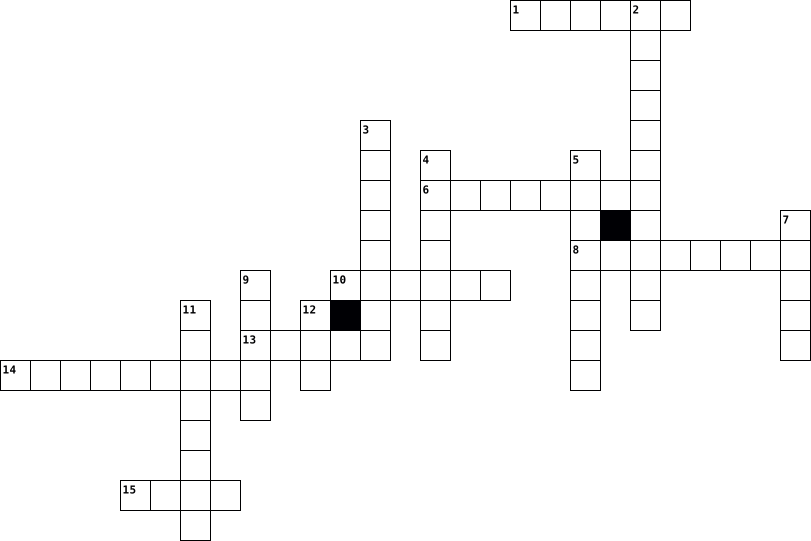
Across
- A special vacation on a big ship that takes you to different places while you enjoy fun activities on board. It's like going on a floating hotel with lots of entertainment and delicious food, and waking up to a new view every day.
- A huge flying machine that takes you up in the sky and carries you to faraway places quickly. It's like sitting in a magical bird and soaring through the clouds to reach new destinations.
- A big bag that you use to pack your clothes and things when you go on a trip. It's like having your own portable closet that you can take with you wherever you go.
- Going on a walk in nature, usually on trails or paths, to enjoy the beautiful scenery and explore new places. It's like being an adventurer in the wilderness, discovering hidden waterfalls, and climbing up mountains to see breathtaking views.
- A long vehicle that runs on tracks and takes you on an exciting journey to different cities and countries. It's like riding on a superfast roller coaster that can also show you beautiful scenery outside the windows.
- Doing something really exciting and daring, like going on a treasure hunt or exploring a jungle. It's like having a thrilling experience and doing things that make your heart race with excitement.
- Going to a different place to have fun and explore new things. It's like taking an adventure to somewhere you've never been before.
Down
- Going to visit famous and interesting places in a new city or country, like museums, landmarks, and beautiful sights. It's like being an explorer and discovering the hidden treasures of a new place.
- A special time when you don't have to go to school or work, and you can relax and do fun things. It's like having a break from your regular routine and going on an exciting holiday.
- Staying outdoors in a tent or a temporary shelter, usually in a forest or near a lake. It's like having a sleepover in nature, where you can roast marshmallows over a campfire and sleep under the stars.
- A special booklet that allows you to travel to different countries. It's like having a magical key that opens the doors to other parts of the world.
- A sandy or pebbly area by the ocean, lake, or river where you can relax, build sandcastles, and swim in the water. It's like having a giant natural playground where you can have fun in the sun and splash around in the waves.
- A comfortable place where you can stay and rest when you're away from home. It's like having a cozy home with a comfy bed, where someone else takes care of cleaning and cooking for you.
- A special item or keepsake that you buy or collect during your travels to remember the places you've been to. It's like having a little treasure that brings back memories of your exciting adventures and the new friends you've made.
- A special drawing that shows you the different locations and directions of places. It's like having a treasure map that guides you to exciting discoveries and helps you find your way in a new city or country.
15 Clues: Going to a different place to have fun and explore new things. It's like taking an adventure to somewhere you've never been before. • A special booklet that allows you to travel to different countries. It's like having a magical key that opens the doors to other parts of the world. • ...
__________ and __________ 2015-07-03

Across
- beaver, ermine, otter
- City opening column
- Dutch exotic dancer
- Large medizing city
- Surrendered by the Duke of Ragusa at Montmartre
- West Point seller
- Judas identification
- Lost Jaffa, got plague
- Collaboratrice hair
- Rhodes' diamonds
- Atomic espionage couple
- Mir Jafar won him Plassey
- Vichy president
- Et tu?
- Last of Portuguese India
- One of the themes of this crossword
- Maintained kontors
- Visited Kublai Khan
- Fugger, Peruzzi, Rothschild
- Destroyed by Lin Zexu
- Exposed Catiline
- Sailed around Africa to India
Down
- Batavia settlers
- Manchukuo emperor
- Cortez mistress
- Atlantic exchange shape
- Gunpowder plot leader
- Argued for the Sicilian Expedition
- One of the themes of this crossword
- Maastricht financial creation
- La Serenissima
- ____ of the Erythrean Sea
- Bligh's ship
- Caribbean "white gold"
- "Giant sucking sound"
- Collaborator, in Norwegian
- Pumpkin Papers target
- Skane market good
- Battle of the Atlantic unit
- Asian road
40 Clues: Et tu? • Asian road • Bligh's ship • La Serenissima • Cortez mistress • Vichy president • Batavia settlers • Rhodes' diamonds • Exposed Catiline • Manchukuo emperor • West Point seller • Skane market good • Maintained kontors • City opening column • Dutch exotic dancer • Large medizing city • Collaboratrice hair • Visited Kublai Khan • Judas identification • beaver, ermine, otter • Gunpowder plot leader • ...
__________ and __________ 2015-07-03

Across
- Battle of the Atlantic unit
- Manchukuo emperor
- West Point seller
- Exposed Catiline
- Maintained kontors
- Large medizing city
- Atlantic exchange shape
- One of the themes of this crossword
- Maastricht financial creation
- Vichy president
- ____ of the Erythrean Sea
- Caribbean "white gold"
- Gunpowder plot leader
- Argued for the Sicilian Expedition
- Judas identification
- Mir Jafar won him Plassey
- Et tu?
- Lost Jaffa, got plague
- Pumpkin Papers target
- Asian road
- Sailed around Africa to India
Down
- Skane market good
- La Serenissima
- Visited Kublai Khan
- Batavia settlers
- Rhodes' diamonds
- Dutch exotic dancer
- "Giant sucking sound"
- Atomic espionage couple
- Cortez mistress
- Surrendered by the Duke of Ragusa at Montmartre
- Collaboratrice hair
- Beaver, ermine, otter
- One of the themes of this crossword
- Collaborator, in Norwegian
- Fugger, Peruzzi, Rothschild
- City opening column
- Last of Portuguese India
- Bligh's ship
- Destroyed by Lin Zexu
40 Clues: Et tu? • Asian road • Bligh's ship • La Serenissima • Cortez mistress • Vichy president • Batavia settlers • Rhodes' diamonds • Exposed Catiline • Skane market good • Manchukuo emperor • West Point seller • Maintained kontors • Visited Kublai Khan • Dutch exotic dancer • Large medizing city • Collaboratrice hair • City opening column • Judas identification • "Giant sucking sound" • Beaver, ermine, otter • ...
__________ and __________ 2015-07-04

Across
- Fugger, Peruzzi, Rothschild
- Collaborator, in Norwegian
- Manchukuo emperor
- North German league
- Pumpkin Papers target
- Asian road
- Atlantic exchange shape
- Indonesia colonizers
- One of the themes of this crossword
- Argued for the Sicilian Expedition
- One of the themes of this crossword
- West Point seller
- Gunpowder plot leader
- Battle of the Atlantic unit
- Lost Jaffa, got plague
- Mir Jafar won him Plassey
Down
- Cortez mistress
- Et tu?
- Cause of the Unequal Treaties
- Visited Kublai Khan
- Sailed around Africa to India
- Judas identification
- Caribbean "white gold"
- Surrendered by Marmont at Montmartre
- Atomic espionage couple
- Exposed Catiline
- Perot's "giant sucking sound"
- Vichy president
- Beaver, ermine, otter
- The Queen of the Adriatic
30 Clues: Et tu? • Asian road • Cortez mistress • Vichy president • Exposed Catiline • Manchukuo emperor • West Point seller • Visited Kublai Khan • North German league • Judas identification • Indonesia colonizers • Pumpkin Papers target • Gunpowder plot leader • Beaver, ermine, otter • Caribbean "white gold" • Lost Jaffa, got plague • Atlantic exchange shape • Atomic espionage couple • ...
__________ and __________ 2015-07-03

Across
- Won Rocroi, lost the Dunes
- Et tu?
- Battle of the Atlantic unit
- Collaboratrice hair
- Skane market good
- Manchukuo emperor
- Argued for the Sicilian Expedition
- Pumpkin Papers target
- Collaborator, in Norwegian
- "Giant sucking sound"
- West Point seller
- Translated St. Mark
- One of the themes of this crossword
- Asian road
- Batavia settlers
- Hanseatic post
- Bligh's ship
- Surrendered by the Duke of Ragusa
Down
- Destroyed by Lin Zexu
- Fugger, Peruzzi, Rothschild
- British atomic spy
- Helped by Mir Jafar
- Vichy PM
- ____ of the Erythrean Sea
- Victor of Valmy
- Lost in Operation Vijay
- Dutch exotic dancer
- Rhodes' diamonds
- Atlantic exchange shape
- Fur company
- Cortez mistress
- Sailed around Africa to India
- Caribbean "white gold"
- Maastricht financial creation
- City opening column
- Judas identification
- Visited Kublai Khan
- One of the themes of this crossword
- Lost Jaffa, got plague
- Large medizing city
40 Clues: Et tu? • Vichy PM • Asian road • Fur company • Bligh's ship • Hanseatic post • Victor of Valmy • Cortez mistress • Rhodes' diamonds • Batavia settlers • Skane market good • Manchukuo emperor • West Point seller • British atomic spy • Helped by Mir Jafar • Collaboratrice hair • Dutch exotic dancer • City opening column • Visited Kublai Khan • Translated St. Mark • Large medizing city • Judas identification • ...
__________ and __________ 2015-07-03

Across
- Pumpkin Papers target
- Rhodes' diamonds
- West Point seller
- One of the themes of this crossword
- Cortez mistress
- Lost Jaffa, got plague
- Collaborator, in Norwegian
- Vichy PM
- One of the themes of this crossword
- Manchukuo emperor
- Caribbean "white gold"
- Atlantic exchange shape
- Victor of Valmy
- Destroyed by Lin Zexu
- Fur company
- Asian road
- Hanseatic post
- Translated St. Mark
- Large medizing city
- Visited Kublai Khan
- "Giant sucking sound"
- Batavia settlers
Down
- British atomic spy
- Skane market good
- Fugger, Peruzzi, Rothschild
- Helped by Mir Jafar
- Won Rocroi, lost the Dunes
- Lost in Operation Vijay
- Argued for the Sicilian Expedition
- Dutch exotic dancer
- Surrendered by the Duke of Ragusa
- ____ of the Erythrean Sea
- Maastricht financial creation
- Judas identification
- Et tu?
- Battle of the Atlantic unit
- Collaboratrice hair
- Bligh's ship
- Sailed around Africa to India
- City opening column
40 Clues: Et tu? • Vichy PM • Asian road • Fur company • Bligh's ship • Hanseatic post • Cortez mistress • Victor of Valmy • Rhodes' diamonds • Batavia settlers • Skane market good • West Point seller • Manchukuo emperor • British atomic spy • Helped by Mir Jafar • Dutch exotic dancer • Translated St. Mark • Collaboratrice hair • Large medizing city • Visited Kublai Khan • City opening column • Judas identification • ...
Alphabet "I" 2023-06-19

Across
- cream It is a frozen dessert made from dairy products, sugar, and flavorings. It is enjoyed for its creamy texture and sweet taste. It comes in various flavors, such as chocolate, vanilla, and strawberry, and it can be served in cones, cups, or as toppings for other desserts.
- It is a dome-shaped shelter made of blocks of ice or compacted snow. It is traditionally used by indigenous peoples, such as the Inuit, as a temporary dwelling in Arctic regions.
- It is a liquid or paste used for writing, drawing, or printing. It usually has a colored pigment and can be applied using pens, brushes, or printing machines. It comes in different types, including water-based, oil-based, and permanent ink.
- It is a global network of computers that allows people to access and share information, communicate, and engage in various online activities. It enables browsing websites, sending emails, using social media, and accessing online services and resources.
- It is a tool or device used to perform a specific task or create music. Musical instruments, such as guitars, pianos, and drums, produce sounds.
Down
- It is a piece of land surrounded by water. It is typically smaller than a continent and larger than a rock or islet. It can be found in oceans, seas, lakes, or rivers and are often known for their unique ecosystems and natural beauty.
- It is a thought, concept, or notion that arises in the mind. It represents a mental image or understanding of something and can lead to inventions, creativity, and problem-solving. It can be shared through communication and can shape our actions and beliefs.
- It is a small animal with a segmented body, three pairs of legs, and often wings. They are the most diverse group of animals on Earth, with millions of known species. They play important roles in ecosystems as pollinators, decomposers, and as a food source for other animals.
- It is a piece of land surrounded by water. It is typically smaller than a continent and larger than a rock or islet. It can be found in oceans, seas, lakes, or rivers and are often known for their unique ecosystems and natural beauty.
- It is the solid form of water that occurs when its temperature is below freezing point. It is transparent and can be found in various forms, such as ice cubes, icicles, or icebergs. It is commonly used to cool drinks, preserve food, or for recreational activities like skating or ice hockey.
10 Clues: It is a tool or device used to perform a specific task or create music. Musical instruments, such as guitars, pianos, and drums, produce sounds. • It is a dome-shaped shelter made of blocks of ice or compacted snow. It is traditionally used by indigenous peoples, such as the Inuit, as a temporary dwelling in Arctic regions. • ...
The Enchanted Library 2023-06-01

Across
- Concealed or not easily noticed or discovered.
- A passage from one place to another, often involving adventure or exploration.
- A mythical creature resembling a small human, often depicted as living underground.
- Exceptional or remarkable, surpassing the ordinary.
- A small, babbling stream or creek.
- Withstood the effects of weather or endured difficult conditions.
- Close in proximity or distance.
- A strong desire to know or learn about something new or unusual.
- Relating to the internal or spiritual aspects of oneself.
- Investigated or examined thoroughly, often in search of new discoveries.
- Moving air currents, often associated with natural forces and weather conditions.
- In the early stage of life or development.
- Came across or met with someone or something unexpectedly.
- Exciting or exhilarating, causing a surge of adrenaline or anticipation.
- Observed or became aware of something or someone.
- A soft or hushed voice or sound, often conveying a secret or confidential message.
- The body part at the end of the arm, used for grasping or touching.
- Successfully arrived at a destination or achieved a goal.
- Playfully causing trouble or mischief.
- Filled with motivation or influenced by someone or something to create or achieve.
- Longed for or desired intensely.
- Scenic vistas and natural environments, often depicted in paintings or photographs.
- Set on fire or sparked, often referring to enthusiasm or passion.
- Information, skills, or understanding gained through learning or experience.
- The act of making physical contact or having an impact on something.
- A nocturnal bird of prey known for its wisdom and ability to rotate its head.
Down
- Creative thoughts or mental images that form in one's mind.
- Bringing something into existence through imagination or artistic expression.
- Possessing deep knowledge and understanding.
- A sight or view that leaves you speechless with its beauty or grandeur.
- A dense area of trees, often associated with a sense of mystery or tranquility.
- Supernatural or extraordinary powers or events that defy logical explanation.
- Completely absorbed or engrossed in something.
- Forms or configurations with distinct outlines or boundaries.
- A sequence or set of related events or objects.
- To solve or understand something that was previously a mystery or puzzle.
- Genuine or accurate, in alignment with reality.
- Secrets or enigmas that provoke curiosity and intrigue.
- An event or occurrence that leaves a lasting impression or lesson.
- Marvelous or awe-inspiring things or phenomena.
- Recently discovered or obtained.
- To begin a journey or venture, often with excitement or anticipation.
- A name or label given to a work of art, book, or other creative piece.
- Devoted or committed to a particular purpose or cause.
- Bravery in the face of fear or adversity.
- The capacity or possibility for development, growth, or success.
- Discovered or located.
- A season characterized by the return of growth and warmer temperatures.
- Actively looking for someone or something.
- Extending far down or inward, often metaphorically referring to profound thoughts or emotions.
50 Clues: Discovered or located. • Close in proximity or distance. • Recently discovered or obtained. • Longed for or desired intensely. • A small, babbling stream or creek. • Playfully causing trouble or mischief. • Bravery in the face of fear or adversity. • In the early stage of life or development. • Actively looking for someone or something. • ...
inventions that will save the world 2020-06-09

Across
- the creator is robert taylor and is a container to avoid touching something that everyone has touched.
- It takes 20 minutes and serves to clean a place throughout the day, I think George Charles.
- Toyota I think so, and it is to look at alternatives besides gasoline.
- it was invented by boyan slat and it is used to remove garbage from the sea and among other places.
Down
- It is not known if they created it, but there are people who no longer use gasoline.
- ecorobot invented it to filter the recycling and separate it.
- Oppian created them and is to prevent marine animals from being trapped.
- Horace de Saussure created them to avoid the consumption of gas and electricity.
- serves to prevent injury or infection, I think John Hopkins.
- the invention pierre lallement and serves to move without energy.
10 Clues: serves to prevent injury or infection, I think John Hopkins. • ecorobot invented it to filter the recycling and separate it. • the invention pierre lallement and serves to move without energy. • Toyota I think so, and it is to look at alternatives besides gasoline. • Oppian created them and is to prevent marine animals from being trapped. • ...
Starred inventions in the industrial revolution. 2024-01-11

Across
- Home based machine that spun thread eight times faster than when spun by hand.
- Rapid communications across continents.
- Human speech heard across continents.
- Water powered spinning machine that was too large for use at home which led to the creations of factories.
- Combined the spinning jenny and the water frame into a single device increasing the production of fine thread.
Down
- Hand operated machine which increased the speed of weaving.
- Device separated raw cotton from cotton seeds increasing the cotton supply while lowering the price for raw cotton.
- United States and Europe connected by cable.
- Speed of sewing greatly increased.
- Water powered device that wove thread to cloth.
10 Clues: Speed of sewing greatly increased. • Human speech heard across continents. • Rapid communications across continents. • United States and Europe connected by cable. • Water powered device that wove thread to cloth. • Hand operated machine which increased the speed of weaving. • Home based machine that spun thread eight times faster than when spun by hand. • ...
Starred inventions in the industrial revolution. 2024-01-11

Across
- Home based machine that spun thread eight times faster than when spun by hand.
- Rapid communications across continents.
- Human speech heard across continents.
- Water powered spinning machine that was too large for use at home which led to the creations of factories.
- Combined the spinning jenny and the water frame into a single device increasing the production of fine thread.
Down
- Hand operated machine which increased the speed of weaving.
- Device separated raw cotton from cotton seeds increasing the cotton supply while lowering the price for raw cotton.
- United States and Europe connected by cable.
- Speed of sewing greatly increased.
- Water powered device that wove thread to cloth.
10 Clues: Speed of sewing greatly increased. • Human speech heard across continents. • Rapid communications across continents. • United States and Europe connected by cable. • Water powered device that wove thread to cloth. • Hand operated machine which increased the speed of weaving. • Home based machine that spun thread eight times faster than when spun by hand. • ...
Matchless Inventions that changed our lives 2024-04-17

Across
- Machine for transmitting images through telephon
- Place where movies are shown
- Electronic device for storing and processing data
- Device used for watching programs and shows
- Printed format containing news and information
Down
- Material used for writing
- Vehicle used for air travel
- Produces light when electricity passed
- Written message sent to someone.
- Device for broadcast news and music
10 Clues: Material used for writing • Vehicle used for air travel • Place where movies are shown • Written message sent to someone. • Device for broadcast news and music • Produces light when electricity passed • Device used for watching programs and shows • Printed format containing news and information • Machine for transmitting images through telephon • ...
Everyday Inventions We Use Without Thinking 2026-01-26

Across
- Scoops food or soup
- Removes pencil marks
- Closes jackets and bags
- Fastens clothes easily
Down
- Lets doors swing open
- Tool for eating food
- Makes movement easier
- Helps you hold things
- Connects devices to power
- Keeps things secure
10 Clues: Scoops food or soup • Keeps things secure • Tool for eating food • Removes pencil marks • Lets doors swing open • Makes movement easier • Helps you hold things • Fastens clothes easily • Closes jackets and bags • Connects devices to power
Inventions That Help People Stay Safe 2026-01-26

Across
- Makes warning sounds
- Cushions during crashes
- Protects your head
- Helps escape danger
- Covers mouth and nose
Down
- Blocks dangerous areas
- Holds you in place
- Protect eyes from harm
- Protect hands from cuts
- Warns of trouble
10 Clues: Warns of trouble • Holds you in place • Protects your head • Helps escape danger • Makes warning sounds • Covers mouth and nose • Blocks dangerous areas • Protect eyes from harm • Cushions during crashes • Protect hands from cuts
4. Inventions That Help People Communicate 2026-01-26

Across
- Lets people talk far away
- Sends sound through air
- Written message
- Shows words or images
- Digital message sent
- Types letters
Down
- Sends a message
- Plays sound aloud
- Makes paper copies
- Takes pictures
10 Clues: Types letters • Takes pictures • Sends a message • Written message • Plays sound aloud • Makes paper copies • Digital message sent • Shows words or images • Sends sound through air • Lets people talk far away
Inventions of the First Industrial Revolution 2026-04-13

Across
- An engine that uses the expansion or rapid condensation of steam to generate power.
- A machine that could spin several threads at once
- A device that cuts grain
- A device that used electrical signals to send messages quickly over long distances
Down
- Identical components that can be used in place of one another in manufacturing
- a keyboard machine for writing mechanically in characters resembling print.
- Made farming more efficient because it cut through the soil quicker
- a new spinning device that enabled weaves to work fast enough to outpace spinners
- A machine for separating cotton from its seeds.
- Fast, multi-masted sailing ship. Used by U.S. merchants for trans-Pacific trade.
10 Clues: A device that cuts grain • A machine for separating cotton from its seeds. • A machine that could spin several threads at once • Made farming more efficient because it cut through the soil quicker • a keyboard machine for writing mechanically in characters resembling print. • Identical components that can be used in place of one another in manufacturing • ...
Reading Vocabulary 2017-06-08

Across
- the past of sing
- free from moisture;not wet
- the part of a room that forms its lower surface and upon which one walks
- a closed curve consisting of all the points at a given distance from the center
- plural of foot
- to leap or spring off the ground or other support by a sudden muscular effort
- the lowest or deepest part of anything
- the past of follow
- plural of leaf
- to be an addition
- formally engaged in studying, learning, or training at a school
- the plural of child
- the past of know
- involving responsibility
- having very little or no light
- a fish that lures prey with a fleshy lobe attached to a filament that arises from the snout and hangs in front of the mouth. Most anglerfishes have a very large head and wide mouth, with a small body and tail
- the past tense of visit
- the planet on which human beings live, third in order from the sun
- becoming greater in quantity, size, extent, or intensity
- the plural of root
- creatures other than a human being
- the vast body of salt water that covers almost three-fourths of the earth's surface
- to go to and stay with (a person or family) or at (a place) for a short time
- timber or lumber
- a group of students meeting regularly
- bodies of water smaller than a lake
Down
- so as no longer to be supported by, resting on, etc
- the plural of stick
- extending far down from the top or surface
- a sea creature having a soft, oval body and eight tentacles with suckers on them
- to make (a house, etc.) by putting together parts
- a parklike area in which live animals are kept in cages or large, closed-off areas so that the public can view them
- of or relating to the front; situated in or at the front
- the past of plant
- a large, long motor vehicle equipped with seating for passengers
- to give attention with the ear;pay attention for the purpose of hearing
- the acts of discovering
- the way or manner of arranging things to follow one after another; succession
- exciting the attention;intriguing
- wet, soft dirt
- armlike divisions of the stem of a tree or shrub
- in or to a higher place than;over
- a stinging, jellylike sea creature
- to provide what is necessary to accomplish a task or satisfy a need;aid;assist
- the plural of plant
- natural streams of water flowing in a definite course
- giving off bright light or heat without flame
- to infer or guess at (something not expressed) from what is read, considered, or observed
- the portion of the earth's surface made up of humus;earth
- a part of the body of a plant that develops downward into the soil
- the salt waters that cover the greater part of the earth's surface;ocean
51 Clues: plural of foot • plural of leaf • wet, soft dirt • the past of sing • the past of know • timber or lumber • the past of plant • to be an addition • the past of follow • the plural of root • the plural of stick • the plural of child • the plural of plant • the acts of discovering • the past tense of visit • involving responsibility • free from moisture;not wet • having very little or no light • ...
Literary Techniques 2022-12-14

Across
- Comparing two objects, and object and a person, etc. using ‘like’ or ‘as’ to draw parallels between them.
- The ideas, feelings or concepts associated with specific words, phrases or situations that go beyond their literal meaning.
- A sentence ending with a “!” or said with a tone of shock/excitement is used to express high emotion – e.g. sudden revelations, important discoveries or enthusiasm.
- A direct comparison of two things where you say one is the other
- The use of several conjunctions in close succession, especially where some might be omitted.
- Words used to create an idea or mental image of something, most often found in descriptions or created through descriptive language.
- A disconnect between what is said and what is meant, usually with the words said having a second insulting, humorous or satirical meaning.
- A word that it the ‘sound’ of what it represents, allowing the reader to ‘hear’ what is occurring.
- The act of hinting at or setting up a situation, event or action that will later be extremely important in the narrative but doesn’t seem important at the time.
- A subtle or passing reference to an event, person, place, other text, etc. that is intended to be noticed by readers
- Any situation wherein the audience is privy to some sort of information that the characters do not know, building audience tension, suspense, etc.
- Placing one character, idea, theme, object, setting, etc. parallel to another in order to compare and contrast the two.
- Comparing two things by saying that one ‘is’ the other in order to draw stronger comparisons and often add a level of figurative meaning.
- omission of the conjunctions that ordinarily join coordinate words or clauses
- A specific from of alliteration involving the repetition of ‘s’ within a phrase or sentence.
- The overall message or moral of a narrative which is intended to cause audiences to think on real-life issues or moral questions.
- Two contradictory words or concepts used together to create a strange or complex thing/idea that still makes sense.
Down
- Similar to alliteration, however in this case it is vowel sounds that are repeated.
- An idea, symbol, object, concept or theme that is always present throughout an entire text, playing a significant and/or symbolic role in the narrative.
- Repetition of consonants at the beginning of successive words or within sentences/phrases to create a sense of rhythm
- The attributing of human characteristics to non-human objects, by which inanimate objects appear to have life and/or feelings.
- The strength or force of a word
- A question that is asked without the intent of receiving an answer because the answer itself is obvious.
- The purposeful over-exaggeration of a statement in order to create a more intense or over-the-top effect.
- When an object, person, etc. represents a more complex idea, concept or theme.
- Any situation wherein two different or opposing things are presented together in order to highlight their differences.
- Words chosen to create a specific emotional response in the reader, often linked to the word’s connotations and commonly used in highly emotional or descriptive scenes/situations.
- Repetition of a word or expression at the beginning of successive phrases, clauses, sentences, or verses
- The process by which characters are introduced, described and then fully formed through their choices, interactions,
29 Clues: The strength or force of a word • A direct comparison of two things where you say one is the other • omission of the conjunctions that ordinarily join coordinate words or clauses • When an object, person, etc. represents a more complex idea, concept or theme. • Similar to alliteration, however in this case it is vowel sounds that are repeated. • ...
214 - Green inventions for a sustainable future 2019-05-21

Across
- utslipp
- her: ferge i skytteltrafikk
- kilde
- drivstoffeffektiv
- transportmiddel
- miljøvennlig
- drevet av solenergi
- avhengig av
Down
- Her: vindmølle
- fornybar energy
- å være opptatt av noe
- jordvarme
- å fortvile
13 Clues: kilde • utslipp • jordvarme • å fortvile • avhengig av • miljøvennlig • Her: vindmølle • fornybar energy • transportmiddel • drivstoffeffektiv • drevet av solenergi • å være opptatt av noe • her: ferge i skytteltrafikk
Vocab #2 2024-09-29

Across
- A hieroglyphics are a system of writing that uses pictures. The word translates to “sacred carving” in Greek. These were mostly found carved in stone, and was popularized by the Greeks.
- This is a group of rulers that rule over a country/kingdom that all come from the same family. A modern day example occurs in Saudi Arabia.
- The _______ is defined as the first five books of the Old Testament, which is also known as the Hebrew Bible.
- This is an ancient religion that originated in Iran. It is one of the oldest monotheistic religions. It was the main religion of the Persian Empire and its dynasties.
- The rulers of ancient Egypt were often referred to as _______s. ________s were often thought to be the connection between humans and God. They were even considered as God’s son. They would own large portions of Egyptian land and had the most power and authority.
- These were given to Moses, a Hebrew prophet, by God himself. These outline how to worship God(such as celebrating Sabbath day), and also what actions are not allowed(like murder and stealing.)
- This term is defined as the spreading out of people from their original birthplace or homeland. For example, slavery was an example of this, when Africans were separated from their homeland, Africa, and brought to the Americas.
- A ______ is a governmental body made up of officials who were not elected but still act as an administrative group that can make rules and decisions. For example, all the U.S departments, like the Department of Defense or the Department of Labor, are all _______s.
- This is the belief in only one god. Many religions are have this characteristic, like Christianity.
Down
- This is a governmental system in which rulers rule in the name of God. What they say is correct, as they are divine.
- This is the belief in many gods. Many religions have this characteristic, like Hinduism and Buddhism.
- A city in a territory that serves as the main area for political, economic, and cultural development and life. For example, Singapore and Monaco are these types of cities.
- A system in society in which members of the society are separated in different classes or ranks based on different factors.
- This is a large territory that is ruled by one person with the most or all of the authority.
- The Iron Age started around 1100 B.C. This age is marked by the use of iron and steel to make tools and weapons.
- A ______ is an amount of something, usually food, that is left over even after the necessary amount of that thing is used. For example, humans began making permanent settlements and turning to crafts because they had a ______ of food.
- This civilization is located in the Middle East, and is part of the Fertile Crescent. It is one of the first permanent human civilizations. Humans began writing in cuneiform and made agricultural inventions.
- This was an area located in northeastern Africa along the Nile River. Due to its position, it was key in transporting goods. It is also known for having rich deposits of gold.
18 Clues: This is a large territory that is ruled by one person with the most or all of the authority. • This is the belief in only one god. Many religions are have this characteristic, like Christianity. • This is the belief in many gods. Many religions have this characteristic, like Hinduism and Buddhism. • ...
STEM Lesson 4A 2024-11-08

Across
- The groundbreaking technology that you create inevitably fuels your __________ to tackle even greater challenges in the field of innovation.
- The possibilities of artificial intelligence seem __________ expanding, allowing for unprecedented advancements in numerous fields.
- Every experiment conducted in the lab serves _______ by contributing valuable data that could change our understanding of various phenomena.
- It's not worth _________ anymore since they lost the patent and now it's open to the public.
- I would love _______ (meet) you when we were younger.
- It was __________ evident that the latest innovation could revolutionize our approach to renewable energy sources.
- Innovators constantly strive for excellence, pushing the _________ of what is currently possible to enhance our daily lives through new inventions.
- The implications of neglecting sustainable practices are _________ concerning and warrant immediate attention from innovators.
- Thanks for _______ (come) to my presentation! I was very excited to see you in the crowd.
- To truly make an impact in the world of technology, you must pursue your _________ with unwavering determination and creativity.
- The researchers promised to share their findings _________ after the completion of their groundbreaking experiment.
- Innovative breakthroughs often emerge as scientists endeavor to satisfy ____________ curiosity about the mysteries of the universe and our existence.
- I didn't enjoy ______ (call) out in front of everyone for something that could have been an email.
Down
- The new technology __________ enhances productivity across various industries, reshaping traditional workflows.
- Some critics _______ speculated about the potential dangers of this untested technology in everyday life.
- The innovative app that she developed has finally allowed her to realise a ______ of revolutionizing how we manage our time effectively.
- Our organization is actively seeking philanthropists who can back a research _______ aimed at developing sustainable energy solutions for future generations.
- While _______ (wait)for the team to arrive, we starting talking about the project.
- The team had to put off ______ (work) in the project until the manager approved the final changes to the plan.
- This meeting is yet ________ (resume) after they can solve the connectivity issues.
- They weren't allowed ________ (name) our product after our name since it violated company policies.
- She __________ argued that investing in innovative ideas is crucial for staying competitive in the market.
- The main aim of this alliance is ______ (create) a plan that can fit both of our interests.
- In order to bring their visionary concept to life, the team needed to raise ________ from investors willing to believe in their potential.
- I just want you to know - I admire you for _____ (speak) your mind and standing up to him. It was really brave.
- The proposal seemed ___________ ambitious at first, yet it sparked a wave of enthusiasm among the stakeholders.
- The team's ___________ original concepts captivated investors at the annual tech conference, showcasing their potential.
- We felt inclined _______ (accept) after hearing their pitch. It was quite convincing!
- The team is committed to ________ (present) a sustainable and innovative project by 2025.
29 Clues: I would love _______ (meet) you when we were younger. • While _______ (wait)for the team to arrive, we starting talking about the project. • This meeting is yet ________ (resume) after they can solve the connectivity issues. • We felt inclined _______ (accept) after hearing their pitch. It was quite convincing! • ...
Digital Citizenship #2 BONUS 2020-12-16

Across
- Malicious software or code (trojan horses, worms, spyware, adware, etc.) that is design to damage a computer/device or collect information.
- The ability to access, analyze, evaluate and create media in a variety of forms.
- Respecting those that are different from you.
- Art, books, inventions, magazines, movies, music, performances, reports, software, stories created by you or by others.
- Someone who takes action to stop bullying behavior or other inappropriate behavior.
- A program that duplicates itself and spreads throughout your computer/device destroying files, changing data and hogging all your memory. They damage software, not hardware (your computer/device).
- Programming code with limited or no copyright restrictions, allowing you legally modify and share the software program.
- A virus that replicates itself, but does not change any files on your computer/device. They can multiple may times and take up all the available memory on your computer/device.
- Software that goes on your computer/device without your knowledge and steals private information.
- The process by which an individual can send or post a file to the internet.
- Techniques that scammers use to collect personal information from unsuspecting users. They may use false emails or websites where you have to enter information, that look real.
- A program that searches information on the Internet by looking for specific keywords.
Down
- Using someone else's words or ideas and passing them off as your own.
- Related to the Fourth Amendment which protects citizens' privacy in places such as: Places of residence, Restrooms, Changing rooms...etc
- To put something at risk, such as your reputation or digital footprint.
- Theft of intellectual property. In other words, stealing what does not belong to you. Usually, refers to music and videos.
- A word you use when looking for information on a search engine (Google, Yahoo, etc.)
- Means to cause harm to someone or something on purpose.
- Someone who is harmed by another person or persons.
- Courtesy, honesty and polite behavior while on the Internet
- Discomfort in the neck and spine from spending long periods of time looking down at your smartphone. The angle at which our big heads look down forces our spine to bear the weight of approximately 60 pounds. The habit may lead to people requiring medical spine care at a younger age. Being mindful of how far your neck bends when you're on your phone — and bending it back to an upright position — can help reduce the risk of text neck.
- The secret word or combination of letters, numbers and symbols you use to sign in to the Internet or an online service to help confirm your identity.
- Horse Software programs that hide inside regular programs, such as games or utilities. If run, these programs can do great harm to your computer/device. Compared to an event in Greek mythology.
- One who stalks or uses lies, secrecy, or stealth, to get close enough to another person in order to easily hurt or harm them.
- An upgrade, bug fix, a new hardware driver or update to fix new issues such as security or stability problems.
- The practice of spying on the user of an ATM, computer, or other electronic device in order to obtain their personal access information.
- Your right to determine what information you would like others to know about you.
27 Clues: Respecting those that are different from you. • Someone who is harmed by another person or persons. • Means to cause harm to someone or something on purpose. • Courtesy, honesty and polite behavior while on the Internet • Using someone else's words or ideas and passing them off as your own. • To put something at risk, such as your reputation or digital footprint. • ...
Post Classical Era Crossword 2021-09-21

Across
- money houses along the silk road
- type of Islam that has less numbers
- name for entire region where Islam was present
- land trade route in Asia
- major cooling period in Europes
- mystic version of Islam
- invented in China but spread along the Silk Roads
- syncretic language used in Pakistan
- important trading inventions
- major city on the Silk roads known for trading crafts
- major city in South Africa that built a wall without mortar
- civilization that Migrated due to Agriculture in Africa
- Samurai code of conduct
- major city in mali
- system used to have men 15-50 work in the fields
- area ruled by a caliph
- empire in Americas that used the concept of zero
- empire in Americas that spanned the Andes
- updated form of Confucianism
- founder of Mali
- empire in Korea
- gave more control to ships
- religion in Japan
- empire in Americas that used human sacrifice
- counting system used in trade in the Inca civilization
- major ruling dynasty in China
- triangular sail
- Movement of people away from homeland in large numbers
- inns along the silk road
- learning center and library in Baghdad
- city that had multiple religions along the silk roads
Down
- capital of the aztec empire
- area ruled by a sultan
- government system in Europe after the fall of the Roman empire
- syncretic language used in East Africa
- groups of people who went to the holy land to try to fight the Muslims there
- man who founded an empire using gunpowder
- ruler of sections of government in Japan
- Muslim who traveled all over Eurasia and Africa
- time of Great peace brought about by the Mongol Empire
- making things assimilate to Chinese ways
- killed one third of Europes population
- workers on manors that were the lowest class
- trade route in Northern Africa
- breakdown of the Mongol empire
- document that limited the power of the king
- battle between Abbasids and Song China
- fast growing rice brought to China from Vietnam
- used to navigation
- technology that allowed for better navigation
- European who traveled to China
- explorer from China
- war fought between England and France
- group of Mongols who fought the Rus
- major city in the Mississippi area
- floating gardens
- Chinese style ship
- type of ship known for using lateen sail
- type of Islam that is more to the Quran
- religious text of islam
- island of Christianity in Africa
- largest Buddhist temple
- wrote first known autobiography in Europe
63 Clues: founder of Mali • empire in Korea • triangular sail • floating gardens • religion in Japan • used to navigation • major city in mali • Chinese style ship • explorer from China • area ruled by a sultan • area ruled by a caliph • mystic version of Islam • Samurai code of conduct • religious text of islam • largest Buddhist temple • land trade route in Asia • inns along the silk road • ...
Econ Vocabulary 2 2025-09-09

Across
- A system of financial institutions that accept deposits from the public, make loans to individuals and businesses, and provide other financial services like managing money, facilitating transactions and creating credit.
- The process of paying employees and the total sum of money a company pays to its employees for a given period.
- A situation where two or more individuals, businesses, regions, or countries rely on each other economically to meet their needs, often due to specialization.
- An individual's total possessions and their assets, including real estate, investments, and other belongings, minus their liabilities which are often considered at the time of death.
- Laws and regulations designed to promote fair competition in the marketplace by preventing monopolies and other practices that restrain trade.
- Branch of economics that studies the economic behavior of individuals, households, and businesses, focusing on how they make choices to allocate limited resources.
- A risk taking individual who identifies opportunities to start new businesses, create new products or services, and organize resources to meet market demands.
- Governments approach to managing the economy using its spending and taxation powers to influence aggregate demand and economic activity.
- The voluntary, mutually beneficial exchange of goods, services, or financial assets between two or more parties such as individuals, companies, or countries.
- The part of the economy composed of businesses, individuals, and other organizations that are not owned or controlled by the government but instead owned by private individuals or groups and are often operated for profit.
- Profit realized from the sale of a capital asset, such as stock, bond, or real estate, for a price that is higher than it's purchase price.
- A direct or indirect financial payment, concession, or privilege granted by a government to individuals, businesses, or institutions to promote a public objective, such as lowering prices, increasing production of a certain good, or supporting a specific industry.
Down
- Branch of economics that studies an entire economy as a whole, focusing on broad factors like national output, unemployment, inflation, and government policies.
- A government imposed limit on the quantity or value of a specific good or service that can be imported or exported over a given period.
- A market situation where a single company or entity has exclusve control over the entire supply of a particular good or service.
- The value of one country’s currency relative to another currency The value of one country’s currency relative to another currency
- The increasing interdependence of the world's economies through increased cross-border trade, investment, and information flow.
- Rules imposed by a government on individuals and firms to alter their economic behavior, often to correct market failures, protect public interests or promote social goals like safety and fairness.
- Intangible assets derived from human creativity, such as inventions, literary and artistic works, designs, and symbols, which grant creators exclusive rights for a limited time to their creations
- A situation where government budget deficits indirectly influence a central bank's monetary policy decisions or actions.
- Income is the flow of economic value an individual or entity receives during a period, including wages, salaries, profits, interest, rent and other forms of compensation or gains minus any costs or losses.
- A business, industry, or service that is owned, controlled, and funded by the government to benefit the public and society rather than to make a profit.
- The governments inherent right to take private property for public use.
- A tax is a compulsory levy imposed by a government on individuals or businesses to raise revenue for public services, regulate economic activity, and redistribute wealth.
- A governmental ban on trade and other commercial activities with a specific county, often used as a political or economic tool to pressure or punish that nation
25 Clues: The governments inherent right to take private property for public use. • The process of paying employees and the total sum of money a company pays to its employees for a given period. • A situation where government budget deficits indirectly influence a central bank's monetary policy decisions or actions. • ...
SAT 2 2025-11-07

Across
- Some corporations use _____ marketing strategies to manipulate consumer behaviour.
- Many people criticize modern society for promoting _____ values such as materialism and comfort over creativity.
- _____ society faces challenges that previous generations could not have imagined.
- The old _____ that “education is the key to success” still holds true today.
- Employers must ensure they do not _____ against applicants based on gender or age.
- Many people have become _____ about the dangers of online misinformation.
- Even critics _____ that technology has improved communication efficiency.
- Academic writing should be _____ to maintain clarity and precision.
- Education plays a vital role in creating a more _____ society.
- Modern cities are becoming more _____ as globalization encourages cultural exchange.
- Income inequality has become increasingly _____ in many developed countries.
- Much of what is said about the future of artificial intelligence remains pure _____.
- Academic performance should not be the sole _____ for university admission.
- Some governments engage in _____ surveillance to maintain national security.
- Without proper regulation, online discussions can quickly _____ into personal attacks.
- Some young people express _____ for traditional customs, viewing them as outdated.
- The rapid advancement of technology has led to the _____ of many traditional industries.
- Governments should _____ environmental laws with strict enforcement to ensure real progress.
- Some modern art forms are criticized for being _____ and lacking originality.
- A _____ education system should develop both academic and practical skills.
- Academic success often depends more on _____ effort than on natural talent.
- Effective teachers can _____ thoughtful responses from even the most reserved students.
- Excessive _____ often slows down the implementation of effective public policies.
- Economic _____ remains a major obstacle to achieving social harmony.
- There is a clear _____ between economic growth and environmental sustainability.
- It is often difficult to _____ the truth amid the vast amount of online information.
Down
- Overreliance on social media can have a _____ impact on mental health.
- To persuade the public, politicians must provide _____ evidence to support their claims.
- Peaceful _____ is an essential component of a functioning democracy.
- Many social movements lie _____ until a major crisis reawakens them.
- _____ inventors have often been responsible for groundbreaking discoveries.
- True social progress cannot be achieved through _____ but through voluntary cooperation.
- Many students still prefer _____ classroom learning to online alternatives.
- In some countries, freedom of speech is _____ by strict censorship laws.
- A rise in unemployment is often a _____ of economic recession.
- Some social inequalities seem almost _____, passed down through generations.
- Climate change presents a _____ reason for nations to invest in renewable energy.
- True happiness can be _____ in a world driven by material success.
- Animal testing remains one of the most _____ issues in scientific research.
- History books serve as a _____ of humanity’s triumphs and failures.
- A _____ argument is crucial in academic writing to convey ideas effectively.
- The _____ between rich and poor nations continues to widen.
- After much _____, policymakers agreed to introduce stricter climate policies.
- Harsh penalties act as a _____ against violent crime.
- Maintaining _____ behaviour in public debates is essential for a healthy democracy.
- The government took _____ steps to reduce carbon emissions.
- The media sometimes presents a _____ of politicians rather than a balanced perspective.
- There are growing concerns about _____ between big corporations and political leaders.
- There is a growing _____ that environmental protection should be a global priority.
- Some claim that technological progress brings happiness, but this argument seems _____.
50 Clues: Harsh penalties act as a _____ against violent crime. • The _____ between rich and poor nations continues to widen. • The government took _____ steps to reduce carbon emissions. • A rise in unemployment is often a _____ of economic recession. • Education plays a vital role in creating a more _____ society. • ...
The good and the Evil of scientific discoveries 2021-07-05

Across
- Made from wood, and is very thin and now is a big reason for deforestation.
- Burned to produce energy and now producing emissions.
- Was discovered as a material first to make cue balls/billiards ball and now floats in the oceans polluting it.
Down
- Type of waves that help communication over long distances and now ruining the brains of birds, humans.
- The process of getting resources from the ground underneath and now is the reason for habitat loss, air and water pollution.
5 Clues: Burned to produce energy and now producing emissions. • Made from wood, and is very thin and now is a big reason for deforestation. • Type of waves that help communication over long distances and now ruining the brains of birds, humans. • Was discovered as a material first to make cue balls/billiards ball and now floats in the oceans polluting it. • ...
Post Classical 2022-05-24

Across
- captured Constantinople in 1453 and rename it Istanbul; as a result the Byzantine people flee to Italian City-States which becomes a catalyst for the expansion of language and art
- A time when new inventions such as the seed drill and the steel plow made farming easier and faster. The production of food rose dramatically.
- a later emperor of the Songhai empire who was a Mansa Musa copycat;went in a pilgrimage, donated to the poor, and "helped" the economy
- (1337-1453) the wars fought in France between the French and the English. The longbow was introduced and was very effective in battle.
- Artificial waterway constructed under emperor Sui Yangdi which extended about 1240 miles from south to north
- Chinese custom since the Song dynasty; involved fight wrapping of young girls' feet with strips of cloth that prevented natural growth of the bones and resulted in tiny, malformed, curved feet.
- Professional warriors of feudal Japan
- Muhammad's close friend and devoted disciple
- Chinese letter of credit or early form of currency issued by banks to facilitate trade between different locations
- a peasant keader who overthrew the Muslim leader if the Yuan Dynasty because many chinese people despised the Mongols.
- Printed notes issued by Chinese private banks as currency to facilitate commercial transactions beginning in the late 9th century
- (October 25, 732) Charles Martel, the Frankish Leader went against an Islamic army led by Emir Abd er Rahman; the Islamic army was defeated and Emir Abd er Rahman was killed. The battle stopped the northward advancement from Spain
Down
- one if the emperors of the Tang dynasty, he had military skill
- Breaking of icons; destruction of religious images and prohibition of their use in churches; instigated by Leo III
- Religious duties obligatory for al Muslims, including monotheistic belief in Allah, daily prayer, fasting during the month of Ramadan
- A battle between the Byzantine Empire and Seljuk Turks (Muslims) in 1071, where the Byzantine lost
- muslim traveler who visited Kublai Kan's court
- Also known as The Thousand and One Nights; collection of popular tales of adventure and romance set in the Abbasid empire and in the court of Harun al-Rashid.
- 1096 Christian Europe aim to reclaim Jerusalem and aid they Byzantines; 1st success and the rest a failure; weakens the Byzantines; opens up trade, a series of military expeditions in the 11th, 12th, and 13th centuries by Westrn European Christians to reclain control of the Holy Lands from the Muslims
- Large commercial ships favored by Indian, Persian, and Arab sailors
- emperor of the Songhai emoire who conquered the empire and forced them to become Islam
- 1204 CE, the crusaders sacked Constantinople; Byzantium never recovered from the attack.
- major world religion founded by Muhammad ibn Abdullah in the Arabian peninsula
- A powerful medieval pope, he fought with Holy Roman Emperor Henry IV over the power to choose church officials.
- 527-565 CE Byzantine emperor, known for his campaign of rebuilding Constantinople, his codification of Roman law, and his military campaigns that succeeded in control of Italy, Sicily, Northwestern Africa, and southern Spain.
- Ruler of Russian kingdom of Kiev; converted himself and his kingdom to Orthodox Christianity in 989.
- Italian traveler who's tales of his visit to the Yuan court astonished European readers
- Explosive powder discover by Daoist alchemists while seeking elixirs during the 5th century
- When a group of people who spoke the same language moved from Western Africa to southern and eastern Africa
- 843 Treaty that ended power struggle of Charlemagne's 3 sons after his death and split Franks into 3 kingdoms, Charles - France,Lothair - Italy, Louis - Germany
30 Clues: Professional warriors of feudal Japan • Muhammad's close friend and devoted disciple • muslim traveler who visited Kublai Kan's court • one if the emperors of the Tang dynasty, he had military skill • Large commercial ships favored by Indian, Persian, and Arab sailors • major world religion founded by Muhammad ibn Abdullah in the Arabian peninsula • ...
Inventions in the 1900's Crossword 2022-02-22

Across
- Who was a well known left-handed guitarist?(last name)
- Who invented the Polaroid camera?(last name)
- Who created the present day version of Monopoly? (last name)
- What company was Monopoly sold to in 1934?
- Which invention was showed to the public in 1948?
- Which invention sent messages to the youth?
Down
- What game was Monopoly based off of?
- Who invented the electric guitar? (last name)
- Which invention is said to "pertain to human nature?"
- Who inspired the inventor to create the Polaroid camera?
10 Clues: What game was Monopoly based off of? • What company was Monopoly sold to in 1934? • Which invention sent messages to the youth? • Who invented the Polaroid camera?(last name) • Who invented the electric guitar? (last name) • Which invention was showed to the public in 1948? • Which invention is said to "pertain to human nature?" • ...
Starred inventions in the industrial revolution. 2024-01-11

Across
- Home based machine that spun thread eight times faster than when spun by hand.
- Rapid communications across continents.
- Human speech heard across continents.
- Water powered spinning machine that was too large for use at home which led to the creations of factories.
- Combined the spinning jenny and the water frame into a single device increasing the production of fine thread.
Down
- Hand operated machine which increased the speed of weaving.
- Device separated raw cotton from cotton seeds increasing the cotton supply while lowering the price for raw cotton.
- United States and Europe connected by cable.
- Speed of sewing greatly increased.
- Water powered device that wove thread to cloth.
10 Clues: Speed of sewing greatly increased. • Human speech heard across continents. • Rapid communications across continents. • United States and Europe connected by cable. • Water powered device that wove thread to cloth. • Hand operated machine which increased the speed of weaving. • Home based machine that spun thread eight times faster than when spun by hand. • ...
12A Vocabulary Part TWO 2024-02-22

Across
- The governor decided to resign when the press found out he used to ____________ with questionable groups as a teenager.
- The training program was known for its __________, ensuring that participants were well-prepared for challenging situations.
- The hurricane's aftermath did not just damage homes; it managed to __________ entire communities.
- To encourage productivity, the manager offered a financial __________ for employees who exceeded their targets.
- It's essential not to __________ resources on unnecessary expenses to maintain a healthy financial status.
- The organization worked tirelessly to __________ the suffering of those affected by the natural disaster.
- In a rapidly changing market, adaptability is considered __________ for the long-term success of any organization.
- The team faced __________ issues with the software, causing delays in the project timeline.
- A charitable __________ donated a substantial amount to fund the construction of the new community center.
- Witnessing the act of cruelty, she couldn't hide her __________ and promptly reported it to the authorities.
- The decision to __________ eco-friendly practices into our business model was a strategic move towards sustainability.
- The athlete maintained a rigorous training regimen to ensure he remained __________ and at the peak of his physical prowess.
- When faced with overwhelming pressure, some individuals may __________ to stress and burnout.
- The company had to __________ its budget due to financial constraints.
- The __________spy carried out missions without attracting any attention.
Down
- Starting a business in the tech industry can be highly __________, given the constant demand for innovative solutions.
- During the meeting, there was a notable __________ among the members, with some expressing strong disagreement on the proposed policy.
- While giving the presentation, the speaker tended to __________ from the main topic, making it hard for the audience to follow.
- The young artist continued to __________ to become a renowned painter, practicing tirelessly to perfect her craft.
- Despite the optimistic news, the __________ remained skeptical about the company's long-term success.
- The philanthropist's __________ acts included funding education initiatives for underprivileged children.
- The researcher chose to __________ on the potential impact of groundbreaking discoveries in the field.
- To maintain a healthy lifestyle, many people choose to __________ from consuming sugary drinks and snacks.
- The __________ of the beloved betta fish prompted the family to give it a proper funeral.
- Attending the safety training was deemed __________ for all employees to ensure a secure work environment.
- The artist believed that the true beauty of her masterpiece lay in its __________ details, reflecting the core essence of her creative vision.
- The government faced a significant budget __________, requiring careful financial management to address the shortfall.
- Being an __________, she neither denied nor affirmed the existence of a higher power.
- Taking a break for a quick walk in the park served as a pleasant __________ from the demands of a busy workday.
- The criminal's __________ actions earned him a reputation that would forever stain his name.
30 Clues: The company had to __________ its budget due to financial constraints. • The __________spy carried out missions without attracting any attention. • Being an __________, she neither denied nor affirmed the existence of a higher power. • The __________ of the beloved betta fish prompted the family to give it a proper funeral. • ...
Wild Swans 2024-03-19

Across
- A drug that had major trade taking place in Yibin and 25,000 addicts.
- This place was located on a hill overlooking a promontory at the confluence of two rivers.
- A condition in which fluid accumulates under the skin because of malnutrition.
- This item was scarce in the Chengdu Plains.
- These were women assigned to the mother while she was under investigation, they were to “protect” her.
- The age Jung Chang started in the steel production industry.
- Capital of Sichuan
- Jin-Ming (brother) made a number of these, basing them off of illustrations from his science books.
- The first time the mother met her mother- in-law she performed this. It's similar to curtsy.
- They prayed to this religious character for the safe return of the father.
- The local boss announced they would produce ten times more of this crop than before.
- The separation of a couple and it was extremely difficult to do.
- Jung Chang hated all sports but this one.
- A traditional form of pleasure for the Chinese.
- Peach eating was seen as this
- American troops stood on the bank of this river, on the border between Korea and China.
- This filled the Chinese-language textbooks.
- A boarding school's students had a reputation for this.
- Because of the shortage in water the mother was criticized for doing this everyday.
- The grandmother would tell the children if they ate this fruit, a tree of that kind would grow inside of them.
- The grandmother did not want to give these valuables away to the government.
Down
- The idea of this establishment was “mysterious” and “frightening.”
- The month that China exploded its first atomic bomb.
- A name given to anyone who had an education AT ALL.
- This guy was the head of the investigating team.
- A campaign aimed at capitalists.
- Mao called steel the “ ” of industry.
- He was both a leader of the gang and one of the “snakes in their old haunts.”
- Officials had this day off every week.
- Mao found grass, flowers, and pets to be this.
- People in China become familiar with each other pretty easily, especially this gender.
- Every peasant had to eat here.
- A political party that had communists enforcing discipline on all supporters of this party.
- The state paid for these for every newborn baby in an official’s family.
- A word referring to the homes of peasants.
- Well-known people set an example by making criticisms on these.
- In China, one was accustomed to a certain amount of this.
- Another word for husband.
- This group of people were allowed to dress more bold than others, and even have affairs.
- Known as “unified purchasing and marketing”
- A priest used this to pass state secrets to another imperialist spy.
- The cover up animal used for the meat of babies they were selling.
42 Clues: Capital of Sichuan • Another word for husband. • Peach eating was seen as this • Every peasant had to eat here. • A campaign aimed at capitalists. • Officials had this day off every week. • Jung Chang hated all sports but this one. • A word referring to the homes of peasants. • This item was scarce in the Chengdu Plains. • Known as “unified purchasing and marketing” • ...
History and Trends 2022-05-19

Across
- What 20th century discovery by Crick and Watson is the foundation for understanding genetic diseases?
- What disease occurred during the Middle Ages that killed 75% of the population in Europe and Asia?
- In primitive times, insanity, epilepsy, and headaches were treated with trephining, which might lead someone to remark
- When a Governor talks about a law that would put a cap on malpractice lawsuit awards, he/she is talking about
- What plan was passed by the government in the 20th century to assure that everyone has access to quality health care?
- What alternative practitioner would most likely talk to you about how you can improve your Chi?
- The invention of what diagnostic instrument confirmed diseases were caused by microorganisms and not angry gods?
- Jonas Salk developed and tested a vaccine to prevent what illness?
- Dr. Marcie Marshall spends a lot of time asking her patients about their work, family, diet, and physical activity. She is trying to determine the patient’s level of
- A nursing home wishes to hire Katie, an experienced nurse assistant. In order to comply with OBRA regulations, what should the nursing home do before they hire Katie?
- Patricia has Medicare and gets a bill for $100 for her x-ray. The bill says that her insurance paid $50 and her co-pay is $10. Since Patricia is covered under Medicare Part A, who pays the extra $40?
- What historical figure developed a vaccine to prevent a deadly disease?
- The development of what device enabled physicians to listen to sounds inside the body?
- During primitive times, what might the witch doctor give a person to relieve pain or illness?
- A major difference in the medical practice of primitive civilizations and that of the Greek civilization is that the Greeks believed disease was caused by
- Which of these physicians laid the foundation for the professional behavior of the other three?
- How would a person who believes in holistic health care treat a cold?
- What new medical equipment was developed in the 20th century?
- Ayurveda is an ancient philosophy developed in India and used to determine an individual’s
- Why was Sir Alexander Fleming’s discovery in 1928 considered one of the most important discoveries in the 20th century
- During what century did women begin to take an active role in providing health care?
- How did Roentgen’s discovery in the 19th century contribute to the advancement of medicine
Down
- In primitive times, people believed that the cause of disease and illness was
- Acceptance of dissection of the body, invention of the printing press, and renewed interest in the science of medicine all occurred during the
- What 19th century major development came about as a result of physicians’ understanding that microorganisms caused disease?
- The first formal training program for nurses was developed by
- In what century were antibiotics first developed?
- What complementary practitioner might use his or her hands to realign the bones in a person’s back and restore the flow of energy?
- Why was the invention of the printing press during the Renaissance important to health care
- The ancient Greeks were the first to observe the human body and the effects of disease. They used therapies such as
- Acceptance of dissection of the body, invention of the printing press, and renewed interest in the science of medicine all occurred during the
- Insulin is a drug discovered in the 20th century to treat
- If a man came to Hippocrates complaining of a stomach ache, Hippocrates would most likely say the cause of the problem is
- Salk and Sabin’s discovery led to the
- Using knowledge obtained from the Greeks, what did the Romans develop to prevent disease?
- What event marked the beginning of the Dark Ages when the study of scientific-based medicine stopped?
36 Clues: Salk and Sabin’s discovery led to the • In what century were antibiotics first developed? • Insulin is a drug discovered in the 20th century to treat • The first formal training program for nurses was developed by • What new medical equipment was developed in the 20th century? • Jonas Salk developed and tested a vaccine to prevent what illness? • ...
Chapter 10 2022-04-22

Across
- the act of putting an end to something such as slavery
- Andrew Jackson became a war hero in the 1812 war
- girls who run factories and machinery for low pay
- the complete and exclusive control of an industry by one company
- thousand and seven the congress banned the importation of slaves
- a machine that sent messages long distances by sending electrical pulses in code
- the idea that women should raise their children to be good citizens who participated in the government
- government funds for improvements or support of commerce
- cotton gin is a machine that separates the cotton seeds and hulls from the cotton boll (tuft of
- electrical wires
- and Michigan Canal completed in 1848
- was a freed slave who created a revolt in Virginia
- C. Calhoun argued for taxes on imported goods
- led a small group of slaves to the revolt in Virginia
- Main Idea: Industrialization in the early 19th century transformed the ways in which Americans lived and worked.
- a work stoppage in order to force an employer to comply with demands
- Clay argued for taxes on imported goods
- a religious song based on scripture and biblical figures in the Christian Bible first sung by enslaved people in the South
- created the reaper
- Main idea: As the United States expanded its territory and its power, it negotiated how each new state would deal with the issue of slavery.
- before the American Civil War
- a method of production in which large crews of people performed work in one
- a type of weapon
- an era in which widespread production by machinery replaced goods made by hand.
- a boat outfitted with steam boiler engines to power the paddle wheels that propel it Forward
- the buying and selling of slaves within the United States
Down
- Main idea: A new invention enabled southern plantation owners to grow more crops and increase profits.
- New inventions made American workers more productive, created new industries, and contributed to the nation’s economic growth.
- created high power mills
- the transition from a pre-industrial economy to a market-oriented, capitalist
- parts of a mechanism that can be substituted one for another
- lands governed by the federal government but not belonging to any state
- created the steamboats
- is a large and very popular thing to grow
- created the cotton gin
- an agreement that stated the people of Missouri could own slaves and be admitted to the Union along with Maine a free state
- a power not explicitly stated in the Constitution
- a nonviolent refusal to obey authority and laws
- of Good Feelings James Monroe is remembered as the _________
- a loyalty to whichever section or region of the country one was from, rather than to the nation as a whole
- a policy of promoting the U.S. industrial system through the use of tariffs, federal subsidies to build roads and other public works, and a national bank to control currency
- Canal the construction started on 1817
- Main Idea: Americans developed a strong national identity during the administrations of presidents James Madison and James Monroe.
- the concept of loyalty and devotion to one’s nation
- created and opened the first clothing factory in Rhode island
- constructed waterways for boats and ships to pass through
- the cloth and clothing made from cotton and other raw materials
- Monroe president from 1816-1820
- The federal government wanted to admit the Missouri Territory as the _______ rd state.
- Doctrine an approach to foreign policy that stated the American continents were no longer under European influence
- was one of the wealthiest inventors of the time
- a machine that cuts stalks of wheat or oats
52 Clues: electrical wires • a type of weapon • created the reaper • created the steamboats • created the cotton gin • created high power mills • before the American Civil War • Monroe president from 1816-1820 • and Michigan Canal completed in 1848 • Canal the construction started on 1817 • Clay argued for taxes on imported goods • is a large and very popular thing to grow • ...
Referencing and Plagiarism 2024-06-10

Across
- To give proper credit to the original source of information
- Referencing a source that is cited within another source
- Specific guidelines for how to format references in academic writing
- Institutional guidelines on how to handle cases of academic dishonesty
- Act of using someone else's work or ideas without proper attribution
- Original material that has not been interpreted by others
- Specific style guidelines for how to list sources in a bibliography
- Doctrine allowing limited use of copyrighted material without permission
- Unauthorized use of someone's intellectual property
- Creations of the mind, such as inventions or literary works, that are legally protected
- Citation or additional information placed at the end of a document
- Detailed description of a source listed in a bibliography
- A detailed citation of a source used in academic work
- The credit for writing a work, usually implying intellectual responsibility
- A verbatim excerpt from another author's work
- Reusing one's own previously published work without proper citation
- Software tool that helps in organizing and formatting references
- A list of sources referred to in a scholarly work
- Strategies to avoid plagiarism in academic writing
- Comprehensive list of all sources cited in a research paper
- Violation of ethical standards in scholarly work, including plagiarism
- Referencing style characterized by the author-date system
- The reliability and trustworthiness of a referenced work
- Reproducing someone else's words exactly as they were written
- Conducting and presenting research in a way that is honest and fair
Down
- Software that helps organize and format references for academic writing
- Information widely known and not requiring citation
- Unique alphanumeric string assigned to a document for identification
- Material that interprets or analyses primary sources
- The ethical code governing academic work and research
- Combining segments from different sources into a new text without proper citation
- Restating someone else's ideas in your own words
- Database that provides information on how often a particular work is cited
- Online tool that helps automatically format citations
- Ability to reword information while maintaining the original meaning and avoiding plagiarism
- A widely used software for checking plagiarism in academic papers
- Technique of following citations from references in articles to find more sources
- A reference within the body of academic writing to indicate the source of information
- Acknowledgement of the original source of information or ideas
- Additional information or citation placed at the bottom of a page
- Process of identifying unoriginal content using specialized software
- A set of rules for citing sources in academic work, such as APA or MLA
- Withdrawal of a published paper due to errors or plagiarism
- Writing work for another person who is credited as the author
- To restate information in your own words while maintaining the original meaning
- Using one's own previously written content in a new work
- A reference to a source of information used in academic writing
47 Clues: A verbatim excerpt from another author's work • Restating someone else's ideas in your own words • A list of sources referred to in a scholarly work • Strategies to avoid plagiarism in academic writing • Information widely known and not requiring citation • Unauthorized use of someone's intellectual property • Material that interprets or analyses primary sources • ...
Gilded Age 2021-01-07

Across
- makes higher quality steel
Down
- new inventions
2 Clues: new inventions • makes higher quality steel
Middle Ages Part 2 Ch 9 2016-12-04

Across
- _ increased as Crusaders gained a taste for Asian goods.
- _ inventions such as gunpowder, were traded first to Muslims who then introduced them to Europe.
- The Viking ancestors of William the Conqueror became known as the _.
- Anglo-Saxon and Norman _ (language) blended together to create the modern English language.
- The _ Book was census ordered by King William the Conqueror.
- While the crusaders fought in the Holy Land, in Europe _ on Jews, Muslims and heretics increased.
- An example of how the Magna Carta influenced the US is our right to a trial by __.
- The Battle of _ in 1066 is significant because it ended the Anglo-Saxon rule in England.
- The 1942 Edict of Expulsion banned all __ from Spain.
- The Pope was angered by the 4th Crusade because crusaders attacked & looted _ (city).
- The _ was the movement to drive the Muslims from Spain.
- Ideas that were ___ by the Magna Carta include: democratic thought, documentation of the peoples’ right and trial by jury.
- Europe benefited by being exposed to Muslim culture by gaining _ and scientific knowledge.
Down
- _ are Muslims of Spain.
- When the Turks threatened Constantinople, the Byzantine emperor asked Pope _ II for help.
- During the Spanish Inquisition, many non-Catholics were accused of _ , which is having a belief that is rejected by official church teachings.
- Pope Gregory VII and Holy Roman Emperor Henry IV disagreed about who had the right to choose __.
- One important result of the Crusades was that there was an increase in trade and cultural exchange between _ (continent)and the Middle East.
- _ is a monk who established a set of rules that governed the monastic life in monasteries.
- The Song government based its _ system upon how well people scored on civil service exams.
- The first English document to limit the power of a monarch was the __ (2 words).
- Pope Gregory VII __ Henry IV from the Church as punishment for trying to remove Gregory from the office of pope.
- Japanese farmers were most likely to attend a _ performance.
- Isabella & Ferdinand brought in Torquemada to led a series of investigations called the Spanish _ in order to find and judge heretics.
- _’s empire was ended by the Treaty of Verdun, which split the empire into 3 parts.
- King ___’s barons forced him to sign the Magna Carta because they were angered over his high taxes and military failures.
- Pope Gregory VII issued a ruling that stated the Pope had authority over the Church and __ (non-religious) leaders.
- Otto the Great was the first Holy Roman Emperor. His descendants were referred to as _ kings.
- The _ Tapestry is an embroidered cloth which depicts the events leading up to the Norman conquest of England.
- William of Normandy claimed the English throne because he said that King Edward the Confessor had __ it to him.
- Songhai’s laws were based on the ___ which was helpful in spreading Islam in the empire.
- As a result of the Norman conquest of _ a strong feudal system developed, great castles were built, Normans held positions of power, and the language of government was French.
- The Magna Carts is important to the development of democracy because it showed the __ was not above the law.
33 Clues: _ are Muslims of Spain. • The 1942 Edict of Expulsion banned all __ from Spain. • The _ was the movement to drive the Muslims from Spain. • _ increased as Crusaders gained a taste for Asian goods. • Japanese farmers were most likely to attend a _ performance. • The _ Book was census ordered by King William the Conqueror. • ...
Marketing Q3 Midterm 2022-02-28

Across
- responds to an objection by showing a customer that the product works
- "We have other colors of that available. Would you like to see them?"
- responds to an objection by offsetting the objection with a product feature
- what you can identify by observing, listening to, and questioning a customer
- when one business has total control over access to a certain product, service, or resource
- responds to an objection by recommending an alternative product
- not funded by the government
- a company that only operates in the country they are from
- operates with the purpose of generating a profit
- intellectual property protection for brand names and brand related images
- a system where individuals are encouraged to start their own business with limited government involvement
- any direct contact between a salesperson and a customer
- funded by the government and provides services to the community
- the physical attributes of a product
- selling to everyday people in a store for personal use
- function of business that supports buying and selling functions
- buying motive based on feelings
- use this closing method when the customer has an objection that can be solved with services provided by your company
- "Welcome to the store"
- offering related products with the main product you are selling
- the values and moral principles that guide decision making
- shows items purchased, cost, and sales tax
- responds to an objection by turning the customer's concern around into a selling point
- competing by trying to have better products, customer service, etc. than your competitors
- type of decision making made when buying a high priced item that you have bought a few times
- competing by trying to have lower prices than your competitors
Down
- responds to an objection by asking the customer a question
- operates on donations with the purpose of helping a cause
- function of business that involves making or acquiring product
- a company that operates in a variety of countries
- "How can I help you?"
- corporate practices that help support people and communities beyond the business
- use this closing method when the product is about to be sold out or go up in price
- function of business that involves managing the company's money
- type of decision making made when buying a high priced item that you have rarely or never bought
- "That's too expensive"
- "I'll buy it later when there's a sale."
- only type of intellectual property protection that does not need to be filed with the government
- the satisfaction gained by a consumer when using a product
- selling products between businesses for professional use
- use this closing method when the customer shows strong buying signals
- "I don't like the way this looks on me"
- "I don't want to buy from your company."
- responds to an objection by showing the customer they are wrong with facts
- intellectual property protection for inventions
- function of business that involves planning, organizing, and controlling resources
- a prospect, or potential customer
- use this closing method when the customer has narrowed down their choices to two products
- percentage fee placed on the sale of goods and services
- buying motive based in logic and facts
- intellectual property protection for creative work
- type of decision making made when buying a low priced item that you buy frequently
52 Clues: "How can I help you?" • "That's too expensive" • "Welcome to the store" • not funded by the government • buying motive based on feelings • a prospect, or potential customer • the physical attributes of a product • buying motive based in logic and facts • "I don't like the way this looks on me" • "I'll buy it later when there's a sale." • "I don't want to buy from your company." • ...
China in Antiquity 2024-09-28

Across
- a Chinese philosophy that argued that human beings were by nature evil and would follow the correct path only if coerced by harsh laws and stiff punishments. Adopted as official ideology by the Qin dynasty, it was later rejected but remained influential.
- the Chinese practice, reportedly originated by the Qin dynasty in the third century BCE, of organizing families into groups of five or ten to exercise mutual control and surveillance and reduce loyalty to the family.
- relationships/in traditional China, the hierarchical interpersonal associations considered crucial to social order, within the family, between friends, and with the king.
- men whose testicles have been removed. Eunuchs often played an important role at court in the Chinese imperial system, the Ottoman Empire, and the Mughal Dynasty, among others.
- Confucianism/the integration of Confucian doctrine with Legalist practice under the Han dynasty in China; became the basis of Chinese political thought until the modern era.
- a system of thought based on the teachings of Confucius (551–479 BCE) that developed into the ruling ideology of the Chinese state.
- a Neolithic society from near the Yellow River in China, sometimes identified by its painted pottery.
Down
- system the theoretical pattern of land ownership in early China, named for the appearance of the Chinese character for “well,” in which farmland was divided into nine segments and a peasant family would cultivate one for its own use and cooperate with seven others to cultivate the ninth for the landlord.
- of ancestors the extension of filial piety to include care for the deceased, for instance, by burning replicas of useful objects to accompany them on their journey to the next world.
- service examination/an elaborate Chinese system of selecting bureaucrats on merit, first introduced in 165 CE, developed by the Tang Dynasty in the seventh century CE, and refined under the Song Dynasty; later adopted in Vietnam and with less success in Japan and Korea. It contributed to efficient government, upward mobility, and cultural uniformity.
- a Neolithic society from near the Yellow River in China, sometimes identified by its black pottery.
- of Heaven the justification for the rule of the Zhou dynasty in China. The king was charged to maintain order as a representative of Heaven, which was viewed as an impersonal law of nature.
- hypothesis the hypothesis that the Yellow River valley was the ancient heartland of Chinese civilization and that technological and cultural achievements radiated from there to other parts of East Asia. Recent discoveries of other early agricultural communities in China have led to some modification of the hypothesis to allow for other centers of civilization.
- a Chinese philosophy traditionally ascribed to the perhaps legendary Lao Zi, which holds that acceptance and spontaneity are the keys to harmonious interaction with the universal order; an alternative to Confucianism.
- piety in traditional China, in particular, a hierarchical system in which every family member has his or her place, subordinate to a patriarch who has certain reciprocal responsibilities.
- a Chinese philosophical concept, literally “the Way,” central to both Confucianism and Daoism, that describes the behavior proper to each member of society; somewhat similar to the Indian concept of dharma.
16 Clues: a Neolithic society from near the Yellow River in China, sometimes identified by its black pottery. • a Neolithic society from near the Yellow River in China, sometimes identified by its painted pottery. • a system of thought based on the teachings of Confucius (551–479 BCE) that developed into the ruling ideology of the Chinese state. • ...
Succes Strategies 2013-06-17

Across
- studying intensively and around the clock right before an exam.
- both large and small, arise over a clash of ideas or interests
- a digital audio or video file or recording,
- prejudge others, usually on the basis of gender, race, sexual orientation, disability, religion, age, or other characteristics
- existing as the only one or as the sole; the quality of being one of a kind
- an institution of higher learning especially one providing a general or liberal arts education rather than technical or professional training compare university
- the result or achievement toward which effort is directed aim end.
- refers to the way the brain stores and recalls information acquired through the five senses.
- communication two-way process that includes sending the right message that is also being correctly received and understood by the other persons who is receiving it on the other end
- mindset based on the belief in change and it is important to know that no matter what stage you are at in life, it is not too late to make a change.
- temporary, usually unpaid programs, are designed to provide supervised practical experiences in different professional fields
- the main means of mass communication.
- capability in dealing with a situation or in meeting difficulties
- the ability coming from ones knowledge practice aptitude.
- divides the attention, or prevents concentration.
- plan, method for obtaining specific goal or result.
- the action of delaying or postponing something.
- thinking applying what you’ve learned.
- a card with words or numbers or pictures that is flashed to a class by the teacher.
- come up with ideas without thinking about how useful they are
- the action of following or pursuing someone or something.
- the favorable or prosperous termination of attempts or endeavors
- development or improvement of the mind by education or training
- thinking starts by enjoying which information through asking questions
- examine or assess something with the possibility or intention of instituting change if necessary
- a scientific or industrial process inventions method or the like.
- ability to acquire and apply knowledge and skills
- the state or fact of being diverse difference unlikeness.
- a wise and trusted counselor teacher
Down
- the practice of training people to obey rules or code of behavior
- the expression of disapproval of someone or something based on perceived faults or mistakes
- information hear or spoken
- assumptions made without proof or critical thinking about the characteristics of a person or group
- expresses people’s feelings through gestures, eye movements, facial expression, body positioning and posture, touching behaviors and vocal tone
- awareness and understanding of one’s own thought process.
- physical or mental strain that occurs when your body reacts to pressure
- the action or reaction of any material under given circumstance the behavior of tin under heat
- practical understanding of a subject.
- awarded to students who show talent or ability in specific areas
- information gathered through experience and practice.
- unpleasant emotion caused by the belief that someone or something is
- thinking concerns generating new and different ideas and approaches to problems
- placing disconnected information into smaller units that are easier to remember, increases memory capacity.
- systematic investigation into and study of materials and sources in order to establish facts and reach new conclusions
- a person who teaches something
- a word formed from the first letters of a series of words created to help you remember the series.
- strong feeling of displeasure and belligerence aroused by wrong
- awarded to students who show financial need
- an oral disagreement; verbal opposition; contention; altercation.
- experience incapacitating stress before and during exams, especially mid-terms and finals.
- Information and skills acquired through experience or education; the
- attitude disposition or mood.
52 Clues: information hear or spoken • attitude disposition or mood. • a person who teaches something • a wise and trusted counselor teacher • practical understanding of a subject. • the main means of mass communication. • thinking applying what you’ve learned. • a digital audio or video file or recording, • awarded to students who show financial need • ...
Related to Physics 2016-02-02

Across
- physics is a lesser mathematical approach to teaching physics.
Down
- discoveries resulted from his investigations of electricity.
2 Clues: discoveries resulted from his investigations of electricity. • physics is a lesser mathematical approach to teaching physics.
Europe Test Review 2020-12-10

Across
- The Cotton ________ was a machine that removed seeds from raw cotton, thus making cotton cloth much more affordable.
- The Spinning ____________ allowed thread to be spun much more rapidly and efficiently than had ever been possible before.
- This refers to when a stronger country uses its power to seize land or resources from less powerful countries.
- The __________ Powers included Germany, Austria-Hungary, Bulgaria, and the Ottoman Empire. They would eventually lose World War I.
- The __________ machine allowed garments to be stitched together much more quickly and cheaply than could ever be done by hand.
- This is any government where one person holds all the power, like dictatorships and some monarchies.
- This means having no government at all.
- This empire controlled all the land around the Mediterranean Sea and had a profound impact on the history and culture of Europe.
- This refers to the mass killing of one specific race of people.
- The ___________ engine revolutionized the world by letting factories be placed anywhere, letting humans turn heat into work, and eventually making it possible to create vehicles that could move by themselves.
- Any type of government where the common people can vote and their vote actually matters is this type of government.
- The electric _____________ tied the world together by letting people communicate easily over very long distances.
- The Black ___________ was a huge epidemic where somewhere between one third and more than half of all Europeans died.
- The _____________ Revolution was the beginning of our modern world: a world in which new ideas and new inventions would continually reshape our lives.
Down
- Any government that has a king or a queen and has that office passed down through the family line is this type of government.
- This era, whose name means “rebirth”, saw amazing works of art and a renewed interest in the classics of the Greek and Roman world.
- This man invented the movable type printing press, which made books drastically cheaper and paved the way for a new era of sharing knowledge and learning.
- This is the idea that one country is inherently better than other countries.
- The mechanical _____________ was an invention which allowed farms to harvest their crops much more rapidly.
- This type of democracy is where regular citizens vote on laws themselves.
- A country where only a small, elite few are in charge would have this type of government.
- The sinking of this British ship by a German submarine angered Americans and helped push America towards declaring war against Germany.
- In this type of government one person has seized control (often with the military) and controls all aspects of the government.
- Fighter planes, tanks, flamethrowers, poison gas, and many other weapons of human destruction were first introduced in __________ War I.
- This system of agreements in which countries pomised to protect one another caused a chain reaction which saw what might have been a small war grow into the largest conflict the world had yet seen.
- This type of democracy is where regular people elect presidents, senators, and others to hold offices in the government.
- The Renaissance was most famous for encouraging great works of ______ and culture.
- The Treaty of Versailles treated the country of ____________ very harshly.
- The Treaty of _____________ brought an end to the First World War.
- This type of government is where religious teachings and laws overtly control the government.
- The Triple _____________ included the United Kingdom, France, and Russia. This side was the eventual victors of the First World War
31 Clues: This means having no government at all. • This refers to the mass killing of one specific race of people. • The Treaty of _____________ brought an end to the First World War. • This type of democracy is where regular citizens vote on laws themselves. • The Treaty of Versailles treated the country of ____________ very harshly. • ...
(And..) 2021-03-20

Across
- What iron becomes when exposed to moisture, as in those old ploughs and tractors on abandoned farms (and grandpa Scott's father's name)
- A ferry port on the SouthEastern coast of Ireland (and a favourite holiday spot for the family)
- Which material that comes from a tree is used in wine bottle tops? (and place of birth of Johnny and Mam)
- Number of people on a soccer or field hockey team (and number of siblings in Moshe's family)
- Name of nonna's favourite island (and sounds a bit like what gets issued by the police at night under Covid)
- Name of a beautiful duck, which prefers sweet water habitats despite being technically a seabird and who submerges for up to two minutes in order to catch its diet of fish. (and name of Geddes' cottage road)
- Which Italian city is famous for its elegant leather shoes and its lake? (and the city of birth of Iva and Gabriella)
- "Oh give me a home where the buffalo ..."(and sounds like granny C's place of birth)
- Who is deemed to be one of the earliest sea explorers but travelled in a small boat from Kerry? (and name of Phoenix and Maddox's dad, with a small correction)
- Which present international political leader shares inventor Franklin's name? (and who in our family shares it too?)
Down
- Whose birthday is it that takes place in the Spring section of Brambly Hedge?(and is the name of a Canadian Prime Minister)
- Name of beautiful cathedral in Dublin (and where Arthur, Alistair and Lizzie are right now!)
- On whose day did the Battle of Agincourt,1415 take place? (and the husband of an A and father of 2As1E)
- Name of the Roman slave/ Saint who allegedly brought Christianity to Ireland and removed its snakes....(and Conor's middle name)
- Which US state was home to President Gerald Ford, first invented the 911 emergency system and is nicknamed Cornhusker State? (and was Uncle Eamon's first US home?)
- Who sings Chloe and Naomi's first favourite song? (Her first name is also Val's mummy's name)
- Which County in Ireland houses The Famine Museum? (And place of birth of Nuala)
- Name of Giscard D'Estaing, French President 1974-81, (and name of Kaia's grandma, with a small correction)
- What was (the answer to 16)'s mother's name? (Also Clare and Lily's cousin)
19 Clues: What was (the answer to 16)'s mother's name? (Also Clare and Lily's cousin) • Which County in Ireland houses The Famine Museum? (And place of birth of Nuala) • "Oh give me a home where the buffalo ..."(and sounds like granny C's place of birth) • Name of beautiful cathedral in Dublin (and where Arthur, Alistair and Lizzie are right now!) • ...
Trade & Conquest 2022-09-22

Across
- Was born to a poor family in Spain He then grew up to be a Spanish Conquistador he is known for conquering the Incas and executing their leader "Atahuapla"
- Was born in 1485 to a couple of minor Nobles in Spain He grew up to be a Spanish Conquistador and is credited with early discoveries of North America and conquering the Aztec empire
- This spice also known as Clavos de olor is made from flower buds of the Syzygium Aromaticum it was supposedly soo valuable that the dutch traded manhattan for this you might know it for its natuaral remedie for tooth ache pain reliever
- This is the most complex spice known for its aggressive and weapon name this spice has multiple health benefits such as relief for bloating gas and constipation and keeping the whole digestive system healthy It is derived from the Myristica Fragrant tree
- Gama, Was commissioned by the Portuguese King to find a route to India so that it would be easier to trade He succeeded and was the first European to successfully go on a route to India via the Indian ocean in 1524 he was labelled Viceroy of India (governor of India)
- Is Harvested by hand and is a herb that is full of flavour the spice is part of the parsley family ( it is grown on the cuminium cyminum plant) it is metioned in the new and old testament
- one of the most expensive spices because only a small part of the flower is used and it is soo light Harvesting must be done manually it get this red flower This spice comes from the Crocus Savitus flower
- this spice is used for topping eggnog and is very aromatic and full of flavour is derived from the Myristica fragrant tree
Down
- is produced from the ryzome of a flowering plant the product is used to add a tang and spice to a recipe and is ground dried or used fresh for different occasions ( when you have a cold you might infuse hot water with this)
- was the last emperor of the Aztec empire being the only Aztec emperor to survive the Spanish Conquest His name means "one who has descended like an eagle"
- This is the world's most popular spice that was once used as currency it is the flower of a flowering vine in the family of Piperaceae, this spice is black and spicy
- is a yellow powder that comes from the root of a plant recently it has been known for its health benefits It is one of the main ingredients in curry powder
- is made from the inner bark of a few species of trees This spice was found by Ferdinand Magellen when he was searching for spices on the behalf of spain 'fresh hot _________ doughnut'
- is the exploror credited with finding America also sailing across the Atlantic Ocean 4 times 1492 1493 1498 1502 (initials: C.C)
- Was born c. 1450 – 29 May 1500 (50 years) this man grew up to be a Portuguese Mariner in fact he was the first European Mariner to round the southern tip of Africa He is known for leading the first expedition to the cape of good hope (Bartolomeu)
- Was the Emperor of the Aztec empire (Tenochtitlan) before its fall he is famous for his " his dramatic confrontation with the Spanish conquistador"
16 Clues: this spice is used for topping eggnog and is very aromatic and full of flavour is derived from the Myristica fragrant tree • is the exploror credited with finding America also sailing across the Atlantic Ocean 4 times 1492 1493 1498 1502 (initials: C.C) • ...
Techno Definitions 2022-02-25

Across
- provide an enhanced viewing experience for content on another device
- the process of adjusting your website content to ensure that visitors that access the site from mobile devices have an experience customized to their device
- Leader one whose views on a subject are taken to be authoritative and influential
- Audio to describe any digital audio file or format that exceeds the quality of an audio CD
- a process or set of rules to be followed in calculations or other problem-solving operations, especially by a computer
- someone who believes they have good ideas for new businesses or inventions but hasn't actually managed to get any of them off the ground
- the ability to bring together inputs from multiple radars, lidars and cameras to form a single model or image of the environment around a vehicle
- an accumulation of data that is too large and complex for processing by traditional database management tools
- a person who introduces new methods, ideas, or products
- a detection system which works on the principle of radar, but uses light from a laser
- tiredness and frustration caused by having to remember a large number of passwords for electronically-controlled activities
- You should focus on putting out good content frequently and consistently
- a form of entertainment that is created primarily to advertise something
- Something designed to make readers want to click on a hyperlink especially when the link leads to content of dubious value or interest
- an image, video, advertisement, etc., that is circulated rapidly on the internet
- a computer system modeled on the human brain and nervous system
- Key Performance Indicator
Down
- reuse (discarded objects or material) in such a way as to create a product of higher quality or value than the original
- permits electricity to be harnessed by solar panels and stored inside a battery without direct connection to the utility grid
- The formation of ideas or concepts
- take (something) illicitly; steal
- a person or thing that interrupts an event, activity, or process by causing a disturbance or problem
- specification for a suite of high level communication protocols used to create personal area networks built from small, low-power digital radios
- a system for detecting the presence, direction, distance, and speed of aircraft, ships, and other objects
- The practice of cross-posting involves posting a single message or piece of content to multiple destinations
- Computing a rapidly-emerging technology that harnesses the laws of quantum mechanics to solve problems too complex for classical computers
- the correct or acceptable way of communicating on the internet
- the quality or degree of being efficient
- the state, fact, quality, or condition of being singular
- Massive Open Online Course
- the process of adding games or games like elements to something (such as a task) so as to encourage participation
- video recordings where a view in every direction is recorded at the same time
- denoting or relating to a period of a thousand years
- business model in which a company offers basic or limited features to users at no cost and then charges a premium for supplemental or advanced features
34 Clues: Key Performance Indicator • Massive Open Online Course • take (something) illicitly; steal • The formation of ideas or concepts • the quality or degree of being efficient • denoting or relating to a period of a thousand years • a person who introduces new methods, ideas, or products • the state, fact, quality, or condition of being singular • ...
5 new theories or discoveries 2024-01-22

Across
- talks about the planetary motion
- introduced the heliocentric theory (the theory that the sun rather the earth was the center of our Solar System)
Down
- invented the telescope to see planets
- did the law of gravity
- made observations about the circulation of blood
5 Clues: did the law of gravity • talks about the planetary motion • invented the telescope to see planets • made observations about the circulation of blood • introduced the heliocentric theory (the theory that the sun rather the earth was the center of our Solar System)
December 2024 GK-2 2024-12-08

Across
- The Nazca Lines, ancient geoglyphs in which country have seen a surge in discoveries thanks to AI technology. A recent study utilized drones and AI to analyze over 600 sq km of the Nazca Pampa, leading to the identification of 303 new geoglyphs in just six months.
- Who created Bitcoin
- Which word has been selected as Oxford Word of the Year 2024?
- Capital of Bhutan
- What is the name of the newly declared district in Uttar Pradesh for the management of the 2025 Maha Kumbh in Prayagraj?
- Current speaker of Lok Sabha
- ISRO's which satellite caught a never-before-seen nuclear explosion in the Andromeda Galaxy, our closest large galactic neighbour.
- Vadhavan greenfield port has been developed in which state?
- Currency of Bangladesh
- Justin Trudeau is the PM of which country
- Who won the women’s singles title at the Syed Modi International Badminton Tournament 2024?(Use last name)
- Legislators in which country's lower house of Parliament have decisively endorsed a marriage equality bill, marking a historic step towards becoming the first Southeast Asian nation to legalize equal marriage rights for all people
- What is the primary scale used to measure the magnitude of earthquakes?
- The ___ Temple, located in Delhi, India, is a Bahá’í shrine dedicated in December 1986
- Recently, Ratapani Wildlife Sanctuary has been declared as 8th Tiger Reserve of which state?
- Which company of Elon Musk unveiled brain-computer chip technology
Down
- Women's reservation will come into effect after which exercise is undertaken and will continue for 15 years
- UNESCO has recognized ____ as a top destination for heritage tourism
- Lord Jagannath is primarily associated with ___, a city in the Indian state of Odisha. The Jagannath Temple in ____ is one of the Char Dham pilgrimage sites and is famous for the annual Rath Yatra, where the deities are paraded on massive chariots.
- Which country has started work on a “floating” train which would be faster than a commercial passenger aircraft at 1,000 kmph.
- Which group launched new electric SUVs, the BE 6e and XEV 9e
- Which Indian site is a UNESCO World Heritage Site list?
- Which country won the Men’s Hockey Junior Asia Cup 2024 title in Muscat, Oman?
- India is looking to replace steel crash barriers on highways with which material, to make them safer while bringing down overall construction cost
- Name of the longest cable-stayed bridge in India
- Who won the Nobel Prize for Literature in 1913?(Use 2nd name)
- Google has chosen which city to establish its safety engineering centre.It is the first centre in the Asia-Pacific region and 5th worldwide.
- New CM of Maharashtra(Use 2nd name)
- What is the name of the Public Distribution System (PDS) Supply Chain optimization tool launched by government of India?
- Bashar al-Assad was the head of which country ?
- Vande Mataram is composed in which language?
- Which country passed landmark order banning social media for kids under 16s.
- India ranked ____ globally in billionaire count in 2024, with 185 billionaires.
33 Clues: Capital of Bhutan • Who created Bitcoin • Currency of Bangladesh • Current speaker of Lok Sabha • New CM of Maharashtra(Use 2nd name) • Justin Trudeau is the PM of which country • Vande Mataram is composed in which language? • Bashar al-Assad was the head of which country ? • Name of the longest cable-stayed bridge in India • ...
Aspects juridiques du Covid 2020-05-04

Across
- Le 24 mars, le gouvernement fédéral a émis un décret d'urgence en vertu de cette loi.
- Motif le plus affecté de la section 515(10) en raison du Covid-19.
- En vertu de l'ordonnance d'urgence du 24 mars, ce groupe de professionels est exempté de l'obligation d'isolement de 14 jours.
- Une des trois lois touchées par la suspension en Alberta des obligations de rapports environnementaux.
- Ces marqueurs d'identification personnelle en vertu de la Loi sur l'identification criminelle ont été difficiles à obtenir au cours du dernier mois (2 mots).
- La mise en œuvre de ce type d'ordonnance complémentaire à la sentence est reportée au mois de septembre.
- Depuis le 21 mars, les voyages à destination / en provenance de ce pays sont limités aux "voyages essentiels".
- Ce type de cyber-attaque est de plus en plus fréquent en raison de l'augmentation du travail à distance.
Down
- La loi sur l'intervention d'urgence gèle les intérêts et les paiements des prêts pour ce type d'individus (indice : métiers).
- Clause contractuelle qui pourrait entrer en jeu pendant la pandémie (2 mots).
- Le projet de loi C-13 modifie cette loi afin d'étendre le contrôle du gouvernement sur les inventions.
- En vertu de la LPRPDÉ, ce prérequis est toujours nécessaire avant de recueillir des renseignements personnels pendant la pandémie, sauf dans des circonstances limitées et déjà définies.
- Cette doctrine du droit des contrats peut également entrer en jeu pour rendre les contrats nuls.
- Ce domaine de la loi protège les consommateurs contre l'augmentation des prix.
14 Clues: Motif le plus affecté de la section 515(10) en raison du Covid-19. • Clause contractuelle qui pourrait entrer en jeu pendant la pandémie (2 mots). • Ce domaine de la loi protège les consommateurs contre l'augmentation des prix. • Le 24 mars, le gouvernement fédéral a émis un décret d'urgence en vertu de cette loi. • ...
Brand Abuse Crossword 2024-07-08

Across
- One of you receives a seemingly authentic email from a supposed colleague in the Compliance department, though you do not know that person, asking you to review a legal situation and provide feedback. The related document is attached. What is this type of phishing attack called, which targets a specific person or group within a company?
- What term refers to the area of laws and regulations that protect creations of the mind, such as inventions, literary and artistic works, and symbols, names, and images used in commerce, and is also an abbreviation commonly used for internet addresses?
- What term is used for the part of the internet that is intentionally hidden and accessible only through special software and is often used for illegal activities.
- What has been stolen from people whose personal data has been used by someone else to impersonate them, often for financial gain?
- What term describes the unauthorised replication of well-known brand products or logos, often used by criminals to deceive consumers and disguise their fraudulent activities?
- What unique online identifier needs to be monitored to protect a brand's integrity (like Autohero) in the digital world and appears after 'www' in a URL?
Down
- The Digital Millennium ______ Act (DMCA) is a US law that provides for a notice-and-takedown procedure. This law focuses on digital media and helps content owners to remove stolen content quickly and efficiently. It applies to organisations such as internet service providers (ISPs), web hosting providers and search engines. What right is the law intended to protect that is omitted in the abbreviation?
- Spoofing is a fraudulent method by which attackers manipulate email headers to impersonate a trusted contact and make both the email address and the content appear legitimate. What is the term for the type of crime that is committed using information and communication technology or against it?
- What do you call someone who tries to imitate or copy a business idea without any permission? The term is also used to refer to the first ever cloned cat.
- What is the term for a legally protected sign used to distinguish the goods or services of one company from those of others, which also serves as the basis for taking action against the unauthorised registration and use of a domain name, also known as cybersquatting?
- How is the global communications network for messaging and payments called that is used for the secure exchange of financial messages between financial institutions, such as banks, worldwide to ensure protection against cyber attacks, prevent financial fraud and enable secure payments across national borders?
- Who acts as the digital “landlord”, providing the space and necessary resources to keep any website visible and accessible on the internet?
12 Clues: What has been stolen from people whose personal data has been used by someone else to impersonate them, often for financial gain? • Who acts as the digital “landlord”, providing the space and necessary resources to keep any website visible and accessible on the internet? • ...
CHRISTIANDOMETITA 2021-04-11

Across
- pottery found in the cave of Masbate. 50
- country where pottery and porcelain originated. 42
- "witch doctor" performing hilot 22
- inland site located in Sorsogon. 49
- process of exchanging goods and products. 43
- cave in Masbate made up of 4 caves in a huge limstone massif. 56
- weaving through barehands. 54
- jar means "ship-of-the-dead". 47
- popular folk epic in Bicol region 23
- means "grandfather" 64
- greek word means new 31
- warrior hero of Ibalon epic. 18
- cave in Albay with porcelain bowls. 55
- Modern heroes outside the country. 8
- Binding two people legally and by the church.12
- the arrangement of the natural and artificial physical features in Bicol region. 17
- god of sky.
- played major role in resistance and liberation of albay. 73
- Catanduanes has 33.6 percent of rate. 21
- church and ruins in Albay 26
- Spanish term which menas "rice granary". 4
- tea to deworm to Aeta children. 66
- First name of Jagors 32
- Kasanggayahan, Magayon 19
- ginataan, pinakro, baluko, pinangat. 29
- one of few places where kalanay migrated. 52
- aside from annamese porcelain. 44
- Term which means "to follow"/ origin of province name. 9
- God of fishing 61
- Spanish term where Bicol are divided into two parts. 10
- priest visited by Jagors in Libmanan. 34
- (Aside from Brown) color of jar found in Masbate. 41
- fruit use to make Bicol delicacies creamy. 30
- nephew or niece. 68
- Bicolanos are called... 5
Down
- Bicol dialect used most part in Camarines Sur. 11
- Famous volcano in the region. 24
- part of head discoveries of fossils. 39
- Bicol having 56 percent land and 44 percent hills and mountains. 6
- native seafood delicacy of Sorsogon 27
- Place in Masbate where Batungan caves are located. 59
- man's surname theorized jar burial culture originated in Southern China. 46
- general term for dialect in the region. 25
- Part of Bicol folklore where man turn into different animals. 7
- place where pre historic shell was found. 33
- Evil God of Destruction. 63
- Supreme God or being of Aeta. 65
- Goddess of Moon 62
- musical heritage and traditional tool of aeta. 67
- all things possess spirit or essence.60
- one of two archeologists who explored Albay caves. 58
- (surname) general who organize a guerilla movement against Japanese invasion. 72
- Delgodo who started revolutionary activities in Albay. 70
- man's surname who discovered burial jar in Batungan Cave. 45
- Stone ax. 35
- One of two island provinces in Bicol. 1
- island province where it has type 2 weather and climate disturbances. 15
- one of kalanay place of origin. 51
- Major religion in Bicol. 3
- Our Lady of Gate Parish,San Augustine Bible and Basilica of Our Lady of Penafrancia. 28
- ancient man fossil found at zhoukoudian near Beijing. 36
- smaller part of languages which Bicol region is rich from. 16
- David who discovered Java Man fossils. 37
- surname of American general that headed the expedition in Bicol. 71
- Province with similarities of dialect with Masbate. 14
- Native tree in Catanduanes. 13
- militant movement originated in Barrio Malobago 69
- animal found in caves of Cagraray. 57
- fragment found in Camarines Sur. 40
- It has influence of Bikol and Bisaya dialects. 2
- has 99 percent rate from 2015. 20
- Dr. Karl who discovered artifacts in Agusan Valley. 38
- smelting and forging this element. 53
- burial jar cover 48
74 Clues: god of sky. • Stone ax. 35 • God of fishing 61 • Goddess of Moon 62 • burial jar cover 48 • nephew or niece. 68 • means "grandfather" 64 • greek word means new 31 • First name of Jagors 32 • Kasanggayahan, Magayon 19 • Bicolanos are called... 5 • Major religion in Bicol. 3 • Evil God of Destruction. 63 • church and ruins in Albay 26 • weaving through barehands. 54 • ...
Emeka World History Unit 8 Crossword Puzzle 2024-09-24

Across
- North American civilization that lived in northeastern U.S and made longhouses
- The Chinese dynasty that excelled in knowledge and writing. They invented much technology.
- This Chinese dynasty ruled for 1000 years and held to the "Mandate of Heaven"
- The written language of the Aryans
- Where Jonah sailed to from Joppa instead of in the direction of Nineveh.
- Took over India from Persia after Persia had taken over the Aryans
- Civilization from present-day Peru. They built temples and cities in the mountains.
- Sculputres from ancient China that were used to represent things such as army formations
- The areas of Kush and Axum in Africa that are mentioned as one area. (used in the Bible often)
- Road The trade route that carried much of China's silk
- The system in the Hindu faith that tells whether or not you will move up in the reincarnation system. It is all of the actions you did added up. You get good or bad _____ based on your actions.
- A kingdom south of Kush that was a mix of Arabic and African people and cultures.
- A Chinese philosopher who taught that to have a functioning society, you must have good relationships.
- Found in Northern India, the name of the river that an early and advanced civilization resided by.
- A metal used for Chinese vessel of art. Used in many other forms of art.
- An Indian religion that believes in Brahma and reincarnation
- What God showed to Jonah, Nineveh, Israel, and is still showing even to us.
- Many tribes in Africa believed in this unifying force of nature.
- A people who live in western Europe and traveled to England.
- A dynasty in India that took place between 320 BC and 535 AD which brought the Golden Age of Peace
- Nation that lived in south Mexico that built large pyramids. They mysteriously disappeared.
- This Chinese philisophical movement had a mixture of mysticality and reasoning.
Down
- Religious Celts who formed a cult.
- The Chinese dynasty that began the building of the Great Wall
- The leader of the Mauryans who helped take over most of India. He later turned to Buddhism after he heard the horrors he had caused.
- A religion found in India with the end goal being to reject desires and be in the state of nirvana. Founded by man who was eventually worshipped as a god.
- Invaded Egypt from the south (kingdom's name)
- A rival nation to Israel whose capital was Nineveh
- Created Buddhism. He is later called Buddha.
- Civilization from Guatemala that developed farming and built large cities with large pyramids.
- Fierce, bloodthirsty civilization that had its capital in Mexico city. They were overthrown by Spain
- The earliest known dynasty in China.
- The first invaders of the early civilization in India. Their home is located between the Black and Caspian Sea
- Original name of London founded by Romans.
- The Chinese made a modern version of this ancient math machine.
- A social classification system that was composed of three main classes: Warriors, Priests, and commoners.
- Germanic people that made the Celts flee from western Europe
- Rock circles in England with unknown origin.
- An area of life that the Chinese excelled in. They created many inventions to help with this. (Think about their stomachs)
- North American civilization that abided in the Canada and Alaska region
- The Chinese belief that government ran well with strict government and one supreme ruler.
- A river found in northern China. Also known as "River of Sorrows"
- Africa's nations have/had many of these. They each had their own language and culture.
43 Clues: Religious Celts who formed a cult. • The written language of the Aryans • The earliest known dynasty in China. • Original name of London founded by Romans. • Created Buddhism. He is later called Buddha. • Rock circles in England with unknown origin. • Invaded Egypt from the south (kingdom's name) • A rival nation to Israel whose capital was Nineveh • ...