
forms of energy Crossword Puzzles
ELT 2022-11-07

Across
- Forms of water that forms in the atmosphere and falls back on earth; including rain, snow, and hail.
- / a group of species in a common location.
- A vertical succession of horizons that have been subjected to soil forming processes.
- / When both genotypes stay constant from one generation to the next.
- / Organisms that make food for themselves.
- A simple key used to identify an object.
- A process through which nitrogen converts into many forms as it circulates through ecosystems.
- / It is how different customs, technology, and habits shared among people have made the world a more connected place.
- Resources that are not depleted and can supply a continuous source of energy.
Down
- / A living creature in the food chain that eats organisms from a different species.
- / Detritus feeders are heterotrophs that consume dead and decaying plants and animals. Decomposers break apart dead organisms then carry out decomposition.
- Process when liquid turns into gas.
- The continuous cycle of water in the Earth’s atmosphere.
- / The ability to maintain a process over time.
- / The process of established facts through experimenting.
15 Clues: Process when liquid turns into gas. • A simple key used to identify an object. • / a group of species in a common location. • / Organisms that make food for themselves. • / The ability to maintain a process over time. • The continuous cycle of water in the Earth’s atmosphere. • / The process of established facts through experimenting. • ...
Modern Communication: The Laser and Fiber Optic Revolution Crossword 2023-03-21

Across
- the chemical element of atomic number 13, a light silvery-gray metal.
- a solid substance that has a conductivity
- the intentional introduction of impurities into an intrinsic semiconductor for the purpose of modulating
- crossing the atlantic
- the branch of science concerned with the investigation and measurement of spectra produced when matter interacts with or emits electromagnetic radiation.
- a unit of frequency equal to one billion hertz
- the branch of physical science that deals with the relations between heat and other forms of energy (such as mechanical, electrical, or chemical energy), and, by extension, of the relationships between all forms of energy.
- a fact or situation that is observed to exist or happen, especially one whose cause or explanation is in question
- (of electromagnetic radiation) having a wavelength just greater than that of the red end of the visible light spectrum but less than that of microwaves.
- a device that generates an intense beam of coherent monochromatic light (or other electromagnetic radiation) by stimulated emission of photons from excited atoms or molecules.
- a semiconductor device with three connections, capable of amplification in addition to rectification.
- an electromagnetic wave with a wavelength in the range 0.001–0.3 m
- he chemical element of atomic number 2, an inert gas which is the lightest member of the noble gas series.
- the basic unit of a chemical element.
- suggested that light itself was made up not of waves, but of packets of energy (later named photons); the higher the frequency of the light, the more energetic the photon
Down
- the use of thin flexible fibers of glass or other transparent solids to transmit light signals, chiefly for telecommunications
- a general agreement.
- he quality of allowing light to pass through so that objects behind can be distinctly seen.
- a colorless gas with a characteristic pungent smell. It dissolves in water to give a strongly alkaline solution.
- the limit of a person's mental perception, experience, or interest.
- an electronic device for increasing the amplitude of electrical signals, used chiefly in sound reproduction.
- the chemical element of atomic number 81
- one million hertz
- relating to the interrelation of electric currents or fields and magnetic fields.
- an expert in or student of physics
25 Clues: one million hertz • a general agreement. • crossing the atlantic • an expert in or student of physics • the basic unit of a chemical element. • the chemical element of atomic number 81 • a solid substance that has a conductivity • a unit of frequency equal to one billion hertz • an electromagnetic wave with a wavelength in the range 0.001–0.3 m • ...
SUMMARY OF SCIENCE 2023-05-15

Across
- One of the states of matter
- Atomic number 30
- The emission of energy as electromagnetic waves
- Atomic number 70
- A degree of loudness
- The range of wavelengths or frequencies over which electromagnetic radiation extends.
- The way that consumers and producers are divided up in a food chain
- Unit of Energy
- Speed of something
- The yearly use of goods and services by each person
- The distance between two crests of a wave
Down
- Longer than X-ray rays, shorter than visible light
- Something in motion has ___.
- Relating to living things
- The SI unit of frequency
- A model used to describe the structure and makeup of an atom
- Forms in which things can exist
- The rate at which something occurs
- Not transparent
- C₆H₁₂O₆
- Composed of 2 or more things.
- How nitrogen cycles through the Earth
- Longer than Gamma Rays, shorter than UV waves
- Solid Water
- Multiple atoms
- When in a void or vacuum, it is ___.
26 Clues: C₆H₁₂O₆ • Solid Water • Unit of Energy • Multiple atoms • Not transparent • Atomic number 30 • Atomic number 70 • Speed of something • A degree of loudness • The SI unit of frequency • Relating to living things • One of the states of matter • Something in motion has ___. • Composed of 2 or more things. • Forms in which things can exist • The rate at which something occurs • ...
Year 9 Physics 2020-12-02

Across
- a small generator that spins its magnet instead of its coils
- a solenoid with an iron rod in its centre
- an instrument that measures voltage
- a measure of the amount of energy provided to charges or used by them
- a material that allows a current to pass
- a wire of high resistance that melts if too much current flows in the circuit
- a device that increases or reduces voltage
- a material that blocks current
- a large-scale electricity generator
- the unit of current
- a machine that uses electromagnetism to spin
- the parts of a circuit
Down
- an instrument that measures current
- uses electromagnetism to produce electricity
- a current-carrying loop of wire
- the flow of charge
- a measure of how difficult it is for current to pass
- a solution or paste containing dissolved chemicals that conducts electricity
- the percentage of energy that is converted into useful forms
- the unit of resistance
- shows how all the components in a circuit are connected
21 Clues: the flow of charge • the unit of current • the unit of resistance • the parts of a circuit • a material that blocks current • a current-carrying loop of wire • an instrument that measures current • an instrument that measures voltage • a large-scale electricity generator • a material that allows a current to pass • a solenoid with an iron rod in its centre • ...
Digestion Ryan Bouslog 2025-10-22

Across
- the energy you need to maintain automatic processes
- finger like projection in the small intestine
- transports food and water down to the stomach
- the storage form of glucose
- contractions in the esophagus that help food move down it
- carries nutrients and blood throughout the body
- what starts the digestion system
- gluecose in cells combines with oxygen to produce energy and heat
Down
- processes that you don´t have to think about
- releases bile through the bile duct
- where food goes after it leaves the stomach
- helps body absorb and digest fats
- blood sugar
- breaks down carbs, fats, and proteins
- absorbs the remaining water and electrolytes
- the ball of food that your tongue forms when chewing
- where all the food is stored until it is digested
- a thick mixture of gastric juices and food
- Stores and releases glucose throughout the body
- enzyme in saliva that helps break down food
20 Clues: blood sugar • the storage form of glucose • what starts the digestion system • helps body absorb and digest fats • releases bile through the bile duct • breaks down carbs, fats, and proteins • a thick mixture of gastric juices and food • where food goes after it leaves the stomach • enzyme in saliva that helps break down food • processes that you don´t have to think about • ...
6th Grade Science Review #5 2026-02-13

Across
- A part of a cell that direct all cell activities
- One big cell
- amoeba
- a naturally occurring inorganic solid found in the lithosphere
- Includes all the water on Earth includes rivers, lakes oceans and glaciers.
- Photovoltaic cells convert energy from the sun
- Will not run out and no pollution
- The process by which sediment is squeezed into a new rock
- Earth revolves around the sun it takes 365 days
- Rock forms when magma cools and hardens to become solid
Down
- Produces large amounts of energy
- Can be reused or recycled and used multiple times
- The process by which sediment is moved form one place to another
- Northern and Southern
- Less pollution as it burns clean, easily replenished
- The green substance in plants that males photosynthesis possible.
- Caused by gravitational pull of the moon
- Direct sunlight, facing the sun
- cells that contain a nucleus
- Spring and Fall
20 Clues: amoeba • One big cell • Spring and Fall • Northern and Southern • cells that contain a nucleus • Direct sunlight, facing the sun • Produces large amounts of energy • Will not run out and no pollution • Caused by gravitational pull of the moon • Photovoltaic cells convert energy from the sun • Earth revolves around the sun it takes 365 days • ...
Chapter 7 Terms 2021-10-22

Across
- a deposit that contains a valuable mineral that has been concentrated by mechanical action.
- the process by which the nucleus of a heavy atom splits into two or more fragments; the process releases neutrons and energy.
- the energy produced by heat within Earth.
- the energy received by Earth from the sun in the form of radiation.
- the preservation and wise use of natural resources.
- a mineral, rock, or organic material that can be used as jewelry or an ornament when it is cut and polished.
- a natural material whose concentration of economically valuable minerals is high enough for the material to be mined profitably.
- electrical energy produced by the flow of water.
Down
- a natural resource that can be replaced at the same rate at which the resource is consumed.
- a resource that forms at a rate that is much slower than the rate at which it is consumed.
- the process by which nuclei of small atoms combine to form new, more massive nuclei.
- plant material, manure, or any other organic matter that is used as an energy source.
- a mineral deposit within a rock formation.
- a nonrenewable energy resource that formed from the remains of organisms that lived long ago.
- the process of recovering valuable or useful materials from waste or scrap.
15 Clues: the energy produced by heat within Earth. • a mineral deposit within a rock formation. • electrical energy produced by the flow of water. • the preservation and wise use of natural resources. • the energy received by Earth from the sun in the form of radiation. • the process of recovering valuable or useful materials from waste or scrap. • ...
Heat and Light Crossword 2013-05-30

Across
- A lens that curves inwards.
- A lens that bulges outwards.
- A measure of how easily light passes through a material is called .... index.
- The part of the eye on which an image forms.
- Instrument used to measure temperature.
- Rays of light that do not cross when producing this type of image.
- What light does when it hits a mirror.
- Energy that enables us to see.
Down
- Substance that allows heat to flow.
- Light is a form of energy called ....... radiation.
- Heat transfer through a liquid or a gas.
- Bending of light.
- Rays of light do cross when forming this type of image.
- Heat transfer can occur through a vacuum.
- An object that releases or emits light is
15 Clues: Bending of light. • A lens that curves inwards. • A lens that bulges outwards. • Energy that enables us to see. • Substance that allows heat to flow. • What light does when it hits a mirror. • Instrument used to measure temperature. • Heat transfer through a liquid or a gas. • Heat transfer can occur through a vacuum. • An object that releases or emits light is • ...
Mrs. Alston's crossword- by Jimmy Miller and Sam Lucas 2013-05-30

Across
- Energy that enables us to see
- Instrument used to measure temperature
- Heat transfer through a liquid or a gas
- An object that releases or emits light is
- A measure of how easily light passes through a material is called.... index
- Rays of light do not cross when producing this type of image
- Heat transfer can occur through a vacuum
- The part of the eye on which an image forms
Down
- Lens that curves inwards
- Light is a form of energy called ............... radiation
- What light does when it hits a mirror
- Rays of light do cross when forming this type of image
- Substance that allows heat to flow
- Bending of light
- Lens that bulges outwards
15 Clues: Bending of light • Lens that curves inwards • Lens that bulges outwards • Energy that enables us to see • Substance that allows heat to flow • What light does when it hits a mirror • Instrument used to measure temperature • Heat transfer through a liquid or a gas • Heat transfer can occur through a vacuum • An object that releases or emits light is • ...
Cell Structure & Function by: Danielle Cunz 3A 2012-09-29

Across
- double-layered sheet that forms the core of nearly all cell membranes
- process by which a cell releases large amounts of material
- small particle in the cell on which proteins are assembled
- separate roles for each type of cell in multicellular organisms
- internal membrane system in cells in which components of the cell membrane are assembled & some proteins modified
- organism whose cell contains nuclei
- small, dense region within most nuclei in which the assembly of ribosomes begin
- inside the cell membrane other than the nucleus
- group of similar cells that perform a particular function
- specialized structure that performs important cellular functions within a eukaryotic cell
- energy-requiring process that moves material across a cell membrane against a concentration difference
- group of organs that work together to perform a specific function
- organelle found in cells of plants & some other organisms that uses energy from sunlight to make energy-rich food molecules by photosynthesis
- threadlike structure within the nucleus containing the genetic information that is passed from 1 generation of cells to the next
- large structure in cells that contains the cell’s DNA & controls the cell’s activities
- group of tissues that work together to perform closely related functions
Down
- process in which extensions of cytoplasm surround & engulf large particles & tale the, into the cell
- strong layer around the cell membrane in plants, algae, & some bacteria
- stack of membranes in the cell in which enzymes attach carbohydrates & lipids to proteins
- long, thin fibers that functions in the movement & support of the cell
- process by which a cell takes material into the cell by infolding the cell membrane
- basic unit of all forms of life
- property of biological membranes that allows only certain substances to pass through them
- thin, flexible barrier around a cell
- hollow tube of protein that maintains cell shape & can also serve as a “track” along which organelles are moved
- process by which molecules tend to move from an area where they are more concentrated to an area where they are less concentrated
- movement of specific molecules across cell membranes through protein channels
- the mass of solute in a give volume in solution
- cell organelle that stores materials such as water, salts, proteins, & carbohydrates
- cell organelle that releases energy from stored food molecules
- network of protein filaments within some cells that helps the cell maintain its shape and are involved in many forms of cell movement
- idea that all living things are composed of cells
- single-celled microorganism that lacks a nucleus
- envelope double-membrane layer that surrounds the nucleus of a cell
- cell organelle filled with enzymes need to break down certain materials in a cell
- granular material visible within the nucleus
- diffusion of water through a selectively permeable membrane
37 Clues: basic unit of all forms of life • organism whose cell contains nuclei • thin, flexible barrier around a cell • granular material visible within the nucleus • the mass of solute in a give volume in solution • inside the cell membrane other than the nucleus • single-celled microorganism that lacks a nucleus • idea that all living things are composed of cells • ...
Forms and Uses of Energy 2023-11-28

Across
- Energy stored in the chemical bonds and released through chemical reactions
- Energy that travels as waves through the air or water and vibrates the eardrum upon contact
- Energy resulting from the flow of electric charge through a conductor
- Energy that allows us to see
Down
- All the energy something has due to its movement and position
- Energy that causes a change in temperature of materials
- What is needed to do work or cause change
7 Clues: Energy that allows us to see • What is needed to do work or cause change • Energy that causes a change in temperature of materials • All the energy something has due to its movement and position • Energy resulting from the flow of electric charge through a conductor • Energy stored in the chemical bonds and released through chemical reactions • ...
Nutrition Crossword 2021-02-24

Across
- Proteins Protiens from animals that contain all nine essentil amino acids.
- Proteins Protiens from plants that are lacking in all essetial amino acids.
- Needed for healthy red blood celss nd helps with muscle mass.
- Forms cells and maintains body temp as well as protecting nerves.
- The process by which you body breaks down food for energy.
- Amount of energy released when food is Brocken down.
- Vitamins the protect cells from age damage and some types of cancer.
- Maintains water balence and lowers blood pressure.
Down
- Supply energy for body functions.
- Serve in growth and repair of body tissue.
- Helps with blood clotting and your nervous system as well as building bones and teeth.
- Prevents constipation and reduces risk of heart disease and colon cancer.
- Fat like substance found in animal products.
- Acids Proteins are made up of smaller links called...
- Commonly overconsumed and can help with heart and water balence.
15 Clues: Supply energy for body functions. • Serve in growth and repair of body tissue. • Fat like substance found in animal products. • Maintains water balence and lowers blood pressure. • Amount of energy released when food is Brocken down. • Acids Proteins are made up of smaller links called... • The process by which you body breaks down food for energy. • ...
carbohydrates crossoword 2021-09-24

Across
- molecules, often made up of hundreds or thousands of Monosaccharides linked together
- - sources of quick fixes for energy,including many monosaccharides and
- by the body
- two monosaccharides linked together
- compounds which provide the body with energy
- organic compounds with the same chemical formula but different atomic structures
- cell wall of plants
- majority of carbohydrates in a diet
Down
- simplest form of carbohydrates; a single unit of sugar
- the process through which plants use sunlight to create energy sources
- carbohydrates- low in sugar and fat, but rich in fiber and other nutrients; should make up
- synthesis- the process through which disaccharides and polysaccharides are
- a medical condition caused by blood glucose levels not being regulated
- the pigment responsible for giving plants a green color
- process which breaks down disaccharides and polysaccharides; a water molecule is added to a compound to break the bond and form separate molecules
- a compound forms a water molecule which is then extracted
- sugar with the chemical formula C6H12O6
- a hormone released by the pancreas which helps to regulate blood glucose levels
18 Clues: by the body • cell wall of plants • two monosaccharides linked together • majority of carbohydrates in a diet • sugar with the chemical formula C6H12O6 • compounds which provide the body with energy • simplest form of carbohydrates; a single unit of sugar • the pigment responsible for giving plants a green color • a compound forms a water molecule which is then extracted • ...
nutrition 2024-01-29

Across
- the kinds of food that a person, animal, or community habitually eats.
- The most important nutrient!
- barley, meat by products wheat grain, and soy flour
- Building blocks of nutrition
- The body’s main energy source
- food
Down
- Concentrated forms of energy
- type meat by products, meat, poultry, soy flour
- The study of specific foods needed by living organisms to live, grow, and reproduce
- List Best way to determine the quality
- to the biological design and environmental demands of each organism.
11 Clues: food • Concentrated forms of energy • The most important nutrient! • Building blocks of nutrition • The body’s main energy source • List Best way to determine the quality • type meat by products, meat, poultry, soy flour • barley, meat by products wheat grain, and soy flour • to the biological design and environmental demands of each organism. • ...
biology 2022-04-01

Across
- controls what enters and leaves the cell
- community of living things plus their non-living surroundings
- has no nucleus
- different forms of a gene
- carries out photosynthesis in plant cells
- organisms that are best adapted for their environment have the highest fitness and will therfore survive, reproduce, and pass on their good genes to their offspring
- make up cell membranes and store extra energy
- occurs in chloroplasts
- diagrams that show evolutionary relationships between organisms
- segment of dna that codes for a particular protein
- has nucleus
- all of the same species living in a particular area
Down
- all of the living things (all species) living in a particular area
- make protein
- allele combination for a gene/trait
- females choose males based on "sexy" or "showy" phenotypes or behaviors
- energy sources like sugars and starches
- acids carry genetic info
- extra protection around plant and bacteria cells
- contains dna in eukaryotes
- break down glucose to release energy for the cell to use
- building blocks of body or enzymes that speed up reactions in body
- if two species share lots of physical similarities, they are probably related
- occurs in mitochondria
24 Clues: has nucleus • make protein • has no nucleus • occurs in chloroplasts • occurs in mitochondria • acids carry genetic info • different forms of a gene • contains dna in eukaryotes • allele combination for a gene/trait • energy sources like sugars and starches • controls what enters and leaves the cell • carries out photosynthesis in plant cells • ...
Science Vocab chapter 4 2018-10-25

Across
- the new substances that form.
- occurs when compounds break down into simpler products.
- increases the reaction rate by lowering the activation energy needed.
- matter does not enter or leave
- a solid that forms from liquids during a chemical reaction.
- substances that undergo the chemical changes.
- matter can enter from or escape to the surroundings.
- more energy is required to break the bonds of the reactants than is released by the formation of the products.
- any change that alters the form or appearance of a substance but does not change it into another substance.
- A material used to decrease the rate of a chemical reaction is an...
Down
- states that during a chemical reaction matter is not created or destroyed.
- a number placed in front of a chemical formula in an equation.
- A change in matter that produces one or more new substances.
- the minimum amount of energy needed to start a chemical reaction.
- the energy released as the products form is greater than the energy required to break the bonds of the reactants.
- in chemistry when two or more elements or compounds combine to make a more complex substance, the reaction is classified as...
- the cells in your body contain thousands of biological catalysts called...
- a way to show a chemical reaction, using symbols instead of words.
- the amount of a substance in a given volume.
- when one element replaces another element in a compound, or if two elements in different compounds trade places, the reaction is a replacement.
20 Clues: the new substances that form. • matter does not enter or leave • the amount of a substance in a given volume. • substances that undergo the chemical changes. • matter can enter from or escape to the surroundings. • occurs when compounds break down into simpler products. • a solid that forms from liquids during a chemical reaction. • ...
26 Terms from Chapter 2 2022-03-21

Across
- the amount of substance given volume
- reaction a reaction in which energy is absorbed
- reaction a change in matter that produces one or more new substances
- the cells in your body contain biological catalysts
- a material that increases the rate of a reaction by lowering the activation energy
- when one element replaces another in a compound or when two elements in different compounds trade places
- a number placed in front of a chemical formula in an equation
- anything that has mass and takes up space
- a material that releases energy when it burns
- equation a short easy way to show a chemical reaction using symbols instead of words
Down
- of mass a principal that states that during a chemical reaction, matter is not created or destroyed
- system matter can enter from or escape to the surroundings
- when two or more elements or compounds combine to make a more complex substance
- system matter is not allowed to enter or leave
- the minimum amount of energy needed to start a chemical reaction
- when the reaction is complete
- a material used to decrease the rate of a reaction
- breaks down compounds into simpler products
- property a characteristic of a substance that describes its ability to change into other substances
- property a characteristic of a substance that can be observed without changing the substance into another substance
- the study of matter and how matter changes
- change a change that alters the form or appearance of a substance but that does not make a substance into another substance
- a solid that forms from a solution during a chemical reaction
- the substances you have at the beginning
- a rapid reaction between oxygen and a substance called fuel
- reaction a reaction that releases energy in the form of heat
26 Clues: when the reaction is complete • the amount of substance given volume • the substances you have at the beginning • anything that has mass and takes up space • the study of matter and how matter changes • breaks down compounds into simpler products • a material that releases energy when it burns • system matter is not allowed to enter or leave • ...
Intro to Thermodynamics 2023-03-21

Across
- Two bodies are individually in equilibrium with a third system are in thermal equilibrium with each other
- Average value of the system's total energy
- the measure of average kinetic energy of the particles in a system
- Entropy of an isolated system always increases
- Entropy of a system approaches a constant as temperature approaches absolute zero
Down
- deals with concepts of heat and temperature and conversion of energy
- Energy can change forms, but is cannot be created nor destroyed
- energy transferred due to the temperature difference between the system and surroundings
- measure of uncertainty or disorder in a system
9 Clues: Average value of the system's total energy • measure of uncertainty or disorder in a system • Entropy of an isolated system always increases • Energy can change forms, but is cannot be created nor destroyed • the measure of average kinetic energy of the particles in a system • deals with concepts of heat and temperature and conversion of energy • ...
Heisenberg 2016-01-10

Across
- the smallest amount of many forms of energy (such as light)
- a process in which the nucleus of a heavy atom is split apart
- hatred of Jewish people
- a tiny piece of light or electromagnetic radiation
- an idea or set of ideas that is intended to explain facts or events
- a person who serves drinks at a bar or restaurant
- to avoid being stopped by (something, such as a law or rule) : to get around (something) in a clever and sometimes dishonest way
- a person who loves and strongly supports or fights for his or her country
- to make (yourself) fully involved in some activity or interest
Down
- a science that deals with physical energy and forces and their effect on objects
- the prediction of late 19th century/early 20th century classical physics that an ideal black body at thermal equilibrium will emit radiation with infinite power
- of, relating to, producing, or using energy that is created when the nuclei of atoms are split apart or joined together
- a part or step in a process : one part in a series of related events or actions
- honor or fame given for some achievement
- a radioactive element that is used to make nuclear energy and nuclear weapons
- having or showing a lot of energy
- the quality or state of having two parts
17 Clues: hatred of Jewish people • having or showing a lot of energy • honor or fame given for some achievement • the quality or state of having two parts • a person who serves drinks at a bar or restaurant • a tiny piece of light or electromagnetic radiation • the smallest amount of many forms of energy (such as light) • ...
Chemistry 2015-10-03

Across
- symbol/a notation for one of the chemical elements
- model/a model of the atom
- substance made from only 1 type of atom
- of elements based on number of electrons in the last shell
- particle similar mass to a proton but with no electric charge
- of light
- metals/low-density, low-melting, white, soft, high reacting metallic elements
- forms of an element, same number of protons with a different number of neutrons
- element from one of the 15 metallic elements
- positively charged ion
- atom with both non-metal and metal properties
- number/number of protons and neutrons in the nucleus
- negatively charged ion
- level/the energy state of an atom
Down
- mixture of separate elements
- gases/any elements in group 18 of the periodic table
- with negative charge found in atoms
- shells/outermost shell of an atom
- metals/any elements from group 3-12 on the periodic table
- state/the lowest energy state of an atom
- shell/grouping of electrons surrounding the nucleus of an atom
- of shells used by an element
- state/higher state of energy than ground state
- elements from groups 89-103
- of an atom containing protons and neutrons
- atom with a different electric charge due to the loss or gain of an electron
- configuration/arrangement of electrons
- bond/the complete transfer of valence electrons
- smallest particle of a chemical element
- electrons/an electron in the outer shells that can form chemical bonds with other atoms
30 Clues: of light • positively charged ion • negatively charged ion • model/a model of the atom • elements from groups 89-103 • mixture of separate elements • of shells used by an element • shells/outermost shell of an atom • level/the energy state of an atom • with negative charge found in atoms • configuration/arrangement of electrons • substance made from only 1 type of atom • ...
Nutrition Crossword 2025-11-01

Across
- Food selection model visually represented as a plate
- Needed to strengthen bones
- Consequence of long term iron deficiency
- Nutrients needed in smaller quantities
- Adds bulk to faeces and reduces colorectal cancer
- Needed for muscle growth and repair
Down
- Nutrient provides energy can have simple and complex forms
- Nurient needed for the absorption of calcium
- Nutrients needed in larder quanties
- Nutrient provides energy a food source is avocardo
- Nutrient found in red meat
11 Clues: Needed to strengthen bones • Nutrient found in red meat • Nutrients needed in larder quanties • Needed for muscle growth and repair • Nutrients needed in smaller quantities • Consequence of long term iron deficiency • Nurient needed for the absorption of calcium • Adds bulk to faeces and reduces colorectal cancer • Nutrient provides energy a food source is avocardo • ...
Abeka Physical Science Ch. 15 2022-05-05

Across
- States that every chemical reaction causes a decrease in usable energy and an increase in entropy.
- The scale that indirectly represents oxonium concentration using powers of 10 is the ____ scale.
- Have one or more double bonds between carbon atoms.
- How many Cl₂ molecules are needed to balance the following chemical equation? 6Na + __Cl₂ → 6NaCl
- Contain the functional group -COOH.
- Any ionic compound that does not contain a hydrogen ion or hydroxide ion.
- This element forms more chemical compounds than all other elements combined.
- A substance that alters the rate of a chemical reaction without being permanently changed by the reaction.
- A lipid which is liquid at room temperature and contains double bonds between carbon atoms.
- Produces electricity from a chemical reaction and cannot be run in reverse.
- A reaction in which electrons are transferred between atoms.
- The type of chemical reaction in which a compound breaks down.
- Produces a chemical reaction from electricity and cannot be run in reverse.
- One or more hydrogen atoms are replaced by -OH groups.
- The kinetic energy necessary for molecules to chemically react.
Down
- Relates the energy gained by a system to the energy lost by its surroundings.
- Special proteins that initiate or regulate chemical reactions.
- The general term for a chain of simple sugars.
- The general term for a huge organic molecule composed of many smaller molecules linked together.
- A reaction in which a strong acid reacts with a strong base to produce water and a salt.
- The new substances produced by a chemical reaction.
- Type of bond that links amino acids into proteins.
- States that when a system at equilibrium is disturbed, the system will react to partially offset the disturbance.
- Produces electricity from chemical reactants continually replenished from an outside source.
- A number that indicates how many molecules or formula units of a substance are involved in a chemical reaction.
- A chemical substance that forms hydroxide ions when dissolved in water.
- Have a cyclic structure with delocalized electrons.
- An atom that loses an electron in a reaction.
28 Clues: Contain the functional group -COOH. • An atom that loses an electron in a reaction. • The general term for a chain of simple sugars. • Type of bond that links amino acids into proteins. • The new substances produced by a chemical reaction. • Have one or more double bonds between carbon atoms. • Have a cyclic structure with delocalized electrons. • ...
Cellular Respiration 2013-06-17

Across
- Group of compounds that pass electron from one to another via redox reactions
- important metabolic intermediate of cellular respiration
- Form of respiration using electron acceptors other than oxygen
- Abbreviation for nicotinamide adenine dinucleotide
- Metabolic pathway that breaks down carbohydrates to produce ATP by using oxygen
- Have few mitochondria and no myoglobin
- rod-shaped organelles found within the cytoplasm of eukaryotic cells
- Consist of cell fused as long fibers
- The end product of glycolysis
- An anaerobic metabolic pathway by which cells harvest energy from organic molecules
- chemical formula: COCH3
Down
- The direct transfer of a phosphate group from a substrate to ADP
- Have many mitochondria and produce ATP by aerobic respiration
- Third stage of aerobic respiration
- First stage of aerobic respiration and fermentation
- Pyruvic acid is broken down into ethanol and carbon dioxide
- provides energy for the cell to use through the synthesis of adenosine triphosphate
- Anaerobic pathway that breaks down glucose, forms ATP and lactate
- Second stage of aerobic respiration
- Acronym for Phosphoglyceraldehyde
20 Clues: chemical formula: COCH3 • The end product of glycolysis • Acronym for Phosphoglyceraldehyde • Third stage of aerobic respiration • Second stage of aerobic respiration • Consist of cell fused as long fibers • Have few mitochondria and no myoglobin • Abbreviation for nicotinamide adenine dinucleotide • First stage of aerobic respiration and fermentation • ...
Waves_Jared Gollas 2022-12-12

Across
- energy of movement
- a repeating and recognizable feature
- the height of the peaks above the resting line in a wave
- the length of one wave; can be measured as the distance from the center of one peak to the center of the next peak
- low point of a wave
Down
- a back-and-forth pattern of motion that transfers energy
- usable power that can be transferred or converted to different forms but cannot be created or destroyed
- the high point of a wave
- the bouncing back of waves off an object
- a point where a wave crosses its resting line
- a short burst that travels as a wave
11 Clues: energy of movement • low point of a wave • the high point of a wave • a repeating and recognizable feature • a short burst that travels as a wave • the bouncing back of waves off an object • a point where a wave crosses its resting line • a back-and-forth pattern of motion that transfers energy • the height of the peaks above the resting line in a wave • ...
Waves_Jared Gollas 2022-12-12

Across
- energy of movement
- a repeating and recognizable feature
- the height of the peaks above the resting line in a wave
- the length of one wave; can be measured as the distance from the center of one peak to the center of the next peak
- low point of a wave
Down
- a back-and-forth pattern of motion that transfers energy
- usable power that can be transferred or converted to different forms but cannot be created or destroyed
- the high point of a wave
- the bouncing back of waves off an object
- a point where a wave crosses its resting line
- a short burst that travels as a wave
11 Clues: energy of movement • low point of a wave • the high point of a wave • a repeating and recognizable feature • a short burst that travels as a wave • the bouncing back of waves off an object • a point where a wave crosses its resting line • a back-and-forth pattern of motion that transfers energy • the height of the peaks above the resting line in a wave • ...
Waves_Jared Gollas 2022-12-12

Across
- low point of a wave
- the height of the peaks above the resting line in a wave
- a repeating and recognizable feature
- the bouncing back of waves off an object
Down
- usable power that can be transferred or converted to different forms but cannot be created or destroyed
- a point where a wave crosses its resting line
- energy of movement
- a short burst that travels as a wave
- the length of one wave; can be measured as the distance from the center of one peak to the center of the next peak
- the high point of a wave
- a back-and-forth pattern of motion that transfers energy
11 Clues: energy of movement • low point of a wave • the high point of a wave • a short burst that travels as a wave • a repeating and recognizable feature • the bouncing back of waves off an object • a point where a wave crosses its resting line • the height of the peaks above the resting line in a wave • a back-and-forth pattern of motion that transfers energy • ...
Waves_Jared Gollas 2022-12-12

Across
- low point of a wave
- the height of the peaks above the resting line in a wave
- a repeating and recognizable feature
- the bouncing back of waves off an object
Down
- usable power that can be transferred or converted to different forms but cannot be created or destroyed
- a point where a wave crosses its resting line
- energy of movement
- a short burst that travels as a wave
- the length of one wave; can be measured as the distance from the center of one peak to the center of the next peak
- the high point of a wave
- a back-and-forth pattern of motion that transfers energy
11 Clues: energy of movement • low point of a wave • the high point of a wave • a short burst that travels as a wave • a repeating and recognizable feature • the bouncing back of waves off an object • a point where a wave crosses its resting line • the height of the peaks above the resting line in a wave • a back-and-forth pattern of motion that transfers energy • ...
Waves_Jared Gollas 2022-12-12

Across
- low point of a wave
- the height of the peaks above the resting line in a wave
- a repeating and recognizable feature
- the bouncing back of waves off an object
Down
- usable power that can be transferred or converted to different forms but cannot be created or destroyed
- a point where a wave crosses its resting line
- energy of movement
- a short burst that travels as a wave
- the length of one wave; can be measured as the distance from the center of one peak to the center of the next peak
- the high point of a wave
- a back-and-forth pattern of motion that transfers energy
11 Clues: energy of movement • low point of a wave • the high point of a wave • a short burst that travels as a wave • a repeating and recognizable feature • the bouncing back of waves off an object • a point where a wave crosses its resting line • the height of the peaks above the resting line in a wave • a back-and-forth pattern of motion that transfers energy • ...
Katie's D1-3 Review 2023-02-08

Across
- A huge crack in Earth's crust
- The central opening of a volcano
- Heat from below Earth's surface
- A steep sided cone that forms from explosive eruptions of hot rocks
- Magma that reaches Earth's surface and flows out a vent
- The amount of energy released by an earthquake
- A device that detects the shaking of the Earth's crust
- The layer beneath Earth's crust
- A cone formed from explosive eruptions of hot rocks
- The idea that Earth's surface is broken into plates that slide slowly across the mantle
- Earth's solid, rocky surface containing the continents and ocean floor
Down
- The idea that many kinds of rocks form flat, horizontal layers
- The point on Earth's surface directly above the focus of an earthquake
- The sliding of a denser ocean plate under another plate when they collide
- The idea that a supercontinent split apart into pieces
- A cuplike hollow that forms at the top of a volcano
- The idea that new crust is forming at ridges in the sea floor
- A wide, gently sloped cone that forms from flows of lava
- Hot, molten rock
- Shaking of Earth's crust after the initial shaking of an earthquake
- A very hot part of the Earth's mantle
- The point where an earthquake starts as rocks begin to slide past each other
- A vibration that spreads out away from a focus when an earthquake happens
23 Clues: Hot, molten rock • A huge crack in Earth's crust • Heat from below Earth's surface • The layer beneath Earth's crust • The central opening of a volcano • A very hot part of the Earth's mantle • The amount of energy released by an earthquake • A cuplike hollow that forms at the top of a volcano • A cone formed from explosive eruptions of hot rocks • ...
forms of energy 2022-11-02

Across
- a spring stores _____ energy?
- light bulbs are known for _____ energy
Down
- fire uses ____ energy?
- toaster uses _____ energy
4 Clues: fire uses ____ energy? • toaster uses _____ energy • a spring stores _____ energy? • light bulbs are known for _____ energy
forms of energy 2022-11-02

Across
- a spring stores _____ energy?
- light bulbs are known for _____ energy
Down
- fire uses ____ energy?
- toaster uses _____ energy
4 Clues: fire uses ____ energy? • toaster uses _____ energy • a spring stores _____ energy? • light bulbs are known for _____ energy
Forms of Energy 2023-06-05

Across
- When we sing, we produce this form of energy.
- The sun is the biggest producer of this energy.
Down
- A moving object contains this form of energy.
- A lot of machines need this form of energy to work.
4 Clues: A moving object contains this form of energy. • When we sing, we produce this form of energy. • The sun is the biggest producer of this energy. • A lot of machines need this form of energy to work.
Energy Resources 2022-03-25

Across
- Designed to absorb the sun's rays
- resources that cannot be replaced
- Resources that can be replaced
- The energy given off by the sun's rays
Down
- Fuels that come from decomposed forms of life
- Used to generate mechanical power or electricity
- The ability to do work
- Converts the wind's kinetic energy to electrical energy
8 Clues: The ability to do work • Resources that can be replaced • Designed to absorb the sun's rays • resources that cannot be replaced • The energy given off by the sun's rays • Fuels that come from decomposed forms of life • Used to generate mechanical power or electricity • Converts the wind's kinetic energy to electrical energy
My crossword puzzle 2014-11-16

Across
- the theory of atoms.
- static electricity. Also called Franklinic electricity.
- Rare. the science of rotary motion. — trochilic, adj.
- the science or study of the emission of electrons from substances at high temperatures. — thermionic, adj.
- the science and technology of friction, lubrication, and wear.
- the measurement of the strength of electric currents, by means of a galvanometer. — galvanometric, galvanometrical, adj.
- the branch of physics that studies energy and its transformation. — energeticist, n. — energeticistic, adj.
- the science of operating or controlling mechanisms by remote control, especially by radio.
- the determination of focal length. — focimetric, adj.
- the study of forces that act on or are produced by liquids. Also called hydromechanics. — hydrodynamic, hydrodynamical, adj.
- the theory that nature contains no vacuums. Cf. vacuism. — plenist, n.
- a doctrine that asserts that certain phenomena can be explained in terms of energy. — energist, n.
- the transformation of radiant energy into sound.
- the similarity of the crystalline forms of substances that have different chemical compositions. — homeomorphous, adj.
- a property of some crystals of showing variation in color when viewed in transmitted light or from different directions. Also called pleochromatism, polychroism, polychromatism. — pleochroic, pleochromatic, adj
- the measurement of radiant energy by means of a radiometer, an instrument composed of vanes which rotate at speeds proportionate to the intensity of the energy source. — radiometric, adj.
- — trichromatic, adj.
- a property, peculiar to certain crystals, of transmitting light of three different colors when viewed from three different directions. Also called trichromatism. — trichroic, adj.
- measurement of the distribution of energy in a spectrum by means of a spectrobolometer, an instrument combining a bolometer and a spectroscope. — spectrobolometric, adj.
- the theory that nature permits vacuums. Cf. plenism. — vacuist, n.
- hydrodynamics. — hygrometric, hygrometrical, adj.
- the science or study of the equilibrium of heat.
- the study of heat and electricity.
- or practical hydrodynamics.
- the study of the wave-forms of changing currents, voltages, or any other quantity that can be translated into electricity, as light or sound waves. — oscillographic, adj.
- Chemistry. the study of salts. Also called halotechny.
- the branch of hydrodynamics dealing with the laws of gases or liquids in motion. — hydrokinetic, adj.
- the science concerned with the laws governing water and other liquids in motion and their engineering applications.
- the study of relationship between motion and force
- the study of magnets and magnetism.
- a work on the production of electric current by chemical means. — galvanologist, n. — galvanological, adj.
- electricity generated by chemical means, as in a cell or battery; galvanism.
- close similarity between the forms of different crystals. See also biology. — isomorph, n. — isomorphic, adj.
- the branch of physics concerned with the measurement of moisture in the air. — hygrometric, hygrometrical, adj.
- the branch of physics that deals with living things. — biophysicist, n. — biophysical, adj.
Down
- the science that studies matter and energy in terms of motion and force. — physicist, n. — physical, adj.
- the branch of mechanics or physics that deals with matter and forces in equilibrium. — statical, adj.
- the technology of optical instruments and apparatus.
- the state exhibited by a crystal, having three unequal axes with one oblique intersection; the state of being monoclinic. See also biology. — monosymmetric, monosymmetrical, adj.
- the state or quality of having different properties along different axes. See also botany. — anisotropic, adj.
- the condition of constant, uninterrupted variability of direction or position. — astatic, adj
- the condition of having, using, or combining three colors.
- the measurement of osmotic pressure, or the force a dissolved substance exerts on a semipermeable membrane through which it cannot pass when separated by it from a pure solvent. — osmometric, adj.
- the science that studies crystallization and the forms and structures of crystals. — crystallographer, n. — crystallographic, crystallographical, adj.
- an apparatus for illustrating in graphic form the composition of two simple harmonic motions at right angles.
- orientation in relation to a current of electricity. — electrotropic, adj.
- the branch of mechanics that deals with motion without reference to force or mass. — kinematic, kinematical, adj.
- the study of the equilibrium and pressure of liquids. — hydrostatician, n. — hydrostatic, hydrostatical, adj.
- a property of certain materials of being repelled by both poles of a magnet, thus taking a position at right angles to the magnet’s lines of influence.
- the rate of change of velocity
- the doctrine that explains the universe in physical terms.
- the application of alternating electrical current for therapeutic purposes. — faradic, adj.
- the study of the behavior of rotating solid bodies. — gyrostatic, adj. — gyrostatically, adv.
- the measurement of energy used in doing work. — dynamometer, n. — dynamometric, dynamometrical, adj.
- a direct electrical current, especially one produced by chemical action. — galvanic, adj.
- the physics of the earth, including oceanography, volcanology, seismology, etc. — geophysicist, n. — geophysical, adj.
- the study of fire and heat, especially with regard to chemical analysis.
57 Clues: the theory of atoms. • — trichromatic, adj. • or practical hydrodynamics. • the rate of change of velocity • the study of heat and electricity. • the study of magnets and magnetism. • the transformation of radiant energy into sound. • the science or study of the equilibrium of heat. • hydrodynamics. — hygrometric, hygrometrical, adj. • ...
Biology Review. 2016-12-13

Across
- long chains of amino acid molecules.
- a series of chemical reactions that convert light, energy, water, and CO2 into food-energy molecule glucose and give off oxygen.
- are macromolecules that form when long chains of molecules called nucleotides.
- the diffusion of water molecules only through a membrene.
- one sugar molecule two sugar molecules or a long chain of sugar molecules a make up of...
- membrane-bound organelles that use light energy and make food. (photosynthesis).
- a series of chemical reactions that convert the energy in food molecules into a usable form of energy called ATP.
- other structures with specialized functions.
- a stiff structure outside the cell membrane.
- a process by which glucose, a sugar, is broken into smaller molecules.
- the movement of substances through a cell membrane only by using the cell's energy.
- states that all living things are made of one or more cells, the cell is the smallest unit of life and all cells come from preexisting cells.
- the movement of substances from an area of highr concentration to an area of lower concentration.
Down
- the process during which a cell's vesicles release their contents outside the cell.
- a fluid inside a cell that contains salts and other molecules.
- the movement of substances through a cell membrane without using the cell's energy.
- is a reaction that eukaryotic and prokaryotic cells can use to obtain energy from food when oxygen levels are low.
- when molecules pass through a cell membrane using special proteins called transport proteins.
- a flexible covering that protects the inside of a cell from the enviroment outside a cell.
- forms by joining many smalls molecules together.
- the process during which a cell takes in a substance by surrounding it with the cell membrane.
- large macromolecule that does not dissolve in water.
- is a network of threadlike proteins that are joined together.
- the part of a cell that directs cell activities and contains genetic information stored in DNA, DNA is organized into structures called chromosomes.
24 Clues: long chains of amino acid molecules. • other structures with specialized functions. • a stiff structure outside the cell membrane. • forms by joining many smalls molecules together. • large macromolecule that does not dissolve in water. • the diffusion of water molecules only through a membrene. • is a network of threadlike proteins that are joined together. • ...
Science project 2024-01-08

Across
- The relatively thin envelope of gases that forms Earth's outermost layer.
- The parts of Earth that contain living organisms.
- The layer of rock that forms Earth's outer skin.
- Forces Ice,rain,wind, and changing temperatures wear down or destroy landmasses.
- Core A dense ball of solid metal.
- a group of parts that work together as a whole.
- Three main parts: a metal core, a solid middle layer, and a rocky outer layer.
Down
- The crust and uppermost mantle into a single layer.
- A dark, fine-grained rock.
- Made of rock that is very hot, but solid.
- Contains all of Earth's water.
- A force pressing on an area.
- A rock that usually is a light color and has coarse grains.
- The ability to do work.
- Forces Forces that construct, or build up, mountains.
- Core A layer of molten metal surrounding the inner core.
16 Clues: The ability to do work. • A dark, fine-grained rock. • A force pressing on an area. • Contains all of Earth's water. • Core A dense ball of solid metal. • Made of rock that is very hot, but solid. • a group of parts that work together as a whole. • The layer of rock that forms Earth's outer skin. • The parts of Earth that contain living organisms. • ...
Chemistry of Life 2023-09-06

Across
- the ability to do work
- the addition of mass to an organism and the formation of new cells
- the process of natural change that takes place during the life of an organism
- a characteristic that helps a living thing survive and reproduce in a given environment
- the basic units of the structure and function of living things
- A chemical reaction that absorbs energy
- water molecules tend to stick together
- the bonding of a water molecule to another substance
Down
- a substance that forms as a result of a chemical reaction
- a possible answer to a scientific question
- the process by which living things give rise to offspring
- When organisms need other organisms in order to survive
- A substance that starts a chemical reaction
- A chemical reaction that releases energy
- the total of all the biochemical reactions occurring in a cell or organism
- a broad explanation for events that is widely accepted as true
16 Clues: the ability to do work • water molecules tend to stick together • A chemical reaction that absorbs energy • A chemical reaction that releases energy • a possible answer to a scientific question • A substance that starts a chemical reaction • the bonding of a water molecule to another substance • When organisms need other organisms in order to survive • ...
Pollution and Environmental Issues 2023-09-12

Across
- Effect The trapping of heat in the Earth's atmosphere.
- To convert waste into reusable materials.
- The process of cutting down forests.
- A community of living organisms and their environment.
- Harmful substances released into the environment.
- The variety of life forms in an ecosystem.
- A person who advocates for the protection and preservation of the environment.
- Protecting and preserving natural resources.
Down
- The surroundings in which organisms live.
- Change Long-term changes in Earth's weather patterns.
- Species Species at risk of becoming extinct.
- Energy Energy from sources that can be replenished naturally.
- The place where a particular species lives.
- Layer A region of the Earth's stratosphere that contains a high concentration of ozone.
- A substance that causes pollution.
15 Clues: A substance that causes pollution. • The process of cutting down forests. • The surroundings in which organisms live. • To convert waste into reusable materials. • The variety of life forms in an ecosystem. • The place where a particular species lives. • Species Species at risk of becoming extinct. • Protecting and preserving natural resources. • ...
Electricity Crossword Puzzle 2024-02-15

Across
- A device that can detect electric charge.
- The accumulation of excess electric charge on an object.
- Related to the force that causes electric charges to flow.
- A material through which electrons move easily.
- The net movement of electric charges in a single direction.
Down
- The tendency of a material to resist the flow of electrons and to convert electrical energy into other forms of energy.
- A closed path that electric current follows.
- Surrounds every electric charge and exerts the force that causes other electric charges to be attracted or repelled.
- Current in a circuit equals the voltage difference divided by the resistance.
- The rate at which electrical energy is converted to another form of energy.
- An electric circuit with only one branch.
- Contain two or more branches for current.
- A material in which electrons are not able to move easily.
13 Clues: A device that can detect electric charge. • An electric circuit with only one branch. • Contain two or more branches for current. • A closed path that electric current follows. • A material through which electrons move easily. • The accumulation of excess electric charge on an object. • Related to the force that causes electric charges to flow. • ...
Puzzle 1 2024-01-02

Across
- Stored energy that has the potential to do work.
- The ability to do work or cause a change; it exists in various forms.
- Organelle in plant cells where photosynthesis takes place, containing chlorophyll.
- Energy associated with the motion of an object.
- The basic unit of a chemical element.
- The interactions among living organisms and their physical environment in a particular area.
- Small gland, often called the "master gland," located at the base of the brain.
- Mixtures of metals that often have enhanced properties.
- System of glands that release hormones into the bloodstream to regulate various bodily functions.
- Substances that change color in the presence of certain conditions, often used in chemical tests.
Down
- A group of individuals of the same species living in a specific area.
- Energy released during nuclear reactions, both fusion and fission.
- The ability of a material to stretch without breaking.
- A substance composed of atoms with the same number of protons.
- The force that attracts or repels objects due to the arrangement of atoms and their electrons.
- The quality of being accessible or obtainable.
- These glands produce hormones like adrenaline, crucial for the body's fight-or-flight response.
- A substance formed when two or more elements chemically combine in fixed ratios.
- Force of attraction between objects with mass; it gives weight to physical objects.
19 Clues: The basic unit of a chemical element. • The quality of being accessible or obtainable. • Energy associated with the motion of an object. • Stored energy that has the potential to do work. • The ability of a material to stretch without breaking. • Mixtures of metals that often have enhanced properties. • A substance composed of atoms with the same number of protons. • ...
Science 2022-11-11

Across
- sprinting
- wave Is a longitudinal wave that can travel only through matter
- Friction between the wind at sea and the water forms what
- Is the amount of sound energy that passes through a square meter of space in one second
- frequencies between about 20 Hz and 20,000 Hz.
- The perception of how high or low a sound seems is what
- The distance between one point on a wave to the same on the next wave is the
- Emegercy signal
- Space entirely devoid of matter
Down
- above this range are called what
- Is the number of times the pattern repeats in a given time
- Bottom of the wave
- Transfers energy
- Is a numeric scale that measures the relative explosivity of historic eruptions
- Top of the wave
- Master of increased science
- The maximum distance that the wave moves from its rest position
- Produced by vibrations
- wave An earthquake wave is called a what
19 Clues: sprinting • Top of the wave • Emegercy signal • Transfers energy • Bottom of the wave • Produced by vibrations • Master of increased science • Space entirely devoid of matter • above this range are called what • wave An earthquake wave is called a what • frequencies between about 20 Hz and 20,000 Hz. • The perception of how high or low a sound seems is what • ...
WHAT ARE EARTHQUAKES 2021-10-20

Across
- a crack in a boundary
- to soak up or take in
- to crash into each other
- to act on or influence each other
- energy released in waves
Down
- giant wave
- a line that forms an edge
- anything built
- huge parts of Earth's crust on which the continents and oceans rest
- the power to use in action and work
10 Clues: giant wave • anything built • a crack in a boundary • to soak up or take in • to crash into each other • energy released in waves • a line that forms an edge • to act on or influence each other • the power to use in action and work • huge parts of Earth's crust on which the continents and oceans rest
Bio Vocab 1- kyara 2023-01-11

Across
- a statement based on repeated experimental observation that describes an aspect of the world
- most basic unit of life
- An explanation of an observed phenomenon
- does the dissolving
- an objective, verifiable observation
- The smallest part of an element that still has the properties of that element
- Has an affinity for water
- broad concept or principle
- describes qualities
- group used for comparison with your experimental groups. This is the “normal” group
- small, basic sub-units
- forms when an atom loses an electron, it becomes more positively charged
- anything that has mass and occupies space
- groups that are being tested
- uniform mixture of two or more substances
- what gets dissolved
Down
- what the experimenter will deliberately change or manipulate in the investigation
- 2 or more atoms of different elements bonded together
- the aspects of an experiment that are held constant/consistent
- the advancement of society
- what changes in response to the independent variable
- large organic molecules (carbon- containing) that make up all living things
- 2 or more atoms covalently bonded
- uses numbers to measure something
- forms when an atom gains an electron, it becomes more negatively charged
- larger more complex structures made of monomers
- Measure of how difficult it is to stretch or break the surface of a liquid/resist an external force
- The electrons in the outermost energy level
- Water “fearing”
- 2 or more forms of the same element with different numbers of n
30 Clues: Water “fearing” • does the dissolving • describes qualities • what gets dissolved • small, basic sub-units • most basic unit of life • Has an affinity for water • the advancement of society • broad concept or principle • groups that are being tested • 2 or more atoms covalently bonded • uses numbers to measure something • an objective, verifiable observation • ...
Geo-Science Year Review 2023-05-22

Across
- What occurs at night?
- A strike-slip fault is the result of what type of boundary?
- What graph is used to measure things?
- There is an equal and _ _ _ _ _ _ _ _ reaction
- What is it called when one plate goes under another plate?
- Energy is the ability to do _ _ _ _
- A fault develops where a rock structure is?
- What is an example of igneous rock?
Down
- What is used to examine bodies?
- What is a treatment that has no active properties?
- What planet is on its axis?
- What squeezes things together
- What is the root word for Geo?
- The moon _ _ _ _ _ _ around earth.
- What is the smallest planet?
- What volcano was squidward?
- Kinetic energy is made from?
- What planet is farthest from the Sun?
- How many moons does the earth have?
- When ice forms at the poles it leaves behind _ _ _ _
20 Clues: What occurs at night? • What planet is on its axis? • What volcano was squidward? • What is the smallest planet? • Kinetic energy is made from? • What squeezes things together • What is the root word for Geo? • What is used to examine bodies? • The moon _ _ _ _ _ _ around earth. • Energy is the ability to do _ _ _ _ • How many moons does the earth have? • ...
Food Web 2026-04-27

Across
- substances released into the air.
- fuels fuel formed from ancient organisms.
- fixation converting nitrogen gas into usable forms.
- the layer of gases around earth.
- necessary.
- converting nitrogen into nitrates in soil.
- burning.
- work or act together.
- a gas essential for life.
- development of cities.
Down
- plants making food using sunlight.
- growing crops and raising animals.
- control or manage.
- water falling from clouds.
- breaking down dead matter.
- related to industry and manufacturing.
- using resources without depleting them.
- releasing energy from food.
18 Clues: burning. • necessary. • control or manage. • work or act together. • development of cities. • a gas essential for life. • water falling from clouds. • breaking down dead matter. • releasing energy from food. • the layer of gases around earth. • substances released into the air. • plants making food using sunlight. • growing crops and raising animals. • ...
Thermodynamics Heat and Thermal 2024-04-19

Across
- The energy transferred in a process without change of the body's temperature
- A device that measures the intensity of heat
- The degree or intensity of heat present in a substance or object
- The quantity of heat (J) absorbed per unit mass (kg) of the material when its temperature increases 1 K
Down
- The energy contained within a system that is responsible for its temperature.
- The branch of physical science that deals with the relations between heat and other forms of energy
- The amount of heat energy required to raise the temperature of a given quantity of matter by one degree Celsius.
- The energy transferred between systems due to a temperature difference.
- The flow of heat due to energy transfers
- Energy that is transferred from one body to another as the result of a difference in temperature.
10 Clues: The flow of heat due to energy transfers • A device that measures the intensity of heat • The degree or intensity of heat present in a substance or object • The energy transferred between systems due to a temperature difference. • The energy transferred in a process without change of the body's temperature • ...
Chemical reactions 2023-11-07

Across
- is the minimum amount of energy needed to start a chemical reaction
- the cells in your body contain thousands of biological catalysts called that help these reactions occur at body temperature
- increases the reaction rate by lowering the activation energy needed
- a material used to decrease the rate of chemical reaction is an
- is a solid that forms from liquids during a chemical reaction
- matter can enter from or leave
- matter does not enter or leave
- a change in matter that produces one or more new substances or a chemical reaction
- more energy is required to break the bonds of the reactants then is released by the formation of the products
- this principle states that during a chemical reaction matter is not created or destroyed.
- a reaction occurs when compounds break down into simpler products.
- is a number placed in front of a chemical formula in an equation
Down
- the energy released as the products form is greater than the energy required to break the bonds of the reactants
- substances that undergo the chemical changes are called.
- is the amount of a substance in a given volume
- is any change that alters the from or appearance of a substance but does not change it into another substance.
- if two elements in different compounds trade places the reaction is called
- in chemistry when two or more elements or compounds combine to make a more complex substance the reaction is classified as.
- is a way to show a chemical reaction using symbols instead of words.
- the new substances that form are the.
20 Clues: matter can enter from or leave • matter does not enter or leave • the new substances that form are the. • is the amount of a substance in a given volume • substances that undergo the chemical changes are called. • is a solid that forms from liquids during a chemical reaction • a material used to decrease the rate of chemical reaction is an • ...
Waves_Jared Gollas 2022-12-12

Across
- low point of a wave
- the height of the peaks above the resting line in a wave
- a repeating and recognizable feature
- the bouncing back of waves off an object
Down
- usable power that can be transferred or converted to different forms but cannot be created or destroyed
- a point where a wave crosses its resting line
- energy of movement
- a short burst that travels as a wave
- the length of one wave; can be measured as the distance from the center of one peak to the center of the next peak
- the high point of a wave
- a back-and-forth pattern of motion that transfers energy
11 Clues: energy of movement • low point of a wave • the high point of a wave • a short burst that travels as a wave • a repeating and recognizable feature • the bouncing back of waves off an object • a point where a wave crosses its resting line • the height of the peaks above the resting line in a wave • a back-and-forth pattern of motion that transfers energy • ...
Waves_Jared Gollas 2022-12-12

Across
- low point of a wave
- the height of the peaks above the resting line in a wave
- a repeating and recognizable feature
- the bouncing back of waves off an object
Down
- usable power that can be transferred or converted to different forms but cannot be created or destroyed
- a point where a wave crosses its resting line
- energy of movement
- a short burst that travels as a wave
- the length of one wave; can be measured as the distance from the center of one peak to the center of the next peak
- the high point of a wave
- a back-and-forth pattern of motion that transfers energy
11 Clues: energy of movement • low point of a wave • the high point of a wave • a short burst that travels as a wave • a repeating and recognizable feature • the bouncing back of waves off an object • a point where a wave crosses its resting line • the height of the peaks above the resting line in a wave • a back-and-forth pattern of motion that transfers energy • ...
Waves_Jared Gollas 2022-12-12

Across
- low point of a wave
- the height of the peaks above the resting line in a wave
- a repeating and recognizable feature
- the bouncing back of waves off an object
Down
- usable power that can be transferred or converted to different forms but cannot be created or destroyed
- a point where a wave crosses its resting line
- energy of movement
- a short burst that travels as a wave
- the length of one wave; can be measured as the distance from the center of one peak to the center of the next peak
- the high point of a wave
- a back-and-forth pattern of motion that transfers energy
11 Clues: energy of movement • low point of a wave • the high point of a wave • a short burst that travels as a wave • a repeating and recognizable feature • the bouncing back of waves off an object • a point where a wave crosses its resting line • the height of the peaks above the resting line in a wave • a back-and-forth pattern of motion that transfers energy • ...
Forms of energy 2026-05-18

Across
- energy of moving particles. Changes the temperature of a substance.
- Energy transmitted by electromagnetic waves
- Energy stored in the bonds between atoms in chemical compounds.
Down
- Energy due to an object's motion or position.
- Energy due to an object's motion or position.
5 Clues: Energy transmitted by electromagnetic waves • Energy due to an object's motion or position. • Energy due to an object's motion or position. • Energy stored in the bonds between atoms in chemical compounds. • energy of moving particles. Changes the temperature of a substance.
Tectonic plates 2026-04-22

Across
- A natural action that changes Earth’s crust
- The edge where two tectonic plates meet and interact
- When parts of Earth’s crust get pushed upward
- When one tectonic plate slides beneath another
- An opening in Earth where lava, ash, and gases escape
- Preserved remains or traces of an ancient living thing
- The shapes and features that make up Earth’s surface
- Huge landmass cruising slowly on Earth’s rocky shell
- Melted rock below Earth’s surface, ready to stir up trouble
- A shaking, rattling release of energy in Earth’s crust
- One of the large moving pieces of Earth’s crust
- An underwater mountain chain where new crust forms
Down
- The process of new seafloor forming and moving outward
- A place where magma rises and forms volcanoes away from plate edges
- The study of how Earth’s plates move and interact
- To move apart like Earth is slowly pulling a giant zipper open
- The outer layer of Earth we live on
- A deep valley in the ocean floor
- To move toward each other like giant rocky bumper cars
- Solid material that makes up Earth’s surface
20 Clues: A deep valley in the ocean floor • The outer layer of Earth we live on • A natural action that changes Earth’s crust • Solid material that makes up Earth’s surface • When parts of Earth’s crust get pushed upward • When one tectonic plate slides beneath another • One of the large moving pieces of Earth’s crust • The study of how Earth’s plates move and interact • ...
Rocks and Their Properties by: Addison Sutton 2014-03-02

Across
- melted rock outside a volcano
- another word for foliated
- this metamorphic rock forms when mineral grains flatten and line up in parallel layers
- igneous rock known as nature's glass
- a change in this and pressure forms metamorphic rock
- this type of sedimentary rock is made from broken fragments of other rocks
- melted rock inside a volcano
- igneous rock that is made from volcanic ash
- this igneous rock forms as lava cools on the surface of the Earth
- soft, white form of sedimentary rock
Down
- explodes with lava
- this type of metamorphic rock forms when mineral grains grow and rearrange, but don't form layers
- this type of sedimentary rock forms when dissolved materials come out of solutions
- this type of sedimentary rock is made from the remains of once living things
- this type of rock is formed because of changes in temperature or pressure
- this type of igneous rock forms from magma below the surface of the Earth
- nonfoliated rocks do not form these
- this type of rock forms when sediments are compacted and cemented together
- igneous rock that is very common and sometimes used in construction
- this rock type forms when a volcano's magma cools and hardens
- when dissolved ones of these come out of solutions then a chemical rock is formed
21 Clues: explodes with lava • another word for foliated • melted rock inside a volcano • melted rock outside a volcano • nonfoliated rocks do not form these • igneous rock known as nature's glass • soft, white form of sedimentary rock • igneous rock that is made from volcanic ash • a change in this and pressure forms metamorphic rock • ...
Cell Review Cartee 2024-01-23

Across
- The movement of molecules from an area of high to low concentration
- The basic structural and functional unit of all forms of life
- Organisms Organism that is composed of many cells
- Organelle that contains digestive chemicals
- Jelly-like substance
- Transport The movement of things in and out of the cell without the use of energy.
- Cell Cells found in animals.
- Theory All organisms are made of cells (one or more)
- Wall extra computer layer that is very rigid and tough,
- Bodies The cell’s packaging
- Transport Moving things inside and outside of the cell membrane.
Down
- The cell’s powerhouse,
- Much more complex types of cells
- The cell’s “control center”
- Protein-making factories in a cell.
- Cell Organisms Organisms that exist that are composed of a single cell
- Temporary storage
- Membrane A protective double membrane surrounding the nucleus
- Reticulum The cell’s transport organelle
- A small structure found inside the nucleus
- They process and release energy,
- Cells Cells found in plants
- Very simple, single-celled bacteria
- Membrane there is a layer on the outside of the cell that holds the cell together
- In plant cells only,
25 Clues: Temporary storage • Jelly-like substance • In plant cells only, • The cell’s powerhouse, • The cell’s “control center” • Cells Cells found in plants • Bodies The cell’s packaging • Cell Cells found in animals. • Much more complex types of cells • They process and release energy, • Protein-making factories in a cell. • Very simple, single-celled bacteria • ...
Science 2024-05-23

Across
- the genetic makeup of an organism.
- a change in the DNA sequence of an organism.
- the type of cell division that produces gametes.
- the diffusion of water across a selectively permeable membrane.
- organisms that obtain energy by consuming other organisms.
- the site of protein synthesis in a cell.
- proteins that speed up chemical reactions in the body.
- organisms that produce their own food.
- the organelles in plant cells where photosynthesis occurs.
- the physical expression of genetic traits.
- the molecule that carries genetic information.
- a community of living organisms and their physical environment.
Down
- the variety of life in the world or in a particular habitat.
- the process plants use to convert sunlight into energy.
- different forms of a gene.
- the maintenance of a stable internal environment in an organism.
- membrane, the structure that controls what enters and leaves the cell.
- the process by which species change over time.
- the powerhouse of the cell.
- the organelle that contains the cell's genetic material.
20 Clues: different forms of a gene. • the powerhouse of the cell. • the genetic makeup of an organism. • organisms that produce their own food. • the site of protein synthesis in a cell. • the physical expression of genetic traits. • a change in the DNA sequence of an organism. • the process by which species change over time. • the molecule that carries genetic information. • ...
Skin Cancer (article) crossword 2024-01-12

Across
- Cancer A disease that involves the growth of abnormal cells in your skin tissues.
- A lotion that is rubbed on the skin to protect it from the sun
- a small, often slightly raised blemish on the skin made dark by a high concentration of melanin.
- oncologist gives you medications to train your immune system to kill cancer cells.
- therapy strong beams of energy to kill cancer cells or keep them from growing and dividing.
- keratosis precancerous skin growths that are rough, scaly, dark pink-to-brown patches..
- blistering and peeling of the skin caused by overexposure to the ultraviolet rays of the sun.
- Light from the sun
- produce melanin, a brown pigment that gives your skin its color and protects against some of the sun’s damaging UV rays.
- To relieve a person of the symptoms of a disease or condition.
Down
- dermatologist uses liquid nitrogen to freeze skin cancer.
- a sample of tissue is removed and sent to a laboratory where a pathologist examines it under a microscope.
- forms in cells called melanocytes.
- radiation with shorter wave lengths than visible light
- A doctor who examines skin
- an operation in which an organ or tissue is transplanted.
- The travel and spread of cancer cells
- cell carcinoma forms in your basal cells in the lower part of your epidermis (the outside layer of your skin).
- Noncancerouserous, Doesn’t spread or cause harm
- cell carcinoma forms in your squamous cells in the outside layer of your skin.
20 Clues: Light from the sun • A doctor who examines skin • forms in cells called melanocytes. • The travel and spread of cancer cells • Noncancerouserous, Doesn’t spread or cause harm • radiation with shorter wave lengths than visible light • dermatologist uses liquid nitrogen to freeze skin cancer. • an operation in which an organ or tissue is transplanted. • ...
Ionic, Covalent, and Metallic Bonds 2020-04-28

Across
- a particle with a positive or negative charge
- a group of atoms held together by chemical bonds
- repeating three dimensional pattern
- an interaction that holds atoms or ions together
Down
- positively charged particles
- forms between metal atoms when their outermost energy levels overlap
- a force that brings oppositely charged ions together
- negatively charged particles
- forms when atoms share one or more pairs of electrons
- ability to be formed into long, thin wires
10 Clues: positively charged particles • negatively charged particles • repeating three dimensional pattern • ability to be formed into long, thin wires • a particle with a positive or negative charge • a group of atoms held together by chemical bonds • an interaction that holds atoms or ions together • a force that brings oppositely charged ions together • ...
Ecology 2013-08-15

Across
- - each level in a food chain. Matter is always 'lost' as heat energy at each trophic level.
- - a large, easily differentiated community unit arising as a result of complex interactions of climate, other physical factors and biotic factors
- - related to colour (e.g. camouflage, warning colouration of blue-ringed octopus, mimicry of butterfly wings with 'eye spot')
- - living factors e.g. amount of food, predators, parasites, competitors
- - the process used by plants containing chlorophyll to utilise sunlight, carbon dioxide and water to form sugar (as glucose) and oxygen
- - a consumer that obtains its nutrients from detritus
- - related to behaviour
- - a relationship in which two organisms of different species 'live together' for a period of time
- - an organism such as bacteria and fungi that breaks down dead organisms and their wastes
- - a plant eater
- - a natural unit of living and non-living parts that interact to produce a stable system in which the exchange of materials between living and non-living parts cycles
- - A cycle shows the reusing of certain elements and compounds (e.g. water, carbon, oxygen, nitrogen, phosphorus) in different forms in ecosystems.
Down
- - related to courtship, mating or rearing of young
- – series of organisms showing feeding relationships
- - an organism which eats both plant and animal matter
- - the amount of energy used by an organism's body just to keep alive, when no food is being digested and no muscular work is being done
- - an consumer that eats dead animals (e.g. crab)
- - an organism that obtains nutrients from the blood or flesh of an animal
- - related to the organism's metabolism
- - the study of the interrelationships of living organisms and their environment
- - related to the structure of the organism (e.g. The streamlined shape of fish enables it to swim more quickly through water.)
- - the total dry weight of the organisms in a trophic level
- - usually a green plant that produces its own food by photosynthesis
- - occurs in all living organisms in the forms of oxygen gas, water, carbon dioxide, carbohydrates, proteins and fats.
- - occurs in all living organisms in the forms of carbon dioxide, carbohydrates (sugars and starches), proteins and fats.
25 Clues: - a plant eater • - related to behaviour • - related to the organism's metabolism • - an consumer that eats dead animals (e.g. crab) • - related to courtship, mating or rearing of young • – series of organisms showing feeding relationships • - an organism which eats both plant and animal matter • - a consumer that obtains its nutrients from detritus • ...
Mp3 Vocab list 2022-04-07

Across
- the main character in a novel, play, movie, etc.
- dislike, contempt, or ingrained prejudice against women. Forms are misogynies, misogynist, misogynistic, misogynistically
- the act or process of refuting a statement that is incorrect. forms are refutations, refute, refutes
- a small dissenting group within a larger one. forms are factions, factional, factionalism, and factionalized
- The preface or introduction to a literary work. Form is prologues
- flat, static, dynamic and round
- referring to something outside of a text/historical reference. Forms are Alluding, Allusions and allude
- A piece of literature who’s story begins “in the midst of things”, or in the middle of the plot. Forms are used in literature, movies and video games
- words that sound and are spelled the same but mean different things. Form is homonym
- something that looks or seems different from what it is : something that is false or not real but that seems to be true or real. Forms are illusional and ilusions
- a narrative compositional story.
- A system of government by the whole population or all the eligible members of state,typically through elected representatives. Forms are democracies, democratic, democratically
- a concluding section of a literary work. Form is epilogues
- one who bears the blame for others. Form is scapegoats
- generally alike. Forms are cognates, cognitively, and cognitive
- an absence of preconceived ideas or predetermined goals; a clean slate. Form is tabula rasas
- argument used to convince or persuade the targeted audience by employing reason or logic. Forms are inductive and deductive reasoning
- To appeal to an audience’s emotions by using words, phrases or images to evoke emotional response. Form is pathoses
- A belief or main principals of a religion or philosophy. Form is tenets
- A fixed idea that many people have about a thing or a group that may be untrue or only partly true. Forms are stereotypes, stereotypic, stereotypical, stereotypically
- An unrhymed verse of the iambic pentameter of a poem; stressed and unstressed syllables. Form is blank verses
- the study of the internal composition of words. Forms are morphological, morphologically and morphologist
- a hatred of men. Forms are misandrist and misandries
Down
- an argument or proof that rebuts. forms are rebuttals, rebut and rebuts
- A word or phrase that means exactly the same thing or close to the same thing as another word or phrase. Forms are Synonyms, Synonymous, and Synonymously
- words that are spelled the same but mean different things. Form is homograph
- one that contends with or opposes another
- dominance of a group of country over another. Forms are hegemonies, hegemonic, hegemonically, hegemonistic, and hegemon
- deep dreading feeling. forms are angsts, angsting, angsted
- any of various economic and political theories advocating collective or governmental ownership and administration of the means of production and distribution of goods. form is socialist
- A character that contrasts with another character, typically going against the protagonist. Form is dramatic foils
- A phrase or words that are arranged in a peculiar manner that isn't meant to be taken literally. Forms are idioms and idiomatic
- words that sound the same but mean different things. Form is homophones
- An unoriginal opinion that is overused. Form is cliches
- a puzzling or difficult problem or an essential point requiring resolution or resolving an outcome. Form is cruxes
- a rhetorical statement that is brief yet memorable, and is usually satire. Form is epigrams
- an unjust belief that one thing is better than the other. Forms are biases and biased
- the study of the origin of words and the way in which their meanings have changed throughout history. Forms are etymologies, etymological, and etymologically
- the original model. Forms are archetypal, archetypes, archetypally
- belief within human equality including respect to social, political, and economic affairs
- a word of opposite meaning. Forms are antonyms, antonymous
- a going or marching down or back. Form is katabases
- an argument that appeals to the audience by emphasizing the speaker's credibility,trustworthiness, and authority. Forms are Extrinsic and Intrinsic ethos
- A poem, quotation, or sentence placed at the beginning of a literary piece of work, usually to summarize, draw comparisons or give specific context to the piece. Form is epigraphs
44 Clues: flat, static, dynamic and round • a narrative compositional story. • one that contends with or opposes another • the main character in a novel, play, movie, etc. • a going or marching down or back. Form is katabases • a hatred of men. Forms are misandrist and misandries • one who bears the blame for others. Form is scapegoats • ...
Sadie's vocab crossword 2025-09-25

Across
- The thing that changes; the cause
- the fourth layer of Earth's atmosphere; where the Northern lights are
- when energy is transferred to liquid, it becomes a cycle because the warm liquid rises and the cold liquid sinks
- the third layer of Earth's atmosphere; where meteors burn up and create 'shooting stars'
- the layer of gases around the Earth
- A rush of warm air rising over cold air; creates clouds
- the last layer of Earth's atmosphere
Down
- A rush of cold air pushing under warm air causing warm air to rise rapidly; creates clouds
- the weight of air pushing on us and on Earth
- the transfer of thermal of electrical energy
- the thing that you keep the same
- All forms of water falling on Earth
- What happens after; the effect
- the second layer of Earth's atmosphere; weather balloons go up to it
- all life on Earth; all ecosystems
- all the moisture and water on Earth
- the first layer of Earth's atmosphere; we live in it and planes fly in it
- energy that is released off of an object
- the ground we walk on al the way down to Earth's core
19 Clues: What happens after; the effect • the thing that you keep the same • The thing that changes; the cause • all life on Earth; all ecosystems • All forms of water falling on Earth • all the moisture and water on Earth • the layer of gases around the Earth • the last layer of Earth's atmosphere • energy that is released off of an object • ...
Harper's Crossword Puzzle 2024-05-15

Across
- A substance changes and forms a brand new substance.
- The substance present before a chemical change occurs.
- When heat is released and the surrounding area becomes more hot.
- Form of energy that transfers.
- A characteristic that measured without changing a substance.
- The amount of matter in an object.
- Anything that has volume and weight.
- The ability to do work.
Down
- The substance that is formed during a chemical reaction.
- Absorbing heat makes the surroundings colder.
- Characteristic that can be found during a chemical change.
- A specific type of matter.
- The study of properties and changing matter.
- The smallest unit of matter.
- A group of atoms bonded together.
- The measure of how hot or cold an object is.
- When a substance goes through a change but is still the same substance.
- Ability of two of the same molecules to stick together.
18 Clues: The ability to do work. • A specific type of matter. • The smallest unit of matter. • Form of energy that transfers. • A group of atoms bonded together. • The amount of matter in an object. • Anything that has volume and weight. • The study of properties and changing matter. • The measure of how hot or cold an object is. • Absorbing heat makes the surroundings colder. • ...
Ch.12 vocab 2025-03-10

Across
- A process in which mined land must be recovered with soil and replanted with vegetation.
- Thermal energy from Earth's interior.
- natural resources that can be replenished by natural processes at least as quickly as it’s used.
- energy stored in and released from the nucleus of an atom.
- The removal of large areas of forests for human purposes.
- A group of wind turbines that produce electricity.
- Energy produced by burning organic matter, such as wood, food scraps, and alcohol.
- Electricity produced by flowing water.
Down
- Precipitation that has lower PH than that of normal rain water.
- energy from the sun.
- Air pollution that forms from the interactions between chemical in the air and sunlight.
- A natural resource that is being used up faster then it is replaced by natural resources.
- A deposit of minerals that is large enough to be mined for a profit.
13 Clues: energy from the sun. • Thermal energy from Earth's interior. • Electricity produced by flowing water. • A group of wind turbines that produce electricity. • The removal of large areas of forests for human purposes. • energy stored in and released from the nucleus of an atom. • Precipitation that has lower PH than that of normal rain water. • ...
Unit 1 Crossword Puzzle 2023-12-11

Across
- The process in the nitrogen cycle that converts nitrates to atmospheric nitrogen gas.
- In the phosphorus cycle, plants absorb ________ from the soil.
- ___________ is not usable for plants so it must be converted to usable forms of nitrogen in the nitrogen cycle.
- Combustion releases _______ into the atmosphere.
- In terms of levels of organization, a __________ consists of different living organisms.
- In the water cycle, water goes from the atmosphere back to Earth through __________.
- In an energy _______, only 10% of energy goes from each trophic level to the next.
- Tundra and rainforests are examples of ______. These typically have similar weather and climate patterns.
Down
- The trophic level that obtains energy through the process of photosynthesis.
- Through the process of _________, water goes from the oceans to the atmosphere.
- An ________ consists of both abiotic and biotic factors.
- Wolves at Yellowstone National Park are known as _____________ because their absence or presence has a huge effect on the food web.
- Phosphorus stored in rocks go through the process of __________.
- _________ are organisms that obtain energy by feeding on dead organisms.
- Nonliving things in an ecosystem are known as ______ factors.
15 Clues: Combustion releases _______ into the atmosphere. • An ________ consists of both abiotic and biotic factors. • Nonliving things in an ecosystem are known as ______ factors. • In the phosphorus cycle, plants absorb ________ from the soil. • Phosphorus stored in rocks go through the process of __________. • ...
SCIENCE!!! 2019-03-08

Across
- a green pigment responsible for the absorption of light to provide energy for photosynthesis
- to take in matter or energy
- An organism that cannot make its own food and instead obtains its energy by eating organic substances, usually plant or animal matter
- a chemical compound that absorbs and reflects light
- (in green plant cells) an organelle that contains chlorophyll and where photosynthesis takes place
- a colorless gas; released as a product of photosynthesis
- Found in all forms of life, is often referred to as the "molecular unit of currency" of energy
Down
- the process by which green plants and some other organisms use sunlight to make high energy sugars (glucose) from carbon dioxide and water
- membrane- membrane in a chloroplast where the light reactions of photosynthesis occur
- an organism capable of making its own food using light or chemical energy
- dioxide- a colorless, odorless gas; is absorbed by plants in photosynthesis
- To throwback (heat, light, or sound) without absorbing it
12 Clues: to take in matter or energy • a chemical compound that absorbs and reflects light • a colorless gas; released as a product of photosynthesis • To throwback (heat, light, or sound) without absorbing it • an organism capable of making its own food using light or chemical energy • dioxide- a colorless, odorless gas; is absorbed by plants in photosynthesis • ...
Nutient exam review 2022-10-25

Across
- Sugars that are quickly absorbed
- food that has nutrient added back that was lost during processing
- is another name for salt
- ½ to ¾ of the human body is consist of this thing
- fat forms a process called hydrogenation which causes _ to harden
- Calcium, Phosphorous, Magnesium, Sodium, Potassium, Iron
- Starches, Asborsbs more slowly
- fat Liquid at room temperature
- Type of starch that the body cannot digest
- nutrients Substances that must be obtained because the body cannot make enough of it
Down
- Lots of it are found in meats and eggs
- Foods that are high in calories but low in nutrients
- substance found in food that keeps your body functioning
- Greatly adding nutrients that might not have been there in the first place
- The chemical process by which the body breaks down substances and gets energy
- groups Fruits, Vegetables, Dairy products, Protein, and grains
- plate was created by the USDA to promote healthy eating portions
- How we measure energy in food
- is made of a chemical compound called amino acids
- Provides energy to the body, and also keep cholesterol and blood pressure under control
- Help regulate many chemical processes in the body, DO NOT provide energy
- For a 2000 calories diet, more than 50 graphs or 12 teaspoons a day is too much of
22 Clues: is another name for salt • How we measure energy in food • Starches, Asborsbs more slowly • fat Liquid at room temperature • Sugars that are quickly absorbed • Lots of it are found in meats and eggs • Type of starch that the body cannot digest • ½ to ¾ of the human body is consist of this thing • is made of a chemical compound called amino acids • ...
Waves_Jared Gollas 2022-12-12

Across
- low point of a wave
- the height of the peaks above the resting line in a wave
- a repeating and recognizable feature
- the bouncing back of waves off an object
Down
- usable power that can be transferred or converted to different forms but cannot be created or destroyed
- a point where a wave crosses its resting line
- energy of movement
- a short burst that travels as a wave
- the length of one wave; can be measured as the distance from the center of one peak to the center of the next peak
- the high point of a wave
- a back-and-forth pattern of motion that transfers energy
11 Clues: energy of movement • low point of a wave • the high point of a wave • a short burst that travels as a wave • a repeating and recognizable feature • the bouncing back of waves off an object • a point where a wave crosses its resting line • the height of the peaks above the resting line in a wave • a back-and-forth pattern of motion that transfers energy • ...
Waves_Jared Gollas 2022-12-12

Across
- low point of a wave
- the height of the peaks above the resting line in a wave
- a repeating and recognizable feature
- the bouncing back of waves off an object
Down
- usable power that can be transferred or converted to different forms but cannot be created or destroyed
- a point where a wave crosses its resting line
- energy of movement
- a short burst that travels as a wave
- the length of one wave; can be measured as the distance from the center of one peak to the center of the next peak
- the high point of a wave
- a back-and-forth pattern of motion that transfers energy
11 Clues: energy of movement • low point of a wave • the high point of a wave • a short burst that travels as a wave • a repeating and recognizable feature • the bouncing back of waves off an object • a point where a wave crosses its resting line • the height of the peaks above the resting line in a wave • a back-and-forth pattern of motion that transfers energy • ...
Energy Transformations 2017-10-18

Across
- The sum of an object's kinetic energy and potential energy
- Heat
- Energy cannot be created or destroyed; only change forms.
Down
- When energy changes from one form into another
- energy than an object has due to its position, conduction, or chemical composition (stored energy)
- the energy of an object that is in motion
- is the ability to cause change
7 Clues: Heat • is the ability to cause change • the energy of an object that is in motion • When energy changes from one form into another • Energy cannot be created or destroyed; only change forms. • The sum of an object's kinetic energy and potential energy • energy than an object has due to its position, conduction, or chemical composition (stored energy)
Legal Forms of Business of Organization 2026-04-14

Across
- The final ending of a business
- A partnership with both active and limited partners
- A partner who is inactive but still shares profits
- A partner who invests money but does not help manage
- A partnership with limited and general partners
- A partnership where all partners share responsibility
- A partner whose role is not known to the public
- A partnership that buys and sells goods
- A partner with limited responsibility for debts
- A short-term partnership for a specific project
- A business that is its own legal entity
Down
- A partner who manages and is fully responsible for debts
- A business owned by one person
- A written plan of how partners run a business
- A partnership that provides services instead of goods
- The time when a business settles its affairs before closing
- Partners sharing ownership of business property
- A person listed as a partner but has no real role
- A partnership that can end at any time by partners
- A business owned by two or more people
- The closing or breaking up of a partnership
21 Clues: The final ending of a business • A business owned by one person • A business owned by two or more people • A partnership that buys and sells goods • A business that is its own legal entity • The closing or breaking up of a partnership • A written plan of how partners run a business • Partners sharing ownership of business property • ...
Unit 6 Review: Atmosphere and Cyclonic Storms 2020-01-13

Across
- The outermost layer of the atmosphere
- Refers to the amount of water vapor in the air
- Violently rotating winds that have the appearance of a funnel-shaped cloud
- The process of water changing from a liquid to a gas
- The first layer of the atmosphere/The lowest lower of the atmosphere
- Includes all forms of water, both liquid and solid, that falls from the sky
- The gas found in the stratosphere that blocks and absorbs ultraviolet radiation
Down
- The second layer of the atmosphere that contains ozone
- Large rotating storm with high speed winds that forms over warm waters
- When something that is introduced into an environment that is dirty/unclean or has a harmful effect
- Occurs when matter changes state from a gas to a liquid
- the transfer of energy through space by visible light, ultraviolet radiation, and other forms of electromagnetic waves
12 Clues: The outermost layer of the atmosphere • Refers to the amount of water vapor in the air • The process of water changing from a liquid to a gas • The second layer of the atmosphere that contains ozone • Occurs when matter changes state from a gas to a liquid • The first layer of the atmosphere/The lowest lower of the atmosphere • ...
Cellular Respiration 2013-06-17

Across
- Metabolic pathway that breaks down carbohydrates to produce ATP by using oxygen
- An anaerobic metabolic pathway by which cells harvest energy from organic molecules
- The direct transfer of a phosphate group from a substrate to ADP
- rod-shaped organelles found within the cytoplasm of eukaryotic cells
- Acronym for Phosphoglyceraldehyde
- Form of respiration using electron acceptors other than oxygen
- The end product of glycolysis
- First stage of aerobic respiration and fermentation
Down
- Group of compounds that pass electron from one to another via redox reactions
- Pyruvic acid is broken down into ethanol and carbon dioxide
- Second stage of aerobic respiration
- Third stage of aerobic respiration
- Anaerobic pathway that breaks down glucose, forms ATP and lactate
- Have few mitochondria and no myoglobin
- Consist of cell fused as long fibers
- provides energy for the cell to use through the synthesis of adenosine triphosphate
- chemical formula: COCH3
- Have many mitochondria and produce ATP by aerobic respiration
- Abbreviation for nicotinamide adenine dinucleotide
- important metabolic intermediate of cellular respiration
20 Clues: chemical formula: COCH3 • The end product of glycolysis • Acronym for Phosphoglyceraldehyde • Third stage of aerobic respiration • Second stage of aerobic respiration • Consist of cell fused as long fibers • Have few mitochondria and no myoglobin • Abbreviation for nicotinamide adenine dinucleotide • First stage of aerobic respiration and fermentation • ...
Ch. 12 Energy Balancing Act 2026-03-25

Across
- A calculation of body weight relative to height used to assess body weight categories; formula: (Weight in lbs ÷ Height in inches²) × 703.
- The energy required to support internal body systems at rest, including breathing, blood circulation, nerve activity, hormone secretion, and body temperature maintenance.
- The sum of basal metabolism, physical activity energy, and thermic effect of food; total calories burned daily.
- Energy expended during planned exercise and structured movement; accounts for 25–35% of total daily energy expenditure.
- The concentration of energy in a food; high fat, low water foods have high calorie density, while high water, low fat foods have low calorie density.
- A method of measuring the energy in food by burning it completely in a bomb calorimeter and measuring the heat produced.
- The principle that weight stability occurs when calories consumed (energy in) equals calories burned (energy out).
- A method of assessing body composition using calipers to measure the thickness of subcutaneous fat (fat under the skin).
- Compounds formed when the body converts fat into energy during prolonged energy deficiency or very low carbohydrate diets.
- A state in which energy intake exceeds energy expenditure, resulting in excess calories being stored as body fat.
- A BMI classification indicating excess body weight; BMI between 25–29.9.
- The average number of calories needed daily to maintain energy balance, based on age, gender, weight, height, and physical activity level.
- A device used in direct calorimetry that burns food completely to measure the energy released as heat.
- The energy required for digestion, absorption, and metabolism of food; represents 5–10% of total daily energy expenditure.
Down
- A BMI classification indicating insufficient body weight; BMI below 18.5.
- A body composition assessment tool calculated by dividing waist measurement by hip measurement; health standards are <0.90 for men and <0.85 for women.
- A BMI classification indicating significant excess body weight with increased health risks; BMI of 30 or higher.
- The number of calories the body burns at rest to maintain basic physiological functions; accounts for 60–65% of total daily energy expenditure.
- A unit of measurement for energy in food; 1 calorie = the energy needed to raise the temperature of 1 gram of water by 1°C.
- The ability to do work; exists in forms including chemical energy (from food), mechanical energy (from movement), and heat energy (body temperature).
- Weight appropriate to a person's gender, height, and body frame that is associated with health and longevity and reduces disease risk.
- A measurement of abdominal fat; health standards are <40 inches for men and <35 inches for women.
- A method of measuring body composition by assessing how the body conducts electrical current; lean tissue conducts better than fat.
- The proportion of lean body tissue (muscle, bone, organs) to fat tissue in the body.
- Similar to BMR but measured 4 hours after eating or exercise (rather than after a 12 hour fast); slightly higher than BMR and more practical for research.
- A state in which energy intake is less than energy expenditure, leading to weight loss, fat depletion, and potentially muscle breakdown.
- Body tissue that is not fat, including water, protein, minerals, organs, muscle, and bone.
- Body fat; the tissue where excess calories are stored; 3,500 excess calories = approximately 1 pound of adipose tissue.
- An abnormal buildup of ketone bodies in the bloodstream, which can alter the acid base balance of blood and pose health risks.
- Nonexercise Activity Thermogenesis; energy expended during daily living activities like walking, fidgeting, and using a keyboard (not planned exercise).
30 Clues: A BMI classification indicating excess body weight; BMI between 25–29.9. • A BMI classification indicating insufficient body weight; BMI below 18.5. • The proportion of lean body tissue (muscle, bone, organs) to fat tissue in the body. • Body tissue that is not fat, including water, protein, minerals, organs, muscle, and bone. • ...
Energy Vocablulary 2025-10-09

Across
- A particle of electromagnetic radiation with no mass that carries a quantum of energy.
- Electromagnetic radiation which shows both the properties of a wave and particle.
- A set of frequencies of electromagnetic waves given off by atoms of an elements; consists of a series of fine lines of individual colors.
- When an electron temporarily occupies an energy state greater than its ground state.
Down
- Includes all forms of electromagnetic radiation; the types of radiation differ in their frequencies.
- A three-dimensional region around the nucleus of an atom that describes an electron's probably location.
- A phenomenon in which photoelectrons are emitted from a metal's surface when light of a certain frequency shines on the surface.
- The repeating and periodic disturbance that travels through a medium.
- The lowest allowable energy state of an atom.
- The capacity to do work or produce heat; exists as potential energy, which is stored energy and kinetic energy, which is motion energy.
10 Clues: The lowest allowable energy state of an atom. • The repeating and periodic disturbance that travels through a medium. • Electromagnetic radiation which shows both the properties of a wave and particle. • When an electron temporarily occupies an energy state greater than its ground state. • ...
Chemical Equations/Substances 2024-03-21

Across
- a substance that slows, or even stops, a chemical reaction
- a chemical reaction in which a substance combines with oxygen and releases energy
- a catalyst that speeds up chemical reactions in living cells
- a process in which atoms of one or more substances rearrange to form one or more new substances
- law that states that the total mass of the reactants before a chemical reaction is the same as the total mass of the products after the chemical reaction
- a type of chemical reaction in which one element replaces another element in a compound
- a substance produced by a chemical reaction
- the minimum amount of energy needed to start a chemical reaction
Down
- a chemical reaction that releases thermal energy
- a type of chemical reaction in which the negative ions in two compounds switch places, forming two new compounds
- a type of chemical reaction in which two or more substances combine and form one compound
- a chemical reaction that absorbs thermal energy
- a type of chemical reaction in which one compound breaks down and forms two or more substances
- a description of a reaction using element symbols and chemical formulas
- a number placed in front of an element symbol or chemical formula in an equation
- a starting substance in a chemical reaction
- a substance that increases reaction rate by lowering the activation energy of a reaction
17 Clues: a starting substance in a chemical reaction • a substance produced by a chemical reaction • a chemical reaction that absorbs thermal energy • a chemical reaction that releases thermal energy • a substance that slows, or even stops, a chemical reaction • a catalyst that speeds up chemical reactions in living cells • ...
Unit 10 Chemical Reactions 2024-03-06

Across
- chemical reactions that release thermal energy
- (two words)a description of a reaction using element symbols and chemical formulas
- (two words with hyphen) a type of reaction where one element replaces another element in a compound
- the starting substance before a reaction
- a type of chemical reaction where substances combine with oxygen and releases energy
- a catalyst the speeds up the reaction in living cells
Down
- a type of reaction where one compound breaks down and forms two or more substances
- (two words)a process in which atoms of one or more substances rearrange to form one or more new substances
- number placed in front of an element symbol or chemical formula
- (five words) the law that states that the total mass of the reactants before a chemical reaction is the same as the total mass of the products after the chemical reaction
- (two words with hyphen) a type of reaction where the negative ions in two compounds switch places, forming two new compounds
- substance that increases reaction rate by lowering the activation energy
- chemical reactions that absorb thermal energy
- (two words) the minimum amount of energy needed to start a chemical reaction
- a substance that slows or even stops a chemical reaction
- the substance produced by a chemical reaction
- a type of chemical reaction where two or more substances combine and form one compound
17 Clues: the starting substance before a reaction • chemical reactions that absorb thermal energy • the substance produced by a chemical reaction • chemical reactions that release thermal energy • a catalyst the speeds up the reaction in living cells • a substance that slows or even stops a chemical reaction • number placed in front of an element symbol or chemical formula • ...
Skin Cancer (article) crossword 2024-01-12

Across
- To relieve a person of the symptoms of a disease or condition.
- radiation with shorter wave lengths than visible light
- precancerous skin growths that are rough, scaly, dark pink-to-brown patches..
- forms in your squamous cells in the outside layer of your skin.
- forms in cells called melanocytes.
- A doctor who examines skin
- a sample of tissue is removed and sent to a laboratory where a pathologist examines it under a microscope.
- oncologist gives you medications to train your immune system to kill cancer cells.
Down
- dermatologist uses liquid nitrogen to freeze skin cancer.
- A disease that involves the growth of abnormal cells in your skin tissues.
- forms in your basal cells in the lower part of your epidermis (the outside layer of your skin).
- Non cancerous, Doesn’t spread or cause harm
- blistering and peeling of the skin caused by overexposure to the ultraviolet rays of the sun.
- an operation in which an organ or tissue is transplanted.
- produce melanin, a brown pigment that gives your skin its color and protects against some of the sun’s damaging UV rays.
- The travel and spread of cancer cells
- strong beams of energy to kill cancer cells or keep them from growing and dividing.
- a small, often slightly raised blemish on the skin made dark by a high concentration of melanin.
- A lotion that is rubbed on the skin to protect it from the sun
- Light from the sun
20 Clues: Light from the sun • A doctor who examines skin • forms in cells called melanocytes. • The travel and spread of cancer cells • Non cancerous, Doesn’t spread or cause harm • dermatologist uses liquid nitrogen to freeze skin cancer. • radiation with shorter wave lengths than visible light • ...
SUBJECT ENRICHMENT ACTIVITY 2023-24 VI SCIENCE 2023-12-29

Across
- Objects which emits their own light
- Objects which allow light to pass through it completely
- Shiny opaque object that reflects light
- light does not need _____ to travel
Down
- Light travels in a_____ path
- mirror form image due to this phenomenon
- source of energy that helps us to see object around us
- Dark patch forms when opaque objects blocks the light
- Objects that blocks path of light
- Pinhole camera forms a ___ image
10 Clues: Light travels in a_____ path • Pinhole camera forms a ___ image • Objects that blocks path of light • Objects which emits their own light • light does not need _____ to travel • Shiny opaque object that reflects light • mirror form image due to this phenomenon • Dark patch forms when opaque objects blocks the light • source of energy that helps us to see object around us • ...
Skull Bones and Muscles 2023-02-26

Across
- allows air flow
- depresses the hyoid
- form the bridge and roof of the nose
- helps chew
- rotates the neck and head
- dentition helps form the lower jaw
- refers as the cheekbone
- Minor forms facial expressions
- forms the lower walls of the skull
- helps elevate the thyroid cartilage
- lies within the temporal fossa of the skull
- covers the forehead bone
- dentition forms most of the upper jaw
- moves eyebrows up and down
- Major angles the mouth
- makes up the most anterior part of the medial wall of the orbit.
- Anguli Oris allows a person to move corners of their mouth
- join the sides and roof of the cranium
Down
- protects the occipital lobes behind the head
- compresses the nasal cartilages
- makes up the middle area of the cranium and forms the midfacial region of the skull
- forms some of the upper jaw
- Oris encircles the mouth
- forms part of the cheek
- makes up the top, sides, bottom, and back of the skull
- soft tissue of the chin
- forms the lower jaw
- helps rotate the head and neck
- large bone that makes up the forehead
- forms the middle of the skull base and the eye sockets
30 Clues: helps chew • allows air flow • depresses the hyoid • forms the lower jaw • Major angles the mouth • forms part of the cheek • refers as the cheekbone • soft tissue of the chin • Oris encircles the mouth • covers the forehead bone • rotates the neck and head • moves eyebrows up and down • forms some of the upper jaw • Minor forms facial expressions • helps rotate the head and neck • ...
Classifying Matter 2020-09-17

Across
- energy – energy related to the temperature of an object or a substance
- – a substance or object that allows energy to flow through it easily
- – the decimal measuring system based on the meter, liter, and gram as units of length, volume (capacity), and weight or mass
- – a type of mixture in which the particles of one or more substances are dissolved (uniformly dispersed throughout) in another substance
- – the amount of matter in something
- – the ability of a substance to dissolve in another substance, such as sugar dissolving in water
Down
- – a substance or object that does not allow energy to flow through it easily
- – the forms matter can take, such as solid, liquid, and gas; sometimes called phases of matter
- – properties of matter that can be observed, measured, or changed without changing the matter itself
- – floating or sinking when compared to water
- – take the shape of their container, filling the bottom of the container first; has the ability to flow
- – a force of attraction that causes a magnetic material to move
- – energy that is absorbed or delivered by an electric circuit
- – a state of matter in which the substance expands to take both the shape and the volume of its container
- – the process by which substances break down into small pieces and spread evenly throughout a liquid (water)
- – a combination of two or more substances that can be easily separated in some physical way
- – anything that has mass and takes up space
- – definite shape and size
18 Clues: – definite shape and size • – the amount of matter in something • – anything that has mass and takes up space • – floating or sinking when compared to water • – energy that is absorbed or delivered by an electric circuit • – a force of attraction that causes a magnetic material to move • – a substance or object that allows energy to flow through it easily • ...
Ecology-Common terms 2013-08-15

Across
- - a large, easily differentiated community unit arising as a result of complex interactions of climate, other physical factors and biotic factors
- - related to colour (e.g. camouflage, warning colouration of blue-ringed octopus, mimicry of butterfly wings with 'eye spot')
- - a relationship in which two organisms of different species 'live together' for a period of time
- - a plant eater
- - a consumer that obtains its nutrients from detritus
- - a natural unit of living and non-living parts that interact to produce a stable system in which the exchange of materials between living and non-living parts cycles
- - an consumer that eats dead animals (e.g. crab)
- - related to the organism's metabolism
- - the total dry weight of the organisms in a trophic level
- - related to courtship, mating or rearing of young
- - A cycle shows the reusing of certain elements and compounds (e.g. water, carbon, oxygen, nitrogen, phosphorus) in different forms in ecosystems.
- - living factors e.g. amount of food, predators, parasites, competitors
- - the process used by plants containing chlorophyll to utilise sunlight, carbon dioxide and water to form sugar (as glucose) and oxygen
- - occurs in all living organisms in the forms of carbon dioxide, carbohydrates (sugars and starches), proteins and fats.
Down
- - each level in a food chain. Matter is always 'lost' as heat energy at each trophic level.
- - the study of the interrelationships of living organisms and their environment
- - the amount of energy used by an organism's body just to keep alive, when no food is being digested and no muscular work is being done
- - related to the structure of the organism (e.g. The streamlined shape of fish enables it to swim more quickly through water.)
- - related to behaviour
- - occurs in all living organisms in the forms of oxygen gas, water, carbon dioxide, carbohydrates, proteins and fats.
- - an organism such as bacteria and fungi that breaks down dead organisms and their wastes
- - an organism that obtains nutrients from the blood or flesh of an animal
- – series of organisms showing feeding relationships
- - usually a green plant that produces its own food by photosynthesis
- - an organism which eats both plant and animal matter
25 Clues: - a plant eater • - related to behaviour • - related to the organism's metabolism • - an consumer that eats dead animals (e.g. crab) • - related to courtship, mating or rearing of young • – series of organisms showing feeding relationships • - a consumer that obtains its nutrients from detritus • - an organism which eats both plant and animal matter • ...
Energy Transformations 2017-10-18

Across
- is the ability to cause change
- The sum of an object's kinetic energy and potential energy
- Energy cannot be created or destroyed; only change forms.
- the energy of an object that is in motion
Down
- When energy changes from one form into another
- Heat
- energy than an object has due to its position, conduction, or chemical composition (stored energy)
7 Clues: Heat • is the ability to cause change • the energy of an object that is in motion • When energy changes from one form into another • Energy cannot be created or destroyed; only change forms. • The sum of an object's kinetic energy and potential energy • energy than an object has due to its position, conduction, or chemical composition (stored energy)
Science Voabulary Crossword 2017-01-14

Across
- The lesser part of a solution
- Showing response to a stimulus
- The substances that enter a chemical reaction
- The ability of a metal to be pulled or stretched into a wire
- Point The temperature at which a substance boils
- when a chemical reaction releases energy
- The ability of a metal to conduct electricity
- A solid that forms as a result of a chemical reaction
- A mixture with evenly spread particles
- Two or more chemically combined elements
Down
- Dissolves another substance in a solution
- Found in the nucleus of an atom and has a neutral charge
- Increases the rate of a reaction
- An easily seperable mixture
- The result of a chemical reaction
- A mixture with unevenly spread particles
- The ability of a metal to be pounded into different shapes
- Number The number of protons in an element
- When a chemical reaction absorbs energy
- Found in the nucleus of an atom and it has a positive charge
20 Clues: An easily seperable mixture • The lesser part of a solution • Showing response to a stimulus • Increases the rate of a reaction • The result of a chemical reaction • A mixture with evenly spread particles • When a chemical reaction absorbs energy • A mixture with unevenly spread particles • when a chemical reaction releases energy • Two or more chemically combined elements • ...
Science Vocabulary Crossword 2017-01-14

Across
- An easily seperable mixture
- Two or more chemically combined elements
- The ability of a metal to be pulled or stretched into a wire
- Increases the rate of a reaction
- A mixture with evenly spread particles
- Number The number of protons in an element
- When a chemical reaction absorbs energy
- The ability of a metal to conduct electricity
- Found in the nucleus of an atom and has a neutral charge
- The substances that enter a chemical reaction
Down
- The result of a chemical reaction
- when a chemical reaction releases energy
- The lesser part of a solution
- A mixture with unevenly spread particles
- A solid that forms as a result of a chemical reaction
- The ability of a metal to be pounded into different shapes
- Showing response to a stimulus
- Point The temperature at which a substance boils
- Dissolves another substance in a solution
- Found in the nucleus of an atom and it has a positive charge
20 Clues: An easily seperable mixture • The lesser part of a solution • Showing response to a stimulus • Increases the rate of a reaction • The result of a chemical reaction • A mixture with evenly spread particles • When a chemical reaction absorbs energy • when a chemical reaction releases energy • A mixture with unevenly spread particles • Two or more chemically combined elements • ...
Ch.9 vocabulary contract-Energy 2015-03-01

Across
- fuel a nonrenewable energy source formed from the remains of dead organisms
- energy the energy an object has due to its position
- energy the amount of work an object can do because of the objects kinetic and potential energy
- of conservation 0f energy law that states that energy can not be created or destroyed but changed from one form to another
- resource a natural resource that can be replaced at the same rate at which the resource is consumed
- conservation a change from one form of energy to another
Down
- a force that opposes motion between two surfaces that are in contact
- resource a resource that forms at a rate that is much slower than which is consumed
- energy the energy of an object due to its motion
- the capacity to do work
10 Clues: the capacity to do work • energy the energy of an object due to its motion • energy the energy an object has due to its position • conservation a change from one form of energy to another • a force that opposes motion between two surfaces that are in contact • fuel a nonrenewable energy source formed from the remains of dead organisms • ...
Science Ch. 6 Key Terms 2014-12-03

Across
- an upward fold in rock formed by compression of Earth's crust
- a number that geologists assign to an earthquake based on the earthquake's size
- stress that stretches rocks so that it becomes thinner in the middle
- the force that opposes the motion of one surface as a moves across another surface
- a force that acts on rock to change it's shape or volume
- a rating of an earthquake's magnitude based on the size of the earthquake's seismic waves
- a type of fault with the hanging wall slips downward; caused by tension in the crust
- seismic waves that vibrate from side to side as well as up and down
- stress that squeezes rock until it folds or breaks
- a building mounted on bearings designed to absorb the energy of an earthquake
- seismic waves that compress and expand the ground like an accordion
- stress that pushes a mass of rock in two opposite directions
- occurs when an earthquake's violent shaking suddenly turns loose, soft soil into liquid mud
- a giant wave usually caused by an earthquake beneath the ocean floor
- a large area of flat land elevated high above sea level
Down
- a downward fold in rock formed by compression in Earth's crust
- the shaking and trembling that results from the movement of rock beneath Earth's surface
- the point on Earth's surface directly above an earthquake's focus
- the block of rock that forms the upper half of a fault
- an instrument that records and measures seismic waves
- a rating system that estimates the total energy released by an earthquake
- vibrations that travel through earth carrying the energy released during an earthquake
- a type of seismic waves that forms when P waves and S waves reach the earth's surface
- a type of fault where rocks on either side move past each other sideways with little up-or-down motion
- the record of an earthquake's seismic waves produced by seismograph
- the area beneath Earth's surface were rock that is under stress breaks, triggering an earthquake
- a type of fault where the hanging wall slides upward; caused by compression in the crust
- a scale that rates earthquakes according to their intensity and how much damage they causes at a particular place
- the block of rock that forms the lower half of a fault
- an earthquake that occurs after a larger earthquake in the same area
30 Clues: stress that squeezes rock until it folds or breaks • an instrument that records and measures seismic waves • the block of rock that forms the upper half of a fault • the block of rock that forms the lower half of a fault • a large area of flat land elevated high above sea level • a force that acts on rock to change it's shape or volume • ...
Kinetic and Potential Energy 2022-08-25

Across
- Type of energy an object has due to its motion
- The amount of kinetic energy a moving object has depends on its
- Energy can be ________ to other forms of energy
- Energy stored in stretched or squashed objects is called __________ potential energy
Down
- Energy is measured in
- When an object is lifted up against the force of gravity it gains _________ potential energy
- Energy cannot be created or ____________
- The amount of kinetic energy a moving object has depends on its
8 Clues: Energy is measured in • Energy cannot be created or ____________ • Type of energy an object has due to its motion • Energy can be ________ to other forms of energy • The amount of kinetic energy a moving object has depends on its • The amount of kinetic energy a moving object has depends on its • ...
Grade 8 Chemistry Vocabulary Review 2017-03-23

Across
- this scale measures how acidic or basic a substance is
- the symbol for gold
- created when a solute is dissolved in a solvent
- also called 'rows' in the periodic table
- this type of bonding involves sharing of electrons between atoms
- substances that only contain one type of atom
- when an atom loses an electron, it forms this type of charge
- these particles are found in energy levelshydro or 'shells' in an atom
- this type of substance produces hydrogen ions, H+
- when a chemical reaction releases heat energy to the surroundings
- positive particles in the nucleus of an atom
Down
- this is the gas that is produce when an acid reacts with a alkaline earth metal like Mg
- metals all of these elements only have one valence electron in their outermost shell
- substances that contain two or more different types of atoms and are chemically bonded
- when an atom gains an electron, it forms this type of charge
- all of the elements found on the left side of the Boron Staircase
- this is the variable that is measured by the experimenter in a scientific experiment
- the sum of the protons and neutrons in an atom
- this type of bonding involves transfering electrons between atoms
- the Russian man who created the modern Periodic Table
- the group of the periodic table containing Fluorine, Chlorine and Iodine
- a charged particle
- otherwise known as the 'universal solvent' and sometimes called 'aqueous'
- gases all elements in this group have full outer shells
24 Clues: a charged particle • the symbol for gold • also called 'rows' in the periodic table • positive particles in the nucleus of an atom • substances that only contain one type of atom • the sum of the protons and neutrons in an atom • created when a solute is dissolved in a solvent • this type of substance produces hydrogen ions, H+ • ...
Forms of Business Ownership 2016-10-11

Across
- abbreviation of (short for) Public Limited Company
- a place where shares in companies are bought and sold
- A company whose shares can only be sold if the other shareholders agree (Ltd)
- if the business can’t pay the money it owes, the owners have to pay it out of their own money.
- These are sold by a company to raise capital
- Group of managers who control an organisation
- abbreviation of (short for) Limited Liability Company
- managers who control a company or organisation
Down
- a legal process which gives organisations their own identity
- the owners or shareholders are not responsible for all of a company’s debts if it fails
- a business that is owned by two or more people
- A company whose shares can be sold to the public (plc)
- money that is used for investment or starting a business
- a document that shows how a partnership will be run.
- a person or organisation that owns shares in a company
- a business that is owned by only one person
16 Clues: a business that is owned by only one person • These are sold by a company to raise capital • Group of managers who control an organisation • a business that is owned by two or more people • managers who control a company or organisation • abbreviation of (short for) Public Limited Company • a document that shows how a partnership will be run. • ...
Yo forms of Irregulars 2013-09-10

Across
- I am (ser)
- I go out
- I say
- I put
- I give
- I take
- I come
- I know (a fact)
Down
- I go
- I hear
- I fall
- I am (estar)
- I know (a person)
- I make
- I have
- I see
16 Clues: I go • I say • I put • I see • I hear • I fall • I give • I make • I take • I have • I come • I go out • I am (ser) • I am (estar) • I know (a fact) • I know (a person)
Forms of government-nathan 2020-09-18

Across
- single leader or group
- book with main laws
- three branches
- one person rules
- independent states
- ran by small group
- central gov in power
- separation of government
Down
- someone running for president
- power held by nobility
- total control
- one person total control
- priests rule under god
- representatives and people
- legislative body
- ran by the people
16 Clues: total control • three branches • legislative body • one person rules • ran by the people • independent states • ran by small group • book with main laws • central gov in power • single leader or group • power held by nobility • priests rule under god • one person total control • separation of government • representatives and people • someone running for president
Waves_Jared Gollas 2022-12-12

Across
- energy of movement
- a repeating and recognizable feature
- the height of the peaks above the resting line in a wave
- the length of one wave; can be measured as the distance from the center of one peak to the center of the next peak
- low point of a wave
Down
- a back-and-forth pattern of motion that transfers energy
- usable power that can be transferred or converted to different forms but cannot be created or destroyed
- the high point of a wave
- the bouncing back of waves off an object
- a point where a wave crosses its resting line
- a short burst that travels as a wave
11 Clues: energy of movement • low point of a wave • the high point of a wave • a repeating and recognizable feature • a short burst that travels as a wave • the bouncing back of waves off an object • a point where a wave crosses its resting line • a back-and-forth pattern of motion that transfers energy • the height of the peaks above the resting line in a wave • ...
Waves_Jared Gollas 2022-12-12

Across
- low point of a wave
- the height of the peaks above the resting line in a wave
- a repeating and recognizable feature
- the bouncing back of waves off an object
Down
- usable power that can be transferred or converted to different forms but cannot be created or destroyed
- a point where a wave crosses its resting line
- energy of movement
- a short burst that travels as a wave
- the length of one wave; can be measured as the distance from the center of one peak to the center of the next peak
- the high point of a wave
- a back-and-forth pattern of motion that transfers energy
11 Clues: energy of movement • low point of a wave • the high point of a wave • a short burst that travels as a wave • a repeating and recognizable feature • the bouncing back of waves off an object • a point where a wave crosses its resting line • the height of the peaks above the resting line in a wave • a back-and-forth pattern of motion that transfers energy • ...
Waves_Jared Gollas 2022-12-12

Across
- low point of a wave
- the height of the peaks above the resting line in a wave
- a repeating and recognizable feature
- the bouncing back of waves off an object
Down
- usable power that can be transferred or converted to different forms but cannot be created or destroyed
- a point where a wave crosses its resting line
- energy of movement
- a short burst that travels as a wave
- the length of one wave; can be measured as the distance from the center of one peak to the center of the next peak
- the high point of a wave
- a back-and-forth pattern of motion that transfers energy
11 Clues: energy of movement • low point of a wave • the high point of a wave • a short burst that travels as a wave • a repeating and recognizable feature • the bouncing back of waves off an object • a point where a wave crosses its resting line • the height of the peaks above the resting line in a wave • a back-and-forth pattern of motion that transfers energy • ...
Weather 2019-04-10
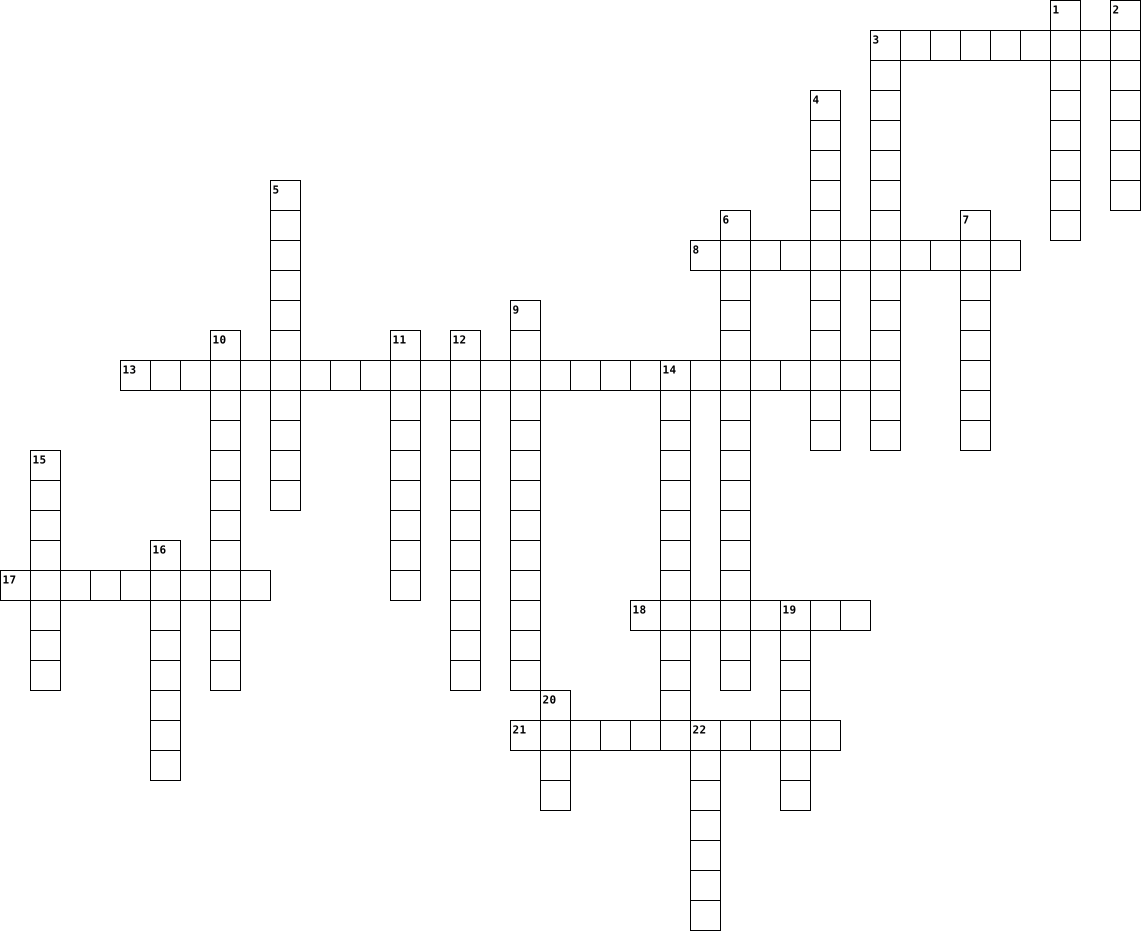
Across
- low pressure systems rotate this direction in northern hemisphere
- an air system that pulls warm humid air up from lower altitudes to higher altitudes often brings cooler and/or stormy conditions
- the barometric pressure at sea-level which is 1013.25millibar
- the movement of substances going from areas of higher concentration to areas of lower concentration
- an air-mass that forms over water characteristically humid
- an air-mass that forms over land, typically dry
Down
- the air we breathe is primarily made of this gas
- the ratio of a substance’s mass to its volume.
- the deflection of high pressure air as it meets low pressured air due to the planet’s rotation
- air systems that descend from the upper atmosphere to the ground displacing clouds bringing warm sunny conditions
- the measure of thermal energy
- low pressure systems rotate this direction in the southern hemisphere
- an air-mass that forms over the tropics, typically hot
- = the amount of atomic/molecular motion within a substance.
- the rotation of high pressure systems
- this instrument is used to measure atmospheric pressure
- an air-mass which formed over a polar region
- when water vapor condenses within clouds and falls toward the ground in the form of rain, snow, sleet or hail.
- a unit used to measure barometric pressure
- a tool used to visually display bands of similar temperature
- lines on a meteorological map which denote barometric pressure zones
- typically, isobar lines are drawn in multiples of _______
- the driving
23 Clues: the driving • the measure of thermal energy • the rotation of high pressure systems • a unit used to measure barometric pressure • an air-mass which formed over a polar region • the ratio of a substance’s mass to its volume. • an air-mass that forms over land, typically dry • the air we breathe is primarily made of this gas • ...
Earth system 2023-04-05

Across
- the layer between core and crust.
- forms from pre-existing rocks
- release of energy that creates seismic waves
- Petroleum, natural gas, coal. Made from animal and plant remains
- the continent we now know as North America was contiguous with Africa, South America, and Europe.
- Magma flows from underground.
- lower part of earth
- When two plates come together
- a solid inorganic material found in nature
- Plates slides past the other Plate.
- When magma flows from a crack.
- a tool that measures earthquakes
- the innermost layer of earth.
- compress or squeeze through solids,liquids faster than s waves
- no longer in existence
- forms when molten rock crystallizes
- occurs when two tectonic plates move away from each other
Down
- Larger pieces of lithosphere
- outer part of earth
- group of animals that occupy a certain area
- forms under extreme pressure
- the study of earth
- the formation of new areas of oceanic crust, which occurs through the upwelling of magma at midocean ridges and its subsequent outward movement on either side.
- still in existence
- outer most part of earth
- when heat pressure cooling melting and weathering cause rocks to change from one type to another over time.
- water held under ground in the soil in deep reservoirs
- the movement caused within a fluid
- the study of earthquakes
- Moves side to side only goes through solids.
30 Clues: the study of earth • still in existence • outer part of earth • lower part of earth • no longer in existence • outer most part of earth • the study of earthquakes • Larger pieces of lithosphere • forms under extreme pressure • forms from pre-existing rocks • Magma flows from underground. • When two plates come together • the innermost layer of earth. • When magma flows from a crack. • ...
Crossword - Combustion and Chemical Reaction 2024-02-13

Across
- A type of chemical reaction where energy is released to the environment.
- A reaction in which the products can convert back into the reactants.
- two or more atoms connected by chemical bonds
- An odorless, colorless gas that is the waste product that your body makes when it uses food for energy.
- A pure substance that cannot be broken down by any physical or chemical means into simpler substances.
- The ability to do work
- Representation of chemical reaction using symbols and formulae of the substances.
- A liquid that forms the seas, lakes, rivers, and rain and is the basis of the fluids of living organisms.
- When a substance is combined with oxygen
- The basic unit of a chemical element
Down
- the amount of mass that goes into a chemical reaction in the reactants, must equal the amount of mass that comes out of the reaction process.
- A type of reaction that occurs when two or more reactants combine to form a single product.
- The substances produced at the end of a chemical reaction.
- A type of chemical reaction where energy is absorbed from the environment.
- when the products of a chemical reaction cannot be converted back to reactants
- The ability to do work
- The substances that undergo a chemical reaction
- A gas that humans and animals breathe in.
- Another term for burning
- The compounds that are in most fuels in a combustion reaction.
20 Clues: The ability to do work • The ability to do work • Another term for burning • The basic unit of a chemical element • When a substance is combined with oxygen • A gas that humans and animals breathe in. • two or more atoms connected by chemical bonds • The substances that undergo a chemical reaction • The substances produced at the end of a chemical reaction. • ...
VOCAB 2024-03-21

Across
- a substance that slows, or even stops, a chemical reaction
- minimum amount of energy needed to start a chemical reaction
- a chemical reaction that releases thermal energy
- a type of chemical reaction in which the negative ions in two compounds switch places, forming two new
- a starting substance in a chemical reaction
- a catalyst that speeds up chemical reactions in living cells
- a substance that increases reaction rate by lowering the activation energy of a reaction
- law that states that the total mass of the reactants before a chemical reaction is the same as the total mass of the
- a description of a reaction using element symbols and chemical formulas
Down
- a process in which atoms of one or more substances rearrange to form one or more new substances
- a type of chemical reaction in which one compound breaks down and forms two or more substances
- a substance produced by a chemical reaction
- a type of chemical reaction in which one element replaces another element in a compound
- a chemical reaction that absorbs thermal energy
- a type of chemical reaction in which two or more substances combine and form one compound
- a number placed in front of an element symbol or chemical formula in an equation
- a chemical reaction in which a substance combines with oxygen and releases energy
17 Clues: a substance produced by a chemical reaction • a starting substance in a chemical reaction • a chemical reaction that absorbs thermal energy • a chemical reaction that releases thermal energy • a substance that slows, or even stops, a chemical reaction • minimum amount of energy needed to start a chemical reaction • ...
Weather 2019-04-10
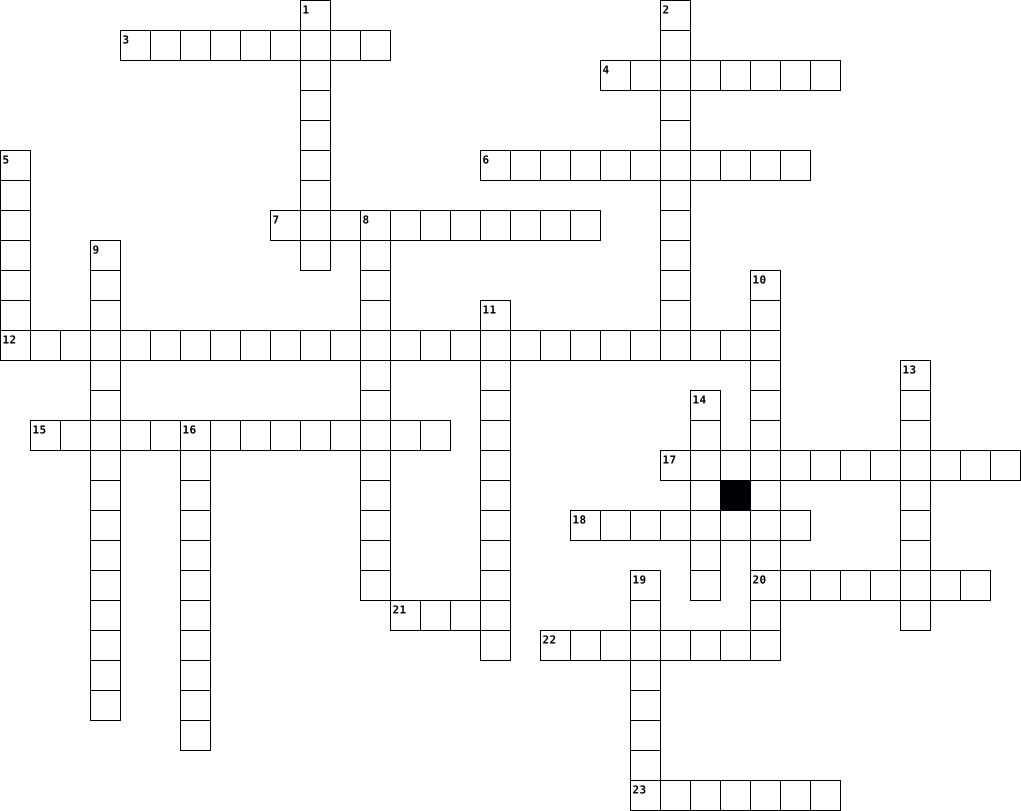
Across
- low pressure systems rotate this direction in northern hemisphere
- a unit used to measure barometric pressure
- the measure of thermal energy
- an air-mass that forms over land, typically dry
- the barometric pressure at sea-level which is 1013.25millibar
- the deflection of high pressure air as it meets low pressured air due to the planet’s rotation
- the rotation of high pressure systems
- an air-mass that forms over the tropics, typically hot
- a tool used to visually display bands of similar temperature
- typically, isobar lines are drawn in multiples of _______
- the air we breathe is primarily made of this gas
- the driving
Down
- the movement of substances going from areas of higher concentration to areas of lower concentration
- an air-mass which formed over a polar region
- lines on a meteorological map which denote barometric pressure zones
- = the amount of atomic/molecular motion within a substance.
- low pressure systems rotate this direction in the southern hemisphere
- when water vapor condenses within clouds and falls toward the ground in the form of rain, snow, sleet or hail.
- air systems that descend from the upper atmosphere to the ground displacing clouds bringing warm sunny conditions
- this instrument is used to measure atmospheric pressure
- the ratio of a substance’s mass to its volume.
- an air system that pulls warm humid air up from lower altitudes to higher altitudes often brings cooler and/or stormy conditions
- an air-mass that forms over water characteristically humid
23 Clues: the driving • the measure of thermal energy • the rotation of high pressure systems • a unit used to measure barometric pressure • an air-mass which formed over a polar region • the ratio of a substance’s mass to its volume. • an air-mass that forms over land, typically dry • the air we breathe is primarily made of this gas • ...
Unit 1 2017-09-18

Across
- wave / An elastic wave in the earth produced by an earthquake or other means
- / The part of earth that contains living organisms
- / The ratio of the mass of a substance to its volume
- / The layer of hot,solid material between Earth’s crust and core
- / The transfer of thermal energy from one particle of matter to another
- / Is the relatively thin envelope of gases that forms Earth's outermost layer
- / A dark,dense,igneous rock with a fine texture,found in oceanic crust
- / A rigid layer made up of the uppermost part of the mantle and the crust
- Core / A layer of molten iron and nickel that surrounds the inner core of Earth
- / The soft layer of the mantle
- force / The process by which rock is broken down
- / Is the ability to do work
Down
- / The densest part of the earth that includes crust mantle outer core and inner core
- / The transfer of energy by electromagnetic waves
- / The transfer of thermal energy by movement of a fluid
- core / A dense sphere of solid iron and nickel que center of earth
- / Is a group of parts that work together as a whole
- force / Any natural process that builds up Earth's surface
- / Contains all of earth's water
- / is the outermost layer of the earth
- / Usually light-colored igneous rock that is found in continental crust
- / continuous physical force exerted on or against an object by something in contact with it.
22 Clues: / Is the ability to do work • / The soft layer of the mantle • / Contains all of earth's water • / is the outermost layer of the earth • force / The process by which rock is broken down • / The transfer of energy by electromagnetic waves • / The part of earth that contains living organisms • / Is a group of parts that work together as a whole • ...
Unit 1 2017-09-18

Across
- / The ratio of the mass of a substance to its volume
- / Is a group of parts that work together as a whole
- core / A dense sphere of solid iron and nickel que center of earth
- / continuous physical force exerted on or against an object by something in contact with it.
- / A rigid layer made up of the uppermost part of the mantle and the crust
- / The layer of hot,solid material between Earth’s crust and core
- / is the outermost layer of the earth
- / The soft layer of the mantle
- / Usually light-colored igneous rock that is found in continental crust
Down
- / A dark,dense,igneous rock with a fine texture,found in oceanic crust
- / The densest part of the earth that includes crust mantle outer core and inner core
- / The part of earth that contains living organisms
- wave / An elastic wave in the earth produced by an earthquake or other means
- / Is the ability to do work
- force / Any natural process that builds up Earth's surface
- / The transfer of thermal energy from one particle of matter to another
- / Contains all of earth's water
- force / The process by which rock is broken down
- / Is the relatively thin envelope of gases that forms Earth's outermost layer
- / The transfer of thermal energy by movement of a fluid
- / The transfer of energy by electromagnetic waves
- Core / A layer of molten iron and nickel that surrounds the inner core of Earth
22 Clues: / Is the ability to do work • / The soft layer of the mantle • / Contains all of earth's water • / is the outermost layer of the earth • force / The process by which rock is broken down • / The transfer of energy by electromagnetic waves • / The part of earth that contains living organisms • / Is a group of parts that work together as a whole • ...