
forms of energy Crossword Puzzles
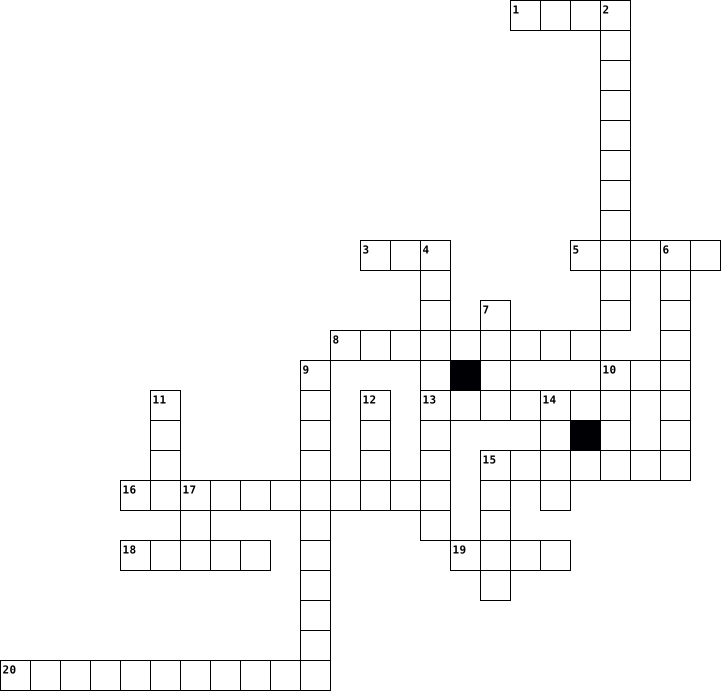
Cell Parts Crossword 2021-10-13

Across
- Organelle that stores and protects a cell’s DNA
- Closely layered stacks of membrane-enclosed spaces that process, sort, and deliver proteins
- Organelle that helps plants convert solar energy to chemical energy
- Small membrane-bound sac that divides some of the materials from the cytoplasm and transports the materials through the cell.
- Looks like a whip or tail and helps force liquids past a cell with their motion
- Surfaces of the ER that don’t contain ribosomes
- Surfaces of the ER that are covered with ribosomes
- Structure that provides rigid support
Down
- Tiny organelle that forms proteins by linking amino acids together
- Fluid filled sac that strengthens the cell and helps to support the entire plant
- jellylike substance that contains dissolved molecular building blocks such as proteins, nucleic acids, minerals, and ions.
- Gives the cell energy
- Fluid filled sac that is used to store materials needed by a cell
- Membrane bound organelle that contains enzymes
- Barrier that separates a cell from the external environment
15 Clues: Gives the cell energy • Structure that provides rigid support • Membrane bound organelle that contains enzymes • Organelle that stores and protects a cell’s DNA • Surfaces of the ER that don’t contain ribosomes • Surfaces of the ER that are covered with ribosomes • Barrier that separates a cell from the external environment • ...
Puzzle 33 2022-12-24

Across
- A star, especially when seen as the centre of any single solar system.
- A platform; a surface, generally elevated, upon which show performances or other public events are given.
- Something unexpected.
- A machine or device that converts other energy forms into mechanical energy, or imparts motion.
- Everything that one is capable of.
- A judicial reassessment of a case or an event.
Down
- A force applied to a surface.
- To record in writing.
- Having little duration.
- Process of growth or development.
10 Clues: To record in writing. • Something unexpected. • Having little duration. • A force applied to a surface. • Process of growth or development. • Everything that one is capable of. • A judicial reassessment of a case or an event. • A star, especially when seen as the centre of any single solar system. • ...
Chemistry Crossword 2015-06-02

Across
- an ion that has a positive charge
- whole number in front of a formula in a chemical equation
- unit that energy is measured in
- another word for "state"
- lowest energy state
- the study of the transfer of energy as heat
- the substance that is dissolved
- a substance made up of atoms of two or more different elements joined by chemical bonds
- arrangement of electrons in an atom
- shows the trend in solubility of a substance at a given temperature range
- an atoms has more energy than it does at its lowest state
- an ion that has a negative charge
- exactness of a measurement
- series of steps followed to solve problems
- element that is shiny and conducts heat
Down
- how close a measurement is to the true value
- bond between a metal and a nonmetal
- bond formed between to metalloids
- distance from any point on a wave to an identical point on the next wave
- horizontal row of elements that change periodically with the atomic numbers of the elements
- the time required for half of a radioactive sample to decay
- forward and reverse reactions happen at the same time
- absorbs heat and energy
- chemical formula that shows the composition of a compound in terms of the relative numbers and kinds of atoms in the simplest ratio
- parts of the mixture that look the same
- the ability of an atom to attract electrons
- bond between two nonmetals
- one of the elements in Group 18, stable elements
- atom that has the same number of protons but a different number of neutrons
- one of the elements of Group 1 of the periodic table
- more dense than a gas but less dense than a solid
- releases heat and energy
- substance that forms in a chemical reaction
- SI unit used to measure the amount of a substance whose number of particles is the same as the number of atoms
- one of the elements in Group 17
35 Clues: lowest energy state • absorbs heat and energy • another word for "state" • releases heat and energy • bond between two nonmetals • exactness of a measurement • unit that energy is measured in • the substance that is dissolved • one of the elements in Group 17 • an ion that has a positive charge • bond formed between to metalloids • an ion that has a negative charge • ...
ADV Science Homework (Liliana Alcaraz) 2021-09-09

Across
- physical substance in general, as distinct from mind and spirit; (in physics) that which occupies space and possesses rest mass, especially as distinct from energy.
- the process of making an area more urban.
- cycle by which nitrogen is converted into multiple chemical forms as it circulates among atmosphere, terrestrial, and marine ecosystems.
- a natural fuel such as coal or gas, formed in the geological past from the remains of living organisms.
- the process in which carbon atoms continually travel from the atmosphere to the Earth and then back into the atmosphere
Down
- excessive richness of nutrients in a lake or other body of water,
- the variety of life in the world or in a particular habitat or ecosystem.
- he continuous movement of water within the Earth and atmosphere.
- prevention of wasteful use of a resource.
- the capacity for doing work. ... It may exist in potential, kinetic, thermal, electrical, chemical, nuclear, or other various forms
10 Clues: the process of making an area more urban. • prevention of wasteful use of a resource. • he continuous movement of water within the Earth and atmosphere. • excessive richness of nutrients in a lake or other body of water, • the variety of life in the world or in a particular habitat or ecosystem. • ...
Chapter 7: Volcanoes and Earthquakes 2025-12-01

Across
- ____ Flow - A fast-moving, deadly avalanche of hot ash, gas, and volcanic debris
- Fine, powder-like volcanic particles made of pulverized rock and glass.
- The thin, outermost layer of Earth; includes continental and oceanic crust.
- An opening in Earth’s crust where magma, gases, and ash erupt onto the surface.
- A bowl-shaped depression at the top of a volcano around the central vent.
- ____ Eruption - An eruption in which lava pours out from long cracks, not a central vent.
- ____ Cone - A steep-sided volcano built from alternating layers of lava and pyroclastic materials; often very explosive.
- ____ Volcano - A wide, gently sloping volcano formed by quiet eruptions of low-viscosity basaltic lava.
- The shaking of Earth’s crust caused by the sudden release of energy along faults.
- Volcanic ____- A chain of volcanoes that forms above a subducting tectonic plate.
- ____ Wave - A slower wave that moves material side-to-side; travels only through solids.
- A location where magma rises from deep within the mantle, forming volcanoes away from plate boundaries.
- A large ocean wave caused by underwater earthquakes, landslides, or volcanic eruptions.
- ____Cone - A small, steep volcano made mostly of loose volcanic fragments (cinders) ejected from a single vent.
Down
- Earth’s central layer, consisting of a liquid outer core and solid inner core made mostly of iron and nickel.
- The printed or digital record of earthquake vibrations produced by a seismograph.
- ____ Rebound - The theory that rocks bend under stress until they suddenly break and snap back, releasing energy as an earthquake.
- A vertical passage through which magma travels from the magma chamber to the surface.
- Magma ____ - A pocket of molten rock that collects beneath a volcano before an eruption.
- A number that describes the amount of energy released by an earthquake.
- ____ Wave - The fastest seismic wave; compresses and expands material; travels through solids, liquids, and gases.
- ____ Materials - Fragments of rock, ash, and volcanic glass ejected during eruptions.
- ____ Wave - A seismic wave that travels along Earth’s surface; causes the most damage during earthquakes.
- A large, basin-like depression formed when a volcano collapses after emptying its magma chamber.
- The largest kind of pluton—an enormous mass of intrusive rock that forms the cores of mountain ranges.
- The thick, middle layer made of hot, semisolid rock that slowly flows.
- Any body of intrusive igneous rock that solidified beneath the surface.
- ____ Wave - Energy waves produced by an earthquake that travel through Earth.
28 Clues: The thick, middle layer made of hot, semisolid rock that slowly flows. • Fine, powder-like volcanic particles made of pulverized rock and glass. • A number that describes the amount of energy released by an earthquake. • Any body of intrusive igneous rock that solidified beneath the surface. • ...
Nutrients 2020-06-26

Across
- Function of food. It is very important during growth as it forms new tissues or repair tissues
- They help regulate bodily functions
- Function of food. Food provides the body with energy, which is necessary for cells, tissues and organs
- Function of food. Food helps control various processes in the body and which contribute to keeping its functions in balance
Down
- They are essential for growth and to repair body tissues
- You could suffer from this condition if you eat too little and use a lot of energy
- They provide energy that is stored as energy reserve
- You could suffer from this condition if you eat too much and don’t use a lot of that energy
- They are the main source of energy. They provide you with immediate energy
9 Clues: They help regulate bodily functions • They provide energy that is stored as energy reserve • They are essential for growth and to repair body tissues • They are the main source of energy. They provide you with immediate energy • You could suffer from this condition if you eat too little and use a lot of energy • ...
Cellular Respiration 2025-09-23

Across
- the process by which cells use oxygen to produce energy from food
- a type of protein that speeds up a chemical reaction (catalyst) in a living thing
- respiration that requires oxygen, occurs in mitochondria
- respiration that does not require oxygen, produces lactic acid
- three-carbon compound that forms as an end product of glycolysis
- a type of anaerobic respiration in which glucose is broken down into lactic acid
Down
- first step of cellular respiration - releasing the energy of glucose, in which a molecule of glucose is broken into two molecules of pyruvic acid
- molecules that contain carbon atoms
- second stage of cellular respiration, in which pyruvic acid is broken down into carbon dioxide in a series of energy-extracting reactions
- process by which cells release energy in the absence of oxygen
- a type of anaerobic respiration in which yeast breaks down sugars and releases ethanol as a byproduct
- powerhouse of the cell, organelle that is the site of ATP production
12 Clues: molecules that contain carbon atoms • respiration that requires oxygen, occurs in mitochondria • process by which cells release energy in the absence of oxygen • respiration that does not require oxygen, produces lactic acid • three-carbon compound that forms as an end product of glycolysis • the process by which cells use oxygen to produce energy from food • ...
energy 2023-01-25

Across
- of Energy/In physics and chemistry, the law of conservation of energy states that the total energy of an isolated system remains constant; it is said to be conserved over time.Energy
- Energy/ Mechanical energy (kinetic energy or potential energy) is the energy of either an object in motion or the energy that is stored in objects by their position.electrical Energy
- Energy/n physics, potential energy is the energy held by an object because of its position relative to other objects, stresses within itself, its electric charge, or other factors.
- is the time rate at which an object is moving along a path, while velocity is the rate and direction of an object's movement.
- resilient, springy, flexible, supple mean able to endure strain without being permanently injured.
- Energy/n physics, the kinetic energy of an object is the energy that it possesses due to its motion. It is defined as the work needed to accelerate a body of a given mass from rest to its stated velocity.
- also called gravitation, is a force that exists among all material objects in the universe. For any two objects or particles having nonzero mass, the force of gravity tends to attract them toward each other. Gravity operates on objects of all sizes, from subatomic particles to clusters of galaxies.
Down
- Energy/ Nuclear power is the use of nuclear reactions to produce electricity. Nuclear power can be obtained from nuclear fission, nuclear decay and nuclear fusion reactions.
- is an intrinsic property of a body. It was traditionally believed to be related to the quantity of matter in a physical body, until the discovery of the atom and particle physics.
- Energy/ Chemical energy is the energy of chemical substances that is released when they undergo a chemical reaction and transform into other substances. Some examples of storage media of chemical energy include batteries, food, and gasoline.
- physics, energy is the quantitative property that is transferred to a body or to a physical system, recognizable in the performance of work and in the form of heat and light.
- Energy/ hat Is Light Energy? Light energy is a kind of kinetic energy with the ability to make types of light visible to human eyes. sound Energy/The capacity or power to do work, such as the capacity to move an object (of a given mass) by the application of force. Energy can exist in a variety of forms, such as electrical, mechanical, chemical, thermal, or nuclear, and can be transformed from one form to another.
- Energy/ thermal energy refers to the energy contained within a system that is responsible for its temperature.
13 Clues: resilient, springy, flexible, supple mean able to endure strain without being permanently injured. • Energy/ thermal energy refers to the energy contained within a system that is responsible for its temperature. • is the time rate at which an object is moving along a path, while velocity is the rate and direction of an object's movement. • ...
biology 2024-10-02

Across
- adenosine diphosphate uncharged energy storage molecules with 2 phosphates.
- Sphere of earth all gases on earth.
- Second step of anaerobic respiration 2 types include alcoholic and lactic.
- anything that has mass and takes up space makes up everything.
- site of photosynthesis.
- Sphere on earth all soil and rocks on earth.
- Substance created during a chemical reaction made from reactants.
- describes a situation in which oxygen is not present.
- nutrient used in phosphate of nucleic acids and phospholipids of membranes often limit.
- Sphere on earth all water on earth.
- first step of aerobic respiration breaks down glucose into pyruvate makes some nadh.
Down
- Sphere of earth all living things on earth.
- type of organism that is able to make its own food base of the food chain.
- organelles site of steps 2 and 3 of aerobic cellular respiration.
- type of organism that must eat other organisms to obtain energy.
- describes a situation in which oxygen is present.
- nutrient used in proteins and nucleic acids must be fixed for liveing to use often limited.
- Pigment in chloroplast used to trap light during photosynthesis.
- nutrient forms the backbone for all macromolecules in living things.
- adenosine triphosphate charge energy storage molecules with 3 phosphorus groups.
- kaolin first step of photosynthesis use sunlight to split h2o and make atp and nadph o2 is released.
21 Clues: site of photosynthesis. • Sphere of earth all gases on earth. • Sphere on earth all water on earth. • Sphere of earth all living things on earth. • Sphere on earth all soil and rocks on earth. • describes a situation in which oxygen is present. • describes a situation in which oxygen is not present. • anything that has mass and takes up space makes up everything. • ...
Biomass 2015-01-28

Across
- Biomass can be a long-term, ........... energy source.
- When the waste materials are ......., pollutants such as ....... Dioxide, ........ Oxide and Carbon ....... are released in the atmosphere.
Down
- All forms of biomass involves material produced from living organisms. Some examples are: .... and wood chips, ...... crops, agricultural ........, food waste and .......... waste and co-products.
- ....... is the mass of living materials.
- Biomass contains stored ........ in the form of ........ energy.
- Biomass energy is extracted from decaying ...... or ...... wastes.
- Biomass is considered to be ...... neutral.
- Biomass is a ......... source of energy.
8 Clues: ....... is the mass of living materials. • Biomass is a ......... source of energy. • Biomass is considered to be ...... neutral. • Biomass can be a long-term, ........... energy source. • Biomass contains stored ........ in the form of ........ energy. • Biomass energy is extracted from decaying ...... or ...... wastes. • ...
MOVEMENT ACROSS PLASMA MEMBRANE 2025-01-21

Across
- The model that describes the plasma membrane as a mosaic of components.
- A solution with the same concentration of solute as the cell’s interior.
- A solution with a lower concentration of solute compared to the cell's interior.
- The protein embedded in the plasma membrane that helps molecules cross.
- The process of water moving across a membrane.
- The movement of molecules from high to low concentration without energy.
Down
- The type of solution that causes a cell to shrink due to water loss.
- A type of transport that does not require energy.
- Type of transport using carrier proteins to move molecules.
- The component of the plasma membrane involved in cell recognition.
- The type of transport that requires energy to move molecules against a concentration gradient.
- The component of the plasma membrane that forms a bilayer, with hydrophilic heads and hydrophobic tails.
12 Clues: The process of water moving across a membrane. • A type of transport that does not require energy. • Type of transport using carrier proteins to move molecules. • The component of the plasma membrane involved in cell recognition. • The type of solution that causes a cell to shrink due to water loss. • ...
CHEM 111 Exam 2 Bonus Question 2026-03-12

Across
- One of two or more distinct forms of an element.
- _____ energy: The amount of energy required to convert a mole of ionic solid to its constituent elements in the gas phase.
- An acid consisting of one or more ionizable protons and an oxoanion.
- _____ energy: The minimum energy required to remove an electron from an atom in the gas phase.
- _____ structures: Two or more equally valid Lewis structures for a single molecule that differ only in the positions of electrons.
- _____ rule: Rule stating that atoms will lose, gain, or share electrons to achieve a noble gas electron configuration.
Down
- Having an equal energy.
- A species with unpaired electrons that are attracted by magnetic fields.
- The ability of an atom in a compound to draw electrons to itself.
- The partial obstruction of nuclear charge by core electrons.
10 Clues: Having an equal energy. • One of two or more distinct forms of an element. • The partial obstruction of nuclear charge by core electrons. • The ability of an atom in a compound to draw electrons to itself. • An acid consisting of one or more ionizable protons and an oxoanion. • A species with unpaired electrons that are attracted by magnetic fields. • ...
Scientific EOY Crossword 2022-05-27

Across
- Look/feel of something
- remains/traces organisms that lived in the past
- Basalt A structure that forms in rocks
- Medium grained Metamorphic rock
- rock when hot molten rock crystallized/solids
- chemical/physical process of breaking down
- a dark dense igneous rock
- rock Pieces of rocks that accumulate
- metamorphic rock formed by high pressure & heat
- liquid magma that raches surface
- metamorphic rock limestone subjected to heat
- igneous rock
Down
- Clastic sedimentary rock
- igneous rock fine-grained textures small
- The molten of rock
- igneous glass rock formed by cooling of lava
- is a common type of sedimentary rock
- Primary source of energy for the rock cycle
- igneous rock large crystal sizes
- rock transformation of a pre-existing rock
20 Clues: igneous rock • The molten of rock • Look/feel of something • Clastic sedimentary rock • a dark dense igneous rock • Medium grained Metamorphic rock • igneous rock large crystal sizes • liquid magma that raches surface • is a common type of sedimentary rock • rock Pieces of rocks that accumulate • Basalt A structure that forms in rocks • igneous rock fine-grained textures small • ...
Ecology crossword 2018-05-24

Across
- the study of interactions among living things and their surroundings
- organisms that get their energy from eating other living or once-living resources
- a sequence that links species by their feeding relationships
- a consumer that primarily eats one specific organism or fees on a very small number of organisms
- the levels of nourishment in a food chain
- detritivores that break down organic matter into simpler compounds
- organisms that eat only plants
- a model that shows the complex network of feeding relationships and the flow of energy within and sometimes beyond an ecosystem
- another name for consumers
- consumers that have a varying diet
- a species that has an unusually large effect on its ecosystem
Down
- organisms that eat both plants and animals
- organisms that get their energy from nonliving resources, making their own food
- a group of different species that live together in one area
- organisms that eat dead organic matter
- all of the organisms as well as the climate, soil, water, rocks, and other nonliving things in a given area
- the process by which an organism forms carbohydrates using chemicals, rather than light, as an energy source
- another name for producers
- organisms that eat only animals
- a major regional or global community of organisms
- factors that are living things, such as plants, animals, fungi, and bacteria
- a measure of the total dry mass of organisms in a given area
- factors that are nonliving things such as moisture, temperature, wind, sunlight, and soil
23 Clues: another name for producers • another name for consumers • organisms that eat only plants • organisms that eat only animals • consumers that have a varying diet • organisms that eat dead organic matter • the levels of nourishment in a food chain • organisms that eat both plants and animals • a major regional or global community of organisms • ...
Y7 Chemistry 2026-03-17

Across
- A scale from 0–14 that shows how acidic or alkaline a substance is
- change : When a substance changes colour during a reaction
- A substance that usually does not react like metals
- A change that forms new substances and is usually not reversible
- A solid that forms when two liquids react
- A reaction that cannot be changed back
- A substance made when an acid reacts with a base
- A reaction between an acid and an alkali to make salt and water
- A gas needed for burning and many reactions
- A substance that burns to release energy
- When a reaction makes bubbles of gas
- A substance with pH less than 7 that can react with metals
- A chemical that changes colour to show pH
Down
- A process where substances change to form new substances
- A reaction where a substance burns in oxygen
- A substance with pH more than 7 that dissolves in water
- Energy that is given out or taken in during a reaction
- A rise or fall in temperature during a reaction
- A substance that often reacts with oxygen or acid
- A starting substance in a chemical reaction
- A change where no new substance is made (e.g. melting)
- A new substance made in a chemical reaction
- A reaction where oxygen is added to a substance
23 Clues: When a reaction makes bubbles of gas • A reaction that cannot be changed back • A substance that burns to release energy • A solid that forms when two liquids react • A chemical that changes colour to show pH • A gas needed for burning and many reactions • A starting substance in a chemical reaction • A new substance made in a chemical reaction • ...
Chemical 2022-03-18

Across
- change- A change that alters the form or appearance of substance but that does not make the substance into another substance.
- equation- A short, easy way to show a chemical reaction, using symbols instead of words.
- Anything that has mass and takes up space.
- When two or more elements or compounds combine to make a more complex substance.
- When the reaction is complete, you have new substances.
- system- When matte can enter from or escape to the surroundings.
- A solid that forms from solution during a chemical reaction.
- of matter- A principle that states that during a chemical reaction, matter is not created or destroyed.
Down
- A material that releases energy when it burns.
- reaction- A change in matter that produces one or more new substances.
- system- When matter is not allowed t enter or leave.
- A number placed in front of a chemical formula in a equation
- property- A characteristic of a substance that describes its ability to change into other substances.
- In contrast to a synthesis reaction.
- Substances you have at the beginning.
- A rapid reaction between oxygen and a substance.
- property- A characteristic of a substance that can be observed without changing.
- reaction- A reaction that releases energy in a form of heat.
- When one element replaces another in a compound or when two elements in a different compounds trade places.
- The study of matter and how matter changes.
- reaction- A reaction in which energy is absorbed.
21 Clues: In contrast to a synthesis reaction. • Substances you have at the beginning. • Anything that has mass and takes up space. • The study of matter and how matter changes. • A material that releases energy when it burns. • A rapid reaction between oxygen and a substance. • reaction- A reaction in which energy is absorbed. • ...
Ecology-Vocab. 2021-10-19

Across
- the division of energy
- animals eat other animals to survive
Down
- a place where an organism lives
- the show of energy flowing through an ecosystem
- organisms that rely on each other to survive
- potential food for another
- where both species benefit from an interaction with each other
- the study of the relationships between different forms of animals and their natural surrounding.
- linked food chains
- interdependence all living things are dependent on both nature and each other for their survival this dependence
10 Clues: linked food chains • the division of energy • potential food for another • a place where an organism lives • animals eat other animals to survive • organisms that rely on each other to survive • the show of energy flowing through an ecosystem • where both species benefit from an interaction with each other • ...
Chapter 6:Heat, Callan Horoszewski 2022-03-22

Across
- locations.
- process by which thermal energy is transferred by electromagnetic waves.
- the movement of warmer gases or liquids to cooler surroundings.
- Matter is made up of tiny particles that are always in motion.
- is a measure of the disorder of a system.
Down
- units are in degrees,Celsius, Kelvins
- Examples: all metals to varying degrees.
- heat needed to change the temperature of 1 kilogram of water by 1 degree Celsius.
- total energy of the submicroscopic particles that make up a substance.
- molecules remain in relatively
- All forms of matter generally expand when heated and contract when cooled.
11 Clues: locations. • molecules remain in relatively • units are in degrees,Celsius, Kelvins • Examples: all metals to varying degrees. • is a measure of the disorder of a system. • Matter is made up of tiny particles that are always in motion. • the movement of warmer gases or liquids to cooler surroundings. • ...
Steam Sus Energy 2022-03-22

Across
- It may exist in potential, kinetic, thermal, electrical, chemical, nuclear, or other various forms
- energy over time
- mass per unit volume.
- energy absorbed or released by a substance during a change in its physical state (phase) that occurs without changing its temperature
- Specific heat (BLANK)
- a machine with moving parts that converts power into motion
- temperature at which a thermodynamic system has the lowest energy
- H2O
Down
- the phenomenon in which a liquid is heated to a temperature higher than its boiling point, without boiling the action of bringing a liquid to the temperature at which it bubbles and turns to vapour.
- water which collects as droplets on a cold surface when humid air is in contact with it
- the SI base unit of thermodynamic temperature
- the vapour into which water is converted when heated, forming a white mist of minute water droplets in the air.
- law stating that the pressure of a given mass of an ideal gas is inversely proportional to its volume at a constant temperature.
- force applied perpendicular to the surface of an object
- the process of turning from liquid into vapour
- a state in which it will expand freely to fill the whole of a container
16 Clues: H2O • energy over time • mass per unit volume. • Specific heat (BLANK) • the SI base unit of thermodynamic temperature • the process of turning from liquid into vapour • force applied perpendicular to the surface of an object • a machine with moving parts that converts power into motion • temperature at which a thermodynamic system has the lowest energy • ...
Ch.6 L 2&3 Vocabulary Crossword 2021-02-10

Across
- device that uses electrical energy to operate.
- is the continuous flow of electric charges through a material.
- all parts are connected in a row that forms one path for the electric charges to follow.
- is the measurement of how difficult it is for charges to flow through an object.
- is the material through which charge can flow easily.
- is the difference in electrical potential energy per charge between two places in a circuit
Down
- Electric charges have more than one path that they can follow.
- is a complete, unbroken path through which electric charges can flow.
- is the material that does not allow charges to flow.
- converts type of energy (Chemical) into electric energy.
10 Clues: device that uses electrical energy to operate. • is the material that does not allow charges to flow. • is the material through which charge can flow easily. • converts type of energy (Chemical) into electric energy. • Electric charges have more than one path that they can follow. • is the continuous flow of electric charges through a material. • ...
science vocabulary 2016-01-15

Across
- The new substance formed by the chemical reaction
- Substances that have gone through a chemical reaction
- Alters form or appearance but does not make new substance
- No matter is allowed to enter or leave
- Undergo change that turns substance into a new one
- A solid that forms from solution during a chemical reaction
- Matter is allowed to enter and leave
Down
- When energy is absorbed
- The study of matter and how matter changes
- A symbol used in a program to specify one of the elements of an array
- Short, easy way to show a chemical reaction
- A number placed in front of a chemical formula in an equation
- When energy is released
13 Clues: When energy is absorbed • When energy is released • Matter is allowed to enter and leave • No matter is allowed to enter or leave • The study of matter and how matter changes • Short, easy way to show a chemical reaction • The new substance formed by the chemical reaction • Undergo change that turns substance into a new one • ...
Past Forms of the verbs 2021-09-15

Across
- Past Tense of "swim"
- Past Tense of "take"
- Past Tense of "collect"
- Past Tense of "sleep"
- Past Tense of "stay"
- Past Tense of "invite"
- Past Tense of "am" or "is"
- Past Tense of "go"
- Past Tense of "talk"
Down
- Past Tense of "watch"
- Past Tense of "meet"
- Past Tense of "Write"
- Past Tense of "read"
- Past Tense of "ride"
- Past Tense of "buy"
- Past Tense of "play"
- Past Tense of "travel"
- Past Tense of "visit"
- Past Tense of "are"
- Past Tense of "see"
20 Clues: Past Tense of "go" • Past Tense of "buy" • Past Tense of "are" • Past Tense of "see" • Past Tense of "swim" • Past Tense of "meet" • Past Tense of "read" • Past Tense of "ride" • Past Tense of "take" • Past Tense of "play" • Past Tense of "stay" • Past Tense of "talk" • Past Tense of "watch" • Past Tense of "Write" • Past Tense of "sleep" • Past Tense of "visit" • Past Tense of "travel" • ...
Past forms of irregular verbs 2019-11-24

Across
- run
- speak
- sit
- tell
- fly
- find
- go
- catch
- become
- sink
- think
- give
- write
- do
- breake
Down
- read
- put
- see
- take
- sleep
- leave
- understand
- begin
- meet
- come
- buy
- know
- ride
- have
- get
- drive
- feed
32 Clues: go • do • run • put • sit • see • fly • buy • get • read • take • tell • meet • find • come • sink • know • ride • have • give • feed • speak • sleep • leave • begin • catch • think • write • drive • become • breake • understand
Business Basics. Forms of Businesses 2026-05-12

Across
- Units of ownership in a company.
- A business owned and managed by one person.
- A business where beauty services are offered.
- A business owned by shareholders.
- A person who helps manage a company.
- A large store that sells many products.
- Responsibility for business debts.
- A person who owns a business.
- To officially record a business name.
Down
- Money used to start a business.
- Abilities that help a business operate well.
- A person who sells goods on the street or in a market.
- Work done for customers instead of selling goods.
- A business owned by two or more persons.
- Items sold by a business.
- Money left after expenses are paid.
- A person who shares ownership in a business.
- A person who buys goods or services.
- When expenses are more than income.
- A place where money is kept and borrowed.
20 Clues: Items sold by a business. • A person who owns a business. • Money used to start a business. • Units of ownership in a company. • A business owned by shareholders. • Responsibility for business debts. • Money left after expenses are paid. • When expenses are more than income. • A person who buys goods or services. • A person who helps manage a company. • ...
Cellular Respiration 2024-09-25

Across
- the process by which cells use oxygen to produce energy from food
- a type of protein that speeds up a chemical reaction (catalyst) in a living thing
- respiration that requires oxygen, occurs in mitochondria
- respiration that does not require oxygen, produces lactic acid
- three-carbon compound that forms as an end product of glycolysis
- a type of anaerobic respiration in which glucose is broken down into lactic acid
Down
- first step of cellular respiration - releasing the energy of glucose, in which a molecule of glucose is broken into two molecules of pyruvic acid
- molecules that contain carbon atoms
- second stage of cellular respiration, in which pyruvic acid is broken down into carbon dioxide in a series of energy-extracting reactions
- process by which cells release energy in the absence of oxygen
- a type of anaerobic respiration in which yeast breaks down sugars and releases ethanol as a byproduct
- powerhouse of the cell, organelle that is the site of ATP production
12 Clues: molecules that contain carbon atoms • respiration that requires oxygen, occurs in mitochondria • process by which cells release energy in the absence of oxygen • respiration that does not require oxygen, produces lactic acid • three-carbon compound that forms as an end product of glycolysis • the process by which cells use oxygen to produce energy from food • ...
Organic Molecules 2022-09-20

Across
- compounds in living organisms containing carbon
- composed of a single sugar molecule
- composed of 3 or more monosaccharides
- a storage polysaccharide in animals
- composed of two monosaccharides
- a storage polysaccharide in plants
- individual subunits that combine to form polymers
- stringy, fibrous material in cell walls
Down
- breaks down polymers by adding H2O
- process that forms macromolecules
- giant molecule
- long molecule consisting of many bonded monomers
- number of valence electrons in a carbon atom
- bonds monomers by losing H2O
- substances that do not contain carbon atoms
- main source of energy in living things
16 Clues: giant molecule • bonds monomers by losing H2O • composed of two monosaccharides • process that forms macromolecules • breaks down polymers by adding H2O • a storage polysaccharide in plants • composed of a single sugar molecule • a storage polysaccharide in animals • composed of 3 or more monosaccharides • main source of energy in living things • ...
6th Grade Word Work 2, Part 2 Crossword 2023-02-14

Across
- the outer layer of tissue in a plant
- a protective and waxy or hard layer covering the epidermis of a plant
- spore that forms from tissue in a male reproductive structure of a seed plant
- a simple sugar which is an important energy source produced during photosynthesis
- each of a pair of curved cells that surround a stoma, allowing molecules in and out of the plant
- a green pigment, present in all green plants, responsible for the absorption of light to provide energy for photosynthesis
- the transfer of pollen to a stigma, ovule, flower, or plant to allow fertilization
- the process by which green plants use sunlight to synthesize foods from carbon dioxide and water
Down
- the action or process of fertilizing an egg, involving the fusion of male and female gametes (sperm & egg) to form a zygote
- a series of chemical reactions that convert the energy in food molecules into a usable form of energy called ATP
- evaporation of water vapor through the stomata of a plant
- the production of offspring by a sexual or asexual process
- organelle in a cell that is the site of photosynthesis
- pores in the epidermis of the leaf or stem of a plant
14 Clues: the outer layer of tissue in a plant • pores in the epidermis of the leaf or stem of a plant • organelle in a cell that is the site of photosynthesis • evaporation of water vapor through the stomata of a plant • the production of offspring by a sexual or asexual process • a protective and waxy or hard layer covering the epidermis of a plant • ...
Chemical Reactions 2024-06-13

Across
- A neutral charged subatomic particle
- The substances formed as a result of a chemical reaction
- Where protons and neutrons can be found in the atom
- A change that only changes appearance, like changing state
- The number infront of a molecule, dictating how many molecules there are
- A type of reaction that releases energy, often in the form of heat
- The starting substances in a chemical reaction
- The number after the element, dictating how many atoms are bonded together
Down
- A type of reaction that absorbs energy, often in the form of heat
- The law of ____________ of mass
- A solid that forms when two liquids or solutions are mixed
- A positively charged subatomic particle
- A change where a new product or substance is formed
- A negatively charged subatomic particle
14 Clues: The law of ____________ of mass • A neutral charged subatomic particle • A positively charged subatomic particle • A negatively charged subatomic particle • The starting substances in a chemical reaction • Where protons and neutrons can be found in the atom • A change where a new product or substance is formed • The substances formed as a result of a chemical reaction • ...
Intro to Bio/Organic Compounds Review 2021-09-02

Across
- this measures acids and bases
- the monomer for nucleic acids
- building block of carbohydrates
- type of nucleic acid that is single stranded
- type of lipid that forms the cell membrane
- the monomer for proteins
- type of nucleic acids that contains the sugar deoxyribose
- organic compound that does all the WORK in the body
- this is formed when many monomers are put togther
- type of protein that aids the immune system
- this is the monosaccharide that is formed by plants during photosynthesis
Down
- ___ have a pH of 0-6.9
- maintaining a constant internal environment
- organic compound that includes DNA and RNA
- type of protein that speeds up chemical reactions
- substance that regulates pH levels
- a quick energy source for the body
- regulates blood sugar levels
- used for long term energy storage, insulation, and waterproofing
- type of protein that carries oxygen and carbon dioxide in the blood
- the Biology root word that means "pale green"
- the polysaccharide stores carbohydrates in plants
- the Biology root word that means "small"
23 Clues: ___ have a pH of 0-6.9 • the monomer for proteins • regulates blood sugar levels • this measures acids and bases • the monomer for nucleic acids • building block of carbohydrates • substance that regulates pH levels • a quick energy source for the body • the Biology root word that means "small" • organic compound that includes DNA and RNA • ...
Cells 2021-07-29
Across
- The prefix denoting anything to do with blood
- The prefix denoting muscle is?
- Group of body tissues performing a specialised function or functions
- Breaks down complex substances into simple ones with the release of energy
- Pus
- Red
- Is all about the liver
- ion CO2 forms carbonic acid to diffuse through the cell membrane. On contact with extracellular fluid it changes to which ion for transport in the blood
- we refer to bones with this prefix
- the smallest individually functioning unit of the body
- The name of breakdown products which are excreted
Down
- Horses have one stomach, so they are?
- The parts of a cell necessary for it to function are called?
- Build simple substances into complex ones with the use of energy
- Many;much
- Maintaining all body functions within a tight control
- After
- Around,in the region of
- Is a breakdown product of amino acids and is removed from the body by the kidneys
- Decreased, deficient, beneath
- Excessive increased
- The prefix denoting cells is?
22 Clues: Pus • Red • After • Many;much • Excessive increased • Is all about the liver • Around,in the region of • Decreased, deficient, beneath • The prefix denoting cells is? • The prefix denoting muscle is? • we refer to bones with this prefix • Horses have one stomach, so they are? • The prefix denoting anything to do with blood • The name of breakdown products which are excreted • ...
Sport Science Revision 2024-11-08

Across
- The ability to sustain prolonged physical or mental effort.
- The rate of movement or quickness of a task.
- Hard, structural component that forms the skeleton.
- The study of body structure and its parts.
- The study of motion and forces applied to the body.
- Australian authority responsible for anti-doping in sport (abbreviation).
- Range of motion available at a joint.
- Ability to use different parts of the body together smoothly.
- Ability to withstand prolonged periods of exercise.
- Connects bone to bone, providing stability.
Down
- The primary muscle responsible for movement in an exercise.
- The body system involving the heart and blood vessels.
- Tissue in the body responsible for movement.
- The international organization responsible for anti-doping in sports.
- Muscle that opposes the primary mover in an exercise.
- The energy molecule used by muscles (abbreviation).
- Connects muscle to bone, enabling movement.
- Exercise that does not rely on oxygen; often short and intense.
- The ability to exert force against resistance.
- Type of exercise that requires oxygen for energy.
20 Clues: Range of motion available at a joint. • The study of body structure and its parts. • Connects muscle to bone, enabling movement. • Connects bone to bone, providing stability. • Tissue in the body responsible for movement. • The rate of movement or quickness of a task. • The ability to exert force against resistance. • Type of exercise that requires oxygen for energy. • ...
Health Test 2025-07-16

Across
- name for a developing child
- "emergency action" hormone
- physical and chemical processes by which the body breaks down food and generates energy
- doctor who provides primary care for children
- regulates metabolism
- means "large"
- movement of water, digested food, and other dissolved substances into the bloodstream
- structure that forms between the mother and unborn baby and does the work of three organs
- "master gland"
- regulates sleep
- tissue surrounding a tooth and holding it into place
- body's largest internal organ
- the body's main source of energy should come from these
- refers to the intestines
Down
- the proportion of nutrients compared to the number of calories the food contains
- physical and chemical breakdown of complex nutrients into simpler, water-soluble substances the body can use
- means "surrounding or enclosing"
- regulates blood sugar
- substances that neutralize free radicals
- long chains of building blocks from which proteins are made
- visible part of a tooth
- means "science" or "study"
- stimulates growth
- fatlike substances typically insoluble in water
- refers to the stomach
- hardest substance in the body
26 Clues: means "large" • "master gland" • regulates sleep • stimulates growth • regulates metabolism • regulates blood sugar • refers to the stomach • visible part of a tooth • refers to the intestines • "emergency action" hormone • means "science" or "study" • name for a developing child • body's largest internal organ • hardest substance in the body • means "surrounding or enclosing" • ...
Cell Project 2020-11-20

Across
- Captures sunlight to produce food
- Controls what goes in and out of the nucleus
- Forms the shape of the cell
- Produce proteins
Down
- Produces energy
- On the outer layer of plants and bacteria cells
- They break down food and old cell parts
- Makes ribosomes
- Directs all activities of the cell
- Store food, water, and waste
- A gel-like fluid
- Controls what goes in and out of the cell
12 Clues: Produces energy • Makes ribosomes • A gel-like fluid • Produce proteins • Forms the shape of the cell • Store food, water, and waste • Captures sunlight to produce food • Directs all activities of the cell • They break down food and old cell parts • Controls what goes in and out of the cell • Controls what goes in and out of the nucleus • ...
Hydrogen 2014-02-05

Across
- Hydrogen is used to turn liquid _____.
- Hydrogen is a pollutant-____ fuel.
- 1 in 6000 _________ atoms in deuterium.
- Hydrogen forms ______ hydrides with alkali metals and alkaline earth metals.
- Carbon dioxide is removed as the ______ flow through a basic solution.
- Hydrogen is produced when _______ and steam react at 1100 degrees Celsius over a nickel catalyst.
- Methanol is an __________ solvent.
- Most hydrogen is _______.
- Large-scale production of hydrogen currently begins with _____ fuels.
- In a heavy water reactor the ________ used to make the fuel doesn't have to be enriched.
- Hydrogen forms covalent _______ hydrides with nonmetals.
Down
- How often is hydrogen found on Earth in an uncombined state?
- Electrolysis of _______ produces the purest hydrogen.
- The initial cost of spending of separating the heavy water from light water is offset by the _____ cost of the uranium fuel.
- In a hydrogen _______, hydrogen would replace fossils fuels as the energy source for heating, transportation, and industrial process.
- The other stable isotope is _________.
- What does formaldehyde make?
- Hydrides are powerful _________ agents.
- How much hydrogen produced in the U.S. is used to synthesize the covalent binary compound ammonia?
- _______ was discovered in 1934.
- In the future, green ______ may produce hydrogen in the presence of sunlight.
21 Clues: Most hydrogen is _______. • What does formaldehyde make? • _______ was discovered in 1934. • Hydrogen is a pollutant-____ fuel. • Methanol is an __________ solvent. • Hydrogen is used to turn liquid _____. • The other stable isotope is _________. • 1 in 6000 _________ atoms in deuterium. • Hydrides are powerful _________ agents. • ...
Tic Tac Toe #1 2016-01-04

Across
- contains genetic material (DNA) and is the control central of the cell
- when materials are moved from an area of high concentration to a lower concentration
- temporary storage centers; some store water and others store waste products
- sites where photosynthesis takes place in a plant cell; contain chlorophyll
- cells use oxygen to release energy stored in sugars
- Wall provides support and shape for plant cells
- diffusion of water across a membrane
Down
- the process that plant cells use to change the energy from sunlight into chemical energy
- Membrane thin, flexible outer covering; controls what enters and leaves a cell
- energy producing sites in the cell; where respiration takes place; also known as the "powerhouse" of the cell
- gel-like fluid inside of a cell made of mostly water (other organelles are embedded in this)
- cell reproduction that occurs in the nucleus (forms two identical daughter cells)
12 Clues: diffusion of water across a membrane • cells use oxygen to release energy stored in sugars • Wall provides support and shape for plant cells • contains genetic material (DNA) and is the control central of the cell • temporary storage centers; some store water and others store waste products • ...
Biology- Semester 1 Midterm 2024-12-06

Across
- produces ribosomes
- control center of the cell that contains all of the DNA
- type of chemical bond formed through the sharing of electrons
- an individual building block
- water's ability to be pulled up the stems of plants is known as __________ action
- simpler cells that lack a nucleus
- specific electrons in the outermost energy level of an atom
- the _________ heat of a substance refers to the amount of energy required to raise the temperature of that substance
- cell's powerhouse (generates the energy)
- type of protein required for active transport
- large, organic molecule
- special type of channel protein for water molecules
- type of diffusion that uses proteins to transport large or charged particles down the gradient
- property that refers to a molecules uneven distribution of charge
- positively charged particles inside the nucleus of an atom
- type of chemical bond that forms through the transfer of electrons
- building block for nucleic acids
- solute concentration is higher inside cell (water moves in)
- makes up majority of the cell membrane
- cell transport process that uses energy to bring in greater quantities of large molecules
- this type of transport goes down the concentration gradient without the use of energy
- another name for "cell" membrane
- smallest unit of matter
Down
- even distribution of molecules inside/outside of cell
- organic molecule that provides immediate energy
- plant specific cell organelle; site for photosynthesis
- solute concentration is lower inside cell (water moves out)
- the process of building large, organic molecules
- cells that contain a nucleus and membrane bound organelles
- form of cell transport that flows "against" the concentration gradient
- two or more elements chemically bonded together; can be broken down into simpler substances
- molecules that are dissolved in a substance and form a solution
- this is required to move molecules "against" the concentration gradient
- "protein factory"
- long term energy storage built from glycerol and fatty acids
- type of "acid" that serves as the building block for proteins
- the ability of water molecules to stick to other water molecules
- small, circular segments of bacterial DNA
- subatomic particle inside the nucleus of an atom that carries no charge but helps determine the atomic mass
- the diffusion of water
40 Clues: "protein factory" • produces ribosomes • the diffusion of water • large, organic molecule • smallest unit of matter • an individual building block • building block for nucleic acids • another name for "cell" membrane • simpler cells that lack a nucleus • makes up majority of the cell membrane • cell's powerhouse (generates the energy) • small, circular segments of bacterial DNA • ...
Yr 7 Term 5 and 6 Key Words End of Term 2025-06-23

Across
- Chemistry - Reaction of an acid with an alkali making a salt and water. The pH gets closer to 7.
- Chemistry - Metals react with oxygen to form solid metal oxides
- Physics - Energy sources formed million of year ago eg coal, oil, natural gas
- Biology - A characteristic that can only have certain categories (e.g. blood type)
- Physics - It will never run out
- Physics - the useful energy given out divided by the total energy put in
- Chemistry - Sour tasting chemical eg, vinegar
- Biology - The egg nucleus and sperm nucleus join together in the oviduct
- Chemistry - Reversible changes (e.g. dissolving, melting) which aren’t reactions
- Chemistry - A more reactive metal element takes the place of a less reactive metal in its compound
- Biology - Period of time when a child develops into an adult
- Physics - When energy is transferred to wasted energy store (e.g. a light bulb heating up)
- Biology - Differences in characteristics within species or between species
- Biology - Characteristics which enable an organism to be successful and survive (eg thick fur for warmth; spiny leaves to protect & save water; camouflage)
- Physics - Energy which is not useful (often heat to surroundings)
Down
- Chemistry – A Reaction that forms a salt and hydrogen gas
- Chemistry - Substance which is formed/made
- Physics - Energy can’t be used again (it will run out)
- Chemistry - Substance we start with
- Physics - Energy cannot be created or destroyed –only transferred.
- Chemistry - Changes colour to show how strong or weak an acid or alkali is
- Biology - Ball of cells formed when the fertilised egg divides several times
- Chemistry - Atoms in the reactants are rearranged to make products
- Biology - A characteristic that can take any value within a range (e.g. height)
- Chemistry - Contains dye which changes colour to identify acid or alkali.
- Biology - Nine months between fertilisation and birth when the foetus grows.
- Biology - Members of the same species can mate to produce fertile offspring
- Physics - Energy generation methods that will not run out
- Biology - Physical changes of an adolescent
- Biology - Sperm (male) and egg (female) cells
- Physics - How much energy is transferred per second, measured in Watts.
- Chemistry - Chemical opposite of an acid eg soap, bleach, toothpaste
- Chemistry - High if lots of acid/alkali particles and few water particles
- Biology - 28 day cycle run be hormones in females
- Chemistry - Lower pH values mean more acidic, Higher pH means more alkaline
35 Clues: Physics - It will never run out • Chemistry - Substance we start with • Chemistry - Substance which is formed/made • Biology - Physical changes of an adolescent • Chemistry - Sour tasting chemical eg, vinegar • Biology - Sperm (male) and egg (female) cells • Biology - 28 day cycle run be hormones in females • Physics - Energy can’t be used again (it will run out) • ...
Vocab 2021-11-30

Across
- replacement,a chemical reaction which the negative ions in two compounds switch place forming two new compounds
- reaction,a process in which atoms of one or more substances rearrange to form into new substances
- a chemical reaction that releases thermal energy
- a substance that slows or even stopa a chemical reaction
- a chemical reaction in which a substance combines with oxygen and releases speicies
- replacement, a type of chemical reaction in which one element replaces another element in a compound
- a type of chemical reaction in which two or more substances combine and form one compound
Down
- a chemical reaction that aborbes thermal energy
- equation, a description of a reaction using element symbols and chemical formulus
- of conservation of mass, law that states that the total mass of the reactants before a chemical reaction is the same as the total mass of the products after a chemical reaction.
- a type of chemical reaction in which one compound breaks down and forms two or more substances
- energy, the minimum amount of energy required to start a chemical reaction in which the negative ions in two compounds switch place forming two new compounds
- a substance that increases the rate by lowering the activation energy of reaction
13 Clues: a chemical reaction that aborbes thermal energy • a chemical reaction that releases thermal energy • a substance that slows or even stopa a chemical reaction • equation, a description of a reaction using element symbols and chemical formulus • a substance that increases the rate by lowering the activation energy of reaction • ...
Atmosphere, Heat Transfer, & Winds 2021-09-23

Across
- _____ Effect is when the Earth rotates from west to east which makes the winds curve
- an instrument that measures air pressure
- atmospheric layer where weather occurs
- a thin layer of air that forms a protective covering around the planet
- the most abundant gas in our atmosphere
- passage of water vapor from a plant to the atmosphere
- the coldest layer in the atmosphere
Down
- _____ winds that are caused by the sun's unequal heating of Earth's surface
- energy transferred by circulation
- the cooling of water in the atmosphere changing gas to a liquid
- energy transferred in the form of rays or waves
- the process that occurs when water changes from a liquid to a gas, caused by heat
- energy transferred by direct contact
- Prevailing ______ blow from the west to the east in the temperate region and play an important part in moving weather across the US
- ______ Easterlies are winds that move from the poles towards the west in the polar region
- force exerted on an area
- ____ Stream moves from west to east in the northern hemisphere
- _____ Winds blow from the east to the west in the tropical region
18 Clues: force exerted on an area • energy transferred by circulation • the coldest layer in the atmosphere • energy transferred by direct contact • atmospheric layer where weather occurs • the most abundant gas in our atmosphere • an instrument that measures air pressure • energy transferred in the form of rays or waves • passage of water vapor from a plant to the atmosphere • ...
Aaliyah Harden's Cell review 2025-10-02

Across
- sorts proteins and packages them
- uses photosynthesis to make energy and glucose from carbon dioxide
- releases energy forms food into carbon dioxide and water
- makes special proteins as directed by the nucleus
- Membrane protects the cell
- a gelatin like material
Down
- processes materials and moves material in the cell
- contains and gets rid of waste
- out converting protection and shade
- directs all cell activity
10 Clues: a gelatin like material • directs all cell activity • Membrane protects the cell • contains and gets rid of waste • sorts proteins and packages them • out converting protection and shade • makes special proteins as directed by the nucleus • processes materials and moves material in the cell • releases energy forms food into carbon dioxide and water • ...
Our Environment 2023-01-30

Across
- Flow of energy in an ecosystem is always
- Who are classified into herbivores, carnivores, omnivores and parasites
- In an ecosystem, herbivores represent which consumers
- Which chemical cause depletion of ozone layer
- Who occupies the third trophic level in food chain
- An autotroph
- The range of different life forms is a criteria used to measure ______ of an area
Down
- Excessive exposure to UV rays causes
- An abiotic component of ecosystem
- Trophic level in an ecosystem represents which level
- Burning of waste substances usually at a high temperature of over 1000'c to convert them into ashes is called
11 Clues: An autotroph • An abiotic component of ecosystem • Excessive exposure to UV rays causes • Flow of energy in an ecosystem is always • Which chemical cause depletion of ozone layer • Who occupies the third trophic level in food chain • Trophic level in an ecosystem represents which level • In an ecosystem, herbivores represent which consumers • ...
past forms of verbs 2022-05-26

Across
- see
- eat
- think
- live
- make
- watch
- drink
Down
- be
- sing
- leave
- write
- play
- do
- create
14 Clues: be • do • see • eat • sing • play • live • make • leave • write • think • watch • drink • create
Forms of gov crossword 2021-09-08

Across
- ruled by king or queen
- " ruled by a few rich people"
- "rule by the people"
- dictator holds complete power
- ruled by one strong person due to power
- a government especially an authoritarian one
- a body of fundamental principles
- system of gov were one person has absolute power
Down
- "ruled by a few"
- the idea that one power is just a figure head
- government by the people but not direct
- a person who takes over through power
- (in the uk) the highest legislator
- claim to be from god to rule
14 Clues: "ruled by a few" • "rule by the people" • ruled by king or queen • claim to be from god to rule • " ruled by a few rich people" • dictator holds complete power • a body of fundamental principles • (in the uk) the highest legislator • a person who takes over through power • government by the people but not direct • ruled by one strong person due to power • ...
Past Forms of Verbs 2016-01-14

Across
- s.p."to_take"
- s.p."to_go"
- s.p."to_break"
- p.p."to_break"
- s.p."to_be"(1.Person)
- p.p."to_make"
- s.p."to_be"(2.Person)
Down
- s.p."to_put"
- p.p."to_go"
- p.p."to_take"
- s.p."to_see"
- p.p."to_come"
- p.p."to_be"
- p.p."to_see"
14 Clues: p.p."to_go" • s.p."to_go" • p.p."to_be" • s.p."to_put" • s.p."to_see" • p.p."to_see" • s.p."to_take" • p.p."to_take" • p.p."to_come" • p.p."to_make" • s.p."to_break" • p.p."to_break" • s.p."to_be"(1.Person) • s.p."to_be"(2.Person)
Chemistry Crossword 2023-05-02

Across
- properties The ability of a substance to combine with or change into one or more.
- Radius Measured as half the distance between the nuclei of atoms of an element.
- Positively charged ion.
- Change A change that alerts a substance without changing its composition.
- A small amount of solute per solvent quantity.
- The ratio of solute to solvent in a solution.
- scale An arbitrary measuring system that selects one thing to be the standard.
- mass The mass of an atom given in amu.
- properties A characteristic that can be absorbed or measured without changing the sample's composition.
- A neutral particle having equal numbers of p+ and e-.
Down
- Change A change in the matter in which new materials are formed.
- The study of how heat is converted to and from other forms of energy and how.
- A substance that speeds up a chemical reaction.
- The measure of the average kinetic energy of the particles in a sample of matter.
- A lot of solutes per solvent quantity.
- Error The ratio of the error to the actual value multiplied by 100.
- The total amount of energy movement.
- Biological catalysts speed up the rate of reactions in the body.
- An atom or group of atoms that have either gained or lost e- so they are no longer neutral.
- Solution Solution in which the solvent is water.
20 Clues: Positively charged ion. • The total amount of energy movement. • A lot of solutes per solvent quantity. • mass The mass of an atom given in amu. • The ratio of solute to solvent in a solution. • A small amount of solute per solvent quantity. • A substance that speeds up a chemical reaction. • Solution Solution in which the solvent is water. • ...
Electric Systems and Control 2022-10-11
Across
- energy to the circuit by doing work upon the charge to move it from the low energy terminal to the high energy terminal.
- substance or material that allows electricity to flow through it.
- circuit is a complete circular path that electricity flows through
- component which controls the openness or closeness of an electric circuit.
- the same current flows through all the components in the circuit.
- good conductor of electricity.
- path/A circuit without interruption, providing a continuous path through which a current can flow.
- electrical energy to other forms of energy.
- flow/The external circuit is directed away from the positive terminal and toward the negative terminal of the battery.
- drop/The decrease of electrical potential along the path of a current flowing in an electrical circuit.
- moving charged particles that carry electric energy.
- the actual electrical connections present in the circuit.
- SI unit of electrical resistance, transmitting a current of one ampere when subjected to a potential difference of one volt.
- Supply/Takes the AC from the wall outlet, converts it to unregulated DC, and reduces the voltage using an input power transformer.
- used for making conductor wires.
Down
- SI unit of electromotive force.
- there are two or more electrical devices present in a circuit with an energy source.
- to hold conductors in position, separating them from one another and from surrounding structures.
- along multiple paths and each component has the same voltage across it.
- used to represent various electrical and electronic devices or functions.
- point at which a conductor from a component/Device or network comes to an end.
- circuit/Abnormal condition in an electrical circuit where the electrical current flows through shorter pathway.
- measure of the opposition to current flow in an electrical circuit.
- in the form of a usually very flexible thread or slender rod.
- switch/One without continuity: current cannot flow through it.
- measure of potential energy between two points in a circuit.
- rate at which electrons flow past a point in a complete electrical circuit.
- device that has electrical resistance and that is used in an electric circuit for protection.
- device that stores and releases energy much faster than a battery.
- base unit of electrical current in the International System of Units (SI).
30 Clues: good conductor of electricity. • SI unit of electromotive force. • used for making conductor wires. • electrical energy to other forms of energy. • moving charged particles that carry electric energy. • the actual electrical connections present in the circuit. • measure of potential energy between two points in a circuit. • ...
Ecology Part II 2023-03-15

Across
- a biological membrane that separates and protects the interior of all cells from the outside environment.
- the biogeochemical cycle by which nitrogen is converted into multiple chemical forms as it circulates among atmospheric, terrestrial, and marine ecosystems.
- an important heat-trapping gas, or greenhouse gas, that comes from the extraction and burning of fossil fuels (such as coal, oil, and natural gas), from wildfires, and from natural processes like volcanic eruptions.
- the movement of water molecules from a solution with a high concentration of water molecules to a solution with a lower concentration of water molecules, through a cell's partially permeable membrane.
- occurs when outputs of a system are routed back as inputs as part of a chain of cause-and-effect that forms a circuit or loop.
- a colourless, odourless, tasteless gas essential to living organisms, being taken up by animals, which convert it to carbon dioxide; plants, in turn, utilize carbon dioxide as a source of carbon and return the oxygen to the atmosphere.
- the net movement of anything generally from a region of higher concentration to a region of lower concentration.
- the biogeochemical cycle that describes the transformation and translocation of phosphorus in soil, water, and living and dead organic material.
- the movement of substances across a cell membrane down their concentration gradients, which does not require energy.
- long-term shifts in temperatures and weather patterns
- the process of moving molecules across a cellular membrane through the use of cellular energy.
Down
- occurs without oxygen and releases less energy but more quickly than aerobic respiration.
- denoting or relating to a solution having the same osmotic pressure as some other solution, especially one in a cell or a body fluid.
- shows the continuous movement of water within the Earth and atmosphere.
- the process by which green plants and some other organisms use sunlight to synthesize foods from carbon dioxide and water.
- chemical process in which oxygen is used to make energy from carbohydrates (sugars).
- having a higher osmotic pressure than a particular fluid, typically a body fluid or intracellular fluid.
- nature's way of reusing carbon atoms, which travel from the atmosphere into organisms in the Earth and then back into the atmosphere over and over again.
- a series of chemical reactions that break down glucose to produce ATP
- is the main sugar found in your blood.
20 Clues: is the main sugar found in your blood. • long-term shifts in temperatures and weather patterns • a series of chemical reactions that break down glucose to produce ATP • shows the continuous movement of water within the Earth and atmosphere. • chemical process in which oxygen is used to make energy from carbohydrates (sugars). • ...
Electricity Vocabulary Crossword 2023-01-26

Across
- used to maintain a constant relation between current and voltage
- factor that you change
- diagram representing the elements of a system using symbols rather than pictures
- a closed path through which current flows or may flow
- three-terminal resistor with a sliding or rotating contact that forms adjustible divider
- flow of electricity in a circuit
- quantitative property that is transferred to a body or a physical system
- a form of energy resulting from the existence of charged particles
- energy related to forces on electrically charged particles and the movement of those particles
- an experiment in which the variables are controlled so that the effects of varying one factor at a time may be observed
- a source of electrical power consisting of one or more electrochemical cells with external connections for powering electric devices
- amount of energy oroduced in given amount of time
- object that attracts iron and other materials, produces a magnetic field
Down
- current is proportional to voltage across two points
- part of; being an element of; composing of
- substance that allows electricity to flow through it
- instrument used for measuring electric potential difference between two points in a circuit
- voltage across each of the components is the same and the total current is the sum of the currents flowing through each component
- unit of electric potential, electric potential difference
- current of each component is the same, and the voltage across the circuit is the sum of the individual voltage
- energy of chemical substances that is released when they undergo a chemical reaction
- things affected by the changes you make; the results of your tests
- symbolic representation using visual techniques
- a group of interacting or interrelated elements that act according to a set of rules to form a unified whole
- rule enforced to regulate something; a fact of science that has been proven and always applies to that circumstance
- used to measure current in a circuit
26 Clues: factor that you change • flow of electricity in a circuit • used to measure current in a circuit • part of; being an element of; composing of • symbolic representation using visual techniques • amount of energy oroduced in given amount of time • current is proportional to voltage across two points • substance that allows electricity to flow through it • ...
Cells and Tissues 2016-09-06

Across
- bond sharing electrons in the outer shell
- specialization of cells during development
- blueprint for protein synthesis
- splitting of one cell into two identical daughter cells
- abnormal new growth; tumor
- little organs of the cell
- weak bond between slightly positive and negative ends
- attaches bone to bone
- spreading of cancer cells
- contract cells to cause movement
- smallest unit of an element with that element's chemical characteristics
Down
- most abundant tissue; connects the parts of the body
- tumor
- tissue that forms skin and outer surface of the body
- chemical reactions necessary for the use of raw materials
- makes up brain, spinal cord, and nerves
- energy transfer molecule
- spreading tumor
- two or more atoms bonded together
- muscles to bones
20 Clues: tumor • spreading tumor • muscles to bones • attaches bone to bone • energy transfer molecule • little organs of the cell • spreading of cancer cells • abnormal new growth; tumor • blueprint for protein synthesis • contract cells to cause movement • two or more atoms bonded together • makes up brain, spinal cord, and nerves • bond sharing electrons in the outer shell • ...
9 2024-08-23

Across
- Acid that forms DNA and RNA
- Breaking down a compound
- Separating solids from liquids
- Reaction of acid and base
- Contains carbon
- Fats and oils
- When forward and reverse reactions equal
- Made of amino acids
- Compounds of hydrogen and carbon
- Building blocks of protein
- Replacement of one element
- Small unit of a polymer
- Separating by spinning
Down
- Separating by boiling point
- Combining to form a compound
- Substance that speeds up reaction
- Burning with oxygen
- Sugars and starches
- Separating by movement through a medium
- Exchange of ions between compounds
- Energy required to start reaction
- Shows pH change
- Measuring concentration by reaction
- Protein that catalyzes reactions
- Large molecule made of monomers
25 Clues: Fats and oils • Shows pH change • Contains carbon • Burning with oxygen • Sugars and starches • Made of amino acids • Separating by spinning • Small unit of a polymer • Breaking down a compound • Reaction of acid and base • Building blocks of protein • Replacement of one element • Separating by boiling point • Acid that forms DNA and RNA • Combining to form a compound • ...
Factors Affecting an Ecosystem 2023-02-23

Across
- living factor of an ecosystem
- the variety and number of organisms in a particular environment
- first level in a food chain responsible for supplying initial energy, gathers energy from sun
- water released from the clouds in multiple possible forms falling back to earth
- measure of hotness or coldness generally measured in degrees
- things such as building a new road, clearing forest, polluting the air
- an organism that consumes all or part of the body of another—living or recently killed—organism, which is its prey.
- the actions that occur between two organisms
- if the only species of grass in a food chain were to die, this would happen to the food chain
Down
- catastrophic events like tornadoes ,droughts, earthquakes
- single linear sequence of organisms showing how energy is transferred
- lack of water for an extended period of time
- biotic and abiotic factors interacting in a particular environment
- the biological mechanism by which organisms adjust to new environments or to changes in their current environment.
- the dying out or extermination of a species
- detailed model of all the food chains in a particular ecosystem showing interconectivity
- the presence of differences in sequences of genes between individual organisms of a species.
- nonliving factor of an ecosystem
18 Clues: living factor of an ecosystem • nonliving factor of an ecosystem • the dying out or extermination of a species • lack of water for an extended period of time • the actions that occur between two organisms • catastrophic events like tornadoes ,droughts, earthquakes • measure of hotness or coldness generally measured in degrees • ...
Quarter 2 Science Vocab Words 2024-04-24

Across
- A substance formed when two or more elements are chemically bonded together in a fixed ratio, with properties different from those of its constituent elements.
- A tabular arrangement of elements based on their atomic number, electron configuration, and chemical properties, organized into rows (periods) and columns (groups).
- A substance composed of atoms with the same number of protons, characterized by its unique chemical properties and represented by its atomic symbol.
- The sum of kinetic energy and potential energy in a system; it represents the energy associated with the motion and position of objects.
- A process in which one or more substances (reactants) are converted into different substances (products) through the rearrangement of atoms.
- A group of atoms held together by covalent bonds, representing the smallest unit of a compound that retains its chemical properties.
- The basic building block of matter, consisting of a nucleus containing protons and neutrons, with electrons orbiting around it.
- The transfer of thermal energy between objects due to a temperature difference; it flows from regions of higher temperature to regions of lower temperature.
- Material or substance used to reduce the transfer of heat, sound, or electricity; it helps to maintain temperature and conserve energy.
Down
- The energy stored in an object due to its position or state, such as gravitational potential energy or elastic potential energy.
- A symbolic representation of the composition of a compound, indicating the types and numbers of atoms present in a molecule using element symbols and subscripts.
- The energy possessed by an object due to its motion; it depends on the mass and velocity of the object.
- The force of attraction that holds atoms together in a molecule or compound, formed by the sharing, transfer, or attraction of electrons.
- A type of chemical bond formed by the sharing of electrons between atoms, resulting in the formation of a molecular compound.
- A type of chemical bond formed by the transfer of electrons from one atom to another, resulting in the formation of ions with opposite charges that are attracted to each other.
- The ability to do work or cause change; it exists in various forms such as kinetic, potential, thermal, electrical, and chemical energy.
16 Clues: The energy possessed by an object due to its motion; it depends on the mass and velocity of the object. • A type of chemical bond formed by the sharing of electrons between atoms, resulting in the formation of a molecular compound. • ...
Hyatt's Energy Words Crossword 26th Nobember 2015 2015-11-26

Across
- This energy comes straight from the sun.
- This type of energy will never run out.
- This type of energy will run out one day.
Down
- Renewable forms of energy can be described as being this word because they will not run out.
- This is a nother name for a energy source that will run out one day.
- Use of this energy source can be destructive.
- Fuel that is used to cook food at home.
7 Clues: Fuel that is used to cook food at home. • This type of energy will never run out. • This energy comes straight from the sun. • This type of energy will run out one day. • Use of this energy source can be destructive. • This is a nother name for a energy source that will run out one day. • ...
Chemistry Crossword 2021-09-20

Across
- Sub-atomic particles with no charge
- A row in the periodic table
- These small units make up all forms of matter including living and non living things.
- Sub-atomic particles with positive charge
- Reactions that release energy
- We cannot live without this gas
- A table in which elements are organised
- The acid that is produced in our stomach
- This has the chemical symbol of Au
- This has the chemical symbol of Mg
- Substance that speeds up a reaction without itself taking part in it
- Lightest elment
- It is equal to the number of protons
Down
- What we get when we add number of protons and neutrons
- Reactions that consume energy
- They are sub-atomic particles having negative charge
- They are made up of two or more types of atoms.
- Increasing ______ will speed up the rate of a chemical reaction
- Reaction type in which things burn
- A change in which new substance is formed
- A column in the periodic table
- These are either positively charged or negative charged
- Things which react are known as _______
23 Clues: Lightest elment • A row in the periodic table • Reactions that consume energy • Reactions that release energy • A column in the periodic table • We cannot live without this gas • Reaction type in which things burn • This has the chemical symbol of Au • This has the chemical symbol of Mg • Sub-atomic particles with no charge • It is equal to the number of protons • ...
science 2024-10-07

Across
- - responsible for bood clotting.
- - responsible for transporting blood, oxygen, nutrients, and waste products throughout the body.
- - basic building block of DNA and RNA
- - green pigment found in the chloroplasts of plants etc.
- - contains harmful materials like nicotine
- - how certain alleles express traits in an organism.
- - a brown sticky that can narrow the arteries
- - colorless, tasteless liquid that is essential for all known forms of life.
- - colorless gas with a strong smell
- - thread-like structures made of DNA and proteins found in the nucleus of cells.
Down
- - different versions of a gene that occupy the same position on a chromosome.
- - process by which green plants, algae, and some bacteria convert sunlight into chemical energy as glucose.
- - Two spongy organs in the chest responsible for breathing
- - largest artery in the body.
- - consists of red and white blood cells, platelets, and plasma.
- - tubes that carry air from the windpipe into the lungs
- - responsible for breathing.
- - movement of blood between the heart and lungs.
- - essential for energy production in all living organisms.
- - thicker than vein.
20 Clues: - thicker than vein. • - responsible for breathing. • - largest artery in the body. • - responsible for bood clotting. • - colorless gas with a strong smell • - basic building block of DNA and RNA • - contains harmful materials like nicotine • - a brown sticky that can narrow the arteries • - movement of blood between the heart and lungs. • ...
Sport Science Revision 2024-11-08

Across
- The ability to sustain prolonged physical or mental effort.
- The rate of movement or quickness of a task.
- Hard, structural component that forms the skeleton.
- The study of body structure and its parts.
- The study of motion and forces applied to the body.
- Australian authority responsible for anti-doping in sport (abbreviation).
- Range of motion available at a joint.
- Ability to use different parts of the body together smoothly.
- Ability to withstand prolonged periods of exercise.
- Connects bone to bone, providing stability.
Down
- The primary muscle responsible for movement in an exercise.
- The body system involving the heart and blood vessels.
- Tissue in the body responsible for movement.
- The international organization responsible for anti-doping in sports.
- Muscle that opposes the primary mover in an exercise.
- The energy molecule used by muscles (abbreviation).
- Connects muscle to bone, enabling movement.
- Exercise that does not rely on oxygen; often short and intense.
- The ability to exert force against resistance.
- Type of exercise that requires oxygen for energy.
20 Clues: Range of motion available at a joint. • The study of body structure and its parts. • Connects muscle to bone, enabling movement. • Connects bone to bone, providing stability. • Tissue in the body responsible for movement. • The rate of movement or quickness of a task. • The ability to exert force against resistance. • Type of exercise that requires oxygen for energy. • ...
vocab 6 physical science 2013-11-14

Across
- a chemical reaction that requires heat
- a substance that forms in a chemical reaction
- any chemical change in which one species is oxidized and one is reduced
- process in which an a electric current is used to produce a chemical reaction
- the oxidation reaction of an organic compound in which heat is release
- the relative number of moles of the substances required to produce a given amount of product in a chemical reaction
- the energy released when a chemical compound reacts to release a new compound
- a state of balance of in which the rate of a forward reaction equals the rate of a reverse reaction and the concentration of products and reactions remains unchanged
- a reaction in which energy is released into the environment
Down
- a reaction in which two or more substances combine to form a new compound
- a reaction in which a single compound breaks down into two or more simpler substances
- an organic group that has one or more electrons available for bonding
- a reaction in which one element or radical takes the place of another element or radical in a compound
- a substance or molecule that participates in a chemical reaction
- a reaction in which a gas, solid precipitate or a molecular compound forms from the apparent exchange of atoms or ions between two compounds
- a representation of a chemical reaction that uses symbols to show the relationship between the reactants and the products
- a part, substance, or element that lies beneath and supports another part, substance, or element
- a type of protein that speeds up the metabolic reactions in plants and animals without being permanently changed or destroyed
- a substance that changes the rate of a chemical reaction without being consumed or changed significantly
19 Clues: a chemical reaction that requires heat • a substance that forms in a chemical reaction • a reaction in which energy is released into the environment • a substance or molecule that participates in a chemical reaction • an organic group that has one or more electrons available for bonding • the oxidation reaction of an organic compound in which heat is release • ...
Organic compounds 2021-01-19

Across
- Compounds composed of only carbon and hydrogen
- Compounds that do not contain carbon
- a colorless, odorless, highly flammable gas, the chemical element of atomic number 1.
- the study of all chemicals containing carbon
- the chemical element of atomic number 7, a colorless, odorless unreactive gas that forms about 78 percent of the earth's atmosphere
- Energy-rich organic compounds, such as fats, oils, and waxes, that are made of carbon, hydrogen, and oxygen.
- A substance made up of atoms of two or more different elements joined by chemical bonds
- a colorless, odorless reactive gas, the chemical element of atomic number 8 and the life-supporting component of the air.
- macromolecules containing hydrogen, oxygen, nitrogen, carbon, and phosphorus
- A pure substance made of only one kind of atom
- the chemical element of atomic number 16, a yellow combustible nonmetal
Down
- the chemical element of atomic number 6, a nonmetal that has two main forms (diamond and graphite) and which also occurs in impure form in charcoal, soot, and coal.
- the starches and sugars present in foods
- Compounds that contain carbon
- carbon, hydrogen, oxygen, nitrogen
- amino acids
- A combination of chemical symbols and numbers to represent a substance
- small unit that can join together with other small units to form polymers
- the chemical element of atomic number 15, a poisonous, combustible nonmetal that exists in two common allotropic forms, white phosphorus, a yellowish waxy solid which ignites spontaneously in air and glows in the dark, and red phosphorus, a less reactive form used in making matches.
- large compound formed from combinations of many monomers
20 Clues: amino acids • Compounds that contain carbon • carbon, hydrogen, oxygen, nitrogen • Compounds that do not contain carbon • the starches and sugars present in foods • the study of all chemicals containing carbon • Compounds composed of only carbon and hydrogen • A pure substance made of only one kind of atom • large compound formed from combinations of many monomers • ...
CLUE TO ME >.< 2023-05-07

Across
- The layer of the Earth's crust beneath the soil
- The process by which rocks are worn away by wind, water, or ice
- A type of rock that forms from the cooling and solidification of lava or magma
- Something we ate during our interview!
- A type of rock that is formed from the accumulation of volcanic ash
- A type of rock that is formed from the cooling of molten rock on the Earth's surface
- One of my fav colors
- type of igneous rock with a fine-grained texture that forms from the rapid cooling of lava
- A type of rock that forms from the accumulation of organic material
- The study of rocks and their properties
- The process by which rocks are changed by heat and pressure
- A type of igneous rock that forms when lava cools quickly on the Earth's surface
- The process by which sediment is compacted and cemented together to form rock
- A type of sedimentary rock that is formed from the accumulation of sand
Down
- Area where you are from
- A type of rock that forms from the accumulation of shells or other skeletal remains
- The process by which sediment is transported and deposited in a new location
- Your ethnicity
- A type of rock that forms from the accumulation of sediment
- A type of metamorphic rock that is formed from the alteration of sandstone
- The process by which rocks are broken down into smaller pieces
- A type of sedimentary rock that forms from the accumulation of plant or animal remains
- A type of metamorphic rock that is formed from the alteration of limestone
- One of my pbros nickname related to this theme
- A type of igneous rock with a glassy texture that forms from the rapid cooling of lava or magma
- One of your favorite drinks
- A type of sedimentary rock that is formed from the accumulation of clay
- A type of metamorphic rock that is prized for its use in sculptures and building materials
28 Clues: Your ethnicity • One of my fav colors • Area where you are from • One of your favorite drinks • Something we ate during our interview! • The study of rocks and their properties • One of my pbros nickname related to this theme • The layer of the Earth's crust beneath the soil • A type of rock that forms from the accumulation of sediment • ...
Sustainability 2020-05-20

Across
- a group of plants
- plants that live on dead plants
- how plants get energy
- cutting trees down
- life forms together
Down
- water and moving something
- one goal battles
- air around the earth
- a habitat that is healthy
- keeping an area in good health
- a scrub with more sand and less trees
- able to keep going
12 Clues: one goal battles • a group of plants • able to keep going • cutting trees down • life forms together • air around the earth • how plants get energy • a habitat that is healthy • water and moving something • keeping an area in good health • plants that live on dead plants • a scrub with more sand and less trees
Earth Space Honors Semester 2 Vocabulary 2023-04-21

Across
- a collection of stars that make a picture used to map the night sky
- the only EM wave that humans can see
- the Sun's visible layer
- theory that explains the formation of the universe
- phase of the moon in which the entire lit side is facing Earth
- ______ magnitude is the how bright a star appears from Earth
- model of the solar system that places Earth in the center
- the change in wavelength based on the motion of an object relative to the position of the observer is called the ____ effect
- model of the solar system that places the sun in the center
- theory that explains the formation of the solar system
- super dense star that forms when a massive star dies
- a collection of billions of stars held together by gravity
- relatively cool area on the surface of the sun
- EM waves are these types of waves
- force of attraction in the universe
Down
- calculated as mass divided by volume
- anything that has mass and takes up space
- ______ magnitude is how bright a star actually is
- measurement of distance based on the distance that light can travel in a year in the vacuum of space
- forms when a massive star dies; intense gravity that not even light can escape
- created the three laws of planetary motion
- where nuclear fusion occurs in the sun
- classification of stars in which most stars are found
- element that forms in the cores of massive stars causing fusion to stop
- EM wave with the highest energy
- EM wave with the longest wavelength
26 Clues: the Sun's visible layer • EM wave with the highest energy • EM waves are these types of waves • EM wave with the longest wavelength • force of attraction in the universe • calculated as mass divided by volume • the only EM wave that humans can see • where nuclear fusion occurs in the sun • anything that has mass and takes up space • created the three laws of planetary motion • ...
Science Crossword Puzzle!!!!! Autumn and Valerie 2023-04-21

Across
- Ions - Ions that are made of more than one atom.
- Formula - A combination of symbols that shows the ratio of elements in a compound.
- Bond - The chemical bond formed when two atoms share electrons.
- - The simplest pure substances, and they cannot be broken down into any other substances.
- - The ions form an orderly, three dimensional arrangement.
Down
- - Tells you the ratio of elements in the compound.
- Compound - A compound that is composed of molecules.
- Bond - The attraction between two oppositely charged ions.
- Dot Diagrams - This includes the symbol for the element surrounded by dots. Each dot stands for one electron.
- Electrons - The electrons that have the highest energy level and are held the most loosely.
- Bond - This time the two atoms share two pairs of electrons which forms this.
- Bond - The force of attraction that holds two atoms together as a result of the rearrangement of electrons between them.
- - An atom or group of atoms that has an electric charge.
- Level - The specific amount of energy an electron has.
- Bonds - Their atoms share three pairs of elements.
15 Clues: Ions - Ions that are made of more than one atom. • - Tells you the ratio of elements in the compound. • Bonds - Their atoms share three pairs of elements. • Compound - A compound that is composed of molecules. • Level - The specific amount of energy an electron has. • Bond - The attraction between two oppositely charged ions. • ...
YOUNG CHAPT 6 CROSSWORD 2017-12-22

Across
- the amount of heat needed to change the temperature of 1 gram of water by 1 celsius degree.
- the study of heat and its transformation into different forms of energy.
- the thermal energy that flows from a substance if higher temperature to a substance of lower temperature, commonly measured in calories or joules.
- the lowest possible temperature that a substance may have the temperature at which molecules of the substance have their minimum kinetic energy.
- the transfer of energy by means of electromagnetic waves.
Down
- no system can reach absolute zero.
- the measure of the energy dispersal of a system. Whenever energy freely transforms from one form into another, the direction of transformation is toward a state of greater disorder and, therefore, toward greater entropy.
- the transfer of thermal energy in a gas or liquid by means of currents in the heated fluid. The fluid flows, carrying energy with it.
- the transfer of thermal energy by molecular and electronic collisions within a substance.
- a measure of the hotness and coldness of substances, related too the average translational kinetic energy per molecule in a substance; measured in degrees Celsius, in degrees Fahrenheit, or in kelvins.
10 Clues: no system can reach absolute zero. • the transfer of energy by means of electromagnetic waves. • the study of heat and its transformation into different forms of energy. • the transfer of thermal energy by molecular and electronic collisions within a substance. • the amount of heat needed to change the temperature of 1 gram of water by 1 celsius degree. • ...
Atmosphere/Weather 2019-05-09

Across
- rain or other that's usually acidic
- is the introduction of contaminants into the natural environment that cause adverse change.
- helps power up a windmill
- is a volume of air defined by its temperature and water vapor content.
- one of the lowest clouds and are puffy
- it means middle
- part of the sun's energy is absorbed by the earth's what?
- occurs at night by the ocean
- the outermost region of a planet's atmosphere
- forms when cold air mass pushes under a warm air mass, forcing the warm air to rise
- the layer of the earth's atmosphere above the troposphere
- they are sea breeze and land breeze...
- forms when a moist, warm air mass slides up and over a cold air mass
- forms when warm and cold air meet and neither air mass has force to move the other
- a liquid becoming a gas
- it means rain (cloud)
- cloud forming a continuous horizontal gray sheet, often with rain or snow.
- right above the mesosphere
- the polar easterlies, the westerlies, and the trade winds
- the region of the earth's atmosphere above the stratosphere and below the thermosphere
- the state or quality of being humid.
Down
- is considered satisfactory, and air pollution poses little or no risk.
- wispy, or looks feathery (cloud)
- brief bursts of cold air have been blown into the region by the what?
- this pressure generally is associated with cloudy, rainy, and snowy weather
- a rainy day is a type of what..
- Objects in the Northern Hemisphere are deflected to the right, while objects in the Southern Hemisphere are deflected to the left.
- the pressure generally is associated with nice weather
- plants lose more than 90 percent of their water through what process?
- the final transfer of energy to the surface is by what?
- the layer of the earth's atmosphere that contains a high concentration of ions and free electrons and is able to reflect radio waves.
- rain, snow, sleet, or hail that falls to the ground is the process of what?
- the lowest region of the atmosphere
- occurs in the day time by the ocean
- the job of supervising or taking care of something
35 Clues: it means middle • it means rain (cloud) • a liquid becoming a gas • helps power up a windmill • right above the mesosphere • occurs at night by the ocean • a rainy day is a type of what.. • wispy, or looks feathery (cloud) • rain or other that's usually acidic • the lowest region of the atmosphere • occurs in the day time by the ocean • the state or quality of being humid. • ...
Module 4 Physical Science 2022-04-01

Across
- nuclei the original unstable nuclei
- nuclei the nuclei that remains after decay
- same as a base
- a material that donates a proton
- dating using nuclear decay and half-life to determine the age of a substance
- the reaction between an acid and a base
- nucleus the same as an alpha particle
- the process by which large isotopes are split into smaller isotopes and release energy
- decay a process by which a neutron changes to a proton and emits an electron
- the material needed to stop gamma decay
- when an element changes to a different element through decay
- a term used to describe the effect of acids
- breaking into ions
Down
- the emission of energy as electromagnetic waves or as moving subatomic particles
- the time it takes for the amount of an unstable isotope to reduce to half its original amount
- a material that accepts a proton
- decay a process where an unstable nucleus changes by emitting a particle composed of two protons and two neutrons
- a chemical used to determine the pH of a substance
- decay the process by which an unstable nuclei emits energy
- the process by which small isotopes are put together and release energy
- the material needed to stop beta decay
- the material needed to stop alpha decay
- -14 the material used to date things that used to be living
- different forms of the same element that contain equal numbers of protons but different numbers of neutrons in their nucleus
24 Clues: same as a base • breaking into ions • a material that accepts a proton • a material that donates a proton • nuclei the original unstable nuclei • nucleus the same as an alpha particle • the material needed to stop beta decay • the reaction between an acid and a base • the material needed to stop gamma decay • the material needed to stop alpha decay • ...
Energy 2021-09-25

Across
- the process by which energy is relocated from one system to another
- comes from a substance whose molecules and atoms are vibrating faster due to a rise in temperature.
- A very important and useful fact about energy is that it can change from one form to another.
- is an objective measurement of how hot or cold an object is.
Down
- the rate at which heat is transferred by conduction through a unit cross-section area of a material, when a temperature gradient exits perpendicular to the area.
- the "stuff" that makes up the universe — everything that takes up space and has mass.
- The capacity for doing work. It may exist in potential, kinetic, thermal, electrical, chemical, nuclear, or other various forms.
- categorised into two broad categories – kinetic energy and potential energy.
- can be subdivided and classified into potential energy, kinetic energy, or combinations of the two in various ways.
- a form of energy that an object or a particle has by reason of its motion.
10 Clues: is an objective measurement of how hot or cold an object is. • the process by which energy is relocated from one system to another • a form of energy that an object or a particle has by reason of its motion. • categorised into two broad categories – kinetic energy and potential energy. • ...
Rate of Reactions 2022-04-27

Across
- Watered down solution.
- A substance precipitated from a solution.
- Hitting against something or clashing with each other, like a particle.
- This is what forms when being exposed to oxygen, water and the environment.
- Measure of the change that happens in a single unit of time
- This speeds up a reaction.
- Product --> Reactant, what is this called?
- The thing needed to calculate the rate of reaction, besides the total volume.
Down
- This gives the particles more energy for collision.
- Force per unit area of surface, unit is N/m2
- A solution can either be dilute or ........
- Another word for rusting.
- Stored inside molecules and atoms, this is needed to break bonds apart or to collide.
13 Clues: Watered down solution. • Another word for rusting. • This speeds up a reaction. • A substance precipitated from a solution. • Product --> Reactant, what is this called? • A solution can either be dilute or ........ • Force per unit area of surface, unit is N/m2 • This gives the particles more energy for collision. • ...
Ecology 2023-03-08

Across
- - An organism that obtains its energy and nutrients by consuming other organisms.
- - the process of restoring damaged ecosystems to their original state
- - An organism that can produce its own food, usually through photosynthesis, and forms the base of the food chain for other organisms in the ecosystem.
- - A group of individuals of the same species living in the same area and interacting with one another.
- - The sum of all ecosystems on Earth, including all living organisms and their physical environments.
- - meeting the needs of the present without compromising the ability of future generations to meet their own needs
- - a community of living and nonliving things interacting with each other
- - Any living entity that has the ability to carry out the basic functions of life, including obtaining and using energy, responding to stimuli, and reproducing.
- - The ecological role or function of a species within an ecosystem, including its interactions with other organisms and its use of resources.
Down
- change - long-term alteration of the Earth's climate patterns
- - variety of life forms and habitats in a particular region
- - A group of populations of different species that live together in a particular area and interact with one another.
- - An animal that is hunted and eaten by another animal.
- - An animal that feeds on other animals, usually by killing and consuming them.
- - the protection and management of natural resources
- - the natural environment where a particular species lives
16 Clues: - the protection and management of natural resources • - An animal that is hunted and eaten by another animal. • - the natural environment where a particular species lives • - variety of life forms and habitats in a particular region • change - long-term alteration of the Earth's climate patterns • ...
Coastal Crossword 2020-08-10

Across
- Type of wave that forms when the wave base hits land
- A distinctive feature or thing that is a part of the environment that processes act upon and within
- Highest point of a wave
- the action of moving something
- ravine formed by the force of water
- a state at which factors of influence are balanced
- Land composed of tougher more durable rock
- oval shape
Down
- The time it takes for wave crests to pass a fixed point
- Lowest point of a wave
- matter that is transported by the flow of liquid
- the shape of the coast
- The measurement from the bottom of the trough to the top of the crest
- Property that needs to be transferred to an object so it can work
- An integrated collection of inputs of material and energy, processes, outputs and feedbacks
- Circular motion of wave
- The distance between wave crests
- the non-specific parts which make up a natural phenomena
- Narrow flat area often found at the base of a sea cliff or overlooking the shoreline
19 Clues: oval shape • Lowest point of a wave • the shape of the coast • Highest point of a wave • Circular motion of wave • the action of moving something • The distance between wave crests • ravine formed by the force of water • Land composed of tougher more durable rock • matter that is transported by the flow of liquid • a state at which factors of influence are balanced • ...
Physics 2024-10-10

Across
- - The speed of an object in a particular direction.
- - The maximum extent of a vibration or oscillation, measured from the position of equilibrium.
- - A disturbance that transfers energy from one point to another, typically through a medium.
- - A space that is entirely devoid of matter.
- - The resistance that one surface or object encounters when moving over another.
- - The force of attraction between two masses, especially the force that pulls objects toward Earth.
- - The study of heat and its transformation into different forms of energy.
- - A measure of disorder or randomness in a system.
- - The energy an object possesses due to its motion.
- - The principle that states when two or more waves overlap, their effects combine.
- - The force of attraction or repulsion between objects due to their magnetic fields.
- - The bending of light as it passes from one medium to another.
Down
- - The interaction between electric currents and magnetic fields.
- - The product of an object’s mass and velocity.
- - The smallest amount of a physical quantity that can exist independently.
- - The unit of force in the International System of Units (SI).
- - Einstein's theory describing the relationship between space, time, and gravity.
- - The rate at which work is done or energy is transferred.
- - The capacity to do work or cause physical change.
- - The rate of change of velocity of an object.
- - The distance between two corresponding points on adjacent waves.
- - A push or pull on an object that causes it to accelerate.
- - The force that keeps an object moving in a circular path.
- - The stored energy in an object due to its position or state.
- - The quantity of matter in an object.
- - The product of force and the distance over which it is applied.
- - The number of waves that pass a given point in a specific amount of time.
- - The spreading of waves around obstacles or through openings.
- - The tendency of an object to resist changes in its state of motion.
- - A particle representing a quantum of light or other electromagnetic radiation.
30 Clues: - The quantity of matter in an object. • - A space that is entirely devoid of matter. • - The rate of change of velocity of an object. • - The product of an object’s mass and velocity. • - A measure of disorder or randomness in a system. • - The speed of an object in a particular direction. • - The capacity to do work or cause physical change. • ...
Stream Erosion 2014-01-27

Across
- forms when a high-gradient stream flows out from a mountain valley onto a level plain, and the speed is suddenly reduced
- forms by faulting, the bulldozing action of glaciers, and the unequal erosion of rocks
- the point at which a stream flows into another body of water
- a __ forms where a stream enters a lake , ocean, or other large body of water
- a stream and it's tributaries
- the depositing of transported materials, that occurs in an orderly fashion, with larger particles falling out first as the stream slows
Down
- __ streams tend to be on the lesser side with energy, and have a slower water flow
- a flat area that covers with water when the stream floods
- smaller streams that feed larger streams
- a confined body of water that flows either continuously or seasonally on the earths surface or underground.
- snaking rivers that occur in low-gradient streams
- a ridge separating one stream's drainage basin from another's
12 Clues: a stream and it's tributaries • smaller streams that feed larger streams • snaking rivers that occur in low-gradient streams • a flat area that covers with water when the stream floods • the point at which a stream flows into another body of water • a ridge separating one stream's drainage basin from another's • ...
Stream Erosion 2014-01-27

Across
- forms when a high-gradient stream flows out from a mountain valley onto a level plain, and the speed is suddenly reduced
- forms by faulting, the bulldozing action of glaciers, and the unequal erosion of rocks
- the point at which a stream flows into another body of water
- a __ forms where a stream enters a lake , ocean, or other large body of water
- a stream and it's tributaries
- the depositing of transported materials, that occurs in an orderly fashion, with larger particles falling out first as the stream slows
Down
- __ streams tend to be on the lesser side with energy, and have a slower water flow
- a flat area that covers with water when the stream floods
- smaller streams that feed larger streams
- a confined body of water that flows either continuously or seasonally on the earths surface or underground.
- snaking rivers that occur in low-gradient streams
- a ridge separating one stream's drainage basin from another's
12 Clues: a stream and it's tributaries • smaller streams that feed larger streams • snaking rivers that occur in low-gradient streams • a flat area that covers with water when the stream floods • the point at which a stream flows into another body of water • a ridge separating one stream's drainage basin from another's • ...
Cells as the basis of life 2024-09-12

Across
- Process that occurs in chloroplasts
- Enzyme model (3 words)
- Results from enzyme action
- A model of a cell membrane (2 words)
- Removes Urea from the blood
- Insect gaseous exchange surface
- Another name for an enzyme (2 words)
- Occurs to anzymes at the extremes of pH
- An organelle in cells (2 words)
- This cell contains membrane bound organelles
- Site of protein manufacture
- A factor which can affect enzyme function
- Waste gas released when plants photosynthesise
Down
- Forms a channel through membranes (2 words)
- Movement of free water across a membrane
- A microscope that can view small organelles
- Improves diffusion when larger compared to volume
- Energy required for active transport
- Movement against a concentration gradient (2 words)
- Byproduct of cell respiration
- Releases energy stored on glucose
- Bacteria are an example of this type of cell
- DNA can be found here
- Removes carbon dioxide from the body
- An alternative to the lock and Key model
- passive movement down a concentration gradient
- Part of an enzymes structure
27 Clues: DNA can be found here • Enzyme model (3 words) • Results from enzyme action • Removes Urea from the blood • Site of protein manufacture • Part of an enzymes structure • Byproduct of cell respiration • Insect gaseous exchange surface • An organelle in cells (2 words) • Releases energy stored on glucose • Process that occurs in chloroplasts • A model of a cell membrane (2 words) • ...
Water Cyle Crossword Puzzle - Anna Bianchini 2025-02-07

Across
- Numer of forms of precipitation.
- Water evaporates from bodies of water,soil, plants, and what?
- When water vapor cools and becomes a liquid.
- When liquid absorbs heat energy and is turned into a gas.
Down
- When water droplets become heavy and energy is released when gravity pulls down.
- What is formed when water vapor cools?
- The total amount of water being cycled through Earth remains.
- A process of water being evaporated through plants.
- is A process that moves water through the Earth's surface and atmosphere repeatedly.
- During the water cycle the movement of water is driven by energy from the sun and what?
10 Clues: Numer of forms of precipitation. • What is formed when water vapor cools? • When water vapor cools and becomes a liquid. • A process of water being evaporated through plants. • When liquid absorbs heat energy and is turned into a gas. • The total amount of water being cycled through Earth remains. • Water evaporates from bodies of water,soil, plants, and what? • ...
Waves_gamaliel 2022-12-12

Across
- usable power that can be transferred to different forms but cannot be created or destroyed
- a wave that can only travel through a medium
- a point where a wave crosses its resting line
- the high point of a wave
- a back and forth pattern of motion that transfers energy
Down
- a wave in which the wave's medium is compressed in the same direction as the movement of the
- a rate of something that repeats over and over
- energy of movement
- a wave in wich the waves medium moves in the same direction as the movement of the wave
- a repeating and recognizable feature
10 Clues: energy of movement • the high point of a wave • a repeating and recognizable feature • a wave that can only travel through a medium • a point where a wave crosses its resting line • a rate of something that repeats over and over • a back and forth pattern of motion that transfers energy • ...
STEM 2024-09-19

Across
- - Information collected for reference or analysis.
- - A form of energy that makes things warm.
- - A solid natural substance found on Earth, made up of minerals.
- - A place where scientific experiments are carried out.
- for the Crossword:
- - What enables us to see; it travels faster than anything else in the universe.
- - The vast, seemingly infinite expanse beyond Earth's atmosphere.
- - A machine that can perform tasks automatically.
Down
- - A living organism that grows in soil and typically uses sunlight for energy.
- - A liquid essential for all known forms of life.
- - The basic unit of life in all living organisms.
- - The study of numbers, shapes, and patterns.
- - Instructions written for computers to perform tasks.
- - The star at the center of our solar system that provides light and heat.
- - A way to assess knowledge or experiment results.
- - A massive ball of burning gas in the sky, like the Sun.
16 Clues: for the Crossword: • - A form of energy that makes things warm. • - The study of numbers, shapes, and patterns. • - A liquid essential for all known forms of life. • - The basic unit of life in all living organisms. • - A machine that can perform tasks automatically. • - Information collected for reference or analysis. • ...
Audrey's cell review 2025-10-01

Across
- contains and gets rid of waste
- directs all cell activity
- makes specific proteins as directed by the nucleus
- protects the cell
Down
- a gelatin like substance
- sorts proteins and packages them
- processes materials and moves material in the cell
- use photosynthesis to make energy and glucose from carbon dioxide
- out converting protection and shade
- releases energy forms food into carbon dioxide and water
10 Clues: protects the cell • a gelatin like substance • directs all cell activity • contains and gets rid of waste • sorts proteins and packages them • out converting protection and shade • processes materials and moves material in the cell • makes specific proteins as directed by the nucleus • releases energy forms food into carbon dioxide and water • ...
LIEC District Energy Crossword Puzzle 2023-03-07

Across
- element that forms organic compounds
- facilities and systems serving a city or community
- a hollow cylinder of metal, wood, or other material
- the act or process of bringing into being
- increasing temperature
- available power
- dependable or trusted
- decreasing temperature
- CO2 released into the atmosphere
Down
- the act of creating
- within financial means
- a system that provides water or electricity
- can be created again
- the ability to be upheld or continued
- connection of a system
- a system that provides cooling or refrigeration
- relating to heat
- a system that generates steam from water to drive turbines or engines
18 Clues: available power • relating to heat • the act of creating • can be created again • dependable or trusted • within financial means • connection of a system • increasing temperature • decreasing temperature • CO2 released into the atmosphere • element that forms organic compounds • the ability to be upheld or continued • the act or process of bringing into being • ...
Kinetic Molecular Theory 2025-03-25

Across
- phase change from liquid to solid
- A form of matter that has a definite shape and volume
- the physical forms in which matter exists, as determined by the average kinetic energy of the atoms involved; the most common phases of matter are solid, liquid, gas and plasma; also called state of matter;
- (evaporation) phase change from liquid to gas
- Absorbs heat
- phase change from gas to liquid
- A state of matter that has no definite shape but has a definite volume.
- A state of matter with no definite shape or volume
- phase change from solid to liquid
- ________ point depression is the difference in temperature between the freezing point of a solution and the freezing point of the pure solvent
Down
- Releases heat
- _________ properties that depend on the concentration of solute particles but not on their identity
- phase change from gas to solid
- phase change from solid to gas
- two or more different molecular forms of the same element in the same physical state
15 Clues: Absorbs heat • Releases heat • phase change from gas to solid • phase change from solid to gas • phase change from gas to liquid • phase change from liquid to solid • phase change from solid to liquid • (evaporation) phase change from liquid to gas • A state of matter with no definite shape or volume • A form of matter that has a definite shape and volume • ...
Earth's Surface Ch4 - Geological History 2025-05-30

Across
- - when some older layers are eroded away, and then new rock forms where the older layers were.
- - when lava hardens on the surface
- - the gradual change in living things over long periods of time
- – the time it takes for half of the radioactive atoms to decay
- - animals without backbones
- - a record of the life forms and geological events in Earth’s history
Down
- - when elements break down over time, at a constant rate, by releasing particles and energy
- - animals with backbones.
- - the preserved remains or traces of living things.
- - a break in Earth’s crust
- - when magma pushes into rock layers and hardens without reaching the surface
- - a fossil that occurs in many different areas and represents a type of organism that existed only briefly
- - a hollow area in sediment in the shape of an organism
- - a solid copy of the shape of an organism
14 Clues: - animals with backbones. • - a break in Earth’s crust • - animals without backbones • - when lava hardens on the surface • - a solid copy of the shape of an organism • - the preserved remains or traces of living things. • - a hollow area in sediment in the shape of an organism • – the time it takes for half of the radioactive atoms to decay • ...
Biology Review 2023-03-23

Across
- energy required to start a reaction
- matches a codon
- energy carrier
- substance consumed in a chemical reaction
- the first life forms
- particle with no charge
- form of a gene
- supports the cell
- equal concentrations
- reproductive cell
- diffusion of water
- group on a cladogram
- chromosome of general information
- eats other organisms
- group
- hairs
- deoxyribonucleic acid
- sugar of RNA
- DNA replication where one strand is old and the other is new
- single carbohydrate
- starting sequence for transcription
- negative particle
- lower concentration
- segment of DNA
- two nuclei form
- reaction that involves the exchange of electrons
Down
- movement from high concentration to low
- green pigment
- cycle that produces sugar
- appearance
- layer
- after phylum
- location for photosynthesis
- storage structure in plants
- process by which cells take in large particles
- different alleles
- egg
- two organisms changing in response to each other
- lowers activation energy
- sugar
- more than one cell
- carries amino acids
- prediction
- kingdom of humans
- largest taxon
- genetic makeup
- cells with uncontrolled growth
- fundamental unit of life
- disease-causing
- middle of chromosome
- start of mitosis
- folds of mitochondria
- DNA opener
- chain of amino acids
54 Clues: egg • layer • sugar • group • hairs • appearance • prediction • DNA opener • after phylum • sugar of RNA • green pigment • largest taxon • energy carrier • form of a gene • genetic makeup • segment of DNA • matches a codon • disease-causing • two nuclei form • start of mitosis • different alleles • supports the cell • reproductive cell • kingdom of humans • negative particle • diffusion of water • more than one cell • ...
biology climate change puzzle 2023-03-09

Across
- Organisms that eat other organisms
- amount of living material provided by a given area
- an organism (such as an earthworm or a fungus) that feeds on dead and decomposing organic matter
- organisms that makes its own food or resources
- process that involves loss of water vapour through the stomata of plants
- resources that organisms need to survive
- non living things in an ecosystem
- process where water vapor becomes liquid process where water vapor becomes liquid process where water vapor becomes liquid
- ate of generation of biomass in an ecosystem
- organism that breaks down dead organic material
Down
- an organism that mostly feeds on plants
- an organism that mostly eats meat, or the flesh of animals
- an organism that eats plants and animals
- ll the organisms and the physical environment with which they interact
- process by which biological fuels are oxidised in the presence of an inorganic electron acceptor such as oxygen to produce large amounts of energy,
- an organism that can produce its own food
- living things in an ecosystem
- an organism that eats other plants or animals for energy and nutrients
- any liquid or frozen water that forms in the atmosphere and falls back to the earth.
- process of absorption of vitamins, minerals, and other chemicals from food as part of the nutrition of an organism
20 Clues: living things in an ecosystem • non living things in an ecosystem • Organisms that eat other organisms • an organism that mostly feeds on plants • an organism that eats plants and animals • resources that organisms need to survive • an organism that can produce its own food • ate of generation of biomass in an ecosystem • organisms that makes its own food or resources • ...
Chemistry etymology 2023-05-10

Across
- a mutual attraction between two atoms that forms a bon
- a substance that causes or accelerates a chemical reaction without itself being affected
- modern chemistry dates back to ____
- one of a class of substances that cannot be separated into simpler substances by chemical means
- the law of definite proportions was developed by ____ in 1803
- an offhand version of chemistry not based on facts and observations
- the science that deals with the composition and properties of substances and various elementary forms of matter
- the capacity for vigorous activity; available power
Down
- what did the two Greek philosophers, Democritus and Leucippus, discover?
- anything that has mass and takes up space
- Chemistry is derived from what word
- chemistry began to make noticeable progress in the 16th and 17th centuries due to ____
- one of history’s most universally recognized scientists
13 Clues: Chemistry is derived from what word • modern chemistry dates back to ____ • anything that has mass and takes up space • the capacity for vigorous activity; available power • a mutual attraction between two atoms that forms a bon • one of history’s most universally recognized scientists • the law of definite proportions was developed by ____ in 1803 • ...
Biology Unit 2 Vocab 2025-09-25

Across
- sphere of all the water on earth
- Type of organism that is able to make its own food,base of the food chain
- Describes a situation in which oxygen is present
- Third step of aerobic respiration, NADH, fadh2 from earlier reactions are used to make 32 units of atp
- Nutrient, forms the backbone for all macromolecules in living things
- Type of organism that breaks down biotic compounds into abiotic compounds, recyclers
- sphere of all the gases surrounding earth
- Second step of anaerobic respiration, 2 types include alcoholic and lactic acid
- Organelle-site of photosynthesis
- sphere of all living things on earth
- Substances at the beginning of a chemical reaction, changed into products
- Type of organism that must eat other organisms to obtain energy
- Nutrient, used in proteins and nucleic acids, must be 'fixed for living things to use, often limited
- Describes a situation in which oxygen is not present
Down
- Second step of photosynthesis, uses energy in ATP and nadph to make glucose from co2
- First step of photosynthesis, uses sunlight to split water and make ATP and nadph, oxygen is released
- Process of using light energy to make glucose, starts with carbon dioxide and water and ends with glucose and oxygen
- First step of aerobic respiration, breaks down glucose into pyruvate, make some nadh
- Process of breaking down glucose to make ATP, starts with glucose and oxygen and ends with carbon dioxide and water
- Adenosine triphosphate, charged energy storage molecule with 3 phosphorus groups
- Adenosine diphosphate, uncharged energy storage molecule with 2 phosphates
- Substances created during a chemical reaction, made from reactants
- Nutrient, used in phosphates of Nucleic Acids and phospholipids of membranes, often limited
- Pigment used in chloroplasts, used to trap light energy during photosynthesis
- Second step of aerobic respiration, pyruvate is broken down while nadh and fadh2 are made, releases co2
- Organelle, site of steps 2 and 3 of aerobic cellular respiration
- sphere of all the soil and rocks on earth
- Anything that has mass and takes up space, makes up everything
28 Clues: sphere of all the water on earth • Organelle-site of photosynthesis • sphere of all living things on earth • sphere of all the soil and rocks on earth • sphere of all the gases surrounding earth • Describes a situation in which oxygen is present • Describes a situation in which oxygen is not present • Anything that has mass and takes up space, makes up everything • ...
Science Crossword Puzzle!!!!! Autumn and Valerie 2023-04-21

Across
- Tells you the ratio of elements in the compound.
- Compound- A compound that is composed of molecules.
- Bond- The force of attraction that holds two atoms together as a result of the rearrangement of electrons between them.
- Bond-The chemical bond formed when two atoms share electrons.
- The simplest pure substances, and they cannot be broken down into any other substances.
- Bond- This time the two atoms share two pairs of electrons which forms this.
- An atom or group of atoms that has an electric charge.
- Dot Diagrams- This includes the symbol for the element surrounded by dots. Each dot stands for one electron.
Down
- Ions- Ions that are made of more than one atom.
- The ions form an orderly, three dimensional arrangement.
- Formula- A combination of symbols that shows the ratio of elements in a compound.
- Electrons- The electrons that have the highest energy level and are held the most loosely.
- Level- The specific amount of energy an electron has.
- Bonds- Their atoms share three pairs of elements.
- Bond- The attraction between two oppositely charged ions.
15 Clues: Ions- Ions that are made of more than one atom. • Tells you the ratio of elements in the compound. • Bonds- Their atoms share three pairs of elements. • Compound- A compound that is composed of molecules. • Level- The specific amount of energy an electron has. • An atom or group of atoms that has an electric charge. • ...
Concept 1,2, & 3 Crossward 2023-01-11

Across
- Does the dissolving
- Single sugar molecules
- Two or more atoms contently bonded together
- Anything that has mass and occupies space
- The application of scientific discoveries to meet human needs/goals
- Most basic unit of life
- What gets dissolved
- Large more complex structures made of monomers
- An objective, verifiable observation
- Groups that are being tested
- Water-loving
- Group used for comparison with your experimental groups
- Uses numbers to measure something
- Forms when an atom gains an electron it becomes more negatively charged
- Broad concept or principle
- Larger sugar molecules
- What changes in response to the IV
- The tension of the surface film of a liquid caused by the attraction of the particles in the bulk of the liquid
Down
- The electrons in the outermost energy levels
- What the experimenter will deliberately change or manipulate in the investigation
- An explanation of an observed phenomenon
- Uniform mixture of two or more substances
- Applied scientific and mathematics principles to solve problems
- Large organic molecules carbon-containing that make up all living things
- Water-hating
- Two or more forms of the same element with different numbers of neutrons
- A statement based on repeated experimental observations that describes an aspect of the world
- The aspects of an experiment that are held constant/consistent
- Two or more atoms of different elements bonded together
- the smallest part of an element that still has the properties of that element
- Describes qualities
- Small, basic sub-units
- Forms when an atom loses an electron it becomes more positively charged
33 Clues: Water-hating • Water-loving • Does the dissolving • What gets dissolved • Describes qualities • Single sugar molecules • Small, basic sub-units • Larger sugar molecules • Most basic unit of life • Broad concept or principle • Groups that are being tested • Uses numbers to measure something • What changes in response to the IV • An objective, verifiable observation • ...
PHYSICS 2 FINAL PROJECT 2023-04-24

Across
- A circuit is a closed loop that electrons can travel
- An instrument for measuring electric current in amperes.
- A long depression less steep than a trench
- A number of things, events, or people of a similar kind or related nature coming one after another
- WAVES The wave has regions of compression, where the particles are the closest together
- A narrow stream of radiant energy, especially visible light
- It is a characteristic of both traveling and standing waves
- This is in contrast to a longitudinal wave which travels in the direction of its oscillations.
- A Disturbance in a medium that carries energy without the movement of particle
- It is a bending of waveform as it hits and barrier within the obstacle
- Concerned with bodies at rest or forces in equilibrium.
- Meaning, a watt is a unit of power, and power is the rate at which energy is produced or consumed by an object.
- Present in all atomic nuclei except those of ordinary hydrogen.
- A battery is a device that stores chemical energy, and converts it to electricity.
- Size comparison of axial-lead resistors.
Down
- A trough is the opposite of a crest.
- A force that opposes or slows down the motion of a body
- The Sun is the star at the center of the Solar System.
- Current is the flow of a medium, usually electrons or electron-deficient atoms
- The unit of electrical resistance in the International System of Units
- A magnet is a material or object that produces a magnetic field.
- A stable subatomic particle with a charge of negative electricity
- An atom is the smallest unit of ordinary matter that forms a chemical element.
- A volt is a unit of electric potential or energy capacity
- Simplest form of matter
- In geometry parallel lines are coplanar infinite straight lines that do not intersect at any point.
26 Clues: Simplest form of matter • A trough is the opposite of a crest. • Size comparison of axial-lead resistors. • A long depression less steep than a trench • A circuit is a closed loop that electrons can travel • The Sun is the star at the center of the Solar System. • A force that opposes or slows down the motion of a body • ...
types of energy and energy transfer 2023-12-14

Across
- chemical to electric
- falling potential to kinetic
- is produced by vibrations
- electrical to light
- is the energy of an object due to its motion
- mechanical to electric
- the type of energy that has a magnetic field
- refers to the kinetic energy of an object due to its motion
- is energy due to position but must be positioned where you can get the energy back again
Down
- is the potential energy a massive object has in relation to another massive object due to gravity
- is stored in the nucleus of an atom
- When stored energy is changed into movement
- is the energy a substance or system has related to its temperature
- is a form of energy produced by the sun
- is the energy related to forces on electrically charged particles and the movement of those particles
- is the energy of chemical substances that is released when the substances undergo the chemical reaction
- chemical to heat and light
- bulb electric to light
- travels in waves and consists of visible light
- electric to mechanical
20 Clues: electrical to light • chemical to electric • mechanical to electric • electric to mechanical • is produced by vibrations • bulb electric to light • chemical to heat and light • falling potential to kinetic • is stored in the nucleus of an atom • is a form of energy produced by the sun • When stored energy is changed into movement • is the energy of an object due to its motion • ...
crossword 2024-11-07

Across
- Cell structure that synthesizes proteins.
- Moment of force
- Elements that form a covalent bond
- Nuclear membrane forms in this phase
- BOHR Physicist who developed the atomic model.
- Substance that speeds up the rate of a reaction
Down
- Scattering of light through the prism
- Organelles which produce spindle fibers
- Bundles of energy
- Organelle which destroys old cells
- Reaction that releases heat
- The smallest form of matter
12 Clues: Moment of force • Bundles of energy • Reaction that releases heat • The smallest form of matter • Organelle which destroys old cells • Elements that form a covalent bond • Nuclear membrane forms in this phase • Scattering of light through the prism • Organelles which produce spindle fibers • Cell structure that synthesizes proteins. • ...
Apologia Anatomy Lesson 3 2016-08-15

Across
- The type of cellular energy generation that occurs when there is an inadequate supply of oxygen in that cell.
- The way the eye moves during sleep. THREE WORDS.
- Muscles that open the joints wider. TWO WORDS.
- Strands of protein inside skeletal muscle cells.
- The type of energy production that requires oxygen.
- This is another name for skeletal muscles, because you can control them by thinking about controlling them. TWO WORDS.
- The muscle that connects to the back of the pelvic girdle and femur. TWO WORDS.
- A sugar that the human body turns certain foods into. It can be used to make energy to power muscle cells.
- This is produced when muscles are partially contracted. TWO WORDS.
- These connect skeletal muscles to bones.
Down
- The type of action whereby muscles move involuntarily.
- This condition occurs when tendons are overused and become inflamed.
- A condition that occurs when a muscle is underused and therefore becomes weak and shrinks.
- A pair of muscles or muscle groups that act to pull a bone in opposite directions. TWO WORDS.
- The muscles that are attached to and move your bones. TWO WORDS.
- The small strips of protein located inside each myofibril.
- Muscles that close the joints. TWO WORDS.
- A cellular waste product created when energy is produced anaerobically. TWO WORDS.
- The tendon that attaches the calf muscle to the heel bone. TWO WORDS.
- The muscle type that forms much of the heart.
- The muscle that closes the mouth and keeps it closed.
21 Clues: These connect skeletal muscles to bones. • Muscles that close the joints. TWO WORDS. • The muscle type that forms much of the heart. • Muscles that open the joints wider. TWO WORDS. • Strands of protein inside skeletal muscle cells. • The way the eye moves during sleep. THREE WORDS. • The type of energy production that requires oxygen. • ...
Atoms and Elements- dee makwana 2022-01-03

Across
- Who came up with periodic law?
- Pb is the symbol for which element?
- Negatively-charged particle.
- Element with the lowest atomic number.
- Ru is the symbol for which element?
- K is the symbol for which element?
- Electrons on the outermost energy level of an atom.
- Atoms with the same number of protons but a different number of neutrons.
- Group 17 on the periodic table.
Down
- As you move from left to right on the periodic table, atoms become less __________ in their properties.
- Chemical symbol for Neon.
- An energy level representing the distance of an electron from the nucleus of an atom.
- Particles with no charge.
- A horizontal row of elements on the periodic table.
- The sum of protons and neutrons in an element.
- Negatively charged, results from gaining electrons.
- The isotope that forms when "C" gains 2 neutrons.
- In the modern periodic table, elements are arranged according to their ________________.
- Straddle the boundary between metals and nonmetals; have properties of both.
- Positively charged, results from losing electrons.
20 Clues: Chemical symbol for Neon. • Particles with no charge. • Negatively-charged particle. • Who came up with periodic law? • Group 17 on the periodic table. • K is the symbol for which element? • Pb is the symbol for which element? • Ru is the symbol for which element? • Element with the lowest atomic number. • The sum of protons and neutrons in an element. • ...
Ayrah's Challenge of crosswords 2024-04-20

Across
- recollection, memory
- to fix or ask as fee or payment
- exceeding most other things of like kind especially in quantity or size
- rate of movement
- to make a light clinking or tinkling sound
- a machine for converting any of various forms of energy into mechanical force and motion"
- any one of the groups that humans are often divided into based on physical traits regarded as common among people of shared ancestry"
- free from harshness, sternness, or violence
- to have a fancy (see fancyentry 2 sense 1) for
Down
- to make a smudge on
- a spiritual being serving as a divine messenger and intermediary and often as a special protector of an individual or nation"
- a food made by boiling fruit and sugar to a thick consistency
- very large or extensive
- to walk or march steadily and usually laboriously
- the point around which a circle or sphere is described
- an impenetrable thicket or tangled mass of tropical vegetation
- to make different in some particular
- dynamic quality , power
- a precious stone
- to come upon often accidentally
20 Clues: rate of movement • a precious stone • to make a smudge on • recollection, memory • very large or extensive • dynamic quality , power • to fix or ask as fee or payment • to come upon often accidentally • to make different in some particular • to make a light clinking or tinkling sound • free from harshness, sternness, or violence • to have a fancy (see fancyentry 2 sense 1) for • ...
Health Test 2025-07-16

Across
- name for a developing child
- "emergency action" hormone
- physical and chemical processes by which the body breaks down food and generates energy
- doctor who provides primary care for children
- regulates metabolism
- means "large"
- movement of water, digested food, and other dissolved substances into the bloodstream
- structure that forms between the mother and unborn baby and does the work of three organs
- "master gland"
- regulates sleep
- tissue surrounding a tooth and holding it into place
- body's largest internal organ
- the body's main source of energy should come from these
- refers to the intestines
Down
- the proportion of nutrients compared to the number of calories the food contains
- physical and chemical breakdown of complex nutrients into simpler, water-soluble substances the body can use
- means "surrounding or enclosing"
- regulates blood sugar
- substances that neutralize free radicals
- long chains of building blocks from which proteins are made
- visible part of a tooth
- means "science" or "study"
- stimulates growth
- fatlike substances typically insoluble in water
- refers to the stomach
- hardest substance in the body
26 Clues: means "large" • "master gland" • regulates sleep • stimulates growth • regulates metabolism • regulates blood sugar • refers to the stomach • visible part of a tooth • refers to the intestines • "emergency action" hormone • means "science" or "study" • name for a developing child • body's largest internal organ • hardest substance in the body • means "surrounding or enclosing" • ...
Ch. 14 Protecting Environmental Health 2024-03-06

Across
- goods that have a less harmful impact on the environment
- type of energy that cannot be used up, such as wind, water or solar power
- able to break down without causing harm when thrown out
- actions that maintain the natural resources in the environment
- number that communicates to the public the level of pollutants in the air
- fog that has mixed with smoke and chemical fumes
- substance that contaminate the environment and can harm people
Down
- process of gathering food scraps & organic waste into a bin, letting it decompose & then add to the soil to help plants grow
- process in which materials are turned into new products
- land, such as an old factory or gas station that contains hazardous waste
- any form of precipitation that includes particles containing acid
- natural forms of energy
- gas made up of oxygen that naturally exist high above Earth's atmosphere
13 Clues: natural forms of energy • fog that has mixed with smoke and chemical fumes • process in which materials are turned into new products • able to break down without causing harm when thrown out • goods that have a less harmful impact on the environment • actions that maintain the natural resources in the environment • ...
Chapter 4 & 5 2023-02-09

Across
- the movement of a fluid, caused by differences in temperature that transfers heat from 1 part of fluid to another
- energy an object has because of its position;internal stored energy of an object such as energy stored in chemical bonds
- potential energy that depends on the height of an object
Down
- energy of light/other forms of radiation which travels through space as waves
- the ability to do work/cause change
- the transfer of thermal energy from 1 particle of matter to another
- the transfer of energy through space by electromagnetic waves
7 Clues: the ability to do work/cause change • potential energy that depends on the height of an object • the transfer of energy through space by electromagnetic waves • the transfer of thermal energy from 1 particle of matter to another • energy of light/other forms of radiation which travels through space as waves • ...
Ecology Part 2 2023-03-02

Across
- this solution has a high solute and low water concentraion
- a passive movement form an area of higher concentration to lower concentration
- the cycle which includes the continuous movement of water on earth
- gases in the earths atmosphere that trap heat
- the movement of substances across a cell membrane without the use of energy
- a cycle which relates to the tranformation and translocation of phophorus in many places and organisms
- a cycle which nitrogen is converted into many forms, and consecuatley passed from and to things
- has the same concentration of solutes and water
Down
- membrane found in all cells that seperates the interior of the cell form the outside enviorment
- long term shifts in temperatures and weather patterns
- the long term heating of the earths surface and atmosphere
- a gas naturally produced by humans and animals
- the movement of substances across a cell membrane with the use of energy
- A chemical procces that occurs in plants, to make food
- a sugar that plant produce form photosythesis
- the measuring of what peoples daily activities that correlate to to Carbon Dioxide
- a process which humans and animals go through to make carbon dioxide
- plants release this gas as a product from photoysthesis
- a product from cellular respiration that is used for energy
- the movement of water form a solution with higher water concentration to water with lower water concentrations
20 Clues: a sugar that plant produce form photosythesis • gases in the earths atmosphere that trap heat • a gas naturally produced by humans and animals • has the same concentration of solutes and water • long term shifts in temperatures and weather patterns • A chemical procces that occurs in plants, to make food • plants release this gas as a product from photoysthesis • ...
Cell Parts Crossword Puzzle 2021-10-08

Across
- surfaces of the ER that do not contain ribosomes.
- surfaces of the ER that are covered in ribosomes.
- organelles that contain enzymes.
- small organelle that contains and transports materials within cytoplasm.
- A stack of flat, membrane-enclosed spaces containing enzymes that process, sort, and deliver proteins.
- organelle composed of numerous membranes that convert solar energy to chemical energy. It contains chlorophyll.
- organelle composed of a double membrane that acts as the storehouse for most of the cell’s DNA.
Down
- a rigid structure of the cell that gives protection and support to cells.
- The powerhouse of the cell that supply energy to it.
- organelle that links amino acids together to form proteins.
- forms a boundary between a cell and the outside enviornment.
- jellylike substance inside cells that contains molecules and in some cell organelles.
- a tail like structure that allows a cell to move.
- an organelle unique to plant cells that is filled with a watery fluid that helps support the entire plant’s structure.
14 Clues: organelles that contain enzymes. • surfaces of the ER that do not contain ribosomes. • surfaces of the ER that are covered in ribosomes. • a tail like structure that allows a cell to move. • The powerhouse of the cell that supply energy to it. • organelle that links amino acids together to form proteins. • forms a boundary between a cell and the outside enviornment. • ...
Outdoor Vocabulary 2021-11-08

Across
- An animal that kills and eats other
- Green plants utilize sunlight with water and air to do this.
- The transfer of food energy through animals.
- Animals that are killed and eaten by other animals.
- Organisms that get their energy from feeding on other organisms.
- Things that surrounds an organism.
- Feeds primarily on plant matter
- Any living thing such as plant, animal, or microbe.
Down
- Consumes plants and animals.
- Animals that feed on other animals.
- Characteristics producing better adjustment to environment.
- Number of one particular species in a defined area.
- Organisms that break down dead materials into simpler forms.
- Feeds on dead plant and animal matter.
- A group things that live and interact together.
- A series of continuous changes that always return to their starting point.
- Serve as food for other organisms.
- Provides food, water, shelter, and space for the organism.
- A unit of living organisms and non-living elements that interact.
19 Clues: Consumes plants and animals. • Feeds primarily on plant matter • Serve as food for other organisms. • Things that surrounds an organism. • Animals that feed on other animals. • An animal that kills and eats other • Feeds on dead plant and animal matter. • The transfer of food energy through animals. • A group things that live and interact together. • ...
PAST FORMS 2015-10-04

Across
- sehen
- laufen
- essen
- schwimmen
- sein
- fangen
- erzählen
- hören
- machen
- bekommen
Down
- gehen
- kommen
- lesen
- schreiben
- kaufen
- tun
- haben
- treffen
18 Clues: tun • sein • sehen • gehen • lesen • essen • hören • haben • kommen • laufen • kaufen • fangen • machen • treffen • erzählen • bekommen • schwimmen • schreiben
Water Cycle 2023-11-28

Across
- Water held underground in the soil or in pores and crevices in rock.
- When water drains down into the ground/soil.
- a group of atoms held together by a bond.
- Water that falls to the ground in the form of rain, snow, sleet, etc.
- The total amount of energy carried by a system’s molecules
- how close together or far apart molecules/atoms are.
- When molecules move fast, far apart and do not touch unless they collide.
- The force that pulls things towards the earth.
- The process that causes a liquid to turn into a gas.
- Water that drains over the surface of the earth after falling as precipitation.
- the goals we want the solution to meet as much possible
- The process that causes a liquid in plants to be released as a gas.
Down
- Things that if they are not met, the solution is not acceptable.
- the continuous movement of water between the earth's water reservoirs driven by energy from the sun and gravity.
- When molecules move slowly/vibrate and are tightly packed.
- The process of water turning from a gas into a liquid
- The movement of groundwater, which occurs very slowly.
- Height above or below a given location.
- Forms that matter can take on including solid, liquid, and gas.
- When molecules move at a medium speed and slide past each other.
- driver The source of energy that causes water to move (for example gravity).
- Water located on the surface of the earth such as lakes and streams.
22 Clues: Height above or below a given location. • a group of atoms held together by a bond. • When water drains down into the ground/soil. • The force that pulls things towards the earth. • how close together or far apart molecules/atoms are. • The process that causes a liquid to turn into a gas. • The process of water turning from a gas into a liquid • ...