
medical terminology Crossword Puzzles
Daily Terminology 2014-03-12

Across
- fibrous
- ambiance
- tendency
- knowledgeable
- resound
- reject
- decent
- disapprove
- nebulous
- reputable
- courteous
Down
- surmise
- reduce
- prohibited
- constant
- isolated
- revocable
- supple
- cheerful
- incomprehensible
20 Clues: reduce • supple • reject • decent • surmise • fibrous • resound • ambiance • constant • isolated • tendency • cheerful • nebulous • revocable • reputable • courteous • prohibited • disapprove • knowledgeable • incomprehensible
Daily Terminology 2014-03-12

Across
- prohibited
- incomprehensible
- nebulous
- resound
- courteous
- reject
- isolated
- decent
Down
- fibrous
- disapprove
- surmise
- tendency
- revocable
- reduce
- ambiance
- knowledgeable
- constant
- cheerful
- reputable
- supple
20 Clues: reduce • reject • decent • supple • fibrous • surmise • resound • tendency • nebulous • ambiance • constant • isolated • cheerful • revocable • courteous • reputable • prohibited • disapprove • knowledgeable • incomprehensible
Daily Terminology 2014-03-12

Across
- supple
- incomprehensible
- cheerful
- resound
- knowledgeable
- ambiance
- isolated
- prohibited
- constant
Down
- nebulous
- courteous
- reject
- revocable
- decent
- fibrous
- reputable
- disapprove
- reduce
- surmise
- tendency
20 Clues: supple • reject • decent • reduce • fibrous • resound • surmise • nebulous • cheerful • ambiance • tendency • isolated • constant • courteous • revocable • reputable • disapprove • prohibited • knowledgeable • incomprehensible
Literary Terminology 2014-08-28

Across
- character the most important characters in the story
- character a character who stays the same throughout the story
- figure of speech in which the truth is exaggerated for emphasis or humorous effect
- the sequence of events in a story
- of the story the components which work together to build a work of prose
- the time and place of the action of the story
- of speech language that communicates ideas beyond the ordinary, literal meanings of words
- the use of words whose sounds suggest their meaning
- the main idea in a work of literature
- prose writing that deals with real people, events, and places
- an account of a person’s life written by that person
- the conflict is resolved and all loose ends are tied up
- the feeling or atmosphere that the writer creates
- type of fiction that is highly imaginative and portrays events, settings, or characters that are unrealistic
- the turning pointing the story
- action the events after the climax which begin to resolve the conflict
- fiction type of fiction that creates a truthful imitation of ordinary life
- people, animals, or imaginary creatures who take part in the action of a story, novel, or drama
- figure of speech that makes a comparison between two things which are basically unlike using the words “like” or “as”
- action the events in the story that move the plot along by adding complications
- a type of literature characterized by a particular style, form, or content
Down
- type of fiction dealing with the solution of a problem or crime
- type of literature in which words are chosen and arranged to create a certain effect
- the part of the story or drama which establishes setting, introduces characters, gives background information, and sets the tone
- works of prose that have imaginary elements
- figure of speech in which human qualities are attributed to an object, animal, or idea
- the attitude a writer takes toward his/her subject
- a form of language as it is spoken in a particular geographic area or by a particular social or ethnic group
- descriptive words and phrases that re-create sensory impressions for the reader and appeal to the 5 senses
- character the characters who interact with the main characters and help move the story along
- the writer’s use of hints or clues to indicate events and situation which will occur later
- a true account of a person’s life told by someone else
- fiction contemporary fiction that is set in the past
- the struggle between opposing forces
- of view the method of narrating a short story, novel, narrative poem, or work of nonfiction
- figure of speech that makes a comparison between two things that are basically unlike
- a conversation, an episode, or an event that happened before the beginning of the story
- a person, place, or object which stands for something other than itself
- character a character who undergoes some kind of change during the story
- fiction writing in which the writer explores unexpected possibilities of the past or future using known scientific data and theories as well as the imagination
- the contrast between what is expected or appears to be and what actually is
41 Clues: the turning pointing the story • the sequence of events in a story • the struggle between opposing forces • the main idea in a work of literature • works of prose that have imaginary elements • the time and place of the action of the story • the feeling or atmosphere that the writer creates • the attitude a writer takes toward his/her subject • ...
Literary Terminology 2014-08-28

Across
- works of prose that have imaginary elements
- a true account of a person’s life told by someone else
- type of fiction dealing with the solution of a problem or crime
- type of fiction that creates a truthful imitation of ordinary life
- the most important characters in the story
- writing in which the writer explores unexpected possibilities of the past or future using known scientific data and theories as well as the imagination
- an account of a person’s life written by that person
- the events in the story that move the plot along by adding complications
- a form of language as it is spoken in a particular geographic area or by a particular social or ethnic group
- the main idea in a work of literature
- a character who undergoes some kind of change during the story
- the writer’s use of hints or clues to indicate events and situation which will occur later
- the events after the climax which begin to resolve the conflict
- a conversation, an episode, or an event that happened before the beginning of the story
- the attitude a writer takes toward his/her subject
- the time and place of the action of the story
- the characters who interact with the main characters and help move the story along
- of speech language that communicates ideas beyond the ordinary, literal meanings of words
- the use of words whose sounds suggest their meaning
- a type of literature characterized by a particular style, form, or content
- a person, place, or object which stands for something other than itself
Down
- the turning pointing the story
- a character who stays the same throughout the story
- contemporary fiction that is set in the past
- type of literature in which words are chosen and arranged to create a certain effect
- figure of speech that makes a comparison between two things which are basically unlike using the words “like” or “as”
- prose writing that deals with real people, events, and places
- the part of the story or drama which establishes setting, introduces characters, gives background information, and sets the tone
- the sequence of events in a story
- of the story the components which work together to build a work of prose
- the conflict is resolved and all loose ends are tied up
- figure of speech in which human qualities are attributed to an object, animal, or idea
- the contrast between what is expected or appears to be and what actually is
- the struggle between opposing forces
- the method of narrating a short story, novel, narrative poem, or work of nonfiction
- people, animals, or imaginary creatures who take part in the action of a story, novel, or drama
- the feeling or atmosphere that the writer creates
- figure of speech in which the truth is exaggerated for emphasis or humorous effect
- type of fiction that is highly imaginative and portrays events, settings, or characters that are unrealistic
- figure of speech that makes a comparison between two things that are basically unlike
- descriptive words and phrases that re-create sensory impressions for the reader and appeal to the 5 senses
41 Clues: the turning pointing the story • the sequence of events in a story • the struggle between opposing forces • the main idea in a work of literature • the most important characters in the story • works of prose that have imaginary elements • contemporary fiction that is set in the past • the time and place of the action of the story • ...
Computer Terminology 2014-06-19

Across
- computer memory on which data has been prerecorded.
- a set of lines of different thicknesses that represent a number
- is sort of like an upside-down mouse, with the ball located on top
- the place in a computer where the operating system, application programs, and data in current use are kept so that they can be quickly reached by the computer's processor.
- consists of an electronic writing area and a special “pen” that works with it
- printers use small electromagnetically activated pins in the print head, and an inked ribbon, to produce images by impact
- camera can store many more pictures than an ordinary camera
- display usually uses an LCD (Liquid Crystal Display) screen to display output from the computer
- the most common type of printer for home systems
- used to print graphical output on paper
Down
- It is a text base input device that allows the user to input alphabets, numbers and other characters
- is a term describing computer output that includes sound, text, graphics, movies, and animation
- an output device that resembles the television screen and uses a Cathode Ray Tube (CRT) to display information
- is a system designed to transmit information between electronic musical instruments
- generally used for playing games, and not for controlling the on-screen cursor in productivity software
- produces good quality images by the same technology that photocopiers use
- a mouse does not use a rolling ball
- an input device used for direct data entry from the source document into the computer system
- the ability of the computer to output sound
- a pen shaped device used to select objects on a display screen
20 Clues: a mouse does not use a rolling ball • used to print graphical output on paper • the ability of the computer to output sound • the most common type of printer for home systems • computer memory on which data has been prerecorded. • camera can store many more pictures than an ordinary camera • a pen shaped device used to select objects on a display screen • ...
Recipe Terminology 2014-09-24

Across
- to make the surface of a food brown in color
- to crush food until it becomes smooth and creamy
- to decrease the quantity of a liquid and intensify the flavor by boiling
- to cover a food with a coating of crumbs made from bread, crackers, or cereal
- to flatten dough to an even thickness with a rolling pin
- to work dough by folding, pressing, and turning, until it is smooth and elastic
- to set the oven to cooking temperature in advance so that it has time to reach the desired temperature by the start of cooking
- to cover a food with a dry ingredient such as flour or sugar
- to cut into small pieces
- to combine a delicate mixture with a more solid material without deflating the air
- to cook in an oven in a covered or uncovered pan with dry heat
- to cook in liquid just below the boiling point
- to coat a rolling pin or the counter top with flour
- to cook in liquid, at 212F (100C), in which bubbles rise constantly and then break on the surface
- to mix with a circular motion with a spoon or other utensil
- to beat rapidly with an electric mixer or wire whisk in order to incorporate air and make light and fluffy
Down
- to rub food against a grater to obtain fine particles
- to make a food cold by placing it in a refrigerator or in an ice bath
- to mix solid shortening or cold butter with flour by cutting it into small pieces using a pastry blender, two knives, or a fork
- number of servings/portion size
- to rub shortening, fat, or oil on the cooking surface of bakeware
- to heat sugar or foods containing sugar until brown color and characteristic flavor develop
- to remove liquid from a food product
- to beat and mix an ingredient or a combination of ingredients to a smooth and creamy consistency
- to cut away the skin of fruits and vegetables using a peeler or a paring knife
- to let a food stand until it no longer feels warm to the touch
- to cook food quickly in a small amount of fat in a hot skillet
- to change from a solid to a liquid through the application of heat
- to spread sauce, melted fat, or other liquid with a pastry brush
- to put dry ingredients through a sifter or strainer to incorporate air, combine ingredients, and remove lumps
30 Clues: to cut into small pieces • number of servings/portion size • to remove liquid from a food product • to make the surface of a food brown in color • to cook in liquid just below the boiling point • to crush food until it becomes smooth and creamy • to coat a rolling pin or the counter top with flour • to rub food against a grater to obtain fine particles • ...
Recipe Terminology 2014-09-24

Across
- to cover a food with a coating of crumbs made from bread, crackers, or cereal
- to let a food stand until it no longer feels warm to the touch
- to decrease the quantity of a liquid and intensify the flavor by boiling
- to cook in liquid, at 212F (100C), in which bubbles rise constantly and then break on the surface
- to set the oven to cooking temperature in advance so that it has time to reach the desired temperature by the start of cooking
- to beat rapidly with an electric mixer or wire whisk in order to incorporate air and make light and fluffy
- to combine a delicate mixture with a more solid material without deflating the air
- to cook in liquid just below the boiling point
- to flatten dough to an even thickness with a rolling pin
- to make a food cold by placing it in a refrigerator or in an ice bath
- to beat and mix an ingredient or a combination of ingredients to a smooth and creamy consistency
- to crush food until it becomes smooth and creamy
- to rub food against a grater to obtain fine particles
- to mix with a circular motion with a spoon or other utensil
- to cook food quickly in a small amount of fat in a hot skillet
Down
- to remove liquid from a food product
- to rub shortening, fat, or oil on the cooking surface of bakeware
- to coat a rolling pin or the counter top with flour
- to work dough by folding, pressing, and turning, until it is smooth and elastic
- to heat sugar or foods containing sugar until brown color and characteristic flavor develop
- to cover a food with a dry ingredient such as flour or sugar
- to make the surface of a food brown in color
- to cut away the skin of fruits and vegetables using a peeler or a paring knife
- number of servings/portion size
- to cook in an oven in a covered or uncovered pan with dry heat
- to cut into small pieces
- to mix solid shortening or cold butter with flour by cutting it into small pieces using a pastry blender, two knives, or a fork
- to change from a solid to a liquid through the application of heat
- to spread sauce, melted fat, or other liquid with a pastry brush
- to put dry ingredients through a sifter or strainer to incorporate air, combine ingredients, and remove lumps
30 Clues: to cut into small pieces • number of servings/portion size • to remove liquid from a food product • to make the surface of a food brown in color • to cook in liquid just below the boiling point • to crush food until it becomes smooth and creamy • to coat a rolling pin or the counter top with flour • to rub food against a grater to obtain fine particles • ...
HEALTHCARE TERMINOLOGY 2013-10-13

Across
- benign bone tumor, usually of compact bone
- harvest of the patient's own skin for transplant
- a cavity or channel lined with a membrane
- a nodule or small raised area
- itching
- overstretching of muscle or a tendon
- inflammation of a tendon
- lying on one's back
- organelle that serves a digestive function for the cell
- a small space or cavity at the beginning of a canal
- surgical repair of a bone
- pertaining to the cheek
- a narrow elongated elevation
- vomiting of blood
- the largest or most important part of an organ
- bone pain
- process of turning in
- hair loss
- the study of tissues
- pertaining to the breastbone
- infection of the skin beside the nail
- fasciitis inflammation of the fascia of the sole of the foot
- tiny superficial keratinous cysts caused by clogged oil ducts
Down
- inflammation of the bursa
- removal of a limb
- massive hemorrhage into the tissues under the skin
- traumatic injury to ligaments of a joint
- X-ray recording of a joint
- pedis fungal infection of the foot; athlete's foot
- lying on one's belly
- turning the palm upward
- process of stretching out;increasing the angle of a joint
- deformity resulting in an abnormal twisting of the foot; clubfoot
- pertaining to the ear. Also know as auricular
- pertaining to the skull
- holds the organelles of the cell
- suture of a muscle
- calcium test to measure the amount of calcium in the blood
- process of viewing dead tissue
- the study of cells
40 Clues: itching • bone pain • hair loss • removal of a limb • vomiting of blood • suture of a muscle • the study of cells • lying on one's back • lying on one's belly • the study of tissues • process of turning in • turning the palm upward • pertaining to the cheek • pertaining to the skull • inflammation of a tendon • inflammation of the bursa • surgical repair of a bone • X-ray recording of a joint • ...
Cruise Terminology 2015-06-30

Across
- the front part of the ship
- Rubye Jo's favorite cruise activity
- on the ship; opposite of ashore
- a number of ships under the same ownership
- the measurement of the ship's speed
- the name of our cruise ship
- the opposite of aboard
- the official language in Belize
- the left side of the ship when facing forward
- master or commander of a ship
- ships name for Carnival's cruise ships
- the width of the ship at its widest point
- the side-to-side movement of the ship
- the right side of the ship when facing forward
- near, toward, or at the rear of a ship
- the pool deck
- the time at which your ship leaves a port
- small boat that transports passengers from ship to shore
Down
- the stateroom one resides in on ship
- island off the eastern coast of Mexico's Yucatán Peninsula
- Cozumel's official language
- a device that identifies navigational landmarks or channels
- the ship's kitchen
- each level (floor) of the ship
- the largest of Honduras' Bay Islands
- to dock or hold the ship in place with lines
- the ramp between the ship and shore (while docked)
- the area toward the front of the ship
- a tour whereby guests participate while ashore
- Frank's favorite activity while ashore
- the side of the ship against which the wind is blowing
- a country on the eastern coast of Central America
- carnival's newest cruise ship
- last fill-up before bedtime
- to go ashore
- a perfectly even ship
- to assemble the passengers and crew
37 Clues: to go ashore • the pool deck • the ship's kitchen • a perfectly even ship • the opposite of aboard • the front part of the ship • Cozumel's official language • the name of our cruise ship • last fill-up before bedtime • master or commander of a ship • carnival's newest cruise ship • each level (floor) of the ship • on the ship; opposite of ashore • the official language in Belize • ...
Health Terminology 2015-04-22

Across
- pain or suffering that affects the body and or the mind
- the ability to adapt effectively and recover from disappointment, difficulty, or crisis
- the ability to imagine and understand how someone else feels
- the act of showing sorrow or grief
- feeling isolated or separated from everyone else
- Criticism non-hostile comments that encourage improvement
- model someone whose success or behavior serves as an example for others
- a feeling that a bad experience has gone away, and you can now move on with your life or a feeling that a problem has been solved
- having a realistic respect and sense of self-worth for yourself
- the intentional use of unfriendly or offensive behavior
- the striving to become the best you can be
- the sorrow caused by the loss of a loved one
Down
- lack of interest, enthusiasm, or concern
- a physical reaction that results from stress rather than injury or illness
- a prolonged feeling of helplessness, hopelessness, and sadness
- a mental or physical mark that is characteristic of a disease
- when you care about someone else's misfortune, grief, or feeling of sadness
- anything that causes stress
- the act of becoming aware through the senses
- those distinctive qualities that describe how a person thinks, feels, and behaves
- stress that is deemed healthful
- the ability for your body to fight off viruses
- the condition of feeling uneasy or worried about what may happen
- when a person follows a lot of good moral values such as being honest and fair
24 Clues: anything that causes stress • stress that is deemed healthful • the act of showing sorrow or grief • lack of interest, enthusiasm, or concern • the striving to become the best you can be • the act of becoming aware through the senses • the sorrow caused by the loss of a loved one • the ability for your body to fight off viruses • ...
THEATRE TERMINOLOGY 2015-11-16

Across
- A person who provides specific in-depth knowledge and literary resources to a director, producer, theatre company, or even the audience.
- The purification or purgation of the emotions (such as pity, fear, grief, etc.) affected in a work of tragedy.
- One of the traditional forms of Japanese theatre, originating in the 1600’s and combining stylized acting, costumes, makeup, and musical accompaniment.
- A spontaneous style of theatre through which scenes are created without advance rehearsal or a script.
- A person or a situation that opposes another character’s goals or desires.
- A character’s reason for doing or saying things in a play.
- Opposition of persons or forces giving rise to dramatic action.
- The tempo of an entire theatrical performance.
- A group of theatrical artists working together to create a theatrical production.
- The planning and working out of the movements of actors on stage.
- quality The characteristics of a voice, such as shrill, nasal, raspy, breathy, booming, and so forth.
- Practice sessions in which the actors and technicians prepare for public performance through repetition.
- The point of greatest dramatic tension or transition in a theatrical work.
- Almost anything brought to life by human hands to create a performance. Types of puppets include rod, hand, and marionette.
Down
- The conversation between actors on stage.
- A comedy with exaggerated characterizations, abundant physical or visual humor, and, often, an improbable plot.
- The main character of a play and the character with whom the audience identifies most strongly.
- Items carried on stage by an actor; small items on the set used by the actors.
- Two or more people working together in a joint intellectual effort.
- Information that is implied by a character but not stated by a character in dialogue, including actions and thoughts.
- A decisive point in the plot of a play on which the outcome of the remaining action depends.
- The stage area toward the audience.
- The person who oversees the entire process of staging a production.
- Used as a noun, the stage area away from the audience; used as a verb, to steal the focus of a scene.
- A long speech by a single character.
- The area where actors perform.
- The pronunciation of words, the choice of words, and the manner in which a person expresses himself or herself.
- Opinions and comments based on predetermined criteria that may be used for self- evaluation or the evaluation of the actors or the production itself.
- The tempo of an entire theatrical performance.
29 Clues: The area where actors perform. • The stage area toward the audience. • A long speech by a single character. • The conversation between actors on stage. • The tempo of an entire theatrical performance. • The tempo of an entire theatrical performance. • A character’s reason for doing or saying things in a play. • ...
3D Terminology 2016-01-06

Across
- The way 3D components are connected together and flow around the 3D object.
- Use an algorithm to take polygon geometry and smooth it automatically.
- Used for very smooth objects because they don't require as many points to get the same look as a polygon geometry would.
- The process of creating rounded edges on a mesh.
- When 3 or more edges are connected together, the face is what fill in the empty space between the edges.
- The process of adding graphics to a polygon object.
- The most commonly used geometry type in 3D. Used for all types of objects.
- Flat material type that yields a smooth look without highlights.
- Used to determine the direction light will bounce of your 3D geometry.
- Creates a new face of the same size and shape as the selected face.
- Defines how a surface reflects light.
Down
- Takes into account surface curvature, amount of light and camera angle to get accurate shading and highlights.
- The process of converting 3D geometry into a 2D object.
- Grey scale textures that use black and white values to signify areas of transparency or opacity on an objects material.
- Describes the entire material on an object, how the light is reflected, how it’s absorbed, translucency and bump maps.
- Reflects light more accurately than Phong. Good for metallic surfaces with soft highlights.
- Copies of objects that derive all the information from the original object.
- Displays a list of every tool used on a 3D object in the order that you used them.
- A bump map gives the illusion of depth or relief on a texture without greatly increasing render time.
- A component of a polygon defined by 2 vertices at their end points.
- Creates the illusion of detail without having to rely on a high poly count. For example, a character can be detailed into a sculpting program like ZBrush, and all the information can be baked onto a normal map and transferred to a low poly character, giving the illusion of detail without increasing the actual poly count for the model.
- A series of edges connect across a surface with the last edge meeting up with the first.
- Smallest component of a polygon model. It is a point in 3D space.
23 Clues: Defines how a surface reflects light. • The process of creating rounded edges on a mesh. • The process of adding graphics to a polygon object. • The process of converting 3D geometry into a 2D object. • Flat material type that yields a smooth look without highlights. • Smallest component of a polygon model. It is a point in 3D space. • ...
Literary Terminology 2016-08-30

Across
- the turning pointing the story
- character- a character who undergoes some kind of change during the story
- character- the most important characters in the story
- words and phrases that re-create sensory impressions for the reader and appeal to the 5 senses
- an account of a person’s life written by that person
- the writer’s use of hints or clues to indicate events and situation which will occur later
- a type of literature characterized by a particular style, form, or content
- figure of speech that makes a comparison between two things that are basically unlike
- of fiction that is highly imaginative and portrays events, settings, or characters that are unrealistic
- the contrast between what is expected or appears to be and what actually is
Down
- part of the story or drama which establishes setting, introduces characters, gives background information, and sets the tone
- the struggle between opposing forces
- of speech-language that communicates ideas beyond the ordinary, literal meanings of words
- action- the events after the climax which begin to resolve the conflict
- true account of a person’s life told by someone else
- works of prose that have imaginary elements
- animals, or imaginary creatures who take part in the action of a story, novel, or drama
- fiction- contemporary fiction that is set in the past
- figure of speech in which the truth is exaggerated for emphasis or humorous effect
- a conversation, an episode, or an event that happened before the beginning of the story
- a form of language as it is spoken in a particular geographic area or by a particular social or ethnic group
21 Clues: the turning pointing the story • the struggle between opposing forces • works of prose that have imaginary elements • true account of a person’s life told by someone else • an account of a person’s life written by that person • character- the most important characters in the story • fiction- contemporary fiction that is set in the past • ...
Theology Terminology 2018-02-25

Across
- second coming
- self-empyting
- mutual sharing of Triune life
- Greek: "same substance"
- sacred mystery
- bread and wine "transforms"
- "Mother of God"
- one God, different perspectives
- union of natures
- Jesus just a human
- Christ only "seems" to be human
Down
- God partially united with creation
- doctrine of salvation
- Latin: out of the work "performed"
- in, with, and under
- Christ having only one nature
- last things
- "and the Son"
- Jesus has no human soul
- divnization
- Latin: out of "nothing"
- Jesus "becomes" Son of God
- Christ as "a god"
- problem of evil
24 Clues: last things • divnization • second coming • self-empyting • "and the Son" • sacred mystery • "Mother of God" • problem of evil • union of natures • Christ as "a god" • Jesus just a human • in, with, and under • doctrine of salvation • Greek: "same substance" • Jesus has no human soul • Latin: out of "nothing" • Jesus "becomes" Son of God • bread and wine "transforms" • mutual sharing of Triune life • ...
Jazz Terminology 2018-02-06

Across
- Lift of the leg
- a step foward followed by 180 degree turn to face opposite direction
- connect foot in passe then kick other leg
- one leg is in 3/4 releve
- Father of theatrical JAzz
- foot pattern creating a square (cross, back, side, front, close)
- a jump in which both legs are bend in the air
- foot pattern of cross back, side, front
- broadway director who demanded trained dancers for "west Side Story"
- chassing of feet
Down
- Leg lifts in fan like motion
- a split in the air
- chaine liked traveling turns
- undulate (wave-like) motion of body
- foot kicks then steps on ball of foot and change of weight
- silent movies
- stationary turn with one leg in passe
- a walk in releve and slight plie while moving shoulders (foward, sideways, and backwards)
- first female dancer to be featured in Talkies
- Unique and innovative dancer "All that Jazz"
- first male dancer to be featured in Talkies
- exercise moving only one part of the body
22 Clues: silent movies • Lift of the leg • chassing of feet • a split in the air • one leg is in 3/4 releve • Father of theatrical JAzz • Leg lifts in fan like motion • chaine liked traveling turns • undulate (wave-like) motion of body • stationary turn with one leg in passe • foot pattern of cross back, side, front • connect foot in passe then kick other leg • ...
DUI Terminology 2020-01-15

Across
- A breath-test machine that requires you to blow into it before you operate your vehicle
- letter-writing campaign that may send you letters about the consequences of drunk driving
- They test your blood for drug and alcohol content
- Vehicle liability insurance document that you’ll need to file
- By driving on Tennessee roads, it is implied that you consent to any chemical test if asked by a cop
- You’ll once again have a legal driving license
- Meaning if you are charged with another DUI within 10 years, your second DUI can be filed and charged as a felony
- Formal charge stating each element of a crime
- where the record of your DUI will be kept
- Determines if probable cause exists. They will decide if the trial should be heard in a criminal court.
Down
- .08%
- formal reading in court of the charges against you
- Money the court orders you to pay as part of your sentencing if there were any victims
- Determines if there is enough evidence or reason to go to trial
- Your refusal to take any test upon request can be used against you in court
- Your mandatory sentence
- Where your case will be heard.
- When your license is taken away by a cop upon failure or refusal of a chemical test.
- An order to attend court
- Where your case will be heard if you do not take a deal from the District Attorney and go to trial
- the unit of measurement for the percent of alcohol in your blood
21 Clues: .08% • Your mandatory sentence • An order to attend court • Where your case will be heard. • where the record of your DUI will be kept • Formal charge stating each element of a crime • You’ll once again have a legal driving license • They test your blood for drug and alcohol content • formal reading in court of the charges against you • ...
repiratory terminology 2020-04-14

Across
- membranes: is a membrane that lines various cavities in the body and covers the surface of internal organs
- capacity: the total amount of air that your lungs can hold
- inflammation and swelling of the mucous membrane of the nose, characterized by a runny nose and stuffiness and usually caused by the common cold or a seasonal allergy
- the hollow muscular organ forming an air passage to the lungs and holding the vocal cords in humans and other mammals; the voice box
- rate: is the rate of metabolism, the amount of energy used by an animal per unit of time
- the membrane-lined cavity behind the nose and mouth, connecting them to the esophagus
- gradient: the process of particles, which are sometimes called solutes, moving through a solution or gas from an area with a higher number of particles to an area with a lower number of particles
- any of the minute branches into which a bronchus divides
- a large phagocytic cell found in stationary form in the tissues or as a mobile white blood cell, especially at sites of infection
- is increased depth and rate of breathing
- difficult or labored breathing.
- a process by which molecules of a solvent tend to pass through a semipermeable membrane from a less concentrated solution into a more concentrated one, thus equalizing the concentrations on each side of the membrane
- is a condition in which the body or a region of the body is deprived of adequate oxygen supply at the tissue level
- a connected system of hollow cavities in the skull
- an inflammation of the lining of your bronchial tubes, which carry air to and from your lungs
- plural form of cilium.
- the use of a stethoscope to listen to internal structures
- the severity or harmfulness of a disease or poison
- temporary cessation of breathing, especially during sleep.
- arch: any of a series of bony or cartilaginous curved bars along the pharynx, supporting the gills of fish and amphibians
- small branching blood vessels that connect back to larger arteries and veins
- flat end of a stethoscope; used to collect vibrations and amplify noises
- lung capacity: about 6,000 mL, is the maximum amount of air that can fill the lungs
- muscles: are several groups of muscles that run between the ribs, and help form and move the chest wall
- a medicine (such as penicillin or its derivatives) that inhibits the growth of or destroys microorganisms.
- edema: a condition caused by excess fluid in the lungs
Down
- an infection of the trachea (breathing tube or windpipe) that is caused by bacteria or viruses
- an inflammation or swelling of the tissue lining the sinuses
- any of the many tiny air sacs of the lungs which allow for rapid gaseous exchange
- (of a disease) spread from one person or organism to another by direct or indirect contact.
- the action of breathing.
- an agent that kills microorganisms or stops their growth
- occurs when your voice box or vocal cords become inflamed from overuse, irritation, or infection
- cause to absorb water
- dioxide: a colorless, odorless gas produced by burning carbon and organic compounds and by respiration
- cavity: the second largest hollow space of the body. It is enclosed by the ribs, the vertebral column, and the sternum, or breastbone, and is separated from the abdominal cavity (the body's largest hollow space) by a muscular and membranous partition, the diaphragm
- the insertion of a long, thin tube directly into the body to observe an internal organ or tissue in detail
- the body cavity in metazoans, located between the intestinal canal and the body wall
- the spreading of something more widely
- respiration: a set of metabolic reactions and processes that take place in the cells of organisms to convert chemical energy from oxygen molecules or nutrients into adenosine triphosphate (ATP), and then release waste products.
- a type of white blood cell that ingests harmful foreign organisms
- a lung infection that can range from mild to so severe that you have to go to the hospital
- lung capacity: the maximum amount of air a person can expel from the lungs after a maximum inhalation
- tree: the collective term used for these multiple-branched bronchi
- cells: are cells that come from surfaces of your body, such as your skin, blood vessels, urinary tract, or organs
- the chemical element with the symbol O and atomic number 8.
- a large membranous tube reinforced by rings of cartilage, extending from the larynx to the bronchial tubes and conveying air to and from the lungs; the windpipe
- lung capacity: the volume of air present in the lungs at the end of passive expiration
- lung capacity: the lung volume representing the normal volume of air displaced between normal inhalation and exhalation when extra effort is not applied
- persisting for a long time or constantly recurring
- filament: the red, fleshy part of the gills; they take oxygen into the blood
- a leaf-shaped flap in the throat that prevents food from entering the windpipe and the lungs
- an image produced on a sensitive plate or film by X-rays, gamma rays, or similar radiation, and typically used in medical examination
53 Clues: cause to absorb water • plural form of cilium. • the action of breathing. • difficult or labored breathing. • the spreading of something more widely • is increased depth and rate of breathing • a connected system of hollow cavities in the skull • the severity or harmfulness of a disease or poison • persisting for a long time or constantly recurring • ...
Poetry Terminology 2020-03-23

Across
- a group of lines arranged together
- A comparison of 2 unlike things
- a group of words together on one line of poetry
- a two-line stanza
- words are arranged to create a picture
- A poem that tells a story
- Words that imitate the sound they are naming
- The beat created by the sounds of the words in a poem
- A pattern of stressed and unstressed syllables.
- A sound, word, phrase or line repeated regularly
- the appearance of the words on the page
Down
- A comparison of two things using "like" or "as"
- Giving a non-human item human traits
- Language that appeals to the senses
- the narrator of a poem
- Consonant sounds repeated at the beginnings of words
- the author of a poem
- A unit of meter
- Reference to another famous work
- A Japanese poem written in three lines
- Exaggeration used for emphasis
- A pattern of stressed and unstressed syllables.
22 Clues: A unit of meter • a two-line stanza • the author of a poem • the narrator of a poem • A poem that tells a story • Exaggeration used for emphasis • A comparison of 2 unlike things • Reference to another famous work • a group of lines arranged together • Language that appeals to the senses • Giving a non-human item human traits • words are arranged to create a picture • ...
Animal Terminology 2020-03-09

Across
- Castrated Boar
- Baby Chicken
- Male Cattle
- Ovine
- Young Female Pig
- Avian
- Male Sheep
- Year old goat
- Female Cattle
- Male Horse
- Bovine
- Female Horse
- Baby Pig
- Baby Goat
- Baby Horse
- Young Female Horse
- Female cattle that has not had a calf
- Casterated Bull
- Castrated Rooster
Down
- Male Goat
- Porcine
- Mature Male Chicken
- Castrated Stallion
- Young Male Horse
- Young Male Chicken
- Caprine
- Castrated Buck
- Castrated Ram
- Baby Sheep
- Baby Cattle
- Male Pig
- Young Female Chicken
- Female Goat
- Mature Female Chicken
- Female Sheep
- Mature Female
36 Clues: Ovine • Avian • Bovine • Porcine • Caprine • Male Pig • Baby Pig • Male Goat • Baby Goat • Male Sheep • Male Horse • Baby Sheep • Baby Horse • Male Cattle • Baby Cattle • Female Goat • Baby Chicken • Female Horse • Female Sheep • Year old goat • Female Cattle • Castrated Ram • Mature Female • Castrated Boar • Castrated Buck • Casterated Bull • Young Male Horse • Young Female Pig • Castrated Rooster • Castrated Stallion • ...
Vegetation Terminology 2021-01-20

Across
- a species not part of the original flora or fauna of an area that have been put into an environment where they did not evolve and thus have no natural enemies to limit their reproduction or spread
- occurs when two species each require a resource that is in short supply, so that the availability of the resource to one species is negatively influenced by the presence of the other species. It is a "-/-" interaction.
- is the capacity to recover from a disturbance after incurring losses
- any broad-leaved herbaceous plant other than those in the Poaceae family
- the portion of the vegetation that is available and acceptable for the grazing animal
- not native to an area but which have adapted to that area to establish a stable or expanding population without inputs for survival and reproduction
- leaf and twig growth of shrubs, woody vines, and trees available and acceptable for animal consumption
- plant species, native and non-native that were absent or very minimally present in the original vegetation that migrate in and begin to displace the original desirable vegetation present
- any member of the Fabaceae family
Down
- a woody perennial, usually single stemmed, that has a defined crown shape and reaches a mature height over 16 ft
- a group of populations that coexist in space and time and interact with each other directly or indirectly
- plant, native or non-native, that is growing where you do not want it to. Weeds can be native or non native, invasive or non invasive, and noxious or not noxious
- above ground herbaceous vegetation, not all is available or acceptable for animal consumption
- any member of the Poaceae family
- any non-injurious, edible matter, including forage, having nutritive value for animals when ingested
- In its current usage, is a legal term used to denote a destructive or harmful pest for purposes of regulation.
- shrubs or small trees usually considered undesirable for livestock or timber management. However, there may be a high value of these species as browse, wildlife habitat, or watershed protection
- a plant containing or producing a secondary compound that may cause sickness or death to susceptible animals under specific conditions
- The capacity to weather a disturbance without loss
- a plant that has persistent, woody stems and a relatively low growth habit (<16 ft) that generally produces several basal shoots instead of a single trunk
20 Clues: any member of the Poaceae family • any member of the Fabaceae family • The capacity to weather a disturbance without loss • is the capacity to recover from a disturbance after incurring losses • any broad-leaved herbaceous plant other than those in the Poaceae family • the portion of the vegetation that is available and acceptable for the grazing animal • ...
Respiratory Terminology 2021-01-26

Across
- that separates the thoracic cavity from the abdominal cavity
- inflammation of the larynx.
- The condition of having below normal oxygen levels in the body tissues and cells.
- of pathogenicity of a microorganism as indicated by case fatality rates and/or its ability to invade the tissues of the host
- epithelium-lined body cavity of metazoans above the lower worms that forms a large space when well developed between the digestive tract and the body wall.
- fleshy part of the gills; they take oxygen into the blood.
- volume of air in the lungs after a max inspiration-5800 MI-TV+IRV+ERV+RV
- condition in which fluid accumulates in the lungs, usually because the heart's left ventricle does not pump adequately.
- membrane covered with epithelium that lines the tubular organs of the body.
- Natural & synthetic compounds that either inhibit or kill microorganisms; among the most widely used therapeutic agents in the world
- tiny hair like structures that move mucous and dirt toward the esophagus
- listening to the sounds of the body during a physical examination
- tube extending from larynx to the center of the chest
- Replete with fluids.
- of the sinuses.
- White blood cells whose job is to destroy invading microorganisms. Listeria monocytogenes avoids being killed and can multiply within the macrophage.
- Abnormal increase in the depth and rate of the respiratory movements.
- volume of air inhaled and exhaled with each breath-500mL
- b/w the pharynx and trachea, has nine layers of cartilage and contains vocal cords
- tiny blood vessel that connects an arteriole (the smallest division of an artery) with a venule (the smallest division of a vein).
- max volume of air exhaled from point of max inspiration- 4600 MI- TV+IRV+ERV
- Pneumonia is an infection of the lung
- multiple-branched bronchi.
- a colorless, odorless reactive gas, the chemical element of atomic number 8 and the life-supporting component of the air.
- health condition or disease that is persistent or otherwise long-lasting in its effects or a disease that comes with time
- air rushes in through the airways to the alveoli, where the exchange of 02, a gas needed by the body cells is taken in, and the removing of C02, a gas that is a metabolic waste product
- Absence of spontaneous respiration.
- on the skull that surround the nasal area
- Difficult or labored breathing.
- the portion of the ventral body cavity situated between the neck and the diaphragm; it contains the pleural cavity.
- the diffusion of pure solvent across a membrane in response to a concentration gradient, usually from a solution of lesser to one of greater solute concentration.
- inflammation of the mucus membrane lining the nasal cavity; akso referred to as coryza or the common cold.
- volume of air in the lungs
Down
- the cartilagenous skeleton supporting a GILL.
- tiny air sacs in the lungs where the exchange of 02 and C02 occurs b/w the lungs and bloodstream
- air enters it from the nose, and it is divided into three sections
- of being transmitted from one individual to another.
- The difference in the amounts of a substance on either side of a membrane or in two areas of a biological system. Substances diffuse down a concentration gradient, from the area of higher concentration to lower concentration.
- tube that divides after it leaves the trachea and becomes the right and left bronchus
- Cells that form a thin surface coating on the outside of a body structure.
- occurs when the cells use 02 and nutrients to produce energy, water, and C02
- the volume remaining in the lungs after a normal, passive exhalation. I
- an expression of the amount of oxygen consumed by the body cells.
- substance derived or produced from a microorganism that inhibits or kills other microorganisms
- of the trachea.
- an image or record produced on exposed or processed film by radiography.
- examination of interior structures of the body with an endoscope
- muscles located between the ribs
- smallest branches of the bronchi
- leaf like structure, made of cartilage, that covers the larynx during swallowing
- A gas which is the byproduct of cellular metabolism and which collects in the tissues, is cleared from the tissues by the blood within the veins, is carried by the hemoglobin in the red blood cells, and removed from the body via the lungs in the exhaled air.
- process of oxygen and CO2 exchange through the alveolar capillary membrane
- inflammation of the bronchi
- the engulfing of microorganisms or other cells and foreign particles by phagocytes.
54 Clues: of the sinuses. • of the trachea. • Replete with fluids. • multiple-branched bronchi. • volume of air in the lungs • inflammation of the larynx. • inflammation of the bronchi • Difficult or labored breathing. • muscles located between the ribs • smallest branches of the bronchi • Absence of spontaneous respiration. • Pneumonia is an infection of the lung • ...
Cardiovascular Terminology 2021-02-02

Across
- a tube placed in the blood vessel(s) to reopen clogged arteries for blood flow
- vessel
- a hereditary disease that affects the heart muscle
- when the heart completely stops functioning
- inflammation of the lining surrounding the heart
- normal sinus rhythm
- vessels that exchange oxygen and nutrients for waste
- device used for measuring blood pressure
- the inner lining of the heart
- Point of maximum impulse of the heart when felt during examination
- vein
- vessels that carry deoxygenated blood back to the heart
Down
- when the heart valves do not open and close properly, causing disrupted blood flow
- vessels that deliver blood to tissues throughout the body
- atherosclerotic cardiovascular disease
- when the heart beats too fast or too slow
- behind or back
- device that record the electrical activity of the heart
- metal tube that is placed in an artery to prevent it from collapsing
- coronary artery bypass graft
- blockage or plug
- the main organ of the cardiovascular system
- basic metabolic panel
- device used to view the heart during an echocardiography
- outside of
25 Clues: vein • vessel • outside of • behind or back • blockage or plug • normal sinus rhythm • basic metabolic panel • coronary artery bypass graft • the inner lining of the heart • atherosclerotic cardiovascular disease • device used for measuring blood pressure • when the heart beats too fast or too slow • when the heart completely stops functioning • ...
DSS Terminology 2020-05-16

Across
- Medical Assistance (Medicaid)
- Family Planning Program
- North Carolina Health Choice
- A person who provides day-to-day care for a minor child or disabled adult.
- A person who applies for public assistance or social services, or on whose behalf an application for public assistance of social services is filed.
- Division of Social Services (N.C. DHHS) or county Department of Social Services
- Use of information from third parties to establish the accuracy of an applicant's statements.
- Medicaid for Infants and Children
- (Medicaid) A managed care plan for Medicaid recipients.
- Income that is received from employment.
- A review of a recipient's eligibility for public assistance.
- The individual, family, or household members who are eligible to receive Work First, Food Stamps, or Medicaid.
- Department of Health and Human Services (U.S.) or N.C. Department of Health and Human Services or formerly known as the Department of Human Resources (OHR)
Down
- A written request for assistance signed by an applicant or authorized representative.
- Total income before allowable deductions.
- Persons whose income and resources are considered in determining the eligibility of an individual or assistance unit for public assistance.
- Income from sources other than employment.
- Food and Nutrition Service (U.S.)
- A crime in which an applicant or recipient 'intentionally obtains or attempts to obtain public assistance benefits to which he or she is not eligible by making a false statement or withholding information.
- Medicaid for AFDC Families
- Division of Medical Assistance (N.C. DHHS)
- Social Security Number
- The rejection of an applicant's application for public assistance or social services.
- A person who has applied for or is receiving public assistance or social services.
- Property (land, house, automobile, bank accounts, etc.) that is owned by a member of the budget unit.
- Income Maintenance Caseworker
- Medicaid for Pregnant Women
- An initial interview regarding eligibility for public assistance or social services.
- Medically Needy (Medicaid)
29 Clues: Social Security Number • Family Planning Program • Medicaid for AFDC Families • Medically Needy (Medicaid) • Medicaid for Pregnant Women • North Carolina Health Choice • Medical Assistance (Medicaid) • Income Maintenance Caseworker • Food and Nutrition Service (U.S.) • Medicaid for Infants and Children • Income that is received from employment. • ...
Orthoptic terminology 2020-04-27

Across
- Photoreceptors present at the fovea
- Method of measurement using corneal reflections
- Partially occlusive filter
- Set of retinal fibres that cross at the optic chiasm
- The ability to discriminte detail
- Type of lens used to correct myopia
- Subjective interpretation of the direction of an object
- central area of retina surrounding the fovea
- Generic term for latent deviation
- Muscle that moves the eye up and laterally
Down
- Status when light is focussed behind retina
- Angle of insertion of the oblique muscles
- Simultaneous rotation of the eyes inwards
- The inhibition of the image from one eye with BEO
- Reduced ability to accommodate for near with age
- Simultaneous appreciation of 2 diff superimposed images
- Name of the fibres that attach the lens to cilary body
- Instrument that can measure steroacuity at distance
- Carries impulses back from the chiasm to the LGB
- Physiological diplopia that occurs when viewing far object
20 Clues: Partially occlusive filter • The ability to discriminte detail • Generic term for latent deviation • Photoreceptors present at the fovea • Type of lens used to correct myopia • Angle of insertion of the oblique muscles • Simultaneous rotation of the eyes inwards • Muscle that moves the eye up and laterally • Status when light is focussed behind retina • ...
Media Terminology 2020-05-27

Across
- A film made outside of the financial and artistic control of a large film company.
- an audience disregarded by mainstream media.
- single image taken by a camera.
- the camera moves towards, away from, or alongside your subject, which can be an actor, location setting, product, etc.
- a "chunk" of narrative that is restricted to a single setting and typically a restricted period of time.
- a member of the audience, someone who is actively responding to the text.
- Where the narrative unfolds in chronological order from beginning to end.
- Where the narrative manipulates time and space. It may begin in the middle and then include flashbacks and other narrative devices, or even travel backwards.
- the type or category of a media text, according to its form, style and content.
- the way in which media changes through time due to technological, historical or cultural forces.
- the attempt by a media producer to create meaning via the media codes.
- limits or restrictions on what media producers are able to do.
- the idea that the way we look at something, and the way somebody looks at you, is structured by the way we view the world.
- the construction in any medium (especially the mass media) of aspects of 'reality' such as people, places, objects, events, cultural identities and other abstract concepts.
- The people at whom the media text is aimed.
Down
- The theory states that media texts are encoded by the producer meaning that whoever produces the text fills the product with values and messages. The text is then decoded by the audience, who create their own version of this meaning from the decoding process.
- Sound whose source is visible on the screen
- a reading of a text by a reader whose social position puts them into direct conflict with its preferred reading.
- the idea that the media can ‘inject’ ideas and messages straight into the passive audience.
- established techniques for assembling media codes.
- the reading of a media product that was intended by the maker or which is dictated by the ideology of the society in which it is viewed.
- the means by which an audience deconstructs the media codes to interpret meaning.
- the camera stays fixed but rotates up and down on a vertical plane.
- Sound effects, music or narration which is added afterwards
- the way ruling classes use the mass media to control or alter the attitudes of others.
- shot is taken by a camera with an adjusted focal length of the lens to give the illusion of moving closer or further away from the action.
- an over-generalized representation of a type or group of people.
- when you turn the camera on a fixed head.
- A style of presentation that claims to portray 'real life'accurately and authentically.
- a film director who influences their films so much that they rank as their author.
- appealing to a majority of people across a population.
- The arrangement of everything that appears in the framing – actors, lighting, décor, props, costume – is called mise-en-scène, a French term that means “placing on stage.”
- symbolic tools used to construct or suggest meaning in media forms and products.
- the ‘compromise’ that is reached between the preferred reading offered by a text and the reader’s own assumptions and interpretations
- special effects or devices to create visual illusions.
35 Clues: single image taken by a camera. • when you turn the camera on a fixed head. • Sound whose source is visible on the screen • The people at whom the media text is aimed. • an audience disregarded by mainstream media. • established techniques for assembling media codes. • appealing to a majority of people across a population. • ...
Music terminology 2020-11-23

Across
- recurring theme or character trait that serves as the structural foundation of a work
- practice of directly quoting another work in a new composition
- without instrumental accompaniment
- musical texture made up of a single unaccompanied melodic line
- method of composition using series of pitches, rhythms, dynamics, timbres or other musical elements
- vocal music composition, usually written for one voice with piano accompaniment
- The Ordinary of the mass employs texts that remain the same for every mass
- musical chord comprising at least three adjacent tones in a scale
- continuous slide upward or downward between two notes
- self-contained piece for solo voice, usually accompanied by orchestra
- initial presentation of the thematic material of a musical composition, movement, or section
- short melodic phrase repeated throughout a composition
- a repeated rhythmic phrase
- expressive and rhythmic freedom by a slight speeding up and then slowing down of the tempo of a piece at the discretion of the soloist or the conductor
Down
- music that is intended to evoke images or convey the impression of events
- refers to the transformation and restatement of initial material
- type of composition in three sections (exposition, development, and recapitulation) in which two themes or subjects are explored according to set key relationships
- musical technique of composing music that reflects the literal meaning of a song's lyrics
- genre of music in which the rhythms, melodies, or instrumentation are designed to evoke the atmosphere of far-off lands or ancient times
- medieval short lyrical poem in a strict poetic form
- short instrumental refrain
- emphasizes and imitates the rhythms and accents of spoken language
- lacks a tonal center
- non-traditional methods of singing or of playing musical instruments employed to obtain unusual sounds or timbres
- occurs after the movement's development section, and typically presents once more the musical themes from the movement's exposition
25 Clues: lacks a tonal center • short instrumental refrain • a repeated rhythmic phrase • without instrumental accompaniment • medieval short lyrical poem in a strict poetic form • continuous slide upward or downward between two notes • short melodic phrase repeated throughout a composition • practice of directly quoting another work in a new composition • ...
Badminton Terminology 2020-12-04

Across
- High, deep shot to the back boundary line
- The ability to maintain total body control or equilibrium
- Position in which a player stands in relation to the court, net, opponent and shuttle
- A hard hit horizontal flight over the net
- A shot that barely goes over the net
- An alert body position that allows quick movement in any direction
- Action of striking the shuttle with the racket
- The ability to combine movements smoothly with total body control
- Rapid returns made by players
- A racket sport that is played on a court divided by a net five feet high
Down
- The ability to exert a low to medium force on and object repeatedly
- Act of putting the shuttle into play
- Another name for the back boundary line
- The ability to change direction quickly
- Hard hit overhead shot which forces the shuttle sharply downward
- The ability to supply energy to the working muscles during activity
- hitting the shuttle twice in the same stroke
- The ability to combine strength and speed
- The time it takes to react to a stimulus
- Play that is allowed to be re-played
- The game can be played as single or __________
- Officially known as the shuttlecock
22 Clues: Rapid returns made by players • Officially known as the shuttlecock • Act of putting the shuttle into play • A shot that barely goes over the net • Play that is allowed to be re-played • Another name for the back boundary line • The ability to change direction quickly • The time it takes to react to a stimulus • High, deep shot to the back boundary line • ...
cardiovascular terminology 2020-12-02

Across
- a tool that uses medical imaging technique used to visualize the inside of different organs or cavities, like the heart or blood vessels
- a tool that takes an ultrasound of the heart that evaluates the pumping of the heart
- the muscular organ that pumps the blood through the circulatory/cardiovascular system
- a type of vessel that have very thin walls and exchange carbon dioxide and oxygen
- abbreviation that means a patient has dyspnea on exertion
- a disease that affects the cardiovascular system by causing excessive pressure of the blood against the artery walls, aka high blood pressure
- a tool that uses electrodes to graph of voltage versus time of the electrical activity of the heart
- the interior lining for the chambers of the heart
- abbreviation for echocardiogram
- the main trunk of the arteries that carry blood from the left side of the heart to the arteries of most limbs and organs
- abbreviation that means the point of maximum impulse of the heart during an exam
- a disease that affects the cardiovascular system by causing the artery swell because of a weakened artery wall
- prefix meaning above, over, or excessive
- combining form that means chest
Down
- a disease that affects the cardiovascular system by causing hardening of the arteries
- three-layered blood vessels that bring oxygenated blood from the heart to the tissues
- a tool that measures your blood pressure
- a disease that affects the cardiovascular system by slowing the heart
- combining form that means pulse
- a disease that affects the cardiovascular system by causing the heart to become inflamed
- prefix meaning above, over, or excessive
- a tool that listens to internal sounds of body, like the heartbeat
- abbreviation for coronary artery bypass grafting
- suffix that means 'a recording of'
- abbreviation that means acute myocardial infarction
25 Clues: combining form that means pulse • abbreviation for echocardiogram • combining form that means chest • suffix that means 'a recording of' • a tool that measures your blood pressure • prefix meaning above, over, or excessive • prefix meaning above, over, or excessive • abbreviation for coronary artery bypass grafting • the interior lining for the chambers of the heart • ...
cardiovascular terminology 2020-12-02

Across
- prefix meaning above, over, or excessive
- the muscular organ that pumps the blood through the circulatory/cardiovascular system
- abbreviation for echocardiogram
- a type of vessel that have very thin walls and exchange carbon dioxide and oxygen
- abbreviation for coronary artery bypass grafting
- a disease that affects the cardiovascular system by causing hardening of the arteries
- combining form that means pulse
- a disease that affects the cardiovascular system by slowing the heart
- three-layered blood vessels that bring oxygenated blood from the heart to the tissues
- the interior lining for the chambers of the heart
- abbreviation that means acute myocardial infarction
- abbreviation that means the point of maximum impulse of the heart during an exam
- suffix that means 'a recording of'
- a disease that affects the cardiovascular system by causing the heart to become inflamed
- a disease that affects the cardiovascular system by causing the artery swell because of a weakened artery wall
- a tool that listens to internal sounds of body, like the heartbeat
Down
- the main trunk of the arteries that carry blood from the left side of the heart to the arteries of most limbs and organs
- a tool that takes an ultrasound of the heart that evaluates the pumping of the heart
- a tool that measures your blood pressure
- a tool that uses electrodes to graph of voltage versus time of the electrical activity of the heart
- prefix meaning above, over, or excessive
- a suffix meaning 'pressure', also a word on its own
- a tool that uses medical imaging technique used to visualize the inside of different organs or cavities, like the heart or blood vessels
- a disease that affects the cardiovascular system by causing excessive pressure of the blood against the artery walls, aka high blood pressure
- combining form that means chest
- abbreviation that means a patient has dyspnea on exertion
26 Clues: abbreviation for echocardiogram • combining form that means pulse • combining form that means chest • suffix that means 'a recording of' • prefix meaning above, over, or excessive • a tool that measures your blood pressure • prefix meaning above, over, or excessive • abbreviation for coronary artery bypass grafting • the interior lining for the chambers of the heart • ...
servicing terminology 2020-12-09

Across
- on condition
- re-torque
- repairable
- weapon
- fit
- replenish
- life controlled
- reliability threshold
- check torque
- zone
- power package
- avionics
- line replacement unit
- total life
- engine support unit
Down
- finite life
- torque
- component
- disconnect
- prevailing torque
- serviceable
- connect
- test
- component life
- operate
- independent inspection
- replacement part
- replace
- system
- refit
- service
31 Clues: fit • test • zone • refit • torque • weapon • system • connect • operate • replace • service • avionics • component • re-torque • replenish • disconnect • repairable • total life • finite life • serviceable • on condition • check torque • power package • component life • life controlled • replacement part • prevailing torque • engine support unit • reliability threshold • line replacement unit • independent inspection
Polynomial Terminology 2017-02-27

Across
- A polynomial with a degree of three
- The form of a polynomial where the terms are arranged in ascending order based upon exponent
- The highest exponent of a polynomial
- The number in front of a variable
- A polynomial with three terms
- A polynomial with four or more terms
- A polynomial with two terms
- A polynomial with a degree of two
- What is added or subtracted in two or more polynomials
- A polynomial with a degree of nine
Down
- A polynomial with a degree of zero
- The term with the highest exponent
- A polynomial with a degree of four
- The parts of a polynomial that are added or subtracted
- The coefficient of the leading term
- A polynomial with a degree of one
- Another word for sum
- Another word for subtraction
- A polynomial with one term
- A polynomial with a degree of five
20 Clues: Another word for sum • A polynomial with one term • A polynomial with two terms • Another word for subtraction • A polynomial with three terms • A polynomial with a degree of one • The number in front of a variable • A polynomial with a degree of two • A polynomial with a degree of zero • The term with the highest exponent • A polynomial with a degree of four • ...
Literary Terminology 2019-08-29

Across
- the time and location of a story
- a figure of speech that uses exaggeration to emphasize a real situation
- describes the structure of a story
- a recurring theme, image, or idea in a story
- a direct comparison between two things using like or as
- a hint given to the reader of what is to come
- the adversary who opposes the protagonist
- the struggle between two opposing forces
- an insight, based on stated details, about information that is not stated
- a combination of words that contradict each other
- a phrase that has a different meaning from what its words literally suggest
- something concrete that represents something abstract
Down
- refers to the particular arrangement of the words in a sentence.
- comparison between two dissimilar things
- something nonhuman is given human attributes
- the main idea or underlying meaning of literary work
- an interruption of the narrative to show an episode that happened before that particular point in a story
- action the series of events, conflicts, and crises that lead up to the climax
- a brief reference to a historical or literary figure, event, or object
- the main character
- the tying up of loose ends and all of the threads in the story
- a story or tale with two or more levels of meaning
- refers to an author’s unique way of writing
- a character’s sudden flash of insight into a conflict or situation
24 Clues: the main character • the time and location of a story • describes the structure of a story • comparison between two dissimilar things • the struggle between two opposing forces • the adversary who opposes the protagonist • refers to an author’s unique way of writing • something nonhuman is given human attributes • a recurring theme, image, or idea in a story • ...
Terminology Crossword 2019-09-13

Across
- 3 letter acronym for the health data created, received, stored, or transmitted by HIPAA-covered entities and their business associates
- HL7 message type for communicating patient admission, discharge, and transfer information
- our term for the record of the entity sending data
- A transaction initiated FROM a source
- 3 letter acronym for a kickoff with a new ISV
- 3 letter acronym, a secure pathway (tunnel) between two entities to exchange data securely and privately
- 3 letter acronym for a document used to contractually agree to be accountable for the security of data housed within your application
- HL7 message type for communicating results
- 3 letter acronym for a patient's unique medical record identifier
- our term for the record of the entity receiving data
- A government program for certifying EHR systems and requiring that health systems implement technology
- HL7 message type for communicating scheduling information
- A file that defines how data is read and transformed by the engine for a connection
- 5 letter acronym for the bill passed in 1996 intended to make it easier for people to keep health insurance, protect the confidentiality an security of healthcare information and help the healthcare industry control administrative costs
Down
- Mechanism used to block out unwanted messages or data elements
- Mechanism by which we normalize/standardize incoming values in messages
- HL7 message type for communicating charges
- Health Care Organization
- A transaction initiated TO a destination
- 4 letter acronym, method of data exchange where files are placed in a predefined location and picked up at predetermined intervals
- 3 letter acronym for a kickoff with an existing ISV
- HL7 message type for communicating orders
- HL7 message type for communicating notes or media
- 3 letter acronym for the guide created by solutions engineers describing the strategy for how a specific app will integrate
- 4 letter acronym for the data format standard used commonly in web based development
- 3 letter acronym, an XML standard created by HL7 for representing clinical documents
- Independent Software Vendor
27 Clues: Health Care Organization • Independent Software Vendor • A transaction initiated FROM a source • A transaction initiated TO a destination • HL7 message type for communicating orders • HL7 message type for communicating charges • HL7 message type for communicating results • 3 letter acronym for a kickoff with a new ISV • HL7 message type for communicating notes or media • ...
Electoral Terminology 2019-07-12

Across
- / the quality of treating people the same way regardless of background, social status, etc.
- / legally, officially confirm
- / When a group of people chooses who they want to represent them.
- / the quality of being moral and honest
- / not valid
- / to interfere to make it weak or worse
- / the quality of being unbiased
- / condition
- / high or special regard
- / The group of voters in a particular area.
- / the number of people who participate in or attend an event
Down
- / establish or confirm accuracy or truth
- / a member of a state
- / something that can't be removed or washed away
- / to damage
- / The group of people who run the country.
- / to count or record
- / coming before something else
- / A person who wants to be elected.
- / a number or percentage equaling more than half of a total
- / a particular stage in a cycle
- / direct or manage an operation
22 Clues: / to damage • / not valid • / condition • / to count or record • / a member of a state • / high or special regard • / legally, officially confirm • / coming before something else • / a particular stage in a cycle • / direct or manage an operation • / the quality of being unbiased • / A person who wants to be elected. • / the quality of being moral and honest • ...
Legislative Terminology 2016-12-22

Across
- Formal expression by members of decision
- Suspend indefinitely or to a later time, also known as sine die
- Action by the Governor to disapprove a bill
- Final, legal bill/resolution goes to print.
- Nonpartisan Legislative Branch agency (three words)
- Legislative body often known as the "Upper House."
- Elected or appointed group as advisory or legislative body
- One more than half of the members required to transact business
- Proposed or implemented change in a bill or motion.
- Assignment of a bill/resolution to a Standing Committee
- Money, principal, seat of government other than a building
Down
- Formal proposal from a member to the Body for consideration
- Redrawing legislative district boundaries.
- The laws of Nevada (three words)
- Committee time to discuss and vote on previously heard bills (two words)
- Closed meeting of same-party persons to decide on policy
- Subsequent bill/resolution that incorporates amendments adopted by either House.
- Portion of the Chamber reserved for those granted the privilege.
- Word-for-word narrative
- Rule; law upon which others are based
20 Clues: Word-for-word narrative • The laws of Nevada (three words) • Rule; law upon which others are based • Formal expression by members of decision • Redrawing legislative district boundaries. • Action by the Governor to disapprove a bill • Final, legal bill/resolution goes to print. • Legislative body often known as the "Upper House." • ...
Addiction terminology 2017-03-06

Across
- A sudden, unpredictable increase in addiction cravings; they usually involve temporary mental unawareness (e.g. not realizing the amount of drinks one has had).
- Society’s denial of the historical value of drug-induced pleasure and euphoria.
- A family member’s or friend’s suffering that is the result of the side effects of one’s addiction; it occurs when one takes responsibility for another’s actions and helps that person avoid facing his or her problems directly to maintain the relationship.
- Condition in which one must increase their use of a drug for it to have the same effect.
- The body’s physiologic adaptation to a substance.
- Repetitive behavior to avoid something unpleasant.
- Anything that results in psychological and then physical relapse.
- The poppy’s natural ingredients and their derivatives (opium, morphine, codeine, and heroin).
- A behavioral change that results from an association between events.
- A state of being drugged or poisoned.
- A powerful and strong urge for a substance; a symptom of the abnormal brain adaptions that result from addiction.
- One’s failure to either admit or realize his or her addiction or to recognize and accept the harm it can cause.
- A maladaptive pattern of recurrent substance use that leads to impairment or distress that is clinically significant.
- Helping an addicted person do things they can or should be doing for themselves; causes disease progression.
- Reducing or ceasing substance abuse; often followed by one’s personal life being turned around by way of a supportive environment.
Down
- Ongoing urge-peaks, usually followed by relapse.
- Symptom recurrence after a period of sobriety or drug use cessation.
- One’s compulsion to use a psychologically based drug for pleasure; may lead to drug misuse.
- A therapeutic process that interrupts beliefs and behaviors that result in lifestyle dysfunction.
- when any two parts of a system become uncomfortable with one another, they [one or both] will “triangle in” or focus upon a third person, or issue, as a way of stabilizing their own relationship with one another.
- Severe and excruciating physical and emotional symptoms that generally occur between 4 to 72 hours after opiate withdrawal (e.g., watery eyes, yawning, loss of appetite, panic, insomnia, vomiting, shaking, irritability, jitters, etc.)
- A physical behavior one repeats involuntarily that can be harmful (e.g., addiction).
- The opposite of euphoria.
- A major sedative/pain reliever found in opium.
- A drug that produces sleep/drowsiness and that also relieves pain while being potentially dependence producing.
- Less powerful desires than cravings; can be suppressed by willpower.
- A symptom-free period.
- One of the most frequent types of distress resulting from addiction; an ongoing state of sadness involving the inability to concentrate, inactivity, etc.
- A pleasurable state of altered consciousness.
29 Clues: A symptom-free period. • The opposite of euphoria. • A state of being drugged or poisoned. • A pleasurable state of altered consciousness. • A major sedative/pain reliever found in opium. • Ongoing urge-peaks, usually followed by relapse. • The body’s physiologic adaptation to a substance. • Repetitive behavior to avoid something unpleasant. • ...
Computer Terminology 2017-09-10
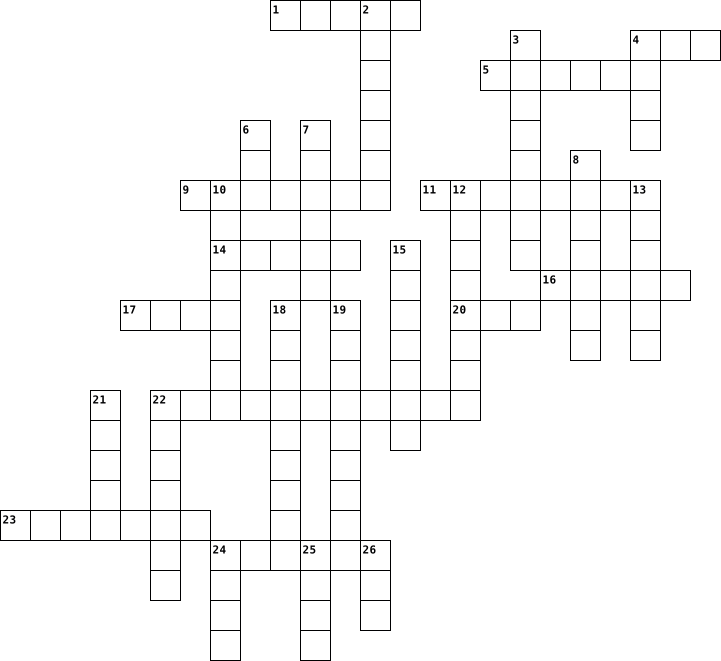
Across
- An input device which is commonly used
- The smallest unit of data in a computer
- Capable of storing information
- Accepts output from a device and transfers in onto paper
- Receive audio input from a device
- The internet
- Modulator-demodulator
- For the person of the computer or device
- Random access memory
- Defined as any auxiliary device
- A computer printer for printing vector graphics
- A way to organize computer files
Down
- Captures images
- A typewriter-style device
- A group either 8, 16, 32 or 64 bits
- Graphical user interface
- Any computer-generated information displayed on screen
- A set of computers connected together
- Voice, film, screen
- A computer requires this to function
- A computer display
- Electronic technology
- Indicates use of pictures (icons) and colours
- A shared boundary across which two or more separate components of a computer system exchange information
- Something entered into a computer or system
- An instance of a program running in a computer
- An object on a computer
- Can be considered a program
- Read only memory
29 Clues: The internet • Captures images • Read only memory • A computer display • Voice, film, screen • Random access memory • Electronic technology • Modulator-demodulator • An object on a computer • Graphical user interface • A typewriter-style device • Can be considered a program • Capable of storing information • Defined as any auxiliary device • A way to organize computer files • ...
Pharmacogenomic terminology 2017-09-25

Across
- An individual’s collection of genes
- A collection of genetic variants, such as SNPs, that always travel together (are inherited together) on the same individual allele
- HIV drug for which all patients undergo a genetic test prior to administration
- Part of the genome formed by DNA sequences that encode genes
- A study to assess common genetic variations across the entire genome of a large population of individuals in order to study whether any of the investigated variations is associated with a phenotype of interest
- A variant that has two or more alleles and is present at a frequency of at least 1% of the population
- The biochemical and physiological effects of drugs, particularly those that define the drugs mechanism of action on the body
- Two normally functioning alleles and therefore have normal enzyme activity
- Can cause respiratory depression in some babies
- Variants in this gene can cause severe reactions in response to carbamazepine and abcavir
- Maximum beneficial or therapeutic response that a drug can produce
- A single nucleotide locus with two or more naturally occurring alleles defined by a single base pair substitution
- The basic physical unit of inheritance
- A precursor (forerunner) of a drug needs to undergo chemical conversion by metabolic processes before becoming an active pharmacological agent
Down
- The absorption, distribution, metabolism, and excretion (ADME) of bioactive drugs following their administration
- Two non-functional alleles and therefore have little to no enzyme activity
- A gene predicted to be associated with a particular trait e.g disease, adverse reaction to a drug
- A group of enzymes involved in drug metabolism and found in high levels in the liver
- Well know anticoagulant that causes severe side affects in certain individuals
- When two different alleles are present on the chromosome pair
- An unintended, harmful reaction to medicines
21 Clues: An individual’s collection of genes • The basic physical unit of inheritance • An unintended, harmful reaction to medicines • Can cause respiratory depression in some babies • Part of the genome formed by DNA sequences that encode genes • When two different alleles are present on the chromosome pair • ...
Anatomical Terminology 2017-09-13

Across
- caudal/ lower portion/below structure of the body
- can think of as external- towards the surface of a structure of the body, like skin
- rotation of arm so palm is facing anterior with straight arm, or upward with arm bent (think of eating soup)
- opposite side of the body
- dorsal/ toward back or behind structure of the body
- can think of as internal, is away from the surface of a structure of the body, like a bone
- movement around a joint bring two adjacent bones or body segments farther apart
- plane/ split body in half between left and right
- rotation of arm and hand so palm is facing posteriorly with straight arm and down with bent arm
- think of “abduction, or taking away”- movement of structure away from midline
- coronal plane/ separates body into front and back
- movement around a joint bring two segments of adjacent bones or body parts closer together
- ventral/ toward front or in front of structure of body
- anatomical position of the body with face and ventral surface of the body facing downward
Down
- anatomical position of body with face and ventral surface of body facing upward
- away from central axis
- plane/ splits the body between left and right planes
- same side of the body
- think of as middle, between internal and external
- away from origin of the structure (also often used to describe limbs)
- both sides of the body
- think of as “adding to the body”- movement of a structure toward midline
- horizontal plane/ divides your body between top and bottom
- toward the origin of the structure (often used to describe limbs)
- cranial/ toward upper portion, located above a structure of the body
- toward midline (central axis of the body)
26 Clues: same side of the body • away from central axis • both sides of the body • opposite side of the body • toward midline (central axis of the body) • plane/ split body in half between left and right • caudal/ lower portion/below structure of the body • think of as middle, between internal and external • coronal plane/ separates body into front and back • ...
Cell Terminology 2017-09-27

Across
- Type of transport where movement of materials across the membrane doesn't require energy
- Type of transport where materials move against a concentration difference; requires energy
- Group of tissues working together
- Located near the nucleus and helps to organize cell division; not found in plant cells
- Cell that has free-floating DNA and few organelles
- Thin barrier surrounding a cell
- The powerhouse of the cell
- Internal membrane system that helps with protein synthesis and the creation of membrane lipids
- Relatively constant internal physical and chemical conditions
- Large membrane-enclosed structure that contains the cell’s genetic material
- Small organelles filled with enzymes that function as the cell's cleanup crew
- Small particles of RNA and protein found throughout the cytoplasm in all cells
- Group of cells that performs a similar function
Down
- Large, saclike, membrane-enclosed structure used for storage
- Cell that encloses its DNA in a nucleus and has membrane-bound organelles
- Type of diffusion in which molecules use protein channels to cross a membrane they wouldn't ordinarily be able to cross
- Stack of flattened membranes that prepares substances for storage or removal from the cell
- The process of taking material into the cell by means of infoldings, or pockets in the cell membrane
- the process by which particles move from an area of high concentration to an area of low concentration
- The fluid portion of the cell outside the nucleus
- Network of protein filaments; made of microtubules and microfilaments
- Strong supporting layer around the cell membrane
- Organelle that captures the energy from sunlight and converts it into food
- Membrane of the vacuole surrounding the material fuses with the cell membrane, forcing the contents out of the cell
- The diffusion of water through a selectively permeable membrane
25 Clues: The powerhouse of the cell • Thin barrier surrounding a cell • Group of tissues working together • Group of cells that performs a similar function • Strong supporting layer around the cell membrane • The fluid portion of the cell outside the nucleus • Cell that has free-floating DNA and few organelles • Large, saclike, membrane-enclosed structure used for storage • ...
Computer Terminology 2017-09-18

Across
- Retrieves program instructions and passes it on
- The part of the computer that are tangible
- It's the codes that allow programes to run in the computer
- A code made up of 0's and 1's
- Where information is temporarily stored, the more there is of this, the faster the computer will work
- This means to examine data, manipulate data to fit the instructions, and create output from inputted information
- Where older scanners and printers connect with the computer
- This devices is used for sound
- It manages the computer's processing and memory as well as all its hardware and software
- Takes orders and uses simple calculations to carry out the instructions
- This device is used to store information
- Directs power to various parts of the computer
- Devices that insert information to the computer
Down
- It is incredibly fast and allows peripheral devices to connect with the computer
- Devices that can be plugged into the computer
- All parts of the computer are connected to this device
- It houses the microprocessor
- They're ports that allow peripherals to connect with the computer
- They are tiny dots/boxes that construct the image on the computer
- Data stored can only be viewed
- Power can be drawn from the computer and to other devices by this device
21 Clues: It houses the microprocessor • A code made up of 0's and 1's • This devices is used for sound • Data stored can only be viewed • This device is used to store information • The part of the computer that are tangible • Devices that can be plugged into the computer • Directs power to various parts of the computer • Retrieves program instructions and passes it on • ...
Computer Terminology 2017-10-04

Across
- Anything that comes out/is displayed from the PC
- A form of computer memory that holds data to start the said device up
- Any machine that displays data from the computer
- Translating code into understandable text
- Data displayed as numbers or interpreted as such
- A memory device that holds information while in use
- Related to a number system that only has 2 different digits
- A board that connects all components together
- An electronic device that controls the flow of electrical current
- Electronic directions that tell the PC what to do in detail
- A basic unit that makes up the image displayed on screen
- The act of loading data from the memory and into the CPU
Down
- The smallest unit of data displayed on a machine
- A program used for executing information within a PC
- A single chip containing a major processing unit
- A critical software that runs, controls, and processes data
- Computer devices that are not necessary
- A computer port which can be used to store information
- The physical/touchable part of a computer
- The act of entering data into a device/computer
- The capacity of a device used to store data
- Brain of a computer
22 Clues: Brain of a computer • Computer devices that are not necessary • Translating code into understandable text • The physical/touchable part of a computer • The capacity of a device used to store data • A board that connects all components together • The act of entering data into a device/computer • The smallest unit of data displayed on a machine • ...
Unigroup Terminology 2016-05-11

Across
- WORKFLOW PLANNERS WORK FROM
- ELECTRONIC LOGGING DEVICE
- PHONE SOFTWARE THAT ALLOWS OPERATOR TO REVIEW/ACCEPT/REJECT ORDERS
- REQUEST FOR SERVICE OUTSIDE OF GUIDELINES
- AMOUNT OF FUEL REQUIRED TO MOVE ORDER
- TRADITIONAL TRACTOR TRAILER
- PER HUNDRED WEIGHT
- DELIVERY DATE OUTSIDE OF QUOTE
- WHEN ADDRESS REQUIRES SMALL TRUCK
- HAUL TO BOOK RATIO
- AGENT CLOSEST TO LOADING ADDRESS(ASSISTS W/ LABOR AND SHUTTLE)
Down
- WORKFLOW AGENTS WORK OUT OF
- AMOUNT OF GOODS THAT WOULD NOT FIT ON VAN
- AMOUNT OF REVENUE TO BE EARNED BY HAULER
- AGENT CLOSEST TO DELIVERY ADDRESS (ASSISTS W/ LABOR AND SHUTTLE)
- CALIFORNIA AIR RESOURCE BOARD
- THIRD PARTY DRIVER HAULS A LOADED VAN
- WORKFLOW TRANSPORT SOLUTIONS WORK FROM
- ORIGIN AGENT LOADS CUSTOMERS GOODS TO BRING TO WAREHOUSE
- ESTIMATED TIME OF ARRIVAL
- SELLS THE MOVE AND IS RESPONSIBLE FOR THE MOVE PROCESS
21 Clues: PER HUNDRED WEIGHT • HAUL TO BOOK RATIO • ELECTRONIC LOGGING DEVICE • ESTIMATED TIME OF ARRIVAL • WORKFLOW AGENTS WORK OUT OF • WORKFLOW PLANNERS WORK FROM • TRADITIONAL TRACTOR TRAILER • CALIFORNIA AIR RESOURCE BOARD • DELIVERY DATE OUTSIDE OF QUOTE • WHEN ADDRESS REQUIRES SMALL TRUCK • THIRD PARTY DRIVER HAULS A LOADED VAN • AMOUNT OF FUEL REQUIRED TO MOVE ORDER • ...
Computer Terminology 2016-10-21

Across
- An electronic pathway through which data is transmitted between components in a computer.
- A connection socket.
- Pronounced 'ask-key', an american standard code for information interchange.
- A compact disc storage media that holds much more than a standard CD (DVD). [3 words; 7,9,4]
- RAM [3 words; 6,6,6]
- An add-on component to your computer.
- Converts electrical signals into sounds loud enough to be heard at a distance.
- A small portion of memory that is really fast, but very expensive.
- A 3.5 inch square rigid disk which holds data. It is named for the earlier 5.25 and 8 inch disks that were flexible).
- A device that controls the cursor on the monitor.
- The storage part or the 'brain' of your computer.
- A device that can read text or illustrations printed on paper and translate the information into a form the computer can use.
- The main circuit board that contains the CPU, RAM, memory and other chips.
- To start up a computer.
Down
- A device, normally inside a computer, that acts as a digital filing cabinet for storing documents, pictures, applications, etc (2 words - 4,4).
- The processing chip that is the 'brains' of a computer. [3 words, 7,10,4]
- A very fast external bus standard that supports data transfer rates of up to 400Mbps (for version a) and 800Mbps (for version b). [number & word; 4,9]
- An external bus standard that supports data transfer rates of 12 Mbps. [3 words; 9,6,3]
- The smallest piece of information used by the computer. Derived from 'binary digit'.
- ROM [3 words; 4,4,6]
- An acronym for Compact Disc Read-Only Memory.
- A set of instructions in the ROM of most computer components that controls the transfer of data in and out.
- A port that allows data to be transmitted in a series (one after the other), such as the printer and modem ports. [2 words; 6,4]
- The set of typewriter-like keys that enables you to enter data into a computer.
- A piece of computer information made up of eight bits.
- A device that produces texts and graphics on paper.
- Computer screen.
- It connects you to the internet or to other computers around the world.
28 Clues: Computer screen. • A connection socket. • ROM [3 words; 4,4,6] • RAM [3 words; 6,6,6] • To start up a computer. • An add-on component to your computer. • An acronym for Compact Disc Read-Only Memory. • A device that controls the cursor on the monitor. • The storage part or the 'brain' of your computer. • A device that produces texts and graphics on paper. • ...
Civics Terminology 2020-09-20

Across
- A system of government in which the state plans and controls the economy and a single, often authoritarian party holds power, claiming to make progress towards a higher social order in which all goods are equally shared by the people.
- An inhabited geographic area with defined boundaries, that is fully sovereign.
- Government of the wealthy.
- A status bestowed upon individuals in a society, whether by birth, right, test or
- Decision making is carried out by the people.
- The ability of an individual or group to get what it wants.
- philosophies.
- failing that, another relative.
- is a term used to describe policy ideas that are inspired by more liberal, socialist or
- Rule by a small group of people, usually used to describe a bad government.
- operates.
- Rule by a dictator, one person, usually used to describe a bad government, often
- The practice and study of financial and industrial institutions, businesses and
- A member of a society, subject to the duties and privy to the rights of that society.
- The rules and regulations (laws), either written or unwritten, that govern how a
- Decision making is carried out by one person, or a few people.
- Rule by a small group of people, usually those with wealth, though sometimes
- that makes that individual a citizen.
- (1) Tolerant and open minded. (2) A political party.
Down
- is a term used to describe policy ideas that are inspired by more conservative
- Society: A broad web of voluntary organization, movements and associations outside
- The authority or power, and decision making system, over a country, province, or
- A police state controlled by one political party or dictator, characterized by high surveillance, propaganda and militarism.
- A religious government.
- The study of public affairs and the duties and rights of citizenship.
- operated by private corporations or individuals.
- Rule by a king or queen where power is transferred to the oldest son or daughter,
- One who actively campaigns for or against a policy or social reform.
- (1) Refers to cautious and traditional. (2) A political party.
- and businesses that take action on important public issues in democracy.
- with tyranny.
- (1) The practice and study of government. (2) Interactions between individuals in a
- Science The art and science of government.
- An economic system in which the means of production and distribution are owned
34 Clues: operates. • philosophies. • with tyranny. • A religious government. • Government of the wealthy. • failing that, another relative. • that makes that individual a citizen. • Science The art and science of government. • Decision making is carried out by the people. • operated by private corporations or individuals. • (1) Tolerant and open minded. (2) A political party. • ...
Anatomical Terminology 2020-10-22

Across
- The study of where body structures are located
- The increasing of a joint angle
- The rotation of the foot inward
- Away from the midline of the body
- The moving of a body part AWAY from the midline of the body
- Positioned toward the "front" of the body
- The decreasing of a joint angle
- The movement of the foot outwards
- Closer to the trunk or core of the body (only in upper and lower limbs)
- The study of how body structures move
- One side of the body
Down
- Positioned toward the "back" of the body
- Closer to the midline of the body
- "Pour the soup"
- Both sides of the body
- Positioned toward the upper part of the body (above)
- Positioned toward the lower part of the body (below)
- "Hold the soup"
- Farther away from the trunk or core (only in upper and lower limbs)
- The moving of a body part TOWARD the midline of the body
20 Clues: "Pour the soup" • "Hold the soup" • One side of the body • Both sides of the body • The increasing of a joint angle • The rotation of the foot inward • The decreasing of a joint angle • Closer to the midline of the body • Away from the midline of the body • The movement of the foot outwards • The study of how body structures move • Positioned toward the "back" of the body • ...
Legislative Terminology 2018-11-29

Across
- Formal expression of will/decision by members.
- Building where the Governor's Office is located.
- First in Importance; Money; Main person
- Upper House
- Money: Principal; Chief
- Concise statement of contents of bill.
- Laws of Nevada
- Lower House
- Lawyer or Attorney
- Brief and unofficial explanation of contents of bill or resolution.
- Version of bill/resolution subsequent to introduced version with amendments adopted by either house.
- To change or modify
Down
- Action of Governor in disapproval of bill.
- Note Document that states estimated monetary impact of a bill. (two words)
- Exact wording; word for word
- General agreement
- Law upon which others are based
- Intermission during floor session or committee meeting.
- To suspend indefinitely.
- Accurate written report of proceedings of a meeting.
- Minimum number of members present to transact business legally.
21 Clues: Upper House • Lower House • Laws of Nevada • General agreement • Lawyer or Attorney • To change or modify • Money: Principal; Chief • To suspend indefinitely. • Exact wording; word for word • Law upon which others are based • Concise statement of contents of bill. • First in Importance; Money; Main person • Action of Governor in disapproval of bill. • ...
Statistics Terminology 2019-01-03

Across
- This is a type of data which is countable and can only take specific numerical values.
- This is database function that you would use to request information.
- This correlation coefficient is used when data are already ranked or there is a non-linear relationship.
- This is a type of data which is non-numerical.
- 99.7% of data lie within how many standard deviations of the mean in a normal distribution?
- A diagram representing probabilities using overlapping circles was named after this mathematician.
- This is a name for a category in a spreadsheet or database.
- This describes two events that can not happen at the same time.
- This is a spreadsheet function that you would use to show only certain values.
- The sum of all probabilities for a discrete random variable must add up to this value.
- This term describes when you make a prediction outside of the data range.
- A distribution where there are two outcomes, a fixed number of trials, the trials are independent of each other and the probability of success is fixed.
- This is a type of graph which is used to represent continuous data where the area is proportional to the frequency.
- The curve representing the normal distribution is said to have this shape.
Down
- A mathematical line of best fit is known as this.
- This value represents the spread of the data and is represented by s.
- The middle vale in the data set.
- This is a spreadsheet function that you would use to arrange the entries in a particular order.
- This describes two events where the event that one happens does not affect the probability of the other happening.
- This summary statistic is found by summing all of the data points and dividing by the total number.
- The statistical ______ cycle is the process which covers initial planning, data collection, data processing and presentation, interpretation of results and evaluation and review.
- This is a type of data which is measurable and can take any numerical value.
- The most common value in the data set.
23 Clues: The middle vale in the data set. • The most common value in the data set. • This is a type of data which is non-numerical. • A mathematical line of best fit is known as this. • This is a name for a category in a spreadsheet or database. • This describes two events that can not happen at the same time. • ...
Dance terminology 2021-05-25

Across
- en Outward. A circular movement of the gesture limb from front to back, or a turn which moves away from the stance
- en, To the back
- Founder, director, and principle choreographer of New York City Ballet. Trained in the Russian school, he
- in dance: Plier (to bend), Étendre (to stretch), Relever (to rise), Glisser (to slide or glide), Sauter (to
- with the left hand at the bar, working the right gesture leg.
- stance leg.
- The quality of lightness, ease in jumping.
- above 90°, or partnering work.
- A unilateral standing posture with the pointed gesture foot held in front of, back of, or wrapped around the ankle of
- floor, The second portion of the ballet class, comprised of the adagio, turns, and small jumps (petit allegro).
- “To disengage”. Sharp brushes of the pointed foot to develop speed and precision of the feet and legs.
- en, To the front
- “Tossed”. A light, rocking quality, jump sequence. Ex: A jump from the point tondu front to the point tondu
- Élancer (to dart), Tourner (to turn). Used by the Italian and Royal (English) Ballets.
- A bend of the body from the waist to the front, back, or side, with an accompanying port de bras.
- The gesture leg is extended behind the dancer’s body at 90° or higher, which requires hip and spine hyperextension,
- “Caper like a goat”. A jump where one leg is kicked up into the air and the supporting leg pushes off and beats
- A jumping beat which allows the dancer to travel in a specified direction.
Down
- The introductory / warm up portion of the ballet class, conducted while holding onto a ballet bar. The dancer always
- en Inward. A circular movement of the gesture limb from the back to the front (as in ronde de jambe), or a turn done
- en, “Cross”. Unilateral leg gesture carried out in three directions relative to the dancer’s front (en avant), side (a la
- large expansive jumps such as grand jeté.
- extension, and ankle-foot plantarflexion.
- one to the other limb with each half turn. Performed continuously in rapid succession.
- Rapid tempo movements, often includes jumping steps. Petit allegro includes smaller jumping steps. Grand allegro
- To assemble or place (the feet) together in the air (usually in fifth position) during a jump.
- To hit the legs together, moving in and out of fifth position in the air. See petite batterie.
- Method, A school and style of ballet, originated by Enrico Cecchetti (1850-1928) in Italy. Emphasizes seven basic
- grand battement, etc. are performed en croix.
- the front. Attitude croisée derriere: the leg is lifted to the back.
- and back (en arrière), making the shape of a cross. Typical barre exercises (tondu, dégagé, dévelopé,
- “To cut”. A small intermediary step, used as a link between steps, such as jeté, pas de bourré, etc., using the cou-depied position.
- “Linked like a chain”. A series of small turning steps with the feet in first position relevé. Weight is shifted rapidly
- a neo-classical technique known for rapid footwork and abstract choreography.
- A music term used for slow, sustained movements. The ‘adagio’ portion of ballet class may encompasses high
- to the other, performed in place or traveling.
- The hip of the gesture leg is at 90°, the knee is bent, and the foot is pointed. Attitude croisée devant: the leg is lifted
- the gesture leg, propelling it higher. The jump lands on the kicking leg.
- the stance limb.
- A step performed on pointe from fifth position. Initiated with the front foot, there is a rapid weight shift from one
40 Clues: stance leg. • en, To the back • en, To the front • the stance limb. • above 90°, or partnering work. • large expansive jumps such as grand jeté. • extension, and ankle-foot plantarflexion. • The quality of lightness, ease in jumping. • grand battement, etc. are performed en croix. • to the other, performed in place or traveling. • ...
Sonographic Terminology 2021-04-05

Across
- Blood flow away from the liver.
- Red blood cell; contains hemoglobin.
- Enlarged liver.
- Rhythmic contraction of the GI tract that propels food through it
- Describes tissues or organ structures on the sonogram having several different echo characteristics.
- Fibroelastic connective tissue layer that surrounds the liver.
- Fold within the neck or body of the gallbladder.
- Inner portion of the adrenal gland that secretes the catecholamines epinephrine and norepinephrine.
- Enlarged spleen.
- Fibrous tissue network that is richly supplied by blood vessels and nerves located between the skin and the underlying structures.
- Tissue death caused by an interruption of the blood supply.
- Focal dilatation of an artery caused by a structural weakness in the wall.
- White blood cell; protects and fights against infection in the body.
- Hormone which stimulates gallbladder contraction.
- Peritoneum lining the walls of the peritoneal cavity.
- Fluid accumulation in the pleural cavity.
- Laboratory value of the percentage of blood volume made up of red blood cells.
- Describes structures of equal echo density.
- Solid, semisolid, or thickened bile within the gallbladder or bile duct.
- Blood in the urine.
- Divides the right and left lobes of the liver; seen in sagittal plane as an echogenic line between the neck of the gallbladder and the main portal vein.
- Secreting into blood or tissue.
- Enlargement of lymph nodes due to inflammation, primary neoplasia, or metastasis.
- Two layers of fused peritoneum that conduct nerves, lymph, and blood vessels between the small bowel/colon and the posterior peritoneal cavity wall.
- Fissure where the portal vein and hepatic artery enter the liver and the common hepatic duct exits.
- Surgical removal of the gallbladder.
- Describes a region or portion on the sonogram that appears echo-free.
- Painful urination.
- Inflammation of the urinary bladder.
- Yellowish pigmentation of the skin and whites of the eyes caused by increased levels of bilirubin in the blood.
- Low output of urine that is the result of many possible causes including dehydration, renal failure, or urinary obstruction.
- Peritoneum encasing peritoneal organs.
- Describes regions or portions on the sonogram where the echoes are not as bright as surrounding tissues or are less bright than normal.
- Duct which carries bile from the cystic and hepatic ducts to the duodenum.
Down
- Connection between two vessels.
- Organs posterior to the parietal peritoneum, which are typically covered on their anterior surface or fatty capsule by parietal peritoneum.
- Solid organs within the peritoneal cavity that are covered by visceral peritoneum.
- Fold within the gallbladder fundus.
- Fold in the parietal peritoneum that extends from the umbilicus to the diaphragm and contains the ligamentum teres.
- Blood flow toward the liver.
- Caused by treatment; either intentional or unintentional.
- Describes structures of equal echo density.
- Outer parenchyma of the adrenal gland that secretes corticoids, including cortisol and aldosterone.
- Remnant of ductus venosus seen as echogenic line separating caudate lobe from the left lobe.
- Secreting into a duct.
- Formation or presence of stones within the gallbladder.
- AKA posterior cul de sac or rectouterine space
- Describes image echoes brighter than surrounding tissues or those brighter than what is normal for that tissue or organ.
- Pear-shaped sac responsible for storing bile until it is released through the cystic duct.
- Remnant of the left umbilical vein, seen in the transverse plane as a triangular echogenic foci dividing the medial and lateral segments of the left lobe of the liver.
- Dilatation, expansion, or distention.
- Area of an organ where blood vessels, lymph, and nerves enter and exit.
- Calculi located within the bile duct.
- on the opposite side
- Also known as the renal fascia; dense connective tissue that surrounds and helps anchor the kidney, adipose capsule, and the adrenal gland.
- Acute or chronic inflammation of the gallbladder.
- Surgical removal of the kidney.
- Describes an organ or tissue capable of producing echoes by reflecting the acoustic beam.
- Duct of the gallbladder which joins with the hepatic duct to form the common bile duct
- Accumulation of serous fluid in the peritoneal cavity.
60 Clues: Enlarged liver. • Enlarged spleen. • Painful urination. • Blood in the urine. • on the opposite side • Secreting into a duct. • Blood flow toward the liver. • Blood flow away from the liver. • Connection between two vessels. • Surgical removal of the kidney. • Secreting into blood or tissue. • Fold within the gallbladder fundus. • Red blood cell; contains hemoglobin. • ...
HIV Terminology 2021-03-28

Across
- type of sarcoma most closely associated with HIV
- a toxin or foreign substance which induces an immune response in the body
- taking medications exactly as instructed by a health care provider
- damage or abnormal structural change to a tissue, organ, or body part because of injury or disease
- the core section of HIV that contains the genetic information
- when the body is able to produce a normal immune response
- stage of HIV also known as stage 2 where a slow reduction of CD4 T cells takes place
- the first stage in the HIV life cycle; characterized by the virus attaching itself to the surface of the CD4 cell
- term for a couple in which one partner is infected with HIV and the other partner is not
- type of medical therapy used to treat HIV
- the passing of a disease from an infected individual to a previously uninfected individual
Down
- a blood protein produced in response to and counteracting a specific antigen
- the "I" in HIV. It describes the body's increased risk of infection
- term for when the viral load is so low that it can no longer be detected by standard blood tests
- type of infection that occurs more often in people with weakened immune systems
- describes a disease that persists for a long time or is constantly recurring
- type of white blood cell that is attacked by HIV
- refers to a couple in which both partners have HIV
- showing a positive result in a test of blood serum for the presence of a virus
- a mark of disgrace associated with a particular circumstance, in this case having HIV
20 Clues: type of medical therapy used to treat HIV • type of sarcoma most closely associated with HIV • type of white blood cell that is attacked by HIV • refers to a couple in which both partners have HIV • when the body is able to produce a normal immune response • the core section of HIV that contains the genetic information • ...
Sonographic Terminology 2021-04-08

Across
- Peritoneum lining the walls of the peritoneal cavity.
- Blood flow away from the liver.
- Enlarged liver.
- Describes tissues or organ structures on the sonogram having several different echo characteristics.
- Peritoneum encasing peritoneal organs.
- Fold in the parietal peritoneum that extends from the umbilicus to the diaphragm and contains the ligamentum teres.
- Accumulation of serous fluid in the peritoneal cavity.
- Describes a region or portion on the sonogram that appears echo-free.
- Describes structures of equal echo density.
- Blood flow toward the liver.
- Fluid accumulation in the pleural cavity.
- Divides the right and left lobes of the liver; seen in sagittal plane as an echogenic line between the neck of the gallbladder and the main portal vein.
- Dilatation, expansion, or distention.
- Yellowish pigmentation of the skin and whites of the eyes caused by increased levels of bilirubin in the blood.
- Solid organs within the peritoneal cavity that are covered by visceral peritoneum.
Down
- Two layers of fused peritoneum that conduct nerves, lymph, and blood vessels between the small bowel/colon and the posterior peritoneal cavity wall.
- Fissure where the portal vein and hepatic artery enter the liver and the common hepatic duct exits.
- Organs posterior to the parietal peritoneum, which are typically covered on their anterior surface or fatty capsule by parietal peritoneum.
- Rhythmic contraction of the GI tract that propels food through it
- Connection between two vessels.
- Remnant of ductus venosus seen as echogenic line separating caudate lobe from the left lobe.
- Fibrous tissue network that is richly supplied by blood vessels and nerves located between the skin and the underlying structures.
- Describes image echoes brighter than surrounding tissues or those brighter than what is normal for that tissue or organ.
- Focal dilatation of an artery caused by a structural weakness in the wall.
- Caused by treatment; either intentional or unintentional.
- Describes structures of equal echo density.
- Describes regions or portions on the sonogram where the echoes are not as bright as surrounding tissues or are less bright than normal.
- Remnant of the left umbilical vein, seen in the transverse plane as a triangular echogenic foci dividing the medial and lateral segments of the left lobe of the liver.
- Describes an organ or tissue capable of producing echoes by reflecting the acoustic beam.
- Area of an organ where blood vessels, lymph, and nerves enter and exit.
- Fibroelastic connective tissue layer that surrounds the liver.
31 Clues: Enlarged liver. • Blood flow toward the liver. • Blood flow away from the liver. • Connection between two vessels. • Dilatation, expansion, or distention. • Peritoneum encasing peritoneal organs. • Fluid accumulation in the pleural cavity. • Describes structures of equal echo density. • Describes structures of equal echo density. • ...
Sonographic Terminology 2021-04-08

Across
- Peritoneum encasing peritoneal organs.
- an increase to the quantity of blood flow to a body part; increased blood flow as in the inflammatory response
- Describes an organ or tissue capable of producing echoes by reflecting the acoustic beam.
- Organs posterior to the parietal peritoneum, which are typically covered on their anterior surface or fatty capsule by parietal peritoneum.
- Describes image echoes brighter than surrounding tissues or those brighter than what is normal for that tissue or organ.
- Plane dividing the body into anterior and posterior
- Describes a region or portion on the sonogram that appears echo-free.
- Connection between two vessels.
- AKA transverse; plane dividing the body into superior and inferior
- Rhythmic contraction of the GI tract that propels food through it
Down
- Describes structures of equal echo density.
- Fluid accumulation in the pleural cavity.
- Peritoneum lining the walls of the peritoneal cavity.
- Describes structures of equal echo density.
- Plane dividing the body into right and left halves
- Describes tissues or organ structures on the sonogram having several different echo characteristics.
- Two layers of fused peritoneum that conduct nerves, lymph, and blood vessels between the small bowel/colon and the posterior peritoneal cavity wall.
- Solid organs within the peritoneal cavity that are covered by visceral peritoneum.
- Dilatation, expansion, or distention.
- Focal dilatation of an artery caused by a structural weakness in the wall.
- Describes regions or portions on the sonogram where the echoes are not as bright as surrounding tissues or are less bright than normal.
- Fibrous tissue network that is richly supplied by blood vessels and nerves located between the skin and the underlying structures.
- Area of an organ where blood vessels, lymph, and nerves enter and exit.
- Accumulation of serous fluid in the peritoneal cavity.
- inside space of a tubular or cellular structure
25 Clues: Connection between two vessels. • Dilatation, expansion, or distention. • Peritoneum encasing peritoneal organs. • Fluid accumulation in the pleural cavity. • Describes structures of equal echo density. • Describes structures of equal echo density. • inside space of a tubular or cellular structure • Plane dividing the body into right and left halves • ...
ELA Terminology 2021-04-09

Across
- the sentence that states what an essay is about
- a short story from someone's life
- evidence that is implied in the text
- the feeling associated with a word
- informal language used in everyday conversation; slang
- the three dots used to indicate that info. has been removed
- the author or text that information came from
- a reference to a source
- meaning or moral message of a story
- a quote or paraphrase from the text, usually used to support a point 6. the reason an author wrote the text
- how information is organized (description, sequence, problem/solution, cause/effect, or compare/contrast)
Down
- dictionary definition of a word
- believable or trustworthy
- the position opposite the claim
- used as proof that an author is trustworthy
- the same thing as main idea
- evidence stated DIRECTLY jn the text
- ideas combined from multiple sources
- first, second, or third; or an author's feelings about a topic
- the thesis of an argumentative essay
- the attitude coveyed by a passage
- an educated guess or conclusion drawn from the text
- to say where information came from (usually a title or author)
23 Clues: a reference to a source • believable or trustworthy • the same thing as main idea • dictionary definition of a word • the position opposite the claim • a short story from someone's life • the attitude coveyed by a passage • the feeling associated with a word • meaning or moral message of a story • evidence stated DIRECTLY jn the text • ideas combined from multiple sources • ...
Sonographic Terminology 2021-04-08

Across
- Peritoneum lining the walls of the peritoneal cavity.
- Enlarged liver.
- effusion Fluid accumulation in the pleural cavity.
- Remnant of ductus venosus seen as echogenic line separating caudate lobe from the left lobe.
- Two layers of fused peritoneum that conduct nerves, lymph, and blood vessels between the small bowel/colon and the posterior peritoneal cavity wall.
- Blood flow toward the liver.
- Divides the right and left lobes of the liver; seen in sagittal plane as an echogenic line between the neck of the gallbladder and the main portal vein.
- Blood flow away from the liver.
- Rhythmic contraction of the GI tract that propels food through it
- Describes regions or portions on the sonogram where the echoes are not as bright as surrounding tissues or are less bright than normal.
- Accumulation of serous fluid in the peritoneal cavity.
- Remnant of the left umbilical vein, seen in the transverse plane as a triangular echogenic foci dividing the medial and lateral segments of the left lobe of the liver.
Down
- Organs posterior to the parietal peritoneum, which are typically covered on their anterior surface or fatty capsule by parietal peritoneum.
- Fold in the parietal peritoneum that extends from the umbilicus to the diaphragm and contains the ligamentum teres.
- Solid organs within the peritoneal cavity that are covered by visceral peritoneum.
- Peritoneum encasing peritoneal organs.
- Describes structures of equal echo density.
- Describes tissues or organ structures on the sonogram having several different echo characteristics.
- Describes structures of equal echo density.
- Fibroelastic connective tissue layer that surrounds the liver.
- Fissure where the portal vein and hepatic artery enter the liver and the common hepatic duct exits.
- Describes image echoes brighter than surrounding tissues or those brighter than what is normal for that tissue or organ.
- Describes a region or portion on the sonogram that appears echo-free.
- Area of an organ where blood vessels, lymph, and nerves enter and exit.
- Focal dilatation of an artery caused by a structural weakness in the wall.
- Connection between two vessels.
- Yellowish pigmentation of the skin and whites of the eyes caused by increased levels of bilirubin in the blood.
- Caused by treatment; either intentional or unintentional.
- Dilatation, expansion, or distention.
- Describes an organ or tissue capable of producing echoes by reflecting the acoustic beam.
- Fibrous tissue network that is richly supplied by blood vessels and nerves located between the skin and the underlying structures.
31 Clues: Enlarged liver. • Blood flow toward the liver. • Connection between two vessels. • Blood flow away from the liver. • Dilatation, expansion, or distention. • Peritoneum encasing peritoneal organs. • Describes structures of equal echo density. • Describes structures of equal echo density. • effusion Fluid accumulation in the pleural cavity. • ...
Sonographic Terminology 2021-04-08

Across
- Blood in the urine.
- Inner portion of the adrenal gland that secretes the catecholamines epinephrine and norepinephrine.
- Solid, semisolid, or thickened bile within the gallbladder or bile duct.
- Hormone which stimulates gallbladder contraction.
- Secreting into a duct.
- Acute or chronic inflammation of the gallbladder.
- Painful urination.
- Fold within the gallbladder fundus.
- Calculi located within the bile duct.
- Fold within the neck or body of the gallbladder.
- Surgical removal of the kidney.
- Tissue death caused by an interruption of the blood supply.
- Pear-shaped sac responsible for storing bile until it is released through the cystic duct.
Down
- Surgical removal of the gallbladder.
- Laboratory value of the percentage of blood volume made up of red blood cells.
- Enlarged spleen.
- Duct which carries bile from the cystic and hepatic ducts to the duodenum.
- Low output of urine that is the result of many possible causes including dehydration, renal failure, or urinary obstruction.
- Formation or presence of stones within the gallbladder.
- Red blood cell; contains hemoglobin.
- Outer parenchyma of the adrenal gland that secretes corticoids, including cortisol and aldosterone.
- White blood cell; protects and fights against infection in the body.
- Duct of the gallbladder which joins with the hepatic duct to form the common bile duct
- Secreting into blood or tissue.
- Also known as the renal fascia; dense connective tissue that surrounds and helps anchor the kidney, adipose capsule, and the adrenal gland.
- Inflammation of the urinary bladder.
26 Clues: Enlarged spleen. • Painful urination. • Blood in the urine. • Secreting into a duct. • Secreting into blood or tissue. • Surgical removal of the kidney. • Fold within the gallbladder fundus. • Surgical removal of the gallbladder. • Red blood cell; contains hemoglobin. • Inflammation of the urinary bladder. • Calculi located within the bile duct. • ...
Anatomy Terminology 2021-08-19

Across
- cavity containing the subdivisions of the cranial cavity and spinal cavity
- Toward or at midline of the body
- Posterior surface of elbow
- Forms external body covering
- Fingers, toes
- Nose area
- Study of the structure and shapes of the body and its parts and their relationships to one another
- Armpit
- Chest
- Posterior surface of leg; the calf
Down
- Separates lungs into right and left cavities in the thoracic cavity
- Point of shoulder
- Also called the coronal section
- Cut down the middle of the body with right and left parts of equal size
- Separates thoracic cavity from rest of ventral cavity
- Area of spinal column
- Eliminates nitrogen-containing wastes from the body
- Chin
- Area where thigh meets body trunk; groin
- Anterior knee
20 Clues: Chin • Chest • Armpit • Nose area • Fingers, toes • Anterior knee • Point of shoulder • Area of spinal column • Posterior surface of elbow • Forms external body covering • Also called the coronal section • Toward or at midline of the body • Posterior surface of leg; the calf • Area where thigh meets body trunk; groin • Eliminates nitrogen-containing wastes from the body • ...
Animal Terminology 2023-08-30

Across
- offspring/young chicken
- agricultural product from goats
- agricultural products from sheep
- castrated male cattle
- young female sheep
- offspring/young of cattle
- castrated male chicken
- Mature male chicken
- mature female sheep
- Mature male sheep
- Mature female cattle
- offspring/young of swine
- castrated male swine
- young female swine
- offspring/young of goats
Down
- mature female chicken
- young female chicken
- agricultural product from chickens
- young female cattle
- castrated male sheep
- Mature male swine
- mature male goat
- agricultural product from cattle
- young female goat
- mature female swine
- mature female goat
- agricultural product from swine
- offspring/young from sheep
28 Clues: mature male goat • Mature male swine • young female goat • Mature male sheep • young female sheep • mature female goat • young female swine • young female cattle • mature female swine • Mature male chicken • mature female sheep • young female chicken • castrated male sheep • Mature female cattle • castrated male swine • mature female chicken • castrated male cattle • castrated male chicken • ...
Football Terminology 2023-08-06

Across
- A set-piece awarded to a team for a foul committed by the opponent.
- A goal scored by tapping the ball into an empty net from close range.
- Additional time added at the end of each half for stoppages.
- The player designated to lead the team on the field.
- A tiebreaker to decide the winner if the match ends in a draw.
- The team that finishes the match with more goals and secures the victory.
- The referee and assistant referees who enforce the rules of the game.
- set-piece taken from the corner of the field, awarded to the attacking team.
- A restart taken by the defending team from their own goal area.
- An attempt by a player to deceive the referee into awarding a foul.
- A card shown by the referee to send off a player from the match.
- The rectangular area in front of each goal where certain rules apply.
Down
- A caution shown by the referee to signal a warning to a player.
- A match in which a team does not concede any goals.
- A pass that sets up a goal for a teammate.
- The two vertical posts that form part of the goal.
- Scoring three goals by a player in a single match.
- Additional time played if the match is tied after regular time.
- When a player accidentally scores a goal for the opposing team.
- A player positioned ahead of the ball and the second-last defender.
- A free-kick from the penalty spot awarded for a foul inside the box.
- A fair challenge to dispossess an opponent of the ball.
- A team's roster, including players and substitutes.
- Passing the ball through an opponent's legs.
- Quickly transitioning from defense to offense after gaining possession.
25 Clues: A pass that sets up a goal for a teammate. • Passing the ball through an opponent's legs. • The two vertical posts that form part of the goal. • Scoring three goals by a player in a single match. • A match in which a team does not concede any goals. • A team's roster, including players and substitutes. • The player designated to lead the team on the field. • ...
Procedural Terminology 2023-08-15

Across
- thorax
- amnion (amniotic fluid)
- surgical removal, or resection
- esophagus
- joint
- create hole or mouth
- stomach
- scope
- bronchi
- abdomen
- fusion or binding together
- life
Down
- breaking or dissolving
- puncture to obtain CSF
- fixiation
- abdomen
- to cut into
- view of
- abdomen
- strenghten
- surgical repair
- colon
- peridcardium
23 Clues: life • joint • scope • colon • thorax • abdomen • view of • stomach • abdomen • bronchi • abdomen • fixiation • esophagus • strenghten • to cut into • peridcardium • surgical repair • create hole or mouth • breaking or dissolving • puncture to obtain CSF • amnion (amniotic fluid) • fusion or binding together • surgical removal, or resection
Plant Terminology 2023-11-28

Across
- - any member of flowering plants that has a pair of leaves in the embryo of the seed
- - a group of seed-producing plants that includes conifers, cycads, and Gingko. The name means “naked seed” because of the unenclosed condition of the seeds.
- meristem - a specialized zone of growth found at the tips of plants that is responsible for the extension of shoots and roots
- - plants that keep their leaves all year-round
- - the natural compound present in green plants that gives them their color. This helps the plants absorb energy from the sun.
- - water-soluble pigments that are found naturally in foods found in red, purple, and blue fruits and vegetables
- - these are thin branching roots that grow from the stem. They are universally present in monocot plants and ferns.
- - these roots are occasionally used as food because they are able to store nutrients during development
- - a group of plants that produce flowers and fruits. This group includes about 300,000 species!
- - any member of flowering plants that has one leaf in the embryo of the seed
- - large groups of plants that have tissues capable of moving water and minerals throughout the plant, including xylem and phloem
- - roots that are exposed to the air that can photosynthesize and have chlorophyll. They are also an example of adventitious roots.
- - a plant that lives more than two years
- - modified adventitious roots that grow downward that support the lower branches
- - fungi that have symbiotic relationships with the roots of many plants
- crown - the part of the root system from where the stem arises
- - a plant that completes its life cycle in one year (or growing season) and then dies
- - these roots extend horizontally from the main stem, contributing to anchoring the plant in the soil, facilitating water uptake, and extracting nutrients required for growth. They are also known to make symbiotic relationships with bacteria and fungi.
- - natural pigments in plants, algae, bacteria, and fungi that exhibit yellow, orange, red, and purple colors
Down
- - the process by which plants use sunlight, water, and carbon dioxide to create oxygen and energy in the form of sugar
- - a plant that takes two years to complete its life cycle
- - the process of shedding old or unwanted leaves, flowers, fruits, or other parts of a plant. This happens when that part has served its function, is ripe, or is no longer needed.
- - a root that comes from a point other than the radicle or the root axis. This can be in response to stress conditions such as nutrient deficiency.
- - groups of plants without vascular systems. These plants instead have simpler tissues that have specialized functions for transporting water and nutrients.
- - bacteria that are capable of “fixing” nitrogen
- - the main primary root system, growing vertically downward. Some of these roots are specialized for food storage (like the roots of carrots and beets).
- - the process of aging in plants. It may take place in the roots, leaves, stems, or in the whole plant.
- - this tissue transports water throughout the body of the plant
- - this tissue transports sugar throughout the body of the plant
- - plants that lose their leaves annually
- - red and yellow pigments found in plants and in some cases, replaces anthocyanins
31 Clues: - a plant that lives more than two years • - plants that lose their leaves annually • - plants that keep their leaves all year-round • - bacteria that are capable of “fixing” nitrogen • - a plant that takes two years to complete its life cycle • crown - the part of the root system from where the stem arises • ...
Livestock Terminology 2023-11-15

Across
- Kid/Doeling Young female goat who hasn't had kids
- Mature Male Goat that can reproduce
- newly born pig
- Mature Male Cattle that can still reproduce
- castrated male cattle
- a castrated male horse
- mature female horse that has had foals
- newly born horse
- Lamb Young female sheep (has not reproduced)
- newly born cattle
- mature female pig that has had piglets
- mature male chicken
- Scientific Term for Chickens and Other Meat Birds
- Mature Male Pig still intact
Down
- a newly hatched or a very young chicken
- scientific name for pigs
- young female horse less than 4 years old
- a young female chicken that hasn't laid eggs yet
- scientific term for sheep
- castrated male chicken
- scientific term for horses
- castrated male pig
- newly born goat
- a newly born sheep
- Mature Male Horse that can still reproduce
- a young female pig that has not yet had piglets
- Mature Female Sheep that has had lambs
- Mature Female Cattle that have had babies
- a castrated male sheep or goat
- young female cattle that haven't had a calf
- mature female chicken that has laid eggs
- Mature Male Sheep that can still reproduce
- Mature Female Goat that has had kids
33 Clues: newly born pig • newly born goat • newly born horse • newly born cattle • castrated male pig • a newly born sheep • mature male chicken • castrated male cattle • castrated male chicken • a castrated male horse • scientific name for pigs • scientific term for sheep • scientific term for horses • Mature Male Pig still intact • a castrated male sheep or goat • Mature Male Goat that can reproduce • ...
Anatomy Terminology 2024-05-14

Across
- - toes in most mammals
- - towards the spine of the animal
- - often referred to as the thigh bone
- - towards the tail end of the body
- - superficial layer of the skin
- - clear outer covering of the eyeball
- - external part of the ear
- - relatively flat and triangular-shaped bone
- - strong bands of white fibrous tissue
- - allows for the attachment of major flight muscles
- - the coloured part of the eye
- - a protein rich fluid
Down
- - towards the lower surface of the animal
- - the white outer of the eye
- - towards the side of the animal
- - deep layer of the skin
- - towards the head of the animal
- - external opening for all systems
- - unions or function between two or more bones
- - towards the midline of the animal
- - aids in clotting to minimise blood loss
- - carries blood away from the heart
22 Clues: - toes in most mammals • - a protein rich fluid • - deep layer of the skin • - external part of the ear • - the white outer of the eye • - the coloured part of the eye • - superficial layer of the skin • - towards the side of the animal • - towards the head of the animal • - towards the spine of the animal • - towards the tail end of the body • - external opening for all systems • ...
Animal Terminology 2024-05-15

Across
- mature male rabbit
- Act of giving birth in goats.
- Young beef/dairy animal either male or female.
- Female swine that has no litter
- Uncastrated male horse
- very young chicken not yet at market weight
- Castrated male swine
- act of giving birth in sheep
- young chicken at market weight
- female goat
- Castrated male sheep.
Down
- Act of giving birth in Rabbits.
- young goat.
- Female beef/dairy animal that has had a calf
- Castrated male horse.
- Castrated male chicken.
- Newborn horse
- female horse over 2 years of age
- newborn rabbit
- female rabbit of any age
- Uncastrated male swine.
- Female beef/dairy animal that has not had a calf.
22 Clues: young goat. • female goat • Newborn horse • newborn rabbit • mature male rabbit • Castrated male swine • Castrated male horse. • Castrated male sheep. • Uncastrated male horse • Castrated male chicken. • Uncastrated male swine. • female rabbit of any age • act of giving birth in sheep • Act of giving birth in goats. • young chicken at market weight • Act of giving birth in Rabbits. • ...
Livestock Terminology 2024-02-23

Across
- Offspring/Young Goat
- Young Female Poultry
- Mature Male Cattle
- Mature Female Poultry
- Offspring/Young Cattle
- Mature Male Goat
- Mature Female Swine
- Young Female Goat
- Mature Male Swine
- Mature Male Sheep
- Young Female Cattle
- Mature Female Sheep
- Castrated Male Goat
Down
- Offspring/Young Swine
- Offspring/Young Sheep
- Young Female Sheep
- Offspring/Young Poultry
- Mature Female Cattle
- Castrated Male Poultry
- Mature Male Poultry
- Castrated Male Cattle
- Castrated Male Swine
- Castrated Male Sheep
- Mature Female Goat
- Young Female Swine
25 Clues: Mature Male Goat • Young Female Goat • Mature Male Swine • Mature Male Sheep • Young Female Sheep • Mature Male Cattle • Mature Female Goat • Young Female Swine • Mature Male Poultry • Mature Female Swine • Young Female Cattle • Mature Female Sheep • Castrated Male Goat • Offspring/Young Goat • Young Female Poultry • Mature Female Cattle • Castrated Male Swine • Castrated Male Sheep • ...
Accounting terminology 2024-07-22

Across
- Cost incurred to generate revenue
- System where each transaction affects at least two accounts
- Allocation of the cost of an intangible asset over its useful life
- List of all accounts and their balances to check for errors
- Recording financial transactions
- Money invested in a business
- Basic assumption, concept, or rule
- represents the ownership stake that shareholders have in a company
- Generally Accepted Accounting Principles
- Something owned with monetary value
- Stock of goods held for resale
Down
- Record of all accounts and transactions of a business
- Right side of an account
- Allocation of the cost of a tangible asset over its useful life
- Left side of an account
- Income earned from business operations
- Debts or obligations owed by a business
- Revenues and expenses that have been earned or incurred but not yet recorded
- Financial statement showing assets, liabilities, and equity.
- flow, Movement of money in and out of a business
- Book of original entry for accounting transactions
21 Clues: Left side of an account • Right side of an account • Money invested in a business • Stock of goods held for resale • Recording financial transactions • Cost incurred to generate revenue • Basic assumption, concept, or rule • Something owned with monetary value • Income earned from business operations • Debts or obligations owed by a business • ...
Computer Terminology 2024-08-23

Across
- A device used to move your cursor around the screen.
- Data that is entered into the computer using the keyboard, mouse or other devices.
- A device that lets you input your voice or other sounds into the computer.
- The smallest unit of computer data.
- A device that converts analog signals into air vibrations to create audible sounds.
- What does the M in RAM stand for?
- A device that transfers images and documents from your computer to paper.
- An input device that takes video and images of the real world and inputs them into the computer.
- What does www stand for?
Down
- Type of storage/application that is not kept on your personal computer but is stored somewhere on the Internet.
- Microsoft's online storage space.
- The main storage device of a computer.
- An output device used to display images and text.
- A set of instructions that tells a computer how to function.
- The main brain of a computer.
- A device that connects to the outside of your computer, ex. printer, mouse.
- To organize your files, put them in these.
- A basic art program that is built into Windows.
- Computers that are connected together in order to share resources.
- A more powerful computer that manages other computers.
- A type of expansion card that can be added to your computer to improve image processing.
- Information that is represented using 1s and 0s.
22 Clues: What does www stand for? • The main brain of a computer. • Microsoft's online storage space. • What does the M in RAM stand for? • The smallest unit of computer data. • The main storage device of a computer. • To organize your files, put them in these. • A basic art program that is built into Windows. • Information that is represented using 1s and 0s. • ...
Legal Terminology 2024-08-27

Across
- The action of a court to deny, vacate, or make void a request on the legal process, such as a warrant. A warrant can be quashed by the Court when a person appears in court to resolve their criminal case.
- Money or property was given to the Court for the temporary release of a defendant, to ensure that the defendant will return to court.
- A third party (employer/bank) who is served notice by a court to surrender money in settlement of a debt or claim.
- To cancel or rescind a court order.
- A motion is a formal written request to a hearing officer for purposes of obtaining an order in favor of the individual making the request.
- The police issued an order to appear before a judge on a given date to defend against a stated charge.
- A formal accusation by a grand jury that charges a person with a crime.
- Someone without enough money to either support himself or herself or his or her family. Someone who cannot afford to pay certain fees required by the court.
- Legal paper filed to start various types of civil lawsuits.
- The legal process by which one recovers land or a dwelling from another.
Down
- A decision or sentence imposed by a judge.
- A written direction of a court or judge to do or refrain from doing certain acts.
- The court location.
- Provides legal notice to a party about a lawsuit and may involve an order to appear and or response to the complaint.
- A date where the court informs a defendant of his or her charges and asks him/her how he or she is going to plead (responsible or not responsible).
- A claim presented by a defendant in opposition to a deduction from the claim of the plaintiff whether or not it arises from the matters in question in the plaintiff's action
- A charge or security or encumbrance upon property.
- A postponement of further proceedings in a hearing, trial, or another judicial proceeding until a later date.
- An elected official responsible for service of process.
- Offenses punishable by fines or being jailed for a certain amount of time or a combination of fines and jail.
20 Clues: The court location. • To cancel or rescind a court order. • A decision or sentence imposed by a judge. • A charge or security or encumbrance upon property. • An elected official responsible for service of process. • Legal paper filed to start various types of civil lawsuits. • A formal accusation by a grand jury that charges a person with a crime. • ...
Anatomical Terminology 2024-09-03

Across
- It is superior to our facial.
- Consists of respiratory, digestive, excretory, and reproductive systems.
- Connected to the esophagus
- It is connected to the
- Used for feeling and making things.
- Connected to the brachial and antebrachial.
- It is where the humerus bone is located at.
- It assists in chewing foods.
- Posterior of the antecubital
- It is connected to the digits in hands.
- Consists of reproductive system.
- Includes arms from the shoulder to the hands.
- It is connected to clavicle.
- It consists of skull and brain.
- Anterior to the popliteal.
- It is the posterior of the patella.
- It is posterior to the trunk.
- It is anterior to the ribs.
- Connects the antebrachial and palmar.
- Biggest digit on the feet.
- Inferior of the oral.
- It is posterior to the pelvis.
- Inferior to the dorsal.
Down
- It is connected to the fingers in hands.
- Includes the lower extremities.
- It has rib cage as protection.
- It is medial to our eyes.
- The auditory sense is involve.
- It is where the tibia and fibula bones are located at.
- Consists of digestive system.
- Provides flexibility to the hips.
- Inferior to the patellar.
- It is medial to the shoulders.
- Foundation of tarsals and metatarsals.
- The largest bone in the human body.
- It is connected to the radius and ulna.
- It connects the arms to the shoulders.
- Inferior to the umbilical.
- It is inferior to the head.
- Superior to the pelvic.
- Inferior to the cranial
- It is contralateral to the trunk.
- Provides support to the feet.
- Connects the antecubital and carpal.
- It is contralateral to our mouth.
45 Clues: Inferior of the oral. • It is connected to the • Superior to the pelvic. • Inferior to the cranial • Inferior to the dorsal. • It is medial to our eyes. • Inferior to the patellar. • Connected to the esophagus • Inferior to the umbilical. • Anterior to the popliteal. • Biggest digit on the feet. • It is inferior to the head. • It is anterior to the ribs. • It assists in chewing foods. • ...
Skincare Terminology 2024-09-04

Across
- Process of removing the outer layer of dead skin cells to reveal smoother skin.
- A skin treatment that uses light energy to treat acne, hyperpigmentation, and wrinkles.
- A chemical exfoliant that targets oil and is great for acne-prone skin.
- Hormone responsible for increased oil production during puberty, leading to acne.
- A method of skincare that involves freezing fat cells to sculpt the body.
- A common acne treatment that helps reduce oil production and inflammation.
- This clay is often used in face masks to absorb excess oil and impurities.
- Type of bacteria that causes acne by clogging pores.
- UV protection ingredient often found in sunscreens.
- Ingredient often derived from plants, used to soothe irritated skin.
- This ingredient is known for repairing the skin barrier and is commonly found in moisturizers.
- Small water- and oil-based capsules used to deliver concentrated ingredients to the skin.
- A technique that uses tiny needles to boost collagen production in the skin.
Down
- Skincare technique using light suction to exfoliate and cleanse pores.
- Type of acid derived from sugar cane, used for chemical exfoliation.
- A natural moisturizing factor, often found in serums to boost hydration.
- This vitamin is a powerful antioxidant that helps brighten the skin.
- Commonly found in cleansers, this ingredient helps dissolve makeup and oil.
- Skin condition characterized by red, itchy patches, often treated with moisturizers.
- This skincare acid is used to exfoliate and dissolve dead skin cells.
- The outermost layer of the skin that acts as a barrier.
- The process of applying serum or moisturizer to the skin by gently pressing, not rubbing.
- An oily, waxy substance produced by the skin's sebaceous glands.
- The name of the protein that gives skin its elasticity.
24 Clues: UV protection ingredient often found in sunscreens. • Type of bacteria that causes acne by clogging pores. • The outermost layer of the skin that acts as a barrier. • The name of the protein that gives skin its elasticity. • An oily, waxy substance produced by the skin's sebaceous glands. • Type of acid derived from sugar cane, used for chemical exfoliation. • ...
animal terminology 2023-02-02

Across
- young male swine
- newborn rabbit
- young female horse
- mature male
- newborn goose
- mature male horse
- newborn cattle
- mature male goat
- mature male goose
- mature female goat
- young female chicken
- young male horse
- mature male duck
Down
- young male goat
- newborn duck
- young male cattle
- mature female swine
- mature female turkey
- young male chicken
- newborn horse
- young female swine
- newborn sheep
- newborn chicken
- mature male turkey
- mature female horse
25 Clues: mature male • newborn duck • newborn goose • newborn horse • newborn sheep • newborn rabbit • newborn cattle • young male goat • newborn chicken • young male swine • mature male goat • young male horse • mature male duck • young male cattle • mature male horse • mature male goose • young female horse • young male chicken • young female swine • mature female goat • mature male turkey • mature female swine • ...
Loan Terminology 2023-02-14

Across
- an offer to approve a loan based on different terms than those originally requested by the applicant
- applications submitted directly to a loan officer or lending center
- the system used by AK USA to submit loan applications
- an asset used to secure a loan. If the applicant defaults on the loan, AK USA may repossess this asset to collect on the debt
- written permission to obtain a loan payoff
- the process of obtaining the applicant's signatures on loan closing documents and funding the loan in APPRO
- the underwriters of loan requests. They will assess loan applications using approved guidelines
- a person applying for a loan
- a team who assists branch staff in satisfying the stipulations and validation steps necessary to close the loan
- a program that allows AK USA's members to electronically sign loan documents
Down
- a financial institution that holds a security interest for the collateral use to secure a loan
- a formal bill of sale between buyer and dealer that discloses information about the purchase
- a written estimate of a collateral's market value by a qualified appraiser
- a document issued by a state to identify the owner of a motor vehicle
- document certifying the country of origin and collateral description including year / make / model / and serial number
- an approved decision that does not reflect the amount / term / or specific financing the applicant originally requested. This decision often comes with stipulations that must be met before being further reviewed
- applications submitted on behalf of an applicant from a merchant or dealer
- Serial number for a motor vehicle o other type of collateral that has a title or MSO
- using the proceeds of a loan to payoff an existing loan
- the amount requested or already financed compared to the value of the collateral
- condition(s) that must be met in order for the loan to be approved
- a person who accepts responsibility for repaying a debt
- percentage rate that shows the cost of credit the borrower actually pays including loan interest points an origination fees
23 Clues: a person applying for a loan • written permission to obtain a loan payoff • the system used by AK USA to submit loan applications • using the proceeds of a loan to payoff an existing loan • a person who accepts responsibility for repaying a debt • condition(s) that must be met in order for the loan to be approved • ...
Flower Terminology 2023-05-14

Across
- Sugar that plants produce during photosynthesis
- Another word for 'stem'
- A ______ carries pollen from plant to plant for reproduction
- Part of the plant that produces pollen
- Organ that takes up water and mineral from the soil (hint: plural)
- Sperm of the flower
- Cells that controls stoma, allowing for gas exchange
- Transport system that moves sugars up and down the plant
- Organ that helps plant make its own sugar
- Small leaves under the flower
Down
- Plant system that is above ground and includes leaves, buds, stems, flowers and fruits
- Transport system that moves water up the plant
- Cells that protect inside of leaf and produce waxy cuticle
- Tissue that covers the plant
- Holds the anther
- Organ that holds up the plant
- Process that plants go through to make sugar
- Tissue comprised of tubes that allow water and sugars to move
- Cells used for photosynthesis
- Tissue that includes different types of photosynthetic cells
- Organ where unfertilized eggs are found
- When the pollen and ovule combine to make a seed (hint: verb)
- Holes in leaf for gas exchange
23 Clues: Holds the anther • Sperm of the flower • Another word for 'stem' • Tissue that covers the plant • Organ that holds up the plant • Cells used for photosynthesis • Small leaves under the flower • Holes in leaf for gas exchange • Part of the plant that produces pollen • Organ where unfertilized eggs are found • Organ that helps plant make its own sugar • ...
Physics Terminology 2023-06-08

Across
- Law a mathematical relationship between voltage, current, and resistance in an electric circuit
- Energy the energy an object possesses due to its position or state
- the amount of matter in an object
- the opposition to the flow of electric current
- a device that converts mechanical energy into electrical energy
- the maximum displacement or distance moved by a point on a vibrating body or wave
- Field a region around a magnet where a magnetic force can be detected
- the basic unit of a chemical element, consisting of a nucleus of protons and neutrons with electrons orbiting around it
- the force that attracts two objects with mass towards each other
- a measure of the average kinetic energy of the particles in a substance
- a type of electromagnetic radiation that travels in waves
- the rate at which an object changes its position in a given time
- Charge a fundamental property of matter that can be either positive or negative
- Mechanics the branch of physics that deals with the behavior of matter and energy at the atomic and subatomic level
- Energy the energy an object possesses due to its motion
- a measure of the force that causes an object to rotate around an axis
- the number of complete wavelengths that pass a point in a given time
- Current a flow of electric charge
Down
- a material that allows electricity to flow through it easily
- a repetitive motion of a body around an equilibrium point
- the transfer of thermal energy
- a concept that describes the sequence of events and the duration between them
- a type of mechanical wave that travels through a medium
- the product of an object's mass and velocity
- Laws of Motion three fundamental laws that describe the relationship between a body and the forces acting upon it
- the rate at which an object changes its velocity over time
- the rate at which work is done or energy is transferred
- of Conservation of Energy the total amount of energy in a system remains constant, although energy can change forms
- the transfer of energy that results from a force acting on an object over a distance
- Energy the energy a substance possesses due to the motion of its particles
- a complete path through which electric current can flow
- the bending of waves around an object or through a narrow opening
- Field a region in which an electric charge would experience a force
- a push or pull on an object due to the interaction with another object
34 Clues: the transfer of thermal energy • the amount of matter in an object • Current a flow of electric charge • the product of an object's mass and velocity • the opposition to the flow of electric current • a type of mechanical wave that travels through a medium • the rate at which work is done or energy is transferred • ...
Legal Terminology 2023-05-12

Across
- Courts are used to resolve legal issues
- the crime of stealing or misappropriating money or assets
- Free on board means shipping to a specific place without cost
- corpus, Law enforcement officials must appear in court to determine prison status
- to resolve legal disputes through mutual agreement
- Dishonesty, illegality, or knowingly exceeding authority for improper reasons
- Force, false imprisonment, threats, and psychological torture are used to compel people
- a permanent principal home
- a shortage
- Claim or charge against property or funds for debt or service rendered
Down
- Governmental authority to take private real estate for public use
- The principal dwelling of a household can be declared in writing
- doing business as
- Court order to set money aside until debtor owes creditor
- A person with the power and obligation to act for another
- Latin for "therefore"
- income, Income from all sources before deductions
- means legal responsibility for one's acts or omissions
- is Latin for "that is" or "that is to say"
- Abbreviation for "and others"
- To guarantee against any loss which another might suffer
21 Clues: a shortage • doing business as • Latin for "therefore" • a permanent principal home • Abbreviation for "and others" • Courts are used to resolve legal issues • is Latin for "that is" or "that is to say" • income, Income from all sources before deductions • to resolve legal disputes through mutual agreement • means legal responsibility for one's acts or omissions • ...
BHCS001 Terminology 2023-05-18

Across
- Do not require oxygen and are not poisoned by it.
- String of cocci bacteria
- A amine released by mast cells, commonly known for causing allergies
- Precursor to macrophage
- PAMP
- Extracellular adaptive immunity
- Large mononuclear phagocytic cells that is important in innate immunity
- Messy cell death from chemical or physical injury
- Original theory that diseases were caused by bad air
- Rod shaped bacteria
- Adaptive immune response within the cell
- A protein that binds to an antigen
- An infection that causes disease
- Virialance part of Gram- bacteria
- Programmed cell death
- A type of cell-mediated immunity elicited by an antigen but can take hours or days to react
- Another name for cytokine
- Organelle that contains digestive enzymes
- The destruction and removal of foreign substances and dead cells.
- Slow Highly-Specific part of the immune system with memory
Down
- An area of low/no oxygen
- Baterial toxins that are secreted to damage the cell
- An inflammatory condition of the joints most likely caused by an autoimmune response
- Cluster of cocci bacteria
- Genes that regulate cell growth
- Protein released by some immune cells to signal infection/trauma
- A type of cytokines that help cells to resist viral replication
- Microbes that grow in oxygen
- The process when the immune system tags foreign pathogens for phagocytosis
- Thick layer found in Gram+ bacteria
- Round shaped bacteria
- Bacterial toxins that are released when the cell is damaged
- Small changes in viruses like in structure or nucleic acid
- Fluid component of clotted blood
- A series of surface-associated microbial cells enclosed in an extracellular polymeric substance matrix.
- A non harmful agent that causes a strong immune response
- Grow with or without oxygen
- A molecule that binds to an antibody
- Microbes that are poisoned by oxygen
- Need oxygen but are poisoned by higher concentrations of oxygen.
- General name for a white blood cell
- A type of vaccine that immunises against the toxin of a virus
- Large changes in virus/large mutations
43 Clues: PAMP • Rod shaped bacteria • Round shaped bacteria • Programmed cell death • Precursor to macrophage • An area of low/no oxygen • String of cocci bacteria • Cluster of cocci bacteria • Another name for cytokine • Grow with or without oxygen • Microbes that grow in oxygen • Genes that regulate cell growth • Extracellular adaptive immunity • Fluid component of clotted blood • ...
Anatomy Terminology 2023-08-24

Across
- shoulder point
- bottom region of the foot, furthest from the toes
- section dividing the body into superior and inferior regions
- near or at the surface of the body
- subdivided cavity containing the thoracic cavity
- arm
- another word for "front"
- skull cavity
- posterior region specifically between the hips and ribs
Down
- system containing muscles and joints
- referring to the lower part of the body
- divides the body roughly into left and right parts
- posterior region inferior to the knee
- group of organs that work together toward a common purpose
- away from the midline
- opposite of patellar
- hip area
- leg area
- in the dorsal region, containing the shoulder blade
- muscle that separates the ventral body and thoracic cavity
20 Clues: arm • hip area • leg area • skull cavity • shoulder point • opposite of patellar • away from the midline • another word for "front" • near or at the surface of the body • system containing muscles and joints • posterior region inferior to the knee • referring to the lower part of the body • subdivided cavity containing the thoracic cavity • ...
Anatomy Terminology 2023-08-25

Across
- shoulder point
- bottom region of the foot, furthest from the toes
- section dividing the body into superior and inferior regions
- near or at the surface of the body
- subdivided cavity containing the thoracic cavity
- arm
- another word for "front"
- skull cavity
- posterior region specifically between the hips and ribs
Down
- system containing muscles and joints
- referring to the lower part of the body
- divides the body roughly into left and right parts
- posterior region inferior to the knee
- group of organs that work together toward a common purpose
- away from the midline
- opposite of the patellar
- hip area
- leg area
- in the dorsal region, containing the shoulder blade
- muscle that separates the ventral body and thoracic cavity
20 Clues: arm • hip area • leg area • skull cavity • shoulder point • away from the midline • opposite of the patellar • another word for "front" • near or at the surface of the body • system containing muscles and joints • posterior region inferior to the knee • referring to the lower part of the body • subdivided cavity containing the thoracic cavity • ...
Speech Terminology 2021-10-01

Across
- a speech with very little preparation and rehearsal time
- a words implied meaning
- mass communications aimed at a specific audience
- the process of concentrating on what is heard, attaching meaning, and reacting to it
- the process of translating communication into meaning
- a word or phrase used as a substitute for an unpleasant or disturbing expression
- a process for exchanging ideas and creating meaning
- done without planning
- the use of space
- description that brings a person’s words and actions to life
- the process of turning ideas into messages
- pauses on either side of a word or phrase for special emphasis
- a tool for reasoning by which conclusion is inferred from premises
- physical, mental, and cultural forms of interference
- a question that is limited to a specific piece of information or a simple “yes” or “no” answer
- gestures, eye contact, posture, facial expressions, and proxemics as conveyors of feeling
Down
- the art of using language effectively, especially in public speaking
- 5 step speaking process that uses a problem-solution method to organize information for effective persuasion
- an expression that means something other than the literal meaning of its words
- time and place
- a series of drawings showing a sequence of events
- active listening process during which you mirror a speaker’s thoughts and feelings back for further processing
- a stance in favor of a resolution
- outline of the issues and proposals for a meeting
- he use of vocal effects to express
- the receiver’s response to the sender
26 Clues: time and place • the use of space • done without planning • a words implied meaning • a stance in favor of a resolution • he use of vocal effects to express • the receiver’s response to the sender • the process of turning ideas into messages • mass communications aimed at a specific audience • a series of drawings showing a sequence of events • ...
Speech Terminology 2021-10-01

Across
- gestures, eye contact, posture, facial expressions, and proxemics as conveyors of feeling
- outline of the issues and proposals for a meeting
- the receiver’s response to the sender
- a speech with very little preparation and rehearsal time
- the art of using language effectively, especially in public speaking
- physical, mental, and cultural forms of interference
- he use of vocal effects to express
- a word or phrase used as a substitute for an unpleasant or disturbing expression
- the use of space
- the process of turning ideas into messages
- the process of translating communication into meaning
- pauses on either side of a word or phrase for special emphasis
- a stance in favor of a resolution
Down
- a series of drawings showing a sequence of events
- a tool for reasoning by which conclusion is inferred from premises
- the process of concentrating on what is heard, attaching meaning, and reacting to it
- a question that is limited to a specific piece of information or a simple “yes” or “no” answer
- active listening process during which you mirror a speaker’s thoughts and feelings back for further processing
- time and place
- mass communications aimed at a specific audience
- an expression that means something other than the literal meaning of its words
- 5 step speaking process that uses a problem-solution method to organize information for effective persuasion
- done without planning
- a words implied meaning
24 Clues: time and place • the use of space • done without planning • a words implied meaning • a stance in favor of a resolution • he use of vocal effects to express • the receiver’s response to the sender • the process of turning ideas into messages • mass communications aimed at a specific audience • a series of drawings showing a sequence of events • ...
Statistics Terminology 2021-09-25

Across
- data collected from a sample
- every element or identity that relates to the investigation
- measures the average deviation of all the scores from the mean of the data set.
- data collected by measuring or counting
- the range of the middle 50% of all the scores
- data with numerical values that can be expressed as fractions, decimals, as well as rounded off integer values
- data are recorded in numerical form.
- non-symmetrical distribution
- data with numerical values that can only be expressed in integer form
- a single piece of data
- charts are used for categorical data only
Down
- used for summarising numerical data. The stem column holds the group value, and the leaf column holds the final digit.
- the collection and analysis of data in order to respond to a question.
- the difference between the highest and lowest scores
- items of information.
- data recorded are non-numerical and use labels or categories
- the middle score of a set of data organised from lowest to highest
- charts use pieces of the pie or sectors to represent the category
- like bar charts except that there are no gaps between columns. Used only for numerical data.
- all elements of a population have an equal chance of being selected.
- when selected, ensures that groups within a population have a similar representation in a sample.
- the average of all the scores
- data categories that are named with some notion of order
- data categories that are named for each of the possible responses
- normal distributions
- a representative portion of the population
- data collected from an entire population.
- the score that occurs most frequently
28 Clues: normal distributions • items of information. • a single piece of data • data collected from a sample • non-symmetrical distribution • the average of all the scores • data are recorded in numerical form. • the score that occurs most frequently • data collected by measuring or counting • data collected from an entire population. • charts are used for categorical data only • ...
Livestock Terminology 2021-11-10

Across
- goat offspring
- young male horse
- young female pig
- young male goat
- young female cattle
- young female sheep
- adult female pig
- young male sheep
- adult male sheep
- young female horse
- horse offspring
- adult female goat
Down
- young male cattle
- young female goat
- sheep offspring
- adult male goat
- pig offspring
- adult female horse
- young male pig
- adult female sheep
- adult male pig
- adult male horse
- cattle offspring
- Adult male cattle
- adult female cattle
25 Clues: pig offspring • goat offspring • young male pig • adult male pig • sheep offspring • adult male goat • young male goat • horse offspring • young male horse • young female pig • adult female pig • adult male horse • cattle offspring • young male sheep • adult male sheep • young male cattle • young female goat • Adult male cattle • adult female goat • adult female horse • young female sheep • adult female sheep • ...
Bapco terminology 2021-10-19

Across
- Hydrogen
- Resid Hydrocracker Unit
- Hydrogen Disulphide
- Medium Vacuum Gas Oil
- Low Temperature
- Vacuum Distillation Unit
- Medium Pressure
- Atmospheric Residue
- Crude Distillation Unit
- Process Flow Diagram
- Sour Water Stripper
- Amine Recovery Unit
- High Temperature
- Pounds Per Square Inch Gauge
- Light Vacuum Gas Oil
- Straight Run Vacuum Gas Oil
- Fining Lummus and Cities Services. The companies that developed the reactor technology licensed by Chevron Lummus Global (CLG)
Down
- A process in which large molecules are broken into smaller molecules by the use of heat, pressure, catalyst and hydrogen
- A process in which hydrocarbon molecules are reacted by the use of heat, pressure, catalyst and hydrogen to remove contaminants from the molecules.
- Hydrogen Recovery Unit
- Medium Temperature
- Low Pressure
- A range of products in the Atmospheric
- Methyl Diethanolamine – the amine used in H2S stripping
- US Gallons Per Minute
- Piping and Instrument Diagram
- Hydrocracking Unit
- Heavy Vacuum Gas Oil
- and Vacuum Column
- Vacuum Residue
30 Clues: Hydrogen • Low Pressure • Vacuum Residue • Low Temperature • Medium Pressure • High Temperature • and Vacuum Column • Medium Temperature • Hydrocracking Unit • Hydrogen Disulphide • Atmospheric Residue • Sour Water Stripper • Amine Recovery Unit • Process Flow Diagram • Heavy Vacuum Gas Oil • Light Vacuum Gas Oil • Medium Vacuum Gas Oil • US Gallons Per Minute • Hydrogen Recovery Unit • ...
Cooking Terminology 2021-11-12

Across
- To cook a food in the vapor given off by boiling water.
- To moisten foods during cooking with pan drippings or a sauce in order to add flavor and prevent drying.
- To work dough with the heels of your hands in a pressing and folding motion until it becomes smooth and elastic.
- To heat an oven or utensil to a temperature before using it.
- A french term that means to have all your ingredients prepared and ready to go before starting to cook.
- To evenly cover food with crumbs, flour, or a batter.
- To cut food into thin match-like sticks about two inches long.
- To cut into uniform pieces, usually a half inch on all sides.
- To cut narrow grooves or slits partway through the outer surface of a food to tenderize it or to form a decorative pattern.
- To beat a food lightly and rapidly in order to incorporate air into the mixture and to increase its volume.
- To cut food, often fresh herbs, dried fruit, with kitchen shears into very small, uniform pieces using short, quick strokes.
- “To the tooth”, a term to indicate pasta is cooked just enough to keep a firm texture.
- To cook a food in liquid that is kept just below the boiling point; a few bubbles will form slowly and burst just before reaching the surface.
- To add visual appeal to a finished dish.
Down
- To brown a food, usually meat, quickly on all sides using high heat to seal in the juices.
- To partially cook fruits, vegetables, or nuts in boiling water or steam.
- To gently swirl one food into another; usually done with light and dark batters for cakes or cookies.
- A liquid in which food is allowed to stand in order to flavor or tenderize it.
- To cut off the skin or outer covering of a fruit or vegetable, using a knife or vegetable peeler.
- Cutting food into tiny, irregular pieces.
- To cook food in a liquid for a long time until tender, usually in a covered pot: also the name of the mixture prepared this way.
- To cool a food to below room temperature in the refrigerator or freezer, or over ice.
- To cut into uniform pieces, usually ⅛ to ¼ inch on all sides.
- To work a solid fat, such as a shortening, margarine, or butter into dry ingredients, usually with a pastry blender.
- A measure equal to 1/16 teaspoon.
25 Clues: A measure equal to 1/16 teaspoon. • To add visual appeal to a finished dish. • Cutting food into tiny, irregular pieces. • To evenly cover food with crumbs, flour, or a batter. • To cook a food in the vapor given off by boiling water. • To heat an oven or utensil to a temperature before using it. • To cut into uniform pieces, usually a half inch on all sides. • ...
Anatomical Terminology 2021-04-21

Across
- a part closer to the trunk of the body or closer to another specified point
- the part above another or closer to the head
- term for foot
- cavity that holds the heart
- term for area in front of elbow
- imaginary midline dividing the body into right and left halves
- plane dividing the body into anterior and posterior sections
- term for forearm
- term for neck
- plane dividing the body into superior and inferior sections
- includes the limbs attached to the body's axis
- pertaining to the ribs
- plane dividing the body into left and right sections
- cavity that holds the brain
- the part below another or towards the feet
Down
- cavity that holds the lungs
- term for head
- term for belly button
- cavity that holds the liver, gallbladder, stomach, pancreas, spleen, kidney, intestines
- term for groin
- term for breast bone
- term for elbow
- a part farther from the trunk or farther from another specified point
- region between thorax & pelvis
- towards the back
- term for palm
- term for buttock
- term for anterior knee
- includes the head, neck and trunk
- term for cheek
- term for thigh
- the side with respect to the imaginary midline
- term for lower back
- cavity that holds the urinary bladder & reproductive organs
- situated near the surface
- pertaining to hip
- towards the front
37 Clues: term for head • term for palm • term for foot • term for neck • term for groin • term for elbow • term for cheek • term for thigh • towards the back • term for buttock • term for forearm • pertaining to hip • towards the front • term for lower back • term for breast bone • term for belly button • term for anterior knee • pertaining to the ribs • situated near the surface • cavity that holds the lungs • ...
Science Terminology 2021-05-13

Across
- cycle co2 cycle
- 3rd Atmosphere
- conclusive
- 2nd Atmosphere
- age icy time
- looking for gold
- Layer o3 Layer
- 4th Atmosphere
- Dioxide co2
Down
- thunder and rain
- summarise with arrows
- biotic range
- change CC
- co2 --> oxygen
- A sphere
- tree
- co2 sea weed process
- 1st Atmosphere
- hot and burn
- level height of ocean
- black mining
- surface top of ocean
22 Clues: tree • A sphere • change CC • conclusive • Dioxide co2 • biotic range • hot and burn • age icy time • black mining • co2 --> oxygen • 3rd Atmosphere • 1st Atmosphere • 2nd Atmosphere • 4th Atmosphere • cycle co2 cycle • thunder and rain • looking for gold • Layer o3 Layer • co2 sea weed process • surface top of ocean • summarise with arrows • level height of ocean
Football Terminology 2022-04-13

Across
- the break between the 2 periods of a game.
- [2 words] bonus time at the end of any period.
- when a player moves with the ball.
- when a player hits the ball with their head.
- when the ball hits a player on its trajectory.
- a player playing the closest to the opponent's goal.
- the player playing the closest to their goal.
- [2 words] the line that splits the field in two.
- when a player kicks the ball away from his goal.
- kicking the ball to a teammate.
- [2 words] when a player scores 3 or more goals in a game.
- the area of the field close to the sidelines.
- the player protecting the goal.
- the other name for "referees".
Down
- a foul where a player touches the ball with his hand or arm.
- the lines on each side of the field.
- a player playing in the middle of the field.
- a violation of the rules - you can get a free kick or a penalty.
- a free kick in the goal area.
- when a ball isn't out of the sidelines.
- when a player passes the ball with his hands from the touchline.
- [2 words] a restart situation that the referee gives after a foul.
- when the game ends with a tied score.
- an attacker playing close to the sidelines.
- the opposite of defense.
- a long pass coming from the back or the sidelines.
- kicking the ball to the opponent's goal.
- the action of taking the ball away from the opponent with your feet.
- the way the game starts or restarts after a goal.
- when a player defends against another player.
30 Clues: the opposite of defense. • a free kick in the goal area. • the other name for "referees". • kicking the ball to a teammate. • the player protecting the goal. • when a player moves with the ball. • the lines on each side of the field. • when the game ends with a tied score. • when a ball isn't out of the sidelines. • kicking the ball to the opponent's goal. • ...
Loadsmart Terminology 2022-04-04

Across
- The party that moves the freight from point A to point B
- This is the number of miles that a carrier is driving without any freight in their trailer to get to where they need to go
- point of origin of a load (pickup location)
- Where you will go the request PTO
- Loadsmart is a (hint: another word for a 3PL)
- delivery location of a load
- This core value means being open to new ideas and cross-department collaboration. Help others.
- How much PTO each Loadsmart employee is given
- Loadsmarts headquarters is located in this city
- Loadsmart's application that is used for internal communication
- Seek this core value out of each meeting, project and conversation. Leave nothing up for assumption.
- Less than truckload
- this core value means make it happen, get the job done.
Down
- The party that sells the freight to our carriers
- The main contact for Loadsmart at the carrier company, they are typically responsible for rate negotiation and tracking.
- The two-step authentication application used by Loadsmart
- ticketing system used by IT that is used for Loadsmart employees to request internal support from IT
- Loadsmart has many of these in Slack that you can join! One example is #pets_of_loadsmart
- Loadsmarts website is called the ...
- this core value means to take responsibility from start to finish. Own it and know when to disagree and commit. Build something you are proud of.
- This core value means to Ask for the WHY? Challenge the way we do things. Learn something new every day. Take no process, product or decision for granted.
- Loadsmart's internal system(TMS)
- Move more with....
- The mode of transportation that involves a train
- The party that brings in our customer's freight
25 Clues: Move more with.... • Less than truckload • delivery location of a load • Loadsmart's internal system(TMS) • Where you will go the request PTO • Loadsmarts website is called the ... • point of origin of a load (pickup location) • Loadsmart is a (hint: another word for a 3PL) • How much PTO each Loadsmart employee is given • Loadsmarts headquarters is located in this city • ...
Livestock Terminology 2022-02-23

Across
- Female goat that has not had kids
- Scientific name for sheep
- Scientific name for cattle
- Castrated male goat
- Female sheep that has had lamb(s)
- Unweaned young cow
- Unweaned young sheep
- Intact male pig
- Castrated male sheep
- Intact male sheep
- Castrated male cow trained to work
- Intact male cow
- Female pig that has had litter(s)
- Female pig that has not had andy litters
Down
- Scientific name for swine
- Unweaned young goat
- Scientific name for goats
- Female cow that has not had calves
- Female goat that has had kid(s)
- Female cow that has had calves
- Female sheep that has not had lambs
- Castrated male pig
- Intact male goat
- Young unweaned pig
- Castrated male cow
25 Clues: Intact male pig • Intact male cow • Intact male goat • Intact male sheep • Castrated male pig • Unweaned young cow • Young unweaned pig • Castrated male cow • Unweaned young goat • Castrated male goat • Unweaned young sheep • Castrated male sheep • Scientific name for swine • Scientific name for goats • Scientific name for sheep • Scientific name for cattle • Female cow that has had calves • ...
Pharmacy Terminology 2022-05-18

Across
- A restriction on the amount or quantity of medication that is covered by the plan during a specific period.
- A one-time, 30-day supply of a drug that plans must cover when an individual is in a new plan or when their existing plan changes its coverage.
- A pharmaceutical drug that contains the same chemical substance as a brand name. Sale of these drugs are allowed once the patent on the original brand drug expires.
- A list of prescription drugs a plan covers and at what tier.
- Drugs considered to have a strong potential for abuse or addiction, but have a legitimate medical use.
- A type of insurance in which the insured pays a share of the payment made against a claim.
- An official contract that outlines what an insured is entitled to, and what they aren't insured for, under a health insurance policy.
- A statement sent to a member which gives all of the details on what the plan covered, did not cover, how much money needs to be paid, and more. The EOB is generated when your provider submits a claim for the services the member received.
- Occurs when patients pay for a portion of health care costs not covered by health insurance.
- The amount paid out of pocket by the policy holder before an insurance provider will pay any expenses.
- A drug plan formulary that divides drugs into groups.
- A drug that is sold under a specific name or trademark that is protected by a patent.
Down
- This team generally reviews the pre-authorization requests from members and providers coordinating the care they receive. The goal is to make sure that patients get the care they need without wasting resources.
- Drugs and medications that by law require a written order.
- A drug sold directly to a consumer without the need for a prescription from a healthcare professional.
- A group of medications used to treat the same condition of diagnosis.
- An 11-digit identification number assigned to all drug products.
- A payment made by a member in addition to that made by an insurer.
- The formulary is usually divided into tiers or levels of coverage based on the type or usage of the medication. Each tier has a defined out-of-pocket cost that the patient must pay before receiving the drug.
- A requirement to contact the plan before filling certain prescriptions. Prescribers may need to show that the drug is medically necessary for the plan to cover it.
- A process where members must first try a less expensive drug to see if it works before the plan will agree to cover a more expensive drug.
- A drug that is changed by combining, mixing, or altering ingredients to create a medication tailored to the needs of an individual patient.
- The price a members pay for a policy, usually as a monthly payment.
23 Clues: A drug plan formulary that divides drugs into groups. • Drugs and medications that by law require a written order. • A list of prescription drugs a plan covers and at what tier. • An 11-digit identification number assigned to all drug products. • A payment made by a member in addition to that made by an insurer. • ...
Livestock Terminology 2025-01-19

Across
- young chicken
- immature male turkey
- castrated male sheep
- immature male horse
- immature female goat
- species name for chickens and turkeys
- mature female goat
- young goat
- castrated male cattle
- young horse
- castrated male goat
- mature male goat
- mature male turkey
- mature female sheep
- young cattle
- species name for goat
- immature female chicken
- immature female horse
- species name for cattle
- castrated male swine
Down
- immature male chicken
- mature female horse
- immature female turkey
- castrated male chicken or turkey
- young turkey
- mature female chicken or turkey
- immature female pig
- castrated male horse
- species name for sheep
- mature male sheep
- mature female pig
- mature female cattle
- species name for swine
- mature male horse
- mature male chicken
- immature male goat
- young swine
- mature male swine
- species name for horses
- young sheep
- immature female cattle
- mature male cattle
42 Clues: young goat • young horse • young swine • young sheep • young turkey • young cattle • young chicken • mature male goat • mature male sheep • mature female pig • mature male horse • mature male swine • mature female goat • mature male turkey • immature male goat • mature male cattle • mature female horse • immature male horse • immature female pig • castrated male goat • mature male chicken • mature female sheep • ...
Livestock Terminology 2025-01-08

Across
- Young Male Chicken
- Young Male Cattle
- Group of Goats, Sheep or Chickens
- Young Male Goat
- Meat from Swine
- Group of Horse, Cattle or Swine
- Scientific Name for Cattle
- Mature Female Swine
- Young Female Swine
- Castrated Male Horse
- Newborn Sheep
- Mature Male Goat
- Chicken Meat
- Mature Female Horse
- Newborn Cattle
- Mature Male Swine
- Young Female Cattle
- Castrated Male Cattle
- Goat Meat
- Castrated Male Chicken
- Scientific Name for Sheep
- Scientific Name for Horses
- Mature Male Sheep
- Meet from Cattle
- Mature Female Goat
Down
- Newborn Horse
- Young Male Horse
- Mature Male Cattle
- Newborn Chicken
- Castrated Male Swine
- Mature Male Chicken
- Mature Female Sheep
- Young Female Horse
- Newborn Goat
- Scientific Name for Chickens
- Newborn Swine
- Meat from an old goat
- Young Female Chicken
- Scientific Name for Goats
- Mature Male Horse
- Mature Female Cattle
- Young Male Sheep
- Young Male Swine
- Mature Female Chicken
- Young Female Goat
- Castrated Male Goat or Sheep
- Scientific Name for Swine
- Young Female Sheep
48 Clues: Goat Meat • Newborn Goat • Chicken Meat • Newborn Horse • Newborn Swine • Newborn Sheep • Newborn Cattle • Newborn Chicken • Young Male Goat • Meat from Swine • Young Male Horse • Mature Male Goat • Young Male Sheep • Young Male Swine • Meet from Cattle • Young Male Cattle • Mature Male Swine • Mature Male Horse • Young Female Goat • Mature Male Sheep • Young Male Chicken • Mature Male Cattle • Young Female Horse • ...
Cattle Terminology 2025-02-03

Across
- Originates from Scotland
- Brought to Mexico in 1493
- Date backs to the 1600's
- Castarated Male
- Animals with four compartments
- foundation breeds of the Braford
- Male parent of a calf
- Hair is white to steel grey
- Origin in Spicewood Texas
- Originates from Falfurrias Texas
Down
- Originates from Louisiana in 1932
- Insect and disease resistant
- Origin in Simme valley of Switzerland
- White in color with black points
- A young female calf who has not had a cow
- Large breed with heavy muscling
- Female Parent of a calf
- Developed in Florida in 1947
- Has slight hump
- Has testicles
20 Clues: Has testicles • Castarated Male • Has slight hump • Male parent of a calf • Female Parent of a calf • Originates from Scotland • Date backs to the 1600's • Brought to Mexico in 1493 • Origin in Spicewood Texas • Hair is white to steel grey • Insect and disease resistant • Developed in Florida in 1947 • Animals with four compartments • Large breed with heavy muscling • ...
watercraft terminology 2025-01-31

Across
- the back end of a boat
- the left side of a boat
- a bar that strengthens the structure of a canoe
- a wall that separates compartments
- the widest point of a boat
- a piece of metal where ropes are attached
- downwind
- a circular current that goes in the opposite direction of the main current
- a fast flowing part of a river
- the top edge of a boat's side
- is a common paddling technique
Down
- this paddling technique is used for subtle course corrections
- the point of a boat that faces forward when moving
- the right side of a boat
- a long piece of metal that runs along the bottom of a boat
- a moveable barrier installed in a river
- the bottom of a boat that provides buoyancy
- steers the boat
- the flat vertical surface at the stern
- the lowest part of a hull
- a crossbeam in the middle of a canoe
21 Clues: downwind • steers the boat • the back end of a boat • the left side of a boat • the right side of a boat • the lowest part of a hull • the widest point of a boat • the top edge of a boat's side • a fast flowing part of a river • is a common paddling technique • a wall that separates compartments • a crossbeam in the middle of a canoe • the flat vertical surface at the stern • ...
Animal Terminology. 2025-02-07

Across
- Mature female rabbit?
- Birth term of a fish?
- Mature female horse?
- Castrated male chicken?
- What is a newborn cow called?
- What is the name of a castrated male horse?
- What is a newborn duck called?
- Newborn goat?
- Newborn swine?
- Mature male rabbit?
- Newborn fish?
- What is a young male chicken called?
- What is a newborn horse called?
- Newborn Rabbit?
Down
- What is a mature female turkey called?
- Mature male duck?
- What is a mature female sheep called?
- Birth term for chicken?
- What is a newborn goose called?
- What is a mature male goose called?
- Mature male sheep?
- Castrated male sheep?
- Newborn turkey name?
- Birth term of a swine?
- Young male horse?
25 Clues: Newborn goat? • Newborn fish? • Newborn swine? • Newborn Rabbit? • Mature male duck? • Young male horse? • Mature male sheep? • Mature male rabbit? • Mature female horse? • Newborn turkey name? • Mature female rabbit? • Birth term of a fish? • Castrated male sheep? • Birth term of a swine? • Birth term for chicken? • Castrated male chicken? • What is a newborn cow called? • ...
Animal Terminology 2025-02-07

Across
- Mature Female Goat
- young Male Horse
- Mature Female Horse
- Newborn Horse
- Young Female Cattle
- Castrated Male Horse
- Mature Male Swine
- Young male Cattle
- Mature Male Sheep
- Castrated Male Cattle
- Mature Female Cattle
- Young Female sheep
- Young male Goat
Down
- Young Female Swine
- young male Swine
- Mature Male Horse
- newborn Swine
- Newborn Cattle
- Castrated Male Sheep
- young Male sheep
- Young Female Goat
- Mature Female sheep
- Young Female Horse
- Mature Male Cattle
- Castrated Male Swine
- Newborn Sheep
- Mature Female Swine
- Mature Male Goat
- Newborn Goat
29 Clues: Newborn Goat • newborn Swine • Newborn Horse • Newborn Sheep • Newborn Cattle • Young male Goat • young male Swine • young Male Horse • young Male sheep • Mature Male Goat • Mature Male Horse • Young Female Goat • Mature Male Swine • Young male Cattle • Mature Male Sheep • Young Female Swine • Mature Female Goat • Young Female Horse • Mature Male Cattle • Young Female sheep • Mature Female Horse • ...
animal terminology 2025-02-07

Across
- newborn term for sheep
- mature male horse
- newborn chicken
- young female horse
- castrated cow
- newborn fish
- mature male turkey
- birthing term for goat
- mature female rabbit
- mature female turkey
- castrated chicken
- mature male cow
- newborn horse term
- birthing term for fish
Down
- mature male turkey
- young male cow
- mature male rabbit
- birthing term for cow
- young male horse
- mature male duck
- mature male sheep
- young female cow
- young male goat
- mature female cow
- newborn term for rabbits
- newborn term for duck
- mature female sheep
27 Clues: newborn fish • castrated cow • young male cow • newborn chicken • young male goat • mature male cow • young male horse • mature male duck • young female cow • mature male horse • mature male sheep • mature female cow • castrated chicken • mature male turkey • mature male rabbit • young female horse • mature male turkey • newborn horse term • mature female sheep • mature female rabbit • mature female turkey • ...
Animal Terminology 2024-09-19

Across
- a mature female swine that has given birth
- an immature female chicken
- the process of giving birth in sheep
- a mature male swine that has NOT been castrated
- meat from a young goat
- term for having to do with cattle
- a young or immature male equine
- an uncastrated mature male horse
- the process of giving birth in horses
- a young chicken (usually 6-8 weeks) raised for meat
- the process of giving birth in pigs
- a mature female sheep over 12 months of age
- a young/immature female equine
- a female chicken raised for producing eggs
Down
- an immature male chicken
- a castrated male goat/sheep of any age
- meat from cattle less that 1 year old
- meat from a mature sheep (usually over 1 year of age)
- meat from swine
- meat from sheep less than 1 year of age
- the process of giving birth in goats
- a young or immature female swine
- relating to birds
- a young(baby) chicken
- a young or immature female bovine
- term for all things related to horses
- a castrated male of any age
- a castrated male chicken (requires castration)
- a mature female horse
- term for things related to sheep
- meat from cattle
- an uncastrated male sheep
32 Clues: meat from swine • meat from cattle • relating to birds • a young(baby) chicken • a mature female horse • meat from a young goat • an immature male chicken • an uncastrated male sheep • an immature female chicken • a castrated male of any age • a young/immature female equine • a young or immature male equine • a young or immature female swine • an uncastrated mature male horse • ...
Music Terminology 2025-02-14

Across
- Enclose a passage that is to be played more than once.
- Very Loud
- Indicates that the note should be played shorter than its written value, usually half the value, leaving the rest of the metric value silent.
- Medium Soft
- Very Very Loud
- Loud
- Tells the performer to take a breath; this does not affect the tempo.
- Very Soft
- Soft
- This symbol indicates that the note should be played at its full value; adds emphasis.
Down
- Indicates that a note, chord, or rest is sustained longer than its written value.
- A pause during which time is not counted.
- This notation means to slow the tempo down gradually.
- Indicates that a note should be sung louder, or with a harder attack.
- This notation is used to precisely define the tempo of the music.
- Very Very Soft
- Indicates the conclusion of a composition.
- Connects different notes to create a phrase; singers sing them in a single breath.
- Separates measures of music indicated by the time signature.
- Medium Loud
- Two notes with the same pitch are sung as a single note.
21 Clues: Loud • Soft • Very Loud • Very Soft • Medium Soft • Medium Loud • Very Very Soft • Very Very Loud • A pause during which time is not counted. • Indicates the conclusion of a composition. • This notation means to slow the tempo down gradually. • Enclose a passage that is to be played more than once. • Two notes with the same pitch are sung as a single note. • ...