
moon phases Crossword Puzzles
Class V --- Chapter UNIVERSE 2015-11-20

Across
- only planet which rotate side ways
- smallest Planet
- A group of stars with special name
- the biggest planet
- the red planet
- the highest point in sky or also tutorial
- phases where the moon is more than half illuminated
- earth's natural satellite
- India's first satellite
- phases where the moon is decreasing in illumination or "shrinking"
- The galaxy of the earth
Down
- planet with rings
- the hottest planet
- Huge pits on the surface of the moon
- The world’s first man-made satellite
- phases where the moon is expanding in illumination or "growing"
- phases where the moon is less than half illuminated
- Tides are caused by the ____ force of moon.
- last planet in solar system
- Dwarf planet
- The study of heavenly bodies
- A huge group of stars
22 Clues: Dwarf planet • smallest Planet • the hottest planet • the biggest planet • planet with rings • A huge group of stars • the red planet • India's first satellite • The galaxy of the earth • last planet in solar system • The study of heavenly bodies • earth's natural satellite • only planet which rotate side ways • A group of stars with special name • ...
Class V --- Chapter UNIVERSE 2015-11-20

Across
- only planet which rotate side ways
- smallest Planet
- The world’s first man-made satellite
- Huge pits on the surface of the moon
- Tides are caused by the ____ force of moon.
- India's first satellite
- planet with rings
- phases where the moon is expanding in illumination or "growing"
- last planet in solar system
- The galaxy of the earth
- phases where the moon is more than half illuminated
Down
- the biggest planet
- phases where the moon is less than half illuminated
- earth's natural satellite
- the red planet
- the hottest planet
- A group of stars with special name
- A huge group of stars
- The study of heavenly bodies
- phases where the moon is decreasing in illumination or "shrinking"
- Dwarf planet
- the highest point in sky or also tutorial
22 Clues: Dwarf planet • smallest Planet • the biggest planet • the hottest planet • planet with rings • A huge group of stars • the red planet • India's first satellite • The galaxy of the earth • last planet in solar system • The study of heavenly bodies • earth's natural satellite • only planet which rotate side ways • A group of stars with special name • ...
Universe 2015-11-26

Across
- heavenily body which is the main reason for tides
- only planet which rotate side ways
- phases where the moon is expanding in illumination or "growing"
- Biggest natural satellite in solar sys
- 2nd biggest planet
- Another name for astronaut
- fastest spinning planet
- phases where the moon is less than half illuminated
- Dwarf planet
- Distance traveled by light in one year
Down
- _______ month = 29.5 days
- 2nd biggest natural satellite in universe
- Huge pits on the surface of the moon
- Planet with 14 moons
- phases where the moon is decreasing in illumination or "shrinking"
- earth's sister planet
- Planet closest to sun
- The study of heavenly bodies
- Planet with two moons
- highest tidal range when sun and moon are in line.
- phases where the moon is more than half illuminated
21 Clues: Dwarf planet • 2nd biggest planet • Planet with 14 moons • earth's sister planet • Planet closest to sun • Planet with two moons • fastest spinning planet • _______ month = 29.5 days • Another name for astronaut • The study of heavenly bodies • only planet which rotate side ways • Huge pits on the surface of the moon • Biggest natural satellite in solar sys • ...
LUNAR CYCLE 2024-04-04

Across
- the path an object follows as it moves around another thing or object
- It occurs after the third quarter or last quarter
- occurs after the full moon
- It occurs before the waxing gibbous phases
- After the New moon phases
- Face after waxing gibbous
- The planet which we live in
- The force that attracts body towards the center of the earth
- any object that orbits another celestial body
Down
- another name for the new moon
- Focus of a lunar eclipse
- The motion of a sphere that is spinning around its own axis
- The moon is no longer illuminated by the sun's rays
- It occurs after the first quarter phases
- tide When the moon is at its Firstquarter or thirdquarter
- When the sun is obscured by the moon from the perspective of earth
- Lunar cycle segment
- Occurs after the waning Gibbous phases
- The movement of one celestial body as it orbits another
- The sun acts to augment the tidal forces of the moon, creating a higher than a normal tide
20 Clues: Lunar cycle segment • Focus of a lunar eclipse • After the New moon phases • Face after waxing gibbous • occurs after the full moon • The planet which we live in • another name for the new moon • Occurs after the waning Gibbous phases • It occurs after the first quarter phases • It occurs before the waxing gibbous phases • any object that orbits another celestial body • ...
LUNAR CYCLE 2025-04-07

Across
- the path an object follows as it moves around another thing or object
- It occurs after the third quarter or last quarter
- occurs after the full moon
- It occurs before the waxing gibbous phases
- After the New moon phases
- Face after waxing gibbous
- The planet which we live in
- The force that attracts body towards the center of the earth
- any object that orbits another celestial body
Down
- another name for the new moon
- Focus of a lunar eclipse
- The motion of a sphere that is spinning around its own axis
- The moon is no longer illuminated by the sun's rays
- It occurs after the first quarter phases
- tide When the moon is at its Firstquarter or thirdquarter
- When the sun is obscured by the moon from the perspective of earth
- Lunar cycle segment
- Occurs after the waning Gibbous phases
- The movement of one celestial body as it orbits another
- The sun acts to augment the tidal forces of the moon, creating a higher than a normal tide
20 Clues: Lunar cycle segment • Focus of a lunar eclipse • After the New moon phases • Face after waxing gibbous • occurs after the full moon • The planet which we live in • another name for the new moon • Occurs after the waning Gibbous phases • It occurs after the first quarter phases • It occurs before the waxing gibbous phases • any object that orbits another celestial body • ...
moon phases and eclipse 2026-05-05

Across
- all most fully lit on right
- second half of moon phases
- fully lit
- an eclipse that happens with the sun
- the thing in the sky at night
- half way lit
- half way lit on the left
- barely lit on left
- what the moon does around the earth
- the planet we live on
Down
- fist half of moon phases
- not lit at all
- all most fully lit on left
- almost a full moon
- barely lit on right
- half way lit on the right
- after a new moon
- when the moon goes though all its phases
- an eclipse that happens with the moon
- an event that happens with the sun or the moon
20 Clues: fully lit • half way lit • not lit at all • after a new moon • almost a full moon • barely lit on left • barely lit on right • the planet we live on • fist half of moon phases • half way lit on the left • half way lit on the right • all most fully lit on left • second half of moon phases • all most fully lit on right • the thing in the sky at night • what the moon does around the earth • ...
LUNAR CYCLE 2024-04-24

Across
- It occurs after the first quarter phases
- It occurs after the third quarter or last quarter
- When the sun is obscured by the moon from the perspective of earth
- another name for the new moon
- any object that orbits another celestial body
- The movement of one celestial body as it orbits another
- The force that attracts body towards the center of the earth
- tide When the moon is at its Firstquarter or thirdquarter
- The earth is no longer illuminated by the sun's rays
Down
- After the New moon phases
- It occurs before the waxing gibbous phases
- Face after waxing gibbous
- occurs after the full moon
- the path an object follows as it moves around another thing or object
- The planet which we live in
- The sun acts to augment the tidal forces of the moon, creating a higher than a normal tide
- Lunar cycle segment
- Occurs after the waning Gibbous phases
- The motion of a sphere that is spinning around its own axis
- Focus of a lunar eclipse
20 Clues: Lunar cycle segment • Focus of a lunar eclipse • After the New moon phases • Face after waxing gibbous • occurs after the full moon • The planet which we live in • another name for the new moon • Occurs after the waning Gibbous phases • It occurs after the first quarter phases • It occurs before the waxing gibbous phases • any object that orbits another celestial body • ...
LUNAR CYCLE 2026-04-21

Across
- It occurs after the first quarter phases
- It occurs after the third quarter or last quarter
- When the sun is obscured by the moon from the perspective of earth
- another name for the new moon
- any object that orbits another celestial body
- The movement of one celestial body as it orbits another
- The force that attracts body towards the center of the earth
- tide When the moon is at its Firstquarter or thirdquarter
- The earth is no longer illuminated by the sun's rays
Down
- After the New moon phases
- It occurs before the waxing gibbous phases
- Face after waxing gibbous
- occurs after the full moon
- the path an object follows as it moves around another thing or object
- The planet which we live in
- The sun acts to augment the tidal forces of the moon, creating a higher than a normal tide
- Lunar cycle segment
- Occurs after the waning Gibbous phases
- The motion of a sphere that is spinning around its own axis
- Focus of a lunar eclipse
20 Clues: Lunar cycle segment • Focus of a lunar eclipse • After the New moon phases • Face after waxing gibbous • occurs after the full moon • The planet which we live in • another name for the new moon • Occurs after the waning Gibbous phases • It occurs after the first quarter phases • It occurs before the waxing gibbous phases • any object that orbits another celestial body • ...
LUNAR CYCLE 2022-03-11

Across
- It occurs after the first quarter phases
- It occurs after the third quarter or last quarter
- When the sun is obscured by the moon from the perspective of earth
- another name for the new moon
- any object that orbits another celestial body
- The movement of one celestial body as it orbits another
- The force that attracts body towards the center of the earth
- tide When the moon is at its Firstquarter or thirdquarter
- The earth is no longer illuminated by the sun's rays
Down
- After the New moon phases
- It occurs before the waxing gibbous phases
- Face after waxing gibbous
- occurs after the full moon
- the path an object follows as it moves around another thing or object
- The planet which we live in
- The sun acts to augment the tidal forces of the moon, creating a higher than a normal tide
- Lunar cycle segment
- Occurs after the waning Gibbous phases
- The motion of a sphere that is spinning around its own axis
- Focus of a lunar eclipse
20 Clues: Lunar cycle segment • Focus of a lunar eclipse • After the New moon phases • Face after waxing gibbous • occurs after the full moon • The planet which we live in • another name for the new moon • Occurs after the waning Gibbous phases • It occurs after the first quarter phases • It occurs before the waxing gibbous phases • any object that orbits another celestial body • ...
Space Reverse Crossword Puzzle 2026-02-06

Across
- comet ________________________________________
- asteroid _____________________________________
- meteorite ____________________________________
- year _________________________________________
- astronomy ____________________________________
- solstice _____________________________________
- equinox ______________________________________
- terrestrial __________________________________
- moon _________________________________________
- axis _________________________________________
- phases _______________________________________
Down
- satellite ____________________________________
- rotation _____________________________________
- revolution ___________________________________
- meteor _______________________________________
- orbit ________________________________________
- eclipse ______________________________________
- day __________________________________________
18 Clues: satellite ____________________________________ • rotation _____________________________________ • comet ________________________________________ • asteroid _____________________________________ • revolution ___________________________________ • meteorite ____________________________________ • meteor _______________________________________ • ...
Earth, Sun, and Moon Vocabulary Review 2019-02-18

Across
- Imaginary line straight through something
- Spring, summer, fall, and winter
- Taking turns or changing back and forth
- Shadow made on the Moon by the Earth
- Tool invented to keep track of time
- Revolves in a way that is controlled by gravity
- Hump shaped phase of the Moon
- Moves in a path around another object
- Daily changes in the height of water along coasts
- A force that pulls things together
Down
- Phases of the Moon that are getting smaller
- Moon phase where you see half of the lighted surface
- Thin curved slice phase of the Moon
- Shadow made on the Earth by the Moon
- Phases of the Moon that are getting bigger
- Regular changes in how the Moon looks from Earth
- Shadows caused by the Earth or Moon
- Slanted or tipped
- A push or a pull
- Object that orbits a planet
- Spins on an axis
21 Clues: A push or a pull • Spins on an axis • Slanted or tipped • Object that orbits a planet • Hump shaped phase of the Moon • Spring, summer, fall, and winter • A force that pulls things together • Thin curved slice phase of the Moon • Shadows caused by the Earth or Moon • Tool invented to keep track of time • Shadow made on the Earth by the Moon • Shadow made on the Moon by the Earth • ...
Earth, Sun, and Moon Vocabulary Review 2019-02-18

Across
- Object that orbits a planet
- Thin curved slice phase of the Moon
- Daily changes in the height of water along coasts
- Shadows caused by the Earth or Moon
- Taking turns or changing back and forth
- Moves in a path around another object
- Spins on an axis
- Shadow made on the Moon by the Earth
- Hump shaped phase of the Moon
- Moon phase where you see half of the lighted surface
- Phases of the Moon that are getting smaller
Down
- A push or a pull
- Regular changes in how the Moon looks from Earth
- Imaginary line straight through something
- Shadow made on the Earth by the Moon
- Slanted or tipped
- Spring, summer, fall, and winter
- Revolves in a way that is controlled by gravity
- Tool invented to keep track of time
- Phases of the Moon that are getting bigger
- A force that pulls things together
21 Clues: A push or a pull • Spins on an axis • Slanted or tipped • Object that orbits a planet • Hump shaped phase of the Moon • Spring, summer, fall, and winter • A force that pulls things together • Thin curved slice phase of the Moon • Shadows caused by the Earth or Moon • Tool invented to keep track of time • Shadow made on the Earth by the Moon • Shadow made on the Moon by the Earth • ...
Earth, Sun, and Moon Vocabulary Review 2019-02-18

Across
- Spring, summer, fall, and winter
- Tool invented to keep track of time
- Imaginary line straight through something
- Moves in a path around another object
- Spins on an axis
- Phases of the Moon that are getting bigger
- Shadows caused by the Earth or Moon
- Shadow made on the Moon by the Earth
- Daily changes in the height of water along coasts
- Hump shaped phase of the Moon
Down
- Phases of the Moon that are getting smaller
- Shadow made on the Earth by the Moon
- A force that pulls things together
- Taking turns or changing back and forth
- Revolves in a way that is controlled by gravity
- Moon phase where you see half of the lighted surface
- Thin curved slice phase of the Moon
- A push or a pull
- Slanted or tipped
- Regular changes in how the Moon looks from Earth
- Object that orbits a planet
21 Clues: A push or a pull • Spins on an axis • Slanted or tipped • Object that orbits a planet • Hump shaped phase of the Moon • Spring, summer, fall, and winter • A force that pulls things together • Tool invented to keep track of time • Thin curved slice phase of the Moon • Shadows caused by the Earth or Moon • Shadow made on the Earth by the Moon • Shadow made on the Moon by the Earth • ...
Earth, Sun, and Moon Vocabulary Review 2025-01-06

Across
- Object that orbits a planet
- Thin curved slice phase of the Moon
- Daily changes in the height of water along coasts
- Shadows caused by the Earth or Moon
- Taking turns or changing back and forth
- Moves in a path around another object
- Spins on an axis
- Shadow made on the Moon by the Earth
- Hump shaped phase of the Moon
- Moon phase where you see half of the lighted surface
- Phases of the Moon that are getting smaller
Down
- A push or a pull
- Regular changes in how the Moon looks from Earth
- Imaginary line straight through something
- Shadow made on the Earth by the Moon
- Slanted or tipped
- Spring, summer, fall, and winter
- Revolves in a way that is controlled by gravity
- Tool invented to keep track of time
- Phases of the Moon that are getting bigger
- A force that pulls things together
21 Clues: A push or a pull • Spins on an axis • Slanted or tipped • Object that orbits a planet • Hump shaped phase of the Moon • Spring, summer, fall, and winter • A force that pulls things together • Thin curved slice phase of the Moon • Shadows caused by the Earth or Moon • Tool invented to keep track of time • Shadow made on the Earth by the Moon • Shadow made on the Moon by the Earth • ...
Orbit and Moon Crossword 2025-12-15

Across
- The result of the Moon and Sun pulling on the Earth's water.
- The Moon phase that would occur during a Solar Eclipse.
- Farthest point in an orbit.
- The Moon phases where the Moon is almost full.
- The Moon phases where the Moon is almost entirely dark.
- The type of Tide created by Full and New Moons.
- When only a portion of the Sun is covered by the Moon its called a ________ Eclipse.
- Kepler's __________ law describes how we can find the radius and periods of orbits.
- The phases of the Moon as the Moon changes from a New Moon to a Full Moon.
- When the Sun is completely covered by the Moon it is called a _________ Eclipse.
- The law of ellipses is the ______ law.
- When celestial bodies are aligned.
Down
- The creation of a shadow on another celestial body by moving between it and the Sun.
- The phases of the Moon as the Moon changes from Full to a New Moon.
- Kepler's ________ law describes why we have Perihelion and aphelions.
- The eclipses caused by the Earth covering the Sun.
- The Moon phase that would occur during a Lunar Eclipse.
- Closest point in an orbit.
- The type of Tide created by Quarter Moons.
- The force that creates orbits and tides.
- The eclipses caused by the Moon covering the Sun.
21 Clues: Closest point in an orbit. • Farthest point in an orbit. • When celestial bodies are aligned. • The law of ellipses is the ______ law. • The force that creates orbits and tides. • The type of Tide created by Quarter Moons. • The Moon phases where the Moon is almost full. • The type of Tide created by Full and New Moons. • The eclipses caused by the Moon covering the Sun. • ...
Moon Phases/Eclipses 2024-02-07

Across
- We said during a New moon, remember the phrase, "__ ____"
- Moon phase that has completed 75% of its revolution
- This type of moon appears spooky and orange in color
- Because the moon reflects light, it could be considered a giant _______.
- This type of Eclipse happens during a new moon
- Moon Phase between 3rd Quarter and New
- Means the "majority" of the moon is showing
- Moon phase between New and 1st
- Means a "sliver" of the moon is showing
- Moon Phase between Full and 3rd Quarter
- Moon phase where the entire moon is illuminated
Down
- Moon phase that has completed 25% of its revolution
- Scientific term for the moon "orbiting" the Earth
- A new moon is in the ______ of the Sun and Earth
- This type of Eclipse happens during a full moon
- It takes approximately a _______ for the moon to complete its phases
- Moon Phase where the moon cannot be seen
- Moon Phase between 1st and Full
- Phases where the moon "increases" in size
- This provides the light that illuminates the moon
- Phases where the moon "decreases" in size
- Solar and Lunar are types of these
- This type of moon appears red in color
23 Clues: Moon phase between New and 1st • Moon Phase between 1st and Full • Solar and Lunar are types of these • Moon Phase between 3rd Quarter and New • This type of moon appears red in color • Means a "sliver" of the moon is showing • Moon Phase between Full and 3rd Quarter • Moon Phase where the moon cannot be seen • Phases where the moon "increases" in size • ...
Moon Phases 2021-03-24

Across
- how long does it take to go from a new moon to a first quarter moon?
- a small portion of the moon is visible on the left side
- when the earth casts its shadow on the moon
- over half of the moon is visible on the right side
- that bright circle in the sky at night
- smallest moon in our solar system
- how many moons does saturn have
- half of the moon is visible on the right side
- largest moon in our solar system
- earth is between moon and sun, all of the moon is visible
- creature seen on nights with a full moon
- the source of light for the moon
Down
- a small portion of the moon is visible on the right side
- last name of the first person on the moon
- over half of the moon is visible on the left side
- what do you call the second full moon in a month?
- half of the moon is visible on the left side
- how many moons does neptune have
- when the moon blocks out the sun
- NASA missions that sent people to the moon
- moon is between the earth and sun, no visible moon
21 Clues: how many moons does saturn have • how many moons does neptune have • when the moon blocks out the sun • largest moon in our solar system • the source of light for the moon • smallest moon in our solar system • that bright circle in the sky at night • creature seen on nights with a full moon • last name of the first person on the moon • ...
Moon Phases 2024-05-18

Across
- Path the Moon takes around the Earth
- Sequence of the Moon's phases, from new to full and back to new again
- Phase when the left half of the Moon is illuminated, three quarters of the way through the cycle
- To bounce light off a surface, as the Moon does with sunlight
- Another term for the lunar month, referring to the time between two identical phases
- When the Earth's shadow completely covers the Moon, causing a reddish appearance
- Phase when the Moon appears as a thin crescent, shrinking each night
- To light up or cast light upon, as the Sun does to the Moon
- Phase when more than half but less than the full Moon is illuminated, growing larger each night
- Phase when more than half but less than the full Moon is illuminated, shrinking each night
- Phase when the right half of the Moon is illuminated, one quarter of the way through the cycle
- Half of the Moon's surface, either the near side facing Earth or the far side
- Rise and fall of sea levels caused by the gravitational pull of the Moon and Sun
- Time it takes for the Moon to complete one full cycle of phases, about 29.5 days
Down
- The Moon's rotation matches its orbit, so the same side always faces Earth
- Faint illumination of the dark part of the Moon by sunlight reflected from Earth
- Phase when the entire visible surface of the Moon is illuminated
- Curved sickle shape of the Moon during its waxing and waning crescent phases
- Phase when the Moon is completely dark, not visible from Earth
- Phase when the Moon appears as a thin crescent, growing larger each night
20 Clues: Path the Moon takes around the Earth • To light up or cast light upon, as the Sun does to the Moon • To bounce light off a surface, as the Moon does with sunlight • Phase when the Moon is completely dark, not visible from Earth • Phase when the entire visible surface of the Moon is illuminated • Phase when the Moon appears as a thin crescent, shrinking each night • ...
Moon Phases 2026-05-06

Across
- When the Moon is entirely lit up.
- Something concerning the Moon.
- When the Moon Phase is getting larger and the Moon is over halfway lit up.
- When the Moon is halfway lit up.
- When the Moon isn't lit up at all.
- When the Moon is under halfway lit up.
- The planet we live on.
- When the Moon Phase is getting smaller.
- When the Moon is halfway lit up and getting bigger.
- The object that controls the tides.
Down
- When the Moon Phase is getting smaller and the Moon is lit up over halfway.
- When the Moon Phase is getting larger and the Moon is lit up under halfway.
- Something concerning the Sun.
- The act of something rotating around another.
- When the Moon is over halfway lit up.
- When the Moon is halfway lit up and getting smaller.
- When the Moon Phase is getting smaller and the Moon is lit up under halfway.
- A circular manner of something that repeats over and over again.
- Something in the solar system going over another and blocking the light.
- When the Moon Phase is getting larger.
20 Clues: The planet we live on. • Something concerning the Sun. • Something concerning the Moon. • When the Moon is halfway lit up. • When the Moon is entirely lit up. • When the Moon isn't lit up at all. • The object that controls the tides. • When the Moon is over halfway lit up. • When the Moon is under halfway lit up. • When the Moon Phase is getting larger. • ...
Moon Phases 2023-02-02

Across
- over half of the moon is visible on the right side
- that bright circle in the sky at night
- largest moon in our solar system
- a small portion of the moon is visible on the left side
- over half of the moon is visible on the left side
- half of the moon is visible on the right side
- creature seen on nights with a full moon
- NASA missions that sent people to the moon
- what do you call the second full moon in a month?
Down
- how many moons does neptune have
- when the moon blocks out the sun
- a small portion of the moon is visible on the right side
- when the earth casts its shadow on the moon
- the source of light for the moon
- moon is between the earth and sun, no visible moon
- how many moons does saturn have
- smallest moon in our solar system
- half of the moon is visible on the left side
- last name of the first person on the moon
- earth is between moon and sun, all of the moon is visible
- how long does it take to go from a new moon to a first quarter moon?
21 Clues: how many moons does saturn have • how many moons does neptune have • when the moon blocks out the sun • the source of light for the moon • largest moon in our solar system • smallest moon in our solar system • that bright circle in the sky at night • creature seen on nights with a full moon • last name of the first person on the moon • ...
Moon Phases 2021-12-08

Across
- Positions in the sky are measured using
- Positions in the sky are measured using
- moon crossing the sun
- 6
- 8
- imaginary plane sun travels in
- units Right ascension is expressed in
- way we measure positions on the surface of Earth.
- positive declination is ______ of the equator
- approximate time moon cycle takes
Down
- units right ascension can be expressed in
- 2
- 5
- 3
- Latitude and Longitude
- moon crossing thru the earths shadow
- way we measure positions on the surface of Earth.
- an imaginary dome surrounding the Earth
- 1
- 90° from the celestial pole
- negative declination is ________of the equator
- 4
- Right ascension begins
- 7
24 Clues: 2 • 5 • 3 • 6 • 1 • 8 • 4 • 7 • moon crossing the sun • Latitude and Longitude • Right ascension begins • 90° from the celestial pole • imaginary plane sun travels in • approximate time moon cycle takes • moon crossing thru the earths shadow • units Right ascension is expressed in • Positions in the sky are measured using • Positions in the sky are measured using • ...
Moon Phases 2025-03-04

Across
- an object in motion stays in motion, and an object at rest stays at rest unless acted upon by an outside force
- often called a half moon, the right side is lit up from our perspective on Earth
- when the side of the moon we see is completely lit
- the celestial object the Earth orbits
- when the moon is more than half full
- when the water level in the ocean changes due to the gravity from the moon and the sun
- when the moon "appears" to be getting bigger and the light is on the right
- happening on Thursday, March 13th from 8:26pm - 9:31pm, the Earth will cast a shadow on the moon
- the light is on the left, and the moon "appears" to be getting smaller
- this object has the largest affect on our ocean's tides
- when the moon is less than half full
Down
- when the left half of the moon is lit up from our perspective
- it takes the Earth 24 hours to do this
- it takes the moon about a month to do this
- when the sun-earth-moon form a straight line, these tides have the largest tidal range
- when the moon blocks the light from the sun and casts a shadow on a small portion of Earth
- the more of this an object has, the stronger its gravitational pull
- when we cannot see the moon because the side that is lit is facing away from us
- the force that pulls all things towards the center of an object
- when the sun-earth-moon form a right angle, these tides have the smallest tidal range
20 Clues: when the moon is more than half full • when the moon is less than half full • the celestial object the Earth orbits • it takes the Earth 24 hours to do this • it takes the moon about a month to do this • when the side of the moon we see is completely lit • this object has the largest affect on our ocean's tides • ...
Moon Phases 2025-10-11

Across
- an object in motion stays in motion, and an object at rest stays at rest unless acted upon by an outside force
- often called a half moon, the right side is lit up from our perspective on Earth
- when the side of the moon we see is completely lit
- the celestial object the Earth orbits
- when the moon is more than half full
- when the water level in the ocean changes due to the gravity from the moon and the sun
- when the moon "appears" to be getting bigger and the light is on the right
- happening on Thursday, March 13th from 8:26pm - 9:31pm, the Earth will cast a shadow on the moon
- the light is on the left, and the moon "appears" to be getting smaller
- this object has the largest affect on our ocean's tides
- when the moon is less than half full
Down
- when the left half of the moon is lit up from our perspective
- it takes the Earth 24 hours to do this
- it takes the moon about a month to do this
- when the sun-earth-moon form a straight line, these tides have the largest tidal range
- when the moon blocks the light from the sun and casts a shadow on a small portion of Earth
- the more of this an object has, the stronger its gravitational pull
- when we cannot see the moon because the side that is lit is facing away from us
- the force that pulls all things towards the center of an object
- when the sun-earth-moon form a right angle, these tides have the smallest tidal range
20 Clues: when the moon is more than half full • when the moon is less than half full • the celestial object the Earth orbits • it takes the Earth 24 hours to do this • it takes the moon about a month to do this • when the side of the moon we see is completely lit • this object has the largest affect on our ocean's tides • ...
Moon Phases 2021-05-27

Across
- the phase of the moon when a thin part of the moon's near side is sunlit
- the last fourth of the moon's period of revolution around the earth
- a mutual physical force attracting two bodies that are influence by the mass and distance of the objects
- the motion of a sphere which is spinning around its own axis
- to move in an orbit or circle around something
- The phase of the moon when an light is increasing
- when one body in space blocks the view of another body in space
- to make lighter or brighter
- The different ways the moon looks throughout the month.
Down
- the first fourth of the moon's period of revolution around the earth
- where the earth interrupts light shining on the moon
- The phase of the moon when all of the moon's near side is lit
- a hole caused by an object hitting the surface of a planet or moon or a depression around the opening of a volcano
- the periodic rise and fall due to the moon's gravitational pull on earth
- this side of the moon is not visible on earth because the similar rotations of earth and the moon
- the phases of the moon when a decreasing amount of the moon's near side is sunlit
- the phase of the moon when half of the moon's near side is sunlit
- the phase of the moon when the moon's near side receives no sunlight
- a natural satellite in space that orbits another large object (Earth)
- the path followed by an object in space as it goes around another object
20 Clues: to make lighter or brighter • to move in an orbit or circle around something • The phase of the moon when an light is increasing • where the earth interrupts light shining on the moon • The different ways the moon looks throughout the month. • the motion of a sphere which is spinning around its own axis • The phase of the moon when all of the moon's near side is lit • ...
Moon phases 2025-05-07

Across
- the final phase in the lunar cycle, preceding the New Moon.
- the different appearances of the Moon as seen from Earth, caused by the varying amounts of its sunlit surface that we can see.
- occurs after the Full Moon and before the Third Quarter moon.
- occurs when the Moon is positioned between the Earth and the Sun, causing the Moon's sunlit side to face away from Earth.
- we live on
- occurs when less than half of the moon's visible surface is illuminated, appearing as a thin, curved sliver
- refers to the phases of the moon where its visible surface area is decreasing.
- a phase of the moon where more than half of the illuminated surface is visible from Earth, but it's not yet fully illuminated
- the lunar phase where the entire, round, illuminated face of the Moon is visible from Earth
- half of the Moon's face illuminated, resembling a half-circle
Down
- a thin, sliver-shaped crescent of light on the right side of the moon in the Northern Hemisphere.
- any lunar phase between the new moon and the full moon, where the visible illuminated portion of the moon increases each night.
- goes through the moon phases
- occurs after the First Quarter moon and before the Full Moon, when more than half of the Moon's face is illuminated and the illuminated area is growing
- when the Earth is positioned directly between the Sun and moon
- when half of the Moon's face is illuminated by the Sun, and it appears as a half-circle from Earth
- goes around the earth
- caused by how much of the sunlit side of the Moon we can see as it orbits
- ooks like a half-illuminated circle. One side of the moon is illuminated, and the other half is shadowed.
- circles around
20 Clues: we live on • circles around • goes around the earth • goes through the moon phases • the final phase in the lunar cycle, preceding the New Moon. • occurs after the Full Moon and before the Third Quarter moon. • half of the Moon's face illuminated, resembling a half-circle • when the Earth is positioned directly between the Sun and moon • ...
Space Vocabulary 2025-10-03

Across
- Suns that aren't in are solar system.
- The object to Earth in space.
- formed by meteorite impact on the moon.
- How many people have walked on the moon.
- mountains on the moon.
- The first person to walk on the moon.
- It looks like 50% of a moon on the right side.
- A blazing ball of fire in space.
Down
- The movement of planets around the sun.
- How big is the moon compared to Earth.
- A ship you use to travel to space.
- A moon a 75% through the phases.
- The moon does these every day.
- Original astronosmers thought it be seas.
- A person who travels to space.
- A phase of the moon where theres no light.
- The moon half way through the phases.
17 Clues: mountains on the moon. • The object to Earth in space. • The moon does these every day. • A person who travels to space. • A moon a 75% through the phases. • A blazing ball of fire in space. • A ship you use to travel to space. • Suns that aren't in are solar system. • The moon half way through the phases. • The first person to walk on the moon. • ...
space stuff 2025-06-25

Across
- there are different kinds of moon
- something is ban
- the movement of water due to the moon
- a star that's in our solar system
- something that is spinning around our planet
- contains the sun the milky way and planets
- the planet named after the god of war
- the biggest planet in our solar system
- the planet with the rings
- the earth gose in
- the thing where on right now
Down
- the earth around its axis
- a is 24 hours
- periods that come throughout the year
- the coldest season
- the earth spins on its
- kind of moon phases
- a moon phases
- the world by darf punk
- what is our sun
20 Clues: a moon phases • what is our sun • something is ban • a is 24 hours • the earth gose in • the coldest season • kind of moon phases • the earth spins on its • the world by darf punk • the planet with the rings • the thing where on right now • the earth around its axis • there are different kinds of moon • a star that's in our solar system • periods that come throughout the year • ...
MOON PHASES 2024-04-04

Across
- when the moon is getting brighter
- 100% of the moon is visible
- the earth (or the moon) spins on its axis
- occurs about one week after the waning crescent
- occurs about 3.5 days before a full moon
- occurs when the shadow of the earth falls on the moon, occurs only during the full moon
- the moon is about 25% lit and getting dimmer
- this phase occurs one week after a full moon
- number of days in the lunar cycle
Down
- the moon is almost full but not quite
- occurs when the moon moves between the earth and the sun, occurs only during a new moon
- when the moon is getting dimmer
- keeps the moon in orbit around the earth
- the moon is half lit on the right side
- the moon is about 75% lit, the shadow is on the right
- the tide that occurs when the moon, sun, and earth form a straight line
- 0% of the moon is visible
- the tide that occurs during a 1st or 3rd quarter moon
- only a sliver of the moon is visible
- this is slightly off from earth's, which is why we don't have eclipses every month
- the moon moves around the earth
21 Clues: 0% of the moon is visible • 100% of the moon is visible • when the moon is getting dimmer • the moon moves around the earth • when the moon is getting brighter • number of days in the lunar cycle • only a sliver of the moon is visible • the moon is almost full but not quite • the moon is half lit on the right side • keeps the moon in orbit around the earth • ...
Moon Phases 2024-09-19

Across
- carry out research or study into (a subject, typically one in a scientific or academic field) so as to discover facts or information.
- make (something) visible or bright by shining light on it; light up.
- appearing smaller
- when the Moon passes between the Sun and Earth but the Sun, Moon, and Earth are not perfectly lined up
- the fully shaded inner region of a shadow cast by an opaque object, especially the area on the earth or moon experiencing the total phase of an eclipse.
- occurs when the Moon passes directly between the Earth and Sun. It covers most of the Sun leaving its outer edge visible as a bright ring around the darkened Moon.
- a moon that appears more than half full but not fully illuminated when viewed from Earth
- move or cause to move into a sloping position.
- the phase of the moon when it is in conjunction with the sun and invisible from earth
- the shadow cast by the earth or moon over an area experiencing a partial eclipse.
Down
- happens when the Moon passes between the Sun and Earth, completely blocking the face of the Sun.
- occurs when the Moon passes between the Earth and the Sun, blocking some or all of the Sun's light from reaching Earth. T
- a tide just after the first or third quarters of the moon when there is least difference between high and low water
- considered in relation or in proportion to something else.
- a part of a whole.
- the Moon as it appears early in its first quarter or late in its last quarter, when only a small arc-shaped section appearsGibbous moon
- happens when the Earth's shadow falls on the Moon, blocking sunlight that would otherwise reflect off the Moon's surface.
- a tide just after a new or full moon, when there is the greatest difference between high and low water.
- the phase of the moon in which its whole disk is illuminated.
- appearing larger
20 Clues: appearing larger • appearing smaller • a part of a whole. • move or cause to move into a sloping position. • considered in relation or in proportion to something else. • the phase of the moon in which its whole disk is illuminated. • make (something) visible or bright by shining light on it; light up. • ...
Moon phases 2025-05-07

Across
- when half of the Moon's face is illuminated by the Sun, and it appears as a half-circle from Earth
- the different appearances of the Moon as seen from Earth, caused by the varying amounts of its sunlit surface that we can see.
- refers to the phases of the moon where its visible surface area is decreasing.
- circles around
- occurs after the Full Moon and before the Third Quarter moon.
- ooks like a half-illuminated circle. One side of the moon is illuminated, and the other half is shadowed.
- goes through the moon phases
- we live on
- any lunar phase between the new moon and the full moon, where the visible illuminated portion of the moon increases each night.
Down
- a thin, sliver-shaped crescent of light on the right side of the moon in the Northern Hemisphere.
- half of the Moon's face illuminated, resembling a half-circle
- caused by how much of the sunlit side of the Moon we can see as it orbits
- the lunar phase where the entire, round, illuminated face of the Moon is visible from Earth
- occurs after the First Quarter moon and before the Full Moon, when more than half of the Moon's face is illuminated and the illuminated area is growing
- occurs when the Moon is positioned between the Earth and the Sun, causing the Moon's sunlit side to face away from Earth.
- a phase of the moon where more than half of the illuminated surface is visible from Earth, but it's not yet fully illuminated
- the final phase in the lunar cycle, preceding the New Moon.
- goes around the earth
- occurs when less than half of the moon's visible surface is illuminated, appearing as a thin, curved sliver
- when the Earth is positioned directly between the Sun and moon
20 Clues: we live on • circles around • goes around the earth • goes through the moon phases • the final phase in the lunar cycle, preceding the New Moon. • half of the Moon's face illuminated, resembling a half-circle • occurs after the Full Moon and before the Third Quarter moon. • when the Earth is positioned directly between the Sun and moon • ...
moon phases 2026-05-07

Across
- after full moon
- the only livable planet we know about so far
- right after you see new moon or quarter
- why moon phases happen
- why we have cool sites on earth with moon and sun
- right after last quarter
- when the moon look like a perfect circle
- when you can't see the moon
- right before waxing gibbous
- moon seems to get bigger
Down
- right in the middle of a new moon and full moon
- right before a waning crescent
- going to first quarter
- the closest phase to a full moon
- full moon will be after this
- a _____ eclipse moon block a bit of sun from earth
- an object you can see at night
- we always have water to drink because the water _____
- the moon seems to get smaller
- a _____ eclipse make moon red
20 Clues: after full moon • going to first quarter • why moon phases happen • right after last quarter • moon seems to get bigger • when you can't see the moon • right before waxing gibbous • full moon will be after this • the moon seems to get smaller • a _____ eclipse make moon red • right before a waning crescent • an object you can see at night • the closest phase to a full moon • ...
Space Vocabulary 2025-10-03

Across
- mountains on the moon.
- A ship you use to travel to space.
- formed by meteorite impact on the moon.
- The object to Earth in space.
- The moon does these every day.
- How many people have walked on the moon.
- It looks like 50% of a moon on the right side.
- A phase of the moon where theres no light.
- The first person to walk on the moon.
- How big is the moon compared to Earth.
Down
- A moon a 75% through the phases.
- Suns that aren't in are solar system.
- A person who travels to space.
- The moon half way through the phases.
- Original astronosmers thought it be seas.
- A blazing ball of fire in space.
- The movement of planets around the sun.
17 Clues: mountains on the moon. • The object to Earth in space. • A person who travels to space. • The moon does these every day. • A moon a 75% through the phases. • A blazing ball of fire in space. • A ship you use to travel to space. • Suns that aren't in are solar system. • The moon half way through the phases. • The first person to walk on the moon. • ...
Moon Phases 2021-02-22

Across
- the phase of the moon when a thin part of the moon's near side is sunlit
- the last fourth of the moon's period of revolution around the earth
- a mutual physical force attracting two bodies that are influence by the mass and distance of the objects
- the motion of a sphere which is spinning around its own axis
- to move in an orbit or circle around something
- The phase of the moon when an light is increasing
- when one body in space blocks the view of another body in space
- to make lighter or brighter
- The different ways the moon looks throughout the month.
Down
- the first fourth of the moon's period of revolution around the earth
- where the earth interrupts light shining on the moon
- The phase of the moon when all of the moon's near side is lit
- a hole caused by an object hitting the surface of a planet or moon or a depression around the opening of a volcano
- the periodic rise and fall due to the moon's gravitational pull on earth
- this side of the moon is not visible on earth because the similar rotations of earth and the moon
- the phases of the moon when a decreasing amount of the moon's near side is sunlit
- the phase of the moon when half of the moon's near side is sunlit
- the phase of the moon when the moon's near side receives no sunlight
- a natural satellite in space that orbits another large object (Earth)
- the path followed by an object in space as it goes around another object
20 Clues: to make lighter or brighter • to move in an orbit or circle around something • The phase of the moon when an light is increasing • where the earth interrupts light shining on the moon • The different ways the moon looks throughout the month. • the motion of a sphere which is spinning around its own axis • The phase of the moon when all of the moon's near side is lit • ...
Moon Phases 2024-02-02

Across
- over half of the moon is visible on the right side
- that bright circle in the sky at night
- largest moon in our solar system
- a small portion of the moon is visible on the left side
- over half of the moon is visible on the left side
- half of the moon is visible on the right side
- creature seen on nights with a full moon
- NASA missions that sent people to the moon
- what do you call the second full moon in a month?
Down
- how many moons does neptune have
- when the moon blocks out the sun
- a small portion of the moon is visible on the right side
- when the earth casts its shadow on the moon
- the source of light for the moon
- moon is between the earth and sun, no visible moon
- how many moons does saturn have
- smallest moon in our solar system
- half of the moon is visible on the left side
- last name of the first person on the moon
- earth is between moon and sun, all of the moon is visible
- how long does it take to go from a new moon to a first quarter moon?
21 Clues: how many moons does saturn have • how many moons does neptune have • when the moon blocks out the sun • the source of light for the moon • largest moon in our solar system • smallest moon in our solar system • that bright circle in the sky at night • creature seen on nights with a full moon • last name of the first person on the moon • ...
Moon Phases 2023-03-09

Across
- opposite of the moon
- how does the moon move around the earth
- where is the moon
- what is the shape of the moon
- what is the first moon phase
- when the mon is 75% lit
- when the light is growing on the moon
- when the moon covers the sun
- how many moon phases are there
- what is the third moonphase
Down
- the way the moon spins
- when the moon is less than 25% lit
- how many moons do we have
- when the earth is between the sun and moon
- when the light is shrinking on the moon
- what is the fifth moon phase
- what does the moon effect
- how long is the moon cycle
- is another word for moon
- what is the seventh moon phase
20 Clues: where is the moon • opposite of the moon • the way the moon spins • when the mon is 75% lit • is another word for moon • how many moons do we have • what does the moon effect • how long is the moon cycle • what is the third moonphase • what is the fifth moon phase • what is the first moon phase • when the moon covers the sun • what is the shape of the moon • ...
Moon Phases 2022-11-15

Across
- Last Quarter would be ____ quarters of the way through the Moon's cycle.
- The moon phase where almost all of the Moon is illuminated on the left side.
- The Moon takes about a _____ to revolve around the Earth.
- The moon is always _____ percent illuminated no matter what moon phase we are seeing from Earth.
- The shape of the moon when only a sliver of its surface is illuminated.
- True or false? The moon produces its own light.
- The moon phase when a sliver of the moon is illuminated on the right side.
- The moon phase where almost all of the Moon is illuminated on the right side.
- When the Moon's apparent shape is decreasing.
- True or false? The moon rises in the east and sets in the west.
- The moon phase when the Moon is completely illuminated.
Down
- The moon phase when a sliver of the moon is illuminated on the left side.
- The moon phase when half of the moon is illuminated on the left side.
- The darker portion of the Moon is created by this obejcts shadow.
- The shape of the moon when it is more than half but not fully illuminated.
- The moon phase when half of the moon is illuminated on the right side.
- When the Moon's apparent shape is increasing.
- The number of moon phases in the moon cycle.
- The moon phase when the Moon appears to be absent from the sky.
- The Moon appears to glow because it reflects the light hitting its surface from this object.
- First quarter would be ____ quarter of the way through the Moon's cycle.
21 Clues: The number of moon phases in the moon cycle. • When the Moon's apparent shape is increasing. • When the Moon's apparent shape is decreasing. • True or false? The moon produces its own light. • The moon phase when the Moon is completely illuminated. • The Moon takes about a _____ to revolve around the Earth. • ...
moon phases 2026-05-06

Across
- A small sliver of light appears on the right side (Northern Hemisphere) and grows daily.
- when a planet or object goes around a bigger object or something with more mass
- The light begins to decrease, shrinking from the right side.
- pst its waxing
- the thing that ORBITS earth
- where earth lives in the ----- system
- its like a lunar eclipse but different
- A small sliver of light remains on the left side, shrinking until the Moon disappears completely
- The left half of the Moon is illuminated
- the place we live
Down
- when you can see an entire side of the moon
- pst its gibbous
- The Moon is not illuminated by the Sun from Earth's perspective and is invisible.
- the right half of the moon is illuminated
- where something just repeats
- The light grows to cover most of the Moon, leaving only a small sliver on the left dark.
- pst its crescent
- pst its waning
- its like the ECLIPSE
- one fourth of a dollar
20 Clues: pst its waxing • pst its waning • pst its gibbous • pst its crescent • the place we live • its like the ECLIPSE • one fourth of a dollar • the thing that ORBITS earth • where something just repeats • where earth lives in the ----- system • its like a lunar eclipse but different • The left half of the Moon is illuminated • the right half of the moon is illuminated • ...
The Moon 2025-01-23

Across
- lighter, elevated regions of the moon covered in craters
- the appearance of the moon growing
- the most accepted theory to how the moon formed.
- the moon phases after waning gibbous
- the celestial object the moon orbits around
- a circular depression on the moon's surface caused by impacts from meteoroids
- produces heat and light through nuclear fusion reactions
- the phase of the moon right before and after the full moon
- the appearance of the moon shrinking
- the side of the Moon we always see
- the moon revolves and rotates at the same ____
- the phases of the Moon depends on the Moons _____ in its orbit around Earth
- the phase of the moon right before and after a new moon
- another word for revolve
Down
- the moon phase after waxing crescent
- dark, flat plains on the moon formed by ancient volcanic activity
- the side of the Moon always facing away from Earth
- the moon reflects this from the sun
- the number of moons Earth has
- they call the Moon this because it orbits the Earth
- The different shapes of the Moon visible from Earth
- it takes the Moon 27.3 days to _____ around the Earth
- the phase of the moon when no light is illuminating it
- the celestial object that orbits the Earth
- the Moon does not have this, so it's temperature cannot be regulated like on Earth
- the force that pulls two things together
- it takes the Moon 27.3 days to _____ on it's axis
- the name of the moon phases cycle
- the more you have of this, the stronger the gravitational pull
29 Clues: another word for revolve • the number of moons Earth has • the name of the moon phases cycle • the appearance of the moon growing • the side of the Moon we always see • the moon reflects this from the sun • the moon phase after waxing crescent • the moon phases after waning gibbous • the appearance of the moon shrinking • the force that pulls two things together • ...
Moon phases 2025-05-07

Across
- rises around midnight and sets around noon.
- an astronomical event that occurs when the Moon moves into the Earth's shadow, causing the Moon to be darkened
- any moon phase where the illuminated portion of the visible surface is decreasing in size, occurring between the full moon and the new moon
- a regular, repeating path that one object in space takes around another one
- After the full Moon, the illuminated portion of the Moon visible from Earth begins to wane, or decrease in size
- half of the half of the Moon that's illuminated by the Sun
- a repeating sequence of events or phenomena where the final state returns to the initial state, creating a recurring pattern.
- The planet we live one
- any phase of the moon during the lunar cycle between the new moon and the full moon.
Down
- the first lunar phase after the New Moon.
- one-half of the moon's visible surface being illuminated by the sun.
- occurs when the Moon passes between the Sun and Earth, blocking the Sun's light and casting a shadow on Earth
- a lunar phase where the entire illuminated side of the Moon facing Earth is visible, appearing as a complete circle in the sky.
- a moon phase where more than half, but not all, of the Moon's face is illuminated.
- the side facing Earth is dark
- the surface area of the Moon that you see is decreasing and the shape of the lit-up part of the Moon looks like a hump-back.
- the final phase before the New Moon,
- a spherical, rocky body with a small, possibly metallic core
- a lunar phase where only a sliver of the moon's illuminated surface is visible, resembling a sickle or half-moon.
- a spherical, rocky body with a small, possibly metallic core
20 Clues: The planet we live one • the side facing Earth is dark • the final phase before the New Moon, • the first lunar phase after the New Moon. • rises around midnight and sets around noon. • half of the half of the Moon that's illuminated by the Sun • a spherical, rocky body with a small, possibly metallic core • a spherical, rocky body with a small, possibly metallic core • ...
Moon Phases 2023-06-05

Across
- When the moon is completely lit up.
- Why does the moon appear to change shape? The ____.
- The moon gets dark from the ___________ side.
- Phase when the moon looks half lit up from Earth.
- How much of the moon is always lit?
- When the moon is moving toward being fully lit.
- Any time the moon is less than 1/2 lit up.
- 28.3 days for the moon to spin on its axis.
- Two full moons occurring in one month.
- Crescent Before a new moon phase.
- moon that follows a waxing gibbous moon phase.
- Any time the moon is more than 1/4 lit up.
Down
- Follows a waxing crescent moon phase.
- Follows a new moon phase.
- Follows a waning gibbous moon phase.
- 28.3 days for the moon to go around the Earth.
- Follows a waning crescent moon phase.
- The moon gets light from the __________ side.
- Follows a full moon phase.
- The moon's rotation & revolution are the same.
- Before a full moon phase.
- When the moon is moving toward being fully dark.
22 Clues: Follows a new moon phase. • Before a full moon phase. • Follows a full moon phase. • Crescent Before a new moon phase. • When the moon is completely lit up. • How much of the moon is always lit? • Follows a waning gibbous moon phase. • Follows a waxing crescent moon phase. • Follows a waning crescent moon phase. • Two full moons occurring in one month. • ...
Science Unit 9 Review 2024-02-06

Across
- The smallest planet and is closest to the sun
- The solar system is made out of how many planets?
- What planet is similar to Earth in size and mass?
- Jupiter, Saturn, Uranus, Neptune are all _____ giants.
- The phases of the moon are caused by the sun _______ light to the moon
- Earth’s _______ is constantly changing.
- ____ tides are associated with the first and last quarter, when the earth, sun, and moon are at right angles
- ______ tides are associated with new and full moons
- The phases of the moon are responsible for the changes in the ________ range.
- A very cold planet!
- A planet also known as the red planet that has canyons and riverbeds
- The largest planet
Down
- To go around
- All four gas giants have ______
- The _______ of the moon are caused by its position relative to the Earth and the sun
- A ____ moon is the beginning of the phases
- To spin or turn
- Earth’s ______ tilt causes the suns rays to hit the Earth’s surface at different angles
- Mercury, Venus, Earth, and Mars are ______ planets
- What planet spins on its side?
20 Clues: To go around • To spin or turn • The largest planet • A very cold planet! • What planet spins on its side? • All four gas giants have ______ • Earth’s _______ is constantly changing. • A ____ moon is the beginning of the phases • The smallest planet and is closest to the sun • The solar system is made out of how many planets? • What planet is similar to Earth in size and mass? • ...
Moon phases 2024-02-22

Across
- Days between each phase.
- The moon's different ______ are decided by which portion is illuminated.
- The moon phases that have less of the moon illuminated.
- Each moon phase has its own ___ ___ ____ times.
- What orbits the Earth.
- The type of moon phase after new moon.
- The moon phases that have more of the moon illuminated.
Down
- The phase that has the left side of the moon illuminated.
- The moons phases move in a ________ pattern.
- Illuminates the moon.
- The type of moon phase after full moon.
- What divides the Earth into two hemispheres.
- Our planet.
13 Clues: Our planet. • Illuminates the moon. • What orbits the Earth. • Days between each phase. • The type of moon phase after new moon. • The type of moon phase after full moon. • The moons phases move in a ________ pattern. • What divides the Earth into two hemispheres. • Each moon phase has its own ___ ___ ____ times. • The moon phases that have less of the moon illuminated. • ...
The Lunar Cycle 2023-03-06

Across
- what determines the moons phases
- after the waning gibbous
- the moon is fully lit
- another name for third quarter
- when the moon is not illuminated
- where the planets are
- after the full moon
Down
- how long is one lunar cycle
- after the waxing crescent
- who discovered the lunar cycle (not Galileo)
- the phase after a new moon
- what revolves around the earth
- how many moon phases are there
- lights the moon
- the cycle the moon follows
- before the new moon
- when the moon is in first or third quarter this occurs
- when the moon is in front of the sun
- planet the moon revolves around
19 Clues: lights the moon • before the new moon • after the full moon • the moon is fully lit • where the planets are • after the waning gibbous • after the waxing crescent • the phase after a new moon • the cycle the moon follows • how long is one lunar cycle • what revolves around the earth • how many moon phases are there • another name for third quarter • planet the moon revolves around • ...
Moon Phases 2026-03-05

Across
- traveling on the orbit, one object moving around another
- the path the moon goes around the earth on
- when the light is less than half
- when half is light and half is not
- half of the right side is lit up on the right
- Solar
- a little sliver of the right side of the moon is lit up
- light is growing and light is on the right
- the left side of the moon is almost fully lit up
Down
- half of the left side of the moon is lit up
- more than half of the moon is lit
- a little sliver of the left side of the moon is lit up
- to send back light from a surface
- the whole moon is lit up
- the whole moon is black or can't be seen
- This is how we see the the moon because it does not have it's own light
- The right of the moon is light up almost fully
- Lunar
- spinning on the axis
- light is shrinking and light is on the left
20 Clues: Solar • Lunar • spinning on the axis • the whole moon is lit up • when the light is less than half • more than half of the moon is lit • to send back light from a surface • when half is light and half is not • the whole moon is black or can't be seen • the path the moon goes around the earth on • light is growing and light is on the right • ...
Seasons and Moon Phases 2022-10-17

Across
- the time or day when the sun is marked by the longest or shortest days
- each of the four divisions of the year (spring, summer, autumn, and winter)
- the season after winter and before summer, in which vegetation begins to appear
- the 7th phase in the moon phases
- less than half of the moon is being illuminated
- the warmest season of the year
- move or cause to move into a sloping position.
- the third season of the year, when crops and fruits are gathered and leaves fall
- the 5th phase in the moon phases
- more than half but not all of an apparent disk being illuminated
- a phase in which the visible light is decreasing
Down
- move in a circular orbit around
- each of the aspects of the moon or a planet, according to the amount of its illumination, especially the new moon, the first quarter, the full moon, and the last quarter
- a phase in which the visible light is increasing
- the 3rd phase in the moon phases
- the coldest season of the year
- the 1st phase in moon phases
- the time or date when day and night are approximately equal length
- the action of rotating around an axis or center.
- an imaginary line about which a body rotates
20 Clues: the 1st phase in moon phases • the coldest season of the year • the warmest season of the year • move in a circular orbit around • the 3rd phase in the moon phases • the 7th phase in the moon phases • the 5th phase in the moon phases • an imaginary line about which a body rotates • move or cause to move into a sloping position. • ...
Moon Phases 2019-02-09

Across
- the moon is fully lit up
- left half is lit
- the right half is lit
- moon phases are also known as _______ phases
- less than half of the left side is lit
- more than half of the right side is lit
- how long it takes for the moon to complete its cycle
- natural satellite that orbits the Earth
- the three factors that cause our moon phases are the earth, moon and the _____
Down
- The phases of the moon move in this direction
- more than half of the left side is lit
- the moon _____ the light from the sun
- less than half of the right side is lit
- none of the moon is lit up
14 Clues: left half is lit • the right half is lit • the moon is fully lit up • none of the moon is lit up • the moon _____ the light from the sun • less than half of the left side is lit • more than half of the left side is lit • less than half of the right side is lit • natural satellite that orbits the Earth • more than half of the right side is lit • ...
Moon Phases 2023-10-31

Across
- CYCLE
- PHASES
- LUNAR
- WAXING
- QUARTER
- ILLUMINATE
- GIBBOUS
- NEW
Down
- CRESCENT
- FULL
- NATURAL
- WANING
- THIRD
- WEEKS
- MOON
15 Clues: NEW • FULL • MOON • CYCLE • LUNAR • THIRD • WEEKS • PHASES • WAXING • WANING • NATURAL • QUARTER • GIBBOUS • CRESCENT • ILLUMINATE
Lunar cycle 2026-01-14

Across
- Moon phase when it is growing bigger
- Moon phase when the Moon is fully bright
- Moon phase that is more than half but not full
- Path the Moon follows around Earth
- Repeated order of Moon phases
- Moon phase when it is getting smaller
- Planet that the Moon revolves around
- Moon phase shaped like a thin curve
- Vast area beyond Earth
Down
- Moon phase when the Moon is dark
- Earth’s natural satellite
- Bright part of the Moon we see
- Star that provides light to the Moon
- Dark part of the Moon not illuminated
- Event when Earth blocks sunlight from the Moon
- Imaginary line the Moon rotates around
- Repeating pattern of the Moon’s phases
- Force that keeps the Moon in orbit
- One stage of the Moon’s appearance
- Moon phase when half of the Moon is visible
20 Clues: Vast area beyond Earth • Earth’s natural satellite • Repeated order of Moon phases • Bright part of the Moon we see • Moon phase when the Moon is dark • Path the Moon follows around Earth • Force that keeps the Moon in orbit • One stage of the Moon’s appearance • Moon phase shaped like a thin curve • Moon phase when it is growing bigger • Star that provides light to the Moon • ...
Lunar cycle 2026-01-14

Across
- Moon phase when it is getting smaller
- Event when Earth blocks sunlight from the Moon
- Force that keeps the Moon in orbit
- Repeated order of Moon phases
- Planet that the Moon revolves around
- Path the Moon follows around Earth
- Vast area beyond Earth
- Dark part of the Moon not illuminated
- Moon phase shaped like a thin curve
- Moon phase when the Moon is fully bright
- Earth’s natural satellite
Down
- Moon phase when it is growing bigger
- Bright part of the Moon we see
- Star that provides light to the Moon
- Moon phase that is more than half but not full
- Repeating pattern of the Moon’s phases
- Spinning movement of the Moon
- Moon phase when half of the Moon is visible
- One stage of the Moon’s appearance
- Moon phase when the Moon is dark
20 Clues: Vast area beyond Earth • Earth’s natural satellite • Spinning movement of the Moon • Repeated order of Moon phases • Bright part of the Moon we see • Moon phase when the Moon is dark • Force that keeps the Moon in orbit • One stage of the Moon’s appearance • Path the Moon follows around Earth • Moon phase shaped like a thin curve • Moon phase when it is growing bigger • ...
Space Crossword 2024-04-21

Across
- Means "related to the moon"
- Has eight phases
- The shape of a planet's orbit
- Neptune, Uranus, Jupiter, and Saturn are all ___ giants
- The smallest of our eight planets
- The moon phase that shows the moon as completely dark
- The moon orbits around the
- The object at the center of our solar system
- When the moon phases are above the Earth
Down
- When the moon phases are below the Earth
- What shape are planets?
- This type of moon phase is sort of shaped like a banana
- It takes the moon one of these to orbit the Earth
- The largest of our eight planets
- This planet has the most moons
- You have to wear special glasses to see this eclipse
16 Clues: Has eight phases • What shape are planets? • The moon orbits around the • Means "related to the moon" • The shape of a planet's orbit • This planet has the most moons • The largest of our eight planets • The smallest of our eight planets • When the moon phases are below the Earth • When the moon phases are above the Earth • The object at the center of our solar system • ...
Moon Phases 2019-02-09

Across
- the three factors that cause our moon phases are the earth, moon and the _____
- the right half is lit during the _______ quarter
- The phases of the moon move in this direction
- natural satellite that orbits the Earth
- more than half of the left side is lit
- none of the moon is lit up
- the left half is lit during the ________ quarter
Down
- less than half of the right side is lit
- less than half of the left side is lit
- the moon _____ the light from the sun
- more than half of the right side is lit
- the moon is fully lit up
- how long it takes for the moon to complete its cycle
- moon phases are also known as _______ phases
14 Clues: the moon is fully lit up • none of the moon is lit up • the moon _____ the light from the sun • less than half of the left side is lit • less than half of the right side is lit • natural satellite that orbits the Earth • more than half of the left side is lit • more than half of the right side is lit • moon phases are also known as _______ phases • ...
Moon Phases & Eclipses 2021-11-24

Across
- A representation of data, phenomena, system, etc.
- Earth casts a shadow onto the moon; occurs only during some full moon phases.
- A relationship in which one element depends on the presence, absence, or change of another.
- The movement of an object around another object.
- A repeated and/or predictable relationship between elements.
- The moon casts a shadow onto Earth; occurs only during some new moon phases.
- The position of the moon in its orbit when it is closest to Earth.
- The entire lit half of the moon is observed.
- The darkest part of a shadow; results in total eclipses.
Down
- The periods of revolution and rotation are similar; causes only one side of the moon to be observed.
- The spinning of an object around an axis.
- Decreasing in light; full moon to new moon.
- None of the lit half of the moon is observed.
- Increasing in light; new moon to full moon.
- The position of the moon in its orbit when it is furthest from Earth.
- The predictable pattern of moon phases; approximately 28 days in length.
- An oval-like shape.
- The only visible part of the sun during a total solar eclipse.
- One of 8 ways the moon can appear.
- The path of revolution.
20 Clues: An oval-like shape. • The path of revolution. • One of 8 ways the moon can appear. • The spinning of an object around an axis. • Decreasing in light; full moon to new moon. • Increasing in light; new moon to full moon. • The entire lit half of the moon is observed. • None of the lit half of the moon is observed. • The movement of an object around another object. • ...
Moon Phases & Eclipses 2021-11-24

Across
- A representation of data, phenomena, system, etc.
- Earth casts a shadow onto the moon; occurs only during some full moon phases.
- A relationship in which one element depends on the presence, absence, or change of another.
- The movement of an object around another object.
- A repeated and/or predictable relationship between elements.
- The moon casts a shadow onto Earth; occurs only during some new moon phases.
- The position of the moon in its orbit when it is closest to Earth.
- The entire lit half of the moon is observed.
- The darkest part of a shadow; results in total eclipses.
Down
- The periods of revolution and rotation are similar; causes only one side of the moon to be observed.
- The spinning of an object around an axis.
- Decreasing in light; full moon to new moon.
- None of the lit half of the moon is observed.
- Increasing in light; new moon to full moon.
- The position of the moon in its orbit when it is furthest from Earth.
- The predictable pattern of moon phases; approximately 28 days in length.
- An oval-like shape.
- The only visible part of the sun during a total solar eclipse.
- One of 8 ways the moon can appear.
- The path of revolution.
20 Clues: An oval-like shape. • The path of revolution. • One of 8 ways the moon can appear. • The spinning of an object around an axis. • Decreasing in light; full moon to new moon. • Increasing in light; new moon to full moon. • The entire lit half of the moon is observed. • None of the lit half of the moon is observed. • The movement of an object around another object. • ...
BOW Earth, Moon, and Sun 2024-04-24

Across
- type of eclipse that occurs when the Earth comes between the Sun and the Moon
- quarter when just half of the moon's Earth-facing side is visible
- two days of the year on which the noon sun is directly overhead (Dec 21 and June 21)
- the imaginary line the Earth and other objects spin on
- caused by the tilt of Earth's axis as the Earth travels around the Sun
- Northern and Southern halves of the Earth
- to spin on an axis
- the amount of space an object takes up
- phases where the moon is more than half illuminated
- a type of tide occurring when the Earth, Moon, and Sun are aligned
- moon when the Moon is completely illuminated
- the phases of the moon that appear to be shrinking
Down
- the force that pulls the moon and Earth toward each other and makes tides
- to travel around/orbit around another object
- cyclical rising and falling of ocean water due to the gravitational pull of the Sun and Moon
- the amount of matter an object has
- a type of tide occurring during quarter moons
- two days of the year on which neither hemisphere is tilted toward or away from the Sun (Sep 22 and March 21)
- phases where the moon is less than half illuminated
- the phases of the moon that appear to be growing
- moon the phase of the moon during a lunar eclipse
- the name of the natural satellite of the Earth
- type of eclipse that occurs when the Moon exists between the Sun and Earth
- moon the phase of the moon when the moon is between Earth and the Sun
24 Clues: to spin on an axis • the amount of matter an object has • the amount of space an object takes up • Northern and Southern halves of the Earth • to travel around/orbit around another object • a type of tide occurring during quarter moons • moon when the Moon is completely illuminated • the name of the natural satellite of the Earth • ...
Moon Phases 2022-11-04

Across
- is first few phases
- you see it at night
- when something is a shadow of another thing
- another word for moon
- phases gets bigger
- is last few phases
Down
- how high the water is
- is full moon
- another word for sun
- is a new moon
- suns from other galaxies
- phases Gets smaller
12 Clues: is full moon • is a new moon • phases gets bigger • is last few phases • is first few phases • you see it at night • phases Gets smaller • another word for sun • how high the water is • another word for moon • suns from other galaxies • when something is a shadow of another thing
Moon Phases 2019-02-09

Across
- the right half is lit during the _______ quarter
- moon phases are also known as _______ phases
- none of the moon is lit up
- less than half of the right side is lit
- the left half is lit during the ________ quarter
- more than half of the left side is lit
- the three factors that cause our moon phases are the earth, moon and the _____
- more than half of the right side is lit during the waxing ______ phase
Down
- the moon is fully lit up
- natural satellite that orbits the Earth
- the moon _____ the light from the sun
- how long it takes for the moon to complete its cycle
- The phases of the moon move in this direction
- less than half of the left side is lit in the ______ crescent phase
14 Clues: the moon is fully lit up • none of the moon is lit up • the moon _____ the light from the sun • natural satellite that orbits the Earth • less than half of the right side is lit • more than half of the left side is lit • moon phases are also known as _______ phases • The phases of the moon move in this direction • the right half is lit during the _______ quarter • ...
Moon Phases 2019-02-09

Across
- the moon is fully lit up during the ______ moon phase
- more than half of the right side is lit during the ______ gibbous phase
- none of the moon is lit up
- The phases of the moon move in this direction
- the left half is lit during the ________ quarter
- more than half of the left side is lit during the waning ______phase
- the right half is lit during the _______ quarter
Down
- moon phases are also known as _______ phases
- less than half of the right side is lit
- natural satellite that orbits the Earth
- the moon _____ the light from the sun
- less than half of the left side is lit in the ______ crescent phase
- how long it takes for the moon to complete its cycle
- the three factors that cause our moon phases are the earth, moon and the _____
14 Clues: none of the moon is lit up • the moon _____ the light from the sun • less than half of the right side is lit • natural satellite that orbits the Earth • moon phases are also known as _______ phases • The phases of the moon move in this direction • the left half is lit during the ________ quarter • the right half is lit during the _______ quarter • ...
My Crossword 2025-06-25

Across
- moon, where we see the hole moon
- The earth spins on an axis
- moon, where we see half of the moon
- usually find a lot of flowers around that time
- Hot season
- See it during the day
- see it more at night but can see it at night
- moon, where we see don’t see a moon
- tides, Higher high tides
- Cold season
- Plant in space
Down
- Plant in space
- has different planets
- you usually find them in water
- where we live
- Shine bright at night
- Plant in space
- phases, has different types of phases
- The gas around a plant
- tides, Lower low tides
20 Clues: Hot season • Cold season • where we live • Plant in space • Plant in space • Plant in space • has different planets • Shine bright at night • See it during the day • The gas around a plant • tides, Lower low tides • tides, Higher high tides • The earth spins on an axis • you usually find them in water • moon, where we see the hole moon • moon, where we see half of the moon • ...
Moon Phases 2025-05-15

Across
- The moon phase after waning gibbous
- The moon phase before the new moon
- The phase that occurs when the moon is in between the sun and the Earth
- The phase of the moon we see from Earth depends on the ______ we are looking at
- When the moon appears more than half lit up and the light is on the left
- The shape of the moon when we see less than half of the lit side
- The path one object takes around another object
- The phase that occurs when the Earth is between the sun and the moon
- The shape of the moon when we see more than half of the lit side
Down
- When the moon appears less than half lit up and the light is on the right
- The moon phase after a waxing crescent
- Shrinking
- The movement of one object around another
- The moon phase that is before the full moon
- The amount of the moon that is always lit up by the sun
- Growing
- About how long it takes for the moon to orbit the Earth one time
17 Clues: Growing • Shrinking • The moon phase before the new moon • The moon phase after waning gibbous • The moon phase after a waxing crescent • The movement of one object around another • The moon phase that is before the full moon • The path one object takes around another object • The amount of the moon that is always lit up by the sun • ...
Astronomy 1 2023-11-20

Across
- celestial body
- rotating around another object.
- kinda of a oval shape orbit
- Sun Moon Earth
- tides weak tides S E M 90 degree angle
- decrease of light of the moon phases
Down
- change of moon phases
- atoms collide and fuse
- path in which planets revolve around sun
- Sun Earth Moon
- increase in light of the moon phases
- A big celestial
- changes in the level of water
13 Clues: celestial body • Sun Earth Moon • Sun Moon Earth • A big celestial • change of moon phases • atoms collide and fuse • kinda of a oval shape orbit • changes in the level of water • rotating around another object. • increase in light of the moon phases • decrease of light of the moon phases • tides weak tides S E M 90 degree angle • path in which planets revolve around sun
Lunar Cycle 2026-01-04

Across
- When the moon looks like a half circle
- The time it takes the Moon to go through all its phases
- Light from the sun that makes the Moon visible
- The curved shape like part of a circle
- The Moon phase when only the left half is lit
- The path the moon takes around the Earth
- The Moon phase that comes after the new moon
- The shape the Moon makes as it grows larger each night
- What we call the Moon's change in shape
- The Moon phase between full moon and last quarter
- The name for the Moon's darkest shadow during an eclipse
Down
- The Moon phase just before a new moon
- The Moon phase when only the right half is lit
- The natural object that orbits the Earth
- The Moon phase when it looks completely dark from Earth
- The Moon's surface is covered with these
- The planet the Moon orbits
- The Moon phase when it is getting smaller
- The Moon phase when it is fully bright and round
- The Moon phase between new moon and first quarter
20 Clues: The planet the Moon orbits • The Moon phase just before a new moon • When the moon looks like a half circle • The curved shape like part of a circle • What we call the Moon's change in shape • The natural object that orbits the Earth • The Moon's surface is covered with these • The path the moon takes around the Earth • The Moon phase when it is getting smaller • ...
Chapter 22 2014-01-15

Across
- Science that studies the universe.
- Earth and other planets orbit the Sun.
- Earth was a sphere that stayed motionless at the center of the universe.
- Eclipse/ Occurs during new moon phases.
- Occurs on July 4th every year.
- Eclipse/ Occurs during full moon phases.
- Motion/ The apparent westward drift.
- Round depressions in the surface of the moon.
Down
- Splash marks that radiate outward for hundreds of kilometers.
- Occurs on January 3rd every year.
- Slight movement, over a period of 260,000 years of Earths axis.
- Unit/ The average distance between the Earth and Sun.
- Motion of a body(planet or moon)
- Known when moon is farthest from the soon.
- of the moon/ A change in the amount of moon that appears lit.
15 Clues: Occurs on July 4th every year. • Motion of a body(planet or moon) • Occurs on January 3rd every year. • Science that studies the universe. • Motion/ The apparent westward drift. • Earth and other planets orbit the Sun. • Eclipse/ Occurs during new moon phases. • Eclipse/ Occurs during full moon phases. • Known when moon is farthest from the soon. • ...
Moon 2024-10-21

Across
- phases where half of the moon is lit
- phases where more than half of the moon is lit
- Lit on the right side, dark on the left.
- group of phases where the light is decreasing and the light is on the left side of the moon.
- Slightly dark on the left side, mostly lit on the right.
- Start of the phase. "New" cycle.
- phases where less than half of the moon is lit
- Crescent on the left side, dark on the right.
- group of phases where the light is increasing and the light is on the right side of the moon.
Down
- Lit on the left side, dark on the right.
- Fully illuminated moon
- Crescent on the right side, dark on the left.
- Slightly dark on the right side, mostly lit on the left.
13 Clues: Fully illuminated moon • Start of the phase. "New" cycle. • phases where half of the moon is lit • Lit on the left side, dark on the right. • Lit on the right side, dark on the left. • Crescent on the right side, dark on the left. • Crescent on the left side, dark on the right. • phases where more than half of the moon is lit • ...
Moon Phases 2026-03-05

Across
- shrinking
- moon is completly lit
- moon is not visible at night
- circular motion around and axis
- 24 hours
- sem
- 5 degree tilt
- shape of the lit part of the moon is less than half
- half of the moon is lit
Down
- growing
- shape of the lit part of the moon is more than half
- 365.25 days
- sme
- to send back light from a surface
- the path an object follows as it moves around another object
- movement of one object around another
16 Clues: sme • sem • growing • 24 hours • shrinking • 365.25 days • 5 degree tilt • moon is completly lit • half of the moon is lit • moon is not visible at night • circular motion around and axis • to send back light from a surface • movement of one object around another • shape of the lit part of the moon is more than half • shape of the lit part of the moon is less than half • ...
Sun, Earth, and Moon System 2018-12-17

Across
- the central, darkest part of a shadow
- the phase of the Moon between New Moon and Quarter Moons
- more of the Moon is lit each night; it appears to grow
- the outer, lighter part of a shadow
- occurs when the Moon creates a shadow on Earth and blocks out the Sun
- the imaginary line that an object spins around
- less of the Moon is lit each night; it appears to shrink
- day when Earth's axis is pointed most toward or away from the Sun
- the phase of the Moon between Quarter Moons and Full Moons
- the tide during New Moon and Full Moon phases in which high tides are very high and low tides are very low
- the cycle of the phases of the moon that takes approximately a month
Down
- the portion of the Moon that appears sunlit from Earth
- the path that an object follows as it moves around another
- occurs when the Moon moves into the shadow of the Earth
- the motion of one object around another
- the tide during Quarter phases of the Moon in which high tides are not too high and low tides are not too low
- day when Earth's axis is neither pointed toward nor away from the Sun
- the spinning motion of an object
18 Clues: the spinning motion of an object • the outer, lighter part of a shadow • the central, darkest part of a shadow • the motion of one object around another • the imaginary line that an object spins around • the portion of the Moon that appears sunlit from Earth • more of the Moon is lit each night; it appears to grow • ...
Moon phases Crossword (no spaces, commas, capital letters, or numbers)) 2022-05-03
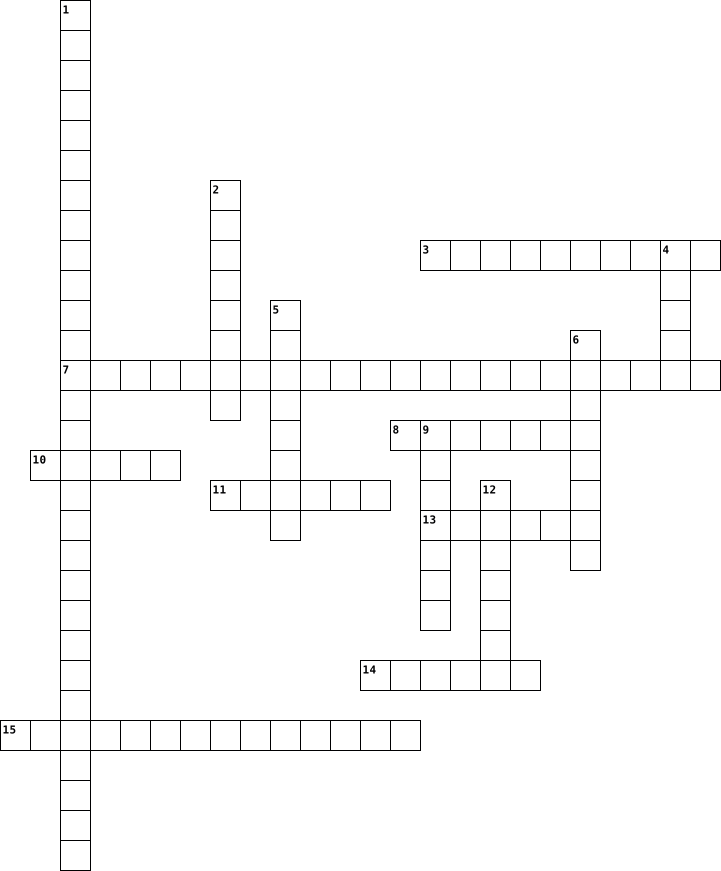
Across
- the topic of this crossword
- what the moon phases symbolize
- what does the moon rotate on
- who made the slideshow and this activity
- the egyptian god of the moon
- what lights up the moon
- which comes first, waning or waxing
- what the moon symbolizes
Down
- the greek goddesses of the moon
- what planet does the moon orbit
- how many moon phases are there
- use the clue on question 9
- the phase of the moon in a Dreamworks movie intro
- the part of a body of water that the moon affects
- the first phase
15 Clues: the first phase • what lights up the moon • what the moon symbolizes • use the clue on question 9 • the topic of this crossword • what does the moon rotate on • the egyptian god of the moon • how many moon phases are there • what the moon phases symbolize • the greek goddesses of the moon • what planet does the moon orbit • which comes first, waning or waxing • ...
Sun, Earth, and Moon System 2018-12-17

Across
- less of the Moon is lit each night; it appears to shrink
- the outer, lighter part of a shadow
- the spinning motion of an object
- the imaginary line that an object spins around
- occurs when the Moon creates a shadow on Earth and blocks out the Sun
- the path that an object follows as it moves around another
- the motion of one object around another
- the tide during New Moon and Full Moon phases in which high tides are very high and low tides are very low
- the portion of the Moon that appears sunlit from Earth
- the phase of the Moon between Quarter Moons and Full Moons
Down
- the tide during Quarter phases of the Moon in which high tides are not too high and low tides are not too low
- the cycle of the phases of the moon that takes approximately a month
- the central, darkest part of a shadow
- more of the Moon is lit each night; it appears to grow
- day when Earth's axis is pointed most toward or away from the Sun
- occurs when the Moon moves into the shadow of the Earth
- the phase of the Moon between New Moon and Quarter Moons
- day when Earth's axis is neither pointed toward nor away from the Sun
18 Clues: the spinning motion of an object • the outer, lighter part of a shadow • the central, darkest part of a shadow • the motion of one object around another • the imaginary line that an object spins around • more of the Moon is lit each night; it appears to grow • the portion of the Moon that appears sunlit from Earth • ...
Sun, Earth, and Moon System 2018-12-17

Across
- the outer, lighter part of a shadow
- the cycle of the phases of the moon that takes approximately a month
- occurs when the Moon creates a shadow on Earth and blocks out the Sun
- the phase of the Moon between New Moon and Quarter Moons
- day when Earth's axis is pointed most toward or away from the Sun
- less of the Moon is lit each night; it appears to shrink
- day when Earth's axis is neither pointed toward nor away from the Sun
- the tide during Quarter phases of the Moon in which high tides are not too high and low tides are not too low
- the central, darkest part of a shadow
Down
- occurs when the Moon moves into the shadow of the Earth
- the portion of the Moon that appears sunlit from Earth
- the phase of the Moon between Quarter Moons and Full Moons
- the tide during New Moon and Full Moon phases in which high tides are very high and low tides are very low
- the motion of one object around another
- the spinning motion of an object
- more of the Moon is lit each night; it appears to grow
- the path that an object follows as it moves around another
- the imaginary line that an object spins around
18 Clues: the spinning motion of an object • the outer, lighter part of a shadow • the central, darkest part of a shadow • the motion of one object around another • the imaginary line that an object spins around • the portion of the Moon that appears sunlit from Earth • more of the Moon is lit each night; it appears to grow • ...
Phases of the Moon Review 2026-02-26

Across
- when half of the moon is visible
- the moon _________ the Earth
- when the entire moon is lit up and visible, it is a ____ moon
- when the entire moon is dark, it is a _____ moon
- it take the moon this long to complete all the phases
- to increase in light
- the earth will ______ on its axis
- when only a small part of the moon is visible
- how many phases of the moon are there?
Down
- it takes the earth one ________ to revolve around the sun
- the moon is 4.5 _______ years old
- the moon gets its light from this
- to decrease in light
- the moon's gravity causes ___________
- it take the earth one ______ to rotate on its axis
- tides are caused by the moon's _______
- the earth will ________ around the sun
17 Clues: to decrease in light • to increase in light • the moon _________ the Earth • when half of the moon is visible • the moon is 4.5 _______ years old • the moon gets its light from this • the earth will ______ on its axis • the moon's gravity causes ___________ • tides are caused by the moon's _______ • the earth will ________ around the sun • how many phases of the moon are there? • ...
Moon phases 2024-02-20

Across
- the new moon is completely ____________
- gibbous, sixth moon phase
- quarter, seventh moon phase
- moon, first moon phase
- the number of moon phases
- quarter, third moon phase
- waning means _____________
- the moon makes it's own light
Down
- crescent, eighth moon phase
- gibbous, fourth moon phase
- crescent, second moon phase
- days, the moon takes this long to pass through all the phases
- waxing means ________________
- moon, fifth moon phase
14 Clues: moon, first moon phase • moon, fifth moon phase • gibbous, sixth moon phase • the number of moon phases • quarter, third moon phase • gibbous, fourth moon phase • waning means _____________ • crescent, eighth moon phase • crescent, second moon phase • quarter, seventh moon phase • waxing means ________________ • the moon makes it's own light • the new moon is completely ____________ • ...
THE LUNAR CYCLE 2019-02-05

Across
- To turn on an axis.
- The phases are said to be doing this during the first half of the lunar cycle between the new moon and the full moon.
- When the moon first appears above the horizon after sunset
- Light that comes from the sun.
- When one object moves around another
- A phase of the Moon in the lunar cycle halfway between a new Moon and a full Moon.
- A word used to describe the thin curved shape of the visible part of the Moon
- The light that has bounced off an object or surface such as the moon.
- Relating to the Moon.
Down
- Earth’s natural satellite
- The phase of the Moon in the lunar cycle when the sunlit side of the Moon is not visible from Earth.
- The shapes of the visible parts of the Moon throughout its lunar cycle
- An object, such as a moon, that orbits another object, such as a planet.
- A phase of the Moon in the lunar cycle when all of the sunlit side of the Moon is visible from Earth
- The third quarter moon, halfway between the full Moon and the new Moon; the moon appears from Earth to be a “half Moon.”
- The amount of days in a lunar cycle
- The star around which Earth and other planets orbit.
- A word used to describe the thin curved shape of the visible part of the Moon
- The phases are said to be doing this during the second half of the lunar cycle between the full moon and the new moon
- The backside of a heavenly body such as the moon that cannot be seen.
- A word used to describe the Moon when it appears to be more than half but less than full.
- A closed symmetric curved shape like an oval
- To move or travel around an object in a curved path.
23 Clues: To turn on an axis. • Relating to the Moon. • Earth’s natural satellite • Light that comes from the sun. • The amount of days in a lunar cycle • When one object moves around another • A closed symmetric curved shape like an oval • The star around which Earth and other planets orbit. • To move or travel around an object in a curved path. • ...
Moon Phases 2021-11-18

Across
- same as third quarter moon
- When you can see the full moon hint hint
- Getting Smaller
- The best moon ever
- the moons eclips
- Invisible
- One of the higher tides
- Getting Bigger
- Looks like banana
Down
- the force the moon has to make tides
- the lowest tide
- the same as first quarter moon
- The largest tide
- One of the smaller tides
- The suns eclips
15 Clues: Invisible • Getting Bigger • the lowest tide • Getting Smaller • The suns eclips • The largest tide • the moons eclips • Looks like banana • The best moon ever • One of the higher tides • One of the smaller tides • same as third quarter moon • the same as first quarter moon • the force the moon has to make tides • When you can see the full moon hint hint
Moon Phases 2023-11-08

Across
- when the dark side of the moon is going to the left
- the moon phase where its all light
- when the dark side of the moon is going to the right
- to spin on an axis
- the object revolving around the sun
- when its almost a full moon with a small sliver of light
- the partial or full blocking of one object by another
Down
- what lights up the moon
- an object that revolves around another in space
- to move in a circular course, to orbit
- when there's a small amount of light and is almost a new moon
- An imaginary line that passes through the center of the earth
- a round pit on the moon created by some source of inpact
- the moon phase where its fully dark
- what the moon revolves around
15 Clues: to spin on an axis • what lights up the moon • what the moon revolves around • the moon phase where its all light • the moon phase where its fully dark • the object revolving around the sun • to move in a circular course, to orbit • an object that revolves around another in space • when the dark side of the moon is going to the left • ...
Moon Phases 2023-11-08

Across
- when the dark side of the moon is going to the left
- the moon phase where its all light
- when the dark side of the moon is going to the right
- to spin on an axis
- the object revolving around the sun
- when its almost a full moon with a small sliver of light
- the partial or full blocking of one object by another
Down
- what lights up the moon
- an object that revolves around another in space
- to move in a circular course, to orbit
- when there's a small amount of light and is almost a new moon
- An imaginary line that passes through the center of the earth
- a round pit on the moon created by some source of inpact
- the moon phase where its fully dark
- what the moon revolves around
15 Clues: to spin on an axis • what lights up the moon • what the moon revolves around • the moon phase where its all light • the moon phase where its fully dark • the object revolving around the sun • to move in a circular course, to orbit • an object that revolves around another in space • when the dark side of the moon is going to the left • ...
Moon Phases 2023-11-08

Across
- when the dark side of the moon is going to the left
- the moon phase where its all light
- when the dark side of the moon is going to the right
- to spin on an axis
- the object revolving around the sun
- when its almost a full moon with a small sliver of light
- the partial or full blocking of one object by another
Down
- what lights up the moon
- an object that revolves around another in space
- to move in a circular course, to orbit
- when there's a small amount of light and is almost a new moon
- An imaginary line that passes through the center of the earth
- a round pit on the moon created by some source of inpact
- the moon phase where its fully dark
- what the moon revolves around
15 Clues: to spin on an axis • what lights up the moon • what the moon revolves around • the moon phase where its all light • the moon phase where its fully dark • the object revolving around the sun • to move in a circular course, to orbit • an object that revolves around another in space • when the dark side of the moon is going to the left • ...
Moon phases 2021-09-28

Across
- the 8th moon phases
- the 5th moon phases
- the 2nd moon phases
- gibbous the 6th moon phases
Down
- the 1st moon phases
- the 7th moon phases
- the 4th moon phases
- quarter the 3rd moon phases
8 Clues: the 8th moon phases • the 1st moon phases • the 7th moon phases • the 5th moon phases • the 4th moon phases • the 2nd moon phases • quarter the 3rd moon phases • gibbous the 6th moon phases
Seasons, moons and tides, oh my! 2017-06-07

Across
- Describes the phases following a new moon where more of the moon is illuminated by the sun
- The ________ side of the moon always faces the Earth
- The moon is a _________ of the Earth- an object in space that orbits around another object
- During this phase we cannot see the moon from earth because the sunlit side faces away from us
- During this phase the entire sunlit side of the moon faces the earth
- When the moon passes directly between the Earth and sun, casting a shadow in the Earth
- When the moon appears smaller than half but more than a new moon
- When the moon appears larger than half but less than full
- Describes the phases following a full moon where less of the moon is illuminated by the sun
Down
- The path an object takes as it revolves around another object
- The different shapes of the moon you see from Earth
- The Earth rotates on it's _________, which is the imaginary line that passes through Earth's center and the North and South poles
- The moon's _________ causes tides
- The days of the year when there is equal amounts of sunlight and darkness
- The moon __________ around the Earth
- When the moon is directly behind the Earth and Earth blocks sunlight from illuminating the moon
- The longest or shortest day in the year for sunlight; When one hemisphere is tilted completely towards or away from the sun
- The light from this illuminates the moon
18 Clues: The moon's _________ causes tides • The moon __________ around the Earth • The light from this illuminates the moon • The different shapes of the moon you see from Earth • The ________ side of the moon always faces the Earth • When the moon appears larger than half but less than full • The path an object takes as it revolves around another object • ...
Moon Phases 2023-11-08

Across
- when the dark side of the moon is going to the left
- the moon phase where its all light
- when the dark side of the moon is going to the right
- to spin on an axis
- the object revolving around the sun
- when its almost a full moon with a small sliver of light
- the partial or full blocking of one object by another
Down
- what lights up the moon
- an object that revolves around another in space
- to move in a circular course, to orbit
- when there's a small amount of light and is almost a new moon
- An imaginary line that passes through the center of the earth
- a round pit on the moon created by some source of inpact
- the moon phase where its fully dark
- what the moon revolves around
15 Clues: to spin on an axis • what lights up the moon • what the moon revolves around • the moon phase where its all light • the moon phase where its fully dark • the object revolving around the sun • to move in a circular course, to orbit • an object that revolves around another in space • when the dark side of the moon is going to the left • ...
Moon Phases 2023-10-31

Across
- shrinking stages of the moon cycle
- 1/4 of the moon cylce
- the fully shaded inner region of a shadow cast by an opaque object.
- when the moon moves under earth's shadow
- start/end of the moon cycle
- shrinking late stage of after a full moon
- growing stages of the moon cycle
- shrinking early stage of after a full moon
Down
- growing early stage of the moon
- growing mid-stage of the moon
- 3/4 of the moon cycle
- when the moon covers the sun
- 2/4 of the moon cycle.
- growing late stage of the moon
- Shrinking mid stage of after a full moon
15 Clues: 3/4 of the moon cycle • 1/4 of the moon cylce • 2/4 of the moon cycle. • start/end of the moon cycle • when the moon covers the sun • growing mid-stage of the moon • growing late stage of the moon • growing early stage of the moon • growing stages of the moon cycle • shrinking stages of the moon cycle • when the moon moves under earth's shadow • ...
Moon Phases 2023-11-03

Across
- This moon phase is mostly lit on the left.
- does the moon phases revolve the earth clockwise or counterclockwise
- This moon phase is half lit on the right.
- How long does it take the earth to orbit the sun
- This moon phase is less than one half lit on the left side.
- The moon takes about one ________ to revolve around the earth.
- What is the earth's axis pointed towards.
Down
- This moon phase is lit on the right just a tiny bit
- Longest and Shortest days of the year.
- How long does it take the earth to make a complete rotation
- The moon does not have its own light. It reflects light from the.
- This moon phase is fully lit
- This moon phase is half lit on the left.
- 12 Hours of daylight and 12 Hours of night.
- This moon phase is fully dark.
15 Clues: This moon phase is fully lit • This moon phase is fully dark. • Longest and Shortest days of the year. • This moon phase is half lit on the left. • This moon phase is half lit on the right. • What is the earth's axis pointed towards. • This moon phase is mostly lit on the left. • 12 Hours of daylight and 12 Hours of night. • ...
Lunar Cycle 2021-10-19

Across
- opposite
- half moonlit
- banana
- around
- markings
- whole moonlit up
- path follows
- forces
Down
- all
- large pit
- moon
- Second full moon
- spinning on-axis
- is a small rocky object that orbits the sun
- Natural object
- light bounces
- no moon
- Phases of moon
18 Clues: all • moon • banana • around • forces • no moon • opposite • markings • large pit • half moonlit • path follows • light bounces • Natural object • Phases of moon • Second full moon • spinning on-axis • whole moonlit up • is a small rocky object that orbits the sun
Moon phases 2021-09-28

Across
- the 8th moon phases
- the 5th moon phases
- the 2nd moon phases
- gibbous the 6th moon phases
Down
- the 1st moon phases
- the 7th moon phases
- the 4th moon phases
- quarter the 3rd moon phases
8 Clues: the 8th moon phases • the 1st moon phases • the 7th moon phases • the 5th moon phases • the 4th moon phases • the 2nd moon phases • quarter the 3rd moon phases • gibbous the 6th moon phases
THE LUNAR CYCLE 2020-09-02

Across
- To turn on an axis.
- The phases are said to be doing this during the first half of the lunar cycle between the new moon and the full moon.
- When the moon first appears above the horizon after sunset
- Light that comes from the sun.
- When one object moves around another
- A phase of the Moon in the lunar cycle halfway between a new Moon and a full Moon.
- A word used to describe the thin curved shape of the visible part of the Moon
- The light that has bounced off an object or surface such as the moon.
- Relating to the Moon.
Down
- Earth’s natural satellite
- The phase of the Moon in the lunar cycle when the sunlit side of the Moon is not visible from Earth.
- The shapes of the visible parts of the Moon throughout its lunar cycle
- An object, such as a moon, that orbits another object, such as a planet.
- A phase of the Moon in the lunar cycle when all of the sunlit side of the Moon is visible from Earth
- The third quarter moon, halfway between the full Moon and the new Moon; the moon appears from Earth to be a “half Moon.”
- The amount of days in a lunar cycle
- The star around which Earth and other planets orbit.
- A word used to describe the thin curved shape of the visible part of the Moon
- The phases are said to be doing this during the second half of the lunar cycle between the full moon and the new moon
- The backside of a heavenly body such as the moon that cannot be seen.
- A word used to describe the Moon when it appears to be more than half but less than full.
- A closed symmetric curved shape like an oval
- To move or travel around an object in a curved path.
23 Clues: To turn on an axis. • Relating to the Moon. • Earth’s natural satellite • Light that comes from the sun. • The amount of days in a lunar cycle • When one object moves around another • A closed symmetric curved shape like an oval • The star around which Earth and other planets orbit. • To move or travel around an object in a curved path. • ...
Outer Space 2024-03-21

Across
- its also know in the periodic table
- a ball of gas
- also know as ares
- ice and dust object
- moon of saturn
- center of solar system
- a lawnmower
- galaxy that includes the solar system
- large group of stars
- small kuiper belt object
- the third planet
- a force which attracts objects of mass
- flytrap plant
- most common element in the universe
- a moon of uranus
- a moon of jupiter
- is zeus
- moons phases
Down
- its god used a trident as a weapon
- landed on the moon
- atmosphere of the sun or any other star
- caused by collapse of a massive star
- they think its cheese
- bwarf planet
- 5.88 trillion miles
- a moon of saturn discovered in 2000
- moon has eight...
- its a funny joke to everyone
- resembling a star
29 Clues: is zeus • a lawnmower • bwarf planet • moons phases • a ball of gas • flytrap plant • moon of saturn • the third planet • a moon of uranus • also know as ares • moon has eight... • resembling a star • a moon of jupiter • landed on the moon • ice and dust object • 5.88 trillion miles • large group of stars • they think its cheese • center of solar system • small kuiper belt object • ...
Week 30 - Moon Phases 2021-03-22

Across
- in the full moon phase the earth is ___ the moon and the sun
- during the full moon the moon is ___ from the sun
- during the new moon phase the moon is ___ the sun
- in the waning gibbous stage the light appears to be on the ___
- the first stage where the light appears to be decreasing (2 words)
- how many phases of the moon do we have
- when the moon is 1/4 of the way through its cycle (2 words)
- in the waxing gibbous stage, the moon looks like a
Down
- during the waning stages of the lunar cycle the lighted part of the moon as seen from earth appears to be ___
- when the moon is 3/4 of the way through its cycle
- in the lunar cycle the moon makes one full trip around the
- when the moon appears to be fully lit (2 words)
- when the moon is between the earth and the sun (2 words)
- in the waxing phases, the lighted part of the moon as seen from Earth is ___
- in the first quarter moon, the lighted part of the moon appears to be ___ lit
- when the moon is in the waxing phases, the light is on the ___
16 Clues: how many phases of the moon do we have • when the moon appears to be fully lit (2 words) • when the moon is 3/4 of the way through its cycle • during the full moon the moon is ___ from the sun • during the new moon phase the moon is ___ the sun • in the waxing gibbous stage, the moon looks like a • when the moon is between the earth and the sun (2 words) • ...
Moon Phases 2023-11-08

Across
- when the dark side of the moon is going to the left
- the moon phase where its all light
- when the dark side of the moon is going to the right
- to spin on an axis
- the object revolving around the sun
- when its almost a full moon with a small sliver of light
- the partial or full blocking of one object by another
Down
- what lights up the moon
- an object that revolves around another in space
- to move in a circular course, to orbit
- when there's a small amount of light and is almost a new moon
- An imaginary line that passes through the center of the earth
- a round pit on the moon created by some source of inpact
- the moon phase where its fully dark
- what the moon revolves around
15 Clues: to spin on an axis • what lights up the moon • what the moon revolves around • the moon phase where its all light • the moon phase where its fully dark • the object revolving around the sun • to move in a circular course, to orbit • an object that revolves around another in space • when the dark side of the moon is going to the left • ...
Moon and More 2024-10-17

Across
- the layer of gases surrounding a celestial body
- the moon's phases when more than have but not all of the surface is illuminated
- when the moon is lit up by the sun it is ________
- the moon's phases when it appears to shrink or get smaller
- the third planet from the sun, home to humans and other life
Down
- the different shapes the moon appears to have from Earth
- the moon's phases when it appears to grow or get larger
- the moon's phases when less than half of its surface is illuminated, appearing as a curved shape
- a rocky space object that circles Earth
- an event when the moon is positioned between the Sun and Earth
- what the moon reflects from the sun
- the star at the center of our solar system
- the moon's movement around the sun in a circular motion
13 Clues: what the moon reflects from the sun • a rocky space object that circles Earth • the star at the center of our solar system • the layer of gases surrounding a celestial body • when the moon is lit up by the sun it is ________ • the moon's phases when it appears to grow or get larger • the moon's movement around the sun in a circular motion • ...
Common Assessment 1 2025-09-22

Across
- eclips--> sun, earth, moon
- there are _____ moon phases
- everything started as a tiny dense point and expanded
- a explanation based on reasoning
- believed in the sun centered theory
- last 4 planets
- 24 hours for the earth to _____
- 29 days to complete the moon phases
- an earth centered theory
Down
- eclipse--> sun, moon, earth
- used a telescope to support theories
- a giant space neighborhood
- all space, time, matter, and energy
- the galaxy we live in
- 365 days for the earth to _____
- first 4 planets
- bright spot with a stream of dust
- a sun centered theory
- the type of heat energy from the sun
19 Clues: last 4 planets • first 4 planets • the galaxy we live in • a sun centered theory • an earth centered theory • eclips--> sun, earth, moon • a giant space neighborhood • eclipse--> sun, moon, earth • there are _____ moon phases • 365 days for the earth to _____ • 24 hours for the earth to _____ • a explanation based on reasoning • bright spot with a stream of dust • ...
Seasons 2023-11-28

Across
- A cluster of stars that looks like an image
- What Earth revolves around
- Moon "disappearing" during its cycle
- The tilt of Earth’s axis
- Phases when we can only see a smaller portion of the moon
- Phases of the moon where we can *almost* all of the moon
- The central northern star
- Occurs because of Earth’s tilt
- Center line around the earth; gets mostly direct sunlight
Down
- Moon "appearing" during its cycle
- Moon is not visible
- Direction of Earth’s axis
- Moon is totally visible
- Shape of Earth’s orbit around the sun
- What Earth rotates in reference to
- Motion that the Earth does in about 24 hours
- Motion that the Earth does in about 365.25 days
17 Clues: Moon is not visible • Moon is totally visible • The tilt of Earth’s axis • Direction of Earth’s axis • The central northern star • What Earth revolves around • Occurs because of Earth’s tilt • Moon "appearing" during its cycle • What Earth rotates in reference to • Moon "disappearing" during its cycle • Shape of Earth’s orbit around the sun • ...
Chapter 19 - The Earth, sun, and moon 2021-04-12

Across
- action-reaction forces
- first man in space
- new/full moon tide enhancement
- color of a moon on total lunar eclipse
- phases when sun-Earth-moon form right angle
- month for northern spring equinox
- means "almost full"
- one trip around another object
- percent the moon/Earth are lit
- objects tend to maintain their current state
- small difference in high & low tide
Down
- different appearances of the moon
- darker of the two shadows
- achieved by combining gravity and inertia
- month of southern winter solstice
- downward pull based on mass & distance
- time for one spin on moon's axis
- first man on the moon
- trapping of heat by an atmosphere
- gives Earth its seasons
- zone for viewing total solar eclipse
- gives Earth its day and night
- most or least daylight hours
- depressions formed from meteor impacts
24 Clues: first man in space • means "almost full" • first man on the moon • action-reaction forces • gives Earth its seasons • darker of the two shadows • most or least daylight hours • gives Earth its day and night • new/full moon tide enhancement • one trip around another object • percent the moon/Earth are lit • time for one spin on moon's axis • different appearances of the moon • ...
Space Crossword 2025-01-24

Across
- going around something in a circular motion
- the phases of the moon which are decreasing in their amount of light
- when one celestial object blocks another from the sun's light
- the phases of the moon which are increasing in their amount of light
- the path an object takes and it goes around another object
- the tide which is the smallest due to the misalignment of the Earth, Moon, and Sun
- an imaginary line that goes through the center of the rotation of Earth
Down
- an invisible force that keeps us on the ground
- the phase of the moon where it appears 100% lit from the sun
- the phases of the moon with less than 50% lit but more than 0%
- the spinning of an object on an axis
- the phases of the moon with more than 50% lit but less than 100%
- the phase of the moon where none of the light from the sun is reflected back to Earth
- the tide which is the largest due to the alignment of the Earth, Moon, and Sun; the season with increasing daylight hours between Winter and Summer
14 Clues: the spinning of an object on an axis • going around something in a circular motion • an invisible force that keeps us on the ground • the path an object takes and it goes around another object • the phase of the moon where it appears 100% lit from the sun • when one celestial object blocks another from the sun's light • ...
Space Science Pt 2 2024-07-21

Across
- - a large, round object in the night sky that can reflect the Sun’s light.
- - the amount of space between two objects.
- Panel - a panel that can absorb the Sun’s light to use a source of energy
- - a tool used to make very distant objects look closer, often used to look at space..
- - describes when there is a lot of visible light; the opposite of dim.
- Moon - moon phase when the moon looks like a circle.
Down
- Energy - energy from the Sun that can warm things up and be made into electricity; a renewable resource.
- Moon - moon phases when the moon looks like a sliver.
- Moon - moon phases when the moon looks like a little less than a full circle.
- Moon - moon phases when the moon looks completely dark.
- - describes when there is not a lot of visible light; the opposite of bright.
- Moon - moon phases when the moon looks like a half circle.
12 Clues: - the amount of space between two objects. • Moon - moon phase when the moon looks like a circle. • Moon - moon phases when the moon looks like a sliver. • Moon - moon phases when the moon looks completely dark. • Moon - moon phases when the moon looks like a half circle. • - describes when there is a lot of visible light; the opposite of dim. • ...
Astronomy 2023-11-20

Across
- an invisible force that pulls objects towards eachother
- The moon is ___________ 5 degrees
- Mixture of gases
- he arrangement, type, and ratio of atoms in molecules of chemical substances
- Moons gravitational pull
- Climate changes
- Th movement of Earth around a sun
Down
- The distance North or South of the equator
- Earth
- The Moon is decreasing
- The Moon is getting bigger
- 8 phases
- A regular repeating path that 1 object in space takes around another one
- Circular Movement
- Has 8 phases
- The sun
16 Clues: Earth • The sun • 8 phases • Has 8 phases • Climate changes • Mixture of gases • Circular Movement • The Moon is decreasing • Moons gravitational pull • The Moon is getting bigger • The moon is ___________ 5 degrees • Th movement of Earth around a sun • The distance North or South of the equator • an invisible force that pulls objects towards eachother • ...
Moon Phases 2025-04-10

Across
- A phenomena or process that repeats itself such as moon phases or day & night.
- When the lighted part of the moon is getting smaller (light is on the left)
- The motion of an object spilling on its axis.
- The motion of one object as it moves around another object.
- The amount of time a planet takes to make one full revolution around the sun.
Down
- The imaginary line through Earth that extends from the north pole to the south pole and is the center of the Earth's rotation.
- When less than half of the moon is illuminated from our point of view.
- The amount of time a planet takes to complete one full rotation on its axis.
- The shape of the illuminated (lighted) part of the moon as seen by an observer, usually from the perspective of Earth.
- When no part of the illuminated half of the moon is facing Earth (the first phase).
- When all of the illuminated half of the moon is facing Earth.
- When more than half of the moon is illuminated from our point of view.
- When the lighted part of the moon is getting bigger (light is on the right)
- The path an object takes as it revolves around another object.
14 Clues: The motion of an object spilling on its axis. • The motion of one object as it moves around another object. • When all of the illuminated half of the moon is facing Earth. • The path an object takes as it revolves around another object. • When less than half of the moon is illuminated from our point of view. • ...
Astronomy Crossword 2019-02-10

Across
- the last phases of the moon between full moon and new moon. The lit part of the moon is decreasing.
- an eclipse in which the moon appears darkened as it passes into the earth's shadow.
- the first phases of the moon between new moon and full moon. The lit part of the moon is growing.
- The different phases of the moon are caused by the angle from which an observer on earth can see the moon illuminated by the sun as it orbits our planet. As the moon moves around the earth, you can look up in the sky and see various fractions of its surface reflecting sunlight.
- the phase where we can only see a tiny sliver of light. The rest of the moon is dark.
- the tide that occurs a the first or last quarter. It produces the smallest rise and fall in tides.
Down
- phase of the moon; the moon either when in conjunction with the sun or soon after, being invisible.
- convex at both edges; when the moon is more than half full of light, or more than half full of darkness.
- the large rise and fall of the tide at new or full moons.
- to supple or brighten with light; light up.
- The process where the moon completes one full orbit around the earth.
- one object moves around another object.
- the entire moon face is illuminated by the sun.
- the force of attraction by which terrestrial bodies tend to fall toward the center of the earth.
- these phases are the 1/4 and 3/4 marks of the lunar cycle. Half of the moon is illuminated.
15 Clues: one object moves around another object. • to supple or brighten with light; light up. • the entire moon face is illuminated by the sun. • the large rise and fall of the tide at new or full moons. • The process where the moon completes one full orbit around the earth. • an eclipse in which the moon appears darkened as it passes into the earth's shadow. • ...
moon phases!!! 2023-05-12

Across
- the second phase in the cycle of phases
- a point, period, or step in a process or development.
- obscuring of the light from one celestial body by the passage of another between it and the observer or between it and its source of illumination.
- envelop in shadow cast a shadow over.
- the phase of the moon when a lit-up part of the moon starts shrinking
- place of which we live
Down
- series of events or a process of change or development.
- light from the natural satellite
- moon occurs halfway between new moon and full moon.
- the phase of the moon in which its whole disk is illuminated.
- the attractive force which governs the motion of the celestial bodies
- lunar eclipse when the earth interrupts light shining on the moon
- moon rises in the middle of the night and sets in the middle of the day.
- phase of the moon when it is in conjunction with the sun and invisible from earth
- the natural satellite of the earth
15 Clues: place of which we live • light from the natural satellite • the natural satellite of the earth • envelop in shadow cast a shadow over. • the second phase in the cycle of phases • moon occurs halfway between new moon and full moon. • a point, period, or step in a process or development. • series of events or a process of change or development. • ...
Thankful for the Moon 2023-11-16

Across
- the type of eclipse when the Earth is in the center
- the phase that is not visible from Earth
- the type of eclipse when the Moon is in the center
- number of weeks in a Moon cycle
- what most people earth this Thursday
- when the left side of the Moon is lighted
- planet with the most Moons
- caused by the Moon
- dessert at many tables this season
- when the Earth and Moon are closest
- what a turkey says
- the Moon does not have this around it
- the number of days between first and last quarter
Down
- every 26,000 years the Earth will __
- the Moon does this, causing its phases
- number humans who have walked on the Moon
- small tides when S,M,E are at right angles
- large tide during Full and New Moon
- holiday that is this Thursday
- number of moon phases
- phase where S,M,E are at an acute angle
- the number of degrees the Moon's orbit is tilted
- the Moon's rate of rotation and revolution are ___
- number of days it takes to get to the Moon
- when the Earth and Moon are farthest apart
- when the right side of the Moon is lighted
26 Clues: caused by the Moon • what a turkey says • number of moon phases • planet with the most Moons • holiday that is this Thursday • number of weeks in a Moon cycle • dessert at many tables this season • large tide during Full and New Moon • when the Earth and Moon are closest • every 26,000 years the Earth will __ • what most people earth this Thursday • ...
Astronomy 2023-11-20

Across
- the thing that we see in the night sky other than the stars
- oval shape/ shape of orbit
- new moon blocks the sun
- a day where day and night are either shorter or longer
- moon phases getting smaller
- The moon controls these with its gravity.
- spinning on axis
- Newton found out about this.
Down
- where the earth blocks sunlight from getting to the moon
- circling another object-ex. earth circling sun
- a day where day and night are equal
- we see in the night sky
- climate is changing-there are 4 of these
- getting bigger moon phases
- the moon has a 5 degree ________.
15 Clues: spinning on axis • new moon blocks the sun • we see in the night sky • oval shape/ shape of orbit • getting bigger moon phases • moon phases getting smaller • Newton found out about this. • the moon has a 5 degree ________. • a day where day and night are equal • climate is changing-there are 4 of these • The moon controls these with its gravity. • ...
6th grade Earth, Moon, and Sun 2022-04-07
Across
- to see a full total eclipse, you must be in this part of the shadow
- I told you this term used in science means “false”
- the highest tides are called this
- what rocks falling through our atmosphere are called
- the tides are the ___ when Earth, the moon, and the sun are all in a straight line
- during the summer solstice in the Northern hemisphere we experience the ___ daylight hours
- when the moon is in the 1st or 3rd quarter phases, then about one ___ of the moon is “lit”
- this equinox is the beginning of spring in the Northern Hemisphere
- the different amounts of light you can see from Earth shining on the moon are called the ___ of the moon
- the tendency of an object to resist a change in motion
- when the moon is in the “gaining light “ phases it is in the __ phases
- the highest peaks on the moon are called this
- these on the moon were created by ancient lava flow
- this is the calendar we use today
- larger, round pits formed by impacts of meteroids
- this calendar had 12 months with 30 days and an extra 5 days at the end of the year to honor their Gods
- the brightest object in the night sky after the moon
- A chunk of rock in space is called this
- when the moon is in the waxing or waning ___ phases, then only a small sliver, or about ¼ of the moon is “lit”
- the ___ solstice is the shortest day in the Northern Hemisphere
- when the moon is “losing” light it is in the __ phases
- the moon has drastic changes in temperature due to the fact that it has no ____
- the north star
- the tides are the ___ when the moon, sun and earth are at right angles to each other
- the ___ of an object will not change no matter where it is, but the ____ may, because IT is determined by the gravitational pull
- when the moon is in the waxing or waning ___ phases, then ¾ of the moon is “lit”
- when a meteoroid enters Earth’s atmosphere it is now called this
Down
- one complete revolution around the sun is approximately one ____
- the strength of gravity depends on the ___ of the 2 objects and the ___ between them
- an object that orbits a sun
- if a chunk of rock from space hits earth’s ground, it is called this
- the shape of the orbit of Earth’s revolution around the sun
- the name given to objects that orbit a planet
- day and night are caused by Earth’s ____
- the oldest, most highly cratered regions on the Moon, light in color
- the summer ___ is the longest day in the Northern hemisphere
- you will see only a partial solar eclipse if you are in this portion of the moon’s shadow
- the narrow band or plane in which planets in our solar system move
- earth’s rotation takes approximately 365 ____
- these are used to find constellations
- most constellations were named in this language
- all objects are attracted to each other by the force of ____
- this force helps keep Earth in it’s orbit around the sun
- you will see a ___ eclipse when Earth is between the sun and the moon
- Earth’s rotation takes approximately 24 ___
- a mixture of ice and dust on an elongated orbit around the sun, it emits a trail of heated gases as it nears the sun
- a pattern of stars imagined by people to represent a fissure
- the moon’s gravity is ___ that of Earth (fraction)
- these on the moon were formed by meteor impacts
- when it is a spring or autumnal ____, then Earth is the least tilted toward the sun it will ever be for the year
- Earth experiences 4 ___ due to the tilt of Earth on its axis
- lowest tides are called this
- the fake science of believing in predictions of zodiac symbols
53 Clues: the north star • an object that orbits a sun • lowest tides are called this • the highest tides are called this • this is the calendar we use today • these are used to find constellations • A chunk of rock in space is called this • day and night are caused by Earth’s ____ • Earth’s rotation takes approximately 24 ___ • the name given to objects that orbit a planet • ...
Moon Phases 2026-05-06

Across
- the path that the moon follows to go around the earth
- an eclipse when the moon is red
- the moon phases pattern
- something to do with the moons shadow
- when you see no moon
- when the moon is 50% full
- when the moon is on the left
Down
- the 3rd closest planet to the sun
- this is gray and it orbits the earth
- when the moon is 75% full
- When the moon is 25% full
- when you see all of the moon
- when the moon is on the right
- an eclipse when you can't see the sun
14 Clues: when you see no moon • the moon phases pattern • when the moon is 75% full • When the moon is 25% full • when the moon is 50% full • when you see all of the moon • when the moon is on the left • when the moon is on the right • an eclipse when the moon is red • the 3rd closest planet to the sun • this is gray and it orbits the earth • an eclipse when you can't see the sun • ...
Page 1 of 100 Next