
physical Crossword Puzzles
Physical Geography Crossword 2020-06-26

Across
- The part of the Earth that includes all living things.
- When a dry area develops on the leeward side of a mountain.
- The sphere that involves Earth's uppermost layer, the continents, basins, etc.
- A navigational tool that determines absolute location using satellites.
- A map that emphasizes a single idea or particular information.
- Temperature + Precipitation - over a long period of time.
- A region that is defined by a common characteristic
- A region defined by popular feelings rather than data.
- The exact position of a place on the Earth's surface.
- The supercontinent that existed before the continents drifted apart.
- The height of a land surface above the level of the sea.
- a type of ecological community defined by plant & animal groups.
Down
- A location that is found in relation to other places around it.
- Moisture that falls to the Earth as rain, sleet, hail, or snow.
- The thin layer of gases that surround Earth and include Earth's weather & climate.
- The chemical or physical process of breaking down rocks into smaller pieces.
- The sphere that involves all Earth's water. Like oceans, seas, lakes, rain, etc.
- A region that incorporates a central node and a surrounding aera that is connected or linked together.
- A condition of the atmosphere over a short period of time.
- A computer program that processes and organizes data about places on Earth.
- The movement of weathered rock/ materials by wind, glaciers, or water to another location.
21 Clues: A region that is defined by a common characteristic • The exact position of a place on the Earth's surface. • The part of the Earth that includes all living things. • A region defined by popular feelings rather than data. • The height of a land surface above the level of the sea. • Temperature + Precipitation - over a long period of time. • ...
PDHPE physical fitness 2016-09-01

Across
- - a point of time as measured in hours and minutes.
- - activity requiring physical effort, carried out to sustain or improve health and fitness
- - the process of providing or obtaining the food necessary for health and growth.
- – Controlling body positions while standing still or moving.
- – Making movements work together smoothly.
- - stretching or testing your limits and become_______.
- - relating to the body as opposed to the mind.
- - the condition in which things are happening or being done.
- - a condition of body and mind which typically recurs for several hours every night.
- – The ability to use muscle strength quickly.
Down
- - the action of measuring something.
- - the state of being free from illness or injury.
- Endurance – Engaging in physical activity for long periods of time.
- - the quality of being intense.
- - the rate at which something occurs over a particular period.
- - vigorous exercises designed to increase cardiovascular efficiency.
- - the strength and vitality required for sustained physical or mental activity.
- - the condition of being physically fit and healthy.
- - The ability to stop, start, and change directions quickly.
- - a category of people or things having common characteristics.
- – Performing a movement or covering a distance in a short period of time.
21 Clues: - the quality of being intense. • - the action of measuring something. • – Making movements work together smoothly. • – The ability to use muscle strength quickly. • - relating to the body as opposed to the mind. • - the state of being free from illness or injury. • - a point of time as measured in hours and minutes. • ...
Physical Science 1 2019-04-30

Across
- a fossil that is useful for dating and correlating the strata in which it is found.
- depression in a glacial outwash drift made by the melting of a detached mass of glacial ice that became wholly or partly buried.
- the history of Earth as recorded in the rocks that make up its crust.
- material carried away from a glacier by meltwater and deposited beyond the moraine.
- a method of dating geological or archeological specimens by determining the relative proportions of particular radioactive isotopes present in a sample
- a long, narrow, winding ridge composed of stratified sand and gravel deposited by a subglacial or englacial meltwater stream; may range from 16 to 160 feet (5 to 50 m) in height, from 160 to 1,600 feet (500 m) in width, and a few hundred feet to tens of miles in length.
- the grade measured by the ratio of drop in elevation of a stream per unit horizontal distance, usually expressed as meters per kilometer or feet per mile.
- a core sample that is typically removed from an ice sheet or a high mountain glacier. Since the ice forms from the incremental buildup of annual layers of snow, lower layers are older than upper, and this sample contains ice formed over a range of years.
- the geological process in which earthen materials are worn away and transported by natural forces such as wind or water.
- the geological process in which sediments, soil and rocks are added to a landform or land mass.
- unsorted material deposited directly by glacial ice and showing no stratification; sometimes called boulder clay because it is composed of clay, boulders of intermediate sizes, or a mixture of these.
- the volumetric flow rate of water that is transported through a given cross-sectional area. It includes any suspended solids (e.g. sediment), dissolved chemicals (e.g. CaCO3(aq)), or biologic material (e.g. diatoms) in addition to the water itself.
- the process of determining an age on a specified chronology in archaeology and geology
- the age of the earth
- material moved by geologic forces from one location to another, usually by a glacier; formed by glacial ice erosion resulting from the movement of ice.
Down
- the theory that changes in the earth's crust during geological history have resulted from the action of continuous and uniform processes.
- any glacially formed accumulation of unconsolidated glacial debris that occurs in both currently and formerly glaciated regions on Earth, through geomorphological processes.
- earthquakes, volcanoes, and mountain building in general which is common at plate boundaries, where the edges of two (or more) plates are in contact along huge linear zones of faulting.
- the science of determining the relative order of past events (i.e., the age of an object in comparison to another), without necessarily determining their absolute age (i.e. estimated age)
- all the waters on the earth's surface, such as lakes and seas, and sometimes including water over the earth's surface, such as clouds.
- a basic law of geochronology, stating that in any undisturbed sequence of rocks deposited in layers, the youngest layer is on top and the oldest on bottom, each layer being younger than the one beneath it and older than the one above it.
- a principle of geologythat states that the geologic feature which cuts another is the younger of the two features. It is a relative dating technique in geology.
- a slowly moving mass or river of ice formed by the accumulation and compaction of snow on mountains or near the poles.
- the geomorphic process by which soil, sand, regolith, and rock move downslope typically as a solid, continuous or discontinuou smass, largely under the force of gravity, but frequently with characteristics of a flow as in debris flows and mudflows.
- the rigid outer part of the earth, consisting of the crust and upper mantle.
- an overflow of water that submerges land that is usually dry.
26 Clues: the age of the earth • an overflow of water that submerges land that is usually dry. • the history of Earth as recorded in the rocks that make up its crust. • the rigid outer part of the earth, consisting of the crust and upper mantle. • a fossil that is useful for dating and correlating the strata in which it is found. • ...
Physical Science - Farrar 2019-10-04

Across
- change a change that occurs when one ore more substances change into entirely new substances with different properties
- a measure of how hot or cold something is
- of state the change of a substance from one pysical state to another
- variable in an experiment, the factor that is deliberately manipulated
- the curve at the liquid's surface by which one measures the volume of the liquid
- a substance made by melting two or more elements together, at least one of them metal
- the process in which a solid changes directly into a gas
- any pieces of information acquired through observation or experimentation
- the change of state from a liquid to a gas
- the ability of a substance to be pulled and made into wire
- a measure of the gravitational force exerted on an object; its value can change with location in the universe
- the state of matter in which the volume and shape of a substance are fixed
- the state of matter that has a definite volume but not a definite shape
Down
- a measure of the size of a body or region in three-dimensional space
- a testable idea or explanation that leads to scientific investigation
- anything that has mass and takes up space
- the ability of a substance to be rolled or pounded into various shapes without breaking
- variable in an experiment, the factor that changes as a result of manipulation of one or more other factors
- the ratio of the mass of a substance to the volume of the substance
- a form of matter that does not have a definite volume or shape
- a measure of the size of a surface or a region
- a measure of the amount of matter in an object
- the process of burning something
- reaction a chemical reaction in which heat is released
24 Clues: the process of burning something • anything that has mass and takes up space • a measure of how hot or cold something is • the change of state from a liquid to a gas • a measure of the size of a surface or a region • a measure of the amount of matter in an object • reaction a chemical reaction in which heat is released • ...
PHYSICAL SCIENCE CROSSWORD 2019-12-16

Across
- anything that has mass or takes up space
- substance with two or more elements chemically combined in a set ratio
- material that does not transfer heat well
- atom with a different number of neutrons from protons
- created first periodic table of elements
- type of energy that is in motion
- phase change from gas to liquid
- phase change from liquid to solid
Down
- how tightly packed matter is
- phase change from liquid to gas
- successfully isolated Radium salts in her lab in 1902
- conducted Gold Foil experiment
- phase change from solid to gas
- the actual amount of matter in an object or body
- discovered the neutron
- material that transfers heat well
- a charged atom that has lost or gained electrons
- force exerted over the surface area of an object
- branch of science dealing with matter and energy
- phase change from solid to liquid
20 Clues: discovered the neutron • how tightly packed matter is • conducted Gold Foil experiment • phase change from solid to gas • phase change from liquid to gas • phase change from gas to liquid • type of energy that is in motion • material that transfers heat well • phase change from solid to liquid • phase change from liquid to solid • anything that has mass or takes up space • ...
Canada's Physical Geography 2020-02-12

Across
- These landscapes are made up of cities
- Earth's thinnest layer that we live on
- Area between mountains
- Currents in the mantle that cause magma to break through the crust
- Developed the Continental Drift Theory
- Earth's thickest layer made of magma
- Moves heat and cold around the world
- Masses of suspended solid or liquid water particles
- Zone E climate region
- Land formed nder dried lakes & seas
Down
- Agricultural areas
- Earth's hottest layer made of nickle & iron in solid form
- Earth's layer made of nickle & iron in liquid form
- High fast winds that blows across Canada
- Gases that surround the earth
- Super Continent
- The study of weather
- Largest landform of Canada's 8 regions
- The study of landforms
- Canada was covered in this 18,000 years ago
20 Clues: Super Continent • Agricultural areas • The study of weather • Zone E climate region • Area between mountains • The study of landforms • Gases that surround the earth • Land formed nder dried lakes & seas • Earth's thickest layer made of magma • Moves heat and cold around the world • These landscapes are made up of cities • Earth's thinnest layer that we live on • ...
Physical Science vocab 2020-05-01

Across
- a process by which matter changes from a liquid into a solid
- a particular point in space
- A push or a pull that is required to change an object's motion
- anything that changes its position over time
- A representation of forces exerted on a single object
- a change in velocity per unit of time
- science the study of nature and properties of energy and nonliving matter
- an explanation based off of facts that can be tested
- the amount of space between two points
- a change in distance per unit of time in a specified direction
- The sum of forces exerted on an object
- the process by which matter changes from a solid into a liquid
- Anything that has mass and occupies space
- a change in distance per unit of time
Down
- a process where matter changes directly from a gas to a solid without passing through the intermediate liquid state
- the process by which a solid changes directly into a gas
- an experiment that is not interfered with
- a process by which matter changes from a liquid into a gas
- method the process scientists think and work
- a process by which matter changes from a gas into a liquid
- an experiment where one variable is changed
- facts
- The property of a body or system that enables it to do work or cause a change
23 Clues: facts • a particular point in space • a change in velocity per unit of time • a change in distance per unit of time • the amount of space between two points • The sum of forces exerted on an object • an experiment that is not interfered with • Anything that has mass and occupies space • an experiment where one variable is changed • ...
Physical science review 2024-05-14

Across
- when a two different substances are attracted to each other
- when a solution has more hydroxide ions
- when two atoms share electrons evenly
- has a charge of 2 and mass of 4
- a single sheet of this can stop alpha particles
- when a solution has equal amounts of hydrogen and hydroxide ions
- an atom ability to attract electrons
- an arrow that points to the atom with the most electronegative atom
Down
- a special type of bond that allows ice to float
- same number of protons different number of neutrons
- water is considered this in terms of solvents
- a type of decay where an atom breaks apart
- a particle energy only
- the amount of time it takes for half the original material to break apart into something else
- when a molecule is more attracted to same molecules
- outer most electrons
- has charge of -1 and mass of 0
- when a solution has more hydrogen ions
- when two atoms share electrons unevenly
- the substance that can stop gamma radiation
20 Clues: outer most electrons • a particle energy only • has charge of -1 and mass of 0 • has a charge of 2 and mass of 4 • an atom ability to attract electrons • when two atoms share electrons evenly • when a solution has more hydrogen ions • when a solution has more hydroxide ions • when two atoms share electrons unevenly • a type of decay where an atom breaks apart • ...
Let's Get Physical 2024-09-10

Across
- measurement of mass of an object
- Formed when two straight lines or rays meet at a common endpoint
- Performance of random experiments
- the push or pull measurement of an object
- Absolute or relative direction or size in which an object moves in the sense of motion
- attraction force between objects, bodies, and masses in the universe
- change in momentum
- Exertion of a force causing displacement to an object
- The change in the velocity vector in a time interval, divided by the time interval
- The motion of one object with respect to another object
- The endpoint that is used to measure a chart or maps distance
- A German theoretical physicist
- measurement of medium and direction of movement of magnitude
- Fixed points, lines, or planes from which coordinates are measured
- A way of measuring how two points differentiate
Down
- Measures the length between objects
- the change in an object’s position
- motion resistance from objects rubbing against each other
- a body's tendency to resist motion
- A measure of the amount of matter in a body
- motion resistance from objects rubbing against each other
- how mass in motion is measured
- rate and direction of motion measurement
- a range of radio frequencies
- Objects under sole influence of gravity
- Length of the path travelled light in a vacuum
- Einstein's theory of special relativity
- how force is measured
- when two objects collide
- When an object changes its position
30 Clues: change in momentum • how force is measured • when two objects collide • a range of radio frequencies • how mass in motion is measured • A German theoretical physicist • measurement of mass of an object • Performance of random experiments • the change in an object’s position • a body's tendency to resist motion • Measures the length between objects • ...
Physical Science Review 2024-05-10

Across
- Energy produced when electrons move from one place to another
- Came up with the three laws of motion
- The ability to do work
- A force that opposes motion between two surfaces that are in contact
- the movement of energy through substances; It moves in waves and is produced when a force makes an object to vibrate
- Unequal forces: causes a change in the object's motion
- A type of kinetic energy; energy stored in moving objects
- A push or pull
- A change in speed or direction
- The energy of a moving object
- Also called heat energy; is produced when a rise in temperature causes atoms and molecules to move faster and collide with each other
Down
- The energy stored in an object
- A change in distance or position of an object
- How fast an object moves over a given distance
- A form of electromagnetic radiation; Only energy we are able to see
- Equal forces; does not change an object's motion
- This energy comes from the nucleus of an atom
- The force that pulls objects toward Earth
- An object's speed and direction
- Energy stored in the bonds of chemical compounds
20 Clues: A push or pull • The ability to do work • The energy of a moving object • The energy stored in an object • A change in speed or direction • An object's speed and direction • Came up with the three laws of motion • The force that pulls objects toward Earth • A change in distance or position of an object • This energy comes from the nucleus of an atom • ...
Physical Science Review 2024-10-04

Across
- Equation: A symbolic representation of a chemical reaction using element symbols and formulas.
- The weighted average mass of an atom's protons and neutrons.
- An element that is typically shiny, malleable, and a good conductor of electricity.
- A substance that takes part in and undergoes change during a chemical reaction.
- A substance formed when two or more elements chemically combine.
- Electrons in the outermost energy level of an atom that determine its chemical properties.molecule
- Change:A change in a substance that does not alter its chemical composition.
- A horizontal row in the periodic table.
- Positively charged particle found in the nucleus of an atom.
- How easily a substance undergoes a chemical reaction, often releasing energy.
- A vertical column in the periodic table that contains elements with similar properties.
Down
- Two or more atoms bonded together.
- Change:A process that results in the formation of new chemical substances.
- A pure substance consisting of only one type of atom.
- A solid that forms from a solution during a chemical reaction.
- A combination of two or more substances that are not chemically bonded.
- A representation used to explain the structure or behavior of something, like an atom.
- An element that is typically brittle and a poor conductor of electricity.
- An element that has properties of both metals and nonmetals.
- Negatively charged particle that orbits the nucleus of an atom.
- Number: The number of protons in the nucleus of an atom, which determines the element.
- The central part of an atom, containing protons and neutrons.
- A subatomic particle with no charge, found in the nucleus of an atom.
23 Clues: Two or more atoms bonded together. • A horizontal row in the periodic table. • A pure substance consisting of only one type of atom. • The weighted average mass of an atom's protons and neutrons. • An element that has properties of both metals and nonmetals. • Positively charged particle found in the nucleus of an atom. • ...
Physical Science Review 2023-03-01

Across
- Newton's law that says the larger the mass the harder it is to change speed and direction.
- Newton's law that says an object in motion stays in motion.
- Energy that is created by splitting apart atoms.
- Energy from heat.
- Part of the atom with no charge.
- Energy of motion
- Newton's law that says for every action there is an equal and opposite reaction.
- A group of different types of atoms or compounds put in the same place but not chemically combined.
- A group of different types of atoms chemically combined.
- A group of atoms that are all one single type of atom.
- The center of an atom.
Down
- Energy that travels in waves like light and sound.
- An assumption or guess about what is happening in a certain situation.
- Energy that is stored or has the potential to be used.
- Part of the atom that is positively charged.
- An assumption or guess about what is going to happen in the future.
- Energy from moving electrons.
- Part of the atom that is negatively charged.
- An obvious statement describing an object or event that everyone can agree with.
- Energy that is created during a chemical reaction.
20 Clues: Energy of motion • Energy from heat. • The center of an atom. • Energy from moving electrons. • Part of the atom with no charge. • Part of the atom that is positively charged. • Part of the atom that is negatively charged. • Energy that is created by splitting apart atoms. • Energy that travels in waves like light and sound. • ...
Physical Science review 2023-05-30

Across
- Basic unit of matter
- Holds atoms together
- Fastest thing in the universe
- Unit of Force
- Unit of energy
- Pure substance only one type of atom
- Told it was too small to be a planet in 2000's
- Mixture that is physically inseparable (solution)
- Low pH
- High pH
- Makes 78% of our atmosphere
- Provides potential energy at a given height
- Cloud of dust and gas in space
- Rubbing force that opposes motion
- In Motion
- Largest planet in our solar system
- Simplest element
- Absolute temperature scale
- Red Planet
Down
- Loudest in the class
- Reaction with oxygen (Burning)
- Speed up/Slow down or change directions
- Multiple atoms bonded together
- Atomic Particle with a negative charge
- Mixture that can be separated
- Distance/Time
- Atomic Particle with a positive charge
- Push or Pull
- Stellar Explosion
- First planet
- Only planet that is engaged
- Celestial ball of gas
- Dihydrogen Monoxide
- Study of matter and reactions
- Study of forces and mathematically mapping out the world
- Used to measure distance
36 Clues: Low pH • High pH • In Motion • Red Planet • Push or Pull • First planet • Unit of Force • Distance/Time • Unit of energy • Simplest element • Stellar Explosion • Dihydrogen Monoxide • Loudest in the class • Basic unit of matter • Holds atoms together • Celestial ball of gas • Used to measure distance • Absolute temperature scale • Only planet that is engaged • Makes 78% of our atmosphere • ...
Physical & Chemical Review 2025-04-01

Across
- Any data you collect during a lab should be ___________ in your notebook.
- A safety sheet that has all the information about you need about a chemical
- When iron reacts with oxygen to make something new, usually brown in color
- The scale used to measure acidity
- The temperature when a liquid turns into a gas
- How harmful or poisonous something is
- How easy it is to light on fire
- When a puddle of water disappears on a hot day
- Ice melting is a (physical/chemical) change. Pick one
- The temperature at which a solid turns into a liquid
- When a gas turns into a liquid
Down
- When doing a lab, anything we can see is called this.
- The ability of a substance to interact with a 2nd substance, making something new
- A change that that does not make anything new
- How much acid or base is in something
- A change that makes something new
- Allows electricity to flow throw it
- The ability of an object to dissolve in a liquid
- If an object is less dense than water, then it will (float/sink). Pick one
- How much matter is in an object
20 Clues: When a gas turns into a liquid • How easy it is to light on fire • How much matter is in an object • A change that makes something new • The scale used to measure acidity • Allows electricity to flow throw it • How much acid or base is in something • How harmful or poisonous something is • A change that that does not make anything new • ...
Physical Geography Terms 2025-03-25

Across
- When a glacier gets smaller when its rate of melt is faster than its rate of accumulation it is _________
- The surface layer of soil which is dark brown or black
- When tectonic plates move apart
- When tectonic plates slide past each other
- Calcium, phosphorous, and potassium are _____________ found in soil which are required for plant growth
- The bottom layer of soil which is solid rock
- When a glacier gets larger when its rate of melt is slower than the rate of accumulation it is _________
- Earth's rigid outer layer
- When a glacier stays the same size
- A type of rock that is formed by heat and pressure
- The increase in the average surface temperature of the earth
- A type of rock that is formed when liquid rock (magma) cools
Down
- The daily conditions of the atmosphere
- The middle layer of Earth which consists of molten rock (magma)
- When tectonic plates move towards
- Supercontinent
- A type of rock known as 'layered rock'
- The movement of broken down rocks
- The breaking down of rocks into sediment
- The darkest and most nutrient layer of soil
- A long-term pattern of weather
- The change in average climate conditions in a region over a long period of time
22 Clues: Supercontinent • Earth's rigid outer layer • A long-term pattern of weather • When tectonic plates move apart • When tectonic plates move towards • The movement of broken down rocks • When a glacier stays the same size • The daily conditions of the atmosphere • A type of rock known as 'layered rock' • The breaking down of rocks into sediment • ...
Physical Science ABCs 2025-06-13

Across
- Energy that travels in waves like sunlight or radio waves
- describing something using words instead of numbers
- A measure of how compact the mass in a substance or object is
- A special kind of picture kind of picture that doctors use to see inside your body
- A tiny building block that makes up everything around us
- A special kind of light invisible to the human eye that comes from the sun
- A tiny negatively charged particle that circles around the center of an atom like planets around the sun.
- when a liquid like water gets so hot it starts to bubble and steam
- a unit used to measure energy or work
- The thing you change in an experiment to see what happens
Down
- a thing or person that is the result of an action or process
- Something that can flow a take the shape of the container or bottle
- A vertical line on a graph that goes from the top to the bottom
- the energy of a motion like when you through a ball
- A silver-white metal thats like the metal in your pennies
- How heavy something feels
- how easy something can catch on fire
- A tool that helps us measure how hot or cold something is
- the amount of space a 3D object takes up like a bat
- How well something disolves into a liquid like water.
- When elements work together
- A path or road in space that one thing takes while circling around another
- the control center of a cell
- A warm feeling of something that makes things hot
- A force that pulls everything towards the ground
25 Clues: How heavy something feels • When elements work together • the control center of a cell • how easy something can catch on fire • a unit used to measure energy or work • A force that pulls everything towards the ground • A warm feeling of something that makes things hot • the energy of a motion like when you through a ball • ...
Physical pharmaceutics puzzle 2022-12-26

Across
- hypotonicity leads to
- term
- complex
- if pH
- crystallize
- molecule that hindi
- shrinkage
- binding is related
Down
- to determine
- scale based
- solution is
- is guess to
- application
- being a strong acid form organic molecular complex with weak base
- co_ordination compound contains polydentate ligand are called
- method
- is in nature
- pH is define as
- of ions is
- While
20 Clues: term • if pH • While • method • complex • shrinkage • of ions is • scale based • solution is • is guess to • application • crystallize • to determine • is in nature • pH is define as • binding is related • molecule that hindi • hypotonicity leads to • co_ordination compound contains polydentate ligand are called • being a strong acid form organic molecular complex with weak base
Physical Science Vocab 2023-03-16

Across
- a display of information with rows or columns
- what is typical, ordinary, and follows accepted standards
- the number of atoms in a compound
- a charged particle
- created by the imbalance of electrons and protons
- getting the same result when an experiment is repeated
- something in the experiment you measure
- a substance made from multiple elements being joined
Down
- a unit of weight
- the space within the object
- something in an experiment you change
- a very small part of matter
- they are no longer bound together
- an ion charged negatively
- an ion charged positively
- to separate into smaller parts
- a device that separates solids, while the liquid goes through
- capable of being seen
- the amount of matter in an object
- spread widely
- take in
21 Clues: take in • spread widely • a unit of weight • a charged particle • capable of being seen • an ion charged negatively • an ion charged positively • the space within the object • a very small part of matter • to separate into smaller parts • they are no longer bound together • the number of atoms in a compound • the amount of matter in an object • something in an experiment you change • ...
Physical Science Crossword. 2025-02-03

Across
- force, The force that supports an object against gravity, often called the normal force.
- energy, theorem The net work done on an object equals the change in kinetic energy of the object
- rule The vector sum of forces acting on an; object that is not accelerating equals zero: ΣF = 0
- energy, The energy that matter possesses due to its position.
- The quantity of space an object occupies
- speed, The speed that a projectile, space probe, or similar object must reach to escape the gravitational influence of Earth or of another celestial body to which it is attracted.
- resistance, The force of friction acting on an object due: to its motion in air.
- A simple machine consisting of a rigid rod pivoted at a fixed point called the fulcrum.
- collision, A collision in which the colliding objects become distorted, generate heat, and may even stick together.
- The speed of an object and specification of its direction of motion.
- time, The time that one’s feet are off the ground during a vertical jump.
- Inertia in motion, given by the product of the mass of an object and its velocity.
- The property of a system that enables it to do work.
- The quantity of matter in an object. More specifically, a measure of the inertia (or sluggishness) that an object
- The rate at which velocity changes with time;the change in velocity may be in magnitude or direction or both, and it is usually measured in units of m/s2.
Down
- of impulse and momentum, Impulse is equal to the change in the momentum of an object that the impulse acts on.
- The product of the force and the distance moved by the force.
- fall, Falling under the influence of gravity alone—falling without air resistance.
- The force upon an object due to gravity. More specifically, the force with which a body presses against a supporting surface.
- A device, such as a lever or pulley, that increases(or decreases) a force or simply changes the direction of a force
- cell, A device that converts the chemical energy from a; fuel into electricity through a chemical reaction with oxygen or another oxidizing agent
- The product of the force acting on an object; and the time during which; that force acts on that
- quantity, A quantity whose description requires both magnitude and direction.
- The curved path followed by a projectile under the influence of constant gravity only.
- The unit of mass. One kilogram (kg) is the mass of 1 liter (L) of water at 4°C.
- The property by which objects resist changes in motion.
- The resistive force that opposes the motion or attempted motion of an object past another object with;which it is in contact, or through a fluid.
- Simply stated, a push or a pull
- force, The combination of all forces that act on an object.
- The scientific unit of force
- An arrow that represents the magnitude and direction of a quantity.
- Distance traveled per unit time.
32 Clues: The scientific unit of force • Simply stated, a push or a pull • Distance traveled per unit time. • The quantity of space an object occupies • The property of a system that enables it to do work. • The property by which objects resist changes in motion. • force, The combination of all forces that act on an object. • ...
Personal/physical traits 2025-02-04

Across
- Mean
- Tall
- Nice
- Red Headed
- studious
- Silly
- Rich
- Short
- Ugly
- Honest
- Intelligent
- Handsome
- HardWorking
- Fat
- Poor
- Blond
- Weak
- Boring
- artistic
- Old
- Humorous
Down
- Creative
- Lazy
- Brunette
- Caring
- Big
- Pretty
- Bad
- Small
- Bald
- Shy
- Young
- Thin
- Strong
- Smart
35 Clues: Big • Bad • Shy • Fat • Old • Mean • Tall • Nice • Lazy • Rich • Ugly • Bald • Thin • Poor • Weak • Silly • Short • Small • Young • Blond • Smart • Caring • Pretty • Honest • Strong • Boring • Creative • Brunette • studious • Handsome • artistic • Humorous • Red Headed • Intelligent • HardWorking
Physical Feature & Russia 2025-02-12

Across
- The flat areas of land that are often found in Russia
- the layer of the Earth between the crust and the core
- The process of ice forming and moving across land
- Plates Large sections of the Earth's crust that move and shift
- Shaping A natural process that shapes the Earth's surface
- valley a valley with a U-shaped cross-section, formed by glacial erosion
- The process by which soil and rock are removed from the Earth's surface
- the outermost layer of the Earth
- the innermost layer of the Earth
Down
- The term for the movement of land due to tectonic activity
- The physical features of the land, including mountains and valleys
- A geological feature that erupts lava, ash, and gases
- chamber a large underground pool of liquid rock beneath a volcano
- The large body of water that borders Russia to the north
- Solid mineral material forming part of the surface of the earth
- the rigid outer part of the Earth, consisting of the crust and upper mantle
- a large, bowl-shaped depression caused by an explosion or the impact of a meteorite
- the natural elevation of the earth's surface with great height
- The country known for its vast landscape and cold climate
- the pointed top of a mountain
- The type of climate found in Siberia
21 Clues: the pointed top of a mountain • the outermost layer of the Earth • the innermost layer of the Earth • The type of climate found in Siberia • The process of ice forming and moving across land • The flat areas of land that are often found in Russia • A geological feature that erupts lava, ash, and gases • the layer of the Earth between the crust and the core • ...
Physical Exam Vocab 2024-10-16

Across
- instrument used when examining the eye
- not alert or active
- listening with stethoscope or other instrument
- to examine by touching and feeling the area
- gland masses of tissue which contain cells
- opposite of normal; abnormal condition or state
- to have a bowel movement
- irregular rhythm in the heart
- deficiency of hemoglobin followed by a reduced number of red blood cells which causes weakness
- lubricating internal lining of an organ or canal within the body
Down
- a dense, white membrane, with the cornea which forms an outer covering of the eyeball
- time it takes for blood to return to the tissue
- an abnormal sound within the heart
- growth of bacteria on teeth
- yellow, white substance produced by sores, wounds, etc.
- tumor taken from within a lymph node
- yellow discoloration of the skin
- redness, swelling, or pain on an area of the body
- nasal passages
- plaque buildup on teeth
20 Clues: nasal passages • not alert or active • plaque buildup on teeth • to have a bowel movement • growth of bacteria on teeth • irregular rhythm in the heart • yellow discoloration of the skin • an abnormal sound within the heart • tumor taken from within a lymph node • instrument used when examining the eye • gland masses of tissue which contain cells • ...
Infant Physical Development 2024-12-10

Across
- an example of this is how a baby has to first learn to crawl before they can walk
- instinctive, automatic responses
- increases in skills
- When the side of a babys cheek or mouth is touched, their head will turn in that direction
- large muscle movements
- babys prefer this taste
- this pattern of development relates to fine motor skills
- this pattern of development relates to gross motor skills
- the first step in language development
- this age has poor hand eye coordination
- how many months old is a baby when they may start to creep
- genes and DNA
Down
- the size relationship between different parts of the body
- how many months old is a baby when they can hold their head up steadily
- babys will _____ weight in the first 5 days after birth
- small muscle movements
- when a babys eyesight becomes the same as an adults
- changes in size
- how many months old is a baby when they roll form tummy to back
- ability to perceive objects that are 3D
- babys use this for exploration
- this is what doctors use to compare a babys height and weight and see if they are on track in their growth
- a baby's environment
- when the sole of a babys foot is stroked the big toe bends backwards and the other toes fan out
- infant reflexes as they get older will __ _____
- the startle reflex
- when you touch a babys foot their toes will curl around it
- when you but something in a babys hand their fingers will automatically curl around it
28 Clues: genes and DNA • changes in size • the startle reflex • increases in skills • a baby's environment • small muscle movements • large muscle movements • babys prefer this taste • babys use this for exploration • instinctive, automatic responses • the first step in language development • ability to perceive objects that are 3D • this age has poor hand eye coordination • ...
Physical Assessment Crossword 2024-12-06

Across
- ringing in the ears
- irregular shaped area of edema
- bruising
- tiny dark red spots under the skin
- raised lesion containing pus
- raised solid mass with defined borders that extends into dermis
- cracking or rubbing
- pale skin tone
- congenital loss of pigmentation
- yellowing of the skin
- swelling
Down
- failure of heart to beat at regular intervals
- bluish discoloration of skin
- flat lesion
- hair loss
- raised lesion filled with clear fluid
- raised lesion with distinct borders, referred to as a plaque
- wave action causing movement of contents through the gastrointestinal system
- encapsulated fluid filled mass
- solid mass that extends into subcutaneous tissue
- bleeding underneath skin
- caused by infestation of a parasitic organism
- loss of skin pigment
- deficit, when radial pulse is slower than apical
- ear wax
- redness of the skin
26 Clues: ear wax • bruising • swelling • hair loss • flat lesion • pale skin tone • ringing in the ears • cracking or rubbing • redness of the skin • loss of skin pigment • yellowing of the skin • bleeding underneath skin • bluish discoloration of skin • raised lesion containing pus • irregular shaped area of edema • encapsulated fluid filled mass • congenital loss of pigmentation • ...
Physical Science Crossword 2025-08-22

Across
- Vertical columns of the periodic table.
- Scientist who arranged the periodic table by atomic number.
- The particle with no charge found in the nucleus.
- Number of protons in an atom.
- The particle with a negative charge.
- Elements that can act like metals or nonmetals depending on conditions.
- The central region of an atom.
- Elements in Group 1, highly reactive with water.
- Elements found in the “stair-step” line, semiconductors.
- The modern periodic table is arranged by increasing ______ number.
- Scientist who first organized the table by atomic mass.
- Shiny elements that are good conductors of heat and electricity.
- Trend: Atomic size ______ as you go down a group.
Down
- The particle with a positive charge.
- Ability of an atom to attract electrons in a bond.
- Most abundant element in the universe.
- Group 18 elements, stable and unreactive.
- Horizontal rows of the periodic table.
- Elements that are dull, brittle, and poor conductors of electricity.
- Smallest unit of matter.
- Group 2 elements, reactive but less so than Group 1.
- Atomic number 79, symbol Au.
- Elements in Group 17, also called “salt formers.”
- Energy needed to remove an electron.
24 Clues: Smallest unit of matter. • Atomic number 79, symbol Au. • Number of protons in an atom. • The central region of an atom. • The particle with a positive charge. • The particle with a negative charge. • Energy needed to remove an electron. • Most abundant element in the universe. • Horizontal rows of the periodic table. • Vertical columns of the periodic table. • ...
Physical Science Definitions 2025-11-25

Across
- A force exerted toward the center of a curved path.
- A machine that does work with only one movement of the machine.
- Energy that is stored.
- The tendency of an object to resist change in its motion.
- A set of forces acting on an object so that the net force does not equal 0 and the object is accelerating in the direction of the net force.
- The support force exerted by a surface against an object resting on it. It acts
- A pulling force transferred to an object through a medium such as a rope or cable.
- The maximum speed an object falling through a “fluid” (like air) can reach.
- A ratio showing the output force compared with the input force.
Down
- A combination of two or more simple machines.
- Energy due to motion.
- Force The sum of all the forces acting on an object.
- The force that opposes the sliding motion of two surfaces that are touching.
- A device that changes the force or increases motion from work.
- to the surface.
- The ability to cause change.
- A resistive force exerted by a fluid (such as air or water) that opposes the motion of an object moving through it.
- Forces A set of forces acting on an object so that the net force equals 0 and the object is not accelerating in any direction.
- The measure of energy transfer that occurs when an object is moved over a distance by a force.
- A push or a pull on an object.
- The attractive force between any two objects that depends on the masses of the two objects and the distance between them.
21 Clues: to the surface. • Energy due to motion. • Energy that is stored. • The ability to cause change. • A push or a pull on an object. • A combination of two or more simple machines. • A force exerted toward the center of a curved path. • Force The sum of all the forces acting on an object. • The tendency of an object to resist change in its motion. • ...
Physical Education Crossword 2026-02-28

Across
- Four-part muscle on the front of the thigh
- A ten-event athletic contest
- How hard you are working during exercise
- Use it or lose it principle
- Common name for a shuttlecock
- Tissue inside bones that produces blood cells
- Bouncy high-speed stretching
- Finger or toe bones
- Preparing the body for activity
- The upper arm bone
- Core muscles of the stomach
- Physics applied to human movement
- Movement-based stretching
- Inward rotation of the foot or forearm
- Relating to the chest muscles
- Stored form of glucose in muscles
- The shoulder muscle
- The thigh bone
- Extending a joint beyond its normal range
- Hormone released during fight or flight
- Explosive jump training
- Condition of having excessive body fat
- Bottom of the foot
- Muscle on the back of the upper arm
- Muscle used for breathing
- Total number of bones in an adult human
- The kneecap
- Muscle shortening under tension
- Decrease in muscle size from disuse
- Tissue connecting bone to bone
- Volleyball defensive specialist
- Maintaining fluid balance
- Mineral essential for bone health
- Excessive loss of body water
- Physical or mental strength to resist fatigue
- Tissue connecting muscle to bone
- Contraction where muscle length changes
- Ability to change direction quickly
- Drawing the toes toward the shin
- Study of efficiency in the working environment
- Holding a stretch for a set time
- Muscle that opposes a movement
- Large muscle of the upper arm
- Stressing the body more than normal to see gains
- Hormone that regulates blood sugar
- Your sense of body position in space
- A group of repetitions
- Moving through various exercise stations
- Study of forces causing motion
- Firm tissue that cushions joints
Down
- Injury to a muscle or tendon
- The hip bone structure
- The body's preferred energy source
- The shin bone
- Substance that raises nervous activity
- Rule violation in soccer or hockey
- Heart muscle tissue
- Nutrient used for muscle repair
- Range of motion around a joint
- Time needed for the body to heal after exercise
- Organic compounds needed for health
- A period of little or no progress in training
- Ability to sustain activity over time
- Gradually lowering intensity after exercise
- Outward rotation of the foot or forearm
- Training for a specific goal or sport
- Forearm bone on the thumb side
- Number of bones in a human foot
- One complete movement of an exercise
- How your body converts food to energy
- The lower jawbone
- Moving a limb away from the midline
- Process of breaking down tissues
- Exercise requiring oxygen
- Heart rate felt at the wrist or neck
- Unit of energy in food
- Injury to a ligament
- The buttock muscles
- Muscle lengthening under tension
- The ability to exert force against resistance
- Process of building up tissues
- Acid produced during intense exercise
- Increase in muscle size
- Technical term for fats
- A 26.2-mile race
- Race involving swimming cycling and running
- Field leader in American Football
- Forearm bone on the pinky side
- High-intensity exercise without oxygen
- Speed in a specific direction
- Systematic planning of athletic training
- Waxy substance found in the blood
- Moving a limb toward the midline
- Individual bones of the spine
- Large back and neck muscle
- Minerals that balance body fluids
- Exercise where muscle length doesn't change
- Relating to the heart
- Type of joint with a fluid-filled capsule
- The collarbone
- The shoulder blade
101 Clues: The kneecap • The shin bone • The thigh bone • The collarbone • A 26.2-mile race • The lower jawbone • The upper arm bone • Bottom of the foot • The shoulder blade • Heart muscle tissue • Finger or toe bones • The shoulder muscle • The buttock muscles • Injury to a ligament • Relating to the heart • The hip bone structure • Unit of energy in food • A group of repetitions • Increase in muscle size • ...
Physical Science Vocab 2026-05-21

Across
- elements that emit radiation
- a good conductor of electricity
- a column on the periodic table
- A neutral particle
- ability to be pulled into thin wires
- a chart of the elements in rows and columns
- describes the ability of metal to reflect light
- an element with properties of both metal and nonmetals
- a particle with one negative charge
- an element in group 17 on the periodic table
Down
- a particle with one positive charge
- ability of a substance to be hammered or rolled into sheets
- where most of the atoms mass and positve charge is in
- conducts electricity at high levels
- the smallest piece of an element
- rows on the periodic table
- a group of atoms held together
- an atom that is no longer neutral
- atoms amounts same element that have different amount of neutrons.
- elements that have no metallic properties
20 Clues: A neutral particle • rows on the periodic table • elements that emit radiation • a column on the periodic table • a group of atoms held together • a good conductor of electricity • the smallest piece of an element • an atom that is no longer neutral • a particle with one positive charge • conducts electricity at high levels • a particle with one negative charge • ...
Physical Science Vocabulary 2021-05-05

Across
- Heat transfer through direct contact
- The center of an atom
- Electron(s)in the outermost energy level of an atom
- Amount of space an object takes up
- Force of attraction that depends on the mass of two objects and the distance between them
- Tendency of objects to remain in motion or to stay at rest unless acted upon by an outside force
- Bending of a wave as it passes from one medium to another
- two or more different elements chemically combined
- Distance divided by time
- A negatively charged particle found in an area outside the nucleus of an atom
- A neutral particle in the nucleus of an atom
- Matter that consists of two or more substance mixed but not chemically combined
- type of change that does not alter the chemical makeup of a substance
- Bouncing back of a wave
- The ability to do work
- The lowest point of a wave
- Change in velocity over time
Down
- type of change in which a substance becomes a new and different substance
- Anything that has mass and volume
- The highest point of a wave
- speed in a given direction
- Heat transfer through space
- Change from the solid phase directly into the gas phase
- Energy of motion
- Ability to do work
- Energy that is stored
- A push or a pull
- The smallest part of an element that has all the properties of an element
- Number of waves that pass a certain point in a given amount of time
- Simplest type of pure substance
- Heat transfer in liquids and gases by means of rising and falling.
- Distance between two consecutive crests on a wave
- A positively charged particle in the nucleus of an atom
33 Clues: Energy of motion • A push or a pull • Ability to do work • The center of an atom • Energy that is stored • The ability to do work • Bouncing back of a wave • Distance divided by time • speed in a given direction • The lowest point of a wave • The highest point of a wave • Heat transfer through space • Change in velocity over time • Simplest type of pure substance • ...
Physical Exam Terms 2022-09-27

Across
- Taking body measurements
- Patient lies at a decline angle
- Feeling with fingers or hands during an examination
- Patient lies at a 90° angle
- Not detectible by clinical methods alone
- Patient lies supine with legs hung at 90° in stirrups
- Patients bring knees to chest
- Used to examine the eardrum and ear canal
- Looking at a person or body part
- The method of listening to organs using a stethoscope
- Patient lies on left side with left knee slightly tilted and right knee bent
- A sterile cup used for collecting and testing various body substances
Down
- used to test for certain types of hearing loss
- Patient lies flat on back
- Patient lies straight on their stomach
- Patient lies on back with feet flat on bed and knees up
- Tapping the body with fingers or other instruments during an examination
- Manipulating a body part by manual examination
- Used for inspecting the retina and other parts of the eyes
- A test to look for blood in stool
20 Clues: Taking body measurements • Patient lies flat on back • Patient lies at a 90° angle • Patients bring knees to chest • Patient lies at a decline angle • Looking at a person or body part • A test to look for blood in stool • Patient lies straight on their stomach • Not detectible by clinical methods alone • Used to examine the eardrum and ear canal • ...
Physical Exam Puzzle 2022-09-26

Across
- the process of measuring a patient
- secret, hidden from view
- A semi-sitting position
- a method of feeling with the fingers or hands during a physical examination
- lying on back, facing upward
- the act of examining or reviewing
- Instrument used to examine the eyes
- lying on abdomen, facing downward
Down
- lying on the back with the knees flexed
- test for blood in stool
- on back with legs raised and feet in stirrups,
- Listening with a stethoscope
- the patient's feet and legs are higher than the head,
- lying face down with the hips bent so that the knees and chest rest on the table
- an instrument vibrated to test hearing
- instrument used for visual examination of the ear,
- an instrument with a rubber head, used for testing reflexes
- side-lying position with the lowermost arm behind the body and the uppermost leg flexed
- contains specimen samples
- the factor that we want to vary in an experiment
20 Clues: test for blood in stool • A semi-sitting position • secret, hidden from view • contains specimen samples • Listening with a stethoscope • lying on back, facing upward • the act of examining or reviewing • lying on abdomen, facing downward • the process of measuring a patient • Instrument used to examine the eyes • an instrument vibrated to test hearing • ...
Physical Exam Terms 2022-09-26

Across
- Look at persons body in physical exam
- Laying on left side
- Listening to body sounds
- Using physical touch during exam
- Laying on stomach with knees bent in
- Instrument used for inspecting ears
- On back with knees up
- Used for childbirth
- Sterile cup used to collect specimens
Down
- Seated with 90 degree angle
- Test for blood in feces
- Manipulating a body part during exam
- Measuring
- Flat on your back
- Tapping body parts
- Laying on Stomach
- Asses vibration and hearing
- Used for someone in shock
- Hidden
- Instrument used for inspecting eyes
20 Clues: Hidden • Measuring • Flat on your back • Laying on Stomach • Tapping body parts • Laying on left side • Used for childbirth • On back with knees up • Test for blood in feces • Listening to body sounds • Used for someone in shock • Seated with 90 degree angle • Asses vibration and hearing • Using physical touch during exam • Instrument used for inspecting ears • ...
Physical Science Midterm 2023-01-08

Across
- predicted answer or tested explanation for an experiment
- process by which a gas becomes a liquid
- Moving objects that are moving very quickly or have a lot of mass are difficult to stop due to their __________________.
- high energy state of motion that is found in stars and lightning
- the smallest amount of an element that retains all the properties of that element
- measure of gravity's attraction for an object
- a well-supported explanation of why something happens
- a substance that resists the passing of heat energy
- Newton's second law states that with less mass or more force this will increase.
- calculated by dividing an object's mass by its volume
- This type of energy is moving energy.
- force that opposes motion
- your distance from the starting place
- a measure of the average kinetic energy of the particles in a substance
Down
- amount of matter in an object
- calculated by multiplying force by distance
- a mixture that is the same throughout is called this
- process by which a solid becomes a gas
- increasing this will decrease gravitational attraction
- measurement having both magnitude and direction
- A stretched rubber band or an ornament hanging from the tree have this type of energy.
- transfer of heat energy by direct contact
- state of matter with a definite volume but no definite shape
- an object's resistance to a change in motion
- an object does not move if all forces on the object are __________________
- something that resembles science but is not actually falsifiable and fails to meet all scientific requirements
- transfer of heat energy by the circulation of a fluid
27 Clues: force that opposes motion • amount of matter in an object • This type of energy is moving energy. • your distance from the starting place • process by which a solid becomes a gas • process by which a gas becomes a liquid • transfer of heat energy by direct contact • calculated by multiplying force by distance • an object's resistance to a change in motion • ...
Physical Science Final 2019-05-14

Across
- The tendency of an object to resist a change in motion
- the speed and direction of a moving object
- unit of electric current
- one in which there is no net loss of total kinetic energy
- A quantity that has magnitude and direction
- A physical quantity that has magnitude only.
- SI unit of force
- a changing magnetic field creates an electric current
- a type of collision in which the kinetic energy after the collision is less than the kinetic energy before the collision
- Distance and direction of an object's change in position from the starting point.
- the force of gravity on an object
- A flow of electric charge.
Down
- Zero net force causes constant velocity (can be at rest or moving)
- Every object in the universe attracts every other object
- The distance an object travels per unit of time
- Change in velocity divided by the time it takes for the change to occur can be speeding up, slowing down, or changing direction
- How far an object moves
- a push or pull on an object
- the amount of matter in an object
- Forces that produce a nonzero net force, causes acceleration
- The overall force on an object when all the individual forces acting on it are added together
- The product of an object's mass and velocity
- change in momentum
- A device used to measure current in a circuit
24 Clues: SI unit of force • change in momentum • How far an object moves • unit of electric current • A flow of electric charge. • a push or pull on an object • the amount of matter in an object • the force of gravity on an object • the speed and direction of a moving object • A quantity that has magnitude and direction • A physical quantity that has magnitude only. • ...
Physical Examination Terms 2019-09-03

Across
- Paradox When the diaphragm is drawn up into the thoracic cavity on inspiratation
- Venous Distention Enlarged jugular vein due to right heart failure
- Severe fluid loss
- Patient's orientation to person time place and situation
- Enlarged lymph nodes
- Sign inspiratory retraction of the lower intercostal spaces that occurs with obstructive airway disease
- alternans Pulse strength that alternates between strong and weak
- body temperature that is below 37 degrees Celsius
- Chest Increased AP Diameter
- Tugging Downward pulling of the trachea on inspiration
- Intermittant inward sinking of the skin
- Pulse rate < 60 beats/min
- listening to bodily sounds (ie. Breath Sounds)
- Hypotension Abrupt decrease in BP in hypovolemic Pts when standing
Down
- low blood pressure with a MAP < 65mmHg
- Emphysema Leak from lungs into the subcutaneous tissue
- Respiratory rate greater than 20 breaths/min
- Sounds Blood flow sounds observed while taking a blood pressure
- Sweating
- Blood pressure cuff
- Elevated temperature
- high blood pressure that is persistently greater than 140/90
- Weakness and wasting of the body due to chronic illness
- Excavatum Depression of part or entire sternum (restrictive disorder)
- Pulse rate >100 beats/min
- Respiratory rate less than 10 breaths/min
- fainting
27 Clues: Sweating • fainting • Severe fluid loss • Blood pressure cuff • Enlarged lymph nodes • Elevated temperature • Pulse rate >100 beats/min • Pulse rate < 60 beats/min • Chest Increased AP Diameter • low blood pressure with a MAP < 65mmHg • Intermittant inward sinking of the skin • Respiratory rate less than 10 breaths/min • Respiratory rate greater than 20 breaths/min • ...
Physical Education Crossword 2021-09-16
Across
- Overexertion
- Physical Development
- Exercise
- Speed
- Reaction Time
- Cardiovascular Endurance
- Social Development
- Strength
- Physical Education
- Flexibility
- Mental Development
Down
- Fitness
- Muscular Endurance
- Health
- Power
- Coordination
- Body Composition
- Balance
- Emotional Development
- Agility
20 Clues: Speed • Power • Health • Fitness • Balance • Agility • Exercise • Strength • Flexibility • Overexertion • Coordination • Reaction Time • Body Composition • Muscular Endurance • Social Development • Physical Education • Mental Development • Physical Development • Emotional Development • Cardiovascular Endurance
Physical Features Crossword 2023-03-29

Across
- wrinkles
- strong
- freckles
- cute
- skinny
- slim
- dark-skinned
- short
- tall
- eyes
- weak
- small
- old
- tan
Down
- handsome
- gorgeous
- mole
- hair
- pale
- ugly
- big
- fat
- athletic
- pretty
- skin
- young
26 Clues: big • fat • old • tan • mole • hair • pale • cute • ugly • slim • tall • skin • eyes • weak • short • small • young • strong • skinny • pretty • wrinkles • handsome • gorgeous • freckles • athletic • dark-skinned
physical science crossword 2023-03-31

Across
- a full 360
- how to see stars
- going up a large mountain
- type of matter where molecules are closest
- conducts electricity
- head of an axe
- flat and 0 degrees
- negative charge in a atom
- has 3 types of classes
- mars earth Jupiter and Saturn
- how fast something is going
- water turns into gas
- type of matter where no definate shape of size
Down
- to take in
- contains protons newtons and electrons
- pluto is known as a
- water turns into ice
- used to generate electricity
- how cars drive
- type of matter with no definate shape unluss put in a container
- ice turns into water
- does not conduct electricity
- positive charge in a atom
- neutral charge in a atom
- roygbiv
- what runs the lights in your house
- used for going up roller casters
- use for building and drilling
- a 90 degree drop
- earth is on a tilt
30 Clues: roygbiv • to take in • a full 360 • how cars drive • head of an axe • how to see stars • a 90 degree drop • flat and 0 degrees • earth is on a tilt • pluto is known as a • water turns into ice • ice turns into water • conducts electricity • water turns into gas • has 3 types of classes • neutral charge in a atom • going up a large mountain • positive charge in a atom • negative charge in a atom • ...
physical science crossword 2023-04-01

Across
- is the rate of change of the velocity of an object with respect to time
- the structure in a cell that contains the chromosomes
- is the directional speed of an object in motion
- the combined effect (the sum) of all the pushing and pulling forces actually acting on the object
- the unit of work
- the Gravitational force with which the Earth attracts the masses towards the center
- other substances.
- an energy that doesn´t stop moving and creates friction
- is mixture, such as air, contains a variety of pure gases.
- is the amount of energy transferred or converted per unit time
- was a theory and has never been proven
- a state of matter that retains its shape and density when not confined
- is a subatomic particle with a negative one elementary electric charge
- is the energy of chemical substances that is released when they undergo a chemical reaction and transform
- is a particle that consists of a nucleus of protons and neutrons surrounded by a cloud of electrons
- is the scientific theory that matter is composed of particles called atoms
- is the process by which heat is transferred from the hotter end to the colder end of an object
Down
- produces heat
- is a stable subatomic particle, symbol p , H⁺, or ¹H⁺ with a positive electric charge of +1 e
- is the force resisting the relative motion of solid surfaces, fluid layers, and material elements sliding against each other
- is the sum of potential energy and kinetic energy
- a push or pull upon an object resulting from the object's interaction with another object
- the unit of force
- is energy related to forces on electrically-charged particles and the movement of those particles
- is a nearly in compressible fluid that conforms to the shape of its container but retains a constant volume independent of pressure
- A measure of the amount of matter contained in or constituting a physical body
- is the energy transferred to or from an object via the application of force along a displacement
- is the time rate at which an object is moving along a path
- energy that does not move
- the unit of power
- is a subatomic particle, symbol n or n⁰ , which has a neutral charge, and a mass slightly greater than that of a proton
- is any substance that has mass and takes up space by having volume
32 Clues: produces heat • the unit of work • the unit of force • other substances. • the unit of power • energy that does not move • was a theory and has never been proven • is the directional speed of an object in motion • is the sum of potential energy and kinetic energy • the structure in a cell that contains the chromosomes • an energy that doesn´t stop moving and creates friction • ...
physical science crossword 2023-04-01

Across
- is the rate of change of the velocity of an object with respect to time
- the structure in a cell that contains the chromosomes
- is the directional speed of an object in motion
- the combined effect (the sum) of all the pushing and pulling forces actually acting on the object
- the unit of work
- the Gravitational force with which the Earth attracts the masses towards the center
- other substances.
- an energy that doesn´t stop moving and creates friction
- is mixture, such as air, contains a variety of pure gases.
- is the amount of energy transferred or converted per unit time
- was a theory and has never been proven
- a state of matter that retains its shape and density when not confined
- is a subatomic particle with a negative one elementary electric charge
- is the energy of chemical substances that is released when they undergo a chemical reaction and transform
- is a particle that consists of a nucleus of protons and neutrons surrounded by a cloud of electrons
- is the scientific theory that matter is composed of particles called atoms
- is the process by which heat is transferred from the hotter end to the colder end of an object
Down
- produces heat
- is a stable subatomic particle, symbol p , H⁺, or ¹H⁺ with a positive electric charge of +1 e
- is the force resisting the relative motion of solid surfaces, fluid layers, and material elements sliding against each other
- is the sum of potential energy and kinetic energy
- a push or pull upon an object resulting from the object's interaction with another object
- the unit of force
- is energy related to forces on electrically-charged particles and the movement of those particles
- is a nearly in compressible fluid that conforms to the shape of its container but retains a constant volume independent of pressure
- A measure of the amount of matter contained in or constituting a physical body
- is the energy transferred to or from an object via the application of force along a displacement
- is the time rate at which an object is moving along a path
- energy that does not move
- the unit of power
- is a subatomic particle, symbol n or n⁰ , which has a neutral charge, and a mass slightly greater than that of a proton
- is any substance that has mass and takes up space by having volume
32 Clues: produces heat • the unit of work • the unit of force • other substances. • the unit of power • energy that does not move • was a theory and has never been proven • is the directional speed of an object in motion • is the sum of potential energy and kinetic energy • the structure in a cell that contains the chromosomes • an energy that doesn´t stop moving and creates friction • ...
physical science crossword 2023-04-01

Across
- is the rate of change of the velocity of an object with respect to time
- the structure in a cell that contains the chromosomes
- is the directional speed of an object in motion
- the combined effect (the sum) of all the pushing and pulling forces actually acting on the object
- the unit of work
- the Gravitational force with which the Earth attracts the masses towards the center
- other substances.
- an energy that doesn´t stop moving and creates friction
- is mixture, such as air, contains a variety of pure gases.
- is the amount of energy transferred or converted per unit time
- was a theory and has never been proven
- a state of matter that retains its shape and density when not confined
- is a subatomic particle with a negative one elementary electric charge
- is the energy of chemical substances that is released when they undergo a chemical reaction and transform
- is a particle that consists of a nucleus of protons and neutrons surrounded by a cloud of electrons
- is the scientific theory that matter is composed of particles called atoms
- is the process by which heat is transferred from the hotter end to the colder end of an object
Down
- produces heat
- is a stable subatomic particle, symbol p , H⁺, or ¹H⁺ with a positive electric charge of +1 e
- is the force resisting the relative motion of solid surfaces, fluid layers, and material elements sliding against each other
- is the sum of potential energy and kinetic energy
- a push or pull upon an object resulting from the object's interaction with another object
- the unit of force
- is energy related to forces on electrically-charged particles and the movement of those particles
- is a nearly in compressible fluid that conforms to the shape of its container but retains a constant volume independent of pressure
- A measure of the amount of matter contained in or constituting a physical body
- is the energy transferred to or from an object via the application of force along a displacement
- is the time rate at which an object is moving along a path
- energy that does not move
- the unit of power
- is a subatomic particle, symbol n or n⁰ , which has a neutral charge, and a mass slightly greater than that of a proton
- is any substance that has mass and takes up space by having volume
32 Clues: produces heat • the unit of work • the unit of force • other substances. • the unit of power • energy that does not move • was a theory and has never been proven • is the directional speed of an object in motion • is the sum of potential energy and kinetic energy • the structure in a cell that contains the chromosomes • an energy that doesn´t stop moving and creates friction • ...
physical science crossword 2023-04-01

Across
- is the rate of change of the velocity of an object with respect to time
- the structure in a cell that contains the chromosomes
- is the directional speed of an object in motion
- the combined effect (the sum) of all the pushing and pulling forces actually acting on the object
- the unit of work
- the Gravitational force with which the Earth attracts the masses towards the center
- other substances.
- an energy that doesn´t stop moving and creates friction
- is mixture, such as air, contains a variety of pure gases.
- is the amount of energy transferred or converted per unit time
- was a theory and has never been proven
- a state of matter that retains its shape and density when not confined
- is a subatomic particle with a negative one elementary electric charge
- is the energy of chemical substances that is released when they undergo a chemical reaction and transform
- is a particle that consists of a nucleus of protons and neutrons surrounded by a cloud of electrons
- is the scientific theory that matter is composed of particles called atoms
- is the process by which heat is transferred from the hotter end to the colder end of an object
Down
- produces heat
- is a stable subatomic particle, symbol p , H⁺, or ¹H⁺ with a positive electric charge of +1 e
- is the force resisting the relative motion of solid surfaces, fluid layers, and material elements sliding against each other
- is the sum of potential energy and kinetic energy
- a push or pull upon an object resulting from the object's interaction with another object
- the unit of force
- is energy related to forces on electrically-charged particles and the movement of those particles
- is a nearly in compressible fluid that conforms to the shape of its container but retains a constant volume independent of pressure
- A measure of the amount of matter contained in or constituting a physical body
- is the energy transferred to or from an object via the application of force along a displacement
- is the time rate at which an object is moving along a path
- energy that does not move
- the unit of power
- is a subatomic particle, symbol n or n⁰ , which has a neutral charge, and a mass slightly greater than that of a proton
- is any substance that has mass and takes up space by having volume
32 Clues: produces heat • the unit of work • the unit of force • other substances. • the unit of power • energy that does not move • was a theory and has never been proven • is the directional speed of an object in motion • is the sum of potential energy and kinetic energy • the structure in a cell that contains the chromosomes • an energy that doesn´t stop moving and creates friction • ...
Physical Science Review 2016-01-05

Across
- the tendency of all objects to resist any change in motion
- a property of a moving object that depends on the objects mass and velocity
- circuit a complete, closed path through which electric charges flow
- energy made available by the flow of electric charge through a conductor
- a pure substance composed of two or more elements that are chemically combined
- ready susceptibility to chemical change
- a force that opposes motion between 2 surfaces that are touching
- wave a wave in which the particles of the medium vibrate back and forth along the path that the wave travels
- the action that results when a force causes an object to move in the direction of the force
- a combination of 2 of more substances that are not chemically combined
- a measure of the gravitational force exerted on an object, usually by the Earth
- energy the total energy of motion and position of an object
- the rate at which velocity changes, an object accelerates if its speed changes, if its direction changes, or if both change
- energy the energy of motion; depends on speed and mass
- the maximum distance a wave vibrates from its rest position
- a transfer of thermal energy by the movement of liquid or gas
- 3rd Law For every action there is an equal and opposite reaction
- energy the form of energy associated with changes in the nucleus of an atom
- the ability of a substance to be pounded into thin sheets
- an objects change in position over time when compared with a reference point
- a neutral group of atoms held together by covalent bonds
- the ability to dissolve in another substance
- wave a wave in which the particles of the waves medium vibrate perpendicular to the direction the wave is traveling
- energy energy from the sun
- the transfer of energy through matter or space as electromagnetic waves, such as visible light and infrared waves
- number the sum of the protons and the neutrons in an atom
- circuit a circuit in which all parts are connected in a single loop
- how high or low a sound is perceived to be
- gases the unreactive elements in group 18 of the periodic table; their atoms have 8 valence electrons except Helium
- property a property of matter that can be observed or measured without changing the identity of the matter
Down
- a force of attraction between objects that is due to their masses
- 1st Law objects at rest tend to stay at rest, objects in motion tend to stay in motion
- the transfer of energy between objects that are at different temperatures
- having the properties of a magnet
- reaction the process by which one or more substances undergo change to produce one or more different substances
- the complete back-and-forth motion of an object
- a measure of how hot or cold something is
- become larger in size or volume or quantity
- elements that are dull and are poor conductors of thermal energy and electric current
- energy due to an objects position above the Earth's surface
- the transfer of thermal energy from one substance to another through direct contact; conduction can also occur within a substance
- a push or a pull; all forces have both size and direction
- the speed of an object in a particular direction
- the number of waves produced in a given amount of time
- energy the energy of position or shape
- change a change that occurs when one or more substances are changed into entirely new substances with different properties
- the amount of matter in a given space, mass per unit volume
- a type of energy that travels as an electromagnetic wave
- the rate at which an object moves
- the distance between one point on a wave and the corresponding point on an adjacent wave in a series of waves
- 2nd Law the acceleration of an object depends on the mass of the object and the amount of force applied
- a pure substance that cannot be separated or broken down into simpler substances by physical or chemical means
- the ability to do work
- the starting materials in a chemical reaction
- atom has no overall charge because there are equal numbers of protons and electrons
- scale a measurement scale of hydronium ion concentration in a solution pH 7 neutral, less than 7 acidic, more than 7 basic
- longitudinal waves created by vibrations
57 Clues: the ability to do work • energy energy from the sun • having the properties of a magnet • the rate at which an object moves • energy the energy of position or shape • ready susceptibility to chemical change • longitudinal waves created by vibrations • a measure of how hot or cold something is • how high or low a sound is perceived to be • ...
Physical Science - Chemistry 2015-05-28

Across
- two or more substances physically combined
- a substance that enters into a chemical reaction
- a negatively charged particle in an atom
- a reaction in which elements in different compounds trade places
- solids with particles not arranged in a pattern
- going directly from a solid to a gas
- name of group 1 metals
- a mixture of a metal and another element
- a compound that consists of positive and negative ions
- a single type of matter that is pure
- the number before a chemical formula in an equation
- the measure of the amount matter in an object
- an atom with the same number of protons and a different number of neutrons
- a chemical bond formed by sharing electrons
- ionic compound formed in a reaction between n acid and a base
Down
- the basic particle of a compound
- a substance that produces hydroxide ions in water
- the attraction that holds two atoms together
- a substance made of two or more elements combined
- a class of elements that are shiny
- type of change that forms new substances
- going directly from a liquid to a gas
- solids with particles arranged in patterns
- an element with some properties of both metals and nonmetals
- an electrically charged atom
- the study of matter
- the number in a chemical formula showing the ratio of atoms in a compounds
- symbols that show the type and number of atoms in a compound
- an element without the properties of a metal
- an element in group 17
- the basic particle of an element
- a substance that produces hydrogen ions in water
32 Clues: the study of matter • name of group 1 metals • an element in group 17 • an electrically charged atom • the basic particle of a compound • the basic particle of an element • a class of elements that are shiny • going directly from a solid to a gas • a single type of matter that is pure • going directly from a liquid to a gas • a negatively charged particle in an atom • ...
PDHPE physical fitness 2016-09-01

Across
- - the strength and vitality required for sustained physical or mental activity.
- - a condition of body and mind which typically recurs for several hours every night.
- – The ability to use muscle strength quickly.
- - the condition of being physically fit and healthy.
- Endurance – Engaging in physical activity for long periods of time.
- - The ability to stop, start, and change directions quickly.
- - the rate at which something occurs over a particular period.
- - the condition in which things are happening or being done.
- - the quality of being intense.
- - the state of being free from illness or injury.
- - relating to the body as opposed to the mind.
Down
- - a category of people or things having common characteristics.
- - vigorous exercises designed to increase cardiovascular efficiency.
- - the action of measuring something.
- - stretching or testing your limits and become_______.
- – Making movements work together smoothly.
- – Controlling body positions while standing still or moving.
- - activity requiring physical effort, carried out to sustain or improve health and fitness
- - the process of providing or obtaining the food necessary for health and growth.
- - a point of time as measured in hours and minutes.
- – Performing a movement or covering a distance in a short period of time.
21 Clues: - the quality of being intense. • - the action of measuring something. • – Making movements work together smoothly. • – The ability to use muscle strength quickly. • - relating to the body as opposed to the mind. • - the state of being free from illness or injury. • - a point of time as measured in hours and minutes. • ...
Physical Education Krupa 2016-10-25
Across
- Blackhawks
- Extreme tiredness, typically resulting from mental or physical exertion or illness.
- The condition of being physically fit and healthy.
- The ability to be able to do something for a long period of time. Stamina.
- Progressive Aerobic Cardiovascular Endurance Run.
- Of or relating to the heart and blood vessels.
- Rate The number of heartbeats per unit of time, usually per minute.
- Organic compounds essential for normal growth and nutrition.
- Cubs
- An athletic instructor or trainer.
Down
- Education Instruction in physical exercise and games, especially in schools.
- Heart Rate 220-your age
- Activity requiring physical effort.
- 50% -70% of Maximum heart rate
- Connecting with other people by exchanging information.
- Bears
- 70% - 85% of Maximum heart rate
- Collaborating with others to achieve a common goal.
- Movements through space. Example: Running, Shuffling, Skipping.
- Bulls
- Fire
21 Clues: Cubs • Fire • Bears • Bulls • Blackhawks • Heart Rate 220-your age • 50% -70% of Maximum heart rate • 70% - 85% of Maximum heart rate • An athletic instructor or trainer. • Activity requiring physical effort. • Of or relating to the heart and blood vessels. • Progressive Aerobic Cardiovascular Endurance Run. • The condition of being physically fit and healthy. • ...
Physical Traits RECAP 2016-10-31

Across
- enrobé(e), dodu(e)
- a word that means "extremely thin"
- des cheveux ondulés
- des rouflaquettes
- un nez droit
- de taille moyenne
- plutôt grand
- a word that means "very fat"
- une fille aux cheveux bouclés
- une queue de cheval
- au visage arrondi
- qui a de l'embonpoint
Down
- assez petit
- de longs cheveux raides
- un barbu
- fort
- un nez en trompette
- aux cheveux courts
- un garçon aux yeux verts
- mince
- squelettique
- chauve
22 Clues: fort • mince • chauve • un barbu • assez petit • un nez droit • squelettique • plutôt grand • des rouflaquettes • de taille moyenne • au visage arrondi • enrobé(e), dodu(e) • aux cheveux courts • des cheveux ondulés • un nez en trompette • une queue de cheval • qui a de l'embonpoint • de longs cheveux raides • un garçon aux yeux verts • a word that means "very fat" • une fille aux cheveux bouclés • ...
physical science review 2017-01-10

Across
- developed the quantum theory
- makes up proton and neutron
- the elements in group 17
- Gas changes directly into a solid
- The horizontal rows in periodic table
- A device that automatically regulates temperature
- same number of proton different number of neutron
- gas changes into liquid
- first one to prepare hydrogen in liquid form
- when atoms loses an electron
- liquid metal
- Invented miner's lamp
- the substance that dissolves
Down
- the SI unit for energy
- also known as oxygen family
- explosive mixture of methane and other gases
- A solid changes directly into gas
- molecules with same number and type of atoms but different arrangement
- solid in which molecules are not arranged in orderly patterns
- considered as the founder of science of thermodynamics
- responsible for air pressure
- this is the transfer of thermal energy
- mixture containing tiny suspended particles
- A substance composed of single type of atom
24 Clues: liquid metal • Invented miner's lamp • the SI unit for energy • gas changes into liquid • the elements in group 17 • also known as oxygen family • makes up proton and neutron • developed the quantum theory • responsible for air pressure • when atoms loses an electron • the substance that dissolves • A solid changes directly into gas • Gas changes directly into a solid • ...
Physical Geography Crossword 2016-04-12

Across
- Vegetation,Soils,Climate, and Community relationships
- non living solid compound
- Frost wedging, Salt weathering, and exfoliation (physical)
- clasts cemented together (rock)
- non-flowering plants (mosses)
- General description of variation and undulation
- Term for Plants
- non-living
- Earth's ____ is made of Iron
- hot lava (rock)
- Degree of steepness
Down
- Areas of sea floor spreading
- Plants that grow on other plants for support
- Term for Animals
- Crustal collision and subduction
- Digital elevation model
- to change form (rock)
- measures the seismic waves causing an earthquake
- Woodly vine
- assembly of minerals together
20 Clues: non-living • Woodly vine • Term for Plants • hot lava (rock) • Term for Animals • Degree of steepness • to change form (rock) • Digital elevation model • non living solid compound • Areas of sea floor spreading • Earth's ____ is made of Iron • non-flowering plants (mosses) • assembly of minerals together • clasts cemented together (rock) • Crustal collision and subduction • ...
Physical Features- Spanish 2018-02-06

Across
- freckles
- hair
- fat (M)
- tanned (F)
- black hair
- handsome (F)
- red hair
- pretty (M)
- straight hair
- blue eyes
- tall (F)
- dark hair
- curly hair
- ugly (F)
- hair
- long hair
- ugly (M)
- thin (M)
- thin (F)
Down
- handsome (M)
- tanned (M)
- tall (M)
- Short (F)
- hoyuelos
- brown hair
- hazel eyes
- fat (F)
- short hair
- wavy hair
- brown eyes
- green eyes
- pretty (F)
- blond hair
- grey hair
- Short (M)
35 Clues: hair • hair • fat (M) • fat (F) • freckles • tall (M) • hoyuelos • red hair • tall (F) • ugly (F) • ugly (M) • thin (M) • thin (F) • Short (F) • wavy hair • blue eyes • dark hair • grey hair • long hair • Short (M) • tanned (M) • tanned (F) • brown hair • black hair • hazel eyes • short hair • brown eyes • green eyes • pretty (M) • pretty (F) • blond hair • curly hair • handsome (M) • handsome (F) • straight hair
Let's get Physical! 2022-04-01

Across
- Added in order to complete or enhance
- Bending easily without breaking
- Health by or through water
- Holding the trunk part of your body in a straight line off the ground
- Vigorous exercises for cardiovascular efficiency
- Abnormal chronic anxiety about your health.
- Water from our pores
- Vigorous physical exercise or training
- Harmful reduction in the amount of water in the body
- Common consumption of person, animal, or community
- State of being physically strong
- Running at a steady, gentle pace
- Contraction of muscles,caused by fatigue or strain
- Deliberate flex of muscle or tendon
- Being fat or having obesity
- Vitamins, minerals, protein, fats, water, and carbohydrates
- Treatment intended to relieve or heal a disorder
- Weight divided by height squared
Down
- health
- Treatment of the whole person including mental and social factors
- An even distribution of weight
- Big muscle workout
- Producing or showing no symptoms
- Massage, heat treatment, and exercise
- Designed to elevate the heart rate and pump oxygen and nutrient-carrying blood to the working muscles
- To last or to withstand wear and tear
- A single breath
- Providing or obtaining the food necessary for health and growth
- Inactive state of the nervous system with consciousness practically suspended
- Breath control, simple meditation and specific bodily postures to relax
30 Clues: health • A single breath • Big muscle workout • Water from our pores • Health by or through water • Being fat or having obesity • An even distribution of weight • Bending easily without breaking • Producing or showing no symptoms • State of being physically strong • Running at a steady, gentle pace • Weight divided by height squared • Deliberate flex of muscle or tendon • ...
Physical Science Crossword 2021-12-15

Across
- the distance in the line of advance of a wave from any one point to the next point of corresponding phase.
- the highest surface part of a wave.
- negative charged particle
- the resistance of any physical object to any change in its velocity.
- any of the six chemical elements that make up Group 1
- a push or pull
- the rate at which velocity changes
- the form of an energy associated with the position and motion of an object
- is a simple rigid bar which is free to move around a point which is called fulcrum.
- any atom or group of atoms that bears one or more positive or negative electrical charges
- Waves Have the longest wavelength in the electromagnetic spectrum.
- the temperature at which it changes state from solid to liquid
- the change in direction of a wave passing from one medium to another
- the time required for a quantity to reduce to half of its initial value.
- Force upward force on a submerged object
- the amount of matter in an object
- The speed of sound is the distance travelled per unit of time
- the maximum displacement or distance moved by a point on a vibrating body
- stored energy
- the energy contained within a system that is responsible for its temperature
- driven between two objects or parts of an object to secure or separate them.
- the radiation from the Sun capable of producing heat, causing chemical reactions
- One of two or more species of atoms of a chemical element with the same atomic number and position in the periodic table
- region at each end of a magnet where the external magnetic field is strongest
- Is the rate of flow of electric charge
- A form of energy that is transferred from between objects due to a temperature difference
- defined as an electrical resistance between two points of a conductor when a constant potential difference of one volt
- The process or result of joining two or more things together to form a single entity.
- A substance that makes possible the transfer of energy from one location to another, especially through waves
- is a chemical compound composed of ions held together by electrostatic forces termed ionic bonding.
- the force that pulls objects toward each other
- the number of a chemical element in the periodic system
- relating to a magnetic field produced by an electric current.
- speed in a given direction
- the distance an object travels per unit of time
- the number of waves that pass a fixed place in a given amount of time.
- a disturbance from one place to another
- a reaction in which two or more atomic nuclei are combined to form one or more different atomic nuclei and subatomic particles
- are a material or object that produces a magnetic field.
- The apparent difference between the frequency at which sound or light waves leave a source
- is energy that comes from a source and travels through space at the speed of light.
- a form of energy that an object or a particle has by reason of its motion.
- used to make tasks easier in terms of manipulating force
Down
- a region around a charged particle or object within which a force would be exerted on other charged particles or objects.
- total potential and kinetic energy of the particles in an object
- energy states that energy can neither be created nor destroyed
- A unit of measure of the rate of electron flow or current in an electrical conductor
- Light Waves The only electromagnetic waves we can see
- neutral charged atom
- gravity's force on an object
- unit for electric potential, electric potential difference
- the process of light bending around an obstacle or spreading out after it moves through a small space.
- motion in which all points on a wave oscillate along paths at right angles to the direction of the wave's advance.
- the throwing back by a body or surface of light, heat, or sound without absorbing it.
- converted to one or more different substances, known as products.
- covalently bonded set of two or more atoms
- The tendency of an object
- an object in motion will stay in constant motion, unless it's acted upon by an unbalanced force
- As wavelengths get smaller, the waves have more energy.
- Lowest part of a wave
- a splitting or breaking up into parts
- is the pressure from an electrical circuit's power source that pushes charged electrons
- The division of materials into the categories of conductors
- the electrons in the outermost shell, or energy level, of an atom.
- The point on which a lever rests or is supported and on which it pivots.
- a mechanism that converts rotational motion to linear motion
- When two waves superpose to form a wave of greater, lower, or the same amplitude.
- is a word we use to describe how much space an object or substance takes up
- the magnetic moments are aligned with one another because of interactions between molecules or atoms.
- the force acting on its gravity
- They are the simplest mechanisms known that can use leverage (or mechanical advantage) to increase force.
- a path along which the whole current flows through each component
- a table of the chemical elements arranged in order of atomic number
- process by which heat is transferred by movement of a heated fluid such as air or water
- positively charged particle
- Waves Long and short wavelengths.
- They have the smallest wavelength and the most energy of the waves in the electromagnetic spectrum
- the magnetic influence on moving electric charges, electric currents, and magnetic materials
- the quantity of heat required to raise the temperature of one gram of a substance by one Celsius degree.
- small wheel with a grooved rim and with or without the block in which it runs used singly with a rope or chain to change the direction
- Energy the potential energy stored in chemical bonds
- a substance that takes part in and undergoes change during a reaction.
- the overall force of an object when all the individual forces acting on it are added
- The basic unit of a chemical element
84 Clues: stored energy • a push or pull • neutral charged atom • Lowest part of a wave • negative charged particle • The tendency of an object • speed in a given direction • positively charged particle • gravity's force on an object • the force acting on its gravity • the amount of matter in an object • Waves Long and short wavelengths. • the rate at which velocity changes • ...
Physical vs Chemical 2023-10-04

Across
- the pneumonic device to remember the 5 main clues that a chemical change occurred
- A physical property that is found by dividing mass by volume.
- the type of change that creates new matter
- this changes when you burn a marshmallow (white to black)
- A physical property of being shiny
- what happens when sugar "disappears" in water - it is a physical change
- what is formed when a solid suddenly appears in a solution and settles on the bottom
- what happened to food after you ate it
- TRUE or FALSE: A chocolate bar melting is a chemical change.
- it is a chemical change when my apple___ and becomes compost
- the change in color of some metals
- descriptions of matter (could be physical or chemical)
Down
- the physical change of ice becoming liquid water
- the type of change that doesn't create new matter but the item is different
- TRUE or FALSE: Vinegar and baking soda mixing together result in a chemical change
- A chemical property typical of metals - they can be weakened or destroyed by acids
- A chemical property that some materials that can cause death
- the physical property of being able to become so tiny in a liquid that you can no longer see them (but you could taste it and know it is still there)
- the type of material that is the result of a chemical change.
- evidence of a chemical change that is unexpected such as getting hot or cold
- what is produced (seen as bubbles) when there is a chemical change
- smell that is evidence of a chemical change
22 Clues: A physical property of being shiny • the change in color of some metals • what happened to food after you ate it • the type of change that creates new matter • smell that is evidence of a chemical change • the physical change of ice becoming liquid water • descriptions of matter (could be physical or chemical) • this changes when you burn a marshmallow (white to black) • ...
Physical Therapy Month 2023-10-19

Across
- best clinic manager in Southern Illinois
- maximus, largest of the glute muscles
- 4 large muscles in the front of the thigh
- Women blink ________ as much as men
- nerve, when you hit your funny bone, you are actually hitting what?
- number of carpal bones in the wrist (word form)
- physical therapy that helps to reduce or eliminate balance issues, dizziness, nausea
- the strongest bone in the body
- part of the spine that has 7 vertebrae
Down
- part of the spine that has 12 vertebrae
- number of Athletico clinics in southern Illinois
- the motion of straightening knee/elbow
- also called pattern of walking
- of motion, the extent or limit to which a part of the body can be moved around a joint or a fixed point
- 1# factor to joint pain in patients 65 and older
- Long bone of the arm
- largest organ in the human body
- part of the spine that has 5 vertebrae
- the 3 components are visual, vestibular (ear), and proprioceptive (sensory)
- the motion of bending knee/elbow
20 Clues: Long bone of the arm • also called pattern of walking • the strongest bone in the body • largest organ in the human body • the motion of bending knee/elbow • Women blink ________ as much as men • maximus, largest of the glute muscles • the motion of straightening knee/elbow • part of the spine that has 5 vertebrae • part of the spine that has 7 vertebrae • ...
Physical Education Crossword 2023-10-18
Across
- similar to tennis
- known as futbol in other countries
- hoops and tall people
- american sport with hands
- baseball for women
- calls penalties
- a person who uses a contraption with two wheels
- a sport done in beaches
- similar to pickleball
- tournament every four years
- an event thrown to celebrate all the sports
Down
- dancing on the sidelines
- its the best defense
- beach sport with a net
- flexible dancing
- ice hockey on grass
- a school that offers many sports
- a concrete ball hitting pins
- physical activity
- work together as a team
- you use bats
- john cena plays this
- laps in a pool
- a running team
- what the players call their team leader
25 Clues: you use bats • laps in a pool • a running team • calls penalties • flexible dancing • similar to tennis • physical activity • baseball for women • ice hockey on grass • its the best defense • john cena plays this • hoops and tall people • similar to pickleball • beach sport with a net • work together as a team • a sport done in beaches • dancing on the sidelines • american sport with hands • ...
Physical Science 2.1 2023-10-23

Across
- most common transition metal in the earth's core
- transition metal used in human prosthetics
- slow wearing away of a metal as a result of chemical reaction
- substance that speeds up a reaction
- number of valence electrons in alkaline-earth metals
- series of elements with atomic numbers 57 through 71
- process of removing a mineral from an ore using high heat
- capable of being flattened into sheets by hammering or extreme pressure
- process of converting an ore to a free, uncombined metal
- naturally occurring rock from which a useful metal or mineral is recovered
- series of elements with atomic numbers 89 through 103
- type of elements that only exist in a laboratory setting
- process of removing useful minerals from the ground
Down
- type of bond between two nonmetals
- type of bond between a metal and a nonmetal
- type of metal found in Group 1 of the periodic table
- when a transition metal is strongly attracted to an external magnetic field
- type of metal found in Group 2 of the periodic table
- most conductive element
- only metal found in liquid form at room temperature
- most rare and radioactive alkali metal
- substance made when two or more metals or a metal and nonmetal are combined
- number of valence electrons in alkali metals
- type of metal found in groups 3-12 on the periodic table
- capable of being drawn out into a thin wire
- type of bond between two metals
26 Clues: most conductive element • type of bond between two metals • type of bond between two nonmetals • substance that speeds up a reaction • most rare and radioactive alkali metal • transition metal used in human prosthetics • type of bond between a metal and a nonmetal • capable of being drawn out into a thin wire • number of valence electrons in alkali metals • ...
Geographic Physical Features 2023-11-02

Across
- large relatively flat area of land with higher elevation than surrounding land
- a large headland extending into a body of water
- height of land above sea level
- cold region characterized by low vegetation and short growing season
- land along the sea
- narrow piece of land that separates two larger land masses
- stream or river that flows into a larger river
- any piece of land surrounded by water
- sheltered body of water suitable for docking
Down
- large mass of ice that move slowly over land
- an isolated relatively flat natural elevation
- depression in the earth's surface shaped like a bowl
- area of land that receives 10" or less of precipitation/year
- three-sided piece of land jutting out into a body of water
- a large ocean wave caused by an earthquake
- land made by soil that drops from a river at it's mouth
- a collection of islands in a sea
- a deposit of mud or fine soil deposited from running water
- passageway of water that separates two large bodies of water
- an area of high ground that separates drainage basins
20 Clues: land along the sea • height of land above sea level • a collection of islands in a sea • any piece of land surrounded by water • a large ocean wave caused by an earthquake • large mass of ice that move slowly over land • sheltered body of water suitable for docking • an isolated relatively flat natural elevation • stream or river that flows into a larger river • ...
Applied Physical Science 2023-12-13

Across
- Potential Energy: Energy from position in gravity.
- Force due to gravity.
- Product of mass and velocity.
- For every action, there's an equal and opposite reaction.
- Rate of energy transfer.
- Change in momentum.
- Energy transfer during force application.
- The ability of a material to return to its original shape after being stretched or compressed.
- Rate of velocity change over time.
- Object's resistance to motion changes.
- Force equals the change in momentum over time.
Down
- Causes motion or changes it.
- Energy due to motion.
- Amount of matter.
- Forces exerted in a short time.
- Energy due to position.
- Objects stay at rest or in motion unless acted upon by external forces.
- Gravitational acceleration on a surface.
- Speed in a given direction.
- Force: Vector sum of forces.
20 Clues: Amount of matter. • Change in momentum. • Energy due to motion. • Force due to gravity. • Energy due to position. • Rate of energy transfer. • Speed in a given direction. • Causes motion or changes it. • Force: Vector sum of forces. • Product of mass and velocity. • Forces exerted in a short time. • Rate of velocity change over time. • Object's resistance to motion changes. • ...
Physical Science Final 2023-12-20

Across
- Mass/volume=
- The ability to do work.
- The total energy an object has because of its motion and position.
- An example of exothermic
- An example of endothermic
- Real life example of Endothermic.
- A measure of the amount of matter in an object.
- Energy that depends on an object's mass and position or shape.
- The transfer of heat in fluid.
- These are the purest form of matter.
- Used internationally in the fields of math and science
- States that at a constant pressure, the volume of a gas and the temp of gas are directly proportional.
- States that at a constant temp the volume of a gas and the pressure of the gas are inversely proportional.
- The amount of space occupied by an object or substance.
Down
- Real life example of Exothermic.
- How is energy measured?
- An example of this is a plug in.
- How close a measurement is to the "true" value.
- The transfer of heat through a solid material by direct contact of particles.
- How close a group of measurements are to each other.
- An example of this is a Jacket.
- The transfer of heat through empty space by invisible electromagnetic rays.
- Energy of motion that depends on an object's mass and speed.
- States that at a constant volume, the pressure of a gas and the temp of the gas are directly proportional.
- Measures the average kinetic energy of particles of an object or substance.
- The rapid phase change of liquid becoming gas.
- The continuous force exerted on an object.
- The flow of energy from warmer places to cooler places due to different temperatures.
28 Clues: Mass/volume= • How is energy measured? • The ability to do work. • An example of exothermic • An example of endothermic • The transfer of heat in fluid. • An example of this is a Jacket. • Real life example of Exothermic. • An example of this is a plug in. • Real life example of Endothermic. • These are the purest form of matter. • The continuous force exerted on an object. • ...
Physical & Personality Adjectives 2024-01-25

Across
- Brunette(f)
- pretty(f)
- Trabajador
- grande
- fat
- tall
- Nice
- Honest(f)
- Cómico
- strong
Down
- young
- guapo
- Boring
- thin(f)
- Artistic
- Intelligent
- calvo
- pequeño
- Lista
- feo
20 Clues: fat • feo • tall • Nice • young • guapo • calvo • Lista • Boring • grande • Cómico • strong • thin(f) • pequeño • Artistic • pretty(f) • Honest(f) • Trabajador • Brunette(f) • Intelligent
Physical Features Crossword 2023-09-15

Across
- A high flat landform that rises steeply above plains. Larger than a mesa.
- The point / place where a river begins
- An opening in the earth through which lava, rock, gases, and ash are forced out
- A row or chain of mountains over an area
- Top of mountain, High point
- Area designated by government as a park. Financed by government for public enjoyment
- A narrow water way (strip) or channel connecting two larger bodies of water.
- A narrow strip of land that connects two larger bodies of land.
- Land formed at the mouth of a river. Fan shaped – created by silt, sand and rock deposits
- A large stream of water that flows across the land. Empties into ocean, sea or another river.
- A deep, narrow valley with steep sides
Down
- Part of a river system that empties into a larger river or stream
- A very dry area (region) where few plants grow
- The area where a river empties into another body of water.
- The very tip of a peninsula
- the point in a Mt. Range where rivers begin and flow in opposite directions into basins (oceans)
- A body of land nearly surrounded by water by 3 sides.
- A large area of flat or nearly flat land
- A body of water surrounded by land
- A large chain of Islands
20 Clues: A large chain of Islands • The very tip of a peninsula • Top of mountain, High point • A body of water surrounded by land • The point / place where a river begins • A deep, narrow valley with steep sides • A row or chain of mountains over an area • A large area of flat or nearly flat land • A very dry area (region) where few plants grow • ...
Honors Physical Science 2023-09-18

Across
- amount of water vapor in a given volume of air
- force made by air
- what the moon does the the Earth
- thin, white, feathery clouds
- concentration in the stratosphere
- second layer of atmosphere
- lowest layer of atmosphere
- fourth and last layer of atmosphere
- white thing in sky
- used to find amount of air pressure
- land 23.5 degrees north to 66.5 north
Down
- marks start of summer or winter
- "what's it like outside today"
- pile of clouds with flat bottom
- marks start of spring or fall
- vast flat layer of clouds
- layer above the 3rd in atmosphere
- gases surrounded the Earth
- temp at which air becomes saturated with water vapor
- northern lights
- land between 23.5 degrees south n 23.5 north
- motion of planet or moon
- layer of gases in atmosphere above the 2nd
23 Clues: northern lights • force made by air • white thing in sky • motion of planet or moon • vast flat layer of clouds • gases surrounded the Earth • second layer of atmosphere • lowest layer of atmosphere • thin, white, feathery clouds • marks start of spring or fall • "what's it like outside today" • marks start of summer or winter • pile of clouds with flat bottom • ...
Asia Physical Map 2025-01-28

Across
- Desert in Eastern China
- Mountain range separating China and Mongolia
- Body of water between Saudi Arabia and Iran
- Mountain range that borders India and Nepal
- River in Northern China
- Mountain range between Iraq and Iran
- Desert in Western China
- Land mass between Russia and China
- Body of water between Azerbaijan and Turkmenistan
- River on the Eastern side of India
- Body of water between Japan and Korea
- Mountain range on the Western coast of India
- Body of water west of Syria
Down
- Land mass in central India
- Mountain range separating Russia from Eastern Europe
- Land mass between the Himalayas and Kunlun Mountains
- Mountain range in Russia, runs North to South
- Body of water east of India
- Body of water west of India
- Body of water above Turkiye
- River in Southern China
- Body of water east of China
- River on the Western side of India
- Mountain range on the Eastern coast of India
- Desert in Southern Saudi Arabia
- Mountain range north of the Taklamakan Desert
- Mountain range below the Taklamakan Desert
- Desert in Iran
- Land mass in central Russia
29 Clues: Desert in Iran • Desert in Eastern China • River in Northern China • River in Southern China • Desert in Western China • Land mass in central India • Body of water east of India • Body of water west of India • Body of water above Turkiye • Body of water east of China • Land mass in central Russia • Body of water west of Syria • Desert in Southern Saudi Arabia • ...
US Physical Map 2025-01-16

Across
- Volcano/mountain in Hawai'i that is technically taller than Mt. Everest
- One of the Great Lakes, shares a name with a region in Canada
- Large river running down the state of Califoria
- River that runs from Colorado to the Mississippi River
- Large plateau on the Eastern coast of the United States
- River that creates a border between Texas and Mexico
- Mountain range stretching from California to Washington
- Mountain range North of the Rockies
- River that creates the bottom border of Illinois, Indiana, and Ohio
- One of the Great Lakes, named after one of our state
- Ocean that borders the East Coast
- River that runs through Alaska
- River that runs from Montana to the Mississippi River
- Volcano/mountain peak named after a President
- Large mountain range running from Canada to Mexico
- River that begins in Southern Illinois down to Louisiana
Down
- One of the Great Lakes, largest of the 5
- Large plateau in the central United States
- Volcano/mountain peak in Washington State
- Ocean we'd face on the coast of our state
- Mountain range in Eastern California
- Desert in Arizona and North Mexico
- One of the Great Lakes, named after a Native American tribe
- Desert in Eastern Nevada
- Tallest mountain volcano/mountain peak in the continental United States
- One of the Great Lakes, name starts with an E
- Mountain range on the Eastern portion of the United States
- Body of water below Florida and above Mexico
28 Clues: Desert in Eastern Nevada • River that runs through Alaska • Ocean that borders the East Coast • Desert in Arizona and North Mexico • Mountain range North of the Rockies • Mountain range in Eastern California • One of the Great Lakes, largest of the 5 • Volcano/mountain peak in Washington State • Ocean we'd face on the coast of our state • ...
physical & chemical properties 2025-10-07

Across
- the amount of heat released when a substance is burned
- the Tempature at which a solid turns into a liquid and a liquid turns into a solid in Celsius or fahrenheit
- the wave length of light we see from the object
- ability to turned into thin wires
- ability to gain oxygen and lose hydrogen or gain electrons
- ability to ignite in the presence of a flame
- the effect of gravity on an objects mass
- the temperature liquid turns into a gas or a gas turns into a liquid in Celsius or fahrenheit
- geometry of a solid substance
Down
- how acidic or basic a substance is
- ability to be beaten into thin sheets
- a measure of the amount of space a substance occupies
- measured with a ruler
- the ability to allow for electrical or thermal energy
- the amount per unit volume in grams or cm
- the ability to attract iron
- how easily something dissolves in water
- produces bubbles or explodes in the presence of water
- how easy a substance can be scratched
- the smell of a substance
- shiny or reflective
- the amount of matter measured on a balance scale in grams
22 Clues: shiny or reflective • measured with a ruler • the smell of a substance • the ability to attract iron • geometry of a solid substance • ability to turned into thin wires • how acidic or basic a substance is • ability to be beaten into thin sheets • how easy a substance can be scratched • how easily something dissolves in water • the effect of gravity on an objects mass • ...
Physical Science Q1 2025-10-03

Across
- the pattern of investigations pg. 6
- is the distance and direction of the object's change in position pg. 39
- is the rate of change of velocity pg. 50
- frictional force that prevents objects from sliding past each other pg. 62
- variable changes according to the changes of the independent variable pg. 7
- tests the effect of one thing on another using a control pg. 7
- is the force that opposes the sliding motion of two surfaces that are touching each other pg. 62
- is an explanation based on knowledge gained from many other observations and investigations pg. 11
- is the standard by which test results can be compared pg. 8
- is the sum of all of the forces acting on an object pg. 61
- frictional force that occurs when one object rolls on another pg. 63
- included the speed of an object and the direction of its motion pg. 45
Down
- a quantity that can have more than a single value pg. 7
- is push or a pull pg. 60
- variable the variable that is purposely changed pg. 7
- variables that stay the same pg. 7
- the distance an object travels in a given amount of time pg. 41
- is a statement about what happens in nature and that seem to be true all the time pg. 11
- represents an idea, event, or object to help people better understand it pg. 10
- frictional force that opposes the motion of two surfaces sliding past each other pg. 63
- is a change in an object's position relative to a reference point pg. 38
- a possible answer to a question or possible solution to a problem based on what you observe pg.7
- is an attractive force between any two objects that depends on the masses of the objects and the distance between them pg. 64
23 Clues: is push or a pull pg. 60 • variables that stay the same pg. 7 • the pattern of investigations pg. 6 • is the rate of change of velocity pg. 50 • variable the variable that is purposely changed pg. 7 • a quantity that can have more than a single value pg. 7 • is the sum of all of the forces acting on an object pg. 61 • ...
Physical Science Terms 2024-05-20

Across
- when a liquid turns to a gas
- the atomic _____ tells you the number of protons
- work _____ kinetic energy
- black and silver cans are at the same temperature. The silver can cools _____
- as matter changes phase, the molecules change _____ energy
- the amount of time for a radioactive substance to decay
- Combination of two or more substances where a new substance with new properties is formed
- the amount of energy to raise 1 g of matter by 1 C is called _____ heat
- anything that has volume and mass
- property that describes the behavior of a substance
- term that describes Ne20 and Ne22
- radioactive decay type released when uranium decays into thorium
- measured in m/s and tells you which way on object moves
- bond where electrons are shared between atoms
- phase where molecules are unconnected which allows matter to be anywhere
- when a force is applied for a displacement
- most objects _____ when heat is added
- happens when an object slows down or changes direction
- the total number of protons and neutrons gives you the atomic _____
- when fluorine bonds with calcium, the compound will have how many fluorine ions?
- convection is how heat transfer occurs in a _____
- Atoms that have a charge are ____
- radioactive decay type produced when a neutron turns into a proton
- discovered by Rutherford
- bond holding sodium and chlorine together
- an action that tries to change the motion of an object
- chemical equation type that has a hydrocarbon and oxygen as reactants
- flow of thermal energy between objects
Down
- A Beta particle is this common subatomic particle
- phase change where a solid changes directly to a gas
- energy that is the kinetic and potential energy of matter’s molecules
- protons and electrons have equal size of this quantity
- Combination of two or more substances where each substance retains its own properties
- Newton’s ____ Law describes how velocity changes
- mixture where all substances are in the same state of matter
- a quantity with size and direction
- force type that always acts on an object perpendicularly from a surface
- the change in position of an object
- one of two forces that always opposes the motion of an object
- mixture type that is salt water or brass
- Particle that determines what element an atom is
- David pulls Eugenia and they both move illustrates Newton’s ____ Law
- heat always flows from hot to ____
- Density and color are _____ properties of matter
- energy of motion
- all chemical equations must be _____
- the column an element is in tells you have many _____ electrons
- the neutral particle found in the nucleus
- oxygen and methane are this type of matter
- smallest piece of an element
50 Clues: energy of motion • discovered by Rutherford • work _____ kinetic energy • when a liquid turns to a gas • smallest piece of an element • anything that has volume and mass • term that describes Ne20 and Ne22 • Atoms that have a charge are ____ • a quantity with size and direction • heat always flows from hot to ____ • the change in position of an object • ...
Physical science crossword 2025-07-30

Across
- energy that has waves longer than visible light
- sound traveling through an object
- The height of a wave
- Material that allows electricity to flow easily
- heat transfer by objects touching each other
- A closed path for electric current to flow
- heat transfer by invisible waves
- sound waves bouncing off a surface
- Distance between two corresponding points on a wave
- Energy of motion
- A push or a pull
Down
- Material that resists the flow of electricity
- A force that resists motion between two surfaces
- The force that pulls objects toward Earth
- How many waves pass a point in a certain time
- sound waves being absorbed by soft material
- heat transfer by moving through a fluid
- energy in waves shorter than visible light
- Stored energy due to position
- The ability to do work
20 Clues: Energy of motion • A push or a pull • The height of a wave • The ability to do work • Stored energy due to position • heat transfer by invisible waves • sound traveling through an object • sound waves bouncing off a surface • heat transfer by moving through a fluid • The force that pulls objects toward Earth • A closed path for electric current to flow • ...
Physical Education Crossword 2026-02-28

Across
- – Sport involving bows and arrows.
- – Rate at which the body burns energy.
- – Part of a baseball field beyond the bases.
- – Physical activity to improve health.
- – Point where two bones meet.
- – Ability to stay upright.
- – The muscles of the torso.
- – Taking in enough water.
- – Sport involving scales, bars, and vaults.
- – Award for winning a competition.
- – To bounce a ball repeatedly.
- – Process of providing food for growth.
- – Player who guards the net.
- – Ability to sustain prolonged effort.
- – Running at a steady, slow pace.
- – Martial art developed in Japan.
- – Type of steroid used for muscle growth.
- – Exercise where one leg is positioned forward.
- – Tissue connecting bone to bone.
- – Person who trains a team.
- – Action of protecting against an attack.
- – International sports festival held every four years.
- – Unit of energy in food.
- – Tissue that contracts to produce movement.
- – Spear thrown for distance.
- – Main type of sugar in the blood.
Down
- – Sport played with a bat and wicket.
- – Range of motion in joints.
- – Obstacle jumped over in a race.
- – Measurement of physical characteristics.
- – Offensive position in soccer or basketball.
- – Combat sport with foils or sabers.
- – State of being physically healthy.
- – Using different body parts together smoothly.
- – Race spanning 26.2 miles.
- – Muscle at the back of the thigh.
- – Game where players try to hit rivals with balls.
- – Acid that builds up during intense exercise.
- – A person proficient in sports.
- – How hard an exercise is.
- – Muscle on the front of the upper arm.
- – Gas required for cellular respiration.
- – State of complete physical and mental well-being.
- – The side attacking in a game.
- – Ability to change direction quickly.
- – Exercise requiring oxygen.
- – Period of time between exercises.
- – Series of exercises performed in rotation.
- – Short for cardiovascular exercise.
- – Group of sports teams that compete.
50 Clues: – Taking in enough water. • – Unit of energy in food. • – Ability to stay upright. • – How hard an exercise is. • – Race spanning 26.2 miles. • – The muscles of the torso. • – Person who trains a team. • – Range of motion in joints. • – Player who guards the net. • – Exercise requiring oxygen. • – Spear thrown for distance. • – Point where two bones meet. • ...
Physical Action Verbs 2026-03-17

Across
- Walk
- Push
- Stand
- Open
- Grab
- Jog
- Climb
- Close
- Lie
- Play
Down
- Kick
- Wakeup
- Sit
- Run
- Throw
- Sing
- Dance
- Jump
- Pull
- Sleep
20 Clues: Sit • Run • Jog • Lie • Kick • Walk • Push • Sing • Open • Grab • Jump • Pull • Play • Throw • Stand • Dance • Climb • Close • Sleep • Wakeup
Physical Science Review 2024-12-11

Across
- The general name given to the outer four planets of our solar system
- During summer the tilt of the northern hemisphere is ________ the sun and during winter it is ________.
- Occurs when the moons gravity pulls parallel to the sun’s gravity
- The most common type of stars
- This mysterious substance is responsible for the expansion of the universe
- The general name given to the inner four planets of our solar system
- The apparent shift in position of stars in the night sky throughout the year which can be used to estimate their distance
- This element is made through fusion in the heaviest of stars
- This star does NOT change position throughout the year and is useful for navigation in the northern hemisphere.
- The statement that the universe is expanding and the farther away a galaxy is the faster it is moving away.
- The end result for a star like our sun
- A group of stars that appear to form a unique shape or pattern
- Jovian planet which is tilted on its side
- The name for the moon phase which is a nearly full moon that will continue to get smaller
- The plane along which the Earth and the Sun lie along with the zodiac constellations.
- In astronomy, 1 Astronomical Unit is the distance between the _________ and the ________.
- Occurs when the Earth is between the moon and the sun
- Death stage of a high mass star
- Unit of measurement used to measure distances between stars and galaxies
- The season in the northern hemisphere when the Earth is closest to the sun
- Occurs when the moons gravity pulls perpendicular to the sun’s gravity
- Region of many comets and asteroids marking the edge of our solar system.
- Eventually the universe will end with all objects cooling off until there is no heat energy left anywhere. This is called the ________ __________ of the universe.
- Smallest type of star
Down
- This radiation from the early universe provides evidence for the cooling of the universe over time.
- Planets orbiting an F,G, or K class star at a distance of 0.5 to 3.0 A.U.s are said to be in the ______________ ____________ of that star.
- The _______ of Earth causes stars to appear to be moving throughout the year
- Unit of measurement used to measure distances between objects within the solar system
- Our universe started out in a ________ and _________ state before rapidly expanding and cooling over time
- By analyzing the ___________ lines of a stars light, we can determine what elements it is made of.
- Jovian planet with the most moons
- Death stage of an average mass star
- If one light year is 60,000 astronomical units and a star is 300,000 astronomical units away, how many light years is it to that star?
- The process inside of stars which keeps them alive and produces new elements and heat
- Jovian planet where the roche limit destroys its moons
- The experience of time passing slower the faster you travel. Shown in Interstellar by going near a Black Hole
- Stars with the highest gravitational force
- The phase during which a lunar eclipse can take place
- The phase during which a solar eclipse can take place
- Terrestrial planet with no magnetic field causing a loss of liquid water
- If one astronomical unit is 150 million kilometers, and a planet is 600 million kilometers away, how many astronomical units is it to the planet?
- This process indicates that most galaxies are moving away from us.
- Jovian planet that shares its orbit with Pluto leading to Pluto’s demotion.
- Birthplace of stars
- The name for the moon phase which is a sliver of a moon that will continue to get larger.
- Region of many rocky bodies and dwarf planets which includes pluto.
- Terrestrial planet with runaway greenhouse effect
- Occurs when the moon is between the Earth and the sun
- Name for the process by which the force of gravity on a moon may heat up its core making it geologically active.
- Terrestrial planet with the fastest orbit
50 Clues: Birthplace of stars • Smallest type of star • The most common type of stars • Death stage of a high mass star • Jovian planet with the most moons • Death stage of an average mass star • The end result for a star like our sun • Jovian planet which is tilted on its side • Terrestrial planet with the fastest orbit • Stars with the highest gravitational force • ...
Physical Science Terms 2024-11-26

Across
- negative accelerataion
- happens when scientist's expectations change the results
- an exact quantity that people agree as a comparison
- factor that does not change in an experiment
- a possible answer to a question or problem
- to go faster over time
- rate of change of velocity
- tests the effect of one thing on another using a control
- anything that takes up space and has mass
- an idea, event, or object to help people understand
Down
- SI unit of temperature
- a measurement of the quantity of matter in an object
- statement about nature, seems true all the time
- this includes distance and direction
- the standard by which results can be compared
- right now
- speed with direction
- a picture of data
- the distance an object travels per unit of time
- a change in an objects position relative to a reference point.
- mass per unit of volume
21 Clues: right now • a picture of data • speed with direction • SI unit of temperature • negative accelerataion • to go faster over time • mass per unit of volume • rate of change of velocity • this includes distance and direction • anything that takes up space and has mass • a possible answer to a question or problem • factor that does not change in an experiment • ...
Physical Chemistry Crossword 2024-05-02
Across
- The probability distribution of molecular states
- This partition function describes the number of accessible states of a system
- This is often described as the disorder of a system
- This branch of chemistry is known for causing mental pain for students
- Dr. Poler's favorite candy that he can't stop dropping jars of
- This partition function describes the number of accessible states of one molecule
- This type of system holds pressure constant
- This form of energy has the highest number of states (partition function)
- This theorem relates degrees of freedom to contributions of energy
- The branch of physical sciences that deal with relations between heat and other forms of energy
Down
- This form of energy has the third highest number of states (partition function)
- This type of system holds volume constant
- This type of matter is the easiest to do calculations and models for
- The total heat content of a system
- This form of energy has the lowest number of states (partition function)
- this type of system holds temperature constant
- This form of energy has the second highest number of states (partition function)
- This type of system holds heat constant
- This is held constant in the universe and isolated systems
- This describes the physical property of a substance needed to increase it by 1 ºC
- A fitting parameter that describes population distribution
21 Clues: The total heat content of a system • This type of system holds heat constant • This type of system holds volume constant • This type of system holds pressure constant • this type of system holds temperature constant • The probability distribution of molecular states • This is often described as the disorder of a system • ...
Physical Chemistry Crossword 2024-05-02

Across
- This is often described as the disorder of a system
- This form of energy has the lowest number of states (partition function)
- This type of matter is the easiest to do calculations and models for
- This type of system holds pressure constant
- Dr. Poler's favorite candy that he can't stop dropping jars of
- this type of system holds temperature constant
- This partition function describes the number of accessible states of a system
- The resistance to flow
- This order of reaction is independent of reactant concentrations
- The probability distribution of molecular states
- This partition function describes the number of accessible states of one molecule
- This form of energy is associated with things in motion
- This branch of chemistry is known for causing mental pain for students
- This is the time it takes for 1/2 a given amount of substance to decay (also a very popular game series started in 1998)
- The energy needed to move against a force
- Students draw many of these types of structures horribly wrong
- The average distance traveled without collisions
Down
- This is held constant in the universe and isolated systems
- This form of energy has the highest number of states (partition function)
- This describes the rate based on the amount of substance used
- This type of system holds heat constant
- This theorem relates degrees of freedom to contributions of energy
- This describes the physical property of a substance needed to increase it by 1 ºC
- This program was used to build and calculate values for molecular properties
- This type of system holds volume constant
- The branch of physical sciences that deal with relations between heat and other forms of energy
- This form of energy has the third highest number of states (partition function)
- A type of process whose system is related to spontaneity
- This type of inhibitor races the substrate to reach the enzyme active site
- The total heat content of a system
- A fitting parameter that describes population distribution
- This form of energy has the second highest number of states (partition function)
32 Clues: The resistance to flow • The total heat content of a system • This type of system holds heat constant • This type of system holds volume constant • The energy needed to move against a force • This type of system holds pressure constant • this type of system holds temperature constant • The probability distribution of molecular states • ...
Physical Therapy Terms 2025-02-10

Across
- lowering phase of a bicep curl
- Control: how you initiate, facilitate, and control intentional movement (involves how the nervous system and the musculoskeletal system work together to create purposeful movement).
- a decrease in the ability of a joint to move within its typical range
- (Away): movement of a limb out to the side, away from the body, specifically away from midline
- where two or more bones meet in the body and where movement occurs.
- your elbow and rest your arm at your side
- when a muscle contracts while it is shortening
- when a muscle contracts while it is lengthening, typically to control movement with the force of gravity
- an injury to a muscle or muscle tendon.
- an injury to a ligament.
- sit
- Large marsupial
- Bearing: you are not allowed to put any weight on a given extremity
- a muscle is too tight, structural changes such as with arthritis, or other joint restrictions that don’t allow typical movement to occur
- an exercise typically used to retrain the muscle after surgery or in an effort to limit movement that is performed by contracting the muscle while holding still or pressing against something stable, such as a wall or table
- Has a trunk
- laying on your back (face up).
- often used when describing an unsteady gait or when referring to balance; refers to difficulty in maintaining balance, coordination, or control of the body that may result in falls.
- your arms in the shape of a football goal post
- Shifting: transferring your weight from one side of your body to the other (can be side to side, forward and backward, diagonal).
- (Toward): movement of a limb towards the body, specifically towards midline.
Down
- the ability of a joint to move beyond the typical range or demonstrate excessive motion.
- “bending” of a body part
- laying on your stomach (face down).
- Flying mammal
- a bicep curl causes the bicep muscle to shorten and you can see the muscle bulge as a result of shortening
- Man's best friend
- step down phase of going down stairs
- your hands out to the side to hold a jump rope is done by externally rotating at the shoulder joints
- Likes to chase mice
- tissue that connects a muscle to a bone.
- tissue that connects a bone to another bone.
- of Motion: the ability of a joint to move over a given distance (measured in degrees) and in a particular direction
- the ability to maintain your body, specifically your center of mass, within your base of support.
- your hands into your back pants pocket
- rotation: rotation of a joint in the direction towards the body
- Bearing As Tolerated: you are allowed to bear weight through a given extremity as much as you are able to tolerate without specific restriction.
- Bearing: accepting body weight through your extremities (can be legs or arms depending on the position but most commonly refers to standing positions).
- rotation: rotation of a joint in the direction away from the body
- Lying: laying on your back with your knees bent and feet flat.
- straightening or “unbending” of a body part
- your arms across your chest
- your hand to your mouth by bending at the elbow joint
43 Clues: sit • Has a trunk • Flying mammal • Large marsupial • Man's best friend • Likes to chase mice • “bending” of a body part • an injury to a ligament. • your arms across your chest • lowering phase of a bicep curl • laying on your back (face up). • laying on your stomach (face down). • step down phase of going down stairs • your hands into your back pants pocket • ...
physical science CWL 2025-02-14

Across
- - make up a polymer
- - basic energy source
- - building blocks for organic cells
- - cellular reproduction
- - long-term energy storage
- - same formula, different structure
- hydrocarbon - single benzene structure
- - hydroxyl substitute
- hydrocarbon - contains a functional group
- acid - makes up proteins
Down
- - contains carbon/hydrogen
- hydrocarbon single-bondedded
- ring - builds aromatic hydrocarbon
- compound - contains carbon
- - monomers make a large molecule
- acid - provides instruction
- hydrocarbon - double/triple bonded
- -substituted hydrocarbon makes a carbonyl group
- group - replaces with a substitute
- - oxygen forms a carbonyl group
- - monomers to create nucleic acid
21 Clues: - make up a polymer • - basic energy source • - hydroxyl substitute • - cellular reproduction • acid - makes up proteins • - contains carbon/hydrogen • compound - contains carbon • - long-term energy storage • acid - provides instruction • hydrocarbon single-bondedded • - oxygen forms a carbonyl group • - monomers make a large molecule • - monomers to create nucleic acid • ...
Physical Science Investigations 2024-08-06

Across
- a set of statements that has been tested and widely accepted to be true and can explain a group of facts or phemonema
- the digits of a number that carry meaning compared to its precision
- factors in an experiment you are trying to measure
- the ability to measure the actual value of a quantity being measured
- variable depends on the independent variable
- observations and measurements collected for analysis
- information that can be measured with numbers
- the variable an experimenter changes to test their dependent variable
- a statement based on repeated observations that describes some aspect of the universe. It always applies under the same conditions
- shows how data changes at equal intervals of time
Down
- the factors that remain the same in an experiment
- the method of writing large or small numbers in terms of a decimal multiplied by a power of ten
- the modern metric system of measurement
- information about qualities that cannot actually be measured
- a mathematical system using conversionfactors to move from one unit of measurement to a different unit
- the ability of measurement to be consistently reproduced
- vertical axis where dependent variable is plotted
- teh horizontal axis where independent variable is plotted
- an organized method to investigate a phenomena or test theories
- the result or outcome of an experiment
- an educated guess or proposed explanation that is possible to test
- shows comparisons
- visual picture of a proportion compared to a whole using percentages
23 Clues: shows comparisons • the result or outcome of an experiment • the modern metric system of measurement • variable depends on the independent variable • information that can be measured with numbers • the factors that remain the same in an experiment • vertical axis where dependent variable is plotted • shows how data changes at equal intervals of time • ...
Physical Wellness Journey 2024-08-13

Across
- Organ for gas exchange
- Body position
- Physical power
- Maintaining body position
- Natural rest for body and mind
- Free from tension
- Focused mind for calmness
- Where bones meet
- Postures, breathing, and meditation
- Inhale and exhale air
Down
- Reduces oxidative stress
- Unit of energy from food
- Blood-pumping organ
- Tissue for movement
- Drinking enough fluids
- Muscle and joint movement range
- Usual food intake
- Activity for improving health
- Kneading muscles to relieve tension
- Rigid skeletal organ
20 Clues: Body position • Physical power • Where bones meet • Usual food intake • Free from tension • Blood-pumping organ • Tissue for movement • Rigid skeletal organ • Inhale and exhale air • Organ for gas exchange • Drinking enough fluids • Reduces oxidative stress • Unit of energy from food • Maintaining body position • Focused mind for calmness • Activity for improving health • ...
Europe Physical Features 2024-10-22

Across
- mountain range in central Europe
- boot shaped country in southern Europe
- Capital of the United Kingdom
- True/False Over 200 languages are spoken in Europe
- Portugal and _____ are found on the Iberian Peninsula
- River that flows through eastern Europe into the Black Sea
- Ocean to the west of Europe
- Country with the coldest temperature recorded in Europe
- Sea that separates Europe from France
- Netherlands has more _____ than people
Down
- lines that run east to west on the globe
- mountain range that separates Europe from Asia
- country that is home to the Eiffel Tower and Paris
- lines that run north to south on the globe
- continent that Europe is connected to
- The climate gets _________ the further away you are from the Equator
- River that flows through Germany into the North Sea
- The European ______ is where many crops are grown in Europe
- Large country that borders Russia and the Black Sea
- mountain range that separates France and Spain
- Capital of Russia
- most widely spoken language in Europe (not natively)
22 Clues: Capital of Russia • Ocean to the west of Europe • Capital of the United Kingdom • mountain range in central Europe • continent that Europe is connected to • Sea that separates Europe from France • boot shaped country in southern Europe • Netherlands has more _____ than people • lines that run east to west on the globe • lines that run north to south on the globe • ...
PHYSICAL THERAPY FOUNDATIONS 2024-09-18

Across
- The process of restoring function.
- Tissue that contracts to produce movement.
- The study of the structure of the human body.
- Lower back region of the spinal column.
- The act of changing position or location.
- A professional who provides treatment and support.
- The study of how the body functions, especially muscles, and organs.
- A band of fibrous tissue that connects muscle to bone.
- It refers to a structure being closer to the surface of the body than another structure.
- Straightening a joint or increasing the angle between two bones.
- A position that lies flat on the back, face and torso facing upward.
Down
- Refers to a position toward the tail or posterior part of the body.
- The way someone holds their body while sitting, standing, or moving.
- These are shoulder muscles that allow the arm to abduct and overall stability of the shoulder.
- The interstitial fluid picked up by lymphatic capillaries.
- Refers to the side of, or away from, the middle of the body.
- A position that lies flat on the stomach, face, and torso facing downward .
- Indicates a position toward the nose or anterior part of the body, often used in relation to the brain.
- Large, triangular muscle covering the upper back and neck.
- The location where two bones meet in the body.
- A bone found in the upper arm.
- Damage or harm to the body caused by external forces, often leading to pain and requiring treatment or rehabilitation.
- Relating to epithelial tissue, which covers surfaces and lines cavities.
23 Clues: A bone found in the upper arm. • The process of restoring function. • Lower back region of the spinal column. • The act of changing position or location. • Tissue that contracts to produce movement. • The study of the structure of the human body. • The location where two bones meet in the body. • A professional who provides treatment and support. • ...
Physical Description - Crossword 2025-11-08

Across
- Untidy or messy appearance
- Hairstyle with shaved sides and a strip in the middle
- Long, twisted locks of hair
- Elegant
- Neither fat nor slim
- Thin in body shape
- A hair color like the sun
- Hair that covers the forehead
- Wearing nice clothes
- Hair woven into braids
- Mark left after an injury
- Hair tied behind the head
- Organ used for seeing
- Not tall
- Face shape like an egg
- Between young and old
Down
- Following the latest style
- Face shape that is circular
- Hair above the upper lip
- Very attractive (for a man)
- Permanent picture or design on the skin
- Hair that reaches the shoulders
- Fashionable or popular now
- Hair that moves in gentle curves
- Short haircut usually around the chin
- Worn to help you see better
- Face shape that is longer than wide
- Small brown spots on the skin
- Very curly hair that sticks out
- Metal wires that straighten teeth
- Attractive, nice-looking
- Hair that sticks up in points
- Heavier than average weight
- Attractive in appearance
- Not curly or wavy
- No hair on your head
- Hair with many curves
- Very attractive (for a woman or person)
- Hair on the face
39 Clues: Elegant • Not tall • Hair on the face • Not curly or wavy • Thin in body shape • Neither fat nor slim • Wearing nice clothes • No hair on your head • Organ used for seeing • Hair with many curves • Between young and old • Hair woven into braids • Face shape like an egg • Hair above the upper lip • Attractive, nice-looking • Attractive in appearance • A hair color like the sun • ...
Nutrition & Physical Activity 2025-05-12

Across
- Keeping the body weight at a healthy level using healthy means.
- Relating to or involving the heart and lungs.
- A condition where the body has too much body fat.
- Active only in the presence of oxygen. Aerobic activities are ones that move large muscle groups and make the heart and lungs work harder.
- Being supplied with enough water or fluid.
- A nutrient composed of carbon, hydrogen, and oxygen that provides the body’s preferred form of energy.
- nervosa An eating disorder that involves repeated, secret bouts of binge eating followed by purging.
- Organic substances either made by the body or found in foods. Small amounts are essential for the regulation of metabolism and normal growth and functioning of the body.
- Inorganic compounds that play a role in human health.
- Inactive.
- The study of diet and health.
- The ability of joints to move through a full range of motion.
Down
- Plant food components, including plant cell walls, pectins, gums, and brans, that the body cannot digest.
- The ability of muscles to keep doing an activity.
- Form of sugar used as the body’s basic energy source; all carbohydrates the body can digest are eventually turned into glucose in the body.
- The process by which the body uses food to release energy and uses the energy to build and repair body tissues.
- A chronic metabolic disorder in which the body’s ability to use carbohydrates is impaired, while use of fats and protein is enhanced.
- disease A group of problems that occur when the heart and blood vessels aren’t working the way they should.
- A waxy fat made by the body and an essential part of cell membranes; high levels in the blood can lead to heart disease.
- A unit for measuring the energy produced by food when it is metabolized in the body.
- The ability of muscle to exert force.
- Lack of iron in the blood.
- An alkaline chemical element; in relation to food, usually refers to salts.
- A fat formed by adding hydrogen to liquid fat to make it solid at room temperature; developed to make shipping and storage of foods easier. Trans fats are unhealthy and are linked to increased blood cholesterol levels.
- A nutrient made up of carbon, hydrogen, oxygen, and nitrogen, whose major function is the growth, maintenance, and repair of body tissues.
25 Clues: Inactive. • Lack of iron in the blood. • The study of diet and health. • The ability of muscle to exert force. • Being supplied with enough water or fluid. • Relating to or involving the heart and lungs. • The ability of muscles to keep doing an activity. • A condition where the body has too much body fat. • Inorganic compounds that play a role in human health. • ...
Physical Science Crosswords 2025-08-21

Across
- Large marsupial
- Reactions
- Equilibrium
- and Reduction
- Rate
- of Chemical Change
- Energy
- of Chemical Reactions
- vs. Irreversible Reactions
- and Respiration
- Area
- and Gases
- Reactions
- of Conservation of Mass
- Likes to chase mice
- vs. Chemical Change
- Chemical Equations
- in Reactions
Down
- (Acid-Base)
- vs. Endothermic
- as Catalysts
- Applications of Chemical Change
- Bonds Breaking/Forming
- Flying mammal
- Has a trunk
- and Corrosion
- Size
- Examples of Chemical Change
- Kinetics
- Theory
- Man's best friend
31 Clues: Rate • Size • Area • Energy • Theory • Kinetics • Reactions • and Gases • Reactions • (Acid-Base) • Equilibrium • Has a trunk • as Catalysts • in Reactions • and Reduction • Flying mammal • and Corrosion • Large marsupial • vs. Endothermic • and Respiration • Man's best friend • of Chemical Change • Chemical Equations • Likes to chase mice • vs. Chemical Change • of Chemical Reactions • Bonds Breaking/Forming • ...
Physical Science: Matter 2025-08-26

Across
- Anything that takes up space and has mass
- State of matter where volume is definite, but shape is not
- Solid to a liquid
- State of matter where neither volume nor shape are definite
- A mixture where particles differ greatly in size; not uniformly mixed
- The most common state of matter in the universe
- The subatomic particle that determines each element: it is positive
- Liquid to a solid
- When atoms have a positive or negative charge
- Gas to a liquid
- The center of an atom with the majority of its mass
- A particle formed when 2 or more atoms bond together
- The French chemist credited with confirming the Law of the conservation of matter
- The type of change that occurs when an atom emits or absorbs a particle or ray or splits the atom
Down
- A pure substance containing more than one kind of atom chemically bonded together
- A type of change that alters how atoms of different substances break apart and recombine
- State of matter where volume and shape are definite
- Solid to a gas
- A mixture where the particles are evenly sized and well mixed; a uniform mixture
- The concept that matter is made of tiny unseen particles
- Liquid to a gas
- Solid or liquid to a gas
- The subatomic particle that are often found in an atomic nucleus: neutral charge
- A pure substance containing only one type of atom
- A type of change to matter that does not alter it chemical composition
- Gas to a solid
- The subatomic particle that orbits the nucleus: negative charge
27 Clues: Solid to a gas • Gas to a solid • Liquid to a gas • Gas to a liquid • Solid to a liquid • Liquid to a solid • Solid or liquid to a gas • Anything that takes up space and has mass • When atoms have a positive or negative charge • The most common state of matter in the universe • A pure substance containing only one type of atom • State of matter where volume and shape are definite • ...
L4 Physical examination 2025-09-18

Across
- the organ of respiration
- tool to hear internal sounds
- the main organ of excretion
- the common word for the uterus
- a bit of tissue for lab analysis
- pain or discomfort that a patient reports on palpation
- listening for internal sounds
- tool to hold the tongue down
- veins and arteries
- the common word for intestines
- blue/black spot on the skin after an accident
- the process of registering the patient for hospital stay
Down
- the process of checking the patient out of hospital treatment
- feeling and pressing the abdomen to check the organs
- the organ which stores blood cells
- tapping on the chest to hear the echos
- abnormal lung sounds
- lymphoid organ in the throat
- visually observing the patient for abnormalities
- any abnormailties you discuver during the physical
- the main metabolic organ
21 Clues: veins and arteries • abnormal lung sounds • the organ of respiration • the main metabolic organ • the main organ of excretion • tool to hear internal sounds • lymphoid organ in the throat • tool to hold the tongue down • listening for internal sounds • the common word for the uterus • the common word for intestines • a bit of tissue for lab analysis • ...
PHYSICAL SCI 1 2025-09-02

Across
- tests only I variable and keeps everythingelse the same
- Visual Simplification of a concept you cannot see
- data organized in columns &rows
- .001 (thousandth
- .01 (hundreth
- celcius
- .000000001 Billions)
- observation information gathered by tools of measurement resulting in a number
- information gathered in a scientific experiment or Study
- science applied to make something to make life easier
- Show a change in something over time
- million
- Solid, invisable, spheres, cannot be destroyed or created
- the study of things around us in an Organized way.
- the sstudy of forces and energy ]
- the study o the materials things are made of and how they change
- compare 2 or more things
- method - the steps we go through to make a scientific discovery
- data put into a picture
- .000000000001 trillionth
- Center is made of positive particles with negative particles in orbit around it. (nucleus is the center)
Down
- gathering information frm your senses or measuring instruments
- the study of nonliving things
- .000001 (miillionth)
- 10
- the thing you are testing (the thing that changes) Control group- a group with none of the variable.
- liters
- .1 (tenth)
- non metric Weight
- grams
- Made of positive charged particles with Small amounts of negative charges (Plum Podding)
- How it can be used in real life.
- Solid, invisable, indistructable, unchangable each with its own shape & size
- electrons are found somewhere in a cloud around the nucleus.
- observationninformation gathered by only the senses
- Shows what part of a whole population has a characteristic.
- thousand
- orbitals form layers around the nucleus (orbital levels)
- - meter
39 Clues: 10 • grams • liters • celcius • million • - meter • thousand • .1 (tenth) • .01 (hundreth • .001 (thousandth • non metric Weight • .000001 (miillionth) • .000000001 Billions) • data put into a picture • compare 2 or more things • .000000000001 trillionth • the study of nonliving things • data organized in columns &rows • How it can be used in real life. • the sstudy of forces and energy ] • ...
Physical Science Brainstorm 2025-09-16

Across
- study of matter interactions
- factor kept constant in experiment
- Greek philosopher
- changes in an experiment
- statement validates hypothesis
- study of earth and space
- physical property
- tools that apply science
- gathered information
- amount of space
Down
- educated guess
- study of life
- study of matter and energy
- pull of gravity
- represents an object
- laws of motion
- explanation of natural patterns
- amount of matter
- universally accepted to be true
- a conclusion based on observation
- ability to float
- measured amount of mass
- material that flows
- use senses to question
- learn about nature
25 Clues: study of life • educated guess • laws of motion • pull of gravity • amount of space • amount of matter • ability to float • Greek philosopher • physical property • learn about nature • material that flows • represents an object • gathered information • use senses to question • measured amount of mass • changes in an experiment • study of earth and space • tools that apply science • ...
Unit - Physical Training 2025-11-05

Across
- The ability to maintain a centre of gravity over the base of support.
- Number of times an individual undergoes the training regime.
- A test to see how good someones cardiovascular endurance is.
- Refers to what exercise is being completed. The more varied and relevant to the sport, the more effective the training programme.
- Inside red blood cells transporting o2 and Co2
- Training above sea level at more than 2000m
- The boredom resulting from monotonous training and lack of variety in programme activities.
- Training progresses gradually over time so that improvements are made and injury can be avoided.
- The ability to apply a large force as quickly as possible. The product of strength and speed.
- Requires 60 to 80% of maximum heart rate
Down
- The ability to change direction quickly without loss of time or control.
- Training which is relevant to the sport or activity.
- High altitude enables the body to produce more
- The ability to meet the demands of the environment
- A complete state of positive physical, mental and social well-being, not merely in the absence of infirmity.
- Periods of training that are followed by periods of rest.
- Requires 80 to 80% of maxixmum heart rate.
- Periods of fast work with intermittent periods of slower work.
- The decline in fitness levels as a result of prolonged absence from training.
- Refers to the duration of the training programme or session.
- Refers to how hard the performer is working, which in turn can determine whether they are exercising aerobically or anaerobically.
21 Clues: Requires 60 to 80% of maximum heart rate • Requires 80 to 80% of maxixmum heart rate. • Training above sea level at more than 2000m • High altitude enables the body to produce more • Inside red blood cells transporting o2 and Co2 • The ability to meet the demands of the environment • Training which is relevant to the sport or activity. • ...
Infant Physical Development 2025-11-07

Across
- Newborns need to do this for about 16 hours
- Least developed sense at birth
- Skills that involve large muscles that coordinate body movements
- Motor skills that are first to develop
- How we measure a baby during the first year
- Milk_________ - consumption of milk leads to a lack of iron absorption
- ________________baby physical abuse that may be caused by vigorously shaking a baby
- Transition from breast/bottle to cup
- Uncontrollable crying
- ___________ reflex where infant spreads out arms and legs when startled
- The process by which development proceeds from the head downward.
- Condition where an infant cannot properly digest food causing discomfort and forceful vomiting
- Sense that is the most developed at birth
Down
- The process by which development proceeds from the center of the body outwards toward extremities
- Voluntary large muscle movements
- Reflex where fingers automatically grip anything that touches the palm of the hand
- Motor skills that are later developing
- Involuntary movements in response to stimulation
- Grip with thumb and forefinger
- These begin to appear at around 6 months of age
- Gaps between a baby's skull that slowly close up during the first 18 months of life
- Initial breast milk that is thicker
- Motor skills that involve smaller muscles, such as fingers
23 Clues: Uncontrollable crying • Least developed sense at birth • Grip with thumb and forefinger • Voluntary large muscle movements • Initial breast milk that is thicker • Transition from breast/bottle to cup • Motor skills that are later developing • Motor skills that are first to develop • Sense that is the most developed at birth • Newborns need to do this for about 16 hours • ...
Physical Descriptions Vocabulary 2025-11-12

Across
- Hair color
- Feature that everyone has
- Type of hair texture
- Item added by doctors
- Opposite of length
- An added feature to the body
- Physical color
- A word for a man
- Type of feature all over the body
- The way you look
- Common eye color
Down
- Hairstyle that can be chosen or genetic
- How much something weighs
- A word for somebody's age
- The color of something that can be changed
- Another word for a girl
- Trait mostly seen on older men
- Physical feature on the face
- Item given to improve something
- A word for somebody that plays sports
- Opposite of pretty
- how low something is
- Eye color
- Type of length
- Type of hairstyle
25 Clues: Eye color • Hair color • Physical color • Type of length • A word for a man • The way you look • Common eye color • Type of hairstyle • Opposite of length • Opposite of pretty • Type of hair texture • how low something is • Item added by doctors • Another word for a girl • How much something weighs • A word for somebody's age • Feature that everyone has • Physical feature on the face • ...
Physical Descriptions Vocabulary 2025-11-12

Across
- The color of something that can be changed
- Type of feature all over the body
- Opposite of length
- A word for somebody's age
- Type of hair texture
- Type of length
- Opposite of pretty
- Type of length
- Hair color
- Physical color
- Eye color
- An added feature to the body
- Physical feature on the face
Down
- how low something is
- Feature that everyone has
- Item given to improve something
- Another word for a girl
- Hairstyle that can be chosen or genetic
- A word for a man
- The way you look
- Item added by doctors
- How much something weighs
- Trait mostly seen on older men
- Type of hairstyle
- A word for somebody that plays sports
- Common eye color
26 Clues: Eye color • Hair color • Type of length • Type of length • Physical color • A word for a man • The way you look • Common eye color • Type of hairstyle • Opposite of length • Opposite of pretty • how low something is • Type of hair texture • Item added by doctors • Another word for a girl • Feature that everyone has • A word for somebody's age • How much something weighs • An added feature to the body • ...
B3 Physical Education 2021-02-17
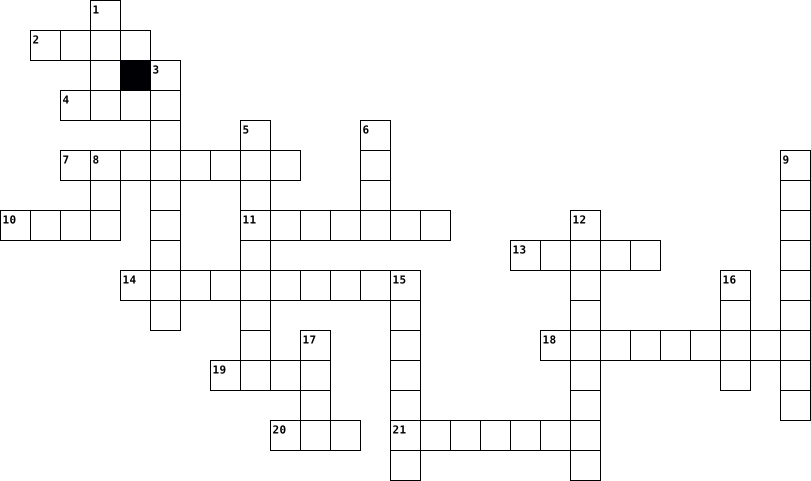
Across
- Γυναικεία ομάδα ποδοσφαίρου στη Θεσσαλονίκη
- Σε ποια ομάδα έπαιζε ο Ν. Γκάλης;
- Η χώρα που γεννήθηκε ο Ρονάλντο
- Τόσες χρυσές μπάλες κέρδισε ο Μέσσι
- H ομάδα του Βέρνερ
- Τα ΑμεΑ κάνουν σκι με...
- Οι αγώνες για ΑμεΑ
- Η χώρα που γεννήθηκε ο Μέσσι
- Το 1908 το ποδόσφαιρο έγινε Olympic ...
- Υπάρχει Ολυμπιακός Ύμνος;
- Γεννήθηκε το 1987 ο ποδοσφαιριστής
Down
- Κάθε πόσα χρόνια γίνεται το Μουντιάλ;
- Νίκησε τον Ναδάλ στο Australian open
- Η ομάδα του Μέσσι
- Σε ποια ομάδα παίζει τώρα ο Κ.Βασιλειάδης;
- Πόσες χρυσές μπάλες κέρδισε ο Λ. Μόντριτς
- Οι αθλητές ισορροπούν σε μια σανίδα στο χιόνι
- Η ομάδα του Σαλάχ
- "Don't forget my..." είπε ο Σ.Κυριακίδης
- Κιτρινόμαυρη ομάδα της Θεσσαλονίκης
- Ο καλύτερος ποδοσφαιριστής όλων των εποχών
21 Clues: Η ομάδα του Μέσσι • Η ομάδα του Σαλάχ • H ομάδα του Βέρνερ • Οι αγώνες για ΑμεΑ • Τα ΑμεΑ κάνουν σκι με... • Υπάρχει Ολυμπιακός Ύμνος; • Η χώρα που γεννήθηκε ο Μέσσι • Η χώρα που γεννήθηκε ο Ρονάλντο • Σε ποια ομάδα έπαιζε ο Ν. Γκάλης; • Γεννήθηκε το 1987 ο ποδοσφαιριστής • Τόσες χρυσές μπάλες κέρδισε ο Μέσσι • Κιτρινόμαυρη ομάδα της Θεσσαλονίκης • ...
Geography : physical aspects 2020-12-08

Across
- HIGH AND STEEP COASTLINE
- FLAT SANDY LAND
- SMALL ROCK FRAGMENTS
- THE TOP OF A MOUNTAIN
- A ROAD THROUGH AN AREA OF MOUNTAIN
- LAND SURROUNDED BY WATER ON3SIDES
- A LARGE BAY
- A LARGE MASS OF ICE
- A SMALL MOUNTAIN
- PLAINS AT THE FEET OF A MOUNTAIN
- A BASIN FILLED WITH FRESHWATER
Down
- IT FLOWS INTO A LARGER RIVER
- A FLAT AREA
- A WALL BUILT ACROSS A RIVER
- THE SIDE OF A HILL OR A MOUNTAIN
- SMALL RIVER
- UNDERGROUND WATER COMING TO SURFACE
- SMALL STONES
- FINE-GRAINED SOIL MATERIALS
- IT HAS LOW SALT CONCENTRATION
- LAND SURROUNDED BY WATER
21 Clues: A FLAT AREA • SMALL RIVER • A LARGE BAY • SMALL STONES • FLAT SANDY LAND • A SMALL MOUNTAIN • A LARGE MASS OF ICE • SMALL ROCK FRAGMENTS • THE TOP OF A MOUNTAIN • HIGH AND STEEP COASTLINE • LAND SURROUNDED BY WATER • A WALL BUILT ACROSS A RIVER • FINE-GRAINED SOIL MATERIALS • IT FLOWS INTO A LARGER RIVER • IT HAS LOW SALT CONCENTRATION • A BASIN FILLED WITH FRESHWATER • ...
PHYSICAL EDUCATION EXAM 2021-04-24
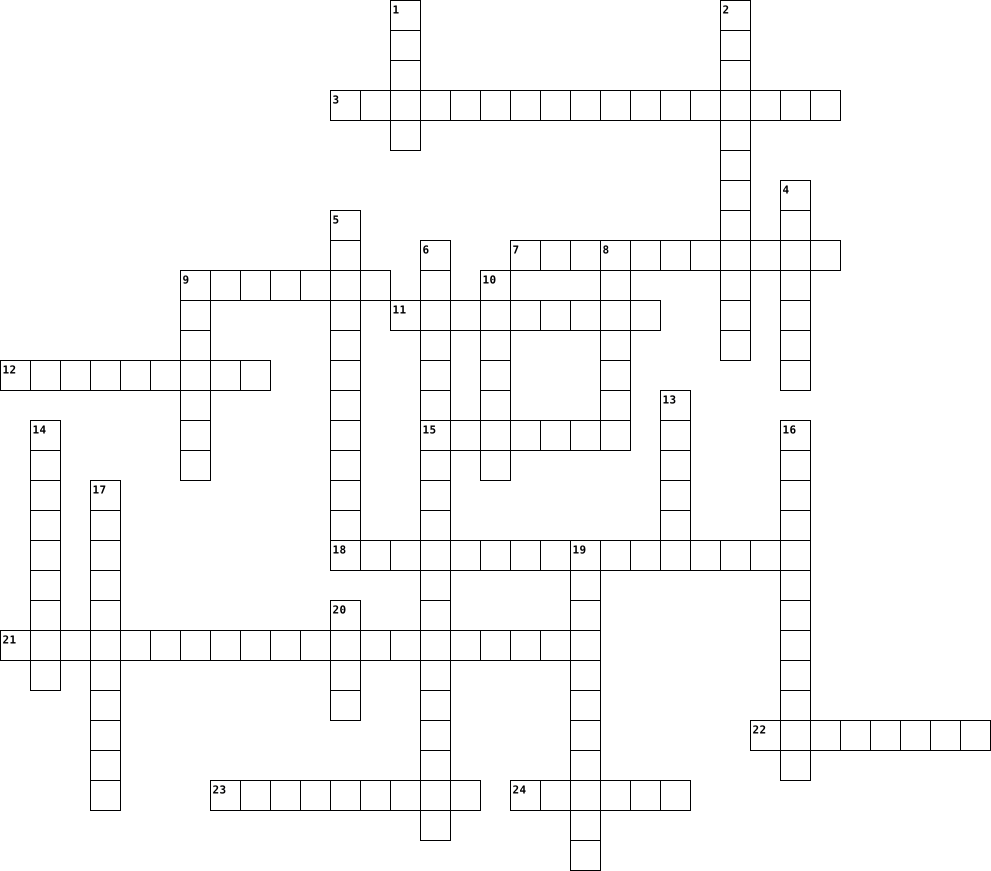
Across
- It is a phases of dance generally held in evening.
- It is also known as folk or ethnic dance.
- Moving on foot at a rapid pace.
- Moving in continuous forward or sideward direction with 1 foot leading.
- Movement of the body in space in any direction.
- It is a dual dance where men use "bolos".
- It is a tecnique teaches to release unnecessary tensions.
- Its is a dance tecnique that acquired with repition in time.
- It is the highest form of dance.
- A pantomined song and dance.
- A German word means "to stretch".
Down
- It is a composition that implies arrangement of parts into a form.
- It refers to any form of dancing that is done primarily for nightclubs.
- Springing on 1 foot and landing on the same foot.
- Movement various partd of the body in space with fixed base.
- She is the Mother of Philippine Folk Dances.
- It is a means of expressing one's emotions through movement.
- It is the pattern of movement.
- Gliding along the floor with either foot.
- It is a free, expressive style of dancing.
- This is a technique where dancers connect their entire body with the environment.
- It is popular form of dance whice developed during the middle portion of the 20th century.
- It is a popular, widespread activity type of dance.
- Dances of the mountain peoples of Cordillera.
- It is a cultural art form handed down from generation to generation.
25 Clues: A pantomined song and dance. • It is the pattern of movement. • Moving on foot at a rapid pace. • It is the highest form of dance. • A German word means "to stretch". • It is also known as folk or ethnic dance. • Gliding along the floor with either foot. • It is a dual dance where men use "bolos". • It is a free, expressive style of dancing. • ...
Physical Education 3 2021-04-23
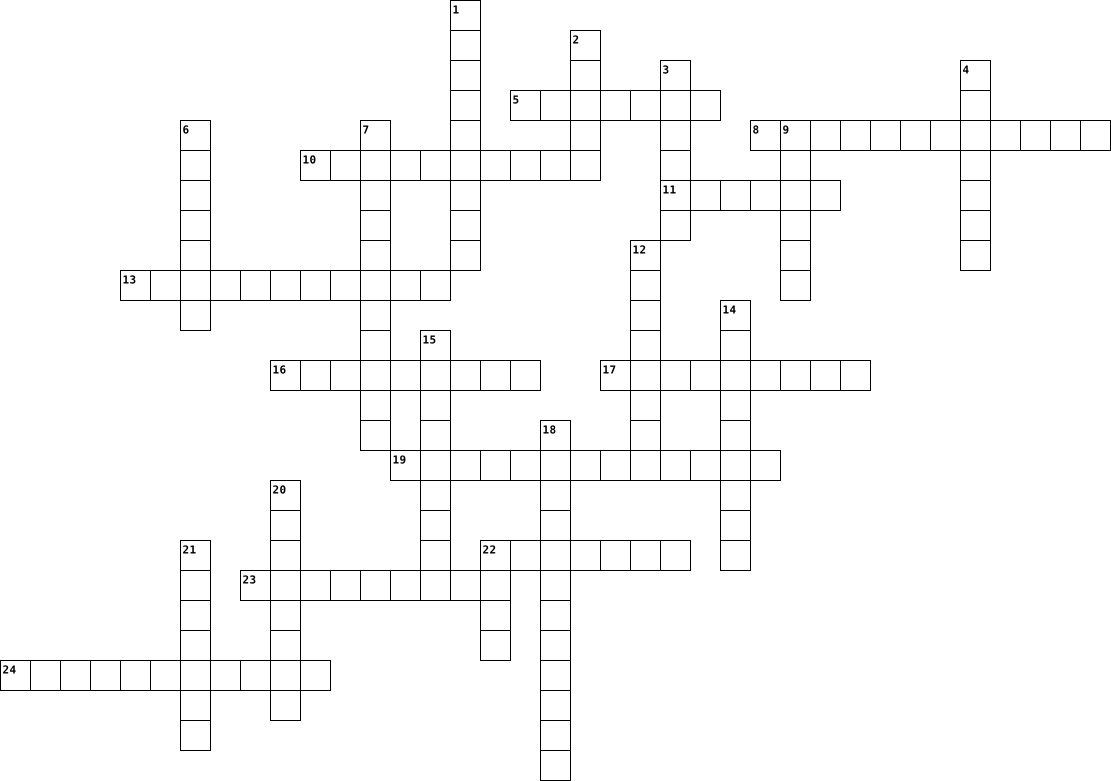
Across
- a dual dance where men use bolos
- an informal gatherings,parties and reunions
- an example is hit with both hands
- denotes aspect of quality movement that is sometimes thought as dance.
- it has five dance positions
- introduced such as pandanggo, cariñosa and etc
- mother of Philippine folk dance
- refers to the movement of the body in space with a fixed base
- one of the examples is elbow bend
- one of the christian dances
- this style of dance has come to viewed as sport, demanding of high level of stamina, strength and flexibility
Down
- examples are head twist and trunk twist
- one of the most beautiful form of art that has grown in leaps and bounds.
- free expressive style of dancing
- a movement that glides along the floor with either foot
- expressing one's emotion through movement.
- also known as folk or ethnic dance
- dances from the mountain people.
- generally held in the evening
- refer to the movement of the body in space in any direction with the feet as moving base
- a movement that moves in a continuous sideward direction with one foot leading
- it is all about expressing emotions through organic movement
- highest form of dance
- a movement that moves in moderate pace on feet
- it is a rural or country dance.
25 Clues: highest form of dance • it has five dance positions • one of the christian dances • generally held in the evening • mother of Philippine folk dance • it is a rural or country dance. • free expressive style of dancing • a dual dance where men use bolos • dances from the mountain people. • an example is hit with both hands • one of the examples is elbow bend • ...
Physical Education 3 2021-04-23
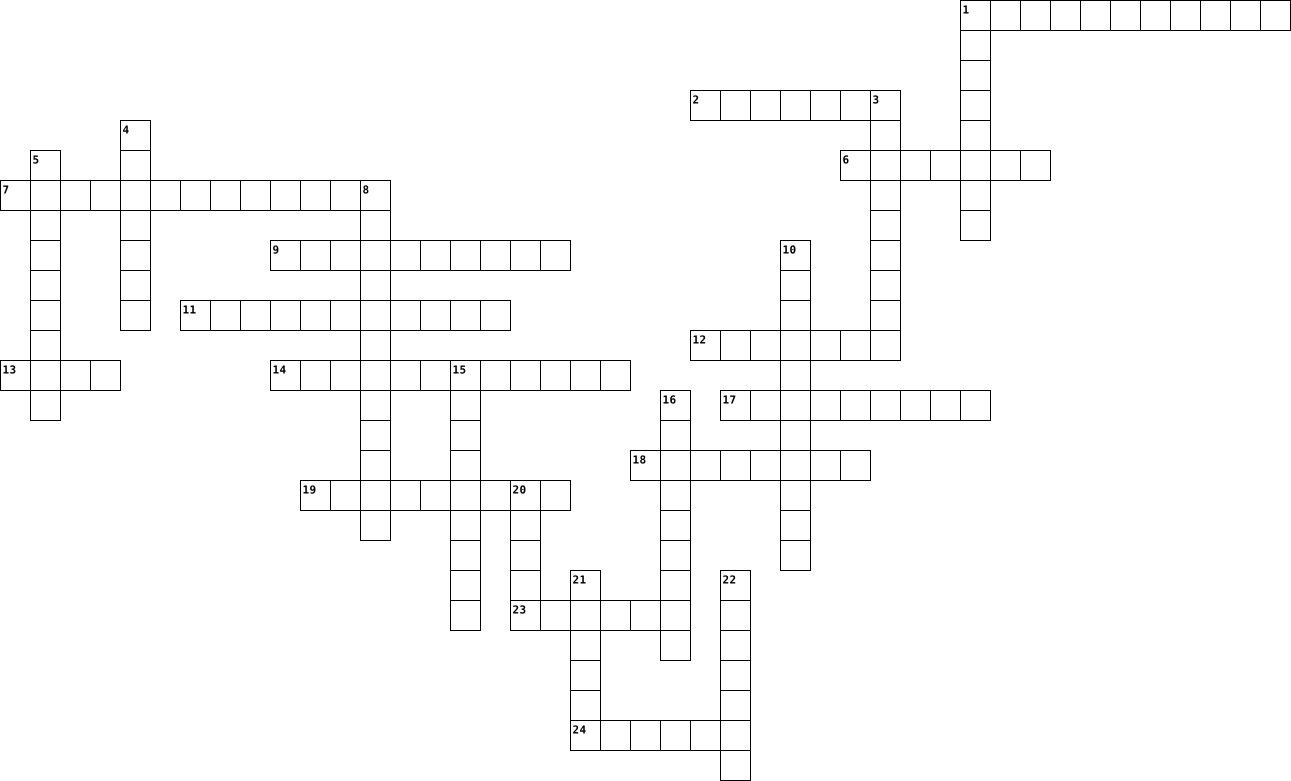
Across
- this style of dance has come to viewed as sport, demanding of high level of stamina, strength and flexibility
- a dual dance where men use bolos
- one of the examples is elbow bend
- refers to the movement of the body in space with a fixed base
- an example is hit with both hands
- it has five dance positions
- a movement that glides along the floor with either foot
- it is a rural or country dance
- it is all about expressing emotions through organic movement
- examples are head twist and trunk twist
- generally held in the evening
- introduced such as pandanggo, cariñosa and etc
- dances from the mountain people
- free expressive style of dancing
Down
- highest form of dance
- a movement that moves in a continuous sideward direction with one foot leading
- a movement that moves in moderate pace on feet
- refer to the movement of the body in space in any direction with the feet as moving base
- an informal gatherings,parties and reunions
- also known as folk or ethnic dance
- one of the christian dances
- mother of Philippine folk dance
- one of the most beautiful form of art that has grown in leaps and bounds.
- denotes aspect of quality movement that is sometimes thought as dance.
- expressing one's emotion through movement
25 Clues: highest form of dance • it has five dance positions • one of the christian dances • generally held in the evening • it is a rural or country dance • mother of Philippine folk dance • dances from the mountain people • a dual dance where men use bolos • free expressive style of dancing • one of the examples is elbow bend • an example is hit with both hands • ...
PHYSICAL PHARMACEUTICS 1 2020-08-03

Across
- irreversible polymorphism
- elements with many crystal forms
- modified equation for real gases
- temperature dependent liquid crystal
- hydrates and solvates
- Geometric arrangement of ions/atoms
- thermal detection method
- pattern created by repeated unit cells
- crystal form of sucrose
- Gas with no forces of attraction
- Minimum Pressure to liquefy a gas at Tc
Down
- deviation from ideal gas behavior
- existence of many crystal forms
- law to select propellants in aerosols
- mixture of gas plus liquid
- superimposed diffracted X rays
- conversion directly from solid to gas
- specific doses are delivered [acronym]
- increase temp.leads to glassy to--state
- most symmetric crystal form
- collisions with walls of container
- hidden heat
- solids with no definite arrangement
- escaping tendency
24 Clues: hidden heat • escaping tendency • hydrates and solvates • crystal form of sucrose • thermal detection method • irreversible polymorphism • mixture of gas plus liquid • most symmetric crystal form • superimposed diffracted X rays • existence of many crystal forms • elements with many crystal forms • modified equation for real gases • Gas with no forces of attraction • ...
Pulmonary Physical Exam 2021-10-18

Across
- Say “e” however heard as “a” due to fluid/ solid
- Increased vibration palpated on chest wall from secretions
- coughing up quantities of blood
- Louder transmission of voice sound through fluid/ solid
- Active component of respiration, diaphragm contracts and descends
- The ICS is named for the rib ___
- Percussion note heard over a consolidation/ area of fluid
- Sensation of vibration which increases in dx like pneumonia
- Intercostal space for needle decompression
- With percussion it measures out about 3.5-5 cm on a deep inhalation
- Pleura, Lines thoracic cavity, has pain receptors
- Percussion note which is normal
- the relaxation of the diaphragm and exhalation due to elastin
- Breathing pattern described as irregular with periods of apnea alternating with regular and deep breathing
- Fissure that is only present in the right lung
- Continuous, musical sounds due to airway obstruction
- Chest deformity from chronic hyperinflation
- Respiratory ____ is 2-5 inches (5-12 cm) and symmetrical when taking a deep breath
- Pleura, Lines the outer surface of lungs, no pain receptors
- the functional tissue of an organ as distinguished from the connective and supporting tissue
- aka sternal angle, 5cm below the suprasternal notch
- Breathing pattern described as apnea with deep breathing “ramp up”
Down
- shortness of breath while laying flat
- Position you find a patient in respiratory distress, “leaning forward on elbows”
- formed by the points at which the chest wall and diaphragm meet
- Whispered, but heard loudly due to fluid or solid
- shortness of breath
- small airways where gas exchange starts
- Chest deformity acquired from a trauma
- “lung roots” Complicated anatomical structures, Includes: pulmonary vessels and the major bronchi
- cessation of breathing
- Tracheal bifurcation to R and L mainstem
- Breathing pattern associated with diabetic ketoacidosis
- Term to describe fast breathing
- sign of respiratory distress, especially in pediatric where intercostal muscles are sucked in between the ribs on breathing
- Finger on the chest wall held tight and is struck with finger from opposite hand
- Intercostal space for chest tube insertion
- Breath sound that is soft and low pitched. They are heard throughout inspiration
- Fissure that divides the lungs essentially in half
- Chest deformity in which sternum is displaced anteriorly with adjacent costal cartilage depression
- Crackling “rice krispie” sound when pressing on skin caused by ptx
- Breath sound which is discontinuous, intermittent, non-musical, can be fine or coarse
- inflammation of the pleurae, which impairs their lubricating function and causes pain when breathing
- Chest depression in the lower portion of the sternum which may compress the heart and great vessels may cause murmurs
44 Clues: shortness of breath • cessation of breathing • coughing up quantities of blood • Term to describe fast breathing • Percussion note which is normal • The ICS is named for the rib ___ • shortness of breath while laying flat • Chest deformity acquired from a trauma • small airways where gas exchange starts • Tracheal bifurcation to R and L mainstem • ...
Pulmonary Physical Exam 2021-10-18

Across
- Breath sound which is discontinuous, intermittent, non-musical, can be fine or coarse
- cessation of breathing
- Pleura, Lines thoracic cavity, has pain receptors
- Respiratory ____ is 2-5 inches (5-12 cm) and symmetrical when taking a deep breath
- Term to describe fast breathing
- “lung roots” Complicated anatomical structures, Includes: pulmonary vessels and the major bronchi
- the relaxation of the diaphragm and exhalation due to elastin
- Say “e” however heard as “a” due to fluid/ solid
- Percussion note heard over a consolidation/ area of fluid
- Position you find a patient in respiratory distress, “leaning forward on elbows”
- The ICS is named for the rib ___
- Intercostal space for chest tube insertion
- Fissure that divides the lungs essentially in half
- Pleura, Lines the outer surface of lungs, no pain receptors
- Chest depression in the lower portion of the sternum which may compress the heart and great vessels may cause murmurs
- formed by the points at which the chest wall and diaphragm meet
- Fissure that is only present in the right lung
- Intercostal space for needle decompression
- Chest deformity in which sternum is displaced anteriorly with adjacent costal cartilage depression
- coughing up quantities of blood
- Breathing pattern associated with diabetic ketoacidosis
Down
- Breathing pattern described as apnea with deep breathing “ramp up”
- shortness of breath
- inflammation of the pleurae, which impairs their lubricating function and causes pain when breathing
- Louder transmission of voice sound through fluid/ solid
- the functional tissue of an organ as distinguished from the connective and supporting tissue
- Breathing pattern described as irregular with periods of apnea alternating with regular and deep breathing
- Breath sound that is soft and low pitched. They are heard throughout inspiration
- aka sternal angle, 5cm below the suprasternal notch
- Chest deformity from chronic hyperinflation
- Continuous, musical sounds due to airway obstruction
- small airways where gas exchange starts
- Increased vibration palpated on chest wall from secretions
- shortness of breath while laying flat
- Chest deformity acquired from a trauma
- Finger on the chest wall held tight and is struck with finger from opposite hand
- Tracheal bifurcation to R and L mainstem
- Active component of respiration, diaphragm contracts and descends
- Whispered, but heard loudly due to fluid or solid
- sign of respiratory distress, especially in pediatric where intercostal muscles are sucked in between the ribs on breathing
- Sensation of vibration which increases in dx like pneumonia
- With percussion it measures out about 3.5-5 cm on a deep inhalation
- Percussion note which is normal
- Crackling “rice krispie” sound when pressing on skin caused by ptx
44 Clues: shortness of breath • cessation of breathing • Term to describe fast breathing • Percussion note which is normal • coughing up quantities of blood • The ICS is named for the rib ___ • shortness of breath while laying flat • Chest deformity acquired from a trauma • small airways where gas exchange starts • Tracheal bifurcation to R and L mainstem • ...
Earth's Physical Geography 2022-02-17

Across
- dry
- chain of islands
- as elevation increases,temperature
- climates found in tall mountains
- visual representation of an area’s climate
- area with the most volcanoes and earthquakes
- sediment being moved by wind,water,or ice
- vegetation is only lichen
- high latitude climates
- inlet with steep sides created by a glacier
Down
- continents connected together
- mantle, crust, and
- landform created by deposition at river mouth
- current temperature and precipitation
- an area's average weather
- sediment being added to a landform
- area of calm at the equator
- one side of a mountain has less moisture
- top layer in a rainforest
- crack in Earth's surface
20 Clues: dry • chain of islands • mantle, crust, and • high latitude climates • crack in Earth's surface • an area's average weather • vegetation is only lichen • top layer in a rainforest • area of calm at the equator • continents connected together • climates found in tall mountains • as elevation increases,temperature • sediment being added to a landform • ...