
physical Crossword Puzzles
Physical Properties 2020-10-19

Across
- Substances that mix together
- Molecules move around each other, not full spaced out
- Molecules bounce around at a fast pace
- How much an object weighs
- Size or density of a molecule
- The warmth or coldness of an object or substance
- g/cm3
- On periodic table
- The stretchability of a substance
- Shine/reflective-ness
- The durability of a substance
- Able to be hammered or pressed permanently out of shape without breaking or cracking.
- A thing that is composed of two or more separate elements
- The ability to be dissolved
- The temperature at which a substance will melt
- The degree to which a specified material conducts electricity
Down
- Form
- Substances that stay separate, can be mixed but you can see the two separate substances
- The temperature at which a substance boils and turns into vapor
- The ability to float or some other fluid
- Different saturations as a result of the way the object reflects light
- The quality of a three dimensional space
- Molecules are close together and vibrate
- Odor/scent
- The pole of two magnetic fields
- How long something is
- How big something is
- The measure of the amount of electrical current a material can carry or it's ability to carry a current
- firm/solid
- A chemical change between two or more substances
30 Clues: Form • g/cm3 • Odor/scent • firm/solid • On periodic table • How big something is • How long something is • Shine/reflective-ness • How much an object weighs • The ability to be dissolved • Substances that mix together • Size or density of a molecule • The durability of a substance • The pole of two magnetic fields • The stretchability of a substance • Molecules bounce around at a fast pace • ...
physical properties 2020-10-22

Across
- - describes how much space something occupies
- - _______ conductivity, measures somethings ability to conduct(transfer) heat
- - state of _____, describes the 4 states in which matter can exist
- - describes the property of a solid, liquid, or gas to dissolve in another solid, liquid, or gas
- - describes how easily liquids and gasses can pass through something.
- - describes how much light passes through something
- - describes something that can be attracted/repelled by a magnet
- - _______ conductivity, measures somethings ability to conduct(transfer) heat
- - measures how much internal friction a moving fluid has, how much resistance to flow it has
- - describes how much something can resist when indented by an indenter of a specific size
Down
- - describes the quality of something that can be reshaped into something else by being compressed and put under pressure.
- - describes how much thermal energy is in something
- - ________ point, describes the temperature at which something will turn from a liquid to a gas (boil)
- - describes qualities that are described and aren’t measured
- - describes how heavy something is
- - measured as the ratio of mass to volume
- - describes qualities measured using numbers
- - describes when a molecule has a separation of its electric charge, creating a positively and negatively charges side
- - ________ point, describes the temperature at which something will turn from a solid to a liquid (melt)
- - describes a visual quality that is caused by light being transmitted or reflected
- - describes something that triggers the olfactory nerve. (also called smell)
21 Clues: - describes how heavy something is • - measured as the ratio of mass to volume • - describes qualities measured using numbers • - describes how much space something occupies • - describes how much thermal energy is in something • - describes how much light passes through something • - describes qualities that are described and aren’t measured • ...
physical properties 2020-10-22

Across
- - describes the quality of something that can be reshaped into something else by being compressed and put under pressure.
- - ________ point, describes the temperature at which something will turn from a solid to a liquid (melt)
- - describes how heavy something is
- - describes how much thermal energy is in something
- - describes a visual quality that is caused by light being transmitted or reflected
- - describes when a molecule has a separation of its electric charge, creating a positively and negatively charges side
- - describes how much space something occupies
- - describes something that can be attracted/repelled by a magnet
- - describes qualities that are described and aren’t measured
Down
- - measures how much internal friction a moving fluid has, how much resistance to flow it has
- - describes the property of a solid, liquid, or gas to dissolve in another solid, liquid, or gas
- - ________ point, describes the temperature at which something will turn from a liquid to a gas (boil)
- - state of _____, describes the 4 states in which matter can exist
- - describes how easily liquids and gasses can pass through something.
- - describes how much light passes through something
- - measured as the ratio of mass to volume
- - describes something that triggers the olfactory nerve. (also called smell)
- - describes how much something can resist when indented by an indenter of a specific size
- - _______ conductivity, measures somethings ability to conduct(transfer) heat
- - describes qualities measured using numbers
20 Clues: - describes how heavy something is • - measured as the ratio of mass to volume • - describes qualities measured using numbers • - describes how much space something occupies • - describes how much light passes through something • - describes how much thermal energy is in something • - describes qualities that are described and aren’t measured • ...
Physical world 2020-10-26

Across
- прохладно
- ураган
- гроза
- rain проливной дождь
- сугробы
- пасмурная погода
- мокрый снег
- кипячение(очень жарко -)
- сырой
- ветрено
- шторм
- туманный (H)
- оттепель
- морось
- туманный (F)
Down
- палящий
- пустыня
- снежная буря
- гром
- ливень
- землетрясение
- морозно
- влажный
- извержение
- наводнение
- душный
- волна тепла
- град
- туманный (М)
- мягкий
- слякоть
- молния
- засуха
33 Clues: гром • град • гроза • сырой • шторм • ураган • ливень • душный • мягкий • молния • морось • засуха • палящий • пустыня • морозно • влажный • сугробы • ветрено • слякоть • оттепель • прохладно • извержение • наводнение • волна тепла • мокрый снег • снежная буря • туманный (М) • туманный (H) • туманный (F) • землетрясение • пасмурная погода • rain проливной дождь • кипячение(очень жарко -)
Physical Science 2021-03-11

Across
- the measure of the pull of gravity on an object
- the process in which a substance changes size, shape, or state of matter but does not create a new kind of matter
- the ends of a magnet where force is the greatest
- the process in which matter changes and creates a new kind of matter with different properties
- the positive and negative particles that carry electricity on an atom
- a characteristic of matter that can be observed only when matter is changed into a different kind of matter
- the form of matter in which molecules slide past each other, but remain close together
- anything that has mass and takes up space
- a temporary magnet created using electricity
Down
- materials that do no allow electric current or heat to pass through easily
- an object that attracts some metals
- a characteristic of matter that can be measured or observed without changing matter into something new
- the amount of space that matter takes up
- the smallest particle of matter
- opposite magnet poles do this
- materials that allow electric current to pass through easily
- a single particle of matter made up of 2 or more atoms joined together
- the form of matter in which molecules move quickly and have no pattern
- the form of matter in which the molecules are packed closely together and have a regular pattern
- the amount of matter in an object
- the same magnetic poles do this
21 Clues: opposite magnet poles do this • the smallest particle of matter • the same magnetic poles do this • the amount of matter in an object • an object that attracts some metals • the amount of space that matter takes up • anything that has mass and takes up space • a temporary magnet created using electricity • the measure of the pull of gravity on an object • ...
Physical Science 2021-04-29

Across
- Measure of a substances resistance to flow
- Mixture in which you cant pick out the parts
- Characteristic that can be observed without changing the substance in any way
- Mixture in which you can pick out the parts
- The new substance in reaction to a chemical change
- State with particles far apart and moving very fast
- State with particles small distanced apart and moving at medium speed
- Mass over Volume
- Ability for a substance to be reshaped
- A change of a physical property without changing its identity
- the quality of something releasing a bad smell
- The main substance in a mixture that can dissolve other substances
Down
- Law that states that energy may not be created or destroyed but may change form
- Characteristic that describes whether a substance can participate in a chemical reaction
- What occurs to metal after being exposed to rain and O2
- The temperature required for a substance to melt
- State with particles close together and barely moving
- A substance that will dissolve
- The breaking down of rocks and minerals
- One or more substances change into an entirely new substance
- Natural wearing and moving of material on Earth
- The ability of a substance to be pulled into a wire
- The temperature required for a substance to boil
- Ability for a substance to catch fire and burn
24 Clues: Mass over Volume • A substance that will dissolve • Ability for a substance to be reshaped • The breaking down of rocks and minerals • Measure of a substances resistance to flow • Mixture in which you can pick out the parts • Mixture in which you cant pick out the parts • Ability for a substance to catch fire and burn • the quality of something releasing a bad smell • ...
Physical Education # 2021-04-23
Across
- it is a free expressive style of dancing started in early 20th century as a reaction to classical ballet.
- Means of expressing one's emotions through movement discipline by rhythm
- flow, Technique where the dancers connect their entire body with the environment
- swaying arms forward backward or sideward
- Movement of the body in space in any direction with the feet as moving base.
- the setting of this dance is usually informal gatherings and parties ,reunions ,and the like.
- highest form of dance.
- Cultural art form handed down from generation to generation
- gliding along the floor with either foot
- A pantomimed song and dance was the oldest recorded activity among the Christianized Filipinos
Down
- , Prefers the movement SEPTA music where there emerges organization structure and battery
- improvisation, This practice focuses in sensing a partner while having a body dialogue -
- mind centering, Basic yoga routines are good examples of this technique.
- When did Ferdinand Magellan discovered the Philippines
- refers to any form of dancing that is done primarily for its social educational and health benefits .
- It is all about expressing emotions through organic movements and unrestricted lines.
- Aquino, Mother of Philippine folk dances
- Most dances big in and end with
- Also known as folk or ethnic dance
- widespread activity in which competitors perform dances in any several permitted dance style.
- locomotor, Refer to the movement various parts of the body in space with a fixed base.
- Bending or shortening of a body part occurring at a joint
- and ballroom, The setting of this dance it's a social gathering with the more formal atmosphere than the simple and informal parties in which the recreational dances are the usual forms.
- technique, Dancing technique teaches to release unnecessary tensions used while moving
- it is a measure motion of flow , characterized by regular occurrence of elements or features as beats sounds or accents.
25 Clues: highest form of dance. • Most dances big in and end with • Also known as folk or ethnic dance • Aquino, Mother of Philippine folk dances • gliding along the floor with either foot • swaying arms forward backward or sideward • When did Ferdinand Magellan discovered the Philippines • Bending or shortening of a body part occurring at a joint • ...
Physical Science 2021-05-06

Across
- Measure of a substances resistance to flow
- Mixture in which you cant pick out the parts
- Characteristic that can be observed without changing the substance in any way
- Mixture in which you can pick out the parts
- The new substance in reaction to a chemical change
- State with particles far apart and moving very fast
- State with particles small distanced apart and moving at medium speed
- Mass over Volume
- Ability for a substance to be reshaped
- A change of a physical property without changing its identity
- the quality of something releasing a bad smell
- The main substance in a mixture that can dissolve other substances
Down
- Law that states that energy may not be created or destroyed but may change form
- Characteristic that describes whether a substance can participate in a chemical reaction
- What occurs to metal after being exposed to rain and O2
- The temperature required for a substance to melt
- State with particles close together and barely moving
- A substance that will dissolve
- The breaking down of rocks and minerals
- One or more substances change into an entirely new substance
- Natural wearing and moving of material on Earth
- The ability of a substance to be pulled into a wire
- The temperature required for a substance to boil
- Ability for a substance to catch fire and burn
24 Clues: Mass over Volume • A substance that will dissolve • Ability for a substance to be reshaped • The breaking down of rocks and minerals • Measure of a substances resistance to flow • Mixture in which you can pick out the parts • Mixture in which you cant pick out the parts • Ability for a substance to catch fire and burn • the quality of something releasing a bad smell • ...
Physical science 2021-11-18

Across
- is the transfer of energy by electromagnetic waves
- occurs when what the scientist expects changes how the results are viewed
- is the SI unit of energy
- is an inclined plane with one or two slopping slides
- a large wheel that rotates when pushed by wind,water, and steam
- a push of pull
- when a object changes its position relative to a reference point
- it has a positive charge
- test the affects of one thing or another control
Down
- is a device that makes doing work easier
- a material on which heat flows through slowly
- is a inclined plane wrapped in a spiral around a cylindrical post
- force that opposes the sliding motion between two touching surfaces
- attractive force between two objects
- mother for studying the natural world
- refers to the properties and interactions
- how fast something is going
- is the transfer of energy that occurs when a force makes up an objects
- is the amount of work done in one second
- gravitational force exerted on an objects
20 Clues: a push of pull • is the SI unit of energy • it has a positive charge • how fast something is going • attractive force between two objects • mother for studying the natural world • is a device that makes doing work easier • is the amount of work done in one second • refers to the properties and interactions • gravitational force exerted on an objects • ...
Physical Science 2023-02-22

Across
- The abbreviation for elements
- a negatively charged atom
- When two liquids make a solid
- the center of an atom
- a group of atoms
- a common metal with a lot of uses
- contains two different atom stuck together
- list of elements
- particles are compact and barely move
- has a unique atomic number
Down
- occupies the highest energy levels in an atom
- number of protons
- added to pools to kill germs
- was used in thermometers but was highly toxic
- particles are closer and a little faster
- Particles are free and go any where
- is often used in electrical wires
- a particle with no electric charge
- gasses that don´t react much
- a positively charged atom
20 Clues: a group of atoms • list of elements • number of protons • the center of an atom • a negatively charged atom • a positively charged atom • has a unique atomic number • added to pools to kill germs • gasses that don´t react much • The abbreviation for elements • When two liquids make a solid • is often used in electrical wires • a common metal with a lot of uses • ...
Physical Descriptions 2023-02-27

Across
- ugly
- tiene pelo ___ (grey)
- tiene pelo ___ (dark)
- short (height)
- has
- curly
- wavy
- braces
- is
- short hair
- skinny
- elderly
Down
- long hair
- freckles
- young
- tall
- ojos ___ (green)
- good-looking
- mustache
- glasses
- blonde
- chubby
- bald
- braids
- ojos ___ (blue)
25 Clues: is • has • ugly • tall • wavy • bald • young • curly • braces • blonde • chubby • skinny • braids • glasses • elderly • freckles • mustache • long hair • short hair • good-looking • short (height) • ojos ___ (blue) • ojos ___ (green) • tiene pelo ___ (grey) • tiene pelo ___ (dark)
physical features 2023-03-13

Across
- pale
- wrinkles
- small/little
- de chivo goatee
- handsome
- skin
- mole
- beautiful
- mustache
- ugly
- tan
- chubby
- pretty
- muscular
- young
- tall
- strong
- de pesas average weight
- eyes
- short
- de altura average
Down
- athletic
- gorgeous
- physical features
- sideburns
- cute
- very skinny
- bald
- slender/slim
- scar
- tattoo
- dark
- freckles
- old
- bald
- fat
- hair
- blonde
- red
- mediana edad middle age
- older
- dimples
- weak
- younger
- attractive
- chubby
- big
- gray
- beard
49 Clues: old • fat • red • tan • big • pale • cute • bald • scar • dark • bald • hair • skin • mole • ugly • weak • tall • gray • eyes • older • young • beard • short • tattoo • blonde • chubby • chubby • pretty • strong • dimples • younger • athletic • gorgeous • wrinkles • freckles • handsome • mustache • muscular • sideburns • beautiful • attractive • very skinny • slender/slim • small/little • de chivo goatee • physical features • de altura average • mediana edad middle age • ...
Physical Science 2023-04-11

Across
- energy that is in motion
- when water starts to melt
- Can almost fully conduct electricity
- When water starts to bubble
- A large magnifying glass
- a small planet
- the unit for work
- The theory the universe started from a big explosion from two atoms
- the unit for force
- For something to be able to be burned or is burning
- that doesn't allow energy to go through a wire into a battery
- what makes up our universe
- A rock that passes by space
- the temperature where atoms stop moving
- can fully conduct electricity
- a celestial ball in space that revolves around the sun
Down
- made up of the sun and planets
- the letter for a element on the periodic table
- stored energy that could do work but isn't
- A rock that hits earth
- for two or more atoms to combine
- the only matter that is firm and stays in shape
- the ability to do work
- How we identify a element
- How much protons a atom has
- that allows energy to go through a wire into a battery
- Cannot conduct electricity
- A single path for electricity to follow
- The fastest thing in the universe
- A huge rock in space
30 Clues: a small planet • the unit for work • the unit for force • A huge rock in space • A rock that hits earth • the ability to do work • energy that is in motion • A large magnifying glass • when water starts to melt • How we identify a element • Cannot conduct electricity • what makes up our universe • When water starts to bubble • How much protons a atom has • A rock that passes by space • ...
Physical Appearances 2023-06-14

Across
- Guapo
- Viejo
- Blanco
- Atractivo
- Hermosa
- Negro
- Fuerte
- Pelo
- Joven
- Moreno
- Rubio
Down
- Robusto
- Musculoso
- Lampiño
- Obeso
- Alto
- Debil
- Con curvas
- Feo
- Delgado
- Sobrepeso
- Bajo de estatura
- Delgado
23 Clues: Feo • Alto • Pelo • Guapo • Viejo • Obeso • Debil • Negro • Joven • Rubio • Blanco • Fuerte • Moreno • Robusto • Lampiño • Hermosa • Delgado • Delgado • Musculoso • Atractivo • Sobrepeso • Con curvas • Bajo de estatura
Physical World 2023-06-17

Across
- A chuva caiu intensamente durante toda a tarde.
- A ilha era cercada por águas cristalinas e areia branca.
- Um dia ensolarado é perfeito para uma caminhada ao ar livre ou um piquenique no parque.
- O inverno rigoroso pode congelar até mesmo a alma daqueles que não estão preparados.
- As estações do ano têm influência direta no nosso humor.
- O barulho dos relâmpagos durante as tempestades é capaz de assustar até os mais corajosos.
- Hoje está nublado, acho que vai chover.
- A chegada da primavera traz consigo as flores e o renascimento da natureza.
- Na madrugada, o silêncio era interrompido apenas pelo som dos pássaros.
Down
- Durante a nevasca, as estradas ficaram perigosas.
- As nuvens no céu indicam a chegada de uma tempestade.
- Após a chuva, um lindo arco-íris se formou no céu.
- O lago estava sereno, refletindo as montanhas ao redor.
- Um furacão se aproximava da costa, trazendo ventos muito fortes.
- O mar estava agitado, com ondas fortes quebrando na praia.
- A neblina tornava a visibilidade quase nula.
- O céu estava estrelado durante a noite.
- O pôr do sol na praia é uma cena maravilhosa que nunca me canso de apreciar.
- O vapor subia da xícara de café quente.
- A neve cobriu todo o jardim, formando um manto branco.
20 Clues: O céu estava estrelado durante a noite. • O vapor subia da xícara de café quente. • Hoje está nublado, acho que vai chover. • A neblina tornava a visibilidade quase nula. • A chuva caiu intensamente durante toda a tarde. • Durante a nevasca, as estradas ficaram perigosas. • Após a chuva, um lindo arco-íris se formou no céu. • ...
Physical Science 2013-12-18

Across
- arithmetical value, expressed by a word, symbol, or figure, representing a particular quantity and used in counting and making calculations and for showing order in a series or for identification.
- degree of compactness of a substance.
- thing that is composed of two or more separate elements; a mixture.
- continuously over a period of time.
- person or thing who relies on another.
- quantity of a particular substance that can dissolve in a particular solvent (yielding a saturated solution)
- law/An experimental gas law which describes how gases tend to expand when heated
- to be changed or adapted.
- supposition or a system of ideas intended to explain something, esp. one based on general principles independent of the thing to be explained.
- part or aspect of something abstract, esp. one that is essential or characteristic.
- diagram showing the relation between variable quantities, typically of two variables, each measured along one of a pair of axes at right angles.
Down
- amount or number of a material or immaterial thing not usually estimated by spatial measurement.
- liquid mixture in which the minor component (the solute) is uniformly distributed within the major component (the solvent).
- power to influence or direct people's behavior or the course of events.
- liquid in which a solute is dissolved to form a solution.
- chemical element of atomic number 6, a nonmetal that has two main forms (diamond and graphite) and that also occurs in impure form in charcoal, soot, and coal.
- from outside control; not depending on another's authority.
- neutral color or shade, esp. light gray or beige.
- supposition or proposed explanation made on the basis of limited evidence as a starting point for further investigation.
- lowest part or edge of something, esp. the part on which it rests or is supported.
20 Clues: to be changed or adapted. • continuously over a period of time. • degree of compactness of a substance. • person or thing who relies on another. • neutral color or shade, esp. light gray or beige. • liquid in which a solute is dissolved to form a solution. • from outside control; not depending on another's authority. • ...
Physical Therapy 2013-08-23

Across
- Functional Limitations
- Measures an older adult's gait and balance abilities
- Right and left step length appears equal; or unequal
- Moving from chair to bed and back again
- Assessment reference date
- clinical test of a person's static and dynamic balance abilities
- Assesses a patient's walking pattern
- Type of strengthening exercise
- Device used to ambulate patient's
Down
- Prior level of function
- Place foot alternately on step or stool while standing unsupported
- Clock starts on "Go" and stops when bottom touches the chair
- best rehab company
- Assesses ability to modify balance while walking in the presence of external demands
- national social insurance program
- resource utilization group
- Device placed at the waist to support a patient during ambulation
- privacy rule
- Therapy equipment that enables to walk or run in one place
- The longest muscle in the human body
20 Clues: privacy rule • best rehab company • Functional Limitations • Prior level of function • Assessment reference date • resource utilization group • Type of strengthening exercise • national social insurance program • Device used to ambulate patient's • The longest muscle in the human body • Assesses a patient's walking pattern • Moving from chair to bed and back again • ...
Physical Methods 2015-02-18

Across
- doesn’t sterilize, asepsis; endospores, protozoa cysts can still live
- kills all microbes (ex: autoclaving)
- free of pathogenic contaminants
- microbe growth in blood and other living tissues
- freeze drying; used for long-term preservation
- excites atoms by raising them to a higher energy state but does not ionize them; disinfecting surfaces; UV light is good; terrible at penetrating; affects structure of DNA; measured in nm when talking about UV rays as an example of this
- kill
- mechanical cleansing technique to reduce number of microbes to reduce contamination; meeting health standards
- not sterile; heat; can live (batch, flash, UHT)
- heat; not as effective as boiling
- used on non-living surfaces; destroys most microbes
- mechanical removal of most microbes from living and non-living surfaces
Down
- degerming; good for heat-sensitive things
- steam and pressure (sterilization)(121*C, 15 psi, 15 mins)
- preservation; slows metabolism
- still static mainly; slows down the ability to grow
- removing number of microbes on human skin
- only way to kill prions
- practice of preventing microbial entry into sterile tissues
- inhibits growth
- electron radiation that ejects orbital electrons from an atom causing ions to form; good at killing, but not penetrating; measured in Grays
- static; dries out cells
- more effective than quick freezing
- used in labs as a method of filtration
- reduces number of microbes; not pathogenic; living surfaces
- removing microbes from air and liquids with membranes with pore openings
26 Clues: kill • inhibits growth • only way to kill prions • static; dries out cells • preservation; slows metabolism • free of pathogenic contaminants • heat; not as effective as boiling • more effective than quick freezing • kills all microbes (ex: autoclaving) • used in labs as a method of filtration • degerming; good for heat-sensitive things • removing number of microbes on human skin • ...
Physical Fitness 2014-11-12

Across
- the low-level activity that prepares your body to return to a resting state
- The ability to move your body parts through their full range of motion
- The ability of your muscles to perform physical tasks over a period of time without tiring
- Any form of movement that causes your body to use energy
- the number of times your heart beats per minute when you are not active
- Gradually incresing the demands on your body
- The ability to carry out daily tasks easily and have enough reserve energy to respond to unexpected demands
- Damage to the skin and tissues caused by extreme cold
- The amount of force your muscles can exert
- Exercising at a level that's beyond your regular daily activities
- Dangerously low body tempterature
- All rhythmic activities that use large muscle groups for an extended period of time
- Injuries to the ligaments around a joint that produce pain, swelling, and stiffness
Down
- The ability of your heart, ungs, and blood vessels to send fuel and oxygen to your tissues during long periods of moderate to vigorous activity
- The part of an exercise session when you are exercising at your highest peak
- Intense, short bursts of activity in which the muscles work so hard that they produce energy without using oxygen.
- Sudden or sometimes painful contractios of the muscles
- a form of physical stress on the body caused by over heating
- A gentile cardiovascular activity that prepares the muscles for work
- Choosing the right types of activities to improve a given element of fitness
- A dangerous condition in which the body loses its ability to cool itself through perspiration
- Purposeful physical activity that is planned, structured, repetitive, and improves or maintains physical fitness
- result from overstretching and tearing a muscle
23 Clues: Dangerously low body tempterature • The amount of force your muscles can exert • Gradually incresing the demands on your body • result from overstretching and tearing a muscle • Damage to the skin and tissues caused by extreme cold • Sudden or sometimes painful contractios of the muscles • Any form of movement that causes your body to use energy • ...
Physical activity 2015-02-09

Across
- / complete trust or confidence in someone or something
- / in between vigorous and light
- / or affecting the human spirit
- / Being ____
- / relating to the natural world and the impact of human activity on its condition.
- / a matter or situation regarded as unwelcome or harmful and needing to be dealt with and overcome.
- / girls have way to many of these
- / the way in which one acts or conducts oneself, especially toward others.
- / not in good health
- / relating to, involving, or requiring free oxygen.
- / developing emotional relationships
- / a band or bundle of fibrous tissue in a human or animal body that has the ability to contract
Down
- / settled or regular tendency or practice
- / the way in which a whole or mixture is made up.
- / the physical structure of a person or an animal, including the bones, flesh, and organs.
- / of or relating to the body as opposed to the mind.
- / the quality of being intense.
- / Mind
- / the quality of bending easily without breaking.
- / of or relating to a person's emotions.
- / in good health.
- / most intense activity
- / the quality or state of being strong, in particular.
- / activity requiring physical effort, carried out especially to sustain or improve health and fitness.
- / lowest amount of activity
25 Clues: / Mind • / Being ____ • / in good health. • / not in good health • / most intense activity • / lowest amount of activity • / in between vigorous and light • / or affecting the human spirit • / the quality of being intense. • / girls have way to many of these • / developing emotional relationships • / of or relating to a person's emotions. • / settled or regular tendency or practice • ...
Physical Science 2015-05-27

Across
- a large molecule made from smaller molecules
- friction when one surface moves over another
- has more dissolved solute than predicted
- uniformly mixed
- product of mass and velocity
- friction on objects that are not moving
- measure of the force of gravity
- containing only carbon and hydrogen
- contains as much dissolved solute as possible
- equal forces acting in opposite directions
- the amount of space matter occupies
- a place used for comparison
- force pulling two objects together
- tendency to resist any change in motion
- a measurement of force
Down
- principle about forces in confined fluids
- speed in a given direction
- compounds that contain carbon
- amount of matter in an object
- the part of a solution present in the largest amount
- upward force equals weight of fluid displaced
- principle that a moving fluid exerts less pressure
- upward force exerted by a fluid
- a solid that forms in solution during a reaction
- the dissolved part of a solution
- the state when the distance between objects is changing
- distance per unit time
- forces that produce
- having a little dissolved solute
- friction that occurs when a wheel moves over a surface
- an atom with a charge
- a substance that flows easily
- force that one surface exerts on another
- has mass and volume
- force when all other forces are added together
35 Clues: uniformly mixed • forces that produce • has mass and volume • an atom with a charge • distance per unit time • a measurement of force • speed in a given direction • a place used for comparison • product of mass and velocity • compounds that contain carbon • amount of matter in an object • a substance that flows easily • upward force exerted by a fluid • measure of the force of gravity • ...
Physical Science 2015-05-27

Across
- principle about forces in confined fluids
- friction that occurs when a wheel moves over a surface
- a solid that forms in solution during a reaction
- upward force exerted by a fluid
- an atom with a charge
- forces that produce
- uniformly mixed
- equal forces acting in opposite directions
- the dissolved part of a solution
- speed in a given direction
- measure of the force of gravity
- force that one surface exerts on another
- the state when the distance between objects is changing
- compounds that contain carbon
- friction on objects that are not moving
- friction when one surface moves over another
- a substance that flows easily
Down
- a large molecule made from smaller molecules
- upward force equals weight of fluid displaced
- containing only carbon and hydrogen
- force pulling two objects together
- has more dissolved solute than predicted
- force when all other forces are added together
- contains as much dissolved solute as possible
- a place used for comparison
- a measurement of force
- principle that a moving fluid exerts less pressure
- the amount of space matter occupies
- product of mass and velocity
- tendency to resist any change in motion
- the part of a solution present in the largest amount
- amount of matter in an object
- has mass and volume
- having a little dissolved solute
- distance per unit time
35 Clues: uniformly mixed • forces that produce • has mass and volume • an atom with a charge • a measurement of force • distance per unit time • speed in a given direction • a place used for comparison • product of mass and velocity • amount of matter in an object • compounds that contain carbon • a substance that flows easily • upward force exerted by a fluid • measure of the force of gravity • ...
physical science 2015-04-09

Across
- the amount of distance a object travels
- the order of the waves
- how much less you weigh on the moon
- electricity flows from __to uncharged parts
- how loud or quiet something is
- molecules move from areas of high to low concentration
- boiling of water
- an object at rest will stay a rest unless moved
- rate change in an objects position
- opposite of liquid and gas
- bees see this wave
- energy produced b magnets
- semi-metals conduct ___
- what mechanical waves must travel through
- __of vaporization
Down
- mass will always equals the __of a reaction
- how high or low a sound is
- electromagnetic waves need this to travel through
- strong force hold these together
- creating equilibrium
- diffusion is random __of molecules
- first discovered atoms
- said atoms could not be broken down
- how the world works
- the type of metal that sustains life on earth
- acceleration depends on mass and force applied
- __gases rarely combine with other elements
- these waves compress and expand like a slinky
- these waves move up and down
- electrons are located in the electron shells ___of the nucleus
- rain or wind tearing at rocks
- opposite of chemical change
- most harmful wave
- low and __concentration
- slow transfer of heat
35 Clues: boiling of water • most harmful wave • __of vaporization • bees see this wave • how the world works • creating equilibrium • slow transfer of heat • the order of the waves • first discovered atoms • low and __concentration • semi-metals conduct ___ • energy produced b magnets • how high or low a sound is • opposite of liquid and gas • opposite of chemical change • these waves move up and down • ...
Physical Therapy 2016-09-13

Across
- treatment intended to relieve or heal a disorder.
- a person who holds a doctorate
- a band or bundle of fibrous tissue in a human or animal body
- the action of teaching a person or animal a particular skill or type of behavior.
- engage in physical activity to sustain or improve health and fitness
- build again after it has been damaged or destroyed.
- the quality of being dedicated or committed to a task or purpose.
- the quality of bending easily without breaking.
- the reason or reasons one has for acting or behaving in a particular way
- the quality or state of being strong, in particular.
- of or relating to the body as opposed to the mind
Down
- the object of a person's ambition or effort; an aim or desired result
- activity involving mental or physical effort done in order to achieve a purpose
- a person who trains people or animals.
- the ability to move or be moved freely and easily.
- an innate, biologically determined urge to attain a goal or satisfy a need
- the capacity to accept or tolerate delay, trouble, or suffering without getting angry
- a person skilled in a particular kind of therapy
- the state of being free from illness or injury
- unchanging in achievement or effect over a period of time
20 Clues: a person who holds a doctorate • a person who trains people or animals. • the state of being free from illness or injury • the quality of bending easily without breaking. • a person skilled in a particular kind of therapy • treatment intended to relieve or heal a disorder. • of or relating to the body as opposed to the mind • ...
Physical crossword 2016-08-16

Across
- / The influence that produces a change in a physical quantity.
- / Distance travelled per unit time.
- / The property created by the space between two objects.
- / The property created by the space between two objects and have direction.
- / The standard unit of energy.
- potential energy / An object can store energy as the result of its position.
- / The resistance when a body is moved in contact with another.
- / A rate of increase of velocity.
- energy / The mechanical energy that done by virtue of its position.
- / The capacity of a physical system to do work.
Down
- / The force used in pushing.
- potential energy / Potential energy stored as a result of deformation of an elastic object.
- / The vertical force exerted by a mass as a result of gravity
- / A rate of decrease of velocity.
- energy / The mechanical energy that done by virtue of its motion.
- / The tendency to float in water or other liquid.
- / The state or quality of being efficient.
- / Distance travelled per unit time and has direction.
- / The transfer from one physical system to another.
- / The tendency of a body to maintain is state of rest or uniform motion unless acted upon by an external force.
- / The rate of doing work.
21 Clues: / The rate of doing work. • / The force used in pushing. • / The standard unit of energy. • / A rate of decrease of velocity. • / A rate of increase of velocity. • / Distance travelled per unit time. • / The state or quality of being efficient. • / The capacity of a physical system to do work. • / The tendency to float in water or other liquid. • ...
Physical crossword 2016-08-16

Across
- / The influence that produces a change in a physical quantity.
- / The tendency to float in water or other liquid.
- / The vertical force exerted by a mass as a result of gravity
- / A rate of decrease of velocity.
- / The rate of doing work.
- / The standard unit of energy.
- / The property created by the space between two objects and have direction.
- / The property created by the space between two objects.
- / The tendency of a body to maintain is state of rest or uniform motion unless acted upon by an external force.
- energy / The mechanical energy that done by virtue of its position.
- / The capacity of a physical system to do work.
Down
- / The transfer from one physical system to another.
- / The resistance when a body is moved in contact with another.
- potential energy / An object can store energy as the result of its position.
- / Distance travelled per unit time.
- / A rate of increase of velocity.
- / The force used in pushing.
- potential energy / Potential energy stored as a result of deformation of an elastic object.
- / The state or quality of being efficient.
- energy / The mechanical energy that done by virtue of its motion.
- / Distance travelled per unit time and has direction.
21 Clues: / The rate of doing work. • / The force used in pushing. • / The standard unit of energy. • / A rate of increase of velocity. • / A rate of decrease of velocity. • / Distance travelled per unit time. • / The state or quality of being efficient. • / The capacity of a physical system to do work. • / The tendency to float in water or other liquid. • ...
PHYSICAL DESCRIPTION 2022-03-11

Across
- - bras
- - bouclé
- - mi-long(s)
- - mlaigre
- - lunettes
- - yeux
- - court(e)
- - laid(e)
- - pied
- - femme
- - pieds
- - mince
- - chauve
- - jambe
- - tâches de rousseur
Down
- - rides
- - grain de beauté
- - frisé
- - la taille
- - oreilles
- - désordonné
- - arrière grand-père
- - bouche
- - séduisant(e)
- - de taille moyenne
- - lisse
26 Clues: - bras • - yeux • - pied • - rides • - frisé • - femme • - lisse • - pieds • - mince • - jambe • - bouclé • - bouche • - chauve • - mlaigre • - laid(e) • - oreilles • - lunettes • - court(e) • - la taille • - mi-long(s) • - désordonné • - séduisant(e) • - grain de beauté • - de taille moyenne • - arrière grand-père • - tâches de rousseur
Physical Science 2021-12-09

Across
- pressure, the pressure caused by the collisions f particles in a vapor with the walls of a container.
- Zero, a temperature of 0 degrees Kelvin.
- law, the direct proportion of volume of a gas to its temperature(in kelvin) if the pressure and the number of particles of gas are constant
- a description of a change in which a system releases energy to its surroundings.
- the state of matter in which a material has neither a definite shape nor a definite volume.
- the phase change in which a substance changes from a liquid into a gas.
- change, Change that occurs when a substance reacts and forms one or more new substances.
- Property, any property that produces a change in the composition of matter.
- the process that changes a substance from a liquid to a gas at temperature below that substance's boiling point.
- a solid that forms and separates from a liquid mixture.
- a description of a change in which a system absorbs energy from its surroundings.
- of vaporization, the energy a substance must absorb to change from liquid to a gas.
- Energy, the energy of an object has due to its motion.
- the state of matter in which materials have a definite shape and a definite volume.
Down
- of Fusion, the energy a substance must absorb to change from a solid to a liquid.
- the result of force distributed over an area.
- a process that separates the substances in a solution based on their boiling points.
- the state of matter in which materials have a definite volume but not a definite shape.
- the property that describes how readily a substance combines chemically with other substances.
- a materials ability to burn in the presence of oxygen.
- the phase change in which a substance changes from a gas or vapor to
- law, the inverse variation of the volume of gas with its pressure if the temperature and the number of particles is constant.
- Change, a change that occurs when some properties of a material change, but the substance in the material stay the same.
23 Clues: Zero, a temperature of 0 degrees Kelvin. • the result of force distributed over an area. • a materials ability to burn in the presence of oxygen. • Energy, the energy of an object has due to its motion. • a solid that forms and separates from a liquid mixture. • the phase change in which a substance changes from a gas or vapor to • ...
Physical science 2021-12-15

Across
- the change in direction of a wave passing from one medium to another caused by its change in speed
- the interval of time required for one-half of the atomic nuclei of a radioactive sample to decay
- the act or process of liquefying or rendering plastic by heat
- in referring to matter that is not solid
- a measure of the amount of matter in an object
- the support force exerted upon an object that is in contact with another stable object
- a state of matter that has no fixed shape and no fixed volume
- two forces acting on an object are not equal in size
- the basic unit of a chemical element.
- one of the three main states of matter, along with liquid and gas
- when a neutron slams into a larger atom
- the study of a state of matter comprising charged particles
- a form of energy that results from the flow of charged particles
- processing thoughts and feelings about an incident
- a thing that is composed of two or more separate elements; a mixture.
- the quality of being hot; high temperature.
- a positive charge equal in magnitude to a unit of electron charge
- any material capable of attracting iron and producing a magnetic field outside itself
- a subatomic particle of about the same mass as a proton but without an electric charge
- any atom or group of atoms that bears one or more positive or negative electrical charges
- a wheel that carries a flexible rope, cord, cable, chain, or belt on its rim
- a scalar quantity that refers to "how much ground an object has covered
- the process of light bending around an obstacle or spreading out after it moves through a small space
- relating to, or utilizing a shift in frequency
- an electromotive force or potential difference expressed in volts.
- a mechanical device consisting of a grooved wheel turned by a cord or chain with a rigidly attached axle
- the controlled use of nuclear energy
Down
- one of two or more species of atoms of a chemical element with the same atomic number and position in the periodic table
- the maximum displacement or distance moved by a point on a vibrating body or wave measured from its equilibrium position.
- Tow forces equal in size
- energy that comes from a source and travels through space at the speed of light.
- an occupation or something that someone does or has done
- branches so that the current divides and only part of it flows through any branch
- property of a body by virtue of which it opposes any agency that attempts to put it in motion
- disturbance or variation that transfers energy progressively from point to point in a medium
- units of distance divided by time
- the transfer of heat by the movement of a fluid (liquid or gas) between areas of different temperature.
- he transfer of heat between two parts of a stationary system, caused by a temperature difference between the parts
- how fast an object is moving
- solid, liquid, and gas are
- the flow of electrical charge carriers like electrons.
- a measure of the heaviness of an object
- strength or energy exerted or brought to bear
- formed when two or more other substances act upon one another
- motion remains in uniform motion in a straight line u
- comprises a path along which the whole current flows through each component
- equal to one event per second
- a bar used to pry or move something
- is a mechanical device that changes the direction or magnitude of a force
- a stable subatomic particle with a charge of negative electricity
- any substance composed of identical molecules consisting of atoms of two or more chemical elements
- the capacity for doing work
52 Clues: Tow forces equal in size • solid, liquid, and gas are • the capacity for doing work • how fast an object is moving • equal to one event per second • units of distance divided by time • a bar used to pry or move something • the controlled use of nuclear energy • the basic unit of a chemical element. • when a neutron slams into a larger atom • ...
Physical science 2021-12-15

Across
- a measure of the amount of matter in an object
- branches so that the current divides and only part of it flows through any branch
- comprises a path along which the whole current flows through each component
- the capacity for doing work
- the controlled use of nuclear energy
- one of two or more species of atoms of a chemical element with the same atomic number and position in the periodic table
- energy that comes from a source and travels through space at the speed of light.
- processing thoughts and feelings about an incident
- an electromotive force or potential difference expressed in volts.
- a state of matter that has no fixed shape and no fixed volume
- a mechanical device consisting of a grooved wheel turned by a cord or chain with a rigidly attached axle
- the change in direction of a wave passing from one medium to another caused by its change in speed
- any atom or group of atoms that bears one or more positive or negative electrical charges
- when a neutron slams into a larger atom
- solid, liquid, and gas are
- a subatomic particle of about the same mass as a proton but without an electric charge
- a bar used to pry or move something
- in referring to matter that is not solid
- the process of light bending around an obstacle or spreading out after it moves through a small space
- any material capable of attracting iron and producing a magnetic field outside itself
- the support force exerted upon an object that is in contact with another stable object
- a measure of the heaviness of an object
- the act or process of liquefying or rendering plastic by heat
- two forces acting on an object are not equal in size
- a form of energy that results from the flow of charged particles
Down
- is a mechanical device that changes the direction or magnitude of a force
- property of a body by virtue of which it opposes any agency that attempts to put it in motion
- the basic unit of a chemical element.
- the flow of electrical charge carriers like electrons.
- formed when two or more other substances act upon one another
- a wheel that carries a flexible rope, cord, cable, chain, or belt on its rim
- an occupation or something that someone does or has done
- a thing that is composed of two or more separate elements; a mixture.
- motion remains in uniform motion in a straight line u
- a scalar quantity that refers to "how much ground an object has covered
- strength or energy exerted or brought to bear
- relating to, or utilizing a shift in frequency
- the maximum displacement or distance moved by a point on a vibrating body or wave measured from its equilibrium position.
- he transfer of heat between two parts of a stationary system, caused by a temperature difference between the parts
- the interval of time required for one-half of the atomic nuclei of a radioactive sample to decay
- disturbance or variation that transfers energy progressively from point to point in a medium
- Tow forces equal in size
- one of the three main states of matter, along with liquid and gas
- a stable subatomic particle with a charge of negative electricity
- equal to one event per second
- the study of a state of matter comprising charged particles
- any substance composed of identical molecules consisting of atoms of two or more chemical elements
- a positive charge equal in magnitude to a unit of electron charge
- the quality of being hot; high temperature.
- the transfer of heat by the movement of a fluid (liquid or gas) between areas of different temperature.
- how fast an object is moving
- units of distance divided by time
52 Clues: Tow forces equal in size • solid, liquid, and gas are • the capacity for doing work • how fast an object is moving • equal to one event per second • units of distance divided by time • a bar used to pry or move something • the controlled use of nuclear energy • the basic unit of a chemical element. • when a neutron slams into a larger atom • ...
Physical description 2021-12-21

Across
- Good-looking man
- Brave, intrepid
- A set of bands used to straighten teeth
- Having a great height
- Imaginative
- Hair without a wave or curl
- The hair growing on the upper lip
- The opposite of generous
- Following the latest trends or fashions
- The hair is gathered at the back of the head
- A small crease in the skin from aging
- Kind, helpful
Down
- Having no hair on the head
- Athletic
- A small brownish spot on the skin
- Having evil or unkind intentions, malicious
- A pair of lenses for correcting vision
- A mark left by a hurt
- Hair on the face of an adult man
- Having too much weight
- Showing good manners
21 Clues: Athletic • Imaginative • Kind, helpful • Brave, intrepid • Good-looking man • Showing good manners • Having a great height • A mark left by a hurt • Having too much weight • The opposite of generous • Having no hair on the head • Hair without a wave or curl • Hair on the face of an adult man • A small brownish spot on the skin • The hair growing on the upper lip • ...
Physical Science 2022-05-17

Across
- in which a chemical substace chane because of the adition of oxygen?
- described by its strength and direction F=M x A.
- It is he universal force of attraction?
- mixture in which pure substance are unevenly distributed throughout the mixture ?
- the way an object feels to the touch or looks as it may feel if it were touched.
- Energy what is a form of energy that an object or a particle has by reason of its motion.
- what is somethingh that push back away by a force?
- which has the same properties throughout.
- Is the sum of the potential and kinetic energy of an object?
- what is the unit for force lifting a lemon requires about 1 newton of force?
Down
- Related to the vibrations of an electrical change or magnetic field that produces electromagnetic waves
- when a liquid is heated to its?
- which is the ability to exert a force causing displacement of an object.
- what is made of material that keep its magnetism for a long time?
- something pulling towards you it will ?
- what is the unite of energy called?
- What number of protons and electrons but a different number of neutrons?
- when it is changing state from gas to liquid it is ?
- when it is changing state from gas to solid it is ?
- what packet of energy or matter?
20 Clues: when a liquid is heated to its? • what packet of energy or matter? • what is the unite of energy called? • something pulling towards you it will ? • It is he universal force of attraction? • which has the same properties throughout. • described by its strength and direction F=M x A. • what is somethingh that push back away by a force? • ...
Physical Science 2023-08-22

Across
- Blended so uniformly and are not individually visible
- The smallest particle
- Definite volume but no definite shape.
- Nonuniform in distribution and individually visible.
- Giving liquids there fluid character is know as
- Component that do disappear as the solution is mixed.
- Arranged in rigid patterns.
- Fit into either category of metals and nonmetals.
- Neither a Definite volume nor definite shape.
- Good conductors of heat and electricity
- Is either a single capital letter
- Poor conductors of heat and electricity.
- Each particle has...
- Shows the number of atoms of each element.
Down
- Component that don't disappear as the solution is mixed.
- Each particle moves in a straight line
- Composed of two or more elements that are physically mixed.
- Specific blend of ingredients.
- Shows how many atoms its composed by.
- Definite shape and definite volume
- Smallest particle that exhibits all the properties.
- Samples of liquids and Gases are classified as.
- The known elements are displayed.
- Homogeneous mixtures are often called.
- Simplest types of matter
- Two or more elements chemically bond together.
- Is able to separate compounds and restore them.
- Makes up substances of stars and hence.
28 Clues: Each particle has... • The smallest particle • Simplest types of matter • Arranged in rigid patterns. • Specific blend of ingredients. • The known elements are displayed. • Is either a single capital letter • Definite shape and definite volume • Shows how many atoms its composed by. • Each particle moves in a straight line • Definite volume but no definite shape. • ...
Physical Science 2023-11-13

Across
- mass must equal the same before and after a chemical reaction
- two or more atoms fused
- left side of a chemical equation
- can be physically separated
- letter(s) representing an element
- properties only observed after a chemical reaction
- stored energy in an object
- the ability a system has to function
Down
- matter isn't created nor destroyed
- a mixture blended evenly
- right side of a chemical equation
- horizontal rows of the periodic table
- energy can't be created or destoryed
- the amount of matter per unit of volume
- a mixture blended unevenly
- energy in the form of motion
- element symbols and subscripts representing a substance
- ionized gas
- everything and anything that has mass
- substance made of one atom throughout
- properties that can be observed before a chemical reaction
- smallest unit of an element
- organizes all known elements
- either an element or a compound
- vertical rows of the periodic table
25 Clues: ionized gas • two or more atoms fused • a mixture blended evenly • a mixture blended unevenly • stored energy in an object • smallest unit of an element • can be physically separated • energy in the form of motion • organizes all known elements • either an element or a compound • left side of a chemical equation • right side of a chemical equation • letter(s) representing an element • ...
Physical Fitness 2024-01-09

Across
- ability to continue activity over a period of time without tiring
- starting _____ can prevent injury.
- injury to ligaments that hold joints together
- low body temperature
- range of motion
- limit movement to allow healing
- Physical activity improves heart and _____ function.
- rapidly change body's momentum and direction
- fast
- reflective gear makes you more _____.
- the body's ability to meet daily physical demands
- bones move out of their normal positions
- mix of strength and speed
- apply to 15 minutes several times a day for 2-3 days
- planned, purposeful physical activity
- broken bone
- graceful movements
- protect your head
Down
- Physical activity builds strong bones and _____.
- Reaction time refers to the _____ of a response.
- holding position stable
- resistance
- protect your eyes
- high body temperature
- freezing skin
- when heart and lungs work together to deliver oxygen
- wrap the injury
- number of minutes children should be physically active each day
- energy stored in muscles provides fuel
- brain injury
- drink lots of it to replace fluid from sweating
- Physical activity reduces your risk of developing some ______.
- raise limb to control swelling
33 Clues: fast • resistance • broken bone • brain injury • freezing skin • range of motion • wrap the injury • protect your eyes • protect your head • graceful movements • low body temperature • high body temperature • holding position stable • mix of strength and speed • raise limb to control swelling • limit movement to allow healing • starting _____ can prevent injury. • ...
Physical Agents 2024-04-02

Across
- The phase of the inflammatory process where cryotherapy would work best
- An instrument that can help patients regulate physiological functions
- Ultraviolet and infrared lights are part of the ___ spectrum
- The use of water as a physical agent
- Reasons to take extra care when applying a treatment
- This type of treatment does not affect the underlying cause of a condition
- The expected results of a treatment
- Conditions under which certain treatments should not be applied
- This modality could be classified as thermal or mechanical
- A contraindication for most physical agents
Down
- Another word for physical agents
- A mechanical agent that works by pulling on the vertebrae
- Research showing the effectiveness of a particular treatment
- It is important to check this before applying a physical agent
- This modality can be used to treat pain or to strengthen muscles
- Pain felt at a distant site
- The use of coldRICE A combination of treatment interventions used to treat acute inflammation
- Physical agents may create an effect by altering ____ conduction velocity
- In order for a PTA to use modalities as part of treatment they must be part of the___
- Group of physical agents that create their effect due to temperature changes
- A painful condition resulting from over activation of the sympathetic nervous system
- A combination of treatment interventions used to treat acute inflammation
- The final part of the inflammatory process
- A significant indication for use of many modalities
- A condition under which a treatment should be applied
25 Clues: Pain felt at a distant site • Another word for physical agents • The expected results of a treatment • The use of water as a physical agent • The final part of the inflammatory process • A contraindication for most physical agents • A significant indication for use of many modalities • Reasons to take extra care when applying a treatment • ...
PHYSICAL SCIENCE 2024-03-13

Across
- REFERS TO THE SOLID TRIGLYCERIDE
- REFERS TO THE LIQUID TRIGLYCERIDES
- STORES OXYGEN IN THE MUSCLES
- ONE OF THE STRONGEST FIBERS THAT HAVE HIGH RESISTENCE
- STRUCTURAL PROTEIN FOUND IN HAIR, SKIN, AND NAILS
- USE IN DEXTROSE UTILIZED BY HUMAN BODY
- DIGESTION OF SUGARSAND STARCHES
- FOODS WITH SUGARS AND STARCHES
- STORAGE FROM A GLUCOSE IN PLANTS
- TWO SACCHARIDES
- FOUND IN CONNECTIVE TISSUES
- THE EXAMPLE IS MEAT
- FOUND IN MILK PRODUCTS
- FOUND IN MALT
- STORAGE FROM A GLUCOSE IN ANIMAL
- FOUND IN REGULAR TABLE SUGAR
Down
- FOUND IN FRUITS AND HONEY
- AN ORGANICE MOLECULE THAT INCLUDES CARBOHYDRATE
- FOUND IN FOODS THAT HAVE FATS
- MANY SACCHARIDE
- A TYPE OF FAT
- CONTAINER FROM A GLUCOSE IN PLANT
- DIGESTION OF FATS
- ONE SACCHARIDE
- BIOMOLECULES THAT SERVE MANY FUNCTIONS
- BREAKDOWN PROTEINS INTO SMALLER UNIT
- STRUCTURAL MATERIAL IN PLANTS CELL WALL IN WOOD
- CATALYZE CHEMICAL REACTIONS
- FOUND IN MILK AND MILK PRODUCTS
- ACIDS CONTAIN NUCLEIC ACIDS
30 Clues: A TYPE OF FAT • FOUND IN MALT • ONE SACCHARIDE • MANY SACCHARIDE • TWO SACCHARIDES • DIGESTION OF FATS • THE EXAMPLE IS MEAT • FOUND IN MILK PRODUCTS • FOUND IN FRUITS AND HONEY • FOUND IN CONNECTIVE TISSUES • CATALYZE CHEMICAL REACTIONS • STORES OXYGEN IN THE MUSCLES • FOUND IN REGULAR TABLE SUGAR • FOUND IN FOODS THAT HAVE FATS • FOODS WITH SUGARS AND STARCHES • ...
Physical Activity 2024-03-26

Across
- frequency, intensity, time, type
- injury to a ligament
- serious condition in which your heat-regulating mechanisms cannot deal with the heat from the environment, causing high body temperature
- opposition
- type of brain injury that results from a blow or jolt to the head or upper body
- ability to continue performing a physical activity over time
- ability to rapidly change direction
- number of heartbeats per minute that is safe and effective
- amount of energy the body uses per minute of activity
- brain chemicals released during physical activity that improve mood
- anaerobic activities done in groups followed by rest
- any action in which the body uses energy
- type of fitness that improves a sport or activity
Down
- behavior that consists of sitting or lying down
- powering the body without oxygen
- serious condition in which a person loses body heat faster than it can make it
- number of beats per minute when working your hardest
- broken bone
- type of fitness a person needs to perform daily activities
- using oxygen to break down energy for muscles
- injury caused by freezing skin and body tissues
- bones are moved out of normal position
- planned physical activity to increase fitness
- person's heart rate
24 Clues: opposition • broken bone • person's heart rate • injury to a ligament • frequency, intensity, time, type • powering the body without oxygen • ability to rapidly change direction • bones are moved out of normal position • any action in which the body uses energy • using oxygen to break down energy for muscles • planned physical activity to increase fitness • ...
Physical security 2025-03-06

Across
- – This happens when devices are not properly ventilated, leading to fire risks.
- – These can catch fire if overloaded.
- – A general term for any potential danger.
- – A danger caused by touching live cables.
- – A method to reduce the risk of electrical shock.
- – These can fall and cause injury if not placed securely.
- – Needed to prevent equipment from overheating.
- – A safety tool to put out electrical fires.
- – The general term for measures to prevent hazards.
- – A cause of fire when too many devices are plugged into a socket.
Down
- – The effect of an electric current passing through a person.
- – Spilling these near electrical equipment can lead to electrocution.
- – A strategy to prevent tripping hazards.
- – The act of stopping accidents before they happen.
- – Need to be properly managed to prevent tripping and electrocution.
- – Educating staff on safety practices.
- – The way out during fire hazards.
- – Cables forming these can lead to tripping hazards.
- – Covering wires properly to prevent electrocution.
- – A system that alerts people in case of fire.
20 Clues: – The way out during fire hazards. • – These can catch fire if overloaded. • – Educating staff on safety practices. • – A strategy to prevent tripping hazards. • – A general term for any potential danger. • – A danger caused by touching live cables. • – A safety tool to put out electrical fires. • – A system that alerts people in case of fire. • ...
Physical Education 2025-02-14

Across
- This muscle helps you lift and rotate your arm.
- This muscle moves your shoulder blades and supports your arms.
- These bones protect your lungs and heart.
- This bone is also known as the collarbone.
- The bone also known as the kneecap.
- This organ helps break down food.
- The muscle located on the front of your upper arm.
- This bone is one of the two in your forearm, next to the ulna.
- These organs allow you to breathe in oxygen.
- The muscles you use to sit down and stand up.
Down
- The bone that protects your brain.
- The muscle group at the front of your thigh.
- The bones that make up your spine.
- The larger bone in your lower leg.
- The muscles on the back of your upper arms.
- The organ that pumps blood through your body.
- The muscles on the chest that help in pushing movements.
- The muscle group that covers your stomach area.
- The large bone in your upper leg.
- This organ helps process food and detoxify your body.
20 Clues: This organ helps break down food. • The large bone in your upper leg. • The bone that protects your brain. • The bones that make up your spine. • The larger bone in your lower leg. • The bone also known as the kneecap. • These bones protect your lungs and heart. • This bone is also known as the collarbone. • The muscles on the back of your upper arms. • ...
Physical Education 2025-03-18

Across
- A water-based sport and exercise that improves cardiovascular health.
- The process of rest and repair after intense physical activity.
- A movement to increase flexibility by lengthening muscles.
- A form of running at a steady, moderate pace for exercise.
- The act of lengthening muscles to improve flexibility.
- A person who competes in physical sports.
- A practice that combines physical postures, breathing exercises, and meditation.
- Moving rapidly on foot, a key form of aerobic exercise.
- The state of being physically healthy and strong.
Down
- The act of lifting weights to build strength and muscle mass.
- Tissue in the body that contracts to produce movement.
- A workout where you perform a series of exercises in a sequence with minimal rest.
- A bodyweight exercise that works the chest, shoulders, and triceps.
- The ability to sustain physical activity over a long period.
- A team sport where players aim to score goals by kicking a ball into the opponent's net.
- A lower-body exercise that targets the thighs, hips, and buttocks.
- Exercise that raises heart rate and improves cardiovascular health.
- The ability to maintain control of body position, often used in fitness exercises.
- A lower-body exercise involving a step forward and bending the knee.
- A team sport played with a ball and hoop.
20 Clues: A person who competes in physical sports. • A team sport played with a ball and hoop. • The state of being physically healthy and strong. • Tissue in the body that contracts to produce movement. • The act of lengthening muscles to improve flexibility. • Moving rapidly on foot, a key form of aerobic exercise. • ...
Physical Science 2024-09-25

Across
- mental or moral strength or power.
- a body's relative mass or the quantity of matter contained by it, giving rise to a downward force; the heaviness of a person or thing.
- a book forms part of a work or series.
- the moving of something from its place or position.
- the action or process of moving or being moved.
- Force a force that acts on a body moving in a circular path and is directed toward the center around which the body is moving.
- facts and statistics collected together for reference or analysis.
- resistance air resistance describes the forces that are in opposition to the relative motion of an object as it passes through the air.
- a vehicle's capacity to gain speed within a short time.
- the rate at which someone or something is able to move or operate.
- a substance made up of various types of particles that occupies physical space and has inertia.
- the resistance that one surface or object encounters when moving over
- an area of open land, especially one planted with crops or pasture, typically bounded by hedges or fences.
- an open-meshed fabric twisted, knotted, or woven together at regular intervals
- the force that attracts a body toward the center of the earth, or toward any other physical body having mass.
Down
- Acceleration the acceleration of a body traversing a circular path. Because velocity is a vector quantity
- 2nd Newton's second law describes the affect of net force and mass upon the acceleration of an object.
- of Conversation of Momentum in an isolated system the total momentum of two or more bodies acting upon each other remains constant unless an external force is applied.
- Fall downward movement under the force of gravity only.
- the speed of something in a given direction.
- firm and stable in shape; not liquid or fluid.
- level of quality or attainment.
- a book forms part of a work or series.
- is the quantity of motion of a moving body, measured as a product of its mass and velocity.
- the degree of compactness of a substance.
- plot or trace on a graph.
- internationally known by the abbreviation SI is the modern form of the metric system and the world's most widely used .
- Velocity the constant speed that a freely falling object eventually reaches when the resistance of the medium through which it is falling prevents further acceleration.
- 1st every object will remain at rest or in uniform motion in a straight line unless compelled to change its state by the action of an external force.
- has the ability to do work.
- 3rd for every action (force) in nature there is an equal and opposite reaction.
31 Clues: plot or trace on a graph. • has the ability to do work. • level of quality or attainment. • mental or moral strength or power. • a book forms part of a work or series. • a book forms part of a work or series. • the degree of compactness of a substance. • the speed of something in a given direction. • firm and stable in shape; not liquid or fluid. • ...
Physical Science 2025-06-10

Across
- Variable- The factor that a researcher manipulates or changes to observe its effect on another variable.
- The smallest unit of a chemical element, made up of a central nucleus surrounded by electrons.
- A state of matter that has a definite volume, but no fixed shape.
- The outputs of a scientific inquiry and the physical material used in research
- A substance ability to ignite and continue burning when exposed to an ignition source.
- The positively charged central core of an atom, consisting of protons and neutrons and containing nearly all its mass.
- violet- A type of electromagnetic radiation with wavelengths shorter than visible light, but longer than X-Rays.
- Energy or particles from a source that travel through space or other mediums.
- An electromagnetic wave of high energy and very short wavelength.
- A substance made from two or more different elements that have been chemically joined.
- The measure of the gravitational force acting on an object.
Down
- the amount of three- dimensional space occupied by a substance or object.
- Is a chemical element.
- A measure of how much matter is packed into a given space, also known as mass per unit.
- The transfer of thermal energy from one object or system to another due to a temperature difference.
- A type of research that explores and provides deeper insights into real world- problems.
- An instrument for determining temperature.
- The ability of a substance (the solute) to dissolve in another substance ( the solvent) and form a solution.
- The force that attracts a body toward the center of the earth, or toward any other physical body having mass.
- A negatively charged, sub-atomic partial that orbits the nucleus of an atom.
- Energy- The energy an object possesses due to its motion.
- Vertical Axis
- The curved path of a celestial object or spacecraft around a star,planet, or moon especially a periodic elliptical revolution.
- The standard unit of energy or work in the international system of Units (SI)
- Boiling happens when liquid becomes gas, forming bubbles inside the liquid volume.
25 Clues: Vertical Axis • Is a chemical element. • An instrument for determining temperature. • Energy- The energy an object possesses due to its motion. • The measure of the gravitational force acting on an object. • A state of matter that has a definite volume, but no fixed shape. • An electromagnetic wave of high energy and very short wavelength. • ...
Physical Science 2025-06-10

Across
- can be found in lightning
- water can make spaghetti
- /UV
- ; the ____ of mixing water and baking soda
- ;example is table salt
- ; using senses to determine something's qualities
- is like releasing an object
- are usually done at the doctors
- is different on different planets
- hydrogen is ____
- are what meteorologists use to determine the temperature
Down
- is a bluish metal
- is like salt dissolving in water
- to a certain temperature can cook food
- is the "if" in an experiment
- is the vertical line on a graph
- has several parts
- ;what you can get from having your phone too close as you sleep
- like water can evaporate with heat
- make up everything
- ;the reason a gold cube is heavier than a wooden cube
- ; the moon ____ the earth
- is the reason why thing fall instead of floating
- if ___ is too loud you can go deaf
- is used to measure how much energy is used for something
25 Clues: /UV • hydrogen is ____ • is a bluish metal • has several parts • make up everything • ;example is table salt • water can make spaghetti • can be found in lightning • ; the moon ____ the earth • is like releasing an object • is the "if" in an experiment • is the vertical line on a graph • are usually done at the doctors • is like salt dissolving in water • is different on different planets • ...
Physical Chemistry 2025-05-22

Across
- The volume, in dm cubed, of 2 moles of any gas at RTP.
- Study of the patterns that emerge within the periodic table.
- A soluble base.
- Six hundred and two sextillion.
- Type of reaction in which the enthalpy decreases
- The amount of product produced during a chemical reaction.
- Atoms of the same element with different atomic masses.
- Formula showing the exact number of atoms of each element present in a molecule.
- separation of electrical charge within a molecule or a bond, resulting in one end having a partial positive charge (δ+) and the other a partial negative charge (δ-).
- The ability of a substance to dissolve.
- A common method of volumetric analysis.
- Formula showing the simplest whole number ratio of elements in a compound.
- An area of space where an electron may be found.
- The ideal gas equation.
Down
- The studey of the amounts of substances that are involved in chemical reactions.
- 41st element of the periodic table
- Gain of electrons
- Molecular shape with bond angles of 107 degrees.
- A proton donor.
- Technique used to measure enthalpy changes practically based on changes in temperature during a reaction
- Type of reaction in which the enthalpy increases
- A piece of equipment that can be used to find isotopic masses and abundances of a sample.
- Molecular shape with bond angles of 109.5 degrees.
- Covalent bond in which both of the shared electrons are from the same species.
- Loss of electrons
- The amount of energy stored in a chemical system.
- Energy required to remove electrons from an atom.
27 Clues: A soluble base. • A proton donor. • Gain of electrons • Loss of electrons • The ideal gas equation. • Six hundred and two sextillion. • 41st element of the periodic table • The ability of a substance to dissolve. • A common method of volumetric analysis. • Molecular shape with bond angles of 107 degrees. • Type of reaction in which the enthalpy decreases • ...
Physical appearance 2025-07-10

Across
- ojos
- alto
- chorron
- altura promedio
- largo
- bigote
- un poco pesado
- calvo
- pecas
- joven
- en forma
- barba
Down
- bonito
- lacio
- viejo
- edad media
- ondulado
- cabello
- guapo
- rubio
20 Clues: ojos • alto • lacio • viejo • largo • guapo • rubio • calvo • pecas • joven • barba • bonito • bigote • chorron • cabello • ondulado • en forma • edad media • un poco pesado • altura promedio
Physical Science 2025-08-12

Across
- The basic unit of a chemical element, composed of protons, neutrons, and electrons
- Anything that has a mass and occupies space
- The force of gravity on an objects mass
- A measure of the average kinetic energy of particles in a substance
- Stored energy due to an objects position or condition
- A force that causes an object to move in a circular path
- The capacity to do work
- Force per unit area
- A push or pull that can cause a change in motion
- The mass per unit volume of a substance
- force applied over a distance
- The act or progress of changing position or orientation
Down
- Forces acting on and object that cancel each other out, resulting in no change in motion
- A force that opposes motion between two surfaces in contact
- The rate at which work is done
- The speed of an object in a particular direction
- Forces that do not cancel each other out, causing a change in motion
- The rate at which velocity changes over time
- The energy of motion
- The measure of mass in motion
- The tendency of an object to resist changes in its state of motion
- The transfer of thermal energy between objects of different temperatures
- The force of attraction between objects with mass
- The amount of matter in an object
- A state where opposing forces or influences are balanced
25 Clues: Force per unit area • The energy of motion • The capacity to do work • The measure of mass in motion • force applied over a distance • The rate at which work is done • The amount of matter in an object • The force of gravity on an objects mass • The mass per unit volume of a substance • Anything that has a mass and occupies space • The rate at which velocity changes over time • ...
Physical Education 2026-02-28

Across
- Muscle on the back of the upper arm
- Tiny air sacs in the lungs
- Connects muscle to bone
- Series of exercises performed in rotation
- Exercise targeting upper abdominals
- Large muscle group of the buttocks
- The kneecap
- Smallest blood vessel for gas exchange
- Increase in muscle size
- Moving a limb toward the midline
- Body mass index calculation
- Scientific name for the calf muscle
- Ability to change direction quickly
- Cells that help blood clot
- Rate at which the body burns energy
- Forearm bone on the thumb side
- Liquid portion of the blood
- Total blood pumped by heart per minute
- The shoulder blade
- Moving a limb away from the midline
- Heart rate below 60 beats per minute
- Unit of energy derived from food
- Thigh bone and longest bone in body
- The collarbone
- Substance providing nourishment
- Advanced form of flexibility training
- Stored form of glucose
- Principle of training harder than normal
- Primary fuel source during high intensity exercise
- Protein that carries oxygen in blood
- Chest muscle group
- Exercise with constant tension
- Heart rate above 100 beats per minute
- Ability to exert force over a long period
- Nutrient needed in large amounts like protein
- Hormone released during fight or flight
- Step forward exercise for legs
- Process of replacing lost body fluids
- Waxy substance found in blood
- Core stability exercise
- Wall dividing the heart chambers
- Forward rounding of the upper back
- Process of bone formation
- Muscle on the front of the upper arm
- Technical name for fingers and toes
- Lateral curvature of the spine
- Exercise where muscle length does not change
- Short duration high intensity exercise
- Hormone regulating blood sugar
- Losing fitness when training stops
- Rapid energy source for 10 second sprints
Down
- White blood cells
- Hip bone structure
- Building block for muscle repair
- Condition from excessive training without rest
- Bones making up the spinal column
- Nutrient needed in small amounts like vitamins
- Vessel carrying blood toward heart
- Byproduct of anaerobic exercise causing fatigue
- Muscle lengthening under tension
- Main muscle used for breathing
- Explosive jump training
- The larger bone of the lower leg
- Fluid that lubricates joints
- Constant speed muscle contraction
- Alternating work and rest periods
- Training for a particular goal
- Fundamental lower body compound lift
- Four muscles on the front of the thigh
- Powerhouse of the cell
- Smooth tissue protecting joints
- Main energy source for the brain
- Vessel carrying blood away from heart
- Speed in a specific direction
- Inward curve of the lower back
- Swedish for speed play training
- Muscle shortening under tension
- Sense of body position in space
- Healthy type of dietary fat
- The six pack muscle
- Amount of blood pumped per heart beat
- Range of motion around a joint
- Medical term for high blood pressure
- Bone of the upper arm
- Exercise requiring oxygen
- Time needed for body to repair after exercise
- Muscles on the back of the thigh
- Stretching involving movement
- Protein that stores oxygen in muscles
- Outer covering of bones
- Large triangular muscle of the shoulder
- Connects bone to bone
- Upper back and neck muscle
- Decrease in muscle size due to lack of use
- Bouncing type of stretching
- Top number in blood pressure reading
- Stretching while at rest
- Having excessive body fat
- Forearm bone on the pinky side
99 Clues: The kneecap • The collarbone • White blood cells • Hip bone structure • The shoulder blade • Chest muscle group • The six pack muscle • Bone of the upper arm • Connects bone to bone • Powerhouse of the cell • Stored form of glucose • Connects muscle to bone • Explosive jump training • Increase in muscle size • Outer covering of bones • Core stability exercise • Stretching while at rest • ...
Physical Education 2026-01-26

Across
- attitude
- directions
- (straight, curved, zigzag)
- choices
- (high, medium, low)
- time
- activity
- movement
- space
- mastery
Down
- strength
- fitness
- tracking
- endurance
- skills
- control
- planning
- play
- safety
- rate
- coordination
- awareness
22 Clues: play • time • rate • space • skills • safety • fitness • control • choices • mastery • strength • attitude • tracking • planning • activity • movement • endurance • awareness • directions • coordination • (high, medium, low) • (straight, curved, zigzag)
Physical Science 2024-06-11

Across
- a force that causes a change in an object's motion
- energy of motion
- type of resource that is replaced at the same rate it is consumed
- atoms of the same element with different atomic masses
- a measure of the average kinetic energy of particles in an object
- water sticking to other substances
- type of resource that can't be replaced for millions of years
- state of matter with the least energy
- distance divided by time
- force of attraction between two objects
- substance that allows for the flow of heat or electricity
- type of circuit that has only one pathway for electrons
- for every action, there is an equal and _________ reaction
- a part of a wave where the particles are spread apart
- this is used in motors and generators
- the bouncing back of a light wave off of a shiny surface
- a force that opposes motion
- equal mass x acceleration
- atoms of the same element with different charges
- mass divided by volume
- a change in speed or direction
- pure substance found on the periodic table
Down
- the amount of space an object occupies
- phase change from a gas to a liquid
- the distance between two waves
- type of bond where electrons are shared bding model of the atometween two nonmetals
- word divided by time
- phase change from a solid to a liquid
- sound travels on this type of wave
- the amount of matter in an object
- displays all of the wavelengths of light
- substance that doesn't allow heat or electricity to flow
- type of circuit that is used in homes
- two or more elements chemically combined
- an object's resistance to a change in its motion
- phase change from a liquid to a gas
- type of wave that needs a medium
- the lowest point on a wave
- force x distance
- speed and direction
- the highest point on a wave
- phase change from a liquid to a solid
- a row of the periodic table
- type of bond where electrons are transferred from a metal to a nonmetal
44 Clues: energy of motion • force x distance • speed and direction • word divided by time • mass divided by volume • distance divided by time • equal mass x acceleration • the lowest point on a wave • the highest point on a wave • a row of the periodic table • a force that opposes motion • the distance between two waves • a change in speed or direction • type of wave that needs a medium • ...
Physical education 2021-01-04
Across
- movement is opposite to elevation.
- largest cartilage in human body
- movement of forearm moving upward.
- hind part of the head.
- circulation of blood between heart and lungs
- formed in the empty part of bones.
- passes through the vertebral column.
- collection of five vertebrates.
Down
- upper and broadest part of rib cage
- movement towards the middle line of scapula.
- othername of neutophils
- forehead and upper part.
- forms the membrane of the bone.
- movement of the foot upward.
- helps in conversion of fibrinogen into fibrin
- three muscles of posterior
- broadest of the back
- product of stroke volume and heart rate
- commonly called as pecs
- demand for oxygen is greater than the supply.
- upper flat part of the hip.
21 Clues: broadest of the back • hind part of the head. • othername of neutophils • commonly called as pecs • forehead and upper part. • three muscles of posterior • upper flat part of the hip. • movement of the foot upward. • largest cartilage in human body • forms the membrane of the bone. • collection of five vertebrates. • movement is opposite to elevation. • ...
physical change 2024-11-17

Across
- Point: What is it called when water gets so hot it turns into steam?
- What do we call the ability of something, like sugar, to dissolve in water?
- What do we call it when a material, like aluminum foil, can be flattened without breaking?
- What is it called when we can squish something to make it smaller?
- What do we call it when light can pass through something, like glass?
- Tension: What is the property of water that lets bugs walk on its surface?
- What do we call it when water climbs up a thin tube, like in plants?
- What is it called when two liquids, like water and vinegar, can mix together?
- What is it called when heavier particles settle to the bottom of a liquid, like sand in water?
Down
- What word describes how easily something catches fire and burns?
- What is the property of materials that lets them carry heat or electricity?
- What do we call a liquid’s ability to resist flowing, like honey being slow compared to water?
- What do we call a material’s ability to resist being scratched or dented?
- What do we call it when a solid, like dry ice, turns straight into a gas?
- What property makes something break easily when you drop or bend it?
- What do we measure to find out how much matter is in an object?
- What word describes how shiny a material, like metal, looks?
- What do we call a material’s ability to stretch and go back to its original shape, like a rubber band?
- What is it called when a metal can be stretched into thin wires?
- Point: What is the temperature called when something solid, like ice, turns into a liquid?
20 Clues: What word describes how shiny a material, like metal, looks? • What do we measure to find out how much matter is in an object? • What word describes how easily something catches fire and burns? • What is it called when a metal can be stretched into thin wires? • What is it called when we can squish something to make it smaller? • ...
Physical Therapy 2024-12-06

Across
- exercises are done to maintain the health of musculoskeletal system
- put against the kin
- artificial supports that assist someone who needs help walking
- turning a body part downward
- bending forward
- turning a body part outward
- bending a body part
- turning a body part upward
- blood vessels in area become larger
- tightening and shortening of a muscle
- bending backward
- provides balance and support
Down
- cold application that is used to relieve pain
- four-legged device that provides support
- excessive straightening of a body part
- blood vessels become smaller
- turning a body part inward
- moving a body part around its axis
- straightening of a body part
- moving in a circle at a joint
20 Clues: bending forward • bending backward • put against the kin • bending a body part • turning a body part upward • turning a body part inward • turning a body part outward • blood vessels become smaller • turning a body part downward • straightening of a body part • provides balance and support • moving in a circle at a joint • moving a body part around its axis • ...
Physical science 2024-04-22

Across
- A push or pull exerted on an object
- the region around a magnet where the magnetic force is exerted
- an attractive force that acts between any two objects
- A place or object used for comparison to determine if an object is in motion
- A simple labeled diagram that shows the forces acting on an object as arrows that indicate the magnitude and direction of the force.
- to push away
- Friction that opposes motion once the motion has already started
- the region of space surrounding a body in which another body experiences a force of gravitational attraction
- forces acting on an object that combine and form a net force of zero
- opposes the motion of an object when an object moves through a fluid (e.g., gas, liquid)
- a region around a charged object where the object's electric force is exerted on other charged objects
- A material that allows heat and electricity to pass through it.
- A measure of the extra positive or negative particles that an object has.
- to pull toward
- A measure of the gravitational force exerted on an object.
- Energy caused by the movement of electrons.
- not moving; not changing
- the tendency of an object to resist a change in its motion
Down
- Kinetic or potential energy associated with the motion or position of an object
- the attraction or repulsion between magnetic poles
- lines that map out the invisible magnetic field around a magnet
- The overall force on an object when all the individual forces acting on it are added together
- The force of attraction or repulsion of magnetic materials
- size or numerical value
- A force that one charge exerts on another. When the charges are the same sign, they repel; when the charges are opposite, they attract.
- The distance an object travels per unit of time
- A form of energy caused by the movement of electrons.
- a device that converts electrical energy into mechanical energy
- Change in velocity divided by the time it takes for the change to occur; the net force is greater than zero
- A machine that converts mechanical energy into electrical energy
- An object's change in position relative to a reference point.
- temporary magnet that loses its magnetism when the electric current is turned off
- one of the two ends of a magnet where the magnetism seems to be concentrated
- the amount of matter in an object
34 Clues: to push away • to pull toward • size or numerical value • not moving; not changing • the amount of matter in an object • A push or pull exerted on an object • Energy caused by the movement of electrons. • The distance an object travels per unit of time • the attraction or repulsion between magnetic poles • an attractive force that acts between any two objects • ...
PHYSICAL EDUCATION 2025-02-27

Across
- SATU
- DUAST
- TIGAEMPT
- TUJUHBLS
- TIGAENM
- SEBELAS
- TIGA
- EMPAT
- DUAPLH
- TIGADUA
- TIGASATU
- TIGABLS
- TIGADLPN
- DUAENM
- DUAMPT
- DUATJH
- DUA
- DUADD
- DUATIGA
- SEMBILAN
Down
- DUABLS
- EMPTPTL
- LIMABLS
- LIMA
- DUASMBL
- TIGASMBL
- DUALM
- TIGATJH
- SEMBILANBLS
- EMPATBLS
- SEPULUH
- TIGATIGA
- ENAM
- DELAPAN
- DUADLPN
- TIGAPLH
- TIGALM
- DLPNBLS
- TUJUH
- ENAMBLS
40 Clues: DUA • SATU • LIMA • TIGA • ENAM • DUAST • DUALM • EMPAT • TUJUH • DUADD • DUABLS • DUAPLH • DUAENM • TIGALM • DUAMPT • DUATJH • EMPTPTL • LIMABLS • DUASMBL • TIGAENM • SEBELAS • TIGATJH • TIGADUA • SEPULUH • TIGABLS • DELAPAN • DUADLPN • TIGAPLH • DLPNBLS • DUATIGA • ENAMBLS • TIGASMBL • TIGAEMPT • TUJUHBLS • EMPATBLS • TIGATIGA • TIGASATU • TIGADLPN • SEMBILAN • SEMBILANBLS
Physical Therapy 2025-02-14

Across
- Straightening a joint to increase the angle between two body parts
- Walking pattern
- activity planned to maintain and increase physical fitness
- The lower back
- the ability to understand what other people feel
- Stainless steel mobile unit containing temperature controlled water used to heat cloth heating pads used by physical therapists
- advancing towards a goal
- low back pain questionnaire
- lying flat on your stomach
- fibers surrounded by protected tissue
- Even distribution of weight
Down
- having a benficial effect on the body or mind
- capacity for exertion, the state of being strong
- Pinched nerve
- the quality or state of being mobile
- intensity or severity of a physical condition
- continue in a course of action in spite of opposition
- the largest joint in the body
- Lying on the back
- position or bearing of the body
- A person receiving medical treatment
- To restore health
22 Clues: Pinched nerve • The lower back • Walking pattern • Lying on the back • To restore health • advancing towards a goal • lying flat on your stomach • low back pain questionnaire • Even distribution of weight • the largest joint in the body • position or bearing of the body • the quality or state of being mobile • A person receiving medical treatment • fibers surrounded by protected tissue • ...
Physical Activity 2025-04-16

Across
- The process of muscle growth after training stress
- The ability to move joints through their full range of motion
- Light exercise or stretching to lower your heart rate gradually
- Exercise that strengthens the heart and lungs
- "Jump training" that improves power and explosiveness
- Low-intensity activity to prepare your body for exercise
- Nutrient essential for muscle repair and growth
- The ability to maintain control of body posture and movement
- Important for muscle recovery and performance
- Principle that stands for Frequency, Intensity, Time, and Type
- The ability to sustain physical activity over time
- Goal-setting acronym: Specific, Measurable, Attainable, Realistic, Timely
Down
- The ability of a muscle to exert force
- The heart rate zone you aim for during aerobic exercise
- Exercise that raises your heart rate for a sustained time, like running or swimming
- Awareness of body position and movement without visual input
- The ratio of muscle, fat, bone, and organs in the body
- The ability of muscles to stretch and move through a range of motion
- Required between workouts to allow muscle recovery
- Short burst, high-intensity exercise such as sprinting or weightlifting
20 Clues: The ability of a muscle to exert force • Exercise that strengthens the heart and lungs • Important for muscle recovery and performance • Nutrient essential for muscle repair and growth • The process of muscle growth after training stress • Required between workouts to allow muscle recovery • The ability to sustain physical activity over time • ...
PHYSICAL DESCRIPTION 2024-10-01

Across
- LA TAILLE
- LE BRAS
- MINCE
- MARRON
- MIGNON
- ONDULE
- UNE BARBE
- LA TETE
- DES LUNETTES
- LE NEZ
Down
- LE COU
- GRAND
- DES TACHES DE ROUSSEUR
- PETIT
- LA BOUCHE
- LA JAMBE
- LES YEUX
- CHAUVE
- LES OREILLES
- LA MAIN
20 Clues: GRAND • MINCE • PETIT • LE COU • MARRON • MIGNON • ONDULE • CHAUVE • LE NEZ • LE BRAS • LA TETE • LA MAIN • LA JAMBE • LES YEUX • LA TAILLE • LA BOUCHE • UNE BARBE • LES OREILLES • DES LUNETTES • DES TACHES DE ROUSSEUR
Physical description 2024-10-22

Across
- not dark
- the colour of the grass
- orange hair
- the colour of the night
- slightly overweight
- not short
- not young but not old
- not fat
- the colour of chocolate
- someone who weights too much
- advanced in age
Down
- hair without waves
- small and delicate in build
- opposite of old
- yellow hair color
- not tall
- the colour of the ocean
- coiled or twisted hair
- someone who does sport and is healthy
- not light
- it has waves
- no hair on head
22 Clues: not fat • not tall • not short • not light • orange hair • it has waves • not dark • opposite of old • no hair on head • advanced in age • yellow hair color • hair without waves • slightly overweight • not young but not old • coiled or twisted hair • the colour of the grass • the colour of the night • the colour of the ocean • the colour of chocolate • small and delicate in build • ...
physical geography 2025-09-23

Across
- land fit for growing crops
- the crest dividing north Americas major river systems into those flowing eastward and those flowing westward
- area which is at or near the foot of a mountain region
- Wisconsin, Minnesota, Michigan where cooler summers and rockier, less fertile soil means lots of dairy cattle
- happens when the value of a country’s exports is less than the value of its imports
- Dakotas, Montana, Nebraska, Kansas, Oklahoma, Colorado, Texas
- air pollution resulting from chemical reactions involving sunlight and automobile/industrial exhaust
- process of buying run-down homes and restoring them
- region that lies far away from major population centers
- events in the physical environment that can destroy human life and property
- soil deposited by streams or rivers
Down
- form along the parts of the coastal plain
- 1992 trade agreement between US, Canada, and Mexico eliminating tariffs on goods moving between these countries
- feeling of strong political emotional loyalty to one’s own region
- region which stretches from Nebraska to Ohio which specializes in growing corn
- the belief that certain parts of a country should be independent
- government districts similar to states
- low area of land, generally surrounded by mountains
- south of San Francisco, leading center of computer technology
- place where magma wells up to the surface from Earth's mantle
20 Clues: land fit for growing crops • soil deposited by streams or rivers • government districts similar to states • form along the parts of the coastal plain • process of buying run-down homes and restoring them • low area of land, generally surrounded by mountains • area which is at or near the foot of a mountain region • ...
Physical Education 2025-09-23

Across
- – Light activity done before exercise to prepare the body.
- – How quickly you can move from one point to another.
- – Overall health and ability to perform physical activity.
- – Ability to change direction quickly.
- – Combination of speed and strength.
- – Ability to keep moving or working without getting tired.
- – Playing fair and respecting others.
- – Having enough water in the body.
- – Light activity and stretching done after exercise.
Down
- – Tissues in the body that contract to move bones.
- – Ability to use body parts smoothly and efficiently.
- – Planned physical activity that improves fitness.
- – Working together to achieve a goal.
- – Activity that improves flexibility.
- – Ability to stay upright and steady.
- – Ability of muscles and joints to move through full range of motion.
- – Ability of muscles to push, pull, or lift.
- – How fast you respond to something.
- – The food your body uses for energy and health.
- – Exercise that raises your heart rate.
20 Clues: – Having enough water in the body. • – Combination of speed and strength. • – How fast you respond to something. • – Working together to achieve a goal. • – Activity that improves flexibility. • – Ability to stay upright and steady. • – Playing fair and respecting others. • – Ability to change direction quickly. • – Exercise that raises your heart rate. • ...
PHYSICAL SCIENCE 2025-12-05

Across
- A state of matter consisting of ______ gas
- Mass, the weighted average of the atomic ______ of an element's isotopes
- Number, the number of protons and ______ in an atom's nucleus
- Bond, a type of chemical bond formed through the electrostatic attraction between ______ charged ions
- Atoms of the same element with different numbers of ______
- A row in the ______ table
- The capacity of an atom to ______ with other atoms
- The central part of an atom containing ______ and neutrons
- Fusion, the process by which light nuclei combine to form a ______ nucleus
- Cell, the smallest repeating unit in a crystal ______
- Number, the number of ______ in an atom's nucleus
- Energy, the energy required to remove an ______ from an atom
- The spontaneous emission of particles or ______ from an unstable nucleus
- Formula, a representation of a molecule showing how the atoms are ______
- Negatively charged particle orbiting the ______
Down
- A column in the periodic table representing elements with similar ______
- Of elements, the process of creating heavier elements from ______ ones
- Theory, the theory that all matter is composed of ______
- Fission, the process by which a nucleus ______ into two or more smaller nuclei
- Bond, a chemical bond formed by the ______ of electrons
- Orbital, a region around the nucleus where an electron is likely to be ______
- The smallest particle of a compound that retains its chemical ______
- A charged ______ or molecule
- Configuration, the arrangement of electrons around the ______ of an atom
- A particle with no ______ in the nucleus of an atom
- The ability of an atom to attract ______ in a chemical bond
- Table, the chart that organizes elements by atomic ______ and properties
- A substance that cannot be ______ down into simpler substances by chemical means
- The smallest ______ of an element
- A positively charged ______ in the nucleus of an atom
30 Clues: A row in the ______ table • A charged ______ or molecule • The smallest ______ of an element • A state of matter consisting of ______ gas • Negatively charged particle orbiting the ______ • Number, the number of ______ in an atom's nucleus • The capacity of an atom to ______ with other atoms • A particle with no ______ in the nucleus of an atom • ...
Physical Descriptions 2025-11-12

Across
- grey
- little girl
- black
- blue
- freckles
- short
- old
- tattoos
- beard
- tall
- pretty
- little boy
- eyes
Down
- brown
- mustache
- the man
- eyelash
- ugly
- handsome
- skinny
- short
- curly
- athletic
- eyebrow
- baldness
- glasses
- blonde
27 Clues: old • grey • ugly • blue • tall • eyes • brown • short • black • curly • short • beard • skinny • blonde • pretty • the man • eyelash • eyebrow • tattoos • glasses • mustache • handsome • athletic • freckles • baldness • little boy • little girl
Physical Geography 2026-04-22

Across
- Dropping or settling of sediments
- Process where rocks are continuously formed and changed
- Molten rock on Earth’s surface
- Molten rock below Earth’s surface
- Plates move apart
- Flat region rich in farming land
- Old, rounded mountains in eastern Canada
- Movement of rock and soil by wind, water, ice, or gravity
- Remains of living things found in sedimentary rock
- Distance from the equator affecting temperature
- A mass of ice that moves and sculpts the land
Down
- Plates slide past each other
- The age of mammals and modern continents
- Scraping of rock against rock
- Rock changed by heat and pressure
- One plate sinks beneath another
- Higher altitude = cooler temperatures
- Oldest and most eroded landform region in Canada
- Mountains affecting rainfall patterns
- The hot, flowing layer beneath Earth’s crust
- Earth’s thin, outermost layer
- Wide volcano with gentle slopes
- A supercontinent where all landmasses were once connected
- Small, steep volcano made of volcanic fragments
24 Clues: Plates move apart • Plates slide past each other • Scraping of rock against rock • Earth’s thin, outermost layer • Molten rock on Earth’s surface • One plate sinks beneath another • Wide volcano with gentle slopes • Flat region rich in farming land • Rock changed by heat and pressure • Dropping or settling of sediments • Molten rock below Earth’s surface • ...
Physical Science 2026-05-11

Across
- This force causes motion to occur
- Something that has mass and takes up space
- Cutting paper in half is a
- The unit for force
- Solid, liquid, gas
- the straight line path of travel
- The energy of an object due to its motion
- Water(H2O) and Salt (NaCl) are
- Elements are organized into groups and periods on the
- A push or pull on an object
- Reaction that releases energy
- The change in speed, direction, or both
Down
- Reaction that absorbs energy
- For every action, there is an equal and opposite reaction
- When two single elements combine to create one compound
- From radio waves to gamma rays
- When one compound is broken down into two simpler elements
- The energy of an object due to its position
- A disturbance that transfers energy
- Hydrogen, carbon, oxygen, and helium are
20 Clues: The unit for force • Solid, liquid, gas • Cutting paper in half is a • A push or pull on an object • Reaction that absorbs energy • Reaction that releases energy • From radio waves to gamma rays • Water(H2O) and Salt (NaCl) are • the straight line path of travel • This force causes motion to occur • A disturbance that transfers energy • The change in speed, direction, or both • ...
Physical Description 2026-05-17

Across
- Cabelo espetado (5 letras)
- Pessoa gorda ou com excesso de peso (3 letras)
- Algo de tamanho pequeno (5 letras)
- Cabelo de cor branca (5 letras)
- Alguém feio ou feia (4 letras)
- Acessório com lentes que são os óculos (7 letras)
- Pessoa com estatura baixa ou curta (5 letras)
- Cabelo de cor castanha (5 letras)
- Algo com formato comprido (4 letras)
- Alguém com idade avançada ou velho (3 letras)
- Pelos que crescem no queixo ou barba (5 letras)
Down
- Cabelo liso (8 letras)
- Cabelo encaracolado (5 letras)
- Pelos acima do lábio superior ou bigode (9 letras)
- Cabelo escuro (4 letras)
- Pessoa magra e elegante (4 letras)
- Pequenas manchas na pele chamadas sardas (8 letras)
- Pessoa com estatura alta (4 letras)
- Algo de tamanho grande (3 letras)
- Cabelo ondulado (4 letras)
- Pessoa magra (4 letras)
- Alguém que é novo ou jovem (5 letras)
- Pessoa que não tem cabelo ou careca (4 letras)
- Rosto com formato redondo (5 letras)
- Rosto com formato oval (4 letras)
25 Clues: Cabelo liso (8 letras) • Pessoa magra (4 letras) • Cabelo escuro (4 letras) • Cabelo espetado (5 letras) • Cabelo ondulado (4 letras) • Cabelo encaracolado (5 letras) • Alguém feio ou feia (4 letras) • Cabelo de cor branca (5 letras) • Algo de tamanho grande (3 letras) • Cabelo de cor castanha (5 letras) • Rosto com formato oval (4 letras) • Pessoa magra e elegante (4 letras) • ...
Physical Science 2021-02-12

Across
- Energy produced by sound vibrations
- The amount of matter in an object
- Two or more substances that are mixed together to form a liquid solution
- energy produced from the flow of an electric current through a conductor
- Energy that travels in electromagnetic waves and may travel in space
- Produced through a process in which heat from the Earth's core is used to make electricity
- When a temperature change causes a substance to turn from a solid to a liquid
- Anything that takes up space and has mass
- Tool that uses a magnetic needle to determine direction
- the amount of space an object takes up
- Magnet which has the shape of a rectangular prism
- Occurs when two opposite poles of two different magnets are turned towards each other
- Transforming electricity into heat, light, sound, as well as energy in motion
- The distance traveled in a given amount of time given the direction
- Forces that are unequal in size and may or may not b opposite in direction
- Materials which are not good conductors of heat
- A device that starts and stops the flow of electrons in an electric circuit
- Separating liquids from solids by causing the liquid to pass through the pores of a filter
- A form of energy produced by moving electrons
- Forces equal in size yet, opposite in direction
- Renewable energy source emitted by the sun
- The process of changing from a liquid into a gas
Down
- Energy gained by the physical movement in position of an object
- The process by which the wind is used to generate mechanical energy used for producing electricity
- Process for separating coarse particles retained in the sieve while fine particles are sifted through small holes
- The distance traveled in a given amount of time
- The production of electricity created from the gravitational force of falling water
- An electrically-charged object that can attract an uncharged object
- Using a magnet to separate magnetic and non magnetic materials within a mixture
- Increase in the rate of speed
- A physical property of a solid used o describe its surface
- A pathway through which electrons flow
- Heat transfer that occurs when there is direct contact between objects
- A measure of the volume of an irregularly shaped object
- When a temperature change causes a substance to turn from a liquid to a solid
- Materials which conduct heat well
- A negatively charged particle
- Process used to separate substances within mixtures based on their densities
- The tendency for particles to settle at the bottom of a fluid
- Form of energy that is transferred by a difference in temperature
- occurs when two like poles of two different magnets are turned towards each other
- The process of changing a gas into a liquid
42 Clues: Increase in the rate of speed • A negatively charged particle • The amount of matter in an object • Materials which conduct heat well • Energy produced by sound vibrations • A pathway through which electrons flow • the amount of space an object takes up • Anything that takes up space and has mass • Renewable energy source emitted by the sun • ...
Physical Therapy 2019-12-12

Across
- assistive device that provides balance and support
- 4 legged device that provides support
- Heat warm and wet applications against the skin that are more penetrating and effective in relieving pain in deeper tissues
- tightening/shortening of a muscle resulting in permanent flexing of a joint
- Cold applications that are dry and cold against the skin
- use of cold for treatment
- Bags special containers filled with ice
- blood vessels constrict and less blood goes to the area
- Heat warm and dry applications against the skin
- Bath provides warm moist heat to the perineal and rectal area and are is used postpartum or after rectal surgery to provide comfort and promote healing
- Blanket contains coils that can be filled with air or fluid to warm a patient
Down
- artificial supports that assist a patient who needs help walking
- Pads smaller pads that contain coils that fill with warm water
- Belt band of leather or fabric positioned around the patients waist that a healthcare worker can grasp for support during transfers
- Wax Treatment used for chronic joint disease such as arthritis or prior to ROM Exercises
- the use of heat for treatment
- Packs gel filled packs that are warmed in a water bath temperature of 150-170 degrees and can be contoured to fit over any area of the body
- Blanket contains coils filled with cool fluid used to reduce high body temperature
- blood vessels dilate and more blood goes to the area
- Cold applications that are moist and cold against the skin and are more penetrating than dry cold applications
- Water Bags special containers filled with warm water to provide heat to body parts
- of Motion exercises done to maintain the health of the musculoskeletar system
22 Clues: use of cold for treatment • the use of heat for treatment • 4 legged device that provides support • Bags special containers filled with ice • Heat warm and dry applications against the skin • assistive device that provides balance and support • blood vessels dilate and more blood goes to the area • Cold applications that are dry and cold against the skin • ...
Physical Description 2021-01-14

Across
- grand
- cheveux
- long
- dent(pluriel)
- doigt
- marron
- pieds(pluriel)
- ventre
- genou
- petit
- tête
Down
- bouclé
- fort
- épaule
- maigre
- raide
- tâche de rousseur
- faible
- dent(singulier)
- blond
20 Clues: fort • long • tête • grand • raide • doigt • blond • genou • petit • bouclé • épaule • maigre • marron • faible • ventre • cheveux • dent(pluriel) • pieds(pluriel) • dent(singulier) • tâche de rousseur
Physical appearance 2021-01-05

Across
- leg
- ear
- red
- round
- hand
- brown
- head
- small
- black
- wavy
- short
- blonde
- square
- body
- long
- finger
Down
- beautiful
- straight
- tall
- feet
- charmant(e)lovely
- eye
- strong
- mouth
- curly
- arm
- tooth
- face
- hair
- mince thin
- frizzy
- slim
- skinny
- foot
- de rousseur freckles
- fat
- teeth
37 Clues: leg • ear • eye • red • arm • fat • tall • feet • face • hair • hand • head • wavy • slim • foot • body • long • mouth • curly • round • tooth • brown • small • black • short • teeth • strong • frizzy • skinny • blonde • square • finger • straight • beautiful • mince thin • charmant(e)lovely • de rousseur freckles
Physical appearance 2021-01-05

Across
- (cheveux)courts
- très mince
- charmant(e)
- gros
- main
- (cheveux)longs
- dents
- corps
- jambe
- oeil
- bouche
- rond
- (cheveux)raides
- tâches de rousseur
- petit
- carré
Down
- mince
- grand
- dent
- joli(e)
- doigt
- pieds
- tête
- beau/belle
- pied
- visage
- oreille
- cheveux
- bras
29 Clues: dent • gros • main • tête • oeil • pied • rond • bras • mince • grand • doigt • pieds • dents • corps • jambe • petit • carré • bouche • visage • joli(e) • oreille • cheveux • très mince • beau/belle • charmant(e) • (cheveux)longs • (cheveux)courts • (cheveux)raides • tâches de rousseur
Physical Appearance 2020-04-01

Across
- extremely white teeth
- small, natural holes in cheeks, usually when smiling
- used to describe a thin person who looks healthy.
- someone who gets a lot of exercise and is very healthy.
- being a little fat, usually for children
- not beautiful
- women not being overly fat; positive description
- wearing smart, good-quality clothes
- a person with orange hair.
- describing the body as having lots of muscles
- attractive appearance, usually for men
- having brown hair, usually to describe women
Down
- to describe hair shaped like a wave in the sea
- being a little fat
- attractive, nice
- attractive appearance, only for women
- not fat; positive description
- having a lot of hair on the face
- very attractive (used to describe men and women)
- to be losing hair on the head
- a person who has yellow hair
- graceful in style and habits
- attractive appearance, only for men
- negative description of being too thin
- someone who is overweight (neutral).
25 Clues: not beautiful • attractive, nice • being a little fat • extremely white teeth • a person with orange hair. • a person who has yellow hair • graceful in style and habits • not fat; positive description • to be losing hair on the head • having a lot of hair on the face • wearing smart, good-quality clothes • attractive appearance, only for men • someone who is overweight (neutral). • ...
Physical Education 2021-04-23
Across
- Ferdinand Magellan discovered it in 1951
- Technique where the dancers connect their entire body with the environment
- Improvisation This practice focuses in sensing a partner while having a body dialogue -
- Refers to any form of dancing that is done primarily for its social educational and health benefits .
- It is all about expressing emotions through organic movements and unrestricted lines.
- Bending or shortening of a body part occurring at a joint
- Basic yoga routines are good examples of this technique.
- It is a free expressive style of dancing started in early 20th century as a reaction to classical ballet.
- The setting of this dance is usually informal gatherings and parties ,reunions ,and the like.
- A pantomimed song and dance was the oldest recorded activity among the Christianized Filipinos
- Dancing technique teaches to release unnecessary tensions used while moving
- Highest form of dance.
Down
- The setting of this dance it's a social gathering with the more formal atmosphere than the simple and informal parties in which the recreational dances are the usual forms.
- Means of expressing one's emotions through movement discipline by rhythm
- Mother of Philippine folk dances
- Movement of the body in space in any direction with the feet as moving base.
- Swaying arms forward backward or sideward
- Most dances big in and end with
- Cultural art form handed down from generation to generation
- Gliding along the floor with either foot
- Refer to the movement various parts of the body in space with a fixed base.
- Also known as folk or ethnic dance
- Refers the movement SEPTA music where there emerges organization structure and battery
- Widespread activity in which competitors perform dances in any several permitted dance style.
- It is a measure motion of flow , characterized by regular occurrence of elements or features as beats sounds or accents.
25 Clues: Highest form of dance. • Most dances big in and end with • Mother of Philippine folk dances • Also known as folk or ethnic dance • Ferdinand Magellan discovered it in 1951 • Gliding along the floor with either foot • Swaying arms forward backward or sideward • Basic yoga routines are good examples of this technique. • ...
Physical Ed 2021-04-29

Across
- A wasting away or diminution.
- a structure in the human or animal body at which two parts of the skeleton are fitted together.
- a position in which one's knees are bent and one's heels are close to or touching one's buttocks or the back of one's thighs.
- is a willingness to accept responsibility for our own actions
- a person who is professionally qualified to prepare and dispense medicinal drugs.
- The full movement potential of a joint, usually its range of flexion and extension.
- the action of leading a group of people or an organization.
- the practice or quality of including or involving people from a range of different social and ethnic backgrounds and of different genders, sexual orientations, etc.
- the way in which one acts or conducts oneself, especially toward others.
- the process of providing or obtaining the food necessary for health and growth.
- the ability to sustain prolonged physical or mental effort.
- the reason or reasons one has for acting or behaving in a particular way.
- is our body's response to pressure.
- ready or likely to attack or confront; characterized by or resulting from
Down
- defined broadly as conditions that last 1 year or more and require ongoing medical attention or limit activities of daily living or both.
- fair and generous behavior or treatment of others, especially in a sports contest.
- deal effectively with something difficult
- are defined as abnormal or excessive fat accumulation that presents a risk to health.
- an expert on diet and nutrition.
- conditions or practices conducive to maintaining health and preventing disease, especially through cleanliness.
- acceptance of what happens, without active response or resistance.
- in weight or resistance training is the act of supporting another person during a particular exercise, with an emphasis on allowing the participant to lift or push more than they could normally do safely.
- the subjective picture or mental image of one's own body.
- moderate or normal psychological stress interpreted as being beneficial for the experiencer.
- suffering, misery, agony mean the state of being in great trouble
25 Clues: A wasting away or diminution. • an expert on diet and nutrition. • is our body's response to pressure. • deal effectively with something difficult • the subjective picture or mental image of one's own body. • the action of leading a group of people or an organization. • the ability to sustain prolonged physical or mental effort. • ...
Physical Security 2021-05-27

Across
- Digital Center location
- They monitor fire and alarm signals
- Designated "Captains"
- The top shortage department, as a Company
- Bart's Middle Name
- In 2021, Kohl's moved from Microsoft office programs entirely to this platform
- The building that screams innovation by name
- Newest Men's clothing brand launch
- Got a Human Resource question?
- Used to be granted access
- He is a Star Wars buff and was a drummer in a band
- The "S" in EAS
- Kohl's VMS CCTV Platform
- It is 1 of 2 buildings, service happens here
- We like to recognize people for this
- Milpitas is a Santa Clara County, located in this Valley
- We are a top 50 company for
- Not from the West or the Midwest, LP TLPM leader
- The program that "Pays" when you are honest
- This site is located on Broadway
- Where to go on MyKohls to achieve your ideal level of wellbeing
- Abbr for Closed Circuit Television
- To get paid, enter hours here
- 200 this year, 800 by the end of 2023
- hash (#) tag it!
Down
- In 2019, we partnered with this powerhouse to drive traffic in our stores through returns
- During these, the correct response is to run, hide or fight
- Hospitatlity isn't just a thought, it is a?
- The "Z" in PTZ
- Loss Preventions "eyes in the sky" to assist with the boots on the ground
- The site to be kept "in the know"
- Each June we celebrate this for the month
- As an associate you get 15% off, also known as this
- Check this to understand the "point" of the alarm
- He won't have the key, but he can pin you the core
- We provide, through volunteering
- Kohl's Corporate office is 16 miles from this Baseball teams stadium
- This Kohl's building is designated to "strike a pose"
- Abbr for the groups committed to driving business through our people
- Onguard, also known as
- Panic type alarm, also recently installed in exec offices
- Technology that prevents the same access badge from being used consecutively
- Played in a movie as a pitcher
- This caused store closures in 2020
- Service needs are entered in here
- Another name for Kohl's rewards, it's a program
- Automated external difibrillator, abbr
- The San Antonio Credit Center shares it's home with this famous battle
- This discontinued item caused the largest customer calls to the corporate office
- Loss Preventions purpose, to reduce
50 Clues: The "Z" in PTZ • The "S" in EAS • hash (#) tag it! • Bart's Middle Name • Designated "Captains" • Onguard, also known as • Digital Center location • Kohl's VMS CCTV Platform • Used to be granted access • We are a top 50 company for • To get paid, enter hours here • Got a Human Resource question? • Played in a movie as a pitcher • We provide, through volunteering • ...
physical description 2021-07-03

Across
- testa
- coda
- corto
- spalla
- caviglia
- mosso
- riccio
- gamba
- statura
- collo
- frangia
- che arriva alle spalle
- piccolo
- dito
- baffi
- pollice
- giovane
- grande
- rotondo
- ginocchio
- azzurro
- sovrappeso
- gomito
- rosso
- magro
- piede
- apparecchio
- lungo
Down
- basso
- di mezza età
- dito del piede
- a spazzola
- mano
- anziano
- peso
- occhiali
- viso
- lentiggini
- nero
- petto
- biondo
- capelli
- alto
- bocca
- naso
- grigio
- lungo
- mento
- schiena
- calco
- verde
- barba
- orecchio
- ovale
- braccio
- liscio
- castano
- occhio
58 Clues: coda • mano • peso • viso • nero • alto • naso • dito • basso • testa • corto • mosso • petto • gamba • collo • bocca • lungo • baffi • mento • calco • verde • barba • ovale • rosso • magro • piede • lungo • spalla • riccio • biondo • grigio • grande • gomito • liscio • occhio • anziano • statura • capelli • frangia • piccolo • pollice • schiena • giovane • rotondo • azzurro • braccio • castano • occhiali • caviglia • orecchio • ginocchio • a spazzola • lentiggini • sovrappeso • apparecchio • di mezza età • ...
Physical Landscapes 2021-11-22

Across
- the study of the rocks beneath our feet
- molten rock formed deep underground
- a small river that joins a larger river
- the breakdown of rocks at or close to Earth’s surface
- narrow, steep-sided river valley
- the start of a river
- the point where a river enters the sea or a lake
- the point where two rivers join
- a type of rock formed by the deposition of sediment, e.g. sandstone
- flat land next to a river that floods when the river bursts its banks
- a bend in the river channel
- the movement of rocks from an area of erosion to an area of deposition
- a type of rock formed on Earth’s surface (during volcanic eruptions) or deep underground by the cooling of molten (hot, liquid) rock, e.g. granite
Down
- a broad flooded valley where a river joins the sea
- the visible features of an area of land
- a type of rock that has undergone change due to intense heat and/or pressure, e.g. slate
- the outer edge of a drainage basin
- a ‘step’ in the river over which water plunges
- wearing away and removal of small pieces of rock by, for example, a river
- steep, often vertical rock face
- the dropping of rock particles, mostly in the sea
- the height and shape of the land
- sediment (e.g. sand or pebbles) deposited by the sea
- the part of a view that is at the front
24 Clues: the start of a river • a bend in the river channel • the point where two rivers join • steep, often vertical rock face • narrow, steep-sided river valley • the height and shape of the land • the outer edge of a drainage basin • molten rock formed deep underground • the study of the rocks beneath our feet • the visible features of an area of land • ...
Physical science 2021-11-18
Across
- the flow of an electrical power of charge
- an inclined plane with one or two sloping sides
- the application of science to help people
- a quantity that can have more than a single value
- the rate of change of velocity
- an inclined plane wrapped in a spiral around a cylindrical post
- the transfer of energy by electromagnetic waves
- is the product of its mass and velocity
- a closed conducting path
Down
- thermal energy that flows from something at a higher temperature
- the transfer of energy that occurs when a force makes an object move
- the gravitational force exerted on an object
- used to detect electric charges
- an organized set of investigation procedures
- a push or pull
- the amount of work done in one second
- a visual display of information
- a material in which heat flows slowly
- when a object changes its position relative to a reference point
- a device that makes doing work easier
20 Clues: a push or pull • a closed conducting path • the rate of change of velocity • used to detect electric charges • a visual display of information • the amount of work done in one second • a material in which heat flows slowly • a device that makes doing work easier • is the product of its mass and velocity • the flow of an electrical power of charge • ...
Physical Geography 2021-06-04

Across
- longest river in Africa
- most populated country in the world
- state we live in
- country directly South of US
- ocean East of US
- largest desert located in N Africa
- cold ocean at top of globe
- island state in the pacific ocean
- rainforest in S America
- sea that connects three continents
Down
- Us Mtn Range on East Coast
- longest river in US
- US Mtn Range on West Coast
- African country that connects to Asia
- ocean West of US
- country directly North of US
- largest country in terms of landmass
- smallest continent
- largest continent
- Mtn range in S America
20 Clues: ocean West of US • state we live in • ocean East of US • largest continent • smallest continent • longest river in US • Mtn range in S America • longest river in Africa • rainforest in S America • Us Mtn Range on East Coast • US Mtn Range on West Coast • cold ocean at top of globe • country directly North of US • country directly South of US • island state in the pacific ocean • ...
Physical appearance 2021-08-11

Across
- The opposite of short.
- Hair that is not curly or wavy.
- Good _______. Handsome or pretty.
- Hair on the chin.
- __________ of shape.
- ______eyelashes.The kind of eyelashes that many women want.
- Physically ____________.
- Have no hair.
- Extremely fat
- The opposite of hansome or pretty.
- Very thin.
- Hair above the mouth.
Down
- Another word for fat.
- The appearance of skin, especially on someone's face.
- Not fat and not thin.
- The opposite of tall.
- Another word for thin.
- Folds in someone's skin (usually older people).
- In __________ shape.
- Not tall and not short.
- _________ eyebrows: thick eyebrows.
21 Clues: Very thin. • Have no hair. • Extremely fat • Hair on the chin. • __________ of shape. • In __________ shape. • Another word for fat. • Not fat and not thin. • The opposite of tall. • Hair above the mouth. • The opposite of short. • Another word for thin. • Not tall and not short. • Physically ____________. • Hair that is not curly or wavy. • Good _______. Handsome or pretty. • ...
Physical Science 2021-12-15

Across
- each of two or more forms of the same element that contain equal numbers of protons but different numbers of neutrons in their nuclei, and hence differ in relative atomic mass but not in chemical properties; in particular, a radioactive form of an element
- the rate of change of its position with respect to a frame of reference
- the distance between identical points (adjacent crests) in the adjacent cycles of a waveform signal propagated
- a vector field that describes the magnetic influence on moving electric charges, electric currents, and magnetic materials
- the electrical and magnetic forces or effects produced by an electric current
- what you need to do work
- a simple machine that you use a screwdriver for
- the combination of two or more electromagnetic waveforms to form a resultant wave in which the displacement is either reinforced or canceled
- solid liquid gas _
- a set of principles on which the practice of an activity is based
- never changing
- a push or pull
- a simple machine with a sloping surface
- the point of melting
- wave consisting of a periodic disturbance or vibration that takes place in the same direction as the advance of the wave
- the point of boiling
- a numerical measurement of how far apart objects or points are
- a change in the direction of waves as they pass from one medium to another
- the point of freezing
- educated guess
- point on a wave is the maximum value of upward displacement within a cycle
- the energy transferred to or from an object via the application of force along a displacement
- attraction or repulsion that arises between electrically charged particles because of their motion
- a wheel and axle but with a rope
- makes up everything
- a simple machine containing a fulcrum
- what are the things in the ocean that push to the beach on the surface
- a region within a magnetic material in which the magnetization is in a uniform direction
- a region in a longitudinal (sound) wave where the particles are closest together
- a dynamo or similar machine for converting mechanical energy into electricity
- solid _ gas plasma
- a minute portion of matter
- MA=Fo/F_
- _'s laws
- a measure of the amount of matter that an object contains
- comprises a path along which the whole current flows through each component
- the change in frequency of a wave in relation to an observer who is moving relative to the wave source
- smallest unit of matter
- solid liquid _ plasma
- the charge of a electron
- charge of a proton
- the moving of something from its place or position
- small _ large
- positive charge
- branches so that the current divides and only part of it flows through any branch
- MA=F_/Fi
- energy that comes from a source and travels through space at the speed of light
- relating to, composed of, or using ions
- distance/time
- method scientists use
- energy from the sun
- what do you see in the mirror
- another word for heat energy
Down
- a covalently bonded set of two or more atoms
- neutral charge
- length*width*height
- the process by which sound waves travel through a medium
- the substances on a periodic table
- substance made up of different elements joined together by a chemical bond
- motion in which all points on a wave oscillate along paths at right angles to the direction of the wave's advance
- positive, negative, and neutral _
- a body of water or air moving in a definite direction, especially through a surrounding body of water or air in which there is less movement
- negative charge
- the rate of change of the velocity of an object with respect to time
- the structure of an atom comprising a nucleus
- another word for thermal energy
- energy that produces light
- when something is in movement
- column of periodic table
- an electromotive force or potential difference expressed in volts
- motion
- the transfer of thermal energy through the movement of a liquid or gas
- the fact or phenomenon of light, radio waves, etc. being deflected in passing obliquely through the interface between one medium and another or through a medium of varying density
- the process by which a beam of light or other system of waves is spread out as a result of passing through a narrow aperture or across an edge, typically accompanied by interference between the wave forms produced
- result for trough wave
- how dense an object is
- a simple machine that is like a door stopper
- what does a clock tell you?
- class of physical attributes that are mediated by magnetic fields
- the number of occurrences of a repeating event per unit of time
- region at each end of a magnet where the external magnetic field is strongest
- where is the protons and neutrons located
- a group of two or more atoms
- subtract this from the atomic number and you get the neutrons
- the opposite of an unbalanced force
- the ability not to be affected by something, especially adversely
- another word for group
- how heavy something is
- a table with all of the elements
- this tells you the amount of protons in an atom
- a measure of the force amplification achieved by using a tool, mechanical device or machine system
- energy that produces electricity
- the opposite of a balanced force
- safety in the lab
- the maximum displacement or distance moved by a point on a vibrating body or wave measured from its equilibrium position
- a wave that is not capable of transmitting its energy through a vacuum
- tools that make work more efficient
- What is a trough in a wave?
- highest surface part of a wave is called the crest, and the lowest part is
- the resistance that one surface or object encounters when moving over another
- a row of chemical elements
- _ liquid gas plasma
102 Clues: motion • MA=Fo/F_ • _'s laws • MA=F_/Fi • small _ large • distance/time • neutral charge • never changing • a push or pull • educated guess • negative charge • positive charge • safety in the lab • solid liquid gas _ • solid _ gas plasma • charge of a proton • length*width*height • makes up everything • _ liquid gas plasma • energy from the sun • the point of melting • the point of boiling • the point of freezing • ...
Physical Science 2021-12-15

Across
- when something is in movement
- a measure of the force amplification achieved by using a tool, mechanical device or machine system
- class of physical attributes that are mediated by magnetic fields
- energy that comes from a source and travels through space at the speed of light
- wave consisting of a periodic disturbance or vibration that takes place in the same direction as the advance of the wave
- a simple machine that you use a screwdriver for
- charge of a proton
- the point of freezing
- MA=F_/Fi
- a region in a longitudinal (sound) wave where the particles are closest together
- the electrical and magnetic forces or effects produced by an electric current
- each of two or more forms of the same element that contain equal numbers of protons but different numbers of neutrons in their nuclei, and hence differ in relative atomic mass but not in chemical properties; in particular, a radioactive form of an element
- a change in the direction of waves as they pass from one medium to another
- the opposite of a balanced force
- an electromotive force or potential difference expressed in volts
- never changing
- a measure of the amount of matter that an object contains
- what does a clock tell you?
- motion
- a push or pull
- _ liquid gas plasma
- comprises a path along which the whole current flows through each component
- subtract this from the atomic number and you get the neutrons
- result for trough wave
- the charge of a electron
- the energy transferred to or from an object via the application of force along a displacement
- the moving of something from its place or position
- what are the things in the ocean that push to the beach on the surface
- a simple machine containing a fulcrum
- what you need to do work
- the fact or phenomenon of light, radio waves, etc. being deflected in passing obliquely through the interface between one medium and another or through a medium of varying density
- the point of boiling
- where is the protons and neutrons located
- another word for heat energy
- distance/time
- the process by which a beam of light or other system of waves is spread out as a result of passing through a narrow aperture or across an edge, typically accompanied by interference between the wave forms produced
- relating to, composed of, or using ions
- a body of water or air moving in a definite direction, especially through a surrounding body of water or air in which there is less movement
- the rate of change of the velocity of an object with respect to time
- the change in frequency of a wave in relation to an observer who is moving relative to the wave source
- a wave that is not capable of transmitting its energy through a vacuum
- motion in which all points on a wave oscillate along paths at right angles to the direction of the wave's advance
- method scientists use
Down
- energy from the sun
- makes up everything
- attraction or repulsion that arises between electrically charged particles because of their motion
- positive, negative, and neutral _
- a numerical measurement of how far apart objects or points are
- the combination of two or more electromagnetic waveforms to form a resultant wave in which the displacement is either reinforced or canceled
- _'s laws
- the structure of an atom comprising a nucleus
- educated guess
- a group of two or more atoms
- the energy that is possessed by an object due to its motion or due to its position
- solid _ gas plasma
- what do you see in the mirror
- how heavy something is
- region at each end of a magnet where the external magnetic field is strongest
- a simple machine with a sloping surface
- substance made up of different elements joined together by a chemical bond
- the transfer of thermal energy through the movement of a liquid or gas
- solid liquid _ plasma
- the resistance that one surface or object encounters when moving over another
- What is a trough in a wave?
- the opposite of an unbalanced force
- negative charge
- safety in the lab
- energy that produces electricity
- the rate of change of its position with respect to a frame of reference
- the ability not to be affected by something, especially adversely
- column of periodic table
- solid liquid gas _
- another word for group
- a region within a magnetic material in which the magnetization is in a uniform direction
- energy that produces light
- positive charge
- branches so that the current divides and only part of it flows through any branch
- highest surface part of a wave is called the crest, and the lowest part is
- the process by which sound waves travel through a medium
- tools that make work more efficient
- this tells you the amount of protons in an atom
- the point of melting
- a vector field that describes the magnetic influence on moving electric charges, electric currents, and magnetic materials
- MA=Fo/F_
- another word for thermal energy
- the maximum displacement or distance moved by a point on a vibrating body or wave measured from its equilibrium position
- smallest unit of matter
- length*width*height
- the substances on a periodic table
- a set of principles on which the practice of an activity is based
- a minute portion of matter
- a table with all of the elements
- the distance between identical points (adjacent crests) in the adjacent cycles of a waveform signal propagated
- a covalently bonded set of two or more atoms
- how dense an object is
- neutral charge
- point on a wave is the maximum value of upward displacement within a cycle
- the number of occurrences of a repeating event per unit of time
- a row of chemical elements
- a dynamo or similar machine for converting mechanical energy into electricity
- a wheel and axle but with a rope
- small _ large
- a simple machine that is like a door stopper
103 Clues: motion • _'s laws • MA=F_/Fi • MA=Fo/F_ • distance/time • small _ large • educated guess • never changing • a push or pull • neutral charge • negative charge • positive charge • safety in the lab • charge of a proton • solid _ gas plasma • solid liquid gas _ • energy from the sun • makes up everything • _ liquid gas plasma • length*width*height • the point of melting • the point of boiling • the point of freezing • ...
Physical science 2021-12-15

Across
- a measure of the amount of matter in an object
- branches so that the current divides and only part of it flows through any branch
- comprises a path along which the whole current flows through each component
- the capacity for doing work
- the controlled use of nuclear energy
- one of two or more species of atoms of a chemical element with the same atomic number and position in the periodic table
- energy that comes from a source and travels through space at the speed of light.
- processing thoughts and feelings about an incident
- an electromotive force or potential difference expressed in volts.
- a state of matter that has no fixed shape and no fixed volume
- a mechanical device consisting of a grooved wheel turned by a cord or chain with a rigidly attached axle
- the change in direction of a wave passing from one medium to another caused by its change in speed
- any atom or group of atoms that bears one or more positive or negative electrical charges
- when a neutron slams into a larger atom
- solid, liquid, and gas are
- a subatomic particle of about the same mass as a proton but without an electric charge
- a bar used to pry or move something
- in referring to matter that is not solid
- the process of light bending around an obstacle or spreading out after it moves through a small space
- any material capable of attracting iron and producing a magnetic field outside itself
- the support force exerted upon an object that is in contact with another stable object
- a measure of the heaviness of an object
- the act or process of liquefying or rendering plastic by heat
- two forces acting on an object are not equal in size
- a form of energy that results from the flow of charged particles
Down
- is a mechanical device that changes the direction or magnitude of a force
- property of a body by virtue of which it opposes any agency that attempts to put it in motion
- the basic unit of a chemical element.
- the flow of electrical charge carriers like electrons.
- formed when two or more other substances act upon one another
- a wheel that carries a flexible rope, cord, cable, chain, or belt on its rim
- an occupation or something that someone does or has done
- a thing that is composed of two or more separate elements; a mixture.
- motion remains in uniform motion in a straight line u
- a scalar quantity that refers to "how much ground an object has covered
- strength or energy exerted or brought to bear
- relating to, or utilizing a shift in frequency
- the maximum displacement or distance moved by a point on a vibrating body or wave measured from its equilibrium position.
- he transfer of heat between two parts of a stationary system, caused by a temperature difference between the parts
- the interval of time required for one-half of the atomic nuclei of a radioactive sample to decay
- disturbance or variation that transfers energy progressively from point to point in a medium
- Tow forces equal in size
- one of the three main states of matter, along with liquid and gas
- a stable subatomic particle with a charge of negative electricity
- equal to one event per second
- the study of a state of matter comprising charged particles
- any substance composed of identical molecules consisting of atoms of two or more chemical elements
- a positive charge equal in magnitude to a unit of electron charge
- the quality of being hot; high temperature.
- the transfer of heat by the movement of a fluid (liquid or gas) between areas of different temperature.
- how fast an object is moving
- units of distance divided by time
52 Clues: Tow forces equal in size • solid, liquid, and gas are • the capacity for doing work • how fast an object is moving • equal to one event per second • units of distance divided by time • a bar used to pry or move something • the controlled use of nuclear energy • the basic unit of a chemical element. • when a neutron slams into a larger atom • ...
Physical Education 2022-04-04
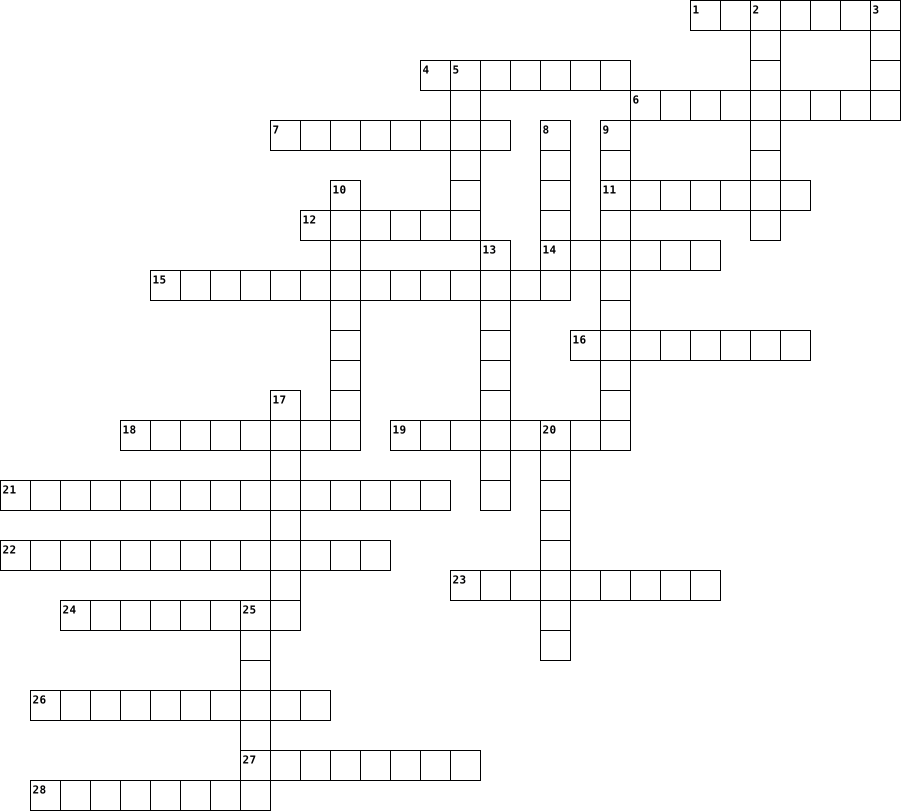
Across
- Out, Vigorous Physical exercise
- Activity involving skill and physical exertion against another team
- Stepping from one foot to another with a bounce or hop
- Education, What does PE stand for?
- To run fast
- to grow from experiences
- Pace in which you move
- Fair and Generous behavior or treatment of teammates and opposing team
- Moving at a regular pace
- Drink Water
- Staying active and eating correctly
- Game where you try to take the other teams flag
- Type of jump that requires you to move arms and legs
- Throwing a ball to score points while trying to stop opposing team
- What is it called when you are in a plank position and you move up and down
- What is your PE teachers name
- The action or movement of a runner
- Moving up and down
Down
- Playing fair and being nice to others
- Place where you workout or play sports
- Workout that is in pushup position that helps build core strength
- Following directions and playing game correctly
- Dribbling and Scoring
- To work together
- Game that involved baseball and soccer
- What do you do before working out?
- Being Truthful
- Game where only one person can touch the ball
28 Clues: To run fast • Drink Water • Being Truthful • To work together • Moving up and down • Dribbling and Scoring • Pace in which you move • to grow from experiences • Moving at a regular pace • What is your PE teachers name • Out, Vigorous Physical exercise • Education, What does PE stand for? • What do you do before working out? • The action or movement of a runner • ...
Physical Education 2022-04-04
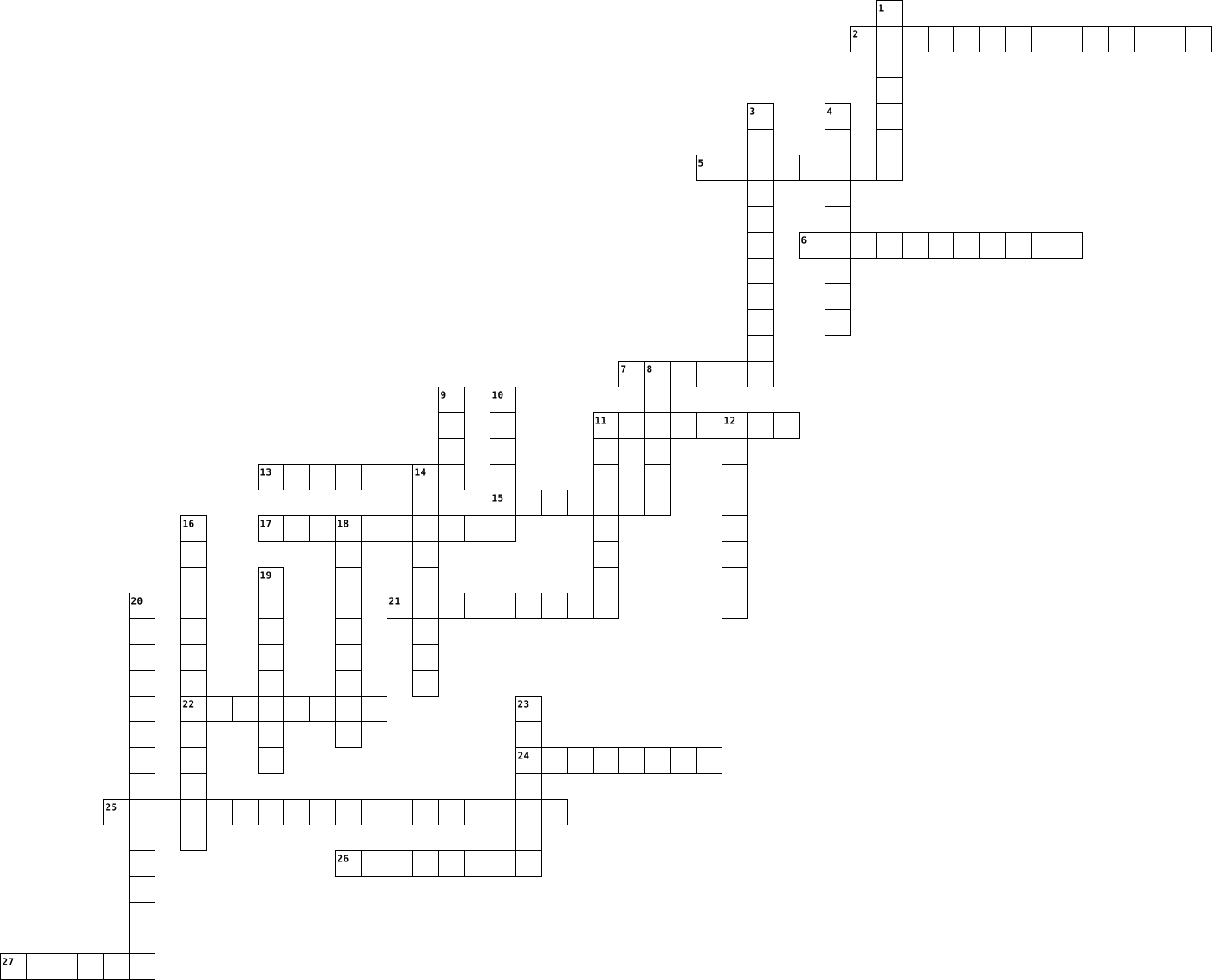
Across
- Fair and Generous behavior or treatment of teammates and opposing team
- What do you do before working out?
- Dribbling and Scoring
- Workout that is in pushup position that helps build core strength
- Staying active and eating correctly
- Playing fair and being nice to others
- Game where only one person can touch the ball
- What is your PE teachers name
- Throwing a ball to score points while trying to stop opposing team
- Moving up and down
- The action or movement of a runner
- What does PE stand for?
- Moving at a regular pace
- Pace in which you move
Down
- Activity involving skill and physical exertion against another team
- Vigorous Physical exercise
- Game that involved baseball and soccer
- to grow from experiences
- Place where you workout or play sports
- Following directions and playing game correctly
- Being Truthful
- Drink Water
- To work together
- Type of jump that requires you to move arms and legs
- Stepping from one foot to another with a bounce or hop
- What is it called when you are in a plank position and you move up and down
- Game where you try to take the other teams flag
- To run fast
28 Clues: Drink Water • To run fast • Being Truthful • To work together • Moving up and down • Dribbling and Scoring • Pace in which you move • What does PE stand for? • to grow from experiences • Moving at a regular pace • Vigorous Physical exercise • What is your PE teachers name • What do you do before working out? • The action or movement of a runner • Staying active and eating correctly • ...
Physical Science 2017-03-23

Across
- Space in which there is no matter or in which the pressure is so low that any particles in the space do not affect any processes being carried on there.
- an optical phenomenon that creates the illusion of water and results from the refraction of light through a non-uniform medium
- the one who proposed the laws of planetary model
- transparent optical element with flat, polished surfaces that refract light
- is the point in the orbit of a celestial body where it is nearest to its orbital focus
- is the bending of a wave when it enters a medium where its speed is different
- an optical instrument designed to make distant objects appear nearer,
- which is the point in the orbit where the celestial body is farthest from its focus
- He changed the way of thinking, not only astronomically but also religiously.by saying the universe is sun-centered.
- color that has the lowest frequency and the longest wavelength
- the property or tendency of a moving object to continue moving.
- the change in position of an object
- the branch of mechanics concerned with the motion of objects without reference to the forces that cause the motion
- the speed of an object in a particular direction
- a space between objects, units, points, or states
- the natural agent that stimulates sight and makes things visible.
- the rate at which velocity changes over time
- made important contributions by devising the most precise instruments available before the invention of the telescope for observing the heavens
- An acronym for the colours of the visible light spectrum
- the fundamental particle of light. They have a unique property in that they are both a particle and a wave.
- is the branch of physics which involves the behaviour and properties of light.
- He is sometimes called the grandfather of science. He studied under the great philosopher Plato
Down
- the branch of science concerned with the nature and properties of matter and energy
- invent/devised a telescope that could enlarge objects up to 20 times
- an object, whether natural (such as the moon),that revolves around a central body.
- distance divided by time
- the gravitationally curved path of an object around a point in space
- the apparent daily motion of stars around the Earth
- Earth-centered model of the universe
- the combination of two or more electromagnetic waveforms to form a resultant wave in which the displacement is either reinforced or canceled.
- an object's change in position relative to a reference point
- is a point on the wave where the displacement of the medium is at a maximum
- the branch of science that deals with celestial objects, space, and the physical universe as a whole.
- sus-centered model of the universe
- the act of reflecting, as in casting back a light or heat, mirroring, or giving back or showing an image
- the separation of white light into colors, or the separation of any radiation according to wavelength.
- F=ma is the formula of
- the distance over which the wave's shape repeats
- a force that attracts any objects with mass.
- a force that opposes motion between two surfaces that are in contact
- is the slight bending of light as it passes around the edge of an object.
- the distance traveled divided by the time interval during which the motion occurred
- proposed the three law of motion
- an arch of colors formed in the sky in certain circumstances, caused by the refraction and dispersion of the sun's light by rain or other water droplets in the atmosphere
- An object at rest will remain at rest unless acted on by an unbalanced force
- a colour or shade
- the transport of energy without the transport of matter
- biggest star
48 Clues: biggest star • a colour or shade • F=ma is the formula of • distance divided by time • proposed the three law of motion • sus-centered model of the universe • the change in position of an object • Earth-centered model of the universe • a force that attracts any objects with mass. • the rate at which velocity changes over time • the one who proposed the laws of planetary model • ...
Physical description 2017-04-04

Across
- (n)the soft part of your face that is below your eye and between your mouth and ear
- (n)(sing)a small, pale brown spot on the skin, usually on the face, especially of a person with pale skin
- (adj)Too heavy and fat
- (adj)with little or no hair on the head
- (n)a length of hair that is tied at each side of the head
- (n)the front part of your leg between your knee and your foot
- (n)the hollow place under your arm where your arm joins your body
- (n) hair that a man grows above his upper lip
- (n)a length of hair that is divided into three parts that are then crossed over each other in a special pattern
- (n)a hairstyle in which the hair is tied up high at the back of the head so that it hangs down like a horse's tail
- (n)(sing)a small line in the skin caused by old age
- (n)(sing)any of the short hairs that grow along the edges of the eye
- (n)The size and shape of a person's body
- (n)the line of short hairs above each eye
- (n)the part of a person's leg above the knee
- (adj)Of more than average height, or of a particular height
- (adj)Having a soft, round body; slightly fat
Down
- (n)the joint (= place where two bones are connected) between the foot and the leg, or the thin part of the leg just above the foot
- (n)(2 words)an upper lip that does not join in the middle because it did not develop normally before birth
- (n)the part of a person's face below their mouth
- (adj)With a solid, strong body
- (adj)Attractively thin
- (n)the hair that some men allow to grow on the lower part of their face
- (n)A young child, especially one who is learning or has recently learned to walk
- (adj)(especially of eyes) greenish-brown or yellowish-brown in colour
- (n)Old people considered as a group
- (n)the flat part of the face, above the eyes and below the hair
- (n)a woman's hairstyle where the hair is brought together into a round shape at the back of the head
- (n)a women's hairstyle with the hair cut to neck length all around the head
- (n)the part of the body above and slightly narrower than the hips
- (n)the soft round part at the bottom of the ear
- (n) the upper front part of the body,between the stomach and the neck, containing the heart and lungs
- (n)The distance from the top to the bottom of something, or the quality of being tall
- (n)either of the two openings in the nose through which air moves when you breathe
- (n)(sing)either of the two pieces of skin that can close over each eye
35 Clues: (adj)Too heavy and fat • (adj)Attractively thin • (adj)With a solid, strong body • (n)Old people considered as a group • (adj)with little or no hair on the head • (n)The size and shape of a person's body • (n)the line of short hairs above each eye • (n)the part of a person's leg above the knee • (adj)Having a soft, round body; slightly fat • ...
Physical Description 2018-01-26

Across
- un pied
- pieds
- frisés (cheveux)
- nez
- bouche
- lisses (cheveux)
- mince
- grand
- œil
- longs (cheveux)
Down
- corps
- gros
- visage
- oreille
- courts (cheveux)
- cheveux
- maigre
- petit
- jambe
- bras
20 Clues: nez • œil • gros • bras • corps • pieds • petit • mince • jambe • grand • visage • bouche • maigre • un pied • oreille • cheveux • longs (cheveux) • frisés (cheveux) • courts (cheveux) • lisses (cheveux)
Physical Geography 2017-10-16

Across
- an area of high land; a small mountain
- a deep valley with steep sides
- an area of high, steep rock, often close to the ocean or side of a mountain
- a piece of land with water on three sides
- a large area of land where it is hot and dry
- one of the large areas on the earth (eg. Africa, Asia, etc.)
- a part of an ocean that is enclosed by a curve in the land
- a very large area of ice that moves slowly over the ground
- a continuous flow of water that goes into an ocean or a lake
- the land next to a sea or an ocean
Down
- an area of lower land between rows of hills or mountains
- a piece of land surrounded by water
- a very high hill
- a large area of flat land
- an area of an ocean with land on three sides of it
- half of the earth
- a very large area of salt water (eg. Atlantic, Pacific, etc.)
- a large area of salt water that is smaller than an ocean
- the temperature and the state of the wind, rain, and sun
- a mountain with a whole at the top that burning rock and fire can come out of
- a large area of water with land all around it
- a low area of land where a river separates into many smaller rivers
22 Clues: a very high hill • half of the earth • a large area of flat land • a deep valley with steep sides • the land next to a sea or an ocean • a piece of land surrounded by water • an area of high land; a small mountain • a piece of land with water on three sides • a large area of land where it is hot and dry • a large area of water with land all around it • ...
Physical Science 2017-07-08

Across
- energy that is transferred as a consequence of temperature differences
- a dense, icy pack of old snow
- a gradual change
- the sum of all water on a planet
- the mass of air surrounding a planet
- the phenomenon that occurs when individual molecules are so strongly attracted to each other that they tend to stay together, even when exposed to tension
- a measure of the energy of random motion in a substance's molecules
- the quantity of a substance within a certain volume
- a measure of the mass of dissolved salt in a given mass of water
- a steady condition that prevails day in and day out in a particular region of the earth
- a substance that contains different compounds and/or elements
- the region of the atmosphere above an altitude of roughly 460 km
- a chemical process by which oxygen reacts with a fuel to release energy
- an atom that has lost or gained electrons so it has a net electrical charge
- a community of organisms, along with their environment, functioning as a unit
- an instrument used to measure atmospheric pressure
Down
- magma that flows out of a volcano
- the moisture content of air
- a substance composed of only one type of molecule
- a poisonous gas composed of three oxygen atoms bonded together
- the process by which a gas turns into a liquid
- evaporation and condensation of a mixture to separate out the mixture's individual components
- the smallest chemical unit of matter
- a substance that does not conduct electricity very well
- the use of electricity to break a molecule down into smaller units
- evaporation of water from plants
- a collection of atoms that all have the same number of protons
- the lower layer of earth's atmosphere, which exists from ground level to roughly 80km above sea level
28 Clues: a gradual change • the moisture content of air • a dense, icy pack of old snow • the sum of all water on a planet • evaporation of water from plants • magma that flows out of a volcano • the smallest chemical unit of matter • the mass of air surrounding a planet • the process by which a gas turns into a liquid • a substance composed of only one type of molecule • ...
Physical Properties 2017-09-27

Across
- A type of mixture that looks the same throughout.
- A pure substance that cannot be broken down into simpler substances.
- A pure substance that is made from two or more simpler substances and can be broken down into those simpler substances.
- The temperature at which a substance changes from a liquid to a gas (2 words).
- Some physical changes are _______ and some are not.
- Any characteristic of a material that can be observed or measured without changing the composition of the substance. (2 words)
- Matter that always has the exact same composition is a pure ________________.
- The temperature at which a substance changes from a solid to a liquid (2 words).
- In an element ___________, the first letter is capitalized and if there is a second letter, it is lowercase.
- The tendency of a liquid to resist flowing.
Down
- A type of matter in which the composition is not fixed.
- A type of mixture in which the parts are noticeably different from one another.
- The ability of a solid to be hammered without shattering.
- ______ of two materials can be compared by seeing which one scratches the other.
- A process that separates materials based on particle size.
- A change that occurs when some of the properties change, but the composition of the substance remains the same.
- A materials ability to allow heat or electricity to flow.
- A process that separates a mixture based upon boiling points.
- How much mass is in a given volume.
- Anything that has mass and takes up space.
20 Clues: How much mass is in a given volume. • Anything that has mass and takes up space. • The tendency of a liquid to resist flowing. • A type of mixture that looks the same throughout. • Some physical changes are _______ and some are not. • A type of matter in which the composition is not fixed. • The ability of a solid to be hammered without shattering. • ...
Physical Science 2017-11-09

Across
- Has no shape but has volume
- Two or more elements combined and can't be taken apart
- A substance that is being dissolved
- A type of separation that uses evaporation of water
- Separates objects by pulling out metal pieces
- Anything that has mass and takes up space
- Separates a liquid from a solid
- Has no shape or volume
- Has shape and volume
- The rate at which something dissolves
- Physical combination of two or more things
- This is what is doing the dissolving
Down
- The amount of space an object takes up
- A type of separation that involves objects floating
- To mix evenly into something
- A tool used to measure the mass of an object
- How hot or cold something is
- What makes an object sink or float
- The amount of matter IN an object
- Separates a solid from a solid
- A mixture of two or more things that can't easily be seperated
- Substance that can't be broken down any further
22 Clues: Has shape and volume • Has no shape or volume • Has no shape but has volume • To mix evenly into something • How hot or cold something is • Separates a solid from a solid • Separates a liquid from a solid • The amount of matter IN an object • What makes an object sink or float • A substance that is being dissolved • This is what is doing the dissolving • ...
Physical Geography 2016-04-11

Across
- The inner portion of the Earth, one-third of it's entire mass
- Region of the upper mantle just below the lithosphere
- Physical weathering of rocks that occurs by mechanical forcing of rock joints
- Abbreviation; complex, computer-based climate model
- The dominant vegetation type extending across a region
- Rock of Earth's crust below the soil; unweathered
- The study of past climates using tree rings
- Science that analyzes and describes origin, evolutions, etc. of landforms
- The birth of mountains
- Two words; Species that are brought and introduced to a new ecosystem
- Elevation differences in a local landscape
Down
- Two words; Information about past environments that represent changes in climate; also called a climate proxy
- Two words; ecosystem that consists of pine, spruce, and fir
- A migrating piece of Earth's crust, dragged about by plate tectonics
- The study of the Earth's past climates
- Two words; Decomposition of minerals in rocks through chemical alteration
- Form of weathering; associated with fragmentation of rock by pressure release
- Instrument used to detect and record ground motion during an earthquake
- The largest plutonic form exposed at the surface
- Boundary transition zone between adjoining ecosystems
20 Clues: The birth of mountains • The study of the Earth's past climates • Elevation differences in a local landscape • The study of past climates using tree rings • The largest plutonic form exposed at the surface • Rock of Earth's crust below the soil; unweathered • Abbreviation; complex, computer-based climate model • Region of the upper mantle just below the lithosphere • ...
Physical description 2019-04-10

Across
- maigre
- mince
- le visage
- carré
- frisé
- brun/marron
- moyen
- noir
- fort
- rond
- le pied
- blanc
- les yeux
- grand(e)
- gris
Down
- le nez
- les cheveux
- bouclé
- lisse
- petit(e)
- faible
- la main
- la bouche
- bleu
- court
- vert
- les oreilles
- les pieds
- ondulé
- la jambe
30 Clues: noir • bleu • fort • vert • rond • gris • mince • carré • lisse • frisé • moyen • court • blanc • maigre • le nez • bouclé • faible • ondulé • la main • le pied • petit(e) • les yeux • grand(e) • la jambe • le visage • la bouche • les pieds • les cheveux • brun/marron • les oreilles
Physical Appearance 2013-01-10

Across
- frackles
- lack of hair
- Rapunzel has long ____
- Santa Claus tiene _____
- contact lenses
- bangs
- beauty mark
- similar to curly
- the color of a tomato
Down
- shape with 4 sides
- horse tail
- to look
- skinny
- Arthur Read wears these
- heavy
- round
- opposite
- oval
- triangular
- dyed
- facial hair
- to play soccer you need a ____
22 Clues: oval • dyed • heavy • round • bangs • skinny • to look • frackles • opposite • horse tail • triangular • facial hair • beauty mark • lack of hair • contact lenses • similar to curly • shape with 4 sides • the color of a tomato • Rapunzel has long ____ • Santa Claus tiene _____ • Arthur Read wears these • to play soccer you need a ____
Physical Geography 2013-11-26

Across
- teenagers cant seem to put them down
- process that wears down the earth
- my favourite thing to do
- the shell of an egg
- where you get eduacated
- the theory of plates spreading apart
- something you do when you need something
- this occurs when two plates rub together
- the zone of an egg white
- colour of my pen
- you listen to it, just for the joy of it
- the yolk of an egg, there's an inner and an outer
Down
- these moving plates can create volcanoes,mountains, and trigger earthquakes
- ejection of lava from an active volcanoe
- all of the land
- to measure earthquakes, the amount of energy
- my favourite animal
- its cold and I hate it
- delicious goodness you can have whenever you want
- expressing yourself in something you enjoy
20 Clues: all of the land • colour of my pen • the shell of an egg • my favourite animal • its cold and I hate it • where you get eduacated • my favourite thing to do • the zone of an egg white • process that wears down the earth • teenagers cant seem to put them down • the theory of plates spreading apart • ejection of lava from an active volcanoe • something you do when you need something • ...
Physical Fitness 2014-11-12

Across
- A dangerous condition in which the body loses its ability to cool itself through perspiration
- Exercising at a level that's beyond your regular daily activities
- The part of an exercise session when you are exercising at your highest peak
- The ability to carry out daily tasks easily and have enough reserve energy to respond to unexpected demands
- Heart Rate the number of times your heart beats per minute when you are not active
- Choosing the right types of activities to improve a given element of fitness
- Intense, short bursts of activity in which the muscles work so hard that they produce energy without using oxygen.
- Dangerously low body tempterature
- Injuries to the ligaments around a joint that produce pain, swelling, and stiffness
Down
- The ability of your muscles to perform physical tasks over a period of time without tiring
- a form of physical stress on the body caused by over heating
- ______ Endurance is the ability of your heart, lungs, and blood vessels to send fuel and oxygen to your tissues during long periods of moderate to vigorous activity
- All rhythmic activities that use large muscle groups for an extended period of time
- Gradually incresing the demands on your body
- the low-level activity that prepares your body to return to a resting state
- A gentile cardiovascular activity that prepares the muscles for work
- Sudden or sometimes painful contractios of the muscles
- The ability to move your body parts through their full range of motion
- Purposeful physical activity that is planned, structured, repetitive, and improves or maintains physical fitness
- The amount of force your muscles can exert
- result from overstretching and tearing a muscle
- Damage to the skin and tissues caused by extreme cold
22 Clues: Dangerously low body tempterature • The amount of force your muscles can exert • Gradually incresing the demands on your body • result from overstretching and tearing a muscle • Damage to the skin and tissues caused by extreme cold • Sudden or sometimes painful contractios of the muscles • a form of physical stress on the body caused by over heating • ...
Physical description 2014-12-15

Across
- roux
- visage
- garçon
- petit
- bouclé
- écossais
- américain
- fille
- court
- vert
- grand
- gros / gras
- musclé
- bouche
- maigre
- blond
- nez
Down
- yeux
- cheveux
- noir
- français
- raide
- irlandais
- carré
- anglais
- long
- mince
- marron
- rond
- bleu
30 Clues: nez • roux • yeux • noir • long • vert • rond • bleu • petit • raide • carré • fille • court • mince • grand • blond • visage • garçon • bouclé • marron • musclé • bouche • maigre • cheveux • anglais • français • écossais • irlandais • américain • gros / gras
Physical Science 2014-12-19

Across
- C
- movement of water in a container
- Mendeleev organized matter into this...
- amount of space an object takes up
- amount of matter in a substance
- curved part of water line
- amount of territory something takes up
- container used to accurately measure liquid
- substance with only one type of atom (have their own table)
- unit for length
Down
- abbreviation for element
- O
- distance from end to end
- compactness of something (m/V)
- device to measure mass
- Cl
- Na
- unit for mass
- N
- unit for liquid volume
- H
- He
22 Clues: C • O • N • H • Cl • Na • He • unit for mass • unit for length • device to measure mass • unit for liquid volume • abbreviation for element • distance from end to end • curved part of water line • compactness of something (m/V) • amount of matter in a substance • movement of water in a container • amount of space an object takes up • amount of territory something takes up • ...
Physical Science 2015-01-03

Across
- the force that opposes motion for two touching surfaces
- a push or pull applied to an object
- speed in a given direction (vector)
- how hot or cold an object is
- acceleration with only the force of gravity acting on an object
- between +,- charges
- something that binds, fastens, confines, or holds together something
- gives direction + amount
- the speed of a reaction
- to render more reactive
- uses units of length to describe location of an object
- the rate at which velocity changes
Down
- an object used to measure motion
- causes some radioactivity
- the distance an object travels per unit of time note of changed position(scalar)
- physical contact force
- holds the nucleus together
- occurs when an object changes position relative to reference point
- how fast an object travels in a wave
- how far an object has traveled
- the capacity of vigorous activity
- distance + direction of an objects change in position from a starting point
- friction like force, oppose motion through the air
- when two objects forcefully impact each other
- non-contact, does not touch us
25 Clues: between +,- charges • physical contact force • the speed of a reaction • to render more reactive • gives direction + amount • causes some radioactivity • holds the nucleus together • how hot or cold an object is • how far an object has traveled • non-contact, does not touch us • an object used to measure motion • the capacity of vigorous activity • the rate at which velocity changes • ...