
physical Crossword Puzzles
Physical Descriptions 2023-10-24

Across
- chubby
- braids
- lose weight
- belly
- goatee
- side burns
- beard
- long hair
- freckles
- face
- mustache
Down
- curly hair
- describe
- ponytail
- ugly
- thin
- weak
- looks like
- pregnant
- bald
- short hair
- hair
- good shape
- beautiful
- bangs
- well built
26 Clues: ugly • thin • weak • bald • hair • face • belly • beard • bangs • chubby • braids • goatee • describe • ponytail • pregnant • freckles • mustache • beautiful • long hair • curly hair • looks like • side burns • short hair • good shape • well built • lose weight
Physical Geography 2023-10-24

Across
- Landform farthest north
- Day to day characteristics of the atmosphere
- Range Hottest temp minus the coldest
- Largest Landform
- This part of the Earth's Interior is cold
- Long term atmospheric conditions
- We live in this Landform
- Causes volcanos
Down
- When Igneous experiences weathering and erosion
- Mix of air pressures
- Great Lakes St. Lawrence Lowlands and this landform are good for farming
- Landform on the west coast
- Most important factor that effects climate
- Main plate of the Ring of Fire
- Only non mountain making plate movement
- Two plates pushed together
- This creates a new rock
- One plate goes under another
- Landform on the east coast
- Higher you go the cooler the temperature is
- When magma cools it turns to this
- Mountains act as a barrier
- Crack in the earth's crust
23 Clues: Causes volcanos • Largest Landform • Mix of air pressures • Landform farthest north • This creates a new rock • We live in this Landform • Landform on the west coast • Two plates pushed together • Landform on the east coast • Mountains act as a barrier • Crack in the earth's crust • One plate goes under another • Main plate of the Ring of Fire • Long term atmospheric conditions • ...
Physical Activity 2023-11-14

Across
- principle used to guide exercise routine
- disease reduced risk with regular physical activity
- heat-related illnesses that include stroke and exhaustion
- used to gauge intensity level of physical activity
- activity any action in which you use energy
- how well your heart and lungs can supply blood needed to fuel muscles during exercise
- ______ and low-intensity activity used to warm-up before physical activity
- ability to perform multiple movements with ease
- structured, goal-oriented, improves health
- ability to fully and easily move muscles and joints
- non-physically active lifestyle
- ability to maintain a steady, upright posture
Down
- the final step in R.I.C.E treatment of injuries
- ability of muscle to exert force against resistance
- type of cold-related illness
- ability to change directions quickly
- type of fitness designed to perform daily activities with ease and energy
- body uses energy stored in muscles to fuel exercise
- ability to continue an activity over extended time
- body uses oxygen to fuel exercise
- ability to move quickly
- amount of time it takes to respond to stimuli
- mix of strength and speed
- number of minutes you should be active daily
- ratio of bone, fat and muscle in body
25 Clues: ability to move quickly • mix of strength and speed • type of cold-related illness • non-physically active lifestyle • body uses oxygen to fuel exercise • ability to change directions quickly • ratio of bone, fat and muscle in body • principle used to guide exercise routine • structured, goal-oriented, improves health • activity any action in which you use energy • ...
Physical Features 2023-11-13

Across
- old
- hair
- pretty
- fat
- strong
- wrinkles
- small/little
- younger
- gorgeous
- mustache
- weak
- athletic
- medium/average weight
- mole
- beautiful/handsome
- short
- handsome/beautiful
- medium/average height
- young
- dimples
Down
- mustache
- tan
- dark-skinned
- scar
- skinny/thin
- gray-headed
- middle-aged
- ugly
- short
- beard
- bald
- tall
- slender/slim
- big
- older
35 Clues: old • tan • fat • big • hair • scar • ugly • weak • bald • tall • mole • short • beard • short • older • young • pretty • strong • younger • dimples • mustache • wrinkles • gorgeous • mustache • athletic • skinny/thin • gray-headed • middle-aged • dark-skinned • small/little • slender/slim • beautiful/handsome • handsome/beautiful • medium/average weight • medium/average height
Physical Features 2023-11-13

Across
- old
- hair
- pretty
- fat
- strong
- wrinkles
- small/little
- younger
- gorgeous
- mustache
- weak
- athletic
- medium/average weight
- mole
- beautiful/handsome
- short
- handsome/beautiful
- medium/average height
- young
- dimples
Down
- mustache
- tan
- dark-skinned
- scar
- skinny/thin
- gray-headed
- middle-aged
- ugly
- short
- beard
- bald
- tall
- slender/slim
- big
- older
35 Clues: old • tan • fat • big • hair • scar • ugly • weak • bald • tall • mole • short • beard • short • older • young • pretty • strong • younger • dimples • mustache • wrinkles • gorgeous • mustache • athletic • skinny/thin • gray-headed • middle-aged • dark-skinned • small/little • slender/slim • beautiful/handsome • handsome/beautiful • medium/average weight • medium/average height
Physical wellbeing 2024-01-17

Across
- Face
- Nail
- Neck
- Back
- Lip
- Head
- Skin
- Ankle
- Belly
- Shoulder
- Chest
- Elbow
- Stomach
Down
- Ear
- Teeth
- Knee
- Eye
- Hand
- Nose
- Finger
- Hair
- Mouth
- Health
- Foot
- Tongue
- Leg
26 Clues: Ear • Eye • Lip • Leg • Face • Nail • Knee • Neck • Hand • Back • Nose • Head • Hair • Skin • Foot • Teeth • Mouth • Ankle • Belly • Chest • Elbow • Finger • Health • Tongue • Stomach • Shoulder
Physical Science 2024-01-18

Across
- Occurs between fluid layers that are moving relative to each other.
- measures the length between objects or points without regard for direction.
- is the gravitational force with which the Earth attracts the masses towards its center.
- is distance divided by time interval for the distance traveled.
- state of a body that moves freely in any manner in the presence of gravity.
- Laws of Motion three statements describing the relationship between the forces acting on a body and the motion of the body, first formulated by English physicist and mathematician Isaac Newton, which are the foundations of classical mechanics.
- A vector quantity has both magnitude and direction.
- Pulls objects with mass towards each other
- A force between two surfaces that prevents those surfaces from sliding or slipping across each other.
- is the change with time of the position or orientation of a body.
Down
- is the process where the velocity changes.
- Is a vector, this means that it has direction and magnitude and is represented visually as an arrow that points the initial position to the final position.
- A scalar quantity has only magnitude.
- The force resisting the motion of a rolling body on a surface.
- is a quantitative measure of inertia, a fundamental property of all matter.
- is a push or pull on a mass that can change the objects motion.
- Is defined to be the change in position divided by the time of travel.
- the resistance created by any two objects when sliding against each other.
- the force between two surfaces that prevents those surfaces from sliding or slipping across each other.
- Is a measurement of mass in motion, how much mass is in how much motion.
- point is a place or object used for comparison to determine if something is in motion
- force is the sum of all the forces acting on an object.
- of reference In dynamics, a system of graduated lines symbolically attached to a body that serve to describe the position of points relative to the body.
23 Clues: A scalar quantity has only magnitude. • is the process where the velocity changes. • Pulls objects with mass towards each other • A vector quantity has both magnitude and direction. • force is the sum of all the forces acting on an object. • The force resisting the motion of a rolling body on a surface. • ...
Physical Science 2024-01-29

Across
- a surface that is curved away from the incoming light
- breaking apart of a nucleus into smaller nuclei
- the lowest point of a wave
- special cells that detect different colors
- releasing of eneryg through burning
- wave changing direction when it bounces off a surface that does not absorb it
- rythmic vibrations
- magnetic field generated by current flowing through a wire
- bending of light
- complete circular path that allows electrons to flow
- the back part of the eye
- some people have something to ____,others have to ____ something
Down
- attractive and repelling forces contained in magnetic materials
- part of the atom with a neutral electrical charge
- a surface that is curved toward incoming light
- combining of nuclear particles to form a larger nucleus
- electically-charged particles
- mechanism for converting a changing magnetic field into a flow of current
- image of the sky projected above the ground because of different densities of air
- a device that supplies electrons through a chemical reaction
- sudden discharge of electricity
- speed at which the wave travels
- a weapon powered by fusion
- speed at which the wave travels
- sonic boom caused by rapidly exanding air
25 Clues: bending of light • rythmic vibrations • the back part of the eye • the lowest point of a wave • a weapon powered by fusion • electically-charged particles • sudden discharge of electricity • speed at which the wave travels • speed at which the wave travels • releasing of eneryg through burning • sonic boom caused by rapidly exanding air • special cells that detect different colors • ...
Crossword- Physical 2024-01-21

Across
- endurance running test with a ____ to signify each new lap
- a sport involving a racket and a birdie
- a sport similar to basketball without the dribbling
- a physical activity involving exertion and skill
- an activity similar to pilates
- ________kickball
- the game involving a frisbee
- a sport where you shoot a ball into a basket
- an assessment done monthly involving endurance
- done at an ice rink
- an even distribution of weight
Down
- an exercise where you raise and lower your body with your arms
- a sport involving the term touchdown
- a sport on ice with a puck
- capability of bending easily
- an activity where you run back and forth that tests your speed, endurance, and agility
- a sport involving bumping, setting, and spiking
- the better version of the beep test
- ________country
- ability to move quickly and easily
- a sport involving a bat
- an exercise in which you raise and lower the upper part of your body with your core
22 Clues: ________country • ________kickball • done at an ice rink • a sport involving a bat • a sport on ice with a puck • capability of bending easily • the game involving a frisbee • an activity similar to pilates • an even distribution of weight • ability to move quickly and easily • the better version of the beep test • a sport involving the term touchdown • ...
Physical Science 2023-02-09

Across
- Mostly on the right side of periodic table
- Changing phase of matter
- Large particles
- parts that look different
- Medium sized particles
- A graphic organizer of elements
- can be detected by the senses or identified w/o chemical reaction
- Pure substances composed of identical atoms
Down
- Ability to react with another substance
- Very small particles
- a new substance has appeared
- On the left side of the periodic table
- Particles take the shape of the container
- In between Metals and Non-metals on periodic table
- Parts that look the same
- does not have a certain shape
- Pure substances composed of 2 or more elements in a fixed ratio
- variable combination of 2 or more pure substances
- a material that is composed of only one type of particle
- Definite shape and volume
20 Clues: Large particles • Very small particles • Medium sized particles • Changing phase of matter • Parts that look the same • parts that look different • Definite shape and volume • a new substance has appeared • does not have a certain shape • A graphic organizer of elements • On the left side of the periodic table • Ability to react with another substance • ...
Physical Science 2024-03-21

Across
- Water that falls to the earth as hail, mist, rain, sleet, or snow.
- Matter that has a definite volume and a definite shape.
- A material that transmits heat.
- The amount of space found in objects.
- A substance that has no definite volume or shape.
- Transfer of energy by electromagnetic waves through space.
- This is when there is no change in matter.
- This is when a new matter or substance has been formed.
- When a substance shrinks in size.
- A process by which a substance changes from a gas state to a liquid state.
- The measurement of how fast an object is going.
- Characteristics and qualities that describe matter.
- The process by which plants give off water vapor through openings in their leaves.
- A material that is a poor conductor of heat.
- A substance that reduces friction
Down
- A push or pull that changes the motion or position of objects.
- Has a definite volume and takes the shape of its container.
- A force that pulls objects towards the center of the earth without direct contact.
- Transfer of thermal energy between two objects that are touching.
- This is when an unbalanced force causes a change in the motion of an object.
- The process of changing from a liquid to a vapor.
- This is a result of a gravitational pull on objects.
- A speed or type of rhythm or movement.
- A force that stops or slows down an object.
- The space between two points.
- This is the amount of matter in an object.
- When a substance grows in size.
- This is the amount of matter in an object.
- Everything that takes up space.
- Movement of thermal energy by the movement of liquids or gasses.
- Everything that takes up space.
- Occurs when there is more water than land can absorb. The excess liquid flows across the surface of the land and into creeks, streams, or ponds.
32 Clues: The space between two points. • When a substance grows in size. • Everything that takes up space. • Everything that takes up space. • A material that transmits heat. • When a substance shrinks in size. • A substance that reduces friction • The amount of space found in objects. • A speed or type of rhythm or movement. • This is the amount of matter in an object. • ...
physical description 2024-03-05

Across
- vert
- visage
- lunettes
- grand(e)
- main
- nez
- bouche
- de taille moyenne
- dents
- lisse
- bleu
- blanc
- bouclé
Down
- marron
- gros/grosse
- mince
- pied
- pieds
- petit(e)
- dent
- cheveux
- taille
- yeux
- fin
- jambe
- ondulé
- bras
27 Clues: nez • fin • vert • pied • dent • main • yeux • bleu • bras • mince • pieds • dents • lisse • jambe • blanc • marron • visage • bouche • taille • ondulé • bouclé • cheveux • lunettes • petit(e) • grand(e) • gros/grosse • de taille moyenne
Physical Science 2024-03-21

Across
- Means "cannot be divided"
- Found on the right side of a chemical equation
- A row on the Periodic Table
- Studies the parts of the atom
- The force that hold atoms together
- A measure of gravity pulling on an object
- Multiplies a compound
- Slows down a chemical reaction
- The force of a very large object
- Form from the ceiling of a cave
- Most elements on the Periodic Table
- The energy of position
- Group 18 on the Periodic Table
- A solid with a repeating 3D pattern
- Stated the Law of Conservation of Mass
- Means "the same throughout"
- Bonds by sharing electrons
- A force that resists movement between objects
- Releasing heat
- Two or more forces that are equal
- Has a pH of 7
- Means produces or yields
- Have a pH of above 7
- An example of a chemical reaction
- equation A description of a chemical reaction
- number Indicates the number of protons in an atom
- Matter without a definite shape
- Total kinetic and potential energy
- A unit of measure for weight
- The amount of matter in an object
- Distance divided by time
- The amount of mass in a given volume
- Absorbing heat
- The energy of motion
- Have a pH below 7
- Changing from a gas to a liquid
- Enables heavy objects to be moved easily
- Anything that has mass and takes up space
- A liquids resistance to flow
- Allows small objects to sit on water
- Speeds up a chemical reaction
Down
- The length of the route to be traveled
- More than one atom bonded together
- The change from a solid to a gas
- Change from a liquid to a gas
- Matter made up of one type of element
- The arrangements of all elements
- The amount of space an object takes up
- A change in size, shape, color, mass
- Up, down, top, bottom, strange, charmed
- Group 1 on the Periodic Table
- The average kinetic energy of particles
- Can be bent into shape
- An objects mass times its velocity
- All the forces acting on an object
- A column on the Periodic Table
- The change in speed over a period of time
- Two or more substances that can be separated
- Discovered energy levels in atoms
- Traveling at the same speed
- Positively charged particle in the nucleus
- Bonds positive and negative particles
- Developed a chemical shorthand for elements
- Shows the elements in a compound
- Individual parts can be seen
- The ability to do work
- A rough measure of an object
- A push or a pull
- Indicates the number of atoms of an element
- A way to describe something using numbers
- The tendency of something to resist change
- Found on the left side of a chemical equation
- Group 17 on the Periodic Table
- Rubber, plastic, or glass
- Speed plus direction
75 Clues: Has a pH of 7 • Releasing heat • Absorbing heat • A push or a pull • Have a pH below 7 • Have a pH of above 7 • The energy of motion • Speed plus direction • Multiplies a compound • Can be bent into shape • The energy of position • The ability to do work • Means produces or yields • Distance divided by time • Means "cannot be divided" • Rubber, plastic, or glass • Bonds by sharing electrons • ...
Physical Features 2024-03-28

Across
- Big
- Long
- Gorgeous
- Scar
- Plump/Chubby/Thick (Starting with R)(Masc)
- Fat
- Small/Little (Starting with P)
- Bald (Starting with P)(Masc)
- Tattoo
- Hair (Starting with P)
- Short (Starting with CH)
- Beard
- Dimples
- Average/Medium Weight
- Curly (Starting with C)
- Mustache (Starting with M)
- Tall
- Handsome (Starting with G)
- Middle Aged
- Hair (Starting with C)
- Ugly
- Bald (Starting with P)
- Red Headed
- Black
- Athletic
- Sideburns
- With Highlights
- Slender/Slim (Starting with E)
- Pretty
- Dark (Starting with O)
- Old (Starting with V)
- Weak
- Curly (Starting with R)
- Strong
- Skinny/Thin
- Mole
- Bald (Starting with C)
- Wavy
Down
- Older
- Attractive
- Pinkish/Beige
- Thin
- Thick
- Plump/Chubby/Thick (Starting with R)
- Short (Starting with C)
- Freckles
- Slender/Slim (Starting with D)
- Old (Starting with A)
- Eyes
- Tan
- Goatee (Starting with P)
- Skin
- Short (Starting with B)
- Younger
- Dyed
- Dark (Starting with M)
- Wrinkles
- Mid Length
- Light
- Handsome (Starting with B)
- Curly Starting with E)
- Cute
- Average/Medium Height
- Plump/Chubby/Thick (Starting with G)
- Small/Little (Starting with C)
- Pale
- Straight (Starting with LI)
- Blonde/Blonde Headed
- Young
- Curly (Starting with CH)
- Muscular
- Mustache (Starting with B)
- Straight (Starting with LA)
- Goatee (Starting with B)
- Gray Headed
75 Clues: Big • Fat • Tan • Long • Thin • Scar • Eyes • Skin • Dyed • Tall • Cute • Ugly • Pale • Weak • Mole • Wavy • Older • Thick • Beard • Light • Young • Black • Tattoo • Pretty • Strong • Dimples • Younger • Gorgeous • Freckles • Wrinkles • Athletic • Muscular • Sideburns • Attractive • Mid Length • Red Headed • Middle Aged • Skinny/Thin • Gray Headed • Pinkish/Beige • With Highlights • Blonde/Blonde Headed • Old (Starting with A) • Average/Medium Weight • Average/Medium Height • ...
physical features 2024-04-08

Across
- thin
- slim
- tattoo
- fat
- older
- wrinkles
- freckles
- scar
- little
- plump
- ugly
- younger
- mustache
- beard
- weak
- eyes
- old
- cute
- handsome
- goatee
- young
- redheaded
- tan
- dark
Down
- pale
- big
- sideburns
- greyheaded
- middleaged
- muscular
- attractive
- mediumweight
- dimples
- strong
- gorgeous
- blondeheaded
- mediumheight
- short
- pretty
- hair
- mole
- athletic
- bald
- tall
44 Clues: big • fat • old • tan • pale • thin • slim • scar • ugly • weak • eyes • hair • cute • mole • bald • tall • dark • older • plump • short • beard • young • tattoo • strong • little • pretty • goatee • dimples • younger • muscular • wrinkles • freckles • gorgeous • mustache • handsome • athletic • sideburns • redheaded • greyheaded • middleaged • attractive • mediumweight • blondeheaded • mediumheight
Physical Appearance 2023-05-11

Across
- bahagia
- cantik
- rambut panjang
- baik
- kurus
- rambut lurus
- tampan
- tua
- ceria
Down
- rambut ikal
- hidung pesek
- cerdas
- rambut keriting
- hidung mancung
- gemuk
- kurus
- muda
- tinggi
- sedih
- jelek
- pendek
21 Clues: tua • muda • baik • gemuk • kurus • kurus • sedih • jelek • ceria • cerdas • cantik • tinggi • tampan • pendek • bahagia • rambut ikal • hidung pesek • rambut lurus • hidung mancung • rambut panjang • rambut keriting
Physical suff 2023-01-12

Across
- Anything with mass
- the change of an objects position
- A material that is neither a nonmetal nor a metal
- lightest element on the periodic table
- A material that is not a metal
- a reaction that expells heat
- positively charged particles in the nucleus of an atom
- a point in space
- a state of balance in the universe
- the 1 or 2 letters that refer to an element
- a reaction that takes in heat
Down
- The word for something that is bendable
- the force that attracts a body to another
- the building blocks of all matter
- The negatively charged particles that built the shells of an atom
- The man who conducted the "Gold foil" experiment
- particles in the nucleus with no charge
- the name of the electrons on the outermost shell of an atom
- a state of order
- a state of chaos
- A substance made of uncombined atoms
- the study of the properties and change of matter
- A material, usually solid, that can be malleable and has a metallic appearance
23 Clues: a state of order • a state of chaos • a point in space • Anything with mass • a reaction that expells heat • a reaction that takes in heat • A material that is not a metal • the building blocks of all matter • the change of an objects position • a state of balance in the universe • A substance made of uncombined atoms • lightest element on the periodic table • ...
physical exams 2022-09-27

Across
- a vessel, such as a cup or vial, used to hold the biological sample being collected for lab testing.
- the act of measuring
- lying on stomach
- seated upright with their spine straight. The upper body is between 60 degrees and 90 degrees. The legs of the patient may be straight or bent.
- a position, used for pelvic surgery and to treat shock, in which a patient lies face upward on a tilted table or bed with the pelvis higher than the head.
- A prone position in which the individual rests on the knees and upper part of the chest, assumed for gynecologic or rectal examination.
- a device that produces harmonic vibration when its two prongs are struck; used to test hearing and bone conduction.
- lying horizontally with the face and torso facing up
- to look at the person or body part.
- an instrument for use in viewing the interior of the eye and especially the retina.
Down
- listening to the sounds of the body during a physical examination
- A position in which the patient lies on one side with the under arm behind the back and the upper thigh flexed, used to facilitate vaginal examination.
- the act of manipulating especially a body part by manual examination and treatment
- Patient lies on his/her back; head and shoulders are slightly elevated with the support of a pillow
- not manifest or detectable by clinical methods alone
- a method of tapping body parts with fingers, hands, or small instruments as part of a physical examination.
- a supine position of the body with the legs separated, flexed, and supported in raised stirrups, originally used for lithotomy and later also for childbirth.
- a tool which shines a beam of light to help visualize and examine the condition of the ear canal and eardrum
- a test for blood in urine or feces using a reagent containing guaiacum that yields a blue color when blood is present
- the process of using one's hands to check the body, especially while perceiving/diagnosing a disease or illness
20 Clues: lying on stomach • the act of measuring • to look at the person or body part. • not manifest or detectable by clinical methods alone • lying horizontally with the face and torso facing up • listening to the sounds of the body during a physical examination • the act of manipulating especially a body part by manual examination and treatment • ...
Physical science 2022-05-10

Across
- is on the periodic table
- circuit a circuit that has not complete
- a unit of matter the smallest element
- in a formula is 9.8
- one surface or object encounters when moving over another
- the element of atomic number 6
- volume 1 1000 cubic cent.
- an instrument for measuring and indicating temperature, typically one consisting of a narrow, hermetically sealed glass tube marked with graduations and having at one end a bulb
- is the required or allowed amount of any physical property involved in an interaction while dealing with atomic and subatomic systems.
- r electrokinetic potential in colloidal dispersions
- a band of colors, as seen in a rainbow, produced by separation of the components of light by their different degrees of refraction according to wavelength.
- the speed of something in a given direction
- the chemical element of atomic number 54, a member of the noble gas series. It is obtained by distillation of liquid air, and is used in some specialized electric lamps.
Down
- mass of unit volume of a material substance
- a gas noble on the periodic table
- energy which body possess by virtue of being in motion
- the emission of energy as electromagnetic waves or as moving subatomic particles, especially high-energy particles which cause ionization.
- the distance between successive crests of a wave, especially points in a sound wave or electromagnetic wave.
- the chemical element of atomic number 92, a dense gray radioactive metal used as a fuel in nuclear reactors.
- first law of newton
- enegy the energy possessed by a body by virtue of its position relative to others
- chemical element of atomic number 5
- is measurement in units
- a subatomic particle of about the same mass as a proton but without an electric charge
- change with time of the position
- a measure of the quantity of moles of a product formed in relation to the reactant consumed, obtained in a chemical reaction, usually expressed as a percentage.
26 Clues: in a formula is 9.8 • first law of newton • is measurement in units • is on the periodic table • volume 1 1000 cubic cent. • the element of atomic number 6 • change with time of the position • a gas noble on the periodic table • chemical element of atomic number 5 • a unit of matter the smallest element • circuit a circuit that has not complete • ...
Physical science 2022-05-10

Across
- is on the periodic table
- circuit a circuit that has not complete
- a unit of matter the smallest element
- in a formula is 9.8
- one surface or object encounters when moving over another
- the element of atomic number 6
- volume 1 1000 cubic cent.
- an instrument for measuring and indicating temperature, typically one consisting of a narrow, hermetically sealed glass tube marked with graduations and having at one end a bulb
- is the required or allowed amount of any physical property involved in an interaction while dealing with atomic and subatomic systems.
- r electrokinetic potential in colloidal dispersions
- a band of colors, as seen in a rainbow, produced by separation of the components of light by their different degrees of refraction according to wavelength.
- the speed of something in a given direction
- the chemical element of atomic number 54, a member of the noble gas series. It is obtained by distillation of liquid air, and is used in some specialized electric lamps.
Down
- mass of unit volume of a material substance
- a gas noble on the periodic table
- energy which body possess by virtue of being in motion
- the emission of energy as electromagnetic waves or as moving subatomic particles, especially high-energy particles which cause ionization.
- the distance between successive crests of a wave, especially points in a sound wave or electromagnetic wave.
- the chemical element of atomic number 92, a dense gray radioactive metal used as a fuel in nuclear reactors.
- first law of newton
- enegy the energy possessed by a body by virtue of its position relative to others
- chemical element of atomic number 5
- is measurement in units
- a subatomic particle of about the same mass as a proton but without an electric charge
- change with time of the position
- a measure of the quantity of moles of a product formed in relation to the reactant consumed, obtained in a chemical reaction, usually expressed as a percentage.
26 Clues: in a formula is 9.8 • first law of newton • is measurement in units • is on the periodic table • volume 1 1000 cubic cent. • the element of atomic number 6 • change with time of the position • a gas noble on the periodic table • chemical element of atomic number 5 • a unit of matter the smallest element • circuit a circuit that has not complete • ...
Physical Science 2022-05-25

Across
- Rate at which work is done
- Substance that is dissolved
- A logical, time-tested explanation
- Lens that is thicker at the ends
- speed in a given direction
- The factor being tested in experiments
- Wave with motion parallel
- has properties of metals & nonmetals
- Fixed pivot point of a lever
- The unit of the frequency of a wave
- Bouncing back of waves
- Number of waves per unit of time
- Wave with motion at right angles
- involves the transfer of electrons
- energy dependent on height
- Push or pull that gives energy
- the low point of a wave
- Sound above the range of human hearing
- Amount of space an object takes up
- sound wave to determine distances
- Lens thicker in the middle
- Complete path of electricity
- A device used to magnify objects
- Rate of change in velocity
- remain in motion or to stay at rest
- An instrument that makes work easier
- Able to be drawn into a thin wire
- Change of a gas to a liquid
- A device used to magnify small objects
- charged particle
- A positively charged particle
- Able to be hammered into a thin sheet
- the high point of a wave
- Vaporization at the surface
- The amount of matter in an object
- Circuit with only one path
- involves the sharing of electrons
- decrease in the velocity of an atom
- frequency range just above uv rays
- Highest frequency wave
- Substance that does the dissolving
- The smallest part of an element
- scale which O K is absolute zero .
- not the same throughout
- same throughout
- energy is absorbed
- Joining of two atomic nuclei
- Tells you the Number of protons
- Measure of the motion of molecules
- Measure of the force due to gravity
Down
- circuit with more than one path
- bending of waves
- 2 or more elements chem. combined.
- substance changes phase
- advantage Number of times a machine multiplies the effort force
- A solution to a scientific problem
- Electron in the outermost energy level
- distance b/t two consecutive points
- Energy of motion
- Change of a liquid to a gas
- Heat transfer through space
- matter is extremely high in energy
- wave just above visible light
- 2 or more substances not chem. comb.
- right side of a chemical reaction
- all molecular motion ceases
- bending of waves around an obstacle
- stored energy
- Proposed solution to a problem
- Heat transfer by rising and falling.
- A negatively charged particle
- energy is released
- Energy when a nucleus splits
- Compound with a pH above 7
- Force of attraction between objects
- The center of an atom
- Simplest type of pure substance
- Energy that bonds atoms or ions
- Rate at which an object moves
- left side of a chemical reaction
- same number of protons, not neutrons
- Cannot be dissolved
- substance becomes a new and different
- The unit for resistance in electricity
- Anything that has mass and volume
- Number of protons and neutrons
- energy Energy associated with motion
- A neutral particle in the nucleus
- Opposition to the flow of electricity
- Mass of an object time its velocity
- Metal Members of element Family 1
- Force acting over a distance
- The unit for the current
- height of a wave
- Compound with a pH below 7
- Traveling disturbance
- Ability to do work
- The ability to do work
- Change from solid directly to gas
- Mass per unit volume
- atoms combined by a covalent bond
- Heat transfer through direct contact
- Can be dissolved in another material
103 Clues: stored energy • same throughout • bending of waves • Energy of motion • charged particle • height of a wave • energy is released • Ability to do work • energy is absorbed • Cannot be dissolved • Mass per unit volume • The center of an atom • Traveling disturbance • Bouncing back of waves • Highest frequency wave • The ability to do work • substance changes phase • the low point of a wave • ...
Physical science 2023-05-17

Across
- is on the periodic table
- circuit a circuit that has not complete
- a unit of matter the smallest element
- in a formula is 9.8
- one surface or object encounters when moving over another
- the element of atomic number 6
- volume 1 1000 cubic cent.
- an instrument for measuring and indicating temperature, typically one consisting of a narrow, hermetically sealed glass tube marked with graduations and having at one end a bulb
- is the required or allowed amount of any physical property involved in an interaction while dealing with atomic and subatomic systems.
- r electrokinetic potential in colloidal dispersions
- a band of colors, as seen in a rainbow, produced by separation of the components of light by their different degrees of refraction according to wavelength.
- the speed of something in a given direction
- the chemical element of atomic number 54, a member of the noble gas series. It is obtained by distillation of liquid air, and is used in some specialized electric lamps.
Down
- mass of unit volume of a material substance
- a gas noble on the periodic table
- energy which body possess by virtue of being in motion
- the emission of energy as electromagnetic waves or as moving subatomic particles, especially high-energy particles which cause ionization.
- the distance between successive crests of a wave, especially points in a sound wave or electromagnetic wave.
- the chemical element of atomic number 92, a dense gray radioactive metal used as a fuel in nuclear reactors.
- first law of newton
- enegy the energy possessed by a body by virtue of its position relative to others
- chemical element of atomic number 5
- is measurement in units
- a subatomic particle of about the same mass as a proton but without an electric charge
- change with time of the position
- a measure of the quantity of moles of a product formed in relation to the reactant consumed, obtained in a chemical reaction, usually expressed as a percentage.
26 Clues: in a formula is 9.8 • first law of newton • is measurement in units • is on the periodic table • volume 1 1000 cubic cent. • the element of atomic number 6 • change with time of the position • a gas noble on the periodic table • chemical element of atomic number 5 • a unit of matter the smallest element • circuit a circuit that has not complete • ...
Physical Development 2023-05-02

Across
- the coordination of large muscles such as arms and legs
- the coordination of small muscles such as fingers and toes
- the body mass of a child at each doctor's visit when being weight
- uncontrollable infant crying
- the muscles in the bowel and bladder the regulate elimination
- increase in height and weight
- basic nutrition hydration and the providing of routine care for a child
- refers to the development of an infant
- when the body builds up an ability to fight off infections
- the process of the teeth coming through the gums
- when a tooth or multiple teeth decay and create cavities caused by bacteria built up
- providing advice to solve a problem so children can learn from their mistake
- when children learn to move their heads, trunks, arms, and legs before learning to move their hands and feet
Down
- creator of cognitive development theory
- the sudden death of a baby younger than one year old where the cause cannot be explained
- a part considered in comparative relation to a whole
- the process by which an infant is fed human milk from a woman's breast
- the way in which the body is position when sitting or standing
- practices to preserve health such as bathing brushing teeth and washing hair
- when infants start to consume foods other than their mother's milk
- when the infant's brain is severely injured due to being shaken
- a significant stage in the life that influences the process of a person
- the measurement from base to top or from head to foot
- an act of taking, holding, or seizing, firm with the hand
24 Clues: uncontrollable infant crying • increase in height and weight • refers to the development of an infant • creator of cognitive development theory • the process of the teeth coming through the gums • a part considered in comparative relation to a whole • the measurement from base to top or from head to foot • the coordination of large muscles such as arms and legs • ...
Physical Fitness 2023-10-02

Across
- Burns that extend into the inner layer and are red, swollen, and blistered.
- The ability of the muscle to keep working over a period of time
- your heart rate when your body is at complete rest
- muscles or tendons are stretched or torn. It is also known as a pulled muscle.
- How often you work out
- The ability of the joints to move through their full range of motion
- Warning that the body is becoming too hot
- The body loses its ability to cool itself by sweating because the victim has become dehydrated.
- They are high-intensity exercises that happen in short bursts. The body doesn’t use oxygen. It burns glycogen.
- Burns that affect the outer layer of the skin and look pink
- A measure of the body's ability to function efficiently and effectively in work and leisure activities
- Uses oxygen, burns fat, improves mood, strengthens the heart and lungs and reduces your risk of diabetes. It improves your overall health and quality of life.
- technique for treating a joint, muscle, or bone injury. Rest, Ice, Compression, Elevation
- is a set of guidelines that help you set up a workout routine to fit your goals .
- the desired range of heart rate reached during aerobic exercise
- ligaments are stretched or torn.
- The body tissue becomes frozen.
Down
- The bone is broken, but the skin is unbroken
- The amount of force that a muscle can apply in a given contraction
- Refers to the ratio of lean body tissue (muscle)to body-fat tissue
- the number of beats per minute of the heart when working at its maximum.
- The ability of your heart, blood vessels, lungs and blood to deliver oxygen and nutrients to all of your body’s cells while you are being physically active
- The internal body temperature becomes dangerously low because the body loses heat faster than it can generate heat.
- How hard you work out
- Crack or break in the bone
- The most serious burns involve all layers of the skin and cause permanent tissue damage
- is a break in the soft tissue of the body.
- What kind of work out
- An injury to the brain caused by a hit to the body or the head that causes a temporary loss of thinking or physical abilities.
- Bone has been forced out of its normal position in the joint
- the body’s internal temperature is higher than normal.
- The skin is broke and the bone may stick out
- How long you work out
33 Clues: How hard you work out • What kind of work out • How long you work out • How often you work out • Crack or break in the bone • The body tissue becomes frozen. • ligaments are stretched or torn. • Warning that the body is becoming too hot • is a break in the soft tissue of the body. • The bone is broken, but the skin is unbroken • The skin is broke and the bone may stick out • ...
Physical Description 2023-10-02

Across
- a hat
- green eyes
- a mustache
- week
- Brown eyes
- blind
- freckles
- tall
- curly hair
Down
- blue eyes
- wavy hair
- beautiful
- skinny
- straight hair
- a beard
- hazel eyes
- Brown hair
- grey eyes
- short hair
- glasses
- strong
- short
22 Clues: week • tall • a hat • blind • short • skinny • strong • a beard • glasses • freckles • blue eyes • wavy hair • beautiful • grey eyes • green eyes • a mustache • hazel eyes • Brown hair • short hair • Brown eyes • curly hair • straight hair
Physical Education 2025-03-18

Across
- A bodyweight exercise that works the chest, shoulders, and triceps.
- A water-based sport and exercise that improves cardiovascular health.
- The state of being physically healthy and strong.
- A movement to increase flexibility by lengthening muscles.
- The process of rest and repair after intense physical activity.
- Exercise that requires oxygen and improves cardiovascular fitness, such as running or cycling.
- The act of lengthening muscles to improve flexibility.
- A lower-body exercise involving a step forward and bending the knee.
- The act of lifting weights to build strength and muscle mass.
- The ability to sustain physical activity over a long period.
Down
- Moving rapidly on foot, a key form of aerobic exercise.
- A team sport where players aim to score goals by kicking a ball into the opponent's net.
- Exercise that raises heart rate and improves cardiovascular health.
- A lower-body exercise that targets the thighs, hips, and buttocks.
- The ability to maintain control of body position, often used in fitness exercises.
- A team sport played with a ball and hoop.
- A workout where you perform a series of exercises in a sequence with minimal rest.
- A form of running at a steady, moderate pace for exercise.
- A person who competes in physical sports.
- A practice that combines physical postures, breathing exercises, and meditation.
- Tissue in the body that contracts to produce movement.
21 Clues: A team sport played with a ball and hoop. • A person who competes in physical sports. • The state of being physically healthy and strong. • The act of lengthening muscles to improve flexibility. • Tissue in the body that contracts to produce movement. • Moving rapidly on foot, a key form of aerobic exercise. • ...
Physical Therapy 2024-09-18

Across
- lying flat on the back, face and torso facing upward
- on the side, could either be left or right
- The way someone holds their body while sitting, standing, or moving.
- the process of restoring function.
- A professional who provides treatment and support.
- Large, triangular muscle covering the upper back and neck.
- The interstitial fluid picked up by lymphatic capillaries.
- Tissue that contracts to produce movement.
- These are shoulder muscles that allows the arm to abduct and overall stability of the shoulder.
- The study of the structure of the human body.
- It refers to a structure being closer to the surface of the body than another structure.
- Damage or harm to the body caused by external forces, often leading to pain and requiring treatment or rehabilitation.
Down
- Straightening a joint or increasing the angle between two bones.
- Indicates a position toward the nose or anterior part of the body, often used in relation to the brain.
- The study of how the body functions, especially muscles, and organs.
- The act of changing position or location.
- Refers to a position toward the tail or posterior part of the body.
- Relating to epithelial tissue, which covers surfaces and lines cavities.
- A band of fibrous tissue that connects muscle to bone.
- lying flat on the stomach, face, and torso facing downward
- Refers to a position away from the midline of the body; it denotes the sides of a structure or organism.
- Lower back region of the spinal column.
- A bone found in the upper arm.
- The location where two bones meet in the body.
24 Clues: A bone found in the upper arm. • the process of restoring function. • Lower back region of the spinal column. • The act of changing position or location. • on the side, could either be left or right • Tissue that contracts to produce movement. • The study of the structure of the human body. • The location where two bones meet in the body. • ...
PHYSICAL THERAPY 2024-09-18

Across
- Large, triangular muscle covering the upper back and neck.
- A bone found in the upper arm.
- The process of restoring function.
- Indicates a position toward the nose or anterior part of the body, often used in relation to the brain.
- Relating to epithelial tissue, which covers surfaces and lines cavities.
- Straightening a joint or increasing the angle between two bones.
- The interstitial fluid picked up by lymphatic capillaries.
- These are shoulder muscles that allow the arm to abduct and overall stability of the shoulder.
- Refers to a position toward the tail or posterior part of the body.
- The study of the structure of the human body.
- It refers to a structure being closer to the surface of the body than another structure.
- The act of changing position or location.
- A position that lies flat on the back, face and torso facing upward
Down
- Lower back region of the spinal column.
- Tissue that contracts to produce movement.
- The location where two bones meet in the body.
- The study of how the body functions, especially muscles, and organs.
- lying on the side, could either be left or right
- A band of fibrous tissue that connects muscle to bone.
- The way someone holds their body while sitting, standing, or moving.
- A professional who provides treatment and support.
- Refers to a position away from the midline of the body; it denotes the sides of a structure or organism.
- A position that lies flat on the stomach, face, and torso facing downward
- Damage or harm to the body caused by external forces, often leading to pain and requiring treatment or rehabilitation.
24 Clues: A bone found in the upper arm. • The process of restoring function. • Lower back region of the spinal column. • The act of changing position or location. • Tissue that contracts to produce movement. • The study of the structure of the human body. • The location where two bones meet in the body. • lying on the side, could either be left or right • ...
Physical Activity 2024-09-17

Across
- strength the amount of force your muscles can exert.
- exercise all rhythmic activities that use large muscle groups for an extended period of time.
- activity – any form of movement that causes your body to use energy.
- choosing the right type of activities to improve a given element of fitness.
- overworking the body.
- damage to the skin and tissues caused by extreme cold.
- cramps a sudden and sometimes painful contractions of the muscles.
- injuries to the ligaments around a joint.
- endurance the ability of your muscles to perform physical tasks over a period of time without tiring.
- involving little physical activity.
- heart rate the number of times your heart beats per minute when you are not active.
- exercise intense, short bursts of activity in which the muscles work so hard that they produce energy without using oxygen.
- fitness the ability to carry out daily tasks easily and have enough reserve energy to respond to unexpected demands.
- a dangerous condition in which the body loses its ability to cool itself through perspiration.
- purposeful activity that is planned, structured, and repetitive, that improves or maintains physical fitness.
Down
- the ability to move your body parts through their full range of motion.
- low-level activity that prepares your body to return to a resting state.
- the part of an exercise session when you are exercising at your highest peak.
- dangerously low body temperature.
- exercising at a level that’s beyond your regular daily activities.
- gradually increasing the demands on your body.
- overstretching and tearing a muscle.
- endurance the ability of your heart, lungs, and blood vessels to send fuel and oxygen to your tissues during long periods of moderate to vigorous activity.
- gentle cardiovascular activity that prepares the muscles for work.
- exhaustion a form of physical stress on the body caused by overheating.
25 Clues: overworking the body. • dangerously low body temperature. • involving little physical activity. • overstretching and tearing a muscle. • injuries to the ligaments around a joint. • gradually increasing the demands on your body. • strength the amount of force your muscles can exert. • damage to the skin and tissues caused by extreme cold. • ...
Physical Science 2025-02-22

Across
- 2nd element on periodic table
- father of modern atomic theory
- each column in periodic table
- atomic # 20
- symbol is Ag
- group 2 on the periodic table.
- gases group 18
- 1st element on periodic table
- atomic # 79
- small particles; make up most of matter
Down
- group 17
- each row in periodic table
- so soft, can be cut with knife.
- best science teacher ever
- can use the inner shell before using the outer shell
- discovered neutron
- charged atom
- brittle right side of periodic table
- semiconductors
- most of the elements
20 Clues: group 17 • atomic # 20 • atomic # 79 • symbol is Ag • charged atom • semiconductors • gases group 18 • discovered neutron • most of the elements • best science teacher ever • each row in periodic table • 2nd element on periodic table • each column in periodic table • 1st element on periodic table • father of modern atomic theory • group 2 on the periodic table. • so soft, can be cut with knife. • ...
Science: Physical 2024-10-06

Across
- the change from a gas to a liquid
- example material that slows or stops the flow of electricity
- an idea or explanation tested by investigation
- change in state from a liquid to a gas
- a representation of a process or system
- measurements and other observations
- when a material changes into a different material
- state of matter with a definite shape
- substance that is a great conductor allowing electricity to flow easily
- dissolved particles are distributed evenly
Down
- measurement of how resistant a material is to scratching
- ability of one substance to dissolve in another
- force produced that pulls some metals
- state of matter that can take the shape of its container
- anything that has mass and takes up space
- when tiny particles become evenly mixed into a liquid
- observable characteristics of a material
- a type of investigation
- info that comes from analyzing
- a factor in an experiment
- state of matter with no definite shape
- amount of "stuff" in an object
22 Clues: a type of investigation • a factor in an experiment • info that comes from analyzing • amount of "stuff" in an object • the change from a gas to a liquid • measurements and other observations • force produced that pulls some metals • state of matter with a definite shape • change in state from a liquid to a gas • state of matter with no definite shape • ...
Physical Science 2024-09-25

Across
- the resistance that one surface or object encounters when moving over
- a book forms part of a work or series.
- 2nd Newton's second law describes the affect of net force and mass upon the acceleration of an object.
- a book forms part of a work or series.
- Force a force that acts on a body moving in a circular path and is directed toward the center around which the body is moving.
- the speed of something in a given direction.
- a body's relative mass or the quantity of matter contained by it, giving rise to a downward force; the heaviness of a person or thing.
- internationally known by the abbreviation SI is the modern form of the metric system and the world's most widely used .
- of Conversation of Momentum in an isolated system the total momentum of two or more bodies acting upon each other remains constant unless an external force is applied.
- an area of open land, especially one planted with crops or pasture, typically bounded by hedges or fences.
- 3rd for every action (force) in nature there is an equal and opposite reaction.
- the degree of compactness of a substance.
- resistance air resistance describes the forces that are in opposition to the relative motion of an object as it passes through the air.
- mental or moral strength or power.
- 1st every object will remain at rest or in uniform motion in a straight line unless compelled to change its state by the action of an external force.
- a substance made up of various types of particles that occupies physical space and has inertia.
- is the quantity of motion of a moving body, measured as a product of its mass and velocity.
- firm and stable in shape; not liquid or fluid.
Down
- a vehicle's capacity to gain speed within a short time.
- an open-meshed fabric twisted, knotted, or woven together at regular intervals
- the action or process of moving or being moved.
- plot or trace on a graph.
- Acceleration the acceleration of a body traversing a circular path. Because velocity is a vector quantity
- the rate at which someone or something is able to move or operate.
- has the ability to do work.
- the force that attracts a body toward the center of the earth, or toward any other physical body having mass.
- Fall downward movement under the force of gravity only.
- level of quality or attainment.
- the moving of something from its place or position.
- facts and statistics collected together for reference or analysis.
- Velocity the constant speed that a freely falling object eventually reaches when the resistance of the medium through which it is falling prevents further acceleration.
31 Clues: plot or trace on a graph. • has the ability to do work. • level of quality or attainment. • mental or moral strength or power. • a book forms part of a work or series. • a book forms part of a work or series. • the degree of compactness of a substance. • the speed of something in a given direction. • firm and stable in shape; not liquid or fluid. • ...
Physical Therapy 2025-05-12

Across
- Therapy focused on patients with nervous system disorders
- Therapy performed in water
- Common tool for reducing inflammation and swelling
- Exercises to build muscle power
- The process of restoring function after injury or surgery
- The sense of body position and movement
- Device used to support a weak or injured joint
- Exercise that lengthens muscles and improves flexibility
- Exercises mimicking daily activities for real-life strength
- Body alignment often addressed in physical therapy
- Hands-on techniques used to treat soft tissue and joints
Down
- Physical therapy focused on children
- Technique using thin needles to release muscle tension
- Modality that uses sound waves to treat deep tissues
- Goal of therapy to reduce or eliminate discomfort
- Another term for physical therapy used internationally
- The manner or style of walking
- A key focus area to prevent falls, especially in older adults
- Elastic resistance tool used in strengthening exercises
- The ability to move freely and easily
- Type of therapy dealing with bones, joints, and muscles
- Initial assessment to create a therapy plan
- Use of electrical currents for pain relief or muscle stimulation
- Muscles of the abdomen and back important for stability
- The extent of movement in a joint
25 Clues: Therapy performed in water • The manner or style of walking • Exercises to build muscle power • The extent of movement in a joint • Physical therapy focused on children • The ability to move freely and easily • The sense of body position and movement • Initial assessment to create a therapy plan • Device used to support a weak or injured joint • ...
Physical appearance 2025-04-23

Across
- My brother is very tall—he’s the tallest in his class and he reaches the ceiling.
- He has blue eyes, like the color of the sky.
- He has dark brown hair, almost black.
- His hair is straight, not curly or wavy.
- I wear glasses to help me see better.
- She has long hair that goes past her shoulders.
- He has a long beard that covers his chin and cheeks.
- Her light brown hair looks almost yellow in the sun.
- Some people have red hair, like the color of blood.
Down
- He has a hairy moustache above his mouth but no beard.
- He is thin and wears tight clothes.
- My sister has brown eyes and brown hair.
- He is well-built, with strong muscles from working out.
- My grandfather has grey hair because he is old.
- She is very slim because she eats healthy and exercises.
- Her hair is curly, with lots of little circles and waves.
- She has beautiful green eyes, like leaves.
- She has blond hair, very light and yellow.
- He has short hair that doesn’t go past his ears.
- My uncle is bald—he has no hair on his head.
- She has wavy hair, not too curly and not too straight.
21 Clues: He is thin and wears tight clothes. • He has dark brown hair, almost black. • I wear glasses to help me see better. • My sister has brown eyes and brown hair. • His hair is straight, not curly or wavy. • She has beautiful green eyes, like leaves. • She has blond hair, very light and yellow. • He has blue eyes, like the color of the sky. • ...
physical science 2025-06-09

Across
- the quality of being hot
- material to ignite and burn causing fire combustion
- energy- a property of a moving object or particle
- charge of negative electricity
- the amount of space that a substance or object occupies, or that is enclosed within a container, especially when great.
- force that attacks a body towards the center of earth
- a state of matter that can flow and take the shape of its container
- A thing that is composed of two or more separate element
- the ability to be dissolved, especially in water.
- the central and most important part of an object, movement, or group, forming the basis for its activity and growth.
- work or energy in the international system of units
- a piece of metal known to weigh a definite amount and used on scales to determine how heavy an object or quantity of a substance is.
- a regular, repeating path that one object in space takes around another one
Down
- a device used to measure temperature
- An atom is the smallest unit of a element
- the emission or transmission of energy
- relating to, measuring, or measured by the quality of something rather than its quantity.
- the chemical element of atomic number 30, a silvery-white metal that is a constituent of brass and is used for coating (galvanizing) iron and steel to protect against corrosion.
- (of electromagnetic radiation) having a wavelength shorter than that of the violet end of the visible spectrum but longer than that of X-rays.
- The water in the pot is boiling ready to cook the past
- the vertical axis on the Cartesian coordinate plane
- the degree of compactness of a substance
- the substance formed as a result of a chemical reaction
- an electromagnetic wave of high energy and very short wavelength, which is able to pass through many materials opaque to light.
- variable- variation does not depend on that or another
25 Clues: the quality of being hot • charge of negative electricity • a device used to measure temperature • the emission or transmission of energy • the degree of compactness of a substance • An atom is the smallest unit of a element • energy- a property of a moving object or particle • the ability to be dissolved, especially in water. • ...
Physical Science 2025-05-19

Across
- distance/time
- subatomic particle with a positive charge
- method of expressing numbers in terms of a decimal number between 1 and 10 multiplied by a power of 10
- a system or standrad of measurement
- an atom of the same element but with a different number of neutrons
- subatomic particle with no charge
- type of element that is a good conductor of heat and electricity
- anything that has mass and volume
- type of bond formed when electrons are shared
Down
- the sum of the atomic masses of all atoms in a molecule
- the rate of change of velocity over time
- a pure substance made up of only one type of atom
- a chart that organizes the known chemical elements by their atomic number
- mass times velocity
- the change in position of an object, specifically from an initial point to a final point
- the full length of a race
- an atom that has a charge due to gain/loss of electrons
- type of bond formed when electrons are transferred
- current times resistance
- name of the Cl ion with a -1 charge
- the amount of mass per unit of volume
- subatomic particle with a negative charge
22 Clues: distance/time • mass times velocity • current times resistance • the full length of a race • subatomic particle with no charge • anything that has mass and volume • name of the Cl ion with a -1 charge • a system or standrad of measurement • the amount of mass per unit of volume • the rate of change of velocity over time • subatomic particle with a positive charge • ...
Physical Science 2024-12-17

Across
- Energy of motion
- According to Newton's 3rd law, forces are ______ and opposite
- AI tool you should NOT use for assignments
- Calculator, informally
- Unit for energy
- 3 and you are getting new seats
- Where the surfers reside in the game that demonstrates Newton's laws of motion
- State bird of Massachusetts and Maine!
- Most exciting class of the week "Physics _____"
- Typically occurs during long blocks before 10 am
Down
- The transfer of energy that applies a force over a distance in the direction of the force
- Stored energy that gets converted to kinetic energy
- Work requires both force and movement in the same _____
- Change in momentum due to a force being applied over a period of time
- Type of collision where two objects collide and bounce off each other
- Your substitute teacher over the past two months
- In a closed system, both momentum and energy is _____
- What Isaac Newton discovered, abbr.
- Unit for Power
- According to Newton's 1st law, and object in motion will ____ in motion
20 Clues: Unit for Power • Unit for energy • Energy of motion • Calculator, informally • 3 and you are getting new seats • What Isaac Newton discovered, abbr. • State bird of Massachusetts and Maine! • AI tool you should NOT use for assignments • Most exciting class of the week "Physics _____" • Your substitute teacher over the past two months • ...
Physical science 2025-08-22

Across
- – Energy that travels as vibrations through a medium.
- – Ability to do work or cause change.
- Rate of doing work or using energy.
- – Anything with mass and volume.
- – Mass per unit volume.
- – Device that emits a narrow, intense beam of light.
- – A push or pull.
- Energy transfer when a force moves an object.
- – Force of gravity on an object’s mass.
- – Energy due to motion.
- – Amount of matter.
- Attraction between masses.
- – Transparent piece that bends (refracts) light.
- Single wave disturbance.
- – Device for measuring mass.
- – Measure of duration.
Down
- – Force that resists sliding motion.
- – Change in position over time.
- – Object that produces a magnetic field.
- Substance with a definite composition.
- Repeating disturbance that transfers energy.
- – State of matter with fixed shape and volume.
- – Pure substance of one kind of atom.
- – Force per unit area.
- – Closed path where electric current flows.
- – Flow of electric charge.
- – How fast something moves.
- – Negatively charged subatomic particle.
- – Space an object occupies.
- – Smallest unit of an element.
30 Clues: – A push or pull. • – Amount of matter. • – Force per unit area. • – Measure of duration. • – Mass per unit volume. • – Energy due to motion. • Single wave disturbance. • – Flow of electric charge. • Attraction between masses. • – How fast something moves. • – Space an object occupies. • – Device for measuring mass. • – Smallest unit of an element. • – Change in position over time. • ...
Physical science 2025-08-22

Across
- – Energy that travels as vibrations through a medium.
- – Ability to do work or cause change.
- Rate of doing work or using energy.
- – Anything with mass and volume.
- – Mass per unit volume.
- – Device that emits a narrow, intense beam of light.
- – A push or pull.
- Energy transfer when a force moves an object.
- – Force of gravity on an object’s mass.
- – Energy due to motion.
- – Amount of matter.
- Attraction between masses.
- – Transparent piece that bends (refracts) light.
- Single wave disturbance.
- – Device for measuring mass.
- – Measure of duration.
Down
- – Force that resists sliding motion.
- – Change in position over time.
- – Object that produces a magnetic field.
- Substance with a definite composition.
- Repeating disturbance that transfers energy.
- – State of matter with fixed shape and volume.
- – Pure substance of one kind of atom.
- – Force per unit area.
- – Closed path where electric current flows.
- – Flow of electric charge.
- – How fast something moves.
- – Negatively charged subatomic particle.
- – Space an object occupies.
- – Smallest unit of an element.
30 Clues: – A push or pull. • – Amount of matter. • – Force per unit area. • – Measure of duration. • – Mass per unit volume. • – Energy due to motion. • Single wave disturbance. • – Flow of electric charge. • Attraction between masses. • – How fast something moves. • – Space an object occupies. • – Device for measuring mass. • – Smallest unit of an element. • – Change in position over time. • ...
PHYSICAL DESCRIPTION 2026-03-04

Across
- CARRE
- MEDIUM HEIGHT DE TAILLE MOYENNE
- CHAUVE
- PETIT
- POINTU
- TÂCHES DE ROUSSEUR
- MINCE
- CHÂTAIN
- A LA MODE
- ONDULE
- BOUCLE
- ADULTE
- CICATRICE
- RETROUSSE / EN TROMPETTE
- FIN,LONGILIGNE
- MIGNON
- GRAND
- TOUT JEUNE ENFANT
Down
- ADOLESCENT
- BEAU
- GROS
- BELLE
- FONCE
- CHIC
- BANAL
- FRISE
- MAIGRE
- LISSE, RAIDE / DROIT
- DECONTRACTE
- SEDUISANT
- PAS MAL
- ENFANT
- ENROBE,GRASSOUILLET
- NEGLIGE
- A LA MODE JEUNE
- LAID
- GRAIN DE BEAUTE
- CLAIR
- MEDIUM WEIGHT DE POIDS MOYEN
39 Clues: BEAU • GROS • CHIC • LAID • CARRE • BELLE • PETIT • FONCE • BANAL • FRISE • MINCE • CLAIR • GRAND • CHAUVE • POINTU • MAIGRE • ONDULE • BOUCLE • ENFANT • ADULTE • MIGNON • CHÂTAIN • PAS MAL • NEGLIGE • A LA MODE • SEDUISANT • CICATRICE • ADOLESCENT • DECONTRACTE • FIN,LONGILIGNE • A LA MODE JEUNE • GRAIN DE BEAUTE • TOUT JEUNE ENFANT • TÂCHES DE ROUSSEUR • ENROBE,GRASSOUILLET • LISSE, RAIDE / DROIT • RETROUSSE / EN TROMPETTE • ...
Physical Activity 2026-01-14

Across
- Inflammation of connective tissue often caused by overuse or poor conditioning
- Gradual activity after a workout to prevent blood from pooling in the limbs
- The ideal pulse range for a safe and effective cardiovascular workout
- Targeted training to prepare the body for the specific demands of a sport
- The measurement of how quickly your pulse drops after you stop exercising
- Exercise that requires a continuous supply of oxygen for long durations
- Short bursts of high intensity activity that do not rely on inhaled oxygen
- The freezing of skin and underlying body tissue due to extreme cold
- Another word for the endurance and energy needed for long term activity
- Mixing different types of activities to reduce injury and build overall fitness
- Pushing the body past its limits without enough recovery time
- The ratio of lean body tissue like muscle and bone to body fat
Down
- Your pulse when you are completely still it decreases as fitness improves
- A condition caused by overheating characterized by dizziness and heavy sweating
- A tiny crack in a bone caused by repetitive impact rather than a single fall
- The range of motion available at a joint measured by the sit and reach
- A strain is an injury to a muscle or this tissue that connects muscle to bone
- A sprain is a stretch or tear of this tissue that connects bone to bone
- The F.I.T.T. variable that describes how many days per week you exercise
- When a bone is physically forced out of its normal position in a joint
- Using a bandage to wrap an injury to limit internal fluid buildup
- A lack of water that prevents the body from cooling itself through sweat
- Activity that increases muscle temperature to make them more elastic
- The E in PRICE that uses gravity to move fluid away from an injury
- The F.I.T.T. variable that describes how hard you are working during a session
- The ability to use different parts of the body together smoothly and efficiently
- Any form of movement that causes your body to use energy
- The ability of a muscle to perform a task over a long period without tiring
- The place where two or more bones meet
- A functional brain injury caused by the brain hitting the inside of the skull
30 Clues: The place where two or more bones meet • Any form of movement that causes your body to use energy • Pushing the body past its limits without enough recovery time • The ratio of lean body tissue like muscle and bone to body fat • Using a bandage to wrap an injury to limit internal fluid buildup • The E in PRICE that uses gravity to move fluid away from an injury • ...
Physical Education 2026-02-28

Across
- / Muscle of the upper back and neck.
- / Preparation for physical exertion.
- / The primary calf muscle.
- / Gradual reduction of intensity.
- / Related to horse riding.
- / The body’s internal steady state.
- / The collarbone.
- / Combat sport using foils or sabers.
- / Chemicals that reduce pain/stress.
- / Firm, flexible connective tissue.
- / Relating to heart and blood vessels.
- / Bat-and-ball game with wickets.
- / Minerals like salt and potassium.
- / Short bursts of activity without oxygen.
- / Percentage of fat vs. lean mass.
- / Reducing work before a competition.
- / Pressure when the heart beats.
- / Upper arm bone.
- / Body Mass Index (weight/height ratio).
- / Variation of baseball with larger ball.
- / Pressure when the heart rests.
- / Increase in muscle size.
- / Turning the palm downward.
- / Connects bone to bone.
- / Official who enforces rules.
- / Tennis stroke with palm facing forward.
- / Force produced quickly ($Force \times Velocity$).
- / Exercises involving balance and flips.
- / Decreasing the angle of a joint.
- / Fluid that lubricates joints.
- / Force that a muscle works against.
- / Hormone released during "fight or flight.
- / Muscle lengthening under tension.
- / Muscles of the stomach core.
- / Muscle on the front of the upper arm.
- / The shoulder blade.
- / Longest bone in the body.
- / Contraction at a constant speed.
- / Ability to change direction quickly.
- / Range of motion around a joint.
- / Excessive loss of body water.
- / A group of consecutive repetitions.
- / Hitting a ball before it touches ground.
- / Gradually increasing workout intensity.
- / Punishment for breaking a rule.
- / Explosive jumping exercises.
- / How hard the body is working.
- / Bouncing a ball repeatedly.
- / Ability to sustain activity over time.
Down
- / Scoring play in American football.
- / Alternating high and low intensity.
- / Field leader in football.
- / Exercise requiring oxygen.
- / Contraction with muscle shortening.
- / How long a workout lasts.
- / Four-muscle group on the front thigh.
- / Muscle on the back of the upper arm.
- / The kneecap.
- / Space above the water in swimming.
- / One complete motion of an exercise.
- / Byproduct of intense anaerobic exercise.
- / A period of little to no progress.
- / Time allowed for repair after exercise.
- / Moving a limb toward the body.
- / Training for a specific goal.
- / Large triangular shoulder muscle.
- / Ten-event athletic contest.
- / Stressing the body beyond normal limits.
- / Sense of self-movement and position.
- / A 26.2-mile race.
- / Moving a limb away from the body.
- / Connects muscle to bone.
- / Tactile arterial palpation of heartbeat.
- / Turning the palm upward.
- / Rhythm or beat of a movement.
- / Largest muscle group in the buttocks.
- / Stored form of glucose in muscles.
- / Muscle contraction without movement.
- / Muscle shortening under tension.
- / Large chest muscle.
- / Player defending the net.
- / Max oxygen the body can use.
- / Bones making up the spinal column.
- / Increasing the angle of a joint.
- / Primary sugar used for energy.
- / Chemical processes to maintain life.
- / A plan of action to win a game.
- / Decrease in muscle size from disuse.
- / Largest tendon in the body.
- / The boundary lines of a court.
- / Series of exercises done in rotation.
- / Tennis stroke across the body.
- / Sport using rackets and shuttlecocks.
- / How often one exercises.
- / Positioning foul in soccer or hockey.
- / The study of human movement.
- / Muscle group on the back of the thigh.
- / Unit of energy from food.
- / Combat sport involving grappling.
- / Shooting arrows at a target.
100 Clues: / The kneecap. • / The collarbone. • / Upper arm bone. • / A 26.2-mile race. • / Large chest muscle. • / The shoulder blade. • / Connects bone to bone. • / The primary calf muscle. • / Related to horse riding. • / Connects muscle to bone. • / Turning the palm upward. • / Increase in muscle size. • / How often one exercises. • / Field leader in football. • / How long a workout lasts. • ...
Physical Layer 2026-04-01

Across
- – Transmission without physical wires
- – Type of communication (full/half)
- – Movement of signal through medium
- – Range of frequencies
- – Time delay in communication
- – Number of bits transmitted per second
- – Device that regenerates signals
- – Position of waveform in cycle
- – Multiple signals transmission
- – Transmission medium for data
- – Extracting data from signal
- – Converting data into signals
- – Sending data from sender to receiver
Down
- – Actual data transfer rate
- – Number of signal cycles per second
- – Transmission using single signal
- – Lowest layer of OSI model
- – Wired transmission medium
- – Encoding data into a signal
- – Loss of signal strength
- – Unwanted disturbance in signal
- – Optical communication medium
- – Basic network connecting device
- – Carries data in communication
- – Capacity of a communication channel
- – Strength/height of a signal wave
- – Converting signals back to data
27 Clues: – Range of frequencies • – Loss of signal strength • – Actual data transfer rate • – Lowest layer of OSI model • – Wired transmission medium • – Encoding data into a signal • – Time delay in communication • – Extracting data from signal • – Optical communication medium • – Transmission medium for data • – Converting data into signals • – Carries data in communication • ...
Physical Fitness 2026-02-22

Across
- – The overall condition of physical well-being.
- – Moving through water using body movements.
- – The number of heartbeats per minute.
- – A quick, automatic response to a stimulus.
- – Guidelines that control how a game is played.
- – A sport played by kicking a ball into a goal.
- – An exercise that strengthens the legs.
- – The ability to continue physical activity for a long time.
- – The ability to exert force quickly.
- – A running surface used for races.
- – Protective gear worn on the lower legs.
- – A condition of having excess body fat.
- – The ability to maintain body control while stationary or moving.
- – A punishment for breaking rules.
- – Exercise that increases heart rate and improves heart health.
- – A sport played by shooting a ball into a hoop.
- – To push off the ground into the air.
- – The total points earned in a game.
- – An indoor space for physical activity.
- – The leader of a sports team.
- – The way you hold your body.
- – A practice exercise focused on a specific skill.
- – The standard clothing worn by a team.
- – The condition of being physically healthy and strong.
- – Being in the best physical condition.
- – A sport played by hitting a ball over a net.
- – The ability of muscles to produce force.
- – A short break requested during a game.
- – Running at a slow, steady pace.
- – The process of drinking fluids to maintain body function.
- – A race where team members take turns.
- – A measurement comparing height and weight.
- – To strike a ball with the foot.
- – The ability of joints to move through a full range of motion.
- – Hand coverings used for protection or grip.
- – A session of physical training.
- – A core exercise that strengthens abdominal muscles.
- – Running at full speed for a short distance.
- – Working together to achieve a common goal.
- – The ability to move quickly and change direction easily.
- – The speed at which someone runs.
- – A player who replaces another during a game.
- – An unfair act that breaks the rules.
- – The body’s ability to do work.
- – Physical activity to improve fitness.
- – A long-distance running race.
- – A point scored in sports like soccer or hockey.
- – The break between two halves of a game.
- – A tool used by officials to signal calls.
- – One complete movement of an exercise.
- – Fair and respectful behavior during competition.
- – Organs that help the body breathe.
- – The process of the body healing after exercise.
- – Exercise that does not rely on oxygen for quick bursts of energy.
Down
- – A racket sport played with a shuttlecock.
- – The ability to move quickly.
- – To attempt to score points in a game.
- – To lengthen muscles.
- – Attempting to score against the opponent.
- – Repeated performance to improve ability.
- – An injury to a ligament.
- – Body tissue that helps produce movement.
- – Protective headgear used in sports.
- – A racket sport played over a net.
- – Light activity done after exercise to help the body recover.
- – Physical harm caused during activity.
- – A group of repetitions in exercise.
- – Light exercise done before physical activity to prepare the body.
- – Area used for events like throwing and jumping.
- – An object passed between runners in a relay.
- – Extreme tiredness after activity.
- – The body’s main source of energy.
- – The ability to perform a movement well.
- – A nutrient that helps build and repair muscles.
- – Exercises that improve flexibility.
- – A pause to drink water during activity.
- – The organ that pumps blood through the body.
- – Exercise that uses oxygen for energy.
- – Practice and exercise to improve skills or fitness.
- – The ability to use body parts together smoothly and efficiently.
- – To bounce a ball continuously while moving.
- – An injury to a muscle or tendon.
- – Continuous play before a point is scored.
- – The ability to sustain prolonged effort.
- – An official who enforces the rules of a game.
- – To stay on the surface of water.
- – To propel a ball with the hand.
- – A marked playing area for sports.
- – An upper body strength exercise using body weight.
- – Preventing the opposing team from scoring.
- – To send the ball to a teammate.
- – To receive and hold an object.
- – To leap forward or into water.
- – Tissue that connects bone to bone.
- – A person who trains and guides athletes.
- – Engaging in physical movement.
- – The process of providing the body with proper food.
- – The act of inhaling and exhaling air.
- – Tissue that connects muscle to bone.
- – To begin play in sports like tennis or volleyball.
100 Clues: – To lengthen muscles. • – An injury to a ligament. • – The way you hold your body. • – The ability to move quickly. • – The leader of a sports team. • – A long-distance running race. • – To receive and hold an object. • – To leap forward or into water. • – The body’s ability to do work. • – Engaging in physical movement. • – Running at a slow, steady pace. • ...
physical development 2026-05-12

Across
- what can a 3 year old draw?
- slowly stop breastfeeding or bottle feeding
- what age do babies start cooing?
- what age do children start to pretend play?
- what age do children use forks?
- what falls off around week 3 after birth
- this is a gross motor skill.
- what age do babies begin to creep?
- what do babies do before cruising?
- what age can a baby follow things with their eyes?
- what age do babies begin to cruise?
- habits that keep the body clean and healthy?
- measurement from head to toe.
- how many teeth do children have?
Down
- this is a gross motor skill.
- holding something with your whole hand
- key stage in development?
- what motor skill is used to walk?
- what is a thumb and index finger grip?
- what starts around 6 months?
- advice that helps children learn from mistakes
- what age do babies roll over on their tummies?
- what age do babies begin to crawl?
- an act of taking, holding, or seizing firmly with one hand?
- what motor skill is used to draw?
- when does a baby begin to giggle
- what age do children hop on one foot?
- what do babies do around 12 months?
- how the body is positioned when sitting/standing.
- what age do children have all of their teeth?
- a babies startle reflex
31 Clues: a babies startle reflex • key stage in development? • what can a 3 year old draw? • this is a gross motor skill. • what starts around 6 months? • this is a gross motor skill. • measurement from head to toe. • what age do children use forks? • what age do babies start cooing? • when does a baby begin to giggle • how many teeth do children have? • what motor skill is used to walk? • ...
physical development 2026-05-12

Across
- milestones Key markers or goals
- Basic requirements for survival, such as food, water, sleep, and warmth.
- Often called the "fencer's pose," where a baby straightens the arm on the side they are facing while bending the opposite arm.
- needs The drive to realize one's full potential and personal growth.
- needs The need for protection from harm, stability, and a secure environment.
- An automatic, involuntary physical response to a specific stimulus.
- Physical abilities involving small muscle movements, particularly in the hands and fingers, such as grasping or manipulating objects
- An automatic response where an infant begins to suck whenever the roof of their mouth is touched.
- The process of a baby's first teeth breaking through the gums.
- using pointer and thumb to grab things
- measurements from base to top
- An involuntary response where an infant tightly curls their fingers around an object
- Small metal or plastic fasteners commonly used on infant clothing for easy dressing.
- A fine motor development where an infant uses the whole hand to wrap around and hold an object
- The ability to process visual information to guide hand movements for tasks like reaching for a toy.
Down
- Severe brain injury caused by forcefully shaking an infant or toddler, which can lead to permanent damage or death.
- practices to preserve health
- Tooth decay in infants and toddlers, often affecting the upper front teeth, caused by frequent and prolonged exposure to sugary liquids like milk, formula, or juice
- providing device to solve probs so children can learn
- The sudden, unexplained death of an apparently healthy baby under one year of age, usually during sleep
- Death or injury caused by an inability to breathe, often a risk in unsafe sleeping environments for infants.
- Physical abilities involving large muscle groups for major movements like crawling, sitting, and walking
- A child in the earliest stage of life, typically from birth to one year of age.
- Predictable periods of significant distress in an otherwise healthy baby, often characterized by intense, inconsolable crying for several hours a day.
- A type of one-piece close-fitting bodysuit for infants that typically has snaps at the crotch.
- A developmental pattern where growth and motor control proceed from the head downward to the lower parts of the body.
- body mass
- increasing in height
- A method of cleaning a baby using a damp cloth or sponge instead of submerging them in a tub.
- The process of gradually replacing breast milk or formula with other sources of nourishment and transitioning to a cup
- needs Part of Maslow's hierarchy, these include the need for self-respect, confidence, and respect from others.
- Also known as the stepping reflex, where an infant makes stepping motions when their feet touch a solid surface while being held upright
32 Clues: body mass • increasing in height • practices to preserve health • measurements from base to top • milestones Key markers or goals • using pointer and thumb to grab things • providing device to solve probs so children can learn • The process of a baby's first teeth breaking through the gums. • An automatic, involuntary physical response to a specific stimulus. • ...
Physical Science 2026-05-14

Across
- anything that has mass and takes up space
- a change in matter that DOES create a new substance
- particles with no charge
- particles with a negative charge
- made up of two or more substances
- small irregular rocks; don't have enough gravity to become round
- phase of the moon where everything is visible
- the third planet in the solar system
- a system used worldwide for organizing elements into categories
- a measure of mass of a material in a given volume
Down
- an inward force or pull among molecules in a liquid that brings the molecules on the surface closer together
- small icey objects that have elliptical orbits around the sun
- compositions are defined, can either be an element, molecule, or compound
- this is made up of only one type of atom
- a measure of the force of gravity on an object
- the amount of space that matter occupies
- a change in matter that does not create a new substance
- bonds between metals and nonmetals
- particles with a positive charge
- the smallest particle of an element that still has the element's properties
20 Clues: particles with no charge • particles with a negative charge • particles with a positive charge • made up of two or more substances • bonds between metals and nonmetals • the third planet in the solar system • this is made up of only one type of atom • the amount of space that matter occupies • anything that has mass and takes up space • ...
Physical Science 2026-05-22

Across
- gravitational force exerted on an object
- a push or pull on an object
- (2 words) combined forces that form a net force that is not zero
- (2 words) rate of change of position in which the same distance is traveled each second
- at rest or having no motion
- (2 words) given direction from a starting point to describe an object’s position
- amount of matter in an object
- (5 words) acceleration is equal to the net force exerted on the object divided by the object’s mass
- (2 words) combination of all the forces acting on an object
- tendency of an object to resist a change in its motion
- process of changing position
- object’s distance and direction from a reference point
- (2 words) forces that two objects apply to each other
Down
- (5 words) the motion of an object does not change if the net force on an object is zero
- measure of how hard it is to stop a moving object
- (2 words) a force in circular motion that acts perpendicular to the direction of motion toward the center of the circle
- (5 words) total momentum of a group of objects remains the same unless outside forces act on the objects
- (2 words) starting point you choose to describe the location, or position, of an object
- measure of the change in velocity during a period of time
- (2 words) a push or pull on an object by another object that is touching it
- force that resists the motion of two surfaces that are touching
- (5 words)for every action there is an equal and opposite reaction
- difference between initial position and final position of an object
- distance an object travels per unit of time
- (2 words) a force one object can apply to another object without touching it
- (2 words) combined forces form a net force of zero
- (2 words) speed at a specific instant in time
- speed and direction of a moving object
- attractive force that exists between all objects that have mass
29 Clues: a push or pull on an object • at rest or having no motion • process of changing position • amount of matter in an object • speed and direction of a moving object • gravitational force exerted on an object • distance an object travels per unit of time • (2 words) speed at a specific instant in time • measure of how hard it is to stop a moving object • ...
Physical Fitness 2014-11-12

Across
- Intense, short bursts of activity in which the muscles work so hard that they produce energy without using oxygen.
- the part of an exercise session when you are exercising at your highest peak
- A gentile cardiovascular activity that prepares the muscles for work
- damage to the skin and tissues caused by extreme cold
- Any form of movement that causes your body to use energy
- Heart Rate the number of times your heart beats per minute when you are not active
- exercising at a level that's beyond your regular daily activities
- Suddent or sometimes painful contractios of the muscles
- result from overstretching and tearing a muscle
- physical activity that is planned, structured, repetitive, and improves or maintains physical fitness
- A dangerous condition in which the body loses its ability to cool itself through perspiration
- Choosing the right types of activities to improve a given element of fitness
- Dangerously low body tempterature
Down
- a form of physical stress on the body caused by over heating
- The ability of your heart, ungs, and blood vessels to send fuel and oxygen to your tissues during long periods of moderate to vigorous activity
- the low-level activity that prepares your body to return to a resting state
- The ability to move your body parts through their full range of motion
- The ability to carry out daily tasks easily and have enough reserve energy to respond to unexpected demands
- All rhythmic activities that use large muscle groups for an extended period of time
- The amount of force your muscles can exert
- The ability of your muscles to perform physical tasks over a period of time without tiring
- Injuries to the ligaments around a joint that produce pain, swelling, and stiffness
- Gradually incresing the demands on your body
23 Clues: Dangerously low body tempterature • The amount of force your muscles can exert • Gradually incresing the demands on your body • result from overstretching and tearing a muscle • damage to the skin and tissues caused by extreme cold • Suddent or sometimes painful contractios of the muscles • Any form of movement that causes your body to use energy • ...
Physical Fitness 2014-11-12

Across
- the part of an exercise session when you are exercising at your highest peak
- result from overstretching and tearing a muscle
- The amount of force your muscles can exert
- the low-level activity that prepares your body to return to a resting state
- Choosing the right types of activities to improve a given element of fitness
- The ability of your heart, ungs, and blood vessels to send fuel and oxygen to your tissues during long periods of moderate to vigorous activity
- A dangerous condition in which the body loses its ability to cool itself through perspiration
- A gentile cardiovascular activity that prepares the muscles for work
- Suddent or sometimes painful contractios of the muscles
- Injuries to the ligaments around a joint that produce pain, swelling, and stiffness
- Purposeful physical activity that is planned, structured, repetitive, and improves or maintains physical fitness
- damage to the skin and tissues caused by extreme cold
Down
- exercising at a level that's beyond your regular daily activities
- The ability of your muscles to perform physical tasks over a period of time without tiring
- The ability to carry out daily tasks easily and have enough reserve energy to respond to unexpected demands
- a form of physical stress on the body caused by over heating
- Any form of movement that causes your body to use energy
- Intense, short bursts of activity in which the muscles work so hard that they produce energy without using oxygen.
- All rhythmic activities that use large muscle groups for an extended period of time
- Dangerously low body tempterature
- The ability to move your body parts through their full range of motion
- Gradually incresing the demands on your body
- Heart Rate the number of times your heart beats per minute when you are not active
23 Clues: Dangerously low body tempterature • The amount of force your muscles can exert • Gradually incresing the demands on your body • result from overstretching and tearing a muscle • damage to the skin and tissues caused by extreme cold • Suddent or sometimes painful contractios of the muscles • Any form of movement that causes your body to use energy • ...
Physical Fitness 2014-11-12

Across
- Damage to the skin and tissues caused by extreme cold
- Heart Rate the number of times your heart beats per minute when you are not active
- result from overstretching and tearing a muscle
- The ability of your heart, ungs, and blood vessels to send fuel and oxygen to your tissues during long periods of moderate to vigorous activity
- Choosing the right types of activities to improve a given element of fitness
- All rhythmic activities that use large muscle groups for an extended period of time
- The part of an exercise session when you are exercising at your highest peak
- Sudden or sometimes painful contractios of the muscles
- The ability to move your body parts through their full range of motion
- Purposeful physical activity that is planned, structured, repetitive, and improves or maintains physical fitness
- the low-level activity that prepares your body to return to a resting state
- The amount of force your muscles can exert
- Dangerously low body tempterature
Down
- Gradually incresing the demands on your body
- A dangerous condition in which the body loses its ability to cool itself through perspiration
- Injuries to the ligaments around a joint that produce pain, swelling, and stiffness
- The ability to carry out daily tasks easily and have enough reserve energy to respond to unexpected demands
- a form of physical stress on the body caused by over heating
- Intense, short bursts of activity in which the muscles work so hard that they produce energy without using oxygen.
- Any form of movement that causes your body to use energy
- The ability of your muscles to perform physical tasks over a period of time without tiring
- Exercising at a level that's beyond your regular daily activities
- A gentile cardiovascular activity that prepares the muscles for work
23 Clues: Dangerously low body tempterature • The amount of force your muscles can exert • Gradually incresing the demands on your body • result from overstretching and tearing a muscle • Damage to the skin and tissues caused by extreme cold • Sudden or sometimes painful contractios of the muscles • Any form of movement that causes your body to use energy • ...
Physical Geography 2014-05-22

Across
- rock that makes up the continents
- the number of ice ages over last one hundred thousand years
- currents that move the earth's plates
- rock that makes up the ocean basins
- slow moving mass of ice
- rock laid down in ocean bottoms
- developed theory on continental drift
- the earth has this many crustal plates
- person who studies volcanoes
- first national park in Canada(rockies)
- person who studies earthquakes
Down
- the mountains in northern Canada
- rock formed through heat or pressure
- rock used to make pool tables
- type of glacier that covered our area
- term describing the shape of the land (think map)
- province with dinosaur bones
- flow from a volcano
- glaciers in the mountains
- the oldest mountains in Canada
- term meaning one land mass
- the youngest mountains in Canada
- developed theory on plate tectonics
- volcanologist married couple
- oldest landform in Canada
- scratches in bedrock
- a floating rock
- person who studies rocks
- known as firerock
29 Clues: a floating rock • known as firerock • flow from a volcano • scratches in bedrock • slow moving mass of ice • person who studies rocks • glaciers in the mountains • oldest landform in Canada • term meaning one land mass • province with dinosaur bones • volcanologist married couple • person who studies volcanoes • rock used to make pool tables • the oldest mountains in Canada • ...
Physical Science 2013-05-16

Across
- front/a front along which a cold air mass thrust beneath a warmer air mass.
- the location on the earth’s surface directly above the focus of an earthquake
- a small earthquake often precedes a major earthquake originates
- a frictions of total radiation that is reflected back by a surface
- point
- transfer heat from one object to the next pot on stove
- /the 2890 kilometer thick layer of earth located below the crust
- seasonal reversal of wind direction associated with large continents, especially asia; in winter, the wind blows from sea to land.
- vibration of earth produced by rapid release of energy
- point/ the temperature to which air has to be cooled in order to reach saturation
- / the rigid outer layer of earth including the crust and upper mantle.
- core /a layer beneath the mantle about 2260 kilometers thick; the outer core contains liquid iron and generates earth’s magnetic field
- rebound/ tendency for deformed rock
- an instrument that measures atmospheric pressure
- thermal energy transferred from one object to another
Down
- boundary/ a region where the rigid plates are moving apart
- the point within earth where an earthquake originates
- the process of converting a liquid to a gas
- a low pressure center characterized by a counterclockwise flow of air in northern hemisphere
- the boundary between two adjoining air masses having contrasting characteristics.
- / a molecule of oxygen containing three oxygen atoms
- proposed supercontinent that 200 million years ago began to break apart and from the present landmasses
- core/ the solid innermost layer of earth , about 1220 kilometers in radius.
- heat / the energy absorbed or released during a change of state.
- the layer of the atmosphere immediately above the stratosphere and characterized by decreasing temperatures with height
- wall/ a doughnut- shaped area of intense cumulonimbus development and very strong winds that surrounds the eye of a hurricane.
- /a general term referring to water vapor in the of earth air but not to liquid droplets of fog ,cloud, or rain.
- the thin rocky outer layer of earth.
28 Clues: point • rebound/ tendency for deformed rock • the thin rocky outer layer of earth. • the process of converting a liquid to a gas • an instrument that measures atmospheric pressure • / a molecule of oxygen containing three oxygen atoms • the point within earth where an earthquake originates • transfer heat from one object to the next pot on stove • ...
Physical Science 2015-05-27

Across
- upward force exerted by a fluid
- contains as much dissolved solute as possible
- force that one surface exerts on another
- equal forces acting in opposite directions
- compounds that contain carbon
- a solid that forms in solution during a reaction
- principle about forces in confined fluids
- a substance that flows easily
- tendency to resist any change in motion
- upward force equals weight of fluid displaced
- uniformly mixed
- containing only carbon and hydrogen
- measure of the force of gravity
- the part of a solution present in the largest amount
- has mass and volume
- the dissolved part of a solution
Down
- the state when the distance between objects is changing
- force pulling two objects together
- amount of matter in an object
- a measurement of force
- forces that produce
- a place used for comparison
- distance per unit time
- an atom with a charge
- has more dissolved solute than predicted
- friction that occurs when a wheel moves over a surface
- a large molecule made from smaller molecules
- force when all other forces are added together
- principle that a moving fluid exerts less pressure
- friction when one surface moves over another
- speed in a given direction
- product of mass and velocity
- friction on objects that are not moving
- the amount of space matter occupies
- having a little dissolved solute
35 Clues: uniformly mixed • forces that produce • has mass and volume • an atom with a charge • a measurement of force • distance per unit time • speed in a given direction • a place used for comparison • product of mass and velocity • amount of matter in an object • compounds that contain carbon • a substance that flows easily • upward force exerted by a fluid • measure of the force of gravity • ...
Physical Geography 2016-04-11

Across
- The birth of mountains
- Region of the upper mantle just below the lithosphere
- The study of past climates using tree rings
- Abbreviation; complex, computer-based climate model
- Two words; Species that are brought and introduced to a new ecosystem
- A migrating piece of Earth's crust, dragged about by plate tectonics
- The inner portion of the Earth, one-third of it's entire mass
- The dominant vegetation type extending across a region
- Boundary transition zone between adjoining ecosystems
Down
- Two words; Information about past environments that represent changes in climate; also called a climate proxy
- Elevation differences in a local landscape
- Physical weathering of rocks that occurs by mechanical forcing of rock joints
- Two words; ecosystem that consists of pine, spruce, and fir
- Science that analyzes and describes origin, evolutions, etc. of landforms
- Instrument used to detect and record ground motion during an earthquake
- Two words; Decomposition of minerals in rocks through chemical alteration
- The study of the Earth's past climates
- Form of weathering; associated with fragmentation of rock by pressure release
- The largest plutonic form exposed at the surface
- Rock of Earth's crust below the soil; unweathered
20 Clues: The birth of mountains • The study of the Earth's past climates • Elevation differences in a local landscape • The study of past climates using tree rings • The largest plutonic form exposed at the surface • Rock of Earth's crust below the soil; unweathered • Abbreviation; complex, computer-based climate model • Region of the upper mantle just below the lithosphere • ...
physical fitness 2016-09-01

Across
- how fast you can catch a ruler
- in your arms and legs
- 10kg weight you pick up
- home run
- couch potato
- a ball in a basket
- on one foot
- 80kph
- something to do at 6:30am
- you have a flat ball
- to get more force quickly
Down
- you have a dog with you sometimes
- one leg in front 1 leg back
- how you can stretch
- the ablility aim for your target better
- SIX
- zzz
- change direction by speed and control
- GOAL
- kicking a ball through posts
20 Clues: SIX • zzz • GOAL • 80kph • home run • on one foot • couch potato • a ball in a basket • how you can stretch • you have a flat ball • in your arms and legs • 10kg weight you pick up • something to do at 6:30am • to get more force quickly • one leg in front 1 leg back • kicking a ball through posts • how fast you can catch a ruler • you have a dog with you sometimes • ...
Physical Science 2016-04-09

Across
- A description of the form matter can take.
- The type of change when a substances changes into different substances with different properties.
- A material used to reduce or prevent the transfer of electricity, heat, or sound.
- A state of matter where the molecules are rigid and it has a defined shaped.
- The distance traveled by an object in a given amount of time.
- The use of scientific knowledge and processes to solve practical problems.
- Two or more kinds of matter put together.
- A force that opposes motion through direct contact.
- To force away or apart.
- A type of energy an object has due to its motion or position.
- A type of change when a substances changes from one form to another but does not change its chemical properties.
Down
- To transmit heat, sound, or electricity through a medium.
- A push or a pull that one object exerts on another.
- Anything that has mass and takes up space.
- A state of matter where the molecules slide easily and the matter can take any shape.
- Forces that are equal in size but opposite in direction.
- The amount of matter a substance or object has.
- The energy of motion.
- The stored energy in an object.
- A state of matter where the molecules do not have a fixed volume or shape and roam freely.
- To bounce light, sound, or heat off of a surface.
21 Clues: The energy of motion. • To force away or apart. • The stored energy in an object. • Two or more kinds of matter put together. • Anything that has mass and takes up space. • A description of the form matter can take. • The amount of matter a substance or object has. • To bounce light, sound, or heat off of a surface. • A push or a pull that one object exerts on another. • ...
Physical Description 2016-08-29

Across
- un nez crochu
- une chevelure frisée
- de taille moyenne
- de longs cheveux bouclés
- un visage rond, dodu
- plutôt grand
- enrobé(e), rond(e)
- jolie, mignonne
- musclé
- beau, élégant
- qui n'a que la peau sur les os
- en surpoids
Down
- synonyme de "OF AVERAGE BUILD"
- assez petit(e)
- un nez en trompette
- laid, affreux
- squelettique
- des lunettes rondes
- des tâches de rousseur
- gros
- séduisant(e)
- mince
22 Clues: gros • mince • musclé • en surpoids • squelettique • séduisant(e) • plutôt grand • un nez crochu • laid, affreux • beau, élégant • assez petit(e) • jolie, mignonne • de taille moyenne • enrobé(e), rond(e) • un nez en trompette • des lunettes rondes • une chevelure frisée • un visage rond, dodu • des tâches de rousseur • de longs cheveux bouclés • synonyme de "OF AVERAGE BUILD" • qui n'a que la peau sur les os
Physical Therapy 2016-09-01

Across
- A bending or forward movement of spine or limbs
- Less than normal;floppy
- A straightening or backward movement of the spine or limbs
- Treatment intended to relieve or heal a disorder
- A muscle group on the front surface of thigh
- The bottom of your back
- Pertaining to the neck
- The degree of tension in the resting state of a muscle
- Angling of the heel of the foot inward
- An automatic response to a stimulus
- Pertaining to the trunk(back)
Down
- Hunchback
- A slanting
- Lying on the belly,faced down
- At rest
- Excessive movement in the direction of extension
- Pertaining to the chest or upper back
- Affecting or occurring on only one side of the body
- Lying on the back faced upwards
- A backward bending
20 Clues: At rest • Hunchback • A slanting • A backward bending • Pertaining to the neck • Less than normal;floppy • The bottom of your back • Lying on the belly,faced down • Pertaining to the trunk(back) • Lying on the back faced upwards • An automatic response to a stimulus • Pertaining to the chest or upper back • Angling of the heel of the foot inward • ...
Physical Appearance 2020-04-01

Across
- someone who is overweight (neutral).
- used to describe a thin person who looks healthy.
- not beautiful
- to describe hair shaped like a wave in the sea
- to have lost all / most hair on the head
- someone who gets a lot of exercise and is very healthy.
- women not being overly fat; positive description
- attractive appearance, only for women
- wearing smart, good-quality clothes
- having a lot of hair on the face
- attractive appearance, only for men
- attractive appearance, usually for men
- attractive, nice
Down
- extremely white teeth
- to be losing hair on the head
- very attractive (used to describe men and women)
- being a little fat, usually for children
- being a little fat
- having brown hair, usually to describe women
- describing the body as having lots of muscles
- a person who has yellow hair
- a person with orange hair.
- small, natural holes in cheeks, usually when smiling
- negative description of being too thin
- graceful in style and habits
- not fat; positive description
26 Clues: not beautiful • attractive, nice • being a little fat • extremely white teeth • a person with orange hair. • a person who has yellow hair • graceful in style and habits • to be losing hair on the head • not fat; positive description • having a lot of hair on the face • wearing smart, good-quality clothes • attractive appearance, only for men • someone who is overweight (neutral). • ...
Physical Theatre 2020-08-10

Across
- Le Coq, The practitioner who created the 7 levels of tension
- By Through, A devising technique used by Frantic Assembly which involves 3 key movements
- No tension in the body at all
- A design technique which can enhance a performance
- The body is in solid tension.
- There is nothing more or nothing less. The state of tension before an action occurs.
- The speed at which a movement is performed
- The interaction between the audience and the mood of a drama performance
- Assembly, A physical theatre company in London
- of material, A sequence of steps put together to create choreography
- The tension has exploded out of your body.
- The feelings and attitudes of the roles or characters involved in dramatic action.
Down
- Indecision
- The imaginary or real point in the performance space where the audience's attention is to be directed.
- back, Many people live at this level. Everything is relaxed and lacking in credibility
- When multiple people are performing and then they select only one person to continue or stop performing.
- A group moving or speaking as one
- The heaviness with which a movement is performed
- The tension is in your body. The crisis is about to happen.
- Duets, A devising technique involving chairs
- Hands, A devising technique which uses hands
21 Clues: Indecision • No tension in the body at all • The body is in solid tension. • A group moving or speaking as one • The speed at which a movement is performed • The tension has exploded out of your body. • Duets, A devising technique involving chairs • Hands, A devising technique which uses hands • Assembly, A physical theatre company in London • ...
Physical education 2021-01-04
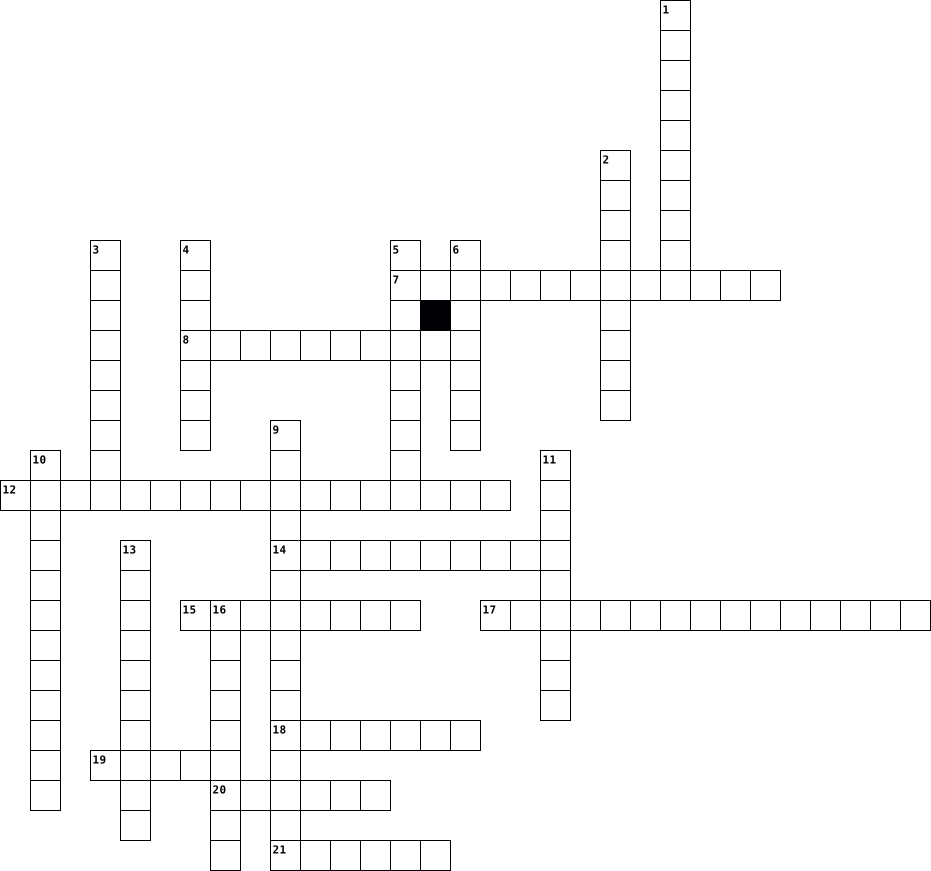
Across
- product of stroke volume and heart rate
- movement towards the middle line of scapula.
- othername of neutophils
- movement is opposite to elevation.
- helps in conversion of fibrinogen into fibrin
- broadest of the back
- upper and broadest part of rib cage
- forms the membrane of the bone.
- upper flat part of the hip.
- collection of five vertebrates.
Down
- demand for oxygen is greater than the supply.
- commonly called as pecs
- circulation of blood between heart and lungs
- largest cartilage in human body
- hind part of the head.
- forehead and upper part.
- formed in the empty part of bones.
- movement of the foot upward.
- movement of forearm moving upward.
- passes through the vertebral column.
- three muscles of posterior
21 Clues: broadest of the back • hind part of the head. • commonly called as pecs • othername of neutophils • forehead and upper part. • three muscles of posterior • upper flat part of the hip. • movement of the foot upward. • largest cartilage in human body • forms the membrane of the bone. • collection of five vertebrates. • formed in the empty part of bones. • ...
Physical education 2021-01-04
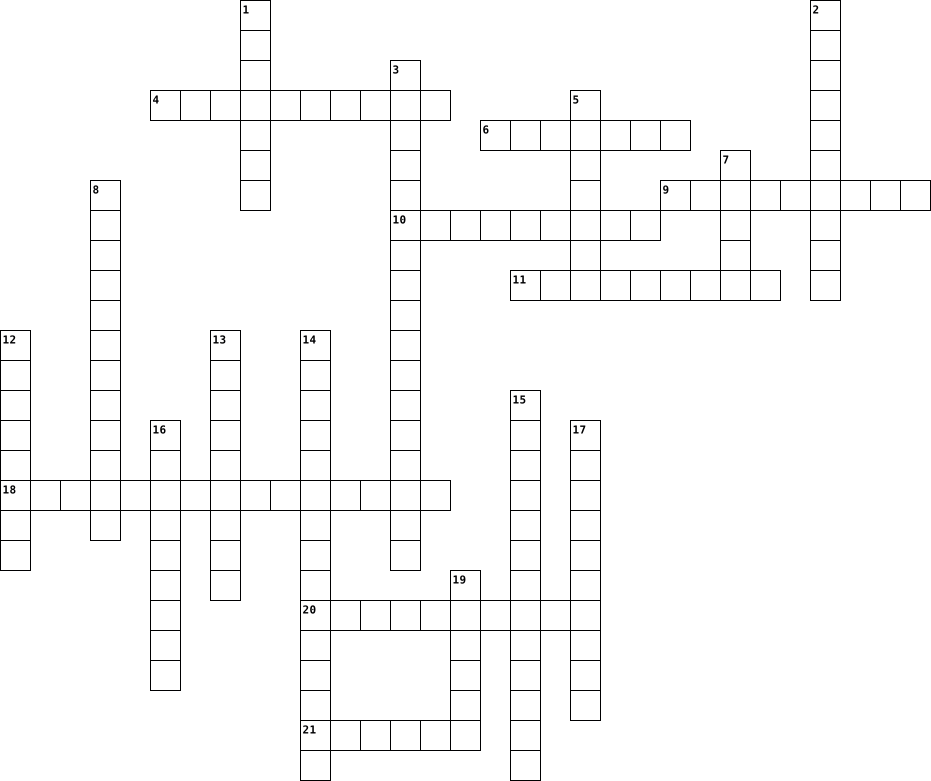
Across
- movement is opposite to elevation.
- largest cartilage in human body
- movement of forearm moving upward.
- hind part of the head.
- circulation of blood between heart and lungs
- formed in the empty part of bones.
- passes through the vertebral column.
- collection of five vertebrates.
Down
- upper and broadest part of rib cage
- movement towards the middle line of scapula.
- othername of neutophils
- forehead and upper part.
- forms the membrane of the bone.
- movement of the foot upward.
- helps in conversion of fibrinogen into fibrin
- three muscles of posterior
- broadest of the back
- product of stroke volume and heart rate
- commonly called as pecs
- demand for oxygen is greater than the supply.
- upper flat part of the hip.
21 Clues: broadest of the back • hind part of the head. • othername of neutophils • commonly called as pecs • forehead and upper part. • three muscles of posterior • upper flat part of the hip. • movement of the foot upward. • largest cartilage in human body • forms the membrane of the bone. • collection of five vertebrates. • movement is opposite to elevation. • ...
Physical Fitness 2021-02-24

Across
- pulse found in neck
- starting at a comfortable pace to then increase slowly
- using air constantly for long periods of time
- doing 2 or more sports or activities to become a better person
- the rate at which your heart constantly pumps blood through your body
- your body's ability to stretch and rotate without breaking
- body releases endorphins making you happier
- constant muscular movement
- stretching or tearing or ligaments
- heart rates area of how hard and fast it should beat while doing physical fitness
- ability to work for a constant period of time
- using little muscular action
- happening when your body undergo's extreme temp. change from homeostasis to cold temps
Down
- good health earned through physical activity
- unit of heat and energy
- pulse found in wrist
- to push yourself to an unhealthy level of activity
- over heating along with causing heat stroke
- frequency intensity time
- feel better and more awake to want to start your day or be around people
- little air for short spurts of time
- your bodies constant heart rate. (sleeping)
- measured BPM
- always should be aware of this while running
- muscle spasms happening when hot or extreme heat
25 Clues: measured BPM • pulse found in neck • pulse found in wrist • unit of heat and energy • frequency intensity time • constant muscular movement • using little muscular action • stretching or tearing or ligaments • little air for short spurts of time • over heating along with causing heat stroke • your bodies constant heart rate. (sleeping) • body releases endorphins making you happier • ...
Physical Properties 2020-10-19

Across
- Molecules are close together and vibrate
- Able to be hammered or pressed permanently out of shape without breaking or cracking.
- Different saturations as a result of the way the object reflects light
- The stretchability of a substance
- A thing that is composed of two or more separate elements
- Firm/solid
- Shine/reflectiveness
- Molecules bounce around at a fast pace
- The ability to be dissolved
- On periodic table
- Odor/scent
- The temperature at which a substance boils and turns into vapor
- The pole of two magnetic fields
Down
- Substances that mix together
- The measure of the amount of electrical current a material can carry or it's ability to carry a current
- Size or density of a molecule
- The degree to which a specified material conducts electricity
- Substances that stay separate, can be mixed but you can see the two separate substances
- The quality of a three dimensional space
- The temperature at which a substance will melt
- g/cm3
- The ability to float in water or some other fluid
- How big something is
- The warmth or coldness of an object or substance
- A form of a substance is molded into or made into
- How much an object weighs
- Molecules move around each other, not full spaced out
- A chemical change between two or more substances
- How long something is
- The durability of a substance
30 Clues: g/cm3 • Firm/solid • Odor/scent • On periodic table • How big something is • Shine/reflectiveness • How long something is • How much an object weighs • The ability to be dissolved • Substances that mix together • Size or density of a molecule • The durability of a substance • The pole of two magnetic fields • The stretchability of a substance • Molecules bounce around at a fast pace • ...
Physical Properties 2020-10-21

Across
- The _______ of this highlighter is unbelievable!
- The thickness based on internal friction
- Water’s _________ is 32°F (liquid to solid)
- The amount of space of a 3 dimensional object A material thing that can be seen and touched
- Gold is 3.5 while glass is 6 (Mohs scale)
- Water’s _________ is 32°F (solid to liquid)
- Force over acceleration
- In the rainbow, there are 7 ______.
- Examples: solid, liquid, gas
- Water’s _________ is 212°F (Liquid to gas)
Down
- It’s the greatness of something on a standard scale.
- Mass divided by volume
- Time of existence
- The ability to be dissolved in things like water
- The ____ of my shoe is 4 US
- An objects ability to be formed by pressure
- The external form of an object. (Circle)
- The scent of something
- The feel and appearance of a substance/surface
- The freedom of contamination
20 Clues: Time of existence • Mass divided by volume • The scent of something • Force over acceleration • The ____ of my shoe is 4 US • Examples: solid, liquid, gas • The freedom of contamination • In the rainbow, there are 7 ______. • The thickness based on internal friction • The external form of an object. (Circle) • Gold is 3.5 while glass is 6 (Mohs scale) • ...
physical properties 2020-10-22

Across
- - describes how heavy something is
- - describes qualities that are described and aren’t measured
- - describes something that can be attracted/repelled by a magnet
- - measured as the ratio of mass to volume
- - ________ point, describes the temperature at which something will turn from a liquid to a gas (boil)
- - measures how much internal friction a moving fluid has, how much resistance to flow it has
- - describes how much light passes through something
- - describes how much space something occupies
- - _______ conductivity, measures somethings ability to conduct(transfer) heat
- - describes how much thermal energy is in something
- - describes when a molecule has a separation of its electric charge, creating a positively and negatively charges side
- - state of _____, describes the 4 states in which matter can exist
Down
- - describes qualities measured using numbers
- - describes the property of a solid, liquid, or gas to dissolve in another solid, liquid, or gas
- - describes how much something can resist when indented by an indenter of a specific size
- - ________ point, describes the temperature at which something will turn from a solid to a liquid (melt)
- - describes something that triggers the olfactory nerve. (also called smell)
- - describes how easily liquids and gasses can pass through something.
- - describes the quality of something that can be reshaped into something else by being compressed and put under pressure.
- - _______ conductivity, measures somethings ability to conduct(transfer) heat
- - describes a visual quality that is caused by light being transmitted or reflected
21 Clues: - describes how heavy something is • - measured as the ratio of mass to volume • - describes qualities measured using numbers • - describes how much space something occupies • - describes how much light passes through something • - describes how much thermal energy is in something • - describes qualities that are described and aren’t measured • ...
Physical appearance 2019-01-28

Across
- "õlle"kõht
- põskhabe
- poisipea
- kasv
- jume
- ripsmed
- kolmekümne ligi (vanuselt)
- habe
- tedretähniline
- lohukesed
- rasvased, pesemata (juuksed)
- ninasõõrmed
- kahvatu
- ümaravõitu, natuke ülekaalus
- värvitud
Down
- nägus (mees)
- kortsud
- ülekaal, ülekaalus
- terav(atipuline)
- tukk
- vuntsid
- kulmud
- sirged
- vanemaealine, vana
- traatjas, turritavate juustega
- lühike ja sale (naine)
- jässakas
- lokkis
- kiilaspea
29 Clues: tukk • kasv • jume • habe • kulmud • sirged • lokkis • kortsud • vuntsid • ripsmed • kahvatu • põskhabe • poisipea • jässakas • värvitud • lohukesed • kiilaspea • "õlle"kõht • ninasõõrmed • nägus (mees) • tedretähniline • terav(atipuline) • ülekaal, ülekaalus • vanemaealine, vana • lühike ja sale (naine) • kolmekümne ligi (vanuselt) • rasvased, pesemata (juuksed) • ümaravõitu, natuke ülekaalus • traatjas, turritavate juustega
PHYSICAL EDUCATION 2021-07-14
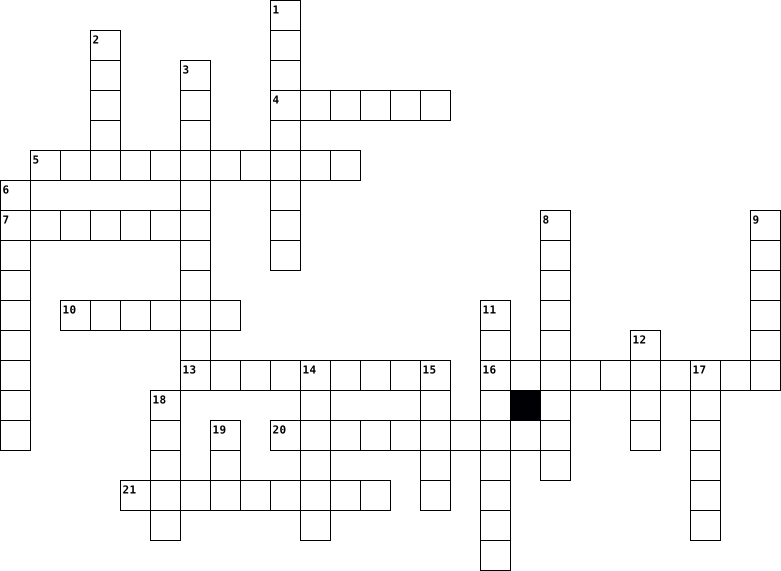
Across
- MARTIAL ARTS FROM JAPAN
- SOMETHING PLAYED IN BADMINTON
- ONE KIND OF SWIMMING STYLE
- VEGETABLES CONTAIN PLENTY OF VITAMIN A
- EVERYBODY HAVE TO AVOID THIS THING
- SOMEONE WHO GUARD THE GOAL POST
- GAME PLAYED BY 5 PERSON EACH TEAM AND THROW THE BALL INTO THE RING
- SOMETHING YOU HAVE TO DO BEFORE DOING EXERCISE
Down
- ONE KIND OF MARTIALARTS
- MARTIAL ARTS FROM CHINA
- SOMETHING YOU HAVE TO DO AFTER DOING EXERCISE
- "PE" STAND FOR PHYSICAL ......
- SOMETHING CONTAIN PLENTY OF VITAMINS AND MINERALS
- GAME PLAYED BY 11 PERSON EACH TEAM
- EXERCISE TO TRAIN YOUR AGILITY
- SOMETHING CONTAIN PLENTY OF PROTEIN
- FRUITS CONTAIN PLENTY OF VITAMIN C
- EXERCISE TO TRAIN YOUR ABS MUSCLE
- EXERCISE TO TRAIN YOUR ARM MUSCLE
- SOMETHING CONTAIN PLENTY OF CARBOHYDRATE
- A PLACE USUALLY SOMEONE COME TRO EXERCISE
21 Clues: ONE KIND OF MARTIALARTS • MARTIAL ARTS FROM CHINA • MARTIAL ARTS FROM JAPAN • ONE KIND OF SWIMMING STYLE • SOMETHING PLAYED IN BADMINTON • "PE" STAND FOR PHYSICAL ...... • EXERCISE TO TRAIN YOUR AGILITY • SOMEONE WHO GUARD THE GOAL POST • EXERCISE TO TRAIN YOUR ABS MUSCLE • EXERCISE TO TRAIN YOUR ARM MUSCLE • GAME PLAYED BY 11 PERSON EACH TEAM • EVERYBODY HAVE TO AVOID THIS THING • ...
Physical Effects 2024-05-30

Across
- The process of breathing where oxygen gas is taken in and carbon dioxide is released
- Excessive loss of body fluid that occurs when the body loses more fluids than it takes in
- A common mental disorder for athletes
- A person who participates regularly in sports
- A measure of how much weight one can lift
- Any form of exercise or movement of the body that results in the body's use of energy
- The ability to move the body quickly
- The ability to work
- All of your joints are able to move through a full range of motion
- Pregame prevention of injure
- The level of effort put in to work during a practice
Down
- Ability of the heart, lungs and muscles to function effectively
- the fluid pumped through the body
- Moving in a direction
- A repeated action you preform the action two times
- Overloaded
- Repeatedly thinking about actions turning into subconscious
- The amount of time between action and response to it
- Trying to improve skills or exercises
- Having non to little fatigue
- A complex pathophysiological process affecting the brain, induced by traumatic biomechanics forces
- The ability to maintain equilibrium while still moving, and equal distribution of weight so as not to fall
- The ability to preform complex movements
- Working till you can't
- What is the most common cardiovascular condition seen in competitive athletes
25 Clues: Overloaded • The ability to work • Moving in a direction • Working till you can't • Having non to little fatigue • Pregame prevention of injure • the fluid pumped through the body • The ability to move the body quickly • A common mental disorder for athletes • Trying to improve skills or exercises • The ability to preform complex movements • ...
Physical Description 2023-10-02

Across
- straight hair
- blue eyes
- a beard
- a mustache
- short hair
- strong
- grey eyes
- curly hair
- glasses
- bald
- green eyes
- tall
Down
- wavy hair
- a hat
- Brown eyes
- short
- hazel eyes
- week
- beautiful
- skinny
- Brown hair
21 Clues: week • bald • tall • a hat • short • skinny • strong • a beard • glasses • wavy hair • blue eyes • beautiful • grey eyes • Brown eyes • hazel eyes • a mustache • short hair • Brown hair • curly hair • green eyes • straight hair
physical descriptions 2023-09-09

Across
- the opposite of straight hair
- hair specific to your head
- someone who can reach high places easily
- the color of hair that barbie has
- someone who is not yet old
- someone who is not considered large sized
- eyes that are the color of wheat bread
- eyes that are the color of leaves
- hair that shows signs of aging
- someone who is not slim
- someone who is not considered attractive
Down
- eyes that have a nut named after their color
- the color of hair that is also known as 'ginger'
- eyes that are the color of the sea
- someone who is considered attractive
- someone who is no longer young
- eyes that are the color of tar
- hair that is the color of nutella
- the opposite of short hair
- someone who can not reach high places easily
- the opposite of curly hair
- the oppposite of long hair
22 Clues: someone who is not slim • hair specific to your head • someone who is not yet old • the opposite of short hair • the opposite of curly hair • the oppposite of long hair • the opposite of straight hair • someone who is no longer young • eyes that are the color of tar • hair that shows signs of aging • the color of hair that barbie has • hair that is the color of nutella • ...
Physical Geography 2023-09-21

Across
- an area of high, flat land
- a natural feature of the earth's surface.
- of Cancer a line of latitude at 23.5 degrees North of the equator
- The breaking down of rocks and other materials on the Earth's surface.
- latitudes the regions between the Tropic of Cancer and the Arctic Circle and the Tropic of Capricorn and the Antarctic Circle
- The process by which wind, water, ice, or gravity transports soil and sediment from one location to another
- Circle a line of latitude at 66.5 degrees South of the equator
- a rigid layer of the Earth's crust that is believed to drift slowly
- elevated land with sloping sides and rounded summit; generally smaller than a mountain
- The spinning of Earth on its axis
- of Fire A major belt of volcanoes that rims the Pacific Ocean
Down
- The path of an object as it revolves around another object in space
- A thin layer of gases surrounding Earth
- Circle a line of latitude at 66.5 degrees North of the equator
- a large area of flat land with few trees
- An imaginary line that passes through Earth's center and the North and South poles, about which Earth rotates
- The movement of an object around another object
- The name of the single landmass that broke apart 200 million years ago and gave rise to today's continents
- latitudes - areas north of the Arctic Circle and south of the Antarctic Circle; also know as polar zone
- latitudes - areas between the Tropic of Cancer and the Tropic of Capricorn; also known as tropics
- A landform with high elevation and high relief. (1000 Feet or more)
- tectonics A theory stating that the earth's surface is broken into plates that move.
- of Capricorn a line of latitude 23.5 degrees South of the equator
23 Clues: an area of high, flat land • The spinning of Earth on its axis • A thin layer of gases surrounding Earth • a large area of flat land with few trees • a natural feature of the earth's surface. • The movement of an object around another object • of Fire A major belt of volcanoes that rims the Pacific Ocean • Circle a line of latitude at 66.5 degrees North of the equator • ...
Physical description 2023-09-20

Across
- Appareil dentaire
- De longueur moyenne
- Ondulé
- Raide
- Noir
- Bleu
- Mince
- Blond
- Mince
Down
- Vert
- Grand
- Roux
- Court ou petit
- Musclé
- Lunettes
- Bouclé
- Taches de rousseur
- Enrobé
- De taille moyenne
- Long
- Marron
21 Clues: Vert • Roux • Noir • Bleu • Long • Grand • Raide • Mince • Blond • Mince • Musclé • Bouclé • Enrobé • Ondulé • Marron • Lunettes • Court ou petit • Appareil dentaire • De taille moyenne • Taches de rousseur • De longueur moyenne
Physical science 2024-08-26

Across
- which the identity of the substances that produces one or more new
- can observe without changing the identity of the substance
- amounts in the nucleus
- mixture A mixture in which all parts are mixed
- that produces one or more new substance
- property Any characteristics of a material that
- the same product
- mixture A mixture in which all parts can be clearly
- property A characteristic of a material that you can
- and they lose their original properties
- after the change products
- When the number of neutrons and protons have
- the properties of a chemical element
Down
- when two or more substances that are not chemically
- Anything that has mass and takes up space
- a type of matter with a fixed composition it is
- When two or more different types of atoms chemically
- change A chance in sizel shape or state matter
- Any substance made up of only one type of atom
- before a chemical change reactions equals the mass of all the substances that
- and different substances cannot be viewed within
- change A chance from one substance to another
- of Conservation of mass The mass of all substances that are
- The smallest consistent unit of ordinary matter that
- and each part retains its own original properties
- A heterogeneous mixture with particles that never
26 Clues: the same product • amounts in the nucleus • after the change products • the properties of a chemical element • that produces one or more new substance • and they lose their original properties • Anything that has mass and takes up space • When the number of neutrons and protons have • change A chance from one substance to another • ...
PHYSICAL APPEARANCE 2023-06-02

Across
- (ESBELTO)
- (RUIVO)
- (SARADO)
- (PERUCA)
- (TRANÇA)
- (RABO DE CAVALO)
- (BARBA)
- (COVINHA)
- (RUGA)
- (GORDINHO, FOFINHO)
- (CACHEADO)
- (BIGODE)
- (VERRUGA)
- (FRANJA)
- (CARECA)
- (MAGRO)
Down
- (MARIA-CHIQUINHA)
- (ACIMA DO PESO)
- (PINTA)
- (LOIRO)
- (LISO)
- (COSTELETA)
- (SARDA)
- (ONDULADO)
- (ESPINHA)
- (CABELO ESPETADO)
- (CHESTNUT)
- (COQUE)
28 Clues: (LISO) • (RUGA) • (RUIVO) • (PINTA) • (LOIRO) • (SARDA) • (BARBA) • (COQUE) • (MAGRO) • (SARADO) • (PERUCA) • (TRANÇA) • (BIGODE) • (FRANJA) • (CARECA) • (ESBELTO) • (ESPINHA) • (COVINHA) • (VERRUGA) • (ONDULADO) • (CHESTNUT) • (CACHEADO) • (COSTELETA) • (ACIMA DO PESO) • (RABO DE CAVALO) • (MARIA-CHIQUINHA) • (CABELO ESPETADO) • (GORDINHO, FOFINHO)
Physical Science 2023-05-15

Across
- theory in physics based on the fact that particles of matter are in vigorous motion and that the temperature of a substance increases with an increase in either the average kinetic energy of the particles or the average potential energy of separation of the particles, or in both, when heat is added
- a subatomic particle of about the same mass as a proton but without an electric charge, present in all atomic nuclei except those of ordinary hydrogen.
- as a result of their interaction, rearrangement of atoms of substances resulting in new substances; change in color or odor are hints that a chemical reaction has occurred; also chemical reaction
- net release of energy
- matter with no definite volume or shape
- a substance made by mixing other substances together.
- a chemical substance that contains only one kind of atom and that cannot be broken down into simpler substances
- a measure of how hot or cold something is; a measure of the average kinetic energy of the particles of a substance
- the basic unit of a chemical element.
- change to the structure of the nucleus of an atom during a nuclear reaction; a nuclear change gives off radiation and generally changes one element to another
- a gaslike state of matter consisting of positively charged ions, free electrons, and neutral particles; found in stars, the sun, solar wind, lightning, and fire; unlike gases, plasmas are good conductors of electrical currents
- a homogeneous mixture
- a force of attraction that one atom or group of atoms has for another atom or group of atoms; this force keeps the two atoms or groups together under some circumstances
- change to a substance that does not alter its chemical composition; examples of physical changes to substances include freezing water and dissolving salt in water
- matter with definite volume but no definite shape
- a measure of the disorder of a system as the system tends toward equilibrium; in a closed system, potential energy of the system will decrease over time (as potential energy decreases, entropy increases)
- the phase change of a substance from the solid state directly to the gaseous state; for example, dry ice, moth balls, or solid air freshener
Down
- substance in which all samples of the substance have fixed composition and properties; elements and compounds are pure substances (e.g., water is a compound, and silver is an element)
- the amount of heat needed to raise the temperature of a substance 1°C; the greater the specific heat, the greater the heat it takes to raise a substance´s temperature; also specific heat capacity
- having uniform composition throughout
- SI-derived unit to measure energy, work, and quantity of heat; for work, a joule is the amount of work done by a force of 1 N acting through 1 m; also newton-meter
- matter with definite volume and definite shape
- heat; energy transferred due to temperature differential that becomes associated with potential energy and kinetic energy on a molecular level
- the process by which water vapor changes from gas to liquid
- anything that occupies space and has mass
- physical form of matter, such as solid, liquid, and gas; a distinct state of matter in a system; matter that is identical in chemical composition and physical state, and is separated from other material by the phase boundary; for example, the reaction occurs in the liquid phase of the system
- a form of energy transferred (by way of conduction, convection, or radiation) by virtue of a difference in temperature; heat is energy in transit; heat is energy flow, measured in energy units
- substance composed of two or more elements that are chemically bonded in a definite, fixed ratio by mass
- the process by which water changes to water vapor
- in physics, the study of the nature of heat and its conversion or relationship to other energy forms
- having nonuniform composition throughout
- in a closed system in changing from one form to another, matter and energy cannot be created or destroyed; in this sense, conservation means that the physical quantity of matter and energy is entirely preserved during transformations and reactions
- the transfer of heat through matter by way of the collision of molecules
- the process by which a gas changes phase directly to a solid; for example, the formation of frost
- net absorption of energy
- a group of atoms bonded together, representing the smallest fundamental unit of a chemical compound that can take part in a chemical reaction.
- amount of heat it takes to raise a gram of water 1°C at normal atmospheric pressure
37 Clues: net release of energy • a homogeneous mixture • net absorption of energy • having uniform composition throughout • the basic unit of a chemical element. • matter with no definite volume or shape • having nonuniform composition throughout • anything that occupies space and has mass • matter with definite volume and definite shape • ...
Physical science 2021-11-18

Across
- the flow of an electrical power of charge
- an inclined plane with one or two sloping sides
- the application of science to help people
- a quantity that can have more than a single value
- the rate of change of velocity
- an inclined plane wrapped in a spiral around a cylindrical post
- the transfer of energy by electromagnetic waves
- is the product of its mass and velocity
- a closed conducting path
Down
- thermal energy that flows from something at a higher temperature
- the transfer of energy that occurs when a force makes an object move
- the gravitational force exerted on an object
- used to detect electric charges
- an organized set of investigation procedures
- a push or pull
- the amount of work done in one second
- a visual display of information
- a material in which heat flows slowly
- when a object changes its position relative to a reference point
- a device that makes doing work easier
20 Clues: a push or pull • a closed conducting path • the rate of change of velocity • used to detect electric charges • a visual display of information • the amount of work done in one second • a material in which heat flows slowly • a device that makes doing work easier • is the product of its mass and velocity • the flow of an electrical power of charge • ...
Physical science 2021-11-18

Across
- when a object changes its position relative to a reference point
- is an inclined plane with one or two slopping slides
- occurs when what the scientist expects changes how the results are viewed
- a material on which heat flows through slowly
- test the affects of one thing or another control
- is a device that makes doing work easier
- is the transfer of energy that occurs when a force makes up an objects
- it has a positive charge
- mother for studying the natural world
Down
- refers to the properties and interactions
- is the amount of work done in one second
- a large wheel that rotates when pushed by wind,water, and steam
- is the transfer of energy by electromagnetic waves
- attractive force between two objects
- is a inclined plane wrapped in a spiral around a cylindrical post
- is the SI unit of energy
- how fast something is going
- force that opposes the sliding motion between two touching surfaces
- gravitational force exerted on an objects
- a push of pull
20 Clues: a push of pull • is the SI unit of energy • it has a positive charge • how fast something is going • attractive force between two objects • mother for studying the natural world • is the amount of work done in one second • is a device that makes doing work easier • refers to the properties and interactions • gravitational force exerted on an objects • ...
Physical Science 2021-12-16

Across
- any substance that has mass and takes up space by having volume.
- incompressible fluid that conforms to the shape of its container but retains a constant volume independent of pressure.
- change, the material involved in the change is structurally the same before and after the change.
- the study of the electromagnetic force.
- of matter, one of the distinct forms in which matter can exist.
- energy, the use of nuclear reactions to produce electricity.
- energy, a form of energy that an object or a particle has by reason of its motion.
- a structure built across a river or stream to hold back water.
- circuit, comprises branches so that the current divides and only part of it flows through any branch.
- firm and stable in shape; not liquid or fluid
- the smallest unit of matter.
- the basic building blocks of all living things.
- laws, three laws of classical mechanics that describe the relationship between the motion of an object and the forces acting on it.
- is a form of energy that harnesses the power of water in motion.
- the ability to do work
- the emission or transmission of energy in the form of waves or particles through space or through a material medium.
Down
- waves, wave in which particles of the medium vibrate at right angles, or perpendicular, to the direction that the wave travels.
- an atom that has more electrons than protons.
- that branch of science that deals with the structure of matter and how the fundamental constituents of the universe interact.
- plant, is a thermal power station in which the heat source is a nuclear reactor.
- energy, the stored energy in any object or system.
- a proposed explanation for a phenomenon.
- a property of matter by which it remains at rest or in motion in the same straight line unless acted upon by some external force.
- electromagnetic waves with wavelengths longer than those of terahertz (THz) wavelengths, but relatively short for radio waves.
- a brief statement or account of the main points of something.
- the return of light or sound waves from a surface.
- change, when a substance combines with another to form a new substance.
- the quantity of matter in a physical body. waves, a disturbance that moves energy from one place to another.
- mass per unit volume.
- a continuous path through which electricity travels.
- science, the study of the inorganic world.
- the resistance that one surface or object encounters when moving over another.
- an atom or molecule with a net electric charge due to the loss or gain of one or more electrons.
- method, it is the technique used in the construction and testing of a scientific hypothesis.
- the process of something moving or changing place, or even just changing position.
- a state of matter that has no fixed shape and no fixed volume.
36 Clues: mass per unit volume. • the ability to do work • the smallest unit of matter. • the study of the electromagnetic force. • a proposed explanation for a phenomenon. • science, the study of the inorganic world. • an atom that has more electrons than protons. • firm and stable in shape; not liquid or fluid • the basic building blocks of all living things. • ...
Physical Science 2021-12-16

Across
- the quantity of matter in a physical body.
- the material involved in the change is structurally the same before and after the change.
- the ability to do work
- is a pure substance consisting only of atoms that all have the same numbers of protons in their nuclei.
- the resistance that one surface or object encounters when moving over another.
- the smallest unit of matter.
- a structure built across a river or stream to hold back water.
- it is the technique used in the construction and testing of a scientific hypothesis.
- incompressible fluid that conforms to the shape of its container but retains a constant volume independent of pressure.
- the stored energy in any object or system.
- are a type of subatomic particle with no charge.
- a continuous path through which electricity travels.
- the emission or transmission of energy in the form of waves or particles through space or through a material medium.
- a property of matter by which it remains at rest or in motion in the same straight line unless acted upon by some external force.
- lightest stable subatomic particle known.
- one of the distinct forms in which matter can exist.
- mass per unit volume.
- the process of something moving or changing place or even just changing position.
Down
- an atom that has more electrons than protons.
- the study of the inorganic world.
- a disturbance that moves energy from one place to another.
- firm and stable in shape; not liquid or fluid
- wave in which particles of the medium vibrate at right angles or perpendicular to the direction that the wave travels.
- comprises branches so that the current divides and only part of it flows through any branch.
- the study of the electromagnetic force.
- any substance that has mass and takes up space by having volume.
- a state of matter that has no fixed shape and no fixed volume.
- is a form of energy that harnesses the power of water in motion.
- are a type of subatomic particle with a positive charge.
- that branch of science that deals with the structure of matter and how the fundamental constituents of the universe interact.
- a brief statement or account of the main points of something.
- when a substance combines with another to form a new substance.
- the use of nuclear reactions to produce electricity.
- the return of light or sound waves from a surface.
- three laws of classical mechanics that describe the relationship between the motion of an object and the forces acting on it.
- electromagnetic waves with wavelengths longer than those of terahertz (THz) wavelengths but relatively short for radio waves.
- an atom or molecule with a net electric charge due to the loss or gain of one or more electrons.
- the basic building blocks of all living things.
- is a thermal power station in which the heat source is a nuclear reactor.
- table of chemical elements.
- a form of energy that an object or a particle has by reason of its motion.
- a proposed explanation for a phenomenon.
42 Clues: mass per unit volume. • the ability to do work • table of chemical elements. • the smallest unit of matter. • the study of the inorganic world. • the study of the electromagnetic force. • a proposed explanation for a phenomenon. • lightest stable subatomic particle known. • the quantity of matter in a physical body. • the stored energy in any object or system. • ...
Physical Science 2021-04-27

Across
- the first element on the periodic table
- liquids sometimes combine to form this solid
- symbol Ag
- a measure of a liquids resistance to flow
- measure of the amount of matter in a object
- the amount of space an object takes up
- found on the periodic table
- right side of the periodic table
- atomic number 79
- product of photosynthesis
Down
- changes form but not chemical identity
- a characteristic of a substance that can be observed without changing identity
- the temperature where a object changes from solid to liquid
- base for all life on earth
- left side of the periodic table
- atoms are close together and barely moving
- results from a chemical reaction
- a sign of a chemical reaction
- Vibrate and move past each other
- the same as the atomic number
- group 18 of the periodic table
- sign of a chemical reaction
- the amount of mass in a given space
- Vibrate and move freely
- calculate by subtracting atomic number from atomic mass
25 Clues: symbol Ag • atomic number 79 • Vibrate and move freely • product of photosynthesis • base for all life on earth • found on the periodic table • sign of a chemical reaction • a sign of a chemical reaction • the same as the atomic number • group 18 of the periodic table • left side of the periodic table • results from a chemical reaction • right side of the periodic table • ...
Physical Education # 2021-04-23
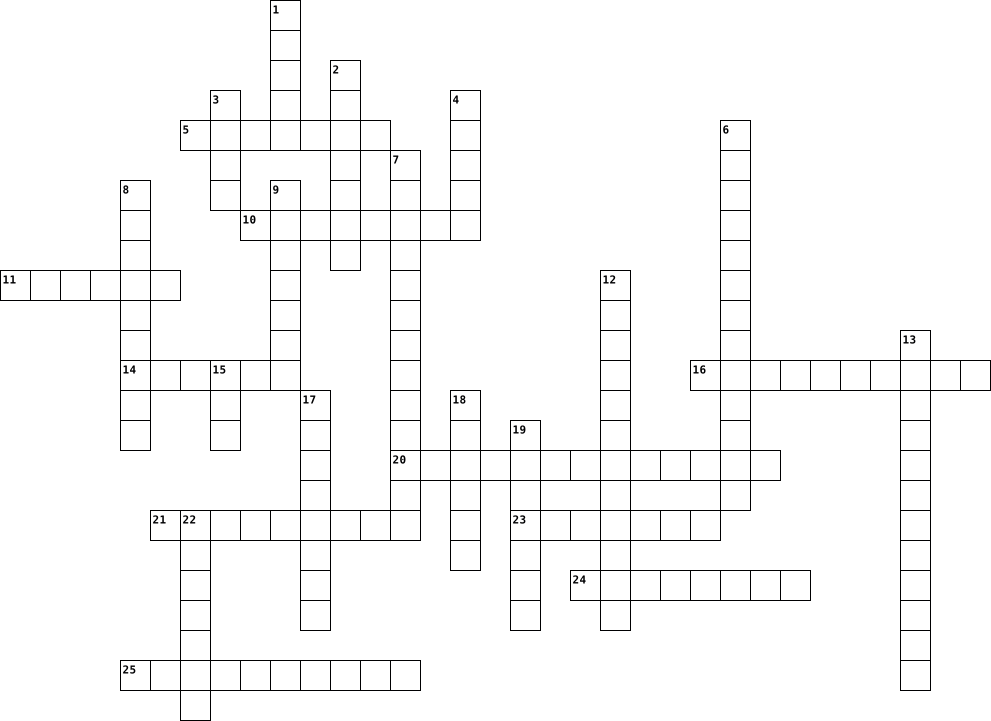
Across
- it is a free expressive style of dancing started in early 20th century as a reaction to classical ballet.
- Means of expressing one's emotions through movement discipline by rhythm
- flow, Technique where the dancers connect their entire body with the environment
- swaying arms forward backward or sideward
- Movement of the body in space in any direction with the feet as moving base.
- the setting of this dance is usually informal gatherings and parties ,reunions ,and the like.
- highest form of dance.
- Cultural art form handed down from generation to generation
- gliding along the floor with either foot
- A pantomimed song and dance was the oldest recorded activity among the Christianized Filipinos
Down
- , Prefers the movement SEPTA music where there emerges organization structure and battery
- improvisation, This practice focuses in sensing a partner while having a body dialogue -
- mind centering, Basic yoga routines are good examples of this technique.
- When did Ferdinand Magellan discovered the Philippines
- refers to any form of dancing that is done primarily for its social educational and health benefits .
- It is all about expressing emotions through organic movements and unrestricted lines.
- Aquino, Mother of Philippine folk dances
- Most dances big in and end with
- Also known as folk or ethnic dance
- widespread activity in which competitors perform dances in any several permitted dance style.
- locomotor, Refer to the movement various parts of the body in space with a fixed base.
- Bending or shortening of a body part occurring at a joint
- and ballroom, The setting of this dance it's a social gathering with the more formal atmosphere than the simple and informal parties in which the recreational dances are the usual forms.
- technique, Dancing technique teaches to release unnecessary tensions used while moving
- it is a measure motion of flow , characterized by regular occurrence of elements or features as beats sounds or accents.
25 Clues: highest form of dance. • Most dances big in and end with • Also known as folk or ethnic dance • Aquino, Mother of Philippine folk dances • gliding along the floor with either foot • swaying arms forward backward or sideward • When did Ferdinand Magellan discovered the Philippines • Bending or shortening of a body part occurring at a joint • ...
Physical description 2025-01-27

Across
- petit
- long
- grand
- fort
- âge mûr
- tâche de rousseur
- appareil dentaire
- lisse
- jeune
- rond
- dégradé
- tresses
Down
- beau
- moustache
- chauve
- boucle d'oreille
- clair
- maigre
- court
- carré
- barbe
- vieux
- ondulé
23 Clues: beau • long • fort • rond • petit • grand • clair • court • lisse • carré • jeune • barbe • vieux • chauve • maigre • ondulé • âge mûr • dégradé • tresses • moustache • boucle d'oreille • tâche de rousseur • appareil dentaire
Physical properties 2024-09-08

Across
- hitting close to the bull's eye
- clustering all you measurements close together
- ____ Knowledge: what you research before you begin
- Metric unit to measure wet volume
- 1 million of anything
- ____ Logic; specific details to general conclusion
- A prediction regarding a new variable
- Metric unit to measure length
- Base unit - one of any units being measured
- 1000 units of any unit of measure
- 1/100 units of any unit of measure
- Volume has ____ dimensions
- Direct cause - 100% assurance
Down
- 1/1,000,000 of anything
- Metric unit to measure mass
- The normal conditions before a variable changes
- ________________ properties
- How space those atoms occupy in space
- Maybe responsible but n0 conclusive evidence
- Metric unit to measure dry volume
- The variable you observe or measure
- How many atoms(substance) an object contains\
- _____ Logic; if a...,then if a...,therefore...
- The variable you change in an experiment
- 1/1000 units of any unit of measure
25 Clues: 1 million of anything • 1/1,000,000 of anything • Volume has ____ dimensions • Metric unit to measure mass • ________________ properties • Metric unit to measure length • Direct cause - 100% assurance • hitting close to the bull's eye • Metric unit to measure wet volume • Metric unit to measure dry volume • 1000 units of any unit of measure • 1/100 units of any unit of measure • ...
Physical Therapy 2024-09-18

Across
- on the side, could either be left or right
- The study of how the body functions, especially muscles, and organs.
- A professional who provides treatment and support.
- The study of the structure of the human body.
- The location where two bones meet in the body.
- Refers to a position toward the tail or posterior part of the body.
- It refers to a structure being closer to the surface of the body than another structure.
- Tissue that contracts to produce movement.
- the process of restoring function.
- Straightening a joint or increasing the angle between two bones.
- A bone found in the upper arm.
- Relating to epithelial tissue, which covers surfaces and lines cavities.
- The act of changing position or location.
Down
- Large, triangular muscle covering the upper back and neck.
- The interstitial fluid picked up by lymphatic capillaries.
- Indicates a position toward the nose or anterior part of the body, often used in relation to the brain.
- A position that lies flat on the back, face and torso facing upward
- These are shoulder muscles that allows the arm to abduct and overall stability of the shoulder.
- A band of fibrous tissue that connects muscle to bone.
- The way someone holds their body while sitting, standing, or moving.
- Damage or harm to the body caused by external forces, often leading to pain and requiring treatment or rehabilitation.
- Lower back region of the spinal column.
- Refers to a position away from the midline of the body; it denotes the sides of a structure or organism.
- A position that lies flat on the stomach, face, and torso facing downward
24 Clues: A bone found in the upper arm. • the process of restoring function. • Lower back region of the spinal column. • The act of changing position or location. • on the side, could either be left or right • Tissue that contracts to produce movement. • The study of the structure of the human body. • The location where two bones meet in the body. • ...
Physical Science 2024-09-13

Across
- The rate of doing work Power = work/time
- Distance traveled per unit time
- Force, The force that supports an object against gravity, often called normal force.
- The property of a system that it enables it to do work.
- Cell, A device that converts the chemical energy from a fuel into electricity through a chemical reaction with oxygen or another oxidizing agent.
- Pair, The action force and the reaction force that occur in an interaction.
- The property by which objects resist changes in motion.
- The quantity of space an object occupies
- A device, such as a lever or pulley, that increases (or decreases) a force or simply changes the direction of a force.
- Fake science that pretends to be real science.
- energy, The energy that matter possesses due to its position: Gravitational PE= mgh
- resistance, the force of friction acting on an object due to its motion in air.
- Velocity, Terminal speed in a given direction (often downward)
- A synthesis of a large body of information that encompasses well-tested and verified hypotheses about certain aspects of the natural world.
- Force, The combination of all forces that act on an object.
- The resistive force that opposes the motion or attempted motion of an object past another object with which it is in contact, or through a fluid.
Down
- A general hypothesis or statement about the relationship of natural quantities that has been tested over and over again and has not been contradicted; also known as a principle
- A simple machine consisting of a rigid rod pivoted at a fixed point called the fulcrum.
- An educated guess; a reasonable explanation of an observation or experimental result that is not fully accepted as factual until tested over and over again by experiment.
- Inertia in motion given by the product of the mass of an object and its velocity.
- The product of the force and the distance moved by the force: W= Fd
- Fall, Motion under the influence of gravitational pull only.
- simply stated, a push or a pull
- The product of the force acting on an object and the time during which that force acts on that object.
- an arrow that represents the magnitude and direction of a quantity
- The force upon an object due to gravity. More specifically, the force with which a body presses against a supporting surface.
- collision, A collision in which the colliding objects become distorted, generate heat and may even stick together.
- The collective findings of humans about nature, and a process of gathering and organizing knowledge about nature.
- A phenomenon about which competent observers who have made a series of observations are in agreement.
- Speed, The speed at which the acceleration of a falling object terminates when air resistance balances its weight.
30 Clues: Distance traveled per unit time • simply stated, a push or a pull • The rate of doing work Power = work/time • The quantity of space an object occupies • Fake science that pretends to be real science. • The property of a system that it enables it to do work. • The property by which objects resist changes in motion. • ...
Physical characteristics 2024-09-19

Across
- big
- curly
- old
- blue
- small
- short
- redhead
- brown
- bald
- dark-haired
Down
- tall
- straight
- blonde
- hazel
- young
- ugly
- black
- grey
- pretty
- green
20 Clues: big • old • tall • blue • ugly • grey • bald • curly • hazel • young • black • small • short • brown • green • blonde • pretty • redhead • straight • dark-haired
History & Physical 2024-12-11

Across
- hot or cold
- over 50 of these are in the human body
- too much fluid
- stress causes this to increase
- male or female
- sometimes appear after a fall
- not quite right
- dwindling away
- know where I am
- opposite of elongated skull
- has four chambers
- OTC or Rx
- finds lup-dup
Down
- poking out
- big heart
- medical acronym
- TV shows often have several ___
- the spine has this
- alteration of what's natural
- using my fingers
- cashew-shaped
- nitrile or latex
- something many people want to lose
- what's wrong
- exam abbreviation
- drum set or exam technique
26 Clues: big heart • OTC or Rx • poking out • hot or cold • what's wrong • cashew-shaped • finds lup-dup • too much fluid • male or female • dwindling away • medical acronym • not quite right • know where I am • using my fingers • nitrile or latex • exam abbreviation • has four chambers • the spine has this • drum set or exam technique • opposite of elongated skull • alteration of what's natural • ...
Physical description 2023-12-03

Across
- menton
- chaque
- petit-e
- poilu-e
- peau
- joue
- lisse
- pied
- bigoudi
- corne
- queue
- orteils
- beaucoup
- sourcil
- mince
Down
- cou
- aile
- bouche
- tête
- nez
- oreille
- langue
- dents
- doigt
- cheveux
- bouclé-e
- main
- grand-e
28 Clues: cou • nez • aile • tête • peau • joue • pied • main • lisse • dents • doigt • corne • queue • mince • menton • chaque • bouche • langue • petit-e • poilu-e • oreille • bigoudi • cheveux • orteils • grand-e • sourcil • bouclé-e • beaucoup
Physical Fitness 2024-10-14

Across
- The ability to use different parts of the body together smoothly and efficiently.
- Activities that use large muscle groups and improve cardiovascular endurance, such as running or swimming.
- Goals that are Specific, Measurable, Achievable, Relevant, and Time-bound, used to set fitness objectives.
- The feeling of tiredness or exhaustion resulting from physical activity or overexertion.
- The ability to sustain prolonged physical or mental effort.
- The ratio of body fat to lean tissue (muscles, bones, organs) in your body.
- The process of providing the body with adequate fluids to maintain proper bodily functions, especially during exercise.
- The ability to perform daily tasks with energy and without fatigue.
- The ability to move joints through their full range of motion.
- The amount of force a muscle can produce in a single effort.
- Exercises performed after physical activity to help the body return to a resting state, such as walking and static stretching.
- Activities performed before exercise to gradually prepare the body for physical activity, like light jogging or dynamic stretches.
- The number of heartbeats per minute, which increases during physical activity.
Down
- The ability of muscles to continue working over a period of time without getting tired.
- Exercises designed to improve muscular strength, like lifting weights or doing push-ups.
- Units of energy that measure how much energy food provides to the body.
- The way in which someone holds their body when standing or sitting, which affects balance and flexibility.
- The ability to maintain a stable position while standing or moving.
- Physical activity that is planned, structured, and repetitive for the purpose of improving or maintaining physical fitness.
- The ability of the heart and lungs to supply oxygen during prolonged physical activity.
20 Clues: The ability to sustain prolonged physical or mental effort. • The amount of force a muscle can produce in a single effort. • The ability to move joints through their full range of motion. • The ability to maintain a stable position while standing or moving. • The ability to perform daily tasks with energy and without fatigue. • ...
Physical Features 2024-11-13

Across
- average/medium height
- straight
- average/medium weight
- hazel eyes
- light
- thin
- beard
- scar
- mole
- slender/slim
- skin
- tattoo
- short
- middle aged
- ugly
- old
- dimples
- blonde head
- big
- red
- strong
- older
- muscular
- hazel eyes
- gray head
- small/little
- dark
- fat
- tan
- young
- brown eyes
- goatee
- sideburns
- pretty
Down
- pinkish/beige
- red headed
- mid-length
- pale
- mustache
- weak
- with highlights
- athletic
- tall
- dark
- long
- wrinkles
- dyed
- light blue eyes
- curly
- bald
- freckles
- plump/chubby/thick
- skinny thin
- younger
- wavy
- attractive
- thick
- plain
- short
59 Clues: old • big • red • fat • tan • pale • thin • weak • scar • mole • tall • dark • skin • long • ugly • dyed • bald • wavy • dark • light • beard • short • curly • older • thick • young • plain • short • tattoo • strong • goatee • pretty • dimples • younger • straight • mustache • athletic • wrinkles • muscular • freckles • gray head • sideburns • red headed • mid-length • hazel eyes • hazel eyes • attractive • brown eyes • middle aged • blonde head • skinny thin • slender/slim • small/little • pinkish/beige • ...
Physical Distrubution 2024-10-30

Across
- The amount of time it takes a carrier to transport a good.
- ______ Processing. Activities involved in receiving and filling orders.
- Several different goods loaded into one uniform package for ease of shipping.
- Goods are protected in storage until needed.
- Owned by a particular firm.
- Recording quantity, marking, or tagging for identification.
- Accepting goods and assuming responsibility for them.
- The amount a carrier can change to accommodate a certain type of good.
- Different ways of shipping goods. (ex, Railways, Waterways, Trucks, Pipelines, Airplanes)
- ______ Carrier. A transportation firm hired by one or more shippers.
Down
- Moving goods to and from storage areas.
- Items leaving the warehouse can be assembled efficiently.
- ______ Carrier. A transportation firm owned by the shipper.
- The consistency of service from a firm or carrier.
- Storing goods and preparing them for shipment.
- ______ Distribution. All activities related to the movement of products.
- A carrier's ability to follow a certain route or network.
- Open to any individual or firm.
- A firm that offers transportation services.
- How often a shipper can ship products through their carrier.
- ______ Management. Managing inventories to minimize cost.
- ______ Carrier. A transportation firm available to all shippers.
- Organizing goods before they are stored.
23 Clues: Owned by a particular firm. • Open to any individual or firm. • Moving goods to and from storage areas. • Organizing goods before they are stored. • A firm that offers transportation services. • Goods are protected in storage until needed. • Storing goods and preparing them for shipment. • The consistency of service from a firm or carrier. • ...
Physical Science 2024-11-29

Across
- All light travels through a material
- Tool used to open up white light
- Pushes away from one another
- No light travels through the material
- Light travels through an object and bends
- add an object to water to raise the water level
- WON'T flow through
- Sinks or Floats
- Two or more substances combined but nothing dissolves
- SINC
Down
- Some light travels through a material
- Rainbow colors inside of white light
- Two materials rubbing against one another
- Pulls to the center of the earth
- Two or more substances combined but at least one dissolves
- heat
- CAN Flow through
- Light bounces off of an object
- Vibrations
- Will not dissolve
20 Clues: heat • SINC • Vibrations • Sinks or Floats • CAN Flow through • Will not dissolve • WON'T flow through • Pushes away from one another • Light bounces off of an object • Pulls to the center of the earth • Tool used to open up white light • All light travels through a material • Rainbow colors inside of white light • Some light travels through a material • ...
Physical Science 2024-11-08

Across
- – A mixture characterized by distinct, visible phases, like oil in water or sand in salt.
- - The color that indicates and acid
- - A neutral pH score
- – A logarithmic scale ranging from 0 to 14, determining the relative acidity or basicity of a solution.
- - A base that completely dissociates in water; that is, all of the base molecules dissolve and dissociate to form ions so the concentration of OH- ions in the solution is very high.
- – A compound that shifts in color at particular pH levels, signaling changes in acidity or alkalinity.
- – A type of mixture where a solute is molecularly dispersed in a solvent, creating a single-phase system.
- - an ionic compound that is formed when a positive ion (either NH4+1 or a metal ion) is bonded to a negative ion from an acid
- - Hydrochloric Acid
- – Describes a mixture with a single visible phase, where components are indistinguishable.
- – The property defining the extent a solute can dissolve in a solvent at specified conditions of temperature and pressure.
- - HBr03
- – The measure of solute particles within a given volume of solution, often in molarity (mol/L) for quantitative expression.
- - The type of acid with many acid molecules and little solvent
Down
- – Type of compound typically formed from a metal and hydroxide ions, giving a bitter taste and slippery feel in water.
- - Hydroiodic Acid
- – The double displacement reaction type where an acid combines with a base, yielding ionic compounds and water.
- - When ionic substances dissolve in water, their ions do this and then spread
- - The color that indicates a base
- - NaOH
- – Refers to a solution that holds less than the maximum quantity of solute it can dissolve at a given temperature and pressure.
- – A solid product that emerges from solution when two soluble compounds undergo a reaction.
- - Potassium Hydroxide
- – A solid solution involving metals, often achieved through melting and solidifying, such as steel.
- - When ions are formed
- – A substance that, when dissolved, donates protons (H⁺ ions), often with sour taste and corrosive properties.
26 Clues: - NaOH • - HBr03 • - Hydroiodic Acid • - Hydrochloric Acid • - A neutral pH score • - Potassium Hydroxide • - When ions are formed • - The color that indicates a base • - The color that indicates and acid • - The type of acid with many acid molecules and little solvent • - When ionic substances dissolve in water, their ions do this and then spread • ...
Physical Science 2025-04-29

Across
- ionic compound made from neutralization
- two elements held together
- lowers activation energy needed
- resistance to a change in motion
- biological catalyst
- middle number of a set of data
- force pushing on a container
- measure of the force of gravity on an object
- electrically charged atom
- turns blue litmus paper red
- liquids resistance to flowing
- numerical average of a set of data
Down
- tiny particle of light energy
- amount of space that matter occupies
- object that orbits a planet
- basic particle of all elements
- turns red litmus paper blue
- electromagnetic waves
- how much matter is in an object
- solution not concentrated
- any substance that can flow
21 Clues: biological catalyst • electromagnetic waves • solution not concentrated • electrically charged atom • two elements held together • object that orbits a planet • turns red litmus paper blue • any substance that can flow • turns blue litmus paper red • force pushing on a container • tiny particle of light energy • liquids resistance to flowing • basic particle of all elements • ...
Physical Science 2025-04-03

Across
- friction between an object and a fluid
- a quantity with both magnitude and direction
- the rate of change of velocity
- the motion of an object through the air
- distance/time
- friction between surfaces that are not moving relative to each other
- a quantity with only magnitude
- friction between surfaces that are sliding relative to each other
- the rate of change of displacement
- the change in position of an object
- forces that are not equal in magnitude or opposite in direction
Down
- the total length of the path traveled by an object
- friction between a rolling object and the surface it rolls on
- forces that are equal in magnitude and opposite in direction
- a coordinate system used to describe the motion of an object
- the sum of all forces acting on an object
- interaction that will change the motion of an object
- force of attraction between objects with mass
- a force that opposes the motion of an object through the air
- a force that opposes motion between surfaces in contact
20 Clues: distance/time • the rate of change of velocity • a quantity with only magnitude • the rate of change of displacement • the change in position of an object • friction between an object and a fluid • the motion of an object through the air • the sum of all forces acting on an object • a quantity with both magnitude and direction • force of attraction between objects with mass • ...
Physical Features 2024-04-10

Across
- pale
- muscular
- beard
- thick
- goatee
- average/medium weight
- big
- wavy
- Short
- old
- Fat
- athletic
- skin
- mid length
- young
- scar
- curly
- middle aged
- dimples
- attractive
- tan
Down
- Slender/slim
- dark
- older
- Tall
- mole
- long
- cute
- bald
- handsome
- stright
- Skinny/thin
- younger
- hair
- strong
- beautiful
- Plump/chubby/thick
- mustashe
- ugly
- tattoo
- Average/medium height
- short
- weak
- pretty
- gorgeous
- small/little
- sideburns
- eyes
48 Clues: big • old • Fat • tan • pale • dark • Tall • mole • long • cute • bald • hair • wavy • ugly • skin • weak • scar • eyes • older • beard • thick • Short • short • young • curly • goatee • strong • tattoo • pretty • stright • younger • dimples • muscular • handsome • mustashe • athletic • gorgeous • beautiful • sideburns • mid length • attractive • Skinny/thin • middle aged • Slender/slim • small/little • Plump/chubby/thick • average/medium weight • Average/medium height
physical features 2024-04-08

Across
- thin
- slim
- tattoo
- fat
- older
- wrinkles
- freckles
- scar
- little
- plump
- ugly
- younger
- mustache
- beard
- weak
- eyes
- old
- cute
- handsome
- goatee
- young
- redheaded
- tan
- dark
Down
- pale
- big
- sideburns
- greyheaded
- middleaged
- muscular
- attractive
- mediumweight
- dimples
- strong
- gorgeous
- blondeheaded
- mediumheight
- short
- pretty
- hair
- mole
- athletic
- bald
- tall
44 Clues: big • fat • old • tan • pale • thin • slim • scar • ugly • weak • eyes • hair • cute • mole • bald • tall • dark • older • plump • short • beard • young • tattoo • strong • little • pretty • goatee • dimples • younger • muscular • wrinkles • freckles • gorgeous • mustache • handsome • athletic • sideburns • redheaded • greyheaded • middleaged • attractive • mediumweight • blondeheaded • mediumheight
Physical Security 2021-05-27

Across
- Digital Center location
- They monitor fire and alarm signals
- Designated "Captains"
- The top shortage department, as a Company
- Bart's Middle Name
- In 2021, Kohl's moved from Microsoft office programs entirely to this platform
- The building that screams innovation by name
- Newest Men's clothing brand launch
- Got a Human Resource question?
- Used to be granted access
- He is a Star Wars buff and was a drummer in a band
- The "S" in EAS
- Kohl's VMS CCTV Platform
- It is 1 of 2 buildings, service happens here
- We like to recognize people for this
- Milpitas is a Santa Clara County, located in this Valley
- We are a top 50 company for
- Not from the West or the Midwest, LP TLPM leader
- The program that "Pays" when you are honest
- This site is located on Broadway
- Where to go on MyKohls to achieve your ideal level of wellbeing
- Abbr for Closed Circuit Television
- To get paid, enter hours here
- 200 this year, 800 by the end of 2023
- hash (#) tag it!
Down
- In 2019, we partnered with this powerhouse to drive traffic in our stores through returns
- During these, the correct response is to run, hide or fight
- Hospitatlity isn't just a thought, it is a?
- The "Z" in PTZ
- Loss Preventions "eyes in the sky" to assist with the boots on the ground
- The site to be kept "in the know"
- Each June we celebrate this for the month
- As an associate you get 15% off, also known as this
- Check this to understand the "point" of the alarm
- He won't have the key, but he can pin you the core
- We provide, through volunteering
- Kohl's Corporate office is 16 miles from this Baseball teams stadium
- This Kohl's building is designated to "strike a pose"
- Abbr for the groups committed to driving business through our people
- Onguard, also known as
- Panic type alarm, also recently installed in exec offices
- Technology that prevents the same access badge from being used consecutively
- Played in a movie as a pitcher
- This caused store closures in 2020
- Service needs are entered in here
- Another name for Kohl's rewards, it's a program
- Automated external difibrillator, abbr
- The San Antonio Credit Center shares it's home with this famous battle
- This discontinued item caused the largest customer calls to the corporate office
- Loss Preventions purpose, to reduce
50 Clues: The "Z" in PTZ • The "S" in EAS • hash (#) tag it! • Bart's Middle Name • Designated "Captains" • Onguard, also known as • Digital Center location • Kohl's VMS CCTV Platform • Used to be granted access • We are a top 50 company for • To get paid, enter hours here • Got a Human Resource question? • Played in a movie as a pitcher • We provide, through volunteering • ...