
planets Crossword Puzzles
Astronomy 1 2024-09-17

Across
- Planets furthest from the Sun
- Planet closest to the Sun
- Body that used to be a Planet
- Second planet from the sun
- Planet between Neptune and Saturn
- 6th planet from the Sun
- Small, icy bodies
- State of matter of the Outer Planets
- The first Era of the Big Bang
- Furthest Inner Planet from the Sun
- Small, rocky bodies
- The closest star to us
- The planets closest to the Sun
Down
- Planet furthest from the Sun
- Largest planet and the first of the Outer Planets
- The Outer planets are ____________ apart when compared to the Inner Planets
- The second planet from the Sun
- The main ______________ belt is between the Inner and Outer Planets
- State of matter of the Inner Planets
- How the universe was formed
- The second Era of the Big Bang
- The Inner Planets are __________together than the Outer planets
- Planet we live on
23 Clues: Small, icy bodies • Planet we live on • Small, rocky bodies • The closest star to us • 6th planet from the Sun • Planet closest to the Sun • Second planet from the sun • How the universe was formed • Planet furthest from the Sun • Planets furthest from the Sun • Body that used to be a Planet • The first Era of the Big Bang • The second planet from the Sun • ...
Puzzling Planets Lesson 52 2024-02-02

Across
- There are _______ dwarf planets in our solar system.
- The Earth is this size compared to Jupiter and Saturn.
- We see the moon because it _______ the sun's light.
- Used to be called the ninth planet.
- The last four planets are _______.
- First four planets nickname.
- The sun is a _______.
- The first four planets are ______.
- There are this many planets in the solar system.
Down
- Pluto is now called this.
- Last four planets nickname.
- Solid planets.
- Pluto _____ the sun at a different angle.
- Separates the first four and last four planets.
- The brightest planet in the night sky.
- Stars are _________ than planets.
- The outer planets are made mostly of this!
- Stars make their own __________.
- Venus' nickname at night.
19 Clues: Solid planets. • The sun is a _______. • Pluto is now called this. • Venus' nickname at night. • Last four planets nickname. • First four planets nickname. • Stars make their own __________. • Stars are _________ than planets. • The last four planets are _______. • The first four planets are ______. • Used to be called the ninth planet. • The brightest planet in the night sky. • ...
Lesson 52 Puzzling Planets 2024-02-06

Across
- We see the moon because it _______ the sun'slight.
- Planets that are solid are called _____.
- Separates the first four and last four planets.
- The last four planets are _______ than the others.
- The outer planets are made mostly of this!
- The sun is a _______.
- The brightest planet in the night sky.
- Venus' nickname at night.
Down
- Nickname of last four planets.
- Pluto is now called this.
- The first _____ planets are solid.
- The Earth is this size compared to Jupiter and Saturn.
- Used to be called the ninth planet.
- Stars are _________ than planets.
- Pluto _____ the sun at a different angle.
- Number of planets in the solar system.
- Nickname of first four planets.
- Stars make their own __________.
- There are _______ dwarf planets in our solar system.
19 Clues: The sun is a _______. • Pluto is now called this. • Venus' nickname at night. • Nickname of last four planets. • Nickname of first four planets. • Stars make their own __________. • Stars are _________ than planets. • The first _____ planets are solid. • Used to be called the ninth planet. • Number of planets in the solar system. • The brightest planet in the night sky. • ...
Planets 2014-10-27

Across
- where all the planets live
- the planet with the big red spot
- group of stars are called
- how the planets move around the sun
- where all the planets are
- u_an_s
- the bright light we see in the sky during the day
- which planet is the hottest
- t_av_l
- v_n_s
Down
- as_e_oi_s
- the dwarf planet
- the planet we live on
- where stars disappear to
- the planet with the most rings
- n_pt_n_
- the bright light we see in the sky at night
- the planet next to the sun
- twinkle, twinkle, little _ _ _ _
- space rocks
20 Clues: v_n_s • u_an_s • t_av_l • n_pt_n_ • as_e_oi_s • space rocks • the dwarf planet • the planet we live on • where stars disappear to • group of stars are called • where all the planets are • where all the planets live • the planet next to the sun • which planet is the hottest • the planet with the most rings • the planet with the big red spot • twinkle, twinkle, little _ _ _ _ • ...
PLANETS 2023-12-11

Across
- Sixth planet from the sun, known for its prominent rings
- Earth's natural satellite
- Way The galaxy that contains our solar system
- The planet we live on
- A person who travels and works in space
- Seventh planet from the sun, known for its unique tilt
- The star at the center of our solar system
- Bright streak of light caused by a meteoroid entering Earth's atmosphere
- Icy object that orbits the sun, often with a visible tail
- Rocky object that orbits the sun, smaller than a planet
Down
- System The collection of planets, moons, and other celestial bodies that orbit the sun
- Former ninth planet, now classified as a dwarf planet
- Eighth planet from the sun, known for its deep blue color
- Second planet from the sun, known as Earth's "sister planet"
- Vast system of stars, gas, and dust held together by gravity
- Fourth planet from the sun, often called the "Red Planet"
- Prominent constellation visible in the night sky
- Closest planet to the sun
- Largest planet in our solar system, known for its Great Red Spot
- The vast, seemingly infinite expanse beyond Earth's atmosphere
20 Clues: The planet we live on • Earth's natural satellite • Closest planet to the sun • A person who travels and works in space • The star at the center of our solar system • Way The galaxy that contains our solar system • Prominent constellation visible in the night sky • Former ninth planet, now classified as a dwarf planet • ...
Planets 2014-10-10

Across
- One of the large and cold planets.
- The hottest planet.
- A home in space for an astronaut.
- Sometimes called a shooting star
- Includes the planets, stars and galaxies and all forms of matter and energy.
- No longer called a planet.
- One of the rocky planets.
- The center of the solar system.
- Earth is located in this galaxy
- One of the gas planets.
Down
- Sometimes referred to as having a near side and a far side.
- A person trained to fly a spaceship
- A place that uses telescopes to look out into space
- Another name for a meteor
- Closest planet to the Sun.
- The largest planet.
- Only planet with living creatures.
- Made of ice,dust and small rocky particles.
- Large group of stars,dust,gas and dark matter held together by gravity.
- This planet is famous for its rings.
20 Clues: The largest planet. • The hottest planet. • One of the gas planets. • Another name for a meteor • One of the rocky planets. • Closest planet to the Sun. • No longer called a planet. • The center of the solar system. • Earth is located in this galaxy • Sometimes called a shooting star • A home in space for an astronaut. • One of the large and cold planets. • ...
Planets 2014-10-29

Across
- The sun is also known as this
- Brightest planet in the sky
- No longer known as a planet
- The Largest planet in the solar system
- Venus, Earth and Mars have these on their surfaces
- The Red Planet
- Smallest planet in the solar system
- Third planet from the sun
- Name of man to first walk on moon
- The planets travel around this
Down
- Saturns largest moon
- Number of Planets without Pluto
- The Planet wit rings
- Has a name called Triton
- Earth is located in this galaxy
- Force holding us to the Earth
- seventh planet from the sun
- Name of First satellite sent into space
- Mercury, Venus, Earth and Mars are known as what planets?
- Planet farthest from the sun
20 Clues: The Red Planet • Saturns largest moon • The Planet wit rings • Has a name called Triton • Third planet from the sun • Brightest planet in the sky • No longer known as a planet • seventh planet from the sun • Planet farthest from the sun • The sun is also known as this • Force holding us to the Earth • The planets travel around this • Number of Planets without Pluto • ...
Planets 2015-02-27

Across
- The path an object follows around another object, such as a star.
- This is the hottest planet.
- To bounce back.
- Mercury, Venus, Earth, and Mars.
- A spacecraft that collects information about planets.
- An object made of ice or rock that orbits a planet.
- This planet has the tallest mountain.
- Consists of the sun and the eight big planets.
- Jupiter, Saturn, Uranus, and Neptune.
- This planet has the longest-lasting storm.
- Round object that orbits a star.
Down
- An invisible force that pulls objects toward a planet or star.
- A tool used to get a better view of objects in space.
- Planets that are much smaller than regular planets.
- Makes a lot of heat and light and the planets orbit around it.
- This planet has the weirdest spin.
- Our planet.
- Something that has no shape or size of its own and can be spread out into the space around it.
- A huge ball of hot gas that makes heat and light.
- This planet has the windiest weather.
- The changing conditions that can include temperature, rainfall, wind, and clouds.
- A robot sent to a planet that carries cameras and tools.
22 Clues: Our planet. • To bounce back. • This is the hottest planet. • Mercury, Venus, Earth, and Mars. • Round object that orbits a star. • This planet has the weirdest spin. • This planet has the tallest mountain. • Jupiter, Saturn, Uranus, and Neptune. • This planet has the windiest weather. • This planet has the longest-lasting storm. • Consists of the sun and the eight big planets. • ...
Planets 2022-05-07

Across
- smaller and lighter than other space ships
- energy emitted and beautiful colors
- Neil Armstrong, buzz Aldrin, and Michael Collins were present when you Armstrong walked on the moon for the first time
- earth’s natural satellite
- storms on the sun
- region of the solar system beyond the orbit of Neptune lead to contain many comments astroids and other small bodies made of largely ice
- only planet on which man can survive on his natural state
- separates the inner planets/terrestrial planets and the outer planets/gas giants
- one complete trip around the sun or one year
- used to travel beyond earth’s orbit
- caught fire on launchpad three people died
- Lander with wheels and collect samples and takes the pics
- spring day of equal day and night hours
- point where the sun appears to reach either its highest or lowest point in the sky where the year
- German thatdevelop V-2 rocket it was used as a weapon in World War II
- morning and evening star
- created by solar storms exploding from the sun photosphere of the sun
- object that orbits the sun/Cannot share its orbit with others
- the day in a hemisphere receives the least amount of sunlight
- Rocky dense and earth like composition
- almost lost due to explosion
- moon passes between earth and sun causing the moon to block the sun
- made of electricity charged particles mainly protons and electrons flowing outward from the sun
- first artificial satellite from Russia
- largest planet
- broke apart re-entering earths atmosphere seven people died
- visited Jupiter Saturn Uranus and Neptune
- blue planet
- US rocket took 114.8 minutes to complete one orbit of earth
- 93,000,000 miles away astronomical unit
- the earth passes between the sun and moon causing a shadow on the moon
- seasons change depends around which the planet from the earth
- missions to put a man on the moon
- orbit cause planets to be closer to the sun’s orbit and farther away at other times
- visited Jupiter and Saturn
- inflatable spacecraft powered by the sun
- probeLaunched in 2006 reached Pluto in 2015
- one complete turn on its axis or one day
Down
- Helps space exploration incense back images of galaxies stars in nebulas
- huge streams of gas that extends past the suns chromosphere and into the corona
- orbit the sun/can share their orbit with others
- The total or partial of scaring of one celestial body by another
- farther away from the sun
- atmosphere of the sun
- Northern lights
- reusable vehicle used to transport equipment and people to space
- exploded after takeoff seven died
- red planet
- probe that lands on the surface and uses robotic arms to collect samples for analysis
- fall day of equal day and night hours
- bright clouds of gas on the photosphere of the sun
- use gun powder and used as a weapon
- research space draft Saint beyond earth’s orbit
- Southern lights
- day in hemisphere that receives the most direct sunlight
- international space station is an artificial satellite it’s on low earth orbit or Leo 1200 miles altitude
- ringed planet
- now classified as a minor planet/dwarf planet
- American who launched the first liquid fueled rocket
- surface of the sun
- blue green planet
- closest to the sun
- closer to the sun
- oval shape
- dark spots on the sun
- the days where the suns rays fall on the equator
- object that orbits another object in space
- orbiting the moon and made 10 trips around the moon over a 20 hour period
- out most part of the sun
69 Clues: red planet • oval shape • blue planet • ringed planet • largest planet • Northern lights • Southern lights • storms on the sun • blue green planet • closer to the sun • surface of the sun • closest to the sun • atmosphere of the sun • dark spots on the sun • morning and evening star • out most part of the sun • earth’s natural satellite • farther away from the sun • visited Jupiter and Saturn • ...
PLANETS 2024-02-05

Across
- Way - Our galaxy.
- - Force that keeps planets in orbit.
- - Rocky objects in space.
- Mechanics - Study of motion in space.
- Planets - Mercury, Venus, Earth, Mars.
- - Distance light travels in a year.
- System - Sun and its orbiting celestial bodies.
- - Interstellar gas and dust clouds.
- - Ice and dust, long tails.
- Belt - Region beyond Neptune, icy bodies.
- - Orbit around the sun.
- - Luminous celestial object, like the sun.
Down
- Space - Space between planets.
- - Group of stars forming a pattern.
- - Vast collection of stars and systems.
- - Circular path around a celestial body.
- Cloud - Distant icy shell of comets.
- Flare - Eruption on the sun's surface.
- - Boundary of the solar system.
- - Central celestial body.
- Hole - Gravitational collapse, intense gravity.
- Planets - Jupiter, Saturn, Uranus, Neptune.
- - Planet outside our solar system.
- Planet - Pluto, Eris, smaller than planets.
- Wind - Flow of charged particles from the sun.
25 Clues: Way - Our galaxy. • - Orbit around the sun. • - Rocky objects in space. • - Central celestial body. • - Ice and dust, long tails. • Space - Space between planets. • - Boundary of the solar system. • - Planet outside our solar system. • - Group of stars forming a pattern. • - Distance light travels in a year. • - Interstellar gas and dust clouds. • ...
Planets 2026-01-28

Across
- The specific star cluster where our solar system is located.
- Total number of Earth years it takes for Uranus to complete one orbit.
- The solar system's largest moon, which is even bigger than the planet Mercury.
- The ice giant famous for rotating on its side.
- Astronomer who officially discovered Uranus in the late 18th century.
- Neptune's largest moon, named after the son of a Greek sea god.
- The largest planet in our solar system; the "first born."
- A Venusian volcano that rivals the height of Earth's Mount Everest.
- The smallest planet with the shortest orbit.
- The percentage of stars in the Milky Way that actually host planets.
- The number of years a single season lasts on Uranus.
- Corrosive substance found in the rainfall of the Venusian atmosphere.
- The Greek god of the heavens for whom the seventh planet is named.
- The galaxy that contains our solar system.
Down
- The collective name for the gas and ice giants.
- Unlike other planets named after Roman gods, Uranus takes its name from this mythology.
- The only spacecraft to have visited the planet Neptune.
- The chemical compound responsible for Uranus's distinct blue color.
- The icy disk of debris that is home to Pluto.
- Category of rocky planets like Earth and Mars.
- A spherical collection of icy debris at the solar system's edge.
- The hottest planet, known for its carbon dioxide atmosphere.
- The cloud of gas and dust that collapsed to form the solar system.
23 Clues: The galaxy that contains our solar system. • The smallest planet with the shortest orbit. • The icy disk of debris that is home to Pluto. • The ice giant famous for rotating on its side. • Category of rocky planets like Earth and Mars. • The collective name for the gas and ice giants. • The number of years a single season lasts on Uranus. • ...
Planets 2024-06-02

Across
- ancient city that was destroyed by the eruption of Mount Vesuvius
- first country to grant women the right to vote in 1893
- city that was the birthplace of the Renaissance
- Greek Goddess to whom the Parthenon was dedicated to
- world's oldest recorded civilization
- city state who won the Peloponnesian War
- the last Tsar of Russia
- 5th president of the United States
- emigrant trail known for wheel wagons that connected the East with the West
Down
- gymnast who holds the record for the most World Championship medals
- Egypt's last pharaoh
- capital city of the Byzantine Empire in modern day Turkey
- fabric that was invented in Ancient China
- name of the woman whose cells were stolen to use in medical research
- first ruler of the Mongol Empire
- name of the hurricane that hit New Orleans and surrounding areas in 2005
- name of the space shuttle that exploded on re-entry, killing all 7 astronauts on board
- last name of the man who took a midnight run to warn the militia before the battle of lexington and Concord
- day of Julius Caesar's assassination
- first person in the world to land on the moon
- a disaster occurred at this Ukrainian power plant
- the bloodiest battle of World War II that allowed US to secure Mt Suribachi
22 Clues: Egypt's last pharaoh • the last Tsar of Russia • first ruler of the Mongol Empire • 5th president of the United States • world's oldest recorded civilization • day of Julius Caesar's assassination • city state who won the Peloponnesian War • fabric that was invented in Ancient China • first person in the world to land on the moon • ...
Planets 2026-09-26

Across
- Natural satellite of a planet
- Force that keeps planets in orbit
- The Red Planet
- Closest planet to the Sun
- Farthest planet from the Sun
- Layer of gases surrounding a planet
- Planet famous for its rings
- Bowl-shaped hole on a planet's surface
- Rocky object orbiting the Sun
Down
- Icy body that orbits the Sun
- Planet that spins on its side
- Massive system of stars and planets
- Path a planet takes around the Sun
- Largest planet in the solar system
- Feature surrounding Saturn
- Hottest planet in the solar system
- Our home planet
- Dwarf planet once called the ninth planet
- Relating to the Sun
- Imaginary line a planet spins around
20 Clues: The Red Planet • Our home planet • Relating to the Sun • Closest planet to the Sun • Feature surrounding Saturn • Planet famous for its rings • Icy body that orbits the Sun • Farthest planet from the Sun • Natural satellite of a planet • Planet that spins on its side • Rocky object orbiting the Sun • Force that keeps planets in orbit • Path a planet takes around the Sun • ...
Planets 2014-10-27

Across
- twinkle, twinkle, little _ _ _ _.
- V_n_s
- Which planet is the hottest?
- The planet next to the sun.
- Groups of stars called.
- t_a_el.
- How the planets move around the sun.
- u_an_s
- During the day we see it in the sky.
Down
- Where all the planets are.
- a_t_ro_ _ s
- Where stars dissappear in.
- The planet with the most rings.
- Where all the planets live.
- The planet with the big red spot.
- Space rocks.
- n_p_u_e
- The brightest light we see in the sky at night.
- The drawf planet.
- The planet we live on.
20 Clues: V_n_s • u_an_s • n_p_u_e • t_a_el. • a_t_ro_ _ s • Space rocks. • The drawf planet. • The planet we live on. • Groups of stars called. • Where all the planets are. • Where stars dissappear in. • The planet next to the sun. • Where all the planets live. • Which planet is the hottest? • The planet with the most rings. • twinkle, twinkle, little _ _ _ _. • The planet with the big red spot. • ...
Planets 2020-12-21

Across
- the star closest to earth
- to turn on an axis
- large planet known for the Great Red Spot
- third planet from the sun; only planet people have walked on
- number of planets in our solar system
- Saturn, Jupiter, Uranus and Neptune have ___ around them.
- planet with the brightest rings
- the red planet; humans have sent robots here
- furthest planet from the sun
- number of stars in our solar system
- Neil Armstrong was the first person to walk on the...
- our sun and the objects that orbit around it
Down
- place where astronauts live and work in space
- an American space traveler
- warmest planet; cloudy planet
- It takes Earth 365 days to __ the sun.
- the force that pulls you towards the center of a planet or star
- planet that rotates on its side
- instrument used for seeing stars and planets clearly
- dwarf planet with two moons
- planet closest to the sun
21 Clues: to turn on an axis • the star closest to earth • planet closest to the sun • an American space traveler • dwarf planet with two moons • furthest planet from the sun • warmest planet; cloudy planet • planet with the brightest rings • planet that rotates on its side • number of stars in our solar system • number of planets in our solar system • It takes Earth 365 days to __ the sun. • ...
Planets 2021-12-06

Across
- the hottest planet in our solar system
- the 6th closest planet to the sun
- the closest planet to the sun
- what kind of movement is passing something to someone
- who was one of the first scientists to study gravity and force
- the first man to walk on the moon
- in tug of war, when one team is pulling with a force of 100 N and the other 80 N, what is the net force?
Down
- the biggest planet in our solar system
- what kind of movement is opening a door inwards
- what seasons do solstices occur
- in the equation F = ma, what does m represent
- is magnetic force a real force
- the planet farthest away from the sun
- the coldest planet in our solar system
- the first name of who discovered planets
- how many types of forces are there?
- Which force always pulls downward on objects?
- what is force measured in
- the biggest star in our solar system
- the smallest planet in our solar system
- earths place in closeness to the sun
21 Clues: what is force measured in • the closest planet to the sun • is magnetic force a real force • what seasons do solstices occur • the 6th closest planet to the sun • the first man to walk on the moon • how many types of forces are there? • earths place in closeness to the sun • the planet farthest away from the sun • the biggest star in our solar system • ...
Planets 2021-12-06

Across
- the hottest planet in our solar system
- the 6th closest planet to the sun
- the closest planet to the sun
- what kind of movement is passing something to someone
- who was one of the first scientists to study gravity and force
- the first man to walk on the moon
- in tug of war, when one team is pulling with a force of 100 N and the other 80 N, what is the net force?
Down
- the biggest planet in our solar system
- what kind of movement is opening a door inwards
- what seasons do solstices occur
- in the equation F = ma, what does m represent
- is magnetic force a real force
- the planet farthest away from the sun
- the coldest planet in our solar system
- the first name of who discovered planets
- how many types of forces are there?
- Which force always pulls downward on objects?
- what is force measured in
- the biggest star in our solar system
- the smallest planet in our solar system
- earths place in closeness to the sun
21 Clues: what is force measured in • the closest planet to the sun • is magnetic force a real force • what seasons do solstices occur • the 6th closest planet to the sun • the first man to walk on the moon • how many types of forces are there? • earths place in closeness to the sun • the planet farthest away from the sun • the biggest star in our solar system • ...
Planets 2023-09-26

Across
- The sun is also known as this
- Brightest planet in the sky
- No longer known as a planet
- The Largest planet in the solar system
- Venus, Earth and Mars have these on their surfaces
- The Red Planet
- Smallest planet in the solar system
- Third planet from the sun
- Name of man to first walk on moon
- The planets travel around this
Down
- Saturns largest moon
- Number of Planets without Pluto
- The Planet wit rings
- Has a name called Triton
- Earth is located in this galaxy
- Force holding us to the Earth
- seventh planet from the sun
- Name of First satellite sent into space
- Mercury, Venus, Earth and Mars are known as what planets?
- Planet farthest from the sun
20 Clues: The Red Planet • Saturns largest moon • The Planet wit rings • Has a name called Triton • Third planet from the sun • Brightest planet in the sky • No longer known as a planet • seventh planet from the sun • Planet farthest from the sun • The sun is also known as this • Force holding us to the Earth • The planets travel around this • Number of Planets without Pluto • ...
PLANETS 2024-04-24

Across
- Sixth planet from the sun, known for its prominent rings
- Earth's natural satellite
- Way The galaxy that contains our solar system
- The planet we live on
- A person who travels and works in space
- Seventh planet from the sun, known for its unique tilt
- The star at the center of our solar system
- Bright streak of light caused by a meteoroid entering Earth's atmosphere
- Icy object that orbits the sun, often with a visible tail
- Rocky object that orbits the sun, smaller than a planet
Down
- System The collection of planets, moons, and other celestial bodies that orbit the sun
- Former ninth planet, now classified as a dwarf planet
- Eighth planet from the sun, known for its deep blue color
- Second planet from the sun, known as Earth's "sister planet"
- Vast system of stars, gas, and dust held together by gravity
- Fourth planet from the sun, often called the "Red Planet"
- Prominent constellation visible in the night sky
- Closest planet to the sun
- Largest planet in our solar system, known for its Great Red Spot
- The vast, seemingly infinite expanse beyond Earth's atmosphere
20 Clues: The planet we live on • Earth's natural satellite • Closest planet to the sun • A person who travels and works in space • The star at the center of our solar system • Way The galaxy that contains our solar system • Prominent constellation visible in the night sky • Former ninth planet, now classified as a dwarf planet • ...
Planets 2023-03-30

Across
- A SMALL ROCKY BODY ORBITING THE SUN, BECOMES A METEOR WHEN IT ENTERS THE ATMOSPHERE
- THE PLANET WITH LIFE
- THE PLANET DISCOVERED BY MATH
- THE MASS PER UNIT VOLUME OF AN OBJECT OR REGION
- THE LARGEST MOON IN THE SOLAR SYSTEM, A GALILEAN MOON
- THE LAYERS OF GAS SURROUNDING A PLANET OR OTHER CELESTIAL BODY
- AN ASTEROID THAT ENTERED EARTH´S ATMOSPHERE
- THE PLANET THAT ROTATES ON ITS SIDE
- MINIMUM VELOCITY REQUIRED TO ESCAPE THE GRAVITATIONAL PULL OF AN OBJECT
- AN OBJECT IN AN ORBIT
- A DISC OR RING, ORBITING AN ASTRONOMICAL OBJECT COMPOSED OF DUST AND MOONLETS
- A REGION OF SPACE BETWEEN THE ORBITS OF MARS AND JUPITER WHERE MOST OF THE ASTEROIDS IN OUR SOLAR SYSTEM RESIDE
Down
- THE FORCE BY WHICH A PLANET OR OTHER BODY DRAWS OBJECTS TOWARDS ITS CENTER
- A REGULAR,REPEATING PATH THAT ONE OBJECT IN SPACE TAKES AROUND ANOTHER ONE
- A CELESTIAL BODY RESEMBLING A SMALL PLANET BUT LACKING CERTAIN FEATURES REQUIRED TO BE CLASSIFIED AS A PLANET
- THE LARGEST PLANET
- A METEOR THAT MADE GROUND CONTACT
- DWARF PLANET
- A CELESTIAL OBJECT CONSISTING OF A NUCLEUS OF ICE AND DUST
- CLOSEST PLANET TO THE SUN
- THE RED PLANET
- THE HOTTEST PLANET
- THE PLANET WITH THE CLEAREST RINGS
- A REGION OF THE SOLAR SYSTEM BEYOND THE ORBIT OF NEPTUNE, BELIEVED TO CONTAIN MANY COMETS, ASTEROIDS, AND OTHER SMALL BODIES
- A CELESTIAL BODY MOVING IN AN ELLIPTICAL ORBIT AROUND A STAR
25 Clues: DWARF PLANET • THE RED PLANET • THE LARGEST PLANET • THE HOTTEST PLANET • THE PLANET WITH LIFE • AN OBJECT IN AN ORBIT • CLOSEST PLANET TO THE SUN • THE PLANET DISCOVERED BY MATH • A METEOR THAT MADE GROUND CONTACT • THE PLANET WITH THE CLEAREST RINGS • THE PLANET THAT ROTATES ON ITS SIDE • AN ASTEROID THAT ENTERED EARTH´S ATMOSPHERE • THE MASS PER UNIT VOLUME OF AN OBJECT OR REGION • ...
Planets 2020-10-13

Across
- no longer considered a main planet
- the word associated with the days
- hottest planet
- a ball of rock, ice and frozen gases
- name of famous comet
- planet with beautiful ring system
- the smallest and innermost planet
- furthest planet
- large object that revolves around the sun
- the imaginary pole that earth rotates on
- the path of one object as it moves around
Down
- a pattern of stars
- device use to observe distant objects
- a huge system of many stars, gases, dust
- star at a center of a solar system
- what the earth does on axis
- planet which we live
- name of a huge telescope
- fifth planet from the sun
- planet with the coldest temperature
- any natural body revolving the planet
- a huge ball of superheated voices
22 Clues: hottest planet • furthest planet • a pattern of stars • planet which we live • name of famous comet • name of a huge telescope • fifth planet from the sun • what the earth does on axis • the word associated with the days • planet with beautiful ring system • the smallest and innermost planet • a huge ball of superheated voices • no longer considered a main planet • ...
Planets 2014-09-23

Across
- This planet has lots of rings around it
- The Sun and all the planets make up the _____ System
- A chunk of ice and rock with a tail that travels through space
- This planet is also known as the red planet
- The closest planet to the Sun
- A meteoroid that lands on Earth
- The planet we live on
- The biggest planet
- A large rocky body that orbits a star
- A dwarf planet that used to be classified as a planet
Down
- A streak of light that can be seen when a meteoroid enters the atmosphere
- The yellow star that gives us light and heat
- The hottest planet
- A massive, gas explosion held together by its own gravity
- A piece of rocky debris that travels through space
- A system of millions and billions of stars
- A large rocky object that orbits a planet
- The furthest planet from the Sun
- A piece of rocky debris, smaller than an asteroid, that travels through space
- The coldest planet
20 Clues: The hottest planet • The coldest planet • The biggest planet • The planet we live on • The closest planet to the Sun • A meteoroid that lands on Earth • The furthest planet from the Sun • A large rocky body that orbits a star • This planet has lots of rings around it • A large rocky object that orbits a planet • A system of millions and billions of stars • ...
Planets 2014-10-28

Across
- When the moon phases infront of the sun casting a shadow on the Earth this is known as a solar ______
- A bright globe surrounded by three main rings
- A person who only studies the planets
- Jupiter, Saturn, Uranus and Neptune are all what?
- An object which has not been agreed by scientist as being a planet as it orbits the sun in a zone full of other objects. Unlike all the other planets
- Uranus is the________ planet from the sun
- All planets _______ the sun
- The planet closest to the sun
- The moon changes from a thin crescent to a full moon and back to crescent in 29________
Down
- Which planet is named after the Roman God of the Sea?
- The_____ ________ contains the sun, planets, comets, moons, dust, gas and minor planets
- Someone who travels to outer space
- An instrument used to help see stars and planets clearly
- The largest planet in the solar system
- The milky way is a ________ that contains our solar system
- The largest object in the solar system
- This planet has phases like the moon and is known as the morning and evening star
- The only planet that has an atmosphere of 21% oxygen and liquid water on its surface
- Which planet is known as the red planet?
- Pluto is known as a what kind of planet?
20 Clues: All planets _______ the sun • The planet closest to the sun • Someone who travels to outer space • A person who only studies the planets • The largest planet in the solar system • The largest object in the solar system • Which planet is known as the red planet? • Pluto is known as a what kind of planet? • Uranus is the________ planet from the sun • ...
planets 2024-03-16

Across
- 1
- 14
- 5
- 2
- 3
- 18
- 13
- 7
- 20
- 16
Down
- 4
- 19
- 8
- 17
- 11
- 12
- 6
- 9
- 15
- 10
20 Clues: 4 • 1 • 8 • 5 • 2 • 3 • 6 • 9 • 7 • 19 • 17 • 14 • 11 • 12 • 18 • 15 • 13 • 10 • 20 • 16
Planets 2024-05-21

Across
- Region between Mars and Jupiter with numerous rocky bodies.
- Rocky planets, including Mercury, Venus, Earth, and Mars.
- Largest moon of Neptune, has geysers.
- Central star of the solar system.
- Warming of a planet's surface due to its atmosphere trapping heat.
- Large planets with thick atmospheres, including Jupiter and Saturn.
- Earth's natural satellite.
- Region beyond Neptune with icy bodies and dwarf planets.
- Seventh planet, rotates on its side.
Down
- Giant storm on Jupiter.
- Circular bands of ice and rock particles around gas giants.
- Closest planet to the Sun.
- Second planet from the Sun, hottest planet.
- Largest moon of Saturn, has a thick atmosphere.
- Depressions on a planet's surface caused by impact events.
- Eighth planet, deep blue color.
- Third planet from the Sun, supports life.
- Sixth planet, known for its ring system.
- Planets with thick atmospheres and icy compositions, including Uranus and Neptune.
- Cloud Spherical shell of icy objects surrounding the solar system.
- Layer of gases surrounding a planet.
- Largest moon of Jupiter.
- Largest planet, fifth from the Sun.
- Largest volcano in the solar system, located on Mars.
- Fourth planet, known as the Red Planet.
25 Clues: Giant storm on Jupiter. • Largest moon of Jupiter. • Closest planet to the Sun. • Earth's natural satellite. • Eighth planet, deep blue color. • Central star of the solar system. • Largest planet, fifth from the Sun. • Layer of gases surrounding a planet. • Seventh planet, rotates on its side. • Largest moon of Neptune, has geysers. • Fourth planet, known as the Red Planet. • ...
PLANETS 2023-06-03

Across
- Sixth planet from the sun, known for its prominent rings
- Earth's natural satellite
- Way The galaxy that contains our solar system
- The planet we live on
- A person who travels and works in space
- Seventh planet from the sun, known for its unique tilt
- The star at the center of our solar system
- Bright streak of light caused by a meteoroid entering Earth's atmosphere
- Icy object that orbits the sun, often with a visible tail
- Rocky object that orbits the sun, smaller than a planet
Down
- System The collection of planets, moons, and other celestial bodies that orbit the sun
- Former ninth planet, now classified as a dwarf planet
- Eighth planet from the sun, known for its deep blue color
- Second planet from the sun, known as Earth's "sister planet"
- Vast system of stars, gas, and dust held together by gravity
- Fourth planet from the sun, often called the "Red Planet"
- Prominent constellation visible in the night sky
- Closest planet to the sun
- Largest planet in our solar system, known for its Great Red Spot
- The vast, seemingly infinite expanse beyond Earth's atmosphere
20 Clues: The planet we live on • Earth's natural satellite • Closest planet to the sun • A person who travels and works in space • The star at the center of our solar system • Way The galaxy that contains our solar system • Prominent constellation visible in the night sky • Former ninth planet, now classified as a dwarf planet • ...
Planets 2026-08-04

Across
- A large bowl-shaped hole on a planet's surface caused by impacts.
- The movement of large sections of Earth's crust.
- A gas found in the atmospheres of Uranus and Neptune that gives them their blue colour.
- An invisible force around a planet that helps protect it from harmful radiation.
- The Sun and all the objects that orbit it.
- An ice giant that rotates on its side and appears blue-green because of methane.
- The fourth planet from the Sun, known as the Red Planet because of its reddish colour.
- Energy that travels through space in the form of waves or particles.
- The four inner planets (Mercury, Venus, Earth, and Mars) that have solid, rocky surfaces.
Down
- The second-largest planet, best known for its spectacular ring system.
- The smaller of Mars's two moons.
- The third planet from the Sun and the only known planet that supports life.
- The path a planet follows as it moves around the Sun.
- The four outer planets (Jupiter, Saturn, Uranus, and Neptune) that are made mostly of gas and ice.
- A large planet made mostly of gases and icy materials.
- One of Mars's two small moons.
- The largest planet in the Solar System, famous for its Great Red Spot storm.
- A layer of gases surrounding a planet.
- The second planet from the Sun and the hottest planet due to its thick carbon dioxide atmosphere.
- A gas that makes up most of the atmospheres of Venus and Mars.
- A natural object, such as a moon, that orbits a planet.
- The farthest planet from the Sun, known for having the strongest winds in the Solar System.
- Saturn's largest moon, which has a thick atmosphere.
- The closest planet to the Sun and the smallest terrestrial planet with a rocky, cratered surface.
- Neptune's largest moon.
25 Clues: Neptune's largest moon. • One of Mars's two small moons. • The smaller of Mars's two moons. • A layer of gases surrounding a planet. • The Sun and all the objects that orbit it. • The movement of large sections of Earth's crust. • Saturn's largest moon, which has a thick atmosphere. • The path a planet follows as it moves around the Sun. • ...
Planets 2026-09-26

Across
- Natural satellite of a planet
- Force that keeps planets in orbit
- The Red Planet
- Closest planet to the Sun
- Farthest planet from the Sun
- Layer of gases surrounding a planet
- Planet famous for its rings
- Bowl-shaped hole on a planet's surface
- Rocky object orbiting the Sun
Down
- Icy body that orbits the Sun
- Planet that spins on its side
- Massive system of stars and planets
- Path a planet takes around the Sun
- Largest planet in the solar system
- Feature surrounding Saturn
- Hottest planet in the solar system
- Our home planet
- Dwarf planet once called the ninth planet
- Relating to the Sun
- Imaginary line a planet spins around
20 Clues: The Red Planet • Our home planet • Relating to the Sun • Closest planet to the Sun • Feature surrounding Saturn • Planet famous for its rings • Icy body that orbits the Sun • Farthest planet from the Sun • Natural satellite of a planet • Planet that spins on its side • Rocky object orbiting the Sun • Force that keeps planets in orbit • Path a planet takes around the Sun • ...
Unit 1: The Solar System 2025-08-25

Across
- ______________ was the first large planet to develop in the outer solar system.
- _______________ elements, such as ices and gases like hydrogen, comprise the planets further from the Sun, where it is cool.
- The planetesimals in the area between Jupiter and Mars are known as the _____________ belt
- Terrestrial planets have _____________ atmospheres compared to Jovian planets.
- Planets vary greatly in size, from the tiny ____________ to the massive Jupiter.
- In our solar system, dwarf planets are found in the Kuiper Belt and asteroid belt.
- ___________________are the solid bodies, reaching hundreds of kilometers in diameter, that formed as smaller particles collided and stuck together.
- Stars and planets are formed from clouds of gas and dust, called interstellar clouds or a _________________.
- Jovian planets have thick atmospheres primarily composed of ____________ and helium.
- Classifying planets helps us to understand planetary _____________________.
Down
- The ______________ planets are the outer planets of Jupiter, Saturn, Uranus, and Neptune.
- The ________________ planets are the inner four planets of Mercury, Venus, Earth, and Mars.
- ___________ planets are smaller celestial bodies that orbit the Sun, but have not cleared their orbital paths.
- Our solar system may have begun when interstellar gas started to ______________ as a result of gravity and became concentrated enough to form the Sun and planets.
- Earth is one of nine planets revolving around, or ________________, the Sun.
- ___________________ use Earth-based observations and data from probes to derive theories about how our solar system was formed.
- The ____________ of our solar system have various sizes, surface conditions, and internal structures.
- ________________ elements, such as iron, comprise the terrestrial planets, which are close to the Sun.
18 Clues: Classifying planets helps us to understand planetary _____________________. • Earth is one of nine planets revolving around, or ________________, the Sun. • Terrestrial planets have _____________ atmospheres compared to Jovian planets. • ______________ was the first large planet to develop in the outer solar system. • ...
Planets 2014-10-10

Across
- Closest planet to the Sun.
- One of the rocky planets.
- One of the large and cold planets.
- Made of ice,dust and small rocky particles.
- The hottest planet.
- Sometimes referred to as having a near side and a far side.
- Another name for a meteor
- This planet is famous for its rings.
- Includes the planets, stars and galaxies and all forms of matter and energy.
- Large group of stars,dust,gas and dark matter held together by gravity.
Down
- A home in space for an astronaut.
- A place that uses telescopes to look out into space
- No longer called a planet.
- Sometimes called a shooting star
- One of the gas planets.
- The largest planet.
- The center of the solar system.
- A person trained to fly a spaceship
- Earth is located in this galaxy
- Only planet with living creatures.
20 Clues: The largest planet. • The hottest planet. • One of the gas planets. • One of the rocky planets. • Another name for a meteor • No longer called a planet. • Closest planet to the Sun. • The center of the solar system. • Earth is located in this galaxy • Sometimes called a shooting star • A home in space for an astronaut. • One of the large and cold planets. • ...
Planets 2014-10-10

Across
- Only planet with living creatures.
- A home in space for an astronaut.
- Sometimes referred to as having a near side and a far side.
- A person trained to fly a spaceship
- One of the large and cold planets.
- One of the rocky planets.
- Made of ice,dust and small rocky particles.
- The largest planet.
- Earth is located in this galaxy
- The hottest planet.
Down
- Includes the planets, stars and galaxies and all forms of matter and energy.
- The center of the solar system.
- Large group of stars,dust,gas and dark matter held together by gravity.
- Another name for a meteor
- A place that uses telescopes to look out into space
- Sometimes called a shooting star
- This planet is famous for its rings.
- One of the gas planets.
- No longer called a planet.
- Closest planet to the Sun.
20 Clues: The largest planet. • The hottest planet. • One of the gas planets. • Another name for a meteor • One of the rocky planets. • No longer called a planet. • Closest planet to the Sun. • The center of the solar system. • Earth is located in this galaxy • Sometimes called a shooting star • A home in space for an astronaut. • Only planet with living creatures. • ...
planets 2022-04-26

Across
- keeps all planets in orbit around the sun
- planet most suitable for life
- how long is one day on earth
- largest planet in our solar system
- gas planets are mostly made of this including the sun
- Jupiter is known for having a big
- one year on this planet is 88 days
- second largest planet in the solar system
- 365 days is one ___ on earth
- rotates around earth
- hot ball of gas that all the planets revolve around
Down
- separates the inner and outer planets from each other
- is one of two ice giants and is blue
- dwarf planet
- how the universe was born
- amount of rings neptune has
- hottest planet in the solar system
- amount of moons Jupiter has
- amount of rings Uranus has
- name of our galaxy
- amount of planets in the solar system
- Jupiter is __ times bigger than earth
- last inner planet in the solar system
- is one of two ice giants and is light blue
- Saturn has ____ around it
25 Clues: dwarf planet • name of our galaxy • rotates around earth • how the universe was born • Saturn has ____ around it • amount of rings Uranus has • amount of rings neptune has • amount of moons Jupiter has • how long is one day on earth • 365 days is one ___ on earth • planet most suitable for life • Jupiter is known for having a big • hottest planet in the solar system • ...
Planets 2023-09-26

Across
- The sun is also known as this
- Brightest planet in the sky
- No longer known as a planet
- The Largest planet in the solar system
- Venus, Earth and Mars have these on their surfaces
- The Red Planet
- Smallest planet in the solar system
- Third planet from the sun
- Name of man to first walk on moon
- The planets travel around this
Down
- Saturns largest moon
- Number of Planets without Pluto
- The Planet wit rings
- Has a name called Triton
- Earth is located in this galaxy
- Force holding us to the Earth
- seventh planet from the sun
- Name of First satellite sent into space
- Mercury, Venus, Earth and Mars are known as what planets?
- Planet farthest from the sun
20 Clues: The Red Planet • Saturns largest moon • The Planet wit rings • Has a name called Triton • Third planet from the sun • Brightest planet in the sky • No longer known as a planet • seventh planet from the sun • Planet farthest from the sun • The sun is also known as this • Force holding us to the Earth • The planets travel around this • Number of Planets without Pluto • ...
Planets 2025-12-19

Across
- A tool used to see distant planets
- A huge system of stars and planets
- The path of a planet around the sun
- The far blue planet
- The hottest planet in the solar system
- The planet with famous rings
- A person who travels into space
- The planet we live on
- A ball of ice and dust with a long tail
- The famous dwarf planet
- A streak of light caused by a space rock falling
Down
- The force that pulls objects toward each other
- The largest planet in the solar system
- The natural satellite of Earth
- The cold planet that rotates on its side
- Everything that exists in space
- The closest planet to the Sun
- The red planet
- A small rocky body orbiting the sun
- A vehicle used to launch into space
- A glowing ball of gas in space
- The star at the center of our solar system
22 Clues: The red planet • The far blue planet • The planet we live on • The famous dwarf planet • The closest planet to the Sun • The planet with famous rings • A glowing ball of gas in space • Everything that exists in space • A person who travels into space • The natural satellite of Earth • A tool used to see distant planets • The path of a planet around the sun • ...
Planets 2026-03-18

Across
- the distance light travels in one year
- invisible matter that makes up most of the universe
- a small rocky object that orbits the sun
- the point around a black hole where nothing can escape
- a large, aging star that has expanded
- everything that exists including all space, time, matter, and energy
- a planet outside our solar system
- a massive system of stars, gas, dust, and dark matter held together by gravity
- a distant cloud of icy bodies surrounding the solar system
- a space rock that burns in Earth’s atmosphere
Down
- the force that pulls objects toward each other
- a spinning disk of gas around a black hole or star
- a star and all the objects that orbit it
- BlackHole a region in space with gravity so strong that nothing can escape it
- a small, dim star
- a region beyond Neptune filled with icy objects
- a meteor that reaches Earth’s surface
- an icy object that forms a glowing tail near the sun
- a large object that orbits a star and does not make its own light
- a powerful explosion of a dying star
- a small, dense remnant of a star
- A cloud of dust and debris
- an extremely dense star made mostly of neutrons after a supernova explosion
- the path an object takes around another object
- a group of stars forming a pattern
25 Clues: a small, dim star • A cloud of dust and debris • a small, dense remnant of a star • a planet outside our solar system • a group of stars forming a pattern • a powerful explosion of a dying star • a meteor that reaches Earth’s surface • a large, aging star that has expanded • the distance light travels in one year • a star and all the objects that orbit it • ...
PLANETS 2025-03-13

Across
- Sixth planet from the sun, known for its prominent rings
- Earth's natural satellite
- Way The galaxy that contains our solar system
- The planet we live on
- A person who travels and works in space
- Seventh planet from the sun, known for its unique tilt
- The star at the center of our solar system
- Bright streak of light caused by a meteoroid entering Earth's atmosphere
- Icy object that orbits the sun, often with a visible tail
- Rocky object that orbits the sun, smaller than a planet
Down
- System The collection of planets, moons, and other celestial bodies that orbit the sun
- Former ninth planet, now classified as a dwarf planet
- Eighth planet from the sun, known for its deep blue color
- Second planet from the sun, known as Earth's "sister planet"
- Vast system of stars, gas, and dust held together by gravity
- Fourth planet from the sun, often called the "Red Planet"
- Prominent constellation visible in the night sky
- Closest planet to the sun
- Largest planet in our solar system, known for its Great Red Spot
- The vast, seemingly infinite expanse beyond Earth's atmosphere
20 Clues: The planet we live on • Earth's natural satellite • Closest planet to the sun • A person who travels and works in space • The star at the center of our solar system • Way The galaxy that contains our solar system • Prominent constellation visible in the night sky • Former ninth planet, now classified as a dwarf planet • ...
planets 2025-05-06

Across
- 6
- 10
- 17
- 20
- 9
- 2
- 1
- 5
- 19
- 11
- 13
Down
- 14
- 3
- 7
- 16
- 4
- 21
- 12
- 15
- 18
- 8
- 22
22 Clues: 3 • 7 • 6 • 4 • 9 • 2 • 1 • 5 • 8 • 14 • 16 • 10 • 17 • 21 • 20 • 12 • 15 • 18 • 22 • 19 • 11 • 13
science crossword puzzle 2021-12-14

Across
- the force that keeps stuff down
- the middle of the soloar system
- when the sun covers the moon
- always faceing the earth
- device that takes us to space
- jupiters type of planet
- something that shows back
- space explorer
- when you can see all of the moon
- exploring space
- planets angle
- when the planets turn
- where the astronauts go in space
- when theres a new moon
Down
- caused by the moon
- when the planets go around the sun
- smaller
- the darkside of the moon
- when the moon covers the sun
- big rocks that fall from space
- the place with our planets
- A space/rocket administration
- the outside of the sun
- where our planets rotate
- small planets
- helps us see planets
- a person that looks at stars/planets
- what the planets do around the sun
- increasing
- the thing that rotates the earth
30 Clues: smaller • increasing • small planets • planets angle • space explorer • exploring space • caused by the moon • helps us see planets • when the planets turn • the outside of the sun • when theres a new moon • jupiters type of planet • the darkside of the moon • always faceing the earth • where our planets rotate • something that shows back • the place with our planets • when the moon covers the sun • ...
Planets 2020-09-21

Across
- The name of the head of a comet.
- The speed to exit a planet's atmosphere.
- Jovian planets have low....?
- Which marnier reached Mars and was the first satellite to orbit another planet?
- The star at the center of our solar system.
- A rock that crashes into Earth.
- Which moon is neither Terrestrial or Jovian?
- Which belt is a ring of rocky and icy bodies at the edge of the solar system?
- Has a "great Dark Spot".
- This planet orbits the sun on its side.
Down
- What is the largest moon in the solar system?
- Which planet has the biggest temperature differential?
- This moon has the coldest recorded temperature.
- Something that both Saturn and Uranus have.
- What gas makes Uranus and Neptune blue?
- This planet has the "Great Red Spot".
- The kind of planet that Earth and Mars are.
- This planet is also called Earth's Twin.
- This planet is also called the windy planet.
- The planet known as the red planet.
20 Clues: Has a "great Dark Spot". • Jovian planets have low....? • A rock that crashes into Earth. • The name of the head of a comet. • The planet known as the red planet. • This planet has the "Great Red Spot". • What gas makes Uranus and Neptune blue? • This planet orbits the sun on its side. • The speed to exit a planet's atmosphere. • This planet is also called Earth's Twin. • ...
Planets 2012-09-13

Across
- Jupiter is named after the king of which gods?
- Saturn has more than ______ moons.
- Which planet is the closest to the Sun.
- Saturn is named after the Greek god of what?
- The Sun is a ____.
- What is the largest planet in our solar system.
- What is the smallest dwarf planet in our solar system called?
- What colour is Neptune?
- Million Over how many earths can fit in the Sun?
Down
- There's no ___ on Mercury so no human life can live on this planet.
- Which planet is the lightest planet?
- Uranus is named after the greek god of the ___.
- The seventh planet from the sun.
- Jupiter is mostly made out of helium and?
- Which planet has the largest volcano in the solar system?
- Which planet is almost the same size of the Sun?
- Which planet was previously classed as a planet but is now a dwarf planet?
- Mercury is covered by a thin layer of what?
- Mars is also called? the ___ planet.
19 Clues: The Sun is a ____. • What colour is Neptune? • The seventh planet from the sun. • Saturn has more than ______ moons. • Which planet is the lightest planet? • Mars is also called? the ___ planet. • Which planet is the closest to the Sun. • Jupiter is mostly made out of helium and? • Mercury is covered by a thin layer of what? • Saturn is named after the Greek god of what? • ...
Unit 2 Science 2024-12-16

Across
- Something that is suitable or good enough live on.
- Which planet are scientists researching to see if people can live there or not?
- What do asteroids turn in to when they reach Earth’s atmosphere?
- What doesn’t change when you are in different planets?
- Which geographic feature happens when two plates slide past each other?
- when two plates move away from each other
- Outer planets are ————- than inner planets.
- The second closest planet to the sun.
- Inner planets are ————- than outer planets.
- the measure of the effect of gravity on an object.
Down
- Planets Do outer planets or inner planets rotate faster?
- Who was the first person to discover gravity?
- Who expanded on Isaac Newton’s ideas of gravity?
- when two plates slide past each other
- The supercontinent before all the continents separated.
- when two plates collide with each other
- small metallic objects, that are to small to be planets, but orbit the sun.
- The biggest planet in the solar system.
- What is the only planet that can support life?
- a force of attraction due to their masses
20 Clues: when two plates slide past each other • The second closest planet to the sun. • when two plates collide with each other • The biggest planet in the solar system. • when two plates move away from each other • a force of attraction due to their masses • Outer planets are ————- than inner planets. • Inner planets are ————- than outer planets. • ...
Planets 2023-07-11

Across
- The second planet from the sun and the hottest planet in our solar system.
- A small piece of rock or metal that burns up upon entering Earth’s atmosphere.
- The fourth planet from the sun and often called the “Red Planet” because of its reddish appearance.
- An instrument used to observe distant objects in space.
- A vehicle designed to travel in space.
- A natural satellite that orbits a planet. Earth has one moon while Jupiter has 79!
- The path an object takes as it revolves around another object in space.
- The eighth planet from the sun and known for its blue color.
Down
- A small icy object that orbits the sun and has a tail of gas and dust.
- The largest planet in our solar system and known for its many moons.
- A meteor that survives its passage through Earth’s atmosphere and lands on Earth’s surface.
- The smallest planet in our solar system and the closest to the sun.
- The third planet from the sun and the only planet known to support life.
- A small rocky object that orbits the sun.
- A dwarf planet that was once considered the ninth planet from the sun.
- The sixth planet from the sun and known for its rings made of ice and rock.
- A large group of stars, gas, and dust held together by gravity.
- The star at the center of our solar system.
- The seventh planet from the sun and known for its blue-green color.
19 Clues: A vehicle designed to travel in space. • A small rocky object that orbits the sun. • The star at the center of our solar system. • An instrument used to observe distant objects in space. • The eighth planet from the sun and known for its blue color. • A large group of stars, gas, and dust held together by gravity. • ...
Solar System Vocab 2024-12-05

Across
- Hottest planet
- Gas that traps heat in atmosphere
- Meteor that hits the ground
- Smaller bodies in the solar system
- Small bodies made of ice and frozen gases
- All giant planets have these
- Element that is main component of terrestrial planets
- Most abundant rocks on terrestrial planets
Down
- grains of broken rock in solar system
- Element that is main component of giant planets
- Place where most asteroids are found
- Outermost giant planet
- Belt where many comets are found
- Rocky bodies that orbit the sun like planets
- Small planets with solid surfaces
- Cosmic dust that enters Earth's atmosphere
- Large planets with gas surfaces
- Planet that spins on its side
- Venus' rotation
19 Clues: Hottest planet • Venus' rotation • Outermost giant planet • Meteor that hits the ground • All giant planets have these • Planet that spins on its side • Large planets with gas surfaces • Belt where many comets are found • Gas that traps heat in atmosphere • Small planets with solid surfaces • Smaller bodies in the solar system • Place where most asteroids are found • ...
Planets 2021-02-15

Across
- what has craters and is the largest and brightest object in the night sky?
- what planet is the smallest and closest to the sun?
- what planet is the largest?
- how many planets are in our solar system?
- what season is hot enough to go swimming outside?
- how many moons does earth have?
- Thanksgiving and Halloween are in what season?
- is the sun a star?
- do all the planets travel around the sun?
- what planet do we live on?
- what planet is the hottest?
Down
- how many seasons do we have?
- what season are we in right now?
- what planet is farthest from the sun?
- what planet is sometimes called the red planet?
- what planet begins with the letter U?
- what is the name of the galaxy that we live in?
- what planet has rings?
- what season do we see trees and plants begin to grow?
19 Clues: is the sun a star? • what planet has rings? • what planet do we live on? • what planet is the largest? • what planet is the hottest? • how many seasons do we have? • how many moons does earth have? • what season are we in right now? • what planet is farthest from the sun? • what planet begins with the letter U? • how many planets are in our solar system? • ...
PLANETS 2023-02-01

Across
- FORMER PLANET, NOW DEMOTED TO DWARF PLANET.
- PLANET NEARLY FOUR TIMES THE SIZE OF EARTH.
- URANUS WAS THE FIRST PLANET DISCOVERED BY ___________.
- THE BIG RED SPOT IS THE LARGEST ____________ IN OUR SYSTEM.
- SATURN'S RINGS ARE MADE OF ICE ____________.
- NEPTUNE SUFFERS THE MOST __________ WEATHER.
- NEPTUNE IS THE _____________ PLANET.
- THE RED PLANET.
Down
- THE SECOND LARGEST PLANET.
- MERCURY HAS NO _____________.
- THE HOTTEST PLANET.
- THE SURFACE IS SIMILAR TO OUR MOON.
- SATURN IS NOT A __________ PLANET.
- THE CLOUDS OF VENUS PRODUCE THE MOST ___________ ACID RAIN.
- OLYMPUS MONS IS THE LARGEST ___________ IN OUR SOLAR SYSTEM.
- NEPTUNE IS A __________ PLANET.
- THE LARGEST PLANET.
- URANUS _________ LYING ON ITS SIDE.
18 Clues: THE RED PLANET. • THE HOTTEST PLANET. • THE LARGEST PLANET. • THE SECOND LARGEST PLANET. • MERCURY HAS NO _____________. • NEPTUNE IS A __________ PLANET. • SATURN IS NOT A __________ PLANET. • THE SURFACE IS SIMILAR TO OUR MOON. • URANUS _________ LYING ON ITS SIDE. • NEPTUNE IS THE _____________ PLANET. • FORMER PLANET, NOW DEMOTED TO DWARF PLANET. • ...
Planets 2025-04-01

Across
- The third planet from the sun
- Uranus _ on its side.
- The sun's _ holds the planets in orbit.
- The largest moon in the solar system is _.
- A robot called a _ has explored Mars.
- An object that orbits a planet is a _.
- The sun and the planets make up the _.
- The path an object follows around another object is its _.
Down
- A tool that allows us to see far away objects.
- Planents smaller than regular planets are called _ planets.
- The Great Red Spot on Jupiter is a _.
- Mercury, Venus, Earth and Mars are the _ planets.
- The inner planets are made of _ and metal.
- Venus is the _ planet.
- All gas giants have _ made of ice and dust.
- Jupiter, Saturn, Uranus and Neptune are _ giants.
- Planets don't create their own light, they _ it from stars
- One million Earths could fit inside the _.
18 Clues: Uranus _ on its side. • Venus is the _ planet. • The third planet from the sun • The Great Red Spot on Jupiter is a _. • A robot called a _ has explored Mars. • An object that orbits a planet is a _. • The sun and the planets make up the _. • The sun's _ holds the planets in orbit. • The largest moon in the solar system is _. • The inner planets are made of _ and metal. • ...
Topic 1 - Solar System Review 2024-09-27

Across
- There are more than 2 _____________ galaxies in the observable universe.
- The force that keeps planets orbiting around the sun.
- This planet is a similar size to Earth.
- A solar system is smaller than the system it lives in called a ________.
- The amount of Earth's that can fit into the sun (2 words, no spaces)
- The way something seems.
- The surface on mars contains _______ rich material.
- Comets orbit beyond this planet.
- This consists of a star, planets that orbit around it, dwarf planets, moons, asteroids, comets, and other smaller celestial bodies, all held together by the star's gravity (2 words, no spaces)
- This is found between the inner and outer planets.(2 words, no spaces)
- This grouping of planets have thick atmospheres, and low densities.(2 words, no spaces)
- Moons orbit these celestial bodies.
- Galaxies are made of stars, dust, objects orbiting the stars, and _______.
- The closest planet to the sun.
- Scientists use these to observe objects in space.
- Another term for inner, rocky planets.
- The celestial objects that are most easily detected by the human eye.
- The outer planets are also known as the __________ planets.
- The 3 types of galaxies are spiral, ______________, and elliptical.
Down
- Which of these planets have a small solid core: Neptune, Jupiter, Venus, Saturn
- This gas gives Neptune & Uranus their blue color.
- This grouping of planets has large solid cores (2 words, no spaces)
- Stars have apparent size and __________________.
- What type of scientific investigation can be used to describe how things work
- Comets have more elongated orbits than these space rocks.
- The shape of elliptical galaxies.
- The celestial body that has a trail of gas and dust.
- True or False: The Milky Way Galaxy can be seen as a bright band of light in the night sky.
- All planets rotate on an __________.
- Saturn has the most visible of these, but all outer planets have them.
- The largest planet in the solar system.
- A meteorite is a meteor that has reached Earth's __________.
- A space rock that has entered Earth's atmosphere.
- The natural satellite of Earth.
- A space rock that breaks off from an asteroid.
- Old stars are found in this part of a galaxy.
- True or False: Some galaxies can be seen without a telescope.
- Inner planets have ____________ orbits than outer planets.
- This star is closest to Earth.
- The largest of the inner planets.
- Many planets are named after __________ gods.
41 Clues: The way something seems. • The closest planet to the sun. • This star is closest to Earth. • The natural satellite of Earth. • Comets orbit beyond this planet. • The shape of elliptical galaxies. • The largest of the inner planets. • Moons orbit these celestial bodies. • All planets rotate on an __________. • Another term for inner, rocky planets. • ...
Planets 2014-10-14

Across
- Which planet is most famous for its rings?
- What do we call the moon when we can see all of it?
- Which planet is known as an Ice Giant?
- A solar ‘___’ occurs when the moon passes between the Sun and Earth.
- What kind of planets are Mercury, Venus, Earth and Mars?
- A ‘____’ eclipse occurs when the moon passes into the Earth’s Shadow.
- Which is the smallest planet?
- Mercury has ‘____’ moons.
- Which known planet is furthers from the sun?
Down
- Which planet is now considered a dwarf planet?
- Which planet should we never look at directly?
- Which is the coldest planet?
- Earth’s tides are affected by which planet?
- Planets move ‘_____’when they are closer to the sun.
- Which is the largest planet?
- Which planet is closest to the Sun?
- The Milky Way is Earth’s what?
- What tool do we use to help us see the planets?
- Which planet takes approximately 365 days to go around the Sun?
- Which planet is also known as the red planet?
20 Clues: Mercury has ‘____’ moons. • Which is the coldest planet? • Which is the largest planet? • Which is the smallest planet? • The Milky Way is Earth’s what? • Which planet is closest to the Sun? • Which planet is known as an Ice Giant? • Which planet is most famous for its rings? • Earth’s tides are affected by which planet? • Which known planet is furthers from the sun? • ...
Science extra credit marking period 3 2022-02-28

Across
- the red planet
- the blue planet
- planets made of mostly gases
- the gas giant
- revolves around planets
- the amount of planets
- what we breath
- the smallest planet
- one of the moons
- what planets revolve around
Down
- planet has visible rings
- bright lights in the sky
- a bright flash across the sky
- this classes name
- no longer a planet
- where we live
- what holds us on earth
- planets with rocks
- where the stars are
- named from greek gods
20 Clues: where we live • the gas giant • the red planet • what we breath • the blue planet • one of the moons • this classes name • no longer a planet • planets with rocks • where the stars are • the smallest planet • the amount of planets • named from greek gods • what holds us on earth • revolves around planets • planet has visible rings • bright lights in the sky • what planets revolve around • ...
matthews the universe of the big bang 2025-05-24

Across
- Telescope NASA telescope launched in 1990 that takes clear space pictures
- planets gas giants: Jupiter, Saturn, Uranus, Neptune
- dwarf planets, e.g. Pluto
- and matter formed from particles
- Bang event 13.8 billion years ago that started the universe
- Law shows the universe is expanding
- tiny, hot point from which the universe expanded
- must orbit the sun, be spherical, and have enough gravity to affect objects
- planets rocky planets: Mercury, Venus, Earth, Mars
- Energy causes galaxies to move farther apart
- reactions process turning hydrogen into helium, releasing light and heat
- System includes the Sun, 8 planets, moons, asteroids
Down
- protons, neutrons, electrons formed first
- main gas in stars
- stuff made of atoms that takes up space
- orbit planets, not the sun
- Period star burns hydrogen (our Sun now)
- pulled matter together to form stars, planets, and galaxies
- moons over 60 moons
- Way Galaxy galaxy where Earth is located
- Dwarf star cools, shrinks, and fades
- Matter invisible matter controlling how matter clusters
- galaxies common galaxy shape
- clouds (nebulae) pulled by gravity to form a star
- huge space containing stars, planets, galaxies, and more
- huge groups of stars, billions exist, moving apart as universe expands
- gravity pulls planets, keeping them in orbit
- Giant star runs out of hydrogen, burns helium, expands
- luminous objects that produce their own light
29 Clues: main gas in stars • moons over 60 moons • dwarf planets, e.g. Pluto • orbit planets, not the sun • galaxies common galaxy shape • and matter formed from particles • Law shows the universe is expanding • Dwarf star cools, shrinks, and fades • stuff made of atoms that takes up space • Period star burns hydrogen (our Sun now) • Way Galaxy galaxy where Earth is located • ...
The Planets 2014-10-15

Across
- found on some planets
- home of volcanos
- colour of neptune
- people that study planets
- largest planet
- shine in the sky
- no longer considered a planet
- hottest planet
- axis is at 97 degree angle
- number of planets in the solar system
Down
- dwarf planet
- second biggest planet
- make up the solar system
- what we see when we look up
- discovered in 1846
- people who go to the moon
- surround some planets
- brightest planet
- where we live
- colour of jupiter and mars
20 Clues: dwarf planet • where we live • largest planet • hottest planet • home of volcanos • shine in the sky • brightest planet • colour of neptune • discovered in 1846 • found on some planets • second biggest planet • surround some planets • make up the solar system • people that study planets • people who go to the moon • axis is at 97 degree angle • colour of jupiter and mars • ...
Quarter 1 2024-10-25

Across
- _____ causes seasons
- What is the opposite of a push
- Outer plants mostly are made of _____
- Inner Planets are _______ then the outer planets
- A job that studies rocks
- Outer planets are ______ then the inner planets
- When you can only see half of the moon
- You draw ______ for heads
- when the Earth goes in between the Sun and the Moon
- Inner planets have a ______ texture, like Earth
- The Earth spins on its _____
Down
- a job that studies fossils
- When the moon is completely lit up
- When the Moon goes in between the Sun and the Earth
- What does holds all of the planets in orbit around the sun
- What does every human have a lot of inside their body
- A rock layer that tilts
- All of the planets go into _____ around the Sun
- Caused by Earth's tilt
- Another word for rotating, that starts with T
20 Clues: _____ causes seasons • Caused by Earth's tilt • A rock layer that tilts • A job that studies rocks • You draw ______ for heads • a job that studies fossils • The Earth spins on its _____ • What is the opposite of a push • When the moon is completely lit up • Outer plants mostly are made of _____ • When you can only see half of the moon • ...
Planets 2025-03-18

Across
- Mars has ____ moons.
- The largest and oldest planet
- The ___ belt is found outside Neptune's orbit and contains asteroids, ice, comets, and dwarf planets.
- The second largest and least dense planet
- Uranus is called the ____ planet because its rotation is parallel to its orbit.
- The largest moon on Jupiter is called ___.
- The highest mountain in the solar system is found on ____.
- Mercury gets very hot during the day and very cold at night because is does not have an ____.
- The clouds on Venus are made of _____ acid.
Down
- Mars looks red because its rocks, soil, and dust contain a lot of ___.
- ___ was discovered using math before it was discovered with a telescope.
- The four outer planets are called ____ planets.
- The four inner planets are called ____ planets because they have a solid surface made of rock and metal.
- Jupiter has a giant ____ that is really a storm that has lasted for centuries.
- Dwarf planet found in the asteroid belt.
- The clouds on Jupiter are made of ammonia and water.
- Uranus and Neptune are the ____ giants.
- The hottest planet in the solar system.
18 Clues: Mars has ____ moons. • The largest and oldest planet • Uranus and Neptune are the ____ giants. • The hottest planet in the solar system. • Dwarf planet found in the asteroid belt. • The second largest and least dense planet • The largest moon on Jupiter is called ___. • The clouds on Venus are made of _____ acid. • The four outer planets are called ____ planets. • ...
Planets 2025-01-21

Across
- (True or False) Saturn is the only planet with rings.
- Known as the "Red Planet".
- The largest "inner" planet.
- Pluto is now classified as a _______ planet.
- Venus has an extreme form of the ______ _______ (2 words).
- Planet tipped on its side.
- Jupiter has the _____ _____ _____, a huge hurricane (3 words).
- Sixth planet from the Sun.
Down
- Mercury is the ________ planet in the solar system.
- A field of these lies between Mars and Jupiter.
- Mercury, Venus, Earth and Mars are known as the ____ ____ (2 words).
- Jupiter is the ___________ planet in the solar system.
- The planet with the extremely hot dayside and cold nightside.
- Mercury and Venus are the only planets with no ______.
- Neptune has the Great ________ Spot.
- Mars is reddish in color because it's covered with this.
- Number of planets in our solar system. (spell out number).
- Venus's ________ is longer than its year.
18 Clues: Known as the "Red Planet". • Planet tipped on its side. • Sixth planet from the Sun. • The largest "inner" planet. • Neptune has the Great ________ Spot. • Venus's ________ is longer than its year. • Pluto is now classified as a _______ planet. • A field of these lies between Mars and Jupiter. • Mercury is the ________ planet in the solar system. • ...
Solar System By Maddy T. and Jozlynn 2024-10-30

Across
- Most cratered planet in our solar system
- Venus and Mercury don't have any of these
- The storm on Jupiter
- What separates terrestrial planets and gas giants
- The model of our planets and sun is called
- It is not visible to the human eye
- The first four planets by the sun are ___ planets
- The nickname for Mars
- Uranus and Neptune are ____ Giants
- What the planets rotate around
Down
- Had the coldest temperature ever recorded there
- He saw Saturn through a telescope
- What way Venus and Uranus spin
- This planet can float on water
- Has a giant red spot
- The planets that aren't our primary planet
- Has 90 times the atmospheric pressure than Earth
- This planet used to be purple
- How many main rings does Saturn has
- Has 2 moons
- Mars has how many moons
- How many primary planets we have
22 Clues: Has 2 moons • The storm on Jupiter • Has a giant red spot • The nickname for Mars • Mars has how many moons • This planet used to be purple • What way Venus and Uranus spin • This planet can float on water • What the planets rotate around • How many primary planets we have • He saw Saturn through a telescope • It is not visible to the human eye • Uranus and Neptune are ____ Giants • ...
Planets 2014-10-30

Across
- This planets has small rocky core covered with liquid gas and is the second largest planet in the solar system.
- The time taken for one spin of a planet on its axis is called...
- These are small rocky objects which orbit the sun.
- This place is the only place beyond the earths surface where a man has visited and walked on.
- The seventh planet in the solar system and cannot be seen without a telescope.
- This is known as dirty snowballs in space.
- The planet which has 165 earth years.
- The name of the galaxy which our solar system is in.
- The name of the third planet in the solar system is...
- The planets which has 687 earth days.
Down
- Galaxies consists of billions of...
- this is made up of all the planets which orbit the sun.
- A planet which has no moons and is earths neighbor.
- Which planet has 88 earth days?
- The largest planet in the solar system
- The dwarf planets in the solar system that orbits the sun in a different orbit from the rest.
- the time taken for a planet to make one complete orbit around the sun is called a...
- the name given to the star in the center of the solar system.
18 Clues: Which planet has 88 earth days? • Galaxies consists of billions of... • The planet which has 165 earth years. • The planets which has 687 earth days. • The largest planet in the solar system • This is known as dirty snowballs in space. • These are small rocky objects which orbit the sun. • A planet which has no moons and is earths neighbor. • ...
Planets 2022-06-08

Across
- to be successful
- this planet is famous for its rings
- watching something carefully
- 2x radius
- come back
- opposite of huge
- this planet is larger than the other planets
- 12 units
- the blue planet
Down
- the smallest planet is also called this
- this planet has 14 moons
- a task (for example in the space)
- the evening star
- the world goes around the sun this is called
- a rocket with no human in
- opposite of inner
- to blast off
- first planet from the sun
18 Clues: 12 units • 2x radius • come back • to blast off • the blue planet • to be successful • the evening star • opposite of huge • opposite of inner • this planet has 14 moons • a rocket with no human in • first planet from the sun • watching something carefully • a task (for example in the space) • this planet is famous for its rings • the smallest planet is also called this • ...
Planets 2025-01-21

Across
- Sixth planet from the Sun.
- The planet with the extremely hot dayside and nightside.
- Known as the "Red Planet".
- Venus's ________ is longer than its year.
- Mercury is the ________ planet in the solar system.
- A field of these lie between Mars and Jupiter.
- Venus has an extreme form of the _______ _____ (2 words).
- Jupiter has the _____ _____ _____ a huge hurricane in its atmosphere (3 words).
Down
- (True or False) Saturn is the only planet with rings.
- Mercury, Venus, Earth and Mars are known as _____ _____ (2 words).
- Mars is reddish in color because its surface is covered with this.
- Neptune has the Great _________ Spot.
- Mercury and Venus are the only planets with no _______.
- Number of major planets. (Spell out number)
- Planet tipped on its side.
- Jupiter is the __________ planet in the solar system.
- Largest "Inner" planet.
- Pluto is now classified as a __________ Planet.
18 Clues: Largest "Inner" planet. • Sixth planet from the Sun. • Known as the "Red Planet". • Planet tipped on its side. • Neptune has the Great _________ Spot. • Venus's ________ is longer than its year. • Number of major planets. (Spell out number) • A field of these lie between Mars and Jupiter. • Pluto is now classified as a __________ Planet. • ...
Planets 2025-04-23

Across
- Axis is sideways and rotates North and South
- Mercury, Venus, Earth and Mars
- a planet that has a deep, massive, atmosphere, such as Jupiter
- Red planet and unmanned rovers
- Describes something that uses Earth as the reference point
- The sun and all of the planets and other bodies that travel around it
- a force of attraction between objects that is due to their masses
- Largest planet and great red spot
- a disk of matter that encircles a planet and consists of a numerous particles in orbit
- Smaller than Uranus, great dark spot
Down
- The law of universal gravitation states that all objects in the universe attract each other through gravitational force.
- sun-centered
- one of the highly dense planets nearest to the sun
- 2nd closest to the sun and about the same size as Earth
- Jupiter, Saturn, Uranus, and Neptune
- many rings made of dust and ice and has low density
- The path that a body follows as it travels around another body.
- 2/3 covered in water, supports life
18 Clues: sun-centered • Mercury, Venus, Earth and Mars • Red planet and unmanned rovers • Largest planet and great red spot • 2/3 covered in water, supports life • Jupiter, Saturn, Uranus, and Neptune • Smaller than Uranus, great dark spot • Axis is sideways and rotates North and South • one of the highly dense planets nearest to the sun • ...
Space 2021-03-26

Across
- Person who goes to space.
- Shape of planets.
- Made of rock or gas.
- You can see these fly across the sky.
- Term used for planets closer to the sun.
- Is completely silent.
- Fill in the blank, solar
- People make jokes using this planet's name.
- Galaxy that has the same name as a cadybar.
Down
- Created to light the night sky.
- Another planet without moons.
- Tool used to view stars and planets.
- We live on this planet.
- The second largest planet.
- America's space organization.
- One of the planets without moons.
- Used to be counted as a planet.
- The hot star planets circle.
- Known to be dusty and cold.
- The sun is made of hydrogen and ?
20 Clues: Shape of planets. • Made of rock or gas. • Is completely silent. • We live on this planet. • Fill in the blank, solar • Person who goes to space. • The second largest planet. • Known to be dusty and cold. • The hot star planets circle. • Another planet without moons. • America's space organization. • Created to light the night sky. • Used to be counted as a planet. • ...
Planets! 2022-11-10

Across
- the inner most layer of a planet
- the different parts within a planet
- the largest ice planet
- the largest gas planet
- one of the larger terrestrial planets
- where life forms are
- a red planet
- similar to lava
- hydrogen and helium planets
- the gas planets have something orbiting them
Down
- one of the gas planets
- things that are found in the solar system
- the location where planets orbit around
- the ice giants
- the visual part of the planets
- the outer most layer of a planet
- not considered a planet but looks like one
17 Clues: a red planet • the ice giants • similar to lava • where life forms are • one of the gas planets • the largest ice planet • the largest gas planet • hydrogen and helium planets • the visual part of the planets • the inner most layer of a planet • the outer most layer of a planet • the different parts within a planet • one of the larger terrestrial planets • ...
Astronomy words 2024-09-13

Across
- The only planet with Life on it
- have no moons
- The study of space
- a dwarf planet
- Sun centered Model
- The start of humans
- planets the planets closest the sun
- The red planet
- What do the planets orbit
- bang The start of the universe
Down
- Earth Centered model
- objects that revolve around the sun
- A guess not proven by science
- The great red spot
- Made the Heliocentric theory
- Who made the geocentric model
- The largest planet
- revolves around planets
- The first man on the moon
- small balls of gas
20 Clues: have no moons • a dwarf planet • The red planet • The great red spot • The study of space • The largest planet • Sun centered Model • small balls of gas • The start of humans • Earth Centered model • revolves around planets • The first man on the moon • What do the planets orbit • Made the Heliocentric theory • A guess not proven by science • Who made the geocentric model • ...
Structure of solar system 2021-12-31

Across
- The hottest planet
- Planets going around the sun
- The biggest and brightest star in the center
- Number of planets in the Solar system
- Moons of Jupiter
- Made of gases
- objects that cannot shine
- also known as dwarf planets
- objects that can shine with light
Down
- Lies between Saturn and Neptune
- Dwarf planet
- Lies between Earth and Jupiter
- Last planet in the Solar system
- Lies between Mercury and Earth
- The path in which planets move around the sun
- Saturn's moon
- These are made of rocks and metals
- Planets rounding on its own axis
18 Clues: Dwarf planet • Saturn's moon • Made of gases • Moons of Jupiter • The hottest planet • objects that cannot shine • also known as dwarf planets • Planets going around the sun • Lies between Earth and Jupiter • Lies between Mercury and Earth • Lies between Saturn and Neptune • Last planet in the Solar system • Planets rounding on its own axis • objects that can shine with light • ...
PLANETS 2024-11-27

Across
- natural satellite
- first planet from the sun
- closest gas giant to the sun
- planet furthest away from sun
- creator of earth-centered theory
- coldest planet
- most visible rings
- the planet we live on
- circle the sun
Down
- largest body in solar system
- gas humans need to live
- bigger than all the galaxies combined
- second planet from the sun
- planet with two moons
- dwarf planet
- planet type primarily made of rock and metal
- planets in our solar system
17 Clues: dwarf planet • coldest planet • circle the sun • natural satellite • most visible rings • planet with two moons • the planet we live on • gas humans need to live • first planet from the sun • second planet from the sun • planets in our solar system • largest body in solar system • closest gas giant to the sun • planet furthest away from sun • creator of earth-centered theory • ...
Planets 2025-09-10

Across
- The force that keeps planets in orbit around the sun.
- A small, rocky body that orbits the sun, often found between Mars and Jupiter.
- The planet famous for its rings.
- A sudden, powerful burst of energy from the sun's surface.
- The phase of the moon when we can see the entire illuminated side.
- A large, frozen ball of rock and ice that develops a "tail" as it approaches the sun.
- The imaginary line that the Earth rotates on.
- The planet we call home.
Down
- A collection of gas, dust, and billions of stars.
- The group of eight planets, along with their moons, asteroids, and comets, that orbit the sun
- The largest planet in our solar system.
- The name of our home galaxy.
- The period of time it takes for a planet to orbit the sun once.
- The second smallest planet in our solar system, named after the Roman god of war.
- A celestial body that orbits a planet.
- The center of our solar system.
- The star at the center of our solar system.
- The path a celestial body takes as it orbits another.
18 Clues: The planet we call home. • The name of our home galaxy. • The center of our solar system. • The planet famous for its rings. • A celestial body that orbits a planet. • The largest planet in our solar system. • The star at the center of our solar system. • The imaginary line that the Earth rotates on. • A collection of gas, dust, and billions of stars. • ...
Solar System 2020-02-14

Across
- center of our solar system
- an object placed in Earth's orbit to collect info
- a space rock that reaches our atmo burning up in mesosphere
- planets with more gravity have more______
- another name for the closest rocky planets
- planets far away revolve around the sun ____(faster/slower)
- all the planets have different_______due to their spin
- farthest planet from the sun in our solar system
- model showing the sun in the center of the solar system
- the number of planets we have in the solar system
- another word for the giant gas planets
- another way of saying "revolution" or going around something
Down
- Earth's twin planet; uninhabitable due to atmosphere
- what the word "solar" means
- all planets ______around the Sun
- model showing earth in the center of the solar system
- this belt of rocks separate rocky from gas planets
- our largest planet
- a celestial object revolving around the Earth
- the closest planet to the sun
- another belt of rocks beyond the farthest planet
- the reason why all planets go around the sun
- a planet reclassified as a dwarf planet in 2006
- third planet from sun, rotation is 24 hours
- our solar system model changes with new info(true or false)
25 Clues: our largest planet • center of our solar system • what the word "solar" means • the closest planet to the sun • all planets ______around the Sun • another word for the giant gas planets • planets with more gravity have more______ • another name for the closest rocky planets • third planet from sun, rotation is 24 hours • the reason why all planets go around the sun • ...
Planets & Dwarf Planets 2025-10-03

Across
- The smallest planet.
- The red DWARF planet.
- A burning ball of gas.
- The red planet.
- The Earth's moon.
- The farthest planet.
- The one with the rings.
- Our Solar System is centered on it.
Down
- The largest planet.
- The egg-shaped dwarf planet.
- The hottest planet.
- This dwarf is really shiny.
- Earth's real name.
- The first dwarf planet.
- The tilted giant.
- A satelite of a planet
- The demoted planet.
- The planet we live on.
18 Clues: The red planet. • The tilted giant. • The Earth's moon. • Earth's real name. • The largest planet. • The hottest planet. • The demoted planet. • The smallest planet. • The farthest planet. • The red DWARF planet. • A satelite of a planet • A burning ball of gas. • The planet we live on. • The first dwarf planet. • The one with the rings. • This dwarf is really shiny. • ...
Science 6 2026-03-02

Across
- A classification of planets that are made out of ice.
- Example is of it is Pluto.
- The Polish astronomer who proposed the model of solar system we use today.
- the smallest planet
- Red planet
- other name for inner plants
- pieces of rocks from the fragments of other planetesimals.
- Largest planet
- Shape of the moon of Mars
- The period of the year that characterized by changes in weather.
- An imaginary line that passes through the center of Earth.
- It has 16 moons including Triton
- The motion where the earth revolves around the sun
- Who propose the Geocentric Model
- Biggest planet in the inner planets
- Hottest planet
- It rotates on it's axis every 17 earth hours
- largest Object in the solar system
- The model we used for our solar system
Down
- Planets found beyond Mars.
- Keeps the planets and objects in orbit around it.
- Natural Satellite of Earth
- Cosmic snowballs of ice, rock, and gas.
- In Geocentric Model it is the Center of Solar system.
- Are inactive, rocky bodies or cratered irregular surfaces.
- The spinning of Earth on its axis
- the planets near the sun.
- Second largest planet
- A classification of planets that are made out of gas.
- a model proposed by Greek astronomer.
30 Clues: Red planet • Largest planet • Hottest planet • the smallest planet • Second largest planet • Shape of the moon of Mars • the planets near the sun. • Planets found beyond Mars. • Example is of it is Pluto. • Natural Satellite of Earth • other name for inner plants • It has 16 moons including Triton • Who propose the Geocentric Model • The spinning of Earth on its axis • ...
Earth in Space and Time 2022-05-06

Across
- giants,Another name for the outer planets.
- and night are caused by the Earth spinning on this.
- Way,The galaxy we live in.
- of these takes 24 hours (day).
- of these is 365 days (year).
- of rock that orbits the sun.
- planets,The first four planets closest to the sun.
Down
- chunk of ice, dust, and gas with a bright tail.
- of stars
- by the Earth tilt and revolution around the sun.
- atmosphere, mass, revolve around the sun, & rotate on an axis.
- energy in the form of light and are made of gas.
- of gas, dust, many stars, and any objects orbiting stars.
- shape of our galaxy.
- outer planets have more of these than the inner planets.
- planets,The last four planets in our solar system.
- inner planets are mostly made out of this.
17 Clues: of stars • shape of our galaxy. • Way,The galaxy we live in. • of these is 365 days (year). • of rock that orbits the sun. • of these takes 24 hours (day). • giants,Another name for the outer planets. • inner planets are mostly made out of this. • chunk of ice, dust, and gas with a bright tail. • by the Earth tilt and revolution around the sun. • ...
Space Crossword 2014-06-18

Across
- what planet is after earth?
- what company first went in to space?
- what is the second planet away from the sun?
- how do you measure distances in space?
- what is the 7th planet away from the sun?
- what is the 8th planet away from the sun?
- what is our solar system in?
- what is used on earth to see planets?
- what do you call it when a planet goes around the sun?
- what is closest planet to the sun?
- what is the third plan away from the sun?
- system what are our planets in?
Down
- what is our universe in?
- planets what is the opposite of outer planets?
- what do you call men that go into space?
- what is the 6th planet away from the sun?
- What is the biggest and hottest star?
- What is Earth?
- what is our Galaxy in?
- what is the 5th planet away from the sun?
- planets what is the opposite of inner planets?
21 Clues: What is Earth? • what is our Galaxy in? • what is our universe in? • what planet is after earth? • what is our solar system in? • system what are our planets in? • what is closest planet to the sun? • what company first went in to space? • What is the biggest and hottest star? • what is used on earth to see planets? • how do you measure distances in space? • ...
planets 2023-07-05

Across
- very good and surprising
- near
- move everywhere in the air, stay on water
- someone who travels and works in a spaceship
- coming from another planet
- the time when the sun disappears
- large round object moving in the space
- compact, air that is difficult to see through
Down
- the time when the sun appears in the sky
- tired, not interested
- the power that makes things fall on the ground
- turn around
- mixture of gases around the earth
- having strong winds
- clean and organized
- the top layer of the earth
- a machine or natural object that orbits a planet
17 Clues: near • turn around • having strong winds • clean and organized • tired, not interested • very good and surprising • coming from another planet • the top layer of the earth • the time when the sun disappears • mixture of gases around the earth • large round object moving in the space • the time when the sun appears in the sky • move everywhere in the air, stay on water • ...
Planets 2025-09-05

Across
- pretend version of something scientists use
- not a lot of visible light
- sixth planet from the sun
- amount of space between things
- fourth planet from the sun
- third planet from the sun
- all the planets and objects that orbit the sun
- eighth planet from the sun
- large round object in outer space
- first planet from the sun
Down
- opposite of dim
- fifth planet from the sun
- a panel that can absorb the suns light
- second planet from the sun
- energy from the sun to warm things up
- revolve or circling another object
- seventh planet form the sun
17 Clues: opposite of dim • fifth planet from the sun • sixth planet from the sun • third planet from the sun • first planet from the sun • second planet from the sun • not a lot of visible light • fourth planet from the sun • eighth planet from the sun • seventh planet form the sun • amount of space between things • large round object in outer space • revolve or circling another object • ...
The Planets Crossword 2014-10-14

Across
- The Planet that spins the opposite way than the other planets
- The Planet closest to the Sun
- The Earth has one of these
- All of our planets and the sun are part of a .... system
- The largest of all the Planets
- The lights we see shining in the sky at night
- The Planet that has the biggest Rings
- How many Planets are there now
- Rocket ships get sent to where to explore the Planets
Down
- The "Red Planet" that comes after Earth
- Our Galaxy is part of The
- Is not considered a Planet anymore
- The Planet that is furthest from the Sun
- Is what a Planet does when it goes around the Sun
- The Planet that we live on
- The star that all the planets orbit around
- The Planet that spins on it's side
- The name of our Galaxy is The .... Way
- How many Planets did there used to be
- Pluto is now known as a .... Planet
20 Clues: Our Galaxy is part of The • The Earth has one of these • The Planet that we live on • The Planet closest to the Sun • The largest of all the Planets • How many Planets are there now • Is not considered a Planet anymore • The Planet that spins on it's side • Pluto is now known as a .... Planet • The Planet that has the biggest Rings • How many Planets did there used to be • ...
planets 2023-06-08

Across
- has more moons than any other planet
- Its surface is known to contain hydrated minerals.
- final planet in the Solar System
- biggest planet
- There is no air to breathe
- largest known dwarf planets in our solar system
- filled with gas but not a gas giant
- only planet known to host life
- there are white mountains
Down
- is the smallest planet in our solar system
- this dwarf planet look like a football
- second-brightest object in the Kuiper Belt
- closest star to the Earth
- largest object in the asteroid belt
- hottest planet
- largest star in the universe
- has 2 moons
17 Clues: has 2 moons • hottest planet • biggest planet • closest star to the Earth • there are white mountains • There is no air to breathe • largest star in the universe • only planet known to host life • final planet in the Solar System • largest object in the asteroid belt • filled with gas but not a gas giant • has more moons than any other planet • this dwarf planet look like a football • ...
Outer Planets 2025-01-15

Across
- The Outer Planets are very _____ compared to the inner planets.
- Jupiter's atmosphere is made up of helium and ______.
- The _____ of Outer planets are made of gas.
- Large objects sent to explore the Outer Planets.
- Neptune is the _______ Outer Planet.
- The cores of Outer planets are _____.
- The coldest Outer Planet.
- Saturn is known for its _____.
Down
- Uranus rotates on its _____.
- Rings around the Outer Planets are made up of ______.
- The color of both Neptune and Uranus is _____ because of their atmospheres.
- The Outer Planets are also known as ____ giants.
- The planet furthest from the sun.
- The largest planet in the solar system.
- The Outer Planets all have many _____.
- Jupiter's Great Red Spot is a huge ______.
- The fifth planet from the sun.
17 Clues: The coldest Outer Planet. • Uranus rotates on its _____. • The fifth planet from the sun. • Saturn is known for its _____. • The planet furthest from the sun. • Neptune is the _______ Outer Planet. • The cores of Outer planets are _____. • The Outer Planets all have many _____. • The largest planet in the solar system. • Jupiter's Great Red Spot is a huge ______. • ...
Astronomy 2025-01-28

Across
- The closest planet to the sun
- what causes craters
- Biggest planet in the solar system
- State of matter of inner planets
- The planet next to Earth
- Planet with big rings
- Planet farthest away from the Sun
- Belt Separates the inner and outer planets
- The star of are solar system
Down
- Hottest Planet
- Mars soil mostly made up of
- Used to be a planet
- Inner Planets
- State of matter of outer planets
- One of Mars moons
- Outer Planets
- What orbits the Earth
- what are the spots on mercury
- What planet do we live on
- Small Icy Objects
20 Clues: Inner Planets • Outer Planets • Hottest Planet • One of Mars moons • Small Icy Objects • Used to be a planet • what causes craters • What orbits the Earth • Planet with big rings • The planet next to Earth • What planet do we live on • Mars soil mostly made up of • The star of are solar system • The closest planet to the sun • what are the spots on mercury • State of matter of outer planets • ...
Planets 2025-03-28

Across
- the hottest planet in our solar system
- the number of planets in our solar system
- all of space, time, and their contents
- dwarf planet that is no long considered to be a part of our solar system
- the only planet that has water naturally in all 3 phases of matter
- the smallest planet in our solar system
- the coldest planet in our solar system
- the ringed planet
- Planets Jupiter, Saturn, Uranus, Neptune
Down
- Planets Mercury, Venus, Earth, and Mars
- rocky body that orbits the sun
- the red planet
- a collection of billions of stars, clouds of gas, and dust
- the largest planet in our solar system
- System 8 planets + moon + sun
- the planet farthest from the sun
- glowing hot ball of gas
17 Clues: the red planet • the ringed planet • glowing hot ball of gas • System 8 planets + moon + sun • rocky body that orbits the sun • the planet farthest from the sun • the hottest planet in our solar system • the largest planet in our solar system • all of space, time, and their contents • the coldest planet in our solar system • Planets Mercury, Venus, Earth, and Mars • ...
Planets 2024-11-22

Across
- 첫번째
- 화성
- 수성
- 행성
- 해왕성
- 태양계
- 여섯 번째
- 다섯 번째
Down
- 천왕성
- 토성
- 목성
- 지구
- 금성
- 세번째
- 일곱 번째
- 두번째
- 네번째
17 Clues: 토성 • 화성 • 목성 • 수성 • 지구 • 금성 • 행성 • 천왕성 • 첫번째 • 해왕성 • 태양계 • 세번째 • 두번째 • 네번째 • 일곱 번째 • 여섯 번째 • 다섯 번째
planets 2026-08-02

Across
- The planet where humans, animals, and plants live
- The star at the center of our solar system
- The largest planet in our solar system
- A person who travels and works in space
- The smallest planet and the closest planet to the Sun
- The red planet known for its dusty surface
- The farthest planet from the Sun
- The huge area beyond Earth's atmosphere
Down
- The hottest planet in our solar system
- The path a planet follows around a star
- The planet famous for its beautiful rings
- The planet that rotates on its side
- A giant ball of hot glowing gas in space
- A tool used to see far objects in space
- A vehicle used to travel into space
- The natural satellite that orbits Earth
- A huge group of stars, planets, and space objects
17 Clues: The farthest planet from the Sun • The planet that rotates on its side • A vehicle used to travel into space • The hottest planet in our solar system • The largest planet in our solar system • The path a planet follows around a star • A person who travels and works in space • A tool used to see far objects in space • The natural satellite that orbits Earth • ...
Space Unit Review 2025-02-25

Across
- Made of gas, with thick atmospheres
- this planet is known for its many rings
- a type of celestial body that emits light
- concerns about personal health, cost of technology, and lack of gravity are examples of ________ to living and working in space
- planets differ in their _________ conditions
- are natural objects found in space beyond Earth’s atmosphere
- orbit around Earth gathering and sending information
- natural satellites orbiting planets
- Pluto is now classified as this
- Celestial bodies emit or __________ light
- The path an object follows around another object in space
Down
- center of our solar system
- Solid, rocky, dense
- This asteroid belt is beyond Neptune
- Mercury, Venus, Earth, Mars, Jupiter, Saturn, Uranus, Neptune
- The main asteroid belt is between Mars and __________
- The International Space Station (ISS) is a _________ facility that orbits Earth.
- This force pulls an object toward the larger body
- ___________, comets, and meteoroids have many similarities
- unmanned spacecraft exploring space
- Dwarf planets are similar to planets but do not _______ their orbits
- this space technology can be ground-based or space-based
- inner planets and outer planets have different __________
- robotic vehicles on planets like Mars
- closest planet to the sun
25 Clues: Solid, rocky, dense • closest planet to the sun • center of our solar system • Pluto is now classified as this • Made of gas, with thick atmospheres • unmanned spacecraft exploring space • natural satellites orbiting planets • This asteroid belt is beyond Neptune • robotic vehicles on planets like Mars • this planet is known for its many rings • ...
Intro to the Solar System 2022-02-23

Across
- furthest planet from the Sun
- planets orbit ___________
- "force" that brings gasses together, forming a star
- all planets have an inclination of ______ degrees or less
- beginning stages of a star
- collection of asteroids between Mars and Jupiter
- sphere of comets and other small(er) objects furthest from the Sun
Down
- collection of asteroids and dwarf planets outside of the planets
- Closest planet to the Sun
- process that creates a protostar from gasses
- abundant gasses in the universe
- debris of rock that collect together to form planets
- rocky planets
- rising ________ clears the gasses from the inner solar system
- jovian planets form from ___ accretion.
- gas giants
- clouds of gas where stars form
17 Clues: gas giants • rocky planets • Closest planet to the Sun • planets orbit ___________ • beginning stages of a star • furthest planet from the Sun • clouds of gas where stars form • abundant gasses in the universe • jovian planets form from ___ accretion. • process that creates a protostar from gasses • collection of asteroids between Mars and Jupiter • ...
Planets 2023-06-06

Across
- The hottest planet.
- Planets are also called terrestrial planets.
- The spinning of a planet on its axis.
- Planets made mostly of gas.
- Two-thirds of the surface is covered in water.
- The elliptical path of the planets.
- The largest planet.
- The planet known as the great dark spot.
- The gas planet with visible rings.
- Another name for a natural satellite.
Down
- The closest planet to the sun.
- Another name for the atmosphere.
- Another word for a moon orbiting a planet.
- The red planet.
- A bowl-shaped cavity on the surface of a planet.
- the time for a planet to go around the sun.
- The largest planet.
- The planet that rotates sideways.
18 Clues: The red planet. • The hottest planet. • The largest planet. • The largest planet. • Planets made mostly of gas. • The closest planet to the sun. • Another name for the atmosphere. • The planet that rotates sideways. • The gas planet with visible rings. • The elliptical path of the planets. • The spinning of a planet on its axis. • Another name for a natural satellite. • ...
Solar System 2021-04-20

Across
- A chunk of frozen gases, ice, and rock with an elongated and elliptical orbit.
- –a spherical ball of rock and/or gas that orbits a star (Sun).
- – a regular curved path that revolves around an object.
- planets – rocky and terrestrial planets that orbit between the Sun and the Asteroid Belt: Mercury, Venus, Earth and Mars.
- – remains of meteoroids that strike the surface of the Earth or the Moon.
- Planets – gaseous planets that orbit beyond the Asteroid Belt: Jupiter, Saturn, Uranus, Neptune.
- Belt - an area of space between the inner and outer planets where most asteroids orbit the Sun. Planet, larger than a meteoroid.
- – the pull that all objects with mass exert (put) on other matter.
- Objects – objects located in the sky: planets, moons, stars, comets, asteroids, meteors.
- – a ball of mostly hydrogen and helium gas that makes its own heat and light.
Down
- System –made of the 8 planets and numerous other objects that orbit the Sun.
- - a natural chunk of rock or dust that comes from outside of Earth’s atmosphere.
- planet - Jovian planets are made up of gasses and are not solid.
- Planets– Terrestrial planets are like Earth and are made of solid materials.
- – a natural satellite that orbits a planet.
- – a small object that enters Earth’s atmosphere and burns due to friction; gives off light.
- – rocky objects orbiting the Sun between the inner and outer planets; smaller than a planet, larger than a meteoroid.
- – the glowing, heated dust and vapor that surrounds the icy nucleus of a comet as it moves near the Sun. Solar winds cause a tail to form away from the Sun.
- –the closest star that provides light and heat for our solar system.
19 Clues: – a natural satellite that orbits a planet. • – a regular curved path that revolves around an object. • –a spherical ball of rock and/or gas that orbits a star (Sun). • planet - Jovian planets are made up of gasses and are not solid. • – the pull that all objects with mass exert (put) on other matter. • ...
Space 2023-03-29

Across
- observe space
- planets made of rock and metal
- travels in Earths atmosphere
- orbits planets sending signals
- massive objects orbiting the Sun
- 4.88 billion miles from the Sun
- launches to get to space
- science lab orbiting Earth
- investigates planets
- spinning on an axis
- moving around another object
- travels in space
Down
- largest planet
- windiest planet
- once it hits the ground
- ball of ice, gas, and dust
- used telescope to prove the Sun was the center of the solar system
- planet with life
- the RED planet
- natural satellite orbiting planets
- planet with the most rings
- closest planet to the Sun
- between Mars and Jupiter
- ball of gas at the center of our solar system
- 93 million miles from the Sun
- "space potato"
- coldest planet
- reusable space craft
- investigates terrestrial planets
- the hottest planet
30 Clues: observe space • largest planet • the RED planet • "space potato" • coldest planet • windiest planet • planet with life • travels in space • the hottest planet • spinning on an axis • investigates planets • reusable space craft • once it hits the ground • between Mars and Jupiter • launches to get to space • closest planet to the Sun • ball of ice, gas, and dust • planet with the most rings • ...
Rotation & Revolution - 24th/01//2025 2025-01-24

Across
- Seventy percent (70%) of earth is made up of W_____?
- Earth is the only planet known to have L_____ on it.
- The planet with the most beautiful rings.
- The path the planets take around the sun. ..O----?
- The planet you live on.
- The red planet.
- The Axis connects at the north and south P____?
- The planet closest to the Sun.
- Earth takes one _____ to rotate once.
- Revolution causes the different S_____?
- The imaginary line in the planets center...A----?
Down
- This means to Spin. ...R----?
- The movement of the planets around the sun is ___?
- The Largest planet.
- The planets are different S_____?
- Inner planets are R_______?
- Thirty percent (30%) of earth is made up of L_____?
- The sun is not a planet but a S_______?
- The planets are different D____ from the sun.
- Outer planet are made of G_____?
20 Clues: The red planet. • The Largest planet. • The planet you live on. • Inner planets are R_______? • This means to Spin. ...R----? • The planet closest to the Sun. • Outer planet are made of G_____? • The planets are different S_____? • Earth takes one _____ to rotate once. • The sun is not a planet but a S_______? • Revolution causes the different S_____? • ...
Planets 2023-06-12

Across
- An eclipse occurs when one celestial object passes in front of another, causing a partial or total blocking of the light. The two main types of eclipses are solar eclipses and lunar eclipses.
- A meteor is a small particle or rock that enters Earth's atmosphere and burns up, creating a streak of light in the sky. It is often called a "shooting star" and is visible for a brief moment.
- Mars is the fourth planet from the Sun. It is often called the "Red Planet" because of its reddish appearance. Scientists have sent rovers to explore its surface.
- Saturn is the sixth planet from the Sun. It is famous for its beautiful rings made of ice and dust particles. It has many moons, including the largest moon, Titan.
- Earth is our home planet. It is the third planet from the Sun and the only known planet to support life. It has a diverse ecosystem and is covered mostly by water.
- Pluto used to be considered the ninth planet, but it is now classified as a dwarf planet. It is a small, icy world located in the outer regions of the solar system.
- Uranus is the seventh planet from the Sun. It is a gas giant with a unique feature: it rotates on its side. It is named after the Greek god of the sky.
- Mercury is the closest planet to the Sun. It is very hot and has a rocky surface. It is named after the Roman messenger of the gods.
Down
- System The solar system is the collection of planets, moons, asteroids, comets, and other objects that orbit around the Sun. It includes our Sun and all the celestial bodies that are influenced by its gravity.
- Venus is the second planet from the Sun. It is often called the "evening star" or the "morning star." It is known for its thick atmosphere and extreme temperatures.
- Neptune is the eighth and farthest planet from the Sun. It is a cold and windy planet with a blue color. It has a great dark spot similar to Jupiter's famous storm.
- A comet is a celestial object made of ice, dust, and rocky particles. When a comet gets close to the Sun, it heats up and releases gas and dust, creating a glowing coma and sometimes a tail.
- An orbit is the path that a planet or other celestial object follows as it revolves around another object in space, such as the Sun. Orbits are usually elliptical or circular in shape.
- An asteroid is a small rocky object that orbits the Sun. Most asteroids are found in the asteroid belt, a region between Mars and Jupiter. They are remnants from the early solar system.
- Jupiter is the largest planet in our solar system. It is known for its colorful bands of clouds and its many moons. It is named after the king of the Roman gods.
- A galaxy is a massive collection of stars, gas, and dust held together by gravity. Our solar system is part of the Milky Way galaxy, which is just one of many galaxies in the universe.
16 Clues: Mercury is the closest planet to the Sun. It is very hot and has a rocky surface. It is named after the Roman messenger of the gods. • Uranus is the seventh planet from the Sun. It is a gas giant with a unique feature: it rotates on its side. It is named after the Greek god of the sky. • ...
Planets 2024-03-20

Across
- Has One Moon
- The 2nd Dwarf Planet
- Gives Our Planet Life
- Has A Dark Spot
- The 2nd Biggest Planet
- A Light Blue Planet
- Could Hit Us In 2029
- Has The Biggest Mountain
Down
- Has 92 Moons
- The 2nd Hottest Planet
- A Dwarf Planet With Rings
- Is The First Moon Of The Solar System
- In The Asteroid Belt
- Has The Thickest Atmosphere
- A Red Shaded Dwarf Planet
- A Icy Dwarf Planet
16 Clues: Has 92 Moons • Has One Moon • Has A Dark Spot • A Icy Dwarf Planet • A Light Blue Planet • The 2nd Dwarf Planet • In The Asteroid Belt • Could Hit Us In 2029 • Gives Our Planet Life • The 2nd Hottest Planet • The 2nd Biggest Planet • Has The Biggest Mountain • A Dwarf Planet With Rings • A Red Shaded Dwarf Planet • Has The Thickest Atmosphere • Is The First Moon Of The Solar System
Claire Tierney - Space Review 2019-02-21

Across
- containers of compressed nitrogen gas
- enough mass to hold the planets in orbit
- eight planets and their moons orbit around the sun (two words)
- liveable, things can live there
- located between Mars and Jupiter
- an object consisting of ice and dust
- farther planets from the sun (two words)
- largest planet in the solar system
- many planets are orbited by this
- closest planet to the sun
- third planet from the sun
- a body orbiting a big star
Down
- a item wore to allow an astronaut to survive in space
- force that pulls things down
- closer plants from the sun (two words)
- rocky object moving in space between planets
- sun centered
- a small rocky body orbiting the sun
- a vehicle used for traveling in space
- a small body of matter that enters the earth's atmosphere
20 Clues: sun centered • closest planet to the sun • third planet from the sun • a body orbiting a big star • force that pulls things down • liveable, things can live there • located between Mars and Jupiter • many planets are orbited by this • largest planet in the solar system • a small rocky body orbiting the sun • an object consisting of ice and dust • ...
SoLaR sYsTeM wOo 2023-05-02
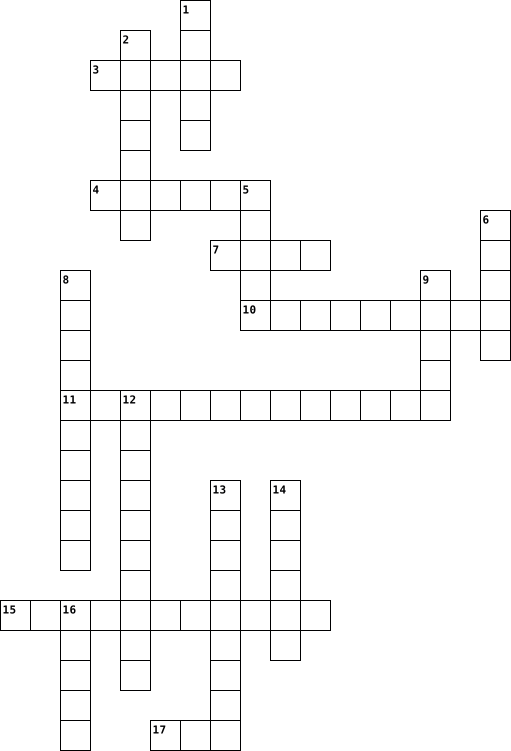
Across
- Earth's "twin"
- A gas giant with vertical rings
- The glowing head of a comet.
- A meteoroid that reaches Earth's surface
- The beginning formation of planets caused by bits of matter colliding and clumping together.
- _________ planets formed from metals and silicate minerals that can withstand the heat of the sun.
- Jovian planets are _______ giants.
Down
- This planet was reclassified as a dwarf planet.
- The second hottest terrestrial planet
- Jupiter's great red spot is a ___________.
- Rocky and metallic material held together by frozen gasses.
- Planets make an ___________ orbit around the Sun.
- Contrary to popular belief, all of the Jovian planets have _______, not just Saturn and Uranus.
- Mercury has no __________ and is very close to the sun making it very hot.
- Recent impact craters on the moon were likely caused by ________.
- The diameter of _________ planets are much greater than terrestrial planets.
- Terrestrial planets are ________ and Earth-like.
17 Clues: Earth's "twin" • The glowing head of a comet. • A gas giant with vertical rings • Jovian planets are _______ giants. • The second hottest terrestrial planet • A meteoroid that reaches Earth's surface • Jupiter's great red spot is a ___________. • This planet was reclassified as a dwarf planet. • Terrestrial planets are ________ and Earth-like. • ...
Space Mind 2016-03-01

Across
- Different appearances on the moon.
- Not a _______ anymore
- terrestrial Planets
- Almost no Atmosphere.
- The Biggest Planet.
- The Planets revolves around it.
- Hits the Earth on an angle
- The sun,_______, and Full Moon Are aligned in perfect line.
- The Path for the Planets
Down
- Divides the Earth into 2 sections
- Study of Stars, Planets and Space
- Keeps the solar system together.
- When we first saw the Earth
- Between Mars and ________.
- From the Greek word "Wanderer"
- Th hottest type of star
- Mostly covered by Water (_____%)
17 Clues: terrestrial Planets • The Biggest Planet. • Not a _______ anymore • Almost no Atmosphere. • Th hottest type of star • The Path for the Planets • Between Mars and ________. • Hits the Earth on an angle • When we first saw the Earth • From the Greek word "Wanderer" • The Planets revolves around it. • Keeps the solar system together. • Mostly covered by Water (_____%) • ...
SpAcE ACE Rat 2026-05-13

Across
- The big star in the sky
- Seventh planet in our solar systum
- Has a tail made out of ice
- The planet you live in
- The first American rocket to the moon (1969)
- Made out of rock, orbits the sun
- First planet from the sun
- Last planet from the sun
- The spherical objects that orbit the sun
- Second planet from the sun
- What is Pluto classified as
- First Soviet capsule that took a human to space (1961)
Down
- What does an astronomer study
- Sixth planet in our solar systum
- The galaxy you live in
- The first planet in the outer planets
- Forth planet from the sun
- The planets that are closest to the sun and end a the asteroid belt
- The planets after the asteroid belt
- The glowy lights, in the sky, you see at night
- The big rock that orbits around earth
21 Clues: The galaxy you live in • The planet you live in • The big star in the sky • Last planet from the sun • Forth planet from the sun • First planet from the sun • Has a tail made out of ice • Second planet from the sun • What is Pluto classified as • What does an astronomer study • Sixth planet in our solar systum • Made out of rock, orbits the sun • Seventh planet in our solar systum • ...
Solar System B 2025-10-31

Across
- Which terrestrial planet has a thick atmosphere and extreme heat?
- What type of planets are large, gaseous, and have many moons?
- Which type of planets typically have more moons?
- Which terrestrial planet supports life?
- What is the region between Mars and Jupiter where many asteroids orbit?
- What icy object has a tail and orbits the Sun?
- What cloud of gas and dust did the solar system form from?
- What type of planets are small, rocky, and have solid surfaces?
- Which terrestrial planet is closest to the Sun?
- What path do planets follow around the Sun?
- Where are most asteroids found in the solar system?
- What system includes the Sun and everything that orbits it?
- What process caused planetesimals to grow into planets?
- What is the spinning of a planet on its axis called?
- Which Jovian planet is famous for its prominent rings?
- Which Jovian planet has strong winds and dark storms?
- What is the solid center of a comet called?
- Which terrestrial planet is known as the Red Planet?
Down
- What event can create meteoroids from asteroids?
- Which type of planets have a solid surface?
- What do Jovian planets have that terrestrial planets mostly lack?
- What shape did the solar nebula take during formation?
- What is the central part of a terrestrial planet called?
- What is a meteoroid often made from?
- Which Jovian planet rotates on its side?
- What feature is formed when a meteoroid hits a planet?
- What small rocky body can become a meteor or meteorite?
- What small bodies formed from dust and rock in the early solar system?
- What force caused the solar system to collapse into a disk?
- What is one major difference between terrestrial and Jovian planets?
- How did the solar system begin to form?
- What forms when a comet gets close to the Sun?
- What type of tail does a comet have besides an ion tail?
- What causes meteoroids to enter Earth’s atmosphere?
- What imaginary line do planets rotate around?
- What formed at the center of the solar nebula?
- Which Jovian planet is the largest in the solar system?
- Which type of planets often have ring systems?
- Which type of planets have higher average density?
- What are terrestrial planets primarily made of?
- What are Jovian planets primarily made of?
41 Clues: What is a meteoroid often made from? • Which terrestrial planet supports life? • How did the solar system begin to form? • Which Jovian planet rotates on its side? • What are Jovian planets primarily made of? • Which type of planets have a solid surface? • What path do planets follow around the Sun? • What is the solid center of a comet called? • ...
Solar System 2025-10-30

Across
- Which terrestrial planet has a thick atmosphere and extreme heat?
- What type of planets are large, gaseous, and have many moons?
- Which type of planets typically have more moons?
- Which terrestrial planet supports life?
- What is the region between Mars and Jupiter where many asteroids orbit?
- What icy object has a tail and orbits the Sun?
- What cloud of gas and dust did the solar system form from?
- What type of planets are small, rocky, and have solid surfaces?
- Which terrestrial planet is closest to the Sun?
- What path do planets follow around the Sun?
- Where are most asteroids found in the solar system?
- What system includes the Sun and everything that orbits it?
- What process caused planetesimals to grow into planets?
- What is the spinning of a planet on its axis called?
- Which Jovian planet is famous for its prominent rings?
- Which Jovian planet has strong winds and dark storms?
- What is the solid center of a comet called?
- Which terrestrial planet is known as the Red Planet?
Down
- What event can create meteoroids from asteroids?
- Which type of planets have a solid surface?
- What do Jovian planets have that terrestrial planets mostly lack?
- What shape did the solar nebula take during formation?
- What is the central part of a terrestrial planet called?
- What is a meteoroid often made from?
- Which Jovian planet rotates on its side?
- What feature is formed when a meteoroid hits a planet?
- What small rocky body can become a meteor or meteorite?
- What small bodies formed from dust and rock in the early solar system?
- What force caused the solar system to collapse into a disk?
- What is one major difference between terrestrial and Jovian planets?
- How did the solar system begin to form?
- What forms when a comet gets close to the Sun?
- What type of tail does a comet have besides an ion tail?
- What causes meteoroids to enter Earth’s atmosphere?
- What imaginary line do planets rotate around?
- What formed at the center of the solar nebula?
- Which Jovian planet is the largest in the solar system?
- Which type of planets often have ring systems?
- Which type of planets have higher average density?
- What are terrestrial planets primarily made of?
- What are Jovian planets primarily made of?
41 Clues: What is a meteoroid often made from? • Which terrestrial planet supports life? • How did the solar system begin to form? • Which Jovian planet rotates on its side? • What are Jovian planets primarily made of? • Which type of planets have a solid surface? • What path do planets follow around the Sun? • What is the solid center of a comet called? • ...
Dwarf Planets 2023-02-02

Across
- resembling a small planet but lacking certain technical criteria that are required for it to be classed as such
- the movement of dwarf planets around the sun
- dwarf planets contain small amounts of
- description of the dwarf planets relatively great size
- belt where all dwarf planets are found
- a celestial body moving in an elliptical orbit around a star
- placed in orbit around dwarf planets to gather data
- the shape of a dwarf planet
- makes distant objects appear nearer,
- largest object in the asteroid belt between Mars and Jupiter, and it's the only dwarf planet located in the inner solar system.
Down
- dwarf planets lack this separating them from other space objects
- Eris is one of the largest known dwarf planets in our solar system. It's about the same size as Pluto but is three times farther from the Sun.
- dwarf planet and the second-largest of what are known as the classical population of Kuiper belt
- most commonly known dwarf planet, used to be a planet
- the place where all existing matter in space
- must be this type of body to be considered a dwarf planet
- dwarf planet that is a member of a group of objects that orbit in a disc-like zone
- where all planets, stars and other objects in our galaxy are found
- the type of telescope used to help discover dwarf planets
19 Clues: the shape of a dwarf planet • makes distant objects appear nearer, • dwarf planets contain small amounts of • belt where all dwarf planets are found • the movement of dwarf planets around the sun • the place where all existing matter in space • placed in orbit around dwarf planets to gather data • most commonly known dwarf planet, used to be a planet • ...
Solar System and Night Sky 2023-07-01

Across
- The ISS is an example of a ....
- The outer planets are larger and ........ than the inner planets
- The outer planets have a lot more ...... than the inner planets
- The ........ planets are made from rock (terrestrial)
- Our solar system formed approx. 5 ....... years ago
- ...... pulled dust together to make our solar system
- This at the centre of our universe
- Big formations of ice in space
Down
- We are in the milkyway .......
- The closest planet to the Sun
- This used to be classified as a planet, but is now a dwarf planet
- This is Earth's only natural satellite
- The planet found in between Jupiter and Uranus
- The biggest planet in our solar system
- This planet is found furthest away from the Sun
- In our solar system, planets ....... the Sun
- The ...... belt is found right at the edge of our solar system
- The planet found in between Mercury and Earth
- The outer planets are known as the ... giants
19 Clues: The closest planet to the Sun • We are in the milkyway ....... • Big formations of ice in space • The ISS is an example of a .... • This at the centre of our universe • This is Earth's only natural satellite • The biggest planet in our solar system • In our solar system, planets ....... the Sun • The planet found in between Mercury and Earth • ...
Planets 2022-11-04

Across
- coldest planet in the Solar System
- gas that absorbs red light causing Uranus to appear blue
- largest terrestrial planet
- largest planet in the solar system
- planet that spins clockwise (backward)
- tallest mountain in the Solar System
- one-third the size of Earth
- one of the moons of Mars
- axis so tilted, planet appears to spin sideways
- Planet with the hottest surface temperature
Down
- largest moon in the Solar System
- smallest outer planet
- number of moons orbiting Saturn
- dwarf planet made of mostly ice, 5 moons
- Pluto's largest moon
- largest of the dwarf planets
- terrestrial planet with the most moons
- smallest terrestrial planet
- terrestrial planet half the size of Earth
19 Clues: Pluto's largest moon • smallest outer planet • one of the moons of Mars • largest terrestrial planet • smallest terrestrial planet • one-third the size of Earth • largest of the dwarf planets • number of moons orbiting Saturn • largest moon in the Solar System • coldest planet in the Solar System • largest planet in the solar system • tallest mountain in the Solar System • ...
Planets 2023-05-02

Across
- a type of planet too small to be considered a planet
- the dwarf planet that many consider a planet
- the farthest planet from the sun
- the closest planet to the sun
- a celestial body that produces light and energy
- the planet we live on
- the planet that spins sideways
- the hottest planet
- the largest planet
Down
- a body with an immense gravitational pull
- a body that orbits a planet
- the planet with the most rings
- a device used to see into the sky
- the force that pulls things together
- the "red planet"
- our star we orbit around
16 Clues: the "red planet" • the hottest planet • the largest planet • the planet we live on • our star we orbit around • a body that orbits a planet • the closest planet to the sun • the planet with the most rings • the planet that spins sideways • the farthest planet from the sun • a device used to see into the sky • the force that pulls things together • ...
Planets 2022-01-24

Across
- Form a belt in Solar System
- We can find this on Earth or Venus
- Thick on Venus, thin on Mercury
- Ingredient of life
- The moon
- A metallic planet
Down
- Term for objects smaller than planet
- The center of solar system
- Orbiting the planet Mars
- The satellite of Earth
- Water on Mars
- Hottest planet
- Path of the planet
- A unit to time one successful orbit around the Sun
- Makes the planet Mars reddish in color
- A big object between Mars and Jupiter
16 Clues: The moon • Water on Mars • Hottest planet • A metallic planet • Path of the planet • Ingredient of life • The satellite of Earth • Orbiting the planet Mars • The center of solar system • Form a belt in Solar System • Thick on Venus, thin on Mercury • We can find this on Earth or Venus • Term for objects smaller than planet • A big object between Mars and Jupiter • ...
Dwarf Planets 2023-03-03

Across
- most commonly known dwarf planet, used to be a planet
- dwarf planets contain small amounts of
- dwarf planets lack this separating them from other space objects
- the shape of a dwarf planet
- the type of telescope used to help discover dwarf planets
- the place where all existing matter in space
- must be this type of body to be considered a dwarf planet
- resembling a small planet but lacking certain technical criteria that are required for it to be classed as such
- belt where all dwarf planets are found
- _____is one of the largest known dwarf planets in our solar system. It's about the same size as Pluto but is three times farther from the Sun.
Down
- dwarf planet and the second-largest of what are known as the classical population of Kuiper belt
- a celestial body moving in an elliptical orbit around a star
- description of the dwarf planets relatively great size
- where all planets, stars and other objects in our galaxy are found
- makes distant objects appear nearer,
- placed in orbit around dwarf planets to gather data
- dwarf planet that is a member of a group of objects that orbit in a disc-like zone
- largest object in the asteroid belt between Mars and Jupiter, and it's the only dwarf planet located in the inner solar system.
- the movement of dwarf planets around the sun
19 Clues: the shape of a dwarf planet • makes distant objects appear nearer, • dwarf planets contain small amounts of • belt where all dwarf planets are found • the movement of dwarf planets around the sun • the place where all existing matter in space • placed in orbit around dwarf planets to gather data • most commonly known dwarf planet, used to be a planet • ...
Planets 2020-12-04

Across
- the destroyer of everything
- hehe funny planet
- a beautiful interstellar cloud of dust
- the famous ring planet
- funny planet's twin
- all existence lives in it
Down
- make a wish it's a shooting star.
- freddie...
- the planet that deflects asteroids away from earth
- our natural source of light
- many solar systems lives in it
- the smallest "planet" on our solar system
- the second brightest natural object in Earth's night sky
- the chocolate bar or the planet next to earth
- the thing that destroyed our dinos
- the place where we live
16 Clues: freddie... • hehe funny planet • funny planet's twin • the famous ring planet • the place where we live • all existence lives in it • the destroyer of everything • our natural source of light • many solar systems lives in it • make a wish it's a shooting star. • the thing that destroyed our dinos • a beautiful interstellar cloud of dust • the smallest "planet" on our solar system • ...
Page 1 of 100 Next