
plate tectonics Crossword Puzzles
Plate Motion 2025-11-05

Across
- The dinosaur fossil that was found on both South America and Africa because of plate tectonics.
- Moving toward the same place.
- One of the very large sections of hard, solid rock that make up Earth’s outer layer.
- The place where two plates meet.
- Moving apart in different directions
- What is created by divergent plates moving apart.
- One of the continents that the Mesosaurus fossils were found on.
- Something we observe to be similar over and over again.
Down
- The semi-fluid part of Earth’s layers, located right underneath the lithosphere.
- The very outer layer of the Earth.
- The very center of the Earth, made of hot solid iron.
- The layer of soft, solid rock underneath Earth’s plates.
- The sudden shaking of Earth’s surface.
- The force that moves Earth’s plates.
- What Earth’s outer layer is made out of under the ocean and land.
- What scientist Alfred Wegener named the supercontinent that was here long ago.
- How often or fast something happens.
- To examine in detail for a purpose.
- A long, deep indentation.
- The top part of the Earth that is thin and solid.
20 Clues: A long, deep indentation. • Moving toward the same place. • The place where two plates meet. • The very outer layer of the Earth. • To examine in detail for a purpose. • The force that moves Earth’s plates. • How often or fast something happens. • Moving apart in different directions • The sudden shaking of Earth’s surface. • What is created by divergent plates moving apart. • ...
Plate Motion 2025-11-05

Across
- The top part of the Earth that is thin and solid.
- The very center of the Earth, made of hot solid iron.
- The dinosaur fossil that was found on both South America and Africa because of plate tectonics.
- The very outer layer of the Earth.
- Moving apart in different directions
- What is created by divergent plates moving apart.
- Something we observe to be similar over and over again.
- One of the continents that the Mesosaurus fossils were found on.
- How often or fast something happens.
- Moving toward the same place.
Down
- A long, deep indentation.
- The semi-fluid part of Earth’s layers, located right underneath the lithosphere.
- The sudden shaking of Earth’s surface.
- The place where two plates meet.
- The force that moves Earth’s plates.
- One of the very large sections of hard, solid rock that make up Earth’s outer layer.
- What scientist Alfred Wegener named the supercontinent that was here long ago.
- What Earth’s outer layer is made out of under the ocean and land.
- The layer of soft, solid rock underneath Earth’s plates.
- To examine in detail for a purpose.
20 Clues: A long, deep indentation. • Moving toward the same place. • The place where two plates meet. • The very outer layer of the Earth. • To examine in detail for a purpose. • The force that moves Earth’s plates. • Moving apart in different directions • How often or fast something happens. • The sudden shaking of Earth’s surface. • The top part of the Earth that is thin and solid. • ...
techtonic plates 2021-11-30

Across
- valley- another name for the deep crack that splits fault-block mid-ocean ridge mountains
- the process in which crust pushes downward into the mantle at a faultline
- a multi-word term used to describe the movement of oceanic crust as a divergent boundary.
- a german scientist who was the first person to build a scientific case to support the Theory of Continental Drift
- currents- circulatory patterns of heat in the magma believed to be the riving force behind plate movement
- a large segment of earth crust that slowly moves
- the branch of geology that deals with the movement that shapes the earth's crust
Down
- a type of fault where the crust moves sideways past each other
- a type of plate boundary where the plates slowly move apart from each other
- the preserved remains of ancient, once-living organisms
- ocean ridges- ocean bottom mountain ranges split down the middle by a deep crack
- v-shaped valleys that are the deepest parts of the oceans where subduction occurs
- a giant prehistoric landmass where all seven modern continents fused together
- the uppermost solid part of Earth's crust
- a type of plate boundary where the plates slowly collide into each other
15 Clues: the uppermost solid part of Earth's crust • a large segment of earth crust that slowly moves • the preserved remains of ancient, once-living organisms • a type of fault where the crust moves sideways past each other • a type of plate boundary where the plates slowly collide into each other • ...
Module 7.1 & Module 7.2 Vocabulary 2022-02-14

Across
- The theory that Earth’s surface is broken into large, rigid pieces that move with respect to each other.
- Magma that erupts onto Earth's surface.
- Wegener’s hypothesis that all continents were once connected in a single large landmass that broke apart about 200 million years ago and drifted slowly to their current positions.
- The name given to a supercontinent that began to break apart approximately 200 million years ago.
- The long, narrow mountain range on the ocean floor; formed by magma at divergent plate boundaries.
Down
- The process by which new oceanic crust forms along a mid-ocean ridge and older oceanic crust moves away from the ridge.
- Molten rock stored below Earth's surface.
- A deep, underwater trough created by one plate subducting under another plate at a convergent plate boundary.
8 Clues: Magma that erupts onto Earth's surface. • Molten rock stored below Earth's surface. • The name given to a supercontinent that began to break apart approximately 200 million years ago. • The long, narrow mountain range on the ocean floor; formed by magma at divergent plate boundaries. • ...
Earth's dynamic system vocabulary 2019-02-11

Across
- vents in earth's crust through which molten rock flows
- The process that occurs when one tectonic plate moves under another tectonic plate
- The material formed from rocks broken down by weathering
- The mechanical and chemical process that changes earth's surface over time
- the partial melted portion of the mantle below the lithosphere
- The downhill movement of a large mass of rocks or soil due to gravity
- A boundary where two plates move away from each other
- The process of breaking down rocks without changing the composition of the rock
- Large masses of ice, formed by snow accumulation on land, that move slowly across Earth's surface
- Two plates that slide past each other
- tectonics Earth's surface is broken into large rigid pieces that move with respect to each other
Down
- The circulation of fluids caused by differences in density and thermal energy
- Long narrow mountains formed by magma
- A boundary where two plates move towards each other]
- The vibrations caused by the rupture and sudden movement of rocks along a break or crack in earth's crust
- The crust and uppermost part of the mantle
- The process that changes the composition of rocks
- The moving of weathered material or sediment
- A crack or a fracture in earth's crust along which movement occurs
- molten rock stored beneath earth's surface
- Magma that erupts onto Earth's surface
- the laying down or settling of eroded material
22 Clues: Long narrow mountains formed by magma • Two plates that slide past each other • Magma that erupts onto Earth's surface • The crust and uppermost part of the mantle • molten rock stored beneath earth's surface • The moving of weathered material or sediment • the laying down or settling of eroded material • The process that changes the composition of rocks • ...
Restless Earth vocab 2024-04-23

Across
- Tectonic plates move away from each other, usually forms new crust and rift valleys
- The semi-fluid layer of the mantle where convection currents happen
- Hot material rises, cooler material sink. It drives plate tectonics
- Rock formed when lava or magma cools and hardens
- Fracture or zones of weakness in the Earth's crust
- Large, rigid pieces of earth's lithosphere that move and interact with each other along plate boundaries
- A group of the same species living in the same area
- Tectonic plates move toward each other, usually forms mountains and volcanoes
- Includes the crust and upper part of the mantle, and is divided into tectonic plates
- formed as a result of high temperature and pressure deep within Earth changing a rock that already existed
Down
- Extinction events that occur over a longer time period
- sudden events that led to a mass extinction
- Where tectonic plates SLIDE past each other. Causes earthquakes
- Name of the ancient super continent when it was all one landmass
- Instruments used to measure and record seismic waves
- New oceanic crust is formed as tectonic plates pull apart and magma rises
- An opening in the Earth's crust through which molten rock is pushed out and creates new rock
- Deep, elongated depressions in the ocean, often associated with subduction zones.
- Formed at plate boundaries usually when plates collide
- Located between the mantle and the outer core
- Forms after weathering and erosion when sediments compact and cement
21 Clues: sudden events that led to a mass extinction • Located between the mantle and the outer core • Rock formed when lava or magma cools and hardens • Fracture or zones of weakness in the Earth's crust • A group of the same species living in the same area • Instruments used to measure and record seismic waves • Extinction events that occur over a longer time period • ...
restless earth vocabulary crossword 2024-04-12

Across
- large, rigid pieces of the Earth's lithosphere that move and interact with each other alone plate boundaries
- Where tectonic plates slide past each other. Causes earthquakes
- new oceanic crust is formed as tectonic plates pull apart and magma rises
- Includes the crust and upper part of the mantle, and is divided into tectonic plates
- an opening in the earth's crust through which molten rock is pushes out and creates rock
- sudden events led to amass extinction
- fractures or zones of weakness in earth;s crust
- formed at plate boundaries usually when plates collide
- formed when lava or magma cools and hardens
- The semi-fluid layer of the mantle where convection currents happen
- Forms after weathering and erosion when sediments compact and cement
- Hot material rises, cooler materials sink, it drives plate tectonics
- Deep, elongated depressions in the ocean, often associated with subduction zones
Down
- Formed as a result of high temperature and pressure deep within earth changing a rock that already existed
- Instruments used to measure and record seismic waves
- tectonic plates move away from each other, usually forms new crust and rift valleys
- Events: Extinction events that occur over a larger time period
- A group of the same species living in the same area
- tectonic plates move toward each other, usually forms mountains and volcanoes
- name of the ancient supercontinent when it was all one landmass
- Located between the mantle and outer core
21 Clues: sudden events led to amass extinction • Located between the mantle and outer core • formed when lava or magma cools and hardens • fractures or zones of weakness in earth;s crust • A group of the same species living in the same area • Instruments used to measure and record seismic waves • formed at plate boundaries usually when plates collide • ...
Science vocab. 2024-04-12

Across
- Large, rigid pieces of the Earth's lithosphere that move and interact with each other along the plate boundaries
- Formed at plate boundaries usually when plates collide
- Extinction events that occur over a longer period of time
- a group of same species living in the same area
- Located between the mantle and the outer core
- Instruments used to measure and record seismic waves
- New oceanic crust is formed as tectonic plates pull apart and magma rises
- Forms after weathering and erosion when sediments compact and cement
- Rock formed when lava or magma cools and hardens
- Tectonic plates move toward each other, usually forms mountains and volcanoes
- Name of the ancient supercontinent when it was all one landmass
- Sudden events that led to a mass extinction
Down
- Tectonic plates move away from each other, usually forms new crust and rift valleys
- Hot material rises, cooler materials sink. it drives plate tectonics
- Formed as a result of high temperature and pressure deep within earth changing a rock that already existed
- Where tectonic plates slide PAST each other. Causes earthquakes
- Includes the crust and upper part of the mantle, and is divided into tectonic plates
- Fractures or zones of weakness in the Earth's crust
- The semi-fluid layer of the mantle where convection currents happen
- Deep, elongated depressions in the ocean, often associated with subduction zones.
- An opening in the Earth's crust through which molten rock is pushed out and creates new rock
21 Clues: Sudden events that led to a mass extinction • Located between the mantle and the outer core • a group of same species living in the same area • Rock formed when lava or magma cools and hardens • Fractures or zones of weakness in the Earth's crust • Instruments used to measure and record seismic waves • Formed at plate boundaries usually when plates collide • ...
Restless Earth Vocab 2024-04-12

Across
- tectonic plates move away from each other, usually forms mountains and volcanoes.
- hot material rises, cooler material sinks. It drives plate tectonics.
- located between the mantle and the outer core.
- name of the ancient supercontinent when it was all one landmass.
- Extinction Events that occur over a longer period of time.
- deep, elongated depressions in the ocean, often associated with subduction zones.
- new oceanic crust is formed as tectonic plates pull apart and magma rises.
- includes the crust and upper part of the mantle, and is divided into tectonic plates.
Down
- large, rigid pieces of Earth's lithosphere that move and interact with each other along plate boundaries.
- rock formed when lava or magma cools and hardens.
- forms after weathering and erosion when sediments compact and cement.
- formed at plate boundaries usually when plates collide.
- sudden events that led to a mass extinction
- tectonic plates move toward each other, usually forms mountains and volcanoes
- where tectonic plates SLIDE past each other. Causes earthquakes.
- formed as a result of high temperature and pressure deep within Earth changing a rock that already existed
- the semi-fluid layer of the mantle and where convection currents happen.
- a groups of the same species living in the same area
- instruments used to measure and record seismic waves
- an opening in the Earth's crust through which molten rock is pushed out and creates new rock.
- fractures or zones of weakness in the Earth's crust
21 Clues: sudden events that led to a mass extinction • located between the mantle and the outer core. • rock formed when lava or magma cools and hardens. • fractures or zones of weakness in the Earth's crust • a groups of the same species living in the same area • instruments used to measure and record seismic waves • formed at plate boundaries usually when plates collide. • ...
Rest Earth Vocabulary list 2024-04-12

Across
- name of the ancient supercontinent when it was all one landmass
- large, rigid pieces of the earth's lithosphere that move and interact with each other along plate boundaries
- hot material rises, cooler materials sink(drives plate tectonics)
- sudden events that led to a mass extinction
- tectonic plates move away from each other(usually forms new crust and rift valleys)
- formed as a result of high temperature and pressure deep within the earth changing a rock that already existed
- located between the mantle and the outer core
- fractures or zones of weakness in the earth's crust
- formed at plate boundaries usually when plates collide
- an opening in the earth's crust through which molten rock is pushed out and creates new rock
Down
- extinction events that occur over a longer time period
- a group of the same species living in the same area
- forms after weathering and erosion when sediments compact and cement
- the semi-fluid layer of the mantle where convection currents happen
- new oceanic crust is formed as tectonic plates pull apart and magma rises
- tectonic plates move toward each other(usually forms mountains and volcanoes)
- includes the crust and upper part of the mantle and is divided into tectonic plates
- deep, elongated depressions in the ocean, often associated with subduction zones
- instruments used to measure and record seismic waves
- rock formed when lava or magma cools and hardens
- where tectonic plates slide past each other(causes earthquakes)
21 Clues: sudden events that led to a mass extinction • located between the mantle and the outer core • rock formed when lava or magma cools and hardens • a group of the same species living in the same area • fractures or zones of weakness in the earth's crust • instruments used to measure and record seismic waves • extinction events that occur over a longer time period • ...
Rest Earth Vocabulary list 2024-04-12

Across
- name of the ancient supercontinent when it was all one landmass
- large, rigid pieces of the earth's lithosphere that move and interact with each other along plate boundaries
- hot material rises, cooler materials sink(drives plate tectonics)
- sudden events that led to a mass extinction
- tectonic plates move away from each other(usually forms new crust and rift valleys)
- formed as a result of high temperature and pressure deep within the earth changing a rock that already existed
- located between the mantle and the outer core
- fractures or zones of weakness in the earth's crust
- formed at plate boundaries usually when plates collide
- an opening in the earth's crust through which molten rock is pushed out and creates new rock
Down
- extinction events that occur over a longer time period
- a group of the same species living in the same area
- forms after weathering and erosion when sediments compact and cement
- the semi-fluid layer of the mantle where convection currents happen
- new oceanic crust is formed as tectonic plates pull apart and magma rises
- tectonic plates move toward each other(usually forms mountains and volcanoes)
- includes the crust and upper part of the mantle and is divided into tectonic plates
- deep, elongated depressions in the ocean, often associated with subduction zones
- instruments used to measure and record seismic waves
- rock formed when lava or magma cools and hardens
- where tectonic plates slide past each other(causes earthquakes)
21 Clues: sudden events that led to a mass extinction • located between the mantle and the outer core • rock formed when lava or magma cools and hardens • a group of the same species living in the same area • fractures or zones of weakness in the earth's crust • instruments used to measure and record seismic waves • extinction events that occur over a longer time period • ...
Restless Earth Practice 2024-04-12

Across
- Instruments used to measure and record seismic waves
- formed at plate boundaries usually when plates collide
- Included the crust and the upper part of the mantel, and is divided into tectonic plates
- Located between the mantle and the outer core
- form after weathering and erosion when sediments compact and cement
- A group of the same species living in the same area
- events that lead to mass extinction
- cycles Hot material rises, cooler materials sink. IT drives plate tectonics
- The semi-fluid layer of the mantle where convection currents happen
- Tectonic plates move toward each other usually forms mountains and volcanoes
- Fracture zones of weakness in the Earths crust
Down
- Tectonic plates slide past each other. Causes earthquakes
- Tectonic plates move away from each other, usually forms new crust and rift valleys
- Rock formed when lava or magma cools and hardens; crystals
- new oceanic crust is formed as tectonic plates pull apart and magma rises
- Extinction events that occur over a longer time period
- Formed as a result of high temperature and pressure deep within earth changing a rock that already existed
- Plates Large,rigid pieces of the Earths lithosphere that move and interact with each other along plate boundaries
- Deep, elongated depressions in the ocean, often associated with subduction zones
- An opening in the Earths crust through which molten rock is pushed out and creates new rocks
- Name of the ancient super continent when it was all one landmass
21 Clues: events that lead to mass extinction • Located between the mantle and the outer core • Fracture zones of weakness in the Earths crust • A group of the same species living in the same area • Instruments used to measure and record seismic waves • formed at plate boundaries usually when plates collide • Extinction events that occur over a longer time period • ...
restless earth vocab 2024-04-12

Across
- extinction events that occur over a long time period
- hot material rises,cooler materials sink. it drives plate tectonics
- deep, elongated depressions in the ocean, often associated with subduction zones.
- name of the ancient supercontinent when it was all one land mass
- new ocean crust is formed as tectonic plates pull apart and magma rises
- fractures or zones of weakness in the earths crust
- includes the crust and upper part of the mantle, and is divided into tectonic plates
- formed at the plate boundaries usually when plates collide
- tectonic plates move away from each other, usually forms new crust and rift valleys
- a group of the same species living in the same area
- instruments used to measure and record seismic waves
- an opening in the earths crust through which molten rock is pushed out and creates new rock
Down
- sudden events that led to mass extinction
- tectonic plates move toward eachtoher, usually forms mountains and volcanoes
- located between the mantle and the outer core
- large,rigid pieces of the earths lithosphere that move and interact with each other along plate boundaries
- where tectonic plates slide past eachtoher. causes earthquakes
- the semi-fluid layer of the mantle where convection currents happen
- forms after weathering and erosion when sediments compact and cement
- rock formed when lava or magma cools and hardens
- formed as a result of high temperature and pressure deep within earth changing a rock that already existed
21 Clues: sudden events that led to mass extinction • located between the mantle and the outer core • rock formed when lava or magma cools and hardens • fractures or zones of weakness in the earths crust • a group of the same species living in the same area • extinction events that occur over a long time period • instruments used to measure and record seismic waves • ...
restless earth vocab 2024-04-12

Across
- extinction events that occur over a long time period
- hot material rises,cooler materials sink. it drives plate tectonics
- deep, elongated depressions in the ocean, often associated with subduction zones.
- name of the ancient supercontinent when it was all one land mass
- new ocean crust is formed as tectonic plates pull apart and magma rises
- fractures or zones of weakness in the earths crust
- includes the crust and upper part of the mantle, and is divided into tectonic plates
- formed at the plate boundaries usually when plates collide
- tectonic plates move away from each other, usually forms new crust and rift valleys
- a group of the same species living in the same area
- instruments used to measure and record seismic waves
- an opening in the earths crust through which molten rock is pushed out and creates new rock
Down
- sudden events that led to mass extinction
- tectonic plates move toward eachtoher, usually forms mountains and volcanoes
- located between the mantle and the outer core
- large,rigid pieces of the earths lithosphere that move and interact with each other along plate boundaries
- where tectonic plates slide past eachtoher. causes earthquakes
- the semi-fluid layer of the mantle where convection currents happen
- forms after weathering and erosion when sediments compact and cement
- rock formed when lava or magma cools and hardens
- formed as a result of high temperature and pressure deep within earth changing a rock that already existed
21 Clues: sudden events that led to mass extinction • located between the mantle and the outer core • rock formed when lava or magma cools and hardens • fractures or zones of weakness in the earths crust • a group of the same species living in the same area • extinction events that occur over a long time period • instruments used to measure and record seismic waves • ...
Earth's Systems 2024-04-12

Across
- Fractures or zones of weakness in the Earth's crust
- formed at plate boundaries usually when plates collide.
- Name of the ancient supercontinent when it was all one landmass.
- Formed as a result of high temperature and pressure deep within earth changing a rock that already existed.
- Deep, elongated depressions in the ocean, often associated with subduction zones.
- instruments used to measure and record seismic waves.
- Sudden events that led to a mass extinction.
- tectonic plates SLIDE past each other. Causes earthquakes.
- An opening in the Earth's crust though which molten rock is pushed out and creates new rock.
Down
- Includes the crust and upper part of the mantle, and is divided into tectonic plates.
- Hot materials rises, cooler materials sink. It drives plate tectonics.
- Extinction Events that occur over a longer time period.
- located between the mantle and the outer core.
- tectonic plates move toward each others, usually forms mountains and volcanoes.
- new oceanic crust is formed as tectonic plates pull apart and magma rises.
- Large, rigid pieces of the Earth's lithosphere that move and interact with each other along plate boundaries.
- The semi-fluid layer of the mantle where convection currents happen.
- A group of the same species living in the same area.
- tectonic plates move away from each other, usually forms new crust and rift valleys.
- Forms after weathering and erosion when sediments compact and cement.
- Rock formed when lave or magma cools and hardens.
21 Clues: Sudden events that led to a mass extinction. • located between the mantle and the outer core. • Rock formed when lave or magma cools and hardens. • Fractures or zones of weakness in the Earth's crust • A group of the same species living in the same area. • instruments used to measure and record seismic waves. • Extinction Events that occur over a longer time period. • ...
Restless Earth 2024-04-12

Across
- new oceanic crust is formed as tectonic plates pull apart and magma rises
- sudden events that lead to mass extinction
- name of ancient supercontinent when it was all one land mass
- located between the mantle and the outer core
- a group of the same species living in the same area
- formed as a result of high temperature and pressure deep within Earth changing a rock that already existed
- fractures or zones of weakness in the Earth's crust
- tectonic plates move toward each other usually forms mountains and volcanoes
- an opening at the Earth's crust through which molten rock is pushed out and creates new rock
- plates large rigid peices of thr earths lithosphere that move and interact with each other along plate boundaries
- where tectonic plates slide past each other causes eathquakes
- deep enlongated depressions in the ocean often associated with subduction zones
Down
- forms after weathering and erosion when sedimentscompact and cement
- extinction events that occur over a longer period of time
- tectonic plates move away from eachother usually forms new crust and rift valleys
- includes the crust and upper part of the mantle and is divided into tectonic plates
- rock formed when lava or magma cools and hardens
- the semi-fluid layer of the mantle where convection currents happen
- instruments used to measure and recors seismic waves
- formed at plate boundaries usually when plates collide
- hot material rises cooler materials sink it drives plate tectonics
21 Clues: sudden events that lead to mass extinction • located between the mantle and the outer core • rock formed when lava or magma cools and hardens • a group of the same species living in the same area • fractures or zones of weakness in the Earth's crust • instruments used to measure and recors seismic waves • formed at plate boundaries usually when plates collide • ...
Pikmin by Valeria Valencia 2026-03-04

Across
- The layer of hot, solid material between the crust and core.
- The rigid outer layer of the Earth, consisting of the crust and upper mantle.
- The vertical elevation of the Earth's surface
- Movement in the mantle caused by heat differences, driving plate movement
- The point on the surface directly above an earthquake's origin.
- Molten or semi-molten rock beneath the surface.
- A vent in the crust where magma and gases erupt.
- Massive, rigid, moving pieces of the Earth's lithosphere.
- zones cold oceanic lithosphere sinks back into the mantle and is recycled
- A volcanically active area far from a plate boundary.
- The process where one tectonic plate sinks beneath another.
- Where two plates move away from each other.
- Vibrations caused by sudden movement of rock along a fault.
Down
- Hypothesis that continents move slowly across the Earth's surface.
- Process forming new oceanic crust at mid-ocean ridges.
- Where two plates move toward each other.
- tectonics the understanding that the top layer or lithosphere of the Earth's crust is divided into many large rocky plates
- Boundary Where two plates slide past each other horizontally.
- The ancient supercontinent that included all of Earth's landmasses
- The outermost layer of the Earth.
- The soft, plastic layer in the upper mantle that the plates move on.
- Triggered by large, underwater earthquakes or volcanic eruptions.
- An underwater mountain chain formed by divergent plates.
- A deep valley formed where two plates move apart.
- A break in Earth's crust along which movement occurs.
25 Clues: The outermost layer of the Earth. • Where two plates move toward each other. • Where two plates move away from each other. • The vertical elevation of the Earth's surface • Molten or semi-molten rock beneath the surface. • A vent in the crust where magma and gases erupt. • A deep valley formed where two plates move apart. • ...
Tectonic plates 2026-03-06

Across
- The layer of hot, solid material between the crust and core.
- The rigid outer layer of the Earth, consisting of the crust and upper mantle.
- The vertical elevation of the Earth's surface
- Movement in the mantle caused by heat differences, driving plate movement
- The point on the surface directly above an earthquake's origin.
- Molten or semi-molten rock beneath the surface.
- A vent in the crust where magma and gases erupt.
- Massive, rigid, moving pieces of the Earth's lithosphere.
- zones cold oceanic lithosphere sinks back into the mantle and is recycled
- A volcanically active area far from a plate boundary.
- The process where one tectonic plate sinks beneath another.
- Where two plates move away from each other.
- Vibrations caused by sudden movement of rock along a fault.
Down
- Hypothesis that continents move slowly across the Earth's surface.
- Process forming new oceanic crust at mid-ocean ridges.
- Where two plates move toward each other.
- tectonics the understanding that the top layer or lithosphere of the Earth's crust is divided into many large rocky plates
- Boundary Where two plates slide past each other horizontally.
- The ancient supercontinent that included all of Earth's landmasses
- The outermost layer of the Earth.
- The soft, plastic layer in the upper mantle that the plates move on.
- Triggered by large, underwater earthquakes or volcanic eruptions.
- An underwater mountain chain formed by divergent plates.
- A deep valley formed where two plates move apart.
- A break in Earth's crust along which movement occurs.
25 Clues: The outermost layer of the Earth. • Where two plates move toward each other. • Where two plates move away from each other. • The vertical elevation of the Earth's surface • Molten or semi-molten rock beneath the surface. • A vent in the crust where magma and gases erupt. • A deep valley formed where two plates move apart. • ...
Get to Know your School! 2022-09-01

Across
- Complete the phrase "With ____ you can do anything"
- 16th king of France
- 4th phase of Mitosis
- Who is at the Docking Station?
- element Ne
- 3rd Book Talk benefit "Build ____ Skills"
- known as the "father of Mexican Independence"
- first name of the author of The Quiet Place
- Student of the Month in March 2022
- Plate Tectonics Poster--type of boundary that occurs when plates slide past each other
Down
- 3rd step of the Scientific Method
- figurative language that gives human qualities to objects
- Complete the sentence "Real ___ for Real Life"
- CTE pathway--first pathway listed
- number of fishes in Mr. Teddy's fish tank
- Battle in 1863
16 Clues: element Ne • Battle in 1863 • 16th king of France • 4th phase of Mitosis • Who is at the Docking Station? • 3rd step of the Scientific Method • CTE pathway--first pathway listed • Student of the Month in March 2022 • 3rd Book Talk benefit "Build ____ Skills" • number of fishes in Mr. Teddy's fish tank • first name of the author of The Quiet Place • ...
Earths Dynamic forces crossword puzzle 2024-10-22

Across
- A location where magma rises from deep within the Earth and can cause volcanic activity, often in the middle of a tectonic plate.
- any of Earth’s main continuous areas of land, such as Africa, Asia, and North America
- moving toward the same place
- Drift: The gradual movement of continents across the Earth’s surface over geological time.
- a diagram that shows what the inside of something looks like
- water
- activity: any of the many processes (such as eruptions and lava flows) in which gas, lava, and ash are pushed out on the surface of the Earth
- the sudden pushing out of something, such as lava from a volcano
- Currents: The movement of fluid in the mantle caused by the heat from the Earth's core, driving plate tectonics.
- the outside or top layer of something
- how often or fast something happens
- boundary: the place where two plates meet
- a long, deep indentation in the ocean floor formed when two plates move together
Down
- hot liquid rock on the surface of Earth
- a set of interacting parts forming a complex whole
- A large sea wave caused by an underwater earthquake, volcanic eruption, or landslide.
- moving apart in different directions
- hot liquid rock below the surface of Earth
- ridge: an underwater mountain range formed when two plates move apart
- Spreading: The process by which new oceanic crust is formed at mid-ocean ridges and slowly moves away from the ridge.
- where two of the tectonic plates slide alongside each other.
- the slow pulling apart of land that is caused by plate movement
- when an oceanic plate runs into a continental plate and slides beneath it
- the layer of soft, solid rock underneath Earth’s plates
- a feature that forms on the surface of a planet, such as a mountain, channel, or sand dune
- The rigid outer layer of the Earth, including the crust and the upper mantle, which is broken into tectonic plates.
- layer: Earth’s outermost layer of hard, solid rock that is underneath the soil, vegetation,
- a sudden shaking of Earth’s surface
- Plates: Large slabs of Earth’s lithosphere that move over the mantle.
- one of the very large sections of hard, solid rock that make up Earth’s outer layer
- Line: A crack in the Earth's crust, typically associated with plate boundaries.
- Waves: Waves of energy that travel through the Earth as a result of an earthquake.
32 Clues: water • moving toward the same place • a sudden shaking of Earth’s surface • how often or fast something happens • moving apart in different directions • the outside or top layer of something • hot liquid rock on the surface of Earth • boundary: the place where two plates meet • hot liquid rock below the surface of Earth • a set of interacting parts forming a complex whole • ...
Plate Techtonics 2017-04-20

Across
- the plates move apart
- core/ solid innermost part of the earth
- melted rock beneath the ground
- core/ liquid part of the core
- the plates collide
- that records the intensity,duration,and nature of an earthquake
- continent
- they move past each other
- where the earthquake begins
- layer of the earth
- melted rock on the surface
- shaking or movement of the earth
Down
- in rocks
- tectonics/theory that the earth is made of moving plates
- of energy released by an earthquake
- directly above the focus of the earthquake
- earthquake after the main earthquake
- of the earth between the crust and the core
- in the rock
19 Clues: in rocks • continent • in the rock • the plates collide • layer of the earth • the plates move apart • they move past each other • melted rock on the surface • where the earthquake begins • core/ liquid part of the core • melted rock beneath the ground • shaking or movement of the earth • of energy released by an earthquake • earthquake after the main earthquake • ...
crossword puzzle 2024-10-22

Across
- A location where magma rises from deep within the Earth and can cause volcanic activity, often in the middle of a tectonic plate.
- any of Earth’s main continuous areas of land, such as Africa, Asia, and North America
- that move toward the same place
- Drift: The gradual movement of continents across the Earth’s surface over geological time.
- a diagram that shows what the inside of something looks like
- water
- activity: any of the many processes (such as eruptions and lava flows) in which gas, lava, and ash are pushed out on the surface of the Earth
- the sudden pushing out of something, such as lava from a volcano
- Currents: The movement of fluid in the mantle caused by the heat from the Earth's core, driving plate tectonics.
- the outside or top layer of something
- how often or fast something happens
- boundary: the place where two plates meet
- a long, deep indentation in the ocean floor formed when two plates move together
Down
- hot liquid rock on the surface of Earth
- a set of interacting parts forming a complex whole
- A large sea wave caused by an underwater earthquake, volcanic eruption, or landslide.
- moving apart in different directions
- hot liquid rock below the surface of Earth
- ridge: an underwater mountain range formed when two plates move apart
- Spreading: The process by which new oceanic crust is formed at mid-ocean ridges and slowly moves away from the ridge.
- where two of the tectonic plates slide alongside each other.
- the slow pulling apart of land that is caused by plate movement
- when an oceanic plate runs into a continental plate and slides beneath it
- the layer of soft, solid rock underneath Earth’s plates
- a feature that forms on the surface of a planet, such as a mountain, channel, or sand dune
- The rigid outer layer of the Earth, including the crust and the upper mantle, which is broken into tectonic plates.
- layer: Earth’s outermost layer of hard, solid rock that is underneath the soil, vegetation,
- a sudden shaking of Earth’s surface
- Plates: Large slabs of Earth’s lithosphere that move over the mantle.
- one of the very large sections of hard, solid rock that make up Earth’s outer layer
- Line: A crack in the Earth's crust, typically associated with plate boundaries.
- Waves: Waves of energy that travel through the Earth as a result of an earthquake.
32 Clues: water • that move toward the same place • a sudden shaking of Earth’s surface • how often or fast something happens • moving apart in different directions • the outside or top layer of something • hot liquid rock on the surface of Earth • boundary: the place where two plates meet • hot liquid rock below the surface of Earth • ...
Study Aid 2023-03-01

Across
- amount of centimeters plates move every year
- size of an earthquake
- deep,narrow ditch
- how many major plates are there
- most inner layer of earths layers
- Breaking and cracking of rocks inside the crust/plates
- measure the amount of energy released from an earthquake
- plates that move away from each other
- Breaks happen after what builds up
- outermost layer of earths layers
- The point on the surface directly above the focus
Down
- when magma pushes up through a weak area what happens first
- of or relating to vibrations of the earth's crust
- the second layer in the earth's layers
- plates that move into each other
- plates that move past each other
- areas around the plates where volcanic and earthquakes activity is likely
- The exact point where the earthquake started
- last name of the scientist who came up with plate tectonics
- large pieces of crust
- what were one of the things scientists found on two continents that were the same
- In what language does pangaea mean all the earth
- one plate goes under the other
- scale used to measure earthquakes
- name of the "super continent"
25 Clues: deep,narrow ditch • size of an earthquake • large pieces of crust • name of the "super continent" • one plate goes under the other • how many major plates are there • plates that move into each other • plates that move past each other • outermost layer of earths layers • most inner layer of earths layers • scale used to measure earthquakes • Breaks happen after what builds up • ...
Study Aid 2023-03-01

Across
- how many major plates are there
- of or relating to vibrations of the earth's crust
- outermost layer of earths layers
- scale used to measure earthquakes
- The exact point where the earthquake started
- one plate goes under the other
- the second layer in the earth's layers
- amount of centimeters plates move every year
- Breaks happen after what builds up
- plates that move past each other
- measure the amount of energy released from an earthquake
- most inner layer of earths layers
Down
- deep,narrow ditch
- last name of the scientist who came up with plate tectonics
- plates that move away from each other
- Breaking and cracking of rocks inside the crust/plates
- size of an earthquake
- large pieces of crust
- what were one of the things scientists found on two continents that were the same
- plates that move into each other
- The point on the surface directly above the focus
- name of the "super continent"
- when magma pushes up through a weak area what happens first
- In what language does pangaea mean all the earth
- areas around the plates where volcanic and earthquakes activity is likely
25 Clues: deep,narrow ditch • size of an earthquake • large pieces of crust • name of the "super continent" • one plate goes under the other • how many major plates are there • outermost layer of earths layers • plates that move into each other • plates that move past each other • scale used to measure earthquakes • most inner layer of earths layers • Breaks happen after what builds up • ...
Layers of the Earth 2023-03-14

Across
- invisible line around which an object rotates
- the outermost layer of the core is in a _ state
- plate _ are like pieces of a puzzle
- the boundary between mantle and crust
- plates _, or pull apart, and new rock forms
- when magma breaks the earth's service in a volcano
- the measurement of heat in an object
- solid bulk of the earth's interior
- thinning of crust and mantle's lithosphere
Down
- when 2 plates collide and new rock forms
- these shift as from heat from the core affects the mantle
- uppermost layer of the mantle
- the innermost layer of the core is in a _ state
- the amount of force that is being exerted
- solid outer layer of the earth
- the mass of an object compared to the size
- also known as passive plate or transform boundaries
- very hot, dense layer of our planet
- the earth has _ spheres
- the thickest area of the lithosphere
- type of currents caused by heating and cooling of the earth's core
- third planet from the sun
- mixture of molten and semi-molten rock
- measurements of shock waves in earthquakes
- the boundary between mantle and core
25 Clues: the earth has _ spheres • third planet from the sun • uppermost layer of the mantle • solid outer layer of the earth • solid bulk of the earth's interior • plate _ are like pieces of a puzzle • very hot, dense layer of our planet • the thickest area of the lithosphere • the measurement of heat in an object • the boundary between mantle and core • ...
Plate Motion 2025-11-05

Across
- The top part of the Earth that is thin and solid.
- The force that moves Earth’s plates.
- A long, deep indentation.
- What Earth’s outer layer is made out of under the ocean and land.
- What scientist Alfred Wegener named the supercontinent that was here long ago.
- What is created by divergent plates moving apart.
- The sudden shaking of Earth’s surface.
- The layer of soft, solid rock underneath Earth’s plates.
- How often or fast something happens.
- The very center of the Earth, made of iron and is hot and solid.
- The very outer layer of the Earth.
Down
- The semi-fluid part of Earth’s layers, located right underneath the lithosphere.
- The place where two plates meet.
- Something we observe to be similar over and over again.
- To examine in detail for a purpose.
- One of the very large sections of hard, solid rock that make up Earth’s outer layer.
- Moving toward the same place.
- Moving apart in different directions
- The dinosaur fossil that was found on both South America and Africa because of plate tectonics.
- One of the continents that the Mesosaurus fossils were found on.
20 Clues: A long, deep indentation. • Moving toward the same place. • The place where two plates meet. • The very outer layer of the Earth. • To examine in detail for a purpose. • The force that moves Earth’s plates. • Moving apart in different directions • How often or fast something happens. • The sudden shaking of Earth’s surface. • The top part of the Earth that is thin and solid. • ...
plate Tectonics 2021-02-01

Across
- openings in Earth’s crust where lava, gas, and ash can erupt
- describes how the plates move, interact, and change the physical landscape.
- a violent shaking of Earth’s surface
- where two plates are moving toward one another
- tectonic process whereby plates move away from each other
Down
- The center of Earth
- is a layer of rigid rock that consists of the crust and the upper part of Earth’s mantle
7 Clues: The center of Earth • a violent shaking of Earth’s surface • where two plates are moving toward one another • tectonic process whereby plates move away from each other • openings in Earth’s crust where lava, gas, and ash can erupt • describes how the plates move, interact, and change the physical landscape. • ...
Plate Tectonics 2023-04-06

Across
- A plate boundary that causes earthquakes
- The Remains of a prehistoric organism that can be used to prove the theory of plate motion
- A plate boundary that causes volcanoes
- The uppermost, rigid layer of the earth!
Down
- ____ _____ Ridges. Caused by divergent plate boundaries in the middle of the ocean.
- Plates are always _____
- Who Founded the theory of continental drift
7 Clues: Plates are always _____ • A plate boundary that causes volcanoes • A plate boundary that causes earthquakes • The uppermost, rigid layer of the earth! • Who Founded the theory of continental drift • ____ _____ Ridges. Caused by divergent plate boundaries in the middle of the ocean. • ...
Plate Tectonics 2021-12-01

Across
- study of Earth
- break in earths crust where rocks slip past each other
- layer of rock, earths outer surface
- layer of hot solid material between Earth’s crust and core
Down
- amount of force pushing on a surface or area
- ancient organism preserved in rock
- rigid layer made of upper mantle and crust
7 Clues: study of Earth • ancient organism preserved in rock • layer of rock, earths outer surface • rigid layer made of upper mantle and crust • amount of force pushing on a surface or area • break in earths crust where rocks slip past each other • layer of hot solid material between Earth’s crust and core
Plate Tectonics 2023-12-15

Across
- Study of planet of earth
- Layer of rock that forms earths outer surface
- Layer of hot solid material between earths crust and core
- Break in earths crust where slabs of rock slip past each other
Down
- A great landmass surrounded by oceans
- Trace of an ancient organism that has been preserved in rock
- material that forms earths hard surface
7 Clues: Study of planet of earth • A great landmass surrounded by oceans • material that forms earths hard surface • Layer of rock that forms earths outer surface • Layer of hot solid material between earths crust and core • Trace of an ancient organism that has been preserved in rock • Break in earths crust where slabs of rock slip past each other
Plate tectonics 2023-12-14

Across
- the amount of force pushing in a force or area
- a break in the earth crust where slabs of rock slips past each other
- a great land mass surrounded by oceans
- a scientist who studies the force that makes and shape planet earth
Down
- the study of plant earth
- the material that forms earths surface
- the trace of an ancient organism that has been preserved in rock
7 Clues: the study of plant earth • the material that forms earths surface • a great land mass surrounded by oceans • the amount of force pushing in a force or area • the trace of an ancient organism that has been preserved in rock • a scientist who studies the force that makes and shape planet earth • a break in the earth crust where slabs of rock slips past each other
Plate Tectonics 2024-01-12

Across
- the center of the earth
- made up of the uppermost part of the mantle and crust
- forms earths hard surface
Down
- surrounds the inner core
- the soft layer of the mantle
- a great landmass surrounded by oceans
- solid material between earths crust and core
7 Clues: the center of the earth • surrounds the inner core • forms earths hard surface • the soft layer of the mantle • a great landmass surrounded by oceans • solid material between earths crust and core • made up of the uppermost part of the mantle and crust
Plate Tectonics 2022-01-03

Across
- currents
- plates
- boundaries
- boundaries
- arcs
Down
- plates
- boundaries
- valley
- ranges
- ocean trenches
10 Clues: arcs • plates • plates • valley • ranges • currents • boundaries • boundaries • boundaries • ocean trenches
Plate Tectonics 2022-02-09

Across
- Spreading
- together
- hot rock
- melted
Down
- Divergents (blank)
- Plates Pass
- Moving away
7 Clues: melted • together • hot rock • Spreading • Plates Pass • Moving away • Divergents (blank)
Plate Tectonics 2022-12-21

Across
- divergent plates underneath the ocean cause this
- currents in the _____ cause the tectonic plates to move
- two converging continental plates form this geological feature
- a ________ is formed at a subduction zone
Down
- tectonic plates that are moving away from each other
- famous transform boundary in California
- these geological features form when one tectonic plate subducts under another plate
7 Clues: famous transform boundary in California • a ________ is formed at a subduction zone • divergent plates underneath the ocean cause this • tectonic plates that are moving away from each other • currents in the _____ cause the tectonic plates to move • two converging continental plates form this geological feature • ...
PLATE TECTONICS 2026-02-05

Across
- is a type of plate boundary where two tectonic plates move away from each other, often creating new ocean floor.
- is the semi-liquid, plastic-like layer of the mantle on which the tectonic plates float and move.
- is a type of plate boundary where two tectonic plates move toward each other and collide.
Down
- is the rigid outer part of the earth, consisting of the crust and upper mantle.
- is the process where one tectonic plate sinks beneath another plate into the mantle.
- is a type of plate boundary where two plates slide past each other horizontally, often causing earthquakes.
- is the name of the ancient "supercontinent" that existed 200 million years ago before the plates drifted apart.
7 Clues: is the rigid outer part of the earth, consisting of the crust and upper mantle. • is the process where one tectonic plate sinks beneath another plate into the mantle. • is a type of plate boundary where two tectonic plates move toward each other and collide. • is the semi-liquid, plastic-like layer of the mantle on which the tectonic plates float and move. • ...
Vocab 2024-04-15

Across
- New oceanic crust is formed as Tectonic plates pull apart and magma rises
- Large, Rigid pieces of Earth's lithosphere that move and interact with each other along plate boundaries
- Fractures or zones of weakness in the earth's crust
- A group of the same species living in the same area
- The semi-fluid layer of the mantle where convection currents happen
- Formed as a result of high temperature and pressure deep within earth changing a rock that already existed
- Sudden events that led to a mass Extinction
- An opening in the earth's crust through which molten rock is pushed out and creates new rock
- Located between the mantle and the outer core
- Forms after weathering and erosion when sediment compact and cement
- Tectonic plates move toward each other, usually form new mountains and volcanoes
- Hot material rises, cooler material sink, it drives plate tectonics plates
Down
- Rock formed when lava or magma cools and hardens
- Extinction events that occur over a longer time
- Name of the ancient supercontinent when it as all one landmass
- where Tectonic plates slide past each other, Causes earthquakes
- Instruments used to measure and record seismic waves
- Formed at plate boundaries usually when plates collide
- Tectonic plates move away from each other, usually Forms new crust and rift vallys
- Deep, elongated depressions in the ocean, often associated with subduction zones
- Includes the crust and upper part of the mantle where convection currents happen
21 Clues: Sudden events that led to a mass Extinction • Located between the mantle and the outer core • Extinction events that occur over a longer time • Rock formed when lava or magma cools and hardens • Fractures or zones of weakness in the earth's crust • A group of the same species living in the same area • Instruments used to measure and record seismic waves • ...
Earth Systems 2024-04-12

Across
- where tectonic plates slide past each other, causing earthquakes
- Deep, elongated depressions in the ocean, often associated with subduction zones
- Large, rigid pieces of the earth's lithosphere that move and interact with each other along plate boundaries
- formed at plate boundaries when plates collide
- new oceanic crust is formed as when it was all one land mass plates pull apart and magma rises
- Hot material rises cool material falls It drives plate tectonics
- Extinction events that occur over a long period of time
- Includes the crust and the upper part of the mantle, and is divided into tectonic plates
- Formed after weathering and erosion when sediments compacts and cement
Down
- An opening to the Earth's crust which through molten rock is pushed out and creates new rock
- Tectonic plates move towards each other, usually forms mountains and volcanoes
- tectonic plates move away from each other, usually forms new crust and rift valleys
- Sudden events that lead to mass extinction
- Fractures or zones of weakness in the earths crust
- Instruments used to measure and record seismic waves
- A group of the same species living in the same place
- Name of the ancient supercontinent
- located between the mantle and the outer core
- The semi-fluid layer of the mantle where convection currents happen
- Formed as a result of high temperature and pressure deep within the earth changing a rock that already existed
- Rock form when lava or magma cools and hardens
21 Clues: Name of the ancient supercontinent • Sudden events that lead to mass extinction • located between the mantle and the outer core • formed at plate boundaries when plates collide • Rock form when lava or magma cools and hardens • Fractures or zones of weakness in the earths crust • Instruments used to measure and record seismic waves • ...
Restless Earth Vocab 2024-04-12

Across
- tectonic plates move away from each other, usually forms mountains and volcanoes.
- hot material rises, cooler material sinks. It drives plate tectonics.
- located between the mantle and the outer core.
- name of the ancient supercontinent when it was all one landmass.
- Extinction Events that occur over a longer period of time.
- deep, elongated depressions in the ocean, often associated with subduction zones.
- new oceanic crust is formed as tectonic plates pull apart and magma rises.
- includes the crust and upper part of the mantle, and is divided into tectonic plates.
Down
- large, rigid pieces of Earth's lithosphere that move and interact with each other along plate boundaries.
- rock formed when lava or magma cools and hardens.
- forms after weathering and erosion when sediments compact and cement.
- formed at plate boundaries usually when plates collide.
- sudden events that led to a mass extinction
- tectonic plates move toward each other, usually forms mountains and volcanoes
- where tectonic plates SLIDE past each other. Causes earthquakes.
- formed as a result of high temperature and pressure deep within Earth changing a rock that already existed
- the semi-fluid layer of the mantle and where convection currents happen.
- a groups of the same species living in the same area
- instruments used to measure and record seismic waves
- an opening in the Earth's crust through which molten rock is pushed out and creates new rock.
- fractures or zones of weakness in the Earth's crust
21 Clues: sudden events that led to a mass extinction • located between the mantle and the outer core. • rock formed when lava or magma cools and hardens. • fractures or zones of weakness in the Earth's crust • a groups of the same species living in the same area • instruments used to measure and record seismic waves • formed at plate boundaries usually when plates collide. • ...
Restless Earth 2024-04-12

Across
- Where tectonic plates slide past each other. Causes earthquackes
- Deep, elongated depression in the ocean, often associated with subduction zones
- Name of the ancient supercontinent when all one landmass
- an opening in the earth's crust through which molten rock is pushed out and creates new rock
- located between the mantle and the outer core
- formed at plate boundaries usually when plates collide
- New oceanic crust if formed as tectonic plates pull apart and magma rises
- Insturments used to measure and record seismic waves
- Formed as a result of high temperature and pressure deep within earth changing a rock that already existed
- Tectonic plates move away from each other, usually Forms new crust and rift valleys
- tectonic plates move toward each other, usually forms mountains and valcanoes
Down
- plates large rigid pieces of the earth lithosphere that move and interact with each other along plate boundaries
- hot material rises, cooler meterals sink. It drives plate tectonics
- that occur over a longer time period
- Includes the crust and upper part of the mantle, and is divided into tectonic
- A group of the same species living in the same area
- Sudden Events That led to a mass extinction
- fractures or zones of weakness in the Earth's crust
- Rock formed when lava or magma cools and hardens
- The semi-fluid layer of the mantle where convection currents happen
- Forms after weathering and erosion when sediments compact and cement
21 Clues: that occur over a longer time period • Sudden Events That led to a mass extinction • located between the mantle and the outer core • Rock formed when lava or magma cools and hardens • A group of the same species living in the same area • fractures or zones of weakness in the Earth's crust • Insturments used to measure and record seismic waves • ...
Restless Earth Vocab 2024-04-12

Across
- Extinction events that occur over a longer time period
- Large, rigid pieces of the Earth's lithosphere that move and interact with each other along plate boundaries
- Name of the ancient supercontinent when it was all one landmass
- A group of the same species living in the same area]
- Sudden Events That Led To Mass Extinction
- Formed as a result of high temperature and pressure deep within the earth changing a rock that already existed
- Includes the crust and upper part of the mantle, and is divided into tectonic plates
- Hot material rises, cooler materials sink. It drives plate tectonics
- Forms after weathering and erosion when sediments compact and cement
- An opening in the Earth's crust through which molten rock is pushed out and creates new rock
- Where tectonic plates slide past each other. Causes Earthquakes
- Fractures or zones of weakness in the Earth's crust
Down
- Tectonic plates move away from each other, usually forms new crust and rift valleys
- Instruments used to measure and record seismic waves
- The semi-liquid layer of the mantle where convection currents happen
- New oceaninc crust is formed as tectonic plates pull apart and magma rises
- Located between the mantle and the outer core
- Formed at plate boundaries usually when plates collide
- Deep, elongated depressions in the ocean, often associated with subduction zones
- Rock formed when lava or magma cools and hardens
- Tectonic plates move toward each other, usually forms mountains and volcanoes
21 Clues: Sudden Events That Led To Mass Extinction • Located between the mantle and the outer core • Rock formed when lava or magma cools and hardens • Fractures or zones of weakness in the Earth's crust • Instruments used to measure and record seismic waves • A group of the same species living in the same area] • Extinction events that occur over a longer time period • ...
8th grade TCAP Review: Earth's Systems 2024-04-12

Across
- An opening in the Earth's crust through which molten rock is pushed out and creates new rock
- The semi-fluid layer of the mantle where convection currents happen
- Formed as a result of high temperature and pressure deep within earth changing a rock that already existed
- New oceanic crust is formed as tectonic plates pull apart and magma rises
- Deep, elongated depressions in the ocean, often associated with subduction zones
- Name of the ancient supercontinent when it was all one landmass
- Instruments used to measure and record seismic waves
- Includes the crust and upper part of the mantle, and is divided into tectonic plates
- Located between the mantle and the outer core
- Extinction events that occur over a longer time period
- Where tectonic plates SLIDE past each other. Causes earthquakes
- Sudden events that led to a mass extinction
Down
- Large, rigid pieces of the Earth's lithosphere that move and interact with each other along plate boundaries
- A group of the same species living in the same area
- Tectonic plates move toward each other, usually Forms mountains and volcanoes
- Forms after weathering and erosion when sediments compact and cement
- Hot material rises, cooler materials sink. It drives plate tectonics
- Rock formed when lava or magma cools and hardens
- Tectonic plates move away from each other, usually Forms new crust and rift valleys
- Formed at plate boundaries usually when plates collide
- Fractures or zones of weakness in the Earth's crust
21 Clues: Sudden events that led to a mass extinction • Located between the mantle and the outer core • Rock formed when lava or magma cools and hardens • A group of the same species living in the same area • Fractures or zones of weakness in the Earth's crust • Instruments used to measure and record seismic waves • Formed at plate boundaries usually when plates collide • ...
8th grade TCAP Review: Earth's Systems 2024-04-12

Across
- An opening in the Earth's crust through which molten rock is pushed out and creates new rock
- The semi-fluid layer of the mantle where convection currents happen
- Formed as a result of high temperature and pressure deep within earth changing a rock that already existed
- New oceanic crust is formed as tectonic plates pull apart and magma rises
- Deep, elongated depressions in the ocean, often associated with subduction zones
- Name of the ancient supercontinent when it was all one landmass
- Instruments used to measure and record seismic waves
- Includes the crust and upper part of the mantle, and is divided into tectonic plates
- Located between the mantle and the outer core
- Extinction events that occur over a longer time period
- Where tectonic plates SLIDE past each other. Causes earthquakes
- Sudden events that led to a mass extinction
Down
- Large, rigid pieces of the Earth's lithosphere that move and interact with each other along plate boundaries
- A group of the same species living in the same area
- Tectonic plates move toward each other, usually Forms mountains and volcanoes
- Forms after weathering and erosion when sediments compact and cement
- Hot material rises, cooler materials sink. It drives plate tectonics
- Rock formed when lava or magma cools and hardens
- Tectonic plates move away from each other, usually Forms new crust and rift valleys
- Formed at plate boundaries usually when plates collide
- Fractures or zones of weakness in the Earth's crust
21 Clues: Sudden events that led to a mass extinction • Located between the mantle and the outer core • Rock formed when lava or magma cools and hardens • A group of the same species living in the same area • Fractures or zones of weakness in the Earth's crust • Instruments used to measure and record seismic waves • Formed at plate boundaries usually when plates collide • ...
Restless Earth Practice 2024-04-12

Across
- Instruments used to measure and record seismic waves
- formed at plate boundaries usually when plates collide
- Included the crust and the upper part of the mantel, and is divided into tectonic plates
- Located between the mantle and the outer core
- form after weathering and erosion when sediments compact and cement
- A group of the same species living in the same area
- events that lead to mass extinction
- cycles Hot material rises, cooler materials sink. IT drives plate tectonics
- The semi-fluid layer of the mantle where convection currents happen
- Tectonic plates move toward each other usually forms mountains and volcanoes
- Fracture zones of weakness in the Earths crust
Down
- Tectonic plates slide past each other. Causes earthquakes
- Tectonic plates move away from each other, usually forms new crust and rift valleys
- Rock formed when lava or magma cools and hardens; crystals
- new oceanic crust is formed as tectonic plates pull apart and magma rises
- Extinction events that occur over a longer time period
- Formed as a result of high temperature and pressure deep within earth changing a rock that already existed
- Plates Large,rigid pieces of the Earths lithosphere that move and interact with each other along plate boundaries
- Deep, elongated depressions in the ocean, often associated with subduction zones
- An opening in the Earths crust through which molten rock is pushed out and creates new rocks
- Name of the ancient super continent when it was all one landmass
21 Clues: events that lead to mass extinction • Located between the mantle and the outer core • Fracture zones of weakness in the Earths crust • A group of the same species living in the same area • Instruments used to measure and record seismic waves • formed at plate boundaries usually when plates collide • Extinction events that occur over a longer time period • ...
Get to Know your School! 2022-09-01

Across
- first name of the author of The Quiet Place
- Complete the sentence "Real ___ for Real Life"
- Battle in 1863
- 3rd Book Talk benefit "Build ____ Skills"
- figurative language that gives human qualities to objects
- element Ne
Down
- CTE pathway--first pathway listed
- Student of the Month in March 2022
- 4th phase of Mitosis
- Complete the phrase "With ____ you can do anything"
- Hidalgo known as the "father of Mexican Independence"
- 3rd step of the Scientific Method
- 16th king of France
- Plate Tectonics Poster--type of boundary that occurs when plates slide past each other
- Who is at the Docking Station?
- number of fishes in Mr. Teddy's fish tank
16 Clues: element Ne • Battle in 1863 • 16th king of France • 4th phase of Mitosis • Who is at the Docking Station? • CTE pathway--first pathway listed • 3rd step of the Scientific Method • Student of the Month in March 2022 • 3rd Book Talk benefit "Build ____ Skills" • number of fishes in Mr. Teddy's fish tank • first name of the author of The Quiet Place • ...
South America - Physical Geography 2019-02-20

Across
- stretches 4,500 miles through S. America
- river that creates the Rio de la Plata
- percentage of the world's freshwater drained by the Amazon River Basin
- largest river
- type of landform of the Pampas and Llanos
- main type of climate in S. America
- a tectonic plate that helped form the Andes
- highest waterfall in the world
- main vegetation found in the Amazon Basin
- highlands that contain the world's highest waterfall
- covers 2.7 million sq. miles in S. America
- type of climate in the Andes
- grasslands region in northern S. America
- a type of landform in the Guiana Highlands
Down
- river that creates a boundary between Colombia and Venezuela
- type of crop grown in the llanos region
- rich soil and grassy region of Argentina
- another word for plants
- active landform in the Andes because of plate tectonics
- region you can find the Andes
- main vegetation of the Llanos and Pampas
- a type of landform in the Brazilian Highlands
- type of herds grazing in the Patagonia region
- highlands that cover 1/2 of Brazil
- type of crop grown in the Pampas
25 Clues: largest river • another word for plants • type of climate in the Andes • region you can find the Andes • highest waterfall in the world • type of crop grown in the Pampas • main type of climate in S. America • highlands that cover 1/2 of Brazil • river that creates the Rio de la Plata • type of crop grown in the llanos region • stretches 4,500 miles through S. America • ...
Earth Systems 2024-04-12

Across
- name of the ancient supercontinent when it was all one landmass
- fractures or zones of weakness in the Earth's crust
- extinction takes longer to form
- rock formed when lave or magma cools
- tectonic plates that move away from each other
- events before mass extinction
- where tectonic plates slide past each other
- located between the mantle and outer core
- formed at plate boundaries usually when plates collide
- the semi-fluid layer of the mantle
- formed as a result of high temperature and pressure deep within earth changing a rock that already existed
- a group of the same species
Down
- large, rigid pieces of the earth's lithosphere
- an opening in the earth's crust through which molten rock is pushed out and creates new rock
- hot material rises, cooler materials sink, it drives plate tectonics.
- forms after weathering and erosion when sediments compact and cement.
- new oceanic crust is formed as tectonic plates pull apart and magam rises.
- tectonic plates move toward each other
- deep, elongated depressions in the ocean, often associated with subduction zones.
- instruments used to measure seismic waves
- includes the crust and upper part of the mantle
21 Clues: a group of the same species • events before mass extinction • extinction takes longer to form • the semi-fluid layer of the mantle • rock formed when lave or magma cools • tectonic plates move toward each other • located between the mantle and outer core • instruments used to measure seismic waves • where tectonic plates slide past each other • ...
Plate Tectonic 2024-10-08

Across
- A zone where two tectonic plates are pulling apart
- Molten rock in the earths crust
- When tectonic plates are pushed together and the crust becomes shorter and thicker
- A transference of energy
- An instrument that measures and records the details of earthquakes
- the branch of geology studying the folding and faulting of the earth's crust
- The rigid outer part of the earth
- The border between two tectonic plates
- The centre of the earth which is very hot and dense
- a large piece of the lithosphere that floats and moves on the asthenosphere.
- The upper layer of the earths mantle which is below the lithosphere
Down
- The name for the chemistry of the earths crust
- The name for when two plates move apart from eachother
- When one plate is getting bent and pulled underneath another
- The outer most layer of the earth
- The process where the earth gets covered with glaciers or masses of ice
- The name given for the super continent which is believed to exist over 200 million years ago
- The name for when two plates move towards each other
- The natural disaster caused by Convergent plates
- The natural disaster caused by divergent plates
20 Clues: A transference of energy • Molten rock in the earths crust • The outer most layer of the earth • The rigid outer part of the earth • The border between two tectonic plates • The name for the chemistry of the earths crust • The natural disaster caused by divergent plates • The natural disaster caused by Convergent plates • A zone where two tectonic plates are pulling apart • ...
Plate Motion 2025-11-05

Across
- The top part of the Earth that is thin and solid.
- The very center of the Earth, made of hot solid iron.
- The dinosaur fossil that was found on both South America and Africa because of plate tectonics.
- The very outer layer of the Earth.
- Moving apart in different directions
- What is created by divergent plates moving apart.
- Something we observe to be similar over and over again.
- One of the continents that the Mesosaurus fossils were found on.
- How often or fast something happens.
- Moving toward the same place.
Down
- A long, deep indentation.
- The semi-fluid part of Earth’s layers, located right underneath the lithosphere.
- The sudden shaking of Earth’s surface.
- The place where two plates meet.
- The force that moves Earth’s plates.
- One of the very large sections of hard, solid rock that make up Earth’s outer layer.
- What scientist Alfred Wegener named the supercontinent that was here long ago.
- What Earth’s outer layer is made out of under the ocean and land.
- The layer of soft, solid rock underneath Earth’s plates.
- To examine in detail for a purpose.
20 Clues: A long, deep indentation. • Moving toward the same place. • The place where two plates meet. • The very outer layer of the Earth. • To examine in detail for a purpose. • The force that moves Earth’s plates. • Moving apart in different directions • How often or fast something happens. • The sudden shaking of Earth’s surface. • The top part of the Earth that is thin and solid. • ...
Plate Tectonics 2021-01-26

Across
- this is made when 2 divergent plates move away from each other.
- this geological feature happens when 2 continental plates collide.
- where subduction takes place
- moves toward each plate and collides
Down
- boundary that slides past each other
- moves away from each other
- when 2 plates collide and one goes up and the other one sinks
7 Clues: moves away from each other • where subduction takes place • boundary that slides past each other • moves toward each plate and collides • when 2 plates collide and one goes up and the other one sinks • this is made when 2 divergent plates move away from each other. • this geological feature happens when 2 continental plates collide.
Plate Tectonics 2020-10-20

Across
- and Nazco West of Central America.
- the action or process in plate tectonics.
- the hard outer covering.
- molten rock material within the earth.
Down
- moving or extending in different direction.
- tending to move toward one point.
- something that indicates or fixes a limit or extent.
7 Clues: the hard outer covering. • tending to move toward one point. • and Nazco West of Central America. • molten rock material within the earth. • the action or process in plate tectonics. • moving or extending in different direction. • something that indicates or fixes a limit or extent.
Plate tectonics 2021-10-12

Across
- HottestLayer
- MovesTowardEachother
- HotRock
Down
- LaysOnLand
- LaysOnWater
- MovesAwayFromEachother
- RubsSideToSide
7 Clues: HotRock • LaysOnLand • LaysOnWater • HottestLayer • RubsSideToSide • MovesTowardEachother • MovesAwayFromEachother
Plate tectonics 2022-03-22

Across
- a type of plate boundary where the plates slowly move apart from each other.
- circulatory patterns of heat in the magma believed to be the driving force behind plate movement.
- A type of plate boundary where the plates slowly collide into each other.
- the uppermost soild part of earth's crust.
Down
- the process in which crust pushes downward into the mantle at a fault line.
- V-shaped valleys that are the deepest parts of the oceans where subduction occurs.
- A large segment of earth's crust that slowly moves.
7 Clues: the uppermost soild part of earth's crust. • A large segment of earth's crust that slowly moves. • A type of plate boundary where the plates slowly collide into each other. • the process in which crust pushes downward into the mantle at a fault line. • a type of plate boundary where the plates slowly move apart from each other. • ...
plate tectonics 2021-11-05

Across
- boundary between two plates that are sliding past each other
- the process by which Earth's crust breaks apart
- a vent on the earths surface where magma and gases are expelled
Down
- a boundary where two plates are moving apart - hint: create new crust
- a theory proposed by Alfred Wegener that explains how large pieces of land called plates move and change shape of the earth.
- the solid, outer layer of the earth that consists of the crust and the upper part of the mantle
- boundary between two colliding plates - keywords: ocean trench
7 Clues: the process by which Earth's crust breaks apart • boundary between two plates that are sliding past each other • boundary between two colliding plates - keywords: ocean trench • a vent on the earths surface where magma and gases are expelled • a boundary where two plates are moving apart - hint: create new crust • ...
Plate Tectonics 2021-12-28

Across
- currents
- plates
- boundaries
- boundaries
- arcs
Down
- plates
- boundaries
- valley
- ranges
- ocean trenches
10 Clues: arcs • plates • plates • valley • ranges • currents • boundaries • boundaries • boundaries • ocean trenches
Plate Tectonics 2021-12-28

Across
- currents
- plates
- boundaries
- boundaries
- arcs
Down
- plates
- boundaries
- valley
- ranges
- ocean trenches
10 Clues: arcs • plates • plates • valley • ranges • currents • boundaries • boundaries • boundaries • ocean trenches
Plate Tectonics 2021-12-15

Across
- the California earthquake of April 18, 1906 ranks as one of the most significant earthquakes of all time
- the result of a sudden release of stored energy in the Earth's crust that creates seismic waves
- giant waves caused by earthquakes or volcanic eruptions under the sea
- a mountain that opens downward to a pool of molten rock below the surface of the earth. When pressure builds up, eruptions occur
Down
- one of Indonesia's 100-plus active volcanoes. Its eruptions in 1815 rocked the world with after-effects.it caused disease and harmed the growth of crops in the surrounding regions, and caused climate changes as far away as North America. it killed over 90,000 people.
- a massive, irregularly shaped slab of solid rock, generally composed of both continental and oceanic lithosphere
- German meteorologist and geophysicist who formulated the first complete statement of the continental drift theory
7 Clues: giant waves caused by earthquakes or volcanic eruptions under the sea • the result of a sudden release of stored energy in the Earth's crust that creates seismic waves • the California earthquake of April 18, 1906 ranks as one of the most significant earthquakes of all time • ...
Plate Tectonics 2014-11-04

Across
- When the ground shakes
- Moves Along
Down
- Moving Away
- A large destructive wave of water
- Moving under
- Lava come out of
- A valley under water
7 Clues: Moving Away • Moves Along • Moving under • Lava come out of • A valley under water • When the ground shakes • A large destructive wave of water
Plate Tectonics 2023-12-15

Across
- A plate boundary where two plates move away from each other.
- The material that forms Earths hard surface.
- A break in the earths crust where slabs of rock slip past each other.
- A deep valley that forms where two plates move apart.
Down
- A plate boundary where two plates move apart.
- plate boundary where two plates move towards each other.
- The hypothesis that the continents slowly moved across earths surface.
7 Clues: The material that forms Earths hard surface. • A plate boundary where two plates move apart. • A deep valley that forms where two plates move apart. • plate boundary where two plates move towards each other. • A plate boundary where two plates move away from each other. • A break in the earths crust where slabs of rock slip past each other. • ...
Plate tectonics 2024-02-07

Across
- occurs what accurs at divergent boundaries
- collides together
- rocks are broken as the plates grind against each other
Down
- when one plate is more dense
- divides apart
- molten rock, housed in the mantle
- when two plates slide past each other
7 Clues: divides apart • collides together • when one plate is more dense • molten rock, housed in the mantle • when two plates slide past each other • occurs what accurs at divergent boundaries • rocks are broken as the plates grind against each other
Plate Tectonics 2023-03-24

Across
- What happens when on slide passes the other?
- Convergent plate boundaries where two tectonic palates are crashing into each other. As the two plates collide one is forced down underneath the other.
- Where two continental plates collide. Since both plates have similar thickness and weight, neither one will sink under the other. instead, they will crumple and fold to build a __________.
Down
- When two tectonic ________ collide together it forms a tsunami.
- The planet we live on?
- As the denser tectonic plate subducts, or sink's below, or the less dense tectonic plate,hot rock from bellow can intrude into the cooler plate above.
- On of earths layers that has five letters?
7 Clues: The planet we live on? • On of earths layers that has five letters? • What happens when on slide passes the other? • When two tectonic ________ collide together it forms a tsunami. • As the denser tectonic plate subducts, or sink's below, or the less dense tectonic plate,hot rock from bellow can intrude into the cooler plate above. • ...
Plate Tectonics 2023-03-24

Across
- What happens when on slide passes the other?
- Convergent plate boundaries where two tectonic palates are crashing into each other. As the two plates collide one is forced down underneath the other.
- Where two continental plates collide. Since both plates have similar thickness and weight, neither one will sink under the other. instead, they will crumple and fold to build a __________.
Down
- When two tectonic ________ collide together it forms a tsunami.
- The planet we live on?
- As the denser tectonic plate subducts, or sink's below, or the less dense tectonic plate,hot rock from bellow can intrude into the cooler plate above.
- On of earths layers that has five letters?
7 Clues: The planet we live on? • On of earths layers that has five letters? • What happens when on slide passes the other? • When two tectonic ________ collide together it forms a tsunami. • As the denser tectonic plate subducts, or sink's below, or the less dense tectonic plate,hot rock from bellow can intrude into the cooler plate above. • ...
Plate Tectonics 2023-03-24

Across
- What happens when on slide passes the other?
- Convergent plate boundaries where two tectonic palates are crashing into each other. As the two plates collide one is forced down underneath the other.
- Where two continental plates collide. Since both plates have similar thickness and weight, neither one will sink under the other. instead, they will crumple and fold to build a __________.
Down
- When two tectonic ________ collide together it forms a tsunami.
- The planet we live on?
- As the denser tectonic plate subducts, or sink's below, or the less dense tectonic plate,hot rock from bellow can intrude into the cooler plate above.
- On of earths layers that has five letters?
7 Clues: The planet we live on? • On of earths layers that has five letters? • What happens when on slide passes the other? • When two tectonic ________ collide together it forms a tsunami. • As the denser tectonic plate subducts, or sink's below, or the less dense tectonic plate,hot rock from bellow can intrude into the cooler plate above. • ...
Plate tectonics 2023-02-24

Across
- The plates move together
- The plates move away
- Formed from a convergent boundary
Down
- the super continent that was made up of all of the continents
- The plates slide past each other
- Formed from a divergent boundary
- Formed from a transform boundary
7 Clues: The plates move away • The plates move together • The plates slide past each other • Formed from a divergent boundary • Formed from a transform boundary • Formed from a convergent boundary • the super continent that was made up of all of the continents
Plate Tectonics 2023-03-03

Across
- large slabs of rock that divide Earth's crust
- locations where two plates slide past one another
- a weak to violent shaking of the ground
Down
- plates are moving towards one another.
- landform that rises prominently above its surroundings
- plates move away from each other
- an opening in the Earth's surface
7 Clues: plates move away from each other • an opening in the Earth's surface • plates are moving towards one another. • a weak to violent shaking of the ground • large slabs of rock that divide Earth's crust • locations where two plates slide past one another • landform that rises prominently above its surroundings
Plate tectonics 2023-07-24

Across
- the species whose fossils were found in South America and South Africa
- father of the tectonic plates
- these crystals play an important role in our understanding of Earth's tectonic plates
- these glide over the mantle
Down
- the continent that once fitted like a jigsaw puzzle
- the Indian plate continues to push into this plate
- these are a result of the movement of tectonic plates at their boundaries
7 Clues: these glide over the mantle • father of the tectonic plates • the Indian plate continues to push into this plate • the continent that once fitted like a jigsaw puzzle • the species whose fossils were found in South America and South Africa • these are a result of the movement of tectonic plates at their boundaries • ...
Plate Tectonics 2022-12-19

Across
- The layer of rock that forms Earth’s outer layer.
- The study of planet Earth
- The material that forms Earth’s hard surface.
Down
- The layer of hot; solid material between the crust and core.
- A deep valley that forms where two plates move apart.
- A trace of an ancient organism that has been preserved in rock.
- A dense sphere of solid iron and nickel in the center of Earth.
7 Clues: The study of planet Earth • The material that forms Earth’s hard surface. • The layer of rock that forms Earth’s outer layer. • A deep valley that forms where two plates move apart. • The layer of hot; solid material between the crust and core. • A trace of an ancient organism that has been preserved in rock. • ...
Plate Tectonics 2023-09-28

Across
- Flying mammal
- De fuca
- Likes to chase mice
- plate
- Man's best friend
Down
- Has a trunk
- Large marsupial
- plate
8 Clues: plate • plate • De fuca • Has a trunk • Flying mammal • Large marsupial • Man's best friend • Likes to chase mice
Plate Tectonics 2025-05-12

Across
- Plates A piece of the lithosphere that moves around on the surface of the mantle
- Drift The theory that the plate tectonics on Earth’s surface always have and always will be moving
Down
- When two plate boundaries converge and one moves underneath the other
- plate boundaries A geological feature where two or more lithospheric plates move towards each other and collide
- floor spreading In deep ocean trenches, the lithosphere is pulled down into the mantle and recycled
- plate boundaries a geological feature where two tectonic plates move apart from each other
- spot A region in the mantle where hot magma rises to the surface, creating volcanoes
7 Clues: When two plate boundaries converge and one moves underneath the other • Plates A piece of the lithosphere that moves around on the surface of the mantle • plate boundaries a geological feature where two tectonic plates move apart from each other • ...
Climate Change 2022-05-09

Across
- climate change, increase in atmospheric temperature, along with climate changes that have resulted from it.
- circulation, changes in ocean circulation caused by El Nino can also result in short-term climate fluctuations
- activity, over relatively short time scales, fluctuations in the amount of solar radiation can change global climates
- tectonics, geographic changes in Earth's land and oceans due to plate tectonics caused changes in climate over very long periods.
Down
- eruptions, volcanic ash, dust and surfer-based aerosols in the air increase the amount of solar radiation that is reflected back into space
- warming, used to refer speciically to the increase in the temperature of Earth's atmosphere near the surface.
- orbital motions, changes in the shape of Earth's orbit and the tilt of Earth's axis of rotation affect global climates over intermediate time scales
- models, complex computer programs that involve huge amounts of data on temperature, precipitation, and other variables
- green house effect, a natural warming of both Earth's lower atmosphere and Earth's surface
9 Clues: green house effect, a natural warming of both Earth's lower atmosphere and Earth's surface • climate change, increase in atmospheric temperature, along with climate changes that have resulted from it. • warming, used to refer speciically to the increase in the temperature of Earth's atmosphere near the surface. • ...
Climate Change 2022-05-09

Across
- climate change, increase in atmospheric temperature, along with climate changes that have resulted from it.
- circulation, changes in ocean circulation caused by El Nino can also result in short-term climate fluctuations
- activity, over relatively short time scales, fluctuations in the amount of solar radiation can change global climates
- tectonics, geographic changes in Earth's land and oceans due to plate tectonics caused changes in climate over very long periods.
Down
- eruptions, volcanic ash, dust and surfer-based aerosols in the air increase the amount of solar radiation that is reflected back into space
- warming, used to refer specically to the increase in the temperature of Earth's atmosphere near the surface.
- orbital motions, changes in the shape of Earth's orbit and the tilt of Earth's axis of rotation affect global climates over intermediate time scales
- models, complex computer programs that involve huge amounts of data on temperature, precipitation, and other variables
- green house effect, a natural warming of both Earth's lower atmosphere and Earth's surface
9 Clues: green house effect, a natural warming of both Earth's lower atmosphere and Earth's surface • climate change, increase in atmospheric temperature, along with climate changes that have resulted from it. • warming, used to refer specically to the increase in the temperature of Earth's atmosphere near the surface. • ...
Earth's dynamic system vocabulary 2019-02-11

Across
- vents in earth's crust through which molten rock flows
- The process that occurs when one tectonic plate moves under another tectonic plate
- The material formed from rocks broken down by weathering
- The mechanical and chemical process that changes earth's surface over time
- the partial melted portion of the mantle below the lithosphere
- The downhill movement of a large mass of rocks or soil due to gravity
- A boundary where two plates move away from each other
- The process of breaking down rocks without changing the composition of the rock
- Large masses of ice, formed by snow accumulation on land, that move slowly across Earth's surface
- Two plates that slide past each other
- tectonics Earth's surface is broken into large rigid pieces that move with respect to each other
Down
- The circulation of fluids caused by differences in density and thermal energy
- Long narrow mountains formed by magma
- A boundary where two plates move towards each other]
- The vibrations caused by the rupture and sudden movement of rocks along a break or crack in earth's crust
- The crust and uppermost part of the mantle
- The process that changes the composition of rocks
- The moving of weathered material or sediment
- A crack or a fracture in earth's crust along which movement occurs
- molten rock stored beneath earth's surface
- Magma that erupts onto Earth's surface
- the laying down or settling of eroded material
22 Clues: Long narrow mountains formed by magma • Two plates that slide past each other • Magma that erupts onto Earth's surface • The crust and uppermost part of the mantle • molten rock stored beneath earth's surface • The moving of weathered material or sediment • the laying down or settling of eroded material • The process that changes the composition of rocks • ...
restless earth vocabulary crossword 2024-04-12

Across
- large, rigid pieces of the Earth's lithosphere that move and interact with each other alone plate boundaries
- Where tectonic plates slide past each other. Causes earthquakes
- new oceanic crust is formed as tectonic plates pull apart and magma rises
- Includes the crust and upper part of the mantle, and is divided into tectonic plates
- an opening in the earth's crust through which molten rock is pushes out and creates rock
- sudden events led to amass extinction
- fractures or zones of weakness in earth;s crust
- formed at plate boundaries usually when plates collide
- formed when lava or magma cools and hardens
- The semi-fluid layer of the mantle where convection currents happen
- Forms after weathering and erosion when sediments compact and cement
- Hot material rises, cooler materials sink, it drives plate tectonics
- Deep, elongated depressions in the ocean, often associated with subduction zones
Down
- Formed as a result of high temperature and pressure deep within earth changing a rock that already existed
- Instruments used to measure and record seismic waves
- tectonic plates move away from each other, usually forms new crust and rift valleys
- Events: Extinction events that occur over a larger time period
- A group of the same species living in the same area
- tectonic plates move toward each other, usually forms mountains and volcanoes
- name of the ancient supercontinent when it was all one landmass
- Located between the mantle and outer core
21 Clues: sudden events led to amass extinction • Located between the mantle and outer core • formed when lava or magma cools and hardens • fractures or zones of weakness in earth;s crust • A group of the same species living in the same area • Instruments used to measure and record seismic waves • formed at plate boundaries usually when plates collide • ...
Vocabulary 2024-04-12

Across
- tectonic plates move away from each other, usually forms new crust and rift valleys.
- The semi-fluid layer of the mantle where convection currents happen.
- Hot material rises, cooler material sinks. It drives plate tectonics.
- Rock formed when lava or magma cools or hardens.
- Fractures or zones of weakness in the earth's crust.
- Large, rigid pieces of the Earth's Lithosphere that move and interact with each other along plate boundaries.
- A group of the same species living in the same area.
- tectonic plates move toward each other, usually forms mountains and volcanoes.
- Includes the crust and upper part of the mantle, and is divided into tectonic plates.
- Formed as a result of high temperature and pressure deep within earth changing a rock that already existed.
Down
- Extinction events that occur over a longer time period
- Sudden events that led to a mass extinction.
- where tectonic plates slide past each other. Causes earthquakes.
- Name of the ancient supercontinent when it was all one landmass
- Instruments used to measure and record seismic waves.
- new oceanic crust is formed as tectonic plates pull apart and magma rises.
- An opening in the earth's crust through which molten rock is pushed out and creates new rock.
- Deep, elongated depressions in the ocean, often associates with subduction zones.
- formed at plate boundaries usually when plates collide.
- located between the mantle and the outer core.
- Forms after weathering and erosion when sediments compact and cement
21 Clues: Sudden events that led to a mass extinction. • located between the mantle and the outer core. • Rock formed when lava or magma cools or hardens. • Fractures or zones of weakness in the earth's crust. • A group of the same species living in the same area. • Instruments used to measure and record seismic waves. • Extinction events that occur over a longer time period • ...
earth systems 2024-04-12

Across
- an opening in the Earth's crust through which molten rock is pushed out and creates a new rock
- new oceanic crust is formed as tectonic plates pull apart and magma rises
- located between the mantle and the outer core
- extinction events that occur over a longer period of time
- includes the crust and upper part of the mantle, and is divided into tectonic plates
- rock formed when lava or magma cools and hardens
- deep, elongated depressions in the ocean, often associated with subductions
- where tectonic plates SLIDE past each other. causes earth quakes
- large, rigid pieces of the Earth's lithosphere that move and interact with each other along plate bounderies
- the semi-fluid layer of the mantle where convection currents happen
- a group of the same species living in the same area
Down
- tectonic plates move towards each other usually forms mountains and volcanoes
- hot materials rises, cooler materials sink. it drives plate tectonics
- fractures or zones of weakness in the Earth's crust
- sudden events that led to a mass extinction
- formed at plate boundaries usually when plates collide
- instruments used to measure and record seismic waves
- name of the ancient supercontinent when it was all one landmass
- forms after weathering and erosion when sediments compact and cement
- tectonic plates move away from each other, usually forms new crust and rift valleys
- formed as a result of high temperature or pressure deep within earth changing a rock that already existed
21 Clues: sudden events that led to a mass extinction • located between the mantle and the outer core • rock formed when lava or magma cools and hardens • fractures or zones of weakness in the Earth's crust • a group of the same species living in the same area • instruments used to measure and record seismic waves • formed at plate boundaries usually when plates collide • ...
vocab crossword 2024-04-12

Across
- forms after weathering and erosion when sediments compact and cement
- large rigid pieces of the earths lithosphere that move and interact with each other along plate boundaries
- tectonic plates move toward each other usually forms mountains and volcanoes
- formed as a result of high temperature and pressure deep within the earth changing rock that already exists
- name of ancient super continent when it was all one land mass
- an opening in the earths crust through which molten rock is pushed out and creates new rock
- sudden event that led to mass extinction
- hot material rises cooler materials sink it drives plate tectonics
- instruments used to measure and record seismic waves
Down
- the semi fluid layer of the mantle where convection currents happen
- tectonic plates move away from each other usually forms new crust and rift valleys
- formed at plate boundaries usually when plates collide
- where tectonic plates slide past each other causes earth quakes
- a group of the same species living in the same area
- extinction events that occur over a longer time period
- located between the mantle and the outer core
- deep elongated depressions in the ocean often associated with subduction zones
- new oceanic crust is formedas techtonic plates pull apart and magma rises
- fractures or zones of weakness in the earths crust
- includes the crust and upper part of the mantle and is divided into tectonic plates
- rock formed when lava or magma cools and hardens
21 Clues: sudden event that led to mass extinction • located between the mantle and the outer core • rock formed when lava or magma cools and hardens • fractures or zones of weakness in the earths crust • a group of the same species living in the same area • instruments used to measure and record seismic waves • formed at plate boundaries usually when plates collide • ...
Earth Systems TCAP Vocab Game 2024-04-12

Across
- tectonic plates move toward each other, usally forms mountains and volcanoes.
- an oppening in the Earth's crust through which molten rock is pushed out and creates new rock.
- Sudden events that lead to mass extinction.
- name of the super-continent when it was all one landmass.
- deep, elongated depressions in the ocean, often associated with subduction zones.
- instruments used to measure and record seismic waves.
- A group of the same species living in the same area.
- located between the mantle and the outer core.
- fractures or zones of weakness in the Earth's crust.
- includes the crust and upper part of the mantle, and is divided into tectonic plates.
Down
- Extinction events that occur over a longer period of time.
- forms after weathering and erosion when sediments compact and cement.
- Hot material rises and cooler material sinks. It drives plate tectonics.
- tectonic plates move away from each other, usally forms new crust and rift valleys.
- new oceanic crust is formed as tectonic pltes pull apart and magma rises.
- the semi-fluid layer of the mantle where convention currents happen.
- Rock formed when lava or magma cools and hardens.
- large, rigid pieces of the earth's Lithosphere that move and interact with each other along plate boundaries.
- Formed as a result of high temperature and pressure deep whiten the earth changing a rock that already existed.
- where tectonic plates SLIDE past each other. Causes earthquakes.
- formed at plate boundries usally when plates collide.
21 Clues: Sudden events that lead to mass extinction. • located between the mantle and the outer core. • Rock formed when lava or magma cools and hardens. • A group of the same species living in the same area. • fractures or zones of weakness in the Earth's crust. • instruments used to measure and record seismic waves. • formed at plate boundries usally when plates collide. • ...
Earths systems 2024-04-12

Across
- tectonic plates move away from each other, usually forms new crust and rift valleys
- the semi-fluid layer of the mantle where convection currents happen
- hot material rises, cooler materials sink, it drives plate tectonics
- rock formed when lava or magma cools and hardens
- fractures or zones of weakness in the Earth's crust
- large, rigid pieces of the Earth's lithosphere that move ad interact with each other along plate boundaries
- a group of the same species living in the same area
- tectonic plates move toward each other, usually forms mountains and volcanoes
- includes the crust and upper part of the mantle, and is divided into tectonic plates
- formed as a result of high temperature and pressure deep within earth changing a rock that already existed
Down
- extinction that occur over a longer time period
- sudden events that led to a mass extinction
- where tectonic plates SLIDE past each other. Causes earthquakes
- name of the ancient super continent wen it was all one landmass
- instruments used to measure and record seismic waves
- new oceanic crust is formed as tectonic plates pull apart and magma rises
- an opening in the Earth's crust through which molten rock is pushed out and creates new rock
- deep, elongated depressions in the ocean, often associated with subduction zones
- formed as plate boundaries usually when plates collide
- located between the mantle and outer core
- forms after weathering and erosion when sediments compact and cement
21 Clues: located between the mantle and outer core • sudden events that led to a mass extinction • extinction that occur over a longer time period • rock formed when lava or magma cools and hardens • fractures or zones of weakness in the Earth's crust • a group of the same species living in the same area • instruments used to measure and record seismic waves • ...
Earths System 2024-04-12

Across
- Name of the ancient supercontinent when it was all one landmass
- Sudden Events that led to a mass extension
- Tectonic plates move toward each other, usually forms mountains and volcanoes
- Formed as a result of high temperature and pressure deep within earth changing a rock that already exsisted
- Deep, elongated dpressions in the ocean, often accosted with subduction zones
- Forms after weathering and erosion when sediments compact and cement
- Fractures or zones of weakness in Earth's crust
- Large, rigid pieces of Earth's lithosphere that move and interact with each other along plate boundries
- New oceanic crust is formed as tectonic plates pull apart magma rises
- Instruments used to measure and record seismic waves
- An opening at earths crust through which molten rock is pushed out and creates new rock
Down
- The semi fluid layer of the mantle where convection currents happen
- Located between the mantle and outer core
- A group of the same species living in the same area
- Extinction events that occur over a longer period of time
- Tectonic plates move away from each other, usually forms new crust and rift valleys
- Includes the crust and upper part of the mantle and divided into tectonic plates
- Rock formed when lava or magma cools or hardens
- Formed at plate boundries usually where plates collide
- Where tectonic plates slide past each other. Causes earthquakes
- Hot material rises, cooler materials sink. It drives plate tectonics.
21 Clues: Located between the mantle and outer core • Sudden Events that led to a mass extension • Rock formed when lava or magma cools or hardens • Fractures or zones of weakness in Earth's crust • A group of the same species living in the same area • Instruments used to measure and record seismic waves • Formed at plate boundries usually where plates collide • ...
Earths System 2024-04-12

Across
- Name of the ancient supercontinent when it was all one landmass
- Sudden Events that led to a mass extension
- Tectonic plates move toward each other, usually forms mountains and volcanoes
- Formed as a result of high temperature and pressure deep within earth changing a rock that already exsisted
- Deep, elongated dpressions in the ocean, often accosted with subduction zones
- Forms after weathering and erosion when sediments compact and cement
- Fractures or zones of weakness in Earth's crust
- Large, rigid pieces of Earth's lithosphere that move and interact with each other along plate boundries
- New oceanic crust is formed as tectonic plates pull apart magma rises
- Instruments used to measure and record seismic waves
- An opening at earths crust through which molten rock is pushed out and creates new rock
Down
- The semi fluid layer of the mantle where convection currents happen
- Located between the mantle and outer core
- A group of the same species living in the same area
- Extinction events that occur over a longer period of time
- Tectonic plates move away from each other, usually forms new crust and rift valleys
- Includes the crust and upper part of the mantle and divided into tectonic plates
- Rock formed when lava or magma cools or hardens
- Formed at plate boundries usually where plates collide
- Where tectonic plates slide past each other. Causes earthquakes
- Hot material rises, cooler materials sink. It drives plate tectonics.
21 Clues: Located between the mantle and outer core • Sudden Events that led to a mass extension • Rock formed when lava or magma cools or hardens • Fractures or zones of weakness in Earth's crust • A group of the same species living in the same area • Instruments used to measure and record seismic waves • Formed at plate boundries usually where plates collide • ...
Earth Systems 2024-04-12

Across
- Tectonic plates move away from each other, usually forms new crust and rift valleys.
- The semi-fluid layer of the mantle where convection currents happen
- Hot material rises, cooler materials sink. It drives plate tectonics.
- Rock formed when lava or magma cools and hardens.
- Fractures or zones of weakness in the Earth's crust
- Large, rigid pieces of the Earth's lithosphere that move and interact with each other along plate boundaries.
- A group of the same species living in the same area
- tectonic plates move toward each other, usually forms mountains and volcanoes.
- Includes the crust and upper part of the mantle, and is divided into tectonic plates
- Formed as a result of high temperature and pressure deep within earth changing a rock that already existed
Down
- Extinction events that occur over a longer time period
- Sudden events that led to a mass extinction
- where tectonic plates SLIDE past each other. Causes earthquakes
- Name of the ancient supercontinent when it was all one landmass
- Instruments used to measure and record seismic waves
- new oceanic crust is formed as tectonic plates pull apart and magma rises
- an opening in the Earth's crust through which molten rock is pushed out and creates new rock
- Deep, elongated depressions in the ocean, often associated with subduction zones
- formed at plate boundaries usually when plates collide
- located between the mantle and the outer core
- Forms after weathering and erosion when sediments compact and cement
21 Clues: Sudden events that led to a mass extinction • located between the mantle and the outer core • Rock formed when lava or magma cools and hardens. • Fractures or zones of weakness in the Earth's crust • A group of the same species living in the same area • Instruments used to measure and record seismic waves • Extinction events that occur over a longer time period • ...
Restless Earth Vocab Crossword 2024-04-12

Across
- located between the mantle and the outer core.
- rock formed when lava or magma cools and hardens.
- name of the acienct supercontinent when it was all one landmass.
- includes crust n upper part of the mantle, and is divided into tectonic plates.
- forms after weathering and erosion when sendments compact and cement.
- instruments used to measure and record seismic waves.
- sudden events that led to a mass extinction.
- tectonic plates move toward another,usually forms mountains n volcanoes.
- hot material rises, cooler materials sink, it drives plate tectonics.
- new oceanic crust is formed as tectonic plates pull apart and magma rises.
Down
- tectonic plates move away from one another, usually forms new crust n rift valleys.
- formed as a result of high temp and pressure deep within Earth changing a rock that already existed.
- extinction events that occur over longer time period.
- the semi-fluid layer of the mantle where convection currents happen.
- formed plate boundaries usually when plates collide.
- where tectonic plates slide past each other
- fractures or zones of weakness in the earths crust.
- large, rigid peices of the Earth's lithosphere that move and interact with each other along plate boundries.
- a group of the same species living in the same area.
- deep, elongated depressions in the ocean, often associated with subduction zones.
- an opening in the earths crust through which molten rock is pushed out and creates new rock.
21 Clues: where tectonic plates slide past each other • sudden events that led to a mass extinction. • located between the mantle and the outer core. • rock formed when lava or magma cools and hardens. • fractures or zones of weakness in the earths crust. • formed plate boundaries usually when plates collide. • a group of the same species living in the same area. • ...
Restless Earth Vocab crossword puzzle 2024-04-12

Across
- an opening in the earth's crust through wich molten rock is pushed out and creates new rock
- sudden events that lead to a mass extinction
- where tectonic plates slide past each other. causes earthquakes
- deep, elongated depressions in the ocean, often associated with subduction zones
- formed at plate boundaries usually when plated collide
- tectonic plates move away from each other, usually forms new crust and rift valleys
- includes the crust and the upper part of the mantle, and is divided into tectonic plates
- formed as a result of high temperature and pressure deep within earth changing a rock that already existed
- the semi-fluid layer of the mantle where convection currents happen
- large, rigid pieces of earth's lithosphere that move and interact with each other along plate boundaries
- located between the mantle and the outer core
- name of an ancient supercontinent when it was all one landmass
Down
- a group of the same species living in the same area
- extinction events that occur over a longer time period
- new oceanic crust is formed is formed as tectonic plates pull apart and magma rises
- hot material rises cooler materials sink. it drives plate tectonics
- forms after weathering and erosion when sediments compact and cement
- instruments used to measure and record seismic waves
- rock formed when lava or magma cools and hardens
- tectonic plates move away from each other, usually forms new crust and rift valleys
- fractures or zones of weakness in the earth's crust
21 Clues: sudden events that lead to a mass extinction • located between the mantle and the outer core • rock formed when lava or magma cools and hardens • a group of the same species living in the same area • fractures or zones of weakness in the earth's crust • instruments used to measure and record seismic waves • extinction events that occur over a longer time period • ...
Restless Earth Vocab 2024-04-12

Across
- tectonic plates move away from each other usually forms new crust and rift valleys
- An opening in the earths crust through which molten rock is pushed out and creates new rock
- formed as plate boundaries usually when plates collide
- fractures or zones of weakness in the earths crust
- Extinction events that occur over a longer time period
- sudden events that led to a mass extinction
- plates large rigid pieces of the earths lithosphere that move and interact with each other along plate boundaries
- located between the mantle and the outer core
Down
- new oceanic crust is formed as tectonic plates pull apart and magma rises
- Formed as a result of high temperature and pressure deep within earth changing a rock that already existed
- cycles hot material rises cooler materials sink it drives plate tectonics
- the semi fluid layer of the mantle where convection currents happen
- includes the crust and upper part of the mantle and it divided into tectonic plates
- A group of the same species living in the same area
- where tectonic plates slide past each other causes earthquakes
- deep elongated depressions in the ocean often associated with subduction zones
- Forms after weathering and erosion when sediments compact and cement
- instruments used to measure and record seismic waves
- Name of the ancient supercontinent when it was all one landmass
- tectonic plates move towards each other usually forms mountains and volcanoes
- Rock formed when lava or magma cools and hardens
21 Clues: sudden events that led to a mass extinction • located between the mantle and the outer core • Rock formed when lava or magma cools and hardens • fractures or zones of weakness in the earths crust • A group of the same species living in the same area • instruments used to measure and record seismic waves • formed as plate boundaries usually when plates collide • ...
Restless Earth Vocab 2024-04-15

Across
- includes crust and upper part of the mantle and is divided int tectonic plates
- formed as a result of high temperature and pressure deep within earth changing a rock that already existed
- an opening in the earth's crust through which molten rock is pushed out and creates new rock
- rock formed when lava or magma cools and hardens
- large rigid pieces of earths lithosphere that move and interact with each other along plate boundaries
- a group of the same species living in the same are
- formed at plate boundaries usually when plates collide
- forms after weathering and erosion when sediments compact and cement
- fractures or zones of weakness in the earths crust
- tectonic plates move away from each other usually forms new crust and rift valleys
Down
- located between the mantle and outer core
- extinction events that occur over a longer period of time
- tectonic plates move away from each other usually forming mountains and volcanoes
- hot material rises cooler material sinks driving plate tectonics
- the semi fluid layer of the mantle where convection currents happen
- where tectonic plates slide past each other causing earthquakes
- new oceanic crust is formed as tectonic plates pull apart and magma rises
- name of the super continent when it was all one landmass
- instruments used to measure and record seismic waves
- deep elongated depressions in the ocean often associated with subduction zones
- sudden events that led to mass extinction
21 Clues: located between the mantle and outer core • sudden events that led to mass extinction • rock formed when lava or magma cools and hardens • a group of the same species living in the same are • fractures or zones of weakness in the earths crust • instruments used to measure and record seismic waves • formed at plate boundaries usually when plates collide • ...
Restless earth 2025-04-07

Across
- Name of the ancient supercontinent when it was all one landmass
- Formed at plate boundaries usually when plates collide
- Large rigid pieces of the earth's lithosphere that move and interact with each other along plate boundaries
- Tectonic plates move toward each other, usually forms mountains and volcanoes
- Tectonic plates move away from each other, usually forms and rift valleys
- Hot material rises cooler materials sink, it drives plate tectonics
- The semi-fluid layer of the mantle where convection currents happen
- Includes the crust and upper part of the mantle and is divided into tectonic plates
- Located between the mantle and the outer core
- Where tectonic plates SLIDE past each other, causes earthquakes
- Instruments used to measure and record seismic waves
- An opening in Earth's crust through which molten rock is pushed out and creates new rock
Down
- Extinction events that occur over a longer time period
- Fractures or zones of weakness in the Earth's crust
- Sudden events that led to a mass extinction
- Deep elongated depressions in the ocean, often associated with subduction zones
- Rock formed when lava or magma cools and hardens
- A group of the same species living in the same area
- Forms after weathering and erosion when sediments compact and cement
- Formed as a result of high temperature and pressure deep within earth changing a rock that already existed
- New oceanic crust is formed as tectonic plates pull apart and magma rises
21 Clues: Sudden events that led to a mass extinction • Located between the mantle and the outer core • Rock formed when lava or magma cools and hardens • Fractures or zones of weakness in the Earth's crust • A group of the same species living in the same area • Instruments used to measure and record seismic waves • Extinction events that occur over a longer time period • ...
Earth's Systems 2025-04-07

Across
- Tectonic plates move away from each other, usually forms new crust and rift valleys.
- Includes the crust and upper part of the mantle, and it is divided into tectonic plates
- the semi-fluid layer of the mantle where convection currents happen
- Hot material rises, cooler material sinks. It drives plate tectonics
- An opening in the Earth's crust through which molten rock is pushed out and creates new rock.
- New oceanic crust is formed as tectonic plates pull apart and magma rises
- Located between the mantle and the outer core
- Extinction events that occur over a longer time period
- When tectonic plates SLIDE past each other. Causes earthquakes
- Formed as a result of high temperature and pressure deep within earth changing a rock that already existed
Down
- Tectonic plates move toward each other, usually forms mountains and volcanoes.
- Instruments used to measure and record seismic waves.
- A group of the same species living in the same area
- Formed at plate boundaries usually when plates collide.
- Deep, elongated depressions in the ocean, often associated with subduction zones
- Name of the ancient supercontinent when it was all one landmass
- Forms after weathering and erosion when sediments compact and cement.
- Large, rigid pieces of Earth's lithosphere that move and interact with each other along plate boundaries.
- Fractures or zones of weakness in the Earth's crust
- Rock formed when lava or magma cools and hardens
- Sudden events that led to mass extinction
21 Clues: Sudden events that led to mass extinction • Located between the mantle and the outer core • Rock formed when lava or magma cools and hardens • A group of the same species living in the same area • Fractures or zones of weakness in the Earth's crust • Instruments used to measure and record seismic waves. • Extinction events that occur over a longer time period • ...
Marine Sediments 2023-02-17

Across
- cylinder of sediment up to 80 feet
- mollusk animal
- 3,600 feet core samples, helped to prove plate tectonics
- profiling helps in locating mineral and petroleum deposits
- dissolved mineral from water, often by bacteria
- single celled algae like a mini greenhouse
- amoeba-like animal with a calcium carbonate shell
- erosion of land, volcanic eruptions, blown dust
Down
- precipitate formed that can be used for fuel
- algae with calcium carbonate plates
- particles of organic or inorganic matter
- calcite compensation depth
- dust from space, meteorite debris
- amoeba-like animal with silica shell
- shallow sampler, but relatively undisturbed samples
- spheres of glassy nodules
- organic, hard parts of some marine organisms
- ooze from hard remains of organisms with calcium carbonate
- pushing air through a line to find natural gas
19 Clues: mollusk animal • spheres of glassy nodules • calcite compensation depth • dust from space, meteorite debris • cylinder of sediment up to 80 feet • algae with calcium carbonate plates • amoeba-like animal with silica shell • particles of organic or inorganic matter • single celled algae like a mini greenhouse • precipitate formed that can be used for fuel • ...
PLATE TECTONICS CROSSWORD PUZZLE 2016-07-10

Across
- refers to the key geological theory that explains how the Earth’s surface changes now and has changed in the past.
- The boundaries where plates slide sideways past each other.
- the relatively thin part of the earth's crust that underlies the ocean basins. It is geologically young compared with the continental crust and consists of basaltic rock overlain by sediments.
- What is the name of the Mesozoic supercontinent that consisted of all of the present continents?
Down
- What kind of boundary it is when Seafloor spreading occurs at___.
- The zone along a plate boundary where one plate is forced under another plate is____.
- the relatively thick part of the earth's crust that forms the large landmasses. It is generally older and more complex than the oceanic crust.
- ____from the Greek root “to build”.
- Large slab of solid rock
9 Clues: Large slab of solid rock • ____from the Greek root “to build”. • The boundaries where plates slide sideways past each other. • What kind of boundary it is when Seafloor spreading occurs at___. • The zone along a plate boundary where one plate is forced under another plate is____. • ...
PLATE TECTONICS CROSSWORD PUZZLE 2016-07-10

Across
- The boundaries where plates slide sideways past each other.
- refers to the key geological theory that explains how the Earth’s surface changes now and has changed in the past.
- The zone along a plate boundary where one plate is forced under another plate is____.
- Large slab of solid rock
Down
- What kind of boundary it is when Seafloor spreading occurs at___.
- the relatively thin part of the earth's crust that underlies the ocean basins. It is geologically young compared with the continental crust and consists of basaltic rock overlain by sediments.
- the relatively thick part of the earth's crust that forms the large landmasses. It is generally older and more complex than the oceanic crust.
- What is the name of the Mesozoic supercontinent that consisted of all of the present continents?
- ____from the Greek root “to build”.
9 Clues: Large slab of solid rock • ____from the Greek root “to build”. • The boundaries where plates slide sideways past each other. • What kind of boundary it is when Seafloor spreading occurs at___. • The zone along a plate boundary where one plate is forced under another plate is____. • ...
spelling crossword 2013-08-28

Across
- a spout of boiling water that comes out of the ground
- the short word for fax
- the adjective of guarding
- the theory of the movement of tectonic plates
Down
- a dessert
- this can power machines
- a large, violent whirlpool
7 Clues: a dessert • the short word for fax • this can power machines • the adjective of guarding • a large, violent whirlpool • the theory of the movement of tectonic plates • a spout of boiling water that comes out of the ground
Plate Tectonics 2013-09-22

Across
- A small area or region with a relatively hot temperature in comparison to its surroundings.
- Author of the theory of continental drift
- The sideways and downward movement of the edge of a plate of the earth's crust into the mantle beneath another plate.
- The kind of fault that forms at the boundary between two plates of the earth's crust that slide past each other.
Down
- The movement caused within a fluid by the tendency of hotter and therefore less dense material to rise, and colder, denser material to sink under the influence of gravity, which consequently results in transfer of heat.
- Of or relating to the structure of the earth's crust and the large-scale processes that take place within it.Of or relating to building or construction.
- Seafloor __________ is the formation of new areas of oceanic crust, which occurs through the upwelling of magma at midocean ridges and its subsequent outward movement on either side.
7 Clues: Author of the theory of continental drift • A small area or region with a relatively hot temperature in comparison to its surroundings. • The kind of fault that forms at the boundary between two plates of the earth's crust that slide past each other. • ...
Plate Tectonics 2013-09-22

Across
- Seafloor __________ is the formation of new areas of oceanic crust, which occurs through the upwelling of magma at midocean ridges and its subsequent outward movement on either side.
- The movement caused within a fluid by the tendency of hotter and therefore less dense material to rise, and colder, denser material to sink under the influence of gravity, which consequently results in transfer of heat.
- Author of the theory of continental drift
Down
- The sideways and downward movement of the edge of a plate of the earth's crust into the mantle beneath another plate.
- Of or relating to the structure of the earth's crust and the large-scale processes that take place within it.Of or relating to building or construction.
- A small area or region with a relatively hot temperature in comparison to its surroundings.
- The kind of fault that forms at the boundary between two plates of the earth's crust that slide past each other.
7 Clues: Author of the theory of continental drift • A small area or region with a relatively hot temperature in comparison to its surroundings. • The kind of fault that forms at the boundary between two plates of the earth's crust that slide past each other. • ...
Plate Tectonics 2014-05-20

Across
- The hot sphere in the center of the Earth
- The violent shaking of the Earth's surface
- The puzzle peaces of the Earth's surface
Down
- Molten rock inside the Earth
- A mountain lava explodes from
- The earths surface
- 200 million years ago all the continents were one
7 Clues: The earths surface • Molten rock inside the Earth • A mountain lava explodes from • The puzzle peaces of the Earth's surface • The hot sphere in the center of the Earth • The violent shaking of the Earth's surface • 200 million years ago all the continents were one
Plate Tectonics 2023-03-24

Across
- What happens when one slide passes the other.
- Convergent plate boundaries where two tectonic plates are crashing into each other.A the plates collide one plate is forced down underneath the other.
- Where two continental plates collide. Since both plates have a similar thickness and weight, neither one will sink under the other one. Instead they crumple and fold until the rock are forced up to form a _______.
Down
- When two tectonic ________ collide together it forms a tsunami.
- The planet we live on.
- As the denser tectonic plate subducts ,or sinks below , or the less dense tectonic plate, hot rock from below can intrude from the cooler rock above.
- One of the earths layers that has five letter.
7 Clues: The planet we live on. • What happens when one slide passes the other. • One of the earths layers that has five letter. • When two tectonic ________ collide together it forms a tsunami. • Convergent plate boundaries where two tectonic plates are crashing into each other.A the plates collide one plate is forced down underneath the other. • ...
Plate Tectonics 2023-03-24

Across
- What happens when one slide passes the other.
- Convergent plate boundaries where two tectonic plates are crashing into each other.A the plates collide one plate is forced down underneath the other.
- Where two continental plates collide. Since both plates have a similar thickness and weight, neither one will sink under the other one. Instead they crumple and fold until the rock are forced up to form a _______.
Down
- When two tectonic ________ collide together it forms a tsunami.
- The planet we live on.
- As the denser tectonic plate subducts ,or sinks below , or the less dense tectonic plate, hot rock from below can intrude from the cooler rock above.
- One of the earths layers that has five letter.
7 Clues: The planet we live on. • What happens when one slide passes the other. • One of the earths layers that has five letter. • When two tectonic ________ collide together it forms a tsunami. • Convergent plate boundaries where two tectonic plates are crashing into each other.A the plates collide one plate is forced down underneath the other. • ...
Plate Tectonics 2023-03-03

Across
- large slabs of rock that divide Earth's crust
- locations where two plates slide past one another
- a weak to violent shaking of the ground
Down
- plates are moving towards one another.
- landform that rises prominently above its surroundings
- plates move away from each other
- an opening in the Earth's surface
7 Clues: plates move away from each other • an opening in the Earth's surface • plates are moving towards one another. • a weak to violent shaking of the ground • large slabs of rock that divide Earth's crust • locations where two plates slide past one another • landform that rises prominently above its surroundings
Plate tectonics 2021-04-07
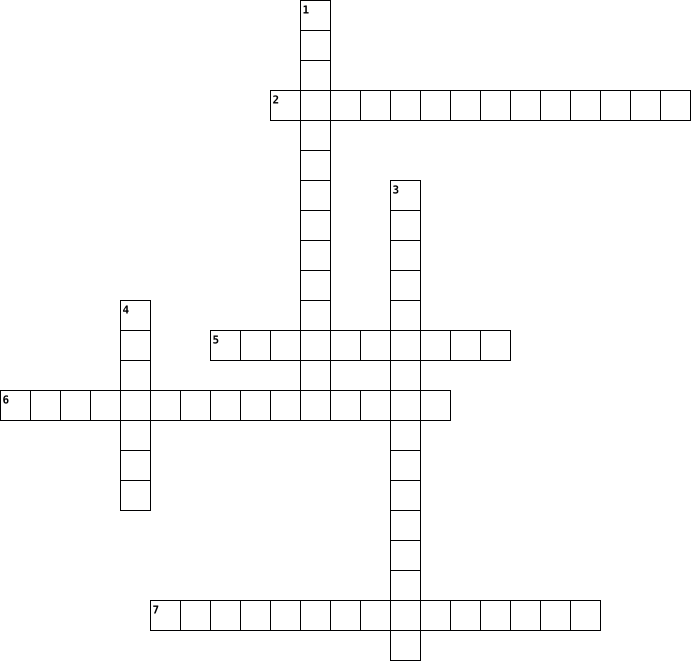
Across
- plates that make up the earth's crust
- If the contour lines are further apart the slope is
- mountains created at a convergent
- fossils found on continents that used to be connected
Down
- Pangea was a
- Alfred Wegener's theory
- if the contour lines are closer the slope is
7 Clues: Pangea was a • Alfred Wegener's theory • mountains created at a convergent • plates that make up the earth's crust • if the contour lines are closer the slope is • If the contour lines are further apart the slope is • fossils found on continents that used to be connected
Plate Tectonics 2021-04-30

Across
- When two plates overlap
- two plates moving the opposite direction
- two plates grinding past each other
Down
- _______ from mantle causes plates to drift
- less dense plate goes underneath more dense plate
- a crack, break, or gap
- Molten rock
7 Clues: Molten rock • a crack, break, or gap • When two plates overlap • two plates grinding past each other • two plates moving the opposite direction • _______ from mantle causes plates to drift • less dense plate goes underneath more dense plate
Plate Tectonics 2021-10-03

Across
- plates move together
- molten rock
- crack,split, or break in something
- a line that marks the limits of an area; a dividing line
Down
- plates move under/over each other
- plates move away
- plates slide past each other
7 Clues: molten rock • plates move away • plates move together • plates slide past each other • plates move under/over each other • crack,split, or break in something • a line that marks the limits of an area; a dividing line