
states Crossword Puzzles
Sports Psychology - Arousal, Anxiety and Aggression 2022-06-09

Across
- This theory states that high cognitive arousal and high somatic arousal causes sudden dramatic drop in performance
- This theory states that any blocking of goals that an individual is trying to reach increases an individual’s drive, thus increasing aggression
- This theory states that as arousal increases so does quality of performance
- This theory states that aggression is learned by observation of others behaviour
- Forceful behaviour within the laws of an event
- The ‘energised state’ or the ‘readiness for action’ that motivates us to behave in a particular way
- This type of anxiety is the worry or apprehension experienced during a competition
- Relates to the changing psychological state of the body. E.g. increases in anxiety
- The negative aspect of experiencing stress and can be caused by worry, apprehension or fear of failure
Down
- The intent to harm or injure outside the rules of the game
- This theory states that as arousal increases so does the quality of performance. After the optimal point, the performer becomes over aroused and performance deteriorates
- This theory states that for aggression to occur, certain stimuli must be present
- Relates to the changing physiological state of the body. E.g. increased heart rate
- This type of anxiety relates to personality. A performer with this is likely to feel anxious in any stressful situation, such as exams or interviews
- This theory states that aggression a natural response, innate and instinctive
15 Clues: Forceful behaviour within the laws of an event • The intent to harm or injure outside the rules of the game • This theory states that as arousal increases so does quality of performance • This theory states that aggression a natural response, innate and instinctive • This theory states that for aggression to occur, certain stimuli must be present • ...
AP Gov Unit One Review 2024-04-15

Across
- This clause forces states to respect judicial judgements that were made in other states
- This clause makes the constitution supersede state courts and constitutions
- This clause prevents states from discriminating against citizens of other states
- This amendment abolished slavery except as punishment for a crime
- Gives congress the ability to make laws to execute the provisions of the constitution
- A grant given to states with conditions attached to how the money can be spent
Down
- This amendment established that every citizen must have equal protection under the law
- This amendment forbids denying the right to vote on the basis of race
- This amendment says that powers not given to the federal government are reserved for the states
- This clause gives congress to regulate interstate ______
- A government policy that lacks funding for implementation
- A grant that gives states total control over how it can be used
12 Clues: This clause gives congress to regulate interstate ______ • A government policy that lacks funding for implementation • A grant that gives states total control over how it can be used • This amendment abolished slavery except as punishment for a crime • This amendment forbids denying the right to vote on the basis of race • ...
Unit 6 Vocabulary 2025-11-10

Across
- Personal liberties granted to individuals and protected by the law and government.
- Powers reserved to Local/State Governments.
- Allows citizens to bypass it's state's legislature.
- The Amendment that allows citizens of Washington D.C to vote in presidential elections.
- Legally protected rights of equal treatment and freedom from discrimination.
- Direct vote by the electorate on a single political question that has been referred to them for a direct decision.
- The Amendment that lowered the voting age to 18 years old.
- The Amendment that states powers not delegated to the United States by the Constitution, nor prohibited by it to the States, are reserved to the States.
Down
- Powers reserved to the Government.
- The Amendment that states the Senate of the United States shall be composed of two Senators from each State.
- The Amendment that prohibits the states and federal government from denying the vote of U.S citizens.
- The Amendment that abolished and forbids the federal and state governments from imposing taxes on voters during federal elections.
- Allows voters to remove an elected official from office before their term takes place.
13 Clues: Powers reserved to the Government. • Powers reserved to Local/State Governments. • Allows citizens to bypass it's state's legislature. • The Amendment that lowered the voting age to 18 years old. • Legally protected rights of equal treatment and freedom from discrimination. • Personal liberties granted to individuals and protected by the law and government. • ...
Social Studies: Drafting the Constitution 2024-12-05

Across
- none could be charged on trade between the states
- Only George Washington granted most of his freedom
- states with larger ones receive more representatives
- wealthy, influential and well educated
- to argue an opinion
- national, state and local governments share power
Down
- kept free and open among states
- each had to use the same coinage or money
- all states get the same amount...two
- representatives
- a give and take situation
11 Clues: representatives • to argue an opinion • a give and take situation • kept free and open among states • all states get the same amount...two • wealthy, influential and well educated • each had to use the same coinage or money • none could be charged on trade between the states • national, state and local governments share power • ...
Mesopotamia crossword 2021-12-17

Across
- something in the middle of a city state
- something they made during those times
- one of the rivers
- to trade
- Hammurabi ruled over this
- lots of city states
- land between two rivers
- not an emporor, a _____
- a way to bring water into city states
Down
- The epic of _________
- worth nothing
- someone who owns many city states
- someones customs or beiliefs
- artsy-fartsy
- current day Mesopotamia
- a form of writing they used
- city with its own goverment and leaders
- Hammurabi ruled over these people
- someone who writes or reads writing
- _______ made the first written laws
- people who bartered with stuff
- the first emperor
- people who kept the gods happy
- became besties with gilgamesh
24 Clues: to trade • artsy-fartsy • worth nothing • one of the rivers • the first emperor • lots of city states • The epic of _________ • current day Mesopotamia • land between two rivers • not an emporor, a _____ • Hammurabi ruled over this • a form of writing they used • someones customs or beiliefs • became besties with gilgamesh • people who bartered with stuff • people who kept the gods happy • ...
vocab crossword 2022-01-06

Across
- government controls all facets of life
- first 10 amendments
- believed in natural rights
- people are the only source of power
- believed in strong central government
- article 1 section 8
- first president of the united states
- the citizens have political authority
- give freedom of governments
- third president of the united states
- distribution of power between gov.
Down
- leading supporter of the constitution
- the 4th president of the united states
- a small group of leaders are by the people
- governments powers are limited
- introduced separation of powers
- explains the purpose of the constitution
- protection of individual rights
- government has a number of restraints
- beleif monarchs were chosen by god
- english political professor
21 Clues: first 10 amendments • article 1 section 8 • believed in natural rights • english political professor • give freedom of governments • governments powers are limited • introduced separation of powers • protection of individual rights • beleif monarchs were chosen by god • distribution of power between gov. • people are the only source of power • first president of the united states • ...
S.S. Crossword 2014-06-11

Across
- This tribe is located closest to us
- 1st U.S. permanent settlement
- One of the border states during the Civil War
- The Indian tribe located in the Southwest
- This battle was the turning point of the Civil War
- 1st U.S. president
- 2nd U.S. president
- This is what the South fought for during the Civil War
- George Washington's house was located at
Down
- This tribe lived in tipis
- The region of Virginia that we live in
- Capital of Confederacy
- Located in the Pacific Northwest
- President of the Confederacy
- Were rude to Indians and enslaved them
- Confederate States were in the
- We live in the
- Fransisco Coronado discovered the
- President during the Civil War
- Free states were in the
20 Clues: We live in the • 1st U.S. president • 2nd U.S. president • Capital of Confederacy • Free states were in the • This tribe lived in tipis • President of the Confederacy • 1st U.S. permanent settlement • Confederate States were in the • President during the Civil War • Located in the Pacific Northwest • Fransisco Coronado discovered the • This tribe is located closest to us • ...
Wrigley 1st Hour 2023-03-06

Across
- person killed because of their beliefs
- Person who wants to stop slavery
- 1st State Governor of Kansas
- crop produced for commercial value
- made missouri a slave state
- first skirmish between slave and free states
- states with slavery
- repealed missouri compromise
- sixteenth president
Down
- going against the laws of your country
- Hung for treason
- Gave the name Bleeding Kansas
- war between the north and the south
- territorial and economic expansion
- First territorial governor
- remove a congregational act or law
- Taking towns or buildings from your enemy
- to commit a crime against your country
- person who has escaped or is hiding
- name gave to all of the wars happening in kansas
- states without slavery
21 Clues: Hung for treason • states with slavery • sixteenth president • states without slavery • First territorial governor • made missouri a slave state • 1st State Governor of Kansas • repealed missouri compromise • Gave the name Bleeding Kansas • Person who wants to stop slavery • territorial and economic expansion • crop produced for commercial value • remove a congregational act or law • ...
South Carolina History 2023-03-14

Across
- what is the state bird
- What is the state flower
- What bridge was built in 1929
- the states nickname is
- state hospitality beverage
- How many counties compromise South Carolina
- state beverage
- State song
- South Carolinas quarter was what number released in the United States mint
- What is the state amphibian
Down
- South Carolina is known for what fish
- One of the major industries
- South Carolina is known for this stone
- favorite vacation spot in South Carolina
- Hightest point in South Carolina
- Bordering body of water
- What is the capital of South Carolina
- one of states bordering South Carolina is north Carolina and what other state
- What is South Carolina's state fruit
- state gemstone
- State abbreviation
21 Clues: State song • state beverage • state gemstone • State abbreviation • what is the state bird • the states nickname is • Bordering body of water • What is the state flower • state hospitality beverage • One of the major industries • What is the state amphibian • What bridge was built in 1929 • Hightest point in South Carolina • What is South Carolina's state fruit • ...
CIVICS REVIEW: Barry 2023-04-12

Across
- The second president of the united states
- Leader of executive branch
- What the president does when he doesn't pass a law
- Branch that enforces laws
- Where the president lives
- Someone who breaks a law
- The first ten amendments of the constitution
- If the president dies the ______ becomes the new president
Down
- A written plan of government
- The amount of Representatives per states depends on the _____
- Branch that makes laws
- Executive-Judicial-Legislative
- The basic rights to an American
- _____ for (Political Person)
- The amount of amendment in the U.S. constitution
- The amount of senators per state
- Current Minnesota Governor
- The name of a civics teacher MAHS
- 46th president of the United States
- Branch That interprets laws
20 Clues: Branch that makes laws • Someone who breaks a law • Branch that enforces laws • Where the president lives • Leader of executive branch • Current Minnesota Governor • Branch That interprets laws • A written plan of government • _____ for (Political Person) • Executive-Judicial-Legislative • The basic rights to an American • The amount of senators per state • ...
History 2022-10-11
Across
- ancient language
- a woodland of tall trees
- a stone wall enclosed kingdom
- earliest know christans
- people who formed many kingdoms
- African Language
- oral historians
- raising herds
- first ruler of songhai
- ruler of songhai to 1493-1528
- an oval wall
- Desert
- earliest african society
- west african state in charge of gold
- best know for sculptures
- people who lived in city states
- kingdom along the red se
- social class
Down
- conquered mali
- south africa
- richest man
- Bantu language
- a grassy plain
- Christan ethiopian king
- wind patterns
- states along the coast
- between desert and wet lands
- the second kingdom after ghana
- founder of mali
29 Clues: Desert • richest man • south africa • an oval wall • social class • raising herds • wind patterns • conquered mali • Bantu language • a grassy plain • oral historians • founder of mali • ancient language • African Language • first ruler of songhai • states along the coast • earliest know christans • Christan ethiopian king • a woodland of tall trees • earliest african society • best know for sculptures • ...
Review Crossword Puzzle 2023-11-28

Across
- voting to agree
- first constitution
- Cadastral Survey and a plan to add states to the union
- declared war against great britain over impressment
- Battle of january 8, 1815
- violent uprising in Massachusetts
- right to job but the job was void.
- Bicameral, Upper house, lower house
- How to decide if it was constitutional
- disagreed with the constitution
- national anthem of the United States
- meeting about the articles of confederation
Down
- Land deal with United states and France
- Napoleon is trying to conquer everything
- an action to begin a riot
- to urge new yorks to approve the us constitution
- failed bombardment
- force american sailors to fight
- helped lewis and clark
- 1st 10 amendments
20 Clues: voting to agree • 1st 10 amendments • first constitution • failed bombardment • helped lewis and clark • an action to begin a riot • Battle of january 8, 1815 • force american sailors to fight • disagreed with the constitution • violent uprising in Massachusetts • right to job but the job was void. • Bicameral, Upper house, lower house • national anthem of the United States • ...
Crossword Review 2023-11-30

Across
- to urge new yorks to approve the us constitution
- Napoleon is trying to conquer everything
- Battle of january 8, 1815
- Bicameral, Upper house, lower house
- How to decide if it was constitutional
- voting to agree
- disagreed with the constitution
- Cadastral Survey and a plan to add states to the union
- violent uprising in massachusetts
- about the articles of confederation
Down
- an action to begin a riot
- first constitution
- helped lewis and clark
- national anthem of the United States
- failed bombardment
- 1st 10 amendments
- force american sailors to fight
- Land deal with United states and France
- right to job but the job was void.
- declared war against great britain over impressment
20 Clues: voting to agree • 1st 10 amendments • first constitution • failed bombardment • helped lewis and clark • an action to begin a riot • Battle of january 8, 1815 • disagreed with the constitution • force american sailors to fight • violent uprising in massachusetts • right to job but the job was void. • Bicameral, Upper house, lower house • about the articles of confederation • ...
famous peoples in 70s 2024-02-22

Across
- Actress and Hollywood icon.
- Lead vocalist of The Rolling Stones.
- Former First Lady of the United States.
- Guitarist and rock icon.
- Lead vocalist of Queen.
- Boxer and cultural figure.
- Musician and member of The Beatles.
- King of Rock and Roll.
Down
- Director known for films like "Jaws" and "Close Encounters of the Third Kind."
- 37th President of the United States.
- 39th President of the United States.
- Singer-songwriter and musician.
- Singer and actress.
- Artist and leading figure in the pop art movement.
- Iconic Swedish pop group.
- Actress and model, known for "Charlie's Angels."
- Godfather of Soul.
- Musician and actor.
- Actor known for "Saturday Night Fever" and "Grease."
- Martial artist and actor.
20 Clues: Godfather of Soul. • Singer and actress. • Musician and actor. • King of Rock and Roll. • Lead vocalist of Queen. • Guitarist and rock icon. • Iconic Swedish pop group. • Martial artist and actor. • Boxer and cultural figure. • Actress and Hollywood icon. • Singer-songwriter and musician. • Musician and member of The Beatles. • 37th President of the United States. • ...
Civil War 2025-04-16

Across
- soldiers trained to fight
- confederate States capitol
- decisive engagement in civil war
- quarter inch thick-square
- weapon used in civil war
- soldier that is wounded or killed during battle
- large caliber firearms
- people who supported the union
- number of similar items grouped as a unit
- name given for states
- violent uprising against government
- focus of the Northern economy
- leave or withdraw something
- common way to die during civil war
- easiest way to die
Down
- issue that caused the civil war
- attempt to stop people
- another name for confederate States
- first battle of civil war
- largest organization
- someone who wanted slavery to end
- deadliest day for civil war
22 Clues: easiest way to die • largest organization • name given for states • attempt to stop people • large caliber firearms • weapon used in civil war • soldiers trained to fight • quarter inch thick-square • first battle of civil war • confederate States capitol • deadliest day for civil war • leave or withdraw something • focus of the Northern economy • people who supported the union • ...
Federal and State court system crossword puzzle 2024-03-20

Across
- Someone who brings the case against someone in court
- Shared power
- Can be heard in the states
- Can be appealed to U.S court of appeals
- Civil officer
- Court's of limited jurisdiction
- Court of general jurisdiction
- Highest court in the judicial system
- Is appointed by the state's governor
Down
- Can be heard in the federal system
- General trial
- Hears matters involving juvenile activity
- Making laws and regulation for states
- Can interpret laws
- Power to create legal decisions
- District court, Circuit court, and Supreme court
- Review of the decisions made in court to make sure it is fair
- Is appointed by the president
- Makes and enforces laws for states
- A justice and decides cases in court
20 Clues: Shared power • General trial • Civil officer • Can interpret laws • Can be heard in the states • Is appointed by the president • Court of general jurisdiction • Power to create legal decisions • Court's of limited jurisdiction • Can be heard in the federal system • Makes and enforces laws for states • A justice and decides cases in court • Highest court in the judicial system • ...
Braxton Miller Unit one crossword 2024-09-19

Across
- freedom
- State that refused to send delegates
- two chamber legislature
- Seeds of democracy take root
- 55 what attended the constitutional convention
- enjoyed the most independence from the crown
- A formal of institions and process
- an example of a royal colony
- Liberty, and the pursuit of happiness
- something in its perfect form
- Father of the constitution
- avaliable for everyone and cant be taken away
Down
- Framers refused to sign the contitution because
- 1215 was the year signed of what
- United states first constitution
- must have people
- French and Indian war decided to tax them
- Formally approved by all the states
- the number of states sent representatives
- Became King of England in 1760
20 Clues: freedom • must have people • two chamber legislature • Father of the constitution • Seeds of democracy take root • an example of a royal colony • something in its perfect form • Became King of England in 1760 • United states first constitution • 1215 was the year signed of what • A formal of institions and process • Formally approved by all the states • ...
#Con Constitution 2023-02-06

Across
- Against constitution (states' power)
- Amendments 4-8
- 3rd amendment
- 1st amendment S
- House of Representatives & Senate
- 1st amendment R
- Strong central government will provide stability
- One branch of government cannot have all the power
- Increased in political influence using slaves
- Three branches of government Judicial, Legislative, Executive
Down
- Branch of government that makes laws
- 1st Constitution
- First 10 amendments
- 1st Amendment
- 1st amendment P
- 2nd amendment; right to --
- 1st amendment P
- States' rights (10th Amendment)
- Process to admit new states
- (9th amendment) power to the people to hold authority in government
- Right to trial by ____
- rebellion, Proved we had a strong, powerful government
- People elect representatives (voting)
- 1st amendment A
24 Clues: 3rd amendment • 1st Amendment • Amendments 4-8 • 1st amendment S • 1st amendment P • 1st amendment P • 1st amendment R • 1st amendment A • 1st Constitution • First 10 amendments • Right to trial by ____ • 2nd amendment; right to -- • Process to admit new states • States' rights (10th Amendment) • House of Representatives & Senate • Against constitution (states' power) • ...
Secession & The Start of the Civil War 2024-11-18

Across
- "The ________ Established"
- Confederates demand what of the fort?
- Virginian concerned about the future
- withdraw from the Union
- used to justify secession
- Captain who witnessed the attack
- state that separated from Virginia in 1861
- what was attacked to start the Civil War
- "No human power can save the _____"
Down
- harbor location of attack on the fort
- "The Union of these states is _______"
- first state to secede from the Union
- Lincoln contacts what Governor after attack
- what states talked of secession
- issue that split the Democratic party 445
- Confederate guns open fire "___ 12, 1861
- Most northerners believed the Union should be ______
- President of the Confederate states?
- Northern democrats supported what?
- "______ Lincoln"
20 Clues: "______ Lincoln" • withdraw from the Union • used to justify secession • "The ________ Established" • what states talked of secession • Captain who witnessed the attack • Northern democrats supported what? • "No human power can save the _____" • first state to secede from the Union • President of the Confederate states? • Virginian concerned about the future • ...
Civil War 2025-04-15

Across
- Union general who later became president
- General Robert E. ___
- Ended slavery in the U.S.
- The North was also called the ___
- Lincoln’s most famous speech
- Union naval strategy: the ___ Plan
- Law requiring citizens to return runaway slaves(No spaces)
- President of the Confederacy
Down
- President of the United States during the Civil War
- First battle of the Civil War
- Underground ___ helped slaves escape
- Turning point battle fought in Pennsylvania
- Freed the slaves in Confederate states
- Capital of the Confederacy
- Slavery-supporting Southern states were called the ___
- Where Lee surrendered to Grant
- Bloodiest single-day battle
- Confederate general nicknamed "Stonewall"
- Nickname for Confederate soldiers
- Famous African American abolitionist and speaker
- Wrote Uncle Tom’s Cabin
21 Clues: General Robert E. ___ • Wrote Uncle Tom’s Cabin • Ended slavery in the U.S. • Capital of the Confederacy • Bloodiest single-day battle • Lincoln’s most famous speech • President of the Confederacy • First battle of the Civil War • Where Lee surrendered to Grant • The North was also called the ___ • Nickname for Confederate soldiers • Union naval strategy: the ___ Plan • ...
Cvil war Station 8 2023-04-26

Across
- A nickname for people from the North as well as soldiers
- A nickname for the south
- the northern states of the united states also called the union
- A soldier that is wounded or killed during battle.
- a short blade
- When southern states chose to leave
- a long gun
- A team used to descried people who supported the union
- The side of an army or military union
- it a person that report
Down
- An army of citizens used during emergencies
- Soldiers that fight and travel by foot
- A person who wanted to eliminate or abolish slavery\
- Another name for the Confederate States
- A cap worm by civil War soldiers
15 Clues: a long gun • a short blade • it a person that report • A nickname for the south • A cap worm by civil War soldiers • When southern states chose to leave • The side of an army or military union • Soldiers that fight and travel by foot • Another name for the Confederate States • An army of citizens used during emergencies • A soldier that is wounded or killed during battle. • ...
Eight Grade History Berel Mangel 2020-09-29

Across
- An area of land including California, Texas, and Arizona
- The are of the united states where slavery was not allowed
- Allowed slave owners to reclaim slaves who escaped
- Something proposed in 1802 by Henry Clay
- this was what Southern States were called
- How slaves were bought and sold
Down
- Someone who actually works to get rid of skavery
- Someone who believes in getting rid of slavery
- This is what Northern States were called
- It doubled the size of America
- The person who proposed the Compromise of 1850
- This was granted to New Mexico
- An escaped slave
- Divided the Louisiana Purchase
- The area of the untied states where slavery was allowed
15 Clues: An escaped slave • It doubled the size of America • This was granted to New Mexico • Divided the Louisiana Purchase • How slaves were bought and sold • This is what Northern States were called • Something proposed in 1802 by Henry Clay • this was what Southern States were called • Someone who believes in getting rid of slavery • ...
Unit 1: Foundations of Government 2018-01-25

Across
- Believed in separation of powers
- Believed men were inherently evil
- Contract Unwritten agreement between the ruler and the ruled
- Believed in separation of church and state
- Powers given to the national government alone
- Oppressive, one party rule
- Believed in life, liberty, and property
- Central power rules over the states
Down
- States direct the central government; creates a weak central authority
- Powers are shared between states and central government
- of Rights The first 10 Amendments; secure individual rights
- Rights that cannot be taken away or denied
- Powers given to the states via the 10th Amendment
- Powers shared by the federal and state governments
- Government by the people, both directly and indirectly
15 Clues: Oppressive, one party rule • Believed in separation of powers • Believed men were inherently evil • Central power rules over the states • Believed in life, liberty, and property • Rights that cannot be taken away or denied • Believed in separation of church and state • Powers given to the national government alone • Powers given to the states via the 10th Amendment • ...
Civil war cross word puzzle 2024-05-22

Across
- general of confederated army
- affair when confederates on Mexican boats caught and prisoned by the union
- formed of states the seceded from the U.S.
- proclamation that set slaves free
- north placed these to stop south from trading with other countries
- killer of Abraham Lincoln
- the president during the civil war
- placed by the north on imported goods
- plan to stop confederates from going to foreign countries
Down
- 18 president of the U.S. after Lincoln
- states bordering slave and free states
- states that did not secede during the civil war
- president of the confederate army
- war fought between the union and the confederate
- called to serve in the army
15 Clues: killer of Abraham Lincoln • called to serve in the army • general of confederated army • president of the confederate army • proclamation that set slaves free • the president during the civil war • placed by the north on imported goods • 18 president of the U.S. after Lincoln • states bordering slave and free states • formed of states the seceded from the U.S. • ...
Causes of the Civil War 2022-03-07
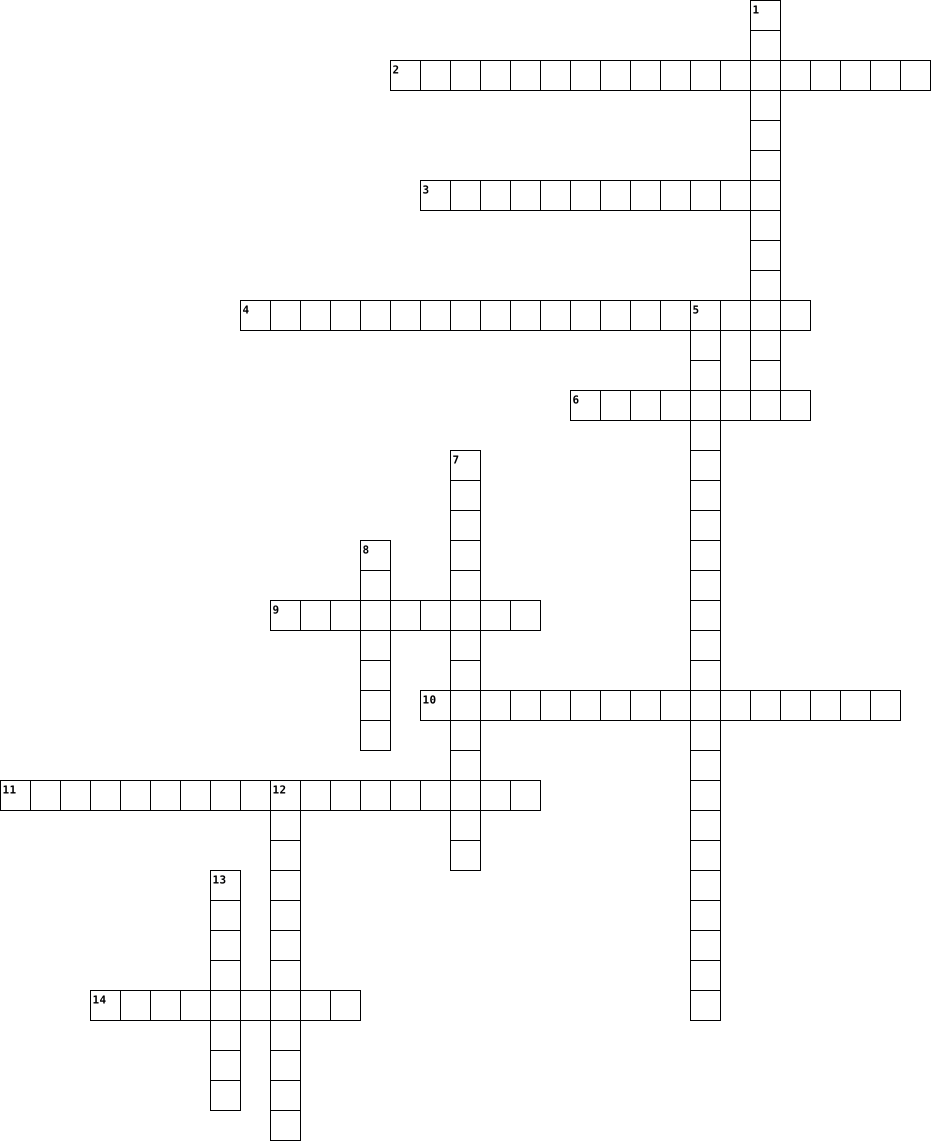
Across
- admitted missouri as a slave state and maine as a non-slave state, keeping the number of slave and free states equal. At 36-30 line, slavery was permitted below the line and would not be permitted above the line
- greater loyalty to your own section rather than the country as a whole.
- required all citizens to help catch runaway slaves.
- Kansas The first fighting over the slavery issue took place in Kansas. In 1854, the government passed the Kansas-Nebraska Act allowing the residents of Kansas to vote on whether they would be a slave state or a free state. The region was flooded with supporters from both sides. They fought over the issue for years. Several people were killed in small skirmishes giving the confrontation the name Bleeding Kansas. Eventually Kansas entered the Union as a free state in 1861.
- As the United States continued to expand westward, each new state added to the country shifted the power between the North and the South. Southern states began to fear they would lose so much power that they would lose all their rights. Each new state became a battleground between the two sides for power.
- willnot provise, suggested all lands from mexico cession had no slaves. California free state, fugitive slave law, texas border established, no slave trade in W.DC, Nm and UT could vote.
- northern abolitionist, launched a slave revolt in 1859 he seized weapons from harpers ferry, virginia. Uprising was quickly crushed, brown was tired and executed.
- When Lincoln was elected, many of the southern states decided they no longer wanted to be a part of the United States. They felt that they had every right to leave. Starting with South Carolina, eleven states would eventually leave the United States and form a new country called the Confederate States of America. Abraham Lincoln said they did not have the right to leave the United States and sent in troops to force the Southern states to rejoin the Union. The Civil War had begun.
Down
- The final straw for the South was election of Abraham Lincoln to President of the United States. Abraham Lincoln was a member of the new anti-slavery Republican Party. He managed to get elected without even being on the ballot in ten of the southern states. The southern states felt that Lincoln was against slavery and also against the South.
- he sued his master for his freedom. The supreme court ruled slaves were not legal citizens and could not bring court cases before the supreme court. They said the declaration of independence did not apply to slavery.
- Abraham Licoln became the 16th president campaigning on a platform opposing the spread of slavery.
- condition in which one human being was owned by another. A slave was considered by law as property, or chattel,and was deprived of most of the rights ordinarily held by free persons.
- The idea of states' rights was not new to the Civil War. Since the Constitution was first written there had been arguments about how much power the states should have versus how much power the federal government should have. The southern states felt that the federal government was taking away their rights and powers.
- In the mid-1800s, the economies of many northern states had moved away from farming to industry. A lot of people in the North worked and lived in large cities like New York, Philadelphia, and Boston. The southern states, however, had maintained a large farming economy and this economy was based on slave labor. While the North no longer needed slaves, the South relied heavily upon slaves for their way of life.
14 Clues: required all citizens to help catch runaway slaves. • greater loyalty to your own section rather than the country as a whole. • Abraham Licoln became the 16th president campaigning on a platform opposing the spread of slavery. • ...
North America Physical Geography 2020-11-16

Across
- The 48 states that are on the lower part of North America.
- A large river found out west that drains into the Mississippi.
- The long term average weather for a place.
- The oldest mountain range in the U.S.
- The central United States.
- The flat low land along the Atlantic Ocean.
- The biggest mountain range in the United States.
- The western part of the Interior Lowlands.
Down
- Separates the continent in two.
- A region made up of similar physical features.
- The longest river in the United States.
- The physical surroundings on the Earth.
- The mountainous area along the Pacific coast.
- The largest freshwater system in North America.
- This large river is found in Pennsylvania.
15 Clues: The central United States. • Separates the continent in two. • The oldest mountain range in the U.S. • The longest river in the United States. • The physical surroundings on the Earth. • The long term average weather for a place. • This large river is found in Pennsylvania. • The western part of the Interior Lowlands. • The flat low land along the Atlantic Ocean. • ...
Cvil war Station 8 2023-04-26

Across
- A nickname for people from the North as well as soldiers
- A nickname for the south
- the northern states of the united states also called the union
- A soldier that is wounded or killed during battle.
- a short blade
- When southern states chose to leave
- a long gun
- A team used to descried people who supported the union
- The side of an army or military union
- it a person that report
Down
- An army of citizens used during emergencies
- Soldiers that fight and travel by foot
- A person who wanted to eliminate or abolish slavery\
- Another name for the Confederate States
- A cap worm by civil War soldiers
15 Clues: a long gun • a short blade • it a person that report • A nickname for the south • A cap worm by civil War soldiers • When southern states chose to leave • The side of an army or military union • Soldiers that fight and travel by foot • Another name for the Confederate States • An army of citizens used during emergencies • A soldier that is wounded or killed during battle. • ...
reconstruction 2024-04-11

Across
- laws passed at different periods in the southern United States to enforce racial segregation and curtail the power of Black voters.
- The right of citizens of the United States to vote shall not be denied or abridged by the United States or by any state on account of race, color, or previous condition of servitude.
- The 17th President of the united states
- led efforts to establish civil rights for old slaves and implement emancipation
- white Southerner who collaborated with northern Republicans during Reconstruction often for personal profit. The term was used derisively by white Southern Democrats who opposed Reconstruction legislation.
Down
- No State shall make or enforce any law which shall abridge the privileges or immunities of citizens of the United States
- (in the US) a person from the northern states who went to the South after the Civil War to profit from the Reconstruction.
- Era of the united states after the civil war
- provide food, shelter, clothing, medical services, and land to displaced Southerners, including newly freed African Americans.
- charge the holder of a public office with misconduct.
- a system where the landlord/planter allows a tenant to use the land in exchange for a share of the crop.
- The first Black Senator
- A framework for Reconstruction and the re-admittance of the Confederate states to the Union
13 Clues: The first Black Senator • The 17th President of the united states • Era of the united states after the civil war • charge the holder of a public office with misconduct. • led efforts to establish civil rights for old slaves and implement emancipation • A framework for Reconstruction and the re-admittance of the Confederate states to the Union • ...
US History 4 2026-04-23

Across
- A farming system where workers farmed land owned by others in exchange for a share of the crops, often trapping them in debt
- An amendment that officially abolished slavery in the United States.
- A law that allowed settlers to decide if their territory would allow slavery, leading to violent conflict known as “Bleeding Kansas.”
- The Northern states during the Civil War that remained loyal to the United States.
- An amendment that gave African American men the right to vote.
- A secret network that helped enslaved people escape to freedom in the North or Canada.
- A set of laws that attempted to balance free and slave states and included a stricter Fugitive Slave Law.
Down
- An amendment that granted citizenship and equal protection under the law to all people born or naturalized in the U.S.
- Laws passed in the South after the Civil War to restrict the rights and freedoms of African Americans.
- A speech by Abraham Lincoln that emphasized equality and the importance of preserving the Union.
- The Southern states that seceded from the Union and formed their own government during the Civil War.
- The act of formally leaving the United States, done by Southern states before the Civil War.
- A person who worked to end slavery in the United States.
13 Clues: A person who worked to end slavery in the United States. • An amendment that gave African American men the right to vote. • An amendment that officially abolished slavery in the United States. • The Northern states during the Civil War that remained loyal to the United States. • ...
The Battle of First Bull Run 2023-11-29

Across
- States where capitol of the Confederacy was
- Name of the southern states
- Stream near first battle
- Fight between armed forces
- When a states tries to leave its prior nation
Down
- Having ownership of human beings
- States where capitol of the Union was
- Name of the northern states
- Violent conflict between nations or states
- Amount of people dead or injured
10 Clues: Stream near first battle • Fight between armed forces • Name of the northern states • Name of the southern states • Having ownership of human beings • Amount of people dead or injured • States where capitol of the Union was • Violent conflict between nations or states • States where capitol of the Confederacy was • When a states tries to leave its prior nation
federalism 2019-10-24

Across
- returning power from the national government to states
- says that one state must recognize and honor the official acts of other states, like marriages or criminal convictions
- what the constitution explicitly says Congress can do
- a system of taxing and spending within the federal system (usually it’s the national government providing money to states with some instructions on how to spend it)
- a state separating itself from the USA
- the old idea that the national and state governments were equal authorities
Down
- gives Congress the authority to make laws about economic activity that crosses state lines, or that may affect the interstate economy. Source of authority for many modern laws.
- both the national government and state governments may do these
- the national government has these under the Necessary and Proper Clause because they’re logical extensions of expressed powers
- not mentioned specifically in the constitution, these may be done by states because the constitution neither assigns them to the national government nor prohibits them to states
- demands on states to carry out specific policies (usually, but not always, with money provided by the national government)
- money and other resources given to states to spend on state and local activities, like when the national government gave states land which states sold to fund public universities
- greatly expanded the role of the national government, trying to improve people’s social and economic welfare during the Great Depression of the 1930s
13 Clues: a state separating itself from the USA • what the constitution explicitly says Congress can do • returning power from the national government to states • both the national government and state governments may do these • the old idea that the national and state governments were equal authorities • ...
US History Bush Administration September 11th 2022-06-09

Across
- what the government can track
- this has the Senate and House
- location of Iraq
- opposite of war
- home of the president
- government is watching you
- capital of Iraq
- what group attacked the United States
- the act that kept US safe
- Vice-President of US
Down
- the connection between Iraq and 9.11
- you have a "right" to this
- was the leader of Iraq
- needed resource
- what country did the US invade 2003
- the highest Court in US
- date of attack on the United States
- security on flights
- nuclear is a type
- rule by one person
- government building on September 11
- who attacked the United States
- rules we live by
- US President
24 Clues: US President • needed resource • opposite of war • capital of Iraq • location of Iraq • rules we live by • nuclear is a type • rule by one person • security on flights • Vice-President of US • home of the president • was the leader of Iraq • the highest Court in US • the act that kept US safe • you have a "right" to this • government is watching you • what the government can track • ...
The American Civil War 2022-10-06

Across
- What region were the Confederates from
- What color did the Union wear
- President of the Confederate Union
- number of confederate states during the civil war
- Woman that led slaves to freedom
- The month the war started and ended in
- What did the Confederates believe in
- Started the civil war
- What were the Northern States called
- youngest person to fight in the civil war
- name of the confederate flag
Down
- Who fired the first shot in the Civil War
- name of the union flag
- nickname for the Civil War
- number of union states during the civil war
- First battle
- What color did the confederates wear
- The president during the war
- Bloodiest battle
- Confederate nickname
20 Clues: First battle • Bloodiest battle • Confederate nickname • Started the civil war • name of the union flag • nickname for the Civil War • The president during the war • name of the confederate flag • What color did the Union wear • Woman that led slaves to freedom • President of the Confederate Union • What color did the confederates wear • What did the Confederates believe in • ...
Austin Skero 2021-01-06

Across
- first 10 Amendments to the Constitution
- central government is ultimately supreme
- Founding Father
- form of republicanism developed in the Renaissance
- military general
- creation of a stronger U.S. federal government
- English philosopher
- "Father of Liberalism
Down
- agreement that large and small states reached during the Constitutional Convention
- political ideology centered on citizenship
- principle that the authority of a state and its government are created
- introductory and expressionary statement in a document
- prohibits opposition parties
- agreement between delegates from the Northern and the Southern states
- agreement among the 13 original states
- mixed form of government
- monarch holds supreme autocratic authority,
- the restriction of the arbitrary exercise of power
- American statesman
- a statement in the U.S
20 Clues: Founding Father • military general • American statesman • English philosopher • "Father of Liberalism • a statement in the U.S • mixed form of government • prohibits opposition parties • agreement among the 13 original states • first 10 Amendments to the Constitution • central government is ultimately supreme • political ideology centered on citizenship • ...
Austin Skero 2021-01-06

Across
- principle that the authority of a state and its government are created
- monarch holds supreme autocratic authority,
- first 10 Amendments to the Constitution
- prohibits opposition parties
- agreement between delegates from the Northern and the Southern states
- "Father of Liberalism
- mixed form of government
- American statesman
Down
- military general
- form of republicanism developed in the Renaissance
- agreement among the 13 original states
- creation of a stronger U.S. federal government
- agreement that large and small states reached during the Constitutional Convention
- political ideology centered on citizenship
- a statement in the U.S
- English philosopher
- the restriction of the arbitrary exercise of power
- central government is ultimately supreme
- introductory and expressionary statement in a document
- Founding Father
20 Clues: Founding Father • military general • American statesman • English philosopher • "Father of Liberalism • a statement in the U.S • mixed form of government • prohibits opposition parties • agreement among the 13 original states • first 10 Amendments to the Constitution • central government is ultimately supreme • political ideology centered on citizenship • ...
Travel & Tourism 2021-03-24

Across
- Tasmania's Capital City
- The river that runs through Perth
- Sea between Australia and New Zealand
- Kangaroo Island is off what's states coast
- Tiwi Islands is off what's states coast
- Victoria's Capital City
- The river that runs through Adelaide
- Home of the Big Lobster
- Sea between Victoria and Tasmania
- NSW's Capital City
- Northern Territory's Capital City
Down
- Name of the train that runs from Melbourne to Sydney
- Home of the Big Banana
- South Australia's Capital City
- Australia's Capital City
- Name of the train that runs from Sydney to Perth
- Queensland's Capital City
- Western Australia's Capital City
- Name of the A1 Highway
- The river that runs through Melbourne
- Lord Howe Island is off what states coast
21 Clues: NSW's Capital City • Home of the Big Banana • Name of the A1 Highway • Tasmania's Capital City • Victoria's Capital City • Home of the Big Lobster • Australia's Capital City • Queensland's Capital City • South Australia's Capital City • Western Australia's Capital City • The river that runs through Perth • Sea between Victoria and Tasmania • Northern Territory's Capital City • ...
Civil War 2023-05-11

Across
- First major battle
- deadliest battle
- freed slaves in confederate states
- General in the confederate army
- Lincoln's speech that praised the bravery of Union soldiers and renewed his commitment to winning the Civil War.
- African American Soldier
- RobertELee surrender
- President of Confederate states
- Slave states that did not join the army
- Chilean immagrant
- Founder of the American Red Cross
Down
- Freeing of Slaves
- Ships armed with Iron
- Proclamation issued by Lincoln, freeing all slaves in areas still at war with the Union.
- name referring to the U.S
- North's plan to cut off supplies to the South through naval blockades
- Confederate people lost
- First shots beginning of the war
- Union General
- Famous person in the Civil War
20 Clues: Union General • deadliest battle • Freeing of Slaves • Chilean immagrant • First major battle • RobertELee surrender • Ships armed with Iron • Confederate people lost • African American Soldier • name referring to the U.S • Famous person in the Civil War • General in the confederate army • President of Confederate states • First shots beginning of the war • ...
South Carolina 2012-06-03

Across
- state hospitality beverage
- South Carolina is known for what fish
- How many counties compromise South Carolina
- One of the major industries
- What is the state amphibian
- state beverage
- favorite vacation spot in South Carolina
- South Carolina is known for this stone
- Bordering body of water
- the states nickname is
- state gemstone
Down
- State song
- What is the state flower
- Hightest point in South Carolina
- one of states bordering South Carolina is north Carolina and what other state
- What is the capital of South Carolina
- what is the state bird
- State abbreviation
- South Carolinas quarter was what number released in the United States mint
- What bridge was built in 1929
- What is South Carolina's state fruit
21 Clues: State song • state beverage • state gemstone • State abbreviation • what is the state bird • the states nickname is • Bordering body of water • What is the state flower • state hospitality beverage • One of the major industries • What is the state amphibian • What bridge was built in 1929 • Hightest point in South Carolina • What is South Carolina's state fruit • ...
vocab crossword 2022-01-06

Across
- government controls all facets of life
- first 10 amendments
- believed in natural rights
- people are the only source of power
- believed in strong central government
- article 1 section 8
- first president of the united states
- the citizens have political authority
- give freedom of governments
- third president of the united states
- distribution of power between gov.
Down
- leading supporter of the constitution
- the 4th president of the united states
- a small group of leaders are by the people
- governments powers are limited
- introduced separation of powers
- explains the purpose of the constitution
- protection of individual rights
- government has a number of restraints
- beleif monarchs were chosen by god
- english political professor
21 Clues: first 10 amendments • article 1 section 8 • believed in natural rights • english political professor • give freedom of governments • governments powers are limited • introduced separation of powers • protection of individual rights • beleif monarchs were chosen by god • distribution of power between gov. • people are the only source of power • first president of the united states • ...
The Civil War 2022-10-06

Across
- for the civil war
- confederate general
- the act that set Kansas and Nebraska as states
- 18th president
- President during the War
- Fort attacked by South Carolina starting the Civil War
- the north that was led by Abraham Lincoln
- first major clash of the confederate and union armies.
- law that provided for harsh treatment for escaped slaves and those who helped
- june 25-july 1, 1862
Down
- the southern states that seceded from the United States in 1861
- presdient of the confederate states of america
- 1863, Union gains control of Mississippi
- battle that made it clear that the North would win
- the ammendment that was passed after the War
15 Clues: 18th president • for the civil war • confederate general • june 25-july 1, 1862 • President during the War • 1863, Union gains control of Mississippi • the north that was led by Abraham Lincoln • the ammendment that was passed after the War • presdient of the confederate states of america • the act that set Kansas and Nebraska as states • ...
Culture Review = 7th Social Studies 2023-11-15

Across
- teams, clubs, friends, etc....
- using hand gestures and facial expressions to communicate
- how a culture expresses itself
- capitalism in the United States is an example
- a belief system that explains the meaning of life
- three meals a day is an example
Down
- July 4, 1776 is ___________ day in the United States
- the 13 Colonies belonged to this empire
- the United States follows a Representative Democracy
- a group of people and their way of life
- type of religion that most people in the US follow
- type of government that has a King or Queen
- English, Spanish, French, etc....
- a record of the past
- type of currency used in the United States
15 Clues: a record of the past • teams, clubs, friends, etc.... • how a culture expresses itself • three meals a day is an example • English, Spanish, French, etc.... • the 13 Colonies belonged to this empire • a group of people and their way of life • type of currency used in the United States • type of government that has a King or Queen • ...
Unit 4 2020-12-07

Across
- when the president is forced to leave the white house
- these people formally elect the president and vice pres
- serving as the senior United States Senator from Virginia
- law that defines crimes against public order
- consisting two parts or houses
- declare war is an example of this law
- a person who is represented politically by a designated government official
- authority to reject or cancel
- postponement of legal punishment
- the ability to tax and spend public money for the national government
Down
- political powers granted to the United States government
- regulate state commerce is an example of this law
- upper chamber of the United States Congress
- appointed to vote in presidential elections
- speaker of house
- serving as the junior United States senator from Virginia
- responsible for the rules in House of Representatives
- collecting taxes is an example of this power
- order given by higher authority
- a coming together
- power to reject a bill
- a release from legal punishment
- something you do on election day
23 Clues: speaker of house • a coming together • power to reject a bill • authority to reject or cancel • consisting two parts or houses • order given by higher authority • a release from legal punishment • something you do on election day • postponement of legal punishment • declare war is an example of this law • upper chamber of the United States Congress • ...
US History: Creating a New Nation 2014-10-23

Across
- official approval
- group of electors chosen by states
- political leader from Connecticut proposed the Great Compromise
- makes laws
- set of laws of the new government where two levels of government shared fundamental powers
- system where one branch is unable to dominate the other
- Ordinanceof1785 congresses plan for surveying land
- a Two house congress to satisfy both big and small states
Down
- representative of Virginia known as the "Father of the Constitution
- supporters of the constitution
- states slaves counted as 3/5 of a person in states population
- a series of 85 essays defending the Constitution
- interpret laws
- ten amendments made to the constitution
- new government form that divides power between national power and state power
- idea that government should be based off of the consent of the people
- opposed strong government and were against the Constitution
- carry's out laws
- an alliance
- Ordinanceof1787 congress plan for dividing the land into territories
- farmers protest that caused panic through the nation
- a government where citizens rule through representatives
22 Clues: makes laws • an alliance • interpret laws • carry's out laws • official approval • supporters of the constitution • group of electors chosen by states • ten amendments made to the constitution • a series of 85 essays defending the Constitution • Ordinanceof1785 congresses plan for surveying land • farmers protest that caused panic through the nation • ...
Liliana's Government 2023-10-18

Across
- takes over the presidents job if the president is not able to perform their task
- guarantees rights of individuals
- made up by house of representatives and the senate
- believed the government should be weak compared to the states different governments
- making sure one of the branches isn't more powerful than another
- highest court in federal judiciary for the U.S.
- interprets the meaning of laws
- bringing charges against a government official for wrongdoing
- states should be represented in congress based on size of their population
- father of the constitution and proposed Virginia Plan
Down
- branch responsible for making laws
- first form of government for the U.S.
- believed the government should be powerful to lead the country
- a plan that gives small states power
- document that displays the fundamental laws and principles that the U.S. is governed by
- legislative body having two branches or chambers
- states could count 3/5 of their slave population towards their state population
- an agreement between two opposing sides
- the president during the Constitutional Convention
- leader of the country who is responsible for passing laws
20 Clues: interprets the meaning of laws • guarantees rights of individuals • branch responsible for making laws • a plan that gives small states power • first form of government for the U.S. • an agreement between two opposing sides • highest court in federal judiciary for the U.S. • legislative body having two branches or chambers • ...
Andrew Jackson-Avery,Marlie 2024-01-29

Across
- the president appoints civil servents to goverment jobs
- the largest native american group in the US
- the forced westward migration of american indians tribes from the south and sout east
- a private financial institution that operated from 1816 until 1836.
- the senates most prominent states rights advocate
- people with conservitive views toward social issues
- a person who is chosen to vote or make decisions on behalf of a group of other people
- state banks that were selected to recive surplus fedreal tresury funds in 1833
- the party joe biden leads
Down
- the cherokee nation opposed this act
- a consertitive political party that existed in the united states in the mid 19th centruy
- case decided by the U.S. Supreme Court in 1819
- President of the United States from 1837-1841
- the act of cancelling soemthing
- Cherokee, Chickasaw, Choctaw, Creek, and Seminole Indian Tribes
- when states try to leave the country
- a strong supporter of the us constitution
- andrew jacksons nickname
- territory in oklahoma where indians were forced to settle
- 7th president of the US
20 Clues: 7th president of the US • andrew jacksons nickname • the party joe biden leads • the act of cancelling soemthing • the cherokee nation opposed this act • when states try to leave the country • a strong supporter of the us constitution • the largest native american group in the US • President of the United States from 1837-1841 • case decided by the U.S. Supreme Court in 1819 • ...
The Constitution 2023-02-14

Across
- protects freedom of speech,the press,assembly,and what else?
- name given to the first ten amendments to the constitution
- Abolished throughout the united states
- Lowered the voting age
- That person born or naturalized in the united states was a
- Prohibits denying the rights to vote based on their
- Clarifies the succession procedure if removed from office,dies,or resigns
- Prohibits the federal government from imposing excessive bail,fines, and cruel punishment
- Established presidential
- Protects the rights of the people to keep and bear
- Guarantees the right to speedy and public
- Guarantees the right to trial by
Down
- Protects individuals from having to testify against in a criminal court case
- Authorized a tax on
- Gave three electoral votes to the citizens of
- Protects against unreasonable
- Established the direct election of united states by the people
- Prohibits federal and state governments from placing any type of tax on the rights to the
- power not given to the federal government are reserved to states or the
- prevents members of congress from receiving an increase in
20 Clues: Authorized a tax on • Lowered the voting age • Established presidential • Protects against unreasonable • Guarantees the right to trial by • Abolished throughout the united states • Guarantees the right to speedy and public • Gave three electoral votes to the citizens of • Protects the rights of the people to keep and bear • ...
Civil War Crossword 2024-12-10

Across
- Nickname of Confederate General Thomas J. Jackson
- Leading General of the Confederate army
- ______ Court House; Site where Robert E Lee surrendered to Ulysses S. Grant
- Essential for transporting troops in the Civil War
- ____'s Theater; Site of President Lincoln assassination
- The South Army
- City captured by Sherman during his "March to the Sea"
- The Northern States during the Civil War
- Communication tool Lincoln called "lightning messages"
- Political party of Lincoln
- Presedient during the Civil War
- John Wilkes _____; Assassin of President Lincoln
- The first major battle of the Civil War, also known as Manassas
Down
- Commanding general of the Union Army
- ______ Douglass;Former enslaved and leading abolitionist
- _____ States; Maryland, Missouri, West Virginia, Deleware,Kentucky
- The act of states leaving the Union
- Capital of the Confederacy
- Bloodiest single day battle in American History
- City that the "March to the Sea" started at
- The primary cause of the Civil War
- Document that declared slaves freedom in Confederate States
- Turning Point of the Battle in Pennsylvania
- _________ Van Lew; A union women spy during the civil war
24 Clues: The South Army • Capital of the Confederacy • Political party of Lincoln • Presedient during the Civil War • The primary cause of the Civil War • The act of states leaving the Union • Commanding general of the Union Army • Leading General of the Confederate army • The Northern States during the Civil War • City that the "March to the Sea" started at • ...
Crossword puzzle Government: Name: Jailenne Morales (Uniforme) 2026-05-06

Across
- – The branch of government that makes laws.
- – Division of government into three branches
- – The national lawmaking body, made up of the House and Senate.
- – A change or addition to the Constitution.
- – America’s first national government, with a weak central power.
- – The process a bill goes through to become a law.
- – The supreme law of the United States.
- – Short phrase used to persuade voters.
- – Leaders who helped create the United States government.
- -Each branch can limit the power of the others.
Down
- – The lower house of Congress based on population (you can write it with or without spaces in your crossword)
- – Theories about how governments first began.
- – The supreme law and plan of government of the United States.
- – The upper house of Congress, two members per state.
- – The branch that interprets laws.
- – The highest court in the United States.
- – Assignment to create a pretend election campaign.
- – The branch that enforces (carries out) laws.
- – Information about important events happening around the globe
- - The first ten amendments to the Constitution
20 Clues: – The branch that interprets laws. • – The supreme law of the United States. • – Short phrase used to persuade voters. • – The highest court in the United States. • – The branch of government that makes laws. • – A change or addition to the Constitution. • – Division of government into three branches • – Theories about how governments first began. • ...
4th of July 2026-06-30

Across
- Sweet red summer berry.
- HOUSE Where the President lives.
- The Statue of _____ stands in New York Harbor.
- The United States has 50 of these.
- The color of the stars on the U.S. flag.
- The Star-Spangled _____.
- The month Independence Day is celebrated.
- Red, white, and _____.
- Outdoor meal with family and friends.
- Large decorated vehicles in a parade.
- The holiday celebrates our country's _____.
- Sweet summer fruit with a green rind.
- America celebrates this on July 4th.
- Our nation's banner.
Down
- Bright explosions in the night sky.
- Red, white, and blue are our national _____.
- Frozen treat enjoyed on hot days.
- The _____ of Independence was signed in 1776.
- Cookout favorite served in a bun.
- Number of stripes on the U.S. flag.
- Handheld fireworks that sparkle.
- Popular food cooked on the grill.
- A joyful event marking a special occasion.
- A July 4th celebration that marches down the street.
- WASHINGTON First President of the United States.
- Used to cook burgers and hot dogs outdoors.
- Uncle _____.
- One of the colors of the stripes on the U.S. flag.
- The Liberty _____.
- The bird that represents the United States.
30 Clues: Uncle _____. • The Liberty _____. • Our nation's banner. • Red, white, and _____. • Sweet red summer berry. • The Star-Spangled _____. • Handheld fireworks that sparkle. • Frozen treat enjoyed on hot days. • Cookout favorite served in a bun. • Popular food cooked on the grill. • HOUSE Where the President lives. • The United States has 50 of these. • ...
The Constitution 2026-09-17

Across
- the states ratified 10 things in 1791
- power that state and federal government share
- What is authority given to a government or branch called
- What word means officially approved
- power that makes schools, sets marriage and divorce laws, and regulate trade within state
- what branch is the supreme and other federal courts in
- what is the branch that the president in called
- What word describes something related to the national government
- power that only belongs to federal government
Down
- What document sets up the U.S. government
- the house of representatives can do this to anything that is a wrongdoing
- What system keeps one branch of government from becoming too powerful
- What is the system that makes and enforces rules for a country
- this group created the checks and balances system
- The first three words of the Constitution.
- Who leads the executive branch
- the branch that makes the laws
- allows states to deal with its own way but effects other americans too
- What are the individual parts of the United States called
- What places hear cases in the judicial branch
20 Clues: Who leads the executive branch • the branch that makes the laws • What word means officially approved • the states ratified 10 things in 1791 • What document sets up the U.S. government • The first three words of the Constitution. • power that state and federal government share • What places hear cases in the judicial branch • power that only belongs to federal government • ...
'Merica 2024-07-03

Across
- Hub of technology and innovation in California
- Core American value, associated with the 4th of July
- First President of the United States
- Iconic statue in New York Harbor
- Americas pastime
- Massive natural wonder in Arizona
- Personification of the U.S. government
Down
- Monument with four presidential faces
- Center of the American film industry
- Supreme law of the United States
- Music genre that originated in New Orleans
- Iconic figures of the American West
- Declaration signed in 1776
- Holiday celebrated in November
- National bird of the United States
- Classic American dessert
- U.S. space agency
- Famous theater district in New York City
- Famous highway from Chicago to Los Angeles
19 Clues: Americas pastime • U.S. space agency • Classic American dessert • Declaration signed in 1776 • Holiday celebrated in November • Supreme law of the United States • Iconic statue in New York Harbor • Massive natural wonder in Arizona • National bird of the United States • Iconic figures of the American West • Center of the American film industry • ...
Women of US History Crossword Puzzle 2026-04-20

Across
- First woman to earn a medical degree in the United States
- Immigrant Suffragist
- Reduced pollution in the 19th century
- Associate justice of the Supreme Court of the United States from 1981 to 2006
- First woman elected to congress
- Slave who filed a lawsuit for freedom
- First female lawyer
- One of the first female American soldiers
- Founded American Red Cross
- Associate justice of the Supreme Court of the United States 1993-2020
Down
- First lady of 32nd president
- President of Wisconsin’s Woman Suffrage Association
- Suffragette Leader
- NYC suffrage parade horserider
- Famous Sharp shooter
- Lewis and Clark guide
- Rescued 70+ enslaved people
- Abolitionist and Women rights activist
- Journalist who investigated lynching
- Chinese buisness woman
20 Clues: Suffragette Leader • First female lawyer • Immigrant Suffragist • Famous Sharp shooter • Lewis and Clark guide • Chinese buisness woman • Founded American Red Cross • Rescued 70+ enslaved people • First lady of 32nd president • NYC suffrage parade horserider • First woman elected to congress • Journalist who investigated lynching • Reduced pollution in the 19th century • ...
American History Crossword Puzzle 2023-04-19

Across
- The Indian tribe in the landmark case in which the United States Supreme Court vacated the conviction of Samuel Worcester and held that the Georgia criminal statute that prohibited non-Native Americans from being present on Native American lands without a license from the state was unconstitutional.
- Eli Whitneys invention that caused southern states to increase their need for slaves instead of the original plan of trying to decrease it.
- The land in which the United States acquired and claimed when Spain seceded from it.
- The event in which angry colonists in Boston Harbor protested.
- The 18th president and the commanding general of the Union Army.
- A person who strived for no slavery(Someone who was anti-slave).
Down
- 1st battle of the civil war.
- "Father of American Education.
- The side of states in the civil war fighting for slavery to stay.
- Bloodiest battle of the Civil War.
- The way in which England made unfair trade guidelines for the colonies.
- President of the United States who is famous for giving the emancipation proclamation
- The turning point of the Civil War.
- The president of the Confederacy.
- A later named state in which people from all over came there in hopes of finding gold
- The side of states in the civil war fighting for the abolishment of slavery.
16 Clues: 1st battle of the civil war. • "Father of American Education. • The president of the Confederacy. • Bloodiest battle of the Civil War. • The turning point of the Civil War. • The event in which angry colonists in Boston Harbor protested. • The 18th president and the commanding general of the Union Army. • A person who strived for no slavery(Someone who was anti-slave). • ...
Causes of the Civil War 2023-03-14

Across
- This state was admitted to the U.S. under the Compromise of 1850.
- The states that seceded and left the US during the Civil War were these States. They had a partnership and worked together.
- people who were against slavery and tried to put an end to it or help slaves escape.
- States that legalized or permitted slavery. (the South)
- By June of 1860 this was the total number of states that had seceded.
- In 1857 the Supreme Court ruled on a case involving this African American.
- In 1859 this abolitionist led a slave revolt in Harpers Ferry, VA.
Down
- The name given to the states that stayed united and did not secede(break away) during the Civil War.
- The Congressman who proposed the Missouri Compromise.
- This man was elected president in 1860.
- people who did not want slavery to expand into the western states.
- A state that outlawed or banned slavery (the North)
- South Carolina was the first state to do this in 1860.
- The author of the book "Uncle Tom's Cabin."
- Citizens were allowed to do this to decide if their territory would have slaves under the Kansas-Nebraska Act of 1854
- This event started in 1861 and was where the Union fought against the Confederacy.
16 Clues: This man was elected president in 1860. • The author of the book "Uncle Tom's Cabin." • A state that outlawed or banned slavery (the North) • The Congressman who proposed the Missouri Compromise. • South Carolina was the first state to do this in 1860. • States that legalized or permitted slavery. (the South) • ...
The Civil War (English Version) 2022-01-14

Across
- The rebuilding of war torn southern states so they could be readmitted into the Union after the Civil War.
- An anti-slavery novel. The novel had a profound effect on attitudes toward African Americans and slavery in the U.S., and is said to have "helped lay the groundwork for the Civil War.
- A military operation in which enemy forces surround a town or building, cutting off essential supplies, with the aim of compelling the surrender of those inside.
- A plant such as tobacco or cotton which was grown to be sold for money – not grown for food, like corn or wheat
- The southern states that seceded from the United States in 1861
- The Southern economy depended on this
- A branch of the military using ships to conduct warfare
- The color of the military uniforms worn by Union soldiers
- Any of the southern states in which slavery was legal prior to the American Civil War
- Manufacturing goods from raw materials, such as cloth from cotton or machine parts from iron
- The leader of the of the Union (northern) troops during the American Civil War, and the 18th president of the United States who served from 1869 to 1877
- A planned slave revolt by abolitionist John Brown in Virginia in 1859; the event was unsuccessful and led to the execution of John Brown. Brown became a martyr for the abolitionists' cause. His story became famous throughout the United States. Although many in the North didn't agree with his violent actions, they did agree with his belief that slavery should be abolished. The Civil War began less than a year later.
- Freedom from slavery
- A decision made in 1857 by the Supreme Court that said Congress could not outlaw slavery and that people of African descent were not necessarily U.S. citizens.
- A new way of conducting war appeared during the Civil War. Instead of focusing only on military targets, armies destroyed homes and crops to demoralize and undermine the civilian base of the enemy’s war effort. (Examples: Sherman in Georgia or Sheridan in the Shenandoah Valley)
- Cultural movement in which Southern states attempted to cope - mentally and emotionally - with devastating defeat and Northern military occupation after the Civil War. The movement idealized life in the pre-war South, loudly protested against Reconstruction policies, and exalted Confederate figures such as “Stonewall” Jackson and Robert E. Lee.
- The leader of the Confederate military during the Civil War
- A state of bondage in which African Americans (and some Native Americans) were owned by other people, usually white, and forced to labor on their behalf.
- A nickname for people from the North, as well as Union soldiers
- Something that makes a defensive position stronger, like high mounds of earth to protect cannon or spiky breastworks to slow an enemy charge.
- An American abolitionist and political activist. Born into slavery, she escaped and made some 13 missions to rescue approximately 70 enslaved people through the Underground Railroad
- When a person could pay a fee rather than be drafted into the army. This angered poorer people who could not pay the fee and had no choice but to fight.
- The President of the Union / USA during the Civil War, first elected in 1860
- A large farm in the southern United States. Before the Civil War many of the workers on these large farms were enslaved people.
Down
- Impossible to split into parts
- Paper currency which began to circulate in the North after February 1862 with the passage of the Legal Tender Act. The bills were called “greenbacks” because of their color.
- Long cuts dug out of the earth with the dirt piled up into a mound in front; used for defense
- An attempt to stop people and supplies from going in or out of a port
- The name given to the states that stayed loyal to the United States government; also called the North
- To formally approve or sanction
- A boundary or border that split the free states from the slave states. It went between Pennsylvania to the north and Virginia, Maryland, and Delaware to the south.
- A network of people, homes, and hideouts that slaves in the southern United States used to escape to freedom in the Northern United States and Canada
- This idea was common during the debate over slavery in the territories. The idea that people of each territory should be able to decide for themselves if slavery should be allowed in their territory when it became a state.
- The basic equipment and structures (such as roads and bridges) that are needed for a country, region, or organization to function properly
- When the southern states chose to leave the United States and to no longer be a part of the country
- An American author and abolitionist who wrote the novel Uncle Tom's Cabin, which depicts the harsh conditions experienced by enslaved African Americans
- An executive order from President Abraham Lincoln stating that slaves in the Confederate states were to be set free.
- A person who is drafted into the military. The military draft became a necessity on both sides of the Civil War.
- A person who dies for a cause they believe in
- A law passed by Congress in 1850 that said escaped slaves in free states had to be returned to their owners.
- The color of the military uniforms worn by Confederate soldiers
- A political group created in the 1850s to prevent the spread of slavery to the territories. Eventually, members of this political group came to oppose the entire existence of slavery. Abraham Lincoln was the first president who was a member of this group, and very few Southerners were members of this political group.
- An escaped slave who became a prominent activist, author and public speaker. He became a leader in the abolitionist movement, which sought to end the practice of slavery, before and during the Civil War. After that conflict and the Emancipation Proclamation of 1862, he continued to push for equality and human rights until his death in 1895.
- This set of beliefs argued that the powers of the individual states were greater than the powers of the Federal government, and that the Federal government held its power only through the consent of the states and that any powers not specifically given to the Federal government remained in control of the states.
- The President of the Confederacy during the Civil War
- Putting the local or regional interests and customs ahead of the entire country
- Soldiers that fight and travel by foot
- Someone who wants to end or get rid of slavery
- An abolitionist who tried to lead an armed slave uprising in Virginia in 1859
- A long gun with a smooth bore that soldiers shot from the shoulder
- This word means "before war". It was often used to describe the United States before the Civil War
- Soldiers trained to fight on horseback
52 Clues: Freedom from slavery • Impossible to split into parts • To formally approve or sanction • The Southern economy depended on this • Soldiers that fight and travel by foot • Soldiers trained to fight on horseback • A person who dies for a cause they believe in • Someone who wants to end or get rid of slavery • The President of the Confederacy during the Civil War • ...
Notebook Test BIM 2019-03-27

Across
- A function that allows users to "ask the database a question" in order to find certain information in a database
- A single set of information in a database
- A database integrity concept that states the foreign key of a table has two states 1)the primary key of another table or 2)null
- The relationship type that states each record in both tables can relate to any number of records (or no records) in the other table
- A way to sort the database by bringing up specific records that match a term
- The relationship type that states that the only one record in table related to none,one, or may records in another table
- A way to sort the database by changing which records are displayed on screen
- A way to sort the database by changing the order in which records are displayed
Down
- The key that is a unique identifier for the information in a table
- The relationship type that states that each primary key values related to only one (or no)records in the related table
- A collection of organized data
- The database model that uses rows, columns, and tables to organize the information in a database
- The key that identifies the relationship between tables
- The pieces of information in a record
- The data integrity concept that states that each table must have a primary key that unique and not null
- The data integrity concept that states all entries in a column are of the same type or constrained to a certain format
16 Clues: A collection of organized data • The pieces of information in a record • A single set of information in a database • The key that identifies the relationship between tables • The key that is a unique identifier for the information in a table • A way to sort the database by bringing up specific records that match a term • ...
reconstruction 2024-04-11

Across
- laws passed at different periods in the southern United States to enforce racial segregation and curtail the power of Black voters.
- The right of citizens of the United States to vote shall not be denied or abridged by the United States or by any state on account of race, color, or previous condition of servitude.
- The 17th President of the united states
- led efforts to establish civil rights for old slaves and implement emancipation
- white Southerner who collaborated with northern Republicans during Reconstruction often for personal profit. The term was used derisively by white Southern Democrats who opposed Reconstruction legislation.
Down
- No State shall make or enforce any law which shall abridge the privileges or immunities of citizens of the United States
- (in the US) a person from the northern states who went to the South after the Civil War to profit from the Reconstruction.
- Era of the united states after the civil war
- provide food, shelter, clothing, medical services, and land to displaced Southerners, including newly freed African Americans.
- charge the holder of a public office with misconduct.
- a system where the landlord/planter allows a tenant to use the land in exchange for a share of the crop.
- The first Black Senator
- A framework for Reconstruction and the re-admittance of the Confederate states to the Union
13 Clues: The first Black Senator • The 17th President of the united states • Era of the united states after the civil war • charge the holder of a public office with misconduct. • led efforts to establish civil rights for old slaves and implement emancipation • A framework for Reconstruction and the re-admittance of the Confederate states to the Union • ...
reconstruction 2024-04-11

Across
- laws passed at different periods in the southern United States to enforce racial segregation and curtail the power of Black voters.
- The right of citizens of the United States to vote shall not be denied or abridged by the United States or by any state on account of race, color, or previous condition of servitude.
- The 17th President of the united states
- led efforts to establish civil rights for old slaves and implement emancipation
- white Southerner who collaborated with northern Republicans during Reconstruction often for personal profit. The term was used derisively by white Southern Democrats who opposed Reconstruction legislation.
Down
- No State shall make or enforce any law which shall abridge the privileges or immunities of citizens of the United States
- (in the US) a person from the northern states who went to the South after the Civil War to profit from the Reconstruction.
- Era of the united states after the civil war
- provide food, shelter, clothing, medical services, and land to displaced Southerners, including newly freed African Americans.
- charge the holder of a public office with misconduct.
- a system where the landlord/planter allows a tenant to use the land in exchange for a share of the crop.
- The first Black Senator
- A framework for Reconstruction and the re-admittance of the Confederate states to the Union
13 Clues: The first Black Senator • The 17th President of the united states • Era of the united states after the civil war • charge the holder of a public office with misconduct. • led efforts to establish civil rights for old slaves and implement emancipation • A framework for Reconstruction and the re-admittance of the Confederate states to the Union • ...
reconstruction 2024-04-11

Across
- laws passed at different periods in the southern United States to enforce racial segregation and curtail the power of Black voters.
- The right of citizens of the United States to vote shall not be denied or abridged by the United States or by any state on account of race, color, or previous condition of servitude.
- The 17th President of the united states
- led efforts to establish civil rights for old slaves and implement emancipation
- white Southerner who collaborated with northern Republicans during Reconstruction often for personal profit. The term was used derisively by white Southern Democrats who opposed Reconstruction legislation.
Down
- No State shall make or enforce any law which shall abridge the privileges or immunities of citizens of the United States
- (in the US) a person from the northern states who went to the South after the Civil War to profit from the Reconstruction.
- Era of the united states after the civil war
- provide food, shelter, clothing, medical services, and land to displaced Southerners, including newly freed African Americans.
- charge the holder of a public office with misconduct.
- a system where the landlord/planter allows a tenant to use the land in exchange for a share of the crop.
- The first Black Senator
- A framework for Reconstruction and the re-admittance of the Confederate states to the Union
13 Clues: The first Black Senator • The 17th President of the united states • Era of the united states after the civil war • charge the holder of a public office with misconduct. • led efforts to establish civil rights for old slaves and implement emancipation • A framework for Reconstruction and the re-admittance of the Confederate states to the Union • ...
reconstruction 2024-04-11

Across
- laws passed at different periods in the southern United States to enforce racial segregation and curtail the power of Black voters.
- The right of citizens of the United States to vote shall not be denied or abridged by the United States or by any state on account of race, color, or previous condition of servitude.
- The 17th President of the united states
- led efforts to establish civil rights for old slaves and implement emancipation
- white Southerner who collaborated with northern Republicans during Reconstruction often for personal profit. The term was used derisively by white Southern Democrats who opposed Reconstruction legislation.
Down
- No State shall make or enforce any law which shall abridge the privileges or immunities of citizens of the United States
- (in the US) a person from the northern states who went to the South after the Civil War to profit from the Reconstruction.
- Era of the united states after the civil war
- provide food, shelter, clothing, medical services, and land to displaced Southerners, including newly freed African Americans.
- charge the holder of a public office with misconduct.
- a system where the landlord/planter allows a tenant to use the land in exchange for a share of the crop.
- The first Black Senator
- A framework for Reconstruction and the re-admittance of the Confederate states to the Union
13 Clues: The first Black Senator • The 17th President of the united states • Era of the united states after the civil war • charge the holder of a public office with misconduct. • led efforts to establish civil rights for old slaves and implement emancipation • A framework for Reconstruction and the re-admittance of the Confederate states to the Union • ...
Major Wars of the United States 2024-08-06

Across
- This chilly war pitted the United States and Russia against each other to see who would be top dog of the world
- Many consider this war to be the first major lost that the United States faced
- This war started because the United States wanted to find and destroy weapons of mass destruction
- This war was a direct response to the September 11th attacks on the United States
- This war allowed Americans to win their independence from England
- Allied Powers Vs. Central Powers
- This war ended with the United States gaining 1/3 of the entire country from Mexico
Down
- Allied Powers Vs. Axis Powers
- The war ended with a DMZ placed between two countries that still exist today
- This war led to the inclusion of Guam, Puerto Rico, and the Philippines as U.S. territories
- The United States got involved in this war to protect its rights to Middle Eastern Oil
- This war ended with no gains from England or the United States
- This war had brothers fighting against each other for the sake of whether Americans should owning slaves
13 Clues: Allied Powers Vs. Axis Powers • Allied Powers Vs. Central Powers • This war ended with no gains from England or the United States • This war allowed Americans to win their independence from England • The war ended with a DMZ placed between two countries that still exist today • Many consider this war to be the first major lost that the United States faced • ...
Sophia Hackers crossword puzzle 2021-03-16

Across
- This states animal is a grizzly bear
- This states animal is a Rocky Mountain Bighorn Sheep
- This states animal is a ringtail cat
- This states animal is a Olympic Marmots
Down
- This states animal is a grizzly bear
- This states animal is a Desert bighorn sheep
- This states animal is a Appaloosa horse
- This states animal is a bison
- This states animal is a American Beaver
- Mexico This states animal is a black bear
10 Clues: This states animal is a bison • This states animal is a grizzly bear • This states animal is a grizzly bear • This states animal is a ringtail cat • This states animal is a Appaloosa horse • This states animal is a American Beaver • This states animal is a Olympic Marmots • Mexico This states animal is a black bear • This states animal is a Desert bighorn sheep • ...
Reconstruction crossword 2024-04-11

Across
- laws passed at different periods in the southern United States to enforce racial segregation and strip the power of Black voters.
- this gives The right of citizens of the United States to vote and shall not be denied or abridged by the United States or by any state on account of race, color, or previous condition of servitude.
- The 17th President of the United States
- The people who led efforts to establish civil rights for former slaves and implement emancipation
- a white Southerner who collaborated with northern Republicans during Reconstruction, often for personal profit. The term was used derisively by white Southern Democrats who opposed Reconstruction legislation.
Down
- This states that no State shall make or enforce any law which shall abridge the privileges or immunities of citizens of the United States
- (in the US) a person from the northern states who went to the South after the Civil War to profit from the Reconstruction.
- Era of the United States after the civil war
- What group provided food, shelter, clothing, medical services, and land to poor white Southerners and newly freed African Americans.
- (especially in the US) charge (the holder of a public office) with misconduct.
- this is a system where the landlord/planter allows a tenant to use the land in exchange for a share of the crop.
- This person was the The first Black Senator
- This bill was the framework for Reconstruction and gave a chance for the Confederate states to get back into the Union
13 Clues: The 17th President of the United States • This person was the The first Black Senator • Era of the United States after the civil war • (especially in the US) charge (the holder of a public office) with misconduct. • The people who led efforts to establish civil rights for former slaves and implement emancipation • ...
Antebellum America, the Civil War, and Reconstruction Vocabulary 2013-05-16

Across
- klux klan Often abbreviated KKK and informally known as The Klan, is the name of three distinct past and present far-right,
- amendment Extended the right to vote for all males
- of 1850 Legislation passed by congress by which California entered the union as a free state
- Confedarate prison for union soliders
- compromise Legislation passed by congress in 1820
- The ability to buy something now and pay for it later or over a period of time
- The act of pulling out of the union
- The right to vote
- Unfair treatment of a person or group because of prejudice
- sovereignity The ability of the residents of an area to decide upon issue such as whether they would allow slavery
- right's The belief that a states interest should preceedence over the interest of the Nation government
- bureau A federal government organization established in 1865 that helped the newly freed slavery after the Civil War
- The action or an act of abolishing a system, practice, or institution
- codes A set of laws passed by Georgia, and most Southern states, after the Civil War to restrict the rights of freedom
Down
- amendment A granted citizenship to the former slaves and forbade the states from denying anyone the equal protection of the law
- amendment An amendment to the U.S constitution ratified in 1865, that made slavery illegal
- To declare invalid
- The period immediatley after the Civil war when the South rebuilt and the southern states returned to the Union
- gin Used to seperate the seeds from the cotton fiber
- lincoln Elected in 1860
- proclamation A document issued by the president Abraham Lincoln in 1862 that freed the slaves in the confedaracy
- states A state that allowed slavery
- Landowners provided land, a house, farming tools, and fertilizer
- of chickamauga Union general led his troopa seven miles South of Chattanooga at Chickamauga Creek
- The period before the civilwar
- states A state that didn't allow slavery
- farming Owned some agriculture equipment
- runners Mostly private ships that slipped around the blockade
28 Clues: The right to vote • To declare invalid • lincoln Elected in 1860 • The period before the civilwar • states A state that allowed slavery • The act of pulling out of the union • Confedarate prison for union soliders • states A state that didn't allow slavery • farming Owned some agriculture equipment • compromise Legislation passed by congress in 1820 • ...
Civil War 2017-03-02

Across
- Born 1808. Instructed the confederate generals on decisions during the Civil War.
- New soldiers that have never fought in a battle or war before.
- Used during the Civil War to transport soldiers to different areas for battle. Used mostly by the North.
- Someone who believes slavery is wrong and wants to get rid of it.
- A battle that occurred July 1, 1863—lasting for 3 days-- that was marked as one of the bloodiest battles
- Joined the Union Army and became general during the Civil War. Elected president of the United States in 1869.
- (July 11, 1861) First battle over land in the Civil War.
- Vice president to Abraham Lincoln, Became president (1865-1869) after Lincolns assassination and tried to reconstruct America.
- States that all slaves be freed from the Confederate states. Issued by Abraham Lincoln.
- A term used to refer to the stomach.
- A term used to describe a person that is bad or good for nothing.
- States that had outlawed slavery.
- 16th president of the United States. Wished to end slavery. Issued the Emancipation Proclamation, setting many slaves free.
Down
- Governor of Ohio 1868-1972. 19th president of the United States .
- War that lasted from April 12, 1861-May 9, 1865 between the North and South in America.
- States that had allowed slavery.
- (June 10, 1861) First battle of the American Civil War.
- A system invented in 1837 by Samuel Morse then sends messages along a wire. Used by the Northerners and Abraham Lincoln to communicate during the Civil War.
- Speech given on November 19, 1863 by president Abraham Lincoln that commemorated the soldiers that died in the battles.
- A term used when you have been through a lot or have "seen it all".
- A uncivilized killing of a large number of innocent, helpless people. One term used to describe the civil war.
- Surrendered to General Grant at the Appomattox Courthouse on April 19, 1865.
- An acronym used when a soldier would leave his post or place in the army without leave.
23 Clues: States that had allowed slavery. • States that had outlawed slavery. • A term used to refer to the stomach. • (June 10, 1861) First battle of the American Civil War. • (July 11, 1861) First battle over land in the Civil War. • New soldiers that have never fought in a battle or war before. • Governor of Ohio 1868-1972. 19th president of the United States . • ...
unit 9 Reconstruction 2025-04-24

Across
- the right of a citizen to be treated fairly by the government when laws are made and enforced.
- laws passed in the southern united states after the civil war to limit the rights of formerly enslaved people.
- the period of rebuilding social,economic,and political systems after the civil war.
- a system of beliefs and practices in which white people are considered to be superior to people of other racial backgrounds that is maintained through discrimination.
- a proposal by president Abraham Lincoln to readmit confederate states to the union.the plan was based on the idea that 10% of a states 1860 voters must swear loyalty to the union.
- to reject;to refuse a law made by legislature.
- murder usually under secret attack for political reasons.
- a fixed sum tax levied on all people.
- the right to vote.
- the rights of all people to social,economic, and political freedom and equality.
Down
- a system that keeps different groups separate from each other,normally through social pressures and/or laws.
- defined u.s. citizen,which receives due process and equal protection under the law.
- the status of being a legal citizen of a county and entitled to certain rights.
- a term in the 14th amendment requiring that states guarantee the same rights,privileges,and protections to all people.
- a person from the northern states who went to the south after the civil war to profit from the reconstruction.
- a law passed in 1867 that limited the power of the president to remove certain federal officials.
- abolished slavery.
- a republican favoring drastic and usually repressive measures against the southern states in the period following the civil war.
- males could vote regardless of color (gave suffrage to African Americans.)
- rising to an important position.
- agreement between southern democrats and the republicans to settle the results of the 1876 presidential election and marked the end of the reconstruction era.
- a white southern who collaborated with northern republicans during reconstruction,often for personal profit.
- laws that enforced racial segregation in the united states from the post-civil war era until the 1960s.
23 Clues: abolished slavery. • the right to vote. • rising to an important position. • a fixed sum tax levied on all people. • to reject;to refuse a law made by legislature. • murder usually under secret attack for political reasons. • males could vote regardless of color (gave suffrage to African Americans.) • ...
Constitutional Convention 2026-01-29

Across
- The buying and selling of goods between states or countries, which the national government gained power to regulate.
- The part of government that makes laws; includes the House of Representatives and the Senate
- Leaders who helped create the U.S. Constitution.
- To officially approve the Constitution.
- The number of people living in a state.
- Upper house of Congress with equal representation for each state.
- A government where people elect representatives to make decisions.
- Goods brought into a country from another country.
- Lower house of Congress based on state population.
- A tax placed on imported goods coming into a country.
- People forced into slavery with no legal rights.
- Proposal that favored large states with representation based on population.
- States that generally opposed counting enslaved people for representation.
- Goods sent out of a country to another country.
- Proposal that favored small states with equal representation.
Down
- Agreement counting three out of five enslaved people for representation and taxes.
- A list of rights and freedoms for citizens that was not included in the original Constitution but added later.
- How states or people are represented in government.
- Agreement creating a two-house Congress.
- The city in Pennsylvania where the Constitutional Convention was held in 1787.
- A meeting in 1787 where delegates met in Philadelphia to fix the government.
- America’s first government, which was too weak to solve problems.
- An agreement where both sides give up something.
- A loose union of states with a weak central government, like under the Articles of Confederation.
- A legislature with two houses.
- Delegate who proposed the Virgina Plan and helped design the new government.
- Delegate who proposed the New Jersey Plan and helped design the new government.
- Elected president of the Constitutional Convention.
- A legislature with one house.
- To change or improve something.
- A representative chosen by a state to attend the Convention.
- Each state has the same number of votes.
- States that wanted enslaved people counted to gain more power.
- Money paid to the government to support it.
34 Clues: A legislature with one house. • A legislature with two houses. • To change or improve something. • To officially approve the Constitution. • The number of people living in a state. • Agreement creating a two-house Congress. • Each state has the same number of votes. • Money paid to the government to support it. • Goods sent out of a country to another country. • ...
AP Government & Politics Vocabulary 2025-09-25

Across
- of Rights First 10 amendments protecting individual liberties; added to satisfy Anti-Federalists.
- Rights Inalienable rights that all people have; featured in the Declaration of Independence.
- of Confederation First governing document where states held most of the power.
- Congress A legislature with two houses: Senate and House of Representatives.
- Democracy A government where elected representatives reflect the will of the majority.
- Contract An agreement among people to give up some freedoms to maintain order.
- of Powers Each branch of government has specific and separate powers.
- Legal approval of the Constitution.
- Powers Powers shared by both federal and state governments (like taxing).
- Government A government’s power is restricted by law; the Constitution limits what it can and cannot do.
- Clause National laws are above state laws.
- Amendment Says powers not delegated to the federal government go to the states.
- A group with shared interests trying to influence policy.
- No. 1 Essay opposing the Constitution; favored local state governments.
- Grants Federal money given to states with specific spending requirements.
- Supported the Constitution and a strong national government.
Down
- of Independence Document drafted by Jefferson that outlines natural rights and supports popular sovereignty.
- A government type ruled by representatives and a constitution.
- to the Constitution States the goals of the Constitution like justice and liberty.
- Opposed the Constitution; favored stronger state governments.
- Sharing of power between national and state governments.
- The process of changing or adding to the Constitution.
- No. 10 Essay by Madison supporting a large republic to control factions.
- Powers Powers given specifically to the federal government in the Constitution.
- and Proper Clause Gives Congress flexibility to pass laws needed to carry out its powers.
- Federal requirements that states must follow.
- Created a stronger federal government and established new institutions.
- Sovereignty Government power comes from the people; they can change the government if needed.
- and Balances Each branch can limit the powers of the others.
- No. 51 Essay explaining separation of powers and checks and balances.
- Grants Federal money given to states with few restrictions.
- Powers Powers kept by the states (like education and driver’s licenses).
32 Clues: Legal approval of the Constitution. • Clause National laws are above state laws. • Federal requirements that states must follow. • The process of changing or adding to the Constitution. • Sharing of power between national and state governments. • A group with shared interests trying to influence policy. • Grants Federal money given to states with few restrictions. • ...
Music Genres 2020-07-04

Across
- /evolved during the 20th-century folk revival. Some types may be called world music.
- /genre of rock music that developed in the late 1960s and early 1970s, largely in the United Kingdom and the United States.
- /combines songs, spoken dialogue, acting and dance.
- /originated in the African American community throughout the United States in the 1950s and early 1960s. It combines elements of African-American gospel music, rhythm and blues and jazz.
- /usually abbreviated, is a genre of popular music that originated in African American communities in the 1940s.
- /originated in its modern form during the mid-1950s in the United States and the United Kingdom.
- /originated as "rock and roll" in the United States in the late 1940s and early 1950s.
- /originated in the African-American communities of New Orleans, United States, in the late 19th and early 20th centuries, with its roots in blues and ragtime.
- /a genre of Christian music.
- /emerged in the mid-1970s. Rooted in 1960s garage rock.
Down
- /a large instrumental ensemble typical of classical music, which combines instruments from different families.
- /also known as dance music, club music, or simply dance, is a broad range of percussive electronic music genres made largely for nightclubs, raves and festivals.
- /takes its roots from genres such as blues and old-time music, and various types of American folk music including Appalachian, Cajun, and the cowboy Western music styles of Red Dirt, New Mexico, Texas country, and Tejano.
- /originated in Jamaica in the late 1960s. The term also denotes the modern popular music of Jamaica and its diaspora.
- /originated in the Deep South of the United States around the 1870s by African-Americans from roots in African musical traditions, African-American work songs, and spirituals.
- /developed in the United States by inner-city African Americans and Latino Americans in the Bronx borough of New York City in the 1970s.
- /a musical form of vocal delivery that incorporates "rhyme, rhythmic speech, and street vernacular", which is performed or chanted in a variety of ways, usually over a backing beat or musical accompaniment.
- /a form of jazz that developed in the United States in the 1930s and 1940s.
- /rt music produced or rooted in the traditions of Western culture, including both liturgical and secular music.
19 Clues: /a genre of Christian music. • /combines songs, spoken dialogue, acting and dance. • /emerged in the mid-1970s. Rooted in 1960s garage rock. • /a form of jazz that developed in the United States in the 1930s and 1940s. • /evolved during the 20th-century folk revival. Some types may be called world music. • ...
Unit 3 Keywords 2022-10-28

Across
- Was the second Hamiltonian national bank in the United States to receive federal authorization. It was located in Philadelphia, Pennsylannia, between February 1816 and January 1836.
- A particular affinity for a region's interests over those of a nation at large.
- A practice where the political party that wins an election rewards its campaign workers and other active supporters with appointments to government positions and other favors.
- Was the founder of the first principal English-speaking communities in Texas in the 1820s, when that region was still a part of Mexico.
- Was a political crisis that occurred in the United States in 1832–1833, under the administration of Andrew Jackson, and involved a confrontation between the state of South Carolina and the federal government.
- The Lowell mills were 19th-century textile mills that operated in the city of Lowell, Massachusetts.
- Was an unsuccessful proposal in the United States Congress to outlaw slavery in territorie that the country had taken from Mexico as a result of the Mexican-American War.
- Was a principle of US policy, enunciated by President James Monroe, that any intervention by external powers in the politics of the Americas was a potentially hostile act against the US.
- Was the sudden influx of fortune seekers in California that started as soon as gold was discovered at Sutter's Mill in early 1848 and peaked in 1852.
- Was the first women’s rights convention in the United States. Held in July 1848 in Seneca Falls, New York, the meeting launched the women’s suffrage movement
- A prominent supporter of the Missouri Compromise (1820) and the Compromise of 1850, both attempts to protect the American union from regional turmoil over slavery, this statesman and congressman from the United States was known for his American System, which included a national bank, the tariff, and internal improvements to promote economic stability and prosperity.
- Was an American inventor, mechanical engineer, and manufacturer, who is best remembered as the inventor of the cotton gin but also made significinat contributions to developing the concept of mass production of interchangeable parts.
- A derogatory term for state banks selected by the U.S. Department of Treasury to receive surplus Treasury funds in 1833.
- A deal that transpired after the US gained possession of most of northern Mexico in 1848.
- An overland route that connected Independence, Missouri, and Oregon City, which is now close to Portland, Oregon, in the valley of the Willamette River. In the 19th century, it was one of the two primary emigration routes to the American West.
Down
- Was a treaty that established the border between the United States and New Spain in 1819 and ceded Florida to the United States.
- A historic waterway of the United States, connecting the Great Lakes with New York City via the Hudson River at Albany.
- The national mood of the United States from 1815 to 1825, as first described by the Boston Columbian Centinel on July 12, 1817. The period of time is commonly associated with President James Monroe's two presidential terms (1817-25), but it actually began in 1815, when, for the first time since the Napoleonic Wars ended, American citizens could afford to pay less attention to European political and military concerns.
- Historians' term for what they believe to have been a dominant value system among the upper and middle classes in the United States during the 19th century.
- A negotiated settlement between the North and the South that was approved by the US Congress allowed Missouri to become the country's 24th state (1821).
- An ideology that prioritizes a person's loyalty to the nation-state over their own or other people's interests.
- The supposed inevitability of the continued territorial expansion of the boundaries of the United States westward to the Pacific and beyond.
- A system that existed in the Northern states before the American Civil War whereby sympathetic Northerners helped fugitive slaves from the South escape to safety in the North or in Canada in defiance of the Fugitive Slave Acts.
- American presidential election held in 1824, in which John Quincy Adams was elected by the House of Representatives after Andrew Jackson won the most popular and electoral votes but failed to receive a majority.
- A political party established in 1834 by the opponents of Jacksonian Democrats, and the leader of the party, President Andrew Jackson.
- The forced removal of Eastern Woodlands Indians from the Southeast of the United States during the 1830s to Indian Territory west of the Mississippi River, including tribes like the Cherokee, Creek, Chickasaw, Choctaw, and Seminoles.
- Treaty between the United States and Mexico that ended the Mexican War.
- Was a Protestant religious revival during the early 19th century in the United States.
- 18th-century Franciscan mission in San Antonio, Texas, U.S., that was the site of a historic resistance effort by a small group of determined fighters for Texan independence (1836) from Mexico.
29 Clues: Treaty between the United States and Mexico that ended the Mexican War. • A particular affinity for a region's interests over those of a nation at large. • Was a Protestant religious revival during the early 19th century in the United States. • A deal that transpired after the US gained possession of most of northern Mexico in 1848. • ...
Chapter 12 Vocab 2024-03-20

Across
- governors from 43 states have the power to veto specific parts of a bill
- two house legislature
- judge in a small town
- unequal representation
- powers shared by both the state and federal government
- one house legislature
- reduce
- less serious crimes
- awards of money
Down
- courts that handle minor cases such as traffic violations or disturbing the peace
- early release from prison
- people being sued
- constitution established an arrangement that gives the national government certain powers and reserves others for the states
- powers reserved to the states
- population count
- cases involving small sums of money
- people filing lawsuits
- divided into districts
18 Clues: reduce • awards of money • population count • people being sued • less serious crimes • two house legislature • judge in a small town • one house legislature • unequal representation • people filing lawsuits • divided into districts • early release from prison • powers reserved to the states • cases involving small sums of money • powers shared by both the state and federal government • ...
Chapter 8 Section 1 2016-04-02

Across
- Jay/ Chief Justice of the Supreme Court
- Court/ States judicial power is held in the district court for civil and criminal cases
- constitution/ Constitution that sets up a system of federalism within a country
- not constitutional
- Washington/ our FIRST president
- Debt/ the amount the nation's government owed
- Jefferson/ secretary of state
- notes
- traditions
- Act/ was formed because 2 groups could not agree on how to set up the court system in the United States
- courts/Original intermediate level courts of the united states federal court system
- Court/ the U.S's judicial power
Down
- Madison/ (recorded everything that was said)
- final agreement
- commander of something
- people who risk money in order to make a larger profit
- War/the war involving the Americans and British for independence
- the U.S lives by (amendments)
- of Justice/ what John Jay was of the Supreme Court
- a tax on imports
- Government/ a group of nations or states
- Knox/ secretary of war
- Hamilton/ secretary of treasury
- branch/branch headed by the president
24 Clues: notes • traditions • final agreement • a tax on imports • not constitutional • commander of something • Knox/ secretary of war • the U.S lives by (amendments) • Jefferson/ secretary of state • Washington/ our FIRST president • Hamilton/ secretary of treasury • Court/ the U.S's judicial power • branch/branch headed by the president • Jay/ Chief Justice of the Supreme Court • ...
Civil war crossword 2017-04-24

Across
- President of the United States of America during the Civil War
- laws passed to restrict African Americans
- withdrawal from enemy forces and territory
- Place where Civil War ended on April 9, 1865, when Lee surrendered to Grant
- The effort by the North to keep ships from entering or leaving Southern ports
- Troops sent to strengthen a fighting force by adding an additional number of fresh soldiers
- soldiers who ride horses
- Union general who believed in total war
- To leave or withdraw
- Someone who wishes to abolish or get rid of slavery
Down
- freeing slaves in Union-controlled Confederate states
- confederate general
- Slave states that remained in the Union (Missouri, Kentucky, Maryland, and Delaware)
- Place in Virginia where John Brown led a raid on a federal arsenal
- Loyal to the Confederacy ,Also Southern or Rebel
- Law the provided for harsh treatment for escaped slaves and for those who helped them
- Withdrawal from the Federal government of the United States
- killed most of solders during the holocaust
- Paper currency which began to circulate in the North
- A ship protected by iron armor
20 Clues: confederate general • To leave or withdraw • soldiers who ride horses • A ship protected by iron armor • Union general who believed in total war • laws passed to restrict African Americans • withdrawal from enemy forces and territory • killed most of solders during the holocaust • Loyal to the Confederacy ,Also Southern or Rebel • ...
civil war 2017-05-22

Across
- number two reason for the civil war
- president of the confederate states of america
- speech by abraham lincoln that inspired the north to keep fighting
- amendment that gave freed slaves citizenship
- Where the civil war ended
- the southern states that seceded from the US
- amendment that gave black suffrage
- amendment that ended slavery
- novel written by harriet beecher stowe that sparked the war
- number one reason of the civil war
- capital of the confederacy
- president of the US during the civl war
Down
- commander of the union army and 18th president of the US
- assassinated abraham lincoln
- final battle in the civil war
- the united states during the civil war
- secret route slaves used to escape to the north
- first battle of the civil war
- Thomas Jackson’s nickname
- document ending slavery in union controlled states
- Commander of the confederate army
- month and day the civil war ended
- bloodiest battle in the civil war
- union general who lead Sherman's march
- to leave or withdraw
25 Clues: to leave or withdraw • Thomas Jackson’s nickname • Where the civil war ended • capital of the confederacy • assassinated abraham lincoln • amendment that ended slavery • final battle in the civil war • first battle of the civil war • Commander of the confederate army • month and day the civil war ended • bloodiest battle in the civil war • amendment that gave black suffrage • ...
The Civil War 2021-11-18

Across
- President of the Confederate states
- Nurse and caregiver for the Union army, founded the American Red Cross
- Largest battle in the Western Hemisphere
- General of the Union army at the beginning of the war, too cautious
- Union general who replaced McClellan
- Also known as the Battle of Pittsburg Landing
- Overall commander of the Confederacy
- Civilian group used to support the army in an emergency
- Firearm with a smooth bore and fired from the shoulder
- General of Confederate army, died after an incident of friendly fire
- Army of the Northern states, against slavery
Down
- Hard crackers made with water, flour, and salt
- Also known as the Battle of Manassas
- Announced by Lincoln that all slaves in the rebelling states would be free
- Army of the Southern states, for slavery
- Place where the war started
- Name of the court house where Lee surrendered
- A U.S. Naval officer, known for his service in the Union army during the war
- Cause of the Civil War
- President during the Civil War
20 Clues: Cause of the Civil War • Place where the war started • President during the Civil War • President of the Confederate states • Also known as the Battle of Manassas • Union general who replaced McClellan • Overall commander of the Confederacy • Army of the Southern states, for slavery • Largest battle in the Western Hemisphere • Army of the Northern states, against slavery • ...
The Anatomy of the Constitution 2021-12-13

Across
- an ________.
- New states can be admitted to the ______ with the
- what article is about federalism.
- Article III creates the ______ _____.
- Article III creates the ______ ________ and authorizes Congress to create federal courts below the ______ _______.
- Article _______ says the Constitution could not take effect until at least nine out of the thirteen states approved it.
- This article creates the legislative branch.
- The first paragraph is called the _______.
- the main topic of chapter 6
- of Congress and the president.
- The Constitution is not set in stone, and Article ____ describes how it can be changed!
- The ________ is in charge of executing the laws
Down
- all of the amendments.
- Article ____ of the Constitution describes how the states should interact with each other.
- Article Seven says the Constitution could not take effect until at least ____ out of the thirteen states approved it.
- A change or addition to the Constitution is
- ______ laws are more powerful then state laws
- Legislative branch creates _____
- This branch executes, or carries out, laws.
- The preambles job is to ____ the reader.
20 Clues: an ________. • all of the amendments. • the main topic of chapter 6 • of Congress and the president. • Legislative branch creates _____ • what article is about federalism. • Article III creates the ______ _____. • The preambles job is to ____ the reader. • The first paragraph is called the _______. • A change or addition to the Constitution is • ...
Foundational Documents Objective 1.2 2022-09-30

Across
- NO foreign policy, no rule enforcment?
- Papers used to urge New Yorkers to ratify the proposed United States Constitution?
- Who was our leader before we elected presidents?
- What month is independence day in?
- The person that came up with the social contract?
- A massachusetts farmer and a war veteran comic incident?
- The first states of america were known as the?
- First attempt at a new government
- Increasing taxes on colonists
Down
- Organization that unites parties or groups?
- The person who had the idea of splitting power between the church and the states?
- One of the problems with the confederation, NO DEFENSE?
- The "breakup" letter to Britain?
- The person who came up with the separation of powers between the Executive, Judicial, and Legislative Branches?
- The beginning of the Declaration of Independence?
- One of the problems with confederation, NO MONEY?
- Did they plan for us to keep using those documents?
- The person that came up with the three natural right
- The first 10 amendments is a part of the?
- Which country did the United States break away from?
20 Clues: Increasing taxes on colonists • The "breakup" letter to Britain? • First attempt at a new government • What month is independence day in? • NO foreign policy, no rule enforcment? • The first 10 amendments is a part of the? • Organization that unites parties or groups? • The first states of america were known as the? • Who was our leader before we elected presidents? • ...
Kirsten Cathey Topic 1 2023-08-22

Across
- the national government has power to regulate interstate commerce
- the government's power lies with the people
- congress has implicit power (not listed in constitution) to make laws
- the rights people are born with
- how citizens can influence government in the policymaking process
- the government has a written set of laws
- form of national funding that is preferred by the states
- uprising that caused concern over the government under the Articles of Confederation
- power is shared between national and state governments
- requirements of states by the national government
Down
- people elect representatives in government
- established bicameral legislature and determined representation
- people give up some of their power to keep order
- the most common form of national funding
- the federal government only has powers states in the constitution
- each branch of government has individual powers over the other branches
- states do not have to power to tax national banks
- essay that supported a large republic to control factions
- the government's power is restricted
- all people and institutions must obey laws
20 Clues: the rights people are born with • the government's power is restricted • the most common form of national funding • the government has a written set of laws • people elect representatives in government • all people and institutions must obey laws • the government's power lies with the people • people give up some of their power to keep order • ...
The Constitutional Crossword 2023-09-20

Across
- Introduction to the Constitution and states why it was written.
- Amendment that abolished slavery.
- Amendment that gives freedom from unreasonable searches and seizures.
- The clause that states the Constitution is the "Law of the Land".
- Major principle that allows US to be run "by the people and for the people".
- Article # ___ establishes the Executive Branch.
- prohibits excessive bail, fines, and cruel punishments.
- Article # ___ explains the Amendment process.
- Article # ___ explains the relationship of the states to the federal government. (Federalism)
- right to speedy and fair trial.
Down
- First ten Amendments in the Constitution.
- Article # ___ establishes the Legislative Branch.
- The Constitution was made to replace the Articles of ______.
- First three words that the Constitution begins with.
- Amendments 4,5,6, and 8 are all concerned with the rights of whom?
- Man known as the "Father of the Constitution".
- Article # ___ establishes the Judicial Branch.
- Clause that states legal matters be resolved according to established rules/principles and that individuals be treated fairly.
- The Founding Fathers wanted the Constitution to be _____ throughout time.
- Amendment stating accused people do not have to answer incriminating questions.
20 Clues: right to speedy and fair trial. • Amendment that abolished slavery. • First ten Amendments in the Constitution. • Article # ___ explains the Amendment process. • Man known as the "Father of the Constitution". • Article # ___ establishes the Judicial Branch. • Article # ___ establishes the Executive Branch. • Article # ___ establishes the Legislative Branch. • ...
Andrew Jackson-Avery,Marlie 2024-01-29

Across
- the president appoints civil servents to goverment jobs
- the largest native american group in the US
- the forced westward migration of american indians tribes from the south and sout east
- a private financial institution that operated from 1816 until 1836.
- the senates most prominent states rights advocate
- people with conservitive views toward social issues
- a person who is chosen to vote or make decisions on behalf of a group of other people
- state banks that were selected to recive surplus fedreal tresury funds in 1833
- the party joe biden leads
Down
- the cherokee nation opposed this act
- a consertitive political party that existed in the united states in the mid 19th centruy
- case decided by the U.S. Supreme Court in 1819
- President of the United States from 1837-1841
- the act of cancelling soemthing
- Cherokee, Chickasaw, Choctaw, Creek, and Seminole Indian Tribes
- when states try to leave the country
- a strong supporter of the us constitution
- andrew jacksons nickname
- territory in oklahoma where indians were forced to settle
- 7th president of the US
20 Clues: 7th president of the US • andrew jacksons nickname • the party joe biden leads • the act of cancelling soemthing • the cherokee nation opposed this act • when states try to leave the country • a strong supporter of the us constitution • the largest native american group in the US • President of the United States from 1837-1841 • case decided by the U.S. Supreme Court in 1819 • ...
Chapter 16/17 Hailey Anderson 2024-01-28

Across
- In the civil war, both sides had to have well a thought out ——————————.
- South Carolina was the first state to —————— from the United States.
- He escaped from jail and became a —————————.
- Charlotte is a ————————— from Charlottes web.
- You didn’t ———————— your answer.
- He was forced to ———————— in the army.
- More men in a war —————————— that side of the war.
- ————————————— teams are a force that opposes or slows motion.
- There was no ———————— in the car accident.
- The United States of America had a —————— ——— from 1861-1865.
- —————————— were notes that were notes that were issued during the civil war.
Down
- The soldiers restocked their weapons in the ——————.
- Lincoln signed the ————————————— ————————————— and freed all the slaves in the rebelling states.
- A —————————— can flow into the Mississippi River.
- There was a 1,000 dollar —————————— if they returned a runaway slave.
- I ————————— my business’s goals in the realiy.
- The ambush of Fort Sumpter was a —————— ————.
- Kentucky was for —————— ———————.
- Kentucky was a ————————— ——————.
- After South Carolina seceded, the —————————— of other southern states was concerning.
20 Clues: You didn’t ———————— your answer. • Kentucky was for —————— ———————. • Kentucky was a ————————— ——————. • He was forced to ———————— in the army. • There was no ———————— in the car accident. • He escaped from jail and became a —————————. • Charlotte is a ————————— from Charlottes web. • The ambush of Fort Sumpter was a —————— ————. • ...
Civil War Crossword 2023-02-15

Across
- The States that seceded from the Confederate
- The turning point of the war
- Arranged for the present as a temporary measure.
- The most famous Civil War nurse
- Required enlistment for service, usually in the military.
- The belief one is different because of their identification of race and treated unfairly because of it.
- An act of sealing off a place to prevent goods or people from entering or leaving.
- Formerly enslaved people who have been emancipated.
- The name of the house the south surrendered in
- It allowed planters to export cotton, tobacco, and other cash crops.
Down
- The first battle of the Civil War
- The first state to secede
- The Northern States nickname
- The Southern States nickname
- An enslaved black person who either escaped or was transported across Union lines during the civil war.
- The President during the Civil War
- An opinion or judgement made before the facts are known, not based on actual experience or reason.
- The strategy used by the union
- How many years the war lasted
- The proclamation that freed all slaves in the southern states
20 Clues: The first state to secede • The turning point of the war • The Northern States nickname • The Southern States nickname • How many years the war lasted • The strategy used by the union • The most famous Civil War nurse • The first battle of the Civil War • The President during the Civil War • The States that seceded from the Confederate • ...
Slavery in the Colonies 2025-02-05

Across
- ________ Quincy Adams defended the Africans.
- The states that were for slavery are the _______states.
- In 1680 Virginia passed a law declaring that the status of a child was determined by the status of the _______.
- ___________ trade is a phrase that describes trade between three continents or ports.
- What country offered slaves freedom?
- They had to convert to the ___________ religion.
- The nation was deeply _________ over slavery
- They had to promise their _________ to Spain.
- The Atlantic crossing was known as the _________ passage.
- For _________ was the first settlement created for free Africans in America.
- Fighting over slavery led to the ______ War.
- La _______ was a small slave ship.
Down
- The first _____ were brought to the English Colonies of North American in 1619
- The states that were against slavery are the ________ states.
- In 1865 the 13th Amendment _______ slavery and indentured servitude in the United States.
- The ________ passage went from England to Africa.
- Anti-Slavery activists were called ________?
- In 1641 ________ Colony passed a law that made slavery legal.
- The people on the ship __________ & took over the ship.
- They also had to help build Castillo de San _____.
20 Clues: La _______ was a small slave ship. • What country offered slaves freedom? • ________ Quincy Adams defended the Africans. • Anti-Slavery activists were called ________? • The nation was deeply _________ over slavery • Fighting over slavery led to the ______ War. • They had to promise their _________ to Spain. • They had to convert to the ___________ religion. • ...
cciv 2025-04-30

Across
- / Large Southern farms where many enslaved people worked.
- / Union general who became president.
- / A large organized group of soldiers.
- / Armed conflict between opposing sides.
- / When states break away from a country.
- / The uniform color of Confederate soldiers.
- / The act of freeing enslaved people.
- / The uniform color of Union soldiers.
- / Confederate general who led the Southern army.
- / The opposite of slavery.
- / Large artillery weapon used in battles.
- / Movement to end slavery.
Down
- / A person not in the military.
- / A high-ranking military officer.
- / A common type of rifle used by soldiers.
- / Political units that joined the Union or Confederacy.
- / The rebuilding period after the Civil War.
- / Another word for a serious disagreement or fight.
- / A person who serves in the military.
- / Central issue that led to the Civil War.
- / The southern states that seceded from the Union.
- / A major turning point battle in Pennsylvania.
- / U.S. president during the Civil War.
- / The northern states during the Civil War.
- / A large-scale conflict between groups or countries.
25 Clues: / The opposite of slavery. • / Movement to end slavery. • / A person not in the military. • / A high-ranking military officer. • / Union general who became president. • / The act of freeing enslaved people. • / A large organized group of soldiers. • / A person who serves in the military. • / The uniform color of Union soldiers. • / U.S. president during the Civil War. • ...
dual credit us history crossword, 1850-1900 2026-04-27

Across
- Business controlling a market
- Government formed by Southern states
- Western edge of American settlement
- Agency that helped formerly enslaved people
- Large Southern farm using enslaved labor
- Person who worked to end slavery
- Change added to the Constitution
- Political party supporting farmers
- Legal membership in a country
- Famous speech by Abraham Lincoln
- Growth of cities
- System enforcing racial separation
- Worker refusal to work
- Northern states during the Civil War
- Withdrawal of Southern states from the Union
- Codes – Laws restricting African American rights
- Law that encouraged western settlemen
Down
- Period of rebuilding the South
- Process of charging a government official
- Union Organization protecting workers
- Legal separation of races
- Growth of factories and machines
- Unfair treatment of a group
- Overcrowded city housing
- Farming system based on debt and crop sharing
- Transportation system that fueled expansion
- Era of wealth alongside poverty
- Movement of people into a country
- Formal giving up at the end of the Civil War
- Order that freed enslaved people in rebel states
30 Clues: Growth of cities • Worker refusal to work • Overcrowded city housing • Legal separation of races • Unfair treatment of a group • Business controlling a market • Legal membership in a country • Period of rebuilding the South • Era of wealth alongside poverty • Growth of factories and machines • Person who worked to end slavery • Change added to the Constitution • ...
The Lead Up To The Civil War 2025-10-28

Across
- a slogan used to describe the power cotton had politically and economically
- did the "ain't I a woman?" speech
- a route that Harriet Tubman used to get slaves out of slavery
- was known as the great compromiser
- an invasion of Mexico by the US states following Texas annexation
- people who tracked down and caught slaves
- repealed the Missouri Compromise and created Kansas and Nebraska
- was an advisor for Abraham Lincoln
- made the Liberator newspaper
Down
- a law that required free states to send back slaves to slave states
- lead revolts and riots to help support the abolitionist movement
- advocated for the mentally ill
- admitted Missouri as a slave state
- a movement to end and liberate the enslaved
- an early machine that helped process cotton
- a series of laws passed by congress to settle disputes in Northern and Southern states
- enslaved individuals are treated as property
- events that were held for people to purchase slaves
- a book written by Harriet Beecher Stowe for the anti-slavery movement
- helped the abolitionist movement through the underground railway
20 Clues: made the Liberator newspaper • advocated for the mentally ill • did the "ain't I a woman?" speech • admitted Missouri as a slave state • was known as the great compromiser • was an advisor for Abraham Lincoln • people who tracked down and caught slaves • a movement to end and liberate the enslaved • an early machine that helped process cotton • ...
Civil War 2026-04-28

Across
- - where were prisoners of war held during the war
- - what was the first state to break away from the Union
- - what was the Unions plan called (include the word plan)
- - the Confederacy decided to ____
- - what was the civil war fought to free
- - The northern states
- - who was the main confederate general (abbreviate middle name)
- - The 11 southern states
- - four-year conflict between the Northern states (Union) and 11 Southern states (Confederacy)
Down
- - who was the main Union general in the later parts of the war (abbreviate middle name)
- - who was the person who led the union during the war
- - which type of people in the north opposed the war
- - what was the better weapon that civil war soldiers used
- - What John Brown's massacre was called
- - who was the human that built asylums
- - abolitionist who led massacre in Virgina
- - where was the bloodiest battle of the war fought
- - who did the South elect as their president
- - what was an important city that General Grant took in the South, splitting the South
- - what forced men to join the army
20 Clues: - The northern states • - The 11 southern states • - the Confederacy decided to ____ • - what forced men to join the army • - who was the human that built asylums • - What John Brown's massacre was called • - what was the civil war fought to free • - abolitionist who led massacre in Virgina • - who did the South elect as their president • ...
Civil war 2025-12-16

Across
- Machine that helped with the production of cotton
- Gave Lincoln a victory in both the popular vote and the electoral vote
- To leave
- where one person is owned by another, treated as property, and forced to work without pay
- the rights and powers held by individual US states rather than by the federal government
- the theory that states can void federal laws they deem unconstitutional
- Neither slavery, nor involuntary servitude, unless for the punishment of crimes
- track or set of tracks made of steel rails along which passenger and freight trains run
- To get rid of
- The Capital of Georgia
- Most valuable resource during the civil war
Down
- The south who sided with slavery
- The main Confederate General
- Soldier and former Commanding General of the United States Army
- Military strategy to surround an area
- The north who wanted to abolish slavery
- The Vice President of the Confederacy
- The president of the United States from (1861-1865)
- Crucial set of resolutions adopted in December 1850 by a Georgia state convention
- Rich city in the coastal plains of georgia
20 Clues: To leave • To get rid of • The Capital of Georgia • The main Confederate General • The south who sided with slavery • Military strategy to surround an area • The Vice President of the Confederacy • The north who wanted to abolish slavery • Rich city in the coastal plains of georgia • Most valuable resource during the civil war • Machine that helped with the production of cotton • ...
Jack Kwartowitz 2nd Hour Gov. Final Project 2022-01-07

Across
- gov. power limited by the constitution
- Countrys actions towards other countries
- agreements between countries
- to promote or support
- The U.S. document that holds the concept of federalism
- tally of all the votes cast
- things inside the United States
- Troops lead by the commander in chief
- Ruled by 1
- Broad powers kept by states
- principles, rules, or laws influenced by parties
Down
- "to assign"
- Powers denied by states
- states send these to congress
- the branch that makes laws
- a juvenile found guilty of a crime
- favoring one view or the other
- two chambers
- the person that is chosen to run as a candidate in the national convention
- No jury during trial so the judge gives the verdict
- less serious crimes that can be less than a year in jail or just a fine
- the branch that interprets laws
- makes the money and collects taxes
- serious crimes that are a punishment for more than a year in jail
- Rule by a few
- A singed agreement
26 Clues: Ruled by 1 • "to assign" • two chambers • Rule by a few • A singed agreement • to promote or support • Powers denied by states • the branch that makes laws • tally of all the votes cast • Broad powers kept by states • agreements between countries • states send these to congress • favoring one view or the other • the branch that interprets laws • things inside the United States • ...
great depression 2015-03-18

Across
- make changes in a social, political, or economic institution or practice to in prove it
- a group of experts appointed to advise a government or politician
- a shareholder
- 32nd President of the United States
- borrowing the balance from a bank or broker
- a political and economic theory of social organization
Down
- the rounding up and deportation of several hundred immigrants
- a shortage of water
- a shantytown built by unemployed and destitute people during the depression
- government system that provides monetary assistance to people with an inadequate or no income
- vegetation has been lost and soil reduced to dust
- stock market crash that precipitated the great depression
- a day on which banks are officially closed
- american author of twenty-seven books
- rapid settlement of the continental united states
- longest-serving first lady of the united states
- overwhelming majority of votes for one party in an election
- a series of radio broadcasts made by president franklin delano roosevelt
- a series of domestic programs enacted in the united states
- federal government agencies created as part of the new deal
20 Clues: a shareholder • a shortage of water • 32nd President of the United States • american author of twenty-seven books • a day on which banks are officially closed • borrowing the balance from a bank or broker • longest-serving first lady of the united states • vegetation has been lost and soil reduced to dust • rapid settlement of the continental united states • ...
Culminating assignment 2023-01-10

Across
- The U.S.’s first attempt at a government was the Articles of ________
- a group of people united together for a purpose
- what amendment is no unreasonable searches and seizures
- the process that allows immigrants to become citizens.
- highest court in the land
- Minority rights are needed in order to treat everyone this way.
- the United States is a ________ democracy
- The articles let congress create this but not pay for it
- expressed, inherent, implied and reserved are all types of these
- life, liberty, property
- rule by a few
- Means giving permission.
- How many years does a president serve
- One way to become a citizen more quickly is to serve in the ______ for one year
Down
- the_______ deals with disputes about laws that apply to the entire 8.United States
- Woman were given the right to vote by which amendment
- rule by many
- what were the ten amendments added to the constitution in 1791
- the court that must take all cases, usually has three judge panels.
- rural,cultural, wealthy, education, language
- what kind of powers are given to the states
- written document a lawyer files with the to explain their arguments
- States send these to Congress
- monarchy, dictatorship
24 Clues: rule by many • rule by a few • monarchy, dictatorship • life, liberty, property • Means giving permission. • highest court in the land • States send these to Congress • How many years does a president serve • the United States is a ________ democracy • what kind of powers are given to the states • rural,cultural, wealthy, education, language • ...
Civil war crossword 2017-04-24

Across
- Withdrawal from the Federal government of the United States
- Someone who wishes to abolish or get rid of slavery
- To leave or withdraw
- President of the United States of America during the Civil War
- A ship protected by iron armor
- withdrawal from enemy forces and territory
- Law the provided for harsh treatment for escaped slaves and for those who helped them
- killed most of solders during the holocaust
- Place where Civil War ended on April 9, 1865, when Lee surrendered to Grant
- Troops sent to strengthen a fighting force by adding an additional number of fresh soldiers
- Slave states that remained in the Union (Missouri, Kentucky, Maryland, and Delaware)
Down
- Paper currency which began to circulate in the North
- soldiers who ride horses
- freeing slaves in Union-controlled Confederate states
- Loyal to the Confederacy ,Also Southern or Rebel
- The effort by the North to keep ships from entering or leaving Southern ports
- Union general who believed in total war
- Place in Virginia where John Brown led a raid on a federal arsenal
- confederate general
- laws passed to restrict African Americans
20 Clues: confederate general • To leave or withdraw • soldiers who ride horses • A ship protected by iron armor • Union general who believed in total war • laws passed to restrict African Americans • withdrawal from enemy forces and territory • killed most of solders during the holocaust • Loyal to the Confederacy ,Also Southern or Rebel • ...
Warfare Benchmark 2 2021-05-05

Across
- What is the first texture named?
- What are you reading about?
- Helmet, What gives protection to your head?
- BCE, When did the Warring states period begin?
- How many battle tactics are mentioned?
- armor, What gives protection to your shoulder?
- Which kingdom has 2 letters?
- of War, What did Sun Tzu name his book?
- What is the first color a blade/Sword can be?
- Drone Sword, What is the sharpest sword they use?
Down
- Which dynasty conquered the Warring states period?
- Bronze daggers can sometimes have ____________
- How many kingdom's are there?
- What was the first armor mentioned?
- Which kingdom has three letters?
- Which dynasty was with the Warring states period?
- BCE, When did the Warring states period end?
- What was the first weapon made?
- Tzu, Who made the book Art of War?
- What is a blade like a knife?
- Bronze Dagger, What weapon's appearance can be misleading?
- HAN, What is the one kingdom with six letters?
22 Clues: What are you reading about? • Which kingdom has 2 letters? • How many kingdom's are there? • What is a blade like a knife? • What was the first weapon made? • What is the first texture named? • Which kingdom has three letters? • Tzu, Who made the book Art of War? • What was the first armor mentioned? • How many battle tactics are mentioned? • ...
Gralin's crossword puzzle 2017-02-08

Across
- some one from another country that comes into yours
- an example to be followed by other in the near future
- this person was the first president of the united states
- this is an organized political group
- the taking of ships and sailors
- this person was George Washington vice president
- states wanted to ________ the alien sedition acts
- contrary to what the constitution states
- a certificate issued by the government for a certain amount of money
- and activity to overthrow your government
- he was sent to remove the native Americans from the Northwest territory
Down
- a ceremony were the precedent takes the oath of office
- this person was the leader of the Federalist party
- this person was the Secretary of state for George Washington
- people who invest in a risky adventure for a large profit
- this person wrote the u.s. constitution, and was against factions
- tax on goods coming from other country's
- not favoring ether side of an dispute
- this person was sent to London to sole problems with Britain
- its an agreement by states to overthrow federal law
20 Clues: the taking of ships and sailors • this is an organized political group • not favoring ether side of an dispute • tax on goods coming from other country's • contrary to what the constitution states • and activity to overthrow your government • this person was George Washington vice president • states wanted to ________ the alien sedition acts • ...
Constitution Review 2024 SS Mikey 2024-01-03

Across
- The plan created by smaller states to have equal representation
- The plan created by bigger states to have representation based off of population
- A change to the Constitution
- The branch that has a Supreme Cout
- The first 10 amendments
- Settled the debate on how enslaved people should be represented
- The statement in which Congress can "stretch" an amendment
- Group that votes for the President and VP
- Pre-Constiution that created multiple issues
- The group that favored the constitution without a bill of rights
- The meeting that revised the Articles of Confederation
Down
- When the branches are being checked for their powers
- Split powers between the states and federal government
- An agreement to continue this trade for 20 years
- "The Father of The Constitution"
- The branch that contains the President
- Agreement that decided that there would be equal representation and population used in voting
- The branch that has Congress
- The statement that states that federal is always above state
- When powers are divided to different branches
20 Clues: The first 10 amendments • A change to the Constitution • The branch that has Congress • "The Father of The Constitution" • The branch that has a Supreme Cout • The branch that contains the President • Group that votes for the President and VP • Pre-Constiution that created multiple issues • When powers are divided to different branches • ...
Constitution Era 2024-01-25

Across
- Freedom of Speech
- Lower house of the legislature
- Searches and Seizures
- Rebellion that showed Articles were too weak
- Right to Bear Arms
- Group that thought the Constitution was good as is.
- The 3/5 Compromise decided how _________ would be counted towards votes
- Branch that includes Congress
- Branch that includes the president
- Right to a lawyer
- The solution to the debate of how to assign votes in legislature
- The current document that outlines U.S. government
- Branch that includes judges
- Listing of Rights
- Upper house of the legislature
- To approve of something
- Plan that smaller states approved
Down
- Trial by Jury
- Double Jeopardy
- List of freedoms in the Constitution
- What the Judicial Branch does
- Group that wanted a Bill of Rights in the Constitution.
- The Articles of ________________ was the first form of government in the United States
- What the legislative Branch does
- Plan that larger states supported
- Cruel and Unusual Punishments
- No Quartering of Soldiers
- Father of the Constitution
- States Rights
- What the Executive Branch does
30 Clues: Trial by Jury • States Rights • Double Jeopardy • Freedom of Speech • Right to a lawyer • Listing of Rights • Right to Bear Arms • Searches and Seizures • To approve of something • No Quartering of Soldiers • Father of the Constitution • Branch that includes judges • What the Judicial Branch does • Branch that includes Congress • Cruel and Unusual Punishments • Lower house of the legislature • ...
Civil War events 2023-10-16

Across
- and antislavery folks went to Kansas territory in 1854-1856.
- does the South seriously begin to think about if these states joined the Union as free states?
- slave act
- representative Preston Brooks entered the senate chamber and started beating sumner w/a cane
- Brown's Raid
- and 18 men seized arsenal w/o a fight; fell apart when no slaves rose up to assist the rebellion
- Toms Cabin
- Scott case.
- compromise
- not following the law would be charged w/a felony and fined
- allowed to choose states if they allowed slavery or not.
- U.S. Supreme Court stated that enslaved people were not citizens of the United States
- Railroad
- missouri applied for statehood
Down
- of 1850
- Carolina voted to secede from the Union on DEC 20, 1860. Between JAN 9-FEB 1, more states voted to secede from the union
- Slave Act Passed
- proposed the Missouri Compromise?
- in Congress
- Clay
- of 1860
- Kansas
- was popular w/northern abolitionists; southerners hated him- didn't even appear on most southern ballots
- act
- opponents squared off in the race for a senate seat to represent Illinois
- both the antislavery movement and the womans right movement
26 Clues: act • Clay • Kansas • of 1850 • of 1860 • Railroad • slave act • Toms Cabin • compromise • in Congress • Scott case. • Brown's Raid • Slave Act Passed • missouri applied for statehood • proposed the Missouri Compromise? • allowed to choose states if they allowed slavery or not. • not following the law would be charged w/a felony and fined • ...
Jackson fives Government Vocab 2023-10-19

Across
- Papers made before the constitution
- first president of the Nation
- provides each branch of government with individual powers to check the other branches
- designed to protect the security and power of smaller states
- the upper chamber of the United States Congress
- the principle that the leaders of a state and its government are created and sustained by the consent of its people
- responsible for implementing and enforcing the laws written by Congress
- The branch that makes the decisions about the laws and those who break them
- electors who are selected to elect a candidate to particular offices
- established the United States would be allowed two representatives; in the House of Representatives
Down
- strong national government with three branches: legislative, executive, and judicial
- known as the Founding Father of the constitution
- people who support a strong government
- James Madison wrote this
- officer next in rank to a president
- Branch that holds the President
- people who are against a strong government
- Branch that makes laws for North Carolina
- the plan that allows black Slaves to vote
- United States highest court
20 Clues: James Madison wrote this • United States highest court • first president of the Nation • Branch that holds the President • Papers made before the constitution • officer next in rank to a president • people who support a strong government • Branch that makes laws for North Carolina • the plan that allows black Slaves to vote • people who are against a strong government • ...
Causes of the Civil War 2024-04-10

Across
- Geographical differences between the North and South
- created two new territories and was called "bleeding kansas"
- The meeting that South Carolina signed the Articles of Secession
- Lowered the protective tariff to avoid nullification
- The first major battle of the Civil War
- The fort that was attacked to start the civil war
- Prohibited slavery beyond the 36/30 line
- The total amount of Confederate states during the Civil war
- The total amount of free states during the Civil war
Down
- Dred Scott was deemed property by the supreme court
- The practice or system of owning slaves
- The election that Lincoln was elected
- allowed states to secede from the United States
- The capitol of the union
- The last name of the president of the confederacy during the civil war
- California was added as a free state and the fugitive slave law was amended
- The last name of the president of the union during the civil war
- The capitol of the confederacy
- The last name of the leader of the confederate army
- The last name of the leader of the union army
20 Clues: The capitol of the union • The capitol of the confederacy • The election that Lincoln was elected • The practice or system of owning slaves • The first major battle of the Civil War • Prohibited slavery beyond the 36/30 line • The last name of the leader of the union army • allowed states to secede from the United States • The fort that was attacked to start the civil war • ...
Lead up to the Civil War 2025-10-21

Across
- Movement to end slavery
- 5 laws passed to difuse tensions between free and slave states
- Ruled that African Americans were not American Citizens
- The act of being freed from control
- Period of violence between pro-slavery and Anti-slavery settlers
- All political power originates from the people
Down
- states may reject, or nullify, federal laws
- allowed settlers to decide whether to allow slavery through popular sovereignty
- Formerly enslaved man who became an activist/public speaker
- popular abolitionist
- Allowed to capture and return enslaved people who tried to flee.
- An enslaved woman who escaped/conducted the underground railroads
- 1820 law that admitted missouri as a slave state and maine as a free state
- Formal withdrawal of all 11 slave states
- Separated cotton fibers from their seeds, increasing cotton production
- American Lawyer and Statesman who represented Kentucky
- A system where slaves were bought, sold, traded, or inherited.
- Abolitionist novel about realities of slavery
- Network of secret routes and safe houses used by enslaved people to escape to free states
- Massive economic power of cotton production
20 Clues: popular abolitionist • Movement to end slavery • The act of being freed from control • Formal withdrawal of all 11 slave states • states may reject, or nullify, federal laws • Massive economic power of cotton production • Abolitionist novel about realities of slavery • All political power originates from the people • American Lawyer and Statesman who represented Kentucky • ...