
states Crossword Puzzles
Westward Expansion Crossword Puzzle 2021-01-14

Across
- The United States acquired the Louisiana Territory from this European nation.
- John _____ was an abolitionist that led anti-slavery fighters in Kansas before his famed raid on Harper's Ferry.
- The ____ Trail was a western transportation route in the mid-1800s.
- Who won the Battle of the Alamo?
- He was the President of the United States during the Mexican-American War.
- The War of 1812 was fought primarily between the United States and ____.
- The Treaty of Guadeloupe Hidalgo ended this war (2 words).
- The _____ Removal Act gave the Federal government the power to relocate Native Americans to western areas.
- She helped Lewis and Clark on their famous expedition.
- This railroad was built by the Union Pacific and the Central Pacific and helped link the west with the east.
Down
- He was the President of the United States during the Louisiana Purchase.
- The _____ Act was a US law passed in 1862 that enabled Americans to acquire land in the United States at a minimal cost.
- Davy ____ was a 19th century folk hero, frontiersman, soldier, and politician. He famously died at the Battle of the Alamo.
- Daniel _____ was a frontiersman who is often credited with exploring modern-day Kentucky.
- This 'doctrine' was based on American fears of the revival of European monarchs and their control in the New World.
- The Lewis and Clark expedition was called the "Corps of ____."
- This gold rush occurred from 1896 to 1899.
- There was a gold rush in this state in 1848 and 1849.
- Lewis and Clark were tasked with exploring the territory that was acquired after the _______ Purchase.
- The United States annexation of this territory was a cause of the Mexican-American War.
- John O'Sullivan coined this term in relation to the American belief in its right to Westward Expansion.
- The Pony Express was concerned with ______ delivery.
22 Clues: Who won the Battle of the Alamo? • This gold rush occurred from 1896 to 1899. • The Pony Express was concerned with ______ delivery. • There was a gold rush in this state in 1848 and 1849. • She helped Lewis and Clark on their famous expedition. • The Treaty of Guadeloupe Hidalgo ended this war (2 words). • ...
What is SkillsUSA 2019-06-02

Across
- The pledge states SkillsUSA members believe in the ___ of work.
- Another benefit of membership is to engage in community service - to be ___ engaged.
- The pledge states that SkillsUSA members believe in ___.
- VICA members met many US presidents including President Ronald ___.
- Jack Frederick manages a large ___ equipment company.
- The color ___ stands for the individual. the most important element of the organization.
- Another benefit of membership is to participate in ___ and leadership training.
- One benefit of SkillsUSA membership is nationwide ___ - meeting new people from all over the country.
- In two ___ and two, the name SkillsUSA-VICA was shortened to SkillsUSA.
- In the success story section, Ahmad Shawwal shared that he was first introduced to SkillsUSA in his ___ class.
- According to the pledge a person who demonstrates ardent practice is a person of ___ who makes every effort despite setbacks and personal losses.
Down
- The torch represents ___.
- Chauncy Walker is a very successful ___ arts student.
- In 1974, the US Skills Olympics was given a new name - SkillsUSA ___.
- One quarter of the ___ in the United States are covered by SkillsUSA.
- SkillsUSA was first called VICA which stood for ___ Industrial Clubs of America.
- Angibel Tome-Martinez is a student of ___ justice and hopes to help immigrants navigate the legal immigration process.
- The motto states that members are preparing for ___ in the world of work.
- There are 53 states and ___ with SkillsUSA chapters.
- One of the many speakers at the National Leadership and Skills Conference was TV star from the show "Dirty Jobs," Mike ___.
- The orbital circles represent ___.
- In the pledge, it refers to diligent work. Diligence means ___, concentration, and not always taking the easy route.
- The ___ represents the individual.
- The SkillsUSA emblem has many parts. The shield represents ___.
- The gear represents our ___ society.
- VICA was founded in ___ sixty-five.
- The SkillsUSA colors are red, white,and blue. Red stands for the individual states and ___.
27 Clues: The torch represents ___. • The orbital circles represent ___. • The ___ represents the individual. • VICA was founded in ___ sixty-five. • The gear represents our ___ society. • There are 53 states and ___ with SkillsUSA chapters. • Chauncy Walker is a very successful ___ arts student. • Jack Frederick manages a large ___ equipment company. • ...
What is SkillsUSA 2024-09-18

Across
- The pledge states SkillsUSA members believe in the ___ of work.
- Another benefit of membership is to engage in community service - to be ___ engaged.
- The pledge states that SkillsUSA members believe in ___.
- VICA members met many US presidents including President Ronald ___.
- Jack Frederick manages a large ___ equipment company.
- The color ___ stands for the individual. the most important element of the organization.
- Another benefit of membership is to participate in ___ and leadership training.
- One benefit of SkillsUSA membership is nationwide ___ - meeting new people from all over the country.
- In two ___ and two, the name SkillsUSA-VICA was shortened to SkillsUSA.
- In the success story section, Ahmad Shawwal shared that he was first introduced to SkillsUSA in his ___ class.
- According to the pledge a person who demonstrates ardent practice is a person of ___ who makes every effort despite setbacks and personal losses.
Down
- The torch represents ___.
- Chauncy Walker is a very successful ___ arts student.
- In 1974, the US Skills Olympics was given a new name - SkillsUSA ___.
- One quarter of the ___ in the United States are covered by SkillsUSA.
- SkillsUSA was first called VICA which stood for ___ Industrial Clubs of America.
- Angibel Tome-Martinez is a student of ___ justice and hopes to help immigrants navigate the legal immigration process.
- The motto states that members are preparing for ___ in the world of work.
- There are 53 states and ___ with SkillsUSA chapters.
- One of the many speakers at the National Leadership and Skills Conference was TV star from the show "Dirty Jobs," Mike ___.
- The orbital circles represent ___.
- In the pledge, it refers to diligent work. Diligence means ___, concentration, and not always taking the easy route.
- The ___ represents the individual.
- The SkillsUSA emblem has many parts. The shield represents ___.
- The gear represents our ___ society.
- VICA was founded in ___ sixty-five.
- The SkillsUSA colors are red, white,and blue. Red stands for the individual states and ___.
27 Clues: The torch represents ___. • The orbital circles represent ___. • The ___ represents the individual. • VICA was founded in ___ sixty-five. • The gear represents our ___ society. • There are 53 states and ___ with SkillsUSA chapters. • Chauncy Walker is a very successful ___ arts student. • Jack Frederick manages a large ___ equipment company. • ...
Daily Union Crossword Puzzle 2024-04-02

Across
- Union general known for his cautious approach during battles
- Union general who later became president and accepted Lee's surrender
- Lincoln's vice president who became president after Lincoln's assassination
- Assassin of President Lincoln
- Site of the first major battle of the Civil War in Virginia
- Only President of the
- Union general known for his aggressive tactics in the Shenandoah Valley
- Mandatory military service or the draft
- Name of the southern states that seceded from the Union during the Civil War
- Union general who led the Army of the Potomac at Gettysburg
- Bloodiest single-day battle in American history
- Congressional faction advocating for civil rights and Reconstruction after the Civil War
Down
- Confederate general known for his steadfastness in battle
- Confederate general who commanded the Army of Northern Virginia
- Civil unrest in New York City against conscription during the Civil War
- Lincoln's executive order freeing slaves in Confederate-held territories
- States that were technically slave states but did not secede from the Union during the Civil War
- Turning point battle of the Civil War fought in Pennsylvania
- Union victory that gave them control of the Mississippi River
- Union campaign of total warfare through Georgia led by General Sherman
- 16th President of the United States during the Civil War
- Famous African American Civil War unit led by Colonel Robert Gould Shaw
- Armored warships used during the Civil War
- Location of the opening shots of the Civil War in South Carolina
- Celebration of the emancipation of slaves in Texas on June 19th
- States of America
- Address Lincoln's famous speech given at the dedication of the Gettysburg battlefield
- Location where General Lee surrendered to General Grant, effectively ending the Civil War
- Paper currency issued by the United States during the Civil War
- Union strategy to defeat the Confederacy by blockading ports and controlling the Mississippi River
30 Clues: States of America • Only President of the • Assassin of President Lincoln • Mandatory military service or the draft • Armored warships used during the Civil War • Bloodiest single-day battle in American history • 16th President of the United States during the Civil War • Confederate general known for his steadfastness in battle • ...
Civil War Crossword 2026-04-21

Across
- The Union used the ____ plan to block foreign trade with the Confederacy
- Northern Democrats who favored peace with the south
- The Battle of ____ was the bloodiest single day of the Civil War
- ______ proclamation declared slaves in Confederate states free
- Won the war
- Banned by the 13th Constitutional Amendment
- _____ address, Lincoln's famous speech
Down
- Someone who is against and protests slavery
- Virginia's capital, captured by Ulysses Grant
- The fort was famously attacked by the 54th Massachusetts Regiment
- short for Confederate States of America
- The president at the time
- _____ charge, 13000 rebel troops ordered to charge and it ultimately failed miserably
- Lost Battle of Fort Sumter
- ______ states were slave states that didn't secede
15 Clues: Won the war • The president at the time • Lost Battle of Fort Sumter • _____ address, Lincoln's famous speech • short for Confederate States of America • Someone who is against and protests slavery • Banned by the 13th Constitutional Amendment • Virginia's capital, captured by Ulysses Grant • ______ states were slave states that didn't secede • ...
Vocabulary - Terms 2021-12-14

Across
- Formally abolished slavery in the United States
- Taxes paid by US citizens are based on the amount of household income as opposed to every citizen being forced to pay the same amount.
- A progressive group that argued that social issues such as crime, poverty, and family hardships were caused by alcohol and encouraged the US government to permanently ban alcohol
- Banned the sale and consumption of alcohol in the United States.
- Policy of extending a country’s power and influence through diplomacy or military force
Down
- Citizens have the ability to vote on bills directly, giving them a more direct voice in their government.
- The right of citizens to introduce or suggest a bill or law to be voted into legislation
- An agreement in which Germany promised to no longer attack any US passenger ship or else the United States would cut off all trade with them.
- Passage of this led to the government breaking up monopolies such as the Standard Oil Co.
- Enacted by Congress in order to counter corruption in the US Senate by allowing the direct election of Senators.
- Granted black males the legal right to vote in elections in the United States
- Officially ended prohibition in the United States
- Passed in order to permanently block states from imposing black codes and other restrictions on African American rights by granting citizenship to all persons born or naturalized in the United States.
- The right that allows voters to remove unsatisfactory elected officials from office
- Granted women the right to vote
15 Clues: Granted women the right to vote • Formally abolished slavery in the United States • Officially ended prohibition in the United States • Banned the sale and consumption of alcohol in the United States. • Granted black males the legal right to vote in elections in the United States • ...
Ch 5 sec 1 vocab 2024-01-17

Across
- Use one's authority to reject or cancel (a decision, view, etc.).
- The Preamble to the United States Constitution, beginning with the words We the People, is a brief introductory statement of the US Constitution's fundamental purposes and guiding principles.
- the distributions of seats in the house of representatives among the states.
- The process of charging officials in the executive and judicial branches with wrong doing and bringing them to trial.
- The United States House of Representatives is the lower chamber of the United States Congress
- System in wich each branch of government is able to limit the power of the other branches.
- worked out at the constitutional convention establishing that a states population would determine representation in the lower legislature, while each state would have equal representation in the upper.
- the people of a particular geographic area who are represented by a lawmaking body.
Down
- A congressional act or bill that sets aside funds for a specific purpose.
- A group of people that seeks to influence public policy on the basis of a particular common interest or concern.Advice and Consent: Enacting formulae of bills and in other legal or constitutional contexts
- The United States Senate is the upper chamber of the United States Congress.
- Describes the design of the legislative branch of the US Government -- the Congress.
- Enacting formulae of bills and in other legal or constitutional contexts
- consisting of two houses.
- The power of congress to check up on the executive branch and to make sure it is following the laws congress has passed.
15 Clues: consisting of two houses. • Use one's authority to reject or cancel (a decision, view, etc.). • Enacting formulae of bills and in other legal or constitutional contexts • A congressional act or bill that sets aside funds for a specific purpose. • The United States Senate is the upper chamber of the United States Congress. • ...
Accounting Principles & Assumptions 2024-03-14

Across
- Principle which states that the expense that was incurred to generate the revenue is recorded
- Principle which is also known as Expense Recognition Principle
- Principle which states that accounting information is based on actual cost
- Principle which is also known as Measurement Principle
Down
- Assumption which states that a business is accounted for separately from other businesses
- Assumption which states that company activity is divided into time periods
- Principle which states that a company must report the details behind financial statements
- Assumption which states that transactions are expressed in money units
- Assumption which states that a business will continue to operate rather than being closed or sold
- Principle which states that revenue is recorded when goods or services are provided to customers
10 Clues: Principle which is also known as Measurement Principle • Principle which is also known as Expense Recognition Principle • Assumption which states that transactions are expressed in money units • Assumption which states that company activity is divided into time periods • Principle which states that accounting information is based on actual cost • ...
spanish 2022-09-20

Across
- spanish physician
- soldier
- american writer
- american actor
- puerto rican baseball player
- Mexican-American actor
- former united states senator
Down
- american lawyer
- American Guitarist
- american novelist
- american labor leader
- Cuban-American singer
- puerto rican actress
- member of the los angeles county board of supervisors
- american singer
- costa rican american engineer
- american engineer
- american civil rights activist
- united states representative
19 Clues: soldier • american actor • american lawyer • american writer • american singer • american novelist • spanish physician • american engineer • American Guitarist • puerto rican actress • american labor leader • Cuban-American singer • Mexican-American actor • puerto rican baseball player • united states representative • former united states senator • costa rican american engineer • ...
Las nacionalidades 2026-02-18

Across
- female from Japan
- female from Korea
- female from Venezuela
- male from Japan
- male from Cuba
- male from Venezuela
- female from China
- male from Kenya
Down
- male from Italy
- female from Italy
- female from Kenya
- male from Greece
- male from United States
- female from United States
- female from Greece
- male/female from Pakistan
- female from Cuba
- male from Korea
- male from China
19 Clues: male from Cuba • male from Italy • male from Japan • male from Korea • male from China • male from Kenya • male from Greece • female from Italy • female from Kenya • female from Japan • female from Korea • female from Cuba • female from China • female from Greece • male from Venezuela • female from Venezuela • male from United States • female from United States • male/female from Pakistan
Greekwords Puzzle 2023-03-17

Across
- Sophist that believed standards did exist for truth and justice
- Persian king
- States ruled by a king
- Philosopher who was the first genuine scientist in history
- democracy States led by their citizens
- Most powerful fighting force in the ancient world
- Blind storyteller in 700-750 BC
- Founded the Academy in Athens
Down
- Fundamental political unit in ancient Greece
- States led by nobility
- Traditional stories about Greek Gods and Goddesses
- World's greatest general; created an empire that stretched from Macedonia to Egypt and from Greece to a part of India
- States led by a small group of citizens
13 Clues: Persian king • States led by nobility • States ruled by a king • Founded the Academy in Athens • Blind storyteller in 700-750 BC • democracy States led by their citizens • States led by a small group of citizens • Fundamental political unit in ancient Greece • Most powerful fighting force in the ancient world • Traditional stories about Greek Gods and Goddesses • ...
Motivation and Emotion Review 2017-11-19

Across
- Underachievers have the ___________ but are not motivated to use them
- This theory of emotion states we experience physiological arousal and emotions at the same time
- This motivational theory states behavior is motivated in part by the conscious desire for personal growth.
- Individuals who score relatively high on tests of ability or intelligence, but perform more poorly than their scores would predict
- Individuals expect __________ from the attainment of positive incentives
- Engaging in behaviors that contribute to failure and then using these very things, knowingly or not, as excuses for failing to achieve the goals.
- This motivational theory explains that we do things because we are biologically programmed to survive.
- This need is fulfilled by having friendly social interactions and relationships
- A need or desire that propels someone in a certain direction
- Examples of these emotions include Shame, Irritation, and Passion
- The need for independence and minimal interference would be an example of a __________ motive
- This theory of emotion states only after we interpret the arousal can we experience emotions
- Another name for the Cognitive Appraisal Theory
- This need is fulfilled by having control and influence over others
Down
- Means that the individual is internally motivated to do something
- This motivational theory states you are motivated to do things because you assign a higher value to a particular behavior
- The state of balance within our bodies
- This motivational theory states that your behavior is motivated by a need from something lacking in your body which creates tension
- This need is fulfilled by succeeding in attaining your goals
- Means the individual is motivated from an outside source
- Some people are motivated by a ______ ___ _________ rather than a need to achieve
- Another word for Biological or Basic Motives such as hunger or thirst
- He created the Hierarchy of Needs
- The ____________ Appraisal theory of emotion states you must think about your situation before you can experience an emotion.
- When an event causes physiological arousal first, then identify a reason for this arousal, then can experience the emotion
- Optimal Arousal Theory states people desire pleasure and avoid ___________
- The lower four needs in the Hierarchy are known as ___________ needs
- Forces that motivate one to take action
- Examples of these emotions include Joy, Anger, and Fear
- One way we perceive emotions besides facial expressions or speech patterns
30 Clues: He created the Hierarchy of Needs • The state of balance within our bodies • Forces that motivate one to take action • Another name for the Cognitive Appraisal Theory • Examples of these emotions include Joy, Anger, and Fear • Means the individual is motivated from an outside source • This need is fulfilled by succeeding in attaining your goals • ...
HSA Review Crossword 2015-05-21

Across
- economic system where economic decisions are made based on cultural traditions
- a democracy in which the executive and legislative powers are both held by a group of elected officials called a parliament
- a system of government in which the people have power over the government.
- describes the fact that there are limited resources compared to unlimited human wants
- the principle of government that states that the government is divided into three branches and that each has certain powers.
- the principle of government that states that each branch of government has limits it can place on the power of the other branches.
- a form of government in which the states hold all of the power.
- a government ruled by a single leader who has inherited their position from their family and has absolute power.
- an economic system that blends features of command economy, market economy, and traditional economy
Down
- a form of government in which the national government holds the power
- a government ruled by a single leader who has achieved their position through popularity, revolution, wealth, etc.
- an economic system where most economic decisions are made by businesses and individuals
- the principle of government that states that the government gets all of its power from the people
- the principle of government that states that there are limits on the power of the government.
- an economic system where most major economic decisions are made by the government
- describes a government in which the people have few rights and little say in how the government is run.
- a form of government in which the national and state governments share power.
- describes a government that has total control over peoples’ lives
- cost the opportunity someone has to pass up when making a decision
- a government ruled by a small group of people.
- a democracy led by a president and in which the executive and legislative powers are held by separate branches.
- the principle of government that states that the Supreme Court can decide whether or not a law or presidential action is constitutional
- the principle of government which states that everyone must follow the laws including the wealthy, the powerful, and those in government.
- the principle of government in which the national and state governments share power.
24 Clues: a government ruled by a small group of people. • a form of government in which the states hold all of the power. • describes a government that has total control over peoples’ lives • cost the opportunity someone has to pass up when making a decision • a form of government in which the national government holds the power • ...
HSA Review Crossword 2015-05-21

Across
- describes the fact that there are limited resources compared to unlimited human wants
- an economic system where most economic decisions are made by businesses and individuals
- a government ruled by a single leader who has achieved their position through popularity, revolution, wealth, etc.
- a form of government in which the national government holds the power
- the principle of government that states that the Supreme Court can decide whether or not a law or presidential action is constitutional
- describes a government in which the people have few rights and little say in how the government is run.
- an economic system where most major economic decisions are made by the government
- the principle of government that states that the government is divided into three branches and that each has certain powers.
- a system of government in which the people have power over the government.
- economic system where economic decisions are made based on cultural traditions
- the principle of government which states that everyone must follow the laws including the wealthy, the powerful, and those in government.
Down
- a government ruled by a small group of people.
- a democracy in which the executive and legislative powers are both held by a group of elected officials called a parliament
- the principle of government that states that the government gets all of its power from the people
- describes a government that has total control over peoples’ lives
- a democracy led by a president and in which the executive and legislative powers are held by separate branches.
- the principle of government that states that each branch of government has limits it can place on the power of the other branches.
- the principle of government in which the national and state governments share power.
- the principle of government that states that there are limits on the power of the government.
- a form of government in which the states hold all of the power.
- cost the opportunity someone has to pass up when making a decision
- a form of government in which the national and state governments share power.
- an economic system that blends features of command economy, market economy, and traditional economy
- a government ruled by a single leader who has inherited their position from their family and has absolute power.
24 Clues: a government ruled by a small group of people. • a form of government in which the states hold all of the power. • describes a government that has total control over peoples’ lives • cost the opportunity someone has to pass up when making a decision • a form of government in which the national government holds the power • ...
Constitution 2021-12-08

Across
- Power of the Supreme Court to judge whether or not actions of other branches are unconstitutional
- First 10 amendments to the Constitution stating fundemental rights of citizens
- Powers that were not specifically defined by the Constitution, shall be entrusted to Congress
- A change or addition to the Constitution
- Powers are divided among different branches of government to make sure no one branch gets too much power
- the introduction to the Constitution
- Branch that makes laws
- To approve
- Freedom from unreasonable searches and seizures.
- Powers that belong only to the states
- Powers shared by States and the Federal Government
- Powers not stated belong to the people.
- Against ratifying constitution, wanted bill of rights
- Government with limited powers strictly defined by law, no person or group is above the law
- Right of trial by jury in civil cases.
- Freedom from excessive bail, cruel and unusual punishments.
- the SUPREME LAW OF THE LAND
- Right to due process of law, freedom from self-incrimination, double jeopardy.
- England's lawmaking body
Down
- Government type where people elect representatives to make laws
- Legislative, Executive, and Judicial
- Right to a speedy and public trial.
- Amendment that gives the freedom of religion, speech, press, assembly, and petition.
- Government of the people
- System in which each branch of government checks or limits other branches so no branch gets too powerful.
- Branch that enforces the laws.
- Branch that can declare laws unconstitutional
- Powers not delegated to the United States by the Constitution, nor prohibited by it to the States, are reserved to the States respectively, or to the people.
- Powers that belong only to the Federal Government
- Political theory that government is subject to the will of the people
- the sharing of powers between the national and state governments
- Movement that promoted the idea that knowledge, reason, and science could improve society.
- Amendment that states that citizens are not required to house soldiers
- Based on John Locke, basic rights and freedoms all humans are entitled to at birth
- Amendment that states that citizens have the right to bear arms
- supporters of constitution and strong national government, feared disorder without it
- Delegates of the Constitutional Convention who shaped Constitution
37 Clues: To approve • Branch that makes laws • Government of the people • England's lawmaking body • the SUPREME LAW OF THE LAND • Branch that enforces the laws. • Right to a speedy and public trial. • Legislative, Executive, and Judicial • the introduction to the Constitution • Powers that belong only to the states • Right of trial by jury in civil cases. • ...
Maddie executive branch 2023-03-24

Across
- a sector of a national or state government that deals with a particular area of interest
- the official air traffic control designated call sign for a United States Air Force aircraft carrying the president of the United States.
- a policy pursued by a nation in its dealings with other nations, designed to achieve national objectives.
- an annual address delivered by the president of the US to Congress
- house of president
- an official or executive ranking below and deputizing for a president.
- unofficial title usually used for the wife, and occasionally used for the daughter or other female relative, of a non-monarchical head of state or chief executive
- the smaller upper assembly in the US Congress, most US states, France, and other countries.
- covers anybody who was a US citizen at birth, meaning they did not have to go through naturalization at a later time.
- a charge of misconduct made against the holder of a public office.
- a position to which one is assigned, as by a high government official
- binding agreements between nations and become part of international law.
Down
- an expression of the President's forgiveness
- formal working space of the president of the United States
- official documents … through which the President of the United States manages the operations of the Federal Government.
- a federal law enforcement agency under the Department of Homeland Security charged with conducting criminal investigations and protecting U.S. political leaders, their families, and visiting heads of state or government
- Acting in this capacity, the President finds themselves ultimately responsible for the safety and security of the United States and its citizens.
- document where somebody records information they wish to present.
- a body of people representing the states of the US, who formally cast votes for the election of the president and vice president.
- the action or process of inheriting a title, office, property, etc.
- The members of the Court
- a constitutional right to reject a decision or proposal made by a law-making body.
- a fixed or limited period for which something, e.g., office, imprisonment, or investment, lasts or is intended to last.
- the committee of senior ministers responsible for controlling government policy.
24 Clues: house of president • The members of the Court • an expression of the President's forgiveness • formal working space of the president of the United States • document where somebody records information they wish to present. • an annual address delivered by the president of the US to Congress • a charge of misconduct made against the holder of a public office. • ...
Jackson Presidency & Westward Expansion 2025-01-06

Across
- - The 7th President of the United States (1829–1837), known for his populist appeal and controversial policies such as the Indian Removal Act.
- - A high tariff on imports that angered Southern states and contributed to the Nullification Crisis.
- - Legislation that provided settlers with 160 acres of public land in exchange for a small fee and the promise to farm the land for five years.
- - A scandal involving members of Jackson's Cabinet and their wives, which highlighted tensions in Jackson’s administration.
- - Land in present-day Oklahoma designated as the relocation site for Native American tribes displaced by the Indian Removal Act.
- - The practice of rewarding political supporters with government jobs, implemented extensively during Jackson’s presidency.
- - A land acquisition by the United States from France that doubled the nation's size, facilitating westward migration.
- - The forced relocation of Native American tribes, particularly the Cherokee, resulting in thousands of deaths due to harsh conditions.
- - Legislation signed by Jackson that authorized the relocation of Native American tribes from their ancestral lands to territories west of the Mississippi River.
Down
- - A major route used by settlers traveling west to Oregon and other territories during the 19th century.
- - A conflict between the United States and Mexico that resulted in significant territorial gains for the U.S., including present-day California, Arizona, and New Mexico.
- - Settlers who moved westward to claim free or cheap land under laws like the Homestead Act.
- - The incorporation of Texas into the United States, which heightened tensions with Mexico and contributed to the Mexican-American War.
- - A political confrontation between South Carolina and the federal government over tariffs, during which Jackson opposed the idea of state nullification of federal laws.
- - A period of rapid migration to California following the discovery of gold, significantly boosting westward expansion.
- - A political movement during Jackson’s presidency that emphasized greater democracy for the "common man" and expanded suffrage to most white males.
- - A land purchase from Mexico that facilitated the construction of a southern transcontinental railroad.
- - Jackson’s campaign to dismantle the Second Bank of the United States, which he viewed as corrupt and favoring elites.
- - The belief that the United States was destined to expand across the North American continent, often used to justify westward expansion.
- - Legislation that gave Jackson the authority to use military force to ensure compliance with federal tariffs.
20 Clues: - Settlers who moved westward to claim free or cheap land under laws like the Homestead Act. • - A high tariff on imports that angered Southern states and contributed to the Nullification Crisis. • - A major route used by settlers traveling west to Oregon and other territories during the 19th century. • ...
Student Name:____________. No Spaces 2024-11-21

Across
- an agreement made during the drafting of the US Constitution where enslaved people were counted as three-fifths of a person when determining a state's population for representation in Congress
- The Declaration of Independence and the U.S. Constitution were both written in this state
- the belief in manifest destiny, federally issued Indian removal acts, and economic promise
- a diplomatic incident between the United States and France that occurred in 1797 and 1798 during the presidency of John Adams
- a conflict between the United States and Great Britain, primarily caused by British practices like "impressment"
- violent protest against a new tax on distilled spirits and the stills that produced them.
- foreign policy statement made by President James Monroe in 1823 that outlined the United States' role in the Western Hemisphere and its relationship with Europe:
- led the Continental Army to victory in the Revolutionary War, helped create the U.S. Constitution, and served as the first president of the United States.
- proposed a strong central government composed of three branches: legislative, executive, and judicial.
- someone who believes in the type of political system in which states or territories share control with a central government.
- the first constitution of the United States, establishing the country's national government after the American Revolution:
Down
- authority of the federal courts to declare that actions by the federal or state government violate the Constitution.
- The United States purchased the Louisiana Territory from France, doubling the size of the country.
- known as Revolutionaries, Continentals, Rebels, or Whigs, were colonists in the Thirteen Colonies who opposed the Kingdom of Great Britain's control
- signed on February 2, 1848, in the Mexican city of Guadalupe Hidalgo, ending the Mexican-American War:
- "Give me liberty or give me death'
- a violent uprising in Massachusetts in 1786 and 1787 against the state government's economic policies
- government of a country by its own people, especially after having been a colony
- a political group in the late 18th century who opposed the creation of a stronger federal government and the ratification of the 1787 Constitution
- a tax or fee imposed on imported goods to protect domestic industries from foreign competitio
- written in 1812 and limited the power of the king
21 Clues: "Give me liberty or give me death' • written in 1812 and limited the power of the king • government of a country by its own people, especially after having been a colony • The Declaration of Independence and the U.S. Constitution were both written in this state • violent protest against a new tax on distilled spirits and the stills that produced them. • ...
WH Topic 19: Cold War Conflicts 2023-05-08

Across
- a group of Communist guerrillas who fought against the South Vietnamese government in the Vietnam War
- U.S. President Richard Nixon's strategy for ending U.S. involvement in the Vietnam War
- a group of Communist rebels who seized power in Cambodia in 1975
- nations the independent countries that remained neutral in the Cold War competition between the United States and the Soviet Union
- in Communist China, a collective farm on which a great number of people work and live together
- militia units formed by young Chinese people in response to Mao Zedong's call for a social and cultural revolution
- a series of meetings in which leaders of the United States and the Soviet Union agreed to limit their nations' stocks of nuclear weapons
- during the Cold War, the developing nations not allied with either the United States or the Soviet Union
- the state of diplomatic hostility between the United States and the Soviet Union in the decades following World War II
- an uprising in China led by the Red Guards with the goal of establishing a society of peasants and workers in which all were equal
- the idea that if a nation falls under Communist control, nearby nations will also fall under Communist control
Down
- during the Cold War, the boundary separating the Communist nations of Eastern Europe from the mostly democratic nations of Western Europe
- a U.S. foreign policy in which the United States tried to stop the spread of communism by creating alliances and helping weak countries to resist Soviet advances
- a policy of reducing Cold War tensions that was adopted by the United States during the presidency of Richard Nixon
- a military alliance formed in 1955 by the Soviet Union and seven Eastern European countries
- a line of latitude that divided Korea into two nations after World War II
- a U.S. program of economic aid to European countries to help them rebuild after World War II
- a U.S. policy of giving economic and military aid to free nations threatened by internal or external opponents
- an international peacekeeping organization founded in 1945 to provide security to the nations of the world
- a policy of threatening to go to war in response to any enemy aggression
- a defensive military alliance formed in 1949 by ten Western European nations, the United States, and Canada
21 Clues: a group of Communist rebels who seized power in Cambodia in 1975 • a policy of threatening to go to war in response to any enemy aggression • a line of latitude that divided Korea into two nations after World War II • U.S. President Richard Nixon's strategy for ending U.S. involvement in the Vietnam War • ...
SS8 - Chapter 17 Key Terms and People 2026-04-28

Across
- – A government agency that helped formerly enslaved people by providing food, education, jobs, and legal help after the Civil War.
- – An 1896 Supreme Court case that allowed segregation by ruling that “separate but equal” facilities were legal.
- – The period after the American Civil War when the United States worked to rebuild the South and bring former Confederate states back into the Union.
- Amendment – An amendment to the Constitution that ended slavery in the United States.
- – A plan created by Abraham Lincoln that allowed a Southern state to rejoin the Union when 10% of its voters swore loyalty to the United States.
- – Laws passed in the South that limited the rights and freedoms of formerly enslaved people.
- – The first African American elected to the U.S. Senate, representing Mississippi during Reconstruction.
- – Laws in the South that enforced racial segregation and discrimination against African Americans.
- – An amendment that granted citizenship to all people born in the United States and guaranteed equal protection under the law.
- – A farming system where farmers rented land and paid the landowner with a share of the crops they grew.
- – The separation of people based on race, especially in public places.
Down
- – Laws passed by Congress that divided the South into military districts and required states to protect African American rights before rejoining the Union.
- – A group in Congress that wanted stronger federal action to protect the rights of formerly enslaved people and punish former Confederate leaders.
- – A law stating that all people born in the United States are citizens and have equal rights under the law.
- – A secret group that used violence and intimidation to try to prevent African Americans from gaining equal rights.
- – The U.S. president who took office after Lincoln’s assassination and oversaw the early years of Reconstruction.
- – An amendment that gave African American men the right to vote.
- – An agreement that settled the disputed presidential election of 1876 and ended Reconstruction by removing federal troops from the South.
- – The process by which Congress charges a government official with wrongdoing, possibly leading to removal from office.
- – A fee that people had to pay in order to vote, often used to prevent poor African Americans from voting.
20 Clues: – An amendment that gave African American men the right to vote. • – The separation of people based on race, especially in public places. • Amendment – An amendment to the Constitution that ended slavery in the United States. • – Laws passed in the South that limited the rights and freedoms of formerly enslaved people. • ...
Early Cold War 2020-04-16

Across
- plan to help rebuild Europe with U.S. money (M)
- government of the United States where the people rule (D)
- military alliance between the United States and its allies (N)
- to accuse people without evidence (M)
- shortened name for the Soviet Union (U)
- competed with United States during Cold War (S)
- conflict between democracy and communism between from 1947-1991 (C)
- U.S. President in 1947 (T)
- one of the first two countries alongside Greece to receive U.S. money (T)
- part of Korea helped by U.S. during Korean War (S)
- blockaded city that resulted in airplanes dropping supplies into the city (B)
Down
- stop the spread of communism (C)
- space organization created by the United States in 1958 (N)
- government of the Soviet Union where the government rules (C)
- to ban people from working because they were communist (B)
- war between communist north and democratic south between 1950-1953; divides the country (K)
- large country in Asia that became communist in 1949 (C)
- the most powerful bombs in the world (N)
- American couple who were executed in the 1950's for being Soviet spies (R)
- first satellite in space launched by the Soviet Union in 1957 (S)
20 Clues: U.S. President in 1947 (T) • stop the spread of communism (C) • to accuse people without evidence (M) • shortened name for the Soviet Union (U) • the most powerful bombs in the world (N) • plan to help rebuild Europe with U.S. money (M) • competed with United States during Cold War (S) • part of Korea helped by U.S. during Korean War (S) • ...
Civil War 2021-10-07

Across
- a custom that has been an important feature of some group
- of a government with central and regional authorities
- a successful ending of a struggle or contest
- A statement that is emphatic and explicit
- Troops trained to fight on horse back
- civil war in the United States between the North and the South; 1861-1865
- The state of being allied
- civilians trained as soldiers, not part of the regular army
- a binding commitment to do or give or refrain from something
Down
- formal separation from an alliance or federation
- the orientation of those who favor government by the people
- the southern states that seceded from the United States in 1861
- A region where a battle is being fought
- any of the southern states in which slavery was legal prior to the American Civil War
- a nation's ruler usually by hereditary right
- A war measure isolating an area of importance
- Of or occurring between or among citizens of the state
- being or joined into a single entity
- An authoritative direction or instruction to do something
- a fortified military post where troops are stationed
- freedom of choice
21 Clues: freedom of choice • The state of being allied • being or joined into a single entity • Troops trained to fight on horse back • A region where a battle is being fought • A statement that is emphatic and explicit • a successful ending of a struggle or contest • a nation's ruler usually by hereditary right • A war measure isolating an area of importance • ...
history 2021-12-03

Across
- Pulitzer - a leading national figure in the Democratic Party
- Amendment - stipulated seven conditions for the withdrawal of United States troops remaining in Cuba at the end of the Spanish–American War
- Liliuokalani - queen of hawaii
- Cabot Lodge - an American Republican politician, historian, and statesman from Massachusetts
- Roosevelt- 26th president of the United States
- - prepare and issue
- - break or fail to comply
- Martí - a Cuban national hero because of his role in the liberation of his country
- T. Mahan - United States naval officer and historian
- - a state that is controlled and protected by another sovereign state
- Randolph Hearst - developing the nation's largest newspaper chain and media company
- - extreme patriotism, especially in the form of aggressive or warlike foreign policy
Down
- - a stock or supply
- C. Perry - commodore of the United States Navy who commanded ships
- Saxonism - the quality, qualities, traits, or outlook
- - the application of scientific knowledge for practical purposes
- - nearly; almost
- Door policy - called for a system of equal trade and investment and to guarantee the territorial integrity of China
- - a policy of extending a country's power and influence through diplomacy or military force.
- journalism - a style of newspaper reporting that emphasized sensationalism over facts
20 Clues: - nearly; almost • - a stock or supply • - prepare and issue • - break or fail to comply • Liliuokalani - queen of hawaii • Roosevelt- 26th president of the United States • T. Mahan - United States naval officer and historian • Saxonism - the quality, qualities, traits, or outlook • Pulitzer - a leading national figure in the Democratic Party • ...
History 2022-04-07

Across
- the first president of the United States
- the act which established Supreme Court
- Farmers rebels against tax collectors due to hight taxes on Whiskey
- the main author of the Declaration of Independence
- an organization consits of one Chief Justice and five Associate Justices
- in charge of carrying out the law
- treaty with Spanish that created clear boundary between the USA and Spain
- political party that support high tariffs and the establishment of National Bank
- the lower chamber of the United States Congress
- political party that support strict interpretation of the constitution
Down
- the act where George declared all colonies in rebellion
- the event where the declaration of the causes and necessities for taking up arms took place
- in charge of interpreting the law
- the first ten amendments
- representatives from different states were brought together to amend the Articles of Confederation
- divided the powers into three branches
- the turning point of the war that resulted in the alliance between France and America
- in charge of making of the law
- the upper chamber of the United States Congress
- head of the Executive branch
20 Clues: the first ten amendments • head of the Executive branch • in charge of making of the law • in charge of interpreting the law • in charge of carrying out the law • divided the powers into three branches • the act which established Supreme Court • the first president of the United States • the upper chamber of the United States Congress • ...
Civil War! 2017-04-06

Across
- Union general
- Nurse during the Civil War, and started the American Red Cross.
- Loyalty to the State or Section.
- The Southern States that left the Union.
- Act of surrounding and attacking a fortified area.
- Leader of the Confederacy.
- Union General who carried out the plan to destroy SOuthern railroads and industries.
- Turing point of war for the Union and ends with Pickett's charge.
- Deadly item that was loaded into guns quicker, and caused most of the deaths in the Civil War.
- Union was backup and won the battle, but this battle was one of the most bloodiest battle in the Civil War.
- Violence in Kansas between the North and South.
Down
- Union victory enabled to the Union to control the Mississipi river.
- States along the line that divides the Union from the confederacy.
- Bloodiest single day battle in U.S. history.
- Lincoln declared all slaves in the Confederate States free.
- President during Civil War.
- General in charge of the confederate army.
- Northern States during the Civil War.
- First real battle of the Civil War.
- to withdraw
- Someone against the idea of slavery.
- First shots fired that started the Civil War.
22 Clues: to withdraw • Union general • Leader of the Confederacy. • President during Civil War. • Loyalty to the State or Section. • First real battle of the Civil War. • Someone against the idea of slavery. • Northern States during the Civil War. • The Southern States that left the Union. • General in charge of the confederate army. • Bloodiest single day battle in U.S. history. • ...
Legislative Branch 2014-11-12

Across
- The General Assembly meets annually for a ___ number of days.
- Protecting public safety and collected taxes is a ___ power because they are shared power between the levels.
- The legislative branch approves federal ___.
- A ____ leads the state.
- The ___ branch has the power of impeachment.
- The legislative branch ___ appointments.
- Congress approves a ___ every year.
- The ____ Amendment reserves powers for the states.
- States are able to make ____ under the Constitution
- The chief executive of a city.
Down
- Congress is made up of the House of ___ and the Senate
- Establishing __ departments is an example of powers from the local government.
- These powers are written in the Constitution.
- Local governments have to create a budget every ___.
- Expressed powers include the ability to ___ money, regulate trade and declare war.
- Expressed powers are written in the ___.
- Congress and the General Assembly are both ___.
- The division of power between the national and state government.
- Counties have both an __ Board of Supervisors and School Board.
- The Board of Supervisors makes laws for the ___.
- States have __ powers under the 10th Amendment.
- Powers ___ given to the national government are reserved for the states.
- Congress makes ___ laws.
23 Clues: A ____ leads the state. • Congress makes ___ laws. • The chief executive of a city. • Congress approves a ___ every year. • Expressed powers are written in the ___. • The legislative branch ___ appointments. • The legislative branch approves federal ___. • The ___ branch has the power of impeachment. • These powers are written in the Constitution. • ...
Government 2023-12-13

Across
- a proposal for a new law, or a proposal to significantly change an existing law
- the first 10 amendments of the constitution
- a legislative body composed of two chambers
- the upper chamber of the United States Congress
- the supreme law of land
- A change or addition to the Constitution
- constitutional arrangement in which power is distributed between a central government and states
- the lower body of congress
Down
- a political procedure in which one or more members of a legislative body prolong debate on proposed legislation
- elected leader of the United States
- a set of electors who are selected to elect a candidate to particular offices
- approved by two political parties
- the amount of years per term for a president
- a charge of misconduct made against the holder of a public office.
- the system that prevents any one branch from becoming too powerful.
- the act of lawfully attempting to influence the actions, policies, or decisions of government officials
- A group of people that work for and advise the president
- the legislature of the federal government of the United States
- the amount of terms a president can serve
- interprets the meaning of a law
20 Clues: the supreme law of land • the lower body of congress • interprets the meaning of a law • approved by two political parties • elected leader of the United States • A change or addition to the Constitution • the amount of terms a president can serve • the first 10 amendments of the constitution • a legislative body composed of two chambers • ...
Chloe's Hernandez Articles X-word 2024-02-09

Across
- What is another word for anarchy?
- What only state didn't have a committee member?
- The boundaries of the "Western Land" that was won from England was the _________ river
- What was one advantage that Alexander Hamilton had?
- Daniel Shays was not a good ______?
- The continental Congress faces its biggest challenge when what?
- What was written after the Declaration of Independance was signed?
- What would states print even though they weren't supposed to?
- What was one thing Alexander Hamilton hated?
- You needed __________ to pass a new law in the confederation congress. the
- The phrase "Balance of Power" best describes the ___________________?
Down
- Who wrote a phamplet called "Common Sense?"
- Who was the rebellion named after?
- A new country was established by what?
- Where was one place loyalists went after the war?
- The United States went ________ and couldn't be taxed and requested states for money.
- Who was a speller in American English?
- What was the tribe that peopled the western lands?
- Who was always told to speak up at meetings?
- Who was the foreign-born man who saw the United States as a future world power?
- Who was the guy who wrote the American English?
21 Clues: What is another word for anarchy? • Who was the rebellion named after? • Daniel Shays was not a good ______? • A new country was established by what? • Who was a speller in American English? • Who wrote a phamplet called "Common Sense?" • Who was always told to speak up at meetings? • What was one thing Alexander Hamilton hated? • ...
Constitutional Choice Board Crossword 2024-01-20

Across
- a person who favored the creation of a strong federal government who shared power with the states
- the state used in the great compromise
- the number of elected officials is determined by the population
- 3/5 of the enslaved population would count towards the free population in this compromise
- the government of the United States
- the colonists didn’t want to be part of what government like what they were under with king George
- formal approval of an agreement, treaty, or constitution
- big states would have supported this plan
- there are ______ branches of government
- double jeopardy amendment
- the length of the presidents term in years
- the beginning of the constitution
- a plan small states would agree with
Down
- the first form of American government
- the second amendment
- this amendment came directly from the quartering act
- a type of law making or legislative body that is made up of one group
- a group of people or nations that form an alligence towards a common purpose
- against a federal government and believed the state governments should be more powerful
- the amendment that require bail and punishment to fit the crime
20 Clues: the second amendment • double jeopardy amendment • the beginning of the constitution • the government of the United States • a plan small states would agree with • the first form of American government • the state used in the great compromise • there are ______ branches of government • big states would have supported this plan • the length of the presidents term in years • ...
Spanish-American War 2023-03-06

Across
- The United States President
- The country the United States invaded lead by General Miles
- US battle ship that mysteriously exploded on February 15 1898
- The leader the Rough Riders
- A key naval battle lead by Commodore Dewey
- The opposition of the United States
- A volunteer unit in the Spanish American war
- The most famous land battle fought in Cuba
- Capital of Cuba
- Cash crop of Cuba
- English Speaking country
- The leader of an important naval battle in Cuba
- Leader of the Filipino rebels
Down
- Extending a country's power through diplomacy/military force
- Prime Minister of Spain
- A group of ships sailing together
- Pacific Islands that is under Spanish control
- Opposite of imperialism
- The United States general who captured Puerto Rico
- The capture of an important Cuban city lead by the Americans and Cubans
- A Spanish General who put Cubans into unsanitary concentration camps
- The captain of the USS Maine
- An important piece of propaganda with limited words
- The body of water the war was fought in around Cuba
- One of the last Spanish colonies in the Americas
25 Clues: Capital of Cuba • Cash crop of Cuba • Prime Minister of Spain • Opposite of imperialism • English Speaking country • The United States President • The leader the Rough Riders • The captain of the USS Maine • Leader of the Filipino rebels • A group of ships sailing together • The opposition of the United States • A key naval battle lead by Commodore Dewey • ...
Causes of the Civil War 2024-04-10

Across
- This state caused citizens to fight over if it was free or not.
- An event that made states wonder if they could appeal laws or not.
- The year the 16th president was elected.
- The event that led to the compromise of 1850.
- The man that formed a raid with enslaved people to rise up against their en-slavers.
- A secret path to freedom.
- The act that brought harsher punishments to slaves trying to escape.
- An alternative to nullification.
- The candidate of the Democratic party during the election.
- First state to secede from the Union.
- The political party that was formed due to the Kansas-Nebraska act.
Down
- This person helped over 35 slaves escape to freedom.
- South Carolina appealed this.
- The president that when elected,caused states to secede.
- The decision that ruled slaves are not citizens of the US and are instead property.
- This was going to go through Kansas which caused the Kansas-Nebraska Act.
- This man sued his own en-slavers.
- The type of state California became.
- The area that enforced the Fugitive Slave Act.
- The compromise that separated free states from slave states.
20 Clues: A secret path to freedom. • South Carolina appealed this. • An alternative to nullification. • This man sued his own en-slavers. • The type of state California became. • First state to secede from the Union. • The year the 16th president was elected. • The event that led to the compromise of 1850. • The area that enforced the Fugitive Slave Act. • ...
Civil War 2024-04-11

Across
- main union general
- the main confederate general
- the states that stayed neutral in the war, they kept slaves but did not secede
- a battle that took place on the Mississippi river
- the act of sealing off a place to prevent people or goods from entering or leaving
- someone who fights to stop slavery
- the battle which led to a union win and gave them a base for the rest of the war
- the first official battle of the civil war
- the president at the time of the civil war
- a military strategy proposed by the union where they blocked off the entire south
- the bloodiest battle
- the southern states that seceded because they wanted to keep slavery
Down
- issued by lincoln, freed all slaves that were in seceded states
- regiment that led the assault on fort wagner
- the first engagement of ironclad warships
- when a states leaves the country
- the battle where the union stopped the confederacy from advancing to maryland
- the war fought between the Confederacy and the Union
- the northern side of the war that was against slavery
- where a battle takes place
- the union fort that was attacked by confederacy
21 Clues: main union general • the bloodiest battle • where a battle takes place • the main confederate general • when a states leaves the country • someone who fights to stop slavery • the first engagement of ironclad warships • the first official battle of the civil war • the president at the time of the civil war • regiment that led the assault on fort wagner • ...
Government 2024-04-14

Across
- A unique feature about Alaska's veto process for both hosues
- members in the Senate
- Number of states that have 3/5 threshold for their veto override
- Threshold in each house to override a veto
- Members in the House
- Number of states that have a majority threshold for their veto override
- Puerto Rico's current status in the US
- Amount of votes needed in Indiana to override a veto
- Leader of the House
Down
- Nebraska's unique legislature set up
- Amount of votes needed in Illinois to override a veto
- amount of votes needed in California to override a veto
- Votes needed in Senate to avoid a filibuster
- Number of Supreme Court Justices
- When legislation has no chance of passing the other house after being passes
- Term know for if one party controls both the legislative branch and executive branch
- President of the Senate
- Number of states that have 2/3 threshold for their veto override
- Party that holds a majority of the governorships in the US
- Number of states that have a different set up for their veto override other than 1/2, 3/5, or 2/3 of each house
- When the President disapproves of legislation passed returning it to Congress
21 Clues: Leader of the House • Members in the House • members in the Senate • President of the Senate • Number of Supreme Court Justices • Nebraska's unique legislature set up • Puerto Rico's current status in the US • Threshold in each house to override a veto • Votes needed in Senate to avoid a filibuster • Amount of votes needed in Indiana to override a veto • ...
Confederation and Constitution 2024-10-30

Across
- location of the Constitutional Convention
- first 10 amendments
- branch that makes the laws
- this Constitutional clause regulates trade between states
- The Constitution does this to keep any one branch from becoming too powerful
- a person who works for a political group to try and shape American laws for their favor
- money issues led to this rebellion showing the failures of the Articles of Confederation
- first attempt at American government
- argued for larger states having more legislative power
- the Three Fifths Compromise settled this debate in the Constitution
Down
- list of basic American rights
- political groups that shape American politics
- system in which delegates vote for presidential candidates
- the act of separating federal and state governments
- The Federalist Papers argued the necessity of strengthening this inorder to have a successful government
- branch that interprets and judges the laws
- argued for states to be equal in the Legislative branch
- branch that carries out the laws
- Formed 2 houses of congress
- number of original states
- father of the constitution
- fear of this led to a weak Articles of Confederation and the Separation of Powers in the Constitution
22 Clues: first 10 amendments • number of original states • branch that makes the laws • father of the constitution • Formed 2 houses of congress • list of basic American rights • branch that carries out the laws • first attempt at American government • location of the Constitutional Convention • branch that interprets and judges the laws • political groups that shape American politics • ...
Revolution to Constitution Review 2025-10-12

Across
- plan that represented the smaller states
- the main body of the new constitution
- nasty conditions, cold, rough, Von Stueben arrives
- The first government didn't allow this to take place
- plan that represented the larger states
- Constitutional meeting to fix our government
- additions or changes to the new constitution
- location of Kings Mountain won by the farmers
- battle that Cornwallis lost to Washington, ended the war
- _________ of Confederation, our first plan of government
- river George Washington crossed on Christmas Day
- The introduction to the US Constitution
Down
- battle near Boston that showed we could fight
- southern city the British took
- battle lost in New York where we were outnumbered
- battle that we actually won, and impressed France
- only group that existed in the Articles of Confederation
- Fort we took without firing a shot
- battle in New Jersey that was the largest battle, ended in a draw
- Ordinance that helped the US expand and add states
- these had to pay for things under the Articles of Confederation
- The Great __________ between two government plans
- name of the treaty that ended the Revolutionary War
- hired German Soldiers that helped the British
24 Clues: southern city the British took • Fort we took without firing a shot • the main body of the new constitution • plan that represented the larger states • The introduction to the US Constitution • plan that represented the smaller states • Constitutional meeting to fix our government • additions or changes to the new constitution • ...
U.S. Constitution Review 2026-02-13

Across
- small group of representatives in Congress who work together to investigate specific issues and recommend legislation (new laws)
- the written document that established the federal government of the United States, its rules, and guidelines for government representatives
- to approve or pass
- opponents of the United States Constitution who did not want a strong national government
- supporters of the United States Constitution who wanted a strong national government
- more than half
- representative at a meeting, conference, or convention
- general agreement
- two houses of government (ex: Senate and House of Representatives)
- leader of the executive branch
Down
- the part of the government that enforces the laws
- the President’s power to reject a law proposed by Congress
- illegal according to the process of judicial review
- what the U.S. calls its legislative branch
- changes made to the Constitution
- the part of the government that interprets the laws and settles disagreements between the states
- the part of the government that makes the laws
- an idea for a law/a proposed law
- name for a judge on the Supreme Court
- Congress’s power to pass a law that a President vetoed with a 2/3's majority vote
20 Clues: more than half • general agreement • to approve or pass • leader of the executive branch • changes made to the Constitution • an idea for a law/a proposed law • name for a judge on the Supreme Court • what the U.S. calls its legislative branch • the part of the government that makes the laws • the part of the government that enforces the laws • ...
USA 250th Anniversary 2026-08-28

Across
- The ability to act, speak, and think without undue restraint
- Traditions and history passed from generation to generation
- The red and white lines on the American flag
- A government where citizens have a voice through voting
- Early settlers who helped expand the nation
- A gathering or event honoring a special occasion
- Men and women who have served in the military
- The supreme law of the United States
- A core American value symbolized by a famous statue
- What the colonies declared in 1776
- The term used to describe the United States as one nation
Down
- The 250th anniversary of an event
- The legislative branch of the U.S. government
- The war that led to American independence
- The famous document signed on July 4, 1776
- A person who strongly supports their country
- The original thirteen settlements of Great Britain in North America
- One of two symbols featured on the American flag
- Number of original colonies
- The first President of the United States
- The national bird of the United States
- A legal member of a country
- Working together toward a common purpose
23 Clues: Number of original colonies • A legal member of a country • The 250th anniversary of an event • What the colonies declared in 1776 • The supreme law of the United States • The national bird of the United States • The first President of the United States • Working together toward a common purpose • The war that led to American independence • ...
US History: CH. 3 - The Growth of a Young Nation - Sections 1 & 2 2022-01-18

Across
- Jackson /American lawyer, soldier, and statesman who served as the seventh president of the United States
- Tyler / the 10th president of the United States, serving from 1841 to 1845
- Purchase / the acquisition of the territory of Louisiana by the United States from Napoleonic France in 1803
- / the practice of seizing Americans at sea and “impressing,” or drafting, them into the British navy.
- of Tears / the forced relocation during the 1830s of Eastern Woodlands Indians of the Southeast region of the United States
- republicanism / the people should control the government and that a simple government best suited the needs of the people.
- Doctrine / became a foundation for future American policy and represented an important step onto the world stage by the assertive young nation.
- Review / the ability of the Supreme Court to declare a law, in this case an act of Congress, unconstitutional
- Monroe / American statesman, lawyer, diplomat and Founding Father who served as the 5th president of the United States from 1817 to 1825
Down
- Clay / American attorney and statesman who represented Kentucky in both the U.S. Senate and House of Representatives
- democracy / a 19th-century political philosophy in the United States that expanded suffrage to most white men over the age of 21
- System / economic plan that played an important role in American policy during the first half of the 19th century
- / sometimes shortened to “Republicans
- Compromise / a series of agreements in 1820–1821
- Marshall / American politician and lawyer who served as the fourth chief justice of the United States from 1801 until his death in 1835
- v. Madison / was a landmark U.S. Supreme Court case that established the principle of judicial review in the United States
- C Calhoun / American statesman and political theorist from South Carolina who held many important positions
- Quincy Adams /American statesman, diplomat, lawyer, and diarist, who served as the 6th president of the United States
18 Clues: / sometimes shortened to “Republicans • Compromise / a series of agreements in 1820–1821 • Tyler / the 10th president of the United States, serving from 1841 to 1845 • / the practice of seizing Americans at sea and “impressing,” or drafting, them into the British navy. • ...
Launching A New Nation 2022-12-07

Across
- a system in which the different parts of an organization (such as a government) have powers that affect and control the other parts so that no part can become too powerful.
- a solution where both large and small states would be fairly represented by creating two houses of Congress
- a series of violent attacks on courthouses and other government properties in Massachusetts
- Founding Father, Signer of the Treaty of Paris, Second Governor of New York, and First Chief Justice of the United States
- American officer in the American revolution and a leader of Shays Rebellion
- The Alien and Sedition Acts were a set of four laws enacted in 1798 that applied restrictions to immigration and speech.
- established the federal court system separate from individual state courts
Down
- determined that three out of every five slaves was counted when determining a state's total population for legislative representation and taxation.
- a formal meeting held in 1787 for the purpose of creating a constitution for the United States
- the first woman to serve as Second Lady of United States and the second woman to serve as First Lady
- Father of the Constitution
- a charge of misconduct made against the holder of a public office.
- the original constitution of the US, ratified in 1781, which was replaced by the US Constitution in 1789.
- designed to protect the security and power of the small states by limiting each state to one vote in Congress, as under the Articles of Confederation
- a founding father of the United States, who fought in the American Revolutionary War, helped draft the Constitution, and served as the first secretary of the treasury
- chartered a government for the Northwest Territory, provided a method for admitting new states to the Union from the territory, and listed a bill of rights guaranteed in the territory.
- begin or introduce (a system, policy, or period).
17 Clues: Father of the Constitution • begin or introduce (a system, policy, or period). • a charge of misconduct made against the holder of a public office. • established the federal court system separate from individual state courts • American officer in the American revolution and a leader of Shays Rebellion • ...
Tx History 2021-05-03

Across
- First European to map the coast of texas
- time after the civil war where the south was brought back in the united states
- to leave or withdraw from a place
- a person who wants to improve society
- the right to vote
- pieces of companies sold off to investors hoping to make a profit
Down
- not following rules
- Places where people waited in line for free or low priced food.
- southern states that left the united states in 1861
- A long-term period of time characterized by unemployment and low prices and low levels of trade and investment
- love for one's country
- A person who studies nature
- the northern states during the civil war
- animals brought by the Spanish
- tax on imported goods
15 Clues: the right to vote • not following rules • tax on imported goods • love for one's country • A person who studies nature • animals brought by the Spanish • to leave or withdraw from a place • a person who wants to improve society • First European to map the coast of texas • the northern states during the civil war • southern states that left the united states in 1861 • ...
9_10 Bee 2016-03-10

Across
- A formal agreement between two or more nations is a ___________.
- What does it mean to follow?
- Power that is indirectly suggested?
- Name one of the two Articles that has only one Section.
- How many articles are in the Constitution?
- Laws of the United States are known as _________ laws.
- Which branch of government does Article III address?
Down
- What does it mean to set a standard for?___________.
- Before the ICC, states could choose to put any amount of fees on other states, True or False?
- Which branch of government does Article I address?
- Which branch of government does Article II address?
- Are all federal laws the supreme law of the land?
- Between (across) states means?_________
- If it is not listed, you can't ____ __?
- A requirement that must be meet is a __________.
15 Clues: What does it mean to follow? • Power that is indirectly suggested? • Between (across) states means?_________ • If it is not listed, you can't ____ __? • How many articles are in the Constitution? • A requirement that must be meet is a __________. • Are all federal laws the supreme law of the land? • Which branch of government does Article I address? • ...
Governing a New Nation 2025-11-24

Across
- What plan small states opposed?
- How many states were carved out of Northwest Territory?
- Where did the constitutional convention take place?
- What state included a bill of rights in constitution
- Who could vote until 1807 in New Jersey
- Who served as the state's executive?
- What state didn't send representatives to convention?
Down
- How many states wrote new constitutions?
- How many people took part in the convention?
- How many steps involved in admitting new states?
- Who called the leaders of Shays Rebellion ignorant?
- Who wouldn't let the U.S. send supplies down the Mississippi?
- How many years ships would be able to bring enslaved people?
- Who was in charge of writing the preamble?
- How many branches of government were in the Articles of Confed.
15 Clues: What plan small states opposed? • Who served as the state's executive? • Who could vote until 1807 in New Jersey • How many states wrote new constitutions? • Who was in charge of writing the preamble? • How many people took part in the convention? • How many steps involved in admitting new states? • Where did the constitutional convention take place? • ...
Crossword Puzzle Development 2020-03-06

Across
- absolute or relative
- [blank] factors of development include culture & migration & traditions & gender relations
- North-South [blank]: the physical global divide which represents the different levels of state development
- [blank] factors of development include infrastructure & state debt & use of funds & education & trade relationships
- [blank] footprint is the reason why many Western developed states often score poorly on the Happy Plant Index
- international [blank] is resources transferred between states in the hope to improve that state's condition (sometimes plagued by ulterior motives)
- a process which connected all the levels of analysis
- pathway toward development which has been said to be the largest growing economic sectors in recent years but is often fragile to health epidemics and conflict
- unbalanced access to resources
Down
- what is done must be not negatively impact future generation (often connected to the environment)
- [blank] factors of development include corruption & legitimacy & accountability & transparency
- theory which believes that government should remain outside of the economy in order to best develop states
- [blank] theory: developed states need developing states to allow their economies to remain dominant
- the main idea of the unit (a broad based and sustained increase in the standard of living and well-being of a level of social organization)
- a ideological theory which states the best pathway toward development is free market competition
- theory without hard policy on development but overall believes in government involvement in the market to support economic growth and therefore development
- [blank] Development Goals are the initial set of goals set up by the U.N. to be reached by 2015
17 Clues: absolute or relative • unbalanced access to resources • a process which connected all the levels of analysis • [blank] factors of development include culture & migration & traditions & gender relations • [blank] factors of development include corruption & legitimacy & accountability & transparency • ...
Unit #4 Extra Credit 2022-11-02

Across
- a statement in the U.S. Constitution granting Congress the power to pass all laws necessary and proper for carrying out the enumerated list of powers.
- an agreement by the United States and Great Britain that helped avert war between the two nations.
- a diplomatic incident between French and United States diplomats that resulted in a limited, undeclared war known as the Quasi-War.
- outlined a strong national government with three branches: legislative, executive, and judicial.
- having two branches or chambers.
- the original constitution of the US, ratified in 1781, which was replaced by the US Constitution in 1789.
- the first ten amendments to the US Constitution, ratified in 1791 and guaranteeing such rights as the freedoms of speech, assembly, and worship.
- counting of population every ten years
- an agreement reached during the Constitutional Convention of 1787 that in part defined the legislative structure and representation each state would have under the United States Constitution.
- Three-fifths compromise, compromise agreement between delegates from the Northern and the Southern states at the United States Constitutional Convention (1787) that three-fifths of the slave population would be counted for determining direct taxation and representation in the House of Representatives.
- provides each branch of government with individual powers to check the other branches and prevent any one branch from becoming too powerful.
- a body of people representing the states of the US, who formally cast votes for the election of the president and vice president.
Down
- having a single legislative chamber.
- a person who opposed the adoption of the U.S. Constitution.
- the agreement on any type of discussion
- a person who supports the constitution
- national political convention held September 11–14, 1786 at Mann's Tavern in Annapolis, Maryland, in which twelve delegates from five U.S. states (New Jersey, New York, Pennsylvania, Delaware, and Virginia) gathered to discuss and develop a consensus on reversing the protectionist trade barriers that each state had erected.
- an earlier event or action that is regarded as an example or guide to be considered in subsequent similar circumstances.
- tightened restrictions on foreign-born Americans
- an armed uprising in Western Massachusetts and Worcester in response to a debt crisis among the citizenry and in opposition to the state government's increased efforts to collect taxes both on individuals and their trades.
20 Clues: having two branches or chambers. • having a single legislative chamber. • a person who supports the constitution • counting of population every ten years • the agreement on any type of discussion • tightened restrictions on foreign-born Americans • a person who opposed the adoption of the U.S. Constitution. • ...
Civil War Search 2014-04-08

Across
- A method used to prevent African Americans from voting by requiring prospective voters to read and write at a specified level
- Racial segregation laws enacted between 1876 and 1965 in the United States at the state and local level
- A village were Robert E. Lee surrendered to Ulysses S. Grant in April of 1865, ending the war
- A controversial ruling made by the supreme court in 1857
- A United States federal law that was mainly intended to protect the civil rights of African-Americans
- An infantry assault ordered by Confederate General Lee on Major General George G.(Union). On the last day of Gettysburg
- Amendment of the United States Constitution that abolished slavery and involuntary servitude, except as punishment for a crime
- A series of debates between Abraham Lincoln and Stephen A. Douglas, campaigning for election, U.S. Senate from Illinois
- A speech by Lincoln, one of the best known in American History
- A plan carried out by John Wilkes Booth, in order to revive the Confederate cause
- An agency of the war department set up in the 1865 to assist freed slaves
Down
- The period of violence during the settling of the Kansas territory
- Major event leading to the American Civil War. Five bills proposed by Henry Clay
- A presidential proclamation issued by Lincoln, directed to all areas in rebellion and all segments of the Executive Branch
- Amendment of the United States Constitution that prohibits the federal and state governments from denying a citizen the right to vote based on that citizen's "race, color, or previous condition of servitude"
- A bill proposed for the reconstruction of the south written by two radical republicans
- Battle between the Union and the Confederate on July 1-3, 1863 (Union Won)
- Preserved the balance between slave and free states in the senate and brought about a lull in the bitter debate in congress over slavery. Banned slavery north of the 36 30 line
- A United States federal law, that was intended to restrict the power of the President of the United States to remove certain office-holders without the approval of the Senate
- A legal order for an inquiry to determine whether a person has been lawfully imprisoned
20 Clues: A controversial ruling made by the supreme court in 1857 • A speech by Lincoln, one of the best known in American History • The period of violence during the settling of the Kansas territory • An agency of the war department set up in the 1865 to assist freed slaves • Battle between the Union and the Confederate on July 1-3, 1863 (Union Won) • ...
US Constitution Crossword 2023-11-01

Across
- The idea that governments should be based on the consent of the people
- The branch of government that makes laws.
- The branch of government that administers and enforces the laws
- A compromise that called for 3/5ths of a state's slaves to be counted as population for both representation and taxation.
- Created and proposed the Virginia Plan and known as the father of the constitution
- 1787 A law that established a procedure for the admission of new states to the Union.
- An opponent of a strong central government
- A compromise that offered a two-house Congress to satisfy both small and big states.
- A political system in which a national government and constituent units, such as state governments, share power
- An uprising of debt-ridden Massachusetts farmers protesting increased state taxes
- Supporters of the Constitution that favored the new Constitution's balance of power between the states and national government.
Down
- A document adopted by the Second Continental Congress in 1777 and finally approved by the states in 1781, that outlined the form of government of the new United States
- A series of essays defending and explaining the Constitution, written by Alexander Hamilton, James Madison, and John Jay
- The first ten amendments to the US Constitution, added in 1791 and consisting of a formal list of citizens' rights and freedoms.
- The branch of government that interprets the laws and the Constitution
- The official approval of the Constitution, or of an amendment, by the states.
- A plan proposed by William Paterson that proposed a single house congress in which each state had an equal vote.
- the providions in the US Constitution that prevent any branch of the US government from dominating the other two branches
- Alliance
- A plan proposed by James Madison that proposed a bicameral (two house) legislature, with membership based on each state's population.
- Political leader from Connecticut that suggested the Great Compromise
- A government in which citizens rule through their elected representatives
- A group selected by the states to elect the president and the vice-president, in which each state's number of electorsis equal to the number of its senators and representatives in Congress.
- 1785 Established a plan for surveying and selling the federally owned lands west of the Appalachian Mountains
24 Clues: Alliance • The branch of government that makes laws. • An opponent of a strong central government • The branch of government that administers and enforces the laws • Political leader from Connecticut that suggested the Great Compromise • The branch of government that interprets the laws and the Constitution • ...
US History I 2018-07-15

Across
- killed in a duel with Burr
- party favoring ratification of Constitution
- plan that favored smaller states
- led a rebellion of farmers
- the first government of the US
Down
- rights that every citizen possesses
- party favoring passage of a Bill of Rights
- plan that favored large states
- killed Hamilton
- First president of United States
- second president of the United States
11 Clues: killed Hamilton • killed in a duel with Burr • led a rebellion of farmers • plan that favored large states • the first government of the US • plan that favored smaller states • First president of United States • rights that every citizen possesses • second president of the United States • party favoring passage of a Bill of Rights • party favoring ratification of Constitution
The Civil War-John Brown 3 2014-03-28

Across
- The Emancipation _____ freed all slaves in rebellious states
- President during the Civil War
- The top Confederate Commander was General Robert E. ______
- The largest battle of the Civil War was the battle at _____
- The top Union Commander was General Ulysses S. ______
Down
- The southern states were known as _____ states
- How many original colonies were there
- Large piece of machinery used to fight in the war
- States could not compromise on the issue of _____
- The northern states were known as _____ states
10 Clues: President during the Civil War • How many original colonies were there • The southern states were known as _____ states • The northern states were known as _____ states • Large piece of machinery used to fight in the war • States could not compromise on the issue of _____ • The top Union Commander was General Ulysses S. ______ • ...
Campaign finance in US federal elections - Crossword! 2014-03-18

Across
- US state with most electoral votes
- "educational" ads financed from soft money
- volitel
- legal document which guarantees freedom of speech in the US
- what does "PAC" stands for?
- one of two major US political parties
Down
- landmark ruling by the Supreme court of the United States on political expenditures by corporations
- monetary contributions regulated by FEC, colloquially
- independent agency regulating campaign finance in the US, abbreviation
- upper house of the United States Congress
- volební obvod
- elected body which elects President of the United States
- member of lower house of the United States Congress
13 Clues: volitel • volební obvod • what does "PAC" stands for? • US state with most electoral votes • one of two major US political parties • upper house of the United States Congress • "educational" ads financed from soft money • member of lower house of the United States Congress • monetary contributions regulated by FEC, colloquially • ...
7th Grade Social Studies 2023-09-06

Across
- The person in charge of the United States
- Capital of the United States
- Longest mountain range in the US
- Name of person who 'founded' America... or did he?
- Largest state in the United States
- One of your Social Studies Teacher
Down
- Document that outlines the US Government Structure
- Something that you will always bring to class with you
- War where US broke apart from England
- What we call our three different parts of government
- There were 13 of them before they were made states
- One of your Social Studies Teachers
- State where we all live
13 Clues: State where we all live • Capital of the United States • Longest mountain range in the US • Largest state in the United States • One of your Social Studies Teacher • One of your Social Studies Teachers • War where US broke apart from England • The person in charge of the United States • Document that outlines the US Government Structure • ...
States of Consciousness Vocab 2017-11-27

Across
- Walking around or moving around half awake at night.
- Sleep Start or Sleep twitch.
- Long Slow brainwaves that indicate the deepest stage of sleep.
- Theory that explains why we dream.
- Subject matter of a dream. (Freudian)
- Therapy in which someone uses hypnosis to cure problems or habits.
- (Non-Rapid Eye Movement Stage of Sleep in which the eyes do not move rapidly.
- Falling into REM Sleep during the day without warning.
- Mental Stage where you are at peace.
Down
- Inability to fall asleep.
- Underlying meaning of symbols in dreams. (Freudian)
- A burst of oscillating brain activity that is visible on an EGG that occurs during Stage 2 of Sleep.
- A person’s awareness of everything that is going on around them.
- A cycle of bodily rhythm that occurs over a 24 hour period.
- Human sleep Pattern.
- State where person is especially susceptible to suggestion.
- Feeling of great fear when waking during the night.
- A frightening or unpleasant dream.
- (Rapid Eye Movement) Stage of Sleep in which the eyes move rapidly under the eyelids.
19 Clues: Human sleep Pattern. • Inability to fall asleep. • Sleep Start or Sleep twitch. • Theory that explains why we dream. • A frightening or unpleasant dream. • Mental Stage where you are at peace. • Subject matter of a dream. (Freudian) • Feeling of great fear when waking during the night. • Underlying meaning of symbols in dreams. (Freudian) • ...
Different states of matter 2015-05-19

Across
- example of liquids
- according to the container liquid change their
- example of solid
- we change liquids to gas we apply
- one of the properties of gas
- example of gas
- we change liquids to solid we apply
- we change gas to liquids we apply
- we change solids to gas
- state when molecules are very loosely packed
- state when molecules are tightly packed
Down
- and volume solid have fixed
- solids are
- we change gas to solid we apply
- solids like desk,wall and comb are strong and: rigid
- that has mass and occupy space
- you can easily put your hand inside gas because they are
- gas have fixed
- state when molecules are loosely packed
- we change solids to liquids we apply
20 Clues: solids are • gas have fixed • example of gas • example of solid • example of liquids • we change solids to gas • one of the properties of gas • that has mass and occupy space • and volume solid have fixed • we change gas to solid we apply • we change liquids to gas we apply • we change gas to liquids we apply • we change liquids to solid we apply • ...
States of Matter Review 2021-03-30

Across
- depends on the average kinetic energy of the particles of a substance
- a solid in which the particles are arranged randomly
- a force that tends to pull adjacent parts of a liquid's surface together, decreasing surface area to the smallest size
- substances that retain certain liquid properties even at temperatures at which they appear to be solid
- a gas that exists at a very high pressure and low temperature
- collision in which there is no net loss of total kinetic energy
- hypothetical gas that perfectly fits all the assumptions of the kinetic molecular theory
- process by which gas particles pass through a tiny opening into a vacuum
- substance in which the particles are arranged in an orderly, geometric, repeating pattern
- the kinetic molecular theory is based on the idea that particles of matter are in constant ___________
Down
- three-dimensional arrangement of particles of a crystal
- spontaneous mixing of particles of two substances caused by their random motion
- process by which particles escape from the surface of a nonboiling liquid and enter the gas state
- physical change of a liquid to a solid by removal of energy as heat
- the smallest portion of a crystal lattice that shows the three-dimensional pattern of the entire lattice
- the attraction of the surface of a liquid to the surface of a solid
- temperature at which a solid becomes a liquid
- physical change of a solid to a liquid by the addition of energy as heat
- substance that can flow and take the shape of its container
19 Clues: temperature at which a solid becomes a liquid • a solid in which the particles are arranged randomly • three-dimensional arrangement of particles of a crystal • substance that can flow and take the shape of its container • a gas that exists at a very high pressure and low temperature • collision in which there is no net loss of total kinetic energy • ...
United States Fun Facts 2021-07-18

Across
- is home to the first World Series in 1903 The Boston Pilgrims vs. the Pittsburgh Pirates
- the only active diamond mine in the U.S. is found in _______________
- the typewriter was invented in Milwaukee, ____________ in 1867
- the first electric traffic light was invented and installed in Cleveland, ____________ in 1914
- the first magazine in America, The America Magazine, was published in Philadelphia _______________ for 3 months in 1741
- the world's smallest park, totaling 452 inches, was created in Portland, _____________ on St. Patrick's Day for Leprechauns and snail races
- 98% of the world's crayfish is found here
- the tallest building in the U.S., Sears Tower, is found in Chicago ________________
Down
- the only roller skating museum in the world is found in Lincoln, _______________
- produces the most maple syrup in the U.S.
- Virginia, most of the country's glass marbles are made around Parkersburg, _________________
- the only royal palace in the U.S. is found in ___________________
- Coca-Cola was first bottled in 1894 in Vicksburg, _________
- has the longest coastline in the U.S. It measures 6,640 miles and is greater than that of all the other states combined
- Dakota, the world's largest natural indoor warm water pool, Evan's Plunge is founded in Hot Springs, ____________
- Hampshire, artificial rain was first used near Concord, ___________ in 1947 to fight a forest fire
- is home to the first log cabins in North America, build by Swedish Immigrants in 1683
- is home to, Rainbow Bridge, the largest natural stone bridge in the world
- Carolina, the first tea farm in the U.S. was created in 1890 near Summerville, _____________________
- the Girl Scouts were founded in Savannah ___________ by Juliette Gordon Low in 1912
20 Clues: produces the most maple syrup in the U.S. • 98% of the world's crayfish is found here • Coca-Cola was first bottled in 1894 in Vicksburg, _________ • the typewriter was invented in Milwaukee, ____________ in 1867 • the only royal palace in the U.S. is found in ___________________ • the only active diamond mine in the U.S. is found in _______________ • ...
United States Fun Facts 2021-07-18

Across
- the first magazine in America, The America Magazine, was published in Philadelphia _______________ for 3 months in 1741
- the first electric traffic light was invented and installed in Cleveland, ____________ in 1914
- Coca-Cola was first bottled in 1894 in Vicksburg, _________
- dakota the world's largest natural indoor warm water pool, Evan's Plunge is founded in Hot Springs, ____________
- the tallest building in the U.S., Sears Tower, is found in Chicago ________________
- the typewriter was invented in Milwaukee, ____________ in 1867
- the only roller skating museum in the world is found in Lincoln, _______________
- carolina the first tea farm in the U.S. was created in 1890 near Summerville, _____________________
Down
- the world's smallest park, totaling 452 inches, was created in Portland, _____________ on St. Patrick's Day for Leprechauns and snail races
- is home to the first log cabins in North America, build by Swedish Immigrants in 1683
- the only royal palace in the U.S. is found in ___________________
- the only active diamond mine in the U.S. is found in _______________
- 98% of the world's crayfish is found here
- has the longest coastline in the U.S. It measures 6,640 miles and is greater than that of all the other states combined
- Virginia most of the country's glass marbles are made around Parkersburg, _________________
- the Girl Scouts were founded in Savannah ___________ by Juliette Gordon Low in 1912
- is home to the first World Series in 1903 The Boston Pilgrims vs. the Pittsburgh Pirates
- produces the most maple syrup in the U.S.
- is home to, Rainbow Bridge, the largest natural stone bridge in the world
- hampshire artificial rain was first used near Concord, ___________ in 1947 to fight a forest fire
20 Clues: 98% of the world's crayfish is found here • produces the most maple syrup in the U.S. • Coca-Cola was first bottled in 1894 in Vicksburg, _________ • the typewriter was invented in Milwaukee, ____________ in 1867 • the only royal palace in the U.S. is found in ___________________ • the only active diamond mine in the U.S. is found in _______________ • ...
States and Countries - LH 2023-11-20

Across
- Disneyworld
- Acropolis Of Athens
- Leaning Tower of Pisa
- Honolulu
- St.Basil's Cathedral
- Space Needle
- Tokyo Tower
- The Great Pyramid Of Giza
- The White House
- Rock & Roll Hall of Fame
Down
- Amazon Theater
- Acadia National Park
- Paris
- Home of peaches
- Dallas Cowboys
- Niagara Falls
- Great Wall of China
- Statue of Liberty
- Golden Gate Bridge
19 Clues: Paris • Honolulu • Disneyworld • Tokyo Tower • Space Needle • Niagara Falls • Amazon Theater • Dallas Cowboys • Home of peaches • The White House • Statue of Liberty • Golden Gate Bridge • Acropolis Of Athens • Great Wall of China • Acadia National Park • St.Basil's Cathedral • Leaning Tower of Pisa • Rock & Roll Hall of Fame • The Great Pyramid Of Giza
Three states of matter 2023-10-30

Across
- Oʻzgarmas
- Imkoniyat
- Xulq atvor
- Kondensatlash
- Tasvirlamoq
- Bugʻ
- Miqdor
- Bugʻlangan
- muhum
- Bugʼ
- Mavjud
Down
- Favqulodda
- Oʻz ichiga olmoq
- Bugʻlantirish
- Turli jinsli
- Odatiy
- Qattiq
- Hajmi
- Sim
19 Clues: Sim • Bugʻ • Bugʼ • Hajmi • muhum • Odatiy • Miqdor • Qattiq • Mavjud • Oʻzgarmas • Imkoniyat • Favqulodda • Xulq atvor • Bugʻlangan • Tasvirlamoq • Turli jinsli • Bugʻlantirish • Kondensatlash • Oʻz ichiga olmoq
United states of america 2023-06-15

Across
- the first state
- the other state capital that has its name in it
- the only landlocked state in New England
- the name of a river that goes through 10 different states including this one
- most populated state
- the silver state
- the constitution state
- the state that has the most populated city in the USA
- where the Grand Canyon is
- most southern state
Down
- the second biggest state and the second most populated
- the smallest state
- the most northern state bordering a different state
- the least populated state
- the biggest state
- biggest state in New England
- north of Kansas
- the capital is 2 words and has 3 silent letters total
- the capital has the name inside of it
19 Clues: the first state • north of Kansas • the silver state • the biggest state • the smallest state • most southern state • most populated state • the constitution state • the least populated state • where the Grand Canyon is • biggest state in New England • the capital has the name inside of it • the only landlocked state in New England • the other state capital that has its name in it • ...
Three Fifths Compromise 2026-05-11

Across
- trade The buying and selling of enslaved people
- To put an end to something
- Large farms in the Southern states
- The document created by the Framers
- A person forced to work without freedom
- compromise The agreement that counted three-fifths of enslaved people for representation
- The National government was not allowed to ______ the slave trade until 1808.
Down
- Writers of the Constitution
- The city where the Framers met
- How many slaves were the Southern states allowed to counted after the compromise?
- A person who buys and sells goods
- What percentage of slaves were in the Southern states?
- Servants What were people in America called from the time of the first British colonies that worked on plantations before slaves?
- What did southern states depended on slave for?
- Government The main purpose of the three fifths compromise, was to get the Southern states to agree to what?
15 Clues: To put an end to something • Writers of the Constitution • The city where the Framers met • A person who buys and sells goods • Large farms in the Southern states • The document created by the Framers • A person forced to work without freedom • trade The buying and selling of enslaved people • What did southern states depended on slave for? • ...
Discovering independence 2016-09-18

Across
- This is when many states became free and they out weighed the slave states.
- Unable to grasp
- To hold or fight
- This man sold Louisiana because he needed money for war.
- What court house did the south surrender in the Civil War?
- What job does Richard have to gain weight for?
- Harriet Beecher Stowe wrote what famous book?
- What did Richard have to gain from fighting those bullies trying to take his money for groceries?
- Who won the election of 1860?
Down
- Militarty government involving the suspension of everyday law.
- Executive order from president Lincoln, this freed slaves in slave states, but not border states
- The act of women gaining their independence.
- What is the name of one of Richards favorite authors?
- This is where Richard moved because of religious beliefs, he also died here.
- What is the name of the boy Richard is paid to fight?
- To shorten by cutting off a part
- What was a quasi-form of slavery called?
- Which river did the Americans cross to start the Mexican-American War?
- Richard becomes leader to what communist group?
- Another name for chaos or lawlessness.
20 Clues: Unable to grasp • To hold or fight • Who won the election of 1860? • To shorten by cutting off a part • Another name for chaos or lawlessness. • What was a quasi-form of slavery called? • The act of women gaining their independence. • Harriet Beecher Stowe wrote what famous book? • What job does Richard have to gain weight for? • ...
Treaty-Based Actors 2018-02-07

Across
- Main meeting place for all committees
- A committee monitoring the execution of a treaty throughout the world
- Controversial Anti-Terrorism bill brought before the Human Rights Committee
- Committee on the Rights of a Child
- Voting standard for a committee to take action
- Committee on the Protection of Rights of All Migrant Workers and Their Families
- A form of feedback given to a State after submitting a report for evaluation
- Number of Treaty-Based Bodies in United Nations
- Committee on the Rights of Persons with Disabilities
- Statements submitted by States to committees for evaluations
- Monitors the implementation International Convention on the Elimination of All Forms of Racial Discrimination
Down
- Committee on the Elimination of Discrimination Against Women
- Committee of Enforced...
- Complaints against a State by their citizens
- A committees interpretation of a human rights provision
- Members of committees are considered to be...in the field of human rights
- A provision released by CERD to deescalate a situation
- Review compliance reports by States and adjudicates individual reports by States
- Committee Against...first session held in 1988
- Number of treaties not ratified by United States
- A committee established by the Economic and Social Council
21 Clues: Committee of Enforced... • Committee on the Rights of a Child • Main meeting place for all committees • Complaints against a State by their citizens • Voting standard for a committee to take action • Committee Against...first session held in 1988 • Number of Treaty-Based Bodies in United Nations • Number of treaties not ratified by United States • ...
Human System 2014-09-21

Across
- what percentage of the U.S. exports does japan receive
- often on farms
- which general direction is the population of the united States moving from
- name one Chinese cities have population of more than 5 million people
- relying on each other
- region that buys the smallest percentage of the United States export
- person who moves to a new city taking a job
- which country has the smallest percentage of people between 0 and 9
- region buys the most of united states
- permanent movement of people place to place
- region does the United States imports the largest amount of goods
Down
- the number of years an average person lives
- name one cities that have a major airports and major seaports
- used to explain the population history of a country or region
- buying and selling goods
- which European country has the highest percentage of urban population
- name one of the cities in the region have population of 500,000 to 1,000,000
- moving people and goods from another place to place to place
- which county has the highest percentage of people between the ages 0 and 9
- eraser that came from Malaysia
20 Clues: often on farms • relying on each other • buying and selling goods • eraser that came from Malaysia • region buys the most of united states • the number of years an average person lives • person who moves to a new city taking a job • permanent movement of people place to place • what percentage of the U.S. exports does japan receive • ...
global politics 2021-10-05

Across
- Official orders that forbid trade and communication with another state, as a way of forcing its leaders to make political changes
- Attacks in which military aircraft drop bombs
- Human nature - wants power(realism)
- Organizations composed primarily of sovereign states
- The industries and services in a country that are owned and run by the government
- the internet empowers
- Persuasion and influence
- When many states are powerful
- Relating to political principles and structures for ordering government and society
- A theoretical perspective in which power is seen as the currency of global politics
Down
- The industries and services in a country that are owned and run by private companies
- A relationship between states that are commited to using their armed forces in supporting similar military objectives
- Ability to influence people behavior
- Achieving aims through force, persuasion and influence
- System of government in which people choose who would govern them
- spread amongst a number of different global political actors
- When one state is more powerful than all the others
- Achieving aims through force
- When two states are equally powerful
- Having the highest position of power, importance or influence
20 Clues: the internet empowers • Persuasion and influence • Achieving aims through force • When many states are powerful • Human nature - wants power(realism) • Ability to influence people behavior • When two states are equally powerful • Attacks in which military aircraft drop bombs • When one state is more powerful than all the others • ...
Maheen Jibran's Articles x-word 2024-02-14

Across
- The New Englanders seemed very _______ To the Southeners.
- The Continental Army was ________ after the Revolutionary War.
- Did the first US constitution succeed or fail?
- ________ Hamilton hated congress because they didn't share his vision.
- Enforcing ____ was one of the biggest issues the Continental Congress had faced.
- The articles of _____________ passed during the revolution.
- ____ Webster wrote the first American Dictionary
- Shaes rebellion had lots of consequences to the ______.
- ______ Resources was an advantage that we had to become a future world power.
- Over __________ militia men were hired
Down
- A new country was ________ by the Declaration of Independance.
- Declaring War was one of the powers held exclusively by the nation _______.
- _______ Rebellion proved articles weak in Mass, in 1786-87
- __________ was one of the states that almost became an independent country.
- Alexander ________ Came to New York City as a teenager to be educated.
- The Revolutionary War left American states in ____.
- The Continental Congress was passed during the __________ War
- ____ out of thirteen states had to approve a bill only to pass it.
- The articles could not ______ laws.
- The United States was bankrupt and had no ability to ___.
20 Clues: The articles could not ______ laws. • Over __________ militia men were hired • Did the first US constitution succeed or fail? • ____ Webster wrote the first American Dictionary • The Revolutionary War left American states in ____. • Shaes rebellion had lots of consequences to the ______. • The New Englanders seemed very _______ To the Southeners. • ...
The American Revolution (Ronald Oldenburg) 2024-02-13

Across
- British general in charge of the British army.
- In the treaty of Paris the western boundaries ended at the ______ river
- This guy rode his horse at night and told everybody that the British were coming.
- The place were the British surrendered and lost the war.
- A petition sent to king George as a last chance to prevent the war
- What could the states not inforce but can only ask for?
- The war that this crossword is about
- Who saw the United States as a future world power?
- General in charge of the United states army
- The treaty that ended the war.
- alexander Hamilton saw the united states as ____ _____ _____
Down
- people who were against leaving Britain and starting a war.
- Militias that would be ready to fight in a minutes notice.
- Each ____ shall have one vote when voting
- People who were willing to go to war for their rights.
- this country helped us win the war.
- The "Turning Point" in the war
- This guy wrote common sense and the American crisis.
- One of the best generals who became a traitor for not getting proper credit
- Who wrote the dictionary?
20 Clues: Who wrote the dictionary? • The "Turning Point" in the war • The treaty that ended the war. • this country helped us win the war. • The war that this crossword is about • Each ____ shall have one vote when voting • General in charge of the United states army • British general in charge of the British army. • Who saw the United States as a future world power? • ...
CIVIC'S TEST PART 2 2024-03-02

Across
- What stops one branch of the government from becoming too powerful?
- Name one U.S. territory
- Who is the chief justice of the United States now?
- The House of Representatives has has how many voting member?
- Name one state that borders Mexico
- Who is in charge of the executive branch?
- How many U.S. Senators are there?
- What is an amendment?
- What is the economic system of the United States?
- Who is the "Father of Our Country"?
Down
- Who is one of your U.S. Senator now?
- What does the constitution do?
- What is the "rule of law"?
- When must all men register for Selected Service?
- What is the name of the national anthem?
- What is the name of the Speaker of the House of Representatives now?
- What is the supreme law of the land?
- What ocean is on the west side of the United States?
- Where is the Statue of Liberty?
- What territory did the United States buy from France in 1803?
20 Clues: What is an amendment? • Name one U.S. territory • What is the "rule of law"? • What does the constitution do? • Where is the Statue of Liberty? • How many U.S. Senators are there? • Name one state that borders Mexico • Who is the "Father of Our Country"? • Who is one of your U.S. Senator now? • What is the supreme law of the land? • What is the name of the national anthem? • ...
How Amurica became Amurica 2020-09-29

Across
- Americans to natives to assigned reserves
- connects pacific to east
- rebel states are free states
- abolishment of slavery
- a colony
- hessian army lost in raid of Americans
- plan to give power to smaller states
- share both republican and democracy
- plan of power to give larger states
- americans were destined to expand west
- trade creates money which makes profit
- enslaved black man fights for freedom
- enforced racial segregation in south
- Rebels dumped tea off a British boat
Down
- ends war of americans and mexico
- tax put on sugar, molasses, coffee, and indigo
- U.S clears tribe for land
- tax on all paper goods
- withdrawing from a political federation
- a group is absorbed in a dominant group
- black men have rights to vote
- Lee surrenders army to union
- black men have rights as people
- british put restrictions on trade
- U.S. bought louisiana from France
- group to help freed slaves as people
- custer dies in native american battle
- british america and france + natives
- actor and killer of abraham lincoln
- route between missouri river and oregon
30 Clues: a colony • tax on all paper goods • abolishment of slavery • connects pacific to east • U.S clears tribe for land • rebel states are free states • Lee surrenders army to union • black men have rights to vote • black men have rights as people • ends war of americans and mexico • british put restrictions on trade • U.S. bought louisiana from France • share both republican and democracy • ...
Chapter 6, Sections 3 and 4 2024-04-26

Across
- Also known as Swamp Fox
- Country that was affected by the American Revolution
- Daniel Morgan won a clear victory at the Battle of _________
- Battle of ____________ ended the Revolutionary War
- To sign up for duty
- The United States extended west towards the _________ River
- Cornwallis wanted to ________ his troops in Yorktown
- The United States extended north towards __________
- General _______ split his army in two.
- An American traitor
- person who betrays his or her country or cause and helps the other side
- armed civilian ships that had their government's permission to attack energy ships and keep their goods
- Commander of the American navy
Down
- Paper money
- fighters who work in small bands to make hit-and-run attacks
- British general who surrendered during the Battle of Yorktown
- Fought beyond the Appalachian Mountains
- The United States extended east towards the _____________ Ocean
- Treaty of ____________
- The United States extended south towards ___________
- Took over farms and businesses during the war
- Britain offered enslaved African Americans _______ in return for fighting in the war
- American ships were ________ than British ships
- Louisiana governor
- People not in the military
- Who helped the Americans in trapping Cornwallis?
26 Clues: Paper money • Louisiana governor • To sign up for duty • An American traitor • Treaty of ____________ • Also known as Swamp Fox • People not in the military • Commander of the American navy • General _______ split his army in two. • Fought beyond the Appalachian Mountains • Took over farms and businesses during the war • American ships were ________ than British ships • ...
CH Unit 5 Extra Credit Crossword 2024-03-14

Across
- When a solution has as much solute as possible.
- ________'s Law states that volume and moles of gas are proportional.
- A heterogenous mixture with large particles, that settles over time.
- An evenly mixed mixture.
- A homogenous mixture of two or more substances.
- Degrees ______ are the unit for temperature in the Ideal Gas Law.
- When, using temperature/pressure changes, a solution has more solute than it normally should have.
- _____'s Law states that volume and pressure are inversely proportional.
Down
- An unevenly mixed mixture.
- A solution with water as the solvent.
- _______'s Law states that temperature and volume are proportional.
- When using this unit to measure pressure, R is equal to 8.314 .
- The major component of a solution.
- A heterogenous mixture with medium particles, that doesn't settle, and often scatters light well.
- The minor component of a solution.
- The Ideal Gas Law (just the letters, without the "=" in the middle).
- The unit for volume in the Ideal Gas Law.
- When using this unit to measure pressure, R is equal to 0.08206 .
- When a solution does NOT have as much solute as possible.
- _______'s Law states that pressure and temperature are proportional.
20 Clues: An evenly mixed mixture. • An unevenly mixed mixture. • The major component of a solution. • The minor component of a solution. • A solution with water as the solvent. • The unit for volume in the Ideal Gas Law. • When a solution has as much solute as possible. • A homogenous mixture of two or more substances. • When a solution does NOT have as much solute as possible. • ...
The Jackson Era 2023-03-28

Across
- What removed the Indians from their land
- the right to vote in public, political elections and referendums
- political powers held for the state governments rather than the federal government
- the vice president of Quincy Adams and Andrew Jackson
- hero of the War of 1812
- Party members choose candidates.
- a conservative political party that existed in the United States during the middle 19th century
- 7th president of the united states
- second federally authorized Hamiltonian national bank in the United States
- this movement championed greater rights for the common man and was opposed to any signs of aristocracy in the nation.
- Term for state banks selected by the U.S. department of treasury.
Down
- 800 mile forced march
- An official public meeting of a party to choose candidates for office.
- This system gives government jobs to people.
- a person sent or authorized to represent others, in particular an elected representative sent to a conference.
- Political party which favored state's rights and weaker central gov.- followers of Jackson
- A person who represents others.
- the principles of the United States Law.
- This group met in the kitchen of the white house
- name they called Andrew Jackson
20 Clues: 800 mile forced march • hero of the War of 1812 • A person who represents others. • name they called Andrew Jackson • Party members choose candidates. • 7th president of the united states • What removed the Indians from their land • the principles of the United States Law. • This system gives government jobs to people. • This group met in the kitchen of the white house • ...
WWll 2023-05-11

Across
- The battle fought at the islands halfway between Japan and The United States
- Germany's chancellor during World War 2
- Labor Camps that held prisoners. Many German camps held Jews.
- Invasion of Normandy, France
- Japan, Germany, Italy, and Russia in beginning
- Political movement that is started with extreme nationalism and a dictator as their leader
- The mass genocide of Jews in Europe
- The bomb used on Nagasaki and Hiroshima to make Japan surrender
Down
- Italy's ruler during World War 2
- Creator of the Soviet Union and Russia's ruler during WW2
- Germany's Government during World War two
- United States, Great Britain, and Russia in the end
- Misleading information that persuades a group of people to do a certain thing
- Pride for one's country
- The event that made the U.S go into war
- Japan's Prime Minister during World War 2
- United States President at the begging of the war
- Great Britain's Prime Minister who decided not to just appease Hitler but fight back
- When the U.K gave Hitler land out of fear, and after he kept expecting land and receiving it (Giving a Mouse a Cookie)
- The planes of the United States that dropped the Atomic Bombs
20 Clues: Pride for one's country • Invasion of Normandy, France • Italy's ruler during World War 2 • The mass genocide of Jews in Europe • Germany's chancellor during World War 2 • The event that made the U.S go into war • Germany's Government during World War two • Japan's Prime Minister during World War 2 • Japan, Germany, Italy, and Russia in beginning • ...
Countdown to Civil War 2025-02-24

Across
- 16th president of USA
- underground railroad
- began in 1848
- was attacked by the south, began the Civil War
- wrote uncle tom's cabin
- opposed slavery, also called democratic party
- another name for the Know Nothing Party
- lost to abraham lincoln
- when a region of a country has a stronger loyalty to its own interests than to the country as a whole
Down
- law that created the territories of Kansas and Nebraska and repealed the Missouri Compromise of 1820
- slave act law that required slaves to be returned to their owners
- president of the confederate states
- led violent slave revolt
- political position that stated that territories could decide whether to allow slavery through popular sovereignty
- name states that succeeded from union
- promote traditional american ways
- allowed territories to decide whether to permit slavery
- compromise of 1850
- Dred Scott v. Sandford was a landmark 1857 Supreme Court case that ruled that Black people were not citizens of the United States.
- judge presiding over Dred Scott decision
- 15th president of united states
- people who were born in usa were against immigrants
- a series of laws passed by Congress in September 1850 to address sectional tensions over slavery
23 Clues: began in 1848 • compromise of 1850 • underground railroad • 16th president of USA • wrote uncle tom's cabin • lost to abraham lincoln • led violent slave revolt • 15th president of united states • promote traditional american ways • president of the confederate states • name states that succeeded from union • another name for the Know Nothing Party • ...
Physics 2024-12-01

Across
- a push or pull
- exists tangent to the circle
- a force of attraction between two objects that have mass
- force that is equal in size and opposite in direction
- force
- force is not equal in size and opposite in direction
- force that is a type of friction that occurs between air molecules and a moving object
- force directly touches the object
- which newton's law states that an object at rest stays at rest and an object in motion stays in motion unless acted upon by an outside,unblanced force
- force that acts between moving surfaces
Down
- accelaration that is directly towards the center of the circcle
- force acting along a rope or cable
- newton's universal law of __________ states that more mass of objects = more force and more distance between the objects = less force
- support force that opposes gravity
- force that keeps an object at rest
- object moving in a circular
- this is a force applied to an object by another object
- force is felt, but does not contact the object
- which of newton's law states that for every action, there is an equal and opposite reaction
- newton's law that states f=ma
20 Clues: force • a push or pull • object moving in a circular • exists tangent to the circle • newton's law that states f=ma • force directly touches the object • force acting along a rope or cable • support force that opposes gravity • force that keeps an object at rest • force that acts between moving surfaces • force is felt, but does not contact the object • ...
Forces and Motion Review 2026-01-21

Across
- the amount of "stuff" in an object
- energy of motion
- the change in the motion of an object
- law of energy that states that energy cannot be created or destroyed
- a device that uses motion and magnetism to create electricity
- any push or pull
- equal to distance over time
- attractive or repulsive forces between magnets
- a device that uses electricity and magnetism to create motion
- Newton's law that states for every action, there is an equal and opposite reaction
- any device that helps make work easier
Down
- the "oomph" or speed of an object
- a force that is unequal and therefore causes changes in motion to an object
- a force that resists motion and needs to be in contact with the object
- the capacity to do work
- a force created by an electric current flowing through a wire
- energy of position or stored energy
- Newton's law that states something will keep moving until another force stops it
- a non-contact force that pulls us to the center of the Earth
- Newton's law that states that if more force is applied, the more it accelerates
- a machine that incorporates two or more simple machines
21 Clues: energy of motion • any push or pull • the capacity to do work • equal to distance over time • the "oomph" or speed of an object • the amount of "stuff" in an object • energy of position or stored energy • the change in the motion of an object • any device that helps make work easier • attractive or repulsive forces between magnets • ...
Government REVIEW, U.S. History 2017-04-28

Across
- The deal that combined two plans regarding representatives for each state.
- Amendment that says powers not given to the national government belong to the states.
- process by which a president is removed from office
- Against ratifying the constitution
- Employee of the judicial branch
- The father of the constitution
- Employee of the legislative branch
- How we elect a president, based on representatives/population
- In favor of ratifying the constitution
- The introduction to the U.S. Constitution
Down
- Power comes from the people
- Rebellion of farmers that were angered by their debt and taxes.
- first constitution for the 13 colonies/states.
- People exercise their power by voting for representatives that reflect their wishes
- Change
- sharing powers between the state and national governments
- Each state gets two representatives no matter what it's population. (Small states favored this.)
- Employee of the executive branch
- Amendment that grants the right to bear arms (weapons for your protection)
- Each state gets representatives according to their population. (Large states favored this.)
- Approve
- Amendment that give right to NOT self incriminate, due process
- Amendment that guarantees freedom of speech, religion, assembly
23 Clues: Change • Approve • Power comes from the people • The father of the constitution • Employee of the judicial branch • Employee of the executive branch • Against ratifying the constitution • Employee of the legislative branch • In favor of ratifying the constitution • The introduction to the U.S. Constitution • first constitution for the 13 colonies/states. • ...
Chapter 7 Test Extra Credit Crossword 2021-12-23

Across
- angular ______ is calculated using delta theta/ delta time
- centripetal force is _______-seeking
- angular ___________ is calculated using s/r
- centripetal __________ is the center-directed acceleration of an object in circular motion
- ______ speed is the speed of an object moving in a circular path
- the unit for w is ________ per second
- _______ velocity is radians over time
- the law of ___ states that lines connected any planet to the sun will sweep out equal areas in equal time
- the r in the equation s/r
Down
- how round or flat an orbit is
- Newton's law of _ states that every object in orbit will be attracted to Earth but never contact it
- angular ________ is calculated using w/delta t
- the gravitational ______ is equal to 6.67X10^-11
- uniform _________ motion occurs due to centripetal acceleration
- ____ velocity is distance over time
- the law of ____ states that all planets move in elliptical orbits
- _______ force is a force away from the center during circular motion
- ______ force is the force that causes an object to move in a circle
- planets are in ____ fall towards the sun
- the law of _____ states that T^2=kr^3
- the speed of a planet is _____ closer to the Sun
21 Clues: the r in the equation s/r • how round or flat an orbit is • ____ velocity is distance over time • centripetal force is _______-seeking • the law of _____ states that T^2=kr^3 • the unit for w is ________ per second • _______ velocity is radians over time • planets are in ____ fall towards the sun • angular ___________ is calculated using s/r • ...
History Alive Chapter 1 Land forms 2022-01-03

Across
- Land that is mostly flat, with few trees
- usually have steep sides and rise at least 2,000 feet above sea level
- North and South Dakota are primarily this land form
- Largest River in the united States
- Country located to the north of the United States
- Runs East and West
- formed when soil is deposited at the mouth of a river
- Ocean located to the west of the United States
- The planet you live on
- number of continents on Earth
- Masses of land, such as continents, islands, and peninsulas
Down
- Land form that is surrounded by water on 3 sides
- Runs North and South
- Body of salt water that jets in land
- an instrument for finding directions
- small body of fresh water that is located in land
- state that is not part of the continental United States
- the globe is divided into north, south, east and west _________
- Land surrounded by water
- greek word that means "writing about"
- Line that runs East and West at the middle of Earth
- small stream that feeds into a river
- key to reading a map
- Continent located to the west of Asia
24 Clues: Runs East and West • Runs North and South • key to reading a map • The planet you live on • Land surrounded by water • number of continents on Earth • Largest River in the united States • Body of salt water that jets in land • an instrument for finding directions • small stream that feeds into a river • greek word that means "writing about" • Continent located to the west of Asia • ...
Creating the Constitution 2022-02-16

Across
- this plan sought two houses of congress and was cheered by big states
- in the Three-Fifths Compromise it was agreed that enslaved people would count as this percentage of a person
- this was the first attempt at creating a constitution in the United States
- a system used in the United States to choose the President and Vice President
- this rebellion led to the overhaul of the constitution
- thinkers like John Locke were from this era
- Edmund Randolph suggested that the executive branch should have this many leaders
- a written frame of government
- amount of delegates who attended and did not sign the Constitution
Down
- angry with a brother, sister, or rival nation? You're having one of these.
- often known as the father of the constitution
- a delegate from this state would create the Great Compromise
- the branch that interprets laws
- the oldest delegate at the constitutional convention
- this plan sought one single house and every state would get one vote
- the branch that makes laws
- modern-day Ohio, Indiana, Illinois, Michigan, and Wisconsin
- the constitutional ________ occurred in 1787 in Philadelphia
- the branch that carries out laws
- the number of states needed to ratify the Constitution
20 Clues: the branch that makes laws • a written frame of government • the branch that interprets laws • the branch that carries out laws • thinkers like John Locke were from this era • often known as the father of the constitution • the oldest delegate at the constitutional convention • this rebellion led to the overhaul of the constitution • ...
History 2014-09-21
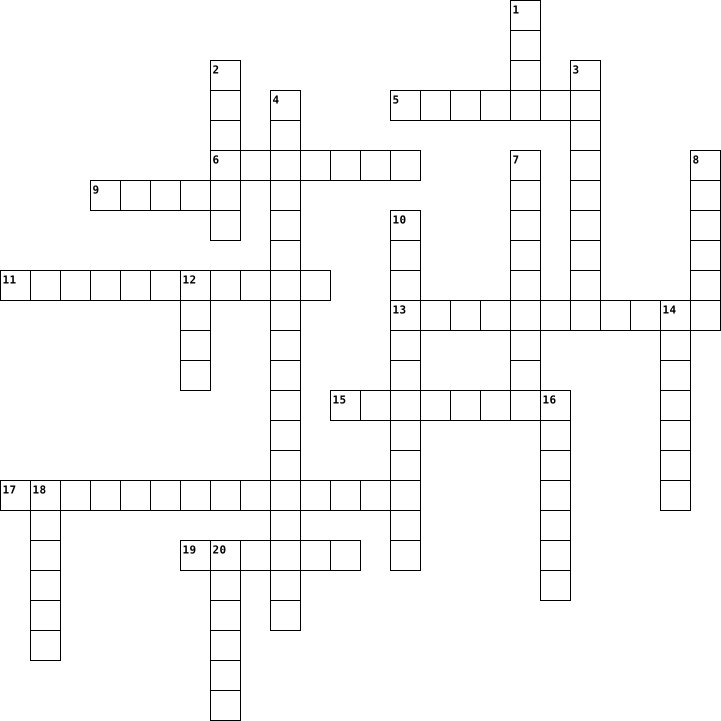
Across
- name one cities that have a major airports and seaport
- which european country has the highest percentage of urban population
- buying and selling of goods
- name one of the cities in the region have population of 500,000 to 1,000,000
- what percentage of u.s. exports does japan
- name one chinese cities have population of more than 5 million people
- moving people and goods from another place to place
- which country has the highest percentage of people between the ages of 0 to 9
Down
- which general direction is the population of the united states moving from
- eraser that came from malaysia
- leave their country to find a safety in another continent
- person who moves to a new city taking a job
- permanent movement of people from place to place
- what percentage of u.s. imports from japan
- relying on others
- region does the united states import the largest amount of goods
- people migrated to all other inhabited continents
- which country has the smallest percentage of people between the ages of 0 to 9
- region that the smallest percentage of united states of united export
- region buys the most of united states goods
20 Clues: relying on others • buying and selling of goods • eraser that came from malaysia • what percentage of u.s. imports from japan • what percentage of u.s. exports does japan • person who moves to a new city taking a job • region buys the most of united states goods • permanent movement of people from place to place • people migrated to all other inhabited continents • ...
Forming a Governemnt 2021-01-14

Across
- A document signed that made the king subject to law
- Divides the powers of government between a central government and the states that make it up
- People who opposed the constitution
- Ten proposed amendments intended to protect citizens' rights
- led hundreds of men in a forced shutdown of the supreme court
- Set of basics and laws that states powers and duties of government
- Political authority is in the nads of the people
- Gave each state equal number of votes in the federal government
- Official approval
- The right to vote
- Essays supporting the constitution
- Give sovereignty to the central government
- Proposing and passing laws
- Trade between two or more states
- System for bringing new states into the union
Down
- No branch gets too powerful
- Uprising of farmers to protest high taxes and heavy debt
- Taxes on imports or exports
- Seven articles that made the first central government
- Two-house legislature
- Increased prices for goods and services combined with the reduced value of money
- A period of low economic activity combined with a rise in unemployment
- Interpreting laws
- Laws are carried out
- Official changes to the constitution
25 Clues: Official approval • The right to vote • Interpreting laws • Laws are carried out • Two-house legislature • Proposing and passing laws • No branch gets too powerful • Taxes on imports or exports • Trade between two or more states • Essays supporting the constitution • People who opposed the constitution • Official changes to the constitution • ...
JW Civil War Crossword 2021-10-14

Across
- American stage actor who assassinated President Abraham Lincoln
- represented the first clash of ironclad naval vessels in history
- acceptance of black men into the Union army and navy
- where the Army of Northern Virginia surrendered
- portion of the U.S loyal to the federal government during the civil war
- naval blockade of the confederate shore
- center of the Union war effort
- turning point in the Civil War
- states important to the success of the union
- Union general during the Civil War, playing a crucial role in the victory over the Confederate States
Down
- most acclaimed Union general during the American Civil War and was twice elected president
- 16th president of the United States
- served as the capital of the confederate States
- fought for the institution of slavery
- war between north and south
- First Battle of Bull Run, first major battle in civil war
- deadliest one-day battle in American military history
- Confederate general who led the South's attempt at secession during the Civil War
- called for registration of all males between the ages of 20 and 45
- efforts to coerce Great Britain and France to support the Confederate war
20 Clues: war between north and south • center of the Union war effort • turning point in the Civil War • 16th president of the United States • fought for the institution of slavery • states important to the success of the union • where the Army of Northern Virginia surrendered • acceptance of black men into the Union army and navy • ...
Delight's Civil War 2019-05-22

Across
- Color of the north
- The man from Mississippi who became the president of the south during the civil war
- Bloodiest single day battle in American History
- First state to leave the union, also state where Fort Sumter was located
- Leader of Union army, Huge cigar smoker
- Last name of the man who killed Lincoln
- His real name was Thomas Jackson
- Merrimac and Monitor
- Color of the south
- Located on the River and State of Mississippi, this was the Confederate city that grant captured
- Sixteenth president during the civil war
Down
- The official word to leave the union of states
- Located in Virginia, this was the capital of the confederate states
- Theater that Lincoln was shot and killed in Washington DC
- The document that Lincoln issued freeing the slaves in 1863
- Commanded the confederates during the civil war
- Three day battle in Pennsylvania during hot July 1863, stopped the south from invading the north
- He was beaten with a cane in the US Senate
- First battle of the civil war
- The name for the southern states during the civil war
- Captured and hung following raid on Harpers Ferry
- another name for the northern states
22 Clues: Color of the north • Color of the south • Merrimac and Monitor • First battle of the civil war • His real name was Thomas Jackson • another name for the northern states • Leader of Union army, Huge cigar smoker • Last name of the man who killed Lincoln • Sixteenth president during the civil war • He was beaten with a cane in the US Senate • ...
The beginning of the Cold War 2024-01-22

Across
- worldwide rivalry between the United States and Soviet Union
- military alliance by the soviet union and its satellite states
- prime minister of England who fought the Nazis in WWII and fought the communists after
- foreign policy that offered economic aid to Western countries after WWII
- military alliance formed by US and other western nations to counter the Soviet Union
- a proposal to achieve something
- a from of metal
- to describe the border of the soviet satellite states and the Western States
- policy of keeping communism contained within its existing borders
- preventing someone from receiving or sending things
- a covering of a door or window
Down
- program where US and british pilots flew supplies to West Berlin during Soviet Blockade
- something that is separate from something but is still reliant from it
- leader of Soviet Union after WWII and at beginning of Cold war
- President Truman's promise to help nations who are struggling against communist movements
- came up with US policy of containment
- a friendship between countries
- a stated policy from the US government
- independent nation under control of a more powerful nation
- President of US at the end of WWII and at beginning of Cold War
20 Clues: a from of metal • a friendship between countries • a covering of a door or window • a proposal to achieve something • came up with US policy of containment • a stated policy from the US government • preventing someone from receiving or sending things • independent nation under control of a more powerful nation • worldwide rivalry between the United States and Soviet Union • ...
Murphy Choice Board 2023-12-08

Across
- When did the United States and North Vietnam decide to cease fire?
- When did the Berlin Wall fall?
- How many people fled from East Berlin before the wall was built to go to West Berlin?
- Who was the Soviet leader that was responsible for placing nuclear wepons in Cuba and aiming them at the United states?
- The United States and Soviet Union competed with one another for political influence and military power.
- What is an area of extreme tension called?
- A wall built to stop East Berliners from coming to the West
- A country split in two by a 103 mile long wall.
- An imaginary line across Europe
- Who won the Space Race?
- A competition for science superiority between the United States and the Soviet Union.
- Who took over Cuba in 1959 during the Rusian Revolution?
- Who won the Korean War?
Down
- When did the Cold War end?
- What year were East and West Berlin established?
- A nuclear war where no shots were fired
- A project to deliver goods to Berlin
- A country with large amounts of power
- What is the abreviation for the National Atlantic Treaty Organiazation
- Who built the Berlin wall?
20 Clues: Who won the Space Race? • Who won the Korean War? • When did the Cold War end? • Who built the Berlin wall? • When did the Berlin Wall fall? • An imaginary line across Europe • A project to deliver goods to Berlin • A country with large amounts of power • A nuclear war where no shots were fired • What is an area of extreme tension called? • ...
Civil War 2023-12-04

Across
- The Northern States (free) during the American Civil War
- Military Leader of the Union
- issued by President Lincoln - freed all slaves in states in rebellion
- President of the Union
- issue that spurs the outbreak of the Civil War
- Address issued by President Lincoln - speech that urges the Union to continue to fight for equality
- the act of setting free
- The Southern States (slave) during the American Civil War
- Slave states that did NOT secede (stayed in the Union)
- President of the Confederacy
- to give up
- someone seriously injured or killed during battle (unable to continue to fight)
Down
- where the Civil War ends
- bloodiest single day battle in American military history
- invention that lead to an increase in slavery in the south
- War using all means necessary to destroy your opponent's ability to engage in war
- Military Leader of the Confederacy
- War war between opposing groups of citizens from the same country
- first battle of the Civil War
- to take back or remove from
- to leave or withdraw from
- advantage for the north - allows for the transportation of goods and troops
- a speech or written statement
- Confederacy attempt to bring the fighting to Northern soil
24 Clues: to give up • President of the Union • the act of setting free • where the Civil War ends • to leave or withdraw from • to take back or remove from • Military Leader of the Union • President of the Confederacy • first battle of the Civil War • a speech or written statement • Military Leader of the Confederacy • issue that spurs the outbreak of the Civil War • ...
Civil War Crossword 2023-09-11

Across
- The 16th president of the United States.
- 1st Battle of the Civil War.
- Union scout who was first to see the Confederates coming, leading into the Battle of Gettysburg.
- Vice President of the Confederacy.
- Anti-Slave Capital of Kansas
- Northern Senator who was beaten by a cane by Preston Brooks.
- A cluster of rocks during Gettysburg where snipers would shoot.
- The pro-slavery Southern States of the U.S.
- Pro Slave Domestic Terrorists during
- Bloodiest Single Day of the Civil War.
Down
- Pro-slave Capital of Kansas, won the race to Washington, but was turned down.
- The Judge which ruled Dred Scott could not sue his owner.
- Fort bombarded by the Confederates for 48 hours straight.
- The main General/Commander of the southern states.
- Nickname used by Horace Greely during Kansas becoming a state.
- A military arsenal John Brown and his men attacked, where John Brown was captured.
- Confederate General, known as Robert E. Lee’s “old war-horse”.
- The anti-slavery Northern States of the U.S.
- A daring General who called to use bayonets on the third day of the Battle of Gettysburg, due to lack of ammunition left.
- “America's Worst President”, in office 1857-1861.
20 Clues: 1st Battle of the Civil War. • Anti-Slave Capital of Kansas • Vice President of the Confederacy. • Pro Slave Domestic Terrorists during • Bloodiest Single Day of the Civil War. • The 16th president of the United States. • The pro-slavery Southern States of the U.S. • The anti-slavery Northern States of the U.S. • “America's Worst President”, in office 1857-1861. • ...
Civics 2024-05-13

Across
- The first ten amendments to the Constitution.
- People hired by private groups to influence government decision makers.
- This means to talk a bill to death.
- Head of the Executive Branch
- Third in command in the Presidential Line of Succession.
- The capital of the United States.
- The political party of the current president.
- This is a group of the presidents advisors.
- The supreme law of the land.
- The state capital of Alabama.
- Top of the Federal Court System.
- The number of years that Senators serve for.
- The __________ ocean is on the east coast of the United States.
- The number of Supreme Court Justices.
Down
- Wrote the Declaration of Independence.
- The Judicial Branch ___________ the laws.
- The Legislative Branch __________ the laws.
- Current United States President.
- If something is allowed by the Constitution.
- The Executive Branch ____________ the laws.
- Current governor of Alabama.
- The number of years that members of the House of Representatives serve for.
- The number of years in a presidential term.
- This is a population count.
- The __________ ocean is on the west coast of the United States.
- The minimum age you have to be to vote.
26 Clues: This is a population count. • Head of the Executive Branch • Current governor of Alabama. • The supreme law of the land. • The state capital of Alabama. • Current United States President. • Top of the Federal Court System. • The capital of the United States. • This means to talk a bill to death. • The number of Supreme Court Justices. • Wrote the Declaration of Independence. • ...
Constitution #1 2023-10-25

Across
- One of the 13 original colonies
- the number of full terms a president can serve
- The Declaration of _____ was a proclamation of the American colonies that they were now and henceforth free states
- The 49th state added to our Union
- the U.S. president is elected for ____ years
- The number of Supreme Court justices
- There is one _____ for each state in the Union on the U.S. flag
- Article ___ sets forth the ways to amend the Constitution
- One of the 13 original colonies (two words)
- Who becomes president if the current president dies?
- this holiday was celebrated for the first time by American coloniests
- The date of Independence Day is July _____
Down
- One of the 13 original colonies (two words)
- One of the 13 original colonies
- The number of stripes. on the U.S. flag
- The ___ of the United States elect Congress members
- The 50th state added to our Union
- King of England during the American Revolution
- the head executive of a city government is called a _____
- The constitution of the United States can be _____.
- Article ___ states that the Constitution shall be the supreme law of the land
- The number of stars on the U.S. flag
- The number of branches in the government of the U.S.
- One of the 13 original colonies
24 Clues: One of the 13 original colonies • One of the 13 original colonies • One of the 13 original colonies • The 50th state added to our Union • The 49th state added to our Union • The number of stars on the U.S. flag • The number of Supreme Court justices • The number of stripes. on the U.S. flag • The date of Independence Day is July _____ • ...
American Civil War (1861-1865) 2024-08-20

Across
- Abolitionist and former slave who became a Union advocate (8 letters)
- Period after the Civil War focused on rebuilding the South (14 letters)
- Name of the Southern states (12 letters)
- Amendment that abolished slavery in the United States (10 letters)
- Carolina First state to secede from the Union (13 letters)
- Emancipation ________, issued by Lincoln (12 letters)
- Union general and later 18th President of the United States (5 letters)
- President of the Confederacy (5 letters)
- Nickname for the Northern states (5 letters)
- Battle that was the bloodiest single day of the war (8 letters)
- Famous Confederate general, known as 'Stonewall' (7 letters)
Down
- President of the Union during the Civil War (7 letters)
- Union fort attacked to start the Civil War (6 letters)
- Union general who led the March to the Sea (7 letters)
- Union strategy to blockade the South (8 letters)
- Battle that was the turning point of the Civil War (10 letters)
- Act that granted 160 acres to settlers in the West (9 letters)
- Confederate general who surrendered at Appomattox (3 letters)
- Capital of the Confederacy after Montgomery (9 letters)
- Assassin of President Lincoln (5 letters)
20 Clues: Name of the Southern states (12 letters) • President of the Confederacy (5 letters) • Assassin of President Lincoln (5 letters) • Nickname for the Northern states (5 letters) • Union strategy to blockade the South (8 letters) • Emancipation ________, issued by Lincoln (12 letters) • Union fort attacked to start the Civil War (6 letters) • ...
crossword midterm puzzle 2020-09-30

Across
- one of the Amendments that abolished slavery in the United States
- a form of government operating on principles adopting from Republican and a democracy
- this Trail pointed the way for the United States to expand Westward to achieve the positions of the day called Manifest Destiny to reach from sea to shining sea
- a protest that occurred in December people got a lot of tea imported by British East India Company into the Hober
- ended the war between the United States and Mexico by its terms, Mexico gets fifty five of its territory, including parts of present day Arizona, California, New Mexico, Texas, Colorado, Nevada, and Utah, to the United States.
- was an American statesman, politician legal scholar military commander lawyer Banker an economist he was one of the founding fathers of the United States
- it granted citizenship to all people born or naturalized in the United States including Farmers and slaves guaranteed all citizens equal
- the first ten amendments to the US Constitution ratified and guaranteeing such rights as the freedom of speech assembly and worship
- a american-statesman, lawyer, philospher and founding father who served as a third president of the United States
- a u.s. history document that was approved by the continental Congress that announced the separation of thirteen North American British colonies from Great Britain
- the action of withdrawing formally from membership of a federation or body, especially a political state
- declared that all persons held as slaves" within the rebelious states are and henceforward shall be free
- was an American social reformer, abolitionist, orator, writer, and statesman. After escaping from slavery in Maryland, he became a national leader of the abolitionist movement in Massachusetts and New York
- a series of laws designed to restrict England carrying trades English ships
- it forbid all settlement west of line drawn along the Appalachian Mountains which was Indian reserved
Down
- a place which crops such as coffee sugar and tobacco are grown by Resident labor
- this plan divided two bodies the Senate and the House of Representative with proportional representation
- the right of citizens of the United States to vote shall not be denied or Abridged by the United States or any state on account of race color or previous conditions of servitude
- this railroad was one thousand one hundred ninety-two my railroad line constructed it connected the existing Eastern u.s. rail network at the Council Bluffs Iowa Pacific Coast at the Oakland Long Wharf on San Francisco Bay
- a person who favors the abomination of practice instruction such as slavery
- was a American political leader, military general, statesmen and founding father who served as the first president of the United States
- was the King of Great Britain
- a state and local laws that enforced racial segregation in Southern United States
- and after of a national stage who assassinated President Abraham Lincoln
- a word that occurred between cheyenne and arpaho people by the US Army in the American Indian Wars that occurred
- a plan to have one vote in Congress instead of the number of votes being based on population
- It stemmed from the annexation of the Republic of Texas by the US from a dispute over whether Texas ended at the Nueces River or the Rio Grande
- was the North American conflict in a larger war between Great Britain and France
- a small but pivotal battle during the American Revolution it took place in December and Trenton New Jersey
- an act that required printed materials in the colonies be produced and stamp paper produced in London carrying an embossed revenue Stamp
- it reduce the rate of tax on molasses from six piece to three pints per gallon
- a decade long fight for freedom by a Black enslaved man named Dred Scott
- a belief in the benefits of profitable Trading
33 Clues: was the King of Great Britain • a belief in the benefits of profitable Trading • one of the Amendments that abolished slavery in the United States • and after of a national stage who assassinated President Abraham Lincoln • a decade long fight for freedom by a Black enslaved man named Dred Scott • ...
I Survived the Battle of Gettysburg Crossword 2016-11-05

Across
- the United States of America including the northern states and border states who were against the Confederate States
- to bring 2 or more things together in order to form a whole
- to trap someone or something
- a large farm or estate on which crops are raised and harvested
- a unit of troops
- against the law or rules
- a signal on the bugle
- someone who fights the government
Down
- an officer ranking above a private in the U.S army or Marine corps
- scorching and burning
- objects fired from a gun
- the container that holds gunpowder for a bullet
- a native of northern U.S state
- the practice of owning slaves
14 Clues: a unit of troops • scorching and burning • a signal on the bugle • objects fired from a gun • against the law or rules • to trap someone or something • the practice of owning slaves • a native of northern U.S state • someone who fights the government • the container that holds gunpowder for a bullet • to bring 2 or more things together in order to form a whole • ...
Constitution quiz 2024-09-27

Across
- George Washington was called the "American ________" because he gave up power
- This was the name of our government before the Constitution
- The 3rd president of the United States
- The constitution created _____ branches of government
- the Articles of Confederation failed because the central government was too __________
- the first 10 amendments
- ___________ wanted a stronger central government
- The 2nd president of the United States
Down
- __________________ wanted a weaker central government
- George Washington stepped down after ___ terms
- The _________ branch of government refers to the President
- the _____________ compromise was between northern and southern states regarding slave representation
- He was one of the most famous, outspoken federalists
- the _______ Compromise was between large and small states
14 Clues: the first 10 amendments • The 3rd president of the United States • The 2nd president of the United States • George Washington stepped down after ___ terms • ___________ wanted a stronger central government • He was one of the most famous, outspoken federalists • __________________ wanted a weaker central government • ...
Lets Talk SafeStart 2026-02-06

Across
- Practice building safe _______
- ______, Traction, or Grip
- Moving with urgent haste
- Being in the path of hazardous energy
- Not looking at what you are doing
- The feeling of being tired or the lack of energy
- States lead to _______
Down
- Hardest of the states to self-trigger on
- Safety program that focus' on Critical Error Reduction Techniques
- Not thinking about what you are doing
- recognize hazardous states and take immediate corrective actions
- _______ Close Calls
- "L" in acronym LAPS
- Another name for a close call
- The feeling of being upset or annoyed
- Critical Error Reduction Techniques
16 Clues: _______ Close Calls • "L" in acronym LAPS • States lead to _______ • Moving with urgent haste • ______, Traction, or Grip • Another name for a close call • Practice building safe _______ • Not looking at what you are doing • Critical Error Reduction Techniques • Not thinking about what you are doing • Being in the path of hazardous energy • The feeling of being upset or annoyed • ...
Pre Civil War 2026-08-20

Across
- of 1850
- Southern states feared slavery’s end.
- denied jury trial to alleged fugitive
- temporary solution to balance free states and slave states
- Series of debates for Illinois Senate race.
- supported by Stephen A. Dongles
- Attracted many former Whigs and Free-Soilers.
Down
- Jefferson Davis elected President of Confederacy.
- Proposed by Stephen A. Douglas.
- Violence between proslavery and antislavery settlers in Kansas.
- Increased sectional tensions.
- Planned to start a slave revolt
- first state to secede from union
- exposed the cruelty of slavery
- First shots of the Civil War.
- led raid on Harper's Ferry
16 Clues: of 1850 • led raid on Harper's Ferry • Increased sectional tensions. • First shots of the Civil War. • exposed the cruelty of slavery • Proposed by Stephen A. Douglas. • Planned to start a slave revolt • supported by Stephen A. Dongles • first state to secede from union • Southern states feared slavery’s end. • denied jury trial to alleged fugitive • ...
The 50 States of The United States of America 2023-06-19

Across
- - Known for its vibrant music, delicious cuisine like gumbo and jambalaya, and unique culture.
- - Located in New England, known for its beautiful forests, covered bridges, and skiing.
- - Rich in American history, with landmarks like Colonial Williamsburg and the historic city of Richmond.
- - Famous for its cheese production, beautiful lakes like Lake Michigan, and the Green Bay Packers.
- - Home to Yellowstone National Park, Grand Teton National Park, and breathtaking natural landscape.
- - Known for its rich history, including the Mayflower and the city of Boston.
- - Home to historic sites like Philadelphia's Independence Hall, the Amish country, and the vibrant city of Pittsburgh.
- - Famous for its cowboy culture, vast size, and attractions like the Alamo and NASA's Space Center.
- - Known for its beaches, boardwalks, and proximity to major cities like New York City and Philadelphia.
- - Home to Chicago, known for its skyscrapers, deep-dish pizza, and vibrant cultural scene.
- - Known for its majestic Rocky Mountains, outdoor recreation, and beautiful national parks.
- - Home to the Grand Canyon, stunning desert landscapes, and unique rock formations.
- - Known for its wide-open prairies, Badlands National Park, and strong Native American heritage.
- - Famous for its beaches, movie industry, and iconic landmarks like the Golden Gate Bridge.
- - Known for its Appalachian Mountains, outdoor recreation, and friendly hospitality.
- - Known for its stunning national parks, including Glacier National Park, and outdoor adventure opportunities.
- - Located in New England, known for its charming small towns, maple syrup, and fall foliage.
- - Home to the iconic Mount Rushmore, Badlands National Park, and Native American culture.
- - Known for its southern charm, historic sites like Savannah, and delicious peaches.
- - Known for its beautiful lakes, outdoor recreation, and friendly "Minnesota Nice" culture.
- - Home to scenic landscapes, including mountains, lakes, and the famous Sun Valley ski resort.
- - Known for its beautiful coastline, Appalachian Mountains, and delicious southern cuisine.
Down
- - Located in the heart of America, known for its wide-open plains and rich agricultural heritage.
- - Famous for its southern charm, beautiful plantations, and historic city of Charleston.
- - A tropical paradise with stunning beaches, volcanoes, and unique Polynesian culture.
- - Known for its stunning national parks, including Zion and Bryce Canyon, and outdoor adventure opportunities.
- - Famous for its horse racing, bourbon distilleries, and the legendary Kentucky Derby.
- - Known for its lush forests, the Space Needle in Seattle, and the beautiful Olympic National Park.
- - Known for its love of basketball, auto racing, and historic sites like the Indianapolis Motor Speedway.
- - Located in New England, known for its picturesque lighthouses, lobster, and beautiful coastline.
- - Home to the Gateway Arch, historic sites like the Pony Express Museum, and the St. Louis Cardinals.
- - Located along the Mississippi River, known for its blues music, southern hospitality, and delicious soul food.
- - Home to the Chesapeake Bay, historic sites like Annapolis, and delicious crab cakes.
- - Located in New England, known for its charming coastal towns and rich colonial history.
- - Known for its natural beauty, including Hot Springs National Park and the Ozark Mountains.
- - The smallest state in the country, known for its beautiful beaches and historic Newport mansions.
- - Known for its southern hospitality, historic landmarks, and delicious barbecue.
- - Famous for its Great Lakes, automobile industry, and the city of Detroit.
- - Famous for Las Vegas, with its bright lights, entertainment, and desert landscapes.
- - Known for its Native American heritage, cowboy culture, and the Oklahoma City National Memorial.
- - Famous for its sunny weather, theme parks like Disney World, and beautiful coastline.
- - The first state to join the Union, known for its beautiful beaches and tax-free shopping.
- - Known for its vast cornfields, friendly people, and the Iowa State Fair.
- - Known for its vibrant music scene in Nashville, the Great Smoky Mountains, and delicious barbecue.
- - Known for its sports teams, including the Cleveland Cavaliers and the Pro Football Hall of Fame.
- - Home to the bustling city of New York City, iconic landmarks, and diverse cultural experiences.
- - Known for its vast farmlands, wide-open spaces, and the Great Plains.
- - Famous for its stunning coastline, Crater Lake National Park, and outdoor recreational activities.
- - Known for its rich Native American culture, desert landscapes, and delicious cuisine like green chili stew.
- - The largest state known for its breathtaking landscapes, wildlife, and the Northern Lights.
50 Clues: - Known for its vast farmlands, wide-open spaces, and the Great Plains. • - Known for its vast cornfields, friendly people, and the Iowa State Fair. • - Famous for its Great Lakes, automobile industry, and the city of Detroit. • - Known for its rich history, including the Mayflower and the city of Boston. • ...
articles of confederation terms to own. 2025-01-15

Across
- teaming of states
- house and Senate combined
- related to national
- interprets laws
- confirm by vote
Down
- power being divided between states and govt
- two nations working together
- legislative branch has the most power
- citizens have power
- passes laws
- MAKES laws
- govt and states share power
12 Clues: MAKES laws • passes laws • interprets laws • confirm by vote • teaming of states • citizens have power • related to national • house and Senate combined • govt and states share power • two nations working together • legislative branch has the most power • power being divided between states and govt
States of Matter 2015-02-26

Across
- the phase change in which a gas changes to a liquid
- the phase change in which a liquid changes to a gas
- the phase change in which a solid becomes a gas, bypassing the liquid phase
- the combined mass of protons and neutrons in an atom
- the temperature at which a substance begins to change phases from solid to liquid
- a combination of two or more types of matter in which the components retain their individual properties
- a chemical substance that is made up of two or more different kinds of atoms that are bonded together
Down
- how tightly the molecules are packed together in the solid object, liquid or gas
- the temperature at which a substance begins to change phases from liquid to gas
- the central portion of the atom containing protons and neutrons
- the number of protons in an atom's nucleus
- a negatively charged particle that moves in an orbit shell outside an atom's nucleus
- a positively charged particle in an atom's nucleus
13 Clues: the number of protons in an atom's nucleus • a positively charged particle in an atom's nucleus • the phase change in which a gas changes to a liquid • the phase change in which a liquid changes to a gas • the combined mass of protons and neutrons in an atom • the central portion of the atom containing protons and neutrons • ...
states of mater 2022-09-16

Across
- 2+ atoms joined together
- no attraction connecting the particles
- water is a common example of this
- same types of atoms
- uniformed particles tightly packed together
- 2 or more elements mixed not chemically combined
- 2+ chemically combined different element
Down
- smallest possible matter
- solid to gas
- only 1 substance/ material
- tiny fragment of matter
- solid to liquid
- liquid to solid
13 Clues: solid to gas • solid to liquid • liquid to solid • same types of atoms • tiny fragment of matter • smallest possible matter • 2+ atoms joined together • only 1 substance/ material • water is a common example of this • no attraction connecting the particles • 2+ chemically combined different element • uniformed particles tightly packed together • ...
States of Matter 2022-12-08

Across
- a state of matter that has indefinite volume and indefinite shape
- mass/volume
- a state of matter that has definite volume and definite shape
- liquid to gas
- gas to solid
- liquid to solid
Down
- law where temperature increases when volume increases
- law where pressure decreases when volume increases
- law where temperature increases when pressure decreases
- A state of matter that has definite volume and indefinite shape
- solid to liquid
- gas to liquid
- solid to gas
13 Clues: mass/volume • gas to solid • solid to gas • gas to liquid • liquid to gas • solid to liquid • liquid to solid • law where pressure decreases when volume increases • law where temperature increases when volume increases • law where temperature increases when pressure decreases • a state of matter that has definite volume and definite shape • ...
States of matter 2022-05-27

Across
- indefinite shape and indefinite volume
- heat exits the system
- the energy of motion
- from a solid to a liquid
- from a solid to a gas
- from a liquid to a solid
Down
- from a gas to a liquid
- heat enters the system
- the average kinetic energy
- indefinite shape but definite volume
- definite shape and definite volume
- the flow of thermal energy
- from a liquid to a gas
13 Clues: the energy of motion • heat exits the system • from a solid to a gas • from a gas to a liquid • heat enters the system • from a liquid to a gas • from a solid to a liquid • from a liquid to a solid • the average kinetic energy • the flow of thermal energy • definite shape and definite volume • indefinite shape but definite volume • indefinite shape and indefinite volume