
the earth Crossword Puzzles
ALEX'S CROSSWORD 2012-08-16

Across
- An imaginary line creating the earth tilt.
- the study of the natural features of the earth's surface.
- One of te earth largest land masses.
- A country that has no water.
- An area of the earth surface were it's not to cold but not to hot.
- An imaginary line separeating the north and south hemisphere.
- The science of farming and life stock.
- Held a war from 1960 to 1970.
- Imaginary lines going across the earth surface.
- graphy the detailed mapping of the configuration of a region.
Down
- A coloured sea.
- One half of a sphere.
- A sport in Turkey.
- A dress in Japan.
- The main city is Istanbul.
- Prevailing area conditions of an area.
- Imagiary lines going through the earth surface.
- the Capital is New Deli
- The biggest county in asia.
- The biggest county partly in europe.
20 Clues: A coloured sea. • A dress in Japan. • A sport in Turkey. • One half of a sphere. • the Capital is New Deli • The main city is Istanbul. • The biggest county in asia. • A country that has no water. • Held a war from 1960 to 1970. • One of te earth largest land masses. • The biggest county partly in europe. • The science of farming and life stock. • ...
The Internal Structure of the Earth 2022-09-17

Across
- region of the upper mantle that is involved in plate tectonic movement and isostatic adjustments
- also called rock pedestal
- another term for canyons
- also known as table lands or flat-topped mountains
- huge, slow-moving bodies of ice
- a greek god : where the name of Aeolian Landforms derive from
- found at the deepest region of the planet
- opening at the top of a volcano
Down
- scientific study of landforms and the processes that shape them
- mounds or small hills made up of sand
- second most common element in the crust
- study of the current terrain features of a region and the graphic representation of a particular landform on a map
- natural physical features on the surface of the earth
- also known as biland or byland
- most common element in the crust
- the highly viscous layer of the mantle
- separates the crust from the mantle, another term for Mohorovicic discontinuity
- third most common element in the crust
- outermost layer of Earth
- another term for valleys
20 Clues: another term for canyons • outermost layer of Earth • another term for valleys • also called rock pedestal • also known as biland or byland • huge, slow-moving bodies of ice • opening at the top of a volcano • most common element in the crust • mounds or small hills made up of sand • the highly viscous layer of the mantle • third most common element in the crust • ...
Earth and Space 2021-05-04

Across
- the planet we live on
- debris from and object that survives its passage through Earth's atmosphere
- a system of billions of stars with gas and dust
- the outermost shell covering earths surface
- a luminous point in the night sky
- each of the aspects of the moon and planet
- a body moving in an elliptical orbit around a star
- the lowest layer of earths atmosphere
- the natural satellite of earth
- resembling the moon
Down
- an object consisting of ice and dust
- a repeating path that an object in space takes
- everything in space and beyond
- gasses surrounding earth or another planet
- to turn
- the outermost part of earths atmosphere
- the distance equivalent to the distance that light travels in one year
- mostly solid layer of the earth that is in between the outer core and crust
- action of rotating around an axis
- the star that the earth orbits
20 Clues: to turn • resembling the moon • the planet we live on • everything in space and beyond • the star that the earth orbits • the natural satellite of earth • action of rotating around an axis • a luminous point in the night sky • an object consisting of ice and dust • the lowest layer of earths atmosphere • the outermost part of earths atmosphere • ...
Chapter 3-5 Crossword 2023-11-16

Across
- a mountain made from molten material
- the process of ocean floor going back into earth
- A type of stress that pushes objects together
- The process of new sea floor being made
- The strongest wave made by earthquakes
- An old bone found inside of earth
- when magma reaches the surface of a volcano
- Pieces of earths crust broken up
- The weakest wave made by earthquakes
- A underwater mountain
Down
- A current that happens in the mantle of the earth
- A belt with a lot of volcanoes
- Type of force that changes a objects shape
- The movement of continents with the convection current in the mantle
- A type of stress that pulls objects apart
- the transfer of heat through touch
- the outer edge of the earth
- A Supercontinent
- A machine that measures earthquakes
- The part of earth where the convection current takes place
20 Clues: A Supercontinent • A underwater mountain • the outer edge of the earth • A belt with a lot of volcanoes • Pieces of earths crust broken up • An old bone found inside of earth • the transfer of heat through touch • A machine that measures earthquakes • a mountain made from molten material • The weakest wave made by earthquakes • The strongest wave made by earthquakes • ...
Puzzling Earth 2022-02-21

Across
- where two plates slide past each other
- crust that makes up the continents on Earth
- the isotope that decays
- the third layer of the Earth.
- the third highest layer of atmosphere
- denser and thinner then continental crust
- occurs when two tectonic plates move away from each other
- brittle upper portion of the mantle and the crust
- layer that lies beneath the lithosphere
- the result of a type of heat transfer that only happens in fluids
Down
- the emission of energy in the form of ionizing radiation
- the stable isotopes
- the innermost layer of Earth
- A tectonic boundary where two plates are moving toward each other
- pieces of Earth's crust and topmost mantle
- electron antineutrinos released in the decays of radioactive elements
- small natural object from space
- calculates an age in years for geologic materials
- vibrations in the earth that transmit energy
- thickest layer of earth
20 Clues: the stable isotopes • the isotope that decays • thickest layer of earth • the innermost layer of Earth • the third layer of the Earth. • small natural object from space • the third highest layer of atmosphere • where two plates slide past each other • layer that lies beneath the lithosphere • denser and thinner then continental crust • pieces of Earth's crust and topmost mantle • ...
Space Systems Vocab and Concepts Review #1 2020-11-17

Across
- the direction in which the Earth rotates on its axis
- the two stars at the end of this constellation's "bowl" point to Polaris (two words)
- the name for the imaginary "line" (the path) that the sun appears to follow through the year (you might need to looks this one up on Google)
- the direction in which the Earth revolves around the sun
- the name for the side of the moon that always faces away from Earth (two words)
- the movement of the Earth that accounts for why the sun appears to rise and set
- also know as the North Star
- to go around another object
- refers to sun
- in the northern hemisphere, stars appear to move in a circular path around this important star
- refers to the shape of the moon at any specific time during a lunar cycle
- a synonym for revolve
- a synonym for rotate
- the location on Earth over which you will always find Polaris in the sky (two words)
- the celestial object that blocks the sun's rays during a lunar eclipse
- it takes the Earth one _____ to make a full revolution around the sun
Down
- general name for a group of stars that form a pattern
- the approximate number of hours it takes for the Earth to rotate once on its axis (compound word)
- the celestial object that blocks the sun's rays during a solar eclipse
- the compass direction in which most stars appear to rise
- refers to moon
- adjective that refers to the sky and the "heavens"
- refers to a series of circles or arcs that have the same center (hint...see page 5 of your packet!)
- an event in which a celestial object such as the moon or sun is blocked
- Polaris is the last star in the "handle" of this constellation (two words)
- the main object in space that the moon orbits
- the adjective that refers to the 13 different constellations that are visible from Earth at different times throughout the year
- it takes the Earth one ______ to make a full rotation on its axis
- to turn on an axis
29 Clues: refers to sun • refers to moon • to turn on an axis • a synonym for rotate • a synonym for revolve • also know as the North Star • to go around another object • the main object in space that the moon orbits • adjective that refers to the sky and the "heavens" • the direction in which the Earth rotates on its axis • general name for a group of stars that form a pattern • ...
Across the Universe 2025-05-07

Across
- Apparent motion of the equinoxes along the ecliptic as Earth wobbles on its axis
- Amount of mass which doesn’t reflect or emit any light (2)
- Imaginary sphere with earth located at its center (2)
- Shape of Earth according to Greek during 500BC
- Planet visible to the eye
- Observed the shadows that the Earth cast on the moon during a lunar eclipse to predict Earth’s shape
- Gave the most accurate size of spherical Earth
- Season that falls on Mar 21 – Jun 21
- Eclipse when the moon passes directly between the sun and the earth
- A unit of length equal to the distance that light would travel in a vacuum in one year
- Apparent daily revolution of the celestial sphere around celestial poles (2)
- Explained clearly than Aristarchus that Sun is center of universe
- Study the universe overall & ask questions about the origin of everything
- Earth-centered universe model
- Shape of Earth according to Pythagoras & his pupils
- Study of the physics of celestial bodies
- Terrestrial motion that is innate characteristics of humans and animals
- Causes the annual motion and changes to length of daytime & night time, & different seasons
- Antenna pointed into space that allowed scientist to discover background radiation
- Cycle in the sky which is based on seasons
- The disappearance of these was one of the argument of Aristotle for a spherical Earth
- Stars that keep changing position, aka planets
Down
- Law that expresses the velocity at which a galaxy is speeding away from Earth
- Size of the Earth to be approximately 25000 stadia
- Because of these difference in which planet orbits the Sun, it creates the apparent retrograde motion
- Due to this presence, gravity is actually causing space to expand and accelerate (2)
- Equal to 3.26 light years
- Added in the model of Aristotle, aka Cronos
- Proposed that the universe is made of 27 concentric spheres
- One of the elements in the terrestrial realm
- imaginary line that the earth spins around (2)
- The effect which occurs with light emitted by an object away from the Earth.
- Days where the sun is the furthest away from the celestial equator
- Not convinced by concentric spheres instead proposed sun-centered universe
- Theorized that the universe began in a state of highly compressed hot ___
- The line that the sun traces in its movement across the sky
- Anticlockwise motion or normal motion of planets
- Sun-centered universe model
- Motion in the universe that is perfect & circular according to the ancient Greeks
- Motivated his students to explain their observation on the movement of planets
- The only celestial object that significantly changes appearance
- Point that doesn’t move at all; experiences no lateral motion as the earth rotates (2)
- Proposed by Eudoxos and Aristotle to be the center of the universe
- Hemisphere that experiences longer days during winter since the axis of rotation is titled away
- Shapes of stars that can be traced by connecting the dots
- Theory developed by Russian-American physicists George Gamov (2)
- Any of the planets whose orbit is further away from the Sun than the Earth’s
- Proposed Earth-centered model of universe using concept of deferent instead of concentric spheres.
- Means to move backward
- When the sun crosses the celestial equator on Mar 21 or Sept 22
50 Clues: Means to move backward • Equal to 3.26 light years • Planet visible to the eye • Sun-centered universe model • Earth-centered universe model • Season that falls on Mar 21 – Jun 21 • Study of the physics of celestial bodies • Cycle in the sky which is based on seasons • Added in the model of Aristotle, aka Cronos • One of the elements in the terrestrial realm • ...
Earth Systems and Layers 2021-07-29

Across
- All the water at and near the surface of the earth.
- The strong, lower part of the mantle between the asthenosphere and the outer core
- forces Any natural process that tears down or wears away Earth's surface.
- The portion of the earth's crust that primarily contains granite, is less dense than oceanic crust, and is 20-50 km thick
- the amount of mass in a given volume.
- A usually light colored, less dense, rock that is found in continental crust
- A mixture of gases that surrounds Earth
- A term referring to all water that is temporarily frozen in polar ice caps, snow, permafrost, and glaciers
- a dense sphere of solid iron and nickel at the center of the earth. Source of Earth's interior heat
- Consists of all life on Earth and all parts of the Earth in which life exists, including land, water, and the atmosphere.
- crust the portion of Earth's crust that is usually below the oceans, thinner and higher in density, made of basalt
Down
- the upper layer of the earth's mantle, below the lithosphere, in which there is relatively low resistance to plastic flow and convection is thought to occur.
- A rigid layer made up of the uppermost part of the mantle and the crust.
- the transfer of heat by the movement of a fluid.
- the outer layer of the earth. thinnest layer
- the layer of the earth between the crust and the core, where convection currents take place
- A dark, dense, igneous rock with a fine texture, found in oceanic crust.
- forces any natural process that builds up Earth's surface
- The mostly solid, rocky part of the Earth; extends from the center of the core to the surface of the crust.
- a layer of molten iron and nickel that surrounds the inner core of the Earth.
- a current caused by the rising of heated fluid and sinking of cooled fluid due to changes in density and gravity
21 Clues: the amount of mass in a given volume. • A mixture of gases that surrounds Earth • the outer layer of the earth. thinnest layer • the transfer of heat by the movement of a fluid. • All the water at and near the surface of the earth. • forces any natural process that builds up Earth's surface • A rigid layer made up of the uppermost part of the mantle and the crust. • ...
IA3 Vocabulary Review 2023-02-14

Across
- When water leaves reservoirs and enters the atmosphere
- The average amount of kinetic energy in the particles of a substance
- When water flows from the atmosphere back to the Earth's surface
- Prevents the flow of electricity
- When water flows across the surface of the Earth
- Two or more of the same or different atoms chemically joined
- Determines the Brightness of a light/Volume of a sound
- Basic unit of matter, Single particle of an element
- When water leaves plants and enters the atmosphere
- Wavelength/Frequency determines this in a light wave
- A change where a new substance is created
Down
- A change where no new substance is created
- All living things on Earth
- All gases on Earth
- All water on Earth
- Purest form of matter, cannot be broken down
- When water flows into the surface of the Earth
- Allows the flow of electricity
- Two or more substances physically joined together
- A substance made up of entirely one substance
- Two or more different atoms chemically joined
- All rocks on Earth
22 Clues: All gases on Earth • All water on Earth • All rocks on Earth • All living things on Earth • Allows the flow of electricity • Prevents the flow of electricity • A change where a new substance is created • A change where no new substance is created • Purest form of matter, cannot be broken down • A substance made up of entirely one substance • ...
All About Earth 2016-11-29

Across
- hemisphere A part of the Earth north from the equator
- The four stages of Earth's revolution
- hemisphere A part of the Earth south form the equator
- solstice The day that starts spring
- What Earth rotates on
- A system to organize time
- Earth _____ on its axis
Down
- Earth has a _____ to revolve around the sun
- The day that a season starts
- Earth makes a full ________ around the sun
- A day of equal day and night
- A part of the Earth that gets the most direct sunlight
- solstice The day that starts winter
- solstice The day that starts summer
- solstice The day that starts fall
15 Clues: What Earth rotates on • Earth _____ on its axis • A system to organize time • The day that a season starts • A day of equal day and night • solstice The day that starts fall • solstice The day that starts winter • solstice The day that starts spring • solstice The day that starts summer • The four stages of Earth's revolution • Earth makes a full ________ around the sun • ...
Eras of the earth 2015-03-13

Across
- era who's name means old life
- last period of mesozoic era
- a time when glaciers cover the earth
- dinosaur with 3 horns on its head
- period that had an explosion of life
- tyrant king dinosaur
- large reptiles during mesozoic era
Down
- movie -------- park
- first period of the mesozoic era
- flying reptile dinosaurs
- scientific name for humans
- feathered reptile, link between reptiles and birds
- the arthropod to first develop eyes
- the present era, name means new life
- the cenozoic era is sometimes called the age of ________
- large elephant like mammal with a hairy coat
16 Clues: movie -------- park • tyrant king dinosaur • flying reptile dinosaurs • scientific name for humans • last period of mesozoic era • era who's name means old life • first period of the mesozoic era • dinosaur with 3 horns on its head • large reptiles during mesozoic era • the arthropod to first develop eyes • a time when glaciers cover the earth • ...
The Earth Week 30 2022-02-16

Across
- four distinct times of the year defined by temperature
- the movement of the Earth on its axis
- The North Star
- the longest and shortest days of the year
- the 23.5 degree angle of the Earth
- one of two imaginary sections of the Earth
- 366 days
- 12 months, 52 weeks, 365 days
- the imaginary pole through the center of the Earth running north and south
- the movement of planets around the Sun
- the day during the year when there is the same amount of day and night
Down
- stars that seem to revolve around the North Star
- divides the northern and southern hemispheres
- pictures made by connecting stars
- a internation laboratory that is circling the Earth in space
- the constellations Leo, Sagittarius, Libra, Gemini are all a part of this
16 Clues: 366 days • The North Star • 12 months, 52 weeks, 365 days • pictures made by connecting stars • the 23.5 degree angle of the Earth • the movement of the Earth on its axis • the movement of planets around the Sun • the longest and shortest days of the year • one of two imaginary sections of the Earth • divides the northern and southern hemispheres • ...
The Earth 6 Problem 2024-10-27

Across
- Who, What, When, _____, Why
- To locate something
- Moving pictures
- To do something with caution
- The word for 'Tú' in English
- "__ The Road Again" by Willie Nelson
- A name I call myself
- The Cat in the Hat has two of these
Down
- Earth 6's favorite Coldplay song
- To deliberate (past tense)
- "__ Are Family" by Sister Sledge
- The opposite of pleasant
- Where fresh water emerges from the ground (plural)
- Equal
- Dire need
- In addition to
16 Clues: Equal • Dire need • In addition to • Moving pictures • To locate something • A name I call myself • The opposite of pleasant • To deliberate (past tense) • Who, What, When, _____, Why • To do something with caution • The word for 'Tú' in English • Earth 6's favorite Coldplay song • "__ Are Family" by Sister Sledge • The Cat in the Hat has two of these • "__ The Road Again" by Willie Nelson • ...
Planet Earth 2020-10-06

Across
- A natural or artificial body that orbits a planet
- An imaginary line around the Earth parallel to the Equator
- A huge ball of very hot gases in space
- the relationship between the distance shown on a map and the actual distance
- Distance between a place on the Earth's surface and the Greenwich Meridian
- A two-dimensional, or flat, representation of Earth's surface
- The imaginary line around which Earth rotates
- Imaginary line that runs around the earth and divides it into the Northern and Southern Hemispheres
- A way of representing the spherical Earth on a flat surface
- Numbers used to give the exact location of a place on the Earth
- An imaginary line that connects the North Pole and the South Pole
Down
- Imaginary line running through Greenwich, England, from the North to the South pole at 0 degrees longitude
- Distance between a place on the Earth's surface and the Equator
- Sun, planets, and other objects that orbit the sun
- A celestial body moving in an elliptical orbit around a star
- A map that shows surface features of an area such as mountains, rivers, roads
- A large group of stars and planets held together by gravity
- The name of our galaxy, that contains the Earth and the Solar System
- Areas between two meridians sharing the same time
- The science of making maps
- One half of the Earth
21 Clues: One half of the Earth • The science of making maps • A huge ball of very hot gases in space • The imaginary line around which Earth rotates • A natural or artificial body that orbits a planet • Areas between two meridians sharing the same time • Sun, planets, and other objects that orbit the sun • An imaginary line around the Earth parallel to the Equator • ...
Earth Science Vocabulary (Grade 5 Ohio) 2023-03-20

Across
- the Earth spinning around its axis; this takes Earth 24 hours (1 day) to complete
- If the Earth is tilted towards the sun the temperature will be ______________.
- 365 _____________ is the amount of time it takes the Earth to revolve around the sun
- the luminous celestial body around which the earth and other planets revolve, from which they receive heat and light
- The 4 planets that have long orbits and are made of mostly gas
- the elliptical path of a celestial object or spacecraft around a star, planet, or moon
- the season with the least daylight hours
- If the Earth is tilted away from the sun the temperature will be ______________.
Down
- the way in which the Earth slants on its axis
- The 4 planets with the shortest orbits are known as the ______ planets
- an imaginary line that passes through the North and South poles
- a small, cold natural satellite that orbits planets in our solar system
- the Earth moving around the sun; this takes Earth 365 ¼ days (one year) to complete
- true or false-Earth's revolution around the sun is responsible for day and night.
- the season with the most daylight hours
- 24 _________ is the amount of time it takes Earth to make 1 rotation on its axis.
16 Clues: the season with the most daylight hours • the season with the least daylight hours • the way in which the Earth slants on its axis • The 4 planets that have long orbits and are made of mostly gas • an imaginary line that passes through the North and South poles • The 4 planets with the shortest orbits are known as the ______ planets • ...
space vocabulary Alanna Langdon core 1 1/13/15 2016-01-13

Across
- the partial or total cover of one object in space by another.
- a system for organizing time
- top and bottom half of earth from the north and south pole to the equator
- the periodic rise and fall of the level of water in the ocean
- dark flat areas on the moon [called seas]
- attracts all objects toward each other
- law where an object will stay in motion or at rest until an outside force acts on it
- the force of gravity acting on an object [can change depending on it's location
Down
- the degree that earth is tilted on it's axis
- law that every object in the universe attracts to each other
- an imaginary line that passes through the center of earth and the north and south poles, which the earth rotates
- the spinning of the earth on it's axis
- the path the earth follows around the sun
- the tendency of an object to resist a change in motion
- different shapes of the moon
- the yearly cycle of winter, summer, spring, and autumn caused by the tilt on earth from it's axis as it revolves around the sun
- the study of the moon, stars, and objects in space
- the movement of one object around another
- a push or pull exerted on an object
- the amount of matter in an object
20 Clues: a system for organizing time • different shapes of the moon • the amount of matter in an object • a push or pull exerted on an object • the spinning of the earth on it's axis • attracts all objects toward each other • the path the earth follows around the sun • dark flat areas on the moon [called seas] • the movement of one object around another • ...
Vocabulary Review 2024-06-26

Across
- the force that pulls things to Earth
- the breaking down of the Earth through weathering
- small stones and sand
- ____ features have been created by people - buildings, roads, playgrounds, statues
- can contribute to over fishing
- ____ features often existed before humans- trees, seas, lakes, rivers, mountains
- another name for pollutants
- all of the living things on Earth
- something observable in science
Down
- Chesapeake Bay is the largest one in America
- the air surrounding the Earth
- all of the land on Earth
- contributes to dirty air, water, and/or land
- a place where animals live
- continued exposure to wind, water, or ice leads to erosion over time
- water ____ occurs when there is more water than the land can absorb.
- all of the water on Earth
- when sediments are placed somewhere by wind or water
18 Clues: small stones and sand • all of the land on Earth • all of the water on Earth • a place where animals live • another name for pollutants • the air surrounding the Earth • can contribute to over fishing • something observable in science • all of the living things on Earth • the force that pulls things to Earth • Chesapeake Bay is the largest one in America • ...
Moon Phases 2024-09-19

Across
- carry out research or study into (a subject, typically one in a scientific or academic field) so as to discover facts or information.
- make (something) visible or bright by shining light on it; light up.
- appearing smaller
- when the Moon passes between the Sun and Earth but the Sun, Moon, and Earth are not perfectly lined up
- the fully shaded inner region of a shadow cast by an opaque object, especially the area on the earth or moon experiencing the total phase of an eclipse.
- occurs when the Moon passes directly between the Earth and Sun. It covers most of the Sun leaving its outer edge visible as a bright ring around the darkened Moon.
- a moon that appears more than half full but not fully illuminated when viewed from Earth
- move or cause to move into a sloping position.
- the phase of the moon when it is in conjunction with the sun and invisible from earth
- the shadow cast by the earth or moon over an area experiencing a partial eclipse.
Down
- happens when the Moon passes between the Sun and Earth, completely blocking the face of the Sun.
- occurs when the Moon passes between the Earth and the Sun, blocking some or all of the Sun's light from reaching Earth. T
- a tide just after the first or third quarters of the moon when there is least difference between high and low water
- considered in relation or in proportion to something else.
- a part of a whole.
- the Moon as it appears early in its first quarter or late in its last quarter, when only a small arc-shaped section appearsGibbous moon
- happens when the Earth's shadow falls on the Moon, blocking sunlight that would otherwise reflect off the Moon's surface.
- a tide just after a new or full moon, when there is the greatest difference between high and low water.
- the phase of the moon in which its whole disk is illuminated.
- appearing larger
20 Clues: appearing larger • appearing smaller • a part of a whole. • move or cause to move into a sloping position. • considered in relation or in proportion to something else. • the phase of the moon in which its whole disk is illuminated. • make (something) visible or bright by shining light on it; light up. • ...
Ch 1. and Ch 3. Crossword 2014-11-24

Across
- the process by which heat or electricity is directly transmitted
- the upper layer of the earth's mantle
- effect the trapping of the sun's warmth
- the variety of life in a particular habitat or ecosystem
- regions of matter that make up the earth
- the envelope of gases surrounding the earth
- plates the two-sub layers of the earth's crust that move
- deals with the relations of organisms
Down
- the lowest region of the atmosphere
- the layer of the earth's atmosphere
- practice of farming
- resource materials or substances such as minerals,forests,and water
- destruction
- the rigid outer part of the earth
- the emission of electromagnetic waves
- interior of the earth between the core
- a substance that is harmful that goes into the environment
- outermost layer of a planet
- the central region of the earth
19 Clues: destruction • practice of farming • outermost layer of a planet • the central region of the earth • the rigid outer part of the earth • the lowest region of the atmosphere • the layer of the earth's atmosphere • the upper layer of the earth's mantle • the emission of electromagnetic waves • deals with the relations of organisms • interior of the earth between the core • ...
hehe 2023-04-21

Across
- shuttle that is the farthest out into space
- man-made satellite that humans occupy
- measured in kilograms
- first element on the periodic table
- third planet in the solar system
- space cloud
- space x program
- newtons first law
- has lots of mass packed into a tiny space, and sucks up anything that enters its event horizon
- on earth it's 9.8m/s
- distance that takes one year for light to traverse
Down
- how long does it take for the ISS to orbit earth?
- collection of stars that seem to make a shape in the sky
- outer belt of asteroids
- nearest galaxy to the milky way
- is one of the man-made satellites of Earth and is a telescope
- some kind of object that orbits another object in space
- the galaxy in which Earth resides
- nearest star to the solar system other than the sun
- what the moon does to the earth
- large collection of mass in a concentrated space
- large space sphere object that isn't a star or black hole
- the sun
23 Clues: the sun • space cloud • space x program • newtons first law • on earth it's 9.8m/s • measured in kilograms • outer belt of asteroids • nearest galaxy to the milky way • what the moon does to the earth • third planet in the solar system • the galaxy in which Earth resides • first element on the periodic table • man-made satellite that humans occupy • ...
Star Puzzle 2025-05-16

Across
- the milky way is a ___
- opposite of a white hole
- ethiopian princess in greek mythology
- the earth ___ the sun
- the third planet from the sun
- cloud of dust and gas in space
- the north star
- an object that orbits a celestial body
- you need 2 of these molecules to make water
- shiny objects in the sky
- how we measure in space
- icy objects beyond the orbit of neptune
- the ISS takes this much time to orbit earth once
Down
- earth is in the galaxy ___
- the earth is the 3rd ___ to the sun
- closest star system
- ISS
- newtons first law is the law of ___
- ___ space telescope
- keeps us from floating
- a group of stars that look like a picture
- the most distant man made object in space
- amount of matter in an object
23 Clues: ISS • the north star • closest star system • ___ space telescope • the earth ___ the sun • the milky way is a ___ • keeps us from floating • how we measure in space • opposite of a white hole • shiny objects in the sky • earth is in the galaxy ___ • the third planet from the sun • amount of matter in an object • cloud of dust and gas in space • the earth is the 3rd ___ to the sun • ...
The Planets 2014-10-17

Across
- the name given to the eclipse that occurs when the moon passes between the sun and the Earth
- The galaxy our solar system is part of
- I am the fastest moving planet
- I am considered to be a dwarf planet
- The planet furthest from the sun
- I am the only planet that has only 1 moon
- the category of planets that include the four closest planets to the sun
- the name given to the eclipse that occurs when the moon passes into the earth's shadow
- I stop people and things on earth from floating away
- The planet with the most visible rings
Down
- I control the tides on Earth
- the curbed path a planet takes around the sun is called its....
- I am the gaseous envelope that surrounds the Earth
- The largest planet in our solar system
- the name given to a group of stars that make patterns in the sky
- all of the planets in our solar system orbit me
- Sometimes called the 'Red Planet'
- a meteoroid enters into the earths atmosphere
- the planet that is second from the sun
- the Earth has a tilt of approx 23* on its.....
20 Clues: I control the tides on Earth • I am the fastest moving planet • The planet furthest from the sun • Sometimes called the 'Red Planet' • I am considered to be a dwarf planet • The galaxy our solar system is part of • The largest planet in our solar system • the planet that is second from the sun • The planet with the most visible rings • ...
All About Earth 2016-11-29

Across
- A day of equal day and night
- hemisphere A part of the Earth south form the equator
- solstice The day that starts spring
- What Earth rotates on
- Earth makes a full ________ around the sun
- solstice The day that starts winter
- A part of the Earth that gets the most direct sunlight
Down
- Earth has a _____ to revolve around the sun
- The four stages of Earth's revolution
- hemisphere A part of the Earth north from the equator
- The day that a season starts
- A system to organize time
- solstice The day that starts fall
- Earth _____ on its axis
- solstice The day that starts summer
15 Clues: What Earth rotates on • Earth _____ on its axis • A system to organize time • A day of equal day and night • The day that a season starts • solstice The day that starts fall • solstice The day that starts spring • solstice The day that starts winter • solstice The day that starts summer • The four stages of Earth's revolution • Earth makes a full ________ around the sun • ...
All About Earth 2016-11-29

Across
- solstice The day that starts fall
- solstice The day that starts winter
- Earth makes a full ________ around the sun
- Earth has a _____ to revolve around the sun
- A system to organize time
- hemisphere A part of the Earth south form the equator
- solstice The day that starts summer
- A day of equal day and night
Down
- The day that a season starts
- What Earth rotates on
- Earth _____ on its axis
- hemisphere A part of the Earth north from the equator
- The four stages of Earth's revolution
- solstice The day that starts spring
- A part of the Earth that gets the most direct sunlight
15 Clues: What Earth rotates on • Earth _____ on its axis • A system to organize time • The day that a season starts • A day of equal day and night • solstice The day that starts fall • solstice The day that starts winter • solstice The day that starts spring • solstice The day that starts summer • The four stages of Earth's revolution • Earth makes a full ________ around the sun • ...
All About Earth 2016-11-29

Across
- solstice The day that starts fall
- The four stages of Earth's revolution
- What Earth rotates on
- solstice The day that starts summer
- hemisphere A part of the Earth north from the equator
- A part of the Earth that gets the most direct sunlight
- The day that a season starts
Down
- A system to organize time
- solstice The day that starts winter
- Earth _____ on its axis
- hemisphere A part of the Earth south form the equator
- Earth has a _____ to revolve around the sun
- Earth makes a full ________ around the sun
- A day of equal day and night
- solstice The day that starts spring
15 Clues: What Earth rotates on • Earth _____ on its axis • A system to organize time • A day of equal day and night • The day that a season starts • solstice The day that starts fall • solstice The day that starts winter • solstice The day that starts summer • solstice The day that starts spring • The four stages of Earth's revolution • Earth makes a full ________ around the sun • ...
Crossword Puzzle 2022-09-19

Across
- scientific study of landforms and the processes that shape them
- also called byland or biland
- formed when moving water in a stream erodes the out banks then widens its valley
- the last and innermost layer of Earth and is separated into two
- makes up only about one percent of Earth
- its name originated from a French word which means "hillock" or small hill
- extends from the surface of Earth to a depth of about 70-100 km
- they are formed by various forces of nature of Earth
- a resistant rock that usually surrounds table mountains
- the Greek god of the winds; where the word Aeolian is derived from
Down
- refers to the sediment that has accumulated due to the interaction of delta and bodies of water
- portion of lands elevated thousands of feet above their surroundings
- largest layer of Earth
- they may be dome-shaped, crescent-shaped, star-shaped, linear-shaped, or parabolic
- study of the flow of matter primarily in the liquid state
- influenced by water and wind erosion over a long period of geologic time
- divided into five layers
- study of the current terrain features of a region
- a product of glacial activity in an area
- the most common type of dune found on Earth
20 Clues: largest layer of Earth • divided into five layers • also called byland or biland • makes up only about one percent of Earth • a product of glacial activity in an area • the most common type of dune found on Earth • study of the current terrain features of a region • they are formed by various forces of nature of Earth • ...
Space 2026-01-19

Across
- The red planet, fourth from the Sun.
- The angle of the Earth’s axis that causes seasons.
- The closest planet to the Sun.
- The time it takes for the Earth to rotate once on its axis.
- The hottest planet in the Solar System.
- Our home planet, the third from the Sun.
- The largest planet in the Solar System.
- The Sun and all the objects that orbit it.
- The value that shows how strong gravity is at a location.
- The force of gravity acting on an object’s mass.
Down
- The amount of matter in an object, not affected by gravity.
- The planet famous for its rings.
- The natural satellite that orbits the Earth.
- The time it takes for the Earth to orbit the Sun once.
- The shape of the Earth.
- The yearly cycle of weather changes caused by the tilt of the Earth.
- The curved path of a planet or moon around a star or planet.
- A luminous sphere of gas, like the Sun.
- The force that pulls objects toward each other.
- A huge collection of stars, gas, and dust bound together by gravity.
- All of space and everything in it, including galaxies.
21 Clues: The shape of the Earth. • The closest planet to the Sun. • The planet famous for its rings. • The red planet, fourth from the Sun. • The hottest planet in the Solar System. • The largest planet in the Solar System. • A luminous sphere of gas, like the Sun. • Our home planet, the third from the Sun. • The Sun and all the objects that orbit it. • ...
Earth and Space Crossword 2024-01-17

Across
- Cycle The time period when the Moon orbits Earth one time and goes through all of its phases. Takes about 29 days.
- The driving force of water cycle and is the center of our solar system
- Happens in the West (PM)
- When water fills every available pore space in soil. New rain has no where to go and flooding is very likely.
- The spinning of Earth on its axis.
- The movement of one object around another object. Orbit
- Has a rocky surface and has a very THIN atmosphere
- The evaporation of water from the leaves of a plant into the atmosphere.
- Water that falls to Earth as rain, snow, hail, or sleet.
- Has a rocky surface and has an atmosphere
- The time it takes Earth to revolve around the sun
Down
- Water collecting in rivers, oceans, and streams
- The flow of water through soil and porous or cracked rock
- belt Separates the inner and outer planets.
- The time it takes Earth to rotate once on its axis
- Causes the rise and fall of ocean tides
- Caused by the tilt of Earth on its axis and Earth's revolution around the Sun
- ...planets: Mercury, Venus, Earth, Mars.
- water that flows over the ground surface rather than soaking into the ground
- Happens in the East (AM)
- ...planets: Jupiter, Saturn, Uranus, Neptune.
- average weather conditions in an area over a long period of time. (What you can expect)
- The condition of Earth's atmosphere at a particular time and place. Changes day-to-day. (What you get)
23 Clues: Happens in the West (PM) • Happens in the East (AM) • The spinning of Earth on its axis. • Causes the rise and fall of ocean tides • ...planets: Mercury, Venus, Earth, Mars. • Has a rocky surface and has an atmosphere • belt Separates the inner and outer planets. • ...planets: Jupiter, Saturn, Uranus, Neptune. • Water collecting in rivers, oceans, and streams • ...
Plate Tectonics 2017-02-13

Across
- 1st landmasses
- Convergent boundaries cause
- Divergent boundaries cause
- When the plate splits
- Most Dense Layer of Earth
- Age of Continental
- Less dense layer
- Transform boundaries cause
- More dense layer
Down
- What is within the mantle?
- When the plates rub together
- Age of Oceanic
- causes collisions, to pull apart and/or scrape against
- Number of Layers of the earth
- When Plates Come together
- Refers to deformation of crust
- Events caused by plates
- Least Dense Layer of Earth
- Types of plates
- where we live
20 Clues: where we live • 1st landmasses • Age of Oceanic • Types of plates • Less dense layer • More dense layer • Age of Continental • When the plate splits • Events caused by plates • When Plates Come together • Most Dense Layer of Earth • What is within the mantle? • Divergent boundaries cause • Least Dense Layer of Earth • Transform boundaries cause • Convergent boundaries cause • ...
Earth and Space Crossword: ES2 2023-11-19

Across
- A historical model of our solar system that puts the Earth at the centre of the universe.
- A change in the moons appearance from Earth
- Earth’s atmosphere is made up mainly of nitrogen and _______.
- What is it called when the Moon gets in the way of the Sun’s light and casts its shadow on Earth.
- The 4th planet from the sun
- The largest planet in our solar system.
- Earth's 24 hour rotation on its axis.
- The heliocentric model of the solar system was created by? (Last name only)
- Earth is divided into these halves.
- It takes the moon approx one-month to complete an orbit of Earth, this is called the _____ cycle.
Down
- 365 day orbit.
- The imaginary line around the middle of the Earth.
- The first person to view and study space through a telescope.
- If the moon is 'waning', is it getting bigger or smaller?
- Earth's rotation around the sun on its titled axis causes different weather at different times of the year called _______.
- The planet which is closest to the sun
- A star. Produces all heat and light for our solar system.
- Pluto is the 9th planet of our solar system.
- Earth rotates on its ____
- Planets further away from the sun consist mostly of gases and liquids are called _____ planets.
20 Clues: 365 day orbit. • Earth rotates on its ____ • The 4th planet from the sun • Earth is divided into these halves. • Earth's 24 hour rotation on its axis. • The planet which is closest to the sun • The largest planet in our solar system. • A change in the moons appearance from Earth • Pluto is the 9th planet of our solar system. • ...
Solar system crossword puzzle 2023-05-17

Across
- closest planet to the sun
- it's what orbits our planet
- earth is the most _________ planet in the solar system
- the air that we breathe on earth is what makes up the _________
- this is the circular path that a planet follows around the sun
- this is the fifth planet, also the largest
- the planet known for its rings is _________
- the color that the surface of venus looks like because of the clouds
- we call the sun and the planets the solar _______
- the hottest planet
Down
- there are thousands of these on venus, along with mountains and valleys
- our home planet
- also known as the red planet, it's next to earth
- -dioxide, the gas that's part of what makes up the atmosphere on venus
- this planet orbits the sun at a distance of 2.8 billion miles
- the _________ on mars is much less than earth, a 220 pound person on earth would weigh 83 pounds on mars
- this planet was discovered in 1930, and is much smaller than any other planet in the solar system. Now it's known as a dwarf planet
- this planet is next to saturn and has a bluish color
- there is a _______ on jupiter that is at least 2 times larger than the earth!
- this is the actual name of our sun
20 Clues: our home planet • the hottest planet • closest planet to the sun • it's what orbits our planet • this is the actual name of our sun • this is the fifth planet, also the largest • the planet known for its rings is _________ • also known as the red planet, it's next to earth • we call the sun and the planets the solar _______ • ...
Geography Vocab 2022-09-04

Across
- a set of numbers that together describe the exact location of something, such as a place on a map
- one half of a sphere. Earth can be divided into eastern and western hemispheres or into northern and southern hemispheres.
- the system of imaginary lines (called parallels of latitude and meridians of longitude) used to divide the surface of Earth on maps and globes
- where a place is located in relation to another place
- a change in the shape, size, or position of a place when it is shown on a map
- the precise point where a place is located on Earth
- the line of latitude that circles Earth exactly midway between the North and South poles
- the directions on a compass rose, such as southeast, that are located between the cardinal directions
- the spinning motion of Earth around its axis
Down
- area between the equator and the Tropic of Cancer and between the equator and the Tropic of Capricorn, where the climate is generally hot
- one complete trip by Earth around the sun
- a diagram on a map that shows directions such as north, south, east, and west
- the area between Earth’s tropical zones and polar zones, where the climate is relatively mild
- the meridian of longitude labeled 0 degrees, from which all other degrees of longitude are measured.
- a box or other display on a map that explains the meaning of the symbols used on the map
- an imaginary line that runs from the North Pole to the South Pole through the center of Earth
- a system of imaginary lines that divides up the space on a map
- the seven largest areas of land on Earth
- a way of representing the spherical Earth on a flat surface
- the four main directions on a compass rose: north, south, east, and west
- an element of a map that shows how a unit of distance on the map (such as an inch) relates to actual distance on the surface of Earth
- a very large, unbroken area of land
22 Clues: a very large, unbroken area of land • the seven largest areas of land on Earth • one complete trip by Earth around the sun • the spinning motion of Earth around its axis • the precise point where a place is located on Earth • where a place is located in relation to another place • a way of representing the spherical Earth on a flat surface • ...
Unit 5 8th Grade 2023-11-29

Across
- The tilt of the Earth on its axis plays a role in Earths changing ________.
- A 3/4 Moon is also known as a _________.
- ________ tides have the smallest daily tidal range.
- ________ range is the difference between the levels of ocean water at high and low tide.
- When the moon is showing at 1/4 (looks like a fingernail) it is called a ________.
- During a _______ Moon, the Earth, Moon, and sun are aligned in a 90 degree angle.
- A force that pulls other objects with a mass towards themselves.
- During a _______ Eclipse, the when the moon moves through Earth's shadow.
- How long it takes the earth to complete one revolution around the sun.
- An event during which one object in space casts a shadow onto another object.
- During a ______ Moon, the Moon is directly between the sun and the Earth.
- The Gravitational pull of the _______ causes the tides on Earth.
Down
- The spinning of a body, such as a planet, on its axis.
- During a _______ eclipse, the moon passes between the sun and Earth so that the sun is totally or partially obscured.
- When the area of sunlight is at a maximum in one hemisphere and minimum in the other.
- _________ tides have the largest daily tidal range.
- The darkest part of the shadow that is cast by an object during an eclipse.
- Spreading cone of lighter shadow that is cast on an object during an eclipse.
- The motion of a body that travels around another body in space.
- A body that orbits a larger body.
- Daily changes in the level of ocean water.
- The time it takes the earth to complete on rotation on its axis.
- Time on earth that is characterized by a pattern of temperature and weather trends.
- During a ______ Moon, the Earth is directly between the Moon and the sun.
- When the sunlight shines equally on the Northern and Southern hemispheres.
25 Clues: A body that orbits a larger body. • A 3/4 Moon is also known as a _________. • Daily changes in the level of ocean water. • _________ tides have the largest daily tidal range. • ________ tides have the smallest daily tidal range. • The spinning of a body, such as a planet, on its axis. • The motion of a body that travels around another body in space. • ...
How Geographers Look at the World 2021-09-07

Across
- Found at 23 ½ degrees north, it’s the Northernmost point on Earth to receive direct sunlight
- The earth’s crust and uppermost mantle
- Side of the mountain with more precipitation
- High ______(far from the equator) = colder climate, Low _____ (close to the equator) = warmer climate
- Side of the mountain with less precipitation and a rain shadow
- Block rain and wind. This creates a rain shadow
- Latitude region of earth that has the dramatic seasons
- Found at 23 ½ degrees south, it’s the Southernmost point on Earth to receive direct sunlight
- Earth's water including water in the atmosphere
Down
- Warmer winds and water in western North America and South America = warmer climate = more storms
- The part of the earth where plants and animals live
- Thin layer of gases that surround earth, where weather and climate occur
- Type of boundary that moves like <--- --->
- Places close to the ocean have more steady temperatures
- Low _______= warmer climate; High ______ = colder climate
- Type of boundary that moves like ----> <--- and creates mountains
- Type of boundary that creates earthquakes
- Type of boundary that creates trenches volcanoes and earthquakes
- Latitude region of earth that has hot temperatures, high precipitation, lush vegetation and lots of sunlight
- Latitude region of earth that has the poles and cold temperatures year round
20 Clues: The earth’s crust and uppermost mantle • Type of boundary that creates earthquakes • Type of boundary that moves like <--- ---> • Side of the mountain with more precipitation • Block rain and wind. This creates a rain shadow • Earth's water including water in the atmosphere • The part of the earth where plants and animals live • ...
Reasons for the Seasons 2023-11-27

Across
- The point where the sun's rays can’t hit the hemisphere directly.
- the angular distance of a place north or south for the equater
- The section of the earth that is north of the equator.
- The point where the sun's rays can hit the hemisphere directly.
- What most people believe but is wrong.
- A curved path of an object around stars,planets,or a moon.
- The point where the sun's rays can hit the hemisphere directly.
- the star of the northern hemisphere toward which the axis of
Down
- The angle where the sun's rays can’t hit the hemisphere directly.
- The section of the earth that is south of the equator
- measure of hotness or coldness expressed in terms of any of several arbitrary scales, such as Fahrenheit, Celsius, or Kelvin.
- is the most northerly circle of latitude on Earth
- the angle between an object's rotational axis and its orbital axis
- the angular distance of a place east or west
- The amount of time for the earth to do a whole orbit around the sun.
- the star around which the earth orbits.
- an imaginary line about which a body rotates.
- the planet on which we live; the world.
- A period of time between the same dates in successive calendar months.
- is the most southern circle of latitude on earth
20 Clues: What most people believe but is wrong. • the star around which the earth orbits. • the planet on which we live; the world. • the angular distance of a place east or west • an imaginary line about which a body rotates. • is the most southern circle of latitude on earth • is the most northerly circle of latitude on Earth • ...
6th grade 2nd vocab 2025-10-01

Across
- on time; not late
- honesty and moral soundness
- the scientific study of the origin and structure of the earth
- ability to control oneself
- honesty and fairness in one’s beliefs and actions.
- a standard of right and wrong
- Course: a path or direction __
- Geology: the scientific study of the origin and __ of the earth
- Geography: the scientific study of the __ of the earth–its natural features
Down
- Prefix geo- ___ to the earth
- Waste: useless __
- Considerate: __ of others; kind
- Lie: to __
- Respectful: __ and polite
- vulgar
- Lay: to __ something
- Self-discipline: the ability to __ oneself, often for improvement
17 Clues: vulgar • Lie: to __ • Waste: useless __ • on time; not late • Lay: to __ something • Respectful: __ and polite • ability to control oneself • honesty and moral soundness • Prefix geo- ___ to the earth • a standard of right and wrong • Course: a path or direction __ • Considerate: __ of others; kind • honesty and fairness in one’s beliefs and actions. • ...
Key Words - Solar System 2020-06-11

Across
- On or relating to the Earth.
- the star round which the earth orbits.
- A continuous area or expanse which is free.
- There are many of these in the milky way.
- It pulls us down to Earth.
- A body of matter that enters the earth atmosphere.
- The natural satellite of the Earth.
- They are basically dusty snowballs that orbit the sun.
Down
- A small rocky body orbiting the sun.
- An artificial body placed in orbit around the Earth.
- The place where many people live on.
- The earth is on its ____.
- Part of a 24 hour period when it is dark.
- Decive used to see things from far away.
- Part of a 24 hour period when it is light.
15 Clues: The earth is on its ____. • It pulls us down to Earth. • On or relating to the Earth. • The natural satellite of the Earth. • A small rocky body orbiting the sun. • The place where many people live on. • the star round which the earth orbits. • Decive used to see things from far away. • Part of a 24 hour period when it is dark. • There are many of these in the milky way. • ...
Science project 2023-12-05

Across
- the layer that is above the stratosphere
- The weight the air molecules on earth
- a period of time with no activity
- to become larger
- a process that moves energy
- The very last layer of earths atmospheres
- the northern part at the end of the axis
- the layer above the troposphere
- a belt with strong winds
- the lowest layer of the atmospheres
- winds that blow towards the equator
Down
- the way the clock hand rotate
- a bunch of gasses that surround the whole earth
- the amount a substance is compacted
- A part of the earth that’s on the bottom
- the invisible line that separates the earth for hemispheres that goes through the poles
- intensity of heat with an object
- the 4th layer of earths atmosphere
- opposite of the way the hand of a clock rotates
- is decrease in size (or a legal document)
- 4 times of the year marked with weather patterns
- the southern part at the end of the axis
- moves in a tilted position
- A part of the earth that is on the top half of the earth
24 Clues: to become larger • a belt with strong winds • moves in a tilted position • a process that moves energy • the way the clock hand rotate • the layer above the troposphere • intensity of heat with an object • a period of time with no activity • the 4th layer of earths atmosphere • the amount a substance is compacted • the lowest layer of the atmospheres • ...
Reasons for the Seasons 2023-11-27

Across
- The point where the sun's rays can’t hit the hemisphere directly.
- the angular distance of a place north or south for the equater
- The section of the earth that is north of the equator.
- The point where the sun's rays can hit the hemisphere directly.
- What most people believe but is wrong.
- A curved path of an object around stars,planets,or a moon.
- The point where the sun's rays can hit the hemisphere directly.
- the star of the northern hemisphere toward which the axis of
Down
- The angle where the sun's rays can’t hit the hemisphere directly.
- The section of the earth that is south of the equator
- measure of hotness or coldness expressed in terms of any of several arbitrary scales, such as Fahrenheit, Celsius, or Kelvin.
- is the most northerly circle of latitude on Earth
- the angle between an object's rotational axis and its orbital axis
- the angular distance of a place east or west
- The amount of time for the earth to do a whole orbit around the sun.
- the star around which the earth orbits.
- an imaginary line about which a body rotates.
- the planet on which we live; the world.
- A period of time between the same dates in successive calendar months.
- is the most southern circle of latitude on earth
20 Clues: What most people believe but is wrong. • the star around which the earth orbits. • the planet on which we live; the world. • the angular distance of a place east or west • an imaginary line about which a body rotates. • is the most southern circle of latitude on earth • is the most northerly circle of latitude on Earth • ...
planets wow 2023-04-21

Across
- shuttle that is the farthest out into space
- man-made satellite that humans occupy
- measured in kilograms
- first element on the periodic table
- third planet in the solar system
- space cloud
- space x program
- newtons first law
- has lots of mass packed into a tiny space, and sucks up anything that enters its event horizon
- on earth it's 9.8m/s
- distance that takes one year for light to traverse
Down
- how long does it take for the ISS to orbit earth?
- collection of stars that seem to make a shape in the sky
- outer belt of asteroids
- nearest galaxy to the milky way
- is one of the man-made satellites of Earth and is a telescope
- some kind of object that orbits another object in space
- the galaxy in which Earth resides
- nearest star to the solar system other than the sun
- what the moon does to the earth
- large collection of mass in a concentrated space
- large space sphere object that isn't a star or black hole
- the sun
23 Clues: the sun • space cloud • space x program • newtons first law • on earth it's 9.8m/s • measured in kilograms • outer belt of asteroids • nearest galaxy to the milky way • what the moon does to the earth • third planet in the solar system • the galaxy in which Earth resides • first element on the periodic table • man-made satellite that humans occupy • ...
Earthquakes 2024-10-11

Across
- outer layer of the earth
- ruined
- the 2nd layer of the earth
- not smooth
- structures
- big body of water
- second shock
- centre of the earth
Down
- side of a plate
- big peace of land
- shaking of the earth
- tidal wave
- mild movement of the earth
- our planet
14 Clues: ruined • tidal wave • not smooth • our planet • structures • second shock • side of a plate • big peace of land • big body of water • centre of the earth • shaking of the earth • outer layer of the earth • the 2nd layer of the earth • mild movement of the earth
Earth's Layers 2026-02-05

Across
- The mantle and outer core is made up of hot, _______ rock
- The Earth's is made of 4 major __________
- Hot, liquid rock that makes up the Earth's mantle
- As you travel closer to the core, the temperature gets ________
- Currents where warm rises and cold sinks
- The mantle makes up most of the Earth's _______
- The name of the plates floating on the mantle
- Large slabs of rock that make up the Earth's crust and cause earthquakes when they shift
- The deeper you travel into the Earth, the greater the __________
Down
- The type of crust that is made up of water
- The hottest layer of the Earth
- The thinnest and outermost layer of the Earth
- The fluid part of the mantle where convection currents occur
- The core is made of this solid metal
- The thickest layer of the Earth
- The layer between the mantle and inner core
- The third planet from the sun
- The rigid, outer part of Earth made of the crust and upper mantle
- The type of crust that is made up of land
- Volcanoes, earthquakes, and mountains are formed when Earth's plates _______
20 Clues: The third planet from the sun • The hottest layer of the Earth • The thickest layer of the Earth • The core is made of this solid metal • Currents where warm rises and cold sinks • The Earth's is made of 4 major __________ • The type of crust that is made up of land • The type of crust that is made up of water • The layer between the mantle and inner core • ...
Earth Science vocabulary words 2023-01-02

Across
- All organisms & environments on the Earth
- region of frozen water on Earth
- below Earth's mantle
- all water on Earth & atmosphere
- blanket of gases that surrounds the planet
- study of materials that make up the Earth
- area from the Earth surface to core
- applications of science discoveries
Down
- thin rocky outer layer of the Earth
- Layer of Earth that is molten lava
- 1300 km or 808 miles below Earth's surface
- interaction of organism & surroundings
- study of Earth's oceans
- study of objects beyond Earth's atmosphere
- study of forces & process the weather
15 Clues: below Earth's mantle • study of Earth's oceans • region of frozen water on Earth • all water on Earth & atmosphere • Layer of Earth that is molten lava • thin rocky outer layer of the Earth • area from the Earth surface to core • applications of science discoveries • study of forces & process the weather • interaction of organism & surroundings • ...
Structures of Earth 2020-05-06

Across
- The 2 metals that make up Earth's core are nickel and _____
- The gases surrounding the Earth
- Outer layer of Earth
- Hot rock inside Earth melts into this liquid
- The 2 main gases in Earth's atmosphere are nitrogen and _____
- This layer of Earth is divided into several slow-moving plates of solid rock that hold the continents and oceans
- The only liquid layer of Earth
- Thick layer of Earth made up of upper and lower
- Deep crack in rocks found near tectonic plates
Down
- Lowest layer of Earth's atmosphere
- Makes up the dry land on Earth
- Hot, solid sphere of iron and nickel at center of Earth
- The hot semi-liquid zone in upper mantle
- Makes up the ocean floor
- The imaginary line around Earth's middle
- A vent in the planet's crust which lava, ash, rock, and gases erupt
16 Clues: Outer layer of Earth • Makes up the ocean floor • Makes up the dry land on Earth • The only liquid layer of Earth • The gases surrounding the Earth • Lowest layer of Earth's atmosphere • The hot semi-liquid zone in upper mantle • The imaginary line around Earth's middle • Hot rock inside Earth melts into this liquid • Deep crack in rocks found near tectonic plates • ...
Third Grade Science Test #1 2025-10-17

Across
- the very center of the earth
- a place in the earth where magma can erupt as lava
- matter that settles at the bottom of a liquid
- the shaking of the earth's crust
- the place where a river begins, usually high in the mountains
- to plant different crops from year to year
- hot, liquid rock found in the earth's mantle
- large mass of moving rock or soil from a mountain or cliff
- precipitation on land that eventually trickles into streams
- be a good one by recycling, repurposing, conserving water etc.
- resources like water, the right kind of air, and good soil are examples
- the coldest parts of the earth
Down
- the outer layer of the earth
- there are seven on earth
- the top layer of the earth's crust
- soil in which plants grow well
- a natural formation of rock or soil on the earth's surface
- the loss of topsoil by water and wind
- a new landform made by soil deposited at the end of a river
- covers 70% of the earth's surface
- material in the soil that is made from living things that are broken down or decayed
- a substance in the earth that has never been alive
- a ditch formed where soil washed away
- the imaginary line around the earth halfway between the North and South Poles
24 Clues: there are seven on earth • the very center of the earth • the outer layer of the earth • soil in which plants grow well • the coldest parts of the earth • the shaking of the earth's crust • covers 70% of the earth's surface • the top layer of the earth's crust • the loss of topsoil by water and wind • a ditch formed where soil washed away • ...
E1 Key Vocabulary 2014-07-06

Across
- The ..... give us light.
- The ....... divide earth into two hemispheres.
- There are 4 ....... in one year.
- 365,25 day in one ..........
- ....... is in the east.
- ....... has short days and long nights.
- 12 ......... in one year.
- Earth ....... around the sun in one year.
- Earth ....... on its own axis.
Down
- It is dark at ...........
- Earth has a northern and southern .........
- Earth's ..... is tilted by 23,5 degrees.
- ....... is in the west.
- We live on planet .......
- ....... has long days and short nights.
- Abu Dhabi Capital Gate Tower is ..... to one side.
- I can see the ...... at night time.
- There's a lot of light in the ......... time.
18 Clues: ....... is in the west. • ....... is in the east. • The ..... give us light. • It is dark at ........... • We live on planet ....... • 12 ......... in one year. • 365,25 day in one .......... • Earth ....... on its own axis. • There are 4 ....... in one year. • I can see the ...... at night time. • ....... has long days and short nights. • ....... has short days and long nights. • ...
Space Science III 8th Grade WP 2026-05-05

Across
- crafts that travel through space, collecting and transmitting data back
- tide occurring when Earth, moon, and sun form a 90 degree angle
- occurs when Earth blocks sunlight to the moon, only happens during a full moon
- one of the four planets nearest the Sun, Mercury, Venus, Earth and Mars
- protects against the harmful effects of the space environment
- blocking of sunlight to Earth that occurs when the moon is between the sun and Earth
- large group of planets and moons that revolve around the Sun
- any device that attempts to simulate the environment of space
- collects light from space and magnifies images of objects
- characteristics that make up the planets
- any planet beyond the asteroid belt, including Jupiter, Saturn, Uranus and Neptune
Down
- transport satellites and astronauts to space, reusable
- layer of gases surrounding a planet, star, or moon
- powerful engines that are used to send objects such as satellites and space probes into space
- describes planets that are rocky and Earth-like in size
- tide that occurs when Sun, Earth, and moon form a straight line
- buildings that house telescopes
- combination lab and apartment in space for astronauts
- large planet made mostly of gases
- small spacecraft, or the part of a larger one that contains the instruments or crew
20 Clues: buildings that house telescopes • large planet made mostly of gases • characteristics that make up the planets • layer of gases surrounding a planet, star, or moon • combination lab and apartment in space for astronauts • transport satellites and astronauts to space, reusable • describes planets that are rocky and Earth-like in size • ...
Astronomy 2022-06-10

Across
- eclipse Occurs when the Moon passes directly between the Sun and Earth and blocks the sun/casts a shadow over part of Earth
- cycle Our moon's cycle ( new moon to full moon to new) is about 1 month long.
- Inner Planets: smaller, rocky, terrestrial
- Planets: large, low-density gas giants, Jovian
- Huge, hot, bright balls of gas that make light/ energy by nuclear fusion (converting Hydrogen to Helium)
- A curved path a planet takes around a star
- pull The force between two objects like the Earth and the Sun and the Earth and the moon.
- Sun the largest star closest to Earth. It is a main sequence star
- Caused by the tilt of Earth on its axis as it revolves around the Sun. Winter solstice:Dec 21, Summer Solstice: June 21
- An escaped asteroid (meteoroid) that has hit earth's surface. (A meteor is the flash of light you see as it burns up in the atmosphere)
Down
- An object traveling around another on a set path or orbit.
- (of the moon) pertaining to the period during which the visible surface of the moon increases
- All of space and everything in it
- phases The changing appearance of the Moon as seen from Earth. New moon, waxing crescent, 1st quarter, waxing gibbous,full moon, waning gibbous,last quarter and waning crescent .
- A small, rocky object that orbits the sun; most asteroids are located in a band between the orbits of Mars and Jupiter
- eclipse Occurs at a full moon when Earth is directly between the moon and the sun.
- becoming less bright, intense, or strong
- A spinning motion of a planet about its axis.
- A natural satellite that revolves around a planet.
- the regular rise and fall of the ocean's surface influenced by the moon's gravity pulling on earth
- A ball of frozen dust and rock that orbits the sun and has a tail that reflects light from sun
- system sun, planets, and all the other objects that revolve around the sun
- bang The theory that the universe originated in a huge explosion that released all matter and energy.
- A collection of billions of stars, dust, and gas bound together by gravity. We live in the spiral shaped MILKY WAY
- of Earth Earth has seasons because its axis is tilted 23.5 degrees; the tilted axis always points toward the North Star (Polaris)
25 Clues: All of space and everything in it • becoming less bright, intense, or strong • Inner Planets: smaller, rocky, terrestrial • A curved path a planet takes around a star • A spinning motion of a planet about its axis. • Planets: large, low-density gas giants, Jovian • A natural satellite that revolves around a planet. • ...
Gaw Der To project 2018-02-14

Across
- A vent in the crust of the earth from which molten rock, ask and steam are ejected
- when magma is called when it reaches the surface of the Earth
- Deepest part of the ocean
- part of the earth that goes around the core and is solid
- A sudden movement of the earth's crust caused by stress along a geologic fault
- The process of wearing away or grinding something down
- The solid part of the earth consisting of the crust and the outer mantle
- Paleontologist noticed that these were the same on different continent's even though the continents were separated by ocean
- Plates that slide horizontally against each other
- The process by which earths crust breaks apart, can occur within continental crust or organic crust
- The outermost shell of the earth
Down
- Innermost part of the earth
- plates that are moving towards each other
- Molten rock when it is underground
- An area of stress in the earth where broken rocks slide past each other causing in the Earth's surface
- plates that are moving away from each other
- When one plate is forced beneath another into the mantle
- A Supercontinent that existed 250 million years ago which include most of the earth's landmass
- Rock that is formed when magma cools and hardens
- Continental land masses the move relatives to one another
20 Clues: Deepest part of the ocean • Innermost part of the earth • The outermost shell of the earth • Molten rock when it is underground • plates that are moving towards each other • plates that are moving away from each other • Rock that is formed when magma cools and hardens • Plates that slide horizontally against each other • ...
Space Crossword 2014-05-16

Across
- The imaginary line on which Earth and the moon rotate
- The Earth's natural satellite
- A chunk of rock or metal floating through space
- A big ball of fire
- The study of objects and their supposed effect on Earth
- A chunk of rock or metal going through Earth's atmosphere
- The shape of Earth's orbit
- The shortest day of the year
- The longest day of the year
- The idea that the solar system revolves around the earth
- This person believed that the universe was sun centered
- This happens on September 21
- The idea that the solar system revolves around the sun
- The motion of an object around another object
- An object that revolves around a planet
- The now called "Dwarf Planet"
Down
- The study of the planets
- This happens on March 21
- A chunk of rock or metal that hit the ground
- This person believed that the universe was Earth centered
- The point of the planets' orbit closest to the sun
- Grouping of stars used for navigation
- The planet closest to the sun
- Our planet
- The movement of Earth on its axis
- The point of the planets' orbit farthest from the sun
26 Clues: Our planet • A big ball of fire • The study of the planets • This happens on March 21 • The shape of Earth's orbit • The longest day of the year • The shortest day of the year • This happens on September 21 • The Earth's natural satellite • The planet closest to the sun • The now called "Dwarf Planet" • The movement of Earth on its axis • Grouping of stars used for navigation • ...
plates 2016-11-16

Across
- when a dense oceanic plate is forced under a less dense plate
- theory that breaks earth’s lithosphere into plates
- less dense layer of earth where the continents are found
- an instrument used to measure earthquakes
- an arc of islands in an ocean formed by subduction
- dense rock layer of earth under the ocean
- (abyssal plain) - large, deep, flat area of an ocean
- dangerous places where lava forms new rock
- the boundary where two plates are moving past each other
- a sudden movement of tectonic plates
- solid, very hot and dense, mostly iron layer of earth
- underwater mountain range caused by two diverging tectonic plates
- the boundary where two plates are moving away from each other
Down
- these enabled us to map the layers earth’s interior
- theory that states the continents are moving on earth
- the movement of material due to a difference in density
- the number of different plate boundary types
- a large mass of Earth or rock that rises high above earth’s surface
- the most viscous and explosive type of magma, rich in oxygen and silicon Maficmagma runny, iron rich magma that comes from deep inside earth
- least dense layer of Earth that makes up our tectonic plates (crust)
- magma that reaches the surface of earth
- Earth’s largest layer, plastic-like, and where convection occurs
- a fracture in earth’s crust that is caused by tectonic forces
- liquid, very hot and dense, mostly iron layer of earth
- the boundary type where mountains and trenches are formed
- deep, steep valley in the ocean, caused by subduction
26 Clues: a sudden movement of tectonic plates • magma that reaches the surface of earth • an instrument used to measure earthquakes • dense rock layer of earth under the ocean • dangerous places where lava forms new rock • the number of different plate boundary types • theory that breaks earth’s lithosphere into plates • an arc of islands in an ocean formed by subduction • ...
Key Words - Solar System 2020-06-11

Across
- On or relating to the Earth.
- An artificial body placed in orbit around the Earth.
- Part of a 24 hour period when it is dark.
- The natural satellite of the Earth.
- The place where many people live on.
- The earth is on its ____.
Down
- They are basically dusty snowballs that orbit the sun.
- A continuous area or expanse which is free.
- It pulls us down to Earth.
- A body of matter that enters the earth atmosphere.
- Decive used to see things from far away.
- There are many of these in the milky way.
- the star round which the earth orbits.
- A small rocky body orbiting the sun.
- Part of a 24 hour period when it is light.
15 Clues: The earth is on its ____. • It pulls us down to Earth. • On or relating to the Earth. • The natural satellite of the Earth. • A small rocky body orbiting the sun. • The place where many people live on. • the star round which the earth orbits. • Decive used to see things from far away. • There are many of these in the milky way. • Part of a 24 hour period when it is dark. • ...
Layers of the Earth 2026-04-27

Across
- The human made part of the environment.
- What layer of the earth contains all living things on earth?
- This layer makes up 1/3 of the Earth's mass.
- Layer of earth broken into tectonic plates.
- deep valley that forms when lady is pulled apart.
- The solid part of the earth.
- divergent boundaries form _____.
Down
- What layer of the earth contains all the water on earth?
- Divergent, Transform, and convergent are examples of ____.
- convergent boundaries form _____.
- How many layers does the atmosphere have?
- How many main layers of the earth is there?
- break in earths crust where rocks have slipped past each other.
- Oceanic and continental are the two types of_____.
- the middle layer of earth is called.
15 Clues: The solid part of the earth. • divergent boundaries form _____. • convergent boundaries form _____. • the middle layer of earth is called. • The human made part of the environment. • How many layers does the atmosphere have? • Layer of earth broken into tectonic plates. • How many main layers of the earth is there? • This layer makes up 1/3 of the Earth's mass. • ...
Unit 2 choice board Biology 2024-09-19

Across
- describes a situation in which oxygen is present
- adenosine triphosphate, charged energy storage molecule with 3 phosphorus groups
- sphere of earth, all living things on earth
- type of organism that must eat other organisms to obtain energy
- type of organism that is able to make its own food, base of the food chain
- organelle- site of photosynthesis
- adenosine diphosphate, uncharged energy storage molecule with 2 phosphates
- type of organism that breaks down biotic compounds into abiotic compounds, recyclers
- sphere of earth all the soil and rocks on earth
- anything that has mass and takes up space
Down
- first step of aerobic respiration, breaks down glucose into pyruvate, makes some nadh
- nutrient, forms the backbone for all macromolecules in living things
- substances at the beginning of a chemical reaction, changed in products
- organelle, site of steps 2 and 3 of aerobic cellular respiration
- pigment in chloroplasts, used to trap light energy during photosynthesis
- substances created during a chemical reaction, made from reactants
- sphere of earth, all the water on earth
- nutrient, used in phosphates of nucleic acids, and phospholipids of membranes, often limited
- describes a situation in which oxygen is not present
- sphere of earth, all the gasses surrounding earth
20 Clues: organelle- site of photosynthesis • sphere of earth, all the water on earth • anything that has mass and takes up space • sphere of earth, all living things on earth • describes a situation in which oxygen is present • sphere of earth all the soil and rocks on earth • sphere of earth, all the gasses surrounding earth • ...
Earth's Orbit Review 2026-03-24

Across
- The time it takes Earth to make 1 rotation
- When Earth is farthest from the sun
- When the Earth is between the moon and the sun and casts a shadow over the moon
- When Earth is closest to the sun
- The spinning of Earth on its Axis
- When day and night are nearly equal in length
- Earth's movement around the sun(AKA orbit)
- Changes in Earth's axial tilt every 41,000 years
Down
- The extended periods of darkness at the north and south poles
- The degree at which the Earth's axis is tilted
- When the moon passes between Earth and Sun and blocks the Sun's light.
- The "line" running through the Earth from the North to South Poles
- The slow wobble of Earth on its Axis every 26,000 years
- Changes in Earth's revolution every 100,000 years
- The extended periods of light at the north and south poles
- The longest and shortest days of the year
16 Clues: When Earth is closest to the sun • The spinning of Earth on its Axis • When Earth is farthest from the sun • The longest and shortest days of the year • The time it takes Earth to make 1 rotation • Earth's movement around the sun(AKA orbit) • When day and night are nearly equal in length • The degree at which the Earth's axis is tilted • ...
Earth Science 2023-06-08

Across
- change of a liquid to a gas
- the use of resources
- the outermost layer of Earth
- relating to the whole world
- to soak up
- the sum of all living things on Earth
- a rising body of water
- when plants lose water vapor through leaves
- rain, snow, or hail that falls from clouds
- Earth's water and ice
- the force that causes objects to attract each other
- the layer of Earth between the crust and the core
- air around the earth
Down
- rock formed when lava or magma cools
- when water soaks into the ground
- a repeated sequence of events
- process of sediments being moved
- the permanent disappearance of a species
- the process of rocks being broken down
- very small
- the solid part of the earth
- average per person
- a prediction of future events
23 Clues: very small • to soak up • average per person • the use of resources • air around the earth • Earth's water and ice • a rising body of water • change of a liquid to a gas • relating to the whole world • the solid part of the earth • the outermost layer of Earth • a repeated sequence of events • a prediction of future events • when water soaks into the ground • ...
Space Science 212 2023-02-13

Across
- When a hemisphere is getting more direct light, it will have this season where it’s very warm.
- The Northern and Southern hemispheres experience opposite _______ at the same time.
- Groton-Dunstable’s school mascot.
- The ______ of the moon visible by Earth depends on the moon phase the Moon is going through.
- The bigger the object the stronger the ________________.
- When the Sun shines on a face of the Earth or Moon.
- Because of Earth’s rotation, one face of the Earth will have this while the other face will have darkness.
- A force that pulls or attracts objects.
- Moon phases are the portion of the Moon _______ by Earth.
- When the Sun shines on objects in the morning, it casts shadows that point ____.
Down
- The ____ and gravity of the Sun is enough to make everything in our galaxy orbit around it.
- Each face of the Earth gets about 12 hours of light and 12 hours of darkness because of Earth’s _______.
- Where _______ point depends on what time of day it is.
- As time passes, in the evening, shadows will point ____.
- Because of Earth’s tilt, one hemisphere will always get more direct ________.
- The Moon cycles through these each month.
- These are the beams of sunlight from the Sun that shine on the Earth.
- Stars give off this in the form of light.
- Seasons are caused by the ____ of Earth and direct and indirect light shining on Earth.
19 Clues: Groton-Dunstable’s school mascot. • A force that pulls or attracts objects. • The Moon cycles through these each month. • Stars give off this in the form of light. • When the Sun shines on a face of the Earth or Moon. • Where _______ point depends on what time of day it is. • As time passes, in the evening, shadows will point ____. • ...
genesis 1 2021-02-22

Across
- God said, Let there be a firmament in the midst of the waters, and let it divide the waters _________ the waters.
- / And the evening and the morning were the _________ day.
- And God called the firmament Heaven. And the _________ and the morning were the second day.
- And God said, Let the waters under the heaven be gathered _________ unto one place, and let the dry land appear: and it was so.
- And God saw the light, that it was _________: and God divided the light from the darkness.
- And to every beast of the earth, and to _________ fowl of the air, and to every thing that creepeth upon the earth, wherein there is life, I have given every green herb for meat: and it was so.
- And God called the light Day, and the darkness he called _________. And the evening and the morning were the first day.
- And the earth was without form, and void; and darkness was _________ the face of the deep. And the Spirit of God moved upon the face of the waters.
- And God _________ the beast of the earth after his kind, and cattle after their kind, and every thing that creepeth upon the earth after his kind: and God saw that it was good.
- And God said, Let the earth bring forth grass, the herb yielding seed, and the fruit tree yielding fruit after his kind, whose _________ is in itself, upon the earth: and it was so.
- And God _________, Let there be light: and there was light.
- And God created great whales, and every living creature that moveth, which the waters brought forth abundantly, _________ their kind, and every winged fowl after his kind: and God saw that it was good.
- And God made the _________, and divided the waters which were under the firmament from the waters which were above the firmament: and it was so.
Down
- And God blessed them, saying, Be fruitful, and _________, and fill the waters in the seas, and let fowl multiply in the earth.
- In the _________ God created the heaven and the earth.
- And to rule over the day and over the night, and to divide the light from the darkness: and God saw _________ it was good.
- And God blessed them, and God said unto them, Be fruitful, and multiply, and replenish the earth, and subdue it: and have _________ over the fish of the sea, and over the fowl of the air, and over every living thing that moveth upon the earth.
- And God said, Behold, I have given you every herb bearing seed, which is upon the face of all the earth, and every tree, in the which is the _________ of a tree yielding seed; to you it shall be for meat.
- And God said, Let there be lights in the firmament of the _________ to divide the day from the night; and let them be for signs, and for seasons, and for days, and years:
- And God saw every thing that he had made, and, behold, it was _________ good. And the evening and the morning were the sixth day.
- And let them be for lights in the firmament of the heaven to _________ light upon the earth: and it was so.
- And God said, Let the earth bring forth the living _________ after his kind, cattle, and creeping thing, and beast of the earth after his kind: and it was so.
- And God said, Let us make man in our image, after our likeness: and let them have dominion _________ the fish of the sea, and over the fowl of the air, and over the cattle, and over all the earth, and over every creeping thing that creepeth upon the earth.
- the evening and the _________ were the fourth day.
- And God said, Let the waters bring forth abundantly the moving creature that hath life, and fowl that may fly _________ the earth in the open firmament of heaven.
- And the earth brought forth _________, and herb yielding seed after his kind, and the tree yielding fruit, whose seed was in itself, after his kind: and God saw that it was good.
- And the evening and the morning were the _________ day.
- And God _________ the dry land Earth; and the gathering together of the waters called he Seas: and God saw that it was good.
- And God made two great lights; the greater light to rule the day, and the lesser light to _________ the night: he made the stars also.
- So God _________ man in his own image, in the image of God created he him; male and female created he them.
- And God set them in the firmament of the heaven to give light upon the _________,
31 Clues: the evening and the _________ were the fourth day. • In the _________ God created the heaven and the earth. • And the evening and the morning were the _________ day. • And God _________, Let there be light: and there was light. • / And the evening and the morning were the _________ day. • ...
Chapter 8 Crossword 2019-01-25

Across
- collected in (stores and releases water)
- (left)
- (right)
- primary reference line (Earths zero longitude)
- so sun can penetrate (gases surrounding the Earth)
- Earth and Ocean are an indirect result of (explosion)
- Iron sunk to the middle of the planet (cold dense water)
- A typical star (main star that gives off light to Earth)
- 2nd largest Oceans (located in the middle of a map)
- smallest Ocean (connects to south and north pole)
- Where Earth and other planets in our solar system reside (it's our galaxy)
- The Earth ____ (moves)
Down
- material concentrated into a proto sun and outer material formed (distant planets)
- (down)
- is a primary reference line ( an imaginary line drawn around the Earth)
- early atmosphere (colorless, odorless flammable gas)
- immediately right or left of the date line are ( whole day)
- Protects us from the UV (layer in Earths stratosphere) Ozone layer
- shape is the Earth (sphere)
- is the equator ( in between -1 and 1)
- What's the largest ocean( West on a map)
- atmosphere included (gaseous phase of water)
- and Nucleotides could be formed. (focused)
- 6 billion years from now the sun will turn into (enormous)
- Early steps of organisms forming (production of complex molecules)
- Had a magnetic field (close to Earth)
- 3rd Largest Ocean (it's a country in South Asia)
- contains the south pole (ice)
- star dust, and grass our held together (a strong force)
29 Clues: (down) • (left) • (right) • The Earth ____ (moves) • shape is the Earth (sphere) • contains the south pole (ice) • is the equator ( in between -1 and 1) • Had a magnetic field (close to Earth) • collected in (stores and releases water) • What's the largest ocean( West on a map) • and Nucleotides could be formed. (focused) • atmosphere included (gaseous phase of water) • ...
science project 2021-11-19

Across
- the layer of earth below the crust
- the third eon photo synthetic bacteria appeared
- the center of the earth
- old matter being preserved in stone or mud
- the process of something liquefying due to heat
- rocks formed by sediments limestone
- layers of sedimentary rock
- plates beneath the surface of the earth moving
- the modern eon visible life
- the first eon fireball earth named after hades
Down
- rocks formed by lava or magma lava rock
- a proses related a volcano and its activity
- small pieces of debris created through erosion
- a defect in a tectonic plate
- he top layer of the earth
- rocks formed by heat and pressure marble
- the proses of a thing disintegrating over time
- second eon single celled bodies formed
- a prospect used to compress matter
- lava before going to the surface molten rock
20 Clues: the center of the earth • he top layer of the earth • layers of sedimentary rock • the modern eon visible life • a defect in a tectonic plate • the layer of earth below the crust • a prospect used to compress matter • rocks formed by sediments limestone • second eon single celled bodies formed • rocks formed by lava or magma lava rock • rocks formed by heat and pressure marble • ...
Perfect 10 Vocabulary 2022-03-31

Across
- all of the rocks that makes up the earth
- all of the water that makes up the earth
- natural fuel such as coal or gas in remains
- all of the living things on the earth
- continuous path that water follows
- when water falls back to the earth
- repeating pattern within a solid
- rock rock that is compacted and cemented
- process of water changing from liquid to gas
- all of the gases that surround the earth
- the laying down of sediments
Down
- series of geological processes of rock
- naturally occurring organic substance
- when magma cools
- solid material that settles to bottom of water
- the process of being worn away and transported
- green plants use sunlight to make food
- when water runs downhill due to gravity
- when lava cools
- the process of being worn by the atmosphere
20 Clues: when lava cools • when magma cools • the laying down of sediments • repeating pattern within a solid • continuous path that water follows • when water falls back to the earth • naturally occurring organic substance • all of the living things on the earth • series of geological processes of rock • green plants use sunlight to make food • when water runs downhill due to gravity • ...
The Good Earth 2020-11-05

Across
- A colour or a form of currency.
- A person who owns or manages a farm.
- Part of earth's surface that is not covered by water.
- Chance or luck.
- A celebration of love.
Down
- A type of drink.
- A person who is forced to work without pay or human rights.
- Customs or beliefs that pass from one generation to the next.
- Opposite of a daughter.
- An aminal use to plough farms
- A lucky colour for Chinese
11 Clues: Chance or luck. • A type of drink. • A celebration of love. • Opposite of a daughter. • A lucky colour for Chinese • An aminal use to plough farms • A colour or a form of currency. • A person who owns or manages a farm. • Part of earth's surface that is not covered by water. • A person who is forced to work without pay or human rights. • ...
The Earth Crust 2026-03-29

Across
- The idea that the continents were once joined together and have slowly moved apart over time.
- Large pieces of the Earths crust that move slowly.
- A possible explanation that can be tested by observation or experiment.
- A well-tested scientific explanation that is supported by evidence.
- The central part of the Earth.
- The process in which scientists examine and evaluate each others work.
Down
- The solid central part of the Earth, made mostly of iron and nickel.
- The thick layer of hot rock between the Earths crust and the core.
- The thin outer layer of the Earth where land and oceans are found.
- The liquid layer of the Earth found between the mantle and the inner core.
- Large areas of land on the surface of the Earth.
11 Clues: The central part of the Earth. • Large areas of land on the surface of the Earth. • Large pieces of the Earths crust that move slowly. • The thick layer of hot rock between the Earths crust and the core. • The thin outer layer of the Earth where land and oceans are found. • A well-tested scientific explanation that is supported by evidence. • ...
Our earth in Motion 2013-10-27

Across
- Moon surface increasing in size
- Moon surface decreasing in size
- A turning action
- The opposite of light
- The Earth spins on its..
- The line that separates the northern and souther hemisphere
- Vertical measuring points around the Earth
- We have four each year which change the weather
Down
- Main attraction in the night sky
- The season with the coldest temperatures
- The opposite season to Spring
- The name of our planet
- Shape of the moon
- When the sun is up
- The season for flowers to bloom
- Gives us day and night
- The home of time
- The hottest season
- Horizontal measuring points around the Earth
- A weak tide
20 Clues: A weak tide • A turning action • The home of time • Shape of the moon • When the sun is up • The hottest season • The opposite of light • The name of our planet • Gives us day and night • The Earth spins on its.. • The opposite season to Spring • Moon surface increasing in size • Moon surface decreasing in size • The season for flowers to bloom • Main attraction in the night sky • ...
Patterns of Earth & Sky Science Test Review 2025-12-15

Across
- A push or pull that can make an object move, stop, or change direction
- Observations or measurements recorded in an investigation
- A scientist who studies stars, planets, and other objects in the universe
- An object made by a person such as a tool, pottery, or decoration
- Away from Earth
- To make a picture in your mind using information from different sources
- Towards Earth
- A period of time when Earth completes 1 orbit around the Sun
- An arrangement of stars as seen from Earth
- A repeated set of events (synonym: pattern)
- When Earth spins on its axis causing day and night
- The force that pulls us towards Earth’s center
- The imaginary line that runs from the north pole to the south pole of the Earth
- Something that happens in a regular or repeated way (synonym: cycle)
- Information that supports an answer to a question
Down
- An attempt to find out about something
- A description of how something works or why something happens
- A period time equal to 24 hours
- Using your senses to notice and learn about something
- Scientists who study people from long ago and their activities
- Moving around something
- Shows what the measurement of a model is in real life
- Using evidence to explain what might happen
- The only star in our solar system
- When Earth orbits the Sun
- A physical representation of something else; used to answer questions about the real world
- Any huge object in space that gives off heat and light
- When Earth faces away from the sun
- When Earth faces the sun
29 Clues: Towards Earth • Away from Earth • Moving around something • When Earth faces the sun • When Earth orbits the Sun • A period time equal to 24 hours • The only star in our solar system • When Earth faces away from the sun • An attempt to find out about something • An arrangement of stars as seen from Earth • Using evidence to explain what might happen • ...
chapter 7 & 8 crossword 2019-01-29

Across
- Make up everything in the universe
- Earth divided into 4 sections
- times How much further does sound travel in water
- Single land mass that includes Indonesia, Philippines
- Covers 1/10th of the earth
- Bordered by the Indian ocean to the east
- How are ocean depths measured today
- m yrs How long it rained to create the oceans
- Smallest continent
- to five b yrs when earth formed
- 4 1/2 is covered in ice
- yrs How long accretion lasted
- ocean Largest ocean
- ocean The warmest ocean and the trade route from Africa to Asia
- america Includes all countries south of panama
Down
- What planet used to have a magnetic field
- What type of element sank towards earth surface
- connected Are all ocean basins connected
- Deepest points on earth
- How do you measure longitude
- First organism on earth
- ocean Second largest ocean, connects the polar waters
- Continent of the south pole
- energy Why do stars twinkle
- sea The saltiest sea
- way The galaxy earth orbits in
- ocean The smallest and coldest ocean
- 5 1/2 is covered in ice
- Bang Theory What event occurred 15 b. yrs ago
- america Continent that includes, USA,Mexico,Canada
30 Clues: Smallest continent • ocean Largest ocean • Deepest points on earth • First organism on earth • 5 1/2 is covered in ice • 4 1/2 is covered in ice • Covers 1/10th of the earth • Continent of the south pole • sea The saltiest sea • How do you measure longitude • energy Why do stars twinkle • Earth divided into 4 sections • yrs How long accretion lasted • ...
Science - Geology 2024-02-06

Across
- the center of the earth that's divided into two: outer and inner
- a volcano that could erupt again
- contains all the water in the Earth
- a scale used to measure earthquakes
- the supercontinent where all continents were together as one
- the process in water cycle where gas transforms to water vapour
- the ground level of the Earth, in other words the land we're standing on
- continuously modifying the Earth's surface because of the action of wind and water
Down
- the process where liquid water turns to gas
- the opening of the volcano that allows magma to rise
- the process where water from clouds pour to the ground, which we call rain or snow
- the second layer of the Earth, which contains semiliquid rock
- a violent movement of the ground, and occur on the boundaries between tectonic plates
- a volcano that will erupt again
- the outermost layer of the Earth's surface; solid rock
- semi-liquid rock BELOW the Earth's surface
- semi-liquid rock ON the Earth's surface
- the domain that pertains to all the life on Earth
- the domain which contains all the air of the Earth
- a volcano that will never erupt again
20 Clues: a volcano that will erupt again • a volcano that could erupt again • contains all the water in the Earth • a scale used to measure earthquakes • a volcano that will never erupt again • semi-liquid rock ON the Earth's surface • semi-liquid rock BELOW the Earth's surface • the process where liquid water turns to gas • the domain that pertains to all the life on Earth • ...
Earth science Crossword 2024-08-14

Across
- The study of glaciers
- Greek philosopher believed in a primordial universe and explained their original state
- Larger asteroid-sized aggregates called planetesimals were born
- All the water on earth's surface
- The Solar system began with a ___ from an interstellar cloud
- are large sea waves mostly caused by earthquakes
- thin outer layer of the earth
- The study of Earth's atmosphere
- The belief that the universe originated from a divine creation
- The study of Earth's place in the universe
- The study of the origin, history, processes, and structure of the solid Earth
- The innermost layer of the earth
Down
- The study of Earth's oceans
- small, solid objects thought to be building blocks of planets
- The layer of gases surrounding the Earth.
- the regions of the earth where living organisms exist including land, water, and the atmosphere
- The breaking down of rocks and minerals on earths surface due to atmospheric conditions
- Formed near the central portion of the solar nebula
- The earth's surface where magma from beneath the surface, escapes.
- The rigid outer layer of the Earth, consisting of the crust and upper mantle
- The preserved remains or traces of ancient organisms
21 Clues: The study of glaciers • The study of Earth's oceans • thin outer layer of the earth • The study of Earth's atmosphere • All the water on earth's surface • The innermost layer of the earth • The layer of gases surrounding the Earth. • The study of Earth's place in the universe • are large sea waves mostly caused by earthquakes • ...
Earth vs. Moon 2012-12-01

Across
- This is at the center of both the Earth and the moon.
- Both the Earth and the moon have these because something hit the surface.
- When you look up on Earth you see this instead of black space on the moon.
- volcanoes These are on the moon and once had lava in them.
- The movement of air on the Earth. This does not happen on the moon.
Down
- This is an area on them moon that means seas.
- A layer of gas that surrounds the Earth.
- Both the Earth and moon have this but on the moon it is frozen.
- These are seen when the sun's light reflects off the moon.
- The appearance of the Earth's crust changes when this happens.
- This is the distance around both the Earth and the moon. The Earth's is larger.
- On Earth you can grow crops and other plants by putting seeds in this.
- plates These cause earthquakes.
- Both the Earth and the moon have smaller solid pieces of themselves lying on top of the crust.
- These low, flat lands appear on both the Earth and the moon.
15 Clues: plates These cause earthquakes. • A layer of gas that surrounds the Earth. • This is an area on them moon that means seas. • This is at the center of both the Earth and the moon. • These are seen when the sun's light reflects off the moon. • volcanoes These are on the moon and once had lava in them. • These low, flat lands appear on both the Earth and the moon. • ...
Earth vs. Moon 2012-12-01

Across
- A layer of gas that surrounds the Earth.
- plates These cause earthquakes.
- The appearance of the Earth's crust changes when this happens.
- These are seen when the sun's light reflects off the moon.
- These low, flat lands appear on both the Earth and the moon.
- volcanoes These are on the moon and once had lava in them.
- This is the distance around both the Earth and the moon. The Earth's is larger.
- Both the Earth and the moon have smaller solid pieces of themselves lying on top of the crust.
Down
- Both the Earth and the moon have these because something hit the surface.
- This is at the center of both the Earth and the moon.
- This is an area on them moon that means seas.
- Both the Earth and moon have this but on the moon it is frozen.
- On Earth you can grow crops and other plants by putting seeds in this.
- When you look up on Earth you see this instead of black space on the moon.
- The movement of air on the Earth. This does not happen on the moon.
15 Clues: plates These cause earthquakes. • A layer of gas that surrounds the Earth. • This is an area on them moon that means seas. • This is at the center of both the Earth and the moon. • These are seen when the sun's light reflects off the moon. • volcanoes These are on the moon and once had lava in them. • These low, flat lands appear on both the Earth and the moon. • ...
Water Cycle Vocabulary 2025-11-19

Across
- the process of a liquid turning into a gas
- the light and heat that is given off by the sun
- when water evaporates directly from plant leaves
- the Earth system that includes all living things on earth
- water in the form of a gas
- the continuous movement of water on, above, and below Earth's surface below Earth's surface
- the process of a gas turning into a liquid
- the Earth system that includes all the land, rocks, and minerals on earth
- water that soaks into Earth and is stored below Earth's surface
Down
- the Earth system that includes all water on earth
- any form of water that falls from clouds to the Earth due to gravity
- the Earth system that includes all the air surrounding the earth
- water that flows across the surface of Earth
- the gathering of water in bodies like lakes and oceans
14 Clues: water in the form of a gas • the process of a liquid turning into a gas • the process of a gas turning into a liquid • water that flows across the surface of Earth • the light and heat that is given off by the sun • when water evaporates directly from plant leaves • the Earth system that includes all water on earth • ...
Space Crossword 2014-05-16

Across
- The imaginary line on which Earth and the moon rotate
- A chunk of rock or metal going through Earth's atmosphere
- A chunk of rock or metal floating through space
- The point of the planets' orbit closest to the sun
- This person believed that the universe was sun centered
- The planet closest to the sun
- The motion of an object around another object
- The longest day of the year
- An object that revolves around a planet
- A big ball of fire
- Grouping of stars used for navigation
- Our planet
- The Earth's natural satellite
Down
- The point of the planets' orbit farthest from the sun
- This person believed that the universe was Earth centered
- The movement of Earth on its axis
- A chunk of rock or metal that hit the ground
- The idea that the solar system revolves around the sun
- The shortest day of the year
- This happens on September 21
- The idea that the solar system revolves around the earth
- The shape of Earth's orbit
- The study of the planets
- This happens on March 21
- The study of objects and their supposed effect on Earth
25 Clues: Our planet • A big ball of fire • The study of the planets • This happens on March 21 • The shape of Earth's orbit • The longest day of the year • The shortest day of the year • This happens on September 21 • The planet closest to the sun • The Earth's natural satellite • The movement of Earth on its axis • Grouping of stars used for navigation • ...
The Reasons for the Seasons Crossword Puzzle 2021-11-28

Across
- The half of the earth which is north from the equator.
- The angle of sunrays where there is less concentrated energy.
- The shortest or longest day of the year.
- Sunrays where a small amount of area is covered.
- One ____ of the Earth on it's axis is equal to one day.
- One ______ of the Earth around the sun is equal to one year.
- When day and night are equal, September 21st and March 21st.
- The path that the Earth takes to revolve around the sun.
- The distance in degrees east or west of the prime meridian.
Down
- The degrees of Earth's tilt.
- The angle of sunrays where there is more concentrated energy.
- The brightest star in the constellation.
- A circle of latitude which is north of the equator.
- The opposite of clockwise
- Sunrays where there is more area covered
- The shape of Earth's orbit.
- A circle of latitude which is south of the equator.
- The distance in degrees north and south of the equator.
- Scientific word for northstar.
- An imaginary line which the Earth rotates on.
- An imaginary line that circles the Earth halfway between the North Pole and South Pole.
21 Clues: The opposite of clockwise • The shape of Earth's orbit. • The degrees of Earth's tilt. • Scientific word for northstar. • The brightest star in the constellation. • Sunrays where there is more area covered • The shortest or longest day of the year. • An imaginary line which the Earth rotates on. • Sunrays where a small amount of area is covered. • ...
Science Revision 2025-11-04

Across
- It takes this about 28 days to orbit the Earth
- The type of energy that is stored and ready to be used
- The energy input the car in the story uses to run
- An appliance that uses electricity to make heat
- The main source of energy for life on Earth
- An appliance that uses chemical energy to make light
- It takes 24 of these for the Earth to spin once
- How the hot energy from the car's engine is described
- The name for the moon phase when it is not visible
- The special path the Earth takes around the Sun
Down
- How the Earth spins on its axis
- Useful energy output from the headlights
- Energy a machine needs to make it work
- The useful energy output of a car (movement)
- These use energy from the Sun to make their own food
- The time it takes the Earth to orbit the Sun (365 days)
- Useful energy output from the car radio
- The different ways the Moon looks during the month
- An energy chain shows how energy is ________ from one thing to another
- The name for the moon phase when it is a complete circle
20 Clues: How the Earth spins on its axis • Energy a machine needs to make it work • Useful energy output from the car radio • Useful energy output from the headlights • The main source of energy for life on Earth • The useful energy output of a car (movement) • It takes this about 28 days to orbit the Earth • An appliance that uses electricity to make heat • ...
Rock Project 2024-01-17

Across
- The scale used to measure a rock's hardness
- Fools gold aka:
- A stone
- The study of Earth
- Rocks formed with erosion
- Igneous rock cooled on the surface of the Earth
- Igneous rock cooled inside the Earth
- Rocks that have changed from one kind into another
- The Law of "..." helps date rock
- Symbol Fe on the periodic table
- The Statue of Liberty is made out of:
Down
- Molten rock in the Earth's core
- Most common rock on Earth
- Metamorphic rock showing bands/layers
- Rocks formed by magma
- A girls best friend
- The process of obtaining minerals from a mine
- This causes Lady Liberity's iconic complection
- Rocks are combinations of minerals
- Second most common rock
- The third planet from the sun, a common home
- Mass divided by volume
- The study of rock layers
- Not a liquid or a gas
- A mineral containing a valuable resource
25 Clues: A stone • Fools gold aka: • The study of Earth • A girls best friend • Rocks formed by magma • Not a liquid or a gas • Mass divided by volume • Second most common rock • The study of rock layers • Most common rock on Earth • Rocks formed with erosion • Molten rock in the Earth's core • Symbol Fe on the periodic table • The Law of "..." helps date rock • Rocks are combinations of minerals • ...
Earth's Systems 2026-01-30

Across
- Weathering and erosion break apart rocks into tiny pieces called _______.
- This type of rock is formed through compaction and cementation.
- All of the spheres interact and affect Earth's systems and processes. (true or false)
- This type of rock is formed through heat and pressure.
- Hydro comes from the greek word for _______.
- This sphere includes all the living things on Earth.
- Atmo comes from the greek word for ______.
- This sphere includes all the water on Earth.
Down
- Bio comes from the greek word for ______.
- This type of rock is formed through melting and cooling.
- This layer of Earth is a semi-solid viscous fluid.
- This sphere includes all of the gases surrounding Earth.
- This sphere includes all of the rocks and minerals on Earth.
- The only liquid layer of Earth.
- This layer of Earth is a solid ball of metal made of mostly iron and nickel.
- The thinnest layer of Earth.
16 Clues: The thinnest layer of Earth. • The only liquid layer of Earth. • Bio comes from the greek word for ______. • Atmo comes from the greek word for ______. • Hydro comes from the greek word for _______. • This sphere includes all the water on Earth. • This layer of Earth is a semi-solid viscous fluid. • This sphere includes all the living things on Earth. • ...
Intro Astro Lecture #3 2024-09-26

Across
- Phase of the Moon where the surface of the moon facing Earth is not Illuminated
- Apparent motion of the Sun against the stars
- What year BCE the zodiac was developed
- A pattern of stars that is not a constellation
- Longest and Shortest days of the year
- The unincluded 13th zodiacal constellation
- A belief that the movement of the planets, stars and the moon have meaning and influence on people’s lives.
- Phases of the moon where it appears to disappear
- The amount of constellation in the celestial sphere
- Day named after the Roman god Sol
- Apparent reversed motion of a planet among the constellations
- Season where the Earth is closest to the Sun
- The reason the Earth has its seasons
Down
- A region of the sky
- Days where the Sun rises and sets precisely due East and due West
- The point where the moon is closest to the Earth
- A collection of beliefs or practices mistakenly regarded as being based on scientific method
- An observational science that studies celestial objects and phenomena
- A coordinate system that centers around the observer
- Misconception about what causes the phases of the moon
- The point where the moon is farthest from Earth
- Phase of the Moon where the surface of the moon facing Earth is fully Illuminated
- Season where the Earth is farthest from the Sun
- The pursuit and application of knowledge of the natural and social world based on evidence
- Phases of the moon where it appears to reappear
- A coordinate system that centers on the Earth
- Amount in degrees each zodiac takes up in the ecliptic
27 Clues: A region of the sky • Day named after the Roman god Sol • The reason the Earth has its seasons • Longest and Shortest days of the year • What year BCE the zodiac was developed • The unincluded 13th zodiacal constellation • Apparent motion of the Sun against the stars • Season where the Earth is closest to the Sun • A coordinate system that centers on the Earth • ...
Plate Tectonic Terms 2022-10-03

Across
- Rock that has been bent by stress.
- Two plates moving towards each other.
- rift Split between two plate that were formally connected.
- The center of the Earth.
- Two plates the slide against each other.
- Boundaries between the tectonic plates.
- Theory and specialization of Earth's plates.
- A tectonic process where plates move toward each other.
- The shaking of Earth, a result of two tectonic plate colliding.
- Two plates moving away from each other.
Down
- the upper layer of Earth interior, top of the mantle.
- The attempt to deform a solid.
- Theory continents were different than they are today.
- A form of stress that stretches a material.
- Layer of rock between the core and crust of the Earth.
- Area of fracture between plates from stress.
- A long narrow crater in the ground.
- A hypothesis of a scientific matter.
- The uppermost layer of Earth.
- Moving segments of the lithosphere.
20 Clues: The center of the Earth. • The uppermost layer of Earth. • The attempt to deform a solid. • Rock that has been bent by stress. • A long narrow crater in the ground. • Moving segments of the lithosphere. • A hypothesis of a scientific matter. • Two plates moving towards each other. • Boundaries between the tectonic plates. • Two plates moving away from each other. • ...
Earth's Place in the Universe 2026-04-15

Across
- The galaxy we are in
- A group of stars that outline an image
- The Earth ______ around the Sun
- The Earth spins on it
- The eclipse when the Earth is between the Moon and the Sun
- Earth, for example
Down
- The season caused by the Earth tilting toward the sun
- The brightest star in the sky
- The season caused by the Earth tilting away from the sun
- You use this to see the stars
- The Earth does this every 24 hours.
- Caused by the Earth's rotation
- The line that separates the Northern and Southern Hemisphere
- The eclipse when the moon is between the Earth and Sun
14 Clues: Earth, for example • The galaxy we are in • The Earth spins on it • The brightest star in the sky • You use this to see the stars • Caused by the Earth's rotation • The Earth ______ around the Sun • The Earth does this every 24 hours. • A group of stars that outline an image • The season caused by the Earth tilting toward the sun • ...
Chant at the Moon Day Crossword 2024-07-11

Across
- the phase of the Moon when it is getting fuller
- "When the Moon hits your eye like a big pizza pie, that's ____."
- Popular wisdom holds that the Moon is made of ___ ___.
- the first human to walk on the Moon
- The Moon is in ____ ____ with the Earth, meaning that the Moon always shows Earth the same face.
- The second full moon in a month is called a ___ ___.
- a Pagan ritual called "___ ___ the Moon"
- The Moon is Earth's only permanent natural _____.
Down
- The moment when the Moon is closest to the Earth is called a ___ ____.
- An earthquake on the Moon is called a _____.
- If the Moon is between the Earth and the Sun in its orbit, then the back side of the Moon is lit up and the side facing the Earth is in darkness; this is called a ___ ____.
- The Moon's orbit around our planet is shaped like a slightly squashed circle known as an ____.
- The full moon of January is often called the ___ Moon.
- these mythological beasts are human during the day but turn into wolves by the light of the Moon
- The first spacecraft to reach the Moon was called ___ ___.
- when the Sun and Moon are aligned on opposite sides of the Earth
- The Moon is smaller than the Earth and therefore has less ____.
- A popular conspiracy theory argues that the moon is ____.
- Japanese folk tradition says that this animal lives in the Moon pounding rice cakes
- The rise and fall of the ___ on Earth is caused by the Moon.
- this bald super villain from a popular kid's movie franchise stole the Moon
21 Clues: the first human to walk on the Moon • a Pagan ritual called "___ ___ the Moon" • An earthquake on the Moon is called a _____. • the phase of the Moon when it is getting fuller • The Moon is Earth's only permanent natural _____. • The second full moon in a month is called a ___ ___. • Popular wisdom holds that the Moon is made of ___ ___. • ...
Earth's Place in the Universe 2026-04-15

Across
- The galaxy we are in
- The Earth does this every 24 hours.
- A group of stars that outline an image
- The line that separates the Northern and Southern Hemisphere
- Caused by the Earth's rotation
- The eclipse when the moon is between the Earth and Sun
Down
- The season caused by the Earth tilting toward the sun
- The eclipse when the Earth is between the Moon and the Sun
- The Earth ______ around the Sun
- The Earth spins on it
- The brightest star in the sky
- The season caused by the Earth tilting away from the sun
- You use this to see the stars
- Earth, for example
14 Clues: Earth, for example • The galaxy we are in • The Earth spins on it • The brightest star in the sky • You use this to see the stars • Caused by the Earth's rotation • The Earth ______ around the Sun • The Earth does this every 24 hours. • A group of stars that outline an image • The season caused by the Earth tilting toward the sun • ...
Introduction - Earth Science 2024-01-16

Across
- It is the melted rocks
- It is the solid part of the Earth.
- It is the study of materials and processes on Earth
- It is the branch of Earth Science that includes all objects outside the Earth's atmosphere.
- It is the layer that is made of liquid iron and nickel
- How many major branches of Earth Science
- It is the gases surrounding Earth
- It is all life on Earth and the environment
Down
- It is all of the water in Earth
- It is the layer that has heavy rocks that is rich in iron, magnesium, and silicon
- It is the study of the atmosphere
- It is the layer that is made of solid iron and nickel
- It is the contamination of the environment with waste products or impurities
- It is the made of light rocks which is high in silicon and oxygen.
- It is the study of the Earth and the Atmopshere
- It is the study of water
16 Clues: It is the melted rocks • It is the study of water • It is all of the water in Earth • It is the study of the atmosphere • It is the gases surrounding Earth • It is the solid part of the Earth. • How many major branches of Earth Science • It is all life on Earth and the environment • It is the study of the Earth and the Atmopshere • ...
Basic Astronomy 2021-11-04

Across
- ball of ice
- darkest part of a shadow
- the planet we live on
- a place in a galaxy filled with planets
- planets farthest to the sun
- the moon between the sun and earth
- lightest part of a shadow
- not full eclipse
- ball of rock
- what we see in the sky
Down
- full eclipse
- smaller than a meteor
- our type of galaxy
- our galaxy
- the object that orbits the earth
- who receives the shadow in a lunar eclipse
- the earth between the sun and moon
- who receives the shadow during a solar eclipse
- planets closest to the sun
- what killed the dinosaurs
- can be total or partial
21 Clues: our galaxy • ball of ice • full eclipse • ball of rock • not full eclipse • our type of galaxy • smaller than a meteor • the planet we live on • what we see in the sky • can be total or partial • darkest part of a shadow • lightest part of a shadow • what killed the dinosaurs • planets closest to the sun • planets farthest to the sun • the object that orbits the earth • ...
Choice Board (2nd choice) 2023-12-01

Across
- The amount of heat in something
- a line of latiude , which is an imaginary horizontal line around the Earth
- when the northern hemisphere is tilted towards the sun
- A triple star
- Shaded areas
- when the sun appears the lowest in the sky, our days are shorter, and therefore our tempernorthern hemisphereNorthernHemisphere
- the area of Earth that is south of the Equator
- An imaginary line an object turns around.
- 365 days
- more concentrated heat, which tends to be warmer but also covers a smaller surface area
Down
- regions of Earth that lie roughly in the middle of the globe
- 365 days in which the earth revolves around the sun completely
- one twelve of the 365 days in which the earth revolves around the sun completely
- its distance north or south of the equator
- the section of the Earth that is north of the Equator.
- the time between dusk and dawn there's there's no daylight
- The act of revolving or turning around on an axis or a center
- A place where the climate usually has a temputure of below-freezing
- is the length of time it takes the Earth to spin all the way around so that you get a night and a day
- repeating path that one object takes around another
20 Clues: 365 days • Shaded areas • A triple star • The amount of heat in something • An imaginary line an object turns around. • its distance north or south of the equator • the area of Earth that is south of the Equator • repeating path that one object takes around another • when the northern hemisphere is tilted towards the sun • ...
Our Place in Space 2013-10-29

Across
- the regular rise and fall of the water level f the ocean
- when the earth spins so that the southern hemisphere faces away from the sun leaving us only guided by the light of the moon and stars
- we live in the southern ....
- a line dividing the northern and southern hemispheres
- around the world there are 24 ....
- when the sun shines on earth lighting up the morning signalling a new day
- when the new moon begins to appear, it gets larger everyday
- the full moon is a .... of the moon
- what you see in the sky at night, the only ever see one side of it
- an illuminated ball that makes daytime
Down
- the earth does this around the sun
- a horizontal measurement on a globe
- a vertical measurement on a globe
- a weaker high and low tide
- the prime meridian passes through here
- a very high tide that occurs when there is a new or full moon
- the turning of the earth about its own axis
- the planet we live on
- the moons appearance between a full moon and the following new moon
- the earth rotates on its....
20 Clues: the planet we live on • a weaker high and low tide • we live in the southern .... • the earth rotates on its.... • a vertical measurement on a globe • the earth does this around the sun • around the world there are 24 .... • a horizontal measurement on a globe • the full moon is a .... of the moon • the prime meridian passes through here • an illuminated ball that makes daytime • ...
Tectonic Plate Crossword 2021-04-01

Across
- Where two plates are moving apart
- They are created by subduction
- A fine grained volcanic rock formed by the partial of the mantle
- A dark intrusive igneous rock
- The pieces of earths crust
- Where two plates are colliding.
- A fracture or zone of fractures in the earth along which there has been a displacement of the sides relative to one another
- The solid outer portion of the earth
- Molten material erupted at the surface of the earth
- Atom with same atomic number, different number of neutrons
- The act of imitating the behaviour of some situation
- The outer layer of the earth
- The layer of the earth between the crust and the core
- Large section of earths crust and upper mantle that moves around on the asthenosphere
Down
- Molten rock in the earths crust
- A specialist in the history of the earth in rocks
- Rigid layer made out of and upper mantle
- the sideways and downward movement of the edge of a plate of the earth's crust into the mantle beneath another plate
- The lower layer of the crust
- Where plates slide passed each other
20 Clues: The pieces of earths crust • The lower layer of the crust • The outer layer of the earth • A dark intrusive igneous rock • They are created by subduction • Molten rock in the earths crust • Where two plates are colliding. • Where two plates are moving apart • Where plates slide passed each other • The solid outer portion of the earth • Rigid layer made out of and upper mantle • ...
Earth Science 2015-11-08

Across
- the theory of plate tectonic
- what is the layer directly after the inner core
- a dividing line
- to turn into something
- the point of earths surface above earthquakes
- the layer of earth made of crust and upper mantle
- what collects water droplets
- the cycle of water
- the central point
Down
- the inside layer of the earth
- the middle layer of the earth
- scale of earthquakes
- that layer that protects humans
- the act of conducting
- rain sleet or snow
- what turns water into gas
- the movement of earths paltyes
- the transfer of heat by the circulation
- energy that moves in waves
- the layer of earth that humans live on
20 Clues: a dividing line • the central point • rain sleet or snow • the cycle of water • scale of earthquakes • the act of conducting • to turn into something • what turns water into gas • energy that moves in waves • the theory of plate tectonic • what collects water droplets • the inside layer of the earth • the middle layer of the earth • the movement of earths paltyes • ...
Lesson 30 2016-05-03

Across
- wide or deep enough for ships to be able to pass through
- the study of earth,specifically rocks and the planet's crust
- a fleet of ships; all the warships of a nation
- the science of the earth that deals with the regions or places on the planets surface
- a person who is trained to travel into outer space
- a raised, flat mound of earth that looks like a platform with sloping sides
- a hollow stone found on earth that is lined on the inside with crystals
- out of this world
Down
- a person who took part in the California Gold Rush
- to steer or direct a ship or airplane
- a person who is trained to plan the course of and drive a ship
- almost or completely surrounded by land
- a person who studies the regions of the earth, including climates and natural resources
- baked earth
- under the surface of the earth
- affected with a feeling of sickness in the stomach that feels like sea sickness
- an area,region,or piece of land
- related to sailing, sailors, or ships
18 Clues: baked earth • out of this world • under the surface of the earth • an area,region,or piece of land • to steer or direct a ship or airplane • related to sailing, sailors, or ships • almost or completely surrounded by land • a fleet of ships; all the warships of a nation • a person who took part in the California Gold Rush • a person who is trained to travel into outer space • ...
Catch Me If You Can 2025-03-22

Across
- Have the maximum hold of water on the Earth
- Residents of the forest
- Earth is containing water
- The first feature to recall about atmosphere
- Combination of Sand and Aluminium
- Always surrounds us
- Environment has this kind of element too
Down
- Illegal trafficking of animals
- Variety of life on the Earth
- Here we get water table
- Here we find all rocks and soil
- The base mineral of Earth crust
- Releasing magma from interior
- Shaking of the Earth surface
- It is utmost important for wildlife
- We all are living on this
16 Clues: Always surrounds us • Here we get water table • Residents of the forest • Earth is containing water • We all are living on this • Variety of life on the Earth • Shaking of the Earth surface • Releasing magma from interior • Illegal trafficking of animals • Here we find all rocks and soil • The base mineral of Earth crust • Combination of Sand and Aluminium • ...
Plate Tectonics 2023-12-18

Across
- center of the earth
- substance's mass per unit of volume
- thickest earth layer
- large scale processes that affect the earths crust
- An area of fracturing between rocks resulting from stress
- the amount of force pushing on a surface
- uppermost layer of the oceanic plates
- a vibration that travels through earth
- region of the upper mantle of earth
- two tectonic plates pushing away from each other
Down
- thinnest earth layer
- two tectonic plates colliding
- geological process in which the oceanic lithosphere and some continental lithosphere is recycled into the Earth's mantle at convergent boundaries.
- features expressed on the surface
- Rigid, outermost rocky shell
- science that deals with the earth's physical structures
- two tectonic plates sliding past each other
- the transfer of heat energy by fluid
- piece of the lithosphere that moves on the asthenosphere
- supercontinent that existed during the late Paleozoic and early Mesozoic eras
20 Clues: center of the earth • thinnest earth layer • thickest earth layer • Rigid, outermost rocky shell • two tectonic plates colliding • features expressed on the surface • substance's mass per unit of volume • region of the upper mantle of earth • the transfer of heat energy by fluid • uppermost layer of the oceanic plates • a vibration that travels through earth • ...
Unit 7 Vocab Review 2024-04-08

Across
- the half of Earth above the equator
- the outer region of the sun’s atmosphere, seen as a white halo during a solar eclipse
- an imaginary horizontal line around the middle of Earth
- the first day of winter, ie the shortest day of the year
- an eclipse in which the moon’s shadow passes over part of the earth and blocks the sun’s light
- a gradual increase in air temperature near Earth’s Surface
- the southernmost point on Earth
- the transfer of thermal energy from a warmer object to a cooler one
- the half of earth below the equator
- the partial shadow beyond the region of the umbra
- an eclipse in which the moon passes through part of the earth’s shadow
Down
- the northernmost point on Earth
- sun that strikes earth at an angle less than 90 degrees (acute)
- the first day of summer, ie the longest day of the year
- sunlight that strikes the Earth’s surface at close to a 90 degree angle
- the darkest part of a shadow, totally blacked from the light source
- an event in which a planet or moon passes through the shadow of another planet or moon
- an imaginary line through the center of Earth that connects the North to the South Pole, Earth’s tilt is 23.5 degrees
- a gas in Earth’s atmosphere that absorbs and re-radiates heat
- one of the major divisions of the year, usually based on regular weather changes
- atmospheric heating caused by certain gases in Earth's atmosphere that absorb heat
- one of the two days a year during which the direct rays of the sun reach the furthest point from the equator
22 Clues: the northernmost point on Earth • the southernmost point on Earth • the half of Earth above the equator • the half of earth below the equator • the partial shadow beyond the region of the umbra • the first day of summer, ie the longest day of the year • an imaginary horizontal line around the middle of Earth • the first day of winter, ie the shortest day of the year • ...
Unit 7 Vocab Review 2024-09-24

Across
- sunlight that strikes the Earth’s surface at close to a 90 degree angle
- an imaginary horizontal line around the middle of Earth
- one of the two days a year during which the direct rays of the sun reach the furthest point from the equator
- Gas- a gas in Earth’s atmosphere that absorbs and re-radiates heat
- sun that strikes earth at an angle less than 90 degrees (acute)
- the northernmost point on Earth
- an eclipse in which the moon passes through part of the earth’s shadow
- the partial shadow beyond the region of the umbra
- an imaginary line through the center of Earth that connects the North to the South Pole, Earth’s tilt is 23.5 degrees
- an eclipse in which the moon’s shadow passes over part of the earth and blocks the sun’s light
Down
- the first day of summer, ie the longest day of the year
- the first day of winter, ie the shortest day of the year
- an event in which a planet or moon passes through the shadow of another planet or moon
- Effect- atmospheric heating caused by certain gases in Earth's atmosphere that absorb heat
- the half of Earth above the equator
- one of the major divisions of the year, usually based on regular weather changes
- the southernmost point on Earth
- Warming- a gradual increase in air temperature near Earth’s Surface
- the outer region of the sun’s atmosphere, seen as a white halo during a solar eclipse
- the transfer of thermal energy from a warmer object to a cooler one
- the darkest part of a shadow, totally blacked from the light source
- the half of earth below the equator
22 Clues: the southernmost point on Earth • the northernmost point on Earth • the half of Earth above the equator • the half of earth below the equator • the partial shadow beyond the region of the umbra • the first day of summer, ie the longest day of the year • an imaginary horizontal line around the middle of Earth • the first day of winter, ie the shortest day of the year • ...
environment 2024-07-25

Across
- the ability of natural environments to absorb wastes and pollution
- Nature exists for all species on earth, not just humans, and humans are equal to other species
- The environment's provision of raw materials and natural resources eg food
- the natural home or environment of an animal, plant, or other organism.
- perspectives or views held by individuals re global environment based on values and assumptions
- Release of harmful materials into the environment
- the envelope of gases surrounding the earth or another planet.
- An increase in the average temperature of the earth's atmosphere (especially a sustained increase that causes climatic changes)
- part of Earth in which life exists including land, water, and air or atmosphere
Down
- A term that typically describes a species that no longer has any known living individuals.
- Occurs when natural or human-induced processes decrease the future ability of land to support crops, livestock, or wild species.
- Worldview holding that we can manage the earth for our benefit but that we have an ethical responsibility to be caring and responsible managers, or stewards, of the earth.
- the surroundings or conditions in which a person, animal, or plant lives or operates.
- meeting the needs of the present without compromising the ability of future generations to meet their own needs
- Ensure access to affordable, reliable, sustainable and modern energy for all
- supports life on earth without requing human action eg. decomposition
- the solid, outer layer of the earth that consists of the crust and the rigid upper part of the mantle
- All the water on earth
- Humans are superior and the most important species on earth
- The cultural, recreational or psychological value of the environment for people
- Take urgent action to combat climate change and its impacts
- hazardous waste causing danger from chemicals and infectious organisms
- the action or fact of treating someone unfairly in order to benefit from their work.
- the variety of life in the world or in a particular habitat or ecosystem.
24 Clues: All the water on earth • Release of harmful materials into the environment • Humans are superior and the most important species on earth • Take urgent action to combat climate change and its impacts • the envelope of gases surrounding the earth or another planet. • the ability of natural environments to absorb wastes and pollution • ...
geo brainstorm 2024-07-25

Across
- the ability of natural environments to absorb wastes and pollution
- Nature exists for all species on earth, not just humans, and humans are equal to other species
- The environment's provision of raw materials and natural resources eg food
- the natural home or environment of an animal, plant, or other organism.
- perspectives or views held by individuals re global environment based on values and assumptions
- Release of harmful materials into the environment
- the envelope of gases surrounding the earth or another planet.
- An increase in the average temperature of the earth's atmosphere (especially a sustained increase that causes climatic changes)
- part of Earth in which life exists including land, water, and air or atmosphere
Down
- A term that typically describes a species that no longer has any known living individuals.
- Occurs when natural or human-induced processes decrease the future ability of land to support crops, livestock, or wild species.
- Worldview holding that we can manage the earth for our benefit but that we have an ethical responsibility to be caring and responsible managers, or stewards, of the earth.
- the surroundings or conditions in which a person, animal, or plant lives or operates.
- meeting the needs of the present without compromising the ability of future generations to meet their own needs
- Ensure access to affordable, reliable, sustainable and modern energy for all
- supports life on earth without requing human action eg. decomposition
- the solid, outer layer of the earth that consists of the crust and the rigid upper part of the mantle
- All the water on earth
- Humans are superior and the most important species on earth
- The cultural, recreational or psychological value of the environment for people
- Take urgent action to combat climate change and its impacts
- hazardous waste causing danger from chemicals and infectious organisms
- the action or fact of treating someone unfairly in order to benefit from their work.
- the variety of life in the world or in a particular habitat or ecosystem.
24 Clues: All the water on earth • Release of harmful materials into the environment • Humans are superior and the most important species on earth • Take urgent action to combat climate change and its impacts • the envelope of gases surrounding the earth or another planet. • the ability of natural environments to absorb wastes and pollution • ...
Environmental Change & Management 2023-07-18

Across
- part of Earth in which life exists including land, water, and air or atmosphere
- The cultural, recreational or psychological value of the environment for people
- degradation Occurs when natural or human-induced processes decrease the future ability of land to support crops, livestock, or wild species.
- the ability of natural environments to absorb wastes and pollution
- All the water on earth
- hazardous waste causing danger from chemicals and infectious organisms
- the variety of life in the world or in a particular habitat or ecosystem.
- meeting the needs of the present without compromising the ability of future generations to meet their own needs
- A term that typically describes a species that no longer has any known living individuals.
- Ensure access to affordable, reliable, sustainable and modern energy for all
- the solid, outer layer of the earth that consists of the crust and the rigid upper part of the mantle
Down
- Worldview holding that we can manage the earth for our benefit but that we have an ethical responsibility to be caring and responsible managers, or stewards, of the earth.
- Humans are superior and the most important species on earth
- Release of harmful materials into the environment
- An increase in the average temperature of the earth's atmosphere (especially a sustained increase that causes climatic changes)
- Nature exists for all species on earth, not just humans, and humans are equal to other species
- supports life on earth without requiring human action eg. decomposition
- Take urgent action to combat climate change and its impacts
- the action or fact of treating someone unfairly in order to benefit from their work.
- perspectives or views held by individuals re global environment based on values and assumptions
- the envelope of gases surrounding the earth or another planet.
- The environment's provision of raw materials and natural resources eg food
- the surroundings or conditions in which a person, animal, or plant lives or operates.
- the natural home or environment of an animal, plant, or other organism.
24 Clues: All the water on earth • Release of harmful materials into the environment • Humans are superior and the most important species on earth • Take urgent action to combat climate change and its impacts • the envelope of gases surrounding the earth or another planet. • the ability of natural environments to absorb wastes and pollution • ...
10 geo envrionmental change and management crossword 2024-02-05

Across
- the natural home or environment of an animal, plant, or other organism.
- Take urgent action to combat climate change and its impacts
- and clean energy: Ensure access to affordable, reliable, sustainableand modern energy for all
- the solid, outer layer of the earth that consists of the crust and the rigid upper part of the mantle
- A term that typically describes a species that no longer has any known living individuals.
- supports life on earth without requing human action eg. decomposition
- function The cultural, recreational or psychological value of the environment for people
- worldview: Humans are superior and the most important species on earth
- meeting the needs of the present without compromising the ability of future generations to meet their own needs
- Occurs when natural or human-induced processes decrease the future ability of land to support crops, livestock, or wild species.
- An increase in the average temperature of the earth's atmosphere (especially a sustained increase that causes climatic changes)
- the variety of life in the world or in a particular habitat or ecosystem
- worldviews perspectives or views held by individuals re global environment based on values and assumptions
- the ability of natural environments to absorb wastes and pollution
Down
- the action or fact of treating someone unfairly in order to benefit from their work.
- hazardous waste causing danger from chemicals and infectious organisms
- Release of harmful materials into the environment
- Worldview holding that we can manage the earth for our benefit but that we have an ethical responsibility to be caring and responsible managers, or stewards, of the earth.
- part of Earth in which life exists including land, water, and air or atmosphere
- Nature exists for all species on earth, not just humans, and humans are equal to other species
- The environment's provision of raw materials and natural resources eg food
- the envelope of gases surrounding the earth or another planet.
- the surroundings or conditions in which a person, animal, or plant lives or operates
- All the water on earth
24 Clues: All the water on earth • Release of harmful materials into the environment • Take urgent action to combat climate change and its impacts • the envelope of gases surrounding the earth or another planet. • the ability of natural environments to absorb wastes and pollution • supports life on earth without requing human action eg. decomposition • ...
Geography Ecosystems 2024-02-05

Across
- Ensure access to affordable, reliable, sustainable and modern energy for all
- Take urgent action to combat climate change and its impacts
- Occurs when natural or human-induced processes decrease the future ability of land to support crops, livestock, or wild species.
- hazardous waste causing danger from chemicals and infectious organisms
- Nature exists for all species on earth, not just humans, and humans are equal to other species
- The environment's provision of raw materials and natural resources eg food
- perspectives or views held by individuals re global environment based on values and assumptions
- supports life on earth without requiring human action eg. decomposition
- meeting the needs of the present without compromising the ability of future generations to meet their own needs
Down
- the ability of natural environments to absorb wastes and pollution
- Humans are superior and the most important species on earth
- All the water on earth
- the solid, outer layer of the earth that consists of the crust and the rigid upper part of the mantle
- part of Earth in which life exists including land, water, and air or atmosphere
- the surroundings or conditions in which a person, animal, or plant lives or operates.
- the variety of life in the world or in a particular habitat or ecosystem.
- Worldview holding that we can manage the earth for our benefit but that we have an ethical responsibility to be caring and responsible managers, or stewards, of the earth.
- the action or fact of treating someone unfairly in order to benefit from their work.
- an increase in the average temperature of the earth’s atmosphere (especially a sustained increase that causes climatic changes)
- The cultural, recreational or psychological value of the environment for people
- release of harmful materials into the environment
- the envelope of gases surrounding the earth or another planet.
- A term that typically describes a species that no longer has any known living individuals
- the natural home or environment of an animal, plant, or other organism.
24 Clues: All the water on earth • release of harmful materials into the environment • Humans are superior and the most important species on earth • Take urgent action to combat climate change and its impacts • the envelope of gases surrounding the earth or another planet. • the ability of natural environments to absorb wastes and pollution • ...
Environmental Change and Management 2022-02-01

Across
- All the water on earth
- Perspectives or views held by individuals re global environment based on values and assumptions
- The surroundings or conditions in which a person, animal, or plant lives or operates.
- meeting the needs of the present without compromising the ability of future generations to meet their own needs
- The envelope of gases surrounding the earth or another planet.
- The cultural, recreational or psychological value of the environment for people
- Release of harmful materials into the environment
- The environment's provision of raw materials and natural resources eg food
- An increase in the average temperature of the earth's atmosphere (especially a sustained increase that causes climatic changes)
- Occurs when natural or human-induced processes decrease the future ability of land to support crops, livestock, or wild species.
- The natural home or environment of an animal, plant, or other organisms.
- Humans are superior and the most important species on earth
- Take urgent action to combat climate change and its impacts
- A term that typically describes a species that no longer has any known living individuals.
- Nature exists for all species on earth, not just humans, and humans are equal to other species
Down
- The ability of natural environments to absorb wastes and pollution
- The solid, outer layer of the earth that consists of the crust and the rigid upper part of the mantle
- Supports life on earth without requing human action eg. decomposition
- Part of Earth in which life exists including land, water, and air or atmosphere
- Ensure access to affordable, reliable, sustainable and modern energy for all
- Worldview holding that we can manage the earth for our benefit but that we have an ethical responsibility to be caring and responsible managers, or stewards, of the earth.
- Hazardous waste causing danger from chemicals and infectious organisms
- The variety of life in the world or in a particular habitat or ecosystem.
- The action or fact of treating someone unfairly in order to benefit from their work.
24 Clues: All the water on earth • Release of harmful materials into the environment • Humans are superior and the most important species on earth • Take urgent action to combat climate change and its impacts • The envelope of gases surrounding the earth or another planet. • The ability of natural environments to absorb wastes and pollution • ...
Environment 2022-07-18
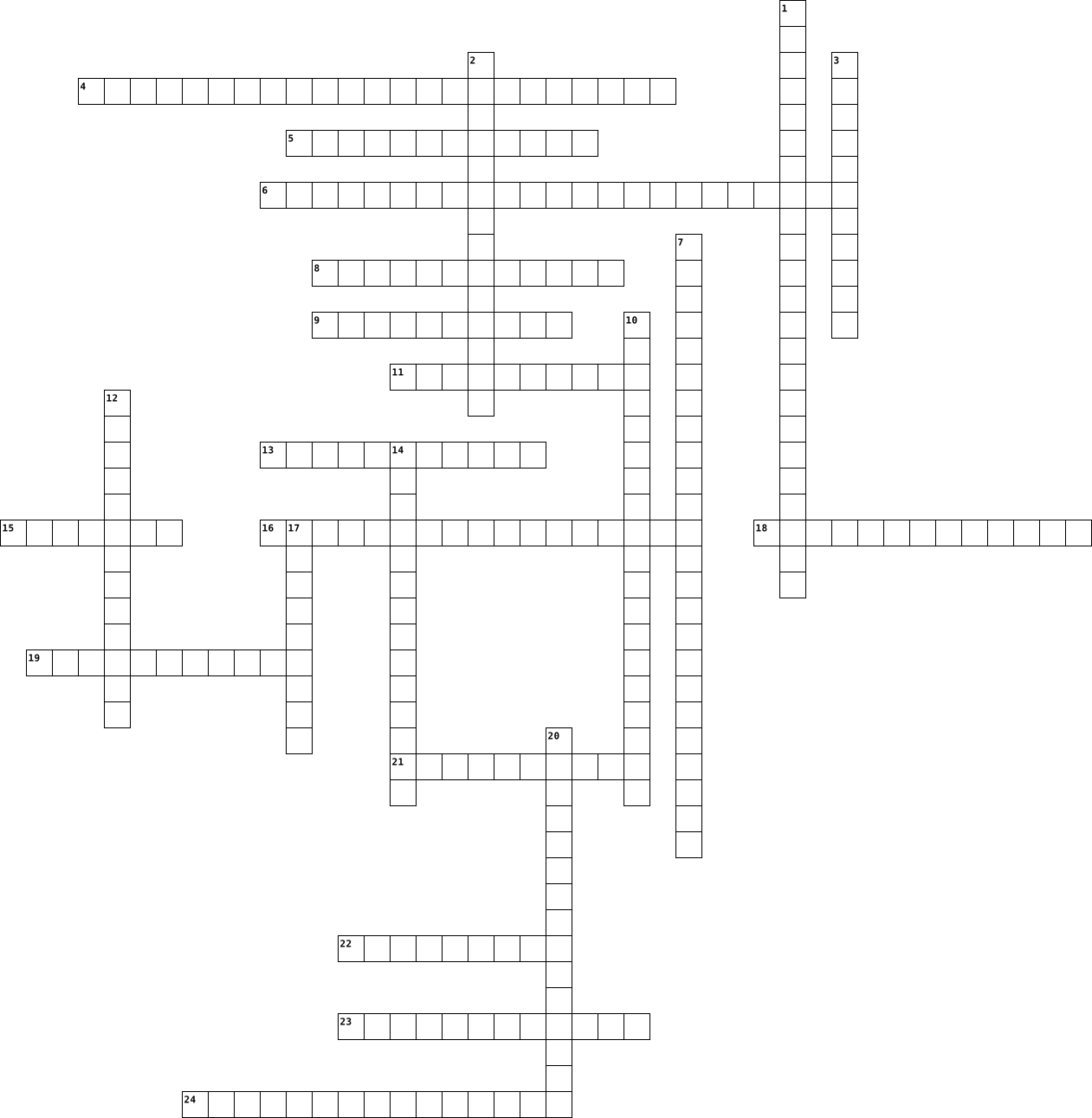
Across
- Nature exists for all species on earth, not just humans, and humans are equal to other species
- the variety of life in the world or in a particular habitat or ecosystem.
- perspectives or views held by individuals re global environment based on values and assumptions
- the ability of natural environments to absorb wastes and pollution
- A term that typically describes a species that no longer has any known living individuals.
- the envelope of gases surrounding the earth or another planet.
- All the water on earth
- the natural home or environment of an animal, plant, or other organism.
- The cultural, recreational or psychological value of the environment for people
- An increase in the average temperature of the earth's atmosphere (especially a sustained increase that causes climatic changes)
- the surroundings or conditions in which a person, animal, or plant lives or operates.
- hazardous waste causing danger from chemicals and infectious organisms
- part of Earth in which life exists including land, water, and air or atmosphere
- the action or fact of treating someone unfairly in order to benefit from their work.
- supports life on earth without requing human action eg. decomposition
Down
- Humans are superior and the most important species on earth
- The environment's provision of raw materials and natural resources eg food
- the solid, outer layer of the earth that consists of the crust and the rigid upper part of the mantle
- Ensure access to affordable, reliable, sustainable and modern energy for all
- Worldview holding that we can manage the earth for our benefit but that we have an ethical responsibility to be caring and responsible managers, or stewards, of the earth.
- Take urgent action to combat climate change and its impacts
- meeting the needs of the present without compromising the ability of future generations to meet their own needs
- Release of harmful materials into the environment
- Occurs when natural or human-induced processes decrease the future ability of land to support crops, livestock, or wild species.
24 Clues: All the water on earth • Release of harmful materials into the environment • Humans are superior and the most important species on earth • Take urgent action to combat climate change and its impacts • the envelope of gases surrounding the earth or another planet. • the ability of natural environments to absorb wastes and pollution • ...
SEASONS 2021-10-12

Across
- THE EARTH GOES AROUND THE SUN
- THE EARTH IS TILTED 23 DEGREES ON ITS
- SUN REACHES ITS HIGHEST ALTITUDE
- EARTH HAS 4 OF THEM
- EARTH REVOLVES AROUND EARTH IN THIS PATTERN
- MARKS THE BEGINNING OF SPRING
- EARTH IS FARTHEST FROM SUN DURING REVOLUTION
- EARTH IS CLOSEST TO SUN DURING REVOLUTION
Down
- NORTHERN LIGHT AURORAS OCCUR DURING
- SHORTEST DAY OF THE YEAR
- THE EARTH SPINS
- WHEN SUN RISE AND SET DUE EAST AND WEST
- WORD FROM LATIN THAT MEANS 'STILL SUN'
- ASTRONOMICAL UNIT
14 Clues: THE EARTH SPINS • ASTRONOMICAL UNIT • EARTH HAS 4 OF THEM • SHORTEST DAY OF THE YEAR • THE EARTH GOES AROUND THE SUN • MARKS THE BEGINNING OF SPRING • SUN REACHES ITS HIGHEST ALTITUDE • NORTHERN LIGHT AURORAS OCCUR DURING • THE EARTH IS TILTED 23 DEGREES ON ITS • WORD FROM LATIN THAT MEANS 'STILL SUN' • WHEN SUN RISE AND SET DUE EAST AND WEST • ...