
the plant Crossword Puzzles
Abi Rose 2020-08-12

Across
- the 6th word we classify organisms with
- they have a vascular system
- backbone
- absorbs the atmosphere through the leaves
- doesn't have enough tissue to transport water
- A two branching key
- they break things down
Down
- realised by vibrations
- they have separate they produce pollen
- the genitals of the plant
- seed-producing plant
- lives in water
- sometimes called the maidenhair fern tree
- type of fungus
- types of division
- they grow on new moss plants
- an individual animal, plant, or single-celled life form
- all animals
18 Clues: backbone • all animals • lives in water • type of fungus • types of division • A two branching key • seed-producing plant • realised by vibrations • they break things down • the genitals of the plant • they have a vascular system • they grow on new moss plants • they have separate they produce pollen • the 6th word we classify organisms with • sometimes called the maidenhair fern tree • ...
CONTROL AND COORDINATION IN PLANTS 2020-09-04

Across
- non directional movements
- an example of chemotropism
- hormones secreted by plants
- a gaseous plant hormone
- abscisic acid ________ growth
- family of the touch me not plant
- roots show ________ geotropism
- movement due to gravity
- a plant hormone
- *insert pic*
Down
- directional movement
- hormone in plants that promotes cell div.
- hydrotropism refers to movement wrt
- irreversible increase in weight,hieghtetc
- *insert pic*
- promotes stem elongation in plants
- external disturbance which triggers mov.
- Plant part that shows +ve phototopism
- Movements seen in venus fly trap, pitcher
- another name for mimosa pudica
20 Clues: *insert pic* • *insert pic* • a plant hormone • directional movement • a gaseous plant hormone • movement due to gravity • non directional movements • an example of chemotropism • hormones secreted by plants • abscisic acid ________ growth • roots show ________ geotropism • another name for mimosa pudica • family of the touch me not plant • promotes stem elongation in plants • ...
All Science Words Part 2 2024-04-15

Across
- relating to the process of breaking down food for energy
- a polysaccharide that is the chief constituent of all plant tissues and fibers
- the outer layer of skin covering the body surface
- the emission of water vapor from the leaves of plants
- the invasion of the body by pathogenic microorganisms
- process converting nutrients into energy in a cell
- able to synthesize its own food
- metabolic equilibrium maintained by biological mechanisms
- any of green pigments found in photosynthetic organisms
- a band of fibrous tissue connecting bones or cartilages
- underground plant organ that lacks buds or leaves or nodes
- a pore in a plant through which gases and vapor can pass
- the thigh bone of the human skeleton
- formation of compounds in plants aided by radiant energy
- plant tissue that conducts synthesized food substances
- a cell fragment essential for blood clotting in vertebrates
- a minute blood vessel connecting arterioles with venules
- the watery fluid in which blood cells are suspended
- a structure in an animal specialized for some function
- any substance that can be metabolized to give energy
- a small organ that synthesizes and secretes chemicals
- an organism’s orienting response to light
- a blood vessel that carries blood toward the heart
- small, hard part of a plant from which a new plant can grow
- anterior part of the brain consisting of two hemispheres
- a cell that is specialized to conduct nerve impulses
- fine spores produced by flowers to fertilize other flowers
- one of the bony segments of the spinal column
- the organic processes that are necessary for life
- the bodily process of discharging waste matter
- the movement of blood through the heart and blood vessels
- the junction between two neurons
- tough elastic tissue, mostly converted to bone in adults
- taking a substance, usually by injection, against a disease
- a major division of the vertebrate brain
- the secretion of an endocrine gland transmitted by the blood
- a living organism without the power to move
- plant tissue that conducts water and dissolved nutrients
Down
- the structure providing a frame for the body of an animal
- the process whereby seeds or spores sprout and begin to grow
- the point of connection between two bones
- the bodily process of inhalation and exhalation
- the pollen-producing reproductive organ of a flower
- the organic process of nourishing or being nourished
- relating to or conferring resistance to disease
- the part of the skull that encloses the brain
- part of an organism consisting of an aggregate of cells
- a band of tissue connecting a muscle to its bony attachment
- the process by which the body breaks down food
- not subject to the control of the will
- a plant that completes its entire life cycle in a year
- the process of generating offspring
- organelle in which photosynthesis takes place
- relating to clear fluid containing white blood cells
- the passage between the pharynx and the stomach
- perform vaccinations or inoculate against a disease
- of or relating to the heart
- any disease-producing agent
- fertilize by transferring spores from one plant to another
- the organ that is center of the nervous system
- a blood vessel that carries blood from the heart to the body
- a bundle of fibers running to organs and tissues of the body
- one of the contractile organs of the body
- of or relating to a system of sensory apparatus
- a red protein in blood that transports oxygen
- a tear-shaped plant structure from which a new plant grows
- of or belonging to glands that secrete hormones
- a plant lasting for three seasons or more
- the large artery carrying blood from the heart to the body
- pertaining to the act of breathing
- a chamber of the heart that receives blood from an atrium
- sprout; produce buds or branches
- the collective amount of leaves of one or more plants
- the breastbone
- of your own free will or design
75 Clues: the breastbone • of or relating to the heart • any disease-producing agent • able to synthesize its own food • of your own free will or design • sprout; produce buds or branches • the junction between two neurons • pertaining to the act of breathing • the process of generating offspring • the thigh bone of the human skeleton • not subject to the control of the will • ...
All Science Words Part 2 2024-04-15

Across
- relating to the process of breaking down food for energy
- a polysaccharide that is the chief constituent of all plant tissues and fibers
- the outer layer of skin covering the body surface
- the emission of water vapor from the leaves of plants
- the invasion of the body by pathogenic microorganisms
- process converting nutrients into energy in a cell
- able to synthesize its own food
- metabolic equilibrium maintained by biological mechanisms
- any of green pigments found in photosynthetic organisms
- a band of fibrous tissue connecting bones or cartilages
- underground plant organ that lacks buds or leaves or nodes
- a pore in a plant through which gases and vapor can pass
- the thigh bone of the human skeleton
- formation of compounds in plants aided by radiant energy
- plant tissue that conducts synthesized food substances
- a cell fragment essential for blood clotting in vertebrates
- a minute blood vessel connecting arterioles with venules
- the watery fluid in which blood cells are suspended
- a structure in an animal specialized for some function
- any substance that can be metabolized to give energy
- a small organ that synthesizes and secretes chemicals
- an organism’s orienting response to light
- a blood vessel that carries blood toward the heart
- small, hard part of a plant from which a new plant can grow
- anterior part of the brain consisting of two hemispheres
- a cell that is specialized to conduct nerve impulses
- fine spores produced by flowers to fertilize other flowers
- one of the bony segments of the spinal column
- the organic processes that are necessary for life
- the bodily process of discharging waste matter
- the movement of blood through the heart and blood vessels
- the junction between two neurons
- tough elastic tissue, mostly converted to bone in adults
- taking a substance, usually by injection, against a disease
- a major division of the vertebrate brain
- the secretion of an endocrine gland transmitted by the blood
- a living organism without the power to move
- plant tissue that conducts water and dissolved nutrients
Down
- the structure providing a frame for the body of an animal
- the process whereby seeds or spores sprout and begin to grow
- the point of connection between two bones
- the bodily process of inhalation and exhalation
- the pollen-producing reproductive organ of a flower
- the organic process of nourishing or being nourished
- relating to or conferring resistance to disease
- the part of the skull that encloses the brain
- part of an organism consisting of an aggregate of cells
- a band of tissue connecting a muscle to its bony attachment
- the process by which the body breaks down food
- not subject to the control of the will
- a plant that completes its entire life cycle in a year
- the process of generating offspring
- organelle in which photosynthesis takes place
- relating to clear fluid containing white blood cells
- the passage between the pharynx and the stomach
- perform vaccinations or inoculate against a disease
- of or relating to the heart
- any disease-producing agent
- fertilize by transferring spores from one plant to another
- the organ that is center of the nervous system
- a blood vessel that carries blood from the heart to the body
- a bundle of fibers running to organs and tissues of the body
- one of the contractile organs of the body
- of or relating to a system of sensory apparatus
- a red protein in blood that transports oxygen
- a tear-shaped plant structure from which a new plant grows
- of or belonging to glands that secrete hormones
- a plant lasting for three seasons or more
- the large artery carrying blood from the heart to the body
- pertaining to the act of breathing
- a chamber of the heart that receives blood from an atrium
- sprout; produce buds or branches
- the collective amount of leaves of one or more plants
- the breastbone
- of your own free will or design
75 Clues: the breastbone • of or relating to the heart • any disease-producing agent • able to synthesize its own food • of your own free will or design • sprout; produce buds or branches • the junction between two neurons • pertaining to the act of breathing • the process of generating offspring • the thigh bone of the human skeleton • not subject to the control of the will • ...
AFNR 5.2 Vocab Review 2026-03-11

Across
- A stored form of glucose that plants keep for energy.
- The colorful part of a flower that attracts pollinators.
- A flower that has either male parts (stamens) or female parts (pistil), but not both.
- The tube-like structure that connects the stigma to the ovary.
- A flower that has all four main parts: sepals, petals, stamens, and pistil.
- The main plant structure where photosynthesis usually takes place.
- The reproductive structure of a flowering plant.
- The sticky top part of the pistil where pollen lands.
- A substance that plants need to grow, develop, and stay healthy.
- A simple sugar produced during photosynthesis that plants use for energy.
- An edible part of a plant such as roots, stems, leaves, or flowers that people eat.
- Reproduction that involves the joining of male and female cells to produce a new organism.
- The process by which plants produce new plants.
- The outermost whorl of a flower made up of sepals that protect the developing bud.
- Tiny grains produced by the anther that contain male reproductive cells.
- A flower that only has female reproductive parts.
- The thin stalk of the stamen that supports the anther.
- A flower that is missing one or more of the four main parts (sepals, petals, stamens, pistil).
- The process where the male cell from pollen joins with the female cell in the ovule to form a seed.
- A flower that contains both male (stamens) and female (pistil) reproductive parts.
- The part of the plant that anchors it in the soil and absorbs water and nutrients.
Down
- The female reproductive part of a flower, made up of the stigma, style, and ovary.
- The process by which plants use sunlight, water, and carbon dioxide to make glucose and oxygen.
- The structure inside the ovary that becomes a seed after fertilization.
- The mature ovary of a plant that contains seeds.
- The part of the plant that supports leaves and flowers and transports water and nutrients.
- A tube that grows from a pollen grain down through the style to reach the ovule during fertilization.
- The collective term for all the petals of a flower.
- A leaf-like structure that protects a flower bud before it opens.
- The process plants use to break down glucose to release energy for growth and life processes.
- A flower that only has male reproductive parts.
- rate The percentage of seeds that successfully sprout out of the total planted.
- The part of the stamen that produces and releases pollen.
- A young plant inside a seed that will grow into a new plant.
- The green pigment in plants that absorbs sunlight for photosynthesis.
- The transfer of pollen from the anther to the stigma.
- A plant structure that contains the embryo and stored food needed to grow a new plant.
- The part of the pistil that contains ovules and later develops into fruit after fertilization.
- The process in which a seed begins to grow into a new plant.
- The male reproductive part of a flower made up of the anther and filament.
40 Clues: A flower that only has male reproductive parts. • The process by which plants produce new plants. • The mature ovary of a plant that contains seeds. • The reproductive structure of a flowering plant. • A flower that only has female reproductive parts. • The collective term for all the petals of a flower. • A stored form of glucose that plants keep for energy. • ...
Unit 3 Extra Credit 2023-11-13

Across
- a change in the environment outside of the organism
- below-ground part of a plant (organ system)
- When the vacuole of the cell is full and puts pressure on the cell wall allowing the plant to stand up straight
- plant's response to gravity, such as the downward growth of plant roots
- pressure exerted by water inside the cell on the cell wall
- When the vacuole of the cell is empty and there is no pressure on the cell wall
Down
- a change within the organism
- plant's response to light, such as a stem bending toward a light source
- how an organism reacts to a stimulus
- a thing or event that causes a response or reaction
- Cell organelle that surrounds and protects plant cells
- Cell organelle that stores water, waste, and nutrients and gives support to plant cells
- What a plant does with low turgor pressure
- a push or pull
- A plant's response to a stimulus
15 Clues: a push or pull • a change within the organism • A plant's response to a stimulus • how an organism reacts to a stimulus • What a plant does with low turgor pressure • below-ground part of a plant (organ system) • a change in the environment outside of the organism • a thing or event that causes a response or reaction • ...
MGVs Are Down To Earth 2016-01-01

Across
- typically grows underground
- skin soother
- upgrade a lawn
- pyramidal evergreen
- the fruit of the rose plant
- a __ of beans
- mixed leafy greens
- it lives one season
- muskmelon
- rose family tree
- Viola tricolor
- a cluster of leaves growing in circles
- cultivated for its fragrant gray-green leaves
- provides color and captures water
- botanist Gray
- type of plant including peas & beans
- Cajun veggie
- one of the oldest cultivated crops
Down
- Pasadena's __ Bowl
- maple genus
- first line in "Citizen Kane"
- showy butterfly
- fermenting for storage
- __ and fauna
- root vegetable
- seed container
- cabbage, broccoli, cauliflower
- K
- marsh plant
- start of syrup
- the element most needed by plants
- potatoes and people have them
- "green" prefix
- a living thing that grows in soil
- "The Jungle" author Sinclair
- fuzzy fruit
36 Clues: K • muskmelon • maple genus • marsh plant • fuzzy fruit • skin soother • __ and fauna • Cajun veggie • a __ of beans • botanist Gray • upgrade a lawn • root vegetable • seed container • Viola tricolor • start of syrup • "green" prefix • showy butterfly • rose family tree • Pasadena's __ Bowl • mixed leafy greens • pyramidal evergreen • it lives one season • fermenting for storage • typically grows underground • ...
Plants and trees 2020-09-09

Across
- Ground covering plant
- Costly wood used for making furniture
- The tree of sweet yellow fruit available in
- leaves used for serving food
- Pumpkin plant
- Furniture material
- Outermost tree layer
Down
- Elephant's long nose
- A stalk
- National tree of India
- Covers the plant
- underground part
- and May
- Blooms on a plant
14 Clues: A stalk • and May • Pumpkin plant • Covers the plant • underground part • Blooms on a plant • Furniture material • Elephant's long nose • Outermost tree layer • Ground covering plant • National tree of India • leaves used for serving food • Costly wood used for making furniture • The tree of sweet yellow fruit available in
Plants 2023-06-12

Across
- A tall plant with a large, yellow flower that faces the sun.
- A climbing plant with dense, green leaves.
- A prickly plant that can survive in arid environments.
- A fragrant plant known for its purple flowers and calming scent.
- Tree A large tree with broad leaves and strong branches.
- A colorful flower with a cup-shaped bloom.
- A fast-growing plant with tall, hollow stems.
Down
- A small flower with white petals and a yellow center.
- A leafy plant that thrives in shady and moist environments.
- Flytrap A carnivorous plant that catches insects with its leaf traps.
- A delicate flower known for its intricate and exotic appearance.
- Tree A tree with vibrant leaves that turn red, orange, or yellow in the fall.
- A beautiful flower with a pleasant fragrance.
- Tree A tall tree with long, feathery leaves and a straight trunk.
- A festive plant with red and green leaves, often seen during the holidays.
15 Clues: A climbing plant with dense, green leaves. • A colorful flower with a cup-shaped bloom. • A beautiful flower with a pleasant fragrance. • A fast-growing plant with tall, hollow stems. • A small flower with white petals and a yellow center. • A prickly plant that can survive in arid environments. • Tree A large tree with broad leaves and strong branches. • ...
Plants 2023-06-14

Across
- Common flower with a yellow center and white petals
- Spring-flowering plant with yellow or white flowers and a trumpet-shaped corona
- Tall plant with a large, round flower head that follows the movement of the sun
- Large and sturdy tree with broad leaves and acorns
- Climbing or trailing plant with dark green, glossy leaves
- Evergreen tree with needle-like leaves and woody cones
- Exotic flower known for its intricate and vibrant blooms
- Tree with distinctive lobed leaves and seeds in the form of "helicopter" wings
Down
- Tall, fast-growing plant with long, hollow stems and green foliage
- Succulent plant with thick, fleshy stems and spines for water storage
- Beautiful flower with large, showy petals and a pleasant fragrance
- Leafy plant with delicate, feathery leaves
- Flowering plant with thorny stems and fragrant, colorful blooms
- Tall, slender tree with a crown of fan-shaped leaves
- Spring-flowering bulbous plant with brightly colored, cup-shaped flowers
15 Clues: Leafy plant with delicate, feathery leaves • Large and sturdy tree with broad leaves and acorns • Common flower with a yellow center and white petals • Tall, slender tree with a crown of fan-shaped leaves • Evergreen tree with needle-like leaves and woody cones • Exotic flower known for its intricate and vibrant blooms • ...
Gr7-Ch.8-Sec.1&2 2025-05-05

Across
- the process where pollen lands on the female part of the plant
- an organelle in the plant that stores water and also helps the plant
- vascular tissue that transports water and minerals from roots to shoots
- flowers can be used to make this enjoyable beverage
- male part of the flower
- the act where the sperm and egg fuse to form one cell
- male part of the flower that makes pollen
- increase the SA:V to absorb water and minerals more efficiently
- the layer of the leaf that contains cells with gaps between them to allow gasses to go through
- type of plant that can grow tall
- different shapes and color that attract pollinators
- the stage where spores grow into this structure to produce gametes
- type of stem that contain bark
- the number of stages in a plants life cycle
- flowering plant that produces seeds protected in a fruit
- help plants stay protected & upright
- soft & flexible stems
- male part of the flower that keeps the pollen producing part upright
Down
- prevents transpiration
- vascular tissue that transports glucose to from shoots to roots
- the ancestors of plants (hypothesized so as they also can have cell walls, membrane bound organelles (including chloroplasts))
- non-flowering plant that produces "naked" seeds (not proteceted)
- the female part of the flower that leads to the egg
- the top part of the female parts of the flower
- type of plant that grow low to the ground and has no true tissue (due to lack of xylem & phloem)
- female part of the flower
- protects the roots as they grow into the soil
- the stage where plants produce spores
- an ovary that has been fertilized will produce this
- protects the flower before it blooms
- open and close stomata
- store excess glucose (food)
- the female part of the flower that contains the egg
- the layer of the leaf that contains the most chloroplast
- capture sunlight energy
35 Clues: soft & flexible stems • prevents transpiration • open and close stomata • male part of the flower • capture sunlight energy • female part of the flower • store excess glucose (food) • type of stem that contain bark • type of plant that can grow tall • protects the flower before it blooms • help plants stay protected & upright • the stage where plants produce spores • ...
Romsey Allotment Crossword 2013-05-13

Across
- Broadleaved deciduous hardwood tree of the genus Betula
- A shoot containing embryonic leaves or flowers
- A plant that sheds its leaves each year
- A plant that completes its entire life cycle in two years, growing in the first year and reproducing and dying in the second
- Member of the Rose family which bears small red edible fruit
- Placing seed potatoes in a tray or egg box in a bright, cool but frost-free place to encourage them to sprout prior to planting
- Where one plant is artificially joined to the rootstock of another so they eventually function as one plant
- A cluster of flowers that lack petals typically seen on willow, oak, and birch trees
- The point at which a seed undergoes physical changes and begins to grow
- To remove a number of buds, flowers, seedlings or shoots to improve the growth and quality of those remaining
- A plant that is bred or selected by growers for unique flowers, leaf colour, growing habit etc. It has distinct and uniform characteristics that differ from the original species
- Swollen root or underground stem with storage tissue
- Method for shaping trees, cropping the branches above head-height
- Layer of material placed on the soil and around plants to retain moisture, suppress weeds and improve soil structure
- Uncultivated land
- A trailing stem growing above ground and rooting at the nodes, where plantlets are produced
- An underground storage organ with fleshy scale leaves from which the plant flowers and grows before becoming dormant
- Another name for the leaves and stems of a potato plant
Down
- A plant carefully trained to grow as one main stem, or occasionally two or three main stems, by removing side-shoots
- To flower and produce seed prematurely
- Traditional method of woodland management which takes advantage of the fact that many trees make new growth from the stump or roots if cut down.
- Plants that have been field-grown and are supplied in a dormant state with the soil removed
- Used to describe plants that like acid soil and will not tolerate alkaline soils (containing lime or chalk)
- The transfer of pollen between flowers, which can be carried out by the wind, insects, animals or by hand
- a small insectivorous passerine bird that was formerly classed as a member of the thrush family
- A tree or shrub that has been trained to a certain height with a long bare stem and foliage at the top
- Structure made of glass, plastic or horticultural fleece placed over a plant for protection or for forcing early crops
- A plant that completes its entire life cycle (growth, reproduction, death) in one season
- Calcium compounds, often applied to lower the pH of the soil
29 Clues: Uncultivated land • To flower and produce seed prematurely • A plant that sheds its leaves each year • A shoot containing embryonic leaves or flowers • Swollen root or underground stem with storage tissue • Broadleaved deciduous hardwood tree of the genus Betula • Another name for the leaves and stems of a potato plant • ...
Unit on the cell and body systems 2025-02-26

Across
- moves water from roots to leaves or shoots to use in photosynthesis
- convert light energy from the sun into chemical energy uses carbon dioxide and water
- moves substances that plant produces mostly sugars throughout the plant
- fills the space between the epidermis and bascular tissue in a plant
- skin at the base of our nail for protection
- cell that possesses a defined nucleus
- organism a single celled organism
- the outer protective layer of a plant that acts as a skin has cells called the epidermis
- plant tissue that transports water and nutrients
- processes and sorts and packages proteins and lipids
- a part of the cell enclosed in its membrane found only in eukaryotic cells
Down
- the liquid that fills the inside of a cell
- organisms whose cells lack a nucleus
- essential for protein production lipid metabolism transports proteins and lipids
- contains digestive enzymes to break down waste
- a living thing that can function independently, can be uni or multi cellular
- powerhouse of the cell, generates most of the chemical energy
- cells that regulate gas exchange and water loss by opening and closing stomata
- stores water, food, waste and other materials in a cell
- synthesizes the proteins in the cells
- organism organism composed of many cells
- allow for gas exchange between the plant and the environment
- convert sunlight into chemical energy -reponsible for photosynthesis
- contains the cell's genetic DNA in chromosomes
- the membrane found in all cells that separate the interior of the cell from the outside
- hard layer that surrounds cells, they provide protection and shape to a cell
26 Clues: organism a single celled organism • organisms whose cells lack a nucleus • cell that possesses a defined nucleus • synthesizes the proteins in the cells • organism organism composed of many cells • the liquid that fills the inside of a cell • skin at the base of our nail for protection • contains digestive enzymes to break down waste • ...
f41 2024-06-26

Across
- Grazing land.
- Environmentally friendly farming.
- Red root vegetable.
- Fruit tree farm.
- Market sellers.
- Decomposed organic matter.
- Available at certain times of the year.
- Honey producer.
- Milk-producing farm.
- Grown without pesticides.
Down
- Traditional plant varieties.
- Grape farm.
- Skilled food craftsman.
- Young plant.
- Nearby sourced produce.
- Cultivated plant.
- Just picked or harvested.
- Enclosure for chickens.
- Gathering crops.
- Animals raised with space.
20 Clues: Grape farm. • Young plant. • Grazing land. • Market sellers. • Honey producer. • Fruit tree farm. • Gathering crops. • Cultivated plant. • Red root vegetable. • Milk-producing farm. • Skilled food craftsman. • Nearby sourced produce. • Enclosure for chickens. • Just picked or harvested. • Grown without pesticides. • Decomposed organic matter. • Animals raised with space. • ...
Unit 1 2 and 3 review 2017-03-14

Across
- keeps the leaves in the light; gives a place for plants to keep flowers and fruit
- to have something inside
- the process in your body that turns food into energy
- to stay alive
- lets the plant take light in; is flat
- the surface of the Earth
- not made by people
- smooth and level, like a table or desk
- a pretty-colored part of a plant
- the sun’s energy
- to attach so it can’t move, like roots
- to make something
Down
- to be real
- to have something with you
- a chemical or food that helps living things live and grow
- having a lot of bright colors
- a natural thing such as iron or salt
- a small object from which a plant grows
- to experience
- to give something wanted or needed
- dirt, mud, ground
- the part of a plant that contains the seed
- to put something under the ground
23 Clues: to be real • to stay alive • to experience • the sun’s energy • dirt, mud, ground • to make something • not made by people • to have something inside • the surface of the Earth • to have something with you • having a lot of bright colors • a pretty-colored part of a plant • to put something under the ground • to give something wanted or needed • a natural thing such as iron or salt • ...
Spring 2025-04-03

Across
- The small flower on a tree or plant
- A soft and gentle wind
- A small red insect with black spots
- Bright light and warmth from the sun
- Small drops of water on grass in the morning
- A colorful arc in the sky after rain
- An insect with colorful wings that flies
- A place where people grow flowers and plants
Down
- A colorful part of a plant that smells nice
- A small insect that becomes a butterfly
- Small green plants that cover the ground
- A small animal with feathers and wings that can fly
- white shapes in the sky
- The green part of a plant that grows on branches
- A small flying insect that makes honey
- The season after winter when flowers bloom
- To become bigger or taller over time
- The feeling when the temperature is not cold
- A tall plant with a trunk branches and leaves
- A home made by birds to lay eggs
20 Clues: A soft and gentle wind • white shapes in the sky • A home made by birds to lay eggs • The small flower on a tree or plant • A small red insect with black spots • Bright light and warmth from the sun • To become bigger or taller over time • A colorful arc in the sky after rain • A small flying insect that makes honey • A small insect that becomes a butterfly • ...
REGIS SCHOOL RUNDA Biology Crossword 2022-02-07

Across
- a major function of blood.
- the main photosynthetic tissue in a plant leaf.
- tissue contracts and relaxes to bring about movement.
- a white blood cell.
- a sausage-shaped organelle.
- a structural difference between SER and RER.
- one cell organism.
- a specialized cell in humans with a streamlined shape.
- tissue provides a rigid support framework in mammals, birds, amphibians and reptiles.
- a plant tissue that transports mineral salts.
- an unspecialized cell.
Down
- the next level of organization after tissue.
- a mobile tissue.
- the outer cover of plant cells.
- a type of movement within the cytoplasm.
- a major role of parenchyma tissue.
- a lignified tissue that provides support in plant stems.
- structures used by paramecia for locomotion.
- __ tissue holds organs in position.
- the next level of organization after cell.
- a collective term for xylem and phloem.
21 Clues: a mobile tissue. • one cell organism. • a white blood cell. • an unspecialized cell. • a major function of blood. • a sausage-shaped organelle. • the outer cover of plant cells. • a major role of parenchyma tissue. • __ tissue holds organs in position. • a collective term for xylem and phloem. • a type of movement within the cytoplasm. • the next level of organization after cell. • ...
Cell Theory and Structure 2024-09-20

Across
- cells working together form this
- built a microscope to look at cork cells
- all of the deer only living in Joyce Park
- control center of the cell
- stiff outer covering of a plant cell
- any individual that can live on its own
- all life on Earth
- organelle found only in plant cells that trap sunlight
- system organs working together form this
- powerhouse of the cell
- all living things in Joyce Park
- jellylike fluid that fills the empty spaces in a cell
Down
- type of cell that makes up protists, fungi, plants, and animals
- thin covering of plant and animal cells
- packaging center of cells
- transport system in cells; highways
- vacuole large storage space in a plant cell
- bacteria cell
- smallest functional unit of an organism
- all of the living and non-living things in an area
20 Clues: bacteria cell • all life on Earth • powerhouse of the cell • packaging center of cells • control center of the cell • all living things in Joyce Park • cells working together form this • transport system in cells; highways • stiff outer covering of a plant cell • thin covering of plant and animal cells • any individual that can live on its own • ...
Bio Boosters page 60-81 2024-10-28

Across
- Chloroplasts contain_____which makes the plant green and helps with photosynthesis.
- Process of photosynthese is :sun + CO2 +water = ____ + O2
- A type of catalyst that has a specific shape.
- In order for an enzyme to work there must be a certian PH Level and ________.
- Substances that cause chemical reactions are called _____________.
- A plant needs sunlight, CO2 and _____to live.
- Enzyme_____ is when an enzyme puts two molecules together.
- Enzyme_____is when an enzyme cuts a molecule into two pieces.
Down
- Photosynthesis takes place in the ______of the plant.
- ____is the process of how plants make their food.
- Chloroplasts are found in the _____of a plant.
- Plant leaves have special ____cells that allow air and water in and out of the plant.
- Glucose is another name for ____.
- Plants use _____from the sun to make their food.
- When a plant's guard cells close on a hot day to preserve water, this is an example of________.
15 Clues: Glucose is another name for ____. • A type of catalyst that has a specific shape. • A plant needs sunlight, CO2 and _____to live. • Chloroplasts are found in the _____of a plant. • Plants use _____from the sun to make their food. • ____is the process of how plants make their food. • Photosynthesis takes place in the ______of the plant. • ...
CROSSWORD biology 2022-10-26

Across
- The part of a plant that carries things up
- A dry, dehiscent fruit made up of several fused carpels
- The main stalk of a plan
- An underground stem with lateral roots
- a substance added to soil to increase its fetility
- A growth on a plant that develops into flower, leaf, or shoot
- The part of a plant that attaches to the ground
Down
- The part of a plant that carries things down
- A fruit made up of one carpal or a fruit with multiple carpals that look like one carpal
- Decayed organic material used as plant fertilizer
- Modified leaves that make-up the corolla; attract pollinators.
- Female reproductive organ of plant
- The course outer skin of a tree
- Ripened ovary together with the seeds within the ovary
14 Clues: The main stalk of a plan • The course outer skin of a tree • Female reproductive organ of plant • An underground stem with lateral roots • The part of a plant that carries things up • The part of a plant that carries things down • The part of a plant that attaches to the ground • Decayed organic material used as plant fertilizer • ...
Chapter 2: Types of Plants 2021-11-08

Across
- one job of a leaf is to gather _____.
- the air plants take in during photosynthesis
- the green substance that helps plants use sunlight to make food
- a plant that makes food all year long
- what plants make during photosynthesis
- a plant that loses all its leaves at once each year
- all plants need light, air, nutrients, and _____.
Down
- the process a plant uses to make food
- the part of the plant that transports water, nutrients, and food
- the place where a conifer forms seeds
- the food factory of a plant
- the first stage of life for many plants
- the part of a plant that grows underground
13 Clues: the food factory of a plant • the process a plant uses to make food • one job of a leaf is to gather _____. • the place where a conifer forms seeds • a plant that makes food all year long • what plants make during photosynthesis • the first stage of life for many plants • the part of a plant that grows underground • the air plants take in during photosynthesis • ...
Specialized vocabulary 2022-12-07

Across
- Detailed examination of a thing in order to know its characteristics.
- Manufacture or elaboration of a product through work.
- Inorganic substance of the earth's crust formed by chemical elements
- Activities aimed at cultivating the land to obtain plant products.
- Fertilizer that is added to the soil to make it richer and more productive.
- Action of breathing.
- Living organism that grows without being able to move
- Branch of biology that studies microorganisms
- Set of atmospheric conditions typical of a place
- What can be sustained
- Action of nourishing
- Grain contained inside the fruit of a plant
- Study of ecological processes that affect agricultura
Down
- Intimate association of organisms of different species to mutually benefit each other.
- Part of the plants where the reproductive organs are located.
- Gradual change or transformation of something
- Action to integrate
- Of the whole or that considers something as a whole.
- Diversity of plant and animal species.
- Extent of land as seen from a given location.
- Organ of the plant, devoid of leaves and introduced into the earth,
- The action or activity of growing something
- Chemical process that takes place in plants with chlorophyll
- A thing or person belonging to a category of this type.
- Thermal degree or level of a body or of the atmosphere.
- Community of living beings
- Part of the plant that is transformed after fertilization.
- Liquid substance without odor, color or taste found in nature
- Surface on which you step
- Kingdom to which organisms that feed on substances made by other living beings belong
30 Clues: Action to integrate • Action of breathing. • Action of nourishing • What can be sustained • Surface on which you step • Community of living beings • Diversity of plant and animal species. • The action or activity of growing something • Grain contained inside the fruit of a plant • Gradual change or transformation of something • Extent of land as seen from a given location. • ...
Fun with Farming 2022-02-15

Across
- decorating using dried plant parts
- transparent enclosure to grow plants
- used as a fertilizer
- young seedlings of edible vegetables and herbs
- using apple peels
- sorting and separation of waste types
- an organic pesticide
- a garden that attracts butterflies
- organic fertilizer
Down
- makes the soil fertile
- recyclable waste
- invertebrate animals
- scalelike plant-eating insects
- helps in photosynthesis
- oil used in pest management
- kitchen waste
- organic cleaning solutions
- part of a plant used as a food
- medium for growing plants
- essential for plant growth
20 Clues: kitchen waste • recyclable waste • using apple peels • organic fertilizer • invertebrate animals • used as a fertilizer • an organic pesticide • makes the soil fertile • helps in photosynthesis • medium for growing plants • organic cleaning solutions • essential for plant growth • oil used in pest management • scalelike plant-eating insects • part of a plant used as a food • ...
Washable Kingdom Biome Markers 2023-02-16

Across
- Bow And Arrow
- Bug With Light
- Wants Coins
- Living Chest
- Silver Coin
- In Fantasy Tree
- Cold Water
- What you get during the day
- Plant With Spots
- Marker Origin
- Fantasy Grass
- Plant Dungeon
- 6 Stones
- Yellows Ancestor
- Wood On Fire
- Kings Daughter
- Memory 5
- Crown
Down
- Magic
- Hiding In Flowers
- Castle Window
- Sword Obby
- Bouncy Plant
- Market Lake
- Glows
- End Of River
- Behind Castle
- Sword Fight
- Swamp Dirt
- Lava
- Carnivorous Plant
- 20 Knifes
- Breathes Fire
33 Clues: Lava • Magic • Glows • Crown • 6 Stones • Memory 5 • 20 Knifes • Sword Obby • Cold Water • Swamp Dirt • Wants Coins • Market Lake • Silver Coin • Sword Fight • Bouncy Plant • Living Chest • End Of River • Wood On Fire • Bow And Arrow • Castle Window • Behind Castle • Marker Origin • Fantasy Grass • Plant Dungeon • Breathes Fire • Bug With Light • Kings Daughter • In Fantasy Tree • Plant With Spots • Yellows Ancestor • Hiding In Flowers • ...
Root Vocab 2024-09-24

Across
- root, Stability and gets water
- Responsible for getting the water
- A root that grows straight down
- Grows off the main plant and helps with stability
- Tube in the inner plant that transports water
- For protection
Down
- Collects water and nutrients as well as Anker's the plant
- The meat of the plant
- Elongation
- root, A root system that grows wild like fibers
- Tube in the inner plant that transports nutrients
- Outer protective layer of the plant
12 Clues: Elongation • For protection • The meat of the plant • root, Stability and gets water • A root that grows straight down • Responsible for getting the water • Outer protective layer of the plant • Tube in the inner plant that transports water • root, A root system that grows wild like fibers • Tube in the inner plant that transports nutrients • ...
plant systems crossword 2025-02-24

Across
- stores ovules
- transfers the pollen to female reproductive system
- plants move towards light (ex. Sun)
- makes pollen
- transfers nutrients and water FROM THE GROUND throughout the plan
- collects pollen
- created by the anther, acts as sperm in plants
- supports anther
- Stimuli when organisms respond to light, water, gravity, etc.
- transports UP the plant
- transports pollen to ovary
- transports water and nutrients throughout the plant
Down
- eggs; gametes
- fertilized egg
- roots and shoots travel away from the direction of gravity
- attracts pollinators
- transports UP and DOWN the plant
- plant's male reproductive system
- plant's female reproductive system
- transfers light energy into chemical energy; takes place on the leaves
20 Clues: makes pollen • stores ovules • eggs; gametes • fertilized egg • collects pollen • supports anther • attracts pollinators • transports UP the plant • transports pollen to ovary • transports UP and DOWN the plant • plant's male reproductive system • plant's female reproductive system • plants move towards light (ex. Sun) • created by the anther, acts as sperm in plants • ...
Romsey Allotment Crossword 2013-05-13

Across
- An underground storage organ with fleshy scale leaves from which the plant flowers and grows before becoming dormant
- Layer of material placed on the soil and around plants to retain moisture, suppress weeds and improve soil structure
- A shoot containing embryonic leaves or flowers
- To flower and produce seed prematurely
- Swollen root or underground stem with storage tissue
- Used to describe plants that like acid soil and will not tolerate alkaline soils (containing lime or chalk)
- Placing seed potatoes in a tray or egg box in a bright, cool but frost-free place to encourage them to sprout prior to planting
- Traditional method of woodland management which takes advantage of the fact that many trees make new growth from the stump or roots if cut down.
- Structure made of glass, plastic or horticultural fleece placed over a plant for protection or for forcing early crops
- Broadleaved deciduous hardwood tree of the genus Betula
- The transfer of pollen between flowers, which can be carried out by the wind, insects, animals or by hand
- Member of the Rose family which bears small red edible fruit
- To remove a number of buds, flowers, seedlings or shoots to improve the growth and quality of those remaining
- Where one plant is artificially joined to the rootstock of another so they eventually function as one plant
- Another name for the leaves and stems of a potato plant
- A plant carefully trained to grow as one main stem, or occasionally two or three main stems, by removing side-shoots
Down
- Calcium compounds, often applied to lower the pH of the soil
- a small insectivorous passerine bird that was formerly classed as a member of the thrush family
- A cluster of flowers that lack petals typically seen on willow, oak, and birch trees
- Plants that have been field-grown and are supplied in a dormant state with the soil removed
- The point at which a seed undergoes physical changes and begins to grow
- A plant that sheds its leaves each year
- A trailing stem growing above ground and rooting at the nodes, where plantlets are produced
- A plant that is bred or selected by growers for unique flowers, leaf colour, growing habit etc. It has distinct and uniform characteristics that differ from the original species
- Method for shaping trees, cropping the branches above head-height
- A plant that completes its entire life cycle (growth, reproduction, death) in one season
- A tree or shrub that has been trained to a certain height with a long bare stem and foliage at the top
- A plant that completes its entire life cycle in two years, growing in the first year and reproducing and dying in the second
- Uncultivated land
29 Clues: Uncultivated land • To flower and produce seed prematurely • A plant that sheds its leaves each year • A shoot containing embryonic leaves or flowers • Swollen root or underground stem with storage tissue • Broadleaved deciduous hardwood tree of the genus Betula • Another name for the leaves and stems of a potato plant • ...
Romsey Allotment Crossword No 1. 2013-05-13

Across
- To remove a number of buds, flowers, seedlings or shoots to improve the growth and quality of those remaining
- A tree or shrub that has been trained to a certain height with a long bare stem and foliage at the top
- A plant that is bred or selected by growers for unique flowers, leaf colour, growing habit etc. It has distinct and uniform characteristics that differ from the original species
- Used to describe plants that like acid soil and will not tolerate alkaline soils (containing lime or chalk)
- To flower and produce seed prematurely
- Layer of material placed on the soil and around plants to retain moisture, suppress weeds and improve soil structure
- The point at which a seed undergoes physical changes and begins to grow
- Structure made of glass, plastic or horticultural fleece placed over a plant for protection or for forcing early crops
- Another name for the leaves and stems of a potato plant
- a small insectivorous passerine bird that was formerly classed as a member of the thrush family
- A plant carefully trained to grow as one main stem, or occasionally two or three main stems, by removing side-shoots
- Placing seed potatoes in a tray or egg box in a bright, cool but frost-free place to encourage them to sprout prior to planting
Down
- A plant that completes its entire life cycle (growth, reproduction, death) in one season
- A plant that sheds its leaves each year
- Swollen root or underground stem with storage tissue
- Member of the Rose family which bears small red edible fruit
- The transfer of pollen between flowers, which can be carried out by the wind, insects, animals or by hand
- A trailing stem growing above ground and rooting at the nodes, where plantlets are produced
- Traditional method of woodland management which takes advantage of the fact that many trees make new growth from the stump or roots if cut down.
- Method for shaping trees, cropping the branches above head-height
- A plant that completes its entire life cycle in two years, growing in the first year and reproducing and dying in the second
- Uncultivated land
- Calcium compounds, often applied to lower the pH of the soil
- Where one plant is artificially joined to the rootstock of another so they eventually function as one plant
- Plants that have been field-grown and are supplied in a dormant state with the soil removed
- An underground storage organ with fleshy scale leaves from which the plant flowers and grows before becoming dormant
- A cluster of flowers that lack petals typically seen on willow, oak, and birch trees
- A shoot containing embryonic leaves or flowers
- Broadleaved deciduous hardwood tree of the genus Betula
29 Clues: Uncultivated land • To flower and produce seed prematurely • A plant that sheds its leaves each year • A shoot containing embryonic leaves or flowers • Swollen root or underground stem with storage tissue • Another name for the leaves and stems of a potato plant • Broadleaved deciduous hardwood tree of the genus Betula • ...
Plants, Plants, Plants! 2013-03-10
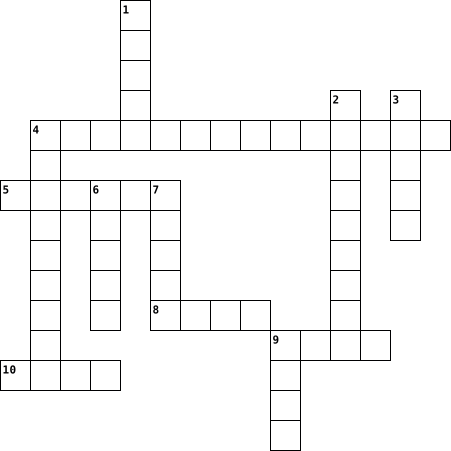
Across
- How plants make food.
- Pretty part of the plant that attracts insects and birds.
- Where plants grow roots.
- Holds up the plant.
- Catches sunlight and makes food for the plant.
Down
- The part of a plant we eat the most.
- Start to grow.
- Something plants need that comes from the sun.
- What birds, insects, wind and animals do for plants.
- Something all living things need.
- Holds the plant in the ground.
- The very beginning of a new plant.
12 Clues: Start to grow. • Holds up the plant. • How plants make food. • Where plants grow roots. • Holds the plant in the ground. • Something all living things need. • The very beginning of a new plant. • The part of a plant we eat the most. • Something plants need that comes from the sun. • Catches sunlight and makes food for the plant. • ...
Plants and Fibre 2021-11-17

Across
- The male reproductive part of a flower.
- A thread or filament from which a vegetable tissue, mineral substance, or textile is formed.
- A method of plant propagation by way of separating new plant individuals that emerge from vegetative parts.
- The hollow base of the carpel of a flower, containing one or more ovules.
- The part of a stamen that contains the pollen.
- An animal that moves pollen from the male anther of a flower to the female stigma of a flower.
- Small openings found in the epidermis of leaves, stems and other plant organs.
- The female organs of a flower, comprising the stigma, style, and ovary.
- Movement of individual molecules of a substance through a semipermeable barrier from an area of higher concentration to an area of lower concentration.
- The relative amount of a given substance contained within a solution or in a particular volume of space.
Down
- A fine powdery substance, typically yellow, consisting of microscopic grains discharged from the male part of a flower or from a male cone.
- A liquid in which solutes are dissolved forming a solution.
- An outgrowth of the ovary of a seed plant.
- A plant that produces seeds, as opposed to one that produces spores.
- A narrow, typically elongated extension of the ovary, bearing the stigma.
- A slender threadlike object or fiber especially one found in animal or plant structures.
- The exhalation of water vapor through the stomata.
- A liquid mixture in which the minor component is uniformly distributed within the major component.
- A process by which molecules of a solvent tend to pass through a semipermeable membrane from a less concentrated solution into a more concentrated one, thus equalizing the concentrations on each side of the membrane.
- The process of bringing water up the roots and stems to the rest of the plant. The molecules of the water are attracted to the molecules of the inside of the stem.
- The minor component in a solution dissolved in the solvent.
- The part of a pistil that receives the pollen during pollination.
22 Clues: The male reproductive part of a flower. • An outgrowth of the ovary of a seed plant. • The part of a stamen that contains the pollen. • The exhalation of water vapor through the stomata. • A liquid in which solutes are dissolved forming a solution. • The minor component in a solution dissolved in the solvent. • ...
Plants 2024-04-09

Across
- The leaves of ferns are called________.
- Jagged
- Plant that has heart shaped leaves that can be used for tea.
- This plant has sweet orange berries in Autumn.
- Plants that are indigenous to a particular country.
- Plant that can be used to make dough boys.
- Plants that have come from other countries.
- Peppery tasking plant that can be used to flavour food.
- Berries from this tree are edible and can also be squashed to make an insect repellent.
- Kiekie fruit
- The colour of kowhai flowers.
Down
- Metrosideros excelsa
- Mature red beech trees are supported by massive _____ buttresses.
- Mountain flax with gum at the base of its leaves that can be chewed.
- Plants that are regularly found in a certain area.
- The main tree species in Fjordland
- This plant is commonly used for weaving.
17 Clues: Jagged • Kiekie fruit • Metrosideros excelsa • The colour of kowhai flowers. • The main tree species in Fjordland • The leaves of ferns are called________. • This plant is commonly used for weaving. • Plant that can be used to make dough boys. • Plants that have come from other countries. • This plant has sweet orange berries in Autumn. • ...
Animals and Plants 2013-06-19

Across
- An animal that kills and eats other organisms.
- Varying degrees of dominance within a group.
- Area that is defended by an animal.
- Pigment that absorbs light.
- Plant that flowers when the photoperiod is less than a critical day length.
- Producing and caring for a few number of offspring.
- Ability of an animal to find its way home over unfamiliar territory.
- Production of chemicals by plants to inhibit the growth of competitors.
- When flowering is induced by a period of cold.
- Resetting an internal clock by an environmental cue.
- External difference in the sexes.
- The place where an organism lives.
- An environmental cue that re-sets an internal clock.
- A relationship where one species benefits and the other is unaffected.
- Control of the timing of activities by daylength.
- The shoot of an embryo plant.
- Movement of an organism towards or away from a stimulus.
- An organisms way of life.
- The length of the day.
- Series of signals exchanged between a male and female, culminating in mating.
- Plant movement in response to a non-directional stimulus.
- A rhythm that is free of external influences.
- Orientation resulting from a change in the rate of activity.
- A period of suspended growth.
- A rhythm that has an external origin.
- Mass movement of members of a species, often over long distances.
- Active during the day.
- Male mates with only one female.
- The root of an embryo plant.
Down
- Wheel which can change the direction of gravity.
- An organism that feeds off another organism without killing it.
- Active around dawn and dusk.
- An area an animal covers regularly in search of food and mates.
- Attributing human emotions to an animal.
- Between the same species.
- Prolonged relationship associated with joint parental care.
- Between different species.
- When demand for a resource exceeds supply.
- Active at night.
- Progressive change in the composition of a community over time.
- Plant that flowers when the photoperiod exceeds a critical day length.
- Resemblance to other organisms to deceive.
- A rhythm that has an internal origin.
- Male mates with many females in a given season.
- A plant that lives on another plant for anchorage.
- A relationship where both species benefit.
- Large numbers of offspring with little or no care.
- Plant growth response towards or away from a stimulus.
- Plant growth hormone.
49 Clues: Active at night. • Plant growth hormone. • The length of the day. • Active during the day. • Between the same species. • An organisms way of life. • Between different species. • Pigment that absorbs light. • Active around dawn and dusk. • The root of an embryo plant. • The shoot of an embryo plant. • A period of suspended growth. • Male mates with only one female. • ...
Vascular and Non-Vascular Plants 2022-03-06

Across
- Non-vascular plants are usually ____________ in size
- Transports food and nutrients throughout a vascular plant
- Part of the plant that attracts insects and makes
- How ferns reproduce
- Seed plants that produce flowers and fruit
- Plants with no true roots, stems, or leaves
Down
- Seed plants that produce seeds through cones
- Vessels that transport water throughout a vascular plant
- Part of a vascular plant that provides support
- Leaves collect energy from this source
- Plants with true roots, stems, and leaves
- Type of vascular plant that reproduces using spores
- Part of a vascular plant that anchors the plant into the ground; absorbs water from the soil
13 Clues: How ferns reproduce • Leaves collect energy from this source • Plants with true roots, stems, and leaves • Seed plants that produce flowers and fruit • Plants with no true roots, stems, or leaves • Seed plants that produce seeds through cones • Part of a vascular plant that provides support • Part of the plant that attracts insects and makes • ...
Plants 2023-10-12

Across
- A plant with bright yellow flowers and slender, green leaves.
- A fragrant plant with purple flowers and a pleasant scent.
- A lovely plant with bright, cup-shaped flowers.
- A beautiful plant with colorful, fragrant flowers.
- A climbing plant with green leaves that often grows on walls and trees.
Down
- A fast-growing plant with tall, slender, and hollow stems.
- A tall plant with large, sunny yellow flowers.
- A plant that thrives in dry deserts, with spiky stems.
- A plant with yellow flowers that turn into fluffy seeds that blow in the wind.
- A green plant with delicate, feathery leaves that thrive in shady spots.
- Tree A tall, slender tree with large, fan-shaped leaves, often found in tropical places.
- Tree A tree with distinctive, hand-shaped leaves that turn bright red in the fall.
- Flytrap A fascinating plant that can catch insects with its hinged leaves.
- Tree A big tree with strong branches and acorns.
14 Clues: A tall plant with large, sunny yellow flowers. • A lovely plant with bright, cup-shaped flowers. • Tree A big tree with strong branches and acorns. • A beautiful plant with colorful, fragrant flowers. • A plant that thrives in dry deserts, with spiky stems. • A fast-growing plant with tall, slender, and hollow stems. • ...
The 2024 VMGA Christmas Puzzle 2024-11-10

Across
- A container to store winter rains for a drier time
- A tough plant material deposited in cell walls, especially in wood
- The author of the best selling book 'Nature's Best Hope'
- Who was awarded the 'Golden Trowel Award' in 2024?
- A horizontal stem growing above ground that may form roots at its tip or at nodes
- The pollen bearing part of a stamen
- A region of parenchyma cells at the centre of a stem
- A common vining invasive weed we all see in our nightmares
- What is inside an apple that has a small black puncture hole?
- The minimum number of 'bee visits' it takes to effectively pollinate a squash flower
- A short swollen underground stem in which food is stored
- The science of 'plant partnerships'
- The first step when pruning is to cut out any 'dead, damaged and _______' branches
- The act of cutting a shrub down to ground level to stimulate new growth, often for ornamental stem colour
- A mixture of sand, silt and clay
- Your garden is an _______
- An abnormal swelling caused by an invading organism
- How many VMGA members are celebrating 25 years of service in 2025?
Down
- What slugs leave behind
- The vital plant process stops when the air temperature is too cool (5C), or too hot (35C)
- What is the first step in effective pest management?
- A grassroots organization dedicated to the elimination of a yellow flowered invasive species
- Why 2025 is a special year for the VMGA
- The food conducting tissue of a plant
- A gardening tool that does, well pretty much everything!
- The release of chemicals by a plant to discourage the growth of other plants nearby
- A beautiful, pink, deer resistant, fall flowering perennial
- A weather phenomenon that did a lot of damage in our gardens last winter
- A large genus of plants that are consistently deer resistant, mostly due to their odorous nature
- A very common 'sucking' insect pest
- The union of a piece of one plant to another
- An herbaceous perennial which produces tubular flowers arranged in a sphere
- Leave the _______
- An association between a fungus and the roots of a higher plant
- A reproductive cell that grows directly into a new plant
- A cute name for 'aphid poo'
36 Clues: Leave the _______ • What slugs leave behind • Your garden is an _______ • A cute name for 'aphid poo' • A mixture of sand, silt and clay • The pollen bearing part of a stamen • A very common 'sucking' insect pest • The science of 'plant partnerships' • The food conducting tissue of a plant • Why 2025 is a special year for the VMGA • The union of a piece of one plant to another • ...
Plants 2026-09-18

Across
- special part that holds seeds
- parts of food that give energy
- holds the plant upright
- to create a baby version
- the light and warmth from the sun
- thin top layer of earth where plants grow
- usually flat and green
Down
- grows under the soil and takes in nutrients
- parts of a plant that work together to help it grow
- to soak up or take in
- when a seed starts to grow
- hard tiny baby version of plant
- how a seed changes into an adult plant over time
- staying alive, growing strong, protecting oneself
- beautiful part of plant that makes seeds
15 Clues: to soak up or take in • usually flat and green • holds the plant upright • to create a baby version • when a seed starts to grow • special part that holds seeds • parts of food that give energy • hard tiny baby version of plant • the light and warmth from the sun • beautiful part of plant that makes seeds • thin top layer of earth where plants grow • ...
Biology - Second Semester Test, Part 2 2021-05-07

Across
- The second layer of a root made of soft, loose tissue
- A flowering plant with one seed leaf in its seeds
- A stalk that connects the leaf to the plant
- A part of a leaf that contains transport tissues
- A plant that produces uncovered seeds
- A plant that produces covered seeds and flowers
Down
- A flowering plant with two seed leaves in its seeds
- The broad, flat part of a leaf
- The growth of a plant in a certain direction in response to a stimulus
- The leaf of a fern
- A thin outer layers of cells
- A protective covering that surrounds a young plant and its stored food
- A tiny opening in a leaf that allows gases into and out of the leaf
13 Clues: The leaf of a fern • A thin outer layers of cells • The broad, flat part of a leaf • A plant that produces uncovered seeds • A stalk that connects the leaf to the plant • A plant that produces covered seeds and flowers • A part of a leaf that contains transport tissues • A flowering plant with one seed leaf in its seeds • ...
Plant Science Vocab (J.V.) 2021-06-12

Across
- The largest classification of gymnosperms
- The edge of the blade
- Vein that goes down the middle of the leaf
- The father of taxonomy
- The part of the plant that produces ovules
- The tip of the leaf
- These plants will grow for only a year
- A leaf whose blade divided into 3 parts
- Named in Greek words meaning naked seed
- The process of pollen being transferred
- The pattern monocot veins are in
- The leaf's stem
- The type of nomenclature used in taxonomy
Down
- The union of the sperm and egg in an ovary
- The part of the plant that produces pollen
- These plants continue to grow each year.
- The main structure of the leaf
- where the xylem and phloem flow through
- An ovary or matured accessory part of a plant
- The waxy non-cellular layer on a leaf.
- This part regulates gas exchange
- Where pollen is contained in the plant
- The pattern dicot veins are in
- The science of classifying organisms
- The bottom of the blade of a leaf
25 Clues: The leaf's stem • The tip of the leaf • The edge of the blade • The father of taxonomy • The main structure of the leaf • The pattern dicot veins are in • This part regulates gas exchange • The pattern monocot veins are in • The bottom of the blade of a leaf • The science of classifying organisms • These plants will grow for only a year • The waxy non-cellular layer on a leaf. • ...
Seeds Review 2025-03-14

Across
- Epi means
- Germination factor that is only sometimes needed
- Common dicot
- Most important factor for germination
- Stem of the baby plant
- Seeds encased in a vessel
- Flowering plants
- Seed leaves
- The egg or ovule develops into:
- Egg is fertilized in the:
- “resting” state
- Where starch is kept in dicots
- Live for 2 years
- True or false: Seeds are living
- Outer covering of seed
- Non-flowering plants
- Root of the baby plant or embryo
Down
- Seeds need to breath
- True leaves
- Live for many years
- When a seed breaks dormancy and begins to “sprout”.
- Monocot food reserve
- Only live one year
- Necessary food reserves needed for germination
- Common monocot
- Plant with one seed leaf
- Enzyme in seeds that breaks down the starch into glucose
- Hypo means
- Plant with two seed leaves
- Size of seed that needs more sunlight (large or small)
- Sperm means
31 Clues: Epi means • Hypo means • True leaves • Seed leaves • Sperm means • Common dicot • Common monocot • “resting” state • Flowering plants • Live for 2 years • Only live one year • Live for many years • Seeds need to breath • Monocot food reserve • Non-flowering plants • Stem of the baby plant • Outer covering of seed • Plant with one seed leaf • Seeds encased in a vessel • Egg is fertilized in the: • ...
Topic 2: Cropping System 2026-04-14

Across
- Growing two or more crops together on the same land
- Energy from the sun used by plants
- Planting crops in straight lines
- Planting different crops in sequence to maintain soil fertility
- Area used for farming
- Plant health problem caused by pathogens
- Period of time when crops are planted
- Growing crops together without row arrangement
- Planting second crop before the first crop is harvested
- Harmful organisms that attack crops
- Unwanted plants that compete with crops
Down
- Structure of leaves and stems above ground
- Amount of crop produced
- Growing two or more crops on the same land
- Substances in soil needed for plant growth
- Part of plant that grows underground
- Liquid essential for plant survival
- Natural material where plants grow
- Planting crops in long narrow sections
- Growing crops one after another on the same land
20 Clues: Area used for farming • Amount of crop produced • Planting crops in straight lines • Energy from the sun used by plants • Natural material where plants grow • Liquid essential for plant survival • Harmful organisms that attack crops • Part of plant that grows underground • Period of time when crops are planted • Planting crops in long narrow sections • ...
cl1-s-plant life-l1 2020-07-14

Across
- Parts of a plant that makes food for the plant.
- A mango has _________ seed.
- Part of a plant that absorbs water and mineral salts from the soil.
- Part of a plant that carries water and food to all parts of the plant.
- Woody part of plants that bear and leaves.
Down
- Reproductive part of the plant.
- Watermelon has _________ seeds.
- Fruits have ________ inside them.
- Seeds can ________ into new plants.
- Colour of the pigment in a leaf to make food.
- A big hard woody stem.
- The soft part of a plant that bears seeds.
12 Clues: A big hard woody stem. • A mango has _________ seed. • Reproductive part of the plant. • Watermelon has _________ seeds. • Fruits have ________ inside them. • Seeds can ________ into new plants. • The soft part of a plant that bears seeds. • Woody part of plants that bear and leaves. • Colour of the pigment in a leaf to make food. • ...
Dawson and The Plant 2022-09-13

Across
- a form of writing which includes speech bubbles and drawings
- who we are
- A streaming platform you can find our playlist on!
- the opposite to orderly
- the decade we were founded
- The name of the cafeteria our office is across the hall from
- the section your filling out right now
Down
- something we need from you to strive!
- how often you can expect to see us handing out new papers
- a refreshing beverage necessary to Dawson students
- The social media platform you can find the answers to all your questions
- a column of our newspaper you can look forward to every issue ( think birthdays!)
12 Clues: who we are • the opposite to orderly • the decade we were founded • something we need from you to strive! • the section your filling out right now • a refreshing beverage necessary to Dawson students • A streaming platform you can find our playlist on! • how often you can expect to see us handing out new papers • ...
ecology pt 2 2022-03-29

Across
- fern spores that form in a structure
- inherited characteristic that results from response to an environmental factor
- life span of two years
- structures that either store food or help absorb food
- plants that lack specialized transport tissue
- compact cluster of spore breathing structures.
- liverworts are classified as
- reproductive haploid cell with a hard outer coat that can develop into a new organism
- plant that lives for several years
- having a juicy pulpy texture
- relationship in which two organisms live together
- a structure that contains the male or female reproductive structures of a cycad
- plant structure that contains an embryo
Down
- Most immediately noticeable
- roots and a thick undergound stem
- plants with vascular tissue
- any abiotic or biotic factors that restricts the existence, numbers, reproduction, or distribution of organisms
- openings in the outer cell layer of leaves and some stems
- located on the undersides of fronds
- specialized transport tissue
- plant with a long life span
- a plant that lives anchored to another object or plant
22 Clues: life span of two years • Most immediately noticeable • plants with vascular tissue • plant with a long life span • specialized transport tissue • liverworts are classified as • having a juicy pulpy texture • roots and a thick undergound stem • plant that lives for several years • located on the undersides of fronds • fern spores that form in a structure • ...
Reproduction In Flowering Plants 2021-02-24

Across
- The small bags in the anther
- The transfer of pollen grains from anther to stigma
- The seeds of a fruit
- The liquid that seeds need to germinate
- The part that holds the stigma
- The part that attracts insects
- Visible growth to make clones of a plant
- The part that holds the anther
- How bacteria create daughter cells?
- The part of seed that will develop into a shoot or leaves
- Dispersal through wind
- The food storage of a seed
- An outgrowth that occurs at one side of the parent cell
Down
- The transfer of pollen through insects
- The part that will develop into a fruit
- Consist of all female plant reproductive organ
- The accidental breaking of filament
- The part that binds the flower to the stalk of a plant
- Consist of all male plant reproductive system
- The part that protects the seed from microbes and from drying up
- The transfer of pollen through wind
- The part that protects the flower when it is still a bud
22 Clues: The seeds of a fruit • Dispersal through wind • The food storage of a seed • The small bags in the anther • The part that holds the stigma • The part that attracts insects • The part that holds the anther • The accidental breaking of filament • The transfer of pollen through wind • How bacteria create daughter cells? • The transfer of pollen through insects • ...
GENERAL SCIENCE KNOWLEDGE 2026-03-25

Across
- – the upper layer of the earth where plants grow.
- – a liquid needed by living things for survival.
- – the framework of bones in the human body.
- – the study of living things, matter, energy, and the environment.
- – hard structures in the mouth used for chewing food.
- – the mixture of gases around the earth.
- – a force that opposes movement between two surfaces.
- – the sense organ used for smelling and breathing.
- – an object that attracts iron and some other metals.
Down
- – the parts of a plant that make food.
- – the reproductive parts of flowering plants.
- – the ability to do work.
- – the organ in the mouth used for tasting.
- – the part of a plant that supports leaves, flowers, and fruits.
- – the parts of a plant that can grow into new plants.
- – the organ that controls body activities and thinking.
- – the sense organs used for hearing.
- – the outer covering of the human body.
- – the part of a plant that absorbs water and mineral salts from the soil.
- – the sense organs used for seeing.
20 Clues: – the ability to do work. • – the sense organs used for seeing. • – the sense organs used for hearing. • – the parts of a plant that make food. • – the outer covering of the human body. • – the mixture of gases around the earth. • – the organ in the mouth used for tasting. • – the framework of bones in the human body. • – the reproductive parts of flowering plants. • ...
Plant Systems 2026-05-14

Across
- Gas plants use during photosynthesis
- Movement of materials through the plant
- Where photosynthesis takes place
- Energy source for photosynthesis
- Tissue that carries water upward in a plant
Down
- Useful substances plants need to grow
- Structure that holds the plant upright and connects parts
- Tube system that transports sugar through a plant
- Food made by plants
- Living organism that makes its own food
- Process where plants make food using sunlight
- Substances from soil absorbed by roots
- Plant part that absorbs water from soil
- Liquid moved by xylem
14 Clues: Food made by plants • Liquid moved by xylem • Where photosynthesis takes place • Energy source for photosynthesis • Gas plants use during photosynthesis • Useful substances plants need to grow • Substances from soil absorbed by roots • Living organism that makes its own food • Plant part that absorbs water from soil • Movement of materials through the plant • ...
Transport in Plants 2012-11-29

Across
- / Where both transport tissues the xylem and phloem are together.
- / The pathway taken by water in plants as its passes from cell to cell via the cell cytoplasm and vacuole.
- / The route taken by water through the cytoplasm of cells in a plant.
- / A plant cell which is full of water.
- / The cells which make up the phloem tissue.
- / A stip of waterproof material (suberin) in the cell wall of the root endodermis cells.
- / Waterproofing substance that impregnates the walls of the xylem tissue.
- / Apparatus which is used to measure water uptake to indicate the rate of transpiration.
- / A cell in the phloem that is closely associated with a phloem sieve tube element.
Down
- / The route taken by water between the cells or through the cell walls in a plant.
- / The loss of water vapour from aerial parts of the plant due to evapouration.
- / The movement of water molecules from a higher water potential to a low water potential
- / The attraction between water molecules due to hydrogen bonding.
- / A term used to describe plant tissue where the cells have lost turgor.
- / A transport tissue that transports water.
- / Plant tissue in the stem and root that contains dividing cells.
16 Clues: / A plant cell which is full of water. • / A transport tissue that transports water. • / The cells which make up the phloem tissue. • / Where both transport tissues the xylem and phloem are together. • / The attraction between water molecules due to hydrogen bonding. • / Plant tissue in the stem and root that contains dividing cells. • ...
Ecology part 2 2022-03-25

Across
- helps store food or absorb it
- inherited characteristic
- reproductive cell with hard coat
- a liverwort is classified as this
- has both male and female structure
- lack specialized transport
- openings in the outer cell layer
- compact cluster of spores
- plant grows from this
- plant's lifespan is two years
Down
- any abiotic or biotic factor
- plant that lives with another plant
- transport tissue
- organisms living in a close together
- skin
- clusters of sporangium
- plants that live for several years
- plant that completes its lifespan
- food storage organ
- fern spores are in this structure
20 Clues: skin • transport tissue • food storage organ • plant grows from this • clusters of sporangium • inherited characteristic • compact cluster of spores • lack specialized transport • any abiotic or biotic factor • helps store food or absorb it • plant's lifespan is two years • reproductive cell with hard coat • openings in the outer cell layer • plant that completes its lifespan • ...
Garden Club Crossword 2025-10-20

Across
- mixture of organic material, minerals, air, and water that forms the top layer of the Earth's surface
- Day and night nearly equal in length
- Main energy source
- How hot or cold it is
- Has roots, stems, and leaves
- First leaves
- The force that pulls roots downward
Down
- Parts of the plant above ground
- Parts of the plant below ground
- The moment the seed "wakes up" and begins to grow
- Contains all information for a new plant
- Falls from deciduous trees in autumn
- Supports leaves and carries water and nutrients
- Bloom
- new above ground growth from a seed
- H20
16 Clues: H20 • Bloom • First leaves • Main energy source • How hot or cold it is • Has roots, stems, and leaves • Parts of the plant above ground • Parts of the plant below ground • new above ground growth from a seed • The force that pulls roots downward • Day and night nearly equal in length • Falls from deciduous trees in autumn • Contains all information for a new plant • ...
Serenity Crossword Puzzle 2021-04-30

Across
- between plants of different species
- fertilized ripened ovule of the flowering plant containing an embryo and capable of germination to produce a new plant.
- cross pollination, when pollen from one flower is delivered to the flower of a different species
- pollination by wind
- from a plant stem that is typically a flattened expanded variably shaped greenish organ, constitutes a unit of the foliage, and function primarily in food manufacture by photosynthesis.
- Baskets-The hairy area on a bee's hind legs where pollen collects
- An agent that moves pollen, such as a bee or water
- action of polluting especially by Environmental contamination with manmade waste.
- when a plant is pollinated by vertebrates, such as a bird and bats
- transfer of pollen from an anther to the stigma in angiosperms or from the microsporangium to the micropyle in gymnosperms.
- which occurs before flower even opens
Down
- colorless, odorless gas produced by burning carbon and organic, compounds and by respiration
- or bearing flowers
- a simple sugar which is an important energy source and is a component of many carbohydrates.
- pollination by water
- when pollen move from the male part of a flower to the female part of the same flower, or another flower on the same plant
- of the modified often brightly colored leaves of the corolla of a flower.
- a plant is pollinated by insects
- the process by which green plants and some other organisms use sunlight to synthesize food from carbon dioxide and water.
- colorless, odorless reactive gas, that chemical element of the atomic number 8 and the life-supporting component of the air.
20 Clues: or bearing flowers • pollination by wind • pollination by water • a plant is pollinated by insects • between plants of different species • which occurs before flower even opens • An agent that moves pollen, such as a bee or water • Baskets-The hairy area on a bee's hind legs where pollen collects • when a plant is pollinated by vertebrates, such as a bird and bats • ...
Plants! Diversity, Structures, and Adaptations 2025-11-24

Across
- Exchange gases throughout a plant during photosynthesis
- Pigment in a chloroplast that absorbs light
- Vascular Plants- Plants that form no seeds
- Supports leaves
- Plants that have both fruits and flowers
- Makes Sugar
- Plant cells that capture light energy
Down
- Absorb water for the plant
- Plants- Plants that digest insects for nitrogen
- The sugar that plants make from photosynthesis to grow
- Carries glucose in a vascular plant
- Carries water up through a vascular plant
- The plants ability to make sugar from sunlight
- Plants that do not have seeds or fruit but cones
- cells Helps open and close the stomata when necessary
15 Clues: Makes Sugar • Supports leaves • Absorb water for the plant • Carries glucose in a vascular plant • Plant cells that capture light energy • Plants that have both fruits and flowers • Carries water up through a vascular plant • Vascular Plants- Plants that form no seeds • Pigment in a chloroplast that absorbs light • The plants ability to make sugar from sunlight • ...
Sharing the Plant - Key Vocabulary 2024-09-25

Across
- An organism that eats only other animals
- The amount of heat in an environment
- An organism that eats plants and animals
- The uppermost part of a forest
- To specify a non-living thing
- A living thing
- A community of relationships in a biome
Down
- The connections between biotic and abiotic components in an ecosystem
- Am organism that breaks down dead organisms
- An organism that eats another organism for energy
- The process of planting trees to restore a forest
- The natural conditions of an environment
- The amount of water/moisture in the air
- An organism that eats only plants
- An organism that makes its own energy
- An area of earth defined by its weather, temperature, and natural conditions
- To specify a living thing
17 Clues: A living thing • To specify a living thing • To specify a non-living thing • The uppermost part of a forest • An organism that eats only plants • The amount of heat in an environment • An organism that makes its own energy • The amount of water/moisture in the air • A community of relationships in a biome • An organism that eats only other animals • ...
Sharing the Plant - Key Vocabulary 2024-09-25

Across
- An organism that eats only other animals
- The amount of heat in an environment
- An organism that eats plants and animals
- The uppermost part of a forest
- To specify a non-living thing
- A living thing
- A community of relationships in a biome
Down
- The connections between biotic and abiotic components in an ecosystem
- Am organism that breaks down dead organisms
- An organism that eats another organism for energy
- The process of planting trees to restore a forest
- The natural conditions of an environment
- The amount of water/moisture in the air
- An organism that eats only plants
- An organism that makes its own energy
- An area of earth defined by its weather, temperature, and natural conditions
- To specify a living thing
17 Clues: A living thing • To specify a living thing • To specify a non-living thing • The uppermost part of a forest • An organism that eats only plants • The amount of heat in an environment • An organism that makes its own energy • The amount of water/moisture in the air • A community of relationships in a biome • An organism that eats only other animals • ...
Hamburger 2025-06-18

Across
- the sweet and fleshy product of a tree or other plant that contains seeds
- An area of land used for growing crops and rearing animals.
- Light from the sun
- the process or period of gathering crops
- Colourless liquids
- A destructive insect or other animal that attacks crops, food and livestock
- A liquid animal product
- Decayed organic material used as a fertilizer for growing plants
- A large plant-eating domesticated used for riding
- A barrier or railing
- The upper layer of earth in which plants grow
- A plant or part of a plant used as food
Down
- A person who owns or manages a farm
- Herbage suitable or used for grazing animals
- The state of the atmosphere at a particular place and time
- An animal product usually used in baking
- A regular gathering of people for the purchase and sale of items
- Home for farm animals
- The unit of reproduction of a flowering plant
- An animal product used for jumpers and other clothing items
- Machine used on farms
- kept to produce milk or beef
- Each of the four divisions of the year
- kept to produce eggs or meat
- kept to produce wool or lamb
25 Clues: Light from the sun • Colourless liquids • A barrier or railing • Home for farm animals • Machine used on farms • A liquid animal product • kept to produce milk or beef • kept to produce eggs or meat • kept to produce wool or lamb • A person who owns or manages a farm • Each of the four divisions of the year • A plant or part of a plant used as food • ...
Planten 2013-10-31

Across
- buis die ontstaat door een stuifmeelkorrel die van de stempel naar het vruchtbeginsel gaat.
- wanneer water wordt opgenomen, duwt deze druk het water en de mineralen omhoog.
- nemen water en mineralen uit de bodem op, vervoeren dit naar de rest van de plant omHoog.
- mannelijke geslachtscellen van de plant.
- plant die óf mannelijk óf vrouwelijke geslachtsorganen heeft.
- uiterlijk
- trekt met zijn mooie kleur insecten aan.
- deze korrels zorgen voor fotosynthese.
- wanneer een stuifmeelkorrel een eicel in het vruchtbeginsel bereikt, deze plant heeft een ander genotype
- onderdeel van de stamper, hier landen de stuifmeelkorrels op.
- beschermd de plant tegen uitdroging.
- bloem die bevrucht wordt door insecten, heeft kleverige stuifmeelkorrels.
- onderdeel van de stamper, hier bevinden zich de eicellen.
- onderdeel van de stamper, hier lopen de stuifmeelbuizen doorheen.
- hierop bevinden zich de stuifmeelkorrels.
- innerlijk
- wat ontstaat binnenin een vrucht uit een eicel en stuifmeelkorrel.
Down
- wat ontstaat om een zaad heen, komt uit het vruchtbeginsel.
- plant die zich ontkiemt, groeit en meerdere keren voortplant.
- zelfde planten soort, andere plant die bestuift.
- wanneer een deel van een plant uitgroeit tot een nieuwe plant, deze plant heeft hetzelfde genotype
- dwarswanden in bastvaten.
- stempel, stijl en vruchtbeginsel samen, vrouwelijk geslachtsorgaan van de plant.
- draagt de helmknop.
- plant die in 2 jaar ontkiemt, groeit en voortplant.
- nemen water en glucose uit de bladeren mee, vervoeren dit naar de rest van de plant omlaag.
- onderbreking van de bastvaten, hierdoor kan de plant minder goed groeien doordat glucose uit de bladeren niet aankomt in de rest van de plant.
- plant die in 1 jaar ontkiemt, groeit en voortplant.
- bevind zich in de zaadlobben.
- bestuiving door dezelfde plant (eigen stuifmeel op de eigen stempel).
- bloem die bevrucht wordt door zijn stuifmeel los te laten aan de wind, heeft gladde stuifmeelkorrels.
- plant die zowel mannelijke als vrouwelijke geslachtsorganen heeft.
- helmknop en helmdraad samen, mannelijke geslachtsorgaan van de plant.
- stuifmeelkorrels die op de stempel van een zelfde soort plant terecht komt.
- wanneer een zaad genoeg water heeft opgenomen zal dit gebeuren.
- langwerpige uitgroei van een plantencel, vooral doordat veel water in de vacuolen wordt opgenomen.
- geeft de plant stevigheid door vocht op te nemen in de vacuole.
- beschermd de bloem in de knop.
38 Clues: uiterlijk • innerlijk • draagt de helmknop. • dwarswanden in bastvaten. • bevind zich in de zaadlobben. • beschermd de bloem in de knop. • beschermd de plant tegen uitdroging. • deze korrels zorgen voor fotosynthese. • mannelijke geslachtscellen van de plant. • trekt met zijn mooie kleur insecten aan. • hierop bevinden zich de stuifmeelkorrels. • ...
Plants Leaves and Roots (MS&QH) 2022-03-04

Across
- maintains pressure within a plant cell
- indicates sunburnt plants
- two variations, rough or smooth
- organelle that migrates to plasma membrane to secrete contents to outside
- arrangement of leaves
- powerhouse of the cell
- what carries nutrients to the plant
- organic molecules made in photosynthesis
- plants that live many years
- 95% of the plant cell
- example of water storage roots
- makes glucose and oxygen
- scientific name of a maple tree
- what the cell wall is made of
- flattened leaf blade
Down
- plants that have pitfalls and traps
- spongy roots that extend above the waters surface to exchange gas
- carries water and nutrients
- where protein synthesis occurs
- the phase of cell division in which chromosomes condense
- the two layers that bind the nucleus
- study of plants
- plant from the Sarranceniacae family
- opening where gasses are exchanged
- process of asexual cell division
- outer most layer of cell
26 Clues: study of plants • flattened leaf blade • arrangement of leaves • 95% of the plant cell • powerhouse of the cell • outer most layer of cell • makes glucose and oxygen • indicates sunburnt plants • carries water and nutrients • plants that live many years • what the cell wall is made of • where protein synthesis occurs • example of water storage roots • two variations, rough or smooth • ...
NIHS-MYP Science - Riku kimura 2023-06-26

Across
- A part of a fish which takes oxygen from water
- The part of the plant which carries water and nutrients to all of the plant
- Flowers that do not produce seeds
- Humans,Bears,Dog,Cat
- The colorful outer part of the flower which attracts pollinators
- Protects the Embryo
- Animals with a spine/back bone.(
- Birds,Bees,Bats,Wind,Insects
- A personal explanation on a topic based on evidence
Down
- Cold Blooded
- Animals with no back bones and spine.(Worms)
- A part of a plant which collects nutrients and water for the plant
- Cross fertilization with plants
- Blending with the environment behind you
- Largest group of Vertebrates
- Lizard,Turtle
- Sweet substance produced by flowers
17 Clues: Cold Blooded • Lizard,Turtle • Protects the Embryo • Humans,Bears,Dog,Cat • Largest group of Vertebrates • Birds,Bees,Bats,Wind,Insects • Cross fertilization with plants • Animals with a spine/back bone.( • Flowers that do not produce seeds • Sweet substance produced by flowers • Blending with the environment behind you • Animals with no back bones and spine.(Worms) • ...
science 2025-04-30

Across
- - small openings in the epidermis that allow carbon dioxide, water, and oxygen to diffuse into and out of the leaf
- - transports nutrients and carbohydrates produced by photosynthesis
- - spore-producing plant
- - surround and protect seeds
- - flowering plant with two seed leaves
- - water-conducting cell; hollow tubelike cells with thick cell walls
- - specialized ground tissue cells, where photosynthesis occurs
- - transfer of pollen from male reproductive structure to female reproductive structure
Down
- - gamete-producing plant
- - flowering plant with one seed leaf
- - plant embryo and its food supply encased in a protective covering
- - structure containing one or more matured ovaries
- - number of seed leaves in embryos
- - large primary root
- - tissue that carries water upward from the roots to every part of plant
15 Clues: - large primary root • - spore-producing plant • - gamete-producing plant • - surround and protect seeds • - number of seed leaves in embryos • - flowering plant with one seed leaf • - flowering plant with two seed leaves • - structure containing one or more matured ovaries • - specialized ground tissue cells, where photosynthesis occurs • ...
Seeds: Planting and Germination Crossword 2025-11-05

Across
- Decayed organic material added to soil to improve growth
- The distance between seeds or plants to allow for proper growth
- The upper layer of earth where plants grow
- The act of planting seeds
- Coat the outer layer that protects the seed
- The amount of water in soil
- The process of a seed sprouting and beginning to grow
- Moving a young plant from one place to another
- A young plant that has just started to grow from a seed
- How deep a seed is planted in the soil
Down
- The composition of soil - Sand,Silt,Clay
- The part of a plant that can grow into a new plant
- The first shoot that emerges from a germinating seed
- The tiny plant material inside of a seed
- Freezing conditions that can harm young plants
- planting seeds or transplants in soil
- Substance in soil that plants need to grow - NPK
17 Clues: The act of planting seeds • The amount of water in soil • planting seeds or transplants in soil • How deep a seed is planted in the soil • The composition of soil - Sand,Silt,Clay • The tiny plant material inside of a seed • The upper layer of earth where plants grow • Coat the outer layer that protects the seed • Freezing conditions that can harm young plants • ...
Crossword 2012-09-20

Across
- Part of the Vascular Bundle
- Greek word for Stoma
- Sugar, nutrient, and water mixture flows down the concentration gradient.
- Located under the waxy cuticle
- The evaporation of water from leaves
- Transport fluids throughout the plant
- Allows gases in and out of the leaf
- Carbohydrate that both plant and animal cells use as a source of energy
Down
- Protective layer of the plant cell
- The solution of water and minerals that accumulates in the root of xylem
- Carry out photosynthesis
- Carries sugars throughout the plant
- One of the main photosynthetic cells
- The tendency of water molecules to stick, or adhere, to a certain surface
- In the roots, one force that pushes fluid upward is turgor pressure inside the root xylem
- Regulate the Stomata's size
- Cells cluster together forming ________
- The tendency of water molecules to stick to other water molecules, transmits the upward pull from the tip of the leaves to the tip of the roots
- Located under the Vascular Bundle
- Organs and tissues throughout the body perform a shared complex function
20 Clues: Greek word for Stoma • Carry out photosynthesis • Part of the Vascular Bundle • Regulate the Stomata's size • Located under the waxy cuticle • Located under the Vascular Bundle • Protective layer of the plant cell • Carries sugars throughout the plant • Allows gases in and out of the leaf • One of the main photosynthetic cells • The evaporation of water from leaves • ...
2 How Do Plants 2026-06-26

Across
- A tree cannot move water from its roots to its leaves because one transport tissue is damaged. Which tissue is affected?
- A gardener removes all colorful reproductive structures before insects arrive. Which plant structure was removed?
- During an investigation, bubbles are released from an aquatic plant exposed to bright light. Which gas are the bubbles made of?
- A bee moves pollen from one flower to another, allowing seeds to form later. Which process has taken place?
- A squirrel eats an apple and later drops the part that contains the next generation of the plant. What plant structure is being spread?
- After receiving enough water, warmth, and oxygen, a bean begins to sprout. Which process has started?
- A maple tree's winged structures are carried far away by the wind, reducing competition with the parent plant. What process is occurring?
- A plant continues releasing energy from stored food even at night. Which process allows this to happen?
Down
- A scientist notices water vapor leaving a plant's leaves on a warm day. Which process is being observed?
- A plant cell cannot capture energy from sunlight because one important structure is damaged. Which structure is missing?
- A plant can no longer deliver sugars made in its leaves to its roots and stems. Which transport tissue is not working properly?
- A greenhouse is sealed so that one gas cannot enter. As a result, plants cannot make as much food. Which gas is missing?
- A plant placed in complete darkness can no longer make its own food. Which life process has stopped?
- A plant closes tiny openings in its leaves during a drought to reduce water loss. Which structures are closing?
- A plant reproduces, and the next generation begins developing inside a protective covering. What structure was produced?
15 Clues: A plant placed in complete darkness can no longer make its own food. Which life process has stopped? • After receiving enough water, warmth, and oxygen, a bean begins to sprout. Which process has started? • A plant continues releasing energy from stored food even at night. Which process allows this to happen? • ...
Plant Parts and Their Functions 2024-01-11

Across
- seed carrying structure
- large center vein of the leaf from which other leaf veins extend
- special cells in the epidermis
- collects light for photosynthesis
- measurement of light energy
- exchange oxygen and carbon dioxide
- anchors the plant, absorbs food, storage
- attracts insects for pollination
- green color in the leaf
Down
- edges of the plant leaf
- sugar produced in photosynthesis
- main support of the plant
- large flat part of the leaf
- small pore that allows the leaf to breathe
- skin of the leaf
- leaf stalk
- sexual propagation of plants
- process of combining oxygen (e.g. rotting)
- process of manufacturing food
19 Clues: leaf stalk • skin of the leaf • edges of the plant leaf • seed carrying structure • green color in the leaf • main support of the plant • large flat part of the leaf • measurement of light energy • sexual propagation of plants • process of manufacturing food • special cells in the epidermis • sugar produced in photosynthesis • attracts insects for pollination • ...
Plants 2023-06-14

Across
- Spring-flowering bulbous plant with brightly colored, cup-shaped flowers
- Spring-flowering plant with yellow or white flowers and a trumpet-shaped corona
- Succulent plant with thick, fleshy stems and spines for water storage
- Flowering plant with thorny stems and fragrant, colorful blooms
- Tall, slender tree with a crown of fan-shaped leaves
- Leafy plant with delicate, feathery leaves
- Evergreen tree with needle-like leaves and woody cones
Down
- Tall, fast-growing plant with long, hollow stems and green foliage
- Tall plant with a large, round flower head that follows the movement of the sun
- Tree with distinctive lobed leaves and seeds in the form of "helicopter" wings
- Common flower with a yellow center and white petals
- Climbing or trailing plant with dark green, glossy leaves
- Large and sturdy tree with broad leaves and acorns
- Beautiful flower with large, showy petals and a pleasant fragrance
- Exotic flower known for its intricate and vibrant blooms
15 Clues: Leafy plant with delicate, feathery leaves • Large and sturdy tree with broad leaves and acorns • Common flower with a yellow center and white petals • Tall, slender tree with a crown of fan-shaped leaves • Evergreen tree with needle-like leaves and woody cones • Exotic flower known for its intricate and vibrant blooms • ...
Science Quiz :-) 2015-09-01

Across
- Absorb water and mineral salts from the soil.
- Wood, rubber and cotton and materials obtained from ______.
- Allows some light to pass through.
- Living things are able to ___________ to have young.
- Bends easily without breaking.
- Putting things into groups.
- Insects have _____ body parts.
- This holds the plant upright.
- A plant that grows along the ground or holds onto a support.
Down
- Describing what things have and can do.
- Digestion is completed here.
- Contains and protects the fruit.
- Flowers develop into ______ that contain seeds for reproduction.
- Outer covering of a fish.
- Living things need air,______ and water to survive.
- Food is mixed with digestive juices here.
- Meat eaters
- A bird nest fern is a _______________ plant.
- Hydrilla, duckweed and hyacinth is a _______ plant.
19 Clues: Meat eaters • Outer covering of a fish. • Putting things into groups. • Digestion is completed here. • This holds the plant upright. • Bends easily without breaking. • Insects have _____ body parts. • Contains and protects the fruit. • Allows some light to pass through. • Describing what things have and can do. • Food is mixed with digestive juices here. • ...
Fruit and vegetables 2015-01-08

Across
- = the yellowish, acid fruit of a subtropical citrus tree .
- = the usually round red, green, or yellow fruit of a small tree of the rose family.
- = the fleshy red fruit of a stemless plant belonging to the rose family.
- = the smooth-skinned, green or purple fruit that grows in clusters on vines, may be eaten, and is used to make wine.
- = the soft, red, pulpy fruit of any of various trees of the rose family.
- = a tropical plant grown for its nutritious fruit
- = a tropical plant having a short stem and rigid, spiny leaves.
- =a fungus that includes the toadstools and puffballs. Anything of similar shape or rapid growth, as a -shaped mushroomcloud of smoke from a nuclear explosion
- = a large, edible, mildly acid, pulpy fruit, red to red-yellow when ripe.
Down
- = like a colour
- = the rounded fruit of a tree of the rose family.
- = the long, orange to yellow root of this plant, eaten raw or cooked.
- = the black or dark purple fruit of certain plants of the rose family.
- = the nutritious seed of various plants of the legume family, eaten as a vegetble a plant producing such seeds.
- Biologythe curved, yellow fruit of the banana.
- = a white vegetable with a brown or reddish skin that grows underground and is grown as food.
- = the fruit of any of various plants of the gourd family, as the watermelon .
- = you cry after use them .
- = the round, pink-to-yellow, fuzzy-skinned fruit of a tree of the rose family
19 Clues: = like a colour • = you cry after use them . • Biologythe curved, yellow fruit of the banana. • = the rounded fruit of a tree of the rose family. • = a tropical plant grown for its nutritious fruit • = the yellowish, acid fruit of a subtropical citrus tree . • = a tropical plant having a short stem and rigid, spiny leaves. • ...
Plants 2023-08-23

Across
- The metabolic process in which cells break down glucose and other organic molecules to produce energy, usually in the form of ATP (adenosine triphosphate). Respiration can be aerobic (requiring oxygen) or anaerobic (occurring in the absence of oxygen).
- The process of taking in or assimilating substances, such as water, nutrients, or gases, through a surface, often the roots of plants.
- Very localized climate conditions that can vary within a small area, such as the climate near a building, under a tree, or alongside a wall.
- The response of plants to the duration of light and darkness, which influences various developmental processes such as flowering and dormancy.
- Nutrients that plants require in relatively large amounts for proper growth, such as nitrogen, phosphorus, and potassium.
- Nutrients Nutrients required by organisms for their growth, development, and overall health. Essential nutrients for plants include macronutrients and micronutrients.
- Another type of plant vascular tissue responsible for transporting organic nutrients (such as sugars) produced in the leaves through photosynthesis to other parts of the plant for growth and storage.
- A term used to describe plant cells that are swollen and rigid due to the absorption of water. Turgid cells help maintain the overall structure of the plant.
- Nutrients that plants need in smaller quantities, including elements like iron, zinc, and copper.
- The growth or movement of plants in response to light. Positive phototropism involves growing toward a light source, while negative phototropism (also known as skototropism) involves growing away from light.
Down
- The process by which green plants and some other organisms convert light energy into chemical energy to synthesize glucose (sugar) from carbon dioxide and water, using chlorophyll and sunlight. Oxygen is released as a byproduct.
- An excessive level of a substance that can be harmful to plants or other organisms. Nutrient toxicity can occur when plants are exposed to an overdose of certain elements.
- A state in which a plant lacks an essential nutrient, leading to impaired growth and other health issues.
- Large-scale climate patterns that characterize a region, such as the climate of an entire continent or a major geographical area.
- A type of plant vascular tissue responsible for transporting water and minerals from the roots to the rest of the plant. It consists of specialized cells that form hollow tubes.
- The movement of water, nutrients, and other organic molecules within a plant, particularly in the vascular tissues (xylem and phloem). It allows the distribution of resources to various parts of the plant.
- Small openings, typically found on the surfaces of leaves and stems, through which gases (such as carbon dioxide and oxygen) are exchanged between a plant and its environment. Stomata also play a role in regulating water loss through transpiration.
- The loss of water vapor from the aerial parts of plants, primarily through small openings called stomata on leaves. It helps in the movement of water and nutrients from the soil to the leaves and aids in cooling the plant.
- Smaller-scale climate patterns that can occur within macroclimates, often influenced by local terrain, vegetation, and other factors.
19 Clues: Nutrients that plants need in smaller quantities, including elements like iron, zinc, and copper. • A state in which a plant lacks an essential nutrient, leading to impaired growth and other health issues. • Nutrients that plants require in relatively large amounts for proper growth, such as nitrogen, phosphorus, and potassium. • ...
HORT1010 Woody Plant ID Final 2024-04-28

Across
- A modified, sharp-pointed stem that occurs in the axil of a leaf where a branch would normally develop
- Type of leaf that is connected to stem at leaf axillary bud
- The science of identifying, classifying, and naming organisms.
- Names given to organisms in the binomial naming system
- A measure of the acidity and alkalinity of a material
- Made up of several leaflets
- The arrangement of veins in a leaf
- A bud in the axil
- Leaves grouped in small, tight bundles
- Point on the stem where leaf or bud is borne
- The space between two nodes
- Separated according to structural differences in flowers, fruit, and seed
- The overall impression of the shape of the plant as it grows
- Soil is that which allows water to percolate through it reasonably quickly and not pool
- A "breathing pore" in the skin or bark of a stem
- With the lobes arising along the length of the mid-line of the leaf
Down
- Flowering plants with the reproductive system in ovaries
- The number of this flower part helps to identify the shrub as a rhododendreon or azalea
- One leaf per plant node, with the position staggered on the stem
- Two leaves arising at the same point, directly across from each other along the stem
- An introduced species to an environment that becomes overpopulated and harms its new environment
- Keeps leaves all year
- Non-flowering plant that bears woody cones
- Leaf-like flap below a leaf
- The fruit of Acer species/a papery, wing-like tissue developed early in the spring
- Woody plant that loses its broad, flat leaves each fall
- The first letter of the plant species name should be
- With the lobes all arising from one point at the base ofthe leaf
- Angle between the leaf and stem
- A compressed, undeveloped shoot that may be lateral or terminal.
- The first letter of the plant genus name should always be
31 Clues: A bud in the axil • Keeps leaves all year • Made up of several leaflets • Leaf-like flap below a leaf • The space between two nodes • Angle between the leaf and stem • The arrangement of veins in a leaf • Leaves grouped in small, tight bundles • Non-flowering plant that bears woody cones • Point on the stem where leaf or bud is borne • ...
AgBio Intro to Cells 2024-02-20

Across
- - The molecule that contains the genetic instructions for life.
- - The organelle where proteins are synthesized.
- - The main energy currency of the cell.
- Reticulum - The manufacturing and packaging system of the cell.
- - The green pigment found in chloroplasts.
- - A protective barrier that controls what enters and leaves the cell.
- - The site of photosynthesis in plant cells.
- - Known as the powerhouse of the cell, where energy is produced.
- - The process by which plants convert sunlight into chemical energy.
- - A storage area within the cell, particularly large in plant cells.
Down
- - Channels between plant cells allowing communication and transport.
- - A specialized structure within a cell that performs a specific function.
- Apparatus - Modifies, sorts, and packages proteins and lipids.
- - Describes cells without a nucleus.
- - The basic unit of life that can perform all life processes.
- Wall - Provides structure and support to plant cells.
- - The substance making up the cell wall of plant cells.
- - A jelly-like substance where cellular activities occur.
- - The control center of a eukaryotic cell containing genetic material.
- - Describes cells with a nucleus.
20 Clues: - Describes cells with a nucleus. • - Describes cells without a nucleus. • - The main energy currency of the cell. • - The green pigment found in chloroplasts. • - The site of photosynthesis in plant cells. • - The organelle where proteins are synthesized. • Wall - Provides structure and support to plant cells. • - The substance making up the cell wall of plant cells. • ...
AGRICULTURE 2021-04-23

Across
- fruit that has high economic value
- Fruit in which there are many seeds
- Derived from plants
- Animals that interfere with agricultural
- Creeper,elliptical fruit,green color
- Chemical for agriculture
- Agricultural crops other than rice
- Industry in agricultur
- Rooted plants have a spicy taste
- Part of the rice fields
Down
- Fertilizer from waste material
- Plants in the desert
- Plants that live in water
- Nutrients contained in the fruit
- Cells like the thrads of the animal
- tools for pounding rice
- Fram tool
- To plant seeds
- Tool for watering plant seeds
- A plant such as rice that produce
20 Clues: Fram tool • To plant seeds • Derived from plants • Plants in the desert • Industry in agricultur • tools for pounding rice • Part of the rice fields • Chemical for agriculture • Plants that live in water • Tool for watering plant seeds • Fertilizer from waste material • Nutrients contained in the fruit • Rooted plants have a spicy taste • A plant such as rice that produce • ...
Harper Davis Cell organisum puzzel 2018-11-06

Across
- the chloroplast give a plant it's ______ color
- mitochondria function is_________
- large and round
- layers of membranes
- gives a plant its green color
- controls what enters and exits the cell
- ribosomes fallow nucleus orders to make _____________
- holds enzymes
- outer most layer of a plant cell
- found on single celled organisms
Down
- molecules are dissolved in the _________
- two different types
- What endoplasmic reticulum dose ribosomes attach to ______
- the nucleus _______ a cell
- kidney bean shaped
- made from DNA
- stores nutrients water and waste
- attached to rough endoplasmic reticulum
- chromosomes are made from ___
- the cell membrane is _____ and surrounds a cell
20 Clues: made from DNA • holds enzymes • large and round • kidney bean shaped • two different types • layers of membranes • the nucleus _______ a cell • gives a plant its green color • chromosomes are made from ___ • stores nutrients water and waste • outer most layer of a plant cell • found on single celled organisms • mitochondria function is_________ • attached to rough endoplasmic reticulum • ...
MAP 2022-01-19

Across
- AIRPORT IN TAMILNADU
- SEA PORT IN GUJARAT
- COTTON TEXTILE MILL IN GUJARAT
- IRON AND STEEL PLANT IN SOUTH INDIA
- RAJASANSI AIRPORT
- SEAPORT IN ODISHA
- SEAPORT IN WEST BENGAL
- IRON AND STEEL PLANT IN JHARKHAND
- THERMAL POWER PLANT IN MADHYA PRADESH
- NETAJI SUBASH CHANDRA BOSE AIRPORT
- COTTON TEXTILE MILL
- IRON AND STEEL PLANT IN JHARKHAND
Down
- NUCLEAR POWER PLANT IN GUJARAT
- IT PARK IN MAHARASHTRA
- MAHARASHTRA NUCLEAR POWER PLANT
- THERMAL POWER PLANRT IN ASSAM
- IT PARK IN UTTAR PRADESH
- IRON AND STEEL PLANT
- IRON AND STEEL PLANT IN KARNATAKA
- IRON AND STEEL PLANT IN CHATTISGARH
20 Clues: RAJASANSI AIRPORT • SEAPORT IN ODISHA • SEA PORT IN GUJARAT • COTTON TEXTILE MILL • AIRPORT IN TAMILNADU • IRON AND STEEL PLANT • IT PARK IN MAHARASHTRA • SEAPORT IN WEST BENGAL • IT PARK IN UTTAR PRADESH • THERMAL POWER PLANRT IN ASSAM • NUCLEAR POWER PLANT IN GUJARAT • COTTON TEXTILE MILL IN GUJARAT • MAHARASHTRA NUCLEAR POWER PLANT • IRON AND STEEL PLANT IN KARNATAKA • ...
Science period crossword Pablo Restrepo 2021-10-22

Across
- the smallest structural,funtion unit of an organism.
- the wall that protects the plant cell
- the nucleus of the nucleus
- the smallest structure of an animal
- the process of the plant
- a group of organs
- contains the cell information
Down
- the smallest structure of a plant
- to handle waste products
- perform biological protein synthesis mRNA
- a group of tissues
- a group of similar cells
- the living thing that we are
- smallest particle that can exist.
14 Clues: a group of organs • a group of tissues • to handle waste products • a group of similar cells • the process of the plant • the nucleus of the nucleus • the living thing that we are • contains the cell information • the smallest structure of a plant • smallest particle that can exist. • the smallest structure of an animal • the wall that protects the plant cell • ...
Plants 2023-06-14

Across
- Leafy plant with delicate, feathery leaves
- Spring-flowering plant with yellow or white flowers and a trumpet-shaped corona
- Climbing or trailing plant with dark green, glossy leaves
- Tall, fast-growing plant with long, hollow stems and green foliage
- Succulent plant with thick, fleshy stems and spines for water storage
- Beautiful flower with large, showy petals and a pleasant fragrance
- Flowering plant with thorny stems and fragrant, colorful blooms
- Tree Tall, slender tree with a crown of fan-shaped leaves
Down
- Exotic flower known for its intricate and vibrant blooms
- Tree Evergreen tree with needle-like leaves and woody cones
- Tall plant with a large, round flower head that follows the movement of the sun
- Common flower with a yellow center and white petals
- Tree Tree with distinctive lobed leaves and seeds in the form of "helicopter" wings
- Spring-flowering bulbous plant with brightly colored, cup-shaped flowers
- Tree Large and sturdy tree with broad leaves and acorns
15 Clues: Leafy plant with delicate, feathery leaves • Common flower with a yellow center and white petals • Tree Large and sturdy tree with broad leaves and acorns • Exotic flower known for its intricate and vibrant blooms • Climbing or trailing plant with dark green, glossy leaves • Tree Tall, slender tree with a crown of fan-shaped leaves • ...
The World of Plants Unit 5 Vocabulary Review 2021-01-30

Across
- part of the pistil that receives the pollen
- stalk of the pistil that supports the stigma
- dry fruit of the grass family
- part of the stamen that produces pollen
- fine powder needed for reproduction
- flower that produces only pistils
- formed from one flower with multiple pistils and ovaries
- plant that grows year after year
- where the flower attaches to the stem
- dry fruit with a pod around the seeds
- simple fruit with a thick fleshy outer layer
- sweet liquid that attracts pollinators
- succulent fruit with multiple seeds
- formed from one flower with one pistil and one ovary
- uniting of pollen with an ovule
- female part of the flower; contains ovaries
- part of the pistil that produces the ovules
- succulent fruit with a papery core around the seeds
Down
- flower that produces only stamens
- flower is pollinated with pollen from the same plant
- plant that completes life cycle in two growing seasons
- succulent fruit with a single hard seed
- plant with a very short life cycle
- formed when several flowers form fruit that fuse together
- ripened ovary
- stalk of the stamen that supports the anther
- part of the flower that attracts pollinators; often brightly colored and scented
- unfertilized seed, egg
- dry fruit with a hard outer shell
- male part of the flower; produces pollen
- plant that completes life cycle in one growing season
- animal that distributes pollen
- part of the flower that protects the developing flower
- flower is pollinated with pollen from another plant
- simple fruit with a dry outer layer
35 Clues: ripened ovary • unfertilized seed, egg • dry fruit of the grass family • animal that distributes pollen • uniting of pollen with an ovule • plant that grows year after year • flower that produces only stamens • dry fruit with a hard outer shell • flower that produces only pistils • plant with a very short life cycle • fine powder needed for reproduction • ...
Serenity Crossword Puzzle 2021-04-30

Across
- between plants of different species
- fertilized ripened ovule of the flowering plant containing an embryo and capable of germination to produce a new plant.
- cross pollination, when pollen from one flower is delivered to the flower of a different species
- pollination by wind
- from a plant stem that is typically a flattened expanded variably shaped greenish organ, constitutes a unit of the foliage, and function primarily in food manufacture by photosynthesis.
- Baskets-The hairy area on a bee's hind legs where pollen collects
- An agent that moves pollen, such as a bee or water
- action of polluting especially by Environmental contamination with manmade waste.
- when a plant is pollinated by vertebrates, such as a bird and bats
- transfer of pollen from an anther to the stigma in angiosperms or from the microsporangium to the micropyle in gymnosperms.
- which occurs before flower even opens
Down
- colorless, odorless gas produced by burning carbon and organic, compounds and by respiration
- or bearing flowers
- a simple sugar which is an important energy source and is a component of many carbohydrates.
- pollination by water
- when pollen move from the male part of a flower to the female part of the same flower, or another flower on the same plant
- of the modified often brightly colored leaves of the corolla of a flower.
- a plant is pollinated by insects
- the process by which green plants and some other organisms use sunlight to synthesize food from carbon dioxide and water.
- colorless, odorless reactive gas, that chemical element of the atomic number 8 and the life-supporting component of the air.
20 Clues: or bearing flowers • pollination by wind • pollination by water • a plant is pollinated by insects • between plants of different species • which occurs before flower even opens • An agent that moves pollen, such as a bee or water • Baskets-The hairy area on a bee's hind legs where pollen collects • when a plant is pollinated by vertebrates, such as a bird and bats • ...
Serenity Crossword Puzzle 2021-04-30

Across
- between plants of different species
- fertilized ripened ovule of the flowering plant containing an embryo and capable of germination to produce a new plant.
- cross pollination, when pollen from one flower is delivered to the flower of a different species
- pollination by wind
- from a plant stem that is typically a flattened expanded variably shaped greenish organ, constitutes a unit of the foliage, and function primarily in food manufacture by photosynthesis.
- Baskets-The hairy area on a bee's hind legs where pollen collects
- An agent that moves pollen, such as a bee or water
- action of polluting especially by Environmental contamination with manmade waste.
- when a plant is pollinated by vertebrates, such as a bird and bats
- transfer of pollen from an anther to the stigma in angiosperms or from the microsporangium to the micropyle in gymnosperms.
- which occurs before flower even opens
Down
- colorless, odorless gas produced by burning carbon and organic, compounds and by respiration
- or bearing flowers
- a simple sugar which is an important energy source and is a component of many carbohydrates.
- pollination by water
- when pollen move from the male part of a flower to the female part of the same flower, or another flower on the same plant
- of the modified often brightly colored leaves of the corolla of a flower.
- a plant is pollinated by insects
- the process by which green plants and some other organisms use sunlight to synthesize food from carbon dioxide and water.
- colorless, odorless reactive gas, that chemical element of the atomic number 8 and the life-supporting component of the air.
20 Clues: or bearing flowers • pollination by wind • pollination by water • a plant is pollinated by insects • between plants of different species • which occurs before flower even opens • An agent that moves pollen, such as a bee or water • Baskets-The hairy area on a bee's hind legs where pollen collects • when a plant is pollinated by vertebrates, such as a bird and bats • ...
Serenity Crossword Puzzle 2021-04-30

Across
- or bearing flowers
- cross pollination, when pollen from one flower is delivered to the flower of a different species
- from a plant stem that is typically a flattened expanded variably shaped greenish organ, constitutes a unit of the foliage, and function primarily in food manufacture by photosynthesis.
- colorless, odorless reactive gas, that chemical element of the atomic number 8 and the life-supporting component of the air.
- the process by which green plants and some other organisms use sunlight to synthesize food from carbon dioxide and water.
- a plant is pollinated by insects
- a simple sugar which is an important energy source and is a component of many carbohydrates.
- between plants of different species
- which occurs before flower even opens
- when pollen move from the male part of a flower to the female part of the same flower, or another flower on the same plant
Down
- transfer of pollen from an anther to the stigma in angiosperms or from the microsporangium to the micropyle in gymnosperms.
- colorless, odorless gas produced by burning carbon and organic, compounds and by respiration
- An agent that moves pollen, such as a bee or water
- pollination by water
- of the modified often brightly colored leaves of the corolla of a flower.
- action of polluting especially by Environmental contamination with manmade waste.
- Baskets-The hairy area on a bee's hind legs where pollen collects
- fertilized ripened ovule of the flowering plant containing an embryo and capable of germination to produce a new plant.
- pollination by wind
- when a plant is pollinated by vertebrates, such as a bird and bats
- Key:
21 Clues: Key: • or bearing flowers • pollination by wind • pollination by water • a plant is pollinated by insects • between plants of different species • which occurs before flower even opens • An agent that moves pollen, such as a bee or water • Baskets-The hairy area on a bee's hind legs where pollen collects • when a plant is pollinated by vertebrates, such as a bird and bats • ...
Trees and Plants 2026-05-01

Across
- Parts of a plant that grow underground and soak up water
- Yellow dust from flowers that helps make new plants
- A tiny plant baby that can grow into a new plant
- Tall plants with trunks, branches, and leaves
- Soft green plants that cover lawns and fields
- The thick main stem of a tree
- A young plant just starting to grow
Down
- Colorful parts of plants that often smell nice
- Pretty flowers that bloom on trees in spring
- The “arms” of a tree that grow out from the trunk
- A plant you should NOT touch—it can make your skin itchy!
- Flat green parts of a plant that make food from sunlight
- Small sticks you find on the ground under trees
- A spiky plant that grows in the desert and stores water
14 Clues: The thick main stem of a tree • A young plant just starting to grow • Pretty flowers that bloom on trees in spring • Tall plants with trunks, branches, and leaves • Soft green plants that cover lawns and fields • Colorful parts of plants that often smell nice • Small sticks you find on the ground under trees • A tiny plant baby that can grow into a new plant • ...
Plant Science Terms 2021-08-31

Across
- Helps protect the embryo from injury and also drying out
- Serve as energy sources and as essential structural components in organisms
- organs of photosynthesis and transpiration
- A flattened structure of a higher plant, typically green and blade-like, that is attached to a stem directly on the stalk
- A single rounded structure bounded by a double membrane. Main part of the cell
- A space or vesicle within the cytoplasm of a cell, enclosed by a membrane and typically containing fluid
- A rigid layer of polysaccharides lying outside the plasm membrane of the cells of plants, fungi, and bacteria
- A root, as in most grasses, having numerous, very fine branches of approximately the same length
- The vascular tissue in plants that conducts sugars and other metabolic products downward from leaves
- A leaf whose blade is not divided to the midrib even though lobed
- A straight tapering root growing vertically downward and forming the center from which subsidiary rootlets spring
- A flowering plants unit of reproduction, capable of developing into another such plant
- The vascular tissue in plants that conducts sugars and other metabolic products downward from the leaves
- The division of a cell into two daughter cells with the same genetic material
- Contains chlorophyll and in which photosynrhwaia takes place
- Each of the parts of the calyx of a flower, enclosing the petals and typically green and leaflike
- The male fertilizing organ of a flower, typically consisting of a pollen-containing anther and filament
Down
- Each of a large number of elongated microscopic outgrowths from the outer layer of cells i a root
- The transfer of pollen to a stigma, ovule, flower, or plant to allow fertilization
- The seed-bearing part of a plant, consisting of reproductive organs that are typically surrounded by a brightly colored petals
- Involves using the sugars produced during photosynthesis plus oxygen to produce energy for plant growth
- The semipermeable membrane surrounding the cytoplasm of a cell
- A slender rib running through a lead typically diving or branching and containing a vascular bundle
- The part of the plant which attaches it to the ground or to a support typically underground, conveying water and nourishment to the rest of the plant through numerous branches and fibers
- The development of a plant from a seed or spore after a period of dormancy
- A leaf of a plant that consists of several distinct parts joined to a single stem
- Plants that perform their entire life cycle from seed to flower within a single growing season
- The main body or stalk of a plant or shrub, typically rising above the ground
- A substance that provides nourishment essential for growth and the maintenance of life
- The material within a living cell
- The female organs of a flower
- Each of the segments of the corolla of a flower, which are modified leaves and typically colored
- The vascular tissue in plants that conducts water and dissolved nutrients upward from the root and also helps to form the woody element in the stem
33 Clues: The female organs of a flower • The material within a living cell • organs of photosynthesis and transpiration • Helps protect the embryo from injury and also drying out • Contains chlorophyll and in which photosynrhwaia takes place • The semipermeable membrane surrounding the cytoplasm of a cell • A leaf whose blade is not divided to the midrib even though lobed • ...
2.1 The External Structure of a Leaf 2016-04-06

Across
- group of structures designed to function together as a unit to perform a definite job for an organism
- structure composed of tissues that has a definite form and performs a definite function or functions within a system
- cluster of leaves growing around the bottom of a plant
- growth response of an organism to life
- point where leaves grow from a plant
- have one blade on every petiole
- stalk that attaches a leaf to the plant stem
- vessel in a plant that carries food and water throughout a leaf's blade
Down
- part of a plant that is usually found above ground; manufactures flowers, fruits, and seeds from lifting leaves toward the sun
- edge of a leaf's blade
- have more than one blade on every petiole
- part of the plant that is ordinarily underground,serving to anchor the plant, to absorb nutrients, and to store food
- flat, green portion of a leaf
- small blade on a compound leaf
- leaf that lacks a petiole
15 Clues: edge of a leaf's blade • leaf that lacks a petiole • flat, green portion of a leaf • small blade on a compound leaf • have one blade on every petiole • point where leaves grow from a plant • growth response of an organism to life • have more than one blade on every petiole • stalk that attaches a leaf to the plant stem • cluster of leaves growing around the bottom of a plant • ...
2.1 The External Structure of a Leaf 2016-04-06

Across
- small blade on a compound leaf
- part of the plant that is ordinarily underground,serving to anchor the plant, to absorb nutrients, and to store food
- leaf that lacks a petiole
- have more than one blade on every petiole
- group of structures designed to function together as a unit to perform a definite job for an organism
- edge of a leaf's blade
- point where leaves grow from a plant
Down
- growth response of an organism to life
- have one blade on every petiole
- cluster of leaves growing around the bottom of a plant
- stalk that attaches a leaf to the plant stem
- flat, green portion of a leaf
- part of a plant that is usually found above ground; manufactures flowers, fruits, and seeds from lifting leaves toward the sun
- vessel in a plant that carries food and water throughout a leaf's blade
- structure composed of tissues that has a definite form and performs a definite function or functions within a system
15 Clues: edge of a leaf's blade • leaf that lacks a petiole • flat, green portion of a leaf • small blade on a compound leaf • have one blade on every petiole • point where leaves grow from a plant • growth response of an organism to life • have more than one blade on every petiole • stalk that attaches a leaf to the plant stem • cluster of leaves growing around the bottom of a plant • ...
Propagation -- Asexual Reproduction 2022-05-10

Across
- develop roots in area thats in contact with media while attached to parent plant
- joining two plant parts together so they grow as one
- micropropagation; small & actively growing part of the plant used, new plantlets obtained from a section of leaf
- layering method using a stem bending into the ground and covered with medium
- cut into wedges containing at least one vein
- cutting that includes one or two eyes/nodes
- cutting used with woody-stem plants & shield shaped
- stem ______ cutting that is a section of the stem
- plant has has alternate leaves & stock material is limited
Down
- popular type of bud graft, vertical cut about a 1/4 in long made on the rootstock
- leaf with a ______ about 0.5-1.5in. long is detached from the plant
- foliage plants propagated in this way; stem girdled with 2 cuts about 1 inch apart
- stem _____ cutting that includes terminal bud
- cutting made from a leaf with a petiole
- grafting using the union of a small piece of bark with a bud & rootstock
- plant has alternate leaves
- dividing or separating main part into smaller parts
- used on plants 2-3yrs. old & made in dormant season
- used with large leaf types
19 Clues: plant has alternate leaves • used with large leaf types • cutting made from a leaf with a petiole • cutting that includes one or two eyes/nodes • cut into wedges containing at least one vein • stem _____ cutting that includes terminal bud • stem ______ cutting that is a section of the stem • dividing or separating main part into smaller parts • ...
PVZ Franchise 2024-02-05

Across
- The only peashooter that fires a total of 3 peas in a single lane.
- The composer of PVZ1's OST.
- From PVZ Adventures, was planned to appear in PVZ2 on launch but was never implemented.
- Ground plant in a shooter game representing an aquatic plant.
- Homing shot variant of a cactus drone.
- Their stem and leaves temporarily turn blue when plant food buffed.
- Costs less than the base plant it upgrades.
- Can only be selected on a single level in I, Zombie.
- The first non-plant reward you receive.
- The middle child of the pult family.
- Your backyard.
- Permanent sun producer that cannot be dug up.
- One of two upgrade plants to not reappear in PVZ2C.
- Likes to party!
- Appears exclusively on Driftwood Shores.
- The first zombie to wear roller blades in the franchise.
- Uses a weapon originating from Australia.
- The first character that appears with a mustache (excluding cheat codes).
- According to the PVZ2 almanac, their name is Brian.
- This zombie can be killed by chomper if you use a magnetshroom.
- This zombie is completely immune to freezing and chill effects unless their armor is broken.
- Has more health than most plants.
- The only PVZ2 world to take place in a backyard.
- The first plant added to PVZ2 that can be planted both in and out of water.
- Occupies 2 tiles of space on the lawn.
- Bowling.
- Appears in PVZ Adventures and the GW series.
- The only boss in GW1 that is not based off a PVZ1 zombie.
- Feel the rhythm, feel the rhyme! You've got one level, its ________ time!
- According to a costume, this plants favorite color is red.
- Appears in different worlds in PVZC and PVZ international.
- You start as this character in GW2's tutorial.
- The first character that isn't a plant or zombie.
- Character planned for BFN, but never finished development.
- Appears in PVZ1, PVZ Heroes and PVZ3.
- This zombie only appears in PVZ1 paired with another zombie.
- Only appears in PVZ1 on a conveyor belt, or by watching an advertisement on mobile versions.
- This plant cannot fight, but has a lot of dialogue.
- One of the only plants that are boosted in a boss fight.
- Based on Braniac Maniac.
- Cannot be obtained by completing a level or purchasing from a store menu.
- Returns from PVZ1 in PVZ2C, but not PVZ2 international.
- Exclusive to DS and console ports of PVZ1.
- Flies and reveals invisible bandits.
- The first plant received in PVZ1 and PVZ2 that deals splash damage.
- Shoots peas, has two heads.
Down
- Has a dead goldfish in their sprite.
- Instant use plant that can be placed in pots in the GW series.
- Moves every zombie on the screen.
- The first plant received that cannot be directly eaten by basics.
- This music was thought to not exist, but was recently uncovered as lost media.
- When hypnotized, they will still attack your plants.
- Temporarily destroys the tile it's planted on.
- The only zombie that Magnet Shroom can kill.
- The only mushroom in PVZ1 to trigger an effect when consumed.
- Had a complete visual overhaul when PVZ2 launched.
- The first appearance of a zombified animal.
- Likes your tricycle.
- This zombie only appeared in the PVZ1 web version and social edition.
- Kills zombies when touched, appears in most levels of PVZ1/PVZ2.
- This plant can be planted on itself multiple times (Does not require Wall-nut First Aid).
- This plant can change colors in the Zen Garden.
- The only aquatic mushroom.
- Can be planted on sheep, octopi and frogs in PVZ2C.
- First manual plant in PVZ2.
- YEEHAW!
- Only appears in Versus mode on the console.
- This zombie is a reference to the comedian Groucho Marx.
- Can give plants a temporary buff.
- Deals increased damage to enemies wearing armor.
- Appears in GW1 and GW2 as a potted plant, but returns as a playable character in BFN.
- If this plant kills a lost city bug, the zombie being carried will instantly die.
- First name is Edgar.
- Using this changes a mushroom into a plant.
- Zombies swap lanes without touching them.
- This zombie is instantly killed by butter.
- This is the only zombie in PVZ GOTY edition to not have an almanac entry (excluding Zombotany modes).
- This zombie only appears on 4-10.
- Can not be healed by Wall-Nut First Aid in PVZ1, but can be in PVZ2.
- A minigame combining another Popcap game with PVZ.
- This plant's role and abilities has changed across at least 3 games.
- Cannot be selected in Versus mode, splits into four enemies.
- This zombie can instantly destroy an entire row of plants.
- Variant of a PVZ1 upgrade plant exclusive to GW2.
- Appeared in GW1 as a plant deployed in Boss mode.
- Composer of PVZ2 and the shooter titles.
- Replicates itself upon defeating zombies.
- Shoots a single shot behind it.
- Cannot be eaten by basics, despite having degradation stages.
- One of three ranged plants that kill screen-door zombie without damaging the door.
- Cosmetic cheat code for zombies.
- Name refers to it's action and a western firearm.
- Only appears in PVZ Adventures.
- Three different plants all share this exact same name.
- Original boss track removed for being too short.
- Makes zombies sun producers.
- The company that developed the PVZ franchise.
- One of two plants in PVZ Adventures to return in PVZ Heroes.
98 Clues: YEEHAW! • Bowling. • Your backyard. • Likes to party! • Likes your tricycle. • First name is Edgar. • Based on Braniac Maniac. • The only aquatic mushroom. • The composer of PVZ1's OST. • First manual plant in PVZ2. • Shoots peas, has two heads. • Makes zombies sun producers. • Shoots a single shot behind it. • Only appears in PVZ Adventures. • Cosmetic cheat code for zombies. • ...
PLANTS 2024-12-04

Across
- This plant is used for making medicine for cough
- A type of plant with soft stems, usually smaller in size
- The type of plant that grows for many years and has a thick, hard stem
- The gas plants release that helps humans breathe
- A plant that grows along the ground with long stems
- A plant part that helps it grow and produce new plants
Down
- This part of the plant helps it get food from the soil
- This part of the plant we use to make perfume.
- The part of a tree that provides shade and homes for animals
- The green part of the plant where food is made
- This part of the plant anchors it in the soil and absorbs water
- TREES What we must do to protect plants and prevent cutting down trees
12 Clues: This part of the plant we use to make perfume. • The green part of the plant where food is made • This plant is used for making medicine for cough • The gas plants release that helps humans breathe • A plant that grows along the ground with long stems • A plant part that helps it grow and produce new plants • ...
Serenity Crossword Puzzle 2021-04-30

Across
- colorless, odorless gas produced by burning carbon and organic, compounds and by respiration
- of the modified often brightly colored leaves of the corolla of a flower.
- An agent that moves pollen, such as a bee or water
- pollination by water
- fertilized ripened ovule of the flowering plant containing an embryo and capable of germination to produce a new plant.
- between plants of different species
- when pollen move from the male part of a flower to the female part of the same flower, or another flower on the same plant
- colorless, odorless reactive gas, that chemical element of the atomic number 8 and the life-supporting component of the air.
- from a plant stem that is typically a flattened expanded variably shaped greenish organ, constitutes a unit of the foliage, and function primarily in food manufacture by photosynthesis.
Down
- the process by which green plants and some other organisms use sunlight to synthesize food from carbon dioxide and water.
- which occurs before flower even opens
- cross pollination, when pollen from one flower is delivered to the flower of a different species
- a plant is pollinated by insects
- or bearing flowers
- pollination by wind
- action of polluting especially by Environmental contamination with manmade waste.
- transfer of pollen from an anther to the stigma in angiosperms or from the microsporangium to the micropyle in gymnosperms.
- Baskets-The hairy area on a bee's hind legs where pollen collects
- when a plant is pollinated by vertebrates, such as a bird and bats
19 Clues: or bearing flowers • pollination by wind • pollination by water • a plant is pollinated by insects • between plants of different species • which occurs before flower even opens • An agent that moves pollen, such as a bee or water • Baskets-The hairy area on a bee's hind legs where pollen collects • when a plant is pollinated by vertebrates, such as a bird and bats • ...
Vocab Crossword 2023-06-13

Across
- To sort individuals together into groups having common characteristics or attributes.
- soil developing and creating opportunities for plants or animals.
- a plant community replaced by another by fires, flooding or other.
- The progressive development of vegetation toward its ultimate plant community, the climax. The replacement of one plant community by another.
- A vegetative or flora sample for determining the plant community and dominant plant species within a specified area.
- The process or a period of changing from one state or condition to another.
- Plant migration on newly formed soils or upon soils that have never borne vegetation
- invasion by plants on land that was previously vegetated occurs more rapidly then primary succession.
Down
- the degree of different life forms within a given species, ecosystem, biome, or an entire planet.
- The progressive development of vegetation toward its ultimate community, the climax The replacement of one plant community by another.
- an organism that can create organic molecules from inorganic substances.
- A list of the plants in a delimited plot of vegetation, with information on species cover and on substrate and other abiotic features in the plot.
- An assemblage of plants living together under the same environmental conditions.
- Any group or association of plants; the sum of vegetable life; plants in general.
- and event of force either biological or not, changes organisms spatial patterning in the ecosystems they inhabit.
- A biologist who studies the relationship between organisms and their environment.
- The total external conditions that may effect organism or community that effects its development or existence.
- Groups of similar organisms that can reproduce similar offspring identified by its genus and species name.
18 Clues: soil developing and creating opportunities for plants or animals. • a plant community replaced by another by fires, flooding or other. • an organism that can create organic molecules from inorganic substances. • The process or a period of changing from one state or condition to another. • ...
Lesson 1 Parts of a Plant 2022-04-05

Across
- the part of the plant where most of the food is made
- a young plant still inside the seed
- material inside the seed on which the young embryo can survive
- when a young plant begins to grow
- a living thing that breathes, grows, and dies: not an animal
Down
- the part of a plant that supports the leaves, flowers, and cones
- the part of the plant where most seeds are formed
- a tiny resting plant enclosed in a protective coat that will develop under suitable conditions
- the part of a plant that holds the plant in the ground, and takes in water and minerals from the soil
- the protective covering of a seed
- the young stem of a plant
11 Clues: the young stem of a plant • the protective covering of a seed • when a young plant begins to grow • a young plant still inside the seed • the part of the plant where most seeds are formed • the part of the plant where most of the food is made • a living thing that breathes, grows, and dies: not an animal • material inside the seed on which the young embryo can survive • ...
Lesson 1 Parts of a Plant 2022-04-05

Across
- the part of the plant where most of the food is made
- a young plant still inside the seed
- material inside the seed on which the young embryo can survive
- when a young plant begins to grow
- a living thing that breathes, grows, and dies: not an animal
Down
- the part of a plant that supports the leaves, flowers, and cones
- the part of the plant where most seeds are formed
- a tiny resting plant enclosed in a protective coat that will develop under suitable conditions
- the part of a plant that holds the plant in the ground, and takes in water and minerals from the soil
- the protective covering of a seed
- the young stem of a plant
11 Clues: the young stem of a plant • the protective covering of a seed • when a young plant begins to grow • a young plant still inside the seed • the part of the plant where most seeds are formed • the part of the plant where most of the food is made • a living thing that breathes, grows, and dies: not an animal • material inside the seed on which the young embryo can survive • ...
Growth Factors Crossword 2024-10-24

Across
- process by which roots take in water and air
- plant completes its cycle in one year
- process of increasing plant numbers
- plant that completes its cycle in two years
- plants that retain their leaves and remain green year-round
- process of evaporation through the leaves
- plants that lose their leaves during the dormant season
Down
- process by which water and minerals enter the cell wall
- a stage when a plant rests or grows very little
- process by which food and nutrients are moved from one part of the plant to the other
- Season stage where plants like warm temperatures like in summer or early fall
- food manufacturing process
- process which plants consume CO2 and give off oxygen
- plant that lives more than two years
- Season stage where plants like cool temperatures like spring and fall
15 Clues: food manufacturing process • process of increasing plant numbers • plant that lives more than two years • plant completes its cycle in one year • process of evaporation through the leaves • plant that completes its cycle in two years • process by which roots take in water and air • a stage when a plant rests or grows very little • ...
botany 1 2024-05-04

Across
- The top layer of earth in which plants grow.
- Cut the grass with a machine.
- A flower named after the Greek word for rainbow.
- Used to water the garden.
- Tool used for digging in the garden.
- Plant that thrives in moist, shady areas.
- Trim a plant to encourage growth.
- Desert plants known for their spiky appearance.
Down
- Soft green plant that grows in damp, shady locations.
- A fragrant flower often associated with romance.
- Small object from which a plant grows.
- Water loving plant with large, often fragrant flowers.
- Tool used to gather leaves or smooth soil.
- Plants used for flavoring, food, medicine, or perfume.
- Decayed vegetable matter used as fertilizer.
15 Clues: Used to water the garden. • Cut the grass with a machine. • Trim a plant to encourage growth. • Tool used for digging in the garden. • Small object from which a plant grows. • Plant that thrives in moist, shady areas. • Tool used to gather leaves or smooth soil. • The top layer of earth in which plants grow. • Decayed vegetable matter used as fertilizer. • ...
Plant Parts 2013-05-20

Across
- The part of the plant that holds the seeds
- Reproductive cells found on the underside of ferns
- Photosynthesis takes place in this part
- Holds the plant up and is used to carry food and water
- The process of transferring pollen from stamen to pistil
- Male reproductive part of the plant
Down
- Part of the plant below the surface of the soil
- When seed coat opens and a tiny plant emerges
- Edible leaves, roots, stems or flowers of a plant
- Part of a plant which a new plant can grow from
- Female reproductive part of the plant
11 Clues: Male reproductive part of the plant • Female reproductive part of the plant • Photosynthesis takes place in this part • The part of the plant that holds the seeds • When seed coat opens and a tiny plant emerges • Part of the plant below the surface of the soil • Part of a plant which a new plant can grow from • Edible leaves, roots, stems or flowers of a plant • ...
Harry Potter Part 1 Vocabulary 2020-09-09

Across
- Now, quickly, at once
- To put a plant in a new pot
- A second year student
- Turn to stone
- A short way to say "Good Morning!"
- Put to sleep, cause to faint
- A device to protect the ears from noise
- A warm place to grow plants
- To come together
Down
- ear-related
- A sprouted seed
- A very small plant
- A plant with a root that screams like a baby
- Start wearing
- Producing death
- Characteristics
- The underground part of a plant
17 Clues: ear-related • Turn to stone • Start wearing • A sprouted seed • Producing death • Characteristics • To come together • A very small plant • Now, quickly, at once • A second year student • To put a plant in a new pot • A warm place to grow plants • Put to sleep, cause to faint • The underground part of a plant • A short way to say "Good Morning!" • A device to protect the ears from noise • ...
CELL / CELL ORGANELLES 2021-02-22

Across
- An organelle in plant cells used to store food and water
- Stores waste materials of the cell
- Organelles found in liver that detoxifies chemicals
- Cell bounded by a thick and rigid cell wall
- A cell organelle that makes other substances that the cell needs, such as lipids (fats) and carbohydrates (sugars)
- The powerhouse of the cell
- The jelly-like liquid that fills the inside of a cell
- Initiates cell division in plant cell
- The double membrane layer that separates the contents of the nucleus from the rest of the cell
- Initiates cell division in animal cell
- Non membranous cell organelles that help the cell make proteins
Down
- Cell with nucleoid
- Cells with membrane-bound organelles and a nucleus
- The main food producer for plant cells
- The main protection barrier that surrounds a plant cell
- A cell organelle that contains many ribosomes on its outer surface and makes proteins the cell needs
- An organelle that modifies, packages and sorts proteins sent from the endoplasmic reticulum
- Organelle that controls and coordinates the activities of the cell
- Makes ribosomes for the cell
- The cell's digestive system
20 Clues: Cell with nucleoid • The powerhouse of the cell • The cell's digestive system • Makes ribosomes for the cell • Stores waste materials of the cell • Initiates cell division in plant cell • The main food producer for plant cells • Initiates cell division in animal cell • Cell bounded by a thick and rigid cell wall • Cells with membrane-bound organelles and a nucleus • ...
Photosynthesis summary 2013-05-09

Across
- What word describes a molecule that does not dissolve in water, such as starch?
- What are the tiny holes in the underside of hte leaf called, which open and close in regulate the flow of gases into and out of the leaf?
- In what form is glucose stored in the plant in order to avoid disturbing water balance of the cells?
- What is the name of the special organs found in certain plants to store starch, such as the potato
- What feature of broad, flat leaves means they can absorb as much light energy as possible?
- Which plant tissue forms transport vessels in which water and minerals moves from roots to leaves?
- What plant tissue contains cells arranged in a regular pattern and packed full of chloroplasts?
- What is most of the glucose from photosynthesis used for?
- When do plants photosynthesise?
Down
- What combines with glucose in the plant to make proteins
- What is the name of the green pigment found in chloroplasts that absorbs light energy?
- Which plant tissue forms transport vessels in which glucose moves from the leaves to the rest of the plant?
- What is absorbed by the pigment chlorophyll, necessary for the photosynthesis reaction to occur?
- What word describes a molecule that dissolves in water, such as glucose?
- What is the chemical reaction that occurs in plants to fix carbon dioxide and water into glucose, releasing oxygen as a waste product?
- What layer of the leaf minimises water loss from the leaf by evaporation?
- What is the name of the organelle in which the photosynthesis reaction occurs?
- What is the type of specialised cell that increases the surface area to maximise water uptake into the plant
- What thin layer in the leaf allows light to pass through to reach the palisade layer?
- When do plants respire?
- By which process do gases move through the stomata, into and out of the spongy mesophyll?
- What is the scientific word for sugar, with the chemical formula C6H12O6?
22 Clues: When do plants respire? • When do plants photosynthesise? • What combines with glucose in the plant to make proteins • What is most of the glucose from photosynthesis used for? • What word describes a molecule that dissolves in water, such as glucose? • What layer of the leaf minimises water loss from the leaf by evaporation? • ...
Ftyujkjhg 2022-05-04

Across
- pistil where ovules are produced
- area on a stem where buds are located
- Female plant
- functions in absorption of water and minerals
- take in water and nutrients into the plant
- The foundation of the plant
- short and thickened and typically grow below the soil
- swelling on the root
- Something lot of people are allergic to
Down
- a plant that completes its life cycle
- the central vein of a leaf.
- process of sexual reproduction
- broad-leaved herb
- plants that have hard stems
- grown and harvested extensively for profit or subsistence
15 Clues: Female plant • broad-leaved herb • swelling on the root • the central vein of a leaf. • plants that have hard stems • The foundation of the plant • process of sexual reproduction • pistil where ovules are produced • a plant that completes its life cycle • area on a stem where buds are located • Something lot of people are allergic to • take in water and nutrients into the plant • ...
Chapter 7 Science crossword. 2021-03-02

Across
- A young plant that develops from a fertilized egg.
- Structures in which food are made.
- Flowering plants.
- Occurs when an embryo begins to grow again and pushes out the seed.
- Seed leaf.
- A green pigment that is essential in the process of photosynthesis.
- Plants that lack vascular tubes.
- A large storage sac.
- Groups of similar cells that perform a certain function in an organism.
- When a plant uses carbon dioxide and water to make food and oxygen.
- Thin root-like structures.
Down
- A seed plant that produces a naked seed.
- The pores of the surface layers of the leaf.
- Plants with real vascular tissue.
- Angiosperms that produce 2 seed leafs.
- The vascular tissue in which water and minerals travel.
- Protects the root from injury while growing.
- Tiny structures that contain the cells that will be turned into sperm cells.
- Angiosperms that only produce 1 seed leaf.
- The process by which water evaporates from a plants leaves.
- A ferns leaves.
- A waxy waterproof layer that helps reduce water loss.
- Divides to provide new xylem and phloem.
- A structure that contains a young plant in a protective covering.
- Tube like structures inside a plant in which water food and minerals move.
- The vascular tissue in which food travels.
26 Clues: Seed leaf. • A ferns leaves. • Flowering plants. • A large storage sac. • Thin root-like structures. • Plants that lack vascular tubes. • Plants with real vascular tissue. • Structures in which food are made. • Angiosperms that produce 2 seed leafs. • A seed plant that produces a naked seed. • Divides to provide new xylem and phloem. • Angiosperms that only produce 1 seed leaf. • ...
All About Corn Crossword 2024-08-15

Across
- the US measure of land used to grow crops
- sale of goods and products to other countries
- type of corn used for a healthy snack
- the only living part of the seed
- what is planted to grow a crop
- #1 trading partner for corn exports
- study of crop and livestock production
- the measure of capacity for corn
- where pollen lands to complete pollination
- systematic study of living things
- clean burning fuel source made from corn
- portion of the corn plant mostly underground
- location of a crop
- support for the corn plant structure
- feed stock made from green corn for cattle
Down
- machine used to plant crops
- holds the energy & protein for a new plant
- when a seed begins to sprout or grow
- outside cover of the seed
- capable of being decomposed by bacteria
- where photosynthesis takes place in corn plants
- the primary use of field corn is to feed
- location of the corn kernels
- offspring resulting from combining qualities
- machine used to harvest crops
- portion of a corn plant that generates pollen
- most valuable part of a processed corn kernel
- type of corn enjoyed by people
- transfer of pollen to enable fertilization
- grains that fall onto silks to complete pollination
30 Clues: location of a crop • outside cover of the seed • machine used to plant crops • location of the corn kernels • machine used to harvest crops • what is planted to grow a crop • type of corn enjoyed by people • the only living part of the seed • the measure of capacity for corn • systematic study of living things • #1 trading partner for corn exports • ...
Cross Words 2022-08-29

Across
- ____ cost estimate ( i.e. single/double)
- Chemical _______ Plant design and Economics
- Sound _________ is measured in units equal to 10 times the logarithm of the square of the relative pressure associated with the sound wave.
- Taken precautions against any damageble matter
- _______ is the net amount of money obtainable from the sale of used property over and above charges involved in removal sale
- FA in which "A" indicates analysis then "F" stand for what
- The industry is also known as_____
- Raw material are used as ____ in the process
- Which defined as a "stock of accumulated wealth"
- The effect of ______ Taxes on the cost of capital is very important
- It is a basic need of plant
Down
- We can avoid the duplication by claiming on it
- One type of instrumentation and control System based on basic element pipe.
- Factor that affect the plant location
- A cost ____ is an index value of a given time showing the cost of time relative to certain base time
- Transfer the product to the asked party
- Which are used in computer to designed the plant equipment
- One type of solid waste disposal
- Chemical engineer has used ____ diagram to show the sequence of equipment and unit operation involved in the overall process
- IN TPC T&P stand for Total Product then C is for what
20 Clues: It is a basic need of plant • One type of solid waste disposal • The industry is also known as_____ • Factor that affect the plant location • Transfer the product to the asked party • ____ cost estimate ( i.e. single/double) • Chemical _______ Plant design and Economics • Raw material are used as ____ in the process • We can avoid the duplication by claiming on it • ...
Crossword Puzzle 2022-12-08

Across
- When the vacuole fills with water
- The effect of a stimulus
- Transports glucose to parts of the plant
- Plant turning to the center of the Earth
- Plant turning to touch
- An organelle in the cell
Down
- Plant turning towards water
- Transports water to parts of the plant
- Plant turning to light
- The turning of a plant to a stimulus
- An event that causes a reaction
11 Clues: Plant turning to light • Plant turning to touch • The effect of a stimulus • An organelle in the cell • Plant turning towards water • An event that causes a reaction • When the vacuole fills with water • The turning of a plant to a stimulus • Transports water to parts of the plant • Transports glucose to parts of the plant • Plant turning to the center of the Earth
Plants 2023-06-22

Across
- The main structural part of a plant that supports leaves, flowers, and fruits. Stems transport water, nutrients, and sugars throughout the plant. They can be thick, thin, woody, or herbaceous, depending on the type of plant.
- The small, dormant structure produced by plants for reproduction. Seeds contain the embryo of a future plant and are dispersed through various means, such as wind, water, or animals. They can germinate and grow into new plants.
- A succulent plant adapted to arid environments. Cacti have thick, fleshy stems, spines, and the ability to store water. They come in various shapes and sizes and are known for their resilience in harsh conditions.
- A colorful and fragrant part of a plant that produces seeds. Flowers attract pollinators like bees and butterflies and come in a wide variety of shapes, sizes, and colors. They are essential for plant reproduction.
- A small, non-woody plant used for culinary, medicinal, or aromatic purposes. Herbs, such as basil, mint, or rosemary, are often grown in gardens or pots. They add flavor to food and have been used for their healing properties for centuries.
- The mature ovary of a flowering plant that contains seeds. Fruits are often sweet or savory and come in various shapes, colors, and flavors. They are an important source of nutrients and are consumed by both humans and animals.
- A low-growing, woody plant with many branches and dense foliage. Bushes can be found in gardens, parks, or natural habitats and provide shelter and food for small animals. They can have colorful flowers or produce berries or nuts.
- A large plant with a woody trunk, branches, and leaves. Trees provide shade, produce oxygen, and serve as habitats for many animals. They come in different types, such as oak, pine, and maple, and can live for many years.
- A climbing or trailing plant that uses tendrils, stems, or leaves to attach and climb surfaces. Vines can be found in forests and gardens and often produce fruits, such as grapes or pumpkins. They add beauty and can provide shade.
Down
- A type of plant with thick, fleshy leaves or stems that store water. Succulents come in various shapes and sizes and are known for their unique and often striking appearance. They are popular houseplants and can thrive in arid conditions.
- A small, non-vascular plant that grows in dense, damp clusters. Mosses can be found in forests, on rocks, or even on tree trunks. They thrive in shaded areas and contribute to the overall biodiversity of an ecosystem.
- A type of plant with narrow leaves that grows in dense tufts or lawns. Grasses are common in many landscapes, including parks, gardens, and sports fields. They provide greenery and are often used as a groundcover or for grazing animals.
- The flat, green structure of a plant that grows from a stem or branch. Leaves are responsible for photosynthesis, where plants convert sunlight into energy. They come in various shapes and sizes, such as round, long, or oval.
- The part of a plant that grows underground. Roots anchor the plant, absorb water and nutrients from the soil, and store food. They come in different types, including taproots and fibrous roots, and play a crucial role in plant growth.
- A non-flowering plant with feathery leaves and spores for reproduction. Ferns are typically found in moist environments, such as forests or gardens, and add a lush, green aesthetic. They have been around for millions of years.
15 Clues: A succulent plant adapted to arid environments. Cacti have thick, fleshy stems, spines, and the ability to store water. They come in various shapes and sizes and are known for their resilience in harsh conditions. • ...