
verbs Crossword Puzzles
8th Grade Grammar Review 2025-09-26

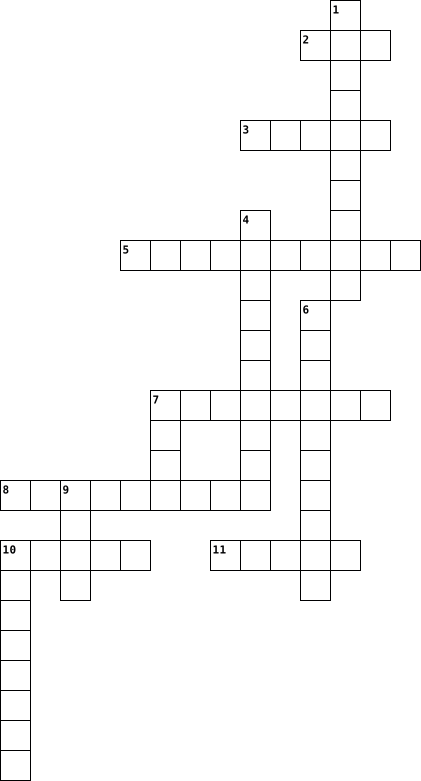
Across
- verbs turned into nouns
- verbs turned into adjectives
- Words of Time, Place, and Direction
- One independent clause
- If . . .
Down
- Two independent clauses
- Wishes and imagined situations
- Factual statements
- base form of the verb
- Questions
- !!!
11 Clues: !!! • If . . . • Questions • Factual statements • base form of the verb • One independent clause • Two independent clauses • verbs turned into nouns • verbs turned into adjectives • Wishes and imagined situations • Words of Time, Place, and Direction
Verbs 2021-09-12

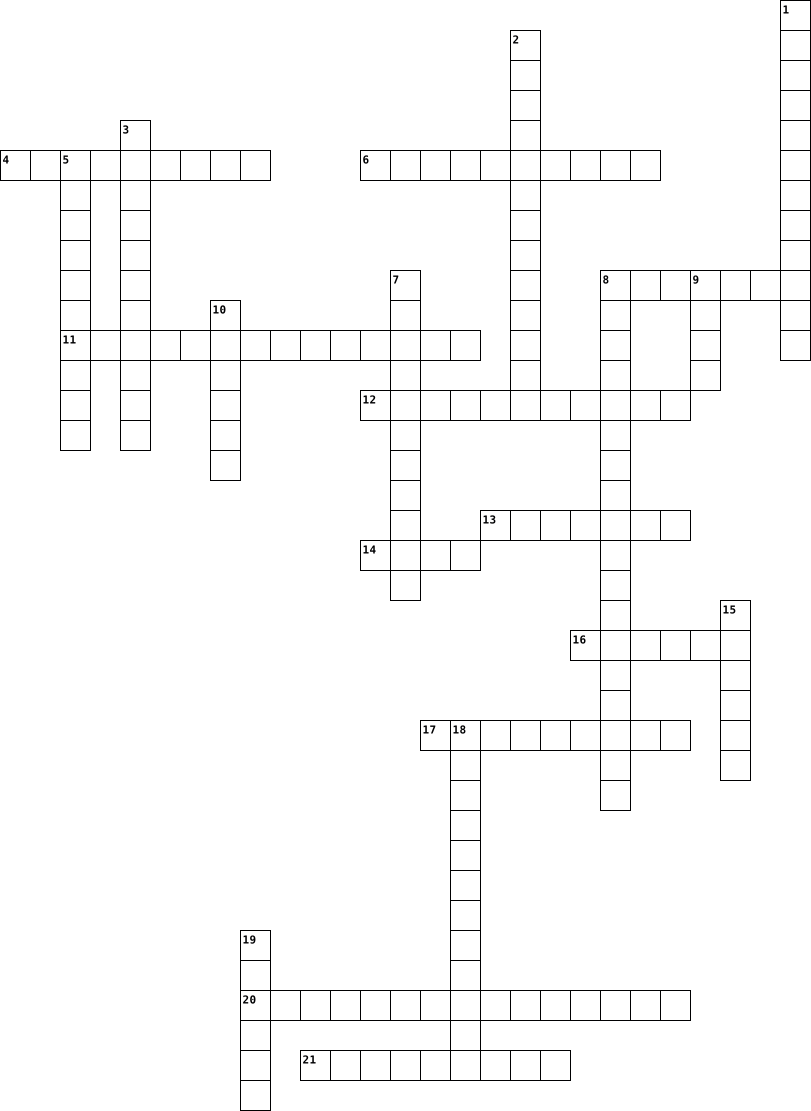
Across
- Function of the verb in a sentence.
- Verbs which admit of the continuous form
- Tense, Aspect and ____
- ____ forms are built up by a change in the word itself.
- Verbs that always have a lexical meaning of their own and can have an independent syntactic function in the sentence.
Down
- The ______ forms have the function of the predicate in the sentence and may also be called the predicative forms.
- ____ is the form of the verb which serves to express the manner in which the action is regarded.
- Finite for category: Person and _____
- The objects transitive verbs take may be direct indirect or _______
- ____ forms consist of two components
- With ____ verbs, the Past Indefinite and the participle are formed by adding the suffix -ed
11 Clues: Tense, Aspect and ____ • Function of the verb in a sentence. • ____ forms consist of two components • Finite for category: Person and _____ • Verbs which admit of the continuous form • ____ forms are built up by a change in the word itself. • The objects transitive verbs take may be direct indirect or _______ • ...
Exam Review 2022-12-16

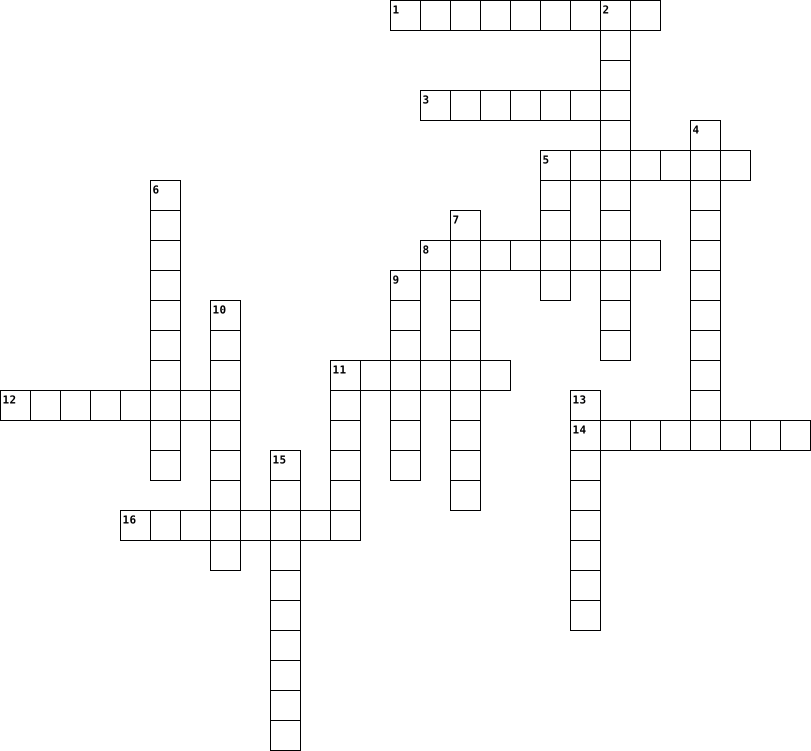
Across
- Overall feeling of story
- problem in a story
- to plus the base verb
- Participles are verbs that act like
- another word for story
- a comparison using like or as
- author's attitude
- lesson of the story
Down
- reference to another work
- what the sentence is about
- a comparison without like or as
- receives action in the sentence
- what the subject does
- verbs that act like nouns
14 Clues: author's attitude • problem in a story • lesson of the story • to plus the base verb • what the subject does • another word for story • Overall feeling of story • reference to another work • verbs that act like nouns • what the sentence is about • a comparison using like or as • a comparison without like or as • receives action in the sentence • Participles are verbs that act like
Verb Mood Practice 2021-03-22

Across
- Verbs in the ______ mood express a wish or demand.
- Verbs in the ________ mood indicate a fact or opinion.
- Verbs in the interrogative mood ask a _______.
- The number of verb moods.
- The subjunctive mood can express hypothetical situations that are unlikely, __________, or contrary to fact.
- Verbs in the ______ mood express something that will happen if certain conditions are met.
Down
- "I recommend" is an example of the _______ ______.
- most English sentences using the conditional include a dependent ___ clause.
- The conditional mood expresses hypothetical situations that are ________.
- "Can i go to my friend's house?" is an example of the ______ mood.
10 Clues: The number of verb moods. • Verbs in the interrogative mood ask a _______. • "I recommend" is an example of the _______ ______. • Verbs in the ______ mood express a wish or demand. • Verbs in the ________ mood indicate a fact or opinion. • "Can i go to my friend's house?" is an example of the ______ mood. • ...
Modal Verbs 2023-04-25

Across
- _______ verbs are auxiliary verbs.
- 'Doing words'
- A verb for prediction made with certainty
- Indicated by the verb might.
Down
- A verb used for giving advice
- A verb that can be used for past ability.
- Indicated by verbs can and could
- A verb showing ability and permission
8 Clues: 'Doing words' • Indicated by the verb might. • A verb used for giving advice • Indicated by verbs can and could • _______ verbs are auxiliary verbs. • A verb showing ability and permission • A verb that can be used for past ability. • A verb for prediction made with certainty
English crosswords 2021-05-03

Across
- you use it in surfing
- the literary genre belongs murderer on the East expressed
- the uk ......
- a story of life
- past participle of Fly
- past participle of tear
- impossibilty modal verbs
Down
- you use it for playing badminton
- synonymous of subscribe
- robbery in the old-west
- when you haven't exercise for a long time
- this bird eat fruit,seeds and insect
- modals verb
- for continous form
- english for Cosi+plural verbs
15 Clues: modals verb • the uk ...... • a story of life • for continous form • you use it in surfing • past participle of Fly • synonymous of subscribe • robbery in the old-west • past participle of tear • impossibilty modal verbs • english for Cosi+plural verbs • you use it for playing badminton • this bird eat fruit,seeds and insect • when you haven't exercise for a long time • ...
German 2 2023-12-01

Across
- verb meaning to occur (mentally)
- helping verb for motion verbs
- verb meaning to paint
- participle of to portray
- participle of the listen to
- participle of to open
- helping verb for non-motion verbs
- amazing new band you need to hear
- participle of to play
- participle of to close
Down
- participle of to walk around
- verb meaning to bring with
- verb used for future tense
- What is the second degree on HH's wall?
- how many tattoos Herr Hogan now has
- participle of arrive
- verb meaning to order
- verb meaning to pay attention
- noun meaning attention
19 Clues: participle of arrive • verb meaning to paint • verb meaning to order • participle of to open • participle of to play • noun meaning attention • participle of to close • participle of to portray • verb meaning to bring with • verb used for future tense • participle of the listen to • participle of to walk around • helping verb for motion verbs • verb meaning to pay attention • ...
Inggris 2026-05-18

Across
- The characteristic of exposition texts because they present only one side of an argument is called ....
- The focus of exposition texts is on non-fiction or ... matters.
- The purpose of Analytical Exposition is to ... readers that an issue is important to pay attention to.
- The final part of a Hortatory Exposition that contains suggestions or recommendations.
- Modal words such as should, must, ought to are often found in the ... section of a hortatory text.
- Helping verbs such as can, will, should are called ... verbs.
- Connectors such as firstly, secondly, finally are called ... connectors.
- The middle part of the text that contains reasons supporting the main idea.
- Cause-and-effect conjunctions such as because, therefore, and as a result are called ... conjunctions.
- Hortatory or Analytical? A text discussing “Why schools should ban mobile phones.”
- The English word for “Argumen” (singular form)RECOMMENDATION
Down
- A language feature that uses evaluative words to convince readers (for example: important, valuable, trustworthy).
- The tense most commonly used in both types of exposition texts.
- Another name for the Reiteration section in Analytical Exposition.
- The final part of an Analytical Exposition that contains a conclusion or restatement.
- A type of exposition text aimed at influencing readers to do or not do something.
- Arguments in exposition texts should be supported by data, facts, or ... to make them stronger.
- The first structure in both texts that introduces the topic or issue.
- Verbs that express feelings or thoughts (such as think, believe, feel) are called ... verbs.
- Hortatory or Analytical? A text discussing “Why breakfast is important” without encouraging readers to take action.
20 Clues: The English word for “Argumen” (singular form)RECOMMENDATION • Helping verbs such as can, will, should are called ... verbs. • The tense most commonly used in both types of exposition texts. • The focus of exposition texts is on non-fiction or ... matters. • Another name for the Reiteration section in Analytical Exposition. • ...
Morphology and Syntax 2022-11-18

Across
- Conj. that conjoin clauses of unequal weight
- Give emotion or mood to the verb phrase
- The type of phrase when the headword is a preposition
- Type of article that gives specificity
- The words that represent a person, place, thing, or abstraction
- What type of phrases can serve as adverbs if they modify a verb
- Conj. that conjoin words, expanded phrases, and clauses with equal weight
- Communication function of a sentence that asks a question
- Verbs that support the work of the main verb
- Cannot exist outside of their direct relationship to a noun
- These words modify verbs and other modifiers
Down
- Adjectives that focus on how much, how many, whose, etc...
- When the verb 'to be' is the main verb
- Pronouns that point to an object or person
- The word that proceeds prepositional phrase
- Verbs that act on a noun or pronoun
- Words that link ideas, phrases, and clauses
- What voice does the subject of the sentence perform the action
- Clause that cannot exist apart from other language elements
- Form verb+ing and functions as a noun
- Clause that functions like an adverb
- Point to the noun and provide info about distance from the speaker
- Modify nouns and pronouns
- Earliest pronouns
- Muscle of the utterance
25 Clues: Earliest pronouns • Muscle of the utterance • Modify nouns and pronouns • Verbs that act on a noun or pronoun • Clause that functions like an adverb • Form verb+ing and functions as a noun • When the verb 'to be' is the main verb • Type of article that gives specificity • Give emotion or mood to the verb phrase • Pronouns that point to an object or person • ...
prep news crosword 2023-02-01

Across
- i
- f
- lol
- p
- g
- c
- l
- o
- b
Down
- idk
- m
- e
- k
- j
- h
- a
- d
- n
18 Clues: m • e • i • f • k • j • h • a • p • d • g • c • l • o • n • b • idk • lol
Latin Grammar Terms 2021-12-08

Across
- Categories into which verbs are classified
- Subject receives action
- Genitive with number words
- "To verb"
- Always active but never looks it
- Categories into which nouns are classified
- A law, nominative and accusative always the same
- "By" a person
- Verbal adjective "-ing"
- "-self" pronoun, points back to subject
- Accusative, for how long?
- "With" a thing
Down
- Direct command
- "With" a person
- "Tempore" for example
- Dative with verbs like "dare," "monstrare," "narrare"
- Genitive, "'s"
- Noun to which a pronoun refers
- The highest degree
- The middle degree
- The base degree
- Pronouns that introduce a dependent clause
- "Ego," "vos," and "ea," for example
23 Clues: "To verb" • "By" a person • Direct command • Genitive, "'s" • "With" a thing • "With" a person • The base degree • The middle degree • The highest degree • "Tempore" for example • Subject receives action • Verbal adjective "-ing" • Accusative, for how long? • Genitive with number words • Noun to which a pronoun refers • Always active but never looks it • "Ego," "vos," and "ea," for example • ...
Latin I Crossword Puzzle Dec. 6 2022-12-06

Across
- Most famous Ancient Roman city destroyed by a volcano.
- Person of the following verbs: spectat, laudant
- City destroyed by the Greeks, from which Rome's founders came
- Case of the following words: servus, puella
- Case of the direct object.
- Name of the volcano which erupted in Italy in 69 A.D.
- Subject when the verb ends in "-mus."
- Case of the following words: mercatorem, mensam
Down
- Number of the following words: ancilla, servum
- Large animal statue given to the Trojans by the Greeks, which eventually led to the city being destroyed.
- Case of the subject and any words which rename or modify the subject
- Person of the following verbs: amo, habemus
- Case meaning "of," or can show possession.
- Subject when the verb ends in "-nt."
- Subject when the verb ends in "-tis."
- Number of the following words: horti, puellas
- Person of the following verbs: venis, debetis
17 Clues: Case of the direct object. • Subject when the verb ends in "-nt." • Subject when the verb ends in "-tis." • Subject when the verb ends in "-mus." • Case meaning "of," or can show possession. • Person of the following verbs: amo, habemus • Case of the following words: servus, puella • Number of the following words: horti, puellas • ...
KR Extra Credit 2022-04-05
Across
- the category of the determiner in the following sentence: Those shoes look bad.
- type of conjunction that connects one clause with another clause that has less weight and importance
- manner of the following adverb: Since I was sick, I went to bed early.
- type of verbs that require an object
- verbs that provide additional information about person, tense, mood, and so forth
- sets of words that go into pairs
- verbs that stand by themselves without needing an object
- a word that takes the place of a noun. (e.g., he, she, his, her)
- a type of personal pronoun used to signify possession
- adverbs that connect 2 or more independent clauses
- adjectives that follows a copula
- category of determiners that use words such as, "every, nine, another, more, all, any" etc.
- adjectives that describe the quality of the noun or pronoun they modify and come in 2 types of their own
- refer to specific entities
Down
- superlative form of bad
- adjectives that can be modified to compare two or more entities along a continuum
- small set of words that join words with words, phrases with phrases, and clauses with clauses
- type of prepositions where it is "adverb + preposition"
- comprise a relatively small, and therefore finite, class of words that serve to connect nouns and pronouns to other nouns, pronouns, and verbs
- type of verb for which the past participle is formed in a unique manner that does not follow the general formation rule of adding -ed
- comparative form of good
- finite group of words that can take the place of nouns
- types of adjectives that use words such as "whose, which, and what".
- both sides of the sentence have equal weight and importance
- adjectives that come before nouns
25 Clues: superlative form of bad • comparative form of good • refer to specific entities • sets of words that go into pairs • adjectives that follows a copula • adjectives that come before nouns • type of verbs that require an object • adverbs that connect 2 or more independent clauses • a type of personal pronoun used to signify possession • ...
Simple and Perfect Tense of Verbs 2023-12-05

Across
- the present participle of "eat"
- the past participle of "choose"
- the past participle of "forgive"
- the past participle of "sing"
- a verb which does take an object
- the simple past of "take"
- the past participle of "drink"
- voice used to emphasize the receiver of the action rather than the performer
- the simple past of "teach"
- voice used when the action is performed by its subject
- the simple past of "become"
- a word which describes an action or state of being
- another word for the "base" of a verb
- the past participle of "think"
- Jenny fielded and __________ (to throw) out the runner at third.
- the simple past of "drink"
- means "to rest" or "recline" and does not take an object
- a verb that describes a verb
Down
- the number of tenses in the English language
- a verb tense that requires NO helping verbs
- conjugate "has" to ________ when the subject is plural, "I" or "you"
- the simple past of "drive"
- the simple past of "forgive"
- the past participle of "wake"
- the simple past of "swear"
- the simple past of "shake"
- a word that describes a noun
- means "to move (something) in an upward direction" and does generally take an object
- means "to put" or "to place (something somewhere)" and does take an object
- a verb tense that requires the helping verb "has"
- the past participle of "write"
- a verb which does NOT take an object
- means "to go in an upward direction" and does NOT take an object
- "be" "have" and "____" are common verbs that can be used as main verbs or helping verbs
34 Clues: the simple past of "take" • the simple past of "drive" • the simple past of "swear" • the simple past of "shake" • the simple past of "teach" • the simple past of "drink" • the simple past of "become" • the simple past of "forgive" • a word that describes a noun • a verb that describes a verb • the past participle of "wake" • the past participle of "sing" • ...
Grammatikalische Grundbegriffe Ramona Baier 2018-07-11

Across
- Satzglied, das über die näheren Umstände Auskunft gibt
- Bindewort
- Einzahl
- Beugung
- Persönliches Führwort für Personen oder Sachen, z.B. ich, du, er,..
- Geschlecht des Nomens
- gebeugte Personalform des Verbs
- Satz der alleine stehen kann, muss mindestens aus Subjekt und Objekt bestehen
- "Leider bin ich krank", erklärt Pia
- Ergänzung im 3. Fall, Frage Wem?
- Hauptsatz, der die wörtliche Rede begleitet
Down
- adverbiale Bestimmung des Ortes
- bezieht sich auf ein vorangegangenes Nomen
- Frage Wann? Bestimmung der Zeit
- Grundform des Verbs
- Befehlsform
- Wortart für Eigenschaften
- bei einer nachgestellten ... muss ein Komma stehen
- Wirklichkeitsform
- Substantiv, Hauptwort
- aus sicht des betroffenen
- Attribute stehen hinter dem Bezugswort
- Deklinationsform des Nomens
23 Clues: Einzahl • Beugung • Bindewort • Befehlsform • Wirklichkeitsform • Grundform des Verbs • Substantiv, Hauptwort • Geschlecht des Nomens • Wortart für Eigenschaften • aus sicht des betroffenen • Deklinationsform des Nomens • adverbiale Bestimmung des Ortes • Frage Wann? Bestimmung der Zeit • gebeugte Personalform des Verbs • Ergänzung im 3. Fall, Frage Wem? • "Leider bin ich krank", erklärt Pia • ...
Grammar Review Part 1 2022-04-21
Across
- for_and_nor_but_or_yet_so
- root form of a verb
- everyday words for things
- the
- takes the place of a noun
- words that combine indep & dep
- owns something
- describes nouns
- what or who the sentence is about
- things experienced through our five senses
- verbals acting as adjectives
- describes verbs, adjectives, and adverbs
- verbs being adj, nouns, or adverbs in sentence
Down
- a, an, and some
- after the verb
- action or state of being
- verbals acting as nouns
- action that has a direct object
- an action that doesn't take a DO
- specific name of a place or person
- ideas or things that can't be seen...
- person, place or thing
22 Clues: the • after the verb • owns something • a, an, and some • describes nouns • root form of a verb • person, place or thing • verbals acting as nouns • action or state of being • for_and_nor_but_or_yet_so • everyday words for things • takes the place of a noun • verbals acting as adjectives • words that combine indep & dep • action that has a direct object • an action that doesn't take a DO • ...
Everything About Grammar 2020-12-01

Across
- Linking verbs are also called _____.
- words which have similar meanings
- Every complete sentence should have two parts, which are the subject and the _____, which always contains a verb.
- ,
- It has a subject + verb structure.
- Exclamatory sentences express strong feelings or _____.
- 'a', 'an', 'the'
- another name of declarative sentences
- singular form of 'children'
- comparative of 'funny'
- a plural personal pronoun
- the noun form of a verb
- The words 'my', 'your', 'his' and 'our' are examples of _____ adjectives.
Down
- _____ verbs take objects.
- _____ word classes accept new words.
- a word used to connect two words, phrases or clauses
- an interjection which shows disgust
- A _____ sentence contains two or more independent clauses.
- A group of words that fails to stand alone as a complete sentence is called a sentence _____.
- 'anger', 'misery', 'knowledge', 'bravery'
- the -ing form of a verb
- an example of modal verbs
- What are you learning in this course?
- superlative of the word 'good'
- -ion, -ive, -ion, -ous
- The English alphabet has 26 _____.
- words that are opposite in meaning
- :
- It describes a verb, an adjective or an adverb.
29 Clues: , • : • 'a', 'an', 'the' • -ion, -ive, -ion, -ous • comparative of 'funny' • the -ing form of a verb • the noun form of a verb • _____ verbs take objects. • an example of modal verbs • a plural personal pronoun • singular form of 'children' • superlative of the word 'good' • words which have similar meanings • It has a subject + verb structure. • The English alphabet has 26 _____. • ...
Everything About Grammar 2020-12-01

Across
- an example of modal verbs
- Linking verbs are also called _____.
- the -ing form of a verb
- a plural personal pronoun
- Every complete sentence should have two parts, which are the subject and the _____, which always contains a verb.
- A group of words that fails to stand alone as a complete sentence is called a sentence _____.
- :
- words which have similar meanings
- The words 'my', 'your', 'his' and 'our' are examples of _____ adjectives.
- -ion, -ive, -ion, -ous
- ,
- It has a subject + verb structure.
- words that are opposite in meaning
Down
- 'a', 'an', 'the'
- A _____ sentence contains two or more independent clauses.
- the noun form of a verb
- 'anger', 'misery', 'knowledge', 'bravery'
- another name of declarative sentences
- The English alphabet has 26 _____.
- Exclamatory sentences express strong feelings or _____.
- a word used to connect two words, phrases or clauses
- It describes a verb, an adjective or an adverb.
- _____ verbs take objects.
- _____ word classes accept new words.
- singular form of 'children'
- an interjection which shows disgust
- What are you learning in this course?
- superlative of the word 'good'
28 Clues: : • , • 'a', 'an', 'the' • -ion, -ive, -ion, -ous • the noun form of a verb • the -ing form of a verb • an example of modal verbs • a plural personal pronoun • _____ verbs take objects. • singular form of 'children' • superlative of the word 'good' • words which have similar meanings • The English alphabet has 26 _____. • It has a subject + verb structure. • ...
IMPERFECTO 2021-04-29

Across
- They were eating; they used to eat; they would eat
- They(girls) were talking; they used to talk; they would talk
- I was living; I used to live
- She was (feeling)
- There was;there were
- Y'all wanted; they used to want
- There are ____ verbs that have spelling changes (E-->IE , O--->UE, etc) in this tense, unlikne the present tense
- _____ sol (It was sunny)
- We were going; we used to go; we would go
- You were (feeling); you used to feel; you would feel
Down
- He was going; he used to go; he would go
- We were working; we used to work; we would work
- He was making/doing; He used to make/do; He would make/do
- ____ la una de la mañana (It was 1AM)
- She was
- Yo ____ 5 años (I was 5 y/o)
- Conjugation for YO for -IR verbs
- You were going; you used to go; you would go
- Conjugation for YO for -ER verbs
- "Imperfect" in Spanish
- He wanted; he used to want
- I had;I used to have
- I was going; I used to go; I would go
- Conjugation for YO for -AR verbs
24 Clues: She was • She was (feeling) • There was;there were • I had;I used to have • "Imperfect" in Spanish • _____ sol (It was sunny) • He wanted; he used to want • Yo ____ 5 años (I was 5 y/o) • I was living; I used to live • Y'all wanted; they used to want • Conjugation for YO for -IR verbs • Conjugation for YO for -ER verbs • Conjugation for YO for -AR verbs • ...
Stage 4 Verb Practice 2021-11-18

Across
- This verb means "she says"
- This verb means "you are cooking"
- This verb means "You are searching"
- This verb means "You are calling"
- This pronoun always goes with First Person endings
- This verb means "I am cooking"
- This verb means "I am giving back"
- This verb means "I am selling"
- This verb means "She is doing"
- -s is the ending for ___________ Person Verbs
- -t is the ending for __________ Person Verbs
- This verb means "He is cooking"
- This verb means "She has"
- This verb that means "I am doing"
- This pronoun always goes with Second Person endings
Down
- This verb means "You are selling"
- This verb means "You are doing"
- -ō is the ending for __________ Person Verbs
- person is ______ is doing the action
- This verb means "You are giving back"
- This verb means "I am calling"
- This verb means "I am searching"
- This verb means "He is giving back"
- This verb means "She is selling"
- This verb means "I have"
- This verb means "He is calling"
- This verb means "He is searching"
- This verb means "You have"
28 Clues: This verb means "I have" • This verb means "She has" • This verb means "she says" • This verb means "You have" • This verb means "I am calling" • This verb means "I am cooking" • This verb means "I am selling" • This verb means "She is doing" • This verb means "You are doing" • This verb means "He is calling" • This verb means "He is cooking" • This verb means "I am searching" • ...
REGULAR -AR VERB CONJUGATIONS CROSSWORD 2025-03-17

Across
- THE VOSOTROS & NOSOTRAS ENDING FOR -AR VERBS
- A PRONOUN THAT CAN BE USED FOR "LA MADRE"
- THE STEM OF CAMINAR
- LIMPIAR WITHOUT THE STEM
- USTEDES (APOYAR) EL CLUB.
- WE USE MATERIALES ESCOLARES WITH THIS VERB
- FIRST PERSON SINGULAR SUBJECT PRONOUN IN SPANISH
- THE FORM OF HABLAR YOU USE TO ASK A QUESTION
- THE NOSOTROS & NOSOTRAS ENDING FOR -AR VERBS
- ANSWER TO WHAT YOU WEAR TO SCHOOL MATCHY
- LA MADRE (LLAMAR) EL DOCTOR
- WE TALK
- THE ORIGINAL FORM OF THE VERB BEFORE ALTERING IT, "TO [ACTION]"
- YOU PLURAL FORMAL, CONJUGATED WITH THE -AN ENDING
Down
- ASKING ABOUT WHAT YOU WEAR TO SCHOOL
- THE FORM OF HABLAR MI USE TO SAY I SPEAK
- TELL A FRIEND TO PAY AT THE CAJA
- TO LOOK OR WATCH
- THE PART OF THE VERB THAT YOU ADD THE ENDING TO AFTER YOU REMOVE THE LAST TWO LETTERS
- TO CHANGE A VERB TO MATCH A SUBJECT
- THE END OF THAT THEY FORM
- YOU FORMAL, CONJUGATED WITH THE -A ENDING
- THE ELLOS/ELLAS/USTEDES ENDING FOR -AR VERBS
- THE STEM OF SPANISH VERB TO SPEAK
- LOS AMIGOS WATCH TV
- LOS ESTUDIANTES (ESTUDIAR)
- TÚ Y DIEGO (PAGAR)
- THE TÚ ENDING FOR -AR VERBS
28 Clues: WE TALK • TO LOOK OR WATCH • TÚ Y DIEGO (PAGAR) • THE STEM OF CAMINAR • LOS AMIGOS WATCH TV • LIMPIAR WITHOUT THE STEM • USTEDES (APOYAR) EL CLUB. • THE END OF THAT THEY FORM • LOS ESTUDIANTES (ESTUDIAR) • LA MADRE (LLAMAR) EL DOCTOR • THE TÚ ENDING FOR -AR VERBS • TELL A FRIEND TO PAY AT THE CAJA • THE STEM OF SPANISH VERB TO SPEAK • TO CHANGE A VERB TO MATCH A SUBJECT • ...
Parts of Speech 2025-04-28

Across
- The non-specific or generic name for a person, place, or thing is a ______ noun
- Nouns that exist as ideas or concepts but may not physically exist in the world
- Verb tense describing actions that will take place at a later time
- A part of speech that modifies or qualifies a verb, an adjective, or another word like itself. Often expresses a relation to time, location, circumstance, manner, cause, degree, etc. (gently, under, there, angrily)
- The specific name(s) for certain persons, places, or things (type of nouns)
- Adjectives used to describe the highest degree or extreme (ie, biggest, fastest, funniest)
- A part of speech that modifies or describes a noun
- Verbs that connect a subject to a noun, pronoun, or adjective (eg. is, as, were, was)
Down
- Nouns that you know are "real" because you experience them through your senses
- Verb tense that describes things happening previously
- More than one person, place, or thing is a ______ noun
- The form a verb takes indicating whether an action is taking place in the past, present, or future
- Compound verb forms, like those that use "being" and "been" (ie. are being, has been)
- Verbs that describe what a noun is doing mentally or physically
- Verb tense describing actions happening currently
- Words that demonstrate an action, state, or occurance and form the main part of the predicate of a sentence
- Words that replace nouns or exist as noun phrases, they help avoid repetition
- Verbs like "to be" which have completely different forms depending on the tense
- Verbs acting in the place of a noun, forming the subject of a sentence and ending in "ing"
- Person, Place, Thing, or Concept/Idea
20 Clues: Person, Place, Thing, or Concept/Idea • Verb tense describing actions happening currently • A part of speech that modifies or describes a noun • Verb tense that describes things happening previously • More than one person, place, or thing is a ______ noun • Verbs that describe what a noun is doing mentally or physically • ...
Got the Message? 2026-04-13

Across
- What adjectives and adverbs do
- An imperative sentence gives a ____?
- What every pronoun needs
- The past participle of saw is have _____?
- Break and thing are examples of ____ verbs
- The oppsite of singular
- The objective case of they
- What subjects and verbs must do
- Oh is a mild one.
- The past for of the verb freeze
- The possessive case of he
- A pronoun which points out something.
- The plural form of goose
- The comparative form of fast
- A degree of comparison which uses -est
Down
- Basketball is a ____ noun
- The adverb tomorrow tells ____?
- A sentence which asks a question.
- How many parts of speech are there?
- Am, Have,do are ___? verbs
- A drawing to show the structure of a sentence
- A connecting word
- A sentence that makes a statement
- In, of, on and to are called _____?
- The part of the sentence containing the verb.
- A word that modifies a verb
- United States is a proper one
- The part of speech which tells "how many"
- The number of principal parts
- The sentence part which you locate first
- A book of synonyms and antonyms
31 Clues: A connecting word • Oh is a mild one. • The oppsite of singular • What every pronoun needs • The plural form of goose • Basketball is a ____ noun • The possessive case of he • Am, Have,do are ___? verbs • The objective case of they • A word that modifies a verb • The comparative form of fast • United States is a proper one • The number of principal parts • What adjectives and adverbs do • ...
Crossword Puzzle 2025-07-10

Across
- VERB verbs that following behind modal verbs, must be.....
- a belief that is not based on reason or scientific thinking
- the plural form of THAT
- synonym of poisonous
- PERFECT an English verb tense that refer about something that happened before something else.
- the verb ______ is used for recent decision while BE GOING TO is used for event that has been planned.
- synonym of PURE
Down
- what is the past participle of PUKUL.
- PARTICIPLE verbs that following behind has, have and had must be...........
- Did you WATCHED the movie yesterday? (correct the word WATCHED)
- a sign of what is going to happen in the future
- the sounds represented by the letters s, z, sh, and zh, hissing effect.
- Refer to most letters in the English alphabet, except the vowels: a, e, i, o, and u.
- What is the past participle of think?
- participle of TRAVEL
15 Clues: synonym of PURE • synonym of poisonous • participle of TRAVEL • the plural form of THAT • what is the past participle of PUKUL. • What is the past participle of think? • a sign of what is going to happen in the future • a belief that is not based on reason or scientific thinking • VERB verbs that following behind modal verbs, must be..... • ...
Museum 2024-03-20

Across
- The plural form of moose.
- A question word.
- The opposite of dynamic verbs of action. is ..
- A type of noun(we can count)
- The plural form of tooth
- A word who is part of the fanboys.
- We have to capitalized them.
- They are little robots.
Down
- A verb tense.
- The main caracter of a story with Lilliputian.
- type of letter in the alphabet.
- A reflexive pronoun.
- They can be conjugate.
- They give information about nouns or pronouns.
- A plural object pronoun.
15 Clues: A verb tense. • A question word. • A reflexive pronoun. • They can be conjugate. • They are little robots. • The plural form of tooth • A plural object pronoun. • The plural form of moose. • A type of noun(we can count) • We have to capitalized them. • type of letter in the alphabet. • A word who is part of the fanboys. • The main caracter of a story with Lilliputian. • ...
Let's Learn Language 2016-07-13

Across
- When the correct part of speech is used; nouns for nouns, verbs for verbs
- An expression whose meaning is not predictable from the usual meanings
- A verb used to express distinctions of tense, aspect, mood, etc.
- Verb _ tells you when something happens or happened
- A noun that ends in s is considered
Down
- Word _ is important - formal for formal, informal for informal
- Definite _ generally precede specific nouns that are modified by adjectives
- When verbs are followed by to or ~ing it is called a verb
- Having one subject and one main verb is the basis for sentence
- Subject-verb _ means the subjects must agree with verbs in number
10 Clues: A noun that ends in s is considered • Verb _ tells you when something happens or happened • When verbs are followed by to or ~ing it is called a verb • Word _ is important - formal for formal, informal for informal • Having one subject and one main verb is the basis for sentence • A verb used to express distinctions of tense, aspect, mood, etc. • ...
REGULAR -AR CONJUGATION CROSSWORD 2024-04-20

Across
- ______ REFERS TO HE/SHE AND IS USED TO TALK ABOUT SOMEONE OR REFERS TO SOMEONE YOU RESPECT AND IS USED TO ADDRESS THEM DIRECTLY(USTED)
- I CLEAN (LIMPIAR)
- THE PRONOUN FOR YOU FORMAL
- A PRONOUN THAT CAN BE USED TO DIRECTLY ADDRESS A GROUP OF GIRLS
- FIRST PERSON SINGULAR SUBJECT PRONOUN IN SPANISH
- A PRONOUN THAT CAN BE USED TO DIRECTLY ADDRESS A GROUP OF BOYS
- THE ELLOS/ELLAS/USTEDES ENDING FOR -AR VERBS
- LOS ESTUDIANTES (ESTUDIAR) POR EL EXAMEN
- A PRONOUN THAT CAN BE USED TO REFER TO A GROUP OF BOYS
- THE STEM OF CAMINAR
- USTEDES (APOYAR) EL CLUB.
- A PRONOUN THAT CAN BE USED FOR “EL PADRE” OR “JUAN”
- REFERS TO MULTIPLE- NOSOTROS, NOSOTRAS, VOSOTROS, VOSOTRAS, ELLOS, ELLAS, USTEDES
- THE PART OF THE VERB THAT YOU ADD THE ENDING TO AFTER YOU REMOVE THE LAST TWO LETTERS
- YOU LOOK (MIRAR)
- REFERS TO ONLY ONE- YO, TÚ, ÉL, ELLA, USTED
- COMER WITHOUT THE STEM
- THE STEM OF BEBER
Down
- THE ORIGINAL FORM OF THE VERB BEFORE ALTERING IT, "TO [ACTION]"
- ______ PERSON REFERS TO YOU AND IS USED TO DIRECTLY ADDRESS SOMEONE
- THE VOSOTROS & NOSOTRAS ENDING FOR -AR VERBS
- TO CHANGE A VERB TO MATCH A SUBJECT
- LIMPIAR WITHOUT THE STEM
- THE NOSOTROS & NOSOTRAS ENDING FOR -AR VERBS
- ______ PERSON REFERS TO ME/MYSELF AND IS USED TO TALK ABOUT THINGS I DO
- THE STUDENTS SING (CANTAR)
- THE STEM OF COCINAR
- THE TÚ ENDING FOR -AR VERBS
- YOU AND YOUR FRIENDS COOK (COCINAR)
- A PRONOUN THAT CAN BE USED FOR "LA MADRE"
- LA MADRE (LLAMAR) EL DOCTOR
- WE TALK (HABLAR)
- TÚ Y DIEGO (PAGAR) EN EL RESTAURANTE
- SHE CALLS (LLAMAR)
- THE PRONOUN FOR YOU PLURAL FORMAL
35 Clues: WE TALK (HABLAR) • YOU LOOK (MIRAR) • I CLEAN (LIMPIAR) • THE STEM OF BEBER • SHE CALLS (LLAMAR) • THE STEM OF COCINAR • THE STEM OF CAMINAR • COMER WITHOUT THE STEM • LIMPIAR WITHOUT THE STEM • USTEDES (APOYAR) EL CLUB. • THE PRONOUN FOR YOU FORMAL • THE STUDENTS SING (CANTAR) • THE TÚ ENDING FOR -AR VERBS • LA MADRE (LLAMAR) EL DOCTOR • THE PRONOUN FOR YOU PLURAL FORMAL • ...
Parts of Speech 2025-10-12

Across
- What type of adverbs introduces adjective clauses?
- What type of conjunctions come in pairs and join equal sentence parts?
- Pronouns that refer to specific persons, places, or things.
- Most common type of pronoun.
- Pronouns that ask a question.
- What names persons, places, or things?
- Words that replace nouns.
- What kind of nouns name specific persons, places, and things?
- What kind of nouns combine two or more words into one?
- What type of adverbs modify adjectives or other adverbs?
- What type of verbs expresses either an external, observable action that can be perceived by the senses or an inward action that cannot be perceived by the senses?
- What type of verb either renames or describes the subject?
- What kind of pronoun appears in an adjective clause and shows a relationship between itself and its antecedent.
- Conjunctions that join sentence elements of the same type.
- What is the word that a pronoun replaces?
- Words that show the relationship between a noun (or pronoun) and other words in a sentence.
Down
- What kind of nouns refer to groups?
- What kind of nouns are always singular?
- An adverb that shows a meaning connection between two independent clauses that are separated by a period or a semicolon.
- What kind of pronoun expresses a mutual relationship between or among the persons mentioned in the subject of the sentence?
- What type of adjective points out specific nouns?
- Words used before nouns to indicate specificity and are the most common determiners.
- What type of verbs have receivers of action?
- Action or state of being words
- Words that can stand alone, punctuated as a sentence, or that can appear along with a sentence in which it takes no real part.
- What kind of nouns name any persons, places, or things?
- Conjunctions that introduce dependent clauses and joins dependent clauses to independent clauses?
- What type of verbs expresses a state of being or a condition of the subject and is often followed by a complement?
- Words that connect words, phrases, or clauses.
- What type of verbs is also called helping verbs and are combined with the main verb to form the complete verb?
- What kind of pronouns is used as objects but refer to the same person or thing as the subject of the sentence?
- What type of verb that, with its subject, is complete in meaning; it has no complement?
- Words that expand, limit, or describe nouns or pronouns
- Pronouns that refer to nonspecific persons, places, or things.
- What kind of pronouns emphasize a noun or pronoun that is already present in the sentence?
- Words that modify a verb, adjective, or other adverb.
36 Clues: Words that replace nouns. • Most common type of pronoun. • Pronouns that ask a question. • Action or state of being words • What kind of nouns refer to groups? • What names persons, places, or things? • What kind of nouns are always singular? • What is the word that a pronoun replaces? • What type of verbs have receivers of action? • ...
Spanish Key Terms (Year Long) Review 2023-08-22

Across
- to change from one language to another in written form
- plural or singular
- a word that sounds or looks the same in one language as it does in another language
- to change from one language to another in spoken form
- verbs verbs following regular conjugation patterns
- tense past, present, future, conditional, imperative, progressive, perfect
Down
- verbs veerbs NOT following regular conjugation patters
- apply tense and subject to a verb
- the, a/an, some
- a group of people classified together based on their common cultural traditions
- masculine or feminine
- a group of people classified together based on physical characteristics or nationality (your blood)
12 Clues: the, a/an, some • plural or singular • masculine or feminine • apply tense and subject to a verb • verbs verbs following regular conjugation patterns • to change from one language to another in spoken form • verbs veerbs NOT following regular conjugation patters • to change from one language to another in written form • ...
Spanish Fun 2022-01-26

Across
- Run
- Sheis
- Verbs
- Present
- How
- Swim
- Whatshelike
- Who
- I need
- Heis
- Visit
Down
- Please
- Hi
- Because
- Ilike
- February
- January
- Iam
- Bye
- Verb's form
- Idontlike
21 Clues: Hi • Run • Iam • How • Bye • Who • Swim • Heis • Ilike • Sheis • Verbs • Visit • Please • I need • Because • January • Present • February • Idontlike • Whatshelike • Verb's form
Grammar Final 2024-08-08

Across
- Regular ____ tense verbs end with 'ed'.
- ______ adjectives compare TWO things.
- linking verb with nose
- NOT makes a positive sentence into a ______ sentence.
- Routine is in ____ tense.
- linking verb with ears
- An _____ describes a verb.
- "Grammar" is a ______ noun.
Down
- one of + superlative + _____ noun
- linking verb with mouth
- ______ adjectives compare THREE or more things.
- linking verb with eyes
- An ______ describes a noun.
- linking verb with touch
- "Will" and "be + going to" are _____ tense verbs.
- Present _____ + future time is future tense.
- A sense verb is also called a _____ verb in grammar.
17 Clues: linking verb with eyes • linking verb with nose • linking verb with ears • linking verb with mouth • linking verb with touch • Routine is in ____ tense. • An _____ describes a verb. • An ______ describes a noun. • "Grammar" is a ______ noun. • one of + superlative + _____ noun • ______ adjectives compare TWO things. • Regular ____ tense verbs end with 'ed'. • ...
THE VERB 2021-02-25

Across
- Verbs denote neither actions nor states
- Verbs don't have their own meaning in the sentence and can't be translated into Ukrainian
- The form which is usually expressed by auxiliary verb do and negative particle not.
- This form of the verb doesn't express person tense and mood.
- Verbs usually followed ny nouns or prouns that act as direct object
- The mood which is used to represent an action as a real fact.
- When the subject is acting we say that the subject is...
Down
- The forms of of the verb which are used in the function of a predicate are called...
- The mood, which represents an action not as a real fact but as something that would take place under certain conditions.
- Verbs that form Past Simple and Past Participle by adding -ed or -d to the bare infinitive.
- When the subject is receiving the action, we say that the subject is...
- How many forms does notional verb have?
- A grammatical term which is used to tell whether the subject of the sentence acting or is receiving the action expressed by the verb.
- The mood, which is used to express a command or request.
14 Clues: Verbs denote neither actions nor states • How many forms does notional verb have? • The mood, which is used to express a command or request. • When the subject is acting we say that the subject is... • This form of the verb doesn't express person tense and mood. • The mood which is used to represent an action as a real fact. • ...
PL - L5 2018-09-26

Across
- students
- number of vowels in Latin and English
- are action words
- I fight
- all simple Latin verbs end in this letter
Down
- student
- I set free
- I conquer
- I tell
- I call
10 Clues: I tell • I call • student • I fight • students • I conquer • I set free • are action words • number of vowels in Latin and English • all simple Latin verbs end in this letter
Verb tenses 2018-02-27

Across
- we use this verb when we don´t mention the person to whom the info was given.
- we use the auxiliar "will" in this tense.
- we use this verb when we mention the person to whom the info was given.
- simple past form of the verb "go".
- these verbs change their form in past tense.
- past participle of the verb "have".
- ending for verbs in present and past continuous.
Down
- participle we use this form of the verb in the present and past perfect.
- past form of the verb "tell".
- the most of these verbs en in -ed in past tense.
- this is the base form of the verb "ate".
- past form of the verb "say".
- past form of the verb "work".
- past participle of the verb "to be".
- it is the connector we use when we want to report questions with auxiliars.
15 Clues: past form of the verb "say". • past form of the verb "tell". • past form of the verb "work". • simple past form of the verb "go". • past participle of the verb "have". • past participle of the verb "to be". • this is the base form of the verb "ate". • we use the auxiliar "will" in this tense. • these verbs change their form in past tense. • ...
L1-Verben 1 2015-03-17

Across
- Mark
- can
- Kiss
- love
- spell
- Supplement
- hot
- read
Down
- work
- come
- hear
- speak to
- make
- live
- laugh
- Verbs
- go
17 Clues: go • can • hot • work • come • hear • Mark • make • live • Kiss • love • read • laugh • spell • Verbs • speak to • Supplement
L1-Verben 1 2015-03-17

Across
- spell
- Kiss
- live
- Supplement
- go
- Mark
- laugh
- make
- hear
Down
- Verbs
- speak to
- hot
- read
- can
- work
- come
- love
17 Clues: go • hot • can • Kiss • live • read • work • Mark • come • love • make • hear • Verbs • spell • laugh • speak to • Supplement
Dialects And Creoles 2023-12-05

Across
- The recognition of standard as being "correct" influences different _____ towards different dialects.
- The ability to change dialects when speaking.
- In creoles, verbs and nouns are usually_______.
- A verb used to link the subject and predicate.
- Dialects of the same language should be mutually ____________.
Down
- A variety of a language
- Dialects associated with social classes
- This type of dialect is accepted as formal and taught in schools.
- The notion that dialects is a bad language is the ________ definition.
- The formation and study of word sounds.
- Sentence structure is referred to as...
- A string of verbs without conjunctions in between is referred to ____ verbs.
12 Clues: A variety of a language • Dialects associated with social classes • The formation and study of word sounds. • Sentence structure is referred to as... • The ability to change dialects when speaking. • A verb used to link the subject and predicate. • In creoles, verbs and nouns are usually_______. • Dialects of the same language should be mutually ____________. • ...
. 2025-10-23

Across
- 2
- 3
- 15
- 11
- 5
- 8
- 12
- 9
- 10
Down
- 13
- 4
- 6
- 1
- 7
- 14
- 16
16 Clues: 2 • 4 • 6 • 3 • 1 • 7 • 5 • 8 • 9 • 13 • 15 • 11 • 14 • 12 • 16 • 10
L1-Verben 1 2015-03-17

Across
- can
- hear
- live
- speak to
- work
- laugh
- read
- Supplement
Down
- make
- Kiss
- Mark
- go
- hot
- spell
- love
- Verbs
- come
17 Clues: go • hot • can • make • Kiss • Mark • hear • live • love • work • come • read • spell • Verbs • laugh • speak to • Supplement
English Language Concepts 2025-04-07

Across
- Unit of sound in a word
- Action or state word
- Direct comparison calling one thing another
- Group of words expressing idea
- Word naming person/place/thing
- Word describing a noun
Down
- Verb form indicating time
- Verbs indicating completed actions
- Rules structuring sentences
- Modifier for verbs/adjectives
- Letters added before root word
- Letters added after root word
12 Clues: Action or state word • Word describing a noun • Unit of sound in a word • Verb form indicating time • Rules structuring sentences • Modifier for verbs/adjectives • Letters added after root word • Group of words expressing idea • Letters added before root word • Word naming person/place/thing • Verbs indicating completed actions • Direct comparison calling one thing another
Kennen Sie die grammatischen Fachwörter? 2020-12-22

Across
- vollendete Vergangenheit
- Steigerungsstufe
- Einzahl
- Satzgegenstand
- dritter Fall
- Bindewort
- Doppellaut
- Begleiter
- Wirklichkeitsform
Down
- Verhältniswort
- Zukunft
- Eigenschaftswort
- vierter Fall
- Gegenwart
- Nachsilbe
- Hauptwort
- Mitlaut
- Grundform des Verbs
- Leideform
19 Clues: Zukunft • Einzahl • Mitlaut • Gegenwart • Nachsilbe • Hauptwort • Bindewort • Leideform • Begleiter • Doppellaut • vierter Fall • dritter Fall • Verhältniswort • Satzgegenstand • Eigenschaftswort • Steigerungsstufe • Wirklichkeitsform • Grundform des Verbs • vollendete Vergangenheit
SS Crossword 1 s2 Wk 2 2026-06-07

Across
- professor
- to describe
- family
- to listen
- book
- thanks
- sociable
- student
- to be
- to dande
Down
- soccer
- shy
- worker
- music
- to read
- friend
- intelligent
- verbs
- person
- to talk
20 Clues: shy • book • music • verbs • to be • soccer • worker • family • friend • thanks • person • to read • to talk • student • sociable • to dande • professor • to listen • to describe • intelligent
Afrikaans woorde! 2024-09-17

Across
- adverbs
- adjectives
- where
- what
- degrees of comparison
- intensive froms
- nouns
- verbs
- interjections
Down
- pronouns
- preposistion
- conjunctions
- afrikaans
- why
- diminutives
- plural
- articles
- when
18 Clues: why • what • when • where • nouns • verbs • plural • adverbs • pronouns • articles • afrikaans • adjectives • diminutives • preposistion • conjunctions • interjections • intensive froms • degrees of comparison
Sentences 2017-04-26

Across
- This is the person or thing in the sentence that carries out the action.
- The name given to sentences that have at least two main clauses.
- will and have are examples of these types of verbs.
- We use these to join two or more main clauses.
- Clause The part of a sentence that needs a main clause to make sense.
- The minimum number of verbs that are in a compound sentence.
- The name given to an incomplete sentence.
Down
- The number of verbs in a simple sentence.
- A sentence is not complete without this.
- clause Another word for sentence.
- This is an example of a subordinating conjunction.
- And, but, so and yet are examples of these types of conjunctions.
- Every sentence needs to have one of these.
- The most common type of sentence in English.
14 Clues: clause Another word for sentence. • A sentence is not complete without this. • The number of verbs in a simple sentence. • The name given to an incomplete sentence. • Every sentence needs to have one of these. • The most common type of sentence in English. • We use these to join two or more main clauses. • This is an example of a subordinating conjunction. • ...
Communications Crossword 2022-01-22

Across
- a word that shows action or a state of being
- Is a word that sounds the same as another word, but has a different meaning and spelling.
- Where the subject is acted upon
- Effect, Put important info a beginning of sentence/paragraph.
- Clause, Cannot stand alone and needs an independent clause to make sense.
- , Is an adjective that limits the noun or pronoun it modifies. “the, a, and an are articles.
- a word the replaces a noun in a sentence.
- a word that describes a verb, adjective, clause or another adverb. Adverbs tell how, when or where something is done.
- a word that modifies a noun or pronoun. They may provide details about the noun or pronoun that gives you a better understanding of the person, place or thing.
Down
- Writing Sentences so that their parts are balanced and easy to read and understand. Match nouns with nouns, verbs with verbs, clauses with clauses and avoid mixing Active verbs with Passive Verbs
- Splice, When two independent clauses are joined together inappropriately with a comma.
- Effect, Put important info at end of sentence/paragraph
- Clause, A clause that can stand alone, make sense and is complete in itself.
- Sentence, When an independent clause follows another without the proper punctuation.
- Group of words that expresses a complete thought.
- A way of showing a reader that the material they are reading is more important than the other material
- a word that names a person, place or thing
- A part of a sentence, usually a phrase or dependent clause that is punctuated as if it were an independent clause.
- Where the subject of the sentence performs the action.
19 Clues: Where the subject is acted upon • a word the replaces a noun in a sentence. • a word that names a person, place or thing • a word that shows action or a state of being • Group of words that expresses a complete thought. • Where the subject of the sentence performs the action. • Effect, Put important info at end of sentence/paragraph • ...
Synonyms 2017-01-31

Across
- story
- apprentice
- smart
- name
- physician
- Holiday
- understand
- 4 sided
- think
Down
- teacher
- action
- show
- circular
- electronic
- words
- describe
16 Clues: show • name • story • smart • words • think • action • teacher • Holiday • 4 sided • circular • describe • physician • apprentice • electronic • understand
Preterite vs Imperfect 2022-03-29

Across
- aba,abas,aba,ábamos,abais,aban
- There,are,no__,in,imperfect
- is used for actions in the past.Use of the imperfect tense implies that the past action did not have a definite beginning or a definite end.
- preterite,Qué,Gué,zé
- write on back imperfect expressions
- ser,ver,ir,on,back write,conjugations,of,these,three
Down
- time imperfect Al wept
- Preterite
- write on back preterite expressions
- is used for actions in the past that are seen as completed. Use of the preterite tense implies that the past action had a definite beginning and definite end.
- ía,ías,ía,íamos,ían
11 Clues: Preterite • ía,ías,ía,íamos,ían • preterite,Qué,Gué,zé • time imperfect Al wept • There,are,no__,in,imperfect • aba,abas,aba,ábamos,abais,aban • write on back preterite expressions • write on back imperfect expressions • ser,ver,ir,on,back write,conjugations,of,these,three • ...
Deutsche Grammatik 2017-11-02

Across
- Plural von "Kaktus"
- Präteritum von "schlafen": wir ...
- Zeitform, die etwas in der Gegenwart ausdrückt (z.B.ich lerne)
- Zeitform, die etwas in der Zukunft ausdrückt (z.B. ich werde lernen)
- andere Bezeichnung für "Nachsilbe" (z.B. -lich/ -ig)
- Wortart: "mein, dein, sein,..."
- andere Bezeichnung für "Vorsilbe" (z.B. ent-/ de-)
- andere Bezeichnung für Substantiv
- Wörter, die auf "-heit/ -keit/ -ung/...) enden, sind Kennzeichen für...
- Partizip I von "rennen"
- andere Bezeichnung für "Einzahl" (z.B. der Baum)
- Wortart: "leise, zufrieden, fröhlich,..."
- Steigerungsstufe eines Adjektivs (z.B. schnell - schneller)
- Wortart: "denn/ und/ oder/ aber..."
- Plural von "Atlas"
Down
- Wortart: "heute/ damals/ später/..."
- Veränderung des Verbs nach den Personalpronomen
- Zeitform: "ich hatte gelesen"
- Komparativ von "gut"
- Wortart, mit der man ausdrückt, was jemand tut oder was geschieht
- Autor von "Emil und die Detektive"
- Wortart: "der, die, das"
- Wortart: "ich, du, er,..."
- Wortart: "zu, bei, über, auf,..."
- Partizi II von schreiben
- Vokalverbindungen (au, eu, äu, ei,...)nennt man...
- Superlativ von "viel"
- Buchstaben eines Wortes wie "b,g,h,l,m,..." sind nicht Vokale, sondern...
- Veränderung des Substantivs nach den vier Fällen
- Aufforderungsform eines Verbs
- Zeitform: "wir haben gelernt"
- Imperativ von "geben"
- andere Bezeichnung für "Mehrzahl" (z.B. die Bäume)
- Grundform eines Verbs
34 Clues: Plural von "Atlas" • Plural von "Kaktus" • Komparativ von "gut" • Superlativ von "viel" • Imperativ von "geben" • Grundform eines Verbs • Partizip I von "rennen" • Wortart: "der, die, das" • Partizi II von schreiben • Wortart: "ich, du, er,..." • Zeitform: "ich hatte gelesen" • Aufforderungsform eines Verbs • Zeitform: "wir haben gelernt" • Wortart: "mein, dein, sein,..." • ...
Parts of Speech 2024-01-24
Across
- of speech in the English language: nouns, pronouns, verbs, adjectives, adverbs, prepositions, conjunctions, and interjections.
- replace nouns in a sentence.
- express strong emotion.
- express action or being.
Down
- connect words or groups of words.
- modify verbs, adjectives, or other adverbs.
- represent people, places, things, or ideas.
- link nouns or pronouns to other words in a sentence.
- describe nouns.
9 Clues: describe nouns. • express strong emotion. • express action or being. • replace nouns in a sentence. • connect words or groups of words. • modify verbs, adjectives, or other adverbs. • represent people, places, things, or ideas. • link nouns or pronouns to other words in a sentence. • ...
Parts of Speech 2015-12-02
Across
- a person, place, thing, or idea
- verbs like run
- describe nouns
- shows action or state of being
- over, in, above, and below are
- nouns like dreams, hope, love
- he, she, and it are
Down
- Oh! Wow! and Totally! are
- noun you can touch
- describe verbs, adjectives and other ___________
- an example of an article
- join words and phrases
- a, an, and the; words that only come before nouns
13 Clues: verbs like run • describe nouns • noun you can touch • he, she, and it are • join words and phrases • an example of an article • Oh! Wow! and Totally! are • nouns like dreams, hope, love • shows action or state of being • over, in, above, and below are • a person, place, thing, or idea • describe verbs, adjectives and other ___________ • ...
IRELAND 2023-10-31

Across
- AN ALL-ISLAND SPORT
- CAPITAL OF THE REPUBLIC OFIRELAND
- AN IRISH BAND WHOSE SINGER WAS DOLORES O'RIORDAN
- IRELAND'S MOST IMPORTANT SOURCE OF INCOME
- ISLE NICKNAME OT IRELAND
- IRISH PEOPLE SPEAK THIS LANGUAGE TOO
- CAPITAL OF NORTHERN IRELAND
Down
- THE THIRD LARGEST ISLAND IN EUROPE
- HUGE OCEAN BETWEEN AMERICA AND EUROPE
- OFFICIAL LANGUAGE OF IRELAND
- VERBS THAT FORM THEIR PAST TENSE ADDING "ED"
- CURRENCY OF IRELAND
- ANOTHER NAME FOR NORTHERN IRELAND
- VERBS THAT CHANGE OR NOT; THEY ARE CRAZY
- THE BIGGEST RIVER IN IRELAND
15 Clues: AN ALL-ISLAND SPORT • CURRENCY OF IRELAND • ISLE NICKNAME OT IRELAND • CAPITAL OF NORTHERN IRELAND • OFFICIAL LANGUAGE OF IRELAND • THE BIGGEST RIVER IN IRELAND • CAPITAL OF THE REPUBLIC OFIRELAND • ANOTHER NAME FOR NORTHERN IRELAND • THE THIRD LARGEST ISLAND IN EUROPE • IRISH PEOPLE SPEAK THIS LANGUAGE TOO • HUGE OCEAN BETWEEN AMERICA AND EUROPE • ...
conditionnel 2024-05-21

Across
- Der Stamm des Verbs “faire”
- Die Endung für “il/elle/on”
- Der Stamm des Verbs “aller”
- Die Endung für “vous”
- Die Endung für “nous”
Down
- Die Endung für “ils/elles”
- Der Stamm des Verbs “avoir”
- Die Endung für “je”
- Die Endung für “tu”
9 Clues: Die Endung für “je” • Die Endung für “tu” • Die Endung für “vous” • Die Endung für “nous” • Die Endung für “ils/elles” • Der Stamm des Verbs “faire” • Die Endung für “il/elle/on” • Der Stamm des Verbs “avoir” • Der Stamm des Verbs “aller”
grammar 2014-11-20

Across
- words for names of things,objects,and animals
- my teacher's name
- doing/action words
- words to describe the noun
- we sit on this noun
- this verb begins with r
- this adjective begins with slowly
Down
- add d,ed,ied to make...
- words to describe verbs
- words to compare 2 things
- student in this class with name D
- student in this class J...
- class member with name H
- this adjective tells me what the chair looks like
14 Clues: my teacher's name • doing/action words • we sit on this noun • add d,ed,ied to make... • words to describe verbs • this verb begins with r • class member with name H • words to compare 2 things • words to describe the noun • student in this class J... • student in this class with name D • this adjective begins with slowly • words for names of things,objects,and animals • ...
STEM CHANE VERBS 2022-01-21

Across
- change verbs Verbs whose stem changes
- to play
- I can
- pronoun that does not change when stem change is conjugated
- to return
Down
- Nosotros (querer)
- a reflexive verb that means to feel
- duele it hurts me
- How do you know a stem change ver is a stem change verb?
- to eat lunch
- to prefer
- cierra he closes
12 Clues: I can • to play • to prefer • to return • to eat lunch • cierra he closes • Nosotros (querer) • duele it hurts me • a reflexive verb that means to feel • change verbs Verbs whose stem changes • How do you know a stem change ver is a stem change verb? • pronoun that does not change when stem change is conjugated
English Terms Gr 6 2025-06-08

Across
- pronoun Refers to a specific person or thing (e.g., I, you, we, them).
- Words that describe a verb, adjective, or another adverb. They tell how, when, where, or to what extent (e.g., quickly, soon, very).
- Words that sound like their meaning (e.g., buzz, bang, whoosh).
- A comparison using like or as (e.g., He’s fast like a cheetah.)
- verbs Show what someone or something is doing (e.g., jump, eat).
- tense Shows something happening now (e.g., jumps, is).
- and feeling verbs Show thoughts or emotions (e.g., believe, feel, know, love).
- Words that come before a noun to show quantity or ownership (e.g., a, the, some, my).
- verb A helping verb used with a main verb to show tense or form (e.g., is, have, was, will).
- Words that name people, places, things, or ideas (e.g., spy, duck, joy).
- sentence A sentence with one main idea or clause (e.g., The llama ran fast.).
- pronoun Introduces extra information about a noun (e.g., who, which, that).
- sentence Two simple sentences joined by a conjunction (e.g., The duck flew, and the ninja jumped.).
- When the opposite of what you expect happens (e.g., A fire station burns down.)
- phrases A phrase that begins with a preposition and adds details (e.g., under the bed).
- Words that show action or a state of being (e.g., run, is, feel).
- verbs Link the subject to information (e.g., is, are, was, seem).
Down
- Repeating the same starting sound in a sentence (e.g., sneaky silent spy).
- in a sentence A key word that holds the main idea or focus of the sentence.
- Words that join ideas or clauses (e.g., and, but, because, although).
- A group of words that work together but do not form a complete thought (e.g., in the garden).
- Words that show position, time, or direction (e.g., on, under, before).
- Giving human qualities to something non-human (e.g., The wind whispered.)
- Words that describe nouns (e.g., funny, red, tall).
- tense Shows something that already happened (e.g., jumped, was).
- group A main verb plus helping (auxiliary) verbs (e.g., has been running).
- group A noun with its describing words (e.g., the big brown llama).
- adjectives Adjectives that tell us what something looks like, feels like, etc. (e.g., cold, shiny).
- noun A singular noun that refers to a group (e.g., flock, team, bunch).
- A group of words that expresses a complete thought. It must have a subject and a verb.
- verbs Show speech (e.g., say, shout, ask).
- Words that take the place of nouns (e.g., he, she, it, they).
- adjectives Adjectives that tell us what type something is (e.g., wooden, digital, electric).
- tense Shows something that will happen later (e.g., will jump).
- A direct comparison without like or as (e.g., Her voice is music.)
35 Clues: verbs Show speech (e.g., say, shout, ask). • Words that describe nouns (e.g., funny, red, tall). • tense Shows something happening now (e.g., jumps, is). • Words that take the place of nouns (e.g., he, she, it, they). • Words that sound like their meaning (e.g., buzz, bang, whoosh). • A comparison using like or as (e.g., He’s fast like a cheetah.) • ...
wordbuilding 2023-10-15
Across
- prefix mono- means...
- add the right word to form compound adjective -WATERING DESERT
- an adjective from CONTINUE
- the opposite of HELPFUL
- the opposite of PERFECT(use prefix)
- -able makes adjectives from...
- which prefix means not enough
Down
- a noun from INVITE
- the opposite of RESPECT(use prefix)
- -ise makes verbs from
- prefix semi- means...
- add the right word to form compound adjective -TIME JOB
- a verb from VALID
13 Clues: a verb from VALID • a noun from INVITE • prefix mono- means... • -ise makes verbs from • prefix semi- means... • the opposite of HELPFUL • an adjective from CONTINUE • which prefix means not enough • -able makes adjectives from... • the opposite of RESPECT(use prefix) • the opposite of PERFECT(use prefix) • add the right word to form compound adjective -TIME JOB • ...
Verb 2021-09-14

Across
- 1
- 10
- 15
- 8
- 11
- 13
- 2
Down
- 4
- 14
- 5
- 12
- 6
- 7
- 3
- 9
15 Clues: 4 • 1 • 5 • 6 • 8 • 7 • 3 • 9 • 2 • 14 • 10 • 15 • 12 • 11 • 13
Latin Crossword 1 2022-01-20
Across
- 2nd person singular future active form of the verb 'conor, conari, conatus sum' (which belongs to the group of verbs referred to in clue ...).
- 1st person singular imperfect passive form of the verb 'habeo, habere, habui, habitum'
- Gerund form of the verb 'addo, addere, addidi, additum' in its genitive inflection.
- Word denoting a group of Latin verbs that look passive by have active meaning.
- 3rd person singular present passive form of the verb 'alo, alere, alui, alitum - to feed'
- The case that is usually used, in Latin, to denote the agent of a passive verb.
- 1st person singular present active form of the verb 'arbitror, arbitrari, arbitratus sum - to judge' (which belongs to the group of verbs referred to in clue ...).
- 3rd person plural present passive form of the verb 'colo, colere, colui, cultum'.
Down
- Gerundive form of the deponent verb 'ingredior, ingredi, ingressus sum - to advance' in its masculine singular accusative form.
- 3rd person singular perfect passive form of the verb 'adsumo, adsumere, adsumpsi, adsumptum - to take up'.
- The doer of a passive verb.
- 2nd person plural present passive form of the verb 'dubito, dubitare, dubitavi, dubitatum - to doubt'
- 3rd person singular perfect active form of the verb 'sequor, sequi, secutus sum' (which belongs to the category of verbs denoted in clue ...) (masculine subject).
- The recipient of the action of a passive verb.
- 1st person plural imperfect passive form of the verb 'sumo, sumere, sumsi, sumtum'.
- 1st person singular future passive form of the verb 'amo, amare, amavi, amatum'.
- 2nd person singular perfect passive form of the verb 'fio, fieri, factus sum - to become' (masculine subject).
- 2nd person singular imperfect passive form of the verb 'mitto, mittere, misi, missum'.
18 Clues: The doer of a passive verb. • The recipient of the action of a passive verb. • Word denoting a group of Latin verbs that look passive by have active meaning. • The case that is usually used, in Latin, to denote the agent of a passive verb. • 1st person singular future passive form of the verb 'amo, amare, amavi, amatum'. • ...
Verb Crossword Puzzle 2024-03-01

Across
- - a special kind of auxiliary verb that express permission, possibility, necessity, etc.
- - verbs that do not require a direct object
- - verbs whose simple past or past particle forms may be added with -d or -ed
- - verbs that is added with the main verb to create a "verb phrase"; auxiliary verb
Down
- - refers to movement
- - a verb that connects the subject to a noun, pronoun, or adjective that describes it
- - verbs that either retain their form or changed entirely when changed to simple past or past participle form
- - verbs whose actions are directed to the object in the sentence
8 Clues: - refers to movement • - verbs that do not require a direct object • - verbs whose actions are directed to the object in the sentence • - verbs whose simple past or past particle forms may be added with -d or -ed • - verbs that is added with the main verb to create a "verb phrase"; auxiliary verb • ...
ELA Terms! 2012-12-17

Across
- Analyze these to help understand plot
- Separates two independent clauses
- shows relationship
- When you get a prompt, _______ it
- Generating ideas for writing
- Text in own words, shorter
- Conjunction: 'because'
- Error: Herman walks, does homework, and will eat dinner
- Subjects and their verbs must
- A car, when driven
- key to active reading
- All about timing
Down
- Use commas to offset
- include appearance and behavior
- Text, in own words
- Conclusions from reasoning and evidence
- Pronouns that don't replace specific nouns
- Helps understand and remember text
- Everybody, everything
- _____ to find details
- verbs: freeze, fly, feel
- Main argument
- Using outlines or idea webs
- Clause that could stand alone
- Both adjectives and adverbs
- Clues to help with meaning
26 Clues: Main argument • All about timing • Text, in own words • shows relationship • A car, when driven • Use commas to offset • Everybody, everything • _____ to find details • key to active reading • Conjunction: 'because' • verbs: freeze, fly, feel • Text in own words, shorter • Clues to help with meaning • Using outlines or idea webs • Both adjectives and adverbs • Generating ideas for writing • ...
Verbs 2023-11-02

Across
- To express an action or state of being
- What is the "to" form of verbs
- Something that looks like a verb but is not
- What are the characteristics of every verb?
- There must be a verb to the ____ of the ing word for it to be a verb
- An adverb that is sometimes mistaken for a verb
- One type of verb is a _______
Down
- What type of verbs express action
- Every ________ needs a verb
- What type of verbs express a state of being
10 Clues: Every ________ needs a verb • One type of verb is a _______ • What is the "to" form of verbs • What type of verbs express action • To express an action or state of being • Something that looks like a verb but is not • What are the characteristics of every verb? • What type of verbs express a state of being • An adverb that is sometimes mistaken for a verb • ...
Syntax Chart 2021-12-13
Across
- an incomplete idea
- "to" + a verb that acts like a noun, adjective, or adverb
- takes place of the noun
- Receives the Direct Object
- joins words, phrases, and clauses
- who or what does the action or is linked
- acts like a noun
- verb ending in "ing" that acts like a noun
- acts like a adjective
- action or linking
- modifies nouns and pronouns
Down
- prep + a noun
- follows a linking verb and renames the subject
- a complete idea
- acts like a adjective
- shows a relationship between a noun or pronoun and the rest of the sentence
- Follows a linking verb and describes the Subject
- names
- verb that acts like a noun, adjectives or adverb
- modifies verbs, adjectives, and other verbs
- receives the action
- acts like a adverb
22 Clues: names • prep + a noun • a complete idea • acts like a noun • action or linking • an incomplete idea • acts like a adverb • receives the action • acts like a adjective • acts like a adjective • takes place of the noun • Receives the Direct Object • modifies nouns and pronouns • joins words, phrases, and clauses • who or what does the action or is linked • ...
Verb Crossword Puzzle 2024-03-01

Across
- - a special kind of auxiliary verb that express permission, possibility, necessity, etc.
- - verbs that do not require a direct object
- - verbs whose simple past or past particle forms may be added with -d or -ed
- - verbs that is added with the main verb to create a "verb phrase"; auxiliary verb
Down
- - refers to movement
- - a verb that connects the subject to a noun, pronoun, or adjective that describes it
- - verbs that either retain their form or changed entirely when changed to simple past or past participle form
- - verbs whose actions are directed to the object in the sentence
8 Clues: - refers to movement • - verbs that do not require a direct object • - verbs whose actions are directed to the object in the sentence • - verbs whose simple past or past particle forms may be added with -d or -ed • - verbs that is added with the main verb to create a "verb phrase"; auxiliary verb • ...
Intro to verbs 2023-11-02

Across
- it's not a verb but it's actually a noun
- verbs expresses a state of beging
- two forms of verbs
- a verb that's an adjective
Down
- a characteristic of a verb
- verb express Action
- modifying verbs
- express actions or state of being
8 Clues: modifying verbs • two forms of verbs • verb express Action • a characteristic of a verb • a verb that's an adjective • verbs expresses a state of beging • express actions or state of being • it's not a verb but it's actually a noun
verbs 2023-10-30

Across
- To perform an action or activity (Main)
- Indicating future action (Helping)
- To make pictures with a pencil or pen (Main)
- To convey information verbally (Main)
- Indicates necessity or certainty (Helping)
- 3: Helping (Auxiliary) Verbs vs. Main Verbs (20 terms)
- To ascend, especially using hands and feet (Main)
- Moving quickly with one's feet (Main)
- Indicates possibility (Helping)
- To possess or own (Main)
- To consume food (Main)
Down
- Expressing a conditional mood (Helping)
- Indicates obligation or correctness (Helping)
- Rhythmic movement to music (Main)
- Used to express the future tense (Helping)
- To spring off the ground (Main)
- Present tense of be (Helping)
- To make musical sounds with the voice (Main)
- To mark paper with symbols (Main)
- Indicates ability (Helping)
- Used with a plural subject (Helping)
21 Clues: To consume food (Main) • To possess or own (Main) • Indicates ability (Helping) • Present tense of be (Helping) • To spring off the ground (Main) • Indicates possibility (Helping) • Rhythmic movement to music (Main) • To mark paper with symbols (Main) • Indicating future action (Helping) • Used with a plural subject (Helping) • To convey information verbally (Main) • ...
8 parts of speach 2026-01-07

Across
- emotion
- positions
- replacment-nouns
- decribes-noun
Down
- phrases
- modify-verbs
- person,place,thing
- actions
8 Clues: phrases • emotion • actions • positions • modify-verbs • decribes-noun • replacment-nouns • person,place,thing
Parts of speech 2020-07-27

Across
- !
- - more about verbs
- names
- - Descriptives words
Down
- - Replacing names
- - Place
- - A,an The
- doing words
8 Clues: ! • names • - Place • - A,an The • doing words • - Replacing names • - more about verbs • - Descriptives words
-AR Conjugations 2026-01-27

Across
- An action word
- We
- Verbs that are not conjugated are called...
- They
Down
- The stem of necesitar
- Verbs ______ based on who is doing the action.
- I
- The stem of bailar
- Dropping ar, er, or ir from the verb gives you the ____
- You
10 Clues: I • We • You • They • An action word • The stem of bailar • The stem of necesitar • Verbs that are not conjugated are called... • Verbs ______ based on who is doing the action. • Dropping ar, er, or ir from the verb gives you the ____
George's Secret Key to the Universe | U3L1: A 2022-01-06

Across
- suffix attached to verbs to make them plural
- half
- continue firmly in an opinion or a course of action in spite of difficulty, opposition, or failure
- feeling or showing anger because of something unjust or unworthy
- rush around in a violent and uncontrollable manner
- a thing that is or is likely to be wrongly perceived or interpreted by the senses
- suffix attached to verbs to make them past-tense
Down
- half, or partial darkness
- suffix attached to verbs to mean their action, result, product, material, etc.
- the distance light travels in one year
- causing great harm or damage that can’t be undone
11 Clues: half • half, or partial darkness • the distance light travels in one year • suffix attached to verbs to make them plural • suffix attached to verbs to make them past-tense • causing great harm or damage that can’t be undone • rush around in a violent and uncontrollable manner • feeling or showing anger because of something unjust or unworthy • ...
Parts of Speech 2024-04-30

Across
- a word that is used to describe a noun
- words that show action
- words that connect phrases, sentences, clauses, or words together
- a word that tells you where or when something is in relation to something else
- words that express strong emotions or sudden feelings
- verbs that tell what something or someone is (am, is, are, was, were, seem)
Down
- verbs that help main verbs express an action
- a word that is used to describe a verb
- a person, place, thing, or idea
- a type of word that replaces a noun
10 Clues: words that show action • a person, place, thing, or idea • a type of word that replaces a noun • a word that is used to describe a noun • a word that is used to describe a verb • verbs that help main verbs express an action • words that express strong emotions or sudden feelings • words that connect phrases, sentences, clauses, or words together • ...
Latin Crossword 1 2019-10-17

Across
- The third person plural, present tense, of the verb to be
- The personal ending for verbs in the 1st person plural
- The personal ending for verbs in the 2nd person plural
- The case taken by the subject of the verb
- The name for a family of nouns
- The word used to indicate a leading question where the expected answer is yes
Down
- The case taken by the object of the verb
- The name for a family of verbs
- The word used to indicate a noun that describes another in the same case
- The name of the case used to designate an addressee
- The possessive or originating case
- The word used to indicate a leading question wher the expected answer is no
12 Clues: The name for a family of verbs • The name for a family of nouns • The possessive or originating case • The case taken by the object of the verb • The case taken by the subject of the verb • The name of the case used to designate an addressee • The personal ending for verbs in the 1st person plural • The personal ending for verbs in the 2nd person plural • ...
Grammar 2025-10-10

Across
- The words a, an, the belong to this category of function words.
- The word “very” is an example of this kind of word.
- A verb that needs an object to complete its meaning.
- Stative verbs usually cannot be used in continuous tenses.
- Adverbs often end with these two letters.
- The verb “have” can be stative when it means possession (e.g., I have a car).
Down
- Verbs that describe feelings, thoughts, or possession, not actions.
- A word that expresses an action, state, or occurrence.
- The word “quickly” describes how something is done — it’s an ______.
- A word that tells us how, when, where, or to what extent something happens.
- Words like and, but, or are ______ that join words or sentences.
- Words like in, on, under, between are called ______.
- A verb that does not need an object.
- Verbs like “be,” “seem,” “become” that connect the subject to its description.
- The verbs “know,” “believe,” and “love” are examples of ______ verbs.
15 Clues: A verb that does not need an object. • Adverbs often end with these two letters. • The word “very” is an example of this kind of word. • Words like in, on, under, between are called ______. • A verb that needs an object to complete its meaning. • A word that expresses an action, state, or occurrence. • Stative verbs usually cannot be used in continuous tenses. • ...
Tate Jennings' English Crossword 2016-02-25

Across
- A preposition meaning over the top of something
- The first preposition in the preposition flow jingle
- A group of words that connects a noun or pronoun
- There are two kinds of verbs action verbs and _______ verbs
Down
- Modifies a verb
- An adverb modifies a verb, adverb or _______
- A direct object is a pronoun or ________
- Takes the place of all the nouns
- A, an and ______ are the article adjectives
9 Clues: Modifies a verb • Takes the place of all the nouns • A direct object is a pronoun or ________ • A, an and ______ are the article adjectives • An adverb modifies a verb, adverb or _______ • A preposition meaning over the top of something • A group of words that connects a noun or pronoun • The first preposition in the preposition flow jingle • ...
Parts of Speech 2013-02-14

Across
- Modify Verbs and Used Before Nouns
- Clause Clause That Arguments An Independent Clause
- is used with auxiliary verbs, and that names the action or state without specifying the subject
- Clause That Expresses
- Object Identify The Subject
- Discribing
- A Saying
- Person Place or Thing
- Main Idea
- Express a Complete Proposition
Down
- Verb Supporter
- Sentence A Sentence COmposed of two sentences put together
- Sentence a sentence structure that contains one independent clause and no dependent clauses
- Clause Clase That Can Stand By Itself
- Object Precedes The Direct Object
- Action
- Sentence a sentence with one independent clause and at least one dependent clause
- Verb Phrase That Can Serve In A Place Of A Noun Pharse
18 Clues: Action • A Saying • Main Idea • Discribing • Verb Supporter • Clause That Expresses • Person Place or Thing • Object Identify The Subject • Express a Complete Proposition • Object Precedes The Direct Object • Modify Verbs and Used Before Nouns • Clause Clase That Can Stand By Itself • Clause Clause That Arguments An Independent Clause • ...
Station 1 Crossword Puzzle 2023-07-06

Across
- threadbare or worn out
- source of conflict
- main players in a story
- verbs that connect noun to verb
- time and place of the story
- simple form of the verb
- verbs that connect noun to adjective
Down
- focus of the story
- magnificent or very impressive
- used in progressive and perfect tenses
- a soft fabric that resembles velvet
11 Clues: focus of the story • source of conflict • threadbare or worn out • main players in a story • simple form of the verb • time and place of the story • magnificent or very impressive • verbs that connect noun to verb • a soft fabric that resembles velvet • verbs that connect noun to adjective • used in progressive and perfect tenses
passato prossimo 2026-04-22

Across
- Le donne sono _________ = the women entered
- Gli studenti Italiani _____ ritornati quattro giorni fa
- Step 1: tells you WHO did the action
- Verbs that take ESSERE as the helping verb must be...
- Step 2: tells you the action is complete
- ARE verb past participle
- _______ andati = we went
Down
- past participles that have ESSERE as the helping verb must ______ with the subject.
- ERE verb past participle
- IRE verb past participle
- most verbs use _______ as the helping verb
- è _______ = she went out
- Dante ha ________ le poesie
- siete ________ = you all left
- VISTO is the past participle of which verb?
- ho ______ = I said
16 Clues: ho ______ = I said • ERE verb past participle • IRE verb past participle • è _______ = she went out • ARE verb past participle • _______ andati = we went • Dante ha ________ le poesie • siete ________ = you all left • Step 1: tells you WHO did the action • Step 2: tells you the action is complete • most verbs use _______ as the helping verb • ...
Wiederholung: Satz- und Wortarten, Zeiten 2019-09-16

Across
- Um welche Satzart handelt es sich? "Warum machst du solch einen Krach?"
- Fragewort des Genitivs
- Anderes Wort für Eigenschaftswort
- Fragewort des Dativs
- Präteritumsform des Verbs "sehen"
- Um welche Satzart handelt es sich? "Bleiben Sie doch endlich stehen!"
- Präteritumsform des Verbs "gehen"
- Wonach fragt man mit dem Fragewort "Wen/Was?"
Down
- Nenne die Nennform (= Infinitiv) von "ich bin"
- Um welche Satzart handelt es sich? "Es war bitterkalt im Blockhaus."
- zweite Steigerungsform des Adjektivs "hoch"
- Um welche Satzart handelt es sich? "Prima!"
- Anderes Wort für Hauptwort
- Anderes Wort für Tunwort
- Bestimme den Fall: "den Schwestern"
- Bestimme den Fall: "des Hundes"
16 Clues: Fragewort des Dativs • Fragewort des Genitivs • Anderes Wort für Tunwort • Anderes Wort für Hauptwort • Bestimme den Fall: "des Hundes" • Anderes Wort für Eigenschaftswort • Präteritumsform des Verbs "sehen" • Präteritumsform des Verbs "gehen" • Bestimme den Fall: "den Schwestern" • zweite Steigerungsform des Adjektivs "hoch" • Um welche Satzart handelt es sich? "Prima!" • ...
Everything About Grammar 2020-12-01

Across
- 'a', 'an', 'the'
- an interjection which shows disgust
- noun form of 'admire'
- :
- an example of modal verbs
- -ion, -ive, -ion, -ous
- another name of declarative sentences
- singular form of 'children'
- A group of words that fails to stand alone as a complete sentence is called a sentence _____.
- words that are opposite in meaning
- Exclamatory sentences express strong feelings or _____.
- What are you learning in this course?
- a synonym of 'quick'
- Linking verbs are also called _____.
- The words 'my', 'your', 'his' and 'our' are examples of _____ adjectives.
- the -ing form of a verb
- past participle of 'write'
- the noun form of a verb
- words which have similar meanings
Down
- What is your job?
- Every complete sentence should have two parts, which are the subject and the _____, which always contains a verb.
- She usually _____ TV at seven.
- _____ verbs take objects.
- A _____ sentence contains two or more independent clauses.
- It has a subject + verb structure.
- your teacher's name
- The English alphabet has 26 _____.
- comparative of 'funny'
- ,
- It describes a verb, an adjective or an adverb.
- superlative of the word 'good'
- a word used to connect two words, phrases or clauses
- _____ word classes accept new words.
- noun form of 'describe'
- 'anger', 'misery', 'knowledge', 'bravery'
- a plural personal pronoun
36 Clues: : • , • 'a', 'an', 'the' • What is your job? • your teacher's name • a synonym of 'quick' • noun form of 'admire' • -ion, -ive, -ion, -ous • comparative of 'funny' • noun form of 'describe' • the -ing form of a verb • the noun form of a verb • _____ verbs take objects. • an example of modal verbs • a plural personal pronoun • past participle of 'write' • singular form of 'children' • ...
Parts of Speech 2021-11-04

Across
- words that receive the action of a transitive verb.
- expresses action without passing the action to a receiver.
- it's another name for helping verbs.
- consists of a main verb preceded by at least one helping verb.
- is formed from a proper noun and begins with a capital letter.
- points out a person, place, thing, or idea, EX. that, this
- word used in place of one noun or more than one noun.
- is a word that expresses an action or a state of being.
- names a person, thing, place or thing that can be perceived by one of the senses.
- is a specific name for a particular person, thing, places or idea, it begins with capittal letter.
- is an action verb that expresses an action directed toward a person or thing.
Down
- Is a word that modifies the noun
- verbs that are used in a verb phrase to show tense, or form a question or a negative.
- introduces a subordinate clause.
- names any one of a group of persons, places, things, or ideas.
- names an idea, a feeling, a quality or a characteristic.
- links, or connects the subject with a noun, a pronoun, or an adjective in the predicate.
- is a word used to modify a verb, an adjective, or another adverb.
- may express physical action or mental action.
- It refers to name a person, place, thing or animal
20 Clues: Is a word that modifies the noun • introduces a subordinate clause. • it's another name for helping verbs. • may express physical action or mental action. • It refers to name a person, place, thing or animal • words that receive the action of a transitive verb. • word used in place of one noun or more than one noun. • ...
Latin Grammar - Present System Tenses 2025-10-27

Across
- The person speaking is the ______ person.
- They will sail (in Latin)
- We were shouting(in Latin)
- "We are shouting" is in the ________ present tense.
- The "sheep" tense
- The "to be" verb
- The second person is the person ________ to.
Down
- Latin verb families are called ______.
- Y'all carry (in Latin)
- The tense of clamabunt.
- He/She/It will be (in Latin)
- The ______ person is the person spoken about.
- "We shout" is in the ________ present tense.
- The name of the second principal part.
- Verbs that don't follow the usual pattern are called _____.
- "We do shout" is in the _______ present tense.
- The four verbs forms that provide the stems.
17 Clues: The "to be" verb • The "sheep" tense • Y'all carry (in Latin) • The tense of clamabunt. • They will sail (in Latin) • We were shouting(in Latin) • He/She/It will be (in Latin) • Latin verb families are called ______. • The name of the second principal part. • The person speaking is the ______ person. • "We shout" is in the ________ present tense. • ...
Parts of Speech Review 2023-03-28

Across
- what a squirrel can to do a tree
- replace nouns
- a general, non-specific noun
- describe verbs, adjectives, and adverbs
- a word that shows strong emotions
- describes nouns
- a specific, capitalized noun
- a pronoun that reflects on a noun
- a type of pronoun that replaces a noun in the subject
- who or what a sentence is about
Down
- verbs that help a main verb
- a verb that connects a subject to a predicate
- indicate a noun is coming (a, an, the)
- a noun that is experienced with the 5 senses
- person, place, thing
- it's what you do
- a type of pronoun that replaces a noun in the predicate
- a noun that is an idea
- the part of the sentence containing the verb
19 Clues: replace nouns • describes nouns • it's what you do • person, place, thing • a noun that is an idea • verbs that help a main verb • a general, non-specific noun • a specific, capitalized noun • who or what a sentence is about • what a squirrel can to do a tree • a word that shows strong emotions • a pronoun that reflects on a noun • indicate a noun is coming (a, an, the) • ...
Preterit-Os Proyecto 2023-02-27

Across
- the ending change for car
- what does DOP mean
- to know (found out)
- yo form of Venir
- what is Ar tú preterite change
- yo form of traer
Down
- yo form of andar
- yo form of Decir
- what is the él form of “hacer”
- what does ir/Ser change too
- in direct object pronouns w/2 verbs, fix this sentence. Ella compró _____ boso
- the ending change for gar
- the ending change for zar
- “A” is used when the direct object is a
- what’s the Ellos form of the preterite of -er and -ir verbs
15 Clues: yo form of andar • yo form of Decir • yo form of Venir • yo form of traer • what does DOP mean • to know (found out) • the ending change for car • the ending change for gar • the ending change for zar • what does ir/Ser change too • what is the él form of “hacer” • what is Ar tú preterite change • “A” is used when the direct object is a • ...
Past Tense 2024-10-29

Across
- Past tense of eat.
- These verbs dont' follow rules in the past tense.
- Past tense of drink.
- This is used for negative sentences in the past.
- Past tense of speak.
- Past tense of have.
- My brother ____ happy last night. He was sad.
- My best friends in kindergarten ____ Luisa and Miguel.
Down
- We add -ed to this type of verbs in the past tense.
- Past tense of like.
- This word is used before others such as: night, week, weekend.
- I ____ at home yesterday.
- Past tense of drive.
- ____ you study for the exam?
- Past tense of play.
15 Clues: Past tense of eat. • Past tense of like. • Past tense of play. • Past tense of have. • Past tense of drink. • Past tense of drive. • Past tense of speak. • I ____ at home yesterday. • ____ you study for the exam? • My brother ____ happy last night. He was sad. • This is used for negative sentences in the past. • These verbs dont' follow rules in the past tense. • ...
Post Exam 1 Review 2022-02-02

Across
- verbs that provide additional meaning about person, tense, and mood (might,should,ought,will)
- verbs that do not require a direct object
- no connection between form and meaning
- must serve some useful purpose
Down
- research that tests different approaches in real world settings
- component of a scientific research paper
- looksat structures of the brain (fMRI, MEG)
- modifiers of verbs, adjectives, and other adverbs
- mode of communication, semanticity, and pragmatic function are design features shared by ____ communication systems
- all signals in a communication system have a meaning or function
10 Clues: must serve some useful purpose • no connection between form and meaning • component of a scientific research paper • verbs that do not require a direct object • looksat structures of the brain (fMRI, MEG) • modifiers of verbs, adjectives, and other adverbs • research that tests different approaches in real world settings • ...
homework 2024-09-13

Across
- Describe and modify nouns
- Modify verbs, adjectives and other adverbs
- These describe and modify nouns and verbs. They always have an object.
- connect words, clauses and phrases
Down
- what we say when we lose control
- These help simplify our language.
- Actions and states of being
- Persons, places, things, or ideas
8 Clues: Describe and modify nouns • Actions and states of being • what we say when we lose control • These help simplify our language. • Persons, places, things, or ideas • connect words, clauses and phrases • Modify verbs, adjectives and other adverbs • These describe and modify nouns and verbs. They always have an object.
Word Class 2017-10-26

Across
- can not be counted
- words with opposite meaning
- one person/group or thing
- words that describe nouns
Down
- words with similar meaning
- signs or symbols used in writing
- tells the position of a noun
- people,place or things
- describe verbs
- words that describe action
10 Clues: describe verbs • can not be counted • people,place or things • one person/group or thing • words that describe nouns • words with similar meaning • words that describe action • words with opposite meaning • tells the position of a noun • signs or symbols used in writing
Grammer Crossword 2013-01-14
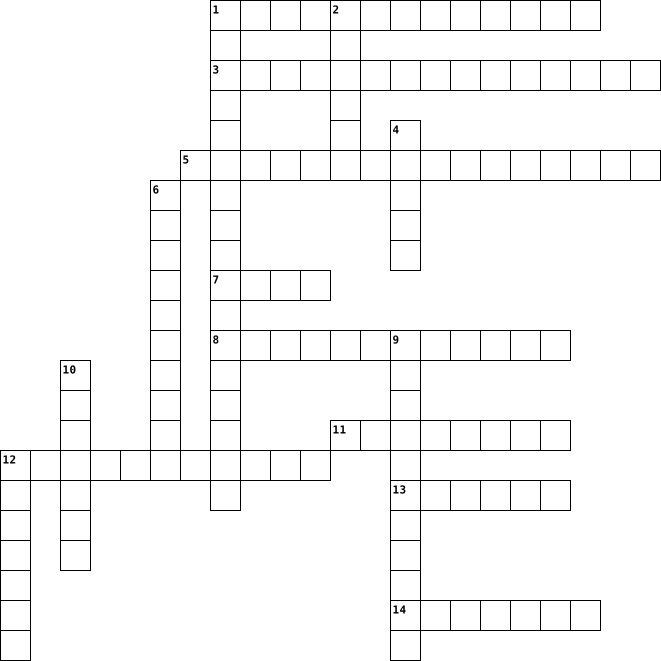
Across
- ai express a strong feeling.
- I am not a complete sentence.
- An incomplete sentence is called a?
- I describe a person,place,or thing.
- FANBOY'S.
- I'm two words put together.
- I join nouns and pronouns to other words in a sentence.
- I am a ________ sentence.
- I am a complete and incomplete sentence put together.
Down
- I am a complete sentence.
- I went to the store and the mall and the for a walk. what sentence am i?
- I describe an action.
- Idescribe nouns.
- A sentence split by a comma is called a?
- Modify verbs,adjectives or other adverbs.
- I substitute a noun.
16 Clues: FANBOY'S. • Idescribe nouns. • I substitute a noun. • I describe an action. • I am a complete sentence. • I am a ________ sentence. • I'm two words put together. • ai express a strong feeling. • I am not a complete sentence. • An incomplete sentence is called a? • I describe a person,place,or thing. • A sentence split by a comma is called a? • ...
Grammar Crossword 2025-06-04

Across
- “Is” and “are” are types of these
- The opposite of present tense
- A person, place, thing or idea
- An action word
- Word used to describe a noun
- Word used instead of repeating a noun
- Correct article: “___ apple a day…”
- “I ___ going to the market.” (correct helping verb)
- “In,” “on,” “under,” are types of these
- This punctuation is used to show possession
Down
- A describing word for verbs (often ends in –ly)
- The past tense of "go"
- Words like "he", "she", and "they"
- Opposite of singular
- You use this to end a question
- Tells when something happens (past, present, future)
- A word that connects clauses or sentences (e.g., and, but)
17 Clues: An action word • Opposite of singular • The past tense of "go" • Word used to describe a noun • The opposite of present tense • You use this to end a question • A person, place, thing or idea • “Is” and “are” are types of these • Words like "he", "she", and "they" • Correct article: “___ apple a day…” • Word used instead of repeating a noun • ...
Language 2019-05-30
Across
- Words that describe nouns or pronouns.
- An adjective after a linking verb.
- Pronouns that don't refer to anything in particular.
- Pronouns that show ownership.
- Words that show direction or position.
- Words that replace nouns.
- Group of words that looks like a sentences but isn't.
- This verbs only show existence.
Down
- Compound sentence missing a conjunction.
- Words cut short and joined by an apostrophe.
- A noun after a linking verb.
- Verb form that needs a helping verb.
- Pronouns that replace objects.
- Words that describe verbs, adjectives or adverbs.
- A group of sentences about an idea or topic.
15 Clues: Words that replace nouns. • A noun after a linking verb. • Pronouns that show ownership. • Pronouns that replace objects. • This verbs only show existence. • An adjective after a linking verb. • Verb form that needs a helping verb. • Words that describe nouns or pronouns. • Words that show direction or position. • Compound sentence missing a conjunction. • ...
Crucigrama (crossword)! 2021-03-04

Across
- things
- frío
- mouth
- head
- basura
- grapes
- to sing (infinitive)
- palabras opuestas: grande
- primavera
Down
- autumn
- hand
- to dance (infinitive)
- palabras opuestas: frío
- words
- hombro
- verbs
- boy
17 Clues: boy • hand • frío • head • mouth • words • verbs • autumn • things • basura • hombro • grapes • primavera • to sing (infinitive) • to dance (infinitive) • palabras opuestas: frío • palabras opuestas: grande
Grammar Usage 2021-08-24

Across
- showing ownership
- sentences combines two shorter sentences with and but, or or
- not regular
- names of specific places that are separated
- is a word like and, or or but that connects words or groups of words.
- show emphasis in printed text.
- verbs. tell what people or things do.
- tells what the people or things do
- connects one or more words, sentences
- sentence that gives a command
- group of words with first letter capitalized
Down
- means the same things as a verb
- only one
- strong feelings
- more than one
- mark. an excitement sign in a sentence
- is a noun or pronouns that tells exactly whom or what the sentence is about
- takes the place of a noun
- describes a noun
- more than one
- a, an, the
- blank space before writing a paragraph
- words that describe verbs or other adverbs
23 Clues: only one • a, an, the • not regular • more than one • more than one • strong feelings • describes a noun • showing ownership • takes the place of a noun • sentence that gives a command • show emphasis in printed text. • means the same things as a verb • tells what the people or things do • verbs. tell what people or things do. • connects one or more words, sentences • ...
Everything About Grammar 2020-12-01

Across
- ,
- He wrote 'Romeo and Juliet'.
- A group of words that fails to stand alone as a complete sentence is called a sentence _____.
- an interjection which shows disgust
- -ion, -ive, -ion, -ous
- Exclamatory sentences express strong feelings or _____.
- words that are opposite in meaning
- What are you learning in this course?
- _____ verbs take objects.
- a word used to connect two words, phrases or clauses
- singular form of 'children'
- 'a', 'an', 'the'
- another name of declarative sentences
- the noun form of a verb
- a plural personal pronoun
- The English alphabet has 26 _____.
- Every complete sentence should have two parts, which are the subject and the _____, which always contains a verb.
- noun form of 'describe'
- The words 'my', 'your', 'his' and 'our' are examples of _____ adjectives.
Down
- past participle of 'write'
- It has a subject + verb structure.
- A _____ sentence contains two or more independent clauses.
- your teacher's name
- She usually _____ TV at seven.
- What is your job?
- superlative of the word 'good'
- words which have similar meanings
- comparative of 'funny'
- noun form of 'admire'
- :
- the -ing form of a verb
- 'anger', 'misery', 'knowledge', 'bravery'
- a synonym of 'quick'
- _____ word classes accept new words.
- It describes a verb, an adjective or an adverb.
- an example of modal verbs
- Linking verbs are also called _____.
37 Clues: , • : • 'a', 'an', 'the' • What is your job? • your teacher's name • a synonym of 'quick' • noun form of 'admire' • -ion, -ive, -ion, -ous • comparative of 'funny' • the -ing form of a verb • the noun form of a verb • noun form of 'describe' • _____ verbs take objects. • an example of modal verbs • a plural personal pronoun • past participle of 'write' • singular form of 'children' • ...
Parts of Speech 2021-11-04

Across
- words that receive the action of a transitive verb.
- expresses action without passing the action to a receiver.
- it's another name for helping verbs.
- consists of a main verb preceded by at least one helping verb.
- is formed from a proper noun and begins with a capital letter.
- points out a person, place, thing, or idea, EX. that, this
- word used in place of one noun or more than one noun.
- is a word that expresses an action or a state of being.
- names a person, thing, place or thing that can be perceived by one of the senses.
- is a specific name for a particular person, thing, places or idea, it begins with capittal letter.
- is an action verb that expresses an action directed toward a person or thing.
Down
- Is a word that modifies the noun
- verbs that are used in a verb phrase to show tense, or form a question or a negative.
- introduces a subordinate clause.
- names any one of a group of persons, places, things, or ideas.
- names an idea, a feeling, a quality or a characteristic.
- links, or connects the subject with a noun, a pronoun, or an adjective in the predicate.
- is a word used to modify a verb, an adjective, or another adverb.
- may express physical action or mental action.
- It refers to name a person, place, thing or animal
20 Clues: Is a word that modifies the noun • introduces a subordinate clause. • it's another name for helping verbs. • may express physical action or mental action. • It refers to name a person, place, thing or animal • words that receive the action of a transitive verb. • word used in place of one noun or more than one noun. • ...
literary terms 2023-03-20

Across
- a noun phrase functioning as one of the main components of a clause
- What type of sentence is this? (Declarative, Interrogative, or exclamatory 9-11) Lexi likes Lululemon.
- what is this? a sentence that includes a subject and a predicate
- A word used to describe an action, state, or occurrence, and form the predicate of a sentence
- An element placed at the end of a word to change its meaning
- Something being done/Action
- Verbs that describe the subject
- An element placed at the beginning of a word to change its meaning
- Noun that describes a type of person/place/thing
- clause containing a verb and stating something about the subject
- A word used to connect clauses
Down
- A word or phrase that modifies an adjective, verb, or other adverb or a word group,
- Helping verbs always precede main verbs
- What type of sentence is this? I love you!
- A name that describes a person's position or job (Mr. and Mrs.)
- Involving the comparison of one thing with another thing of a different kind
- What are these examples of? He, She, I, you, It, and This
- What type of sentence is this? What's the time?
- Modifies a noun (an, a, the)
- a noun or pronoun and express a relation to another word or element in the clause (Ex: She was in the woods.)
20 Clues: Something being done/Action • Modifies a noun (an, a, the) • A word used to connect clauses • Verbs that describe the subject • Helping verbs always precede main verbs • What type of sentence is this? I love you! • What type of sentence is this? What's the time? • Noun that describes a type of person/place/thing • What are these examples of? He, She, I, you, It, and This • ...
My Crossword 2023-09-21

Across
- Talk”
- walk”
- pour un table (attendre)
- ____ (parler)
- tu (trouver)
- re verbs
Down
- _____ la formage(Fondre)
- finish”
- ir verbs
- ____(jouer)
10 Clues: Talk” • walk” • finish” • ir verbs • re verbs • ____(jouer) • tu (trouver) • ____ (parler) • _____ la formage(Fondre) • pour un table (attendre)
Syntax PREP 2024-05-02

Across
- Words that must appear within the scope of negation are called nagative _______ items.
- Negative inversion is trigged by a negative _________.
- A/an _________ question serves as a complement of verbs like ask or know.
- It and there are examples of ________ subjects.
- Seem, turn out, appear are examples of _______ verbs.
- The end of the sentence; the part that carries new information.
- The movement of a wh- pronoun to the beginning of a question.
- The position in the sentence that expresses its topic.
Down
- ______ questions are also known as yes/no questions.
- The switching of positions between the auxiliary and the subject.
- An entity that receives something is expressed in the position of a/an __________ object.
- A subject that is not present in the sentence but can be recovered is called a/an ______ subject.
- The locative-existential (there) construction features verbs that express existence or _______.
- Languages without inflection are called ________ languages.
- Questions with the wh- pronoun in the original (in situ) position are referred to as _____ questions.
- The operation that involves moving a subject of the subordinate clause to either object or subject of the main clause.
- Infinitives and participles are non-________ forms of verbs.
- English does not allow ______ subjects.
18 Clues: English does not allow ______ subjects. • It and there are examples of ________ subjects. • ______ questions are also known as yes/no questions. • Seem, turn out, appear are examples of _______ verbs. • Negative inversion is trigged by a negative _________. • The position in the sentence that expresses its topic. • ...
Parts of Speech 2021-11-04

Across
- words that receive the action of a transitive verb.
- expresses action without passing the action to a receiver.
- it's another name for helping verbs.
- consists of a main verb preceded by at least one helping verb.
- is formed from a proper noun and begins with a capital letter.
- points out a person, place, thing, or idea, EX. that, this
- word used in place of one noun or more than one noun.
- is a word that expresses an action or a state of being.
- names a person, thing, place or thing that can be perceived by one of the senses.
- is a specific name for a particular person, thing, places or idea, it begins with capittal letter.
- is an action verb that expresses an action directed toward a person or thing.
Down
- Is a word that modifies the noun
- verbs that are used in a verb phrase to show tense, or form a question or a negative.
- introduces a subordinate clause.
- names any one of a group of persons, places, things, or ideas.
- names an idea, a feeling, a quality or a characteristic.
- links, or connects the subject with a noun, a pronoun, or an adjective in the predicate.
- is a word used to modify a verb, an adjective, or another adverb.
- may express physical action or mental action.
- It refers to name a person, place, thing or animal
20 Clues: Is a word that modifies the noun • introduces a subordinate clause. • it's another name for helping verbs. • may express physical action or mental action. • It refers to name a person, place, thing or animal • words that receive the action of a transitive verb. • word used in place of one noun or more than one noun. • ...
Parts of Speech 2021-11-04

Across
- It refers to name a person, place, thing or animal
- names a person, thing, place or thing that can be perceived by one of the senses.
- is a specific name for a particular person, thing, places or idea, it begins with capittal letter.
- introduces a subordinate clause.
- consists of a main verb preceded by at least one helping verb.
- expresses action without passing the action to a receiver.
- is a word used to modify a verb, an adjective, or another adverb.
- Is a word that modifies the noun
- is formed from a proper noun and begins with a capital letter.
- is a word that expresses an action or a state of being.
- word used in place of one noun or more than one noun.
- names any one of a group of persons, places, things, or ideas.
Down
- links, or connects the subject with a noun, a pronoun, or an adjective in the predicate.
- it's another name for helping verbs.
- may express physical action or mental action.
- is an action verb that expresses an action directed toward a person or thing.
- points out a person, place, thing, or idea, EX. that, this
- verbs that are used in a verb phrase to show tense, or form a question or a negative.
- words that receive the action of a transitive verb.
- names an idea, a feeling, a quality or a characteristic.
20 Clues: introduces a subordinate clause. • Is a word that modifies the noun • it's another name for helping verbs. • may express physical action or mental action. • It refers to name a person, place, thing or animal • words that receive the action of a transitive verb. • word used in place of one noun or more than one noun. • ...
Lesson 1 2020-03-23

Across
- I your teacher?
- he like soccer?
- information we don't want other people to know
- an answer to a problem
- you João ou José?
- we usually comb our hair in front of it
- we use before verbs, not her
- he your brother?
- she your sister?
Down
- something really great
- we use after verbs and prepositions, not she
- she study English?
- students in their final year at high school
- when people have the same opinion they...
- maximum amount of money you can spend on something
15 Clues: I your teacher? • he like soccer? • he your brother? • she your sister? • you João ou José? • she study English? • something really great • an answer to a problem • we use before verbs, not her • we usually comb our hair in front of it • when people have the same opinion they... • students in their final year at high school • we use after verbs and prepositions, not she • ...
Spanish I Final 2024-05-16

Across
- they have
- dining room
- we have
- stairs
- to cook
- to make the bed
- you have
- present participle of lavar
- present participle of escribir
- to feed the dog
- to straighten up the room
- present progressive ending of -ar verbs
- to clean the bathroom
- our (singular)
- to wash dirty dishes
Down
- to wash clothes
- to mow the lawn
- present participle of comer
- to set the table
- to wash the car
- kitchen
- to vacuum
- verb that changes in present progressive tense
- present progressive ending of -er/-ir verbs
- he or she has
- I have
- verb meaning 'to have'
- bathroom
- to take out the trash
- garage
- my (singular)
- his, her, or their
- your (singular)
- living room
34 Clues: stairs • I have • garage • kitchen • we have • to cook • bathroom • you have • they have • to vacuum • dining room • living room • he or she has • my (singular) • our (singular) • to wash clothes • to mow the lawn • to wash the car • to make the bed • to feed the dog • your (singular) • to set the table • his, her, or their • to wash dirty dishes • to take out the trash • to clean the bathroom • verb meaning 'to have' • ...