biology Crossword Puzzles

Biology Crossword Puzzle 2013-01-16

Biology Crossword Puzzle crossword puzzle
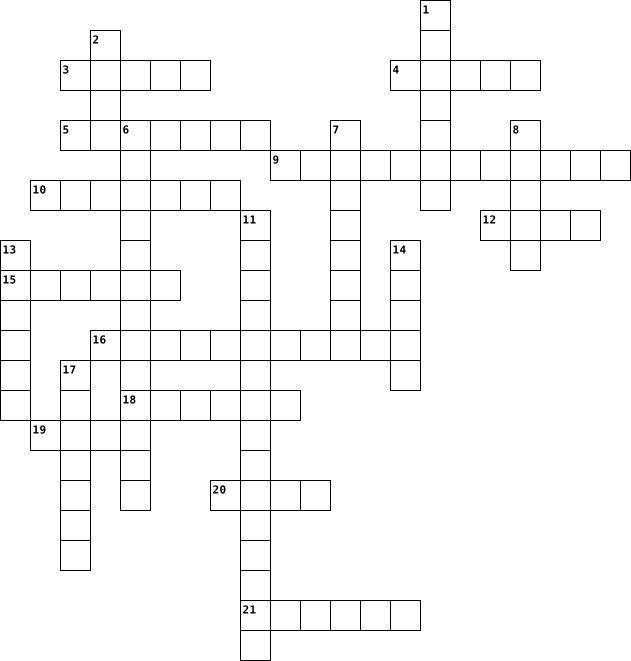
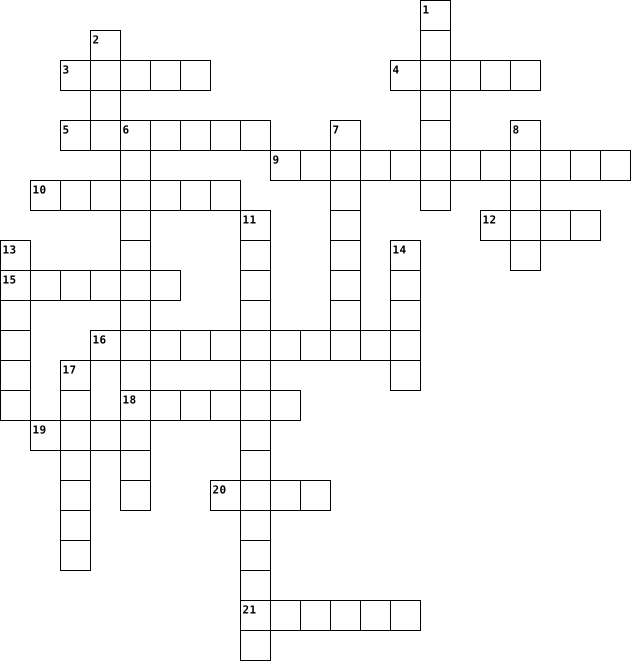
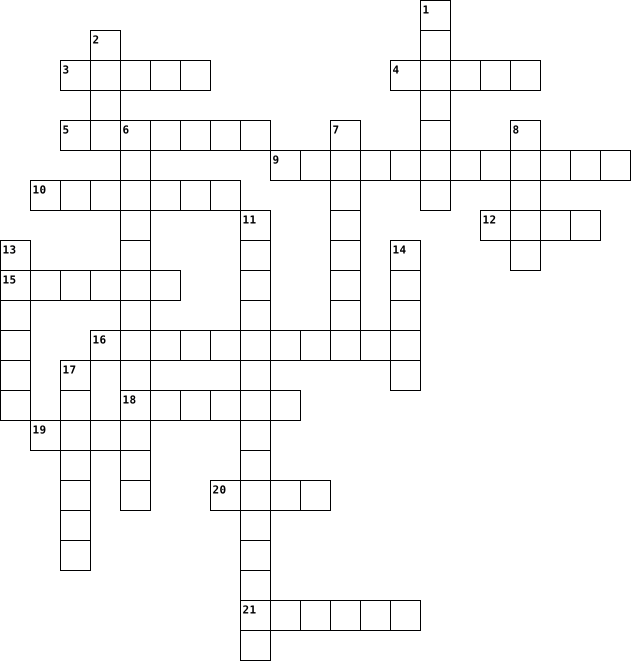
Across
  1. the science that employs the scientific method to study living things
  2. cells that do not contain nuclei
  3. cells that contain nuclei
  4. a substance that speeds up the rate of a chemical reaction
  5. an attraction between molecules of the same substance.
  6. the process of gathering information about events or processes in a careful, orderly way.
  7. variable that is deliberately changed
  8. strong forces bind protons and neutrons together to form the ______
  9. an organized way of using evidence to learn about the natural
  10. devices that produce magnified images of structures that are too small to see with the unaided eye
  11. forms when electrons are shared between atoms
  12. a pure substance that consists entirely of one type of atom
  13. atoms of the same element that differ in the number of neutrons they contain.
  14. a slight attraction can develop between the oppositely charged regions of nearby molecules.
  15. system a decimal system of measurements whose units are based on certain physical standards and are scaled on certain physical standards and are scaled on multiples of 10.
  16. smallest unit of most compounds
  17. proteins that act as biological catalysts.
Down
  1. small particles of RNA and protein found throughout the cytoplasm
  2. positively and negatively charged atoms
  3. variable that is observed and that changes in response to the manipulated variable is called _______
  4. the site where lipid components of the cell membrane are assembled, along with proteins and other materials that are exported from the cell
  5. portion of the cell outside the nucleus
  6. proposed scientific explanation for a set of observations
  7. cell is able to reproduce so that a group of cells.
  8. a substance formed by the chemical combination of two or more elements in definite proportions.
  9. Bond/ formed when one or more electrons are transferred from one atom to another.

26 Clues: cells that contain nucleismallest unit of most compoundscells that do not contain nucleivariable that is deliberately changedpositively and negatively charged atomsportion of the cell outside the nucleusproteins that act as biological catalysts.forms when electrons are shared between atomscell is able to reproduce so that a group of cells....

Biology Crossword Puzzle 2013-01-16

Biology Crossword Puzzle crossword puzzle
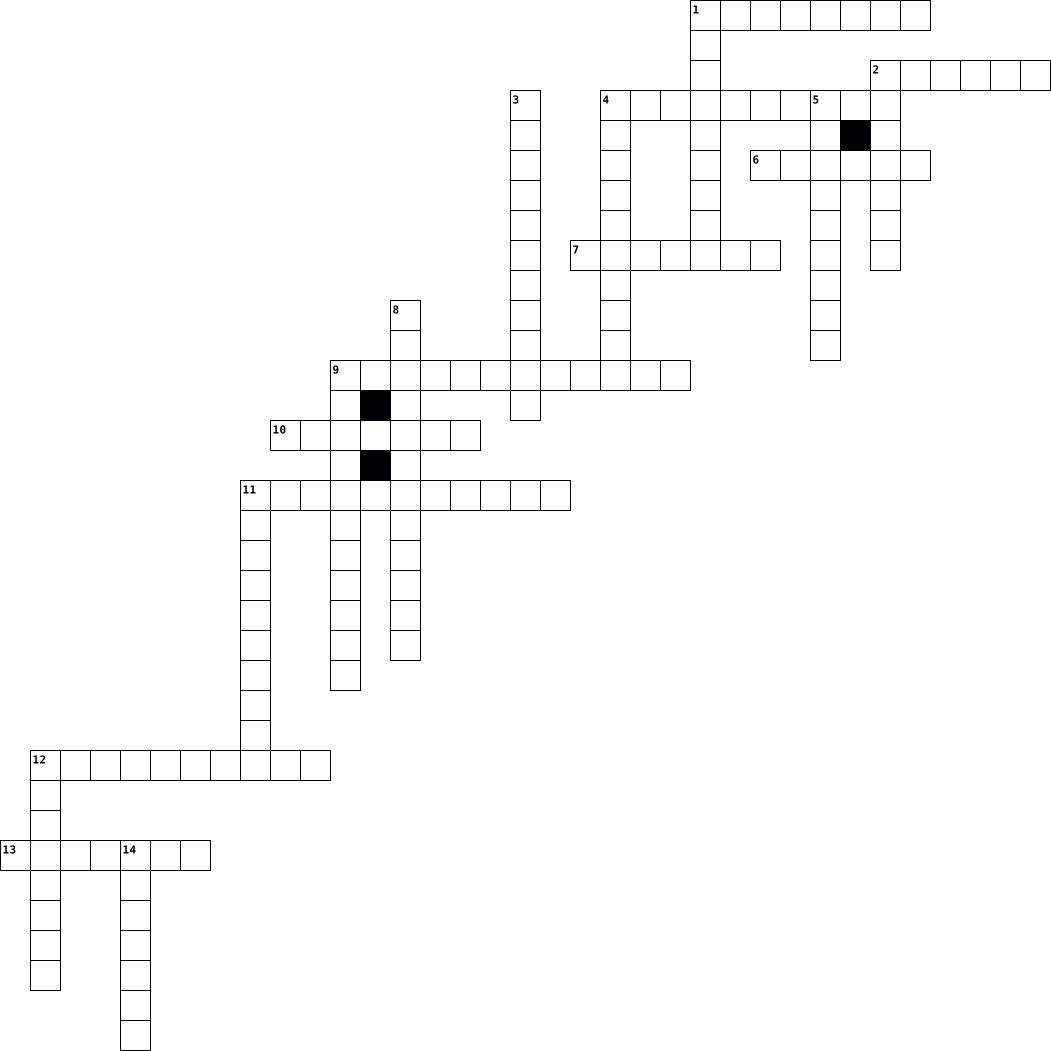
Across
  1. cell is able to reproduce so that a group of cells.
  2. the process of gathering information about events or processes in a careful, orderly way.
  3. atoms of the same element that differ in the number of neutrons they contain.
  4. variable that is observed and that changes in response to the manipulated variable is called _______
  5. small particles of RNA and protein found throughout the cytoplasm
  6. variable that is deliberately changed
  7. portion of the cell outside the nucleus
  8. an organized way of using evidence to learn about the natural
  9. devices that produce magnified images of structures that are too small to see with the unaided eye
  10. plants use high energy of sunlight to convert water and carbon dioxide into high-energy carbohydrates
  11. organisms that make their own food
  12. forms when electrons are shared between atoms
Down
  1. system a decimal system of measurements whose units are based on certain physical standards and are scaled on certain physical standards and are scaled on multiples of 10.
  2. strong forces bind protons and neutrons together to form the ______
  3. a substance formed by the chemical combination of two or more elements in definite proportions.
  4. the site where lipid components of the cell membrane are assembled, along with proteins and other materials that are exported from the cell
  5. organisms that obtain energy from foods they consume
  6. proposed scientific explanation for a set of observations
  7. an attraction between molecules of the same substance.
  8. cells that contain nuclei
  9. a substance that speeds up the rate of a chemical reaction
  10. smallest unit of most compounds
  11. Bond/ formed when one or more electrons are transferred from one atom to another.
  12. a pure substance that consists entirely of one type of atom
  13. a slight attraction can develop between the oppositely charged regions of nearby molecules.
  14. positively and negatively charged atoms
  15. cells that do not contain nuclei
  16. proteins that act as biological catalysts.
  17. the science that employs the scientific method to study living things

29 Clues: cells that contain nucleismallest unit of most compoundscells that do not contain nucleiorganisms that make their own foodvariable that is deliberately changedpositively and negatively charged atomsportion of the cell outside the nucleusproteins that act as biological catalysts.forms when electrons are shared between atoms...

Biology Crossword Puzzle 2013-01-16

Biology Crossword Puzzle crossword puzzle
Across
  1. cell is able to reproduce so that a group of cells.
  2. the first and longest stage of mitosis
  3. Bond/ formed when one or more electrons are transferred from one atom to another.
  4. the process of gathering information about events or processes in a careful, orderly way.
  5. strong forces bind protons and neutrons together to form the ______
  6. organisms that make their own food
  7. small particles of RNA and protein found throughout the cytoplasm
  8. amount of energy needed to raise the temperature of a gram of water degree celsius
  9. proteins that act as biological catalysts.
  10. the site where lipid components of the cell membrane are assembled, along with proteins and other materials that are exported from the cell
  11. a substance that speeds up the rate of a chemical reaction
  12. the science that employs the scientific method to study living things
  13. cells that do not contain nuclei
  14. plants use high energy of sunlight to convert water and carbon dioxide into high-energy carbohydrates
  15. a slight attraction can develop between the oppositely charged regions of nearby molecules.
  16. cells that contain nuclei
  17. devices that produce magnified images of structures that are too small to see with the unaided eye
  18. 2 tiny structures located in the cytoplasm near the nuclear envelope, separate and take up positions on opposite sides of the nucleus.
Down
  1. variable that is observed and that changes in response to the manipulated variable is called _______
  2. proposed scientific explanation for a set of observations
  3. smallest unit of most compounds
  4. an attraction between molecules of the same substance.
  5. portion of the cell outside the nucleus
  6. a pure substance that consists entirely of one type of atom
  7. forms when electrons are shared between atoms
  8. atoms of the same element that differ in the number of neutrons they contain.
  9. variable that is deliberately changed
  10. a substance formed by the chemical combination of two or more elements in definite proportions.
  11. region outside of the thylakoid membranes
  12. system a decimal system of measurements whose units are based on certain physical standards and are scaled on certain physical standards and are scaled on multiples of 10.
  13. organisms that obtain energy from foods they consume
  14. an organized way of using evidence to learn about the natural
  15. positively and negatively charged atoms

33 Clues: cells that contain nucleismallest unit of most compoundscells that do not contain nucleiorganisms that make their own foodvariable that is deliberately changedthe first and longest stage of mitosisportion of the cell outside the nucleuspositively and negatively charged atomsregion outside of the thylakoid membranes...

Biology Crossword Puzzle 2013-01-16

Biology Crossword Puzzle crossword puzzle
Across
  1. organisms that make their own food
  2. organisms that obtain energy from foods they consume
  3. a pure substance that consists entirely of one type of atom
  4. variable that is observed and that changes in response to the manipulated variable is called _______
  5. positively and negatively charged atoms
  6. smallest unit of most compounds
  7. atoms of the same element that differ in the number of neutrons they contain.
  8. amount of energy needed to raise the temperature of a gram of water degree celsius
  9. a substance that speeds up the rate of a chemical reaction
  10. variable that is deliberately changed
  11. portion of the cell outside the nucleus
  12. 2 tiny structures located in the cytoplasm near the nuclear envelope, separate and take up positions on opposite sides of the nucleus.
  13. contain only a single set of chromosomes and therefore only a set of genes
  14. the process of homologous chromosomes pairing up and forming tetras in meiosis I then exchanging portion of their chromatids is called ___
  15. cells that do not contain nuclei
  16. cell is able to reproduce so that a group of cells.
  17. an organized way of using evidence to learn about the natural
  18. strong forces bind protons and neutrons together to form the ______
Down
  1. an attraction between molecules of the same substance.
  2. the first and longest stage of mitosis
  3. cells that contain nuclei
  4. proposed scientific explanation for a set of observations
  5. system a decimal system of measurements whose units are based on certain physical standards and are scaled on certain physical standards and are scaled on multiples of 10.
  6. the site where lipid components of the cell membrane are assembled, along with proteins and other materials that are exported from the cell
  7. the process of gathering information about events or processes in a careful, orderly way.
  8. proteins that act as biological catalysts.
  9. forms when electrons are shared between atoms
  10. second phase of mitosis and often times only lasts a few minutes
  11. small particles of RNA and protein found throughout the cytoplasm
  12. plants use high energy of sunlight to convert water and carbon dioxide into high-energy carbohydrates
  13. a slight attraction can develop between the oppositely charged regions of nearby molecules.
  14. Bond/ formed when one or more electrons are transferred from one atom to another.
  15. the science that employs the scientific method to study living things
  16. devices that produce magnified images of structures that are too small to see with the unaided eye
  17. a substance formed by the chemical combination of two or more elements in definite proportions.
  18. region outside of the thylakoid membranes
  19. a cell that contains both sets of homologous chromosomes
  20. a disorder in which some of the body's own cells lose the ability to control cell growth

38 Clues: cells that contain nucleismallest unit of most compoundscells that do not contain nucleiorganisms that make their own foodvariable that is deliberately changedthe first and longest stage of mitosispositively and negatively charged atomsportion of the cell outside the nucleusregion outside of the thylakoid membranes...

Biology Crossword Puzzle 2013-01-16

Biology Crossword Puzzle crossword puzzle
Across
  1. region outside of the thylakoid membranes
  2. Bond/ formed when one or more electrons are transferred from one atom to another.
  3. system a decimal system of measurements whose units are based on certain physical standards and are scaled on certain physical standards and are scaled on multiples of 10.
  4. a substance formed by the chemical combination of two or more elements in definite proportions.
  5. forms when electrons are shared between atoms
  6. an attraction between molecules of the same substance.
  7. amount of energy needed to raise the temperature of a gram of water degree celsius
  8. cell is able to reproduce so that a group of cells.
  9. a slight attraction can develop between the oppositely charged regions of nearby molecules.
  10. portion of the cell outside the nucleus
  11. the site where lipid components of the cell membrane are assembled, along with proteins and other materials that are exported from the cell
  12. a kind of virus that infects bacteria
  13. cells that do not contain nuclei
  14. a substance that speeds up the rate of a chemical reaction
  15. a pure substance that consists entirely of one type of atom
  16. the first and longest stage of mitosis
  17. proposed scientific explanation for a set of observations
  18. a cell that contains both sets of homologous chromosomes
  19. second phase of mitosis and often times only lasts a few minutes
Down
  1. an organized way of using evidence to learn about the natural
  2. positively and negatively charged atoms
  3. cells that contain nuclei
  4. contain only a single set of chromosomes and therefore only a set of genes
  5. atoms of the same element that differ in the number of neutrons they contain.
  6. smallest unit of most compounds
  7. variable that is deliberately changed
  8. strong forces bind protons and neutrons together to form the ______
  9. the science that employs the scientific method to study living things
  10. proteins that act as biological catalysts.
  11. the process of homologous chromosomes pairing up and forming tetras in meiosis I then exchanging portion of their chromatids is called ___
  12. plants use high energy of sunlight to convert water and carbon dioxide into high-energy carbohydrates
  13. devices that produce magnified images of structures that are too small to see with the unaided eye
  14. variable that is observed and that changes in response to the manipulated variable is called _______
  15. 2 tiny structures located in the cytoplasm near the nuclear envelope, separate and take up positions on opposite sides of the nucleus.
  16. small particles of RNA and protein found throughout the cytoplasm
  17. the process of gathering information about events or processes in a careful, orderly way.
  18. organisms that obtain energy from foods they consume
  19. organisms that make their own food
  20. a disorder in which some of the body's own cells lose the ability to control cell growth

39 Clues: cells that contain nucleismallest unit of most compoundscells that do not contain nucleiorganisms that make their own foodvariable that is deliberately changeda kind of virus that infects bacteriathe first and longest stage of mitosispositively and negatively charged atomsportion of the cell outside the nucleus...

Biology Exam Crosswoed 2012-12-14

Biology Exam Crosswoed crossword puzzle
Across
  1. different populations living together in a defined area
  2. simplest of all the cells
  3. group of organisms of same species living in the same area
  4. control center for the cell
  5. C6H12O6 + 6O2--- energy + 6CO2 + 6H2O
  6. group of orangs working together to perform a specific function
  7. group of simiar cells working together to perform a function
  8. groups of tissues working together to perform a specific function
  9. coded instructions for making proteins
Down
  1. the community and its nonliving surroundings
  2. portion of earth that cantants all of the ecosystems
  3. group of atons small unit of chemical
  4. smallest functioning unit of life
  5. 6CO2 + 6H2O with sunlight C6H12O6 + 6O2
  6. respiration that does not need oxygen
  7. only in plants
  8. an individual living thing
  9. has little organ like stuctures called organelle
  10. controls what enters and leaves the cell
  11. key to the study of biology is learnign about the _______
  12. the basic unit of mass in the international system of units, or SI, is the ______
  13. respiration that needs oxygen

22 Clues: only in plantssimplest of all the cellsan individual living thingcontrol center for the cellrespiration that needs oxygensmallest functioning unit of lifegroup of atons small unit of chemicalrespiration that does not need oxygenC6H12O6 + 6O2--- energy + 6CO2 + 6H2Ocoded instructions for making proteins6CO2 + 6H2O with sunlight C6H12O6 + 6O2...

Biology Crossword Puzzle 2013-01-24

Biology Crossword Puzzle crossword puzzle
Across
  1. What accepts and holds two high-energy electrons and a hydrogen atom?
  2. Hypothesis that is so well accepted by other scientists
  3. Energy What is needed to start a reaction?
  4. RNA Which molecule transfers amino acids to ribosomes as was specified by mRNA?
  5. Means 'bacteria eater'
  6. Reproduction sexually
  7. What is this equation for? 6CO + 6H O ---- C + H + O + 6O
  8. When Cytoplasm extends itself and 'eats' a particle
  9. Acid Fermation What term makes this equation? pyruvic acid + NADN ---- lactic acid NAD+
  10. The long molecules DNA is made of
  11. Over Homologus pairs form tetrads and exchange portions of chromatids
  12. An organized way of using evidence to learn about the natural world
  13. Triphosphate What is the real name for ATP?
Down
  1. Pairing What is the name for adenine, thymine and guanine, cytosine parings?
  2. Polymerase What is the principal enzyme involved in DNA replication?
  3. One strain of bacteria that can infect another benign strand
  4. What is the only spot that an enzyme will bind to?
  5. Cells with one set of genes
  6. Term that means 'not in air'
  7. Cycle In what cycle does the presence of oxygen, pyruvic acid in the glucose pass on to the second stage of reproduction?
  8. and NADPH What two light dependent reactions re used in the Calvin Cycle (the word and is used in the answer)
  9. Acid Which of the two nucleic acids contains sugar deoxyribose?
  10. Scale What indicates the H+ levels in a solution?
  11. Acid Which of the two nucleic acids contains sugar ribose?
  12. The first stage of division in the cells nucleus
  13. What process takes materials into the infolds, or pockets of the cell membrane?
  14. Releases food energy by using ATP in the absence of oxygen
  15. Theory What is the fundamental concept of biology?
  16. Map What shows the relative location of each known gene?
  17. Polymerase What enzyme is needed for transcription?

30 Clues: Reproduction sexuallyMeans 'bacteria eater'Cells with one set of genesTerm that means 'not in air'The long molecules DNA is made ofEnergy What is needed to start a reaction?Triphosphate What is the real name for ATP?The first stage of division in the cells nucleusScale What indicates the H+ levels in a solution?...

Careers in biology 2013-03-09

Careers in biology crossword puzzle
Across
  1. A scientist who studies the structure and function of theimmune system, innate and acquired immunity, the bodily distinction of self from nonself, and laboratory techniques involving the interaction of antigens with specificantibodies.
  2. A scientist who studies life at the chemical level, in particular the chemistry of proteins, carbohydrates, and nucleic acids.
  3. A scientist who studies living cells, in particular, their physiological properties, structures, organelles, and method of division.
  4. A scientist who studies the physical and biological conditions of freshwater, particularly of lakes and ponds.
  5. A scientist who studies birds.
  6. A scientist who investigates the form and structure of living organisms.
  7. A scientist who studies reptiles and amphibians.
  8. A scientist who studies heredity, especially the mechanisms of hereditary transmission and variation of inherited characteristics.
  9. A scientist who attempts to model biological processes using mathematical techniques.
  10. A scientist who studies time-dependent phenomena in living organisms.
  11. A scientist who studies microorganisms and their effects on other organisms.
  12. A scientist who studies the geographic distributions of living organisms.
  13. A scientist who studies insects.
  14. A scientist whose career involves the study of sensation.
  15. a professional who practices veterinary medicine by treating disease, disorder, and injury in non-human animals
  16. A scientist who studies primates.
Down
  1. A scientist who studies the fossilized traces of past animal activity, such as footprints, burrows, trails, and borings.
  2. A scientist who applies the theories and methods of physics to biological questions.
  3. A scientist who studies animal behavior.
  4. A scientist who studies plants.
  5. A scientist who studies the microscopic structure of cellular tissue.
  6. A scientist who studies the macroscopic structure of multicellular organisms.
  7. A scientist who studies mammals.
  8. A scientist who studies fungi.
  9. A scientist who studies the effects of low temperatures on living organisms.
  10. A scientist who studies animals.
  11. A scientist who investigates the possible existence of extraterrestrial life and/or studies the effects of outer space on living organisms.
  12. A scientist whose career involves the study of the influence of climate on living organisms.
  13. a professional who practices medicine, which is concerned with promoting, maintaining or restoring human health through the study, diagnosis, and treatment of disease, injury, and other physical and mental impairments.
  14. A scientist who studies protists.
  15. A scientist who studies prehistoric life by means of fossils.
  16. A scientist who studies fish.
  17. A scientist who studies both geology and biology to investigate the interactions of organisms with their environment.
  18. A scientist whose career involves the study of the interaction of organisms with each other and with their environment.
  19. A scientist who uses the principles of biology and the techniques of engineering to produce useful products.

35 Clues: A scientist who studies fish.A scientist who studies fungi.A scientist who studies birds.A scientist who studies plants.A scientist who studies mammals.A scientist who studies animals.A scientist who studies insects.A scientist who studies protists.A scientist who studies primates.A scientist who studies animal behavior....

AP Biology Terminology 2013-03-18

AP Biology Terminology crossword puzzle
Across
  1. number of trophic levels and the reason/ 4-2nd law of thermodynamics (hint: 8 words)
  2. recessive alleles that cause defective protein
  3. fibrosis/ recessive allele (need two bad copies) to get (hint: 2 words)
  4. behaviors performed reasonably complete form from the first time an animal of an appropriate age encounters the stimulus
  5. raises blood sugar
  6. syndrome/ trisomy of chromosome 21 (hint: 2 words)
  7. polymerase/ enzymes involved in replication that adds complementary nucleotides and proofreads DNA
  8. increases metabolism, constricts blood vessels, increases respiration-Fight or Flight response
  9. Rot growth and germination
  10. promotes uterine lining growth
  11. vs learned behavior/ innate behaviors are largely genetically controlled and exhibit by the species (nature). learned behaviors are gained through experience (nurture). (hint: 4 words)
  12. excites skelatal muscles-neurotransmitter
  13. lowers blood sugar
  14. sachs/ autosomal recessive (hint: 2 words)
  15. progressive mutation
  16. class of enzymes involved in phosphorylation
  17. Acid/ Inhibits growth, seed dormancy, closes stomata (hint: 2 words)
  18. cell anemia/ single nucleotide substitution causes incorrect amino acid in hemoglobin protein (hint: 3 words)
  19. stimulates contraction of uterus
  20. biological rhythms; clock
  21. stem elongation, development of fruit and phototropism
  22. that limit growth of a population/ habitat, food resources, shelter, predation, competition. (hint: 6 words)
Down
  1. promotes food ripening and aging of flowers
  2. colors, patterns and shapes to resemble surrounding
  3. mosquito spread disease caused by protozoa (protista)
  4. a species ressembles another that possesses a warning color (ex coral snake vs king snake or bees, hornets and yellow jackets)
  5. behavior that includes both innate and learned actions-young geese following their mother.
  6. "glues" the nucleotides on the lagging strand during replication
  7. maintains metabolism
  8. loss of response to stimuli if it does not cause consequence (crying wolf-you stop believing what is said because it was never true in the past)
  9. rapid growth in response to sunlight detected when shoot breaks through soil (phytochromes)
  10. muscular dystrophy/ x-linked recessive (hint: 3 words)
  11. molecules that sense and respond to light to control greening and growth
  12. promotes seed germination
  13. primase/ enzyme responsible for transcribing the DNA strand to RNA (hint: 2 words)
  14. and error/ aquire new and appropriate responses to stimuli through experience (hint: 3 words)
  15. sum of a species use of biotic and abiotic resources (think of its habitat as its address and the niche as the profession)
  16. programmed cell death
  17. close interaction between organisms of different species over extended times.
  18. a protein used to keep the helix apart during replication
  19. stimulates milk production
  20. vs K-strategy/ R species maximize reproductive success in uncrowded environments. K species maximize population size operating near the carrying capacity of their environment. (hint: 3 words)
  21. capacity/ K=maximum population size a particular environment can support (hint: 2 words)
  22. unwinds the helix to begin replication
  23. promotes production of ova and sperm

45 Clues: raises blood sugarlowers blood sugarmaintains metabolismprogressive mutationprogrammed cell deathpromotes seed germinationbiological rhythms; clockRot growth and germinationstimulates milk productionpromotes uterine lining growthstimulates contraction of uteruspromotes production of ova and spermunwinds the helix to begin replication...

Branches in Biology 2013-06-27

Branches in Biology crossword puzzle
Across
  1. naming and classification
  2. grasses
  3. birds
  4. worms
  5. trees
  6. reptiles and amphibians
  7. shelled animals
  8. algae
  9. external and internal structure
Down
  1. heredity and variations
  2. tissues
  3. fossils
  4. insects
  5. functional processes
  6. form
  7. liverworts, hornworts
  8. microorganisms
  9. distribution
  10. interrelationships of organisms and their environment
  11. cells

20 Clues: formbirdswormstreescellsalgaetissuesfossilsgrassesinsectsdistributionmicroorganismsshelled animalsfunctional processesliverworts, hornwortsheredity and variationsreptiles and amphibiansnaming and classificationexternal and internal structureinterrelationships of organisms and their environment

Biology Chapter 3 2013-06-28

Biology Chapter 3 crossword puzzle
Across
  1. class of molecules whose defining characteristic is that they do not readily dissolve in water; made of same elements as carbs, but contain much more hydrogen relative to oxygen
  2. fats in their liquid forms
  3. larger-scale 3D shape that a protein takes
  4. fatty acid with two or more double bonds between carbon atoms
  5. way in which two or more polypeptide chains come together to form a protein
  6. organic molecules that always contain carbon, oxygen, and hydrogen, and may contain nothing but these; usually contain twice as many hydrogen atoms as oxygen atoms
  7. branch of chemistry devoted to the study of molecules that have carbon as their central element
  8. fatty acid with no double bonds between the carbon atoms of its hydrocarbon chain
  9. molecules that are a combination of lipids and proteins; active in transporting fats throughout the body
  10. group of atoms that confers a special property on a carbon based molecule
  11. molecule found in many lipids that is composed of a hydrocarbon chain bonded to a carboxyl group
  12. complex carbohydrate found in plants; serve as the main form of carbohydrate storage in plants
  13. charged lipid molecule composed of two fatty acids, glycerol, and a phosphate group
  14. forms the external skeleton of the arthropods
  15. complex carbohydrate and primary form of storage in animals
  16. building block of nucleic acids, consisting of a phosphate group, a sugar, and a nitrogen-containing base
  17. large, folded chain of amino acids
Down
  1. structure that proteins assume after folding up
  2. primary information bearing molecule of life, composed of two linked chains of nucleotides
  3. polymer of carbohydrates, composed of many monosaccharides
  4. structural, complex carbohydrate produced by plants and animals; makes up so much of the natural world
  5. small molecule that can be combined with other similar or identical molecules to make a polymer
  6. fatty acid with one double bond between carbon atoms
  7. lipid composed of a single fatty acid linked to a long-chain alcohol
  8. combination of proteins and carbohydrates; play important roles as cell receptors and some types of hormones
  9. molecule composed of nucleotides that is active in the synthesis of proteins
  10. large molecule made up of many similar or identical subunits
  11. series of amino acids linked in linear fashion
  12. level of a protein; the sequence of amino acids
  13. lipid molecule formed from three fatty acids bonded to glycerol
  14. steroid molecule that forms part of the outer membrane of all animal cells and acts as a precursor for many other steroids
  15. phosphorus atom surrounded by four oxygen atoms
  16. building block, or monomer, of carbohydrates, also called simple sugars
  17. variety of lipid molecules that have four carbon rings as a central element in their structure

34 Clues: fats in their liquid formslarge, folded chain of amino acidslarger-scale 3D shape that a protein takesforms the external skeleton of the arthropodsseries of amino acids linked in linear fashionstructure that proteins assume after folding uplevel of a protein; the sequence of amino acidsphosphorus atom surrounded by four oxygen atoms...

Biology Module#1 2013-10-18

Biology Module#1 crossword puzzle
Across
  1. Organisms that are able to make their own food
  2. Naming an organism with its genus and species name
  3. The idea that long ago, very simple life forms spontaneously appeared through chemical reactions
  4. The sum total of all processes in an organism which convert energy and matter from outside sources and use that energy and matter to sustain the organism's live functions
  5. A cell that has no distinct, membrane-bounded organelles
  6. The sum total of all processes in an organism which break down chemicals to produce energy and simple chemical building blocks
  7. A theory that has been tested by and is consistent with generations of data
  8. The process by which green plants and some other organisms use the energy of sunlight and simple chemicals to produce their own food
  9. Organisms that depend on other organisms for their food
  10. Organisms that eat living producers and/or other consumers for food
  11. Organisms that produce their own food
Down
  1. An abrupt and marked change in the DNA of an organism compared to that of its parents
  2. The sum total of all processes in an organism which use energy and simple chemical building blocks to produce large chemicals and structures necessary for life
  3. The process by which physical and biological characteristics are transmitted from the parent (or parents) to the offspring
  4. Organisms that eat only plants
  5. Reproduction that requires two organisms
  6. Living creatures that are too small to see with the naked eye
  7. Reproduction accomplished by a single organisms
  8. Organisms that eat only organisms other than plants
  9. Organisms that break down the dead remains of other organisms
  10. A cell with distinct, membrane-bounded organelles
  11. An educated guess that attempts to explain an observation or answer a question
  12. Organisms that eat both plants and other organisms
  13. The science of classifying organisms
  14. Special structures that allow living organisms to sense the conditions of their internal or external environment
  15. A hypothesis that has been tested with a significant amount of data
  16. A unit of one or more populations of individuals that can reproduce under normal conditions, produce fertile offspring, and are reproductively isolated from other such units

27 Clues: Organisms that eat only plantsThe science of classifying organismsOrganisms that produce their own foodReproduction that requires two organismsOrganisms that are able to make their own foodReproduction accomplished by a single organismsA cell with distinct, membrane-bounded organellesNaming an organism with its genus and species name...

Trevor's biology crossword 2015-10-02

Trevor's biology crossword crossword puzzle
Across
  1. symbiotic association between a fungus and a photosynthetic organism
  2. harvesting species faster than they can grow
  3. measure of population per unit area
  4. variety of different types of life on earth
  5. no living parts of the ecosystem
  6. only affects a population when it reaches a certain density
  7. factors living organisms in an ecosystem
  8. effect when gases trap heat in the atmosphere
  9. capacity maximum population size that an ecosystem can hold
  10. group of the same species that live in the same area
  11. growth influence of limiting factors on population growth
Down
  1. a steady or dynamic equilibrium
  2. conection of all organisms that live in a particular place
  3. where one organism benefits and the other is not harmed
  4. gradual replacement of species over time
  5. where one organism benefits but the other is harmed
  6. state or process of decay
  7. maintains the conditions that can exist in harmony
  8. where organism competes for the same resource
  9. factor limiting the size of a population
  10. species a no local plant or animal that enters a habitat
  11. growth a population that grows constantly
  12. fragmentation when large habitats turn into smaller remnants
  13. species species that were first to show up in that area

24 Clues: state or process of decaya steady or dynamic equilibriumno living parts of the ecosystemmeasure of population per unit areagradual replacement of species over timefactor limiting the size of a populationfactors living organisms in an ecosystemgrowth a population that grows constantlyvariety of different types of life on earth...

´ ▽ ` )ノ <( BIOLOGY CROSSWORD! ) 2015-06-03

´ ▽ ` )ノ <( BIOLOGY CROSSWORD! ) crossword puzzle
Across
  1. Two attached identical copies of the chromosome
  2. The process of making someone immune to infection through vaccination
  3. Organ system that controls growth, development, and metabolism
  4. Creating a genetically identical organism that is the exact copy of the parent organism
  5. A pigment in plants that makes photosynthesis possible
  6. The evaporation of water through the stomata in the leaves of a plant
  7. The process of inserting healthy genes so that the cells in the organ function normally
  8. Medical imaging that uses magnets and radio waves to produce images of the body
  9. Maintaining a 'steady state'
  10. A long piece of coiled DNA and proteins in a cell
Down
  1. The controlled death of a cell
  2. Unspecialized plant tissue that is capable of creating new parts of the plant
  3. The process of cell division
  4. The period in a cell's life where it performs its ordinary functions
  5. A cell that divides uncontrollably
  6. Tissue in animals that allows for movement
  7. Thin-walled blood vessels that are responsible for carrying oxygen into the blood
  8. Organelles filled with enzymes where digestion takes place
  9. The process of particles moving from an area of high concentration to an area of low concentration
  10. The process of splitting the cytoplasm to form two new cells
  11. Tube that carries food from the mouth to the stomach

21 Clues: The process of cell divisionMaintaining a 'steady state'The controlled death of a cellA cell that divides uncontrollablyTissue in animals that allows for movementTwo attached identical copies of the chromosomeA long piece of coiled DNA and proteins in a cellTube that carries food from the mouth to the stomach...

´ ▽ ` )ノ <( BIOLOGY CROSSWORD! ) 2015-06-03

´ ▽ ` )ノ <( BIOLOGY CROSSWORD! ) crossword puzzle
Across
  1. The process of inserting healthy genes so that the cells in the organ function normally
  2. A pigment in plants that makes photosynthesis possible
  3. The period in a cell's life where it performs its ordinary functions
  4. Creating a genetically identical organism that is the exact copy of the parent organism
  5. The process of particles moving from an area of high concentration to an area of low concentration
  6. Tube that carries food from the mouth to the stomach
  7. A cell that divides uncontrollably
  8. Unspecialized plant tissue that is capable of creating new parts of the plant
  9. The process of cell division
  10. Organelles filled with enzymes where digestion takes place
  11. The evaporation of water through the stomata in the leaves of a plant
  12. Medical imaging that uses magnets and radio waves to produce images of the body
  13. Tissue in animals that allows for movement
  14. The process of making someone immune to infection through vaccination
Down
  1. Organ system that controls growth, development, and metabolism
  2. Maintaining a 'steady state'
  3. A long piece of coiled DNA and proteins in a cell
  4. Thin-walled blood vessels that are responsible for carrying oxygen into the blood
  5. Two attached identical copies of the chromosome
  6. The controlled death of a cell
  7. The process of splitting the cytoplasm to form two new cells

21 Clues: Maintaining a 'steady state'The process of cell divisionThe controlled death of a cellA cell that divides uncontrollablyTissue in animals that allows for movementTwo attached identical copies of the chromosomeA long piece of coiled DNA and proteins in a cellTube that carries food from the mouth to the stomach...

Biology Crossword Puzzle 2015-05-04

Biology Crossword Puzzle crossword puzzle
Across
  1. Cell organelle that packages proteins
  2. Cell organelle that controls the cell and has the cell's DNA
  3. Genetic makeup of an organism
  4. The body system that controls the body and the body's functions and abilities
  5. Muscles in the heart
  6. Muscles that can't be controlled
  7. Specialized structure that are in a cell
  8. Cell organelle that removes waste from a cell
  9. The body system that protects the body from pathogens, regulate temperature, and removes waste
  10. Holds the organelles in a cell
  11. Cell organelle that makes and transports proteins
  12. The body system that regulates electrolytes and removes waste
  13. The body system that gets rid of pathogens and dead cells and returns blood to the cardiovascular system after cleaning it
  14. The basic unit of life
  15. The body system that produces hormones and controls growth and development
  16. The body system that controls movement
  17. Cell organelle that stores food and water
Down
  1. Muscle found in the digestive tract
  2. The body system that supports the body
  3. Organ that controls the body
  4. The body system that supplies the body with oxygen
  5. Organelle found in plants cell that uses sunlight to do photosynthesis
  6. Physical characteristic of an organism
  7. Muscles that can be controlled
  8. The body system that transports nutrients and oxygen throughout the body and removes waste
  9. Cell organelle that produces energy for the cell
  10. The body system that digests food and absorbs nutrients from it.
  11. A feature or trait
  12. Organ that pumps blood throughout the body
  13. Makes proteins in a cell

30 Clues: A feature or traitMuscles in the heartThe basic unit of lifeMakes proteins in a cellOrgan that controls the bodyGenetic makeup of an organismMuscles that can be controlledHolds the organelles in a cellMuscles that can't be controlledMuscle found in the digestive tractCell organelle that packages proteinsThe body system that supports the body...

Crossword for biology 2015-01-10

Crossword for biology crossword puzzle
Across
  1. Only be Monera kingdom
  2. Protein that attach with carbohydrate
  3. The smallest order of biodiversity.
  4. the organism that consists more than one cell.
  5. the way molecules spread from higher concentration gradient to lower gradient.
  6. is the number and appearance of chromosomes in the nucleus of a eukaryotic cell.
  7. lose or remove large amount of water from something.
  8. The system that eliminate waste products from body.
  9. a protein that speed up the reactions but not used up in the process.
  10. _____ protein are forms from parallel polypeptide chains.
Down
  1. Cell organelle which serve as the primary site of biologic protein synthesis.
  2. Group of cell
  3. They are all base around Carbon.
  4. Coloring object by applying a penetrative dye or chemical
  5. the organism that consists of only one cell.
  6. The object which cover things on microscope.
  7. The most important function that indicates something are living things.
  8. The bond occurs between 2 cystenine amino acid.
  9. Products come from______
  10. One copy of a duplicated chromosome, which is generally joined to the other copy by a single centromere.

20 Clues: Group of cellOnly be Monera kingdomProducts come from______They are all base around Carbon.The smallest order of biodiversity.Protein that attach with carbohydratethe organism that consists of only one cell.The object which cover things on microscope.the organism that consists more than one cell.The bond occurs between 2 cystenine amino acid....

Biology- Science 9 2014-11-12

Biology- Science 9 crossword puzzle
Across
  1. a process where a cell divides into two equal parts each with the diploid number of chromosomes, second stage of the cell life cycle.
  2. a system of tunnels for transporting things throughout the cell.(two words)
  3. where the proteins are repackaged into vesicles so that it can leave the cell
  4. one of the four bases in the RNA strand, binds together with A
  5. chromatid that has been replicated into two
  6. one of the four bases in the DNA strand, binds together with C
  7. a long coiled tube that stores and transports sperm to the testes
  8. a type asexual reproduction, a part of the organism breaks off and forms a seperate organism
  9. an exact copy of its parent
  10. stimulates the production of testosterone
  11. where the egg is fertilized inside the body, ex. humans
  12. where the egg is fertilized outside of the female's body, ex. fish
  13. holds the two chromatids together.
  14. stimulates the growth of sperm, controls the primary and secondary male characteristics
  15. a storage container in the cell where it holds excess water
  16. where the sperm meets the egg to create a zygote
  17. reproduction where two parents are used
  18. ribonucleic acid, a smaller one-stranded molecule
  19. a type asexual reproduction, rapidly cloning its exact replica, ex. yeast
  20. apart in the cell specialized in a function.
  21. the last stage in the cell life cycle, where the cell seperates into two
  22. the 'powerhouse' in a cell, provides energy for the cell.
  23. pollen is carried to plants, reproduction of plants
  24. a part in the nucleus where RNA is made.
  25. a diploid cell, fertilized egg
  26. a type asexual reproduction, the cell divides in half, ex.bacteria
  27. a process where a cell divides into four cells each with the haploid number of chromosomes.
  28. second stage of mitosis, chromosomes line up
  29. one of the four bases in the DNA strand, binds together with A
  30. makes the protein in a cell.
Down
  1. a cell that can grow into any of our many cells
  2. a pair of chromosomes with the similar genes
  3. (found only in plant cells) where photosynthesis happens, provides energy for the cell.
  4. the number of chromosomes a cell has (2n).
  5. two chromatids put together.
  6. interpahse, mitosis, cytokinesis, the life a cell
  7. a tube that connect the testes with urethra
  8. a small package that floats around in a cell
  9. half the number of chromosomes a cell has, gametes (n).
  10. one of the four bases in the DNA strand, binds together with T
  11. the longest stage in the cell life cycle, the cell carries out normal cell activities and gets ready for mitosis
  12. a type asexual reproduction, new plants grow from roots of plants
  13. third stage of mitosis, chromosomes pulled part
  14. first stage of mitosis, chromosomes form
  15. reproduction where only one parent is needed
  16. haploid cells used for reproduction, ex. egg for female, sperm for male
  17. male glands that create sperm and testosterone
  18. fourth and last stage of mitosis, chromosomes in seperate pole
  19. the 'sperm' in flowers
  20. pulls the chromosomes apart
  21. a type asexual reproduction, each part of the organism is replicated, ex. mushroom
  22. one of the four bases in the DNA strand, binds together with G
  23. information to make proteins, found in chromosomes.
  24. two organisms attracked to each other to make a new organism
  25. an organelle in the cell where it breaks down and 'recycles' unwanted parts
  26. strands of DNA.
  27. deoxyribonucleic acid, a long two-stranded molecule, contains all the information a cell needs to operate.
  28. the control centre of a cell.
  29. follicle stimulating hormone, (male) stimulates the growth of sperm producing cells

59 Clues: strands of DNA.the 'sperm' in flowersan exact copy of its parentpulls the chromosomes aparttwo chromatids put together.makes the protein in a cell.the control centre of a cell.a diploid cell, fertilized eggholds the two chromatids together.reproduction where two parents are usedfirst stage of mitosis, chromosomes form...

Biology Module 7b 2014-06-25

Biology Module 7b crossword puzzle
Across
  1. Collapse of a walled cell's cytoplasm due to a lack of water
  2. Energy necessary to get a chemical reaction going
  3. Cluster of DNA, RNA, and proteins in the nucleus of a cell
  4. A solution in which the concentration of solutes is greater than that of the cell which resides in the solution
  5. A vacuole that holds that matter which a cell engulfs
  6. A highly-porous membrane that separates the nucleus from the cytoplasm
  7. Movement of molecules through the plasma membranes (typically opposite the dictates of osmosis or different) aided by a process that requires energy
  8. The organelles where proteins and lipids are stored and then modified to suit the needs of the cell
  9. Vacuoles that contain the waste products of digestion
  10. A large vacuole that rests at the center of most plants cells and is filled with solution that contains a high concentration of solutes
  11. The process by which a cell engulfs foreign substances or other cells
Down
  1. A network of fibers that holds the cell together, helps the cell to keep its shape, and aids in movement
  2. the rupturing of a cell due to excess internal pressure
  3. Vesicle formed at the plasma membrane to allow the absorption of large molecules
  4. Threadlike proteins in the cell's cytoskeleton that are roughly twice as thick as microfilaments
  5. A solution in which the concentration of solutes is less than that of the cell which resides in the solution
  6. A vesicle that holds secretion products so that they can be transported to the plasma membrane and released
  7. Fine, threadlike proteins found in the cell's cytoskeleton
  8. Organelles that contain pigments used in photosynthesis
  9. Movement of molecules through the plasma membrane according to the dictates of osmosis or diffusion
  10. A solution in which the concentration of solutes is essentially equal to that of the cell which resides in the solution
  11. Spiral strands of protein molecules that form a tubelike structure
  12. A lipid in which one of the fatty acid molecules has been replaced by a molecules that contains a phosphate group

23 Clues: Energy necessary to get a chemical reaction goingA vacuole that holds that matter which a cell engulfsVacuoles that contain the waste products of digestionthe rupturing of a cell due to excess internal pressureOrganelles that contain pigments used in photosynthesisCluster of DNA, RNA, and proteins in the nucleus of a cell...

Biology Crossword Puzzle 2014-05-10

Biology Crossword Puzzle crossword puzzle
Across
  1. Membrane Lipid layer of fat which acts protective barrier and lets certain substances in and out of the cell.
  2. Chromosomes separate, they go to opposite sides and start to pull to create daughter chromosomes.
  3. Large blood vessel blood away from the heart.
  4. Used to examine fetus
  5. Jelly like liquid that contains all the organelles.
  6. Final stage of mitosis where nucleolus starts reappears and there is finally two cells.
  7. Thin muscle below the lungs.
  8. A week old cell that produces many types of cells.
  9. scanner designed to examine soft tissue and bones. Create images of a particular "slice" of the body.
  10. Control centre of the cell.
  11. Power An objective lens with the highest magnifying power.
  12. Chromosomes line up along the equator of a cell.
  13. The idle movement of substances going from higher concentration to a region of lower concentration.
  14. A long tube which helps travel the food to the stomach.
  15. A reproduction process where the descendant comes from only one parent.
  16. "Power House" of the cell. It converts food into energy using oxygen.
  17. lens which allows the user to see the object which is being studied with a microscope.
  18. theory A premise that cells are a basic unit of system in every living thing.
  19. Tissue of specialized cells and helps protects organs.
  20. Hair-like projections on the cell membrane which move to create a current in the surrounding liquid.
  21. Mixture of salivary and mucous glands which helps us chew food and moisten oral walls.
  22. A green pigment found in the chloroplast and makes photosynthesis possible.
  23. Thin blood vessel which allows oxygen and nutrients to smoothly diffuse blood to cells.
  24. A large organ that produces acid which helps break down food and nutrients.
  25. Ability to be any kind of cell.
  26. Type of microscope that has more than one objective lens.
  27. Central Vacuole Stores aqueous solution and other substances.
  28. An image produced by an x-ray of a breast.
  29. Blood cells which help fight and kill disease-causing bacteria and viruses.
  30. Wall Gives rigidity and is a form of protection.
Down
  1. Tube leading from the throat to the bronchi.
  2. Help blood clot and stop bleeding.
  3. Organism that consist of more than one cell, unlike single-celled organism
  4. Any type of environmental element that causes cancer.
  5. Beneficial substance which is required for growth, repair and is an essential.
  6. Tube which carries air to the lungs.
  7. Tightly packed cells that cover the human body and the lining of internal organs.
  8. Tissue makes up the brain and spinal cord. It handles electric impulses to and from the brain to the body.
  9. Number of cells that constantly divide without any obvious function in the body.
  10. A tumour that suspends the functioning of cells which are around a cancerous tumour.
  11. Chromatins unwind and two new nuclei form.
  12. Movement of water going through a cell membrane to a area where dissolved substances are at a higher concentration.
  13. A phase where the chromatins thicken and the nucleolus disappears
  14. Converts H2O and CO2 into sugar using sunlight.
  15. Scanner used to locate tumour and figure out if it's a benign or malignant tumour.
  16. Eighteen hour phase where the cell does it’s normal functions and is not part of Mitosis.
  17. A tissue which is responsible for body movement.
  18. The adjustments knob which permits the user to move the tube up and down.
  19. An intestine which helps break down food further.

49 Clues: Used to examine fetusControl centre of the cell.Thin muscle below the lungs.Ability to be any kind of cell.Help blood clot and stop bleeding.Tube which carries air to the lungs.Chromatins unwind and two new nuclei form.An image produced by an x-ray of a breast.Tube leading from the throat to the bronchi.Large blood vessel blood away from the heart....

AP Biology Animals 2014-06-08

AP Biology Animals crossword puzzle
Across
  1. An integrated group of cells with a common structure and function.
  2. acting to defend against or prevent disease; prophylactic agents include things like vaccines or medicines
  3. something that has negative consequences; alterations in the mechanisms of feedback often results in deleterious consequences
  4. addition of a methyl group to a substrate; methylation of DNA silences transcription of a gene; signaling pathways can be regulated by methylation of proteins because adding a methyl group to the amino acids of proteins changes their structure and function
  5. A chordate animal with a backbone: the mammals, birds, reptiles, amphibians, and various classes of fishes.
  6. proteins produced by B cells; each antibody is specific to a particular antigen
  7. The study of function in cells, organs, or entire organisms; the processes of life.
  8. An electrical state in an excitable cell whereby the inside of the cell is made less negative relative to the outside than at the resting membrane potential. A neuron membrane is depolarized if a stimulus decreases its voltage from the resting potential of –70 mV in the direction of zero voltage.
  9. Any internal or external change or signal that influences the activity of an organism or of part of an organism.
  10. A white blood cell. The lymphocytes that complete their development in the bone marrow are called B cells, and those that mature in the thymus are called T cells.
  11. A molecule that binds specifically to a receptor site of another molecule.
  12. the primary subdivision of a taxonomic kingdom, grouping together all classes of organisms that have the same body plan; the animal kingdom is divided into several phyla, such as chordate (vertebrates) and porifera (sponges)
  13. A foreign macromolecule that does not belong to the host organism and that elicits an immune response.
  14. A special transport protein in the plasma membrane of animal cells that transports sodium out of and potassium into the cell against their concentration gradients.
Down
  1. The locus where one neuron communicates with another neuron in a neural pathway; a narrow gap between a synaptic terminal of an axon and a signal-receiving portion (dendrite or cell body) of another neuron or effector cell. Neurotransmitter molecules released by synaptic terminals diffuse across the synapse, relaying messages to the dendrite or effector.
  2. The maintenance of internal temperature within a tolerable range.
  3. a disease in which there is too much glucose in the blood because insulin is not released when sugar is eaten; insulin is a protein hormone produced in the pancreas that regulates the amount of sugar in the blood by stimulating cells, especially liver and muscle cells, to absorb and metabolize glucose. Insulin also stimulates the conversion of blood glucose into glycogen and fat, which are the body's chief sources of stored carbohydrates.
  4. The progressive production of the phenotypic characteristics of a multicellular organism, beginning with the fertilization of an egg.
  5. A type of lymphocyte responsible for cell-mediated immunity that differentiates under the influence of the thymus.
  6. the adaptation of form or behavior of an organism to changed conditions
  7. One of usually numerous, short, highly branched processes of a neuron that conveys nerve impulses toward the cell body.
  8. to make a signal stronger; positive feedback mechanisms amplify responses and processes in organisms
  9. type of lymphocytic white blood cell that produces antibodies against specific antigens
  10. part of the neuron that the dendrites branch off of; contains organelles including the nucleus
  11. A typically long extension, or process, from a neuron that carries nerve impulses away from the cell body toward target cells.
  12. blood cell type of blood cell that has a nucleus and cytoplasm and helps protect the body from infection and diseaseDeleterious (35) something that has negative consequences; alterations in the mechanisms of feedback often results in
  13. potential A rapid change in the membrane potential of an excitable cell, caused by stimulus-triggered, selective opening and closing of voltage-sensitive gates in sodium and potassium ion channels.

27 Clues: The maintenance of internal temperature within a tolerable range.An integrated group of cells with a common structure and function.the adaptation of form or behavior of an organism to changed conditionsA molecule that binds specifically to a receptor site of another molecule....

Biology 30 Crossword 2014-09-25

Biology 30 Crossword crossword puzzle
Across
  1. made up of carbon, hydrogen, oxygen, nitrogen and sometimes sulfur.
  2. A substance that brings out a chemical reaction without being changed itself.
  3. Bind to active sites and prevent substrates from binding.
  4. Always pairs with thymine.
  5. Bonds holding a protein molecule are disrupted by physical or chemical means, causing a temporary change in shape.
  6. Made up of nucleotides.
  7. Another name for proteins.
  8. Made up of an amino acid group and an acid group.
  9. Regions on the surface of enzymes that fit the substrate.
Down
  1. Always pairs with cytosine.
  2. Proteins that speed up chemical rections
  3. the type of bond that holds together proteins.
  4. Has ribose sugar, can leave the nucleus.
  5. The amount of energy needed for a chemical reaction to occur.
  6. Bonds holding a protein molecule are disrupted, causing a permanent change in shape.
  7. A substance that enzymes act upon.
  8. A type of nitrogen base in nucleotides that have two rings as part of their structure.
  9. Composed of a five carbon sugar, a phosphate molecule and a nitrogen base.
  10. Has deoxyribose sugar, stays in the nucleus.
  11. Substance formed from the substrate at the end of a chemical reaction with an enzyme.
  12. A type of enzyme that works on sucrose.

21 Clues: Made up of nucleotides.Always pairs with thymine.Another name for proteins.Always pairs with cytosine.A substance that enzymes act upon.A type of enzyme that works on sucrose.Proteins that speed up chemical rectionsHas ribose sugar, can leave the nucleus.Has deoxyribose sugar, stays in the nucleus.the type of bond that holds together proteins....

BIOLOGY VOCABULARY Q1 2014-09-26

BIOLOGY VOCABULARY Q1 crossword puzzle
Across
  1. Table / All of the elements arranged according to the number in each protons.
  2. Electron / Electrons that are in the outer shell.
  3. Wall / which strengthens the cell and provides support
  4. Reaction / Process that changes one set of chemicals .
  5. - Absorbing / reactions have products with more energy than the reactants
  6. / ( Water Loving )Dissolves in water
  7. / Anything that takes up space and has mass.
  8. / The act of noticing and describing events or processes in a careful, orderly way.
  9. / Very tiny particles.
  10. / Where respiration take place to release energy
  11. / Compounds made up of carbon, hydrogen, and oxygen atoms.
  12. / Long molecule consisting of many similar building blocks.
  13. / many substances such as salts, sugars, minerals and even gases can dissolve in it
  14. Group / The variable is changed.
  15. / Lipids that have a hydrophilic head and hydrophobic tail
  16. Carbohydrates / Are polymers of simple sugar.
  17. / ( water fearing )Repels water
  18. Number / Number of protons plus the number of neutrons in an atom.
  19. bond / A bond between two polar molecules
  20. Permeable / It allows some substances to cross it more easily than others.
  21. Variable / The things you change in an experiment.
  22. / A substance formed by the chemical combination of two or more elements in definite proportions.
  23. / attraction between the water molecules and molecules of other substances
  24. / attraction between the individual water molecules
  25. / Smallest unit of most compounds.
  26. / A logical interpretation based on what scientist already know.
  27. / An organized way of gathering and analyzing information about the world.
Down
  1. / A pure substance consists entirely of one type of atom.
  2. energy / chemical reactions that need some energy to make them start
  3. Bonding / Sharing electrons.
  4. / Factors that change during an experiment.
  5. Experiment / You can only change one variable.
  6. molecule / The opposite ends have opposite charges
  7. / Large and varied group of biological molecules that are generally not soluble in water.
  8. / Where most of the chemical reaction take place.
  9. / Mostly polymers, built from monomers.
  10. Number / Numbers of protons an atom contains.
  11. / Atoms of the same element that differ in the number of neutrons they contain.
  12. / Records of experimental observation.
  13. / consists of one or more polypeptides.
  14. Bonding / Losing or gaining electrons.
  15. / is a atom or molecule in which the total number of electrons is not equal to the total number of protons.
  16. / Contain the green pigment chlorophyII
  17. / The protons and neutrons exist in a dense core.
  18. / Small building-block molecules.
  19. / controls the activities of the cell
  20. - releasing / reactions have products with less energy than the reactants
  21. Acids / Organic molecules with carboxylic and amino groups..
  22. / An explanation for an observation that can be tested.
  23. Experiment / An experiment where only one variable is changed.
  24. Variable / The things you measure in an experiment.
  25. Acids / Polymers of nucleotides.
  26. / Electrons around the outside of atoms and are arranged in layers.

53 Clues: / Very tiny particles.Bonding / Sharing electrons./ ( water fearing )Repels waterGroup / The variable is changed.Acids / Polymers of nucleotides./ Small building-block molecules./ Smallest unit of most compounds./ ( Water Loving )Dissolves in water/ controls the activities of the cell/ Records of experimental observation....

Biology Vocabulary Crossword 2016-09-13

Biology Vocabulary Crossword crossword puzzle
Across
  1. organisms use light energy to make their food
  2. organisms use energy in inorganic molecules to make food
  3. Environmental resource owned or used by many people
  4. bacteria in the soil/plant roots that capture nitrogen gases from the environment and convert it into a form plants can use
  5. loss of forest by human removal
  6. type of carbon in living things
  7. uses carbon dioxide hydrogen & a little ATP from the LDR to make carbohydrates (glucose)
  8. the ability to do work
  9. rate producer organisms make organic matter
  10. Organisms that make their own food/energy
  11. scarce or very slowly cycling nutrient
  12. molecules that usually lack carbon; simple and are not normally found in living things
  13. respiration: organic molecules are broken down to release energy for use by the cell
  14. process that began 12,000 years ago when humans started settling in one area
  15. a system that operates without causing long-term harm to ecological resources
  16. Organisms that obtain their energy from eating other organisms
  17. the materials formed by the reaction
  18. the starting materials for a chemical reaction
Down
  1. tiny organelles containing chlorophyll where photosynthesis occurs.
  2. Sunlight energy is converted to chemical energy for use by the cell
  3. Primary energy source for heterotrophic life
  4. when productive areas where farming happens or lots of plants grow are turned into deserts
  5. Organelle that breaks down sugars to produce usable energy for cell
  6. light energy is converted to chemical energy (ATP) by splitting water molecules into Oxygen and hydrogen; oxygen is released
  7. resource that cannot be replaced naturally in human lifetime
  8. resource that can regenerate & is replaceable in a human lifetime
  9. the advancement of technology that doubled global food production
  10. Total amount of greenhouse gas emissions produced or caused by an organization, event, product or individual
  11. When any common resource available to all humans is destroyed or overused because no one is responsible for the resource’s management
  12. water is taken up by a plant which slowly releases the water back into the environment
  13. molecules built around chains of carbon atoms.
  14. sunlight is absorbed by atmospheric greenhouse gases and warms the planet
  15. a sudden or immediate increase in the growth of algae
  16. wearing away of surface soil by wind & water due to removed plants
  17. amount of heat energy required to raise the temperature of 1 gram of water by 1 degree Celsius

35 Clues: the ability to do workloss of forest by human removaltype of carbon in living thingsthe materials formed by the reactionscarce or very slowly cycling nutrientOrganisms that make their own food/energyPrimary energy source for heterotrophic liferate producer organisms make organic matterorganisms use light energy to make their food...

Chemistry of Biology 2016-10-04

Chemistry of Biology crossword puzzle
Across
  1. positive charge
  2. basic unit of matter
  3. any compound that forms H+ ions in a solution
  4. no charge
  5. bond where electrons are transferred from 1 atom to another
  6. proteins that speed up chemical reactions of cell
  7. bond where electrons are shared between atoms
  8. substance that does the dissolving
  9. parts are unevenly mixed
  10. mixture of water and undissolved materials
  11. attraction between molecules of different substances
  12. pure substance consisting of all the same type of atom
Down
  1. Cl- ion
  2. the charge if an atom gains electrons
  3. the charge if an atom loses electrons
  4. substance that is dissolved
  5. when electrons are gained or lost what are formed
  6. parts are very evenly mixed
  7. negative charge
  8. homogeneous mixture
  9. chemical combination of 2 or more elements
  10. Na+ ion
  11. attraction between molecules of same substance
  12. H20
  13. any compound that forms OH- ions in a solution

25 Clues: H20Cl- ionNa+ ionno chargepositive chargenegative chargehomogeneous mixturebasic unit of matterparts are unevenly mixedsubstance that is dissolvedparts are very evenly mixedsubstance that does the dissolvingthe charge if an atom gains electronsthe charge if an atom loses electronschemical combination of 2 or more elements...

General biology terms 2023-11-01

General biology terms crossword puzzle
Across
  1. large unicellular organisms that can cause disease
  2. all species/members benefit from the relationship
  3. one is harmed, the other benefits from the relationship
  4. adaptation that involves internal organs, tissues and cells
  5. programmed cell death
  6. term for a species that is essential in the maintenance of the environment
  7. term for competition between members of the same species
  8. cell division that results in four nuclei
  9. one member benefits, and the other is unharmed and does not benefit
Down
  1. term for competition between members of different species within the same population
  2. adaptations that allow an organism to thrive in its external environment
  3. stage where the spindle fibers disappear, the nucleus forms around the daughter chromosomes
  4. stage where the nucleus dissolves, cells chromosomes condense and move to the middle
  5. stage where the duplicated genetic material splits
  6. cell division that results in two nuclei
  7. stage where the cytoplasm splits into two
  8. relating to or resulting from a living organism
  9. something an organism does in response to external stimuli
  10. stage of growth, replication of chromosomes, prepares for cell division
  11. physical, rather than biological, not derived from a living organism

20 Clues: programmed cell deathcell division that results in two nucleistage where the cytoplasm splits into twocell division that results in four nucleirelating to or resulting from a living organismall species/members benefit from the relationshiplarge unicellular organisms that can cause diseasestage where the duplicated genetic material splits...

VIRUS- CROSSWORD BIOLOGY 2023-10-12

VIRUS- CROSSWORD BIOLOGY crossword puzzle
Across
  1. fase dimana sel inang telah disisipi oleh DNA virus dan profage yang bereplikasi akan diberikan ke sel anakan dan terus berulang hingga banyak sel inang yang mengandung DNA Virus
  2. menggabungkan DNA bakteri dengan DNA manusia
  3. contoh virus yang berbentuk filamen
  4. siklus reproduksi virus yang hampir sama tahapannya tetapi sel inangnya tidak pecah hanya saja disisipi oleh DNA virus
  5. merupakan proses penghancuran DNA sel inang dan diambil alih oleh DNA/RNA virus
  6. Tahap penggabungan DNA sel inang dengan sel virus
  7. tidak bisa hidup jika tidak menumpang
  8. contoh virus yang berbentuk polihedral
  9. virus yang menyerang bakteri
  10. siklus hidup yang merupakan peralihan (benda mati dan benda hidup)
  11. tidak memiliki inti sel
Down
  1. contoh penghasil antiktoksin
  2. menyemprotkan getah tanaman tembakau yang berpenyakit, pada saat disaring bakterinya sangat kecil
  3. pelindung tubuh virus dan memberi bentuk virus
  4. contoh virus yang berbentuk bulat
  5. kapsid bagian terluar virus yang tersusun dari subunit protein
  6. mikroskop yang digunakan untuk melihat virus
  7. Tobacco Mosaic Virus
  8. penggandaan
  9. virus yang melakukan replikasi dengan daur litik
  10. pecahnya membran sel bakteri dan virus keluar dari tubuh sel inang
  11. Ribonukleat acid
  12. bagian ujung ekor virus yang menempel pada dinding sel inang
  13. contoh virus yang berbentuk oval
  14. Penyakit yang ditemukan oleh ilmuwan pada tanaman tembakau
  15. virus bisa dikristalkan

26 Clues: penggandaanRibonukleat acidTobacco Mosaic Virusvirus bisa dikristalkantidak memiliki inti selcontoh penghasil antiktoksinvirus yang menyerang baktericontoh virus yang berbentuk ovalcontoh virus yang berbentuk bulatcontoh virus yang berbentuk filamentidak bisa hidup jika tidak menumpangcontoh virus yang berbentuk polihedral...

Biology A Introduction 2023-10-20

Biology A Introduction crossword puzzle
Across
  1. Non-living components of an ecosystem, including physical and chemical factors like temperature, water, and soil.
  2. The process by which a cell expels large molecules, waste products, or other substances by merging vesicles with the cell membrane, releasing their contents outside the cell.
  3. A passive transport process where specific transport proteins help move molecules, such as glucose or ions, across the cell membrane.
  4. The ability of an organism to maintain a stable internal environment, regulating factors like temperature, pH, and nutrient levels to support proper function.
  5. A large geographical region with distinct climate, plant, and animal communities.
  6. A type of population growth where a population multiplies rapidly, resulting in a J-shaped curve on a graph.
  7. A specialized structure within a eukaryotic cell that performs specific functions, such as the mitochondria for energy production and the nucleus for genetic control.
  8. An ecosystem in which the population sizes and environmental conditions remain relatively consistent over time.
  9. The diffusion of water molecules across a selectively permeable membrane, typically from an area of lower solute concentration to an area of higher solute concentration.
  10. The number of individuals of a population per unit area or volume.
  11. The movement of individuals into a population or area.
  12. Two solutions with the same solute concentration, resulting in no net movement of water into or out of the cells placed in these solutions.
  13. The process by which a cell engulfs large particles, fluids, or other cells by wrapping its cell membrane around them and forming a vesicle.
  14. A group of individuals of the same species living in the same area and capable of interbreeding.
  15. The circulation of elements and compounds like carbon, nitrogen, and water through Earth's various systems and processes.
  16. The maximum number of individuals of a species that an environment can sustainably support.
  17. A type of population growth where a population grows gradually, stabilizes near the carrying capacity of the environment, and results in an S-shaped curve on a graph.
Down
  1. A solution with a lower solute concentration compared to another solution, which can cause cells placed in it to gain water and swell.
  2. A group of different populations of organisms living and interacting in the same area.
  3. Limiting factors that become more significant as a population's density increases, like competition for resources.
  4. A single, individual living being that can carry out all basic life processes.
  5. A type of cell or organism that possesses a true nucleus and membrane-bound organelles. Eukaryotic cells are typically more complex than prokaryotic cells.
  6. The movement of molecules across a cell membrane without the expenditure of energy. This includes processes like diffusion and osmosis.
  7. The passive movement of molecules from an area of higher concentration to an area of lower concentration, which tends to equalize the concentration.
  8. Factors, such as food availability, predation, or disease, that limit the growth of a population.
  9. A community of living organisms (biotic) and their non-living (abiotic) environment, interacting as a system.
  10. The movement of molecules across a cell membrane against their concentration gradient, requiring energy, often facilitated by specialized transport proteins.
  11. A type of cell or organism that lacks a true nucleus and membrane-bound organelles. Prokaryotic cells are simpler in structure and include bacteria.
  12. Transport proteins that use energy (usually ATP) to actively move molecules across the cell membrane.
  13. Limiting factors that affect a population regardless of its density, such as natural disasters.
  14. The movement of individuals out of a population or area.
  15. The global sum of all ecosystems, including all living organisms and their interactions on Earth.
  16. A solution with a higher solute concentration compared to another solution, which can cause cells placed in it to lose water and shrink.
  17. The scientific study of the interactions between organisms and their environment, including the study of populations, communities, ecosystems, and their relationships.
  18. Living components of an ecosystem, including all organisms such as plants, animals, and microorganisms.

35 Clues: The movement of individuals into a population or area.The movement of individuals out of a population or area.The number of individuals of a population per unit area or volume.A single, individual living being that can carry out all basic life processes.A large geographical region with distinct climate, plant, and animal communities....

Biology and behavior 2023-10-24

Biology and behavior crossword puzzle
Across
  1. connect neurons and help transmit information from one neuron to the next.
  2. transmit messages through the body.
  3. handles unconscious processes and jobs, such as sleep-wake cycle and breathing.
  4. cord send motor commands from the brain to the body also send sensory information from the body to the brain.
  5. responsible for the higher-level processes of the human brain( language, learning, decision-making).
  6. branching treelike structure that collect and stores incoming information.
  7. initiates and coordinates movement and regulates temperature.
  8. A sheath/protection around the axon.
  9. muscle control, including balance and movement.
  10. regulating arousal and sleep-wake transitions.
  11. the brain and spinal cord.
  12. connect the CNS with organs and muscle to perform daily functions.
Down
  1. terminal contains neurotransmitters that release to communicate with other neurotransmitters.
  2. portion of the brain that deals with emotions, memories , and stimulation.
  3. control all functions of the cell.
  4. makes sure both sides of the brain can communicate and send signals to each other.
  5. gets information from different sensory areas and relate the information to past experiences.
  6. helps control vital processes like your heartbeat, breathing and blood pressure.
  7. consists of the nerves that branch out from the brain and spinal cord.
  8. Keeps your body in a stable state called homeostasis.
  9. carry chemicals that allow neurons to communicate with each other.
  10. gets the messages from the axon.
  11. relay motor and sensory signals to the cerebral cortex.

23 Clues: the brain and spinal cord.gets the messages from the axon.control all functions of the cell.transmit messages through the body.A sheath/protection around the axon.regulating arousal and sleep-wake transitions.muscle control, including balance and movement.Keeps your body in a stable state called homeostasis....

Biology - Integumentary System 2023-10-17

Biology - Integumentary System crossword puzzle
Across
  1. PROTEIN THAT PROVIDES STRENGTH AND WATERPROOF QUALITY TO THE SKIN
  2. RECEPTORS WICH PICK UP ON DIFFERENT SENSES: _____ RECEPTOR
  3. CELLS THAT PRODUCE MELANIN
  4. SUBSTANCE WHICH MAKES UP THE DERMIS AND PROVIDES FLEXIBLITY
  5. UNEVEN DISTRIBUTION OF MELANIN
  6. THE ROOT OF A HAIR
  7. THE MIDDLE LAYER OF SKIN
  8. PERSON WHO LACKS MELANIN
  9. PIGMENT PRODUCED WHEN SKIN IS EXPOSED TO SUNLIGHT
  10. RAISED RIDGES ON THE ENDS OF FINGERS
Down
  1. THE INNERMOST LAYER OF SKIN
  2. THE MAINTENANCE OF BALANCE IN OUR BODY
  3. CELLS THAT PRODUCE KERATIN
  4. THE OUTERMOST LAYER OF SKIN
  5. TISSUE WHICH MAKES UP THE INNERMOST LAYER OF SKIN: _____ TISSUE
  6. OIL RELEASED INTO THE HAIR FOLLICLE
  7. GLAND THAT PRODUCES OILY SUBSTANCE TO LUBRICATE THE SKIN: _____ GLAND
  8. DISORDER IN WHICH PORES GET BLOCKED
  9. SUBSTANCE WHICH MAKES UP THE DERMIS AND PROVIDES STRENGTH
  10. SMALL MUSCLE ATTACHED TO EVERY HAIR
  11. GLAND THAT EXCRETES WASTES AND HELPS MAINTAIN PROPER BODY TEMPERATURE: _____ GLAND

21 Clues: THE ROOT OF A HAIRTHE MIDDLE LAYER OF SKINPERSON WHO LACKS MELANINCELLS THAT PRODUCE KERATINCELLS THAT PRODUCE MELANINTHE INNERMOST LAYER OF SKINTHE OUTERMOST LAYER OF SKINUNEVEN DISTRIBUTION OF MELANINOIL RELEASED INTO THE HAIR FOLLICLEDISORDER IN WHICH PORES GET BLOCKEDSMALL MUSCLE ATTACHED TO EVERY HAIRRAISED RIDGES ON THE ENDS OF FINGERS...

Grade 9 Biology 2023-11-11

Grade 9 Biology crossword puzzle
Across
  1. Thread-like structures in fungus
  2. A sweet sugary substance produced in flowers
  3. This become a fruit after fertilisation
  4. The outside of a bean
  5. One example of a decomposer
  6. This solution is used to test for starch
  7. A place where an organism lives
  8. Plants store glucose in this form
  9. Microscopic, floating animals
  10. The name of a young plant
  11. Plants can _____ if they don't get enough water
  12. A plant that grows where people don't want it
Down
  1. This is formed when the nuclei of two gametes fuse together
  2. Where pollen is made in a flower
  3. These always contain seeds
  4. Where photosynthesis happens in a plant cell
  5. An animal that eats plants
  6. A female part of a flower
  7. An animal that eats other animals
  8. A mineral salt needed for making proteins in plants
  9. A mineral salt needed for making chlorophyll
  10. Where you would find the female gametes in a flower
  11. Plants make this carbohydrate during photosynthesis
  12. A plant that germinates, grows and dies in less than a year
  13. The male parts of a flower

25 Clues: The outside of a beanA female part of a flowerThe name of a young plantThese always contain seedsAn animal that eats plantsThe male parts of a flowerOne example of a decomposerMicroscopic, floating animalsA place where an organism livesWhere pollen is made in a flowerThread-like structures in fungusAn animal that eats other animals...

Biology crossword puzzle 2023-11-16

Biology crossword puzzle crossword puzzle
Across
  1. a cell that helps process and package proteins and lipid molecules proteins that are destined to be exported from the cell.
  2. The gelatinous liquid that fills the inside of a cell.
  3. ER Protein production it has quality control and despatch.
  4. motile cellular appendages found in most microorganisms and animals but not in the higher plants.
  5. A membrane bound cell organelle
  6. single celled organisms that belong to the domains bacteria and archaea.
  7. The membrane enclosed organelle in a cell contains chromosomes
  8. The building thing fat in our bodies and the food we consume.
  9. A machine responsible for making proteins.
Down
  1. barrel shaped organelles in the cytoplasm of an animal cell.
  2. an organism whose cells contain a nucleus in a membrane.
  3. A thick protective structure that surrounds the cell membrane.
  4. A subcellular structure that has one or more specific jobs to do in a cell.
  5. The smallest basic unit of life that is responsible for all of the lifes processes in bodies.
  6. Protects the cell from its surroundings.
  7. plant cell that converts light energy into stable chemical energy.
  8. Membrane bound cell organelles.
  9. a membrane cell organelle that contains digestive enzymes.
  10. Compounds that are soluble in organic solvents and insoluble in polar things such as water.
  11. ER An organelle in both animal cells and plant cells.

20 Clues: A membrane bound cell organelleMembrane bound cell organelles.Protects the cell from its surroundings.A machine responsible for making proteins.The gelatinous liquid that fills the inside of a cell.an organism whose cells contain a nucleus in a membrane.a membrane cell organelle that contains digestive enzymes....

Chapter 3 Biology 2023-11-17

Chapter 3 Biology crossword puzzle
Across
  1. monomer for nucleic acid
  2. always hydrophobic
  3. made of a nitrogenous base, a pentose sugar, and a phosphate group
  4. sugar in DNA
  5. most diverse molecule
  6. elements with the same chemical formula that have different structures.
  7. polymer for starch, cellulose, and glycogen
  8. structure is branched
  9. Functional group found in alcohols
  10. Amine group at the end of a peptide bond
Down
  1. indigestible by humans
  2. cytosine, uracil, and thymine
  3. guanine and adenine
  4. Sugar in RNA
  5. in spiders' exoskeleton
  6. Carboxyl group at other of a peptide bond
  7. monomer is a monosaccharide
  8. groups hydroxyl, carboxyl, phosphate, menthyl, and amine
  9. can make 4 bonds
  10. there are twenty of them

20 Clues: Sugar in RNAsugar in DNAcan make 4 bondsalways hydrophobicguanine and adeninemost diverse moleculestructure is branchedindigestible by humansin spiders' exoskeletonmonomer for nucleic acidthere are twenty of themmonomer is a monosaccharidecytosine, uracil, and thymineFunctional group found in alcoholsAmine group at the end of a peptide bond...

Biology Chapter 2 2023-11-17

Biology Chapter 2 crossword puzzle
Across
  1. sharing a pair of valence electrons
  2. starting molecules of a chemical reaciton
  3. number of protons in the nucleus
  4. atoms are not shared equally
  5. negatively charged ion
  6. sharing two pairs of electrons
  7. neutral charge
  8. positive charge
  9. atoms with net electric charge
Down
  1. outermost electrons
  2. attraction between a cation and an anion
  3. final molecules of a chemical reaction
  4. atom's total mass
  5. sum of protons and neutrons
  6. same # of atoms & elements, different structure
  7. outermost shell
  8. smallest unit of matter
  9. negative charge
  10. positively charged ion
  11. sharing one pair of electrons

20 Clues: neutral chargeoutermost shellnegative chargepositive chargeatom's total massoutermost electronsnegatively charged ionpositively charged ionsmallest unit of mattersum of protons and neutronsatoms are not shared equallysharing one pair of electronssharing two pairs of electronsatoms with net electric chargenumber of protons in the nucleus...

Chapter 3 biology 2023-11-17

Chapter 3 biology crossword puzzle
Across
  1. a long molecule made of similar parts joined by covalent bonds
  2. what the covalent bond formed through dehydration reaction of monomers of carbohydrates are called
  3. biomolecules that make up 50% of dry mass in cells and are made of polypeptides folded
  4. the functional group with an oxygen bonded to a hydrogen(-OH)
  5. the shape carbons form when they are make four single covalent bonds
  6. the building blocks of polymers
  7. a reaction that adds water to break apart polymers into monomers
  8. the monomer of proteins that make up polypeptides
  9. a reaction that removes water to join two molecules
  10. the monomer of carbohydrates
Down
  1. a type of fat with no double bonds
  2. the covalent bond between amino acids formed through dehydration reactions
  3. polymers made up of nucleotide monomers
  4. compounds with the chemical formula(same number of elements) but different structures
  5. the shape carbons form when they are joined by double bonds
  6. a biomolecule that are often sugar molecules
  7. a polysaccharide of glucose monomers used for storage in plants
  8. a fat that has 1 or more double bonds
  9. large biomolecules that are hydrophobic
  10. the polymer of carbohydrates formed with monosaccharides

20 Clues: the monomer of carbohydratesthe building blocks of polymersa type of fat with no double bondsa fat that has 1 or more double bondspolymers made up of nucleotide monomerslarge biomolecules that are hydrophobica biomolecule that are often sugar moleculesthe monomer of proteins that make up polypeptides...

Biology Chapter 2 2023-11-17

Biology Chapter 2 crossword puzzle
Across
  1. the same number of protons
  2. two or more elements chemically combined and can't be separated
  3. type of bond that one element gives electrons to another element
  4. mass weight of the element
  5. affects polar bonds
  6. 20-25% of the 92 natural elements are
  7. element with the correct number of protons but more neutrons
  8. electron electron found in the outermost shell
  9. positively charged ion
Down
  1. Atomic number is subtracted from the atomic mass
  2. can't be broken down any further
  3. have a positive charge
  4. type of bond that one element shares electrons with another element
  5. negatively charged ion
  6. a material resulting from the chemical reaction
  7. the starting material in a chemical reaction
  8. two or more elements physically combined and can be separated
  9. the dissolving agent
  10. substance dissolved in a solution
  11. smallest unit of matter

20 Clues: affects polar bondsthe dissolving agenthave a positive chargenegatively charged ionpositively charged ionsmallest unit of matterthe same number of protonsmass weight of the elementcan't be broken down any furthersubstance dissolved in a solution20-25% of the 92 natural elements arethe starting material in a chemical reaction...

Biology Chapter 3 2023-11-17

Biology Chapter 3 crossword puzzle
Across
  1. speeds up reaction
  2. only includes carbon, hydrogen, and oxygen
  3. long molecule with many building blocks
  4. small building blocks
  5. only includes carbon, hydrogen, oxygen, and nitrogen
  6. process that disassembles polymers with H2O
  7. bonding of two monomers with H2)
  8. major component of cell walls
  9. storage of polysaccharides of plants
  10. compound containing carbon
  11. made of DNA
  12. monomer of nucleic acids
  13. polymer of nucleic acids
Down
  1. long chains of carbohydrate molecules
  2. links amino acids
  3. organic molecules with carboxyl and amino group
  4. includes phosphate
  5. examples are bread and pasta
  6. storage of polysaccharides of animals
  7. organic molecules that include hydrogen and carbon

20 Clues: made of DNAlinks amino acidsspeeds up reactionincludes phosphatesmall building blocksmonomer of nucleic acidspolymer of nucleic acidscompound containing carbonexamples are bread and pastamajor component of cell wallsbonding of two monomers with H2)storage of polysaccharides of plantslong chains of carbohydrate molecules...

Biology Unit 1 2023-12-20

Biology Unit 1 crossword puzzle
Across
  1. Substance the cell wall is made out of
  2. _____________ lens to look through
  3. How many times larger an object appears
  4. _______ transport - Movement of ions against the concentration gradient
  5. Contains chlorophyll
  6. membrane Controls what enters and leaves the cell
  7. Gas needed in the cell for respiration
  8. Sugar needed in the cell for respiration
  9. Where most chemical reactions take place
  10. Where proteins are made
  11. Contains cell sap
  12. Movement of particles from an area of high concentration to low concentration
Down
  1. Found in 23 pairs within the nucleus
  2. The ability to distinguish between 2 separate points
  3. Stem cells that can turn into any type of cell
  4. Condition involving the control of blood sugar - future stem cell treatment
  5. Solution used to stain cells
  6. Supports the plant cell
  7. Controls activities of the cell and contains genetic information
  8. Movement of water molecules
  9. _____________ lens to change the power of magnification
  10. Where respiration takes place
  11. Cell division where 2 genetically identical cells are made
  12. Where plant stem cells are found

24 Clues: Contains cell sapContains chlorophyllSupports the plant cellWhere proteins are madeMovement of water moleculesSolution used to stain cellsWhere respiration takes placeWhere plant stem cells are found_____________ lens to look throughFound in 23 pairs within the nucleusSubstance the cell wall is made out ofGas needed in the cell for respiration...

biology crossword jumble 2023-12-08

biology crossword jumble crossword puzzle
Across
  1. What is the organelle that is found only in animal cells?
  2. A___is a group of cells that perform a particular function.
  3. what are all cells surrounded by?
  4. is a molecule that carries energy within cells.
  5. The group that is being tested is called?
  6. What are cells that do not have a nucleus called?
  7. When a person’s body gets cold it's an example of?
  8. The attraction between molecules of the same substance.
  9. property of molecules that do not mix with water.
Down
  1. What are cells that have DNA enclosed in a nucleus called?
  2. The amount of energy required to turn liquid into gas.
  3. is how green plants and certain other organisms transform light energy into chemical energy.
  4. What are all living things made of?
  5. a membrane-bound organelle known as a plastid that conducts photosynthesis- mostly in plant and algal cell
  6. a material formed by chemically bonding two or more chemical elements.
  7. an individual animal, plant, or single-celled life form
  8. Is a chemical substance that has a Ph lower than seven is called?
  9. a sugar with the molecular formula C6H12O6
  10. The amount of energy required to increase the temperature of a substance.
  11. The attraction between molecules of different substances.

20 Clues: what are all cells surrounded by?What are all living things made of?The group that is being tested is called?a sugar with the molecular formula C6H12O6is a molecule that carries energy within cells.What are cells that do not have a nucleus called?property of molecules that do not mix with water.When a person’s body gets cold it's an example of?...

Biology gcse revision 2023-12-21

Biology gcse revision crossword puzzle
Across
  1. What type of pathogen does an antibiotic not work on?
  2. The part of your brain that controls unconcious activities like breathing and your heart rate.
  3. What is the mass of living material that makes up an organism?
  4. Which type of bacteria turns ammonia in decaying matter into nitrites and then into nitrates?
  5. What type of organism carries out decomposition?
  6. What is used to absorb carbon dioxide in the investigating respiration practical?
  7. Which hormone stimulates growth in the plant?
  8. What happens to enzymes when the pH of a solution gets too high?
  9. Which muscles causes the hairs to stand up when you’re too cold?
  10. The characteristic that alleles give a whole organism.
Down
  1. Which gland is often known as the “master gland”?
  2. What is the zone called around an antibiotic in an agar plate where the bacteria has been killed?
  3. Which acid is produced during anaerobic respiration in animals?
  4. A sequence of 3 bases that can be read to create an amino acid.
  5. What is used to join the sticky ends of the desired gene to the plasmid DNA of a bacteria?
  6. What type of microscope is used in a school lab?
  7. What is the name of the square used to study the distribution of small organisms?
  8. What is the name of the small sacs of air in the lungs where gas exchange takes place?
  9. What is a living organism that can transmit infectious pathogens between humans, or from animal to human?
  10. Which transport vessel is used to transport water and minerals up the plant?
  11. Where a cell divides into two daughter diploid cells and then each daughter cell divides again into four haploid daughter cells.

21 Clues: Which hormone stimulates growth in the plant?What type of microscope is used in a school lab?What type of organism carries out decomposition?Which gland is often known as the “master gland”?What type of pathogen does an antibiotic not work on?The characteristic that alleles give a whole organism....

GCSE Biology - Enzymes 2023-12-21

GCSE Biology - Enzymes crossword puzzle
Across
  1. the digestive organ that makes the most enzymes
  2. the name of a protease beginning with T
  3. the enzyme present in the stomach
  4. what we use to test for starch
  5. where the active site changes irreversibly
  6. the generic name for carbohydrate enzymes
  7. the part into which the substrate fits
Down
  1. what proteins are made of
  2. an enzyme found in the saliva
  3. the colour of a positive benedicts
  4. a hypothesis for allowing a substrate fit
  5. the positive colour change of iodine solution
  6. an enzyme which breaks down protein
  7. the ideal conditions
  8. the enzyme that breaks down fat
  9. this solution tests for glucose
  10. this is a polymer of glucose
  11. the generic name for what an enzyme acts upon
  12. what a benedicts test needs to work
  13. is composed of fatty acids and glycerol
  14. enzymes are said to be biological versions of these

21 Clues: the ideal conditionswhat proteins are made ofthis is a polymer of glucosean enzyme found in the salivawhat we use to test for starchthe enzyme that breaks down fatthis solution tests for glucosethe enzyme present in the stomachthe colour of a positive benedictsan enzyme which breaks down proteinwhat a benedicts test needs to work...

Azzaam Biology asignment 2023-12-10

Azzaam Biology asignment crossword puzzle
Across
  1. a double layer that supports and protects the cell. Allows materials in and out.
  2. Build and transports substances through the cells, it does not has ribosomes
  3. system that regulates and controls body functions
  4. Helps make protein for the cell
  5. The primary organ of the respiratory system
  6. An organ that filters and detoxifies blood, producing bile
  7. It surrounds the nucleus
  8. The system responsible for breaking down food and absorbing nutrients
  9. is the main tissue component of the nervous system.
  10. tissue that forms the outer covering of the skin and also lines the body cavity.
  11. term given to several body tissues that connect, support, and help bind other tissues.
  12. The system that eliminates waste and maintains water balance
  13. microscopic hair like structures involved in the locomotion of the cell.
  14. Processes and packages materials for the cell
Down
  1. An organ that stores and releases urine
  2. The system responsible for protection, support, and movement
  3. is a structure within or outside a cell, consisting of liquid or cytoplasm enclosed by a lipid bilayer.
  4. Contains digestive enzymes that destroy damaged organelles and invaders
  5. composed of cells that have the special ability to shorten or contract in order to produce movement of the body parts.
  6. A digestive organ that secretes enzymes and processes nutrients
  7. a mineralized and viscous-elastic connective tissue
  8. Jelly like fluid that surrounds and protects the organelles
  9. changes sunlight into sugar for plant cells. Contain a green pigment called chlorophyll.
  10. Build and transports substances through the cells, it has ribosomes
  11. The powerhouse of the cell
  12. Stores food and water
  13. The organ responsible for pumping blood throughout the body
  14. The system that transports oxygen and nutrients to the body's cells
  15. Gives shape and protection to plant cell
  16. the control center of the cell. Contains the DNA

30 Clues: Stores food and waterIt surrounds the nucleusThe powerhouse of the cellHelps make protein for the cellAn organ that stores and releases urineGives shape and protection to plant cellThe primary organ of the respiratory systemProcesses and packages materials for the cellthe control center of the cell. Contains the DNA...

Unit 6 Biology 2024-02-02

Unit 6 Biology crossword puzzle
Across
  1. Type of natural selection in which individuals with one extreme phenotype have an advantage and the other extreme is selected against
  2. Measurement of the ability of an individual to survive and reproduce successful offspring
  3. Percent of individuals of a population that have a particular trait, number between 1 and 0
  4. When organisms will impersonate other organisms to increase fitness
  5. Type of selection in which individuals with the average phenotype have an advantage and extremes are selected against
  6. Type of selection where those individuals best suited to their environment will achieve higher fitness
  7. Group of individuals of the same species that live in the same area at the same time and can interbreed
  8. Migration of new individuals into a population
  9. Collection of all the alleles present in a population
  10. Isolation of a population due to differences in communication, mating rituals, or other behaviors
  11. Any characteristic that increases the fitness of an individual
Down
  1. Isolation a population due to physical barriers such as a fence, mountain range, or body of water
  2. Refers to the differences among individuals in a population
  3. Type of natural selection in which individuals at either extreme of the bell curve achieve higher fitness and the average is selected against
  4. Describes the movement of genes/alleles/individuals between 2 neighboring populations
  5. Selection within a population due to human interference and selection of desired traits
  6. The isolation of a population due to differences in the timing of mating
  7. An effect where a small part of a population is separated from the rest and colonizers a new area
  8. Random changes in allele frequencies attributed to luck, not fitness
  9. Migration of individuals out of a population

20 Clues: Migration of individuals out of a populationMigration of new individuals into a populationCollection of all the alleles present in a populationRefers to the differences among individuals in a populationAny characteristic that increases the fitness of an individualWhen organisms will impersonate other organisms to increase fitness...

Branches of Biology 2024-02-06

Branches of Biology crossword puzzle
Across
  1. Study of amphibians and reptiles
  2. Study of form and structure
  3. Study of internal structure
  4. Study of plant science
  5. Study of structure and function of immune system
  6. Study of development of organism from zygote to full structure.
  7. Study of animal science
  8. Study of s heredity and variations
  9. Study of chemical reactions of organisms
  10. Study of Life processes and functions of organisms
  11. Study of Insects
Down
  1. Study of viruses
  2. Study of origin and evolution of life
  3. Study of embryonic development of organisms
  4. Study of Identification, nomenclature and classification of organisms
  5. Study of human beings
  6. Study of applied information technology to life sciences; documentation and data.
  7. Study of epidemics and diseases and their behavior in populations
  8. Study of birds
  9. Study of animal behavior

20 Clues: Study of birdsStudy of virusesStudy of InsectsStudy of human beingsStudy of plant scienceStudy of animal scienceStudy of animal behaviorStudy of form and structureStudy of internal structureStudy of amphibians and reptilesStudy of s heredity and variationsStudy of origin and evolution of lifeStudy of chemical reactions of organisms...

Land Animals Biology 2024-02-07

Land Animals Biology crossword puzzle
Across
  1. Means to gnaw
  2. They are amphibians with tail and smooth skin and a neck
  3. Largest living land animals
  4. They carried the black plague in Europe in the 1300's
  5. Lizard of the Nile
  6. Rabbit shaped
  7. Larger than rabbits and have longer ears
  8. Spends lots of time in the water
  9. The lizard
Down
  1. Divided as Old World Monkeys
  2. Flat foot
  3. hoofed animals
  4. Smaller than apes
  5. The little armored one
  6. Lay eggs
  7. Prefer living on land
  8. Means ball
  9. They have smooth skin and a strong leap
  10. The pouched one
  11. Means to roll
  12. Are the largest Elephants
  13. The earth pig
  14. Like a porcupine but softer quills
  15. Toad head
  16. wild animals

25 Clues: Lay eggsFlat footToad headMeans ballThe lizardwild animalsMeans to gnawRabbit shapedMeans to rollThe earth pighoofed animalsThe pouched oneSmaller than apesLizard of the NilePrefer living on landThe little armored oneAre the largest ElephantsLargest living land animalsDivided as Old World MonkeysSpends lots of time in the water...

Introduction to Biology 2024-02-08

Introduction to Biology crossword puzzle
Across
  1. Helps with movement in Prokaryotic cells
  2. Conjoined with all ecosystems
  3. Living organisms create others
  4. 1st Step of the Scientific Method
  5. Protects Cell and maintains its shape
  6. Smallest Unit of Matter
  7. guards the DNA from metabolic process
  8. One double bond fatty acid
  9. No double bound fatty acid
Down
  1. Linked monomers
  2. conjoined atoms that form a complex structure
  3. before the nucleus
  4. Ability to adapt and balance cells
  5. Smallest Unit of Life
  6. Passes specific bacteria in Prokaryotic cells
  7. Joins amino acids together
  8. 1 of the 3 Domains. Complex with nucleus
  9. 1 of the 3 Domains. Extreme conditions.
  10. true nucleus
  11. Double Helix that includes information
  12. Singular chain of nucleotides

21 Clues: true nucleusLinked monomersbefore the nucleusSmallest Unit of LifeSmallest Unit of MatterJoins amino acids togetherOne double bond fatty acidNo double bound fatty acidConjoined with all ecosystemsSingular chain of nucleotidesLiving organisms create others1st Step of the Scientific MethodAbility to adapt and balance cells...

BIOLOGY IS FUN! 2024-02-05

BIOLOGY IS FUN! crossword puzzle
Across
  1. The process of inhaling and exhaling
  2. Nutrients that provide energy and include sugars, starches, and fibers.
  3. The process of change in all forms of life over generations.
  4. Scientific name for the human species.
  5. Biological catalysts that speed up chemical reactions.
  6. The study of heredity and the variation of inherited characteristics.
  7. Process of heating a liquid to kill bacteria and prevent fermentation.
  8. Flexible connective tissue found in many parts of the body.
  9. The variety of life in the world or in a particular habitat or ecosystem
Down
  1. A disease caused by a deficiency of vitamin C.
  2. Organ where food is digested.
  3. The body's ability to maintain stable internal conditions.
  4. A living individual
  5. The process by which green plants make food
  6. The process of cell division
  7. A community of living things in conjunction with nonliving components in their environment.
  8. Essential nutrients for the human body, made up of amino acids.
  9. The involuntary constriction and relaxation of muscles in the digestive system.
  10. The basic unit of life.
  11. Enzyme that helps in the digestion of carbohydrates.
  12. Genetic material that carries hereditary information.

21 Clues: A living individualThe basic unit of life.The process of cell divisionOrgan where food is digested.The process of inhaling and exhalingScientific name for the human species.The process by which green plants make foodA disease caused by a deficiency of vitamin C.Enzyme that helps in the digestion of carbohydrates....

Biology - Chapter 5 2022-10-17

Biology - Chapter 5 crossword puzzle
Across
  1. non-membrane bound region in prokaryotic cells that contains most of the genetic material
  2. structure within cells that helps define their shape and maintains internal organization
  3. fundamental model of biology that states that cells are the smallest form of life and come from preexiting cells
  4. group of two or more organs that work together to perform a particular function
  5. type of cell having a true nucleus as well as membrane-bound organelles
  6. type of organism consisting of one cell
  7. internal balance within living organisms that must be kept stable in order to maintain life
  8. diffusion of water molecules through a semi-permeable membrane
  9. membrane-bound region of a eukaryotic cell that contain genetic material
  10. organelle that directs the protein-building process
  11. thin layer of phospholipids and proteins that define the boundary of a cell
Down
  1. genetic material of eukaryotic cells consisting of DNA and related proteins
  2. type of feedback where the product of a process inhibits the process itself
  3. structures found in the cytoplasm of cells that perform various functions to keep the cell alive
  4. short, hair-like extension of a cell used for movement
  5. protective coating found outside the cell walls of many bacteria
  6. type of organism consisting of two or more cells whose cells cannot live independently apart from the organism
  7. type of cell lacking a true nucleus and membrane-bound organelles
  8. structure made of two or more tissues that work together to perform a particular function
  9. type of feedback where a product of a process enhances the process itself
  10. group of cells that live and work together where the cells may break away and survive on their own
  11. thick fluid inside cells that contain the organelles
  12. organelle found in plant cells that contains the pigment chlorophyll
  13. long whip-like organelle used primarily for movement in many bacteria
  14. group of cells that are specialized to perform a particular function
  15. cellular organelle that contains digestive enzymes

26 Clues: type of organism consisting of one cellcellular organelle that contains digestive enzymesorganelle that directs the protein-building processthick fluid inside cells that contain the organellesshort, hair-like extension of a cell used for movementdiffusion of water molecules through a semi-permeable membrane...

Introduction to Biology 2023-03-25

Introduction to Biology crossword puzzle
Across
  1. Parasite that lives on the outside of the host
  2. Animals who lay eggs
  3. verification of a person through the pattern of iris in the eyes
  4. The study of viruses
  5. The first person to study animal
  6. The study of plants
  7. Scientists are planning to create life using fatty acids and ________
  8. Father of Botany
  9. The nuclear biology is also called as
  10. Silk is produced by the rearing of
  11. One of the newest sciences, which contemplates to study life elsewhere in the universe
  12. Greek word meaning "life"
  13. Study of metabolism of organisms and their parts
  14. Bioengineering deals with making artificial _______
  15. The study of bacteria
  16. The study of fungi
Down
  1. Taxonomy is also called as
  2. Technique of growing fish
  3. Herpetology is the study of
  4. Practice of keeping the bees to manufacture beeswax
  5. One of its application is DNA fingerprinting
  6. Science which aims to improve the human race through controlled heredity
  7. Science of naming,grouping and classifying animals.
  8. The study of humans and their interaction with the society.
  9. Science of transmission of body characteristics.
  10. Study of insects
  11. The study of fishes
  12. The study of diseases of plants and animals
  13. The study of form and structure of plants and animals
  14. Study of structure and function of animal and plant cell
  15. Ornithology is the study of

31 Clues: Study of insectsFather of BotanyThe study of fungiThe study of fishesThe study of plantsAnimals who lay eggsThe study of virusesThe study of bacteriaTechnique of growing fishGreek word meaning "life"Taxonomy is also called asHerpetology is the study ofOrnithology is the study ofThe first person to study animalSilk is produced by the rearing of...

biology unit 8 2023-03-24

biology unit 8 crossword puzzle
Across
  1. An animal that eats only plants.
  2. the scientific study of interactions among and between organisms and their physical environment.
  3. animals that consume and break down dead organic material and excrete nutrients back into the ecosystem.
  4. a consumer that only eats meat
  5. A symbiotic relationship between two species in which one species benefits while the other is not affected
  6. a geographic area where plants, animals, and other organisms, as well as weather and landscape, work together to form a bubble of life.
  7. interaction in which one organism captures and feeds on another organism.
  8. where an organism lives and what it does there
  9. a group of organisms, all of the same species that live in a specific area.
  10. a symbiotic relationship where one organism, a parasite, benefits at the expense of another, a host.
  11. organic matter that can be used to obtain energy.
Down
  1. a large region characterized by a specific type of climate and certain types of plants and animal communities
  2. an environment in which a species normally lives or the location of a living organism
  3. part of earth in which life exists including lands, water, air or atmosphere
  4. a group of populations living and interacting with each other in an area
  5. a kind of animal that eats either other animals or plants
  6. An organism that feeds on and breaks down dead plant or animal matter
  7. A close relationship between two species that benefits at least one of the species.
  8. A relationship in which both plants/animals benefi
  9. organisms that can interbreed with each other & produce fertile offspring

20 Clues: a consumer that only eats meatAn animal that eats only plants.where an organism lives and what it does thereorganic matter that can be used to obtain energy.A relationship in which both plants/animals benefia kind of animal that eats either other animals or plantsAn organism that feeds on and breaks down dead plant or animal matter...

Biology Unit 8 2023-03-24

Biology Unit 8 crossword puzzle
Across
  1. A relationship between two organisms in which one organism benefits and the other is unaffected
  2. All the living organisms that inhabit an environment
  3. Place where an organism lives
  4. All the different populations that live together in an area
  5. physical, or nonliving, factor that shapes an ecosystem
  6. organism that feeds on plant and animal remains and other dead matter
  7. part of Earth in which life exists including land, water, and air or atmosphere
  8. An organism that cannot make its own food.
  9. A group of ecosystems that share similar climates and typical organisms
  10. A community of organisms where there are several interrelated food chains
  11. A consumer that eats only animals.
  12. A series of steps in which organisms transfer energy by eating and being eaten
Down
  1. total amount of living tissue within a given trophic level
  2. diagram that shows the relative amounts of energy or matter within each trophic level in a food chain or food web
  3. Ecological rule that states that no two species can occupy the same exact niche in the same habitat at the same time
  4. An organism that makes its own food
  5. A biological community of interacting organisms and their physical environment.
  6. A consumer that eats only plants.
  7. An organism that breaks down wastes and dead organisms
  8. Scientific study of interactions among organisms and between organisms and their environment

20 Clues: Place where an organism livesA consumer that eats only plants.A consumer that eats only animals.An organism that makes its own foodAn organism that cannot make its own food.All the living organisms that inhabit an environmentAn organism that breaks down wastes and dead organismsphysical, or nonliving, factor that shapes an ecosystem...

Biology Ch 3 2023-03-28

Biology Ch 3 crossword puzzle
Across
  1. forest whose trees lose their leaves in fall
  2. biome with permafrost
  3. large trees in a rainforest form this
  4. leaves, dead wood, and living organisms examples
  5. zone that receives plenty of light
  6. succession that takes place after new land forms
  7. type of rainforest with the most diversity
  8. zone where sea levels change significantly
  9. experiences the change of the seasons
  10. factor that is living
Down
  1. pioneer species
  2. body of water where fresh and salt water mix
  3. succession that takes place after an event
  4. zone that receives no light
  5. a large group of ecosystems
  6. biome with rich soil and few trees
  7. small organisms that form the basis of foodchain
  8. factor that is nonliving
  9. fluctuations in abiotic and biotic factors
  10. an arid biome may be hot or cold
  11. biome with plenty of coniferous trees

21 Clues: pioneer speciesbiome with permafrostfactor that is livingfactor that is nonlivingzone that receives no lighta large group of ecosystemsan arid biome may be hot or coldbiome with rich soil and few treeszone that receives plenty of lightlarge trees in a rainforest form thisbiome with plenty of coniferous treesexperiences the change of the seasons...

Biology DNA Unit 2023-03-28

Biology DNA Unit crossword puzzle
Across
  1. Molecules that are assembled into proteins at the ribosomes; monomers of proteins
  2. Molecule that composes ribosomes to aid the process of trnaslation
  3. Monomer of nucleic acid; made of 5-carbon sugar, phosphate group, and a nitrogen base
  4. Technique used to create a DNA finger print ny seperating fragments of DNA molecules through an electrically charged field
  5. Complete mapping of the 20000 genes found in the human genetic code
  6. Makes up the internal structure of DNA and RNA
  7. Ribonucleic acid
  8. Occurs when a nucleotide is inserted or deleted in the coding region of a gene
  9. Occurs when one base pair in the DNA sequence is replaced by another
  10. Making mRNA from DNA
  11. An organism with genes inserted from another organism
Down
  1. 3 mRNA nucleotides in sequence to code for 1 amino acid
  2. The form of DNA coiled and packed in the nucleus
  3. Use of DNA to treat genetic disorders and diseases by replacing mutated genes with functional genes
  4. Organic compound reponsible for cell specialization, gene expression, growth, and repair
  5. Process of assembling amino acids into proteins
  6. Test used to identify individuals
  7. Deoxyribose nucleic acid
  8. End product of transcription
  9. Molecule that bonds with amino acids and transfers them to ribosomes

20 Clues: Ribonucleic acidMaking mRNA from DNADeoxyribose nucleic acidEnd product of transcriptionTest used to identify individualsMakes up the internal structure of DNA and RNAProcess of assembling amino acids into proteinsThe form of DNA coiled and packed in the nucleusAn organism with genes inserted from another organism...

SNC2P: Biology - Systems 2023-03-08

SNC2P: Biology - Systems crossword puzzle
Across
  1. the cell divides into 2 identical daughter cells
  2. fights virus and bacteria that enters the body
  3. these blood vessels carry blood towards the heart
  4. uncontrolled cell division
  5. this system carries oxygen, nutrients, and hormones to cells and removes waste
  6. a group of tissues
  7. absorbs nutrients from food
  8. these blood vessels carry blood away from the heart
  9. this system provides structure to the body and works with the muscles to create movement
  10. protects internal organs like the lungs
  11. a cell spends 90% of its life in this phase
  12. this system breaks down food and absorbs nutrients
  13. these are the smallest blood vessels in the body
  14. stores bile until it is needed
  15. a group of organs working together
  16. the chromosomes line up in the middle of the cell
Down
  1. carries oxygen in the blood
  2. the nuclear membrane is disappearing, chromatin condenses into chromosomes
  3. contracts and relaxes to produce movement
  4. cell division is called
  5. where oxygen enters and carbon dioxide leaves the blood
  6. this system sends messages back and forth between the brain and the body
  7. absorbs water back into the body
  8. a group of cells
  9. produces insulin
  10. filters toxins in the body and produces bile which helps to break down fats
  11. this system brings oxygen into the body and removes carbon dioxide from the body
  12. a muscle that moves up and down to help with breathing
  13. the chromosomes split and move to opposite ends of the cell
  14. the nuclear membrane starts to reform, chromosomes decondense

30 Clues: a group of cellsproduces insulina group of tissuescell division is calleduncontrolled cell divisioncarries oxygen in the bloodabsorbs nutrients from foodstores bile until it is neededabsorbs water back into the bodya group of organs working togetherprotects internal organs like the lungscontracts and relaxes to produce movement...

AP Biology Review 2023-04-05

AP Biology Review crossword puzzle
Across
  1. A water molecule that has lost a proton.
  2. A plant that directly incorporates CO2 into the Calvin Cycle.
  3. The dimer form of a carbohydrate consisting of two monosaccharides bonded through a glycosidic linkage (A simple sugar).
  4. The modifications of the pre-mRNA transcript in eukaryotes. (Includes RNA splicing & the addition of the 5'cap & the poly-A tail)
  5. The multidisciplinary study focused on the effort to sustain biodiversity in an ecosystem or throughout the biosphere.
  6. The orientation of the two strands of DNA nucleotides within a DNA molecule.
  7. The active transport process of moving large molecules or small cells into a cell as the plasma membrane pinches in and forms a vesicle around the substance.
  8. The form of chromatin that is more highly condensed & not easily accessible for transcription.
  9. The guanine nucleotide cap placed on the 5' end of the pre-mRNA transcript as part of the RNA processing
  10. Different organic compounds possessing the same molecular formula but different arrangements of their atoms and thus different functions.
  11. DNA from two separate species now part of the same molecule.
  12. The evolutionary history of a species or of a group of closely related species.
Down
  1. The condition of having the incorrect number of chromosomes. (Often manifested as a monosomy)
  2. The upward push of xylem sap due to the influx of water into the root vascular cylinder.
  3. A process of genetic recombination in prokaryotes during which a bacterium picks up and expresses foreign DNA from its environment.
  4. An organic molecule that is composed of a carbon molecule that is composed of a carbon backbone surrounded by hydrogen atoms.
  5. The maximum number of individuals in a population that can be supported by available environmental resources.
  6. Species The species in a community that has the highest biomass or greatest abundance, and whose role helps to control the distribution of other species in the community.
  7. A cell that is the precursor to the ovum in females.
  8. A lymphocyte that has receptors composed of two heavy chains & two light chains linked by disulfide bridges & specific to a given antigen.
  9. An enzyme involved with sealing up nicks in a DNA molecule by covalently bonding adjacent nucleotides in a condensation reaction.
  10. A virus whose host range includes bacteria.
  11. Groups of species that include the common ancestor & some, but not all of the descendant species.
  12. The species in a community that has the highest biomass/greatest abundance & whose role helps to control the distribution of other species in the community.

24 Clues: A water molecule that has lost a proton.A virus whose host range includes bacteria.A cell that is the precursor to the ovum in females.DNA from two separate species now part of the same molecule.A plant that directly incorporates CO2 into the Calvin Cycle.The orientation of the two strands of DNA nucleotides within a DNA molecule....

Biology Crossword Puzzle 2024-02-19

Biology Crossword Puzzle crossword puzzle
Across
  1. - the amount of work an individual or group accomplishes within a certain amount of time
  2. - microorganisms that decompose/ convert the dead remains of plants and animals to humus
  3. - Eats meat
  4. - a community or group of living organisms that live in and interact with each other in a specific environment.
  5. - any liquid or frozen water that forms in the atmosphere and falls back to the earth
  6. - Cannot produce own food
  7. - the total quantity or weight of organisms in a given area or volume.
  8. - non living part of an ecosystem
  9. - The process that changes liquid water to gaseous water
Down
  1. - Living part of an ecosystem
  2. - an animal which feeds on dead organic material
  3. - Consume the food
  4. - Process which plants use the sun, water, and carbon dioxide to make oxygen and energy
  5. - Eats plants
  6. - Make their own food
  7. - The action of breathing
  8. - water which collects as droplets on a cold surface when humid air is in contact with it.
  9. - the process of water movement through a plant and its evaporation from aerial parts, such as leaves, stems and flowers.
  10. - Produces own food
  11. - The ability to do work

20 Clues: - Eats meat- Eats plants- Consume the food- Produces own food- Make their own food- The ability to do work- The action of breathing- Cannot produce own food- Living part of an ecosystem- non living part of an ecosystem- an animal which feeds on dead organic material- The process that changes liquid water to gaseous water...

Human Biology - Digestion 2024-03-04

Human Biology - Digestion crossword puzzle
Across
  1. The location where pancreatic amylase and lipases work
  2. The walls of the stomach contain a lot of ______ to churn the food.
  3. Produces bile
  4. Pepsin and trypsin break down proteins into shorter...
  5. Amino acids and glucose are absorbed into the blood with Na+. This is called..
  6. Starch is first broken down into this disaccharide
  7. An enzyme that breaks down lipids
  8. Protease in the stomach
Down
  1. Fats and oils are called...
  2. Dipeptide are broken down into _____ _____ by dipeptidases (Two words)
  3. Stored in the gall bladder
  4. This enzyme breaks down maltose into glucose
  5. The pH in the duodenum
  6. Most nutrients are absorbed into the blood here
  7. Where water is absorbed
  8. Type of acid in the stomach
  9. Leaf shaped organ that makes lots of different enzymes
  10. A protease that works in the duodenum
  11. The pH in the stomach
  12. Starch is broken down by this enzyme in the mouth and duodenum

20 Clues: Produces bileThe pH in the stomachThe pH in the duodenumWhere water is absorbedProtease in the stomachStored in the gall bladderFats and oils are called...Type of acid in the stomachAn enzyme that breaks down lipidsA protease that works in the duodenumThis enzyme breaks down maltose into glucoseMost nutrients are absorbed into the blood here...

Biology unit 9 2024-04-12

Biology unit 9 crossword puzzle
Across
  1. created from a mutualistic symbiotic relationship between a plant and a fungus - often the pioneer species in primary succession
  2. when human populations become so large they are not able to be supported by ecosystems - populations are higher than carrying capacity
  3. aquatic regions that do not have sunlight, unable to support photosynthesis
  4. predictable changes in an ecosystem as it progresses from pioneer species on bare rock to a mature climax community - starts with no soil
  5. visual representation of the feeding interactions in ecosystems - helps show interconnectedness among species
  6. land ecosystems characterized by average temperature and precipitation
  7. clearing forested land and repurposing it for non-forest use like agriculture, or urban development
  8. species that evolve and are only found in one isolated geographic location - ex: marsupials in australia
  9. non-native species in a community, often able to outcompete endemic species because they are removed from the limiting factors they evolved with
  10. aquatic regions where sunlight penetrates, able to support photosynthesis
  11. mature form of an ecosystem, end result of biological succession
Down
  1. key organisms in an ecosystem that help stabilize or maintain that ecosystem - ex wolves in yellowstone
  2. biomes where fresh and saltwater meet - typically very productive areas due to influx of nutrients from terrestrial ecosystems
  3. pockets ecosystems at the bottom of the ocean near divergent plate boundaries - producers in this ecosystem use chemosynthesis
  4. measurement of the variety and richness of an ecosystem, measured in part by species richness, species evenness, and endemic species
  5. long term changes in average global temperatures causes changes in weather patterns - human interactions with ecosystems have accelerated this process
  6. collection of ecosystems characterized with similar temperatures, rainfall totals, and climax communities
  7. water ecosystems characterized by light availability, water depth, and salinity
  8. first species to invade or populate an area, typically a lichen in primary succession
  9. predictable changes in an ecosystem after a disturbance as it progresses toward reestablishing a mature climax community - some soil already exists

20 Clues: mature form of an ecosystem, end result of biological successionland ecosystems characterized by average temperature and precipitationaquatic regions where sunlight penetrates, able to support photosynthesisaquatic regions that do not have sunlight, unable to support photosynthesis...

General Biology Midterm 2024-02-26

General Biology Midterm crossword puzzle
Across
  1. a long molecule consisting of many similar building blocks
  2. repeating building blocks
  3. “to know”
  4. the dissolving agent
  5. a storage polysaccharide in animal
  6. recorded observations
  7. a type of steroids used in animal cell membranes
  8. a scientific test
  9. an attraction between different substances
  10. anything that takes up space and has mass
  11. a liquid that is a completely homogeneous mixture of substances
  12. two fatty acids and a phosphate group
  13. an explanation based on observations and assumptions
  14. no charge and leads to isotopes
  15. Study of Life
Down
  1. lipids characterized by a carbon skeleton consisting of four fused rings
  2. polymers disassembled to monomers
  3. substances that cannot be broken down to other substances by chemical reactions
  4. the substance being dissolved
  5. large polymers
  6. acids consist of carbonyl group attached to a long carbon skeleton
  7. a measure of thermal energy
  8. if you change the amount you get ions
  9. hydrogen bonds hold water molecules together
  10. the search for information and explanations of natural phenomena
  11. includes sugars and polymers of sugars
  12. a substance consisting of two or more elements in a fixed ration
  13. a class of large biological molecules that doesn’t include true polymers
  14. specialized macromolecules known to speed up chemical reactions
  15. used in exoskeleton of arthropods
  16. positive charge and is in the nucleus

31 Clues: “to know”Study of Lifelarge polymersa scientific testthe dissolving agentrecorded observationsrepeating building blocksa measure of thermal energythe substance being dissolvedno charge and leads to isotopespolymers disassembled to monomersused in exoskeleton of arthropodsa storage polysaccharide in animalif you change the amount you get ions...

Biology Chapter 13 2024-02-27

Biology Chapter 13 crossword puzzle
Across
  1. Lobes of the brain that receive signals from nose receptors
  2. Male places sperm inside female's body where the eggs are fertilized
  3. portion of the skeleton that attaches to the axial skeleton, has limbs attached to it
  4. Blood vessels that carry blood back to the heart
  5. Lobes that integrate sensory information
  6. Tiny, thin-walled blood vessels that allow exchange of gases and nutrients
  7. Lobe that controls involuntary actions
  8. Development occurs in an egg that is hatched inside the female's body
  9. Skeleton on the inside of a creature's body, typically composed of bone or cartiledge
  10. the portion of the skeleton that supports and protects the head, neck, and trunk
Down
  1. Soft tissue inside the bone that produces blood cells
  2. Circulatory system where the oxygen-carrying blood cells never leave blood vessels
  3. Lobes that coordinate vital functions
  4. Lobes that receive signals from eye receptors
  5. rod of tough, flexible material providing support
  6. Segments of bone or some other hard substance arranged into a backbone
  7. Female lays eggs and then the male fertilizes them outside the female
  8. Development occurs inside the female, offspring gains nutrients through the placenta
  9. Blood vessels that carry blood awaan y from the heart
  10. Development occurs inside an egg and is hatched outside the female's body

20 Clues: Lobes that coordinate vital functionsLobe that controls involuntary actionsLobes that integrate sensory informationLobes that receive signals from eye receptorsBlood vessels that carry blood back to the heartrod of tough, flexible material providing supportSoft tissue inside the bone that produces blood cells...

AP Biology Review 2024-03-14

AP Biology Review crossword puzzle
Across
  1. electrons are shared
  2. a reproductive process that involves two parents
  3. basic unit of matter
  4. above 7 on the pH scale
  5. negatively charged particle
  6. a small particle in the nucleus with no charge
  7. maintains a stable internal environment
  8. the study of life
  9. a pure substance made up of only one kind of atom
  10. organized way of gathering and analyzing evidence about the natural world
  11. electrons are transferred
  12. below 7 on the pH scale
  13. positively charged particle
  14. attraction between molecules of the same substance
Down
  1. the variable that is manipulated
  2. a reproductive process that involves only one parent
  3. a substance made up of two or more elements chemically combined
  4. living planet
  5. carbon, hydrogen, and oxygen in a ration of 1:2:1
  6. attraction between molecules of different substances
  7. a charged atom

21 Clues: living planeta charged atomthe study of lifeelectrons are sharedbasic unit of matterabove 7 on the pH scalebelow 7 on the pH scaleelectrons are transferrednegatively charged particlepositively charged particlethe variable that is manipulatedmaintains a stable internal environmenta small particle in the nucleus with no charge...

Biology Review Crossword 2024-03-19

Biology Review Crossword crossword puzzle
Across
  1. Smallest unit of life
  2. This is the single-stranded nucleic acid
  3. Pairs with Cytosine in DNA
  4. G1, S, & G2 are together called:
  5. Organelle that makes protein
  6. Cells swell in this type of solution
  7. Maintaining a stable internal environment
  8. Phase of mitosis where DNA condenses
  9. Creation of the egg
  10. Mutation where a nucleotide base is added
  11. Inheritance pattern where both alleles are expressed in heterozygotes
  12. Egg and a sperm meet to make a single-celled:
  13. These variables are kept the same during an experiment (plural)
  14. This allele can be masked or hidden
  15. Converts sunlight into glucose
  16. Phase of mitosis where chromosomes line up in the middle
  17. Three nucleotides together on mRNA
  18. Negative subatomic particle
  19. Uncontrolled cell growth is called:
  20. Markers on the red blood cells that determine blood type
  21. Dark spot in the nucleus
  22. Plant pigment that makes plants green
  23. Macromolecule that makes up fats, oils, waxes, etc.
  24. Pairs with Thymine in DNA
  25. Contains half of the DNA
  26. This type of graph is used if the data is categorical
  27. Brains of the cell, control center
  28. Any change in a DNA sequence
  29. Jelly-like substance found inside cells
Down
  1. Phase of mitosis where the nucleus is reforming
  2. A possible explanation during an experiment
  3. Organelles that line up at the poles during mitosis
  4. Contains half the DNA, ex. sperm or egg
  5. This DNA enzyme unzips the DNA strand during replication
  6. Phase of mitosis where chromosomes are pulled apart
  7. Another term for purebred
  8. Amino acids are the monomers of this macromolecule
  9. Cells shrivel in this type of solution
  10. During cytokinesis, animal cells pinch off in a cleavage _.
  11. Monomers are joined together by removing water
  12. pH of 0-7
  13. Diffusion of water
  14. Three fatty acids and a glycerol, in the shape of an "E"
  15. Monomer of a carbohydrate
  16. This allele is always expressed
  17. This variable is sometimes referred to as the "responding variable"
  18. Any cancer-causing agent
  19. pH of 7-14
  20. Made of one cell
  21. Smallest unit of matter
  22. Cell eating
  23. Protein that speeds up chemical reactions
  24. Mutation that changes an amino acid to a STOP
  25. Father of modern genetics
  26. Another term for hybrid
  27. Mutation that does not change the amino acid sequence
  28. Powerhouse of the cell
  29. Chromatin resembles "Mom's _"
  30. A network of fibers that attach to chromosomes during mitosis
  31. Fragments of DNA on the lagging strand
  32. Variation of a gene
  33. One of the scientists credited with the discovery of the DNA double helix
  34. "Custodians" of the cell, digest used cell parts

63 Clues: pH of 0-7pH of 7-14Cell eatingMade of one cellDiffusion of waterCreation of the eggVariation of a geneSmallest unit of lifePowerhouse of the cellSmallest unit of matterAnother term for hybridAny cancer-causing agentDark spot in the nucleusContains half of the DNAAnother term for purebredMonomer of a carbohydrateFather of modern genetics...

Honors Biology Puzzle 2024-04-05

Honors Biology Puzzle crossword puzzle
Across
  1. A branch of biology which an organisms relation to its surroundings
  2. Group of similar organisms living in a one place
  3. Whole number of a inhabitants in a area
  4. Organism that eats meat
  5. Organism that hunts another
  6. Organism that is able to form organic substances from inorganic substances
  7. An organism that depends on a living host
  8. Organism that feeds off dead remains
  9. The system of how organisms are consumed or consuming
  10. Organism that eats plants and meat
  11. system with organisms having their own dependent source of food
  12. Organism that is hunted
  13. An organisms place on a food web
  14. Worldwide sum of ecosystems
  15. An organism deriving its natural requirements from complex substances
Down
  1. that is used by a Parasite
  2. Living things within an ecosystem
  3. Someone who uses good produced
  4. Place which an organism lives
  5. Organism that breaks down dead remains
  6. Someone who produces resources
  7. Organism that eats plants
  8. A living thing
  9. non living things within an ecosystem

24 Clues: A living thingOrganism that eats meatOrganism that is huntedOrganism that eats plantsthat is used by a ParasiteOrganism that hunts anotherWorldwide sum of ecosystemsPlace which an organism livesSomeone who uses good producedSomeone who produces resourcesAn organisms place on a food webLiving things within an ecosystem...

Biology terms crossword 2024-04-05

Biology terms crossword crossword puzzle
Across
  1. organism that eats both plants and meat
  2. interacting organisms coexisting
  3. individual plant or animal
  4. organism which produces its own food using light, water, and CO2
  5. animal that naturally preys off others
  6. living components which shape the environment
  7. organism which eats other plants or animals for energy
  8. organisms that decompose/break apart living material
  9. plant/animal which a parasite can leech off
  10. animal which feeds off of dead plants/animals
  11. branch of biology
  12. position of organism in a food chain
Down
  1. group of individuals of the same species
  2. organism which mostly eats plants
  3. only one organism benefits off the other
  4. organism which cannot produce its own food
  5. organism which mostly eats meat
  6. natural home/environment
  7. animal that gets hunted or killed by the predator
  8. part of the earth where living things exist
  9. series of organisms which show the transfer of energy between organisms
  10. community of organisms
  11. organism which makes its own food
  12. non-living components which shape the environment
  13. system of interlocking food chains

25 Clues: branch of biologycommunity of organismsnatural home/environmentindividual plant or animalorganism which mostly eats meatinteracting organisms coexistingorganism which mostly eats plantsorganism which makes its own foodsystem of interlocking food chainsposition of organism in a food chainanimal that naturally preys off others...

Ecology- Honors Biology 2024-04-05

Ecology- Honors Biology crossword puzzle
Across
  1. an organism that can produce its own food using light, water, carbon dioxide, or other chemicals
  2. an organism that eats both plants and animals
  3. the order of events in an ecosystem, where one living organism eats another organism, and later that organism is consumed by another larger organism
  4. An organism, often a bacterium, fungus, or invertebrate that feeds on and breaks down dead plant or animal matter, making organic nutrients available to the ecosystem.
  5. An individual form of life
  6. a complex network of interconnecting and overlapping food chains showing feeding relationships within a community
  7. any small organism closely associated with, and harmful to, a larger organism
  8. nonliving things that shape an environment
  9. A community plus the nonliving factors
  10. Branch of biology that studies how living organisms interact with each other and their environment.
  11. animals that are killed and eaten by other animals
  12. an organism that mostly feeds on plants
Down
  1. the position of an organism in the food chain
  2. Part of Earth that contains all living things
  3. organisms that consume other organisms to obtain their energy
  4. any living creature that knowingly or unknowingly shelters another organism on or within its own body.
  5. an organism that mostly feeds on meat, or the flesh of other animals
  6. an organism that eats other plants or animals for energy and nutrients
  7. an organism that consumes all or part of the body of another—living or recently killed—organism, which is its prey
  8. living things that shape an environment
  9. an organism that mostly consumes decaying biomass, such as meat or rotting plant material
  10. the natural home or environment of a plant, animal, or other organism
  11. a group of species that are commonly found together
  12. organisms that can make their own food in an ecosystem
  13. Group of the same species living in the same area at the same time

25 Clues: An individual form of lifeA community plus the nonliving factorsliving things that shape an environmentan organism that mostly feeds on plantsnonliving things that shape an environmentthe position of an organism in the food chainPart of Earth that contains all living thingsan organism that eats both plants and animals...

Biology Homework #3 2024-03-31

Biology Homework #3 crossword puzzle
Across
  1. Mass of Abnormal cell
  2. Visual presenting chromosomes in an organism
  3. Body Cells
  4. Correct mismatch pairs
  5. linked to phosphate groups
  6. Unzips
  7. Have one set of chromosomes
  8. Stage in where cell growth takes action
  9. Different than the mother cell
  10. Something went wrong in the DNA
  11. Not the same form of the same gene
Down
  1. Synthesis for new DNA
  2. Who made the identified DNA as a double helix
  3. Cytoplasmic Division
  4. Chromosomes line up in the middle
  5. Chromosomes pulled opposite sides
  6. TC
  7. nuclear membrane disappears
  8. Haploid set of chromosomes
  9. A,T,C,G
  10. AG
  11. sequence of nucleotides which form chromosomes
  12. Nuclear Division

23 Clues: TCAGUnzipsA,T,C,GBody CellsNuclear DivisionCytoplasmic DivisionSynthesis for new DNAMass of Abnormal cellCorrect mismatch pairsHaploid set of chromosomeslinked to phosphate groupsnuclear membrane disappearsHave one set of chromosomesDifferent than the mother cellSomething went wrong in the DNAChromosomes line up in the middle...

STAAR Review Biology 2024-04-08

STAAR Review Biology crossword puzzle
Across
  1. matches with A
  2. cell division
  3. Cell growth stages
  4. matches with C
  5. different alleles together
  6. matches with T
  7. use template or align
  8. 2nd stage in mitosis
  9. preparing for mitosis
  10. 1st stage in mitosis
  11. DNA to mRNA
Down
  1. Punnet squares
  2. Phosphate + Sugar + Bases
  3. matches with G
  4. same alleles together
  5. create proteins
  6. Trait that overpowers all others
  7. structure for DNA
  8. backbone with sugar
  9. Deoxyribose and ribose
  10. genetic material
  11. homozygous alleles to appear
  12. A,T,C,G
  13. 3rd stage in mitosis
  14. Cytoplasm division
  15. Change in DNA, not normal
  16. 4th stage in mitosis

27 Clues: A,T,C,GDNA to mRNAcell divisionPunnet squaresmatches with Gmatches with Amatches with Cmatches with Tcreate proteinsgenetic materialstructure for DNACell growth stagesCytoplasm divisionbackbone with sugar3rd stage in mitosis2nd stage in mitosis4th stage in mitosis1st stage in mitosissame alleles togetheruse template or alignpreparing for mitosis...

Biology Module 19 2024-05-02

Biology Module 19 crossword puzzle
Across
  1. tubular cell in phloem; lacks nucleus
  2. protective tissue that forms from the hardening of the outside layers of the ovule
  3. vascular plant tissue composed of tubular cells
  4. tubular cell in the xylem that has tapered ends; has small openings for transport of water and minerals
  5. first part of the embryo to emerge from the seed and begin to absorb water and nutrients from the environment
  6. region of the stem nearest the seed
  7. male reproductive organ of most flowers composed of a filament and an anther
  8. plants that do not have vascular tissues
  9. colorful flower structure that attracts pollinators and provides them a landing place
  10. openings in the outer cell layers of leaves that enable the exchange of gases even with the presence of a waxy cuticle
  11. tissues found in vascular plants composed of tubelike, elongated cells through which food, water, and other materials are transported throughout the plant; include xylem and phloem
  12. seed structure that stores food or helps absorb food for the sporophyte of vascular seed plants
  13. tissue that provides nourishment to the developing embryo of flowering plants
  14. plants that have vascular tissues; enables faster movement of substances
Down
  1. hollow, tubular cell in the xylem
  2. process in which a seed’s embryo begins to grow
  3. in plants, the outermost layer of flattened cells that covers and protects all parts of the plant
  4. controls the opening and closing of the stomata
  5. a plant organ of seed plants consisting of an embryo, a food supply, and a protective coat; protects the embryo from drying out
  6. vascular plant tissue made of tubular cells joined end to end
  7. flower organ that protects the bud
  8. type of asexual reproduction in plants where a new plant is produced from existing plant organs or parts of organs
  9. compact cluster of spore bearing structures in some seedless vascular plant sporophytes
  10. flower’s female reproductive organ; it is usually composed of a stigma, a style, and an ovary
  11. plant tissue that is not meristematic, dermal, or vascular; has diverse functions, including photosynthesis, storage, and support
  12. cell with nucleus that helps transport sugars and other organic compounds through sieve tubes
  13. period of little or no growth that varies from species to species

27 Clues: hollow, tubular cell in the xylemflower organ that protects the budregion of the stem nearest the seedtubular cell in phloem; lacks nucleusplants that do not have vascular tissuesprocess in which a seed’s embryo begins to growvascular plant tissue composed of tubular cellscontrols the opening and closing of the stomata...

Biology Equipment Review 2024-08-17

Biology Equipment Review crossword puzzle
Across
  1. Large marsupial
  2. Used for picking up or holding small objects or specimens.
  3. Slip A thin piece of glass placed over specimens on a slide to protect them and keep them in place.
  4. Used for transferring small, precise volumes of liquids.
  5. Flying mammal
  6. Dish A shallow dish used to culture microorganisms or observe cell growth.
  7. Cylinder Used for measuring precise volumes of liquids.
  8. A flat, rectangular piece of glass used to hold specimens for microscopy.
  9. Plate Provides a flat, heated surface for heating substances.
  10. Mixer Mixes small volumes of liquids rapidly using a vortex motion.
  11. A container used for mixing, stirring, and heating liquids.
  12. Hood Provides a ventilated workspace to handle hazardous substances safely.
  13. Separates components of a mixture based on density using high-speed rotation.
  14. Measures temperature.
Down
  1. Kit A set of tools used for dissection, including scalpels, scissors, and forceps.
  2. Sterilizes equipment and media using high-pressure steam.
  3. Provides a controlled environment for the growth of organisms or cells.
  4. A small, sharp knife used for dissection or precision cutting.
  5. Measures the amount of light absorbed by a sample.
  6. Used to view small specimens that cannot be seen with the naked eye.
  7. Bath Maintains samples at a constant temperature by immersing them in heated water.
  8. Measures the mass of substances.
  9. Meter Measures the pH level of a solution.
  10. Man's best friend
  11. Tube Used for holding, mixing, or heating small quantities of liquids.
  12. Burner Provides a flame for heating, sterilization, and combustion.
  13. Likes to chase mice
  14. Has a trunk

28 Clues: Has a trunkFlying mammalLarge marsupialMan's best friendLikes to chase miceMeasures temperature.Measures the mass of substances.Meter Measures the pH level of a solution.Measures the amount of light absorbed by a sample.Cylinder Used for measuring precise volumes of liquids.Used for transferring small, precise volumes of liquids....

Year 7 - Biology 2024-06-02

Year 7 - Biology crossword puzzle
Across
  1. have 5 to 20 pairs of legs
  2. is a place where chemical reactions take place in the cell
  3. has a biconcave shape and can squeeze into tiny blood vessels
  4. have smooth skin
  5. are the tiniest organisms which are 1/1000 the size of a human cell
  6. an example of this process is rain
  7. have soft bodies and muscular foot
  8. is also known as a nerve cell
  9. comes from two different (parents) species
  10. is the evaporation of water from the surface of the leaves
  11. break down the remains of dead plants and animals
Down
  1. shows the simple feeding relationship between living things
  2. have beaks and feathers
  3. are cells that are brick shaped and trap sunlight
  4. a change of state from liquid to gas
  5. is a virus that causes COVID-19
  6. is the nonliving factor of an environment
  7. are organisms that make food for the consumers
  8. produced by bacteria and makes the milk turn soury
  9. produce carbon dioxide to make the dough rise
  10. contains genes that control the cell
  11. an animal without backbone
  12. is a tool used to look at microorganisms
  13. is an electron microscope that shows 3D image of an object
  14. is green and trap sunlight for photosynthesis

25 Clues: have smooth skinhave beaks and feathershave 5 to 20 pairs of legsan animal without backboneis also known as a nerve cellis a virus that causes COVID-19an example of this process is rainhave soft bodies and muscular foota change of state from liquid to gascontains genes that control the cellis a tool used to look at microorganisms...

Biology sistem imun 2024-05-17

Biology sistem imun crossword puzzle
Across
  1. imunitas yang ada sejak lahir atau spesifik
  2. Sel darah putih yang menghancurkan dan menelan patogen
  3. Jenis imunitas yang spesifik terhadap patogen tertantu
  4. Sel imun yang memberikan respons cepat pada infeksi ulang
  5. reaksi tubuh yang ditandai dengan kemerahan dan pembengkakan
  6. kondisi dimana sistem imun tidak berfungsi dengan baik
  7. Protein yang diproduksi sel b untuk menetralisir patogen
  8. Protein dalam darah yang membantu menghancurkan patogen
  9. Faktor yang dapat mrlemahkan sistem imun jika dialami secara kronis
Down
  1. Respons imun yang berlebihan terhadap alergen
  2. Kondisi dimana sistem.imun menyerang sel tubuh sendiri
  3. bagian tubuh yang memproduksi sel darah putih
  4. Organ yang menyaring darah dan membantu respon imun
  5. sel darah putih yang menghasilkan antibodi
  6. molekul yang dikenali oleh sistem imun tubuh sebagai benda asing
  7. penyakit yang menyerang sel T helper
  8. Imunisasi menggunakan antigen yang dilemahkan atau dimatikan
  9. Jaringan yang mengalirkan cairan linfa dan sel imun ke seluruh tubuh
  10. Organ yang berfungsi dalam oengembangan sel T
  11. sistem biologis yang melindungi tubuh dari infeksi antigen.

20 Clues: penyakit yang menyerang sel T helpersel darah putih yang menghasilkan antibodiimunitas yang ada sejak lahir atau spesifikRespons imun yang berlebihan terhadap alergenbagian tubuh yang memproduksi sel darah putihOrgan yang berfungsi dalam oengembangan sel TOrgan yang menyaring darah dan membantu respon imun...

Year 8 Biology 2024-05-16

Year 8 Biology crossword puzzle
Across
  1. Protein that fights infections
  2. Molecule made of amino acids
  3. Process plants use to make food
  4. Organisms that include yeasts and molds
  5. Green pigment in plants
  6. Community of living organisms and their environment
  7. Structure of DNA and protein
  8. Infectious agent that replicates in host cells
  9. Single-celled microorganisms
Down
  1. Protein that speeds up chemical reactions
  2. Nerve cell
  3. Movement of water through a membrane
  4. Molecule that carries genetic information
  5. Cell division resulting in two identical cells
  6. Organelle that contains genetic material
  7. A unit of heredity
  8. Group of cells with a similar function
  9. A body part with a specific function
  10. The basic unit of life
  11. Change in DNA sequence

20 Clues: Nerve cellA unit of heredityThe basic unit of lifeChange in DNA sequenceGreen pigment in plantsMolecule made of amino acidsStructure of DNA and proteinSingle-celled microorganismsProtein that fights infectionsProcess plants use to make foodMovement of water through a membraneA body part with a specific functionGroup of cells with a similar function...

Biology is Fun 2024-08-14

Biology is Fun crossword puzzle
Across
  1. product of photosynthesis that is used as an energy source by plants
  2. Name the enzyme responsible for breaking down proteins into peptides
  3. his step removes the chlorophyll, making it easier to see the color change during the test.
  4. organelle is the site of photosynthesis in plant cells
  5. Which element is present in proteins but not in carbohydrates
  6. Enzymes are primarily made up of which type of biological molecule
  7. Enzymes are damaged by high temperatures
  8. Name the pigment that absorbs light energy in photosynthesis.
  9. nutrient is essential for the synthesis of chlorophyll
  10. To protect the inner layers of cells in the leaf, not contain chloroplast
  11. macromolecule stores genetic information
  12. The parts of the leaf that contain starch
  13. basic unit of carbohydrates
Down
  1. gas is taken in by plants during photosynthesis
  2. the building blocks of nucleic acids
  3. Name the process by which plants make their own food
  4. molecule is produced when fatty acids combine with glycerol
  5. enzyme breaks down starch into maltose
  6. main component of plant cell walls
  7. These cells all contain chloroplast, more chloroplast
  8. process in plants involves the loss of water vapor through stomata
  9. Substance that increases the rate of chemical reaction and is not changed by reaction.
  10. storage form of carbohydrates in plants
  11. part of an enzyme binds to the substrate
  12. used to test for starch
  13. Organisms that can produce complex organic compounds from simple inorganic molecules.

26 Clues: used to test for starchbasic unit of carbohydratesmain component of plant cell wallsenzyme breaks down starch into maltosestorage form of carbohydrates in plantsEnzymes are damaged by high temperaturesmacromolecule stores genetic informationThe parts of the leaf that contain starchgas is taken in by plants during photosynthesis...

Branches of Biology 2024-07-29

Branches of Biology crossword puzzle
Across
  1. The study of aging processes
  2. It is the study of the structure of organisms and their parts
  3. The study of abnormalities in physiological development
  4. It is the study of structures and functions of cells
  5. The study of the biological basis of social behavior
  6. The study of plants
  7. It is the study of naming and classifying organisms
  8. The study of the nervous system
  9. The study of the chemical processes within and related to living organisms
  10. It is the study of microorganisms
  11. The study of the immune system
  12. The study of insects
Down
  1. The study of viruses and viral diseases
  2. The study of fossils and ancient life forms
  3. The study of drugs and their effects on living organisms
  4. It is the study of parasites
  5. The study of animal behavior
  6. It is the study of animals
  7. Study of technology related to biology
  8. It is the study of mammals
  9. Study of evolutionary processes and diversification and adaptation of life over time
  10. It is the study of the environment
  11. It is the study of genetic variation and heredity in organisms
  12. It is the study of organic particles in the air
  13. The study of diseases, their causes, processes, development, and consequences

25 Clues: The study of plantsThe study of insectsIt is the study of animalsIt is the study of mammalsIt is the study of parasitesThe study of animal behaviorThe study of aging processesThe study of the immune systemThe study of the nervous systemIt is the study of microorganismsIt is the study of the environmentStudy of technology related to biology...

Branches of Biology 2024-07-30

Branches of Biology crossword puzzle
Across
  1. -Study of chemical structures and biological processes of molecules
  2. structure of living things
  3. -study of bacteria
  4. Study of chemical processes
  5. Study of fungi
  6. -Study of disease or injury
  7. -Study of marine organisms and marine life
  8. -Study of mechanical systems
  9. -the study of pollen
  10. -Study of viruses
  11. - the study of plants in space
  12. - Study of biological systems
  13. Study of cell structure and functions
  14. -Study of nervous systems and cell functions
Down
  1. lBiology -Study of living organisms in the soil
  2. -study of the living universe
  3. -Study of microorganisms
  4. -Study of algae
  5. Study of physical processes
  6. Scientific study of plants
  7. -Study of the animals
  8. -the study of tissues
  9. -Study of how the human body functions
  10. Study of the use of chemistry
  11. study of genes

25 Clues: Study of fungistudy of genes-Study of algae-Study of viruses-study of bacteria-the study of pollen-Study of the animals-the study of tissues-Study of microorganismsstructure of living thingsScientific study of plantsStudy of chemical processesStudy of physical processes-Study of disease or injury-Study of mechanical systems...

Periodic Table (Biology) 2024-07-31

Periodic Table (Biology) crossword puzzle
Across
  1. Has the chemical symbol "C"
  2. Has an atomic mass of 140.116
  3. The majority of the elements are this type
  4. Has the chemical symbol "Se"
  5. Has the chemical symbol "Pr"
  6. The minority of the elements are this type
  7. It is the element directly above Lead.
  8. It is the smallest and lightest of the elements
  9. Has the chemical symbol "Cr"
  10. Has an atomic mass of 196.966
  11. On the table, it is element directly below Bromine
  12. Most of these elements are on the right side of the periodic table.
  13. Has the chemical symbol "Ca"
  14. Has the chemical symbol "Ag"
  15. Has an atomic mass of 200.59
Down
  1. It has an atomic number of 32
  2. This element has an atomic mass of 65.39
  3. Has the chemical symbol "Rn"
  4. Is the atomic number of the element "Al" or Aluminum.
  5. It is element 87 on the periodic table
  6. Has an atomic mass of 14.0067
  7. It is the element directly above Seaborgium
  8. A gas used to inflate balloons and gives you a funny voice.
  9. It is the element directly to the left of Indium
  10. Has the chemical symbol "Y"

25 Clues: Has the chemical symbol "C"Has the chemical symbol "Y"Has the chemical symbol "Rn"Has the chemical symbol "Se"Has the chemical symbol "Pr"Has the chemical symbol "Cr"Has the chemical symbol "Ca"Has the chemical symbol "Ag"Has an atomic mass of 200.59It has an atomic number of 32Has an atomic mass of 140.116Has an atomic mass of 14.0067...

Molecular Biology terms 2024-09-05

Molecular Biology terms crossword puzzle
Across
  1. Non-coding sequences in genes
  2. Coding regions of genes
  3. Variant form of a gene
  4. Complete set of genes
  5. A unit of heredity
  6. RNA to protein process
  7. Building block of DNA/RNA
  8. DNA region initiating transcription
  9. Circular DNA in bacteria
  10. DNA to RNA process
  11. Structure carrying genetic info
Down
  1. Enzyme that synthesizes DNA/RNA
  2. DNA combined from different sources
  3. Observable characteristics
  4. Three-nucleotide sequence in mRNA
  5. Genetic makeup of an organism
  6. Specific position of a gene on a chromosome
  7. Double helix molecule
  8. A change in genetic code
  9. Single-stranded genetic material

20 Clues: A unit of heredityDNA to RNA processComplete set of genesDouble helix moleculeVariant form of a geneRNA to protein processCoding regions of genesCircular DNA in bacteriaA change in genetic codeBuilding block of DNA/RNAObservable characteristicsNon-coding sequences in genesGenetic makeup of an organismEnzyme that synthesizes DNA/RNA...

Biology Unit 1 2024-08-29

Biology Unit 1 crossword puzzle
Across
  1. modifies sorts packages proteins
  2. small subunit used to build polymers
  3. does not require energy, includes diffusion and osmosis
  4. used to store substances, plants have 1 large, animals have many small
  5. location on enzyme that binds to substrate
  6. made of monosaccharides
  7. transports and exports proteins
  8. process of building monomers into polymers
  9. passive transport process, causes water to move towards hypertensives
Down
  1. site of photosynthesis, creates glucose
  2. requires energy, includes solute pumping and cytosis
  3. site of cellular respiration
  4. used for structure and support in cells
  5. full of enzymes to break down substances
  6. acid made of nucleotides
  7. membrane boundary of cell holds dna
  8. made of amino acids
  9. makes proteins, created in nucleus
  10. protein that speeds up biological reactions
  11. made of glycerol and fatty acids

20 Clues: made of amino acidsmade of monosaccharidesacid made of nucleotidessite of cellular respirationtransports and exports proteinsmodifies sorts packages proteinsmade of glycerol and fatty acidsmakes proteins, created in nucleusmembrane boundary of cell holds dnasmall subunit used to build polymerssite of photosynthesis, creates glucose...

Biology Chapter 1 2024-08-29

Biology Chapter 1 crossword puzzle
Across
  1. A possible explanation to a scientific question
  2. Anything that provokes a response in some organism
  3. The study of microscopic organisms like bacteria, viruses, fungi, and protists
  4. A useful attitude in science in which a person doubts the truth of something
  5. Data obtained by counting or measuring
  6. The study of the structure and function of cells, the basic units of life
  7. Feedback on scientific research by experts in the field
  8. Focuses on heredity and variation in organisms, including DNA, genes, and inheritance patterns
  9. Variable that is manipulated/changed in an experiment
  10. Observations, questions, data, and conclusions are all a part of scientific ___
  11. The science of living things :-)
  12. Variable that is observed/measured in an experiment
  13. Universal genetic code
  14. Smallest unit of life
  15. Type of reproduction involving one parent
  16. Process of noticing or describing events in a careful, orderly way
Down
  1. The study of animals and their biology, including anatomy, physiology, behavior, and classification
  2. Broad range of chemical reactions that occur in an organism
  3. "Experimental _____" outline the procedures of an experiment
  4. A personal, rather than scientific, point of view for, or against, something
  5. Well-tested explanation unifying many observations and hypotheses over time
  6. Data involving description of characteristics that cannot usually be measured
  7. Focuses on the study of plants, including their physiology, structure, growth, and classification
  8. Science provides _______ explanations of natural events
  9. A simplified representation of a system
  10. Describes common occurrences that may be linear or cyclical
  11. Change over time
  12. A logical interpretation based on prior knowledge and experience
  13. The group in an experiment that does not receive the independent variable
  14. Maintaining constant internal conditions despite changing conditions in the external environment
  15. The study of interactions between organisms, populations, communities, and their environment
  16. Science attempts to guide decisions about social, environmental, and ____ issues
  17. Evidence gathered from observation. May be qualitative or quantitative

33 Clues: Change over timeSmallest unit of lifeUniversal genetic codeThe science of living things :-)Data obtained by counting or measuringA simplified representation of a systemType of reproduction involving one parentA possible explanation to a scientific questionAnything that provokes a response in some organism...

Unit 1 biology 2024-08-30

Unit 1 biology crossword puzzle
Across
  1. macromolecule made of amino acids, used for transporting, enzymes, and cell structures
  2. organelle, folds, transports, and exports proteins or lipids
  3. passive transport process, causes water to move toward the hypertonic side of a membrane
  4. small subunit used to build polymers
  5. macromolecule, made of nucleotide and stores genetic info
  6. organelle, the site of photosynthesis, creates glucose
  7. organelle used for structure and support in some cells, plants, and fungi
  8. organelle, site of cellular respirations creates ATP
  9. protein that speeds up biological reactions by lowering the activation energy
  10. type of cellular transport that does not require energy, includes diffusion and osmosis
Down
  1. type of cellular transport requires energy including solute pumping
  2. process of building monomers into polymers
  3. organelle modifies sorts and packages proteins into vesicles
  4. Study of all living things
  5. organelle, control center of the cell, holds DNA
  6. source of energy for all living things
  7. organelle, full of enzymes to break down substances
  8. Place on an enzyme that binds into a substance
  9. organelle, the boundary of the cell, decides what comes in and out
  10. macromolecule made of glycerol and fatty acids, used for energy storage
  11. basic unit of structure and function in living things

21 Clues: Study of all living thingssmall subunit used to build polymerssource of energy for all living thingsprocess of building monomers into polymersPlace on an enzyme that binds into a substanceorganelle, control center of the cell, holds DNAorganelle, full of enzymes to break down substancesorganelle, site of cellular respirations creates ATP...

biology root words 2024-09-10

biology root words crossword puzzle
Across
  1. two-wheeled vehicle
  2. place where fishys are kept in tanks
  3. talking between two people
  4. book written about oneself
  5. toxins produced by fungus
  6. hobby of picture taking
  7. tool used to examine one's heart
  8. tool used to see something very tiny
  9. to do something together, in sync
  10. organism that eats wood
  11. vehicle in the air
  12. doctor who studies someone's skin
  13. tree diagram
Down
  1. chemical made from water
  2. done within the walls of a building
  3. meat eaters
  4. study of animals
  5. a molecules that contain large atoms
  6. without knowing a person
  7. an organism that requires additional nutrients
  8. believing in one god
  9. the outgrowth or root hair of a plant
  10. study of life
  11. study of beautifying nails and hair

24 Clues: meat eaterstree diagramstudy of lifestudy of animalsvehicle in the airtwo-wheeled vehiclebelieving in one godhobby of picture takingorganism that eats woodwithout knowing a persontoxins produced by funguschemical made from watertalking between two peoplebook written about oneselftool used to examine one's heartto do something together, in sync...

Biology Topic 1 2024-07-03

Biology Topic 1 crossword puzzle
Across
  1. - Loops of DNA found in the cytoplasm of prokaryotic cells.
  2. - Pathogenic protoctists that cause malaria.
  3. - Long filaments of a fungus that contain many nuclei.
  4. - Microorganisms that cause infectious disease.
  5. - The basic building block of all living organisms.
  6. - A type of cell found in plants and animals that contains a nucleus.
  7. (TV) - A widespread plant pathogen affecting many species of plants which produces a mosaic pattern on the leaves. It infects chloroplasts and limits plant growth.
  8. - A single-celled fungus.
  9. - A spherical, pathogenic bacterium that causes pneumonia.
  10. - An outer, structural layer that surrounds some cells. In plant cells, it is made of cellulose. In fungi, it is made of chitin.
  11. - A multicellular fungus that has a hyphal structure.
  12. - A partially permeable barrier that surrounds the cell.
  13. - A double-stranded polymer wound to form a double helix. It carries the genetic code.
  14. - An infection virus that causes influenza (the flu).
  15. - An organelle which is the site of photosynthesis.
  16. - Microscopic single-celled organisms.
Down
  1. - The mode of extracellular nutrition in which digestive enzymes are secreted onto the food outside the cell and the products of digestion are absorbed.
  2. - An endothermic reaction in which energy is transferred from the environment to the chloroplasts by light.
  3. - A collection of thread-like hyphae in a fungus.
  4. - A non-living organism that can only reproduce inside host cells. Viruses have no cells, but possess a protein coat containing nucleic acids (DNA or RNA).
  5. - A rod-shaped species of bacterium used to produce yoghurt from milk.
  6. - A type of cell found in bacteria that does not contain a nucleus.
  7. (HIV) - An infectious virus that weakens the immune system and can lead to AIDS (acquired immunodeficiency syndrome).
  8. - A protoctist that has features similar to plant cells e.g. chloroplasts.
  9. - Protoctists that live in pond water and resemble animal cells.

25 Clues: - A single-celled fungus.- Microscopic single-celled organisms.- Pathogenic protoctists that cause malaria.- Microorganisms that cause infectious disease.- A collection of thread-like hyphae in a fungus.- The basic building block of all living organisms.- An organelle which is the site of photosynthesis....

Biology Exam 2 2024-10-16

Biology Exam 2 crossword puzzle
Across
  1. Controls what comes and goes
  2. Snug fit between enzyme and the substrate
  3. Used by cells to speed up reactions, specifically
  4. Protien that speeds up a reaction
  5. Is required for active transport
  6. reactions This reaction is too slow
  7. Hydrophobic is
  8. sight Pocket or groove in enzyme structure
  9. How the cell acts due to the signal binding
  10. Also known as the citric acid cycle
  11. Binds to aloesteric sight
  12. work Beating of cilia
  13. Do chemical work
  14. Activation energy is often …
  15. Also known as the anaerobic cellular respiration
  16. Move molecules
  17. Blood groups
Down
  1. Shut off by the inhibiting binding of the end product
  2. Energy transfer increases the disorder of the universe
  3. Energy can be transferred and transformed
  4. Targets cell detection of the signaling membranes
  5. First step in the aerobic cellular respiration
  6. Main component of cell membranes
  7. Hydrophilic is
  8. Step 3 in aerobic cellular respiration
  9. Enzymes act on this
  10. Heightens water concentration
  11. lowers water concentration
  12. Helps increase or decrease temperature in the membranes
  13. Transmits a signal that results of ligand bonding

30 Clues: Blood groupsHydrophilic isHydrophobic isMove moleculesDo chemical workEnzymes act on thiswork Beating of ciliaBinds to aloesteric sightlowers water concentrationControls what comes and goesActivation energy is often …Heightens water concentrationIs required for active transportMain component of cell membranesProtien that speeds up a reaction...

biology term review 2024-10-10

biology term review crossword puzzle
Across
  1. hereditary material passed down through reproduction
  2. a group of similar cells working together as a sheet
  3. Photosynthesis is usually carried out in
  4. carries out specific functions in the cell
  5. enables an offspring to be produced
  6. powered by energy from sunlight
  7. made up of one cell
  8. reproduction is when a single parent produces an offspring
  9. stimuli that include receptors involved with taste and smell
  10. reproduction is when two parents mix genes to produce an offspring
  11. signals that sensory receptors detect
  12. all the things an organism is exposed to as it lives and grows like temperature, light, food, and water
  13. made up of multiple types of tissues that make a structure and function together
  14. energy made from the sugars of photosynthesis
  15. jelly like substance that contains the cells parts
  16. when information is passed along
  17. the smallest unit that can carry out all functions of life
  18. in the human body cells are this and have unique structures and functions
  19. making new offspring
  20. stimuli that include receptors involved with sight
Down
  1. a group of organs that work together
  2. the system that helps animals sense and respond to their environment
  3. made up of many cells
  4. stimuli that include receptors involved with touch
  5. helps capture light energy
  6. photosynthesis rearranges atoms in carbon dioxide and water to make _____ and sugars
  7. contains the cells genes
  8. organelles that break down sugars
  9. provides structure for plant cell
  10. ________ factor is the influence of the environment on an organism
  11. how plants reproduce
  12. _______ receptors are cells that detect signals
  13. how seeds move away from the parent plant
  14. _______ factor is the influence of genes on offspring
  15. success is related to the number of offspring an animal has during its life
  16. cell____ makes new cells
  17. the part of the cell that controls what goes in and out of a cell
  18. processes or organizes info from sensory receptors

38 Clues: made up of one cellhow plants reproducemaking new offspringmade up of many cellscontains the cells genescell____ makes new cellshelps capture light energypowered by energy from sunlightwhen information is passed alongorganelles that break down sugarsprovides structure for plant cellenables an offspring to be produced...

Biology unit 2 2024-10-02

Biology unit 2 crossword puzzle
Across
  1. 2nd step of photosynthesis, no light needed
  2. nutrient, used in phosphates of nucleic acids and phospholipids of membranes, often limited
  3. nutrient, used in proteins and nucleic acids, must be "fixed" for living things to use, often limited
  4. pigment in chloroplasts, used to trap light energy during photosynthesis
  5. 3rd step of aerobic respiration, makes 32 units of ATP
  6. charged energy storage molecule with 3 phosphorous groups
  7. describes a situation in which oxygen is not present
  8. first step of aerobic respiration, breaks down glucose into pyruvate, makes some nadph
  9. describes a situation in which oxygen is present
  10. 2nd step of anaerobic respiration, 2 types
Down
  1. process of breaking down glucose to make ATP
  2. organelle, site of steps 2 and 3 of aerobic cellular respiration
  3. second step of aerobic repsiration
  4. process of using light energy to make glucose
  5. first step of photosynthesis, uses sunlight to split water and make ATP and nadph, oxygen is released
  6. organelle, cite of photosynthesis
  7. nutrient, forms the backbone for all macromolecules in living things
  8. type of organism that breaks down biotic compounds into abiotic compounds, recycles
  9. Uncharged energy storage molecule with 2 phosphates
  10. anything that has mass and takes up space, make sup everything

20 Clues: organelle, cite of photosynthesissecond step of aerobic repsiration2nd step of anaerobic respiration, 2 types2nd step of photosynthesis, no light neededprocess of breaking down glucose to make ATPprocess of using light energy to make glucosedescribes a situation in which oxygen is presentUncharged energy storage molecule with 2 phosphates...

Biology unit 6 2023-06-10

Biology unit 6 crossword puzzle
Across
  1. changing color to adapt
  2. attachments of plant specimen
  3. usable form of nitrogen in plants
  4. found in animal dung
  5. constant body function
  6. plants library
  7. fleshy stem
  8. interaction of organism with Environment
  9. group of same species
  10. primary source of energy
Down
  1. can make food
  2. place where an organism lives
  3. found in cigar
  4. surrounding of organism
  5. sheep of desert
  6. non living component
  7. found in organic molecules
  8. prevent ultraviolet rays
  9. 3rd step of N2 cycle
  10. feed dead organisms
  11. position in food chain

21 Clues: fleshy stemcan make foodfound in cigarplants librarysheep of desertfeed dead organismsnon living componentfound in animal dung3rd step of N2 cyclegroup of same speciesconstant body functionposition in food chainsurrounding of organismchanging color to adaptprevent ultraviolet raysprimary source of energyfound in organic molecules...

Year 10 Biology 2023-06-13

Year 10 Biology crossword puzzle
Across
  1. Process of copying DNA
  2. Expression of both alleles in heterozygotes
  3. Deoxyribonucleic Acid
  4. Units of heredity
  5. Nitrogenous unit of a nucleotide
  6. _____ Charts: Diagrams showing inheritance patterns within a family
  7. _____ bonds: Weak chemical bonds between hydrogen and other atoms
  8. Observable characteristics of an organism
  9. Different forms of a gene
  10. Having one set of chromosomes
  11. Cell division resulting in two identical daughter cells
  12. Having two different alleles for a gene
Down
  1. _____ base pairing: Matching of bases in DNA strands (A-T, G-C)
  2. Genetic makeup of an organism
  3. ____ cells: Cells formed through cell division
  4. _____ Projects: Projects aiming to map and sequence the entire set of DNA in an organism
  5. ____ Inheritance: Transmission of traits from parents to offspring
  6. Allele expressed in the phenotype only when no dominant allele is present
  7. Thread-like structures containing DNA
  8. Having two sets of chromosomes
  9. Allele expressed in the phenotype when present
  10. ______ dominance: Blending of alleles in heterozygotes
  11. ______squares: Diagrams used to predict offspring genotypes
  12. Cell division producing gametes
  13. Having two identical alleles for a gene

25 Clues: Units of heredityDeoxyribonucleic AcidProcess of copying DNADifferent forms of a geneGenetic makeup of an organismHaving one set of chromosomesHaving two sets of chromosomesCell division producing gametesNitrogenous unit of a nucleotideThread-like structures containing DNAHaving two identical alleles for a gene...

Biology Unit 9 2023-04-30

Biology Unit 9 crossword puzzle
Across
  1. The amount of biological or living diversity per unit area. It includes the concepts of species diversity, habitat diversity and genetic diversity
  2. A gradual increase in the overall temperature of the earth's atmosphere
  3. Dark layer of the oceans below the photic zone where sunlight does not penetrate
  4. Release of harmful materials into the environment
  5. The removal of trees faster than forests can replace themselves
  6. Species that enter new ecosystems and multiply, harming native species and their habitats
  7. A stable, mature community that undergoes little or no change in species over time
  8. Biomes on land (forests, taiga, tundra, etc.)
  9. Portion of the marine biome that is shallow enough for sunlight to penetrate
  10. Succession following a disturbance that destroys a community without destroying the soil
Down
  1. A community of organisms where there are several interrelated food chains
  2. An ecological succession that begins in an area where no biotic community previously existed
  3. A habitat in which the freshwater of a river meets the salt water of the ocean
  4. First species to populate an area during primary succession
  5. A species that is found in its originating location and is generally restricted to that geographic area
  6. A situation in which the number of people in an area exceeds the capacity of the environment to support life at a decent standard of living
  7. A group of ecosystems with similar climates and organisms
  8. A species that influences the survival of many other species in an ecosystem
  9. Biomes that are in or have to do with water: They are either freshwater or saltwater
  10. An organism made of a fungus and either algae or autotrophic bacteria that live together in a mutualistic relationship

20 Clues: Biomes on land (forests, taiga, tundra, etc.)Release of harmful materials into the environmentA group of ecosystems with similar climates and organismsFirst species to populate an area during primary successionThe removal of trees faster than forests can replace themselvesA gradual increase in the overall temperature of the earth's atmosphere...

Biology Crossword Puzzle 2023-04-25

Biology Crossword Puzzle crossword puzzle
Across
  1. Theory of Evolution states that things change over time due to ____ (contains space, 2 words)
  2. Founder of Modern Geology. Found that the deeper you go, the older it becomes.
  3. Idea that Evolution happens slowly and steady
  4. proposed that the Earth was much older than previously thought
  5. Father of Evolution
  6. Preserved remains or traces of ancient organisms
  7. A species that has died out
  8. The formation of a new species
  9. Process by which two species evolve in response to changes in each other over time
  10. Proposed the idea of Carrying capacity
Down
  1. The process by which organisms have changed over time
  2. Trait controlled by only one gene (3 words, contains spaces)
  3. Population whose members can interbreed and produce fertile offspring
  4. Event during which many species become extinct over a relatively short period of time (contains space, 2 words)
  5. Any heritable characteristics that increase an organisms ability
  6. Consists of all possible genes and allele variants of genes in a population (contains space, 2 words)
  7. The study of where organisms live, how and where they and their ancestors lived in the past
  8. Type of birds found on the Galapagos that Darwin studied.
  9. How well an organism can survive and reproduce
  10. Island that Dawrin studied finches on

20 Clues: Father of EvolutionA species that has died outThe formation of a new speciesIsland that Dawrin studied finches onProposed the idea of Carrying capacityIdea that Evolution happens slowly and steadyHow well an organism can survive and reproducePreserved remains or traces of ancient organismsThe process by which organisms have changed over time...

Biology(EOC pt2) 2023-04-11

Biology(EOC pt2) crossword puzzle
Across
  1. Nitrogen base, starts with T
  2. Stage of mitosis where chromosomes attach to spindle fibers
  3. Stage of mitosis where the nucleus begins to disappear
  4. Included in a nucleotide
  5. A random change in the sequence of a gene
  6. Nitrogen base, starts with G
  7. Using mRNA to build an amino acid chain
  8. Division of the cytoplasm
  9. A process that ensures each new cell receives the correct number of chromosomes
  10. Used to find genetic trait probability
  11. 2 identical alleles
  12. Nitrogen base, starts with A
  13. Nucleic Acids
  14. Alleles only expressed when both are present
  15. Stage of mitosis where new nuclei form around each set of chromosomes
Down
  1. Stage of mitosis where centromeres split apart
  2. 2 different alleles
  3. The process where cells make proteins
  4. Stage in interphase where growth occurs
  5. Nitrogen base, starts with C
  6. What is Adenine
  7. Copies part of the DNA to make mRNA
  8. Single units that make up DNA
  9. Prepares cell for cell division
  10. Included in a nucleotide
  11. Where nitrogenous bases of the DNA molecules align with each other
  12. DNA is twisted into a ___________
  13. Alleles always expressed

28 Clues: Nucleic AcidsWhat is Adenine2 different alleles2 identical allelesIncluded in a nucleotideIncluded in a nucleotideAlleles always expressedDivision of the cytoplasmNitrogen base, starts with TNitrogen base, starts with CNitrogen base, starts with GNitrogen base, starts with ASingle units that make up DNAPrepares cell for cell division...

biology choice board 2023-04-18

biology choice board crossword puzzle
Across
  1. water not as big as ocean but not as small as a pond
  2. not as big as a lake but not as small as a puddle
  3. biome largest biome
  4. zone portion of shoreline between high and low tides
  5. zone open water before the shortline
  6. regional type of ecosystem distinct climate.
  7. fresh water and salt water meet
  8. biological community of organisms
  9. stream of water going through continents flows from ocean
  10. variety of life in the world in a habitat
  11. impact affect of humans of an ecosystem
  12. spots on the ocean ground that throws out gases to escape earths core
  13. web interrelated food chains
  14. species that influences survival of other species
Down
  1. group of similar organisms
  2. shelf sloping area going down to the floor of the oceaninte
  3. place of evolution where no biotic lived
  4. series of predictable and orderly changes
  5. migrate to places they are not native
  6. biomes biomes on land

20 Clues: group of similar organismsbiome largest biomebiomes biomes on landfresh water and salt water meetbiological community of organismsmigrate to places they are not nativeweb interrelated food chainsplace of evolution where no biotic livedseries of predictable and orderly changesvariety of life in the world in a habitat...

Biology Vocab XII 2023-05-08

Biology Vocab XII crossword puzzle
Across
  1. - movement of individuals into an area occupied by an existing population
  2. - organism that obtains energy by eating animals
  3. - a symbiotic relationship in which one organism lives on or inside another organism and harms it
  4. - organism that feeds on plant and animal remains and other dead matter
  5. level - each step in a food chain or food web
  6. producer - first producer of energy-rich compounds that are later used by other organisms
  7. - symbiotic relationship in which one organism benefits and the other is neither helped nor harmed
  8. - assemblage of different populations that live together in a defined area
  9. - organism that obtains energy by eating only plants
  10. - relationship in which two species live close together
  11. - all the organisms that live in a place, together with their nonliving environment
  12. - small free-floating animals that form part of plankton
  13. - process in which chemical energy is used to produce carbohydrates
  14. - interaction in which one organism (the predator) captures and feeds on another organism (the prey)
  15. - any necessity of life, such as water, nutrients, light, food, or space
  16. factor - factor that causes population growth to decrease
  17. web - network of complex interactions formed by the feeding relationships among the various organisms in an ecosystem
  18. species - single species that is not usually abundant in a community yet exerts strong control on the structure of a community
Down
  1. limiting factor - limiting factor that affects all populations in similar ways, regardless of the population density
  2. - symbiotic relationship in which both species benefit from the relationship
  3. - area where an organism lives including the biotic and abiotic factors that affect it
  4. capacity - largest number of individuals of a particular species that a particular environment can support
  5. - organism that obtains energy by eating both plants and animals
  6. factor - physical, or nonliving, factor that shapes an ecosystem
  7. limiting factor - limiting factor that depends on population density
  8. factor - any living part of the environment with which an organism might interact
  9. structure- the number of males and females of each age in a population
  10. - ability of an organism to survive and reproduce under circumstances that differ from their optimal conditions
  11. growth - growth pattern in which the individuals in a population reproduce at a constant rate
  12. exclusion principle - principle that states that no two species can occupy the same niche in the same habitat at the same time
  13. movement of individuals out of an area
  14. - part of Earth in which life exists including land, water, and air or atmosphere
  15. - organism that relies on other organisms for its energy and food supply; also called a heterotroph
  16. - full range of physical and biological conditions in which an organism lives and the way in which the organism uses those conditions
  17. growth - growth pattern in which a population’s growth slows and then stops following a period of exponential growth
  18. - animal that consumes the carcasses of other animals
  19. - photosynthetic algae found near the surface of the ocean
  20. - organism that breaks down and obtains energy from dead organic matter
  21. pyramid - illustration of the relative amounts of energy or matter contained within each trophic level in a given food chain or food web
  22. density - number of individuals per unit area
  23. - a group of ecosystems that share similar climates and typical organisms
  24. - scientific study of interactions among organisms and between organisms and their environment
  25. - total amount of living tissue within a given trophic level
  26. chain - a series of steps in an ecosystem in which organisms transfer energy by eating and being eaten

44 Clues: movement of individuals out of an arealevel - each step in a food chain or food webdensity - number of individuals per unit area- organism that obtains energy by eating animals- organism that obtains energy by eating only plants- animal that consumes the carcasses of other animals- relationship in which two species live close together...

11P biology project 2023-05-14

11P biology project crossword puzzle
Across
  1. Chemical messenger released by glands to regulate bodily functions.
  2. The organelles responsible for cellular respiration and energy production.
  3. Specialized cell for transmitting electrical signals in the nervous system
  4. Automatic and rapid response to a stimulus without conscious thought.
  5. Body parts that receive stimuli and transmit information to the brain.
  6. The entire physical structure of an organism that maintains homeostasis
  7. A series of protein complexes that transfer electrons and produce ATP during cellular respiration.
  8. High-energy molecule produced during the light-dependent reactions of photosynthesis.
  9. Essential molecule taken up by plants and used in the photosynthesis process.
  10. Tiny openings on the surface of leaves that allow gas exchange during photosynthesis.
  11. The equal distribution or control of various factors in the body.
  12. Plant organs where photosynthesis primarily takes place.
  13. Also known as the citric acid cycle, it is a series of chemical reactions that occurs in the mitochondria, generating energy-rich molecules.
  14. Integration of different body systems to work together efficiently.
  15. Organ responsible for processing information and controlling body functions
  16. Liquids in the body, such as blood and interstitial fluid, that play a role in homeostasis
  17. Gas released as a byproduct of photosynthesis.
  18. Type of respiration that does not require oxygen to produce energy.
  19. Complex of proteins and pigments that capture light energy during photosynthesis.
  20. The primary source of energy for photosynthesis.
  21. A state of balance and equilibrium within an organism
  22. Type of respiration that requires oxygen to produce energy.
  23. The process by which living organisms obtain energy from the breakdown of organic molecules, typically involving the intake of oxygen and release of carbon dioxide
  24. Junction between two neurons where signals are transmitted.
  25. Information about the state of a system that is used to
Down
  1. The innermost compartment of mitochondria where the Krebs cycle occurs.
  2. Simple sugar produced during photosynthesis and used as a source of energy.
  3. The external conditions and surroundings that impact an organism's homeostasis.
  4. A measure of the warmth or coldness of an organism's body.
  5. Network of nerves and cells that transmit signals throughout the body.
  6. Collection of glands that produce and release hormones
  7. The process of losing electrons during cellular respiration to release energy.
  8. Gas absorbed from the atmosphere and used in photosynthesis.
  9. Consists of the brain and spinal cord, coordinating body activities.
  10. A polysaccharide that serves as a stored form of glucose in animals.
  11. A byproduct of anaerobic respiration in muscle cells, leading to muscle fatigue.
  12. Green pigment found in plants that absorbs light energy for photosynthesis.
  13. The initial step of cellular respiration, breaking down glucose into pyruvate.
  14. The ability of an organism to adjust to changes in its environment to maintain homeostasis.
  15. To control and adjust the functioning of a system to maintain stability.
  16. A type of feedback that counteracts changes in the body to maintain homeostasis

41 Clues: Gas released as a byproduct of photosynthesis.The primary source of energy for photosynthesis.A state of balance and equilibrium within an organismCollection of glands that produce and release hormonesInformation about the state of a system that is used toPlant organs where photosynthesis primarily takes place....

biology unit 9 2023-04-19

biology unit 9 crossword puzzle
Across
  1. symbiotic association between a fungus and a photosynthetic organism
  2. A species that influences the survival of many other species in an ecosystem
  3. plants and animals that have migrated to places where they are not native
  4. spots on the ocean floor where hot gases and minerals escape from earth's interior into the water
  5. oceans, estuaries, lakes, and ponds
  6. A group of ecosystems that share similar climates and typical organisms
  7. Portion of the marine biome that is shallow enough for sunlight to penetrate.
  8. First species to populate an area during primary succession
  9. An ecological succession that begins in an area where no biotic community previously existed
  10. Succession following a disturbance that destroys a community without destroying the soil
Down
  1. Destruction of forests
  2. species that are native to and found only within a limited area
  3. community of organisms where there are several interrelated food chains
  4. An increase in the average temperature of the earth's atmosphere (especially a sustained increase that causes climatic changes)
  5. permanently dark layer of the oceans below the photic zone
  6. biome Biomes on land (forests, taiga, tundra, etc.)
  7. the variety of life in the world or in a particular habitat or ecosystem.
  8. A stable, mature community that undergoes little or no change in species over time
  9. The number of people in an area exceeds the capacity of the environment to support life at a decent standard of living.
  10. A habitat in which the fresh water of a river meets the salt water of the ocean.

20 Clues: Destruction of forestsoceans, estuaries, lakes, and pondsbiome Biomes on land (forests, taiga, tundra, etc.)permanently dark layer of the oceans below the photic zoneFirst species to populate an area during primary successionspecies that are native to and found only within a limited area...

Biology- Organic Compounds 2022-12-21

Biology- Organic Compounds crossword puzzle
Across
  1. is the key in the Lock and key model
  2. "helper proteins" and is the specific helper to a specific reaction in the body
  3. the unsaturated fats that are converted to saturated fat through hydrogenation
  4. where the substrate fits into the enzyme
  5. examples are DNA and RNA
  6. 2 monosaccharides combined
  7. liquid at room temperature
  8. found in plant cell walls
  9. create a protective bilayer around each cell
  10. complex carbs including starches, cellulose, and chitin
  11. potatoes and grains are good foods to eat to get this polysaccharide
  12. most common disaccharide
  13. main source of energy
Down
  1. equal or the same
  2. solid at room temperature and made by plants
  3. the kind of fat where all carbon bonds are full
  4. simple sugar or one molecule of sugar
  5. the kind of fat where there is at least one set of double bonded carbons
  6. deoxyribonucleic acids
  7. fats, oils waxes
  8. building blocks of proteins
  9. water loving
  10. good cholesterol
  11. bad cholesterol
  12. organic compound made of P-C-H-O-N
  13. water hating or water fearing
  14. solid at room temperature and made by animals
  15. hard covering of insects and cell walls in fungi

28 Clues: water lovingbad cholesterolfats, oils waxesgood cholesterolequal or the samemain source of energydeoxyribonucleic acidsexamples are DNA and RNAmost common disaccharidefound in plant cell walls2 monosaccharides combinedliquid at room temperaturebuilding blocks of proteinswater hating or water fearingorganic compound made of P-C-H-O-N...

Biology unit 6 2023-01-12

Biology unit 6 crossword puzzle
Across
  1. Natural selection that favors intermediate variants by acting against extreme phenotypes
  2. Breeding organisms with specific traits in order to produce offspring with identical traits.
  3. form of reproductive isolation in which two populations reproduce at different times
  4. A change in the allele frequency of a population as a result of chance events rather than natural selection.
  5. Ability of an animal to look like another more harmful animal
  6. Ability of an organism to survive and reproduce in its environment
  7. form of reproductive isolation in which two populations are separated physically by geographic barriers such as rivers, mountains, or stretches of water
  8. movement of alleles from one population to another
  9. Selection A process in which individuals that have certain inherited traits tend to survive and reproduce at higher rates than other individuals because of those traits.
  10. A trait that helps an organism survive and reproduce
Down
  1. A change in allele frequency following a dramatic reduction in the size of a population
  2. Number of times that an allele occurs in a gene pool compared with the number of alleles in that pool for the same gene
  3. Any difference between individuals of the same species.
  4. change in allele frequencies as a result of the migration of a small subgroup of a population
  5. form of natural selection in which a single curve splits into two; occurs when individuals at the upper and lower ends of a distribution curve have higher fitness than individuals near the middle
  6. A group of individuals that belong to the same species and live in the same area
  7. Form of natural selection in which the entire curve moves; occurs when individuals at one end of a distribution curve have higher fitness than individuals in the middle or at the other end of the curve
  8. the act of concealing the identity of something by modifying its appearance
  9. Form of reproductive isolation in which two populations have differences in courtship rituals or other types of behavior that prevent them from interbreeding
  10. Combined genetic information of all the members of a particular population

20 Clues: movement of alleles from one population to anotherA trait that helps an organism survive and reproduceAny difference between individuals of the same species.Ability of an animal to look like another more harmful animalAbility of an organism to survive and reproduce in its environment...

Chapter 7 Biology 2023-01-13

Chapter 7 Biology crossword puzzle
Across
  1. needed for the plant to live
  2. absorb sunlight, but don't do
  3. one billionth of a meter
  4. organisms that go through photosynthesis light dependent
  5. needs ATP,co2 and hydrogen(fromNADPH)
  6. a jelly like fluid surrounding
  7. made up of phospholipids
  8. microscope holes in leaves
  9. which open and close the stomata
  10. Most plants are...
  11. stack of thylakoids
  12. the process of using water, sunlight
Down
  1. the colors the human eye can see
  2. colors that absorb light
  3. Plant that doesn't do the Calvin cycle
  4. organelle where photosynthesis occurs
  5. usually refers to xanthophyll, carotene
  6. gas made by plants
  7. were light dependent occur
  8. membranes inside where light-reactions
  9. plants that open there stomata

21 Clues: gas made by plantsMost plants are...stack of thylakoidscolors that absorb lightone billionth of a metermade up of phospholipidswere light dependent occurmicroscope holes in leavesneeded for the plant to liveabsorb sunlight, but don't doa jelly like fluid surroundingplants that open there stomatathe colors the human eye can see...

Biology Semester Test 2022-12-13

Biology Semester Test crossword puzzle
Across
  1. gradient, difference in concentration from one area to another
  2. contains chlorophyll and is the place where photosynthesis takes place
  3. a mixture where a substance (solute) in dissolved in a solvent (water)
  4. bonding, the force that holds water molecules to each other and other objects.
  5. Membrane, Maintains homeostasis by controlling what enters and leaves the cell
  6. a highly condensed (packed) form of DNA
  7. Cycle, a repeated pattern of growth, DNA duplication, and cell division that occurs in eukaryotic cells
  8. is any living thing
  9. energy, the energy needed to start a chemical reaction.
  10. building up and breaking down of molecules.
  11. Water Fearing
  12. Transport, movement into and out of the cell
  13. organisms that make their own food.
  14. The process of programmed cell death
  15. diffusion, is the movement of molecules from a higher concentration to a lower concentration using a protein.
  16. process in which organisms use energy from sunlight to make the sugar glucose.
  17. small structures inside a cell that have specific functions
  18. allows some substances to pass through the cell membrane but not others
Down
  1. cell division that results in two daughter cells each having the same number and kind of chromosomes as the parent nucleus.
  2. uncontrolled cell division is known
  3. is the diffusion of water across a semipermeable membrane
  4. large molecules that are critically important to all living things.
  5. the framework for making explanations in the science classroom
  6. an optical instrument used for viewing very small objects
  7. factors, are proteins that stimulate cell division.
  8. molecule is attached to phospholipids or proteins and is used for cell identification
  9. a pigment that absorbs light energy.
  10. is stable internal conditions
  11. the basic unit of life.
  12. mosaic model, The phospholipid bilayer of the cell membrane
  13. fluid that surround the thylakoids
  14. the study of all forms of life.
  15. Water Loving
  16. proteins that speed up chemical reactions
  17. coin-shaped membrane that contains chlorophyll
  18. substances that are known to cause or lead to cancer

36 Clues: Water LovingWater Fearingis any living thingthe basic unit of life.is stable internal conditionsthe study of all forms of life.fluid that surround the thylakoidsuncontrolled cell division is knownorganisms that make their own food.a pigment that absorbs light energy.The process of programmed cell deatha highly condensed (packed) form of DNA...

Biology Final Assignment 2022-12-15

Biology Final Assignment crossword puzzle
Across
  1. Keep a plant cell's structure?
  2. Basic unit of life
  3. Clothing that protects your hands
  4. it?
  5. What should you put liquid in to boil?
  6. Animal that only eats plants
  7. Cell with no nucleus
  8. Animal that eats plants and animals
  9. Basic unit of matter?
  10. All the communities in an area combined
  11. What system do we use to measure in science?
Down
  1. Regulates what comes in and out of the cell
  2. What class in the animal kingdom is born
  3. Tool used to measure temperature
  4. What eyewear do you wear when dealing with
  5. Animal that only eats animal/meat
  6. A group of atoms bonded together
  7. Study of living and nonliving things in an
  8. positively charged Subatomic particle
  9. hair?
  10. What is another word for Living/Alive?
  11. Where should you hold a microscope when

22 Clues: it?hair?Basic unit of lifeCell with no nucleusBasic unit of matter?Animal that only eats plantsKeep a plant cell's structure?Tool used to measure temperatureA group of atoms bonded togetherClothing that protects your handsAnimal that only eats animal/meatAnimal that eats plants and animalspositively charged Subatomic particle...

Biology Crossword Puzzle 2023-01-24

Biology Crossword Puzzle crossword puzzle
Across
  1. the smallest wavelengths and the most energy of any wave in the electromagnetic spectrum.
  2. combination of concentration gradient and the electrical gradient
  3. Phosphorylation process occurring in mitochondria and accounts for majority of the ATP production.
  4. functional units for photosynthesis.
  5. FADH stands for __________
  6. emitted by the sun and the reason skin tans and burns.
  7. most abundant protein in the chloroplast and maybe on earth
  8. it produces two molecules of pyruvate, ATP, NADH and water
  9. a green pigment foung in plants.
  10. pyruvic acid is broken down into carbon dioxide in a series of energy-extracting reactions
  11. responsible for the brown and black skin
  12. it is composed of phosphate groups, a ribose and adenine
  13. movement of ions across a semipermeable membrane bound structure, down their electrochemical membrane
  14. process of cellular respiration in which the presence of oxygen takes place
  15. it is where the Krebs cycle takes place.
  16. carbon dioxide and water react, using light energy, to produce glucose and oxygen
  17. Acid also known as the Krebs cycle or TCA.
  18. a type of cellular communication which a cell prduces a signal to induce changes in nearby cells
  19. it occurs in yeast cells and bacteria
  20. energy generated from one reaction is used to drive the second reaction
  21. process of breaking down fatty acids into substrates
  22. Krebs cycle was named after him.
  23. transfer of information between neurons
Down
  1. range of all types of EM radiation.
  2. NADPH stands for ___________
  3. used as an energy source by many tissues during periods of glucose deficiency
  4. its main function in citric acid is to transport carbon atoms
  5. protons are pumped from the mitochondrial matrix to the intermembrane space, and oxygen is reduced to form water
  6. a five-carbon sugar found in RNA
  7. one of the reactants of aerobic respiration.
  8. the chemical process which involves the splitting of a bond by adding water.
  9. synthesis of polymers from monomers
  10. a reaction that yields ATP through the catabolism of ketone bodies.
  11. tightening of muscles when you do some activity.
  12. FFAs stands for ____________
  13. it utilizes energy obtained from multiple catabolic mechanisms, including cellular respiration beta-oxidation, and ketosis.
  14. it happens in the thylakoid membrane of the chloroplast and occur in the presence of sunlight.
  15. it requires energy for it to happen.
  16. under anaerobic conditions, the pyruvic acid is reduced to lacticid acid by ____________
  17. iron-containing sulphur protein, which is the first pigment that accepts PS1

40 Clues: FADH stands for __________NADPH stands for ___________FFAs stands for ____________a five-carbon sugar found in RNAa green pigment foung in plants.Krebs cycle was named after him.range of all types of EM radiation.synthesis of polymers from monomersfunctional units for photosynthesis.it requires energy for it to happen....