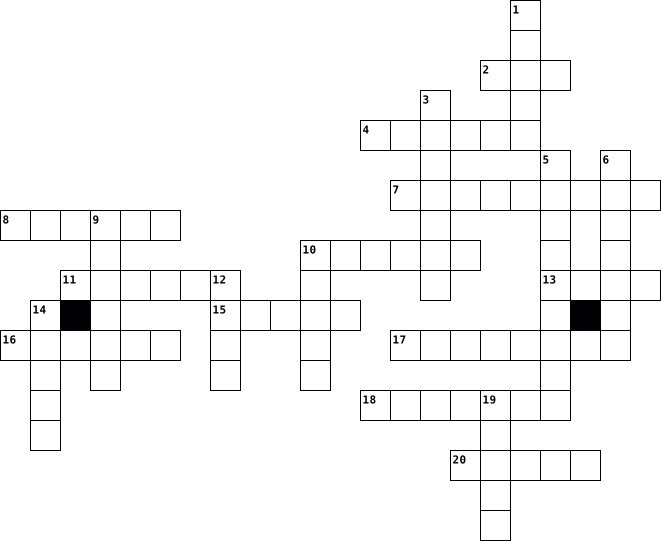
biology Crossword Puzzles
biology unit 6 2023-01-26
Across
- state of genetic equilibrium
- random changes in allele frequencies attributed to luck, not fitness
- raw material natural selection works on
- isolation of a population due to a physical barriers
- migration of individuals leaving the population
- type of natural selection in which one extreme phenotype achieves higher fitness
- isolation of a population due to differences in the timing of mating
- percent of individuals of a population that have a particular trait
- change over a period of time
- the idea that those individuals best suited to their environment will achieve higher fitness
- selection within a population due to human interference and selection of desired traits
- isolation of a population due to differences in communication
- individual removed from parasites,predators
- any characteristic that increases the fitness of an individual
Down
- group of individuals of the same species that live in the same area at the same time and can interbreed
- when a large population is cut down to a much smaller one
- collection of all the alleles present in a population
- type of natural selection in which both extremes achieve higher fitness
- genetically modified organisms
- type of natural selection where the average phenotype has the advantage
- when a small part of a population is separated from the rest and colonizes a new area
- desribes the movement of genes and alleles between populations
- measurement of the ability of an individual to survive and reproduce successful offspring
- migration of new individuals into a population
- when organisms will impersonate other organisms to increase fitness
25 Clues: state of genetic equilibrium • change over a period of time • genetically modified organisms • raw material natural selection works on • individual removed from parasites,predators • migration of new individuals into a population • migration of individuals leaving the population • isolation of a population due to a physical barriers • ...
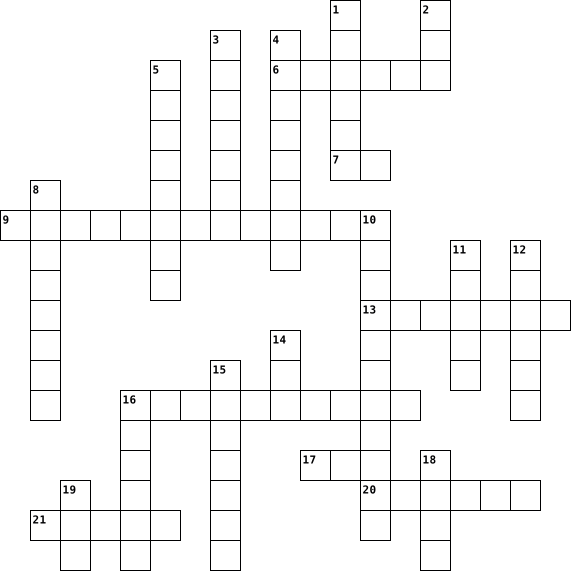
Biology Unit 6 2023-01-26
Across
- Migration of individuals out of a population.
- Random changes in allele frequencies attributed to luck, not fitness.
- Selection within a population due to human interference + selection of desired traits.
- Isolation of a population due to differences in the timing of mating.
- Group of individuals of the same species that live in the same area at the same time and can interbreed.
- When a small part of population is separated from the rest and colonizes a new area - often respond differently to natural selection.
- Type of natural selection in which individuals at either extreme of the bell curve achieve higher fitness and the average is selected against.
- When organisms will impersonate other organisms to increase fitness.
- The idea that those individuals best suited to their environment will achieve higher fitness.
- Measurement of the ability of an individual to survive and reproduce successful offspring.
Down
- Migration of new individual into a population.
- Type of natural in which individuals with one extreme phenotype have an advantage and the other extreme is selected against.
- Type of natural selection in which individuals with the average phenotype have an advantage and the extremes are selected against.
- Collection of all the alleles present in a population.
- Isolation of a population due to physical barriers such as a fence, mountain range, or body of water.
- Any characteristic that increases the fitness of an individual.
- refers to the differences among individuals in a population.
- Percent of individuals of a population that have a particular trait - Expressed as a number between 0 and 1
- Describes movement of genes/individuals between 2 neighboring populations - makes populations more alike.
- Isolation of population due to differences in communication, mating rituals, or other behaviors.
20 Clues: Migration of individuals out of a population. • Migration of new individual into a population. • Collection of all the alleles present in a population. • refers to the differences among individuals in a population. • Any characteristic that increases the fitness of an individual. • When organisms will impersonate other organisms to increase fitness. • ...
Unit 3 Biology 2022-12-13
Across
- a condition in which an organism has more than two complete sets of chromosomes
- pairs of homologous chromosomes do no separate normally during meiosis
- threadlike structure of DNA and protein that contains genetic information
- genetics with complete dominance and only two possible phenotypes
- An organism with one dominant allele will exhibit the dominant form of the trait
- one base is changed to a different base
- mutations that affect whole chromosomes and whole genes rather than just individual nucleotides (2 words)
- sequence of DNA that codes for a protein and thus determines a trait; factor that is passed from parent to offspring
- copy of a single gene; much shorter than DNA, only a single strand, and contains uracil instead of thiamine
- repeats a segment
- bases that have a double ring structure (g and a)
- (2 words) changes in just one base pair of a gene
- removes a chromosomal segment
- An organism must have two copies of the recessive allele to exhibit the recessive form of the trait
- process of taking mRNA strands and using it to make a protein
- (2 words) still code for an amino acid, but not the correct amino acid
- change in the genetic material of a cell
- moves a segment from one chromosome to another
- bases that have a single ring structure (c, t, and u)
- breaks hydrogen bonds between template strand (2 words)
Down
- compares the frequencies of the two phenotypes (2 words)
- crossing of two traits
- compares the frequencies of the three genotypes (2 words)
- (2 words) mutation that shirft the reading frame of the genetic message by inserting or deleting a nucleotide
- reverses the orientation of a segment within a chromosome
- The joining of male and female gametes to produce a new cell
- taking a single gene of DNA and copying it into a structure called mRNA
- A specific characteristic of an individual
- puts down RNA rpimers to help DNA polymerase bind to the template DNA strand
- also called a triplet, code for a specific amino acid on both mRNA and DNA strands
- results from the fertilization of gametes in which nondisjunction occurred
- process of making proteins
- crossing of one trait
- genetics that are more complex and not only based on the rules of complete dominance
- change n amino acid codon into a stop codon, nearly always leading to a nonfunctional protein
- relaxes supercoiled DNA near origin of replication
- Different forms of a gene
- gene mutation in which a single base pair in DNA has been changed
38 Clues: repeats a segment • crossing of one trait • crossing of two traits • Different forms of a gene • process of making proteins • removes a chromosomal segment • one base is changed to a different base • change in the genetic material of a cell • A specific characteristic of an individual • moves a segment from one chromosome to another • ...
Biology - Chapter 9 2023-01-03
Across
- condition of having a stable allele frequency, usual only in large populations
- type of mutation that deletes or adds a nucleotide base to a DNA sequence, causing a shift in the reading of the sequence during transcription
- substance that increases the risk of cancer
- unrestrained growth of abnormal cells with the potential to spread to other parts of the body
- DNA molecules produced in a laboratory by combining sequences of DNA from different sources, yielding a new sequence not normally found in any genome
- loss of genetic variation that results when a new population of organisms is established by a small number of individuals from a larger population
- sum of all the alleles possessed by all the individuals in a population of organisms
- polymerase chain reaction - laboratory process used to quickly generate many copies of a piece of DNA for medical or research purposes
- genetically modified organism
- repetitive nucleotide sequence that serves as a protective cap at the end of a chromosome
- range of genotypic differences possible between individuals in the same gene pool
- movement of alleles into and out of a population of organisms
- change in allele frequency due to random events, usually within a small population
Down
- small, circular piece of DNA distinct from chromosomal DNA and usually found in bacteria
- failure of homologous chromosomes or chromatids to separate properly during meiosis
- physical or chemical agent that can change the genetic material of an organism
- technique used to identify an individual that is based on sequences in his DNA
- process of determining the order of nucleotides in an organism's DNA
- abnormal growth of cells
- an organism containing genes that have been introduced from a different kind of organism
- full set of genetic information coded in an organism's DNA
- measurement of how often an allele occurs in a population of organisms
- type of mutation that changes a single nucleotide base in a DNA sequence
- use of genetic engineering to treat genetic disorders or diseases
- condition of having three or more complete sets of chromosomes
- term used to describe the situation in which the allele frequency in a population is drastically altered due to a sharp reduction in the size of the population
- type of enzyme used to cut DNA into pieces at specific places in the DNA sequence
27 Clues: abnormal growth of cells • genetically modified organism • substance that increases the risk of cancer • full set of genetic information coded in an organism's DNA • movement of alleles into and out of a population of organisms • condition of having three or more complete sets of chromosomes • use of genetic engineering to treat genetic disorders or diseases • ...
Unit 1 Biology 2023-02-06
Across
- a change in species over time
- a group of tissues put together
- when two different substances stick to one another
- one side positive one side negative
- to add more cells to make something bigger
- the prefix for many
- a group of cells put together
- to make new offspring
- to get rid of, expel
- the variable that you measure
- an educated guess
- the prefix for one
- nonliving, not alive
- exchange of gas to make energy ATP
Down
- internal balance
- how you break down food metabolism
- to change
- the prefix for small
- to move
- makes food from sunlight
- the variable that you change
- to make or build
- the variable that you keep the same, normal condition
- to maintain homeostasis
- when two similar substances stick to one another
- the prefix for living
26 Clues: to move • to change • internal balance • to make or build • an educated guess • the prefix for one • the prefix for many • the prefix for small • to get rid of, expel • nonliving, not alive • to make new offspring • the prefix for living • to maintain homeostasis • makes food from sunlight • the variable that you change • a change in species over time • a group of cells put together • ...
Carleton Biology Crossword 2023-02-08
Across
- Home of our seminars
- Go outside!
- Not the kind you use to lift weights
- Big, antlered, don't do well in the heat
- It's changing with the times
- The green machine!
- Our home
- Has been spotted skating at the wee hours
- They don't pay rent to live inside you
- Not the species but the
- He's on the hot seat
- The... powerhouse
Down
- Professor by day, building by night
- Y'know, the brain and all that
- A wormy model organism
- The basic building blocks
- Zoom in, focus, focus
- The best place to have lunch on a Monday!
- Amphipathetic, makes up the bilayer
- Never do this by mouth
- Think Darwin, and McKone
- The new kid on the block
- Has activation domains, messes with proteins
- Rika and her space hogs utilize this
24 Clues: Our home • Go outside! • The... powerhouse • The green machine! • Home of our seminars • He's on the hot seat • Zoom in, focus, focus • A wormy model organism • Never do this by mouth • Not the species but the • Think Darwin, and McKone • The new kid on the block • The basic building blocks • It's changing with the times • Y'know, the brain and all that • Professor by day, building by night • ...
Biology Alternative Assesment 2023-02-08
Across
- uses sunlight to make food for itself and the fungus
- source
- mean "first animal"
- feed on/in living organisms
- aerial hyphae that connect groups of hyphae together
- hyphae that grow within the material the fungus is growing on and digest food and support the fungus
- hyphae actually enter host cells to get nutrition from the cytoplasm of the host cell
- flat, crustlike growth
- mass of intertwined hyphae visible without magnification
- fungal infection of the skin around the toes
- affect fruits like ears of corn
- puffballs, mushrooms, shelf fungus
- morel, puffballs, mushrooms
- leafy-like growth
Down
- hyphae branches that produce spores
- a blue-green fungus was the source of the first antibiotic
- grow in homes
- mushrooms
- affect vegetative parts with leaves
- fungal infection of the skin with the appearance of a red circular area
- supports and gives protection
- unicellular fungus that causes the dough to rise
- feed on dead organic material
- environments
- moral
- spread by the elm bark beetle
- digestion
- branchlike with noticeable fruiting bodies
- form sporangia- black, brown, or green
29 Clues: moral • source • mushrooms • digestion • environments • grow in homes • leafy-like growth • mean "first animal" • flat, crustlike growth • feed on/in living organisms • morel, puffballs, mushrooms • supports and gives protection • feed on dead organic material • spread by the elm bark beetle • affect fruits like ears of corn • puffballs, mushrooms, shelf fungus • ...
Biology gcse revision 2022-04-29
Across
- What type of pathogen does an antibiotic not work on?
- The part of your brain that controls unconcious activities like breathing and your heart rate.
- What is the mass of living material that makes up an organism?
- Which type of bacteria turns ammonia in decaying matter into nitrites and then into nitrates?
- What type of organism carries out decomposition?
- What is used to absorb carbon dioxide in the investigating respiration practical?
- Which hormone stimulates growth in the plant?
- What happens to enzymes when the pH of a solution gets too high?
- Which muscles causes the hairs to stand up when you’re too cold?
- The characteristic that alleles give a whole organism.
Down
- Which gland is often known as the “master gland”?
- What is the zone called around an antibiotic in an agar plate where the bacteria has been killed?
- Which acid is produced during anaerobic respiration in animals?
- A sequence of 3 bases that can be read to create an amino acid.
- What is used to join the sticky ends of the desired gene to the plasmid DNA of a bacteria?
- What type of microscope is used in a school lab?
- What is the name of the square used to study the distribution of small organisms?
- What is the name of the small sacs of air in the lungs where gas exchange takes place?
- What is a living organism that can transmit infectious pathogens between humans, or from animal to human?
- Which transport vessel is used to transport water and minerals up the plant?
- Where a cell divides into two daughter diploid cells and then each daughter cell divides again into four haploid daughter cells.
21 Clues: Which hormone stimulates growth in the plant? • What type of microscope is used in a school lab? • What type of organism carries out decomposition? • Which gland is often known as the “master gland”? • What type of pathogen does an antibiotic not work on? • The characteristic that alleles give a whole organism. • ...
Biology Crossword Puzzle 2022-05-02
Across
- A group of the same species living in the environment
- A trait that is only expressed if there are no dominant alleles present
- A single living organism in the environment
- The mathematical model of potential offspring between two parents
- A large area of similar ecosystems that share organisms and climate
- An organism that is able to make it’s own food using energy from the sun
- The fighting for resources between organisms
- A relationship in which one organism benefits and the other is unaffected
- The passing of traits from parent to offspring
- A close relationship between organisms of different species
- The process in which two identical cells are made
- A limiting factor that is a nonliving thinig
- An organism that eats another organism to obtain energy
- An organism that eats only plants
- The physical expression of a trait
- A macromolecule that releases energy
- The type of chemical energy living organisms use
- A cell that has a nucleus to protect its DNA
- An organism that hunts and captures other organisms to eat
- The process in which four cells are made each with half the number of chromosomes
- A macromolecule that contains genetic information
- Classification of organisms that share similar traits but cannot produce fertile offspring
- The process in which organisms change over time
- A cell that does not have a nucleus to protect its DNA
- A relationship in which both organisms benefit
- An organism that feeds off the remains of other organisms
- A condensed form of DNA that is passed from parent to offspring
- The classification of living things
Down
- The process in which sugar is broken down to release energy
- The genetic makeup of trait for an organism
- An organism that is able to eat both plants and animals
- The transport of materials into and out of the cell
- A macromolecule that stores energy
- The second highest level of taxonomy
- A macromolecule that helps build and facilitates chemical reactions
- A limiting factor that is a living thing
- All the living and nonliving things in the environment
- A group of different species living in the environment
- Classification of organisms that share similar traits and are able to produce fertile offspring
- A model that shows how a trait is passed over generations
- The transport of water into and out of the cell with the help of a protein
- The process in which light is used to make sugar
- A model that shows the flow of energy throughout the ecosystem
- A trait that when present will be expressed
- The maintenance of a constant internal state in a changing environment
- The basic unit of life
- A genotype in which both alleles are the same
- A genotype in which both alleles are different
- An organism that is captured and eaten by other organisms.
- The highest level of taxonomy
- A relationship in which one organism benefits and the other is harmed
- Different types of genes
- An organism that eats only animals
- A resource that serves to limit the size of a population
- An organism that breaks down waste and puts nutrients back into the environment
- An organ like structure that helps the cell maintain homeostasis
- The process in which organisms survive and pass on those traits that allow them to survive
- A segment of DNA that codes for traits
58 Clues: The basic unit of life • Different types of genes • The highest level of taxonomy • An organism that eats only plants • A macromolecule that stores energy • The physical expression of a trait • An organism that eats only animals • The classification of living things • The second highest level of taxonomy • A macromolecule that releases energy • ...
Unit 2 Biology 2022-09-25
Across
- Third step in aerobic respiration, NADH and FADH2 from early stages are used to make 32 units of ATP.
- substances that are created during chemical reactions, made from reactants.
- occurs in membranes in chloroplast, uses chlorophyll to capture light energy, energy used to split H2O to create O2 and excite electrons.
- used by all living things to store and release energy. Powers reactions.
- Sphere of earth, all water on earth.
- the process of breaking down glucose to make ATP, starting with C6H12O6 and O2 ending in CO2 and H2O.
- substances at the beginning of chemical reactions that are later changed to products.
- a situation where oxygen is present.
- organelle, holds steps 2 and 3 from the aerobic cellular respiration.
Down
- process of using light energy to make glucose, starts with CO2 and H2O and ends with C6H12O6 and O2.
- First step in aerobic respiration and occurs in the cytoplasm. Breaks down glucose into pyruvate and makes some NADH.
- a situation where oxygen is not present
- doesn't need sunlight, located in stroma of chloroplast. Takes in CO2 to make glucose (C6H12O6). ATP and NADPH from light reaction to create C6H12O6 from CO2.
- sphere of earth, all soil and rocks on earth.
- use light energy to convert CO2 and H2O into high energy carbs (glucose) and oxygen.
- second step of aerobic respiration, pyruvate is broken down while NADH and FADH2 are made, releases CO2.
- eat autotrophs in order to get energy
- anything that has mass and takes up space, makes up everything.
- when ATP releases energy(phosphate) and the bond is broken this is what is made:
- Sphere of the earth, all gases surrounding earth.
20 Clues: Sphere of earth, all water on earth. • a situation where oxygen is present. • eat autotrophs in order to get energy • a situation where oxygen is not present • sphere of earth, all soil and rocks on earth. • Sphere of the earth, all gases surrounding earth. • anything that has mass and takes up space, makes up everything. • ...
Biology Choice Board 2023-09-10
Across
- minute particle consisting of RNA and associated proteins found in large numbers in the cytoplasm of living cells
- the study of living organisms
- a complex organic substance present in living cells, especially DNA or RNA, whose molecules consist of many nucleotides linked in a long chain
- a plastid that contains chlorophyll and in which photosynthesis takes place
- the movement of ions or molecules across a cell membrane into a region of higher concentration, assisted by enzymes and requiring energy
- a naturally occurring, extremely complex substance that consists of amino acid residues joined by peptide bonds
- a molecule that can be bonded to other identical molecules to form a polymer
- organic compounds that are fatty acids
- Transport,does not require energy to move substances across cell membranes
- dense organelle present in most eukaryotic cells, typically a single rounded structure bounded by a double membrane, containing genetic material
- a semipermeable membrane surrounding the cytoplasm of a cell
Down
- process by which molecules of a solvent pass through a semipermeable membrane from a less concentrated solution into a more concentrated one
- the smallest structural and functional unit of an organism
- a space or vesicle within the cytoplasm of a cell
- a region on an enzyme that binds to a protein or other substance during a reaction
- any of a large group of organic compounds that includes sugars, starch, and cellulose, containing hydrogen and oxygen in the same ratio as water.
- the process to create polymers
- an organelle in the cytoplasm of eukaryotic cells containing degradative enzymes enclosed in a membrane
- a rigid layer of polysaccharides lying outside the plasma membrane of the cells of plants, fungi and bacteria
- a substance produced by a living organism which acts as a catalyst to bring about a specific biochemical reaction
20 Clues: the study of living organisms • the process to create polymers • organic compounds that are fatty acids • a space or vesicle within the cytoplasm of a cell • the smallest structural and functional unit of an organism • a semipermeable membrane surrounding the cytoplasm of a cell • Transport,does not require energy to move substances across cell membranes • ...
Intro to Biology 2023-09-04
Across
- The stable internal balance that a cell maintains.
- The variable in an experiment that is deliberately changed by a scientist. (2 words)
- A segment of DNA that contains the instructions for one trait.
- The basic unit of life
- Using the energy from the sun to convert carbon dioxide and water into high energy sugars.
- The information gathered from making observations.
- A group of organs that work together to perform a similar function
- A series of steps used by a scientist to solve a problem. (2 words
- The idea or belief that life can arise from non-living matter. (2 words)
- Data that are numbers and are obtained from counting or measuring.
- The second set of lenses in a compound microscope.
- A group of unicellular organisms that live in a group but have to relationship to one another.
Down
- The factors in an experiment that can be changed.
- The first lens in a compound microscope.
- The part of the microscope that moves the stage, or the objectives, up and down very rapidly. (3 words)
- A possible answer to a question. It must be thoroughly tested.
- A broad and comprehensive statement of what is thought to be true, and is supported by a considerable amount of evidence.
- The study of life.
- The part of the microscope that holds the slide.
- This part of the microscope moves that stage (or objectives) up and down very slowly.
- That factor in an experiment that a scientist wants to observe. (2 words)
- Data that are descriptive.
- A group of tissues that work together to perform a common function.
- A group of cells that work together to perform a common function.
- The part of the experiment that serves as a basis for comparison because the experimental factor has been removed.
- The genetic information that is found in every living cell.
26 Clues: The study of life. • The basic unit of life • Data that are descriptive. • The first lens in a compound microscope. • The part of the microscope that holds the slide. • The factors in an experiment that can be changed. • The stable internal balance that a cell maintains. • The information gathered from making observations. • ...
Biology Lion Unit 2023-09-05
Across
- shape of DNA, two sides that connect in the middle like a ladder
- an open question requires a more detailed response
- a geneticallly determined characteristic
- makes energy from sunlight
- how easily you can survive long enough to have babies
- group of the same species living in the same place
- something an organism is born with that increases fitness
- join together to form DNA.Made of phosphate and one nitrogen base
- (pairs 1-22) have nothing to do with gender
- portions of DNA that tell the body how to make certain proteins
- (Pair 23) determine your gender
- super twisted DNA
Down
- physical description of traits
- a picture showing all of the chromosomes in one body cell
- versions of a gene
- information you received from your senses
- an explanation for your observation
- location of the gene on the chromosome
- can be answered in a single word
- part of a nucleotide four versions: A,T,C, and G
- nonliving parts of environment
- energy gained minus energy lost
- living parts of environment
- two digit code showing the allels given to you by your parents
- eats energy from food
25 Clues: super twisted DNA • versions of a gene • eats energy from food • makes energy from sunlight • living parts of environment • physical description of traits • nonliving parts of environment • energy gained minus energy lost • (Pair 23) determine your gender • can be answered in a single word • an explanation for your observation • location of the gene on the chromosome • ...
Biology Unit 2 2023-09-06
Across
- two or more atoms bonded together
- the amount of photosynthesis that is done in an area
- compound used by cells to store and release energy; made during cellular respiration
- Type of energy holding atoms together
- organelles in plant cells that capture the energy from sunlight and convert it into chemical energy in a process called photosynthesis
- unicellular organism that lacks a nucleus
- Process by which some organisms, such as certain bacteria, use chemical energy to produce carbohydrates
- A very large organic molecule composed of many smaller molecules. Carbohydrates, Lipids, Proteins & Nucleic Acids
- organism whose cells contain a nucleus and membrane bound organelles
- The process in which our cells break down food and turn it into energy that cells need to perform their life functions. Oxygen is needed for this process.
- macromolecule made mostly from carbon and hydrogen atoms; provides long-term energy (includes fats, oils, and waxes)
- process by which organisms maintain a relatively stable internal environment
- Anything that has mass and takes up space (the letters)
Down
- An organelle found in large numbers in most cells, in which the processes of cellular respiration and energy production occur.
- Process that requires oxygen
- a large, fluid-filled organelle that stores not only water but also enzymes, metabolic wastes, and other materials
- the substance that controls the quantity of product that can form in a chemical reaction
- The process that converts light energy into chemical energy that is stored in glucose or other organic compounds; occurs in plants, algae, and certain prokaryotes.
- An organism that obtains organic food molecules by eating other organisms or substances derived from them.
- Basic unit of matter
- A molecule FORMED as a result of a chemical reaction (outputs)
- the process by which cells obtain energy from an energy source without using oxygen
- A simple sugar made in the process of photosynthesis which the plants use for energy in Cellular Respiration.
- Green pigment located in membranes within the chloroplasts of plants and algae and in the membranes of certain prokaryotes.
- macromolecules containing hydrogen, oxygen, nitrogen, carbon, and phosphorus (includes DNA and RNA)
- An organism capable of making its own food
- macromolecule that contains carbon, hydrogen, and oxygen. Provides short-term energy (includes starches like potatoes and pasta)
- Pores on the leaf where O2 exits and CO2 enters
- macromolecule that contains carbon, hydrogen, oxygen, and nitrogen; needed by the body for growth and repair
- elements or compounds that ENTER into a chemical reaction (inputs)
- Found in the bonds that hold molecules together (the lines)
- Process that does not require oxygen
32 Clues: Basic unit of matter • Process that requires oxygen • two or more atoms bonded together • Process that does not require oxygen • Type of energy holding atoms together • unicellular organism that lacks a nucleus • An organism capable of making its own food • Pores on the leaf where O2 exits and CO2 enters • the amount of photosynthesis that is done in an area • ...
Biology crossword Puzzle 2023-09-20
Across
- proteins that help speed up metabolism
- (Ex.Of protein)
- water sticks well to other things
- large molecules made of small , repeating molecular building blocks called monomers
- A measure of how acidic/basic water is
- complex organic molecules that store genetic information
- small molecule that can be joined to form more complex molecules
- enables chemical reactions to happen at a faster rate then usual
- A short chain amino acids
- The minimum amount of energy required to cause a chemical reaction to occur
- (Ex.of lipid)
Down
- waxy or oily compounds
- The basic Building block of nucleic acids(RNA and DNA)
- (Ex. of nucleic acid)
- One of the main nutrition groups(EX. pasta)
- made up of mostly carbon, hydrogen and nitrogen atoms
- molecules that combine to form proteins
- (Ex.of carb)
- a usually liquid substance capable dissolving or dispersing one or more other substances
- The fact that water sticks to itself
20 Clues: (Ex.of carb) • (Ex.of lipid) • (Ex.Of protein) • (Ex. of nucleic acid) • waxy or oily compounds • A short chain amino acids • water sticks well to other things • The fact that water sticks to itself • proteins that help speed up metabolism • A measure of how acidic/basic water is • molecules that combine to form proteins • One of the main nutrition groups(EX. pasta) • ...
UNIT 5 BIOLOGY 2022-11-17
Across
- mutation involving a long segment of DNA.
- single DNA strand that, during DNA replication, is replicated in the 3' – 5' direction.
- a mutation is an alteration in the nucleic acid sequence of the genome of an organism.
- he heritable condition of possessing more than two complete sets of chromosomes.
- small RNA molecule that plays a key role in protein synthesis.
- a sugar derived from ribose by replacing a hydroxyl group with hydrogen.
- is the process in which ribosomes in the cytoplasm.
- a segment of a DNA or RNA molecule which does not code for proteins and interrupts the sequence of genes.
- the membrane-enclosed organelle within a cell that contains the chromosomes.
Down
- a small RNA molecule that plays a key role in protein synthesis.
- a type of single-stranded RNA involved in protein synthesis.
- together form a unit of genetic code in a DNA.
- a sequence of three nucleotides
- member of a family of enzymes that catalyze the synthesis of DNA
- The Mendelian gene is a basic unit of heredity and the molecular gene is a sequence of nucleotides in DNA that is transcribed to produce a functional RNA.
- mutation is an alteration in the nucleic acid sequence of the genome of an organism.
- macromolecular machines, found within all cells, that perform biological protein synthesis.
- a segment of a DNA or RNA molecule containing information coding for a protein.
- a region of DNA upstream of a gene where relevant proteins bind to initiate transcription of that gene.
- a single DNA strand that, during DNA replication, is replicated in the 5′ – 3′ direction.
20 Clues: a sequence of three nucleotides • mutation involving a long segment of DNA. • together form a unit of genetic code in a DNA. • is the process in which ribosomes in the cytoplasm. • a type of single-stranded RNA involved in protein synthesis. • small RNA molecule that plays a key role in protein synthesis. • ...
Biology Final Review 2022-12-06
Across
- a cross between a tiger and a lion
- two plant species flower at different times
- a type of fish in Lake Victoria that diversified through adaptive radiation
- a cross between a grizzly bear and a polar bear
- a species or group of species that is closely related to, but not a member of the group under study
- structural differences between species preventing mating
- different species that occur together in the same location but remain distinct
- groups of populations that have been evolving independently of other groups of populations
- defines species as groups of interbreeding populations that are reproductively isolated from other groups
- includes most recent common ancestor of the group and all descendants
- latin word for groups
- biologists increasingly refer to these animals as a type of reptile
- chemical compounds used to attract mates
- all species are descended from a single common ancestor
Down
- refers to a shared character state that has not been inherited from a common ancestor exhibiting that character state
- population whose members do not mate with each other or who cannot produce fertile offspring
- when adaptive radiation results in a new trait
- four sets of chromosomes, can self-fertilize or mate with other tetraploids
- refers to a time period with a large increase in biodiversity
- two part name
- does not include the most recent common ancestor of all members of the group
- a sterile animal produced when crossing a horse to a donkey
- includes most recent common ancestor of the group, but not all of its descendants
- two species rarely hybridize due to different courtships and mating rituals
- similarity that arose prior to the common ancestor of the group
- similarity among species that is inherited from the most recent common ancestor
- the science of classifying living things
- a cross between a donkey and a zebra
28 Clues: two part name • latin word for groups • a cross between a tiger and a lion • a cross between a donkey and a zebra • the science of classifying living things • chemical compounds used to attract mates • two plant species flower at different times • when adaptive radiation results in a new trait • a cross between a grizzly bear and a polar bear • ...
Biology Basics Review 2022-11-30
Across
- A description of something you can see, smell, touch, taste, hear
- A change in an organisms environment
- A guess about an object or outcome based on your observations
- substances that are created during a chemical reaction
- A macromolecule group that has many functions and runs our bodies
- Living things start as a single cell and change into a full grown organism, this means that they __
- All living things are made of these small units
- An observation that uses word descriptions to talk about qualities
- Living things are based on a universal __ code
Down
- Change over time
- An observation type that relies on measurements in the form of numbers
- A macromolecule group that stores hereditary information
- The macromolecule group that makes up a large portion of cell membranes
- A combination of chemical reactions in which an organism builds up or breaks down materials
- How an organism reacts to a change in its environment
- The macromolecule group our bodies break down for energy first
- Substances that go into a chemical reaction and get changed
- Living things maintain a stable, internal environment through a process called:
- Living things are capable of creating offspring, this process is called:
- The study of life
20 Clues: Change over time • The study of life • A change in an organisms environment • Living things are based on a universal __ code • All living things are made of these small units • How an organism reacts to a change in its environment • substances that are created during a chemical reaction • A macromolecule group that stores hereditary information • ...
BIOLOGY GROUP ONE 2022-10-20
Across
- : A trait that is controlled by two or more gene, each with one or more alleles.
- A type of isolation that involves separation of a species so that they no longer interbreed.
- an environmental factor that affects the chance of survival of an organism; organisms with one phenotype are more likely to survive and reproduce than those with a different phenotype.
- The reduction in a gene pool compared with the main populations of a species, resulting from only two or three individuals, with only selection of the alleles, in gene pool starting off a new population.
- A period when the number of a species fall to very low level.
- The gradual change in allele frequencies in a small population, where some alleles are lost or favored just by chance and not by natural selection.
- The formation of new species
- Non-living environmental factor
- A type of natural selection that maintains relatively high frequencies of two different sets of alleles; individuals with intermediate features and allele set are not selected for.
- A type of natural selection that tends to keep allele frequencies relatively constant over many generations.
- A type of natural selection that causes a gradual change in allele frequency over many generations.
- A type of isolation that is caused by the difference of mating seasons between two species that do not match up.
- Living environmental factor
- A type of variation in which differences between the individuals of a species in which each one belongs to one of a small number of distinct categories with no intermediates
- A type of factor by which the environment of an organism affects its survival.
Down
- A type of isolation that is caused by species developing a different courtship rituals or other behaviors.
- Differences between the DNA base sequences of individuals within a species.
- The ability of an organism to survive and reproduce.
- : A type of selection when individuals select mates based on heritable traits and fitness.
- A number of different genes at different loci that all contribute to a particular aspect of the phenotype.
- The movement of genes into or out of a population.
- A type of isolation that is caused by geographical factors.
- A variation of differences between the observable traits of individuals within a species is called ...
- The need for a resource by two organisms, when that resource is in short supply.
- The continued existence of two or more different phenotypes in a species.
- The situtation in which allele frequencies in population remain the same form one generation to the next.
- A trait that is controlled by one gene that may have on or more alleles.
- The selection process by which individuals with a particular set of alleles are more likely to survive and reproduce than those with other alleles; over time and many generations, the advantageous alleles become more frequent in the population.
- A type of variation in which differences between individuals of a species in which each one can lie at any point
- The complete range of DNA base sequences in all the organisms in a species or population.
30 Clues: Living environmental factor • The formation of new species • Non-living environmental factor • The movement of genes into or out of a population. • The ability of an organism to survive and reproduce. • A type of isolation that is caused by geographical factors. • A period when the number of a species fall to very low level. • ...
UNIT 2 BIOLOGY 2022-12-06
Across
- cells with membrane bound organle and a nucleus
- has 3 phosphates and the third one has the clavin cycles name on it.
- CELLS without aa nucleus and no membrane bound organelles.
- the things that was ca.ll in our cells like mini organs but for cells.
- is the thing that receptors grab
- is used for healing the created of M RNA>
- full of goodies like proteins and holds all the organles inside of it.
- is how stuff moves through things and equals out e
- is how water moves and equals out in water
- is how you identify between archae and bacteria
- only found in plant cells near you
- the POWERHOUSE OF THE CELL
Down
- needs no atp no sir eeeeeee
- that liquid stuff in between organeless
- used for storing things in the cell like iron or something.
- needs atp to function an move stuff along
- is that thing that gets the ligands and sengs it off to trransduction
- reyclces dead stuff in the cell
- a type of bacteria with no peptides?
- the rube dolgberge machine of a process to get the response for the receptor.
- a type of prokeratic cell with peptidgologyn
- the guess on why we as humans made of cells exist in this world.
- used to make sunlight into glucose yummy.
- control center of the cell
- ER closest to the furthest form the nucleus and makes proteins
25 Clues: control center of the cell • the POWERHOUSE OF THE CELL • needs no atp no sir eeeeeee • reyclces dead stuff in the cell • is the thing that receptors grab • only found in plant cells near you • a type of bacteria with no peptides? • that liquid stuff in between organeless • needs atp to function an move stuff along • is used for healing the created of M RNA> • ...
Biology - Unit 1 2022-12-07
Across
- Simplest type of sugar.
- Nucleic acids are composed of ________ main parts.
- Repels water.
- Basic unit of matter.
- ________ data. Data based on numbers.
- A large molecule made of many smaller molecules.
- Type of biomolecule composed only of carbon, hydrogen, oxygen, hydrogen, and nitrogen.
- Attraction between molecules of different substances.
- A type of biomolecule that is a common source of energy for us, essentially sugar.
- Max number of electrons on the second orbital shell of an atom
- Substance made of only one type of atom.
- Type of biomolecule that stores energy and helps form cell membranes.
- Ionic bonds occur between a non-metal and a ________.
- ________ fatty acid. Type of fat containing carbons joined only by single bonds.
- Attracted to water.
- ________ bonds. Chemical bond formed when atoms share electrons.
- Mixture of water and an undissolved material.
- ________ data. Data based on observations.
- Chemical reactions that occur within an organism to maintain life.
- Monomer of nucleic acid.
- The study of living things
- Atoms that differ in number of neutrons but are still of the same element.
- The only biomolecule this chemical element is found in is nucleic acids.
- Scientific ________. Describes a natural phenomenon that appears to be universally true.
- ________ structure. Protein structure composed of a chain of amino acids.
- small units that make up polymers
- ________ inhibition. When molecules sit in the allosteric site of an enzyme and change its shape to keep it from working.
- ________ acids. Biomolecule that includes DNA and RNA.
- Subatomic particle with a positive charge.
- ________ group. A group in an experiment that experiences the same conditions as the group(s) being studied, but without the independent variable.
- Polymer of proteins.
- Weak acid/base used to prevent sudden changes in pH.
- ________ shell. Outer orbital shell of an atom.
Down
- ________ forces. Forces that hold atoms in a molecule together
- ________ action. Water rising in a tube.
- A substance made of multiple elements that have been chemically joined.
- There are ________ major types of biomolecules.
- Material composed of at least two elements/compounds. Physically mixed together, not chemically combined.
- Biological catalyst
- ________ synthesis. Chemical reaction that combines two small molecules by taking away water.
- ________ number. Total number of protons and neutrons in the nucleus of an atom.
- ________ variable. The variable in an experiment that is being changed.
- ________ bonds. A chemical bond formed when electrons are passed between atoms
- A state of stability for an organism
- The process of adding water to a compound in order to split it up.
- Glassware used to store and measure liquid.
- The hydrolysis of phosphate groups in ATP is a highly ________ reaction.
- Unlike saturated fatty acid, unsaturated fatty acid contains at least one ________ bond between carbon atoms.
- Attraction between molecules of the same substance
- ________ experiment. An experiment done in a lab.
- The process of using energy to add two small molecules together.
- Substance that dissolves the solute in a solution.
- ________ structure. Type of structure in proteins that consists of a 3D, bundled up amino acid chain.
- ________ experiment. Type of experiment where things are observed and analyzed as they occur naturally.
- substance on which an enzyme acts
- ________ forces. The forces that exist between molecules.
- ________ variable. The factor/condition in an experiment that is being measured.
- ________ site. Part of an enzyme that binds to the other substance in a reaction.
- ________ reasoning. Making general statements from specific examples.
- Element with two or more forms.
- ________ hypothesis. The prediction that there is no relationship between two variables.
- ________ reaction. Chemical reaction that consumes energy.
62 Clues: Repels water. • Biological catalyst • Attracted to water. • Polymer of proteins. • Basic unit of matter. • Simplest type of sugar. • Monomer of nucleic acid. • The study of living things • Element with two or more forms. • substance on which an enzyme acts • small units that make up polymers • A state of stability for an organism • ________ data. Data based on numbers. • ...
Biology Unit 2 2022-12-08
Across
- series of events that cause cells to divide
- a cell containing a single set of unpaired chromosomes
- site of light dependent reactions.
- the identical copies of chromatids formed from DNA replication
- A series of reactions that break glucose down into pyruvates
- Synthesizes lipids and phospholipids
- A stack-like structure in plant chloroplasts that contain chlorophyll; the site of photosynthesis.
- When a cell targets a distant cell through the bloodstream
- he concentration of particles is higher in one area than another
- the movement of ions across a semipermeable membrane bound structure, down their electrochemical gradient
- a chemical messenger released by one cell to signal either itself or a different cell.
- the phase where DNA is replicated
- An equal distribution of solute and net movement of water causing the cell to stay the same
- asexual reproduction by a separation of the body into two new bodies
- the division of a cell at the end of mitosis or meiosis, bringing about the separation into two daughter cells.
- a cell containing two complete sets of chromosomes, one from each parent.
- causes the production, folding, quality control and despatch of some proteins
- decreased solute concentration, and a net movement of water inside the cell, causing swelling
- a small dense spherical structure in the nucleus of a cell during interphase.
- the state in which a reversible reaction taking place stops changing the ratio of reactants and products, but there is a movement of substances between the reactants and the products.
- a complex of vesicles and folded membranes within the cytoplasm of most eukaryotic cells, involved in secretion and intracellular transport
- the phase where the chromosomes are attachted to spindle fibers.
- the space between two membranes
- the phase where the cell grows, replicates its DNA and prepares for mitosis
- a cellular process in which substances are brought into the cell.
- the sequence of reactions by which most living cells generate energy during the process of aerobic respiration
- a form of active transport and bulk transport in which a cell transports molecules out of the cell
- the process by which a chemical or physical signal is transmitted through a cell as a series of molecular events
- chemical structures, composed of protein, that receive and transduce signals
- a protein that catalyzes the formation of ATP using ADP
- The set of one chromosome from your mother and father
- When a cell targets itself
Down
- the part of the cell cycle which replicated chromosomes are separated into two new nuclei
- theory of the origin of eukaryotic cells from prokaryotic organisms
- the space within the inner membrane of mitochondria
- increased solute, and a net movement of water outside causing the cell to shrink
- When a cell targets a cell close by
- site of light independent reactions
- a family of proteins that controls the progression of a cell through the cell cycle
- a plastid that contains chlorophyll and in which photosynthesis takes place
- the green pigment found in plants which is primarily involved in absorbing light energy for photosynthesis
- a diploid cell resulting from the fusion of two haploid gametes
- the ability to detect and respond to cell population density by gene regulation
- a threadlike structure, especially a microscopic appendage that enables many protozoa, bacteria to swim
- series of chemical reactions that convert carbon dioxide and hydrogen-carrier compounds into glucose
- cells designed to carry out a particular role in the body
- a type of cell division in sexually reproducing organisms that reduces the number of chromosomes in gametes
- a role in movement, but are more often involved in adherence to surfaces
- a membrane-bound cell organelle that contains digestive enzymes
- a series of chemical reactions that break down glucose to produce ATP
- a mature haploid male or female germ cell
- the phase where the chromosomes move away from one another to opposite poles of the spindle.
- cells from which all other cells with specialized functions are generated
- the phase where the chromosomes become visible as paired chromatids and the nuclear envelope disappears
- the phase where the chromatids or chromosomes move to opposite ends of the cell and two nuclei are formed
55 Clues: When a cell targets itself • the space between two membranes • the phase where DNA is replicated • site of light dependent reactions. • When a cell targets a cell close by • site of light independent reactions • Synthesizes lipids and phospholipids • a mature haploid male or female germ cell • series of events that cause cells to divide • ...
Random Biology Revision 2022-05-18
Across
- Component of blood responsible for blood clotting
- Enzyme which breaks down protein
- Structural Protein found in hair and nails
- Cells involved in bone formation
- Enzyme found in Yeast cells
- Hormone required to control blood sugar levels
- Enzyme which has been trapped in a Gel or Matrix
- When cells move toward the egg as a result of a chemical signal sent out by the egg cell
- Tiny opening on the surface of the stem involved in exchange processes
- An element needed by plants to make chlorophyll
- A trace element
- Chemical used to test for reducing sugars
Down
- Where ultrafiltration occurs in the nephron
- A stage in mitosis where the chromosomes are aligned at the equator
- identifiying feature of phloem cells
- Takes place in the nucleus, 1st stage of protein synthesis
- Specialised cells which nourish the sperm in the seminiferous tubules
- Responsible for making ribsomes
- Where 2 organisms live in close association and at least 1 benefits
- Temperature at which an enzyme works best
- What kingdom do Amoeba belong?
- Hormone with controls the permeability of the collecting ducts to water
- treatment for fertility issues
- Substance needed to harden Alginate beads
- plant source of the enzyme Catalase
- Adaptation which involves blending into your environment
- Phase of exponential growth
- Scientists involved in DNA structure
28 Clues: A trace element • Enzyme found in Yeast cells • Phase of exponential growth • What kingdom do Amoeba belong? • treatment for fertility issues • Responsible for making ribsomes • Enzyme which breaks down protein • Cells involved in bone formation • plant source of the enzyme Catalase • identifiying feature of phloem cells • Scientists involved in DNA structure • ...
AP Biology: Ecology 2022-05-18
Across
- the percentages of the population is stable among all ages
- dead organic matter
- planting organisms (prokaryotes, fungi, plants) in ecosystems to detoxify them from harmful pollutants
- pathogens that are transferred from animals to humans; they are highly contagious and spread quickly through humans and animals alike
- survivorship curve characterized by a roughly constant mortality rate/survival probability experienced regardless of age; ex. some birds, lizards
- survivorship curve characterized by high age-specific survival probability in early and middle life, followed by a rapid decline in survival in later life; ex. humans, large mammals
- component of amino acids and nucleic acids; consumes 80% of the atmosphere
- living things (animals, plants, bacteria)
- a major terrestrial or aquatic life zone characterized by vegetation type or physical environment
- an interaction between species that benefits one and has no effect on the other
- framework of all organic molecules; in atmosphere and fossil fuels
- living things (sunlight, rocks, soil, temperature, salinity, water, nutrients, climate)
Down
- an interspecific interaction that benefits both species
- a type of dispersion in which individuals form into small, dense groups; ex. sea stars grouped around a food source
- the highest percentage of the population is in the young ages
- density-dependent selection; selection for life history traits that are sensitive to population density; ex. mature trees in an old-growth forest; (regulated by competition for resources, territoriality, disease, predation, toxic wastes, intrinsic factors)
- density-independent selection; selection for life history traits that maximize reproductive success in uncrowded environments; ex. rhinoceros reproduction
- a harmless species mimicking (in appearance) a harmful one; ex. larva of hawk mantis puffs up to look like small snake
- very fine patterns, such as a community of organisms living under a log
- a type of dispersion in which individuals are evenly spaced; ex. penguins resting on small islands to resist aggressive fights
- the first organisms to colonize an area after the wipe-out of the previous ecosystem
- camouflage that makes a species hard to spot;
- two harmful species look like each other to project multiple threats; ex. cuckoo bee and yellow jacket
23 Clues: dead organic matter • living things (animals, plants, bacteria) • camouflage that makes a species hard to spot; • an interspecific interaction that benefits both species • the percentages of the population is stable among all ages • the highest percentage of the population is in the young ages • framework of all organic molecules; in atmosphere and fossil fuels • ...
Biology SOL Review 2022-05-16
Across
- a trait that helps an organism to survive and reproduce
- drugs that block the growth and reproduction of bacteria
- Part of the cell cycle when the chromosomes separate
- an organism that has two of the same alleles for a trait
- the powerhouse of the cell
- organelle that is responsible for packaging proteins
- an organism's physical appearance or visible traits
- The stufy of living organisms
- organelle which makes proteins
- diffusion of water through a membrane
- an organism that makes its own food
Down
- a change in a gene or chromosome
- process where DNA is copied into mRNA
- what is made when two gametes combine
- all the living and non-living things in an area
- a relationship between two organisms in which both benefit
- the basic unit of structure in all living things
- The gradual change in a species over generations
- monomer of a carbohydrate
- main energy source that cells use for most of their work
20 Clues: monomer of a carbohydrate • the powerhouse of the cell • The stufy of living organisms • organelle which makes proteins • a change in a gene or chromosome • an organism that makes its own food • process where DNA is copied into mRNA • what is made when two gametes combine • diffusion of water through a membrane • all the living and non-living things in an area • ...
Biology Unit 12 2022-05-17
Across
- area where an organism lives including the biotic and abiotic factors that affect it
- symbiotic relationship in which both species benefit from the relationship
- animal that consumes the carcasses of other animals
- organism that obtains energy by eating animals
- part of Earth in which life exists including land, water, and air or atmosphere
- symbiotic relationship in which one organism benefits and the other is neither helped nor harmed
- scientificstudy of interactions among organisms and between organisms and their environment
- physical, or nonliving, factor that shapes an ecosystem
- in which chemical energy is used to produce carbohydrates
- organism that breaks down and obtains energy from dead organic matter
- pyramid illustration of the relative amounts of energy or matter contained within each trophic level in a given food chain or food web
- full range of physical and biological conditions in which an organism lives and the way in which the organism uses those conditions
- interaction in which one organism (the predator) captures and feeds on another organism (the prey)
- classification comprising related organisms that share common characteristics and are capable of interbreeding
Down
- web network of complex interactions formed by the feeding relationships among the various organisms in an ecosystem
- organism that obtains food by consuming other living things; also called a consumer
- Exclusion Principle principle that states that no two species can occupy the same niche in the same habitat at the same time
- a group of organisms of one species that interbreed and live in the same place at the same time.
- organism that feeds on plant and animal remains and other dead matter
- relationship in which two species live close together
- organism that obtains energy by eating both plants and animals
- organism that obtains energy by eating only plants
- a group of ecosystems that share similar climates and typical organisms
- all the organisms that live in a place, together with their nonliving environment
- process used by plants and other autotrophs to capture light energy and use it to power chemical reactions that convert carbon dioxide and water into oxygen and energy-rich carbohydrates such as sugars and starches
- each step in a food chain or food web
- assemblage of different populations that live together in a defined area
- a symbiotic relationship in which one organism lives on or inside another organism and harms it
- any living part of the environment with which an organism might interact
- organism that is able to capture energy from sunlight or chemicals and use it to produce its own food from inorganic compounds; also called a producer
- ability of an organism to survive and reproduce under circumstances that differ from their optimal conditions
- a series of steps in an ecosystem in which organisms transfer energy by eating and being eaten
32 Clues: each step in a food chain or food web • organism that obtains energy by eating animals • organism that obtains energy by eating only plants • animal that consumes the carcasses of other animals • relationship in which two species live close together • physical, or nonliving, factor that shapes an ecosystem • in which chemical energy is used to produce carbohydrates • ...
AP Biology Crossword 2023-05-19
Across
- the unfolding or breaking of a protein affected by increased heat or agitation and disables the protein from carrying out its functions
- Water's special property, which allows it to climb up small tube-like surfaces enabled by its properties of cohesion and adhesion
- The process by which plants, algae, and some bacteria convert light energy to chemical energy in the form of sugars.
- allows you to know if the variation of the data is due to chance or due to some other variable. It is used by comparing our critical value to our p-value
- cells that have only a single set of chromosomes and are commonly reproductive sperm and egg cells
- simple aromatic compound composed of carbon and nitrogen atoms in a six-membered ring.
- Varies for every protein and decides the chemical versatility and folding of the amino acid. Some carry the amino acid's charge and can determine if it will be hydrophobic or hydrophilic
- The measure of the relative tendency of water to move from one area to another
- an operon that is turned on in the presence of more substrate, for example, the lac operon. The original state of these is repressed
- Process mRNA goes through to make it mature and ready for translation. This includes intron splicing, adding a Poly-A tail, and a 5' cap
- when a population is greatly reduced in size, limiting the genetic diversity of the species
Down
- process in which ribosomes synthesize a polypeptide chain from the mRNA transcribed from DNA by matching codons to their corresponding amino acids
- the chemical breakdown of a compound due to a reaction with water.
- process all living organisms undergo to breakdown sugars and make energy, that will typically take place in the mitochondria
- extrachromosomal DNA is usually found in and taken in by bacteria, where it can replicate independently of the cell's chromosomal DNA.
- The part of the substrate where the enzyme binds
- the breakdown of glucose by enzymes, releasing energy and pyruvic acid.
- a principle stating that the genetic variation in a population will remain constant from one generation to the next in the absence of disturbing factors.
- the outcome of miotic division. A cell with a complete set of DNA
- the exchange of DNA between paired homologous chromosomes (one from each parent) that occurs during the development of egg and sperm cells (meiosis)
20 Clues: The part of the substrate where the enzyme binds • the outcome of miotic division. A cell with a complete set of DNA • the chemical breakdown of a compound due to a reaction with water. • the breakdown of glucose by enzymes, releasing energy and pyruvic acid. • The measure of the relative tendency of water to move from one area to another • ...
Biology Cross Word 2023-05-18
Across
- Groups of individuals of the same species that live in the same area.
- Structures that have no apparent function and appear to be residual parts from a past ancestor.
- Selection A mechanism of evolution.
- Symbiotic relationship in which both species benefit from the relationship.
- Part of earth in which life exists, including land, water, and air or atmosphere.
- Study of past and present distribution of organisms.
- An organism's ability to survive and reproduce in a particular environment
- Similar physical features in organisms that share a common ancestor, but the features serve completely different functions.
- The remains or impression of a prehistoric organism preserved in petrified form or as a mold or cast in rock.
- Organism that relies on other organisms for its energy and food supply, also called a heterotroph.
- An herbivore is an organism that mostly feeds on plants.
- Largest number of individuals of a particular species that a particular environment can support.
- Ancestral organism shared by two or more descendent lineages.
- Physical change in an organism that results over time in reaction to its environment.
- Network of complex interactions formed by the feeding relationships among the various organisms in an ecosystem.
- An interaction between organisms or species in which both require a resource that is in limited supply.
Down
- Body parts that share a common function, but not an evolutionary history.
- The physical separation of members of a population.
- Relationships in which two species live close together.
- The branch of biology and medicine concerned with the study of embryos and their development.
- A person who moves away from his or her place of usual residence, whether within a country or across an international border, temporarily or permanently, and for a variety of reasons.
- The process by which species adapt over time in response to their changing environment.
- Series of steps in an ecosystem in which organisms transfer energy by eating and being eaten.
- Symbiotic relationship in which one organism benefits and the other is neither helped nor harmed.
- All the organisms that live in a place, together with their nonliving environment.
- Selective breeding of plants and animals to promote the occurrence of desirable traits in offspring.
- The movement of genes into or out of a population.
- A carnivore is an organism that mostly eats meat, or the flesh of animals.
- Group of ecosystems that share similar climates and typical organisms.
- Group of similar organisms that can breed and produce fertile offspring.
30 Clues: Selection A mechanism of evolution. • The movement of genes into or out of a population. • The physical separation of members of a population. • Study of past and present distribution of organisms. • Relationships in which two species live close together. • An herbivore is an organism that mostly feeds on plants. • ...
A Level Biology 2023-05-18
Across
- gradual development, from a simple to more complex
- breeding example for two traits
- ions diffuse from high to low concentration
- energy currency
- muscle fiber and synapse
- plant growth regulators
- absorbance of different wavelengths of light by a pigment
- no resulting effect on an altered chromosome
- control of the water potential of body fluids
- pathway along which impulse transmits from receptor to effector
- electron flow in cyclic photophosphorylation
Down
- degree of variation of life forms in an ecosystem
- used in electron transport chain
- process of removing small molecules out of blood into bowman's capsule
- cranial and spinal nerves
- rate of photosynthesis at different wavelengths of light
- regions of DNA that don't code for anything
- movement of ions across a membrane, down the electrochemical gradient
- electrical difference inside neuron is much lower than outside
- mechanisms to keep factors within narrow limits
20 Clues: energy currency • plant growth regulators • muscle fiber and synapse • cranial and spinal nerves • breeding example for two traits • used in electron transport chain • ions diffuse from high to low concentration • regions of DNA that don't code for anything • no resulting effect on an altered chromosome • electron flow in cyclic photophosphorylation • ...
AP Biology- Ecology 2023-05-17
Across
- Factors, resource availability and diseases that affect the population
- Taxis, organisms that grow toward their energy source
- Taxis, organisms that grow away from their energy source
- Growth, when a population first grows slowly but then grows extremely fast
- Capacity, the max amount of a population that an ecosystem can sustain
- a negative relationship between two organisms where one benefits and the other is harmed
- Levels, different levels of the food pyramid that describe the flow/depletion of biomass
- organisms that use photosynthesis to produce biomass
- organisms that consume dead organisms as a way of survival
- Cycle, is the process by how carbon is stored in the ground and goes through organisms from the air
- organisms that consume both producers and consumers
- organisms that only consume producers
- organisms that eat producers and slowly biomass depletes up the trophic levels
- organisms that create energy to heat themselves
- a positive relationship between two organisms where they both mutually benefit
- a relationship between two organisms where one benefits and the other is unaffected
Down
- Factors, nonliving factors that contribute to the health of a population
- the non-directional movement of an organism
- Growth, when a population is reproducing faster than it is dying off
- the directional movement of an organism
- species, species that reproduce slowly but live longer life-spans
- is the state that the body wants to be in where it is balanced
- Factors, natural disasters that affect the population
- Growth, when a population at first grows fast but then reaches its carrying capacity
- species, species that reproduce quickly but live shorter life-spans
- organisms that only consume consumers
- organisms that use heat from outside sources
- Factors, living factors that contribute to the health of a population
28 Clues: organisms that only consume consumers • organisms that only consume producers • the directional movement of an organism • the non-directional movement of an organism • organisms that use heat from outside sources • organisms that create energy to heat themselves • organisms that consume both producers and consumers • organisms that use photosynthesis to produce biomass • ...
Biology Spring Final 2023-05-02
Across
- Non-living
- The physical appearance of the genotype
- A family tree that tracks a particular trait
- J-shape, occurs in population with unlimited resources
- Complex cells that have a nucleus and other specialized, membrane bound structures called organelles
- When the alleles for a trait are different (Rr)
- The process of converting energy from glucose into usable energy
- Very small particles that is able to infect living cells
- The use of the sun's energy and molecules they take in to make their own food
- Anything that constrains a population's size and stops it from growing
- Substance in your body that produces hair, eye, and skin pigmentation
Down
- S-shape, occurs when resources become scarce
- Alleles that only show their effect if its paired allele is identical
- Prokaryotic cells that can potentially cause diseases
- A graphical representation of the possible outcomes of an offspring that is the result of a particular breeding event
- The combination of alleles for a particular gene
- The total number of individuals within a community a habitat can sustain
- When the alleles for a trait are the same (RR,rr)
- An organism that other organisms, in the same community, depend on their survival
- The process whereby organisms better adapted to their environment tend to survive and produce more offspring
- Simple cells that lack a nucleus and other membrane bound organelles
- Stability or balance
- Living
- Alleles that show their effect even if only one is present
24 Clues: Living • Non-living • Stability or balance • The physical appearance of the genotype • S-shape, occurs when resources become scarce • A family tree that tracks a particular trait • When the alleles for a trait are different (Rr) • The combination of alleles for a particular gene • When the alleles for a trait are the same (RR,rr) • ...
Biology Crossword Puzzle 2023-09-25
Across
- an organism that can eat plants and meat
- the barrier that protects the cell from the outside world
- a plant eater
- contains genetic material
- stores and transfers substances
- makes ATP
- contains enzymes that break stuff down
- the classification of plants and animals
- a meat eater
- the study of life
- jelly-like substances that is in cells
- the testing of a hypothesis
- the "post office" of the cell
- how organisms get energy from the surroundings to sustain itselfhypothesis
Down
- a network of membranous tubules
- makes proteins
- when one or more cells are grouped together
- a plastid that does photosynthesis
- stores food or waste
- a scientific instrument that enlarges things
- body temperature
- stores the DNA
- a educated statement that explain observations
- how sunlight gives plants energy
- the outside of a plant cell
25 Clues: makes ATP • a meat eater • a plant eater • makes proteins • stores the DNA • body temperature • the study of life • stores food or waste • contains genetic material • the outside of a plant cell • the testing of a hypothesis • the "post office" of the cell • a network of membranous tubules • stores and transfers substances • how sunlight gives plants energy • ...
Biology Bingo #1 2025-03-19
Across
- Makes nucleotides to compliment RNA strands.
- Big molecules required to do many things within cells.
- Forms the bond between two molecules.
- Cell division that produces reproductive cells.
- DNA sequences that determine one's traits.
- Process where additional amino acids are added to RNA to make new DNA.
- Process where DNA is copies in order to create new cells.
- Humans have 46; Made of DNA and found in the nucleus.
- Process that divides a cell into two daughter cells.
- Synthesizes short RNA sequences called primers.
Down
- Large biomolecules that store genetic information such as DNA.
- The process to make proteins.
- The "m" in mRNA
- The "r" in rRNA
- Composed of a pentose sugar, a nitrogenous base, and a phosphate group.
- The process to make RNA copies of DNA.
- What "DNA" stands for.
- Enzyme that breaks hydrogen bases as part of DNA replication.
- The "t" in tRNA
- Errors that occur during DNA replication that may cause traits to differ from what they are supposed to be.
20 Clues: The "m" in mRNA • The "r" in rRNA • The "t" in tRNA • What "DNA" stands for. • The process to make proteins. • Forms the bond between two molecules. • The process to make RNA copies of DNA. • DNA sequences that determine one's traits. • Makes nucleotides to compliment RNA strands. • Cell division that produces reproductive cells. • ...
Introduction to Biology 2024-09-18
Across
- Organized into organs.
- Results from the addition of mass.
- Organized into groups called tissues.
- Variable that is being manipulated.
- Information gained from observations.
- Basic unit of structures and function in all living things.
- Information in the form of descriptions.
- Variable that is being measured.
- Used by scientists globally to prevent mistakes.
- An investigation of a phenomenon in a controlled setting.
Down
- The reaction to the stimulus.
- Made up of multiple different organs.
- Group used for comparison.
- A body of knowledge based on the study of nature.
- Supported by multiple organ systems working together.
- A testable explanation of a situation.
- Information in the form of measurements.
- The study of life.
- Anything that causes a reaction from the organism.
- An explanation of a phenomenon supported by many experiments and the results are always the same.
- Procedures used during an experiment and results are evaluated by other scientists.
- Group of organisms that can breed with one another and produce fertile offspring.
22 Clues: The study of life. • Organized into organs. • Group used for comparison. • The reaction to the stimulus. • Variable that is being measured. • Results from the addition of mass. • Variable that is being manipulated. • Made up of multiple different organs. • Organized into groups called tissues. • Information gained from observations. • A testable explanation of a situation. • ...
Biology in Industry 2025-01-29
Across
- A term describing molecules that interact well with water.
- An enzyme that breaks down proteins into amino acids.
- A process where two molecules join by removing a water molecule.
- A recessive genetic disorder that causes thick mucus to build up in the lungs and digestive system.
- A substance that increases the rate of a reaction without being consumed.
- The genetic makeup of an organism that determines traits.
- When an enzyme loses its shape and function due to extreme conditions.
- The region on an enzyme where a substrate binds and a reaction occurs.
- Programmed cell death that removes damaged or unnecessary cells.
- Molecules that slow down or stop enzyme activity by preventing substrate binding.
- A form of inheritance where traits blend together to form an intermediate phenotype.
- Large molecules made of amino acids that perform essential functions in the body.
- A genetic condition caused by having an extra copy of chromosome 21.
- Structures made of DNA that store genetic information in cells.
- A term describing molecules that do not mix with water.
- A type of protein that speeds up chemical reactions in cells.
- A genetic trait that is only expressed when two copies are present.
- An enzyme that breaks down starch into simple sugars.
- A disorder where red blood cells are abnormally shaped, reducing their ability to carry oxygen.
- The chemical links between amino acids in a protein.
- A condition where the body lacks an enzyme needed to digest milk sugar.
- Having two identical alleles for a specific trait.
- An enzyme that breaks down milk sugar into glucose and galactose.
- Substances that speed up chemical reactions in living organisms.
Down
- A group of three nucleotides in mRNA that codes for a specific amino acid.
- A model explaining how enzymes and substrates fit together perfectly.
- The temporary binding of an enzyme and its substrate before the reaction occurs.
- When an inhibitor competes with the substrate for the enzyme’s active site.
- A factor that influences enzyme activity; too high or too low can affect function.
- The cell structure responsible for assembling proteins from mRNA.
- The building blocks of DNA, consisting of a sugar, phosphate, and a nitrogen base.
- The process of copying a gene from DNA into mRNA.
- The physical characteristics of an organism determined by its genes.
- When an inhibitor binds to another part of the enzyme, changing its shape.
- A change in the DNA sequence that may lead to variations in proteins.
- A form of inheritance where both traits are equally expressed.
- The molecule that carries genetic instructions for building proteins.
- The process where ribosomes assemble amino acids into a protein using mRNA.
- A dominant genetic disorder that affects the nervous system and causes loss of movement and memory.
- Changes in DNA that occur in egg or sperm cells and can be passed to offspring.
- The building blocks of proteins, with 20 different types found in the human body.
- A measure of acidity or alkalinity that affects enzyme activity.
- Sections of DNA that contain the instructions for making proteins.
- A protein that acts as a biological catalyst in chemical reactions.
- Different versions of a gene that determine traits.
- Having two different alleles for a specific trait.
- A genetic trait that is always expressed when at least one copy is present.
- A molecule similar to DNA that helps in protein synthesis.
48 Clues: The process of copying a gene from DNA into mRNA. • Having two different alleles for a specific trait. • Having two identical alleles for a specific trait. • Different versions of a gene that determine traits. • The chemical links between amino acids in a protein. • An enzyme that breaks down proteins into amino acids. • ...
Biology Evolution Vocab 2025-02-11
Across
- Features in different species that have similar structures due to a common ancestor.
- When two related species become more different due to different environmental pressures.
- The gradual change of species over time through genetic variations.
- The process by which organisms better suited to their environment are more likely to survive and reproduce.
- When populations of a species are separated by physical barriers, leading to the formation of new species.
- Fossils that show evidence of an organism's activity, such as footprints or burrows.
- When unrelated species evolve similar traits due to similar environmental pressures.
- The process where a species evolves into many different forms to adapt to different environments.
- A change in a species over time that helps it survive in its environment.
- Features in different species that have similar functions but do not come from a common ancestor.
Down
- The formation of new species due to physical barriers that separate populations.
- A fossil used to define and identify a particular time period.
- The formation of new species in the same geographic area due to differences in behavior or ecological niches.
- When two species reproduce at different times, preventing interbreeding.
- The process where two or more species influence each other’s evolution.
- When two populations of the same species can no longer interbreed due to differences in behavior, time, or location.
- The study of the development of embryos from fertilization to birth.
- Random changes in gene frequencies in a population over time, especially in small populations.
- Charles Darwin, a scientist known for developing the theory of evolution through natural selection.
- A close relationship between two different species, where at least one benefits.
- The process by which new species are formed from existing species.
21 Clues: A fossil used to define and identify a particular time period. • The process by which new species are formed from existing species. • The gradual change of species over time through genetic variations. • The study of the development of embryos from fertilization to birth. • The process where two or more species influence each other’s evolution. • ...
Biology EOC Crossword! 2025-04-07
Across
- Molecule forming the backbone of DNA/RNA strands.
- First stage of mitosis, chromosomes condense and spindle forms.
- A nitrogen base in DNA/RNA, pairs with thymine or uracil.
- Structure of DNA with two twisting strands.
- Process of synthesizing proteins from an RNA template.
- The stage where cells grow and prepare for division.
- A nitrogen base in DNA/RNA, pairs with guanine.
- Molecules forming the rungs of DNA's ladder.
- Process of creating RNA from a DNA template.
- Division of the cytoplasm, forming two daughter cells.
- Base pairing where adenine bonds with thymine (or uracil in RNA).
- G2 Phases of cell growth and preparation during interphase.
- DNA/RNA building block containing a sugar, phosphate, and base.
- Having two identical alleles for a trait.
Down
- Stage where chromosomes align in the cell's center.
- Part of the nucleotide, forms the DNA/RNA backbone with phosphate.
- Stage where chromosomes move to opposite poles of the cell.
- Process of cell division that produces identical cells.
- Molecules that store and transmit genetic information.
- Changes in DNA that may result in new traits.
- Trait expressed even if only one allele is present.
- Cross examining one or two traits in genetics.
- Trait expressed only when both alleles are recessive.
- Having two different alleles for a trait.
- Creating proteins through transcription and translation.
- Final stage of mitosis, where nuclei reform and chromosomes unwind.
- A nitrogen base in DNA, pairs with adenine.
- A nitrogen base in DNA/RNA, pairs with cytosine.
28 Clues: Having two different alleles for a trait. • Having two identical alleles for a trait. • Structure of DNA with two twisting strands. • A nitrogen base in DNA, pairs with adenine. • Molecules forming the rungs of DNA's ladder. • Process of creating RNA from a DNA template. • Changes in DNA that may result in new traits. • Cross examining one or two traits in genetics. • ...
Biology Chapter 4 2024-10-23
Across
- Photosynthesis occurs
- Average conditions over a long period
- success in the area with no previous remnants
- One benefit of is unharmed
- River meets the sea
- Ability to survive in a range of conditions
- One benefits one is harmed
- Dense forest of coniferous evergreens
- One organism benefits and feeds on another
- Sunlit region near the surface
- Disturbance affects without destroying
- Water covers the oil or near the soil
- Conditions that vary over small distances
- On or in rocks
- Animals eat producers
- Series of predictable changes
- Underneath canopy
Down
- First species to colonize barren areas
- Leafy tops of rainforest
- Phytoplankton and Zooplankton
- Not the same niche in habitat
- Living closely
- Benefits from the relationship
- Effect allows visible light in but traps heat
- Day-to-day atmospheric conditions
- What an organism does and how it interacts
- Organisms home
- Competitiveessity of life
- seed-bearing cones
- Formed from decaying leaves and organic matter
- Influence the survival of other species
31 Clues: Living closely • Organisms home • On or in rocks • Underneath canopy • seed-bearing cones • River meets the sea • Photosynthesis occurs • Animals eat producers • Leafy tops of rainforest • Competitiveessity of life • One benefit of is unharmed • One benefits one is harmed • Phytoplankton and Zooplankton • Not the same niche in habitat • Series of predictable changes • ...
biology chapter 4 2024-10-23
Across
- The animal that is captured and eaten by another animal (the predator) in predation
- Has a trunk
- Interactions between herbivores and plants, herbivores benefit and plants are negatively affected
- average conditions over long periods of time
- Recive less solar energy per unit area, and so less heat, than tropical areas do
- Can effect both the size and distribution of plant populations in a community and determine the places that centain plants can survive and grow
- The warmest global climate region, gets lots of solar energy, and more heat
- Things you need to survive: Things like sun, food, water, shelter...
- Large marsupial
- A symbiotic relationship in which one organism benefits and the other is neither helped nor harmed
- What an organism does and how it interacts with biotic and abiotic factors in the environment
- When two organisms battle eachother, and both loose something
- Any relationship in which two species live closely together
- Flying mammal
Down
- The climate in a small area/distance
- day to day conditions
- The climate in an ecosystem
- Likes to chase mice
- Interactions between herbivores and plants, herbivores benefit and plants are negatively affected
- Harmed by the parasite in the symbiotic relationship, parasitism
- Range of environmental conditions in which an organism lives
- An interation between one animal (the predator) captures and feeds on another animal (the prey)
- The animal that harms the host in the symbiotic relationship, parasitism
- A symbiotic relationship in which both organisms benefit
- Man's best friend
- Regions between tropical and polar in the global climate zones
- The general place where an organism lives
27 Clues: Has a trunk • Flying mammal • Large marsupial • Man's best friend • Likes to chase mice • day to day conditions • The climate in an ecosystem • The climate in a small area/distance • The general place where an organism lives • average conditions over long periods of time • A symbiotic relationship in which both organisms benefit • ...
Biology Vocab Crossword 2024-10-24
Across
- series of changes in the species in a community, often following a disturbance
- ability of an organism to survive and reproduce under circumstances that differ from their optimal conditions
- permanently dark layer of the oceans below the photic zone
- states that no two species can occupy the same niche in the same habitat at the same time
- A relationship between two organisms of different species where one benefits and the other is harmed
- term used to refer to trees that produce seed-bearing cones and have thin leaves shaped like needles
- A habitat in which the fresh water of a river meets the salt water of the ocean.
- Natural situation in which heat is retained in Earth's atmosphere by carbon dioxide, methane, water vapor, and other gases
- An interaction in which one organism captures and feeds on another organism
- permanently frozen layer of soil beneath the surface of the ground
- Dense covering formed by the leafy tops of tall rain forest trees
- A species that influences the survival of many other species in an ecosystem
- Biome in which the winters are cold but summers are mild enough to allow the ground to thaw
Down
- any necessity of life, such as water, nutrients, light, food, or space
- Trees and shrubs that shed their leaves at the end of the growing season
- First species to populate an area during primary succession
- Succession following a disturbance that destroys a community without destroying the soil
- interaction in which ones species benefits, the other is not affected
- organisms that live on, or in rocks and sediments on the bottoms of lakes, streams, and oceans
- Day-to-day conditions of Earth's atmosphere
- environmental conditions that vary over small distances
- Tiny organisms that float in the water
- Portion of the marine biome that is shallow enough for sunlight to penetrate.
- A close relationship between two species that benefits at least one of the species.
- Place where an organism lives
- Describes not only what an organism does, but also how it interacts with biotic and abiotic factors in the environment
- A land area that is covered with a shallow layer of water during some or all of the year
- interaction in which one animal (the herbivore) feeds on producers (such as plants)
- An ecological succession that begins in an area where no biotic community previously existed
- A layer of shorter plants that grow in the shade of a forest canopy.
- A relationship between two species in which both species benefit
- The average weather conditions in an area over a long period of time
- material formed from decaying leaves and other organic matter
33 Clues: Place where an organism lives • Tiny organisms that float in the water • Day-to-day conditions of Earth's atmosphere • environmental conditions that vary over small distances • permanently dark layer of the oceans below the photic zone • First species to populate an area during primary succession • material formed from decaying leaves and other organic matter • ...
Biology Extra Credit 2025-01-29
Across
- keeping everything in balance
- pushing a bolder down a hill
- very large molecule that's important to biology
- pairs with adenine
- pairs with cytosine
- raspatory system (2 of them)
- pairs with guanine
- molecules that bond to produce protein
- opposite of RNA
Down
- organ that keeps you alive
- male and female reproductive organs
- building blocks of amino acid
- group of atoms that have bonded together
- one strand of DNA
- pairs with thymine
- makes RNA and DNA
- pushing a bolder up a hill
- fatty acids
- bones in your body
- sugar molecules
20 Clues: fatty acids • sugar molecules • opposite of RNA • one strand of DNA • makes RNA and DNA • pairs with adenine • pairs with thymine • bones in your body • pairs with guanine • pairs with cytosine • organ that keeps you alive • pushing a bolder up a hill • pushing a bolder down a hill • raspatory system (2 of them) • keeping everything in balance • building blocks of amino acid • ...
Biology Unit Review 2025-01-29
Across
- basic unit of life
- trait that allows an organism to survive
- provides structure and support for plant cells
- humans choose desirable traits to pass on to the next generation
- example:animal-eats other organisms to survive
- creates proteins for the cell
- example:plant-makes own food
- allows body to breath
Down
- controls what comes in and out of the cell
- two parents needed to reproduce
- example:skin, hair, nails
- moves nutrients and oxygen around the body
- jelly that fills the cell
- provides support and protection
- one parent needed to reproduce
- absorbs nutrients into the body
- creates energy for PLANT cells
- stores DNA in the cell
- contains the brain and nerves
- creates energy for the cell (powerhouse)
20 Clues: basic unit of life • allows body to breath • stores DNA in the cell • example:skin, hair, nails • jelly that fills the cell • example:plant-makes own food • contains the brain and nerves • creates proteins for the cell • one parent needed to reproduce • creates energy for PLANT cells • two parents needed to reproduce • provides support and protection • absorbs nutrients into the body • ...
Biology-Vocab Crossword 2024-10-07
Across
- presence of ribosomes on the surface
- provides protection for a cell
- isotonic solution has the same solute concentration
- found in all green plants and algae.
- membrane-bound cell organelles
- made up of protein and RNA molecules
- containing the molecules to be released fuses with the cell membrane
- self-contained structure consisting of fluid or gas
- a sterol lipid
- membrane-bound cell organelle that contains digestive enzymes
- provides the energy needed for many essential processes in organisms and cells
- Simple passive diffusion
- all cell membrane embedded proteins
- largest nuclear organelle
- cells contain a nucleus
- throat spasms when trying to drink water
- regions of the plasma membrane
- group of polar lipids (fatty)
Down
- substances move from an area of higher concentration to an area of lower concentration
- single celled organisms
- wetting a large area of the surface
- allows some liquids and gasses to pass through it, but not others
- process that involves the movement of molecules
- region of space over which the concentration of a substance changes
- tube-like structure located near the cell periphery
- thick solution that fills each cell
- proteins can be simple channels or pores created in the membrane
- structure in a cell that contains the chromosomes
- Simple passive diffusion
- a higher solute concentration
- solute concentration outside the cell is lower than inside the cell
- portion of the cell that's made up of membranes
32 Clues: a sterol lipid • single celled organisms • cells contain a nucleus • Simple passive diffusion • Simple passive diffusion • largest nuclear organelle • a higher solute concentration • group of polar lipids (fatty) • provides protection for a cell • membrane-bound cell organelles • regions of the plasma membrane • wetting a large area of the surface • ...
D2L Marine Biology 2025-03-23
Across
- Organ in most mammals that passes nutrients from mother to baby during pregnancy.
- An organism with both male and female reproductive organs.
- Cnidarian body form that is tube-shaped and sessile (stays in one place).
- Shedding the old exoskeleton to grow a new, bigger one.
- Cold-blooded; body temperature changes with the environment.
- Asexual reproduction where a new organism grows off the parent.
- Living on or in the ocean floor.
- Glands in mammals that produce milk to feed young.
- A system in echinoderms (like sea stars) that moves water to help with movement and feeding.
Down
- No body symmetry or regular shape.
- Body can be divided into two equal halves (left and right).
- Internal skeleton made of bone or cartilage.
- Animal with a backbone.
- Warm-blooded; body temperature stays stable (like in birds and mammals).
- Body parts arranged around a central point (like a starfish).
- Eggs with a protective shell and fluid, laid on land by reptiles, birds, and some mammals.
- Cnidarian body form that is bell-shaped and free-swimming (like a jellyfish).
- Gas-filled organ in fish that helps control buoyancy.
- Flexible tissue found in joints and some skeletons (like sharks).
- Hard outer covering that protects and supports an animal (like a crab).
- Animal without a backbone.
21 Clues: Animal with a backbone. • Animal without a backbone. • Living on or in the ocean floor. • No body symmetry or regular shape. • Internal skeleton made of bone or cartilage. • Glands in mammals that produce milk to feed young. • Gas-filled organ in fish that helps control buoyancy. • Shedding the old exoskeleton to grow a new, bigger one. • ...
Biology revision crossword 2025-04-14
Across
- Becomes the seed after fertilisation
- Removal of metabolic waste (e.g. urea, CO₂)
- Helps in blood clotting
- Maintains uterus lining; inhibits LH and FSH
- Site of aerobic respiration
- Triggers ovulation
- Functional unit of the kidney
- Filtering of blood at high pressure
- Site of exchange between blood and cells
- Biological catalyst that speeds up reactions
- Receives pollen
- Process that restores conditions to normal when they change
- Diffusion of water across a partially permeable membrane
- Movement of substances against a concentration gradient using energy
- Carries blood to the heart; has valves
- Destroys pathogens; part of the immune system
- Green pigment that absorbs light for photosynthesis
- Repairs uterus lining; stimulates LH, inhibits FSH
- Hormone that lowers blood glucose
- Bodily response to danger, triggered by adrenaline
- Transports water and minerals
- Controls the movement of substances in and out of the cell
- Hormone that raises blood glucose
- Produces insulin and glucagon
- Control opening and closing of stomata
Down
- Maintaining a stable internal environment
- Waste product from breakdown of amino acids
- Becomes the fruit in plants
- Transports oxygen; contains hemoglobin
- Where ADH acts to control water reabsorption
- Reabsorption of useful substances like glucose
- Carries blood away from the heart under high pressure
- Process where plants make glucose using sunlight, CO₂, and water
- Release of egg from ovary
- Filters blood to form urine
- Transports sugars
- (plant) Fusion of male and female gametes in ovule
- Contains DNA; controls the cell's activities
- Hormone released during stress; increases heart rate and glucose levels
- Pores for gas exchange in leaves
- Tissue with air spaces to aid gas diffusion
- Site of protein synthesis
- Controls water reabsorption in kidneys
- Transfer of pollen from anther to stigma
- Net movement of particles from high to low concentration
- Shedding of uterine lining
- Liquid part of blood that carries substances
- Stimulates egg development
- Site of most chemical reactions
- Produces pollen
50 Clues: Receives pollen • Produces pollen • Transports sugars • Triggers ovulation • Helps in blood clotting • Release of egg from ovary • Site of protein synthesis • Shedding of uterine lining • Stimulates egg development • Becomes the fruit in plants • Site of aerobic respiration • Filters blood to form urine • Functional unit of the kidney • Transports water and minerals • ...
Biology Vocab Crossword 2024-11-16
Across
- the process that cells undergo in order to multiply
- the maximum amount of organisms that an ecosystem can care for
- stage of the cell cycle in which the chromosomes separate and are pulled to opposite sides of the cell
- an animal that only consumes plants
- an area wherein various organisms coexist and rely on one another
- stage of the cell cycle in which the nucleus dissolves and the chromosomes line up in the center of the cell
- a process that plants carry out to produce chemical energy
- stage of the cell cycle in which the cell splits entirely in half and two daughter cells are fully formed
- stage of the cell cycle in which a nucleus begins forming on either side of the cell and the cell begins to pull in half
- the predator at the top of the food chain
- organism that gets energy by consuming plants or animals
Down
- an animal that only consumes meat
- a living thing that is capable of basic functions
- an ecosystem with steady conditions
- refers to a position within a food chain/pyramid/web
- a living factor that directly affects an ecosystem
- organism that creates its own food
- a non-living factor that directly affects an ecosystem
- and animal that consumes a mixed diet of plants and meat
- stage of the cell cycle in which the chromosomes become visible
20 Clues: an animal that only consumes meat • organism that creates its own food • an animal that only consumes plants • an ecosystem with steady conditions • the predator at the top of the food chain • a living thing that is capable of basic functions • a living factor that directly affects an ecosystem • the process that cells undergo in order to multiply • ...
Biology Exam Revision 2024-11-21
Across
- Contains the cell's genetic material (DNA) and controls cellular activities, including growth and reproduction.
- Performs photosynthesis to convert sunlight into energy.
- A diverse group of eukaryotic organisms that are mostly unicellular, but some are multicellular or colonial.
- Regulates the movement of substances in and out of the cell and provides structural support.
- Includes prokaryotic, unicellular organisms without a nucleus or membrane-bound organelles.
- The process by which plants use sunlight, carbon dioxide, and water to make glucose (food) and oxygen.
- roduces energy in the form of ATP through cellular respiration.
- Contains digestive enzymes that break down waste and cellular debris.
- Tail like structure that allows movement by rotating
- Studded with ribosomes; synthesises and modifies proteins.
- Eukaryotic, multicellular organisms that perform photosynthesis.
- Eukaryotic, multicellular organisms that consume organic material for energy.
Down
- A type of cell division that produces four non-identical cells (gametes), each with half the number of chromosomes as the original cell.
- The process of producing energy (ATP) from glucose without using oxygen, often resulting in by-products like lactic acid or ethanol.
- Involved in lipid synthesis and detoxification.
- Respiration The process of breaking down glucose into energy (ATP) using oxygen.
- A type of cell division where one cell divides into two identical cells, each with the same number of chromosomes as the original.
- Provides structural support in plant and bacterial cells
- Hair like structures that allows movement
- Modifies, sorts, and packages proteins and lipids for transport.
- Synthesises proteins by translating mRNA.
- Eukaryotic, mostly multicellular organisms (some unicellular, like yeast) that absorb nutrients from organic material.
22 Clues: Hair like structures that allows movement • Synthesises proteins by translating mRNA. • Involved in lipid synthesis and detoxification. • Tail like structure that allows movement by rotating • Performs photosynthesis to convert sunlight into energy. • Provides structural support in plant and bacterial cells • ...
Exam 3- Biology 2024-11-08
Across
- where homologous pairs align at the cell metaphase plate, and prepare to separate to opposite poles
- the equal division producing two identical cells from a parent cell
- an organism's genetic makeup for a particular trait
- the process of crossing two different strains or species to produce offspring that exhibit traits from both parent organisms, resulting in increased genetic diversity
- cell division that reduces the chromosomes number by half, resulting in four genetically diverse haploid cells, and is essential for sexual reproduction
- where separated chromosomes reach the poles, the nuclear membrane begins to reform around each set of chromosomes, and the cell prepares to divide through cytokinesis
- shallow groove inside the cell surface near the old metaphase plate, which deepens as the cell divides into two
- when two gametes meet, then restore the diploid, or 2n number of chromosomes per cell
- breeding an organism of unknown genotype with a recessive homozygotes
- homologous chromosomes pair up, exchange genetic material through crossing over, and condense into visible structures
- where the cell prepares for division by growing, replicating its DNA, and carrying out normal cellular functions, consisting of 3 sub-phases G1, S, G2
Down
- different versions of a gene that can exist at a specific locus on a chromosome, influencing the traits or characteristics of an organism
- organism that consistently produces offspring with a specific phenotype or trait when self-fertilized or crossed with another true breeder of the same phenotype
- homologous chromosomes are pulled apart to opposite sides of the cell, ensuring that each daughter cell with receive one chromosome from each pair
- the phenotypic expression of a gene at one locus alters that of a gene in the second locus
- process during meiosis where different pairs of chromosomes are distributed to gametes independently of one another, resulting in genetic variation
- the exchange of genetic material between homologous chromosomes during meiosis, leading to genetic variation in gametes
- division of the cytoplasm to two genetically-identical cells
- an organism that has a pair of identical alleles for a particular trait
- division of genetic material to produce two genetically different cells
- an organism's observable appearance particular trait
- visual representation of an individual complete set of chromosomes, arranged and classified by size, shape, and number, used to identify chromosomal abnormalitiepistasisropy a gene that can have multiple phenotypic effects
- an organism that has a pair of 2 different alleles for a particular trait
- a gene that can have multiple phenotypic effects
- are the reproductive cell that transmits genes from one generation to the next
25 Clues: a gene that can have multiple phenotypic effects • an organism's genetic makeup for a particular trait • an organism's observable appearance particular trait • division of the cytoplasm to two genetically-identical cells • the equal division producing two identical cells from a parent cell • breeding an organism of unknown genotype with a recessive homozygotes • ...
BIOLOGY REVANO ADAMS 2025-04-24
Across
- A type of inhibitor that binds to a site other than the active site.
- The building blocks of proteins, which most enzymes are made of.
- Enzymes are biological __________.
- The study of enzymes.
- The state of an enzyme after it has catalyzed a reaction, ready to bind another substrate.
- A non-protein helper molecule that assists enzyme function.
- The general term for a substance that speeds up a chemical reaction.
- The energy required to start a chemical reaction. Enzymes lower this.
- An enzyme that breaks down starch.
- The overall process that enzymes catalyze.
- The environment in which an enzyme functions best (e.g., acidic or basic).
- The breaking down of large molecules into smaller ones.
- The molecule that an enzyme acts upon.
Down
- A condition, like high temperature, that can cause an enzyme to lose its shape and function.
- Enzymes are highly ______ for their specific substrates.
- The model describing how an enzyme and substrate fit together like a lock and key.
- A factor, besides substrate concentration, that can affect enzyme activity.
- The process where an enzyme's active site changes shape to fit the substrate.
- The location on an enzyme where the substrate binds.
- The suffix commonly used to name enzymes.
- Many enzymes require these inorganic ions for optimal activity.
- The synthesis of larger molecules from smaller ones.
- A type of inhibitor that binds to the active site, blocking the substrate.
23 Clues: The study of enzymes. • Enzymes are biological __________. • An enzyme that breaks down starch. • The molecule that an enzyme acts upon. • The suffix commonly used to name enzymes. • The overall process that enzymes catalyze. • The location on an enzyme where the substrate binds. • The synthesis of larger molecules from smaller ones. • ...
Biology vocabulary words 2025-04-25
Across
- organism’s reaction to a stimulus (a change in an organism’s environment)
- an organism that causes disease in a host.
- occurs within or between cells that regulate cell function
- anything alive and now in or on the soil
- Fat tissues that help keep an organism warm.
- An organism that receives different genetic information from each parent
- a large molecule made up of joined monomers
- Substances found in all living things necessary for biological processes
- the plant organ that anchors it into the ground and takes in water and nutrients.
- the body system involved in breathing and gas exchange andincludes the nasal passages, the pharynx, the larynx, the epiglottis, the trachea, bronchi,the lungs, and the diaphragm.
- the above-ground part of a plant, including stems, leaves, flowers, andfruits, which is responsible for photosynthesis, nutrient transport, and reproduction.
- The genetic makeup of an organism
- The Passing of traits from parents to children.
- - the central membrane-bound organelle that manages cellular functions and contains DNA
- substance that is able to kill or inhibit the growth of bacteria
- a network of tissues and vessels carrying blood and lymph throughthe body, including the heart, arteries, veins, and capillaries.
- Destruction of an enzyme by temperature or other factors
- one of a pair of cells that function in the opening and closing of a plant’s stomata by changes in their shape
- flexible, selectively permeable boundary that helpscontrol what enters and leaves the cell.
- part of the plant that supports leaves, flowers, and fruits, transports water anddissolved substances from the roots to other parts of the plant.
- A substance present at the start of a chemical reaction and altered during the reaction
- Plasma membrane layers composed ofphospholipid molecules arranged with polar heads facing the outside andnonpolar tails facing the inside
Down
- all autotrophs trap energy from the sun. Begginning of the food chain
- the photosynthetic cells found in the leaves of plants
- RNA virus, such as HIV, with reverse transcriptase in its core.
- the end result of a biological or chemical process, what was made or created
- each level of the food chain
- system the body system that controls and coordinates all bodily functionsand includes nerve cells (neurons), the brain, and the spinal cord. Ovule - plant structure that develops into a seed when fertilized.
- the growth movement of a plant in response to light Reproductive system - the body system involved in producing offspring
- the sticky, receptive surface at the top of a flower’s female reproductive organwhere pollen grains land and begin the process of fertilization.
- The fertilized egg that has one set of alleles from mom and one set from dad. It is a diploid cell
- the process of making something, such as a new molecule or protein
- vascular plant tissue that transports water and dissolved minerals away fromthe roots through the plant
- Antibiotic substance that is able to kill or inhibit the growth of bacteria
- a specific characteristic of an organism
- Make a reaction start faster
- a tiny opening on the surface of a plant leaf or stem, surrounded by guard cells,which control the exchange of gases like carbon dioxide and oxygen between the plantand its environment.
- the process of humans changing an organism's DNA by adding, removing, or changing specific genes
- the role a species plays in a community; its total way of life
- a substance used for killing insects or other organisms
- regulation of an organism’s internal environment tomaintain conditions needed for life.
41 Clues: each level of the food chain • Make a reaction start faster • The genetic makeup of an organism • anything alive and now in or on the soil • a specific characteristic of an organism • an organism that causes disease in a host. • a large molecule made up of joined monomers • Fat tissues that help keep an organism warm. • The Passing of traits from parents to children. • ...
Final Biology Project 2025-05-08
Across
- cell - the photosynthetic cells found in leaves of plants.
- effect - the reduced genetic diversity in a new population caused by a small number of individuals being separated from a larger population. This will cause the new population to end up with a significant genetic difference from the original population.
- flow - The movement of genes from one population to another population of the same species. For example, White tailed Deer from one herd migrate into another herd's territory, and breed with the new herd. This helps improve and increase genetic diversity
- system - the above ground part of a plant, including stems, leaves, flowers, and fruits, which are responsible for photosynthesis, nutrient transport, and reproduction.
- - organ of a plant that anchors it into the ground and takes in water and nutrients.
- - organism’s reaction to a stimulus (a change in an organism’s environment)
- drift - A particular gene is lost due to chance.This will cause the population to change, with some traits disappear completely.
- - the formation of a new species can occur in a variety of ways. Final result is a new species that can no longer successfully interbreed with the original species
- of evolution - Data gathered that supports evolution. Homologous structures, fossil record, embryology, molecular biology
- - A lack of evolutionary change over a long period during the history of a species. The species stays the same for hundreds or thousands or even millions of years
- - vascular plant tissue that transports water and dissolved minerals away from the roots through the plant.
- structure - organisms have the same structures (for example same types of bones) that have different functions (jobs) for the organism.
- significant - Something that has given a species an advantage in its environment. For example: Humans standing on 2 legs is evolutionarily significant.
- - species evolve through small, sometimes hard to see, changes over long periods of time. Suggests that evolutionary processes are continuous.
- - physical or behavioral change that makes a species more likely to be successful in its environment.
- appearance - new species that appear suddenly in the fossil record
- system - the body system that works to control and coordinate all bodily functions and includes nerve cells (neurons), the brain and the spinal cord.
- system - the body system involved in breathing and gas exchange and includes the nasal passages, the pharynx, the larynx, the epiglottis, the trachea, bronchi, the lungs, and the diaphragm.
Down
- system - body system that works to protect the body from infection and disease and includes the skin, mucus, and white blood cells.
- system - body system that removes waste and excess water from the body and includes the lungs, skin, kidneys, and urinary bladder.
- - the slow, gradual genetic change in an entire population of organisms over time...a looooooooong time!
- - the growth movement of a plant in response to light
- system - body system that functions as a communication system and includes the pituitary gland, the thyroid gland, the parathyroid gland, the thymus gland, the pineal gland, the pancreas, the adrenal glands, the ovaries, and the testes.
- - The ability of an organism to survive in its environment long enough to reproduce
- - Differences in the sequences of genes between individuals. This is what makes organisms of the same species look different from each other.
- - plant structure that develops into a seed when fertilized.
- - a taxonomic group that includes multiple species that are closely related and share common characteristics
- - part of the plant that supports leaves, flowers, and fruits, transports water and dissolved substances from the roots to other parts of the plant.
- system - the body system involved in producing offspring
- cell - one of a pair of cells that function in the opening and closing of a plant’s stomata by changes in their shape.
- - a tiny opening on the surface of a plant leaf or stem, surrounded by guard cells, which control the exchange of gases like carbon dioxide and oxygen between the plant, and its environment.
- system - a network of tissues and vessels that carry blood and lymph through the body and includes the heart, arteries, veins and capillaries.
- - the sticky, receptive surface at the top of a flower’s female reproductive organ, where pollen grains land and begin the process of fertilization.
- - A group of organisms that can interbreed and produce viable offspring (Viable means able to have offspring of their own.)
- ancestor - An organism far back in geological history that 2 or more current organisms can be traced back to. For example: all birds can be traced back to small theropods (like a small T-Rex). So a common Ancestor for birds would be theropods.
- structure - features in different species that perform similar functions but do not have the same structure (how it's made). These species do not have a common ancestor.
- selection - Food and resources are limited so organisms have to COMPETE to get them. Not all offspring will survive only the MOST FIT (not always the strongest!)
- system - the body’s largest organ that consists of skin, hair, and nails.
- gravitropism - the growth of plants in respect to gravity; roots are positive because they grow down and stems are negative because they grow up against gravity.
- mutations - Creates small changes in individuals that may have an effect on the organism's fitness (ability to pass their genes on to another generation) If the mutation causes the individual to be more successful in the environment, it will pass that trait to its offspring, and it will eventually spread through the population over generations.
40 Clues: - the growth movement of a plant in response to light • system - the body system involved in producing offspring • cell - the photosynthetic cells found in leaves of plants. • - plant structure that develops into a seed when fertilized. • appearance - new species that appear suddenly in the fossil record • ...
Biology Vocab review 2025-05-05
Across
- double Helly A nucleic acid the master copy of an organism into code that contains the instructions
- What is made/produced (Right side)
- The characteristics change and disrupts function
- Small particles important for living things
- 1 original strand, and 1 New
- The process of copying a cells DNA to create two copies before it divides
- Organism that use energy from the sun or energy stored in chemical compounds
- Isolation When a group of the same species become separated by a physical barrier
- Cell structures that carry the genetic material that is copied and passed.
- Segment of DNA that controls the protein production and the cell cycle
- Multiple monomer connected together
- Contains Organelles found in the cells of green plant cells and some protest
- The change in the characteristics of living organisms across generations
Down
- What it does
- Smallest structure that biomolecules can be broken down to
- Speed up chemical reactions
- Bacteria with natural resistance to the antibiotic to the antibiotic survive and multiply(kill bacteria)
- Increases in frequency within the population and survive
- What it looks like
- Allows them to survive while others perish(More life)
- Maintaining stable condition or ideal conditions
- Chemical reactions that require the presence of oxygen
- Makes up ribosomes, clamps onto mRNA and uses its info to assemble amino acids and its single stranded
- Chemical reactions that don't require oxygen
- Bonds Weak chemical bond formed by the attraction of positively charged hydrogen atoms to other negative change atoms
- Light absorbing pigment in plants and some protest
- selection Species change over time
- What you start with (left side)
- Dogma Foundational concept that described the flow of genetic information
- Eukaryotic membrane- bound organelles that transform energy stored in food molecules
30 Clues: What it does • What it looks like • Speed up chemical reactions • 1 original strand, and 1 New • What you start with (left side) • What is made/produced (Right side) • Multiple monomer connected together • selection Species change over time • Small particles important for living things • Chemical reactions that don't require oxygen • ...
biology study guide 2025-05-06
Across
- the same/alike/equal balance, the work/ process of staying in balance
- membrane that surrounds plant cells
- first stage of cell division where chromosomes condense
- pores in plant leaves that allow for gas exchange
- main sugar used for energy
- controls what enters and exits the cell
- an organelle in plant cells where photosynthesis happens
- a large biomolecule that is made of carbon & hydrogen
- a process where plants make food using light
- the maximum number of individuals an environment can support
- a process or organism that requires the presence of oxygen to function/ survive
- substances that start a chemical reaction
- breaks down waste materials within the cell
- proportion/ rate of specific allele/ phenotype appears in a population
- deoxyribonucleic acid
- modifies, sorts, and packages proteins and lipids
- a segment of DNA that controls the protein production & cell cycle
- growth patterns where a population grows faster as it increases in size
Down
- final stage of cell division with 2 new nuclei
- cell organelles are produced to prepare for division
- organisms with genes from another species
- a group of organisms that can naturally breed & produce fertile offspring
- weak chemical bond formed by the attraction of positive charged atoms to other negative atoms
- number of offspring produced by a population in a given time period
- substances that are formed in a chemical reaction
- something that restricts population growth
- when an environment is over capacity
- cell manager
- stores water, nutrients, and waste products
- cell structure that carries genetic material that is copied & passed from generation to generation of cells
30 Clues: cell manager • deoxyribonucleic acid • main sugar used for energy • membrane that surrounds plant cells • when an environment is over capacity • controls what enters and exits the cell • organisms with genes from another species • substances that start a chemical reaction • something that restricts population growth • breaks down waste materials within the cell • ...
Final Biology Project 2025-04-30
Across
- The body system that helps with producing offspring.
- When a genetic change happens to a population
- A body system that controls the other body systems
- a tumor that is not cancerous.
- A particular gene is lost due to chance.This will cause the population to change, withtraits disappearing completely.
- physical or behavioral change that makes an organism likely to survive.
- when an organism is able to survive.
- the other chromosome. Occurs during Prophase 1. Increases genetic variation in a population
- Auto Trophs that make their own food.
- organisms have the same structures, but different functions.
- A characteristic that is passed from the parent to the offspring.
- The levels of energy being transfered to the top with each step making each organism get 10% less.
- The fertilized egg that has one set of alleles from mom and one set from dad. It is a diploid cell.
- possibly different versions of those genes (alleles) . One Chromosome originally came from dad and one came from mom
- The physical build of an organism.
- In the heterozygous condition, both genes are expressed equally without blending.
- Organisms that are nonliving.
- An ancestor that is common between 2 different animals.
Down
- The pass down of a trait from the parents to the child.
- One specific Trait that is inherited in the organisms genes.
- Contain DNA that codes for the same genes,
- The genetic build of an organism.
- Anything that absorbs more carbon that releases.
- Segments of homologous chromosomes break and reattach
- A body system that is the first layer of the body ex:Hair, nails.
- the differences in traits or characteristics that are passed downfrom parents through genes that exist between individuals in a population
- Little to no change in evolutionary over a long period of time.
- When a specific spices of an animal has more benefits for its environment.
- Eats food containing the suns energy.
- a new phenotype appears in the heterozygouscondition as a BLEND of the dominant and recessive phenotypes.
- the process of producing gametes
- Living Organisms on Earth.
- The natural difference in genetics between organisms in the same species.
- Mainly Producers or organisms that make their own food.
- Process of burning something
- Little changes in genetics between different individuals.
- The role an organism plays in it's environment.
- The pair of chromosomes that appear in prophase 1 and separates in anaphase 1.
- Where an organism lives.
- A group of organism which can interbreed and reproduce.
- The type of tissue that transports minerals and water to the leaves.
- Consumer that eats dead animals or plants.
42 Clues: Where an organism lives. • Living Organisms on Earth. • Process of burning something • Organisms that are nonliving. • a tumor that is not cancerous. • the process of producing gametes • The genetic build of an organism. • The physical build of an organism. • when an organism is able to survive. • Eats food containing the suns energy. • Auto Trophs that make their own food. • ...
Unit 1 Biology 2025-06-09
Across
- Supports and protects plant, fungal, and bacterial cells
- Often used as a host in genetic engineering
- Process by which plants make glucose using light energy
- Describes a membrane that controls what enters and leaves
- Site of protein synthesis
- Movement of water across a selectively permeable membrane
- Used to cut and insert genes during genetic engineering
- Carries a copy of the genetic code from the nucleus to the ribosome
- Product of photosynthesis used for respiration or storage
- Movement of molecules from high to low concentration
- Made from amino acids at the ribosome
- Difference in concentration between two areas
Down
- Green pigment that captures light energy
- A section of DNA that codes for a protein
- Site of chemical reactions in the cell
- Circular DNA found in bacterial cells
- Movement of substances against a concentration gradient
- A protein commonly produced by genetic engineering
- Contains the genetic material of the cell
- Carries genetic instructions for making proteins
20 Clues: Site of protein synthesis • Circular DNA found in bacterial cells • Made from amino acids at the ribosome • Site of chemical reactions in the cell • Green pigment that captures light energy • A section of DNA that codes for a protein • Contains the genetic material of the cell • Often used as a host in genetic engineering • Difference in concentration between two areas • ...
Biology Review Crossword 2025-06-04
Across
- Macromolecule responsible for various cell activities such as structure speeding up chemical reactions and forming of antibodies
- study of ecosystems
- process used to give an exact age to fossils by calculating the number of half-lives passed
- Organelle responsible for transporting ribosomes around the cell
- process by which organisms change over time
- Specialized protein used to speed up chemical reactions
- Main macromolecule the body uses for quick energy
- Level of classification with the most organisms in it
- Scientist who discovered evolution was caused by natural selection
- testable prediction of what is expected from a scientific experiment
- Group of organisms that are capable of mating and having fertile offspring
- Tool used to predict the genetic outcome of offspring
- the organelle responsible for making ATP energy
- Part of a DNA molecule that codes for one specific trait
- site of photosynthesis in cell
- Cell division that results in two identical cells that are diploid
- Cell division that results in four unique cells that are haploid
- Internal balance regulated by the body
- process of water crossing in/out of a cell
Down
- Organelle which houses DNA and the nucleolus
- term used to describe cells without a nucleus and other membrane bound organelles
- when a hybrid organism shows a blending of two dominant phenotypes
- variation of a gene
- when a genotype has two different alleles
- When a molecule has two different charged regions
- element known as the "glue" of life
- semipermeable barrier that surrounds all cells
- "job" of an organism in its' ecosystem
- The false idea that living things could appear from nothing
- Scientist who established the basic principles of genetics
- Organelle found in plant fungi and prokaryotic cells that forms a rigid border
- molecule responsible for storing genetic materials in organisms
- groups of ecosystems with similar climates and organisms
- process in protein synthesis where DNA's code is copied onto an RNA molecule
- any organism or virus that when spread causes disease
- nucleic acid that contains the nitrogen base uracil
- enzyme that "unzips" the original DNA molecule during DNA Replication
- Molecule with many special properties needed by organisms to survive
- symbiotic relationship where one organism benefits and the other is harmed
- Group of three nucleotides on an mRNA molecule
40 Clues: variation of a gene • study of ecosystems • site of photosynthesis in cell • element known as the "glue" of life • "job" of an organism in its' ecosystem • Internal balance regulated by the body • when a genotype has two different alleles • process of water crossing in/out of a cell • process by which organisms change over time • Organelle which houses DNA and the nucleolus • ...
Biology Camp Crossword 2025-07-06
Across
- Change in allele frequencies over generations
- Chemical signalling molecules that make teenagers moody and gross
- The solar-powered-house of the plant cell
- Technology used to edit genes with precision
- The observable characteristics of an organism
- May involve both multiplying and dividing
- Alleles contained within a body of water
- DNA’s messenger
- Bear Grylls has many of these to help him improvise and overcome
- Infectious agent that invades host cells to have a party
- Type of cell division that produces gametes
- Structural units within cells with specialised functions
- Biological equivalent of where the neutrons and protons are kept
- The body's response to foreign invaders
- A programmed cell suicide
- Used by gym bros and ribosomes to bulk
- BFF’s to chunky molecules
- Movement of organisms or genes into a population
Down
- Essential component of a flourishing ecosystem
- What you call your grandparents and other old dead things
- Proteins that speed up biological reactions
- A type of organism which is really into dead stuff
- Study of how living organisms are grouped
- The magical process which makes a delicious carbon-snack
- Often contains strawberries
- Molecule that carries the genetic code
- The reason for vaccinations
- Includes PMAT, but only one round
- Measurement of how close repeated values are to each other
- A small mythological creature with an extra ‘e’
- Biological instructions for making proteins
- A testable prediction used in experiments
- The process students try to use to study by putting their face in their textbook and hoping the information moves along it’s concentration gradient into their empty brains
- The guides stopping Mr Holton from making an army of clones
- Controls entry and exit of substances in a cell
35 Clues: DNA’s messenger • A programmed cell suicide • BFF’s to chunky molecules • Often contains strawberries • The reason for vaccinations • Includes PMAT, but only one round • Molecule that carries the genetic code • Used by gym bros and ribosomes to bulk • The body's response to foreign invaders • Alleles contained within a body of water • Study of how living organisms are grouped • ...
Biology Review Crossword 2024-12-06
Across
- A single step in a food chain or food web
- Organisms that consume dead animal remains that they did not kill
- Group that is exposed to the same conditions as the experimental group except for the independent variable
- Populations of different animals that live and interact with each other in a defined area
- Particular preference or point of view that is personal rather than scientific
- A group of organisms belonging to the same species that interact with each other
- Process in which light energy is used to produce carbohydrates
- Process where a researchers' work is evaluated by other experts in the same field before it is published or accepted.
- The maintenance of relatively constant internal conditions despite changes in external environment
- Organisms that consume decomposing organic matter or feces
- Organism that is able to capture energy from sunlight or chemicals and use it to produce its own food
Down
- A community of organisms that interact with their environment
- Organisms that kill and consume other animals
- Non-living factors of an environment
- Study of interactions among organisms and between organisms in their environment
- Variable that is observed and that changes in response to the experimental treatment
- Process in which chemical energy is used to produce carbohydrates
- Organisms that chemically break down dead organic matter into simple nutrients
- Living factors in an environment
- variable that is being changed in a controlled experiment
- A well tested explanation that unifies a broad range of observations
21 Clues: Living factors in an environment • Non-living factors of an environment • A single step in a food chain or food web • Organisms that kill and consume other animals • variable that is being changed in a controlled experiment • Organisms that consume decomposing organic matter or feces • A community of organisms that interact with their environment • ...
Coordination biology Idrees 2025-01-08
Across
- The central opening controlled by the circular and radial muscles
- what are the words for growth towards light
- The risk associated with excessive sweating in hot conditions
- The structure containing both circular and radial muscles
- The hormone that triggers ovulation in females
- The hormone that stimulates milk production in lactating mothers
- What is the chemical that causes a tropism in plants
- Contracts to constrict the pupil in bright light
- what is it when a tree grows away from the centre of mass of the earth
- The process that cools the body by evaporation
- The hormone that stimulates uterine contractions during childbirth
- The widening of blood vessels near the skin to release heat
- The hormone released during "fight or flight" response
- The reflex arc component linking sensory and motor neurons
- what is the name of the chemical released at a synapse to transmit a signal
- What is the name of the structure that detects stimuli in the environment
- What is the name of the transparent, curved structure at the front of the eye that refracts light into the eye?
Down
- The hormone responsible for female secondary sexual characteristics
- Which structure of the eye connects the ciliary muscles to the lens
- The nervous system controlling circular and radial muscle actions
- The involuntary muscle contractions that generate heat
- The hormone that lowers blood glucose levels
- The hormone responsible for male secondary sexual characteristics
- What is the term for the point on the retina where no photoreceptor cells are present
- The result of radial muscle contraction
- The hormone that stimulates follicle development in ovaries
- The narrowing of blood vessels to retain heat
- Which part of the eye controls the amount of light entering the pupil
- Contracts to dilate the pupil in dim light
- What is the name of the fluid that fills the space between the lens and retina and it is 2 words
- The hormone that maintains the uterine lining during pregnancy
- Which cells in the retina are responsible for detecting colour
- The hormone that regulates water reabsorption in the kidneys
33 Clues: The result of radial muscle contraction • Contracts to dilate the pupil in dim light • what are the words for growth towards light • The hormone that lowers blood glucose levels • The narrowing of blood vessels to retain heat • The hormone that triggers ovulation in females • The process that cools the body by evaporation • ...
Biology Crossword Puzzle 2025-01-15
Across
- a process in which one or more substances are converted to one or more different substances
- a subatomic particle with a positive charge
- a chemical bond that involves the sharing of electrons to form electron pairs
- a homogeneous mixture where one substance is evenly and completely distributed into another substance
- the basic unit of an element, is the building block of everything
- the substance being dissolved when forming a solution
- an elementary particle that has a negative charge of electricity and travels around the nucleus of an atom
- a combination of two or more substances in any proportion
- a substance that releases hydroxide ions into solutions
- a molecule made up of amino acids linked together by covalent bonds
- the smallest particle of a substance that has all of the physical and chemical properties of that substance
- a substance made up of two or more different chemical elements
- a solution that can resist pH change upon the addition of an acidic or basic components
- a biological molecule composed of carbon, hydrogen, and oxygen atoms
Down
- a region on an enzyme that binds to a protein or other substance during a reaction
- the positively charged center of the atom consisting of protons and neutrons
- a molecule that is the basic building block of the nucleic acids DNA and RNA
- a subatomic particle with a neutral charge
- a substance that is present at the start of a chemical reaction
- an atom or molecule that is charged due to a difference in number of electrons and protons
- a substance with the ability to dissolve other substances to form a solution
- a substance that acts as a catalyst in living organisms
- a substance that is present at the end of a chemical reaction
- large molecules formed by joining smaller organic molecules together
- a large molecule made up of many repeating compounds called monomers
- an atom with the same amount of protons but different amount of neutrons
- the fundamental building blocks of proteins
- a substance that speeds up a chemical reaction without being consumed during the reaction
- the reactants that bind to an enzyme
- a substance that releases hydrogen ions into solutions
30 Clues: the reactants that bind to an enzyme • a subatomic particle with a neutral charge • a subatomic particle with a positive charge • the fundamental building blocks of proteins • the substance being dissolved when forming a solution • a substance that releases hydrogen ions into solutions • a substance that acts as a catalyst in living organisms • ...
Unit 0 Biology 2025-01-27
Across
- group of different tissues that work together to perform a certain function
- two different species living together
- basic unit of life
- the study of life
- reaction to a stimulus
- something that makes an organism react
- idea that life creates life
- the changes that take place during an organism's lifetime
- symbiotic relationship in which one species benefits and the other is harmed
- orderly structure of having cells
- change over time in a population
- symbiotic relationship in which both species benefit
Down
- any characteristic that gives an organism a better chance of survival
- an organism's surroundings
- symbiotic relationship in which one species benefits and the other is unaffected
- generation idea that life could come from nonliving material
- any living thing
- a group of similar organisms that can breed and produce fertile offspring
- the ability to cause change
- parts of earth that support life
- production of offspring
- group of different cells that work together to perform a certain function
- increase in the number of cells
- balance in the conditions of an organism
24 Clues: any living thing • the study of life • basic unit of life • reaction to a stimulus • production of offspring • an organism's surroundings • the ability to cause change • idea that life creates life • increase in the number of cells • parts of earth that support life • change over time in a population • orderly structure of having cells • two different species living together • ...
Biology key terms 2024-12-06
Across
- A change in the DNA sequence.
- The complementary base pair of Thymine.
- A type of RNA, it makes up part of the ribosome, the site of protein synthesis.
- It is the process where DNA make a copy of it self.
- A type of RNA, it is the messager, it carries the genetic information from the DNA to the ribosome.
- It consists of a sugar, a phosphate group and a nitrogenous base.
- A single stranded molecule that helps to carry out the instructions in DNA for protein synthesis.
- An enzyme that unwinds the DNA double helix
- It is like sticky glue to keep together the base pairs. (two words, but written together)
- The complementary base pair of Cytosine.
Down
- The process of putting together a protein from an mRNA sequence at the ribosome.
- The process of converting DNA into mRNA in the nucleus.
- The shape of DNA. (two words, but written together)
- A type of RNA, it brings amino acids to the ribosome to put together a protein
- They are molecules that combine to form proteins. (two words, but written together
- A small section of DNA in a chromosome.
- The complementary of the condon.
- Sequence of 3 nucleotides.
- A double-helix molecule made up with nucleotides that carries genetic information.
- Where does the DNA is located?
20 Clues: Sequence of 3 nucleotides. • A change in the DNA sequence. • Where does the DNA is located? • The complementary of the condon. • The complementary base pair of Thymine. • A small section of DNA in a chromosome. • The complementary base pair of Cytosine. • An enzyme that unwinds the DNA double helix • The shape of DNA. (two words, but written together) • ...
Biology Final Review 2024-12-11
Across
- A genetic scenario where both alleles are expressed equally in the phenotype
- An organism or agent that causes disease in another organism
- Proteins that regulate the progression of the cell cycle
- Organelles known as the powerhouse of the cell, where cellular respiration and ATP production occur
- An organism with cells that contain a nucleus and membrane-bound organelles, including animals, plants, fungi, and protists
- A variant form of a gene that determines specific traits in an organism
- A microscopic infectious agent that replicates only inside living cells of a host
- The green pigment in plants that absorbs light energy for photosynthesis
- body An inactivated X chromosome found in the cells of female mammals
- Plant cell organelles that perform photosynthesis by converting light energy into chemical energy
- A segment of DNA that codes for a protein or functional RNA
- The process of nuclear division in eukaryotic cells that results in two identical daughter cells
- A process where cells expel materials through vesicles that merge with the plasma membrane
- A three-nucleotide sequence on mRNA that specifies an amino acid or a stop signal during translation
- A protein that acts as a biological catalyst, speeding up chemical reactions in the body
- A chemical reaction that breaks bonds in molecules by adding water
- The movement of molecules from an area of higher concentration to an area of lower concentration
Down
- A change in the DNA sequence of an organism that can lead to variation or disease
- A type of mutation where a single nucleotide change results in a codon that codes for a different amino acid
- Large biomolecules composed of amino acids that perform a variety of functions in organisms, such as enzymes, hormones, and structural components
- The process of using a proton gradient to produce ATP in cellular respiration or photosynthesis
- A mutated or overexpressed gene that can transform a normal cell into a cancerous cell
- A type of cell division that reduces the chromosome number by half, producing four haploid cells as part of sexual reproduction
- A unicellular organism without a nucleus or other membrane-bound organelles, such as bacteria
- A mutation caused by insertion or deletion of nucleotides that alters the reading frame of a gene
- The set of life-sustaining chemical reactions in organisms, including catabolism and anabolism
- A cluster of genes under the control of a single promoter, often found in prokaryotes
- tension The cohesive force at the surface of a liquid due to molecular interactions, allowing it to resist external force
- The division of the cytoplasm into two daughter cells during cell division
- property A characteristic of a system that arises from the interactions of its components but is not present in the individual components
30 Clues: Proteins that regulate the progression of the cell cycle • A segment of DNA that codes for a protein or functional RNA • An organism or agent that causes disease in another organism • A chemical reaction that breaks bonds in molecules by adding water • body An inactivated X chromosome found in the cells of female mammals • ...
Biology Unit Review 2024-12-08
Across
- Arrangement of sacs and membranes in many eukaryotic cells that collect and transport molecules
- Transfering of substances across membranes by a cell against a concentration gradient
- A system of naming species using two names with the first name being the genus
- A rigid barrier outside of the cell membrane of prokaryote cells
- The chemical process transforming solar energy into glucose
- A mechanism of evolutionary change resulting from individuals succeeding to survive more than others
- The absence of oxygen
- Genetic information of an organism
- Reproduction taking place without the formation of gametes
- The regulation of an organism's internal environment to maintain the conditions needed for life
- The evolutionary history of a species
- A large group of complex nitrogen-containing organic molecules playing many crucial roles
- The populations that live and interact in an area
- A membrane-bound specialized structure inside a cell
- Organism with male and female gonads
- The layer separating the inside of a cell from the environment outside of it
- An organism, often bacteria, with a prokaryotic cell (no nucleus)
- Formation of new genetic combinations
- A type of asexual reproduction that results after one individual splits into two
- A molecule containing carbon, hydrogen, and oxygen
- Organisms that live on the bottom
- A membrane only allowing some substances to enter and exit the cell
- A group of cells specializing in a function
- An organism retaining some metabolic heat causing its body temperature to raise
- The process of breathing and exchanging CO2 for oxygen
- Genetically identical cells which are products of cell division
- Early stages of development leading to an adult individual
- The amount of surface area relative to the total volume of an organism
- Spawning through releasing gametes into air or water
- A group of similar species
- A toxic waste product of some vertebrates
- Transmission of genetic characteristics from one generation to the next
- Needing oxygen
- A group of tissues specializing in one function
- A group of organs working together
- An organism obtaining energy from organic matter
- Unifying theory of biology suggesting that all living organisms have evolved from a common ancestor
- Reproduction involving the union of gametes
- Cell division resulting from the formation of gametes
- The union of gametes
- Populations of organisms that share common characteristics can successfully breed with each other
Down
- A group of organisms of the same species living in the same place
- The species name of an organism
- Rings of carbon with hydrogen and oxygen attached to them
- A complex framework made of protein fibers inside the cell
- The organelle where respiration takes place in eukaryotes (the power house of the cell)
- A haploid reproductive cell developing into a new individual after meeting with another gamete
- The study of evolutionary relationships
- Organic molecules that store and transmit genetic information
- An extensive system of folded membranes in eukaryotic cells
- The squishy insides of a cell
- An organism able to maintain its body temperature regardless of the environments temperature
- The organelle synthesizing proteins in a cell
- The organelle of eukaryotic cells that contain the chromosomes and DNA
- A green photosynthetic pigment, found only in plants
- A community and the physical environment interacting in a large self-contained area
- Reproductive patterns followed by a certain species
- One of the 20 nitrogen-containing molecules that make up proteins
- Organisms drifting in the water column and can't swim against a current
- Male gametes
- Immature stage of an animal appearing different from the adult stage
- An organism allowing its internal salt concentration to change with the salinity of the surrounding water
- The inability of separate populations to interbreed
- Converting inorganic carbon to energy rich organic carbon
- Organisms creating their own organic matter through the use of energy from the sun or other sources
- An organism consisting of one or more eukaryotic cells (has nucleus)
- Organisms able to swim strongly enough to move against the current
- Cell division where a cell divides into two daughter cells which are identical to the original cell
- Individuals of the same kind that cannot breed with individuals of another kind
- Tissue found in sexually reproducing organisms divided by meiosis
- A group of organic molecules used by organisms as a long-term storage of energy, waterproofing, buoyancy, and insulation (fats)
- An organ containing germ tissue that produces gametes
- The movement of water across a selectively permeable membrane
- Diploid cells created from fertilization
- An organism whose body temperature varies along with its surroundings
- Chemical reactions taking place in an organism
- Autotrophs converting inorganic carbon to organic compounds
- Movement of molecules from an area of high concentration to low concentration
- A group of organisms sharing common ancestry
- Proteins that speed up a certain chemical reaction
- An organism controlling its internal salt concentration
- An organism losing metabolic heat to the environment without it affecting its body temperature
- The place photosynthesis occurs
- Female gamete
84 Clues: Male gametes • Female gamete • Needing oxygen • The union of gametes • The absence of oxygen • A group of similar species • The squishy insides of a cell • The species name of an organism • The place photosynthesis occurs • Organisms that live on the bottom • Genetic information of an organism • A group of organs working together • Organism with male and female gonads • ...
biology unit 2 2025-09-22
Across
- (oxygen-free) metabolic process where organisms convert carbohydrates
- molecule that serves as a temporary energy storage intermediate
- glucose (sugar) is partially broken down by cells in enzyme reactions that do not need oxygen
- double-membraned organelles in eukaryotic cells that serve as the "powerhouses" by generating most of the cell's chemical energy
- essential gaseous envelope surrounding a planet, particularly Earth
- the chemical element of atomic number 6
- associated with solid portions of the Earth
- um of all ecosystems on Earth, encompassing all living organisms
- organisms, or environments that require or are associated with the presence of oxygen
- light-independent process in which sugar molecules are formed from the carbon dioxide and water molecules
- organisms that consume other organisms for energy
- process cells use to convert chemical energy stored in nutrients
- chemical reactions in aerobic organisms that oxidizes acetyl-CoA
- green pigment in plants, algae, and cyanobacteria that is essential for photosynthesis
Down
- an essential element for all living organisms, forming key components of DNA, RNA, and proteins
- organism that can produce its own food using light, water, carbon dioxide, or other
- organelle within the cells of plants and certain algae that is the site of photosynthesis
- not requiring oxygen
- biological process where organisms like plants, algae, and some bacteria use light energy from the sun
- organism, such as bacteria or fungi, that breaks down dead or decaying organic matter—like
- initial stage of photosynthesis where light energy is captured and converted into chemical energy
- anything that has mass and occupies space
- molecule that serves as the main "energy currency" of the cell, providing readily releasable energy
- eries of protein complexes and molecules in a membrane that transfers electrons from electron donors to acceptors through redox reactions, releasing energy to create a proton gradient that drives ATP synthesis
- an essential element, primarily found as the phosphate ion (PO₄³⁻), crucial for all life
- accumulation of Earth's water—oceans
- The substances which participate in a chemical reaction
- molecule, substance, or entity that is formed at the end of a biological process
28 Clues: not requiring oxygen • accumulation of Earth's water—oceans • the chemical element of atomic number 6 • anything that has mass and occupies space • associated with solid portions of the Earth • organisms that consume other organisms for energy • The substances which participate in a chemical reaction • molecule that serves as a temporary energy storage intermediate • ...
Biology Unit 2 2025-09-22
Across
- All the solid parts of the Earth, from the surface to the core. This includes the crust, mantle, and core, as well as features like rocks, soil, mountains, and volcanoes.
- An organism, such as bacteria, fungi, and earthworms, that breaks down dead organic matter and waste. This process recycles nutrients back into the ecosystem.
- (Adenosine diphosphate)An organic compound essential for the flow of energy in living organisms. When adenosine triphosphate (ATP) releases a phosphate group to provide energy for a cellular process, it becomes ADP.
- Pertaining to organisms or processes that require oxygen to live or function. Aerobic respiration, for example, is the process of generating energy in the presence of oxygen.
- The green pigment found in the chloroplasts of plants, algae, and some bacteria. It is responsible for absorbing the light energy required for photosynthesis.
- Requires oxygen. This process evolved after oxygen became abundant in Earth's atmosphere.
- A specialized organelle in plant cells and some algae where photosynthesis occurs. It contains chlorophyll and is enclosed by a double membrane.
- A metabolic pathway that breaks down glucose and produces ATP. It consists of three main stages: glycolysis, the Krebs cycle, and the electron transport chain.
- Pertaining to organisms or processes that can function without oxygen. Some organisms are facultative anaerobes, meaning they can live with or without oxygen, while obligate anaerobes die in its presence.
- An organism that cannot produce its own food and must consume other organisms or organic matter for energy. This category includes animals, fungi, and most bacteria.
- (Adenosine triphosphate)Known as the "energy currency" of the cell, ATP stores and releases chemical energy to power most cellular activities. It consists of an adenosine molecule bonded to three phosphate groups.
Down
- A series of chemical reactions in the mitochondrial matrix that releases stored energy by oxidizing acetyl-CoA. It produces ATP, NADH, and FADH₂.
- A series of proteins and molecules embedded in the inner mitochondrial membrane. It accepts electrons from other steps of cellular respiration to create a proton gradient, which drives the synthesis of large amounts of ATP.
- A metabolic process that occurs in the absence of oxygen, converting sugars into acids, gases, or alcohol. It allows glycolysis to continue producing ATP under anaerobic conditions.
- (Light-independent reactions)Also known as the Calvin cycle, this set of reactions in the stroma of chloroplasts uses the ATP and NADPH from the light-dependent reactions to convert carbon dioxide into glucose.
- All the water on Earth, including oceans, rivers, lakes, groundwater, ice, and water vapor in the atmosphere.
- The sum of all ecosystems on Earth. It encompasses all living organisms and the areas where life is found, including portions of the atmosphere, geosphere, and hydrosphere.
- A chemical element fundamental to all life. Its unique bonding properties allow it to form the backbone of all organic molecules, including carbohydrates, proteins, lipids, and nucleic acids.
- The initial stage of cellular respiration, taking place in the cell's cytoplasm. It breaks down one molecule of glucose into two molecules of pyruvate, producing a small amount of ATP and NADH.
- An organism that can produce its own food, using light or chemical energy. Plants are photoautotrophs that use photosynthesis, while some bacteria are chemoautotrophs.
20 Clues: Requires oxygen. This process evolved after oxygen became abundant in Earth's atmosphere. • All the water on Earth, including oceans, rivers, lakes, groundwater, ice, and water vapor in the atmosphere. • A specialized organelle in plant cells and some algae where photosynthesis occurs. It contains chlorophyll and is enclosed by a double membrane. • ...
Ch 3 Biology 2025-08-30
Across
- this shows a one way energy flow
- this is ALWAYS at the start of a food chain
- living things that inhabit the same ecosystem (different species
- This biome experiences warm temperatures year-round with distinct rainy and dry seasons. Trees are few. Huge herds of herbivores, live wildebeest, support packs of predators, such as lions
- _________ is the phenomenon of different animals living together and interacting with each other within a particular habitat
- The average weather in an area over an extended period of time constitutes an area’s _______________
- This biome has permanently frozen ground and little vegetation, long winters and short summers, and animals like caribou and grizzly bears.
- Regions of the biosphere that share certain environmental conditions, such as climate, and have a certain set of organisms adapted to those conditions are known as
- Regardless of whether its hot or cold temperatures, this biome is defined by its very low precipitation. Plants and animals in this biome have water-conserving mechanisms and are often active at night.
- On a mountain, temperatures and precipitation are insufficient to grow trees above a certain elevation called the _____________
- an organism depends on a larger organism (host) for food
- organisms share the same habitat without directly affecting each other
- the study of _____ involves the interrelationships between organisms and other organisms of the same species, organisms of different species, & their environment
- Autotrophs are known as ______
- The smaller part of an ecosystem that an organism prefers to live in is known as that organism’s ______
- The way that an organism lives in its habitat, including its effects on that habitat and on other organisms that share the habitat, is known as that organism’s _____
- the total amount of living matter that an ecosystem can support is its _____
- each trophic level has ___ percent less energy than that below it
- biodiversity refers to the ____ of species in an area
- Huge amounts of precipitation and year-round warm temperatures, all this biome to support the earth’s greatest diversity. Sloths live in the canopy, while poison-arrow frogs dwell in the understory.
- ___________ Organisms are those that dwell on the ocean floor (bottom of the ocean)
- This biome experiences warm, dry summers and cool, wet winters. Though it is the earth’s smallest biome by land area, its plant life is very diverse, dominated by shrubs with tough, waxy leaves.
- a limited area smaller than a biome in which living and nonliving things interact
Down
- Trees like hemlock, fir and redwood dominate this biome characterized by cooler temperatures and moderate rainfall. Elk, moose and wolverines live here. ______ forest
- organisms that can produce their own food with photosynthesis
- the conflict that results when organisms attempt to use the same resources
- this biome has moderate temperatures and precipitation, but doesn’t get enough rain to support trees. Animal life includes wild horses and pheasants.
- All the organisms of the same species and living in the same area are known as a ____
- a mutually beneficial relationship (both benefit)
- The ecological layers within a biome due to factors such as geographical elevation or depth of water are known as _____ _______
- Oaks, birches, and maples grow in this biome characterized by moderate temperatures and rainfall. The abundant wildlife, such as raccoons and songbirds, experience 4 distinct seasons. ______ Forest
- one organism benefits, while the other is neither helped nor harmed
- The _________ includes all the parts of the earth and its atmosphere where life exists
- a group of organisms of the same species interacting in the same area
- proportionality of the population of species
- the nonliving aspects of an ecosystem
- these kinds of factors affect the living things in the ecosystem
- one organism is injured while the other is unaffected
38 Clues: Autotrophs are known as ______ • this shows a one way energy flow • the nonliving aspects of an ecosystem • this is ALWAYS at the start of a food chain • proportionality of the population of species • a mutually beneficial relationship (both benefit) • one organism is injured while the other is unaffected • biodiversity refers to the ____ of species in an area • ...
Subdivisions of Biology 2025-08-27
Across
- deals with the study of fossils, the remains of once-living organisms, which are preserved in the sedimentary rock, record.
- scientific study of how physical, biochemical, and behavioral traits are transmitted from parents to their offspring.
- deals with the substances found in living organisms, and of the chemical reactions underlying the processes of life.
- is a biological science that deals with the classifications of plants and animals.
- is the biological study concerned with the study of the structure and function of cells as individual units.
- deals with the study of parasites.
- deals with the study of biological phenomena and problems, using the principles and techniques of physics.
- is a microscopic study of animal and plant tissues; also groups of similar cells interrelated for cooperative performance of a particular biological function.
- is a biological science that deals with the development of living organism.
Down
- refers to the study of the origin, nature, properties, and actions of drugs and their effects on living organisms.
- is concerned with the embryology, anatomy, physiology. biochemistry, pharmacology, etc., of the nervous system.
- deals with the study of mammals or animals with mammary glands
- is the study of the physical and chemical processes that take place in living organisms during the performance of life functions.
- is a biological science dealing with study of the relationship of plants and animals to their physical and biological environment
- is a branch of biology that deals with the study of insects.
- is a body of knowledge related to the use of organisms, cells or cell-derived constituents for the purpose of developing products, which are technically, scientifically and clinically useful.
- is a biological science that studies the process whereby all living things on earth have diverged.
- is a developing scientific field that investigates the biological bases of the social behavior of animals.
- deals with the study of bacteria, including their classification and the prevention of diseases that arise from bacterial infection.
- deals with the structural organization of plants and animals.
20 Clues: deals with the study of parasites. • is a branch of biology that deals with the study of insects. • deals with the structural organization of plants and animals. • deals with the study of mammals or animals with mammary glands • is a biological science that deals with the development of living organism. • ...
Biology revision crossword 2025-10-15
Across
- – Organelle where proteins are made.
- – The process by which cells develop to perform specific functions.
- – Any individual living thing.
- – Organelle that packages and distributes proteins.
- – The thin layer that controls what enters and leaves the cell.
- – The rigid outer layer that supports and protects plant cells.
- – The control center of the cell that contains DNA.
- – Small structures inside a cell that perform specific functions.
- – The jelly-like substance that fills the cell.
- – The most specific level of classification.
- – The science of naming and classifying living things.
Down
- – The process by which living things produce offspring.
- – Plant tissue that carries water from roots to leaves.
- – The powerhouse of the cell that releases energy.
- – The basic unit of structure and function in living things.
- – A group of similar cells that perform the same function.
- – Organelle in plant cells where photosynthesis occurs.
- – The scientist who developed the modern classification system.
- – Plant tissue that transports food made by photosynthesis.
- – A change in the environment that causes a response.
20 Clues: – Any individual living thing. • – Organelle where proteins are made. • – The most specific level of classification. • – The jelly-like substance that fills the cell. • – The powerhouse of the cell that releases energy. • – Organelle that packages and distributes proteins. • – The control center of the cell that contains DNA. • ...
Biology Crossword 3 2025-10-23
Across
- breaking down glucose with oxygen to make ATP
- the organelle of photosynthesis
- a light absorbing molecule
- reactant of cellular respiration needed to break down glucose
- number of steps in cellular respiration
- changing light energy into glucose
- the photosynthesis reaction that depend on light energy being absorbed (abbreviation)
- the light absorbing pigment in plants
- no oxygen
- the job of NADPH and ATP in photosynthesis
- the substances that go into a chemical reaction
Down
- breaking down glucose without oxygen to make ATP
- the molecule that is broken apart when light energy is absorbed
- the fuel molecule
- using oxygen
- the energy molecule
- the reaction in photosynthesis that does not require light
- product of fermentation in humans
- total number of ATP made with cellular respiration
- number of ATP made in fermentation
- the substances that come out of a chemical reaction
21 Clues: no oxygen • using oxygen • the fuel molecule • the energy molecule • a light absorbing molecule • the organelle of photosynthesis • product of fermentation in humans • changing light energy into glucose • number of ATP made in fermentation • the light absorbing pigment in plants • number of steps in cellular respiration • the job of NADPH and ATP in photosynthesis • ...
Biology Extra Credit 2025-10-27
Across
- folds inside mitochondria that increase surface area.
- said all cells come from other cells.
- jelly-like fluid inside the cell where organelles are found.
- provide strength and support.
- makes energy (ATP) for the cell.
- discovered cells by looking at cork under a microscope
- control center of the cell; contains DNA.
- long, whip-like tail used for movement.
- describes the cell membrane as flexible and made of many moving parts.
- a small structure inside a cell that has a specific job.
- makes lipids and helps detoxify the cell.
- first to observe living cells under a microscope
- short, hair-like structures that move substances or the cell.
- fluid inside the mitochondria.
- network of fibers that gives shape and helps movement.
- the smallest unit of life that can carry out all life processes
- said all plants are made of cells.
- states that all living things are made of cells, cells are the basic unit of life, and all cells come from other cells.
- the liquid part of the cytoplasm (without organelles).
- on rough ER; make proteins for export or membranes.
- makes ribosomes inside the nucleus.
- a simple cell without a nucleus (like bacteria).
- does photosynthesis (makes food from sunlight).
- break down fats and detoxify harmful substances.
- plastid that gives plants red, orange, or yellow color.
Down
- compares a cell’s surface area to its volume; limits how big a cell can get.
- said all animals are made of cells.
- organelles in plant cells that store or make food.
- rigid layer outside the cell membrane that supports plant cells.
- fluid around the thylakoids inside chloroplasts.
- colorless plastid that stores starch.
- the outer layer that controls what enters and leaves the cell
- float in cytoplasm and make proteins used inside the cell.
- break down waste and old cell parts.
- thin threads that help the cell move and keep its shape.
- disk-shaped part inside chloroplasts that holds chlorophyll.
- stacks of thylakoids.
- a complex cell with a nucleus and organelles.
- large sac that stores water and helps keep cell shape.
- double membrane that surrounds the nucleus.
- thick tubes that help with structure and movement.
- strands of DNA and proteins found in the nucleus.
- has ribosomes; helps make and transport proteins.
- green pigment that captures sunlight.
- help with cell division in animal cells.
- packages and ships proteins and lipids.
46 Clues: stacks of thylakoids. • provide strength and support. • fluid inside the mitochondria. • makes energy (ATP) for the cell. • said all plants are made of cells. • said all animals are made of cells. • makes ribosomes inside the nucleus. • break down waste and old cell parts. • said all cells come from other cells. • colorless plastid that stores starch. • ...
Biology Vocab Crossword 2025-11-24
Across
- Cycle – A series of events in which a cell grows, prepares for division, and
- – The division of the cell’s nucleus.
- Reproduction – The production of genetically unique offspring through the
- – During this phase, the chromosomes condense and the nuclear
- cells.
- Reproduction – The production of genetically identical offspring from a
- – The ability to replace specific cells in an organism’s tissues.
- of two separate parent cells.
- – The ability of a cell to develop into any cell.
- – Bundles of DNA
- divides to form to daughter cells.
- – The spot on a condensed chromosome where the two sister
- – A stage of an organism’s development.
- – The hollow ball of cells with a cluster of cells inside known as the
- – The division of the cell’s cytoplasm.
- – The ability of cells to develop into any of the cells of the body.
- – A protein discovered in the 1980’s that helps regulate the cell cycle.
- – One full copy of a chromosome.
Down
- – The organelle that produces spindles for cell division. Not found in
- Factors – External regulatory proteins that stimulate cell growth and
- – The process by which cells become specialized.
- – The complex that forms when DNA wraps around histones.
- – The process of programmed cell death.
- – A disorder in which the body’s cells lose the ability to control cell
- – A mass of cancer cells.
- mass.
- Cells – Cells that have the ability to turn into other cells.
- breaks down.
- Division – The process by which a cell reproduces into two new daughter
- parent.
- are attached.
- – The longest phase of the cell cycle.
32 Clues: mass. • cells. • parent. • breaks down. • are attached. • – Bundles of DNA • – A mass of cancer cells. • of two separate parent cells. • – One full copy of a chromosome. • divides to form to daughter cells. • – The division of the cell’s nucleus. • – The longest phase of the cell cycle. • – The process of programmed cell death. • – A stage of an organism’s development. • ...
Biology Unit 1 2025-11-14
Across
- channel protein that allows water through the membrane at a very high rate
- membrane-embedded protein complex that adds a phosphate to ADP with energy from protons diffusing through it
- large molecule necessary for life that is built from smaller organic molecules
- three-carbon sugar that can be decarboxylated and oxidized to make acetyl CoA, which enters the citric acid cycle under aerobic conditions; the end product of glycolysis
- pigment or other organic molecule in the reaction center that accepts an energized electron from the reaction center
- short, hair-like structure that extends from the plasma membrane in large numbers and functions to move an entire cell or move substances along the cell's outer surface
- cytoskeletal component, comprised of several fibrous protein intertwined strands, that bears tension, supports cell-cell junctions, and anchors cells to extracellular structures
- potential energy in chemical bonds that releases when those bonds are broken
- detaching the cell membrane from the cell wall and constricting the cell membrane when a plant cell is in a hypertonic solution
- first stage of photosynthesis where certain wavelengths of the visible light are absorbed to form two energy-carrying molecules (ATP and NADPH)
Down
- area of high concentration adjacent to an area of low concentration
- receptor protein that is located in the cytosol of a cell and binds to ligands that pass through the plasma membrane
- high-energy, unstable state (an intermediate form between the substrate and the product) occurring during a chemical reaction
- two sugar monomers that a glycosidic bond links
- group of organelles and membranes in eukaryotic cells that work together modifying, packaging, and transporting lipids and proteins
- region surrounding the nucleus; contains electron(s)
- stack of thylakoids located inside a chloroplast
- process of converting inorganic CO2 gas into organic compounds
- enzyme's specific region to which the substrate binds
- pathways in which complex molecules break down into simpler ones
20 Clues: two sugar monomers that a glycosidic bond links • stack of thylakoids located inside a chloroplast • region surrounding the nucleus; contains electron(s) • enzyme's specific region to which the substrate binds • process of converting inorganic CO2 gas into organic compounds • pathways in which complex molecules break down into simpler ones • ...
Biology Semester 1 2025-12-16
Across
- CAPACITY The maximum population size of a species that an environment can sustain indefinitely
- Relating to organisms or processes that require oxygen to occur
- A community of living organisms interacting with each other and their physical environment
- The jelly-like substance that fills the inside of a cell and surrounds the organelles
- TRANSPORT The movement of substances across a cell membrane without the use of energy
- A close and long-term interaction between two different biological species
- The organelle that contains the cell's genetic material and controls cellular activities
- RESPIRATION The process by which cells break down glucose and other molecules to release energy
- An organism that can produce its own food using light water carbon dioxide or other chemicals
- An organelle found in plant cells where photosynthesis occurs
- TRANSPORT The movement of substances across a cell membrane requiring energy often against a concentration gradient
- The process by which plants and other organisms convert light energy into chemical energy
- Describes living factors in the environment such as plants animals and bacteria
- The movement of particles from an area of high concentration to an area of low concentration
- A protein that speeds up chemical reactions in the body by lowering activation energy
Down
- The first stage of cellular respiration where glucose is broken down in the cytoplasm
- Relating to organisms or processes that occur in the absence of oxygen
- A small organelle involved in protein synthesis found floating in cytoplasm or attached to the ER
- The diffusion of water molecules across a semipermeable membrane
- A macromolecule made of sugars that serves as a primary source of energy for cells
- The organelle known as the powerhouse of the cell where energy generation takes place
- Describes non-living factors in the environment such as temperature water and sunlight
- The process by which biological systems maintain stability while adjusting to changing external conditions
- A complex molecule made of amino acids that performs many functions including structure and enzyme activity
- A macromolecule that includes fats oils and waxes used for long-term energy storage
- Small pores on the surface of leaves that allow for gas exchange
- MEMBRANE The thin flexible barrier that surrounds all cells and regulates what enters and leaves
- The primary energy carrier molecule used by living organisms to fuel cellular processes
- A green pigment responsible for the absorption of light to provide energy for photosynthesis
- ACID A macromolecule such as DNA or RNA that carries genetic information
30 Clues: An organelle found in plant cells where photosynthesis occurs • Relating to organisms or processes that require oxygen to occur • The diffusion of water molecules across a semipermeable membrane • Small pores on the surface of leaves that allow for gas exchange • Relating to organisms or processes that occur in the absence of oxygen • ...
Glossary of biology 2025-12-15
Across
- The pathway by which carbon atoms cycle between organisms and the environment.
- A meteor that has landed on the surface of the Earth.
- intensity, The strength or quantity of light.
- Long threads of DNA, found in the nucleus of a cell.
- Parts of a chromosome that determine a feature of an organism.
- The quantity of a crop that is harvested.
- Long, hollow tubes through which water moves in a plant; they are made up of dead, empty cells joined end to end.
- Small holes in the epidermis of a leaf, which allow gases to diffuse into and out of the leaf
- The loss of water vapour from a plant‘s leaves.
- Objects in space that are smaller than an asteroid.
- Specialised cells on the outer surface of a root, which absorb water and mineral ions from the soil.
- A young animal developing inside the uterus.
Down
- A substance containing minerals, which is added to soil to help plants to grow well.
- The way that plants make glucose and oxygen from carbon dioxide and water, using energy from light.
- To do with a fetus.
- partly-melted snow
- A green pigment found inside chloroplasts in some plant cells, which captures energy from light.
- The loss of large numbers of species.
- collapsed; plant leaves become like that if they are short of water.
- Meteoroids as they are moving through the Earth's atmosphere.
20 Clues: partly-melted snow • To do with a fetus. • The loss of large numbers of species. • The quantity of a crop that is harvested. • A young animal developing inside the uterus. • intensity, The strength or quantity of light. • The loss of water vapour from a plant‘s leaves. • Objects in space that are smaller than an asteroid. • ...
Glossary of biology 2025-12-15
Across
- A young animal developing inside the uterus.
- Parts of a chromosome that determine a feature of an organism.
- To do with a fetus.
- The loss of water vapour from a plant‘s leaves.
- Small holes in the epidermis of a leaf, which allow gases to diffuse into and out of the leaf
- Long threads of DNA, found in the nucleus of a cell.
- A substance containing minerals, which is added to soil to help plants to grow well.
- A green pigment found inside chloroplasts in some plant cells, which captures energy from light.
- Long, hollow tubes through which water moves in a plant; they are made up of dead, empty cells joined end to end.
- The loss of large numbers of species.
- Specialised cells on the outer surface of a root, which absorb water and mineral ions from the soil.
Down
- The way that plants make glucose and oxygen from carbon dioxide and water, using energy from light.
- The strength or quantity of light.
- collapsed; plant leaves become like that if they are short of water.
- A meteor that has landed on the surface of the Earth.
- The pathway by which carbon atoms cycle between organisms and the environment.
- Meteoroids as they are moving through the Earth's atmosphere.
- The quantity of a crop that is harvested.
- Objects in space that are smaller than an asteroid.
- partly-melted snow
20 Clues: partly-melted snow • To do with a fetus. • The strength or quantity of light. • The loss of large numbers of species. • The quantity of a crop that is harvested. • A young animal developing inside the uterus. • The loss of water vapour from a plant‘s leaves. • Objects in space that are smaller than an asteroid. • Long threads of DNA, found in the nucleus of a cell. • ...
Biology Review Crossword 2016-06-13
Across
- dating determines the age of the fossil by compared placement with fossils in other rocks
- chart drawing that shows relationships in a family
- trait that is always expressed whenever it is present
- any inherited trait that increases and organisms chance of survival
- dating uses half lives
- selection changes in a population over time due to different levels of fitness
- both alleles are expressed at the same time in the appearance
- Era 65-245 mya, dinosaurs and small mammals lived
- can be joined in any order, any base sequence is possible
- Cells with both sets of homologous chromosomes
- Single set of chromosomes
- trait that shows only if two copies are present
- tightly packed DNA wound around histone proteins
- and Crick scientists who came to the conclusion that DNA is a double helix
Down
- differences among individuals of the same species
- daughter cells are identical to original cell
- scientist who studies fossils
- Division The process by which a single cell splits into two identical daughter cells
- selection humans choose the natural variations they like
- photograph of fully condensed chromosomes lined up in pairs
- ability of an individual to survive and reproduce in its specific enviornment
- reduces chromosome number by half
- coiled and supper coiled mass of chromatin
- length of time required for half of radioactive atoms in a sample to decay
- rule A=T G=C
25 Clues: rule A=T G=C • dating uses half lives • Single set of chromosomes • scientist who studies fossils • reduces chromosome number by half • coiled and supper coiled mass of chromatin • daughter cells are identical to original cell • Cells with both sets of homologous chromosomes • trait that shows only if two copies are present • tightly packed DNA wound around histone proteins • ...
Biology: Chapter 12 2016-02-23
Across
- Genetic make up
- a cross in which the two parents are switched
- This occurs when alleles have approx. equal effects in individuals, making the alleles equally detectable in heterozygotes polygenic inheritance/this occurs when several to many different genes contribute to the same character
- An individual that is heterozygote is said to be
- An individual that is said to be homozygote
- if an individual's pair of genes concepts of different alleles, one allele is dominant over the other
- pollen that comes from a different plant is called
- true breeding individual with both alleles of a gene. Produces only one type of gamete: it contains one copy of that allele
- The adult plants carry a pair of factors that govern the inheritance of each trait
- Mendel chose pea plants that were known to be
- An individual with two different alleles of a gene
- Single genes affect more than one character of an organism
Down
- What is the first generation of offspring from a cross between two true-breeding parents
- a specific heritable attribute or property of an organism
- When one allele of a gene is not completely dominant over another allele
- The pairs of alleles that control a character segregate as gametes are formed; half the gametes carry one allele, the other half carry the other allele
- one of two or more versions of a gene
- A cross between two individuals that are each heterozygous for the same pair of alleles
- Particular site on a chromosome at which a gene is located
- Method of determining the genotypes of offspring and their expected proportions
- An offspring of parents with different traits
- what is used in an initial cross between two true-breeding parents
- refers to appearance
23 Clues: Genetic make up • refers to appearance • one of two or more versions of a gene • An individual that is said to be homozygote • a cross in which the two parents are switched • An offspring of parents with different traits • Mendel chose pea plants that were known to be • An individual that is heterozygote is said to be • pollen that comes from a different plant is called • ...
Neurology Biology 12 2015-11-07
Across
- The child fell down the stairs & now sees double. What lobe is injured?
- Neurotransmitters, made for exocytosis, are made in which organelle
- "Made yah blink" What kind of action is this?
- Schwann glia cells create what structure?
- The movement of water through a semi-permeable membrane.
- The re-uptake of NT is an example of this absorption called . . .
- What gland in your brain releases steroid hormones?
- The smooth stomach muscles churn, what is this kind of action?
- What is the second name for the neuron cell body?
- The tumor in the patient caused complete lack of body temperature. Where is the tumour?
- Where are RNA molecules manufactured?
- In your brain all sensory neurons travel through this location. What is it?
- The layer of the white matter is the cerebral sensory _______
- The antibiotic would not pass into his brain. What glia creates this barrier?
- Catching a ball or throwing a frisbee, what is this kind of action?
- Te release of neurotransmitters is an example of this release called . . .
- Sadly the spinal cord injury stopped the autonomic rate of breathing - where is the damage?
Down
- For active transport the cell uses ATP. Where is ATP made in the cell?
- The passive movement along the concentration gradient
- What organelle modifies neurotransmitter & places them in vesicles?
- What kind of neuron is called an AFFERENT neuron?
- Thoughts move from the left hemisphere to the right one through this structure
- This division involves only the brain and spinal cord
- This organelle reads mRNA and manufactures protein hormones
- What lobe was damaged by the helmet-less skier who can move her left arm?
- What kind of transport is against the concentration gradient and use ATP
- What part of the Autonomic Nervous System that speeds up your heart rate?
- When a dendrite is no longer needed it is devoured by the neuron and release of this kind of vacuole?
- The _______ potential diffuses ions using a passive facilitated transport
- Her ears are fine but she can't hear. What lobe was damaged from her stroke?
30 Clues: Where are RNA molecules manufactured? • Schwann glia cells create what structure? • "Made yah blink" What kind of action is this? • What kind of neuron is called an AFFERENT neuron? • What is the second name for the neuron cell body? • What gland in your brain releases steroid hormones? • The passive movement along the concentration gradient • ...
Biology Review Crossword 2017-03-08
Across
- / A full set of chromosomes
- Membrane / Controls what goes in an out of the cell
- / Father of Natural Selection
- / Any type of cell that has a nucleus
- / Other term for Deoxyribonucleic acid
- / A state of equilibrium between internal and external environments
- / Makes ATP for the cell
- / Biomolecule that is used for quick energy
- / Control center of the cell
- / The S phase stands for
- / Always seen if this allele is present
- / When certain traits are passed from parent to offspring
- / Different form of a gene
- / stage of mitosis when the chromosomes line up in the middle of the cell
- / Organelle in the cell that makes protein
- / Organism's outward appearance
- / The study of heredity
Down
- / Biomolecule that is used for insulation and long term energy storage
- / monomer of proteins
- / Father of Genetics
- / Uncontrolled Growth of cells
- / Must consume organisms for food
- / Half a set of chromosomes
- / Process how glucose and oxygen are produced
- / Movement of gases from higher to lower concentrations
- / Molecule that is made during transcription
- / Chemicals that speed up chemical reactions
- / monomer of nucleic acids
- Acid / Biomolecule that is used for genetic inheritance
- / Makes its own food
- / Biomolecule that is used for enzymes and rebuilding tissue
- / stage of mitosis when the nuclear membrane goes away
- / Movement of water in and out of the cell
33 Clues: / Father of Genetics • / Makes its own food • / monomer of proteins • / The study of heredity • / Makes ATP for the cell • / The S phase stands for • / monomer of nucleic acids • / Different form of a gene • / A full set of chromosomes • / Half a set of chromosomes • / Control center of the cell • / Father of Natural Selection • / Uncontrolled Growth of cells • ...
History of Biology 2017-01-05
Across
- known as the "Father of Biology"
- known as the "Father of Medicine"
- Swedish botanist and physician recognized for his Systema Naturae (1735), as he introduced a new approach to taxonomy (binomial nomenclature)
- This Dutch biologist was the first to see red blood cells under a microscope in 1658
- A German theologian and botanist published the two volumes of his Herbarum vivae eicones, a book about plants with its fresh and vigorous illustrations
- an English naturalist known “Father of Evolutionary Thought”
- In 1674, this Dutch merchant and scientist was the first one to discover single-celled organisms and called it animalcules
- A German Dominican friar recognized for his contribution in botany, zoology and physiology
- A leading artist and intellectual of the Italian Renaissance. In 1489, he begins a series of anatomical drawings of the human body
- an American biochemist who studied the structure of the hemoglobin
- In 1546, the studies of this French naturalist marked the beginning modern embryology and comparative anatomy
- A prominent Greek physician, surgeon and philosopher who contributed to the early understanding of anatomy and physiology
- In 1242, this Arabian physician was the first to correctly describe the pulmonary circulation of blood in his book the Commentary on the Anatomy of Canon of Avicenna
Down
- An Augustinian botanist also known as the “Father of Modern Genetics”
- An English physician who was the first to recognize the full circulation of the blood in the human body (De motu cordis) in 1628
- The three scientists Crick, Watson and Wilkins was known for their discovery of the molecular structure of this hereditary material in 1953
- known as the "Father of Botany"
- An Italian Dominican theologian, the foremost medieval Scholastic. He developed his own conclusions from Aristotelian premises, notably in the metaphysics of personality, creation, and Providence
- An Italian microscopist first visualized capillaries
- An Islamic theologian and intellectual. Among his biological writings is Kitāb al-ḥayawān (“Book of Animals”)
- American zoologist and geneticist, famous for his experimental research with the fruit fly (Drosophila) by which he established the chromosome theory of heredity
- Swiss physician and naturalist, best known for his systematic compilations of information on animals and plants
- A French physician and surgeon regarded by some medical historians as the father of modern surgery
- A Muslim physician particularly noted for his book The Canon of Medicine
- A Roman naturalist accounts in his general encyclopedia entitled Pliny’s Natural History
25 Clues: known as the "Father of Botany" • known as the "Father of Biology" • known as the "Father of Medicine" • An Italian microscopist first visualized capillaries • an English naturalist known “Father of Evolutionary Thought” • an American biochemist who studied the structure of the hemoglobin • An Augustinian botanist also known as the “Father of Modern Genetics” • ...
Biology~Cells Unit 2016-11-08
Across
- grow
- fake cells. don't have a nucleus. example: bacteria
- gives shape and production. not found in animals cells
- controls what gets in and out of the cell
- doesn't have any ribosomes on it
- creates and uses energy
- sites of protein synthesis
- when a substance travels from high to low concentration. molecules are bouncing off of each other
- the smallest living thing. microscopic
- packages and secretes the products of the cell
- the molecules have to go through the gate, they can't get through the cell membrane
- nucleus: control center. cell membrane: controls entry and exit of cell. ER: transportation, storage, works with golgi aparatus. vacuole: stores food, water, and wastes
- cells are alive and are located in living things
- the digestion center
- when substances/particles from outside of the cell are captured by engulfing it with the cell membrane
- direction of diffusion in terms of a membrane
- just like endocytosis
- something we keep at a certain level. example: body temperature (98.6)
- control center of the cell. holds genetic information
- a group of organs that work together to do many functions
Down
- regular cells. have nuclei. example: humans in general
- the "powerhouse" of the cell
- makes photosynthesis. only found in plant cells
- where does water move if an animal cell is placed in a beaker of pure water
- what are the molecules doing on either side of a membrane when diffusion is "over" and concentration on either side is the same?
- diffusion of water across the membrane
- something that is made of cells. plants, animals, and humans are made of this
- has ribosomes on it
- structural framework
- support and give shape
- something made of tissues that are held in the body. each has a vital function
31 Clues: grow • has ribosomes on it • the digestion center • structural framework • just like endocytosis • support and give shape • creates and uses energy • sites of protein synthesis • the "powerhouse" of the cell • doesn't have any ribosomes on it • diffusion of water across the membrane • the smallest living thing. microscopic • controls what gets in and out of the cell • ...
Science Biology Terms 2017-10-12
Across
- paired homologous chromosomes with two chromatids each
- the phase where the chromosomes uncoil, the spindles disappear, the nuclear envelope reappears (there are now two of them, one for each cell)
- Fission a single celled organism splits into two equally sized halves, two individuals are formed from one parent
- the resting period in between meiosis 1 and meiosis 2 (aka interphase 2)
- some organisms reproduce by dividing, the point is to make more of a cell
- the last phase after PMAT; the separating of the cell
- the phase before the PMAT; occurs before mitosis begins; cell spends most of it’s life in this stage; the cell getting ready to replicate
- the phase where each centromere divides; each 2 chromatid chromosomes becomes two 1 chromatid chromosomes which are pulled to opposite poles by the spindles
- process that occurs in sexually reproducing organisms; the nucleus divides into four nuclei that each have half the chromosome number; divides twice
Down
- cells are produced so that organisms can grow
- the phase where chromosomes line up on the equator of each spindle and the centromeres move to opposite ends of the cell
- Reproduction special cells in a plant repeatedly divides, cells produce a structure, structure grows into an identical plant to the parent
- having a single set of unpaired chromosomes
- parent produces single cells and releases them, the cells will grow into an organism if given the right conditions
- a piece of the parent breaks off, the broken piece then grows into a new organism
- offspring grows from parent; detaches from parent; becomes individual organism
- cells that are damaged or dead need to be replaced which will occur through cellular division
- the phase where chromosomes condense, the nuclear envelope disappears, centrioles move to opposite sides of the cell, the spindle forms and attaches to centromeres on the chromosomes
- only one parent; only one gender; offspring are genetically identical to parent, offspring are clones
- results in two daughter cells that have the same number and kind of chromosomes as the parent cell; only divides once
- Division the division of a cell into two daughter cells with the same genetic material
21 Clues: having a single set of unpaired chromosomes • cells are produced so that organisms can grow • the last phase after PMAT; the separating of the cell • paired homologous chromosomes with two chromatids each • the resting period in between meiosis 1 and meiosis 2 (aka interphase 2) • some organisms reproduce by dividing, the point is to make more of a cell • ...
Science Biology Terms 2017-10-12
Across
- the phase before the PMAT; occurs before mitosis begins; cell spends most of it’s life in this stage; the cell getting ready to replicate
- results in two daughter cells that have the same number and kind of chromosomes as the parent cell; only divides once
- a piece of the parent breaks off, the broken piece then grows into a new organism
- some organisms reproduce by dividing, the point is to make more of a cell
- the last phase after PMAT; the separating of the cell
- parent produces single cells and releases them, the cells will grow into an organism if given the right conditions
- a single celled organism splits into two equally sized halves, two individuals are formed from one parent
- only one parent; only one gender; offspring are genetically identical to parent, offspring are clones
- cells are produced so that organisms can grow
- cells that are damaged or dead need to be replaced which will occur through cellular division
- paired homologous chromosomes with two chromatids each
Down
- special cells in a plant repeatedly divides, cells produce a structure, structure grows into an identical plant to the parent
- the phase where chromosomes line up on the equator of each spindle and the centromeres move to opposite ends of the cell
- the phase where each centromere divides; each 2 chromatid chromosomes becomes two 1 chromatid chromosomes which are pulled to opposite poles by the spindles
- process that occurs in sexually reproducing organisms; the nucleus divides into four nuclei that each have half the chromosome number; divides twice
- the resting period in between meiosis 1 and meiosis 2 (aka interphase 2)
- offspring grows from parent; detaches from parent; becomes individual organism
- Division the division of a cell into two daughter cells with the same genetic material
- the phase where chromosomes condense, the nuclear envelope disappears, centrioles move to opposite sides of the cell, the spindle forms and attaches to centromeres on the chromosomes
- the phase where the chromosomes uncoil, the spindles disappear, the nuclear envelope reappears (there are now two of them, one for each cell)
- having a single set of unpaired chromosomes
21 Clues: having a single set of unpaired chromosomes • cells are produced so that organisms can grow • the last phase after PMAT; the separating of the cell • paired homologous chromosomes with two chromatids each • the resting period in between meiosis 1 and meiosis 2 (aka interphase 2) • some organisms reproduce by dividing, the point is to make more of a cell • ...
Biology 1/2 2017-12-13
Across
- The first stage of mitosis when the chromosomes condense and mitotic spindle begins to form
- Cell division that occurs in somatic cells
- Cells that have a distinct nucleus and specialized organelles
- Joins two sister chromatids
- Small set of microtubes that assists with cell division
- Contains the RNA and DNA of a cell
- Long strands of DNA that contain many genes
- Cells produced by male and females that unite to form a zygote
- The stage in a cell cycle when the cell is preparing to duplicate
- They have specialized functions in cells and are suspended in the cytoplasm
- acid Formed in a double helix and contains genes
- The world is made up of many of them
- The different forms of a gene
- Gives plant cells their shape, structure and protection
Down
- A unit of heredity that codes for proteins
- A cell that contains a full set of chromosomes
- The genetic material of an organism
- Organelles that process RNA and make proteins according to it
- An organised profile of an organism's chromosomes
- A sequence of amino acids made by ribosomes
- Programmed cell death
- Cell division that occurs in the gametes
- A type of cell that does not have a distinct nucleus or specialized organelles
- The fourth stage of mitosis when the cell is nearly done dividing and starts to reestablish its normal structures
- The second phase of mitosis where chromosomes allign at the centre of the cell
- Cells that pass on the genetic material in reproduction
- Separates the chromosome during cell division
- All cells in living organisms apart from reproductive cells
- A cell that contains a half set of chromosomes
29 Clues: Programmed cell death • Joins two sister chromatids • The different forms of a gene • Contains the RNA and DNA of a cell • The genetic material of an organism • The world is made up of many of them • Cell division that occurs in the gametes • A unit of heredity that codes for proteins • Cell division that occurs in somatic cells • A sequence of amino acids made by ribosomes • ...
A Level Biology 2017-05-11
Across
- initiates the cardiac cycle.
- water potential of pure water.
- a different version of a gene.
- amino acid needed for disulphide bonds in proteins.
- "cell drinking".
- a functioning polypeptide molecule.
- contraction of the heart and ejection of blood.
- reagent used to test for the presence of protein.
- a cofactor-activated enzyme.
- bond between nucleotides in a strand of DNA.
- provides shape and stability to a cell.
- this type of reaction releases energy from ATP.
Down
- main structural protein in skin and blood vessels.
- main structural material in the casparian strip.
- where ribosomes are synthesised.
- building block of nucleic acids.
- a measure of the spread of data.
- an example of a fibrous protein.
- an example of a monosaccharide.
- needed for transcription.
20 Clues: "cell drinking". • needed for transcription. • initiates the cardiac cycle. • a cofactor-activated enzyme. • water potential of pure water. • a different version of a gene. • an example of a monosaccharide. • where ribosomes are synthesised. • building block of nucleic acids. • a measure of the spread of data. • an example of a fibrous protein. • ...
The biology puzzle. 2017-06-02
Across
- Blood to heart
- attack Damage of coronary arteries
- molecules that have the same molecular formula but different structures
- bond Bond formed when one or more electrons are transferred from one atom to another
- Atom that has a positive or negative charge
- Negatively charged particle; located outside the atomic nucleus
- the fact or quality of being diverse; difference
- a chemical subunit that serves as a building block of a polymer
- the differences within a species
- a chain of amino acids linked by peptide bonds
- helix the form assumed by DNA in living cells, referring to its two adjacent polynucleotide strands wound into a spiral shape
- Damage of arteries in brains
- Substance consisting entirely of one type of atom
Down
- the condition of the constant state of being of organism on earth
- ability of an organism to survive and reproduce in its environment
- Substance formed by the chemical combination of two or more elements in definite proportions
- Smallest unit of most compounds
- Basic unit of matter
- the study of embryos
- Tissue swelling
- disappearance of a species from all parts of its geographical range
- organism in its early stage of development
- steroids synthetic variants of testosterone
- formation of new species
- Cells Multi-potent cells that can replenish blood cell populations
- pool is the set of all genes, or genetic information, in any population, usually of a particular species.
26 Clues: Blood to heart • Tissue swelling • Basic unit of matter • the study of embryos • formation of new species • Damage of arteries in brains • Smallest unit of most compounds • the differences within a species • attack Damage of coronary arteries • organism in its early stage of development • Atom that has a positive or negative charge • steroids synthetic variants of testosterone • ...
Biology Exam Review 2017-06-02
Across
- an inherited trait that increases an organism’s chances of survival
- organisms that are best adapted to an environment survive and reproduce more than others (two words)
- reads along each naked single strand adding the complementary nucleotide (two words)
- a single imaginary plane divides the body into left and right sides (two words)
- embryos of all vertebrates are very similar early on
- blood circulates entirely within blood vessels that extend through the body (three words)
- negative feedback, a system of which the product or result of a process limits the process itself (two words)
- chordates with a backbone
- process of change over time
- a record of the history of life on earth
Down
- all living organisms are related to one another (two words)
- RNA contains A, C, G, U, these are like the letters of a language (two words)
- the RNA holds the code for making proteins which are long chains of amino acids
- any number of imaginary planes drawn through the center of the body could divide the body into equal halves (two words)
- process in which food is broken down outside cells in a digestive system them it's absorbed (two words)
- heritable changes in genetic information
- untwists the double helix and exposes complementary strands
- assembled in segments created for many primers (two words)
- nucleic acid that consists of a long chain of nucleotides
- who is the father of evolution? (two words)
- bubble like structures that provide an enormous amount if surface area
- after proteins are built transfer RNA molecules transfer each amino acid to the ribosomes
- chemical or agent in the environment that cause mutation
- the process in which animals remove ammonia through waste
24 Clues: chordates with a backbone • process of change over time • heritable changes in genetic information • a record of the history of life on earth • who is the father of evolution? (two words) • embryos of all vertebrates are very similar early on • chemical or agent in the environment that cause mutation • nucleic acid that consists of a long chain of nucleotides • ...
Biology 20 Review 2017-06-20
Across
- features/wisdom teeth, appendix, tailbone
- features/arm of human and leg of dog
- of the release of histamine
- created the theory of natural selection
- the theory of inheritance of acquired characteristics
- bicarbonate ions
- site for the krebs cycle
- polar molecule
- photosynthesis
- of the heart, during which blood is pushed out the heart
- of the heart, during which the atria fill with blood
- largest artery in the body
Down
- reproduction/results in the most variation between offspring
- land that drains toward a lake or other body of water
- features/wing of insect and wing of bird
- of evolution
- together for blood clotting
- of cellular respiration occurring in the cytoplasm
- positive/universal blood recipient
- frozen soil
- most digestion occurs
21 Clues: frozen soil • of evolution • polar molecule • photosynthesis • bicarbonate ions • most digestion occurs • site for the krebs cycle • largest artery in the body • together for blood clotting • of the release of histamine • positive/universal blood recipient • features/arm of human and leg of dog • created the theory of natural selection • features/wing of insect and wing of bird • ...
McK Yr11 Biology 2017-12-28
Across
- Variant form of a given gene
- Have two sets of chromosomes
- It contains membrane-bound organelles
- The regions of mitotic chromosomes
- An example of it would be bacteria
- Tiny black dots which present in both prokaryotes and eukaryotes
- The second stage of meiosis
- Basic unit of heredity
- Transmission of genetic information
- Control cell-death
- Long strands of DNA
- Layer outside the cell membrane
- A small set of microtubules
- We can gain it from meat
Down
- The final stage of meiosis
- Set of DNA
- The phase between mitotic divisions of a cell
- are those that reproduce by meiosis
- The first stage of meiosis
- It forms a protein and divides the genetic material in a cell
- Cell division that produces reproductive cells
- Visual representation of chromosomes
- A mature sexual reproductive cell
- Any cells except the reproductive cells
- Structure within a living cell that carries different functions
- Control centre of a cell
- Cell division(same number of chromosomes)
- Have only one complete set of chromosomes
28 Clues: Set of DNA • Control cell-death • Long strands of DNA • Basic unit of heredity • Control centre of a cell • We can gain it from meat • The final stage of meiosis • The first stage of meiosis • The second stage of meiosis • A small set of microtubules • Variant form of a given gene • Have two sets of chromosomes • Layer outside the cell membrane • A mature sexual reproductive cell • ...
Biology Midterm Review 2018-01-12
Across
- The nucleus is the "_______" of the cell.
- Fe
- Herbivore food
- a simple carbohydrate
- stored sugar
- A product of cellular respiration
- yeast is one
- A measure of how many different species live in an ecosystem
- The study of the interactions of living organisms with one another and with their environment
- Stored in bonds
- the smallest unit of matter
- very low on the pH scale
- Alive, aquatic, and adrift
- An organism's particular role in an ecosystem
- C6H12O6
- NaCl
- What the cell wall gives the cell
Down
- Stage two of Cellular respiration is the ______ cycle
- Cell hair
- cellular energy
- Nucleic acid necessary for reproduction
- Acid in our muscles
- Photosynthesis helps plants _______
- How most plants gets water
- Its building up in our atmosphere
- Mussels ________ for space on the rocks
- A zebra, to a lion
- Humidity and temperature are examples of ________ factors
- Plant food
- The growth of plants is often limited by the available ________ and ammonia in the soil
- Phospholipids
- Vacuoles provide ___________
- Proteins= _______ acids
- Common parasite in Maine
- Mutualism is when two species _______ each other
- Most detergents and cleaners
- The macromolecule that provides long-term energy storage for the body.
- Unsaturated fat
- Cellular respiration: stage 3
- energy source for photosynthesis
40 Clues: Fe • NaCl • C6H12O6 • Cell hair • Plant food • stored sugar • yeast is one • Phospholipids • Herbivore food • cellular energy • Stored in bonds • Unsaturated fat • A zebra, to a lion • Acid in our muscles • a simple carbohydrate • Proteins= _______ acids • Common parasite in Maine • very low on the pH scale • How most plants gets water • Alive, aquatic, and adrift • the smallest unit of matter • ...
GENERAL BIOLOGY I 2018-08-20
Across
- it is the study of relationships of organisms with each other and their environment
- it is the study of formation and development of organisms
- it is the study of functions of living organisms and their parts
- it is the study of biochemical compositions and processes of living things
- it is the study of heredity and variations
- it is the study of how genes affect a person's response to drugs
- it is the study of the different proteins in an organism
- reaction(s) to various stimuli
- it is the study of naming and classifying organisms
- it is the study of the entire genetic material of an organism
Down
- it is the study of structures and functions of cells
- the belief that life originates from preexisting life
- it is the science of living things
- also called spontaneous generation, is the idea that life originates from nonliving matter
- his experimental setup involved rejecting spontaneous generation using maggots that arose from decaying meat
- maintaining the same state
- it is the study of biological data using computer programs
- he boiled broth containing meat and vegetables placed in clean glass container to challenged Needham's experiment
- it is the study of origin and differentiation of various organisms
- it is the study of structures and parts of organisms
20 Clues: maintaining the same state • reaction(s) to various stimuli • it is the science of living things • it is the study of heredity and variations • it is the study of naming and classifying organisms • it is the study of structures and functions of cells • it is the study of structures and parts of organisms • the belief that life originates from preexisting life • ...
Biology Review 2 2018-05-17
Across
- makes three different enzymes
- the fingerlike parts on the lining of the small intestine
- a small, baglike part located under the liver
- a long, hollow, tubelike oran (most of chemical digestion of food take place here)
- the largest organ in the body
- the valves between the ventricles and their arteries
- a blood vessel that carries blood away from the heart
- the valve between the left atrium and the left ventricle
- a thick, sticky material that protects the stomach and intestinal linings from from enzymes and stomach acid
- a blood vessel that carry blood back to the heart
- Food gets out of the small intestine and into the blood mainly by ______
Down
- a chemical often called stomach acid
- ______ system is your body's pickup and delivery system
- the large, bottom chambers of the heart
- ______ are flaps in the heart that keep blood flowing in one direction
- a tubelike organ at the end of the digestive track
- a small fingerlike part found where the small and large intestine meet
- the small, top chambers of the heart
- the valve between the right atrium and right ventricle
- a green liquid that breaks large fat droplets into small fat droplets
20 Clues: makes three different enzymes • the largest organ in the body • a chemical often called stomach acid • the small, top chambers of the heart • the large, bottom chambers of the heart • a small, baglike part located under the liver • a blood vessel that carry blood back to the heart • a tubelike organ at the end of the digestive track • ...
Biology Chapter 12 2013-04-22
Across
- learned about gene regulation from studying this operon
- Hershey and Chase discovered that DNA carried _________ info
- that involves only a single gene
- sections of mRNA molecules that do not code for proteins
- type of chromosomal mutation where extra copies of part of a chromosome are produced
- place where translation takes place
- enzyme that unzips the double strand in DNA replication
- change in the reading frame of the mRNA
- each new double stranded molecule has one original and one _______ strand
- extra copy of one chromosome
- many genes are regulated by __________________
- discovered by Griffith
- only affect single amino acid
- DNA Replication is a _______ process
- molecules that fetch the correct amino acids and attach them to growing polypeptides that will eventually be proteins
- DNA>RNA>Proteins
- DNA + histones = ________
- molecules attach to the separate strands at opposite ends of the split
- regulation may also occur at the point of __________ instead of transcription
- DNA molecule created when DNA polymerase attached complementary nucleotides as it moves along the template strands
- the de3coding of the mRNA message to make a polypeptide chain (which later forms a protein)
- make up the ribosomes along with proteins; translates the mRNA to assemble proteins
- structures controlled by these gens are considered what
- site where ********** molecules attach the separate strands at opposite end of the split
- regulatory regions
- that involves changes that affect an entire chromosome
- the removal of one or more nucleotides our of a sequence
- mutations are what creates the variation upon which _______________ acts.
Down
- set of 3 consecutive nucleotides on mRNA that specifies a particular amino acid
- when an organism has extra sets of chromosomes, making them triploid or tetraploid
- control differentiation of cells and tissues in the embryo
- _________ molecules of RNA polymerase can be transcribing the same gene at the same time
- a signal sequence that tells RNA polymerase where to attach; place where RNA polymerase binds to DNA during transcription
- the product of transcription
- changes to genetic material
- _________ protein is attracted to lactose and when this sugar is present, it binds with the __________ causing it to detach from the O region and allows TNA polymerase to continue transcribing
- used in RNA in place of thymine
- broken between base pairs during DNA replication
- what must be done to a stretch of DNA before making a protein?
- molecules that code for proteins
- type of chromosomal mutation where part of one chromosome breaks off and attaches to another chromosome
- type of chromosomal mutation where part of a chromosome is reversed
- helps position RNA polymerase for transcription
- a sequence of DNA that encodes for the production of a protein
- chromosomes exist as DNA tightly coiled around ______; another word for protein
- process of making an RNA replica of a gene
- the process where cells become specialized for individual functions
- have ____ chromosomes
- DNA polymerase also _____________ the new DNA strand
- do not have operons
- evidence of this is the fact that hox genes are so well conserved
- used in the Hershey Chase experiment along with bacteriophage
- required for transcription
- type of gene mutation that involves a change in only one or a few nucleotides
- a group of genes that operate together
- some are regulated by proteins that _____________ transcription
- the addition of one or more nucleotides into a sequence
- discovered that DNA is the transforming factor
- this operon includes 3 genes that encode for proteins that allow the digestions of this
59 Clues: DNA>RNA>Proteins • regulatory regions • do not have operons • have ____ chromosomes • discovered by Griffith • DNA + histones = ________ • required for transcription • changes to genetic material • the product of transcription • extra copy of one chromosome • only affect single amino acid • used in RNA in place of thymine • that involves only a single gene • ...
Group 2 Biology 2013-01-14
Across
- Macromolecule made of monomers linked together
- Formed by process known as polymerization
- Deoxyribonucleic acid, where the instructions for arranging amino acids into different proteins are stored.
- Process that changes one set of chemicals into another set of chemicals
- 3 parts- phosphate group, 5 carbon sugar, and nitrogenous base
- Ribonucleic acid, contains coded information to produce proteins
- Proteins that act as biological catalysts
- Assembled by nucleotides, store and transmit genetic information (CHONP)
- Study of all compounds that contain bonds between carbon atoms
- Store energy, important part of biological membranes and waterproof coverings (CH)
- Chemical substance formed as a result of a chemical reaction
- Living things store extra sugar as complex carbohydrates known as ---??
Down
- At least one carbon-carbon double bond in a fatty acid
- Reactants of enzyme-catalyzed reactions
- Lipids whose fatty acids contain more than one double bond.
- Compounds with an amino group (-NH2) on one end and a carboxyl group (-COOH) on the other
- Energy that is needed to get a reaction started
- Small units that join together to form a polymer
- Polymer of a carbohydrate formed by bonding several monosaccharides
- Single sugar molecules
- Substance that speeds up the rate of a chemical reaction
- Chemical substance that is present at the start of a chemical reaction
- Portion of each amino acid that is different is a side chain
- Assembled by amino acids, control rates of reactions, form structures, transport substances, and help fight disease (CHON)
- Main source of energy for living things and structure (CHO 1:2:1)
25 Clues: Single sugar molecules • Reactants of enzyme-catalyzed reactions • Formed by process known as polymerization • Proteins that act as biological catalysts • Macromolecule made of monomers linked together • Energy that is needed to get a reaction started • Small units that join together to form a polymer • At least one carbon-carbon double bond in a fatty acid • ...
Biology Crossword Puzzle 2013-01-16
Across
- region outside of the thylakoid membranes
- amount of energy needed to raise the temperature of a gram of water degree celsius
- system a decimal system of measurements whose units are based on certain physical standards and are scaled on certain physical standards and are scaled on multiples of 10.
- strong forces bind protons and neutrons together to form the ______
- cell is able to reproduce so that a group of cells.
- portion of the cell outside the nucleus
- a disorder in which some of the body's own cells lose the ability to control cell growth
- the site where lipid components of the cell membrane are assembled, along with proteins and other materials that are exported from the cell
- forms when electrons are shared between atoms
- a substance that speeds up the rate of a chemical reaction
- the process of gathering information about events or processes in a careful, orderly way.
- cells that contain nuclei
- positively and negatively charged atoms
- small particles of RNA and protein found throughout the cytoplasm
- proteins that act as biological catalysts.
- organisms that obtain energy from foods they consume
- second phase of mitosis and often times only lasts a few minutes
- an organized way of using evidence to learn about the natural
Down
- devices that produce magnified images of structures that are too small to see with the unaided eye
- a substance formed by the chemical combination of two or more elements in definite proportions.
- a slight attraction can develop between the oppositely charged regions of nearby molecules.
- smallest unit of most compounds
- cells that do not contain nuclei
- a pure substance that consists entirely of one type of atom
- variable that is deliberately changed
- plants use high energy of sunlight to convert water and carbon dioxide into high-energy carbohydrates
- Bond/ formed when one or more electrons are transferred from one atom to another.
- variable that is observed and that changes in response to the manipulated variable is called _______
- the first and longest stage of mitosis
- an attraction between molecules of the same substance.
- 2 tiny structures located in the cytoplasm near the nuclear envelope, separate and take up positions on opposite sides of the nucleus.
- organisms that make their own food
- atoms of the same element that differ in the number of neutrons they contain.
- the science that employs the scientific method to study living things
- proposed scientific explanation for a set of observations
35 Clues: cells that contain nuclei • smallest unit of most compounds • cells that do not contain nuclei • organisms that make their own food • variable that is deliberately changed • the first and longest stage of mitosis • portion of the cell outside the nucleus • positively and negatively charged atoms • region outside of the thylakoid membranes • ...
Biology Crossword Puzzle 2013-01-16
Across
- proposed scientific explanation for a set of observations
- a kind of virus that infects bacteria
- amount of energy needed to raise the temperature of a gram of water degree celsius
- a cell that contains both sets of homologous chromosomes
- Bond/ formed when one or more electrons are transferred from one atom to another.
- variable that is deliberately changed
- atoms of the same element that differ in the number of neutrons they contain.
- the process of homologous chromosomes pairing up and forming tetras in meiosis I then exchanging portion of their chromatids is called ___
- a disorder in which some of the body's own cells lose the ability to control cell growth
- 2 tiny structures located in the cytoplasm near the nuclear envelope, separate and take up positions on opposite sides of the nucleus.
- a substance that speeds up the rate of a chemical reaction
- smallest unit of most compounds
- region outside of the thylakoid membranes
- an attraction between molecules of the same substance.
- cells that contain nuclei
Down
- second phase of mitosis and often times only lasts a few minutes
- devices that produce magnified images of structures that are too small to see with the unaided eye
- the first and longest stage of mitosis
- organisms that make their own food
- variable that is observed and that changes in response to the manipulated variable is called _______
- contain only a single set of chromosomes and therefore only a set of genes
- plants use high energy of sunlight to convert water and carbon dioxide into high-energy carbohydrates
- a slight attraction can develop between the oppositely charged regions of nearby molecules.
- the site where lipid components of the cell membrane are assembled, along with proteins and other materials that are exported from the cell
- cells that do not contain nuclei
- small particles of RNA and protein found throughout the cytoplasm
- forms when electrons are shared between atoms
- organisms that obtain energy from foods they consume
- positively and negatively charged atoms
- strong forces bind protons and neutrons together to form the ______
- portion of the cell outside the nucleus
- cell is able to reproduce so that a group of cells.
- the process of gathering information about events or processes in a careful, orderly way.
- a substance formed by the chemical combination of two or more elements in definite proportions.
- proteins that act as biological catalysts.
- the science that employs the scientific method to study living things
- an organized way of using evidence to learn about the natural
- system a decimal system of measurements whose units are based on certain physical standards and are scaled on certain physical standards and are scaled on multiples of 10.
- a pure substance that consists entirely of one type of atom
39 Clues: cells that contain nuclei • smallest unit of most compounds • cells that do not contain nuclei • organisms that make their own food • a kind of virus that infects bacteria • variable that is deliberately changed • the first and longest stage of mitosis • positively and negatively charged atoms • portion of the cell outside the nucleus • ...
Biology Crossword Puzzle 2013-01-16
Across
- contain only a single set of chromosomes and therefore only a set of genes
- the science that employs the scientific method to study living things
- the first and longest stage of mitosis
- a pure substance that consists entirely of one type of atom
- organisms that make their own food
- the site where lipid components of the cell membrane are assembled, along with proteins and other materials that are exported from the cell
- portion of the cell outside the nucleus
- variable that is observed and that changes in response to the manipulated variable is called _______
- devices that produce magnified images of structures that are too small to see with the unaided eye
- a kind of virus that infects bacteria
- forms when electrons are shared between atoms
- small particles of RNA and protein found throughout the cytoplasm
- proposed scientific explanation for a set of observations
- the process of gathering information about events or processes in a careful, orderly way.
- cell is able to reproduce so that a group of cells.
Down
- a substance that speeds up the rate of a chemical reaction
- second phase of mitosis and often times only lasts a few minutes
- amount of energy needed to raise the temperature of a gram of water degree celsius
- smallest unit of most compounds
- variable that is deliberately changed
- a cell that contains both sets of homologous chromosomes
- cells that contain nuclei
- atoms of the same element that differ in the number of neutrons they contain.
- system a decimal system of measurements whose units are based on certain physical standards and are scaled on certain physical standards and are scaled on multiples of 10.
- the process of homologous chromosomes pairing up and forming tetras in meiosis I then exchanging portion of their chromatids is called ___
- proteins that act as biological catalysts.
- 2 tiny structures located in the cytoplasm near the nuclear envelope, separate and take up positions on opposite sides of the nucleus.
- organisms that obtain energy from foods they consume
- plants use high energy of sunlight to convert water and carbon dioxide into high-energy carbohydrates
- a slight attraction can develop between the oppositely charged regions of nearby molecules.
- strong forces bind protons and neutrons together to form the ______
- region outside of the thylakoid membranes
- cells that do not contain nuclei
- a substance formed by the chemical combination of two or more elements in definite proportions.
- an attraction between molecules of the same substance.
- a disorder in which some of the body's own cells lose the ability to control cell growth
- positively and negatively charged atoms
- Bond/ formed when one or more electrons are transferred from one atom to another.
- an organized way of using evidence to learn about the natural
39 Clues: cells that contain nuclei • smallest unit of most compounds • cells that do not contain nuclei • organisms that make their own food • variable that is deliberately changed • a kind of virus that infects bacteria • the first and longest stage of mitosis • portion of the cell outside the nucleus • positively and negatively charged atoms • ...
Biology Crossword Puzzle 2013-01-16
Across
- organisms that make their own food
- system a decimal system of measurements whose units are based on certain physical standards and are scaled on certain physical standards and are scaled on multiples of 10.
- cells that do not contain nuclei
- 2 tiny structures located in the cytoplasm near the nuclear envelope, separate and take up positions on opposite sides of the nucleus.
- the process of homologous chromosomes pairing up and forming tetras in meiosis I then exchanging portion of their chromatids is called ___
- a substance formed by the chemical combination of two or more elements in definite proportions.
- a substance that speeds up the rate of a chemical reaction
- the site where lipid components of the cell membrane are assembled, along with proteins and other materials that are exported from the cell
- the process of gathering information about events or processes in a careful, orderly way.
- an organized way of using evidence to learn about the natural
- a cell that contains both sets of homologous chromosomes
- Bond/ formed when one or more electrons are transferred from one atom to another.
- small particles of RNA and protein found throughout the cytoplasm
- a slight attraction can develop between the oppositely charged regions of nearby molecules.
- devices that produce magnified images of structures that are too small to see with the unaided eye
- proposed scientific explanation for a set of observations
- chromatin consists of DNA that is tightly coiled around proteins called ____
Down
- cells that contain nuclei
- a disorder in which some of the body's own cells lose the ability to control cell growth
- contain only a single set of chromosomes and therefore only a set of genes
- plants use high energy of sunlight to convert water and carbon dioxide into high-energy carbohydrates
- a kind of virus that infects bacteria
- portion of the cell outside the nucleus
- a pure substance that consists entirely of one type of atom
- DNA is a long molecule made up of units
- cell is able to reproduce so that a group of cells.
- amount of energy needed to raise the temperature of a gram of water degree celsius
- forms when electrons are shared between atoms
- the first and longest stage of mitosis
- proteins that act as biological catalysts.
- variable that is deliberately changed
- variable that is observed and that changes in response to the manipulated variable is called _______
- smallest unit of most compounds
- strong forces bind protons and neutrons together to form the ______
- organisms that obtain energy from foods they consume
- region outside of the thylakoid membranes
- atoms of the same element that differ in the number of neutrons they contain.
- positively and negatively charged atoms
- second phase of mitosis and often times only lasts a few minutes
- the science that employs the scientific method to study living things
- an attraction between molecules of the same substance.
41 Clues: cells that contain nuclei • smallest unit of most compounds • cells that do not contain nuclei • organisms that make their own food • a kind of virus that infects bacteria • variable that is deliberately changed • the first and longest stage of mitosis • portion of the cell outside the nucleus • DNA is a long molecule made up of units • ...
Biology Crossword Puzzle 2013-01-16
Across
- devices that produce magnified images of structures that are too small to see with the unaided eye
- organisms that obtain energy from foods they consume
- the process of gathering information about events or processes in a careful, orderly way.
- an attraction between molecules of the same substance.
- a slight attraction can develop between the oppositely charged regions of nearby molecules.
- the science that employs the scientific method to study living things
- cells that do not contain nuclei
- an organized way of using evidence to learn about the natural
- second phase of mitosis and often times only lasts a few minutes
- contain only a single set of chromosomes and therefore only a set of genes
- variable that is deliberately changed
- proteins that act as biological catalysts.
- a disorder in which some of the body's own cells lose the ability to control cell growth
- small particles of RNA and protein found throughout the cytoplasm
- formed when one or more electrons are transferred from one atom to another.
- DNA is a long molecule made up of units
- the process of homologous chromosomes pairing up and forming tetras in meiosis I then exchanging portion of their chromatids is called ___
- cell is able to reproduce so that a group of cells.
- 2 tiny structures located in the cytoplasm near the nuclear envelope, separate and take up positions on opposite sides of the nucleus.
- forms when electrons are shared between atoms
- enzyme that will only bind to regions of DNA
- a decimal system of measurements whose units are based on certain physical standards and are scaled on certain physical standards and are scaled on multiples of 10.
- organisms that make their own food
- portion of the cell outside the nucleus
Down
- a substance formed by the chemical combination of two or more elements in definite proportions.
- variable that is observed and that changes in response to the manipulated variable is called _______
- smallest unit of most compounds
- plants use high energy of sunlight to convert water and carbon dioxide into high-energy carbohydrates
- chromatin consists of DNA that is tightly coiled around proteins called ____
- atoms of the same element that differ in the number of neutrons they contain.
- ribosomes made up of several dozens of proteins
- a kind of virus that infects bacteria
- a pure substance that consists entirely of one type of atom
- RNA molecules are produced by copying part of the nucleotide sequence of DNA into a complementary sequence into RNA
- amount of energy needed to raise the temperature of a gram of water degree celsius
- the first and longest stage of mitosis
- the site where lipid components of the cell membrane are assembled, along with proteins and other materials that are exported from the cell
- strong forces bind protons and neutrons together to form the ______
- positively and negatively charged atoms
- a cell that contains both sets of homologous chromosomes
- region outside of the thylakoid membranes
- proposed scientific explanation for a set of observations
- a substance that speeds up the rate of a chemical reaction
- cells that contain nuclei
44 Clues: cells that contain nuclei • smallest unit of most compounds • cells that do not contain nuclei • organisms that make their own food • a kind of virus that infects bacteria • variable that is deliberately changed • the first and longest stage of mitosis • DNA is a long molecule made up of units • positively and negatively charged atoms • ...