
chemistry/ Crossword Puzzles
Chemistry Crossword 2014-01-21

Across
- A negatively charged ion
- the _____side represents the products
- Rows in the periodic table
- Group 17
- Are cations metals or non-metals?
- how easily a liquid flows
- the number written in front of a chemical symbol or formula
- Describes an object as being shiny or dull
- NH3
- What are we generally call H2O?
- the_____side of the equation represents the reactants
Down
- the change in the same size or form of a substance
- O3
- which equation is one way of representing a chemical reaction?
- mass divided by volume
- What charge does a cation have?
- A column of elements in the periodic table?
- substances or vapors that can deteriorate or eat away the surface of another material
- substances,usually liquids. that can readily ignite in a wide range of temperature conditions
- this type of bond from the sharing of electrons
20 Clues: O3 • NH3 • Group 17 • mass divided by volume • A negatively charged ion • how easily a liquid flows • Rows in the periodic table • What charge does a cation have? • What are we generally call H2O? • Are cations metals or non-metals? • the _____side represents the products • Describes an object as being shiny or dull • A column of elements in the periodic table? • ...
Consumer Chemistry 2014-08-05

Across
- Group in the periodic table consisting of five chemically related elements: fluorine, chlorine, bromine, iodine, and astatine
- Type of hydrocarbon that does not contain benzene ring
- Shows the arrangememt of the atoms within the molecules as far as which atoms are bonded to which and whether single, double, triple bonds are used
- Type of chemical formula that show the symbols for the elements combined in a compound with subscripts showing the smallest whole number ratio of the different atoms in the compound
- anything that occupies space and mass
- Organic compounds that contain Hydrogen and Carbon
- Consist only of hydrogen and carbon atoms and all bonds are single bonds.
- Charged atom
- Covalent bonding of an element itself to form long chains or rings
- isomers The order of atom bonding is the same but the atoms are arranged differently in space
- Organic chemical urea
- An alkane missing one hydrogen
- bond A chemical bond that involves transfer of electron to atoms
Down
- A type of carbon bonding where the carbon are attached to one another to form a ________.
- This is where the electron is located
- They have single bonds
- A substance which can be broken down into simpler substances by ordinary chemical means
- Compounds that have the same molecular formula but different structural formula
- Allotrope of carbon that is also called bucky ball.
- The hardest material known
- Type of hydrocarbon that contains benzene ring
- bond A chemical bond that involves the sharing of electron pairs between atoms
- Simplest alkene
- CI
- Alkane that has 10 carbon atoms and 22 Hydrogen atoms
- 2 or more from of the same element that differ significantly in chemical and physical properties
- alkynes Alkynes having triple bond in the last carbon atom
- CH2CH3
- Found in nature as an element or in compound form. It is present in all living matter
29 Clues: CI • CH2CH3 • Charged atom • Simplest alkene • Organic chemical urea • They have single bonds • The hardest material known • An alkane missing one hydrogen • This is where the electron is located • anything that occupies space and mass • Type of hydrocarbon that contains benzene ring • Organic compounds that contain Hydrogen and Carbon • ...
Chemistry Crossword 2014-11-06

Across
- positively charged centre of an atom; contains protons and neutrons
- the smallest part of an element that is representative of the element
- group 1 element in the periodic table, not including hydrogen; most reactive of the metals
- a system of easy-to-see warning symbols on hazardous materials
- group 17 elements in the periodic table; the most reactive non-metals
- characteristics that can be used to describe a substance
- homogeneous mixture; mixture of two or more pure substances that looks like one substance
- substance that helps a chemical reaction to proceed more quickly
- combination of symbols that represent a compound
- dull,brittle element that does not conduct electricity
- characteristic that describes a particular substance
- chemical reaction that absorbs energy
- refers to three common states in which matter can exist: solid, liquid, and gas
- is anything that has mass and occupies space
Down
- change of state from solid to a gas
- element that has both metallic and non-metallic properties
- a table in which the elements are organized by their physical and chemical properties
- cloudy mixture in which tiny particles of one substance are held within one another, and the particles can be separated out
- pure substance formed when at least one metal and one non-metal combine
- property that describes the physical appearance and composition of a substance
- substance that reacts with another substance or substances in a chemical reaction to create new substances with different properties
- change of state from a solid to a liquid
- an experiment in which one or more products of chemical reaction can escape
- positively charged particle in the nucleus of an atom
- fourth state of matter
25 Clues: fourth state of matter • change of state from solid to a gas • chemical reaction that absorbs energy • change of state from a solid to a liquid • is anything that has mass and occupies space • combination of symbols that represent a compound • characteristic that describes a particular substance • positively charged particle in the nucleus of an atom • ...
Chemistry crossword 2014-11-07

Across
- Early 1900's Protons and electrons
- New substance formed between 2 reactants
- Group 1, unique element
- 18 columns
- Group of atoms acting as one
- defines how many protons an element has
- Made up of one type of substance
- 1898-1907 British scientist
- Early 1900's electron shells
- In between non-metals/metals
Down
- 1904 planetary model
- Greek word- to go or wander
- 7 rows
- Made up of two or more substances
- When a non-metal and metal combine
- Most stable non-metals
- Chemical combination of two or more elements
- When two non-metals combine
- Most reactive metals
- Anything on the periodic table
- 1808 Billiard ball model
- The average mass of an element
- 1847 raisin bun model
- Represents the number of atoms in a chemical formula
- 2 or more substances that form a product
- Mixture of 2 or more substances that look like one
- Most reactive non-metals
27 Clues: 7 rows • 18 columns • 1904 planetary model • Most reactive metals • 1847 raisin bun model • Most stable non-metals • Group 1, unique element • 1808 Billiard ball model • Most reactive non-metals • Greek word- to go or wander • When two non-metals combine • 1898-1907 British scientist • Group of atoms acting as one • Early 1900's electron shells • In between non-metals/metals • ...
Chemistry Lab 2014-11-07

Across
- cloudy mixture in which tiny particles of one substance are held within another cannot be separated
- Group 17
- liquid at room temperature is also a planets name
- Number of protons in an elements nucleus
- Group 2
- Period 4, Group 17
- columns in the periodic table
- positively charged particle in the nucleus of a atom
- when the charges are balanced in a compound
- used only sinmplestones and bones during this time to make tools and other things they needed
- how heavy one element of an atom is
- are a shiny solid
Down
- rows in the periodic table
- non reversible reactions that creates a precipitate and or odour
- two non-metals being combined in a compound
- homogeneous mixture
- heterogeneous mixture
- change in appearance or state of the substance and is reversible
- pure substance that cannot be broken down into other substances and is on the periodic table
- Group 1
- cloudy mixture in which tiny particles are within a substance and can be separated
- Group 18
- have both metallic and non metallic properties
- Neutral particle in the nucleus of a atom
- can be a solid or a gas
25 Clues: Group 2 • Group 1 • Group 17 • Group 18 • are a shiny solid • Period 4, Group 17 • homogeneous mixture • heterogeneous mixture • can be a solid or a gas • rows in the periodic table • columns in the periodic table • how heavy one element of an atom is • Number of protons in an elements nucleus • Neutral particle in the nucleus of a atom • two non-metals being combined in a compound • ...
Chemistry Crossword 2014-11-07

Across
- If you win 1st in the Olympics
- Pure substance
- most reactive of the metals
- Experiment where products or chemical reactions can escape
- You use this element to clean swimming pools
- Liquid at room temperature
- have both metallic and non-metallic properties
- non metal + non metal
- most reactive non metals
- It is present in Bananas
- releases heat
- mass of one atom of an element
Down
- What you breathe in
- "the presence of a ________ can affect the reaction rate"
- metal + non metal
- Makes your bones stronger
- Substances in a chemical reaction
- Name of a planet and liquid at room temperature
- If you win 2nd in the Olympics
- absorbs heat
- ________ + Chlorine = NaCl
- most stable and un-reactive elements
- New substance made in a chemical reaction
- Your voice sounds high pitched when you consume it
- shiny, malleable and ductile
25 Clues: absorbs heat • releases heat • Pure substance • metal + non metal • What you breathe in • non metal + non metal • most reactive non metals • It is present in Bananas • Makes your bones stronger • Liquid at room temperature • ________ + Chlorine = NaCl • most reactive of the metals • shiny, malleable and ductile • If you win 1st in the Olympics • If you win 2nd in the Olympics • ...
Chemistry Crossword 2014-11-07

Across
- Positively charged particle located in the nucleus of an atom.
- Slow chemical reaction that occurs when oxygen in the air reacts with a metal.
- An atom that has lost or gained electrons to become electrically charged.
- A group in the periodic table that is made up of the most stable and nonreactive elements.
- A substance that reacts with another substance(s) to form a new substance with different properties.
- An experiment where all of the products of a chemical reaction are accounted for.
- A pure substance that has one type of atom and cannot be broken down.
- Vertical column of elements in the periodic table
- A group in the periodic table that is made up of the most reactive metals.
- An organic catalyst that speeds up reaction in living beings.
- Substance that speeds up a chemical reaction.
Down
- Number of protons in a nucleus of 1 atom of an element.
- A physical property that determines how well a solid can be stretched into a wire.
- An element that does not conduct electricity. Is dull & brittle.
- An experiment where the products of a chemical reaction can escape.
- A particle in the centre of an atom that is neutral.
- An element in the periodic table with both metallic & non-metallic properties.
- The centre of an atom that is positively charged with neutons & protons.
- Fast chemical reaction that occurs when oxygen reacts with a substance and gives off heat.
- A compound represented by symbols.
- Invisible negatively charged particles that orbits an atoms nucleus.
- A group of non-metals in the periodic table that are the most reactive.
- Amount of mass in a given volume of a substance.
- The smallest part of an element in which it represents. It is made up of a nucleus containing protons & neutrons.
24 Clues: A compound represented by symbols. • Substance that speeds up a chemical reaction. • Amount of mass in a given volume of a substance. • Vertical column of elements in the periodic table • A particle in the centre of an atom that is neutral. • Number of protons in a nucleus of 1 atom of an element. • An organic catalyst that speeds up reaction in living beings. • ...
Chemistry Crossword 2014-11-07

Across
- Group 17 elements in the periodic table; most reactive non-metals.
- Combination on 2 elements.
- Anything that has a mass and occupies space.
- Slow chemical reaction when a metal combines with oxygen.
- The Law that says the total mass of the products equals the mass of the reactants.
- Pure substance formed when at least 1 metal and 1 non-metal combine.
- Pure substance that can not be broken down into other substances; substance made up of only 1 type of atom
- Catalyst involved in chemical reactions in living things.
- Property that describes the appearance and composition of a substance.
- An atom that has become electrically charged because of the loss or gain of an electron.
- A system of easy-to-see warning symbols on hazardous materials
- chemical reaction that releases heat energy.
Down
- Change in the appearance or state of a substance that does not change the composition.
- An experiment in which all reactants and all products are accounted for.
- Number of protons and in the nucleus of one atom of an element.
- A table in which elements are organized by their physical and chemical properties.
- Property that describes how a substance interacts with another substance.
- Pure substance formed when non-metals combine.
- Ability of a substance to conduct heat or electricity.
- Chemical reaction that takes place in cell; food (sugar) reacts with oxygen to produce energy, water and carbon dioxide.
- An experiment in which 1+ products of a chemical reaction can escape.
- Change that results from 2+ substances to create a new substance; the new substance will have different properties from the original one.
- chemical reaction that absorbs heat energy.
- Mass of 1 element of an element calculated from the total number of protons, neutrons, and electrons of that atom.
- Substance that helps a chemical reaction proceed more quickly.
25 Clues: Combination on 2 elements. • chemical reaction that absorbs heat energy. • Anything that has a mass and occupies space. • chemical reaction that releases heat energy. • Pure substance formed when non-metals combine. • Ability of a substance to conduct heat or electricity. • Slow chemical reaction when a metal combines with oxygen. • ...
Chemistry UnitB 2014-11-06

Across
- horizontal row of elements in the periodic table
- shiny,malleable,ductile element that conducts electricity
- principle that matter is not created or destroyed in a chemical reaction
- ability to be stretched into wire
- the smallest part of an element that is representative of that element
- number of protons in the nucleus of an element
- positively charged center of an atom
- group 2 elements in the periodic table
- dull brittle element that does not conduct electricity
- an experiment in which all parts of a chemical reaction are accounted for
- atom that is electrically charged
- ability to be pounded into sheets
- description of how a substance interacts with other substances
- pure substance that cannot be broken down
- slow chemical change when oxygen reacts with a metal
- combination of symbols that represent a compound
- pure substance formed from a metal and non-metal
- absorbs energy (cold)
- workplace hazardous materials information system
- releases energy (warm)
Down
- experiment in which products can escape a chemical reaction
- negatively charged particle
- group 17 of the periodic table
- substance that helps a chemical reaction to proceed quicker
- chemical reaction that takes place in cells
- element has both metallic and non-metallic properties
- catalyst involved in chemical reactions in living things
- chemical combination of two or more elements
- group 18 of the periodic table
- group 1 metals in the periodic table
- pure substance formed when non-metals combine
- change that results when substances react to create a different substance
- reaction that occurs when oxygen reacts with a substance to form a new substance
- chemical name of CO
- mass of one atom of an element
35 Clues: chemical name of CO • absorbs energy (cold) • releases energy (warm) • negatively charged particle • group 17 of the periodic table • group 18 of the periodic table • mass of one atom of an element • ability to be stretched into wire • atom that is electrically charged • ability to be pounded into sheets • positively charged center of an atom • group 1 metals in the periodic table • ...
Chemistry Terms 2014-06-25

Across
- Rightmost elements on the periodic table
- The study of matter
- A substance made of only one type of molecule
- Negatively charged subatomic particles
- Neutal subatomic particles
- A substance made of more than one type of molecule
- Group II - ____________ earth metals
- Leftmost elements on the periodic table
- Positively charged subatomic particles
- Group I - ____________ metals
Down
- Group VIII - ____________ gases
- Group VII
- A substance made of more than one type of atom
- The smallest unit of a substance that has the properties of that substance
- Vertical grouping of elements
- A substance made of one type of atom
- Anything that has mass and takes up space
- The number of protons or electrons in a neutral state for an element - _______________ number
- Horizontal grouping of elements
- The building block of matter
20 Clues: Group VII • The study of matter • Neutal subatomic particles • The building block of matter • Vertical grouping of elements • Group I - ____________ metals • Group VIII - ____________ gases • Horizontal grouping of elements • A substance made of one type of atom • Group II - ____________ earth metals • Negatively charged subatomic particles • Positively charged subatomic particles • ...
Chemistry Capers 2014-05-14

Across
- A pure substance of two or more elements
- A particle with atoms joined by covalent bonds
- Multiple atoms in a single particle
- An aqueous solution (tastes sour, turns litmus paper red, conducts electricity)
- A combustion that produces C, CO, CO2, H2O and energy (oxygen is limited)
- A compound that separates into ions in water
- magnesium oxide
- A solid formed from the reaction of two solutions
- pH of 7
- The reaction of an acid and base, which form a salt and water
- A molecule of two same or different atoms
- The rapid reaction of a substance with oxygen (produces oxides and energy)
- PO4
- The breakdown of a metal from reactions with chemicals in environment
- NO3
Down
- The corrosion of iron and steel
- NH4
- A reaction in which a complex molecule breaks to form two simpler products
- The bond of positive and negative ions attracting
- The bond of sharing outer electrons between non-metals
- An aqueous solution (tastes bitter, turns litmus paper blue, conducts electricity)
- Law of ____________ of mass
- The coating of a metal with an outer later of zinc (steel is usually coated)
- 2Fe + O2
- A combustion which uses all available full (oxygen is plentiful)
- In single displacement, A + BC will form ________
- The base added to lakes to reduce acid levels
- A reaction in which two reactants combine to create more complex product
- pH scale goes from one to ___________
- sodium hydroxide
30 Clues: NH4 • PO4 • NO3 • pH of 7 • 2Fe + O2 • magnesium oxide • sodium hydroxide • Law of ____________ of mass • The corrosion of iron and steel • Multiple atoms in a single particle • pH scale goes from one to ___________ • A pure substance of two or more elements • A molecule of two same or different atoms • A compound that separates into ions in water • ...
Chemistry Crossword 2015-09-21

Across
- What is the centre of an atom called?
- What is the positive charge in an atom?
- What will happen to the pressure inside of a sealed tube if you raise the temperature?
- True or false? Bases have a pH level below 7.
- Name a force that keeps molecules together.
- K is the chemical symbol for which element?
- What is the first element on the periodic table?
- What is the name of the compound NaCl?
- How many electrons in a Hydrogen (H) atom?
- True or false? Acids have a pH level below 7.
- Famous New Zealand scientist Ernest Rutherford was awarded a Nobel Prize in which field?
- Which is an example of a crystal lattice?
- What is H20 more commonly known as?
- What is the scientific name of water in a gas form?
Down
- How many neutrons in a Hydrogen (H) atom?
- What is the third most common gas found in the air we breathe?
- What is the negative charge in an atom?
- What has no electrical charge in the atom?
- What orbits the nucleus of an atom?
- What do the letters "amu" stand for?
- True or false? A proton carries a positive charge.
- Atoms of the same chemical element that have different atomic mass are known as?
- What is the chemical symbol for gold?
- How many atoms are in a water molecule?
- What is the main gas found in the air we breathe?
- At room temperature, what is the only metal that is in liquid form?
- Can an element be broken down into a simpler substance?
- What is the name given to substances that are initially involved in a chemical reaction?
- Is sodium hydroxide (NaOH) an acid or base?
29 Clues: What orbits the nucleus of an atom? • What is H20 more commonly known as? • What do the letters "amu" stand for? • What is the centre of an atom called? • What is the chemical symbol for gold? • What is the name of the compound NaCl? • What is the negative charge in an atom? • What is the positive charge in an atom? • How many atoms are in a water molecule? • ...
Chemistry vocabulary 2015-02-02

Across
- the region in an atom where the electrons are found is called the electron ________________
- row of the periodic table
- inert element in group 18
- created by two or more atoms attached with chemical bonds
- column in the periodic table
- prefix that means 4 when used in naming covalent compounds
- electron on the outside of an atom
- atoms that lose electrons will have a ______________ charge
- element with 54 protons
- element found on the right side of the jagged line on the periodic table
- charge of a neutron
- element in group 17
- atom with a charge
- scientist who created the first periodic table
- not reactive
Down
- positive subatomic particle in an atom
- small number in a chemical formula
- substance created in a reaction
- substance at the start of a reaction
- elements in group 1 are called _______________metals
- subatomic particle involved in bonding
- type of bond where atoms share electrons
- charge of an ion
- atoms want to have 8 valence electrons
- atoms with 5, 6, or 7 electrons will _________ electrons to fulfill the octet rule
- type of bond where atoms transfer electrons
- element found touching the jagged line on the period table
- element found on the left side of the jagged line on the periodic table
28 Clues: not reactive • charge of an ion • atom with a charge • charge of a neutron • element in group 17 • element with 54 protons • row of the periodic table • inert element in group 18 • column in the periodic table • substance created in a reaction • small number in a chemical formula • electron on the outside of an atom • substance at the start of a reaction • ...
Chemistry Review 2015-03-18

Across
- Group 1 elements
- is _ notation
- measure of gravitational pull
- sum of atomic masses
- Hydrogen's oxidation number is -_
- A _ ion is a cation
- naming system
- horizontal row on periodic table
- A + X yields to AX in _
- D bloc metals are _ elements
- method: approach to problems
- NH4 is an _ ion
- electrons occupy the _ orbital
- length * width * height
Down
- amount of matter
- AX yields to A + X in _
- smallest particle of an element
- Uncertainty principle
- Group 18 elements
- state opposite of excited state
- Invented periodic table
- 6.022*10^23 named after him
- mol stands for
- # before chem. equations
- number total protons and neutrons
- Study of matter
- bond formed by sharing
- _ changes in chemical reactions
- vertical column on periodic table
- broad generalization
- Lewis structures follow _ rule
- atomic number of 5
32 Clues: is _ notation • naming system • mol stands for • Study of matter • NH4 is an _ ion • amount of matter • Group 1 elements • Group 18 elements • atomic number of 5 • A _ ion is a cation • sum of atomic masses • broad generalization • Uncertainty principle • bond formed by sharing • AX yields to A + X in _ • Invented periodic table • A + X yields to AX in _ • length * width * height • ...
Chemistry a 2015-07-14

Across
- Has a fixed volume but is not rigid in shape
- a chemical element with properties in between, or that are a mixture of, those of metals and nonmetals
- Good conductor of heat and electricity
- A transfer of electrons between a metal and non metal
- Contain two or more elements or kinds of atom combined definite proportion by mass
- A mixture consist of two or more phases
- The one who made Phum Pudding.
- Has neither a fixed volume nor a shape.
- is characterized by structural rigidity and resistance to changes of shape or volume.
Down
- James Chadwick atomic theory
- Interaction between elements, which are metallic
- A mixture consist of only one phase
- a gas that has been energized to the point that some of the electrons break free from, but travel with, their nucleus.
- Electron sharing between non metals
- A type of matter that cannot be broken down into two or more pure substance
- The one who made Indestructable Sphere
- conceived the ultimate reality as the unity of four permanent elements which he called “roots”: water, earth, air, and fire
- JJ Thompson Atomic theory
- Ernest rutherfod Atomic theory
- Leucepus & Democritus Theory
20 Clues: JJ Thompson Atomic theory • James Chadwick atomic theory • Leucepus & Democritus Theory • Ernest rutherfod Atomic theory • The one who made Phum Pudding. • A mixture consist of only one phase • Electron sharing between non metals • Good conductor of heat and electricity • The one who made Indestructable Sphere • A mixture consist of two or more phases • ...
Chemistry test 2015-02-03

Across
- Protons and neutrons in the atom
- Positive subatomic particle
- Paper used to measure pH
- Solute plus solvent equals a _______
- Produces OH- ions in solution
- Eye protection
- A test in the laboratory
- An atom or molecule with an electric charge
- Metric prefix 10^-6
- cylindrical glass container
- K
- Heavy hydrogen
- Measures the pressure
- 6.022x10^23
- A substance which cannot be broken down by chemical means
- A nucleus orbited by electrons
Down
- Bunsen _______
- Negatively charged particle
- Positively charged particle
- Negative subatomic particle
- Same element but different number of neutrons
- Metric prefix 10^-2
- Na
- Might be calibrated in Fahrenheit or Celsius
- Used to measure mass
- Cu
- Metric prefix 10^-3
- Metric prefix 10^3
- Neutral subatomic particle
- Produces H+ ions in solution
- Combination of two or more atoms
- Metric prefix 10^-9
32 Clues: K • Na • Cu • 6.022x10^23 • Bunsen _______ • Eye protection • Heavy hydrogen • Metric prefix 10^3 • Metric prefix 10^-2 • Metric prefix 10^-3 • Metric prefix 10^-6 • Metric prefix 10^-9 • Used to measure mass • Measures the pressure • Paper used to measure pH • A test in the laboratory • Neutral subatomic particle • Negatively charged particle • Positively charged particle • Negative subatomic particle • ...
Chemistry crossword 2015-01-11

Across
- substance that has a pH less than 7 when it is in aqueous solution
- (atomic) central core in an atom, composed of protons and neutrons.
- describes a substance with a pH of 7 when in aqueous solution
- measure of the average mass of an atom of an element
- member of the family of non-metal gases that are colorless, odorless, and unreactive
- the outermost electrons of an atom, which are located in electron shells
- one of the states of matter, where the molecules are packed close together
- new substance formed during a chemical reaction
- subatomic particle that has a positive chrge of 1+
- a solid that is packed with ions, molecules or atoms in an orderly fashion
- combination of pure substances
Down
- a molecule that has gained or lost one or more electrons
- chemical reaction between an acid and a base that produces water and a salt
- material that allows electric flow more freely
- number of protons in an atom of an element
- when a substance is below the critical temperature while in the gas phase
- subatomic particle that is neutral
- substance that has a pH of greater than 7 when it is in aqueous solution
- group 1 on the periodic table
- illustration of an atom that shows the arrangement and number of electrons in each shell
- horizontal row of the periodic table
21 Clues: group 1 on the periodic table • combination of pure substances • subatomic particle that is neutral • horizontal row of the periodic table • number of protons in an atom of an element • material that allows electric flow more freely • new substance formed during a chemical reaction • subatomic particle that has a positive chrge of 1+ • ...
Chemistry Vocab 2021-10-07

Across
- the minor component in a solution, dissolved in the solvent.
- a biological catalyst
- a molecule or ion capable of either donating a proton
- building blocks, of DNA and RNA
- a naturally occurring, extremely complex substance that consists of amino acid residues joined by peptide bonds.
- substances which react with acids
- species formed from chemical reactions
- a material made up of two or more different Chemical substance/substances
- the positively charged central core of an atom
- a type of chemical bonding that involves the electrostatic attraction between oppositely charged ions
- organic compounds that contain amino and carboxylate functional groups,
- a substance that dissolves a solute
- a stable negatively charged component of an atom.
- atoms or small molecules that bond together to form more complex structures
- an underlying substance or layer.
- large group of organic compounds occurring in foods and living tissues
- The basic unit of matter
Down
- a group of atoms bonded together
- the tendency of dissimilar particles or surfaces to cling to one another
- a special type of homogeneous mixture composed of two or more substances
- a chemical bond that involves the sharing of electron pairs between atoms
- a chemical substance composed of many identical molecules
- molecules that contain hydrocarbons and make up the building blocks of the structure and function of living cells.
- the process of increasing the rate of a chemical reaction
- a particle, atom or molecule with a net electrical charge.
- a substance or material consisting of very large molecules
- a scale used to specify the acidity or basicity
- molecules sticking together
- important class of macromolecules found in all cells and viruses.
- a pure substance consisting only of atoms
- a substance that takes part in and undergoes change during a reaction.
- an aqueous solution consisting of a mixture of a weak acid and its conjugate base
32 Clues: a biological catalyst • The basic unit of matter • molecules sticking together • building blocks, of DNA and RNA • a group of atoms bonded together • substances which react with acids • an underlying substance or layer. • a substance that dissolves a solute • species formed from chemical reactions • a pure substance consisting only of atoms • ...
Advance Chemistry 2021-02-18

Across
- systematic method
- lowest possible value of temperature
- H₂O
- pound, yard, gallon
- Italian Physicist who was known as the key to the development of molecular theory
- given, asked, solution
- Avogadro's number
- methane
- known as factor-label method
- Determine the empirical formula if it is not given. (Molecular Formula procedure)
- °C + 273
Down
- molar mass of salt (NaCl)
- the "true or correct formula" of the compound.
- calculated by taking the atomic mass of an element divided by the molar mass of the compound
- smallest whole number ratio of the atoms that are present in the compound
- mass of 1 mol of atoms, in grams
- a Swedish astronomer who devised Celcius scale
- the average mass of a single atom in amu and the mass of a mole of atoms in grams
- 1 Liter
- molar mass of Oxygen (O)
20 Clues: H₂O • 1 Liter • methane • °C + 273 • systematic method • Avogadro's number • pound, yard, gallon • given, asked, solution • molar mass of Oxygen (O) • molar mass of salt (NaCl) • known as factor-label method • mass of 1 mol of atoms, in grams • lowest possible value of temperature • the "true or correct formula" of the compound. • a Swedish astronomer who devised Celcius scale • ...
Advanced Chemistry 2021-02-23

Across
- is defined as a mass equal to one twelfth the mass of an atom of carbon-12.
- He was an Italian scientist known for his research on gas volume, pressure, and temperature
- is defined as the mass of a sample of that compound divided by the amount of substance in that sample, measured in moles.
- is a pure substance consisting only of atoms that all have the same numbers of protons in their atomic nuclei.
- The unit used to represent molar mass is
- is defined as the ratio of the amount of each element to the total amount of individual elements present in the compound multiplied by 100.
- s the simplest positive integer ratio of atoms present in a compound.
- is a system of measurement that succeeded the decimalised system based on the metre
- is an electrically neutral group of two or more atoms held together by chemical bonds.
- a collection of functionally unrelated units which are composed of different units
Down
- consists of the chemical symbols for the constituent elements followed by numeric subscripts describing the number of atoms of each element present in the molecule.
- is a way of presenting information about the chemical proportions of atoms that constitute a particular chemical
- step by step procedure
- 6.022 x 10 23 is known as
- is the unit of measurement for amount of substance in the International System of Units.
- is the branch of science involved with elements and compounds composed of atoms, molecules and ions: their composition, structure, properties, behavior and the changes they undergo during a reaction with other substances.
- is a chemical substance composed of many identical molecules composed of atoms from more than one element held together by chemical bonds.
- s the analysis of the relationships between different physical quantities by identifying their base quantities
- present in a compound.
- is the sum of all the atomic weights of an
20 Clues: step by step procedure • present in a compound. • 6.022 x 10 23 is known as • The unit used to represent molar mass is • is the sum of all the atomic weights of an • s the simplest positive integer ratio of atoms present in a compound. • is defined as a mass equal to one twelfth the mass of an atom of carbon-12. • ...
Chemistry Vocabulary 2021-01-25

Across
- The external features of a substance.
- Capacity of an acid to react with a base, measured by the number of hydrogen atoms that can be replaced by a base.
- Property of a substance defining how easily it ignites and burns.
- A chemical substance that produces hydrogen ions in solution and tastes sour.
- Point Temperature at which a solid substance becomes a liquid.
- Chemical reaction in which thermal energy is absorbed.
- The characteristic smell of a substance.
- The readiness of a substance to produce hydroxide ions.
- A chemical substance that produces hydroxide ions in solution and tastes bitter.
- The characteristic of being able to attract because of an electrical force
- Change Process where one or more substances are altered into new and different substances.
- Change A type of change in which the form of matter is altered but one substance is not transformed into another.
- The ability to be hammered or pressed down
Down
- The ability to produce electricity
- The ability to be drawn out into thin wires
- The amount of matter in a defined volume. (density = mass/volume)
- Property of a substance relating to how easily it reacts with other substances.
- A solid substance that forms from a chemical reaction that takes place in a liquid solution.
- Point Temperature at which a liquid substance becomes a gas.
- The characteristic of a slow moving sticky substance
- Measure of the amount of matter in an object.
- The readiness of a substance to produce hydrogen ions.
- Chemical reaction in which thermal energy is released.
- Reaction Combining substances so that new substances are formed that are not separated by normal chemical means. The new substances have properties different from those of the original substances.
- The ability to rust do to oxygen
- Property A measurable characteristic (size, shape, or state ) of matter not involving interactions with other substances (as color, hardness, boiling point).
- Property A characteristic of a substance that describes its potential to change when interacting with other substances (reactivity with air or water, combustibility, flammability).
- Measure of acidity or basicity of a substance.
- The amount of space an object occupies.
29 Clues: The ability to rust do to oxygen • The ability to produce electricity • The external features of a substance. • The amount of space an object occupies. • The characteristic smell of a substance. • The ability to be hammered or pressed down • The ability to be drawn out into thin wires • Measure of the amount of matter in an object. • ...
Carbonyl Chemistry 2021-03-09
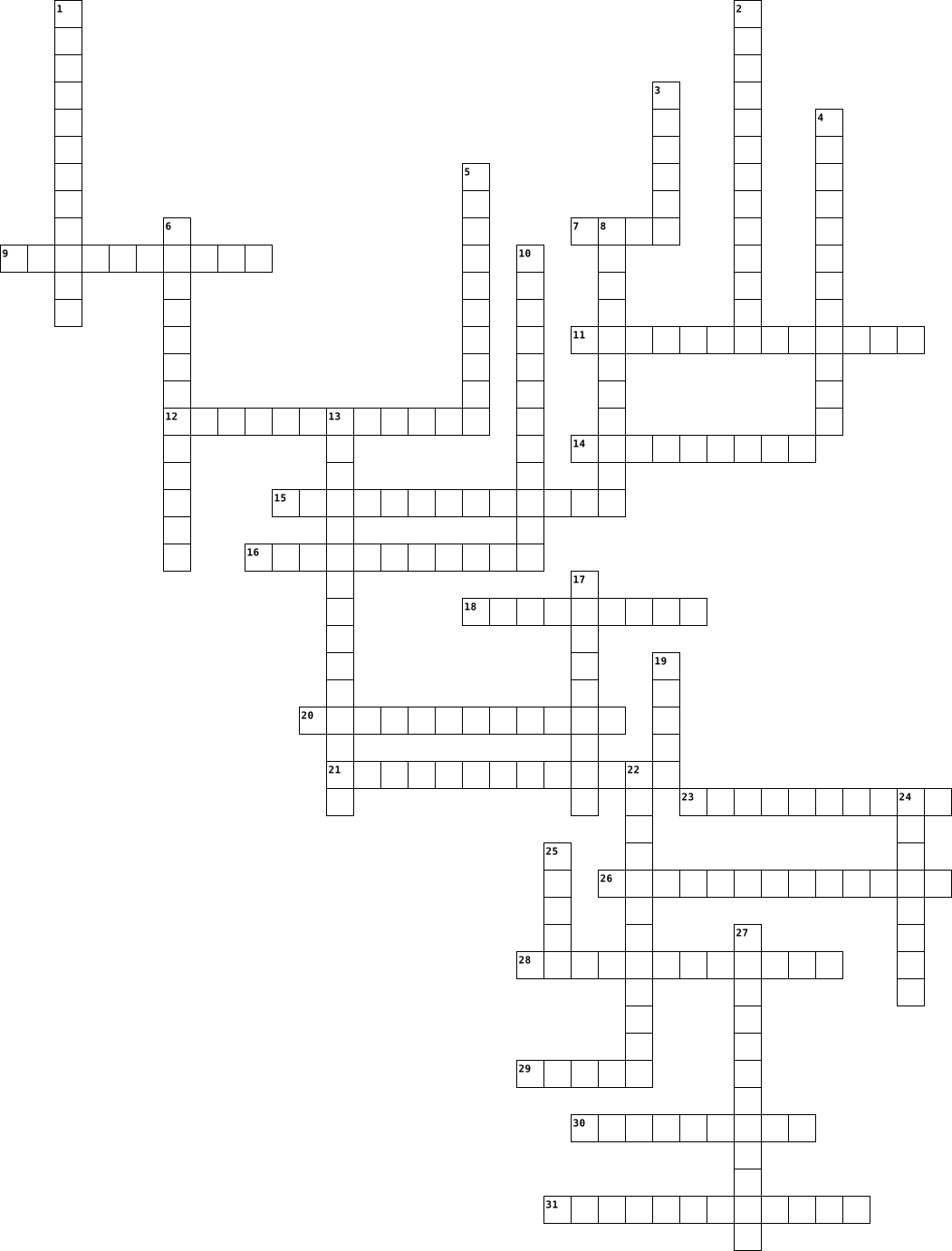
Across
- number of steps involved between carbonyl and Grignard reagents
- product of Carboxylate and acid chloride
- -The type of IR stretches in different directions
- The shape of intermediate product in the Fischer Esterification reaction
- alcohol formed from ketone
- method of compound elucidation
- the addition product of aldehyde and alcohol
- high temperature and solubility of carbonyl compounds is due to what physical property
- -Widely used reagent used to methylate carboxylic acid
- most common addition reaction of carbonyl compounds
- product of the nucleophilic addition, first step between carbonyls and organometallic reagents
- the simplest form of carbonyl compound
- second step in the formation of amides
- compound with high wavenumber require – energy for IR vibration
- organometallic reagents containing Mg also known as
- shift carbonyl compound IR stretch to a lower wavenumber
Down
- -The name of solvent in nucleophilic addition carbonyl and organometallic
- -R-Metal compound is called
- hydroxyl and acid stretch appears
- second step in the reaction of carbonyl and organometallic compound
- alcohol synthesised from aldehyde
- widely used reagent used to methylate carboxylic acid
- inverse of wavelength
- the second step in fisher’s esterification
- acid catalysed reaction between a carbonyl and excess alcohol
- planar shape of a carbonyl compound
- carbonyl compound with a leaving group other than OH
- the addition product of cyanide and carbonyl compound
- The absorption of IR radiation causes bond of C=O to
- -The product of amine and carboxylic acid after heating
- region in IR spectrum between 1000-1400 cm-1
31 Clues: inverse of wavelength • alcohol formed from ketone • -R-Metal compound is called • method of compound elucidation • hydroxyl and acid stretch appears • alcohol synthesised from aldehyde • planar shape of a carbonyl compound • the simplest form of carbonyl compound • second step in the formation of amides • product of Carboxylate and acid chloride • ...
Chemistry Review 2021-03-21

Across
- A group of elements missing an electron in their outermost shell
- The name for having more or fewer electrons than protons
- Another name for an energy level
- A substance that increases the rate of a chemical reaction
- A solution in which the solvent is water
- A positively charged ion
- The ‘inventor’ of the modern Periodic Table
- The location of electrons
- a pattern of gradual change
- the rule describing the tendency of atoms to react in order to obtain a full outer shell
- A positively charged sub-atomic particle
- A column of elements in the periodic table
- Protons + Neutrons
- A neutral compound consisting of anions and cations
- A substance in which two or more elements are bonded together
- An element with a full valence shell of electrons
- The number of protons in the nucleus of an atom
- The relationship between the mass of a substance and the space it takes up
Down
- The bond formed between two non-metals
- A group of atoms bonded together
- Any element in the d-block (groups 3 – 12) of the periodic table
- An element in Group 1 of the Periodic Table
- An atom with a specific number of protons
- electrons involved in chemical bond formation
- A bond in which electrons are shared
- When elements/compounds exist together but without chemical bonds
- A negatively charged sub-atomic particle
- A sub-atomic particle with no charge
- The horizontal rows of the Periodic Table
- The bond formed between a metal and a non-metal in which electrons are transferred
- The arrangement of the nucleus and electrons
- An atom which has gained or lost an electron
- A negatively charged ion
33 Clues: Protons + Neutrons • A positively charged ion • A negatively charged ion • The location of electrons • a pattern of gradual change • A group of atoms bonded together • Another name for an energy level • A bond in which electrons are shared • A sub-atomic particle with no charge • The bond formed between two non-metals • A solution in which the solvent is water • ...
Organic chemistry 2021-03-25

Across
- Tertiary alcohol turns cloudy immediately in test.
- A compound which have the same molecular formula but a different structural formula.
- Reaction of alkenes with hydrogen, water or bromine.
- The conversion of glucose by microorganisms such as yeast into ethanol and carbon dioxide.
- Hydrocarbon that contains one or more carbon-carbon double bonds.
- A substance that increases the rate of a chemical reaction without itself undergoing any permanent chemical change.
- A molecule that can be bonded to other identical molecules to form a polymer.
- The breaking down of long chain hydrocarbon molecules a catalyst to produce smaller hydrocarbon molecules and/or hydrogen.
- a sweet smelling chemical made by reacting an alcohol with an organic acid.
- A formula which shows how the atoms are arranged in a molecule.
Down
- A test to differentiate cyclopentane and cyclopentene that gives observation of reddish brown solution decolourised.
- A process that separates the components in a mixture on the bases of their different boiling points.
- An organic acid containing the carboxyl group.
- Positive Tolen's Test.
- Used for fractional distillation of crude oil.
- A mixture of hydrocarbons present under the earth's crust as a black sticky liquid.
- The temperature at which a substance boils and turns to vapour.
- Hydrocarbon having the general formula CnH2n+2.
- A very large molecule built up of a number of repeating units called monomers.
- A group of molecules attached to a backbone chain of a long molecule.
20 Clues: Positive Tolen's Test. • An organic acid containing the carboxyl group. • Used for fractional distillation of crude oil. • Hydrocarbon having the general formula CnH2n+2. • Tertiary alcohol turns cloudy immediately in test. • Reaction of alkenes with hydrogen, water or bromine. • The temperature at which a substance boils and turns to vapour. • ...
Chemistry Crossword 2021-10-20

Across
- combustion reaction is a reaction in which a substance reacts with oxygen gas, releasing energy in the form of light and heat
- formation of an insoluble salt when two solutions containing soluble salts are combined.
- listed in descending order of reactivity.
- the amount of product resulting from a chemical reaction
- a substance that enters into and is altered in the course of a chemical reaction.
- contain two atoms that are chemically bond
- reactions or processes that release energy
- number placed in front of symbols or formulas in a chemical equation to indicate their relative amount.
- a process in which one or more substances, also called reactants, are converted to one or more different substances, known as products
- Matter occurs in four states: solids, liquids, gases, and plasma
Down
- a compound breaks down into two or more simpler substances
- occur when parts of two ionic compounds are exchanged, making two new compounds.
- a new aqueous compound and a different pure element will be generated as products.
- a conversion factor that relates the amounts in moles of any two substances in a chemical reaction
- states that in a chemical reaction mass is neither created nor destroyed.
- eactions that require external energy
- the correct number of reactants and products to satisfy the Law of Conservation of Mass
- An insoluble substance is a substance (solid) that will not dissolve in a solvent even after mixing (eg; sand and water)
- reactions that occur when two different atoms or molecules interact to form a different molecule or compound
- a substance that is formed as the result of a chemical reaction
- a solid formed by a change in a solution
- The solid that dissolves is called the 'solute
22 Clues: eactions that require external energy • a solid formed by a change in a solution • listed in descending order of reactivity. • contain two atoms that are chemically bond • reactions or processes that release energy • The solid that dissolves is called the 'solute • the amount of product resulting from a chemical reaction • ...
Chemistry Crossword!!!! 2021-10-22

Across
- the w in whmis
- molecular compounds have a ____ boling point
- physical properties that can be observed but not measured
- negatively charged ionic compound
- sodium chloride
- creator of the planetary model
- a vertical column of elements
- number of protons + number of neutrons
- amount of matter per unit volume
- protons are ________ charged atoms
- an element with a full valence shell is _______
- the measure of attraction between different materials
- Element with the symbol Li
- what happens to the electrons in metal elements
- metals are on this side of the periodic table
- not stable
- type of compound with high melting and boiling point
- mechanical mixture synonym
- attractive forces between particles in this state are very strong
- ability of a substance to react with oxygen
- has properties of both metal and non-metal
Down
- correlation does not equal _________
- the border of the hhps symbol is a triangle meaning the __________ is dangerous
- positively charged ion
- negatively charged particles
- most reactive non-metal
- graduated ___________
- diagram to represent the atomic structure of an element
- an atom of the same element that has a different number of neutrons
- non-metal and non-metal bond together to form
- outermost shell
- the ability of a substance to dissolve in a solvent such as water
- type of statement to use in a hypothesis an educated guess
- atomic radius ________ from right to left
- in a period, all elements have a similar number of _____
35 Clues: not stable • the w in whmis • sodium chloride • outermost shell • graduated ___________ • positively charged ion • most reactive non-metal • Element with the symbol Li • mechanical mixture synonym • negatively charged particles • a vertical column of elements • creator of the planetary model • amount of matter per unit volume • negatively charged ionic compound • ...
Aromatic Chemistry 2021-11-10

Across
- what is the reaction of treating or combining with nitric acid or a nitrate
- Term given to a cyclic compound following all four rules including Huckels rule
- What is the reaction name describes where the diazonium ion reacts with cuprous salts
- Type of reduction reaction used to turn a C=O group into a CH2 group in basic conditions
- The position of deactivating groups on benzene ring
- Compound where a methyl is attached to a benzene
- Structural isomers of compounds resulting in movement of atoms as well as electrons.
- what involves the only the movement of electrons, never electrons
- ......... rule is where '4n+2' pi electrons must be included for the compound to have aromaticity.
- The name given to an atom, molecule or ion that has at least one unpaired electron.
- Ion formed from the reaction of aniline in the presence of NaONO and HCl
- What was the surname of the scientist that proposed a structure of benzene in which the molecule has a hexagonal ring of carbon atoms linked by single and double bonds.
- Describes the 2d structure of a molecule
Down
- What is the overlap of more then 2 p orbitals in an acyclic or cyclic system
- What property of alkyl groups allow them to be activating groups
- What is used to wash away AlCl3 that has reacted with oxygen in the Friedel-Craft acylation reaction?
- Chemical species that accepts electron pairs (loves electrons)
- Type of reduction reaction used to turn a C=O into CH2 group in acidic conditions
- What is the name of an aromatic compound which contains heteroatoms
- What is a cyclic compound that has atoms of at least two different elements as a member of its rings.
- what forms bonds with electrophiles via the process of donating an electron pair
- what requires a cyclic system to be fully conjugated
- what is a functional group that contains a carbon atom that is double bonded to an oxygen atom
23 Clues: Describes the 2d structure of a molecule • Compound where a methyl is attached to a benzene • The position of deactivating groups on benzene ring • what requires a cyclic system to be fully conjugated • Chemical species that accepts electron pairs (loves electrons) • What property of alkyl groups allow them to be activating groups • ...
Chemistry vocab 2022-03-30

Across
- components that make it up are uniform
- makes up the universe
- how easily it can be bent or put into a shape
- no shape and no volume
- negative part of the atom
- how easily it will break
- how shiny the element is
- ability to undergo a chemical reaction
- what does the dissolving
- reaction that releases heat
- consists of two or more chemical elements
- positive part of the atom
- atoms are not moving and have a fixed shape and volume
Down
- gas that is supercharged
- ability to dissolve a substance
- reaction that absorbs heat
- substance with only one type of atom
- everything is made of this
- composition is always the same
- what is being dissolved
- it has different properties
- ability to be stretched in a wire
- atoms are more fluid, have a defined shape but no shape
- smallest particle with properties of that element
- neutral part of the atom
25 Clues: makes up the universe • no shape and no volume • what is being dissolved • gas that is supercharged • how easily it will break • how shiny the element is • what does the dissolving • neutral part of the atom • negative part of the atom • positive part of the atom • reaction that absorbs heat • everything is made of this • it has different properties • reaction that releases heat • ...
Chemistry Elements 2022-04-07

Across
- Makes up most of the air we breathe
- Added to water for cavity free teeth
- Electrical wires
- strong bones
- Used in balloons to make them float
- Caused thousands of people to "rush"
- A liquid that is put on cuts
- Extremely radioactive synthetic element that is not found in nature
- Used in nuclear reactors
- Bananas
- Most reactive metal
- The element of life and energy
Down
- Used in lights
- C6H12O6
- A light and explosive gas
- used in batteries, old paint and diving weights
- Atomic number 94
- If you come second
- kills germs in swimming pools
- Gets its name from the Greek word for "colour"
- With chlorine, I am salt
- Cans and foil
- Only metal that's liquid at room temperature
- Essential for blood production
- A gas produced by trees
- A metal and US coins
- H2O
- The gas smells like rotten eggs
28 Clues: H2O • C6H12O6 • Bananas • strong bones • Cans and foil • Used in lights • Electrical wires • Atomic number 94 • If you come second • Most reactive metal • A metal and US coins • A gas produced by trees • With chlorine, I am salt • Used in nuclear reactors • A light and explosive gas • A liquid that is put on cuts • kills germs in swimming pools • Essential for blood production • ...
Chemistry Review 2021-12-14

Across
- evenly mixed
- same number of energy levels
- energy it takes to remove an electron
- negatively charged ion
- an idea that has evidence to support it
- nonmetal and nonmetal
- the same number of valence electrons
- decay radioactive isotopes emit a
- positively charged ion
- property is something that is measurable or observed
- structures show valence electron bonds
- color of light
- between metals
- decay does NOT involve particles emission
- spectrum range of wavelengths radiate
- sheet with hazards and properties of a chemical
- radius size of atom bottom left
- property reactivity or chemical composition
- electron jumps up a level
- substance substance that can not be physically separated
- property physical property that depends on the amount (size, mass, and volume)
- metal and nonmetal
- change element charge doesn't change mass
Down
- fission large nuclei split to form small, stable nuclei
- if it can dissolve in water
- breaks down
- location of an electron
- charged particles
- NH4
- unstable isotope
- more than 2 elements
- jumps down a level
- an educated guess
- two or more substances physically combined
- same element with different masses
- how badly an atom want boning e-
- NO3 -
- property physical property that does NOT depend on the amount
- SO4-2
- unevenly mixed
- fusion small nuclei to form one large nuclei
- gives off energy
42 Clues: NH4 • NO3 - • SO4-2 • breaks down • evenly mixed • color of light • between metals • unevenly mixed • unstable isotope • gives off energy • charged particles • an educated guess • jumps down a level • metal and nonmetal • more than 2 elements • nonmetal and nonmetal • negatively charged ion • positively charged ion • location of an electron • electron jumps up a level • if it can dissolve in water • ...
chemistry final 2021-12-13

Across
- beta particle
- gamma ray
- mass number
- ion
- alpha particle
- cation
- beta radiation
- anion
- isotope
- hydrate
Down
- percent by mass
- anhydrate
- atomic mass unit
- nuclear equation
- neutron
- percent compisition
- alpha radiation
- nucleus
- proton
- molar mass
20 Clues: ion • anion • cation • proton • neutron • nucleus • isotope • hydrate • gamma ray • anhydrate • molar mass • mass number • beta particle • alpha particle • beta radiation • percent by mass • alpha radiation • atomic mass unit • nuclear equation • percent compisition
Chemistry Review 2021-12-13

Across
- Solid, Liquid, and Gas are the ______ of matter.
- Anything that has mass and occupies space.
- A measure of the amount of space that is occupied by matter.
- The temperature then a liquid changes to a solid.
- The state of matter where the matter takes on the shape of its container.
- Changes that can be reversed.
- The temperature when a solid changes to a liquid.
- The mass per unit volume of a substance.
- In this type of change the substance remains the same, even though its form or state may change.
- A measure of the amount of matter in a object.
- A characteristic that may help to identify a substance.
- A solid material that forms in a liquid.
- The state of matter which has a fixed shape and a fixed volume.
- The change from a gas to a liquid.
- The theory that matter is made up of tiny particles that are always moving.
Down
- The correct spelling of your teacher's name.
- The change from a liquid to a gas.
- The formula to calculate the volume of a rectangle is _____ x width x height.
- In this type of change the substance is changed into one or more different substances with different properties.
- The formula to calculate density is mass/_____.
- The temperature when a liquid changes to a gas.
- when a solid changes directly to a gas without first becoming a liquid.
- Frying an egg is a _______ change.
- A container that you would put water into in order to measure the volume of an irregular object.
- A gas that has electricity running through it.
25 Clues: Changes that can be reversed. • The change from a liquid to a gas. • Frying an egg is a _______ change. • The change from a gas to a liquid. • The mass per unit volume of a substance. • A solid material that forms in a liquid. • Anything that has mass and occupies space. • The correct spelling of your teacher's name. • A gas that has electricity running through it. • ...
Chemistry Puzzle 2022-01-04

Across
- a chemical that starts or speeds up a reaction
- turn blue litmus paper red and taste sour
- a reaction that gives off energy
- are full often brittle and do not conduct heat or electricity
- a negatively charged particle in the atom
- the smallest unit of an element
- A bond where atoms lend or borrow electrons
- the first person to come up with a periodic table
- Has neutral pH
- share attributes of both metals and non metals
- are shiny and conduct heat and electricity
Down
- the number of protons
- the study of how elements and their combinations
- used to determine whether a substance is an acid or a base
- a base used to wash your hands
- a citrus fruit that is an example of an acid
- turn red litmus paper blue and taste bitter
- the neutral particle in an atom
- a reaction that requires energy
- these elements rarely react with others
- The positively charged particle in the nucleus of an atom
- a bond where atoms share electrons
22 Clues: Has neutral pH • the number of protons • a base used to wash your hands • the neutral particle in an atom • a reaction that requires energy • the smallest unit of an element • a reaction that gives off energy • a bond where atoms share electrons • these elements rarely react with others • turn blue litmus paper red and taste sour • a negatively charged particle in the atom • ...
Basic Chemistry 2022-03-16

Across
- each element has this number
- alters the composition of a substance
- do not alter the basic nature of a substance
- the heavier isotopes
- one or two letter chemical shorthand
- inactive and stored
- stored in bonds of chemical substances
- does not take up space
- smallest particle ever
- The more modern model of atomic structure
- process of spontaneous atomic decay
- from the movement of charged particles
Down
- doing work
- have a positive charge
- directly involved in moving matter
- same number of protons and electrons
- energy that travels in waves
- The table of elements
- are uncharged and neutral
- the sum of protons and neurons
- have a negative charge
21 Clues: doing work • inactive and stored • the heavier isotopes • The table of elements • have a positive charge • does not take up space • smallest particle ever • have a negative charge • are uncharged and neutral • each element has this number • energy that travels in waves • the sum of protons and neurons • directly involved in moving matter • process of spontaneous atomic decay • ...
General Chemistry 2022-03-12
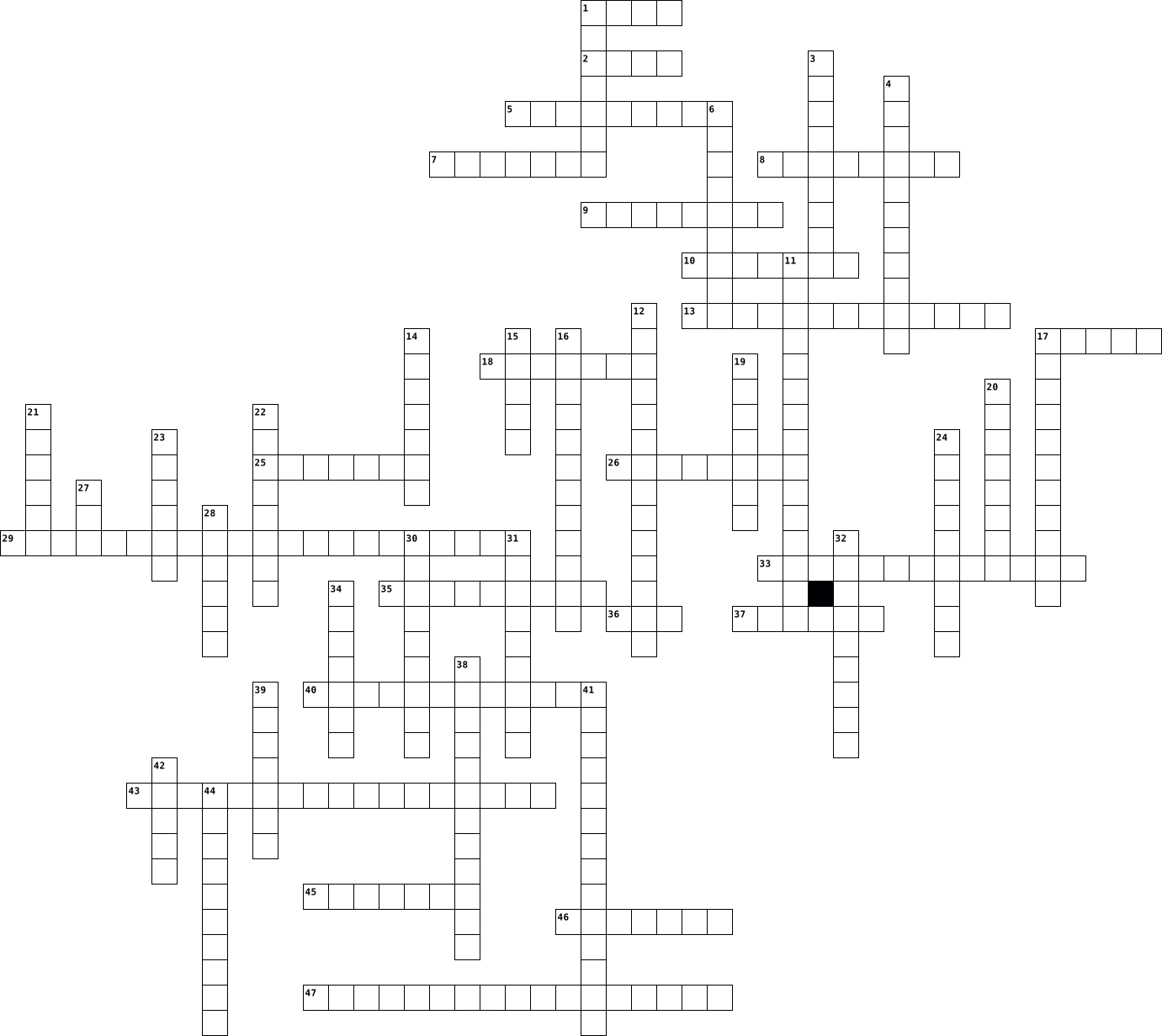
Across
- a loose orange brown flaky layer of hydrated iron oxide.
- The product (other than water) of the reaction between an acid and a base.
- a mixture of organic compounds formed, as a result of high temperatures and pressures, from the remains of living plants and animals which died millions of years ago.
- One of several possible forms of a chemical element that differ from others in the number of neutrons in the atomic nucleus, but not in chemical properties.
- A process when you add solvent to a solution to make it less concentrated.
- An expression showing the chemical formulas of the reactants and products (both in symbols).
- The electrode in which reduction occurs.
- The number of protons in the nucleus of an atom; determines the identity of the element and the number of electrons in the neutral atom.
- an alloy of iron with other elements.
- An organic compound containing the hydroxyl group -OH.
- a small molecule that can be joined together to make a long molecule called a polymer; a monomer must have a double bond or a functional group at either end.
- the breaking down of long-chain alkanes into smaller alkanes and alkenes using a catalyst and heat (500 C).
- weak forces of attraction between
- A breakdown reaction of a compound into two or more components.
- The analysis of composition by measuring the volume of one solution (titrant) needed to react with a given volume of another solution (the analyte).
- An atom or molecule that has lost or gained one or more electrons, and thus becomes positively or negatively charged.
- Anything that occupies space and possesses mass.
- The separation of a mixture by making use of the different volatilities of its components.
- a list of metals with the most reactive metal first based on results from experiments.
- a homologous series of hydrocarbons that are unsaturated as they have at least 1 double bond somewhere in the chain.
- the combining power of an atom or group of atoms; in an ionic compound the valency of an ion is its charge; in a molecule the valency of an atom is the number of bonds it makes.
- A reduced molecular formula.
Down
- the insoluble part that remains behind in the filter paper during filtration or what is left in the flask.
- An element with properties intermediate between those of metals and nonmetals; i.e.: it has the physical appearance and properties of metal but behaves chemically like a nonmetal.
- A state in which the rates of the forward and reverse reactions are equal.
- an oily but soft substance used to reduce friction between two moving surfaces.
- a chemical which oxidizes another chemical; it loses oxygen/gains electrons and becomes reduced.
- a chemical reaction in which many small
- An electrochemical cell, or often several electrochemical cells connected in series, that can be used as a source of direct electric current at a constant voltage.
- A solid solution composed of two or more metals, or of a metal or metals with one or two nonmetals.
- The phenomenon of going from the gaseous state to the liquid state.
- a process during which a solid changes directly into a gas because its particles have alot more energy, move around very fast and are very far apart.
- regular 3-dimensional arrangement of the particles (atoms, ions or molecules).
- A substance that increases the rate of a reaction without being consumed in the reaction.
- A subatomic particle having a single positive electric charge.
- A substance composed of atoms of two or more elements chemically united in fixed properties.
- An energy-containing particle of light.
- The theory of elementary gas-phase bimolecular reactions in which it is assumed that molecules react only if they collide with at least enough kinetic energy for bonds to be broken.
- The natural mineral source of a metal; e.g. hematite; etc.
- horizontal row in the Periodic Table.
- A reaction in which an atom, ion, or molecule loses an electron.
- When the maximum amount of solute is dissolved in a liquid.
- or monomers are joined together to form a long molecule called a polymer.
- A type of covalent bond joining amino acids in a polypeptide.
- A process in which a chemical change is produced by passing an electric current through a
- an ore containing aluminium oxide from which aluminium is extracted.
- a reaction between an acid and a base to produce water and a salt and sometimes also carbon dioxide.
- A reaction that has both oxidation and reduction.
- burning, the reacting of a substance with oxygen, exothermic.
49 Clues: A reduced molecular formula. • weak forces of attraction between • an alloy of iron with other elements. • horizontal row in the Periodic Table. • a chemical reaction in which many small • An energy-containing particle of light. • The electrode in which reduction occurs. • Anything that occupies space and possesses mass. • A reaction that has both oxidation and reduction. • ...
Chemistry Crossword 2022-04-19

Across
- ____ properties are observed by changing molecular structure
- Unit of volume used for irregular solid objects
- ____ properties can be observed without changing molecular structure
- The only chemical that is less dense as a solid than a liquid
- _______mixtures can be easily separated into its individual substances
- The "main body" of a solution.
- The subatomic particle that defines the element of an atom
- When an atom gains or loses electrons, it becomes a(n) ______
- Archimedes discovered this ratio that is constant for each substance
Down
- How much space does a substance take up
- This number in a formula determines how many molecules of that chemical there are
- The "ingredients" that go into a chemical reaction
- This is one of several variants of an element based on how many neutrons it has
- Of the three states of matter, this one is the least dense
- The element group that would likely gain only one electron
- How much matter is inside a substance
- The subatomic particle that affects bonding between atoms
- The final result of a chemical reaction
- How easily a substance dissolves into another
- Has a defined volume but not a defined shape
- The subatomic particle that has neither positive nor negative charge
21 Clues: The "main body" of a solution. • How much matter is inside a substance • How much space does a substance take up • The final result of a chemical reaction • Has a defined volume but not a defined shape • How easily a substance dissolves into another • Unit of volume used for irregular solid objects • The "ingredients" that go into a chemical reaction • ...
Chemistry crossword 2022-04-22

Across
- The transition of colours
- Non-metals bonding create ___ bonds
- Metals and non-metals bonding create ___ bonds
- Another example of pure substances besides elements
- When you leave a metal object outside for long periods of time, it begins to ___
- The right side of the periodic table
- When two liquids create a solid
- The transition of liquid to gas
- Classifications of ____
- A uniform mixture
- In the periodic table, groups are also known as ____
Down
- made up of only one kind of particles and has a fixed or constant structure
- How breakable an object is
- Another word for smell
- A substance’s ability to let light flow through it
- The number of protons and electrons in an atom
- The left side of the periodic table
- The ability of a substance to burn in air
- The inbetween of non-metals and metals
- Mass of an atom
20 Clues: Mass of an atom • A uniform mixture • Another word for smell • Classifications of ____ • The transition of colours • How breakable an object is • When two liquids create a solid • The transition of liquid to gas • Non-metals bonding create ___ bonds • The left side of the periodic table • The right side of the periodic table • The inbetween of non-metals and metals • ...
Chemistry Crossword 2022-04-26

Across
- the spontaneous emission of alpha particles
- fast-moving electrons emitted by a radioactive substance
- Isotopes that have the same number of neutrons
- Combining smaller nuclei into bigger nuclei
- when a nuclide is produced in an excited state
- the time it takes for half of the particles in a sample to decay
- particle of ionizing radiation consisting of 2 protons and 2 neutrons
- isotopes of the same mass
- radioactive decay process where an element may decay to another element that may also be radioactive
- electromagnetic radiation of very short wavelength
Down
- Nucleus formed during the radioactive decay process
- of a substance emitting particles and radiation and being unstable
- The number of nucleons (P+N) of an atom
- The same as the number of protons
- spontaneous emission of beta particles
- a tool used to measure the relative abundance of atoms and molecules
- Atoms with the same proton number, but a different number of neutrons
- of an atom, having a ratio of 1-1.5 of neutrons to protons
- Change that leads to the degeneration of a substance
- splitting nuclei into smaller nuclei
20 Clues: isotopes of the same mass • The same as the number of protons • splitting nuclei into smaller nuclei • spontaneous emission of beta particles • The number of nucleons (P+N) of an atom • the spontaneous emission of alpha particles • Combining smaller nuclei into bigger nuclei • Isotopes that have the same number of neutrons • when a nuclide is produced in an excited state • ...
Chemistry Revision 2022-04-27

Across
- The _______________ number is the number
- The type of ion resent in acids
- The type of reaction which occurs when a
- protons
- formula but different displayed
- The type of bonding between a metal and a
- reactive metal displaces a less
- The most abundant gas in the Earth's atmosphere
- column
- The homologous series with the general
Down
- metal from a compound
- The process of coating iron with zinc
- A form of an element with the same number of protons but a different number of
- The gain of electrons
- The unit for the amount of a substance
- An organic substance with the same
- The type of ion present in alkalis
- The state change when a gas turns into a liquid
- CnH2n
- metal
- The fraction at the bottom of the
- The colour of copper carbonate
22 Clues: CnH2n • metal • column • protons • metal from a compound • The gain of electrons • The colour of copper carbonate • The type of ion resent in acids • formula but different displayed • reactive metal displaces a less • The fraction at the bottom of the • An organic substance with the same • The type of ion present in alkalis • The process of coating iron with zinc • ...
Chemistry Crossword 2022-05-17

Across
- measurement of matter
- reaction between a fuel and an oxidant
- mathematical function that describes the wave-like behavior of an electron
- liquid that dissolves the solute newton units for weight in the metric system
- saturated hydrocarbons
- solid formed from 2 aqueous solutions mixed
- C3H8
- equal to the amount of atomic number
- breaking down large hydrocarbons to smaller ones
- hydrocarbon with one or more triple bonds
- unit of measure abbreviated mol.
- solution
- subatomic particle whose electric charge is negative one elementary charge
- C8H18
- diagrams that show the bonding between atoms of a molecule
- atom with a charge
- mass of one mole of a substance
- solid that is dissolved
- the artificial execution of chemical reactions to obtain one or several products
- how many peaks pass a point in a period of time
- negatively charged ion
- compounds containing only carbon and hydrogen
Down
- compounds with a scent
- gaining of knowledge through study, observation, and experimentation
- unit of measurement for weight
- number of moles of solute per liter
- units for volume on the metric system
- a thoroughly tested explanation for what is observed
- electrons in the outermost ring
- ability of an atom to attract electrons to itself
- process or effect of simplifying a single chemical entity into two or more fragments
- How many peaks pass a point in a period of time
- hydrocarbon with one or more double bonds
- uniform throughout
- amount of space
- relationships between quantities of substances that take part in a chemical reaction
- distance from the nucleus of an atom to the outer ring
- positively charged ion
- liquid that dissolves the solute
- grouping of electrons in a shell according to the shape of the region of space they occupy
- distance between 2 points
- has the same molecular formula but a different structure
42 Clues: C3H8 • C8H18 • solution • amount of space • uniform throughout • atom with a charge • measurement of matter • compounds with a scent • saturated hydrocarbons • positively charged ion • negatively charged ion • solid that is dissolved • distance between 2 points • unit of measurement for weight • electrons in the outermost ring • mass of one mole of a substance • unit of measure abbreviated mol. • ...
Chemistry Crossword 2022-05-17

Across
- What hydrocarbon is C2H6?
- whos number is 6.02 x10^23
- double bonds
- solid that is dissolved
- What hydrocarbon is CH4?
- molar mass hydrocarbons are usually gases or liquids.
- triple bonds
- a mixture of a solvent and a solute
- What hydrocarbon is C8H18?
- Hydrocarbons that contain all single bonds.
- the relationship between the relative quantities of substances taking part in a reaction or forming a compound, typically a ratio of whole integers.
- What hydrocarbon is C7H16?
- What hydrocarbon is C4H10?
- what is the abbreviation for standard temperature and pressure?
Down
- can be structural or geometric
- What hydrocarbon is C5H12?
- What hydrocarbon is C10H22?
- What hydrocarbon is C9H20?
- What hydrocarbon is C6H14
- the degree to which a solute dissolves
- one that has all the solute it can hold at a constant temperature.
- the atomic mass units of the elements in a formula
- What compounds only contain carbon and hydrogen?
- What hydrocarbon is C3H8?
- C10H22
- what are you solving for if you divide moles by volume?
- liquid that dissolves solute
27 Clues: C10H22 • double bonds • triple bonds • solid that is dissolved • What hydrocarbon is CH4? • What hydrocarbon is C2H6? • What hydrocarbon is C6H14 • What hydrocarbon is C3H8? • What hydrocarbon is C5H12? • whos number is 6.02 x10^23 • What hydrocarbon is C9H20? • What hydrocarbon is C8H18? • What hydrocarbon is C7H16? • What hydrocarbon is C4H10? • What hydrocarbon is C10H22? • ...
Chemistry Puzzle 2022-06-01

Across
- a term for liquids that dissolve others
- The Scientist who created the unit "mole"
- this is the term used to describe the amount of electrons in the outermost shell of an atom
- A group on the periodic table that is not as reactive, malleable or ductile
- An Atom or molecule that carries a charge
- A group in the 7th row of the periodic table that contains highly reactive elements
- A term used to describe a bond in which Electrons are not shared
- any variable added to a reaction to speed it up
- Has a negative charge
- a substance that takes part in and undergoes change during a reaction
- A group on the periodic table that is highly conductive, Malleable, and ductile
Down
- A group of metals in-between the halogens and the metals that look like metal but show properties exhibited by gases (The zigzag on the periodic table)
- A group of gasses located in row 8 of the periodic table, they are not very reactive because they have 8 valance electrons
- the name of the structure formed when ions are created
- Has no charge
- the branch of science that deals with the Identification of the substances of which matter is composed
- A bond in which electrons are being shared
- a term for elements that can be dissolved
- A groups of earth metals that are located in the second row on the periodic table
- Has a Positive charge
- A large group of metals on the periodic table that are malleable, ductile, and conducts electricity
21 Clues: Has no charge • Has a Positive charge • Has a negative charge • a term for liquids that dissolve others • The Scientist who created the unit "mole" • An Atom or molecule that carries a charge • a term for elements that can be dissolved • A bond in which electrons are being shared • any variable added to a reaction to speed it up • ...
chemistry crossword 2022-05-10

Across
- The specific set of principal, angular momentum, and magnetic quantum numbers for an electron.
- The centre of an atom that contains protons and neutrons
- Atoms of the same element that have different numbers of neutrons
- A species with an overall negative charge
- A gas law that relates volume and temperature at constant pressure and amount
- A compound that increases the amount of OH− ions in an aqueous solution
- A physical combination of more than one substance
- a positive charged subatomic particle
- neutral subatomic particle
- negatively charged subatomic particle
- the chemical elements in group one of the periodic system
Down
- Law of physics that states that the total energy of an isolated system does not increase or decrease.
- A gas law that relates pressure and volume at constant temperature and amount
- are located to the far right of the periodic table and make up the eighteenth column
- the hardest part of chemistry
- the science that deals with the properties, composition, and structure of substances
- A combination of more than one element
- A species with an overall positive charge
- An element that exists in various colors and phases, is brittle, and does not conduct electricity or heat well
- The number of things equal to the number of atoms in exactly 12 g of carbon-12; equals 6.022×10²³ things
- A compound that increases the amount of H+ ions in an aqueous solution
21 Clues: neutral subatomic particle • the hardest part of chemistry • a positive charged subatomic particle • negatively charged subatomic particle • A combination of more than one element • A species with an overall negative charge • A species with an overall positive charge • A physical combination of more than one substance • ...
chemistry crossword 2022-05-10

Across
- the science that deals with the properties, composition, and structure of substances
- Atoms of the same element that have different numbers of neutrons
- A species with an overall positive charge
- Law of physics that states that the total energy of an isolated system does not increase or decrease.
- negatively charged subatomic particle
- are located to the far right of the periodic table and make up the eighteenth column
- a positive charged subatomic particle
- the chemical elements in group one of the periodic system
- A gas law that relates pressure and volume at constant temperature and amount
Down
- A compound that increases the amount of OH− ions in an aqueous solution
- A physical combination of more than one substance
- The specific set of principal, angular momentum, and magnetic quantum numbers for an electron.
- neutral subatomic particle
- The centre of an atom that contains protons and neutrons
- A species with an overall negative charge
- The number of things equal to the number of atoms in exactly 12 g of carbon-12; equals 6.022×10²³ things
- A gas law that relates volume and temperature at constant pressure and amount
- A combination of more than one element
- A compound that increases the amount of H+ ions in an aqueous solution
- An element that exists in various colors and phases, is brittle, and does not conduct electricity or heat well
- the hardest part of chemistry
21 Clues: neutral subatomic particle • the hardest part of chemistry • negatively charged subatomic particle • a positive charged subatomic particle • A combination of more than one element • A species with an overall negative charge • A species with an overall positive charge • A physical combination of more than one substance • ...
Chemistry Crossword 2022-05-09

Across
- elements in grup 8A in the periodic table
- ______ law states that for a given mass of gas at constant temperature , the volume of gas varies with pressure
- the ability to form a solution to form a solution with a solvent
- the process of making a base or acid neutral by using one of the other.
- the heat flow of a system at constant pressure
- a homogeneous mixture
- the amount of heat energy needed to raise the temperature from one gram of water 1⁰C.
- a measure of space occupied by matter
- any metal in group A1 in the periodic table
- _______table is an arrangement of elements that are separated into groups based on a set of repeating properties
- substance present at the start of a reaction
- describes the probability of finding a electron in various locations around the nucleus (Schrodinger equation).
- liquids that are insoluble in one another
- the breaking up or separation of a compound
Down
- the study of composition of matter and the changes the matter undergos
- neutral subatomic particle
- liquids that dissolve in one another
- standard temperature or pressure
- the portion of chemistry dealing with numerical relationships and chemical reactions
- a substance that creates hydroxide ions
- discovered the nucleus
- the dissolving medium in a solution
- negativly charged subatomic particle
- compound that produces hydrogen ions
- the concentration of solute in a solution expressed as the number of moles in a liter of solution.
25 Clues: a homogeneous mixture • discovered the nucleus • neutral subatomic particle • standard temperature or pressure • the dissolving medium in a solution • liquids that dissolve in one another • negativly charged subatomic particle • compound that produces hydrogen ions • a measure of space occupied by matter • a substance that creates hydroxide ions • ...
Chemistry Puzzle 2022-05-20

Across
- PI3
- Hydrochloric acid
- The ratio of the amount of each element to the total amount of individual elements present in the compound multiplied by 100.
- Are acids that contain hydrogen, oxygen, and a third element
- 22.99 g/mol
- Oxidation number always +2
- 18.02 g/mol
- Boric acid
- The sum of the average atomic masses of each atom represented in the chemical formula
- 14.01 g/mol
- Chemical compounds comprising two distinct elements
- Oxidation number always +1
- Simplest whole-number ratio of atoms present in a compound.
- Hydrosulfuric acid
Down
- NBr3
- Phosphorous acid
- 12.01 g/mol
- Carbonic acid
- IF5
- 16.00 g/mol
- The process of naming chemical compounds with different names
- An anion containing one or more oxygen atoms bonded to another element
- How many atoms of each element are in a compound
- An ion formed from a single atom.
- BF3
- Are acids that consist of two elements, usually hydrogen and a halogen.
- Sulfuric acid
- Hydrophosphoric acid
- B6Si
- Oxidation number always -1
30 Clues: PI3 • IF5 • BF3 • NBr3 • B6Si • Boric acid • 12.01 g/mol • 16.00 g/mol • 22.99 g/mol • 18.02 g/mol • 14.01 g/mol • Carbonic acid • Sulfuric acid • Phosphorous acid • Hydrochloric acid • Hydrosulfuric acid • Hydrophosphoric acid • Oxidation number always +2 • Oxidation number always +1 • Oxidation number always -1 • An ion formed from a single atom. • How many atoms of each element are in a compound • ...
Chemistry 5.02 2022-05-28

Across
- has a pH of 7
- element found in all acids
- used to check pH level, indicator
- ions found in a alkali solution
- chemical symbol K
- pH above 7
- bond which consists of sharing electrons
- high concentration in a solution
- main topic key word
- chemical symbol NH
Down
- pH less than 7
- a mixture
- color acid becomes on the pH scale
- ions found in a acid solution
- color alkali becomes on the pH scale
- low concentration in a solution
- word used when something happens in a experiment
- way to know if it is a alkali solution
- bond which includes electrostatic attraction
- chemical symbol Na
- chemical symbol Ca
21 Clues: a mixture • pH above 7 • has a pH of 7 • pH less than 7 • chemical symbol K • chemical symbol Na • chemical symbol Ca • chemical symbol NH • main topic key word • element found in all acids • ions found in a acid solution • ions found in a alkali solution • low concentration in a solution • high concentration in a solution • used to check pH level, indicator • ...
Chemistry Vocab 2022-05-30

Across
- atoms break into nuclei and electrons, strong forces
- quantitative data that describes a property of an object
- the agreement among repeated measurements of the same quantity
- a solid that forms and settles out of a liquid mixture
- the study of the composition of matter and the changes it undergoes
- the agreement of a set of measurements with the true value
- anything that has mass and takes up space
- tightly packed molecules,rigid, low movement
Down
- seperation of solids from liquids
- substance present at beginning of the reaction
- substance that is produced after the reaction
- matter that can be seperated into simpler materials by physical methods
- a type of substance that cannot be broken down into simpler substances
- flows easily, takes shape of container, affected by gravity
- liquid to gas
- matter that cannot be seperated into simpler materials
- seperating water from other compounds
- a type of substance that can be broken down into simpler substances
- the amount of space that an object occupies
- quantity of matter in an object
- the state of matter a substance exists in
21 Clues: liquid to gas • quantity of matter in an object • seperation of solids from liquids • seperating water from other compounds • the state of matter a substance exists in • anything that has mass and takes up space • the amount of space that an object occupies • tightly packed molecules,rigid, low movement • substance that is produced after the reaction • ...
Chemistry: Matter 2022-09-01

Across
- is a measure of the amount of matter an object has
- two or more different substances are physically mixed (not chemically combined)
- Separating components of a liquid mixture based on how fast the parts travel up a special paper
- separating a liquid from another liquid, both have different boiling points
- made of only one type of atom
- unit to measure volume
- Separate two liquids with different density or separate liquid from a heavy sediment
- being dissolved
- Separating smaller solids from liquids using filter paper
- Example of a solvent
- mixture does not look uniform, can see the parts that make up the mixture
- separating two solids, one is magnetic
- substances that cannot be separated by physical mean
- Example of a solute
- is the amount of space an object takes up
Down
- made of two or more types of atoms
- dissolving the solution
- unit to measure mass
- Separating components of a mixture based on the difference in density
- Example of a mixture
- Anything that has a mass and takes up space
- composition is uniform, cannot see the parts that make up the mixture
- smallest unit of an element or compound
- Separating larger solids from smaller solids using a sieve
- all matter is made up of ____.
- separating a liquid from a solid that has been dissolved
26 Clues: being dissolved • Example of a solute • unit to measure mass • Example of a mixture • Example of a solvent • unit to measure volume • dissolving the solution • made of only one type of atom • all matter is made up of ____. • made of two or more types of atoms • separating two solids, one is magnetic • smallest unit of an element or compound • is the amount of space an object takes up • ...
Chemistry Crossword 2022-09-01

Across
- When two or more different substances are physically mixed, but NOT chemically combined.
- A measure of the amount of matter an object has.
- Separating smaller solids from liquids using filter paper.
- What is dissolving the solute.
- The smallest unit of an element OR a compound.
- Separating liquids with two different desities or separating a liquid from heavy sediments
- A substance that flows freely but is of constant volume.
- Is the amount of space an object takes up.
- Firm and stable in shape.
- Separating larger solids from smaller solids using a sieve.
- The composition of the mixture is uniform.
- Separating components of a liquid mixture based on how fast the parts travel up a special paper.
Down
- Separating a liquid from another liquid where both have different boiling points.
- Unit in which the mass of an object is measured
- A mixture that does not look uniform.
- What is being dissolved.
- Separating components of a mixture based on the difference in density of the parts of the mixture.
- Made of only ONE TYPE of atom.
- A substance or matter in a state in which it will expand freely to fill the whole of a container, having no fixed shape and no fixed volume.
- The smallest unit of an element that has the same chemical properties of that element.
- Made of TWO OR MORE TYPES of atoms (elements).
- Another word for homogeneous mixtures.
- Separating a liquid from a solid that has been dissolved.
- substances that CANNOT be separated by PHYSICAL means.
- Separating two solids, one of which is magnetic.
25 Clues: What is being dissolved. • Firm and stable in shape. • Made of only ONE TYPE of atom. • What is dissolving the solute. • A mixture that does not look uniform. • Another word for homogeneous mixtures. • Is the amount of space an object takes up. • The composition of the mixture is uniform. • The smallest unit of an element OR a compound. • ...
Organic chemistry 2022-09-11

Across
- In an elimination reaction a C=C is ______
- A haloalkane reacted with ammonia gives an ________
- Amines turn red litmus to ______
- The ____________ ion is formed when ethylamine reacts with an acid or water
- An alkene can be oxidised by acidified permanganate to form a _______
- in a substitution reaction an atom or group is ________
- The smallest possible alkene is
- this prefix signifies seven carbons
- acidified potassium dichromate turns from orange to ________ when added to an alcohol and heat
- what kind of alcohols react fastest with Lucas reagent?
- Concentrated sulfuric acid and heat is required to turn an alkene into an alcohol
- What condition is required to make an alkane react with bromine water?
- This reagent is used to turn an alcohol into a chloroalkane
- When a small molecule is removed and a carbon-carbon double bond forms
- In an addition reaction a C=C is ______
- Potassium or sodium hydroxide dissolved in ________ is needed to convert a haloalkane to alkene
Down
- When an atom or group in an organic compound is swapped with another atom or group
- The starting molecule for a polymer
- In these types of reaction a carbon-carbon double is broken and two groups are added on to these carbons
- Hydrogenation of an alkene requires a _________ or nickel catalyst
- alkenes and alkynes are considered ________ as each carbon could have more bonds
- a C=C bond cannot _________, this is why we get geometric isomers
- the elimination reaction of an alcohol to an alkene is addition and also known as __________
- when ethanoic acid reacts with a base, the ion formed is called ____________
- The colour change of acidified potassium permanganate with an alcohol is _______ to colourless
- the two types of geometric isomers are called cis and ________
- when an alcohol is turned into a carboxylic acid
- the addition or substitution of a halogen is known as __________
- Markovnikov's rule is that the _____ carbon gets richer
29 Clues: The smallest possible alkene is • Amines turn red litmus to ______ • The starting molecule for a polymer • this prefix signifies seven carbons • In an addition reaction a C=C is ______ • In an elimination reaction a C=C is ______ • when an alcohol is turned into a carboxylic acid • A haloalkane reacted with ammonia gives an ________ • ...
Chemistry Review 2022-06-13

Across
- a substance produced in a chemical reaction
- a scientific law stating that no energy is created or destroyed during energy transfer
- anything that has mass and takes up space
- an increase in volume
- a measure of the quantity of matter
- the name chemists use for a substance, which refers to the names of the elements in that substance
- a phase of matter that has no definite shape or volume. Particles of gas fly independently through space.
- a code that represents the number and kinds of atoms in one particle of a substance
- a fundamental substance that cannot be broken into simpler substances by chemical or physical processes. Made of only one type of atom.
- the transfer of energy (heat) from one particle to another as a result of contact
- a phase of matter that has definite volume and definite shape. The particles of a solid are tightly bonded and cannot move around (but they do move slightly)
- a measure of the average kinetic energy of the particles in a substance
- a substance defined by a particle composed of two or more different kinds of atoms
- an attractive force between atoms
- a phase of matter that has definite volume but no definite shape. Loosely bonded particles in liquid can flow over and around one another.
Down
- the reduction of volume of a sample of matter as a result of cooling
- a starting substance in a chemical reaction
- the movement of energy from one location to another
- a condition in which a system is experiencing no net change
- a type of matter defined by a unique particle
- a process during which the atoms of starting substances (reactants) rearrange to form new substances (products)
- energy of motion
- an increase in volume
- the smallest particle of an element
- energy transfer that increases the kinetic energy of a substance’s particles
- a particle made of two or more atoms that are held together with strong (covalent) bonds
26 Clues: energy of motion • an increase in volume • an increase in volume • an attractive force between atoms • a measure of the quantity of matter • the smallest particle of an element • anything that has mass and takes up space • a substance produced in a chemical reaction • a starting substance in a chemical reaction • a type of matter defined by a unique particle • ...
Chemistry Crossword 2022-08-23

Across
- The appearance of matter changes without changing the chemical composition
- When two or more substances combine to form a new substance
- Variables we keep constant throughout an experiement
- The number of protons in an element found at the top of the periodic table tile
- Data we colloect that discribes our senses
- Elements in the periodic table are ordered by the number of...
- The resulting substances of a chemical reaction
- The law of _________________ of Mass
- In a chemical reaction matter is neither created or destroyed, it is ______________
- A hypothesis should include the sections which start with the words...
- A reaction where something reacts with oxygen, burning or exploding when it does
Down
- When oxygen supply is restricted resulting in other reactions occuring instead
- The symbol that represents an element on the periodic table
- The three types of Matter
- Data we collect by measuring something numerically
- Anything that has weight and takes up space
- When there is sufficiant oxygen to complete combustion
- In a closed system, the mass of the reactants is equal to the mass of the _____________
- A reaction that releases energy into the surroundings
- The number that represents the total protons and neutrons in an atom
- The measure of change in the variable you are testing
- A variable that changes and that you test
- This substance is always needed for combustion reactions to occur
- The starting material of a chemical reaction
24 Clues: The three types of Matter • The law of _________________ of Mass • A variable that changes and that you test • Data we colloect that discribes our senses • Anything that has weight and takes up space • The starting material of a chemical reaction • The resulting substances of a chemical reaction • Data we collect by measuring something numerically • ...
Chemistry Crossword 2022-08-29

Across
- When one element replaces another in a compound or when two elements in different compounds trade places
- A substance made of two or more elements chemically combined in a specific ratio or proportion
- A well mixed mixture
- The different materials you have after a chemical reaction takes place
- The process that breaks down compounds into simpler products
- A shorter, easier way to show chemical reactions using symbols instead of words.
- The study of the properties of matter and how matter changes
- A reaction that absorbs energy making the substances feel cooler
- A change in matter that forms one or more new substances
- A reaction the releases energy in the form of heat
- The materials you have at the beginning of a chemical reaction
Down
- A particle made of two or more atoms bonded together
- Anything that has mass and takes up space
- A solid that forms from solution during a chemical reaction
- A substance that consists of two or more pure substances that are in the same place but not chemically combined
- A combination of symbols that represent the elements in a compound
- When two or more substances combine to make a more complex substance
- The force that holds atoms together
- The smallest stable unit of matter
- A substance that cannot be broken down into any other substances by chemical or physical means
20 Clues: A well mixed mixture • The smallest stable unit of matter • The force that holds atoms together • Anything that has mass and takes up space • A reaction the releases energy in the form of heat • A particle made of two or more atoms bonded together • A change in matter that forms one or more new substances • A solid that forms from solution during a chemical reaction • ...
Chemistry Vocab 2022-01-31

Across
- a stable subatomic particle with a charge of negative electricity, found in all atoms and acting as the primary carrier of electricity in solids
- a thing that is composed of two or more separate elements; a mixture
- the positively charged central core of an atom, consisting of protons and neutrons and containing nearly all its mass
- a subatomic particle of about the same mass as a proton but without an electric charge, present in all atomic nuclei except those of ordinary hydrogen
- a stable subatomic particle occurring in all atomic nuclei, with a positive electric charge equal in magnitude to that of an electron, but of opposite sign
- a minute portion of matter
- a physical or chemical property that is unique to a particular substance
- of, involving, or comprising a foundation; basic
- the nature of something's ingredients or constituents; the way in which a whole or mixture is made up
- the basic unit of a chemical element
Down
- relating to the nucleus of an atom
- a particle kind of matter with uniform
- the reactions a system produces in response to a particular circumstance
- a characteristic of a particular substance that can be observed in a chemical reaction
- marked by lack of variation, diversity, change in form, degree or character in all occurrences or manifestations
- consisting of uncombined atoms rather than molecules
- a group of atom bonded together, representing the smallest fundamental unit of a chemical compound that can take part in a chemical reaction
- a pure substance consisting only of atoms that all have the same number of protons in their nuclei
- the idea that every substance has at least one property that makes it unique and able to be differentiated from other substances
- a substance made by mixing other substances together
20 Clues: a minute portion of matter • relating to the nucleus of an atom • the basic unit of a chemical element • a particle kind of matter with uniform • of, involving, or comprising a foundation; basic • consisting of uncombined atoms rather than molecules • a substance made by mixing other substances together • ...
Chemistry Vocabulary 2022-01-25

Across
- One that does not have a uniform composition and in which the individual substances remain distinct.
- States that matter is not created nor destroyed during a chemical reaction, but is conserved
- States that when different compounds are formed by the combination of the same elements, different masses of one element combine with the same mass of the other element in a ratio of small whole numbers.
- A physical property that is dependent upon the amount of substance present
- A pure substance that cannot be broken down into simpler substances by physical or chemical means.
- Gaseous state of a substance that is a liquid or a solid at room temperature.
- exists at high temperatures, consists of charged particles
- The physical forms in which a substance can exist.
- poor conductors of heat and electricity
- A form of matter that flows, has constant volume, and takes the shape of its container.
- One that has a uniform composition throughout and always has a single phase; also called a solution.
- A form of matter that has it's own definite shape and volume, is incompressible and expands only slightly when heated.
- The basic unit of an element.
- The ability or inability of a substance to combine with or change into one or more substances.
- relates temperature and pressure
- An extremely unreactive group 18 element.
- matter that has the same composition and properties throughout
- a chemical substance formed as a result of a chemical reaction
- Anything that has mass and takes up space
- A physical property that remains the same no matter how much of a substance is present.
- a chemical substance that is present at the start of a chemical reaction
- vertical columns of elements
- A type of change that alters the physical properties of a substance but does not change its composition
- A separation technique that produces pure solid particles of a substance from a solution that contains the dissolved substance.
- States that, regardless of the amount, a compound is always composed of the same elements in the same proportion by mass.
Down
- A characteristic of matter that can be observed or measured without changing the sample's composition.
- A physical blend of two or more pure substances in any proportion in which each substance retains its individual properties; can be separated by physical means
- A form of matter that flows to conform to the shape of its container, fills the containers entire volume and is easily compressed.
- The horizontal rows on the Periodic Table
- relates temperature, pressure, and volume
- A percentage determined by the ratio of the mass of each element to the total mass of the compound.
- relates volume and amount of substance
- A technique that can be used to physically separate most homogeneous mixtures based on the differences in the boiling points of the substances involved.
- A technique that is used to separate the components of a mixture based on the tendency of each component to travel or be drawn across the surface of another material.
- A chart that organizes all known elements into a grid of horizontal rows (periods) and vertical columns (groups or families) arranged by increasing atomic number.
- The majority of elements in the Periodic Table, conductor of heat, ductile, malleable, lustrous
- relates temperature and volume
- A technique that uses a porous barrier to separate a solid from a liquid.
- An element that has both metallic and nonmetallic properties; examples of metalloids include B, Ge, Si, and Te.
- The amount of matter in an object.
- a change from one state (solid or liquid or gas) to another without a change in chemical composition
- A process involving one or more substances changing into new substances; also called a chemical reaction
- (chemistry) a change directly from the solid to the gaseous state without becoming liquid
- A chemical combination of two or more different elements; can be broken down into simpler substances by chemical means and has properties different from those of its component elements.
- PV=nRT
- PV=PV
46 Clues: PV=PV • PV=nRT • vertical columns of elements • The basic unit of an element. • relates temperature and volume • relates temperature and pressure • The amount of matter in an object. • relates volume and amount of substance • poor conductors of heat and electricity • The horizontal rows on the Periodic Table • relates temperature, pressure, and volume • ...
chemistry vocabulary 2021-12-09

Across
- law of action reaction
- run side to side in rows
- the valance elecrons determime the reactivity of an element
- smallest part of an element
- the electrons in the outside electron cloud
- a table that is arranged into periods and groups
- a chnage where a substances atoms are rearranged into a new substances
- are in the nucleus and have a positive charge
- force=mass x acceleration
- the law of inertia
- in the middle of the atom
Down
- can be malleable, luster, a conductor, and ductile
- small particles in the electron cloud
- an objects tendency to remain the same
- a cloud that surrounds the atom
- a change in size, color, shape, or state of matter
- can be brittle, a insulator and can be dull
- run up and down in columns
- based on how many electrons are in them
- can have properties of both a metal or non metal
- are in the nucleus and has a negative charge
21 Clues: the law of inertia • law of action reaction • run side to side in rows • force=mass x acceleration • in the middle of the atom • run up and down in columns • smallest part of an element • a cloud that surrounds the atom • small particles in the electron cloud • an objects tendency to remain the same • based on how many electrons are in them • ...
chemistry vocab 2021-12-09

Across
- change in state of matter, shape or size
- electricity cannot pass through it
- weight of neutrons, electrons, protons
- electricity can pass through it
- if something is hot or cold
- substance that emits a glow
- can be made into a wire
- neutral part of an atom
- shatters easily
- positive part in an atom
- can be bent or hammered into a sheet
Down
- has to have a new solid form in order to happen
- non-seable object that humans breathe
- something shiny
- what humans are made of
- something that markers have
- opposite of shiny
- change where atoms are rearranged
- when a knew solid is formed
- outside part of an atom
20 Clues: something shiny • shatters easily • opposite of shiny • what humans are made of • can be made into a wire • neutral part of an atom • outside part of an atom • positive part in an atom • something that markers have • if something is hot or cold • substance that emits a glow • when a knew solid is formed • electricity can pass through it • change where atoms are rearranged • ...
Chemistry Vocabulary 2021-12-08

Across
- a change without changing composition
- element represented by K
- element with one proton, and one energy level
- a subatomic particle with a negative charge
- a row on the periodic table
- the unit used to measure atoms
- arrangements of atoms.
- the rings around an atom with electrons
- element represented by Si
- the smallest building block of the world
Down
- the letters representing an element
- a subatomic particle with a positive charge
- electrons on the outer energy level
- shows how many protons there are
- a table with all elements arranged on it
- change in a substance atoms arrangement
- a subatomic particle with a neutral charge.
- a column on the periodic table
- element with 6 protons, and 2 energy levels
- things organized on the periodic table
20 Clues: arrangements of atoms. • element represented by K • element represented by Si • a row on the periodic table • the unit used to measure atoms • a column on the periodic table • shows how many protons there are • the letters representing an element • electrons on the outer energy level • a change without changing composition • things organized on the periodic table • ...
chemistry vocabulary 2021-12-08

Across
- plates that move together
- located in the center of a atom
- the smallest part of matter
- when a object in motion stays
- total of all forces
- moves sediment
- a push or pull
- every action equals an opposite
- plates that move apart
- continentswereconnectedasone
- a change in physical appearance
- property of a hydro flask
- tell you number of energy rings
Down
- earths crust and upper mantle
- new substance
- how many energy rings are in
- motion
- can be pulled into a wire
- tells you number of electrons
- breaks down rock
- force equals mass x
- land mass
- up into sections
- dropping sediment in a new
24 Clues: motion • land mass • new substance • moves sediment • a push or pull • breaks down rock • up into sections • total of all forces • force equals mass x • plates that move apart • plates that move together • can be pulled into a wire • property of a hydro flask • dropping sediment in a new • the smallest part of matter • how many energy rings are in • continentswereconnectedasone • ...
Chemistry Vocab 2021-12-09

Across
- Rows on the periodic table.
- A table in which organizes all of the known elements.
- Has properties of both nonmetals and metals.
- An object in motion, stays in motion unless acted upon by another force.
- Speed or direction change.
- A push or pull measured by Newtons.
- One of the 5 key evidences in which includes bubbles, steam, smell, and smoke.
- A change that doesn't alter the chemical composition.
- A law in which states that matter cannot be created nor destroyed.
Down
- Can be pulled into a wire.
- Distance an object travels divided by time.
- Takes up most of the periodic table.
- The amount of key evidences that a chemical reaction has happened.
- Columns on the periodic table.
- How reactive something is.
- Speed and a direction.
- Brittle, insulator, dull, and is found on the right side of the periodic table.
- Can bend.
- The more of this, the more stable an element is.
- A change that permanently alters the chemical composition.
20 Clues: Can bend. • Speed and a direction. • Can be pulled into a wire. • How reactive something is. • Speed or direction change. • Rows on the periodic table. • Columns on the periodic table. • A push or pull measured by Newtons. • Takes up most of the periodic table. • Distance an object travels divided by time. • Has properties of both nonmetals and metals. • ...
ORGANIC CHEMISTRY 2022-11-02

Across
- BOND, type of linkage formed from the electrostatic attraction between oppositely charged ions in a chemical compound.
- compound derived from an oxoacid in which at least one hydroxyl group is replaced by an alkoxy group, as in the substitution reaction of a carboxylic acid and an alcohol.
- Have same molecular formula and have different structural formula.
- structural formula arrangement of all bonded carbon atoms without showing the attached hydrogen atoms.
- compounds in which one or more atoms of carbon are covalently linked to atoms of other elements, most commonly hydrogen, oxygen, or nitrogen.
- two-dimensional structural representation that depicts the bonding of all atoms in a molecule.
- class of compounds that contain an ether group—an oxygen atom connected to two alkyl or aryl groups.
- alkanes that contain a ring of three or more carbons.
- International Union of Pure and Applied Chemistry
- The state of an atom with four electrons available for covalent chemical bonding in its valence.
- Organic compounds whose carbon skeleton is composed of two or more 5-carbon isoprene structural units
- compound used by insects (and some animals) to transmit a message to other members of the same species.
- originally referred to the primary alcohol ethanol, which is used as a drug and is the main alcohol present in alcoholic drinks.
- GROUP, Part of an organic molecule responsible for most of its chemical reactions.
Down
- Structural arrangements of different groupings (a central atom connected with other atoms) in a molecule.
- Compound that contains only carbon and hydrogen atoms.
- any substance in which two or more chemical elements (usually other than carbon) are combined, nearly always in definite proportions.
- Hydrocarbon with all carbon–carbon bonds are single bonds.
- Hydrocarbon with one or more carbon–carbon multiple bonds (double bonds, triple bonds, or both).
- compounds and functional groups that contain a basic nitrogen atom with a lone pair.
- Chemical linkage into chains of atoms of the same element, occurring only among the atoms of an element that has a valence of at least two and that forms relatively strong bonds with itself.
- The existence of two or more different physical forms of achemical element.
- not mirror images with different configurations at 1+ (but not all) equivalent stereocenters.
- FORMULA, A Lewis structure in which bonded electron pairs in covalent bonds are shown as lines.
- \/\/\/\
- makes up over 90% of all chemical compounds.
- BOND, sharing of electrons between two atoms.
- RULE, for an element to be stable, it must have eight electrons.
- a polymer in which two different monomers are present.
- mirror images with different configurations at all equivalent stereocenters.
30 Clues: \/\/\/\ • makes up over 90% of all chemical compounds. • BOND, sharing of electrons between two atoms. • International Union of Pure and Applied Chemistry • alkanes that contain a ring of three or more carbons. • Compound that contains only carbon and hydrogen atoms. • a polymer in which two different monomers are present. • ...
ORGANIC CHEMISTRY 2022-11-02

Across
- not mirror images with different configurations at 1+ (but not all) equivalent stereocenters.
- a polymer in which two different monomers are present.
- compounds and functional groups that contain a basic nitrogen atom with a lone pair.
- type of linkage formed from the electrostatic attraction between oppositely charged ions in a chemical compound.
- \/\/\/\
- Organic compounds whose carbon skeleton is composed of two or more 5-carbon isoprene structural units
- Chemical linkage into chains of atoms of the same element, occurring only among the atoms of an element that has a valence of at least two and that forms relatively strong bonds with itself.
- mirror images with different configurations at all equivalent stereocenters.
- Have same molecular formula and have different structural formula.
- Hydrocarbon with all carbon–carbon bonds are single bonds.
- a rule for an element to be stable, it must have eight electrons.
- compounds in which one or more atoms of carbon are covalently linked to atoms of other elements, most commonly hydrogen, oxygen, or nitrogen.
- class of compounds that contain an ether group—an oxygen atom connected to two alkyl or aryl groups.
- The existence of two or more different physical forms of a chemical element.
- structural formula arrangement of all bonded carbon atoms without showing the attached hydrogen atoms.
Down
- The state of an atom with four electrons available for covalent chemical bonding in its valence.
- any substance in which two or more chemical elements (usually other than carbon) are combined nearly always in definite proportions.
- makes up over 90% of all chemical compounds.
- sharing of electrons between two atoms.
- group that is part of an organic molecule responsible for most of its chemical reactions.
- compound used by insects (and some animals) to transmit a message to other members of the same species.
- Structural arrangements of different groupings (a central atom connected with other atoms) in a molecule.
- two-dimensional structural representation that depicts the bonding of all atoms in a molecule.
- originally referred to the primary alcohol ethanol, which is used as a drug and is the main alcohol present in alcoholic drinks.
- Compound that contains only carbon and hydrogen atoms.
- compound derived from an oxoacid in which at least one hydroxyl group is replaced by an alkoxy group, as in the substitution reaction of a carboxylic acid and an alcohol.
- Hydrocarbon with one or more carbon–carbon multiple bonds (double bonds, triple bonds, or both).
- alkanes that contain a ring of three or more carbons.
- International Union of Pure and Applied Chemistry
- A Lewis structure formula in which bonded electron pairs in covalent bonds are shown as lines.
30 Clues: \/\/\/\ • sharing of electrons between two atoms. • makes up over 90% of all chemical compounds. • International Union of Pure and Applied Chemistry • alkanes that contain a ring of three or more carbons. • a polymer in which two different monomers are present. • Compound that contains only carbon and hydrogen atoms. • ...
Chemistry Review 2022-11-08

Across
- rule that the cloud needs eight electrons
- molecules are spread out
- shows number of atoms in a compound
- formulas to the left of the arrow
- big number in front of chemical formula
- two or more elements bonded together
- pure substance located on the periodic table
- when atoms rearrange to form a new substance
- shows reactants forming products
- molecules slide past each other
- small number on the bottom of the formula
Down
- electrons located in the outermost shell
- determines the element's identity (two words)
- two or more elements bonded together may be same or different
- positively charged particle
- molecules are tightly packed
- things formed after a chemical reaction
- located in center of atom
- neutral charged particle
- rows on the periodic table
- area outside the nucleus
- columns on the periodic table
- negatively charged particle
23 Clues: molecules are spread out • neutral charged particle • area outside the nucleus • located in center of atom • rows on the periodic table • positively charged particle • negatively charged particle • molecules are tightly packed • columns on the periodic table • molecules slide past each other • shows reactants forming products • formulas to the left of the arrow • ...
Chemistry crossword 2022-09-27

Across
- protons+neutrons
- energy traveled through light
- splitting or joining of a nucleus
- emitted in a vacume tube
- the shortest wavelength and highest energy
- 1.66 x 10^27 kg
- has a positive charge of 1+
- A negatively charged particle found in all types of matter
- the number of protons in an element
- high speed electrons
Down
- change of atoms once it becomes unstable
- two protons an two neutrons bonded together
- the smallest particle of an element
- has a mass nearly equal to that of a proton
- the transmutation of a neutron into a proton and an electron
- desribes a nuclear reaction
- when the nucleus of an atom becomes unstable
- same atomic number but different mass number
- number of protons and neutrons in a nucleus
- products that are part of radioactive decay
20 Clues: 1.66 x 10^27 kg • protons+neutrons • high speed electrons • emitted in a vacume tube • desribes a nuclear reaction • has a positive charge of 1+ • energy traveled through light • splitting or joining of a nucleus • the smallest particle of an element • the number of protons in an element • change of atoms once it becomes unstable • the shortest wavelength and highest energy • ...
Chemistry Crossword 2022-11-15

Across
- The 4th state of matter is?
- This is the smallest unit of matter?
- A ___ has a definite volume but no shape?
- This is when matter changes form but chemical identity does not?
- A ___ has no definite volume or shape?
- ___ is how much space an object takes up?
- A ___ has a definite volume and shape?
- This is the point where a liquid changes to a gas?
- ___ is anything that has mass or takes up space?
- There are 4 different types of?
- This is the combination of 1 or more substances and cannot be undone?
Down
- What change is when 1 or more new substances are formed?
- ___ is the substance that dissolves?
- At the ___ ___ a solid changes to a liquid?
- If you divide mass by volume you get?
- These are the elements located on the staircase on the periodic table?
- This is the process where atoms gain a positive or negative charge by losing or gaining electrons?
- A ___ has 2 or more substances and can be undone?
- A ___ is the substance the solute dissolves in?
- This is a group of 2 or more atoms?
- ___ is the amount of matter in an object?
21 Clues: The 4th state of matter is? • There are 4 different types of? • This is a group of 2 or more atoms? • ___ is the substance that dissolves? • This is the smallest unit of matter? • If you divide mass by volume you get? • A ___ has no definite volume or shape? • A ___ has a definite volume and shape? • A ___ has a definite volume but no shape? • ...
CHEMISTRY VOCABULARY 2021-04-05

Across
- positively charged ion
- chemical reaction that occurs with help of electric current
- A substance that cannot be broken down into simpler chemical substances by ordinary chemical means
- A condition when the reactants and products of a chemical equation have the same number of atoms of all elements present
- The process of an ionic compound separating into ions
- The minor component of a solution
- group of atoms(same or different) combined chemically
- when two or more elements combine chemically
- charged particle
- negatively charged ion
- solid insoluble product
- The major component of a solution
Down
- Mixture of solute and solvent
- substance taking part in the reaction
- the substance that alters the rate of reaction without participating in the reaction
- substances dissolved in water
- substance formed as a result of chemical reaction
- when gases are released in an equation this term is generally used
- substance mixed with large amount of water
- The connection between two atoms in a molecule
- A concise way of representing a chemical reaction
- factors necessary for chemical reaction to occur
- substance mixed with very less water
- when one solid substance is formed over other
24 Clues: charged particle • positively charged ion • negatively charged ion • solid insoluble product • Mixture of solute and solvent • substances dissolved in water • The minor component of a solution • The major component of a solution • substance mixed with very less water • substance taking part in the reaction • substance mixed with large amount of water • ...
Chemistry crossword 2021-07-24

Across
- The chemicals which stop the oxidation of substance or prevent them from oxidation is called _________
- Which is the term used for oxidation of fatty food?
- _______ acids ionize completely in their aqueous solution
- What is the chemical name of CaSO4.2H2O?
- Chemicals that change colour when put in an acid or base to determine what it is is called
- Decomposition of vegetable matter is _______ process
- What is used in neutralizing the effect of acidity of the soil?
- What should be passed through water to perform decomposition reaction?
- A substance that slows down or stops a chemical reaction is
- A substance or molecule that participates in an chemical reaction is called
Down
- The characteristic property of an acid in solution is due to _______
- Name the scientist who proposed acid - base theory
- Which gas is evolved on heating copper nitrate?
- Sodium hydroxide turns phenolphthalein solution
- pH of a solution is 0. The nature of this solution is-
- It used in the storage of fat and oil containing foods
- Rancid butter contains ________ acid.
- Red cabbage comes under which category of indicators?
- Who gave the law that "The physical and chemical properties of the elements are the periodic function of their atomic masses"?
- _______ is used for treating indigestion
20 Clues: Rancid butter contains ________ acid. • What is the chemical name of CaSO4.2H2O? • _______ is used for treating indigestion • Sodium hydroxide turns phenolphthalein solution • Which gas is evolved on heating copper nitrate? • Name the scientist who proposed acid - base theory • Which is the term used for oxidation of fatty food? • ...
CrossWord - Chemistry 2021-07-16

Across
- law of __ mass.
- In a chemical reaction ___ are shown to the right of the arrow.
- all mineral acids except __ acid are strong acids.
- What does the symbol (aq) represent in a chemical equation
- We can balance an equation by adding a __ in front of symbols.
- rusting of iron is __ reaction.
- the reaction between an acid and a base is called ___ reaction.
- plaster of paris changes to _ on mixing with water
Down
- acids have __ taste?
- Chemical name of sugarcane?
- white silver chloride changes into ___ colour when exposed to sunlight
- ___ reaction in which two or more substance combine to form a new single substance.
- The phenomenon due to which metal are slowly eaten away by the reaction of air , water and chemical presence in the atmosphere .
- Oxide of which element is used as major ingredient in cement
- The reactions which involve the use of electrical energy for the decomposition of the reactant molecules is called ?
- Respiration is example of _ reaction?
- To protect tooth decay we are advised to brush our teeth regularly . The nature of the toothpaste is ___.
- Dilute acid does not produce carbon dioxide on being treated with
- inventory A tool is used to determine if a chemical reaction is balanced or unbalanced.
- sodium hydroxide turns phenolphthalein solution into __ colour.
20 Clues: law of __ mass. • acids have __ taste? • Chemical name of sugarcane? • rusting of iron is __ reaction. • Respiration is example of _ reaction? • all mineral acids except __ acid are strong acids. • plaster of paris changes to _ on mixing with water • What does the symbol (aq) represent in a chemical equation • Oxide of which element is used as major ingredient in cement • ...
Chemistry & Physics 2021-06-22

Across
- The 'H' in pH.
- Strongest penetration level.
- Element group that reacts well with alkali metals.
- Neutral pH number.
- A popular style for electron configuration.
- A bunch of atoms bonded together.
- The process of dividing elements.
- Unstable atoms.
- A result of oxidation.
- An element with the symbol of Ca.
- The scale electronegativity is measured with.
- Strongest element.
- The last part of a chemical equation.
Down
- Energy with radioactive waste.
- Opposite of acidic.
- Most dangerous element.
- The process of combining elements.
- A bond in which electrons are shared.
- The element we breathe.
- The first part of a chemical equation.
- Weakest element.
- Weakest penetration level.
- A negatively charged atom.
- A neutral subatomic particle found in the nucleus.
- A bond in which electrons are transferred.
25 Clues: The 'H' in pH. • Unstable atoms. • Weakest element. • Neutral pH number. • Strongest element. • Opposite of acidic. • A result of oxidation. • Most dangerous element. • The element we breathe. • Weakest penetration level. • A negatively charged atom. • Strongest penetration level. • Energy with radioactive waste. • A bunch of atoms bonded together. • The process of dividing elements. • ...
CHEMISTRY PUZZLE 2021-08-11

Across
- Group VII elements are known as ___________________ (plural)
- A black solid that is found in Group VII
- Lead (II) __________ is always soluble.
- Gas that turns red litmus blue
- A particle that is found in the nucleus of an atom and is positive in charge.
- An oxide that does not react with HCl or NaOH
- When barium chloride reacts with sulfuric acid, a white of barium _______________ is formed.
- A substance that releases H+ ion as the only positive ion in water
- Covalent molecules have a low b.p because they have weak _______________ forces between molecules.
- Sodium chloride has an ionic ______________________ structure.
Down
- A particle that has the same number of proton but different nucleon number.
- Main impurity in the extraction of iron
- Metal ______________ + Acid --> Salt + Water+ Carbon dioxide
- _____________ salt + Alkali --> Salt + Water + Ammonia
- An oxide that can react with both HCl and NaOH
- Methane has a simple ____________________ structure.
- Gas that extinguishes a lighted splint with a 'pop' sound
- A base that is soluble in water
- Ore that contain mainly iron
- Compound that is formed to removed the main impurity in the blast furnace
20 Clues: Ore that contain mainly iron • Gas that turns red litmus blue • A base that is soluble in water • Main impurity in the extraction of iron • Lead (II) __________ is always soluble. • A black solid that is found in Group VII • An oxide that does not react with HCl or NaOH • An oxide that can react with both HCl and NaOH • Methane has a simple ____________________ structure. • ...
Chemistry Crossword 2020-12-19

Across
- Phosphorus tetrachloride
- li2o
- Elements 89-103
- Tetraphosphorus Trioxide
- Alkali earth metals have a charge of ___
- Nitrogen sulfide
- Sn
- Dinitrogen Oxide
- Lowest energy electron
- Cu
- ___ model
- Sum of protons and neutrons in the nucleus.
- Column 17
- Carbon dioxide
- Dicarbon sulfide
Down
- Elements 57-71
- Aluminum chloride
- Halogens have a charge of ___
- First column has a charge of ___
- 1s2 2s2 2p6 3s2 3p6 ___
- Outer shell
- Size of an atom
- Beryllium nitride
- 1s2 2s2 2p6 3s2 3p6 4s2 3d10 ___
- ___ have less electrons
- ___ shells on an atom
- ___ have more electrons
27 Clues: Sn • Cu • li2o • ___ model • Column 17 • Outer shell • Elements 57-71 • Carbon dioxide • Elements 89-103 • Size of an atom • Nitrogen sulfide • Dinitrogen Oxide • Dicarbon sulfide • Aluminum chloride • Beryllium nitride • ___ shells on an atom • Lowest energy electron • 1s2 2s2 2p6 3s2 3p6 ___ • ___ have less electrons • ___ have more electrons • Phosphorus tetrachloride • Tetraphosphorus Trioxide • ...
CHEMISTRY TERMINOLOGY 2021-05-02

Across
- WHEN A SOLID BECOMES A GAS WITHOUT EVER BECOMING A LIQUID
- ATTRACTION, OPPOSITE CHARGED IONS ARE ATTRACTED TO ONE ANOTHER
- SCALE USED TO SEE THE DEGREE OF ACIDITY OR ALKALINITY IN A SUBSTANCE
- LAW, PRESSURE OF GAS VARIES INVERSLEY WITH VOLUME AT CONSTANT TEMP
- 4.184 JOULES
- A CHANGE; BECOMES A NEW SUBSTANCE WITH NEW CHEMICAL PROPERTIES
- WATER CAUSES IONIC COMPOUND TO BREAK UP INTO IONS AGAIN
- LAW OF THERMODYNAMICS; ENERGY CAN BE CONVERTED BUT NOT DESTROYED
- PROPOSED EXPLANATION BASED ON EXAMINATION OF FACTS
- ERROR, DIFFERENCE OF A MEASURED VALUE, KNOWN VALUE EXPRESSED AS A %
- BRANCH OF SCIENCE THAT STUDIES MATTER
- WHEN A GAS/VAPOR BECOMES A SOLID
- COUNT OF PARTICLE; SI UNIT TO MEASURE THE AMOUNT OF A SUBSTANCE CARBON-12
Down
- ELECTRON, LOCATED IN THE OUTERMOST SHELL; DETERMINES TOMS REACTION
- ANALYSIS, CONVERSION OF RATIOS EXPRESSED IN THE DESIRED UNITS
- LAW, MOST IMPORTANT CONCEPT IN CHEMISTRY TO PREDICT ELEMENT BEHAVIOR
- TYPE OF CHANGE; ANY ALTERATION TO SIZE SHAPE OR STATE OF SUBSTANCE
- CALCULATION OF REACTANTS
- ION FORMED WITH TWO OR MORE ATOMS JOINED TOGETHER
- LOWEST TEMPERATURE VALUE IS ZERO
20 Clues: 4.184 JOULES • CALCULATION OF REACTANTS • LOWEST TEMPERATURE VALUE IS ZERO • WHEN A GAS/VAPOR BECOMES A SOLID • BRANCH OF SCIENCE THAT STUDIES MATTER • ION FORMED WITH TWO OR MORE ATOMS JOINED TOGETHER • PROPOSED EXPLANATION BASED ON EXAMINATION OF FACTS • WATER CAUSES IONIC COMPOUND TO BREAK UP INTO IONS AGAIN • WHEN A SOLID BECOMES A GAS WITHOUT EVER BECOMING A LIQUID • ...
Chemistry vocabulary 2022-10-12

Across
- The number written slightly below and to the right of a chemical symbol that shows how many atoms of an element are in a compound.
- A substance made up of two or more different types of atoms bonded together.
- An atom of one element that has a different number of neutrons than another atom of the same element.
- A negatively charged particle located outside of an atom’s nucleus about 2000 times smaller than either a proton or neutron.
- number The total number of protons in an atom’s nucleus.
- A combination of two or more substances that do not combine chemically, but remain the same individual substances.
- The number before a chemical formula indicating how many molecules are involved in a chemical reaction.
- change A usually reversible change in the physical properties of a substance, as size and shape.
- of conservation of mass A scientific law stating that during a chemical reaction, matter is not created nor destroyed.
- A substance that is present at the beginning of a chemical reaction, takes part in the reaction, and is changed into a new substance.
- A substance that is not uniform throughout.
- A group of atoms that are held together by covalent bonds so that they move together.
- A neutral particle located in an atom’s nucleus.
Down
- A positively charged particle located in an atom’s nucleus.
- A substance formed by a chemical reaction; made by the rearrangement of atoms and bonds in reactants.
- mass number The total number of protons and neutrons in an atom’s nucleus.
- A substance that cannot be broken down into a simpler substance by ordinary chemical changes.
- An atom of group of atoms that has a positive or negative electric charge; forms by gaining or losing electrons.
- A solid substance that forms as a result of a chemical reaction between chemicals in two liquids.
- A substance that increases the rate of a chemical reaction but is not consumed by the reaction.
- A substance that is evenly spread throughout. Particles not distinguishable.
- a vertical column in the periodic table of the elements that have similar properties.
- a horizontal row in the periodic table of the elements that have varying properties.
- change A change of one substance into another substance.
24 Clues: A substance that is not uniform throughout. • A neutral particle located in an atom’s nucleus. • change A change of one substance into another substance. • number The total number of protons in an atom’s nucleus. • A positively charged particle located in an atom’s nucleus. • mass number The total number of protons and neutrons in an atom’s nucleus. • ...
Chemistry Review 2023-11-17

Across
- The vertical columns in the periodic table are known as
- This prefix increases the measurement by 1000x
- Subatomic particles in the nucleus that have both mass and a charge
- State of matter that has a fixed shape, with atoms close together vibrating in place
- In chemistry, when we read between the lines during measurements, the guess place value is our level of _________
- Separation technique that separates matter based on boiling points
- Electronegativity is the ability of an atom to _____ an electron
- To slowly pour out liquid leaving behind solid particles
- Classification of matter that is made up of more than one type of particle
- These bonds are the result of the transfer of electrons
- When an element gains electrons, it gains a _______ charge
- The energy it takes to remove an electron from an atom
- Particle composed of more than one different type of atom
- particles of nonmetals bonded together can also be called ______. For example, water
- Subatomic particles with a negative charge and no mass
- Matter made up of only one type of particle
- Size, texture, color, smell and taste are all examples of ______ properties
- The rows on the periodic table
- Ionic compounds are only _________ when dissolved in water
- State of matter that takes the shape of its container and has atoms near one another
- The opposite of malleable. This means a substance is fragile and easily cracks/breaks
- If the ________ of an object is less than that of water, it will float.
- Separation technique that separates matter based on particle size and solubility
Down
- The part of a mixture that is able to pass through the filter paper during filtration
- Element with six protons
- State of matter in which particles are far apart and moving very quickly
- The _____ rule explains that atoms want 8 valence electrons
- Covalent bonds occur between _____
- Atoms that have different numbers of neutrons but same number of protons
- These observations must have a number or measurement present
- Atomic size increases as you move ____ and down on the periodic table
- _______ refers to how close a result is to the correct value
- The prefix that means 1/100th
- An indication of a chemical change is production of an _______ such as the smell when food rots
- Element in period 2 group 5A
- The base unit for mass in the metric system
- Particles with a charge that is the result of gaining or losing electrons
- These elements are said to be unreactive
- Flammability, acidity and if matter reacts with oxygen are examples of ______ properties
- The base unit for length in the metric system
- When an element loses an electron it forms a _____
- 1 cubic centimeter is equal to 1 _____
- Ms. Moss's bike is named _______
- The part of a mixture that is unable to pass through the filter paper and gets caught in the filter paper instead
- The ability to be pressed into a thin sheet. Metals have this property
- ______ refers to how close multiple results are to one another, not necessarily the correct answer
- These bonds are the result of the sharing of electrons
- The ability for a solid to dissolve in water
- Subatomic particles in the nucleus that have mass but no charge
- Element with the atomic symbol Hg
- The base unit for time in the metric system
- The base unit for volume in the metric system
52 Clues: Element with six protons • Element in period 2 group 5A • The prefix that means 1/100th • The rows on the periodic table • Ms. Moss's bike is named _______ • Element with the atomic symbol Hg • Covalent bonds occur between _____ • 1 cubic centimeter is equal to 1 _____ • These elements are said to be unreactive • The base unit for mass in the metric system • ...
Chemistry Crossword 2023-12-07

Across
- What is the energy required to remove an electron from an atom in its gaseous state?
- What is the sum of kinetic and potential energies within a system?
- What uniquely identifies an element and represents the number of protons in its nucleus?
- What term refers to the degree of exactness or consistency in repeated measurements?
- What seismic wave is slower than P-waves and can only travel through solids?
- In physics, what is the transfer of energy that occurs when a force is applied to an object and moves it a certain distance?
- How close a measurement is to the true or accepted value defines what term?
- What property remains constant regardless of the amount of substance, like density or temperature?
- What are the electrons in the outermost energy level of an atom called?
Down
- What is the stored energy an object possesses due to its position or state?
- What term describes the measure of disorder or randomness in a system?
- Which law states that energy cannot be created or destroyed, only transferred or converted from one form to another?
- What is the term for anything that has mass and occupies space?
- What is the amount of heat energy required to raise the temperature of one gram of a substance by one degree Celsius?
- What type of seismic wave is the first to arrive during an earthquake and can travel through solids and liquids?
- What term refers to the region in an atom where an electron is likely to be found?
- Theory: What theory explains the behavior of matter in terms of particles in motion?
- What property depends on the amount of substance present, such as mass or volume?
- What type of energy is associated with the motion of an object?
- In thermodynamics, what is the specific part of the universe under consideration?
20 Clues: What is the term for anything that has mass and occupies space? • What type of energy is associated with the motion of an object? • What is the sum of kinetic and potential energies within a system? • What term describes the measure of disorder or randomness in a system? • What are the electrons in the outermost energy level of an atom called? • ...
Chemistry Final 2023-12-18

Across
- Having a pH greater than 7; basic in nature.
- An element that typically forms positive ions in chemical reactions.
- Mass per unit volume; a measure of compactness in a substance.
- A type of chemical bond formed by the sharing of electrons between atoms.
- The branch of science that deals with the composition, structure, properties, and changes of matter.
- Relating to or derived from living matter.
- The process of combining different elements or substances to create something new.
- A unit of length equal to one billion meters.
- A positively charged subatomic particle found in the nucleus of an atom.
- A region around the nucleus of an atom where electrons are likely to be found.
- The simplest hydrocarbon, consisting of one carbon atom and four hydrogen atoms.
Down
- An alkali metal with the symbol 'K' on the periodic table.
- Characteristic of a compound formed by the transfer of electrons
- A substance made up of only one type of atom.
- The degree to which a substance can dissolve in a solvent.
- A negatively charged subatomic particle that orbits the nucleus of an atom.
- The study of the quantities of substances consumed and produced in chemical reactions.
- The tendency of an atom to attract shared electrons in a chemical bond.
- A unit in chemistry representing Avogadro's number of atoms or molecules.
- A variant of an element with the same number of protons but a different number of neutrons.
20 Clues: Relating to or derived from living matter. • Having a pH greater than 7; basic in nature. • A substance made up of only one type of atom. • A unit of length equal to one billion meters. • An alkali metal with the symbol 'K' on the periodic table. • The degree to which a substance can dissolve in a solvent. • ...
Chemistry project 2023-12-17

Across
- Copper(1) chloride
- water
- Na and Cl are very different from _____
- Chemical bonds form through chemical ____ and result in compounds
- magnesium and bromine
- Rule of _____ charge
- All elements want to be _____
- Lithium and Nitride
- Ammonia
- ΔEN is less then 0.5
- Most elements are not found by themselves in _______
- Calcium Sulfide
- Negatively Charged
- ΔEN is greater than 2.0
Down
- Group ______ elements have 3 valence electrons
- made of ions
- Positively Charged
- Aluminum Nitride
- Strontium and Flourine
- Two or more elements chemically bonded
- Lithium has ___ valence electron
- Sodium have one ______ electron
- Ability of an atom to attract e- in a bond
- ΔEN is greater than 2.0
24 Clues: water • Ammonia • made of ions • Calcium Sulfide • Aluminum Nitride • Copper(1) chloride • Positively Charged • Negatively Charged • Lithium and Nitride • Rule of _____ charge • ΔEN is less then 0.5 • magnesium and bromine • Strontium and Flourine • ΔEN is greater than 2.0 • ΔEN is greater than 2.0 • All elements want to be _____ • Sodium have one ______ electron • Lithium has ___ valence electron • ...
Chemistry Revision 2023-11-14

Across
- All ____________ are made from tiny, invisible particles.
- A change of state from a liquid to a solid.
- A specific type of mixture where one substance is dissolved into another
- When one substance is added to another substance without a chemical reaction occurring.
- The amount of space a substance occupies.
- When a solid mixes with a liquid such that it can't be seen anymore.
- A change that is often reversible process that results in no new substance being formed.
- In a solid the ______ between particles are very strong.
- Using a sieve or filter paper to separate parts of a mixture.
- Particles have this type of energy when they move.
- A state of matter where the particles are spaced very close together. These particles have little of kinetic energy.
- A type of resin that when heated becomes soft and is hard when it cools.
- A mixture that is non-uniformly mixed and can be easily separated.
- A process of converting rubbish into a reusable material.
Down
- A change of state from a gas to a liquid.
- A change of state from a solid to a gas.
- A change that is an irreversible process that results in a new substance being formed.
- The substance that is being dissolved by another substance.
- A change of state from a solid to a liquid.
- Gases have varying volume and can _____________ when heated.
- A state of matter where the particles are spaced far apart. These particles have lots of kinetic energy.
- A mixture that is uniformly mixed and cannot be easily separated.
- The substance that dissolves the other substance.
- A substance produced when iron reacts with the oxygen in the air.
- Gases have varying volume and can _____________ when a force is applied.
- ____________ is anything that takes up space and has mass.
- A state of matter where the particles are slide past each other. These particles have some kinetic energy.
- A change of state from a liquid to a gas.
28 Clues: A change of state from a solid to a gas. • A change of state from a gas to a liquid. • The amount of space a substance occupies. • A change of state from a liquid to a gas. • A change of state from a liquid to a solid. • A change of state from a solid to a liquid. • The substance that dissolves the other substance. • Particles have this type of energy when they move. • ...
QUIZ CHEMISTRY 2023-09-20

Across
- alat yang digunakan untuk percobaan titrasi
- larutan yang terbentuk dari campuran gula dan air
- unsur O3 disebut
- salah satu program studi teknik yang berperan dalam pembuatan serat sintetis seperti poliester dan pewarnaan kain yang memerlukan pemahaman kimia
- sebutan lain dari golongan VII A
- campuran homogen yang partikelnya tersebar secara merata
- unsur yang digunakan untuk menjernihkan air minum dan kolam renang
- nama senyawa belerang
- gas yang terkandung dalam minuman ringan bersoda
- nama gas hidrokarbon yang terkandung dalam biogas
- nama lain tembaga sebagai bahan dasar pipa dan kawat
- unsur terbanyak yang terdapat di atmosfer
- alat yang digunakan untuk mengambil sampel berupa zat cair
- salah satu profesi yang berhubungan dengan obat-obatan dan kimia
Down
- senyawa kimia yang terkandung dalam arang
- sifat yang dapat diamati ketika terjadi perubahan warna, suhu dan pembentukan gas
- satu-satunya gas mulia yang bersifat radioaktif
- salah satu unsur gas mulia yang sering digunakan dalam pembuatan lampu
- unsur yang terkandung dalam udara yang bersih
- nama gas yang terbentuk dari kotoran ternak
- senyawa ion dari garam
- plastik biodegradable terbuat dari pati
- unsur kedua terbanyak terdapat di matahari
- zat yang terdiri atas dua atau lebih atom unsur yang dapat diuraikan ke bentuk yang lebih sederhana melalui reaksi kimia
- zat murni yang hanya terdiri atas satu jenis atom dan tidak dapat lagi diuraikan ke bentuk sederhana melalui reaksi kimia.
- gabungan dua atau lebih zat murni tanpa melalui reaksi kimia
- arti simbol kimia dengan gambar tengkorak
- sebutan senyawa aurum dalam kehidupan sehari-hari
- material yang mudah teroksidasi digunakan dalam industri pesawat terbang sebelum menggunakan komposit
- minuman yang mengandung banyak kalsium
30 Clues: unsur O3 disebut • nama senyawa belerang • senyawa ion dari garam • sebutan lain dari golongan VII A • minuman yang mengandung banyak kalsium • plastik biodegradable terbuat dari pati • senyawa kimia yang terkandung dalam arang • arti simbol kimia dengan gambar tengkorak • unsur terbanyak yang terdapat di atmosfer • unsur kedua terbanyak terdapat di matahari • ...
Clinical Chemistry 2023-09-18

Across
- Major extracellular anion
- Serum turbidity is due to ______________.
- The Kober reaction is a test for what hormone?
- Reference method for measuring serum glucose
- Refers to the ability of a method to measure only the analyte of interest
- Reference method for quantitation of lipoproteins
- A condition in which the metabolism of uric acid is impaired, but not of other nitrogenous urinary constituents
- Anticoagulant used in specimen collection to prevent glycolysis
- Instrumentation based on the measurement of light scattered by particles in suspension
- Refers to the ability of an analytical method to maintain both accuracy and precision over an extended period of time
Down
- For every 1% change in the HbA1c value,________ mg/dl is added to plasma glucose
- Most potent androgen
- Acetaminophen is particularly toxic to what organ?
- A lipoprotein that is composed of 45-50% cholesterol esters
- A condition caused by deposition of unconjugated bilirubin in the brain
- Most heat-stable ALP isoenzyme
- Most predominant form of thyroid hormone in the circulation
- Human chorionic gonadotropin (hCG) is secreted by the _________.
- Type 1 and 5 hyperlipoproteinemia are characterized by large increase in ____________.
- Refers to the sum of all the values in a set of numbers divided by the number of values in that set
20 Clues: Most potent androgen • Major extracellular anion • Most heat-stable ALP isoenzyme • Serum turbidity is due to ______________. • Reference method for measuring serum glucose • The Kober reaction is a test for what hormone? • Reference method for quantitation of lipoproteins • Acetaminophen is particularly toxic to what organ? • ...
CHEMISTRY REVISION 2023-09-24

Across
- metal which has a blue-green flame colour
- amount of substance per unit volume
- ______ name of the fruit Indigenous people detoxified
- who's gas law states that volume is directly proportional to temperature
- the precipitate lead sulfate is ________
- oxidation and reduction happen simultaneously
- oxidation involves the _______ of electrons
- ______ decay involves the emission of a helium nucleus
- process where gas is changed to liquid
- reduction involves the _______ of electrons
- reaction that absorbs heat from surroundings
- separation technique to separate salt dissolved in water
- state of matter which has the greatest entropy
- acronym to remember what happens to electrons in redox reactions
- substances that provides an alternative pathway of lower activation energy without being consumed in the reaction
- an increase in ______ increases the kinetic energy of reactant particles
- particles must have the correct molecular _______ in order to collide successfully
- chemical bond where electrons are shared between atoms
- reaction that releases heat to surroundings
- _________ energy is the amount of energy required to remove an electron
- ________ reagent is the reactant that is used up first
Down
- element with the same number of protons and electrons but differs in the number of neutrons
- _______ formula shows the simplest whole number ratio of atoms in a compound
- HCl is _______ acid
- _________ forces are the weakest intermolecular force
- ________ formula shows the actual number of atoms in a compound
- atomic radius _____ as you move down the group
- reaction when the change in Gibbs Free energy is negative
- separation technique to separate oil and water
- type of bonding between water molecule
- tendency for an atom to attract bonding electrons to itself
- ______ number is the number of protons in an atom's nucleus
- negatively charged subatomic particle that orbits the nucleus of an atom
- who's gas law states that pressure is inversely proportional to volume
- smallest unit of an element
- molecular geometry of a methane molecule
- ________ reactions involve burning in oxygen to produce CO2 and water
- molecular geometry of a water molecule
- 6.022 x 10^23 units
- chemical bond where electrons are transferred between atoms
40 Clues: HCl is _______ acid • 6.022 x 10^23 units • smallest unit of an element • amount of substance per unit volume • type of bonding between water molecule • process where gas is changed to liquid • molecular geometry of a water molecule • the precipitate lead sulfate is ________ • molecular geometry of a methane molecule • metal which has a blue-green flame colour • ...
Chemistry crossword 2023-10-31

Across
- negatively charged particles that orbit an atom's nucleus
- The person that discovered hydrogen was Henry Cavendish Uranium Is named after the planet Uranus
- substances that release hydrogen ions in a solution
- the process of a solid turning directly into a gas, without passing through a liquid phase
- a reaction that combines, carbon dioxide and water to produce sugar and oxygen under the presence of sunlight
- changes the rearrangement of atoms
- the ability of a substance to dissolve in a solven
- a reaction with metals and oxygen to produce a metal oxide.
- The process of gaining electron
- the breakdown of a compound using water
- substances that release hydroxide ions in a solution
- a substance made of two or more different elements bonded together
- the processes that transform one substance into another
- a state in which a chemical reaction is no longer proceeding
- The basic building blocks of matter
- the process of changing from a gas to a liquid
Down
- the topic this whole crossword is about
- The process of liquid turning into a gas
- the simplest form of a substance, can't be broken down any further
- a chemical reaction with a hydrocarbon and oxygen to produce carbon dioxide and water
- alloys combining different metals to create alloys
- A measure of how acidic or basic a solution is
- the process by which a chemical reaction is accelerated by a catalyst
- groups of atoms bonded together to form compounds
- It is usually used as an additive in alloys
- The process of forming crystals from a solution
- atoms of the same element that have a different number of neutrons
- table the chart that organizes all elements by their atomic number and chemical properties
- acid produces a metal salt and hydrogen
29 Clues: The process of gaining electron • changes the rearrangement of atoms • The basic building blocks of matter • the topic this whole crossword is about • the breakdown of a compound using water • acid produces a metal salt and hydrogen • The process of liquid turning into a gas • It is usually used as an additive in alloys • A measure of how acidic or basic a solution is • ...
Chemistry crossword 2023-10-31

Across
- The process of liquid turning into a gas
- The process of forming crystals from a solution
- a substance made of two or more different elements bonded together
- the processes that transform one substance into another
- The basic building blocks of matter
- negatively charged particles that orbit an atom's nucleus
- a chemical reaction with a hydrocarbon and oxygen to produce carbon dioxide and water
- Is named after the planet Uranus
- alloys combining different metals to create alloys
- changes the rearrangement of atoms
- the process of a solid turning directly into a gas, without passing through a liquid phase
- the simplest form of a substance, can't be broken down any further
- the breakdown of a compound using water
- A measure of how acidic or basic a solution is
- The process of gaining electron
Down
- a reaction that combines, carbon dioxide and water to produce sugar and oxygen under the presence of sunlight
- It is usually used as an additive in alloys
- a state in which a chemical reaction is no longer proceeding
- The person that discovered hydrogen was Henry Cavendish
- the process by which a chemical reaction is accelerated by a catalyst
- the process of changing from a gas to a liquid
- the topic this whole crossword is about
- the ability of a substance to dissolve in a solven
- groups of atoms bonded together to form compounds
- table the chart that organizes all elements by their atomic number and chemical properties
- atoms of the same element that have a different number of neutrons
- substances that release hydroxide ions in a solution
- a reaction with metals and oxygen to produce a metal oxide.
- substances that release hydrogen ions in a solution
- acid produces a metal salt and hydrogen
30 Clues: The process of gaining electron • Is named after the planet Uranus • changes the rearrangement of atoms • The basic building blocks of matter • the topic this whole crossword is about • acid produces a metal salt and hydrogen • the breakdown of a compound using water • The process of liquid turning into a gas • It is usually used as an additive in alloys • ...
Chemistry crossword 2023-10-31

Across
- How close to the true value results are
- There are 118 of them
- Solid, liquid, gas
- When a gas substance forms a solid
- The 16th element
- Made of copper and tin
- A slow chemical reaction between metal and oxygen that makes metal oxide
- How close to each other the results are
- Water and carbon dioxide react through sunlight
- A chemical process where a substance gives off heat
- Turning a solid into liquid
- One of the smallest things
- Created when two or more metals are combined
- number The amount of protons and neutrons in an atom
- An ingredient in air
Down
- Able to be stretched into a wire
- It means that something can be hammered into a sheet without cracked
- A liquid turning into a solid
- How heavy is it for its size
- silver Made of silver and copper
- A substance dissolved in a solution
- The first element on the periodic table
- Having a Ph level of less than 7
- The construction of complex compounds from simpler ones
- Acid A liquid made with Hydrogen
- The 92nd element on the periodic table that has high radioactivity
- Shiny
- A chemical reaction between hydrocarbon and oxygen releasing heat and light
- Reaction between oxygen and sugar
- It is used by the human body
30 Clues: Shiny • The 16th element • Solid, liquid, gas • An ingredient in air • There are 118 of them • Made of copper and tin • One of the smallest things • Turning a solid into liquid • How heavy is it for its size • It is used by the human body • A liquid turning into a solid • Able to be stretched into a wire • Having a Ph level of less than 7 • silver Made of silver and copper • ...
Chemistry crossword 2023-11-06

Across
- made of only one type of atom
- the number of atoms in HCl
- an element with 4 energy levels and 2 valence electrons
- two or more atoms chemically bonded together
- elements with full outer energy levels
- molecules are rearranged to make new molecules
- responsible for the identity of the element
- all the elements found in group 1A
- contains all of the mass of the atom
- subatomic particle with no charge
- tells you the number of atoms of an element in a molecule
- areas in the electron cloud where electrons are found
- found in the outermost energy level
Down
- the moleculs before a chemical reaction
- tells you the number of molecules in a chemical formula
- a notation that tells you what a molecule is made of
- tells you the number of subgroups in a chemical formula
- matter cannot be created or destroyed, only_
- an element with 30 protons
- all elements with the same number of valence electrons are found here
- an element found on the zigzag line in the Periodic table
- a horizontal row in the Periodic table
22 Clues: the number of atoms in HCl • an element with 30 protons • made of only one type of atom • subatomic particle with no charge • all the elements found in group 1A • found in the outermost energy level • contains all of the mass of the atom • elements with full outer energy levels • a horizontal row in the Periodic table • the moleculs before a chemical reaction • ...
Cooking chemistry 2024-02-06

Across
- salting of meat
- named after a famous person
- produces co2
- preserving something
- unravel of protein
- creates sweet flavors
- scale measures acidity
- baking powder baking soda cause
Down
- microwave heat nuke
- boiling water condensation mater change
- making pasta
- pulls out the flavors
- boiling water cooking soup heat
- an oven
- low on ph scale
- discovered by Jacobus Henricus van’t Hoff
- heat that transfers through contact
- adds flavor
- causes bread to rise
- whisk stand mixer hand mixer cause
20 Clues: an oven • adds flavor • making pasta • produces co2 • salting of meat • low on ph scale • unravel of protein • microwave heat nuke • preserving something • causes bread to rise • pulls out the flavors • creates sweet flavors • scale measures acidity • named after a famous person • boiling water cooking soup heat • baking powder baking soda cause • whisk stand mixer hand mixer cause • ...
Cooking chemistry 2024-02-09

Across
- a substance that helps things mix that don't
- high temperature
- browning sugar
- present in butter
- uses yeast
- cramming air into dough
- low pH
- the separation of an electric charge
- not tough or chewy
- a strand of amino acids unraveling
Down
- air that can causes things to rise
- steam that causes dough to rise
- present in flour
- high concentration to low concentration
- browning because of heat
- amino acids linking
- when sugar or salt passes through the permeable membrane
- acids and bases
- starch molecules breaking down
- a grain that can enhance flavor
20 Clues: low pH • uses yeast • browning sugar • acids and bases • present in flour • high temperature • present in butter • not tough or chewy • amino acids linking • cramming air into dough • browning because of heat • starch molecules breaking down • steam that causes dough to rise • a grain that can enhance flavor • air that can causes things to rise • a strand of amino acids unraveling • ...
Cooking chemistry 2024-02-06

Across
- The process of when heat causes a crust to form on a food
- Used in quick breads, cakes and cookies
- Top of PH scale
- Mixing ingredients
- Adds and enhances ingredients
- The movement of molecules
- When you pan seer food
- You physically cause something to rise
- a way of making food
- Middle of PH scale
- Bottom of PH scale
Down
- When proteins break down and recreate themselves
- Provides calories into a meat
- The process of flavoring food before cooking it
- When you want to drain boiling water after cooking noodles
- When water starts bubbling
- Another way of cooking
- Taste and texture
- Changes flavor, smell, texture and moisture
- Enhances flavor texture and aroma
20 Clues: Top of PH scale • Taste and texture • Mixing ingredients • Middle of PH scale • Bottom of PH scale • a way of making food • Another way of cooking • When you pan seer food • The movement of molecules • When water starts bubbling • Provides calories into a meat • Adds and enhances ingredients • Enhances flavor texture and aroma • You physically cause something to rise • ...
Chemistry Crossword 2024-01-27

Across
- substance that gets dissolved in a solvent
- particle with a positive electric charge
- chemical reaction that occurs between an acid and a base
- a row (left to right) of the periodic table
- naturally occurring members of group 18 of the periodic table
- measure of how close a measured value is to its true value
- reaction in which one element is substituted for another element in a compound
- metal in Group I of the periodic table
- atom's outermost electrons
- attraction that occurs between ions with opposite charges
- any of the interactions that account for the association of atoms
- substance made up of two or more different chemical elements combined in a fixed ratio
- particle with negative charge
- liquid that dissolves a solute in solution
- measurements are reported with more significant figures
- chemical reaction that always uses hydrocarbons
- Avogadro's number (6.02 x 10²³) of anything
- creation of one or more compounds through the combination of elements
Down
- molecule made up of more than two atoms
- tendency of an atom or radical to attract electrons in the formation of an ionic bond
- particle with positive charge
- breakdown of compound(s) into multiple elements and/or compounds
- arrangement of parts or elements
- molecule made up of two atoms
- two chemical substances react by exchanging ions to produce two new molecules
- a group of elements sharing similar properties
- substance that cannot be decomposed into simpler substances by ordinary chemical processes
- the study of heat flow
- involves the sharing of electrons
- using electricity to break the bonds in a compound to break it apart
- not resembling shiny, malleable, conductive elements
- amount of matter in a substance
- something made as a result of a chemical reaction
- particle with a negative electric charge
34 Clues: the study of heat flow • atom's outermost electrons • particle with positive charge • molecule made up of two atoms • particle with negative charge • amount of matter in a substance • arrangement of parts or elements • involves the sharing of electrons • metal in Group I of the periodic table • molecule made up of more than two atoms • particle with a positive electric charge • ...
Chemistry Crossword 2023-10-19

Across
- what metals are apart of “d” block?
- How many valence electrons does beryllium?
- What element is group 18 period 2?
- What group of elements has 2 valence electrons?
- What block is cesium in?
- What block is Lanthanides apart of?
- What is the lightest element?
- What element is group 8 period 5?
- What element is group 15 period 3?
- How many Unknown properties are there?
Down
- What element is atomic number 24?
- What is the lightest noble gas?
- What is the name of the number of protons in an element?
- What is protons+neutrons?
- What element has the element symbol “Na”?
- What element is group 15 period 2
- What element is group 10 period 4?
- What element has the highest atomic number?
- What element has an element symbol “Li”?
- How many elements are in Alkali Metals?
20 Clues: What block is cesium in? • What is protons+neutrons? • What is the lightest element? • What is the lightest noble gas? • What element is atomic number 24? • What element is group 15 period 2 • What element is group 8 period 5? • What element is group 18 period 2? • What element is group 10 period 4? • What element is group 15 period 3? • what metals are apart of “d” block? • ...
GENERAL CHEMISTRY 2020-04-25

Across
- sedimentation of particles under the influence of the centrifugal force and it is used for separation of superfine suspensions.
- anything that has mass and takes up space.
- method of separating mixtures composed of dry ingredients.
- the substance that is dissolved in a solution.
- ___Property - the other term for extensive physical property.
- ___Effect - the scattering of light as a light beam passes through a colloid.
- the simplest substances and hence cannot be broken down using chemical reactions.
- ___Substance - matter with both definite and constant composition and distinct chemical properties.
- branch of science that involves the study of the composition, structure and properties of matter.
- ___Mixture - mixture that has the same proportions of its components throughout any given sample.
- type of mixture in which the dispersed particles do not settle out.
- method of separating mixtures composed of small amounts of ingredients.
- the process by which a substance changes from the solid phase to the liquid phase.
- ___Chemistry the study of the chemistry of matter and the development of tools to measure properties of matter.
- chemical property of matter on whether the substance undergoes combustion or not.
- the base unit used for volume.
- method for separating mixtures that separates solids of different sizes.
- method for separating mixtures that removes a liquid from a solution to leave a solid material.
- chemical property of matter on whether the substance can be easily decomposed or not.
- the substance which remains in the strainer.
- method of separating mixtures composed of liquid and solid ingredients.
- substance formed when two or more chemical elements are chemically bonded together.
- state of matter that has a definite shape and volume.
- ___Change - occurs when the internal make-up of the matter stays the same, even after the change, only shape, size and state are altered.
- method of separating mixtures commonly used in farms.
- the liquid that passes through the strainer.
- ___Activity - chemical property of matter on whether the material is more active or less active than other members of its chemical family.
- process of allowing a mixture of solid and liquid or two immiscible liquids to settle and separate by gravity. Once the mixture components have separated, the lighter liquid is poured off, leaving the heavier liquid or solid behind.
Down
- ___Property - the other term for intensive physical property.
- the base unit used for length.
- state of matter that has an indefinite shape but definite volume.
- dissolving medium.
- the study of chemical processes that occur inside of living organisms.
- method for separating mixtures that takes advantage of differences in boiling points.
- substance changes from a solid to a gas without passing through a liquid phase.
- ___Chemistry the study of carbon and its compounds; the study of the chemistry of life.
- the base unit used for time.
- heterogeneous mixture in which consist of coarse particles which are visible to the naked eye.
- chemical property of matter on whether it reacts with acids bases, and oxygen, gas or not.
- ___Separation - process of separating elemental metals from other particles in a mixture.
- method for separating mixtures that involves solvent separation on a solid medium.
- ___Property - the ability of a substance to react with other substances.
- method of separating mixtures using wind.
- ___Property - can be measured and observed without changing the composition of the substance.
- chemical property of matter on whether the substance can damage an organism or not.
- ___Mixture - mixture with a non-uniform composition.
- physical combination of two or more substances.
- state of matter that has no definite shape or volume.
- chemical property of matter on whether it will break into charged particles when in solution with water or not.
- ___Change - occurs when a substance converted to a new substance.
50 Clues: dissolving medium. • the base unit used for time. • the base unit used for length. • the base unit used for volume. • method of separating mixtures using wind. • anything that has mass and takes up space. • the substance which remains in the strainer. • the liquid that passes through the strainer. • the substance that is dissolved in a solution. • ...
GENERAL CHEMISTRY 2020-04-26

Across
- anything that has mass and takes up space.
- ___Change - occurs when the internal make-up of the matter stays the same, even after the change, only shape, size and state are altered.
- ___Substance - matter with both definite and constant composition and distinct chemical properties.
- heterogeneous mixture in which consist of coarse particles which are visible to the naked eye.
- state of matter that has a definite shape and volume.
- the base unit used for volume.
- method for separating mixtures that removes a liquid from a solution to leave a solid material.
- ___Effect - the scattering of light as a light beam passes through a colloid.
- the liquid that passes through the strainer.
- chemical property of matter on whether the substance undergoes combustion or not .
- defined as the substance that is dissolved in a solution.
- process of allowing a mixture of solid and liquid or two immiscible liquids to settle and separate by gravity. Once the mixture components have separated, the lighter liquid is poured off, leaving the heavier liquid or solid behind.
- the base unit used for length .
- state of matter that has no definite shape or volume.
- ___Property - the other term for intensive physical property.
- sedimentation of particles under the influence of the centrifugal force and it is used for separation of superfine suspensions.
- method for separating mixtures that involves solvent separation on a solid medium.
- ___Property - the ability of a substance to react with other substances .
- the process by which a substance changes from the solid phase to the liquid phase.
- chemical property of matter on whether it will break into charged particles when in solution with water or not .
- chemical property of matter on whether the substance can be easily decomposed or not.
- the substance which remains in the strainer.
- ___Chemistry - the study of the chemistry of matter and the development of tools to measure properties of matter.
- is a chemical property of matter on whether the substance can damage an organism or not .
- ___Change - occurs when a substance converted to a new substance.
- ___Chemistry - the study of carbon and its compounds; the study of the chemistry of life.
Down
- ___Property - can be measured and observed without changing the composition of the substance.
- the simplest substances and hence cannot be broken down using chemical reactions.
- ___Separation - process of separating elemental metals from other particles in a mixture .
- dissolving medium .
- method for separating mixtures that takes advantage of differences in boiling points.
- method of separating mixtures composed of small amounts of ingredients .
- ___Activity - chemical property of matter on whether the material is more active or less active than other members of its chemical family.
- substance changes from a solid to a gas without passing through a liquid phase.
- method of separating mixtures using wind.
- type of mixture in which the dispersed particles do not settle out.
- method for separating mixtures that separates solids of different sizes.
- chemical property of matter on whether it reacts with acids bases, and oxygen, gas or not.
- the study of chemical processes that occur inside of living organisms.
- physical combination of two or more substances .
- branch of science that involves the study of the composition, structure and properties of matter.
- the base unit used for time.
- method of separating mixtures composed of dry ingredients.
- method of separating mixtures commonly used in farms.
- ___Property - the other term for extensive physical property .
- ___Mixture - mixture that has the same proportions of its components throughout any given sample.
- substance formed when two or more chemical elements are chemically bonded together.
- method of separating mixtures composed of liquid and solid ingredients
- state of matter that has an indefinite shape but definite volume.
- ___Mixture - mixture with a non-uniform composition.
50 Clues: dissolving medium . • the base unit used for time. • the base unit used for volume. • the base unit used for length . • method of separating mixtures using wind. • anything that has mass and takes up space. • the liquid that passes through the strainer. • the substance which remains in the strainer. • physical combination of two or more substances . • ...
General Chemistry 2020-05-14

Across
- has definite composition, and specific properties.
- chemical element with the symbol O
- is the study of matter and the chemical reactions between substances.
- the study of the chemistry of matter
- (state of matter) characterized by particles arranged such that their shape and volume are relatively stable.
- A substance made up of two or more elements that are joined together in a fixed ratio.
- are ordorless, colorless, monotonic gases.
- is the method in which heavier components of the mixture are separated from the lighter substances with the help of wind
- is the power to attract
- Any characteristic that can be determined without changing the substance’s chemical identity.
- chemical element with the symbol H
- process used to separate solids from liquids or gases using a filter medium that allows the fluid to pass through but not the solid
- Any characteristic of matter that depends on the amount of matter being measured.
- poor thermal conductors
- Any characteristic of matter that does not depend on the amount of the substance present.
- does not have a definite composition and is non uniform
- is the smallest object that retains the properties of an element
- occurs when a gas loses energy
- chemical element with the symbol Cl
- chemical element with the symbol Si
- consists of highly charged particles with extremely high kinetic energy.
- the substance that is dissolved or scattered
- process in which a gas changes directly to a solid without going through the liquid state
- are good conductors of heat
- (state of matter) has a definite volume, it does not have a definite shape.
- process used to separate solids from liquids or gases using a strainer
- is a negatively charged subatomic particle
- process by which water changes from a liquid to a gas or vapor.
Down
- of matter) consisting of particles that have neither a defined volume nor defined shape.
- Any characteristic that can be determined only by changing a substance’s molecular structure.
- the study of chemistry in physics
- the conversion of liquid to gas
- something that was forced to be mixed
- is a chemical substance that cant be divided or changed into other chemical substances by any ordinary chemical means
- the study of the chemistry of life
- process through which a substance changes from a liquid to a solid
- the study of chemical processes that occur inside of living organisms
- is anything that has mass and takes up space.
- to pass through a sieve so as to separate the coarse from the fine particles
- is a particle made up of two or more atoms that are chemically bonded together
- is a subatomic particle found in the nucleus of every atom
- the study of inorganic compounds
- any material that is not a mixture
- chemical element with the symbol Ne
- Also known as semi-metals .have mostly non-metallic properties.
- a method in which two or more components of different sizes are separated from a mixture on the basis of the difference in their sizes.
- when a solid is converted directly into gas
- chemical element with the symbol Au
- combination of two or more substances
- when heat is applied to solid
- a neutral subatomic particle found in the atomic nucleus
- a homogenous mixture of two or more element
52 Clues: is the power to attract • poor thermal conductors • are good conductors of heat • when heat is applied to solid • occurs when a gas loses energy • the conversion of liquid to gas • the study of inorganic compounds • the study of chemistry in physics • chemical element with the symbol O • the study of the chemistry of life • chemical element with the symbol H • ...
Chemistry Crossword 2020-06-05

Across
- " " Change, occurs when the internal make-up of matter stays the same.
- macroscopic, and particulate phenomena in chemical systems
- amount of space occupied by a substance
- study of the structure, properties, composition, reactions and preparation of carbon-containing compounds
- simplest form of matter
- Physical " "
- liquid to gas
- SI basic unit of temperature
- science of obtaining, processing, and communicating information about the composition and structure of matter
- another word for freezing
- separating the components of a suspension
- composed of two or more substances
- exhibits the Tyndall Effect
- the liquid that passes through the strainer
- anything that has mass and occupies space
- " " Analysis
- another word for "Extensive" Property
- branch of science that explores the chemical processes within and related to living organisms
- separating a homogenous mixture composed of two substances
- gas to solid
- takes shape of the container, not definite
- concerned with the properties and behavior of inorganic compounds, which include metals, minerals, and organometallic compounds
- composition varies from one position to another
- old term of melting, solid to liquid
Down
- the study of matter
- mixture, uniform in composition
- used in Magnetic Separation
- the liquid poured into another container during decantation
- a mixture is poured into a centrifuge apparatus
- " " Property, ability of a substance to react with other substances
- quantity of matter in the object
- solid particles are allowed to settle at the bottom
- definite shape and volume
- consists of coarse particles that are visible to the naked eye.
- separation is dependent upon the solubility of each component in the solvent
- " " Figures
- another word for "Intrinsic" Property
- liquid to solid
- consistency of a result
- tells how hot or cold an object is
- ratio of the mass of an object to the volume it occupies
- solid to liquid
- " " Notation
- determined when a certain quantitative value is relatively close to the "true" value
- takes shape of the container, definite
- solid to gas
- Chemical " "
- the substance which remains in the strainer
- formed from reaction of elements
- gas to liquid
50 Clues: solid to gas • gas to solid • liquid to gas • gas to liquid • " " Figures • liquid to solid • solid to liquid • Physical " " • " " Analysis • " " Notation • Chemical " " • the study of matter • simplest form of matter • consistency of a result • definite shape and volume • another word for freezing • used in Magnetic Separation • exhibits the Tyndall Effect • ...
General Chemistry 2020-06-05

Across
- _____ chemistry is a branch of chemistry that studies the structure, properties and reactions of organic compounds, which contain carbon in covalent bonding.
- It is denoted by the symbol “p” in the SI that is in the trillionth numerical value.
- A type of chemical property: whether the substance undergoes combustion or not.
- It is a simple technique for separating dry mixtures.
- This type of change occurs when the internal make-up of the matter stays the same even after the change.
- In _____ and division, the answer must have the same number of significant figures as the measured number with the lowest number of significant figures.
- These are composed of two or more substances combined physically in variable proportions.
- _____ notation is used in counting the number of significant figures.
- It is the process of determining the extent of the dimensions, quantity, or extent of something.
- It is denoted by the symbol “c” in the SI that is in the hundredth numerical value.
- It is denoted by the symbol “T” in the SI that is in the trillionth numerical value
- It is used to quantify the electric current with the “A” symbol.
- It tells how close a measured value is to the “true” value.
- It is a mixture whose composition varies from one position to another within the sample.
- It is the smallest particle of an element.
- It is used to quantify the temperature with the “K” symbol.
- It is the state of matter when particles are neither too close nor too far from each other.
- _____ chemistry is the study of macroscopic, and particulate phenomena in chemical systems in terms of the principles and concepts of physics such as motion, energy, force, and time.
- It exhibits the Tyndall Effect. It consist of dispersed phase or the substance that is dissolved or scattered.
- It is denoted by the symbol “m” in International System of Units in the thousandth numerical value.
- It is denoted by the symbol “d” in the SI that is in the tenth numerical value.
- In addition and ______, the answer must have the same number of decimal places as the measured number with the least number of decimal places.
- A type of chemical property: whether the substance can damage an organism or not.
- ____s between nonzero digits are significant.
- Hand ____ is the simplest method in separating mixtures.
Down
- A type of chemical property: whether it reacts with acids, bases, and oxygen, gas, or not.
- A type of chemical property: whether the substance can be easily decomposed or not.
- It is the process of separating elemental metals from other particles in a mixture.
- It refers to how the values agree closely with one another.
- It is used to quantify the mass with the “kg” symbol.
- This physical property is also called as intrinsic property that does not depend on the size or amount of the sample.
- Extensive physical property is also called as _____ property.
- ____ figures are the digits in any measurement that are known with certainty, plus one digit which is uncertain.
- It is a mixture that is also called as solution since it is relatively uniform in composition.
- It is a process of separating the components of a suspension. An example of a mixture that can be separated through this is sand and water solution.
- This type of change occurs when a substance is converted into a new substance.
- It is the simplest form of matter since it is composed of only one kind of atom.
- It is used to quantify the length with the “m” symbol.
- It is denoted by the symbol “G” in the SI that is in the billionth numerical value.
- It is the state of matter when particles are far apart from each other.
- It occurs when gas turns into solid.
- It is used to quantify the time with the “s” symbol.
- It is the state of matter when particles are very close to each other.
- It is the process of converting liquid to gas.
- It occurs when solid turns into gas by the addition of heat.
- It is the study of matter, its properties, how and why substances combine or separate to form other substances, and how substances interact with energy.
- A type of chemical property: whether it will break into charged particles when in solution with water or not.
- It is denoted by the symbol “M” in the SI that is in the millionth numerical value.
- It is anything that has mass and occupies space.
- It is generally used by farmers to separate grains from stalks after harvesting.
50 Clues: It occurs when gas turns into solid. • It is the smallest particle of an element. • ____s between nonzero digits are significant. • It is the process of converting liquid to gas. • It is anything that has mass and occupies space. • It is used to quantify the time with the “s” symbol. • It is used to quantify the mass with the “kg” symbol. • ...
General Chemistry 2020-06-05

Across
- It exhibits the Tyndall Effect. It consist of dispersed phase or the substance that is dissolved or scattered.
- A type of chemical property: whether the substance undergoes combustion or not.
- It is used to quantify the electric current with the “A” symbol.
- It is the state of matter when particles are neither too close nor too far from each other.
- _____ chemistry is a branch of chemistry that studies the structure, properties and reactions of organic compounds, which contain carbon in covalent bonding.
- It is denoted by the symbol “c” in the SI that is in the hundredth numerical value.
- It is denoted by the symbol “G” in the SI that is in the billionth numerical value.
- In addition and ______, the answer must have the same number of decimal places as the measured number with the least number of decimal places.
- It is generally used by farmers to separate grains from stalks after harvesting.
- It is the smallest particle of an element.
- It is denoted by the symbol “p” in the SI that is in the trillionth numerical value.
- It is denoted by the symbol “T” in the SI that is in the trillionth numerical value
- It is used to quantify the length with the “m” symbol.
- It is the simplest form of matter since it is composed of only one kind of atom.
- A type of chemical property: whether it will break into charged particles when in solution with water or not.
- It is a simple technique for separating dry mixtures.
- It occurs when solid turns into gas by the addition of heat.
- Hand ____ is the simplest method in separating mixtures.
- It is used to quantify the temperature with the “K” symbol.
- It is the state of matter when particles are far apart from each other.
- This type of change occurs when a substance is converted into a new substance.
- It is denoted by the symbol “m” in International System of Units in the thousandth numerical value.
- It is denoted by the symbol “M” in the SI that is in the millionth numerical value.
- A type of chemical property: whether it reacts with acids, bases, and oxygen, gas, or not.
- It is denoted by the symbol “d” in the SI that is in the tenth numerical value.
- It is used to quantify the time with the “s” symbol.
- A type of chemical property: whether the substance can be easily decomposed or not.
- It is the process of separating elemental metals from other particles in a mixture.
Down
- ____s between nonzero digits are significant.
- It is anything that has mass and occupies space.
- It occurs when gas turns into solid.
- _____ chemistry is the study of macroscopic, and particulate phenomena in chemical systems in terms of the principles and concepts of physics such as motion, energy, force, and time.
- ____ figures are the digits in any measurement that are known with certainty, plus one digit which is uncertain.
- This type of change occurs when the internal make-up of the matter stays the same even after the change.
- A type of chemical property: whether the substance can damage an organism or not.
- It is the process of converting liquid to gas.
- It is the state of matter when particles are very close to each other.
- _____ notation is used in counting the number of significant figures.
- It is a mixture whose composition varies from one position to another within the sample.
- These are composed of two or more substances combined physically in variable proportions.
- It is the process of determining the extent of the dimensions, quantity, or extent of something.
- It is a mixture that is also called as solution since it is relatively uniform in composition.
- It is used to quantify the mass with the “kg” symbol.
- It refers to how the values agree closely with one another.
- Extensive physical property is also called as _____ property.
- It tells how close a measured value is to the “true” value.
- It is a process of separating the components of a suspension. An example of a mixture that can be separated through this is sand and water solution.
- In _____ and division, the answer must have the same number of significant figures as the measured number with the lowest number of significant figures.
- It is the study of matter, its properties, how and why substances combine or separate to form other substances, and how substances interact with energy.
- This physical property is also called as intrinsic property that does not depend on the size or amount of the sample.
50 Clues: It occurs when gas turns into solid. • It is the smallest particle of an element. • ____s between nonzero digits are significant. • It is the process of converting liquid to gas. • It is anything that has mass and occupies space. • It is used to quantify the time with the “s” symbol. • It is used to quantify the mass with the “kg” symbol. • ...
General Chemistry 2020-06-05

Across
- These are composed of two or more substances combined physically in variable proportions.
- It is used to quantify the mass with the “kg” symbol.
- It is denoted by the symbol “M” in the SI that is in the millionth numerical value.
- ____s between nonzero digits are significant.
- This type of change occurs when a substance is converted into a new substance.
- A type of chemical property: whether the substance can damage an organism or not.
- It is denoted by the symbol “c” in the SI that is in the hundredth numerical value.
- A type of chemical property: whether it will break into charged particles when in solution with water or not.
- It is a mixture that is also called as solution since it is relatively uniform in composition.
- It is the state of matter when particles are far apart from each other.
- It is the state of matter when particles are neither too close nor too far from each other.
- _____ chemistry is the study of macroscopic, and particulate phenomena in chemical systems in terms of the principles and concepts of physics such as motion, energy, force, and time.
- It is denoted by the symbol “T” in the SI that is in the trillionth numerical value
- Hand ____ is the simplest method in separating mixtures.
- It is used to quantify the electric current with the “A” symbol.
- A type of chemical property: whether the substance can be easily decomposed or not.
- It is a mixture whose composition varies from one position to another within the sample.
- In addition and ______, the answer must have the same number of decimal places as the measured number with the least number of decimal places.
- It is denoted by the symbol “G” in the SI that is in the billionth numerical value.
- It is denoted by the symbol “p” in the SI that is in the trillionth numerical value.
- A type of chemical property: whether it reacts with acids, bases, and oxygen, gas, or not.
- It is used to quantify the temperature with the “K” symbol.
- In _____ and division, the answer must have the same number of significant figures as the measured number with the lowest number of significant figures.
- It refers to how the values agree closely with one another.
- A type of chemical property: whether the substance undergoes combustion or not.
- This type of change occurs when the internal make-up of the matter stays the same even after the change.
- It is a process of separating the components of a suspension. An example of a mixture that can be separated through this is sand and water solution.
Down
- It occurs when gas turns into solid.
- It tells how close a measured value is to the “true” value.
- It is denoted by the symbol “d” in the SI that is in the tenth numerical value.
- Extensive physical property is also called as _____ property.
- It is the smallest particle of an element.
- _____ notation is used in counting the number of significant figures.
- It is a simple technique for separating dry mixtures.
- It is the study of matter, its properties, how and why substances combine or separate to form other substances, and how substances interact with energy.
- This physical property is also called as intrinsic property that does not depend on the size or amount of the sample.
- _____ chemistry is a branch of chemistry that studies the structure, properties and reactions of organic compounds, which contain carbon in covalent bonding.
- It is the process of converting liquid to gas.
- It is the state of matter when particles are very close to each other.
- It is generally used by farmers to separate grains from stalks after harvesting.
- It occurs when solid turns into gas by the addition of heat.
- It is denoted by the symbol “m” in International System of Units in the thousandth numerical value.
- It is the process of determining the extent of the dimensions, quantity, or extent of something.
- It is anything that has mass and occupies space.
- It is used to quantify the time with the “s” symbol.
- It exhibits the Tyndall Effect. It consist of dispersed phase or the substance that is dissolved or scattered.
- It is used to quantify the length with the “m” symbol.
- It is the simplest form of matter since it is composed of only one kind of atom.
- ____ figures are the digits in any measurement that are known with certainty, plus one digit which is uncertain.
- It is the process of separating elemental metals from other particles in a mixture.
50 Clues: It occurs when gas turns into solid. • It is the smallest particle of an element. • ____s between nonzero digits are significant. • It is the process of converting liquid to gas. • It is anything that has mass and occupies space. • It is used to quantify the time with the “s” symbol. • It is used to quantify the mass with the “kg” symbol. • ...
General Chemistry 2020-06-05

Across
- It is a simple technique for separating dry mixtures.
- _____ notation is used in counting the number of significant figures.
- It refers to how the values agree closely with one another.
- It is generally used by farmers to separate grains from stalks after harvesting.
- This physical property is also called as intrinsic property that does not depend on the size or amount of the sample.
- ____ figures are the digits in any measurement that are known with certainty, plus one digit which is uncertain.
- This type of change occurs when a substance is converted into a new substance.
- It is the process of determining the extent of the dimensions, quantity, or extent of something.
- These are composed of two or more substances combined physically in variable proportions.
- ____s between nonzero digits are significant.
- It is the smallest particle of an element.
- It is a mixture that is also called as solution since it is relatively uniform in composition.
- A type of chemical property: whether it will break into charged particles when in solution with water or not.
- It is used to quantify the time with the “s” symbol.
- It is a process of separating the components of a suspension. An example of a mixture that can be separated through this is sand and water solution.
- It is the state of matter when particles are very close to each other.
- It tells how close a measured value is to the “true” value.
- It is used to quantify the length with the “m” symbol.
- _____ chemistry is a branch of chemistry that studies the structure, properties and reactions of organic compounds, which contain carbon in covalent bonding.
- It is denoted by the symbol “m” in International System of Units in the thousandth numerical value.
- It is used to quantify the temperature with the “K” symbol.
- It is the study of matter, its properties, how and why substances combine or separate to form other substances, and how substances interact with energy.
- It is used to quantify the mass with the “kg” symbol.
- A type of chemical property: whether the substance can be easily decomposed or not.
- _____ chemistry is the study of macroscopic, and particulate phenomena in chemical systems in terms of the principles and concepts of physics such as motion, energy, force, and time.
Down
- It is the process of converting liquid to gas.
- In addition and ______, the answer must have the same number of decimal places as the measured number with the least number of decimal places.
- Extensive physical property is also called as _____ property.
- It exhibits the Tyndall Effect. It consist of dispersed phase or the substance that is dissolved or scattered.
- It is the process of separating elemental metals from other particles in a mixture.
- This type of change occurs when the internal make-up of the matter stays the same even after the change.
- It is denoted by the symbol “c” in the SI that is in the hundredth numerical value.
- It is denoted by the symbol “d” in the SI that is in the tenth numerical value.
- It occurs when solid turns into gas by the addition of heat.
- It is denoted by the symbol “G” in the SI that is in the billionth numerical value.
- It is a mixture whose composition varies from one position to another within the sample.
- It is anything that has mass and occupies space.
- It is the state of matter when particles are neither too close nor too far from each other.
- It is denoted by the symbol “M” in the SI that is in the millionth numerical value.
- It is used to quantify the electric current with the “A” symbol.
- In _____ and division, the answer must have the same number of significant figures as the measured number with the lowest number of significant figures.
- A type of chemical property: whether the substance can damage an organism or not.
- It is the state of matter when particles are far apart from each other.
- It is denoted by the symbol “T” in the SI that is in the trillionth numerical value
- It is denoted by the symbol “p” in the SI that is in the trillionth numerical value.
- A type of chemical property: whether the substance undergoes combustion or not.
- It occurs when gas turns into solid.
- A type of chemical property: whether it reacts with acids, bases, and oxygen, gas, or not.
- Hand ____ is the simplest method in separating mixtures.
- It is the simplest form of matter since it is composed of only one kind of atom.
50 Clues: It occurs when gas turns into solid. • It is the smallest particle of an element. • ____s between nonzero digits are significant. • It is the process of converting liquid to gas. • It is anything that has mass and occupies space. • It is used to quantify the time with the “s” symbol. • It is a simple technique for separating dry mixtures. • ...
General Chemistry 2020-05-21

Across
- Not definite in shape and volume
- Another method of separating complex mixtures
- The amount of space occupied in the object
- Formed when element react to each other
- The process of separating elemental metals from other particles in the mixture
- Does not depend on the size or amount of the sample
- A unit that have the symbol kg
- Occurs when a substance is converted to a new substance
- Solid to liquid
- simplest form of matter
- Digits in any measurement that are known with certainty
- Composed of two or more substances
- Also called a solution
- whether the substance can be easily decomposed or not
- consist of a dispersed phase
- Gas to liquid
- A prefix that have a scientific notation of 10^6
- Liquid to gas
- Substance which remains in the strainer
- A colloidal system of particles dispersed in gas
- A prefix that have a scientific notation of 10^12
- Are well mixed and behave like a single substance
Down
- Determined when a certain quantitative value is relatively close to the “true” value
- Consist of coarse particles which are visible to the naked eyes
- Change Occurs when the internal make up of the matter stays the same
- Whether it will break into charged particles when in solution with water or not
- Whether it reacts with acids, bases, and oxygen
- Whether the substance undergoes combustion or not
- A process of changing solid to gas without passing through liquid state
- Those that can be affected by the size and amount of samples
- A quantity that have the symbol s
- Liquid to solid
- A gas disbursed in a liquid or solid
- The number of protons in its nucleus
- A prefix that have a scientific notation of 10^3
- The ratio of the mass of an object to the volume it occupies
- The term used in counting the number of significant figures
- A unit which has the symbol m
- A process of separating the components of a suspension
- A prefix that have a scientific notation of 10^(-3)
- Is a colloid made up of two liquids
- Definite in shape and volume
- Liquid that passes through the strainer
- A process of separating a homogeneous mixture
- A quantity that have the symbol K
- A prefix that have a scientific notation of 10^(-12)
- Are atoms with the same atomic number but different mass numbers
- Whether the substance can damage an organism or not
- The quantity of matter in the object
- Is the consistency of the result
50 Clues: Gas to liquid • Liquid to gas • Liquid to solid • Solid to liquid • Also called a solution • simplest form of matter • Definite in shape and volume • consist of a dispersed phase • A unit which has the symbol m • A unit that have the symbol kg • Not definite in shape and volume • Is the consistency of the result • A quantity that have the symbol s • A quantity that have the symbol K • ...