
divergent Crossword Puzzles
Science Unit 5 2023-01-27

Across
- Divergent boundaries make these
- What boundary pushes against each other?
- What boundary slides past each other
Down
- What boundary pulls apart from each other?
- Convergent boundaries make these
- Transform boundaries make these
6 Clues: Divergent boundaries make these • Transform boundaries make these • Convergent boundaries make these • What boundary slides past each other • What boundary pushes against each other? • What boundary pulls apart from each other?
Plate Boundaries 2022-11-15

Across
- A boundary that moves apart
- A boundary that comes together
- What do convergent boundaries make?
Down
- What do transform boundaries create?
- What do divergent boundaries create?
- A boundary that rubs past each other
6 Clues: A boundary that moves apart • A boundary that comes together • What do convergent boundaries make? • What do transform boundaries create? • What do divergent boundaries create? • A boundary that rubs past each other
7th Grade BGM Geology 2024-11-18

Across
- Tectonics The theory that the earth is broken into plates and are in motion due to convection currents in the asthenosphere (upper mantle)
- process in which two plates collide and the denser ocean plate descends below the other
- Drift The hypothesis that states that the continents once formed a single landmass, broke up, and drifted to their present locations
- rock In which type of rock do you typically find fossils?
- layers of sedimentary rock
- The thin and solid outermost layer of the Earth above the mantle
- Process in which sediment is laid down in new locations.
- spreading The process by which new oceanic crust forms as magma rises towards the surface and solidifies at divergent boundaries.
- ridge an underwater mountain range made at divergent plate boundaries
- fossils Distinctive fossils used to establish and compare the relative ages of rock layers and the fossils they contain
- a sedimentary rock consisting mainly of calcium that was deposited by the remains of marine animals
- The process by which water, ice, wind, or gravity moves weathered rock and soil.
- The chemical and physical processes that break down rock and other materials on Earth's surface.
Down
- no longer in existence
- Boundary The boundary between tectonic plates that are sliding past each other horizontally
- The sudden release of strain energy in the Earth's crust, resulting in waves of shaking that radiate outwards from the earthquake source.
- Boundary The boundary between two tectonic plates that are moving away from each other
- Earth materials created by weathering and deposited by erosion.
- A giant wave usually caused by an earthquake beneath the ocean floor.
- extremely deep areas in the ocean that are created by a subducting plate
- current a current caused by the rising of heated fluid that is less dense and sinking of cooled fluid that is more dense that drives plate movement in the mantle of the earth
- term for the super continent which contained all the plates together
- Boundary The boundary formed by the collision of two plates
- record chronological collection of all fossils found in sedimentary rock layers
24 Clues: no longer in existence • layers of sedimentary rock • Process in which sediment is laid down in new locations. • rock In which type of rock do you typically find fossils? • Boundary The boundary formed by the collision of two plates • Earth materials created by weathering and deposited by erosion. • The thin and solid outermost layer of the Earth above the mantle • ...
Geology 2025-04-27

Across
- The upper layer of the earth's mantle, below the lithosphere, in which there is relatively low resistance 1 to plastic flow and convection is thought to occur. 2
- The German scientist who proposed the theory of continental drift.
- The process by which one tectonic plate slides beneath another at a convergent boundary.
- The process that A large natural elevation of the earth's surface, with ranges that match across separated continents.
- A long, narrow elevation on the seafloor, marking a divergent plate boundary where new crust is formed.
- The single, enormous ocean that surrounded the supercontinent Pangaea.
- The rigid outer part of the earth, consisting of the crust and upper mantle.
- A supercontinent that existed millions of years ago, containing all of Earth's landmasses.
- A long, narrow, and deep depression on the ocean floor, typically formed at a convergent boundary where subduction occurs.
- A type of plate boundary where tectonic plates move toward each other and collide.
Down
- A fracture or zone of fractures between two blocks of rock, allowing the blocks to move relative to each other, common at all plate boundaries.
- A type of plate boundary where tectonic plates move away from each other.
- A type of plate boundary where tectonic plates slide past each other horizontally.
- A sudden and violent shaking of the ground, often occurring at plate boundaries.
- The outermost solid shell of the Earth
- The transfer of heat by the movement of fluids (like the mantle), driving plate tectonics.
- The large, continuous masses of land on the Earth's surface.
- The southern supercontinent formed from the breakup of Pangaea.
- A rupture in the Earth's crust that allows hot lava, volcanic ash, and gases to escape, often found at convergent or divergent boundaries.
- Preserved remains or traces of ancient life, used as evidence for continental drift.
- A large, rigid slab of solid rock that makes up the Earth's lithosphere.
- The innermost layer of the Earth, divided into a liquid outer part and a solid inner part.
22 Clues: The outermost solid shell of the Earth • The large, continuous masses of land on the Earth's surface. • The southern supercontinent formed from the breakup of Pangaea. • The German scientist who proposed the theory of continental drift. • The single, enormous ocean that surrounded the supercontinent Pangaea. • ...
Earthquakes, volcanoes, and plates. Oh my! 2014-05-01

Across
- Biggest volcano type. Mount st. Helen is an example of this kind.
- Most explosive magma type
- Volcano with steep sides that is less than 500m high.
- Largest wave
- Measures destructive nature of the earthquake.
- An earthquake wave type that squeezes and pulls rocks in the same direction along which the waves are traveling
- When two plates come together
- Wave that causes the most damage
- Volcano that forms when later upon layer of basaltic lava accumulates during non explosive eruptions
- When two plates move apart from each other
- A convergent plate has a _______ fault.
- A divergent plate has a _______ fault.
Down
- A transform plate has a _______ fault.
- Measures size of fault rupture, movement of rupture, and the rocks stiffness.
- Volcano that forms when the summit or side of a volcano collapses into the magma chamber that once fueled the volcano
- Measures size of biggest wave from earthquake
- When two plates slide across each other
- An earthquake wave type that causes rocks to move in right a angles in relation to the direction of the waves.
- First shown wave on a seismograph
- An earthquake wave type that moves in two directions as they pass through a rock.
20 Clues: Largest wave • Most explosive magma type • When two plates come together • Wave that causes the most damage • First shown wave on a seismograph • A transform plate has a _______ fault. • A divergent plate has a _______ fault. • When two plates slide across each other • A convergent plate has a _______ fault. • When two plates move apart from each other • ...
Plate Tectonics 2015-02-18

Across
- Movement along strike slip faulting is not up and down, but
- Outer, thinnest layer of the Earth
- Molten rock from within the earth
- Type of scale to describe an earthquake in terms of the amount of damage done
- What the outer core of the Earth is composed of
- Type of faulting is common at divergent plate boundaries
- The theory of crustal movement was introduced in 1915 by Alfred
- The upper,"plastic" mantle that is made up of partially melted material
- Formed from a hot spot in the Earth's Crust
- Type of plate boundary when two plates move opposite of each other
Down
- Type of scale to describe the amount of energy released by an earthquake
- The continental crust is mostly made of
- Type of plate boundary where an ocean trench will typically form
- Layer found below the crust
- The crust and outermost part of the mantle
- Waves that ripple the surface of the Earth, causing most of the damage of an earthquake
- Type of fault when two plates slide horizontally past each other
- Type of plate boundary when two plates move together
- In an earthquake the point on the surface directly above the focus
- Rock layers get warped, or bent as a result of compression
20 Clues: Layer found below the crust • Molten rock from within the earth • Outer, thinnest layer of the Earth • The continental crust is mostly made of • The crust and outermost part of the mantle • Formed from a hot spot in the Earth's Crust • What the outer core of the Earth is composed of • Type of plate boundary when two plates move together • ...
Unit 2 - Ocean Geology 2019-10-10

Across
- plates collide or come together
- Flat, featureless part of the seafloor that can extend for thousands of miles
- two plates slide past each other
- Division where sunlight occure
- Relatively flat part of the continent that sticks out underwater
- a ring-shaped reef, island, or chain of islands formed of coral around a sunken island
- Plates divide or move apart
- Open ocean within the Pelagic
- Volcano that sunk beneath ocean’s surface and top flattened from wave action
- created when two plates slide past each other
- zone where aphotic zone begins
- zone where trenches occur
- Ocean seafloor or bottom
Down
- Without light
- decreases the deeper you go in the ocean
- created when a continent-continent plates collide
- when one plate slides under another plate
- gap located at the center of the mid-ocean ridge where the plates are pulling apart
- Underwater mountain chain, runs through middle of the ocean created by divergent boundary
- underwater mountain formed by volcanic activity, below sea level
- increases the deeper you go in the ocean
- Steeply sloping edge of a continental shelf that drops to the ocean basin
- Deep ocean trough created when an ocean plates slide under a continental plate
- Neritic and Oceanic (the whole ocean basin)
- Division of Pelagic near shoreline
25 Clues: Without light • Ocean seafloor or bottom • zone where trenches occur • Plates divide or move apart • Open ocean within the Pelagic • Division where sunlight occure • zone where aphotic zone begins • plates collide or come together • two plates slide past each other • Division of Pelagic near shoreline • decreases the deeper you go in the ocean • ...
Earth's Structure Review Puzzle (All answers should be written as one word) 2017-02-22

Across
- The sphere of Earth containing gases and weather
- The name for a force, such as a volcano, which creates new land
- The sphere of Earth containing rocks and metals
- How igneous rock is made from magma
- The type of crust that is subducted (sinks) during the sea-floor spreading process
- The explanation for how the continents moved over time (30 years after Wegener died)
- Where does the old crust go when it is subducted?
- How sediment is made
- A plate boundary in which the plates move toward one another
- The tool used to measure the seismic waves from an earthquake
- A plate boundary in which the plates move apart
Down
- The name for a force, like an earthquake, which destroys land or breaks rock apart
- How sedimentary rocks are made
- How metamorphic rocks are made
- The location where subduction occurs
- The sphere of Earth containing Earth's water
- The location along a divergent boundary where sea-floor spreading begins
- Alfred Wegener's hypothesis that the continents had moved over time
- How magma is made
- The type of crust that remains on top during subduction
- A plate boundary in which the plates move side by side
- The sphere of Earth containing living things
22 Clues: How magma is made • How sediment is made • How sedimentary rocks are made • How metamorphic rocks are made • How igneous rock is made from magma • The location where subduction occurs • The sphere of Earth containing Earth's water • The sphere of Earth containing living things • The sphere of Earth containing rocks and metals • A plate boundary in which the plates move apart • ...
Plate Tectonics 2023-02-28
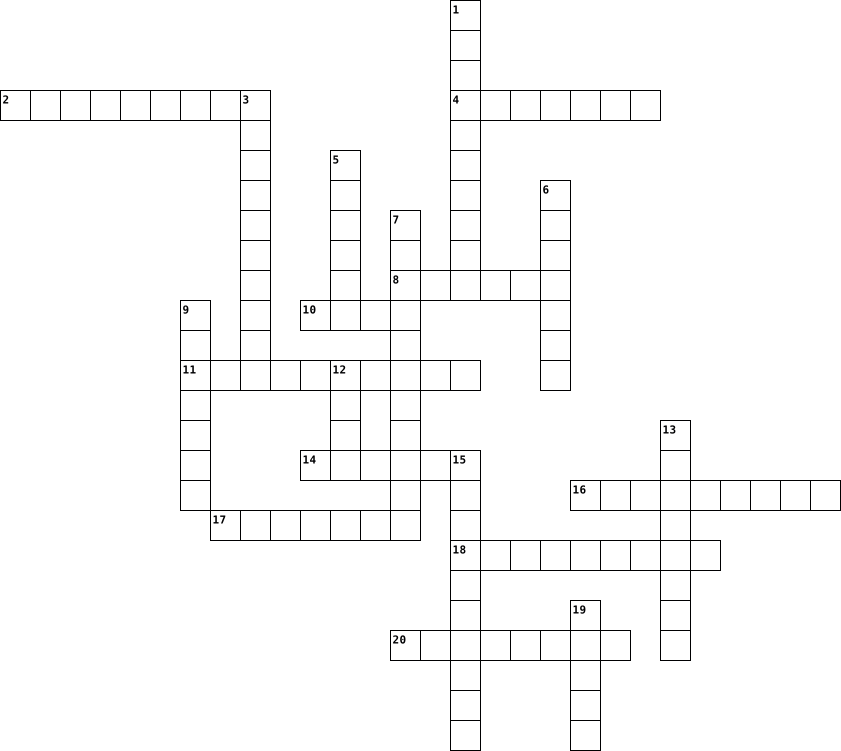
Across
- the deformation of rocks
- what is formed when cracks in the earth are made and magma is able to rise through
- where convention currents occur
- what is it called when the blocks move horizontally
- the plate boundary where the plates move toward each other
- the line formed by the intersection of a horizontal plane and an inclined surface
- the plate boundary where the plates move away from each other
- a stress which stresses rock in two different directions
- the plate boundary where the plates move up and down against each other
- the border between two tectonic plates
Down
- currents the movement of tectonic plates, made by heat and pressure
- the process of tectonic plates running into each other and one sliding beneath the other
- faults the fault that occurs when the hanging wall moves down
- faults the fault that occurs when the hanging wall moves up
- a stress which pushes rock together
- Plate the largest major plate tectonic
- valley a land form that is created from divergent plate boundary
- a stress that occurs when forces are parallel but are moving in opposite directions
- the result of plate tectonics slipping and creating movement at fault lines
- what plate tectonics are made of
20 Clues: the deformation of rocks • where convention currents occur • what plate tectonics are made of • a stress which pushes rock together • Plate the largest major plate tectonic • the border between two tectonic plates • what is it called when the blocks move horizontally • a stress which stresses rock in two different directions • ...
Plate tect & Crust Deform 2026-05-13

Across
- What force is exerted by the asthenosphere in Isostatic adjustment
- The same stresses that form folded mountains also form
- The asthenosphere is in
- Any change in a rock's shape of volume caused by stress
- A divergent boundary has what type of stress
- What is the condition of gravitational and buoyant equilibrium between Earth's lithosphere and asthenosphere
- The type of plate boundary where two plates come together is a
- In geology, the amount of force per unit area that acts on a rock
- The bending, tilting, and breaking of Earth's crust
- A form of ductile strain in which rock layers bend
Down
- A fold where the youngest rock layer is the center is called
- plates Modern climates are a result of past movements of
- Isostatic adjustments occur in
- stress This type of stress distorts rock; force from opposite directions
- Materials that respond to stress by bending or deforming without breaking are
- What type of stress that stretches and pulls apart rock
- What type of boundary has compression
- A break in a body of rock along which one block slides relative to another
- What is an undersea mountain range that forms at a divergent boundary
- The force exerted by the leading edge of a subducting plate is
20 Clues: The asthenosphere is in • Isostatic adjustments occur in • What type of boundary has compression • A divergent boundary has what type of stress • A form of ductile strain in which rock layers bend • The bending, tilting, and breaking of Earth's crust • The same stresses that form folded mountains also form • Any change in a rock's shape of volume caused by stress • ...
Tectonic Plates 2022-02-15

Across
- The type of plate movement where two plate boundaries collide
- Hot fluid stored inside of a volcano
- Earth's liquid iron layer surrounding the inner core
- Hot molten rock inside of volcanoes
- A formation caused by a collision of two plates, where one plate sinks into the mantle underneath the other
- A spreading in Earth's lithosphere caused by the divergent plate boundary
- Earth's partially molten layer and tectonic plates move because of it's molten
- The type of plate movement where two plate boundaries move away from each other
- The type of plate movement where two plate boundaries slip past each other
- Fine particles blown from the eruption of volcanoes
- a rock formation that has been broken by the movement of tectonic plates
Down
- A lava infused rock caused by the Convergent Plate boundary
- A path along the pacific coast characterized by active volcanoes and frequent earthquakes
- A huge slab of rock constantly moving along the Earth
- Sets of waves that travel through earth, usually generated by tectonic plate movements
- An instrument that measures details of earthquakes, such as force
- Earth's deepest layer
- The action of a volcano exploding
- Earth's outermost shell
- A shaking motion in the ground caused by the Convergent boundary
20 Clues: Earth's deepest layer • Earth's outermost shell • The action of a volcano exploding • Hot molten rock inside of volcanoes • Hot fluid stored inside of a volcano • Fine particles blown from the eruption of volcanoes • Earth's liquid iron layer surrounding the inner core • A huge slab of rock constantly moving along the Earth • ...
Earth's Stucture 2017-02-20

Across
- the process that the oceanic crust sinks beneath the deep sea trench
- the core that surrounds the inner core and is made of iron
- The outermost layer of the earth (located in the lithosphere)
- when two plates slide past each other
- The different parts that form the inside and outside of the earth
- consist of two layers (crust and upper mantle)
- the theory that the plates have moved over time
- the formation of crust
- the part of earths crust that forms new seafloor
- The innermost layer that consist of nickle and iron
Down
- a layer of earth that is located between the crust and the outer crust
- the layer that is located inside the lithosphere and allows convection currents to move the plates
- the layer of earth that's located below the crust (in the lithosphere)
- plates that make up the earths crust (comes in different shapes and sizes)
- the thick layer of earths crust that forms large amounts of earth's landmasses
- forms a divergent boundary on earths surface
- the layer of gas that surround the earth
- Plate boundaries that force two plates to separate
- a break in the earths crust
- When two or more plates come together and collide
20 Clues: the formation of crust • a break in the earths crust • when two plates slide past each other • the layer of gas that surround the earth • forms a divergent boundary on earths surface • consist of two layers (crust and upper mantle) • the theory that the plates have moved over time • the part of earths crust that forms new seafloor • ...
Physical Geography Review (Troop) 2018-04-10

Across
- A 'misfit' boulder
- Precipitation caused due to a mountainous landscape
- The exterior layer of the earth's lithosphere
- A glacier that moves through mountain valleys
- Igneous rock that forms inside the earth
- Climate that is located in-land, away from water
- Established theory of continental drift
- A well known divergent plate boundary
- Igneous rock that forms above the earth's surface
- Scrape marks on the landscape from glacial movement
- Molten rock above the earth's surface
- Rock that forms from cooled magma/lava
- Fastest moving plate (at least according to our note)
- The flexible, semi-molten layer of the earth, below the crust
Down
- Created by a convergent plate interaction
- Rock made of layers of tiny rock particles
- Acronym for remembering climate factors
- Plates moving towards eachother
- When one plate descends under another
- Used to compare the size of earthquakes
- When a piece of a glacier breaks off into water
- Plates moving away from eachother
- Climate that is moderated by water
- Rock that has been changed under intense heat and pressure
- Established theory of plate tectonics
- The movement of heat through a material
- Plates scraping sideways against eachother
- An ancient supercontinent
- Molten rock below the earth's surface
29 Clues: A 'misfit' boulder • An ancient supercontinent • Plates moving towards eachother • Plates moving away from eachother • Climate that is moderated by water • When one plate descends under another • A well known divergent plate boundary • Established theory of plate tectonics • Molten rock above the earth's surface • Molten rock below the earth's surface • ...
Plate Tectonics (Boundaries) 2014-02-20

Across
- the plate that holds the third largest continent(Africa)
- the plate that upholds fiji
- the year that the theory became known (in 1900's)
- the plate that lies bettween the eurasian plate and the african plate(Arabian sea)
- caused by a divergent plate pulling away from one another and creates an underwater ridge Ex: Mid Atlantic Ridge
- the plate in witch South America is located
- the plate just west of the South American plate (stats with a N)
- the plate in witch the Caribbean lies
- two plates slipping passed one another.
- holds the worlds largest continent/also the worlds largest country(Russia)
Down
- the man who came up with the theory of plate tectonics and continental drift
- two plates that pull away from each other.
- the plate in witch Antarctica is located
- these are caused by two convergent plates running into each other (they move upward)
- the plate that holds North America
- the plate in witch the philippines are located
- a land form that is formed where a convergent plate comes together usually shoots out lava
- the plate that hold most of earths water
- a line of volcanos located on the outer edges of the Pacific plate
- two plates pushing against each other that can form mountains.
20 Clues: the plate that upholds fiji • the plate that holds North America • the plate in witch the Caribbean lies • two plates slipping passed one another. • the plate in witch Antarctica is located • the plate that hold most of earths water • two plates that pull away from each other. • the plate in witch South America is located • the plate in witch the philippines are located • ...
Plate Tectonics 2023-12-17

Across
- A break in the Earth’s crust due to movement
- A crack in the surface of the Earth
- The hypothesis that states the continents broke up and drifted
- Magma that flows onto the Earth's surface
- A solid outer layer on Earths consisting if crust and mantle
- The amount of force per unit area that acts on a rock
- The process where new oceanic seafloor forms as magma rises
- The process that affects the Earth and changes appearance
- A spot in Earth’s mantle where hot magma rises to the surface
- The bending, tilting, and break up of Earth’s crust
- Type of boundary between two plates moving away from each other
- A form of ductile strain where rock layers bend
Down
- Liquid rock under the Earth’s surface
- Ground vibrations caused by Earth’s crust moving
- Below the lithosphere
- Super continent containing all the Earth’s landmass
- two plates that slide together
- Type of boundary between two plates sliding past each other
- large pieces of lithosphere that separate the Earth's crust.
- Below the lithosphere
- occur along divergent plate boundaries, where new ocean floor is created as the Earth's tectonic plates spread apart.
- Any change in a rock’s shape or volume caused by stress
- Break away caused by plate tectonics
- A vent or fissure in the Earth’s surface where magma and gasses are expelled
24 Clues: Below the lithosphere • Below the lithosphere • two plates that slide together • A crack in the surface of the Earth • Break away caused by plate tectonics • Liquid rock under the Earth’s surface • Magma that flows onto the Earth's surface • A break in the Earth’s crust due to movement • A form of ductile strain where rock layers bend • ...
Plate Tectonics Crossword Puzzle 2022-05-15

Across
- Long narrow mountains formed by magma at divergent boundaries
- Two plates move toward each other
- Vents in earth's crust through which molten rock flows
- Blocks of crust that move horizontally past each other
- The partially melted portion of the mantle
- The size of an earthquake
- rising mantle material at mid-ocean ridges push plates away from the ridge
- Earth is broken down into large rigid pieces that move with respect to each other
- This rock is formed by erosion
- Two plates collide, one can sink other the other, when this happens it pulls on the rest of the plate
Down
- The process that occurs when one tectonic plate moves under another tectonic plate
- The crust and uppermost part of the mantle
- This rock is formed by heat and pressure
- The circulation within fluids caused by differences in density and thermal energy
- Two plates move away from each other
- Magma that erupts onto earth's surface
- Molten rock stored beneath earth's surface
- A crack or fracture in earth's crust along which movement occurs
- A vibration caused by the rupture and sudden movement of rocks along a crack in earth's crust
- This rock is formed when hot molten rock crystallizes
20 Clues: The size of an earthquake • This rock is formed by erosion • Two plates move toward each other • Two plates move away from each other • Magma that erupts onto earth's surface • This rock is formed by heat and pressure • The crust and uppermost part of the mantle • Molten rock stored beneath earth's surface • The partially melted portion of the mantle • ...
Geology Crossword Puzzle 2024-11-05

Across
- Mountain created by volcanic activity
- Outer layer of Earth
- Hot spot where magma reaches Earth's surface
- Tectonic plate boundary where plates pull apart
- Type of earthquake waves that move through solids and liquids
- Liquid layer surrounding Earth's inner core
- Term for large landmasses formed by Earth's tectonic activity
- Layer of Earth composed of iron and nickel
- The process by which one tectonic plate is forced under another
- Seismic waves that travel through solids only
- Theory that Earth's continents were once joined
- Large, destructive ocean wave caused by underwater disturbance
- Supercontinent before it split apart
- Scientist who developed the theory of plate tectonics
Down
- Boundary where two plates collide
- Term for Earth's crust and upper mantle
- Volcano type known for explosive eruptions
- A geological feature formed by divergent plate boundaries
- Long crack in Earth's crust where movement occurs
- Earth's layer responsible for tectonic movements
- Type of volcano formed by gentle eruptions
- Earthquake's point of origin beneath the surface
- Violent shaking of the Earth's surface
- The study of Earth's physical structure
- Solid, innermost layer of Earth
- Fault line in California known for earthquakes
- Plate boundary where plates move apart
- Volcanic eruption's release of molten rock
- Plate boundary where plates slide past each other
- A natural disaster caused by seismic activity
- Volcanic material ejected from a volcano
31 Clues: Outer layer of Earth • Solid, innermost layer of Earth • Boundary where two plates collide • Supercontinent before it split apart • Mountain created by volcanic activity • Violent shaking of the Earth's surface • Plate boundary where plates move apart • Term for Earth's crust and upper mantle • The study of Earth's physical structure • ...
Plate Motion Choice Project 2025-10-27

Across
- The motion where two plates move towards each other
- The process where one tectonic plate is forced beneath another
- A giant slabs of solid rock that make up the Earths outer crust
- The upper layer of Earths mantle below the lithosphere
- A sudden violent shake of the ground
- The liquid layer between the mantle and inner core mainly made from molten iron and nickel
- The motion where two plates move away from each other
- The innermost solid layer of the Earth
- A mountain or hill with a crater through which lava, rock fragments, hot vapor, and gas erupt
- A large ocean wave caused by an underwater earthquake
Down
- The rigid outer part of Earth
- Convergent or Divergent boundary’s in which tectonic plates move
- Underwater hydrothermal vent on the ocean floor
- A underwater mountain range formed when two plates pull apart
- The outermost rigid layer of the Earth
- The thin part of Earths crust which underlies the ocean basins
- The thick solid layer between the Earths crust and outer core
- A plate boundary where two plates slide past each other horizontally
- When two tectonic plates collide and one slides beneath the other
- A measure of the energy released by an earthquake
20 Clues: The rigid outer part of Earth • A sudden violent shake of the ground • The outermost rigid layer of the Earth • The innermost solid layer of the Earth • Underwater hydrothermal vent on the ocean floor • A measure of the energy released by an earthquake • The motion where two plates move towards each other • The motion where two plates move away from each other • ...
Plate Tectonics 2012-11-13

Across
- outburst of lava
- seperation
- cha cha slide
- come together
- we live here
- consistancy of jam
Down
- terrifying tremor
- going down down down
- I am HOT!
- i have land
10 Clues: I am HOT! • seperation • i have land • we live here • cha cha slide • come together • outburst of lava • terrifying tremor • consistancy of jam • going down down down
Stop, drop, and roll - Or you'll be put in a hole 2021-10-14

Across
- separating
- hard to break
- a long narrow ditch
- squished
- the innermost part of earth
- pushed closer together
- part of the earth's interior
Down
- able to deform, not losing toughness
- rigid outer part of the earth
- ductile part of earth
- change
- liquid metal
- stress
- outer most layer of earth
- break off, or cause to break off
15 Clues: change • stress • squished • separating • liquid metal • hard to break • a long narrow ditch • ductile part of earth • pushed closer together • outer most layer of earth • the innermost part of earth • part of the earth's interior • rigid outer part of the earth • break off, or cause to break off • able to deform, not losing toughness
Vocabulary 2023-12-12

Across
- a person who can see into the future
- challenge
- to scold
- sanctuary
- fleeting
- separate or different
- where two points come together
- rash, impulsive
Down
- flushed
- the feeling that someone or something is unworthy
- short story about a real incident or person
- the act of restraining oneself from indulging in something
- well meaning and kindly
- unnamed
- shorten
15 Clues: flushed • unnamed • shorten • to scold • fleeting • challenge • sanctuary • rash, impulsive • separate or different • well meaning and kindly • where two points come together • a person who can see into the future • short story about a real incident or person • the feeling that someone or something is unworthy • the act of restraining oneself from indulging in something
Day_45 2022-10-27

Across
- [형] 발산적, 확산적, 분기하는
- [형] 위험한, 해로운
- [동] 압축하다, 압박하다
- [명] 역경, 곤경
- [동] ~에게 부여하다, 기부하다
- [동] (일상·예상 등을) 벗어나다
- [명] 유증 (재산), 유산
- [동] 삼키다, 먹다
Down
- [명] 문지방, 한계점, 문턱
- [부] 익명으로
- [형] 대단히 파괴적인, 엄청난 손상을 가하는
- [동] 유지시키다[옹호하다], 확인하다, 인정하다
- [동] 생각해 내다, 임신하다
- [형] 기만적인, 부정직한
- [동] 연기하다
15 Clues: [부] 익명으로 • [동] 연기하다 • [명] 역경, 곤경 • [동] 삼키다, 먹다 • [형] 위험한, 해로운 • [동] 압축하다, 압박하다 • [형] 기만적인, 부정직한 • [명] 유증 (재산), 유산 • [명] 문지방, 한계점, 문턱 • [동] 생각해 내다, 임신하다 • [형] 발산적, 확산적, 분기하는 • [동] ~에게 부여하다, 기부하다 • [동] (일상·예상 등을) 벗어나다 • [형] 대단히 파괴적인, 엄청난 손상을 가하는 • [동] 유지시키다[옹호하다], 확인하다, 인정하다
Mirrors and Lenses 2022-05-12

Across
- the water caused the straw to _______
- point where rays meet
- _____ bulb
- light or sound ____
- light rays separate
- light rays intersect
- colored lines on a diagram
Down
- a non-existent image
- image that is always inverted
- surface curves outward
- I see my __________ in the water
- the study of light
- morning reflection
- surface curves inward
- clear part of glasses
15 Clues: _____ bulb • the study of light • morning reflection • light or sound ____ • light rays separate • a non-existent image • light rays intersect • point where rays meet • surface curves inward • clear part of glasses • surface curves outward • colored lines on a diagram • image that is always inverted • I see my __________ in the water • the water caused the straw to _______
LITHOSPHERIC PLATES 2025-11-18

Across
- crust found under continent
- smallest and shallowest ocean
- Covers most of Europe and Asia
- denser type of crust
- toward each other
- largest continent
- rigid outer layer
Down
- largest body of water
- covered by ice
- largest plate
- outermost layer of the earth
- slide past each other
- away from each other
- second largest ocean
- smallest continent
15 Clues: largest plate • covered by ice • toward each other • largest continent • rigid outer layer • smallest continent • away from each other • denser type of crust • second largest ocean • largest body of water • slide past each other • crust found under continent • outermost layer of the earth • smallest and shallowest ocean • Covers most of Europe and Asia
Level 3 Vocab Choice Board Crossword UNIT 9 2024-05-20

Across
- to join at one end
- suitable; fitting
- puzzling, mystifying
- to cancel
- going in different directions
- a belief, principle, or teaching
- to transport; to transmit
Down
- not showing feeling in response to pleasure or pain
- joining together
- wrongly twisted
- to ward off; fend off
- appearance
- to trespass
- a way of holding the body
- dreadful; causing fear
15 Clues: to cancel • appearance • to trespass • wrongly twisted • joining together • suitable; fitting • to join at one end • puzzling, mystifying • to ward off; fend off • dreadful; causing fear • a way of holding the body • to transport; to transmit • going in different directions • a belief, principle, or teaching • not showing feeling in response to pleasure or pain
Spelling Words Cross word puzzle 2024-12-03

Across
- - The state of being an enemy.
- - Old fashioned.
- - Destroying something completely.
- - Preserving from extinction or oblivion.
- - Unnecessary or needless.
- - Opposed to war or violence.
- - A state of uncertainty or dilemma.
Down
- - Different.
- - Easily persuaded to believe something.
- - Lack of interest.
- - Sullen or bad-tempered.
- - Not honest.
- - Opponent in a contest.
- - Make someone less angry.
- - Threatening or evil.
15 Clues: - Different. • - Not honest. • - Old fashioned. • - Lack of interest. • - Threatening or evil. • - Opponent in a contest. • - Sullen or bad-tempered. • - Make someone less angry. • - Unnecessary or needless. • - Opposed to war or violence. • - The state of being an enemy. • - Destroying something completely. • - A state of uncertainty or dilemma. • ...
Tectonic Plates 2023-04-20

Across
- The line where two plates meet
- The Marianas Trench is an example of this landform caused by a divergent boundry
- Layer of the earth when looking at physical characteristics that includes the crust and upper mantle
- Boundary type where two plates converge
- Boundary type where two plates slide by each other
Down
- This landform is caused by a convergent boundary, molten rock erupts from it
- Boundary type where two plates separate
- This happens at transform boundaries when there is too much tension between plates
- This landform is caused by subduction at convergent boundaries
9 Clues: The line where two plates meet • Boundary type where two plates separate • Boundary type where two plates converge • Boundary type where two plates slide by each other • This landform is caused by subduction at convergent boundaries • This landform is caused by a convergent boundary, molten rock erupts from it • ...
Plate Tectonics 2013-01-18

Across
- Partially melted rock is a major property of the_________.
- Mountains are formed from the collision of two lithospheric plates that have the same.
- Ridge ______________ is another name for a seafloor spreading center.
- ___________ Is the driving force that causes plates to move.
- Is a famous example of a Divergent boundary.
- boundary Creates faults and moves in a sliding motion.
- boundary creates seafloor spreading centers.
- Ocean The Ring of Fire follows the border of which body of water?
- of Fire largest active belt that surrounds the Pacific Ocean.
- Flow measure of the amount of heat leaving the rocks of the lithosphere.
Down
- This person came up with the theory of Continental Drift
- Crust What kind of crust is involved in the formation of major mountains?
- The lithosphere and Asthenosphere belong here.
- Andreas Fault ______________ In California is an example of a transform boundary.
- Supercontinent that broke and drifted apart.
- Center Area where lithospheric plates are moving apart.
- Polarity Reversal Present north magnetic pole became the south magnetic pole and the present south magnetic pole became the north magnetic pole.
- tectonics theory of the formation and movement of the rigid pieces, or plates, that cover earths surface.
18 Clues: Supercontinent that broke and drifted apart. • Is a famous example of a Divergent boundary. • boundary creates seafloor spreading centers. • The lithosphere and Asthenosphere belong here. • boundary Creates faults and moves in a sliding motion. • Center Area where lithospheric plates are moving apart. • This person came up with the theory of Continental Drift • ...
plate tectonics 2025-06-06

Across
- A vent in the Earth's surface through which molten rock (lava) and gases are expelled.
- Plate Boundary Where two plates move apart, creating new crust.
- Spreading: The process where new oceanic crust is created at divergent boundaries.
- The layer of the Earth between the crust and the core.
- The outermost solid layer of the Earth.
- The soft, plastic layer of the upper mantle beneath the lithosphere.
- Drift The theory that continents have moved over time.
- A shaking of the ground caused by the sudden movement of tectonic plates.
- Plates Large, moving pieces of the Earth's lithosphere
- Zone A convergent boundary where one plate slides under another.
Down
- The supercontinent that existed millions of years ago.
- Fault: A boundary where plates slide past each other.
- Waves Waves of energy that travel through the Earth during an earthquake.
- The rigid outer layer of the Earth, including the crust and upper mantle.
- A sudden shaking of the Earth's crust.
- A fracture in the Earth's crust where movement has occurred.
- Waves Energy released during an earthquake.
- Plate Boundary Where two plates collide.
- Spot A region of high volcanic activity
- The innermost part of the Earth, consisting of a solid inner core and a molten outer core.
20 Clues: A sudden shaking of the Earth's crust. • The outermost solid layer of the Earth. • Spot A region of high volcanic activity • Plate Boundary Where two plates collide. • Waves Energy released during an earthquake. • Fault: A boundary where plates slide past each other. • The supercontinent that existed millions of years ago. • ...
Vocab Word 2022-04-20

Across
- a trench in the middle of the ocean where the Earth is splitting
- where two tectonic plates come together or collide
- it happens at a divergent boundary, mid-ocean-ranges happen as well
- when magma gets forced out of the Earth out of the crust it creates this
- the theory of tectonic plates
Down
- when one convergent plate is denser than the other one it creates this
- lava under the Earth
- where two tectonic plates move away from each other
- an irregularly shaped slab of solid rock
- where two tectonic plates slide past each other
10 Clues: lava under the Earth • the theory of tectonic plates • an irregularly shaped slab of solid rock • where two tectonic plates slide past each other • where two tectonic plates come together or collide • where two tectonic plates move away from each other • a trench in the middle of the ocean where the Earth is splitting • ...
Plate Tectonics and Plate Boundaries 2024-04-29

Across
- Boundary where two tectonic plates collide
- Occurs at a transform boundary. Its magnitude is recorded on a Richter scale.
- Is created at a transform boundary (San Andreas ______).
- When two plates of different densities collide, causing the denser one to get pushed under the other (creates volcanoes).
- Is formed at a divergent boundary in between two Oceanic plates.
- Boundary where two tectonic plates move away from each other (creates rifts)
Down
- The layer below the lithosphere.
- There are two types of _______. Continental and Oceanic.
- Boundary where two tectonic plates slide past each other
- The convection currents that move tectonic plates are located in this layer of the Earth.
10 Clues: The layer below the lithosphere. • Boundary where two tectonic plates collide • There are two types of _______. Continental and Oceanic. • Boundary where two tectonic plates slide past each other • Is created at a transform boundary (San Andreas ______). • Is formed at a divergent boundary in between two Oceanic plates. • ...
Plate Tectonics 2020-10-01

Across
- grinds past each other
- magma circle
- ocean/mentle
- ;ayer below the crust
Down
- come together
- outer-shell
- moving-away
- continents
- molten rock
9 Clues: continents • outer-shell • moving-away • molten rock • magma circle • ocean/mentle • come together • ;ayer below the crust • grinds past each other
MICROTEACHING 2024-06-26

Across
- Variation
- questions
- induction
- of student participation
- order questions
- attending behavior
Down
- and use of examples
- questions
- and non-verbal cues
- in asking questions
10 Clues: questions • Variation • questions • induction • order questions • attending behavior • and use of examples • and non-verbal cues • in asking questions • of student participation
Unit 4 - Plate Tectonics Crossword 2020-12-03

Across
- Type of plate boundary where subduction occurs because two plates are moving together.
- The remains of plant or animals preserved in Rock
- Plate that is mostly covered by water and is currently being subducted under the Eurasian plate
- Type of boundary where two plates slide past each other in opposite directions.
- Southern most plate on the globe.
- Ridge that runs from Iceland and greenland through the atlantic ocean almost all the way to antartica. It is a divergent boundary that caused an underwater mountain range.
- The shaking of the ground caused most often by movement of tectonic plates.
- Name of the plate that includes Europe and Asia
- Scientist who first discovered the Pacific Mountain range off the west coast of South America. The discovery eventually lead to the theory of plate tectonics.
- Valley A low spot caused by divergent boundaries. Sometimes widening far enough to become an ocean.
- Type of fault normaly found at a transform boundary.
Down
- Process by which one tectonic plate slides under another, creating deep ocean trenches, volcanic mountains, and earthquakes.
- Arch Line of volcanic islands that parallels a deep ocean trench at an Oceanic-Oceanic subduction zone.
- The name of the plate to the west of South America
- Name for the ancient supercontinent that was formed when the continents were once together.
- Type of plate boundary where two plates are moving apart.
- Mountain range formed where the Indo-Australian plate is converging with the Eurasian plate.
- Tectonics The theory that the Earth's crust is broken into separate sections plates that ride on top of the aesthenosphere and carry the continents with them as they are driven by convection currents.
- Largest Rift Valley on the planet.
- Process that causes currents in the mantle of the Earth that drives the tectonic plates
- Large wave created by earthquakes at subduction zones.
- The geologic formation that caused the Hawaiian islands to form and geysers to erupt.
- Scientist who first hypothesized that they continents were once together and formed on giant landmass.
23 Clues: Southern most plate on the globe. • Largest Rift Valley on the planet. • Name of the plate that includes Europe and Asia • The remains of plant or animals preserved in Rock • The name of the plate to the west of South America • Type of fault normaly found at a transform boundary. • Large wave created by earthquakes at subduction zones. • ...
7th Grade BGM geology 2024-11-15

Across
- rock In which type of rock do you typically find fossils?
- spreading The process by which new oceanic crust forms as magma rises towards the surface and solidifies at divergent boundaries.
- term for the super continent which contained all the plates together
- record chronological collection of all fossils found in sedimentary rock layers
- Boundary The boundary between tectonic plates that are sliding past each other horizontally
- extremely deep areas in the ocean that are created by a subducting plate
- The chemical and physical processes that break down rock and other materials on Earth's surface.
- The process by which water, ice, wind, or gravity moves weathered rock and soil.
- process in which two plates collide and the denser ocean plate descends below the other
- no longer in existence
- current a current caused by the rising of heated fluid that is less dense and sinking of cooled fluid that is more dense that drives plate movement in the mantle of the earth
- fossils Distinctive fossils used to establish and compare the relative ages of rock layers and the fossils they contain
- Tectonics The theory that the earth is broken into plates and are in motion due to convection currents in the asthenosphere (upper mantle)
Down
- Process in which sediment is laid down in new locations.
- A giant wave usually caused by an earthquake beneath the ocean floor.
- a sedimentary rock consisting mainly of calcium that was deposited by the remains of marine animals
- The sudden release of strain energy in the Earth's crust, resulting in waves of shaking that radiate outwards from the earthquake source.
- Drift The hypothesis that states that the continents once formed a single landmass, broke up, and drifted to their present locations
- Boundary The boundary formed by the collision of two plates
- ridge an underwater mountain range made at divergent plate boundaries
- Earth materials created by weathering and deposited by erosion.
- Boundary The boundary between two tectonic plates that are moving away from each other
- layers of sedimentary rock
- The thin and solid outermost layer of the Earth above the mantle
24 Clues: no longer in existence • layers of sedimentary rock • Process in which sediment is laid down in new locations. • rock In which type of rock do you typically find fossils? • Boundary The boundary formed by the collision of two plates • Earth materials created by weathering and deposited by erosion. • The thin and solid outermost layer of the Earth above the mantle • ...
SAT Vocab 4 2014-01-23

Across
- short-lived, as an image
- variant, moving apart
- to regard with scorn
- tiring, weakening
- sharing of feelings
- follow an example
Down
- irritation, frustration
- dishonor, disgrace
- momentary, fleeting
- improve, augment
10 Clues: improve, augment • tiring, weakening • follow an example • dishonor, disgrace • momentary, fleeting • sharing of feelings • to regard with scorn • variant, moving apart • irritation, frustration • short-lived, as an image
Tectonics-Honors Earth 2023-03-21

Across
- forms where Nazca plate subducts under South American plate
- form where one oceanic plate meets a continental plate
- circulating flow of dense, molten material driving plates
- forming along divergent boundaries (ex: atlantic ocean)
- patterns of these outline Earth's tectonic plates
- densest liquid layer of Earth composed of metallic material
- pieces of continent and ocean that move due to convection
- the thickest layer of Earth where convection currents flow
- convergent boundary between Asia and India
- form along an ocean-ocean convergent boundary in North Pacific Ocean
- the when you use 3 seismic stations to find an epicenter
- the ___ of an S-wave is used to help calculate Richer magnitude
- the thinnest layer of Earth that moves due to convection currents
- the point at the surface directly above the earthquake found using either damage or seismic waves
- form along subduction zones on the less dense plate
- the magnitude of an Earthquake can be assigned this number based on quantitative wave measurements
- theory explaining the cause of earthquakes
- they change speed as they move through denser or less dense layers of Earth
- the point where elastic rebound occurs for an earthquake
- the name given to the ancient supercontinent
- the interval between the arrival of primary and secondary waves
- evidence used to support the idea of a metallic core
- when two plates move along side one another but get stuck
- many continents appear to fit together due to their matching
- transform boundary along California coast
Down
- divergent boundary between Africa and SaudiArabia
- convergence where both plates are equal density
- when two or more plates collide head-on
- theory explaining how ocean plates behave at divergent boundaries
- convergence where denser plate subducts beneath less dense plate
- matching __ of the same type and age are found on different continents today
- deep chasms forming along convergent boundaries
- seismic wave traveling in a compression (push-pull) motion
- form where 2 continental plates converge
- Earth's liquid outer core either bends or blocks seismic waves to create these
- densest solid layer of Earth composed of metallic material
- the property that causes one plate to subduct while another does not
- when two plates pull away from one another
- less dense plate material, very old
- alternating north/south magnetism evidence that supports sea floor spreading
- identical __ are found on distant continents now separates by oceans
- theory that explains continental drift, how the plates move, and other modern evidence
- the strength of an earthquake assigned a number using damage and other qualitative observations
- theory that all landmasses were once connected but have been moving away since
- an area of activity located away from tectonic plate boundaries
- seismic wave traveling sideways as it also moves forwards
- slowest seismic waves causing the most damage
- denser plate material that subducts, much younger
48 Clues: less dense plate material, very old • when two or more plates collide head-on • form where 2 continental plates converge • transform boundary along California coast • convergent boundary between Asia and India • when two plates pull away from one another • theory explaining the cause of earthquakes • the name given to the ancient supercontinent • ...
SGT_Crossword_Tectonics 2024-01-13

Across
- Volcanic rock that is most commonly associated with divergent plate margins
- Type of fault associated with conservative and divergent plate margins
- Large landmass comprising the continents of the southern hemisphere
- Formed by the collision of India and Eurasia
- These values are high over mid ocean ridges and low over ocean trenches
- Layer beneath the Earth's crust
- Volcanic rock that is most commonly associated with convergent oceanic-continental plate margins
- Type of force acting at a divergent plate margin
- Type of plate margin where two plates are sliding past each other
- Canadian scientist who linked all the elements of plate tectonics into a cycle
- Type of force acting at a conservative plate margin
- flat part of the ocean basins with an average depth of 4 km
- Type of plate margin where two plates are moving towards each other
- Type of force acting at a convergent plate margin
- Layer of the Earth indicated by the geotherm of 1300 degrees centigrade. This layer is hot, weak and plastic.
- Boundary between the North American and Pacific Plate in California
- Scientist who first proposed the theory of sea floor spreading
- Type of plate margin where two plates are moving away from each other
- Region of earthquakes found increasing in depth al a convergent oceanic-continental plate margin
- Process that occurs at continental-continental plate margins and forms rocks such as slate and schist
Down
- Feature formed at a convergent continental-continental plate margin
- German meteorologist who was right all along so to speak!
- Where the oceanic lithosphere is pulled back down into the asthenosphere due to slab pull
- Process now thought to be responsible for oceanic lithosphere being subducted back into the asthenosphere
- Feature formed at a convergent oceanic-oceanicplate margin such as Caribbean Islands
- Deepest part of the oceans
- Discovered on the sea floor by Frederick Vine and Drummond Matthews
- Large landmasses comprising the continents of the northern hemisphere
- Formed by submarine eruptions of basalt
- Lake dwelling reptile useful as supporting evidence for continental drift.
- Feature found along the center of mid ocean ridges
- A low angle fault associated with convergent plate margins
- Theory first proposed by Alfred Wegener
- Method used to establish the age of igneous and metamorphic rocks
- submarine mountain chain
- Outer layer of the Earth comprising the crust and upper mantle which is solid and rigid
- Name of the most recent supercontinent
- Process by which oceans grow progressively larger
- Considered for many years to be the main driving force of plate tectonics, but recently called into question
- Rock type formed at depth by the melting of continental lithosphere at convergent continental-continental plate margins
- Process by which andesite can be generated from Ihe mantle at a convergent oceanic-oceanic plate margin
41 Clues: submarine mountain chain • Deepest part of the oceans • Layer beneath the Earth's crust • Name of the most recent supercontinent • Formed by submarine eruptions of basalt • Theory first proposed by Alfred Wegener • Formed by the collision of India and Eurasia • Type of force acting at a divergent plate margin • Type of force acting at a convergent plate margin • ...
Plate tectonicts 2025-10-21

Across
- Boundary: Where two plates move away from each other.
- Boundary: Where two plates slide past each other horizontally.
- The rigid outer part of the earth, consisting of the crust and upper mantle, which is broken into tectonic plates.
- The supercontinent that existed millions of years ago, from which the current continents broke apart and drifted.
- (the rigid outer layer of the Earth), asthenosphere (the soft, pliable layer of the mantle), and tectonic plates (large slabs of the lithosphere) that move on the asthenosphere. The movement is driven by convection currents in the mantle, and major geological features and events like mid-ocean ridges, ocean trenches, subduction zones, faults, and volcanoes result from the interactions at plate boundaries: convergent, divergent, and transform.
- Tectonics: The scientific theory that Earth's outer shell is divided into several plates that glide over the mantle.
- concepts
- Occurs when one plate sinks beneath another, often creating a trench and volcanic activity.
- Building: Occurs when continental plates collide and are uplifted.
- features and events
Down
- Boundary: Where two plates move toward each other.
- A break in the Earth's crust where movement occurs, which can cause earthquakes.
- of Fire: A major belt of volcanoes and earthquakes surrounding the Pacific Ocean.
- Currents: The circular motion of the mantle's hot, less dense material rising and cooler, denser material sinking, which drives the movement of tectonic plates.
- Valley: A valley formed on land when continental plates pull apart.
- of plate boundaries
- Spreading: Creates new oceanic crust at mid-ocean ridges as plates diverge.
- An opening in the Earth's crust through which molten rock, ash, and gases escape.
- Trench: A very deep valley on the ocean floor, usually formed at a subduction zone where an oceanic plate sinks beneath another.
- Drift: The theory that the continents were once joined and have since drifted apart.
- Ridge: A long, underwater mountain chain, typically a divergent boundary where new oceanic crust is formed.
- The soft, ductile layer of the upper mantle on which the tectonic plates move.
22 Clues: concepts • of plate boundaries • features and events • Boundary: Where two plates move toward each other. • Boundary: Where two plates move away from each other. • Boundary: Where two plates slide past each other horizontally. • Building: Occurs when continental plates collide and are uplifted. • Valley: A valley formed on land when continental plates pull apart. • ...
Plate Tectonics 2023-01-20

Across
- This type of boundary slides past each other (slide)
- waves given off by earthquakes
- This type of boundary separates from each other (divide)
- these cause tectonic plates to move
Down
- an underwater mountain that occurs at divergent boundaries
- This type of boundary converges into each other (collide)
- a big wave, an earthquake underneath the surface of the water
- an area where material from deep within Earth's mantle rises to the crust and melts to form magma
8 Clues: waves given off by earthquakes • these cause tectonic plates to move • This type of boundary slides past each other (slide) • This type of boundary separates from each other (divide) • This type of boundary converges into each other (collide) • an underwater mountain that occurs at divergent boundaries • a big wave, an earthquake underneath the surface of the water • ...
Plate tetonics 2023-02-09

Across
- causes earthquakes
- the plates move apart
- two plates come together one is dense and one is less dense
Down
- layer of the earth where convection happens
- the plates come together
- occurs at divergent boundaries
- plates slide past each other
7 Clues: causes earthquakes • the plates move apart • the plates come together • plates slide past each other • occurs at divergent boundaries • layer of the earth where convection happens • two plates come together one is dense and one is less dense
plate boundaries 2024-02-02

Across
- rige of the
- hole in earth
- sacer
- transformation
Down
- move away
- distruction
- together
- partof earth
8 Clues: sacer • together • move away • distruction • rige of the • partof earth • hole in earth • transformation
plate boundaries 2024-02-02

Across
- rige of the
- hole in earth
- sacer
- transformation
Down
- move away
- distruction
- together
- partof earth
8 Clues: sacer • together • move away • distruction • rige of the • partof earth • hole in earth • transformation
Valleys: The Creation and Destruction 2021-12-07

Across
- The afar depression is located in the ____ of the Great Rift Valley
- The type of plate that is of higher density.
- When tectonic plates collide and one plate submerges beneath the other
- Rifting between two continental plates can cause normal fault valleys, fault block mountain ranges, and ____.
- Plates can move anywhere from one centimeter to ____ meters over time
Down
- Example of a mountain range formed when two continental plates converge
- Normal faults create _____ fissures
- Plates that move away from each other
- The East African Rift System is composed of the ____, African-Nubian, and Somalian plates
- Splitting apart of at least two divergent boundaries
10 Clues: Normal faults create _____ fissures • Plates that move away from each other • The type of plate that is of higher density. • Splitting apart of at least two divergent boundaries • The afar depression is located in the ____ of the Great Rift Valley • Plates can move anywhere from one centimeter to ____ meters over time • ...
Plate Tectonics 2021-04-02

Across
- Plates that slide against each other.
- Center of the Earth.
- Thin shell on the outside of the Earth. Normally referred to as “the ground”.
- Plates that move away from each other.
- Hot fluid underneath the Earth’s crust.
- When a plate moves sideways and underneath the mantle, going under a different tectonic plate.
Down
- A hole that allows lava to come out from under the Earth; usually found where divergent or convergent plate boundaries reside.
- Plates that move towards each other.
- The movement of heat through matter.
- Shifting of the land caused by all three types of plate boundaries. Results in shaking of the ground and sometimes collapsing of buildings.
10 Clues: Center of the Earth. • Plates that move towards each other. • The movement of heat through matter. • Plates that slide against each other. • Plates that move away from each other. • Hot fluid underneath the Earth’s crust. • Thin shell on the outside of the Earth. Normally referred to as “the ground”. • ...
plate tectonics 2022-03-22

Across
- circulatory patterns of heat in the magma believed to be the driving force behind plate movement.
- V-shaped valleys that are the deepest parts of the oceans where subduction occurs.
- the movment of the ocean floor at a divergent
- ocean split down the middle by a big crack
Down
- a type of plate boundary where the plates slowly move apart from each other.
- the process in which the crust pushes downward into the mantle at a fault line.
- earths crust the slowly moves
- the remains of ancciant living animals
- plate boundary where the plates slowly collide together
- the uppermost solid part of the earths crust
10 Clues: earths crust the slowly moves • the remains of ancciant living animals • ocean split down the middle by a big crack • the uppermost solid part of the earths crust • the movment of the ocean floor at a divergent • plate boundary where the plates slowly collide together • a type of plate boundary where the plates slowly move apart from each other. • ...
WB p. A1, B1-B3 2022-09-07

Across
- abbreviation for the National Oceanic and Atmospheric Administration
- type of powerful microphones used to record sounds under water
- at a divergent plate boundary this liquid rock fills in the gap created by plates pulling apart and cools off to form solid rock
- the Mesosoraus did not have gills but instead had these
- What the word mesosaurus means (2)
- type of plate boundary that the Mariana Trench is located on
Down
- plates basically move only a few what a year
- name of the small earthquakes that are present before a large earthquake happens
- name of area where Bob Dziak sent the hydrophones down in the ocean
- plate motion causes these
- Mesosaurus fossils are both found on the African and what other continent
- if a plate sinks underneath another plate at a convergent plate boundary, the plate will melt and become part of what again?
- type of plate boundary that a mid-ocean is
13 Clues: plate motion causes these • What the word mesosaurus means (2) • type of plate boundary that a mid-ocean is • plates basically move only a few what a year • the Mesosoraus did not have gills but instead had these • type of plate boundary that the Mariana Trench is located on • type of powerful microphones used to record sounds under water • ...
Aspire to do 2024-02-15

Across
- hot rock
- shaking of the earth
- a formation of land
- type of rock
- melted rock
Down
- squishing together
- moving land
- plates moving apart
- plates moving together
- land breaking down
10 Clues: hot rock • moving land • melted rock • type of rock • squishing together • land breaking down • a formation of land • plates moving apart • shaking of the earth • plates moving together
bronom 2023-07-30

Across
- nama fandom zb1
- pencetus gerakan mother
- nama buku sihir
- anggota dengan sebutan vampire
- anggota mbti i
Down
- marga buronoise
- anggota asal canada
- marga inomentum
- bulan debut zb1
- judul film
10 Clues: judul film • anggota mbti i • marga buronoise • marga inomentum • nama fandom zb1 • bulan debut zb1 • nama buku sihir • anggota asal canada • pencetus gerakan mother • anggota dengan sebutan vampire
Psych 2025-10-15

Across
- FALLACY (5 Across)
- HEURISTIC (2 Down)
- HEURISTIC (8 Down)
- THINKING (4 Down)
Down
- BIAS (3 Across)
- (9 Across)
- (1 Across)
- FIXEDNESS (7 Across)
- (10 Down)
- SET (6 Down)
10 Clues: (10 Down) • (9 Across) • (1 Across) • SET (6 Down) • BIAS (3 Across) • THINKING (4 Down) • FALLACY (5 Across) • HEURISTIC (2 Down) • HEURISTIC (8 Down) • FIXEDNESS (7 Across)
Psych 2025-10-15

Across
- FALLACY (5 Across)
- HEURISTIC (2 Down)
- HEURISTIC (8 Down)
- THINKING (4 Down)
Down
- BIAS (3 Across)
- (9 Across)
- (1 Across)
- FIXEDNESS (7 Across)
- (10 Down)
- SET (6 Down)
10 Clues: (10 Down) • (9 Across) • (1 Across) • SET (6 Down) • BIAS (3 Across) • THINKING (4 Down) • FALLACY (5 Across) • HEURISTIC (2 Down) • HEURISTIC (8 Down) • FIXEDNESS (7 Across)
plate boundaries 2024-02-02

Across
- rige of the
- hole in earth
- sacer
- transformation
Down
- move away
- distruction
- together
- partof earth
8 Clues: sacer • together • move away • distruction • rige of the • partof earth • hole in earth • transformation
Plate Tectonics Crossword Puzzle 2019-11-22

Across
- The process of plates sliding past each other in opposite directions. This can be found at transform boundaries and results in faults
- The word used to describe the state of the mantle
- The cool, outermost layer of the Earth that consists of the crust and uppermost part of the mantle
- Type of plate boundary where two plates collide
- The layer just below the lithosphere
- Layer of Earth that is composed of Fe & Ni and is liquid
- Scientist that proposed Earth's continents were once joined together as a single land mass
- This is a type of heat transfer (hint: lava lamp). Some scientists believe these are occurring in the mantle and moving the tectonics plates
- These are formed under water at divergent plate boundaries. They are areas where new crust is formed
- Areas along a transform boundary created by the shearing of two pieces of crust. There is a famous one in California
- These form under water (on the ocean floor) at most convergent boundaries
- Earth's thickest layer
- Scientists study these in order to learn about the interior of the Earth
- Layer of Earth with the lowest temperature
- Type of crust that is thinner and contains basalt
Down
- Layer of Earth that is composed of Fe & Ni and is solid
- Type of crust that is thick and contains granite
- This is the process of creating new oceanic crust
- Theory that the lithosphere is divided into tectonic plates that move on the asthenosphere
- This forms on land at divergent plate boundaries. There is a great one in eastern Africa
- Type of plate boundary where two plates separate or move apart
- The name of the supercontinent that existed 245 million years ago
- The bending and crumpling of rock. This happens at continental vs continental convergent boundaries and results in the tallest mountains
- Theory that they continents were once joined as one large, single land mass
- When one tectonic plate moves underneath another one, it's called this
- These occur at transform boundary faults and can cause tremendous devastation
- Type of plate boundary where two plates slide past each other in opposite directions
27 Clues: Earth's thickest layer • The layer just below the lithosphere • Layer of Earth with the lowest temperature • Type of plate boundary where two plates collide • Type of crust that is thick and contains granite • This is the process of creating new oceanic crust • The word used to describe the state of the mantle • Type of crust that is thinner and contains basalt • ...
Plate Tectonics Crossword Puzzle 2023-03-02

Across
- Scientists study these in order to learn about the interior of the earth.
- These are formed under water at divergent plate boundaries. They are areas where new ocean crust is formed.
- Layer of earth that is composed of Fe & Ni and is solid.
- Theory that the continents were once as one large, single land mass.
- These form under water (on the ocean floor) at most convergent boundaries.
- This is a type of heat transfer (hint: lava lamp). Some scientist believe these are occurring in the mantle and moving the tectonic plates.
- Earths thickest layer.
- This forms on land at divergent plate boundaries. There is a great one in Eastern Africa.
- Type of plate boundary where two plates collide.
- Type of plate boundary where two plates slide past each other in opposite directions.
- Scientist that proposed Earth's continents were once joined together in one single land mass
Down
- These occur at transform boundary faults and can cause tremendous devastation.
- When one tectonic plate moves underneath another one, it's called this.
- The name of the supercontinent that existed 245 million years ago.
- Word used to describe the state of the mantle.
- Type of plate boundary where two plates separate or move apart.
- The cool, outermost layer of Earth that consists of the crust and uppermost part of the mantle.
- Type of crust that is thinner and contains basalt.
- The bending and crumpling of rock. This happens at continental vs. continental convergent boundaries and results in the tallest mountains.
- The process of plates sliding past each other in opposite directions. This can be found at transform boundaries and results in faults.
- The layer just below the lithosphere.
- Layer of earth with the lowest temperature.
- This is the process of creating new oceanic crust.
- Type of crust that is thick and contains granite.
- Areas along the transform boundary created by the shearing of two pieces of crust. There is a famous one in California.
- Layer of earth that is composed of Fe & Ni and is liquid.
26 Clues: Earths thickest layer. • The layer just below the lithosphere. • Layer of earth with the lowest temperature. • Word used to describe the state of the mantle. • Type of plate boundary where two plates collide. • Type of crust that is thick and contains granite. • Type of crust that is thinner and contains basalt. • This is the process of creating new oceanic crust. • ...
Energy In Earths Systems 2023-05-17

Across
- process where sediments, soil, and rocks are added to a landform
- the central part of the earth made of iron and nickel
- land formation created when two continental plates converge
- layer of the earth made of melted rock, can flow and move like putty
- a break in a body of rock along which one block slides relative to another
- type of plate made from crust that is usually very thick and less dense
- created when subduction occurs
- plate boundary where two plates are moving apart
- zone where blocks of crust are torn apart at a transform plate boundary
- large pieces of lithosphere that move around due to heat generated by convection currents
- plate boundary where two plates are colliding
- layer of the earth that is thick and made mostly of solid rock
- the type of valley created at a divergent boundary between two continental plates
- land formation with steep sides and explosive eruptions created as a result of a subduction zone
Down
- process of breaking down rocks and turning them into sediments, caused by long exposure to the atmosphere
- the processes that result in the structure and properties of the Earth's crust and its evolution through time
- mechanisms that build up existing land forms or create a new one
- the type of current created when the heat from the core causes rock in the mantle to circulate
- outermost layer of the earth, consisting of the crust and solid part of the mantle
- land form created at a divergent boundary between two oceanic plates
- a form of weathering, occurs when the movement of a force wears the surface of rocks and carries the worn away parts to other areas
- plate boundary where two plates slide past one another
- thin, solid, outermost layer of the earth
- mechanisms that destroy or break down land forms
- the process by which one plate moves beneath another plate
- type of plate made from crust that is usually thinner and more dense
26 Clues: created when subduction occurs • thin, solid, outermost layer of the earth • plate boundary where two plates are colliding • plate boundary where two plates are moving apart • mechanisms that destroy or break down land forms • the central part of the earth made of iron and nickel • plate boundary where two plates slide past one another • ...
Grade 10 Science (Plate Tectonic Theory) - Sir Greg 2023-09-28

Across
- a smaller earthquake that occurs in the same general area as a larger earthquake, following the mainshock.
- a series of large ocean waves generated by undersea earthquakes, volcanic eruptions, or landslides.
- vast, global ocean that surrounded Pangaea during the late Paleozoic and early Mesozoic eras.
- a linear depression on the Earth's surface that forms at divergent boundaries, where continental plates are pulling apart.
- a specific type of convergent boundary where one tectonic plate is forced beneath another into the Earth's mantle.
- an instrument used to detect and record the vibrations and ground motion caused by seismic waves during an earthquake.
- a type of plate boundary where two tectonic plates move toward each other.
- a measure of the size or energy released by an earthquake. It is typically quantified using the Richter scale or the moment magnitude scale (Mw). The higher the magnitude, the larger the earthquake's energy and potential for damage.
Down
- the point on the Earth's surface directly above the hypocenter (focus) of an earthquake.
- a supercontinent that existed during the late Paleozoic and early Mesozoic eras, approximately 335 to 175 million years ago.
- a long, underwater mountain range that forms at divergent boundaries in the ocean. It is characterized by volcanic activity and the creation of new oceanic crust as tectonic plates move apart.
- a type of plate boundary where two tectonic plates slide past each other horizontally in opposite directions.
- shaking or trembling of the Earth's surface resulting from the sudden release of energy in the Earth's crust.
- a type of plate boundary where two tectonic plates move away from each other.
- the actual point within the Earth where the earthquake originates. It is the source of the seismic energy and is typically located beneath the Earth's surface.
15 Clues: a type of plate boundary where two tectonic plates move toward each other. • a type of plate boundary where two tectonic plates move away from each other. • the point on the Earth's surface directly above the hypocenter (focus) of an earthquake. • vast, global ocean that surrounded Pangaea during the late Paleozoic and early Mesozoic eras. • ...
Grade 10 Science (Plate Tectonic Theory) - Sir Greg 2023-09-28

Across
- a smaller earthquake that occurs in the same general area as a larger earthquake, following the mainshock.
- a series of large ocean waves generated by undersea earthquakes, volcanic eruptions, or landslides.
- vast, global ocean that surrounded Pangaea during the late Paleozoic and early Mesozoic eras.
- a linear depression on the Earth's surface that forms at divergent boundaries, where continental plates are pulling apart.
- a specific type of convergent boundary where one tectonic plate is forced beneath another into the Earth's mantle.
- an instrument used to detect and record the vibrations and ground motion caused by seismic waves during an earthquake.
- a type of plate boundary where two tectonic plates move toward each other.
- a measure of the size or energy released by an earthquake. It is typically quantified using the Richter scale or the moment magnitude scale (Mw). The higher the magnitude, the larger the earthquake's energy and potential for damage.
Down
- the point on the Earth's surface directly above the hypocenter (focus) of an earthquake.
- a supercontinent that existed during the late Paleozoic and early Mesozoic eras, approximately 335 to 175 million years ago.
- a long, underwater mountain range that forms at divergent boundaries in the ocean. It is characterized by volcanic activity and the creation of new oceanic crust as tectonic plates move apart.
- a type of plate boundary where two tectonic plates slide past each other horizontally in opposite directions.
- shaking or trembling of the Earth's surface resulting from the sudden release of energy in the Earth's crust.
- a type of plate boundary where two tectonic plates move away from each other.
- the actual point within the Earth where the earthquake originates. It is the source of the seismic energy and is typically located beneath the Earth's surface.
15 Clues: a type of plate boundary where two tectonic plates move toward each other. • a type of plate boundary where two tectonic plates move away from each other. • the point on the Earth's surface directly above the hypocenter (focus) of an earthquake. • vast, global ocean that surrounded Pangaea during the late Paleozoic and early Mesozoic eras. • ...
Speciation 2024-05-15

Across
- fossil evidence of gradualism
- study of evolutionary relationships including a measure of time
- the idea that species stay the same for long periods and then have short bursts of evolution
- a geological feature which isolates populations from interbreeding
- formation of a new, distinct species through evolution
- when many new species evolve in a relatively short period, evidence for punctuated equilibrium
- when two species from different evolutionary branches evolve similar characteristics due to similar ecological roles
Down
- small changes within a species, many of which lead to speciation =
- study of a evolutionary relationships based on evidence
- when many species disappear in a relatively short period, evidence for punctuated equilibrium
- an ancestral groups diversifies into different species
- structures which are different but perform the same function, often found on convergent species
- the inability of a species to breed successfully with related species due to various barriers
- the idea that divergent evolution is slow microevolutionary changes over time
- speciation due to reproductive isolating mechanisms (best known form of speciation)
- when divergent evolution leads to a large number of distantly related species occupying different ecological niches
16 Clues: fossil evidence of gradualism • an ancestral groups diversifies into different species • formation of a new, distinct species through evolution • study of a evolutionary relationships based on evidence • study of evolutionary relationships including a measure of time • small changes within a species, many of which lead to speciation = • ...
The Earth and Plates 2024-08-04

Across
- A type of plate boundary where two plates move away from each other.
- A fracture in Earth's crust where rock on either side has moved.
- The liquid layer of the Earth's core.
- The rigid outer layer of the Earth, including the crust and upper mantle.
- A type of plate boundary where two plates slide past each other horizontally.
- The study of the movement and interaction of Earth's plates.
- The supercontinent that existed over 200 million years ago.
Down
- The solid innermost layer of the Earth's core.
- A crack or break in the Earth's crust, often at a divergent boundary.
- A type of plate boundary where two plates move towards each other.
- The semi-fluid layer of the mantle on which the tectonic plates move.
- The process of new oceanic crust forming at mid-ocean ridges and spreading outwards.
- The process by which heat is transferred through fluids like magma, driving plate movements.
- The process by which one tectonic plate sinks beneath another.
- The outermost layer of the Earth.
- The thick, semi-solid layer between the crust and the core.
16 Clues: The outermost layer of the Earth. • The liquid layer of the Earth's core. • The solid innermost layer of the Earth's core. • The thick, semi-solid layer between the crust and the core. • The supercontinent that existed over 200 million years ago. • The study of the movement and interaction of Earth's plates. • ...
Vocab Unit 8 2024-02-15

Across
- a agent or substitute
- Clothes
- a very close friend
- puzzling
- Hatred
- Going in different directions
- to make use of
- to pass through or gain entrance
Down
- To join at one end
- capable of being grasped by the senses or mind
- to pass through
- emotional
- to declare publicly
- to make no value or consequence
14 Clues: Hatred • Clothes • puzzling • emotional • to make use of • to pass through • To join at one end • a very close friend • to declare publicly • a agent or substitute • Going in different directions • to make no value or consequence • to pass through or gain entrance • capable of being grasped by the senses or mind
Mind Wandering 2021-04-28

Across
- release a thing or an emotion
- fortuitous
- develop, grow
- variant
- clever
Down
- not continuous
- punish severely
- warn or reprimand
- touch or push gently
9 Clues: clever • variant • fortuitous • develop, grow • not continuous • punish severely • warn or reprimand • touch or push gently • release a thing or an emotion
Plate Tectonics 2023-01-20

Across
- This type of boundary slides past each other (slide)
- waves given off by earthquakes
- This type of boundary separates from each other (divide)
- these cause tectonic plates to move
Down
- an underwater mountain that occurs at divergent boundaries
- This type of boundary converges into each other (collide)
- a big wave, an earthquake underneath the surface of the water
- an area where material from deep within Earth's mantle rises to the crust and melts to form magma
8 Clues: waves given off by earthquakes • these cause tectonic plates to move • This type of boundary slides past each other (slide) • This type of boundary separates from each other (divide) • This type of boundary converges into each other (collide) • an underwater mountain that occurs at divergent boundaries • a big wave, an earthquake underneath the surface of the water • ...
Plate Tectonics 2023-01-20

Across
- This type of boundary slides past each other (slide)
- waves given off by earthquakes
- This type of boundary separates from each other (divide)
- these cause tectonic plates to move
Down
- an underwater mountain that occurs at divergent boundaries
- This type of boundary converges into each other (collide)
- a big wave, an earthquake underneath the surface of the water
- an area where material from deep within Earth's mantle rises to the crust and melts to form magma
8 Clues: waves given off by earthquakes • these cause tectonic plates to move • This type of boundary slides past each other (slide) • This type of boundary separates from each other (divide) • This type of boundary converges into each other (collide) • an underwater mountain that occurs at divergent boundaries • a big wave, an earthquake underneath the surface of the water • ...
Plate Tectonics 2023-01-20

Across
- This type of boundary slides past each other (slide)
- waves given off by earthquakes
- This type of boundary separates from each other (divide)
- these cause tectonic plates to move
Down
- an underwater mountain that occurs at divergent boundaries
- This type of boundary converges into each other (collide)
- a big wave, an earthquake underneath the surface of the water
- an area where material from deep within Earth's mantle rises to the crust and melts to form magma
8 Clues: waves given off by earthquakes • these cause tectonic plates to move • This type of boundary slides past each other (slide) • This type of boundary separates from each other (divide) • This type of boundary converges into each other (collide) • an underwater mountain that occurs at divergent boundaries • a big wave, an earthquake underneath the surface of the water • ...
Plate Tectonics 2020-12-10

Across
- The layer that the tectonic plates float on.
- A type of plate boundary where two plates slide past each other.
- Natural occurrence caused by transform boundaries.
- A type of plate boundary where two plates move away from each other.
- The type of crust that makes up the ocean floor of the plate. It is more dense but thinner.
- Natural occurrence caused by divergent boundaries.
- Number of different plate boundaries.
- Measure of how compact the layer is.
Down
- The first scientist that brought up the theory of plate tectonics.
- The type of heat movement that happens in the mantle that is the main part of plate movement.
- The type of crust that makes up the land of a plate. It is thicker but less dense.
- Natural occurrence caused by convergent boundaries.
- A type of plate boundary where two or more plates collide or subduct.
- Theory that the Earth's crust is divided into different plates that move over time.
- When a plate slides under another plate.
- The name of the supercontinent as named by Alfred Wegener.
16 Clues: Measure of how compact the layer is. • Number of different plate boundaries. • When a plate slides under another plate. • The layer that the tectonic plates float on. • Natural occurrence caused by transform boundaries. • Natural occurrence caused by divergent boundaries. • Natural occurrence caused by convergent boundaries. • ...
Tectonic Plate Review 2026-02-24

Across
- What was the land called 250 million years ago when all the continents were together?
- What is the ring of volcanoes called in the Pacific Ocean known as?
- Which landform is created with a continental divergent boundary?
- Which layer of the mantle can you find the tectonic plates?
- What type of boundary has two plates sliding past each other?
- What is the result of stress being released in a transform boundary?
- How many tectonic plate boundaries are there?
- What is created when two oceanic plates collide?
Down
- What type of boundary has two plates colliding with one another?
- The border between two tectonic plates is called a what?
- What is created when one continental plate and one oceanic plate collide?
- What builds up as the transform boundaries move past one another?
- What is created when two continental plates collide?
- Which type of plate boundary has two tectonic plates pulling apart from each other?
- A crack in the earth's crust that is caused by transform boundaries is called a what?
- What is the outermost layer of the earth?
16 Clues: What is the outermost layer of the earth? • How many tectonic plate boundaries are there? • What is created when two oceanic plates collide? • What is created when two continental plates collide? • The border between two tectonic plates is called a what? • Which layer of the mantle can you find the tectonic plates? • ...
DIVERGENT BOOKS (SPOILERS INSIDE) 2022-12-25

Across
- what faction was Peter originally from
- Who is Will's sister
- What faction does Caleb choose
- In which book does Caleb betray Tris?
- which of Tris's friends does she kill when they were under a simulation
- what faction is tobias originally from
Down
- what faction does Tris choose
- at the end of the book, who is the only member of Tris's family left alive.
- what is Tobias's nickname
- According to the people in the bureau, divergent are people with ______ genes.
- which faction's colous are red and yellow
- Who, from the bureau, tries to steal the death serum and gets caught
- how many years later is the epilogue? 3,3,1,4
- How many years older than Tris is Tobias?
14 Clues: Who is Will's sister • what is Tobias's nickname • what faction does Tris choose • What faction does Caleb choose • In which book does Caleb betray Tris? • what faction was Peter originally from • what faction is tobias originally from • which faction's colous are red and yellow • How many years older than Tris is Tobias? • how many years later is the epilogue? 3,3,1,4 • ...
Speling bee words 2025-09-23

Across
- inventiveness
- His energy -------after the long workout
- accomplish
- We did a good--------work
- enemy
- A game or problem to solve
Down
- accidental
- contrary
- A person who works to protect nature
- inaccurate
- The team gained --------- after scoring
11 Clues: enemy • contrary • accidental • accomplish • inaccurate • inventiveness • We did a good--------work • A game or problem to solve • A person who works to protect nature • The team gained --------- after scoring • His energy -------after the long workout
SGT_Crossword_Tectonics 2024-01-13

Across
- Region of earthquakes found increasing in depth al a convergent oceanic-continental plate margin
- Type of plate margin where two plates are sliding past each other
- A low angle fault associated with convergent plate margins
- Type of plate margin where two plates are moving away from each other
- flat part of the ocean basins with an average depth of 4 km
- Large landmass comprising the continents of the southern hemisphere
- Discovered on the sea floor by Frederick Vine and Drummond Matthews
- Lake dwelling reptile useful as supporting evidence for continental drift.
- Considered for many years to be the main driving force of plate tectonics, but recently called into question
- Boundary between the North American and Pacific Plate in California
- Volcanic rock that is most commonly associated with convergent oceanic-continental plate margins
- Layer of the Earth indicated by the geotherm of 1300 degrees centigrade. This layer is hot, weak and plastic.
- German meteorologist who was right all along so to speak!
- Feature formed at a convergent continental-continental plate margin
- Process that occurs at continental-continental plate margins and forms rocks such as slate and schist
- Deepest part of the oceans
- Process by which oceans grow progressively larger
Down
- Method used to establish the age of igneous and metamorphic rocks
- submarine mountain chain
- Rock type formed at depth by the melting of continental lithosphere at convergent continental-continental plate margins
- Theory first proposed by Alfred Wegener
- Type of plate margin where two plates are moving towards each other
- Canadian scientist who linked all the elements of plate tectonics into a cycle
- Formed by submarine eruptions of basalt
- Formed by the collision of India and Eurasia
- Process now thought to be responsible for oceanic lithosphere being subducted back into the asthenosphere
- Process by which andesite can be generated from Ihe mantle at a convergent oceanic-oceanic plate margin
- Type of force acting at a convergent plate margin
- Where the oceanic lithosphere is pulled back down into the asthenosphere due to slab pull
- Type of force acting at a divergent plate margin
- Layer beneath the Earth's crust
- Outer layer of the Earth comprising the crust and upper mantle which is solid and rigid
- Scientist who first proposed the theory of sea floor spreading
- Type of force acting at a conservative plate margin
- Volcanic rock that is most commonly associated with divergent plate margins
- Type of fault associated with conservative and divergent plate margins
- Feature formed at a convergent oceanic-oceanicplate margin such as Caribbean Islands
- Large landmasses comprising the continents of the northern hemisphere
- These values are high over mid-ocean ridges and low over ocean trenches
- Feature found along the center of mid ocean ridges
- Name of the most recent supercontinent
41 Clues: submarine mountain chain • Deepest part of the oceans • Layer beneath the Earth's crust • Name of the most recent supercontinent • Theory first proposed by Alfred Wegener • Formed by submarine eruptions of basalt • Formed by the collision of India and Eurasia • Type of force acting at a divergent plate margin • Type of force acting at a convergent plate margin • ...
Crossword 2024-03-27

Across
- ocean ridge underwater mountain when two plates move apart.
- When plates slide past each other
- Soft, Solid rock
- When plates collide
- Earth
- Living things
Down
- When plates separate
- Gases surrounding earth
- Water
- core After the inner core
- Super Continent
- Hard, Solid rock
12 Clues: Water • Earth • Living things • Super Continent • Soft, Solid rock • Hard, Solid rock • When plates collide • When plates separate • Gases surrounding earth • core After the inner core • When plates slide past each other • ocean ridge underwater mountain when two plates move apart.
Crossword 2024-03-27

Across
- Gases surrounding earth
- Earth
- When plates separate
- When plates slide past each other
- Living things
- After the inner core
Down
- Hard, Solid rock
- Long deep indentation in ocean floor when plates move together
- When plates collide
- Soft, Solid rock
- Super Continent
- Water
12 Clues: Earth • Water • Living things • Super Continent • Hard, Solid rock • Soft, Solid rock • When plates collide • When plates separate • After the inner core • Gases surrounding earth • When plates slide past each other • Long deep indentation in ocean floor when plates move together
Author Search 2023-03-30

Across
- Created It Ends with Us
- Created It
- Created Divergent
- Created Track Series
- Created Hunger Games
Down
- Created Smile and Sisters
- Created Twilight
- Created Maze Runner
- Created Harry Potter
- Created Frazzled
10 Clues: Created It • Created Twilight • Created Frazzled • Created Divergent • Created Maze Runner • Created Harry Potter • Created Track Series • Created Hunger Games • Created It Ends with Us • Created Smile and Sisters
RMS Changing Earth 2025-11-12

Across
- The mid-ocean-ridges are made with the newest or the oldest crust?
- Which boundary is characterized by sliding next to each other.
- are the boundaries between tectonic plates
- What evidence do we have of a transform boundary?
- Which boundary is characterized by the creation of volcanic mountain ranges? Divergent Which boundary is characterized by the creation of new land masses?
- What evidence do we find on several continents supports continental drift.
Down
- divergent plate boundaries move ______
- Two plates come together of different densities and one sinks under the other
- What is formed when two continental plates collide.
- The driving forces of tectonic plates are related to convection currents in Earth’s
- mountains are formed when molten rock erupts onto Earth’s surface
11 Clues: divergent plate boundaries move ______ • are the boundaries between tectonic plates • What evidence do we have of a transform boundary? • What is formed when two continental plates collide. • Which boundary is characterized by sliding next to each other. • mountains are formed when molten rock erupts onto Earth’s surface • ...
Grade 10 Science (Plate Tectonic Theory) - Sir Greg 2023-09-28

Across
- a smaller earthquake that occurs in the same general area as a larger earthquake, following the mainshock.
- a series of large ocean waves generated by undersea earthquakes, volcanic eruptions, or landslides.
- vast, global ocean that surrounded Pangaea during the late Paleozoic and early Mesozoic eras.
- a linear depression on the Earth's surface that forms at divergent boundaries, where continental plates are pulling apart.
- a specific type of convergent boundary where one tectonic plate is forced beneath another into the Earth's mantle.
- an instrument used to detect and record the vibrations and ground motion caused by seismic waves during an earthquake.
- a type of plate boundary where two tectonic plates move toward each other.
- a measure of the size or energy released by an earthquake. It is typically quantified using the Richter scale or the moment magnitude scale (Mw). The higher the magnitude, the larger the earthquake's energy and potential for damage.
Down
- the point on the Earth's surface directly above the hypocenter (focus) of an earthquake.
- a supercontinent that existed during the late Paleozoic and early Mesozoic eras, approximately 335 to 175 million years ago.
- a long, underwater mountain range that forms at divergent boundaries in the ocean. It is characterized by volcanic activity and the creation of new oceanic crust as tectonic plates move apart.
- a type of plate boundary where two tectonic plates slide past each other horizontally in opposite directions.
- shaking or trembling of the Earth's surface resulting from the sudden release of energy in the Earth's crust.
- a type of plate boundary where two tectonic plates move away from each other.
- the actual point within the Earth where the earthquake originates. It is the source of the seismic energy and is typically located beneath the Earth's surface.
15 Clues: a type of plate boundary where two tectonic plates move toward each other. • a type of plate boundary where two tectonic plates move away from each other. • the point on the Earth's surface directly above the hypocenter (focus) of an earthquake. • vast, global ocean that surrounded Pangaea during the late Paleozoic and early Mesozoic eras. • ...
The Dichotomy of Schizophrenia 2020-08-06

Across
- to be ready or likely to attack or confront
- considerate, cooperative
- willing to wait
- having unrealistic beliefs
- logical, comprehensible
Down
- having the power and ability
- skeptical, apprehensive
- unkempt, especially in appearance
- cordial, enjoyable
- smart, brilliant
- tranquil, serene
- type of speech that is divergent, extraneous
- handicapped, incapable
- vulgar, indecent, offensive, especially language
14 Clues: willing to wait • smart, brilliant • tranquil, serene • cordial, enjoyable • handicapped, incapable • skeptical, apprehensive • logical, comprehensible • considerate, cooperative • having unrealistic beliefs • having the power and ability • unkempt, especially in appearance • to be ready or likely to attack or confront • type of speech that is divergent, extraneous • ...
Plate Tectonics 2023-11-20

Across
- divergent,convergent,transform are what?
- Collide with each other
Down
- two tectonic plates slide past one another
- Separate from each other
- a deep and narrow hole,or ditch,in the ground
- way in which heat travels
6 Clues: Collide with each other • Separate from each other • way in which heat travels • divergent,convergent,transform are what? • two tectonic plates slide past one another • a deep and narrow hole,or ditch,in the ground
Earthquake Puzzle 2022-02-02

Across
- The underground origin of an earthquake.
- Fastest of the seismic waves and can travel through liquid, solid, or gas.
- The cause for rock folding and the formation of faults.
- The above ground origin of an earthquake.
- The pulling and or stretching of rock at a divergent boundary.
- Wave that can only move through solids and may cause moderate damage.
- Type of boundary where plates are pushed toward each other.
Down
- Occurs on the surface of the crust as rock is stressed and strained.
- The squeezing of rock at a convergent plate boundary.
- Surface wave and most destructive they move in a rolling motion.
- Instrument used by geologists to track the speed of seismic waves.
- Type of boundary where plates are moving apart from each other.
- Shearing takes place at this type of fault associated with transform boundaries.
- A type of fault where compression forces the hanging wall to move up.
- A type of fault where tension causes the hanging wall to move down.
- Type of boundary where plates move along side each other.
16 Clues: The underground origin of an earthquake. • The above ground origin of an earthquake. • The squeezing of rock at a convergent plate boundary. • The cause for rock folding and the formation of faults. • Type of boundary where plates move along side each other. • Type of boundary where plates are pushed toward each other. • ...
Plate Tectonics 2016-11-08

Across
- a crack in the earth's crust
- a boundary formed where plates slip past each other
- the process in which dense crust sinks below less dense crust
- the shaking that results form the movement of rock beneath earth's surface
- the process that adds new crust to the seafloor
- a boundary formed where plates move away from each other
- the rigid layer of the Earth that includes the crust and uppermost part of the mantle
- a type of heat transfer that occurs in the mantle
- a feature that forms where two continental crustal plates move away from each other
Down
- a theory that explains the movement of plates due to convection currents
- a feature formed at a divergent boundary where new crust is added to the ocean floor
- a boundary formed where plates collide
- the fluid layer of the mantle on which the lithosphere floats atop
- an explanation for how things work that is well supported with evidence and can change with new evidence
- a weak spot in the crust where magma has come to the surface
- a deep underwater canyon formed where oceanic crust subducts
16 Clues: a crack in the earth's crust • a boundary formed where plates collide • the process that adds new crust to the seafloor • a type of heat transfer that occurs in the mantle • a boundary formed where plates slip past each other • a boundary formed where plates move away from each other • a weak spot in the crust where magma has come to the surface • ...
Tectonic plates crossword 2022-10-27

Across
- two plates moving away from each other
- past forms of life that is kept in place within rock
- two plates moving towards each other
- one of the large sections of rock that make up the earths crust
- how often or fast something happens such as the pace of plate movement
- a large continuous area of land on earths surface
- hot liquid rock underneath the surface of the earth
Down
- section a diagram or model that shows what something looks like from the middle
- magma,gas,and ash pushed out of a landform formed near plate boundaries
- a sudden shaking of the earth caused by plate movement
- a long,deep indentation in the ocean floor formed at a convergent plate boundary
- the layer of soft solid rock underneath earths outer layer
- the earths outer most and thinnest layer
- hot liquid rock once it reaches the surface
- a feature formed on the surface of the earth due to a geologic process
- an under-water mountain range formed at divergent plate boundaries
16 Clues: two plates moving towards each other • two plates moving away from each other • the earths outer most and thinnest layer • hot liquid rock once it reaches the surface • a large continuous area of land on earths surface • hot liquid rock underneath the surface of the earth • past forms of life that is kept in place within rock • ...
Plate Tectonics 2021-11-18

Across
- the engine that moves the plates and transfers energy in the mantle
- a geological landmark that is created at divergent boundaries
- the super-continent that was believed to be all of the continents connected together that eventually drifted away from each other
- the scientist that came up with the theory that the continents moved
- the scientist that figured out how the continents move
Down
- two tectonic plates moving away from each other
- two tectonic plates sliding past each other
- two tectonic plates pushing against each other
- plate tectonic boundaries where two plates converge, and one plate is pushed under the other
- famous mountains created by a convergent boundary
- molten rock
11 Clues: molten rock • two tectonic plates sliding past each other • two tectonic plates pushing against each other • two tectonic plates moving away from each other • famous mountains created by a convergent boundary • the scientist that figured out how the continents move • a geological landmark that is created at divergent boundaries • ...
Tectonics 2024-02-08

Across
- COLLIDE
- core liquid part of core
- crack in earth
- the mechanic model of earth
- we live on these
- boundary SEPARATE
- crust floats on this
- squishing with intense pressure
- lower level of mantle
Down
- two parts very hot
- developed by Alfred Wegener
- Alfred Wegener
- crust and uppermost part of mantle
- core solid part of core
- oceanic plate sinks
- thin layer of rock
- SLIDE PASS
- Harry Hess
- thickest layer 66% of earth
19 Clues: COLLIDE • SLIDE PASS • Harry Hess • Alfred Wegener • crack in earth • we live on these • two parts very hot • thin layer of rock • oceanic plate sinks • boundary SEPARATE • crust floats on this • lower level of mantle • core solid part of core • developed by Alfred Wegener • core liquid part of core • the mechanic model of earth • thickest layer 66% of earth • ...
Plate Tectonics 2023-11-17

Across
- A deep valley that forms where two plates move apart; forms at a divergent boundary on Earth's surface
- the name of the single, ancient, large landmass that broke apart 200 million years ago and gave rise to today's continents
- the process by which one lithospheric plate moves beneath another plate as a result of tectonic forces
- an area where magma from deep within the mantle melts through the crust above it
- the boundary between tectonic plates that are colliding
- a break in the earth's crust; forms at transform boundary
- an undersea mountain chain where new ocean floor is produced; forms at an underwater divergent plate boundary
Down
- the boundary between two tectonic plates that are moving away from each other
- the boundary between tectonic plates that are sliding past each other horizontally
- the solid, outer layer of Earth that consists of the crust and the rigid upper part of the mantle
- a narrow, deep trough parallel to the edge of a continent or island arc where subduction is taking place
- a string of volcanoes that form as the result of subduction of one oceanic plate beneath a second oceanic plate; forms at a convergent with subduction plate boundary
- a mountain that forms when rock layers are squeezed together and uplifted; forms at a convergent boundary
- the process by which new oceanic lithosphere (seafloor) forms when magma rises to Earth's surface at mid-ocean ridges and solidifies, as older, existing seafloor moves away from the ridge
14 Clues: the boundary between tectonic plates that are colliding • a break in the earth's crust; forms at transform boundary • the boundary between two tectonic plates that are moving away from each other • an area where magma from deep within the mantle melts through the crust above it • ...
anime characters 2024-01-09

Across
- sun boy
- divergent energy
- colored hair
- for all
Down
- chainsaws
- master with the sword, orange hair
- clone fox
- rubber
- fiery furry to eliminate
9 Clues: rubber • sun boy • for all • chainsaws • clone fox • colored hair • divergent energy • fiery furry to eliminate • master with the sword, orange hair
Patterns of Evolution 2024-10-01

Across
- Unrelated species
- 2 parents
- New species
- One common ancestor
- Slow;Long period
Down
- Burst of change
- 1 parent
- Response to each other
- Elimination
9 Clues: 1 parent • 2 parents • New species • Elimination • Burst of change • Slow;Long period • Unrelated species • One common ancestor • Response to each other
Divergent Chapters 1-4 Vocabulary 2024-11-06

Across
- anxious that something bad will happen
- the act of imitating a process or situation
- act of rejecting something
- a friendly relationship
- showing opposition or hostility towards someone
- a natural ability
- honesty
- to quit something
Down
- having great knowledge
- without fault or flaws
- not without doubt or questions
- different
- to fill with deep sound
- showing fearlessness or determination
- another word to describe a group
- quality considered morally good
- to express disapproval or scold someone
- a feeling of strong dislike or disapproval
- to confuse or puzzle someone
- likely to fall or collapse
20 Clues: honesty • different • a natural ability • to quit something • having great knowledge • without fault or flaws • to fill with deep sound • a friendly relationship • act of rejecting something • likely to fall or collapse • to confuse or puzzle someone • not without doubt or questions • quality considered morally good • another word to describe a group • showing fearlessness or determination • ...
Divergent-Crossword Puzzle Paige G 2025-12-12

Across
- Erudite used dauntless as their ____.
- Where did Al fall?
- How many fears Tobias has?
- Tris's old faction.
- Abnegation values________
- The faction that values honesty.
- Tris is the first for what?
- Tris's love interest.
- a faction that values bravery.
- Fours real name
- Who was tris's vistor on visting day?
Down
- What controls the dauntless?
- Tris's first tattoo that represents her family.
- Dauntless leader
- Tris finally won a fight with?
- Beatrice's nickname.
- Tris's best friend.
- Tris's dauntless aptitude test volunteer.
- Tris's first fear in her landscape.
- Faction before_____.
- Leader of erudite.
- faction of intelligence.
- a faction that values peace.
23 Clues: Fours real name • Dauntless leader • Where did Al fall? • Leader of erudite. • Tris's best friend. • Tris's old faction. • Beatrice's nickname. • Faction before_____. • Tris's love interest. • faction of intelligence. • Abnegation values________ • How many fears Tobias has? • Tris is the first for what? • What controls the dauntless? • a faction that values peace. • ...
Tectonics 2024-02-08

Across
- COLLIDE
- core liquid part of core
- crack in earth
- the mechanic model of earth
- we live on these
- boundary SEPARATE
- crust floats on this
- squishing with intense pressure
- lower level of mantle
Down
- two parts very hot
- developed by Alfred Wegener
- Alfred Wegener
- crust and uppermost part of mantle
- core solid part of core
- oceanic plate sinks
- thin layer of rock
- SLIDE PASS
- Harry Hess
- thickest layer 66% of earth
19 Clues: COLLIDE • SLIDE PASS • Harry Hess • Alfred Wegener • crack in earth • we live on these • two parts very hot • thin layer of rock • oceanic plate sinks • boundary SEPARATE • crust floats on this • lower level of mantle • core solid part of core • developed by Alfred Wegener • core liquid part of core • the mechanic model of earth • thickest layer 66% of earth • ...
Tectonics 2024-02-08

Across
- COLLIDE
- core liquid part of core
- crack in earth
- the mechanic model of earth
- we live on these
- boundary SEPARATE
- crust floats on this
- squishing with intense pressure
- lower level of mantle
Down
- two parts very hot
- developed by Alfred Wegener
- Alfred Wegener
- crust and uppermost part of mantle
- core solid part of core
- oceanic plate sinks
- thin layer of rock
- SLIDE PASS
- Harry Hess
- thickest layer 66% of earth
19 Clues: COLLIDE • SLIDE PASS • Harry Hess • Alfred Wegener • crack in earth • we live on these • two parts very hot • thin layer of rock • oceanic plate sinks • boundary SEPARATE • crust floats on this • lower level of mantle • core solid part of core • developed by Alfred Wegener • core liquid part of core • the mechanic model of earth • thickest layer 66% of earth • ...
Earth 2022-02-02
Across
- plate slides under another
- lowland region where plate tectonics
- trench in western pacific ocean
- slide
- divorce
Down
- upper layer of mantle
- rift in africa
- fault in san andres
- valley in ocean
- zero fractures between plate tectonics
- Collide
11 Clues: slide • Collide • divorce • rift in africa • valley in ocean • fault in san andres • upper layer of mantle • plate slides under another • trench in western pacific ocean • lowland region where plate tectonics • zero fractures between plate tectonics
Speling bee words 2025-09-23

Across
- inventiveness
- His energy -------after the long workout
- accomplish
- We did a good--------work
- enemy
- A game or problem to solve
Down
- accidental
- contrary
- A person who works to protect nature
- inaccurate
- The team gained --------- after scoring
11 Clues: enemy • contrary • accidental • accomplish • inaccurate • inventiveness • We did a good--------work • A game or problem to solve • A person who works to protect nature • The team gained --------- after scoring • His energy -------after the long workout
Phych unit 5-6 2024-02-14

Across
- 4 stages of cognitive development creator
- "I knew it all along"
- understanding others perspectives
- ______ amnesia, cant remember before event
- Touch memory
- (abv) when you drink alcohol when pregnant
- Pattern of emotions
- Long term study to evaluate changes
- Nature vs _______
- Restrictive parenting style
- ______ thinking, creativity
Down
- peek-a-boo
- type of intelligence that is flexible
- _____ memory, facts
- grouping information together
- Developed Modern IQ tests
- trying things over and over
- only good at one thing but really good
- Intelligence _______
19 Clues: peek-a-boo • Touch memory • Nature vs _______ • _____ memory, facts • Pattern of emotions • Intelligence _______ • "I knew it all along" • Developed Modern IQ tests • trying things over and over • Restrictive parenting style • ______ thinking, creativity • grouping information together • understanding others perspectives • Long term study to evaluate changes • ...
plate tectonics 2022-02-04

Across
- slide
- when all the Continents were connected
- highest mountain in the world
- break in plates
- transformation causes:
- divorce
Down
- introduced the theory of plate tectonics
- collide
- core, mantle, crust
- tear
10 Clues: tear • slide • collide • divorce • break in plates • core, mantle, crust • transformation causes: • highest mountain in the world • when all the Continents were connected • introduced the theory of plate tectonics
Natalie Rojas 2022-04-29

Across
- big solid rock
- Horizatal plates edge
- to change
- Rock formed
- closer together
Down
- Shifting continents
- containing magma and/or lava
- Matter that was once liquid
- To be different
- Rocks changing
10 Clues: to change • Rock formed • big solid rock • Rocks changing • To be different • closer together • Shifting continents • Horizatal plates edge • Matter that was once liquid • containing magma and/or lava
8th Unit 8 Set A 2024-01-18

Across
- thin and bony
- to be of use or benefit
- very close friend
- clothes
- going in different directions
- hatred
Down
- very earnest
- to pass through
- to join at one end
- puzzling
10 Clues: hatred • clothes • puzzling • very earnest • thin and bony • to pass through • very close friend • to join at one end • to be of use or benefit • going in different directions
Plate Tectonics 2022-01-02

Across
- Thinnest Layer
- Plates colliding
- Rigid layer on crust
- Product of Convection Currents
- Surrounds the inner core
- Soft layer of the mantle
- Plates separating
- The denser crust
- Thickest Layer
- Used to track plate tectonic movement
- Process to make magma and new land
Down
- The belief of a super continent
- The less dense crust
- Where to plates meet
- Densest Layer
- Happens in order to make magma
- Plates Sliding
17 Clues: Densest Layer • Thinnest Layer • Plates Sliding • Thickest Layer • Plates colliding • The denser crust • Plates separating • The less dense crust • Where to plates meet • Rigid layer on crust • Surrounds the inner core • Soft layer of the mantle • Product of Convection Currents • Happens in order to make magma • The belief of a super continent • Process to make magma and new land • ...
Tectonics 2024-02-08

Across
- COLLIDE
- core liquid part of core
- crack in earth
- the mechanic model of earth
- we live on these
- boundary SEPARATE
- crust floats on this
- squishing with intense pressure
- lower level of mantle
Down
- two parts very hot
- developed by Alfred Wegener
- Alfred Wegener
- crust and uppermost part of mantle
- core solid part of core
- oceanic plate sinks
- thin layer of rock
- SLIDE PASS
- Harry Hess
- thickest layer 66% of earth
19 Clues: COLLIDE • SLIDE PASS • Harry Hess • Alfred Wegener • crack in earth • we live on these • two parts very hot • thin layer of rock • oceanic plate sinks • boundary SEPARATE • crust floats on this • lower level of mantle • core solid part of core • developed by Alfred Wegener • core liquid part of core • the mechanic model of earth • thickest layer 66% of earth • ...
Tectonics 2024-02-08

Across
- COLLIDE
- core liquid part of core
- crack in earth
- the mechanic model of earth
- we live on these
- boundary SEPARATE
- crust floats on this
- squishing with intense pressure
- lower level of mantle
Down
- two parts very hot
- developed by Alfred Wegener
- Alfred Wegener
- crust and uppermost part of mantle
- core solid part of core
- oceanic plate sinks
- thin layer of rock
- SLIDE PASS
- Harry Hess
- thickest layer 66% of earth
19 Clues: COLLIDE • SLIDE PASS • Harry Hess • Alfred Wegener • crack in earth • we live on these • two parts very hot • thin layer of rock • oceanic plate sinks • boundary SEPARATE • crust floats on this • lower level of mantle • core solid part of core • developed by Alfred Wegener • core liquid part of core • the mechanic model of earth • thickest layer 66% of earth • ...
tectonic plates 2022-03-11

Across
- sideways and dawn
- there are seven major ones
- ocean
- africa
- lava go boom
- study of rock
- antartica
- urope and asia
- circulation of material
Down
- is not a pull slab but a
- soth amarica
- north amarica
- Earth layer
- simalar to lava
- plates move away from each other
- convergent
- where plates slide past each other
- brakes with a fult line
- plates move towards each other each other
19 Clues: ocean • africa • antartica • convergent • Earth layer • soth amarica • lava go boom • north amarica • study of rock • urope and asia • simalar to lava • sideways and dawn • brakes with a fult line • circulation of material • is not a pull slab but a • there are seven major ones • plates move away from each other • where plates slide past each other • plates move towards each other each other
Calculus Crossword 2024-06-04

Across
- Lando Norris's favorite series
- Required to be finite
- The sky
- What period is to frequency
- Invented calculus
- Finding dV/dt with dH/dt, for example
- Essential rule for differentiation
- Up or down?
- A form of error
Down
- +C
- A pregnant function
- Committing crimes with both direction and magnitude
- What one might binge-watch
- "Invented" calculus
- 19th century calculus contributor
- The Errors Tour
- Hunger Games ripoff
- The limit does not exist
18 Clues: +C • The sky • Up or down? • The Errors Tour • A form of error • Invented calculus • A pregnant function • "Invented" calculus • Hunger Games ripoff • Required to be finite • The limit does not exist • What one might binge-watch • What period is to frequency • Lando Norris's favorite series • 19th century calculus contributor • Essential rule for differentiation • ...
Damian Z 2022-04-28

Across
- A lot in one
- slowly moving something big
- Goes underneath because it’s weak
- Changes
Down
- little pieces
- non eating plates
- goes underneath while going sideways
- cooled
- Goes away
- Heat and pressure time
10 Clues: cooled • Changes • Goes away • A lot in one • little pieces • non eating plates • Heat and pressure time • slowly moving something big • Goes underneath because it’s weak • goes underneath while going sideways