
opposites Crossword Puzzles
title 2025-12-03

Across
- inner sense of what is morally right or wrong in one's actions
- a rhetorical appeal which uses logic
- conflict A struggle between opposing needs, desires, or emotions within a single character
- a figure of speech in which two or more elements of a sentence (or series of sentences) have the same grammatical structure.
- the use of hints and clues to suggest what will happen later in a plot
- an implied or indirect reference to a person, event, or thing or to a part of another text.
- Irony An outcome that turns out to be very different from what was expected
- a comparison between two things, typically for the purpose of explanation or clarification.
- Action Events after the climax, leading to the resolution
- something that is carried with difficulty or obligation
- guilt or blame that is deserved; blameworthiness
- involving extreme danger or disaster; driven to action by a loss of hope
- a rhetorical appeal which uses authority
- a lifting up
- A narrative device, often used at the beginning of a work that provides necessary background information about the characters and their circumstances.
- to say, to convey, to reveal
- to break up, disturb
- living by capturing and feeding on other animals
- extreme, drastic
- a figure of speech in which a word or phrase is applied to an object or action to which it is not literally applicable.
- active supporter of a cause
- collection; sum of many parts
- person point of view narrator is NOT involved in the story; uses "he," "she," "they
- (adj.) holding or sticking together; making a logical whole
- End of the story where loose ends are tied up
- opponent; enemy
- build; state definitely; develop
- Irony A figure of speech in which what is said is the opposite of what is meant. An example is: character stepping out into a hurricane and saying, "What nice weather we're having!"
- changing in color when seen from different angles
- characterization When the character is revealed through indirect ways - how they talk, what they wear, etc.
- person point of view The narrator is a character in the story. ( I, me, my, we, our )
- a scene in a movie, novel, etc., set in a time earlier than the main story.
- characters Characters that develop and grow throughout the course of a story.
- the repetition of beginning sounds
- great trouble or suffering
- person point of view when the narrator refers to one of the characters (or the reader) as "You"
- an exaggeration
- in a state of wonder or amazement
- shining; radiating light
- delay
- confused completely
- conflict A struggle between a character and an outside force
- given to extended thought
- giving non-living things human qualities or characteristics
- facts or details that support a position or claim
- characterized by empathy, the ability to identify with the feelings or thoughts of others
Down
- when an object is used to represent an idea, meaning, or quality
- feeling that something bad will happen
- belief that the soul reappears after death in another bodily form
- based on reason or sound judgment
- Question A question
- impossible to resolve or settle
- strong desire; longing
- absolute; complete; utter
- not giving in; stubborn
- grown weak; lived under distressing conditions
- certain; positive; perfectly whole
- well-founded; sound; effective
- when opposites are used for rhetorical effect
- holy, sacred
- good fortune; success
- Sequence of events in a story
- deep sense of regret for having done wrong
- the problem in the story
- Most exciting moment of the story; turning point
- state of unthinking or satisfied acceptance
- going around and around in a whirling motion
- all functions and activities of living things and their parts
- serving to deliver from sorrow, make amends, or pay back
- when two unlike terms are put side-by-side for emphasis
- believable; reliable
- Irony when a reader is aware of something that a character isn't
- the act of creating and developing a character
- characters Characters that remain the same throughout the story.
- speaking or writing in favor of a cause or person
- characters More fully developed, realistic characters who are multi-dimensional people
- characterization Author directly describes character
- cruel or unjust treatment
- brief note added to a text to explain, elaborate, remind, etc.
- condition of being sure to die sometime
- characters One-dimensional, stereotypical characters who are typically minor characters in a story
- certain; positive; perfectly whole
- moving unsteadily ; making a mistake through stupidity or carelessness
- elevated
- Action Events leading up to the climax
- a rhetorical appeal which plays to the audience's emotions
- shaking because of fear, excitement, or weakness, etc
- lazily; without taking action
- something perceived that has no reality
- state of being inactive and not moving or changing
- person who changes the words of one language into another for the benefit of listeners
- language Loaded words and phrases have significant emotional implications and involve strongly positive or negative reactions beyond their literal meaning
- given the responsibility of doing something or caring for someone or something
- a mild phrase that has been substituted in place of a more brutal one
- intense; deep
95 Clues: delay • elevated • holy, sacred • a lifting up • intense; deep • opponent; enemy • an exaggeration • extreme, drastic • Question A question • confused completely • believable; reliable • to break up, disturb • good fortune; success • strong desire; longing • not giving in; stubborn • the problem in the story • shining; radiating light • absolute; complete; utter • cruel or unjust treatment • ...
GOT7 CROSSWORD PUZZLE 2022-05-05

Across
- LOL the other did not let him live with this one😂😂🤣 What 5 years passed and they still tease him about it! How to describe it: it sounds like a seagull cry ft. Mark? Clue: check out the lyrics.
- My poor man got trapped in it😭 The mv it’s in, or more like the song is one of those you either like it or not so like it😅
- This is more like a hashtag line without the #. Why it’s always him? Why is he always drowning? Like Come on! Clue: the name of the song rimes with itself.
- It’s an item repeatedly appearing in the mv. One of the members wrote the song, which soon marked a closing door in their lives, but opened so many more.
- I’d say we all love this song. It’s very …astronomical? Look at the hair in the mv. It might chance here and there, but the member looked pretty cute with it.
- This was just sad!😭 If I remember correctly JK was so embarrassed about it, he kept hiding them. Truly an atrocity. Thank god after 2 or so mv the situation drastically improved. Clue: we all have these, some of us on the discord are known to be creative with them.
- THEY LOVE MAKING THE MEMBERS DO THIS!! I believe it became a thing only in the last few years. Idols do this all the time but Got7 brought it to another level😆
- LOL how do I even describe this? It happened on a weekly idol game. The result was smth red flashing on camera. Clue: it involves Jackson and poor Mark. 2 words, second word is smth we all have in our wardrobes.
- The mv gave us so much of it. Uhhh all wore it🔥🔥🔥. It’s one of the best edited mvs specifically because of the lighting used.
- Okay so this happened in one of their (older?) reality shows. One of the younger members got kinda traumatized by it. They all played him. The poor boy was crying afterwards. Clue: it’s the item that “caused it all” that you need to find out.
- What do all members have in common in Girls Girls Girls?
- Possibly one of the best worn … by one of the oldest members. I think we all love it?! It suited him so much. He wore it in different lengths/cuts. Some people it suits, others should stay away from it. I’d say a rather bold cut.
- Yougyeom’s birthday is November 17. This comes in 12 different versions.
- The location of one of the mv. It’s the birthplace of one of them. The song is beautiful and was composed or made by one of the oldest members.
- The song and mv where inspired by this very well known figure of history. So the aesthetic in the mv is refined, classic with a touch of …poetry?
- When he’s angry it shown. He gets/got teased a lot about it😂 It particularly can be seen in a mv that features some …teenage agreession?🤔
Down
- The song’s message is a very positive one. The mv is fun and quirky. You should look closely at a member that wore green. This was probably his first … ever. Clue:just look at your keyboard
- From a song I have been obsessed with lately thanks to the bracket. Specifically it’s a place appearing in the mv. Have fun searching!😉
- The union of two opposites. It’s the name of one of their songs.
- A place of one of their mvs. Lot’s of spares in there. A member composed the song.
- How it all started
- One of the iconic lines in An early MV
- From a Japanese song. It’s smth a member wore. It’s not necessary I’d say but very chic. P.s. add the member’s name too
- A sweet song fro the colder season. Their vocals are like a warm blanket. Think of what one of the members gives someone in the mv.
- The mv of the song is really fun! We see all of them in different realities? Clue: 2 words, look at the lyrics
- a small white ball of cuteness. Originally it had 2 parents, nowadays only one.
- The theme of my fav song. The mv is really amazing and so different from their previous ones. Just go watch it!
- One of the youngest members looooves saying this. It’s become his ? trademark? recognition point? Thinking about it it does kinda sound like the sound his emoji does🤔
- One of the most questionable styling choices. It happened very early on in one of the oldest members’s career. He is the other half on another.
- Ahh we got blessed with this one! They came back after a while and DELIVERED! The word is a constant feature in the story of the mv.
- This member was the executive produces for a song that I’m 100% sure made all of us cry.
- We all love this song. Especially Marah. What you are looking for is smth that is cute and we all identify with it. Also look where it is placed
- Smth one member most of the time says when it’s his turn in a song. It’s fun and cool.
- Got7 sounds so much better.
34 Clues: How it all started • Got7 sounds so much better. • One of the iconic lines in An early MV • What do all members have in common in Girls Girls Girls? • The union of two opposites. It’s the name of one of their songs. • Yougyeom’s birthday is November 17. This comes in 12 different versions. • ...
Opposites Security Jetty Combine Stupid Apologise Pavilion Pretend Weird Wading Trapped Streaming Straighten 2025-05-27

Across
- Large marsupial
- Likes to chase mice
Down
- Has a trunk
- Flying mammal
- Man's best friend
5 Clues: Has a trunk • Flying mammal • Large marsupial • Man's best friend • Likes to chase mice
opposites same distence put on opposite directions on the number line from zero. 2021-11-03

Across
- Large marsupial
- Likes to chase mice
Down
- Has a trunk
- Flying mammal
- Man's best friend
5 Clues: Has a trunk • Flying mammal • Large marsupial • Man's best friend • Likes to chase mice
ADJECTIVES AND OPPOSITES 2021-05-10

Across
- HAPPY WEAK STRONG DIRTY CLEAN FAST SLOW HUNGRY THIRSTY FUNNY BORING SAFE DANGEROUS NEAR FAR
Down
1 Clue: HAPPY WEAK STRONG DIRTY CLEAN FAST SLOW HUNGRY THIRSTY FUNNY BORING SAFE DANGEROUS NEAR FAR
OPPOSITES OF ADJECTIVES 2020-06-01

Across
- EASY
Down
1 Clue: EASY
OPPOSITES OF ADJECTIVES 2020-06-01

Across
- EASY
Down
1 Clue: EASY
cross word puzzle math 2024-05-14

Across
- An side that gets 90 percent
- A contact ratio in a direct variation
- If you divide each side of an equation by the same nonzero number the two sides remain equal .
- Having the same measure
- Also known as a tip.
- The space from the middle of a circle to a point on a circle
- The relationship between two ratios with a constant rate or ratio
- The multiplication inverse of a number
- A special kind of ratio in which the units are not the same
- The sum of the data divided by the number of items in the data set.
- Any number from set -4, -3, -2 -1, 0 1, 2, 3, 4, where means continues without end
- The product of a number and its multiplicative inverse of the sample
- The point from which all points on a circle are the same distance.
- A three dimensional figure with one circular base connected by a curved surface to a single point.
- A combination of variable numbers and at least one operation.
- The amount given or gets used for money
- Another amount of money charged items that people buy.
- An open sentence that uses <, > to compare two quantities.
- One of the two parallel congruent faces of a prism.
- The distance across a circle through its center.
- Angels that have the same vertex share a common side and do not overlap.
- The set of numbers that can be written in the form a/b where a and bare integers and b 0
- An expression used in simplest from when its is replaced by an equivalent expression having no like terms or parentheses
- A variable or a product of a number or more variables
- Two terms that have the same variable and the same power
- A mathematical sentence that contains an equal sign standing that two quantities are equal
- A polyhedron with two parallel congruent faces called base.
- A easy closed figure formed by three or more even lines
- A symbol is usually a letter used to represent a number in mathematical expression or sentences.
- To multiply a number by addends in parentheses multiply each added in the parentheses by the number outside the parentheses.
- Two integers are different if they are represented on the number line
- The chance that a random event will happen
- A new value for the variable in a open sentence.
- A figure that is made up of two or more figures
- A payment equal to a percent of the amount of goods or services that an employee sells for the company
- If you get rid of the same number from each side of and inequality the inequality remains true
- To write a number as a product of its factors
- Two angles are supplementary if the sum of their measures is 180
- The decimal from of a rational number
- the relationship between two numbers with a rate that is not constant
- Two angles are complementary if the sum of their measures is 90
- A rate in which the first quantity is compared to 1 unit of the second quantity.
Down
- Two number with a 1
- The property stating that if you add the same number to each side of an inequality the inequality rhymes true
- An angle that is exactly 180
- An angle that is exactly 180
- The greatest monomial is a factor of both monomials.
- A ratio that compares the difference in a quality for the first amount
- A repeating decimal which has a repeating digit of zero
- The amount paid or earned for the use of the principle
- A triangle having at least two congruent sides.
- The ratio of the circumference of a circle hits its diameter
- The amount of money taken or given
- An equation having two different operations
- The property starting then when you multiple both sides of a ineuailty by a negative to the two sides resin equal
- The least common multiple of the denominators of two or more fractions.
- where variables are raised to the first power and variables s are not multiplied or divided
- Equal two or same as
- evaluate to find the value of an expression
- angle with a measure greater then 0 and less than 90
- A number, a variable or a product or a quotient of numbers and variables.
- Two numbers with a sum of zero
- same between to quantities in which for every units of one quantity there is a b unites of another quantity
- An inequality that contains two operations
- A problem starting that two ratios or rates are the same
- The distance a number is from zero on a number line
- In decimals the line or bar placed over the digits that repeat
- Rules to follow when more than one operation is used in a numerical equation
- The numerical factor of a term that contains a variable
- A three dimensional figure with two parallel congruent circular bases connected by a curved surface.
- A sample which involves only those who want to participate in the sampling.
- The distance around a circle
- The measure of the interior surface of a two dimensional figure.
- A term that does not contain a variable A term that does not contain a variable
- A measure of the middle in a set of numerical data
75 Clues: Two number with a 1 • Also known as a tip. • Equal two or same as • Having the same measure • An angle that is exactly 180 • An angle that is exactly 180 • The distance around a circle • An side that gets 90 percent • Two numbers with a sum of zero • The amount of money taken or given • A contact ratio in a direct variation • The decimal from of a rational number • ...
Sophomore Vocabulary 2025-05-20

Across
- n. -excessive or slavish admiration or flattery
- adj. -to act in advance of or in exclusion of opposition
- v. -to foreshadow vaguely
- adj. -representing the most perfect or typical example of a quality or class
- n. -a false, superficial, or artificial appearance or effect
- v. -to evade the point of an argument by caviling about wordsAdmonitory adj. -expressing reproof; warning
- v. -to cause to become less harsh or hostile
- n. -a general agreement
- v. -to enroll into service by compulsion
- n. -prevailing tendency, mood, or inclination
- n. -the process of growth or enlargement by a gradual buildup
- adj. -not influenced by strong feeling; not affected by personal or emotional
- n. -a means of achieving a particular end
- v. -to make more acute or intense
- adj. -of a mild type or character that does not threaten health or life
- adj. -of, relating to, or being the outer part
- adj. -gray or white with or as if with age
- adj. -markedly distinct in quality or character
- adj. -resembling (as in seclusion or ascetic simplicity) life in a monastery
- n. -the voluntary violation of an oath or vow
- n. -a peculiar trait
- n. -one knowledgeable and appreciative of a usually fervently pursued interest or
- v. -to indicate duties or obligations to
- time
- v. -to make an assumption for the sake of argument
- adj. -characterized by routine or superficiality
- v. -to soothe in temper or disposition
- v. -to produce, especially as an effect or outgrowth
- v. -to extinguish the guilt incurred by or make amends for
- v. -to lead by deception
- adj. -made dull, apathetic, or cynical by experience or by surfeit
- adj. -happening, existing, living, or coming into being during the same period
- adj. -obvious to the eye or mind
- v. -to deprive of a franchise, of a legal right, or of some privilege or immunity
- n. -a massive structure
- v. -to destroy completely
- adj. -characterized by sympathetic understanding or insight
- adj related to theory, speculation, or imagination, rather than to what is known to be true or real (doesn’t necessarily need to be true)
- n. -an identifying and often superficial characteristic or device
- adj. -traveling from place to place
- adj. -related to or in accordance with a philosophical concept by which a new entity is produced from two opposites
- n. -deed or act; especially a notable or heroic act
- v. -besiege; trouble, harass
- adj. -nimble
- v. -to hide under a false appearance
- adj. -not having the mind or feelings engaged; not interested
- n. -stubborn resistance to authority
- adj. -deliberately affected; theatrical
Down
- adj. -pleasant or amiable in person; attractive
- v. -to claim or seize without justification
- v. -to offer as example, reason, or proof in discussion or analysis
- n. -one who hates women
- adj. -having an inflexible or ultraconservative character
- v. -to deal shrewdly or fraudulently with
- adj. -favoring or inclined to start quarrels or wars
- n. -keenness of perception
- rasa n. -something existing in its original pristine state
- adj. -lacking in candor; giving a false appearance of simple frankness
- v. -to go stealthily; to evade the performance of an obligation
- v. -to approve and sanction formally
- v. -to give a false impression of
- adj. -involving, imposing, or constituting a burden
- adj. -inclined to or exhibiting assertiveness, hostility, or combativeness
- n. -the state of remaining the same throughout
- n. -a fortified area or position
- adj. -blameless, impeccable
- n. -extravagant exaggeration
- adj. -moving from topic to topic without order
- adj. - of, relating to, or involving the measurement of quantity or amount
- adj. -impossible to refute, break, or alter
- n. -a small portion; a limited quantity
- n. -a theory that involves a radical reappraisal of modern assumptions about culture, identity, history, or language
- n. -a confused unintelligible language
- v. -to cause to last indefinitely
- adj. -feeling or showing sorrow and remorse for a sin or shortcoming
- n. -an assistant to the clergy in a liturgical service who performs minor duties
- adj. -placing a moderate estimate on one’s abilities or worth
- adj. -habitually complaining; whining
- adj. -occurring every day
- n. -the quality of acute mental vision or discernment
- n. -a state of mental and motor inactivity with partial or total insensibility
- n. -a vigorous or rapid outpouring or projection of many things at once
- adj. -affected with or as if with yellowish pigmentation of the skin; exhibiting or influenced by envy, distaste, or hostility
- n. -amazement or dismay that hinders or throws into confusion
- v. -to determine, express, or measure the quantity of
- n. -a configuration of stars
- v. -to change from a fluid to a solid state; to make viscid or curdled
- adj. -not possible to take back; unalterable
- v. -to develop the implications of; analyze logically
- adj. -highly injurious or destructive; deadly
- n. -a setting forth of the meaning or purpose
- adj. -not forming an essential or vital part
- v. -to predict by projecting past experience or known data
- adj. -likely but not certain to happen; dependent or conditioned by something else
- adj. -involving or accomplished with careful perseverance
- v. -to expose to danger or risk
- v. -to reason earnestly with a person for purposes of dissuasion or remonstrance
- adj. -holding unorthodox opinions or doctrines
- v. -to speak slightingly of; disparage
- n. -a technique of improving the memory
100 Clues: time • adj. -nimble • n. -a peculiar trait • n. -one who hates women • n. -a general agreement • n. -a massive structure • v. -to lead by deception • v. -to foreshadow vaguely • adj. -occurring every day • v. -to destroy completely • n. -keenness of perception • adj. -blameless, impeccable • n. -extravagant exaggeration • n. -a configuration of stars • v. -besiege; trouble, harass • ...
crossword puzzle- logic 2014-03-25

Across
- Refers to all the basic constitutive notes of the subject
- delves into the morality of moral acts
- A definition which try to lift ambiguity or to increase ones vocabulary of a term which has already been use.
- a concept tat expresses a form and a subject
- if they have partly the same and partly diff. meanings in at least 2 occurrences
- affirmative and negative proposition having different quantities
- Is the supposition which uses a word in its first intention
- horse shoe means
- The second mental operation
- qualities are not necessary to the subject
- if and _____ if
- concept that signifies the existence or possession of something
- A premise usually a principle or general fact
- philosophy that study the relation between the man and the family, church and estates
- the reasoning or argument which are valid but actually invalid
- This function of language is most easily seen in commands and request.
- A supposition which uses a word for qualities necessary to the subject
- Is the third act of the mind and the highest level in the mental operation.
- Arrives at a conclusion but with less certainty in deductive logic
- the conclusion is not the logical conclusion
- disjunctive which one member or more than one member may be true
- the symbol “~p” is called a _______ statement form
- One of the Greek word which means love of wisdom
- The second mental operation
- one which states a fact
- mother of all sciences
- one which ask a questions
- diagram, a clearer presentation of categorical statements
- The logic first concern
- Is a logic concern with the aspect of subject, matter or content or truth
- latin name which means enclose within limits
- terms wherein one affirms what the other denies
- logical relation between the antecedent and consequent
- One of the term in special rule figure no.1
- father of logic
- ____ propositions which one clause asserts
- Stands for a single definite individual or group
- The study of beautiful
- This is defined as the mental operation through which the mind arrives a new judgement
- theory of knowledge
- premises flow with logical necessity
- one which expresses a strong feeling
- if p and q are both true, “p.q” is ___
- He says that may provide some evidence of the truth
- categorical syllogism and hypothetical syllogism are ______ inference
- sequence come from the form of the argument
- result of two premises
- Is the definition which gives the simple meaning of a term without going into the nature of its thing
- The philosophy of being
- sum total of individual subjects present to the mind at the moment of discourse
Down
- This is the previously known judgement
- supposition that uses a word for the subject containing the essence signified by the word.
- kinds of proposition
- the symbol ‘dot’ means ___
- word or a group of word
- example of immediate inference
- Signifies the meaning of a complete substance endowed with its independent reality
- disjunctive which only one member is true and other is false
- Has come to stand for a systematized body of truths acquired through observation and experimentation
- These are the opposites with the same quantity but differ in a quality
- qualifier of the proposition
- Have different meaning in at least two occurrences
- logic that uses a lot of symbol
- refer to the classification of two premises and conclusions as A,E,I,O
- heart of logic
- This means study, reason or discourse.
- Is a necessary characteristic of the subject
- Is the opposite of obversion for it uses contradictory of the original subject.
- an act of the mind as a representative of thing
- Stands for every subject signified
- that which tells something about the subject which is either an affirmation or denial
- Is the science and art of correct thinking
- This function is illustrated in poetry when emotions and attitudes expresses beautifully
- Is the definition that states the cause instead of the specific differences
- This is the most common function a tested to by textbook and all other books on history, literature, philosophy science etc.
- Is a concept which has form only
- ______two alternative cannot be true
- one which makes a request
- Expression in which for certain things which have been laid down
- like a debate, one is affirmative and the other one is negative
- two or more alternative, one is true called _____ proposition
- conlusion is termed
- a term tat stands for infinite individual or group
- Is restating the truth of the proposition by interchanging the subject and the predicate of the original proposition
- _____ proposition contains a proposed or tentative explanation
- ___ means not
- Is that which gives the genus and a description in lieu of the specific difference.
- These are the opposites with the same quantity but differ in a quality
- Refers only to sum of constitutive
- Is a method of re expressing truth by changing the quality of the copula
- Is an argument usually considered as a set of proposition containing premises and a conclusion
- what is talked about in the sentence
- Is a cause which gives the procedure or operation out of which a thing results
- the proposition is either affirmative or
- study of life
- One of the way in nominal definition
- premises are also termed _______
- study of inanimate beings such as universe
- that which receives the form
- general fact. ____ premise
100 Clues: ___ means not • study of life • heart of logic • if and _____ if • father of logic • horse shoe means • conlusion is termed • theory of knowledge • kinds of proposition • mother of all sciences • The study of beautiful • result of two premises • word or a group of word • one which states a fact • The logic first concern • The philosophy of being • one which makes a request • ...
Language Terms 2023-11-16

Across
- a rhetorical or literary figure in which words, grammatical constructions, or concepts are repeated in reverse order, in the same or a modified form
- a seemingly absurd or self-contradictory statement or proposition that when investigated or explained may prove to be well-founded or true
- a category of literary work
- the part of the argument in which the writer or speaker counters the opposing views
- a group of words established by usage as having a meaning not deductible from those of the original words
- (also referred to as epiphora) the repetition of a word or phrase at the end of several successive sentences or clauses
- coming full circle; in writing, creating a balanced, yet rhetorical effect- a text structure that begins and ends in the same place
- a developed comparison between two separate ideas
- the repetition of a word or phrase at the beginning of successive clauses
- the arrangement of words in a sentence
- (of language) used in ordinary or familiar conversation, not formal or literary
- relates to opposites.
- descriptive language that appeals to any of the senses
- a word used to describe an action, state, or occurrence, and forming the main part of the predicate of a sentence, such as hear, become, happen
- an idea or feeling that a word invokes in addition to its literal or primary meaning
- a person, place, action, or thing that represents something else
- a word used to identify any class of people, places, or things
- an instance of using a word or phrase more than once in a short passage
- a word or phrase that modifies or qualifies an adjective, verb, or other adverb or a word group, expressing a relation of place, time, circumstance, manner, cause, degree, etc.
- (also referred as connective) a word used to connect clauses or sentences or to coordinate words in the same clause
- words such as “better”, “greater”, “less”, “more”
- an expression designed to call something to mind without mentioning it explicitly; an indirect or passing reference
- exaggerated statements or claims not meant to be taken literally
- a word governing, and usually preceding, a noun or pronoun and expressing a relation to another word or element in the clause, as in “the man on the platform”, “she arrived after dinner”, “what did you do it for?”.
- a mocking, often ironic or satirical remark
- a figure of speech in which a writer intentionally makes a situation seem less important
- a particular form of a language that is peculiar to a specific region or social group
- the use of words to convey the opposite of their literal meaning; a statement or situation where the meaning is directly contradicted by the appearance or presentation of the idea
- a mild or indirect word or expression substituted for one considered to be too harsh or blunt when referring to something unpleasant or embarrassing
Down
- a figure of speech in which an inanimate object or abstraction is endowed with human qualities or abilities
- the techniques used by the writer to present their characters
- the specialized language of a professional, occupational, or other group, often meaningless to outsiders
- a word used in two senses, typically for comedic effect
- the fact of two things being seen or placed close together with contrasting effect
- a figure of speech in which two unlike things are compared using “like” or “as”
- the literal or primary meaning of a word
- usually an adverb added to an adjective (e.g. totally unique)- can have an informal tone
- the occurrence of the same letter sound at the beginning of adjacent or closely connected words
- a writer’s attitude towards the subject and audience
- a figure of speech in which a word or phrase is applied to an object or action to which it is not literally applicable
- words such as “best”, “greatest”, “fewest”, “most”
- an imitation of the style of a particular writer, artist, or genre with deliberate exaggeration for comic effect
- an abrupt remark, made especially as an aside or interruption
- a brief, concise account of a funny or interesting moment in someone’s life
- the way in which the text is organized
- a word that can function by itself as a noun phrase and that refers either to the participants in the discourse (e.g. I, you) or to someone or something mentioned elsewhere in the discourse
- a forceful and bitter verbal attack against someone or something
- the repetition of a pattern of similar vowel sounds within a sentence
- repetition of similar consonant sounds in words in close proximity to each other in a sentence
- how a writer decides to express whatever he wants to say; the word choice, sentence structure, syntax, language, etc.
- the complete vocabulary of a language
- a category covering indications either of a kind of speech act (e.g. declarative, imperative, etc.) or of the degree of certainty of an action or state
- the word choice and use of words and phrases in speech or writing
- a device in which the last word of one clause or sentence is repeated at the beginning of the next.
- a newly invented word (e.g. meme)
- appeals to the audience’s emotions
- a text that uses irony, derision, or wit to attack human vice or stupidity
- the particular language and grammar usage appropriate to a group of people, role, or situation.
- a word or phrase naming an attribute, added to or grammatically related to a noun to modify or describe it
59 Clues: relates to opposites. • a category of literary work • a newly invented word (e.g. meme) • appeals to the audience’s emotions • the complete vocabulary of a language • the arrangement of words in a sentence • the way in which the text is organized • the literal or primary meaning of a word • a mocking, often ironic or satirical remark • ...
Drama Techniques 2025-08-02

Across
- The power dynamic between two characters.
- irony The audience know more than the characters on stage.
- The character portrayed by an actor in a drama.
- Brechtian technique in which a gesture represents a social or political attitude rather than an emotion.
- The opponent or adversary of the hero or main character of a drama.
- The group of performers who sang and danced between episodes, narrated off-stage action, and commented on events.
- The internal or external struggle between opposing forces, ideas, or interests that creates dramatic tension.
- A feeling of uncertainty as to the outcome, used to build interest and excitement on the part of the audience.
- Change in pitch of the voice, specifically the way the voice rises and falls.
- Variations in levels of energy, physical movement, pace or emotional intensity in a scene.
- Dynamic use of opposites or significant differences to create dramatic effect.
- The movement or development of the plot or story in a play.
- The tempo, pace or regular pattern of the work.
- The way in which an actor uses body language to convey character and intention.
- A speech in which an actor speaks the inner thoughts of his/her character aloud for the audience to share.
- A style of drama that developed in the late nineteenth century as a way to portray reality on stage.
- A person portrayed in a scripted or devised play, novel, or other artistic piece.
- irony A discrepancy between what is expected and what actually happens.
- ex machina A person, object or event that appears suddenly and without prior introduction at the play’s climax and saves the situation, often implausibly.
- The way that scenery, décor, lighting, sound, props, costume, etc. have been deployed in the playing area to tell the story.
- elements A general term to refer to props, costume, set, lighting and sound.
- Theatre that draws attention to its own theatricality in any way.
- The actor’s focus.
- In theatre, a focus on the very simplest use of design with as few elements as possible.
- The reason(s) for a character’s behaviour; an incentive or inducement for further action for a character.
- Clarity or distinctness of speech.
- The person responsible for deciding the artistic interpretation of a performance of a play
Down
- The main character or hero in a play or other literary work.
- The time during which something continues.
- The action or relationship between two or more characters.
- Drama influenced by the theory and practice of the twentieth century German theatre practitioner Bertolt Brecht.
- The particular level (high or low) of a voice.
- The physical distances between actors on a stage that communicates the relationship between different characters.
- A traditional term used to describe the path traced by an actor’s movement on stage, including entrances and exits.
- A general term for the choices made by directors and actors about using or adapting performance spaces
- The part of a play that introduces the theme, main characters and current situation in the story.
- effects Visual or sound effects used to enhance a theatrical performance.
- relief A break in the tension of a play provided by a comic character, a comic episode, or even a comic line.
- Movement, passage or change from one act, scene, section, position, state, concept, etc., to another.
- Lines spoken by an actor to the audience that are not supposed to be overheard by other characters on stage.
- One aspect of Aristotle’s theory of tragedy, which attempts to describe the feeling of release felt by the audience at the end of a tragedy.
- The height or the positioning of a character compared to others.
- What a character is really thinking or feeling when they say particular words.
- In a non-linear plot, to go back in time to a previous event.
- Any element of the drama that is used repeatedly to convey symbolic meaning.
- irony A writer or speaker says one thing and means something else
- A visual clue that conveys a particular meaning to an audience. E.g. luggage to show travel
- Rate of movement or speed of action, or the vocal delivery of the text.
- An approach to theatre-making that focuses on the combined output of all the members of a group of performers working together.
- Any article used as part of a dramatic production that is not costume or set.
- A flat surface, the width of the stage, on which a scenic design is painted or projected.
- A long speech made by one actor.
- The point of greatest intensity in a series or progression of events in a play, often forming the turning point of the plot and leading to some kind of resolution.
- Physical alignment of a performer’s body, or a physical stance taken by a performer.
- A peculiarity of speech or behaviour.
- wall The illusion of an invisible wall of a set through which the audience sees the action of the play.
- A play that has been created using material from another artistic medium such as a novel, short story or poem.
- effect Theatrical techniques designed to remind the audience that they are watching a play, and so distance them from identifying emotionally with the characters and events depicted.
- expression How an actor uses his or her voice to convey character.
- A self-contained unit within a play, with its own structure.
- The atmosphere or feeling of a performance.
61 Clues: The actor’s focus. • A long speech made by one actor. • Clarity or distinctness of speech. • A peculiarity of speech or behaviour. • The power dynamic between two characters. • The time during which something continues. • The atmosphere or feeling of a performance. • The particular level (high or low) of a voice. • The character portrayed by an actor in a drama. • ...
Literary Terms 2016-04-25

Across
- Type of character: represents a larger idea.
- Type of character: remains the same throughout a story or novel.
- A reference to a well-known person, place, event, literary work, or work of art
- A pair of rhyming lines in poetry, usually the same length
- Words that suggest the opposite of what is meant
- The ordinary form of written language. Most writing is prose with the exception of poetry, drama, and songs
- The voice in a poem. NOT always the author.
- The third part of the PLOT that offers the highest point of action; this is the moment the reader has been waiting for
- A fourteen-line lyric poem, usually written in a rhymed iambic pentameter
- The use of clues that suggest events that have yet to occur
- A conversation between characters
- The dictionary meaning of a word
- A comparison of two unlike things using like or as
- Sound words (pop, ring, sizzle)
- The repetition of consonants (or consonant patterns) especially at the ends of words. This often appears with alliteration, assonance, and internal rhyme.
- This occurs when a writer gives human characteristics to non-human objects
- The process through which an author reveals the personality of a character.
- A comparison of two unlike things NOT using like or as, My love is a rose . . .
- Two plots within a work that are usually linked
- Type of character: not highly developed.
- A character who provides a contrast to another character, the characters seem to be opposites
- A regular patter of rhyme
- Language that appeals to any of the five senses. Because of the way something is described, a reader can see it, or hear it, or feel it, etc.
- A play on words
- Notes included in a drama to describe how the work is to be performed
- A character or force in conflict with a main character or protagonist
- This is the part of plot that leads up to the climax
- The repeated use of any element of language including a sound, word, phrase, etc.
- Explains ideas about real people, places, ideas or events
- The rhythmical pattern of a poem that is formed with stressed and unstressed syllables
- A brief work of fiction
- Type of character: makes a significant change in a story or novel.
- the author's choice of words
- Extreme exaggeration
Down
- An expression that is characteristic of a language, region, community, or class of people. The literal meaning and figurative meaning are very different. Ex: Got up on the wrong side of the bed, break a leg, etc.
- Writing that tells about imaginary characters and events
- A person, animal, or entity in a literary work
- The sequence of events in a story. The plot includes the exposition, rising action, climax, falling action, and resolution
- Poetry not written in a regular patter of meter or rhyme
- A short speech delivered by a character in a play in order to express his or her true thoughts and feelings. Aside are presumed unheard by other actors.
- A statement that seems contradictory but actually may be true, an unexpected insight
- The repetition of initial consonant sounds (she sells sea shells)
- The feeling an author intends to create in the reader
- A combination of words that contradict each other, controlled chaos or killing with kindness are examples
- A comparison of two different things that are similar in some way. (You have seen these often on your vocabulary homework)
- A central idea of a work of literature that is evident from actions and events in it. Often a life lesson, moral, truth, or big idea.
- Ideas or tone associated with a word. Calling someone a dog has a negative connotation associated with that person's appearance
- Writing or speech not meant to be interpreted as literal
- The final part of the plot that brings the story to a close
- The repetition of sounds at the ends of lines
- a conflict with a person, animal, natural disaster, or an item
- When and/or where and/or the circumstances in which a story takes place
- Type of character: complex and highly developed.
- A speech by one character that, unlike a soliloquy, is addressed to another character or characters
- Rhyme that occurs within the line of poetry
- A technique that is used to interrupt a serious part of a literary work by introducing a humorous character or situation
- A group of lines in a poem that acts like a paragraph in a poem
- A struggle between opposing forces in a literary work. Internal Conflict- a conflict with him or herself (within a character).
- The form of language spoken in a particular region or group that may involve changes in pronunciation
- A story written to be performed on stage, a play
- The main character in a literary work
- This occurs when the reader or viewer knows something a character does not know
- The first part of the plot that introduces the characters, basic situations, and setting
- This occurs when a reader expects something and gets the opposite or says something and means the opposite
- The writer's attitude towards his or her work. Readers can recognize the tone by examining the word choice
- A fiction, nonfiction, poetic, or dramatic STORY
- The repetition of vowel sounds followed by different consonants in two or more stressed syllables (the wide slide would not glide)
- A means by which an author presents material that occurred earlier than the present tense of the narrative
- A long speech expressing the thoughts of a character alone on stage
- The pattern of beats or stresses
- Anything that stands for something else, especially a large idea or concept
71 Clues: A play on words • Extreme exaggeration • A brief work of fiction • A regular patter of rhyme • the author's choice of words • Sound words (pop, ring, sizzle) • The dictionary meaning of a word • The pattern of beats or stresses • A conversation between characters • The main character in a literary work • Type of character: not highly developed. • ...
Client Centered Design review 2025-01-08

Across
- There are _____ common face shapes: oval, round, square, oblong(rectangle), pear(trapezoid), diamond and heart(triangle).
- Which level of observation includes gathering information from the basic and detail levels of observation to view the object in a more conceptual and less literal, concrete way.
- ______ face shapes are long, narrow and angular; jawline is wide and almost horizontal.
- The _________ Axis is a symbol used to identify straight and curved lines, angles and directions.
- A body type characterized by rectangle-shaped, athletic and muscular build.
- ________ as a designer refers to practicing all aspects of hair design to build your expertise and performing hair design procedures with focus and precision to produce predictable results; one of the four cornerstones of design.
- The _______ service essential is is a strategy used during a client consultation to analyze client wants and needs, visualize the end result, organize the plan for follow through and obtain client agreement.
- A strategy used during a client consultation to help establish rapport and build credibility with each client is the _______ service essential.
- The visual perception of the reflection of light.
- _____ face shape are long and angular; chin area is sometimes elongated and pointed, while forehead is wide.
- The state of equilibrium existing between contrasting, opposite or interacting elements; two types, symmetrical and asymmetrical.
- Trapezoid, or ____, face shapes are most often elongated, with a forehead that is narrow and a jaw that is the widest area of the face.
- Outline of an object from the side, especially the side view of the face and head.
- Identifies what a product will do, such as: adds shine, reduces frizz, strengthens, protects and relaxes.
- Clients with a(n) _______ style wear clothes and materials that are found in nature & prefer low-maintenance hair designs.
- A body type characterized by a short, sturdy, soft and round frame.
- __________ lines are parallel to the horizon or to the floor; give the impression of stability, weight and calmness.
- Clients with clothing, hair and lifestyle choices based on anything out of the ordinary are considered to have a ________ style; they want to draw attention and make heads turn.
- Design principle in which all units are similar yet gradually change proportionately in an ascending or descending scale; leads the eye rhythmically within a design.
- ____ types fall into three main categories; ectomorph, mesomorph and endomorph.
- The ________ service essential is a strategy used during a client consultation to review the service experience and client satisfaction, offer product recommendations, express appreciation and provide follow-up.
- Observe the textures and/or color characteristics of an object, along with any ornamental effects during the ______ level of observation.
- A client who has a ______ style usually chooses clothing, hair and lifestyle choices based on comfort and/or low maintenance.
- A body type characterized by a tall and lanky, narrow frame.
- An off-center arrangement created when weight is positioned unequally from a center axis has ____________ balance.
- A(n) ________ triangle body shape has a bottom half smaller than the top and a straight & squared shoulder line.
Down
- Design principle in which a desirable relationship of opposites occurs; creates variety and stimulates interest within a design.
- Arrangement of shapes, lines and ornamental effects to create an artistic whole.
- Observing the silhouette or three-dimensional form of an object is done during the _____ level of observation.
- The side view of a client’s face with a(n) _______ profile has an inward curve, which is most often the result of a dominant, protruding forehead and chin or a small nose.
- ________ as a designer refers to composing and personalizing hair designs to meet your client’s individual needs & is one of the four cornerstones of design.
- Clients with a(n) ______ style are fashion-oriented and enjoy wearing the latest looks.
- Factors in a person’s life such as job/career, hobbies, family, time willing to spend on hair, skill or ability to care for hair, and the money the client is willing to invest in hair maintenance.
- A process that helps a professional understand exactly what clients expect from their visit to the salon.
- A closed, curved geometric shape with equal radii from a center point of origin.
- A strategy used during a client consultation to produce functional, predictable and pleasing results is the ______ service essential.
- A curved shape that is a derivative of a circle.
- ____ colors communicate a strong, edgy or confident quality.
- Design __________ are artistic arrangement patterns for the design elements to follow; repetition, alternation, progression and contrast.
- Lines that fall between horizontal and vertical; energetic and imply motion.
- A(n) _______ face shape is elongated and angular; its widest area is at the cheekbones, while the forehead and chin are narrow.
- Three-dimensional representation of shape; consists of length, width and depth.
- ____ face shapes are rounded, long and narrow rather than wide and short; no dominant areas.
- Design ________ include form, texture and color; major components of an artistic whole form, or a part of the artistic whole.
- A client with a(n) _________ body shape has a rounded bottom and thighs, small waist and full bust.
- Design principle that is a sequential repetition in which two or more units occur in a repeating pattern; can break up the surface of an object and create interest.
- The side view of a client’s face with a(n) ______ profile has a strong or exaggerated outward curvature resulting from either a protruding nose or a sloping forehead or chin.
- The characteristics of a product such as: natural bristles, vitamin E and almond oil.
- A client with a _______ style makes traditional clothing, hair and lifestyle choices. They wear a coordinated wardrobe and classic colors such as navy, black, white, cream, beige, brown & gray.
- A(n) _____ body shape refers to rounded shoulder lines, average to big bust and fullness around the middle.
50 Clues: A curved shape that is a derivative of a circle. • The visual perception of the reflection of light. • ____ colors communicate a strong, edgy or confident quality. • A body type characterized by a tall and lanky, narrow frame. • A body type characterized by a short, sturdy, soft and round frame. • ...
Blake's match cross word 2024-05-16

Across
- The product of a number and its multiplicative inverse is 1 is what property?
- An equation having two different operations is called a _________.
- A ___ does not have a variable. It is also called the Constant of Variation.
- The ____ is having the same measure.
- _____ is the property stating that when you divide each side of an inequality by a negative number, the inequality symbol must be reversed for the inequality to remain true.
- __________ is an additional amount of money charged on items that people buy.
- Two or more numbers that are multiplied together to form a product are _______.
- What is an angle with a measure greater than 0 and less than 90
- What is the distance around a circle
- The sum of the areas of all the surfaces of a three dimensional figure is called ____________.
- A repeating decimal which has a repeating digit of zero is called what?
- ______ is the amount paid or earned for the use of principal.
- What is made up of two or more figures?
- The ___________ of 12=x+7 is 5.
- Any number from the set {…-4,-3,-2,-1,0,1,2,3,4,…}, where …means continues without end is called an ______.
- A ______ is a polyhedron with two parallel congruent faces called bases.
- Approximations for ____ are 3.14 and 22/7.
- _________is an equation stating that two ratios or rates are equivalent.
- A ___ does not have a variable
- A _______ is a symbol, usually a letter, used to represent a number in mathematical expressions or sentences.
- What is two parreled congruent faces of a prism
- Two angles are ____________ angles if the sum of their measures is 180 degree.
- Which angle measures exactly 180 degrees?
- _______ is also known as a tip.
- The relationship between two ratios with a rate of ratio that is not constant is ____________?
- An expression is in ___________ when it is replaced by an equivalent expression having no like terms or parenthesis.
- What is the line or bar placed over the digits that repeat
- A _________ is a diagram used to show the sample space.
- 2(5+3)=(2x5)+(2x3) is an example of what property?
- A special kind of ratio in which the units are different is _______?
- An algebraic expression in which the variable is raised to the first power, and variables are neither multiplied nor divided is called an _____________.
- The property stating that if you add the same number to each side of an inequality, the remains true
- The numerical factor of a term that contains a variable is called
- The rules to follow when more than one operation is used in a numerical expression is called _________?
- 1=1
- To find the value of an expression is to ______.
- The decimal form of a rational number is_______-
Down
- The amount of money deposited or borrowed is ________.
- A rate in which the first quantity is compared to 1 unit of the second quantity is called the _________.
- ______ is a number, variable, product or quotient of numbers and variables.
- The greatest monomial that is a factor of both monomials is the ______.
- Angles that have the same vertex, share a commonside, and do not overlap is called
- When two sides remain equal by multiplying each side of an equation by the same nonzero number, the property is called ________________?
- is a combination of variables, numbers,and at least one operation.
- __________ are terms that contain the same variable(s) raised to the same power.
- A number, variable, or product of a number and one or more variables is called what?
- What are two angles that have a sum of 90 degrees?
- The amount paid or earned for the use of money is called _________?
- ___________ is a ratio that compares the change in a quantity to the original amount.
- _________ is a mathematical sentence that contains an = sign, stating that two quantities are equal.
- A ________ is a two-dimensional flat surface that extends in all directions.
- A payment equal to a percent of the amount of goods or services that an employee sells for the company is called
- The ________ Property of Equality is when you subtract the same number from each side of an equation and the two sides remain equal.
- The _______is the distance from the center of a circle to any point in the circle.
- A 90 degree angle is called a ________.
- A ________ is the multiplicative inverse of a number.
- An _______ is an open sentence that uses <,>,= to compare two quantities.
- What is the plural of vertex?
- An ________ triangle has at least two congruent sides.
- A three dimensional figure with two parallel congruent circular bases connected by a curved surface is called what?
- What inverse describes two numbers with a product of 1?
- The LCD or _______________ is the least common multiple of the denominators or two or more fractions.
- What is a surface of a two-dimensional figure
- 2 numbers with a sum of 0
- ___________ is a measure of center in a set of numerical data.
- A ____ is a circular base connected by a surface to a single point?
- The chance that some event will happen is called _______?
- What is the distance a number is from zero on a number line:
- What is the sum of the data divided by the number of items in the data?
- _____ is the distance across a circle through its center.
- The number of cubic units needed to fill the space occupied by a solid is _________.
- The relationship between two ratios with a constant rate or ratio is ____________.
- What is the point from which all points on a circle are the same distance
- 1=1/1, 2/9,-⅔=-23/10 are all ________.
- The sum of two __________ is zero.
75 Clues: 1=1 • 2 numbers with a sum of 0 • What is the plural of vertex? • A ___ does not have a variable • The ___________ of 12=x+7 is 5. • _______ is also known as a tip. • The sum of two __________ is zero. • The ____ is having the same measure. • What is the distance around a circle • 1=1/1, 2/9,-⅔=-23/10 are all ________. • What is made up of two or more figures? • ...
Math Questions 2024-05-17

Across
- What do you call two angles that have a sum that measures to 90°?
- When you simplify an expression, what is the new equivalent expression called?
- An inequality that contains two operations is called a what?
- The amount of money deposited or borrowed is called what?
- What's the middle of an object called?
- What is the opposite of proportional?
- What is another name for “The Constant of Variation”?
- What do you call a three dimensional figure with two parallel congruent circular bases connected by a curved surface?
- What type of triangle has at least two congruent sides?
- A _______ angle is an angle that measures exactly 180 degrees. What is the blanked word?
- Length multiplied by width is what?
- What is PEMDAS?
- What is another name for a tip?
- A symbol, usually a letter, used to represent numbers in mathematical expressions or sentences, is also known as what?
- What do you call two or more numbers that are multiplied together to form a product?
- The number of cubic units needed to fill the space occupied by a solid is also called what?
- A ratio that compares the inaccuracy of an estimate is called a what?
- A __________ is an open sentence that uses the symbols <, >, =, ≄, or a > < with an underscore to compare two quantities. What is the blanked word?
- Mean, ______, mode, and range all are used to calculate the averages of data sets using different methods. What is the blanked word?
- What is the distance a number is from zero on a number line called?
- What are two numbers with a product of one called?
- A rate in which the first quantity is compared to 1 unit of the second quantity is called a ____. What is the blanked word?
- The multiplicative inverse of a number is called a what?
- What is the numerical factor of a term that contains a variable?
- What do you call a special kind of ratio in which the units are different?
- A simple closed figure formed by three or more straight line segments is called a what?
- What is the distance around a circle referred to?
- What is the name of the distance from the center of a circle to any point on said circle?
- What is the distance across a circle through its center?
- What do you call the symbol placed over digits that repeat in a repeating decimal?
- This type of decimal is a repeating decimal which has a repeating digit of zero. What type of decimal is it?
- What is the property that says “If you add the same number to each side of an equation, the two sides remain equal.”?
- A ____ is a number, variable, or a product or quotient of numbers and variables. What is the blanked word?
- _____________ angles are supplementary if the sum of their measures is 180 degrees. What is the blanked word?
- What do you call an angle that measures exactly 90 degrees?
- An _____ ________ is a triangle having three acute angles. What are the blank words?
- A __________ is a payment equal to a percent of the amount of goods or services that an employee sells for a company. What is the blanked word?
- The name of an equation with two steps is what?
Down
- What does LCD mean?
- The opposite of non proportional is what?
- A replacement value for the variable in an open sentence is called a what?
- What property states that the product of a number and its multiplicative inverse is one?
- What do you call angles that share a common side, do not overlap, and have the same vertex?
- What are -5 and 5 called?
- What do you call a number, variable, or product of a number and one or more variables?
- What can you call any whole number on a number line that starts with an I?
- What is an algebraic expression in which the variable is raised to the first power, and variables are neither multiplied nor divided?
- What do you call a term that has no variable?
- What is an equation that states that two ratios or rates are equivalent?
- The plural version of vertex is what?
- A ______________ is a quadrilateral with opposite sides parallel and opposite sides congruent. What is the blanked word?
- The opposite of irrational numbers is what?
- What is the amount paid or earned for the use of the principal called?
- What is the opposite of the Division Property of Inequality?
- What do you call two numbers with a sum of zero?
- What do you call a mathematical sentence that contains an equal sign?
- What does GCF stand for?
- The opposite of the Subtraction Property of Inequality is what?
- What is one of the two parallel congruent faces of a prism called?
- What is a combination of numbers, variables, and at least one order of operation?
- The chance that an event will happen is called what?
- What do you call the sum of data divided by the number of items in a data set?
- What is the opposite of the Multiplication Property of Inequality?
- 2(5+3)=(25)+(23) is an example of what property?
- What do you call a decimal that contains a … or ⎺ ?
- What word means “Having the same measure”?
- What is a figure that is made up of two or more figures?
- The formula I=prt is for what?
- The sum of the areas of all the surfaces of a three dimensional figure is called what?
- What word means “To find the value of an expression”?
- The name for a comparison between two quantities where for every A unit, there are B units of another quantity?
- A ____ is a three dimensional figure with one circular base connected by a curved surface to a single point. What is the blanked word?
- What is a certain type of tax that is charged on items that people buy?
- What are terms that contain the same variable(s) raised to the same power called?
- What does π mean?
- What do you call a polyhedron with two parallel congruent faces?
76 Clues: What is PEMDAS? • What does π mean? • What does LCD mean? • What does GCF stand for? • What are -5 and 5 called? • The formula I=prt is for what? • What is another name for a tip? • Length multiplied by width is what? • What is the opposite of proportional? • The plural version of vertex is what? • What's the middle of an object called? • The opposite of non proportional is what? • ...
You asked for it... 2025-05-26

Across
- Women picked long strands of this during the spaghetti harvest
- The perimeter of a circle
- Strongest muscle in the body
- Hundreds of people gathered in Washington, DC to watch the fall of 100,00 of these colorful blocks
- The word that describes animals who are active at night
- The answer to a subtraction problem
- To find the area of this shape, you can take half its base multiplied by its height
- These are classified into categories 1 through 5 based on their sustained wind speed
- This eight-limbed mollusk has three hearts
- This color smoke tells everyone that a new pope has been chosen
- Top number of a fraction
- State where the Iditarod takes place
- Cuttlefish are a master of this
- The flower 51% of people buy for their loved ones
- The only continent in all four hemispheres
- The first ten amendments to the US Constitution
- A fraction is called this when its top number is larger than its bottom number
- UE’s class pet
- The most common eye color
- An animal that primarily eats plants
- A person’s arm span is about equal to their ______
- The smallest state in the United States
- Moo Deng, a pygmy one of these, was known for her fun social media videos
- The only letter that doesn’t appear in any US state name
- It’s not a dinosaur! It’s a collection of words and their synonyms.
- Baby Zombie riding on a chicken
- This was known as “The Ship of Dreams”
- The sun rises in this direction
- The bottom-dwelling fish known as the sea robin uses its legs for walking and doing this to the sea floor in search for buried prey
- Dia de los Muertos
- Ms. Mindi and Ms. Lauren share this middle name
- The sun sets in this direction
- This is the national animal of Scotland
- In this country, chocolate bunnies have been replaced by chocolate bilbies
- The only planet to spin clockwise
- Term for when the Moon transforms into an orangish-red color
- Celebrated on November 11th and celebrates all American soldiers – both living and deceased
- OK Go’s first hit video featured a routine on these
- The World Marathon Challenge has runners racing across this many continents
- The running of these animals takes place during Alaska’s Fur Rondy Festival
- Women “attack” men with these stick during “Stick” Holi
- He, Ne, Ar, Kr, Xe, Rn, and Og
- 1, 1, 2, 3, 5, 8, 13, etc…
- 2025 is the year of this animal
- Not just a breathing exercise, these are the two types of vascular tissues in plants that transport water and nutrients
- Bennett, Gabriel, Peter, and Oliver are the members of this “band”
- Branch of government the President belongs to
- Most meteor shows originate from these
- Another word for the drivers of sled dog teams
Down
- New “supergiant” isopod species was named after him
- Forget the mayo! This is what you get on your Chocolate Whopper instead
- A new study found that Florida carpenter ants performed this to save other ants in their nest
- You are correct. Also, a 90 degree angle.
- This blimp turns a century old this June
- Name of the civil rights activist who was arrested for refusing to give up her bus seat to a white man
- Another name for Lunar New Year
- Today most of the world’s jaguars live here
- Ms. Mindi’s preferred leafy green
- Around 70 million pounds of these are eaten on “The Fifth of May” in the US
- The first genre we read for literature
- A person, place, or thing
- This holiday celebrates the resurrection of Jesus Christ
- Pesto, a baby king one of these, gained attention for being unusually large
- Orb-weaver spiders copied the mating signals of these insects to catch more prey
- The body’s largest organ
- Term used to describe when an iceberg breaks off from a glacier
- Earth’s highest peak
- The number of sides to a quadrilateral
- The Fifth of May
- The House of Representatives and the Senate make up this
- Opposites sides of a traditional die will always equal this number
- Last day of school
- The shape of our moon’s orbit
- In Germany, this animal is considered lucky.
- AI
- Triskaidekaphobia is a fear of this number
- Though this animal appears white, its skin is actually black, which helps them absorb more heat from the sun
- Cardinals gather for this to elect a successor to the Pope
- Fastest animal in the world
- Bottom number of a fraction
- Answer to a division problem
- The only flying mammals
- Commemorates US soldiers who died in war
- The Jewish festival of lights
- A week of festivities honoring African American culture and heritage
- Have you seen this? What do you mean, no?! Why is everyone running?
- In geometry, shapes are this if they have the same shape but different sizes
- Number of children Ms. Lauren has
- The name of MLK Jr’s most memorable speech
- The largest river in the world
- Gender of all four endangered tortoise hatchlings
- For centuries, the world beneath the thick ice shelves of this continent remained one of Earth’s greatest unknowns
- These are formed when carbon atoms are squeezed together under high-pressure deep underground
- If you live above the Arctic Circle, there will be a day every year when the last one of these happens for the rest of the winter
- On the last Monday in May, a competition in England has people racing down a steep hill to catch a big rolling wheel of this
- Your favorite gym teacher celebrates his birthday during this month
- What a whale’s tale is called. Also an unlikely occurrence or surprising piece of luck.
- Winners drink this after they win the Indy 500
- Be like Elsa
- The hardest bone in the human body
100 Clues: AI • Be like Elsa • UE’s class pet • The Fifth of May • Last day of school • Dia de los Muertos • Earth’s highest peak • The only flying mammals • Top number of a fraction • The body’s largest organ • The perimeter of a circle • A person, place, or thing • The most common eye color • 1, 1, 2, 3, 5, 8, 13, etc… • Fastest animal in the world • Bottom number of a fraction • ...
Psychobio Exam II 2014-11-12

Across
- They can describe whether the person is old or young, male or female, but they cannot identify the person
- “What” pathway for the eye
- Are abundant in the periphery of the retina; they are involved in both peripheral and night vision
- theory We perceive certain pitches when the entire basilar membrane vibrates in synchrony with a sound causing the axons of the auditory nerve to produce action potentials at the same time
- Focuses the pupil, not adjustable by the lens
- theory Like keys on a piano, each area along the basilar membrane of the cochlea can only respond to a specific frequency
- A drug that has no pharmacological effects, but often relieves pain due to the power of belief
- cells Send inhibitory messages, which stop the retina from sending messages to the brain that are unnecessary at a given moment
- Belief that there are three types of cones and each respond to certain wavelengths
- spot The point at which the optic nerve leaves the eye, because it has no visual receptors
- Is determined by how frequently nerves fire
- Is a condition that may result from damage to the inferior temporal cortex, involves an inability to recognize objects
- “where” pathway for the eye
- chiasm Optic nerve sends information from the right eye to the left hemisphere and vice versa
- A disorder where individuals are seriously impaired at detecting small changes in frequency
- The sensation of the body and its movements, it is not one sense but many includes: touch, pressure, cold/warmth, pain, tickle
- MST Neurons fire when an object moves relative to its background
- A protein substance that causes inflammation
- deafness Failure of the bones of the middle ear to transmit sound waves properly to the cochlea, caused by diseases, infections, can be corrected by hearing aids
- Is a type of Vitamin A that activates second messengers within the cell used to communicate color to the brain
- Helps us identify faces
- Contains three fluid tunnels
- Get information from bipolar cells and send it to other bipolar cells
- Responds to how the light in a particular area compares to the surrounding cortex (retinex theory)
- cells Send messages to ganglion cells, located even closer to the center of the eye, are inhibited by horizontal cells
- detects the direction of tilt and amount of acceleration of the head
- Pupil is focused by the ____(adjustable) Helps you focus on objects in various distances
- Are found primarily in the fovea; they are involved in both visual activity and color vision
- Auditory cortex of the temporal lobe, auditory information is processed here, responds to the base of the basilar membrane, specific tones excite specific neurons
- Expectation of harm actually causes feelings of pain, discomfort, or sickness
- Are small, but are found throughout the retina, some are color sensitive, some are not, they respond best to many types of stimuli
- "where" pathway for the eye
- rear surface of the eye, which is lined with visual receptor cells (rods and cones)
- Rapid eye movements that detect subtle changes from millisecond to millisecond, impaired to motion blindness
- MT Detect speed, acceleration, and deceleration
- Is the intensity of a sound wave
Down
- Have small receptive fields, they respond best to visual details & color, located in or near the fovea
- Ganglion cells They are very small and respond only to one single cone; allowing for precise vision
- Characterized by the inability to perceive color differences as most people do
- pain Causes the release of both glutamate and Substance P a neuropeptide
- process We perceive color in terms of paired opposites, perceive color on a continuum of red to green, from yellow to blue, and from white to black. Negative afterimages explained and result from fatiguing bipolar cells
- A blurring of vision for lines in one direction, this disorder is caused by an asymmetric curvature of the eyes
- Whatever excites a particular type of nerve generates a special energy unique to that nerve
- A band of tissue that gives eyes their color
- theory For low frequency sounds, the apex of the basilar membrane vibrates in synchrony with the sound wave in accordance with frequency theory
- "what" pathway for the ear
- pain Causes the release of the neurotransmitter glutamate in the spinal cord
- buds Structure on the tongue that contain receptor cells, taste is a result, are located within the grooves of the papillae
- An opening in the center of the eye in which light enters, focused by the lens
- A process that sharpens contrasts to emphasize the borders of objects
- Tympanic membrane (eardrum), hammer, anvil, and stirrup
- There is a small area on the retina that aids in detailed vision processing
- Is determined by the number of firing cells
- Have larger receptive fields, they respond best to moving stimuli, evenly dispersed throughout the retina
- theory The cortex compares the responses from different parts of the retina to determine the brightness of color
- They are able to see objects but impaired at seeing whether they are moving or if so which direction and how fast
- line Each receptor responds to only a small range of stimuli (similar to place theory)
- Chemicals released by an animal that affect the behavior of other members of the same species, especially sexually
- A structure of flesh and cartilage attached to the side of the head; helps us locate the source of a sound by altering reflections of sound waves
- The ability to respond to stimuli but will report that they cannot see it, able to correctly point to an object, identify its shape/direction of movement but they cannot consciously see it.
- Have small receptive fields, they respond best to visual details & color, located in or near the fovea
- endings respond to stretching of the skin
- MST Respond when the whole visual scene expands, contracts, or rotates
63 Clues: Helps us identify faces • “What” pathway for the eye • "what" pathway for the ear • “where” pathway for the eye • "where" pathway for the eye • Contains three fluid tunnels • Is the intensity of a sound wave • endings respond to stretching of the skin • Is determined by how frequently nerves fire • Is determined by the number of firing cells • ...
Psychobiology Test 2 2013-11-14

Across
- the pain signal ascends the spinal cord to the...
- primary taste cortex and the somatosensory cortex, which is responsible for the sense of touch on the tongue
- the auditory receptor cells
- a condition that may result from damage to the inferior temporal cortex
- loses intensity as the messages spread
- axons of the ganglion join together and form...
- detects the direction of tilt and amount of acceleration of the head; important for maintaining balance
- stimulus that is necessary for resetting the circadian rhythm
- detects sudden displacements or high-frequency vibrations on the skin
- respond to temperature and pain
- rear surfaces of the eye which is lines with visual receptors
- whatever excites a particular type of nerve generated a special energy unique to the nerve
- hair cells excite the...
- a structure that extends from the medulla into the forebrain
- used for color and detailed vision
- failure of the bones of the middle ear to transmit sound waves properly to the cochlea
- a drug that has no pharmacological effects, yet reduces the emotional response to pain
- important area associated with motion
- the ability to respond in some way to visual information after extensive damage to area V1; respond to stimuli but cannot see it
- used for peripheral and night vision
- the spinal cord received messages from the pain receptors, but also input from touch receptors and from axons descending from the brain
- internal rhythms that last about a day that govern sleep and wakefulness; within 24 hours a complete cycle of sleep and wakefulness occur
- each bump on the tongue
- ganglion cells in the fovea
- a response to slow gradual changes in light so it wont be released when you look at bright lights momentarily or if you walk into a dark room
- a disruption of our biological rhythms due to crossing time zones
- in the primary auditory cortex, certain cells respond only to certain tones
- neurons enable you to distinguish the result of eye movements and the result of object movements
- there are three types of cones, and each respond to certain wavelengths
- a blurring of vision for lines in one direction; this disorder is caused by an asymmetric curvate of the eyes
- each receptor responds to only a small range of stimuli
- pupil focused by the
- endogenous morphines that reduce pain by inhibiting substance P a neuropeptide associated with pain
- theory the cortex compares the responses from different parts of the retina to determine the brightness of color
- small but found throughout the retina
- strong pain causes the release of both glutamate and...
- originated from V1 and extends to the temporal lobe
- typical of a relaxed state of consciousness
Down
- contains the cochlea which contains three-fluid filled tunnels
- the combination of taste and smell
- frequent or constant ringing in the ear produced by nerve deafness
- an opening in the center of the iris
- each eare along the basilar membrane of the cochlea can only respond to a specific frequency
- an extended period of unconsciousness caused by head trauma, stoke, or disease
- located inside taste buds, which are located in papillae; receptor cells of the tongue
- the perception of the frequency of a sound wave
- taste and smell are referred as the...
- a process that sharpens contrasts to emphasize the borders of objects produced by horizontal cells
- the location of the "what" pathway that helps us detect certain sounds
- the optic nerve sends information from the right eye to the left hemisphere and information from the left eye to the right hemisphere
- when experiences have a particularly strong and enduring influence
- the inability to perceive color differences as most people do
- negative images result from...
- a person is sometimes aware of their surroundings and shows occasional, brief period of purposeful actions and limited speech comprehension
- from the receptor cells the taste message travels to...
- respond to movement of hairs
- are of the cortex that is responsible for the first stage of visual processing
- receptors of a sensory system respond to a wide range of stimuli and contribute to the perception of each of them
- perceives color in terms of paired opposites
- an unconscious state that the brain actively produces, characterized by decreased response to stimuli
- an internal calendar that prepares a species for annual seasonal changes
- used to measure different sleep stages
- moves when an object moves
- biological clock works because of an area of your hypothalamus called the...
- characterized by high brain activity and eye movement but complete muscle relaxation
- combines EEG waves with eye moment records
- the intensity of a sound wave
- a reduced response to one taste because of exposure to another
- response when the whole scene expands, contracts, or rotates
- have larger receptive fields and respond best to moving stimuli
- chemicals released by the brain to dull prolonged pain
- when the tympanic membrane strikes it causes three tiny bones to vibrate the...
- includes hearing, touch, pain and the vestibular sensation
- sounds waves enter the auditory canal and strike the...
- no sign of brain activity and no response to stimulation
- a place on the retina with no rods or cones
- includes touch, pressure, cold/warmth, pain, and tickle; anything you feel on your skin
- have small receptive fields only responding to small things; respond best to visual details and color, located in or near the fovea
- perceived certain pitches when the entire basilar membrane vibrates in synchrony with a sound, causing the axons of the auditory nerve to produce action potentials at the same frequency
- get information from bipolar cells and send it to other bipolar cells other amacrine cells, or ganglion cells
- originates from V1 and extends to the parietal lobe; made up of mostly magnocellular input
- damage to the cochlea, hair cells, or auditory nerve that causes a permanent impairment in hearing in one to all ranges of frequency
- sends inhibitory messages which stop the retina from sending messages to the brain that are unnecessary at a given moment
- when people are able to see objects but impaired at seeing whether they are moving, or, if so, which direction and how fast
- a person alternated between periods of sleep and moderate arousal, although they show no awareness of their surroundings
- disorder where people are impaired at detecting small changes in frequency
- an inhibitory neurotransmitter, which is also released by the basil forebrain
- conveyed over thin, slow unmyelinated axons
- a savory taste associated with amino acid glutamate, occurs in meat, fish, and vegetables
89 Clues: pupil focused by the • each bump on the tongue • hair cells excite the... • moves when an object moves • the auditory receptor cells • ganglion cells in the fovea • respond to movement of hairs • the intensity of a sound wave • negative images result from... • respond to temperature and pain • the combination of taste and smell • used for color and detailed vision • ...
EQG 2020-06-22

Across
- Year EQG started
- Strips of fabric used to separate or set off block designs
- The sewing machine part that holds thread and pulls it up as the stitch is being made
- A type of Japanese embroidery traditionally using a thick white thread on layered indigo-color fabric to create geometric patterns
- Basic sewing kit
- Multiple lines that follow the outline of an appliqué or other design element
- EQG Secretary
- Technique of stabilizing fabric over a paper template
- A process of stitching thick threads ribbons beads and other items to a quilt surface
- Sewing patchwork pieces in a continuous chain from edge to edge without backstitching
- A device to protect finger pads from needle pricks
- A rectangular shape created with a large 90° triangle in the center and two small 90° triangles on each side
- EQG Community Education Liaison
- Surface used for rotary cutting that protects the tabletop and keeps the fabric from shifting while cutting
- A quilt in which each block is a different pattern
- EQG Founder
- The number of threads woven into a fabric
- EQG Membership
- A 1/4-yard fabric cut approximately 18×22"
- The differences between fabric values which are described as light medium or dark
- An unfinished fabric edge
- The process of leaving the needle in the fabric and turning the fabric
- A chalk bag that can be patted over a stencil to transfer a pattern to fabric
- Measuring and if necessary trimming a block to ensure that it is the correct size
- The framing on a quilt that serves to visually hold in the design and give the eye a stopping point
- EQG Vice-president
- A loosely woven fabric resembling a net, used to contain fibers in some types of batting
- A sewing machine presser foot that feeds the fabric from the top and bottom
- Rotary-cutter blade or scissors with edges that cut a zigzag pattern in fabric
- The appearance of batting on the quilt surface
- EQG Treasurer
- The sawtooth-edge machine component that rests under the throat plate and aids in moving fabric beneath the presser foot
- An appliqué method in which the seam allowances are turned under with the needle tip just ahead of the section being stitched
- EQG Communications
- EQG Webmaster
- A technique in which individual motifs are cut from one fabric and applied to another fabric foundation
- Winding thick decorative threads that won't fit through the machine needle onto the bobbin
- The thickness of the batting
- Adding fabric motifs by hand or machine to a foundation fabric
- A pattern created when Log Cabin blocks are placed so the lights and darks radiate from the quilt center
- A traditional quilt design created entirely from joining hexagon shapes
- Recreations of fabrics from different time periods such as the Civil War era or the 1930s
- The process of working in extra fabric where two pieces do not align precisely
- Distance between the fabric raw edge and the seam line
- Reference to the lengthwise or crosswise threads in a woven fabric
- A block or unit comprised of nine squares of fabric sewn together in three horizontal rows
- Any diagonal line between the crosswise or lengthwise grain line in woven fabric
- Folded fabric triangles used as a quilt border or embellishment
- The layer of fabric on the back of a quilt
Down
- The three parts of a quilt layered together-the quilt top batting and backing
- A block or unit comprised of four equal-size squares
- Device used to see the relationships of primary secondary and tertiary colors and the tints and shades of each
- EQG Loving Touch
- Washing and drying of fabric by the quilter or manufacturer to remove finishes and shrink fabric before it is cut and sewn
- The process of stitching just next to the seams on the quilt surface
- The removable machine accessory that holds fabric in place against the machine bed
- HST
- A block assembled in a numerical sequence with strips beginning at the center of the block and working in a clockwise direction around a square center
- Contained fabric designs that run lengthwise on the fabric bolt
- The front of a quilt prior to layering and quilting
- Name of building where we meet
- A type of quilting popularized in Victorian times Identified by odd-shape pieces of fabric
- A method of adding raised texture to quilts by stuffing design areas
- Neighbors on the color wheel
- Opposites on the color wheel which appear brighter when they are used together
- The threads running parallel to the selvage in a woven fabric
- Tool with a sharp round blade attached to a handle that is used to cut fabric
- White or off-white fabric with images embroidered in red embroidery floss
- EQG President
- The lengthwise edge of woven fabric
- Quilt blocks that are positioned on the diagonal
- The process of pressing a small seam using a finger and pressure
- A large loose stitch used to hold together layers of fabric or fabric and batting
- EQG Hospitality
- Three-dimensional gathered fabric circles that may be sewn into quilt tops or used for decorative embellishments
- Long points that extend beyond the seam allowance
- EQG Programs
- A sharp curved-tip tool used to lift and break thread when removing a seam
- The portion of the sewing machine that holds the bobbin
- A 100% cotton fabric that has a brushed napped surface
- Cutting out a specific motif from a piece of fabric
- Short fine needles used for hand piecing
- The material used between the quilt top and quilt backing
- A quilting machine in which the quilt layers are held taut on a frame
- Squares of fabric pieced within sashing that align at the block corners
- The transfer of color from one fabric to another caused by the friction of fabrics rubbing against one another
- When the lengthwise and crosswise grains of fabric don't intersect at a perfect right angle
- A pattern made from paper cardboard plastic acrylic or other sturdy material used to cut pieces for patchwork or appliqué
- The top part of the needle that is held by the machine
- The basic unit usually square and often repeated from which many quilts are composed
90 Clues: HST • EQG Founder • EQG Programs • EQG Secretary • EQG President • EQG Treasurer • EQG Webmaster • EQG Membership • EQG Hospitality • Year EQG started • Basic sewing kit • EQG Loving Touch • EQG Vice-president • EQG Communications • An unfinished fabric edge • Neighbors on the color wheel • The thickness of the batting • Name of building where we meet • EQG Community Education Liaison • ...
Rhetorical Devices, Logical Fallacies, and ORT 2025-01-15

Across
- The tendency for people to selectively find and warp existing evidence and information to fit their current opinions and viewpoints.
- A figure of speech where the speaker lifts an objection (disagreement against the topic) and immediately answers the disagreement in order to avoid any counter arguments
- The occurrence of the same letter or sound at the beginning of adjacent or closely connected words
- When the main premise is incorrect or the premises do not guarantee the accuracy of the conclusion.
- Compounds words or phrases that have equivalent meanings so as to create a definite pattern
- A kind of ad hominem (an argument that attacks the source rather than their stance) that claims not to mention something by (backhandly) doing just that.
- Explaining not simply why a topic matters generally, but why it should matter specifically at this time and place and for one's intended readership.
- An expression designed to call something to mind without mentioning it explicitly; an indirect or passing reference
- A link purposely made to look enticing in order to have the audience click on it because of interest.
- A proposition /declarative sentence that may or may not be true. Based on a premise, the reader is able to infer the outcome or conclusion of another sentence.
- A self-contradictory statement or proposition that when investigated or explained may prove to be well founded or true.
- A question that prompts or encourages the desired answer.
- A phrase that promotes positive feelings instead of providing direct information (commonly used in advertising).
- A figure of speech in which one word is substituted for another word that it is closely associated with.
- Anaphora is the repetition of certain words and expressions in the beginning of successive sentences, phrases, and clauses.
- A series of actions that will result in terribly bad consequences that were not intended before.
- The repetition of conjunctions in close successions
- In poetry, the repetition of a vowels without the repetition of consonants.
- An argument that opposes the idea or theory developed in a claim.
- Where you interpret or believe something to be true without having any real evidence to prove this often leading the assumption to be incorrect.
- An environment where certain beliefs are repeated according to someone’s existing perspectives such that they are only exposed to the same beliefs as their own.
Down
- The fallacy refers to a man with a gun but who has no shooting skills, who shoots a bunch of bullet holes in a wall.
- A technique of projecting positive or negative qualities.
- A rhetorical figure in which words or concepts are repeated in reverse order, in the same or a modified form.
- The absence of conjunctions between parts of a sentence
- The momentum a person possesses or establishes in order to achieve a certain goal. Additionally, directional motivation may also be seen as an individual’s willing to cost themselves and exert effort.
- An argument that is practically just a weaker argument of another person's argument which can be easily refuted, which means that it can be easily proved false. So, in shorter words, it's a weak argument that you took from your opponent. A strawman is considered very disrespectful, because if you say it, you usually mean it in a rude way, but if you do it by mistake, it is okay, because accidents happen.
- When words or phrases are used multiple times in order to emphasize an idea.
- When an argument, remark, or attack is made against a person’s being instead of their claim or position they hold in a debate.
- Word repetition of the same word at the beginning or ending of a phrase, clause, or sentence.
- A logical fallacy where the conclusion is the beginning and end of an argument, making the argument intrinsically flawed due to the lack of external evidence
- Ordinary people
- When there are multiple points of views on something that is opposite or don’t agree with one another. It can often be tense and heated as people try to convince the other people to agree with their opinions and values.
- A situation in which an internet user encounters only information and opinions that conform to and reinforce their own beliefs, caused by algorithms that personalize an individual’s online experience.
- Repetition of the final words of a sentence or line at the beginning of the next.
- When a sentence arranges words as it slowly increases by importance.
- An inversion of the usual order of words and/or clauses.
- The repetition of a word at the end of successive clauses or sentences.
- A type of propaganda that basically means that you are stacking the cards in your favor. For example, if a brand of snack food is loaded with sugar (and calories), a company may say that they have low fat, which might sway the people into thinking that they have low calories, even though that is completely not true.
- A figure of speech in which an opposition or contrast of ideas is expressed by parallelism of words that are opposites, or highly contrasted. Contrasting two opposing ideas in a sentence or a phrase.
- A written declaration or formal statement certifying to a person's character, conduct, or qualifications, or to the value, excellence, etc.,
- When a person supports two contradicting ideas, or when their behaviors contradict each belief.
- The desire to do something that everyone else does or is popular.
- If the premises of an argument are true, the conclusion is guaranteed to be true as well.
- When the base of an argument or the proposition somebody upholds is either false or will lead to an incorrect conclusion.
- The recurrence of similar sounds.
- A technique used in order to emphasize certain parts of texts with detail and other literary devices.
- News that is intentionally altered or completely crafted (usually to discredit someone or something) to be emotionally charged but presented as fact like truthful news.
- States what you are trying to prove.
- A figure of speech in which a part is made to represent the whole or vice versa
- A failure in reasoning which renders and argument invalid
- language A rhetoric or words and phrases with strong connotations that are used to influence an audience by triggering a strong emotional response.
52 Clues: Ordinary people • The recurrence of similar sounds. • States what you are trying to prove. • The repetition of conjunctions in close successions • The absence of conjunctions between parts of a sentence • An inversion of the usual order of words and/or clauses. • A technique of projecting positive or negative qualities. • ...
1st Semester Crossword 2024-12-18

Across
- Any writing system that uses pictures to represent words or ideas (Chinese and Hieroglyphics are examples)
- Extra food from farming
- Greek poet known for the Iliad and the Odyssey
- Invaders who came to India through a mountain pass in the Hindu Kush and brought the Vedas and the caste system
- One family that rules for several generations
- Dividing government responsibilities among different state officials, such as the satraps in Persia.
- The Hindu and Buddhist belief that a person’s soul is reborn into another person after they die
- Old Stone Age when humans invented simple tools, fire, hunting/gathering, and oral language
- A government ruled by a few or a small group. Sparta had one.
- Persian king who ended the Jewish Exile
- A man-made object from the past
- King of the Gods
- The Hindu and Buddhist belief that good and bad deeds have future consequences
- Egyptian paper made from reeds in the Nile delta
- The ultimate goal of Hinduism that is the end of the caste system and reincarnation
- Macedonian king who conquered Greece after the Peloponnesian war. Alexander's father.
- Goddess of the Hunt and the Moon.
- Rich soil that is left behind after a river floods
- An archaeological site in England that started in the Neolithic Age and ended in the Bronze Age
- A Greek city-state known for its militaristic society, located on the Peloponnesus Peninsula.
- Greek god of the Sun
- Belief in one god
- Period when metal was first used by humans and writing was invented, ending “Prehistory”
- Chinese belief in humility, a simple life, and harmony with nature
- Chinese navigational invention that told people which way was North
- Religion started by Siddhartha Gautama that teaches the 4 Noble Truths and 8-fold path
- Greek mathematician best known for his geometric theorem for right triangles
- Pyramid-shaped Sumerian temple
- Greek city-state, located on the Balkan Peninsula, known for its focus on literature and education.
- The pattern of rise and fall of one ruling family after another in China
- Mauryan Emperor who spread Buddhism, built roads, and created free hospitals and veterinary clinics
- Culture created by Alexander the Great which included a blend of Greek culture with Persian and Asian elements.
- Spartan slaves who did all of the farming
- The tombs of the Old Kingdom pharaohs in Egypt
- The area of rich farmland that includes Mesopotamia, the Jordan Valley, and the Nile Valley
- Queen of the Gods and Zues' wife. Known for her jealousy.
- Philosopher credited with the Scientific Method and for tutoring Alexander the Great. His teacher was Plato.
- Only method of getting food in the Paleolithic Era
- New Stone Age when human invented agriculture, domestication, weaving and pottery
- Hebrew leader who received the Ten Commandments, and led the Hebrews out of slavery in Egypt
- The belief in many gods
- Persian religion that had a good god and an evil god.
- Athens and Sparta fought against each other, Sparta won, but they were both weakened.
- A chain of islands, such as Japan
- Greek scientist and father of medicine. Doctors today take an oath named after him.
- Father of the Hebrew people. Considered the founder of Judaism.
- Time before writing
- Undefeated general who conquered Persia and spread Greek culture. Conquered the Persian Empire
- Polytheistic religion that started in India and is still India’s #1 religion
- The world’s first written law code. Written in cuneiform and includes “and eye for an eye”
- Farming
- Built by Qin Shi Huangdi to defend against invaders from the north
- Moral and religious law code of the Hebrews that was given to Moses
- Government in which the rich people rule.
Down
- Alliance formed between Sparta and other city-states
- Government ruled by one person
- Philosopher who was known for asking questions and who drank poison after being condemned for corrupting the youth of Greece.
- The idea that Chinese kings were given the right to rule by the gods
- A King in ancient Egypt
- Requiring people to pass an exam to qualify for jobs in the government bureaucracy
- Founded Buddhism and became known as the Buddha
- Remains of something that used to be living
- The practice of passing leadership down through a family (usually father to son)
- Egyptian writing system
- Athens and its allied city-states
- Teachings of Buddhism: 1.Life is suffering 2. Suffering is caused by desire 3.To end suffering, end desire 4. To end desire, follow the 8-fold path
- Famous temple in Greece, located on the acropolis in Athens with a statue of Athena inside.
- a group of nations under one government or ruler
- Trade routes that carried silk, porcelain, and paper from China all the way to Rome
- The area between the Tigris and Euphrates Rivers
- World’s oldest work of literature. Written in cuneiform.
- Scientist who studies past cultures by analyzing artifacts and fossils
- Indian epic poem about Aryan invasions written during the Gupta Empire
- Chinese belief that included ancestor worship, education, and a code of politeness
- Followers of Judaism
- An independent city that rules itself like a country
- Holy writings of Judaism
- The earliest Hindu holy writings, brought by Aryans
- Metal made of tin and copper. It ended the Stone Age and began the Bronze Age
- Greek ruler known for extending democracy in Athens and building the Parthenon during Greece’s golden age
- Chinese invention that used wooden stamps and ink to copy words onto cloth or paper
- Government where the person in charge obtained power illegally, usually with the support of the poor, leadership is not hereditary.
- Symbol that represents opposites in balance for Confucianism and Taoism
- Battle in the Persian war where Athens won and Pheidippides ran news of victory approximately 26 miles to Athens.
- Japanese ethnic religion that included worship of nature spirits, ancestors, and the Japanese Emperor
- Type of government in Athens in which all citizens voted on the laws and major government decisions.
- Athens and Sparta were allies against a common enemy for control of the Aegean Sea. Greece won.
- The wedge-shaped writing of the Sumerians
- Greek sculptor who sculpted the statute of Athena inside the Parthenon.
- Rigid social system of in Hinduism that determined a person’s occupation
- A system of ditches that brings water from a river to fields of crops
- Scientific name for humans that means “wise man”
- The monotheistic religion of the Hebrew people
- Philosopher who was tutored by Socrates and who wrote the Republic (which described a perfect government).
- The list of things Buddha said a person must have “right” to end suffering and reach enlightenment
- The Persian War was fought partly over control of this sea
- The ultimate goal of Buddhism that is the end of desire and reincarnation
- Greek goddess of love and beauty
- Government rule by religious leader(s)
- Goddess of wisdom.
- Free adult males in Greek city states. In Athens they could vote.
- Person who moves in search of food
- Invented by the Phoenicians and used symbols to represent sounds
- Greek culture
104 Clues: Farming • Greek culture • King of the Gods • Belief in one god • Goddess of wisdom. • Time before writing • Greek god of the Sun • Followers of Judaism • Extra food from farming • A King in ancient Egypt • Egyptian writing system • The belief in many gods • Holy writings of Judaism • Government ruled by one person • Pyramid-shaped Sumerian temple • A man-made object from the past • ...
Unit 8 Vocab Practice 2018-02-21

Across
- Neo-Freudian / psychodynamic theorist. Studied inferiority complexes, self-confidence, sibling rivalry
- Neo-Freudian / psychodynamic; criticized Freud (too male-centric);studied parent/child relationships; applied Adler's theories to women
- All our thoughts and feelings about ourselves, in answer to the question, "Who am I?"
- one of Carl Rogers's three requirements for a growth-promoting environment: when people are open with their own feelings
- studied internal and external locus of control
- Defense mechanism in which an individual faced with anxiety retreats to a more infantile stage - thumb-sucking, bed-wetting, tantrums, etc
- Multiphasic Personality Inventory (MMPI) The most widely researched and clinically see of all personality tests. Originally developed to identify emotional disorders (still considered its most appropriate use), this test is now used for many other screening purposes.
- In psychoanalysis, a method of exploring the unconscious in which the person relaxes and says whatever comes to mind, no matter how trivial or embarrassing.
- In psychoanalytic theory, the basic defense mechanism that removes anxiety-arousing thoughts, feelings, and memories from consciousness.
- Contains a reservoir of unconscious psychic energy, that, according to Freud, strives to satisfy basic sexual and aggressive drives. operates on the pleasure principle, demanding immediate gratification.
- The perception that chance or outside forces beyond one's personal control determine one's fate.
- style the way of interpreting events - pessimism vs. optimism
- Overestimating other's noticing and evaluating our appearance, performance, and blunders (as if we presume a spotlight shines on us).
- transforming a sexual or aggressive desire into something socially acceptable. Ex: Aggressions that come out when playing sports instead of toward a friend, boss, etc
- a person's belief that they control their own destiny; people with this tend to lead more stable & productive lives, be happier
- Views behavior as influence by the interaction between persons (and their thinking) and their social context.
- (MBTI) Personality inventory based on Carl Jung's personality types
- Freud's theory of personality that attributes our thoughts and actions to unconscious motives and conflicts; the techniques used in treating psychological disorders by seeking to expose and interpret unconscious tensions.
- According to Freud, a reservoir of mostly unacceptable thoughts, wishes, feelings, and memories. According to contemporary psychologists, information processing of whih we are unaware.
- In psychoanalytic theory, the ego's protective methods of reducing anxiety by unconsciously distorting reality.
- Big Five Trait Energy, positive emotions, surgency, assertiveness, sociability and the tendency to seek stimulation in the company of others, and talkativeness.
- The interacting influences between past behaviors, personal preferences, and environmental factors when influencing a person's personality
- One's feelings of high or low self-worth.
- Inventory A questionnaire (Often with true-false or agree-disagree items) on which people respond to items designed to gauge a wide range of feelings and behaviors; used to assess selected personality traits.
- Used factor analysis to cluster many traits together; using this data, said that all traits can be categorized as introvert/extravert and stable/unstable concerns about validity of personality tests people may answer questions in a way that makes themselves sound better
- Came up with the "Big Five" theory of personality - measures traits of Openness, Conscientiousness, Extraversion, Agreeableness, & Neuroticism
- Giving priority to the goals of one's group (often one's extended family or work group) and defining one's identity accordingly.
- Model of personality that seeks to identify the basic traits necessary to describe personality 1. how prominent and extreme traits are in a person dictate their behavior.
- Founder of Positive Psychology; studied learned helplessness
Down
- 1875-1961; Field: neo-Freudian, analytic psychology; archetypes; collective unconscious; 1.people had conscious and unconscious awareness 2.libido is all types of energy, not just sexual;
- a defense mechanism that conceals your undesirable shortcomings by exaggerating desirable behaviors
- Derived Test A test (such as the MMPI) developed by testing a pool of items and then selecting those that discriminate between groups.
- one of Carl Rogers's three requirements for a growth-promoting environment: come-as-you-are attitude; "unconditional positive regard"
- Big Five Trait The tendency to experience unpleasant emotions easily, such as anger, anxiety, depression, and vulnerability.
- The most widely used projective test, a set of 10 inkblots, designed by Hermann Rorschach; seeks to identify people's inner feelings by analyzing their interpretations of the blots.
- People (and dogs) who face repeated trauma / lack of control start to feel helpless and hopeless
- Carl Jung's concept of a shared, inherited reservoir of memory traces from our species' history.
- Humanistic psychologist; emphasized importance of a positive "self-concept"; said people with rich and productive lives are often self-aware, open, loving and caring, and have often been moved by a "peak experience"
- Defense mechanism that offers self-justifying explanations in place of the real (more threatening) unconscious reasons for one's actions. "I don't have a drinking problem; I just like going out with my friends"
- Giving priority to one's own goals over group goals, and defining one's identity in terms of personal attributes rather than group identifications.
- people tend to see themselves positively
- Psychoanalytic defense mechanism where the ego unconsciously switches unacceptable impulses into their opposites. Acting overly nice when you really don't like someone
- one of Carl Rogers's three requirements for a growth-promoting environment: share and mirror other's feelings
- Father of Psychoanalysis
- The part of personality that, according to Freud, represents internalized ideals and provides standards for judgement (the conscience) and for future aspirations.
- Psychoanalytic defense mechanism by which people disguise their own threatening impulses by attributing them to others. "Ugh, she wants so much attention"
- (TAT) A projection test in which people explores their inner feelings and interests through the stories they make up about ambiguous scenes.
- According to Rogers, an attitude of valuing people even knowing their failings; essential for "acceptance"
- A personality test, such as the Rorschach or TAT, that provides ambiguous stimuli designed to trigger proaction of one's inner dynamics.
- According to Maslow, the ultimate psychological need that arises after basic physical and psychological needs are met and self-esteem is achieved; the motivation to fulfill one's potential.
- inflated sense of self; increasing since the 1980s
- Defense mechanism where one refuses to accept reality or fact, even when presented with evidence
- Big Five Trait tendency to be organized and dependable, show self-discipline, act dutifully, aim for achievement, and prefer planned rather than spontaneous behavior.
- Big Five Trait for the appreciation for art, emotion, adventure, unusual ideas, curiosity, and acceptance of variety of experience.
- Psychoanalytic defense mechanism that shifts sexual or aggressive impulses toward a more acceptable or less threatening object or person. Ex: mad at your teacher but yell at your little sister
- brings information overload and a greater likelihood that we will feel regret over some of the unchosen options
- A characteristic pattern of behavior or a disposition to feel and act, as assessed by self-report inventories and peer reports.
- Big Five Trait tendency to be compassionate and cooperative rather than suspicious and antagonistic towards others.
- Albert Bandura's idea: an individual's confidence in his/her ability to control their own motivation, behavior, and environment
- The largely conscious, "executive" part of personality that, according to Freud, mediates among the demands of the id, superego, and reality. The ego operates on the Reality Principle, satisfying the id's desires in ways that will realistically bring pleasure rather than pain.
60 Clues: Father of Psychoanalysis • people tend to see themselves positively • One's feelings of high or low self-worth. • studied internal and external locus of control • inflated sense of self; increasing since the 1980s • Founder of Positive Psychology; studied learned helplessness • style the way of interpreting events - pessimism vs. optimism • ...
Color Class Review 2024-10-08

Across
- Also known as value or depth; the degree of lightness or darkness of a hair color relative to itself and others.
- Degree of coarseness or fineness in the hair fiber and whether the hair strand is straight, wavy, curly or tightly curled; Hair’s surface appearance can be unactivated (smooth) or activated (rough).
- A method of highlighting or lowlighting, using foil to isolate the strands of hair to be lightened, colored or protected with conditioner.
- Type of melanin (black pigment); a dense concentration will produce very dark hair; a small concentration will produce light (blonde) hair.
- Nonoxidative hair color; non-reactive, direct dyes also known as color rinses used to create temporary changes; lasts from shampoo to shampoo; no chemicals are needed to develop them.
- The portion of hair that is inside the hair follicle under the skin’s surface is called the hair _____.
- A Preliminary ______ Test is a process used to determine proper color formulation.
- The process whereby cells change their shape, dry out and form keratin protein.
- Design principle in which desirable relationships of opposites occur; creates a variety and stimulates interest in a design; colors that are either warm or cool or at least three levels apart.
- Design principle that is a sequential repetition where two or more units occur in a repeating pattern; can break up the surface of an object and create interest.
- Central core of the hair shaft; often absent in fine or very fine hair.
- Hair color that penetrates the cuticle and cortex and remains on the hair until removed by chemical means, or hair grows out and is cut off.
- A term used to describe colors with an absence of warmth.
- Most common vegetable dye; natural color product that produces reddish hues and highlights in the hair.
- The second layer of the hair fiber consisting of unique protein structures; gives hair most of its pigment and strength (elasticity).
- The two-step hair color process that involves lightening(decolorizing) the hair first and then adding color (recolorizing) the hair to achieve desired results is called a ______-_______ Blonde Technique.
- Coloring the hair back to its natural color is called a ____ back.
- Pigment-producing cells that exist among the dividing cells within the hair bulb.
- Hair color that adds pigment but does not lighten the existing hair color is known as ____________ color.
- ________ dyes are a combination of metallic and vegetable dyes.
- Either the client’s naturally present melanin, or a combination of this melanin, and any previously applied artificial color remaining on the hair is referred to as the ____________ pigment.
- ________ painting is a technique in which a brush is used to strategically position color or lightener on parts of the hair; also known as freehand painting.
- Subdivide the head into multiple areas, called _____, to create a color design with a combination of colors.
- ___________ coloring involves the positioning of highlights and/or lowlights on the surface of the hair or to selected strands to create special effects.
- The number of active hair follicles per square inch on the scalp.
- The visual perception of the reflection of light.
- A technique by which selected woven or sliced strands of hair are darkened.
- The area of the hair bulb where cell division (mitosis) takes place is called the ________ matrix.
- A Line of ___________ is an obvious difference between two colors along the hairstrand; can be a result of new growth or overlapping product onto previously colortreated hair.
- Hair colors that need to be mixed with developers (oxidants) are called _________ colors; deposit color, or lift (lighten) and deposit color in a single-color process.
- Colors that contain all three primary colors are considered _______; neither warm nor cool tones are exhibited.
- A type of on-the-scalp lightener that contains conditioners to make it more gentle.
- Colors created by mixing primary colors with their neighboring secondary color in varying proportions.
- Undiluted color that can be added to any oxidative or nonoxidative color to enrich, or intensify, or occasionally tone down a color.
- _________ bonds are the most important side bonds containing sulfur; formed when two sulfur-type side chains join together; directly affected by chemical services.
Down
- Pigment that gives skin and hair their color.
- Dimensional color technique that lightens only the ends of the hair.
- A light pastel color used to add warmth or coolness to prelightened hair; used to deposit color and neutralize unwanted pigment, such as brassy golds or yellows.
- A technique by which selected woven or sliced strands of hair are lightened.
- The Virgin _______ Technique is a midstrand-to-ends-then-base application used to lighten existing hair color.
- Design principle in which all units are similar but gradually change in an ascending or descending scale; leads the eye rhythmically within a design; a gradual change in color in an ascending or descending scale.
- A protein that accounts for 97% of the makeup of hair.
- Colors found opposite one another on the color wheel; they neutralize or cancel out one another when mixed together.
- Type of melanin(red/yellow pigment); a dense concentration produces red hair.
- Products used to decolorize, remove or diffuse pigment; utilizes ingredients, such as ammonia and peroxide, to facilitate the oxidation process.
- The Virgin ______ Technique is a base-to-ends color application used to add tone to or darken the existing color along the hairstrand.
- Refers to the vividness, brightness or saturation of a color within its own level; strength of the tone.
- Process of lightening the hair’s natural pigment.
- Product that provides an even base color by filling in porous, damaged or abused areas with materials, such as protein or polymers; equalizes the porosity of the hair and deposits a base color in one application.
- The ability of the hair to absorb and hold moisture, liquids and chemicals; can be classified as average, resistant, extreme or uneven.
- Design principle in which all units are identical except for positions; creates a feeling of uniformity; one color repeated within a given area or throughout.
- Bundles of melanocytes that rest near the hair bulb’s nourishment center, the dermal papilla.
- Outer covering of the hair shaft.
- Colors that result when primary colors are mixed in varying proportions.
- A test used to see if a client has a negative or positive allergic reaction to a chemical product is called a _____ or predisposition test; required 24-48 hours prior to aniline derivative tints.
- Color design step that divides the hair into workable areas for control and color placement.
- An oxidizing agent, most frequently hydrogen peroxide, at an acidic pH level that is mixed with oxidative hair colors and lighteners to decolorize hair, increase porosity and develop color molecules.
- Ability of hair to stretch and return to its original shape without breaking.
- Color that contains very little or no ammonia and deposits color or adds tone to the hair; uses a low-volume peroxide to develop the color molecules and aids in the color processing; also referred to as long-lasting semi-permanent hair color.
- A ____-____ tint is a color with the ability to lift natural melanin 3-5 levels and deposit delicate tones; single-process color with a higher egret of lightening action and minimum amount of color deposit.
- Hair color that deposits color and cannot lighten the hair; direct-dye color that needs no mixing; generally last through several shampoos, depending on the porosity of the hair.
- Congenital failure of the skin to produce melanin pigment.
- Infection control method that kills certain but not all microbes.
- Implement used to measure the strength (volume) of hydrogen peroxide.
- In hair coloring, the predominant tone that identifies the warmth or coolness of a color is called the ____ color.
- A _______ application is an application of color or lightener to the new growth of hair only to match the existing color.
66 Clues: Outer covering of the hair shaft. • Pigment that gives skin and hair their color. • Process of lightening the hair’s natural pigment. • The visual perception of the reflection of light. • A protein that accounts for 97% of the makeup of hair. • A term used to describe colors with an absence of warmth. • Congenital failure of the skin to produce melanin pigment. • ...
Chemistry Final Exam Review 2018-05-28

Across
- Molecule with a partial charge due to sharing electrons unequally
- When an electron pair is shared by two atoms
- massless packet of energy, which behaves like both a wave and a particle
- Substances initially present in a chemical reaction
- energy required for a reaction to occur and can be lowered by a catalyst
- the central part of an atom that contains the protons and neutrons. Plural=nuclei
- the pressure exerted by a certain gas in a mixture
- strong type of intermolecular dipole-dipole attraction. Occurs between hydrogen and F, O or N
- The study of the relationships between amounts of products and reactants
- The electrons in the outermost shell of an atom
- common units for measuring pressure
- intermolecular forces that exist between polar molecules. Active only when the molecules are close together. The strengths of intermolecular attractions increase when polarity increases
- In Lewis structures, the goal is to make almost all atoms have this structure. This means they will have access to (8) electrons regularly, even if they do have to share some of them
- number representing the number of molecules in (1) mole: 6.02 * 10 to the 23 power
- when substances combine with oxygen and release energy
- Particle found in a nucleus with a positive charge. Number of these gives the atomic number
- Solid, liquid, gas and plasma. Plasma is a "soup" of disassociated nuclei and electrons, normally found only in stellar objects
- type of reaction where a single element breaks a part a compound to form a new single element and compound
- the number of protons and neutrons in an atom
- The study of temperature, pressure, volume and energy flow in chemical reactions
- The SI unit of temperature. It is temperature in degrees Celsius plus 273.15
- Substance containing an element which decays
- value that expresses how far the reaction proceeds before reaching equilibrium. A small number means that equilibrium is towards the reactants side while a large number means that the equilibrium is towards the product side
- The relative size of two quantities expressed as the quotient of one divided by the other; a:b or a/b
- complete range of wavelengths which light can have. These include infrared, ultraviolet and all other types of radiation as well as visible light
- an object that does not have a positive or negative charge
- change of an element into a different element, usually with some other particle(s) of energy emitted
- Standard Temperature and Pressure. 0 degrees Celsius and 1 atm
- the amount of time it takes for half an initial amount to disintegrate
- Set of numbers used to completely describe an electron
- compound that gives off H+ ions in solution
- grouping of the known elements by their number of protons. There are many other trends such as size of elements and electronegativity that are easily expressed in terms of the periodic table
- shape of a molecule, based on the relative position of the atoms
- shows the number of atoms of each element present in a molecule
- properties of a solution that depend only on the number of particles dissolved in it, not the properties of the particles themselves. The main ones are boiling point elevation and freezing point depression.
- On a periodic curve, the length between two consecutive troughs (low points) or peaks (high points)
- measures the acidity of a solution. It is the negative log of the concentration of the hydrogen ions in a substance
- The process used to take a solution of unknown concentration with a solution of a known concentration for the purpose of finding out more about the unknown solution
- the number of moles of solute (the material dissolved) per liter of solution. used to express the concentration of a solution
- when an atom is bonded to another atom by two sets of electron pairs
- type of reaction that breaks down the reactant into 2 or more products
- process that gives off heat to the environment
- the combined mass (as given on the periodic table) of all the elements in a compound
- Substances capable of donating hydrogen but do not completely ionize in solution
- more solute can be added and it will dissolve
- processes or events that have altered the fundamental structure of something
- a collection of 6.022 * 10 to the 23 power number of objects. Usually used to mean molecules
- removing or adding electrons to an atom creates an ... (a charged object very similar to an attom)
- measure of the disorder of a system
- when the reactants and products are in a constant ratio. The forward reaction and the reverse reactions occur at the same rate when a system is in this state
Down
- energy required to remove an electron from a specific atom
- He made significant contributions to the atom. He understood the line spectra--the reason why only certain wavelengths are emitted when atoms jump down levels
- two or more atoms joined together chemically, with covalent or ionic bonds
- The amount of heat it takes for a substance to be raised by one degree Celsius
- have properties of both metals and nonmetals
- breaking down of a compound into its components to form ions from an ionic substance
- Measures the size of an object using length measurements in three dimensions
- The compounds that are formed when a reaction goes to completion
- two or more atoms chemically combined
- describes an object's ability to repel or attract other objects. Protons have a positive ...while electrons have a negative... Like ...repel each other, while opposites attract.
- elements with the same number of protons but have different numbers of neutrons, and thus different masses
- forces between molecules
- the amount of a substance in a specified space
- on the left of the periodic table, good conductors, high melting points, and malleable
- the principle states that it is not possible to know a particle's location and momentum precisely at any time
- measure of a substance's ability to attract electrons
- Measures the basicity of a solution. It is the negative log of the concentration of the hydroxide ions
- an energy state in the atomic model which describes where an element’s electron will likely be (s, p, d, f)
- Ionic compounds that can be formed by replacing one or more of the hydrogen ions of an acid with another positive ion
- Mixture of a solid and a liquid where the solid never settles out, for example, saltwater
- mass per unit volume of a substance
- formula showing the simplest ratio of elements in a compound
- states that a system at equilibrium will oppose any change in the equilibrium conditions
- use this law to calculate the number of moles or mass of a gas at certain temperatures, pressures, and volumes
- The number related to the amount of energy an electron has and therefore describing which shell the electron is in
- that absorbs heat from its surroundings as the reaction proceeds
- substances that speed up a chemical process by lowering the activation energy
- Energy in the form of photons
- a particle found in the nucleus of an atom. It is almost identical in mass to a proton, but carries no electrical charge
- tells you the amounts of each element in a compound based on percentages
- when two atoms share at least one pair of electrons
- weakest type for nuclear radiation and resembles a helium nucleus
- Liquid in which something is dissolved, for example the water in saltwater
- substance consisting of only one type of atom
- number of protons in an element
- number of events in a given unit of time. When describing a moving wave, means the number of peaks which would pass a stationary point in a given amount of time
- when two oppositely charged atoms transfer electrons to form this type of bond
- ions with a negative charge
- The substance (solid, liquid or gas) dissolved in a solution, for example, the salt in saltwater
- ion with positive charge
- substance which gives off hydroxide ions (OH-) in solution
- the smallest object that retains properties of an element
92 Clues: forces between molecules • ion with positive charge • ions with a negative charge • Energy in the form of photons • number of protons in an element • common units for measuring pressure • mass per unit volume of a substance • measure of the disorder of a system • two or more atoms chemically combined • compound that gives off H+ ions in solution • ...
Color Class Review 2024-10-08

Across
- An oxidizing agent, most frequently hydrogen peroxide, at an acidic pH level that is mixed with oxidative hair colors and lighteners to decolorize hair, increase porosity and develop color molecules.
- Color that contains very little or no ammonia and deposits color or adds tone to the hair; uses a low-volume peroxide to develop the color molecules and aids in the color processing; also referred to as long-lasting semi-permanent hair color.
- A test used to see if a client has a negative or positive allergic reaction to a chemical product is called a _____ or predisposition test; required 24-48 hours prior to aniline derivative tints.
- Dimensional color technique that lightens only the ends of the hair.
- In hair coloring, the predominant tone that identifies the warmth or coolness of a color is called the ____ color.
- Yellow, red & blue are _______ colors; cannot be created by mixing together any other colors; pure colors.
- Hair color that adds pigment but does not lighten the existing hair color is known as ____________ color.
- A Preliminary ______ Test is a process used to determine proper color formulation.
- Coloring the hair back to its natural color is called a ____ back.
- The visual perception of the reflection of light.
- Nonoxidative hair color; non-reactive, direct dyes also known as color rinses used to create temporary changes; lasts from shampoo to shampoo; no chemicals are needed to develop them.
- Strong alkaline solution that enables an oxidative color product to decolorize hair pigment and develop new color.
- Products used to decolorize, remove or diffuse pigment; utilizes ingredients, such as ammonia and peroxide, to facilitate the oxidation process.
- A protein that accounts for 97% of the makeup of hair.
- Pigment that gives skin and hair their color.
- Also known as value or depth; the degree of lightness or darkness of a hair color relative to itself and others.
- Type of melanin(red/yellow pigment); a dense concentration produces red hair.
- The Virgin _______ Technique is a midstrand-to-ends-then-base application used to lighten existing hair color.
- Technique using the tail comb to weave out selected strands in an alternating pattern; the resulting woven strand can be classified as fine, medium or thick.
- A Line of ___________ is an obvious difference between two colors along the hairstrand; can be a result of new growth or overlapping product onto previously colortreated hair.
- Bundles of melanocytes that rest near the hair bulb’s nourishment center, the dermal papilla.
- Design principle in which all units are similar but gradually change in an ascending or descending scale; leads the eye rhythmically within a design; a gradual change in color in an ascending or descending scale.
- Product that provides an even base color by filling in porous, damaged or abused areas with materials, such as protein or polymers; equalizes the porosity of the hair and deposits a base color in one application.
- Central core of the hair shaft; often absent in fine or very fine hair.
- The addition of color pigment to darken or add tone to the hair.
- Either the client’s naturally present melanin, or a combination of this melanin, and any previously applied artificial color remaining on the hair is referred to as the ____________ pigment.
- A ____-____ tint is a color with the ability to lift natural melanin 3-5 levels and deposit delicate tones; single-process color with a higher egret of lightening action and minimum amount of color deposit.
- A technique by which selected woven or sliced strands of hair are lightened.
- Design principle in which desirable relationships of opposites occur; creates a variety and stimulates interest in a design; colors that are either warm or cool or at least three levels apart.
- A color_____ is a tool in which the 12 colors are positioned in a circle, allowing any mixed color to be described in relation to the primary colors.
- A light pastel color used to add warmth or coolness to prelightened hair; used to deposit color and neutralize unwanted pigment, such as brassy golds or yellows.
- Implement used to measure the strength (volume) of hydrogen peroxide.
- The ability of the hair to absorb and hold moisture, liquids and chemicals; can be classified as average, resistant, extreme or uneven.
Down
- The process whereby cells change their shape, dry out and form keratin protein.
- Degree of coarseness or fineness in the hair fiber and whether the hair strand is straight, wavy, curly or tightly curled; Hair’s surface appearance can be unactivated (smooth) or activated (rough).
- Technique used to isolate straight partings to be treated with color or lightener.
- Hair color that deposits color and cannot lighten the hair; direct-dye color that needs no mixing; generally last through several shampoos, depending on the porosity of the hair.
- Process of lightening the hair’s natural pigment.
- Undiluted color that can be added to any oxidative or nonoxidative color to enrich, or intensify, or occasionally tone down a color.
- Colors that contain all three primary colors are considered _______; neither warm nor cool tones are exhibited.
- A term used to describe colors with an absence of warmth.
- Infection control method that kills certain but not all microbes.
- A method of highlighting or lowlighting, using foil to isolate the strands of hair to be lightened, colored or protected with conditioner.
- Most common vegetable dye; natural color product that produces reddish hues and highlights in the hair.
- A _______ cream is used to avoid staining and to protect the client’s skin; also used to protect hair to remain untreated.
- ___________ coloring involves the positioning of highlights and/or lowlights on the surface of the hair or to selected strands to create special effects.
- Outer covering of the hair shaft.
- Design principle that is a sequential repetition where two or more units occur in a repeating pattern; can break up the surface of an object and create interest.
- The two-step hair color process that involves lightening(decolorizing) the hair first and then adding color (recolorizing) the hair to achieve desired results is called a ______-_______ Blonde Technique.
- Hair colors that need to be mixed with developers (oxidants) are called _________ colors; deposit color, or lift (lighten) and deposit color in a single-color process.
- Colors found opposite one another on the color wheel; they neutralize or cancel out one another when mixed together.
- The second layer of the hair fiber consisting of unique protein structures; gives hair most of its pigment and strength (elasticity).
- Type of melanin (black pigment); a dense concentration will produce very dark hair; a small concentration will produce light (blonde) hair.
- The Virgin ______ Technique is a base-to-ends color application used to add tone to or darken the existing color along the hairstrand.
- Design principle in which all units are identical except for positions; creates a feeling of uniformity; one color repeated within a given area or throughout.
- Subdivide the head into multiple areas, called _____, to create a color design with a combination of colors.
- ________ dyes are a combination of metallic and vegetable dyes.
- Pigment-producing cells that exist among the dividing cells within the hair bulb.
- Color design step that divides the hair into workable areas for control and color placement.
- Hair color that penetrates the cuticle and cortex and remains on the hair until removed by chemical means, or hair grows out and is cut off.
- A _______ application is an application of color or lightener to the new growth of hair only to match the existing color.
- Color process used when the amount of desired lift is not possible with a single-process color.
- Colors created by mixing primary colors with their neighboring secondary color in varying proportions.
- A technique by which selected woven or sliced strands of hair are darkened.
- Colors that result when primary colors are mixed in varying proportions.
- A type of on-the-scalp lightener that contains conditioners to make it more gentle.
- Refers to the vividness, brightness or saturation of a color within its own level; strength of the tone.
- ________ painting is a technique in which a brush is used to strategically position color or lightener on parts of the hair; also known as freehand painting.
68 Clues: Outer covering of the hair shaft. • Pigment that gives skin and hair their color. • Process of lightening the hair’s natural pigment. • The visual perception of the reflection of light. • A protein that accounts for 97% of the makeup of hair. • A term used to describe colors with an absence of warmth. • ________ dyes are a combination of metallic and vegetable dyes. • ...
Color Class Review 2024-10-08

Across
- A protein that accounts for 97% of the makeup of hair.
- Design principle that is a sequential repetition where two or more units occur in a repeating pattern; can break up the surface of an object and create interest.
- A term used to describe colors with an absence of warmth.
- Refers to the vividness, brightness or saturation of a color within its own level; strength of the tone.
- ________ painting is a technique in which a brush is used to strategically position color or lightener on parts of the hair; also known as freehand painting.
- Product that provides an even base color by filling in porous, damaged or abused areas with materials, such as protein or polymers; equalizes the porosity of the hair and deposits a base color in one application.
- Most common vegetable dye; natural color product that produces reddish hues and highlights in the hair.
- In hair coloring, the predominant tone that identifies the warmth or coolness of a color is called the ____ color.
- A _______ application is an application of color or lightener to the new growth of hair only to match the existing color.
- Pigment that gives skin and hair their color.
- The visual perception of the reflection of light.
- A Line of ___________ is an obvious difference between two colors along the hairstrand; can be a result of new growth or overlapping product onto previously colortreated hair.
- Design principle in which all units are identical except for positions; creates a feeling of uniformity; one color repeated within a given area or throughout.
- The Virgin _______ Technique is a midstrand-to-ends-then-base application used to lighten existing hair color.
- Degree of coarseness or fineness in the hair fiber and whether the hair strand is straight, wavy, curly or tightly curled; Hair’s surface appearance can be unactivated (smooth) or activated (rough).
- Type of melanin (black pigment); a dense concentration will produce very dark hair; a small concentration will produce light (blonde) hair.
- The second layer of the hair fiber consisting of unique protein structures; gives hair most of its pigment and strength (elasticity).
- A Preliminary ______ Test is a process used to determine proper color formulation.
- Colors that result when primary colors are mixed in varying proportions.
- Technique using the tail comb to weave out selected strands in an alternating pattern; the resulting woven strand can be classified as fine, medium or thick.
- Infection control method that kills certain but not all microbes.
- Either the client’s naturally present melanin, or a combination of this melanin, and any previously applied artificial color remaining on the hair is referred to as the ____________ pigment.
- A technique by which selected woven or sliced strands of hair are darkened.
- A technique by which selected woven or sliced strands of hair are lightened.
- Bundles of melanocytes that rest near the hair bulb’s nourishment center, the dermal papilla.
- Yellow, red & blue are _______ colors; cannot be created by mixing together any other colors; pure colors.
- The addition of color pigment to darken or add tone to the hair.
- Colors created by mixing primary colors with their neighboring secondary color in varying proportions.
- Nonoxidative hair color; non-reactive, direct dyes also known as color rinses used to create temporary changes; lasts from shampoo to shampoo; no chemicals are needed to develop them.
- Hair color that adds pigment but does not lighten the existing hair color is known as ____________ color.
Down
- Implement used to measure the strength (volume) of hydrogen peroxide.
- A test used to see if a client has a negative or positive allergic reaction to a chemical product is called a _____ or predisposition test; required 24-48 hours prior to aniline derivative tints.
- Design principle in which all units are similar but gradually change in an ascending or descending scale; leads the eye rhythmically within a design; a gradual change in color in an ascending or descending scale.
- ___________ coloring involves the positioning of highlights and/or lowlights on the surface of the hair or to selected strands to create special effects.
- Colors found opposite one another on the color wheel; they neutralize or cancel out one another when mixed together.
- Subdivide the head into multiple areas, called _____, to create a color design with a combination of colors.
- Technique used to isolate straight partings to be treated with color or lightener.
- A type of on-the-scalp lightener that contains conditioners to make it more gentle.
- Type of melanin(red/yellow pigment); a dense concentration produces red hair.
- An oxidizing agent, most frequently hydrogen peroxide, at an acidic pH level that is mixed with oxidative hair colors and lighteners to decolorize hair, increase porosity and develop color molecules.
- Central core of the hair shaft; often absent in fine or very fine hair.
- A color_____ is a tool in which the 12 colors are positioned in a circle, allowing any mixed color to be described in relation to the primary colors.
- Strong alkaline solution that enables an oxidative color product to decolorize hair pigment and develop new color.
- Outer covering of the hair shaft.
- Colors that contain all three primary colors are considered _______; neither warm nor cool tones are exhibited.
- A _______ cream is used to avoid staining and to protect the client’s skin; also used to protect hair to remain untreated.
- The Virgin ______ Technique is a base-to-ends color application used to add tone to or darken the existing color along the hairstrand.
- Hair color that deposits color and cannot lighten the hair; direct-dye color that needs no mixing; generally last through several shampoos, depending on the porosity of the hair.
- Also known as value or depth; the degree of lightness or darkness of a hair color relative to itself and others.
- Coloring the hair back to its natural color is called a ____ back.
- Hair color that penetrates the cuticle and cortex and remains on the hair until removed by chemical means, or hair grows out and is cut off.
- Process of lightening the hair’s natural pigment.
- The ability of the hair to absorb and hold moisture, liquids and chemicals; can be classified as average, resistant, extreme or uneven.
- Dimensional color technique that lightens only the ends of the hair.
- The process whereby cells change their shape, dry out and form keratin protein.
- ________ dyes are a combination of metallic and vegetable dyes.
- A light pastel color used to add warmth or coolness to prelightened hair; used to deposit color and neutralize unwanted pigment, such as brassy golds or yellows.
- Color design step that divides the hair into workable areas for control and color placement.
- A method of highlighting or lowlighting, using foil to isolate the strands of hair to be lightened, colored or protected with conditioner.
- A ____-____ tint is a color with the ability to lift natural melanin 3-5 levels and deposit delicate tones; single-process color with a higher egret of lightening action and minimum amount of color deposit.
- Pigment-producing cells that exist among the dividing cells within the hair bulb.
- The two-step hair color process that involves lightening(decolorizing) the hair first and then adding color (recolorizing) the hair to achieve desired results is called a ______-_______ Blonde Technique.
- Undiluted color that can be added to any oxidative or nonoxidative color to enrich, or intensify, or occasionally tone down a color.
- Color process used when the amount of desired lift is not possible with a single-process color.
- Color that contains very little or no ammonia and deposits color or adds tone to the hair; uses a low-volume peroxide to develop the color molecules and aids in the color processing; also referred to as long-lasting semi-permanent hair color.
- Products used to decolorize, remove or diffuse pigment; utilizes ingredients, such as ammonia and peroxide, to facilitate the oxidation process.
- Design principle in which desirable relationships of opposites occur; creates a variety and stimulates interest in a design; colors that are either warm or cool or at least three levels apart.
- Hair colors that need to be mixed with developers (oxidants) are called _________ colors; deposit color, or lift (lighten) and deposit color in a single-color process.
68 Clues: Outer covering of the hair shaft. • Pigment that gives skin and hair their color. • The visual perception of the reflection of light. • Process of lightening the hair’s natural pigment. • A protein that accounts for 97% of the makeup of hair. • A term used to describe colors with an absence of warmth. • ________ dyes are a combination of metallic and vegetable dyes. • ...
Economics 2021-06-09
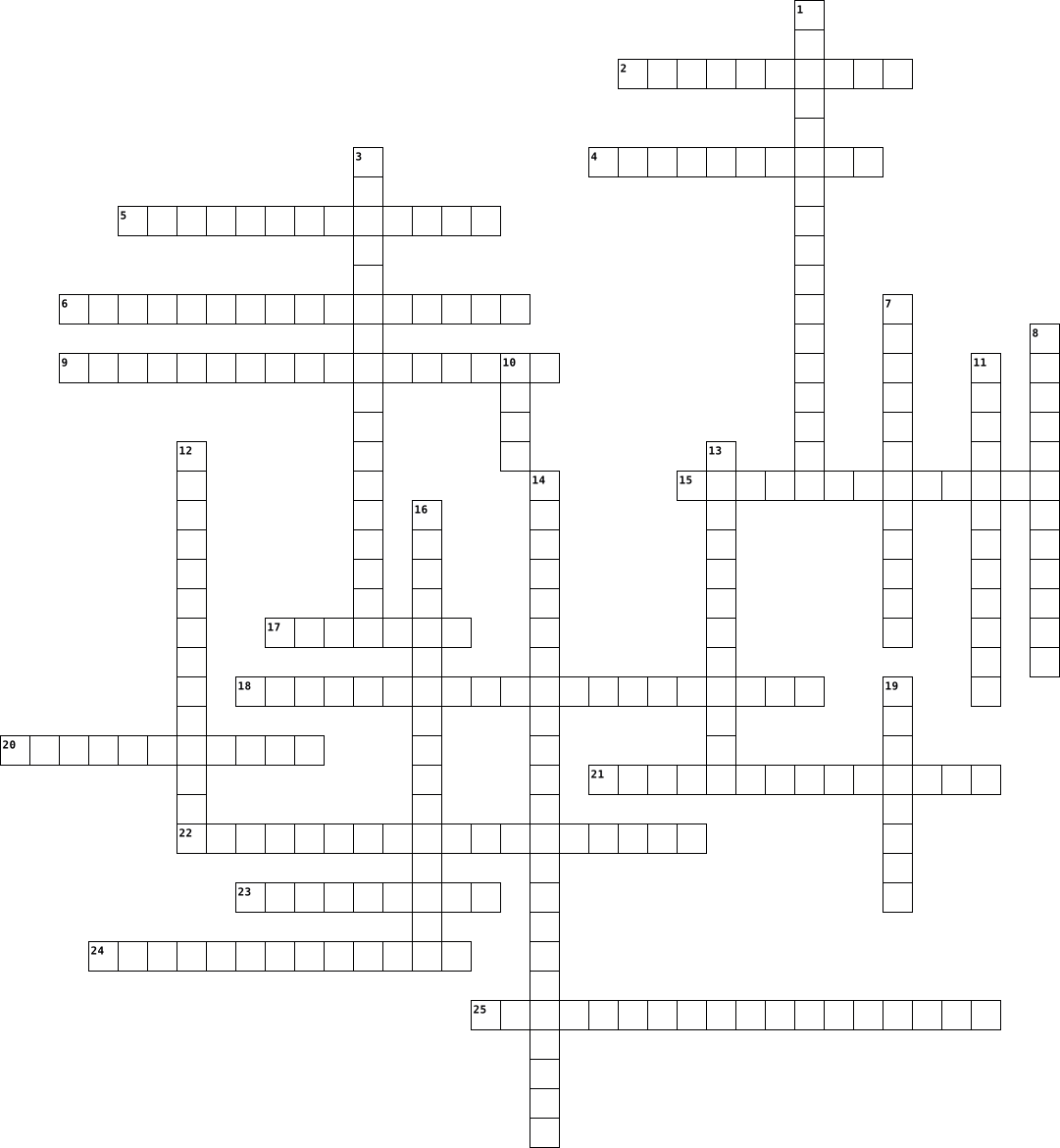
Across
- (Two words) - A utopian socialist. During the depression, he did not lay off any of his workers and he showed that there is no excuse for bad working conditions and low wages. He believed that the main way to improve society was to improve their environment. This could happen by providing more opportunities for schooling, housing, hospitals, as well as child-care.
- (Two words) - Canada has this service universal and publicly funded, making it free, or almost free to all. In other places such as the states, this service is private, and therefore very expensive, resulting in a decline in people's health and willingness to seek medical help when needed.
- (Two words) - This problem arose in 2008. Banks had been lending money to encourage investing and spending on houses, this was because of the vast amount of jobs that would result from building more houses. The banks were failing to look into employment status, credit history and income levels before offering these huge loans which resulted in rising interest rates and eventually falling housing prices. All together this led to a large increase in mortgage foreclosures.
- (Two words) - When a government begins to pay out more money than they are getting back. This is typically only used as a means of getting an economy out of a recession. It tends to involve things such as a general increase in government spending to allow for higher job creation, but it also can occur in the form of handouts and benefits such as the CERB fund for the current pandemic. If the government were to continue giving out this fund to the point where they are not collecting an overage in tax revenue, the government is forced to take out loans. This increases the country's overall debt amount.
- (Three words) - An economic system revolving around supply and demand in which there is very little to no government control. Often, this goes hand in hand with capitalism, although they are not exactly the same.
- (Two words) - This motivating factor of capitalism was first developed by Adam Smith. This selfish motivation will promote a better society as others will work harder. For example, when the common person notices that the Rich spend money on luxurious yachts, cars, and homes it motivates the common person to work harder to achieve a better lifestyle.
- (Two words) - A deal that was introduced after the 1932 election by the new president. It was made up of a series of programs and policies made to try and get the country out of it’s depression. It involved providing the American people with a regained trust and confidence in both their economic and political systems. The three main measures introduced with this act to help deal with the depression were; relief, recovery & reform.
- (Three words) - An idea brought about by Milton Friedman. It involved the theory that having the wealthy keep their wealth by having lower taxes, would cause a domino effect throughout the economy and overall help everyone. This was championed by Ronald Reagan and Margeret Thatcher in the 80s. It fell under the idea of Supply-Side Economics.
- - Typically, inflation occurs when an economy is booming. However, sometimes it may happen when the economy is in a bust, or just at a standstill. This term is used to describe when the inflation is going up, but the economy is not going up with it, it's stagnated. This occurrence can lead to large economic issues that are hard to come back from as people are buying even less than usual to begin with, and yet inflation is still increasing.
- (Two words) - Falls under Supply-Side Economics, and supported by politicians such as Milton Friedman. It involved the lowering of interest rates so that citizens would continue to borrow more from banks, and therefore spending more.
- (Two words) - a statement that states all problems are in some way connected to the supply of money. This states that the ways to fix problems within inflation and deflation are opposites; Raise interest rates vs. Lower interest rates, Decrease government spending vs. increase government spending.
- - Occurs when the business cycle begins to retract. Often this is caused when consumer spending begins to decrease. It has the potential to lead to or result in a depression.
- - An increased role of government with the end goal of making life generally better for the common person. These people came mostly from the educated and middle class, they wanted to ‘fix’ politics. To increase people's general everyday life, they wanted to increase democracy, and therefore involve citizens more directly within the government decision making.
- (Three words) - This was a time that came right after a large boom in the 19th century. The biggest problem that led to this time was the Wall Street Crash of 1929, when wall street ‘overheated’ while also dealing with accusations of corruption and insider-trading. This time was also a result of very high wealth inequalities where 40% of the population was living below the poverty line, and the top 5% were earning 33% of the country's overall income. Millions of Canadians and Americans were left with no options of work, and businesses began to struggle to stay afloat.
Down
- (Two words) - These people believed in an unrealistic perfect economy and world. Included were; Robert Owen, Charles Fourier.
- (Three words) - A fund created by Premier Peter Lougheed in 1976. The three main goals were to save for the future, strengthen & diversify the economy, and improve the Albertan quality of life. In 2006, each Albertain received a cheque of $400 as a result of this fund.
- - The reduction or complete removal of government power, within a specific industry. This is used to help improve competition, but it can also help create higher efficiency and lower costs.
- (Two words) - This man believed in supply side economics - his own form being known as “Reaganomics”. He advocated for tax reductions, and decreases in government spending.
- - The last name of the man who wrote The Communist Manifesto, he believed in everybody being equal. To do this required the government to provide everyone with their basic needs such as food, shelter, and help for their physical and mental needs. It was also a goal to abolish all private property, profit motive as well as crime. He wanted to create a society in which everyone was equal no matter where they came from.
- (Two words) - This policy was in effect as a means of helping an economy get out of a depression. It involved lower taxation so that people have more spending money available to them, as well as an increase in government spending. Government spending was beneficial in this case as they would start large-scale projects or build infrastructure, which would provide more people with jobs and therefore more people with spending money.
- (Two words) - This man was a counter to Keynes, as he supported supply side economics. His basic principles involved taxing and subsidizing. His theory was in classical liberalism and trusted in the invisible hand to prevent and solve economic cycles.
- - This term refers to something we have been experiencing recently with the Covid-19 pandemic. It often results in a bust in the economy as citizens are without money to spend, and are therefore saving as much as they can and only buying the absolute essentials. As a means to temporarily protect the economy while these rates are increasing, government’s will often put out some type of relief fund (such as CERB) or stimulus cheques.
- (Three words) - The creator of Alphabet Agencies and the New Deal. He believed that people needed confidence in both their economic and political systems and therefore he added in a series of measures to try and keep people on his side. These included; abolishing Prohibition, Bank Holidays, Removing America from the Gold Standard, etc. He also did not believe in handouts form the government, he wanted people to earn their sense of worth. He served as the president of the United States up until his death in 1945.
- (Two words) - Set up by FDR, these things were named as a group based on their shortened acronyms. Included are things such as the Agricultural Adjustment Act, Federal Emergency Relief Administration, and the Civilian Conservation Corps.
- - Used specifically in 2008 in terms of the Subprime Crisis. The Big Three; Ford, Chrysler and GM requested these from the government in order to keep their companies afloat and up to par with competition.
25 Clues: (Two words) - These people believed in an unrealistic perfect economy and world. Included were; Robert Owen, Charles Fourier. • (Two words) - This man believed in supply side economics - his own form being known as “Reaganomics”. He advocated for tax reductions, and decreases in government spending. • ...
Specialist Art Words 2019-09-13

Across
- This word has a specific meaning in Art. It is one of the formal elements. It refers to the three-dimensional aspects of objects (i.e. height, width and depth). In images form makes objects appear to be realistic solids, even though they are in fact two-dimensional. Form can also be used in the general sense of “giving form” to ideas, in other words, making concepts concrete. (Do not confuse with “forms” as defined below)
- A discipline in art. The action or skill of using paint, either in a picture or as decoration.
- point The point at which receding parallel lines viewed in perspective appear to converge. The point at which something that has been decreasing disappears altogether.
- Lines, planes or surfaces existing side by side and having the same distance continuously between them. Parallel lines play an important role in hatching and cross-hatching – and they never meet.
- The area of a picture which appears to be at the front of the pictorial space (i.e. nearest the viewer).
- One of the formal elements. The trace of a point which describes the meeting of planes at an edge, or the division between light and dark. Think in terms of silhouettes or contours. Hatched lines can suggest tone and form, thus, describing a plane or curves. There are many different types of lines. Thus, it is important to comment on the nature, direction, width and length of lines.
- A sloping/slanting straight line (i.e. it is not horizontal or vertical). Sometimes a diagonal line joins up two opposite corners of a square or other flat shape.
- Having or appearing to have three dimensions: length, breadth and depth.
- One of the formal elements. It refers to what the eyes see when light is reflected off an object. Intensity (also called saturation), temperature (i.e. warm or cold) and contrast (tonal colour variation) are three properties of colour.
- An imaginary line running through a form or composition around which elements are arranged.
- of reading The sequential flow of the writing system of a particular language (e.g. in the Western world it is left to right). In pictorial terms this refers to where artists want viewers to look first, next and so on. Said differently, which visual elements have the artists applied in order to direct viewers around their artwork (ideally again and again)?
- Monoprinting is a form of printmaking which contains lines, shapes and/or images which can only be produced once. This stands in sharp contrast to most other types of printmaking which allow for multiple originals. There are many different monoprinting techniques. It is particularly useful if wishing to work with spontaneous and expressive mark-making.
- A detail is a minor point or aspect of something, as opposed to the central ones.
- A photograph or picture developed or executed in black and white – or in varying tones of only one colour.
- Cross-hatching is an extension of hatching, which uses fine parallel lines drawn closely together to create tonal/shading effects in a drawing. When sets of parallel lines are placed closely together at an angle (i.e. so they intersect), it is called cross-hatching.
- One of the formal elements. The visual/tactile surface characteristics and the appearance of something (i.e. an element which refers to the way something looks/feels. It can be actual or implied).
- A discipline in art. Printmaking is the process of creating artworks by printing, normally on paper. Printmaking refers to the process of creating prints which have an element of originality, rather than simply photographic prints/reproductions.
- A method of creating a picture by sticking different materials (e.g. photographs, news cuttings, fabrics and papers) onto a flat surface.
- One of the formal elements. It has two-dimensions: height and width. An area with a defined or implied boundary. It is often described in terms of two basic groups: geometric and organic.
- The formation of or division into triangles. A compositional approach/tool which artists can use to direct viewers around a pictorial arrangement of shapes – capturing their attention for longer.
- of thirds Imagine a composition divided into thirds – these lines become the most significant points at which to place key elements/shapes.
- Shading is used in drawing for depicting levels of darkness on paper by applying media lightly/densely. When applied constructively within outlines – it suggests three-dimensionality.
- An art discipline. Photography is the art, application and practice of creating durable images by recording light or other electromagnetic radiation, either electronically by means of an image sensor, or chemically by the means of a light-sensitive material such as photographic film.
- The quality of being made up of exactly similar parts facing each other or around an axis.
- The message the artwork communicates. The content can refer to a specific genre, theme, subject matter, idea, message or emotion.
- In art-making, the broad, generalised categories of creative endeavours such as painting, drawing, printmaking, sculpture, photography and mixed media. (Sometimes also referred to as Art disciplines)
- A discipline in art. Sculpture is traditionally a three-dimensional form of art. The main methods include carving, modelling, casting and constructing.
- Hatching is an artistic technique used to create tonal or shading effects by drawing closely spaced parallel lines.
Down
- line Horizon lines are important in art. They run across the paper or canvas to represent the viewer’s eye level or they delineate/indicate where the sky meets the ground.
- The relative size of an object. When proportional relationships are created relative to a specific unit of measurement.
- Perspective is used artists to create the illusion of three-dimensional space on a two-dimensional surface (i.e. depth).
- spaces Spaces surrounding shapes or forms in two- and three-dimensional art.
- media A discipline in art. Artworks which include a variety of media (i.e. more than one type of material).
- ground The area between the foreground and the background in a picture.
- A term describing the part of a picture which appears to be behind the central area of attention.
- Having or appearing to have two dimensions: length and breadth. In other words, it is flat (i.e. not three-dimensional).
- At right angles to a horizontal plane; in a direction, or having an alignment, such that the top is directly above the bottom (e.g. a vertical axis).
- Parallel to the plane of the horizon; at right angles to the vertical.
- One of the formal elements. The amount of space that a substance or object occupies, or that is enclosed within a container.
- A dark area or shape produced by a body/object coming between rays of light and a surface.
- elements The formal elements in art refer to the key/tangible/physical aspects which make up an artwork (e.g. line, shape, tone, texture, colour, pattern, form, volume, space etc.)
- A discipline in art. A picture or diagram made with a pencil, pen, crayon or other dry material rather than paint.
- A form of art containing a raised surface/shallow relief.
- One of the formal elements. A pattern is a regular arrangement of lines, shapes and colours e.g. a design in which the same lines, shapes and colours are repeated at regular intervals over a surface.
- colours The three pairs of opposites on the colour wheel are described as complementary. These are orange/blue, red/green and purple/yellow. When placed against each other they contrast and enhance, so red seems redder when placed next to green. Said differently, they make each other stand out.
- Lack of equality or equivalence between parts or aspects of something; lack of symmetry.
- This is a term used by artists to describe the character of graphic effects in both drawing and painting.
- A principle of art which explores differences between visual elements in order to create variety, emphasis or interest. Tonal contrast refers to the value, that is, the difference between light and dark. Tonal colour contrast refers to the difference between the lightest and darkest colours.
- of shapes The arrangement of sculptural elements within a three-dimensional context (i.e. The relationship of the forms to each other and the surrounding space). The equivalent to composition in a two-dimensional context.
- The arrangement of shapes within a picture plane/two-dimensional surface (e.g. on a painting or drawing). Can be regarded as one of the formal elements.
- matter The subject represented in a work of art.
- How far back the image appears to recede from the surface of the picture (the picture plane). The illusion of three-dimensional space created on a two-dimensional surface.
- shapes Shapes or forms in two-dimensional and three-dimensional art.
- One of the formal elements. A term denoting the particular quality of brightness, deepness, or shade of a colour.
- One of the formal elements. The three-dimensional expanse/area in which objects are located (e.g. between, around, above, below and within objects).
55 Clues: matter The subject represented in a work of art. • A form of art containing a raised surface/shallow relief. • shapes Shapes or forms in two-dimensional and three-dimensional art. • Parallel to the plane of the horizon; at right angles to the vertical. • ground The area between the foreground and the background in a picture. • ...
Poem 2022-09-27

Across
- Images related to religion and race
- A reference to allusion regarding things that happened in the past
- The person who creates the poem
- The time, place, physical environment, and circumstances in which a story takes place. How the setting of a text is described influences the atmosphere
- Expresses the single main idea of a body paragraph
- A pause (represented by "II") that occurs within a line of poetry, usually marked by punctuation. This is where the reader pauses naturally, allowing for him/her to reflect upon the contents of the line
- Images that could be used using our five senses
- Used to support the point
- Images that has a very strong feel on you
- The way a poem is being written
- A play on words on which a writer uses either a homonym or homophones
- Demonstrated how the evidence quoted is important to the point
- Repetition of sounds b, p, t, d, k and g
- Words which sound the same but have different spellings
- A group of related images in a text. Images may be categorised by topic, effect or sense
- An element tension creates
- A central idea that emerges in a text. The theme may be an obvious or implied comment on human values, an interpretation of life, an issue, or an observation by the writer.
- We use this punctuation mark when quoting
- What is special about the language used in the poem? What vivid images are created?
- A reference to allusion regarding location
- Sense from our eyes
- A reference to allusion regarding politics
- The pattern of rhyme at the end of lines. The letters of the alphabet are used to note this.
- Occurs when there is a mismatch between the expected and read outcomes of a situation.
- Groups of images
- Another word for poem
- A reference to allusion regarding items
- Sense from our tongue
- The manner in which a speaker/narrator speaks in a text. The tone of a speaker's/narrator's voice reveals his attitude toward the subject at hand. Tone is created by the speaker's/narrator's choice of words (diction) and the images these words convey
- The range of suggested associations and feelings that a word implies. Words often have both connotative and denotative meanings
- When contrasting images/objects/concepts are placed together to highlight their differences
- A line in poetry that finishes with a pause at the end of the line (commonly indicated by a comma, colon, semi-colon, or full stop.)
- The aural effect produced by matching sounds at the end of two (or more) different words
- What emotional effect does the use of such a technique/device have on readers of the text? What are readers made to feel or understand?
- The writer of the poem
- How does the poem sound when read aloud?
- Images that we can see
- One type of verbal irony
- A type of figurative language where a person, pace, object, animal, word, action, or image is used to represent a larger, more significant idea, issue, or value. The reader usually has to infer what the symbol used stands for.
- Another word of speaker
- Punctuation indicating smaller break
- Images that we can hear
- Repetition of sounds l
- The division between lines in poetry. Where line breaks are positioned determines the visual shape of a poem. A line break that occurs mid-clause/sentence creates enjambment. The "/" is used to represent each line break when quoting lines of poetry in writing
- What purpose do you think the technique/device serves in the text? Why do you think the writer used this technique/device?
- Describe an action
- Non-literal words/phrases used to create an image, association, or implied meaning in a text. Hyperbole, metaphors, personification, puns, similes and symbols are examples of figurative language.
- The person who reads the poem
- What does the poem look like? How is it structured?
- When rhyming words are found at the ends of different lines.
- Images that create violence on you
Down
- Images with flowers
- A reference to allusion regarding things that related to culture
- Sense from our hands
- Images that we can smell
- Images that we can taste
- The pattern created through the arrangement of stressed (represented by "/") and unstressed "U" syllables. Stressed syllables are pronounced longer, louder, and at a higher pitch than the surrounding (unstressed) syllables.
- A reference to a person, place, thing or idea of historical, cultural, literary or political significance. Allusions are usually not explained in detail in the text; the writer expects the reader to possess enough knowledge to spot the allusion and grasp its importance in a text.
- A type of figurative language used to show comparison between one quality of an object and that of another, by stating that Object A is as ... as/like Object B
- A reference to allusion regarding things that are known using stories
- Occurs when there is a contrast between what the characters/readers/audience expects and what actually happens in reality. Irony can be used to create humour, or to emphasise the tragedy of a particular situation. Types of irony include situational irony and verbal irony
- The repetition of initial consonant sounds in words next to or close to each other. It contributes to the sound quality of the poem, drawing attention to those specific words and their meanings
- The speaker's / narrator's perspective and feelings about an issue. The speaker's/narrator's attitude is conveyed through his/her tone in a text.
- We use this punctuation to end a sentence
- A question that requires no answer because the answer is obvious and need not be stated. It is usually asked for effect.
- Intense emotion (e.g. excitement, fear, anxiety) on the reader's part in the text. Tension may accordingly create an element of suspense in the story. Tension may also refer to the quality of having conflicting opposites in a text (e.g. light vs. dark, good vs. evil)
- Sense from our nose
- The emotional quality of a scene conveyed through descriptions of its setting. The atmosphere of a text contributes to its mood and emotional impact on the reader/audience.
- A mental picture or impression created through the language used in a text that appeals to one or more of the reader's five senses. This helps to add depth and richness to a text. Many types of figurative language, including metaphors, personification, similes and symbols, make use of an image
- Relates point back to the question
- Repetition of sounds m and n
- Effects of images
- The overall emotional quality of a text and its impact on the reader/audience. The mood of a text often arises from its atmosphere/tone.
- Good words in a text
- When rhyming words are found within the same line
- Another word for pun
- Separation of two independent clauses
- The voice adopted by the poet in the poem
- A writer's choice of words/phrases and punctuation used. It is important to examine the connotations of a writer's choice of words in a text, which influence its meaning
- A type of figurative language which gives human qualities (e.g. speech, feelings, action) to non-human things (objects, animals, or even abstract ideas).
- Occurs when a clause/sentence in a poem is split ("runs on") across different lines, rather than being contained within a single line
- Repetition of sounds f, v, th and h
- A word's literal meaning. Words often have both denotative and connotative meanings
- Exaggerated language that is used to describe something as more extreme than it actually is. Hyperbole can serve to emphasise the depth of the speaker's feelings
- What technique/device do you observe being used in the text?
- Repetition of sounds s, sh and z
- A group of lines or paragraphs in the poetry
- Poems are usually read this way
- Images that we can touch
- Pronounced longer, louder and at a higher pitch than the surrounding syllables
- A word that has double meaning
- A reference to allusion regarding people
- A type of figurative language used to show comparison between one object and another by stating that Object A is Object B. In other words, Object A identifies with all the qualities of B.
- A piece of literature typically writen in verse form
- The recurrence of particular words/lines/images/ideas in a text, typically to emphasise a key idea, issue, or feeling
- The use of words that resemble the sounds that they refer to. They are usually used to bring the scene to life for the reader/listener
- Produced when a speaker deliberately says the opposite of what he really means. Sarcasm is a type of verbal irony
- Poetry that is free from the limitations of traditional poetry - it does not rhyme or have a regular rhythm. In this way, the poet can give his own shape to a poem however he/she desires
- Sense from our ears
- Effect of an action
100 Clues: Groups of images • Effects of images • Describe an action • Images with flowers • Sense from our nose • Sense from our eyes • Sense from our ears • Effect of an action • Sense from our hands • Good words in a text • Another word for pun • Another word for poem • Sense from our tongue • The writer of the poem • Images that we can see • Repetition of sounds l • Another word of speaker • ...
STAAR Reading Vocabulary 2016-03-10

Across
- a literary work based on the imagination and not necessarily on fact.
- A practical lesson about right and wrong
- A listing of words with synonyms and antonyms
- comparison using like or as. Clue: You "smile" when you see someone you like." Example: The car was as cold as ice.
- person point of view Told from the viewpoint of one of the characters using the pronouns "I" and We"
- the struggle or problem in the story that a character must resolve
- This unreliable information is a technique used to mislead the reader. (
- the person who is telling the story; the speaker
- Writing that is factual, not creative or fictional.
- the dictionary meaning (remember the D is for dictionary)
- language language that means more than what it says on the surface; not actual or literal meaning
- term in persuasive text, a word or phrase that reveals the author's feelings and rouses the reader's emotions
- fiction fiction that involves an event in history. Contains historical facts, events, or people, but is not true.
- a conversation between characters set off by quotation marks (what character is saying)
- Atmosphere created by the author's work (how it makes you feel--feeling created)
- the reason the character says or does something
- the smaller title that goes before a new section of the text.
- to draw a reasonable conclusion from the information presented (put clue together with your good brain)
- to demonstrate that something is right; to defend with reasons
- finding a solution to a problem
- a conversation between two persons
- a phenomenon that follows and is caused by some previous phenomenon
- emotional meaning of a word--how it makes you feel (can be positive or negative--Example: he's a big guy OR he's SO fat!)
- and contrast signal words include : like; unlike; but; in contrast; on the other hand; however; both; also; too; as well as; although; yet; nevertheless; as opposed to; whereas
- action point in a story where the conflict begins to be resolved (things start to wind down and story comes to an end)
- a word part that can be added at the beginning of a word to make a new word (Example: pregame)
- idea what a piece of writing is mainly about--the BIG PICTURE - it's never one thing!
- the story of a person's life written by that person in first person point of view
- shows how two things are alike/different or how one is better than the other
- when a portion of the story goes back in time
- a comparison or two unlike things without using like or as (Example: Her eyes are blue jewels.)
- The items on the stage that the actors use. They give clues about the setting of the play.
- action the bulk of a story, during which the character works to resolve the problem (conflict starts to happen and action rises)
- brief statement of the main events of a story (BME-beginning, middle, end)
- small text found near a picture that provides important information about the picture
- Who the piece of text was originally written for. Example: in a letter, look at who the letter is addressed to (Dear Mom,)
- assumption the fallacy of an idea or a principle that is untrue (Example: holding frogs give people warts)
- to make a brief statement of the main events of a story. It has to have the beginning, middle and end. It should be precise (accurate) and concise (to the point).
- a character trait used to describe someone who feels good about him/herself.
- to influence
- of view the perspective from which a story is told
- scheme the pattern of rhyme in a poem (ex. ABAB)
- details words and details that appeal to a reader's senses (sight, touch, taste, hearing, smell, emotion)
- a succinct statement of a philosophy or principle; often quoted (a penny saved is a penny earned)
- similar to a sentence but in a poem
- The reason why something happens
- influencing strongly
- where and when the story takes place
Down
- rhyme when two words rhyme in the same line of poetry
- connected
- the events that make up a story (sequence of events - introduction, rising action, climax, falling action, and resolution)
- when two things/people have something in common
- Sometimes authors overstate the facts leading to a false of importance. (We will all be doomed if we don't take a stand now!) (This is a one-time offer. You can't get this price after today.) Key words: always, never, everyone
- a beginning or coming into being
- the turning point in the action of a story--the problem is solved (highest point of action)
- an exaggerated, overly simplified version of an opposing point of view (features of a person enlarged--frequently used in cartoons--Example: President Obama with large ears or huge teeth)
- the use of words that represent sounds "Pow", "Bang"
- a character trait used to describe someone who doesn't give up easily.
- Where information comes from.
- the repetition of consonant SOUNDS at the beginning of words. For example, Sally sells seashells by the sea shore.
- a word part that can be added at the end of a word to make up a new word (Example: swimming)
- giving human qualities to non-human things (Example: the wind whistled)
- the beginning of the story--introduces the setting, characters, and the problem
- To feel excited and nervous at the same time.
- the following of one thing after another
- Drawings or photographs that help explain the text
- question a question that suggests the desired answer or tries to make the audience think in a particular way (What do you think about the horrible effects of slavery?)
- similar to a paragraph but in a poem
- conclusions combining several pieces of information to make an inference--to use details, facts, and evidence from a text to come to a new understanding about a topic or idea (infer, inference)
- the various methods of communicating information
- order in the time order in which events happened (sequence or time order)
- The use of clues to suggest events that will happen later in the plot
- true
- text This type of text informs or instructs the reader. It is nonfiction.
- used to convince or persuade the reader of the writer's point of view
- a fictional tale that explains the actions of gods or the causes of natural phenomena
- elaborate exaggeration (Example: I'm so hungry I could eat a horse OR I walked a million miles.)
- A drawing that shows or explains something...usually includes labels and captions.
- place assertion a statement that many people assume to be true, though it may or may not actually be true (Example: crop circles are created by aliens)
- to summarize part of or all of a text you read in your own words
- strengthen and support
- and solution signal words include: therefore; consequently; so; this led to; as a result; because; if...then; since; so that; thus; for this reason;
- the outcome of an experiment or problem
- words that are similar (pretty and beautiful)
- a story written to be performed by actors; a play
- a collection of word pictures that appeal to the reader's senses; uses devices such as metaphor, simile, etc.
- claim a statement that can be verified, independently and objectively with facts, personal observations, reliable sources, or an expert's findings (may use a statistic or number--there was a 20 percent increase in enrollment this year at our school)
- The central idea or message of a work, the insight it offers into life (life lesson)
- a set of letters attached to the beginning or the end of a root word that changes the word's meaning
- purpose The reason an author writes the text--to persuade, inform, explain and entertain
- an expression with a meaning different from the literal meaning of the individual words (It's raining cats and dogs!)
- person limited point of view the narrator focuses on the thoughts and feelings of only one character
- directions Instructions given to the actors so they know how to act and the tone of voice to use. These are used in dramas.
- Author's attitude toward his subject - can be positive, negative, or neutral
- words that are opposites (happy and sad)
- clues Clues in surrounding text that help the reader determine the meaning of an unknown word (look above, in, below, and all around the text of the unfamiliar word)
- a word relationship that compares two dissimilar things (pen : writer :: hammer : carpenter (make a bridge sentence with the first set--a pen is used by a writer just like a hammer is used by a carpenter)
- and effect
- features the parts of a text that stand out (diagram, table of contents, index, etc)
99 Clues: true • connected • and effect • to influence • influencing strongly • strengthen and support • Where information comes from. • finding a solution to a problem • a beginning or coming into being • The reason why something happens • a conversation between two persons • similar to a sentence but in a poem • similar to a paragraph but in a poem • where and when the story takes place • ...
8th Grade Math - TCAP Vocabulary Review 2024-04-12

Across
- data that clusters (closely grouped) along a line (2 words)
- the point where a line crosses the y-axis
- graphs that use points to display numerical data with two variables or bi-variate data – helps to determine if there are trends , patterns, or association between the variables
- angles inside of a polygon formed by the sides of the polygon
- angles inside the parallel lines and on same sides of the transversal – they are supplementary (3 words)
- scatterplot association when the change in data set has no effect on the second data set (2 words)
- orientation of the _____ refers to the order in which they are labeled, clockwise or counterclockwise
- describes the horizontal change on a graph
- the amount of three-dimensional space occupied by an object
- describes the vertical change on a graph
- describes a function whose graph does not form a straight line
- a three-dimensional figure with one vertex and one circular base
- describes a slope that increases from left to right
- any number with a square root that is a whole number (2 words)
- geometric figures that have the same shape but not the same size (2 words)
- the set of whole numbers and their opposites
- inverse operation of cubing a number and “undoes” and exponent of 3 (2 words)
- a mathematical symbol that denotes the root of a number – the most commonly used is the square root, but can include any root like the cube root, fourth root, etc
- transformation of a figure that moves every point of a figure the same direction and the same distance without changing its orientation – can move left/right and up/down – also thought of as a slide
- in a right triangle, the two sides adjacent to the right angle
- transformation of a figure that turns an image around a fixed point and results in a congruent figure – can move clockwise or counterclockwise
- original figure to be transformed by translation, reflection, rotation, or dilation
- angles outside the parallel lines and on opposite sides of the transversal – they are congruent (2 words)
- slope-intercept form, or y=mx+b is one way to write the equation of a _____ relationship
- the set of all positive counting numbers (numbers on a number line starting with 1) (2 words)
- decimal that keeps going with a pattern of digits repeating infinitely
- the x-coordinate in a relationship
- the point where the x-axis and y-axis of a coordinate plane intersect – the coordinate is (0, 0)
- includes all the numbers that can be found on the number line - includes both rational and irrational numbers (2 words)
- a relationship or rule that assigns each input exactly one output
- describes the slope of a vertical line
- a transformation of a figure that either enlarges or reduces the size of an original figure by multiplying its dimensions by a scale factor – does NOT result in a congruent figure
- a pair of geometric figures having the same size and shape
- a ratio that describes the change in y-coordinates as compared to the change in x-coordinates – describes the steepness of a line formed from the graph of a linear relationship – also referred to as rate of change or constant of proportionality
- a set of values that show an exact position (x, y) (2 words)
- this type of solution occurs when two lines have different slopes and intersect at one single point – only one number can replace the variable to make both sides of the equation equal
- in a right triangle, the side opposite from the right angle
- orientation of the _____ refers to whether the pre-image and image are facing the same direction on the coordinate plane
- a data point with a value significantly greater or less than most other values in the data
- numbers that cannot be written as a simple fraction, decimals that are non-repeating/non-terminating, and square roots of non-perfect squares
- scatterplot association when an increase in one data set results in an increase in the other data set – the variables change in the same direction (2 words)
- the number in front of a variable
- the y-coordinate in a relationship
- angles that are on the same side of the transversal and on the same side of the parallel lines – they are congruent
- decimal that stops or ends
- this type of solution occurs when lines have the same slope and same y-intercept – any number can replace the variables to make both sides of the equation equal
Down
- a set of two or more linear equations that have the same variables (3 words)
- the distance from one point on a circle through the center to another point on the circle
- tells us how the side lengths of right triangles are related – the square of the hypotenuse is equal to the sum of the squares of the other two sides (2 words)
- the point where a line crosses the x-axis
- half of a sphere
- result of a change made to an object by translation, rotation, reflection, or dilation
- a mathematical expression used to represent a really large or really small number as a number between one and ten raised to a specific power of ten (2 words)
- y=mx+b, where m is the slope of the line and b is the y-intercept (3 words)
- property used to multiply each term outside of a parentheses by the terms inside the parentheses (2 words) …ex. a(b + c) becomes ab + ac
- the distance around a circle
- a number that has a whole number as its cube root (2 words)
- angles outside the parallel lines and on same sides of the transversal – they are supplementary (3 words)
- a line segment that can be drawn from the center of a circle to any point on the circle
- lines that intersect to form right angles
- scatterplot association when an increase in one data set results in a decrease in the other data set – the variables change in opposite directions (2 words)
- numbers that can be written as a fraction/ratio – includes terminating and repeating decimals, and square roots of perfect squares
- describes the slope of a horizontal line
- the set of all positive counting number starting with 0 (2 words)
- a line that shows the general direction of a group of points on a graph – sometimes called the “trend line” (4 words)
- type of function whose graph is a straight line
- angles inside the parallel lines and on opposite sides of the transversal – they are congruent (2 words)
- pair of adjacent angles formed by intersecting lines that add to 180 degrees (2 words)
- a three-dimensional figure with two circular bases
- a symbol written above and to the right of a mathematical expression to indicate the operation of raising to a power - refers to the number of times a number is multiplied by itself
- the new figure that is formed from a pre-image after a transformation
- a value, or values, we can put in place of a variable that makes the equation true
- terms that have the same base (or variable) and the same exponent (or power) (2 words)
- describes a slope that decreases from left to right
- the ratio of a circles circumference to its diameter (approx. 3.14)
- a constant or a variable in an expression
- data that does not cluster (closely grouped) around a line (2 words)
- an inverse operation of squaring a number - “undoes” an exponent of 2 (2 words)
- a form of writing equations, numbers, or expressions using a certain set of rules in the most common way (2 words)
- pairs of opposite angles formed by intersecting lines – they do not share any sides – they are congruent
- the point of intersection of two graphed equations – the ordered pair that makes both equations true
- to reduce (an equation, fraction, etc) to a simpler form by cancellation of common factors or regrouping/combining like terms
- a ratio of the length of one side of an image to the corresponding length of a pre-image – if it is greater than 1 it will enlarge a figure – if it is smaller than 1 it will reduce a figure (2 words)
- a mathematical phrase that can contain numbers, variables, and operators (like addition and subtraction) – will not have an equal sign
- this type of solution occurs when lines have the same slope and different y-intercepts; they will never intersect – no number can replace the variables to make both sides of the equation equal
- transformation of a figure that flips a figure over a line in order to create a mirror image – each new point should be the same distance from the line on the opposite side – creates a congruent figure
- mathematical statement consisting of an equal sign between two algebraic expressions that have the same value
- a number that is raised to a power
88 Clues: half of a sphere • decimal that stops or ends • the distance around a circle • the number in front of a variable • the x-coordinate in a relationship • a number that is raised to a power • the y-coordinate in a relationship • describes the slope of a vertical line • describes the vertical change on a graph • describes the slope of a horizontal line • ...
psychology review 2013-04-21

Across
- (false beliefs that are inconsistent with reality but are held in spite of evidence that disconfirms them)
- focus on changing the faulty behaviours people have learned: the words, thoughts, interpretations, and feedback that direct daily strategies for living
- people actually experience physical problems such as motor deficits (poor balance/coordination, paralysis or weakness) or sensory deficits (loss of sensation to touch or pain, double vision, blindness, deafness) but no medical condition
- money, social skills, knowledge, sense of being in control (even “illusion of control”) and social support
- a person’s belief about whether s/he can successfully engage in and execute a specific behaviour; is specific to any given activity
- (psychotherapy to reduce, remove or alter their troubling emotions, attitudes, behaviours or thoughts…cultural views differ)
- attempts to limit the duration severity of a disorder once it has begun
- (emotional state or condition that results when a goal –work, family, personal –is thwarted or blocked
- Excessive emotionality and attention seeking, inappropriate sexual or seductive behaviour
- the extent to which people are flexible and respond adaptively to external or internal demands
- the perception an individual has of him/herself and of his/her relationships to other people and to various aspects of life
- first must learn relaxation techniques –possibly Progressive Muscle Relaxation–then go through a schedule of exposure)
- people divert sexual or aggressive feelings for one person onto another person (behaviour is not exaggerated or overly dramatic)
- an individual has a history of many physical complaints beginning before age thirty
- (religio-magical approach: believe supernatural agents, such as spirits, cause abnormal behaviour and emotional distress)
- emotional state of imbalance (can range from total euphoria to total despair); prolonged
- drive toward death (turned outwards aggression and turned inwards could lead to suicide)
- have to choose between 2 equally distasteful alternatives or goals
- (ending the practice of committing patients with many serious disorders to mental hospitals for long periods of time…made possible by new drug therapies introduced in 50s and 60s that allowed control over the symptoms of these disorders)
- Lack of Desire to have social relationships, lack of emotionality in social situations
- drive toward life (libido –instinctual and sexual) working on the pleasure principle, energizes the id)
- operation that severs the nerve fibres connecting the frontal lobes of the brain with the diencephalon, especially those fibres of the thalamic and hypothalamic areas (developed by Egas Moniz, who is 1949 won a Nobel prize for this therapy)
- an unconscious way of reducing anxiety by distorting perceptions of reality; they have several assumptions
- limits the long-term impact of a psychological disorder by seeking to prevent a relapse
- qualities that characterize our daily interactions
- intense and irrational fears that can interfere with everyday activities (e.g., insects, animals, heights, etc.)
- love and acceptance with no contingencies attached
- have to choose an alternative or goal that has both attractive and repellant aspects
- Instability and intensity in personal relationships, impulsivity,Personal relationships, impulsivity, particularly with respect to behaviours that include self-harm
- a person’s diminished ability to deal with demanding life events
- are sociable, impulsive, enjoy new experiences and new people
- (the therapist comes to like/dislike a client because client is perceived as similar to significant people in the therapist’s life).
- concentrates on doing something about the situation, including: taking action to get rid of the problem; making a plan; putting aside other activities to concentrate on problem
- characteristics exhibited in response to specific situations (e.g., xenophobia); more easily modified and not always exhibited
- emotionally charged ideas and images that are rich in meaning and symbolism, exist within the collective unconscious [Shadowor Dark Side; Great Mother(nourishment or destruction); Wise Old Man(wisdom, often seen in dreams); Self (completion/wholeness; opposites; ultimate symbol is the Mandala)
- entire identity gone, move and start over and start over
- a nonspecific response to real OR imagined challenges or threats
- an environmental stimuli that affects an organism, producing physical and psychological effects such as physical arousal and psychological tension and anxiety
- arousal of the sympathetic division of the autonomic nervous system
- Cognitive or perceptual distortions as well as discomfort in social relationships
Down
- very high levels of physical arousal coupled with an intense fear of losing control
- the part of personality that seeks to satisfy instinctual needs in accordance with reality (reality principle); it attempts to check the power of the id and delay gratification without regard for consequences (a manager)
- Preoccupied with rules and lists; perfectionism interferes with rules and lists; perfectionism interferes with being able to complete tasks
- (need to realize one’s fullest human potential, after lower needs are met)
- pairing an aversive (unpleasant) stimulus with a maladaptive behaviour
- inability to remember significant details about one’s personal self (profound and lengthy losses of identity or memory)
- prevent condition before it begins
- provide treatments meant to reduce another’s abnormal behaviour or emotional distress through spiritual, physical or psychological means
- the moral aspect of mental functioning, comprising the ego ideal (what a person would ideally like to be) and the conscience (feelings of guilt); taught by parents and society but not in touch with reality
- characterized by disturbance in sexual desire and in the psychophysiological changes that characterize the sexual response cycle and cause marked distress and interpersonal difficulty
- process by which a person takes some action to manage, master, tolerate, or reduce environmental or internal demands that cause or might cause stress and that tax the individual’s inner resources
- Inability to respect the rights of others, irresponsible or unlawful behaviour that violates social norms
- disorders in which individuals have physical symptoms without identifiable physical causes for these symptoms
- a gradual process of extinguishing a learned fear (or phobia) by working through a hierarchy of fear-evoking stimuli while staying deeply relaxed (e.g., virtual reality therapy); first must learn relaxation
- a long-term mental disorder of a type involving a breakdown in the relation between thought, emotion, and behaviour, leading to faulty perception, inappropriate actions and feelings, withdrawal from reality and personal relationships into fantasy and delusion, and a sense of mental fragmentation.
- preoccupation with fears of disease, don’t have them but worry about them (many feel pain and discomfort)
- (empirical-scientific approach: based on rational theories, supported, more or less, by empirical studies, and does not involve religion or supernatural
- “Multiple Personality Disorder”
- concentrates on managing feelings that accompany stress and trying to find ways to feel better by: focusing on or expressing emotions; reinterpreting event; finding comfort in religion; seeking social support
- those experiences we are aware of at any given time
- Avoids interpersonal contact because of the risk of rejection; fear criticism and feel inadequate in social situations
- process of evaluating individual differences among human beings by means of tests, interviews, observations, and recording of physiological processes
- have to choose between 2 equally attractive alternatives or goals
- emerge when personality theorists combine several related traits into 1 category
- related to fixations, except they take place after a person has progressed through the various stages of development
- an insightful awareness and ability to share another’s inner experience
- therapy expose the client to the object of their fear and then prevent the compulsion (used often with OCD Anxiety Disorder)
- are not as sociable/unsociable, cautious, prefer routine activities, do not enjoy meeting new people
- occurs if person has rigid self-concepts (guard against potentially threatening feelings and experiences); they can’t fit new types of behaviour in to existing concept
- a shared storehouse of primitive ideas and images that reside in the unconscious and are inherited from one’s ancestors
- general category of mood disorders in which people show extreme and persistent sadness, despair, and loss of interest in life’s usual activities
- so central that a person’s entire life revolves around that trait (e.g., Snape in Harry Potter)
- amnesia with no medical conditions (localized or generalized)
- the source of a person’s instinctual energy, works mainly on the pleasure principle (tries to maximize instant gratification and satisfy raw impulses); it is demanding, irrational and selfish
- a mystical symbol generally circular in form that in Jung’s view represents a person’s inward striving for unity (Hinduism and Buddhism use these as aids to meditation)
- a # of people meet together to work toward therapeutic goals, you learn that your problems are not unique (e.g., self-help groups)
- person if you have received empathy and unconditional positive regard, you develop a healthy self concept and will move in a positive direction
- techniques people use to deal with the stress of changing situations
- people behave in a way opposite to what their true but anxiety-provoking feelings would dictate (behaviour is exaggerated or overly dramatic)
- inserting a hole surgically into the skull
- any readily identifiable stable quality that characterizes how an individual differs from other individuals (e.g., shy…a continuum)
- (an emotional reaction toward the therapist –either positive or negative) and
- reinterpret undesirable feelings or behaviours that make them seem acceptable
- having more than one disorder
- obsessions (recurrent modes of thought), then anxiety increases and must carry out compulsions(repetitious behaviours)
85 Clues: having more than one disorder • “Multiple Personality Disorder” • prevent condition before it begins • inserting a hole surgically into the skull • qualities that characterize our daily interactions • love and acceptance with no contingencies attached • those experiences we are aware of at any given time • entire identity gone, move and start over and start over • ...
anatomy of the aud system 2024-08-04

Across
- allows for communication between air cells of the mastoid and the epitympanic recess (3 words)
- the ________ crus of the stapes is the wider, longer, and curvier crus
- the portion of the temporal bone houses the sensory organs of hearing and balance
- CN VII (2 words)
- the deflection of the _____ at the base of the SCCs causes the hair cells to be sheared
- this wall of the ME houses a semicanal the tensor tympani enters through, the Eustachian tube, and chorda tympani
- the ________ vestibular nerve is made up of nerve fibers from the posterior SCC and Saccule
- the loss of energy due to friction, not related to frequency
- the vestibulocolic reflex is a ______ reflex as it assists in maintaining the head in horizontal gaze orientation relative to gravity but independent to trunk movement
- the narrowest point of the EAC
- small perforations in the osseous spiral lamina that allow nerve fibers to pass through
- the auditory nerve is known as the auditory ______ because damage here can result in dysfunction at or beyond this point
- the interaural timing difference occurs due to the difference in the _______ of a sound as it arrives at each ear
- the medial wall of the ME is made up of the prominence of the lateral semicircular canal, oval window, _________ and round window
- the _______ between the TM and oval window is the mechanism that accounts for 24.6 dB SPL (2 words)
- the ossicular chain is _______ in the ME cavity by its attachment to the TM by the manubrium and to the oval window by the stapes footplate and by various tendons and ligaments
- the tympanic annulus is a _________ ring that attaches the tympanic membrane to the tympanic sulcus
- AN fibers with a ______ spontaneous firing rate respond to low intensities
- a pure tone does not contain ________ making it optimal for testing specific points of the cochlea
- the propeoreciptors in the muscles of the limbs, the eyes, and the vestibular system are the three ways we maintain _________
- the chorda tympani nerve travels through the ME space through the posterior wall, between the ossicular chain to the anterior wall and deals with ________
- low and moderate intensities cause the stapes to move along the _________ axis
- the ET serves to equalize the less compressible air pressure in the middle ear with the _________
- the rarefaction phase cause the BM to reflect ______ and leads to depolarization of hair cells
- the left anterior SCC is paired with the right ______ SCC
- the tympanic _______ is a groove in the bony wall of the EAC
- the dynamic range of an AN fiber is it's threshold to it's point of ________
- the middle ear muscles pull in essentially ______ directions stiffening the ossicular chain
- spinning sensation caused by dysfunction in the vestibular system
- air molecules oscillate and hit neighboring air molecules and _________ the energy to them
- OHCs ______ in response to rarefaction
- the pH of cerumen is ______
- the SCCs are approximately ________ (90 degrees) from each other
- the EAC first travels _____________ then posterosuperiorly and then _____________
- the ________ plane divides the body horizontally into superior and inferior
- the SOC is the first place in the auditory system where there is _______ representation of monaural acoustic input
- the cartilaginous portion of the EAC is __________ as the epidermal lining moves outward (2 words)
- the largest portion of the temporal bones that forms the superior wall of the EAC
- the EAC gives a 10-15 dB _____ to frequencies between 3000-4000 Hz
- OHCs are directly sheared because they are imbedded to the tectorial membrane and IHCs are imposed by the ______ of the endolymph flow imposed on them
- the basilar membrane is shorter and more stiff at the _____
- the inner layer of the TM is continuous with the ________ lining of the ME space
- hair cells of the SCCs are located in the _______ ampullaris on the ampulla
- the intertragal _____ (or incisure)is between the tragus and antitragus
- the vestibulo-ocular reflex ________ our gaze when we are turning our heads- the eyes move opposite to head movement
- bone that forms the framework of support and protection for the outer, middle, and inner ear as well as the 7th and 8th cranial nerve
- CN V (2 words)
- outer hair cell are embedded in this gelatinous flap that covers the length of the organ of corti (2 words)
- the TM is attached to the tympanic ______ by the tympanic annulus
- the _____ zone is the inner section of the BM that courses from the osseous spiral lamina to the outer pillar cells
- the ________ foramen is the opening between the two crura of the stapes
Down
- the products of the _______ glands and ceruminous glands combine to create cerumen
- portion of the wave when molecules are close together
- Low frequency sounds are more affected by the ________ of a system
- the function of the _____ is to collect acoustic energy into the EAC, best at collecting frequencies 5000 and above
- calcium carbon crystals that sit on top of the jelly like structure in the macula. they add mass and allow for the hair cells the be sheared.
- ______ muscles are vestigial in humans meaning it serves no functional purpose
- the ET courses to the posterior aspect of the nasopharynx in a inferior, ______, and anterior direction
- _______ type I AN fibers innervate a single IHC
- Claudian cells provide ________ to the basilar membrance
- the endolymphatic duct regulates endolymphatic ______ to avoid the overproduction/under absorption of endolymph
- the semicircular canals are arranged in pairs so that when one is excited the other is _______
- the middle layer of the TM is made up of ______ fibers and circular fibers
- the apex of the cochlea is oriented anteriorly and slightly laterally pointing towards the ________
- The stria vascularis maintains endocochlear potential by ___________ endolymph
- the combination and integration of information arriving from the two ears (at the SOC)
- ______ membrane separates the scala vestibuli and scala media and keeps their fluids separate
- in the posterior and superior canal the ________ is located on the canal side
- allows the tendon of the stapedius muscle to enter through the posterior wall of the middle ear (2 words)
- kinocilium of the saccule are oriented _____ from the striola
- The EAC functions as a ________ resonator enhancing sounds four times its length (2 words)
- the frequency that hair cells are most sensitive, meaning they respond at the lowest intensity, is known as the _________ frequency
- the striola is the invisible _______ of the otolith organs
- the _______ of the incus is a true ball and socket joint that articulates with the stapes (2 words)
- the round window _______ the movement of the traveling wave
- the short process of the ______ acts as a fulcrum to assist in the lever action of the ossicular chain
- because the striola is ______ their will be a portion of the saccule and utricle that is excited and one portion that is inhibited
- open ion channels when the stereocilia are deflected towards the tallest stereocilia
- pitch, yaw, and roll are _____ motions that excite or inhibit different SCC
- muscle innervated by the facial nerve
- the upper shelf of the osseous spiral lamina is continuous with the _______ and serves as a point of attachment for the tectorial membrane (2 words)
- the different _________ of the reticular lamina and tectorial membrane allows them to move relative to each other (2 words)
- the bony portion of the ear canal is the ______ 2/3
- the scala vestibuli and scala tympani are filled with ______ which is high in sodium and low in potassium
- the petrous pyramid divides the middle cranial ______ and posterior cranial ______
- the tonotopic organization of the auditory nerve organizes low frequencies toward the ______
- the tendon of the tensor tympani muscle enter the middle ear space through a _______ in the anterior wall
- the tegmen tympani is a thin piece of bone that forms the _____ of the ME
- explanation that AN fibers can only fire at a max. rate of 800 times per second so frequencies that are higher rely on multiple AN fibers to lock onto the same phase of multiple cycles (2 words)
- _______ cells support outer hair cells as they sit in them
- which window opens into the scala vestibuli?
- the point at which the Scala vestibuli and Scala tympani communicate
- the lateral process and cone of light reflex are located on the ______ side of the ear that is being observed
- mass and stiffness reactances are opposites and the frequencies at which they cancel out is known as the ________ frequency
- contains 3 important auditory structures (Heschl's gyrus, planum temporale, and insula) located deep within the posterior half of the sylvian fissure
- Type I fibers are myelinated by _____ cells in Rosenthal's canal
- the release of _____ causes the activation of of the AN across the synaptic cleft
- the condyle of the ______ makes up the inferior-anterior wall of the EAC
- _______ flow causes displacement toward the ampulla. the horizontal canal is excited by this flow
- vestibular organ with a horizontal orientation and the kinocilium are oriented towards the striola
- when sound travels from air to _______ there is a loss of intensity
- contraction of the ________ veli palatini and the levator veli palatine causes the cartilaginous portion of the ET to open
- _______ fibers are descending neurons that send signals from the nervous system to the cochlea, these mostly communicate with OHCs
- the tunnel of corti is formed by the inner and outer ______ cells
- the intermediate cells of the stria vascular contains ______
105 Clues: CN V (2 words) • CN VII (2 words) • the pH of cerumen is ______ • the narrowest point of the EAC • muscle innervated by the facial nerve • OHCs ______ in response to rarefaction • which window opens into the scala vestibuli? • _______ type I AN fibers innervate a single IHC • the bony portion of the ear canal is the ______ 2/3 • ...
Anurup Krishna Vocab Crossword 2013-12-16

Across
- Brief story, told to illustrate a point or serve as an example of something, often shows character of an individual
- More agreeable or less offensive substitute for generally unpleasant words or concepts, sometimes used to adhere to standards of social or political correctness, or to add humor or ironic understatement
- An atmosphere created by a writer’s diction and the details selected.
- the conclusion of an argument; what the arguer is trying to prove
- Constructing a sentence so that both halves are about the same length and importance. Sentences can be unbalanced to serve a special effect as well.
- a recurring image, word, phrase, action, idea, object, or situation used throughout a work (or in several works by one author), unifying the work by tying the current situation to previous ones, or new ideas to the theme.
- calling out to an imaginary, dead, or absent person, or to a place or thing, or a personified abstract idea. If the character is asking a god or goddess for inspiration it is called an invocation.
- a scene that interrupts the normal chronological sequence of events in a story to depict something that happened at an earlier time.
- Placing in immediately succeeding order of two or more coordinate elements, the latter of which is an explanation, qualification, or modification of the first (often set off by a colon).
- the circumstances, atmosphere, attitudes, and events surrounding a text
- “it does not follow”; using irrelevant proof to buttress a claim
- is a form of understatement in which the positive form is emphasized through the negation of a negative form:
- reference to someone or something that is known from history, literature, religion, politics, sports, science, or another branch of culture. An indirect reference to something (usually from literature, etc.).
- a kind of repetition in which the last word or phrase of one sentence or line of poetry is repeated at the beginning of the next
- basing a claim upon an isolated example or asserting that a claim is certain rather than probable.
- a short piece of nonfiction prose in which the writer discusses some aspect of a subject.
- attributing human characteristics to an animal or inanimate object (Personification)
- a figure of speech that makes a comparison between two unlike things without the use of such specific words of comparison as like, as, than, or resembles.
- the repetition of similar vowel sounds followed by different consonant sounds especially in words that are together.
- device of repetition in which the same expression (single word or phrase) is repeated both at the beginning and at the end of the line, clause, or sentence.
- a discrepancy between appearances and reality.
- Repetition of words in successive clauses in reverse grammatical order. Moliere: “One should eat to live, not live to eat.” In poetry, this is called chiasmus.
- act of interpreting or discovering the meaning of a text, usually involves close reading and special attention to figurative language.
- the use of language to evoke a picture or a concrete sensation of a person , a thing, a place, or an experience.
- SENTENCE a sentence that exhorts, urges, entreats, implores, or calls to action
- sentence marked by the use of connecting words between clauses or sentences, explicitly showing the logical or other relationships between them.
- a figure of speech that uses an incredible exaggeration or overstatement, for effect. “If I told you once, I’ve told you a million times….”
- the associations and emotional overtones that have become attached to a word or phrase, in addition to its strict dictionary definition.
- REASONING writer reduces argument or issues to two polar opposites and ignores any alternatives
- the listener, viewer, or reader of a text; most texts have multiple audiences
- Inversion of the usual, normal, or logical order of the parts of a sentence. Purpose is rhythm or emphasis or euphony. It is a fancy word for inversion.
- LANGUAGE words which are inaccurate if interpreted literally, but are used to describe. Similes and metaphors are common forms.
- form of fiction or nonfiction that teaches a specific lesson or moral or provides a model of correct behavior or thinking.
- an appeal through ethics. This appeal centers around our own credibility and good character (intelligence, virtue, goodwill). The qualities of character, intelligence, and goodwill in an arguer that contribute to an audience’s acceptance of the claim
- ANALOGY when two cases are not sufficiently parallel to lead readers to accept a claim of connection between them. Assuming without sufficient proof that if objects or processes are similar in some ways, then they are similar in other ways as well
Down
- a type of comedy in which ridiculous and often stereotyped characters are involved in silly, far-fetched situations.
- a figure of speech in which a person, place, or thing, is referred to by something closely associated with it.
- COLOR a term applied to fiction or poetry which tends to place special emphasis on a particular setting, including its customs, clothing, dialect and landscape.
- SENTENCE one in which the main clause comes first, followed by further dependent grammatical units.
- Device of repetition in which the same expression (single word or phrase) is repeated at the end of two or more lines, clauses, or sentences (it is the opposite of anaphora).
- In poetry, a type of rhetorical balance in which the second part is syntactically balanced against the first, but with the parts reversed.
- Comparison made between two things to show how they are alike
- poetic and rhetorical device in which normally unassociated ideas, words, or phrases are placed next to one another, creating an effect of surprise and wit. Consider the following observation of
- logical appeal. This aspect presents objective reasons that directly support the writer’s position and evidence or analysis to support the argument. The logical argument is divided into three parts. (CLAIM: Fact, Value, Policy;
- a word or phrase in everyday use in conversation and informal writing but is inappropriate for formal situations.
- writer uses same term in two different senses in an argument
- reasoning by which a general statement is reached on the basis of particular examples
- an emotionally violent verbal denunciation or attack using strong, abusive language
- a speaker or writer’s choice of words.
- reasoning by which we establish that a conclusion must be true because the statements on which it is based are true; see also syllogism
- repetition of the same or similar consonant sounds in words that are close together.
- the reversal of the normal word order in a sentence or phrase.
- SENTENCE a sentence that completes the main idea at the beginning and then builds and adds on (aka LOOSE SENTENCE)
- information to make an argument credible
- an opposing argument to the one a writer is putting forward; a strong writer addresses counterargument through the process of concession and refutation
- the use of hints and clues to suggest what will happen later in a plot.
- HOMINEM “against the man”; attacking the arguer rather than the argument or issue
- Repetition of a word, phrase, or clause at the beginning of two or more sentences in a row. This is a deliberate form of repetition and helps make the writer’s point more coherent.
- Commas used without conjunction to separate a series of words, thus emphasizing the parts equally: instead of X, Y, and Z... the writer uses X,Y,Z.... see polysyndeton.
- an adjective or adjective phrase applied to a person or thing that is frequently used to emphasize a characteristic quality.
- story or poem in which characters, settings, and events stand for other people or events or for abstract ideas or qualities. EXAMPLE: Animal Farm; Dante’s Inferno; Lord of the Flies
- deliberately suggesting two or more different, and sometimes conflicting, meanings in a work. An event or situation that may be interpreted in more than one way-- this is done on purpose by the author, when it is not done on purpose, it is vagueness, and detracts from the work.
- Balancing words, phrases, or ideas that are strongly contrasted, often by means of grammatical structure.
- in general, a story that ends with a happy resolution of the conflicts faced by the main character or characters.
- brief, cleverly worded statement that makes a wise observation about life, or of a principle or accepted general truth. Also called maxim, epigram.
- an acknowledgement of objection to a proposal
- THE QUESTION argumentation in which the believability of the evidence depends on the believability of the claim aka “Circular Reasoning” making a statement that assumes that the issue being argued has already been decided
- an elaborate metaphor that compares two things that are startlingly different. Often an extended metaphor.
- a quotation or aphorism at the beginning of a literary work suggestive of the theme.
- a way of speaking that is characteristic of a certain social group or of the inhabitants of a certain geographical area.
- is a word or phrase, often a figure of speech, that has become lifeless because of overuse. Avoid clichés like the plague. (That cliché is intended.)
71 Clues: a speaker or writer’s choice of words. • information to make an argument credible • an acknowledgement of objection to a proposal • a discrepancy between appearances and reality. • writer uses same term in two different senses in an argument • Comparison made between two things to show how they are alike • ...
Color Class Review 2025-03-31

Across
- Products used to decolorize, remove or diffuse pigment; utilizes ingredients, such as ammonia and peroxide, to facilitate the oxidation process.
- A technique in which selected woven or sliced strands of hair are darkened.
- A product containing temporary color molecules that adhere to the outer cuticle of the hair and deposit color is called a color _______; lasts from shampoo to shampoo.
- Pigment used to brighten or neutralize tones.
- Implement used to measure the strength (volume) of hydrogen peroxide.
- A term used to describe colors with an absence of warmth.
- Protein packets that contain pigmented granules called melanin.
- Color design step that divides the hair into workable areas for control and color placement; often relating to the structure of the sculpture.
- In hair coloring, the predominant tone that identifies the warmth or coolness of a color is called the ____ color.
- A light pastel color used to add warmth or coolness to prelightened hair; used to deposit color and neutralize unwanted pigment, such as brassy golds or yellows.
- Name of a color, also referred to as tone, tells the warmth or coolness of a color; identified by its position on the color wheel.
- Color _________ refers to the position of one or more colors within a color design as it relates to an area of the head or along the strand.
- An oxidizing agent, generally very low-volume hydrogen peroxide.
- Process of combining oxygen with other chemical ingredients.
- The color _____ is a tool in which the 12 colors are positioned in a circle, allowing any mixed color to be described in relation to the primary colors.
- Used to avoid staining and to protect the client's skin; also used to protect hair to remain untreated.
- The visual perception of the reflection of light.
- A technique by which selected woven or sliced strands of hair are lightened.
- ________ dyes contain metals & are also known as progressive dyes.
- Type of melanin; black pigment; a dense concentration will produce very dark hair; a small concentration will produce light (blond) hair.
- _________ hair color is also referred to as an aniline derivative tint; penetrates the cuticle and cortex and remains on the hair until removed by chemical means, or hair grows out and is cut off.
- A(n) ______ test is performed during the processing of a color application to monitor processing time and to assess any stress to the hair or scalp.
- _________ hair colors need to be mixed with developers; deposit color, or lift and deposit color in a single-color process.
- Also known as value or depth; the degree of lightness or darkness of a hair color relative to itself and others.
- Hair color caused by reduced color pigment in the cortex layer of the hair; heredity is the primary factor.
- Process of lightening the hair's natural pigment.
- Contains little to no ammonia and deposits color or adds tone to the hair; uses a low volume peroxide to develop the color molecules and aids in the processing; generally lasts 4-6 weeks.
- Subdivide the head into multiple areas to create a color design with a combination of colors.
- Hair color that adds pigment but does not lighten the existing hair color is considered to be ____________ color.
- A color _______ can be used as an efficient way to obtain product and can be support for the strand during application.
- A type of on-the-scalp lightener; contains conditioners to make it more gentle.
- The ________ Color is the color(s) present in the hair prior to the color design service; determines underlying pigment.
- Refers to the vividness, brightness or saturation of a color within its own level; strength of a tone.
- Undiluted color that can be added to any oxidative or nonoxidative color to enrich, or intensify, or occasionally tone down a color.
- _________ dye is a natural product used to color the hair; use is discouraged due to unreliability.
- _______ colors contain all three primary colors; neither warm not cool tones are exhibited.
- ___-___-_____ Lightener contains alkaline salts and a strong oxidizing agent; when mixed with peroxide becomes a strong lightening product; can irritate the scalp and cause burns.
- The ability of the hair to absorb and hold moisture, liquids and chemicals; can be classified as average, resistant, extreme or uneven.
- Colors created by mixing primary colors with their neighboring secondary color in varying proportions.
- Outer covering of the hairstrand.
- A(n) ____-____ Tine is a color with the ability to lift natural melanin 3-5 levels and deposits delicate tones; single-process color with a higher degree of lightening action
- Design principle in which all units are similar but gradually change in an ascending or descending scale; leads the eye rhythmically within a design.
- A(n) ______-_______ Technique is a two-step hair color process that involves lightening the hair first and then adding color to the hair to achieve the desired results.
- Colors created when primary colors are mixed in varying proportions; orange, green and violet.
- Product that provides an even base color by filling in porous, damaged or abused areas with materials, such as proteins or polymers; equalizes the porosity of the hair and deposits a base color in one application.
Down
- Pigment-producing cells that exist among the dividing cells within the hair bulb.
- Product used to neutralize tones from the contributing pigment.
- Colors found opposite one another on the color wheel; in hair color, they neutralize or cancel out one another when mixed together.
- Hair's surface appearance; can be activated or unactivated; degree of coarseness or fineness in the hairstrand and whether it is straight, wavy, curly or tightly curled.
- The ____________ pigment refers to either the client's naturally present melanin, or a combination of this melanin, and any previously applied artificial color remaining on the hair.
- ____-_________ hair color deposits color and cannot lighten the hair; direct-dye color that needs no mixing; generally last through several shampoos, depending on the porosity of the hair.
- Infection control method that kills certain but not all pathogens.
- The ___ of color states that of all the colors in the universe, only three -yellow, red and blue, called primary colors- are pure; these three primary colors create all other colors.
- The Virgin _______ Technique is a midstrand-to-ends-then-base application used to lighten existing hair color.
- ___ Lightener is a color product that uses a certain amount of ammonia to give high lift; mild form of lightener that can be used directly on the scalp.
- A(n) _______ Derivative Tint is an oxidative color with ammonia; also known as permanent color.
- Strong alkaline solution that enables an oxidative color product to decolorize hair pigment and develop new color.
- Type of melanin (red/yellow pigment); a dense concentration produces red hair.
- The most often used oxidizing or developing agent is called ________ Peroxide.
- A dye that is a combination of metallic and vegetable dye; metallic salts are added to a vegetable dye to create a wider range of colors and a longer-lasting color than achieved with vegetable dye alone.
- A method of highlighting or lowlighting using foil to isolate the strands of hair to be lightened, colored or protected with conditioner.
- Done to create lines that subdivide shapes or sections of hair for better control and accuracy while applying color.
- Accelerator or booster used to increase the speed of the oxidation process in a chemical service.
- Color ______ are categories of color that identify the degree of lightness or darkness of a color.
- Hair coloring technique in which selected hair strands are pulled through perforated holes in a rubber coloring cap using a crochet hook; also referred to as frosting.
- Design principle in which all units are identical except for positions; creates a feeling of uniformity; one color repeated within a given area or throughout.
- Technique using the tail comb to weave out selected strands in an alternating pattern; the resulting woven strand can be classified as fine, medium or thick.
- Design principle in which desirable relationships of opposites occur; creates a variety and stimulates interest in a design; colors that are either warm or cool or at least three levels apart.
- An obvious difference between two colors along the hairstrand is called a Line of ___________; can be a result of new growth or overlapping product onto previously color-treated hair.
- ________ Painting is a technique in which a brush is used to strategically position color or lightener on parts of the hair; balayage, ombre.
- The process of removing dirt and debris to aid in preventing the growth of pathogens.
- ___________ Coloring involves the positioning of highlights and/or lowlights on the surface of the hair or to selected strands to create special effects.
- Most common vegetable dye; natural color product that produces reddish hues and highlights in the hair.
- The warmth or coolness of a color; also known as hue or the name of the color.
- Design principle that is a sequential repetition where two or more units occur in a repeating pattern; can break up the surface of an object and create interest.
- The Virgin ______ Technique is a base-to-ends color application used to add tone to or darken the existing color along the hairstrand.
- The second layer of the hair fiber consisting of unique protein structures; gives hair most of its pigment and strength (elasticity).
- Coloring the hair back to its natural color is called a ____ ____.
- Color _______ is a product used to remove unwanted artificial pigment from the hair.
- Technique used to isolate straight partings to be treated with color or lightener.
- Pigmented protein packets containing melanin granules.
- Dimensional color technique that lightens only the ends of the hair; also referred to as tipping.
- A product often known as color removers; designed to remove unwanted artificial pigment from the hair is called a Dye _______.
- A(n) _____ (predisposition) test is used to see if a client has a negative or positive allergic reaction to a chemical product; required 24-48 hours prior to aniline derivative tints.
- A color product used to lighten the hair, which can touch the scalp without harm is called __-___-_____ lightener; available as oil or cream.
- Nonoxidative hair color, non-reactive, direct dyes also known as color rinses used to create temporary changes; lasts from shampoo to shampoo; no chemicals needed to develop them.
- ____-_______ Semi-Permanent Hair Color is often referred to as demi-permanent color; generally, does not contain ammonia; deposit-only colors.
- Central core of the hair shaft (often absent in fine or very fine hair).
88 Clues: Outer covering of the hairstrand. • Pigment used to brighten or neutralize tones. • The visual perception of the reflection of light. • Process of lightening the hair's natural pigment. • Pigmented protein packets containing melanin granules. • A term used to describe colors with an absence of warmth. • Process of combining oxygen with other chemical ingredients. • ...
Figuartive Language Terms 2024-02-19

Across
- Irony The irony in a situation in which the audience or reader has a better understanding of events than the characters in a story do. e.g. Girl in a horror film hides in a closet where the killer just went (the audience knows the killer is there, but she does not).
- Correspondence of sound between words or the endings of words, especially when these are used at the ends of lines of poetry. e.g. See you later, alligator. Too cool for school. Make or break. Shop 'til you drop.
- A figure of speech which resembles a metaphor but uses these words: like, as, than, similar to. e.g. The lie formed like a blister on his lips.
- A phrase common to people who speak the same language that doesn’t literally mean what it says. e.g. Cat got your tongue. Two Peas in a Pod
- The term refers to the use of words with sharp, harsh, hissing, and unmelodious sounds – primarily those of consonants – to achieve desired results. The word originates from Greek, actually meaning bad sound. Generally uses consonants in combinations that require explosive delivery (e.g., p, b, d, g, k, ch-, sh- etc.) e.g. hard k and c sounds of “Klarissa Klein,” “Cadillac,” “crumpled,” and “honking,” hard g and b sounds in “grumbling,” “bumper,” “screaming,” and honking,” and the hard sk sound in “screaming.”
- Irony The irony that occurs when the speaker intends to be understood as meaning something that contrasts with the literal or usual meaning of what is said. e.g. Sarcasm (saying “Oh, fantastic!” when the situation is actually very bad)
- The use of figurative language to represent objects, actions, and ideas in such a way that it appeals to our physical senses. Usually it is thought that imagery makes use of particular words that create visual representation of ideas in our minds. e.g. “It was dark and dim in the forest. The words “dark” and “dim” are visual images. The children were screaming and shouting in the fields. “Screaming” and “shouting” appeal to our sense of hearing, or auditory sense. He whiffed the aroma of brewed coffee. “Whiff” and “aroma” evoke our sense of smell, or olfactory sense. The girl ran her hands on a soft satin fabric. The idea of “soft” in this example appeals to our sense of touch, or tactile sense. The fresh and juicy orange is very cold and sweet. “Juicy” and “sweet” – when associated with oranges – have an effect on our sense of taste, or gustatory sense.
- A two to three word phrase that contains opposite words or ideas. e.g. Wise fool. Working Vacation. Plastic Glasses
- Words or phrases repeated in writing to produce emphasis, rhythm, and/or sense of urgency. e.g. Sorry, not sorry. Over and over. Home sweet home.
- A play on words. e.g. Santa Claus' helpers are known as subordinate Clauses. Two peanuts walk into a bar, and one was a-salted. A chicken crossing the road is truly poultry in motion.
- When the beginning of words start with the same consonant or vowel sounds. All the words must be close together. e.g. Sally Sold seven sea shells at the seashore.
- A literary device writers use to address someone or something that is not physically present. The subject may be dead, absent, inanimate, or abstract. e.g. Dead: “Grandma, I know you’ll always be with me.” / Absent: “Sally, why do you never answer your phone?” / Inanimate: “Why won’t you turn green!?” / Abstract : “Love, you can be so cruel.”
- irony The irony of something happening that is very different to what was expected. e.g. A fire station burns down. This is unexpected because one would assume the fire chief would keep his own building safe.
- Is the repetition of vowel sounds at the beginning, middle, or end of a word. e.g. He is all pine, and I apple orchard (a sound)
- A figure of speech in which words repeat at the beginning of successive clauses, phrases, or sentences. e.g. Let freedom ring from the mighty mountains of New York. Let freedom ring from the heightening Alleghenies of Pennsylvania...
- A figure of speech in which the word for part of something is used to mean the whole, or in which the whole is used to represent a part. e.g. The word “bread” can be used to represent food in general or money (e.g. he is the breadwinner; music is my bread and butter). The phrase "hired hands" can be used to refer to workmen. The word "wheels" refers to a vehicle. Or, Using the whole to refer to a part. e.g. The word “bread” can be used to represent food in general or money (e.g. he is the breadwinner; music is my bread and butter). The phrase "hired hands" can be used to refer to workmen. The word "wheels" refers to a vehicle.
- It can be defined as the use of words and phrases that are distinguished as having a wide range of noteworthy melody or loveliness in the sounds they create. It gives pleasing and soothing effects to the ear due to repeated vowels and smooth consonants. All eexamples share the following features: The use of long vowel sounds, which are more melodious than consonants. Euphony involves the use of harmonious consonants, such as l, m, n, r, and soft f and v sounds. Euphony uses soft consonants or semi-vowels, including w, s, y, and th or wh, extensively to create more pleasant sounds. e.g. The words mists, mellow, close, sun, bless, vines and eves all have a soothing quality to them and don't sound harsh or jarring
- A figure of speech that compares dissimilar objects that are alike in some way. They help create a clearer picture. Do not use these words: like, as, than, similar to and resembles. e.g. Life is a highway. Her eyes were diamonds. He is a shining star.
Down
- A figure of speech that uses exaggeration to give a certain impact within your statement. e.g. “I'm so hungry, I could eat a horse,” “I've seen this movie a hundred times,” or “It cost an arm and a leg.”
- Is the dictionary definition of a word. e.g. Juvenile - pertaining to young people.
- When a thing refers to something else that it's closely associated with, but unlike synecdoche, the part does not have to refer to the whole, or vice versa. e.g. “Hollywood” is used to describe the American movie industry because that's where most films are produced in the U.S.
- The use of symbols to signify ideas and qualities, by giving them symbolic meanings that are different from their literal sense. This can take different forms. Generally, it is an object representing another, to give an entirely different meaning that is much deeper and more significant. e.g. The dove is a symbol of peace. A red rose, or the color red, stands for love or romance. Black is a symbol that represents evil or death. A ladder may stand as a symbol for a connection between heaven and earth. A broken mirror may symbolize separation.
- A figure of speech in which an opposition or contrast of ideas is expressed by parallelism of words that are the opposites of, or strongly contrasted with, each other. e.g. “Hatred stirs up strife, but love covers all sins”.
- Metaphor A comparison between two unlike things that continues throughout a series of sentences in a paragraph, or lines in a poem. It is often comprised of more than one sentence, and sometimes consists of a full paragraph. e.g. “It never takes longer than a few minutes, when they get together, for everyone to revert to the state of nature, like a party marooned by a shipwreck. That’s what a family is. Also the storm at sea, the ship, and the unknown shore. And the hats and the whiskey stills that you make out of bamboo and coconuts. And the fire that you light to keep away the beasts.”
- A reference made to a famous person, place, or event. Allusions should be familiar to the author’s intended audience for them to be effective. e.g. His smile is like kryptonite to me. She felt like she had a golden ticket.
- A figure of speech in which the repetition of one or more words at the end of successive phrases, clauses, or sentences. e.g. Do you swear to tell the truth, the whole truth, and nothing but the truth?
- A figure of speech which uses a strategy to give objects, things or animals human characteristics which we recognize in ourselves. e.g. The camera hates me. Technology is out to get me!
- Onomatopoeia is the usage of word which best demonstrates the sound it makes. Comics are a good resource to find these “sound words” such as: crash, boom, bang, crunch, kerplunk, zap and buzz. e.g. The water gurgled down the drain.
- An extended oxymoron. It pits contradictory ideas against one another so that the statement appears to be untrue. However, when the reader evaluates a paradox in context, he or she discovers the paradox to hold a profound truth. e.g. “Good men must not obey the laws too well.” - Ralph Waldo Emmerson
- To place two concepts, characters, ideas, or places near or next to each other so that the reader will compare and contrast them. e.g. Beggars can’t be choosers. To beg and to choose are opposite functions, and this proverb implies that in fact one cannot be both desperate and have any choice in the decision or result.
- It the repetition of words, phrases or sentence structures. It adds rhythm and emotional impact to writing. e.g. “Give a man a fish and you feed him for a day; teach a man to fish and you feed him for a lifetime.”
- Is the thoughts, feelings, and images associated with a word. e.g. Juvenile - childish, immature, youthful criminal
- Is the repetition of consonant sounds anywhere within a word. e.g. Lies stretching to my dazzled sight/ A luminous belt, a misty light (s and l sounds)
- Is any general truth conveyed in a short sentence, in such a way that when once heard it is unlikely to pass from memory. e.g. He who rocks the boat seldom has time to row it. Actions speak louder than words. The early bird gets the worm.
34 Clues: Is the dictionary definition of a word. e.g. Juvenile - pertaining to young people. • A two to three word phrase that contains opposite words or ideas. e.g. Wise fool. Working Vacation. Plastic Glasses • Is the thoughts, feelings, and images associated with a word. e.g. Juvenile - childish, immature, youthful criminal • ...
SOCIAL 30-1 2021-06-23

Across
- (Three words) - A plan put in place to try and prevent all of Europe from turning into cummists. America gave $17 billion within this plan to help get Europe's economy going.
- (Two words) - The percentage of people who vote in an election. This percentage varies largely based on many factors including age, education, income, occupation and religion.
- (Four words) - This is used in Canada. A person does not need to receive 50% of the votes in order for them to win their riding. They only need to have a number of votes high enough that when taken into consideration with all other parties' votes, it is impossible for them not to win.
- - Used by Stalin to control the Soviet education. The Soviets were taught only about the good of communism and the evil of capitalism. It was a form of brainwashing.
- (Three words) - A fund created by Premier Peter Lougheed in 1976. The three main goals were to save for the future, strengthen & diversify the economy, and improve the Albertan quality of life. In 2006, each Albertain received a cheque of $400 as a result of this fund.
- (Two words) - A statement that states all problems are in some way connected to the supply of money. This states that the ways to fix problems within inflation and deflation are opposites; Raise interest rates vs. Lower interest rates, Decrease government spending vs. increase government spending.
- - An increased role of government with the end goal of making life generally better for the common person. These people came mostly from the educated and middle class, they wanted to ‘fix’ politics. To increase people's general everyday life, they wanted to increase democracy, and therefore involve citizens more directly within the government decision making.
- - The current president of Russia who has changed the constitution in order to allow himself to serve from 2000-2036.
- - This term refers to something we have been experiencing recently with the Covid-19 pandemic. It often results in a bust in the economy as citizens are without money to spend, and are therefore saving as much as they can and only buying the absolute essentials. As a means to temporarily protect the economy while these rates are increasing, government’s will often put out some type of relief fund (such as CERB) or stimulus cheques.
- - Occurs when the business cycle begins to retract. Often this is caused when consumer spending begins to decrease. It has the potential to lead to or result in a depression.
- (Two words) - Canada has this service universal and publicly funded, making it free, or almost free to all. In other places such as the states, this service is private, and therefore very expensive, resulting in a decline in people's health and willingness to seek medical help when needed.
- (Three words) - An idea brought about by Milton Friedman. It involved the theory that having the wealthy keep their wealth by having lower taxes, would cause a domino effect throughout the economy and overall help everyone. This was championed by Ronald Reagan and Margeret Thatcher in the 80s. It fell under the idea of Supply-Side Economics.
- (Two words) - These people believed in an unrealistic perfect economy and world. Included were; Robert Owen, Charles Fourier.
- (Two words) - This motivating factor of capitalism was first developed by Adam Smith. This selfish motivation will promote a better society as others will work harder. For example, when the common person notices that the Rich spend money on luxurious yachts, cars, and homes it motivates the common person to work harder to achieve a better lifestyle.
- (Two words) - This is especially important in minority governments. Elected officials must vote on the side of their party, even if their own personal beliefs slightly differ.
- (Two words) - This act was made in Great Britain in 1833 as a result of the Sadler Commission, it gave laws to regulate the working conditions of children.
- - Typically, inflation occurs when an economy is booming. However, sometimes it may happen when the economy is in a bust, or just at a standstill. This term is used to describe when inflation is going up, but the economy is not going up with it, it's stagnated. This occurrence can lead to large economic issues that are hard to come back from as people are buying even less than usual to begin with, and yet inflation is still increasing.
- - The rule of the people. The people elect their government into office to represent them. Even if the government someone votes for doesn’t win, they still have a chance for their party to get a seat in cabinet and continue to represent them. All decisions are made by majority rule.
- - A system that creates a society in which every person is equal. Doctors would be paid the same as janitors and social classes would no longer exist. This system was primarily made and influenced by Karl Marx.
- (Three words) - An economic system revolving around supply and demand in which there is very little to no government control. Often, this goes hand in hand with capitalism, although they are not exactly the same.
- (Two words) - This policy was in effect as a means of helping an economy get out of a depression. It involved lower taxation so that people have more spending money available to them, as well as an increase in government spending. Government spending was beneficial in this case as they would start large-scale projects or build infrastructure, which would provide more people with jobs and therefore more people with spending money.
- - Prior to 1872, this act was illegal. This was primarily used by labor unions and other groups as a way of getting what they wanted, whether it be a higher raise or better working conditions. This was used many times throughout history when workers refused to go to work.
- - The group of people furthest to the left on the political spectrum. These people have an imaginary future, they’re revolutionary and violent but methodical and radical.
- (Two words) - Falls under Supply-Side Economics, and supported by politicians such as Milton Friedman. It involved the lowering of interest rates so that citizens would continue to borrow more from banks, and therefore spending more.
- (Two words) - The side of the political specrtum that believes in individualism, lower taxes, small government and less social services.
- (Three words) - The creator of Alphabet Agencies and the New Deal. He believed that people needed confidence in both their economic and political systems and therefore he added in a series of measures to try and keep people on his side. These included; abolishing Prohibition, Bank Holidays, Removing America from the Gold Standard, etc. He also did not believe in handouts form the government, he wanted people to earn their sense of worth. He served as the president of the United States up until his death in 1945.
- (Two words) - This man believed in supply side economics - his own form being known as “Reaganomics”. He advocated for tax reductions, and decreases in government spending.
- (Two words) - A deal that was introduced after the 1932 election by the new president. It was made up of a series of programs and policies made to try and get the country out of it’s depression. It involved providing the American people with a regained trust and confidence in both their economic and political systems. The three main measures introduced with this act to help deal with the depression were; relief, recovery & reform.
- (Two words) - The side of the political spectrum that believes in collectivism, higher taxes, larger government and more social services.
- (Two words) - This man was a counter to Keynes, as he supported supply side economics. His basic principles involved taxing and subsidizing. His theory was in classical liberalism and trusted in the invisible hand to prevent and solve economic cycles.
Down
- - Used specifically in 2008 in terms of the Subprime Crisis. The Big Three; Ford, Chrysler and GM requested these from the government in order to keep their companies afloat and up to par with competition.
- (Two words) - This problem arose in 2008. Banks had been lending money to encourage investing and spending on houses, this was because of the vast amount of jobs that would result from building more houses. The banks were failing to look into employment status, credit history and income levels before offering these huge loans which resulted in rising interest rates and eventually falling housing prices. All together this led to a large increase in mortgage foreclosures.
- - These people believe in extreme violence “Might makes Right” and demand a return to “The Golden Age”
- (Two words) - This act was brought about in 1988 as a replacement for the War Measures Act. This act has never before been used in Canada. It gives the government the authority to suspend the rights of citizens in specific parts of Canada.
- - The reduction or complete removal of government power, within a specific industry. This is used to help improve competition, but it can also help create higher efficiency and lower costs.
- (Two words) - The government in power has over half of the seats in the cabinet. They have the power to put almost whatever they want into effect as they do not need any other members from other parties to side with them, as they can win by themselves.
- (Three words) - A political system in which each member of parliament represents a specific and similar number of people. The province or country is divided into sections, and each section has a seat.
- - This way of thinking was used in the Cuban Missile Crisis. The act of talking tough and hoping the opposing side will just back down.
- (Two words) - A lack of interest in voting. This is often caused by a lack of education, a belief that your individual vote does not matter, or an assumption that nobody running for office matches their beliefs and therefore there is no point in voting.
- (Two words) - When a government begins to pay out more money than they are getting back. This is typically only used as a means of getting an economy out of a recession. It tends to involve things such as a general increase in government spending to allow for higher job creation, but it also can occur in the form of handouts and benefits such as the CERB fund for the current pandemic. If the government were to continue giving out this fund to the point where they are not collecting an overage in tax revenue, the government is forced to take out loans. This increases the country's overall debt amount.
- (Two words) - When the government in power does not have the overall majority of seats in the cabinet. In order for them to win and have their decisions put in place, they will need other members of parliament from different parties to side with them.
- (Two words) - A utopian socialist. During the depression, he did not lay off any of his workers and he showed that there is no excuse for bad working conditions and low wages. He believed that the main way to improve society was to improve their environment. This could happen by providing more opportunities for schooling, housing, hospitals, as well as child-care.
- (Three words) - An agreement between the ruler and the ruled. People agree to give up some of their personal rights in order for the government to protect everyone.
- (Two words) - Set up by FDR, these things were named as a group based on their shortened acronyms. Included are things such as the Agricultural Adjustment Act, Federal Emergency Relief Administration, and the Civilian Conservation Corps.
- - This political system has one government official ruling everyone and everything. Citizens are denied many of their rights including free speech. Privacy is non-existent as the secret police, censorship and terror are used to control all citizens.
- (Three words) - This was a time that came right after a large boom in the 19th century. The biggest problem that led to this time was the Wall Street Crash of 1929, when wall street ‘overheated’ while also dealing with accusations of corruption and insider-trading. This time was also a result of very high wealth inequalities where 40% of the population was living below the poverty line, and the top 5% were earning 33% of the country's overall income. Millions of Canadians and Americans were left with no options of work, and businesses began to struggle to stay afloat.
- (Two words) - A committee run by Michael Sadler that interviewed child labourers to get an idea of what the average working child has to go through.
- (Two words) - This was a physical symbol of the Iron Curtain
- - The name of the first satellite launched by the Soviets. This launching was a huge scientific achievement and it escalated tensions of the Cold War.
- - The last name of the man who wrote The Communist Manifesto, he believed in everybody being equal. To do this required the government to provide everyone with their basic needs such as food, shelter, and help for their physical and mental needs. It was also a goal to abolish all private property, profit motive as well as crime. He wanted to create a society in which everyone was equal no matter where they came from.
50 Clues: (Two words) - This was a physical symbol of the Iron Curtain • - These people believe in extreme violence “Might makes Right” and demand a return to “The Golden Age” • - The current president of Russia who has changed the constitution in order to allow himself to serve from 2000-2036. • ...
ridge Math 8 (Pre-Algebra) Vocabulary Review 2025-11-21

Across
- NUMBER The set of numbers {0, 1, 2, 3, ...}. INTEGERS The set of whole numbers and their opposites. RATIONAL NUMBER Any number that can be expressed as a fraction a/b, where b is not 0. IRRATIONAL NUMBERS Numbers that cannot be expressed as a simple fraction, like pi or the square root of 2. BASE The number or variable being multiplied when a number is raised to a power. EXPONENT The number that indicates how many times the base is used as a factor. SCIENTIFIC NOTATION A way of writing very large or very small numbers using powers of 10. PRODUCT OF A POWER PROPERTY To multiply powers with the same base, you add the exponents. QUOTIENT OF A POWER PROPERTY To divide powers with the same base, you subtract the exponents. RATIO A comparison of two quantities by division. RATE A ratio that compares two quantities with different units of measure. UNIT RATE A rate in which the second quantity in the comparison is one unit (e.g., miles per hour). PROPORTION An equation that states that two ratios are equal. CONSTANT A fixed value that does not change; often the y-intercept in a linear relationship. PROPORTIONALITY A relationship between two quantities where their ratio remains constant. RATE OF CHANGE A ratio that describes how one quantity changes in relation to another (e.g., speed). SLOPE The measure of a line's steepness; rise over run. LINEAR EQUATION An equation whose graph is a straight line. X INTERCEPT The point where a line crosses the x-axis. Y INTERCEPT The point where a line crosses the y-axis. SLOPE INTERCEPT FORM The form y = mx + b for a linear equation. SYSTEM OF EQUATIONS Two or more equations with the same variables that are solved simultaneously. FUNCTION A relationship where every input has exactly one output. INPUT The x-value that is substituted into a function. OUTPUT The result of a function after the input has been processed (the y-value). DOMAIN The set of all possible input values (x) for a function. RANGE The set of all possible output values (y) for a function. ASSOCIATIVE PROPERTY Property stating that the grouping of numbers being added or multiplied does not change the result. COMMUTATIVE PROPERTY Property stating that the order in which two numbers are added or multiplied does not change the result. DISTRIBUTIVE PROPERTY Property used to multiply a single term by two or more terms inside a set of parentheses.
Down
1 Clue: ...
Asia 2022-02-02

Across
- An ancient Chinese treatment for healing that uses needles, placed in various areas of the skin. Bamboo -A fast-growing grass that grows very tall and with hollow stems like a tube. The Chinese found numerous uses for bamboo including paper, buildings, furniture, and musical instruments. Buddhism- One of the three major religions of China, Buddhism originated in India. Calligraphy- A style of writing that was considered an art form using brushes to paint the characters. Civil Services- The group of people who worked for the government. People had to pass a difficult examination to earn a job in the civil service. Cocoon- A protective covering made by silkworms before they transform into moths. The fibers from silkworm cocoons are used to make silk. Confucianism- A religion or philosophy based on teaching Confucius. Dragon- A revered mythical creature that has a long body of a serpent, sharp teeth, four legs, sharp talons, and can fly. Dynasty- When the rule of a country is passed down to family members over a long period. Five Elements- The five elements of ancient Chinese philosophy are wood, fire, earth, and metal. They are also called Wu Xing. Forbidden City- A giant palace built in the center of Beijing city by the Yongle Emperor of the Ming Dynasty. Great Wall- A 5500-mile long wall built along the northern border of China. It was built to keep out the Mongol invaders. Gunpowder- An important invention that was used for fireworks and weapons such as bombs and guns. Junk- A type of Chinese sailboat that is typically flat bottomed and uses fully battened sails. Lacquer- A type of varnish used to protect items and make them more beautiful. Minister- A government official of high rank in the civil service. Mongols- The nomadic peoples of the north who often raided China. Under Genghis and Kublai Khan they captured much of China for a period. Nian- A legendary monster that terrorized a Chinese village until they used fireworks and noise to scare them off. The victory over Nian is celebrated on Chinese New Year. Pagoda- A religious temple that is built as a tower with many tiers and roofs. Porcelain- A type of ceramic invented by the Chinese. It is thin, strong, and beautiful. It is often called "china" in the west. Qin Shi Huang- The first emperor of China, Qin Shin Huang united China under one rule and began the Qin Dynasty. Sampan- A small narrowboat with a flat bottom that is usually 10 to 15 feet long. Silk- A luxurious material made from cocoons of silkworms. Silk is highly prized in ancient China and was only worn by wealthy nobles. Silk Road- A trade route that ran from northern China to Europe. Taoism- one of the three major religions or philosophies of Ancient China, Taoism follows the teachings of Lao-Tzu. Terracotta- A type of baked clay ceramic. It was used in building the 8,000 life-sized terracotta soldiers that were buried with Emperor Qin. Three Perfections- The Three Perfections were the three most important art forms of Ancient China: painting, poetry, and calligraphy. Three Ways- Refers to the three major philosophies of Ancient China: Confucianism, Taoism, and Buddhism. Yin and Yang- A part of philosophy of Taoism, the yin and yang are opposites that balance each other throughout nature such as "light and dark", "hot and cold", or "male and female". Zheng He- A Chinese explorer during the Ming Dynasty. He established trade with India and Africa.
Down
1 Clue: ...
Previous Page 61 of 61