
plate Crossword Puzzles
Plate Tectonics 2021-05-12

Across
- Formed by ocean to continent convergent boundaries
- Plates move on top of this layer
- Formed by continent to continent convergent boundries
- Tectonic plates are made from this layer
- Hot rock rises, cool rock sinks
- Boundary where tectonic plates slide past each other
- Molten rock from a volcano
- When one plate sinks under another plate
- Most common type of divergent boundary
Down
- Theory that the Earth's crust is divided in sections
- The rate of movement in plates
- Boundary where tectonic plate collide
- Plate sinks and is pulled down by gravity
- Boundary where tectonic plates seperate
- Where the San Andreas Fault is located
- Formed by transform boundaries
- Mid ocean ridge forces older crust to move
- Helps to track plate movement
- A place where tectonic plates touch
19 Clues: Molten rock from a volcano • Helps to track plate movement • The rate of movement in plates • Formed by transform boundaries • Hot rock rises, cool rock sinks • Plates move on top of this layer • A place where tectonic plates touch • Boundary where tectonic plate collide • Where the San Andreas Fault is located • Most common type of divergent boundary • ...
Nail Disorders and Diseases 2014-09-08

Across
- simply known as bitten nail
- severe inflammation of the nail in which a lump of red tissue grows up from the nail bed to the nail plate
- fungal infection of the nail plate
- caused by trauma to nail bed that damages capillaries and allows small amounts of blood to flow
- highly curved nail caused by injury to the matrix or inherited
- onychia is the result of this happening to the nail matrix and nail shedding
- split or brittle nails with lengthwise ridges on nail plate
- a dark band within the nail plate that extends from the base to the free edge due to increased pigmentation
- ridges running vertically down the natural nail plate are caused by this
- tiny pits or roughness on surface of natural nail plate; noninfectious
- this is a noticeable trait of eggshell nails
Down
- parasites that under some conditions can cause infections to the feet and hands
- separation and falling off of a nail plate from the nail bed
- bacteria that can cause nail infections
- when this or other living tissue surrounding the nail plate becomes split of torn causing a hangnail
- caused be injury to the matrix; white discolorations of the nail
- tinea pedis is the medical tern used to describe this
- redness, pain, and swelling are signs of this
18 Clues: simply known as bitten nail • fungal infection of the nail plate • bacteria that can cause nail infections • this is a noticeable trait of eggshell nails • redness, pain, and swelling are signs of this • tinea pedis is the medical tern used to describe this • split or brittle nails with lengthwise ridges on nail plate • ...
Enrichment 2024-02-08

Across
- when an oceanic plate and a continental plate collide
- two plates moving past each other in opposite directions
- the oceanic plate growing due to a mid ocean ridge
- two oceanic plates collide creating a _______________
- magma that has reached the surface
- the transfer of heat through touching matter
- a casing of an ancient organism
- two plates moving towards each other
- the ancient supercontinent that Wegener’s hypothesis theorised
- a chain of islands that were created by magma seeping out of a hot spot
- _____ tectonics
Down
- the movement of liquid that conducts heat
- the theory that the earth’s plates move at a steady rate
- a large plate boundary that has high volcanic activity
- two plates moving away from each other
- a long mountain range that causes seafloor spreading
- underground melted rock
- mass/volume
- the transfer of heat through empty space
- mountain that erupts out magma
- the transfer of heat through movement of liquid
- when two plates move away from each other a __________ forms
- a pocket of magma in a plate
- strike slip _____
24 Clues: mass/volume • _____ tectonics • strike slip _____ • underground melted rock • a pocket of magma in a plate • mountain that erupts out magma • a casing of an ancient organism • magma that has reached the surface • two plates moving towards each other • two plates moving away from each other • the transfer of heat through empty space • the movement of liquid that conducts heat • ...
Sc 8: pp 196-199 2024-12-18

Across
- the lithosphere is broken into 15 major plates that fit together like this
- a stress that squeezes or shortens material
- Earth is divided into ____, from its innermost core to its outermost surface
- bending, tilting, and breaking of rock
- _____ allows the asthenosphere to rise toward Earth's surface and melt
- it is a rigid, solid layer made of rock
- the amount of force per area put on a body
- here, the rock is weak and it flows very slowly
- large, moving pieces
- the push against each other and buckle
- thicker and older than oceanic lithosphere
Down
- the denser plate sinks beneath the less dense plate
- a type of plate boundary
- a transform boundary that is located between the North American plate and the Pacific plate
- the process of on plate sinking below another
- made up of younger rock and is denser than continental lithosphere
- causes a material to twist or become distorted
- compression can also cause breaks in rock
- a type of plate boundary
- a type of plate boundary
- a stress that lengthens a material or pulls it apart
- melted rock
22 Clues: melted rock • large, moving pieces • a type of plate boundary • a type of plate boundary • a type of plate boundary • bending, tilting, and breaking of rock • the push against each other and buckle • it is a rigid, solid layer made of rock • compression can also cause breaks in rock • the amount of force per area put on a body • thicker and older than oceanic lithosphere • ...
Nail Structure and Growth 2023-01-11

Across
- technical term for nails of the fingers or toes
- tough band of fibrous tissue that connects bones or holds an organ in place
- hard keratin plate on the top of and slowly sliding across the nail bed as it grows; the most visible and functional part of the nail unit
- part of the nail plate that extends over the tip of the finger or toe
- also known as the sidewall; folds of the skin that line the sides of the nail plate
- slightly thickened layer of skin that lies between the fingertip and the free edge of the nail plate, forming a protective barrier that prevents microorganisms from invading and infecting the nail bed
- collectively; the nail bed (or sterile matrix), nail fold, eponychium, paronychium, and hyponychium
- folds of skin that surround the nail plate
- nonliving colorless tissue attached to the nail plate
Down
- all parts of the finger from the tip to the first knuckle; technically referred to as the onyx and is composed mainly of keratin
- thin layer of tissue between the nail plate and the nail bed
- slit or furrow on the sides of the nail
- abbreviated PNF; entire flap of skin covering the matrix, extending from the edge of the visible nail plate to the first joint of the finger or toe
- area where the nail plate cells are formed; composed of matrix cells that produce the nail plate
- portion of the living skin that supports the nail plate as it grows toward the free edge
- living skin underneath the PNF found at the nail plate's base covering the matrix
- visible parts of the matrix that extends from underneath the living skin; whitish half-moon shape at the base of the nail
17 Clues: slit or furrow on the sides of the nail • folds of skin that surround the nail plate • technical term for nails of the fingers or toes • nonliving colorless tissue attached to the nail plate • thin layer of tissue between the nail plate and the nail bed • part of the nail plate that extends over the tip of the finger or toe • ...
Plate Tectonics 2022-03-24

Across
- a fissure in the earth's crust through which gases erupt
- rich in implication
- the lower layer of the crust
- movement of the edge of one tectonic plate under another
- outer layer of the earth
- plate plate below the north american plate
- core hot, dense ball of (mostly) iron.
Down
- the act of putting something somewhere
- super continent made up of all continents
- the amount per unit size
- the exertion of force to a surface
- transfer of heat caused by molecular motion in liquid or gas
- core fluid layer about 2,260 km
- the layer under the earth
- plate plate covering most of North America
- The center of an object
16 Clues: rich in implication • The center of an object • the amount per unit size • outer layer of the earth • the layer under the earth • the lower layer of the crust • core fluid layer about 2,260 km • the exertion of force to a surface • the act of putting something somewhere • core hot, dense ball of (mostly) iron. • super continent made up of all continents • ...
Chapter 7 Crossword Vocab Puzzle 2021-10-12

Across
- consistent motions on Earth
- reversal reverses directions
- two plates collide
- boundary forms when two plates slide past each other
- a slab sink pulls on a plate causing it
- reverse directions and point themselves south
- forms when two plates separate
- denser plate sinking below the buoyant
Down
- mountains in the ocean
- new oceanic moves from the ridge
- changes magnetic objects to point north
- biggest continent that was around
- cold rigid outermost rock layer
- circulation of material causing different temperatures
- rising mantle material
- made of rigid slabs that move with respect of each other
16 Clues: two plates collide • mountains in the ocean • rising mantle material • consistent motions on Earth • reversal reverses directions • forms when two plates separate • cold rigid outermost rock layer • new oceanic moves from the ridge • biggest continent that was around • denser plate sinking below the buoyant • changes magnetic objects to point north • ...
Plate Tectonics 2022-03-24

Across
- a fissure in the earth's crust through which gases erupt
- rich in implication
- the lower layer of the crust
- movement of the edge of one tectonic plate under another
- outer layer of the earth
- plate plate below the north american plate
- core hot, dense ball of (mostly) iron.
Down
- the act of putting something somewhere
- super continent made up of all continents
- the amount per unit size
- the exertion of force to a surface
- transfer of heat caused by molecular motion in liquid or gas
- core fluid layer about 2,260 km
- the layer under the earth
- plate plate covering most of North America
- The center of an object
16 Clues: rich in implication • The center of an object • the amount per unit size • outer layer of the earth • the layer under the earth • the lower layer of the crust • core fluid layer about 2,260 km • the exertion of force to a surface • the act of putting something somewhere • core hot, dense ball of (mostly) iron. • super continent made up of all continents • ...
crossword about Plate Tectonics 2025-08-26

Across
- Softer layer beneath the lithosphere.
- Deep, narrow part of seafloor.
- Shaking from moving plates.
- Layer below the crust.
- Earth’s center.
- Boundary where plates slide past.
- Earth's outer layer.
- Magma that reaches the surface.
Down
- Boundary where plates move apart.
- Supercontinent when all plates were joined.
- Boundary where plates move together.
- Rigid outer shell (crust + top mantle).
- Bottom of the ocean, part of plate.
- Crack where plates meet.
- Plate: Large, moving piece of Earth's surface.
- Edge where plates touch.
- Mountain where magma comes out.
- Deep crack at a divergent boundary.
- Hot, melted rock underground.
- When one plate goes under another.
20 Clues: Earth’s center. • Earth's outer layer. • Layer below the crust. • Crack where plates meet. • Edge where plates touch. • Shaking from moving plates. • Hot, melted rock underground. • Deep, narrow part of seafloor. • Mountain where magma comes out. • Magma that reaches the surface. • Boundary where plates move apart. • Boundary where plates slide past. • ...
8.2 CW 2 2024-10-16

Across
- forces that shape the land’s surface by building up mountains & other landmasses.
- The layer of the Earth located beneath the crust, composed of semi-solid rock that flows slowly.
- Information about the Earth's past climate, inferred from geological records, which can support theories related to plate tectonics.
- Plates Large sections of the Earth's lithosphere that move and interact with each other.
- A tectonic plate boundary where two plates collide, leading to the formation of mountains, trenches, or volcanic activity.
- Waves of energy that travel through the Earth, generated by earthquakes or other seismic events.
- The study of the magnetic properties of rocks to understand the historical movements of tectonic plates.
- scientist that discovered sea-floor spreading
- The process by which one tectonic plate is forced under another plate, often leading to volcanic activity and earthquakes.
- A sudden shaking of the ground caused by the movement of tectonic plates along faults.
- A series of ocean waves caused by large underwater disturbances such as earthquakes or volcanic eruptions.
- scientist that developed the idea of continental drift
- An opening in the sea floor that releases heated water and minerals, typically found near tectonic plate boundaries.
- The eruption of magma from the Earth's interior, often associated with tectonic plate boundaries.
- A location in the mantle where heat causes the melting of rock, leading to volcanic activity, independent of plate boundaries.
- A major area in the Pacific Ocean where a large number of earthquakes and volcanic eruptions occur due to tectonic activity.
- A deep, narrow depression in the ocean floor formed at convergent plate boundaries where one plate subducts beneath another.
- An underwater mountain range formed by seafloor spreading at a divergent boundary in the Atlantic Ocean.
Down
- A lowland region formed by the divergence of tectonic plates, often characterized by volcanic activity.
- The edges where two tectonic plates meet, where geological activity such as earthquakes and volcanic eruptions often occur.
- The study of the structure and movement of the Earth's crust and the forces that shape it.
- Evidence from fossils that helps to determine historical biological distribution and support theories of plate movements.
- The theory that continents move slowly over the Earth's surface, changing their positions over time.
- The rigid outer part of the Earth, consisting of the crust and upper mantle.
- The outermost layer of the Earth, which is solid and relatively thin compared to the underlying layers.
- A large continuous mass of land conventionally regarded as a collective region, distinct from islands.
- Molten rock located beneath the Earth's surface that can form volcanoes when it erupts.
- A natural hot spring that periodically erupts with steam and hot water, often found in volcanic regions.
- A fracture in the Earth's crust where blocks of rock have moved past each other due to tectonic forces.
- The process by which new oceanic crust is formed at mid-ocean ridges and older crust is pushed away.
- A series of volcanic islands formed at a convergent boundary, typically where an oceanic plate subducts under another oceanic plate.
- Information collected from seismic waves that helps scientists understand earthquakes and plate movements.
- The movement of molten rock in the mantle caused by heat from the Earth's interior, which drives plate movements.
- A tectonic plate boundary where two plates slide past one another, causing earthquakes.
- A tectonic plate boundary where two plates move apart, often resulting in seafloor spreading.
- The geographic spread of fossils found in different locations, which can provide evidence for historical plate movements.
- A diagram that shows a vertical slice through the Earth, illustrating the layers and features related to tectonic plates.
- The semi-fluid layer beneath the lithosphere where convection currents occur, allowing tectonic plates to move.
- forces that destroy and wear away landmasses through process like erosion and weathering
39 Clues: scientist that discovered sea-floor spreading • scientist that developed the idea of continental drift • The rigid outer part of the Earth, consisting of the crust and upper mantle. • forces that shape the land’s surface by building up mountains & other landmasses. • A sudden shaking of the ground caused by the movement of tectonic plates along faults. • ...
Nail disorders and diseases 2022-01-26

Across
- Darkening of the fingernails or toenails; may be seen as a black band within the nail plate, extending from the base to the free edge.
- Soft spoon nails with a concave shape that appear scooped out.
- A condition in which the living tissue surrounding the nail plate splits or tears.
- Also known as ingrown nails; nail grows into the sides of the tissue around the nail.
- Thickening of nails.
- Named for the nail bed color; is usually caused by a lack of circulating oxygen in the red blood cells.
- Condition caused by an injury or disease of the nail unit.
- Nails turn a variety of colors; may indicate surface staining, a systemic disorder, or poor blood circulation.
- Also known as bitten nails; result of a habit of chewing the nail or chewing the hardened skin surrounding the nail plate.
- A noninfectious condition that affects the surface of the natural nail plate causing tiny pits or severe roughness on the surface of the nail plate.
- Noticeably thin, white nail plates that are more flexible than normal and can curve over the free edge.
- Also known as trumpet nail; increased crosswise curvature throughout the nail plate caused by an increased curvature of the matrix. The edges of the nail plate may curl around to form the shape of a trumpet or sharp cone at the free edge.
- Also known as athlete’s foot; medical term for fungal infections of the feet; red, itchy rash of the skin on the bottom of the feet and/or in between the toes, usually found between the fourth and fifth toe.
- Abnormal condition that occurs when the skin is stretched by the nail plate; usually caused by serious injury, such as burns, or an adverse skin reaction to chemical nail enhancement products.
Down
- Also known as folded nail; a type of highly curved nail usually caused by injury to the matrix, but may be inherited.
- Severe inflammation of the nail in which a lump of red tissue grows up from the nail bed to the nail plate.
- Sometimes called furrows (FUR-ohs) or corrugations (kor-uh-GAY-shuns); visible depressions running across the width of the natural nail plate; usually a result of major illness or injury that has traumatized the body.
- Lifting of the nail plate from the nail bed without shedding, usually beginning at the free edge and continuing toward the lunula area.
- Any deformity or disease of the natural nails.
- The separation and falling off of a nail plate from the nail bed; affects fingernails and toenails.
- Condition in which a blood clot forms under the nail plate, causing a dark purplish spot. These discolorations are usually due to small injuries to the nail bed.
- Split or brittle nails that have a series of lengthwise ridges giving a rough appearance to the surface of the nail plate.
- Inflammation of the nail matrix followed by shedding of the natural nail.Inflammation of the nail matrix followed by shedding of the natural nail.
- Fungal infection of the natural nail plate.
- Vertical lines running through the length of the natural nail plate that are caused by uneven growth of the nails, usually the result of normal aging.
- Common bacteria that can lead to a bacterial infection that appears as a green, yellow, or black discoloration on the nail bed.
- Also known as white spots; whitish discolorations of the nails, usually caused by injury to the matrix area; not related to the body’s health or vitamin deficiencies.
- Hemorrhage caused by trauma or injury to the nail bed that damages the capillaries and allow small amounts of blood flow.
- Bacterial inflammation of the tissues surrounding the nail. Redness, pus, and swelling are usually seen in the skin fold adjacent to the nail plate.
29 Clues: Thickening of nails. • Fungal infection of the natural nail plate. • Any deformity or disease of the natural nails. • Condition caused by an injury or disease of the nail unit. • Soft spoon nails with a concave shape that appear scooped out. • A condition in which the living tissue surrounding the nail plate splits or tears. • ...
Chapter 10 Nail Disorders & Diseases 2021-05-07

Across
- the separation and falling off of a nail plate from the nail bed; affects fingernails and toenails
- a noninfectious condition that affects the surface of the natural nail plate causing tiny pits or severe roughness on the surface of the nail plate
- noticeably thin, white nail plates that are more flexible than normal and can curve over the free edge
- bacterial inflammation of the tissues surrounding the nail - redness, pus, and swelling are usually seen in the skin fold adjacent to the nail plate
- vertical lines running through the length of the natural nail plate that are caused by uneven growth of the nails, usually the result of normal aging
- soft spoon nails with a concave shape that appear scooped out
- also known as athlete’s foot; medical term for fungal infections of the feet; red, itchy rash of the skin on the bottom of the feet and/or in between the toes, usually found between the fourth and fifth toe
- hemorrhage caused by trauma or injury to the nail bed that damages the capillaries and allow small amounts of blood flow
- also known as trumpet nail; increased crosswise curvature throughout the nail plate caused by an increased curvature of the matrix - the edges of the nail plate may curl around to form the shape of a trumpet or sharp cone at the free edge
- a condition in which the living tissue surrounding the nail plate splits or tears
- also known as white spots; whitish discolorations of the nails, usually caused by injury to the matrix area; not related to the body’s health or vitamin deficiencies
- any deformity or disease of the natural nails
- also known as ingrown nails; nail grows into the sides of the tissue around the nail
- also known as folded nail; a type of highly curved nail usually caused by injury to the matrix, but may be inherited
- severe inflammation of the nail in which a lump of red tissue grows up from the nail bed to the nail plate
Down
- condition caused by an injury or disease of the nail unit
- split or brittle nails that have a series of lengthwise ridges giving a rough appearance to the surface of the nail plate
- also known as bitten nails; result of a habit of chewing the nail or chewing the hardened skin surrounding the nail plate
- inflammation of the nail matrix followed by shedding of the natural nail
- sometimes called furrows or corrugations; visible depressions running across the width of the natural nail plate; usually a result of major illness or injury that has traumatized the body
- fungal infection of the natural nail plate
- common bacteria that can lead to a bacterial infection that appears as a green, yellow, or black discoloration on the nail bed
- nails turn a variety of colors; may indicate surface staining, a systemic disorder, or poor blood circulation
- also known as ram’s horn or claw nails; an enlargement of the fingernails or toenails accompanied by increased thickening and curvature
- darkening of the fingernails or toenails; may be seen as a black band within the nail plate, extending from the base to the free edge
- named for the nail bed color; is usually caused by a lack of circulating oxygen in the red blood cells
- condition in which a blood clot forms under the nail plate, causing a dark purplish spot. These discolorations are usually due to small injuries to the nail bed
- lifting of the nail plate from the nail bed without shedding, usually beginning at the free edge and continuing toward the lunula area
- abnormal condition that occurs when the skin is stretched by the nail plate; usually caused by serious injury, such as burns, or an adverse skin reaction to chemical nail enhancement products
- thickening of nails
30 Clues: thickening of nails • fungal infection of the natural nail plate • any deformity or disease of the natural nails • condition caused by an injury or disease of the nail unit • soft spoon nails with a concave shape that appear scooped out • inflammation of the nail matrix followed by shedding of the natural nail • ...
Chapter 10 Nail Disorders & Diseases Vocabulary 2021-07-16

Across
- nails turn a variety of colors; may indicate surface staining, a systemic disorder, or poor blood circulation.
- Also known as white spots; whitish discolorations of the nails, usually caused by injury to the matrix area; not related to the body’s health or vitamin deficiencies.
- Abnormal condition that occurs when the skin is stretched by the nail plate; usually caused by serious injury, such as burns, or an adverse skin reaction to chemical nail enhancement products. onychauxis Thickening of nails.
- Also known as trumpet nail; increased crosswise curvature throughout the nail plate caused by an increased curvature of the matrix. The edges of the nail plate may curl around to form the shape of a trumpet or sharp cone at the free edge.
- Any deformity or disease of the natural nails.
- Condition in which a blood clot forms under the nail plate, causing a dark purplish spot. These discolorations are usually due to small injuries to the nail bed.
- A noninfectious condition that affects the surface of the natural nail plate causing tiny pits or severe roughness on the surface of the nail plate.
- Inflammation of the nail matrix followed by shedding of the natural nail.
- Darkening of the fingernails or toenails; may be seen as a black band within the nail plate, extending from the base to the free edge.
- noticeably thin, white nail plates that are more flexible than normal and can curve over the free edge.
- Also known as folded nail; a type of highly curved nail usually caused by injury to the matrix, but may be inherited.
- Split or brittle nails that have a series of lengthwise ridges giving a rough appearance to the surface of the nail plate.
Down
- The separation and falling off of a nail plate from the nail bed; affects fingernails and toenails.
- Soft spoon nails with a concave shape that appear scooped out.
- named for the nail bed color; is usually caused by a lack of circulating oxygen in the red blood cells.
- A condition in which the living tissue surrounding the nail plate splits or tears.
- Lifting of the nail plate from the nail bed without shedding, usually beginning at the free edge and continuing toward the lunula area.
- Fungal infection of the natural nail plate.
- Hemorrhage caused by trauma or injury to the nail bed that damages the capillaries and allow small amounts of blood flow.
- Also known as ingrown nails; nail grows into the sides of the tissue around the nail.
- Condition caused by an injury or disease of the nail unit.
- Common bacteria that can lead to a bacterial infection that appears as a green, yellow, or black discoloration on the nail bed.
- Also known as bitten nails; result of a habit of chewing the nail or chewing the hardened skin surrounding the nail plate.
- Bacterial inflammation of the tissues surrounding the nail. Redness, pus, and swelling are usually seen in the skin fold adjacent to the nail plate.
- Sometimes called furrows or corrugations; visible depressions running across the width of the natural nail plate; usually a result of major illness or injury that has traumatized the body.
- Severe inflammation of the nail in which a lump of red tissue grows up from the nail bed to the nail plate.
- Also known as ram’s horn or claw nails; an enlargement of the fingernails or toenails accompanied by increased thickening and curvature.
- Vertical lines running through the length of the natural nail plate that are caused by uneven growth of the nails, usually the result of normal aging.
- Also known as athlete’s foot; medical term for fungal infections of the feet; red, itchy rash of the skin on the bottom of the feet and/or in between the toes, usually found between the fourth and fifth toe.
29 Clues: Fungal infection of the natural nail plate. • Any deformity or disease of the natural nails. • Condition caused by an injury or disease of the nail unit. • Soft spoon nails with a concave shape that appear scooped out. • Inflammation of the nail matrix followed by shedding of the natural nail. • ...
Cooking Crossword 2024-12-04

Across
- knives, forks, spoons
- Used to cut foods, and right of the plate
- utensil to the left of the plate
- used to clean hands and come in different sizes
- less formal but convenient; usually made of plastic, straw, or fabric
- Items made of silver
- runs the length of the table
Down
- Stemware, Tumbler
- Plate, Salad Plate, Cup and Saucer
- Start with these when setting the table
- Covers the whole table
- Tableware is cheaper _____ than seperate
- In the center of everything
- used for soups and right to the plate
- service used when there are too many people to serve
15 Clues: Stemware, Tumbler • Items made of silver • knives, forks, spoons • Covers the whole table • In the center of everything • runs the length of the table • utensil to the left of the plate • Plate, Salad Plate, Cup and Saucer • used for soups and right to the plate • Start with these when setting the table • Tableware is cheaper _____ than seperate • ...
Module 7 2026-04-29

Across
- Intentionally unclear contract terms
- Boiler Plate clause that Determines where disputes are resolved
- Boiler Plate clause that Excuses performance due to extreme events
- Abbreviation for a law requiring certain contracts to be in writing to be enforceable
- Boiler Plate clause that involves the Transfer of contract rights
- Exception for a goods contract when a promise made primarily for personal benefit
- Boiler Plate clause that involves Private dispute resolution outside court
- Exception for a goods contract for a A Manufactured Custom goods not suitable for resale
- Terms Key details of the agreement
- Electronic signature recognized as valid
- Contract Contract that has not yet been fully performed
- Boiler Plate clause that involves the Transfer of contract duties
- False statement inducing agreement
- Contract for sale of goods priced at $500 or more
- Person managing a deceased person’s estate
- Term Amount of goods being sold (most important in UCC)
- Promise to pay another person’s debt
- Boiler Plate clause that Explains how contract can be changed
- A writing intended as the final and complete agreement
- Agreement involving transfer of an interest in land
Down
- Boiler Plate clause that Determines who pays legal fees
- Intentional deception to secure agreement
- How many contract types are in the statute of frauds
- Forced agreement under pressure
- the person's who signature needs to be shown on the contract in court
- Agreement made in consideration of marriage
- Exception for a goods contract for a type of Performance where Contract fully completed by one party
- Boiler Plate clause that Specifies how official communication is given
- Statements made before or at signing that are not included in the written contract
- Contract language with more than one reasonable meaning
- Any mark showing intent to agree
- Boiler Plate clause that States the contract is final agreement
- Contracts that cannot be performed within one year
- Exception for a goods contract for a type of Performance where Buyer has taken action (payment + possession/improvements)
- Boiler Plate clause that invovles One party covering losses of another
- A type of drafting issue that entail a clerical error
- Exception for a goods contract where the defendant admits contract existed
- Boiler Plate clause that Determines which state’s law applies
38 Clues: Forced agreement under pressure • Any mark showing intent to agree • Terms Key details of the agreement • False statement inducing agreement • Intentionally unclear contract terms • Promise to pay another person’s debt • Electronic signature recognized as valid • Intentional deception to secure agreement • Person managing a deceased person’s estate • ...
Plate Tectonics 2022-02-22

Across
- The boundary between two plates that are sliding against each other
- A mountain system on the seafloor; created by divergent boundaries
- Pieces of the Earth in the lithosphere that float on top of the asthenosphere
- The theory describing how the pieces of the lithosphere are drifting on the ocean; disproven by Henry Hess
- A super continent from about 300 years ago that included most of the landmass on Earth
- Tectonic plates that are under land masses on the surface
- The amount of matter in the tectonic plates
- When a lighter plate pushes the heavier plate under it and creates a convergent boundary
- A tectonic plate that lies under Antartica and part of the surrounding ocean
- A tectonic plate that lies under South America and all the way to the Mid-Atlantic Ridge
Down
- The boundary between two plates that are diverging
- The boundary between two plates that are converging
- The theory describing how plates on the lithosphere are floating on top of the asthenosphere
- The formation of new oceanic crust caused by magma and volcanic activity
- A tectonic plate that lies under part of the Pacific Ocean
- A tectonic plate that lies under North America, Greenland, Siberia, and part of the surrounding ocean
- Tectonic plates that lie on the bottom of the ocean
- A tectonic plate that lies under most of Europe and Asia
- A tectonic plate that lies under most of the Pacific Ocean; made up of only oceanic crust
- An area where earthquakes frequently occur; caused by a transform boundary
20 Clues: The amount of matter in the tectonic plates • The boundary between two plates that are diverging • The boundary between two plates that are converging • Tectonic plates that lie on the bottom of the ocean • A tectonic plate that lies under most of Europe and Asia • Tectonic plates that are under land masses on the surface • ...
Printmaking Midterm Review 2023-10-02

Across
- Small stamp, artist's signature
- To lift the print and reveal the image
- A relief print that can produce more than one color from the plate.
- Process where wood is carved with gouges and knives w/ the grain.
- What is inked/What you're making your print out of
- A tool used to carve
- One of a kind, hand-pulled print
- A rubber-bladed tool used to push ink
- What do you sign prints with?
- Often in different colors, what you roll out with a brayer
- Tool used to keep your plate from sliding
- INto the lines, the plate is carved away and ink goes in
- A series of identical prints
- Untrimmed edge of expensive paper
Down
- A tool used to help ink transfer from the plate to paper.
- utilizes drawings made with a greasy substance on a stone or plate; the surface is treated so that the image accepts ink and the non-image areas repel ink
- A type of markmaking of repeated, parallel lines.
- A tool used to roll out ink
- Method to line up colors of multi-color prints.
- Carving with END-grain wood.
- A large tool used for oil prints, you roll the plate and paper through.
- Relief print on linoleum
- A type of printmaking created by a raised surface (carved), e.g.wood cut, wood engraving, lino-cut
- Traces of image remaining on plate after pulling a monotype.
- An undesirable ink spot with a white halo, usully created from debris.
25 Clues: A tool used to carve • Relief print on linoleum • A tool used to roll out ink • Carving with END-grain wood. • A series of identical prints • What do you sign prints with? • Small stamp, artist's signature • One of a kind, hand-pulled print • Untrimmed edge of expensive paper • A rubber-bladed tool used to push ink • To lift the print and reveal the image • ...
MACAM MACAM PELAYANAN , GELAS & PIRING 2025-09-28

Across
- Alat makan yang digunakan untuk mengambil makanan
- plate Piring yang digunakan untuk menyajikan hidangan utama
- drink glass Gelas yang digunakan untuk menyajikan minuman dengan es
- full plate Piring yang digunakan untuk menyajikan makanan yang berwarna cerah
- service Jenis pelayanan yang menyajikan makanan dimeja
- Dinning Jenis pelayanan yang menyajikan makanan dengan standar tinggi
- Plate piring yang digunakan untuk menyajikan makanan dekorasi khusus
- glass Gelas yang digunakan untuk wine
- plate Piring yang digunakan untuk menyajikan makanan tertentu
- service Jenis pelayanan yang menyajikan secara buffet
- Away Jenis pelayanan yang menyajikan makanan secara take away
- cup Gelas yang digunakan untuk mrnyajikan teh
- service Jenis pelayanan yang menyajikan makanan di restoran
- Alat makan yang digunakan untuk memotong makanan
- plate Piring yang digunakan untuk menyajikan dessert
Down
- service Jenis pelayanan yang menyajikan makanan secara terbuka diluar
- platter Piring yang digunakan untuk menyajikan makanan dengan ukuran besar
- service Jenis pelayanan yang menyajikan makanan dikamar hotel
- friendly Jenis pelayanan makanan dengan harga murah
- drink glass Gelas yang digunakan untuk menyajikan minuman dengan rasa manis
- cup Gelas yang digunakan untuk menyajikan minuman kopi
- glass Gelas yang digunakan untuk menyajikan air minum
- Plate Piring yang digunakan untuk makanan ringan
- Plate Piring yang digunakan untuk menyajikan makanan tertentu
- plate Piring yang digunakan untuk menyajikan makanan dengan bentuk unik
- Food Jenis pelayanan yang cepat
- drink glass Gelas yang digunakan untuk menyajikan minuman dengan es batu
- plate Piring yang digunakan untuk appetaizer
- Glass Gelas yang digunakan untuk menyajikan jus buah
- service Jenis pelayanan yang menyajikan makanan tertentu
30 Clues: Food Jenis pelayanan yang cepat • glass Gelas yang digunakan untuk wine • plate Piring yang digunakan untuk appetaizer • Alat makan yang digunakan untuk memotong makanan • Alat makan yang digunakan untuk mengambil makanan • friendly Jenis pelayanan makanan dengan harga murah • Plate Piring yang digunakan untuk makanan ringan • ...
8.2 CW 1 2024-10-04

Across
- The outermost layer of the Earth, which is solid and relatively thin compared to the underlying layers.
- The eruption of magma from the Earth's interior, often associated with tectonic plate boundaries.
- The study of the magnetic properties of rocks to understand the historical movements of tectonic plates.
- Evidence from fossils that helps to determine historical biological distribution and support theories of plate movements.
- An underwater mountain range formed by seafloor spreading at a divergent boundary in the Atlantic Ocean.
- A tectonic plate boundary where two plates slide past one another, causing earthquakes.
- forces that shape the land’s surface by building up mountains & other landmasses.
- A natural hot spring that periodically erupts with steam and hot water, often found in volcanic regions.
- A sudden shaking of the ground caused by the movement of tectonic plates along faults.
- forces that destroy and wear away landmasses through process like erosion and weathering
- Information collected from seismic waves that helps scientists understand earthquakes and plate movements.
- A diagram that shows a vertical slice through the Earth, illustrating the layers and features related to tectonic plates.
- scientist that discovered sea-floor spreading
- A tectonic plate boundary where two plates move apart, often resulting in seafloor spreading.
- Plates Large sections of the Earth's lithosphere that move and interact with each other.
- A series of ocean waves caused by large underwater disturbances such as earthquakes or volcanic eruptions.
- The movement of molten rock in the mantle caused by heat from the Earth's interior, which drives plate movements.
- The process by which new oceanic crust is formed at mid-ocean ridges and older crust is pushed away.
- Information about the Earth's past climate, inferred from geological records, which can support theories related to plate tectonics.
Down
- A tectonic plate boundary where two plates collide, leading to the formation of mountains, trenches, or volcanic activity.
- An opening in the sea floor that releases heated water and minerals, typically found near tectonic plate boundaries.
- A series of volcanic islands formed at a convergent boundary, typically where an oceanic plate subducts under another oceanic plate.
- The semi-fluid layer beneath the lithosphere where convection currents occur, allowing tectonic plates to move.
- The edges where two tectonic plates meet, where geological activity such as earthquakes and volcanic eruptions often occur.
- A fracture in the Earth's crust where blocks of rock have moved past each other due to tectonic forces.
- scientist that developed the idea of continental drift
- The layer of the Earth located beneath the crust, composed of semi-solid rock that flows slowly.
- The geographic spread of fossils found in different locations, which can provide evidence for historical plate movements.
- A location in the mantle where heat causes the melting of rock, leading to volcanic activity, independent of plate boundaries.
- A large continuous mass of land conventionally regarded as a collective region, distinct from islands.
- The study of the structure and movement of the Earth's crust and the forces that shape it.
- Waves of energy that travel through the Earth, generated by earthquakes or other seismic events.
- The rigid outer part of the Earth, consisting of the crust and upper mantle.
- The theory that continents move slowly over the Earth's surface, changing their positions over time.
- A major area in the Pacific Ocean where a large number of earthquakes and volcanic eruptions occur due to tectonic activity.
- The process by which one tectonic plate is forced under another plate, often leading to volcanic activity and earthquakes.
- Molten rock located beneath the Earth's surface that can form volcanoes when it erupts.
- A deep, narrow depression in the ocean floor formed at convergent plate boundaries where one plate subducts beneath another.
- A lowland region formed by the divergence of tectonic plates, often characterized by volcanic activity.
39 Clues: scientist that discovered sea-floor spreading • scientist that developed the idea of continental drift • The rigid outer part of the Earth, consisting of the crust and upper mantle. • forces that shape the land’s surface by building up mountains & other landmasses. • A sudden shaking of the ground caused by the movement of tectonic plates along faults. • ...
8.2 CW 3 2024-10-21

Across
- A location in the mantle where heat causes the melting of rock, leading to volcanic activity, independent of plate boundaries.
- The process by which new oceanic crust is formed at mid-ocean ridges and older crust is pushed away.
- A deep, narrow depression in the ocean floor formed at convergent plate boundaries where one plate subducts beneath another.
- A large continuous mass of land conventionally regarded as a collective region, distinct from islands.
- A tectonic plate boundary where two plates slide past one another, causing earthquakes.
- A sudden shaking of the ground caused by the movement of tectonic plates along faults.
- The eruption of magma from the Earth's interior, often associated with tectonic plate boundaries.
- Information collected from seismic waves that helps scientists understand earthquakes and plate movements.
- Waves of energy that travel through the Earth, generated by earthquakes or other seismic events.
- A fracture in the Earth's crust where blocks of rock have moved past each other due to tectonic forces.
- Information about the Earth's past climate, inferred from geological records, which can support theories related to plate tectonics.
- The rigid outer part of the Earth, consisting of the crust and upper mantle.
- An underwater mountain range formed by seafloor spreading at a divergent boundary in the Atlantic Ocean.
- The outermost layer of the Earth, which is solid and relatively thin compared to the underlying layers.
- A major area in the Pacific Ocean where a large number of earthquakes and volcanic eruptions occur due to tectonic activity.
- A series of ocean waves caused by large underwater disturbances such as earthquakes or volcanic eruptions.
- The study of the magnetic properties of rocks to understand the historical movements of tectonic plates.
- A series of volcanic islands formed at a convergent boundary, typically where an oceanic plate subducts under another oceanic plate.
- forces that shape the land’s surface by building up mountains & other landmasses.
- The layer of the Earth located beneath the crust, composed of semi-solid rock that flows slowly.
- A lowland region formed by the divergence of tectonic plates, often characterized by volcanic activity.
- A natural hot spring that periodically erupts with steam and hot water, often found in volcanic regions.
- forces that destroy and wear away landmasses through process like erosion and weathering
Down
- A diagram that shows a vertical slice through the Earth, illustrating the layers and features related to tectonic plates.
- A tectonic plate boundary where two plates collide, leading to the formation of mountains, trenches, or volcanic activity.
- The semi-fluid layer beneath the lithosphere where convection currents occur, allowing tectonic plates to move.
- The study of the structure and movement of the Earth's crust and the forces that shape it.
- The movement of molten rock in the mantle caused by heat from the Earth's interior, which drives plate movements.
- Molten rock located beneath the Earth's surface that can form volcanoes when it erupts.
- Evidence from fossils that helps to determine historical biological distribution and support theories of plate movements.
- The geographic spread of fossils found in different locations, which can provide evidence for historical plate movements.
- An opening in the sea floor that releases heated water and minerals, typically found near tectonic plate boundaries.
- scientist that discovered sea-floor spreading
- The process by which one tectonic plate is forced under another plate, often leading to volcanic activity and earthquakes.
- scientist that developed the idea of continental drift
- The theory that continents move slowly over the Earth's surface, changing their positions over time.
- The edges where two tectonic plates meet, where geological activity such as earthquakes and volcanic eruptions often occur.
- A tectonic plate boundary where two plates move apart, often resulting in seafloor spreading.
- Plates Large sections of the Earth's lithosphere that move and interact with each other.
39 Clues: scientist that discovered sea-floor spreading • scientist that developed the idea of continental drift • The rigid outer part of the Earth, consisting of the crust and upper mantle. • forces that shape the land’s surface by building up mountains & other landmasses. • A sudden shaking of the ground caused by the movement of tectonic plates along faults. • ...
Nail Disorders and Diseases ch. 10 2023-03-10

Across
- Bacterial inflammation of the tissues surrounding the nail. Redness, pus, and swelling are usually seen in the skin fold adjacent to the nail plate.
- Severe inflammation of the nail in which a lump of red tissue grows up from the nail bed to the nail plate.
- Inflammation of the nail matrix followed by shedding of the natural nail.
- A condition in which the living tissue surrounding the nail plate splits or tears.
- Also known as ingrown nails; nail grows into the sides of the tissue around the nail.
- Split or brittle nails that have a series of lengthwise ridges giving a rough appearance to the surface of the nail plate.
- Hemorrhage caused by trauma or injury to the nail bed that damages the capillaries and allow small amounts of blood flow.
- Abnormal condition that occurs when the skin is stretched by the nail plate; usually caused by serious injury, such as burns, or an adverse skin reaction to chemical nail enhancement products.
- Also known as trumpet nail; increased crosswise curvature throughout the nail plate caused by an increased curvature of the matrix. The edges of the nail plate may curl around to form the shape of a trumpet or sharp cone at the free edge.
- Also known as athlete’s foot; medical term for fungal infections of the feet; red, itchy rash of the skin on the bottom of the feet and/or in between the toes, usually found between the fourth and fifth toe.
- A noninfectious condition that affects the surface of the natural nail plate causing tiny pits or severe roughness on the surface of the nail plate.
- Thickening of the nails.
- Condition in which a blood clot forms under the nail plate, causing a dark purplish spot. These discolorations are usually due to small injuries to the nail bed.
Down
- Also known as white spots; whitish discolorations of the nails, usually caused by injury to the matrix area; not related to the body’s health or vitamin deficiencies.
- Nails turn a variety of colors; may indicate surface staining, a systemic disorder, or poor blood circulation.
- The separation and falling off of a nail plate from the nail bed; affects fingernails and toenails.
- Darkening of the fingernails or toenails; may be seen as a black band within the nail plate, extending from the base to the free edge.
- Named for the nail bed color; is usually caused by a lack of circulating
- Also known as folded nail; a type of highly curved nail usually caused by injury to the matrix, but may be inherited.
- Common bacteria that can lead to a bacterial infection that appears as a green, yellow, or black discoloration on the nail bed.
- Soft spoon nails with a concave shape that appear scooped out
- Condition caused by an injury or disease of the nail unit.
- Any deformity or disease of the natural nails.
- Fungal infection of the natural nail plate.
- Vertical lines running through the length of the natural nail plate that are caused by uneven growth of the nails, usually the result of normal aging
- Also known as bitten nails; result of a habit of chewing the nail or chewing the hardened skin surrounding the nail plate.
- Lifting of the nail plate from the nail bed without shedding, usually beginning at the free edge and continuing toward the lunula area.
- Also known as ram’s horn or claw nails; an enlargement of the fingernails or toenails accompanied by increased thickening and curvature.
- Noticeably thin, white nail plates that are more flexible than normal and can curve over the free edge.
- Sometimes called furrows or corrugations; visible depressions running across the width of the natural nail plate; usually a result of major illness or injury that has traumatized the body.
30 Clues: Thickening of the nails. • Fungal infection of the natural nail plate. • Any deformity or disease of the natural nails. • Condition caused by an injury or disease of the nail unit. • Soft spoon nails with a concave shape that appear scooped out • Named for the nail bed color; is usually caused by a lack of circulating • ...
8.2 CW 1 2024-10-11

Across
- The outermost layer of the Earth, which is solid and relatively thin compared to the underlying layers.
- The eruption of magma from the Earth's interior, often associated with tectonic plate boundaries.
- The study of the magnetic properties of rocks to understand the historical movements of tectonic plates.
- Evidence from fossils that helps to determine historical biological distribution and support theories of plate movements.
- An underwater mountain range formed by seafloor spreading at a divergent boundary in the Atlantic Ocean.
- A tectonic plate boundary where two plates slide past one another, causing earthquakes.
- forces that shape the land’s surface by building up mountains & other landmasses.
- A natural hot spring that periodically erupts with steam and hot water, often found in volcanic regions.
- A sudden shaking of the ground caused by the movement of tectonic plates along faults.
- forces that destroy and wear away landmasses through process like erosion and weathering
- Information collected from seismic waves that helps scientists understand earthquakes and plate movements.
- A diagram that shows a vertical slice through the Earth, illustrating the layers and features related to tectonic plates.
- scientist that discovered sea-floor spreading
- A tectonic plate boundary where two plates move apart, often resulting in seafloor spreading.
- Plates Large sections of the Earth's lithosphere that move and interact with each other.
- A series of ocean waves caused by large underwater disturbances such as earthquakes or volcanic eruptions.
- The movement of molten rock in the mantle caused by heat from the Earth's interior, which drives plate movements.
- The process by which new oceanic crust is formed at mid-ocean ridges and older crust is pushed away.
- Information about the Earth's past climate, inferred from geological records, which can support theories related to plate tectonics.
Down
- A tectonic plate boundary where two plates collide, leading to the formation of mountains, trenches, or volcanic activity.
- An opening in the sea floor that releases heated water and minerals, typically found near tectonic plate boundaries.
- A series of volcanic islands formed at a convergent boundary, typically where an oceanic plate subducts under another oceanic plate.
- The semi-fluid layer beneath the lithosphere where convection currents occur, allowing tectonic plates to move.
- The edges where two tectonic plates meet, where geological activity such as earthquakes and volcanic eruptions often occur.
- A fracture in the Earth's crust where blocks of rock have moved past each other due to tectonic forces.
- scientist that developed the idea of continental drift
- The layer of the Earth located beneath the crust, composed of semi-solid rock that flows slowly.
- The geographic spread of fossils found in different locations, which can provide evidence for historical plate movements.
- A location in the mantle where heat causes the melting of rock, leading to volcanic activity, independent of plate boundaries.
- A large continuous mass of land conventionally regarded as a collective region, distinct from islands.
- The study of the structure and movement of the Earth's crust and the forces that shape it.
- Waves of energy that travel through the Earth, generated by earthquakes or other seismic events.
- The rigid outer part of the Earth, consisting of the crust and upper mantle.
- The theory that continents move slowly over the Earth's surface, changing their positions over time.
- A major area in the Pacific Ocean where a large number of earthquakes and volcanic eruptions occur due to tectonic activity.
- The process by which one tectonic plate is forced under another plate, often leading to volcanic activity and earthquakes.
- Molten rock located beneath the Earth's surface that can form volcanoes when it erupts.
- A deep, narrow depression in the ocean floor formed at convergent plate boundaries where one plate subducts beneath another.
- A lowland region formed by the divergence of tectonic plates, often characterized by volcanic activity.
39 Clues: scientist that discovered sea-floor spreading • scientist that developed the idea of continental drift • The rigid outer part of the Earth, consisting of the crust and upper mantle. • forces that shape the land’s surface by building up mountains & other landmasses. • A sudden shaking of the ground caused by the movement of tectonic plates along faults. • ...
PLATE TECTONIC AND CONTINENTAL DRIFT 2023-07-29

Across
- this is a large wave caused by earthquakes
- plate tectonics helps in finding the age of ____ floors.
- the thickest layer of the earth
- Alfred Wegner believed that all the continents fitted together like....
- the most important evidence that supports the plate tectonic theory.
- the oceanic crust on the other hand is made up of _____ rock.
- a slowly moving mass or river of ice formed by the accumulation and compaction of snow on mountains or near the poles
- where all the continents spread apart.
- when two plate comes together
- the biggest body of water available
- the theory of plate tectonics identifies how many major types of lithospheric plates .
- this happens when the earth crust buckles in a wavelike pattern, creating holls or mountain
- evidence of dead plants and animal
- how many plate boundaries are there
- when tectonic plates slide past each other horizontally along strike-slipe faults or transform faults ____ boundaries are created.
- device used to record an earthquake seismic wave
- along diverging margin ______ are prevalent.
- when two plate move apart
- the theory of plate tectonics identifies how many minor types of lithospheric plates
Down
- the most active example of continental convergent plate boundaries is the _____ mountain
- the continental crust is made up of which rock.
- a natural stream of water flowing in a channel to the sea, a lake or another such stream
- he came up with the idea of continental drift
- a large natural elevation of the earths surface rising abruptly from the surrounding level: a large steep hill
- the upper layer of the earths mantle.
- in the process of subduction on the oceanic plate is driven down into the
- another word for lava
- the term plate was first coined by
- when the continents were all hooked together.
- the mid Atlantic ridges are a good example of a ______ boundary.
- the reason due to which earths plates are moving
- the ______ plate is the only major plate that is completely oceanic.
- the ridge outer part of the earth consisting of the crust and upper mantle
- ______fit together like pizza puzzle
- the innermost layer of the earth
- outermost layer of a earth composed of ____ and brittle part of the upper mantle.
- the lithosphere consist of only ______ crust
- when one plate eventually slides beneath the other, the process is known as
- something you drink to stay alive
- the planet we live on
40 Clues: another word for lava • the planet we live on • when two plate move apart • when two plate comes together • the thickest layer of the earth • the innermost layer of the earth • something you drink to stay alive • the term plate was first coined by • evidence of dead plants and animal • the biggest body of water available • how many plate boundaries are there • ...
Below the land (all lower case) 2022-12-14

Across
- The outermost shell of a terrestrial planet.
- The class we are in.
- The plates that are moving the continents.
- First name of the scientist whom discovered Pangaea.
- A mountain that spews lava out of the top.
- The plate where the new oceanic crust is made.
- last name of the scientist whom discovered Pangaea.
- The plate that creates earthquakes.
- What the continents used to be.
- The pate we are on.
- Molten rock that breaks through the Earth's surface.
Down
- The plate Japan and Germany are on.
- The plate that makes mountains.
- Happens during a transform boundary.
- The plate Africa is on.
- The only liquid layer of the Earth.
- The hot, dense ball of made of mostly iron.
- Happens during a convergent boundary.
- Is hot fluid or semiliquid below the earth's crust.
- How many years ago was Pangaea (numbers and capitals).
20 Clues: The pate we are on. • The class we are in. • The plate Africa is on. • The plate that makes mountains. • What the continents used to be. • The plate Japan and Germany are on. • The only liquid layer of the Earth. • The plate that creates earthquakes. • Happens during a transform boundary. • Happens during a convergent boundary. • The plates that are moving the continents. • ...
Plate Tectonics 2023-10-20

Across
- When plates of the earth collide
- The ocean plate goes under the continental plate
- example of divergent in the ocean
- middle layer of the earth
- the outermost layer of the earth
- the landform that is created when the plates of the Earth collide without magma inside
- the second outermost layer of the earth
- Wegner's hypothesis
- the core of the earth
- When two tectonic plates slide against each other
- what causes an earthquake
- what clues scientists scientist to believe in Pangaea
Down
- movement of the earth's plates
- When plates of the earth divide
- large slabs of rock that divide the Earth's surface
- example of convergent subduction with two oceanic plates
- caused by divergent plate boundary
- example of convergent subduction
- the second deepest layer of the earth
- the landform that is created when the plate tectonics collide with magma inside
20 Clues: Wegner's hypothesis • the core of the earth • middle layer of the earth • what causes an earthquake • movement of the earth's plates • When plates of the earth divide • When plates of the earth collide • the outermost layer of the earth • example of convergent subduction • example of divergent in the ocean • caused by divergent plate boundary • ...
Plate Tectonics 2023-03-12

Across
- when a plate moves under another
- lowland area where plates move apart
- supercontinent
- break in the earths crust from plate movement
- how many plates are there
- where most divergent boundries are found
- evidence of a supercontinent from ice covering the earth
- evidence of a supercontinent that comes from animals
- occur when the earths crust cracks and magma rises up
- longest fault line in the world
Down
- 90% of the worlds eathquakes
- two plates move away from each other
- plate tectonics theory was develped ___ years ago
- happens when plates move (converging or diverging)
- layer of earth where convection currents occur
- type of map that shows plate outlines
- plate canada makes up
- theory created by alfred wegener in 1912
- outer layer of earth including the crust and upper mantle
- when plates move towards each other
20 Clues: supercontinent • plate canada makes up • how many plates are there • 90% of the worlds eathquakes • longest fault line in the world • when a plate moves under another • when plates move towards each other • two plates move away from each other • lowland area where plates move apart • type of map that shows plate outlines • where most divergent boundries are found • ...
Plate tetonics 2012-06-21

Across
- tectonics the title
- that top of the center of a earthquake
- top layer of the earth
- layer of earth under the crust
- layer of earth that is broken up into plate tetonics
- a device used to measure a earthquakes power
- a graph of ground movement from a earthquake
- scale the sacale used to measure magnitude
- the place where plate tectonics meet
- center of the earth
- center of a earthquake
Down
- what happens when a earthquake happens in the ocean
- core second deepest layer of the earth
- boundary a boundary where two plate tectonics collide and make mountains
- what happens at a transforming boundary
- what happens after a earthquake
- boundary where two plates move apart from eachother
- study of earthquakes
- a mountain with magma inside
- of fire really active plate tetonics boundarys (3 spaces)
20 Clues: tectonics the title • center of the earth • study of earthquakes • top layer of the earth • center of a earthquake • a mountain with magma inside • layer of earth under the crust • what happens after a earthquake • the place where plate tectonics meet • core second deepest layer of the earth • that top of the center of a earthquake • what happens at a transforming boundary • ...
Charlottes Complicated Crossword 2024-03-20

Across
- a kind of fossil formed when sediments fill a hole left by organisms.
- lithospheric plate.
- a plate boundary that goes in.
- process where sediment rocks reduce its size.
- upper layer of soil.
- almost lava but not quite
- plate boundary that separates.
- a fan shaped sediment deposit formed at the mouth of the river.
- wearing away of rocks by chemical process.
- mark or track of an ancient animal.
- plate movement
- a plate boundary that goes both ways.
Down
- mineral deposit that hangs down from the roof of the cave
- the outermost shell of a terrestrial planet.
- rocky material that makes up continents.
- process that turns sediment into hard rock.
- ridge that divides to draining basins.
- a mixture of rock and land
- point on earths surface directly on top of earthquake.
- division of geologic time.
20 Clues: plate movement • lithospheric plate. • upper layer of soil. • almost lava but not quite • a mixture of rock and land • division of geologic time. • a plate boundary that goes in. • plate boundary that separates. • mark or track of an ancient animal. • a plate boundary that goes both ways. • ridge that divides to draining basins. • rocky material that makes up continents. • ...
Geological Hazards 2025-11-13

Across
- – Instrument used to measure ground motion.
- – Point on the surface directly above an earthquake focus.
- – Relating to earthquakes.
- – A natural process that could cause harm.
- – Rock formed by cooled magma or lava.
- – Process where one plate sinks beneath another
- – Plastic-like layer plates float on.
- – Layer of hot semi-solid rock beneath the crust.
- – Release of magma and gas from a volcano.
Down
- – Volcanic area away from plate boundaries.
- – Study of plate interactions.
- – Molten rock on the surface.
- – Ocean wave generated by undersea earthquakes or eruptions.
- – Type of process involving plate movement.
- – Force influencing melting inside the mantle.
- – Line of longitude used in mapping.
- – Older scale used to measure earthquake magnitude.
- – Innermost layer of the Earth.
- – Molten rock beneath Earth’s surface.
- – A fracture in rock where movement occurs.
- – Rigid sections of the Earth’s crust. (1 Across)
21 Clues: – Relating to earthquakes. • – Molten rock on the surface. • – Study of plate interactions. • – Innermost layer of the Earth. • – Line of longitude used in mapping. • – Plastic-like layer plates float on. • – Molten rock beneath Earth’s surface. • – Rock formed by cooled magma or lava. • – A natural process that could cause harm. • – Release of magma and gas from a volcano. • ...
Marine Science Unit 2 2026-02-17

Across
- less dense, thicker
- two plates sliding past each other
- bacteria with no nucleus
- as new plate movement forms, it pushes the plates
- heat from the center of the Earth rises, cools, then falls and moves the plates
- broke apart into smaller continents
- All continents once joined together as one super continent
- oceanic plate goes under the other
- Where the sea floor is elevated
- Ocean that is getting smaller
- Changes Coastlines
Down
- two plates moving away from each other
- Plates of different densities coverage, the higher density plate is pushed
- A molten sphere
- as dense ocean plates sink, they pull the plate down
- oceanic plate is pushed down into a subduction zone that reaches to the mantle
- more dense, thinner
- Coverage without subduction occurring
- slabs of rock that sink between where the plates are moving apart
- Ocean that is getting bigger
20 Clues: A molten sphere • Changes Coastlines • less dense, thicker • more dense, thinner • bacteria with no nucleus • Ocean that is getting bigger • Ocean that is getting smaller • Where the sea floor is elevated • two plates sliding past each other • oceanic plate goes under the other • broke apart into smaller continents • Coverage without subduction occurring • ...
Plate Motion Learning Goals - 8th 2024-09-18

Across
- Geologists look for ___ in landforms and in geologic events in order to better understand Earth.
- Alfred Wegener developed a theory of continental movement in part by analyzing the locations of ____ found across the globe.
- Earth’s plates move on top of a soft, solid layer of rock called the ____
- In Earth’s ancient past, the continents were connected into ____, including Gondwanaland.
- __ can be hard solids or soft solids.
- Earth’s outer layer is divided into sections called ____.
- Earth’s plates travel at a rate _____ to be experienced by humans.
- At ____ plate boundaries, mantle material fills the gap between the plates.
- ___ provide evidence that the plates of Earth’s outer layer move.
- At convergent plate boundaries, one plate moves underneath the other plate and ___ into the mantle.
Down
- Geologists learn about Earth’s history by studying rocks and _____ the within them.
- Scientists use a range of techniques and tools to gather evidence about plate ____ on the ocean floor.
- A ___ is used by scientists as an idea that may contribute important new knowledge for the evaluation of a scientific theory.
- GPS technology is used to accurately measure the small distances that plates ____
- Men and women from different social, cultural, and ethnic ____ work as scientists and engineers.
- The ___ at which one plate moves can be calculated by dividing the distance the plate travels by the time it took to move that distance.
- The plates of Earth’s outer layer ____
- At ____ plate boundaries, one plate sinks into the mantle.
- Earth’s ____ layer is made of hard, solid rock.
19 Clues: __ can be hard solids or soft solids. • The plates of Earth’s outer layer ____ • Earth’s ____ layer is made of hard, solid rock. • Earth’s outer layer is divided into sections called ____. • At ____ plate boundaries, one plate sinks into the mantle. • ___ provide evidence that the plates of Earth’s outer layer move. • ...
Earth's Layers and Plate Tectonics 2023-11-03

Across
- Middle layer of the Earth's interior making up 70% of Earth's mass
- thin layer of rock at the Earth's surface
- A soft upper layer of the mantle on which the lithosphere moves on
- A plate boundary where to plates crash into each other
- The molten liquid metal layer of the Earth's interior
- A theory stating that present day continents drifted
- The radio devise that sends signals from a satellite to the ground station on plate movement below Earth's surface
- A plate boundary when two plate slide past each other
- When two tectonic plates slowly crash into each other and mountains are formed.
- A scientist who studies Earth's structure
Down
- A German geologist who proposed the Continental Drift theory
- The driving force of all plate movement located in the mantle
- A theory explaining the structure of the Earth's crust
- The solid metal layer of Earth's interio
- A lithospheric block of earths crust
- Giant landmass that included all of earths present day continents
- The remains of plants and animals that lived millions of yeas ago
- A plate boundary where to plates slide away from each other
- The process by which new oceanic crust forms as magma rises to the surface forming new oceanic crust
- An instrument that records vibrations caused by movements within the crust
- A listhospheric block of the crust and upper mantle that shape Earth's surface
- Inner most layer of the Earth compose mostly of Nickle and Iron
- When one plate goes under another plate sinking back into the mantle
- The study of Earth's surface structure
24 Clues: A lithospheric block of earths crust • The study of Earth's surface structure • The solid metal layer of Earth's interio • thin layer of rock at the Earth's surface • A scientist who studies Earth's structure • A theory stating that present day continents drifted • The molten liquid metal layer of the Earth's interior • ...
Plate Motion Learning Goals - 8th 2024-09-18

Across
- Earth’s plates travel at a rate _____ to be experienced by humans.
- __ can be hard solids or soft solids.
- Earth’s outer layer is divided into sections called ____.
- Alfred Wegener developed a theory of continental movement in part by analyzing the locations of ____ found across the globe.
- GPS technology is used to accurately measure the small distances that plates ____
- In Earth’s ancient past, the continents were connected into ____, including Gondwanaland.
- At ____ plate boundaries, mantle material fills the gap between the plates.
- The plates of Earth’s outer layer ____
Down
- Men and women from different social, cultural, and ethnic ____ work as scientists and engineers.
- At convergent plate boundaries, one plate moves underneath the other plate and ___ into the mantle.
- Earth’s plates move on top of a soft, solid layer of rock called the ____
- A ___ is used by scientists as an idea that may contribute important new knowledge for the evaluation of a scientific theory.
- Geologists look for ___ in landforms and in geologic events in order to better understand Earth.
- Earth’s ____ layer is made of hard, solid rock.
- Geologists learn about Earth’s history by studying rocks and _____ the within them.
- The ___ at which one plate moves can be calculated by dividing the distance the plate travels by the time it took to move that distance.
- Scientists use a range of techniques and tools to gather evidence about plate ____ on the ocean floor.
- At ____ plate boundaries, one plate sinks into the mantle.
- ___ provide evidence that the plates of Earth’s outer layer move.
19 Clues: __ can be hard solids or soft solids. • The plates of Earth’s outer layer ____ • Earth’s ____ layer is made of hard, solid rock. • Earth’s outer layer is divided into sections called ____. • At ____ plate boundaries, one plate sinks into the mantle. • ___ provide evidence that the plates of Earth’s outer layer move. • ...
Plate Tectonic 2024-05-23

Across
- The large land masses that we live on
- A large mountain that spills out lava
- The thing that spews from volcanoes
- the explosion from a volcano
- what layer of earth the plates are on
- A tectonic plate that combines two continents
- The amount of year it took for the continents to get how they are
- when two plate move away from each other
- The tallest volcano
- The place where the largest earthquake occurred
Down
- place were earthquakes happen the most
- How lava escapes from volcanoes
- when two plates move towards each other
- what causes the plate to move
- Plate that slide past each other
- place with most volcano
- plates that move
- the last name of a very prominent scientist who researcher the plate tectonic theory
- A natural disaster caused by shifting of plates
- when all continents are together
20 Clues: plates that move • The tallest volcano • place with most volcano • the explosion from a volcano • what causes the plate to move • How lava escapes from volcanoes • Plate that slide past each other • when all continents are together • The thing that spews from volcanoes • The large land masses that we live on • A large mountain that spills out lava • ...
LO task 1 tectonic plates revision 2024-10-15

Across
- This section of the earth is over 5000'c
- this crust is made of basalt and is heavier
- This area of the planet contains all our land and oceans
- These are responsible for moving our tectonic plates
- An example of a volcano found at a convergent plate boundary
- The San Andreas Fault is located in _____________
- this crust is made of Granite and is lighter
Down
- the term given for when one plate is forced down into magma
- the alternative name for a Divergent plate boundary
- the alternative name for a Convergent plate boundary
- The ring of ______ is the most tectonically active area on earth
- An example of a structure formed from a divergent plate boundary
- the alternative name for a Transform plate boundary
- This tectonic plate is the largest on Earth
- At a convergent boundary, plates move __________ each other
- this is the largest section of the earth.
16 Clues: This section of the earth is over 5000'c • this is the largest section of the earth. • this crust is made of basalt and is heavier • This tectonic plate is the largest on Earth • this crust is made of Granite and is lighter • The San Andreas Fault is located in _____________ • the alternative name for a Divergent plate boundary • ...
Tectonics Crossword 2022-10-18

Across
- this type of response occurs in the minutes, hours and days after a natural hazard
- this is an effect which is the indirect result of the ground shaking in an earthquake
- this type of plate is found exclusively under the earth's oceans
- currents these are heat that rises and falls within the earth's mantle
- this describe show big the natural hazard was e.g. magnitude of the earthquake
- this is the location of our LIC earthquake case study
- this type of response occurs in the months and years after a natural hazard
- this type of management strategy allows us to monitor fault lines and volcanoes
- this is the outer most layer of the earth
- this describes an area which has lots of people in it
- this process occurs when an oceanic plate sinks under a continental plate at a destructive plate boundary
- this factor affects how prepared and protected people are against a natural hazard
Down
- a natural event that poses risk to life or property
- this is the point at which two or more tectonic plates meet
- this is an effect which is the direct result of the ground shaking in an earthquake
- this type of plate boundary sees two plates pull apart
- this type of plate boundary sees two tectonic plates slide past each other
- a factor which affects how many people are in the risk zone
- this type of management strategy allows us to design buildings so they can be earthquake-proof
- this layer is at the very centre of the earth
- this category describes natural hazards which are weather events
- this type of management strategy allows the public to become educated about how they should act in the case of a natural hazard
- this is the country in which our HIC earthquake took place
- this type of plate boundary sees an oceanic plate and a continental plate collide
- this country lies on a constructive plate boundary, between the North American and Eurasian plates
- this category of natural hazard describes earthquakes, volcanoes and tsunamis
26 Clues: this is the outer most layer of the earth • this layer is at the very centre of the earth • a natural event that poses risk to life or property • this is the location of our LIC earthquake case study • this describes an area which has lots of people in it • this type of plate boundary sees two plates pull apart • ...
Natural Disasters 2021-10-27

Across
- tsunami
- rainfall
- rapid
- cracks
- heavy
- dry
- tectonic
- earthquake
- rotating
- plate
Down
- magma
- hurricane
- column
- eruption
- lava
- tornado
- shake
- drought
- volcano
- flashflood
20 Clues: dry • lava • magma • rapid • shake • heavy • plate • column • cracks • tsunami • tornado • drought • volcano • eruption • rainfall • tectonic • rotating • hurricane • flashflood • earthquake
Food 2015-04-21

Across
- eat
- icecream
- hotdog
- eggs
- restaurant
- bowl
- fruit
- napkin
- vanilla
- drink
Down
- plate
- salad
- bacon
- chocolate
- meat
- vegetable
- hamburger
- pizza
- food
- cook
20 Clues: eat • meat • eggs • bowl • food • cook • plate • salad • bacon • pizza • fruit • drink • hotdog • napkin • vanilla • icecream • chocolate • vegetable • hamburger • restaurant
Trash and Materials 2026-04-09

Across
- plastic
- aluminum
- diaper
- magazine
- packaging
- cardboard
- paper
- cotton
Down
- furniture
- napkin
- cup
- newspaper
- bag
- can
- plate
- appliance
- glass
- bottle
- cloth
20 Clues: cup • bag • can • mail • plate • glass • cloth • paper • napkin • diaper • bottle • cotton • plastic • aluminum • magazine • furniture • newspaper • packaging • appliance • cardboard
Natural Disasters 2021-10-27

Across
- eruption
- rotating
- flashflood
- tsunami
- lava
- tectonic
- cracks
- earthquake
- drought
Down
- column
- rapid
- volcano
- hurricane
- heavy
- rainfall
- magma
- tornado
- shake
- plate
- dry
20 Clues: dry • lava • rapid • heavy • magma • shake • plate • column • cracks • volcano • tornado • tsunami • drought • rainfall • eruption • rotating • tectonic • hurricane • flashflood • earthquake
Plate Tectonics 2021-06-16

Across
- Plate boundary in which plates rub against each other
- The point in the crust where a seismic rupture begins
- A chain of mountains caused by convergent boundaries
- The movement of the Earth's crust
- Soil, sand and dirt are all s________
- Large waves in the water, often caused by underwater earthquakes
- Molten rock on the surface of Earth
- The outermost layer of the earth
- The study of the Earth
- A sudden intense shaking of the Earth's surface caused by transform boundaries
- A plate thinner than a continental plate
- A structure formed by convergent plate boundaries
- A scientist that formulated the theory of plate tectonics
- Molten rock under the surface of Earth
- The liquid layer of the earth
- Contain convection currents
- Waves that move through rocks and fluids
- An opening in the Earth's crust allowing magma to escape
- Creation of rotation in a liquid caused by rapid heating and cooling
- The world's greatest earthquake belt
- Quartz, marble and slate are all m_________
Down
- A tectonic plate _ _ _ _ _ _ _ _ _ _
- The rigid outer part of the earth made of the crust and upper mantle
- Plate boundary in which plates merge
- Plate boundary in which plates separate
- The study of earthquakes
- Scale to measure the intensity of earthquakes
- Numerical scale to express the magnitude of an earthquake
- A reservoir of magma under a volcano
- A plate that makes up the Earth's lithosphere
- When one plate moves under another and is forced to sink
- Granite,obsidian and basalt are all i_____
- The upper layer of the mantle under the lithosphere
- Long narrow chasms on the sea floor
- Hottest part of the earth made of solid nickel and iron
- Theory that the continents were all once united as one super continent
- Vibrations that only move along the surface of Earth
- Instruments used to record the motion of the ground during an earthquake
- Vibrations that travel through the earth's inner layers
- How three basic rock types relate to each other
40 Clues: The study of the Earth • The study of earthquakes • Contain convection currents • The liquid layer of the earth • The outermost layer of the earth • The movement of the Earth's crust • Molten rock on the surface of Earth • Long narrow chasms on the sea floor • A tectonic plate _ _ _ _ _ _ _ _ _ _ • Plate boundary in which plates merge • A reservoir of magma under a volcano • ...
Ponovimo besede 2022-09-22

Across
- please
- plate
- roller
- cauliflower
- milk
- husband
- container
- spoon
- son
- money
Down
- wallet
- spatula
- forks
- buy
- whisk
- pan
- krožnik
- pot
- day
- knife
20 Clues: buy • pan • pot • son • day • milk • plate • forks • whisk • spoon • money • knife • wallet • please • roller • spatula • husband • krožnik • container • cauliflower
Parts and objects of the house 2015-05-02

Across
- Sofa
- Kitchen
- Bathroom
- Stove
- Refrigerator
- Pillow
- Napkin
- Table
- Roof
- Chair
Down
- Shower
- Silverware
- Armchair
- Bedroom
- Garden
- Rug
- Garage
- Plate
- Mirror
- Lamp
20 Clues: Rug • Sofa • Lamp • Roof • Stove • Plate • Table • Chair • Shower • Garden • Garage • Pillow • Mirror • Napkin • Kitchen • Bedroom • Armchair • Bathroom • Silverware • Refrigerator
Music 2024-04-14

Across
- Yellow
- Orange
- Story
- Right
- Night
- Elephant
- Chair
- Tall
- Lamp
- Hat
Down
- Window
- Eagle
- Train
- Apple
- Ant
- Ghost
- Teach
- Ball
- All
- Plate
20 Clues: Ant • All • Hat • Ball • Tall • Lamp • Eagle • Train • Apple • Story • Ghost • Right • Teach • Night • Chair • Plate • Window • Yellow • Orange • Elephant
Natural Disasters 2021-10-27

Across
- magma
- flashflood
- shake
- dry
- hurricane
- column
- heavy
- tornado
- rainfall
- volcano
- rotating
Down
- plate
- earthquake
- drought
- cracks
- eruption
- tectonic
- rapid
- lava
- tsunami
20 Clues: dry • lava • plate • magma • shake • rapid • heavy • cracks • column • drought • tornado • volcano • tsunami • eruption • tectonic • rainfall • rotating • hurricane • earthquake • flashflood
Connor science #1 2017-09-25

Across
- ____ slip causes 2 pieces of land to change their vertical
- dip slip and strike slip are 2 big types of _____
- ____ core is the hottest part of the earth
- solid turns to liquid because of ______ heat
- the _____ is the outer layer and is solid rock
- the temperature which material changes from liquid to gas
- ________ of the plates is called plate tectonics
- point where something frozen begins to melt
- the temperature when liquid boils and turns to _______
- when molecules have the most kinetic energy
- faults in plate usually run _____ to each other
- 32 degrees is the freezing point of
- when 2 pieces of plate come together & push against eachother
- _____ is made up of magma
- the state where matter is composed of atoms frozen in place
Down
- the point where 2 plates meet is called a plate ___
- _______ crust carries land
- causes one state to change to another
- ____ core is liquid
- strike slip is when two pieces of land move _____
- ____ tectonics cause earthquakes and volcanoes
- the point which a liquid turns into a solid
- heat rising and falling in the mantle creates __ currents
- at a destructive boundary the plates move ___ eachother
- ____ is made up of 4 concentric layers
- ______ crust carries water
- the oceanic plate is ____ then the continental plate
- main states of matter
28 Clues: ____ core is liquid • main states of matter • _____ is made up of magma • _______ crust carries land • ______ crust carries water • 32 degrees is the freezing point of • causes one state to change to another • ____ is made up of 4 concentric layers • ____ core is the hottest part of the earth • the point which a liquid turns into a solid • ...
Table Manners 2 2015-09-26

Across
- don't ___ your soup
- ask for food to be ___, don't reach for it
- the ___ is set on the left side of the plate
- the ___ is set to the left of the fork unless it is a decoration
- cut meat into _____ pieces so it is easy to chew
- forks, knives and spoons are called ___
- sit in your chair with both ___ on the floor
- when you ___ the table, excuse yourself
- come to the table ____ when called at mealtime
- if you use ___, position then near the edge of the table
- when eating family style, take small ____, then get seconds if more is available
- wash your ___ before you eat
- the ___ is set to the right of the knife on the right side of the plate
Down
- the ___ is set at the tip of the knife
- if you burp, you should say ____ me
- the ____ or hostess will indicate when to begin eating
- the ___ is set on the right side of the plate
- plate, knife, fork and spoon are called a ___
- cut only ____ to four bites of meat at a time
- the ____ of the knife should be facing the plate when setting the table
- talk about ___ things at the table
- use good ___ at the table
- chew with your mouth ___
- the flatware and plate should form a straight ____
- after using your knife place it across the ____ edge of your plate
25 Clues: don't ___ your soup • chew with your mouth ___ • use good ___ at the table • wash your ___ before you eat • talk about ___ things at the table • if you burp, you should say ____ me • the ___ is set at the tip of the knife • forks, knives and spoons are called ___ • when you ___ the table, excuse yourself • ask for food to be ___, don't reach for it • ...
plate tectonics 2026-03-12

Across
- A string of volcanoes that form as the result of subduction of one oceanic plate beneath another.
- A deep depression in the ocean floor caused by subduction.
- Wegener's hypothesis that continents slowly move across Earth's surface.
- The rigid outer part of the earth, consisting of the crust and upper mantle.
- The semi-fluid layer of the mantle that tectonic plates move on.
- A plate boundary where two plates move away from each other.
- A deep valley that forms where two continental plates move apart.
- An area where magma from deep within the mantle melts through the crust above it (e.g., Hawaii).
- Molten rock that reaches the Earth's surface.
- The name of the supercontinent that existed 250 million years ago
Down
- An underwater mountain range formed by plate tectonics.
- Molten rock beneath the Earth's surface.
- The process of one plate sinking beneath another into the mantle.
- A plate boundary where two plates move toward each other.
- The point on Earth's surface directly above an earthquake's focus.
- The transfer of heat by the movement of fluid (driving force of plate motion).
- The process that creates new oceanic crust at mid-ocean ridges.
- A plate boundary where two plates slide past each other horizontally.
- Large ocean waves often triggered by underwater earthquakes.
- A break in the Earth's crust where rocks have slipped past each other.
20 Clues: Molten rock beneath the Earth's surface. • Molten rock that reaches the Earth's surface. • An underwater mountain range formed by plate tectonics. • A plate boundary where two plates move toward each other. • A deep depression in the ocean floor caused by subduction. • A plate boundary where two plates move away from each other. • ...
... 2026-03-30

Across
- whisk
- sieve
- apron
- mug
- jug
- peeler
- bowl
- knife
- teapot
- ladle
- fryingpan
Down
- choppingboard
- woodenspoon
- scale
- rollingpin
- cutlery
- plate
- grater
- spatula
- tray
20 Clues: mug • jug • bowl • tray • whisk • scale • sieve • apron • plate • knife • ladle • peeler • grater • teapot • cutlery • spatula • fryingpan • rollingpin • woodenspoon • choppingboard
Tectonic Plates 2017-05-10

Across
- the theory that the landmasses move s called the theory of continental _____
- one example of evidence used to prove the movement of the Earth's crust
- the type of plate boundary where the plates are moving away from each other
- the largest layer of the Earth, and the layer that contains convection currents
- the type of plate boundary where plates slide along each other
- an earthquake underneath water can create this destructive wave
- the type of plate boundary that caused the rise of the Himalaya Mountain Range
- the material that the Earth's core is mostly made up of
- these formations can be found along plate boundaries
- the largest planet in the solar system
Down
- the thinnest layer of the Earth
- the movement of warmer and cooler rock in the mantle is called _______ currents
- the hottest layer of the Earth. Almost made of pure solid iron
- the name of the largest pieces of the Earth's crust
- the third planet from the Sun
- these events are mostly found near plate boundaries
- the last four planets are made of this material
- the name of the ocean created from diverging plate boundaries
- the layer of the Earth that create's the Earth's magnetic fields
- the Earth is approximately 4.5 __________ years old
- the first four planets are made of this material
21 Clues: the third planet from the Sun • the thinnest layer of the Earth • the largest planet in the solar system • the last four planets are made of this material • the first four planets are made of this material • the name of the largest pieces of the Earth's crust • these events are mostly found near plate boundaries • the Earth is approximately 4.5 __________ years old • ...
chapter 9 2023-04-25

Across
- continents in motion
- opposite orient
- two plates collide
- opposite direction of the magnetic field
- magnetic compass needles
- circulation of material
- two plates side past one another
- moves the lithosphere in opposite directions
- mountain ranges
- plates sank below the buoyant plate
Down
- oceanic crust on mid-ocean ridges
- two plates separate
- Supercontinent
- outermost rocky layer
- Earths surface
15 Clues: Supercontinent • Earths surface • opposite orient • mountain ranges • two plates collide • two plates separate • continents in motion • outermost rocky layer • circulation of material • magnetic compass needles • two plates side past one another • oceanic crust on mid-ocean ridges • plates sank below the buoyant plate • opposite direction of the magnetic field • ...
Plate Tectonics 2021-12-13

Across
- When an oceanic and continental plate collide the denser plate ……..
- A result of movement at a convergent boundary, eventually lava, ash, and gas escape from a magma chamber
- The plate boundary where plates move away from each other.
- When rock subducts, melts, and turns into magma, this is called …….
- A common result of a strike-slip fault, shakes the earth’s surface.
- Force that causes rock to break
- Cracks in the Earth created when the plates move and build stress.
- The cycling of hot and cold material in the earth’s mantle.
- A depression on the sea floor made from a convergent boundary
- An area beneath the surface where melted rock is moving up in a plume.
- A feature that forms new material at the ocean floor.
Down
- These two people developed the theory of plate tectonics.
- The plate boundary where plates move towards each other
- …………………have been forming since the Earth was made, and continuously but slowly over time keep forming
- The plate boundary where plates move side by side.
- Crust is …………… at convergent plate boundaries.
- Crust is ………………. at divergent boundaries.
- The earth’s plates can slowly ………… and move over a long period of time, and create many landforms.
- The supercontinent that formed 225 million years ago.
19 Clues: Force that causes rock to break • Crust is ………………. at divergent boundaries. • Crust is …………… at convergent plate boundaries. • The plate boundary where plates move side by side. • The supercontinent that formed 225 million years ago. • A feature that forms new material at the ocean floor. • The plate boundary where plates move towards each other • ...
plate tectonics 2021-01-28

Across
- Zone, Where one tectonic plate is pushed under by another plate.
- what is another name for the layer of crust that we live on.
- waves, ____________ were used to map the bottom of the ocean floor, it also led to the discovery of the mid ocean ridge.
- what kind of plate can cause an Earthquake.
- plate, Less dense than the oceanic plate.
- what kind of landforms can be created by transform boundaries.
- What kind of plant fossils were used as proof of continental drift.
- the upper layer of the earth's mantle
- Hess, The person that proposed the theory of seafloor spreading
- ocean ridge, Is created by two oceanic plates moving away from one another.
Down
- The layer of Earth underneath the Crust.
- currents, What in the mantle powers the movement in the mantle.
- what was the name of the supercontinent?
- other word for lithosphere
- plates,These plates are more dense than the continental plate.
- The dividing line between two plates.
- A crustal feature is called a ____________?
- Challenger, What is the name of the boat that picked samples from the mid ocean ridge.
- _____ evidence helped prove Alfred Wengener's theory on continental drift.
- Himalayas, The mountain range that holds Mount Everest, and was created by two convergent plate boundaries.
- Wegener, The person that proposed the theory of continental drift.
21 Clues: other word for lithosphere • The dividing line between two plates. • the upper layer of the earth's mantle • The layer of Earth underneath the Crust. • what was the name of the supercontinent? • plate, Less dense than the oceanic plate. • what kind of plate can cause an Earthquake. • A crustal feature is called a ____________? • ...
Tectonics 2014-01-16

Across
- ocean waves caused by under-sea earthquakes or volcanic eruptions.
- rock, rock that is so hot that it has melted.
- type of volcano formed at divergent plate margins.
- the top of a volcano explodes off.
- pushed apart.
- waves (2 words) /Waves in the surface of the Earth caused by plate movement.
- moves through the mantle due to ……………………… currents.
- a volcano is not extinct but not erupting.
- of the Earth's surface caused by motion of tectonic plates; diverging, converging or moving alongside
- continental plate is largely ………………………………. the sea.
- go to the bottom of a liquid.
- two transform plate boundaries meet.
- strength of an earthquake.
- oceanic plate is for the most part ………………………the sea.
- margins(2 words)/Where two tectonic plates meet.
- Mountains caused by converging plates margins where the continental crust is crushed and folded.
- centre of the Earth.
Down
- plates are……………………..than continental plates.
- the heavier oceanic crust is pushed below the lighter continental crust.
- word for margins.
- surface of the Earth.
- /Mountains which erupt occurring when plates converge or diverge.
- rock which flows from erupting volcanoes.
- plate(2 words)/What the crust is made of.
- rock that oceanic plates are made of, which is heavier than granite.
- layer around the core of molten magma.
- together.
- /A type of volcano occurring on convergent plate boundaries where there is subduction.
- / ……………….. plate margins move alongside each other either in the same or opposite directions.
- below the epicenter of an earthquake
- name of a scale used to measure earthquakes.
- grey powder created when something is burnt which spews out of volcanoes when they erupt.
- rock that continental plates are made of.
33 Clues: together. • pushed apart. • word for margins. • centre of the Earth. • surface of the Earth. • strength of an earthquake. • go to the bottom of a liquid. • the top of a volcano explodes off. • below the epicenter of an earthquake • two transform plate boundaries meet. • layer around the core of molten magma. • rock which flows from erupting volcanoes. • ...
Tectonics 2014-01-16

Across
- centre of the Earth.
- / ……………….. plate margins move alongside each other either in the same or opposite directions.
- pushed apart.
- type of volcano formed at divergent plate margins.
- name of a scale used to measure earthquakes.
- go to the bottom of a liquid.
- of the Earth's surface caused by motion of tectonic plates; diverging, converging or moving alongside
- /Mountains which erupt occurring when plates converge or diverge.
- together.
- the heavier oceanic crust is pushed below the lighter continental crust.
- plates are……………………..than continental plates.
- rock that oceanic plates are made of, which is heavier than granite.
- below the epicenter of an earthquake
- continental plate is largely ………………………………. the sea.
- a volcano is not extinct but not erupting.
- layer around the core of molten magma.
- strength of an earthquake.
- two transform plate boundaries meet.
- ocean waves caused by under-sea earthquakes or volcanic eruptions.
Down
- oceanic plate is for the most part ………………………the sea.
- surface of the Earth.
- word for margins.
- rock that continental plates are made of.
- grey powder created when something is burnt which spews out of volcanoes when they erupt.
- margins(2 words)/Where two tectonic plates meet.
- waves (2 words) /Waves in the surface of the Earth caused by plate movement.
- plate(2 words)/What the crust is made of.
- moves through the mantle due to ……………………… currents.
- rock which flows from erupting volcanoes.
- the top of a volcano explodes off.
- /A type of volcano occurring on convergent plate boundaries where there is subduction.
- Mountains caused by converging plates margins where the continental crust is crushed and folded.
- rock, rock that is so hot that it has melted.
33 Clues: together. • pushed apart. • word for margins. • centre of the Earth. • surface of the Earth. • strength of an earthquake. • go to the bottom of a liquid. • the top of a volcano explodes off. • below the epicenter of an earthquake • two transform plate boundaries meet. • layer around the core of molten magma. • rock that continental plates are made of. • ...
Tectonics 2014-01-16

Across
- ocean waves caused by under-sea earthquakes or volcanic eruptions.
- rock, rock that is so hot that it has melted.
- type of volcano formed at divergent plate margins.
- the top of a volcano explodes off.
- pushed apart.
- waves (2 words) /Waves in the surface of the Earth caused by plate movement.
- moves through the mantle due to ……………………… currents.
- a volcano is not extinct but not erupting.
- of the Earth's surface caused by motion of tectonic plates; diverging, converging or moving alongside
- continental plate is largely ………………………………. the sea.
- go to the bottom of a liquid.
- two transform plate boundaries meet.
- strength of an earthquake.
- oceanic plate is for the most part ………………………the sea.
- margins(2 words)/Where two tectonic plates meet.
- Mountains caused by converging plates margins where the continental crust is crushed and folded.
- centre of the Earth.
Down
- plates are……………………..than continental plates.
- the heavier oceanic crust is pushed below the lighter continental crust.
- word for margins.
- surface of the Earth.
- /Mountains which erupt occurring when plates converge or diverge.
- rock which flows from erupting volcanoes.
- plate(2 words)/What the crust is made of.
- rock that oceanic plates are made of, which is heavier than granite.
- layer around the core of molten magma.
- together.
- /A type of volcano occurring on convergent plate boundaries where there is subduction.
- / ……………….. plate margins move alongside each other either in the same or opposite directions.
- below the epicenter of an earthquake
- name of a scale used to measure earthquakes.
- grey powder created when something is burnt which spews out of volcanoes when they erupt.
- rock that continental plates are made of.
33 Clues: together. • pushed apart. • word for margins. • centre of the Earth. • surface of the Earth. • strength of an earthquake. • go to the bottom of a liquid. • the top of a volcano explodes off. • below the epicenter of an earthquake • two transform plate boundaries meet. • layer around the core of molten magma. • rock which flows from erupting volcanoes. • ...
Plate Tectonics 2021-11-30

Across
- The outer rigid layer of the earth.
- Feature that forms at Convergent Boundaries
- A crack in earths lithosphere.
- The Pacific ocean is getting _______.
- ___________ drift is the theory that the plates are in constant movement
- Plate boundary that moved together
- __________ currents occur in the mantle and drive plate movement.
- The fault line in Missouri
- Plate Boundary that moves in different directions past eachother
- Fault where plates slide past another
Down
- Fault where plates move together
- Fault where plates squeeze together
- Valley that forms at divergent boundaries
- A supercontinent that once incorporated almost all the landmasses on Earth.
- A large segment of earth's crust that moves
- Where old ocean floor gets destroyed.
- the upper layer of the earths' mantle
- The Atlantic ocean is getting ______.
- Plate boundary that spreads apart
19 Clues: The fault line in Missouri • A crack in earths lithosphere. • Fault where plates move together • Plate boundary that spreads apart • Plate boundary that moved together • The outer rigid layer of the earth. • Fault where plates squeeze together • Where old ocean floor gets destroyed. • The Pacific ocean is getting _______. • the upper layer of the earths' mantle • ...
Tectonics 2014-01-16

Across
- The rock that oceanic plates are made of, which is heavier than granite.
- Directly below the epicenter of an earthquake
- Another word for margins.
- Magma moves through the mantle due to ……………………… currents.
- Movements of the Earth's surface caused by motion of tectonic plates; diverging, converging or moving alongside
- Mountains caused by converging plates margins where the
- The strength of an earthquake.
- Being pushed apart.
- When a volcano is not extinct but not erupting.
- Where the heavier oceanic crust is pushed below the lighter continental crust.
- The surface of the Earth.
- margins Where two tectonic plates meet.
- waves (2 words) Waves in the surface of the Earth caused by plate movement.
- Soft, grey powder created when something is burnt which spews out of volcanoes when they erupt.
- The oceanic plate is for the most part ………………………the sea.
- A type of volcano occurring on convergent plate boundaries where there is subduction.
- Molten rock, rock that is so hot that it has melted.
Down
- ……………….. plate margins move alongside each other either in the same or opposite directions.
- When the top of a volcano explodes off.
- A type of volcano formed at divergent plate margins.
- The name of a scale used to measure earthquakes.
- crust is crushed and folded.
- plate What the crust is made of.
- Pushed together.
- Oceanic plates are……………………..than continental plates.
- The continental plate is largely ………………………………. the sea.
- Where two transform plate boundaries meet.
- The layer around the core of molten magma.
- Mountains which erupt occurring when plates converge or diverge.
- The rock that continental plates are made of.
- To go to the bottom of a liquid.
- Molten rock which flows from erupting volcanoes.
- The centre of the Earth.
- Huge ocean waves caused by under-sea earthquakes or volcanic eruptions.
34 Clues: Pushed together. • Being pushed apart. • The centre of the Earth. • Another word for margins. • The surface of the Earth. • crust is crushed and folded. • The strength of an earthquake. • plate What the crust is made of. • To go to the bottom of a liquid. • When the top of a volcano explodes off. • margins Where two tectonic plates meet. • ...
Plate Tectonics and Rock Cycle 2022-03-11

Across
- The plate for Australia
- The plate for Europe and Asia
- hot molten rock crystallizing
- rock when weathering and erosion occurs
- plates sliding past each other
Down
- plates moving towards each other
- Plate for India
- when rocks are subjected to high heat, high pressure, hot mineral-rich fluids or, more commonly, some combination of these factors.
- The plate for the pacific ocean
- plates moving away from each other
- The plate for Antarctica
- Plate for Arabia
- Plate for the Caribbean ocean
13 Clues: Plate for India • Plate for Arabia • The plate for Australia • The plate for Antarctica • The plate for Europe and Asia • hot molten rock crystallizing • Plate for the Caribbean ocean • plates sliding past each other • The plate for the pacific ocean • plates moving towards each other • plates moving away from each other • rock when weathering and erosion occurs • ...
Plate Tectonics and Rock Cycle 2022-03-11

Across
- The plate for Australia
- The plate for Europe and Asia
- hot molten rock crystallizing
- rock when weathering and erosion occurs
- plates sliding past each other
Down
- plates moving towards each other
- Plate for India
- when rocks are subjected to high heat, high pressure, hot mineral-rich fluids or, more commonly, some combination of these factors.
- The plate for the pacific ocean
- plates moving away from each other
- The plate for Antarctica
- Plate for Arabia
- Plate for the Caribbean ocean
13 Clues: Plate for India • Plate for Arabia • The plate for Australia • The plate for Antarctica • The plate for Europe and Asia • hot molten rock crystallizing • Plate for the Caribbean ocean • plates sliding past each other • The plate for the pacific ocean • plates moving towards each other • plates moving away from each other • rock when weathering and erosion occurs • ...
Nail Diseases and Disorders 2023-05-10

Across
- Inflammation of the nail matrix
- Darkening of the nails caused by excess melanin; may be in a band or stripe
- Loosening or separation, without shedding, of the mail plate from the nail bed
- Bacterial inflammation of the skin surrounding the nail plate
- White spots, whitish discoloration of the nails caused by injury
- Technical term for nails
- Abnormal brittleness of the nail plate
- Dark purplish discoloration under the nail caused by trauma
- Ingrown nail
- Additional or excessive skin that overlaps onto the sides of the mail plate
- athlete’s foot, fungal infection that can occur on the bottom of the feet, as well as, between the toes, which can spread to the toenails
Down
- small rounded mass(vascular tissue) projecting from the nail bed to the nail plate
- Visible depressions running the width of the nail plate
- General term for any nail disease or deformity
- Fungal infection of the nail
- No infectious condition that affects the surface of the natural nail; nail will appear pitted and/or have roughness on the surface
- Bitten nails
- Noticeably thin, white nail plate that is more flexible than normal
18 Clues: Bitten nails • Ingrown nail • Technical term for nails • Fungal infection of the nail • Inflammation of the nail matrix • Abnormal brittleness of the nail plate • General term for any nail disease or deformity • Visible depressions running the width of the nail plate • Dark purplish discoloration under the nail caused by trauma • ...
Communication Exercise 3 2017-05-14

Across
- Spain
- Iceland
- Hero
- Norway
- Computer
- Cartoon
- Television
- Novel
- Pineapple
- Summer
Down
- Train
- Pencil
- Narrator
- Education
- Forest
- Gentleman
- McDonalds
- Cousin
- President
- Plate
21 Clues: Hero • Train • Spain • Novel • Plate • Pencil • Norway • Forest • Cousin • Summer • Iceland • Cartoon • Narrator • Computer • Facebook • Education • Gentleman • McDonalds • President • Pineapple • Television
Parts and objects of the house 2015-05-02

Across
- Rug
- Chair
- Stove
- Garden
- Mirror
- Sofa
- Armchair
- Plate
- Silverware
- Bathroom
- Shower
- Napkin
Down
- Garage
- Bedroom
- Refrigerator
- Table
- Lamp
- Pillow
- Kitchen
- Bed
- Roof
21 Clues: Rug • Bed • Sofa • Lamp • Roof • Chair • Stove • Table • Plate • Garage • Garden • Mirror • Pillow • Shower • Napkin • Bedroom • Kitchen • Armchair • Bathroom • Silverware • Refrigerator
Max Carrillo 3 2023-12-06

Across
- big mountain that spits out ash and lava
- 85% of the Earth's mass
- break or crack in the Earth's crust
- above ground magma
- solid mass of iron/nickel
- the outermost layer of the earth
- quake causes seismic shaking
- a semi solid mass of the earth
Down
- big waves that can cause flooding
- of fire more than 60% of volcano are here
- crust thicker less dense
- boundaries north am plate nazaca plate
- shocks earth quakes before the main ones
- shocks earth quakes after the main ones
- core liquid layer
- American plate a plate boundary
16 Clues: above ground magma • core liquid layer • 85% of the Earth's mass • crust thicker less dense • solid mass of iron/nickel • quake causes seismic shaking • a semi solid mass of the earth • American plate a plate boundary • the outermost layer of the earth • big waves that can cause flooding • break or crack in the Earth's crust • boundaries north am plate nazaca plate • ...
Plate Tectonics and Rock Cycle 2022-03-11

Across
- The plate for Australia
- The plate for Europe and Asia
- hot molten rock crystallizing
- rock when weathering and erosion occurs
- plates sliding past each other
Down
- plates moving towards each other
- Plate for India
- when rocks are subjected to high heat, high pressure, hot mineral-rich fluids or, more commonly, some combination of these factors.
- The plate for the pacific ocean
- plates moving away from each other
- The plate for Antarctica
- Plate for Arabia
- Plate for the Caribbean ocean
13 Clues: Plate for India • Plate for Arabia • The plate for Australia • The plate for Antarctica • The plate for Europe and Asia • hot molten rock crystallizing • Plate for the Caribbean ocean • plates sliding past each other • The plate for the pacific ocean • plates moving towards each other • plates moving away from each other • rock when weathering and erosion occurs • ...
Plate Tectonics and Rock Cycle 2022-03-11

Across
- The plate for Australia
- The plate for Europe and Asia
- hot molten rock crystallizing
- rock when weathering and erosion occurs
- plates sliding past each other
Down
- plates moving towards each other
- Plate for India
- when rocks are subjected to high heat, high pressure, hot mineral-rich fluids or, more commonly, some combination of these factors.
- The plate for the pacific ocean
- plates moving away from each other
- The plate for Antarctica
- Plate for Arabia
- Plate for the Caribbean ocean
13 Clues: Plate for India • Plate for Arabia • The plate for Australia • The plate for Antarctica • The plate for Europe and Asia • hot molten rock crystallizing • Plate for the Caribbean ocean • plates sliding past each other • The plate for the pacific ocean • plates moving towards each other • plates moving away from each other • rock when weathering and erosion occurs • ...
earthquakes 2021-10-15

Across
- site of the largest magnitude earthquake
- wave that moves similar to sound waves
- moves perpendicular to the direction of movement of the earthquake.
- zone - where one plate goes under another
- vibrations that result from plate movements
- movement of magma in the mantle
- this happens when plates move
- where new rocks are formed
Down
- where plates separate
- where plates come together
- large wave of water
- plate boundary where plates slide pass each other
- plate - type of plate found under the oceans
- - pieces of the crust
- where old rock melts
- - amount of energy released
16 Clues: large wave of water • where old rock melts • where plates separate • - pieces of the crust • where plates come together • where new rocks are formed • - amount of energy released • this happens when plates move • movement of magma in the mantle • wave that moves similar to sound waves • site of the largest magnitude earthquake • zone - where one plate goes under another • ...
Plate Tectonics and Rock Cycle 2022-03-11

Across
- The plate for Australia
- The plate for Europe and Asia
- hot molten rock crystallizing
- rock when weathering and erosion occurs
- plates sliding past each other
Down
- plates moving towards each other
- Plate for India
- when rocks are subjected to high heat, high pressure, hot mineral-rich fluids or, more commonly, some combination of these factors.
- The plate for the pacific ocean
- plates moving away from each other
- The plate for Antarctica
- Plate for Arabia
- Plate for the Caribbean ocean
13 Clues: Plate for India • Plate for Arabia • The plate for Australia • The plate for Antarctica • The plate for Europe and Asia • hot molten rock crystallizing • Plate for the Caribbean ocean • plates sliding past each other • The plate for the pacific ocean • plates moving towards each other • plates moving away from each other • rock when weathering and erosion occurs • ...
Plate Tectonics and Rock Cycle 2022-03-11

Across
- The plate for Australia
- The plate for Europe and Asia
- hot molten rock crystallizing
- rock when weathering and erosion occurs
- plates sliding past each other
Down
- plates moving towards each other
- Plate for India
- when rocks are subjected to high heat, high pressure, hot mineral-rich fluids or, more commonly, some combination of these factors.
- The plate for the pacific ocean
- plates moving away from each other
- The plate for Antarctica
- Plate for Arabia
- Plate for the Caribbean ocean
13 Clues: Plate for India • Plate for Arabia • The plate for Australia • The plate for Antarctica • The plate for Europe and Asia • hot molten rock crystallizing • Plate for the Caribbean ocean • plates sliding past each other • The plate for the pacific ocean • plates moving towards each other • plates moving away from each other • rock when weathering and erosion occurs • ...
Plate Techtonics Crossword puzzle 2025-10-03

Across
- the layer beneath the crust
- a large section of the crust
- the outermost layer of Earth
- when one plate moves under another
- pertaining to earthquakes
- a mountain that erupts
- a deep dip formed by subduction
- a shaking caused by plate movement
- a split where plates move apart
- a ridge where new crust forms
- plates sliding past each other
Down
- when plates move apart
- relating to land plates
- the rigid outer layer
- related to Earth's plate movements
- the semi-fluid layer below
- a place of intense volcanic activity
- molten rock beneath the surface
- when plates come together
- a crack where earthquakes occur
20 Clues: the rigid outer layer • when plates move apart • a mountain that erupts • relating to land plates • when plates come together • pertaining to earthquakes • the semi-fluid layer below • the layer beneath the crust • a large section of the crust • the outermost layer of Earth • a ridge where new crust forms • plates sliding past each other • molten rock beneath the surface • ...
Plates crossword 2025-10-23

Across
- what is the inner core made of
- earths center
- the scientist who discovered Pangea
- formed under water by divergent boundaries
- the biggest tectonic plate
- plate boundaries that create mountains
- what is the crust made of
- earth thickest layer
- Who discovered tectonic plates
- formed underwater by convergent boundaries
Down
- when two plates slide against each other
- between inner Core and mantle
- plate boundaries that form volcano
- what is the asthenosphere made of
- what is the outer core made of
- earths outer most layer.
- What is the lithosphere made of
- biggest earthquake ever recorded
- what do scientist use to study plate movement
- a super continent
20 Clues: earths center • a super continent • earth thickest layer • earths outer most layer. • what is the crust made of • the biggest tectonic plate • between inner Core and mantle • what is the inner core made of • what is the outer core made of • Who discovered tectonic plates • What is the lithosphere made of • biggest earthquake ever recorded • what is the asthenosphere made of • ...
Spanish choice board 2025-01-09

Across
- lemon
- turkey
- caliente hot dog
- watermelon
- strawberry
- bowl
- chicken
- oil
- bacon
- grapes
Down
- saucer plate
- plate
- pineapple
- pear
- fork
- cherry
- breakfast
- rice
- tablecloth
- grapefruit
20 Clues: oil • pear • fork • rice • bowl • plate • lemon • bacon • turkey • cherry • grapes • chicken • pineapple • breakfast • watermelon • strawberry • tablecloth • grapefruit • saucer plate • caliente hot dog
Plate Tectonics Crossword 2022-01-10
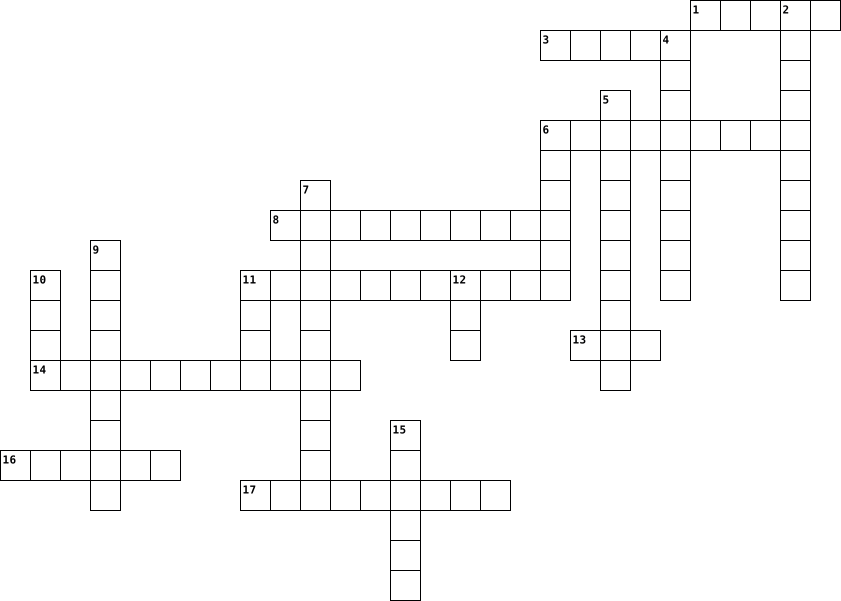
Across
- Melted rock inside the mantle
- Where all living things are found
- Formed when 2 tectonic plates push into each other
- When 2 tectonic plates move toward each other
- The crust + the top part of the mantle
- Hurricanes are ___caused by plate tectonics
- Caused by the slipping of tectonic plates
- The last name of the man who first came up with the idea of plate tectonics
- Often formed when one plate is subducted under another
Down
- the fossils that were found that help prove the theory of plate tectonics
- Word for the movement of chunks of the Earth's lithosphere
- When one tectonic plate is tucked or pushed under another
- The thickest layer of the Earth
- Drift When continents move because of plate tectonics
- When 2 tectonic plates move away from each other
- Has 2 parts and is responsible for the Earth's magnetic field
- Melted rock that has erupted out of a volcano onto the crust
- The mantle and core are very, very ___
- The name for when all continents were once joined together millions of years ago
19 Clues: Melted rock inside the mantle • The thickest layer of the Earth • Where all living things are found • The crust + the top part of the mantle • The mantle and core are very, very ___ • Caused by the slipping of tectonic plates • Hurricanes are ___caused by plate tectonics • When 2 tectonic plates move toward each other • When 2 tectonic plates move away from each other • ...
manicure 2022-10-20

Across
- Abnormal condition that occurs when the skin is stretched by the nail plate; usually caused by serious injury, such as burns, or an adverse skin reaction to chemical nail enhancement products.
- also known as bitten nails; result of a habit of chewing the nail or chewing the hardened skin surrounding the nail plate.
- ingrown nail, grown into the sides of the tissue around the nail
- Common bacteria that can lead to a bacterial infection that appears as a green, yellow, or black discoloration on the nail bed
- Vertical lines running the length of the natural nail plate, usually related to normal aging
- Increased crosswise curvature throughout the nail plate caused by an increased curvature of the matrix
- Visible depressions running across the width of the natural nail plate; usually a result of major illness or injury that has traumatized the body.
- Noticeably thin, white nail plates that are more flexible than normal and can curve over the free edge.
- darkening of the fingernails or toenails; may be seen as a black band within the nail plate, extending from the base to the free edge.
Down
- Any deformity or disease of the natural nail
- Also known as agnail; A condition in which the living tissue surrounding the nail plate splits or tears.
- Condition in which a blood clot forms under the nail plate, causing a dark purplish spot. These discolorations are usually due to small injuries to the nail bed.
- spots Also known as white spots; Whitish discolorations of the nails, usually caused by injury to the matrix area; not related to the body's health or vitamins deficiencies.
- Also known as folded nail; a type of highly curved nail usually caused by injury to the matrix, but may be inherited
- Split or brittle nails that have a series of lengthwise ridges giving a rough appearance to the surface of the nail plate
- Lifting of the nail plate from the nail bed without shedding, usually beginning at the free edge and continuing toward the lunula area.
- Nails turn a variety of colors; may indicate surface staining, a systemic disorder, or poor blood circulation
- condition caused by an injury or disease of the nail.
- Hemorrhages caused by trauma or injury to the nail bed that damage the capillaries and allow small amounts of blood flow
- Bacterial inflammation of the tissues surrounding the nail causing pus, swelling, and redness, usually in the skin fold adjacent to the nail plate
- Fungal infection of the natural nail plate
- Inflammation of the nail matrix, followed by shedding of the natural nail.
- Athlete's foot, fungal infection
- Severe inflammation of the nail in which a lump of red tissue grows up from the nail bed to the nail plate
24 Clues: Athlete's foot, fungal infection • Fungal infection of the natural nail plate • Any deformity or disease of the natural nail • condition caused by an injury or disease of the nail. • ingrown nail, grown into the sides of the tissue around the nail • Inflammation of the nail matrix, followed by shedding of the natural nail. • ...
plate dragon 218 puzzle! 2023-10-31

Across
- Creator & current owner of Plate Dragons
- Current PD event
- A Plate Dragon is a subspecies of ____
- We get new artists for the species through the _____
- Plate Dragons were launched in what month?
- The feature at the end of most PD's tails, used for battle & protection
- Rarest trait type
- The 2023 Easter Event trait is called ____ dome
Down
- Newest feature to be added to the species
- You can make your own Plate Dragon with a ___
- Least rare trait type
- Oops! I forgot what species this was?
- The mascot of Plate Dragons
- Plate Dragons will projectile ____ when threatened
- The first ever event trait is called dizzy ____
15 Clues: Current PD event • Rarest trait type • Least rare trait type • The mascot of Plate Dragons • Oops! I forgot what species this was? • A Plate Dragon is a subspecies of ____ • Creator & current owner of Plate Dragons • Newest feature to be added to the species • Plate Dragons were launched in what month? • You can make your own Plate Dragon with a ___ • ...
Plate Tectonics and Rock Cycle 2022-03-11

Across
- The plate for Australia
- The plate for Europe and Asia
- hot molten rock crystallizing
- rock when weathering and erosion occurs
- plates sliding past each other
Down
- plates moving towards each other
- Plate for India
- when rocks are subjected to high heat, high pressure, hot mineral-rich fluids or, more commonly, some combination of these factors.
- The plate for the pacific ocean
- plates moving away from each other
- The plate for Antarctica
- Plate for Arabia
- Plate for the Caribbean ocean
13 Clues: Plate for India • Plate for Arabia • The plate for Australia • The plate for Antarctica • The plate for Europe and Asia • hot molten rock crystallizing • Plate for the Caribbean ocean • plates sliding past each other • The plate for the pacific ocean • plates moving towards each other • plates moving away from each other • rock when weathering and erosion occurs • ...
Plate Tectonics and Rock Cycle 2022-03-11

Across
- The plate for Australia
- The plate for Europe and Asia
- hot molten rock crystallizing
- rock when weathering and erosion occurs
- plates sliding past each other
Down
- plates moving towards each other
- Plate for India
- when rocks are subjected to high heat, high pressure, hot mineral-rich fluids or, more commonly, some combination of these factors.
- The plate for the pacific ocean
- plates moving away from each other
- The plate for Antarctica
- Plate for Arabia
- Plate for the Caribbean ocean
13 Clues: Plate for India • Plate for Arabia • The plate for Australia • The plate for Antarctica • The plate for Europe and Asia • hot molten rock crystallizing • Plate for the Caribbean ocean • plates sliding past each other • The plate for the pacific ocean • plates moving towards each other • plates moving away from each other • rock when weathering and erosion occurs • ...
Plate Tectonics and Rock Cycle 2022-03-11

Across
- The plate for Australia
- The plate for Europe and Asia
- hot molten rock crystallizing
- rock when weathering and erosion occurs
- plates sliding past each other
Down
- plates moving towards each other
- Plate for India
- when rocks are subjected to high heat, high pressure, hot mineral-rich fluids or, more commonly, some combination of these factors.
- The plate for the pacific ocean
- plates moving away from each other
- The plate for Antarctica
- Plate for Arabia
- Plate for the Caribbean ocean
13 Clues: Plate for India • Plate for Arabia • The plate for Australia • The plate for Antarctica • The plate for Europe and Asia • hot molten rock crystallizing • Plate for the Caribbean ocean • plates sliding past each other • The plate for the pacific ocean • plates moving towards each other • plates moving away from each other • rock when weathering and erosion occurs • ...
plate motion crossword puzzle 2022-10-25

Across
- the outside or top layer of something
- A scientific instrument used to record data from earthquakes
- Earths outermost layer of solid rock that is underneath the soil, vegetation, and water(two words)
- an underwater mountain chain formed at divergent plate boundaries(three words)
- hot liquid rock below the surface of Earth
- the place where two plates meet(two words)
- when 1 plate goes underneath another plate and is destroyed in the mantle
- one of the large sections of hard, solid rock that makes up Earths outer layer
- when two plates move away from each other
Down
- a sudden shaking of Earth's crust
- the sudden pushing out of something
- the layer of soft solid rock underneath Earth’s surface
- this person invented the idea of plate tectonics (Alfred ____________)
- hot liquid rock on Earth’s surface
- evidence of life from the past
- when two plates are moving towards each other
- something we observe to be similar over and over again
- how often or fast something happens
- the slow pulling apart of land. This is caused by plate motion
- a long deep indentation in the ocean floor formed when 2 plates move together
20 Clues: evidence of life from the past • a sudden shaking of Earth's crust • hot liquid rock on Earth’s surface • the sudden pushing out of something • how often or fast something happens • the outside or top layer of something • when two plates move away from each other • hot liquid rock below the surface of Earth • the place where two plates meet(two words) • ...
Plate Tectonics 2025-01-08

Across
- faults the fault that occurs when a hanging wall moves up
- the line formed by the intersection of a horizontal plane and inclined surface
- the border between 2 plates
- tectonics the Earth's surface is cracked into large pieces
- the rigid outer part of the Earth
- currents the movement of tectonics plates, made by heat and pressure
- a stress that pushes rocks together
- what plate tectonics are made of
- valley a low region that forms where plates move apart
- a stress which stretches rock in 2 opposite directions
Down
- when 2 tectonics plates move away from each other
- where convection currents occurs
- a stress that occurs when forces are parallel but opposite
- fault a fault along a plate boundary that moves horizontally
- what is formed when cracks in the Earth is made and magma can rise through
- when 2 plates collide and 1 plate sinks into the mantle, under the other plate
- a fracture or zone of fractures between 2 blocks of rock
- when tectonics plates move toward each other and collide
- the result of plate tectonics
- what it is called when blocks move horizontally
20 Clues: the border between 2 plates • the result of plate tectonics • where convection currents occurs • what plate tectonics are made of • the rigid outer part of the Earth • a stress that pushes rocks together • what it is called when blocks move horizontally • when 2 tectonics plates move away from each other • a stress which stretches rock in 2 opposite directions • ...
Plate Tectonics Crossword 2022-01-31
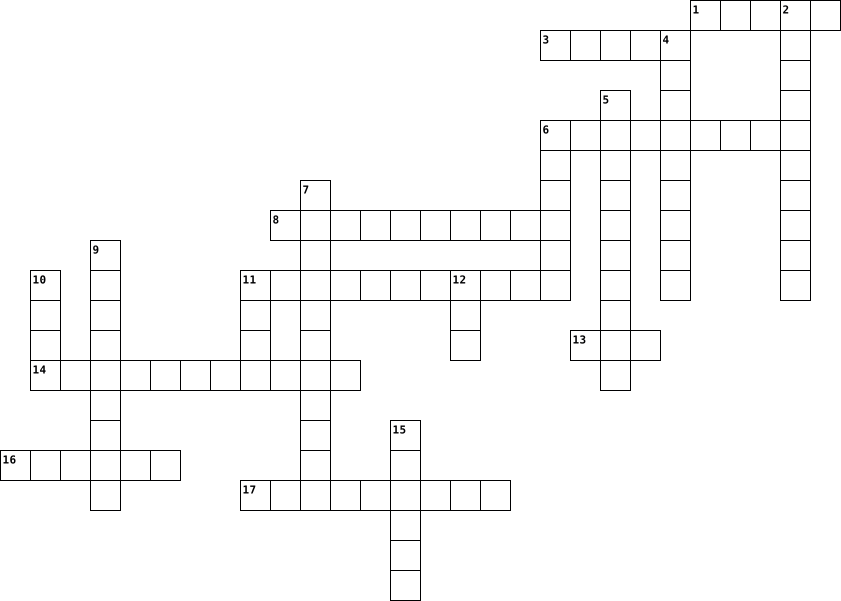
Across
- Melted rock inside the mantle
- Where all living things are found
- Formed when 2 tectonic plates push into each other
- When 2 tectonic plates move toward each other
- The crust + the top part of the mantle
- Hurricanes are ___caused by plate tectonics
- Caused by the slipping of tectonic plates
- The last name of the man who first came up with the idea of plate tectonics
- Often formed when one plate is subducted under another
Down
- the fossils that were found that help prove the theory of plate tectonics
- Word for the movement of chunks of the Earth's lithosphere
- When one tectonic plate is tucked or pushed under another
- The thickest layer of the Earth
- Drift When continents move because of plate tectonics
- When 2 tectonic plates move away from each other
- Has 2 parts and is responsible for the Earth's magnetic field
- Melted rock that has erupted out of a volcano onto the crust
- The mantle and core are very, very ___
- The name for when all continents were once joined together millions of years ago
19 Clues: Melted rock inside the mantle • The thickest layer of the Earth • Where all living things are found • The crust + the top part of the mantle • The mantle and core are very, very ___ • Caused by the slipping of tectonic plates • Hurricanes are ___caused by plate tectonics • When 2 tectonic plates move toward each other • When 2 tectonic plates move away from each other • ...
Plate motion crossword puzzle 2022-10-25

Across
- evidence of life from the past
- the slow pulling apart of land the is caused by plate motion
- hot liquid rock on Earth’s surface
- a sudden shaking of Earth's crust
- a long deep indentation in the ocean floor formed when 2 plates move together
- when 2 plates are moving towards each other
- the place where 2 plates meet
- when 2 plates are moving towards each other
- the layer of soft solid rock underneath Earth’s surface
Down
- A scientific instrument used to record data from earthquakes
- one of the large sections of hard, solid rock that makes up Earths outer layer
- when 1 plate goes underneath another plate and is destroyed in the mantle
- the outside or top layer of something
- the sudden pushing out of something
- this person invented the idea of plate tectonics Alfred ____________
- an underwater mountain chain formed at divergent plate boundaries
- Earths outermost layer of solid rock that is underneath the soil, vegetation, and water
- something we observe to be similar over and over again
- how often of fast something happens
- hot liquid rock below the surface of Earth
20 Clues: the place where 2 plates meet • evidence of life from the past • a sudden shaking of Earth's crust • hot liquid rock on Earth’s surface • the sudden pushing out of something • how often of fast something happens • the outside or top layer of something • hot liquid rock below the surface of Earth • when 2 plates are moving towards each other • ...
Plate motion crossword puzzle 2022-10-25

Across
- evidence of life from the past
- the slow pulling apart of land the is caused by plate motion
- hot liquid rock on Earth’s surface
- a sudden shaking of Earth's crust
- a long deep indentation in the ocean floor formed when 2 plates move together
- when 2 plates are moving towards each other
- the place where 2 plates meet
- when 2 plates are moving towards each other
- the layer of soft solid rock underneath Earth’s surface
Down
- A scientific instrument used to record data from earthquakes
- one of the large sections of hard, solid rock that makes up Earths outer layer
- when 1 plate goes underneath another plate and is destroyed in the mantle
- the outside or top layer of something
- the sudden pushing out of something
- this person invented the idea of plate tectonics Alfred ____________
- an underwater mountain chain formed at divergent plate boundaries
- Earths outermost layer of solid rock that is underneath the soil, vegetation, and water
- something we observe to be similar over and over again
- how often of fast something happens
- hot liquid rock below the surface of Earth
20 Clues: the place where 2 plates meet • evidence of life from the past • a sudden shaking of Earth's crust • hot liquid rock on Earth’s surface • the sudden pushing out of something • how often of fast something happens • the outside or top layer of something • hot liquid rock below the surface of Earth • when 2 plates are moving towards each other • ...
plate motion crossword puzzle 2022-10-25

Across
- the outside or top layer of something
- something we observe to be similar over and over again
- the place where 2 plates meet
- when 2 plates are moving towards each other
- when 1 plate goes underneath another plate and is destroyed in the mantle
- the slow pulling apart of land the is caused by plate motion
- when 2 plates are moving towards each other
- hot liquid rock on Earth’s surface
- one of the large sections of hard, solid rock that makes up Earths outer layer
- the layer of soft solid rock underneath Earth’s surface
- this person invented the idea of plate tectonics Alfred ____________
- a long deep indentation in the ocean floor formed when 2 plates move together
Down
- an underwater mountain chain formed at divergent plate boundaries
- Earths outermost layer of solid rock that is underneath the soil, vegetation, and water
- a sudden shaking of Earth's crust
- A scientific instrument used to record data from earthquakes
- evidence of life from the past
- the sudden pushing out of something
- hot liquid rock below the surface of Earth
- how often of fast something happens
20 Clues: the place where 2 plates meet • evidence of life from the past • a sudden shaking of Earth's crust • hot liquid rock on Earth’s surface • the sudden pushing out of something • how often of fast something happens • the outside or top layer of something • hot liquid rock below the surface of Earth • when 2 plates are moving towards each other • ...
P7 2020 Plate tectonics 2020-01-13

Across
- molten rock beneath the earth's surface
- boundary where plates are sliding past
- violent shaking of the earth
- the original super-continent
- one plate sliding beneath another
- plate containing similarly named frozen continent
- where the plates meet
- plate with the same name as this "peaceful" ocean
Down
- meeting plates fold upward
- layer beneath the crust of the earth
- boundary where plates are coming together
- mountain chain containing the world's tallest
- boundary where plates are moving apart
- plate Barbados is on
- molten rock at the earth's surface
- plate containing Europe and Asia
16 Clues: plate Barbados is on • where the plates meet • meeting plates fold upward • violent shaking of the earth • the original super-continent • plate containing Europe and Asia • one plate sliding beneath another • molten rock at the earth's surface • layer beneath the crust of the earth • boundary where plates are sliding past • boundary where plates are moving apart • ...
Plate Tectonics 2021-05-12

Across
- Theory that the Earth's crust is divided in sections
- Boundary where tectonic plates seperate
- Helps to track plate movement
- A place where tectonic plates touch
- Boundary where tectonic plates slide past each other
- Formed by ocean to continent convergent boundaries
- Most common type of divergent boundary
Down
- Boundary where tectonic plate collide
- Formed by transform boundaries
- Molten rock from a volcano
- When one plate sinks under another plate
- Plate sinks and is pulled down by gravity
- Formed by continent to continent convergent boundries
- Hot rock rises, cool rock sinks
- Mid ocean ridge forces older crust to move
- Where the San Andreas Fault is located
- The rate of movement in plates
17 Clues: Molten rock from a volcano • Helps to track plate movement • Formed by transform boundaries • The rate of movement in plates • Hot rock rises, cool rock sinks • A place where tectonic plates touch • Boundary where tectonic plate collide • Where the San Andreas Fault is located • Most common type of divergent boundary • Boundary where tectonic plates seperate • ...
Rock Review 2022-12-06

Across
- This mineral gives dunite its green color, and is grippy and make a mountain good for climbing
- Fastest way to make a mountain
- Shuksan is the eroded remnant of a thrusted....
- mountain east of Baker, name means "high peak,"
- produced at a divergent boundary
- rocks that have undergone changes, through heat and pressure
- volcano that erupted in Dionisio Polido's backyard
- the two types of tectonicplates
- plate boundary: two plates move apart from each other
Down
- made up of other rocks cemented together
- lava rocks; they come from fire
- plate boundary: two plates move TOWARD each other
- Mt. Baker's Indigenous name
- the plate located west of the North American plate
- abundantly found deep in the crust, this rock makes up most of our continents and the Canadian Shield
- Twin Sisters are made of a fragment of subcontinental.....
- deep rocks that never come to the surface and can cover many miles (sounds like a lisp)
- plate boundary: two plates touch from side to side
- Upper Mantle and Crust- the layer of the plates, that slips on the asthenophere
- Path of 24,900 miles that marks the intersection of several tectonic plates, and contains 75% of Earth's volcanoes
20 Clues: Mt. Baker's Indigenous name • Fastest way to make a mountain • lava rocks; they come from fire • the two types of tectonicplates • produced at a divergent boundary • made up of other rocks cemented together • Shuksan is the eroded remnant of a thrusted.... • mountain east of Baker, name means "high peak," • plate boundary: two plates move TOWARD each other • ...
plate motion crossword puzzle 2022-10-25

Across
- the outside or top layer of something
- something we observe to be similar over and over again
- the place where two plates meet(two words)
- when two plates move away from each other
- when 1 plate goes underneath another plate and is destroyed in the mantle
- the slow pulling apart of land. This is caused by plate motion
- when two plates are moving towards each other
- hot liquid rock on Earth’s surface
- one of the large sections of hard, solid rock that makes up Earths outer layer
- the layer of soft solid rock underneath Earth’s surface
- this person invented the idea of plate tectonics (Alfred ____________)
- a long deep indentation in the ocean floor formed when 2 plates move together
Down
- an underwater mountain chain formed at divergent plate boundaries(three words)
- Earths outermost layer of solid rock that is underneath the soil, vegetation, and water(two words)
- a sudden shaking of Earth's crust
- A scientific instrument used to record data from earthquakes
- evidence of life from the past
- the sudden pushing out of something
- hot liquid rock below the surface of Earth
- how often or fast something happens
20 Clues: evidence of life from the past • a sudden shaking of Earth's crust • hot liquid rock on Earth’s surface • the sudden pushing out of something • how often or fast something happens • the outside or top layer of something • when two plates move away from each other • the place where two plates meet(two words) • hot liquid rock below the surface of Earth • ...
plate motion crossword puzzle 2022-10-25

Across
- the outside or top layer of something
- A scientific instrument used to record data from earthquakes
- Earths outermost layer of solid rock that is underneath the soil, vegetation, and water(two words)
- an underwater mountain chain formed at divergent plate boundaries(three words)
- hot liquid rock below the surface of Earth
- the place where two plates meet(two words)
- when one plate goes underneath another plate and is destroyed in the mantle
- one of the large sections of hard, solid rock that makes up Earths outer layer
- when two plates move away from each other
Down
- a sudden shaking of Earth's crust
- the sudden pushing out of something
- the layer of soft solid rock underneath Earth’s surface
- this person invented the idea of plate tectonics (Alfred ____________)
- hot liquid rock on Earth’s surface
- evidence of life from the past
- when two plates are moving towards each other
- something we observe to be similar over and over again
- how often or fast something happens
- the slow pulling apart of land. This is caused by plate motion
- a long deep indentation in the ocean floor formed when two plates move together
20 Clues: evidence of life from the past • a sudden shaking of Earth's crust • hot liquid rock on Earth’s surface • the sudden pushing out of something • how often or fast something happens • the outside or top layer of something • when two plates move away from each other • hot liquid rock below the surface of Earth • the place where two plates meet(two words) • ...
Plate motion 2025-10-23

Across
- the outside or top layer
- the name of earths most outer layer
- the layer of soft solid rock under earths crust
- a landform that erupts caused by plate movement
- a scientist that study’s fossils and ancient stuff
- an animal skeleton or body preserved over time
- a scenic landform that can be caused by convergent plates
- what volcanos do when the pressure of the magma makes them
- earths 2 layer of its core
Down
- a landform that can be caused by transform plates
- a kind of underwater volcano that emits black smoke
- the scientist that study’s earth and rocks
- earths first layer of core
- the plate the moves right by its neighboring plate
- The plates that converges with its neighboring plate
- A natural physical feature of earth example: volcano
- what the inside of something would look like if it was cut through
- the name of the website we use in science
- The plate that moves away from its neighboring plate
- the movement of the continent on earth
- what lavas called when it’s still in the volcano
- the amount of volcanos in Minnesota (in word form)
22 Clues: the outside or top layer • earths first layer of core • earths 2 layer of its core • the name of earths most outer layer • the movement of the continent on earth • the name of the website we use in science • the scientist that study’s earth and rocks • an animal skeleton or body preserved over time • the layer of soft solid rock under earths crust • ...
Chapter 14 - Plate Tectonics 2023-04-28

Across
- event in which the magnetic field reverses direction
- hypothesis that continents are in constant motion
- naturally preserved remains, imprints, or traces of organisms
- plate boundary where two plates separate
- new oceanic crust forms at a mid-ocean ridge as old oceanic crust moves away
- Wegener could not explain the ___________ that caused the continents to move.
- plate boundary where two plates collide
- mountain range located on the seafloor in the middle of the ocean
- plate boundary where two plates slide by each other
- force created by rising mantle of ocean ridges that creates potential for plates to move away from the ridge
Down
- ancient supercontinent, composed of land that forms today’s continents
- polarity of magnetic field in which magnets orient themselves to point south
- sinking of a denser plate below a more buoyant plate at a convergent plate boundary
- cold, rigid outermost rock layer of Earth
- middle layer of Earth situated between the crust above and the core below
- Alfred Wegener proposed that at one time all the continents were part of one large __________.
- Continental drift is the slow ___________ of Earth’s continental plates.
- polarity of today’s magnetic field; magnets orient themselves to point north
- circulation of material caused by differences in temperature and density
- capable of being molded or changing shape
- theory that Earth’s surface is made of rock plates that move with respect to each other
- Wegener noticed that the shapes of the coastlines of the continents fit together much like pieces of a ___________.
- Evidence of __________ in places that are now warm supported Wegener's hypothesis.
- The farther away rocks are from the mid- ocean ridge, the _________ they are.
- force created by sinking of a plate, or slab, that pulls on the rest of the plate
25 Clues: plate boundary where two plates collide • plate boundary where two plates separate • cold, rigid outermost rock layer of Earth • capable of being molded or changing shape • hypothesis that continents are in constant motion • plate boundary where two plates slide by each other • event in which the magnetic field reverses direction • ...
Clutch 2013-08-21

Across
- Consist of a circular disc with a friction surface and is mounted on the transmission shaft
- Secure the cover of diaphragm
- These spring cause the contact pressure on the facings to rise gradually as the spring fallen out
- Directly receive the torque of the engine
- Consists of a master cylinder, hydraulic tubing, and slave cylinder
- Do not push the release bearing toward the engine
- Used to disengaged and engage the clutch
- Includes mounting lugs to locate the coil spring
- Disconnect and connect the engine from the transmission
- Connect to the spline hub
- Release the clamping force on the pressure plate when the clutch is disengaged
- Connect the pressure plate to the flywheel mating slots
Down
- Shock the loading by flexing and allowing some twist between hub and plate
- Center of the clutch disc
- Depending on the design, application of the pressure plate and strength of the spring
- Holds the spring against the pressure plate
- Design to slide back and forth on the transmission
- Is a steel plate which has frictional material attached to it
- Also called a transmission input shaft, fits to the front of transmission
- Bolted to the engine and is the driving member
20 Clues: Center of the clutch disc • Connect to the spline hub • Secure the cover of diaphragm • Used to disengaged and engage the clutch • Directly receive the torque of the engine • Holds the spring against the pressure plate • Bolted to the engine and is the driving member • Includes mounting lugs to locate the coil spring • Do not push the release bearing toward the engine • ...
EARTH'S SURFACE 2025-12-08

Across
- - A plate boundary where one plate sinks beneath another.
- - Molten rock that erupts from a volcano.
- - Process where one plate moves under another.
- - The Earth’s outermost layer.
- - Rocks melted by heat and pressure.
- - These are formed when two continental plates collide.
- - Mountains formed from compressed sediment.
- - Transform boundary can generate ___________.
- - The rigid layer made of the crust and upper mantle.
- - Lies beneath the ocean floor.
- - considered the supercontinent
- - Formed at subduction zones when ocean-ocean crust meet.
Down
- - Large sections of the Earth’s crust that move.
- - A plate boundary where plates move apart.
- - Region where magma reaches the surface.
- - planet that covers 71% water and 29% land
- - Plates in a transform boundary will move in ________ direction.
- - Plate in covergent boundary ______ each other.
- - A crack or fracture in the Earth’s crust. 6. RIFT - Landform formed at divergent continental plates.
- - Underwater mountain ranges formed at divergent boundaries.
- - A plate boundary where plates slide past one another.
- - The hottest layer of the Earth
- - This is the state of the outer core
- - Molten rock beneath the surface.
- - Circular movement in the mantle that moves tectonic plates.
- - The thickest layer of the Earth composed of hot, semi-solid rock.
26 Clues: - The Earth’s outermost layer. • - Lies beneath the ocean floor. • - considered the supercontinent • - The hottest layer of the Earth • - Molten rock beneath the surface. • - Rocks melted by heat and pressure. • - This is the state of the outer core • - Region where magma reaches the surface. • - Molten rock that erupts from a volcano. • ...
Plate Tectonics 2014-02-10

Across
- Convection currents in the mantle produce a force that causes motion called _____.
- As a slab sink, it pulls on the rest of the plate with a force called _____.
- The theory of ____ drift suggested that continents are in constant motion on the surface of Earth.
- The layer that is so hot that it behaves like plastic material.
- Continents fit like pieces of a..
- The plate tectonics move several ____ each year.
- Wegener needed more scientific _____ to support his theory.
- A state in which magnetized objects will orient themselves to point north is called ____ polarity.
- A _____ plate boundary forms where two plates collide.
- Mountain ranges in the middle of the ocean are called ____ ridges.
Down
- The ____ of Plate Tectonics states that Earth's surface is made of rigid slabs of rock that move with respect to each other.
- Denser plate sinks below buoyant plate
- Cold, rigid outermost rock layer
- _____ on seafloor contains iron-rich minerals that are magnetic.
- A _____ plate boundary forms where two plates separate.
- Process by which new oceanic crust forms along a mid-ocean ridge and older oceanic crust moves away from the ridge.
- Depth of the ocean determined by an ____ sounder.
- Rising mantle material at mid-ocean ridges creates the potential for plates to move away from the ridge with a force called ____.
- Wegener could not explain ___ the continents moved.
- A state in which magnetized objects would reverse direction and orient themselves to point south is called ____ polarity.
- _____ crust forms at mid-ocean ridges.
- Supercontinent.
- A _____ plate boundary forms where two plates slide past each other.
- Circulation of material caused by differences in temperature and density
- _____ reversal occurs when the magnetic field reverses direction.
- ____ lava forms when lava cools rapidly since it erupts in water.
26 Clues: Supercontinent. • Cold, rigid outermost rock layer • Continents fit like pieces of a.. • Denser plate sinks below buoyant plate • _____ crust forms at mid-ocean ridges. • The plate tectonics move several ____ each year. • Depth of the ocean determined by an ____ sounder. • Wegener could not explain ___ the continents moved. • ...
Plate Tectonic 2024-04-03

Across
- Land feature created when two continental plates converge.
- A series of volcanos that surround Pacific Ocean, accounts for 75% of all volcanos on Earth.
- Name of crusts that are under the ocean.
- Melted rocks, found in the mantle.
- Layer of Earth that produces Earth's magnetic field.
- Another word for an ocean mountain created by two oceanic plate divergence.
- A thin semi-liquid layer under the Earth's crust that allows crust to move around.
- The thickest layer of Earth..
- The solid layer of Earth.
- System of Earth that accounts for all water, in all forms of state.
Down
- Plate interaction when two plates slide past each other, also called Transform.
- Anywhere on Earth where living things exist.
- When one plate pushes down underneath the other plate in convergent boundaries.
- Gaps on land created by divergence of two continental plates.
- A deep hole in the ocean created by convergence of oceanic and continental crusts.
- Area where magma erupts to the surface of Earth.
- An area where two plates meet.
- Shaking of Earth's crust due to plate interaction or movement.
- The place at which two boundaries slide past each other.
- Movement of liquid or gas due to heat. This drives tectonic plate movement.
- Plate interaction when two plates move closer to each other.
- System of Earth that accounts for all the rocks.
- Name of crusts that are on land.
- Produces high heat in the outer core.
- Name for Earth's crust that is broken in to big pieces that fit like a puzzle.
- Plate interaction when two plates move away from each other.
- System of Earth that that accounts for all gases.
- Name of rocks that are created from magma cooling. This also stores magnetic information.
28 Clues: The solid layer of Earth. • The thickest layer of Earth.. • An area where two plates meet. • Name of crusts that are on land. • Melted rocks, found in the mantle. • Produces high heat in the outer core. • Name of crusts that are under the ocean. • Anywhere on Earth where living things exist. • Area where magma erupts to the surface of Earth. • ...
Natural hazards 2021-12-01

Across
- capital city of Nepal
- the supply of this was cut off after the Nepal earthquake in many areas
- the process where the oceanic plate is pushed under the continental
- effect what happens in the days, weeks and months after a natural hazard
- emergency help from overseas given after a natural hazard
- the point of the earthquake
- experienced on Everest as a result of the earthquake in Nepal
- can be triggered after an earthquake, this didn't happen in Nepal 2015 as it isn't coastal
- this plate boundary type is where a continental and oceanic plate meet
- continent where Nepal is located
Down
- the tectonic plate where the UK is situated
- plate boundary where 2 plates move in the same direction but different speeds
- Island country situated on boundary of North American and Eurasian plate
- effect what happens straight away after a natural hazard
- this plate boundary is where 2 plates are slowly moving apart
- experienced a 7.9 magnitude earthquake in 2015
- 7000 of these were destroyed by the Nepal earthquake in 2015
17 Clues: capital city of Nepal • the point of the earthquake • continent where Nepal is located • the tectonic plate where the UK is situated • experienced a 7.9 magnitude earthquake in 2015 • effect what happens straight away after a natural hazard • emergency help from overseas given after a natural hazard • 7000 of these were destroyed by the Nepal earthquake in 2015 • ...
Natural Hazards Revision Crossword 2019-10-22

Across
- The movement of the world’s plates is explained with Continental _____.
- The plate around which is the Ring of Fire.
- A plate boundary where crust is being destroyed.
- A type of plate which is made of thinner, denser crust.
- The scale which measures the size of an earthquake.
- The name of the volcano that erupted in Iceland in 2010.
- The name for molten rock before it reaches the surface.
- A type of plate which is made of thicker, less dense crust.
- The second layer of the earth, mainly made of molten rock.
Down
- A zone where one plate slides beneath another.
- A plate boundary where the plates slide past each other. Also the name of a UK political party.
- The Caribbean country which suffered a devastating earthquake in 2010.
- These types of effects include the damage to infrastructure, spread of disease and the collapse of buildings.
- A plate boundary where new crust is being made.
- These types effects include the ground shaking, lava flows and emission of ash clouds.
- ___ clouds are emitted
- The name for molten rock when it reaches the surface.
17 Clues: ___ clouds are emitted • The plate around which is the Ring of Fire. • A zone where one plate slides beneath another. • A plate boundary where new crust is being made. • A plate boundary where crust is being destroyed. • The scale which measures the size of an earthquake. • The name for molten rock when it reaches the surface. • ...
Plate motion crossword puzzle 2022-10-25

Across
- evidence of life from the past
- the slow pulling apart of land the is caused by plate motion
- hot liquid rock on Earth’s surface
- a sudden shaking of Earth's crust
- a long deep indentation in the ocean floor formed when 2 plates move together
- when 2 plates are moving towards each other
- the place where 2 plates meet
- when 2 plates are moving towards each other
- the layer of soft solid rock underneath Earth’s surface
Down
- A scientific instrument used to record data from earthquakes
- one of the large sections of hard, solid rock that makes up Earths outer layer
- when 1 plate goes underneath another plate and is destroyed in the mantle
- the outside or top layer of something
- the sudden pushing out of something
- this person invented the idea of plate tectonics Alfred ____________
- an underwater mountain chain formed at divergent plate boundaries
- Earths outermost layer of solid rock that is underneath the soil, vegetation, and water
- something we observe to be similar over and over again
- how often of fast something happens
- hot liquid rock below the surface of Earth
20 Clues: the place where 2 plates meet • evidence of life from the past • a sudden shaking of Earth's crust • hot liquid rock on Earth’s surface • the sudden pushing out of something • how often of fast something happens • the outside or top layer of something • hot liquid rock below the surface of Earth • when 2 plates are moving towards each other • ...
PrePress Department Quiz 2024-08-27

Across
- Chemical use in plate cleaning process
- What is K in 4 color printing
- material used to transfer image to the printing surface
- material use to transfer digital information to a metal plate in offset printing
- The paper rotate 180 and turn over
- Salju Printing Process
- What is C in 4 color printing
- What is M in 4 color printing
- Color of modify job sheet
- The paper flipped head over heals
Down
- What is Y in 4 color printing
- Type of printing does not use any plate or film
- Image and text outputted directly to plate
- a set of blank sheet of paper folded to test the layout and pagination
- Image and text outputted directly on a film
- The way of various text and images are placed on the page
- The quantity of plate use in 4 color printing
17 Clues: Salju Printing Process • Color of modify job sheet • What is Y in 4 color printing • What is K in 4 color printing • What is C in 4 color printing • What is M in 4 color printing • The paper flipped head over heals • The paper rotate 180 and turn over • Chemical use in plate cleaning process • Image and text outputted directly to plate • ...
Ch. 9: Nail Disorders and Diseases 2022-03-31

Across
- a condition in which a blood clot forms under the nail plate, forming a dark purplish spot.
- a condition caused by injury or disease of the nail unit.
- a bacterial inflammation of the tissues surrounding the nail.
- a fungal infection of the nail plate.
- also known as ingrown nails, can affect either the fingers or toes.
- figuratively means "folded nail"
- caused by physical trauma or injury to the nail bed that damages the capillaries and allows small amounts of blood flow.
- visible depressions running across the width of the natural nail plate.
- a condition in which the living skin around the nail plate splits and tears.
- the darkening of the fingernail or toenails.
- nail plates with a deep or sharp curvature at the free edge have this shape because of the matrix.
Down
- are a whitish discoloration found inside the nail plate, usually caused by injury to the matrix.
- the separation and falling off of a nail plate from the nail bed.
- split or brittle nails that have a series of lengthwise ridges, giving a rough appearance to the surface of the nail plate.
- an abnormal condition that occurs when the skin is stretched by the nail plate.
- bitten nails.
- nails are noticeably thin, white nail plates that are much more flexible than normal.
17 Clues: bitten nails. • figuratively means "folded nail" • a fungal infection of the nail plate. • the darkening of the fingernail or toenails. • a condition caused by injury or disease of the nail unit. • a bacterial inflammation of the tissues surrounding the nail. • the separation and falling off of a nail plate from the nail bed. • ...