
plate Crossword Puzzles
Plate Tectonics 2025-02-04

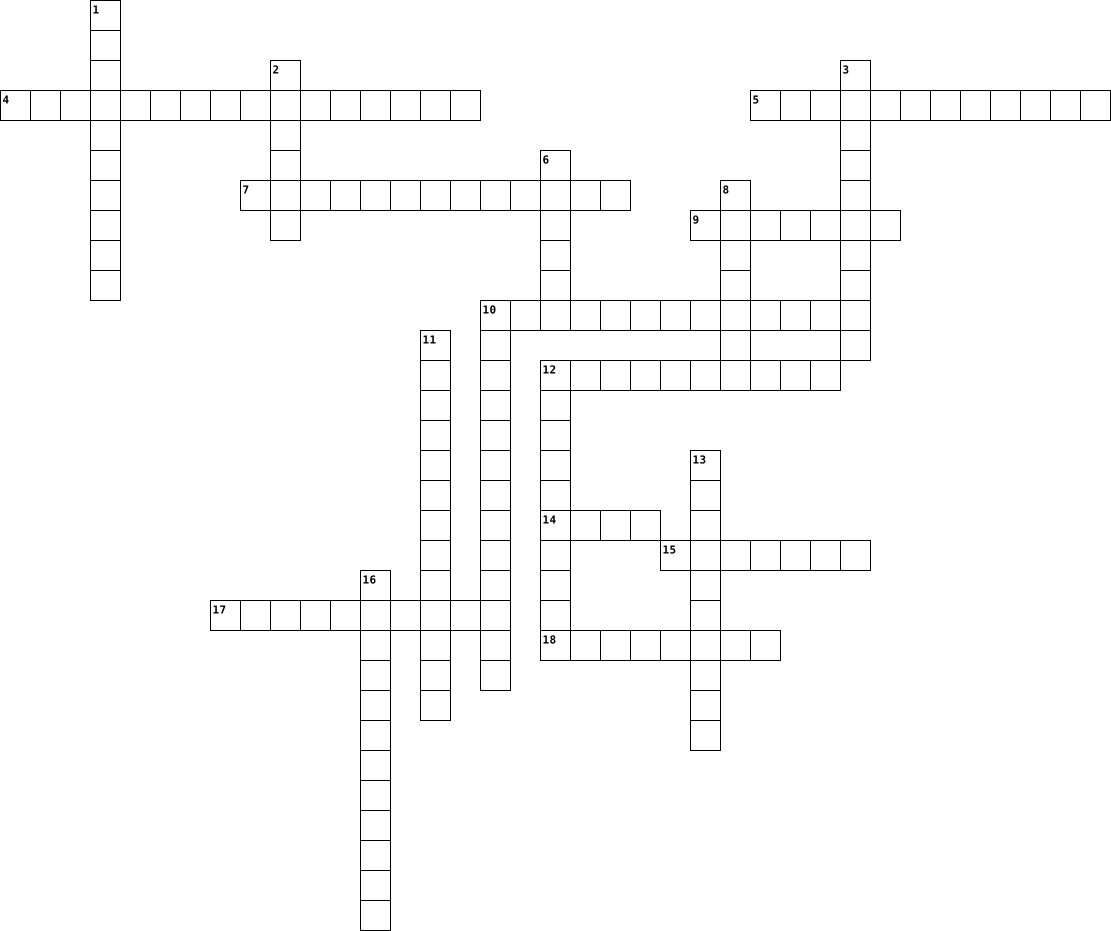
Across
- A deep valley that forms at the edge of a continent when an oceanic plate sinks underneath a continental plate.
- occurs where one plate slides under another as the two are pushed together.
- occurs where two plates slide against each other. But rather than sliding smoothly, the plates build up tension, then release the tension with a spurt of movement.
- The type of crust lying under the oceans of the world. It is only 4 to 6 miles (7 to 10 km) thick and usually younger than continental crust.
- movement is felt as an earthquake.
- grind past each other in a horizontal direction
- A crack or fracture in
- The name given to the supercontinent that existed more than 225 million years ago, in which the present-day continents were joined together in one large landmass.
- apart, allowing magma, or molten rock, to rise from the Earth' s interior to fill in the gap. The two plates move away from each other like two conveyor belts moving in opposite directions.
- crust where two tectonic
- zone
- The place where a collision between two continental plates crunches and folds the rocks at the boundary, lifting them up and leading to mountain formation
Down
- A raised area or mountain range under the oceans formed when magma fills the space between two tectonic plates that are spreading apart.
- occurs where two plates
- The border between two tectonic plates
- layer of the earth's crust that lies under the seven continents. It is about 20 to 40
- Zone, The place where one plate is getting bent and pulled under the edge of another plate.
- A
- The process that forms new ocean floor and oceanic crust. Magma oozes up from the mantle through a crack in the ocean floor, filling in the space between the plates and spreading out from the plate boundary.
- two tectonic plates are pulling apart.
- (35 to 70 km) thick and very old.
- there is land at the edge of one of these plates,the ocean plate will subduct, or slide under that plate.
22 Clues: A • zone • A crack or fracture in • occurs where two plates • crust where two tectonic • (35 to 70 km) thick and very old. • movement is felt as an earthquake. • The border between two tectonic plates • two tectonic plates are pulling apart. • grind past each other in a horizontal direction • occurs where one plate slides under another as the two are pushed together. • ...
Chapter 6 Vocab 2021-10-13

Across
- the cold and rigid outermost layer
- a state in which magnetized objects, such as compass needles, will orient themselves to point north.
- the circulation of material caused by differences in temperature and density
- forms where two plates collide,
- the occurrence that the magnetic field reverses direction
- the process in which the denser plate sinks below the more buoyant plate
- the process by which new oceanic crust forms along a mid-ocean ridge and older oceanic crust moves away from the ridge
- the suggestion that the continents are constantly moving.
Down
- forms where two plates slide past each other
- a state in which magnetized objects would reverse direction and orient themselves to point south
- as a slab sinks, it pulls the rest of the plate with a force
- earth's surface is made of rigid slabs of rock, or plates, that move with respect to each other.
- the mountain ranges in the middle of oceans seafloor
- forms where two plates separate
- the mother continent; The time before seas separated us so.
- this is the rising mantle material at mid-ocean ridges creates the potential for plates to move away from the ridge with a force
16 Clues: forms where two plates separate • forms where two plates collide, • the cold and rigid outermost layer • forms where two plates slide past each other • the mountain ranges in the middle of oceans seafloor • the occurrence that the magnetic field reverses direction • the suggestion that the continents are constantly moving. • ...
Chapter 7 Vocabulary 2021-10-12

Across
- the denser plate sinks below the more buoyant plate
- ridges mountain ranges that are in the middle of the ocean
- earth's surface is made of rigid slabs of rock, or plates, that move with respect to each other
- forms where two plates slide past each other
- forms where two plates collide
Down
- where two plates separate
- polarity a state in which magnetized objects would reverse direction and orient themselves to point south
- pull as a slab sinks, it pulls on the rest of the plate with a force
- drift suggested that continents are in constant motion
- the theory that all continents were once all connected
- the cold and rigid outermost rock layer
- reversal occurs and the magnetic field reverses direction
- the circulation of material caused by the differences in temperature and density
- spreading process by which new oceanic crust forms along a mid-ocean ridge and older oceanic crust moves away from the ridge
- polarity is a state in which magnetized objects, such as compass needles, will orient themselves to point north
- push rising mantle material at mid-ocean ridges creates the potential for plates to move away from the ride with a for
16 Clues: where two plates separate • forms where two plates collide • the cold and rigid outermost rock layer • forms where two plates slide past each other • the denser plate sinks below the more buoyant plate • drift suggested that continents are in constant motion • the theory that all continents were once all connected • ...
Plate Tectonics Crossword 2014-01-24

Across
- the innermost layer of Earth
- energy transfer by the movement of a material
- a scientific hypothesis stating that the landmasses on earth were once a solid piece but drifted apart
- a measurement of how much material is in a volume
- the period in which all the continents were joined together to form a supercontinent
- plate boundary in which tectonic plates move toward each other
- the time period in between the Triassic and Cretatious period
- one of the two continents in the Triassic period; consists of today's North America and Asia
- plate boundary in which the plates are moving away from each other
- lower layer of the mantle; material bends and moves easily
- plate boundary in which plates slide past each other
Down
- the supercontinent that consisted of all the continents put together like a jigsaw puzzle
- huge underwater mountains at the edges of tectonic plates
- one of the two continents in the Triassic period; consists of todays South America, Africa, India, Australia, and Antarctica
- a switch in Earth's magnetic north and south
- the top layer of the mantle and the crust
- layer of earth in between the innermost layer and the lower mantle
- molten rock that is below the Earth's surface
- substance that the innermost layer of Earth is mostly made of
- when one tectonic plate slides beneath another plate
- a place where heated rock rises in the middle of a tectonic plate
- the outermost layer of Earth
22 Clues: the innermost layer of Earth • the outermost layer of Earth • the top layer of the mantle and the crust • a switch in Earth's magnetic north and south • energy transfer by the movement of a material • molten rock that is below the Earth's surface • a measurement of how much material is in a volume • when one tectonic plate slides beneath another plate • ...
Earth's Interior 2022-04-27

Across
- the thick middle layer in the solid part of Earth
- Dense oceanic plate slides under Less dense continental plate
- this is the force that moves the tectonic plates
- plastic layer within the mantle
- dense metallic center of Earth
- When the denser plate sinks below the more buoyant plate
- Neither plate is subducted, the Lless dense plate folds and deforms and mountains are formed
- a rigid layer including the crust and the uppermost mantle
- boundaries that Forms where two tectonic plates slide past each other
- solid portion of the core
- Supercontinent that has broken apart over time
- forms near the edge of a continent at an ocean to continent boundary
Down
- liquid portion of the core
- outer part of the magnetic field that affects the charged particles
- Earth’s surface is made of rigid slabs of rock, or plates, that move with respect to each other
- Scientist that researched whether all the continents had always been in the same place on Earth
- basalt is rich in this mineral
- brittle, rocky outer layer
- The process by which new oceanic crust forms along a mid-ocean ridge and older oceanic crust moves away from the ridge
- hypothesis that the continents are in constant motion on the Earth’s surface
- rock that makes up the ocean floor
- boundaries that Form where two tectonic plates separate
- boundaries that form Where two plates collide
- Very long mountain ranges in the middle of the oceans
24 Clues: solid portion of the core • liquid portion of the core • brittle, rocky outer layer • basalt is rich in this mineral • dense metallic center of Earth • plastic layer within the mantle • rock that makes up the ocean floor • boundaries that form Where two plates collide • Supercontinent that has broken apart over time • this is the force that moves the tectonic plates • ...
Earthquake and Volcano Taco Prep 2023-11-21

Across
- Used to evaluate earthquake intensity
- Pushes two blocks of rock horizontally past each other in different directions and occurs on transform plate boundaries
- Cause particles to move up and down and side to side at the same time
- Uses numbers 1-10 to measure an earthquake's magnitude
- Cause particles to move up and down in a rolling motion
- Hot gas, ash, and rock that explosive volcanoes produce
- Magma, or molten rock, that reaches Earth's surface
- Pulls two blocks of rock apart and occurs on divergent plate boundaries
- Energy that travels as vibrations inside and outside Earth
Down
- Fastest moving seismic waves that cause particles in the ground to push and pull
- Large and steep sided volcano located on convergent plate boundaries
- Large and gentle slopes and located on divergent plate boundaries
- A vent in earth's crust where molten magma flows
- Small and steep sided and located on continental rifting
- Pushes two blocks of rock together and occurs on convergent plate boundaries
- Molten rock below Earth's surface
- The ground shakes from movement in the lithosphere
- ash Tiny particles of volcanic rock and glass that gets shot high in the atmosphere
- The location on earth where rocks move along
- A break in earths lithosphere, and when rocks move along a fault, an earthquake occurs
- Volcanoes that are not located on plate boundaries
- The place on earth directly above the earthquake's focus
22 Clues: Molten rock below Earth's surface • Used to evaluate earthquake intensity • The location on earth where rocks move along • A vent in earth's crust where molten magma flows • The ground shakes from movement in the lithosphere • Volcanoes that are not located on plate boundaries • Magma, or molten rock, that reaches Earth's surface • ...
Where in the World are we + tectonics crossword 2023-12-19

Across
- this is the number of continents there are
- this what we call magma once it has erupted onto the earth's surface
- this is the outer most layer of the earth
- this type of plate boundary sees two plates slide past each other
- these volcanoes are tall and narrow, and form at destructive plate boundaries
- this country is apart of the United Kingdom, but is not apart of Great Britain
- this is the largest and deepest ocean
- this is the point within the earth where the earthquake is generated
- this is the continent we are located in
- this type of plate boundary sees two plates pull apart in opposite directions
Down
- this type of plate boundary sees an oceanic and a continental plate collide
- this is a layer of solid nickel and iron, which can be found at the centre of the earth
- this is the point at which two or more tectonic plates meet
- this is the point on the surface of the earth, directly above the focus
- this is the largest and most populous continent
- this is the layer which surrounds the centre of the earth. it is made of liquid nickel and iron
- heat that rise and fall in a cyclical pattern within the earth's mantle
- this is the thickest layer of the earth
- these volcanoes have a wide base, and form at constructive plate boundaries due to runny lava
- this is the number of oceans there are
20 Clues: this is the largest and deepest ocean • this is the number of oceans there are • this is the thickest layer of the earth • this is the continent we are located in • this is the outer most layer of the earth • this is the number of continents there are • this is the largest and most populous continent • this is the point at which two or more tectonic plates meet • ...
Earth's Interior 2024-05-23

Across
- rock that makes up the ocean floor
- boundaries that Form where two tectonic plates separate
- this is the force that moves the tectonic plates
- plastic layer within the mantle
- forms near the edge of a continent at an ocean to continent boundary
- liquid portion of the core
- boundaries that form Where two plates collide
- Scientist that researched whether all the continents had always been in the same place on Earth
- When the denser plate sinks below the more buoyant plate
Down
- Dense oceanic plate slides under Less dense continental plate
- Supercontinent that has broken apart over time
- Earth’s surface is made of rigid slabs of rock, or plates, that move with respect to each other
- basalt is rich in this mineral
- the thick middle layer in the solid part of Earth
- dense metallic center of Earth
- Neither plate is subducted, the less dense plate folds and deforms and mountains are formed
- The process by which new oceanic crust forms along a mid-ocean ridge and older oceanic crust moves away from the ridge
- hypothesis that the continents are in constant motion on the Earth’s surface
- brittle, rocky outer layer
- Very long mountain ranges in the middle of the oceans
- a rigid layer including the crust and the uppermost mantle
- solid portion of the core
- outer part of the magnetic field that affects the charged particles
- boundaries that Forms where two tectonic plates slide past each other
24 Clues: solid portion of the core • brittle, rocky outer layer • liquid portion of the core • basalt is rich in this mineral • dense metallic center of Earth • plastic layer within the mantle • rock that makes up the ocean floor • boundaries that form Where two plates collide • Supercontinent that has broken apart over time • this is the force that moves the tectonic plates • ...
Plate Tectonics 2023-02-16
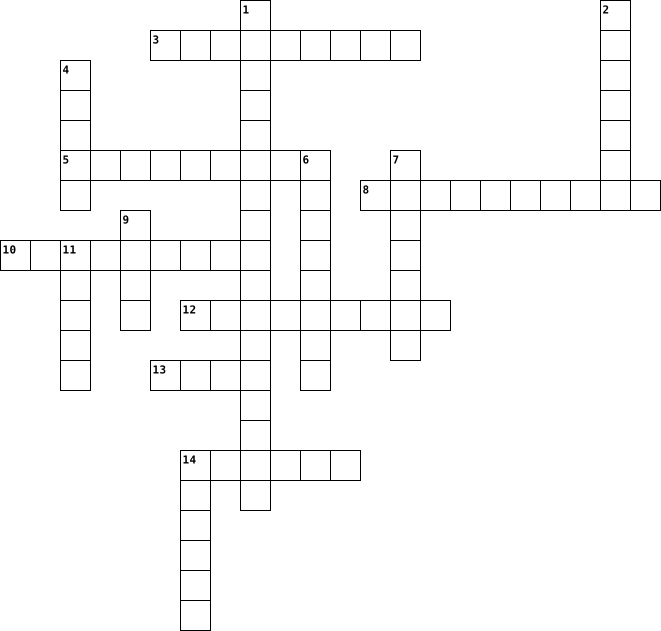
Across
- the gradual movement of the continents across the earth's surface through geological time.
- process that changes preexisting rocks into new forms because of increases in temperature, pressure, and chemically active fluids.
- The Earth's surface is cracked into large pieces called
- tell us when and where plants and animals once existed and can be evidence for plate tectonics
- the layer of the Earth that lies below the lithosphere.
- a way for heat to move
- break apart or become separated through faulting caused by plate tectonics.
- an opening in the Earth's crust through which lava, ash, and gases erupt.
- process in plate tectonics of the edge of one crustal plate descending below the edge of another.
- a feature of convergent plate boundaries, where two or more tectonic plates meet.
Down
- the sudden movement of Earth's crust at a fault line.
- a supercontinent that incorporated almost all the landmasses on Earth.
- a line on a rock surface or the ground that traces a geological fault.
- a hard, black volcanic rock
- a small area or region with a relatively hot temperature in comparison to its surroundings.
- the first person to formulate a complete statement of the continental drift hypothesis.
- occurs along divergent plate boundaries, where new ocean floor is created as the Earth's tectonic plates spread apart.
- tending to move toward one point or to approach each other
- the solid, outer part of Earth.
- commonly the sights of tectonic activity
20 Clues: a way for heat to move • a hard, black volcanic rock • the solid, outer part of Earth. • commonly the sights of tectonic activity • the sudden movement of Earth's crust at a fault line. • The Earth's surface is cracked into large pieces called • the layer of the Earth that lies below the lithosphere. • tending to move toward one point or to approach each other • ...
Plate Tectonics 2025-12-12

Across
- The large, relatively stationary area of volcanic activity away from plate boundaries
- A type of plate boundary where two plates move toward each other
- The circulation in the mantle driven by heat differences, believed to move the plates
- The largest type of landmass, combining all or most continents
- The name given to the single massive landmass 200 million years ago
- A measure used to quantify the magnitude of an earthquake
- A large, circular volcanic depression capable of massive eruptions
- A vent in the Earth's crust that releases molten rock, ash, and gases
- A fracture or zone of weakness in Earth's crust
- A type of plate boundary where two plates are moving away from each other
- Molten rock that has erupted onto Earth's surface
- The ground shaking caused by a rapid release of energy in the Earth's crust
Down
- The process where one oceanic plate sinks beneath another plate
- The layer of Earth's crust that forms the continents
- A seismic vibration produced by the sudden release of energy during rock rupture
- Boundary where plates slide horizontally past one another
- The theory describing the slow movement of continents over geologic time
- The large, rigid sections of Earth's lithosphere that move relative to one another
- The dense, heavy plate type that makes up the ocean floor
- The large depression in the Earth's surface that holds ocean water
- Molten rock found beneath the Earth's surface
21 Clues: Molten rock found beneath the Earth's surface • A fracture or zone of weakness in Earth's crust • Molten rock that has erupted onto Earth's surface • The layer of Earth's crust that forms the continents • Boundary where plates slide horizontally past one another • A measure used to quantify the magnitude of an earthquake • ...
Plate motion 2022-10-19

Across
- Earth’s main continuous areas of land
- When two plates are moving away from each other
- Where two plates meet
- Hot liquid rock on Earth's surface
- Underwater mountain range formed at a divergent plate boundary
- Slow pulling apart of land caused by plate activity
- The pieces making up Earth's outer layer
- When Earth’s surface shakes
- a natural spring sending hot water and steam suddenly into the air
- a diagram of the inside of something
Down
- The sudden pushing of something
- How fast something happens
- the top layer of something
- The landform formed at an underwater Convergent plate boundary
- to examine in detail for a purpose
- the soft, solid layer of rock below Earth's plates
- When two plates are moving towards each other
- The hottest layer of Earth
- Hot Liquid rock below Earth's surface
19 Clues: Where two plates meet • How fast something happens • the top layer of something • The hottest layer of Earth • When Earth’s surface shakes • The sudden pushing of something • Hot liquid rock on Earth's surface • to examine in detail for a purpose • a diagram of the inside of something • Earth’s main continuous areas of land • Hot Liquid rock below Earth's surface • ...
Chapter Ten 2013-10-30

Across
- shows movement of the ocean plates.
- Hot rock rises, cool rock sinks.
- Third type of plate boundaries.
- The study of magnetic properties of ancient rocks.
- Proposed the hypothesis that started it all
- Formed at at an ocean-- Continent boundary.
- A large areas of stable igneous or metamorphic rock.
- When the poles are in opposite places.
- Two plates move away from each other.
- What happens to the rock of a subducting plate.
Down
- Formed at an ocean-- Ocean boundary.
- The theory that came after Wegner's was rejected.
- Oceanic lithosphere sinks beneath continental lithosphere.
- First type of of plate boundaries.
- A hypothesis that states that continents were joined.
- Two plates slide past each other.
- The driving force behind seafloor spreading.
- Second type of plate boundaries.
- Causes continentals to break apart.
19 Clues: Third type of plate boundaries. • Hot rock rises, cool rock sinks. • Second type of plate boundaries. • Two plates slide past each other. • First type of of plate boundaries. • shows movement of the ocean plates. • Causes continentals to break apart. • Formed at an ocean-- Ocean boundary. • Two plates move away from each other. • When the poles are in opposite places. • ...
Science 2014-02-13

Across
- a example when lava forms continents
- quake when the plates move
- the super continent
- drift when continents move across the ocean
- waves when rocks move up and down
- plate boundaries when volcano's are formed
- plate boundaries when plates move to make things like the San Andrea fault in California
- of fire a ring of volcano's along the pacific ocean
- contention when all the contents drifted together into one big one
- trench at the mid ocean ridge
Down
- plate boundaries mostly when mountains are formed
- Tectonics 1 reason for Continental drift
- when the rock smashes together
- the location on earths surface
- when the rock pulls away
- ocean ridge where lava comes out
- when the rock pulls different direction
- wegner helped the studies on seafloor spreading and Continental drift
- molten lava deep in the crust
19 Clues: the super continent • when the rock pulls away • quake when the plates move • molten lava deep in the crust • trench at the mid ocean ridge • when the rock smashes together • the location on earths surface • ocean ridge where lava comes out • waves when rocks move up and down • a example when lava forms continents • when the rock pulls different direction • ...
Tectonic Plate Crossword! 2014-04-16

Across
- the movement caused within a fluid by the tendency of hotter and therefore less dense material to rise, and colder, denser material to sink under the influence of gravity, which consequently results in transfer of heat.
- referring to DC and causing electrons to flow from the base metal to the electrode
- violent shaking of the earth
- the gradual movement of the continents across the earth's surface through geological time
- was a supercontinent that existed during the late Paleozoic and early Mesozoic eras, forming approximately 300 million years ago. It began to break apart around 100 million years after it formed
- the rigid outer part of the earth, consisting of the crust and upper mantle
- Plate tectonics is a scientific theory that describes the large-scale motion of Earth's lithosphere
- In plate tectonics, a divergent boundary or divergent plate boundary is a linear feature that exists between two tectonic plates that are moving away from each other within continents initially produce rifts which produce rift valleys
- the sideways and downward movement of the edge of a plate of the earth's crust into the mantle beneath another plate.
- Slab pull is the movement of tectonic plate lithosphere due to convection currents in the asthenosphere. When the currents circulate they pull the tectonic plates down causing subduction. The slab pull force is a tectonic plate force due to subduction
Down
- A geomagnetic reversal is a change in the Earth's magnetic field such that the positions of magnetic north and magnetic south are interchanged
- A transform fault or transform boundary, also known as conservative plate boundary since these faults neither create nor destroy lithosphere, is a type of fault whose relative motion is predominantly horizontal in either sinistral or dextral direction
- In plate tectonics, a convergent boundary, also known as a destructive plate boundary, is an actively deforming region where two tectonic plates or fragments of lithosphere move toward one another and collide
- the formation of new areas of oceanic crust, which occurs through the upwelling of magma at midocean ridges and its subsequent outward movement on either side
- a mountain or hill, typically conical, having a crater or vent through which lava, rock fragments, hot vapor, and gas are being or have been erupted from the earth's crust.
- a long, seismically active submarine ridge system situated in the middle of an ocean basin and marking the site of the upwelling of magma associated with seafloor spreading. An example is the Mid-Atlantic Ridge
- Ridge push or sliding plate force is a proposed mechanism for plate motion in plate tectonics. Because mid-ocean ridges lie at a higher elevation than the rest of the ocean floor, gravity causes the ridge to push on the lithosphere that lies farther from the ridge
17 Clues: violent shaking of the earth • the rigid outer part of the earth, consisting of the crust and upper mantle • referring to DC and causing electrons to flow from the base metal to the electrode • the gradual movement of the continents across the earth's surface through geological time • ...
Mr. King's Plate Tectonics Crossword 2020-02-25

Across
- A boundary where 2 plates press together
- The plate east to the Indo-Australian and south to North American
- A boundary where 2 plates pull apart
- The area where subduction occurs
- The plate east to the South American and south of the Eurasian
- the plate southernmost to all other plates
Down
- A boundary where 2 plates slide by each other
- the plate southwest to the pacific plate
- A large piece of lithosphere that floats on the asthenosphere
- The study of the movement and structure of tectonic plates
- One plate goes beneath another less dense plate
- The large landmass where all continents were connect
12 Clues: The area where subduction occurs • A boundary where 2 plates pull apart • the plate southwest to the pacific plate • A boundary where 2 plates press together • the plate southernmost to all other plates • A boundary where 2 plates slide by each other • One plate goes beneath another less dense plate • The large landmass where all continents were connect • ...
Changing Earth 2014-06-18

Across
- These geological events usually occur at transform plate boundaries or where two plates push together.
- The process by which heat rises and then sinks as it cools is called _____________.
- _________ boundaries forms where two plate collide.
- Evidence for the continental drift theory, involving m________ was observed at Divergent plate boundaries.
- As the oceanic crust drives under the continental crust a ________ forms at the interface.
- The age of rocks and _________ of plants is some of the evidence that supported Wegner’s “Theory of Continental Drift”.
Down
- Oceanic crust is denser than continental crust because it is made of_________.
- Convergent boundaries are also referred to as ____________ boundaries.
- These form at convergent plate boundaries and as a result of magma plumes in the crust.
- This technology was developed during WW2 and allowed for the mapping of the ocean floors.
- ________ is the process by which the crust is destroyed at convergent plate boundary.
- When the magma rises to the crust as a result of convection currents, new crust is formed at a __________ boundary.
- _______ boundaries form when two plate slide against each other in opposite directions.
- The less dense continental crust is composed of ___________.
- The Theory of Continental Drift refers to the movement of _________ plates.
- Regions where volcanoes form in the absence of plate boundaries are known as _______.
16 Clues: _________ boundaries forms where two plate collide. • The less dense continental crust is composed of ___________. • Convergent boundaries are also referred to as ____________ boundaries. • The Theory of Continental Drift refers to the movement of _________ plates. • Oceanic crust is denser than continental crust because it is made of_________. • ...
Keywords Chapter 8 & 9 2024-06-07

Across
- A relief printmaking method in which a block of wood is carved so as to leave the image areas raised from the background.
- A relief printmaking technique in which the printing surface is a thick layer of linoleum, often mounted on a wooden block for support.
- Another term for Screenprinting and Serigraphy.
- An intaglio printmaking technique in which the printing plate is first roughened with a special tool called a rocker, which creates a fine pattern of burrs.
- In Printmaking, a surface (such as a block of wood) on which a design is prepared before being transferred through pressure to a receiving surface (such as a sheet of paper).
- Printmaking techniques in which the lines or areas that will take the ink are incised into the printing plate, rather than raised about it.
- In Printmaking, the total number of prints made from a given plate or block.
- Another term for Screenprinting and Silkscreening.
- An intaglio printmaking method in which areas of tone are created by dusting resin particles on a plate and then allowing acid to bite around the particles.
- An intaglio printmaking method in which lines are cut into a metal plate using a sharp tool called a burin, which creates a clean, V-shaped channel.
- The first practical photographic process. Invented by Louis Jacques Mande Daguerre and made public in 1839, produced a single permanent image directly on a prepared copper plate.
- French for "author," the word describes a filmmaker, usually a director, who exercises extensive creative control over his or her films, imbuing them with a strong personal style.
Down
- A printmaking method in which the image is transferred to paper by forcing ink through a fine mesh in which the areas not meant to print have been blocked; a stencil technique.
- An intaglio printmaking method in which the design is bitten into the printing plate with acid.
- Similar to woodcut, a relief printmaking process in which the image is cut on the end grain of a wood plank, resulting in a "white-line" impression.
- A planographic printmaking method resulting in a single impression.
- An intaglio printmaking technique similar to engraving in which the design is scratched directly into a metal plate with a sharp, pointed tool that is held like a pen.
- In intaglio printmaking, a method for printing a continuous-tone photographic image.
- Printmaking techniques in which the image areas are level with the surface of the printing plate. Lithography and monotype are examples.
- An image created from a master wood block, stone, plate, or screen, usually on paper.
- An international art movement that emerged during World War I. Believing that society itself had gone mad, refused to make sense or to provide any sort of aesthetic refuge or comfort.
- An acid-resistant coating applied to a metal plate to ready it for use in etching.
- In printmaking, to protect selected areas of a plate from the bite of acid by coating them with a resistant varnish.
- In printmaking, the precise alignment of impressions made by two or more printing blocks or plates on the same sheet of paper, as when printing an image in several colors.
- A planographic printmaking technique based on the fact that oil and water repel each other.
- Anything that projects from a background. In printmaking, techniques in which portions of a block meant to be printed are raised.
26 Clues: Another term for Screenprinting and Serigraphy. • Another term for Screenprinting and Silkscreening. • A planographic printmaking method resulting in a single impression. • In Printmaking, the total number of prints made from a given plate or block. • An acid-resistant coating applied to a metal plate to ready it for use in etching. • ...
plate boundaries and features 2021-10-30

Across
- a theory that all continents fit with each other,
- famous for continental drift theory,
- the structure of earth's crust,
- a plate boundary where the plates are moving away from each other,
- a plate boundary where the lithospere colides,
- the outer part of the earth,
- the process that forms new ocean floors
Down
- movement of the continents,
- plate a tectonic plate deep under the ocean,
- large pieces of the earth's surface,
- an open spot on the seafloor where heated mineral water flows,
- a plate boundary where the plates slide past each other,
- a tight space hole in the ocean floor,
- a mountain range down in the ocean,
- the process where the earth's crust converges into earth's mantle,
15 Clues: movement of the continents, • the outer part of the earth, • the structure of earth's crust, • a mountain range down in the ocean, • large pieces of the earth's surface, • famous for continental drift theory, • a tight space hole in the ocean floor, • the process that forms new ocean floors • plate a tectonic plate deep under the ocean, • ...
science 2026-05-02

Across
- the process of making more gamete cells.
- something that was not occurring or made naturally
- cells, cells they're made of..
- smallest unit of matter
- What is it called when an oceanic plate goes under a continental plate?
- the amount of matter inside something
- a type of plate boundary where the two plates move together
Down
- proccess of making more somatic cells
- 6CO2+6H2O+Light Energy→C6H12O6+6O2
- made up of two or more atoms
- a type of plate boundary where the two plates move away from each other
- tiny machine attached to a weather balloon
- mass divided by volume
- a type of plate boundary where the two plates slide past each other
- makes up everything
15 Clues: makes up everything • mass divided by volume • smallest unit of matter • made up of two or more atoms • cells, cells they're made of.. • 6CO2+6H2O+Light Energy→C6H12O6+6O2 • proccess of making more somatic cells • the amount of matter inside something • the process of making more gamete cells. • tiny machine attached to a weather balloon • ...
Disorders of the Nail 2013-10-14

Across
- Excessive amount of cuticle moving forward onto the nail plate caused by skin disease, hereditary, trauma or injury to the nail
- Broad general term for any nail disease
- Splits in the free edge that run lengthwise causing weakness or further breaks to the nail caused by excessive use of cuticle and polish removers, careless and rough filing,injury to nails
- Can be caused by an injury, health condition or heredity
- Most common on big toe; increased curve and thickness, has ridges and is difficult to cut caused by hereditary, injury to nail bed and improper care of nails
- Small rounded mass projecting from nail bed to the nail plate; inflammation caused by infection or injury
- Very short nails with irregular edges caused by habitual nail biting
- Long ridges that run horizontally or lengthwise across the nail, uneven growth caused by aggressive cuticle pushing, matrix injury
- Edges of nail plate fold inward as nail grows, sometimes curling in completely giving nail a cone shape caused by improper shoe fitting, hereditary and nail bed deformity
- White spots or streaks within the nail plate caused by nail injuries, hereditary
- Nail detaches and falls off in whole or part caused by syphilis, fever, drug allergies and trauma
- Dark pigment within the nail plate caused by excess melanin
- Nails that have a concave depression in the middle of the nail, nail plate edges turn up and can be caused by genetic, illness or nerve disorder
- Thin, white and flexible nails, blending and conforming over fingertip caused by improper diet, internal disease, certain medication, and nervous disorders
- Nail plate separates from the nail bed creating a gap, does not fall off; nail appears white; color of nail will change if infected caused internal disorders, product allergies, trauma to the nail and infection
Down
- Nail plate edges fold down into the nail walls at a 90 degree angle, either on one or both sides caused by shoe pressure, nail bed deformity, hereditary, ingrown nails
- Blood that clots under the nail plate caused by injury to the nail bed
- Nail growing into the nail groove causing inflammation on one or both sides of the nail caused by improper filing and or shoe fitting
- Nail plate develops an abnormal thickening in width, not length caused by internal imbalance, heredity and injury
- Pieces of shin that split surrounding the nail caused by improper cuticle softening and cutting job related, skin dryness
- Inflammation of tissues surrounding or under the nail; tender, sometimes pus is present caused by unsanitary implements, aggressive cuticle pushing and cutting and yeast infection
- Complete shedding of the nail plate, starting with a groove at the base of the nail caused by local infection, cancer treatments, and nail bed injury
- Nail slowly deteriorates, nail gets smaller and falls off caused by internal disease and injury to matrix
- Inflammation of the matrix; redness, swelling around base or underneath the nail plate, sometimes pus is present caused by unsanitary implements is present
- A small hard flesh-colored or red lump under or beside the nail caused by HPV infection in the epidermal layer of the skin
- Fungal infection between the fingers and on the palms that can reach the fingernails
- Fungal infection between the toes also called athlete's foot
- Contagious disease caused by a plant parasite; another name for ringworm
- Nail is pitted or dimpled with brown spots caused by genetics
29 Clues: Broad general term for any nail disease • Can be caused by an injury, health condition or heredity • Dark pigment within the nail plate caused by excess melanin • Fungal infection between the toes also called athlete's foot • Nail is pitted or dimpled with brown spots caused by genetics • Very short nails with irregular edges caused by habitual nail biting • ...
plate boundaries and features 2021-10-30

Across
- a mountain range down in the ocean,
- the process that forms new ocean floors
- movement of the continents,
- plate a tectonic plate deep under the ocean,
- a tight space hole in the ocean floor,
- a plate boundary where the plates slide past each other,
- a theory that all continents fit with each other,
- the process where the earth's crust converges into earth's mantle,
Down
- a plate boundary where the plates are moving away from each other,
- the outer part of earth,
- large pieces of the earth's surface,
- famous for continental drift theory,
- the structure of earth's crust,
- an open spot on the seafloor where heated mineral water flows,
- a plate boundary where the lithospere colides,
15 Clues: the outer part of earth, • movement of the continents, • the structure of earth's crust, • a mountain range down in the ocean, • large pieces of the earth's surface, • famous for continental drift theory, • a tight space hole in the ocean floor, • the process that forms new ocean floors • plate a tectonic plate deep under the ocean, • ...
Chapter 12 Roof Framing Version D 2025-11-03

Across
- Horizontal roof members used to support rafters between the plate and ridge board.
- A rafter connected to both the ridge and the wall plate.
- The distance a rafter extends upward above the wall plate.
- One of a series of structural members of a roof designed to support roof loads.
- The horizontal distance of rafters from the outer edge of the wall plate to the center of the ridge.
- A wood member nailed to the ends of the rafters and lookouts and used for the outer face of a box cornice.
- The ratio of the rise to the span.
- A gable overhang.
- The total of all moving and variable loads that may be placed on a building.
- A plywood or steel plate fastened to the outside of a joint to give the joint strength.
Down
- A rafter that runs from the wall plate to the ridge, always at a 45° angle.
- A framed structure extending from and fastened to a roof slope and having a roof of its own. It provides a wall surface for installing a window.
- A rafter that forms the intersection of an internal roof angle.
- The side of a right triangle opposite of the right angle. In roof framing, the length of the rafter is the hypotenuse.
- Structural member that supports the soffit and runs between the lower end of a rafter and the outside wall.
- A tie beam connecting rafters. It is located considerably above the wall plate. Also called rafter tie.
- Boards or prefabricated panels that are attached to the exterior studding or rafters of a structure.
- The horizontal line at the junction of the top edges of two roof surfaces.
- A structural unit consisting of such members as beams, bars, and ties arranged to form triangles.
19 Clues: A gable overhang. • The ratio of the rise to the span. • A rafter connected to both the ridge and the wall plate. • The distance a rafter extends upward above the wall plate. • A rafter that forms the intersection of an internal roof angle. • The horizontal line at the junction of the top edges of two roof surfaces. • ...
Printmaking Midterm Review 2025-10-08

Across
- / rubbing the back of the paper to transfer ink smoothly
- drying rack / bottom to top
- (Additive, Reduction, Trace) / a one of a kind, hand-pulled print
- / the image that is printed from a raised surface, usually produced by cutting away non-image areas
- / undesirable ink spot with a white halo, usually caused by dirt or skin in the ink
- / to sign prints
- Print / Type of relief print that can produce more than one color from the same printing plate
- Image / Traces of the image remaining on the printing plate after printing a monotype
- the plate / To put ink on the plate
- Edge / The irregular, untrimmed edge of expensive paper; typically hand made paper
- Proof (AP) / Test print
- / relief print created by carving the design ,ink applied to the grooves not the surface
- it means to “pull” a print / To lift the print revealing the image
Down
- / A printing process in which plank wood is cut with gouges and knives and is printed in relief
- and degreasing oil based inks / use oil and rubbing alcohol
- / A printing technique in which paper is pushed into depressed or recessed lines made in a metal plate with ink. The image can be made on the plate by using acid or a sharp tool.
- Engraving / A delicate carving process on end-grain wood (very hard wood– good for small details)
- / a set of identical prints, sometimes numbered and signed, that have been pulled by or under the supervision of the artist and art authorized for distribution
- / a mark form a stamp (signature of artist)
- / Method used to line up the colors of multiple color prints accurately
- / to make value
- / Screenprint/ Serigraphy (creates positive image)
- and Lithography / Variations of a basic printed image from the same single or multiple plate or block area
- Proof / a series of test print that allows artist to check accuracy
- / Variations of a basic printed image from the same single or multiple plate or block area
25 Clues: / to make value • / to sign prints • Proof (AP) / Test print • drying rack / bottom to top • the plate / To put ink on the plate • / a mark form a stamp (signature of artist) • / Screenprint/ Serigraphy (creates positive image) • / rubbing the back of the paper to transfer ink smoothly • and degreasing oil based inks / use oil and rubbing alcohol • ...
Tectonic Plate and Plate Boundaries 2025-01-19

Across
- What scientists call the large pieces on Earth's surface
- This landform is created at convergent and divergent plate boundaries
- The type of plate boundary where two plates are moving past each other
- The layer of Earth where magma is found
- This natural disaster occurs at convergent and transform plate boundaries
- The type of plate boundary where two plates are splitting apart and moving away from each other
- The amount of layers the Earth has
- The layer of Earth that is broken into large pieces
- The number of different plate boundaries we discussed
Down
- The amount of continents and large plates found on Earth
- Where two or more tectonic plates meet
- This is what moves the tectonic plates around the Earth
- What scientists call the area where five plates meet the Pacific Plate in the Pacific Ocean and where most volcanic eruptions and earthquakes occur
- The type of plate boundary where two plates are moving towards each other
14 Clues: The amount of layers the Earth has • Where two or more tectonic plates meet • The layer of Earth where magma is found • The layer of Earth that is broken into large pieces • The number of different plate boundaries we discussed • This is what moves the tectonic plates around the Earth • The amount of continents and large plates found on Earth • ...
Plate tectonics 2022-09-15

Across
- what boundary has the plates come together
- what happens to divergent plates
- what boundary has plates slide past each other
- the semi fluid that spews out of volcanos
- what happens to plates in a convergent boundary
- how many boundaries are there
- what plate is under the ocean
- what forms when you have a oceanic plate in a convergent boundary
- what does cold air do
Down
- what boundary has the plates come apart
- what happens in a transform boundary
- what plate is under the continent’s
- when the sea floor diverges
- when magma rises cools and sinks back down
- when 2 continental plates collide what forms
- this forms when 3 oceanic plates collide
- semifluid below or within the crust
- when a oceanic and continental plate collide this forms
- what forms when 2 oceanic plates are in a convergent boundary
- what does hot air do
20 Clues: what does hot air do • what does cold air do • when the sea floor diverges • how many boundaries are there • what plate is under the ocean • what happens to divergent plates • what plate is under the continent’s • semifluid below or within the crust • what happens in a transform boundary • what boundary has the plates come apart • this forms when 3 oceanic plates collide • ...
Chapter 12 Roof Framing Version A 2025-11-03

Across
- A tie beam connecting rafters. It is located considerably above the wall plate. Also called rafter tie.
- One of a series of structural members of a roof designed to support roof loads.
- A plywood or steel plate fastened to the outside of a joint to give the joint strength.
- A rafter that runs from the wall plate to the ridge, always at a 45° angle.
- A rafter connected to both the ridge and the wall plate.
- A gable overhang.
- The horizontal distance of rafters from the outer edge of the wall plate to the center of the ridge.
Down
- The total of all moving and variable loads that may be placed on a building.
- A framed structure extending from and fastened to a roof slope and having a roof of its own. It provides a wall surface for installing a window.
- A rafter that forms the intersection of an internal roof angle.
- The ratio of the rise to the span.
- The side of a right triangle opposite of the right angle. In roof framing, the length of the rafter is the hypotenuse.
- A wood member nailed to the ends of the rafters and lookouts and used for the outer face of a box cornice.
- Boards or prefabricated panels that are attached to the exterior studding or rafters of a structure.
- Structural member that supports the soffit and runs between the lower end of a rafter and the outside wall.
- The horizontal line at the junction of the top edges of two roof surfaces.
- The distance a rafter extends upward above the wall plate.
- Horizontal roof members used to support rafters between the plate and ridge board.
- A structural unit consisting of such members as beams, bars, and ties arranged to form triangles.
19 Clues: A gable overhang. • The ratio of the rise to the span. • A rafter connected to both the ridge and the wall plate. • The distance a rafter extends upward above the wall plate. • A rafter that forms the intersection of an internal roof angle. • The horizontal line at the junction of the top edges of two roof surfaces. • ...
chapter 7 vocabulary 2021-10-13

Across
- as a slab sinks it pulls on the rest of the plate with a force
- a state in which magnetized objects such as compass needles will orient themself to point north
- the process by which new oceanic crust forms along a mid-ocean ridge and older oceanic crust moves away from the ridge
- plate boundaries form where two plates collide
- which suggested that continents are in constant motion on the surface of the earth
- the cold and rigid outermost rock layer
- forms where twp plates slide past each other
- push rising mantle material at mid-ocean ridge creat the potential for plates to move away from the ridge with a force
- ridges the mountain ranges in the middle of the oceans
- reversal occurs and the magnetic field reverses direction
Down
- earth surfaces is made of rigid slabs of rocks or plates that move with respect to each other
- forms where two plates separate
- a state in which magnetized objects would reverse direction and orient themself to a point south
- the denser plate sinks below the more buoyant plate in a process
- the circulation of material caused by differences in temperature and density
- is continents that were once part of a supercontinent
16 Clues: forms where two plates separate • the cold and rigid outermost rock layer • forms where twp plates slide past each other • plate boundaries form where two plates collide • is continents that were once part of a supercontinent • ridges the mountain ranges in the middle of the oceans • reversal occurs and the magnetic field reverses direction • ...
Plate Tectonic Crossword Puzzle 2022-01-14

Across
- area of Earth's mantle where hot plumes rise upward, forming a volcano on the crust
- chain of volcanoes formed above a subducting plate, positioned in an arc shape
- where two or more lithospheric plates collide
- surface shaking on Earth from a sudden release of energy in Earth's lithosphere
- idea that continents havee and are still moving slowly across Earth
- edge of Earth's plates meet at this boundary
- oceanic trench area marginal to a continent
- discontinuity in a volume of rock across where there has been a lot of displacement from rock-mass movements
- fault along a plate boundary where motion is mostly horizontal
Down
- The Earth's crust and upper mantle are broken into sections called
- pieces of Earth's crust and uppermost mantle
- the edge where two plates meet
- theory that pieces of Earth's lithosphere are in constant motion
- two tectonic plates that are MOVING AWAY from each other
- vertical elevation of the Earth's surface in response to natural causes
- linear shaped lowland between mountain ranges created from a geologic rift
- formation of new areas of oceanic crust
17 Clues: the edge where two plates meet • formation of new areas of oceanic crust • oceanic trench area marginal to a continent • pieces of Earth's crust and uppermost mantle • edge of Earth's plates meet at this boundary • where two or more lithospheric plates collide • two tectonic plates that are MOVING AWAY from each other • ...
Plate Boundaries 2026-04-30

Across
- boundary: Plates come together
- forces: Build up Earth's crust
- Form at convergent boundaries
- Geologic events that occur at plate boundaries
- Form when continental plates collide
- spreading: Creation of new crust at divergent boundaries
Down
- boundary: Plates move apart
- Property that determines which plate subducts
- forces: Break down Earth's crust
- Large pieces of Earth's crust
- trench: Forms when oceanic and continental plates converge
- boundary: Plates slide past each other
- tectonics: Theory explaining movement of Earth's plates
- Process where one plate sinks under another
- Breaks in Earth's crust at transform boundaries
15 Clues: boundary: Plates move apart • Large pieces of Earth's crust • Form at convergent boundaries • boundary: Plates come together • forces: Build up Earth's crust • forces: Break down Earth's crust • Form when continental plates collide • boundary: Plates slide past each other • Process where one plate sinks under another • Property that determines which plate subducts • ...
Kitchen Words 2012-10-16

Across
- Tongs
- Milo
- Knife
- Fork
- Toaster
- Plate
- Coffee
- Oven
Down
- Sink
- Stove
- Kitchen
- Fridge
- Cup
- Tea
- Spoon
15 Clues: Cup • Tea • Sink • Milo • Fork • Oven • Stove • Tongs • Knife • Spoon • Plate • Fridge • Coffee • Kitchen • Toaster
Kitchen Words 2012-10-16

Across
- Cup
- Tea
- Knife
- Fork
- Toaster
- Stove
- Coffee
Down
- Plate
- Oven
- Sink
- Kitchen
- Fridge
- Milo
- Spoon
- Tongs
15 Clues: Cup • Tea • Oven • Sink • Fork • Milo • Plate • Knife • Spoon • Stove • Tongs • Fridge • Coffee • Kitchen • Toaster
Prepositions 2014-08-23

Across
- / banana
- / plate
- / picnic
- / sheep
- / under
- / front
Down
- / grapes
- / orange
- / cup
- / behind
- / in
- / bread
- / knife
- / next
- /fork
15 Clues: / in • / cup • /fork • / next • / plate • / sheep • / bread • / knife • / under • / front • / grapes • / orange • / banana • / behind • / picnic
plater tectonics 2021-04-02
Across
- divergent
- transform
- convergent
- tectonics
- spreading
- lava
- mantle
Down
- seafloorspreading
- multain
- plate
- mountain
- volcano
- rock
- crust
- moving
15 Clues: rock • lava • plate • crust • mantle • moving • multain • volcano • mountain • divergent • transform • tectonics • spreading • convergent • seafloorspreading
Long A 2019-11-09

Across
- gate
- table
- snake
- cane
- mane
- cage
- vase
Down
- plate
- game
- grapes
- lake
- spade
- tape
- rake
- wave
15 Clues: game • gate • lake • tape • cane • mane • rake • cage • wave • vase • plate • table • snake • spade • grapes
Long A 2019-11-09

Across
- mane
- cane
- gate
- snake
- plate
- spade
- rake
- wave
Down
- tape
- game
- cage
- grapes
- table
- lake
- vase
15 Clues: tape • game • mane • cane • cage • gate • lake • vase • rake • wave • table • snake • plate • spade • grapes
Kitchen Words 2012-10-16

Across
- Fork
- Sink
- Toaster
- Oven
- Coffee
- Tongs
- Plate
Down
- Fridge
- Milo
- Kitchen
- Tea
- Knife
- Spoon
- Cup
- Stove
15 Clues: Tea • Cup • Fork • Milo • Sink • Oven • Knife • Spoon • Tongs • Stove • Plate • Fridge • Coffee • Kitchen • Toaster
Nail Disorders 2024-02-07

Across
- Blot clot forms under the nail plate
- Highly curved nail plate often leads to ingrown nails
- Darkening of nails
- blood stains bed epithelium. giving appearance of small black or brown splinters
- split or brittle nails
- Condition caused by injury , is hereditary, or a previous desease of nail unit
Down
- also known as furrows. runs either lengthwise or across the nail
- Dramatically increased nail curvature
- Nail turns a variety of colors, systemic disorder
- Living skin splits around nail
- Bitten nails
- Abnormal condition that occurs when skin is stretched by the nail plate
- Whitish discoloration or spots on the nails
- Thin white nail plate. More flexible than normal
- Vertical lines running down the length of the nail plate
15 Clues: Bitten nails • Darkening of nails • split or brittle nails • Living skin splits around nail • Blot clot forms under the nail plate • Dramatically increased nail curvature • Whitish discoloration or spots on the nails • Thin white nail plate. More flexible than normal • Nail turns a variety of colors, systemic disorder • Highly curved nail plate often leads to ingrown nails • ...
Chapter 12 Roof Framing Version B 2025-11-03

Across
- A rafter that runs from the wall plate to the ridge, always at a 45° angle.
- A structural unit consisting of such members as beams, bars, and ties arranged to form triangles.
- The ratio of the rise to the span.
- The total of all moving and variable loads that may be placed on a building.
- A rafter that forms the intersection of an internal roof angle.
- A rafter connected to both the ridge and the wall plate.
- A gable overhang.
- A plywood or steel plate fastened to the outside of a joint to give the joint strength.
- A tie beam connecting rafters. It is located considerably above the wall plate. Also called rafter tie.
Down
- The side of a right triangle opposite of the right angle. In roof framing, the length of the rafter is the hypotenuse.
- Horizontal roof members used to support rafters between the plate and ridge board.
- A wood member nailed to the ends of the rafters and lookouts and used for the outer face of a box cornice.
- One of a series of structural members of a roof designed to support roof loads.
- The horizontal line at the junction of the top edges of two roof surfaces.
- Boards or prefabricated panels that are attached to the exterior studding or rafters of a structure.
- The distance a rafter extends upward above the wall plate.
- A framed structure extending from and fastened to a roof slope and having a roof of its own. It provides a wall surface for installing a window.
- Structural member that supports the soffit and runs between the lower end of a rafter and the outside wall.
- The horizontal distance of rafters from the outer edge of the wall plate to the center of the ridge.
19 Clues: A gable overhang. • The ratio of the rise to the span. • A rafter connected to both the ridge and the wall plate. • The distance a rafter extends upward above the wall plate. • A rafter that forms the intersection of an internal roof angle. • The horizontal line at the junction of the top edges of two roof surfaces. • ...
Chapter 12 Roof Framing Version C 2025-11-03

Across
- The ratio of the rise to the span.
- The distance a rafter extends upward above the wall plate.
- A rafter that forms the intersection of an internal roof angle.
- A structural unit consisting of such members as beams, bars, and ties arranged to form triangles.
- The total of all moving and variable loads that may be placed on a building.
- A framed structure extending from and fastened to a roof slope and having a roof of its own. It provides a wall surface for installing a window.
- A rafter connected to both the ridge and the wall plate.
- The horizontal distance of rafters from the outer edge of the wall plate to the center of the ridge.
Down
- A plywood or steel plate fastened to the outside of a joint to give the joint strength.
- The side of a right triangle opposite of the right angle. In roof framing, the length of the rafter is the hypotenuse.
- The horizontal line at the junction of the top edges of two roof surfaces.
- A tie beam connecting rafters. It is located considerably above the wall plate. Also called rafter tie.
- One of a series of structural members of a roof designed to support roof loads.
- A gable overhang.
- A rafter that runs from the wall plate to the ridge, always at a 45° angle.
- A wood member nailed to the ends of the rafters and lookouts and used for the outer face of a box cornice.
- Boards or prefabricated panels that are attached to the exterior studding or rafters of a structure.
- Horizontal roof members used to support rafters between the plate and ridge board.
- Structural member that supports the soffit and runs between the lower end of a rafter and the outside wall.
19 Clues: A gable overhang. • The ratio of the rise to the span. • A rafter connected to both the ridge and the wall plate. • The distance a rafter extends upward above the wall plate. • A rafter that forms the intersection of an internal roof angle. • The horizontal line at the junction of the top edges of two roof surfaces. • ...
Earthquakes, and Volcanoes 2024-10-16

Across
- Location of hot-spot volcano
- Form at megathrust faults
- Hottest layer of the Earth
- Lines run from north to south pole
- Deepest part of the ocean
- Zero degree of latitude
- One plate pushed under another plate
Down
- Lines run from east to west
- Place not on plate boundary where volcanoes happen
- Mixes with melted rock to form explosive volcanoes
- Middle layer of the Earth
- Located near megathrust fault
- Invented earthquake scale
- Movement of heat in liquids and gases
- Type of plate boundary with sideways motion
15 Clues: Zero degree of latitude • Middle layer of the Earth • Invented earthquake scale • Form at megathrust faults • Deepest part of the ocean • Hottest layer of the Earth • Lines run from east to west • Location of hot-spot volcano • Located near megathrust fault • Lines run from north to south pole • One plate pushed under another plate • Movement of heat in liquids and gases • ...
Parts and objects of the house 2015-05-02

Across
- Chair
- Kitchen
- Garage
- Bedroom
- Bathroom
- Pillow
- Bed
- Stove
Down
- Napkin
- Refrigerator
- Mirror
- Table
- Plate
- Lamp
- Sofa
15 Clues: Bed • Lamp • Sofa • Chair • Table • Plate • Stove • Napkin • Garage • Mirror • Pillow • Kitchen • Bedroom • Bathroom • Refrigerator
Long A 2019-11-09

Across
- spade
- grapes
- cage
- cane
- table
- wave
- mane
- vase
Down
- tape
- plate
- game
- snake
- gate
- lake
- rake
15 Clues: tape • game • cage • gate • cane • lake • wave • rake • mane • vase • spade • plate • snake • table • grapes
RESTAURANT 2024-12-01

Across
- chair
- spoon
- plate
- waiter
- knife
- restaurant
Down
- pepper
- napkin
- cup
- chef
- table
- cafe
- fork
- mug
- salt
15 Clues: cup • mug • chef • cafe • fork • salt • chair • spoon • table • plate • knife • pepper • napkin • waiter • restaurant
Plate Tectonics 2023-02-22

Across
- Molten rock on the Earth's crust
- Often occurs at convergent plate boundaries
- Often occurs at convergent plate boundaries
- A section created by a plane cutting through a solid perpendicular to it.
- The study of the Earth
- A crack in Earth's crust
- One plate goes under the other
- The rocks and minerals on Earth
Down
- Something formed from divergent plate boundaries
- Plates that form a mid ocean ridge
- A long ditch in the ground sometimes formed by convergent plate boundaries
- The layer of the Earth under the crust
- The outer layer of the Earth
- The movement of an edge of one plate moving under another
- In the center of the Earth
15 Clues: The study of the Earth • A crack in Earth's crust • In the center of the Earth • The outer layer of the Earth • One plate goes under the other • The rocks and minerals on Earth • Molten rock on the Earth's crust • Plates that form a mid ocean ridge • The layer of the Earth under the crust • Often occurs at convergent plate boundaries • ...
Plate Tectonics 2023-02-22

Across
- Molten rock on the Earth's crust
- Often occurs at convergent plate boundaries
- Often occurs at convergent plate boundaries
- A section created by a plane cutting through a solid perpendicular to it.
- The study of the Earth
- A crack in Earth's crust
- One plate goes under the other
- The rocks and minerals on Earth
Down
- Something formed from divergent plate boundaries
- Plates that form a mid ocean ridge
- A long ditch in the ground sometimes formed by convergent plate boundaries
- The layer of the Earth under the crust
- The outer layer of the Earth
- The movement of an edge of one plate moving under another
- In the center of the Earth
15 Clues: The study of the Earth • A crack in Earth's crust • In the center of the Earth • The outer layer of the Earth • One plate goes under the other • The rocks and minerals on Earth • Molten rock on the Earth's crust • Plates that form a mid ocean ridge • The layer of the Earth under the crust • Often occurs at convergent plate boundaries • ...
Plate Tectonics 2023-02-22

Across
- Molten rock on the Earth's crust
- Often occurs at convergent plate boundaries
- Often occurs at convergent plate boundaries
- A section created by a plane cutting through a solid perpendicular to it.
- The study of the Earth
- A crack in Earth's crust
- One plate goes under the other
- The rocks and minerals on Earth
Down
- Something formed from divergent plate boundaries
- Plates that form a mid ocean ridge
- A long ditch in the ground sometimes formed by convergent plate boundaries
- The layer of the Earth under the crust
- The outer layer of the Earth
- The movement of an edge of one plate moving under another
- In the center of the Earth
15 Clues: The study of the Earth • A crack in Earth's crust • In the center of the Earth • The outer layer of the Earth • One plate goes under the other • The rocks and minerals on Earth • Molten rock on the Earth's crust • Plates that form a mid ocean ridge • The layer of the Earth under the crust • Often occurs at convergent plate boundaries • ...
Kitchen Words 2012-10-16

Across
- Cup
- Milo
- Tea
- Knife
- Fork
- Toaster
- Coffee
- Stove
Down
- Plate
- Oven
- Sink
- Kitchen
- Fridge
- Spoon
- Tongs
15 Clues: Cup • Tea • Milo • Oven • Sink • Fork • Plate • Knife • Spoon • Tongs • Stove • Fridge • Coffee • Kitchen • Toaster
Kitchen Words 2012-10-16

Across
- Sink
- Oven
- Cup
- Fridge
- Tea
- Coffee
- Toaster
- Stove
Down
- Milo
- Knife
- Plate
- Kitchen
- Fork
- Tongs
- Spoon
15 Clues: Cup • Tea • Milo • Sink • Oven • Fork • Knife • Plate • Tongs • Spoon • Stove • Fridge • Coffee • Kitchen • Toaster
Parts and objects of the house 2015-05-02

Across
- Sofa
- Chair
- Pillow
- Kitchen
- Garage
- Bathroom
- Plate
- Mirror
Down
- Refrigerator
- Napkin
- Stove
- Bed
- Lamp
- Bedroom
- Table
15 Clues: Bed • Sofa • Lamp • Stove • Chair • Table • Plate • Napkin • Pillow • Garage • Mirror • Kitchen • Bedroom • Bathroom • Refrigerator
Tectonic plates crossword 2022-10-27

Across
- two plates moving away from each other
- past forms of life that is kept in place within rock
- two plates moving towards each other
- one of the large sections of rock that make up the earths crust
- how often or fast something happens such as the pace of plate movement
- a large continuous area of land on earths surface
- hot liquid rock underneath the surface of the earth
Down
- section a diagram or model that shows what something looks like from the middle
- magma,gas,and ash pushed out of a landform formed near plate boundaries
- a sudden shaking of the earth caused by plate movement
- a long,deep indentation in the ocean floor formed at a convergent plate boundary
- the layer of soft solid rock underneath earths outer layer
- the earths outer most and thinnest layer
- hot liquid rock once it reaches the surface
- a feature formed on the surface of the earth due to a geologic process
- an under-water mountain range formed at divergent plate boundaries
16 Clues: two plates moving towards each other • two plates moving away from each other • the earths outer most and thinnest layer • hot liquid rock once it reaches the surface • a large continuous area of land on earths surface • hot liquid rock underneath the surface of the earth • past forms of life that is kept in place within rock • ...
PLATE TECTONICS 2021-12-09
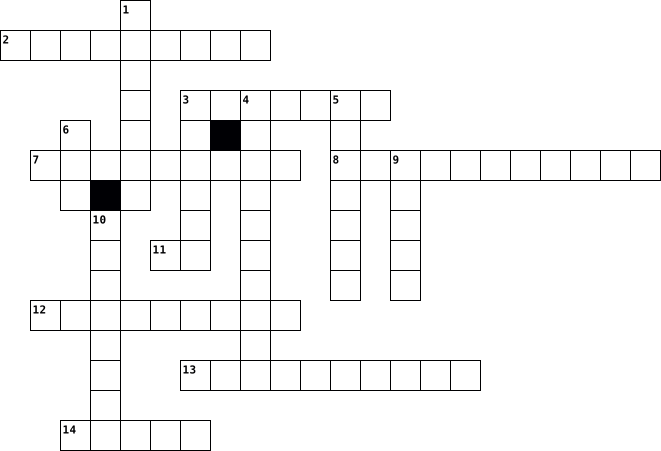
Across
- often happen along plate boundaries
- this plate is being subducted under the Mariana plate
- form when two continental plates collide
- occur along fault lines
- what in the mantle?
- the fastest moving tectonic plates are seen in
- the driving force behind plate tectonics
- the number of plate tectonics to exist
Down
- this trench is the deepest part of the ocean
- this rises to form the plate tectonics
- These currents in the mantle pull the Tectonic Plates above them.
- where you can see tectonic plates
- the centre of the earth is very ___
- if colder mantle rocks sink, then hotter mantle rock ___
- this builds up as the plates grind together
15 Clues: what in the mantle? • occur along fault lines • where you can see tectonic plates • often happen along plate boundaries • the centre of the earth is very ___ • this rises to form the plate tectonics • the number of plate tectonics to exist • form when two continental plates collide • the driving force behind plate tectonics • this builds up as the plates grind together • ...
AISouth Milady Chapter 10 2015-12-23

Across
- Split or brittle nails that have a series or lengthwise ridges giving a rough appearance to the surface of the nail plate.
- The separation and falling off of a nail plate from the nail bed; affects fingernails and toenails.
- Fungal infection of the natural nail plate.
- Also known as ram's horn or claw nails; an enlargement of the fingernails or toenails accompanied by increased thickening and curvature.
- Soft spoon nails with a concave shape that appears scooped out.
- Inflammation of the nail matrix, followed by shedding of the natural nail.
- Also known as agnail; a condition in which the living tissue surrounding the nail plate splits or tears.
- Any deformity or disease of the natural nails.
Down
- Bacterial inflammation of the tissues surrounding the nail causing pus, swelling, and redness, usually in the skin fold adjacent to the nail plate.
- Also known as ingrown nails; nail grows into the sides of the tissue around the nail.
- Also known as bitten nails; result of a habit of chewing the nail or chewing the hardened skin surrounding the nail plate.
- Darkening of the fingernails or toenails; may be seen as a black band within the nail plate, extending from the base to the free edge.
- Lifting of the nail plate from the nail bed without shedding, usually beginning at the free edge and continuing toward the lunula area.
- Thickening of nails.
- Vertical lines running through the length of the natural nail plate that are caused by uneven growth of the nails, usually the result of normal aging.
15 Clues: Thickening of nails. • Fungal infection of the natural nail plate. • Any deformity or disease of the natural nails. • Soft spoon nails with a concave shape that appears scooped out. • Inflammation of the nail matrix, followed by shedding of the natural nail. • Also known as ingrown nails; nail grows into the sides of the tissue around the nail. • ...
Plate Tectonics Crossword Puzzle 2023-06-22

Across
- (long, narrow depressions on the seafloor)
- (instruments used to record the motion of the ground during an earthquake)
- (a concentration or centring of attention on a stimulus)
- Pull (The force exerted by the weight of the subducted slab on the plate it is attached to)
- (an opening in the Earth's crust through which lava, ash, and gases erupt)
- (the location on the surface of the Earth directly above where the earthquake starts)
- (a planar fracture or discontinuity in a volume of rock across which there has been significant displacement as a result of rock-mass movements)
- (a sudden and violent shaking of the ground, sometimes causing great destruction, as a result of movements within the earth's crust or volcanic action.)
- Plate Boundary (when two plates come together)
Down
- Plate Boundary (occurs when two tectonic plates move away from each other)
- Plate Boundary (occurs when two tectonic plates move past one another)
- floor spreading (process in which tectonic plates split apart from each other)
- Convection (Mantle convection describes the movement of the mantle as it transfers heat from the white-hot core to the brittle lithosphere)
- (the great size or extent of something)
- ridges (a sea floor mountain system formed by plate tectonics)
- Push (The newly-formed plates slide sideways off these high areas, pushing the plate in front of them resulting in a _____-____ mechanism)
- Waves (an elastic wave in the earth produced by an earthquake or other means)
- of Plate Tectonic (Earth's outer shell is divided into several plates that glide over the Earth's rocky inner layer above the soft core)
18 Clues: (the great size or extent of something) • (long, narrow depressions on the seafloor) • Plate Boundary (when two plates come together) • (a concentration or centring of attention on a stimulus) • ridges (a sea floor mountain system formed by plate tectonics) • Plate Boundary (occurs when two tectonic plates move past one another) • ...
Plate Tectonics 2023-02-22

Across
- Molten rock on the Earth's crust
- Often occurs at convergent plate boundaries
- Often occurs at convergent plate boundaries
- A section created by a plane cutting through a solid perpendicular to it.
- The study of the Earth
- A crack in Earth's crust
- One plate goes under the other
- The rocks and minerals on Earth
Down
- Something formed from divergent plate boundaries
- Plates that form a mid ocean ridge
- A long ditch in the ground sometimes formed by convergent plate boundaries
- The layer of the Earth under the crust
- The outer layer of the Earth
- The movement of an edge of one plate moving under another
- In the center of the Earth
15 Clues: The study of the Earth • A crack in Earth's crust • In the center of the Earth • The outer layer of the Earth • One plate goes under the other • The rocks and minerals on Earth • Molten rock on the Earth's crust • Plates that form a mid ocean ridge • The layer of the Earth under the crust • Often occurs at convergent plate boundaries • ...
Plate Tectonics 2023-02-22

Across
- Molten rock on the Earth's crust
- Often occurs at convergent plate boundaries
- Often occurs at convergent plate boundaries
- A section created by a plane cutting through a solid perpendicular to it.
- The study of the Earth
- A crack in Earth's crust
- One plate goes under the other
- The rocks and minerals on Earth
Down
- Something formed from divergent plate boundaries
- Plates that form a mid ocean ridge
- A long ditch in the ground sometimes formed by convergent plate boundaries
- The layer of the Earth under the crust
- The outer layer of the Earth
- The movement of an edge of one plate moving under another
- In the center of the Earth
15 Clues: The study of the Earth • A crack in Earth's crust • In the center of the Earth • The outer layer of the Earth • One plate goes under the other • The rocks and minerals on Earth • Molten rock on the Earth's crust • Plates that form a mid ocean ridge • The layer of the Earth under the crust • Often occurs at convergent plate boundaries • ...
Kitchen Words 2012-10-16

Across
- Cup
- Sink
- Fork
- Toaster
- Coffee
- Knife
- Stove
Down
- Milo
- Plate
- Kitchen
- Fridge
- Spoon
- Tongs
- Tea
- Oven
15 Clues: Cup • Tea • Milo • Sink • Fork • Oven • Plate • Spoon • Tongs • Knife • Stove • Fridge • Coffee • Kitchen • Toaster
kitchen 2022-05-27

Across
- chair
- pot
- toaster
- jar
- kettle
- mixer
- bottle
- cutlery
Down
- microwave
- freezer
- stove
- plate
- table
- mug
- bowl
15 Clues: pot • jar • mug • bowl • stove • chair • plate • table • mixer • kettle • bottle • freezer • toaster • cutlery • microwave
Geology Review 2022-10-24

Across
- The release of energy when plates move
- Solid ball of iron and nickel; hottest layer
- The dropping of sediment in a new location
- The best way to prevent soil erosion
- Plate boundaries that are coming together
- Thickest layer of the Earth; made of magma
- Thinnest layer of the Earth; made of solid rock
- Rocks that are made from pressure
- Plate boundaries that are pulling apart
- One plate sliding under another
Down
- Rocks made from great heat & pressure
- The never ending series of changes to a rock
- Plate boundaries that are sliding past
- The breaking of rock into sediment
- Made of molten iron and nickel
- Remains of living things; tell us about the past
- Rocks that are made from magma cooling
- The moving of sediment
18 Clues: The moving of sediment • Made of molten iron and nickel • One plate sliding under another • Rocks that are made from pressure • The breaking of rock into sediment • The best way to prevent soil erosion • Rocks made from great heat & pressure • The release of energy when plates move • Plate boundaries that are sliding past • Rocks that are made from magma cooling • ...
Plate Tectonics 2023-02-22

Across
- Molten rock on the Earth's crust
- Often occurs at convergent plate boundaries
- Often occurs at convergent plate boundaries
- A section created by a plane cutting through a solid perpendicular to it.
- The study of the Earth
- A crack in Earth's crust
- One plate goes under the other
- The rocks and minerals on Earth
Down
- Something formed from divergent plate boundaries
- Plates that form a mid ocean ridge
- A long ditch in the ground sometimes formed by convergent plate boundaries
- The layer of the Earth under the crust
- The outer layer of the Earth
- The movement of an edge of one plate moving under another
- In the center of the Earth
15 Clues: The study of the Earth • A crack in Earth's crust • In the center of the Earth • The outer layer of the Earth • One plate goes under the other • The rocks and minerals on Earth • Molten rock on the Earth's crust • Plates that form a mid ocean ridge • The layer of the Earth under the crust • Often occurs at convergent plate boundaries • ...
Plate tectonics 2022-03-23

Across
- what can make plate move away from eachother
- the study of Earth
- plate boundaries moving towards each other
- what causes to form volcanoes
- plate boundaries moving apart
- A supercontinent made up of all continents
- what was the earliest eon in history
- what can create mass destruction by erupting
Down
- where most earth quakes and volcanoes occur
- what is found in zicronium minerals
- what is the largest landmasses of the earth
- What is the thinnest layer of the earth
- What is the thickest layer of the earth
- what floods cities
- Causes earthquakes and tsunamis
- plate boundaries slide past each other
16 Clues: the study of Earth • what floods cities • what causes to form volcanoes • plate boundaries moving apart • Causes earthquakes and tsunamis • what is found in zicronium minerals • what was the earliest eon in history • plate boundaries slide past each other • What is the thinnest layer of the earth • What is the thickest layer of the earth • ...
Jace Knox - 3 2023-12-11

Across
- point within the earth where an earthquake took place
- Hot flowing liquid
- causes severe damage and is most powerful near the epicenter
- The vent of a volcano where molten lava is stored
- point directly above the focus
- center of the earth
- plate boundary that pulls apart
- between the crust and outermost layer
- A volcano exploding
Down
- plate boundary where oceanic goes under continental
- Lakes of molten in volcanic craters
- tool that measures the size of earthquakes
- the only liquid layer of the earth
- plate boundary that comes together
- plate boundary that slides past
- outermost layer of the earth
16 Clues: Hot flowing liquid • center of the earth • A volcano exploding • outermost layer of the earth • point directly above the focus • plate boundary that pulls apart • plate boundary that slides past • the only liquid layer of the earth • plate boundary that comes together • Lakes of molten in volcanic craters • between the crust and outermost layer • ...
Plate Tectonics Crossword Puzzle 2023-06-22

Across
- Convection (Mantle convection describes the movement of the mantle as it transfers heat from the white-hot core to the brittle lithosphere)
- (the location on the surface of the Earth directly above where the earthquake starts)
- floor spreading (process in which tectonic plates split apart from each other)
- Plate Boundary (occurs when two tectonic plates move past one another)
- Waves (an elastic wave in the earth produced by an earthquake or other means)
- of Plate Tectonic (Earth's outer shell is divided into several plates that glide over the Earth's rocky inner layer above the soft core)
- (a sudden and violent shaking of the ground, sometimes causing great destruction, as a result of movements within the earth's crust or volcanic action.)
- (long, narrow depressions on the seafloor)
Down
- (a planar fracture or discontinuity in a volume of rock across which there has been significant displacement as a result of rock-mass movements)
- Plate Boundary (when two plates come together)
- Push (The newly-formed plates slide sideways off these high areas, pushing the plate in front of them resulting in a _____-____ mechanism)
- (the great size or extent of something)
- (an opening in the Earth's crust through which lava, ash, and gases erupt)
- ridges (a sea floor mountain system formed by plate tectonics)
- (instruments used to record the motion of the ground during an earthquake)
- Plate Boundary (occurs when two tectonic plates move away from each other)
- Pull (The force exerted by the weight of the subducted slab on the plate it is attached to)
- (a concentration or centring of attention on a stimulus)
18 Clues: (the great size or extent of something) • (long, narrow depressions on the seafloor) • Plate Boundary (when two plates come together) • (a concentration or centring of attention on a stimulus) • ridges (a sea floor mountain system formed by plate tectonics) • Plate Boundary (occurs when two tectonic plates move past one another) • ...
Plate Tectonics UNIT test REVIEW 2023-03-03

Across
- zone formed where a continental plate and oceanic plate converge, forms volcanoes
- bottom layer of crust that is plastic like
- deep underwater formation at a convergent boundary
- formed when 2 continental crust converge
- top layer of earth's crust, rigid and rocky
- formed at a midocean ridge
- type of plate boundary where plates move toward each other
Down
- least dense of Earth's layers, the top
- when hot magma rises and cooler magma sinks, this causes plate movement
- formed when 2 oceanic plates diverge
- formed when 2 continental plate diverge
- The oceanic crust is _______ dense that the continental crust, so it will sink
- type of plate boundary where plates move away from each other
13 Clues: formed at a midocean ridge • formed when 2 oceanic plates diverge • least dense of Earth's layers, the top • formed when 2 continental plate diverge • formed when 2 continental crust converge • bottom layer of crust that is plastic like • top layer of earth's crust, rigid and rocky • deep underwater formation at a convergent boundary • ...
Living with Tectonic Hazards: Lessons 1 & 2 2013-04-15

Across
- A mountain range that's formed by the convergence of the Indian and the Eurasian plates
- Naturally occurring event that threatens human lives and causes damage to property
- A destructive zone where plates collide
- The descent of the edge of an oceanic plate under the edge of an adjoining plate
- A type of crust that is located beneath the Earth's land masses and under shallow seas close to the continents
- A constructive zone where oceanic-oceanic plates move apart to form new seafloor
- A plate which collides with the Philippine plate to form the Marianna Trench
- A deep depression that's perpendicular to the point of subduction
Down
- Consists of the crust and the uppermost mantle
- A ridge that's formed when the North American plate moves away from the Eurasian plate
- A chain of volcanic islands that's associated with an oceanic-oceanic plate subduction
- A type of crust that is located beneath deep oceans and is made up of heavy rocks such as basalt
- A force that is generated by the subduction proceess
- Current created by the movement of heat within the mantle
- A boundary where plates slide past each other, creating a zone of horizontal displacement
15 Clues: A destructive zone where plates collide • Consists of the crust and the uppermost mantle • A force that is generated by the subduction proceess • Current created by the movement of heat within the mantle • A deep depression that's perpendicular to the point of subduction • A plate which collides with the Philippine plate to form the Marianna Trench • ...
Name: __________________________________________ Period: __________ Continental Drift and Plate Tectonics Crossword Puzzle (answers found in the plate tectonics reading packet or in your notes) 2025-03-18

Across
- This chain of volcanoes is a common result when two oceanic plates collide together at a convergent boundary.
- This very familiar structure forms when magma pushes its way up from the mantle, occasionally erupting and causing lava to spill out onto the land.
- The deepest parts of the ocean floor, these occur in the subduction zone when an oceanic plate collides with a continental plate or when two oceanic plates collide.
- This is heat moving through a fluid, also driven by density.
- The name of the supercontinent that existed millions of years ago when all of the Earth’s landmasses were one.
- The Navy Officer who discovered Seafloor Spreading.
- The lithosphere is broke into chunks called _____________ that slowly move around on top of the asthenosphere.
- The type of plate boundary that involves two tectonic plates grinding past each other, not hitting head on or moving apart.
- This landform is a common result of two continental plates colliding together at a convergent boundary.
- Alfred Wegener had a _______________ of how continents moved. The reason that it was not a theory is because he could not provide a mechanism.
- ___________________ is the process of the ocean getting wider at the mid-ocean ridges as magma rises up and cools to form new crust, pushing the older crust further away.
- This meteorologist and arctic explorer developed the hypothesis of continental drift and spent his life looking for the mechanisms that drove it.
- The name of the theory that describes the movements and collisions of the lithosphere’s plates as they float around.
- The name of the layer of the mantle that is fluid enough for the solid lithosphere (the layer just above it) to float around on it.
Down
- The type of plate boundary that involves two tectonic plates moving apart from each other.
- The type of plate boundary that involves two tectonic plates colliding together.
- Alfred Wegener’s hypothesis which states that the continents used to all be joined together but that they have drifted apart over time to where they are today.
- An underwater mountain range commonly found at divergent plate boundaries. These are the locations where seafloor spreading takes place.
- The name of the area where one tectonic plate gets pulled down underneath another in convergent plate boundaries.
- The type of crust that is lighter and less dense when compared to its oceanic counterpart
- The layer of Earth that the “plates” are made of. It includes the crust and the solid top portion of the mantle.
- This technology uses sound waves to map out an underwater surface or to detect underwater objects and was very important in the discovery of mid-ocean ridges.
- A force that holds objects together and keeps us from floating away. One of the driving forces of plate tectonics.
- This event is a common occurrence at all types of plate boundaries, caused by the sudden release of a buildup of energy in the rocks at plate boundaries.
24 Clues: The Navy Officer who discovered Seafloor Spreading. • This is heat moving through a fluid, also driven by density. • The type of plate boundary that involves two tectonic plates colliding together. • The type of crust that is lighter and less dense when compared to its oceanic counterpart • ...
Tectonic plates crossword 2022-10-27

Across
- hot liquid rock once it reaches the surface
- a feature formed on the surface of the earth due to a geologic process
- section a diagram or model that shows what something looks like from the middle
- one of the large sections of rock that make up the earths crust
- magma,gas,and ash pushed out of a landform formed near plate boundaries
- a large continuous area of land on earths surface
- how often or fast something happens such as the pace of plate movement
- two plates moving away from each other
Down
- hot liquid rock underneath the surface of the earth
- past forms of life that is kept in place within rock
- an under-water mountain range formed at divergent plate boundaries
- two plates moving towards each other
- a sudden shaking of the earth caused by plate movement
- the layer of soft solid rock underneath earths outer layer
- a long,deep indentation in the ocean floor formed at a convergent plate boundary
15 Clues: two plates moving towards each other • two plates moving away from each other • hot liquid rock once it reaches the surface • a large continuous area of land on earths surface • hot liquid rock underneath the surface of the earth • past forms of life that is kept in place within rock • a sudden shaking of the earth caused by plate movement • ...
Plate Tectonics 2021-12-10

Across
- What forms from subduction zones at convergent boundaries?
- What is a sea floor mountain called?
- The super continent that was on earth 280 million years ago, what is it called?
- What rock type is the cooling of magma?
- What is the destruction of the earth with shaking of the ground?
- What rock type has all the rock layers cemented together?
Down
- What is a mountain like formation that has lava and gases spewing out?
- What is the place where two plates meet?
- What plate boundary moves towards each other?
- What is it called the more dense plate goes under the less dense plate?
- What plate boundary moves away from each other?
- What is formed from convergent boundary's where two continental plates collide?
- What causes widespread of volcanic activity?
- What plate boundary has two plates sliding past each other.
- What is the whole process called when one type of rock turns into another?
15 Clues: What is a sea floor mountain called? • What rock type is the cooling of magma? • What is the place where two plates meet? • What causes widespread of volcanic activity? • What plate boundary moves towards each other? • What plate boundary moves away from each other? • What rock type has all the rock layers cemented together? • ...
Anatomy of the Nail 2024-07-31

Across
- whitish, half-moon shape at the base of the nail
- pocket-like fold of skin that holds the nail root and matrix
- small portion of non-living skin extending around the base of the nail
- part of the nail hidden under the mantle
- living skin at the base of the nail plate; partially overlaps the lunula
- fold of normal skin that surrounds the natural nail plate
- thin layer of skin between the nail bed and the nail plate
Down
- additional skin that overlaps onto the sides of the nail plate
- translucent portion of the nail; nail body
- also known as the lateral fold
- part of the nail bed that extends below the nail root
- slits or grooves on the sides of the nail that allow for growth
- skin located between the free edge and the fingertip
- portion of the skin that the nail plate rests upon as it grows
- part of the nail plate that extends past the fingertip
15 Clues: also known as the lateral fold • part of the nail hidden under the mantle • translucent portion of the nail; nail body • whitish, half-moon shape at the base of the nail • skin located between the free edge and the fingertip • part of the nail bed that extends below the nail root • part of the nail plate that extends past the fingertip • ...
lithospheric plates 2025-06-24

Across
- extends 75,900,000 km2 from the North Pole to Siberia
- the pieces of the Earth's crust
- a young oceanic plate beneath the Pacific Ocean
- covers some parts of Atlantic Ocean and Mediterranean sea
- the largest tectonic plate
- an oceanic tectonic plate underlying in Central America and the Caribbean Sea
- a tectonic plate on the edge of the South Atlantic and the Southern Ocean
- a tectonic plate in the eastern and northern hemisphere and one of the continental plates that have been moving northward
- an oceanic tectonic plate located in the eastern part of the Pacific Ocean
- the rigid outermost shell of the earth that is broken into tectonic plates
Down
- it comprise the bulk of continents and the pacific ocean
- covers most area of Europe and Russia
- contains huge part of the Australian continent and Indian subcontinent
- covers some regions of the Atlantic Ocean and the entire South American continent
- covers the continents in Antarctica and the Southern Ocean
15 Clues: the largest tectonic plate • the pieces of the Earth's crust • covers most area of Europe and Russia • a young oceanic plate beneath the Pacific Ocean • extends 75,900,000 km2 from the North Pole to Siberia • it comprise the bulk of continents and the pacific ocean • covers some parts of Atlantic Ocean and Mediterranean sea • ...
Plate tectonics 2021-01-25

Across
- a layer of molten iron and nickle that surrounds the inner core of earth
- the transfer of heat within a material or between materials that are touching
- a break in the earth's crust where masses of rock slip past each other
- the layer of hot, solid material between earths crust and core
- a plate boundary where two plates move toward each other
- a plate boundary where two plates move away from each other
- the transfer of heat by movement of a fluid
- a plate boundary where two plates move past each other in opposite direction
- a rigid layer made up of the upper most part of the mantle and the crust
- the name of the single land mass that broke apart 200 million years ago and gave rise to today's continents
Down
- the movement of a fluid caused by differences in temperature, that transfers heat from one part of the fluid to another
- the process by which molten material adds new oceanic crust to the ocean floor
- the layer of rock that forms Earth's outer surface
- the hypothesis that the continents slowly move across earth's surface
- a dense sphere of solid iron and nickel at the center of earth
- a undersea mountain chain where new ocean floor is produced; a divergent plate boundary
- the region between the inonosphere and the exosphere
- the process by which oceanic crust sinks beneath a deep-ocean trench and back into the mantle at a convergent plate boundary
- a section of the lithosphere that slowly moves over the asthenosphere, carrying pieces of continental and oceanic crust
- the soft layer of mantle on which the lithosphere floats
20 Clues: the transfer of heat by movement of a fluid • the layer of rock that forms Earth's outer surface • the region between the inonosphere and the exosphere • a plate boundary where two plates move toward each other • the soft layer of mantle on which the lithosphere floats • a plate boundary where two plates move away from each other • ...
plate tectonics 2021-01-13

Across
- san Andres fault boundary
- core solid iron and nicle
- seafloor
- , middle layer
- What type of stress would you find at a subduction zone
- fastest wave
- land
- Which boundary type would you find a ridge on the ocean floor surrounded by rocks of different ages
- total amount of energy released at the focus of an earthquake
- the biggest layer of earth
Down
- a huge earthquake
- second wave
- earthquake recorder
- the center taller of earth
- Wegeners proof
- the ring of fire
- earthquake energy point
- core second hottest layer
- what forms islands
- they layer we live on
- move meant on earths plates
21 Clues: land • seafloor • second wave • fastest wave • Wegeners proof • , middle layer • the ring of fire • a huge earthquake • what forms islands • earthquake recorder • they layer we live on • earthquake energy point • san Andres fault boundary • core solid iron and nicle • core second hottest layer • the center taller of earth • the biggest layer of earth • move meant on earths plates • ...
Plate Tectonics 2020-12-02

Across
- The outer part of the earth.
- Upper layer of the earths mantle, below the lithosphere.
- The solid, outermost layer of the earth, lying above the mantle.
- Liquid mix of elements, mostly iron and metal.
- drift Gradual movement of the continents.
- A large scale that processes affecting the earths crust.
- The asthenosphere is also__________________.
- Made up of iron and nickle.
- Usually caused when rock underground suddenly breaks along a fault.
- A large chunk of crust.
- crust The relatively thin part of the earth's crust which underlies the ocean basins.
- boundaries Where plates slide past each other.
Down
- This acts like a hard and rigid shell compared to earths mantle.
- The movement of the edge of the plate of the earth's crust.
- Where two plates are moving apart.
- currents A fluid that results from convection.
- A super-continent that moved throughout the years.
- A major fault separating blocks of the earth's surface.
- Where two plates are colliding.
- Mountain or hill that explodes.
20 Clues: A large chunk of crust. • Made up of iron and nickle. • The outer part of the earth. • Where two plates are colliding. • Mountain or hill that explodes. • Where two plates are moving apart. • drift Gradual movement of the continents. • The asthenosphere is also__________________. • currents A fluid that results from convection. • ...
Plate Tectonics 2021-01-07

Across
- the boundary when tectonic plates spread apart.
- proposed the continental drift theory.
- a weak spot in the crust where magma comes through the surface.
- the fault when the plates are divergent.
- the soft part of the mantle which the tectonic plates move.
- based on the energy from earthquakes.
- the location on the surface directly above the focus.
- when two plates collide with each other and the denser one slides under the other.
- the solid, rocky, rigid upper part of the mantle.
- a massive wave created from earthquakes from the ocean floor.
Down
- measures and records earthquake
- shaking and sliding of the earths ground caused by masses of rock along a fault.
- what can occur at convergent boundaries like the alps.
- the hot, thick, bright red stuff that comes out of a volcano.
- What boundary forms when two plates collide with each other.
- the falut when the plates are convergent.
- the boundary when tectonic plates slides against each other.
- the thin and most outer layer of the Earth.
- deep areas in the ocean created by a subducting plate.
- the super continent which contained all the plates together.
20 Clues: measures and records earthquake • based on the energy from earthquakes. • proposed the continental drift theory. • the fault when the plates are divergent. • the falut when the plates are convergent. • the thin and most outer layer of the Earth. • the boundary when tectonic plates spread apart. • the solid, rocky, rigid upper part of the mantle. • ...
Plate Tectoics 2020-12-10

Across
- The solid, outer layer of the Earth that consists of the crust and the rigid upper part of the mantle.
- The boundary between two tectonic plates that are moving away from each other.
- The hypothesis that states that the continents once formed a single landmass, broke up, and drifted to their present locations.
- The process by which new oceanic lithosphere forms as magma rises toward the surface and solidifies.
- Vibrations created by an earthquake.
- A block of lithosphere that consists of the crust and the rigid, outermost part of the mantle.
- The boundary between tectonic plates that are sliding past each other horizontally.
- The rising of regions of the Earth's crust to higher elevations.
- The sinking of regions of the Earth's crust to lower elevations.
Down
- Stress that occurs when forces act to stretch an object.
- The boundary formed by the collision of two lithospheric plates.
- The layer of rock between the Earth's crust and core.
- Stress that occurs when forces act to squeeze an object.
- The central part of the Earth below the mantle.
- The bending of rock layers due to stress.
- The soft layer of the mantle on which the tectonic plates move.
- The theory that explains how large pieces of the Earth's outermost layer, called tectonic plates, move and change shape.
- Machines that measure the times at which seismic waves arrive at different distances from an earthquake.
- The thin and solid outermost layer of the Earth above the mantle.
- A break in a body of rock along which one block slides relative to another.
20 Clues: Vibrations created by an earthquake. • The bending of rock layers due to stress. • The central part of the Earth below the mantle. • The layer of rock between the Earth's crust and core. • Stress that occurs when forces act to stretch an object. • Stress that occurs when forces act to squeeze an object. • ...
Plate Tectonics 2020-03-21

Across
- A layer of plastic in the lower mantle
- A place where extremely hot material from inside Earth erupts at the surface
- Name for the crust and the upper mantle together; Earth's tectonic plates
- Where plates are sliding parallel to each other, but in opposite directions
- A longitudinal seismic wave that that travels fast through earth
- A zone where Earth's crust and mantle are being pulled apart
- Mountains formed by crust crumpling upwards as plates collide
- The focus or middle point of an earthquake
- When one plate sinks below another during a collision
- The rapid movement of the ground,usually back and forth and up and down in a wave motion, due to the movement of tectonic plates
Down
- Process of new crust forming at the ocean ridge and spreading
- The separating of continents
- An instrument that detects the seismic waves form an earthquake
- Section of Earth's crust that moves about on earth's surface
- The centre of Earth
- A deep channel in the ocean floor where crust is sinking down
- Layer beneath Earth's crust
- Earth's outermost solid layer
- Older crust is pushed below new ocean crust and squeezes the plates sideways
- A huge wave caused by an earthquake on the sea floor
20 Clues: The centre of Earth • Layer beneath Earth's crust • The separating of continents • Earth's outermost solid layer • A layer of plastic in the lower mantle • The focus or middle point of an earthquake • A huge wave caused by an earthquake on the sea floor • When one plate sinks below another during a collision • Section of Earth's crust that moves about on earth's surface • ...
Plate Tectonics 2020-03-21

Across
- Boundary Where plates are sliding parallel to each other, but in opposite directions
- Trench A deep channel in the ocean floor where crust is sinking down
- A zone where Earth's crust and mantle are being pulled apart
- mountain Mountains formed by crust crumpling upwards as plates collide
- A layer of plastic in the lower mantle
- An instrument that detects the seismic waves form an earthquake
- Wave A longitudinal seismic wave that that travels fast through earth
- Name for the crust and the upper mantle together; Earth's tectonic plates
- When one plate sinks below another during a collision
- Drift The separating of continents
Down
- A huge wave caused by an earthquake on the sea floor
- The centre of Earth
- The rapid movement of the ground,usually back and forth and up and down in a wave motion, due to the movement of tectonic plates
- Layer beneath Earth's crust
- The focus or middle point of an earthquake
- Earth's outermost solid layer
- Push Older crust is pushed below new ocean crust and squeezes the plates sideways
- A place where extremely hot material from inside Earth erupts at the surface
- Spreading Process of new crust forming at the ocean ridge and spreading
- Plate Section of Earth's crust that moves about on earth's surface
20 Clues: The centre of Earth • Layer beneath Earth's crust • Earth's outermost solid layer • Drift The separating of continents • A layer of plastic in the lower mantle • The focus or middle point of an earthquake • A huge wave caused by an earthquake on the sea floor • When one plate sinks below another during a collision • ...
Plate Tectonics 2020-02-02

Across
- When two plates collide at a convergent boundary, and one plate is driven beneath the other back into the Earth’s interior
- This forms at the place when the plates collide
- Which state is the San Andreas fault located in
- Close to the mantle
- Split apart
- Continental Drift ______
- Plates slip sideways past each other creating...
- Oceanic is mainly made out of this rock
- Hard rock that makes up the Continental crust
- The _____ is the second layer of the Earth
Down
- This crust is very young
- Oceanic and Continental and two types of
- The top of the mantle
- Mountains are created at this type of boundary
- Two continental crusts diverge and create a ____ Valley
- This crust is very old
- The Rift Valley is located in the continent of ______
- This mountain range is located in Asia and was created by convergence
- Moving sideways causing earthquakes
- The most famous transform boundary is the San _______ fault in California
20 Clues: Split apart • Close to the mantle • The top of the mantle • This crust is very old • This crust is very young • Continental Drift ______ • Moving sideways causing earthquakes • Oceanic is mainly made out of this rock • Oceanic and Continental and two types of • The _____ is the second layer of the Earth • Hard rock that makes up the Continental crust • ...
Plate Tectonics 2020-05-21

Across
- Formed by subduction when a continental plate and oceanic plate converge
- Layer of the Earth that is makes Earth a magnet
- A large area of the land on Earth, such as Africa and Europe
- Seismic waves that shake the ground back and forth, also known as compressional waves
- Where two continental plates converge is called the _________
- Seismic waves that occur on the Earth’s surface
- The science that deals with nature and earth history
- A massive continent, Pangaea is one
- Something that records details of earthquakes including force and duration
- Place within the Mantle where rocks melt to generate magma under volcanoes
- The centre of Earth, the inner most layer
- The founder of the continental drift theory Alfred ______
- Hot fluid withing and below the Earth’s crust.
- Basaltic lava forming very rough and jagged masses
- The northern continent after Pangaea split
- A process by which water-saturated sediment temporarily loses strength and acts as a fluid
- A ______ volcano is composed of one layer of hardened lava, tephra and volcanic ash
- The planet we live on
- A fracture between two blocks of hard rock
- The point directly above the focus.
- When two tectonic plates slide against eachother
- If a volcano is inactive but may erupt again it is considered _______
- A violent shaking of the ground as a result of movements within the Earth’s crust
- Seismic waves that occur in the Earth’s crust and move up and down
- Where the seismic waves originate
Down
- There are 12 of these that make up the Earth’s surface
- Upper layer of the Earth’s mantle, below the lithosphere
- A ________ is composed of one layer of hardened lava, tephra and volcanic ash
- A mountain having a vent where lava, rock fragmens, hot vapour and gas will erupt from
- A small earthquake that occurs after the main earthquake
- If a volcano has no record of every erupting it is considered ________
- When two tectonic plates collide together
- A numerical scale for measuring the magnitude of an earthquake
- The edges were two tectonic plates meet is called _____
- Layer of the Earth where convection currents occur
- A layer of the Earth consisting of the crust and upper mantle
- The thinnest and outer most layer of the Earth
- When two oceanic plates diverge and the sea floor spreads it creates a ______
- The southern continent after Pangaea split
- A _______ volcano is steep and has volcanic materials built up around the volcanic vent
- When one tectonic plate slides under the other when converging
- Tectonic plate that sits underwater and is the thinner plate type
- A series of large waves caused by underwater earthquakes and volcanic eruptions
- A theory that ecplained how continents shift positions on the Earth’s surface
- Hot molten rock erupted from a volcano.
- Basaltic lava forming smooth undulating or ropy masses
- If a volcano erupts frequently it is considered ______
- The size of the volcanoes is measured in this unit
- Tectonic plate that sits under land and is the thicker plate
- Flowing fluid that is moving because there is a temperature or density difference
- When two continental plates diverge and the surface spreads apart they create a _______
- When two tectonic plates move away from eachother
- A small earthquakes that occurs before the major earthquake
- A _______ volcano has shallowly sloping sides, built up over time by flows of lava
- The supercontinent believed to have once existed
55 Clues: The planet we live on • Where the seismic waves originate • A massive continent, Pangaea is one • The point directly above the focus. • Hot molten rock erupted from a volcano. • When two tectonic plates collide together • The centre of Earth, the inner most layer • The southern continent after Pangaea split • The northern continent after Pangaea split • ...
Plate Tectonics 2021-05-11

Across
- outermost layer of the earth
- a break in the Earth's crust
- boundary between two plates moving away from each other
- layer between the crust and the core
- theory that continents drift apart
- the bending of rock layers
- a pulling force
- a region where an oceanic plate sinks down into the athenosphere
- a squeezing force
- the relatively thin part of the earth's crust which underlines the ocean basins
- new lithosphere is created here
Down
- boundary between two colliding plates
- as a slab sinks, it pulls on the rest of the plate with a force
- the circulation of material caused by differences in temperature and density
- boundary between two plates that are sliding past each other
- capable of being molded or changing shape without breaking
- soft layer of the mantle
- outer most, rigid layer of the Earth
- rising mantle material at mid-ocean ridges creates the potential for plates to move away from the ridge with a force
- piece of the lithosphere that moves on the asthenosphere
- the solid mineral material forming part of the surface of the earth and other similar planets, exposed on the surface or underlying the soil or oceans
21 Clues: a pulling force • a squeezing force • soft layer of the mantle • the bending of rock layers • outermost layer of the earth • a break in the Earth's crust • new lithosphere is created here • theory that continents drift apart • layer between the crust and the core • outer most, rigid layer of the Earth • boundary between two colliding plates • ...
Plate Tectonics 2021-05-11

Across
- places where plates slide sideways past each other.
- rupture in the crust that allows hot lava volcanic ash and gases to escape from a magma chamber below the surface
- the rigid outer part of the earth consisting of the crust and upper mantle.
- a region of the Earth's crust where tectonic plates meet and one plate moves underneath the other
- the upper layer of the earth's mantle below the lithosphere in which there is relatively low resistance to plastic flow and convection is thought to occur.
- a supercontinent that assembled approximately 335 million years ago
- occurs when two tectonic plates move away from each other
- the movement of fluid that results from convection.
- the outermost layer of rock of which a planet consists especially the part of the earth above the mantle.
- an extended break in a body of rock marked by the relative displacement and discontinuity of strata on either side of a particular surface.
Down
- located at the juncture of crustal plates that form the floor of the Atlantic Ocean; it is considered a "slow-spreading" ridge
- method of dating rocks by determining the proportions of radioactive isotopes
- long narrow depressions on the seafloor that form at the boundary of tectonic plates where one plate is pushed or subducts beneath another.
- an intensely hot area in the mantle below Earth's crust.
- a theory explaining the movement of Earth’s plates over time
- where new oceanic crust is formed through volcanic activity, gradually moves away from the ridge
- one of the sections of the Earth's lithosphere that is in constant motion
- observed that the continents of South America and Africa looked like they would fit together remarkably well—take away the Atlantic Ocean and these two massive landforms would lock neatly together.
- sudden and violent shaking of the ground.
- an area on Earth where two or more lithospheric plates collide
20 Clues: sudden and violent shaking of the ground. • places where plates slide sideways past each other. • the movement of fluid that results from convection. • an intensely hot area in the mantle below Earth's crust. • occurs when two tectonic plates move away from each other • a theory explaining the movement of Earth’s plates over time • ...
Plate Tectonic 2021-04-06

Across
- Vast, water-filled areas (such as the Atlantic Ocean) that formed at divergent boundaries between two slabs of oceanic crust.
- The study of the origin, history, and structure of Earth.
- A boundary between two tectonic plates that are sliding past each other.
- One of the large slabs of solid rock that make up Earth's lithosphere. It is also called a lithospheric plate.
- The movements and interactions of the large slabs of solid rock that make up Earth's lithosphere.
- The type of crust that makes up Earth's ocean floor.
- A shaking of the ground, usually produced by the sudden breaking or shifting of a large slab of rock. Earthquakes usually result in seismic waves.
- The transfer of energy via the movement of particles within a liquid or gas.
- A very long, narrow, and deep valley on the ocean floor.
- A range of undersea volcanoes that forms at a divergent boundary.
- The change in the location of Earth's continents over time.
- The layer of Earth that lies between the crust and the core.
- The outer layer of Earth that lies between the mantle and the surface and makes up the continents and the ocean floor.
- The type of crust that makes up Earth's continents and the continental shelves.
- The transfer of energy from one object to another by direct contact. Thermal energy transfers between colliding particles that make up matter at different temperatures.
Down
- The preserved remains or traces of an organism that lived in the geologic past.
- Lines where two tectonic plates touch and interact.
- The process that occurs between plates at a convergent boundary. The edge of the denser plate moves under the edge of the less dense plate and sinks into the mantle.
- Strings or groups of mountains that are connected and formed by the same process.
- The process that occurs along a mid-ocean ridge and causes an ocean basin to grow wider. It occurs as new oceanic crust made of lava from volcanoes hardens and becomes part of two diverging plates.
- A hot, dense, mixture of melted rock and gases found beneath Earth's surface.
- The theory that explains how major features of Earth's surface form and change due to the movements of the plates that make up the lithosphere.
- A boundary between two tectonic plates that are moving toward each other.
- A boundary between two tectonic plates that are moving away from each other.
24 Clues: Lines where two tectonic plates touch and interact. • The type of crust that makes up Earth's ocean floor. • A very long, narrow, and deep valley on the ocean floor. • The study of the origin, history, and structure of Earth. • The change in the location of Earth's continents over time. • The layer of Earth that lies between the crust and the core. • ...
Plate tectonics 2021-09-11

Across
- When a tectonic plate slides underneath another one
- Theory about earth's crust, in most clues
- water,The thin part of the earth’s crust
- A process that transfers energy from one place to another.
- Proposed more evidence that fully proved a theory about earth’s plates
- When two tectonic plates move away from each other
- The most extensive chain of mountains on earth
- When two tectonic plates come together and collide, Uses both oceanic and continental crust
- A fracture between two types of rocks
Down
- The edges where two plates meet, There are 3 types of it
- Formed by a collision of two continental plates
- The movement of plates on earth’s surface over time.
- A name of a supercontinent.
- When two tectonic plates slide past each other
- The evidence that fully proved a theory to be true, Tectonic plates splitting apart
- We live on it, Is in large landmasses
- an old theory that is now proven wrong due to another theory setting surface.
- an area with a large number of earthquakes and volcanic eruptions
- Proposed an important theory about earth’s plates in 1912 with proper evidence.
- Formed by one tectonic plate going under another, Formed using a oceanic plate and a continental plate
- comes from the lithosphere, Melted rock, When above the earth’s surface, it changes name
21 Clues: A name of a supercontinent. • We live on it, Is in large landmasses • A fracture between two types of rocks • water,The thin part of the earth’s crust • Theory about earth's crust, in most clues • When two tectonic plates slide past each other • The most extensive chain of mountains on earth • Formed by a collision of two continental plates • ...
Plate Tectonics 2021-10-19

Across
- the rigid outer part of the earth, consisting of the crust and upper mantle
- seafloor spreading underwater mountain chain
- Plate Boundary when two tectonic plates move away from each other
- A plate boundary that exhibits lateral motion
- a supercontinent that existed during the late Paleozoic and early Mesozoic eras
- hot material moving upward from the Earth's mantle into the crust
- Plate Boundary lithospheric plates collide
- relating to the structure of the earth's crust and the large-scale processes which take place within it
- a linear zone where the lithosphere is being pulled apart and is an example of extensional tectonics
- long chains of active volcanoes with intense seismic activity
- the gradual movement of the continents across the earth's surface through geological time
- an area on Earth over a mantle plume
- the highly viscous, mechanically weak, and ductile region of the upper mantle of Earth
Down
- the sideways and downward movement of the edge of a plate of the earth's crust into the mantle beneath another plate
- A supercontinent of the Southern Hemisphere
- Magnetic minerals in rocks can lock-in a record of the direction and intensity of the magnetic field when they form
- large slabs of Earth's lithosphere—split apart from each other
- A supercontinent of the Northern Hemisphere
- a scientific theory that explains how major landforms are created as a result of Earth's subterranean movements
- its fluid dynamics!, density differences exist within the molten Earth causing movement between the inner and outer core
- long narrow chasms - the deepest parts of the ocean
- a fracture or zone of fractures between two blocks of rock
22 Clues: an area on Earth over a mantle plume • Plate Boundary lithospheric plates collide • A supercontinent of the Southern Hemisphere • A supercontinent of the Northern Hemisphere • seafloor spreading underwater mountain chain • A plate boundary that exhibits lateral motion • long narrow chasms - the deepest parts of the ocean • ...
Plate Tectonics 2021-10-20

Across
- plates split new land forms
- the process that results when magma rises at a mid ocean ridge and pushes oceanic plates in two different directions away from the ridge
- large hole formed by the collapse of a volcano's magma chamber.
- An instrument that records vibrations in the ground.
- plates slide past each other, forming faults and causing earthquakes
- plates are pushed apart through mantle convection
- In geology, a seismic wave that travels through the body of a medium.
- Wave like ripples formed in rocks caused by compressional stress that raise the height of rock
- The sudden return of elastically deformed rock to its undeformed shape.
- The point on Earth's surface directly above an earthquake's starting point (or focus).
- The rock that makes up Earth's crust is slightly less dense than the rock in the mantle, so it floats.
- plates collide
- an undersea mountain chain where new ocean floor is produced at a divergent plate boundary
- A supercontinent containing all of Earth's land that existed about 225 million years ago
- Zone An area of Earth's surface where no direct seismic waves form a particular earthquake can be detected.
- A crack in the Earth's surface where slabs of crust slip past each other
- the motion of the continents over time
- a seismic water wave
- a gently sloping, shallow area of the ocean floor that extends outward from the edge of a continent.
- magma when it reaches the surface
- Gap An area along a fault where relatively few earthquakes have occurred recently but where strong earthquakes are known to have occurred in the past.
- mountain that forms as continental crust crumples and bends into folds
- a scientific theory describing the large scale motion of earths plates
- Large ocean that used to surround Pangaea
- S waves are the second-fastest seismic waves and arrive at detection sites right after the P waves come in.
- process by which new crust forms at midocean ridges
- The location within Earth along a fault at which the first motion of an earthquake occurs.
Down
- the study of changes in Earth's magnetic field
- a driving force that cause tectonic plates to move around
- the process that results when a dense oceanic plate sinks beneath a more buoyant plate along a subduction zone , pulling the rest of the plate that trails behind it
- changes in shape or size of rock body cause by stress.
- fragments of rock that form during a volcanic eruption
- A tracing of an earthquake motion that is recorded by a seismograph.
- A measure of the strength of an earthquake.
- long line of mountains that were formed at about same time and by same processes
- spot an area where
- formed when magma pushes up on layers of rocks
- P waves are seismic waves that cause particles of rock to move in a back-and-forth direction that is parallel to the direction in which the waves are traveling.
- the shaking and trembling that results from the movement of rock beneath Earth's surface
- In geology, a seismic wave that travels along the surface of a medium and that has a stronger effect near the surface of the medium than it has in the interior.
- wave The energy released by the earthquake travels in all directions from the focus.
- Deformation resulting from stress
- a molten mixture of rock forming substances,gases, and water from the mantle
- Zone A region of numerous, closely spaced faults.
- the process that occurs when one tectonic plate moves under another tectonic plate
- the process by which supercontinentsform and break apart over time
- form as blocks of rock move up or down along normal fault
- any activity that includes the movement of magma toward or onto earth's surface.
- a slice of lithosphere that has been added to the margin of a continent during plate collision.
- a mountain that forms in earths crust when molten material, or magma, reaches the surface
- a force that acts on rock to change its shape or volume.
51 Clues: plates collide • spot an area where • a seismic water wave • plates split new land forms • Deformation resulting from stress • magma when it reaches the surface • the motion of the continents over time • Large ocean that used to surround Pangaea • A measure of the strength of an earthquake. • the study of changes in Earth's magnetic field • ...
Plate Tectonics 2021-10-20

Across
- plates split new land forms
- the process that results when magma rises at a mid ocean ridge and pushes oceanic plates in two different directions away from the ridge
- large hole formed by the collapse of a volcano's magma chamber.
- An instrument that records vibrations in the ground.
- plates slide past each other, forming faults and causing earthquakes
- plates are pushed apart through mantle convection
- In geology, a seismic wave that travels through the body of a medium.
- Wave like ripples formed in rocks caused by compressional stress that raise the height of rock
- The sudden return of elastically deformed rock to its undeformed shape.
- The point on Earth's surface directly above an earthquake's starting point (or focus).
- The rock that makes up Earth's crust is slightly less dense than the rock in the mantle, so it floats.
- plates collide
- an undersea mountain chain where new ocean floor is produced at a divergent plate boundary
- A supercontinent containing all of Earth's land that existed about 225 million years ago
- Zone An area of Earth's surface where no direct seismic waves form a particular earthquake can be detected.
- A crack in the Earth's surface where slabs of crust slip past each other
- the motion of the continents over time
- a seismic water wave
- a gently sloping, shallow area of the ocean floor that extends outward from the edge of a continent.
- magma when it reaches the surface
- Gap An area along a fault where relatively few earthquakes have occurred recently but where strong earthquakes are known to have occurred in the past.
- mountain that forms as continental crust crumples and bends into folds
- a scientific theory describing the large scale motion of earths plates
- Large ocean that used to surround Pangaea
- S waves are the second-fastest seismic waves and arrive at detection sites right after the P waves come in.
- process by which new crust forms at midocean ridges
- The location within Earth along a fault at which the first motion of an earthquake occurs.
Down
- the study of changes in Earth's magnetic field
- a driving force that cause tectonic plates to move around
- the process that results when a dense oceanic plate sinks beneath a more buoyant plate along a subduction zone , pulling the rest of the plate that trails behind it
- changes in shape or size of rock body cause by stress.
- fragments of rock that form during a volcanic eruption
- A tracing of an earthquake motion that is recorded by a seismograph.
- A measure of the strength of an earthquake.
- long line of mountains that were formed at about same time and by same processes
- spot an area where
- formed when magma pushes up on layers of rocks
- P waves are seismic waves that cause particles of rock to move in a back-and-forth direction that is parallel to the direction in which the waves are traveling.
- the shaking and trembling that results from the movement of rock beneath Earth's surface
- In geology, a seismic wave that travels along the surface of a medium and that has a stronger effect near the surface of the medium than it has in the interior.
- wave The energy released by the earthquake travels in all directions from the focus.
- Deformation resulting from stress
- a molten mixture of rock forming substances,gases, and water from the mantle
- Zone A region of numerous, closely spaced faults.
- the process that occurs when one tectonic plate moves under another tectonic plate
- the process by which supercontinentsform and break apart over time
- form as blocks of rock move up or down along normal fault
- any activity that includes the movement of magma toward or onto earth's surface.
- a slice of lithosphere that has been added to the margin of a continent during plate collision.
- a mountain that forms in earths crust when molten material, or magma, reaches the surface
- a force that acts on rock to change its shape or volume.
51 Clues: plates collide • spot an area where • a seismic water wave • plates split new land forms • Deformation resulting from stress • magma when it reaches the surface • the motion of the continents over time • Large ocean that used to surround Pangaea • A measure of the strength of an earthquake. • the study of changes in Earth's magnetic field • ...
Plate Tectonics 2021-10-10

Across
- The boundary between two colliding tectonic plates
- Vibration from underground movement along a fault plane
- A break or crack in the Earth's surface
- The branch of geology that studies earthquakes
- The soft layer of the mantle
- Molten rock in the Earth's crust
- The edges where two plates meet
- A crack in the Earth's crust through which gases escape
- The boundary where two tectonic plates move away from each other
- Type of volcano that is the biggest and has large gentle slopes
- Type of volcano that is big, round and shaped like a cauldron
- The movement of the edge of one tectonic plate under another
- Simplest type of volcano, conical with low, steep sides and often found on sides of other types of volcanoes
- The outermost layer of the Earth
- Region formed where two plates move apart and can be found on land or the bottom of the sea
- The study of the movement of Earth's crust
- The theory that continents drift apart
- Continental transform fault that extends through California
Down
- The science of the history of the Earth as recorded in rocks
- the layer between the crust and the core
- The boundary where two tectonic plates slide by each other
- The process that happens at mid-ocean ridges where new oceanic crust is formed through volcanoes and then gradually moves away from the ridge
- When magma erupts onto the surface it is called this
- Volcano that buried the ancient town of Pompeii in Italy
- A long, underwater ocean ridge created by divergent boundary
- The liquid layer of the Earth's core
- This is the region around much of the rim of the Pacific Ocean where many volcanic eruptions and earthquakes occur
- The outermost, rigid layer of the mantle
- Mountains created where two or more continental plates are pushed together. The Himalayan mountains are an example.
- Type of volcano that is large and has steep slopes, also called a composite volcano
- A long narrow depression in a surface
31 Clues: The soft layer of the mantle • The edges where two plates meet • Molten rock in the Earth's crust • The outermost layer of the Earth • The liquid layer of the Earth's core • A long narrow depression in a surface • The theory that continents drift apart • A break or crack in the Earth's surface • the layer between the crust and the core • ...
Plate Tectonics 2021-10-07

Across
- a supercontinent that formed when Pangea broke in the Triassic time period; other is Laurasia
- the first layer of the earth that is 5-100 km thick and made of silicon and oxygen
- a time period (65 million years ago), when Gondwanaland broke up into South America and Africa
- a supercontinent that formed when Pangea broke in the Triassic time period; other is Gondwanaland
- the second layer of the earth that is 2900 km thick and made out of iron, nickel, and magnesium
- a time period (200 million years ago), when Pangea split up into two supercontinents: Laurasia & Gondwanaland
- a crust type that is a little dense, 30-50 km thick, and mostly made of granite
- a time period (225 million years ago), when the supercontinent Pangea existed
- a time period (150 million years ago), that was also called The Age of the Dinosaurs
- the man who came up with the plate tectonics hypothesis
- a plate boundary that happens when plates collide, forming mountains and coastline volcanoes
- a plate boundary that happens when plates slide past each other, creating earthquakes and faults
Down
- a crust type that is really dense, 5-10 km thick, and mostly made of basalt
- a supercontinent that existed 225 million years ago, when all the continents were together
- a rocky steep hill that is created when convergent boundaries occur
- the center of the earth that is 1200 km thick and made out of iron and nickel; it is hotter than the surface of the sun
- a crack in the plates that happen when a transform boundary occurs
- a meteorologist who came up with the hypothesis of continental drift
- the third layer of the earth that is 2300 km thick and made of iron and nickel
- an animal whose fossils were found on two continents separated by an ocean; it helped Alfred Wegener with his continental drift theory
- a plate boundary that happens when plates move apart, creating mid-ocean ridges and rift valleys
21 Clues: the man who came up with the plate tectonics hypothesis • a crack in the plates that happen when a transform boundary occurs • a rocky steep hill that is created when convergent boundaries occur • a meteorologist who came up with the hypothesis of continental drift • a crust type that is really dense, 5-10 km thick, and mostly made of basalt • ...
Plate Tectonics 2022-03-23

Across
- Molten rock underneath the Earth
- Alfred ____ first to term Pangaea
- A sedimentary rock
- South America and _______ were once joined
- This word means 'change'
- Mid-ocean ______ form when plates move apart
- Oceanic & continental ___ float over mantle
- Volcanoes spew ____ during an eruption.
- Name of your science teacher
- Heat & _____ can change a rock
- Formed when two plates move towards each other
- part of the mantle where plates float on
- Diamonds are made up of pure
- Outer layer of the Earth is solid rock
- The study of the Earth and rocks
- Method used to date artifacts
- Earth crust and upper mantle form
Down
- Supercontinent that formed millions of years ago
- Earthquakes and landslides are known as
- One of the agents of erosion
- Pangaea broke apart 200 ______ years ago
- Outer core is ________ rock
- Geological hazard occurs when plates move
- A fossil key to theory of Plate Tectonics
- This type of rock includes basalt
- two plates move apart
- the breaking down of rocks
- plates slide past each other
- These currents occur in the mantle
- A deep ocean _____ form when plates collide
- two plates move towards each other
31 Clues: A sedimentary rock • two plates move apart • This word means 'change' • the breaking down of rocks • Outer core is ________ rock • One of the agents of erosion • Name of your science teacher • plates slide past each other • Diamonds are made up of pure • Method used to date artifacts • Heat & _____ can change a rock • Molten rock underneath the Earth • ...
Plate Tectonics 2022-03-24

Across
- Land risk
- Energy released
- Crack
- Side
- Ocean
- Wave caused by earthquake
- Falling snow/ice
- Instrument that records earthquake details
- Hanging wall goes down
- Waves that travel along ground surface
- Apart
Down
- Slide past each other (Fault)
- Liquid under volcano
- Land
- Mud flows down volcano slope
- Record of earthquake
- Point where earthquake starts
- Reaches Earth’s surface
- Shaking caused by rock movement under the surface.
- Hanging wall goes up
20 Clues: Land • Side • Crack • Ocean • Apart • Land risk • Energy released • Falling snow/ice • Liquid under volcano • Record of earthquake • Hanging wall goes up • Hanging wall goes down • Reaches Earth’s surface • Wave caused by earthquake • Mud flows down volcano slope • Slide past each other (Fault) • Point where earthquake starts • Waves that travel along ground surface • ...
Plate tectonics 2021-11-21

Across
- asthenosphere
- crust
- volcano
- mesosphere
- divergent
- richter
- oceanic
- lithosphere
- lava
- continental
Down
- wegener
- pacificplate
- iron
- outercore
- convergent
- normal
- granite
- earthquakes
- fossils
- puzzles
20 Clues: iron • lava • crust • normal • wegener • volcano • granite • richter • fossils • oceanic • puzzles • outercore • divergent • convergent • mesosphere • earthquakes • lithosphere • continental • pacificplate • asthenosphere
Plate Tectonics 2021-11-22

Across
- tectonic plates float on this
- Type of boundary where two plates slide past each other.
- the last name of the person who created the theory of plate tectonics and Pangaea
- when the ground violently shakes
- when to plates collide and slide beneath eachother.
- when rocks break
- the block above the fault plane
- right above the asthenosphere
- the block below the fault plane
- Type of Boundary where two plates are pushed against each other.
- the youngest layers are at the core of the fold here
- a big wave
Down
- The process where new ocean floor is added to the existing one
- Type of boundary where two plates are being pulled apart.
- Supercontinent where all of the continents were joined.
- the last name of the person who created the theory of seafloor spreading
- the oldest layers are at the core of the fold here
- the heat source that drives plates to move
- when rocks bend
- big form of land
20 Clues: a big wave • when rocks bend • when rocks break • big form of land • tectonic plates float on this • right above the asthenosphere • the block above the fault plane • the block below the fault plane • when the ground violently shakes • the heat source that drives plates to move • the oldest layers are at the core of the fold here • ...
Plate Tectonics 2021-11-08

Across
- Earth's _____ is broken into about 19 pieces.
- Continents used to look like a giant _____ ____.
- Tectonic plates have different size, ____, and thickness
- A break in a body of rock along which one block slides relative to another.
- The bending of rock layers due to stress.
- A more dense oceanic plate slides under a less dense continental plate
- Two plates that slide past each other
- 300 million years ago all of the continents were combined into one super-continent called _____
- PT.2 and _______ per year.
- Who discovered the theory of continental drfit
Down
- Process where new oceanic lithosphere forms as magma rises toward the surface and hardens
- Formed by the collision of two lithospheric plates, EX: Himalaya Mountains
- Which boundary moves in this direction ← →
- Zones of geologic activity at the surface of Earth
- The _______ (crust and asthenosphere) is cracked and divided into tectonic plates.
- Submerged mountain range extended from the Arctic Ocean to beyond the southern tip of Africa. One of the better known Divergent Boundaries
- The flow that transfers heat within a fluid
- PT.1 Tectonic plates move around Earth's surface at rates of ______
- Vibrations created by an earthquake.
- The core is made up of mostly ____
20 Clues: PT.2 and _______ per year. • The core is made up of mostly ____ • Vibrations created by an earthquake. • Two plates that slide past each other • The bending of rock layers due to stress. • Which boundary moves in this direction ← → • The flow that transfers heat within a fluid • Earth's _____ is broken into about 19 pieces. • Who discovered the theory of continental drfit • ...
Plate Tectonics 2021-11-19

Across
- where plates have pushed together
- the amount of force on a unit
- mountains formed when rocks are pushed together
- mountains formed when there are many faults
- causes land to rise
- oldest layers of rock are pushed upward
- when rock breaks
- when magma rises through cracks in plates
- large area of land made up of plates
- when a dense plate meets a less dense plate
Down
- when force cause plates to shake
- what makes up plate tectonics
- mountains form from melted rock
- when rocks change under stress
- currents that slowly move continents
- youngest layers of rock are pushed downward
- near subduction zone
- areas on Earth where hot plumes of magma rise
- when rock bends
- first person to suggest continental drift
20 Clues: when rock bends • when rock breaks • causes land to rise • near subduction zone • what makes up plate tectonics • the amount of force on a unit • when rocks change under stress • mountains form from melted rock • when force cause plates to shake • where plates have pushed together • currents that slowly move continents • large area of land made up of plates • ...
Plate tectonics 2021-11-30

Across
- Convergent
- Mountains
- Tsunami
- convectioncurrents
- Madrid, but new
- a quake in the earth
- when a spot is hot
- Divergent
- when continents drift
- A fault, backwards
- Crusty
Down
- seafloor-spreading
- you stike, then slip, and a fault
- Fault
- mid-ocean-ridge
- transform
- ocean of the pacific
- fire ring
- pangaea
- Trench
20 Clues: Fault • Trench • Crusty • Tsunami • pangaea • Mountains • transform • fire ring • Divergent • Convergent • mid-ocean-ridge • Madrid, but new • seafloor-spreading • convectioncurrents • when a spot is hot • A fault, backwards • ocean of the pacific • a quake in the earth • when continents drift • you stike, then slip, and a fault
Plate Tectonics 2022-02-10

Across
- Heat transferring through empty space
- waves made during an earthquake
- Heat transferred through contact
- when two plates slide past eachother
- a mountain with magma in it
- A rock mostly found on continents
- The second layer of the earth
- Inner most layer of Earth
- third layer of the earth
- happens when two plate pull away from eachother
Down
- the tectonic plates shaking when they move
- A black rock found on the ocean floor
- a part of the crust and upper mantle
- the reason why the Pacific is getting smaller
- The part the rest on the asthenosphere
- An extended break in a body of rock
- when two plate collide
- super continents
- Granite and basalt is one
- first layer of the earth
20 Clues: super continents • when two plate collide • third layer of the earth • first layer of the earth • Granite and basalt is one • Inner most layer of Earth • a mountain with magma in it • The second layer of the earth • waves made during an earthquake • Heat transferred through contact • A rock mostly found on continents • An extended break in a body of rock • ...
Plate Tectonics 2022-01-31

Across
- Spreading, The process that occurs at mid-ocean ridges
- the upper layers of the Earth's mantle
- Strength, The ability to withstand the stress of physical forces
- Boundary, when two plates come together
- the degree of compactness of a substance
- A scientist who studies the physical aspects of the Earth
- ridge, a continuous range of undersea volcanic mountains
- Zone, when tectonic plates meet at a convergent boundary
- Crust, the relatively thin part of the Earth's crust which underlies the ocean basins
- Rapture in the Earth's crust that allows hot lava to escape from the Earth's mantle
Down
- The results of sudden movement along faults within the earth
- Mantle, Very thick layers of rock inside the Earth
- Of Fire, The region around much of the rim of the Pacific Ocean
- Boundary, when two plates move away from each other
- the lightest rock layer
- Boundary, when plates slide sideways past each other
- zone, the place where two lithospheric plates come together
- Plumes, A Proposed mechanism of convection within the Earth's mantle
- Thrust sheets of ancient oceanic crust and upper part of the mantle
- Wegner, The scientist who discovered Continental Drift
20 Clues: the lightest rock layer • the upper layers of the Earth's mantle • Boundary, when two plates come together • the degree of compactness of a substance • Mantle, Very thick layers of rock inside the Earth • Boundary, when two plates move away from each other • Boundary, when plates slide sideways past each other • Spreading, The process that occurs at mid-ocean ridges • ...
Plate Tectonics 2022-02-28

Across
- what are the huge trenches on Earth's seafloor?
- the amount of matter in a given
- the layer of rock that forms Earth's outerskin
- the hypothesis that the continents slowly move across earth's surface
- a boundary at which two plates move past each other horizontally is called a...
- what is the movement of matter that results from differences in density?
- created the Tectonic Plate Theory
- what is the outermost rigid layer of Earth?
- when two plates move away from each other this is called...
- created the Continental Drift
Down
- two plates collide they make...
- the hypothesis that lithosphere is divided into plates that are moving on top of the asthenosphere
- a supercontinent
- what is a layer of weak or soft mantle that is made of rock?
- the flow that transfers heat within a fluid
- a break in earth's crust along which rocks move
- a deep valley that forms where two plates move apart
- the lithosphere is divided into...
- what explains the age and magnetic patterns of sea floor rocks?
- a trace of an ancient organism that has been preserved in rock
20 Clues: a supercontinent • created the Continental Drift • two plates collide they make... • the amount of matter in a given • created the Tectonic Plate Theory • the lithosphere is divided into... • the flow that transfers heat within a fluid • what is the outermost rigid layer of Earth? • the layer of rock that forms Earth's outerskin • ...
Plate Tectonics 2022-03-02

Across
- process that deformed Earth’s crust to create major structural features
- hypothesis that suggested all present continents existed as a single supercontinent
- when igneous rocks melt over a temp range
- divergent boundaries that develop within a continent because the landmass is split into two or more smaller segments separated by an ocean basin
- oceanic crust is produced at the crest of mid ocean ridges
- supercontinent containing all of the existing continents
- mountains formed in part by igneous activity associated with the subduction of oceanic lithosphere beneath a continent
- boundary in which two plates move together
- continuous elevated zone on the floor of all the major ocean basins varying in width from 500 to 5000 km
- boundary in which two plates slide past on another without creating or destroying lithosphere
- Elevated areas of the seafloor characterized by high heat flow and volcanism
- deep canyon like structure
- primary driving force for movement of tectonic
- a well tested theory proposing that Earths outer shell consist of Individual plates that interact in various ways to produce earthquakes, volcanoes, mountains, and the crust itself
Down
- chain of volcanic islands generally located a few hundred km from a trench where this is active subduction of one oceanic plate beneath another
- Boundary in which two plates move apart, resulting in upwelling of material from the mantle to create new sea floor
- German meteorologist and geophysicist
- heat is continuously flowing outward from earths interior causing convection in the mantle
- elongated depression
- narrow depression on the sea floor
20 Clues: elongated depression • deep canyon like structure • narrow depression on the sea floor • German meteorologist and geophysicist • when igneous rocks melt over a temp range • boundary in which two plates move together • primary driving force for movement of tectonic • supercontinent containing all of the existing continents • ...
Plate tectonics 2021-12-17

Across
- The type of crust lying under the oceans of the world
- the outermost layer of Earth.
- A dropped zone where two tectonic plates are pulling apart
- The innermost layer of the earth, an extremely hot, solid sphere of mostly iron and nickel
- A raised area or mountain range under the oceans formed
- separate
- one plate going under another
- It is the only liquid layer, a sea of mostly iron and nickel
- continents were joined together in one large landmass
- A layer of the earth's crust that lies under the seven continents
Down
- the solid outer part of Earth that includes the crust and upper mantle
- two tectonic plates grind past each other in a horizontal direction
- The border between two tectonic plates
- when an oceanic plate sinks underneath a
- a slowly flowing layer of solid and melted rock formed by heat and pressure
- collide
- molten hot rock
- melted rock on Earth’s surface
- two plates slide against each other
- The process that forms new ocean floor and oceanic crust
20 Clues: collide • separate • molten hot rock • the outermost layer of Earth. • one plate going under another • melted rock on Earth’s surface • two plates slide against each other • The border between two tectonic plates • when an oceanic plate sinks underneath a • The type of crust lying under the oceans of the world • continents were joined together in one large landmass • ...
Plate tectonics 2021-12-17

Across
- two plates slide against each other
- melted rock on Earth’s surface
- separate
- a slowly flowing layer of solid and melted rock formed by heat and pressure
- continents were joined together in one large landmass
- two tectonic plates grind past each other in a horizontal direction
- the solid outer part of Earth that includes the crust and upper mantle
- It is the only liquid layer, a sea of mostly iron and nickel
- A layer of the earth's crust that lies under the seven continents
- A dropped zone where two tectonic plates are pulling apart
- The innermost layer of the earth, an extremely hot, solid sphere of mostly iron and nickel
- The type of crust lying under the oceans of the world
Down
- collide
- A raised area or mountain range under the oceans formed
- molten hot rock
- An area where oceanic crust and continental crust are colliding
- The border between two tectonic plates
- The process that forms new ocean floor and oceanic crust
- one plate going under another
- the outermost layer of Earth.
- when an oceanic plate sinks underneath a
21 Clues: collide • separate • molten hot rock • one plate going under another • the outermost layer of Earth. • melted rock on Earth’s surface • two plates slide against each other • The border between two tectonic plates • when an oceanic plate sinks underneath a • continents were joined together in one large landmass • The type of crust lying under the oceans of the world • ...