
world Crossword Puzzles
World History Review 2017-05-23

Across
- Family that most royalty descended from in the Roman empire.
- Last ruler of Egypt.
- First civilization to cultivate cotton.
- Achieved inner peace and rejected caste system.
- Open terrain covered in barbed wire and landmines.
- An example of a utopia.
- Extreme socialism.
- US would take a leadership role and help countries threatened by communism.
- Competition between US and Soviet Union, a race to see who could better explore space.
- When a ruler thinks about what is best for the community now, not in the future.
- Travelled Europe, and tried to bring Russia into the modern world.
- Believed humans were ultimately selfish.
- Exchange of cultural and biological aspects between the Americas and Europe.
- Oldest major religion in world.
- Young girl who led army to victory in Battles of Orleans.
- Francis Ferdinand was heir to the throne here.
- He invented the coordinate plane
- A perfect society.
- British-American invasion of North Africa that reduced pressure on Soviet troops.
- “Cradle of Civilization”
- He took control of the Soviet Union after Vladimir Lenin.
- First living passenger to go into outer space; a dog.
- A palace built by Louis XIV; cost millions of dollars.
- The belief God put us on earth and left us to fend for ourselves.
- Believed that humans were good.
Down
- Latin for “Roman Peace”
- Love or devotion for one's country
- The founder of utilitarianism.
- Legalized Christianity in Rome.
- Concern with human beliefs as opposed to religious beliefs.
- Kings of Ancient Egypt
- Claimed “Divine Rights” from God.
- The relaxing of tensions between the US, Soviet Union, and China can be referred to as this.
- Self-employed craftspeople of Europe.
- Leader of Aztec Empire; Had doubts about Cortes.
- The emperor of Germany.
- Last religious war
- Means “Rebirth”
- Prussia’s prime minister.
- The night of broken glass
- Established the Kingdom of Israel
- Discovered the law of gravity.
- Was forced to drink poison in Ancient Greece
- Fought on French soil from 1337 to 1453
- Unsuccessful military invasion of Cuba on April 17, 1961.
- The belief that one’s ethnic group is superior to any other.
- Ancient Roman stadium.
- Wrote the 95 theses’
- Series of military campaigns by Catholic Church.
- Fifth level of the Caste System, considered to be not human.
- North Atlantic Treaty Organization
- Social classes of Ancient India.
- Extreme segregation in South Africa.
- First city
54 Clues: First city • Means “Rebirth” • Extreme socialism. • Last religious war • A perfect society. • Last ruler of Egypt. • Wrote the 95 theses’ • Kings of Ancient Egypt • Ancient Roman stadium. • Latin for “Roman Peace” • An example of a utopia. • The emperor of Germany. • “Cradle of Civilization” • Prussia’s prime minister. • The night of broken glass • The founder of utilitarianism. • ...
World War 2 2018-05-20

Across
- German lightning warfare
- Political leader who rules a country with absolute power
- Any movement or attitude that favors dictatorial government
- Britain’s air force
- 32nd president of the United States only president to be elected 4 times
- Second generation Japanese Americans
- Women’s Army Corps
- Killing an entire group of people
- American soldiers marched 65 miles to prison camps
- American navy strategy of capturing Japanese islands
- The gathering of resources
- Women Appointed for volunteer emergency service in the navy
Down
- The systematic extermination of millions of jews, homosexuals, intellectuals
- Prime minister of Great Britain
- General secretary of the communist party of the soviet union
- Leader of the Natzi party
- taking items that are in short supply and distributing them to a system
- Organization supports international peace and cooperation
- Code name for the U.S to produce the atomic bomb
- code name for U.S code-breaking operations against Japanese
- Polices that harm or actions that harm jews
- The process of giving up military weapons
- Doctrines of nationalism and racial purity
- Japanese suicide pilots
- Japan, Germany, Italy
25 Clues: Women’s Army Corps • Britain’s air force • Japan, Germany, Italy • Japanese suicide pilots • German lightning warfare • Leader of the Natzi party • The gathering of resources • Prime minister of Great Britain • Killing an entire group of people • Second generation Japanese Americans • The process of giving up military weapons • Doctrines of nationalism and racial purity • ...
World War II 2018-05-16

Across
- Axis Country #1
- Year the U.S. entered the war 19____
- taken away by the U.S. government during forced relocations of Japanese Americans
- Places where Jews were taken and killed by the Nazis
- Axis Country #3
- The attack on this military base brought the U.S. into the war
- Second city to be bombed using a new kind of bomb, ending WWII in the Pacific
- walled off neighborhoods where Jews were forced to live
- weapon of mass destruction that destroyed an entire city
- Allied Country #1
- Man who challenged the government on the forced movement of JapaneseAmericans
- Invasion of this country started World War II
Down
- The Year World War II ended 19_____
- Allied Country #2
- The year World War II started 19____
- Place where Japanese-Americans were taken during World War II
- Axis Country #2
- Allied Country #3
- First city to be attacked using a new kind of bomb
- Murder of 6 million Jews, and 3 million others
- Turning point in the war, invasion of France
21 Clues: Axis Country #1 • Axis Country #2 • Axis Country #3 • Allied Country #2 • Allied Country #3 • Allied Country #1 • The Year World War II ended 19_____ • Year the U.S. entered the war 19____ • The year World War II started 19____ • Turning point in the war, invasion of France • Invasion of this country started World War II • Murder of 6 million Jews, and 3 million others • ...
World News Crossword 2018-06-11

Across
- of Influence Foreign powers are granted exclusive rights and privileges
- Payment payed to the victor of the war to cover various cost
- Large marsupial
- Warfare Fighting from ditches protected by barbed wire
- Has a trunk
- indifference to rejection of religion or religious consideration
- Formally give up control of country or state
- Likes to chase mice
- Bargaining the right of unions to negotiate with employers over wages and hours
- Spending Government pays more money from tax resulting in debt
- truce or an agreement to end fighting
- Territory temporarily governed by another nation on behalf of the League of Nations
- System form of government in which power is shared between the national and state governments
- War War involved the complete resources and people.
- of Attrition war based on wearing down the other side of banks with constant and heavy losses
Down
- the draft, is the compulsory enlistment of people in a national service.
- Camp a camp where prisoners of war, political prisoners, or members live under harsh conditons
- working class
- a period of low economic activity and rising unemployment
- Principle Behavior of subatomic particles is uncertain
- Man's best friend
- ideas spread to influence public opinion for or against a cause
- middle class
- Flying mammal
- the process of assembling troops and supplies and making them ready for war
- Sovereignty right to govern through the consent of people
- sudden, complete change an overthrow of government.
- Russian councils composed of representatives from the workers and soldiers
- payment of damages
- Economies economic system directed by government agencies
- A term used to identity people speaking indo European languages
31 Clues: Has a trunk • middle class • working class • Flying mammal • Large marsupial • Man's best friend • payment of damages • Likes to chase mice • truce or an agreement to end fighting • Formally give up control of country or state • sudden, complete change an overthrow of government. • War War involved the complete resources and people. • ...
World War One 2018-06-07

Across
- Canada's most well-known battle
- disease suffered by many soldiers
- November 11, 1918
- Canadian battle in 1918
- aka World War One
- preferred gun of Canadian soldiers
- Treaty of ____ ended the war
- type of helmet Canadians would eventually wear
- forcing citizens to join the military
- modern term is PTSD
- amassing large amounts of weapons
- stationed close the front lines, seeing much tragedy
- style of warfare
- new type of military vehicle
- tremendous casualties and loss
Down
- Sir General Arthur ___ led the Canadian forces
- First Nations runner
- use of symbols and images to have people think a certain way
- makeshift gas mask
- number of weeks of the average pilot
- our side
- intense feeling of pride in one's country
- aliens people in Canada from Triple Alliance countries
- area between enemy trenches
- flying ace
- many sent to internment camps
- terrorist organisation that killed the Archduke and Archduchess
- new jobs for women
- having the vote
29 Clues: our side • flying ace • having the vote • style of warfare • November 11, 1918 • aka World War One • makeshift gas mask • new jobs for women • modern term is PTSD • First Nations runner • Canadian battle in 1918 • area between enemy trenches • Treaty of ____ ended the war • new type of military vehicle • many sent to internment camps • tremendous casualties and loss • ...
It's your world!! 2018-10-10

Across
- Attacks the immune system first (257)
- A disease traveled by mosquitoes (283)
- terrorist group (115)
- A fix to something (195)
- The state of having no home (duh)
- They invade our bodies and make us sick by using are healthy cells against us (237)
- world wide organization (95)
- main ingredient in smog (329)
- Warming- The warming of the Earth (311)
- Health- The exact same thing as brain health (duh)
Down
- prevents body from protecting itself against bacteria (249)
- Being mean to someone for no reason (195)
- share lego bricks for homeless kids. (67)
- What is it called when an animal is to close to extinct(349)
- Single cell organism that reproduces (273)
- weather (duh)
- An outbreak of a disease (273)
- Fighting to protect the country (120)
- calculator- Measurement of carbon footprint (346)
- the state of being equal (134)
20 Clues: weather (duh) • terrorist group (115) • A fix to something (195) • world wide organization (95) • main ingredient in smog (329) • An outbreak of a disease (273) • the state of being equal (134) • The state of having no home (duh) • Attacks the immune system first (257) • Fighting to protect the country (120) • A disease traveled by mosquitoes (283) • ...
It's Your World 2018-10-10

Across
- killing something illegally for something 369
- amount of something 366
- rules that are needed to follow 376
- when something is gone forever 368
- to be awake at night 370
- H20 326
- animals who don't lay eggs 371
- an animal being killed for ivory 350
- when you have not eaten in a while 69
Down
- when people do not have a house 55
- died off 349
- where you go to learn 92
- where an animal lives 369
- sea creature 326
- rise of number of something
- when you elect someone 139
- author of book
- less of something 367
- to go after and kill an animal 371
- vanished 349
20 Clues: H20 326 • died off 349 • vanished 349 • author of book • sea creature 326 • less of something 367 • amount of something 366 • where you go to learn 92 • to be awake at night 370 • where an animal lives 369 • when you elect someone 139 • rise of number of something • animals who don't lay eggs 371 • when people do not have a house 55 • when something is gone forever 368 • ...
Its your world 2018-10-11

Across
- more than 2 billion people carry this disease pg 280
- live in lush bamboo forests pg 363
- controls how we think our emotions how we think about ourselves
- disappearing mostly from poaching
- Short for dichlorodiphenyltrichloroethane 359
- the population in china decreased by 90 percent in thirteen years pg 370
- they carried malaria and other diseases pg 285
- as Ice melts they die pg 366
- refers to what the weather is like on average pg 302
- kills 1 billion people a year 217
Down
- are a major cause of injury and death 222
- largest land mammal on earth pg 371
- a consequence of living in a global greenhouse pg 311
- attracts tourist and is helpful for fishing pg 324
- only 487 pairs of these birds left
- the name comes from the italian words bad air pg 283
- the first disease to globalize in the 19th century pg 275
- the world has lost 97% of the population 360
- scarcity is when there's not enough to go around pg 317
- nobody should be harassed because of who they love pg 225
20 Clues: as Ice melts they die pg 366 • disappearing mostly from poaching • kills 1 billion people a year 217 • only 487 pairs of these birds left • live in lush bamboo forests pg 363 • largest land mammal on earth pg 371 • are a major cause of injury and death 222 • the world has lost 97% of the population 360 • Short for dichlorodiphenyltrichloroethane 359 • ...
World War I 2016-11-16

Across
- Nation that signed the armistice that ended the war in November 1918
- Country that was excluded from the peace conference
- Forced Germany to admit sole responsibility for World War I
- Organized the No Conscription League and was fined $10,000
- Proposed the convoy system
- Act passed in June 1917
- Led the American Expeditionary Force
- Speech given by Wilson that presented his plan for world peace
- This ship was sunk by German U-Boats in response to the British blockade
Down
- Biased communication used to influence people's thoughts and actions
- People who spoke about everything related to the war
- War damages
- Germany's method of invading Belgium
- One of the two most innovative weapons of World War I
- Large-scale movement of hundreds of thousands of Southern blacks to cities in the North
- Often required amputation of the foot or toes from rotting
- Won the Presidential election for the U.S. in 1916
- This country never joined the League of Nations but remained an unofficial observer at League Meetings
- This person's assassination led to World War I
- France, Britain, and Russia
20 Clues: War damages • Act passed in June 1917 • Proposed the convoy system • France, Britain, and Russia • Germany's method of invading Belgium • Led the American Expeditionary Force • This person's assassination led to World War I • Won the Presidential election for the U.S. in 1916 • Country that was excluded from the peace conference • ...
EXPLORE OUR WORLD 2016-06-02

Across
- The coldest season.
- A place with animals.
- To help someone learn a new thing.
- They catch bad people and protect us.
- They cook.
- Where you can read books.
- The hottest season.
- They help sick animals.
- The first month.
- A small red fruit.
- A train under the earth.
- Not very loud.
- Very pretty.
- Where birds live.
- A hot dry place with lots of sand and no water.
- To keep you safe.
- Animal hair.
Down
- A big boat.
- So yummy!
- You use it to buy things.
- Of bread.
- They help sick people.
- Month 11.
- Where do sick people go?
- It can fly you to other countries.
- Of juice.
- A place to eat food.
- You can find bats inside.
- Where you can buy things to play with.
- Of oil.
- A place with many old and cool things.
- Food from animals.
- Birds use them to fly.
- A long yellow vegetable.
34 Clues: Of oil. • So yummy! • Of bread. • Month 11. • Of juice. • They cook. • A big boat. • Very pretty. • Animal hair. • Not very loud. • The first month. • Where birds live. • To keep you safe. • A small red fruit. • Food from animals. • The coldest season. • The hottest season. • A place to eat food. • A place with animals. • They help sick people. • Birds use them to fly. • They help sick animals. • ...
EXPLORE OUR WORLD 2016-06-02

Across
- A train under the earth.
- A place to eat food.
- A place with animals.
- To help someone learn a new thing.
- So yummy!
- A small red fruit.
- They cook.
- They help sick animals.
- Of juice.
- Not very loud.
- A place with many old and cool things.
- The first month.
- Birds use them to fly.
- To keep you safe.
- Animal hair.
Down
- They catch bad people and protect us.
- Where do sick people go?
- Very pretty.
- Of oil.
- A hot dry place with lots of sand and no water.
- They help sick people.
- You can find bats inside.
- It can fly you to other countries.
- Where birds live.
- The hottest season.
- Where you can read books.
- You use it to buy things.
- A long yellow vegetable.
28 Clues: Of oil. • So yummy! • Of juice. • They cook. • Very pretty. • Animal hair. • Not very loud. • The first month. • Where birds live. • To keep you safe. • A small red fruit. • The hottest season. • A place to eat food. • A place with animals. • They help sick people. • Birds use them to fly. • They help sick animals. • Where do sick people go? • A train under the earth. • A long yellow vegetable. • ...
World War I 2016-02-25

Across
- an authorization or order given to a lesser authority by a superior one; a territory governed under such an authorization or order from the League of Nations
- information, especially of a biased or misleading nature, used to promote or publicize a particular political cause or point of view
- a rise in prices caused by an increase in the supply of money and a resulting decline in its value
- The systematic and planned extermination of an entire national, racial, political, or ethical group.
- a relationship in which the protection and partial control of one nation is held by another, more powerful nation
- Someone who is not an active member of a police or military force
- the predominance of the armed forces in making and carrying out the policies of a nation; the glorification of military preparedness and armed strength
- a nation or government in which total control is in the hands of one all-powerful ruler
- limiting the amount of something that people are allowed to have when there is not enough for everyone to have as much as they want
- a situation in which progress by either side in a contest or dispute is blocked by the other side; a draw or deadlock
Down
- imperialism the domination of one nation by another nation—and companies within it—that is economically more powerful
- A policy of making concessions to an aggressor in the hopes of avoiding war. Associated with Neville Chamberlain's policy of making concessions to Adolf Hitler.
- of influence A foreign region in which a nation has control over trade and other economic activities.
- relating to or favoring a concentration of power in a leader or leaders who are not responsible to the people and which calls for blind submission to authority
- truce They came together for Christmas
- entente-allies Britain, France and Russia all had economic and territorial ambitions and they all disliked Germany, so they formed an alliance for protection.
- man's land' The space between opposing trenches.
- a person or country that attacks first, without being provoked
- the policy of extending a nation’s power and influence by gaining control over territory through political or military means
- of versailles Treaty that ended World War I
- powers The alliance of Austria-Hungary, Germany, Bulgaria, and the Ottoman Empire during World War I.
21 Clues: truce They came together for Christmas • of versailles Treaty that ended World War I • man's land' The space between opposing trenches. • a person or country that attacks first, without being provoked • Someone who is not an active member of a police or military force • a nation or government in which total control is in the hands of one all-powerful ruler • ...
First World War 2016-11-22

Across
- These rodents fed on bodies and scraps, so were very common in Western Front trenches
- A raised area at the top of a trench, allowing soldiers to fire at the enemy from behind cover
- Trenches were constructed using this pattern, to prevent enemy fire or shells travelled along their length (3,3)
- A term for army divisions or regiments who fight on foot
- An early battle of World War I, fought in September 1914, the Battle of the .....
- Constant immersion in mud and water caused this common ailment, a form of gangrene (6,4)
- River in northern France, the scene of a major Allied offensive in July 1916
- German military planning of the late 1800s was largely concerned with avoiding a war fought on two ......
- The process of recruiting, training, organising and moving armies, particularly at the start of a conflict
- The area between two combatant trenches, '.. .... land' (2,4)
- A timber platform or deck laid at the bottom of a trench to allow easy movement
- Name given to the German, Austro-Hungarian and Ottoman alliance, the ....... Powers
Down
- A gunman who shoots at enemy forces, usually from an elevated or concealed position
- Name given to the German military plan involving a rapid invasion of France through neutral Belgium and the Netherlands
- The capital city of Serbia
- A long knife or dagger, attached to the end of a rifle and used as a close quarters weapon
- method of slowly advancing your artillery bombardment to move over the enemy trenches
- A collective term for weapons such as cannon or howitzers, which project large calibre shells or projectiles
- commander of the British forces during the battle of the Somme
- Type of wire used as an anti-personnel device on the Western Front
- A term used to describe his unconditional backing of Austria-Hungary was the kaiser's '..... ......' (5,6)
- Austro-Hungarian forces invaded this eastern European nation on August 12th 1914
- A collective term for soldiers mounted on horseback
- A city and region in north-eastern France, the scene of a major battle during most of 1916
- German military commander and Chief of the General Staff 1906-14, Helmuth von ......
25 Clues: The capital city of Serbia • A collective term for soldiers mounted on horseback • A term for army divisions or regiments who fight on foot • The area between two combatant trenches, '.. .... land' (2,4) • commander of the British forces during the battle of the Somme • Type of wire used as an anti-personnel device on the Western Front • ...
BRAVE NEW WORLD 2016-11-22

Across
- / is the most powerful and intelligent proponent of the World State
- / was Linda’s lover on the New Mexico Savage Reservation
- / the embryos and babies are grown for nine months
- / education is very strictly controlled
- / laborers
- / provides the main characters with their primary motivations
- / Alpha; more serious rebel than Bernard
- / the level of casual conversation and habit, religion has been replaced
- / relating to or using air or a similar gas
- / is a fictional process of human cloning that is a key aspect of the world
- / Delta's clothing color
- / Betas clothing color
- / loud and resounding
- / second highest caste; intelligent and skilled
Down
- / all guys wants her
- / an imagined place or state in which everything is unpleasant or bad
- / modeled on aiming for a state in which everything is perfect
- / green; semi-skilled workers
- / administrates the Central London Hatchery and Conditioning Centre
- / John's mom; soma addict
- / occurring or coming into existence after a person's death
- / producing living young and not eggs
- / Alpha-plus; smart
- / gray; for government jobs
- / the quality of being deceptive
- / symbol of the use of instant gratification to control the World State's populance
- / one of Lenina's many lovers
- / has a job that nobody else wants
28 Clues: / laborers • / Alpha-plus; smart • / all guys wants her • / loud and resounding • / Betas clothing color • / Delta's clothing color • / John's mom; soma addict • / gray; for government jobs • / green; semi-skilled workers • / one of Lenina's many lovers • / the quality of being deceptive • / has a job that nobody else wants • / producing living young and not eggs • ...
See the World 2016-11-30

Across
- What other continent shares Europe's land mass?
- The small island south of Australia.
- I am the second largest continent.
- Is Tanzania north or south of the equator?
- What is the largest country in Asia (after Russia)?
- The small countries between Mexico and South America are called ___________.
- Which ocean forms the western boundary of Africa?
- Which continent is the smallest?
- What ocean borders the east coast of Africa?
- Europe is in the same hemisphere as the _________ pole.
- What country borders both France and Poland?
Down
- What country borders the northern border of the United States?
- Mountains along the west coast of South America.
- If you fly from Africa to the United States, in which direction would you be traveling?
- Which ocean is between North America and Europe?
- What is the southernmost country in Africa?
- What is the name of the large island along the east coast of Africa?
- The line that goes across the map from west to east.
- Antarctica is the fifth largest _______________ in the world.
- How many countries make up the British Isles?
20 Clues: Which continent is the smallest? • I am the second largest continent. • The small island south of Australia. • Is Tanzania north or south of the equator? • What is the southernmost country in Africa? • What ocean borders the east coast of Africa? • What country borders both France and Poland? • How many countries make up the British Isles? • ...
world war 1 2019-02-04

Across
- the Zimmerman Note was sent where
- in what month did the United States join the War
- originally was neutral in the war
- Germany's response to British blockade
- water in the trenches led to
- becomes obsessed with the stab in the back theory
- what made the Untied States join the war
- congress passed this in 1917
- reduced the threat of u-boats
- was shot into the trenches
- German politicians who singed the treaty become known as what
Down
- instead of Germany blaming the military they blamed who
- extreme pride in ones country
- what did troops fight in
- Wilson created this
- blamed Germany for the war
- Allies
- the archduke of Austria-Hungry
- Assassination of Franz Ferdinand
- central powers
20 Clues: Allies • central powers • Wilson created this • what did troops fight in • blamed Germany for the war • was shot into the trenches • water in the trenches led to • congress passed this in 1917 • extreme pride in ones country • reduced the threat of u-boats • the archduke of Austria-Hungry • Assassination of Franz Ferdinand • the Zimmerman Note was sent where • ...
discover the world 2019-01-30

Across
- froid
- léger
- bouilloire
- solide
- eau
- air
- goutte
- vapeur
- gaz
- bulle
- paner
- sol
- lourd
Down
- mou
- bouteille
- ciel
- limonade
- dur
- forme
- chaud
- versé
- invisible
- caillou
23 Clues: mou • dur • eau • air • gaz • sol • ciel • froid • léger • forme • chaud • versé • bulle • paner • lourd • solide • goutte • vapeur • caillou • limonade • bouteille • invisible • bouilloire
World War I 2019-02-04

Across
- Franz Ferdinand was assassinated in what country
- Blocked the German Coast
- How many men would be selected for service
- Competition for colonies as a source of raw materials
- 6 major points in this treaty. Crippled the German economy
- In January, 1918 Wilson created this in Congress
- Extreme pride in one's country
- Building up militaries to protect colonies overseas
- Cause of World War II
- Formed with other countries to protect each other
- How many men registered
- Another word for submarine
Down
- Princip was a member of this group
- Assassinated Franz Ferdinand
- Men between the age of 21-30 were required to register for the army
- Was a telegram from Germany to Mexico that asked Mexico to attack the United States
- Filthy, filled with polluted water, rats and lice
- To much water in trenches lead to this disease
- How many will see combat in Europe
- What passenger ship did Germany sink on May 17, 1915
20 Clues: Cause of World War II • How many men registered • Blocked the German Coast • Another word for submarine • Assassinated Franz Ferdinand • Extreme pride in one's country • Princip was a member of this group • How many will see combat in Europe • How many men would be selected for service • To much water in trenches lead to this disease • ...
World War I 2019-03-03

Across
- end to fighting
- agreement between nations to help each other when attacked
- not participating in a war; no alliances, no taking sides, but will trade
- savings bond used by many nations to fund the world wars
- belief that your nation is the best
- money a defeated country pays for damages of war
- Wilson’s plan for peace
- the murder of an important person
- Austria-Hungary, Germany, Ottoman Empire (Turkey)
- African Americans moved from the South to the North
- forced Germany to accept the blame for WWI
- foreign policy of having little or nothing to do with other nations
- information spread to promote a cause
Down
- having a large military force, even in times of peace
- combat where troops fight from trenches facing each other
- a fixed portion that is allotted, especially in times of scarcity and war
- Serbia, France, Russia, Great Britain, Italy, United States (later)
- organization set up to settle conflicts through negotiation
- required recruitment into military service
- power is split between nations so no one nation can dominate another
- submarines used by Germany in WWI
- fear of communism
22 Clues: end to fighting • fear of communism • Wilson’s plan for peace • the murder of an important person • submarines used by Germany in WWI • belief that your nation is the best • information spread to promote a cause • required recruitment into military service • forced Germany to accept the blame for WWI • money a defeated country pays for damages of war • ...
World Literature Vocabulary 2018-12-05

Across
- a winged monster having a woman's head and a lion's body. It asked riddles.
- make rude and mocking remarks in a loud voice
- the time at which something is most powerful or the highest point in the sky
- belief in more than one god
- a cruel and oppressive ruler
- humorous in a playful and mischievous way
- severe mental or physical pain or suffering
- a priest or priestess acting as a medium through whom advice or prophecy was sought from the gods
- having a cheerful disposition
- bitterly regret
- the process of converting cheap metals into gold or finding a universal elixir
Down
- not cheerful or smiling; serious
- extremely surprised or shocked
- run hurriedly with short quick steps
- a disease that spoils or damages
- belief in only one god
- a room in a church where a priest prepares for a service
- scrape or wear away by friction or erosion
- charm or enchant (someone) sometimes in a deceptive way
- a wreath of flowers and leaves worn on the head or hung as a decoration
- (of a person's face) having a healthy red color
21 Clues: bitterly regret • belief in only one god • belief in more than one god • a cruel and oppressive ruler • having a cheerful disposition • extremely surprised or shocked • not cheerful or smiling; serious • a disease that spoils or damages • run hurriedly with short quick steps • humorous in a playful and mischievous way • scrape or wear away by friction or erosion • ...
World War 2 2019-07-02

Across
- political party that controlled Soviet government from 1917 to 1991
- civilian participation in the war effort
- one of 2 world wars
- temporary halt to fighting in order to allow peace negotiations
- a mental health disorder caused by involvement in a threatening and terrifying situation (for example, combat or being a prisoner of war). Symptoms include severe anxiety, involuntarily mentally re-living the event, and recurring nightmares about it.
- people living within a country with whom their own country is at war
- a term for the first day of a planned military operation. ‘D minus 1’ would be the day before this and ‘D plus 1’ the day after
- weaponry, ammunition and other materials used in war
- the term used to describe the US foreign policy of withdrawing from involvement in international (and especially European) affairs except in defence of its own interests
Down
- nickname for Papua New Guineans who carried injured soldiers down the Kokoda Trail
- mainly 18–19-year-old conscripts to the Citizen Military (home defence) Force; assigned in mid 1942 to block a Japanese advance via the Kokoda Trail
- allowing each person only a specific quantity of a particular product
- the policy that Britain and France pursued towards Germany from the mid 1930s until 1939. Their intention was to give in to some of Hitler’s demands in the hope of avoiding war.
- the practice of keeping people under guard in a specific area, particularly during wartime
- government control over what the public can see, view or hear, to prevent the communication of information it judged to be objectionable, sensitive or harmful to the war effort
- a period from the late 1920s until the outbreak of World War II when most nations suffered severe economic hardship and massive unemployment
- pilots who, as Japan neared defeat, embarked on suicide missions, crashing planes loaded with bombs, torpedoes and explosives into Allied warships
- the US strategy of having its forces conquer one by one the Pacific islands that would facilitate the invasion of Japan
- used to describe someone who follows the political ideology that the individual should serve the state, which should be governed by a strong leader embodying the national will. Mussolini led this movement in Italy from 1919 until his execution in 1945.
- the powers of Germany, Italy and Japan, who, along with their supporters, fought against the Allied powers in World War II
20 Clues: one of 2 world wars • civilian participation in the war effort • weaponry, ammunition and other materials used in war • temporary halt to fighting in order to allow peace negotiations • political party that controlled Soviet government from 1917 to 1991 • people living within a country with whom their own country is at war • ...
World History Crossword 2020-01-16

Across
- Born in 1642 and showed few signs of brilliancy at first
- Francois-Marie was known as _______
- In 1762 Rousseau presented his concept of a _______
- What did Voltaire champion in the eighteenth century
- Taught mathematics, first European to make heaven observations
- Came from an English aristocrat family
- Places the earth at the center of the universe
- _______ went to the university of Paris
Down
- The person who developed the scientific method wasn't scientist
- Jean-Jacques Rousseau made his way where?
- One philosopher who proposed a new approach to justice
- Who was a french noble with famous work
- The first daaily newspaper was printed in 1706 and _______
- first daily newspaper was printed in 1706 in _______
- A systematic procedure for collecting and analyzing evidence
- Enlightenment were known by the french word _______
- She received training in astronomy by a self taught astronomer
- Seventeenth century french philosopher
- What were the elegant drawing rooms called
- Two seventeenth century Englishmen _______ and Isaac newton
- The best statement was made in 1776 by _______
21 Clues: Francois-Marie was known as _______ • Seventeenth century french philosopher • Came from an English aristocrat family • Who was a french noble with famous work • _______ went to the university of Paris • Jean-Jacques Rousseau made his way where? • What were the elegant drawing rooms called • Places the earth at the center of the universe • ...
World War II 2012-11-28

Across
- Laws passed prohibiting sexual relations between Jews and persons of German blood.
- A party led by Adolf Hitler.
- Many Canadians died trying to defend this English colony in Asia.
- A naval base in Hawaii that was hit in a surprise attack by Japan on December 7, 1941.
- A treaty Germany signed with the Soviet Union.
- An international peacekeeping organization to promote world peace, security, and economic development.
- A leader who has total control of a government.
- The president of the U.S.A. during WWII.
- The dictator of Italy during WWII.
- To pay for the war effort, the Canadian government sold this.
- A top secret project to build the atomic bomb.
- The period between the declaration of war on September 1939 to May 1940 when no fighting took place because the Allies were preparing for war.
- Japanese prime minister and mastermind of Japanese military.
Down
- Nickname of the place where all of the Jews were rounded and sent to.
- The date the Allies celebrated victory in Europe on May 8, 1945.
- The first city in Japan that was hit by an atomic bomb on August 6, 1945.
- The prime minister of Canada during WWII.
- Hitler’s plan to eliminate the existence of Jews in Europe.
- One of Hitler’s best weapons to hinder successful Allied convoy trips.
- The first day of the Allied invasion of Normandy.
- Become the Minister of “Everything” for Canada.
- Enabled Canada to make its own decisions about war.
- The plan to end the war in Europe.
- In 1939, Germany invaded this place to officially start WWII.
- This battle was considered both a success and a failure.
- Flight school in Canada for Allied countries.
- A new method of warfare that was made by Germany. “Lightning War”.
- The dictator of Germany during WWII.
- A nuclear weapon in which enormous energy is released by nuclear fission.
- The dictator of the Soviet Union during WWII.
- The prime minister of England during WWII.
31 Clues: A party led by Adolf Hitler. • The plan to end the war in Europe. • The dictator of Italy during WWII. • The dictator of Germany during WWII. • The president of the U.S.A. during WWII. • The prime minister of Canada during WWII. • The prime minister of England during WWII. • Flight school in Canada for Allied countries. • The dictator of the Soviet Union during WWII. • ...
World War I 2013-01-14

Across
- Entente like the triple alliance
- germans nor the french could dislodge each other from trenches.
- reliance of military strength.
- this is where the Allies tried to open a Balkan front.
- the military does this when they need more soldiers.
- War WWI
- Alfred von Schlieffen a plan that's named after him.
- leaders for any military force.
- if Attrition the german goal was to bleed the french army white.
- Francis Ferdinand has a wife named Sophia, amd both were killed.
- William II the ruler of germany.
Down
- government tried to arouse enthusiasm for the war.
- Princp killed the king of Austria
- uses this technique to get them ready for war.
- there are two different alliances.
- something to help the soldiers from getting hurt (safety).
- of Verdun fortress city on the German border.
- Plan general Alfred von Schlieffen.
- Warfare death, rat infestations,trench fever etc.
- the United States have an ____ to fight.
- of Arabia urged Arab princes to revolt against their Ottoman overlords in 1917.
- Nicholas II ordered partial mobilizatonof the Russian army.
22 Clues: War WWI • reliance of military strength. • leaders for any military force. • Entente like the triple alliance • William II the ruler of germany. • Princp killed the king of Austria • there are two different alliances. • Plan general Alfred von Schlieffen. • the United States have an ____ to fight. • of Verdun fortress city on the German border. • ...
World Religions Vocabulary 2012-10-23

Across
- Annual tax to help poor and those in need
- The escape of the Hebrews from Egypt
- Hindu Priests
- An indescribable force that governs the universe and nature
- First four books of the New Testament in the Christian Bible
- The City that the Islamic people moved to from Mecca
- Long poems with historical or religious themes
- Agreeing to the Ten Commandments and entering promise with Yahweh
- Someone who conducts local services or ceremonies
- Journey from Mecca to Yathrib
- Leaders of Bedouin Tribes
- A religion that emphasizes ethics or proper conduct and believes in one god
- Divine essence that fills everything in the world
- Nomadic Arab herders
- The good or bad force created by your actions
- The struggle to defend the Islamic faith
- Group that wrote down the beliefs of Christianity (Trinity)
- Submission to the will of God
- Male, bright, active
- Someone who heads the Christian church in each city
- Belief in the rebirth of souls
- Someone who died for their beliefs
- The two-sidedness of nature
Down
- Buildings in which Muslims Worship
- Hebrew God
- Container for Ten Commandments
- Belief in many gods
- Groups of Hebrews represented by the 12 sons of Israel
- A code of morals and conduct
- Messiah in Greek
- Souls who grow spiritually and gain perfect peace
- Doing your moral duty to advance to the next life
- Patriarch of Rome, supreme over the other patriarchs
- Stone building in Mecca that used to hold idols people would worship
- The belief that the world around us is an illusion
- Hindu main God
- "City of the Prophet"
- Female, dark, passive
- Social classes
- Hebrew code of laws, named after Moses
- Islam God
- "The Enlightened One"
- A set of mental and physical exercises to bring the body and soul together
43 Clues: Islam God • Hebrew God • Hindu Priests • Hindu main God • Social classes • Messiah in Greek • Belief in many gods • Nomadic Arab herders • Male, bright, active • "City of the Prophet" • Female, dark, passive • "The Enlightened One" • Leaders of Bedouin Tribes • The two-sidedness of nature • A code of morals and conduct • Journey from Mecca to Yathrib • Submission to the will of God • ...
World War 1 2013-01-13

Across
- germany, Austria Hungry , Italy
- married to sophie
- schlieffen plan
- Great Britain , France , Russia
- preparing for war
- lost 170,000 casualities
- a song on just dance
- other countries didnt approve
- increase in production
- won battle of Tannenburg
- heavy loses
- strong and prepared
- not pleasant to the nose
- athlete foot
- headaches , skin rashes, leg pains
Down
- like to eat sandwiches
- forced to retire
- wanted to bring back paul von hidenburg
- independent slavic state
- if you see this in your trench you'd scream
- patrol and breakfast truce
- war might be from battle fields
- to be honest
- all males sign this when they turn 18
- abuse animal commercial
25 Clues: heavy loses • to be honest • athlete foot • schlieffen plan • forced to retire • married to sophie • preparing for war • strong and prepared • a song on just dance • like to eat sandwiches • increase in production • abuse animal commercial • independent slavic state • lost 170,000 casualities • won battle of Tannenburg • not pleasant to the nose • patrol and breakfast truce • ...
World War I 2013-01-10

Across
- cotton factories will be converted into making munitions
- an explosive that hit people in long distances
- when 2 or more countries agree to help each other
- battles with ships below the surface of the water
- was going to be the new ruler of Serbia
- bullet factory
- Germany lost this battle
- disease on foot
- includes Germany, Austria-Hungary, and Italy
- a rifle used in WWI
- a note you will receive telling you to join the military
- the German hand grenade
- dragged out WWI for a long time
- a Russian-supported, small nation
Down
- liberators are called this
- string with sharp ends
- posters are used to make people think differently
- a powerful gun
- after this battle, a technique was used that dragged out of war
- killed the Archduke of Serbia
- both sides always fighting
- a belief to always have a ready amount of troops
- includes Great Britain, France, and Germany
- 2 or more factions that fight each other constantly
- you cannot cross the other side because of the trench
25 Clues: a powerful gun • bullet factory • disease on foot • a rifle used in WWI • string with sharp ends • the German hand grenade • Germany lost this battle • liberators are called this • both sides always fighting • killed the Archduke of Serbia • dragged out WWI for a long time • a Russian-supported, small nation • was going to be the new ruler of Serbia • ...
World War I 2013-01-10

Across
- Lakes Russia had about 170,000 casualties in this battle
- Russia supports this country
- Germany, Austria-Hungary, and Italy
- a battle that started on September 6 and ended on September 10
- a country located in Austria-Hungary
- Warfare kept both sides in the same position during battle
- like athletes foot, but worse
- when both sides shoot out into no man's land to kill off anyone before dawn
- he urged many Arab princes to go against their Ottoman overlords and revolt
- Emperor of Austira-Hunagry who gave full support for Germany
- South West part of Constantinople
- critters like rats, frogs, lice, slugs,and horned beetles invaded the trenches
- member of The Black hand who assassinated the Arch-Duke
- a military draft
Down
- Arch-Duke and heir to the throne of Austria-Hungary
- The Russian army had partial mobilization due to his order
- general known for the creation of the Schlieffen plan
- used to make Germany look evil
- a battle that occurred on August 30
- France, Great Britain, and Russia
- caused by lice and not discovered until after the war
- a symbolic war
- a process where troops are being assembled for war
- war tactic that consisted of wearing down the enemy by constant attacks
- he assured the emperor that Americans will not land on the continent
25 Clues: a symbolic war • a military draft • Russia supports this country • like athletes foot, but worse • used to make Germany look evil • France, Great Britain, and Russia • South West part of Constantinople • Germany, Austria-Hungary, and Italy • a battle that occurred on August 30 • a country located in Austria-Hungary • a process where troops are being assembled for war • ...
World War I 2013-01-11

Across
- led to elongated years of WWI
- another word for change
- tell someone something positively
- was assassinated
- organizing troops
- In order to mobilize all resources of their nations for the war effect
- young men going to war
- War prepared
- mobilized Russian army in 1914
- Russian army lost in this battle as they moved into Eastern Germany
- Allies tried opening a Balkan Fort
- France and Germany fought a bogged down war here
- cunning for advantage to oneself
- Gavrilo Princip had strong love for this
- alliance formed in 1907
Down
- the central power
- influential ideas (biased)
- Serbian native who ate a sandwich
- made a plan to WWI quick but backfired
- requite
- belief of continuous attacks during war
- US president who believed in total war mobilization
- began new era of warfare
- surprise attack for political or religious reasons (on important person)
- country uses all resources during war
25 Clues: requite • War prepared • was assassinated • the central power • organizing troops • young men going to war • another word for change • alliance formed in 1907 • began new era of warfare • influential ideas (biased) • led to elongated years of WWI • mobilized Russian army in 1914 • cunning for advantage to oneself • Serbian native who ate a sandwich • tell someone something positively • ...
World War I 2013-03-13

Across
- A country in europe where they speak French.
- A country in europe where they speak German.
- An association of countries established in 1919 by the Treaty of Versailles to promote international cooperation.
- An organized military force.
- A war where you use all of your resources.
- The city where the Big Three met to create the treaty for WWI
- The person that represented Britain in Versailles.
- Something that is designed to inflict physical damage.
- A country in europe where they speak English.
Down
- Paying back someone a certain amount of money for damage they cause.
- A state of armed conflict.
- The person that represented America in Versailles.
- Made up of Germany, Ottomans, and Austria-Hungary.
- When one country controls another country until they think they are ready for independence.
- An agreement between two or more countries.
- An empire that was part of the central powers.
- Made up of Britain, France, U.S., and later Italy.
- An extensive group of states or countries under a single supreme authority.
- The person that represented France in Versailles.
- The type of warfare that was used in WWI
20 Clues: A state of armed conflict. • An organized military force. • The type of warfare that was used in WWI • A war where you use all of your resources. • An agreement between two or more countries. • A country in europe where they speak French. • A country in europe where they speak German. • A country in europe where they speak English. • ...
World War 1 2013-04-05

Across
- What ship that sunk brought America into entering WW1?
- The Battle of what was the last "open" battle of the Western Front?
- Who was the leader of Great Britain during WW1?
- The Battle of what witnessed the first use of the modern tank?
- The German fleet of ships was known as the?
- What was the only naval engagement of WW1?
- Who was the political leader of France during WW1, (but not the president)
- What was known as the cease fire which occurred between the German and French troops in the Western Trenches which is known as the ___ Truce of 1914
- What battle saw the first use of chemical weapons?
- Who was the man that was assassinated and led to the outbreak of WW1?
- Who wasn't one of the leaders who was known collectively as the "Big Four" at the Peace Meetings following WW1?
- What involved digging, barbed wire and "no man's land"
- What is it called for the right of self-determination by countries and also for the formation of the League of Nations?
- Which country wasn't in the Triple Entente?
- Who was the leader of Italy during WW1?
Down
- Who was the British general of the British troops in France during WW1?
- What was the German plan for destroying French forces by outflanking them?
- Who was the German chancellor who favored war during WW1
- Who was the top German commander during WW1 who was inspirational at the Battle of Tannenberg?
- What type of warfare resulted in the use of masks by foot soldiers?
- Who was the king of Germany during WW1?
- Who was Austria's foreign minister?
- What ended the war between Russia and the Central Powers?
- A member of the Triple Alliance.
- Which country was a member of the Triple Entente?
- What was the longest of the WW1 battles?
- What was the name given to Great Britain's navy?
- What was used to drop bombs on the enemy as well as find out the enemy's position?
- The name for the powers who fought against the Central Powers was the ___ Powers.
- Who was the American president during WW1?
- Who was the commander of the American troops in Europe during WW1?
- Who assassinated the Archduke Francis Ferdinand?
- Who was the top French commander during WW1?
33 Clues: A member of the Triple Alliance. • Who was Austria's foreign minister? • Who was the king of Germany during WW1? • Who was the leader of Italy during WW1? • What was the longest of the WW1 battles? • What was the only naval engagement of WW1? • Who was the American president during WW1? • The German fleet of ships was known as the? • ...
World Civ Crossword 2013-03-04

Across
- Olmecs built _____ centers
- the Incas first settled in ___ Valley
- the Olmec used ___ for cropping
- some men fought for their ___ in ball games
- Incan homes were located ___ from the city center
- captured warriors from other tribes were used as a _____ to make the sun come up
- what did Aztec girls learned from their mothers?
- what is the Incan language?
- Olmec gods were based on ____
- who was fourth in the Mayan social class?
- every Inca empire's king was called____
- the Olmec civilization was know as the _____ civilization
Down
- Inca priests were also ____
- the ball games were _____
- who was the most powerful Incan god?
- Mayans were one of the first to create a ____ language
- the Olmecs polytheistic or monotheistic?
- who was last in the Mayan social class?
- who was fifth in the Mayan social class?
- who was third in the Mayan social class?
- who was first in the Mayan social class?
- Mayans loved to ___
- men sacrificed their blood to become a ____
- who was second in the Mayan social class?
- what is one thing that Aztec boys learned from their father?
25 Clues: Mayans loved to ___ • the ball games were _____ • Olmecs built _____ centers • Inca priests were also ____ • what is the Incan language? • Olmec gods were based on ____ • the Olmec used ___ for cropping • who was the most powerful Incan god? • the Incas first settled in ___ Valley • who was last in the Mayan social class? • every Inca empire's king was called____ • ...
World War 2 2013-03-04

Across
- 6 months of winning is enough for me
- If you give Hitler a country... He'll want another
- The brain behind the bronze
- A "Human"cide
- Swimming germans
- The japanese's "Prime" target after the war was over
- E=mc^2
- If we burn it, they won't come
- The train master
- Earth now rotates on this
- Not the type of curtain you want in your shower
- We are all just sheep
- Became the Real, Stated, and RtheR reason for the war
- unlike the Carnival ships, these didn't sink
- (American scientists) How did they do this?
- A method of hibernation for humans
- only 1 pair of shoes a year? No problem.
- amginE
- These divisions surely weren't pansy
- Stepping stones
- Preserved Australia and the Great Barrier Reef
Down
- Wouldn't want to be in the water at this time
- Birthplace of Little boy and Fat man
- 2nd times the charm
- Paratroopers then tanks
- Became a level battle ground
- Protect the code
- Obama's tax policies were aiming low with this around
- GI Joe's unknown friend
- Lices' worst nightmare
- Failed Artist
- Bad time to be born japanese on the West Coast
- Attack on one is an attack on all
- Constant Airline food
- The reason there were less deaths from illness than combat
- It's a bird! It's a plane! No it's the queen of England!
- It's not soy sauce, but it sure does have a kick
- Die trying, no retreats.
- Luckiest man alive when the Japanese War ended
- Turning Point
40 Clues: E=mc^2 • amginE • A "Human"cide • Failed Artist • Turning Point • Stepping stones • Swimming germans • Protect the code • The train master • 2nd times the charm • We are all just sheep • Constant Airline food • Lices' worst nightmare • Paratroopers then tanks • GI Joe's unknown friend • Die trying, no retreats. • Earth now rotates on this • The brain behind the bronze • Became a level battle ground • ...
World War 1 2013-02-24

Across
- Love for one's country
- Russian Emperor, took control of the army
- Devised the Schlieffen Plan
- "Central Powers"
- US president, banned child labor
- all of a country's resources are used for war
- Glorification of the military
- temporary suspension of war by agreement of the warring parties
- German Emperor, and declared war on France
- Overseas rule
- Persuaded the Allies to unify under the command of Ferdinand Foch
- his assassination sparked the war
- Caused the US to enter the war
- a form of combat where both sides hide in protective trenches
- The Balkan States or their inhabitants
- Great Britain, Russia, France
Down
- Stopped the German advance at Marne
- The German plan to win the war
- submarine warfare in which any ship will be sunk without warning
- a coded message showing Germany's promise of US territory to Mexico
- Member of the Black Hand, tasked with assassinating the Heir of the Austrian Throne
- German Chancellor, formed the Triple Alliance
- Germany Austria-Hungary, Italy
- deliberate spreading of rumors
- "Allied Powers"
- a fixed allowance of food
26 Clues: Overseas rule • "Allied Powers" • "Central Powers" • Love for one's country • a fixed allowance of food • Devised the Schlieffen Plan • Glorification of the military • Great Britain, Russia, France • The German plan to win the war • Germany Austria-Hungary, Italy • deliberate spreading of rumors • Caused the US to enter the war • US president, banned child labor • ...
World War I 2013-02-22

Across
- Due to the arms buildup and competition for colonies in the late 19th century, countries began to make ___; one MAIN causes of WWI.
- collective term for the four Allied leaders who presided over the Paris Peace Conference; included Wilson, Lloyd George, Clemenceau, and Orlando
- term for the longing of an ethnic group with a common culture to live in a nation-state; one of the MAIN causes of WWI
- The Western Front battles of the ___, Verdun, and the Somme resulted in stalemates and massive casulaties due to the use of trench warfare,
- Germany, Austria-Hungary, & the Ottoman Empire
- Instead of gaining self-determination, many colonies were administered by the ___ system as a result of the Treaty of Versailles. This essentially put the League of Nations in charge of the colonies.
- One reason that the US joined the war in 1917 was due to ___ ___ ___, a policy of indiscriminate U-boat attacks on any and all ships.
- US president who proposed the League of Nations , drafted the Fourteen Points, & represented the US at the Paris Peace Conference
- term for a war to which all the countries involved devote all their resources.
- document authored by Woodrow Wilson which aimed to create a lasting peace by fixing the problems that had caused WWI (but was rejected by the other members of the Big Four)
- pandemic disease which spread throughout the world in 1918, possibly facilitated by the movement of troops returning home from war
- term for a situation in which neither side is winning or losing; characteristic of the war on the Western Front
- group of authors and artists who responded with disillusionment and pessimism to the horrors of the Great War
- term for a government’s requirement that young men serve in the military
- The Treaty of ___ was very harsh towards Germany, & created economic problems and resentment which eventually led to WWII.
- new weapon which choked or burned victims; could backfire if the wind shifted
- one aspect of life on the home-front which required citizens to strictly limit foods and other products that were needed by soldiers on the front
- This kind of warfare led to lots of casualties but not much change in territory.
- This country was given all the war guilt & lost all its colonies & much of its territory at home.
- Britain, France, Russia, & eventually the US
Down
- term for a metal balloon or blimp used to drop bombs
- This was a telegram from Germany to Mexico, promising the Mexicans lost territory in the US in return for their help.
- Christian national group in the Ottoman Empire whose ‘relocation’ led to the deaths of 1 million members of the group
- During or shortly after WWI, women in the US, Great Britain, Belgium, Sweden, and Hungary earned ___, or the right to vote.
- ___ took over the jobs traditionally done by men while the men were away at war.
- Serbian nationalism in Bosnia led to the assassination of ___ ___
- The Treaty of ___-___ marked Russia's withdrawal from the war and resulted in a huge loss of territory for Russia.
- term for a country’s prioritization of the military; one of the MAIN causes of WWI
- the only superpower that did not join the League of Nations
- term for payments to repair damage inflicted in a war; Germany was required to pay these after WWI, which led to economic issues
- term for the right of nationalities or colonies to choose their own governments; idea prevalent in the Fourteen Points (but not in the Treaty of Versailles)
- term for a system in which a group of nations acts together to preserve peace (such as the League of Nations)
- nickname for the Austro-Hungarian Empire which acknowledged its volatility due to the large number of nationalities living under one government
- On the Eastern Front, ___ suffered huge losses due to its lack of industrialization and the ineptitude of Czar Nicholas II.
- term for one-sided advertising which appeals to people’s emotions in to shape public opinion
- Russia withdrew from the war in 1917 due to takeover by Bolsheviks (communists) led by ___.
- term for a German submarine
- term for an agreement to stop fighting
38 Clues: term for a German submarine • term for an agreement to stop fighting • Britain, France, Russia, & eventually the US • Germany, Austria-Hungary, & the Ottoman Empire • term for a metal balloon or blimp used to drop bombs • the only superpower that did not join the League of Nations • Serbian nationalism in Bosnia led to the assassination of ___ ___ • ...
World War II 2013-03-05

Across
- Saving Private Ryan
- Bats, dolphins, and submarines
- Heil ______
- What a coward
- Isn't just known for e=mc²
- What was Hitler referred to as by his followers
- No one saw the Germans coming
- The group's goal was to achieve vast expansion through aggressive warfare
- During this, Japanese air craft carriers were really easy to hit
- Given a Nobel Peace Prize for his plan
- Who we just fought, ends up as our allies under this agreement
- This was created with the same ideas Wilson had 20 years ago
- Too bad he couldn't see the German dictator's death
- NATO vs. The Warsaw Pact
- Arbeit macht frei
- They made it possible for Park City to be a tourist town
- Death for his ideas
- Good thing all the ships were offshore
- 25000 Americans dead within a 3 mile radius
- What was used to kill the greatest amount of Jews
- Referred to as "auxiliaries"
- руководитель of Russia
Down
- The decisions made here define much of the modern world
- The identifier of Mexican Americans
- If you lose, don't bother coming home
- He destroyed Japan's capital
- It's like party hopping but thousands of people die
- one of the most notable for the prosecutions
- Handed one of the most secret code name operations 72 days into office
- The sound a snake makes
- Father of the Atomic Bomb
- How are we similar to Germans
- A tower was rebuilt again and again here
- In German is the Indian Rhinoceros
- Replaced Churchill
- Hammer and a sickle take over
- Little Boy > city
- Germans had enigma, we had ______
- I'll trade you meat for your shoes
- All because of revenge and the Treaty of Versailles
40 Clues: Heil ______ • What a coward • Arbeit macht frei • Little Boy > city • Replaced Churchill • Saving Private Ryan • Death for his ideas • руководитель of Russia • The sound a snake makes • NATO vs. The Warsaw Pact • Father of the Atomic Bomb • Isn't just known for e=mc² • He destroyed Japan's capital • Referred to as "auxiliaries" • How are we similar to Germans • No one saw the Germans coming • ...
World War II 2013-03-08

Across
- June 6, 1944
- Pacific battle where Japanese forces hid in their surroundings and waited for Americans to cross the beach. America raised its flag on the hill here
- battle that ended any realistic plan Hitler had of dominating Europe
- deadliest beach during the invasion of Normandy
- type of bombing with the goal being to target a country's ability to make war
- Japanese pilots who deliberately crashed their planes into American ships
- buy now and government pays you back later with interest
- limited amount of goods that could be purchased
- code name for the project of developing the atomic bomb
- what the US considered Japanese, German and Italian people in America
- island only 340 miles from Japan that had an airbase that was a strategic requirement for the invasion of Japan
- first US offensive in the Pacific that took place in the Solomon Islands
- plan for the systematic extermination of Jews
- temporary imprisonment of members of a specific group
- program that brought laborers from Mexico
- German commander in North Africa nicknamed the Desert Fox
- atomic bomb dropped on Hiroshima
- massive Allied Invasion of France was given the codename Operation
Down
- atomic bomb dropped on Nagasaki
- 1943 riots in Los Angeles
- Night of the Broken Glass
- Eisenhower put this man, nicknamed Blood and Guts, in command of North Africa
- German counterattack after the invasion of Normandy was called the Battle of the
- American strategy of capturing different islands, creating a path to Japan
- laws in Germany denying German citizenship to Jews
- African American labor leader
- if you controlled this region you controlled the Mediterranean Sea
- 9066. Allowed for internment in America
- Italian leader during the war
- German submarine
- type of non-stop bombing with the goal being to inflict maximum damage
- native born Americans of Japanese descent
- Supreme Commander of the Allied invasion at Normandy
- turning point of the war in the Pacific where America scored a decisive blow against Japan
- Roosevelt, Churchill and Stalin were known as the
35 Clues: June 6, 1944 • German submarine • 1943 riots in Los Angeles • Night of the Broken Glass • African American labor leader • Italian leader during the war • atomic bomb dropped on Nagasaki • atomic bomb dropped on Hiroshima • 9066. Allowed for internment in America • native born Americans of Japanese descent • program that brought laborers from Mexico • ...
World War II 2013-03-08

Across
- first US offensive in the Pacific that took place in the Solomon Islands
- American strategy of capturing different islands, creating a path to Japan
- turning point of the war in the Pacific where America scored a decisive blow against Japan
- temporary imprisonment of members of a specific group
- battle that ended any realistic plan Hitler had of dominating Europe
- Pacific battle where Japanese forces hid in their surroundings and waited for Americans to cross the beach. America raised its flag on the hill here
- African American labor leader
- if you controlled this region you controlled the Mediterranean Sea
- type of bombing with the goal being to target a country's ability to make war
- 9066. Allowed for internment in America
- program that brought laborers from Mexico
- limited amount of goods that could be purchased
- Supreme Commander of the Allied invasion at Normandy
- German submarine
- buy now and government pays you back later with interest
- German commander in North Africa nicknamed the Desert Fox
Down
- code name for the project of developing the atomic bomb
- native born Americans of Japanese descent
- island only 340 miles from Japan that had an airbase that was a strategic requirement for the invasion of Japan
- deadliest beach during the invasion of Normandy
- Roosevelt, Churchill and Stalin were known as the
- type of non-stop bombing with the goal being to inflict maximum damage
- what the US considered Japanese, German and Italian people in America
- German counterattack after the invasion of Normandy was called the Battle of the
- 1943 riots in Los Angeles
- Italian leader during the war
- June 6, 1944
- massive Allied Invasion of France was given the codename Operation
- Eisenhower put this man, nicknamed Blood and Guts, in command of North Africa
29 Clues: June 6, 1944 • German submarine • 1943 riots in Los Angeles • African American labor leader • Italian leader during the war • 9066. Allowed for internment in America • native born Americans of Japanese descent • program that brought laborers from Mexico • deadliest beach during the invasion of Normandy • limited amount of goods that could be purchased • ...
Another New World 2013-03-22

Across
- to save (someone or something) from danger or harm
- of, relating to, occurring in, or used in the tropics
- a poisonous chemical
- to hit (something) with force
- to become worse in condition or quality
- a group of lines in a poem
- a large pile of snow or sand that has been blown by the wind
- a part of the ocean, a lake, etc., that is next to land and that is protected and deep enough to provide safety for ships
- to cut (something) into pieces by hitting it with the sharp edge of an ax, knife, etc.
- not known
Down
- to a very noticeable degree or extent
- the largest sail of a sailing ship
- a whip with nine strips of leather
- a place that is difficult to get to or that can be easily defended if it is attacked
- A person or thing that gives rise to an action, phenomenon, or condition.
- to hold someone as a way of expressing love or friendship
- the anchors, ropes, and cables that are used to hold a boat or ship in place
- making very little noise
- having many clouds in the sky; not clean or clear
- very great in size, amount, or extent
- a large piece of wood that is used to form part of a building
- a thin layer of ice that forms on the ground, on grass, etc., when the air becomes cold
- to move or to cause (something or someone) to move to a different place, position, etc.
- to act as if something is true when it is not true
24 Clues: not known • a poisonous chemical • making very little noise • a group of lines in a poem • to hit (something) with force • the largest sail of a sailing ship • a whip with nine strips of leather • to a very noticeable degree or extent • very great in size, amount, or extent • to become worse in condition or quality • having many clouds in the sky; not clean or clear • ...
World War 1 2012-03-07

Across
- Who was the leader for the French Army?
- Who ended WWI?
- The man that was raised to power after the war ended
- The year the German Zeppelin's were destroyed
- What was one of the many gases used on WWI?
- Allies to the Germans' during the war
- The Duke that was shot while visiting Sarajevo, the capitol of Bosnia
- The British Royal Air Force standard flying boat
- What was along the outside of the trenches to keep the enemy out?
- What color were the Uniforms in WWI?
- The German airship used for bombing
- When did WWI end?
- The fighting machine that served for the British Army
Down
- What was the name of Archduke Franz Ferdinand's wife?
- Who was the leader for the German Army?
- What was the first battle in the war?
- The country that won the war
- What was the hole that the soldiers dug, lined with sandbags, and put duck boards on the bottom called?
- What was one of the three most used weapons in WWI?
- The German submarine that torpedoed ships crossing the ocean
- Who was Hitler after when he rose to power?
- How many men were the german reduced to during the war?
- How much land did the German's lose during the war?
- What were the British Soldiers called?
- The treaty that the German's signed to end the war
- The total number of people who died in the war
- The number of German soldiers killed during the war
- What was the last section of soldiers in the trench called?
- The dangerous weapon used for burning the duck boards in the trenches
- Allies to the French during the war
- What was another name for a French Helmet?
- Who worked in the mens spots when they went off to war?
- What was another name for a German helmet?
- The only power of WWi to overturn the terms of it's defeat, and negotiate with the Allies as an equal
- Number of French soldiers killed during the war
- What were the german soldiers called?
- What place did the war have devastating effects on?
37 Clues: Who ended WWI? • When did WWI end? • The country that won the war • Allies to the French during the war • The German airship used for bombing • What color were the Uniforms in WWI? • What was the first battle in the war? • Allies to the Germans' during the war • What were the german soldiers called? • What were the British Soldiers called? • ...
English Open World 2012-05-07

Across
- (kreis)rund
- sofort
- Beobachtung
- eisig
- Regenschirm
- Tiefdruckgebiet
- möglich
- Freizeit
- gewinnen
Down
- mässig
- Aufregung
- stürmisch
- Jahrhundert
- leihen
- verantwortlich
- Celsius
- Kamin
- attraktiv
- frostig
- folgende(r,s)
- ähnlich
- Brise
22 Clues: Kamin • eisig • Brise • mässig • leihen • sofort • Celsius • frostig • möglich • ähnlich • Freizeit • gewinnen • Aufregung • stürmisch • attraktiv • (kreis)rund • Jahrhundert • Beobachtung • Regenschirm • folgende(r,s) • verantwortlich • Tiefdruckgebiet
Vocabulary Open World 2012-05-07

Across
- Nebel
- sanft
- ähnlich
- Schläger
- zunehmen
- versprechen
- erklären
- gefrieren
- möglich
- Fahrplan
- Ernährung
- beweisen
- sofort
- stürmisch
- ersetzen
- Krug
Down
- schütten
- Zaun
- Regenschirm
- Turnschuhe
- Schaden
- Stadium
- geschehen
- mitmachen
- Unterschied
- beissen
- heftig
- Schneesturm
- frostig
- wenige
- eisig
- Haut
- leicht
33 Clues: Zaun • Haut • Krug • Nebel • sanft • eisig • heftig • wenige • sofort • leicht • ähnlich • Schaden • Stadium • möglich • beissen • frostig • schütten • Schläger • zunehmen • erklären • Fahrplan • beweisen • ersetzen • geschehen • mitmachen • gefrieren • Ernährung • stürmisch • Turnschuhe • Regenschirm • versprechen • Unterschied • Schneesturm
World War I 2013-04-30

Across
- In the beginning of the war, made up of Russia, Great Britain, and France
- In the beginning of the war, made up of Germany, Austria-Hungary, and Italy
- U.S. president during WWI
- Governments enacted these in order to save resources
- deadliest weapon used during WWI
- nickname for the 369th Infantry
- Serbian terrorist group that assasinated the Archduke of Austria Hungary
- the peace agreement that was harsh on Germany
- belief that other countries should model yours
- reliance on military strength
Down
- Germans blew up this American Liner
- The Germans were practicing this- eventually led to the U.S. entering the Great War
- most used weapon of WWI
- document sent from Germany to Mexico asking for an alliance
- a truce to end fighting is called an...
- a war based on wearing down your opponent
- fighting from ditches with "No Man's Land" in between
- land between the trenches
- an organization to prevent future wars
- invanding another country for its' resources
- used to influence public opinion
21 Clues: most used weapon of WWI • U.S. president during WWI • land between the trenches • reliance on military strength • nickname for the 369th Infantry • deadliest weapon used during WWI • used to influence public opinion • Germans blew up this American Liner • an organization to prevent future wars • a truce to end fighting is called an... • a war based on wearing down your opponent • ...
World History Crossword 2013-05-22

Across
- fixed social class into which a person is born
- wise saying
- communitys cultural and historical background passed in stories and songs
- spread of deserts
- art of beautiful writing
- the system of writing numbers we use today
- group of people who share a distinct culture, language, and identity
- usefull material found in enviornment
Down
- woven fabric
- word used to describe swahili city states
- type of drumming that combines two or more different rhythms at the same time
- formal study and learning
- group of people descended from a common ancestor
- man who dedicates himself to worshiping god
- a series of rulers from the same family
- grand stone pillar
- Group of people traviling together
- Large mostly flat area
- African-musician story teller that tells about history
- park like landscape of grasslands with scattered trees that can survive dry spells
20 Clues: wise saying • woven fabric • spread of deserts • grand stone pillar • Large mostly flat area • art of beautiful writing • formal study and learning • Group of people traviling together • usefull material found in enviornment • a series of rulers from the same family • word used to describe swahili city states • the system of writing numbers we use today • ...
World Travel Crossword 2013-06-14

Across
- A COUNTRY IN SOUTH AMERICA, SOUTH OF BRAZIL
- WHERE MESSI COMES FROM
- A CENTRAL EUROPEAN COUNTRY FAMOUS FOR BANKS AND WATCHES
- THE CAPITAL CITY OF SCOTLAND
- KIM JUN UN LIVES HERE
- THE CAPITAL CITY OF ICELAND
- A COUNTRY IN AFRICA FAMOUS FOR THE PYRAMIDS
- THE MOST POPULOUS COUNTRY IN AFRICA
- KANGAROOS LIVE HERE
- A BIG CITY IN THE NORTH OF GERMANY
- THE BIGGEST COUNTRY IN THE WORLD
- THE BIGGEST COUNTRY IN SCANDINAVIA
- THE CAPITAL CITY OF BELGIUM
- THE NORTHERNMOST COUNTRY IN EUROPE, THERE IS LOTS OF ICE
- WHERE “THE MOOMINS” COMES FROM
- WHERE “HELLO KITTY” COMES FROM
Down
- THE COUNTRY WITH THE LARGEST POPULATION IN THE WORLD
- A CITY IN ENGLAND WHERE KAGAWA LIVES
- THE CAPITAL CITY OF MALAYSIA
- A VERY SMALL COUNTRY BETWEEN SPAIN AND FRANCE
- ONE OF THE TIGER STATES OF SOUTH EAST ASIA
- ONE OF JAPAN’S NEIGHBOURS
- A COUNTRY IN EAST AFRICA, FAMOUS FOR THE SERENGETI
- THE CAPITAL CITY OF THIS COUNTRY IS HANOI
- THE PLACE WHERE CRISTIANO RONALDO IS FROM
- THE BIGGEST COUNTRY IN AFRICA
- THERE IS A GROUP OF FAMOUS TEMPLES HERE CALLED ANGKOR WATT
- BRUCE IS FROM HERE
- THE LARGEST COUNTRY IN SOUTH AMERICA
- THE 2ND LARGEST COUNTRY IN THE WORLD
- A COUNTRY IN SOUTH AMERICA FAMOUS FOR MACHUPICHU
31 Clues: BRUCE IS FROM HERE • KANGAROOS LIVE HERE • KIM JUN UN LIVES HERE • WHERE MESSI COMES FROM • ONE OF JAPAN’S NEIGHBOURS • THE CAPITAL CITY OF ICELAND • THE CAPITAL CITY OF BELGIUM • THE CAPITAL CITY OF MALAYSIA • THE CAPITAL CITY OF SCOTLAND • THE BIGGEST COUNTRY IN AFRICA • WHERE “THE MOOMINS” COMES FROM • WHERE “HELLO KITTY” COMES FROM • THE BIGGEST COUNTRY IN THE WORLD • ...
World War I 2013-04-29

Across
- first seen in this war. Failed badly in the Somme but much more successful at the Battle of Flers
- soldiers who fought on foot. Took many casualties from machine gun fire, poison gas and poor and out-of-date tactics. Suffered trench warfare.
- Information given to show something or someone in a biased way
- the name given to a new ‘breed’ of ship in the British navy
- new type of fighting; offensive fighting
- A law requiring men of a certain age to serve in the military
- We call it a U-boat. Germans have another way of saying it.
- Wilson's idea for national groups to have their own land and government
- a limited portion or allowance of food or goods; limitation for use
- feeling intense loyalty to one's country or group
- goods whose importation or exportation or possession is prohibited by law
- person morally opposed to war
- another name of the central Powers ( Germany, A-H and Italy until 1915)
- non-participation in war
- usually for cowardice in the face of the enemy
- nations mobilize all available resources in order to destroy another nation's ability to engage in war
- unable to read or right
- telegram sent by German foreign minster to German ambassador in Mexico, suggesting alliance that promised Mexico if war with U.S. broke out, Germany would give Mexico back the territory they lost
- In Germany, Adolph Hitler’s ideology of ‘National Socialism’ (Nazism) offered a second authoritarian alternative to liberal democracy.
- In the late nineteenth century, the major industrialized states used their increasing economic and technological power to build up stocks of modern weapons such as machine guns and battleships.
- German Ambassador to Mexico who sent an infamous telegram
- a collection of merchant ships with an escort of warships
- helped stop the Germans from getting into France
Down
- Germany’s king
- The systematic use of spies to get military or political secrets
- another name of the allies (Great Britain, France, U.S, Russia)
- replaced wooden obstacles at the end of the 19th century
- name of the front line that ran through France and Belgium. For three years, as a result of trench warfare, it barely moved a great deal.
- British ship that was sunk by German u-boat; flying an American flag and Americans on board
- flying weapon that replaced zeppelins during WWI
- Medical condition caused by prolonged exposure to the distressing experiences of trench warfare
- Hitler became an advocate of fascism, an ideology that saw politics in terms of racial conflict between different nations, championed authoritarianism, and despised liberal values.
- ended the war and but didn't do anything
- blistering on inside and outside; mainly used to disable enemy (blindness and vomiting)
- European nations competing with other European nations to gain land
- Germany & Austria- Hungary against Russia & Serbia.
- building up your nation
- land between the British/French trenches and the German trenches.
- temporary colonies
- final warning made by one party to another that implies serious threat of penalties if the terms are not accepted
- plagued soldiers from all sides in the trenches. Carried disease which could spread to soldiers.
41 Clues: Germany’s king • temporary colonies • unable to read or right • building up your nation • non-participation in war • person morally opposed to war • new type of fighting; offensive fighting • ended the war and but didn't do anything • usually for cowardice in the face of the enemy • flying weapon that replaced zeppelins during WWI • ...
World War II 2013-05-26

Across
- Japanese prime minister during the attack on Pearl Harbor (7)
- key battle fought in October 1942 in Africa that severely weakened the axis powers (2,3)
- country with the largest number of casualties due to World War II (10)
- Hitler’s operation in which he invades Russia (2)
- Likes to chase mice
- name of prisoners who were forced to bury corpses or burn them in ovens (10)
- Has a trunk
- game used to disguise escape kits for POW (11)
- place were troops were trapped and rescued in World War II, were the rescue is said by Winston Churchill to be a miracle. (12)
Down
- political leader during World War II known as the last lion (6)
- concentration camp doctor that due to his tortures and killings came to be known as the angel of death (9)
- name used to refer the beginning of the allied invasion of France (2)
- city were the bloodiest battle and tuning point of Europe in World War II occurs (10)
- tactic developed by the German in World War II by Hans Guderian in which there is both an aerial and land attack (1,2)
- Flying mammal
- Man's best friend
- Operation in which it was planned to invade France and is known as the first step toward liberating Europe. (4,5)
- only concentration camp that gave tattoo numbers to their Jewish prisoners (10)
- Large marsupial
- political leader of World War II who was incarcerated in 1923 during which he wrote his memoir Mein Kampf (8)
20 Clues: Has a trunk • Flying mammal • Large marsupial • Man's best friend • Likes to chase mice • game used to disguise escape kits for POW (11) • Hitler’s operation in which he invades Russia (2) • Japanese prime minister during the attack on Pearl Harbor (7) • political leader during World War II known as the last lion (6) • ...
World War II 2013-10-21

Across
- the German-Soviet ________ didn't last long pg. 7
- The _________ project was when the first atomic bomb was built pg. 17
- President FDR asked congress to declare war on __________ 8 pg.8
- The Battle of the _________ was a turning point in the war pg. 13
- June 6, 1944 was _________ pg. 14
- A photographer named __________joined American troops on D-day (no spaces) pg. 11
- Enola Gay was the first to drop an atomic bomb on the Japanese city of ______ pg. 17
- After Pearl Harbor, many Americans were gripped by fear of of further ________ attacks pg. 8
- Some favored using the ________ bomb to end the war quickly pg. 16
- World War 2 was the first war to include _______ in the military pg. 9
- When the tanks of the German_______ rolled into Poland, the Polish army met them on horseback pg. 5
Down
- ________ bombed Pearl Harbor pg. 8
- Car makers turned their _________ lines to the production of trucks, tanks, and Jeeps pg. 9
- RAF stands for ________ (No spaces)pg. 7
- Calling the _______ a superior "master race" Hitler preached hatred of the Jewish people pg. 2
- Each island the ______ took offered a base for striking the next target pg. 17
- In Holland, Anne Frank and her family went into ________ to escape capture pg. 6
- Germany was in the _________ power pg. 3
- Hitler belived people with blond hair and blue eyes were _____ pg. 5
- Portugal was a _______ country in 1939 pg. 5
20 Clues: June 6, 1944 was _________ pg. 14 • ________ bombed Pearl Harbor pg. 8 • RAF stands for ________ (No spaces)pg. 7 • Germany was in the _________ power pg. 3 • Portugal was a _______ country in 1939 pg. 5 • the German-Soviet ________ didn't last long pg. 7 • President FDR asked congress to declare war on __________ 8 pg.8 • ...
World History Crossword 2013-11-23

Across
- Large marsupial
- Africa supplied almost ½ of this entire item in Europe
- A group of traders and merchants crossing a desert together usually riding on camels
- A journey made for religious reasons
- Native Americans to have alliance with English
- Descendants of a group of French Speaking settlers who migrated in the late 16th century and established a French Colony called Acadia
- of Good Hope In 1652, the Dutch East India company created a settlement where?
- Passage A route from West Africa to the West Indies and British North on the Triangular Trade
- Jacques Cartier claimed Canada for whom?
- Flying mammal
Down
- Man's best friend
- These people, until the 1500s, occupied much of the eastern regions of southern Africa
- The treaty of _______ granted Spain rights to much of the New World
- The Boers held to what type of belief system
- Until the 1800s this region produced almost 80% of goods being traded
- Has a trunk
- In 1574, Martin Frobisher became one of the first explorers to voyage to the __________ in search of a northwest passage to Asia
- George Fox founded this Religious Society of Friends
- A item mined in the Americas which allow the Spanish to import nearly 10 times as much as the mined in Europe were able to produce
- 1781 the slave ship Zong had an outbreak of ________________
- Likes to chase mice
21 Clues: Has a trunk • Flying mammal • Large marsupial • Man's best friend • Likes to chase mice • A journey made for religious reasons • Jacques Cartier claimed Canada for whom? • The Boers held to what type of belief system • Native Americans to have alliance with English • George Fox founded this Religious Society of Friends • Africa supplied almost ½ of this entire item in Europe • ...
The Atlantic World 2013-11-16

Across
- Incan ruler
- it sold more goods than it bought
- land that are controlled by another nation
- economic policy held that a country's power depended on its wealth
- a grant of land made by Spain
- a group of people sought religious freedom from England's Anglican Church
- an economic system based on private ownership
- Pizarro marched a small force into South America
- King Philip
- the Dutch holdings in North
Down
- the conflict between the British and French on the North American continent
- make a daring voyage from Spain in 1492
- landed the shores of Mexico
- the base of France's colonial empire in North America
- settlement in honor of their king
- transatlantic trading network of Africans to America
- investors buying shares of stock in company
- conquerors
- the buying and selling of African for work in America
- the global transfer of foods, plants and animals during the colonization of America
- passage the voyage that brought captured Africans to the West Indies and to North and South America
- a group of people who founded the colony of Plymouth
- mixed Spanish and native American
23 Clues: conquerors • Incan ruler • King Philip • landed the shores of Mexico • the Dutch holdings in North • a grant of land made by Spain • settlement in honor of their king • it sold more goods than it bought • mixed Spanish and native American • make a daring voyage from Spain in 1492 • land that are controlled by another nation • investors buying shares of stock in company • ...
Brave New World 2013-12-12

Across
- relating to old age
- having a head much longer than it is broad
- persuade or try to persuade by coaxing words or flattery
- word for illegal
- showing or characterized by derision, mocking
- any various ulcerative skin diseases
- urgent or commanding
- to make foul or dirty, pollute
Down
- a misuse of anything sacred or worthy of high respect
- limp, flabby
- discussion between enemies under a truce
- of the ordinary
- special vehicle designed to carry a coffin
- to climb awkwardly, esp with two hands and feet
- or scorn accused by something felt to be unfair
- state or to affirm
- a prostitute or promiscuous woman
- relating to or ridden with maggots
- near death
- dissolute, profligate
20 Clues: near death • limp, flabby • of the ordinary • word for illegal • state or to affirm • relating to old age • urgent or commanding • dissolute, profligate • to make foul or dirty, pollute • a prostitute or promiscuous woman • relating to or ridden with maggots • any various ulcerative skin diseases • discussion between enemies under a truce • having a head much longer than it is broad • ...
world war ll 2015-04-06

Across
- agreement between individuals or parties
- large ship that has alot of armoe and is used in fighting wars
- system of government that is centralized and dictatorial
- "land of the free"
- the United States stays out of political and economic problems of othercountries
- conflict between nations
- action of destroying
- patriotic feeling
- a U.S. Navy base in Hawaii that was attacked by Japanese airplanes
Down
- /desire of government that a country should be prepared to defend nationalinterests
- 32nd president
- large body of people
- a negative ruler with full power over a country
- a person who doesn't support or believe in the principles of communism
- aggressive action against someone
- act providing U.S. military aid to foreign nations during World War II
- consists of nations germany, italy, and japan
- armed forces of a country
- nationalistic right-wing system of government and social organization
- across the sea
20 Clues: 32nd president • across the sea • patriotic feeling • "land of the free" • large body of people • action of destroying • conflict between nations • armed forces of a country • aggressive action against someone • agreement between individuals or parties • consists of nations germany, italy, and japan • a negative ruler with full power over a country • ...
WORLD WAR II 2015-03-23

Across
- the company that converted from making automobiles to aircraft during World War II
- a program that provided military aid to Great Britain
- this project developed the atomic bomb
- the master race Adolf Hitler envisioned in his literary work
- the establishment of a fixed allotment of goods deemed essential for the military
- these acts outlawed arms sales or loans to warring nations
- the country that joined forces with the United States and Great Britain during the Normandy invasion
- the ideology of NAZISM was detailed in this literary work
- the beach where the bloodiest fighting occurred during Operation Overlord
- the GERMAN brand of FASCISM
Down
- the President of the United States who decided to use the atomic bomb against Japan
- he started the FASCIST movement after World War I
- the country invaded by both Adolf Hitler and Joseph Stalin
- the desired eye color of an ARYAN expressed by Adolf Hitler
- opposition to political and economic entanglements with other countries
- the country that attacked the United States at Pearl Harbor
- the aircraft that dropped the atomic bomb on the city of Hiroshima
- the name of the atomic bomb that was dropped on the city of Nagasaki
- the joint powers of Italy, Germany, and Japan
- the documentary entitled "TIME OF FEAR" focused on Japanese-American internment camps located in this state
20 Clues: the GERMAN brand of FASCISM • this project developed the atomic bomb • the joint powers of Italy, Germany, and Japan • he started the FASCIST movement after World War I • a program that provided military aid to Great Britain • the ideology of NAZISM was detailed in this literary work • the country invaded by both Adolf Hitler and Joseph Stalin • ...
WORLD WAR II 2015-03-23
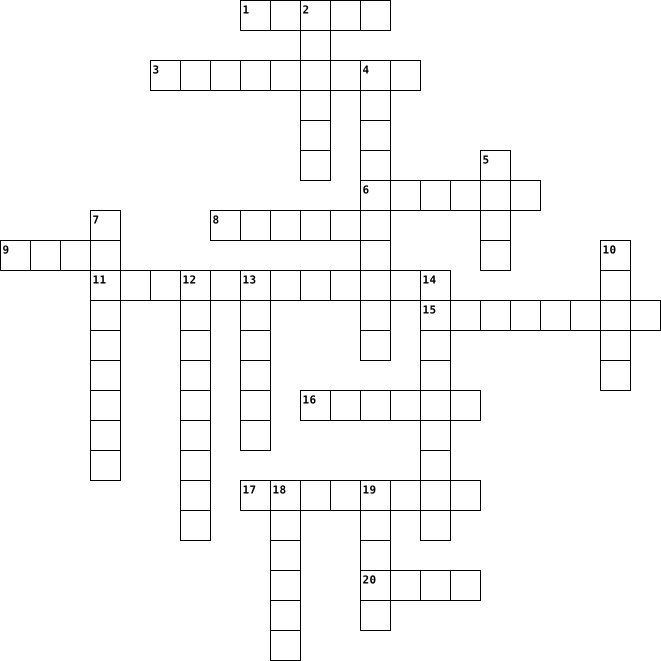
Across
- the country that attacked the United States at Pearl Harbor
- he started the FASCIST movement after World War I
- the establishment of a fixed allotment of goods deemed essential for the military
- the country that joined forces with the United States and Great Britain during the Normandy invasion
- the desired eye color of an ARYAN expressed by Adolf Hitler
- opposition to political and economic entanglements with other countries
- the documentary entitled "TIME OF FEAR" focused on Japanese-American internment camps located in this state
- the name of the atomic bomb that was dropped on the city of Nagasaki
- the aircraft that dropped the atomic bomb on the city of Hiroshima
- the joint powers of Italy, Germany, and Japan
Down
- the country invaded by both Adolf Hitler and Joseph Stalin
- these acts outlawed arms sales or loans to warring nations
- the company that converted from making automobiles to aircraft during World War II
- the ideology of NAZISM was detailed in this literary work
- the beach where the bloodiest fighting occurred during Operation Overlord
- a program that provided military aid to Great Britain
- the President of the United States who decided to use the atomic bomb against Japan
- this project developed the atomic bomb
- the GERMAN brand of FASCISM
- the master race Adolf Hitler envisioned in his literary work
20 Clues: the GERMAN brand of FASCISM • this project developed the atomic bomb • the joint powers of Italy, Germany, and Japan • he started the FASCIST movement after World War I • a program that provided military aid to Great Britain • the ideology of NAZISM was detailed in this literary work • the country invaded by both Adolf Hitler and Joseph Stalin • ...
Max's crossword world 2015-03-04

Across
- to fix settle or determine beforehand
- an earlier or previous view
- to regard with displeasure
- to neglect or refuse to obey
- to treat badly or abusively
- to differ in opinion
- for children between infancy and school age
- to cease to be seen vanish from sight
- not honest disposed to lie
- occurring coming or done too soon
- a test given to determine ir students are sufficiently prepared to begin
- not loyal
- to put in the wrong place
- estimate or value wrongly or unjustly
- to heat before using
Down
- the years immediately preceding one's thirteenth birthday
- to make unable or unfit
- not behaving
- an absence of comfort and ease
- when you spell a word wrong
- to see get knowledge of learn and kind
- to match badly or unsuitably
22 Clues: not loyal • not behaving • to differ in opinion • to heat before using • to make unable or unfit • to put in the wrong place • to regard with displeasure • not honest disposed to lie • an earlier or previous view • to treat badly or abusively • when you spell a word wrong • to neglect or refuse to obey • to match badly or unsuitably • an absence of comfort and ease • ...
Contemporary World: Wealth 2015-04-12

Across
- An instrument used for measuring the wealth of a country through its imports and exports.
- An economic system wherein the state no longer exists.
- The opposite of capitalism, this economic system strives to build a classless society.
- An early economic system based on the dominance (or "ownership") of a society by an aristocracy.
- A system in which the power of a state is measured by its accumulation of precious metals.
- Former colonies resorted to this to prevent their natural resources from falling into the hands of foreign investors.
- In this agreeement made in 1994, many less skilled jobs were lost to Mexico because of their low labour costs.
- "The sun never sets on the British empire" is an example of a certain 16th-19th century phenomenon.
- The ______ of a developing nation practice subsistence farming and work in plantations because of their weak economies.
- An American economist who advised Ronald Reagan in the 1980's.
- This nation participated in a Cold War with the United States between 1954 and 1991.
Down
- This trend can both benefit and hinder the economy of a developing nation.
- A modern set of economic policies that are open to international trade and investment.
- A British economist who believed in increased state intervention in times of economic despair.
- A large portion of the population in developing nations live in these urban areas.
- The unequal distribution of this entity results in a high Gini coefficient.
- A left-wing ideology that supports the involvement of the state.
- This economic system experienced a major boom with the Industrial Revolution.
- This comes very cheap in mexico, which was a disadvantage for Canada and the U.S in NAFTA.
- If a country is closer to a 0 than to a 1 on this measurement scale, they are struggling socially and economically.
20 Clues: An economic system wherein the state no longer exists. • An American economist who advised Ronald Reagan in the 1980's. • A left-wing ideology that supports the involvement of the state. • This trend can both benefit and hinder the economy of a developing nation. • The unequal distribution of this entity results in a high Gini coefficient. • ...
World without Fish 2015-08-31

Across
- the carcinogenic dried root bark of the sassafras used formerly as a diaphoretic or flavouring agent
- In its original state
- planktonic plant life
- the carrier of genetic information
- To catch in or in a trap
- The future time
- affecting or harming many people or things in a careless or unfair way
- a long weapon used especially for hunting large fish or whales
- a thread-like structure of nucleic acids and protein found in the nucleus of most living cells
- a ship that has usually two masts with the larger mast located toward the centre and the shorter mast toward the front
- a space devastated as if by a scythe
- too bad to be corrected or repaired
- to utilize less than fully or below the potential use
- a movement in painting typified by the work of Matisse and characterised by vivid colours, free treatment of form, and a resulting vibrant and decorative effect
- The amount of salt in a body of water
Down
- Plankton only visible with the aid of a microscope.
- a submerged or partly submerged bank (as of sand) along a shore or in a river often obstructing navigation
- An offspring
- To produce eggs in water
- a hollow object used to contain something
- An official examination especially of financial accounts
- Any manmade toxic compound
- a science that deals with the sea
- To estimates the monetary value.
- A label used to mark a product which satisfies certain standards
- The beginning
- an official who works for the part of the government that controls a public activity
- To let out or release.
- Impressive quality
- Be quick to do something
- stop by force
- a large group of people who are involved in running a government but who are not elected
- a fishing boat that is operating a trawl
33 Clues: An offspring • The beginning • stop by force • The future time • Impressive quality • In its original state • planktonic plant life • To let out or release. • To produce eggs in water • To catch in or in a trap • Be quick to do something • Any manmade toxic compound • To estimates the monetary value. • a science that deals with the sea • the carrier of genetic information • ...
World Heritage Sites 2015-05-20

Across
- Jefferson's home
- Nat'l park in Olympic Peninsula
- Union of two parks - 1 in Canada, 1 in US
- Pre-columbian Native American City near St. Louis, MO
- Birthplace of the Declaration of Independence
- She once greeted most immigrants
- Caves in SE New Mexico
- 'Gators live here
- Bay in Alaska
- Ansel Adams took many photographs of this park
Down
- Largest archaelogical preserve in US
- Great peaks in the eastern US
- Pre-historic Native American site in Louisiana
- Built to defend the harbor of San Juan
- They formed this state
- Adobe buildings inhabited for over 1000 years
- The Colorado river flows through this
- Area of NW Hawaiian Islands
- Cave system in KY
- Tallest trees on earth
- Location of Old Faithful?
- Group of pueblos in American SW
22 Clues: Bay in Alaska • Jefferson's home • Cave system in KY • 'Gators live here • They formed this state • Tallest trees on earth • Caves in SE New Mexico • Location of Old Faithful? • Area of NW Hawaiian Islands • Great peaks in the eastern US • Nat'l park in Olympic Peninsula • Group of pueblos in American SW • She once greeted most immigrants • Largest archaelogical preserve in US • ...
WORLD WAR II 2015-02-19

Across
- he was the President of the United States who decided to use the atomic bomb against Japan
- the literary work of Adolf Hitler
- he was a fascist leader in the country of Germany
- he established a totalitarian regime in the country of Italy
- the confinement of Japanese-Americans in the United States during World War II
- Night of Broken Glass
- Germany, Italy, and Japan were known as these powers
- organized drives to collect scrap iron, tin cans, paper, rags, and cooking fat for recycling into war goods
- this treaty sowed the seeds of instability in Europe
- June 6, 1944 the first day of the invasion in Europe
- fought inflation by freezing pries on most goods
- the totalitarian leader of the Soviet Union
- the systematic murder of six million JEWS across Europe
- the deliberate and systematic murder of an entire population
Down
- a suicide-plane attack
- establishing fixed allotments of goods deemed essential for the military
- this project became the code name associated with the development of the atomic bomb
- lightning war
- a Jewish-American scientist that worked on the development of the atomic bomb
- became prime minister of Japan in 1941
- government that tried to exert complete control over its citizens
- giving up principles to pacify an aggressor
- the type of pact signed between Hitler and Stalin
- Victory in Europe Day
- the atomic bomb code named Little Boy was dropped on this Japanese city
- this battle centered on a major industrial center on the Volga River
- stressed nationalism and placed the interests of the state above those of individuals
- the German brand of fascism
- he led a rebellion against the Spanish republic
29 Clues: lightning war • Night of Broken Glass • Victory in Europe Day • a suicide-plane attack • the German brand of fascism • the literary work of Adolf Hitler • became prime minister of Japan in 1941 • giving up principles to pacify an aggressor • the totalitarian leader of the Soviet Union • he led a rebellion against the Spanish republic • ...
World War I 2015-02-11

Across
- When neither side gains any ground
- My gun is bigger than your gun theory
- American ship sunk by German U-boats
- Invention used by U-boats to see
- Type of warfare that used machine guns and resulted in little to no movement
- Germany, Aust-Hung, Italy
- Telegram sent to Mexico that the US intercepted
- Aircrafts used which used a machine gun
- Person who shot Ferdinand which arguably starts the war
- ”Dude got shot”
Down
- Weapon used that suffocated people to death
- France, Russia, England
- President of US during this time
- German leader is called this
- Weapon used mainly in trench warfare
- Armored weapon devised to break the stalemate
- Invention that helps move troops
- German plan to surround France at the start of war
- Giant airships like the Hindenburg
- Troops who were quick and moved around alot
20 Clues: ”Dude got shot” • France, Russia, England • Germany, Aust-Hung, Italy • German leader is called this • President of US during this time • Invention used by U-boats to see • Invention that helps move troops • When neither side gains any ground • Giant airships like the Hindenburg • American ship sunk by German U-boats • Weapon used mainly in trench warfare • ...
World War 1 2014-11-30

Across
- A mask used to protect soldiers from harmful gases which may have poisoned them otherwise
- When a soldier flees from their regiment during a war, punishable by death
- Battle in which tanks were first used
- The British boat that was sunk, a reason that the US joined the war due to US casualties.
- Media which is created as an attempt to persuade people to feel a certain way
- Soldiers who fought on foot
- Alliance that consisted of Germany, Austria- Hungary and the Ottoman Empire
- A huge lead blimp which was used before airplanes were introduced to drop bombs and such
- Large, Heavily armored vehicles that were first used in WW1
- First used in combat in WW1, were later mounted with machine guns and involved in dogfights
- Suffered the most casualties, left war early to deal with internal conflict
- Paying for damaged that was caused by the war
- The expansion and growth of industry on a wide scale
- A war strategy which prevented anything from going into or out of a country
- Automatic weapon which proved very effective in combat
- The word for men joining the war to serve as soldiers
- When a country expands by force, usually involves taking over other nations
- A weapon which put out a huge flame intended to burn enemies and enemies' stuff
- a small artillery weapon which fires grenade-like bombs
- Term used for a gun fight between two or more planes
- A dug out ditch which soldiers fought from much of WW1
- A knife that was attached to the end of rifle barrels
Down
- German submarines
- A love for ones country and a desire for self-rule
- The name of a German king
- The betrayal of a nation or leader
- The man that's assassination was the spark of WW1
- The process a country goes through when it is preparing for war
- A foot infection caused by being constantly exposed to water that was in the trenches
- Alliance that consisted of Britain, Russia, France and later the US
- Formal agreement between two or more nations usually relating to peace
- The very dangerous open area between opposite trenches
- An agreement to stop fighting until a treaty has been negotiated
- Countries that work together incase of an attack or war
- When a country decides to isolate itself from a war and not choose sides
- A type of battle which involves many dug out trenches and no man's land
- Small, handheld bomb which is thrown at the enemy
- A poisonous gas that was used in WW1 as a weapon
- when a country's military quickly expands and has a great influence on the government and policy
- Huge guns which launch high caliper bullets towards enemies and cause a lot of damage
- When the government borrowed money from civilians to pay for the war
- Had the largest navy in the world
42 Clues: German submarines • The name of a German king • Soldiers who fought on foot • Had the largest navy in the world • The betrayal of a nation or leader • Battle in which tanks were first used • Paying for damaged that was caused by the war • A poisonous gas that was used in WW1 as a weapon • The man that's assassination was the spark of WW1 • ...
World War 1 2014-11-30

Across
- a small artillery weapon which fires grenade-like bombs
- Large, Heavily armored vehicles that were first used in WW1
- Automatic weapon which proved very effective in combat
- Formal agreement between two or more nations usually relating to peace
- German submarines
- A foot infection caused by being constantly exposed to water that was in the trenches
- The betrayal of a nation or leader
- The man that's assassination was the spark of WW1
- Suffered the most casualties, left war early to deal with internal conflict
- An agreement to stop fighting until a treaty has been negotiated
- First used in combat in WW1, were later mounted with machine guns and involved in dogfights
- A mask used to protect soldiers from harmful gases which may have poisoned them otherwise
- Countries that work together incase of an attack or war
- When a country decides to isolate itself from a war and not choose sides
- A war strategy which prevented anything from going into or out of a country
- when a country's military quickly expands and has a great influence on the government and policy
- Battle in which tanks were first used
- Soldiers who fought on foot
- Media which is created as an attempt to persuade people to feel a certain way
- Paying for damaged that was caused by the war
- Small, handheld bomb which is thrown at the enemy
- The British boat that was sunk, a reason that the US joined the war due to US casualties.
- A dug out ditch which soldiers fought from much of WW1
- The word for men joining the war to serve as soldiers
Down
- Had the largest navy in the world
- When a soldier flees from their regiment during a war, punishable by death
- A type of battle which involves many dug out trenches and no man's land
- When a country expands by force, usually involves taking over other nations
- Alliance that consisted of Germany, Austria- Hungary and the Ottoman Empire
- Term used for a gun fight between two or more planes
- Huge guns which launch high caliper bullets towards enemies and cause a lot of damage
- A weapon which put out a huge flame intended to burn enemies and enemies' stuff
- The very dangerous open area between opposite trenches
- The expansion and growth of industry on a wide scale
- A poisonous gas that was used in WW1 as a weapon
- The name of a German king
- A love for ones country and a desire for self-rule
- A huge lead blimp which was used before airplanes were introduced to drop bombs and such
- Alliance that consisted of Britain, Russia, France and later the US
- The process a country goes through when it is preparing for war
- When the government borrowed money from civilians to pay for the war
- A knife that was attached to the end of rifle barrels
42 Clues: German submarines • The name of a German king • Soldiers who fought on foot • Had the largest navy in the world • The betrayal of a nation or leader • Battle in which tanks were first used • Paying for damaged that was caused by the war • A poisonous gas that was used in WW1 as a weapon • The man that's assassination was the spark of WW1 • ...
The lost world 2014-12-01

Across
- krūmas
- judėti/sujudėti
- šaukti/klykti/rėkti
- ietis
- nykti/silpti
- susipainiojęs/sumišęs
- driežas
- matomas
- urvas/ola
- riaumoti
Down
- staiga kristi žemyn/pulti žemyn
- įrašas/įėjimas
- padaras/sutvėrimas
- palaipsniui
- milžiniškas/gigantiškas
- aidas
- užrašų knygelė/sąsiuvinis
- krūva/šūsnis/rietuvė
- greta esantis/kaimyninis
- letena/nagas(paukščio/gyvulio)
20 Clues: ietis • aidas • krūmas • driežas • matomas • riaumoti • urvas/ola • palaipsniui • nykti/silpti • įrašas/įėjimas • judėti/sujudėti • padaras/sutvėrimas • šaukti/klykti/rėkti • krūva/šūsnis/rietuvė • susipainiojęs/sumišęs • milžiniškas/gigantiškas • greta esantis/kaimyninis • užrašų knygelė/sąsiuvinis • letena/nagas(paukščio/gyvulio) • staiga kristi žemyn/pulti žemyn
World Geography Crossword 2015-01-22

Across
- Is very closely related to elevation
- Language, religion, social groups, government, and economic activities define this
- cycle: Keeps water rates constant
- Describes a places location in relation to another place
- Effect: Earth rotates east, global winds are displaced
- They study of weather
- Prevailing winds blow this way because of the Coriolis Effect
- Earth travels in an orbit every ______ days
- Supports Life
- Made of plates
- The Tropic of _______________ is the southern most latitude to receive the sun’s direct waves
- The part of Earth that is covered by water
- The earth tilts on this
- Climates in high latitudes are the _______________ on earth
- Earth rotates on its axis one time each…
Down
- Earths revolution and its tilt in relation to the result in…
- Moves warm and cold water
- Made of hot, dense rock
- The condition of the atmosphere in a certain place at a specific time
- dioxide: Traps heat in the atmosphere
- A group of plants and animals that depend on each other and their surroundings for survival
- June 21, Northern hemisphere’s longest day of sunlight
- When plates squeeze past the earth’s surface and create bends in layers of rock called
- A fertile, yellow-gray soil that can provide mineral rich soil
- Part of Earth made of land
- Map making
- At the equator is a narrow, generally windless band called
- March 21, the sun’s rays fall directly on the equator
- Part of the Earth made of iron and nickel
29 Clues: Map making • Supports Life • Made of plates • They study of weather • Made of hot, dense rock • The earth tilts on this • Moves warm and cold water • Part of Earth made of land • cycle: Keeps water rates constant • Is very closely related to elevation • dioxide: Traps heat in the atmosphere • Earth rotates on its axis one time each… • Part of the Earth made of iron and nickel • ...
World Geography Vocab 2014-04-24

Across
- Economic system where people freely produce and buy what they want
- The creation of a single global economy and community
- The resources provided by nature that people use to create goods and services
- The foundation upon which businesses operate
- Farmers that grow only enough food to provide for themselves and their immediate families to eat.
- Sector of the economy that extracts or harvests products from the earth
- A group of countries imposing few or no duties on trade with one another and a common tariff on trade with other countries
- Groups of countries with no tariffs or quotas
- Amount of goods needed or wanted
- tariffs levied on imports to protect the domestic economy rather than to raise revenue.
- money that remains after the costs of running a business are paid
- The process by which a company hires other companies to perform some of its work
- Level of economic activity involving the production of foods and the extraction of resources
- production, for sale , of goods at home
- The industrial sector of an economy that is dominated by the manufacture of finished products
- Type of economy, where the government owns and operates all business and commerce.
- Sector of the economy that consists of intellectual activities, such as government, culture, libraries, scientific research, education, and information technology.
- A person who brings together and organizes a business
Down
- An original economic system in which traditions, customs , and beliefs shape the goods and the products the society creates
- Goods from foreign countries brought into a country for use or sale
- the ability of an individual or group to carry out an economic activity, such as production, at a lower cost and with optimal efficiency
- Goods and services sold from one country to other countries
- Goods Made, not to consume, but to produce other goods and services
- Amount of products available
- All the human labor required to produce something
- Resources that are used to produce goods and services
- The idea that each region tends to make certain types of goods
- a theory or system of social organization that advocates the vesting of the ownership and control of the means of production and distribution, of capital, land, etc., in the community as a whole
- Acronym for zones designed to attract foreign companies and investment to areas of China
- A shortage of product
30 Clues: A shortage of product • Amount of products available • Amount of goods needed or wanted • production, for sale , of goods at home • The foundation upon which businesses operate • Groups of countries with no tariffs or quotas • All the human labor required to produce something • The creation of a single global economy and community • ...
World War II 2014-04-23

Across
- an organization that many had hoped would succeed where the leage of nations failed
- Named for the city that served as the center of Nazism
- where members of specifically designated groups were confined
- Temporary imprisonment of members of a specific group
- Flying in the night to avoid being shot down
- War in the Bataan peninsula
- African American fighter squadron
- Capturing Japanese held island in a steady path toward japan
- Allies hit Germany in force. Occurred on June 6th, 1944
Down
- worked with Red Cross to save thousands of Eastern European Jews
- Development of the atomic bomb
- Giving up completley without concessions
- international agreement governing the treatment of wounded soldiers and prisoners of war
- Bringing laborers from Mexico to America to work on farms
- Helped kindle hope for American military in pacific
- of War Information Worked closely with the media to encourage support of war effort
- the big three agreed that Poland, Bulgaria, and Romania would hold free elections
- Pilots who deliberately crashed their planes into American ships
- where prisoners were systematically exterminated
- Attacked by Japanese
20 Clues: Attacked by Japanese • War in the Bataan peninsula • Development of the atomic bomb • African American fighter squadron • Giving up completley without concessions • Flying in the night to avoid being shot down • where prisoners were systematically exterminated • Helped kindle hope for American military in pacific • Temporary imprisonment of members of a specific group • ...
SPEC World Cup 2014-07-01

Across
- The single, comprehensive web based information service for professionals who interact with or are impacted by the Federal Government. Providing rich data, analytical tools and news, combined with in depth analysis from policy experts – all from the leader in information services.
- Function to access delivery information for Bloomberg Markets.
- Which Transactional Product was founded in 1996 and is legally separated from Bloomberg?
- Retrieves TS information, including contacts of TS administrators of the firm.
- What does MDID stand for?
- Function to get all the recent rankings and lists created by the Bloomberg Rankings team.
- ...A $75 million fund backed by Bloomberg LP.
- A debt investment in which an investor loans money to an entity (corporate or governmental) that borrows the funds for a defined period of time at a fixed interest rate. Bonds are used by companies, municipalities, states and U.S. and foreign governments to finance a variety of projects and activities.
- What is the function to pull up ORD number if client provides you with a Document ID?
- A legal and business intelligence, news and research system delivering an advantage to legal professionals who handle the most complex legal matters.
Down
- A physical substance, such as food, grains, and metals, which is interchangeable with another product of the same type, and which investors buy or sell, usually through futures contracts.
- Functionn for ergonomic guidelines to optimize our well-being at work.
- What's the function to contact Analytics for limited functionality users who cannot use IB chat?
- Displays APOD administrators of the firm.
- Function to launch the connection wizard.
- Function to find Sales regions by Country Name.
- A screen which, is a record of trades and the details of the trades made over a period of time (usually one trading day). The details of a trade will include such things as the time, price, order size and a specification of whether it was a buy or sell order.
- Users run this to pull out their own pricing number.
- If a user would like to access the Data License Web Portal from their terminal, which formula could they run?
- A TS admin is calling in and he/she is asking how they can reset the password for a TOMS, AIM/POMS and SSEOMS user, what function do they need to run?
20 Clues: What does MDID stand for? • Displays APOD administrators of the firm. • Function to launch the connection wizard. • ...A $75 million fund backed by Bloomberg LP. • Function to find Sales regions by Country Name. • Users run this to pull out their own pricing number. • Function to access delivery information for Bloomberg Markets. • ...
World War I 2014-07-01

Across
- An agreement with opposing sides to stop fighting.
- Treaty of what?
- Serve as a memorial or reminder.
- Distortion of the truth to persuade people.
- Extending ones empire (taking over new land).
- Ballot which voters decide on a political question.
- Turkey was named this Empire during WWI.
- War Precautions Act restricted this.
- Landed here on the 25th of April 1915.
Down
- Australia's Prime Minister in the peace conference.
- Month that the Armistice was signed.
- Month of Anzac Day.
- Building up a country's armed forces.
- Australia was seen to be brave, loyal, courageous.
- Franz Ferdinand is heir to this empire.
- Where Australia's fought during the war.
- A wooden board to stand on that prevents muddy boots.
- Compulsory enlistment for state service.
- Germany's plan to attack Belgium to get through France.
- Restriction or control of what people can say, hear, sea or read.
- Village in the Western Front where the AIF fought.
21 Clues: Treaty of what? • Month of Anzac Day. • Serve as a memorial or reminder. • Month that the Armistice was signed. • War Precautions Act restricted this. • Building up a country's armed forces. • Landed here on the 25th of April 1915. • Franz Ferdinand is heir to this empire. • Where Australia's fought during the war. • Compulsory enlistment for state service. • ...
WORLD WAR I 2014-05-08

Across
- member if 3 different alliances
- Type of artillery gun capable of protecting shells at considerable heights and ranges
- Did not make a part of the triple entente
- joined by or relating to members of a team
- they stopped fighting for the night and celebrated together
- The process of preparing for war, requiring the enlistment, training, equipping and movement of large numbers of troops.
- a thing designed or used for inflicting bodily harm or physical damage
- president od france during Worl War I
- In the late nineteenth century, the major industrialized states used their increasing economic and technological power to build up stocks of modern weapons such as machine guns and battleships
- Describes a conflict where both sides attempt to wear down or exhaust the other, without attempting a decisive assault or attempt at victorY
- The rear of a trench, the side furthest away from the enemy line
- Acronym for the Australian and New Zealand Army Corps, a joint national force assembled in 1915 to participate in the Gallipoli campaign
- Seeking and/or enjoying popular support; appealing to the people
- Words, documents or images intended to persuade, often through distortion or misrepresentation
- A period in history involving dramatic political, social and/or economic change within a particular nation or region
- where they first used modern tanks
- the belief or desire of a government or people that a country should maintain a strong military
- the german fleet of ships was known as the...
- American president during World War I
- Steel balls or fragments from an exploding artillery shell, which injure or kill nearby personnel
- A bulge or projection out from a trench line, and thus the point closest to the enemy
- Derogatory term for Germans, a reference to barbaric warriors of the early Middle Ages.
Down
- One who campaigns to obtain the right to vote; usually refers to women’s reform groups and activists in Britain in the first quarter of the 20th century
- A term for an aerial gun battle between aircraft, particularly during World War I
- french commander durin World War I
- the longest battle in World War I
- A political ideology, economic system and theory of history, developed in the 1800s by Karl Marx
- A concerted bombardment of a trenchline, front or area, usually with artillery
- Leader of france at the time of World war I
- A foreign policy approach where a nation does not commit to alliances and/or avoids ‘taking sides’ in international disputes
- assassinated the archduke francis ferdinand
- A defensive post, an earth bunker or concrete shelter, designed to house riflemen or machine-gunners
- Government control or restrictions on the media or publishing, the banning of dissent or criticism
- patriotic feeling, principles, or efforts,feeling pride for your country
- A political-economic system where a powerful nation conquers
- Europe’s diplomatic organisation before 1914 and its heavy commitment to alliances, allegedly as a deterrent to war
- The name of the German king or emperor, derived from the Latin ‘Caesar’
- The process where a society or state enacts policies to enable it to become more modern, either in political, economic, industrial or technological terms
- The betrayal of a nation or leader, often in a time of war
- The act of requiring citizens to perform compulsory military service, especially in times of war
- A small, hand-held bomb with a short fuse, able to be primed and then thrown at the enemy
- is a tolerance attributable to a lack of involvement
- Payments of money or goods made for deaths, injuries and destruction inflicted during a war
- Sections of an army comprised of soldiers who advance or move about on foot
- elating to, or characterized by industry
- A term derived from chess, meaning that both sides cannot advance; a deadlock or ‘stand-off’
- Yje king of Germany during World War I
- Any political system where at least some executive power is vested in a hereditary monarch, who is also the head of state
48 Clues: member if 3 different alliances • the longest battle in World War I • french commander durin World War I • where they first used modern tanks • president od france during Worl War I • American president during World War I • Yje king of Germany during World War I • elating to, or characterized by industry • Did not make a part of the triple entente • ...
World War One 2014-05-04

Across
- weapons used to sink merchant ships
- agreement to stop fighting; signed 11/11/18
- Russia would protect Serbia because of ____
- treaty that ends Eussian participation in the war
- had a goal of creating greater Slavic state
- means two front war
- plan german plan for a two front war
- country the Germans were going through in the Schlieffen Plan
- straits leading to Constantinople
- strongest army in Europe
- strong feeling of pride in your country
- means glorification of the military
- allied country who fought in battle of Verdun
- side of ww1 that the US joined
Down
- country Franz Ferdinand was heir to
- called the "Colossus of Europe"
- hand society that supported Pan-Slavism
- fifth reason for ww1
- used to fight on No Man's Land
- treaty that ended WW1
- joined Triple Entente to keep balance of power
- domination of one country in another
- empire that is constantly loosing land
- where soldiers fought on the western front
- was promised part of Austria-Hungary by the Allies
25 Clues: means two front war • fifth reason for ww1 • treaty that ended WW1 • strongest army in Europe • used to fight on No Man's Land • side of ww1 that the US joined • called the "Colossus of Europe" • straits leading to Constantinople • country Franz Ferdinand was heir to • weapons used to sink merchant ships • means glorification of the military • domination of one country in another • ...
World War One 2014-05-04

Across
- joined Triple Entente to keep balance of power
- where soldiers fought on the western front
- weapons used to sink merchant ships
- domination of one country in another
- fifth reason for ww1
- agreement to stop fighting; signed 11/11/18
- strong feeling of pride in your country
- empire that is constantly loosing land
- country Franz Ferdinand was heir to
- called the "Colossus of Europe"
- hand society that supported Pan-Slavism
- straits leading to Constantinople
- strongest army in Europe
Down
- allied country who fought in battle of Verdun
- treaty that ends Eussian participation in the war
- country the Germans were going through in the Schlieffen Plan
- was promised part of Austria-Hungary by the Allies
- had a goal of creating greater Slavic state
- means two front war
- means glorification of the military
- Russia would protect Serbia because of ____
- plan german plan for a two front war
- treaty that ended WW1
- side of ww1 that the US joined
- used to fight on No Man's Land
25 Clues: means two front war • fifth reason for ww1 • treaty that ended WW1 • strongest army in Europe • side of ww1 that the US joined • used to fight on No Man's Land • called the "Colossus of Europe" • straits leading to Constantinople • weapons used to sink merchant ships • means glorification of the military • country Franz Ferdinand was heir to • domination of one country in another • ...
World War One 2014-05-04

Across
- country Franz Ferdinand was heir to
- had a goal of creating greater Slavic state
- plan german plan for a two front war
- society that supported Pan-Slavism
- fifth reason for ww1
- called the "Colossus of Europe"
- empire that is constantly loosing land
- allied country who fought in battle of Verdun
- domination of one country in another
- treaty that ended WW1
- strongest army in Europe
- agreement to stop fighting; signed 11/11/18
Down
- straits leading to Constantinople
- means two front war
- country the Germans were going through in the Schlieffen Plan
- joined Triple Entente to keep balance of power
- treaty that ends Eussian participation in the war
- weapons used to sink merchant ships
- strong feeling of pride in your country
- means glorification of the military
- was promised part of Austria-Hungary by the Allies
- where soldiers fought on the western front
- side of ww1 that the US joined
- Russia would protect Serbia because of ____
- used to fight on No Man's Land
25 Clues: means two front war • fifth reason for ww1 • treaty that ended WW1 • strongest army in Europe • side of ww1 that the US joined • used to fight on No Man's Land • called the "Colossus of Europe" • straits leading to Constantinople • society that supported Pan-Slavism • country Franz Ferdinand was heir to • weapons used to sink merchant ships • means glorification of the military • ...
FIFA World Cup 2014-05-14

Across
- How many confederations are involved in FIFA?
- Matches that nations play against other teams before the tournament
- The championship occurs every ____ years
- Who is the official match ball supplier?
- What animal is the mascot?
- Where was the first tournament held in 1930?
- Each group plays a ____ tournament, where each team plays against other teams in the group
- Consists of the best players of the tournament; usually announced after the tournament concludes
- What stage comes after the Group Stage? (single-elimination tournament)
- Who is the official supplier for the goal-line technology? (German)
- The Group of ____ in each tournament is named by experts
- The amount of money, in billions, Brazil has spent in preparations
- The World Cup Pup during USA 1994
Down
- The Jules Rimet Trophy was ____ by thieves after Brazil won the trophy permanently
- The current World Cup Champions (from South Africa 2010)
- The ranking system for men’s national teams in association football
- What is the name of the official match ball?
- Where are groups determined?
- Who is the official mascot?
- Brazil 2014 is the ____(th) FIFA World Cup
- The host nation of the 2014 World Cup and the most successful team, winning five titles
- The number of national teams that compete in the World Cup
- How many goalkeepers are needed in each of the final squads?
23 Clues: What animal is the mascot? • Who is the official mascot? • Where are groups determined? • The World Cup Pup during USA 1994 • The championship occurs every ____ years • Who is the official match ball supplier? • Brazil 2014 is the ____(th) FIFA World Cup • What is the name of the official match ball? • Where was the first tournament held in 1930? • ...
World War 1 2014-03-25

Across
- lio
- gdf
- eryy
- hfds
- States gfdgdf
- dsgfs
- das
- fjdis
- ewo
- dgso
- sf
- fsfs
- fiowut
- hisdgo
- fidusg
- gfdsg
- hgfdhd
- fdgfd
- gdeg
- Britain fsdg
- fkdsgj
Down
- gfrd
- gfd
- uds
- gfds
- hdif
- fjus
- fds
- fwdko
- fasdjk
- jg
- ffsd
- gfdg
- ghg
- rewa
- hfsdj
- fds
37 Clues: sf • jg • lio • gfd • gdf • uds • das • ewo • fds • ghg • fds • gfrd • eryy • hfds • gfds • hdif • dgso • fjus • fsfs • ffsd • gfdg • rewa • gdeg • dsgfs • fjdis • fwdko • gfdsg • fdgfd • hfsdj • fasdjk • fiowut • hisdgo • fidusg • hgfdhd • fkdsgj • Britain fsdg • States gfdgdf
World War I 2015-12-11

Across
- Movement of 6 million African-Americans our of rural southern united states to urban cities northeast, midwest, and west.
- A British luxury liner sunk by German submarine in the north Atlantic on May 7, 1915 one of the events leading to U.S. entry into world war I.
- Government agency created during world war I to encourage Americans to support the war.
- Authorized the federal government to raise a national army for the American entry into world war I through the compulsory enlistment of people.
- The process by which a country determines its own statehood and forms its own allegiances and government.
- A German submarine used in world war I or world war II.
- A group of ships or vehicles accompanied by armed troops, warships or other vehicles for protection.
Down
- Telegram sent from German official in Germany to a German official in Mexico asking him to join an alliance with Germans.
- 29th president serving from March 4, 1921 until death.
- An association of countries established in 1919 by the treaty of Versailles to promote international cooperation and achieve international peace and security.
- United states government agency established on July 28,1917 to coordinate the purchase of war supplies encouraged companies to use mass-production techniques to increase efficiency.
- A U.S. federal law passed on June 15, 1917 shortly after U.S. entry into world war I it allowed punishment to spying and other related crimes.
- Rounding up and deportation of several hundred immigrants of radical political views by federal government.
- The belief or desire of a government or people that a country should remain a strong military capability and be prepared to use it aggressively to defend or promote national interests.
- A general increase in prices and fall in the purchasing value of money.
- Series of raids in late 1919 and early 1920 by U.S. department of justice intended to capture arrest and deport radical lettists, especially anarchists from U.S.
- A person who for reasons of conscience objects to serving in the armed force.
- The zone of fighting in western Europe in world war I in which the German army engaged the armies to its west, France, the UK, and its dominions.
- A nation whose investments abroad exceed in value the investments made in it by foreign countries.
- Blue print for world peace that was to be used for peace negotiations after world war I.
20 Clues: 29th president serving from March 4, 1921 until death. • A German submarine used in world war I or world war II. • A general increase in prices and fall in the purchasing value of money. • A person who for reasons of conscience objects to serving in the armed force. • Government agency created during world war I to encourage Americans to support the war. • ...
Brave New World 2016-02-02
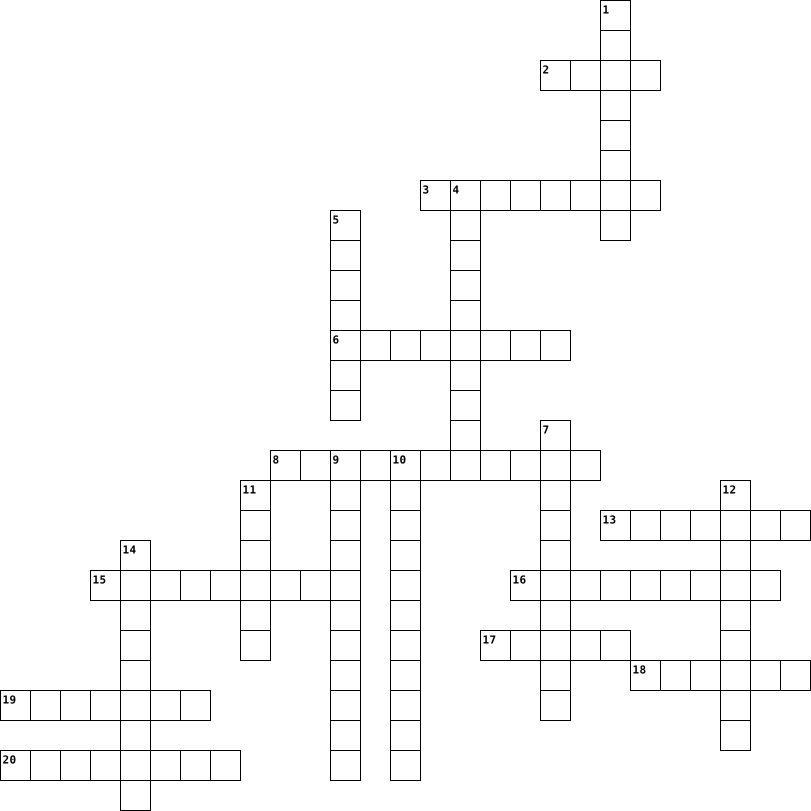
Across
- guiding principle
- a small man-made opening
- To turn away from or give up
- to stop or prevent
- to show contempt by sarcastic jokes
- to make unable to reproduce
- groups of people
- a social status system
- resembling an ape
- being insincere
- a change in genetics
Down
- where eggs mature
- after death
- violating principles of right and wrong
- process of reproduction
- arranged ahead of time
- early stages of development
- a new group of students
- to provide nutrients needed to grow
- resisting change
20 Clues: after death • being insincere • resisting change • groups of people • where eggs mature • guiding principle • resembling an ape • to stop or prevent • a change in genetics • arranged ahead of time • a social status system • process of reproduction • a new group of students • a small man-made opening • early stages of development • to make unable to reproduce • To turn away from or give up • ...
World War II 2015-12-10

Across
- : Germany makes a deal with Russia
- : occurs 8 hours after Pearl Harbor
- : they fail to stop countries from invading
- : to get rid of undesirable people there was a plan called
- : controlled by the government
- : a battle in Normandy on June 6, 1944
- why the USA joins the war
- : the first time battle was declared
- : “lighting war”
- : had met future husbands
- : a closed community people forced to live in
- : one of the best kept secrets in Canada during the war
- : Tommy Prince was part of the joint Canadian and American elite soldiers called
- : many Nazis prosecuted for
Down
- : people got less than usual
- : to control the perception of others
- Japanese sent to camps
- : a dictator
- released twice in Japan
- : Shoah
- : one side started off without enough guns
- : lead by Arthur Harris
- : the USA was the best at this tactic
- : an armada of boats sent to rescue
- : protected other ships from being sunk by torpedoes
- : a submersible vessel
- : promised to not bring in conscription but did
- : the greatest sacrifice of Canadian lives during the war
- : fighting in populated areas
- : under supervision from the Nazis because of their religion
30 Clues: : Shoah • : a dictator • : “lighting war” • Japanese sent to camps • : a submersible vessel • released twice in Japan • : lead by Arthur Harris • why the USA joins the war • : had met future husbands • : many Nazis prosecuted for • : people got less than usual • : fighting in populated areas • : controlled by the government • : Germany makes a deal with Russia • ...
World war 1 2016-05-12

Across
- retreat
- the people defending Gallipoli
- unloading soilders by boat
- the straits between the meditarenin and the sea of marmara
- Attack
- moving round
- a place to locate a enemy
- word for a person who died in war
- a common illness in war
- the people in charge
- the forces made up of British, French, New Zealanders and Australians
- hilltops
Down
- a draw
- a temporary peace to bury dead or similar
- another name for soldiers
- attacking a enemy with bombs and weapons
- Nepalese soldiers fighting for the British
- anther name for attack
- the ships of military
- commander of navy
- extra troops
- New Zealand and Australia army corps
- going round the side of an enemy
23 Clues: a draw • Attack • retreat • hilltops • extra troops • moving round • commander of navy • the people in charge • the ships of military • anther name for attack • a common illness in war • another name for soldiers • a place to locate a enemy • unloading soilders by boat • the people defending Gallipoli • going round the side of an enemy • word for a person who died in war • ...
AP world crossword 2023-10-31

Across
- Region of people that the mongols used to practice Islam, and they were made this type of people.
- Country shaped like a chicken
- Test to recruit men for the government or military in China.
- Mongols were _____ of most religions
- Chinggis Khan's grandson
- Leader of most dynasties
- Trade routes across the Sahara
- Man-made river used to transport goods.
- Group of nomads that were militarily strong and feared by many.
- Country in between China and Russia
Down
- ______ was changed to be a mix of mongol and Persian cultures when the mongols rebuilt the Persian cities.
- What monks used to get food each day.
- Major Hindu-Buddhist temple
- Fulcrum of the sea roads.
- Trade routes in the Indian Ocean
- Line of rulers for a country. Particularly in China.
- Land based trade routes
- Religion that the mongols took from Persia.
- Group of people that constantly move.
- Scientist known for "Canon of Medicine"
20 Clues: Land based trade routes • Chinggis Khan's grandson • Leader of most dynasties • Fulcrum of the sea roads. • Major Hindu-Buddhist temple • Country shaped like a chicken • Trade routes across the Sahara • Trade routes in the Indian Ocean • Country in between China and Russia • Mongols were _____ of most religions • What monks used to get food each day. • ...
World Geography Vocab 2023-12-13

Across
- Something that attracts an individual to a place
- land degradation in arid& dry areas
- imaginary line around the middle of a planet
- study of the spatial distribution of human population& of the population characteristics of individual places
- An area's exact place o earth
- religion based off the teachings of Jesus
- depressed areas of land that takes the form of a "U" or "V"
- Study of natural features of earths surface, especially in its current aspects
- a description of an area's place on earth
- the monotheistic religion of Jewish people
Down
- branch of geography that describes the spatial aspects of interactions between humans& the natural world
- place with many layers of history that evolves through design& use overtime
- piece of a land that is mostly surrounded by water
- belief that there is only one god
- cultural element, physical or not, has been created by a specific culture& transmitted to people
- practice of using natural resources to support current& future needs
- transformation of rural societies to urban societies dominated by manufacturing& services
- half of a sphere or ball, such as Earth
- The way cultures merge& spread around the world
- culture of people in a given region including, language, heritage, religions,& customs
- the belief of one god Allah & the messenger's teachings
- belief in multiple gods, usually that are responsible for different areas of the universe
- dividing people into groups on basis of various sets of physical characteristics
- set of processes that contribute to the relationship between societies& individuals around the world
- Something that encourages an individual to migrate from a place
25 Clues: An area's exact place o earth • belief that there is only one god • land degradation in arid& dry areas • half of a sphere or ball, such as Earth • religion based off the teachings of Jesus • a description of an area's place on earth • the monotheistic religion of Jewish people • imaginary line around the middle of a planet • ...
World War ll 2023-12-19

Across
- Prime Minister of Japan during WWII
- Germany's take over of Austria
- Prime Minister of Great Britain during WWII
- Hitlers first defeat
- Russian dictator
- Italian dictator
- Germany, Italy, Japan
- Forign countries had to bring their own ships to trade with America
- The treaty that ended WWI
- Ex: Night of the long knives
- Stalin's secret police
Down
- Hitlers followers. Nazis
- FDR's and Churchill's idea of the post-war world
- Germany's new form of warfare. "Lightning war"
- France, Great Britain, USA
- Mussolini's followers. Fascists
- Started the New Deal program
- Hitlers secret police
- The strategy European powers used on Hitler before the war
- Wrote Mein Kampf
20 Clues: Russian dictator • Italian dictator • Wrote Mein Kampf • Hitlers first defeat • Hitlers secret police • Germany, Italy, Japan • Stalin's secret police • Hitlers followers. Nazis • The treaty that ended WWI • France, Great Britain, USA • Started the New Deal program • Ex: Night of the long knives • Germany's take over of Austria • Mussolini's followers. Fascists • ...
World War 1 2024-01-31

Across
- spying
- a war tactic that includes underground tunnels
- pride in one's country
- an understanding or agreement
- enemy planes
- making it illegal to express negative thoughts about the government
- soldiers of the American Expeditionary Forces
- lend money and be paid back with interest
- countries working together to solve world disputes
Down
- widespread disease that effects entire countries
- another word for a German emperor
- an American passenger ship
- first used by the British in 1916
- When nothing can be done by either side of the war
- Financial compensation paid to someone who has been wronged
- isolating a country by refusing to enter alliances or agreements
- guns too big to carry
- Self government
- the land between trenches that is neutral
- a political system where people own and control everything
- a group traveling together, often for safety
21 Clues: spying • enemy planes • Self government • guns too big to carry • pride in one's country • an American passenger ship • an understanding or agreement • another word for a German emperor • first used by the British in 1916 • the land between trenches that is neutral • lend money and be paid back with interest • a group traveling together, often for safety • ...
world war 2 2023-12-17

Across
- over 1 million of them served in the war and over 45000 sacrificed there lives for there country
- in august 1942 canada raided a beach 16 km long with over 5000 troops
- on may 5 1945 canada was done fighting and the war was officially
- on d-day canada tried to take back a heavily fortified beach
- canadians gave many to their allies during the war
- canadians gave to all there allies especially britain.
- canada's leader during world war 2
- the ussr leader during world war ll
- the war started on this month in 1939
- a training ground for all allies to train the best of the best to become spies and secret agents.
- 55000 canadians serving in the war put themselves in danger for canada and where
- what brought America into the war.
- there were german submarines near canada in this ocean scaring lots of canadian civilians.
- over 3000 of these people joined the war even though they were discriminated against.
- the name of the nuclear bomb that was dropped on japan
- italy's leader during world war ll
- whos at the start of the war was taken over and divided between ussr and germany
- usa leader during world war 2
- 16 people were awarded this for bravery most people have to die in battle to be awarded it.
Down
- canada made decisions for themselves during the war building there
- japan's leader during world war ll
- communication technology used at camp x that helped the allies win the war created by a canadian
- the pact signed by hitler and stalin
- the group of countries that formed after the war to prevent more world wars
- the battle in the ussr that many believe was the turning point of the war
- germany's leader during world war ll
- many canadian women had to work in these when the men went away to serve and this was crucial to the success canada had in the war
- what country did the pearl harbour bombing
- this crisis made many canadians mad and some happy depending what situation you were in
- young boys worked on these to help in the war effort even though they aren't aloud to fight
- what communist country turned on their leader first
31 Clues: usa leader during world war 2 • japan's leader during world war ll • canada's leader during world war 2 • what brought America into the war. • italy's leader during world war ll • the ussr leader during world war ll • the pact signed by hitler and stalin • germany's leader during world war ll • the war started on this month in 1939 • ...
World War II 2024-01-03

Across
- the German word for "lightening war"
- this group of people's language was used to talk in secret code during the war in the Pacific
- people bought these to finance the war
- this even brought America into the war
- people were encouraged to grow these during the war
- this presidential order forced the relocation of all Japanese Americans
- the invasion of Normandy on June 6, 1944
- the secret code name given to the project that created the atomic bomb
- people were encouraged to do this during the war to ensure there was enough food and materials
- Japanese soldiers forced American soldiers to march 60 miles across the Philippine Island
Down
- the mass killing of all Jewish Peoples in Europe
- a national policy of avoiding involvement in world affairs
- the name of the country that Germany invaded that officially started World War II
- this battle is considered the turning point in the war in the Pacific
- US President who ordered to drop the atomic bomb on Japan
- the American General who commanded allied troops in the Pacific
- the first African American soldier to receive the Medal of Honor
- this strategy was used to bypass certain heavily fortified islands in the Pacific
- the name of the fascist dictator of Germany
- a nuclear weapon in which enormous energy is released by nuclear fission; used to destroy the Japanese cities of Hiroshima and Nagasaki
20 Clues: the German word for "lightening war" • people bought these to finance the war • this even brought America into the war • the invasion of Normandy on June 6, 1944 • the name of the fascist dictator of Germany • the mass killing of all Jewish Peoples in Europe • people were encouraged to grow these during the war • ...
Our wild world 2023-11-24

Across
- hide your nuts away
- storm drain bandit
- life's a picnic for them
- read headed and loud
- digs his own day
- can choose grey or little
- anna's halloween costume
- playing a still game
- uncommon snake in ct
- beneficial mammals, but not in belfry
- John's critter enemies
- furry hopper
- wants to eat sweaters
- black bird
- wants to live in a wreath
- big bird on Mill River
- a big kitty and a cafe
- wily beast
- swarmed our space
- butterfly and queen
- fifty bucks if you squash him
- amphibian hopper
- common snake
- this clawed guy can rock
- early birds catch them
- enjoying the attic sans cheese
Down
- noisy good morning
- wants to live in a light fixture
- urban scavenger bird
- will sting you
- sly but not fantastic
- tangled web he weaves
- mullusk dropped on Jack's car
- lawn wrecking worm
- songbird or pirate
- seen in a tree or plate
- canine we saw in Idaho
- V flier and status coat
- baby with a spotted back
- symbol of justice soaring
- why did he cross the road
- echo goals in life
- clams, sharp shells not for shave
- seaside scavenger bird
- not easy being green
- he's a hoot at night
- subway rodents
47 Clues: black bird • wily beast • furry hopper • common snake • will sting you • subway rodents • digs his own day • amphibian hopper • swarmed our space • noisy good morning • storm drain bandit • lawn wrecking worm • songbird or pirate • echo goals in life • hide your nuts away • butterfly and queen • read headed and loud • urban scavenger bird • playing a still game • uncommon snake in ct • not easy being green • ...
world war l 2023-11-27

Across
- analyze the telegram to determine if the United States should have entered World War I
- the belief or desire of a government or people that a country should maintain a strong
- the first worldwide intergovernmental organisation whose principal mission was to maintain world peace
- make (something) movable or capable of movement
- is identification with one's own nation and support for its interests, especially to the exclusion or detriment of the interests of other nations
- communist revolution in russia
- a political theory derived from Karl Marx, advocating class war and leading to a society in which all property is publicly owned and each person works and is paid according to their abilities and needs
- a situation in which further action or progress by opposing or competing parties seems impossible.
- the making of amends for a wrong one has done, by paying money to or otherwise helping those who have been wronged.
- a passenger ship sunk by geman submarines
Down
- a Russian revolutionary, politician
- The name referred to the geographical location of the two original members of the alliance
- this called the big three
- The Points, Summarized · 1. Open diplomacy without secret treaties · 2. Economic free trade on the seas during war and peace · 3. Equal trade conditions
- the state of being joined or associated
- peace document signed at the end of World War I by the Allied powers and Germany in the Hall of Mirrors in the Palace
- a country taking control of other countrys
- leader of the Progressive Movement, was the 28th President of the United States (1913-1921).
- a debt obligation issued by the U.S. Department of the Treasury in conjunction with the Federal Reserve
- naval submarines operated by Germany
- AN ACT to provide for the common defense by increasing the strength of the Armed Forces of the United States
- an agreement made by opposing sides in a war to stop fighting for a certain time; a truce
- is a type of land warfare using occupied lines largely comprising military trenches
23 Clues: this called the big three • communist revolution in russia • a Russian revolutionary, politician • naval submarines operated by Germany • the state of being joined or associated • a passenger ship sunk by geman submarines • a country taking control of other countrys • make (something) movable or capable of movement • ...
Brave New World 2023-11-28

Across
- created by the combination of two 2 down
- made of bulls hide
- iron, bronze, gold, etc.
- lacking bacteria
- thyroid swelling
- burning after death
- for example, tunnels
- braided, British style
- non-organic
Down
- attraction induced by currents
- germ cells
- calls come through here
- similar to a condition with bells and dogs
- wrote a manifesto on a form of government
- pouring a drink
- using water for 1 down
- table Sp.
- a growth model where food supply is linear
- a gourd, a sport, and a crush
- used to make plants grow
- fifth letter in the Greek alphabet
21 Clues: table Sp. • germ cells • non-organic • pouring a drink • lacking bacteria • thyroid swelling • made of bulls hide • burning after death • for example, tunnels • using water for 1 down • braided, British style • calls come through here • iron, bronze, gold, etc. • used to make plants grow • a gourd, a sport, and a crush • attraction induced by currents • fifth letter in the Greek alphabet • ...
WORLD HISTORY FINAL 2023-12-10

Across
- Earliest highly developed culture in pre-Columbian Peru
- A large Roman town in Campania, Italy which was buried in volcanic ash following the eruption of Mt. Vesuvius in 79 CE
- The art of beautiful handwriting
- A state in which supreme power is held by the people and their elected representatives
- The 4th letter in the greek alphabet
- People who follow Islam
- The process of becoming similar to others by taking in and using their customs and culture
- A ruler with total power over a country
- An official in ancient Rome chosen by the plebeians to protect their interests
- A group of rebels that took over in 750 AD
- The bishop of rome
- A large amount of rainfall
- The state council of the ancient Roman republic and empire
- an extensive group of states or countries under one rule
- A soldier of fortune or hired gun
- Author of the titan
- 4000-2000BC
- An inventer
- An indigenous pre-Columbian civilization that flourished in the Valley of Oaxaca in Mesoamerica
- Muhammads example
- Structures used to conduct a water stream across a hollow or valley
- ancient kushite ring
- One of the largest deserts
- A member of iranian people
- The first elaborate pre-Columbian civilization of Mesoamerica
- A member of hellenic people
- The chief pastor and overseer of a diocese
- The Preserver and guardian of men
- Process of specializing in one subject
- Aksums chief support
- Founder of persian empire
- Comes from the Spanish maíz, or corn
Down
- A violent conflict between a state and one or more organized nonstate actors in the state's territory
- Ancient assyrian city of mesopotamia
- Last achievement king
- Ancient greek mathmatician
- A decrease in the purchasing power of money
- An inhabitant of ancient times
- A event causing great suffering
- A citystate in greece
- A social system in which positions of dominance and authority are primarily held by women
- Medierianan part city in egypt
- A land based country in south east europe
- A single seller or producer that excludes competition from providing the same product
- The first roman emperor
- The royal wife Of Thatmose the third
- A system of government in witch priests rule in the name of god
- Taming a animal
- a line of hereditary rulers of a country
- An ancient city
- Hypothetical social system in which the father or a male elder has absolute authority over the family group
- A member of society having no permanent abode
- The process of preserving a dead body into a mummy
- A permanet move from a country or region
- Humans
- A long poem
- Region along the nile river
- The arts and manifestations of humans
- Greek philosipher
- Any of the 12 disciples chosen by Jesus Christ
- Provincal govenor
- Colourful pottery, textiles and geoglyphs
- exchange for other goods
- a ruler in ancient egypt
- African people who lived in Nigeria between 500BC to AD200
- art works made during the classical period
- A primate of a family
- The leader of Islam
- A shrine containing the remains of a holy or sainted person and/or artifacts
- A form of goverment
- An abraahomic religion based off the Quaran
- a city with surrounding territory thats a independent state
- Shaped characters used for writing
- A kingdom located south of kush
- A cruel ruler
75 Clues: Humans • A long poem • 4000-2000BC • An inventer • A cruel ruler • Taming a animal • An ancient city • Greek philosipher • Muhammads example • Provincal govenor • The bishop of rome • Author of the titan • The leader of Islam • A form of goverment • ancient kushite ring • Aksums chief support • Last achievement king • A citystate in greece • A primate of a family • People who follow Islam • ...
World War 1 2024-02-14

Across
- When a strong country takes over a weaker country for resources
- This means to not take sides in the war
- President of the United States during World War 1
- New weapon that Germany used to sink ships.
- An extreme pride in your country
- Competition between countries to increase military strength
- Type of warfare where soldiers dig into the ground for protection
- Country that stopped fighting in 1917 because they had a revolution
- Agreement to stop fighting on November 11, 1918
- New military vehicle that protects soldiers inside it.
- An agreement between countries to help defend each other
Down
- The alliance of Germany, Austria Hungary, and Turkey
- Coded message from Germany to Mexico proposing an alliance
- The ship Germany sunk, killing Americans
- Area between trenches (you wouldn't want to go there)
- The alliance of Britain, France, Russia, and Serbia
- Archduke who was assassinated on June 28, 1914
- Famous German pilot
- The country that Austria-Hungary declared war on for killing the Archduke
- This is a modern canon
20 Clues: Famous German pilot • This is a modern canon • An extreme pride in your country • This means to not take sides in the war • The ship Germany sunk, killing Americans • New weapon that Germany used to sink ships. • Archduke who was assassinated on June 28, 1914 • Agreement to stop fighting on November 11, 1918 • President of the United States during World War 1 • ...
World War 1 2023-03-22

Across
- Archduke Franz Ferdinand's wife
- This style of warfare was common in WWI, due to the invention of the machine gun and heavy artillery. It included digging long trenches, separated by barbed wire and a no mans land.
- The peace conference that decided the terms of WWI peace and Treaty of Versailles.
- This terrorist group who assassinated Archduke Ferdinand.
- This was a major front in World War I. A line of trenches and fortifications in World War I that stretched without a break from Switzerland to the North Sea. This is where most of the fighting happened in World War II.
- This was the spark that started World War, he was murdered on June 28, 1914, by a Serbian nationalist while visiting Sarajevo, Bosnia.
- A promise Germany made to America, after Wilson threatened to sever ties, to stop sinking their ships without warning.
- This British passenger ship was sunk by German U-boats in 1915, killing 128 American. The event turned American opinion against Germany.
- This was a major cause of WWI. Countries formed partnerships to work together and to protect each other.
- Capital of the Bosnian province in Austria-Hungary; site of Ferdinand's assassination.
- This cause of World War I was based on an intense pride in one's nation.
- Payment for war damages
- This alliance during WWI included the United States, Great Britain, France, Russia and Italy. (The blue countries)
- The red flower associated with Remembrance Day.
- This country switched sides, abandoning their pre-war alliance and joining the other side.
- Agreement in 1919 ending World War I; included huge war reparations to be paid by Germany.
- This new machinery used by the Germans in sea warfare, to attack British and American supply ships in the North Sea and the Atlantic Ocean.
- A battle in WWI. Is considered some of the bloodiest fighting in WWI and the German offense was stopped; offensive battle on the western front initiated by Germany in which they hoped to crush France and taken them out of the war, however France was in a very good defensive position and French held it for 10 months. Nearly a million killed. French drew reserve troops from the Somme to help defend. No territory was gained; Battle in WWI that ended in massive casualties and had little direct result
- The holiday celebrated in America that commemorates the signing of the Armistice of World War 1.
- This country dropped out of World War 1 in 1917 due to a revolution taking place in their country.
Down
- This US president who was elected in 1912, and led the US into WWI. Later wrote a plan for post-WWI peace known as the Fourteen Points.
- The assassin of Archduke Francis Ferdinand of Austria, a member of the Black Hand
- This was the agreement between the Allies and Central Powers that ended the fighting after WWI. It began at 11/11/1918 at 11:11 am. This marked a victory for the Allies and stated that the Central Powers lost. Germans would later look at this as "the stab in the back."
- A new invention in WWI - a yellow colored gas that was fired at the enemy - it caused blindness, damage to the lungs and death
- This cause of World War I resulted from the competition among European nations for colonies in Africa and Asia from 1880-1914. It is when a strong, powerful country takes over weaker areas.
- The 2nd passenger-liner sunk in March 1916 by Germany. This led Wilson to break diplomatic relations with Germany if they did not comply with his commands.
- A new German weapon known as a U-boat. It was a submersible warship usually armed with torpedoes
- Woodrow Wilson (US president), Georges Clemenceau (french premier), David Lloyd George (british prime minister), Vittorio Orlando (italian prime minister)
- An enclosed armored military vehicle used by British in WWI. Helped end the war.
- Nations Woodrow Wilson's idea, this intergovernmental organization lasted from 1919-1946, was founded after the Paris Peace Conference. It did not work effectively to prevent WWII.
- A strip of land beween the trenches of opposing armies along the Western Front during WW1
- The continent where the majority of WW1 battles took place.
- These are the four causes of World War I.
- A World War I battle fought from 5-12 September 1914. It resulted in an Allied victory against the German Army.
- This was a major alliance at the 'center' of Europe during World War I, made up of Germany, Austria-Hungary, Bulgaria, and Ottoman Empire. (Red countries)
- This Central Power empire during WWI, started the war when they declared was on Serbia after the assassination of Archduke Ferdinand on June 28, 1914 .
- This was a front in WWI. The region of fighting happened along the German-Russian Border where Russians and Serbs battled Germans, Austrians, and Turks.
- The policy of remaining apart from the affairs of other countries. Woodrow Wilson's official policy for America at the beginning of WW1.
- This cause of World War I was a policy of building up strong armed forces to prepare for war.
- This was sent by Germans to encourage a Mexican attack against the United States. Intercepted by the US in 1917.
- Not favoring either side
- This central powers' country was blamed for WW1 and they had to pay, pay, pay, reparations.
- Ended Russia's participation in World War I Negotiated by Vladimir Lenin because he was unwilling to risk Bolshevik gains by continuing a war that could no longer be won
- This term refers to the payments and transfers of property that Germany was required to make under the treaty of Versailles.
- This is the plan for post-World War I outlined by President Wilson in 1918. This plan called for self-determination (countries in Africa and Asia govern themselves), freedom of the seas, free trade, end to secret agreements, reduction of arms and a league of nations.
45 Clues: Payment for war damages • Not favoring either side • Archduke Franz Ferdinand's wife • These are the four causes of World War I. • The red flower associated with Remembrance Day. • This terrorist group who assassinated Archduke Ferdinand. • The continent where the majority of WW1 battles took place. • ...
World War One 2023-03-24

Across
- Este hombre llegó con 14 puntos para llevar la paz a Europa
- Austria no estaba segura de querer ir a la guerra, pero este país les dio un cheque en blanco y prometió pagar por la guerra.
- Austria le dio a Serbia esto... Haz esto... ¡sino!
- La mayor parte de la guerra se libró en un _______
- para prepararse para la guerra
- ¿Cuál fue la más mortífera de las nuevas armas?
- El archiduque Francisco Fernando, que fue asesinado, era de este país.
- cuando dos partes acuerdan dejar de luchar
- La glorificación de los militares
- alemán Zimmermann que envió una nota a México y les pidió que invadieran los Estados Unidos
- Cuando nadie está ganando una guerra
Down
- El crucero que los alemanes hundieron y más de 120 estadounidenses murieron.
- Para no elegir un bando durante una pelea
- Alemania invadió este país con el fin de llegar a Francia más rápido
- El tratado de paz que puso fin a la Primera Guerra Mundial
- El país de Alemania fue el primero en utilizar esto en el océano.
- Pagos por daños de guerra. Alemania debía más de 30 mil millones de dólares
- Este país cambió de bando durante la guerra y esperaba recibir los territorios de Alsacia y Lorena.
- La ciudad donde Franz Ferdinand fue fusilado
- La Mano Negra era de ______. Mataron a Franz Ferdinand
20 Clues: para prepararse para la guerra • La glorificación de los militares • Cuando nadie está ganando una guerra • Para no elegir un bando durante una pelea • cuando dos partes acuerdan dejar de luchar • La ciudad donde Franz Ferdinand fue fusilado • ¿Cuál fue la más mortífera de las nuevas armas? • Austria le dio a Serbia esto... Haz esto... ¡sino! • ...
World War One 2023-03-13

Across
- What country did the battle of Passchendaele took place?
- Which policy attempted to limit food consumption by civilians on the home front?
- The Alliance between Germany, Italy and Austria-Hungary was call what?
- What was the name of the French ship at the Halifax explosion?
- To replace the dead soldiers, the government introduce this, forcing civilians to join the army.
- Rat, mud, and shell shock are all associated with this?
- What German region had to be returned to France?
- What was "no man's land"?
- What were bonds used to raise money for the war effort called?
- Who was the Canadian minister of the militia during WWI?
- What was the main weapon used at the battle of Ypres?
Down
- Which Canadian General planned and executed the assault on Vimy Ridge?
- This Treaty marked the end of WWI.
- What is trench foot?
- Britain, France and Russia were all consisted of this alliance.
- Deadly gas was first used as a weapon at this battle?
- In 1914, which training camp did Canadian volunteers attend?
- Which law granted the Canadian government the power to arrest suspected spies?
- What rifle was issued to Canadian soldiers at the outbreak of WWI?
- Who was Canada's Prime Minister during WWI?
20 Clues: What is trench foot? • What was "no man's land"? • This Treaty marked the end of WWI. • Who was Canada's Prime Minister during WWI? • What German region had to be returned to France? • Deadly gas was first used as a weapon at this battle? • What was the main weapon used at the battle of Ypres? • Rat, mud, and shell shock are all associated with this? • ...
world war 2 2023-02-13

Across
- Hilters final solution
- blistered the skin , eyes and lungs
- fire weapon
- Brought together the land air
- total power to a dictator
- japanese city were atomic bomb was dropped
- japanese surprise attack
- Germans boomed britain
- consumers could only buy certain goods
- japanese city were atomic bomb was dropped
- civilian work camps and prisons
- often negative preconvinced opinion
Down
- A German submarine
- First major japanese defeat
- Germany,italy and japan
- u.s helping with supplies
- usa,ussr,france
- accepting demands avoid conflict
- Hitlers fascist party
- total authority ruler
- soviet victory (outlasted the Germans)
- government controlled by totalitarian leaders
- money losses its value
- helped womens rights
- big armoured vehicles
25 Clues: fire weapon • usa,ussr,france • A German submarine • helped womens rights • Hitlers fascist party • total authority ruler • big armoured vehicles • Hilters final solution • Germans boomed britain • money losses its value • Germany,italy and japan • japanese surprise attack • u.s helping with supplies • total power to a dictator • First major japanese defeat • Brought together the land air • ...
World War 1 2023-02-09

Across
- large scale of counterattack by an armed force
- new machinery used by Germans in warfare
- slavic reigon of intense nationalism
- alliance during WW1 between U.S., Great Britain,France, and Russia
- a demand that is final
- gathering resources and preparing for war
- major front in WW1
- russia and germany front
- nations declaring to stay out or not pick sides in disputes
- self proclaimed holy man who claimed to heal the sick
- form of warfare where opposing enemies fight each other
- compulsory enlistment for state service
- german troops were weak, malnourished, and has little supplies
- restricting access to ideas and information
Down
- Germanys military plan at the outbreak of WW1
- major alliance at center of Europe
- this cause of WW1 and a policy of building up strong armies
- act of enlisting people into the armed forces
- woodrow wilsons plan for organizing after the war
- ideas that are spread to influence peoples opinions
- introduction of armored vehicles
- allies could draw from Britain, France, and the USA
- alliance between Germany, Austria, and Italy
- a temporary peace agreement to end war
- quickly led to severe depression in Germany
25 Clues: major front in WW1 • a demand that is final • russia and germany front • introduction of armored vehicles • major alliance at center of Europe • slavic reigon of intense nationalism • a temporary peace agreement to end war • compulsory enlistment for state service • new machinery used by Germans in warfare • gathering resources and preparing for war • ...
World History Crossword 2023-02-22

Across
- in modern day Turkey
- dig up pre-history
- dont stay in same place
- upright man
- developed writing and compley language, religion, and may advance tools.
- prehistoric paintings
- men were the….
- Human made object that we dig up and study
- Australopithecine skeleton
- Any time before writing and we know about that Period from archeologists and anthropologist
- the assignment of different parts of a manufacturing process or task to different people in order to improve efficiency.
- humans started in Africa and moved around the wolrd
- final division of stoneage
- The controlled growth of plants and animals for human use
- men gain dominance
- human-like creatures that walked upright.
- strait linking the Arctic Ocean with the Bering Sea
Down
- was killed in snow froze and all his parts were preserved
- oldest homid
- practces trade or handicraft
- the study of human societies and cultures and their development.
- spreading out and merging or pieces from different cultures
- everyone is equal no matter differences
- Handy man
- Found footprints that were 3.5 million years old
- new stone age
- a large stone that is used to construst a perhistoric structure of monument
- old stone age
28 Clues: Handy man • upright man • oldest homid • new stone age • old stone age • men were the…. • dig up pre-history • men gain dominance • in modern day Turkey • prehistoric paintings • dont stay in same place • Australopithecine skeleton • final division of stoneage • practces trade or handicraft • everyone is equal no matter differences • human-like creatures that walked upright. • ...
World War 1 2023-03-01

Across
- of influence an area where a nation has special trading privileges
- Riders a nickname for a military unit organized by Theodore Roosevelt during the Spanish American War
- Points President Wilson's Peace Plan in 1918
- Bonds an investment used to raise money for World War 1
- Soldiers a nickname for the African American members of the 9th and 10th Cavalries during the Spanish American War
- Journalism reporting that relied on sensational stories and headlines that are often biased or untrue
- J. Pershing American General commanding American Forces in France
- German fleet of powerful submarines
- to add or take over
- a policy of powerful countries seeking to control the economic and political affairs of weaker countries
- of Versailles Treaty in 1919 where Germany had to take responsibility for the war and pay the allies reparations
- acts of cruelty and brutality
- People who believed in group ownership, sharing of profits and believed war benefited factory owners, not the workers.
- narrow strip of land that has water on each side with a strip of land connecting two larger bodies of land
- British passenger ship torpedoed and sunk in 1915 by a German submarine
- cash payments for losses suffered during war or enslavement
- Telegraph 1917 secret message sent from Germany to urge Mexico to attack the US if the USA declared war against Germany
- a nation whose independence is limited by the control of a more powerful country
- to give up sovereign power, office, or responsibility usually formally
- loyalty and devotion to a nation especially as expressed by praise of one nation above all others and intense concern with promotion of its culture and interests
Down
- a policy of moving large numbers of people into camps for political or military purposes
- Amendment Amendment to the Cuban Constitution that allowed the USA to intervene in Cuba and gave the USA control of the naval base at Guantanamo Bay
- Service Act required all men 18 - 30 to register for a military draft, requiring people to serve in the military
- he belief that one race is superior to another
- of Brest-Litovsk Agreement in March 1918 between Germany and Russia, ending Russia's participation in the war.
- a policy of extending a nation’s boundaries
- a policy of staying out of world affairs
- People who refuse to fight because they don't believe in violence
- an addition to an earlier state principle
- not taking a side
- the ruler of Germany from 1871 to 1918
- Powers France, Britain, Russia, Italy and the USA in WW1
- diplomacy President Taft’s policy of building strong economic ties to Latin America
- of Nations political organization established by the Allied powers at end of World War I; replaced by United Nations 1946
- Rebellion an uprising in China against westerners and western influence in 1900
- an agreement to stop fighting between the two sides
- diplomacy President Wilson’s policy of condemning imperialism, spreading democracy, and promoting peace
- Powers .Germany, Austria-Hungary, Bulgaria and the Ottoman (Turkish) Empire in WW1
38 Clues: not taking a side • to add or take over • acts of cruelty and brutality • German fleet of powerful submarines • the ruler of Germany from 1871 to 1918 • a policy of staying out of world affairs • an addition to an earlier state principle • a policy of extending a nation’s boundaries • Points President Wilson's Peace Plan in 1918 • ...
Reading World 1 2023-02-20

Across
- shaped so that it can move quickly or efficiently through air or water
- to curve something that is straight
- a natural or artificial substance made up of certain molecules
- the border; the outer edge of something
- a very exciting feeling
- able to cause fear
- to put into a particular group
- a careful thought before doing something or making a decision
- throughout a large area
- certain to happen; not in doubt
- when a woman or animal is going to have a baby
- to be more important or significant than something else
- being angled sharply up or down
- a decision made by an official body like a council
- the amount of something that is allowed or approved
- the study of forces. like energy, and how they act
- hard; making a crushing sound when bitten
Down
- knowing a lot
- soft and wet
- meat eating
- a person who rides on a bus, train, or other vehicle
- high ability or skill in doing a job; the quality of being professional
- a change that makes something suitable for a new situation
- a tube that carries blood from the heart
- a blend of two or more things
- the ability to bend easily
- a partial or very short-lived view of something
- status, as it relates to reputation or popularity
- causing discussion and debate
- to grow well and to be healthy
- a stream of cool air blowing into a room
- to grow well and to be healthy
32 Clues: meat eating • soft and wet • knowing a lot • able to cause fear • a very exciting feeling • throughout a large area • the ability to bend easily • a blend of two or more things • causing discussion and debate • to put into a particular group • to grow well and to be healthy • to grow well and to be healthy • certain to happen; not in doubt • being angled sharply up or down • ...
Reading World 2 2023-02-20

Across
- the environment that something exists in
- beneficial
- a physical state where one is unable to move all or part of their body
- kept to use later; extra
- a fight, disagreement, or argument
- resisting or fighting against authority
- a settlement
- when something it the same size as what it represents
- a person who makes money by buying and selling goods
- a summary of something's good and bad points
- perfectly suited
- a very small piece of something
- to decompose organically
- strong
- sharing a task or working together
- a large meeting, often over a longer period of time
- to reject something that is tempting
Down
- to change something so it is completely different
- the ability to continually exist over time
- the ability to read and write
- an introductory sample of something, typically a machine
- harmless, not guilty, pure, or free from evil
- very unhappy, sad, or negative
- a suggestion; an official suggestion of someone as a candidate
- to create or change something according to one's particular needs
- to make sure or guarantee that something will happen
- lacking too much water
- not being able to receive something well
- the relationship between plants, animals, and the environment
- to pull out
- to make something out of individual parts
- to take charge of someone and take them to a police station
- treating people unfairly because of their race
33 Clues: strong • beneficial • to pull out • a settlement • perfectly suited • lacking too much water • kept to use later; extra • to decompose organically • the ability to read and write • very unhappy, sad, or negative • a very small piece of something • a fight, disagreement, or argument • sharing a task or working together • to reject something that is tempting • ...
World War II 2023-03-07

Across
- The Japanese bombed Pearl Harbor in Hawaii.
- Now called Volgograd.
- Concentration Camp in Poland.
- Dictator of Italy.
- Also Bombed by America on August 6, 1945.
- Prime Minister of Britain.
- The Royal Air Force and Royal Navy defended Britain from Germany.
- Bombed by America on August 6, 1945.
- President of the United States.
- How Hitler was killed.
- The Tuskegee Airmen were the first African airmen to complete their training.
Down
- Dictator of the Soviet Union.
- Thousands of Americans and Filipinos were forced to march.
- The Reuben James was torpedoed by a German Submarine.
- Dictator of Japan.
- Dictator of Germany.
- Harbor Bombed by Japan in 1941.
- Considered by the Soviet Union to be one of the greatest battles of their Great Patriotic War.
- The order authorized the evacuation of those deemed a threat to the country.
- Bombed Pearl Harbor in 1941 and was bombed by the U.S. in 1945.
20 Clues: Dictator of Japan. • Dictator of Italy. • Dictator of Germany. • Now called Volgograd. • How Hitler was killed. • Prime Minister of Britain. • Dictator of the Soviet Union. • Concentration Camp in Poland. • Harbor Bombed by Japan in 1941. • President of the United States. • Bombed by America on August 6, 1945. • Also Bombed by America on August 6, 1945. • ...
World War I 2023-03-14

Across
- Came to the aid of Serbia after Austria-Hungary declared war.
- Atrocities committed against this nation, by Germany, contributed to the U.S. siding with the Allies prior to the U.S. entering the war.
- They tried to initiate revolution among the proletariats of Russia.
- When a nation channels all its resources toward a war effort.
- Working class of Russia.
- Power is equally distributed amongst other nations.
- Describes people whose moral or religious beliefs forbid them from going to war.
- A strong sense of pride and support for one's nation.
- President of the United States during WWI.
- Loyal to the Communists.
- Wilson's proposal for what should be done to Europe after the war ended.
- On May 7th, 1915, it was sunk by an "unterseeboat" and with 128 Americans on board.
- Loyal to the Czars.
- Established in 1922, it was formed by 15 nations across Northern Asia and Eastern Europe. (Abbv.)
- Campaigns waged within a country to help support or discourage a cause.
- Established by Great Britain in the North Sea on Germany.
- Leader of the Bolsheviks.
- Number synonymous with the final day of WWI.
- Passed in May of 1917, it allowed for the draft of young men into military service. Ten million were signed up by the following month.
- "Holy" man and advisor to the Czar family.
- Austro-Hungary, Germany, Ottoman Empire, and Bulgaria.
- Warfare used by the Germans in the Atlantic Ocean that proved to be catastrophic to the Allies.
- Finished in 1911, it runs 5,772 miles, and is one of the longest railways in the world.
- Local council of workers and soldiers throughout Russia.
- Became the leader of the Soviet Union five years after Lenin's death.
- Limiting the use of a nation’s goods and services and creating a surplus.
- The first major American offensive of WWI.
Down
- Germany's attempt to bring Mexico into the war.
- Building up a nation's forces in preparation for war.
- Killed twice as many people as the war did during the same time period.
- After the war ended, many of these were seized from Germany.
- When Lenin returned from exile in 1917, he and the Bolsheviks took control of this Soviet first.
- Formally ending the war, this treaty forced Germany to pay warbonds, and dismantle its military forces.
- Commander of U.S. forces in Europe during WWI.
- The biggest and final allied offensive of WWI.
- Name of the assassinated archduke of Austro-Hungarian empire.
- Weapon first operated in warfare during WWI.
- It allowed postal authorities to ban treasonable or seditious newspapers, magazines, or printed materials mail services.
- Wealthy peasants.
- Nation blamed for Franz Ferdinand's death.
- Name of networked labor camps scattered throughout Russia.
- Women's movement for equality during WWI.
- Treaty between Russia and Germany that ended Russia's involvement in the war.
- Serbia, Great Britain, Russia, United States, France, Italy, etc;
- Peace symbol first in New York City used by women suffragists.
- Name of Wilson's international world peace organization that was supported in Europe but not in the United States.
- Ottoman Empire.
- Armed factory workers in Russia.
- Name of the Russian Revolution in November of 1917.
- Movement of African-Americans from South North prior to, and during the war.
- Building up one's nation by weakening other territories.
- The longest and most costliest offensive operation of WWI.
- Nation that lost the most troops to battle during WWI.
- Symbols on the new Russian flag that represented what the "nation" stood by.
- Responsible for the assassination of Franz Ferdinand.
55 Clues: Ottoman Empire. • Wealthy peasants. • Loyal to the Czars. • Working class of Russia. • Loyal to the Communists. • Leader of the Bolsheviks. • Armed factory workers in Russia. • Women's movement for equality during WWI. • President of the United States during WWI. • Nation blamed for Franz Ferdinand's death. • "Holy" man and advisor to the Czar family. • ...