
nouns Crossword Puzzles
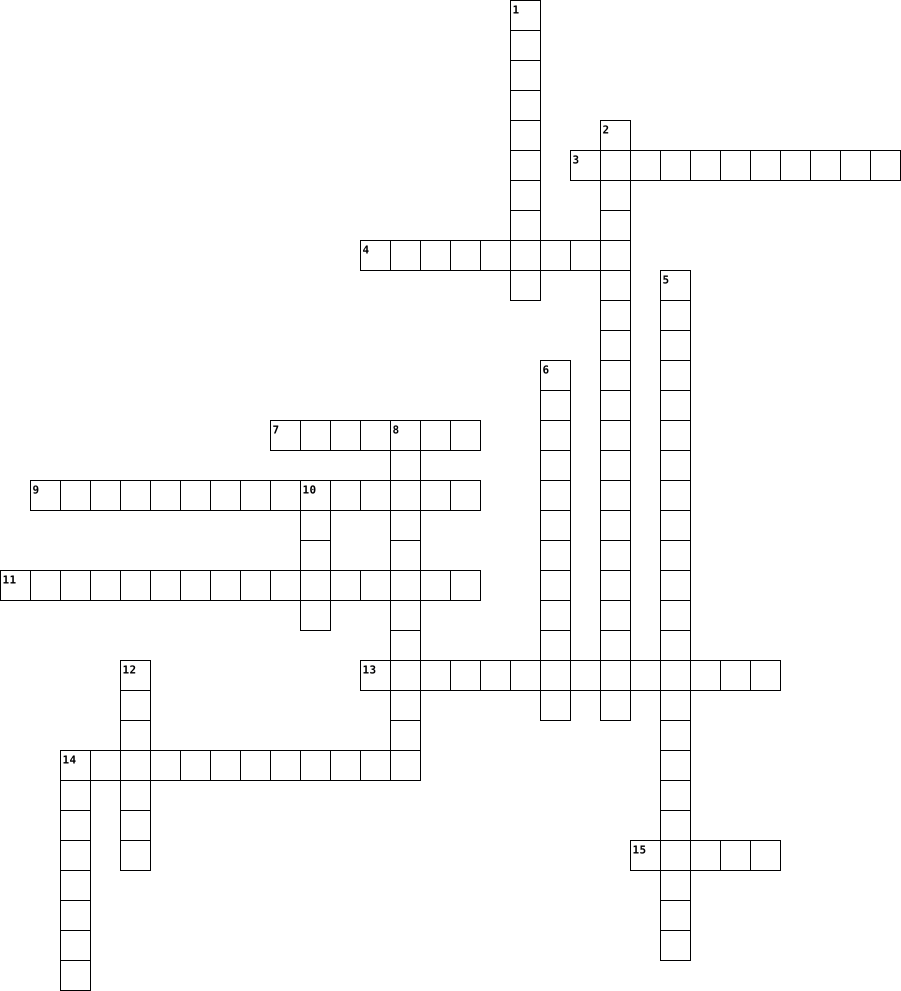
ALC - BOOK 4 - Unit 32 - Can you help me assemble my computer? - Part 2 2024-12-23

Across
- expression used to accept an offer or invitation (3W)
- to turn off a computer or electronic equipment (2W)
- to make or do something that is identical as the original one
- uncountable nouns, nouns we can't count but we can measure (3W)
- the past and past participle form of the verb "shut"
- to make a copy of something on paper
- to classify, to put in order
- for instance, an expression used to introduce examples (2W)
- large pieces of information or software entered into the computer
- countable nouns, nouns we can count and pluralize as well (2W)
- an electronic device used to process information
- to put the different pieces of a machine or equipment together
Down
- to help, to give assistance (3W)
- expression used to ask for assistance (4W)
- to turn off, a synonym of shut down (2W)
- expression used to tell you are albe to do something (3W)
- to copy information on a CD - compact disk (3W)
- a school assignment to do at home
- expression used to offer something to someone (3W)
- to put information into a computer to save it in the hard disk
- a motion picture, a film, what you watch at the cinema
21 Clues: to classify, to put in order • to help, to give assistance (3W) • a school assignment to do at home • to make a copy of something on paper • to turn off, a synonym of shut down (2W) • expression used to ask for assistance (4W) • to copy information on a CD - compact disk (3W) • an electronic device used to process information • ...
Grammar Terms 2023-09-11
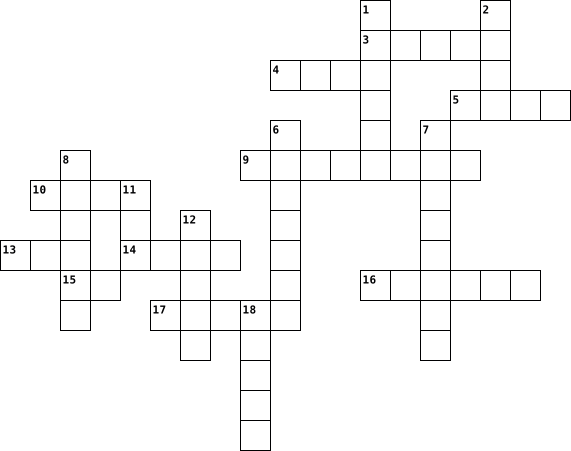
Across
- used for actions that will happen in the future
- used for actions that have already happened
- a word that comes before a noun to show whether it's specific or general
- contains one independent clause
- consists of two or more independent clauses joined by a conjuction
- has one independent clause
- show the relation between nouns or pronouns and other words in a sentence
- action words that show what the subject is doing or state what is happening
Down
- describe or modify nouns by proving more information about them
- the subject of a sentence must agree with the verb
- has multiple independent clauses and at least one dependent clause
- used for actions happening now or regularly
- words that connect words, phrases, or clauses within sentences
- words that represent people, places, things, or ideas
- modify verbs, adjectives, or other adverbs to provide additional information
- words that replace nouns to avoid repetition
16 Clues: has one independent clause • contains one independent clause • used for actions that have already happened • used for actions happening now or regularly • words that replace nouns to avoid repetition • used for actions that will happen in the future • the subject of a sentence must agree with the verb • words that represent people, places, things, or ideas • ...
Crossword Puzzle 2020-11-23

Across
- the specific period of time the source was made.
- used to show cause-and-effect relationships.
- an adverb that determines the degree or intensity of an action.
- Noun, Nouns that are non-countable.
- verbs, express action or possession.
- used to show logical or chronological sequence of ideas or events.
- the one who crafted the work.
- an adverb that tells about the time something occurs.
- used to imply conflict and to present ideas that are in contrast.
- an adverb that tells where an action took place.
Down
- An adverb is a word that modifies or describes an adjective, verb or another adverb.
- a list of references found at the latter part of a book or an article.
- an adverb that explains how an action happens.
- an adverb that describes how often or how frequent something happens.
- Nouns, Nouns that are countable.
- used to express similarity between two ideas.
- Psychological Association, What does APA stand for?
- the overall concept of the material.
- Noun, Nouns that are in general form.
- use to provide examples to make ideas clearer.
- use to signal addition of information.
21 Clues: the one who crafted the work. • Nouns, Nouns that are countable. • Noun, Nouns that are non-countable. • the overall concept of the material. • verbs, express action or possession. • Noun, Nouns that are in general form. • use to signal addition of information. • used to show cause-and-effect relationships. • used to express similarity between two ideas. • ...
Morphology and syntax 2021-11-04

Across
- Purpose to conjoin clauses that have unequal weight
- Parent-child is an example of what type of compound?
- Basic building blocks of sentences
- Type of adverb that answers how?
- What type of sentence has 1 independent clause?
- What gives an utterance its power?
- Simple, progressive, and perfect are examples of
- What mood is used to give a command or make a request?
- This type of sentence makes a statement
- ‘To be’ as a helping verb
- Conjunctions that occur in pairs
- Modify nouns and pronouns
- Words that aren’t nouns but replace nouns
- The ‘S’ in FANBOYS stands for
Down
- Nouns as objects are of what case?
- Clause that cannot exist apart from other language elements
- Modify verbs and other modifiers
- Myself, yourself, themselves are examples of what type of pronouns?
- The smallest unit of language that has meaning
- Morphology rules and syntax rules are combined to comprise
- Word order for sentence
- Words can be described by their form or
- “She needs to run fast.” ‘to run’ is an example of an
- Verb + ing =
- Positive= happy; comparative= happier; superlative=
25 Clues: Verb + ing = • Word order for sentence • ‘To be’ as a helping verb • Modify nouns and pronouns • The ‘S’ in FANBOYS stands for • Modify verbs and other modifiers • Type of adverb that answers how? • Conjunctions that occur in pairs • Nouns as objects are of what case? • Basic building blocks of sentences • What gives an utterance its power? • ...
English Crossword 2024-11-24

Across
- action Events in the narrative arc that build tension and lead to the climax.
- The main character of the story, often facing the central conflict.
- Words that describe nouns.
- One of the verbs in this sentence "He juggled six bananas while riding a unicycle."
- The adjective in this sentence "The intense game kept everyone on their toes."
- One of the nouns in this sentence "The performance filled the room with laughter."
- Words that name people, places, things or ideas.
- The conclusion of the narrative arc where loose ends are tied up.
- A kind of sentence that starts with the verb and tells someone what to do.
- A kind of sentence that gives information.
- One of the adjectives in this sentence "The purple umbrella was lost forever and ever."
- action Events after the climax where the conflict begins to resolve.
- A kind of sentence that wants to know or find out something.
Down
- Words that describe actions or states of being.
- A character or force opposing the protagonist.
- The beginning of the narrative arc where characters, setting, and context are introduced.
- Nouns name a person, place, thing or ________.]
- The part of the narrative arc where something changes or goes wrong
- A kind of sentence that expresses strong emotion!
- A ____________ is a complete idea.
- One of the nouns in this sentence "The performance filled the room with laughter."
- One of the nouns in this sentence "She found a radish in her locker and wondered how it got there."
- The verb in this sentence "He thinks about watermelons."
- arc The structure that outlines the flow of a story from beginning to end.
- The turning point of the narrative arc where the main conflict reaches its peak.
- An incomplete sentence.
- One of the nouns in this sentence "Their love grew stronger over the years."
- A verb describes an _______ or a state of being
28 Clues: An incomplete sentence. • Words that describe nouns. • A ____________ is a complete idea. • A kind of sentence that gives information. • A character or force opposing the protagonist. • Words that describe actions or states of being. • Nouns name a person, place, thing or ________.] • A verb describes an _______ or a state of being • ...
Language Arts 2024-01-26

Across
- - Group of sentences.
- - Group of words.
- - Real facts.
- - Describe nouns.
- - Words sound alike.
- - Joins words.
Down
- - Story's main idea.
- - Shows relationship.
- - Replaces nouns.
- - Describe verbs.
- - Imaginary stories.
- - Characters' talk
- - Action word.
- - Person, place, or thing.
- - Story's main events.
15 Clues: - Real facts. • - Action word. • - Joins words. • - Replaces nouns. • - Group of words. • - Describe verbs. • - Describe nouns. • - Characters' talk • - Story's main idea. • - Imaginary stories. • - Words sound alike. • - Group of sentences. • - Shows relationship. • - Story's main events. • - Person, place, or thing.
Year 7 Crossword! 2025-05-20

Across
- A kind of sentence that expresses strong emotion!
- Words that describe nouns.
- The main character of the story, often facing the central conflict.
- A kind of sentence that starts with the verb and tells someone what to do.
- One of the nouns in this sentence "Their friendship grew stronger over the years."
- One of the nouns in this sentence "The music filled the room with joy."
- The verb in this sentence "He is cooking dinner for his family."
- One of the nouns in this sentence "The music filled the room with joy."
- Words that describe actions or states of being.
- One of the verbs in this sentence "He juggled six bananas while riding a unicycle."
Down
- A kind of sentence that gives information.
- A kind of sentence that wants to know or find out something.
- A character or force opposing the protagonist.
- One of the adjectives in this sentence "The fluffy marshmallow exploded in the microwave like a tiny cloud."
- The adjective in this sentence "The exciting game kept everyone on their toes."
- One of the nouns in this sentence "He found a pickle under the couch and wondered how it got there."
- Words that name people, places, things or ideas.
17 Clues: Words that describe nouns. • A kind of sentence that gives information. • A character or force opposing the protagonist. • Words that describe actions or states of being. • Words that name people, places, things or ideas. • A kind of sentence that expresses strong emotion! • A kind of sentence that wants to know or find out something. • ...
determiners 2025-04-23

Across
- Refers to a singular noun that is far
- Used with uncountable nouns to express large quantity
- Refers to a singular noun that is near
- Refers to every single item in a group
- Used with countable nouns to express small quantity
- Used with plural countable nouns to express large quantity
Down
- Refers to plural nouns that are far
- Refers to plural nouns that are near
- Refers to all items in a group individually
- Used with uncountable or plural countable nouns in positive sentences
10 Clues: Refers to plural nouns that are far • Refers to plural nouns that are near • Refers to a singular noun that is far • Refers to a singular noun that is near • Refers to every single item in a group • Refers to all items in a group individually • Used with countable nouns to express small quantity • Used with uncountable nouns to express large quantity • ...
Language Arts 2024-01-26

Across
- - Group of sentences.
- - Group of words.
- - Real facts.
- - Describe nouns.
- - Words sound alike.
- - Joins words.
Down
- - Story's main idea.
- - Shows relationship.
- - Replaces nouns.
- - Describe verbs.
- - Imaginary stories.
- - Characters' talk.
- - Action word.
- - Person, place, or thing.
- - Story's main events.
15 Clues: - Real facts. • - Action word. • - Joins words. • - Replaces nouns. • - Group of words. • - Describe verbs. • - Describe nouns. • - Characters' talk. • - Story's main idea. • - Imaginary stories. • - Words sound alike. • - Group of sentences. • - Shows relationship. • - Story's main events. • - Person, place, or thing.
Teens 03 Unit 4 Review 2025-02-24

Across
- A large number (used with countable nouns).
- Adverb similar to fast.
- The biggest sea animal.
- Making little or no noise (adverb)
- Moving with a lot of speed.
- A big wild cat with black spots.
- A small number of things (used with countable nouns).
- Animals that live with people at home.
- Special clothes for fun or a show.
- An animal in danger of disappearing forever.
- Lets an animal go free.
- In a slow way (adverb)
Down
- When an animal or person cannot leave a place.
- A large amount (used with uncountable nouns).
- A slow animal that lives in trees.
- A special place to protect animals or nature.
- Measure how heavy something is.
- A small amount (used with uncountable nouns).
- To go back to a place.
- A rule that is in the constitution
- People who hunt animals illegally.
- A large area with many trees.
- A person who has a job.
- A big wild cat with orange and black stripes.
- Living in nature, not with people.
- A black and white bear that eats bamboo.
- A mountain is really ____.
- To give something for money.
28 Clues: To go back to a place. • In a slow way (adverb) • Adverb similar to fast. • The biggest sea animal. • A person who has a job. • Lets an animal go free. • A mountain is really ____. • Moving with a lot of speed. • To give something for money. • A large area with many trees. • Measure how heavy something is. • A big wild cat with black spots. • A slow animal that lives in trees. • ...
writing & grammar 7/8 - Week 2 2026-01-15

Across
- words that describe how often an action occurs.
- what is the plural form of radius?
- nouns that have singular and plural forms.
- a class of words that refers to a person, place, thing, or idea.
- what is the plural form of loaf?
- a class of words modifies nouns or pronouns.
- what is the plural form of goose?
- what is the plural form of moose?
- a verb ending in -ing that functions as a noun.
Down
- what is the plural form of vertex?
- what is the plural form of deer?
- nouns that only have one form and do not take an -s ending.
- words such as a, an, and the, that go before nouns to show whether it is specific or general.
- what is the plural form of larvae?
- (of a word or form) denoting more than one, or (in languages with dual number) more than two.
- what is the plural form of half?
- what is the plural form of cactus?
- what is the plural form of nucleus?
- (of a word or form) denoting or referring to just one person or thing.
- a word used to describe an action.
20 Clues: what is the plural form of deer? • what is the plural form of half? • what is the plural form of loaf? • what is the plural form of goose? • what is the plural form of moose? • what is the plural form of vertex? • what is the plural form of radius? • what is the plural form of larvae? • what is the plural form of cactus? • a word used to describe an action. • ...
Parts of speech 2020-01-31

Across
- ,describe verbs, adjectives and adverbs.
- , express surprise and emotion.
- ,describes nouns and pronouns.
- , replace nouns.
Down
- ,express actions.
- , help to define nouns.
- ,joins words,sentences,phrases and clauses.
- ,link nouns to other words.
- , names of people, places, things and idea.
9 Clues: , replace nouns. • ,express actions. • , help to define nouns. • ,link nouns to other words. • ,describes nouns and pronouns. • , express surprise and emotion. • ,describe verbs, adjectives and adverbs. • ,joins words,sentences,phrases and clauses. • , names of people, places, things and idea.
CROSSWORD: PARTS OF A SPEECH 2016-03-03

Across
- class of words that are linked to nouns.
- used as a replacement or substitute for a noun.
- having or showing worry; concerned; anxious.
- called helping verbs because they are needed to form many of the tenses.
- having a desire or need for food.
- the act of speaking.
- expressing, containing, or suggesting the word "no'' or "not;'' expressing denial.
- class of words that can function as the subject or object in a sentence
- class of words that typically express action
Down
- words used before nouns and pronouns to form phrases that give more information about a verb, noun, or other phrase
- characterized by or showing pleasure or joy.
- showing, expressing, caused by, or characterized by anger.
- person: very attractive
- class of words that describe nouns
- feeling unhappiness.
15 Clues: the act of speaking. • feeling unhappiness. • person: very attractive • having a desire or need for food. • class of words that describe nouns • class of words that are linked to nouns. • characterized by or showing pleasure or joy. • having or showing worry; concerned; anxious. • class of words that typically express action • used as a replacement or substitute for a noun. • ...
Count/Non-Count Nouns 2026-04-09

Across
- This kind of sentence often uses any.
- Use this word with non-count nouns: How ___ soy sauce do you want?
- Use this word in a positive sentence: There is ___ yogurt in the refrigerator.
- Ice cream is usually in the ___.
- This kind of sentence often uses some.
- Bread and tea may be in the ___.
- Apples and carrots are this kind of noun.
- This word means the food tastes very bad.
- Cookies, onions, and tomatoes are this type of noun.
Down
- Bread, tea, and lettuce use this type of form.
- Rice and yogurt are this kind of noun.
- This word means the food tastes very good.
- Use this word for a small amount of non-count nouns: Just a ___.
- Use this word for a small number of count nouns: Just a ___.
- Use this word with count nouns: How ___ potatoes do you want?
- Use this word in a negative sentence: There isn’t ___ flour.
16 Clues: Ice cream is usually in the ___. • Bread and tea may be in the ___. • This kind of sentence often uses any. • Rice and yogurt are this kind of noun. • This kind of sentence often uses some. • Apples and carrots are this kind of noun. • This word means the food tastes very bad. • This word means the food tastes very good. • Bread, tea, and lettuce use this type of form. • ...
Parts Of Speech Crossword #1 2017-05-25
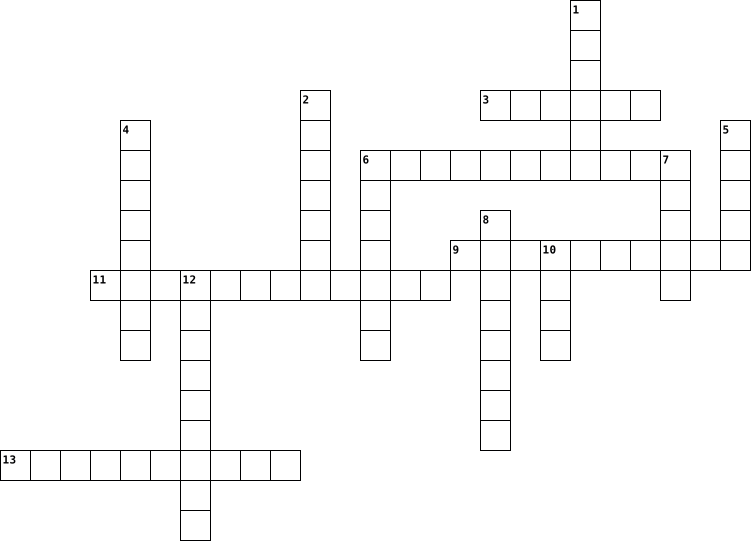
Across
- / this is a food that Italians eat (Concrete Nouns)
- / to jump in the air (action verbs)
- / a group of people who take part in an activity (collective nouns)
- / the day that comes after Friday (proper nouns)
- / to spring up (linking verbs)
- / the past tense of do (helping verbs)
- / this is a form of perception in the winter. (Concrete Noun)
- / __, are, is, was, were, been, being (state of being verb)
- / If you have to go to the hospital you are not in good ________. (Abstract Noun)
- / a group of students who are taught together (collective nouns)
Down
- / to show up (linking verbs)
- / A place where you can go to different stores in the same building (common noun)
- / if you are upset you are in a state of ________. (abstract noun)
- / Something you put in your locker (common noun)
- / the day that comes after Thursday (proper noun)
- / am, are, is, _____, were, been, being (state of being verb)
- / the past tense of can (helping verbs)
- / you do this at night (action verbs)
18 Clues: / to show up (linking verbs) • / to spring up (linking verbs) • / to jump in the air (action verbs) • / you do this at night (action verbs) • / the past tense of do (helping verbs) • / the past tense of can (helping verbs) • / Something you put in your locker (common noun) • / the day that comes after Friday (proper nouns) • ...
language 2022-09-07
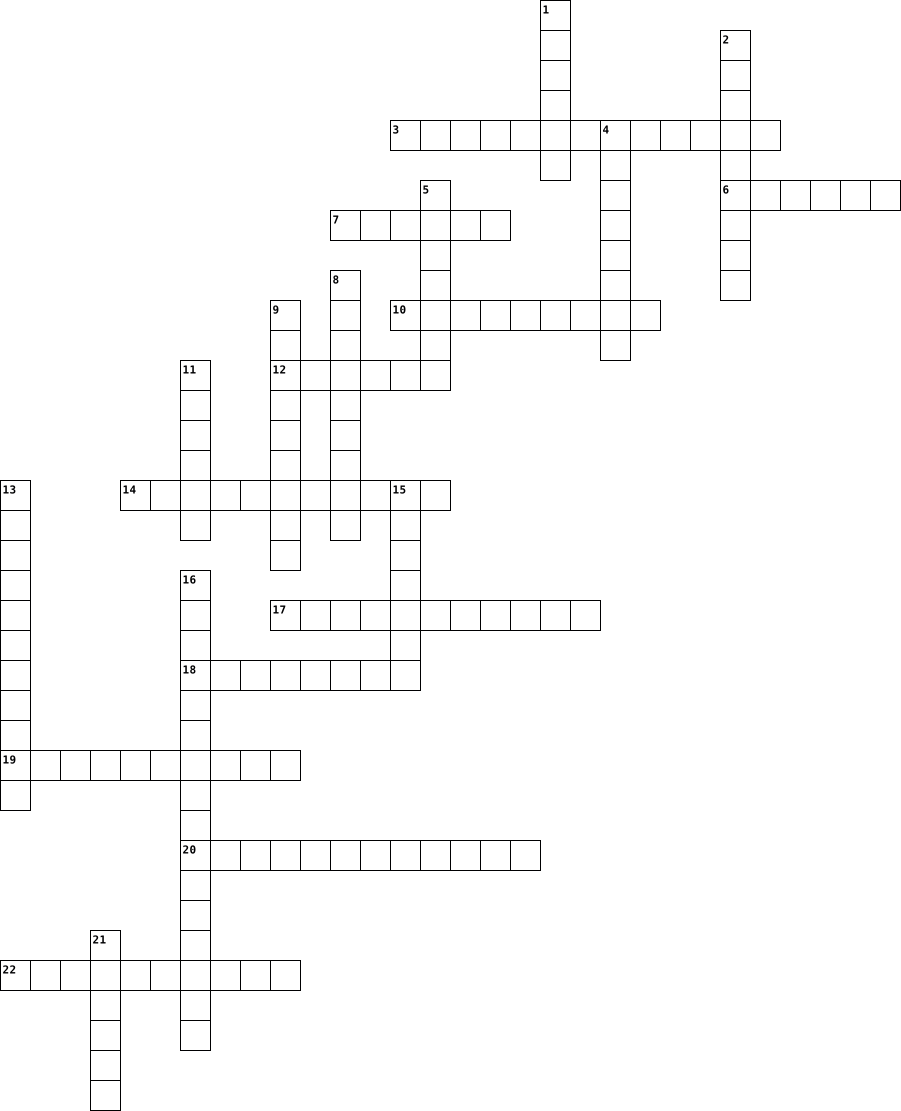
Across
- emphasis
- commas, periods
- similar spelling different meaning
- hard to define
- non-vowels
Down
- direct or indirect
- names or nouns
- Germanic
- action words
- punctuation
- person place or thing
- same spelling
- spoken
- verbs
14 Clues: verbs • spoken • emphasis • Germanic • non-vowels • punctuation • action words • same spelling • names or nouns • hard to define • commas, periods • direct or indirect • person place or thing • similar spelling different meaning
Noun and Verb Review 2018-02-21

Across
- tense marker for the pluperfect tense
- tense marker for the imperfect tense
- tense used for action happening now
- tense for future past translated “will have VERBed”
- sailor of the world
- ya’ll are
- most first declension nouns are ________
- lamb of God
- tense used for ongoing action in the past
- subject case
- they had stood
- nouns in this case are direct objects
- number of conjugations
- nouns in this case are indirect objects
Down
- prepositional phrase case “in, by, with, from”
- tense for past past translated “had VERBed”
- _____, person number tense voice mood
- tense used for simple, completed past action
- I loved
- tense marker for the future tense
- tense marker for the future perfect tense
- _____, gender number case
- shows relationship or connection “of”
- I am
- number of noun declensions
25 Clues: I am • I loved • ya’ll are • lamb of God • subject case • they had stood • sailor of the world • number of conjugations • _____, gender number case • number of noun declensions • tense marker for the future tense • tense used for action happening now • tense marker for the imperfect tense • tense marker for the pluperfect tense • _____, person number tense voice mood • ...
English Language Arts & Reading 2022-05-13
Across
- the repetition of the same sound
- a play
- a phrase not meant to be taken literally
- words that take the place of nouns
- names for persons, places, things, or ideas
- people in a book, story, poem, drama...
- the end of the conflict
- where, and when a story takes place
- to explain using as few words as possible
- "and"
- very exaggerated
Down
- the message/lesson of a story
- the important idea expressed in a story
- words that describe verbs & adjectives
- a type of literary work in verse
- the order of events
- the problem(s) the characters face in a story
- a play
- words that describe nouns or pronouns
- uses like or as to compare two things
- giving human characteristics to something that is not human
- action or "being" words
22 Clues: "and" • a play • a play • very exaggerated • the order of events • the end of the conflict • action or "being" words • the message/lesson of a story • the repetition of the same sound • a type of literary work in verse • words that take the place of nouns • where, and when a story takes place • words that describe nouns or pronouns • uses like or as to compare two things • ...
Third Form Latin - Lesson 26 2023-04-17

Across
- course, running
- h/s/i may have been
- I might have been
- you (s.) might have been
- cavalry
- Most 4th Declension nouns are ____________ in gender.
- you (pl.) may have been
- falling, misfortune, setting
- use, experience
- we may have been
- bow
- The 4th Declension nouns domus and manus are ______________ in gender.
- I may have been
Down
- attack
- chariot, cart, wagon
- they might have been
- Let arms yield to the toga.
- h/s/i might have been
- they may have been
- we might have been
- end, outcome, exit
- you (pl.) might have been
- you (s.) may have been
- step, pace
- countenance, expression
- The 4th Declension nouns cornu and genu are _________ in gender.
26 Clues: bow • attack • cavalry • step, pace • course, running • use, experience • I may have been • we may have been • I might have been • they may have been • we might have been • end, outcome, exit • h/s/i may have been • chariot, cart, wagon • they might have been • h/s/i might have been • you (s.) may have been • you (pl.) may have been • countenance, expression • you (s.) might have been • ...
Cross word 2024-09-28

Across
- Transitions that indicate a condition, like "if," "unless."
- Refers to nouns that name general items rather than specific ones.
- Words that describe or modify nouns.
- A conclusion drawn from evidence or reasoning.
- To convince someone to do or believe something.
- Transitions that add information, like "and," "also."
- To provide information or knowledge.
- A word that refers to a person, place, thing, or idea.
- A referencing style used in academic writing.
- Refers to nouns that name specific items, typically capitalized.
- Words that describe actions or states of being.
- A word that has the opposite meaning to another.
- Transitions that help explain or clarify, like "in other words."
- Words or phrases that indicate the type of transition or relationship between ideas in writing.
Down
- Something that is completely different.
- Refers to more than one entity.
- A word that modifies a verb, adjective, or other adverbs.
- To amuse or engage the attention of an audience.
- A statement of the exact meaning of a word.
- A modal verb expressing possibility or permission.
- A word having the same or nearly the same meaning as another.
- A specific case used to illustrate a rule or concept.
- Transitions that show order, like "first," "next."
- Refers to one entity.
- Nouns that are perceivable by the senses.
- The quality of being logical and consistent.
- Used for emphasis; to a great degree.
- To talk about a topic in detail.
- Transitions that show cause and effect, like "because," "therefore."
- Nouns that represent ideas or concepts.
30 Clues: Refers to one entity. • Refers to more than one entity. • To talk about a topic in detail. • Words that describe or modify nouns. • To provide information or knowledge. • Used for emphasis; to a great degree. • Something that is completely different. • Nouns that represent ideas or concepts. • Nouns that are perceivable by the senses. • ...
Noun and Verb Review 2018-02-21

Across
- number of conjugations
- tense used for ongoing action in the past
- I loved
- subject case
- tense marker for the future tense
- tense for future past translated “will have VERBed”
- they had stood
- tense marker for the imperfect tense
- tense marker for the future perfect tense
- lamb of God
- _____, gender number case
- number of noun declensions
Down
- tense used for action happening now
- tense for past past translated “had VERBed”
- tense used for simple, completed past action
- most first declension nouns are ________
- prepositional phrase case “in, by, with, from”
- shows relationship or connection “of”
- tense marker for the pluperfect tense
- _____, person number tense voice mood
- nouns in this case are direct objects
- sailor of the world
- ya’ll are
- number of noun cases
- nouns in this case are indirect objects
25 Clues: I loved • ya’ll are • lamb of God • subject case • they had stood • sailor of the world • number of noun cases • number of conjugations • _____, gender number case • number of noun declensions • tense marker for the future tense • tense used for action happening now • tense marker for the imperfect tense • shows relationship or connection “of” • tense marker for the pluperfect tense • ...
Los articulos - the articles 2019-02-10

Across
- a (for male nouns)
- the (for female nouns)
- some (for male plural nouns)
- the (for female plural nouns)
Down
- a (for female nouns)
- the (for male plural nouns)
- some (for female plural nouns)
- the (for male nouns)
8 Clues: a (for male nouns) • a (for female nouns) • the (for male nouns) • the (for female nouns) • the (for male plural nouns) • some (for male plural nouns) • the (for female plural nouns) • some (for female plural nouns)
grammar 2021-02-22

Across
- 1st capitalize and put inverted comma, question, exclamatory mark etc
- action word pos
- identifying nouns
- definite article
- _____ 2021 (preposition)
- used in place of noun
Down
- describes a noun
- joins a word/sentence
- nouns these nouns are in capitals
- describes a verb
- indefinite article before a vowel sound
- continuous always has this
12 Clues: action word pos • describes a noun • describes a verb • definite article • identifying nouns • joins a word/sentence • used in place of noun • _____ 2021 (preposition) • continuous always has this • nouns these nouns are in capitals • indefinite article before a vowel sound • 1st capitalize and put inverted comma, question, exclamatory mark etc
grammar 2021-02-22

Across
- 1st capitalize and put inverted comma, question, exclamatory mark etc
- action word pos
- identifying nouns
- definite article
- _____ 2021 (preposition)
- used in place of noun
Down
- describes a noun
- joins a word/sentence
- nouns these nouns are in capitals
- describes a verb
- indefinite article before a vowel sound
- continuous always has this
12 Clues: action word pos • describes a noun • describes a verb • definite article • identifying nouns • joins a word/sentence • used in place of noun • _____ 2021 (preposition) • continuous always has this • nouns these nouns are in capitals • indefinite article before a vowel sound • 1st capitalize and put inverted comma, question, exclamatory mark etc
Nouns 2023-06-19

Across
- Is a noun that refers to a physical thing, person, or place
- Nouns that show more than one thing,person or place
- _____ nouns show ownership
- Table,Chair,House,Quilt are examples of _____ noun
- A persons name is always a ______ noun
Down
- Pronouns stand in place of _____
- Bunch,Fleet,Pack and Gang are all ______ nouns
- The common noun in “Ravi is very attached to his phone.”
- A feeling/emotion
- Nouns that can be counted are __________ nouns
10 Clues: A feeling/emotion • _____ nouns show ownership • Pronouns stand in place of _____ • A persons name is always a ______ noun • Bunch,Fleet,Pack and Gang are all ______ nouns • Nouns that can be counted are __________ nouns • Table,Chair,House,Quilt are examples of _____ noun • Nouns that show more than one thing,person or place • ...
ENGLISHHHH BY JOHNY SINS 2025-09-26

Across
- Contain one independent clause and one or more dependent clause (WHAT SENTENCE)
- a type of sentence To give a command, instruction, or make a request.
- Contain two or more independent clauses. (WHAT SENTENCE)
- a type of sentence that asks a question and must end with a question mark.
- MODIFY VERBS, ADJECTIVES.
- WORDS REPLACE THE NOUNS TO AVOID REPETITION.
- The person, place, or thing the sentence is about (PART OF A SENTENCE)
- DESCRIBE OR MODIFY NOUNS, PROVIDING MORE DETAIL.
- a type of sentence To express strong emotion or excitement.
- EXPRESS STRONG EMOTION OR SUDDEN EXLAMATIONS.
- WORDS THAT NAME PEOPLE, PLACE, THINGS, OR IDEAS.
Down
- Contain one independent clause. (WHAT SENTENCE
- a type of sentence that make a statement, express a fact, an opinion, or an explanation.
- RELATIONSHIP OF NOUNS OR PRONOUNS AND OTHER WORDS IN A SENTENCE
- CONNECT CLAUSES, SENTENCES, OR WORDS.
- A single person, place, thing, or idea
- a category to which a word is assigned in accordance with its syntactic functions.
- adjectives show ownership and come directly before a noun, modifying it to indicate belonging.
- the part of the sentence that contains the verb and provides information about the subject. (PART OF A SENTENCE)
- DESCIRBE WHAT THE SUBJECT DOING OR THE STATE OF BEING
20 Clues: MODIFY VERBS, ADJECTIVES. • CONNECT CLAUSES, SENTENCES, OR WORDS. • A single person, place, thing, or idea • WORDS REPLACE THE NOUNS TO AVOID REPETITION. • EXPRESS STRONG EMOTION OR SUDDEN EXLAMATIONS. • Contain one independent clause. (WHAT SENTENCE • DESCRIBE OR MODIFY NOUNS, PROVIDING MORE DETAIL. • WORDS THAT NAME PEOPLE, PLACE, THINGS, OR IDEAS. • ...
English Grammar 2024-03-06

Across
- helps a reader understand the sentence
- tells how the words in a sentence relate to one another in time or space
- ___ describe verbs, adjectives, or other ___
- a set of rules
- combine parts of a sentence or whole sentences into one sentence
- an action word
- nouns can be _____ or plural
Down
- ____ describe nouns or pronouns
- in english there are _____ types of words
- indicate a persons exact words
- added to a sentence to show emotion
- ____ replace nouns
- a verb can have an active or _____ voice
- a person, place, or thing
- separate list and clauses
15 Clues: a set of rules • an action word • ____ replace nouns • a person, place, or thing • separate list and clauses • nouns can be _____ or plural • indicate a persons exact words • ____ describe nouns or pronouns • added to a sentence to show emotion • helps a reader understand the sentence • a verb can have an active or _____ voice • in english there are _____ types of words • ...
Adjectives 2022-04-26
Across
- Placed immediately before the noun/pronoun its describing
- Immediately follow a noun/pronoun
- Assigns a quality or attribute
- Shows ownership
- Two or more adjectives separated by a comma
- Point out/draw attention to a noun/pronoun in a crowd
- Appear after a linking verb
- Normal form of an adjective
- Add specificity to nouns/pronouns
Down
- Describes how much/may nouns/pronouns
- Multiple adjectives that build on one another to create meaning
- Used to compare two of something
- Assign numbers to a noun/pronoun implying order
- Used to compare three or more things
- Asks questions
- Contain more than one word, linked by a hyphen
- Derived from proper nouns
17 Clues: Asks questions • Shows ownership • Derived from proper nouns • Appear after a linking verb • Normal form of an adjective • Assigns a quality or attribute • Used to compare two of something • Immediately follow a noun/pronoun • Add specificity to nouns/pronouns • Used to compare three or more things • Describes how much/may nouns/pronouns • ...
Declension and Case Usage GP3 2021-01-10

Across
- translates "the girl" (as a direct object of a sentence)
- used for direct address)
- translates "of the girls" or "of the girls'"
- translates "of the girl" of "the girl's"
- used for subject
- masculine, feminine, neuter
- determines a nouns use in a sentence
- used for direct object
- family of ending to which a noun belongs
- the genitive singular ending of 1st declension nouns
Down
- used for indirect object
- translates "The girl" (as a subject of a sentence)
- form needed to complete Marcus cum_______(girls) ambulat.
- translates "the girls" (as the direct object of a sentence)
- tells how many are involved singular or plural
- the gender of most 1st declension nouns
- used to show possession
- used as the object of some prepositions
18 Clues: used for subject • used for direct object • used to show possession • used for indirect object • used for direct address) • masculine, feminine, neuter • determines a nouns use in a sentence • the gender of most 1st declension nouns • used as the object of some prepositions • translates "of the girl" of "the girl's" • family of ending to which a noun belongs • ...
Group C 2025-10-16

Across
- Latin for "world"
- This declension's nouns end with "-us" or "-um"
- This person uses the pronoun "you" or "you all"
- "We set free"
- "Work and prayer"
- Latin for "church"
- Latin for "woman"
Down
- This declension's nouns end with "-a"
- "You judge"
- first-person plural verb ending
- "They seize"
- This case signifies the indirect object of a sentence
- This term refers to words we get in English from Latin.
- Nouns that end with "-um" are this gender
- This case signifies the subject of a sentence.
15 Clues: "You judge" • "They seize" • "We set free" • Latin for "world" • "Work and prayer" • Latin for "woman" • Latin for "church" • first-person plural verb ending • This declension's nouns end with "-a" • Nouns that end with "-um" are this gender • This case signifies the subject of a sentence. • This declension's nouns end with "-us" or "-um" • ...
Parts of Speech 2015-12-02
Across
- a person, place, thing, or idea
- verbs like run
- describe nouns
- shows action or state of being
- over, in, above, and below are
- nouns like dreams, hope, love
- he, she, and it are
Down
- Oh! Wow! and Totally! are
- noun you can touch
- describe verbs, adjectives and other ___________
- an example of an article
- join words and phrases
- a, an, and the; words that only come before nouns
13 Clues: verbs like run • describe nouns • noun you can touch • he, she, and it are • join words and phrases • an example of an article • Oh! Wow! and Totally! are • nouns like dreams, hope, love • shows action or state of being • over, in, above, and below are • a person, place, thing, or idea • describe verbs, adjectives and other ___________ • ...
Exam Review 2 2025-11-13

Across
- Verbs show this type of information in a sentence
- Do some situations require fancier, more formal language than others, true or false?
- to help restore someone back to health
- Two words that have opposite meanings
- Would "house" come before or after "meatball" in the dictionary?
- This word means the you have the right to keep your information secret, if you choose.
- What type of nouns describe only one person, place, thing, or idea?
Down
- What type of nouns describe a set, a an organized group of nouns?
- Preposition words show position in space and ____.
- People who are rebellious have problems respecting _______.
- Which is a classic Gothic Literature story, The Giver or Frankenstein
- The feeling of a story or the gases surrounding the earth
- This word means a category of literature. Ex: Dystopian, Gothic, fairytale
- Two words that mean the same thing/have the same definition
- The time, location, and situation where a story takes place
- What type of nouns describe more than one person, place, thing, or idea?
16 Clues: Two words that have opposite meanings • to help restore someone back to health • Verbs show this type of information in a sentence • Preposition words show position in space and ____. • The feeling of a story or the gases surrounding the earth • People who are rebellious have problems respecting _______. • Two words that mean the same thing/have the same definition • ...
Grammar 1 2025-11-03

Across
- Used to describe actions that started in the past and continue to the present ...
- Used with singular nouns or pronouns in the past, like "I ... tired"
- The form of "be" used with the pronoun "I" ...
- The past form of "be" used with plural subjects ...
- Used to describe actions happening at the moment of speaking ...
- Expresses an action, occurrence, or state of being ...
- The past participle of "be," often used with "have" or "has" ...
- we use "ed" verbs for the...tense
- Refers to more than one person, place, thing, or idea ...
- Tells how, when, where, or to what extent ...
- Connects the subject to a word or group of words that describes or identifies the subject ...
- Used with plural nouns or pronouns in the present, like "They ... happy"
- The past tense form of the verb "do" ...
- Describes a noun, like "red" or "tall" ...
- Refers to one person, place, thing, or idea ...
Down
- Used for habitual actions, general truths, or facts ...
- Modify verbs, adjectives, or other adverbs ...
- Verb Takes a direct object to complete its meaning ...
- Indicates when an action takes place ...
- A form of "be" used to show continuous action, like "I am ..."
- Refers to general things, not specific names ...
- Words that replace nouns ...
- Helps the main verb express action or state of being ...
- Used with third-person singular subjects in the present simple tense ...
- Used to describe actions that happened and finished in the past ...
- Names a person, place, thing, or idea ...
- Words that describe nouns ...
- Takes the place of a noun, like "he," "she," or "it" ...
- The principal verb in a clause, expressing the primary action or state ...
- Used with singular nouns or pronouns in the present, like "He ... here"
30 Clues: Words that replace nouns ... • Words that describe nouns ... • we use "ed" verbs for the...tense • Indicates when an action takes place ... • The past tense form of the verb "do" ... • Names a person, place, thing, or idea ... • Describes a noun, like "red" or "tall" ... • Tells how, when, where, or to what extent ... • The form of "be" used with the pronoun "I" ... • ...
parts of speech 2021-08-30

Across
- show the relationship between nouns and other words and where and when
- are the nouns pronoun replaces
- adjetive point out specific nouns
- Conjunctions connect words, phrases, and clauses
- tell us where, when, and how verbs happen
Down
- adjetive specific words,should be capatalized
- adverb adverbs that work like conjunctions
- replace nouns and must match the noun it replaces
- adjetive who or what the noun belongs to
- describes nouns; tell us how many, what kind, etc.
10 Clues: are the nouns pronoun replaces • adjetive point out specific nouns • adjetive who or what the noun belongs to • tell us where, when, and how verbs happen • adverb adverbs that work like conjunctions • adjetive specific words,should be capatalized • Conjunctions connect words, phrases, and clauses • replace nouns and must match the noun it replaces • ...
trabalho de ingles 2025-11-19

Across
- A white, nutritious liquid from cows; uncountable (4 letters)
- The second word in the common quantifier "a ___ of" (3 letters)
- A hot, relaxing drink that is an uncountable noun (3 letters)
- An uncountable liquid essential for life (5 letters)
- A general term for what we eat; usually uncountable (4 letters)
- Plural form of person; a countable noun (6 letters)
- This abstract noun is uncountable in English (6 letters)
- A sweet white powder; an uncountable noun (5 letters)
- A quantifier used in positive sentences for an unspecific quantity (4 letters)
- Chicken products used in baking; countable (4 letters)
- Used with plural countable nouns in questions and negatives (4 letters)
Down
- Used with uncountable nouns to mean "not much" (6 letters)
- You buy this in a loaf; an uncountable noun in English (5 letters)
- A common fruit, plural and countable (6 letters)
- Small grains, a staple food and an uncountable noun (4 letters)
- Used with plural countable nouns to mean "not many" (3 letters)
- Vehicles on the road; a countable noun (4 letters)
- A concept you can't count (e.g., "I don't have ___ ___") (4 letters)
- Although you count coins, the word itself is uncountable (5 letters)
- Used with uncountable nouns in negative sentences and questions (4 letters)
20 Clues: A common fruit, plural and countable (6 letters) • Vehicles on the road; a countable noun (4 letters) • Plural form of person; a countable noun (6 letters) • An uncountable liquid essential for life (5 letters) • A sweet white powder; an uncountable noun (5 letters) • Chicken products used in baking; countable (4 letters) • ...
Wk 2 Puzzle 2022-07-22

Across
- text feature that explains what's in a photo
- type of nouns that should always be capitalized
- an easier number that's close to another number
- type of nouns that are ideas and emotions
- this will always happen in an experiment because we're human
- the author's purpose for most nonfiction
- a single number
Down
- not able to tell in advance
- result of an earthquake happening underwater
- a lot
- strong or dangerous
- type of nouns that are people, places, and physical things
- a danger
- type of plates that move and cause earthquakes
- each three places on a place value chart
15 Clues: a lot • a danger • a single number • strong or dangerous • not able to tell in advance • the author's purpose for most nonfiction • each three places on a place value chart • type of nouns that are ideas and emotions • text feature that explains what's in a photo • result of an earthquake happening underwater • type of plates that move and cause earthquakes • ...
Nouns, Verbs, Adjectives, and Adverbs 2022-06-06

Across
- A person, place, or thing.
- If you add an -s to the end of the verb, it becomes a ______ verb.
- ______ nouns are a specific person, place, or thing.
- An action that is happening right now is in the ______ tense.
- Adding -ed to a verb will make it ______ tense.
- Something that describes a noun.
- An action that will happen later is in the ______ tense.
Down
- ______ nouns are general and do not begin with a capital letter unless found at the beginning of a sentence.
- ______ nouns are nouns that you can see, feel, smell, taste, or hear.
- 2 or more is called ______.
- An action word.
- Anger is an example of an ______ noun.
- Something that describes a verb.
- am, is, are, was, were, been, and being are all called ______ verbs.
14 Clues: An action word. • A person, place, or thing. • 2 or more is called ______. • Something that describes a verb. • Something that describes a noun. • Anger is an example of an ______ noun. • Adding -ed to a verb will make it ______ tense. • ______ nouns are a specific person, place, or thing. • An action that will happen later is in the ______ tense. • ...
Grammar 1 2025-11-03

Across
- Used with plural nouns or pronouns in the present, like "They ... happy"
- The form of "be" used with the pronoun "I" ...
- Refers to more than one person, place, thing, or idea ...
- Used with singular nouns or pronouns in the present, like "He ... here"
- Expresses an action, occurrence, or state of being ...
- The principal verb in a clause, expressing the primary action or state ...
- Connects the subject to a word or group of words that describes or identifies the subject ...
- Modify verbs, adjectives, or other adverbs ...
- Takes the place of a noun, like "he," "she," or "it" ...
- Describes a noun, like "red" or "tall" ...
- The past form of "be" used with plural subjects ...
- The past participle of "be," often used with "have" or "has" ...
- Used to describe actions that started in the past and continue to the present ...
- A form of "be" used to show continuous action, like "I am ..."
- Used to describe actions happening at the moment of speaking ...
Down
- Refers to general things, not specific names ...
- Helps the main verb express action or state of being ...
- Used to describe actions that happened and finished in the past ...
- Used with third-person singular subjects in the present simple tense ...
- Verb Takes a direct object to complete its meaning ...
- Words that describe nouns ...
- Used for habitual actions, general truths, or facts ...
- Used with singular nouns or pronouns in the past, like "I ... tired"
- Refers to one person, place, thing, or idea ...
- The past tense form of the verb "do" ...
- Tells how, when, where, or to what extent ...
- Indicates when an action takes place ...
- Words that replace nouns ...
- we use "ed" verbs for the...tense
- Names a person, place, thing, or idea ...
30 Clues: Words that replace nouns ... • Words that describe nouns ... • we use "ed" verbs for the...tense • The past tense form of the verb "do" ... • Indicates when an action takes place ... • Names a person, place, thing, or idea ... • Describes a noun, like "red" or "tall" ... • Tells how, when, where, or to what extent ... • The form of "be" used with the pronoun "I" ... • ...
Grammar 1 2025-11-03

Across
- Used to describe actions that started in the past and continue to the present ...
- Used with singular nouns or pronouns in the past, like "I ... tired"
- The form of "be" used with the pronoun "I" ...
- The past form of "be" used with plural subjects ...
- Used to describe actions happening at the moment of speaking ...
- Expresses an action, occurrence, or state of being ...
- The past participle of "be," often used with "have" or "has" ...
- we use "ed" verbs for the...tense
- Refers to more than one person, place, thing, or idea ...
- Tells how, when, where, or to what extent ...
- Connects the subject to a word or group of words that describes or identifies the subject ...
- Used with plural nouns or pronouns in the present, like "They ... happy"
- The past tense form of the verb "do" ...
- Describes a noun, like "red" or "tall" ...
- Refers to one person, place, thing, or idea ...
Down
- Used for habitual actions, general truths, or facts ...
- Modify verbs, adjectives, or other adverbs ...
- Verb Takes a direct object to complete its meaning ...
- Indicates when an action takes place ...
- A form of "be" used to show continuous action, like "I am ..."
- Refers to general things, not specific names ...
- Words that replace nouns ...
- Helps the main verb express action or state of being ...
- Used with third-person singular subjects in the present simple tense ...
- Used to describe actions that happened and finished in the past ...
- Names a person, place, thing, or idea ...
- Words that describe nouns ...
- Takes the place of a noun, like "he," "she," or "it" ...
- The principal verb in a clause, expressing the primary action or state ...
- Used with singular nouns or pronouns in the present, like "He ... here"
30 Clues: Words that replace nouns ... • Words that describe nouns ... • we use "ed" verbs for the...tense • Indicates when an action takes place ... • The past tense form of the verb "do" ... • Names a person, place, thing, or idea ... • Describes a noun, like "red" or "tall" ... • Tells how, when, where, or to what extent ... • The form of "be" used with the pronoun "I" ... • ...
AS crossword 2025-05-22

Across
- Requiring a lot of effort; very difficult
- Highly respected and well known
- Aggressive, hostile, or warlike
- Useless or pointless
- Words that describe a noun that can include adjectives, verbs and nouns themselves
- Showy, flashy, or trying to impress others
- Careless, irresponsible
- To express deep sorrow or regret
- count nouns Names for things [e.g. substances] which cannot be counted e.g. 'bread', 'water', 'flour', 'tea'
- A social outcast
- nouns Names for things which can be counted. Have a plural form. e.g. 'teabag', 'girl', 'child'
- Bitter resentment or deep seated ill will
- Lack of interest or concern
- Extremely hungry or eager for something
- To make something less severe or intense
- nouns Names we give to specific people and places. Usually begin with a capital letter. e.g. 'Tony Blair', 'France', 'Cardiff'
- Words that describe nouns
- Extreme happiness or joy
- To satisfy fully
- Annoying or frustrating
- Showing strong enthusiasm or passion
- To ignite or spark something
- Involved with others in illegal activity or wrongdoing
- Unaware or not noticing something
Down
- Arrogantly superior or disdainful
- Overjoyed, extremely happy
- Present or found everywhere
- To grow or develop successfully
- To suppress or put an end to something
- Aware and mindful
- A light breeze
- To decrease in size, strength, or importance
- nouns Classify things into types or general categories e.g. 'dog', 'flower', 'aeroplane'
- Sharp, perceptive, or intelligent
- To feel intense dislike or disgust for
- The base form of a verb
- To persuade through flattery or deceit
- Cheerful and friendly
- Very careful and detail oriented
- Disrespect or contempt
- To strongly desire something
- Words which express actions and states
- Easily fooled or tricked
- Peaceful, picturesque, and ideal
- Lacking originality; ordinary
- Not essential; unnecessary
- Wealthy, rich
- To repair or fix something
- To prove that something is false or incorrect
- The most intense or exciting point of something
50 Clues: Wealthy, rich • A light breeze • A social outcast • To satisfy fully • Aware and mindful • Useless or pointless • Cheerful and friendly • Disrespect or contempt • Careless, irresponsible • The base form of a verb • Annoying or frustrating • Easily fooled or tricked • Extreme happiness or joy • Words that describe nouns • Overjoyed, extremely happy • Not essential; unnecessary • ...
Year 8 Crossword 2026-02-03

Across
- One of the adjectives in this sentence "The fluffy marshmallow exploded in the microwave like a tiny cloud."
- Words that name people, places, things or ideas.
- Sometimes at the end of class, we will fill out an Exit _________
- In Year 8 we study the film 'Hunt for the _________________'
- A conjunction that shows difference or contrast
- Ms Crofts barracks for the Melbourne ______ in the AFLW
- Ms Crofts has a fear of crossing the _______
- One of the nouns in this sentence "Their friendship grew stronger over the years."
- Words that describe nouns.
- In the Engage Stage of English, we will sometimes do Independent _____________
- In the Engage Stage of English, we will sometimes do a Quick _________
- A kind of sentence that starts with the verb and tells someone what to do.
- Your English teacher's last name is __________.
- A conjunction that introduces a consequence or result of something
- The verb in this sentence "He is cooking dinner for his family."
- Nouns name a person, place, thing or ________.]
- A ____________ is a complete idea.
- The adjective in this sentence "The exciting game kept everyone on their toes."
Down
- One of the verbs in this sentence "He juggled six bananas while riding a unicycle."
- One of the nouns in this sentence "The music filled the room with joy."
- A kind of sentence that gives information.
- A verb describes an _______ or a state of being
- Words that describe actions or states of being.
- In the Engage Stage of English, we will sometimes do a Quick _________
- One of the nouns in this sentence "The music filled the room with joy."
- One of the nouns in this sentence "He found a pickle under the couch and wondered how it got there."
- A kind of sentence that expresses strong emotion!
- In Term 2 we will write a ________________.
- Our first CAT in Year 8 English is a sentences and grammar ______.
- The name of Ms Crofts' son
- An incomplete sentence.
- Words that help to connect parts of sentences
- A kind of sentence that wants to know or find out something.
- A conjunction that indicates a reason or explanation
34 Clues: An incomplete sentence. • The name of Ms Crofts' son • Words that describe nouns. • A ____________ is a complete idea. • A kind of sentence that gives information. • In Term 2 we will write a ________________. • Ms Crofts has a fear of crossing the _______ • Words that help to connect parts of sentences • A verb describes an _______ or a state of being • ...
Nouns 2021-03-22

Across
- Uncountable nouns are for the things that we cannot count with numbers.
- nouns It becomes plural when we add -s or -es.
- nouns A modifier is a word or clause that gives information about a word in a sentence.
- A noun expresses people, animal,things and places.
Down
- Countable nouns are for things we can count using numbers
- Proper nouns Names of people, places or organizations.
- nouns It becomeds plural when we add -s.
- nouns Common nouns are names of people, places, things or ideas that are generic.
- Suffixers takes form with a number of such as -al, -ence, -tion, -ment, -ing, -ery, -ness, -ity, -ism, -ty.
9 Clues: nouns It becomeds plural when we add -s. • nouns It becomes plural when we add -s or -es. • A noun expresses people, animal,things and places. • Proper nouns Names of people, places or organizations. • Countable nouns are for things we can count using numbers • Uncountable nouns are for the things that we cannot count with numbers. • ...
Parts of Speech 2023-03-29

Across
- replaces nouns in a sentence
- describes qualities and quantities of nouns
- this type of noun is general (lower case)
- this type of noun is capitalized (name)
- this type of clause is a complete thought (can stand on its own)
Down
- connects words, phrases, and sentences (F.A.N.B.O.Y.S.)
- subject and verb
- connects nouns and pronouns to the rest of a sentence
- people, places, things, animals, and ideas
- shows how, where, or when something happens
- action words
11 Clues: action words • subject and verb • replaces nouns in a sentence • this type of noun is capitalized (name) • this type of noun is general (lower case) • people, places, things, animals, and ideas • shows how, where, or when something happens • describes qualities and quantities of nouns • connects nouns and pronouns to the rest of a sentence • ...
Lesson 7 Review 2025-10-26

Across
- adj of quality ____ nouns
- first
- adj ____ with nouns in gnc
- great,large
- how many genders do adj have?
- holy,saint
Down
- long
- adj of quantity ____ nouns
- good
- high,deep
10 Clues: long • good • first • high,deep • holy,saint • great,large • adj of quality ____ nouns • adj of quantity ____ nouns • adj ____ with nouns in gnc • how many genders do adj have?
Lexicon 2022-01-26
Across
- words that describe what nouns and pronouns do
- parts of speech or word classes that accept new members
- modifiers of nouns and pronouns
- words that represent persons, places, things, qualities, or abstractions
- word classes that do not accept new members
- an example of this is "she, he, I"
Down
- modifiers of verbs, adjectives, and other adverbs
- provide additional information about nouns and clarifies aspects of nouns
- provide information about time, place, accompaniment, destination, purpose, possession, and relation
- words that connect two or more phrases together
10 Clues: modifiers of nouns and pronouns • an example of this is "she, he, I" • word classes that do not accept new members • words that describe what nouns and pronouns do • words that connect two or more phrases together • modifiers of verbs, adjectives, and other adverbs • parts of speech or word classes that accept new members • ...
Voces Capítulo 5 set 2 vocab 2021-01-07

Across
- blouse
- shoes
- pants
- jeans
- coat
- scarf
- dress
- socks
Down
- shorts (two words; no space)
- jacket
- word that means "the" before masculine plural nouns
- baseball cap
- I need (two words; no space)
- word that means "the" before feminine plural nouns
14 Clues: coat • shoes • pants • jeans • scarf • dress • socks • blouse • jacket • baseball cap • shorts (two words; no space) • I need (two words; no space) • word that means "the" before feminine plural nouns • word that means "the" before masculine plural nouns
Review Crossword 2021-08-27

Across
- themes do NOT have _____ names
- used to give more information about main idea
- these nouns are general, such as dog, shoe, pen
- a summary is a ___ retelling of a text
- these nouns are specific such as Virginia
- SWBST is used for ____ books
- themes can apply to many different ________
- this genre teaches a lesson
- the moral or lesson of a fiction story
Down
- this genre tries to convince the reader
- a drama/plan that is silly or fun to watch
- Mrs. Marshall teachers language ____ class
- people, places, things, ideas
- the main ___ is the what a text is mostly about
- strategy used to summarize
- the best football team
16 Clues: the best football team • strategy used to summarize • this genre teaches a lesson • SWBST is used for ____ books • people, places, things, ideas • themes do NOT have _____ names • a summary is a ___ retelling of a text • the moral or lesson of a fiction story • this genre tries to convince the reader • these nouns are specific such as Virginia • ...
Colors Example 1 2025-12-16

Across
- The foreign teacher for class 2-4. (Bonus)
- A house of red. (Bonus)
- Words that replace nouns. (Bonus)
- Words that describe verbs, adjectives, or adverbs. (Bonus)
- The foreign teacher for class 2-3. (Bonus)
- When words have the same BEGINNING sound. (Bonus)
- Writing that talks about a person, place, or thing, and what it is like. (Bonus)
- A house of green. (Bonus)
- A type of poetry where you pretend to be something, and say what that thing wants, likes, or feels. (Bonus)
- A type of poem that is written in or inside of a shape. (Bonus)
- Words that are people, places, or things. (Bonus)
- A house of blue. (Bonus)
- A type of poem where the first letter of every line spells out the topic. (Bonus)
- Words that say what you do. (Bonus)
Down
- Words that describe nouns. (Bonus)
- Writing that tells you how to do something. (Bonus)
- The art teacher for grade 2. (Bonus)
- A house of yellow. (Bonus)
- When you make something like a person, but it isn’t a person. (Bonus)
- The music teacher for grade 2. (Bonus)
- The PE teacher for grade 2. (Bonus)
- Three words that tell you which nouns. (Bonus)
- When words have the same ENDING sound. (Bonus)
- Words that tell you the steps. (Bonus)
- The Chinese teacher for class 2-4. (Bonus)
25 Clues: A house of red. (Bonus) • A house of blue. (Bonus) • A house of green. (Bonus) • A house of yellow. (Bonus) • Words that replace nouns. (Bonus) • Words that describe nouns. (Bonus) • The PE teacher for grade 2. (Bonus) • Words that say what you do. (Bonus) • The art teacher for grade 2. (Bonus) • The music teacher for grade 2. (Bonus) • Words that tell you the steps. (Bonus) • ...
Latin Grammar I 2025-10-04

Across
- What is the genitive singular ending for first-declension nouns?
- What kind of word takes the place of a noun?
- Which principal part gives the 1st person singular present active form of a verb?
- What kind of word expresses sudden emotion or feeling?
- To which conjugation do verbs with infinitives ending in -ēre belong?
- What is the infinitive ending of first-conjugation verbs?
- How many conjugations are there in Latin verbs?
- What kind of word shows the relationship between a noun (or pronoun) and another word?
Down
- What kind of word describes a noun’s quality or characteristic?
- What kind of word connects words or clauses?
- To which conjugation do verbs with infinitives ending in -āre belong?
- What kind of word modifies a verb, adjective, or another adverb?
- What is the system for classifying Latin verbs by their endings and stems?
- What kind of word names a person, place, thing, or idea?
- What is the system for classifying Latin nouns and adjectives by their case endings?
- From which principal part do you find the present stem of a Latin verb?
- What is the dative or ablative plural ending for first-declension nouns?
- What is the genitive plural ending for first-declension nouns?
- Which principal part gives the 1st person singular perfect active form of a verb?
- What kind of word shows action or being?
20 Clues: What kind of word shows action or being? • What kind of word connects words or clauses? • What kind of word takes the place of a noun? • How many conjugations are there in Latin verbs? • What kind of word expresses sudden emotion or feeling? • What kind of word names a person, place, thing, or idea? • What is the infinitive ending of first-conjugation verbs? • ...
Demonstratives and Quantifiers 2022-08-16

Across
- used with singular nouns and are used in present tense
- refer to things that are near the speaker and is used with plural nouns
- it is used with both countable and uncountable nouns and is a large number the greater part of all
- It is used with countable nouns and has a very slight difference with the use of each
Down
- it is used with uncountable nouns and indicate a small quantity and is used in questions and negative sentences
- used with singular nouns and are used to talk about things more distant in time
- It is used with countable nouns and means more than two but not very many
- it is used with countable nouns and means a large number but usually used in negative sentences
- used with plural nouns and refer to things at a short or long distance away from the speaker
9 Clues: used with singular nouns and are used in present tense • refer to things that are near the speaker and is used with plural nouns • It is used with countable nouns and means more than two but not very many • used with singular nouns and are used to talk about things more distant in time • ...
Parts of Speech 2024-01-24
Across
- of speech in the English language: nouns, pronouns, verbs, adjectives, adverbs, prepositions, conjunctions, and interjections.
- replace nouns in a sentence.
- express strong emotion.
- express action or being.
Down
- connect words or groups of words.
- modify verbs, adjectives, or other adverbs.
- represent people, places, things, or ideas.
- link nouns or pronouns to other words in a sentence.
- describe nouns.
9 Clues: describe nouns. • express strong emotion. • express action or being. • replace nouns in a sentence. • connect words or groups of words. • modify verbs, adjectives, or other adverbs. • represent people, places, things, or ideas. • link nouns or pronouns to other words in a sentence. • ...
Quantifiers 2025-07-07

Across
- (used with plural nounsand plural verb)
- (used with uncountable/ plural countable nouns in affirmative sentences and questions when we offer something)
- (used with with plural countable and countable nouns and means very few and very little)
Down
- (used with uncountable nouns and singular verb)
- (used with the preposition of when they are followed by a noun)
- (used with uncountable nouns in questions and negative sentences)
- (used with plural countable nouns in questions and negative sentences)
- (used with uncountable/ plural nouns in questions and negative sentences)
- (used with uncountable/ plural countable nouns in affirmative sentences with negative meaning)
9 Clues: (used with plural nounsand plural verb) • (used with uncountable nouns and singular verb) • (used with the preposition of when they are followed by a noun) • (used with uncountable nouns in questions and negative sentences) • (used with plural countable nouns in questions and negative sentences) • ...
LIFE ON EARTH 2025-10-14

Across
- Something you can count in the sky (countable).
- We need this to breathe (uncountable).
- You can climb this
- A green plant that grows on the ground (uncountable).
- Used with plural nouns to show some amount
- Flying animals that lay eggs (countable).
Down
- Tiny insects that live in colonies
- We drink this every day
- Opposite of few (quantifier for countable nouns).
- Tall plants with leaves and branches
- There are many of these on mountains (countable).
- It falls from the sky; we need it to live (uncountable)
- Plants grow in this (uncountable).
- A quantifier used with uncountable nouns (e.g., ___ water).
14 Clues: You can climb this • We drink this every day • Tiny insects that live in colonies • Plants grow in this (uncountable). • Tall plants with leaves and branches • We need this to breathe (uncountable). • Flying animals that lay eggs (countable). • Used with plural nouns to show some amount • Something you can count in the sky (countable). • ...
Parts of Speech 2026-05-13

Across
- this kind of noun doesn't need to be capitalized
- words that tell HOW
- adding this to an adjective makes it an adverb
- number of nouns in this sentence: Julio and Emily like pizza.
- which one? It's such a PRETTY picture.
- action words, but also "state of being" and possession
- the correct response to "How are you?"
- people, places, and things
Down
- this kind of noun needs to be capitalized
- can be nouns and adjectives (green, blue, yellow, etc.)
- words that tell which or what kind
- T/F: verbs are always actions
- which one? We arrived PRETTY late.
- how annoying?
- how did he walk down the hall
- type of verb that is accompanied by a "main" one
16 Clues: how annoying? • words that tell HOW • people, places, and things • T/F: verbs are always actions • how did he walk down the hall • words that tell which or what kind • which one? We arrived PRETTY late. • which one? It's such a PRETTY picture. • the correct response to "How are you?" • this kind of noun needs to be capitalized • adding this to an adjective makes it an adverb • ...
Colors Example 1 2025-12-16

Across
- A type of poem where the first letter of every line spells out the topic. (Bonus)
- The art teacher for grade 2. (Bonus)
- A house of red. (Bonus)
- When you make something like a person, but it isn’t a person. (Bonus)
- The music teacher for grade 2. (Bonus)
- The Chinese teacher for class 2-4. (Bonus)
- Writing that tells you how to do something. (Bonus)
- Words that say what you do. (Bonus)
- Words that tell you the steps. (Bonus)
- A type of poem that is written in or inside of a shape. (Bonus)
- Words that replace nouns. (Bonus)
Down
- A house of blue. (Bonus)
- A house of yellow. (Bonus)
- Words that describe nouns. (Bonus)
- When words have the same BEGINNING sound. (Bonus)
- The foreign teacher for class 2-4. (Bonus)
- A house of green. (Bonus)
- Writing that talks about a person, place, or thing, and what it is like. (Bonus)
- A type of poetry where you pretend to be something, and say what that thing wants, likes, or feels. (Bonus)
- Three words that tell you which nouns. (Bonus)
- Words that are people, places, or things. (Bonus)
- Words that describe verbs, adjectives, or adverbs. (Bonus)
- The PE teacher for grade 2. (Bonus)
- When words have the same ENDING sound. (Bonus)
- The foreign teacher for class 2-3. (Bonus)
25 Clues: A house of red. (Bonus) • A house of blue. (Bonus) • A house of green. (Bonus) • A house of yellow. (Bonus) • Words that replace nouns. (Bonus) • Words that describe nouns. (Bonus) • The PE teacher for grade 2. (Bonus) • Words that say what you do. (Bonus) • The art teacher for grade 2. (Bonus) • The music teacher for grade 2. (Bonus) • Words that tell you the steps. (Bonus) • ...
Srivats c Eng1 CA 2 6A 2022-08-16

Across
- Used with singular nouns away from the speaker
- Quantifier meaning nothing
- Quantifier used for small quantities
- Determiner used to talk of things for a second time
- Used with singular nouns near the speaker
Down
- used with plural nouns away from speaker
- used before nouns starting with vowel sound
- Quantifier meaning a large number
- Used with plural nouns near the speaker
- a definite article
10 Clues: a definite article • Quantifier meaning nothing • Quantifier meaning a large number • Quantifier used for small quantities • Used with plural nouns near the speaker • used with plural nouns away from speaker • Used with singular nouns near the speaker • used before nouns starting with vowel sound • Used with singular nouns away from the speaker • ...
Demonstratives and Quantifiers 2022-08-16

Across
- used with singular nouns and are used in present tense
- refer to things that are near the speaker and is used with plural nouns
- it is used with both countable and uncountable nouns and is a large number the greater part of all
- It is used with countable nouns and has a very slight difference with the use of each
Down
- it is used with uncountable nouns and indicate a small quantity and is used in questions and negative sentences
- used with singular nouns and are used to talk about things more distant in time
- It is used with countable nouns and means more than two but not very many
- it is used with countable nouns and means a large number but usually used in negative sentences
- used with plural nouns and refer to things at a short or long distance away from the speaker
9 Clues: used with singular nouns and are used in present tense • refer to things that are near the speaker and is used with plural nouns • It is used with countable nouns and means more than two but not very many • used with singular nouns and are used to talk about things more distant in time • ...
Demonstratives and Quantifiers 2022-08-16

Across
- refer to things that are near the speaker and is used with plural nouns
- used with singular nouns and are used in present tense
- it is used with countable nouns and means a large number but usually used in negative sentences
- It is used with countable nouns and means more than two but not very many
- it is used with both countable and uncountable nouns and is a large number the greater part of all
Down
- it is used with uncountable nouns and indicate a small quantity and is used in questions and negative sentences
- used with plural nouns and refer to things at a short or long distance away from the speaker
- used with singular nouns and are used to talk about things more distant in time
- It is used with countable nouns and has a very slight difference with the use of each
9 Clues: used with singular nouns and are used in present tense • refer to things that are near the speaker and is used with plural nouns • It is used with countable nouns and means more than two but not very many • used with singular nouns and are used to talk about things more distant in time • ...
Demonstratives and Quantifiers 2022-08-16

Across
- used with singular nouns and are used in present tense
- refer to things that are near the speaker and is used with plural nouns
- it is used with both countable and uncountable nouns and is a large number the greater part of all
- It is used with countable nouns and has a very slight difference with the use of each
Down
- it is used with uncountable nouns and indicate a small quantity and is used in questions and negative sentences
- used with singular nouns and are used to talk about things more distant in time
- It is used with countable nouns and means more than two but not very many
- it is used with countable nouns and means a large number but usually used in negative sentences
- used with plural nouns and refer to things at a short or long distance away from the speaker
9 Clues: used with singular nouns and are used in present tense • refer to things that are near the speaker and is used with plural nouns • It is used with countable nouns and means more than two but not very many • used with singular nouns and are used to talk about things more distant in time • ...
Nouns and Noun Phrases 2025-02-22

Across
- - a technical term for a question word
- - what the word "that" is in the phrase "that house"
- a case for nouns that express possession, relationship, general attribute, etc.
- a class of words that easily admits new members
- pronouns like "I," "you," "he," "they," etc.
- a morphological category that nouns can inflect for
Down
- nouns that cannot be pluralized; also called mass or noncount nouns
- an umbrella term for articles, possessives, quantifiers or demonstratives that come before a noun
- prepositions, pronouns, and determiners belong to this class
- numerals like "one," "two," "three," etc.
- numerals like "first," "second," "third," etc.
- pronouns ending in -self or -selves
12 Clues: pronouns ending in -self or -selves • - a technical term for a question word • numerals like "one," "two," "three," etc. • pronouns like "I," "you," "he," "they," etc. • numerals like "first," "second," "third," etc. • a class of words that easily admits new members • a morphological category that nouns can inflect for • ...
demonstratives and determiners 2022-08-17

Across
- demonstratives used to refer an object
- adjectives tell us about the distance of a person/ thing from the speaker
- most important determiners
Down
- quantity words used with singular countable nouns
- demonstratives used for singular nouns
- demonstratives used for plural nouns
- an indefinite article
- quantity words used with uncountable nouns
- words tell us about number of persons or things talking about
- determiners use for particular noun
10 Clues: an indefinite article • most important determiners • determiners use for particular noun • demonstratives used for plural nouns • demonstratives used for singular nouns • demonstratives used to refer an object • quantity words used with uncountable nouns • quantity words used with singular countable nouns • words tell us about number of persons or things talking about • ...
demonstratives and determiners 2022-08-17

Across
- an indefinite article
- demonstratives used to refer an object
- words tell us about number of persons or things talking about
- quantity words used with uncountable nouns
- determiners use for particular noun
Down
- adjectives tell us about the distance of a person/ thing from the speaker
- quantity words used with singular countable nouns
- most important determiners
- demonstratives used for singular nouns
- demonstratives used for plural nouns
10 Clues: an indefinite article • most important determiners • determiners use for particular noun • demonstratives used for plural nouns • demonstratives used to refer an object • demonstratives used for singular nouns • quantity words used with uncountable nouns • quantity words used with singular countable nouns • words tell us about number of persons or things talking about • ...
demonstratives and determiners 2022-08-17

Across
- an indefinite article
- demonstratives used to refer an object
- words tell us about number of persons or things talking about
- quantity words used with uncountable nouns
- determiners use for particular noun
Down
- adjectives tell us about the distance of a person/ thing from the speaker
- quantity words used with singular countable nouns
- most important determiners
- demonstratives used for singular nouns
- demonstratives used for plural nouns
10 Clues: an indefinite article • most important determiners • determiners use for particular noun • demonstratives used for plural nouns • demonstratives used to refer an object • demonstratives used for singular nouns • quantity words used with uncountable nouns • quantity words used with singular countable nouns • words tell us about number of persons or things talking about • ...
Colors Example 1 2025-12-16

Across
- Words that describe verbs, adjectives, or adverbs. (Bonus)
- Words that say what you do. (Bonus)
- Writing that talks about a person, place, or thing, and what it is like. (Bonus)
- The foreign teacher for class 2-4. (Bonus)
- The foreign teacher for class 2-3. (Bonus)
- Words that tell you the steps. (Bonus)
- When words have the same BEGINNING sound. (Bonus)
- A type of poem where the first letter of every line spells out the topic. (Bonus)
- Words that replace nouns. (Bonus)
- A house of green. (Bonus)
- The Chinese teacher for class 2-4. (Bonus)
- A type of poem that is written in or inside of a shape. (Bonus)
- A house of red. (Bonus)
- Words that describe nouns. (Bonus)
- The art teacher for grade 2. (Bonus)
Down
- A type of poetry where you pretend to be something, and say what that thing wants, likes, or feels. (Bonus)
- The music teacher for grade 2. (Bonus)
- A house of yellow. (Bonus)
- When you make something like a person, but it isn’t a person. (Bonus)
- A house of blue. (Bonus)
- The PE teacher for grade 2. (Bonus)
- Words that are people, places, or things. (Bonus)
- When words have the same ENDING sound. (Bonus)
- Writing that tells you how to do something. (Bonus)
- Three words that tell you which nouns. (Bonus)
25 Clues: A house of red. (Bonus) • A house of blue. (Bonus) • A house of green. (Bonus) • A house of yellow. (Bonus) • Words that replace nouns. (Bonus) • Words that describe nouns. (Bonus) • Words that say what you do. (Bonus) • The PE teacher for grade 2. (Bonus) • The art teacher for grade 2. (Bonus) • The music teacher for grade 2. (Bonus) • Words that tell you the steps. (Bonus) • ...
Colors Example 1 2025-12-16

Across
- Words that replace nouns. (Bonus)
- The PE teacher for grade 2. (Bonus)
- The foreign teacher for class 2-3. (Bonus)
- Three words that tell you which nouns. (Bonus)
- The foreign teacher for class 2-4. (Bonus)
- Words that say what you do. (Bonus)
- Writing that tells you how to do something. (Bonus)
- A house of green. (Bonus)
- A house of blue. (Bonus)
- A type of poem that is written in or inside of a shape. (Bonus)
- When words have the same BEGINNING sound. (Bonus)
Down
- A house of yellow. (Bonus)
- When you make something like a person, but it isn’t a person. (Bonus)
- The music teacher for grade 2. (Bonus)
- Words that are people, places, or things. (Bonus)
- Writing that talks about a person, place, or thing, and what it is like. (Bonus)
- A type of poem where the first letter of every line spells out the topic. (Bonus)
- When words have the same ENDING sound. (Bonus)
- Words that describe nouns. (Bonus)
- Words that describe verbs, adjectives, or adverbs. (Bonus)
- Words that tell you the steps. (Bonus)
- The Chinese teacher for class 2-4. (Bonus)
- A house of red. (Bonus)
- The art teacher for grade 2. (Bonus)
- A type of poetry where you pretend to be something, and say what that thing wants, likes, or feels. (Bonus)
25 Clues: A house of red. (Bonus) • A house of blue. (Bonus) • A house of green. (Bonus) • A house of yellow. (Bonus) • Words that replace nouns. (Bonus) • Words that describe nouns. (Bonus) • The PE teacher for grade 2. (Bonus) • Words that say what you do. (Bonus) • The art teacher for grade 2. (Bonus) • The music teacher for grade 2. (Bonus) • Words that tell you the steps. (Bonus) • ...
Los pronombres 2021-11-11

Across
- to like
- You(formal)
- we, us (feminine)
- the form of gustar used with plural nouns
- indirect object pronoun for él/ella/usted
- You all (Spain, masculine)
- we, us (masculine)
- You(informal)
- he
- she
- indirect object pronoun for vosotros
Down
- the form of gustar used with singular nouns and verbs
- indirect object pronoun for yo
- I, me
- You all (Latin America)
- indirect object pronoun for nosotros
- You all (Spain, feminine)
- indirect object pronoun for tú
- indirect object pronoun for ellos/ellas/ustedes
19 Clues: he • she • I, me • to like • You(formal) • You(informal) • we, us (feminine) • we, us (masculine) • You all (Latin America) • You all (Spain, feminine) • You all (Spain, masculine) • indirect object pronoun for yo • indirect object pronoun for tú • indirect object pronoun for nosotros • indirect object pronoun for vosotros • the form of gustar used with plural nouns • ...
Vocab 5A2 2023-04-28

Across
- in spanish you can replace femenine nouns with __ (dop)
- when you love someone you would say 'I love ___'
- when I talk about myself I could say __ (dop)
- in spanish you can replace masculine nouns with __ (dop)
- kids like to ____ scooters or bikes
- in spanish you can replace plural femenine nouns with ___ (dop)
- sometimes people don't text but they ____
- when kids retaliate they could say '__? not my fault'
- in spanish you can replace plural masculine nouns with __ (dop)
- not a cat but a ___
- sometimes kids do too many _____
- some people like to ___________ for vacation
- some people like to take a ____
- kids love ______ presents on christmas day
- Saturday and Sunday are on the _____
- sometimes when you travel you have to take a ______
- pro athletes dedicate their lives to their ____
- not a dog but a ___
Down
- '_____ makes perfect'
- in school kids have to ____ their backpack
- my brother has baseball not once a week but ______
- not a library but a _________
- when you take one test sometimes you have an _______
- not a lot of something but a ______
- the day before the 2nd of the month is the ____
- to travel you need ______________
- somepeople like to watch sports while other people like to ________
- when I talk about me and my friend I would say __ (dop)
28 Clues: not a cat but a ___ • not a dog but a ___ • '_____ makes perfect' • not a library but a _________ • some people like to take a ____ • sometimes kids do too many _____ • to travel you need ______________ • kids like to ____ scooters or bikes • not a lot of something but a ______ • Saturday and Sunday are on the _____ • sometimes people don't text but they ____ • ...
Old English Morphology 2025-10-22

Across
- :A type of language that relies on word order rather than inflection.
- :A word part added before the root to change its meaning.
- :The complete set of all inflected forms of a word.
- Verb :A verb that changes its stem vowel to form the past tense.
- :A word part added to the end of a word to change its form or function.
- :The case used for the subject of a sentence.
- :The modification of a word to express tense, case, or number.
- :The case used for the indirect object or location.
- :The grammatical category dividing nouns into masculine, feminine, or neuter.
- System :The grammatical structure that marks the roles of nouns in a sentence.
- :A type of language that uses inflections to express grammatical meaning.
Down
- :The study of the internal structure and forms of words.
- :The pattern of changing nouns or adjectives for case, number, or gender.
- :The case that marks the direct object of a verb.
- Verb :A verb that forms its past tense with a dental suffix like -d or -t.
- Word :A word made by joining two or more separate words.
- :The case showing possession or relationship between nouns.
- :The vowel alternation used in verb forms to show tense changes.
- :The pattern of changing verbs for person, number, or tense.
- :The process of forming new words by adding prefixes or suffixes.
20 Clues: :The case used for the subject of a sentence. • :The case that marks the direct object of a verb. • :The complete set of all inflected forms of a word. • :The case used for the indirect object or location. • :The study of the internal structure and forms of words. • Word :A word made by joining two or more separate words. • ...
Colors Example 1 2025-12-16

Across
- A house of green. (Bonus)
- Writing that tells you how to do something. (Bonus)
- Three words that tell you which nouns. (Bonus)
- The foreign teacher for class 2-4. (Bonus)
- A house of yellow. (Bonus)
- Writing that talks about a person, place, or thing, and what it is like. (Bonus)
- Words that describe verbs, adjectives, or adverbs. (Bonus)
- A house of blue. (Bonus)
- Words that replace nouns. (Bonus)
- The foreign teacher for class 2-3. (Bonus)
- A type of poetry where you pretend to be something, and say what that thing wants, likes, or feels. (Bonus)
- A house of red. (Bonus)
Down
- When words have the same BEGINNING sound. (Bonus)
- When you make something like a person, but it isn’t a person. (Bonus)
- The music teacher for grade 2. (Bonus)
- Words that describe nouns. (Bonus)
- A type of poem that is written in or inside of a shape. (Bonus)
- The PE teacher for grade 2. (Bonus)
- The art teacher for grade 2. (Bonus)
- The Chinese teacher for class 2-4. (Bonus)
- Words that say what you do. (Bonus)
- Words that are people, places, or things. (Bonus)
- A type of poem where the first letter of every line spells out the topic. (Bonus)
- When words have the same ENDING sound. (Bonus)
- Words that tell you the steps. (Bonus)
25 Clues: A house of red. (Bonus) • A house of blue. (Bonus) • A house of green. (Bonus) • A house of yellow. (Bonus) • Words that replace nouns. (Bonus) • Words that describe nouns. (Bonus) • The PE teacher for grade 2. (Bonus) • Words that say what you do. (Bonus) • The art teacher for grade 2. (Bonus) • The music teacher for grade 2. (Bonus) • Words that tell you the steps. (Bonus) • ...
Colors Example 1 2025-12-16

Across
- The foreign teacher for class 2-4. (Bonus)
- The foreign teacher for class 2-3. (Bonus)
- Words that are people, places, or things. (Bonus)
- Writing that talks about a person, place, or thing, and what it is like. (Bonus)
- The music teacher for grade 2. (Bonus)
- Writing that tells you how to do something. (Bonus)
- A house of green. (Bonus)
- Words that say what you do. (Bonus)
- A house of blue. (Bonus)
- Three words that tell you which nouns. (Bonus)
- The art teacher for grade 2. (Bonus)
- A type of poetry where you pretend to be something, and say what that thing wants, likes, or feels. (Bonus)
- A house of yellow. (Bonus)
Down
- Words that tell you the steps. (Bonus)
- A type of poem where the first letter of every line spells out the topic. (Bonus)
- Words that describe nouns. (Bonus)
- The Chinese teacher for class 2-4. (Bonus)
- Words that replace nouns. (Bonus)
- When words have the same BEGINNING sound. (Bonus)
- Words that describe verbs, adjectives, or adverbs. (Bonus)
- When you make something like a person, but it isn’t a person. (Bonus)
- A house of red. (Bonus)
- The PE teacher for grade 2. (Bonus)
- A type of poem that is written in or inside of a shape. (Bonus)
- When words have the same ENDING sound. (Bonus)
25 Clues: A house of red. (Bonus) • A house of blue. (Bonus) • A house of green. (Bonus) • A house of yellow. (Bonus) • Words that replace nouns. (Bonus) • Words that describe nouns. (Bonus) • The PE teacher for grade 2. (Bonus) • Words that say what you do. (Bonus) • The art teacher for grade 2. (Bonus) • Words that tell you the steps. (Bonus) • The music teacher for grade 2. (Bonus) • ...
Grade 4A Spelling List 2022-02-18

Across
- A group of words that adds meaning to a sentence
- Spoken word used to communicate
- A group of young animals
- Compare the qualities of nouns. uses as or like
- A lethal combination of wind and power.
- Like the weather, but over a long time
- Conditions outside at a particular place and time
- Compares the qualities of nouns; doesn't use as or like
- Names people, place, things, and ideas
Down
- sentences that express a fact, idea, or opinion
- A name for groups of nouns
- A number of things of the same kind growing together
- A mountain that has lava
- Shaking, rolling, or sudden shock of the earth's surface
- The ability to do work
15 Clues: The ability to do work • A group of young animals • A mountain that has lava • A name for groups of nouns • Spoken word used to communicate • Like the weather, but over a long time • Names people, place, things, and ideas • A lethal combination of wind and power. • sentences that express a fact, idea, or opinion • Compare the qualities of nouns. uses as or like • ...
FF - L18 2019-01-12
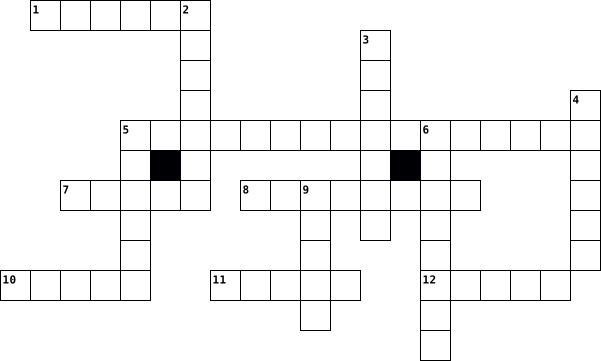
Across
- great, large
- The mother of Italy, Rome.
- bad
- these types of adjectives usually come before their nouns
- wide, broad
- good
- new
Down
- holy, sacred
- these types of adjectives usually come after their nouns
- small
- much, many
- eternal, everlasting
- high, deep
13 Clues: bad • new • good • small • much, many • high, deep • wide, broad • great, large • holy, sacred • eternal, everlasting • The mother of Italy, Rome. • these types of adjectives usually come after their nouns • these types of adjectives usually come before their nouns
1st Trimester Recap in Latin 2021-11-22

Across
- who or what the sentence is about
- tense for action that is taking place now
- families or groups of nouns that share the same sets of endings
- dominus
- completed action or a single event in the past
- who or what receives the action of the verb
- Latin word for Italy
- Who spoke the language you are studying?
- coquus
- Latin word for the capital city of the Roman Empire
- singular or plural in grammar
- young man
- the case of Latin nouns used for direct objects
- your favorite afternoon class
Down
- to hear
- the term for the relationship of the speaker to the subject of a verb
- banker
- to shout
- incomplete or repeated action in the past
- town where Metella lives
- the case of Latin nouns used for subjects
- canis
- turba
- spectare
- libertus
- he, she, it was
- these two letters signal the imperfect tense
27 Clues: canis • turba • banker • coquus • to hear • dominus • to shout • spectare • libertus • young man • he, she, it was • Latin word for Italy • town where Metella lives • singular or plural in grammar • your favorite afternoon class • who or what the sentence is about • Who spoke the language you are studying? • incomplete or repeated action in the past • tense for action that is taking place now • ...
CROSSWORD - Parts of Speech Class VIII 2024-09-06

Across
- 'Whoever', 'whomever' etc. are examples of ____ relative pronouns
- Indefinite pronouns do not refer to any ____ person, place or thing
- Noun ____ is group of words that acts like a noun but does not have a subject or a finite verb
- Pronouns that ask questions
- ____ introduces a non - restrictive clause
- Pronouns that relate to a preceding noun and connects it to the clause
- Pronouns that refer back to the subject forms of personal pronouns
- A noun clause is ____ clause
- Pronouns used to emphasize a subject
- _____ nouns is another name for subject complements
- Omission of articles using ____ article rule
- ____ complements describes, complete or modifiers the ____ of a clause
Down
- Pronouns that refer to the nouns already being discussed
- The noun replaced by a pronoun
- ____ article introduces an unspecified noun in a sentence
- They help in introduction of noun in either a specific or general reference
- Tangible nouns
- ____ article introduces a specific noun in a sentence
- It replaces a noun in a sentence
- 'That' introduces a ____ clause
20 Clues: Tangible nouns • Pronouns that ask questions • A noun clause is ____ clause • The noun replaced by a pronoun • 'That' introduces a ____ clause • It replaces a noun in a sentence • Pronouns used to emphasize a subject • ____ introduces a non - restrictive clause • Omission of articles using ____ article rule • _____ nouns is another name for subject complements • ...
Title 2021-09-13

Across
- nouns
- hyphen
- apostrophe
- marker
- full
Down
- overhead
- share
- pronounce
- mark
- stapler
10 Clues: mark • full • nouns • share • hyphen • marker • stapler • overhead • pronounce • apostrophe
Grammar 1 2025-11-02

Across
- Used to describe actions that started in the past and continue to the present ...
- Tells how, when, where, or to what extent ...
- Indicates when an action takes place ...
- The principal verb in a clause, expressing the primary action or state ...
- Refers to general things, not specific names ...
- Refers to more than one person, place, thing, or idea ...
- The past form of "be" used with plural subjects ...
- Refers to one person, place, thing, or idea ...
- Used for habitual actions, general truths, or facts ...
- Words that describe nouns ...
- Connects the subject to a word or group of words that describes or identifies the subject ...
- Verb Takes a direct object to complete its meaning ...
- Used with plural nouns or pronouns in the present, like "They ... happy"
- Helps the main verb express action or state of being ...
Down
- Connects words, phrases, or clauses of equal rank, like "but" or "or" ...
- Used with third-person singular subjects in the present simple tense ...
- Used to describe actions happening at the moment of speaking ...
- Expresses an action, occurrence, or state of being ...
- Takes the place of a noun, like "he," "she," or "it" ...
- A form of "be" used to show continuous action, like "I am ..."
- The form of "be" used with the pronoun "I"
- The past tense form of the verb "do" ...
- Used with singular nouns or pronouns in the past, like "I ... tired"
- Describes a noun, like "red" or "tall" ...
- The past participle of "be," often used with "have" or "has" ...
- Used to describe actions that happened and finished in the past ...
- Words that replace nouns ...
- Past Tense of "Have"...
- Names a person, place, thing, or idea ...
- Modify verbs, adjectives, or other adverbs ...
- Used with singular nouns or pronouns in the present, like "He ... here"
31 Clues: Past Tense of "Have"... • Words that replace nouns ... • Words that describe nouns ... • Indicates when an action takes place ... • The past tense form of the verb "do" ... • Names a person, place, thing, or idea ... • The form of "be" used with the pronoun "I" • Describes a noun, like "red" or "tall" ... • Tells how, when, where, or to what extent ... • ...
UNIT 18– PLEASE, TAKE A BOW 2022-05-06

Across
- __________: the mental state of knowing about something
- ________: a feeling or happiness and interest
- ___: It means "belonging to": freedom.
- ______: the ability to use your knowledge and experience to make good decisions.
- __:To become. Shorten, Thicken.
- _________: arrangement in which several people, organizations, etc. agree to take part in an activity together.
- ____________: an unhappy feeling when something is disappointing.
- ______: To form abstract nouns: affection, ambition.
Down
- ________: the feeling of being annoyed because you cannot achieve or do what you want.
- _________: the state of being very surprised.
- __________: the fact of belonging to a group or an organization.
- ___: English
- ________:a feeling that you want to do or have something, even though you know you should not.
- ____: It is added to nouns to form abstract nouns: motherhood.
- ____: useless
- ___: To make something, to become. Clarify, identify.
- __: Specific
17 Clues: ___: English • __: Specific • ____: useless • __:To become. Shorten, Thicken. • ___: It means "belonging to": freedom. • _________: the state of being very surprised. • ________: a feeling or happiness and interest • ______: To form abstract nouns: affection, ambition. • ___: To make something, to become. Clarify, identify. • ...
Adult Literacy Review 2025-01-21

Across
- An informal way to greet your friends.
- Great, extremely well.
- His name means "a noble wolf".
- Babysitters for the nouns (nouns hate to be alone)
- People named "Yana" are very ...
- Who is originally from Qazaqstan?
Down
- Words that describe actions.
- Continue the sentence "It was okay. Can't ..."
- How many children does Raul have?
- Words that describe things, places, names.
- Peter's name means...
- A funny word that means "small talk".
12 Clues: Peter's name means... • Great, extremely well. • Words that describe actions. • His name means "a noble wolf". • People named "Yana" are very ... • How many children does Raul have? • Who is originally from Qazaqstan? • A funny word that means "small talk". • An informal way to greet your friends. • Words that describe things, places, names. • ...
Gender lesson 2021-02-03

Across
- gender nouns are indicated by an ___ that precedes the noun.
- ___articles that contains el,la,los,las
- some nouns ____ conform to these rules
- ___names a person, place, thing, or concept
Down
- most nouns ending in -i or -r are ____
- both articles agree in ____ & number with the nouns they modify
- most nouns ending in -d or -ion are _____
- ___ articles contains un,una, and unos
- uno and una could mean ____ depending on context
9 Clues: most nouns ending in -i or -r are ____ • ___ articles contains un,una, and unos • some nouns ____ conform to these rules • ___articles that contains el,la,los,las • most nouns ending in -d or -ion are _____ • ___names a person, place, thing, or concept • uno and una could mean ____ depending on context • gender nouns are indicated by an ___ that precedes the noun. • ...
Subject-Verb Agreement 2021-10-08

Across
- __________ nouns are words that imply more than one person but are considered singular and take a singular verb. Some examples are "group," "team," "committee," "family," and "class."
- everybody is an example of ________ noun.
- ________ nouns take a singular verb.
- some countable nouns in _______ such as earnings, goods, odds, surroundings, proceeds, contents, and valuables only have a plural form and take a plural verb.
- indefinite _______
- When there is one subject and more than one ____, the _____ throughout the sentence must agree with the subject.
Down
- The words and phrases "each," "each one," "either," "neither," "everyone," "everybody," "anyone," "anybody," "nobody," "somebody," "someone," and "no one" are singular and _______ a singular verb.
- When a _______ comes between the subject and the verb, remember that the verb still agrees with the subject, not the noun or pronoun in the phrase following the subject of the sentence.
- When two or more singular nouns or pronouns are _________ by "or" or "nor," use a singular verb.
- usually have singular
- In sentences __________ with "there is" or "there are," the subject follows the verb. Since "there" is not the subject, the verb agrees with what follows the verb.
- If the subject is singular, the verb must be _______ too.
- make ____ plural.
- When the subject of the _________ is composed of two or more nouns or pronouns connected by and, use a plural verb.
- If the subject is ______, the verb must also be it.
- you add an "s"
16 Clues: you add an "s" • make ____ plural. • indefinite _______ • usually have singular • ________ nouns take a singular verb. • everybody is an example of ________ noun. • If the subject is ______, the verb must also be it. • If the subject is singular, the verb must be _______ too. • ...
ALC - BOOK 4 - Unit 8 - Ride a bicycle if you want to lose weight 2024-12-22

Across
- a person whose job is to supervise someone or something
- a device for weighing things or people
- a synonym of "be on a diet" (4W)
- having a short distance between two sides
- to measure the heaviness of an object by using a scale
- the substance under the skin of humans and animals that stores energy and keeps them war
- a large amount of, or a lot of something (used with uncountable nouns)
- to increase in weight, speed, height, or amount
- small in size or amount, used with uncountable nouns (2W)
- the food and drink usually eaten or drunk by a person or group
Down
- the past form of the verb "go"
- a two-wheeled vehicle that you sit on and move by turning the two pedals
- how heavy something or someone is measured in kilos or pounds
- eating less food, or only particular types of food, because you want to become thinner or for medical reasons (4W)
- the past participle form of the verb "gone"
- to limit the food and/or drink that you have, especially in order to lose weight
- having a large distance between two sides, similar to "fat" but for objects
- a large number of, or a lot of something (used with countable nouns)
- to become thinner, not to be as heavy as before (2W)
- some, or a small number of something, used with countable nouns (2W)
- lots (of) a large amount or number of people or things (2W)
21 Clues: the past form of the verb "go" • a synonym of "be on a diet" (4W) • a device for weighing things or people • having a short distance between two sides • the past participle form of the verb "gone" • to increase in weight, speed, height, or amount • to become thinner, not to be as heavy as before (2W) • to measure the heaviness of an object by using a scale • ...
Parts of Speech 2023-01-19

Across
- piece
- "the," "a," and "an"
- describes nouns
- exclamation
- person, place, etc.
- communication
Down
- rules of language
- a relationship word
- a connecting word
- describes non-nouns
- substitute for a noun
- action, etc.
12 Clues: piece • exclamation • action, etc. • communication • describes nouns • rules of language • a connecting word • a relationship word • describes non-nouns • person, place, etc. • "the," "a," and "an" • substitute for a noun
What a Bargain! 2022-03-14
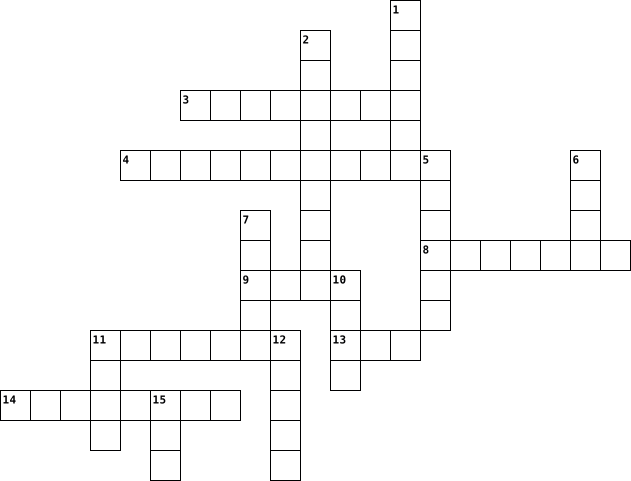
Across
- sandal is the ... form of sandals
- nouns are difficult to count
- $120 (one ... and twenty dollars)
- repeating plural nouns
- $120 (one ... and twenty dollars)
- the opposite word of new
- a bag with shoulder straps that allow it to be carried on one's back
Down
- boots are the ... form of boot
- nouns are easy to count
- $89.99 (...-nine dollars and ninety-nine cents)
- "... people like small cats."
- a covering for the hand worn for protection against cold or dirt and typically having separate parts for each finger and the thumb
- a singular form of shoes
- a long walk, especially in the country or wilderness
- the opposite word of clean
- "Do you have ... money?"
16 Clues: repeating plural nouns • nouns are easy to count • a singular form of shoes • the opposite word of new • "Do you have ... money?" • the opposite word of clean • nouns are difficult to count • "... people like small cats." • boots are the ... form of boot • sandal is the ... form of sandals • $120 (one ... and twenty dollars) • $120 (one ... and twenty dollars) • ...
Lesson 21 Vocabulary 2023-09-28

Across
- leader, genitive
- Masculine and feminine nouns of the 3rd Declension have the _____ endings
- soldier, genitive
- king, nominative
- father, nominative
- brother, genitive
- sister, nominative
- The ______ case singular form has a variable ending
- soldier, nominative
- To find the stem for 3rd Declension nouns you drop the -is from the _____ case singular ending.
Down
- Adjective agree with a Latin noun in gender, case, and number but not _____.
- mater nurturing mother
- sister, genitive
- leader, nominative
- mother, genitive
- father, genitive
- king, genitive
- brother, nominative
- mother, nominative
19 Clues: king, genitive • leader, genitive • sister, genitive • mother, genitive • king, nominative • father, genitive • soldier, genitive • brother, genitive • leader, nominative • father, nominative • sister, nominative • mother, nominative • brother, nominative • soldier, nominative • mater nurturing mother • The ______ case singular form has a variable ending • ...
GRAMMAR THREADS 2012-06-27
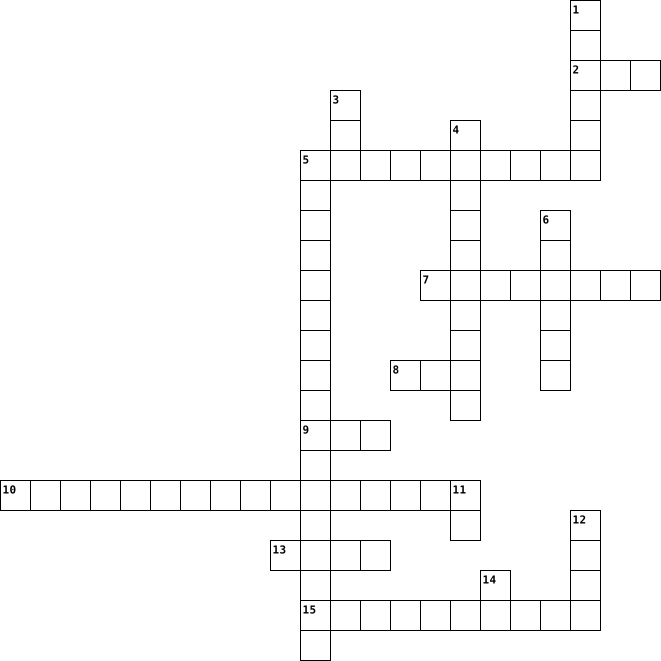
Across
- Subject pronoun "I" G
- The name of the verb
- One only
- "You" one stranger G
- "You" lots of friends G
- "I have a cat" G
- "Her" for feminine nouns F
- "We play" F
Down
- Infinitive endings F
- "My" for masculine nouns F
- "We play" G
- "I don't have a dog" G
- Not singular
- Infinitive ending G
- "You" one stranger F
- "You" one friend G
16 Clues: One only • "We play" G • "We play" F • Not singular • "I have a cat" G • "You" one friend G • Infinitive ending G • Infinitive endings F • The name of the verb • "You" one stranger G • "You" one stranger F • Subject pronoun "I" G • "I don't have a dog" G • "You" lots of friends G • "My" for masculine nouns F • "Her" for feminine nouns F
quantifiers 2022-12-07

Across
- COUNTABLE/UNCOUNTABLE IN AFFIRMATIVE SENTENCES.
- UNCOUNTABLE NOUNS - NOT ENOUGH.
- COUNTABLE IN NEGATIVE AND INTERROGATIVE SENTENCES.
- COUNTABLE NOUNS - POSITIVE MEANING.
Down
- COUNTABLE/UNCOUNTABLE, AFFIRMATIVE SENTENCES AND INTERROGATIVE TO MAKE OFFERS.
- UNCOUNTABLE NOUNS - POSITIVE MEANING.
- COUNTABLE NOUNS - NOT ENOUGH.
- COUNTABLE/UNCOUNTABLE, NEGATIVE AND INTERROGATIVE SENTENCES.
- UNCOUNTABLE IN NEGATIVE AND INTERROGATIVE SENTENCES.
9 Clues: COUNTABLE NOUNS - NOT ENOUGH. • UNCOUNTABLE NOUNS - NOT ENOUGH. • COUNTABLE NOUNS - POSITIVE MEANING. • UNCOUNTABLE NOUNS - POSITIVE MEANING. • COUNTABLE/UNCOUNTABLE IN AFFIRMATIVE SENTENCES. • COUNTABLE IN NEGATIVE AND INTERROGATIVE SENTENCES. • UNCOUNTABLE IN NEGATIVE AND INTERROGATIVE SENTENCES. • COUNTABLE/UNCOUNTABLE, NEGATIVE AND INTERROGATIVE SENTENCES. • ...
Quantifier Practice 2026-04-14

Across
- Implies a disappointingly small amount of something uncountable
- Zero quantity; works with both count and non-count nouns
- Used in positive statements and offers; "___ milk, please?"
- Non-count nouns only; "How ___ sugar do you want?"
- Used in questions and negatives; "Do you have ___ juice?"
Down
- Works with both count and non-count nouns; "She has ___ friends"
- Implies a disappointingly small number of things
- A few but not a huge number; count nouns only
- Count nouns only; "There are ___ apples on the table"
9 Clues: A few but not a huge number; count nouns only • Implies a disappointingly small number of things • Non-count nouns only; "How ___ sugar do you want?" • Count nouns only; "There are ___ apples on the table" • Zero quantity; works with both count and non-count nouns • Used in questions and negatives; "Do you have ___ juice?" • ...
ENGLISH-1 CA2 TEJANSH 6A 2022-08-16

Across
- this determine is used for singular and plural nouns.
- this quantifier tells a large number of quantity.
- this quantifier means nothing
- this demonstrative is used with plural nouns that are near to the speaker.
- refers to each person or thing individualy
- this demonstrative used with singular nouns that refer to things that are near the speaker.
Down
- this demonstrative is used with plural nouns that are short or long distance away from the speaker.
- this quantifier tells a small number of quantity.
- this demonstrative is used with a singular nouns that are short or long distance away from the speaker.
- this determine is used when the noun starts with a vowel sound.
10 Clues: this quantifier means nothing • refers to each person or thing individualy • this quantifier tells a small number of quantity. • this quantifier tells a large number of quantity. • this determine is used for singular and plural nouns. • this determine is used when the noun starts with a vowel sound. • ...
Nouns and Pronouns 2023-02-03

Across
- Noun that names more than one thing/people/place.
- Nouns that show ownership of something.
- Noun that can be felt with all five senses.
- Nouns that name the female gender.
- Pronoun that is used for an object or animal.
- Female pronouns that are formed by adding the self.
Down
- Noun that is used for a group of people or things.
- Nouns that name a particular person, place, or things.
- Nouns that name the male gender.
- Noun that can't be felt with all five senses.
- A type of pronoun that is formed when self/selves are added.
11 Clues: Nouns that name the male gender. • Nouns that name the female gender. • Nouns that show ownership of something. • Noun that can be felt with all five senses. • Noun that can't be felt with all five senses. • Pronoun that is used for an object or animal. • Noun that names more than one thing/people/place. • Noun that is used for a group of people or things. • ...
Grammar Review I 2022-04-21

Across
- verbals being nouns
- a, an, some
- the
- describes a verb, adj, or adverb
- who or what the sentence is abou
- root form of a verb
- person place or thing
- everyday names of things
- action or state of being
- specific names of things
Down
- verb takes a DO
- describes a noun
- root form of verb
- verb doesn't take a DO
- noun can see hear smell etc
- combines 2 independent clauses
- ideas that are things
- owns something
- verbs acting like nouns adj
- verbals being adj
- takes the place of a noun
21 Clues: the • a, an, some • owns something • verb takes a DO • describes a noun • root form of verb • verbals being adj • verbals being nouns • root form of a verb • ideas that are things • person place or thing • verb doesn't take a DO • everyday names of things • action or state of being • specific names of things • takes the place of a noun • noun can see hear smell etc • verbs acting like nouns adj • ...
Parts of Speech Crossword 2022-09-13
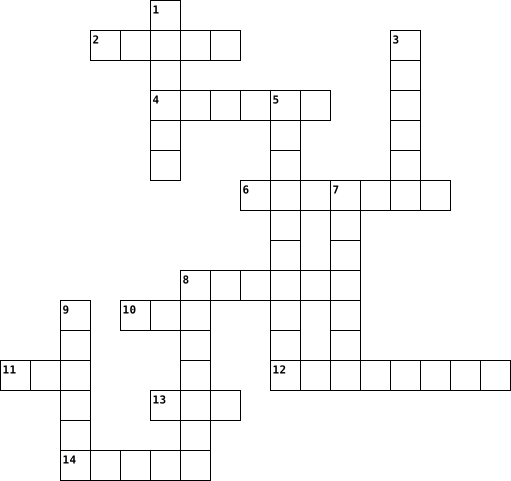
Across
- _________ are action words.
- More than 1 person, place, or thing.
- _____________ verbs come before the main.
- __________ verbs come after helping verbs in a sentence.
- An example of a _____ person is "you".
- An example of a _____ person is "I" or "we".
- One person, place, or thing.
- An example of a _____ person is "he", "she", "it" and "they"
- A person, place, thing, or idea.
Down
- ___________ nouns are always NAMES of common nouns *These words ARE always capitalized*.
- __________ noun are general people, places, and things *These words are NOT capitalized*.
- A word describing a noun.
- A word replacing a noun.
- A word describing a verb.
- verbs in a sentence to help them out.
15 Clues: A word replacing a noun. • A word describing a noun. • A word describing a verb. • _________ are action words. • One person, place, or thing. • A person, place, thing, or idea. • More than 1 person, place, or thing. • verbs in a sentence to help them out. • An example of a _____ person is "you". • _____________ verbs come before the main. • ...
English 3 2018-10-15

Across
- meaning of magnum opus
- interrogative pronoun that asks who owns something
- the first words that Charlotte weaved into her web
- words that replace nouns
- Many, a few, and several are quantifiers of _______ nouns
- near the ground or not proud
- demonstrative pronoun that points to singular and near objects
Down
- _______ pronouns are used to show possession
- subject pronoun, first person-plural
- I want to go to a museum with ________ friends.
- object pronoun, first person-plural
- demonstrative pronoun that points to plural and far objects
- A little, an amount of, much are quantifiers of _________ nouns.
- interrogative pronoun that can be used as an object of a sentence
14 Clues: meaning of magnum opus • words that replace nouns • near the ground or not proud • object pronoun, first person-plural • subject pronoun, first person-plural • _______ pronouns are used to show possession • I want to go to a museum with ________ friends. • interrogative pronoun that asks who owns something • the first words that Charlotte weaved into her web • ...
English 3 2018-10-15

Across
- meaning of magnum opus
- interrogative pronoun that asks who owns something
- the first words that Charlotte weaved into her web
- words that replace nouns
- Many, a few, and several are quantifiers of _______ nouns
- near the ground or not proud
- demonstrative pronoun that points to singular and near objects
Down
- _______ pronouns are used to show possession
- subject pronoun, first person-plural
- I want to go to a museum with ________ friends.
- object pronoun, first person-plural
- demonstrative pronoun that points to plural and far objects
- A little, an amount of, much are quantifiers of _________ nouns.
- interrogative pronoun that can be used as an object of a sentence
14 Clues: meaning of magnum opus • words that replace nouns • near the ground or not proud • object pronoun, first person-plural • subject pronoun, first person-plural • _______ pronouns are used to show possession • I want to go to a museum with ________ friends. • interrogative pronoun that asks who owns something • the first words that Charlotte weaved into her web • ...
Derek's EFL Grammar Crossword 1 2023-05-28
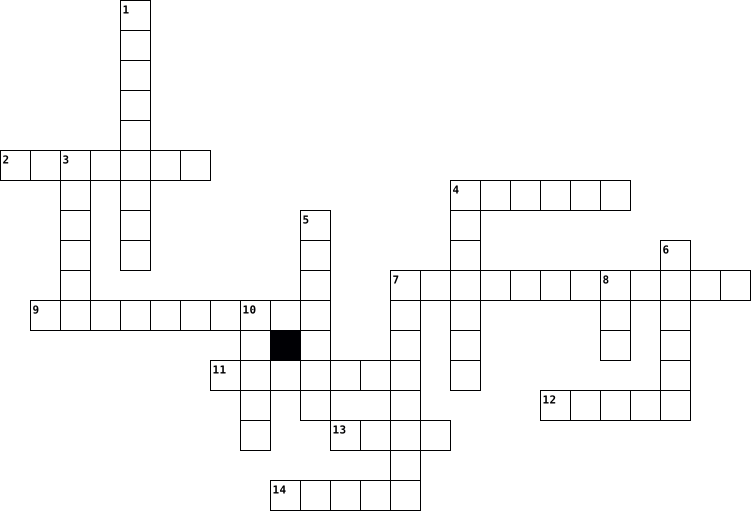
Across
- every sentence starts with one of these
- what part of speech is "really", as in, "He ran really fast"?
- these are words such as: under, to, beside, toward
- modifies or tells us about nouns
- "she" is an example of what part of speech?
- simple past of "sleep"
- a person, place, or thing
- love and hate are what kind of words in grammar?
Down
- what part of speech is "small", as in "a small cat"?
- most, but not all, sentences end with one of these
- these modify verbs, adjectives, and other adverbs
- to show you do something regularly (every day, for example),you use this tense
- simple past of buy
- these take the place of nouns
- a, an, _____
- action words are these
16 Clues: a, an, _____ • simple past of buy • action words are these • simple past of "sleep" • a person, place, or thing • these take the place of nouns • modifies or tells us about nouns • every sentence starts with one of these • "she" is an example of what part of speech? • love and hate are what kind of words in grammar? • these modify verbs, adjectives, and other adverbs • ...
Determiners: Demonstratives and Quantifiers 2022-08-16

Across
- Used with plural nouns referring to things far
- Used with singular nouns referring to things near
- Used in small quantity but is used in questions
- Used in place of some in negative questions
- Means more than two but not many
Down
- Used with plural nouns referring to things near
- Used with singular nouns referring to things far
- Means one or the other
- Refers to total number or quantity
- Used to refer to a small number or quantity
10 Clues: Means one or the other • Means more than two but not many • Refers to total number or quantity • Used in place of some in negative questions • Used to refer to a small number or quantity • Used with plural nouns referring to things far • Used with plural nouns referring to things near • Used in small quantity but is used in questions • ...
Progress check Units 1-2 2025-05-27

Across
- – A word used with uncountable nouns like “water” or “furniture”.
- – You are this if you have lots of original ideas.
- – The room at the top of a house, under the roof.
- – To start a machine, like the lights or the TV.
- – To have a good relationship with someone.
- – The opposite of hard-working.
- – You sit or sleep on this at home (it's uncountable).
- – An adverb of frequency meaning 100% of the time.
- – To make a place tidy and remove mess.
- – You say "please" and "thank you" because you are ____.
- – A place to keep your car.
Down
- – Someone who speaks a lot is very ____.
- – To start living in a new house.
- – Someone you can trust is ____.
- – You stand on this outside your apartment on the first floor.
- – To stop doing something, often because it's hard.
- – Nouns like “milk” or “sugar” are ____.
- – It covers the top of your house
- – Nouns like “apple” or “book” are ____.
- – To take care of someone or something.
20 Clues: – A place to keep your car. • – The opposite of hard-working. • – Someone you can trust is ____. • – To start living in a new house. • – It covers the top of your house • – To make a place tidy and remove mess. • – To take care of someone or something. • – Someone who speaks a lot is very ____. • – Nouns like “milk” or “sugar” are ____. • ...
Grammar Crossword 2023-02-15
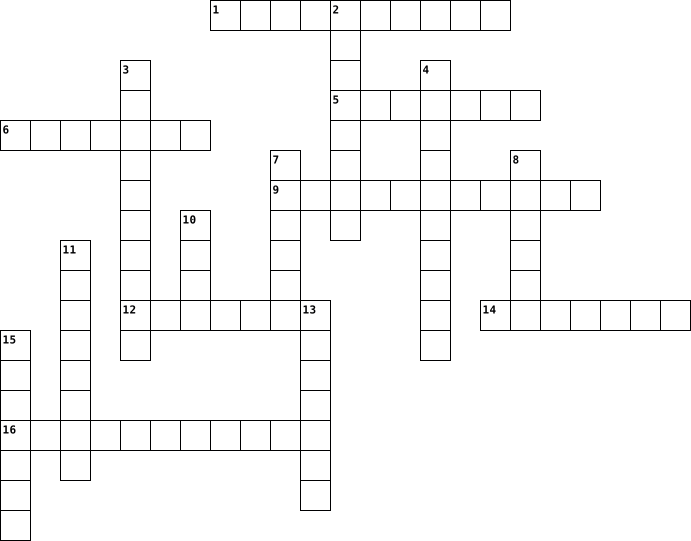
Across
- modify Nouns/Pronouns
- can take the place of Nouns
- modifies all things not Nouns/Pronouns
- these words link things together
- verbs that are form of the Verb 'to be'
- verbs that come before the main verb
- begins a phrase that often indicates a location in either space or time
Down
- sentence made up of two or more simple sentences linked together
- verbs that end in either -ed or -ing that function like Adjectives
- to + verb that will function as either a Noun, Adjective, or Adverb
- type of verbs such as Run, Write, Paint
- basic sentence with a Subject and Predicate
- person, place, thing, quality, or idea
- the words a, an, the are known as
- verbs ending in -ing that function as a Noun
- sentence with a dependent and independent clause
16 Clues: modify Nouns/Pronouns • can take the place of Nouns • these words link things together • the words a, an, the are known as • verbs that come before the main verb • modifies all things not Nouns/Pronouns • person, place, thing, quality, or idea • type of verbs such as Run, Write, Paint • verbs that are form of the Verb 'to be' • basic sentence with a Subject and Predicate • ...
Word Fun #1 2021-11-16

Across
- A language spoken using one's hands
- Words like "of, from, with, without, below"
- Words that are shortened like "can't, won't"
- Words that are a person, place, thing, or idea
- A language spoken in the USA
Down
- Words that join ideas like "but, and, so"
- Words that state action
- Words that describe verbs
- The number of letters in the English alphabet
- Words that replace nouns like "he, she, I, you"
- Words that describe nouns
- A language spoken in Latin America and the USA
12 Clues: Words that state action • Words that describe verbs • Words that describe nouns • A language spoken in the USA • A language spoken using one's hands • Words that join ideas like "but, and, so" • Words like "of, from, with, without, below" • Words that are shortened like "can't, won't" • The number of letters in the English alphabet • ...
Grammar Crossword 2018-12-03

Across
- Not specific.
- Sentences that end with exclamation marks.
- Ends with a question mark.
- Title that precedes a name but not follows.
- noun General category of nouns.
Down
- Telling someone to do something.
- Is most common and ends in a period.
- Proper Nouns are very--
- Person, place, thing, idea.
- Noun Special names for common nouns.
10 Clues: Not specific. • Proper Nouns are very-- • Ends with a question mark. • Person, place, thing, idea. • Telling someone to do something. • noun General category of nouns. • Is most common and ends in a period. • Noun Special names for common nouns. • Sentences that end with exclamation marks. • Title that precedes a name but not follows.
WH-QUESTIONS 2024-07-14

Across
- Explanation
- Uncountable nouns
- People
- Choice
- Questions that start with WH
Down
- Manner
- Thing
- Countable nouns
- Time
- Place
10 Clues: Time • Thing • Place • Manner • People • Choice • Explanation • Countable nouns • Uncountable nouns • Questions that start with WH