
physical Crossword Puzzles
Physical appearance (Simple Present) 2020-08-06

Across
- No hair in my head means I am _____
- Bruno mars is very _____.
- My grandmother is old. She is ______
- ____ you from Bolivia?
- Do you _____ black hair?
- The opposite of heavy is _______
- My brother is very young. He __ __ ____
- Shakira has _____ hair
Down
- I'm not tall or short. I am _____ ____
- He doesn't have curly hair. He has ___ hair
- what _____ he look like?
- My sister ____ blue eyes
- Right now, we are studying the ____ ____
- ___ your brother tall?
14 Clues: ____ you from Bolivia? • ___ your brother tall? • Shakira has _____ hair • what _____ he look like? • Do you _____ black hair? • My sister ____ blue eyes • Bruno mars is very _____. • The opposite of heavy is _______ • No hair in my head means I am _____ • My grandmother is old. She is ______ • I'm not tall or short. I am _____ ____ • My brother is very young. He __ __ ____ • ...
Physical Change Chemical Change 2020-10-07

Across
- When 2 or more substances combine and a chemical change hasn't occurred
- Properties Can be observed without chemically changing the mater
- How much space an object takes up
- Allows electricity to flow through it easily
- Ability to be dissolved easily
- of Matter solids, liquids, and gases
Down
- Cable of being shaped or bent
- Point Temperature at which the liquid freezes, Water freezes at 0 Celsius
- Ability to be hammered or shaped under pressure without breaking
- Attraction to a magnet
- Resistance of a liquid to flow
- Ability of an object to float in water or air
- Measure of how compact an object is
- degree of shininess of an object
14 Clues: Attraction to a magnet • Cable of being shaped or bent • Resistance of a liquid to flow • Ability to be dissolved easily • degree of shininess of an object • How much space an object takes up • Measure of how compact an object is • of Matter solids, liquids, and gases • Allows electricity to flow through it easily • Ability of an object to float in water or air • ...
Health and Physical Education 2024-02-20

Across
- Man's best friend
- when football is kicked between goal posts
- helps repair muscles
- Has a trunk
- Large marsupial
- sides players over the neutral zone
Down
- championship game for football
- all 4 bases in one hit
- feeling stressed and overwhelmed
- lack of water
- Flying mammal
- your fellow player
- Likes to chase mice
- Physical Activity in game form
14 Clues: Has a trunk • lack of water • Flying mammal • Large marsupial • Man's best friend • your fellow player • Likes to chase mice • helps repair muscles • all 4 bases in one hit • championship game for football • Physical Activity in game form • feeling stressed and overwhelmed • sides players over the neutral zone • when football is kicked between goal posts
Physical Health Crossword Puzzle 2023-06-21

Across
- What to avoid 3 hour before going to bed
- Averages amount of hours kids between 13-18 years old
- Fat's historic nemesis but they are both unhealthy
- 24% of people's sugar intake comes from this
- Waxy, fat-like substance can be healthy or unhealthy
- What to stop using 1 hour before going to bed
Down
- What to stop 2 hours before going to bed
- Healthier alternative to red meat
- Disease with the leading cause of death in the US
- Effective goal setting method and criteria
- Health of your body from the amount of disease to fitness
- Percent of high schoolers that do not get enough sleep
- Minutes a day of exercises recommended for kids ages 6 - 17
- Healthier type of carbs that take longer to digest
14 Clues: Healthier alternative to red meat • What to stop 2 hours before going to bed • What to avoid 3 hour before going to bed • Effective goal setting method and criteria • 24% of people's sugar intake comes from this • What to stop using 1 hour before going to bed • Disease with the leading cause of death in the US • Fat's historic nemesis but they are both unhealthy • ...
physical science crossword puzzle 2023-02-03

Across
- created the periodic table
- family on the periodic table including bromine
- a subatomic particle found in the nucleus of every atom except that of simple hydrogen
- the life-supporting component of the air
- the basic unit of a chemical element
- table a table of the chemical elements
- a yellow combustible nonmetal
- fundamental constituent of matter
Down
- a solid material that is typically hard
- stable subatomic particle with a charge of negative electricity
- number the number of protons in the nucleus of an atom
- element or substance that is not a metal
- a yellow precious metal
- the positively charged central core of an atom
14 Clues: a yellow precious metal • created the periodic table • a yellow combustible nonmetal • fundamental constituent of matter • the basic unit of a chemical element • table a table of the chemical elements • a solid material that is typically hard • element or substance that is not a metal • the life-supporting component of the air • family on the periodic table including bromine • ...
physical science crossword puzzle 2023-02-03

Across
- created the periodic table
- a solid material that is typically hard
- element or substance that is not a metal
- a yellow precious metal
- a subatomic particle found in the nucleus of every atom except that of simple hydrogen
- mass the mass of an atom of a chemical element expressed in atomic mass units.
- number the number of protons in the nucleus of an atom
Down
- stable subatomic particle with a charge of negative electricity
- the positively charged central core of an atom
- table a table of the chemical elements
- family on the periodic table including bromine
- the life-supporting component of the air
- a yellow combustible nonmetal
- the basic unit of a chemical element
- fundamental constituent of matter
15 Clues: a yellow precious metal • created the periodic table • a yellow combustible nonmetal • fundamental constituent of matter • the basic unit of a chemical element • table a table of the chemical elements • a solid material that is typically hard • element or substance that is not a metal • the life-supporting component of the air • the positively charged central core of an atom • ...
Middle East Physical Geography 2023-03-09

Across
- Much of the ME relies on this resource for their wealth
- Controls worldwide oil prices
- Named because of high salinity levels
- Much of the Middle East was controlled by this empire for many centuries
- Expensive process to remove salt from oceanwater
- Middle East's largest desert
- Cut travel from England to India from over 12,000 miles to nearly 7,200 miles
Down
- Provides hydroelectric power to much of Egypt
- Many ME countries didn't gain this until the 20th century
- interpreting the world from a European worldview
- Considered the "Turkey Sandwich" of the world (per Ms. Husa)
- Riverbeds that remain dry most of the year
- 95% of Egypt's population lives alongside it
- The Middle East can also be called _________
14 Clues: Middle East's largest desert • Controls worldwide oil prices • Named because of high salinity levels • Riverbeds that remain dry most of the year • 95% of Egypt's population lives alongside it • The Middle East can also be called _________ • Provides hydroelectric power to much of Egypt • interpreting the world from a European worldview • ...
Physical and Cognitive Development 2023-05-18

Across
- Increased risk for heart disease, and other problems later in life. Has increased since the 1960's
- Information is not saved
- Unlimited capacity to store information
- Coming to conclusions based on past experience
- This gender usually has a prepubescent growth spurt first
Down
- The understanding that changing one quality of an object can be compensated for by the changes in another quality of that object
- Ways of organizing information
- These slow during middle childhood
- Limited amount of information kept
- Recommended solution for obesity
- Objects can be changed or altered to original states
- Children will use logic to solve problems
- These sharpen during middle childhood
- This has reached its adult size but doesn't stop developing
14 Clues: Information is not saved • Ways of organizing information • Recommended solution for obesity • These slow during middle childhood • Limited amount of information kept • These sharpen during middle childhood • Unlimited capacity to store information • Children will use logic to solve problems • Coming to conclusions based on past experience • ...
Physical Changes of Ageing 2022-04-02

Across
- Most common cause of dementia
- Cloudy lens in the eye
- Chest pain
- Reduced sense of smell
- Tough band holding joint together
- Clogging of arteries with fatty deposits
- Ringing or buzzing in the ears
Down
- Bony spur
- Increased pressure in the eye
- Heart and blood vessels
- Muscle contractions in digestive system
- Condition affecting the joints
- When you take in less fluid than you use
- Soft tissue that protects the bone
14 Clues: Bony spur • Chest pain • Cloudy lens in the eye • Reduced sense of smell • Heart and blood vessels • Increased pressure in the eye • Most common cause of dementia • Condition affecting the joints • Ringing or buzzing in the ears • Tough band holding joint together • Soft tissue that protects the bone • Muscle contractions in digestive system • When you take in less fluid than you use • ...
Australian Physical Activity Guidelines 2025-02-05

Across
- How hard the exercise is
- Duration of exercise
- Meeting the APAG will improve your _______, a mental health and wellbeing benefit.
- Meeting the APAG will assist to lower your levels of ______ and anxiety.
- Not moving, sitting on the couch
- An intensity level where you could talk but not hold a conversation
- __ days per week should include vigorous and bone strengthening activities for young people
Down
- Meeting the APAG will lower your chances of ____ _____.
- Physical activity time recommended daily for young people
- Number of times per week
- An intensity level where it is difficult to talk
- Meeting the APAG will lower your risk of ______________
- hours Young people should not spend more than ___ ____ on screens outside of school time
- Improved ________ at school is a benefit to meeting the Australian Physical Activity Guidelines
14 Clues: Duration of exercise • How hard the exercise is • Number of times per week • Not moving, sitting on the couch • An intensity level where it is difficult to talk • Meeting the APAG will lower your chances of ____ _____. • Meeting the APAG will lower your risk of ______________ • Physical activity time recommended daily for young people • ...
Physical and Chemical Changes 2023-11-01

Across
- Lighting a scented candle is a change in...
- A word that means unmixable
- Chemical changes can't be...
- Burning a match gives us release of...
- Rock to lava
- Baking a pie gives us change in...
- Solid to Gas
- Water to ice
Down
- Making slime from glue and activator is a formation of a new...
- A new type of matter is formed is a ____ change.
- No new matter is formed is a ____ change.
- Cooking pasta needs a change in...
- Liquid to Gas
- Alka seltzer and water give us release of...
14 Clues: Rock to lava • Solid to Gas • Water to ice • Liquid to Gas • A word that means unmixable • Chemical changes can't be... • Cooking pasta needs a change in... • Baking a pie gives us change in... • Burning a match gives us release of... • No new matter is formed is a ____ change. • Lighting a scented candle is a change in... • Alka seltzer and water give us release of... • ...
Physical Properties of Matter 2024-11-10

Across
- - The amount of space an object occupies.
- - Material that does not easily allow the flow of heat or electricity.
- - The temperature at which a solid turns into a liquid.
- - The ability of a substance to conduct heat or electricity.
- - A state of matter with a definite volume but no definite shape.
- - The feel, appearance, or consistency of a surface or substance.
- - A state of matter with a definite shape and volume.
Down
- - The temperature at which a liquid turns into a gas.
- - The force exerted by gravity on an object.
- - The amount of matter in an object.
- - A state of matter without a definite shape or volume.
- - The ability of a substance to dissolve in another substance.
- - Material that allows the flow of heat or electricity.
- - Mass per unit volume of a substance.
14 Clues: - The amount of matter in an object. • - Mass per unit volume of a substance. • - The amount of space an object occupies. • - The force exerted by gravity on an object. • - The temperature at which a liquid turns into a gas. • - A state of matter with a definite shape and volume. • - A state of matter without a definite shape or volume. • ...
Physical Pharmacy Unit 1 2025-08-06

Across
- Vehicle used to prepare aerosol is known as
- Conversion of a solid to vapour after reduction of pressure is called,
- Molecular weight is ____________ type of physicochemical property of a substance
- As per phase rule at this stage the system becomes invariant
- In ideal gas equation _______ law relates volume and pressure
- The pressure exerted by a single gas within a mixture of gases as if it were the only gas present in the container is called
- A graphical presentation or an equation which correlates the state of a substance at equilibrium at given conditions of temperature and pressure is called _________ phase rule
- Osmotic pressure of a substance is ________ type of physicochemical property
Down
- It is a state of matter above the critical temperature,
- pressure The pressure exerted by a vapor in thermodynamic equilibrium with its condensed phase in a closed system at a specific temperature is called
- Smallest unit of a crystal is called as
- The relationship between vapour pressure and absolute temperature of the system is given by ________ equation
- When a gas is allowed to expand so rapidly that no heat enters the system this expansion is called as______
- the law that forms a fundamental of X ray diffraction,
14 Clues: Smallest unit of a crystal is called as • Vehicle used to prepare aerosol is known as • the law that forms a fundamental of X ray diffraction, • It is a state of matter above the critical temperature, • As per phase rule at this stage the system becomes invariant • In ideal gas equation _______ law relates volume and pressure • ...
Physical Science Vocab Words 2022-04-19

Across
- A homogeneous mixture of two or more components
- A change in a substance that can be reversed.
- A state of matter that has no fixed volume or shape
- A chart used to show percentages.
- Consisting of parts of the same kind.
- Remove or take out by force.
- is defined as a substance that is intended to be used for certain applications.
Down
- A graph used to show information over a period of time.
- A state of matter that has a definite volume, but no fixed shape
- Consisting of different parts.
- A graph used to compare data points.
- The act of combining parts or elements to form a whole.
- change. A change in substances that typically cannot be undone.
- Propagation of disturbances from place to place in a regular and organized way.
14 Clues: Remove or take out by force. • Consisting of different parts. • A chart used to show percentages. • A graph used to compare data points. • Consisting of parts of the same kind. • A change in a substance that can be reversed. • A homogeneous mixture of two or more components • A state of matter that has no fixed volume or shape • ...
Physical properties of matter 2023-01-24

Across
- lets light pass but it is scattered
- can be shaped by pressing without it cracking
- doesnt allow electric currents
- allows heat to pass throught it
- Breaks suddenly if it bends
Down
- has holes in its surface throught which water
- allows electrical currents to pass
- Lets light pass throught it
- Cannot be squashed
- does not let heat pass through it
- Does not let any light in
- can be bent or squashed
- does not let water pass through it
- A material is rigid
14 Clues: Cannot be squashed • A material is rigid • can be bent or squashed • Does not let any light in • Lets light pass throught it • Breaks suddenly if it bends • doesnt allow electric currents • allows heat to pass throught it • allows electrical currents to pass • does not let heat pass through it • does not let water pass through it • lets light pass but it is scattered • ...
Physical Properties of Matter 2023-01-24

Across
- Lets light pass through it
- Shaped by hammering or pressing
- Doesn't let electricity pass
- does let heat pass through
- Suddenly breaks if hit or bent
Down
- Water can pass through it
- Lets electricity pass through
- Is see-through
- Cannot be bent or squashed
- Does not let heat pass through
- Doesn't let light pass through it
- Can be bent or squashed
- Does not let water pass
- Is not flexible
14 Clues: Is see-through • Is not flexible • Can be bent or squashed • Does not let water pass • Water can pass through it • Lets light pass through it • Cannot be bent or squashed • does let heat pass through • Doesn't let electricity pass • Lets electricity pass through • Does not let heat pass through • Suddenly breaks if hit or bent • Shaped by hammering or pressing • ...
US Physical Features & Climate 2022-07-18

Across
- Power created by running water
- The varying climate of a mountainous area
- The area between the Tropic of Cancer and the Tropic of Capricorn
- A climate from southeast Alaska to northern California that has mild, cloudy summers and wet winters
- Any form of business, trade, or making things by machines
- A climate with hot and humid summers and mild winters
Down
- A climate with long, cold winters and hot, wet summers; a climate with four different seasons
- A climate with very hot summers and very cold winters, with little precipiation
- A climate like that of countries near the Mediterranean Sea; mild, wet winters and hot, dry summers
- One of the seven large areas of land on Earth
- A group of rivers that join together
- A low area of land surrounded by higher land, often mountains
- The level at the surface of the ocean
- A smaller river that flows into a larger one
14 Clues: Power created by running water • A group of rivers that join together • The level at the surface of the ocean • The varying climate of a mountainous area • A smaller river that flows into a larger one • One of the seven large areas of land on Earth • A climate with hot and humid summers and mild winters • Any form of business, trade, or making things by machines • ...
Latin America Physical Features 2025-11-19

Across
- The Gran ____ is a vast, arid lowland plain that covers parts of ARG, BOL, PRY, & BRA. It's the 2nd largest forest in South America.
- The body of water in Latin America that contains islands of Haiti, the DR, and Puerto Rico.
- The Mexican ____ is a high plain that is found between the Sierra Madres.
- Peninsula that comprises parts of Belize and Guatemala, as well as three separate Mexican states.
- Sparsely populated area in parts of southern Chile and Argentina that contains mountains, glaciers, forests and fjords.
- A vast tropical grassland & savanna region in NW South America, located east of the Andes Mts in Colombia & Venezuela.
Down
- The ____ Desert is an extremely dry area located on the Pacific coast of South America, in the north of Chile.
- The Sierra Madre ____ are a large mountain range in Mexico that runs north to south along the east coast.
- The Sierra Madre ____ are a large mountain range in Mexico that runs north to south along the west coast.
- The Isthmus ____ is a narrow strip of land that connects North and South America.
- River that starts in the Andes & runs through much of northern South America. Its rainforest occupies 40% of the continent.
- The ____ of Mexico/America is a large inlet of the sea is located between the Florida and Yucatan peninsulas.
- Grassy plains in southeastern South America.
- Mountains in South America run through Venezuela, Colombia, Ecuador, Peru, Bolivia, Chile and Argentina.
14 Clues: Grassy plains in southeastern South America. • The Mexican ____ is a high plain that is found between the Sierra Madres. • The Isthmus ____ is a narrow strip of land that connects North and South America. • The body of water in Latin America that contains islands of Haiti, the DR, and Puerto Rico. • ...
PE words 2020-03-31

Across
- jog as fast as you can
- slow exercise
- gets you warmed up
- fast
- perseverance
- move hurriedly
- physical effort
- keeps you healthy
Down
- helps you see where you are in fitness levels
- what athletes are
- _____vascular exercise
- held push-up
- being physically healthy and fit
- required for physical activity
- being strong
15 Clues: fast • held push-up • perseverance • being strong • slow exercise • move hurriedly • physical effort • what athletes are • keeps you healthy • gets you warmed up • jog as fast as you can • _____vascular exercise • required for physical activity • being physically healthy and fit • helps you see where you are in fitness levels
Wellfinity Wellbeing Crossword 2020-04-05

Across
- a special course of food to which a person restricts themselves, either to lose weight or for medical reasons
- physically strong, fit, and active
- name of wellbeing brand
- strength and vitality required for sustained physical or mental activity
- focus one's mind for a period of time
- place to workout
- in good health, especially because of regular physical
- existing in or derived from nature
- form of activity
- an even distribution of weight enabling someone or something to remain upright and steady
Down
- state of wellness
- the way in which a person lives
- process of nuourishing
- group of organic compounds
- make or become less stressed
- a group of physical, mental, and spiritual practices
- engaging or ready to engage in physically energetic pursuits
17 Clues: place to workout • form of activity • state of wellness • process of nuourishing • name of wellbeing brand • group of organic compounds • make or become less stressed • the way in which a person lives • physically strong, fit, and active • existing in or derived from nature • focus one's mind for a period of time • a group of physical, mental, and spiritual practices • ...
Unit 1: Matter 2024-09-07

Across
- turn or convert (something) from one state, form, or substance into another
- anything that has mass and takes up space
- smallest unit of matter
- the fact of being who or what a person or thing is
- he particular condition
- a compound or substance that has been purified or prepared, especially artificially
- 2 or more atoms chemically connected together
- the chemical composition
- number number of electrons in the element
- the way in which a whole or mixture is made up
- the real physical matter of which a person or thing consists
Down
- a type of atom
- physical substance in general
- involving bodily contact or activity
- a mathematical relationship or rule expressed in symbols
- becoming a liquid form by heat
- symbol a set of symbols showing proportions of elements
- small number found behind the element
- pure substance made of 2 or more elements
- mass the weight of the element
20 Clues: a type of atom • smallest unit of matter • he particular condition • the chemical composition • physical substance in general • becoming a liquid form by heat • mass the weight of the element • involving bodily contact or activity • small number found behind the element • anything that has mass and takes up space • pure substance made of 2 or more elements • ...
Unit 1: Matter 2024-09-07

Across
- he particular condition
- the way in which a whole or mixture is made up
- anything that has mass and takes up space
- becoming a liquid form by heat
- the chemical composition
- smallest unit of matter
- symbol a set of symbols showing proportions of elements
- 2 or more atoms chemically connected together
- involving bodily contact or activity
Down
- physical substance in general
- the real physical matter of which a person or thing consists
- a mathematical relationship or rule expressed in symbols
- the fact of being who or what a person or thing is
- small number found behind the element
- number number of electrons in the element
- pure substance made of 2 or more elements
- a type of atom
- mass the weight of the element
- a compound or substance that has been purified or prepared, especially artificially
- turn or convert (something) from one state, form, or substance into another
20 Clues: a type of atom • he particular condition • smallest unit of matter • the chemical composition • physical substance in general • becoming a liquid form by heat • mass the weight of the element • involving bodily contact or activity • small number found behind the element • anything that has mass and takes up space • number number of electrons in the element • ...
KINS 101 Chapters 01-02 Crossword 2013-08-30

Across
- Transtheoretical model stage achieved when individual has kept up the changed behavior for at least six months
- Diseases related to an individual having low activity levels
- The F in FITT, how often you exercise
- The R in SMART goal, the goal should be reasonably achievable in the time allotted
- Broad concept encompassing multiple dimensions spanning body and mind
- The ability to do normal daily activities without undue fatigue
- Before an individual exercises, they should do this, including some light activity and stretching
- Federal Initiative which makes health-related goals each decade
- The body functioning properly, the absence of disease
- You must work harder than you're accustomed to in order to improve
Down
- An individual suffering from depression has poor __________ Wellness
- Health related fitness component involved with delivering oxygen to muscles
- An individual with good __________ Wellness has good physical fitness and health
- An individual with good ___________ Wellness Is capable of making good friends and positive interactions with others
- Transtheoretical model stage where the person acknowledges a need to change
- Health related fitness component involved with moving your joints through a full range of motion
- Replacing a bad behavior with a positive one
- You must create an activity plan which correctly targets the goals you've set
- The M in SMART goal, the goal should be quantifiable
- Planned physical effort with the purpose of improving physical fitness/health
20 Clues: The F in FITT, how often you exercise • Replacing a bad behavior with a positive one • The M in SMART goal, the goal should be quantifiable • The body functioning properly, the absence of disease • Diseases related to an individual having low activity levels • The ability to do normal daily activities without undue fatigue • ...
health crossword puzzle 2020-12-17

Across
- singling out or exuding a person based on their gender
- this is purposely frighting another person through threatening, looks or body language
- any kind of sexual intercourse with another person against their will
- uninvited and unwelcomed sexual conduct directed by another person
- is any individual who suffers injury, loss, or death due to violence
- occurs when a person forces another person to participate in a sexual act against his or her will
- a group whose members often use violence or take part in criminal activity
- the failure to meet a persons basic needs
- repeating abuse from one generation to the next
- any behavior that causes physical harm to a person or damage a property
- someone being mean to another person over and over again physically or mentally
Down
- is the physical, emotional, or mental mistreatment of one another
- physical abuse that occurs within a family
- the unlawful beating, hitting, or kicking of another person
- physical abuse that occurs within a family
- a policy that makes no exceptions for anybody for any reason
- is an ongoing conduct that offers another person by criticizing his or her race, religion, physical disability, or gender
- the buying or selling of drugs
- a toll-free telephone service where victims can get help and information
- the killing of one human being by another
- an unlawful threat or attempt to do bodily injury to another person
21 Clues: the buying or selling of drugs • the killing of one human being by another • the failure to meet a persons basic needs • physical abuse that occurs within a family • physical abuse that occurs within a family • repeating abuse from one generation to the next • singling out or exuding a person based on their gender • ...
Nutrition Unit 2017-04-10

Across
- a natural physical drive to eat
- heavier than the standard weight
- having excess body fat
- do specific activities to focus on building a specific body area
- when bones become fragile
- wanting food psychologically
- being able to do physical task over a long amount of time
- the process of taking substances from food for energy
- using heat to kill or slow pathogens
- the way you see your body
- structured physical activity to improve physical fitness
- when the body acts against stuff in food
- being able to move limbs in their full range of motion
- weight loss plans that aren't popular for very long
- when people starve themselves because they are afraid to gain weight
- damage to skin and tissues due to extreme cold
Down
- below standard weight
- taking in and using food
- when the body can no longer cool itself
- negative reaction to food not involving immune system
- starches and sugars found in food
- compounds in food to maintain body processes
- when people starve themselves because they are afraid to gain weight
- when a person overeats and purges to get rid of body fat
- nutrients used to maintain body cells and tissues
- preparing the body for hard work
- a carbohydrate that can't be digested
- a unit of heat
- a waxy fat substance
- elements the body gets from food
30 Clues: a unit of heat • a waxy fat substance • below standard weight • having excess body fat • taking in and using food • when bones become fragile • the way you see your body • wanting food psychologically • a natural physical drive to eat • heavier than the standard weight • preparing the body for hard work • elements the body gets from food • starches and sugars found in food • ...
Warren 8th Grade Science 2020-11-09

Across
- 2 or more DIFFERENT elements combined
- A measurement of how much mass an object has relative to its volume
- A specific type of atom. All of these are listed on the periodic table.
- True or false: burning is a physical change
- Unit for temperature in science
- Liquid has a _______ volume
- This type of change produces a new substance
- When going from a liquid to a gas, heat is _________
- A characteristic used to describe an object
- This type of change only affects an object's appearance
- A measure of how much matter is in an object
- Things in an experiment that are kept the same to avoid bias
- True or false: phase changes are always physical
- A measure of how much physical space an object occupies
- A measure of the force of gravity acting upon an object
Down
- Gas has a ______ shape
- 2 or more elements combined (including 2 of the SAME element)
- Variable measured by the scientist. This is affected by something else in the experiment.
- The smallest unit of matter. Means "uncuttable"
- The normal group used for comparison
- This phase of matter has a definite volume, but an indefinite shape
- Uses an "If/Then" format
- Variable manipulated by the scientist. The new condition they want to test out.
- Makes up everything around us
- When going from a liquid to a solid, heat is _______
25 Clues: Gas has a ______ shape • Uses an "If/Then" format • Liquid has a _______ volume • Makes up everything around us • Unit for temperature in science • The normal group used for comparison • 2 or more DIFFERENT elements combined • True or false: burning is a physical change • A characteristic used to describe an object • This type of change produces a new substance • ...
Unit 4b - Theories of Personality, Motivation, and Emotion 2026-02-21

Across
- one of the 5 factors in the Big 5 Model: adventurous, creative, curious
- proposes that positive emotions broaden awareness and negative emotions reduce awareness
- being accepted and valued without conditions
- complex motivated behavior that shows how physical processes and mental processes work together to influence behavior
- theory that physical arousal happens first then cognitive emotion
- one of the 5 factors in the Big 5 Model: emotional stability
- one of the 5 factors in the Big 5 Model: friendly, cooperative, compassionate
- situation or event that triggers an emotional response
- your belief in your ability to succeed in specific situations
- unconsciously protects the ego from threats
- doing something because it is personally rewarding
- doing something to warn rewards or avoid consequences
- theory that physical arousal must be cognitively labeled
Down
- theory that physical arousal and emotional experience occur simultaneously
- how you view yourself, how others see you, & sense of identity to the world
- explains personality by focusing on how unconscious processes shape thoughts, emotions, and behavior, without our awareness
- one of the 5 factors in the Big 5 Model: outgoing, energetic, talkative
- one of the 5 factors in the Big 5 Model: organized, responsible, dependable
- socially learned norms that regulate the expression of emotion in different situations
- assumption that people are motivated by an innate drive to grow, improve, and fulfill their potential
20 Clues: unconsciously protects the ego from threats • being accepted and valued without conditions • doing something because it is personally rewarding • doing something to warn rewards or avoid consequences • situation or event that triggers an emotional response • theory that physical arousal must be cognitively labeled • ...
Science choice board 2023-05-12

Across
- stored in genetic material
- External physical character features
- Traits that help an organism survive in its environment
- Physical or behavioral differences
- including two organism
Down
- the thing that keeps us on this earth
- involving only one organism
- the passing of traits
- controls the breeding of other organisms
- used to predict outcomes
- the process of organisms with certain traits
- a change in an organism to the environment
12 Clues: the passing of traits • including two organism • used to predict outcomes • stored in genetic material • involving only one organism • Physical or behavioral differences • External physical character features • the thing that keeps us on this earth • controls the breeding of other organisms • a change in an organism to the environment • ...
Forensics 2021-05-06

Across
- exchange principle says the perpetrator of a crime takes something and leaves something at a crime, which can be used as physical evidence
- applies priciples of dental science to law
- The orignial location of a crime or accident
- second person associated with committing a crime
- analyzes, compares, identifies, and interprets physical evidence
- an alternate location where additional evidence may be found
- examines law for admissibility of evidence
- _____ science applies principles of engineering to resolve legal issues, mostly civil law
Down
- principles of engineering to resolve legal issues, mostly civil law
- you would use this type of search for larger objects
- crime scene _______ is interview-examine-document-process
- evidence written or oral assertion offered as proof in court
- this type of evidence would be any material items that are present
- type of search where people are given smaller areas from a larger area to search
- any physical location in which a crime has occured
- you have to have demensions, location of objects, a scale, a key, crime scene info, and compass on what type of sketch
- someone who testifies under the oath in the court of law
- a witness who does not testify as an expert witness
- statement of where a suspect was at the time of a crime scene
- anything that tends to establish or disprove a fact
20 Clues: applies priciples of dental science to law • examines law for admissibility of evidence • The orignial location of a crime or accident • second person associated with committing a crime • any physical location in which a crime has occured • a witness who does not testify as an expert witness • anything that tends to establish or disprove a fact • ...
Alcohol Vocabulary 2019-11-21

Across
- The influence that people your age may have on you
- Someone who learns to ignore their own needs and focus their energy on the needs of the alcoholic
- A process in which the body adjusts to functioning without alcohol
- The state in which the body is poisoned by alcohol or another substance and the person’s physical and mental control is significantly reduced
- A drug that slows the central nervous system
- A disease in which a person has a physical or psychological dependence on drinks that contain alcohol
- The amount of alcohol in a person’s blood (Expressed as a percentage)
- The compulsion or strong need to drink
- An addict who is dependent on alcohol
- The chemical action of yeast on sugars
Down
- The process of learning to live an alcohol-free life
- Living without alcohol
- When medication has a greater or different effect when taken with alcohol than if it were taken alone
- A group of alcohol-related birth defects that include physical and mental problems
- Drinking five or more alcoholic drinks at one sitting
- Any act of violence involving family members (Can be provoked by alcohol)
- A severe and potentially fatal physical reaction to an alcohol overdose
- The excessive use of alcohol
- The process by which the body breaks down substances
- The type of alcohol in alcoholic beverages
20 Clues: Living without alcohol • The excessive use of alcohol • An addict who is dependent on alcohol • The compulsion or strong need to drink • The chemical action of yeast on sugars • The type of alcohol in alcoholic beverages • A drug that slows the central nervous system • The influence that people your age may have on you • ...
October Health Fair 2024 2024-08-15

Across
- A routine medical examination (2 words)
- Regarding one's state of emotional and psychological well-being (2 words)
- A state of physical, emotional, social, and mental health (8 letters)
- A seasonal vaccine injection (2 words)
- A strain on one's mental or physical well-being (6 letters)
- Precautions in preventing and responding to fires (2 words)
- Identification of a disease or condition (9 letters)
- An eye examination (2 words)
- Essential for the functioning of a healthy human body and for plants; harmful when polluted (2 words)
- Facility for outpatient care (6 letters)
- Vital for a balanced diet and for human health and growth (9 letters)
- Drug used in the case of opioid overdose (8 letters)
Down
- Life-saving technique involving chest compressions (3 letters)
- The adequate provision of water to the human body (9 letters)
- Medical response to an illness or injury (9 letters)
- Vital practices and measures in the prevention of water-related accidents (2 words)
- Physical practice used to ease tension in the body (7 letters)
- A practice used to stimulate a sense of calm and focus (9 letters)
- Raising something; can be part of a daily function or for exercise (7 words)
- An auditory examination (2 words)
- Physical activity that is done to improve fitness (8 letters)
- Utilized to build immunity and for disease prevention (7 letters)
22 Clues: An eye examination (2 words) • An auditory examination (2 words) • A seasonal vaccine injection (2 words) • A routine medical examination (2 words) • Facility for outpatient care (6 letters) • Medical response to an illness or injury (9 letters) • Identification of a disease or condition (9 letters) • Drug used in the case of opioid overdose (8 letters) • ...
“Veterinary Vocabulary Puzzle” 2025-07-27

Across
- Duty to take care of something or someone
- Free from dirt or germs
- A place where animals receive medical care
- Physical activity that helps stay healthy
- A routine medical examination
- Gaining knowledge or new behaviors
- Deep care and concern for others’ well-being
- The relationship of friendship between people or pets
- A large facility for serious health treatment
- A condition of poor health or sickness
- Relating to medical treatment of animals
- A place where animals are raised
- The process of getting better after illness or treatment
- Relating to the mind or emotional health
- A person who takes care of a pet
Down
- The process of learning to interact with others
- Teaching a pet to behave properly
- The process of providing food necessary for health and growth
- Practices that help maintain cleanliness and prevent disease
- Relating to the body or physical condition
- Essential liquid required for life
- An injection that protects against diseases
- Free from danger or harm
- The state of physical and mental well-being
- A domesticated animal kept for companionship
- Equal or proper proportions, especially in diet or activity
- The surroundings in which an animal or human lives
- Understanding and sharing another’s feelings
- A place that gives animals protection and care
- Cleaning and maintaining an animal’s coat and appearance
30 Clues: Free from dirt or germs • Free from danger or harm • A routine medical examination • A place where animals are raised • A person who takes care of a pet • Teaching a pet to behave properly • Essential liquid required for life • Gaining knowledge or new behaviors • A condition of poor health or sickness • Relating to medical treatment of animals • ...
Memory Management – Contiguous & NonContiguous Allocation 2025-11-02

Across
- MANAGEMENT UNIT — Hardware device that converts logical addresses to physical addresses
- — Allocation type where memory is assigned before program execution
- — Type of fragmentation that occurs when allocated memory is slightly larger than required
- — Technique used to enable a process to be larger than the physical memory available
- — Process of moving data between main memory and secondary storage
- — Register that holds the starting address of a process in memory
- — Register that specifies the size of a process’s memory area
- — Free block of memory available for allocation
- TABLE — Data structure that maps logical addresses to physical addresses
- — Technique that divides a process into variable-sized segments
- — Memory allocation method where a process is divided into several parts placed in different locations
Down
- — Fixed-size block of physical memory used in paging
- — Process of merging scattered free spaces into one large block
- — Register that specifies the size of a process memory area
- — Allocation type where memory is assigned during program execution
- — Register that holds the starting address of a process in memory
- — Address generated by the CPU during program execution
- — Problem that occurs when free memory is divided into small unusable blocks
- — Fixed-size block of logical memory used in paging
- — Memory allocation method where each process is assigned a single continuous block of memory
- — Actual address in main memory where data is stored
- — Memory management scheme that divides memory into fixed-size blocks
- — Type of fragmentation that happens when total free memory is enough but not contiguous
23 Clues: — Free block of memory available for allocation • — Fixed-size block of logical memory used in paging • — Fixed-size block of physical memory used in paging • — Actual address in main memory where data is stored • — Address generated by the CPU during program execution • — Register that specifies the size of a process memory area • ...
Section #1 Test Chapter 1 & Chapter 25 2021-08-27

Across
- Personal trait that expresses what your feel or think
- Thankful appreciation
- Ability to deal effectively with stressful or traumatic events
- 3rd level of Maslow’s hierarchy
- Communication using body language or motions
- Communication using words
- – Basic physical need
- Basic components of food that nourish the body
- – Basic physical need
- Web address that is considered reliable
- Principle that tries to explain something that happens
- Health referring to the fitness of your body
- Blending ideas from different parties to form a solution
- State of wellness characterizes by peak physical, mental, and social well-being
- The value you have for yourself
- State of being in good health
Down
- Medicine that focuses on all aspects of patient care
- Proposed answer to a scientific question
- Health that describes the way you get along with others
- 2nd level of Maslow’s hierarchy
- Disagreement between people in social situations
- Way in which you perceive your abilities, appearance, & personality
- Received from your parents that determine your physical traits
- Web address that is considered reliable
- Scientists use this to answer a question
- Recognize the feelings, thoughts or experience of another person
- Loss of energy and motivation to work toward a goal
- Reaching one’s full human potential
- Process by which a person takes in and uses food
- Health that concerns with the way you feel about yourself
- Web address that is considered reliable
- State of mind in response to the environment
32 Clues: Thankful appreciation • – Basic physical need • – Basic physical need • Communication using words • State of being in good health • 2nd level of Maslow’s hierarchy • 3rd level of Maslow’s hierarchy • The value you have for yourself • Reaching one’s full human potential • Web address that is considered reliable • Web address that is considered reliable • ...
Wellbeing Crossword 2024-11-21

Across
- The ability to bounce back from challenges and adapt to change (10)
- Physical activity that boosts health and mood when done regularly (8)
- A universal language of joy that reduces stress and boosts mood (8)
- Knowing yourself; the first step toward personal growth(9)
- Writing down your thoughts and experiences for greater clarity and reflection(10)
- Drinking enough water to maintain physical and mental balance (9)
- Strong social connections that enhance mental and emotional health (10)
- A calming practice that fosters focus and inner peace(10)
- Setting___________helps to protect your time, energy, and mental health(10)
- Essential for recovery, memory, and overall well-being(5)
- These feelings shape our experiences and connections with others(8)
Down
- Activities you enjoy for relaxation and creativity (7)
- Something we do all the time but often overlook as a tool for calmness(9)
- The body’s reaction to prolonged stress or unhealthy habits(12)
- The act of examining your thoughts, emotions, and beliefs for growth(10)
- Recognizing and appreciating the good things in life(9)
- The practice of staying fully present in the moment(12)
- A form of exercise that combines physical postures, breathing exercises, and meditation.(4)
- Spending time here is proven to reduce stress and increase happiness(6)
- A kind and empathetic response to the struggles of others(10)
- What you eat daily; a cornerstone of physical health (4)
21 Clues: Activities you enjoy for relaxation and creativity (7) • Recognizing and appreciating the good things in life(9) • The practice of staying fully present in the moment(12) • What you eat daily; a cornerstone of physical health (4) • A calming practice that fosters focus and inner peace(10) • Essential for recovery, memory, and overall well-being(5) • ...
Physical Quantities, Momentum, Impulse & Collision 2020-08-11

Across
- A physical quantity that expresses cold and hot.
- It’s used to refer to the amount of matter in any given object. It’s the measure of the object's inertia
- The isolated system refers to any type of system in which there exists no transfer of matter and energy with the surroundings.
- Used to identify or measure the duration of an event taking place.
- It is the resistance to motion of 1 object moving relative to another object
- A measuring tool used to measure the length of an object.
- A measuring tool used to precisely measure the length of an object. Has an outer and inner jaw.
- The property of an object that can be measured by measuring tools/instruments.
- Motion wherein the acceleration of the object is steady (constant)
- The product of mass and velocity.
- Gauge: It is an instrument used for measuring the exact diameter of a thin wire or the width of a sheet of metal.
- Measurement of the rate and direction of motion
- Measure of the amount of time that elapses between its activation and deactivation.
- Is measured by the acceleration that it gives to freely falling objects.
- current: A physical quantity that expresses the rate of flow of electric charge
- A metric system that is used as a standard of measurement.
- A physical quantity that has the SI unit mol
Down
- The physical quantity that expresses the amount of light power that is emitted from a point of source to a solid angle.
- a vector quantity that is a measure of the rotational momentum of a rotating body or system
- It’s a scalar quantity that tells how fast the object is moving.
- A measuring tool used to measure a volume of liquid and has a curve called meniscus.
- Quantities that are calculated from 2 or more measurements
- An event where two or more bodies exert forces on each other in a relatively short time
- The quantity of mass that is associated with a body that moves in a straight path/direction
- when applied to an object, it will change the motion of an object.
- Change in rate of velocity over time
- It’s a scalar quantity that refers to how much ground an object has covered during its motion.
- When objects collide but do not bounce away from each other.
- The gravitational force of an object
- It’s the international unit of measure for force
- It occurs when the objects bounce apart when they collide.
- The change of momentum. It's a vector quantity.
- One of the important base quantities that are used to measure or identify the size of an object or the distance from one point to another.
- Is the amount of energy stored in a given system or region of space per unit volume.
34 Clues: The product of mass and velocity. • Change in rate of velocity over time • The gravitational force of an object • A physical quantity that has the SI unit mol • Measurement of the rate and direction of motion • The change of momentum. It's a vector quantity. • A physical quantity that expresses cold and hot. • It’s the international unit of measure for force • ...
Physical Science Milestone EOC Crossword 2021-03-26

Across
- energy held in atomic bonds
- mass times the force due to gravity
- mass average mass of all the isotopes of an element
- a region of space that is affected by some force
- a solution that can conduct electricity
- force exerted against an object by something in contact with it
- elements on the left side of the periodic table
- the emission of energy as electromagnetic waves or as moving particles
- gas so hot that its atoms have been stripped of
- electrons in an atoms outermost shell
- force that opposes motion
- negative atomic particle
- the length of a path that a moving object travels
- solution with a high concentration of OH- ions
- the average time it takes for a radioactive isotope to decay
- a solute dissolved into a solvent
- when two atomic nuclei combine
- versions of an element with a specific number of neutrons
- energy of motion
- measurement of how acidic of basic a solution is
- a substance that solutes dissolve into
- the least reactive elements
- the number of protons in an atom
- measurement of the average motion of the atoms in a substance
- bonds in which atoms share electrons
- when an atom's nucleus splits
- atomic particle
- an action that can change the motion of an object
- device that makes work easier
- anything with mass and volume
- positive atomic particle
Down
- a solution containing the maximum amount of solute it can hold
- how many times easier a machine makes it to do work
- heat transfer between materials in direct contact
- the ability of electrons to flow through a material
- the straight line distance between two points
- the rate of change of speed
- energy that holds protons and neutrons together
- force that attracts electrons to protons
- electric pressure
- the distance an object moves over time
- the ability of a substance to dissolve into a solvent
- force times distance
- stored energy
- bonds in which atoms exchange electrons
- heat transfer through a fluid
- an objects tendency to resist change in motion
- connection between atoms
- solution with a high concentration of H+ ions
- describes the amount of solute dissolved in a solution
- an electric shock
- heat energy
- a substance that dissolves in a solvent
- the amount of space something takes up
- the amount of energy a substance can hold
- the flow of electrons
- material through which electrons cannot flow easily
57 Clues: heat energy • stored energy • atomic particle • energy of motion • electric pressure • an electric shock • force times distance • the flow of electrons • negative atomic particle • connection between atoms • positive atomic particle • force that opposes motion • energy held in atomic bonds • the rate of change of speed • the least reactive elements • heat transfer through a fluid • ...
Nutrition and Physical Activity Puzzle 2021-11-04

Across
- a protein that acts against a specific antigen
- a method which pervents pregnancy and infection
- a microorganism that causes a disease
- a condition that occurs when pathogens in the body multiply and damage body cells
- a reaction to tissue damage caused by a injury or infection
- a virus that attacks the immune system
- single-celled microorganism
- a communicable disease whose occurance in humans has increased within the past two diseases
- a disease when your immune system is weakend
- a state of being protected against a particular disease
Down
- a disease thats is spreaded from one living organism to another or through the envirornment
- a network of cells, tissues, organs and chemicals that fight off pathogens
- the phychological desire for food
- a process by which your body takes in and uses food
- a preparation of dead or weakend pathogens that are introduced into the body to simulate the immune
- a class of a chemical agent that distrays disease causing organisms to leave the patient unharmed
- the natural physical drive to eat prompted to take the bodys need for food
- organism that carries and transmits pathogens to humans or other animals
- a substance that kills cells or interferes within functions
- a tumor that grows slowly
20 Clues: a tumor that grows slowly • single-celled microorganism • the phychological desire for food • a microorganism that causes a disease • a virus that attacks the immune system • a disease when your immune system is weakend • a protein that acts against a specific antigen • a method which pervents pregnancy and infection • a process by which your body takes in and uses food • ...
Advanced Physical Science - Chapter 1 2021-09-21

Across
- 273 degrees Celsius is equal to one _____
- ___ can cause changes in motion
- In an experiment, if doubling the manipulated variable results in a doubling of the responding variable, the relationship between the variables is a ____ proportion
- atoms The building blocks of all matter
- An experiment in which only one variable, the manipulated variable, is changed at a time is called a ____ experiment.
- In ____ reviews, scientists receive questions and criticism from other scientists
- Scientific ____ are never proven
- The two main areas of physical science are ___ and chemistry
- If data do not support the original hypothesis, it will be ____.
- a system of knowledge and methods used to find that knowledge
- a clock that measures time to the nearest tenth of a second offers more precision than a clock that measures to the nearest second
- A scientific ___ is a statement that summarizes a pattern found in nature
- ___ can be transferred from one object to another, but it can never be destroyed.
- What is the relationship between two variables if the product of the variables is constant
Down
- The three values 2.71, 302, and 4.10 have three ____ figures.
- What type of graph would be the best to use to compare the levels of lead contamination in six water wells
- the practical application of knowledge to solving problems
- Scientists use ___ to make their data understandable to scientists that speak other languages
- Scientific ____ help visualize things that are very complex, very large, or very small
- the type of graph that is used to show how a part of something relates to the whole
- The main idea of physical science that deals with space and time is that the ____ is very large and is very old
- A measurement must include both a number and a(n)
- A scientific ___ explains patterns found in nature
- advances in science may lead to advances in
- In peer _____, scientists receive comments and suggestions from other scientists
- In peer reviews, data are checked for ____
- If the relationship between the manipulated and responding variable is a direct proportion, the line on the graph will be ____.
- When a measurement is converted from kilometers to meters, the number gets ____.
28 Clues: ___ can cause changes in motion • Scientific ____ are never proven • atoms The building blocks of all matter • 273 degrees Celsius is equal to one _____ • In peer reviews, data are checked for ____ • advances in science may lead to advances in • A measurement must include both a number and a(n) • A scientific ___ explains patterns found in nature • ...
Advanced Physical Science - Chapter 1 2021-09-21

Across
- The three values 2.71, 302, and 4.10 have three ____ figures.
- In ____ reviews, scientists receive questions and criticism from other scientists
- Scientific ____ are never proven
- If data do not support the original hypothesis, it will be ____.
- 273 degrees Celsius is equal to one _____
- What is the relationship between two variables if the product of the variables is constant
- the type of graph that is used to show how a part of something relates to the whole
- An experiment in which only one variable, the manipulated variable, is changed at a time is called a ____ experiment.
- advances in science may lead to advances in
- The main idea of physical science that deals with space and time is that the ____ is very large and is very old
- A scientific ___ explains patterns found in nature
- ___ can cause changes in motion
- The building blocks of all matter
Down
- In an experiment, if doubling the manipulated variable results in a doubling of the responding variable, the relationship between the variables is a ____ proportion
- a system of knowledge and methods used to find that knowledge
- What type of graph would be the best to use to compare the levels of lead contamination in six water wells
- a clock that measures time to the nearest tenth of a second offers more _____ than a clock that measures to the nearest second
- If the relationship between the manipulated and responding variable is a direct proportion, the line on the graph will be ____.
- When a measurement is converted from kilometers to meters, the number gets ____.
- Scientists use ___ to make their data understandable to scientists that speak other languages
- the practical application of knowledge to solving problems
- ___ can be transferred from one object to another, but it can never be destroyed.
- Scientific ____ help visualize things that are very complex, very large, or very small
- A measurement must include both a number and a(n)
- A scientific ___ is a statement that summarizes a pattern found in nature
- In peer _____, scientists receive comments and suggestions from other scientists
- The two main areas of physical science are ___ and chemistry
- In peer reviews, data are checked for ____
28 Clues: ___ can cause changes in motion • Scientific ____ are never proven • The building blocks of all matter • 273 degrees Celsius is equal to one _____ • In peer reviews, data are checked for ____ • advances in science may lead to advances in • A measurement must include both a number and a(n) • A scientific ___ explains patterns found in nature • ...
Advanced Physical Science - Chapter 1 2021-09-21

Across
- The three values 2.71, 302, and 4.10 have three ____ figures.
- In ____ reviews, scientists receive questions and criticism from other scientists
- Scientific ____ are never proven
- If data do not support the original hypothesis, it will be ____.
- 273 degrees Celsius is equal to one _____
- What is the relationship between two variables if the product of the variables is constant
- the type of graph that is used to show how a part of something relates to the whole
- An experiment in which only one variable, the manipulated variable, is changed at a time is called a ____ experiment.
- advances in science may lead to advances in
- The main idea of physical science that deals with space and time is that the ____ is very large and is very old
- A scientific ___ explains patterns found in nature
- ___ can cause changes in motion
- The building blocks of all matter
Down
- In an experiment, if doubling the manipulated variable results in a doubling of the responding variable, the relationship between the variables is a ____ proportion
- a system of knowledge and methods used to find that knowledge
- What type of graph would be the best to use to compare the levels of lead contamination in six water wells
- a clock that measures time to the nearest tenth of a second offers more _____ than a clock that measures to the nearest second
- If the relationship between the manipulated and responding variable is a direct proportion, the line on the graph will be ____.
- When a measurement is converted from kilometers to meters, the number gets ____.
- Scientists use ___ to make their data understandable to scientists that speak other languages
- the practical application of knowledge to solving problems
- ___ can be transferred from one object to another, but it can never be destroyed.
- Scientific ____ help visualize things that are very complex, very large, or very small
- A measurement must include both a number and a(n)
- A scientific ___ is a statement that summarizes a pattern found in nature
- In peer _____, scientists receive comments and suggestions from other scientists
- The two main areas of physical science are ___ and chemistry
- In peer reviews, data are checked for ____
28 Clues: ___ can cause changes in motion • Scientific ____ are never proven • The building blocks of all matter • 273 degrees Celsius is equal to one _____ • In peer reviews, data are checked for ____ • advances in science may lead to advances in • A measurement must include both a number and a(n) • A scientific ___ explains patterns found in nature • ...
Chemical and Physical reaction worksheet 2022-03-18

Across
- " A solid that form's from solution during a chemical reaction."
- The cells in your body contain biological catalysts called ENZYMES."
- "is a amount of a substance in a given volume."
- "When on element replaces another in a compound, or when two elements in different compounds trade places."
- reaction- "is a reaction in which energy is absorbed
- "The study of matter and how matter changes"
- "A material used to decrease the rate of a reaction"
- "In contrast to a synthesis reaction, a process called DECOMPOSITION breaks down compounds into simpler products."
- is a material that releases energy when it burns."
- The substance you have at the beginning"
- "when two or more elements or compounds combine to make more complex substances the process is called synthesis."
- equation-"is a short, easy way to show a chemical reaction, using symbols instead of words."
- reaction-"A reaction that releases energy in the form of heat"
- " a rapid reaction between oxygen and a substance called a fuel.
Down
- "is a number placed in font of chemical formula in an equation."
- property- a Characteristic of substance that describes its ability to change into other substances.
- "is anything that has mass and takes up space."
- system- " matter is not allowed to enter or leave."
- of mass- "during a chemical reaction, matter is not created or destroyed
- a material that increases the rate of reaction by lowering the activation energy."
- reaction- A change in matter that produces one or more new substances.
- "When the reaction is complete, you have new substances"
- system- "matter can enter from or escape to the surrounding."
- change- " is any change that alters the form or appearance of a substance but that does not make the substance into another substance.
- property- A characteristic of a substance that can be observed without changing the substance into another substance.
- energy- "is a minimum amount of energy needed to start a chemical reaction."
26 Clues: The substance you have at the beginning" • "The study of matter and how matter changes" • "is anything that has mass and takes up space." • "is a amount of a substance in a given volume." • is a material that releases energy when it burns." • system- " matter is not allowed to enter or leave." • reaction- "is a reaction in which energy is absorbed • ...
Unit 3: Physical Health Crossword 2021-11-08

Across
- One of the most effective methods of hormonal birth control, lasts for 3 months.
- A type of STI that is not curable, leads to AIDS.
- Bad cholesterol.
- A lifestyle where an individual does not receive regular amounts of physical activity.
- A diet based on popularity.
- The type of contraceptive that reduces the risk of getting an STI.
- A type of STI that is not curable, causes open sores on genitals.
- The amount of energy needed to raise the temperature of 1 liter of water by 1 degree C.
- The main symptom of this eating disorder is compulsive overeating.
- An agreement between participants to engage in sexual activity.
- The BMI category that is 18.5-24.9
- The percent of the US population with an STI.
- This age group should have 30 minutes of exercise daily.
- If you have difficulty sleeping, you should try to consume less _______________.
- The BMI category that is below 18.5
- One of the most effective methods of hormonal birth control, inserted into the arm.
- The type of exercise that causes your heart to beat faster.
Down
- Good cholesterol.
- A more common name for contraceptive.
- The most common STI in the US.
- The BMI category that is 30.0 and above.
- This age group should have 60 minutes of exercise daily.
- This type of FAD diet restricts carbohydrates.
- The type of exercise that focuses on muscle groups.
- The only 100% effective method to avoid pregnancy or STI's.
- The ability to sustain muscular activity over time.
- The percent of people ages 16-25 in the US with an STI.
- The BMI category that is 25.0-29.9
- An eating disorder in which someone binges then purges.
- An eating disorder characterized by self-starvation.
30 Clues: Bad cholesterol. • Good cholesterol. • A diet based on popularity. • The most common STI in the US. • The BMI category that is 25.0-29.9 • The BMI category that is 18.5-24.9 • The BMI category that is below 18.5 • A more common name for contraceptive. • The BMI category that is 30.0 and above. • The percent of the US population with an STI. • ...
Physical Science Matter and Density 2022-02-11

Across
- tea and apple juice would be__ mixtures
- liquids take on the shape of whatever___ they are in
- ______ is found at the top of the density triangle
- matter where the composition is not fixed
- density is used to measure the ___ of a substance
- matter is classified according to ___ and volume
- atoms behaving as a single particle at very high temperatures get classified as___
- densities that are more than 1g/mL will__
- this number(3.5X10^3) is in _____ notation
- physical property that is the resistance to flowing
- ___ are made from 2 or more elements in a proportion
- H2O is the formula for the compound____
- matter with a fixed or definite volume and shape
- ____ have an indefinite or unfixed volume and shape
- physical property that allows matter to be hammered flat
- volume of a rectangle is length X width X___
- atoms of a solid are in the most___ arrangement
- Myanmar Liberia and the ___ don't use the metric system
- liquid volume is measured in ___
- ___found in the bottom right of the density triangle
- liquid volume is measured using a ___ cylinder
- ___ properties are the ability of matter to change into a new substance
- matter's ability to burn in the presence of oxygen
- density is defined as the___ of an object's mass to it's volume
- physical changes change the ___ and shape of matter
- small particles all matter is made from
- metals ____ is an example of a chemical change
- fruit____ is an example of a chemical change
Down
- tearing and cutting are physical___ to matter
- measured in g/mL
- if deciding a change is chemical or physical, ask did a new___form
- smallest pure substance
- location of all elements
- atoms in a gas are found in the ___ stable arrangement of matter
- solid volume is measured in _____ cubed
- find the volume of an object with a density of .5 and a mass of 3 grams
- how many states of matter exist?
- device mass is measured on
- densities that are___than 1g/mL will float
- what is the mass of an object with a density of 5g/mL and a volume of 3mL
- properties that do not change what the matter is
- matter with a definite of fixed volume and indefinite or unfixed shape
- this number (4,567,000,000) is in ___ notation
- most countries use the ___ system to measure
- a bowl of salsa would be a ___ mixture
- mass is measured in ____
- the kinetic theory of matter says that all atoms are in constant___
- objects with a larger mass are measured in ___
- density of an object with a mass of 14g and volume of 2mL
49 Clues: measured in g/mL • smallest pure substance • location of all elements • mass is measured in ____ • device mass is measured on • how many states of matter exist? • liquid volume is measured in ___ • a bowl of salsa would be a ___ mixture • tea and apple juice would be__ mixtures • solid volume is measured in _____ cubed • H2O is the formula for the compound____ • ...
Physical Geography of Latin America 2021-09-30

Across
- Means high plain in Spanish
- The ocean east of south America
- Longest river in south America
- The second highest vertical climate zone
- Several ranges that run parallel to one another
- The river that separates Texas and Mexico
- A sparsely populated plateau of forests and grasslands
- A vast area spanning several climate zones in Brazil
- The canal that separates cental and south America
- The longest mountain range in the world
- The ocean west of south America
- Means frozen land in Spanish and is the highest vertical climate zone
- The largest mountain range in central America
- A dense layer of leaves
- The most densely populated plateau in the world
Down
- The highest navigable lake in the world
- The climate of southeastern south America
- Means the river of silver in Spanish
- The climate of north-central south America
- The lowlands of Argentina and Uruguay
- The America just north of south America, also called Mexico
- The worlds wettest tropical plain
- A desert on the west coast of south America, spanning most of the Andes
- The sea north of south America
- The large island chain of small islands that is parallel of central America and north of south America
- Means temperate land in Spanish and is the second vertical climate zone
- Means Cold land in Spanish and is the middle vertical climate zone
- The lowlands of Columbia and Venezuela
- Means hot land in Spanish and is the lowest vertical climate zone
29 Clues: A dense layer of leaves • Means high plain in Spanish • Longest river in south America • The sea north of south America • The ocean east of south America • The ocean west of south America • The worlds wettest tropical plain • Means the river of silver in Spanish • The lowlands of Argentina and Uruguay • The lowlands of Columbia and Venezuela • ...
Physical Geography of Latin America 2021-09-30

Across
- an area or division
- when trees grow close forming a dense layer of leaves
- worlds longest mountain range
- a chain of volcanic peaks, crosses central america
- worlds wettest tropical plain
- variety
- an imaginary line drawn around the earth
- worlds largest rain forest-covers one third of south america
- an opening in the earth's crust through which lava, volcanic ash, and gases escape
- number of square miles in latin america
- also known as "river of silver" flows into atlantic ocean
- height above a given level, especially sea level.
- a sparsely populated plateau of forests and grasslands
- middle america's highest climate zone
- high temperatures,abundant rainfall year round,warm moist air
- the thing that causes landsacpe to change
Down
- zone of permanent snow and ice on the peaks of the andes
- electricity generated from the energy of moving water.
- several ranges that run parallel to one another
- longest river in north and south america
- vast area spanning several climate and vegetation zones
- short winters, hot/long/humid summers, short grasses
- volcanic mountains, part of the central highlands
- also known as hot land
- a deep inlet of the sea almost surrounded by land, with a narrow mouth.
- plains and grassland area provides grazing fro beef cattle
- climate with high temperatures, abundant rainfall, extended dry seasons
- south america's inland grasslands
- coastal desert thats really arid
- human-made waterway
30 Clues: variety • an area or division • human-made waterway • also known as hot land • worlds longest mountain range • worlds wettest tropical plain • coastal desert thats really arid • south america's inland grasslands • middle america's highest climate zone • number of square miles in latin america • longest river in north and south america • an imaginary line drawn around the earth • ...
Physical Geography of Latin America 2021-09-30

Across
- electricity made from moving water
- lies between 2,500 and 6,000 feet
- it's a coastal desert
- forms part of border between mexico and u.s.
- south america's inland grasslands
- along the pacific ring of fire
- means high plains
- a cold zone that supports some grasses
- dense layer of leaves
- south america's inland grassland of Argentina and Uruguay
- a chain of volcanic peaks
- zone permanent of snow and ice
Down
- flows about 4,000 miles through south america
- typical climate of southweastern mexico
- several ranges that run parallel
- flows in the atlantic ocean
- lies at elevations between sea level and 2,500 feet
- prevails over much of southeastern america
- a significant waterway
- highlands plunge forming a steep slope
- a sparsely populated plateau
- area spanning several climate and vegetation zones
- densely populated
- worlds wettest tropical plain
- transport people and goods to other regions
- mountains in South America
26 Clues: densely populated • means high plains • it's a coastal desert • dense layer of leaves • a significant waterway • a chain of volcanic peaks • mountains in South America • flows in the atlantic ocean • a sparsely populated plateau • worlds wettest tropical plain • along the pacific ring of fire • zone permanent of snow and ice • several ranges that run parallel • ...
Chemistry - Physical and Chemical Changes 2017-05-11

Across
- when a substance is made of two or more things mixed together
- whether a substance reacts with acid is an example of a ________ property
- when a solute is mixed with a solvent, it does this
- a solid heating into a gas (without turning into a liquid first)
- a gas cooling into a solid (without turning into a liquid first)
- a substance that is easy to break, and cannot be shaped easily
- melting and boiling points are examples of a substance's ________ properties.
- a substance will not dissolve in something
- changes to substances that can go in both directions
- two atoms (that are the same) bonded together (H2, O2)
- a solute dissolved in a solvent
- solid heated into a liquid
Down
- the smallest amount of matter possible
- liquid heated into a gas
- when a substance is made of only one thing, it is a _______ substance
- liquid cooling into a solid
- gas cooling into a liquid
- the thing that does the dissolving
- changes to substances that can only go in one direction
- a substance being easily bend and molded into shapes without breaking
- a substance made of only one type of atom (He, Ne, H)
- a substance made of two or more different atoms bonded together (H2O, CO2, CH3COOH)
- a substance will dissolve in something
- the thing that is dissolved
- one of the most common solvents
25 Clues: liquid heated into a gas • gas cooling into a liquid • solid heated into a liquid • liquid cooling into a solid • the thing that is dissolved • a solute dissolved in a solvent • one of the most common solvents • the thing that does the dissolving • the smallest amount of matter possible • a substance will dissolve in something • a substance will not dissolve in something • ...
Physical Science Word Wall Review 2017-05-25

Across
- the change in an object’s position with respect to time and in comparison to the position of other objects used as reference points
- a solid substance that forms and separates from a solution
- energy that is stored in a system or object
- a substance that takes part in and undergoes change during a reaction
- a substance that is made of only one type of atom or molecule
- the rate of change of position or distance traveled with respect to time
- the total amount of potential and kinetic energy in a system
- as one variable increases, the other variable decreases
- a material that does not easily transfer thermal energy
- matter cannot be created or destroyed during a chemical reaction
- as one variable increases, the other variable increases or as one variable decreases, the other variable decreases
- method or means of changing one or more chemicals or chemical compounds
- has mass and takes up space; matter occurs as elements, compounds, and mixtures
- materials made by humans
- characteristic that can only be observed or measured when atoms of matter rearrange during a chemical change
- energy cannot be created or destroyed, it can only change forms
- a resource which can be replaced naturally
- a short, easy way to show a chemical reaction, using symbols
- two or more different atoms bonded together in a set ratio or proportion
- a push or pull upon an object resulting from the object's interaction with another object
- the total kinetic (motion) energy of tiny particles that make up matter
- energy that is related to the motion of an object or system
- physical and chemical characteristics of matter used to describe or identify a substance
- a material that can transfer thermal energy easily
- a force of air that acts against an object’s motion
Down
- characteristic that can be observed or measured without changing the substance; for example, color, melting point, or conductivity
- two or more substances which can be separated physically
- used as a general term for the atoms and molecules that make up all matter
- transfer of thermal energy between solids by direct contact
- the process by which one or more substances change to produce one or more different substances
- transfer of thermal energy through electromagnetic waves
- a description of the composition of a substance using atomic symbols with numeric subscripts
- pure substances composed of only one type of atom that cannot be broken down into any other substances
- a resource for which there is a limited supply
- a state of matter with a definite volume, but no definite shape
- a state of matter with a definite shape and volume
- the ability of a system to do work; energy is required for changes to happen within a system.
- resources that exist in the environment without human intervention
- the amount of matter in an object
- all of the living and nonliving factors in an area
- a number used in a chemical formula to express how many atoms of a specific element are in the substance
- movement of energy from one system to another
- a substance that is produced after a reaction has occurred
- transfer of thermal energy within liquids or gases by circular movement of air
- the simplest unit of a chemical compound that can exist, formed when two or more atoms join together chemically
- the average kinetic energy of all the particles in a material
- a force exerted against an object caused by rubbing against a surface or other object
- solid material whose atoms, molecules or ions are arranged in a repeating pattern
- a state of matter with indefinite shape and volume
- the smallest part of an element, made of electrons, protons and neutrons
50 Clues: materials made by humans • the amount of matter in an object • a resource which can be replaced naturally • energy that is stored in a system or object • movement of energy from one system to another • a resource for which there is a limited supply • a state of matter with a definite shape and volume • all of the living and nonliving factors in an area • ...
Physical Features of South Asia 2013-04-23

Across
- formed where the indus River meets the Arabian sea
- this island chain consists of Teressa, Katchal, and Greater Nicobar island
- range that extends from northern Pakistan and India and southwest China
- Plateau in southern India
- 3rd largest ocean
- a group of islands in the Laccadive Sea
- mountainous region on the Iranian plateau in Pakistan
- of Bengal largest bay in the world
- located at 35N,76E
- river also called Krishnaveni in its original nomenclature.
- group of islands in the Bay of Bengal; 12N,92E
- second highest mountain in the world
- The world's highest peak
Down
- river in South Asia measuring 1,802 miles
- "the rooftop of India"
- river in South Asia measuring 1,988 miles
- Scared river and delta to the Muslims
- 3rd largest sea
- constant claims and conflicts about territory mostly concern this region
- mountain ranges along the coasts of India; contains East and Western
- also known as the North Indian River Plain
- also known as the Great Indian Desert
22 Clues: 3rd largest sea • 3rd largest ocean • located at 35N,76E • "the rooftop of India" • The world's highest peak • Plateau in southern India • of Bengal largest bay in the world • second highest mountain in the world • Scared river and delta to the Muslims • also known as the Great Indian Desert • a group of islands in the Laccadive Sea • river in South Asia measuring 1,802 miles • ...
Effective Grading in Physical Education 2013-06-02

Across
- PE Teachers do this as a means of assessing the effectiveness of the PE program
- Particular level of proficiency in a class
- Relying on attendance and dressing out for grading is just grading this
- Listing of specific topics or skills with detailed-scoring rubric system
- PE teachers should do this with student achievement to other groups
- Most Physical Educators report this as the main factor in determining student grades
- PE Teachers need to base grades off of this
- This grade should represent what student learned and should be reflective of the achievement accomplished withing a grading period
Down
- Variety of high/low levels
- Consistency among several groups/classes
- Different types of grading
- Defining a high level of this is nearly impossible and every PE teacher is likely to define this differently
- Factors used to determine grades that should be avoided such as: attitude, effort, potential, and improvement
- Use this as basis for grades
- Grading based on using a typical reporting system
- Grading on this may cause sandbagging or tanking (using a baseline test to show huge amount of growth later)
- Based on achievement or what was learned
- Give this to students to encourage them to learn
- Written detailed descriptions of student performance/achievement
- Grading evaluated on achieving expertise level reporting system
20 Clues: Variety of high/low levels • Different types of grading • Use this as basis for grades • Consistency among several groups/classes • Based on achievement or what was learned • Particular level of proficiency in a class • PE Teachers need to base grades off of this • Give this to students to encourage them to learn • Grading based on using a typical reporting system • ...
Chapter 12 Physical Activity & Fitness 2013-10-20

Across
- The part of an exercise session when you are exercising at your highest peak.
- The ability to carry out daily tasks easily and have enough reserve energy to respond to unexpected demands.
- Gentle cardiovascular activity that prepares the muscles for work.
- Purposeful physical activity that is planned, structured and repetitive. That maintains physical fitness.
- All rhythmic activities that use large muscle groups for an extended period of time.
- Over working the body.
- Exhaustion Form of physical stress on the body caused by overheating.
- Heart, lungs and blood vessels to send fuel and oxygen to your tissue during long periods of moderate to vigorous activity.
- Choosing the right types of activities to improve a given element of fitness.
- Sudden and sometimes painful contraction of the muscle.
- Overstretching and tearing a muscle.
- The ability to move your body parts through their full range of motion.
- Exercising at a level that is beyond your regular daily activity.
Down
- Damage to the skin and tissue caused by extreme cold.
- Dangerously low body temperature.
- Intense, short bursts of activity in which the muscles work so hard that they produce energy without using oxygen.
- The ratio of fat to lean tissue in the body.
- The ability to move your muscles to perform physical tasks over a period of time without tiring.
- Involving little physical activity
- Amount of force your muscles can exert.
- Dangerous condition in which the body loses its ability to cools itself.
- Low-level activity that prepares your body to return to your resting state.
- The number of beats per minute when you are not active.
- Any form of movement that causes your body to use energy
- Gradually increasing the demands on your body.
- Injuries to a ligament around a joint.
26 Clues: Over working the body. • Dangerously low body temperature. • Involving little physical activity • Overstretching and tearing a muscle. • Injuries to a ligament around a joint. • Amount of force your muscles can exert. • The ratio of fat to lean tissue in the body. • Gradually increasing the demands on your body. • Damage to the skin and tissue caused by extreme cold. • ...
Physical Science Vocab Craziness Yo 2015-05-18

Across
- a change from one state (solid or liquid or gas) to another without a change in chemical composition
- the speed of an object in a particular direction
- simple machine that consists of an inclined plane wrapped in a spiral around a cylindrical post
- matter that has a definite volume but no definite shape
- the capacity of a physical system to do work
- the maximum distance that the particles of a wave's medium vibrate from their rest position
- a change that occurs when one or more substances change into entirely new substances with different properties
- the energy that an object has because of the position, shape, or condition of the object
- a testable idea or explanation that leads to scientific investigation
- a physical environment in which phenomena occur
- the smallest component of an element having the chemical properties of the element
- a substance that cannot be separated or broken down into simpler substances by chemical means
- the energy transferred between objects that are at different temperatures
- a longitudinal wave that is caused by vibrations and that travels through a material medium
- the bending of a wave as the wave passes between two substances in which the speed of the wave differs
- the action that results when a force causes an object to move in the direction of the force
- the process whereby heat changes something from a solid to a liquid
- the law that states that energy cannot be created or destroyed but can be changed from one form to another
- A state of matter with no definite shape or volume
- The transfer of energy carried by light waves to particles of matter.
- any pieces of information acquired through observation or experimentation
- the ratio of the mass of a substance to the volume of the substance
- a pattern, plan, representation, or description designed to show the structure or workings of an object, system, or concept
- a force that opposes motion between two surfaces that are in contact
- a wave consisting of electric and magnetic fields oscillating at right angles to eachother
- a periodic disturbance in a solid, liquid, or gas as energy is transmitted through a medium
- a measure of the amount of matter in an object
- a solid that forms from a solution during a chemical reaction
- an object's change in position relative to a reference point
Down
- The rate at which velocity changes over time.
- the rate at which charges pass through a given point; measured in amperes
- the bouncing back of a ray of light, sound, or heat when the ray hits a surface that it does not go through
- a simple machine consisting of a wheel with a groove in which a rope can run to change the direction or point of application of a force applied to the rope
- a circuit in which the parts are joined one after another such that the current in each part is the same
- The force of attraction or repulsion on a charged particle that is due to an electric field
- a force of attraction between objects that is due to their masses
- a circuit in which the parts are joined in branches such that the potential difference across each part is the same.
- the force of attraction or repulsion generated by moving or spinning electric charges
- a property of matter that describes a substance's ability to participate in chemical reactions
- the energy of an object that is due to the object's motion
- a characteristic of a substance that does not involve a chemical change, such as density, color, or hardness
- a system of ideas that explains many related observations and is supported by a large body of evidence acquired through scientific investigation
- the law that states that mass cannot be created or destroyed in ordinary chemical and physical changes
- A combination of two or more substances that are not chemically combined
- a sample of matter, either a single element or a single compound, that has definite chemical and physical properties
- the tendency of an object to resist being moved or, if the object is moving, to resist a change in speed or direction until an outside force acts on the object
- The distance from any point on a wave to an identical point on the next wave
- the transfer of thermal energy by the circulation or movement of a liquid or gas
- a device that helps do work by either overcoming a force or changing the direction of the applied force
- any material that attracts iron or materials containing iron
- groups of two or more atoms held together by chemical bonds
- a push or pull exerted on an object
- the conversion of a liquid to a vapor when the vapor pressure of the liquid equals the atmospheric pressure
- the transfer of energy by electromagnetic waves
- a simple machine that is a straight, slanted surface, which facilitates the raising of loads; a ramp
- anything that has mass and takes up space
- matter with a definite shape and volume
- a simple machine that is made up of two inclined planes and that moves; often used for cutting
- a simple machine consisting of two circular objects of different sizes; the wheel is the larger of the two circular objects
- a change in the direction of a wave when the wave finds an obstacle or an edge, such as an opening
- simple machine with a rigid bar that pivots around a fulcrum
- a substance made up of atoms of two or more different elements joined by chemical bonds
- the highness or lowness of a sound
63 Clues: the highness or lowness of a sound • a push or pull exerted on an object • matter with a definite shape and volume • anything that has mass and takes up space • the capacity of a physical system to do work • The rate at which velocity changes over time. • a measure of the amount of matter in an object • a physical environment in which phenomena occur • ...
The Physical Set (1.0 Outline) 2015-01-23

Across
- The unlimited 3-dimensional realm in which objects and events occur; an expanse in which relative position and direction may be measured using the Cartesian Coordinate System
- Any form of movement or change in position of an object; the power or manner of movement
- The branch of mathematical logic that studies collections of objects and their relations (3,6)
- A theory of the natural science explaining movement of crustal plates and the large scale motion of Earth’s lithosphere (5,9)
- A celestial body or astronomical object orbiting a star
- A state of system stability in which all competing forces are in balance
- Radiant light and heat emanating from the Sun (5,6)
- A kind of substance; something that occupies space; particular or corporeal substance that may occur as liquid, solid, gaseous or plasma state
- The flora and fauna of an ecosystem or period
- A state of system imbalance in which two or more concurrent forces are prevalent
- The non-living material substances and processes of the natural environment
- Reference to the exterior of a subject or object; an attribute prevalent on the outside
- The physical sciences term for the emission or transmission of energy in the form of waves or particles; the flow of energy from a source of emission through an intervening medium and absorbed by the receiving body
- Two or more atoms held together by chemical bonds
Down
- A physical sciences term for the property of a physical body’s resistance to motion and force which may be measured in terms of inertia, gravitational force, or available energy; the amount of matter available in an object
- The branch of mathematics that studies points, lines, angles and figures in space; their measurement and properties
- A physical sciences theory concerned with the relations between space and time
- Available power; the capacity or potential for activity; fundamental interactions that may be converted to other forms but not created or destroyed
- An environmental sciences term for the state of long-term ecological balance
- A set of interacting assemblage of components comprising a larger whole unit
- An electrical generator prevalent within a geoid body
- Refers to particles and particle activity inside the atom; Actions of particulate matter known as electrons, protons and neutrons
- Pertaining to the interior of a subject or object; parts existing inside
- Having two parts; two operating units working in unison or independently in a single assembly
- Strength, energy, power and intensity; a type of interaction with the potential to change the motion of an object
25 Clues: The flora and fauna of an ecosystem or period • Two or more atoms held together by chemical bonds • Radiant light and heat emanating from the Sun (5,6) • An electrical generator prevalent within a geoid body • A celestial body or astronomical object orbiting a star • A state of system stability in which all competing forces are in balance • ...
Chapter 2: Earth's Physical Systems 2014-04-06

Across
- A type of rock from cooled magma
- Animals that produce their own food
- The process of an autotroph turning light energy into chemical energy
- Compounds consisting of carbon atoms
- Combinations of two or more atoms
- Long chains of organic compounds called amino acids
- Thermal Energy beneath the Earth's surface
- Acid Acids that direct the production of proteins
- All material that has mass and occupies space
- Smallest unit that contain chemical properties of the element
- The nature of energy will change from a state of more order to a state of less order
- A type of element that can decay and change is chemical identity
- Any naturally occurring solid element or inorganic compound
- Plates grind against each other
- Carbon atoms bonded together in long chains
- electrically charged atoms
- A positively charged particle
- A solution where H+ concentrations are greater than OH- concentrations
- Energy of motion
Down
- The total energy in the universe is remains constant and is conserved
- atoms of carbon and hydrogen
- A fundamental type of matter that cannot be broken down
- A molecule composed of two or more different elements
- Matter can be created but not destroyed
- The amount of time it takes for one half the atoms to give off radiation and decay
- Plates collide
- molecules of large size
- Particles of rock
- Tectonic plates pull apart
- Rock that has been compressed stretched or bended
- A particle with no charge
- Rock formed by sediments
- Organisms that gain their energy by feeding on other organisms
- A collection of minerals
- Energy of position
- Atoms with of the same element but have different numbers of neutrons
- Rocks are heated, melted, cooled, broken down, and reassembled
- A solution where H+ concentrations are less than OH- concentrations
38 Clues: Plates collide • Energy of motion • Particles of rock • Energy of position • molecules of large size • Rock formed by sediments • A collection of minerals • A particle with no charge • Tectonic plates pull apart • electrically charged atoms • atoms of carbon and hydrogen • A positively charged particle • Plates grind against each other • A type of rock from cooled magma • ...
Physical Science Vocabulary Review #1 2016-05-09

Across
- number of maximum electrons in the second energy level.
- neutral subatomic particle of the atom.
- number of maximum electrons in the first energy level.
- the change of a substance from a liquid to gas.
- region of the atom where the negative electrons are likely to be found.
- any compound that increases the number of hydronium ions when dissolved in water.
- negative subatomic particle of the atom.
- a disturbance in a material that carries energy from one place to another.
- the arrangement of atoms in a substance.
- any compound that increases the number of hydroxide ions when dissolved in water.
- the resistance of a gas or liquid to flow.
- number of maximum electrons in the third energy level.
- central part of the atom that contains the protons and neutrons.
Down
- the process in which a solid changes directly into gas.
- electron in the outer most energy level that will determine an atoms chemical property.
- a non-solid state of matter in which the atoms or molecules are free to move past each other as in a gas or liquid.
- scale that is used to determine the acidity or alkalinity of a solution.
- bond formed where electrons are shared
- the change of a substance from a gas to liquid.
- positive subatomic particle of the atom.
- the kinetic energy of the substance's atoms.
- bond formed where electrons are transferred
- a state of matter that starts as a gas and then becomes ionized.
- The capacity to do work.
- a bond formed by the attraction between two positively charged metal ions
- the amount of force exerted per unit area of the surface.
26 Clues: The capacity to do work. • bond formed where electrons are shared • neutral subatomic particle of the atom. • positive subatomic particle of the atom. • negative subatomic particle of the atom. • the arrangement of atoms in a substance. • the resistance of a gas or liquid to flow. • bond formed where electrons are transferred • the kinetic energy of the substance's atoms. • ...
Quantitative and Qualitative Physical Properties 2016-09-07

Across
- Describes whether a substance is shiny or dull in appearance.
- Defined as a liquid's resistance to flow.
- Defined as the ratio between mass and volume or mass per unit volume.
- A measure of the intensity of heat. (i.e. The hotness or coldness of a substance)
- Hue, shade or tint of the substance.
- Solid, liquid or gas.
- Describes whether a substance is transparent, translucent or opaque.
- The quantity of three-dimensional space occupied by a liquid, solid, or gas. Common units of measurement include litres, cubic metres.
- How well a substance dissolves in another substance.
- The temperature at which a liquid turns into a solid when cooled.
- The ability or power to conduct or transmit heat, electricity, or sound.
Down
- Sweet, Sour, Salty or Bitter
- A measure of how resistant solid matter is to various kinds of permanent shape change when a compressive force is applied. Measured by the Mohs scale.
- A description of a substance's uniform or varying composition.
- The feeling of a substance. (Ex: Smooth, rough, waxy, slimy, etc.)
- Tendency of a material to fracture or fail upon the application of a relatively small amount of force, impact, or shock.
- The temperature at which a given solid will become liquefied by heat.
- Describes whether a substance can be drawn into a wire.
- A measure of the amount of matter in an object. Usually measured in grams or kilograms
- The temperature at which a given liquid will become vapourized by heat.
- Describes a substance's ability to be hammered or bent into different shapes.
- The smell or fragrance of a substance.
22 Clues: Solid, liquid or gas. • Sweet, Sour, Salty or Bitter • Hue, shade or tint of the substance. • The smell or fragrance of a substance. • Defined as a liquid's resistance to flow. • How well a substance dissolves in another substance. • Describes whether a substance can be drawn into a wire. • Describes whether a substance is shiny or dull in appearance. • ...
Physical Characteristics and Personality Traits 2024-01-04
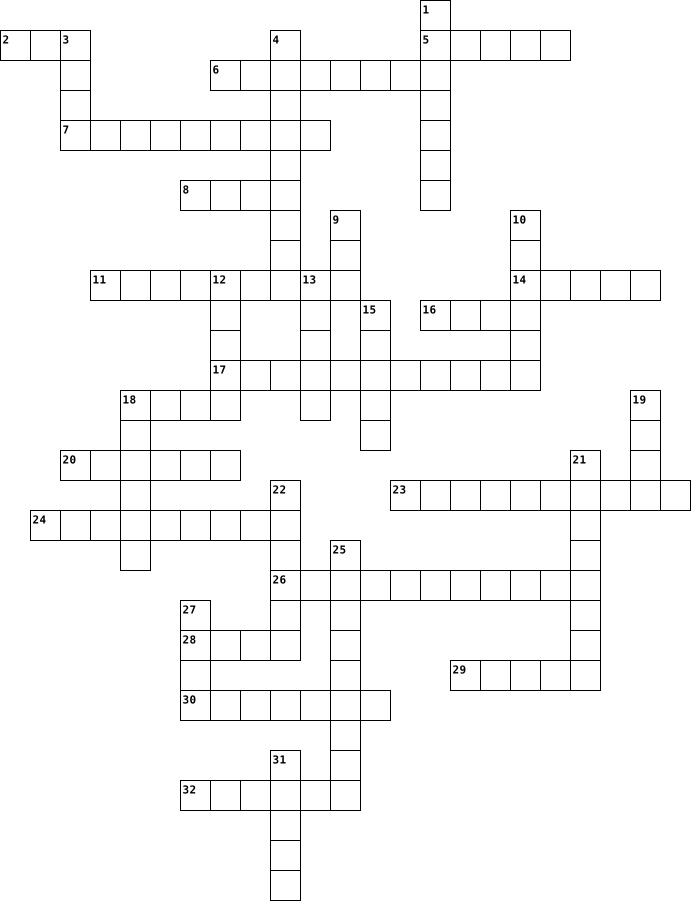
Across
- Ugly in Spanish (masculine)
- Black in Spanish
- Boring in Spanish
- Friendly in Spanish
- Blue in Spanish
- Redhead in Spanish
- Hat in Spanish
- Short in Spanish
- Interesting in Spanish
- Smooth in Spanish
- Pretty in Spanish
- Hard working in Spanish
- Fun in Spanish
- Intelligent in Spanish
- Tall in Spanish
- Green in Spanish
- Selfish in Spanish
- Curly in Spanish
Down
- Angry in Spanish
- Eyes in Spanish
- Muscular in Spanish
- Ugly in Spanish (feminine)
- Moustache in Spanish
- Blonde in Spanish
- Young in Spanish
- Old in Spanish
- Glasses in Spanish
- Hair in Spanish
- Patient in Spanish
- Funny in Spanish
- Attractive in Spanish
- Brown in Spanish
- Beard in Spanish
33 Clues: Hat in Spanish • Old in Spanish • Fun in Spanish • Eyes in Spanish • Blue in Spanish • Hair in Spanish • Tall in Spanish • Angry in Spanish • Black in Spanish • Young in Spanish • Short in Spanish • Funny in Spanish • Brown in Spanish • Green in Spanish • Beard in Spanish • Curly in Spanish • Boring in Spanish • Blonde in Spanish • Smooth in Spanish • Pretty in Spanish • Redhead in Spanish • Glasses in Spanish • ...
Extra Credit Crossword (Physical science) 2023-12-11

Across
- Not metal
- Negatively charged particle
- Elements are organized on this table
- Transfer of electrons
- Iron, gold, silver etc.
- Substance at end of chemical reaction
- Energy is absorbed
- Produced by taking/adding electrons from a neutral atom
- Ability of a substance to react chemically with another substance
- A compound is made from a simpler materials
- Substance present at beginning of chemical reaction
- Energy is expelled
- Does the object float or sink? What is the objects __
Down
- Sharing of electrons by atoms
- Numbers and letters together to form a math problem
- Same mass as proton but without electric charge
- Positive and negative ions switch places
- Compound is broken down into simpler compounds
- Compound with carbon and hydrogen combine with oxygen gas to produce carbon dioxide and water
- Result can be undone or returned back
- result cannot be undone, changed at the molecular level
- One element starts by itself but then replaces another
- Subatomic particle
- Atoms of the same element with different numbers of neutrons
24 Clues: Not metal • Energy is absorbed • Subatomic particle • Energy is expelled • Transfer of electrons • Iron, gold, silver etc. • Negatively charged particle • Sharing of electrons by atoms • Elements are organized on this table • Result can be undone or returned back • Substance at end of chemical reaction • Positive and negative ions switch places • ...
Physical & Personality Adjectives in Spanish 2024-01-25

Across
- younger
- short
- silly
- honest
- old
- rich
- handsome
- small
- older
- thin
Down
- pretty
- creative
- big
- tall
- blonde
- fat
- young
- strong
- bald
- weak
20 Clues: big • fat • old • tall • rich • bald • thin • weak • short • silly • young • small • older • pretty • blonde • honest • strong • younger • creative • handsome
Physical Geog. Exam 4 Review 2022-04-08

Across
- highly weathered forest soils; subtropical climate
- expandable clay soils; subtropics, tropics; sufficient dry period; form large cracks when dry, swell when wet
- permafrost-affect soils; large quantities of organic carbon; tundra climate at high latitude and in mountain highlands
- Fertile soil = 45% mineral matter, 5% organic matter, 25% air, 25% water
- Occurs mainly in regions bordering the Arctic Ocean and generally north of the 50°F isotherm for the warmest month. Daylength varies greatly throughout the year, seasonally changing from almost continuous day to continuous
- northern conifer forest soils; cool, humid climate
- weakly developed soils; humid regions
- each organism benefits and is sustained over an extended period by the relationship, honey bee and flower
- light-colored layer represents the zone of maximum leaching
- one species harms another but is not affected itself; black walnut tree
- study of the distribution of plants and animals, the diverse spatial patterns they create, and the physical and biological processes, past and present, that produce Earth’s species richness
- alive, naturally occurring nutrients and minerals, complete and self-sustaining ecosystem
- the A, E, and B horizons, true definable soil of the profile
- linear path of energy that flows from producers to consumers and eventually detritivores and decomposers
- the study of the relationships between organisms and their environment, and among the various ecosystems in the biosphere
- host to the most diverse collection of plants and animals on the planet.tropical rain forests occupy about 7% of the world’s total land area but represent approximately 50% of Earth’s species and about half of its remaining forests
- subdivided into warm desert and semidesert, caused by the warm temperatures and low precipitation associated with the subtropical high-pressure cells, and cold desert and semidesert, which tend toward higher latitudes, where subtropical high pressure affects climate for less than 6 months of the year; polar deserts, occurs in high-latitude regions, including most of Antarctica and Greenland, with very cold, dry climates. Vegetation, sparse in the predominantly ice- and rock covered polar deserts, is mainly lichens and mosses
- non-native species
- underlying geologic material from which the soil forms, usually bedrock, rock fragments, or sediments
- grassland soils; high fertility, humus rich, important agricultural soil, subhumid, semiarid lands
- large expanses of grassland, either treeless or interrupted by scattered trees and shrubs, characterized by the presence of xerophytes (drought resistant plants)
- soil rich in hydrogen ions has a low pH; pH below 7.0, and are strongly acidic below 5.0
- the function or occupation of a life form withing a given community
- weathered bedrock or weathered parent material, regolith, plant roots and soil microorganisms are rare
- the sphere of life and organic activity, extends from the ocean floor to an altitude of about 5 mi into the atmosphere
- downward or sideways movement of dissolved or suspended material in rainwater, percolating water removes fine particles and soluble materials and carries them to lower horizons
- soils formed from volcanic activity, especially common along the Pacific Rim
- The physical, chemical, or biological characteristics of the environment that determine species distributions and population size
- sand, silt, clay; no minerals or nutrients; not an organized ecosystem
Down
- soil classification system that emphasizes the physical and chemical properties of the soil profile
- organic soils; wetlands; peat or bod; >20% organic material
- the accumulation of material and water-soluble compounds leached from an overlying soil layer
- a self-sustaining association of living plants and animals and their nonliving physical environment
- organisms that share the same basic feeding level
- topsoil, richer in organic content than lower horizons, humus and clay particles provide essential chemical connections between soil nutrients and plants.
- shrubland that occupies temperate regions that have dry summers, generally corresponding to the Mediterranean climates, vegetation varies between primarily woody shrubs to grassy woodlands
- moderately weathered forest soils; subtopical climate
- recent soils; profile undeveloped; all climates
- undecomposed litter, decomposed organic debris, and humus, 20-30% or more organic material
- type of environment in which an organism resides or is biologically adapted to live
- bedrock, unweathered parent material
- tundra can occur at high elevations in the lower latitudes; usually occurs above the tree line (the elevation above which trees cannot grow)
- This grassland is most modified by human activity, includes the world’s “breadbaskets”—regions that produce bountiful grain (wheat and corn), soybeans, and livestock (hogs and cattle), only naturally occurring trees are deciduous broadleaf trees along streams and other limited sites
- lush forests in wet, humid regions, includes coast redwoods, the world’s tallest trees; precipitation approaching 160 in. per year, moderate air temperatures, summer fog, and an overall maritime influence
- one species benefits and the other experiences neither harm nor benefit:remora(suckerfish) and sharks
- overlapping relationship between organisms of two species
- This realm is a geographic region where a group of associated plant and animal species evolved, have been used as a basis for establishing terrestrial ecosystem regions
- Tropical soils; mature soil, low fertility; hot, humid areas
- desert soils; hot, dry areas
- a large, stable, terrestrial or aquatic ecosystem classified according to the predominant vegetation type and the adaptations of particular organisms to that environment
- one species benefits, and another is harmed by the association;
- vertical section of soil that extends from the surface to the deepest extent of plant roots or to the point where regolith or bedrock is encountered
- species that live in only one geographic location on Earth
- one of the first scientists to study the effect of climatic factors on species distributions; hypothesized that plants and animals occur in related groupings wherever similar climatic conditions occur
- capture sunlight and convert it to chemical energy; manufacture their own
- soil low in hydrogen ions (and high in cations of calcium, magnesium, potassium, and sodium); pH above 7.0, and are strongly alkaline above 8.5
- a complex network of interconnected food chains
- the smallest unit of soil that displays all the characteristics and properties used for classification
- Maximum zone of accumulation of weathering products
- boundary zone between different but adjoining ecosystems at any scale
60 Clues: non-native species • desert soils; hot, dry areas • bedrock, unweathered parent material • weakly developed soils; humid regions • recent soils; profile undeveloped; all climates • a complex network of interconnected food chains • organisms that share the same basic feeding level • highly weathered forest soils; subtropical climate • ...
Crossword puzzle in physical science 2024-01-21

Across
- - the smallest and the fastest of our neighbors, is somewhat larger than the moon and similar in appearance.
- - Like the first quarter, it is seen illuminated on half the side facing the earth. The third quarter moon rises about midnight, is highest at dawn and sets about noon. In the morning it is in the western sky.
- - either of the two times in the year: the summer solstice and winte solstice
- - astronomical model in which the Earth and planets revolve around the sun
- - in the solar system is a large round object that orbits the sun and has cleared out most of the other objects in its orbit.
- - is considered as the greatest of the early Greek astronomers who compared and observed the brightness of the 850 stars and arranged them into order of brightness or magnitude.
- - the sun and all of the planets, comets, etc. that revolve around it.
- - Half the side of the moon facing the earth appears illuminated. It rises about noon, reaches its high point for the day at sundown, and sets near midnight.
- - Earth is assumed to the center of all
- - shrinking; describes the moon when the illuminated is decreasing
- - the shape of the earth.
- - very first Greek to profess the heliocentric views
- - gave the most accurate size during their time.
- -A natural object that orbits a larger object.
- -was believed to be at fixed position in the sky, however when the Greeks traveled,to places nearer the equator, like• Egypt, they noticed that it is closer to the horizon
- - was a studentor Plato. For him, the earth is spherical in shape since it always casts a curved shadow when it eclipses the moon.
Down
- - the first successful attempt to determine the size of the arth was made by him by applying geometric principles;
- - believed that the Earth was the center of the universe.
- - The whole side of the moon is now illuminated to viewers from the earth. The full moon rises in the east as the sun sets in the west. It stays up all night long, reaching its highest point about midnight. In summer, it is as low in the sky as the sun is at noon in midwinter.
- - one of the cyclically recurring apparent forms of the moon
- - the figure of the moon that appears as a curve with pointy ends
- -a type of eclipse that occurs when the Moon passes between the Sun and Earth, and the Moon fully or partially blocks the light from the Sun.
- - an obscuring of the light from one celestial body by the passage of another one between it
- - was ableto explain what causes the phases of the moon, To him, the moon shone only by reflected sunlight.
- - is the second planet from the sun. It is brighter than Mercury in the sky and is easily seen near the sun at either sunup or sunset.
- - planets moves in the opposite* direction for some time, after which it resume its eastward motion
- - the figure of the moon that is more than half full, looking swollen on one side.
- - growing ; describes the moon when the illuminated portion is increasing
- - appears only when the moon is on the side of the earth most directly in line with the sun. There is no illumination on the earth's side, so it is also sometimes called the dark moon.
- - proposed a system of fixed spheres. He believed that the sun, moon and the five known planets and the stars were attached to these spheres which carried the heavenly bodies while they revolved around the stationary Earth.
30 Clues: - the shape of the earth. • - Earth is assumed to the center of all • -A natural object that orbits a larger object. • - gave the most accurate size during their time. • - very first Greek to profess the heliocentric views • - believed that the Earth was the center of the universe. • - one of the cyclically recurring apparent forms of the moon • ...
Physical geography of East Asia 2024-02-26

Across
- Ocean: This ocean has extensive coastlines along East Asia.
- River: This river is the second-largest river in China, after the Yangtze River.
- River: This river flows along several countries in Southeast Asia.
- having wide or considerable extent.
- Tibetan Plateau: This mountain it is often called the "Roof of the World". And it is also in the area of The Himalayas.
- Himalayas: It is located in the southwestern part of the region and it have some of the highest peaks of the world.
- climate: This climate is classified by mild winters and hot, humid summers.
- differing from one another: UNLIKE.
- nation: Japan is an clear example of this.
- permission, liberty, or ability to enter, approach, or pass to and from a place or to approach or communicate with a person or thing.
- very great in size, amount, degree, intensity, or especially in extent or range.
- of, relating to, characteristic of, or constituting a city.
Down
- having a tendency or inclination : being likely —often used with to.
- River: This is third-largest river in the world.
- a great sea wave produced especially by submarine earth movement or volcanic eruption : TIDAL WAVE.
- of the utmost importance.
- Ring of Fire: This area is leading to frequent seismic activity.
- having a rough uneven surface : JAGGED.
- a periodic wind especially in the Indian Ocean and southern Asia.
- standing out or projecting beyond a surface or line: PROTUBERANT.
- having a capacity or a tendency to expand.
- River: This river forms part of the border between China and North Korea.
22 Clues: of the utmost importance. • having wide or considerable extent. • differing from one another: UNLIKE. • having a rough uneven surface : JAGGED. • having a capacity or a tendency to expand. • nation: Japan is an clear example of this. • River: This is third-largest river in the world. • Ocean: This ocean has extensive coastlines along East Asia. • ...
Natural-Physical Science Universe Crossword 2024-02-16

Across
- Matter that does not interact with the electromagnetic force of our universe; one of three main things our universe is composed of
- Uppermost layer of our suns atmosphere
- How astronomers explain the way the universe began
- The rapid growth of our universe; evidence of how our universe started
- Outermost layer of our suns interior where light is created
- An enormous cloud of dust and gas occupying the space between stars and acting as a nursery for new stars
- A constellation resembling a hunter
- Visible lower layer of our suns atmosphere
- A hypothetical form of energy that produces a force that opposes gravity and is thought to be the cause of the accelerating expansion of the universe; one of three main things our universe is composed of
- Galaxy type that ranges from completely round to oval in shape
- A huge collection of gas, dust, and billions of stars and their solar systems, all held together by gravity
- The distance light travels in one Earth year
- The splitting of the nucleus of a heavier atom into a smaller one, releasing a tremendous amount of energy
- The second interior layer of our sun where energy generated by nuclear fission in the core moves outward
- Galaxy type that does not have a distinct shape
- Our home galaxy
- A small, icy object that orbits the central star of a solar system and has a long "tail" of gas
- 1st stage in the life cycle of an average star
- A solid piece of debris from an object, such as a comet, asteroid, or meteoroid, that originates in outer space and survives its passage through the atmosphere to reach the surface of a planet or moon
- 8th event in our universes timeline
- 5th and final in the life cycle of an average star
- 6th event in our universes timeline
- Galaxy type that resembles a giant rotating pinwheel and has many arms; the shape of our home galaxy, the Milky Way
- 1st event in our universes timeline; the point where our universe started
- A small, rapidly moving meteor burning up on entering the earth's atmosphere
- A constellation resembling a little spoon
Down
- A constellation resembling a little bear
- 3rd stage in the life cycle of an average star
- Age of our universe
- A constellation resembling a great bear
- The center of our sun where nuclear fission occurs
- A celestial body in orbit around a star
- An explanation for occurrences in the natural world formulated by using the scientific method
- 4th stage in the life cycle of an average star
- It includes all of space, and all the matter and energy that space contains; started with the big bang
- An intense burst of radiation coming from the release of magnetic energy associated with sunspots
- Most intense geomagnetic storm in recorded history
- A natural luminous body visible in the sky especially at night
- The brightest star we can see
- The cycle that the Sun's magnetic field goes through approximately every 11 years
- An area of such immense gravity that nothing—not even light—can escape from it
- A large round object that orbits a planet
- 7th event in our universes timeline
- 2nd stage in the life cycle of an average star
- 3rd event in our universes timeline
- Lumps of rock or iron that orbit the central star of a solar system
- Anything that makes up space and can be weighed; One of three main things our universe is composed of
- Background radiation distributed throughout our entire universe; evidence of how our universe started
- A space rock that enters earth's atmosphere causing a streak of light to appear in the sky
- Small, rocky objects that orbit the the central star of a solar system
- 5th event in our universes timeline
- Orange-red layer of our suns atmosphere
- 4th event in our universes timeline
- A constellation resembling a big spoon
54 Clues: Our home galaxy • Age of our universe • The brightest star we can see • A constellation resembling a hunter • 7th event in our universes timeline • 3rd event in our universes timeline • 5th event in our universes timeline • 8th event in our universes timeline • 6th event in our universes timeline • 4th event in our universes timeline • Uppermost layer of our suns atmosphere • ...
Physical Science B Introductory Topics 2024-01-16

Across
- The product of an object's mass and velocity.
- The rate at which an object changes its position.
- The force exerted by a magnet.
- The flow of electric charge.
- A device that increases or decreases voltage.
- The circuit in which current has more than one pathway to follow.
- The force that attracts two objects with mass toward each other.
- The bending of waves around obstacles or the spreading of waves after passing through an opening.
- A disturbance that carries energy through matter or space.
- The number of waves that pass a point in a given time.
- A push or pull exerted on an object.
- A circuit in which the current has only one pathway to follow.
- The energy of motion.
Down
- The region around a magnet where magnetic forces can act.
- Force acting on an object in motion or at rest.
- A material through which electric current does not pass easily.
- The force that opposes the motion of objects through the air.
- The resistance of an object to any change in its state of motion.
- The force that pulls objects toward the center of the Earth.
- unit of measurement for electric current.
20 Clues: The energy of motion. • The flow of electric charge. • The force exerted by a magnet. • A push or pull exerted on an object. • unit of measurement for electric current. • The product of an object's mass and velocity. • A device that increases or decreases voltage. • Force acting on an object in motion or at rest. • The rate at which an object changes its position. • ...
Crossword Puzzle in Physical Science 2023-06-07

Across
- is equal to the mass multiplied by the square of the speed of light
- this is a disturbance in the regular elliptical movement pattern of a certain celestial body.
- as the mass of an object becomes massive, the energy needed to move it becomes
- completed his theory of relativity and stated the law of mass energy conversat
- this is a force that pulls the objects with mass together
- described the motion of planets around the sun, now known as kepler's law of planetary motion.
- predicted the theory of electromagnetism and established that lights are also electromagnetic waves.
- introduced the universal law of gravitation uniting terrestrial and celestial theories of motion.
- Which planet is said to be most affected by the gravitational force of the sun?
- is a special type of reference where an observer does not accelerate
- time is the difference in time experience by an observer moving at a constant speed
- studied, observed, and experimented with inclined planes and introduced the law of falling objects.
Down
- an observer perceives length differently while moving at constant speed due to the length
- the fastest speed known to man is equal to the speed of
- according to the theory of relativity, this is the point when an object that becomes black hole must collapse.
- according to general theory of relativity which of the following causes curve in space?
- the part of existence that is measured in minutes, days and years.
- generated and produced radio waves thereby proving the theory of maxwell.
- no two events happen at the same time for two observers is the principle of
- a three dimensional extent in which objects and events have relative position and direction.
20 Clues: the fastest speed known to man is equal to the speed of • this is a force that pulls the objects with mass together • the part of existence that is measured in minutes, days and years. • is equal to the mass multiplied by the square of the speed of light • is a special type of reference where an observer does not accelerate • ...
PBL: Physical Therapy Terms (AC) 2023-04-26

Across
- use of cold in the treatment of injury as well as to decrease the discomfort after treatment
- when a therapist/equipment moves the joint through the range of motion with no effort from the patient
- prescription medical devices worn inside shoes to correct foot issues
- stroke
- acts taken in order to sit, stand, roll over, lift, and carry objects
- bringing the sole of the foot toward the midline of the body
- measurement of the amount of movement around a specific joint or body part without assistance
- reduction of bone mass frequently in postmenopausal women
Down
- movement of the foot when it is bent at the ankle away from the body
- artificial device that replaces a missing body part
- use of exercises in a pool as part of treatment
- ability to move freely
- application of heat to the body
- turning outward, away from the midline of the body
- surgical removal of an extremity such as a limb due to injury, disease, or illness
- inflammation of the tendons
- movement of the limb, hand, or fingers in a circular pattern
- backward motion of a body part
- inflammation of the joints
- manner of walking
20 Clues: stroke • manner of walking • ability to move freely • inflammation of the joints • inflammation of the tendons • backward motion of a body part • application of heat to the body • use of exercises in a pool as part of treatment • turning outward, away from the midline of the body • artificial device that replaces a missing body part • ...
Physical Science Unit 0 Vocab 2022-08-22

Across
- the study of matter and energy and the interactions between the two through forces and motion
- the amount of space taken up by an object
- information obtained through the senses
- the amount of matter in an object
- the straight-line distance between two points
- a relationship between two variables in which their ratio is constant
- a gauge of how exact a measurement is
- a well-tested explanation for a set of observations or experimental results
- the variable that causes a change in another variable
- all the digits in a measurement that are directly measured, plus the last digit, which is estimated
- a ratio of equivalent measurements that is used to convert a quantity from one unit to another
- a proposed answer to a question
- a system of knowledge about the natural world and the methods used to find that knowledge
Down
- the use of scientific knowledge to solve practical problems
- an organized plan used for gathering, organizing, and communicating information
- a way of expressing a value as the product of a number between 1 and 10 and a power of 10
- a variable that changes in response to a change in the manipulated variable
- the study of the univers beyond Earth
- the steepness of a line, equal to the ratio of a vertical change to the corresponding horizontal change
- the study of the composition, structure, properties, and reactions of matter
- an experiment in which only one variable, the manipulated variable, is deliberately changed at a time
- an instrument that measures temperature
- a relationship in which the product of two variables is a constant when all other variables are held constant
- a statement that summarizes a pattern found in nature
- the ratio of a material's mass to its volume
- the study of life and life processes
- the closeness of a measurement to the true value of what is measured
- the study of the origin, history, and structure of Earth
- a representation of an object or event
29 Clues: a proposed answer to a question • the amount of matter in an object • the study of life and life processes • the study of the univers beyond Earth • a gauge of how exact a measurement is • a representation of an object or event • information obtained through the senses • an instrument that measures temperature • the amount of space taken up by an object • ...
Physical Science Vocab Final Review 2022-05-12

Across
- The force that opposes motion of two objects that are in contact
- Force exerted per unit area
- Substance in which the atoms of two or more elements are combined in fixed proportions
- Type of system in which energy cannot be transferred between a system and its surroundings
- Type of bond formed between a metal and a nonmetal
- Energy transferred between objects due to temperature differences between objects
- Substance in which its different components are easily distinguished
- The gravitational force exerted on an object
- Shiny
- Able to be bent/change shapes without breaking
Down
- Substance containing two or more components that are blended uniformly so that individual components are indistinguishable with a microscope
- The variable that is controlled and changed by scientists
- Able to be drawn into a thin wire
- A factor in an experiment that does not change at all
- Any change in size, shape, or state of matter in which the identity of the substance remains the same
- Change of one substance into a new substance
- Type of bond formed between two nonmetals
- A measure of the distance an object moves in a certain amount of time
- Atoms of the same element that have different masses
- Substance with atoms that are all alike
20 Clues: Shiny • Force exerted per unit area • Able to be drawn into a thin wire • Substance with atoms that are all alike • Type of bond formed between two nonmetals • Change of one substance into a new substance • The gravitational force exerted on an object • Able to be bent/change shapes without breaking • Type of bond formed between a metal and a nonmetal • ...
Physical Geography - Rivers, Coast & Glaciation 2023-05-23

Across
- Circular drainage pattern
- Allows for water to pass through rock
- A crack in the ice
- Drainage patterns with right angles
- Small ridges of gravel that develop at the point of high tide mark
- Drainage pattern with chaotic appearance
- Erosion of rocks below a glacier from melt water
- Bending of waves around a headland
- The amount of water in a river channel
- Sandspit that connects island to main land
- Coastal defence against longshore drift
- Birthplace of a glacier
- Raised banks of alluvium
- The force of moving water
- Erosion that takes place at different rates due to rock hardness
- Bend in a river
- Sideways type of erosion
- Coastal feature found below the high tide level
Down
- Feature found on a rejuvenated river
- Transportation of material along a beach/coast
- Another name for the speed of moving water
- The rounding of stones
- Distance of sea/ocean between two pieces of land
- The slope of a river
- Feature formed by vertical erosion
- Erosion that continues upstream
- The Process of wearing away material
- The chemical breakdown of rocks
- When the load of a river hits off the bed/banks
- Found at the bottom of a waterfall
- Areas of hard rock jutting out either side of v shaped valley
- When heavier materials are bounced along river bed
- Steep sided river valley
- Long ridge of unsorted boulder clay dropped by glacier
- Eroded area found at base of cliff
- When 3 or more cirques are back to back
- The rolling of materials along river bed
- Area of deposition found at the mouth of a river
38 Clues: Bend in a river • A crack in the ice • The slope of a river • The rounding of stones • Birthplace of a glacier • Steep sided river valley • Raised banks of alluvium • Sideways type of erosion • Circular drainage pattern • The force of moving water • Erosion that continues upstream • The chemical breakdown of rocks • Feature formed by vertical erosion • Found at the bottom of a waterfall • ...
Physical Science Ch 19 Electricity 2025-03-10

Across
- The field force between two charged objects.
- An electrical safety device that opens the circuit by melting when an overheated condition occurs due to excessive current.
- An electrical safety device consisting of an automatic switch that opens when there is too much current in a circuit.
- The force that moves electric charge carriers through an electrical circuit.
- An electrical device that slows down electric current by converting electrical energy into other forms, such as thermal energy.
- The act of providing a path for electrical charge to move into the earth.
- The property of matter indicating the degree to which the material slows down the flow of charge carriers.
- The loop through which current electricity can flow.
- A material through which electric charge moves easily.
- An unintended path for an electric current.
- Electric current in which electric charges move in only one direction.
- Electricity involving moving electric charges.
- Examples are fixed and variable.
- Examples are a battery, photovoltaic cell, and an AC generator.
Down
- Examples are open and closed toggle, and push.
- The principle that states that charge cannot be created or destroyed but only transferred between objects.
- The work per second done or produced by an electrical system.
- A material through which electric charge does not move easily.
- A three-dimensional region around a charged object that will apply a force on other charged objects within that region.
- A circuit with multiple paths that electric current can take.
- The movement of electric charge through a complete loop.
- The accumulated electric charge on an object.
- Electric current in which the charge carriers change direction periodically.
- Movement of electric charge or thermal energy through an object or form object to object through direct contact.
- A circuit with only one path that electric current can take.
- The law that states that the current in a circuit is directly related
26 Clues: Examples are fixed and variable. • An unintended path for an electric current. • The field force between two charged objects. • The accumulated electric charge on an object. • Examples are open and closed toggle, and push. • Electricity involving moving electric charges. • The loop through which current electricity can flow. • ...
Russia’s Physical Features Crossword Puzzle 2025-03-24

Across
- A large desert in Turkmenistan
- A desert in western Uzbekistan
- A temperate grassland with fertile soil for farming
- A subtropical region in Russia, warmed by the Mediterranean Sea
- A fur-bearing animal found in the taiga
- A climate region covering much of Russia
- The effect of being far from the ocean, causing extreme temperatures
- A climate zone with cold, Arctic conditions and low vegetation
- The world’s largest forest, home to coniferous trees
- The name of the coldest region in Russia
Down
- Fertile black soil found in the steppe
- A layer of frozen soil that never fully melts
- A predator found in the Russian forests
- The name of one of the coldest towns in Siberia
- A small plant that grows in tundra conditions
- A dry,hot region with little vegetation
- A mountain range near Kazakhstan
- A type of tree found in the taiga
- A polar region where the tundra is located
- A type of vegetation that survives in the tundra
20 Clues: A large desert in Turkmenistan • A desert in western Uzbekistan • A mountain range near Kazakhstan • A type of tree found in the taiga • Fertile black soil found in the steppe • A predator found in the Russian forests • A dry,hot region with little vegetation • A fur-bearing animal found in the taiga • A climate region covering much of Russia • ...
Physical Science Final Review Crossword 2025-05-19

Across
- The kinetic theory of gases connects the microscopic to the ____.
- The attractive force between any two objects with mass.
- The distance between two corresponding points on a wave.
- The rate of change of velocity.
- A material that allows electric current to flow easily.
- A phenomenon of nature caused by electric charges.
- Distance with direction.
- Particle in atomic nucleus, positively charged.
- How close a measurement is to the true value.
- Arrangement of resistors in separate paths next to each other.
- A temperature scale we've focused on.
- Physicist who studied motion before Newton and argued that Aristotle was wrong about falling objects.
- ____ of energy, the law that energy cannot be created or destroyed.
- ____ force; a fictitious force that "occurs" in rotation.
- A cluster of atoms chemically bonded together.
- Smallest subatomic particle making up an atom, negatively charged.
- A complete path for electric current; very technologically useful.
- One type of heat, involves contact.
- Kind of particle used in Rutherford's gold foil experiment.
- A temperature scale we've focused on.
- Astronomer who began quantitative physics with his three laws of planetary motion.
- Heat is a ____ of energy, not something possessed by substances.
- The number of complete waves passing a point in a given time.
- Varieties of atoms of the same element that have different numbers of neutrons.
- He discovered mass-energy equivalence, as given by a famous equation
- A force that opposes motion caused by microscopic rubbing and bumping.
- One type of heat, involves a medium between objects.
- The kind of energy an object has because it is in motion.
Down
- A measure of the amount of matter in an object.
- Mass times velocity.
- One type of heat, can occur through empty space.
- Electron ____, the free electrons in metals not specific to individual atoms.
- A material that produces a magnetic field.
- Speed with direction.
- A device that stores chemical energy and converts it to electrical energy; it can power a circuit.
- Resistance to changes in motion.
- Energy transfer NOT by temperature difference and NOT spontaneous.
- Ionic compounds that exist as lattices of compounds, contrast with molecules.
- The rate of flow of electric charge.
- A material that does not allow electric current to flow easily.
- A disturbance that transfers energy through a medium.
- ____ force; it keeps an object moving in a circle and is directed towards the center of that circle.
- The kind of energy a system has due to configuration.
- FIELD The region around a magnet where magnetic forces can be felt.
- ____ zero, the lowest possible temperature.
- ____ ____ model, Thomson's atomic model differing from Dalton's model.
- Arrangement of resistors one after another.
- Greek philosopher who first proposed an atomic theory.
- A temperature scale we've focused on.
- The magnitude of velocity, or, velocity without direction.
- The height of a wave from its rest position.
- A push or pull on an object.
- Escape of fast-moving molecules near the surface of a liquid, contrasts with vaporization.
- The curved path of an object around another due to gravity.
- Particle in atomic nucleus, neutral.
- Specific heat ____, the amount of energy required to raise a substance's temperature.
- A quantity that has both magnitude and direction.
- Opposition to the flow of electric charge.
- Mass divided by volume, i.e. mass per volume.
- Every action has an equal and opposite ____: Newton's third law.
- How close repeated measurements are to each other.
- The unit of resistance.
- The scientist who formulated three laws of motion.
- The force of gravity acting on an object's mass.
64 Clues: Mass times velocity. • Speed with direction. • The unit of resistance. • Distance with direction. • A push or pull on an object. • The rate of change of velocity. • Resistance to changes in motion. • One type of heat, involves contact. • The rate of flow of electric charge. • Particle in atomic nucleus, neutral. • A temperature scale we've focused on. • ...
TTS Chemical and physical changes 2025-08-11

Across
- is a process of changing a substance that involves the breaking and forming of bonds between atoms, resulting in a new substance with different properties than the original substance.
- is an adjective meaning reversible or able to be returned to its original state.
- is a characteristic of chemical change.
- is a substance or compound formed as a result of a chemical reaction.
- is an example of a redox reaction.
- is an example of a physical change.
- is a reaction that produces salt and water.
- is a combination of two or more substances that are physically mixed together but not chemically bonded.
- is a substance or compound that is involved in a chemical reaction and undergoes a change into a new substance.
- is an example of a chemical change.
- is one of the four basic states of matter, along with liquid, gas, and aqueous.
Down
- is a change in a substance that does not change its chemical composition, but only its physical properties.
- is an example of a physical change.
- is when two compounds exchange ions.
- is a type of chemical reaction in which two or more substances (elements or compounds) combine to form a single product.
- is an example of a chemical change.
- is when one element replaces another element in a compound.
- is a process that transforms a substance into a new substance with different properties than the original substance.
- is a substance formed from two or more different elements that are chemically bonded. Chemistry
- means "unreversible."
- is a single substance that cannot be broken down into simpler substances through a chemical reaction.
- is a number placed in front of a chemical formula in a chemical equation.
22 Clues: means "unreversible." • is an example of a redox reaction. • is an example of a physical change. • is an example of a chemical change. • is an example of a physical change. • is an example of a chemical change. • is when two compounds exchange ions. • is a characteristic of chemical change. • is a reaction that produces salt and water. • ...
Chemical and Physical Changes Review! 2024-12-09

Across
- A change to matter that does not change the chemical composition of the matter
- A type of reaction that releases heat. (Gets colder)
- maintain (a quantity such as energy or mass) at a constant overall total.
- of Mass States that matter cannot be created or destroyed; it can only change form
- A solid that forms from a solution during a chemical reaction.
- The process where a solid turns directly into a gas without becoming a liquid.
- The process of a solid turning into a liquid.
- The process of matter changing states between solid, liquid, or gas
- when certain things or factors or conditions lead to alteration in course of action
- A physical change where a substance mixes with a solvent to form a solution.
- The process of a liquid turning into a solid.
Down
- is a characteristic of a substance that can only be observed during a chemical reaction
- A physical property is a characteristic of matter that can be observed and measured without changing the chemical identity
- A substance that is dissolved in a solvent
- The process of a gas turning into a liquid.
- The process of a liquid turning into a gas
- A type of reaction that absorbs heat.(Gets hotter)
- The process of elements interacting with one another to form new substances
- A change to matter that does change the chemical composition of the matter.
- A substance that dissolves a solute to form a solution
20 Clues: A substance that is dissolved in a solvent • The process of a liquid turning into a gas • The process of a gas turning into a liquid. • The process of a solid turning into a liquid. • The process of a liquid turning into a solid. • A type of reaction that absorbs heat.(Gets hotter) • A type of reaction that releases heat. (Gets colder) • ...
S & E ASIA-PHYSICAL FEATURES 2025-10-23

Across
- the other name for the Chang Jiang River
- the Himalayas form a natural _ between India & China
- the Sea of Japan is an arm of this ocean
- old canal system that connects the Chang Jiang & Huang He
- the Yangtze is the largest & longest river in this country
- this desert is between two rugged mountain ranges in northwestern China
- Chinas's 2nd longest river
- the largest desert in Asia
- this connects the Pacific and Indian Oceans
- "China's _" is the nickname for the Huang He due to frequent flooding
- the Ganges is the most important river to this country
- the other name for the Huang He River
Down
- the Huang He empties into this
- the Indian ocean is the _ largest of the five oceans
- this body of water is between the Korean Peninsula & Japan
- this is the third-longest river in the world
- the Yellow River is named for muddy yellow _ that it carries along
- how many of the world's ten largest peaks are in the Himalayas
- the Korean Peninsula has been divided into two countries since the end of this war
- river that begins in the Himalayan Mountains
- the Gobi Desert is also known as this Chinese word that means "sand desert"
- Mt. Everest if the world's _ mountain
- the Ganges River is sacred to this religion
- the Ganges river flows into this
24 Clues: Chinas's 2nd longest river • the largest desert in Asia • the Huang He empties into this • the Ganges river flows into this • Mt. Everest if the world's _ mountain • the other name for the Huang He River • the other name for the Chang Jiang River • the Sea of Japan is an arm of this ocean • the Ganges River is sacred to this religion • ...
Physical Science Routines and Reminders 2024-01-09

Across
- Our final exam is said to be ____, meaning it covers content from the entire semester.
- Number of minutes I need to wait before requesting to leave the classroom.
- The first part of Mrs. Platz’s email.
- If I am hungry or have a drink other than water, I should consume it during ____ break and not during class.
- If I need to listen to something on my chromebook, my headphones must be ____.
- Per district policy, I cannot bring this to class.
- How much credit I can receive for turning in work late (before the unit test).
- Mrs. Platz read a total of 862 pages over winter break by reading _____ books and starting one more.
- True or false: I am responsible for making up the work I missed when absent.
- This grading category is also weighted as 25% of your overall grade.
- If unexcused tardy to class, I must go and get this paper from room 162.
Down
- What I must answer when first arriving to class daily.
- The next unit we will be covering.
- Something I can do if I finish my work early.
- Something that is not tolerated and results in a 0 for the submitted work.
- How much the semester final is worth for this class.
- A place to record information for this class throughout the semester.
- What I can do to improve my test grade.
- In this class, we will not be using chromebooks on Mondays or _____, unless otherwise instructed.
- Something that your peers sometimes need to borrow and Mrs. Platz does not have extras of.
- This can be used in class appropriately, with Mrs. Platz’s instruction on tech days.
- When leaving to the restroom, you must take your ID and the _______.
22 Clues: The next unit we will be covering. • The first part of Mrs. Platz’s email. • What I can do to improve my test grade. • Something I can do if I finish my work early. • Per district policy, I cannot bring this to class. • How much the semester final is worth for this class. • What I must answer when first arriving to class daily. • ...
Physical & Chemical Changes Crossword Puzzle 2026-01-29

Across
- A change where no new substance is formed.
- Cutting wood into pieces.
- Butter changing from solid to liquid.
- A word meaning a change in matter.
- Light produced in a reaction.
- Wood turning into ash.
- Bending an object.
- Water changing into ice.
- Breaking glass.
- Heat released during a reaction.
Down
- A sign of chemical change when gas appears.
- Food changing when cooked.
- Ice changing into water.
- A change that makes a new substance.
- A sign of chemical change when color changes.
- Cutting paper into pieces.
- Pulling paper apart.
- Metal reacting with oxygen.
- Mixing vinegar and baking soda.
- Flattening a soda can.
20 Clues: Breaking glass. • Bending an object. • Pulling paper apart. • Wood turning into ash. • Flattening a soda can. • Ice changing into water. • Water changing into ice. • Cutting wood into pieces. • Food changing when cooked. • Cutting paper into pieces. • Metal reacting with oxygen. • Light produced in a reaction. • Mixing vinegar and baking soda. • Heat released during a reaction. • ...
Physical Science Module 10 Crossword 2026-05-04

Across
- 300,000,000 m/s (c)
- the opening left by the iris
- changes the shape of the lens to keep things in focus
- electromagnetic waves do not have to travel through this
- the colored part of the eye that controls how much light enters
- the lens of the eye
- light travels fastest in this
- where light is focused in the eye, on rod and cone cells
- the part of the electromagnetic spectrum we can see
- the bending of light
- farsightedness
- light passes through something
- see through
- nothing with this can travel faster than the speed of light
- light bounces back off of something
- the interaction of waves with other waves
- not see through
- the energy transferred by electromagnetic waves
- packets of variable amounts of light energy
Down
- the complete range of wavelengths of electromagnetic waves
- the kind of interference when waves overlap
- takes signals from the retina and sends them to the brain
- nearsightedness
- the angle of incidence equals the angle of reflection
- a transverse wave composed of an oscillating electric field and a magnetic field that oscillates perpendicular to the electric field
- light enters a medium and does not leave it
- the type of lens that focuses horizontally traveling light rays through a single focal point
- when light vibrates in one direction
- light has this kind of nature
- when light bounces off of particles in a medium in different directions
- the kind of lens that bends light rays away from each other
- light travels slowest in this medium
- the speed of light is not dependent on this
- patrially see through
- the kind of interference when a wave crest overlaps with a wave trough
35 Clues: see through • farsightedness • nearsightedness • not see through • 300,000,000 m/s (c) • the lens of the eye • the bending of light • patrially see through • the opening left by the iris • light has this kind of nature • light travels fastest in this • light passes through something • light bounces back off of something • when light vibrates in one direction • ...
Habitos Saludables 2024-04-15

Across
- Balanced meal plan
- Clear the mind
- Hit the gym, perhaps
- Pedal around
- Find inner peace through poses
- Healthy state
Down
- Daily supplement
- Engage in physical activity
- In good physical condition
- Self-___: Health priority
- Stay hydrated
- Take a break
- Nutritionist's advice
- Glide on wheels
14 Clues: Take a break • Pedal around • Stay hydrated • Healthy state • Clear the mind • Glide on wheels • Daily supplement • Balanced meal plan • Hit the gym, perhaps • Nutritionist's advice • Self-___: Health priority • In good physical condition • Engage in physical activity • Find inner peace through poses
Crossword 2021-08-29

Across
- having solidified from lava or magma
- the branch of science which deals with celestial objects, space, and the physical universe as a whole.
- the branch of science that deals with the physical and biological properties and phenomena of the sea
- bang theory the cosmic explosion that marked the beginning of the universe
- the science that deals with the earth's physical structure and substance, its history, and the processes that act on it.
- the branch of science concerned with the origin, small-scale structure, and composition of rocks.
- the branch of science concerned with earthquakes and related phenomena.
- the force that attracts a body toward the center of the earth, or toward any other physical body having mass
Down
- the physics of the earth
- system the collection of eight planets and their moons in orbit around the sun, together with smaller bodies in the form of asteroids, meteoroids, and comets.
- the branch of astronomy concerned with the physical nature of stars and other celestial bodies, and the application of the laws and theories of physics to the interpretation of astronomical observations.
- the emission of energy as electromagnetic waves or as moving subatomic particles, especially high-energy particles which cause ionization
- the branch of science concerned with fossil animals and plants.
- the study of the physical features of the earth and its atmosphere, and of human activity as it affects and is affected by these, including the distribution of populations and resources, land use, and industries
- drift the gradual movement of the continents across the earth's surface through geological time
15 Clues: the physics of the earth • having solidified from lava or magma • the branch of science concerned with fossil animals and plants. • the branch of science concerned with earthquakes and related phenomena. • bang theory the cosmic explosion that marked the beginning of the universe • ...
SSE OSI Model Crossword 2018-10-08

Across
- LAYER 2 DEVICE
- PATTERN OF CONNECTION
- LAYER THAT TRANSMITS BITS OF INFORMATION
- REQUIRES LINE OF SIGHT COMMUNICATION
- FASTEST MODE OF COMMUNICATION
- AGREED UPON RULES
Down
- MULTIPORT PHYSICAL LAYER DEVICE
- CABLE TO CONNECT ROUTERS
- TRANSMISSION USING LIGHT
- SPANS A CAMPUS
- GOD OF NETWORKS
- EQUAL
- ONE WAY COMMUNICATION
- NETWORK INTELLIGENT
- REMOVAL PROCESS OF OUTER COVER
15 Clues: EQUAL • LAYER 2 DEVICE • SPANS A CAMPUS • GOD OF NETWORKS • AGREED UPON RULES • NETWORK INTELLIGENT • PATTERN OF CONNECTION • ONE WAY COMMUNICATION • CABLE TO CONNECT ROUTERS • TRANSMISSION USING LIGHT • FASTEST MODE OF COMMUNICATION • REMOVAL PROCESS OF OUTER COVER • MULTIPORT PHYSICAL LAYER DEVICE • REQUIRES LINE OF SIGHT COMMUNICATION • LAYER THAT TRANSMITS BITS OF INFORMATION
Alcohol Vocabulary 2019-11-21

Across
- The compulsion or strong need to drink
- The process of learning to live an alcohol-free life
- Someone who learns to ignore their own needs and focus their energy on the needs of the alcoholic
- The type of alcohol in alcoholic beverages
- The amount of alcohol in a person’s blood (Expressed as a percentage)
- A process in which the body adjusts to functioning without alcohol
- The process by which the body breaks down substances
- A drug that slows the central nervous system
- When medication has a greater or different effect when taken with alcohol than if it were taken alone
- A disease in which a person has a physical or psychological dependence on drinks that contain alcohol
Down
- An addict who is dependent on alcohol
- The influence that people your age may have on you
- Any act of violence involving family members (Can be provoked by alcohol)
- Drinking five or more alcoholic drinks at one sitting
- The excessive use of alcohol
- The chemical action of yeast on sugars
- A group of alcohol-related birth defects that include physical and mental problems
- A severe and potentially fatal physical reaction to an alcohol overdose
- The state in which the body is poisoned by alcohol or another substance and the person’s physical and mental control is significantly reduced
- Living without alcohol
20 Clues: Living without alcohol • The excessive use of alcohol • An addict who is dependent on alcohol • The compulsion or strong need to drink • The chemical action of yeast on sugars • The type of alcohol in alcoholic beverages • A drug that slows the central nervous system • The influence that people your age may have on you • ...
Goal 3 Good Health and Well-Being 2024-04-04

Across
- Needed for life thrething things to help you get better
- Can help you not get sick and stay in shape
- Is needed for a stable inume system, and needed so cost of medicine is not high
- _________ health care is important to get better from any health issuses
- A way to prevent getting diseases and getting really sick
- Needed to be energetic and needed for a good immune system
- Can improve mental and physical heath, and a way to focus on your mind
- Can help with peoples well being and their mindset
- A form of taking care of yourself
- Can be helpful for people in need of treatment if they don't have the money
- Take care of people and needed when not feeling good
Down
- A way of keeping yourself in good physical and mental health
- A good support system when you don't have someone to support you
- Can be life threatening if not treated soon
- There needs to be more _________ for people struggling mental and physical health
- __________ wellness is based off of mode or relationship
- A local place were they treat your mental, physical, and dental health
- Something a lot of people struggle with
- They help the whole community and help with making sure health care is available for everyone
- A way to prevent getting sick
20 Clues: A way to prevent getting sick • A form of taking care of yourself • Something a lot of people struggle with • Can help you not get sick and stay in shape • Can be life threatening if not treated soon • Can help with peoples well being and their mindset • Take care of people and needed when not feeling good • Needed for life thrething things to help you get better • ...
Be Well 2025-08-19

Across
- – Simple practice to calm stress instantly.
- – The opposite of sitting still; helps circulation.
- – What employees gain when they feel healthy and rested.
- – State of stability between work and personal life.
- – Essential nightly activity for restoration.
- – Focused practice to calm the mind and reduce stress.
- – The body’s defense system against illness.
- – Both a physical trait and a workplace benefit.
- – “Best medicine” that boosts mood and lowers stress.
- – Physical activity done to improve strength or health.
- – General state of physical health and endurance.
- – Type of connection that helps employees feel supported.
- – Assistance given to coworkers and teams.
- – Personal or professional development over time.
Down
- – Feeling and expressing appreciation.
- – Drinking enough water throughout the day.
- – Common workplace pressure wellness programs help reduce.
- – Overall state of good health.
- – Ability to bounce back after challenges.
- – A low-impact form of exercise, often during breaks.
- – Practice of being present in the moment.
- – A group that supports and looks out for one another.
- – Mental clarity on a task or goal.
- – The process of nourishing the body with food.
- – What your body and mind need after exertion.
- – Short pauses during the workday for recharging.
- – General term for a beneficial lifestyle choice.
- – Physical power; also inner determination.
- – Positive emotional state wellness programs encourage.
- – Guided practice to improve skills or performance.
30 Clues: – Overall state of good health. • – Mental clarity on a task or goal. • – Feeling and expressing appreciation. • – Ability to bounce back after challenges. • – Practice of being present in the moment. • – Assistance given to coworkers and teams. • – Simple practice to calm stress instantly. • – Drinking enough water throughout the day. • ...
Wellfinity Wellbeing Crossword 2020-04-05

Across
- a special course of food to which a person restricts themselves, either to lose weight or for medical reasons
- physically strong, fit, and active
- name of wellbeing brand
- strength and vitality required for sustained physical or mental activity
- focus one's mind for a period of time
- place to workout
- in good health, especially because of regular physical
- existing in or derived from nature
- form of activity
- an even distribution of weight enabling someone or something to remain upright and steady
Down
- state of wellness
- the way in which a person lives
- process of nuourishing
- group of organic compounds
- make or become less stressed
- a group of physical, mental, and spiritual practices
- engaging or ready to engage in physically energetic pursuits
17 Clues: place to workout • form of activity • state of wellness • process of nuourishing • name of wellbeing brand • group of organic compounds • make or become less stressed • the way in which a person lives • physically strong, fit, and active • existing in or derived from nature • focus one's mind for a period of time • a group of physical, mental, and spiritual practices • ...
Knowlege of the Elderly 2025-05-20

Across
- Center, A place where elderly people socialize and participate in activities (2 wds)
- Meals __ Weels
- Living, A type of housing that provides assistance with daily activities for seniors (2 wds)
- Americans Act, Act aiding older americans (3 wds)
- S in PIES
- E in PIES
- Common elderly activity
- A device to help elderly people walk
- Condition causing memory and cognitive decline, commonly seen in older adults
- P in PIES
Down
- Therapy, Treatment for physical ailments (2 wds)
- An old person who is receiving special care
- Security, Government aid for those with low income (2 wds)
- A person who helps an elderly individual with daily living
- Home, A place where elderly people receive care (2 wds)
- Senior’s income source
- I in PIES
17 Clues: S in PIES • E in PIES • I in PIES • P in PIES • Meals __ Weels • Senior’s income source • Common elderly activity • A device to help elderly people walk • An old person who is receiving special care • Therapy, Treatment for physical ailments (2 wds) • Americans Act, Act aiding older americans (3 wds) • Home, A place where elderly people receive care (2 wds) • ...
Physical Science Mid Term Review 2018-12-09

Across
- Scientist that doesn't believe in God's creation
- acids Building blocks of proteins
- Out of nothing
- Attractive force between two masses
- Deformation that is the opposite of stretching
- zero Coldest possible temperature
- Portion of the universe being studied
- Columns on the periodic table
- Device that measures the heat in phy/chem changes
- Transfer of heat by moving fluids
Down
- Process by which DNA is copied
- Energy of visible light
- Theory that combines Darwinism and genetics
- Deformation that combines stretching and compressing
- Substance composed of a single type of atom
- Mixture containing tiny suspended clumps
- Describes how tightly packed matter is
- Energy carrier of the cell
- The most important component of a heat pump
- State of matter that exists at extremely high temperatures
- Process that changes a solid into a liquid
- SI unit of length
- Transfer of thermal energy
23 Clues: Out of nothing • SI unit of length • Energy of visible light • Energy carrier of the cell • Transfer of thermal energy • Columns on the periodic table • Process by which DNA is copied • acids Building blocks of proteins • zero Coldest possible temperature • Transfer of heat by moving fluids • Attractive force between two masses • Portion of the universe being studied • ...
Patient History and Physical Exam 2018-08-25

Across
- Color of normal mucous membranes
- Artery used to palpate pulse in dogs and cats
- One of the preferred positions for an animal to be in to take its temperature
- The general areas to be examined on a physical
- The closer a female gets to birth, her normal body temperature will do this
- Ethically this is the final person responsible for a physical exam
- What is measured when performing a CRT
- Body system that deals with the bladder, kidneys, and reproductive organs
- Medical term that means to listen to the heart and lungs
- Location to take the most accurate temperature in animals
- Term for the abnormal yellow color of mucous membranes
- Body system that deals with the heart and blood vessels
- Term for high blood pressure
- When referring to respiration rate, the B in BPM stands for this per minute
- what brought the patient to the veterinary hospital (2 words)
- Term for the type of pulse palpated when a patient is in shock
- Term for the patient’s name, age, breed, species, etc
- The P in TPR
- Artery used to palpate pulse in horses and cows
Down
- The most common cause of hyperthermia in a patient
- This heart condition is caused by abnormal blood flow through the heart valves
- When referring to heart rate, the B in BPM stands for this per minute
- Should never be used for corrections in a medical chart (2 words)
- Another term for a warm-blooded animal
- Type of scale to get accurate weights on pocket pets
- Body system that deals with the skin
- As a species _________________________ in size, normal vitals for heart rate and respiration tend to decrease.
- How often background information is updated on established patients
- Also known as a “fever”
- Another term for a cold-blooded animal
- The C in CRT
- Color of gums in respiratory distress
- Always start here when performing a physical exam
- Term for difficulty breathing
- Term for hair loss in a patient
35 Clues: The C in CRT • The P in TPR • Also known as a “fever” • Term for high blood pressure • Term for difficulty breathing • Term for hair loss in a patient • Color of normal mucous membranes • Body system that deals with the skin • Color of gums in respiratory distress • Another term for a warm-blooded animal • What is measured when performing a CRT • ...
Physical description, personality and clothes 2022-01-11

Across
- grand
- doigt
- vieux
- maigre
- dents
- perruque
- chaussures
- lisse
- pantalon
- joue
- beau
- pieds
- jeune
- orteils
- veste
- chauve
- chaussettes
- bouclé
- verrue
Down
- petit
- visage
- narines
- robe
- chapeau
- chemise
- nez
- cheveux
- bouche
- obèse
- jupe
- moche
- oreilles
- gants
- main
- ongle
- manteau
- cicatrice
37 Clues: nez • robe • jupe • joue • beau • main • petit • grand • doigt • vieux • dents • obèse • lisse • moche • pieds • jeune • gants • veste • ongle • visage • maigre • bouche • chauve • bouclé • verrue • narines • chapeau • chemise • cheveux • orteils • manteau • perruque • pantalon • oreilles • cicatrice • chaussures • chaussettes
Chapter 9: Physical Activity & Fitness 2020-09-21

Across
- Ratio of body fat to lean body tissue.
- Regular activity that prepares the body for a sport.
- Switching between different activities on different days.
- Nonstop activity that requires large amounts of oxygen
- Planned physical activity done regularly to build or maintain one's fitness.
- Number of times your heart beats per minute at rest.
- The passing of traits from parents to their children
- Any form of bodily movement that uses up energy.
- Units of heat that measure the energy available in foods.
Down
- Activity that requires little oxygen but uses short burst of energy.
- A measure of a muscle's ability to repeatedly exert a force over long period of time.
- Period of low activity to end your workout session.
- The ability to handle the physical demands of everyday life.
- The heart rate at which your body receives the most benefit from a workout.
- An overheating of the body that can result from dehydration.
- Condition caused by excessive water loss.
- The feeling of stability and control over your body.
- The smooth and effective working together of muscle and bone.
- Measure of the most weight you can lift
- The ability of your body's joints to move through a range of motion.
- Period of low activity to prepare body for a workout.
21 Clues: Ratio of body fat to lean body tissue. • Measure of the most weight you can lift • Condition caused by excessive water loss. • Any form of bodily movement that uses up energy. • Period of low activity to end your workout session. • Regular activity that prepares the body for a sport. • The feeling of stability and control over your body. • ...
BBE Physical Science Second Law 2021-11-15

Across
- When an object is falling without air drag
- The unit for force
- Number of Scientific laws that Newton Made
- The foot of this lizard foot has a high mu
- The scientific "F" word
- Number of Laws of Motion Newton Developed.
- The friction type when two objects cannot move
- The force that is generated due to an objects mass (like earth)
- the name of the Greek symbol used to indicate friction
- When one variable goes up and the other goes down
- the Greek symbol that means add.
- one of the factors assisting in the amount of friction
Down
- Born on Christmas Day
- The type of a quantity that acceleration is.
- Microwelds occurring between surfaces
- The unit for mass
- released as heat light and sound
- be above
- the type of friction that happens when two surfaces are in motion
- What Newton was going to burn because he was so mad
- the relation where one variable increases and the other increases
- The first law of motion is called
22 Clues: be above • The unit for mass • The unit for force • Born on Christmas Day • The scientific "F" word • released as heat light and sound • the Greek symbol that means add. • The first law of motion is called • Microwelds occurring between surfaces • When an object is falling without air drag • Number of Scientific laws that Newton Made • The foot of this lizard foot has a high mu • ...
Physical Science Fall Final Review 2013-12-18

Across
- an increase in speed
- speed that doesn't change
- friction when two moving objects touch
- speed in a given moment
- wave-like motion
- f=m*a is the equation for ______
- has magnitude and direction
- motion in a straight line
- gram is a measure of ______
- liter is a measure of ______
- friction of an object that is rolling
Down
- circular motion
- friction of an object moving through liquid or air
- has only magnitude
- velocity is speed with ______
- resistant force of objects moving through air
- a decrease in speed
- s=d/t is the equation for ______
- the force that causes an object to float or sink
- friction between two touching objects that are not moving
- motion of an object that is thrown, shot, or launched
- an objects mass divided by its volume
- p=m*v is the equation for ______
- attractive force of all objects that have matter
- meter is a measure of ______
- the opposing force when two objects touch
- tendency of an object at rest to stay at rest and an object in motion to stay in motion, unless acted on by an outside force
27 Clues: circular motion • wave-like motion • has only magnitude • a decrease in speed • an increase in speed • speed in a given moment • speed that doesn't change • motion in a straight line • has magnitude and direction • gram is a measure of ______ • liter is a measure of ______ • meter is a measure of ______ • velocity is speed with ______ • s=d/t is the equation for ______ • ...
Physical Basis of Memory Formation 2014-04-15

Across
- The ___ temporal lobe is the inner surface area towards the middle of the temporal lobe that includes the hippocampus and amygdala
- The type of amnesia when brain damage causes loss of memory for information or events experienced after the trauma
- The type of amnesia when brain damage affects memory for information or events experienced before the trauma
- Any loss of memory, partial or complete, temporary or permanent is known as ___
- The lobe where the hippocampus is found
- After a memory is activated and retrieved from LTM it needs to be consolidated again. This is known as ___
- ___ disease is the most common type of dementia that involving degeneration of brain neurons
- Research on consolidation involved giving rats ___ shock therapy after learning to run through a maze
- One explanation for the decline in memory over the lifespan
- ___ syndrome involves severe memory disorders associated with damage to the brain structures involved with memory, and often caused by chronic alcoholism
Down
- Damage that is inflicted through injury which interferes with functioning
- The case study of Henry ___ provided evidence for the independent functioning of STM and LTM
- This toxic protein is seen is high amounts in the brains of Alzheimer's patients
- Normal memory decline over the lifespan tends to involve ___ memories rather than procedural and semantic memories
- A large group of illnesses that cause progressive decline in mental functioning, including memory
- If memory retrieval is interfered with, newly reconsolidated memories may ___ from their original versions
- ___ disease is characterised by a progressive decline in structure, activity and function of brain tissue
- The area of the brain responsible for the emotional associations with memory
- The process of consolidation takes about one ___
- Damage to the amygdala leaves a person unable to learn a ___ ___ through Classical Conditioning
- The area of the brain along with the medial temporal lobe that is involved in the formation of new long term memories
- The theory that proposes structural changes to the neurons occur when something new is being learned
- Accumulated amyloid and tau proteins form ___ and ___ which inhibit communication between neurons in the brains of Alzheimer's patients
23 Clues: The lobe where the hippocampus is found • The process of consolidation takes about one ___ • One explanation for the decline in memory over the lifespan • Damage that is inflicted through injury which interferes with functioning • The area of the brain responsible for the emotional associations with memory • ...
Georgia's Regions and Physical Features 2016-08-16

Across
- The region in Georgia with soil enriched with iron and where 1/2 of GA's population lives.
- The highest peak in Georgia.
- Highest waterfall east of the Mississippi, even higher than the Niagara Falls!
- The hemisphere Georgia is located in.
- String of mountains that stretch from Maine to Georgia
- Georgia is found in the continent of _________.
- Forms border between South Carolina and Georgia
- The largest raised sculpture in the world.
Down
- The region that Georgia is in.
- Seperates the Coastal Plain and Piedmont regions
- Region known for apples from Ellijay and carpets made in Dalton.
- Georgia is located in the country of _________.
- The region which takes up 3/5 of Georgia's land space.
- The primary water source for Georgia.
- This region is located in the TAG corner of Georgia.
- This protects the Coastal Plains from erosion and waves.
- "Land of the trembling earth."
- The region with a blue hue due to vegetation.
- Lowers air costs and gives people fewer missed workdays.
- This is the state's _______; Wisdom, Justice, Moderation.
20 Clues: The highest peak in Georgia. • The region that Georgia is in. • "Land of the trembling earth." • The primary water source for Georgia. • The hemisphere Georgia is located in. • The largest raised sculpture in the world. • The region with a blue hue due to vegetation. • Georgia is located in the country of _________. • Georgia is found in the continent of _________. • ...
Physical Science Chapter 20 Vocab 2023-01-09

Across
- a material through which charge cannot flow easily
- a smoothly varying signal produced by continuously changing the voltage or current in a circuit
- a material that has almost zero resistance when it is cooled to low temperatures
- a flow of electric charge that regularly reverses its direction
- a signal that encodes information as a string of 1’s and 0’s
- a crystalline solid that conducts electric current only under certain conditions
- the attraction of repulsion between electrically charged objects
- a flow of electric charge in only one direction
- voltage, or the difference in electrical potential energy between two places in an electric field
- the study of the behavior of electric charges, including how charge is transferred between objects
- a property that causes subatomic particles such as proton and electrons to attract of repel one another
- the science of using electric currents to process or transmit information
Down
- information sent as patterns in the controlled flow of electrons through a circuit
- potential difference, the difference in electrical potential energy between two places in an electric field
- a programmable device that can store and process information
- a material through which electric charge can flow easily
- law stating that the total electric charge in an isolated system is constant; electric charge is never created or destroyed
- the relationship of voltage, current, and resistance: V=IR
- the transfer of charge without contact between materials
- a filed in a region of space that exerts electric forces on charged particles; a field produced by electric charges or by changing magnetic fields
- a device that converts chemical energy into electrical energy
- a thin slice of silicon that contains many solid-state components, a microchip
- a continuous flow of electric charge
- a solid-state component with an n-type semiconductor joined to a p-type semiconductor
- the opposition to the flow of electric charges in a material
- a solid-state component with three layers of semiconductor material, used to turn current on or off or to increase the strength of electric signals
26 Clues: a continuous flow of electric charge • a flow of electric charge in only one direction • a material through which charge cannot flow easily • a material through which electric charge can flow easily • the transfer of charge without contact between materials • the relationship of voltage, current, and resistance: V=IR • ...
Physical Science Unit 4 Vocab 2023-01-09

Across
- a material through which charge cannot flow easily
- a smoothly varying signal produced by continuously changing the voltage or current in a circuit
- a material that has almost zero resistance when it is cooled to low temperatures
- a flow of electric charge that regularly reverses its direction
- a signal that encodes information as a string of 1’s and 0’s
- a crystalline solid that conducts electric current only under certain conditions
- the attraction of repulsion between electrically charged objects
- a flow of electric charge in only one direction
- voltage, or the difference in electrical potential energy between two places in an electric field
- the study of the behavior of electric charges, including how charge is transferred between objects
- a property that causes subatomic particles such as proton and electrons to attract of repel one another
- the science of using electric currents to process or transmit information
Down
- information sent as patterns in the controlled flow of electrons through a circuit
- potential difference, the difference in electrical potential energy between two places in an electric field
- a programmable device that can store and process information
- a material through which electric charge can flow easily
- law stating that the total electric charge in an isolated system is constant; electric charge is never created or destroyed
- the relationship of voltage, current, and resistance: V=IR
- the transfer of charge without contact between materials
- a filed in a region of space that exerts electric forces on charged particles; a field produced by electric charges or by changing magnetic fields
- a device that converts chemical energy into electrical energy
- a thin slice of silicon that contains many solid-state components, a microchip
- a continuous flow of electric charge
- a solid-state component with an n-type semiconductor joined to a p-type semiconductor
- the opposition to the flow of electric charges in a material
- a solid-state component with three layers of semiconductor material, used to turn current on or off or to increase the strength of electric signals
26 Clues: a continuous flow of electric charge • a flow of electric charge in only one direction • a material through which charge cannot flow easily • a material through which electric charge can flow easily • the transfer of charge without contact between materials • the relationship of voltage, current, and resistance: V=IR • ...
Physical Geo. Exam 1 Review 2023-02-03

Across
- Feedback that promotes instability. Think of what happened when the wolves were removed from Yellowstone National Park.
- Parallelism is the unchanging orientation of the Earth’s axis
- Type of map that shows man-made and natural features on the ground
- Cooling portion of ENSO, sea surface temperatures may decrease to more than 0.7 F° below normal
- Warming portion of ENSO, sea surface temperatures may increase to more than 1.4 F° above normal
- El Niño Southern Oscillation, the phenomenon of shifting of sea-surface temperatures (SSTs), air pressure, and winds across the equatorial Pacific, influences marine ecosystems as well as global precipitation and storm movement and ultimately affects global climates
- Geographic Information System manages and analyzes data using different layers.
- A measure of the average kinetic energy of individual molecules in matter
- Type of map that takes a subject and makes the geographic features fit within a certain theme
- Earth takes 365 days to go around the sun
- Feedback that discourages change, brings a system to equilibrium. Think shivering when you are cold or when the wolves were returned to Yellowstone National Park.
- One of the systems of earth
- Trying to fit a 3D earth to a 2D surface
- Splits earth into north and south hemispheres, the equator is the reference point, lines run parallel to each other
- One of the systems of earth
- The point at which insolation hits the earth from directly overhead, at a 90° angle); moves between Tropic of Cancer and Tropic of Capricorn.
- One of the systems of earth
- Second layer of the atmosphere above the troposphere, good ozone is found here. This is the layer that ultraviolet radiation is converted to heat energy
- One of the systems of earth
- It takes eight minutes and twenty seconds to reach the earth from the sun
- Reflectiveness of a surface
Down
- Earth takes 24 hours to spin on its axis
- The warm current that moves northward off the east coast of North America and carries warm water into the North Atlantic
- This scale map is a small area with lots of details
- Splits the earth into east and west hemispheres, the Prime Meridian in Greenwich England is the reference point, lines meet at a point on the north and south poles
- This produces the atmospheric distortion of the setting Sun, this occurs when insolation changes speed, which in turn shifts its direction making a bending action. This could have been a factor in the sinking of the Titanic
- Happens when light rays get diverted from their straight path by encountering a cloud or a raindrop or other atmospheric obstacle. This gives us the redness we see when the sun rises or sets.
- Is one of the questions a geographer is always asking. The other is why there.
- Study of the earth’s shape
- This map scale is a large area map with little detail.
- Of the earth’s axis is 23.5 degrees
- Aurous Borealis occur here
- The force that, because of the earth's rotation, deflects moving objects to the right in the northern hemisphere and to the left in the southern hemisphere.
- Heat that occurs when energy is gained or lost when a substance changes from one state to another.
- Heat sphere
- Incoming Solar Radiation and is the most important influence on temperature variations
- Type of map that shows boundaries, geographic areas, but does not visualize data. Think road map.
- Layer of the atmosphere starts at earth’s surface and contains life
38 Clues: Heat sphere • Study of the earth’s shape • Aurous Borealis occur here • One of the systems of earth • One of the systems of earth • One of the systems of earth • One of the systems of earth • Reflectiveness of a surface • Of the earth’s axis is 23.5 degrees • Earth takes 24 hours to spin on its axis • Trying to fit a 3D earth to a 2D surface • ...
Managing Physical and Information Resources 2020-03-26

Across
- Individual who breaks into a computer or network to delete, steal or alter files (6)
- Nonvolatile memory where data can be stored, retrieved and erased (5,6)
- Malicious software designed to look like something useful (6,5)
- A device that captures an image in digital form and transfers that image to a computer (7)
- An electronic device that combines the features of a PDA and a mobile phone (10)
- A malicious hacker with the intent of disabling the computer system or cracking the system for a profit (7)
- An input device used to give commands or write electronically on a screen; also called a stylus or electronic pen (7,3)
- The study of the problems of people in adjusting to their environment; the science that seeks to adapt work or working conditions to fit the user (10)
- Storage device that stores computer data magnetically on permanently sealed metal disks (4,5)
- A two-state (binary) electrical impulse in a digital computer system represented by 0's and 1's (3)
- Computer hardware that allows a user to input data through the use of an on-screen pointer such as an arrow or insertion point (8,6)
Down
- Small text file installed on a computer when a user visits a Website that stores information about the visit (6)
- Method of scrambling data or email messages, rendering them unreadable if intercepted (10)
- The use of a low level, non-disturbing background noise to blend in with the regular office noise (7)
- Indirect light that illuminates the area surrounding the work surface (7)
- Lightweight plastic disk that can be used to store and retrieve data with a low powered laser beam (7,4)
- Malicious, self-replicating computer program designed to cause damage to computer software or files (4)
- Stationary ball that can be rolled to move the cursor on the computer screen (9)
- Sharing space by two or more employees to efficiently occupy offices that are in use only 10 to 20 percent of the time (3,7)
- Software program that gathers personal information about the user without his or her permission (7)
- Direct light that illuminates the work surface (4,8)
- The unit measurement of the intensity of sound (7)
22 Clues: The unit measurement of the intensity of sound (7) • Direct light that illuminates the work surface (4,8) • Malicious software designed to look like something useful (6,5) • Nonvolatile memory where data can be stored, retrieved and erased (5,6) • Indirect light that illuminates the area surrounding the work surface (7) • ...
Physical Science Cross Word Puzzle 2020-10-16

Across
- composed of ions of two different elements - one of which is a metal, and the other a nonmetal.
- a group of atoms bonded together, representing the smallest fundamental unit of a chemical compound that can take part in a chemical reaction.
- the total number of protons and neutrons in an atomic nucleus
- the basic units of matter and the defining structure of elements.
- a substance composed of exactly two different elements, which are substances that cannot be simplified further by chemical means.
- an atom or molecule that has a positive charge.
- an ion with a positive charge
- A negatively charged particle
- the arrangement of electrons within an atom.
- a tabular array of the chemical elements organized by atomic number, from the element with the lowest atomic number, hydrogen, to the element with the highest atomic number, oganesson.
- the system of electrons surrounding the nucleus of an atom.
- one of two or more species of atoms of a chemical element with the same atomic number and position in the periodic table and nearly identical chemical behaviour but with different atomic masses and physical properties
- A chemical bond formed when ionic bonds
- the joining together of atoms caused by forces of attraction
- vertical line on the periodic table
- an ion with a negative charge
Down
- the mass of an atom
- any substance composed of identical molecules consisting of atoms of two or more chemical elements.
- A particle with a neutral charge
- electrons in the outermost shell of the atom that determine an atom's or group's ability to bond with others.
- A type of lettering form written lower than the things around it.
- a chemical bond that involves the sharing of electron pairs between atoms.
- any of the chemical elements belonging to the s and p blocks of the periodic table.
- the number of protons in the nucleus of an atom, which determines the chemical properties of an element and its place in the periodic table.
- an atom or molecule that carries an electric charge.
- a positively charged particle that is a fundamental constituent of all atomic nuclei.
- horizintal lines on the periodic table
- the positively charged central core of an atom consisting of protons and neutrons and containing nearly all its mass.
- vertical lines on the periodic table
- specific patterns that are present in the periodic table that illustrate different aspects of a certain element
- a notation used by scientists to show the number and type of atoms present in a molecule, using the atomic symbols and numerical subscripts.
- element that mostly lacks the characteristics of a metal.
- an atom or molecule that has a negative charge.
- an element that readily forms positive ions (cations) and has metallic bonds
34 Clues: the mass of an atom • an ion with a positive charge • A negatively charged particle • an ion with a negative charge • A particle with a neutral charge • vertical line on the periodic table • vertical lines on the periodic table • horizintal lines on the periodic table • A chemical bond formed when ionic bonds • the arrangement of electrons within an atom. • ...