
plate%20tectonics Crossword Puzzles
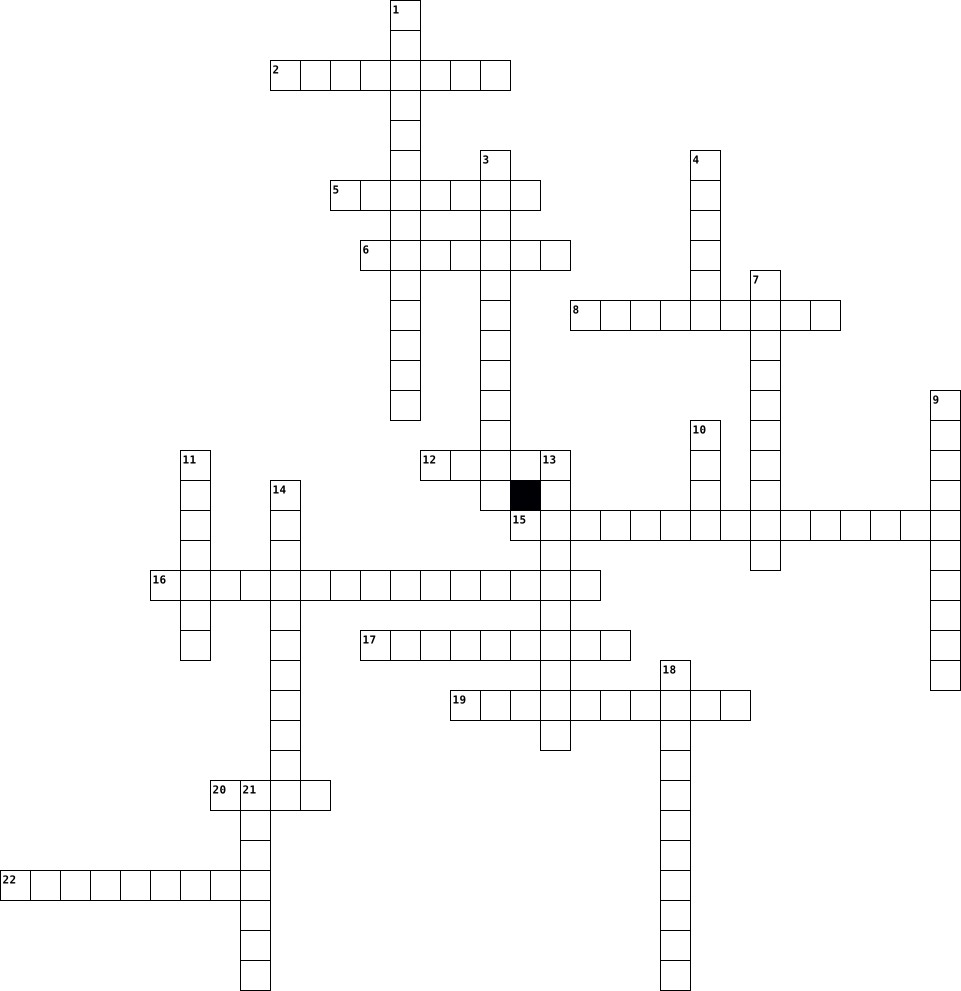
Plate Tectonics Vocabulary 2017-01-28

Across
- point of Earth's surface directly above an earthquake's focus
- a pulling force
- core liquid layer of the Earth's core
- powerful seismic sea wave that can travel thousands of kilometers in all directions and that begins over an earthquake focus
- boundary between two plates that are sliding past each other
- outermost rigid layer of the Earth
- opening in Earth's surface that often forms a mountain when layers of lava and volcanic ash erupt and build up
- soft layer of the mantle
- outermost layer of the Earth
- the bending of rock layers
Down
- a break in the Earth's crust
- single large landmass made up of all the continents connected together that broke apart 200 million years ago
- boundary between two colliding plates
- boundary between two plates moving away from each other
- a region where an oceanic plate sinks down into the athenosphere
- theory that continents drift apart
- vibrations caused by breaking rocks along faults
- layer between the crust and the core
- core solid, dense center of the Earth
- in an earthquake, the point beneath Earth's surface where energy release occurs
- a squeezing force
21 Clues: a pulling force • a squeezing force • soft layer of the mantle • the bending of rock layers • a break in the Earth's crust • outermost layer of the Earth • theory that continents drift apart • outermost rigid layer of the Earth • layer between the crust and the core • boundary between two colliding plates • core liquid layer of the Earth's core • ...
Plate Tectonics Crossword 2017-10-18

Across
- Parts of the Earth’s crust that are broken up into large pieces that move due to plate tectonics.
- The cycle in which heat is transferred within a fluid.
- Idea that the continents slowly moved over Earth’s surface.
- A supercontinent that formed 300 million years ago.
- The remains of an ancient organism preserved in rock.
- The area where plates slip past each other.
- The area where Earth’s crust diverge on land.
- A dense ball of solid metal within the center of the Earth.
- The area where plates move away from each other.
- The theory that Earth’s plates are in slow, constant motion, driven by convection currents in the mantle.
Down
- Deep underwater canyons at which oceanic crust bends downwards.
- The process in which a mid-ocean ridge adds new material to the ocean floor.
- The process where the ocean floor sinks beneath a deep-ocean trench into the mantle.
- The area where plates come together.
- A device used to help scientists map the ocean floor.
- The layer of rock that forms Earth’s outer shell.
- Breaks in the Earth’s crust where rocks have slipped past each other.
- The layer of molten metal surrounding the inner core.
- Long chains of mountains that rise up from the sea floor.
- The area that includes the crust and the upper mantle.
20 Clues: The area where plates come together. • The area where plates slip past each other. • The area where Earth’s crust diverge on land. • The area where plates move away from each other. • The layer of rock that forms Earth’s outer shell. • A supercontinent that formed 300 million years ago. • A device used to help scientists map the ocean floor. • ...
Plate Tectonics Crossword 2018-02-27

Across
- pressure causing rock layers to fold downward
- fan feature that forms when a river deposits sediment on land
- area around a river where sediment is deposited when it overflows
- slope of a river
- feature that forms when sediment is carried from a river into another body of water
- a valley formed by glaciers
- a crack in the Earth's surface caused by pressure
- processes a process which breaks down landforms
- a destructive process where sediment is moved to another place
- tiny pieces of natural material
Down
- a tall landform formed by convergent boundaries or convection currents
- valley formed by rivers and erosion
- processes processes that help build up landforms
- process where two plates collide, causing the plates to fold onto itself
- natural process that not only alters the soil and rocks but also the plants and animals
- the outer layer of the Earth
- a plate pulled under another plate at a convergent boundary
- the boundary where two plates collide
- currents circulating magma in the crust
- the slow, broad upward movement of Earth’s surface
20 Clues: slope of a river • a valley formed by glaciers • the outer layer of the Earth • tiny pieces of natural material • valley formed by rivers and erosion • the boundary where two plates collide • currents circulating magma in the crust • pressure causing rock layers to fold downward • processes a process which breaks down landforms • ...
Plate Tectonics Project 2023-11-14

Across
- any trace of an ancient organism that has been preserved in a rock
- The flow that transfers heat within fluid
- when magma reaches the surface
- mid-ocean ridges continually add new material to the ocean floor
- Wegener's idea that the continents slowly moved over earth's surface
- The resulting volcanoes sometimes create a string of islands
- form long chains of mountains that rise up from the ocean floor
- boundary plates move apart
- boundary plates come together
- Heat transfer between materials that are touching
- wegener called supercontinent
Down
- the ocean floor sinks beneath a deep-ocean trench and back into the mantle
- an area where material from deep within earths mantle
- one major belt of volcanoes
- broken into pieces separated by cracks
- boundary plates slide past eachothere
- measure of how much mass there is in a given volume
- a mountain that forms in earth's crust
- the transfer of energy that is carried in rays like light
- is a molted mixture of rock-forming substances gases and water from the mantle
- Heat transfer by the movement of a fluid
- the ocean floor plunges into deep underwater canyons
22 Clues: boundary plates move apart • one major belt of volcanoes • boundary plates come together • wegener called supercontinent • when magma reaches the surface • boundary plates slide past eachothere • broken into pieces separated by cracks • a mountain that forms in earth's crust • Heat transfer by the movement of a fluid • The flow that transfers heat within fluid • ...
Plate Tectonic Project 2023-11-16

Across
- Any trace of an organism that is preserved in rock.
- Earth's lithosphere separated by cracks.
- A molten mixture of rock.
- The amount of mass in an object.
- The shaking of the Earth.
- Heat transfer through the movement of a fluid.
- an instrument that records and measures an earthquake's seismic waves.
- Heat transfer through contact between objects.
- a number that geologists give to an earthquake based on the size.
- When plates move apart.
Down
- Breaks in Earth's crust where rocks moved past eachother.
- The transfer of heat through rays.
- When plates move together.
- A mountain that forms in the Earth's crust when molten material reaches the surface.
- A string of islands created by volcanoes.
- When plates slide past eachother.
- A force that changes rock.
- when magma reaches the surface.
- Major belt of volcanos.
- Earth's supercontinent.
20 Clues: Major belt of volcanos. • Earth's supercontinent. • When plates move apart. • A molten mixture of rock. • The shaking of the Earth. • When plates move together. • A force that changes rock. • when magma reaches the surface. • The amount of mass in an object. • When plates slide past eachother. • The transfer of heat through rays. • Earth's lithosphere separated by cracks. • ...
Amplify - Plate Motion 2023-09-19

Across
- the place where two plates meet
- hot liquid rock on the surface of the Earth
- a diagram that shows that shows what the inside of something looks like
- moving apart in different directions
- how often or fast something happens
- the layer of soft, solid rock underneath Earth'sp plates
- Earth's outermost layer of hard, solid rock
- a set of interacting parts forming a complex whole
- a long, deep indentation in the ocean floor
Down
- evidence of life from the past
- one of the very large sections of hard, solid rock that make up Earth's outer layer
- the outside or top layer of something
- an underwater mountain range formed when two plates move apart
- moving toward the same place
- something we observe to be similar over and over again
- any of Earth's main continuous areas of land
- the slow pulling apart of land that is caused by plate movement
- is a feature that forms on the surface of a planet
- a sudden shaking of the Earth's surface
- is hot liquid rock below the surface of the Earth
20 Clues: moving toward the same place • evidence of life from the past • the place where two plates meet • how often or fast something happens • moving apart in different directions • the outside or top layer of something • a sudden shaking of the Earth's surface • hot liquid rock on the surface of the Earth • Earth's outermost layer of hard, solid rock • ...
Plate Tectonics Crossword 2025-03-13

Across
- another word for divergent plate boundary
- along the creat of some ridge segments is a deep canyonlike structure called
- seed fern
- arc a chain of volcanic islands generally located a few hundred km from a trench where there is active subduction of one oceanic plate beneath another
- how many plates account for 94% of Earth’s surface area?
- elevated areas of the seafloor characterized by high heat flow and volcanism
- boundary a boundary in which two plates move together
- small aquatic freshwater reptile
- supercontinent containing all existing continents
- a hypothesis which suggested all present continents once existed as a single supercontinent.
- a continuous elevated zone on the floor of all major ocean basins and varying in width from 500 to 5,000 km
Down
- book written by Alfred Wegener in 1915
- German meteorologist and geophysicist who created the continental drift hypothesis
- a narrow, elongated depression of the seafloor
- a boundary in which two plates move apart, resulting in upwelling of material from the mantle to create new seafloor
- a hypothesis, first proposed in the 1960s by Harry Hess, which suggested that new oceanic crust is produced at the crests of mid-ocean ridges, which are the sites of divergence
- primary driving force for movement of tectonic plates
- largest plate
- processes that deform Earth’s crust to create major structural features, such as mountains, continents, and ocean basins
- inventor of seafloor spreading hypothesis
20 Clues: seed fern • largest plate • small aquatic freshwater reptile • book written by Alfred Wegener in 1915 • another word for divergent plate boundary • inventor of seafloor spreading hypothesis • a narrow, elongated depression of the seafloor • supercontinent containing all existing continents • primary driving force for movement of tectonic plates • ...
Plate Tectonic Project 2025-09-24

Across
- The next level of Earth's interior after the crust
- Where the plate tectonics come together to form 1 big continent
- The layer that you live on
- A German meteorologist that proposed the hypothesis of Continental Drift
- Magnet shooting from rocks
- What the plates "float on"
- Below the Crust, much hotter, and has the ability to flow
- It is usually a fault or an intrusion
- Tectonic Plates moving under water
Down
- The biggest mountain range under water
- Tectonic Plates horizontally moving past each other
- The solid,outer layer of Earth that consists of the crust and the rigid upper part of the mantle
- The movement of Earth's plates throughout time
- Tectonic Plates moving away from each other
- Comes from the Lithosphere, what the project was named after
- Each layer is older than the layer above it
- The next level of Earth's interior after the outer core
- Tectonic Plates colliding with each other
- Study of Earth's magnetic field
- Breaking apart caused by Plate Tectonics
20 Clues: The layer that you live on • Magnet shooting from rocks • What the plates "float on" • Study of Earth's magnetic field • Tectonic Plates moving under water • It is usually a fault or an intrusion • The biggest mountain range under water • Breaking apart caused by Plate Tectonics • Tectonic Plates colliding with each other • Tectonic Plates moving away from each other • ...
Paddock to Plate 2025-11-09

Across
- A statement describing what a project must include
- Edible food that is thrown away
- A source of potential danger
- Being protected from danger or harm
- Actions that reduce risk in a workplace
- How something looks or appeals to the senses
- Health problems caused by poor food choices
- Handheld equipment used to complete a task
- Businesses involved in farming and food production
- The natural world around us
- Shared beliefs, traditions, and food practices of a group
- Keeping things clean to prevent illness
- Designing tools or spaces to fit people comfortably
- The journey of food from farm to consumer
Down
- Gases released that trap heat in the atmosphere
- Large-scale farming to sell products
- How well something works for its intended purpose
- All businesses involved in producing and selling food
- Steps taken to complete a task or create something
- Not having reliable access to safe, nutritious food
- Turning raw ingredients into packaged food products
- Growing plants and raising animals for food
- Using resources responsibly to protect the future
- Collecting crops at the time they naturally grow best
- Traditional Australian foods from native plants or animals
- Using knowledge and equipment to solve problems
- Farming fish or seafood
27 Clues: Farming fish or seafood • The natural world around us • A source of potential danger • Edible food that is thrown away • Being protected from danger or harm • Large-scale farming to sell products • Actions that reduce risk in a workplace • Keeping things clean to prevent illness • The journey of food from farm to consumer • Handheld equipment used to complete a task • ...
Plate Tectonics Crossword 2025-12-03

Across
- Process where one plate sinks beneath another.
- Curve of volcanic islands at a subduction zone.
- Soft, flowing layer that tectonic plates float on.
- Wegener’s idea that continents move over time.
- Crack in Earth where movement causes earthquakes.
- Where two tectonic plates meet.
- Stationary plume of magma creating volcano chains.
- Rigid outer layer of Earth broken into plates.
- Type of boundary where plates move apart.
- Point on Earth’s surface directly above an earthquake.
Down
- Type of boundary where plates slide past each other.
- Zone of frequent earthquakes/volcanoes around the Pacific.
- Type of boundary where plates collide.
- Supercontinent that existed 300 million years ago.
- Thick layer between crust and core.
- New ocean crust forms as plates pull apart.
- Underwater mountain chain formed at divergent boundaries.
- Molten rock beneath Earth’s surface.
- Deep valley formed at a subduction zone.
- Earth’s thin outermost layer.
20 Clues: Earth’s thin outermost layer. • Where two tectonic plates meet. • Thick layer between crust and core. • Molten rock beneath Earth’s surface. • Type of boundary where plates collide. • Deep valley formed at a subduction zone. • Type of boundary where plates move apart. • New ocean crust forms as plates pull apart. • Process where one plate sinks beneath another. • ...
Sciene vocab 2022-09-16

Across
- rebound The sudden return of elastically deformed rock to its undeformed shape
- spreading The process of new seafloor forming
- A solid, thin layer of mantle material below the lithosphere.
- current Any movement of matter that results from differences in density.
- boundary The boundary between tectonic plates that are sliding past each other
- The bending, tilting, and breaking of Earth's crust
- reversal The process by which earth's magnetic north pole and magnetic south pole switch positions periodically.
- plate A block of lithosphere that consists of the crust and the rigid, outermost part of the mantle
- The thin and solid outermost layer of Earth above the mantle.
- The lower part of the mantle.
- The point on Earth’s surface directly above an earthquake's starting point.
Down
- The process by which one phosphoric plate moves beneath another plate as a result of tectonic forces.
- A break in a body of along which one locke moves relative to another
- tectonics the hypothesis that today's continents were once part of a single landmass.
- the outermost physical layer of the earth. It is a solid, rigid layer.
- a well-supported explanation of nature.
- boundary The boundary between two tectonic plates that are moving away from each other
- Very dense elements, mainly iron and small amount of nickel.
- The compositional layer below the crust.
- drift the hypothesis that today's continents were once part of a single landmass.
- A movement of trembling of the ground that is caused by a sudden release of energy when rocks along a fault move.
- boundary The boundary between tectonic plates that are colliding
- plate boundary The edge between two or more plates classified as divergent, convergent, or transform by the movement taking place between the plates.
- The location within Earth along a fault at
24 Clues: The lower part of the mantle. • a well-supported explanation of nature. • The compositional layer below the crust. • The location within Earth along a fault at • spreading The process of new seafloor forming • The bending, tilting, and breaking of Earth's crust • Very dense elements, mainly iron and small amount of nickel. • ...
shaping earths surface 2023-03-28

Across
- break in earths crust along which movement occurs
- a crater on a planet or satellite caused by the impact of a meteorite
- a volcano built up of alternate layers of lava and ash.
- an area which is dominated by volcanoes, created by volcanic activity, and shaped by volcanic activity over time.
- When two plates come together
- the geological process in which earthen materials are worn away and transported by natural forces such as wind or water.
- rapid downhill movemet of soil loose rocks and boulders.
- mountain formed from two or more of Earth's tectonic plates are pushed together
- the breaking down or dissolving of rocks and minerals on Earths surface
Down
- an area on Earth over a mantle plume or an area under the rocky outer layer of Earth, called the crust, where magma is hotter than surrounding magma
- any of the world's main continuous expanses of land
- mountains formed by the movement of large crustal blocks along faults formed when tensional forces pull apart the crust
- an area of many fractured pieces of crust along a large fault line
- process in which the nazca plate is forced under the south american plate
- openings, or vents where lava, tephra (small rocks), and steam erupt onto the Earth's surface
- when two tectonic plates move away from each other
- curved line of volcanoes located in the united states
- a broad zone forming as the Pacific Plate slides northwestward past the North American Plate.
- a large wave which forms when an ocean disturbance suddenly moves a large volume of water
- rupture or sudden movement of rocks along a break in earths crust
20 Clues: When two plates come together • break in earths crust along which movement occurs • when two tectonic plates move away from each other • any of the world's main continuous expanses of land • curved line of volcanoes located in the united states • a volcano built up of alternate layers of lava and ash. • rapid downhill movemet of soil loose rocks and boulders. • ...
Weather!!!!!!! 2023-03-21
Across
- a relatively calm area near the equator where warm air rises
- the condition of the atmosphere at any given moment in a particular area
- a very large body of air that maintains uniform temperature, humidity, and pressure as it moves
- the tectonic plate movement away from another plate
- the boundary at which two different air masses meet
- a material found in nature that is useful to humans
- the cold winds from the poles to the 60 degree latitudes that blow from east to west
- the type of igneous rock formed by cooling quickly with small crystals
- a local wind that blows from the land toward a body of water
- the movement of air caused by differences in air pressure
- a local wind that blows from an ocean or sea toward the land
Down
- the relatively calm areas located near both 30 degree latitudes where cool air sinks
- the process of removing salt from seawater to obtain fresh water
- a line used on a map or chart connecting points of equal air pressure
- the winds, found between the 30 and 60 degree latitudes, that blow toward the poles from west to east
- the tectonic plate movement toward another plate
- a solid fossil fuel formed from decomposed plant remains
- a wind that changes direction with the change of seasons and which usually brings very heavy rainfall
- the winds that blow easterly from both 30 degree latitudes toward the equator
- a compound made of the elements hydrogen and carbon
- the type of rock formed by extreme heat and pressure
- the type of rock formed by melting, cooling and hardening
22 Clues: the tectonic plate movement toward another plate • the tectonic plate movement away from another plate • the boundary at which two different air masses meet • a compound made of the elements hydrogen and carbon • a material found in nature that is useful to humans • the type of rock formed by extreme heat and pressure • ...
Geophysical Processes and Associated Hazards 2014-05-07

Across
- Location of the 9.1 magnitude tsunami that affected 14 countries on Boxing Day 2004
- Exposure of the ocean floor preceding a tsunami wave hitting land
- Destructive mud flow on slopes of a volcano
- Result of tectonic and/or volcanic activity severe shaking of the ground that can cause mass destruction
- Mass movement mechanism triggered by seismic activity
- Plate boundary where new crust is created
- Discipline of dealing with and avoiding natural and man made catastrophies
- Violent ejection of steam and volcanic material
- Found at a destructive plate boundary where crust sinks into the mantle
- Conservative plate boundary
- Large area prone to volcanic and seismic activity around the Pacific Ocean
- A volcanic hazard consisting of a mixture of hot high density rock and gas
- Precipitation affected by volcanic gases such as sulphur and nitrogen oxides
- Destructive plate boundary
- 300,000 deaths 180,000 homes destroyed and 1.5 million people homeless following a 7.0 magnitude earthquake here in 2010
- Point on the surface directly above the focus of an earthquake
- Rock fragments and material ejected from a volcano
Down
- Sudden swell of high water
- Earthquake resistant structures should not do this
- Lightweight airborne deposit from a volcanic eruption
- Renewable energy source that creates a high risk of radioactive explosions
- Weakness in rock formation often trigger of seismic activity
- Water saturated sediment acting as a fluid when shaken
- Devastation of infrastructure e.g. roads, railways and industry
- Part of the lithosphere which moves in continental drift
- Size of seismic or tectonic hazard
- Seismic activity that occurs preceding an earthquake as stress builds
- Seismic wave propagated by submarine tectonic fault
- Ruptured gas pipes and electricity lines can cause this potential hazard
- Logarithmic scale that measures magnitude of an earthquake
30 Clues: Sudden swell of high water • Destructive plate boundary • Conservative plate boundary • Size of seismic or tectonic hazard • Plate boundary where new crust is created • Destructive mud flow on slopes of a volcano • Violent ejection of steam and volcanic material • Earthquake resistant structures should not do this • Rock fragments and material ejected from a volcano • ...
GeoPuzzle 2023-11-15

Across
- A type of igneous rock that cools underground.
- The inner _____ is the layer of the earth made of solid nickel and iron.
- Objects that can be made up of both minerals and organic materials.
- The type of rock that comes from volcanoes.
- Fragments of broken down rocks.
- Volcanoes that might erupt again are called:
- A type of igneous rock that cools on Earth's surface.
- Molten rock found on the outside of a volcano.
- A scientist who studies Earth, including its formation and tectonic activity.
- The difference between the highest and lowest elevation of an area.
- Made up of the lower crust and upper mantle.
- A type of volcano made up of alternating layers of lava and ash.
- Molten rock found on the inside of a volcano.
- Tectonic plates move towards each other at __________ plate boundaries.
Down
- The type of rock that is created through heat, pressure, and chemical processes.
- Earthquake shaking can be detected using a ___________.
- The preserved remains or traces of organisms from the distant past.
- Continental _____ is caused by tectonic plate movement/seafloor spreading.
- Tectonic plates move away from each other at __________ plate boundaries.
- The outermost layer of the earth.
- The type of rock that is formed through the compression and cementation of sediments.
- The layer of the earth just beneath the crust that is semi-molten.
- Inorganic crystals that have clearly defined chemical formulas.
- Distinct shapes or features of the topography of a region.
- A type of volcano that is a broad, gently sloping mountain of hardened lava.
- Ground movement and shaking caused by tectonic plate slipping.
- layers of rock used to determine the geologic age of an area.
27 Clues: Fragments of broken down rocks. • The outermost layer of the earth. • The type of rock that comes from volcanoes. • Volcanoes that might erupt again are called: • Made up of the lower crust and upper mantle. • Molten rock found on the inside of a volcano. • A type of igneous rock that cools underground. • Molten rock found on the outside of a volcano. • ...
Agung Volcano Crossword Challenge!!! 2025-02-13

Across
- An oceanic tectonic plate that lies beneath the Pacific Ocean.
- Mountains created by volcanic activity.
- A type of plate boundary where two tectonic plates are moving toward each other.
- A volcano is an opening in the earth's crust through which lava, volcanic ash, and gases escape.
- The layer of the Earth that lies below the lithosphere. This portion of the Earth's mantle flows like molten plastic despite being solid.
- Molten rock that flows from a volcano onto the Earth's surface.
- A mixture of molten and semi-molten rock found beneath the surface of the Earth.
- A thinner layer of crust (usually made of basalt) found underneath oceans and other bodies of water.
- A path along the Pacific Ocean characterized by active volcanoes and frequent earthquakes.
- A location where 2 plates meet.
- The sideways and downward movement of the edge of a plate of the earth's crust into the mantle beneath another plate.
Down
- A sudden shaking of the ground caused by movement of tectonic plates.
- The outer layer of the earth, consisting of both the crust and upper mantle.
- A dense, destructive mass of very hot ash, lava fragments, and gases ejected explosively from a volcano and typically flowing downslope at great speed.
- A thick layer of crust (usually made of granite) found beneath land masses.
- Rock formed when magma (molten rock) cools and crystallizes
- A island originating from a volcano or volcanic activity.
- A violent type of mudflow or debris flow composed of a slurry of pyroclastic material, rocky debris and water.
- Mixture of rock, mineral, and glass particles emitted by a volcano during an eruption.
- Spot a part of the Earth's mantle where hot plumes rise upward, forming volcanoes on the crust.
20 Clues: A location where 2 plates meet. • Mountains created by volcanic activity. • A island originating from a volcano or volcanic activity. • Rock formed when magma (molten rock) cools and crystallizes • An oceanic tectonic plate that lies beneath the Pacific Ocean. • Molten rock that flows from a volcano onto the Earth's surface. • ...
Unit 5 Vocab -Elliana Brazil 2024-10-18

Across
- A body of molten rock deep in the earth;dissolved gasses and crystals
- Tectonic plate boundary where the two plates slide past each other in opposite directions
- A device that records ground movements from Seismic Waves
- A natural solid made of one or more minerals/organic matter
- The outer layer of the Earth
- Tectonic plate boundary where the two plates move away from each other
- Upper layer of the mantle (just below the lithosphere)
- Plate tectonics go away from each other and produces new oceanic lithosphere; at ocean ridges
- A rock formed by molten magma
- The area on Earth's surface directly above the main point of an earthquake
- Rock being broken into smaller pieces
- Tectonic plate boundary where the two plates move towards each other
- The vibrations that an earthquake emits
Down
- Rock being broken down by chemical reactions; changes rock's molecular composition
- A natural resource that can be replaced fast
- The area under the Earth's surface where rock breaks and causes an earthquake
- The thickness of a liquid
- Heat in the mantle that may produce magma; magma rises to Earth's surface
- Loose particles made of chunks of other rock; created by erosion
- Magma once it comes out of earths surface
- A split or crack in earth; indicates movement
- A rock formed by preexisting rock being melted and bent by the heat within the earth
- A natural resource that takes a long time to be replenished
- Material being moved by wind, water, ice, etc
- A natural solid with a definite chemical composition
- A rock formed from sediments being moved, compacted, and cemented
26 Clues: The thickness of a liquid • The outer layer of the Earth • A rock formed by molten magma • Rock being broken into smaller pieces • The vibrations that an earthquake emits • Magma once it comes out of earths surface • A natural resource that can be replaced fast • A split or crack in earth; indicates movement • Material being moved by wind, water, ice, etc • ...
Plate Tectonics - Year 9 2024-10-30

Across
- Matches up on either side of the mid ocean ridge.
- Scientist who proposed continental drift.
- Coal is thought to be formed in ________.
- Process for moving tectonic plates which relies on gravity and subduction (2 words).
- Plate tectonics is thought to be important for nutrient ________.
- Formed by the collision of the Indo-Australian and Sunda plates.
- Island arcs are formed by the convergence of plates mainly composed of __________ crust.
- One of the types of evidence for continental drift.
- Type of volcano that formed the Bunya Mountains.
- Evidence for a global flood: fossils on the top of _________.
- Point (often below the surface) where the earthquake originates.
- Supercontinent proposed by German meteorologist.
- Mount Everest is getting __________.
- Type of boundary where new oceanic crust forms.
- Physical property that means that oceanic plates subduct below continental plates.
- The plate subducting to form the Andes Mountains.
Down
- Type of boundary where plates slide past each other.
- Hot spots are ________.
- The thickest layer of the earth.
- Currents in the mantle which power plate tectonics.
- Evidence for a global flood: fossils indicating ________ burial.
- Basalt is denser than _________.
- A lot of coal deposits are found at the ________.
- The Himalayan Mountains involve what type of crust?
- Plate tectonics is thought to act as a _______.
- The Himalayan Mountains involve what type of boundary?
- The thinnest layer of the earth (2 words).
- Term for the 'plastic' layer of the mantle.
- The number of main tectonic plates.
- Term for the crust and upper mantle.
- These Islands are formed from a hot spot.
- Convection currents rely on differences in __________ in the mantle.
- Diagrams in Science must be drawn in __________.
33 Clues: Hot spots are ________. • The thickest layer of the earth. • Basalt is denser than _________. • The number of main tectonic plates. • Term for the crust and upper mantle. • Mount Everest is getting __________. • Scientist who proposed continental drift. • Coal is thought to be formed in ________. • These Islands are formed from a hot spot. • ...
Laki Charms Crossword Puzzle 2025-02-19

Across
- A portion of the Earth's mantle that flows like molten plastic despite being solid.
- Formed from oceanic continental convergent plate boundaries.
- An opening in the earth's crust through which lava, volcanic ash, and gases escape
- The thinner and denser part of earths crust that makes up the ocean floor.
- The location in which two tectonic plates interact through converging, diverging, or transforming.
- A path along the Pacific Ocean characterized by active volcanoes and frequent earthquakes.
- An oceanic tectonic plate that lies beneath the Pacific Ocean.
Down
- The location where two plates are being forced together by the convection currents in the earth's mantle.
- The solid, outermost layer of Earth, made of the crust and upper mantle.
- A sudden shaking of the ground caused by movement of tectonic plates.
- Molten rock (magma) erupted from a volcano.
- The layer of granitic, sedimentary, and metamorphic rocks, which form the continents and the areas of shallow seabed close to their shores.
- A type of rock that forms when molten rock cools and solidifies.
- The location when two plates converge, and one plate is forced under another.
- Formed from oceanic oceanic convergent plate boundaries.
- A hot, chaotic mixture of rock fragments, gas, and ash that travels rapidly away from a volcanic vent or collapsing flow front.
- A hot or cold mixture of water and rock fragments that flow quickly down the slopes of a volcano.
- Molten rock below the earth's surface near the upper mantle and lower crust.
- An area of the Earth's mantle from which hot plumes rise upward, forming volcanoes on the overlying crust.
- The solid remanence from fires, explosions, and/or volcanic vents.
20 Clues: Molten rock (magma) erupted from a volcano. • Formed from oceanic oceanic convergent plate boundaries. • Formed from oceanic continental convergent plate boundaries. • An oceanic tectonic plate that lies beneath the Pacific Ocean. • A type of rock that forms when molten rock cools and solidifies. • ...
Planet Earth 2020-08-31

Across
- continental _ is a theory that the continents were once joined and then slowly drifted apart.
- molten rock that is located below the Earth's surface.
- the _ shelf is part of a continent that extends out underneath the ocean.
- process by which oceanic plates dive beneath continental plates, causing mountains to form
- plate _ is a term used by scientists to describe the activities of continental drift and magma flow.
- the part of the Earth where life exists.
- chemical or physical processes that breakdown rocks into smaller pieces.
- the water areas of the Earth, including oceans, lakes, rivers, etc.
- the movement of weathered rock and material by wind, glaciers, and moving water.
- process by which magma wells up between oceanic plates and pushes plates apart.
Down
- outer layer of the Earth, a hard rocky shelf forming Earth's surface.
- slow process in which an oceanic plate slides under a continental plate.
- a crack or break in Earth's crust.
- a process of cracking that occurs when the folded land cannot bend any further.
- thick middle layer layer of the Earth's interior structure consisting of hot rock that is dense but flexible.
- innermost layer of the Earth made up of a super-hot but solid inner core and a super-hot liquid outer core.
- the layer of gas that surrounds the Earth
- uppermost layer of the Earth that includes the crust, continents, and ocean basins.
- a large body of ice that moves across the surface of the Earth.
- pile of rock debris left behind by melting glaciers.
- a bend in layers of rock, sometimes caused by plate movement.
21 Clues: a crack or break in Earth's crust. • the part of the Earth where life exists. • the layer of gas that surrounds the Earth • pile of rock debris left behind by melting glaciers. • molten rock that is located below the Earth's surface. • a bend in layers of rock, sometimes caused by plate movement. • a large body of ice that moves across the surface of the Earth. • ...
Geophysical Processes and Associated Hazards 2014-05-07

Across
- Violent ejection of steam and volcanic material
- Mass movement mechanism triggered by seismic activity
- A volcanic hazard consisting of a mixture of hot high density rock and gas
- Part of the lithosphere which moves in continental drift
- Plate boundary where new crust is created
- Devastation of infrastructure e.g. roads, railways and industry
- Rock fragments and material ejected from a volcano
- Point on the surface directly above the focus of an earthquake
- Precipitation affected by volcanic gases such as sulphur and nitrogen oxides
- Conservative plate boundary
- 300,000 deaths 180,000 homes destroyed and 1.5 million people homeless following a 7.0 magnitude earthquake here in 2010
- Seismic activity that occurs preceding an earthquake as stress builds
- Location of the 9.1 magnitude tsunami that affected 14 countries on Boxing Day 2004
- Exposure of the ocean floor preceding a tsunami wave hitting land
- Weakness in rock formation often trigger of seismic activity
- Lightweight airborne deposit from a volcanic eruption
Down
- Earthquake resistant structures should not do this
- Result of tectonic and/or volcanic activity severe shaking of the ground that can cause mass destruction
- Large area prone to volcanic and seismic activity around the Pacific Ocean
- Destructive mud flow on slopes of a volcano
- Discipline of dealing with and avoiding natural and man made catastrophies
- Sudden swell of high water
- Found at a destructive plate boundary where crust sinks into the mantle
- Water saturated sediment acting as a fluid when shaken
- Logarithmic scale that measures magnitude of an earthquake
- Destructive plate boundary
- Seismic wave propagated by submarine tectonic fault
- Size of seismic or tectonic hazard
- Ruptured gas pipes and electricity lines can cause this potential hazard
- Renewable energy source that creates a high risk of radioactive explosions
30 Clues: Sudden swell of high water • Destructive plate boundary • Conservative plate boundary • Size of seismic or tectonic hazard • Plate boundary where new crust is created • Destructive mud flow on slopes of a volcano • Violent ejection of steam and volcanic material • Earthquake resistant structures should not do this • Rock fragments and material ejected from a volcano • ...
Chapter 9 Vocabulary 2023-12-07

Across
- The process of ______ moves new ocean floor along mid ocean ridges and slowly moves outward along ocean basins
- ____ means all land
- Long steep valleys that form in the deepest part of the ocean are ______
- Arc shaped land chains of volcanic islands are _____ and are made of newly formed land
- Boundaries that move away from each other are called ______ boundaries
- When older parts of the ocean floor return to the mantle ____ occurs as the floor moves through trenches
- _________ is a range of volcanic mountains within a continent produced in part by subduction
- _____ are chains of mountains that extend through oceans
Down
- A long canyon that forms a valley in the center of a mid-ocean ridge
- The upwelling of mantle rock, known as _______, occur in hotspots and take on column shapes
- ______ is the theory that Earth’s plates move slowly driven by the convection currents of the mantle
- The gradual movement of the continents across Earth’s surface is ______ which was hypothesized by Alfred Wegener
- Plate that grind past each other without breaking or building the lithosphere are _______ boundaries
- ______ boundaries form where two tectonic plates move together
- Sound navigation and Ranging stand for _____ and is a system of using sound wave to calculate distance
- Lithosphere that slides into the asthenosphere near mid-ocean ridges is a result of ________ mechanics of plate motion mechanics
- A rock has ______ if it acquires the same type of polarity as the Earth's magnetic field at that time
- Broken pieces of the Earth’s lithosphere are _____
- The continuous circular flow in a fluid, a ______, is due to differences in density in the fluid.
- When dense oceanic lithosphere is pulled into the mantle is the _______ mechanism of plate motion mechanics
20 Clues: ____ means all land • Broken pieces of the Earth’s lithosphere are _____ • _____ are chains of mountains that extend through oceans • ______ boundaries form where two tectonic plates move together • A long canyon that forms a valley in the center of a mid-ocean ridge • Boundaries that move away from each other are called ______ boundaries • ...
Chapter 6: Manicuring 2023-10-01

Across
- boards and buffers 150-180 grit
- conservative nail shape
- shorten the nails free edge
- combination of clear polish and protein
- cosmetic treatment for the hands
- set of all tools that will be used in a service
- also called kneading
- absorb in the nail plate; increase flexibility; soften surrounding skin
- adds cross link to natural nail plate
- rapid tapping or striking motion of the hands against the skin
- used to gently scrape cuticle tissue from the natural nail plate
- colorless, inflammable liquid; removes oils and prepares nails for polish
- nail shape completely straight across the free edge
Down
- tools to perform nail services can be multi use or single use
- wooden stick used to remove cuticle tissue from the nail plate
- reusable implements
- barrier product;seal the skin surface; hold subdermal moisture in the skin
- abrasives 240 grit or higher
- nail shape suited to thin hands with long fingers and narrow nail beds
- nail shape with square free edge with rounded corner edges
- continuous trembling or shaking movement applied by the hand without leaving contact with the skin
- uses high- temperature steam and pressure to kill microorganisms and their spores
- disposable implements
- quickly reduce the thickness of any surface and produce deeper and more visible scratches on the surface
- stainless steel implement used to carefully trim dead skin around the nail
- list of services that you are legally allowed to perform in your specialty
- manual or mechanical manipulation of the body by rubbing, kneading, or tapping
- petroleum by product; excellent sealing properties; excellent moisture in the epidermal layer
- slightly tapered nail shape
29 Clues: reusable implements • also called kneading • disposable implements • conservative nail shape • shorten the nails free edge • slightly tapered nail shape • abrasives 240 grit or higher • boards and buffers 150-180 grit • cosmetic treatment for the hands • adds cross link to natural nail plate • combination of clear polish and protein • ...
Tectonic Plates 2025-03-14

Across
- a German meteorologist and geophysicist who came up with the continental drift hypothesis
- mountains formed in part by igneous activity associated with the subduction of oceanic lithosphere beneath a continent
- a deep canyonlike structure found along the creat of some ridge segments
- the action that drives the movement of tectonic plates
- the crust that is less likely to subduct due to its buoyancy
- the number of major plates which account for 94% of the Earth’s surface area
- the largest tectonic plate
- a boundary in which two plates slide past one another without creating or destroying lithosphere
- supercontinent containing all of the existing continents
- the amount of pieces the lithosphere is broken up into
- a hypothesis proposed by Harry Hess which suggested that new oceanic crust is produced at the crests of mid-ocean ridges
Down
- a well-tested theory proposing that Earth’s outer shell consists of individual plates that interact in various ways and thereby produce earthquakes, volcanoes, mountains, and the crust itself
- a chain of volcanic islands generally located a few hundred km from a trench where there is active subduction of one oceanic plate beneath another
- elevated areas of the seafloor characterized by high heat flow and volcanism; found at divergent boundaries
- a hypothesis which suggested that all present continents once existed as a single supercontinent
- a plate boundary where the two plates move together
- linear zones of irregular topography on the deep-ocean floor that follows transform faults and their inactive extensions
- processes that deform Earth’s crust to create major structural features, such as mountains, continents, and ocean basins
- a narrow, elongated depression of the seafloor
- a plate boundary in which two plates move apart
20 Clues: the largest tectonic plate • a narrow, elongated depression of the seafloor • a plate boundary in which two plates move apart • a plate boundary where the two plates move together • the action that drives the movement of tectonic plates • the amount of pieces the lithosphere is broken up into • supercontinent containing all of the existing continents • ...
Plate Tectonic Crossword Puzzle 2022-03-10

Across
- an oceanic plate that is beneath the pacific ocean
- the plate that is under Africa
- the plate that contains two continents Asia and Europe
Down
- the plate that is made up of India and Australia
- the plate that contains the continent of Antarctica
- the plate that is straddling the equator and the prime meridian
- You live here!
7 Clues: You live here! • the plate that is under Africa • the plate that is made up of India and Australia • an oceanic plate that is beneath the pacific ocean • the plate that contains the continent of Antarctica • the plate that contains two continents Asia and Europe • the plate that is straddling the equator and the prime meridian
Plate Tectonic Crossword Puzzle 2022-03-10

Across
- the plate that is made up of India and Australia
- You live here!
- the plate that is under Africa
- the plate that contains two continents Asia and Europe
Down
- the plate that is straddling the equator and the prime meridian
- the plate that contains the continent of Antarctica
- an oceanic plate that is beneath the pacific ocean
7 Clues: You live here! • the plate that is under Africa • the plate that is made up of India and Australia • an oceanic plate that is beneath the pacific ocean • the plate that contains the continent of Antarctica • the plate that contains two continents Asia and Europe • the plate that is straddling the equator and the prime meridian
Historical Geology (GEOL102) - Exam 1 Review Crossword 2020-08-05

Across
- Igneous rock classification, rocks that form above Earth’ surface
- Category of large, less dense gassy planets further away from the sun
- Igneous rock texture that forms when igneous material cools rapidly
- Evidence for the Big Bang that states material moves faster further away from Earth, demonstrated using train or car horns (2 words)
- Proposed the ideas of continental drift and named Pangaea, last name
- Rock type, any rock that has been changed from its original form due to heat, pressure or fluid activity
- Idea proposed by Harry Hess, describes how new oceanic crust forms
- Representation of how all three rock types are related, and can be created, altered or destroyed (2 words)
- Charged atomic particle
- The smallest layer of Earth, by volume
- Rock type, any rock formed by the cooling of magma or lava
- The part of Earth’s interior that flows plastically, like taffy
- Most common mineral group
- Rock type, rocks made up of sediment that have undergone lithification
Down
- Plate boundary where plates slide alongside each other
- The study of the origin and evolution of Earth (2 words)
- Plate boundary where plates move away from each other, or spread apart
- The largest layer of Earth, by volume
- The study of Earth materials and processes (2 words)
- Formation process of sedimentary rocks, through compaction or cementation
- Type of metamorphism that occurs when rocks are near heated magma chambers
- Plate boundary where regional metamorphic activity occurs, due to high temperatures and pressures
- Igneous texture that forms when gases and water are trapped as material cools
- Mantle cell _________, driving force of plate tectonics
- Metamorphic rock texture, lacking parallel mineral structure, like marble
25 Clues: Charged atomic particle • Most common mineral group • The largest layer of Earth, by volume • The smallest layer of Earth, by volume • The study of Earth materials and processes (2 words) • Plate boundary where plates slide alongside each other • Mantle cell _________, driving force of plate tectonics • The study of the origin and evolution of Earth (2 words) • ...
Chapter 8 2013-01-28

Across
- weathering Mechanical breakdown of rocks and minerals
- rain Sulfuric acid that causes degradation of statues and marble
- A vent in Earth's surface that emits ash, gases, and molten lava
- Rocks formed from mud, sand, or gravel compressed together
- Rocks formed from igneous or sedimentary rocks that are subjected to high temperatures and pressure that change its physical and chemical properties
- Molten rock
- A crack that occurs from stress in a rock
- Process of one plate passing under another
- spreading Creates new lithosphere and brings important elements to the surface
- The outermost layer of the planet
- plate When plates move toward one another and collide
- Contains magma, layer under the crust
- cycle Constant formation and destruction of rock
Down
- Rocks formed directly from magma
- The physical removal of rock fragments from an ecosystem
- Exact point on the Earth's surface where the earthquake ruptured
- tectonics A theory which states that "Earth's lithosphere is divided into plates, most of which are in constant motion
- activity A zone where earthquakes occur
- A solid chemical substance with uniform structure
- Near the mantle, made up of ductile rock
- weathering Breakdown of rocks and minerals by chemical reactions
- fault When plates move sideways past each other
- Dense large mass made up of nickel and iron
- plate When plates move away form each other
- spot A place where molten material from the mantle reaches the lithosphere
- zone Large expanse of rock where movement has occurred
- Occurs when rocks in the lithosphere rupture unexpectedly
- The outermost layer of the lithosphere
- scale A scale used to measure earthquake magnitude
29 Clues: Molten rock • Rocks formed directly from magma • The outermost layer of the planet • Contains magma, layer under the crust • The outermost layer of the lithosphere • activity A zone where earthquakes occur • Near the mantle, made up of ductile rock • A crack that occurs from stress in a rock • Process of one plate passing under another • ...
Geography Chapter 2 Section 1-3 2015-01-28

Across
- / A process by which mountains can form as sea plates dive beneath continental plates.
- / Molten rock that is pushed up form the earth's mantle.
- / Surface land areas of the earth's curst, including continents and ocean basins.
- / The removal of salt from seawater to make it usable for drinking and farming.
- drift / The theory that the continents were once joined and then slowly drifted apart.
- / Wearing away of the earth's surface by wind, flowing water or glaciers.
- / Moisture that falls to the earth as rain, sleet, hail, or snow.
- / Process of converting into vapor.
- / Thick middle layer of the earth's interior structure consisting of dense, hot rock.
- / A process by which new land is created when sea plates pull apart and magma wells up between the plates.
- / The part of the earth where life exists.
- / A slow process in which a sea plate slides under a continental plate, creating debris that can cause continents to grow outward.
Down
- / Water within the earth that supplies wells and springs.
- tectonics / The term scientists use to describe the activities of continental drift and magma flow which create many of the earth's physical features.
- / A bend in layers of rock, sometimes caused by plate movement.
- / The watery areas of the earth, including oceans, lakes, rivers, and other bodies of water.
- / The process of excess water vapor changing into liquid water when warm air cools.
- / Underground water-bearing layers of porous rock, sand, or gravel.
- / Fine, yellowish-brown topsoil made up of particles of silt and clay, usually carried by the wind.
- / A layer of gases that surrounds the earth.
20 Clues: / Process of converting into vapor. • / The part of the earth where life exists. • / A layer of gases that surrounds the earth. • / Molten rock that is pushed up form the earth's mantle. • / Water within the earth that supplies wells and springs. • / A bend in layers of rock, sometimes caused by plate movement. • ...
Geography Chapter 2 Section 1-3 2015-01-27

Across
- Molten rock that is pushed up from the earth's mantle.
- A process by which new land is created when sea plates pull apart and magma wells up between the plates.
- Wearing away of the earth's surface by wind, flowing water or glaciers.
- Process of converting into vapor.
- A process by which mountains can form as sea plates dive beneath continental plates.
- The process of excess water vapor changing into liquid water when warm air cools.
- The part of the earth where life exists.
- A slow process in which a sea plate slides under a continental plate, creating debris that can cause continents to grow outward.
- The removal of salt from seawater to make it usable for drinking and farming.
- Surface land areas of the earth's curst, including continents and ocean basins.
- Water within the earth that supplies wells and springs.
- tectonics The term scientists use to describe the activities of continental drift and magma flow which create many of the earth's physical features.
Down
- Underground water-bearing layers of porous rock, sand, or gravel.
- A bend in layers of rock, sometimes caused by plate movement.
- drift The theory that the continents were once joined and then slowly drifted apart.
- Moisture that falls to the earth as rain, sleet, hail, or snow.
- Fine, yellowish-brown topsoil made up of particles of silt and clay, usually carried by the wind.
- Thick middle layer of the earth's interior structure consisting of dense, hot rock.
- The watery areas of the earth, including oceans, lakes, rivers, and other bodies of water.
- A layer of gases that surrounds the earth.
20 Clues: Process of converting into vapor. • The part of the earth where life exists. • A layer of gases that surrounds the earth. • Molten rock that is pushed up from the earth's mantle. • Water within the earth that supplies wells and springs. • A bend in layers of rock, sometimes caused by plate movement. • Moisture that falls to the earth as rain, sleet, hail, or snow. • ...
Geography Chapter 2 Section 1-3 2015-01-27

Across
- / Thick middle layer of the earth's interior structure consisting of dense, hot rock.
- / A slow process in which a sea plate slides under a continental plate, creating debris that can cause continents to grow outward.
- / The watery areas of the earth, including oceans, lakes, rivers, and other bodies of water.
- / The process of excess water vapor changing into liquid water when warm air cools.
- / The removal of salt from seawater to make it usable for drinking and farming.
- / Wearing away of the earth's surface by wind, flowing water or glaciers.
- / Water within the earth that supplies wells and springs.
- / The part of the earth where life exists.
- / A layer of gases that surrounds the earth.
- / A bend in layers of rock, sometimes caused by plate movement.
Down
- / Surface land areas of the earth's curst, including continents and ocean basins.
- tectonics / The term scientists use to describe the activities of continental drift and magma flow which create many of the earth's physical features.
- / Process of converting into vapor.
- / A process by which mountains can form as sea plates dive beneath continental plates.
- / Moisture that falls to the earth as rain, sleet, hail, or snow.
- / Underground water-bearing layers of porous rock, sand, or gravel.
- / Fine, yellowish-brown topsoil made up of particles of silt and clay, usually carried by the wind.
- drift / The theory that the continents were once joined and then slowly drifted apart.
- / A process by which new land is created when sea plates pull apart and magma wells up between the plates.
- / Molten rock that is pushed up from the earth's mantle.
20 Clues: / Process of converting into vapor. • / The part of the earth where life exists. • / A layer of gases that surrounds the earth. • / Molten rock that is pushed up from the earth's mantle. • / Water within the earth that supplies wells and springs. • / A bend in layers of rock, sometimes caused by plate movement. • ...
Geological Forces Crossword Puzzle 2020-10-18

Across
- the layer of earth we live on
- plate movement where one tectonic plate goes under another plate
- pulling apart of two tectonic plates
- the crust and upper mantle
- fast moving, very hot, dark cloud of volcanic ash, gas, and rocks
- a crack in the earth's crust
- means "all lands"; a supercontinent of all the continents making one big land mass
- this machine measures seismic waves
- shaking of the earth's surface
- the layer of earth as hot as the sun;a solid ball of iron
- area around the pacific plate with most of the earth's volcanoes and earthquakes
- Alfred Wegener saw that the continents looked like they fit together like ____ pieces.
- type of volcano made of volcanic ash, volcanic clinkers, or volcanic cinder
Down
- type of volcano also called a stratovolcano;cone shaped with steep sides
- inside the earth where the earth moves or breaks;start of seismic waves
- type of volcano in the shape of a large, round dome
- a surface wave that rolls the earth's surface during an earthquake
- coming together of two tectonic plates
- body waves; the second waves that come from the focus of an earthquake
- the largest layer of the earth
- viscous, slow moving lava
- a surface wave the moves the earth side to side during an earthquake
- a giant wave caused by under ocean earthquakes or volcano eruptions
- the layer of earth made of melted iron and nickel
- fast moving lava with clinkers
- sliding boundary of two tectonic plates
- body waves;the first waves that come from the focus of an earthquake
- the study of the earth
28 Clues: the study of the earth • viscous, slow moving lava • the crust and upper mantle • a crack in the earth's crust • the layer of earth we live on • the largest layer of the earth • shaking of the earth's surface • fast moving lava with clinkers • this machine measures seismic waves • pulling apart of two tectonic plates • coming together of two tectonic plates • ...
Geological Forces Crossword Puzzle 2020-10-18

Across
- the layer of earth we live on
- plate movement where one tectonic plate goes under another plate
- pulling apart of two tectonic plates
- the crust and upper mantle
- fast moving, very hot, dark cloud of volcanic ash, gas, and rocks
- a crack in the earth's crust
- means "all lands"; a supercontinent of all the continents making one big land mass
- this machine measures seismic waves
- shaking of the earth's surface
- the layer of earth as hot as the sun;a solid ball of iron
- area around the pacific plate with most of the earth's volcanoes and earthquakes
- Alfred Wegener saw that the continents looked like they fit together like ____ pieces.
- type of volcano made of volcanic ash, volcanic clinkers, or volcanic cinder
Down
- type of volcano also called a stratovolcano;cone shaped with steep sides
- inside the earth where the earth moves or breaks;start of seismic waves
- type of volcano in the shape of a large, round dome
- a surface wave that rolls the earth's surface during an earthquake
- coming together of two tectonic plates
- body waves; the second waves that come from the focus of an earthquake
- the largest layer of the earth
- viscous, slow moving lava
- a surface wave the moves the earth side to side during an earthquake
- a giant wave caused by under ocean earthquakes or volcano eruptions
- the layer of earth made of melted iron and nickel
- fast moving lava with clinkers
- sliding boundary of two tectonic plates
- body waves;the first waves that come from the focus of an earthquake
- the study of the earth
28 Clues: the study of the earth • viscous, slow moving lava • the crust and upper mantle • a crack in the earth's crust • the layer of earth we live on • the largest layer of the earth • shaking of the earth's surface • fast moving lava with clinkers • this machine measures seismic waves • pulling apart of two tectonic plates • coming together of two tectonic plates • ...
Unit 5 & 6 Vocab 2025-05-14

Across
- A deep valley formed by the separation of tectonic plates.
- Extensive lava flows covering vast areas.
- A logarithmic scale measuring earthquake magnitude.
- A small, steep volcano made of volcanic fragments.
- The periodic switch in Earth's magnetic field direction.
- A large crater formed by volcanic collapse or eruption.
- A stationary magma source that creates volcanic islands.
- A volcanic channel transporting magma to the surface.
- The process of one tectonic plate sinking beneath another.
- A fast-moving cloud of volcanic ash, gas, and rock.
- A tall volcano with alternating lava and ash layers.
- A large ocean wave triggered by earthquakes or other disturbances.
Down
- The process of mountain formation through tectonic forces.
- A mountain formed by shifting fault lines.
- A plate boundary where two plates collide.
- The force pulling a subducting plate into the mantle.
- The fastest seismic wave that travels through solids and liquids.
- The force applied to rocks that causes deformation.
- The energy released by an earthquake.
- A line on a map showing equal geological age.
- The gradual movement of continents over Earth's surface.
- The underground point where an earthquake originates.
- A tectonic boundary where plates slide past each other.
- A fracture in Earth's crust where movement occurs.
- The resistance of a fluid, like lava, to flow.
- The height of a seismic wave from its resting position.
- Rock fragments ejected during a volcanic eruption.
- The equilibrium between Earth's crust and mantle due to buoyancy.
- The processes associated with magma movement and eruptions.
- Energy waves produced by earthquakes.
- A body of intrusive igneous rock beneath Earth's surface.
- A small tectonic plate that moves independently.
32 Clues: The energy released by an earthquake. • Energy waves produced by earthquakes. • Extensive lava flows covering vast areas. • A mountain formed by shifting fault lines. • A plate boundary where two plates collide. • A line on a map showing equal geological age. • The resistance of a fluid, like lava, to flow. • A small tectonic plate that moves independently. • ...
Test 3 - Ocean Boundaries and Wilson Cycle 2025-10-01

Across
- This is driving magma to well up at the mid-ocean ridges and pull crust into the mantle
- Mountains on land are found at _____ plate boundaries
- The ____ Sea is an example of a terminal ocean
- This is the fourth stage of the Wilson cycle
- The ____ Mountains are an example of the suturing stage
- What is the supercontinent called?
- A ____ plate boundary is where plates move apart
- This is the fifth stage of the Wilson cycle
- The rock closest to the ____ _____ ____ will record the newest magnetic field readings
- The deformation of the Earth's crust
- The decreasing focus of earthquakes as a plate is subducted occurs on this zone
- This is the theory proposed by Alfred Wegener
- The frequency, magnitude, and distribution of earthquakes
Down
- This is the theory proposed by Harry Hess
- This is the third stage of the Wilson cycle
- The ___ ___ is an example of a juvenile ocean
- This is the second stage of the Wilson cycle
- This is the Ocean life cycle proposed by John Tuzo Wilson
- The frequency, magnitude, and distribution of volcanoes
- The ____ Ocean is an example of a mature ocean
- This is the first stage of the Wilson cycle
- This is the sixth stage of the Wilson cycle
- This is the permanent marking of the Earth's magnetic field in the oceanic crust
- The ____ Ocean is an example of a declining ocean
- Mid-ocean ridges are found at ____ plate boundaries
- A ____ plate boundary is where plates collide
- When oceanic crust meets continental crust, the ____ ____ will subduct.
- The East ____ Rift Valley is an example of an embryonic ocean
- Magnetic ____ are alternate positive and negative magnetic field readings
- Earth's _____field is not constant
- A ____ plate boundary is where plates slide across each other
31 Clues: What is the supercontinent called? • Earth's _____field is not constant • The deformation of the Earth's crust • This is the theory proposed by Harry Hess • This is the third stage of the Wilson cycle • This is the first stage of the Wilson cycle • This is the sixth stage of the Wilson cycle • This is the fifth stage of the Wilson cycle • ...
Ch.20 Manicuring 2025-11-20

Across
- Nail shape for a client who is more conservative
- How many coats of polish color are standard for coverage
- Nail shape for a client who wants tapered, long nails
- multiuse implement that should be held at a 20 to 30 degree angle from the nail plate
- abrasive used to buff, polish, and remove fine scratches
- Personal Protective equipment
- multiuse implement used to lift small bits of debris from the nail plate
- treatment that increases blood circulation to the skin while also trapping moisture
- Type of nail hardener
- implement used for each side of the nail to prevent stress damage to the sides of the nail plate
- abrasive used to shorten and shape natural nails
- What is the best material for multiuse tool?
- Three part nail care procedure that includes disinfecting your tools
Down
- contain ingredients designed to seal the surface of the skin around the nails
- equipment made from plastic, metal, glass or ceramic
- manicure that eliminate soaking the nails in water
- List of services that you legally are allowed to perform within your license in your state
- How many coats for a successful nail polish application
- Lace, mesh, and fabric used for nail art
- Are also called pledgets and can be used for many things
- tool shaped like a two sided nail file and creates shine
- implement used to remove dead skin
- The most memorable part of the manicure
- designed to speed the evaporation of solvents, allowing them to harden more quickly
- Abrasive that should be used with caution and not generally on natural nails
- designed to loosen and dissolve dead tissue on the nail plate
- tool used to create a marbleized effect
- Many salons and spas have services based on...
28 Clues: Type of nail hardener • Personal Protective equipment • implement used to remove dead skin • The most memorable part of the manicure • tool used to create a marbleized effect • Lace, mesh, and fabric used for nail art • What is the best material for multiuse tool? • Many salons and spas have services based on... • Nail shape for a client who is more conservative • ...
Plate Tectonic Cross Word 2013-11-19

Across
- Vibrations of the earth and its crust
- The upper layer of the earth's mantle
- A geologic process in which one edge of one crustal plate is forced below the edge of another
- A curved chain of volcanic island
- A large-scale motion of Earth's lithosphere
- A deep furrow or ditch
- To raise or elevate
- Forming or belonging to a continent
- To change markedly the appearance or form
Down
- A large natural elevation of the earth's surface
- A hardened layer, coating, or deposit on the surface of something usually soft.
- Relating to the ocean
- The large-scale motions of Earth's lithosphere
- Drawing apart from a common point or diverging
- The act, condition, quality, or fact of converging
- A sudden violent shaking of the ground
- The rigid outer part of the earth
- An edge and the area immediately adjacent to it
- A mountain or hill, typically conical, having a crater or vent through which lava, rock fragments, hot vapour, and gas are or have been erupted from the earth's crust
- The layer of the earth between the crust and the core
20 Clues: To raise or elevate • Relating to the ocean • A deep furrow or ditch • A curved chain of volcanic island • The rigid outer part of the earth • Forming or belonging to a continent • Vibrations of the earth and its crust • The upper layer of the earth's mantle • A sudden violent shaking of the ground • To change markedly the appearance or form • ...
science crossword 2014-02-23

Across
- mountain ranges in the middle of the ocean.
- a theory of moving plates.
- the dense metallic center of earth.
- forms when two plates collide
- As a slab sinks, it pulls the rest of the plate with it.
- the outer part if the magnetic field that interacts with charged particles.
- cold and rigid outermost layer.
- man who had a theory.
- The denser plate sinks below the more buoyant plate.
- the brittle and rocky layer of earth
- material soft enough to flow.
- a supercontinent.
- theory that states that earth's surface is made of rocky plates.
Down
- occurs and the magnetic fields reverse directions.
- Rising mantle pushes plates away from each other.
- the thick middle layer in the solid part of earth.
- circulation of material caused by differences in temperature.
- a state in which magnetized objects will point north.
- a state in which magnetized objects will point south.
- forms where two plates slide past each other.
- forms where two plates separate.
- Process in which new seafloor is made.
- the plastic layer below the lithosphere that has part of the crust and mantle in it.
23 Clues: a supercontinent. • man who had a theory. • a theory of moving plates. • forms when two plates collide • material soft enough to flow. • cold and rigid outermost layer. • forms where two plates separate. • the dense metallic center of earth. • the brittle and rocky layer of earth • Process in which new seafloor is made. • mountain ranges in the middle of the ocean. • ...
Tectonic Plate Crossword 2021-04-01

Across
- Where two plates are moving apart
- They are created by subduction
- A fine grained volcanic rock formed by the partial of the mantle
- A dark intrusive igneous rock
- The pieces of earths crust
- Where two plates are colliding.
- A fracture or zone of fractures in the earth along which there has been a displacement of the sides relative to one another
- The solid outer portion of the earth
- Molten material erupted at the surface of the earth
- Atom with same atomic number, different number of neutrons
- The act of imitating the behaviour of some situation
- The outer layer of the earth
- The layer of the earth between the crust and the core
- Large section of earths crust and upper mantle that moves around on the asthenosphere
Down
- Molten rock in the earths crust
- A specialist in the history of the earth in rocks
- Rigid layer made out of and upper mantle
- the sideways and downward movement of the edge of a plate of the earth's crust into the mantle beneath another plate
- The lower layer of the crust
- Where plates slide passed each other
20 Clues: The pieces of earths crust • The lower layer of the crust • The outer layer of the earth • A dark intrusive igneous rock • They are created by subduction • Molten rock in the earths crust • Where two plates are colliding. • Where two plates are moving apart • Where plates slide passed each other • The solid outer portion of the earth • Rigid layer made out of and upper mantle • ...
1st Year Christmas test 2024-11-20

Across
- – Name a metamorphic rock used in construction.
- – Which reindeer has a red nose?
- – What landform is created when two plates collide?
- – Which plate boundary creates new land?
- – What causes tectonic plates to move?
- – What is a popular main dish for Christmas dinner?
- – What sedimentary rock forms from compressed sand?
- – What is Ireland's most common sedimentary rock?
- – Name an extrusive igneous rock.
- – Which scale measures earthquake strength?
- – What animals pull Santa’s sleigh?
- – What was the name of the supercontinent?
- – Where in Ireland can you find basalt columns?
Down
- – What type of plate boundary causes earthquakes?
- – Which plate boundary causes subduction?
- – Where in Ireland can you find granite?
- – What is molten rock inside the Earth called?
- – What forms in extrusive rocks due to rapid cooling?
- – Name the underwater mountain range between Europe and America.
- – Where did a devastating earthquake occur in 2010?
- – What forms in intrusive rocks due to slow cooling?
- – What is used to count down the days to Christmas?
- – What is the name of the Christmas movie starring Will Ferrell as one of Santa’s helpers?
- – Name an intrusive igneous rock.
- – What is molten rock on the Earth's surface called?
25 Clues: – Which reindeer has a red nose? • – Name an extrusive igneous rock. • – Name an intrusive igneous rock. • – What animals pull Santa’s sleigh? • – What causes tectonic plates to move? • – Where in Ireland can you find granite? • – Which plate boundary creates new land? • – Which plate boundary causes subduction? • – What was the name of the supercontinent? • ...
Denton County Tax Office 2025-11-18

Across
- Discontinued plate material
- Type of card used for authorization.
- A clownfish... and a queue system...
- The month property tax is due
- "I thought we didn't need an inspection anymore"
- Our newest department
- Highway is to motor vehicle as ADVAL is to
- We can't notarize but we can
- The reason a statement is signed by both buyer and seller
- A01 is the first ticket for a
- The type of title that needs a rider to correct
- 2010 means my odometer is
- I have a "N" brand
- Has a plate but may not have a title?
Down
- When the death certificate is needed.
- LL/SUV
- Placards are red. Wait, they're blue too. The form isn't notarized. They have this in lieu.
- I wanted ketchup packets for my tenders no ___ packets!
- Costs an additional 20% on top of prescribed registration fee.
- prints titles
- The DD214 helps decide a plate's
- Why does my registration cost an extra $200?
- What puts the T in RTS?
- Most people start as a
- Name of the position in charge of a substation.
- A candy cane plate
- A contactless method of webdealer payment
27 Clues: LL/SUV • prints titles • A candy cane plate • I have a "N" brand • Our newest department • Most people start as a • What puts the T in RTS? • 2010 means my odometer is • Discontinued plate material • We can't notarize but we can • The month property tax is due • A01 is the first ticket for a • The DD214 helps decide a plate's • Type of card used for authorization. • ...
Words 2022-10-22

Across
- разведенный
- стена
- сад
- испытывать жажду
- потолок
- свобода
- чашка
- ложка
- одежда
- нож
Down
- внизу
- вилка
- room спальня
- крыша
- занятие
- пол
- тарелка
- кухня
- вверху
19 Clues: сад • пол • нож • внизу • вилка • стена • крыша • чашка • ложка • кухня • вверху • одежда • занятие • потолок • свобода • тарелка • разведенный • room спальня • испытывать жажду
PLATE TECTONICS CROSSWORD 2019-07-02

Across
- PLATES 2
- 17
- 5
- 4
- 6
- 11
- 9
- 19
- 16
Down
- 15
- 20
- 8
- 3
- 7
- 14
- 18
- TECTONICS 1
- 13
- 12
19 Clues: 8 • 3 • 7 • 5 • 4 • 6 • 9 • 15 • 20 • 17 • 14 • 18 • 11 • 13 • 12 • 19 • 16 • PLATES 2 • TECTONICS 1
engels 2015-10-19

Across
- voertuig
- spoorweg
- brug
- geadresseerde
- takelwagen
- rijstrook
- inhaalverbod
- sneeuwkettingen
- indicator
- gewicht
- versnelling
Down
- blokeerd
- brandstof
- omleiding
- ontbijt
- bestemming
- nummerplaat
- rondpunt
- koppeling
19 Clues: brug • ontbijt • gewicht • blokeerd • voertuig • spoorweg • rondpunt • brandstof • omleiding • rijstrook • koppeling • indicator • bestemming • takelwagen • nummerplaat • versnelling • inhaalverbod • geadresseerde • sneeuwkettingen
Sweet Potato Dumplings 2022-01-26

Across
- 그릇
- 우유
- off, 벗기다
- 앞치마
- 도구
- 꿀
- 재료
- 뿌리다
- 으깨다
- 으깨는 기구
- 넣다
Down
- 접시
- 빵가루
- 종류
- 장갑
- potatoes, 고구마
- 껍질
- 덮다
- 다른
19 Clues: 꿀 • 접시 • 그릇 • 우유 • 종류 • 장갑 • 껍질 • 도구 • 덮다 • 재료 • 다른 • 넣다 • 빵가루 • 앞치마 • 뿌리다 • 으깨다 • 으깨는 기구 • off, 벗기다 • potatoes, 고구마
A CROSSWORD 2025-01-14

Across
- krona
- brki
- leto
- šal
- umetnik
- kopalnica
- hodnik
- prazen
- prst na roki
Down
- oblačila
- lasulja
- hiter
- len
- papagaj
- doma
- teta
- kljun
- krožnik
- Benetke
19 Clues: len • šal • brki • leto • doma • teta • krona • hiter • kljun • hodnik • prazen • lasulja • papagaj • umetnik • krožnik • Benetke • oblačila • kopalnica • prst na roki
PLATE TECTONICS IN THE PACIFIC NORTHWEST 2020-04-27

Across
- Is moving under the North American plate
- Earth that slides down a mountain
- Danger or risk
- Study of Earth's history & structure
Down
- Plate that moves under another plate
- Physical harm caused to an object
- Broken pieces of something
- Violent flow of mud, snow, & ash
- When lava comes out of a volcano
9 Clues: Danger or risk • Broken pieces of something • Violent flow of mud, snow, & ash • When lava comes out of a volcano • Physical harm caused to an object • Earth that slides down a mountain • Plate that moves under another plate • Study of Earth's history & structure • Is moving under the North American plate
tectonics 2020-10-08

Across
- :rubbing/sliding ageist each other
- :hot part of earth part of core layer of magma : very hot lava that under the surface
- :moving together
- : a exploding mountain
Down
- :a plate going under another plate
- :lava but hotter
- :what we are standing on
- :the place where transforming plates are
- :spreading apart
9 Clues: :lava but hotter • :spreading apart • :moving together • : a exploding mountain • :what we are standing on • :a plate going under another plate • :rubbing/sliding ageist each other • :the place where transforming plates are • :hot part of earth part of core layer of magma : very hot lava that under the surface
Zoya's crossword 2018-07-04

Across
- how many km is the ring of fire
- the deepest part of the ocean floor
- pacific P______
- something that erupts
Down
- the centre of the earth
- was once believed to be apart of the pacific plate
- T______ plate
- comes out of a volcano
- the top layer of the earth
9 Clues: T______ plate • pacific P______ • something that erupts • comes out of a volcano • the centre of the earth • the top layer of the earth • how many km is the ring of fire • the deepest part of the ocean floor • was once believed to be apart of the pacific plate
Nail Disorders 2021-06-03

Across
- increase curvature of the nail; aka trumpet
- redness, pain, swelling, pus
- thin, white nail plates; use 240 grit file
- white spots on the nail plate
- black band within the nail plate
- skin stretched by the nail plate
Down
- ridges caused by harsh cleaning agents
- bitten nails
- folded nail
9 Clues: folded nail • bitten nails • redness, pain, swelling, pus • white spots on the nail plate • black band within the nail plate • skin stretched by the nail plate • ridges caused by harsh cleaning agents • thin, white nail plates; use 240 grit file • increase curvature of the nail; aka trumpet
2G Vocabulario noviembre 2020-07-15

Across
- plate
- South American Country
- carrot
- delicious
- mashed potatoes
- cookie
- banana
- salad
Down
- rice
- apple
- noodles
- potatoes
- fish
- table
- South American Country
- dessert
- pineapple
- ham
- turkey
- food
20 Clues: ham • rice • fish • food • apple • plate • table • salad • carrot • turkey • cookie • banana • noodles • dessert • potatoes • delicious • pineapple • mashed potatoes • South American Country • South American Country
prepare 1 2022-03-10

Across
- selimut
- dapur
- penggorengan
- bantal
- gambar
- kamar tidur
- sabun
- kompor
- air
Down
- kamar mandi
- ruang keluarga
- mangkuk
- keran
- pisau
- jam
- lampu
- piring
- pancuran
- kasur
19 Clues: jam • air • keran • dapur • pisau • lampu • kasur • sabun • bantal • gambar • piring • kompor • selimut • mangkuk • pancuran • kamar mandi • penggorengan • kamar tidur • ruang keluarga
PLATE TECTONICS CROSSWORD 2019-07-02
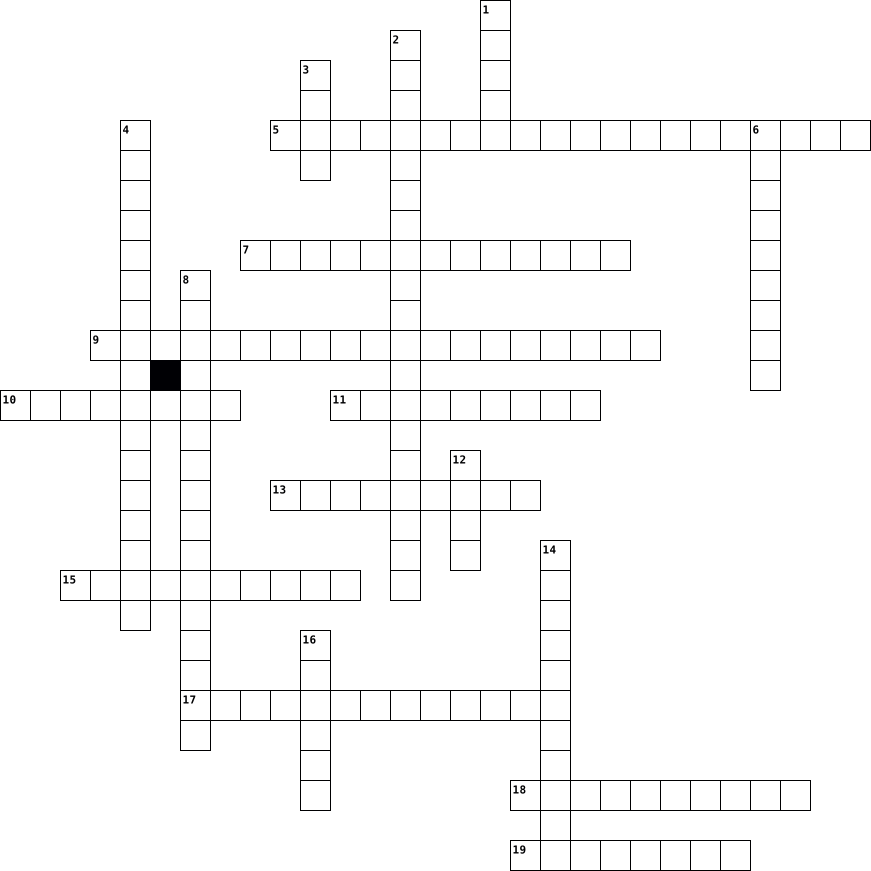
Across
- 3
- 7
- 5
- 19
- 16
- 15
- 11
- 17
- 8
- PLATES 2
Down
- TECTONICS 1
- 4
- 14
- 9
- 18
- 20
- 13
- 6
- 12
19 Clues: 4 • 9 • 3 • 7 • 5 • 6 • 8 • 14 • 18 • 20 • 19 • 16 • 13 • 15 • 11 • 12 • 17 • PLATES 2 • TECTONICS 1
PLATE TECTONICS CROSSWORD 2019-07-02
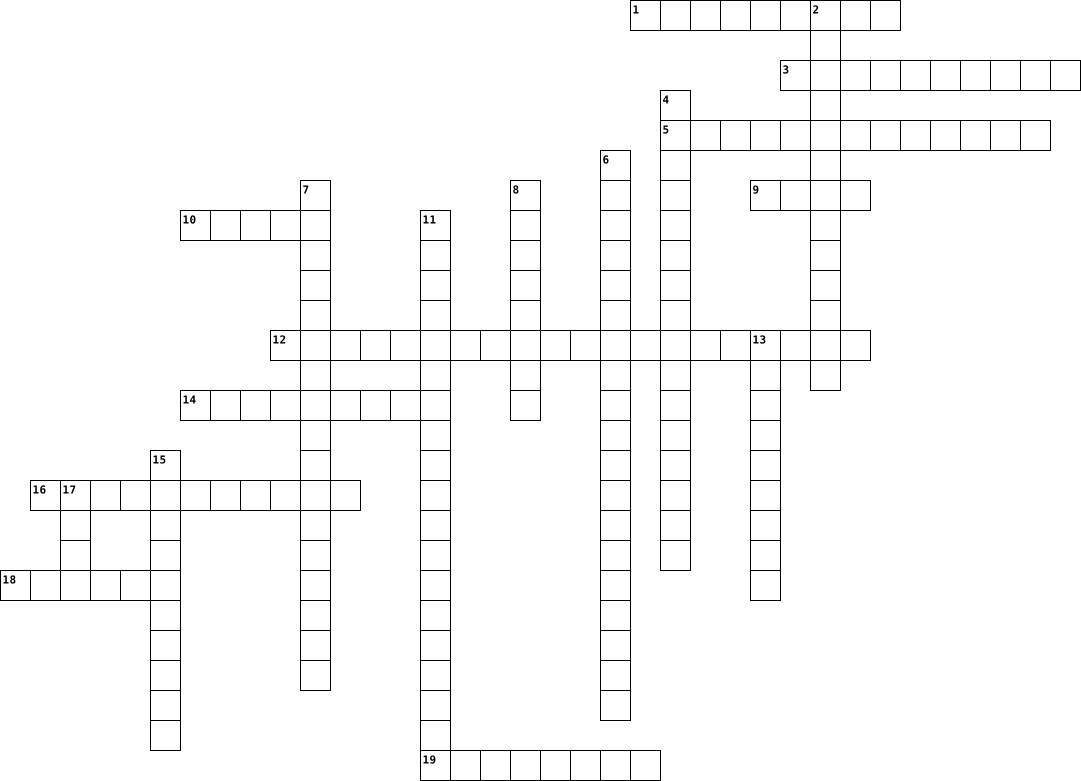
Across
- 16
- 8
- 7
- 13
- TECTONICS 1
- 3
- 15
- 6
- 12
- 19
Down
- 17
- 20
- 5
- 9
- PLATES 2
- 4
- 18
- 11
- 14
19 Clues: 8 • 7 • 5 • 9 • 4 • 3 • 6 • 16 • 17 • 20 • 13 • 18 • 15 • 11 • 14 • 12 • 19 • PLATES 2 • TECTONICS 1
PLATE TECTONICS CROSSWORD 2019-07-02

Across
- 20
- 9
- 18
- 13
- 5
- 3
- PLATES 2
- 6
Down
- 4
- 8
- 7
- 12
- 11
- 16
- 15
- TECTONICS 1
- 17
- 19
- 14
19 Clues: 4 • 8 • 7 • 9 • 5 • 3 • 6 • 20 • 18 • 12 • 13 • 11 • 16 • 15 • 17 • 19 • 14 • PLATES 2 • TECTONICS 1
les parties du corps 2 2013-03-21

Across
- pols
- geslachtsorgaan
- neus
- ogen
- enkel
- oor
- duim
Down
- vuist
- tand
- borstkas
- voetzool
- lichaam
- keel
- pupil
- wenkbrauw
- mond
- hand
- arm
- oog
19 Clues: arm • oor • oog • tand • pols • keel • neus • mond • hand • ogen • duim • vuist • pupil • enkel • lichaam • borstkas • voetzool • wenkbrauw • geslachtsorgaan
Med Terms Review 2024 2024-05-20

Across
- Eat Phage
- Pariet
- Wall Lapar
- Trich
- Adnexa
- Pro
- Granule
- Inflammation
- Phren
- Part
Down
- Dynam
- Plak
- Asthenia
- Pan
- Osmo
- Grad
- Pod
- Ptyal
- Phak
19 Clues: Pan • Pod • Pro • Plak • Osmo • Grad • Part • Phak • Dynam • Trich • Ptyal • Phren • Pariet • Adnexa • Granule • Asthenia • Eat Phage • Wall Lapar • Inflammation
S9 Lección 5B Table setting & eating out 2023-04-30

Across
- fork
- cup
- spoon
- sugar
- main dish
- bill
- pepper
Down
- tasty
- knife
- glass
- dessert
- napkin
- plate
- delicious
- waiter
- to want
- to order
- salt
- menu
19 Clues: cup • fork • bill • salt • menu • tasty • knife • glass • spoon • plate • sugar • napkin • waiter • pepper • dessert • to want • to order • main dish • delicious
Maori Pangakupu 2019-08-25

Across
- Think
- Plate
- Food
- Prepare
- Well done
- Dishes
- Pray
- Fork
- Knife
- Table
Down
- Milk
- Coffee
- Fridge
- Tea
- Sugar
- Chair
- Cup
- Spoon
- Command
19 Clues: Tea • Cup • Milk • Food • Pray • Fork • Think • Plate • Sugar • Chair • Knife • Spoon • Table • Coffee • Fridge • Dishes • Prepare • Command • Well done
Spanish 2019-12-06

Across
- bag
- wallet
- belt
- botas
- handicraft
- jewelry
- bracelet
- cassette
- video
Down
- silver
- plate
- radio
- jar
- ceramic
- radio tape player
- pot
- necklace
- earings
- gold
19 Clues: bag • jar • pot • belt • gold • plate • radio • botas • video • silver • wallet • ceramic • jewelry • earings • necklace • bracelet • cassette • handicraft • radio tape player
Wyatt Banks 4th 2021-11-04

Across
- connects chambers to a vent
- stores magma
- never again
- when lava pours out
- sleeping
Down
- subduction of oceanic plates
- hole
- opening
- edge of pacific plate
- middle of a plate
10 Clues: hole • opening • sleeping • never again • stores magma • middle of a plate • when lava pours out • edge of pacific plate • connects chambers to a vent • subduction of oceanic plates
Wyatt Banks 4th 2021-11-04

Across
- connects chambers to a vent
- stores magma
- never again
- when lava pours out
- sleeping
Down
- subduction of oceanic plates
- hole
- opening
- edge of pacific plate
- middle of a plate
10 Clues: hole • opening • sleeping • never again • stores magma • middle of a plate • when lava pours out • edge of pacific plate • connects chambers to a vent • subduction of oceanic plates
plate tectonics 2022-03-22

Across
- circulatory patterns of heat in the magma believed to be the driving force behind plate movement.
- V-shaped valleys that are the deepest parts of the oceans where subduction occurs.
- the movment of the ocean floor at a divergent
- ocean split down the middle by a big crack
Down
- a type of plate boundary where the plates slowly move apart from each other.
- the process in which the crust pushes downward into the mantle at a fault line.
- earths crust the slowly moves
- the remains of ancciant living animals
- plate boundary where the plates slowly collide together
- the uppermost solid part of the earths crust
10 Clues: earths crust the slowly moves • the remains of ancciant living animals • ocean split down the middle by a big crack • the uppermost solid part of the earths crust • the movment of the ocean floor at a divergent • plate boundary where the plates slowly collide together • a type of plate boundary where the plates slowly move apart from each other. • ...
Tectonic Plates 2022-12-21

Across
- Who proposed the theory of plate tectonics?
- The tectonic plates are made up of the crust and?
- How many tectonic plates are there?
- What is formed when an oceanic plate moves under a continental one
Down
- Which boundaries form when tectonic plates collide?
- What is the name of the super continent the person from 6 across discussed?
- ______ are cracks in the crust due to plate movements and are areas where earthquakes are likely to occur.
- Which major plate is the furthest south?
- What the plates must do in order for there to be a divergent boundary
- 1-6 inches describes the ______ that tectonic plates move each year
10 Clues: How many tectonic plates are there? • Which major plate is the furthest south? • Who proposed the theory of plate tectonics? • The tectonic plates are made up of the crust and? • Which boundaries form when tectonic plates collide? • What is formed when an oceanic plate moves under a continental one • ...
Geography Chapter 2 Section 1-3 2015-01-28

Across
- / The part of the earth where life exists.
- drift / The theory that the continents were once joined and then slowly drifted apart.
- / Surface land areas of the earth's curst, including continents and ocean basins.
- / A process by which new land is created when sea plates pull apart and magma wells up between the plates.
- / Molten rock that is pushed up form the earth's mantle.
- / A bend in layers of rock, sometimes caused by plate movement.
- / Moisture that falls to the earth as rain, sleet, hail, or snow.
- / A layer of gases that surrounds the earth.
Down
- / Underground water-bearing layers of porous rock, sand, or gravel.
- / A slow process in which a sea plate slides under a continental plate, creating debris that can cause continents to grow outward.
- / The watery areas of the earth, including oceans, lakes, rivers, and other bodies of water.
- / A process by which mountains can form as sea plates dive beneath continental plates.
- / The removal of salt from seawater to make it usable for drinking and farming.
- / Fine, yellowish-brown topsoil made up of particles of silt and clay, usually carried by the wind.
- / Process of converting into vapor.
- / Wearing away of the earth's surface by wind, flowing water or glaciers.
- / Thick middle layer of the earth's interior structure consisting of dense, hot rock.
- / Water within the earth that supplies wells and springs.
- / The process of excess water vapor changing into liquid water when warm air cools.
- tectonics / The term scientists use to describe the activities of continental drift and magma flow which create many of the earth's physical features.
20 Clues: / Process of converting into vapor. • / The part of the earth where life exists. • / A layer of gases that surrounds the earth. • / Molten rock that is pushed up form the earth's mantle. • / Water within the earth that supplies wells and springs. • / A bend in layers of rock, sometimes caused by plate movement. • ...
EARTH SCIENCE PT#2 2021-02-03

Across
- A fault on which the two blocks slide past one another.
- A type of plate movement that found in San Andreas Fault.
- This boundary occurs when two plates move away.
- Occurs when two plates move toward each other.
- linear, strata normally dip away from axial center, oldest
- The term for the force exerted by a tectonic plate descending into the mantle.
- They are geological features formed by convergent boundaries.
- Opposite of a convergent boundary, a divergent boundary is formed by the spreading of a tectonic plate.
- It occurs between the core and mantle or even between the asthenosphere and lithosphere.
- It is formed at the base of the continental rise about 4000 to 6000 meters deep.
Down
- The one who proposed that the sea floor is spreading.
- These are inclined fractures where the blocks have mostly shifted vertically.
- Gravitational force that causes a plate to move away from the crest of an ocean ridge, and into a subduction zone.
- It is a fracture or zone of fractures between two blocks of rock.
- These are regions that are below sea level and about 70% of these areas hold the planet’s water.
- Internal process drives the molten rocks in the mantle to rise to the lithosphere.
- A fault rock which is cohesive with a poorly developed or absent planar fabric, or which is incohesive, characterized.
- It is the force per unit that place on a rock.
- Another geological feature that results from a subduction zone.
- It is a central valley formed at the summit of the oceanic ridges as the molten materials continuously flow out from the ridges.
20 Clues: Occurs when two plates move toward each other. • It is the force per unit that place on a rock. • This boundary occurs when two plates move away. • The one who proposed that the sea floor is spreading. • A fault on which the two blocks slide past one another. • A type of plate movement that found in San Andreas Fault. • ...
Living with the physical environment 2024-07-04

Across
- organisms who absorb energy from the sun through photosynthesis
- an extended area of beach material that sticks out into the sea, joined to the mainland at one end
- living components of an ecosystem
- herbivores
- the top of a wave
- the type of air pressure when air is rising
- the variety of life in the world or particular habitat
- a ridge of sand or shingle which joins two headlands
- the type of air pressure when air is sinking
- a sudden or violent movement within the Earth's crust, followed by aftershocks
- an organism which breaks down dead tissue e.g. fungus
- the removal of solid mineral resources from the earth
- the most common wind direction for an area
- the long-term change in the earth's climate due to increasing greenhouse gas emissions
Down
- responsible travel to natural areas that conserves the environment and sustains local people
- the measure of distance north or south of the equator
- plate boundary where to plates come together and the denser plate subducts
- an area of low pressure with winds moving in a spiral around a calm central point
- the down-slope movement of rock or soil due to gravity
- a complex hierarchy of plants and animals that rely on each other for food
- a long period of little or no rainfall
- winds that carry air back to the equator
- plate margin where two plates move apart and rising magma creates new land
- plate margin where two plates slide past each other
- the zig-zag movement of sediment along the coast
- the cutting down of trees
- the type of weather that results in rocks being disintegrated
- the distance between two successive crests
28 Clues: herbivores • the top of a wave • the cutting down of trees • living components of an ecosystem • a long period of little or no rainfall • winds that carry air back to the equator • the distance between two successive crests • the most common wind direction for an area • the type of air pressure when air is rising • the type of air pressure when air is sinking • ...
Geology crossword 2021-12-03

Across
- a feature that forms where a stream or river ends and deposits sediment on land
- any change to the Earth’s crust that results from two tectonic plates converging
- the slope of a river or stream
- processes such as landslides or stream erosion that break down or wash away the surface of geologic features
- the slow broad upward movement of the Earth’s surface
- a landform that results when increased pressure is put on a rock layers causing them to fold downward
Down
- circular movement of molten magma that causes tectonic plates to shift
- a landform that results when increased pressure is put on rock layers causing them to fold upwards
- a plate boundary where two tectonic plates collide
- where two plates slide past one another
- a process that displaces rock layers when surfaces on either side of a crack in the earth's surface shift
- the process that occurs when two plates converge causing the crust to fold over onto itself
- no longer active but capable of erupting one day
- when two plate slide away from each other
- a destructive natural process through which rock and soil are loosened and removed from the Earth surface
- the area extending from a stream to its valley walls where sediment is deposited when the stream overflows
- where oceanic plates converge and the older denser oceanic plates
- pulled under the other tectonic plate at a convergent plate boundary
- processes that help build or shape geological features
- particles of sandstone or dirt that are removed from Earth's surface and deposited elsewhere
- the feature that forms when sediment is carried from a stream: to river into another body of water such as an ocean lake or larger river
21 Clues: the slope of a river or stream • where two plates slide past one another • when two plate slide away from each other • no longer active but capable of erupting one day • a plate boundary where two tectonic plates collide • the slow broad upward movement of the Earth’s surface • processes that help build or shape geological features • ...
cereal box project 2025-02-14

Across
- a sudden and violent shaking of the ground, sometimes causing great destruction, as a result of movements within the earth's crust or volcanic action.
- is a fast-moving current of hot gas and volcanic matter
- makes Lava
- coming closer together, especially in characteristics or ideas.
- a mountain or hill, typically conical, having a crater or vent through which lava, rock fragments, hot vapor, and gas are being or have been erupted from the earth's crust.
- the solid, outer part of the Earth
- the outermost layer of Earth's lithosphere that makes up the planet's continents and continental shelves
- the outermost layer of Earth's lithosphere that is found under the oceans and formed at spreading centres on oceanic ridges, which occur at divergent plate boundaries.
- an island of volcanic origin
Down
- the upper layer of the earth's mantle, below the lithosphere, in which there is relatively low resistance to plastic flow and convection is thought to occur.
- path along the Pacific Ocean characterized by active volcanoes and frequent earthquakes.
- an oceanic tectonic plate that lies beneath the Pacific Ocean.
- a small area or region with a relatively hot temperature in comparison to its surroundings.
- formed from the cooling and solidification of molten (melted) rock.
- starts out as a simple crack in the Earth called a volcanic vent.
- molten or partially molten rock (magma)
- The location where two plates meet
- mixtures of water, volcanic ash, tephra, rock fragments, and chunks of ice that can flow like wet concrete.
- the sideways and downward movement of the edge of a plate of the earth's crust into the mantle beneath another plate.
- the powdery residue left after the burning of a substance.
20 Clues: makes Lava • an island of volcanic origin • The location where two plates meet • the solid, outer part of the Earth • molten or partially molten rock (magma) • is a fast-moving current of hot gas and volcanic matter • the powdery residue left after the burning of a substance. • an oceanic tectonic plate that lies beneath the Pacific Ocean. • ...
Neurophysiology & Contraction 2025-03-25

Across
- Channels responding to changes in membrane potential.
- Phase restoring negative membrane potential (K+ efflux).
- Passive ion channels maintaining resting membrane potential.
- Rapid depolarization/repolarization propagating along excitable membranes.
- Channels opening when neurotransmitters bind.
- Synapse between motor neuron and muscle fiber.
- State of having a membrane potential (negative inside relative to outside).
- Vesicles storing neurotransmitters in axon terminals.
- Measure of potential energy in electrical charges (in millivolts).
- Voltage difference between a cell's interior and exterior.
- Pump maintaining ionic gradients by exchanging 3Na+ out/2K+ in.
- Space between axon terminal and motor end plate.
- Ion channels opening/closing in response to stimuli.
- Specialized sarcolemma region with acetylcholine receptors.
- Depolarization of motor end plate by acetylcholine.
- Sequence linking action potentials to crossbridge cycling.
- Junction between neuron and target cell (e.g., neuromuscular junction).
Down
- Process where action potentials trigger muscle contraction.
- Study of electrical properties in cells and tissues.
- Long projection of a neuron conducting action potentials.
- Voltage difference across a cell membrane.
- State of being supplied with motor neurons.
- Combined influence of concentration and electrical gradients on ions.
- Stable voltage (-70mV in neurons) when not transmitting signals.
- Phase where membrane potential becomes less negative (Na+ influx).
- Neuron transmitting signals from CNS to muscles.
- Chemical messengers (e.g., acetylcholine) crossing synaptic clefts.
- Enzyme breaking down acetylcholine to terminate signals.
- End of axon releasing neurotransmitters.
- Ability of action potentials to spread along membranes.
- Neurotransmitter activating skeletal muscle contraction.
31 Clues: End of axon releasing neurotransmitters. • Voltage difference across a cell membrane. • State of being supplied with motor neurons. • Channels opening when neurotransmitters bind. • Synapse between motor neuron and muscle fiber. • Neuron transmitting signals from CNS to muscles. • Space between axon terminal and motor end plate. • ...
Meal Planning & Etiquette 2022-04-20

Across
- New cooks should prepare ____ recipes.
- Use flatware from the _______ in.
- Pass foods this direction.
- No food should be put on this part of a plate.
- Forks, spoons, knives.
- Manners show ____ for others.
- Food choices may be limited based on where you ____.
- Cooking from ____ can save money.
- Toothpicks should be used in ____.
- Setting the table affects the ____ of food.
- Your napkin goes here during the meal.
- Placed to the left of the plate.
- Chew with your mouth ____.
- A list of things that need to be done to finish a meal. (two words)
- Courtesy shown by good manners.
- Pass salt & pepper ______
- The guidelines of aesthetically pleasing meals. (two words)
- Working on several items at the same time. (two words)
- The way food is presented.
- Affects the kind of foods made in a home.
Down
- Never place food here.
- Should be considered for people with certain health concerns. (two words)
- Plates, cups, bowls.
- Sit from this side of the chair.
- Do this as you cook to manage time. (two words)
- Placed to left of fork, center of the plate, or in the water goblet.
- A place setting for one person.
- Begin to eat when ______ has been served.
- These foods may speed up prep time but are usually more expensive.
- Glasses & goblets.
- Never use this item at the table
- These are not allowed on the table.
- Wait ____ minutes before calling late arrivals.
- These are 18-20% of the total meal.
- Your napkin goes ____ of the plate when you are done eating.
- If there more than ___ people at the table you can eat when ___ have been served.
- The napkin should not _____ the flatware.
- Your napkin goes here if you leave and plan to return.
38 Clues: Glasses & goblets. • Plates, cups, bowls. • Never place food here. • Forks, spoons, knives. • Pass salt & pepper ______ • Pass foods this direction. • Chew with your mouth ____. • The way food is presented. • Manners show ____ for others. • A place setting for one person. • Courtesy shown by good manners. • Sit from this side of the chair. • Never use this item at the table • ...
Trimester II Final Review XWord 2020-02-27

Across
- a type of rock that forms when melted rock cools and hardens
- nonrenewable resources that are rich in energy.
- melted rock on Earth's surface
- rock that is created from previously existing rock by the action of intense heat and pressure
- water stored below Earth's surface in soil and rock layers
- a model describing the transformations of rocks from one major rock type to another
- stored energy
- all of the water on, under, and above the Earth
- a tectonic plate boundary at which two tectonic plates move away from each other
- movement of energy and matter through fluids, such as the asthenosphere or atmosphere, that enable natural processes, such as the rock cycle and water cycle, respectively
- resources that are obtained from the earth
- the transfer of energy though a vacuum
- energy of motion
- the transfer of heat through a solid
- geologic event that frequently occurs at transform plate boundaries and sometimes at convergent boundaries
- melted rock located beneath Earth's surface
Down
- a tectonic plate boundary at which two tectonic plates move toward each other, causing collisions and subduction zones
- that part of Earth in which life can exist
- Earth's geologic processes are the same in the present as in the past
- the part of Earth which is composed mostly of rocks; the crust and outer mantle
- a tectonic plate boundary along which plates slide horizontally past one another in opposite directions
- a nuclear reaction in which nuclei combine to produce more massive nuclei resulting in the release of large amounts of energy
- The layer of soft but solid mobile rock found below the lithosphere.
- Earth's crust, both beneath the oceans and continents, as well as the mantle and inner and outer core
- a crack in a body of rock that the rock can move along
- rock formed by gravity pressing fragments of other rocks and minerals together as they settle on land or under the ocean over a long period of time
- scientific law stating that, in undisturbed rock layers, each layer is younger than the layer beneath it, and older than the layer above it
- the transfer of heat through a fluid
- a natural, solid substance found in rocks
- resource that is able to meet the demands of current use and yet be maintained in usable quantities to meet indefinite future demands.
- renewable energy source created from organisms
- the sinking of an oceanic plate beneath a plate of lesser density at a convergent boundary
- a substance or matter that is human-made
- the layers of gases that surround a planet
- energy in the form of heat
35 Clues: stored energy • energy of motion • energy in the form of heat • melted rock on Earth's surface • the transfer of heat through a fluid • the transfer of heat through a solid • the transfer of energy though a vacuum • a substance or matter that is human-made • a natural, solid substance found in rocks • that part of Earth in which life can exist • ...
Crossword puzzle :) 2021-10-26

Across
- drift, movement of continents through time
- , the rigid outer part of the earth containing the crust and the upper mantle
- the rising or settling of a portion of the Earth's lithosphere
- boundary, when two or more lithospheric plates collide
- the animals living in the sediments of the water
- when one crustal plate descends below the edge of another
- tectonics, Scientific theory describing how major landforms are created
Down
- vent, a fissure formed at the seafloor
- Boundary, places where plates slide past each other
- the removal of moisture
- the upper layer of the Earth's mantle
- distribution in zones or of definite characteristics
- boundary, two tectonic plates that are moving away from each other
- narrow depression on the seafloor formed at the boundary of the tectonic plate hello\
- shelf, A part of a continent that are submerged in shallow water
15 Clues: the removal of moisture • the upper layer of the Earth's mantle • vent, a fissure formed at the seafloor • drift, movement of continents through time • the animals living in the sediments of the water • Boundary, places where plates slide past each other • distribution in zones or of definite characteristics • boundary, when two or more lithospheric plates collide • ...
Hope's Crossword Puzzle 2015-05-01

Across
- Movement of Earth's continents relative to each other
- Supercontinent
- New oceanic crust is formed through volcanic activity then gradually moves away from the
- Change in a planet's magnetic field.
- One tectonic plate moves under another on and sinks into man
- Two plates moving away from each other
Down
- Two plates slide past each other
- A line demoting suites of rocks and minerals samples all formed at the same time
- a subsea chasm extending along the crest of a mid-ocean ridge, locus of the magma upwellings that accompany seafloor spreading.
- Crest of a plate moves away towards subduction zone
- Study of the magnetic record in rocks
- Two plates move towards each other
- portion of motion of a tectonic plate by its subduction
- Measures small changes in magnetic fields
14 Clues: Supercontinent • Two plates slide past each other • Two plates move towards each other • Change in a planet's magnetic field. • Study of the magnetic record in rocks • Two plates moving away from each other • Measures small changes in magnetic fields • Crest of a plate moves away towards subduction zone • Movement of Earth's continents relative to each other • ...
Marine Bio Module 1 Crossword Puzzle A 2024-09-08

Across
- the world's largest ocean
- In seafloor spreading plates move ____ from each other.
- the portion of the earth’s crust that is mostly basalt
- This layer of the earth is thought to be made of solid iron.
- Plate ____ is a process involving the movement of large plates in the earth's mantle.
- the scientist who proposed the continental drift theory
- The ____ core is thought to generate the magnetic field.
Down
- the downward movement of one plate into the earth’s mantle when two plates collide
- Each ____ is bounded by ocean trench or a ridge.
- ____ is heavier than granite.
- Continental ____ form when ocean crust subducts under continental crust.
- the ancient supercontinent
- the location that causes the earth’s tectonic plates to move
- The mantle is made up of ____ that is near its melting point.
14 Clues: the world's largest ocean • the ancient supercontinent • ____ is heavier than granite. • Each ____ is bounded by ocean trench or a ridge. • the portion of the earth’s crust that is mostly basalt • In seafloor spreading plates move ____ from each other. • the scientist who proposed the continental drift theory • The ____ core is thought to generate the magnetic field. • ...
vivian6 2024-10-10

Across
- spot-middle of a plate
- in volcano
- chambers to a vent
- of fair-edge of pacific plate
- flows
- cone-violent with cinder
- heat
- flow-hot gas,ash,cinder,and bombs
Down
- lava
- of heated water
- chamber- stores magma
- spring-water heated by magma
- flow-when lava pours out
13 Clues: lava • heat • flows • in volcano • of heated water • chambers to a vent • chamber- stores magma • spot-middle of a plate • cone-violent with cinder • flow-when lava pours out • spring-water heated by magma • of fair-edge of pacific plate • flow-hot gas,ash,cinder,and bombs
Plate Tectonic Crossword Puzzle 2022-03-10

Across
- the plate that is made up of India and Australia
- You live here!
- the plate that is under Africa
- the plate that contains two continents Asia and Europe
Down
- the plate that is straddling the equator and the prime meridian
- the plate that contains the continent of Antarctica
- an oceanic plate that is beneath the pacific ocean
7 Clues: You live here! • the plate that is under Africa • the plate that is made up of India and Australia • an oceanic plate that is beneath the pacific ocean • the plate that contains the continent of Antarctica • the plate that contains two continents Asia and Europe • the plate that is straddling the equator and the prime meridian
Sigrún 2023-09-21

Across
- Líkamlegt
- Eiginleiki
- Asni
- Rökræða
- Banna
- Greina
- Klár
- Alvarlegt
- Ólöglegt
Down
- Sýnilegur
- Diskur
- Rassskella
- Stöðugt
- Lygasögur
- Sjálfsöruggur
- Sár
- Niðulægja
- Hrein mey
- Eldavél
19 Clues: Sár • Asni • Klár • Banna • Diskur • Greina • Stöðugt • Rökræða • Eldavél • Ólöglegt • Sýnilegur • Líkamlegt • Lygasögur • Niðulægja • Hrein mey • Alvarlegt • Rassskella • Eiginleiki • Sjálfsöruggur
Unit 13 2023-05-26

Across
- taldrik
- sibul
- Inglismaa pealinn
- mõõk
- küpsised
- juust
- piraat, mereröövel
- või
- korv
Down
- viiul
- aken
- võileib
- jahu
- piknik
- puuvili
- omlett
- laev, paat
- sool
- suhkur
19 Clues: või • aken • jahu • mõõk • sool • korv • viiul • sibul • juust • piknik • omlett • suhkur • taldrik • võileib • puuvili • küpsised • laev, paat • Inglismaa pealinn • piraat, mereröövel
You 2022-03-30

Across
- sõbrad
- kahvel
- ema
- voodi
- viiskümmend kuus
- pliiats
- tee
- lendama
- vanaema
Down
- punane
- lusikas
- Nina
- laud
- nuga
- tüdruk
- taldrik
- kala
- kass
- koer
19 Clues: ema • tee • Nina • laud • nuga • kala • kass • koer • voodi • sõbrad • punane • kahvel • tüdruk • lusikas • pliiats • taldrik • lendama • vanaema • viiskümmend kuus
The Earths Systems 2012-11-07

Across
- the layer between the inner core and the mantle
- the place in New Zealand where an earthquake struck on the 3rd of February 1931
- what sedimentary rock is made of
- the part of the earths crust that move and create earthquakes
- a type of earthquake wave
- A type of rock made by the compaction of other rocks and remains over time
- the process in which a type of rock is changed into another rock
- the outermost part of the earths geosphere
- the solid iron-nickel core of earth
- another word for the size of an earthquake
- the type of volcano that Rangitoto is
Down
- the scale used to measure earthquakes
- the place where tectonic plates meet
- A type of plate boundary caused by plates rubbing against each other
- A type of rock that has been through physical changes as a result of compaction, time and sometimes heat
- The molten material beneath the earths crust
- A type of plate boundary caused by plates moving towards each other
- The solid part of the earth consisting of four main parts
- A type of plate boundary caused by plates moving away from each other
- A vent in the earths crust where lava and ashes are ejected
- A serious of vibrations caused by movements in the earths crust
- the number of different waves that can be created by an earthquake
- a large mass of land usually on its own tectonic plate (there are seven of them)
- A type of rock formed by the cooling of magma
- the part of the earths geosphere containing magma
25 Clues: a type of earthquake wave • what sedimentary rock is made of • the solid iron-nickel core of earth • the place where tectonic plates meet • the scale used to measure earthquakes • the type of volcano that Rangitoto is • the outermost part of the earths geosphere • another word for the size of an earthquake • The molten material beneath the earths crust • ...
6th Grade Rock Cycle/Continental Drift 2021-04-12

Across
- This model describes how rocks change as they are exposed to different elements.
- The layer of the Earth made of solid iron.
- Molten rock found on/above the Earth's surface is called this.
- The Theory proposed that first stated the continents move.
- The force that moves lava through the mantle (hot fluids go up...)
- The process of sediment being transported.
- The name of the most recent supercontinent.
- The largest layer of the Earth.
- The layer of the Earth we live on is called.
- Pieces of broken down rocks are called this.
- Type of rock formed when other rocks are exposed to heat/pressure.
- A formation caused by plates moving apart.
- A formation caused by plates moving past each other.
- Type of rock formed by small pieces being compacted/glued together.
- Molten rock found under the Earth's surface is called this.
Down
- A formation caused by plates coming together
- The modern name for the Theory that explains how the continents move.
- Type of rock formed when lava/magma cools.
- The layer of the Earth made of liquid iron.
- The name of the scientist who proposed continental drift.
- The type of plate boundary formed when two plates come together.
- The process where pieces of sediment are dropped/deposited in a new location.
- The planet's Crust ______ on top of the Mantle.
- The type of plate boundary formed when two plates move apart.
- The process of rocks being broken down into smaller pieces.
- A natural disaster caused by plate movements.
- The type of plate boundary formed when two plates move past each other.
27 Clues: The largest layer of the Earth. • Type of rock formed when lava/magma cools. • The layer of the Earth made of solid iron. • The process of sediment being transported. • A formation caused by plates moving apart. • The layer of the Earth made of liquid iron. • The name of the most recent supercontinent. • A formation caused by plates coming together • ...
Earth's Physical Systems: Environmental Science 2023-11-02

Across
- (chemical symbol Ra); a radioactive metal that was used to make paint glow in the dark; caused severe deformation to workers
- A molecule made from more than one element
- by shedding subatomic particles, these emit high energy radiation that can harms organism
- processes that outlines how each of the three major rock types—igneous, metamorphic, and sedimentary—form and break down based on the different applications of heat and pressure over time
- The process by which Earth’s surface is shaped by the extremely slow movement of sections of crust
- neutral subatomic particles
- a nucleic acid
- Made from more than one atom
- oceanic trench formed from the subduction of the Pacific plate under the Philippine plate
- Proteins, Nucleic acids, Carbohydrates, Lipids
- positively charged subatomic particle
- Elements of same atomic number that have different number of neutrons
Down
- shedding of subatomic particles
- based on the number of protons
- the study of matter and their interactions
- plate boundary where two plates move away from each other
- the scientific study of Earth’s physical features, processes, and history
- Concentration of H+
- pH below 7
- all material in the universe with mass and that occupies space
- weight of protons plus neutrons
- negatively charged subatomic particles
- substance with given properties that can’t be broken down into simpler substances
- have protons, neutrons and electrons
- plate boundary where two plates move toward each other; can create mountains or subduction zones
- type of rock that forms when rocks are subjected to high heat, high pressure
- "Shearon _______"; the nuclear power plant that generates electricity for much of the Triangle
- sits outside the Earth’s mantle
28 Clues: pH below 7 • a nucleic acid • Concentration of H+ • neutral subatomic particles • Made from more than one atom • based on the number of protons • shedding of subatomic particles • weight of protons plus neutrons • sits outside the Earth’s mantle • have protons, neutrons and electrons • positively charged subatomic particle • negatively charged subatomic particles • ...
Geological Forces Crossword Puzzle 2020-10-18

Across
- the layer of earth we live on
- plate movement where one tectonic plate goes under another plate
- pulling apart of two tectonic plates
- the crust and upper mantle
- fast moving, very hot, dark cloud of volcanic ash, gas, and rocks
- a crack in the earth's crust
- means "all lands"; a supercontinent of all the continents making one big land mass
- this machine measures seismic waves
- shaking of the earth's surface
- the layer of earth as hot as the sun;a solid ball of iron
- area around the pacific plate with most of the earth's volcanoes and earthquakes
- Alfred Wegener saw that the continents looked like they fit together like ____ pieces.
- type of volcano made of volcanic ash, volcanic clinkers, or volcanic cinder
Down
- type of volcano also called a stratovolcano;cone shaped with steep sides
- inside the earth where the earth moves or breaks;start of seismic waves
- type of volcano in the shape of a large, round dome
- a surface wave that rolls the earth's surface during an earthquake
- coming together of two tectonic plates
- body waves; the second waves that come from the focus of an earthquake
- the largest layer of the earth
- viscous, slow moving lava
- a surface wave the moves the earth side to side during an earthquake
- a giant wave caused by under ocean earthquakes or volcano eruptions
- the layer of earth made of melted iron and nickel
- fast moving lava with clinkers
- sliding boundary of two tectonic plates
- body waves;the first waves that come from the focus of an earthquake
- the study of the earth
28 Clues: the study of the earth • viscous, slow moving lava • the crust and upper mantle • a crack in the earth's crust • the layer of earth we live on • the largest layer of the earth • shaking of the earth's surface • fast moving lava with clinkers • this machine measures seismic waves • pulling apart of two tectonic plates • coming together of two tectonic plates • ...
Clutches 2024-09-16

Across
- This is considered the clutch's 'driven' member.
- In a Diaphragm-type clutch, the diaphragm spring will transfer force to the driving _____.
- Clutch facings can be separated into two main categories: Ceramic & ___
- A diaphragm spring.
- This bearing is located at the front of the Transmission Input Shaft in a bore within the Flywheel or Crankshaft.
- This type of pressure is needed to engage the Clutch Disc.
- Is what is prevented by using a Clutch Brake.
- The Clutch is _________ when power is able to run through it.
- Clutch facings are commonly held on by these.
- In a Coil Spring-Type clutch, the coil springs will transfer force to the driving ____.
- A heavy-duty clutch primarily uses this type of release.
Down
- The Clutch is _________ when the clamping force is eliminated and the disc is able to freewheel.
- A clutch Disc may burst if the driver performs this action, while the transmission is in gear and the clutch is disengaged.
- This type of Clutch Disc does not handle a lot of vibration, as it does not include Torsional springs or Marcel springs.
- One of the 3 types of mechanisms used to transfer motion from the Clutch Pedal to the Release Bearing.
- This plate is required in a Twin-Disc style Clutch.
- The Pressure Plate Assembly bolts to this part and rotates with it.
- A light-duty clutch primarily uses this type of release.
- The Pressure Plate is located inside this part.
- The Clutch Disc is attached to the input shaft in this way.
- These parts will move the Pressure Plate away from the Flywheel during disengagement.
- A wavy type of spring.
- This is an important movement that a clutch must make during engagement and disengagement.
23 Clues: A diaphragm spring. • A wavy type of spring. • Is what is prevented by using a Clutch Brake. • Clutch facings are commonly held on by these. • The Pressure Plate is located inside this part. • This is considered the clutch's 'driven' member. • This plate is required in a Twin-Disc style Clutch. • A light-duty clutch primarily uses this type of release. • ...
Earth's Outer Layer & Understanding Plate Boundaries 2025-03-19

Across
- The place where two plates meet
- When two plates collide and one is pushed under the other into the mantle, one of the plates is __________.
- Any of the many processes (such as eruptions and lava flows) in which gas, lava, and ash are pushed out on the surface of Earth
- Moving apart in different directions
- A set of interacting parts forming a complex whole
- Earth's plates _________ on top of Earth's mantle
- a feature that forms of the surface of a planet such as a mountain, channel or sand dune
- Moving to the same place
- The layer of soft solid rock underneath Earth's plates
- A diagram that shows what the inside of something looks like
- To examine in detail with a purpose
Down
- A sudden shaking of Earth's surface
- A long deep indentation in the ocean floor formed when two plates move together
- One of the very large sections of hard, solid rock that make up Earth's outer layer
- The South American Plate and the African plate moved apart _______.
- Something we observe to be similar over and over again
- Powerful microphones that are built to travel underwater and scientists use to listen to plate motion
- Plates move, which can _________ earthquakes
- When two plates move apart the mantle comes up to fill the _____ creating new crust
- An underwater mountain range formed when two plates move apart
- An ancient lizard that lived about 300 million years ago and fossils have been found in Africa and South America
- Earth's plates move on the mantle because it is made of _____, solid rock
- Earth's outer layer is made of _______, solid rock
23 Clues: Moving to the same place • The place where two plates meet • A sudden shaking of Earth's surface • To examine in detail with a purpose • Moving apart in different directions • Plates move, which can _________ earthquakes • Earth's plates _________ on top of Earth's mantle • A set of interacting parts forming a complex whole • ...
Nails Test Study Guide 2025-08-01

Across
- The largest upper bone in the arm.
- Toenails are __________ than fingernails because the toenail matrix is longer.
- _________ pushers are multi-use implements that should be held at a 20-30 degree angle from the nail plate.
- The part of the nail bed that extends below the nail root and helps to produce the nail plate.
- If the hyponychium is damaged, an __________ under the nail is possible
- Nail wrap ________ is a type of adhesive applied on top of the nail fabric to create a hard nail surface.
- Electric hand mitts, electric foot mitts, and Paraffin treatments are examples of ______ ______ services.
- The 8 bones of the wrist.
- Also known as the shin bone.
- The term for bitten nails.
- Nail ________ is a non-infectious condition that affects the surface of the natural nail making it appear pitted or rough.
- _________ -Grit abrasives should be used with caution and generally not on natural nails.
- Abnormal brittleness of the nail plate.
Down
- Nail ________ are folds or normal skin that surround the natural nail plate.
- Whitish discoloration of the nails caused by injury.
- Cosmetologist should NOT provide ___________ advice.
- A type of muscle that spreads the fingers and toes apart.
- A nail disorder associated with significant darkening of the fingernails.
- Spongy, respiratory organs responsible for inhaling and exhaling.
- Another name for the kneecap.
- The Flexor Digiti ________ is the muscle that moves the little toe.
- The split cuticle located around the nail.
- The acrylic powder, which is combined with the liquid, to form the sculpting product for acrylic nails.
- A group of adductor muscles located in the palm that pulls the thumb toward the fingers.
- Short polymer chains consisting of just a few monomers that create a thick resin or "gel-like" substance.
25 Clues: The 8 bones of the wrist. • The term for bitten nails. • Also known as the shin bone. • Another name for the kneecap. • The largest upper bone in the arm. • Abnormal brittleness of the nail plate. • The split cuticle located around the nail. • Whitish discoloration of the nails caused by injury. • Cosmetologist should NOT provide ___________ advice. • ...
Papas Papandayan Crossword 2025-02-14

Across
- A hot, chaotic mixture of rock fragments, gas, and ash that travels rapidly away from a volcanic vent or collapsing flow front.
- A path along the Pacific Ocean characterized by active volcanoes and frequent earthquakes.
- An oceanic tectonic plate that lies beneath the Pacific Ocean.
- The location in which two tectonic plates interact through converging, diverging, or transforming.
- Formed from oceanic oceanic convergent plate boundaries.
- A type of rock that forms when molten rock cools and solidifies.
- A sudden shaking of the ground caused by movement of tectonic plates.
- The solid, outermost layer of Earth, made of the crust and upper mantle.
- The location where two plates are being forced together by the convection currents in the earth's mantle.
- Molten rock (magma) erupted from a volcano.
- The solid remanence from fires, explosions, and/or volcanic vents.
Down
- The thinner and denser part of earths crust that makes up the ocean floor.
- The layer of granitic, sedimentary, and metamorphic rocks, which form the continents and the areas of shallow seabed close to their shores.
- Formed from oceanic continental convergent plate boundaries.
- The location when two plates converge, and one plate is forced under another.
- An opening in the Earth's crust that allows molten rock, ash, and gases to escape.
- A portion of the Earth's mantle that flows like molten plastic despite being solid.
- a large plume of hot mantle material rising from deep within the Earth.
- Molten rock below the earth's surface near the upper mantle and lower crust.
- A hot or cold mixture of water and rock fragments that flow quickly down the slopes of a volcano.
20 Clues: Molten rock (magma) erupted from a volcano. • Formed from oceanic oceanic convergent plate boundaries. • Formed from oceanic continental convergent plate boundaries. • An oceanic tectonic plate that lies beneath the Pacific Ocean. • A type of rock that forms when molten rock cools and solidifies. • ...
Volcanoes 2024-10-22

Across
- An opening in the Earth’s surface through which molten rock, ash, and gasses erupt.
- A long crack in the Earth’s surface through which lava erupts.
- A chain of volcanoes formed along a subduction zone, where an oceanic plate sinks beneath a continental plate.
- A bowl-shaped depression at the top of a volcano, formed by eruptive activity.
- A type of basaltic lava flow with a rough, jagged, blocky texture.
- A type of basaltic lava flow characterized by a smooth, ropy surface.
- Molten rock that has erupted onto the Earth’s surface.
- A broad, gently sloping volcano built from fluid lava flows, typically basaltic (e.g., Mauna Loa).
- The opening in a volcano through which magma and gasses escape.
- A steep-sided, conical volcano built from alternating layers of lava and pyroclastic material (e.g., Mount St. Helens).
Down
- A zone of frequent volcanic activity encircling the Pacific Ocean, associated with plate boundaries (three words).
- Low-viscosity lava that flows easily, typically associated with shield volcanoes.
- A location where magma rises from deep within the Earth’s mantle, creating volcanic activity away from tectonic plate boundaries (e.g., Hawaii).
- A volcano that has not erupted in recent history but is expected to erupt again.
- Cone A small, steep-sided volcano formed by the accumulation of volcanic debris around a vent.
- A destructive volcanic mudflow composed of water and volcanic debris.
- A large, basin-like depression formed when a volcano’s summit collapses after an eruption.
- Molten rock beneath the Earth’s surface.
- A fast-moving flow of hot gas and volcanic matter that flows down the side of a volcano during an explosive eruption.
- Fine particles of volcanic rock and minerals ejected during an eruption.
20 Clues: Molten rock beneath the Earth’s surface. • Molten rock that has erupted onto the Earth’s surface. • A long crack in the Earth’s surface through which lava erupts. • The opening in a volcano through which magma and gasses escape. • A type of basaltic lava flow with a rough, jagged, blocky texture. • ...
Y8 Autumn Term 2025-12-09

Across
- What property means metals can be hammered into shape without breaking?
- years What unit is used to measure large distances in space?
- energy Which renewable energy source uses moving air to generate electricity?
- Which metal is commonly used in electrical wiring?
- What type of fuel can be replaced naturally, such as wind or solar?
- What are metals called when they allow electricity to pass through them easily?
- Sun What is the name of the star at the centre of our solar system?
- Which planet is often called the “Red Planet”?
- energy Which renewable energy source uses sunlight to generate electricity?
- What force keeps planets in orbit around the Sun?
- What type of plate boundary involves plates sliding past each other?
- At which type of plate boundary do plates move towards each other?
- Way What is the name of the galaxy that contains our solar system?
Down
- Which planet is the largest in the solar system?
- fuels What are coal, oil, and natural gas collectively called?
- What is the explosion called when a massive star dies?
- What layer of the Earth lies directly beneath the crust?
- What natural hazard often occurs at plate boundaries?
- At which type of plate boundary do plates move apart?
- What type of fuel will eventually run out, such as coal or oil?
- What layer of the Earth do tectonic plates make up?
- How many continents are there on Earth?
- Which planet is famous for its rings?
- Which planet is closest to the Sun?
- What continent is south of Europe and east of South America?
- How many planets are in our solar system?
26 Clues: Which planet is closest to the Sun? • Which planet is famous for its rings? • How many continents are there on Earth? • How many planets are in our solar system? • Which planet is often called the “Red Planet”? • Which planet is the largest in the solar system? • What force keeps planets in orbit around the Sun? • Which metal is commonly used in electrical wiring? • ...
Papaʻōlelo 3 Part 2 (Revised) 2022-10-11

Across
- garage
- sponge
- stairs
- electric light
- blanket
- spoon
- microwave
- bowl
Down
- shower
- garden
- knife
- car
- bathtub
- pillow
- pot
- plate
- toilet
- towel
18 Clues: car • pot • bowl • knife • plate • spoon • towel • shower • garden • garage • sponge • pillow • stairs • toilet • bathtub • blanket • microwave • electric light
EN LA COCINA 2013-08-31

Across
- spoon
- oven
- refrigerator
- stove
- sugar
- napkin
- saucer
- table cloth
- cup
Down
- plate
- salt
- knife
- fork
- dishwasher
- chairs
- dessert
- table
- glass
18 Clues: cup • salt • oven • fork • plate • spoon • knife • stove • sugar • table • glass • napkin • chairs • saucer • dessert • dishwasher • table cloth • refrigerator
2G Los alimentos 2023-07-06

Across
- cherries
- napkin
- plate
- restaurant
- chicken
- fruits
- carrot
- tomato
- juice
- spoon
Down
- knife
- waitress
- glass
- waiter
- water
- fork
- french fries
- vegetables
18 Clues: fork • knife • glass • water • plate • juice • spoon • waiter • napkin • fruits • carrot • tomato • chicken • waitress • cherries • restaurant • vegetables • french fries
Helen Keller 2021-03-06

Across
- lusikas
- üllatunud
- taldrik
- kurt
- palavik
- pime
- ime
- kutsuma
- eriti
- tumm
Down
- mets
- korralikult
- paigal istuma
- lubama
- lõpuks
- loobuma
- lähedal
- taldrik
- edukas
19 Clues: ime • mets • kurt • pime • tumm • eriti • lubama • lõpuks • edukas • lusikas • taldrik • palavik • loobuma • lähedal • kutsuma • taldrik • üllatunud • korralikult • paigal istuma
Spanish Vocab 2020-09-30
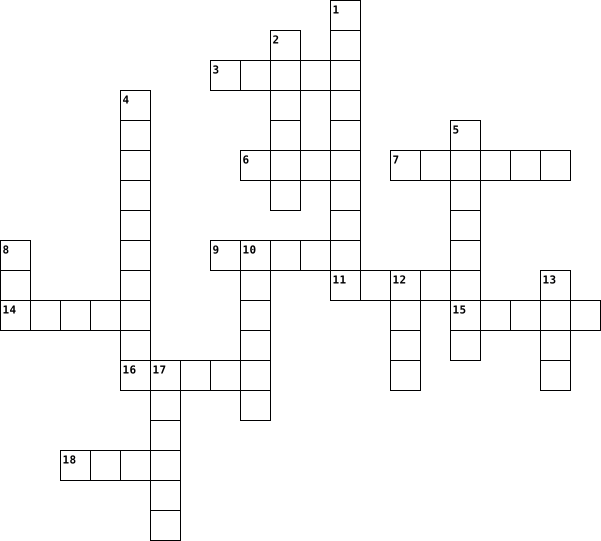
Across
- vidrio
- menú
- sillas
- cuchara
- mesa
- plato
- azúcar
- cuchillo
- tenedor
Down
- restaurante
- camarero
- factura
- camarera
- taza
- pimienta
- cuenco
- sal
- servilleta
18 Clues: sal • menú • taza • mesa • plato • vidrio • sillas • cuenco • azúcar • factura • cuchara • tenedor • camarero • camarera • pimienta • cuchillo • servilleta • restaurante
EN LA COCINA 2013-09-02

Across
- sugar
- stove
- cup
- knife
- table
- dishwasher
- chairs
- table cloth
- oven
- dessert
Down
- glass
- plate
- refrigerator
- spoon
- salt
- saucer
- fork
- napkin
18 Clues: cup • salt • fork • oven • glass • plate • sugar • stove • knife • spoon • table • saucer • napkin • chairs • dessert • dishwasher • table cloth • refrigerator
pizza dough oven man 2022-10-24

Across
- more
- baby
- mad
- evil
- cheese
- milk
- engineer
- passthesuace
- chicken
- destroy
Down
- kind
- human
- stupid
- bread👍
- unceramic
- 👍
- tomota
- human
- heatingelement
19 Clues: 👍 • mad • more • kind • baby • evil • milk • human • human • stupid • bread👍 • cheese • tomota • chicken • destroy • engineer • unceramic • passthesuace • heatingelement
gcvbn,m.;lkigyfuxbvn m,./kpogtfvbnm 2022-05-03

Across
- Lasilla
- Elcuchillo
- Elvaso
- Elplato
- Lataza
- lacuchara
- Eltenedor
- Mesa
- menú
- Elcamarero
Down
- Lacamarera
- Lacuenta
- Laservilleta
- Elazúcar
- Lapimienta
- Restaurante
- cuenco
- Lasal
18 Clues: Mesa • menú • Lasal • Elvaso • cuenco • Lataza • Lasilla • Elplato • Lacuenta • Elazúcar • lacuchara • Eltenedor • Lacamarera • Elcuchillo • Lapimienta • Elcamarero • Restaurante • Laservilleta
Vocab Project 2023-05-05

Across
- sal
- camarero
- camarera
- mesa
- cuchara
- taza
- menú
- restaurante
- servilleta
Down
- plato
- sillias
- cuenco
- enedor
- cuenta
- azúcar
- pimienta
- vaso
- cuchillo
18 Clues: sal • vaso • mesa • taza • menú • plato • cuenco • enedor • cuenta • azúcar • sillias • cuchara • camarero • camarera • pimienta • cuchillo • servilleta • restaurante
Minjan koe kpl 5-6 2019-01-29

Across
- päivällinen
- haarukka
- lautanen
- leipä
- terveellinen
- takki
- housut
- kengät
- farkut
- lounas
- maukas
Down
- veitsi
- pitää (yllä)
- kynttilä
- herkullinen
- vaatteet
- lusikka
- sukat
18 Clues: leipä • takki • sukat • veitsi • housut • kengät • farkut • lounas • maukas • lusikka • kynttilä • haarukka • lautanen • vaatteet • päivällinen • herkullinen • pitää (yllä) • terveellinen