
radiation biology Crossword Puzzles
Radiation Protection 2025-03-04

Across
- A type of gamma spectroscopy analysis representing an accurate determination of radionuclides present.
- Health effects that occur randomly and for which the probability of the effect occurring, rather than its severity, is assumed to be a linear function of dose without threshold.
- The smallest quantity of radioactivity that could be distinguished from the blank under specified conditions.
- An area designated to minimize exposure to personnel where significant exposure savings may be realized.
- A conspicuous obstacle that blocks or is intended to block passage.
- Radioactivity that enters the body through the respiratory tract, the gastrointestinal tract, or the skin.
- A card allowing release of an individual from the RCA, but not from the protected area, who cannot clear an automated personnel monitor.
- A qualitative contamination survey performed by wiping a large area and monitoring the survey media with a frisker survey instrument.
- A general term used to denote air samples taken over a short time span to determine peak air concentrations.
- Any identified sealed enclosure (i.e., closed by normal means of closure) such as bags, boxes, crates, or drums designed to hold radioactive material or equipment and prevent the spread of contamination.
- That part of the body including the head, chest, back, gonads, arms above the elbows, and legs above the knees.
- The concentration of a given radionuclide in air which, if breathed by the reference man for a working year of 2,000 hours under conditions of light work, results in an intake of 1 ALI. DACs are listed in 10CFR20, Appendix A, Table 1.
- Hand, elbow, arm below the elbow, foot, knee, or leg below the knee.
- An evaluation of the radiological conditions and potential hazards incident to the production, use, transfer, release, disposal, or presence of radioactive material or other sources of radiation.
- An infrequent exposure to radiation, separate from and in addition to, the annual dose limits.
- Any work item added to the schedule after the scope for the Work Week has been frozen (T-2).
- Dose rate measurement taken by placing the detector housing on the surface being measured.
- An area in which licensed radioactive material in an amount exceeding 10 times the quantity specified in Appendix C, 10CFR20, is used or stored.
- A permit that controls work tasks that have minimal radiological risk.
- The sum of the products of the weighting factors applicable to each of the body organs of tissues that are irradiated and the committed dose guarantee to the organs or tissues.
- An established line beyond which exposure to radiation and/or radioactive material would occur
- A device for real-time monitoring of airborne radioactivity concentrations designed to alert workers of significant increases in airborne radioactivity.
- An area where the majority of the area has removable surface contamination equal to or greater than100,000 dpm/100cm² beta-gamma.
Down
- Those areas controlled by Radiation Protection via radiological postings that are not defined as part of the RCA.
- The quantity of material that enters the body fluids from the respiratory tract, the gastrointestinal tract, or through the skin.
- A conspicuous obstacle, such as a firmly secured rope or ribbon that completely surrounds an area and obstructs inadvertent entry.
- An area within the restricted area posted in accordance with procedures for the purpose of protecting individuals against undue risks from exposure to radiation and radioactive materials.
- One type of continuous coverage; using telemetry
- Any area to which access is controlled for the protection of individuals from exposure to radiation and radioactive materials.
- The dose received by an individual in the course of employment in which the individual's assigned duties involve exposure to radiation or to radioactive material from licensed sources of radiation.
- Determination of the kind, quantity, concentration, and/or location of radioactive material in the human body via excreta removed from the body (i.e., in vitro bioassay) or counting equipment calibrated for external monitoring of internal radioisotope concentrations (i.e., in vivo bioassay
- An ALARA evaluation performed to determine whether or not respirators should be used.
- Individual monitoring devices issued to and worn by a single individual for assessment of dose equivalent
- To limit access to an area or equipment by means of erecting a barrier that prevents inadvertent access.
- Whole body dose equivalent at a tissue depth of 1 cm (1,000 mg/cm²).
- A card allowing conditional release of an individual from plant site who cannot clear an automated personnel monitor
- A calculated time an individual may stay in a work area of a given dose rate without exceeding a predetermined dose.
- The sum of the products of the tissue or organ weighting factors from 10CFR20, and the dose to the corresponding body tissues and organs resulting from the exposure to radiation sources external to the body.
- An examination of the structure of materials by non destructive methods, utilizing ionizing radiation.
- A check (often qualitative) to determine that an instrument is operational and capable of performing its intended function.
- A pre-determined, site-specific, observable threshold for a plant condition that places the plant in an emergency classification.
41 Clues: One type of continuous coverage; using telemetry • A conspicuous obstacle that blocks or is intended to block passage. • Whole body dose equivalent at a tissue depth of 1 cm (1,000 mg/cm²). • Hand, elbow, arm below the elbow, foot, knee, or leg below the knee. • A permit that controls work tasks that have minimal radiological risk. • ...
radiation crossoword 2025-04-24

Across
- - Beta positive radiation is a (8)
- - Radiation from natural sources (10)
- - Equipment used to detect radiation (6,7)
- - Half-life is a measurement of the quantity of _____ (4)
- - The type of radiation that is a high-energy electron (4)
- - Most ionising radiation (5)
- - A fast-moving particle (8)
- - Lead is used as this for radiation (6)
- - When a material now contains radioactive particles inside it, it has become (12)
- - A use of gamma radiation in medicine (13)
- - The name for the process of releasing nuclear radiation (5)
- - Radiation that travels as a wave (5)
Down
- - Unit used to measure radioactivity (9)
- - Symbol for a radioactive warning (7)
- - Time taken for half of a radioactive substance to decay (8)
- - Radiation can be detected using a Geiger-Müller... (4)
- - Alpha particles have this type of charge (8)
- Beta particles are high energy ______ (9)
- - Alpha particles are made of two protons and two... (8)
- - What you call a nucleus that emits radiation (8)
- - Beta particles have a _____ charge (8)
- - The damage that radiation can do to living cells (8)
- - is dangerous because it is said to be (8)
- - The nucleus emits radiation to become more... (6)
24 Clues: - A fast-moving particle (8) • - Most ionising radiation (5) • - Beta positive radiation is a (8) • - Radiation from natural sources (10) • - Symbol for a radioactive warning (7) • - Radiation that travels as a wave (5) • - Unit used to measure radioactivity (9) • - Beta particles have a _____ charge (8) • - Lead is used as this for radiation (6) • ...
Radiation Protection 2025-02-18

Across
- 1/12th the mass of an atom of Carbon-12
- Neutron ________ occurs when a nuclide decays and ejects a neutron
- Region in which if voltage increases there is no increase in pulse height
- Minimum cubic foot required for alpha air sample
- In EDEX; weighting factor is .10 for this body location
- System that maintains reactor water purity to limit chemical and corrosive action
- Part of a valve that mates with the body and supports the stem, disk and actuator
- "If the calculated sum of the ______ is greater than or equal to 1.0 then Part 37 applies."
- System that further reduces activity levels or gaseous waste
- "Risky" attitude; not taking extra steps to obtain more information
- Mid-energy photon interaction
- Scintillation detectors are good at detecting this type of radiation
- curies, energy in MeV, photon yield %
- maximum quantity of hazardous material for which there is specific labeling or packaging exception
- reaction in which the nucleus of an atom splits into two or more smaller nuclei
- Stop, think, act, review
- type of contamination monitor sensitive only to gamma radiation; used for items
- Regulates the transportation of radioactive materials
- ____ work authority is the right and responsibility of all employees at CNS.
- annual limit on intake
- Analysis, Design, Development, Implementation, Evaluation
- to "clean up" contamination
- Inheritable change produced by the absorption of ionizing radiation
- used for large area smears
- Quantity that relates to the activity levels in which leak testing of a source is not required.
Down
- record that provides evidence of business-related activities
- In semi-conductors; the _______ band is the lower band of allowed states.
- a medium which will stop or effectively attenuate radiation
- Significant Operating Experience Report
- System used for emergency core cooling for small and intermediate line breaks
- Solving for length of right triangles
- model of instrument sensitive to beta and alpha radiation; used for personnel
- collected, typically on charcoal filters
- Energy stored in an object
- Minimizes IGSCC
- As low as reasonably achievable
- In gamma spec; centerline of the peak
- Same number of protons
- Effective Dose Equivalent External
- Dry Cask Storage
- EDE+CEDE
- Underwater GM detector
- __________ and Feed Water system provides dependable, high-quality supply of makeup water to the reactor.
- Acronym for RP response during a radioactive spill
- A person who authorizes entry into primary containment during reactor power operations.
45 Clues: EDE+CEDE • Minimizes IGSCC • Dry Cask Storage • Same number of protons • annual limit on intake • Underwater GM detector • Stop, think, act, review • Energy stored in an object • used for large area smears • to "clean up" contamination • Mid-energy photon interaction • As low as reasonably achievable • Effective Dose Equivalent External • Solving for length of right triangles • ...
Radiation Characteristics 2025-10-16

Across
- describes the number or amount of x-rays produced
- when one factor increases the result also increases
- refers to the number of x-ray photons produced
- ability of the beam to pass through tissues
- overall darkness or blackness of the radiographic image
- thickness of material needed to reduce beam intensity by half
- difference in degrees of blackness between areas on the image
- produces higher contrast and lighter image
- controls the number of x-rays or beam quantity
- x-ray intensity is weaker when the source is farther from the object
- process of removing long wavelength low energy x-rays from the beam
- associated with high energy and greater penetration
- number of x-ray photons in the beam
- determines how long the receptor is exposed to x-rays
- as distance increases intensity decreases
- energy or strength of the x-ray photons
- influences image contrast and density
- refers to the energy or wavelength of x-rays produced
Down
- affects intensity and sharpness of the image
- associated with low energy and less penetration
- when one factor increases the result decreases
- restricts beam size and shape improving image quality
- controls the energy and penetrating ability of the x-ray beam
- product of quantity and quality per unit of area per unit of time
- determines how long x-rays are produced
- stay six feet away at a 90 to 135 degree angle from the beam
- produces lower contrast and darker image
- combined effect of quantity and quality of the x-ray beam
- influences image density by changing x-ray quantity
- removes low energy x-rays and increases average beam energy
- describes the energy or penetrating power of the x-ray beam
- states that intensity decreases as distance from the source increases
32 Clues: number of x-ray photons in the beam • influences image contrast and density • determines how long x-rays are produced • energy or strength of the x-ray photons • produces lower contrast and darker image • as distance increases intensity decreases • produces higher contrast and lighter image • ability of the beam to pass through tissues • ...
Exploring Radiation 2020-10-18

Across
- Gamma rays can be used as a _______ to accumulate in specific tissues or organs for diagnostic purposes.
- Process by which two nuclei fuse releasing energy.
- Radiation that comes from natural and artificial sources and surrounds us at all times.
- Alpha particles are composed of two protons and two neutrons - a _______ nuclei.
- Beta radiation can pass through paper but is absorbed by a few centimetres of _______
- Activity is the number of radioactive nuclei that _______ per second.
- The Equivalent dose is the absorbed dose multiplied by the radiation _______ factor.
- Increases the rate of reaction in a nuclear reactor.
- Nuclear fusion requires the hydrogen fuel to be heated to such a high temperature it becomes _______.
- The absorbed dose is energy absorbed per unit _______.
- Negatively-charged particles in an atom.
- The type of atom is determined by of these in the nucleus.
- Process by which a nucleus splits into two pieces releasing energy.
Down
- The process whereby an atom gains or loses electrons.
- Famous nuclear disaster that occurred in Ukraine in 1986.
- Common fuel for nuclear fission.
- Time taken for the activity of a radioactive source to half.
- Absorbed dose is measured in _______.
- Decrease the rate of reaction in a nuclear reactor.
- The total effect caused by exposure to radiation depends on the absorbed dose, type of ionising radiation and type of _______ exposed.
- Process by which the neutrons produced in fission go onto to cause further fission reactions, which create more neutrons, which cause more fission reactions and so on.
- Type of radiation that is part of the EM spectrum.
- Radiation can ionise living tissue which can lead to _______.
- Most common source of background radiation, a radioactive gas released from the ground.
- You should always use these when handling radioactive sources.
- Radiation causes photographic film to _______.
26 Clues: Common fuel for nuclear fission. • Absorbed dose is measured in _______. • Negatively-charged particles in an atom. • Radiation causes photographic film to _______. • Process by which two nuclei fuse releasing energy. • Type of radiation that is part of the EM spectrum. • Decrease the rate of reaction in a nuclear reactor. • ...
Exploring Radiation 2020-10-18

Across
- Gamma rays can be used as a _______ to accumulate in specific tissues or organs for diagnostic purposes.
- Most common source of background radiation, a radioactive gas released from the ground.
- Type of radiation that is part of the EM spectrum.
- Process by which two nuclei fuse releasing energy.
- Beta radiation can pass through paper but is absorbed by a few centimetres of _______
- Absorbed dose is measured in _______.
- Time taken for the activity of a radioactive source to half.
- The type of atom is determined by of these in the nucleus.
- You should always use these when handling radioactive sources.
- Negatively-charged particles in an atom.
- The total effect caused by exposure to radiation depends on the absorbed dose, type of ionising radiation and type of _______ exposed.
- Activity is the number of radioactive nuclei that _______ per second.
- The absorbed dose is energy absorbed per unit _______.
- Common fuel for nuclear fission.
- Process by which a nucleus splits into two pieces releasing energy.
Down
- Process by which the neutrons produced in fission go onto to cause further fission reactions, which create more neutrons, which cause more fission reactions and so on.
- Famous nuclear disaster that occurred in Ukraine in 1986.
- The Equivalent dose is the absorbed dose multiplied by the radiation _______ factor.
- Alpha particles are composed of two protons and two neutrons - a _______ nuclei.
- Increases the rate of reaction in a nuclear reactor.
- Nuclear fusion requires the hydrogen fuel to be heated to such a high temperature it becomes _______.
- Decrease the rate of reaction in a nuclear reactor.
- Radiation that comes from natural and artificial sources and surrounds us at all times.
- Radiation can ionise living tissue which can lead to _______.
- Radiation causes photographic film to _______.
- The process whereby an atom gains or loses electrons.
26 Clues: Common fuel for nuclear fission. • Absorbed dose is measured in _______. • Negatively-charged particles in an atom. • Radiation causes photographic film to _______. • Type of radiation that is part of the EM spectrum. • Process by which two nuclei fuse releasing energy. • Decrease the rate of reaction in a nuclear reactor. • ...
Radiation Practice 2017-03-13

Across
- unit of exposure in air
- interaction of radiation with the outermost electron
- old unit of absorbed dose
- the antiparticle of an electron
- electromagnetic radiation that has no charge
- Particulate radiation: a very fast electron
- "braking radiation"
- is a subatomic particle with a neutral charge
- a form of radiation that transmits in waves
Down
- an ionizing event that occurs at above 10 MeV
- is an elementary particle, the particle of light
- is a subatomic with a positive electric charge
- an ionizing event that makes a particle and an antiparticle
- Particulate radiation: a helium nucleus (2 protons and 2 neutrons)
- is a subatomic particle with a negative electric charge
- old unit of equivalent dose
- otherwise known as coherent scattering, non-inonizing
- interaction of radiation with the inner shell electrons
- S.I. unit of equivalent dose
- S.I. unit of absorbed dose
20 Clues: "braking radiation" • unit of exposure in air • old unit of absorbed dose • S.I. unit of absorbed dose • old unit of equivalent dose • S.I. unit of equivalent dose • the antiparticle of an electron • Particulate radiation: a very fast electron • a form of radiation that transmits in waves • electromagnetic radiation that has no charge • ...
Radiation Physics 2018-04-16

Across
- After absorbing the neutron the nucleus splits into two nuclei of lower Z as well as giving off additional neutrons
- the amount of energy present per unit of time per unit of area perpendicular to the beam direction
- Low mass nuclei combine to form one nucleusmass released since the mass of the product particles is less than the mass of reactants
- the difference between the actual weight and the sum of the constituent parts. (Two words)
- ____ dose describes the quantity of radiation for all types of ionizing radiation, including charged and uncharged particles, all materials, and all energies
- A type of scatter when an electromagnetic wave, passes near an electron and causes it to oscillate and the oscillating electron then re-irradiates the energy at the same frequency, and wavelength, as the incident e.m. wave
- The time required for either that activity or the number of radioactive atoms to decay to half the initial value (two words)
- treatment criteria for the plan optimization are given by the planner and the computer will determine what the correct leaf sequence is needed is considered _____ planning
- The law in which the voltage across the total circuit or any portion of the circuit is equal to the current times the resistance.
- affects the low energy portion of the spectrum by absorbing the low energy photons and hardens the beam
- This type of therapy treats in the 50 to 150kV range and treats to a depth of 5mm or less
- the scattering of photons away from the original point source
- atoms having nuclei with the same number of Neutrons but different number of protons
- a single fraction treatment for intracranial lesions using a combination of a specialized immobilization and narrow multiple beams delivered through Non-coplanar isocentric arcs (acronym)
- technique in which a nonuniform fluence is delivered to the patient from any given position of the treatment beam to optimize composite dose distribution (acronym)
- Elementary particle with a positive electric charge equal to that of an electron and a mass approximately to that of a neutron. found within the nucleus of the atom
- Electron interacts with atom and ejects an orbital electron an outer shell orbital wants to fill that vacancy and the excess energy is given off as this type of x-ray
- "type of radiotherapy wave maximizes reflecting waves at both ends as to give rise to stationary waves by combining forward and reverse traveling waves.
- ratio of dose at a depth in a phantom to dose in free space at the same distance (acronym)
- Elementary particle with one negative charge that surrounds the positively charged nucleus and determines the chemical properties of the atom
- A material that in some conditions behaves as a conductor but behaves like an insulator in other conditions
- a type of phantom that uses materials to simulate body parts
- A type of decay where the mass number is reduced by 4 and the atomic number is reduced by 2
- Vacancy in orbital shell is filled by another electron and the transition energy is given off as characteristic x-ray (two words)
- energy transferred from photons to electrons
- type of radiotherapy wave that requires a terminating load to absorb the residual power at the end of the structure- to prevent backward reflecting wave
- atoms having nuclei with the same number of Protons but different number of neutrons
Down
- An insulator is any material that does not allow electron flow
- same number of nucleons but different number of protons (different element)
- the principle that energy absorbed in a medium from radiation appears ultimately as heat energy while a small amount may appear in the form of a chemical change
- the region at the edge of a radiation beam over which the dose rate changes rapidly as a function of distance from the beam axis
- measure of ionization produced in air by photons
- uncharged elementary particle, with a mass slightly greater than that of a proton, that is found in the nucleus of every atom heavier than hydrogen
- Radioactive decay accompanied by the ejection of a positive or negative electron from the nucleus
- Thickness of a specified material that when introduced into the path of the beam, reduces the exposure rate by one half (acronym)
- the incident particle does not have sufficient energy to eject an electron from the atom- so it raises the electrons to higher energy levels
- "a dosimetry device used determine the optical density of the film which is a measure of the degree of blackening of the film
- when an x-ray passes near an orbital electron of an atom and passes enough energy to the electron to remove it from the atom
- same number of protons as well as neutrons- same elements but differ in the nuclear energy states… the last example has an isomer
- this type of therapy treat 500 to 1000 kV and uses a transmission target
- “Breaking” Radiation– electronic collision in which the electron passes near a nucleus and the columbic forces causing an ACCELERATION in which the electron MUST release energy
- energy emitted and transferred through space
- The Law in which the electrostatic force is directly proportional to the product of the electrostatic charges and inversely proportional to the SQUARE of the distance between them
- "A law that states that the intensity of radiation at a location is inversely proportional to the square of its distance from the source of radiation. (two words)
- the RATIO of the daughter activity to the parent activity remains constant over time.
- component to the linac that includes pulse forming network and thyratron- high voltage pulses are flat topped DV pulses of few microseconds in duration. These pulses are delivered to either the magnetron or klystron and simultaneously to the electron gun
- Electron produced outside the collection region, which enter the ion-collecting region, is equal to the electron produced inside the collection region , which deposit their energy outside the region. (acronym)
- the energy of the electron orbit, but with the opposite sign./The energy required to dissociate a structure. (two words)
- this type of therapy treats in the 200 to 400 kV with the 90% isodose line at a depth of 2cm
- A conductor is a substance through which electrons flow easily
- component to the linac that Produces microwaves of several microseconds duration and a rep rate of several hundred pulses per second and Has cathode and anode in which electrons are generated by heating a filament within the cathode
- a dosimetric device of tissue equivalence used to predict dose distribution in an actual patient
- percentage of the absorbed dose at any depth d to the absorbed dose at a fixed reference depth along central axis (acronym)
53 Clues: energy emitted and transferred through space • energy transferred from photons to electrons • measure of ionization produced in air by photons • a type of phantom that uses materials to simulate body parts • the scattering of photons away from the original point source • An insulator is any material that does not allow electron flow • ...
Radiation Protection 2019-10-24

Across
- controls the whole cell and its function
- ______ bonds attach the DNA bases to each other hydrogen
- weighting factors are used to calculate
- adenine binds with
- powerhouse of cell
- also known as fats
- value of specific cancer occurrences post exposure
- evaluation of chromosome damage can be seen during _____ phase of cell division
- effects biologic damage from exposure to radiation
- blood cells are manufactured in
- 1 of the many symptoms of manifest illness
- 1 parent; 2 daughter cells
- the building blocks of a cell
- what kind of procedure has significant skin effects caused by ionizing radiation
- rays, form of low LET
- most common radiation related cancer after Hiroshima and Nagasaki atomic bombing
- radiation exposure to these WBC’s increases a person chance of infection
- a dose of 2.5 Gy to the gonads will cause temporary ______
- mutation dominant or recessive mutations of molecules
Down
- medical term that defines a collection of symptoms
- _________ tissue is more radiosensitive than when it is not
- when blood vessels and permeable capillaries allow fluid to leak into the _______ it causes an increase in fluid content
- platelets
- stochastic arbitrary late effects such as cancer
- all blood cells develop from a single ____ cell
- dose needed to duplicate spontaneous mutations in populations
- can form in mice with doses as low as 0.1Gy
- "suicide bags"
- purines combine with pyrimidines to form ______
- once known as interphase death
- French scientist who observed effects of ionizing rad on male germ cells
- female germ cell
- gestational phase 10 days- 12 weeks post conception
- hair loss
- 1 parent; 2 daughter cells; half chromosomes
- most radiosensitive white blood cell
- study of diseases in a population
- prediction of increase in radiation related cancer in proportion to natural cases of cancer
- granulocytes are a ___________ type of white blood cell that fights bacteria
- shrinkage of organs
40 Clues: platelets • hair loss • "suicide bags" • female germ cell • adenine binds with • powerhouse of cell • also known as fats • shrinkage of organs • rays, form of low LET • 1 parent; 2 daughter cells • the building blocks of a cell • once known as interphase death • blood cells are manufactured in • study of diseases in a population • most radiosensitive white blood cell • ...
Radiation Protection 2019-10-24

Across
- 1 of the many symptoms of manifest illness
- the building blocks of a cell
- platelets
- all blood cells develop from a single ____ cell
- French scientist who observed effects of ionizing rad on male germ cells
- stochastic arbitrary late effects such as cancer
- can form in mice with doses as low as 0.1Gy
- weighting factors are used to calculate
- adenine binds with
- most radiosensitive white blood cell
- dose needed to duplicate spontaneous mutations in populations
- value of specific cancer occurrences post exposure
- 1 parent; 2 daughter cells
- "suicide bags"
- effects biologic damage from exposure to radiation
- rays, form of low LET
- purines combine with pyrimidines to form ______
- ______ bonds attach the DNA bases to each other hydrogen
Down
- what kind of procedure has significant skin effects caused by ionizing radiation
- powerhouse of cell
- mutation dominant or recessive mutations of molecules
- female germ cell
- evaluation of chromosome damage can be seen during _____ phase of cell division
- controls the whole cell and its function
- shrinkage of organs
- prediction of increase in radiation related cancer in proportion to natural cases of cancer
- gestational phase 10 days- 12 weeks post conception
- study of diseases in a population
- radiation exposure to these WBC’s increases a person chance of infection
- when blood vessels and permeable capillaries allow fluid to leak into the _______ it causes an increase in fluid content
- _________ tissue is more radiosensitive than when it is not
- once known as interphase death
- 1 parent; 2 daughter cells; half chromosomes
- a dose of 2.5 Gy to the gonads will cause temporary ______
- hair loss
- blood cells are manufactured in
- most common radiation related cancer after Hiroshima and Nagasaki atomic bombing
- granulocytes are a ___________ type of white blood cell that fights bacteria
38 Clues: platelets • hair loss • "suicide bags" • female germ cell • powerhouse of cell • adenine binds with • shrinkage of organs • rays, form of low LET • 1 parent; 2 daughter cells • the building blocks of a cell • once known as interphase death • blood cells are manufactured in • study of diseases in a population • most radiosensitive white blood cell • weighting factors are used to calculate • ...
Radiation Protection 2024-01-25

Across
- Theory cell death occurs when radiation interacts and inactivates master molecule
- symptoms of syndrome begin.
- indicates recovery can occur at low dose
- No symptoms, False calm, 5 days-4 weeks long.
- Non-Random, Threshold
- Syndrome occurs after a large whole body dose 50+ Gy.
- Syndrome occurs after a whole-body dose 10+ Gy.
- These proteins are capable of repair and recovery after sublethal doses
- Reproductive Cells
- Significant reddening of the skin, Infected
- Late Deterministic Somatic effect of the eyes.
- Occurs after a whole body reception of large radiation of Ionizing radiation.
- Severe N/V/D a few hours after exposure
- Hair loss also known as alopecia
- Probabilistic; Non-Threshold
Down
- Syndrome occurs after a whole-body dose of Ionizing radiation 1-12 Gy
- A point in which effects begin and below which are absent.
- interaction occurs with water.
- Patient succumbs to their illness
- Response does not occur below this level.
- Most important late stochastic effect. Severity not dose related
- Response to Radiation is direction proportional to dose. No safe level.
- Require a large dose not seen in Diagnostic imaging, Effects appear in minutes to weeks.
- Effects that appear months to years after one or multiple exposures.
- Cells belonging to self.
- The whole-body dose of radiation that can be lethal to half of the exposed population in thirty days.
- Interaction occurs with essential molecules
- Only possible in Hematopoietic Syndrome
28 Clues: Reproductive Cells • Non-Random, Threshold • Cells belonging to self. • symptoms of syndrome begin. • Probabilistic; Non-Threshold • interaction occurs with water. • Hair loss also known as alopecia • Patient succumbs to their illness • Severe N/V/D a few hours after exposure • Only possible in Hematopoietic Syndrome • indicates recovery can occur at low dose • ...
Electromagnetic Radiation 2023-10-02

Across
- compression of a (radiation) wave indicates it is __shifted.
- has a wave we can percieve (sense), but isn't electromagnetic radiation (or light)
- inverse of wavelength
- a star is ____ if one side is redshifted and the other blueshifted
- excites water molecules; also a kitchen appliance
- a cold color in astronomy
- star moving away is _____ed
- longer wavelength than microwaves
- light humans see
- highest-energy color
- distance between two crests of a wave
Down
- object moving toward
- radiation you are producing; heat
- a field of study in which you find the 'finger print' of an element
- All possible, unbroken light shown as one ___ spectrum
- the most dangerous/energetic radiation
- you get this radiation if you break a bone
- sunscreen protects against ____ radiation
- because we have samples on Earth, we compare them to objects in space determining their ___
- phenomenon when frequency changes with motion
20 Clues: light humans see • object moving toward • highest-energy color • inverse of wavelength • a cold color in astronomy • star moving away is _____ed • radiation you are producing; heat • longer wavelength than microwaves • distance between two crests of a wave • the most dangerous/energetic radiation • sunscreen protects against ____ radiation • ...
Ultraviolet radiation 2025-11-13

Across
- Device that protects the eyes from ultraviolet rays.
- Unit of measurement for wave frequency.
- Type of ultraviolet radiation more energetic, responsible for tanning and sunburn.
- Physical quantity that increases with the frequency of electromagnetic waves.
- Process of eliminating microorganisms using UV-C rays.
- Protective substance applied to the skin against UV rays.
- Optical instrument that separates light into its various colors.
- Skin damage caused by excessive exposure to UV rays.
- Parameter that indicates the distance between two successive crests of a wave.
- Type of ultraviolet radiation closest to visible light, less energetic but penetrating.
- Phenomenon in which light changes direction when it encounters a surface.
Down
- Gas that absorbs most of the UV-C, protecting life on Earth.
- Number of oscillations of a wave in one second.
- Process by which a substance retains part of the light energy that strikes it.
- The set of all electromagnetic radiations arranged by frequency or wavelength.
- Main natural source of ultraviolet radiation.
- Generic term for electromagnetic waves emitted by a source.
- Coloration of the skin due to melanin production in response to UV rays.
- Gaseous layer that filters most of the UV rays coming from the Sun.
- Adjective referring to products or phenomena related to the Sun.
- Part of the electromagnetic spectrum with a shorter wavelength than visible light.
- Type of ultraviolet radiation with the shortest wavelength and most dangerous, almost entirely blocked by the atmosphere.
22 Clues: Unit of measurement for wave frequency. • Main natural source of ultraviolet radiation. • Number of oscillations of a wave in one second. • Device that protects the eyes from ultraviolet rays. • Skin damage caused by excessive exposure to UV rays. • Process of eliminating microorganisms using UV-C rays. • Protective substance applied to the skin against UV rays. • ...
Radiation Safety 2026-05-22

Across
- Instrument used to detect radiation levels
- A radioactive drug used for diagnosis or therapy
- Shielding material commonly used in nuclear medicine
- Personal protective equipment used to reduce contamination and exposure risk
- Protective covering worn on the hands during handling of radioactive materials
- Radiation safety precaution used after certain radionuclide therapies
- Radiation protection principle focused on minimizing exposure duration
- Radiation safety practice involving distance from the source
- Amount of radiation absorbed by tissue
- Process of removing radioactive contamination
- Imaging modality commonly paired with radionuclide therapy
- Confirmation of patient identity, dose, and therapy details
Down
- Instrument used to detect radioactive contamination or exposure levels
- Biological material that may present a contamination or infection risk
- Organ commonly treated with I-131 therapy
- Specialized room used for radionuclide therapy administration
- Therapy approach combining diagnostics and treatment
- Device worn to monitor radiation exposure
- Radiation protection principle meaning “as low as reasonably achievable”
- Procedure used to detect removable radioactive contamination
- Unwanted spread of radioactive material
- Process of calculating absorbed radiation dose
- Radiation emitted by Lu-177 and Y-90 therapies
- Radioactive isotope used in thyroid therapy
- Emergency kit used for cleanup of radioactive spills
25 Clues: Amount of radiation absorbed by tissue • Unwanted spread of radioactive material • Organ commonly treated with I-131 therapy • Device worn to monitor radiation exposure • Instrument used to detect radiation levels • Radioactive isotope used in thyroid therapy • Process of removing radioactive contamination • Process of calculating absorbed radiation dose • ...
Radiation Safety 2018-04-16

Across
- a group that develops standards of protections for users of x-rays and other forms of ionizing radiation. They are interested in the use of all types of radiation and they publish recommendations for protection agains exposure (acronym)
- cosmic rays and environment factor count as this type of radiation
- a radioactive particle made up of 2 protons and 2 neutrons that is very harmful if ingested or inhaled
- a device used for detecting ionizing radiation in air (two words)
- pregnant women require how many personal dose monitoring devices?
- The SI units for biological equivalent dose
- The SI units for absorbed dose (spelled out)
- What is the dose limit to a fetus for the term of the pregnancy according to the NRC in mSv
- an area in which barriers and other engineering controls should reduce exposure to less than 100 mrem/wk
- The SI units for activity, measure amount of radioactive material undergoing decay
- an instrument that can detect the presence of ionizing radiation but cannot quantify the dose in the area (hyphenated)
- a lead container or cart used to transport radioactive sources
- the gonad dose that if received by every member of the population, would produce the total genetic efect on the population as the sum of the individual doses actually recieved
Down
- a national group of experts who make recommendations for protections agains exposure (acronym)
- barriers that receive radiation as a result of scatter or leakage are considered (two words)
- the national group, which collaborates with individual states to establish regulations that are incorporated into federal and state law
- What is the limit for occupational exposure according to the NRC in mSv
- barriers that receive radiation directly from the source are considered (two words)
- areas in which the maximum allowed exposure is 2mrem/wk
- unlike other tissue and occupational dose limits, fetal dose limits are broken up are base on what time frame?
- optically stimulated luminescent dosimeters, commonly use LiF (acronym)
- The total energy absorbed by the body is known as the _____ dose
22 Clues: The SI units for biological equivalent dose • The SI units for absorbed dose (spelled out) • areas in which the maximum allowed exposure is 2mrem/wk • a lead container or cart used to transport radioactive sources • The total energy absorbed by the body is known as the _____ dose • a device used for detecting ionizing radiation in air (two words) • ...
Exploring Radiation 2020-10-18

Across
- Absorbed dose is measured in _______.
- Type of radiation that is part of the EM spectrum.
- The total effect caused by exposure to radiation depends on the absorbed dose, type of ionising radiation and type of _______ exposed.
- Negatively-charged particles in an atom.
- Most common source of background radiation, a radioactive gas released from the ground.
- Common fuel for nuclear fission.
- Process by which a nucleus splits into two pieces releasing energy.
- Process by which the neutrons produced in fission go onto to cause further fission reactions, which create more neutrons, which cause more fission reactions and so on.
- Decrease the rate of reaction in a nuclear reactor.
- Famous nuclear disaster that occurred in Ukraine in 1986.
- Time taken for the activity of a radioactive source to half.
Down
- Nuclear fusion requires the hydrogen fuel to be heated to such a high temperature it becomes _______.
- Beta radiation can pass through paper but is absorbed by a few centimetres of _______
- Process by which two nuclei fuse releasing energy.
- The type of atom is determined by of these in the nucleus.
- The absorbed dose is energy absorbed per unit _______.
- Radiation causes photographic film to _______.
- Radiation that comes from natural and artificial sources and surrounds us at all times.
- The Equivalent dose is the absorbed dose multiplied by the radiation _______ factor.
- Gamma rays can be used as a _______ to accumulate in specific tissues or organs for diagnostic purposes.
- Activity is the number of radioactive nuclei that _______ per second.
- Alpha particles are composed of two protons and two neutrons - a _______ nuclei.
- You should always use these when handling radioactive sources.
- The process whereby an atom gains or loses electrons.
- Radiation can ionise living tissue which can lead to _______.
- Increases the rate of reaction in a nuclear reactor.
26 Clues: Common fuel for nuclear fission. • Absorbed dose is measured in _______. • Negatively-charged particles in an atom. • Radiation causes photographic film to _______. • Type of radiation that is part of the EM spectrum. • Process by which two nuclei fuse releasing energy. • Decrease the rate of reaction in a nuclear reactor. • ...
Nuclear radiation 2024-09-26

Across
- a fast moving helium nucleus emitted by an unstable nucleus
- A common radioactive source found in most houses
- ionizing radiation that is naturally present in the environment
- a radioisotope that is injected into the body
- a radioactive isotope
- can block alpha particles
- one of the factors that can reduce the risk of exposure to nuclear radiation
- discovered radium
- changes during some types of radiactive decay
- a fast moving electron emitted by an unstable nucleus
- a type of electromagnetic radiation
- mass number of an unstable carbon isotope
- a metal that can be used to shield from nuclear radiation
Down
- the use of nuclear radiation to treat disease
- The emission of radiation (particles and energy) from atoms
- two or more types of atoms that have the same number of protons but have different numbers of neutrons in their nuclei.
- site of one of the worst nuclear accidents
- the number used to identify an isotope e.g. U-235
- a disease that can be caused by nuclear radiation
- The time it takes for half of the atoms in the original sample of a radioisotope to decay
- the emission or transmission of energy in the form of waves or particles
- can block beta particles
- radiation , the radiation (particles and energy) emitted from an unstable nucleus (alpha particles, beta particles or gamma rays).
- Substances that release nuclear radiation
- the process by which an unstable atomic nucleus loses energy by emitting nuclear radiation.
- change to a DNA molecule
- A device that can detect ionising radiation (nuclear radiation)
27 Clues: discovered radium • a radioactive isotope • can block beta particles • change to a DNA molecule • can block alpha particles • a type of electromagnetic radiation • Substances that release nuclear radiation • mass number of an unstable carbon isotope • site of one of the worst nuclear accidents • the use of nuclear radiation to treat disease • ...
Radiation Protection 2025-03-10

Across
- A conspicuous obstacle, such as a firmly secured rope or ribbon that completely surrounds an area and obstructs inadvertent entry.
- A card allowing release of an individual from the RCA, but not from the protected area, who cannot clear an automated personnel monitor.
- That part of the body including the head, chest, back, gonads, arms above the elbows, and legs above the knees.
- An infrequent exposure to radiation, separate from and in addition to, the annual dose limits.
- The sum of the products of the weighting factors applicable to each of the body organs of tissues that are irradiated and the committed dose guarantee to the organs or tissues.
- Any identified sealed enclosure (i.e., closed by normal means of closure) such as bags, boxes, crates, or drums designed to hold radioactive material or equipment and prevent the spread of contamination.
- curies, energy in MeV, photon yield %
- Acronym for RP response during a radioactive spill
- To limit access to an area or equipment by means of erecting a barrier that prevents inadvertent access.
- A card allowing conditional release of an individual from plant site who cannot clear an automated personnel monitor
- Effective Dose Equivalent External
- Any area to which access is controlled for the protection of individuals from exposure to radiation and radioactive materials.
- _____ and Feed Water system provides dependable, high-quality supply of makeup water to the reactor.
- A check (often qualitative) to determine that an instrument is operational and capable of performing its intended function.
- Individual monitoring devices issued to and worn by a single individual for assessment of dose equivalent
- A person who authorizes entry into primary containment during reactor power operations.
- Part of a valve that mates with the body and supports the stem, disk and actuator
- The dose received by an individual in the course of employment in which the individual's assigned duties involve exposure to radiation or to radioactive material from licensed sources of radiation.
- model of instrument sensitive to beta and alpha radiation; used for personnel
- "If the calculated sum of the ___ is greater than or equal to 1.0 then Part 37 applies."
- The quantity of material that enters the body fluids from the respiratory tract, the gastrointestinal tract, or through the skin.
- A conspicuous obstacle that blocks or is intended to block passage.
- Whole body dose equivalent at a tissue depth of 1 cm (1,000 mg/cm²).
- Underwater GM detector
- Analysis, Design, Development, Implementation, Evaluation
- In gamma spec; centerline of the peak
- Energy stored in an object
- a medium which will stop or effectively attenuate radiation
- Region in which if voltage increases there is no increase in pulse height
- An area where the majority of the area has removable surface contamination equal to or greater than 100,000 dpm/100cm² beta-gamma.
- A general term used to denote air samples taken over a short time span to determine peak air concentrations.
- reaction in which the nucleus of an atom splits into two or more smaller nuclei
- record that provides evidence of business-related activities
- used for large area smears
- Scintillation detectors are good at detecting this type of radiation
- EDE+CEDE
- maximum quantity of hazardous material for which there is specific labeling or packaging exception
- System that further reduces activity levels or gaseous waste
- An examination of the structure of materials by non destructive methods, utilizing ionizing radiation.
- Quantity that relates to the activity levels in which leak testing of a source is not required
Down
- Stop, think, act, review
- collected, typically on charcoal filters
- to "clean up" contamination
- Solving for length of right triangles
- Neutron ____ occurs when a nuclide decays and ejects a neutron
- The sum of the products of the tissue or organ weighting factors from 10CFR20, and the dose to the corresponding body tissues and organs resulting from the exposure to radiation sources external to the body.
- Any work item added to the schedule after the scope for the Work Week has been frozen (T-2).
- One type of continuous coverage; using telemetry
- An evaluation of the radiological conditions and potential hazards incident to the production, use, transfer, release, disposal, or presence of radioactive material or other sources of radiation.
- Dose rate measurement taken by placing the detector housing on the surface being measured.
- Health effects that occur randomly and for which the probability of the effect occurring, rather than its severity, is assumed to be a linear function of dose without threshold.
- Inheritable change produced by the absorption of ionizing radiation
- The concentration of a given radionuclide in air which, if breathed by the reference man for a working year of 2,000 hours under conditions of light work, results in an intake of 1 ALI.
- System that maintains reactor water purity to limit chemical and corrosive action
- Mid-energy photon interaction
- Hand, elbow, arm below the elbow, foot, knee, or leg below the knee.
- Same number of protons
- 1/12th the mass of an atom of Carbon-12
- The smallest quantity of radioactivity that could be distinguished from the blank under specified conditions.
- A calculated time an individual may work in an area of a given dose rate without exceeding a predetermined dose.
- An established line beyond which exposure to radiation and/or radioactive material would occur
- A qualitative contamination survey performed by wiping a large area and monitoring the survey media with a frisker survey instrument.
- A type of gamma spectroscopy analysis representing an accurate determination of radionuclides present.
- Minimum cubic foot required for alpha air sample
- A device for real-time monitoring of airborne radioactivity concentrations designed to alert workers of significant increases in airborne radioactivity.
- An area designated to minimize exposure to personnel where significant exposure savings may be realized.
- __ work authority is the right and responsibility of all employees at CNS.
- A permit that controls work tasks that have minimal radiological risk.
- In EDEX; weighting factor is .10 for this body location
- In semi-conductors; the ____ band is the lower band of allowed states.
- An area within the restricted area posted in accordance with procedures for the purpose of protecting individuals against undue risks from exposure to radiation and radioactive materials.
- Significant Operating Experience Report
- annual limit on intake
- type of contamination monitor sensitive only to gamma radiation; used for items
- Regulates the transportation of radioactive materials
- Determination of the kind, quantity, concentration, and/or location of radioactive material in the human body via excreta removed from the body (i.e., in vitro bioassay) or counting equipment calibrated for external monitoring of internal radioisotope concentrations (i.e., in vivo bioassay
- Dry Cask Storage
- As low as reasonably achievable
- Minimizes IGSCC
- Radioactivity that enters the body through the respiratory tract, the gastrointestinal tract, or the skin.
- An area in which licensed radioactive material in an amount exceeding 10 times the quantity specified in Appendix C, 10CFR20, is used or stored.
- "Risky" attitude; not taking extra steps to obtain more information
- Those areas controlled by Radiation Protection via radiological postings that are not defined as part of the RCA.
- System used for emergency core cooling for small and intermediate line breaks
84 Clues: EDE+CEDE • Minimizes IGSCC • Dry Cask Storage • Same number of protons • Underwater GM detector • annual limit on intake • Stop, think, act, review • Energy stored in an object • used for large area smears • to "clean up" contamination • Mid-energy photon interaction • As low as reasonably achievable • Effective Dose Equivalent External • Solving for length of right triangles • ...
Radiation Therapy 2023-11-01

Across
- only used on 20B/C
- Left sided breast patient's love hearing this (2 words)
- Newest machine in the department.
- what patients ask for when cold (2)
- owe money to on your birthday
- brains behind the plan
- question you ask when you don't know your partner's middle name (4 words)
- where all the lasers meet
- 3D imaging
- magnets
- vaccum sealed mould
- spine treatments from the rear (4)
- best healthcare workers in the world (2)
- when a patient tells you their side effect story (7 words)
- 4 times as fast
- plan check software after day 0
- what is 4 letters and the future of the jcc
- aka 10e.
- 594, 593, 544, 540, 543, 510, 500 (2)
Down
- what we are celebrating (2)
- turns around patient
- What should we be asking daily? (4 words)
- another dying entity at the jcc
- we have 8 of these machines.
- my door is always locked (2)
- I am faster now then my gantry counterpart
- poor breast drr creator
- who we call when machine breaks
- If your legs are cross we will ask you this question (4 words)
- patients put it on open to the back
- active insertion
- there are 3 of me but not 1 the same (2)
- most electrons are treated this way
- the total _____ of the heart
- shades of grey or colours (2)
- providing lunch on Tuesday
- i am blue, what am i
- What will be dead soon?
- i pretend to be skin
39 Clues: magnets • aka 10e. • 3D imaging • 4 times as fast • active insertion • only used on 20B/C • vaccum sealed mould • turns around patient • i am blue, what am i • i pretend to be skin • brains behind the plan • poor breast drr creator • What will be dead soon? • where all the lasers meet • providing lunch on Tuesday • what we are celebrating (2) • we have 8 of these machines. • ...
"Radiation" Vocabulary 2024-10-21

Across
- treatment of diseases, illnesses, or problems
- surrounding area
- adjusting, varying, or changing
- traits or special features that make a person or thing different
- energy that is sent out in rays or waves by certain substances
- left-over or extra
- good, positive, or helpful things
- very tiny pieces of matter that are smaller than atoms
- a period of about 20 or 30 years. One generation is the average time from birth until a person has children
- amounts someone is exposed to, or amounts that someone takes at one time
- what other people think and feel about someone or something
- to become different from other things of the same type
Down
- a possibility or an ability to do something
- to clean very well and make free of germs
- causing death
- the total amounts of electrical energy in things and can be positive or negative
- to discover, usually something that was hidden or hard to notice
- living things
- brings about
- left uncovered, open to danger, or unprotected against the effects of something
- extremely important or necessary
- photographs made using invisible rays that can travel through some solid substances
- the pieces of our DNA that carry instructions for making different body parts
- involving energy from the nucleus, or center, of atoms
- the growth or formation of something
25 Clues: brings about • causing death • living things • surrounding area • left-over or extra • adjusting, varying, or changing • extremely important or necessary • good, positive, or helpful things • the growth or formation of something • to clean very well and make free of germs • a possibility or an ability to do something • treatment of diseases, illnesses, or problems • ...
Electromagnetic Radiation 2026-04-27

Across
- At right angles to each other
- Type of electromagnetic wave used to heat food
- Electric and magnetic areas that make up EM waves
- Used for communication technology
- What happens to energy as it travels farther from its source
- Matter that waves can travel through
- Area of magnetic force around a magnet
- What must move to begin an electromagnetic wave
- Used in medicine to see inside the body
- Energy produced when microwaves heat food
- Waves made of vibrating electric and magnetic fields
- Area of electric force around a charged particle
- Occurs when waves bounce off a surface
- Type of wave that moves perpendicular to direction of travel
Down
- Occurs when waves spread out around obstacles
- What happens when energy is taken in by matter
- The transfer of energy by electromagnetic waves
- Empty area where electromagnetic waves can travel
- Main source of electromagnetic waves on Earth
- Where electromagnetic waves originate
- Motion that starts an electromagnetic wave
- Bending of waves when entering a new medium
- What electromagnetic waves transfer
23 Clues: At right angles to each other • Used for communication technology • What electromagnetic waves transfer • Matter that waves can travel through • Where electromagnetic waves originate • Area of magnetic force around a magnet • Occurs when waves bounce off a surface • Used in medicine to see inside the body • Energy produced when microwaves heat food • ...
Nuclear Radiation 2026-04-09

Across
- man made radioactive element used in reactors
- material used to block radiation
- neutral particle in nucleus
- time for half of a radioactive sample to decay
- high energy electromagnetic radiation
- splitting of a nucleus into smaller parts
- energy emitted as particles or waves
- negatively charged particle orbiting nucleus
- combining of nuclei to form a larger nucleus
- presence of radioactive substances where unwanted
- process by which unstable nuclei lose energy
- low level radiation always present in environment
- device used to detect radiation
- atoms of same element with different neutrons
Down
- process of removing electrons from atoms
- high speed electron radiation
- contact with radiation
- device used to control nuclear reactions
- series of nuclear reactions that sustain themselves
- resistance of a nucleus to change
- positively charged particle in nucleus
- center of an atom containing protons and neutrons
- amount of radiation absorbed
- radioactive element used in nuclear fuel
- alpha radiation made of helium nuclei
25 Clues: contact with radiation • neutral particle in nucleus • amount of radiation absorbed • high speed electron radiation • device used to detect radiation • material used to block radiation • resistance of a nucleus to change • energy emitted as particles or waves • high energy electromagnetic radiation • alpha radiation made of helium nuclei • positively charged particle in nucleus • ...
Radiation Therapy 2022-07-15

Across
- derived unit of ionizing radiation dose
- sub-acute or long term side effect of radiation, fever, congestion, pleural pain, dry cough and pleural rub
- Sloughing of the epidermis and exposure of the dermal layer, Blister or vesicle formation, Serous drainage
- Partial loss of the epidermal basal cell, symptoms include Dryness itching, scaling, flaking and peeling of skin
- Radiation therapy is delivered to your cancer in small doses called...#
- A pt. gets this scan done to plan for RT
- inflammation of the bladder, can be seen in pelvic or prostate radiation, tums help a lot!
- common side effect with radiation and chemo, can interfere with ADLs, we tell pts to increase activity, does not always relieve with rest!
- sets pt up and administers radiation (Alex is one!)
- if an RT pts skin starts to open or blister, we advise them to do this.
- pelvic RT patients may need to do this to soothe irritated perineal/perianal skin, of if they have pain with wiping.
- we ask RT patients to apply a water based...daily to prevent skin concerns.
Down
- redness/pinkness to skin
- a common side effect of radiotherapy, which can damage skin cells as it fights cancer cells.
- a oncological emergency! symptoms include numbness tingling to extremities , bowel/bladder changes, gait changes, pain that does not relive
- pinkness/redness of skin
- we give this to pts. having mouth pain or pain with swallowing, consists of almagel and lidocaine
- Doctor who is trained in treating cancer with radiation
- short acting analgesia we give to help pts with incidental pain during RT,
- If pts have loose stools due to radiation, we advise them to take this medication
- we advised pt. to do this treatment to help soothe radiation skin reactions.
- A provider may need to prescribe this cream if a patient is has moist desquamation, it provides instant pain relief and is an antibacterial
- we place this non-adherent dressing on RT wounds often, to prevent further damage to skin
23 Clues: redness/pinkness to skin • pinkness/redness of skin • derived unit of ionizing radiation dose • A pt. gets this scan done to plan for RT • sets pt up and administers radiation (Alex is one!) • Doctor who is trained in treating cancer with radiation • Radiation therapy is delivered to your cancer in small doses called...# • ...
Radiation Physics 2015-03-16

Across
- refers to the electrons liberated by ionization
- SI unit of rem
- the distance from one crest to another.
- The time required for the activity of radioactive material to decay to 1/2 of its original value
- Carries the missing energy of the reaction
- A decay that occurs in nuclei with too many neutrons over protons ratio.
- The work performed when an electron moves through an electric potential
- The quantity of matter described by its energy equivalent
- the emission of particles and energy by atoms to become stable
- The process of removing an orbital electron.
- ______ decay is the mirror image of beta decay
- the area of the anode struck by the electrons form the cathode
- Energy consists of an electric field and magnetic field.
- oscillations per second or cycle per second.
- structures that attenuate x-rays
- Particle emitted by radon
- Protons and neutrons
- atoms that have different Z, different A, and same N.
- The force exerted on a body under the influence of gravity
Down
- Old unit of radioactivity
- The only difference between x-rays and gamma rays.
- Anything that occupies space and has mass
- involves matter in motion
- _________ energy is the energy contained in nucleus of an atom
- incident x-ray is totally absorbed
- One-half the range from crest to valley over which the sine wave varies.
- atoms that have different Z, same A, and different N
- SI unit of rad
- a charged particle
- The largest source of man-made ionizing radiation
- structures that absorb x-rays
- The force that keeps the electron in orbit.
- Atoms with same Z,different A,and different N.
- The largest source of natural environmental radiation
- Old unit of exposure
- ________ atom is the best way too picture the atom
- Identical elements except energy level.
- A free electron emitted during internal conversion
- The ejected electron during internal conversion is known as _______ electron.
- The x-ray _____ decreases with the square of the distance from the source.
- The only difference between proton and electron.
- Electon shell with 50 electrons
42 Clues: SI unit of rem • SI unit of rad • a charged particle • Old unit of exposure • Protons and neutrons • Old unit of radioactivity • involves matter in motion • Particle emitted by radon • structures that absorb x-rays • Electon shell with 50 electrons • structures that attenuate x-rays • incident x-ray is totally absorbed • the distance from one crest to another. • ...
Radiation Vocabulary 2022-04-29

Across
- nuclear fission reaction in which an alpha particle is emitted
- the antiparticle of electron, identical to an electron in mass and magnitude, but with a positive charge
- total number of leptons, in this case electrons adn neutrinos, is conserved
- lepton with a charge of e
- total number of baryons, in this case neutrons and protons, is conserved
- class of nuclei characterized by total numbe rof nucleons and protons
- nuclear reaction in which a beta particle is emitted
- lepton with no charge
- nucleus of a helium atom
- nuclear reaction in which at least two nuclei form a nucleus with mass larger than either
- energy required to seperate a system into its consituents; in this case a nucleus into its constituent atoms
- lepton with charge of electron
- elapsed time for the decay of one-half a smaple of unstable nuclides
Down
- subatomic particle composed of three quarks
- reactant and products of a nuclear decay
- subatomic particle not composed of quarks
- lepton with chrage of anti-electron
- baryon with a charge of +e
- with any change in mass there is an associated change in energy
- rate of nuclear decay
- decay nuclear reaction in which a photon with a wavelenth in the gamma range is emitted
- nuclear reaction in which at least one daughter nuclide has a mass smaller than the parent
22 Clues: lepton with no charge • rate of nuclear decay • nucleus of a helium atom • lepton with a charge of e • baryon with a charge of +e • lepton with charge of electron • lepton with chrage of anti-electron • reactant and products of a nuclear decay • subatomic particle not composed of quarks • subatomic particle composed of three quarks • ...
Electromagnetic Radiation 2025-05-07

Across
- meaning made of numbers
- the type of energy all EM waves carry
- a term used to describe a molecule with a negative and positive side; water
- the type of radiation generated by the constant changing of electric and magnetic fields.
- a type of interference that would explain cold spots in the microwave
- a structure in the microwave responsible for vibrating electrons in the antenna
- a main use for waves that have lower frequency and longer wavelength
- the wave property that causes the greatest change in matter / energy
Down
- the majority of modern wireless communication uses this type of code (digital transmission) to represent information, such as text, audio, photos/video, and location.
- this is how the microwave door interacts with visible light
- process by which an electron is knocked out of an atom, creating a charged atom that can be harmful to living cells
- the way EM radiation interacted with microwave walls
- the waves with the shortest frequency in the electromagnetic spectrum
- this type of EM radiation can lead to sunburn
- the shortest waves/rays in the electromagnetic spectrum.
- calculated by multiplying frequency and wavelength; this is the same for all EM waves
- a type of interference that would explain hot spots in the microwave
- a collection of particles that a physical wave is moving through
- energy packet particles
- when two waves overlap
- a term used to describe a molecule that appears to be balanced and neutral; plastic
- one of the ways EM waves can interact with matter, indicated by an increase in temperature
22 Clues: when two waves overlap • meaning made of numbers • energy packet particles • the type of energy all EM waves carry • this type of EM radiation can lead to sunburn • the way EM radiation interacted with microwave walls • the shortest waves/rays in the electromagnetic spectrum. • this is how the microwave door interacts with visible light • ...
Radiation syndrome 2025-11-19

Across
- Drug used to stimulate bone marrow regeneration in ARS
- Phase of ARS with organ system failure
- Stage of ARS with early nausea and vomiting
- Tablet used to block radioactive iodine uptake by thyroid
- ARS subtype at >30 Gy with seizures and coma
- Device used to measure cumulative radiation exposure
- Unit used to measure absorbed radiation dose
- Most radiosensitive circulating blood cell
- Radiation type stopped by paper
- radicals. Indirect mechanism of radiation-induced cellular damage
- Unit representing biological effect of radiation
- Programmed cell death triggered by radiation
Down
- ARS subtype causing severe diarrhea at 8–20 Gy
- Most radiation-resistant human tissue
- break Major DNA injury caused by ionizing radiation
- ARS subtype caused by bone marrow destruction
- Metal commonly used for X-ray shielding
- Acute illness caused by high-dose ionizing radiation exposure
- Temporary symptom-free phase of ARS
- Radiation type stopped by aluminum
20 Clues: Radiation type stopped by paper • Radiation type stopped by aluminum • Temporary symptom-free phase of ARS • Most radiation-resistant human tissue • Phase of ARS with organ system failure • Metal commonly used for X-ray shielding • Most radiosensitive circulating blood cell • Stage of ARS with early nausea and vomiting • ARS subtype at >30 Gy with seizures and coma • ...
b24 2026-01-03

Across
- Fossil study
- Biological data analysis
- Microscopic life study
- Body structure study
- Study of organisms and environment
- Physics of life
- Genome study
- Form study
- Plant biology
- Fungal biology
Down
- Metabolite study
- Protein study
- Life chemistry
- Integrated biology
- Cell study
- Development study
- Animal biology
- Study of behavior
- Body function study
- Tissue study
20 Clues: Cell study • Form study • Fossil study • Tissue study • Genome study • Protein study • Plant biology • Life chemistry • Animal biology • Fungal biology • Physics of life • Metabolite study • Development study • Study of behavior • Integrated biology • Body function study • Body structure study • Microscopic life study • Biological data analysis • Study of organisms and environment
b24 2026-01-04

Across
- Microscopic life study
- Life chemistry
- Fossil study
- Fungal biology
- Body function study
- Plant biology
- Metabolite study
- Cell study
- Integrated biology
- Study of organisms and environment
- Protein study
- Study of behavior
Down
- Form study
- Biological data analysis
- Genome study
- Body structure study
- Animal biology
- Development study
- Physics of life
- Tissue study
20 Clues: Form study • Cell study • Fossil study • Genome study • Tissue study • Plant biology • Protein study • Life chemistry • Fungal biology • Animal biology • Physics of life • Metabolite study • Development study • Study of behavior • Integrated biology • Body function study • Body structure study • Microscopic life study • Biological data analysis • Study of organisms and environment
Radiation puzzle 2023-05-05

Across
- give off, send forth, or discharge
- atom with same atomic number, different number of neutrons
- the amount per unit size
- the positively charged dense center of an atom
- relating to the smallest component of an element
- an elementary particle with a negative charge
- a subatomic particle with zero charge
- a radioactive isotope of an element
Down
- arrangement of chemical elements according to atomic number
- a substance that cannot be separated into simpler substances
- is the discharge of particles or rays in nuclear decay
- the quantity of unbalanced electricity in a body
- a stable particle with a positive charge
- the spontaneous disintegration of a radioactive substance
- having no net electric charge
- in a spontaneous manner
- apparatus to maintain and control a nuclear reaction
- maintaining equilibrium
- exhibiting or caused by emissions in nuclear decay
19 Clues: in a spontaneous manner • maintaining equilibrium • the amount per unit size • having no net electric charge • give off, send forth, or discharge • a radioactive isotope of an element • a subatomic particle with zero charge • a stable particle with a positive charge • an elementary particle with a negative charge • the positively charged dense center of an atom • ...
Dosimeter 2025-02-28

Across
- A type of dosimeter using thermoluminescence
- The amount of radiation energy deposited in matter
- A device that amplifies radiation detection signals
- Device that detects and measures ionizing radiation
- Material that absorbs radiation
- The study of effects of radiation on living organisms
Down
- Device used to measure radiation exposure
- A film-based device for measuring radiation
- Device used in environmental radiation monitoring
- The process of measuring radiation
- Unit of equivalent dose
- A gas-filled radiation detector
- Radiation type with the shortest wavelength
- The science dealing with radiation measurement
- An electronic device for personal radiation monitoring
- Radiation type that consists of two protons and two neutrons
- Radiation type composed of electrons
- Unit of absorbed radiation dose
18 Clues: Unit of equivalent dose • A gas-filled radiation detector • Material that absorbs radiation • Unit of absorbed radiation dose • The process of measuring radiation • Radiation type composed of electrons • Device used to measure radiation exposure • A film-based device for measuring radiation • Radiation type with the shortest wavelength • ...
Chapter 5 puzzle Tanner Buckland, Dashaw Kay 2015-01-08

Across
- corridors natural strips that allow the migration of
- blocks ultraviolet radiation
- variety of life in an area
- biology the study methods to protect biodiversity
- an organism that is held by people
- from one area to another.
- species not native to a particular area
Down
- species decline of a species rapidly.
- once lived.
- degradation damage to a habitat by pollution
- precipitation (ex. rain, snow, sleet, fog) with low pH values
- programs release organisms into an area were their
- disappearance of a species
- effect different conditions around an ecosystem
14 Clues: once lived. • from one area to another. • variety of life in an area • disappearance of a species • blocks ultraviolet radiation • an organism that is held by people • species decline of a species rapidly. • species not native to a particular area • degradation damage to a habitat by pollution • effect different conditions around an ecosystem • ...
Radiation 2019-09-21

Across
- A type of nuclear radiation is an electron produced from the nucleus.
- A material that can block alpha particles.
- The charge on an alpha particle.
- A type of nuclear radiation that is a electromagnetic wave.
- The unit of radioactive dose.
Down
- The part of the atom where radiation comes from.
- Radioactive decay is a ______ process.
- The charge on a beta particle.
- The unit of radioactivity decay.
- A type of nuclear radiation made from two protons and two neutrons.
- A metal that can reduce gamma radiation.
11 Clues: The unit of radioactive dose. • The charge on a beta particle. • The unit of radioactivity decay. • The charge on an alpha particle. • Radioactive decay is a ______ process. • A metal that can reduce gamma radiation. • A material that can block alpha particles. • The part of the atom where radiation comes from. • A type of nuclear radiation that is a electromagnetic wave. • ...
Electromagnetic Radiation 2017-04-24

Across
- 1 cycle / second
- Voltage is analogous to ____
- The shortest wavelengths we know about are the size of the nucleus of an __
- What kind of field tells us which way charges get pushed
- All electromagnetic energy is created by
- What are the shortest radio waves?
- What kind of ray is the most energetic form of E-M energy?
- My teacher calls himself
- Visible light photons have about how many electron volts?
- What field is the result of a change in an electric field
- Cosmic rays are ___
Down
- The longest wavelengths we know about are somewhat larger than the ___
- What starts at the end of the visible spectrum?
- velocity of light / wavelength
- What kind of waves are good for identifying atoms with a spectograph?
- In a vacuum, all electromagnetic waves travel at the same ____
- If we want to look at molecules, we use ___
- The first person to investigate the question the velocity of light
- 1 million cycles / second
19 Clues: 1 cycle / second • Cosmic rays are ___ • My teacher calls himself • 1 million cycles / second • Voltage is analogous to ____ • velocity of light / wavelength • What are the shortest radio waves? • All electromagnetic energy is created by • If we want to look at molecules, we use ___ • What starts at the end of the visible spectrum? • ...
Radiation 2023-08-12

Across
- A type of Electromagnetic radiation used to heat up food
- The flow of heat along a body or between one body and another
- Is a machine that uses radiation to get rid of cancer
- The length of time it takes for half of the radioactive cells to decay
- The rate of change between an option's Delta and the underlying asset's price
Down
- Energy that comes from a source and travels through the speed of light
- A type of Electromagnetic radiation that is bright
- secondary electrons that are ejected from their orbit and additionally have sufficient kinetic energy to travel a significant distance from its point of interaction
- The transfer of thermal energy through the movement of a liquid or gas
- A measure of the volatility—or systematic risk—of a security or portfolio compared to the market as a whole
- Occurs when the nucleus of an atom becomes unstable (the ratio of neutrons to protons is too low) and alpha particles are released to restore balance
11 Clues: A type of Electromagnetic radiation that is bright • Is a machine that uses radiation to get rid of cancer • A type of Electromagnetic radiation used to heat up food • The flow of heat along a body or between one body and another • Energy that comes from a source and travels through the speed of light • ...
Radiation Physics 2025-10-16

Across
- - electron maintained in orbit by
- Number of waves passing a point per second.
- The process of removing or adding an electron to form ions.
- A high-energy electromagnetic wave capable of penetrating matter.
- - two or more atoms joined by chemical bonds, the smallest
- - Energy traveling through space or matter.
- Distance between wave crests; shorter = higher energy.
- anything that occupies space and has mass
- - (1) a central nucleus and (2) orbiting electrons
Down
- -are fast-moving electrons emitted from the nucleus of radioactive atoms.
- The process of making radiographic images using x-rays.
- - A bundle (quantum) of energy with no mass or charge.
- Radiation- Energy that moves in waves and has no mass (includes x-rays, light, microwaves).
- The study and use of radiation in diagnosis and treatment.
- - tiny particles of matter that possess mass and travel in straight lines and at high speeds
- - protons and neutrons
- - positive charge
- Negative charge
- -The image produced when X-rays pass through tissues.
19 Clues: Negative charge • - positive charge • - protons and neutrons • - electron maintained in orbit by • anything that occupies space and has mass • Number of waves passing a point per second. • - Energy traveling through space or matter. • - (1) a central nucleus and (2) orbiting electrons • -The image produced when X-rays pass through tissues. • ...
Vedant Undre 9D 39 2026-04-30

Across
- management and analysis of biological information stored in database
- treatment and surgery of animals
- practice of keeping bees for the manufacture of honey and beewax
- raising crops and livestock
- study of animals
- study of insects
- study of fungi
- science and art of growing fruits, vegetables, etc.
- study of plants
Down
- study of human
- study of bacteria
- study of life in the sea
- the technique of growing fish
- study of viruses
- study of the effects of radioactivity on living thing which is also called radiation biology
- study of survival problems of living things in outer space
- study of reptiles
- technique of producing silk by raising silkworm
- study of fishes
- study of algae
20 Clues: study of human • study of algae • study of fungi • study of fishes • study of plants • study of viruses • study of animals • study of insects • study of bacteria • study of reptiles • study of life in the sea • raising crops and livestock • the technique of growing fish • treatment and surgery of animals • technique of producing silk by raising silkworm • ...
Electromagnetic Radiation 2022-05-18

Across
- number of waves that pass a fixed point
- used for satellite communication
- type of light the human eye cannot see
- electromagnetic waves transmit
- used to see inside the body and view bones
- segment that can be seen by human eye
- spectrum describes all kinds of it
- highest frequency of waves on the spectrum
- lowest frequency of waves on the spectrum
- detected by heat
- distance between crest of a wave
Down
- transmission of energy in the form of waves
- amount of different types of waves
- radiation comes from the sun
- measures the visible light
- used for suntanning
- how fast do waves travel
- used in remote controls
- abbreviation for electromagnetic radiation
- color from the visible light spectrum
20 Clues: detected by heat • used for suntanning • used in remote controls • how fast do waves travel • measures the visible light • radiation comes from the sun • electromagnetic waves transmit • used for satellite communication • distance between crest of a wave • amount of different types of waves • spectrum describes all kinds of it • segment that can be seen by human eye • ...
Solar Radiation 2015-10-11

Across
- These are what make atoms move faster to create heat.
- One of the elements the sun is made up of.
- The_________________ spectrum
- Light can travel through things that are this.
- Four hydrogen make one of these, the rest is energy.
- ________ rays are one of the most dangerous of all types of radiation.
- This effect is what keeps heat in the atmosphere.
- Things that are ________ cannot transmit light.
- Type of energy emitted from the sun.
- What is happening when rainbows appear.
Down
- _______radiation helps you take pictures in the dark.
- The type of radiation that atoms in motion make.
- ________light is emitted from the sun,
- __________is radiant energy emitted by the sun.
- ________light is the rainbow.
- ______waves can cook your food
- Mirrors do this to images.
- _______waves are what create television programming.
18 Clues: Mirrors do this to images. • ________light is the rainbow. • The_________________ spectrum • ______waves can cook your food • Type of energy emitted from the sun. • ________light is emitted from the sun, • What is happening when rainbows appear. • One of the elements the sun is made up of. • Light can travel through things that are this. • ...
MED BRAIN BUSTERS 2025-04-30

Across
- Radiation which has low risk of causing treatment related cancers?
- Imaging technique that uses gamma rays
- Device which is exclusively used in Stereotactic radiotherapy treatment?GRAY
- Drug which is preferred for its radiation sensitization effect
- A radioactive gas often used in lung imaging
- A tissue equivalent material which increases dose of radiation received by skin?
- Unit of radiation absorbed dose in SI system?
- The chemical element used in PET scans
- Robotically mounted Linear Accelerator?
- The particle that is emitted by a radioactive atom
- Example of a radiation emergency?
Down
- Craniospinal radiation is used in which childhood tumour?GAMMAKNIFE Device which is exclusively used in Stereotactic radiotherapy treatment?
- Principle behind radiation safety?
- The type of rays used in PET scans
- Highly radiation sensitive cancer
- BADGE Example of personnel monitoring device used to measure radiation received?
- Radiation possessing relatively high radiobiological effect
- Commonly used beam modifying device in radiotherapy?
- Late effect of radiation induced damage to spinal cord?
- Common acute side effect of pelvic radiation ?
20 Clues: Highly radiation sensitive cancer • Example of a radiation emergency? • Principle behind radiation safety? • The type of rays used in PET scans • Imaging technique that uses gamma rays • The chemical element used in PET scans • Robotically mounted Linear Accelerator? • A radioactive gas often used in lung imaging • Unit of radiation absorbed dose in SI system? • ...
Weeks 3-4 Vocabulary 2022-03-04

Across
- drive, push, or cause to move in a particular direction, typically forward.
- the position of being a sponsor.
- causing a piece of machinery or other mechanism to revert to a safe condition in the event of a breakdown or malfunction.
- , a notice or announcement in a public medium promoting a product, service, or event or publicizing a job vacancy.
- (of electromagnetic radiation) having a wavelength shorter than that of the violet end of the visible spectrum but longer than that of X-rays.
- begin; start.
- the branch of science concerned with the nature and properties of matter and energy. The subject matter of physics, distinguished from that of chemistry and biology, includes mechanics, heat, light and other radiation, sound, electricity, magnetism, and the structure of atoms.
Down
- a person who designs, builds, or maintains engines, machines, or public works.
- an instrument capable of detecting the vibrations in outer space plasma.
- a movement or series of moves requiring skill and care.
- (of equipment or techniques) using or concerned with this radiation.
- skill in carrying out one's work.
- The scientific word for the solarsystem
13 Clues: begin; start. • the position of being a sponsor. • skill in carrying out one's work. • The scientific word for the solarsystem • a movement or series of moves requiring skill and care. • (of equipment or techniques) using or concerned with this radiation. • an instrument capable of detecting the vibrations in outer space plasma. • ...
Radiation Trivia 2024-10-30

Across
- What isotope is most commonly used for HDR?
- This radioactive element was once used in linear accelerators and is also the name of a car
- Group who sings the song "Radioactive"
- Reptiles who were exposed to radioactive ooze in the sewer (hint: there were 4 of them)
- Unit of measure for the amount of ionizing radiation absorbed by a material
- The rotations around the 3 axes of the human body used for positioning are pitch, roll and ______.
- The device that measures the amount of radiation a person has been exposed to
- Marvel character that transformed after being exposed to gamma radiation
Down
- Cerrobend is made up of lead, tin, cadmium and what other element?
- The name of this type of radiation therapy was derived from the Greek word that means "short"
- What does MV stand for?
- Marie Curie and her husband discovered Radium in 1898. What was her husband's name?
- The middle name of the German engineer and physicist who discovered x-rays
- Netflix series that came out in 2019 about a nuclear power plant meltdown in the Ukraine.
- Radiation particle that is used to treat shallow or superficial areas like the skin
- The 3 principles of ALARA are time, distance and _____?
- In the early 1900's, radiation was used to treat what benign skin condition?
- What fashion accessory used to contain trace amounts of radiation to give it a glow-in-the-dark effect?
18 Clues: What does MV stand for? • Group who sings the song "Radioactive" • What isotope is most commonly used for HDR? • The 3 principles of ALARA are time, distance and _____? • Cerrobend is made up of lead, tin, cadmium and what other element? • Marvel character that transformed after being exposed to gamma radiation • ...
Conservation Biology and Global Change 2025-11-17

Across
- Relatively small areas with numerous endemic species and many endangered species
- Extensive regions of undisturbed areas surrounded by areas altered by human activity and used for economic gain
- The division of landscapes/habitats
- A species considered likely to become endangered
- Examining organisms and their environment in urban settings
- Species that humans move intentionally or accidentally from species’ native locations to new geographic regions
- Toxins become more concentrated at higher trophic levels
- Atmospheric gases trap heat, warming the planet
Down
- Maximum nutrient amount an ecosystem can absorb without damage
- A downward spiral that can cause a species to go extinct
- Economic development meeting the current population’s needs without hurting the ability of future generations to meet their needs
- Excess nutrients cause algal blooms and oxygen depletion
- Atmospheric layer that blocks harmful UV-B radiation
- all the processes through which natural ecosystems help sustain human life
- Uses ecology, physiology, molecular biology, genetics, and evolutionary biology to conserve biological diversity at all levels
- Small strips/clumps of habitat connecting otherwise isolated patches
- Islands of biodiversity surrounded by habitats altered by human activity
- A species in danger of extinction
- Boundaries between ecosystems with unique physical characteristics
19 Clues: A species in danger of extinction • The division of landscapes/habitats • Atmospheric gases trap heat, warming the planet • A species considered likely to become endangered • Atmospheric layer that blocks harmful UV-B radiation • A downward spiral that can cause a species to go extinct • Excess nutrients cause algal blooms and oxygen depletion • ...
Science puzzle 2024-04-07

Across
- A molecule with two or more hydrogen atoms bonded to a single carbon atom
- The transfer of thermal energy through direct contact
- A mixture that can be separated into its components through physical means
- The study of living organisms
- The force that keeps objects moving in a circular path
- A neutral particle found in the nucleus of an atom
- A substance that speeds up a chemical reaction without being permanently changed
- The study of forces and their effects on motion
- The process by which cells divide to create new cells
- A process that breaks down food using oxygen
- The study of electricity and magnetism
Down
- The process of living things obtaining nutrients for energy and growth
- The process by which plants capture energy from sunlight
- The force that opposes motion
- The basic unit of heredity passed from parent to offspring
- The transfer of thermal energy through waves or radiation
- The study of matter and its properties
- The force that pulls objects towards the Earth
- A balanced system where the forces acting on an object cancel each other out
- The smallest unit of a chemical element that can exist
- Tiny building blocks of all matter
21 Clues: The force that opposes motion • The study of living organisms • Tiny building blocks of all matter • The study of matter and its properties • The study of electricity and magnetism • A process that breaks down food using oxygen • The force that pulls objects towards the Earth • The study of forces and their effects on motion • ...
RYIM Bengluru - Find a Friend 2024-11-26

Across
- Molecular Pediatric Nephrology , RNA Pol III, tRNA, RNaseP
- epilepsy, ion channels, neurotransmitters, Drosophila, sleep,
- cancer biology, genomics, transcriptomics, metabolomics, translational research
- AI, ML, Computer vision, Image and signal processing
- Biochemistry, pre-clinical drug discovery, biomarkers, structural biology, big data analytics, machine learning and AI
- Translation immunology, Immune Lanscape, Carcinoma in situ, Prohnosis, Survival Index
- Neuroscience, bioengineering, interdisciplinary, research, experimental
- Drosophila, Neurodegeneration, Epilepsy, Parkinson's Disease
- Entrepreneurship, research in plant dieseases
- Neuroscience, epilepsy, Scientific writer
- Parkinson’s disease, urinary extracellular vesicles , non motor symptoms.
- Membrane Protein Structural Biology CryoEM
- Cancer biology, Breast Cancer biology, microRNAs
- Mitochondria, autophagy, neuropsychiatry, neuroimaging, bioenergetics
- Neurodegeneration, ER stress response, Proteinopathies, Worm and Rodent behavior, Ayurveda Biology
- Developmental psychopathology, early childhood, autism, intervention, implementation research
- Mitochondria, Cancer Biology, Metabolism, Molecular Chaperones
- Ayurveda, Epidemiology, Prakriti, Ayurveda-Biology, Disease prediction
- Drug discovery, neuroscience, Clinical research, protein science, molecular biology, Ayurveda
- Cancer, mRNA therapeutics, vaccines, startup, Dengue
- Regenerative medicine, Molecular Cardiology, Protein Misfolding, Mitochondrial dysfunction
- Cancer biology, ubiquitin biology, deubiquitinases, metastasis, chemoresistance
Down
- Gastric oncology, Bioinformatics, Drug discovery, Probiotic therapeutics, Genomics
- Traditional medicine, Cell Biology and molecular biology, Clinical research
- Maternal-Fetal Medicine; Computerised CTG analysis; Fetal Heart Rate; Biomarkers; AI in Healthcare
- Palliative Care, Cardiovascular Diseases, Continuity of Care, Quality of life, Supportive care
- Fear and Anxiety, Mental Health, Emotions & Motivations, Neuroimaging: fMRI, EEG, Machine Learning, Neural Networks
- Molecular Oncologist, Cell Biologist, research, scientific writing, science communication
- Clinical studies, integrative medicine, Herbal and Ayurveda evidence based studies
- Renal anomalies, rare diseases, RNA pol III, tRNA
- Neurobiology, Behavior, Aging, Chronobiology
- Retinal imaging, Artificial intelligence, Medical research
- Stem cells, Regenerative medicine, Industry, Translational research, Drug discovery, Neuroscience
- Biophysics, Molecular dynamics Simulations, biomolecules
- Phytochemistry, Ayurveda Biology, Neuroscience
- Reproductive health, APS, recurrent pregnancy loss
- Ayurveda, Clinical Practice, Research, Data collection
- Research, Publishing, funding
- Acute Respiratory Distress Syndrome; Biomarkers; Ultrasound; AI in Healthcare
- Cancer Biologist, Breast cancer, Endocrine Disruption Studies, Cell culture and Zebrafish Toxicity
- Research Management Project Management
- implementation science, medical technologies, social impact, entrepreneurship, science communication, translational research
- Child, growth, nutrition, protein, environmental enteropathy
- injury epidemiology ; non communicable diseases ; ageing and palliative care ; infectious disease models
- Enterprising, realistic, social
- Infectious Diseases, Tuberculosis, Drug Discovery and Development, Antimicrobials, Neglected Tropical Diseases, Antimicrobial Resistance
- Science communication and policy, cell therapy, industry
- Molecular biology, gene regulation
- Virus, RNA, Mosquito, Translation
- Membrane proteins, Cryo-EM, Protein-DNA complexes, Mechanosensitive proteins
50 Clues: Research, Publishing, funding • Enterprising, realistic, social • Virus, RNA, Mosquito, Translation • Molecular biology, gene regulation • Research Management Project Management • Neuroscience, epilepsy, Scientific writer • Membrane Protein Structural Biology CryoEM • Neurobiology, Behavior, Aging, Chronobiology • Entrepreneurship, research in plant dieseases • ...
Radiation Safety Crossword Puzzle 2026-06-26

Across
- Radiation that can remove electrons from atoms
- Natural radiation from the environment
- An imaging method does not use ionising radiation?
- Radiation that can cause sunburn.
- Replace a hazard with something safer.
- Energy that travels as waves or particles.
- Which type of radiation is used to look at broken bones?
- Xray, Gamma ray, WiFi, CT Scan. Which one is not ionising?
- The safest level of the Hierarchy of Controls is __________.
- A dense metal used to protect people from radiation.
- Last line of radiation safety defence
Down
- An area with restricted access.
- Radiation exposure decreases with increasing ________.
- Unscramble: NTAIOIOSIGN
- Local rules, training and supervision are examples of __________ controls.
- Radiation that does not have enough energy to remove electrons.
- The three principles of radiation safety are Time, Distance and ________.
- Engineering controls use physical safety ________.
- Ionising radiation can damage ______ inside cells.
19 Clues: Unscramble: NTAIOIOSIGN • An area with restricted access. • Radiation that can cause sunburn. • Last line of radiation safety defence • Natural radiation from the environment • Replace a hazard with something safer. • Energy that travels as waves or particles. • Radiation that can remove electrons from atoms • An imaging method does not use ionising radiation? • ...
Radiation crossword 2020-11-22

Across
- High energy, low ionising radiation
- Describes the ever-growing series of fissions needed in fission
- Unit of Equivalent Dose
- The process of joining smaller nuclei to form larger nuclei
- Medical application using electromagnetic radiation
- Example metal used to shield from Beta radiation
- large element used in fission
- product element after fusing hydrogen
- Natural radioactivity all around
- Word describing radiation detection by flashing
Down
- Gray's are the unit of ________ dose
- fast moving beta particle
- Illness caused by radiation damage to DNA in cells
- The process of splitting nuclei
- Absorbs some of the neutrons released during fusion
- Alpha radiation is this element's nucleus
- Part of the atom where decay occurs
- Describes the nature of radioactive decay
- positive or negative charged atom
19 Clues: Unit of Equivalent Dose • fast moving beta particle • large element used in fission • The process of splitting nuclei • Natural radioactivity all around • positive or negative charged atom • High energy, low ionising radiation • Part of the atom where decay occurs • Gray's are the unit of ________ dose • product element after fusing hydrogen • ...
Radiation Safety 2017-12-08

Across
- DDE
- REM
- ci
- Bq
- ALARA
- SRPD
Down
- CFR
- LDE
- RAD
- NOS
- TLD
- NRC
- SDE
- RSO
- HVL
- AMU
- HL
- QF
18 Clues: ci • Bq • HL • QF • CFR • LDE • RAD • DDE • NOS • TLD • NRC • REM • SDE • RSO • HVL • AMU • SRPD • ALARA
RADIATION SAFETY 2022-08-10

Across
- AS THE NUMBER OF EXPOSURES INCREASES, THE CHANCE OF A STOCHASTIC EFFECT _____
- TO REDUCE RADIATION EXPOSURE YOU _____ DISTANCE BETWEEN X-RAY BEAM AND THE PATIENT
- RADIATION SAFETY OFFICER (RSO)
- INVOLVES AN APPRECIATION FOR THE BENEFITS AND RISKS OF USING RADIATION
- ____ EFFECT OCCURS WHEN A SPECIFIC EXPOSURE THRESHOLD HAS BEEN EXCEEDED
- WHERE IS THE RADIATION SAFETY MANUAL KEPT
- _____ EFFECT REPRESENTS AN OUTCOME THAT OCCURS WITH A CERTAIN PROBABILITY BUT WITHOUT A DEFINED THRESHOLD
- LEAD ACRYLIC ___ CAN REDUCE DOSES TO THE HEAD AND NECK BY A FACTOR OR TEN
Down
- 2ND PRINCIPLE OF BASIC PRINCIPLES OF RADIATION SAFETY
- CALUMNIATION _____ EXPOSURE
- STATE QA IS PERFORMED _____
- SIGNIFICANTLY INCREASES THE EXPOSURE
- STAFF CAN LOWER THEIR EXPOSURE LEVELS BY A FACTOR OF _____ BY DOUBLING THEIR DISTANCE FROM THE SOURCE
- AS LOW AS REASONABLY ACHIEVABLE
- PHILIPS QA/PM IS PERFORMED _____
- WE WANT TO LIMIT THIS TO AS LOW AS REASONABLY ACHIEVABLE
- PATIENTS _____ 5,000mGY SHALL BE MONITORED IN FOLLOW UP FOR DETERMINISTIC EFFECTS
- THE IMAGE INTENSIFIER SHOULD BE AS ______ TO THE PATIENT AS POSSIBLE
18 Clues: CALUMNIATION _____ EXPOSURE • STATE QA IS PERFORMED _____ • RADIATION SAFETY OFFICER (RSO) • AS LOW AS REASONABLY ACHIEVABLE • PHILIPS QA/PM IS PERFORMED _____ • SIGNIFICANTLY INCREASES THE EXPOSURE • WHERE IS THE RADIATION SAFETY MANUAL KEPT • 2ND PRINCIPLE OF BASIC PRINCIPLES OF RADIATION SAFETY • WE WANT TO LIMIT THIS TO AS LOW AS REASONABLY ACHIEVABLE • ...
Yr 7 Term 3 and 4 End of Term test 2025-03-17

Across
- Biology - Organisms found in a certain location (community) and the area they’re in (habitat)
- Biology - Produces sperm/egg cells and allows fetus to develop
- Biology - Where photosynthesis occurs (using chlorophyll), found in plant cells
- Biology - Transports substances in the blood, main organ is the heart
- Biology - Small building blocks of life (e.g. blood cell, leaf cell)
- Physics - Billions of stars held together by gravity
- Biology - Breaks down dead organisms
- Chemistry - Contains only one type of particle
- Physics - When a prism refracts white light into its colours
- Physics - Particle fixed inside the nucleus with no charge (neutral).
- Physics - Transverse wave which travels without a medium at fast speed
- Physics - Light changes speed and direction in a new medium
- Biology - Produces Pollen
- Chemistry - Ordered particles, close together, only vibrate in place
- Physics - Components are in one loop, current goes through in one loop, the potential difference is split
- Chemistry - Smallest particle of an element that can exist
- Physics - Some light is transmitted but is also scattered
- Physics - How difficult it is for current to flow. Measured in ohms (Ω).
- Physics - Positively-charged particle fixed inside the nucleus of the atom.
- Biology - Catches pollen
- Physics - Object transmits most light
- Chemistry - Contains several types of particle not bonded together (e.g. saltwater contains both salt and water particles)
- Biology - Group of organ systems working together (e.g. humans)
- Biology - Contains genetic material, found in all cells
- Biology - Site of respiration to provide energy, found in all cells
- Physics - Huge cloud of matter/plasma held together by its own gravity
- Biology - Male part of a flower
- Biology - Supports and protects the cell (made with cellulose), found in plant cells
- Chemistry - A substance that cannot be broken down into another (e.g. H or C or O)
- Physics - Contains equal numbers of protons and electrons: so neutral.
- Chemistry - Chemistry - Removes a dissolved solids from liquids
- Chemistry - Removes an insoluble solid and a liquid
- Physics - State of an object when forces are balanced
- Chemistry - Particles escape liquid surface
- Biology - Tissue which can contract to cause movement
- Chemistry - No more solid will dissolve at that temperature
- Biology - Group of similar cells working together (e.g. muscle tissue)
- Biology - Contains water and cell sap and keeps the cell firm, found in plant cells
- Physics - Object can’t transmit light but will absorb/reflect it
- Biology - Makes its own food (plants)
- Biology - Eats other plants or animals
- Physics - Attraction between positive and negative charges (or repulsion between identical charges)
- Biology - Female part of a flower
- Biology - Where two or more bones join
Down
- Chemistry - Two or more atoms strongly joined (e.g. O2, H2O or CO2)
- Physics - Particles vibrate at right angles to the direction of the wave
- Physics - Earths natural satellite
- Biology - Breaks down and then absorbs food molecules, main organ are the stomach and intestines.
- Biology - Controls what enters or leaves the cell, found in all cells
- Chemistry - Randomly arranged particles, close together able to move over each other
- Physics - Components are in several loops, were current splits and potential difference is the same
- Chemistry - Atoms of two or more elements strongly joined (e.g. H2O or CO2)
- Biology - Bright petals & nectar attract insects, sticky pollen sticks to them
- Chemistry - Force a gas exerts on the walls of its container
- Biology - Lots of light pollen; exposed anthers and stigma; small petals
- Physics - Small negatively-charged particle orbiting around the nucleus.
- Biology - Shows energy transfer between organisms (arrow = “eaten by”)
- Physics - Amount of energy shifted from the charge to the components. Measure in volts (V).
- Biology - Pollen from the anther of one plant travels to stigma of one plant
- Physics - Force of the Earth on an object. Depends on both mass and gravitational field strength. In newtons (N)
- Biology - Takes in oxygen and removes carbon dioxide, main organ is the lungs
- Chemistry - Separates a liquid from a mixture.
- Biology - Where chemical reactions take place, found in all cells
- Physics - Produces a virtual image at focal point as rays diverge
- Chemistry - Solid turns straight to gas
- Biology - All bones joined together
- Biology - Pollen from the anther of one plant travels to stigma of one plant
- Chemistry - Randomly arranged particles, far apart, moving quickly
- Physics - Line at 90o to the plane of the mirror/reflecting object
- Physics - Produces a real image at the focal point as rays converge
- Chemistry - Made from a soluble solute dissolved in a solvent
- Physics - This is a natural body orbiting a planet
- Biology - Cells adapted to perform a specific function
- Physics - angle of incidence = angle of reflection
- Chemistry - Separates a pigments/dyes into colours
- Chemistry - Particles move from an area of high concentration to low
- Physics - Amount of matter in an object. Constant. Measured in kilograms (kg).
- Physics - When light waves pass through a material
- Physics - celestial bodies that orbit around a star and do not produce their own light
- Chemistry - No solid will dissolve
- Physics - a large planet mostly composed of helium and/or hydrogen.
- Physics - Flow of charged electrons through the circuit. Measured in amps (A).
- Chemistry - A substance is very soluble if lots of solute will dissolve in a certain volume of solvent
- Physics - Cause an object to change shape, speed or direction
84 Clues: Biology - Catches pollen • Biology - Produces Pollen • Biology - Male part of a flower • Biology - Female part of a flower • Physics - Earths natural satellite • Chemistry - No solid will dissolve • Biology - All bones joined together • Biology - Breaks down dead organisms • Physics - Object transmits most light • Biology - Makes its own food (plants) • ...
Module 1 2026-01-05

Across
- relationship between EMR frequency and wavelength
- dose that takes into account the tissue AND radiation weighting factors
- Cardinal Principle of Radiation Protection that requires minimization
- packet of EMR
- relationship between EMR frequency and energy
- type of radiation wave that originates in the atomic nucleus
- individual responsible for overseeing the hospital radiation protection program
- EMR used in MRI
- radiation with enough energy to remove an electron from an atom
- unit for the radiation exposure of a population or group from low doses of different sources of ionizing radiation
- Nationwide Evaluation of X-ray Trends for radiation dose
Down
- wavelength associated with ionizing radiation
- unit used for radiation protection purposes
- unit of frequency
- principle of keeping patient dose as possible to create a diagnostic image
- earth-based radiation source
- measurement describing kinetic energy released in air
- radiation protection principle governed by the Inverse Square Law
- tissue with the highest tissue weighting factor
- dose used to describe patient dose
- radioactive particle consisting of 2 protons and 2 neutrons
21 Clues: packet of EMR • EMR used in MRI • unit of frequency • earth-based radiation source • dose used to describe patient dose • unit used for radiation protection purposes • wavelength associated with ionizing radiation • relationship between EMR frequency and energy • tissue with the highest tissue weighting factor • relationship between EMR frequency and wavelength • ...
Radiation protection 2025-05-04

Across
- The restriction of the size and shape of the x-ray beam to the area of interest.
- Standardized procedures designed to ensure safety and consistency during imaging.
- The principle that any decision that alters the radiation exposure situation should do more good than harm.
- A heavy metal commonly used for radiation shielding.
- A special consideration in imaging, where radiation exposure must be minimized even further.
- Using barriers of lead or concrete to block or absorb radiation.
- A device worn by personnel to measure and record radiation exposure over time.
- Acronym meaning keeping radiation "As Low As Reasonably Achievable."
- The dose level below which no radiation effect is expected to occur
- Protective clothing made of lead to shield vital organs
Down
- Radiation that changes direction after striking matter, increasing exposure risk.
- Regular checking of radiation exposure levels in staff and environment.
- A review process to ensure radiation protection practices are followed.
- The process of adjusting exposures to the lowest level possible while still achieving diagnostic quality.
- Increasing this from a radiation source greatly reduces exposure.
- The principle focused on setting maximum permissible doses to minimize radiation risks.
- Particularly sensitive to radiation, requiring extra protection during imaging.
- One of the three key factors in radiation protection; reducing this limits radiation dose.
18 Clues: A heavy metal commonly used for radiation shielding. • Protective clothing made of lead to shield vital organs • Using barriers of lead or concrete to block or absorb radiation. • Increasing this from a radiation source greatly reduces exposure. • The dose level below which no radiation effect is expected to occur • ...
Astronomy 2022-01-19

Across
- The part of the year when it snows
- Phase of the moon you can't see
- a planet moves in its ellipse so that the line between it and the Sun placed at a focus sweeps out equal areas in equal times.
- Phase of the moon we can see completely
- Newton made a law surrounding the forces between two objects
Down
- Closest planet in our solar system
- the trapping of the sun's warmth in a planet's lower atmosphere, due to the greater transparency of the atmosphere to visible radiation from the sun than to infrared radiation emitted from the planet's surface.
- Something that illuminates light (was used before power)
- My least favorite subject
- Something you can text on
- Another name for when the moon appears
- A terrestrial planet
12 Clues: A terrestrial planet • My least favorite subject • Something you can text on • Phase of the moon you can't see • Closest planet in our solar system • The part of the year when it snows • Another name for when the moon appears • Phase of the moon we can see completely • Something that illuminates light (was used before power) • ...
YR Long Bio - Cancer Unit 2024-11-15

Across
- School's mascot
- Height of an individual more likely to get cancer
- Favorite Class of all time
- The genetic code of life
- A type of cancer treatment
- Known as the "cancer protector"
Down
- A type of cancer treatment
- A type of cancer treatment
- The number of chromosomes you have (hyphen in the middle)
- Country where Lakita is from
- More likely to get cancer - not younger
- The abbreviation for the disease that Lakita and Lauren have
12 Clues: School's mascot • The genetic code of life • A type of cancer treatment • A type of cancer treatment • Favorite Class of all time • A type of cancer treatment • Country where Lakita is from • Known as the "cancer protector" • More likely to get cancer - not younger • Height of an individual more likely to get cancer • The number of chromosomes you have (hyphen in the middle) • ...
STEM Newsletter 2025-12-11

Across
- – An extremely strong acid.
- – A simple ion derived from formic acid.
- – Molecules made only of hydrogen and carbon.
- – A material that lights up when hit by radiation.
- – When a molecule gains a proton.
Down
- – Tiny diamonds formed under extreme pressures.
- – Tiny subatomic particles that pass through matter almost undetected.
- – Substances that speed up chemical reactions.
- BATS – Animals known for spreading certain viruses.
- VIRUS – A dangerous virus spread from animals to humans.
- – When a substance loses electrons.
- – A metal important in biology and batteries.
12 Clues: – An extremely strong acid. • – When a molecule gains a proton. • – When a substance loses electrons. • – A simple ion derived from formic acid. • – Molecules made only of hydrogen and carbon. • – A metal important in biology and batteries. • – Substances that speed up chemical reactions. • – Tiny diamonds formed under extreme pressures. • ...
Global system 2015-04-28

Across
- food web during this world
- all tree full down
- some plant put in somewhere
- The ocean consists almost entirely of water and salt. There are tempertures in the ocean.
- the mountion of the rocks
- Ultraviolet(uv), the damage from the sun or the air.
Down
- if car start, it need to drian out
- plant need this on the morning
- A year of 24 solar terms and 72 hou
- Is make us happy at somewhere
- Biology and environment constitute an organic whole
- changing everyday
12 Clues: changing everyday • all tree full down • the mountion of the rocks • food web during this world • some plant put in somewhere • Is make us happy at somewhere • plant need this on the morning • if car start, it need to drian out • A year of 24 solar terms and 72 hou • Biology and environment constitute an organic whole • Ultraviolet(uv), the damage from the sun or the air. • ...
Nuclear Radiation - Separate Award 2026-01-29

Across
- Radiation that travels at the speed of light
- When an object absorbs nuclear radiation
- Where radiation is used to treat cancer
- An atom that has lost or gained an electron
- When a nucleus gives out radiation
- Particles used in a PET scan
- Particle that can split heavy nuclei
- The unit for countrate
- A gas that is a large part of the background radiation
- Radiation stopped by paper
- A beta+ and beta- particle do this when they meet
- Joining light nuclei
- Splitting heavy nuclei
- When an object has radioactive material on or in it
- The same as an alpha particle
Down
- A nuclear reaction that causes more reactions
- Radiation that is an electron
- Absorbs neutrons in a reactor
- Radiation around us all the time
- Slows down neutrons
- _____ counter - detects radiation
- Where nuclear radiation comes from
- How long it takes for half a sample to decay
- Same number of protons, different number of neutrons
- Radiation increases the risk of this disease
25 Clues: Slows down neutrons • Joining light nuclei • The unit for countrate • Splitting heavy nuclei • Radiation stopped by paper • Particles used in a PET scan • Radiation that is an electron • Absorbs neutrons in a reactor • The same as an alpha particle • Radiation around us all the time • _____ counter - detects radiation • When a nucleus gives out radiation • ...
Radiation Quantities and Units 2026-04-22

Across
- → Concept related to radiation weighting factor (LET)
- → SI unit used to measure exposure in air
- → Internationally accepted unit for exposure in 1937
- → Unit commonly used to measure occupational exposure
- → Amount of radiation energy deposited in tissue
- → Measurement system adopted in 1985
- → Traditional unit for dose equivalence
- → Total radiation dose multiplied by exposed area (mGy·cm²)
- → Device used to measure radiation exposure of workers
- → Threshold dose used for radiation protection in the 1930s
- → Absorbed dose adjusted for radiation type
- → Measurement of ionization intensity in air, expressed in C/kg
- Value used to account for radiation type in dose calculations
- → Radiation protection concept established in the 1970s
- → SI unit of absorbed dose
Down
- → Early radiation unit used between 1900–1930
- → Radiation protection guideline used in the 1950s (MPD)
- → Best measure of overall biological risk
- → Accounts for organ sensitivity in dose calculations
- → SI unit used for equivalent and effective dose
20 Clues: → SI unit of absorbed dose • → Measurement system adopted in 1985 • → Traditional unit for dose equivalence • → SI unit used to measure exposure in air • → Best measure of overall biological risk • → Absorbed dose adjusted for radiation type • → Early radiation unit used between 1900–1930 • → Amount of radiation energy deposited in tissue • ...
Radiation Quantities and Units 2026-04-22

Across
- Concept related to radiation weighting factor (LET)
- SI unit used to measure exposure in air
- Internationally accepted unit for exposure in 1937
- Unit commonly used to measure occupational exposure
- Amount of radiation energy deposited in tissue
- Measurement system adopted in 1985
- Traditional unit for dose equivalence
- Total radiation dose multiplied by exposed area (mGy·cm²)
- Device used to measure radiation exposure of workers
- Threshold dose used for radiation protection in the 1930s
- Absorbed dose adjusted for radiation type
- Measurement of ionization intensity in air, expressed in C/kg
- Value used to account for radiation type in dose calculations
- Radiation protection concept established in the 1970s
- SI unit of absorbed dose
Down
- Early radiation unit used between 1900–1930
- Radiation protection guideline used in the 1950s (MPD)
- Best measure of overall biological risk
- Accounts for organ sensitivity in dose calculations
- SI unit used for equivalent and effective dose
20 Clues: SI unit of absorbed dose • Measurement system adopted in 1985 • Traditional unit for dose equivalence • SI unit used to measure exposure in air • Best measure of overall biological risk • Absorbed dose adjusted for radiation type • Early radiation unit used between 1900–1930 • Amount of radiation energy deposited in tissue • SI unit used for equivalent and effective dose • ...
heat transfer crossword 2025-04-24

Across
- - Radiation that travels as a wave (5)
- Beta particles are high energy ______ (9)
- - Equipment used to detect radiation (6,7)
- - When a material now contains radioactive particles inside it, it has become (12)
- - What you call a nucleus that emits radiation (8)
- - A fast-moving particle (8)
- - Beta particles have a _____ charge (8)
- - Lead is used as this for radiation (6)
- - The nucleus emits radiation to become more... (6)
- - Symbol for a radioactive warning (7)
Down
- - Most ionising radiation (5)
- - The damage that radiation can do to living cells (8)
- - Radiation from natural sources (10)
- - is dangerous because it is said to be (8)
- - Half-life is a measurement of the quantity of _____ (4)
- - The name for the process of releasing nuclear radiation (5)
- - Alpha particles have this type of charge (8)
- - Unit used to measure radioactivity (9)
- - Beta positive radiation is a (8)
- - Alpha particles are made of two protons and two... (8)
- - Radiation can be detected using a Geiger-Müller... (4)
- - The type of radiation that is a high-energy electron (4)
- - A use of gamma radiation in medicine (13)
- - Time taken for half of a radioactive substance to decay (8)
24 Clues: - A fast-moving particle (8) • - Most ionising radiation (5) • - Beta positive radiation is a (8) • - Radiation from natural sources (10) • - Radiation that travels as a wave (5) • - Symbol for a radioactive warning (7) • - Unit used to measure radioactivity (9) • - Beta particles have a _____ charge (8) • - Lead is used as this for radiation (6) • ...
Radiation 2023-02-15

Across
- One side effect of radiotherapy is patients often feel _____
- Radio_______ can be used to treat diseases such as cancer
- A Polish scientist called Marie _____ who did lots of work on radioactive substances
- Too much radiation can mutate your DNA and lead to this disease
- Something you can wear to protect yourself from radiation from the Sun
Down
- Internal radiotherapy uses radiation _______ the body
- Radiation can be used to treat and also to ______ cancer
- Radioactive substances can be used as medical _______ to detect if people have cancer
- External radiotherapy uses radiation ________ the body
- Radiation can damage this molecule in your cells
10 Clues: Radiation can damage this molecule in your cells • Internal radiotherapy uses radiation _______ the body • External radiotherapy uses radiation ________ the body • Radiation can be used to treat and also to ______ cancer • Radio_______ can be used to treat diseases such as cancer • One side effect of radiotherapy is patients often feel _____ • ...
Radiation 2021-06-13

Across
- Atoms of an element with the same numbers of protons, but different numbers of neutrons.
- Spectrum A spectrum of light that includes black lines caused by some wavelengths being absorbed by materials that the light passes through.
- Spectrum A set of wavelengths of light showing which waves have been given out (emitted) by a substance.
- Radiation Ionising radiation that is around us all the time from a number of sources.
- An atom or group of atoms with an electrical charge due to the gain or loss of electrons.
Down
- The central part of an atom.
- A particle found in the nucleus of an atom with a positive charge and the same mass as a neutron.
- A particle found in the nucleus of an atom with a neutral charge and the same mass as a proton.
- A tiny particle with a negative charge and very little mass.
- tube A device that can detect ionising radiation and is used to measure the activity of a radioactive source.
10 Clues: The central part of an atom. • A tiny particle with a negative charge and very little mass. • Radiation Ionising radiation that is around us all the time from a number of sources. • Atoms of an element with the same numbers of protons, but different numbers of neutrons. • An atom or group of atoms with an electrical charge due to the gain or loss of electrons. • ...
Radiation 2026-01-14

Across
- To make somthing dence
- a substance suspended in the air,
- the process when heat or electricity is transferred through a substance
- gases surrounding the earth
- electric currents
- It means to soak up a liquid
Down
- a colorless odorless gas produced by burning carbon
- a group of atoms bonded together
- A bigger word for rain
- It can be heat, dryness, sunshine, wind, rain, etc.
10 Clues: electric currents • To make somthing dence • A bigger word for rain • gases surrounding the earth • It means to soak up a liquid • a group of atoms bonded together • a substance suspended in the air, • a colorless odorless gas produced by burning carbon • It can be heat, dryness, sunshine, wind, rain, etc. • ...
Unit 1: Introduction to Radiation Protection 2024-05-14

Across
- number that indicates organ and tissue radiosensitivity
- interaction between x-ray photon and inner-shell electron
- x-ray beam before after it exits the tube but before it enters the patient but
- energy deposited per length of track
- type of radiation that can cause biologic damage
- radiation that comes from the earth
- dose that accounts for the type of ionizing radiation received
- transfer of energy from radiation to air
- also known as classic, elastic, or unmodified scatter
- acronym for as low as reasonably achievable
- radiation induced effects that are seen in children of the exposed individual
- SI unit for absorbed dose
- scatter responsible for most of the scattered radiation in an radiographic exam
- one of the most common sources of natural background radiation
- radiation induced reactions that occur months or years after exposure
- measure of general harm
- method of comparing the amount of radiation recieved with an amount of background radiation
- radiation that comes from the sun and other stars
Down
- one of the three cardinal rules of radiation protection
- not sperm or ova
- random
- type of cancer that was prevalent after the Chernobyl disaster
- weighting factor that describes differences in types of radiation
- SI unit for effective dose
- amount of energy per mass that has been absorbed
- sum of EfD equivalents from radiation exposure
- the possibility of inducing adverse biological effects
- the higher this number is, the more attenuation results
- x-ray photons that have undergone absorption or scatter and do not reach the IR
- photons type of radiation that strikes the IR producing the image
- some of the first radiation induced deaths and injuries were a direct result of this type of exposure
- effects of radiation that appear shortly after exposure
- the degree of accuracy
- measure of air kerma over the patient's surface
34 Clues: random • not sperm or ova • the degree of accuracy • measure of general harm • SI unit for absorbed dose • SI unit for effective dose • radiation that comes from the earth • energy deposited per length of track • transfer of energy from radiation to air • acronym for as low as reasonably achievable • sum of EfD equivalents from radiation exposure • ...
Climate Change 2015-07-29

Across
- No water in an environment at all
- Get you better when you are unwell
- Massive blocks of ice from the ice age
- An environment animals depend on for survival
- Water rushing over houses and animal inhabited areas
- The gaseous envelope around the earth
- The weather
- A strong breeze
- Demolition of plants, habitats or man made architecture
- Used in science
- The climate of the sky around
- The striking of one thing against another
Down
- Not the present or the future
- Often alight; sometimes just coals
- Bad chemicals into the environment
- Otherwise refered to as heat waves
- A particular animal specie wiped out for good
- Could be hot or cold
- Covers physics, chemistry, biology etc.
- Getting used to another environment
20 Clues: The weather • A strong breeze • Used in science • Could be hot or cold • Not the present or the future • The climate of the sky around • No water in an environment at all • Often alight; sometimes just coals • Bad chemicals into the environment • Otherwise refered to as heat waves • Get you better when you are unwell • Getting used to another environment • ...
Introduction to Science 2022-06-01

Across
- The application of scientific knowledge.
- Used for mixing, heating and containing liquids.
- Symbol on substances that gives out radiation
- Its how we think when analyzing/interpreting data
- SI unit of weight.
- Information produced from science.
- Quantity that can be measured.
- Making initial conclusion from observation.
Down
- Smart or educated guess.
- SI unit of mass.
- SI unit of electric current.
- Symbol on substances that catches fire easily.
- An animal doctor.
- Use of five senses to gather information.
- The study of life.
- The amount of space occupied by 3D objects.
- Used for mixing small amount of chemicals.
- Systematic study of nature and how it affects us.
- The extent of a surface or a plane figure.
- The distance between two points.
20 Clues: SI unit of mass. • An animal doctor. • The study of life. • SI unit of weight. • Smart or educated guess. • SI unit of electric current. • Quantity that can be measured. • The distance between two points. • Information produced from science. • The application of scientific knowledge. • Use of five senses to gather information. • Used for mixing small amount of chemicals. • ...
The Worst Crossword Puzzle of Your Life (Science Version) 2023-05-18

Across
- gas (99% by mass) and dust (1%)
- around March 21st and September 22
- using a resource so much to the point it disappears
- energy an object posses because of its position in a gravitational field
- 23 pairs
- the power house of the cell
- forms cheek, part of eye bone
- study of an animal before they become a baby
- Assumptions that natural laws and process apply everywhere in our world
Down
- the shape of earths orbit
- consuming something
- form of radiation that traveled through our universe
- transitional metal 111
- a lot of species in an area
- a wave that vibrates to propagation
- technology based on biology
- buried erosional surface
- ATGC or apple in the tree, garage in the car
- Ds 110
- the bending of light
20 Clues: Ds 110 • 23 pairs • consuming something • the bending of light • transitional metal 111 • buried erosional surface • the shape of earths orbit • a lot of species in an area • technology based on biology • the power house of the cell • forms cheek, part of eye bone • gas (99% by mass) and dust (1%) • around March 21st and September 22 • a wave that vibrates to propagation • ...
Radiation 2013-05-01

Across
- γ
- Time taken for half the nuclei to decay
- Another word for thermal radiation
- Light waves belong to a family called ***
- Carbon-14
- A atomic bomb called “Little Boy” was dropped over ***
Down
- Can be stopped by a sheet of paper
- Radiation can cause and treat ***
- Causes tanning, skin cancer and makes some chemicals glow etc.
- Who’s books were radioactive
10 Clues: γ • Carbon-14 • Who’s books were radioactive • Radiation can cause and treat *** • Can be stopped by a sheet of paper • Another word for thermal radiation • Time taken for half the nuclei to decay • Light waves belong to a family called *** • A atomic bomb called “Little Boy” was dropped over *** • Causes tanning, skin cancer and makes some chemicals glow etc.
Radiation 2022-03-02

Across
- wave that is able to pass through the body
- light rays get deviated from its straight path
- energy that comes from a source and travels through space at the speed of light
- waves encounter a surface or other boundary that does not absorb the energy, but bounces the waves back
Down
- The process or action by which one thing absorbed
- bending of light as it passes from one transparent substance into another
- amount of solar radiation reaching a given area
- the number of waves that pass a fixed point in unit time
- summer, fall, winter, spring
- cell phones, TV, cell tower
10 Clues: cell phones, TV, cell tower • summer, fall, winter, spring • wave that is able to pass through the body • light rays get deviated from its straight path • amount of solar radiation reaching a given area • The process or action by which one thing absorbed • the number of waves that pass a fixed point in unit time • ...
RADIATION 2024-04-19

Across
- the most dangerous type of radiation is ___ rays
- you can get just a minor sunburn from exposure to ___ rays
- radiation chemistry can actually be used to create free electricity through ___ ___
- giving off radiation is how an element ___
Down
- scientists used radiation chemistry to drop an ___ on Japan
- exposure to gamma rays can cause ___
- all ___ except hydrogen give off radiation
- hydrogen peroxide is used to clean ___
- gamma rays are harmful by ruining your cell's ___
- these rays cannot even penetrate skin
10 Clues: exposure to gamma rays can cause ___ • these rays cannot even penetrate skin • hydrogen peroxide is used to clean ___ • all ___ except hydrogen give off radiation • giving off radiation is how an element ___ • the most dangerous type of radiation is ___ rays • gamma rays are harmful by ruining your cell's ___ • you can get just a minor sunburn from exposure to ___ rays • ...
Applications of radioactivity 2020-11-09

Across
- An element involved in dating rocks
- A substance is this if it gives off ionising radiation
- Food ****: another use of ionising radiation
- Type of radiation used that can easily pass through tissue and is used in medical imaging
- Harmful
- Medical treatment using radioactivity
- Isotope used in emergency exit signs
- Element used in dating
- These can be dated using the decay of uranium
- Leaks in one of these can be detected using radioactivity
- The study of old structures and objects
- Important property of a radioactive source (two words)
- Mass number of unstable carbon isotope
Down
- Harmful result of exposure to radiation
- Type of radiation used to monitor
- A timely use of radioactivity
- Radiation from space
- Radiation can cause cells to undergo this
- Type of radiation used in smoke detectors
- This shields us from cosmic radiation
- Radioactive substance used in to detect leaks
- Living material that can be damaged by radioactivity
- Alpha, beta and gamma are examples of *** radiation
23 Clues: Harmful • Radiation from space • Element used in dating • A timely use of radioactivity • Type of radiation used to monitor • An element involved in dating rocks • Isotope used in emergency exit signs • Medical treatment using radioactivity • This shields us from cosmic radiation • Mass number of unstable carbon isotope • Harmful result of exposure to radiation • ...
P2 Radiation 2013-02-07

Across
- Type of radiation particle which is a helium nucleus.
- Packet of energy transferred by electromagnetic waves.
- Most effective material for stopping Ionising radiation.
- Process by which a substance prevents transmission of EM radiation.
- Scientific word for skin cancer.
- Electromagnetic radiation used to cook quickly.
- The process by which plants make their food.
- Nuclear process used in power stations to produce energy.
Down
- EM Waves with the lowest energy.
- The result of too much sun.
- A link between a cause and an effect.
- Ionising radiation used to kill cancer cells.
- The weather measured over a large area and time.
- The gases which surround our planet.
- Action taken to prevent injury or damage.
- The likelihood that something will happen.
- Type of radiation which causes ions to form.
17 Clues: The result of too much sun. • EM Waves with the lowest energy. • Scientific word for skin cancer. • The gases which surround our planet. • A link between a cause and an effect. • Action taken to prevent injury or damage. • The likelihood that something will happen. • The process by which plants make their food. • Type of radiation which causes ions to form. • ...
Radiation-Earth's Energy Budget 2015-11-23

Across
- energy transfer by EM waves
- radiation know as heat energy
- measurement of energy reflected off the Earth
- radiation that causes skin cancer
- means only some radiation passes through
- energy transfer using a moving fluid
- radiation moving towards Earth's surface
- unit used to measure light
Down
- term for energy captured by a surface
- common object that reflects sunlight back to space
- term for energy that bounces off surfaces
- solar energy received per time on a surface
- term for energy that bounces off particles
- means radiation passes through easily
- energy transfer where objects touch
- type of radiation perceived by the human eye
- radiation moving away from the Earth's surface
- scientific word for flow
- means no radiation can pass through
19 Clues: scientific word for flow • unit used to measure light • energy transfer by EM waves • radiation know as heat energy • radiation that causes skin cancer • energy transfer where objects touch • means no radiation can pass through • energy transfer using a moving fluid • term for energy captured by a surface • means radiation passes through easily • ...
Radiation 2014-11-06

Across
- what is the time taken for the radioactivity of an isotope to half its value called?
- what is a fixed or stationary condition called?
- what is the reduction in the density of something called?
- what is the distance between the crests of a wave in a sound wave or electromagnetic wave called?
Down
- what is the emission of energy as electromagnetic waves called?
- what is the name of the sound waves used for baby scans?
- what is a safety device made of a strip of wire that breaks an electric circuit if the current gets too high called?
- what piece of equipment is used to control heart fibrillation by application of an electric current to the chest?
- what is a positively charged particle consisting of two protons and two neutrons, emitted in radioactive decay called?
- what is the rate per second of a vibration constituting a wave called?
10 Clues: what is a fixed or stationary condition called? • what is the name of the sound waves used for baby scans? • what is the reduction in the density of something called? • what is the emission of energy as electromagnetic waves called? • what is the rate per second of a vibration constituting a wave called? • ...
Radiation 2024-01-06

Across
- The time it takes a radioactive material to decay to half the original amount.
- The nucleus of a helium atom ejected during radioactivity stopped by a piece of paper.
- A particle like an electron, but with positive charge.
- High-energy particle with no charge goes through lead but is stopped by water or concrete.
- High-speed, high-energy electrons or positrons emitted from the nucleus stopped by thin wood or metal plates.
- An element with a radioactive isotope essential for the human body and contained in many foods.
Down
- The international unit measuring the radiation effect on the human body equivalent to 100 REMs.
- A radioactive element contained in Earth’s soils.
- One of the more radioactive fruits providing 0.1 microSieverts of radiation from the isotope Potassium-40.
- Penetrating high-energy, photons emitted during radioactivity best stopped by thick metal plates.
10 Clues: A radioactive element contained in Earth’s soils. • A particle like an electron, but with positive charge. • The time it takes a radioactive material to decay to half the original amount. • The nucleus of a helium atom ejected during radioactivity stopped by a piece of paper. • ...
Radiation 2025-09-10

Across
- Sun-emitted radiation
- Cancer treatment
- Lens clouding
- Retinal damage from sun
- UV-vulnerable structure
- Pigmented structure
- Radiation dose unit
Down
- Protective gear
- Tumor treatment
- Cataract-causing radiation
10 Clues: Lens clouding • Protective gear • Tumor treatment • Cancer treatment • Pigmented structure • Radiation dose unit • Sun-emitted radiation • Retinal damage from sun • UV-vulnerable structure • Cataract-causing radiation
Radiation 2026-05-23

Across
- The medical use of ionizing radiation to treat diseases like cancer.
- Biological damage sustained by living organisms directly as a consequence of exposure.
- Energy traveling through space; used in imaging and therapy.
- The official SI unit of absorbed radiation dose.
- An older unit for dose equivalent, meant to express relative risk of biological effects.
Down
- Radiation effects that are passed on to future generations.
- A historical acronym representing a unit of absorbed dose of ionizing radiation.
- A scan utilizing radioactive tracers to map metabolic processes.
- A type of high-energy electromagnetic radiation used in both diagnostic imaging and therapy.
- The amount of radiation energy absorbed per unit of mass.
10 Clues: The official SI unit of absorbed radiation dose. • The amount of radiation energy absorbed per unit of mass. • Radiation effects that are passed on to future generations. • Energy traveling through space; used in imaging and therapy. • A scan utilizing radioactive tracers to map metabolic processes. • ...
radiation 2015-09-24

Across
- cast back from a surface
- having very little light or no light at all
- the process in which energy is emitted as particles or waves.
- self-luminous heavenly body; star.
- the part of the invisible spectrum that is contiguous to the red end of the visible spectrum
- state of a body perceived as having or generating a relatively high degree of warmth.
Down
- disturbance on the surface of a liquid body.
- of or relating to electromagnetism or electromagnetic fields.
- something that makes things visible or affords illumination.
- to suck up or drink in (a liquid); soak up:
10 Clues: cast back from a surface • self-luminous heavenly body; star. • to suck up or drink in (a liquid); soak up: • having very little light or no light at all • disturbance on the surface of a liquid body. • something that makes things visible or affords illumination. • of or relating to electromagnetism or electromagnetic fields. • ...
Radiation 2023-01-05

Across
- least penetrating source of radiation
- alpha is used in this type of detector
- time taken for activity to reduce by half
- an EM wave
- alpha is the most
- beta has this type of charge
Down
- this is what happens to sources over time
- an alpha particle is made of this type of nucleus
- stopped by aluminum
- the number of decays per second
10 Clues: an EM wave • alpha is the most • stopped by aluminum • beta has this type of charge • the number of decays per second • least penetrating source of radiation • alpha is used in this type of detector • this is what happens to sources over time • time taken for activity to reduce by half • an alpha particle is made of this type of nucleus
Electromagnetic Radiation 2013-04-29

Across
- energy transferred by an electromagnetic wave
- sealed vacuum tube in which one or more beams of electrons are produced
- high energy wave often used in medicine
- very highest frequency energy wave
- global positioning system; provides us with directions and position on the planet
- broadcasts information by varying a waves amplitude
- part of the electromagnetic spectrum we can see
- broadcasts information by varying a waves frequency
- a specific frequency of a wave assigned to a radio station
Down
- we detect this wave as thermal energy
- transmits one radio wave and receives another from a base unit
- energy wave that causes damage to DNA; gives us a sun burn
- created when electricity is run through a wire
- low frequency wave with the longest length
- made by vibrating electrical charges and can move through space
- a packet of energy emitted by the sun
- low frequency wave often used for communication
17 Clues: very highest frequency energy wave • we detect this wave as thermal energy • a packet of energy emitted by the sun • high energy wave often used in medicine • low frequency wave with the longest length • energy transferred by an electromagnetic wave • created when electricity is run through a wire • low frequency wave often used for communication • ...
Electromagnetic Radiation 2014-03-07

Across
- Volt EV most convent energy unit for atoms and visible light.
- produced by more or less room temperature objects. Used by the military to see in the dark.
- combination of two protons and two neutrons, He4 nucleus.
- produced by radios.
- electrons that come from nuclear events.
- Antimatter electrons, used for detecting cancer.
- Usually come from electrons in very hot object, not enough energy to go though skin but photons have enough energy to cause skin cancer and eye damage.
- 10^-9m, nm
Down
- 1/10nm
- shortest, but highest frequency radio waves.
- produced alpha, beta, gamma, and positrons.
- hxf hxv
- Smallest of EMR. Energy is so high they tend to go through things breaking up millions of molecules as they go.
- elementary particle, force carrier for electromagnetic force. The quantum of light and all other forms of electromagnetic radiation.
- produced by accelerating charges, usually electrons. Much like Gamma Rays but less. Used in hospital, produced by machines.
- if we can see it, it is?
- Diameter 0.2nm, or about two angstroms.
17 Clues: 1/10nm • hxf hxv • 10^-9m, nm • produced by radios. • if we can see it, it is? • Diameter 0.2nm, or about two angstroms. • electrons that come from nuclear events. • produced alpha, beta, gamma, and positrons. • shortest, but highest frequency radio waves. • Antimatter electrons, used for detecting cancer. • combination of two protons and two neutrons, He4 nucleus. • ...
Nuclear Radiation 2025-12-16

Across
- Radiation that is always around us
- How long it takes for radioactivity to halve
- Stops Beta
- Made of two protons and two neutrons
- Radioactive gas released from rocks
- Same number of protons, different number of neutrons
- A work that describes a radioactive nucleus
- Made of an electron
Down
- When an object receives radiation
- When an object has radioactive material on it or in it
- Name of the device that measures radioactivity
- Unit for count rate
- When an atoms loses or gains an electron
- Stops Alpha
- Stops Gamma
- Where radiation comes from
- Made of an EM wave
17 Clues: Stops Beta • Stops Alpha • Stops Gamma • Made of an EM wave • Unit for count rate • Made of an electron • Where radiation comes from • When an object receives radiation • Radiation that is always around us • Radioactive gas released from rocks • Made of two protons and two neutrons • When an atoms loses or gains an electron • A work that describes a radioactive nucleus • ...
Major Branches of Biology 2021-08-09

Across
- Study of heredity and genetic variation
- The study of plants
- Studies interactions of living organisms with different types of light
- The study of physical processes and phenomena in living organisms
- The study of parasitic organisms that feed on host organisms
- The study of organisms too small to see with the naked eye
- The study of the interaction of living organisms with one another
- The field of biology involved with organism names and lineage
- Studies the interactive functions of living organisms
- Studies the application of microorganism genetic manipulation to manufacture medicines and other products
- This branch relates to the study of animals
- Focuses on the interactions of proteins and nucleic acids
- The study of aquatic organisms
Down
- Involves medicine, biology, and biotechnology
- Studies the structure and function of the cell
- The study of algae
- The study of the immune system and how it affects organisms
- The study of how ionizing radiation affects living organisms
- The study of the structure of living things and their parts
- The study of members of the fungi kingdom
- Deals with structure and function of plants
- The study of viruses and viral diseases
- Studies how those most "fit" survive thereby changing populations over time
- Studies the chemistry of biological organisms
24 Clues: The study of algae • The study of plants • The study of aquatic organisms • Study of heredity and genetic variation • The study of viruses and viral diseases • The study of members of the fungi kingdom • Deals with structure and function of plants • This branch relates to the study of animals • Involves medicine, biology, and biotechnology • ...
RTW 2025 Crossword 2025-10-29

Across
- Imaging method using computer-processed X-rays
- VOLUME Area planned for radiation
- Step before treatment to map radiation fields
- Measurement of radiation dose
- Doctor who specializes in cancer treatment
- ACCELERATOR Machine that delivers high-energy X-rays
- Imaging by sections through an object
- Internal radiation treatment
- System for storing and viewing medical images
Down
- Dividing radiation dose into sessions
- Imaging technique using high-frequency sound waves
- Branch involving image-guided procedures
- Line connecting points of equal radiation dose
- Real-time X-ray imaging technique
- Agent used to highlight structures in scans
- Medical imaging using electromagnetic radiation
- Focused stream of radiation
- Scan using magnetic fields and radio waves
- Treatment using ionizing radiation
19 Clues: Focused stream of radiation • Internal radiation treatment • Measurement of radiation dose • Real-time X-ray imaging technique • VOLUME Area planned for radiation • Treatment using ionizing radiation • Dividing radiation dose into sessions • Imaging by sections through an object • Branch involving image-guided procedures • Doctor who specializes in cancer treatment • ...
Radiation 2014-11-17

Across
- Place where nuclear power is produced
- Forms when uranium breaks down
- Time when stuff get smaller by half
- More dangerous form of radiation
- Unit of radioactivity
Down
- Are variants of a particular chemical element
- Movement of electromagnetic field
- An atom losing energy by emitting ionizing radiation
- Medical way to use radiation
- Power source which produces lots of waste
10 Clues: Unit of radioactivity • Medical way to use radiation • Forms when uranium breaks down • More dangerous form of radiation • Movement of electromagnetic field • Time when stuff get smaller by half • Place where nuclear power is produced • Power source which produces lots of waste • Are variants of a particular chemical element • ...
Radiation 2022-03-05

Across
- heat and liquid is heated then travels out of the source
- putting a hot-pocket in a microwave
- energy that is transferred between system
- heat is transferring to your hand and the heat is transferred to your hand
- Energy cannot be created or destroyed
Down
- a substance that allows heat and sound to go through
- two bodies are in contact with each other and can freely exchange energy
- energy can be transferred
- a item that helps you how cold of hot it is
- a substance that does not allow heat or sound to go through
10 Clues: energy can be transferred • putting a hot-pocket in a microwave • Energy cannot be created or destroyed • energy that is transferred between system • a item that helps you how cold of hot it is • a substance that allows heat and sound to go through • heat and liquid is heated then travels out of the source • a substance that does not allow heat or sound to go through • ...
Radiation 2023-11-07

Across
- Visible _______ is the only type of electromagnetic radiation that you can see
- When people talk about harmful radiation they are usually talking about ______ radiation
- What Electromagnetic waves travel through space
- Some insects like ______. Can see ultraviolet radiation
- Heaters that radiate heat energy in cold buildings
Down
- _______ Infrared waves are used in your TV remote
- Is where the word radiation comes from
- A ________ can break white light up into colors
- ________ Colored objects tend to absorb radiated heat more than light colored objects
- The_______ radiates heat outwards to the earth and the solar system
10 Clues: Is where the word radiation comes from • A ________ can break white light up into colors • What Electromagnetic waves travel through space • _______ Infrared waves are used in your TV remote • Heaters that radiate heat energy in cold buildings • Some insects like ______. Can see ultraviolet radiation • ...
NUCLEAR RADIATION 2024-05-08

Across
- helium is commonly used to fill ___ for kid's birthday parties
- average people are exposed to alot of radiation when traveling in an ___
- alpha rays are basically the same as the element ___
- ___ rays are the type of radiation you get sunburn from
- Ukrainian site of worst nuclear disaster in history
- the only woman to win 2 Nobel Prizes was ___ ___
- first radioactive element ever discovered
- ___ rays are the worst type of radiation
- city where Marie Curie's laboratory was located
- disease caused by overexposure to radiation
Down
- radiation leaked when a tidal wave hit Fukushima, ___
- first city ever that was atomic bombed
- nuclear power can be used to create free ___
- US state where first atomic bomb was tested
- the proton & neutron are located in a cell's ___
- ___ rays are so weak they just bounce off your skin
- fruit that contains a little tiny bit of radioactivity
17 Clues: first city ever that was atomic bombed • ___ rays are the worst type of radiation • first radioactive element ever discovered • US state where first atomic bomb was tested • disease caused by overexposure to radiation • nuclear power can be used to create free ___ • city where Marie Curie's laboratory was located • the proton & neutron are located in a cell's ___ • ...
Investigate the effect of external and internal radiation on the human body, radiation sickness 2025-04-08

Across
- Dangerous radiation from nuclear accidents
- A common source of internal radiation
- A medical use of controlled radiation
- Cell damage can lead to this disease
- Weakest penetrating radiation
- Ionizing radiation can destroy this molecule
- Protective structure against radiation
- A device to measure radiation exposure
- Caused by high doses of radiation
Down
- Radiation can cause this to blood cells
- Unit measuring radiation dose
- Time between exposure and symptoms
- Radiation from outside the body
- The most penetrating type of radiation
- Common radioactive gas
- Radioactive material inside the body
- Type of particles emitted by radioactive materials
17 Clues: Common radioactive gas • Unit measuring radiation dose • Weakest penetrating radiation • Radiation from outside the body • Caused by high doses of radiation • Time between exposure and symptoms • Cell damage can lead to this disease • Radioactive material inside the body • A common source of internal radiation • A medical use of controlled radiation • ...
Nuclear Reactions 2026-06-16

Across
- — Most penetrating radiation; blocked by lead
- — The smallest particle of an element
- — How far radiation can travel through material
- — An unstable isotope that emits radiation
- — Low-level radiation naturally present everywhere
- — Weakest radiation; stopped by paper
- — The process of building new nuclei inside stars
- — Using Carbon-14 to find the age of ancient objects
Down
- — How the Universe began 13.8 billion years ago
- — An unstable nucleus breaking down and releasing radiation
- — Everything that exists; space, matter, and energy
- — Positively charged particle in the nucleus
- — Medium radiation; stopped by aluminium
- — Negatively charged particle orbiting the nucleus
- — Neutral particle found in the nucleus
- — When radiation knocks electrons off atoms
- — Energy or particles emitted from an unstable nucleus
- — Time for half a radioactive sample to decay
- — A heavy nucleus splitting in two, releasing energy
- — Two nuclei joining together, powering the Sun
- — Same element, different number of neutrons
21 Clues: — The smallest particle of an element • — Weakest radiation; stopped by paper • — Neutral particle found in the nucleus • — Medium radiation; stopped by aluminium • — An unstable isotope that emits radiation • — When radiation knocks electrons off atoms • — Positively charged particle in the nucleus • — Same element, different number of neutrons • ...
INTRODUCING BIOLOGY 2025-04-19

Across
- biology the study of survival problems of living things in outer space
- Silk is produced by raising_______
- bioengineering deals with making artificial _______
- science treatment and surgery of animals
- BEINGS Biology is study of ________
- Biology which branch of Biology deals with the interpretation of biological events in terms of molecules in a Cell________
- organisms which draw food from the host body are called
- art of growing fish
- one of the newest science
- clones of animals are being produced through the practice of___________
- keeping bees for manufacture of honey
Down
- verification of person by his body features
- rapidly advancing branch of biotechnology
- technique of growing fish
- _______ is the entire DNA sequence of organism
- which branch of biology deals with blood and urine tests?
- Biology study of life in sea
- the study of gross structure of organs in an organisms are seen in a dissection is called_________
- raising crops
- the study of form and structure of organism is called_________
20 Clues: raising crops • art of growing fish • technique of growing fish • one of the newest science • Silk is produced by raising_______ • Biology study of life in sea • keeping bees for manufacture of honey • BEINGS Biology is study of ________ • rapidly advancing branch of biotechnology • verification of person by his body features • ...
Nuclear Decay & Radiation - Addie 2022-03-08

Across
- brain of the atom
- used to determine the age of fossils
- a dose of radiation that is measured in units
- the neutrally charged element of an atom
- when a nucleus ejects a cluster of two protons & two neutrons
- the use of radiation to kill bacteria
- any rays or particles emitted by atomic nuclei
- atoms that have the same number of protons but a different number of neutrons
- when the DNA inside the cell is damaged causing the cell to die
- large, heavy & slow particles
- caused by a short exposure to a large amount of radiation
- the time it takes for half the nuclei to decay
Down
- the constant moving of protons & neutrons
- when the protons and neutrons rearrange inside the nucleus
- the change to another element
- small & fast particles
- the other name for alpha, beta & gamma rays
- a style of treatment using radiation
- most of the atoms around you that will never go under nuclear decay
- the emission of electromagnetic radiation
- the positively charged element of an atom
- can travel through skin, bone & aluminum, making it dangerous to humans
- unstable atoms
- when the nucleus ejects electron like negative particles
24 Clues: unstable atoms • brain of the atom • small & fast particles • the change to another element • large, heavy & slow particles • used to determine the age of fossils • a style of treatment using radiation • the use of radiation to kill bacteria • the neutrally charged element of an atom • the constant moving of protons & neutrons • the emission of electromagnetic radiation • ...
Chap. 22 vocab 2025-10-27

Across
- the study of how matter interacts with electromagnetic radiation
- the radiation waves that light produces
- how energy is passed from one place to another
- the action of one substance becoming part of another
- the electromagnetic radiation with the highest frequency
- how many waves there are in a specific time spot
- a device that detects electromagnetic radiation
- the wave model of light, wavelengths
- the release of something
- the length of a light wave
- the radiation waves that UV light produce
- a device that measures the properties of electromagnetic radiation
- how fast the light waves go
Down
- all the types of radiation that goes at the speed of light
- the radiation waves that microwaves produce
- a model that shows the photons in light
- the radiation waves that infrared produces
- energy moving from one place to another in form of waves/particles
- the electromagnetic radiation that's used to see through soft tissue
- a constant that relates a photon to it's frequency
- the radiation waves that radios produce
- light with all colors
- light bouncing off a surface
- simplified model of light in a straight line
- opaque, not a solid color
- how visible something is
26 Clues: light with all colors • the release of something • how visible something is • opaque, not a solid color • the length of a light wave • how fast the light waves go • light bouncing off a surface • the wave model of light, wavelengths • a model that shows the photons in light • the radiation waves that light produces • the radiation waves that radios produce • ...
Physics D 2020-05-03

Across
- radiation stopped by paper
- radiation stopped by aluminium
- contains neutrons and electrons
- different forms of the same element
- time taken to lose half of its radioactivity
- constant low level environmental radiation
- discovered electrons
- person exposed to radiation
- unwanted presence of radiation
- negative charge
Down
- discovered neutrons in the nucleus
- said alpha particles deflected
- unit measuring radiation
- no charge
- large, unstable nucleus that makes 2 smaller nuclei
- same number of electrons and protons
- 2 small nuclei join to make one large nucleus
- radiation stopped by thick lead
- positive charge
- unequal number of electrons and protons
20 Clues: no charge • positive charge • negative charge • discovered electrons • unit measuring radiation • radiation stopped by paper • person exposed to radiation • said alpha particles deflected • radiation stopped by aluminium • unwanted presence of radiation • contains neutrons and electrons • radiation stopped by thick lead • discovered neutrons in the nucleus • ...
Electromagnetic Radiation 2017-03-28

Across
- This type of tissue absorbs x-rays.
- Greenhouse gases trap this type of radiation.
- Infrared cameras can be used for _________ vision.
- Radio waves have the longest _______________.
- Microwave ovens work by energizing _________ molecules.
- Radio and microwaves are mainly used for this.
- Most of the sun's energy is in this portion of the spectrum.
- This color of visible light is the most easily scattered.
- Microwaves are used to create ____________ radar.
Down
- These animals can detect flowers using ultraviolet sight.
- This color of light contains all the colors.
- Gamma rays have the highest ______________.
- This type of radiation is targeted to kill cancer cells.
- Medical equipment is sterilized using this type of energy.
- All forms of radiation carry __________.
- How do all forms of radiation travel?
16 Clues: This type of tissue absorbs x-rays. • How do all forms of radiation travel? • All forms of radiation carry __________. • Gamma rays have the highest ______________. • This color of light contains all the colors. • Greenhouse gases trap this type of radiation. • Radio waves have the longest _______________. • Radio and microwaves are mainly used for this. • ...
RTE2385 Module 1 Crossword 2019-01-16

Across
- Radiation quantity exposure (X) traditional unit
- Let’s unit to be used interchangeably throughout the world
- First part of the human body that was radiographed
- (D x Wr x Wt)
- SI unit of EqD
- The SI unit of equivalent dose was named after the sweetest physicist
- Energy expended when a force of 1 N on an object along with a distance of 1 m
- Exposure to radiation received by workers while performing their professional responsibilities
- Radiation equivalent man
- This weighing factor it Is a theoretical measure for the relative risk that is associated with the radiating different body tissues
Down
- SI unit of D
- The SI unit for radiation quantity ColEfd
- (D x Wr)
- Radiation absorbed does
- This dose gives the measure of overall risk of exposure to ionizing radiation
- Basic unit of electrical charge
- Dose of ionizing radiation that is safe
- Who invented the fluoroscope
- The first radiation fidelity in America
- A multiplier used for radiation protection in order to account for differences in the biologic impact among different types of ionizing radiation
20 Clues: (D x Wr) • SI unit of D • (D x Wr x Wt) • SI unit of EqD • Radiation absorbed does • Radiation equivalent man • Who invented the fluoroscope • Basic unit of electrical charge • Dose of ionizing radiation that is safe • The first radiation fidelity in America • The SI unit for radiation quantity ColEfd • Radiation quantity exposure (X) traditional unit • ...
Radioactivity 2026-02-13

Across
- the number of decays per second in a radioactive source
- describes the unpredictable nature of radioactive decay
- radiation that surrounds us from both natural and man-made sources
- material placed between a source and detector to test penetration
- exposure to radiation without contact with material
- what a Beta particle is
- the amount of mass that a gamma ray has
- time taken for activity or number of unstable nuclei to drop by half
- the name for the process of when an unstable nucleus emits nuclear radiation
- emitted in one of the four main radiation types besides alpha, beta, and gamma
- high-energy electromagnetic radiation from the nucleus
- the process of knocking an electron off an atom
- this material will easily absorb alpha particles
- detector commonly used to measure ionising radiation
- the name for the radioactive material injected into the blood stream
- finding the age of something is called radioactive _______ or carbon _______
- radioactive material being deposited on surfaces
Down
- a few mm of this will material will absorb beta particles
- the number of protons in an alpha particle
- something that can detect ionising radiation
- positively charged particle inside the nucleus
- when measuring the activity of a radioactive source you must _______ the activity due to background radiation
- the reason a nucleus emits radiation is because it is ________
- the unit of radioactive activity
- this uses an alpha source to warn people of a fire
- the total amount of protons and neutrons
- several cm of this material is needed to absorb gamma radiation
- radiation consisting of a fast-moving electron
- type of background radiation originating from space
- the ability of radiation to pass through materials
- central region of an atom containing most of its mass
- atoms with same number of protons but different numbers of neutrons
- neutral particle found in the nucleus
- radiation consisting of two protons and two neutrons
- ionising radiation can cause a living cell to _________
35 Clues: what a Beta particle is • the unit of radioactive activity • neutral particle found in the nucleus • the amount of mass that a gamma ray has • the total amount of protons and neutrons • the number of protons in an alpha particle • something that can detect ionising radiation • positively charged particle inside the nucleus • radiation consisting of a fast-moving electron • ...
Radiation - Portia 2022-06-16

Across
- chad
- okay
- break down
- unhinged
- full battery
- rhymes with camma
- bad
- good
Down
- uranium
- sun
- horse
- beta
- cell
- cancer
- not safe
- come from
16 Clues: sun • bad • chad • okay • beta • cell • good • horse • cancer • uranium • unhinged • not safe • come from • break down • full battery • rhymes with camma
Science 2019-02-27
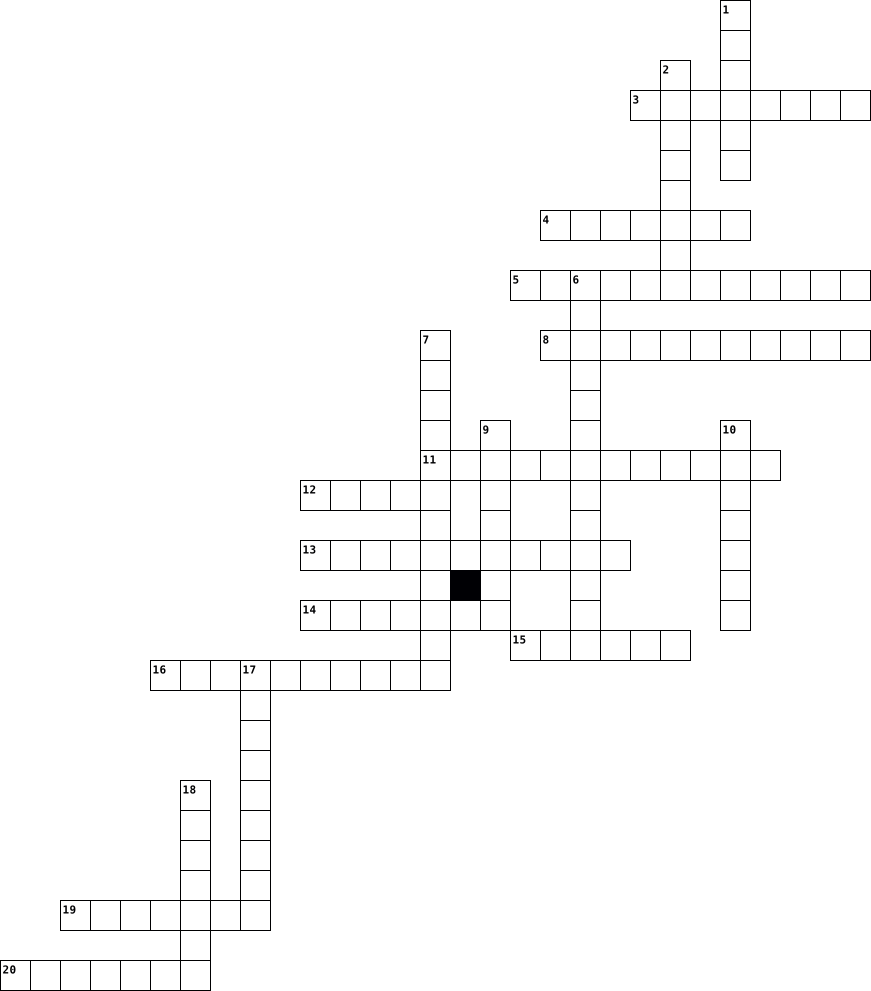
Across
- branch of biology concerned with the study of genes, genetic variation, and heredity in organisms.
- the branch of science concerned with the nature and properties of matter and energy.
- biological chemistry, is the study of chemical processes within and relating to living organisms
- Study of insects
- study of all aspects of the ocean.
- biology interdisciplinary area of study that examines humans through the influences and interplay of many diverse fields such as genetics, evolution, physiology, anatomy, epidemiology, anthropology, ecology, nutrition, population genetics and sociocultural influences.
- branch of the atmospheric sciences which includes atmospheric chemistry and atmospheric physics, with a major focus on weather forecasting.
- One of the Branchs of biology
- plant biology or phytology, is the science of plant life and a branch of biology.
- science of behavior and mind, including conscious and unconscious phenomena, as well as feeling and thought.
- Study of animals
- branch of biology concerned with the study of the structure of organisms and their parts.
Down
- Einstein German-born theoretical physicist who developed the theory of relativity, one of the two pillars of modern physics.
- science and practice of establishing the diagnosis, prognosis, treatment, and prevention of disease
- Study of birds
- science concerned with fossil animals and plants.
- Studies of Rocks...
- Darwin Famous biologist
- Work with chemicals
- branch of biology that studies the animal kingdom, including the structure, embryology, evolution, classification, habits, and distribution of all animals, both living and extinct, and how they interact with their ecosystems.
20 Clues: Study of birds • Study of insects • Study of animals • Studies of Rocks... • Work with chemicals • Darwin Famous biologist • One of the Branchs of biology • study of all aspects of the ocean. • science concerned with fossil animals and plants. • plant biology or phytology, is the science of plant life and a branch of biology. • ...
Investigate the effect of external and internal radiation on the human body, radiation sickness 2025-04-08

Across
- – A type of high-energy radiation often involved in nuclear accidents.
- – A gland commonly affected by radioactive iodine.
- – Energy transmitted in the form of waves or particles.
- – One of the early symptoms of acute radiation sickness.
- – Radiation type that can penetrate skin but not deep tissue.
- – The unit used to measure radiation dose in the human body.
- – A naturally occurring radioactive gas that can cause lung cancer.
- – A change in DNA that can result from radiation exposure.
- – One method through which internal radiation can enter the body.
Down
- – The process of removing radioactive particles from the body or clothing.
- – Protective barriers used to reduce radiation exposure.
- – A long-term risk associated with exposure to radiation.
- – Type of radiation exposure that happens inside the body.
- – A radioactive isotope that accumulates in the thyroid.
- – A device used to measure radiation exposure.
- – A type of radiation particle that can be harmful if ingested.
- – Radiation exposure that comes from outside the body.
17 Clues: – A device used to measure radiation exposure. • – A gland commonly affected by radioactive iodine. • – Radiation exposure that comes from outside the body. • – Energy transmitted in the form of waves or particles. • – Protective barriers used to reduce radiation exposure. • – A radioactive isotope that accumulates in the thyroid. • ...