
world war 2 Crossword Puzzles
World War 2 Key Events 2022-06-22

Across
- Invasion of this country started World War 2
- Which beach were allied soldiers evacuated from in 1940
- This 1942/3 battle in Russia was a turning point of the war
- Month in 1945 the formal surrender ceremony by Japan took place
- First Japanese city the atomic bomb was dropped on
- The German-occupied port in France the allies failed to retake in August 1942 by an amphibious attack
- Country that invaded Finland in 1939
- One of the beaches the US troops landing on in the Battle of Normandy
- Country that signed the “Pact of Steel” with Germany in 1939
- Japanese island and site of a fierce battle in 1945
Down
- By what name is 6 June 1944 known
- Axis leader who committed suicide on April 30 1945
- The bombing of this naval base brought the USA into the war
- Trials of war criminals took place here
- The conference attended by allied leaders at the end of 1943
- German bombing of Great Britain
- The 1938 agreement that allowed Hitler to annex the Sudetenland in Czechoslovakia
- the German code name for the invasion of Britain
- Charter issues by FDR and Churchill in 1941
- Conference at which the postwar settlement of Europe and the war against Japan was discussed
20 Clues: German bombing of Great Britain • By what name is 6 June 1944 known • Country that invaded Finland in 1939 • Trials of war criminals took place here • Charter issues by FDR and Churchill in 1941 • Invasion of this country started World War 2 • the German code name for the invasion of Britain • Axis leader who committed suicide on April 30 1945 • ...
World War 2 Crossword Puzzle 2023-12-19

Across
- This Canadian flying ace accomplished brilliant success inside the direction of the Battle of Britain.
- The "Little Red Devils" had been Canadian paratroopers who performed an essential function in this bold 1944 Normandy operation.
- The first Canadian victory towards the Germans in World War II, taking vicinity in December 1939.
- The Canadian-born scientist who played a key function within the improvement of the atomic bomb as part of the Manhattan Project.
- The 1941 war wherein Canadian and Allied forces efficiently defended the Greek island of Crete.
- The Canadian town where the "Avro Arrow" interceptor plane became superior after World War II.
- The Canadian island that was modified into fortified as a shielding degree in opposition to Axis invasions.
- The Royal Canadian Air Force squadron that finished recognition for its position in the bombing advertising campaign over Europe.
- The 1942 conflict in which Canadian and British forces efficiently defended the important port of Tobruk.
- The Canadian branch that participated within the liberation of the Netherlands in 1945.
- The Canadian girl who has come to be an image of women's contributions to the battle strive, running in factories and shipyards.
- The top-secret Allied mission that brought about the development of the atomic bomb.
- The Allied operation that aimed to liberate the Dutch humans from German occupation, with a good sized Canadian contribution.
- This Canadian city hosted an important convention in 1943 wherein Allied leaders mentioned methods for the relaxation of the struggle.
- The largest naval engagement in Canadian records, in which the Royal Canadian Navy performed a vital function in protective Allied convoys.
- The Canadian government's coverage of conscripting infantrymen for foreign places, which sparked controversy and protests.
- Canadian Prime Minister in the course of World War II, regarded for his strong management and provoking speeches.
Down
- The Canadian infantry branch that executed an important function in the liberation of the French port town of Dieppe in 1944.
- The pinnacle-secret Canadian undertaking that contributed extensively to the improvement of the radar era in the course of the war.
- The Canadian-constructed aircraft that performed an important position in maritime patrol and anti-submarine struggle.
- The code name for the Allied invasion of Southern France in 1944, concerning Canadian troops.
- The Canadian province that produced a good sized part of the Allied bomber crews all through the struggle.
- The Canadian famous who commanded the First Canadian Army at a few levels inside the Italian Campaign.
- The volunteer pressure that supported the warfare effort on the residence front, concerned in sports activities like air raid precautions and firewatching.
- The strategic island captured via Canadian forces in 1943, reducing off a vital German delivery path.
- The name of the Canadian infantry department that played a key function inside the Italian Campaign.
- The Canadian-born pilot who emerged as an American flying ace during World War II.
- The code name for the successful Canadian-led attack on Juno Beach in the course of D-Day.
- The name of the Canadian tank that performed a considerable position in battles like Normandy.
- The internet web page of a substantial Canadian education camp in which soldiers had been prepared for remote places service.
30 Clues: The Canadian-born pilot who emerged as an American flying ace during World War II. • The top-secret Allied mission that brought about the development of the atomic bomb. • The Canadian branch that participated within the liberation of the Netherlands in 1945. • The code name for the successful Canadian-led attack on Juno Beach in the course of D-Day. • ...
World War 2 Vocab Menu 2024-02-13
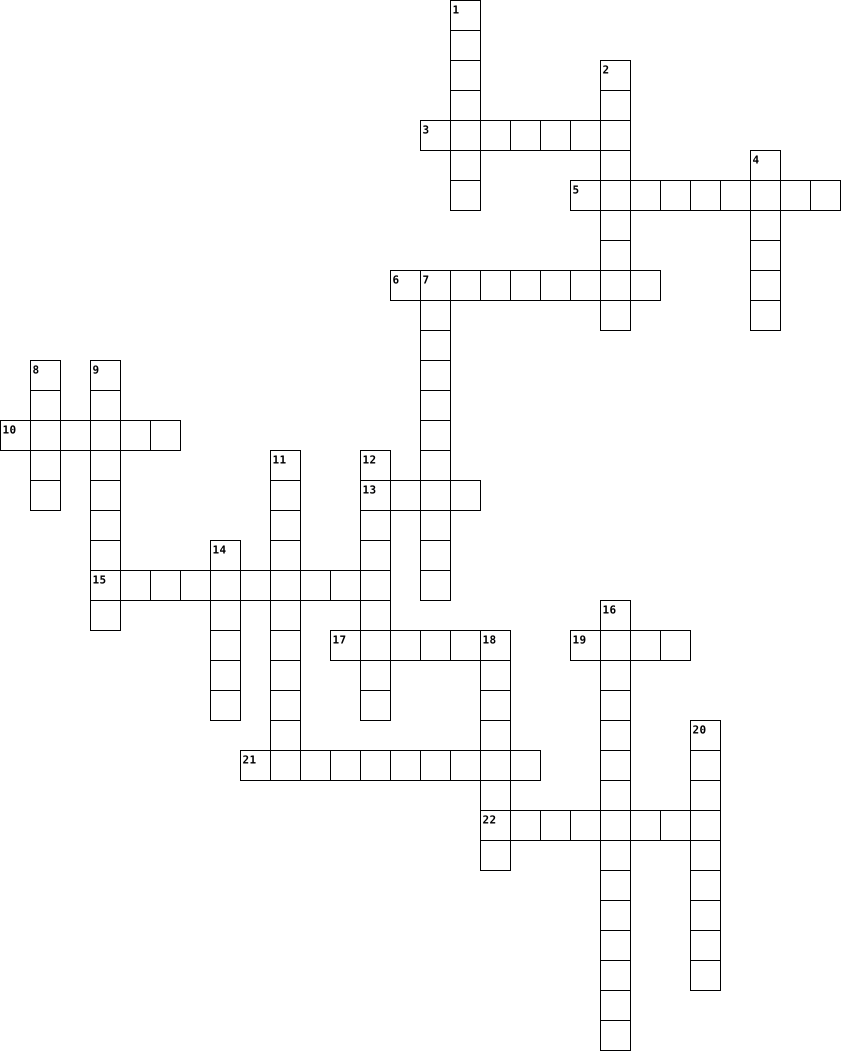
Across
- Government system that favors nationalism at all cost, even violence
- Last name of WW2 Italy leader
- Ethnic massacre of Jewish people led by the Third Reich
- The name of the powers of Britain, France, USSR, and the USA
- The name of the powers of Germany, Italy, and Japan
- Government advertisements to support war efforts
- Last name of WW2 Soviet leader
- Last name of WW2 Japanese General
- Bloodiest battle of WW2
- Singular leader with complete control of the government
Down
- Battle mostly fought by air, German Loss
- Government system that claims equality for everyone
- Last name of WW2 Germany leader
- Last name of the head research for the Nuclear Bombs
- The battle of the last attempted German offense
- Name of Adolf Hitler's Book
- The attempt to please someone with gifts or inaction to try and have nothing else happen
- "place" of research for the nuclear bomb project
- Encouraged lessen use of certain resources to divert to war effort
- Government system with complete control of everything
- Most important Allied invasion of WW2
- Last name of WW2 British General
22 Clues: Bloodiest battle of WW2 • Name of Adolf Hitler's Book • Last name of WW2 Italy leader • Last name of WW2 Soviet leader • Last name of WW2 Germany leader • Last name of WW2 British General • Last name of WW2 Japanese General • Most important Allied invasion of WW2 • Battle mostly fought by air, German Loss • The battle of the last attempted German offense • ...
World war II 2023-05-15

Across
- The first bomb attack by the United States on Japan killing 140,000 people
- Passed by US congress because of growing threats
- Where the allies prosecuted German leaders for the crimes they committed during world war II
- Promote the defense of US
- The united states fought for an island from the empire of Japan
- surprise attack by the Japanese on December 7, 1941
- Traveling from one island to another
Down
- The draft
- The code name to develop an atom bomb
- The second bomb attack by the United states on Japan killing 74,000 people
- Naval battle during world war II
- Process of appeasing
- a day in World War II on which Allied forces invaded northern France by means of beach landings in Normandy
- U.S. Supreme Court case concerning the forced relocation and confinement of Japanese Americans
- A battle during world war II
- Helped increase the food production during war
16 Clues: The draft • Process of appeasing • Promote the defense of US • A battle during world war II • Naval battle during world war II • Traveling from one island to another • The code name to develop an atom bomb • Helped increase the food production during war • Passed by US congress because of growing threats • surprise attack by the Japanese on December 7, 1941 • ...
The Great War Section 2 2025-11-17

Across
- German general who won major victories on the Eastern Front
- Harsh set of demands Austria-Hungary issued to Serbia
- Germany’s strategy for a quick victory in the West
- To prepare and organize troops and resources for war
- British passenger liner sunk by a German U-boat
- The 1918 peace treaty between Russia and the Central Powers
- Large German airships used for bombing raids
Down
- A situation in which neither side can win
- Archduke of Austria-Hungary who was assassinated
- World War I alliance led by Germany and Austria-Hungary
- The agreement signed on November 11, 1918, that ended the fighting of World War I
- The Russian tsar who led Russia into World War I
- A strategy of wearing down the enemy by continuous losses in personnel and matériel
- German submarines
- French general appointed supreme Allied commander in 1918.
- Commander of the American Expeditionary Forces in World War I
16 Clues: German submarines • A situation in which neither side can win • Large German airships used for bombing raids • British passenger liner sunk by a German U-boat • Archduke of Austria-Hungary who was assassinated • The Russian tsar who led Russia into World War I • Germany’s strategy for a quick victory in the West • To prepare and organize troops and resources for war • ...
Countries 2025-05-04

Across
- the home of tango
- The first president in the country only served a day
- Home of arguably the best football player ever
- Known for fighting in world war 2
- home of the Nile
- The best hockey team ever
- has a sport called cheese rolling
- Oldest writing existed in Iran
- The biggest aircraft was built here
- Has Tokyo
Down
- has europes tallest waterfall
- The largest economy in the world
- Halloween originated in it
- Where chocolate was made
- has the Great Wall of china
- has the Eiffel Tower
- last country ever inhabited by people
- Made pretzels
- over 60 languages spoken in this country
- one of the countries of breakdancing
- known for the Jesus statue
- Has the largest swimming pool in the world
- changed its name once
23 Clues: Has Tokyo • Made pretzels • home of the Nile • the home of tango • has the Eiffel Tower • changed its name once • Where chocolate was made • The best hockey team ever • Halloween originated in it • known for the Jesus statue • has the Great Wall of china • has europes tallest waterfall • Oldest writing existed in Iran • The largest economy in the world • Known for fighting in world war 2 • ...
Praneeth 2022-09-26

Across
- the matrix
- of 8 legends creatures in
- animal of a tiger
- war 2 German tank
- we a polish
- Sunday
- bird of a peacock
- Neo wake up
- of vietnam
Down
- chapter of the Bible
- s arch nemisis
- is a pro player
- Sharma Play the cricket my dad his hero
- used by roman emperor
- win the game
- of the straight line
- tree is mango
17 Clues: Sunday • the matrix • of vietnam • we a polish • Neo wake up • win the game • tree is mango • s arch nemisis • is a pro player • animal of a tiger • war 2 German tank • bird of a peacock • chapter of the Bible • of the straight line • used by roman emperor • of 8 legends creatures in • Sharma Play the cricket my dad his hero
Lawrence Kohlberg 2021-11-16

Across
- Interpersonal accord and conformity
- Universal Ethical Principals
- Moral development in human development_
- Moral development shows_
- Moral development shows_
- University of _
- Moral development shows_
- Month of death
- Moral development in human development
Down
- Obedience and Punishment
- Authority and Maintain Social Order
- Stage5
- Study of mind and behavior
- Moral development in human development_
- Born in
- Served at the end of World War 2
- Self-Interest
- Month of birth
- Graduates from _
19 Clues: Stage5 • Born in • Self-Interest • Month of birth • Month of death • University of _ • Graduates from _ • Obedience and Punishment • Moral development shows_ • Moral development shows_ • Moral development shows_ • Study of mind and behavior • Universal Ethical Principals • Served at the end of World War 2 • Authority and Maintain Social Order • Interpersonal accord and conformity • ...
Social 20-1 Comprehensive Puzzle (Nationalism) 2023-06-08

Across
- (3 words)- The Treaty that brought Britain to War
- (2 words)- Mass killing of a large number of people mainly “Jews.
- (2 words) America First- Back to Selective Isolationism
- (2 words) spend some time studying or training in another European country.
- (3 words)- Insane Killings lead by Robespierre
- City where Germany was forced to surrender.
- (1 word) The process of a nation resolving a problem or coming to a conclusion about certain decisions by itself.
- (2 words) An American initiative to aid Western Europe to help rebuild and support Western European economy after World War II.
- (1 word) The process of two independent nations working together to reach a conclusion about decisions.
- (1 word) An organization that is not dependent on the government, usually non profit.
- (3 words)- Intergovernmental Organisation to maintain World Peace.
- The type of monarchy under Louis XVI, XV, XIV
- (2 words)- Relocation of the Japanese to concentration camps.
- politics-driven practical, or pragmatic concerns, rather than ideological ones.
- The Declaration of Rights of Man and Citizens called for ______ for all citizens
- The act of assembling and readying troops and supplies for War.
- (1 word) The policy followed by the United States of America to stay away from the affairs of other nation states.
- Charges placed on goods and services as they move from one country to another.
- (2 words)- Agreement concluded between Germany, Italy and France in September 1938.
- (2 words) absolute control by the state or a governing branch of a highly centralized institution.
- The Second Estate
- This policy was championed by Neville Chamberlain to avoid a potential war. At the Munich conference, Chamberlain gave into Hitler’s demand for the Sudetenland.
- (2 words) In the first decade, the United Nations sent military observers to trouble spots (Palestine – Israel, Pakistan – India).
- (2 words)- Plan for Germany to attack France and then Russia.
- (1 word) A type of multinational political union where negotiations are made and authority is given to members of the government.
- activity undertaken by a state to influence something not directly under its control.
- (2 words)- An American politician and soldier who served. as the first President of the United States from 1789 to 1797 and was one of the Founding Fathers of the United States
Down
- (2 words) American financial and military assistance to countries at risk of falling to communism.
- (2 words) Wrote the pamphlet Common Sense, promoting American Independence
- the belief or desire of a government or people that a country should maintain a strong military capability and be prepared to use it aggressively to defend or promote national interests
- (2 words)- Germany, Austria- Hungary, Ottoman Empire
- ( 1 word) the process of seeking resolution to a conflict while the conflict is ongoing
- (2 words)- a British Army officer who rose to become Commander-in-Chief of British forces during the American war of Independence also known as the American Revolutionary War.
- (2 words) - The Serbian Terrorist group that had trained Gavrilo Princep
- German “lightning war” tactics.
- (3 words) The announcement by the 13 colonies that the colonies were to be free and independent of England's control.
- Ukraine 1932.
- (2 words)- Communist dictator of the Soviet Union.
- (3 words) International organizations that provide long term loans and promote the growth of the economy of specific nations.
- ( 3 words) An intergovernmental organization that regulates international trade.
- The remote US Naval Base bombed in WW2 by the Japanese
- (3 words) By a clause in this treaty Germany was forced to accept the responsibility for starting the WW1
- In October 1789, an angry mob (mostly women) went to ____
- (2 words)- organization of American colonists that was created in the Thirteen American Colonies?
- This social class wanted political power to go along with its increasing economic power.
- (3 words) American colonies by imposing a stamp duty on newspapers and legal and commercial documents
- Nobles who fled France during the French Revolution and urged the foreign rulers to oppose the Revolution.
- The power of the President to refuse to approve a bill or joint resolution and thus prevent its enactment into law
- One Problem of the Old Regime was the increasing ____ which exempted nobles and clergy.
- (2 words) Patriot who made a daring ride to warn colonists of British arrival; Printed the Boston Massacre
50 Clues: Ukraine 1932. • The Second Estate • German “lightning war” tactics. • City where Germany was forced to surrender. • The type of monarchy under Louis XVI, XV, XIV • (3 words)- Insane Killings lead by Robespierre • (3 words)- The Treaty that brought Britain to War • (2 words)- Communist dictator of the Soviet Union. • (2 words)- Germany, Austria- Hungary, Ottoman Empire • ...
Social 20-1 Comprehensive Puzzle (Nationalism) 2023-06-08

Across
- (1 word) The process of a nation resolving a problem or coming to a conclusion about certain decisions by itself.
- The Declaration of Rights of Man and Citizens called for ______ for all citizens
- (2 words) An American initiative to aid Western Europe to help rebuild and support Western European economy after World War II.
- (2 words) In the first decade, the United Nations sent military observers to trouble spots (Palestine – Israel, Pakistan – India).
- (2 words) absolute control by the state or a governing branch of a highly centralized institution.
- (3 words) International organizations that provide long term loans and promote the growth of the economy of specific nations.
- The type of monarchy under Louis XVI, XV, XIV
- A lack of political power in the West relative to the rest of Canada
- Charges placed on goods and services as they move from one country to another.
- Ukraine 1932.
- (1 word) The process of two independent nations working together to reach a conclusion about decisions.
- the belief or desire of a government or people that a country should maintain a strong military capability and be prepared to use it aggressively to defend or promote national interests
- This social class wanted political power to go along with its increasing economic power.
- (2 words)- Communist dictator of the Soviet Union.
- In October 1789, an angry mob (mostly women) went to ____
- (3 words) American colonies by imposing a stamp duty on newspapers and legal and commercial documents
- (2 words) Patriot who made a daring ride to warn colonists of British arrival; Printed the Boston Massacre
- (3 words)- Intergovernmental Organisation to maintain World Peace.
- The power of the President to refuse to approve a bill or joint resolution and thus prevent its enactment into law
- politics-driven practical, or pragmatic concerns, rather than ideological ones.
- Nobles who fled France during the French Revolution and urged the foreign rulers to oppose the Revolution.
- German “lightning war” tactics.
- (1 word) The policy followed by the United States of America to stay away from the affairs of other nation states.
- (2 words) Wrote the pamphlet Common Sense, promoting American Independence
- (2 words) spend some time studying or training in another European country.
- (2 words)- Plan for Germany to attack France and then Russia.
Down
- (2 words)- Agreement concluded between Germany, Italy and France in September 1938.
- (2 words) American financial and military assistance to countries at risk of falling to communism.
- (2 words)- Germany, Austria- Hungary, Ottoman Empire
- (3 words) By a clause in this treaty Germany was forced to accept the responsibility for starting the WW1
- (2 words)- organization of American colonists that was created in the Thirteen American Colonies?
- activity undertaken by a state to influence something not directly under its control.
- ( 1 word) the process of seeking resolution to a conflict while the conflict is ongoing
- The Second Estate
- This policy was championed by Neville Chamberlain to avoid a potential war. At the Munich conference, Chamberlain gave into Hitler’s demand for the Sudetenland.
- (3 words)- The Treaty that brought Britain to War
- (2 words) America First- Back to Selective Isolationism
- (2 words)- a British Army officer who rose to become Commander-in-Chief of British forces during the American war of Independence also known as the American Revolutionary War.
- (3 words) The announcement by the 13 colonies that the colonies were to be free and independent of England's control.
- The act of assembling and readying troops and supplies for War.
- (2 words)- Mass killing of a large number of people mainly “Jews.
- City where Germany was forced to surrender.
- (2 words)- Relocation of the Japanese to concentration camps.
- One Problem of the Old Regime was the increasing ____ which exempted nobles and clergy.
- (1 word) A type of multinational political union where negotiations are made and authority is given to members of the government.
- ( 3 words) An intergovernmental organization that regulates international trade.
- (2 words) - The Serbian Terrorist group that had trained Gavrilo Princep
- (3 words)- Insane Killings lead by Robespierre
- (2 words)- An American politician and soldier who served. as the first President of the United States from 1789 to 1797 and was one of the Founding Fathers of the United States
- (1 word) An organization that is not dependent on the government, usually non profit.
- The remote US Naval Base bombed in WW2 by the Japanese
51 Clues: Ukraine 1932. • The Second Estate • German “lightning war” tactics. • City where Germany was forced to surrender. • The type of monarchy under Louis XVI, XV, XIV • (3 words)- Insane Killings lead by Robespierre • (3 words)- The Treaty that brought Britain to War • (2 words)- Communist dictator of the Soviet Union. • (2 words)- Germany, Austria- Hungary, Ottoman Empire • ...
World War II (U.S. Neutrality to Pearl Harbor) 2024-04-09

Across
- act that allowed the U.S. to temporarily provide American war materiel to Britain while maintaining her neutrality
- agreement between Britain's Churchill and America's FDR that stated the importance of self-government, economic stability, and disarmament post-war
- FDR said this "date will live in _______" in his famous speech asking Congress for a declaration of war against Japan
- the U.S.S. _______ was the battleship that sunk to the bottom of the harbor and currently entombs over 900 fallen sailors
- treaty that ended World War I and served as a cause for World War II
- powers consisting of Germany, Italy, and Japan
- policy associated with British PM Neville Chamberlain that allowed Germany to take over territories unchecked
- term for the annexation of Austria in 1938
Down
- "lightning war" strategy of the Germans that led to them dominated the first years of World War II
- centralized, authoritarian government whose policies glorify the state over the individual and are destructive to human rights
- the Hawaiian target of a Japanese attack on the U.S. December 7, 1941
- the plane of choice of Japanese fighter pilots manufactured by Mitsubishi
- powers consisting of the U.S., Britain, Soviet Union, and France
- organization formed post-World War I that meant to bring world nations together to talk about world problems rather than fight in wars
- system of government where one person or political party dominates a country
15 Clues: term for the annexation of Austria in 1938 • powers consisting of Germany, Italy, and Japan • powers consisting of the U.S., Britain, Soviet Union, and France • treaty that ended World War I and served as a cause for World War II • the Hawaiian target of a Japanese attack on the U.S. December 7, 1941 • ...
WORLD WAR 1 2012-10-10

Across
- Australia was a ______ country before world war 1
- countries wanted to gain ______
- What year did World War 1 end?
- When is A.N.Z.A.C day held?
- Germany, Austria-Hungary, Turkey and Bulgaria were part of what alliance?
- Britain declared was on _______
Down
- What month and year did World War 1 start?
- They also declared war against Germany.
- Russia, France, British Empire, Italy, USA, Japan, Greece etc. were all part of what alliance?
- How many years had Australia been a United Country for? (before world war 1)
- Big bullet proof tractors were introduced.
- new fighting equipment included guns and _____
- Countries wanted to build new _______
- It was released in the air which caused a slow and painful death.
14 Clues: When is A.N.Z.A.C day held? • What year did World War 1 end? • countries wanted to gain ______ • Britain declared was on _______ • Countries wanted to build new _______ • They also declared war against Germany. • What month and year did World War 1 start? • Big bullet proof tractors were introduced. • new fighting equipment included guns and _____ • ...
Final Exam Review 2023-05-15

Across
- led revolutions in Latin America in 19th Century
- British ship sunk by Germany in 1915 led to increase of anti-German feelings in US
- totalitarian government in Germany & Italy
- Enlightened philosopher who influenced the American Revolution
- nation divided at 38th parallel
- segregation in South Africa
- convicted migrants from Great Britain settled here
- led Bolshevik Revolution in Russia
- nation where Industrial Revolution began (2 words)
- colonies were a source of these (Ex: cotton, palm oil, etc.)
- conference where Africa was divided up between European nations in 1880s
Down
- US decided to use this weapon rather than invade Japan in 1945
- weapon of World War 1 that led to high casualty rates
- nation created after World War 1
- first man-made satellite
- group to protect against communism in Europe
- created due in part from the Holocaust
- father of capitalism
- the anti-imperial attempted revolt in China (two words)
- US strategy to combat communism around the world
- his theory of evolution influenced Age of Imperialism
- the "Jewel of the Crown" colony of Great Britain
- group that modernized Japan in 19th Century
23 Clues: father of capitalism • first man-made satellite • segregation in South Africa • nation divided at 38th parallel • nation created after World War 1 • led Bolshevik Revolution in Russia • created due in part from the Holocaust • totalitarian government in Germany & Italy • group that modernized Japan in 19th Century • group to protect against communism in Europe • ...
Beginning of World War 2 2025-01-15

Across
- December 8, 1841 US declared ______ on the Axis powers
- a form of government that has complete control
- Germany invaded this country in 1939
- the attack of Japan to this place is the reason US entered the war
- dictator of Germany who believed that Germans were superior to other people
- most Americans did not want to get involved in the problems of Europe because there were considered _________
- communist leader of the Soviet Union who allied with Hitler then became allies to the US and Great Britain
- a leader who gains complete control of a country's government
- more than 2,300 ______________ soldiers, sailors, and civilians were killed during Pearl Harbor
- emperor of Japan from 1926-1989
Down
- prime minster of Great Britain
- ___________ powers were Japan, Germany, and Italy
- when the US decided to let Great Britain borrow military supplies
- US placed a ban on this like _______ and scrap metal trade with China
- at the beginning of the war Germany and __________ agreed not to attack one another
- dictator of Italy who allied with Hitler
- president of the United States from 1933-1945
- _________, radios, boots, and canned meat were given to the Soviet Union to help them
- ___________ powers were these countries Great Britain, France, and the US
- prime minister and military leader of Japan
20 Clues: prime minster of Great Britain • emperor of Japan from 1926-1989 • Germany invaded this country in 1939 • dictator of Italy who allied with Hitler • prime minister and military leader of Japan • president of the United States from 1933-1945 • a form of government that has complete control • ___________ powers were Japan, Germany, and Italy • ...
World War 2 Crossword Puzzle 2023-12-17

Across
- The 1942 battle where Canadian and British forces successfully defended the vital port of Tobruk.
- This Canadian city hosted an important conference in 1943 where Allied leaders discussed strategy for the rest of the war.
- The top-secret Canadian project that contributed significantly to the development of radar technology during the war.
- The code name for the successful Canadian-led assault on Juno Beach during D-Day.
- Canadian Prime Minister during most of World War II, known for his strong leadership and inspiring speeches.
- The Canadian-born pilot who became an American flying ace during World War II.
- The Allied operation that aimed to liberate the Dutch people from German occupation, with a significant Canadian contribution.
- The Canadian division that participated in the liberation of the Netherlands in 1945.
- The Canadian island that was fortified as a defensive measure against potential Axis invasions.
- The Canadian city where the "Avro Arrow" interceptor aircraft was developed after World War II.
- The Canadian-built aircraft that played a crucial role in maritime patrol and anti-submarine warfare.
- The volunteer force that supported the war effort on the home front, involved in activities like air raid precautions and firewatching.
Down
- The name of the Canadian tank that played a significant role in battles like Normandy.
- The Canadian general who commanded the First Canadian Army during the Italian Campaign.
- The Canadian woman who became a symbol of women's contributions to the war effort, working in factories and shipyards.
- The first Canadian victory against the Germans in World War II, taking place in December 1939.
- The Canadian government's policy of conscripting soldiers for overseas service, which sparked controversy and protests.
- The name of the Canadian infantry division that played a key role in the Italian Campaign.
- The Royal Canadian Air Force squadron that achieved fame for its role in the bombing campaign over Europe.
- This Canadian flying ace achieved notable success during the Battle of Britain.
- The largest naval engagement in Canadian history, where the Royal Canadian Navy played a vital role in protecting Allied convoys.
- The site of a significant Canadian training camp where soldiers were prepared for overseas service.
- The Canadian infantry division that played a crucial role in the liberation of the French port city of Dieppe in 1944.
- The Canadian province that produced a significant portion of the Allied bomber crews during the war.
- The 1941 battle where Canadian and Allied forces successfully defended the Greek island of Crete.
- The top secret Allied project that led to the development of the atomic bomb.
- The code name for the Allied invasion of Southern France in 1944, involving Canadian troops.
- The "Little Red Devils" were Canadian paratroopers who played a crucial role in this daring 1944 Normandy operation.
- The Canadian-born scientist who played a key role in the development of the atomic bomb as part of the Manhattan Project.
- The strategic island captured by Canadian forces in 1943, cutting off a vital German supply route.
30 Clues: The top secret Allied project that led to the development of the atomic bomb. • The Canadian-born pilot who became an American flying ace during World War II. • This Canadian flying ace achieved notable success during the Battle of Britain. • The code name for the successful Canadian-led assault on Juno Beach during D-Day. • ...
world war 2 crossword puzzle 2024-03-29
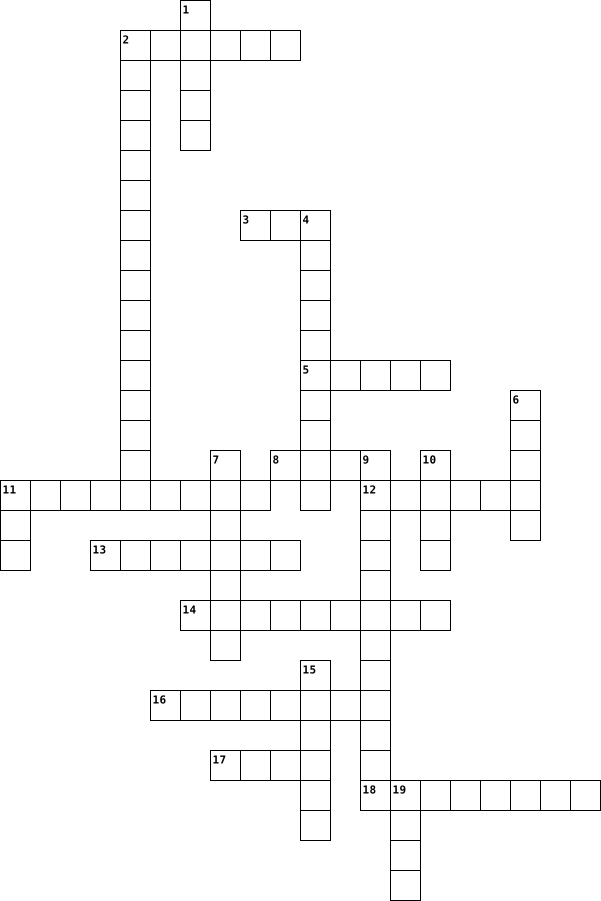
Across
- the most shot down plane
- had no equal in the pacific until the end of 1942
- the best tank ever made
- the largest tank
- one of the most iconic tanks ever
- the largest aircraft
- the first ship sank at pearl harbor
- the largest naval battle
- the best cruiser tank of ww2
- the most produced aircraft
- the plane that won the battle of britian
Down
- the beginning of the end of ww2
- "hitler's last gamble"
- the fastest tracked vehicle of ww2
- the most feared plane
- widely considered the best tank of WW2
- the aircraft that sank 6 carriers total
- the plane that dropped the most bombs
- the 2nd best tank ever made
- the first operational jet fighter
- the largest Fighter aircraft
21 Clues: the largest tank • the largest aircraft • the most feared plane • "hitler's last gamble" • the best tank ever made • the most shot down plane • the largest naval battle • the most produced aircraft • the 2nd best tank ever made • the best cruiser tank of ww2 • the largest Fighter aircraft • the beginning of the end of ww2 • one of the most iconic tanks ever • ...
World History B Unit 1 Keywords Crossword 2019-01-08

Across
- A British businessman, mining magnate and politician in southern Africa who served as Prime Minister of the Cape Colony from 1890 to 1896.
- A German submarine used during World War 1 or World War 2.
- Information that is not objective and is primarily used to influence an audience and further an agenda, often by presenting facts selectively to encourage a particular synthesis or perception, or using loaded language to produce and emotional rather than a rational response to the information that is presented.
- An anti-foreign, anti-colonial, and anti-Christian uprising that took place in China between 1899 and 1901.
- Documents, images, or artifacts that provide firsthand testimony or directs evidence concerning a historical topic.
- A king,queen, emperor, etc. who controlled all aspects of society with no limitations on their authority.
- An agreement made by opposing sides in a war to stop fighting for a certain time; a truce.
- Fought between the United States and Spain in 1898 after the explosion of the USS Maine.
- The main theatre of war during the First World War.
- The treaty that ended the state of war between Germany and the Allied Powers of the First World War.
- Fourteen European countries met in 1884-85 to lay down the rules for the division of Africa.
- The theory that individuals, groups, and peoples are subject to the same Darwinian laws of natural selection as plants and animals. It was used to justify imperialism and racism in the late 19th and early 20th centuries.
- An economic theory that advocates putting the means of production in the hands of the people collectively and states that the government has a responsibility to redistribute wealth to make society more fair and just. The goal is not to eliminate private property entirely but to narrow the gap between the rich and the poor.
- A secret diplomatic communication issued from the German Foreign Office in January 1917 that proposed a military alliance between Germany and Mexico.
Down
- The seizure of a country or territory by a stronger country.
- A philosophical movement that swept through Europe in the 18th century. It was based on reason, and advocated ideas such as liberty, tolerance, constitutional government, and separation of church and state.
- Another name for World War 1.
- An economic theory that advocates private ownership of the means of production, free competition, and individual economic freedom.
- The rural to urban shift during the Industrial Revolution.
- An English author born in India. He wrote The Jungle Book.
- A source created after the event by someone who did not participate in/was not present for the historical event. Examples include textbooks, journal articles, and research reports.
- Identification with one's own nation and support for its interests.
- A pair of revolutions in Russia in 1917 that dismantled the Tsarist autocracy and led to the rise of the Soviet Union.
- An intergovernmental organization formed as a result of the Paris Peace Conference that ended the First World War. Its principle mission was to maintain world peace.
- A point of view; a particular attitude or way of regarding something.
- A violent uprising against British rule in India in 1857.
- The greatly increased output of machine-made goods that began in England in the middle 1700s.
- A faction of the Marxist Russian Social Democratic Labour Party which split away from the Menshevik faction at the Second Party Congress in 1903.
- A war which is unrestricted in terms of the weapons used, the territory or combatants involved, or the objectives persued, especially one in which the laws of war are disregarded.
- A complex culture with five characteristics: advanced cities, specialized workers, complex institutions, record keeping, and advanced technology.
30 Clues: Another name for World War 1. • The main theatre of war during the First World War. • A violent uprising against British rule in India in 1857. • A German submarine used during World War 1 or World War 2. • The rural to urban shift during the Industrial Revolution. • An English author born in India. He wrote The Jungle Book. • ...
28 2024-08-28

Across
- Witch’s bathhouse
- Winter realm
- Demon realm
- Ninja village
- Alchemy land
- Death world
- Space fortress
- Desert city
- Immortal world
- Ninja city
- Magic school
- Tennis powerhouse
- Magic world
- Sky island
Down
- Leaf village
- Grail war
- Maze world
- Hollow city
- Otaku paradise
- Warrior afterlife
- King’s city
- Slave city
- World tree
- Alien world
- Ghost city
25 Clues: Grail war • Maze world • Slave city • World tree • Ghost city • Ninja city • Sky island • Hollow city • Demon realm • King’s city • Death world • Alien world • Desert city • Magic world • Leaf village • Winter realm • Alchemy land • Magic school • Ninja village • Otaku paradise • Space fortress • Immortal world • Witch’s bathhouse • Warrior afterlife • Tennis powerhouse
World War II Vocabulary Crossword Puzzle 2023-05-15

Across
- major naval battle in the Pacific Theater of World War II that took place six months after Japan's attack on Pearl Harbor
- a vegetable garden planted to increase food production during a war.
- the last major German offensive campaign on the Western Front during World War II.
- United States detonated an atomic bomb over the Japanese city of Hiroshima.
- naval base and headquarters of the U.S. Pacific Fleet, Honolulu County, southern Oahu Island, Hawaii
- Series of acts passed by the US Congress in response to the growing threats and wars that led to World War II.
- nations first peactime draft and required all men between the ages of 21 and 35 to register for potential military service
Down
- United States detonated an atomic bomb over the Japanese city of Nagasaki.
- During World War II, the Supreme Court of the United States upheld the exclusion of Japanese Americans from the West Coast Military Area.
- a series of trials held in Nürnberg, Germany, in 1945 and 1946 following the end of World War II.
- major battle in which the United States Marine Corps and United States Navy landed on and eventually captured the island of Iwo Jima from the Imperial Japanese Army during World War II
- An Act to Promote the Defense of the United States, policy under which the United States supplied Allied nations with supplies
- research and development undertaking during World War II that produced the first nuclear weapons.
- Allied forces invaded northern France by means of beach landings in Normandy.
- bypassing heavily armed locations for islands and atolls where airstrips could be constructed.
- the act of satisfying someone or something
16 Clues: the act of satisfying someone or something • a vegetable garden planted to increase food production during a war. • United States detonated an atomic bomb over the Japanese city of Nagasaki. • United States detonated an atomic bomb over the Japanese city of Hiroshima. • Allied forces invaded northern France by means of beach landings in Normandy. • ...
Texas history 2021-05-05

Across
- to choose a representative
- the right to vote
- The manifest destiny brought
- In 1901 ___ was discovered.
- women who fought for women's voting rights
- In 1821 Mexico became free from _____.
- to live in one place year-round
- someone who explores a new place
- Deadliest War
- said "I have a dream" speech (First name). Pineda Drew the first map of the Texas coast (First name).
- war world 2 _____ in 1945
Down
- To move from one place to another
- plants that naturally grow in a region
- _____ became the 28 state in 1945
- Privileges citizens have.
- the manifest destiny kicked _______ out of their land.
- Friends who support each other, mainly in times of war
- First colored girl in an all-white school. (first name).
- separation by race
- a form of transportation (not horse).
- means cottonwood in Spanish
- highly valuable resource
- 1914-1918
23 Clues: 1914-1918 • Deadliest War • the right to vote • separation by race • highly valuable resource • Privileges citizens have. • war world 2 _____ in 1945 • to choose a representative • In 1901 ___ was discovered. • means cottonwood in Spanish • The manifest destiny brought • to live in one place year-round • someone who explores a new place • To move from one place to another • ...
Wars 2025-09-24

Across
- Rebellion, 1899–1901 uprising in China against foreign influence
- War, 1846–1848 war resulting in US acquisition of southwest territories
- War, Cold War-era conflict (1955–1975) involving North and South Vietnam
- War I, Global conflict from 1914 to 1918 involving major world powers
- War, 1870–1871 war leading to German unification
- Years’ War, 1618–1648 religious and political conflict in Central Europe
- War, US conflict (1861–1865) between Northern and Southern states over slavery
- War, 1982 conflict between the UK and Argentina over islands in the South Atlantic
- War, 1853–1856 war between Russia and an alliance of the Ottoman Empire, Britain, and France
- Wars, Series of conflicts in Afghanistan including Soviet invasion and US-led war
Down
- War, Conflict (1950–1953) between North and South Korea, involving UN forces
- Gulf War, 1990–1991 conflict to liberate Kuwait from Iraqi invasion
- of 1812, Conflict between the US and Britain over maritime rights and territory
- War, 1904–1905 conflict over control of Korea and Manchuria
- Revolution, War (1775–1783) where the US gained independence from Britain
- War, 1990–1991 conflict to expel Iraqi forces from Kuwait
- War II, Largest global war from 1939 to 1945 involving Axis and Allied powers
- Years’ War, Long conflict (1337–1453) between England and France
- Wars, Series of wars (1803–1815) led by Napoleon across Europe
- War, 1898 conflict where the US gained territories from Spain
20 Clues: War, 1870–1871 war leading to German unification • War, 1990–1991 conflict to expel Iraqi forces from Kuwait • War, 1904–1905 conflict over control of Korea and Manchuria • War, 1898 conflict where the US gained territories from Spain • Wars, Series of wars (1803–1815) led by Napoleon across Europe • ...
Thursday 2023-10-12

Across
- author of Junie b. Jones
- first state established in the U.S.
- 18-9
- a ball hit in a playable area
- capital of New York
- what number is shortstop in baseball
- how many World Series had the Orioles won
Down
- 66-13= __
- Cedric _________
- author of spy school
- buy me some______ and Cracker Jack
- 22x0=22
- What was the country that United States of America in World War 2
13 Clues: 18-9 • 22x0=22 • 66-13= __ • Cedric _________ • capital of New York • author of spy school • author of Junie b. Jones • a ball hit in a playable area • buy me some______ and Cracker Jack • first state established in the U.S. • what number is shortstop in baseball • how many World Series had the Orioles won • What was the country that United States of America in World War 2
WW1 Puzzle 2023-02-09

Across
- temporarily expanded the military through conscription
- pre WWI alliance between Great Britain, France and Russia
- intense form of patriotism
- most commonly used tank in WW1. It has a number not roman numerals
- space in between the trenches
- World War 1 winners
- main weapon in World War 1
- a German submarine. uses (-) as space
- most common warfare
- most used rifle in WW1. uses (-) as space
Down
- the most feared unit in WW1
- World War 1 loosers
- how to get secret enemy info in WW1
- solders were forced to fight from
- common nickname for WW1 soldiers
- the state of not taking sides, especially in a war or dispute
- system that prevents any one country from dominating the others
- pre WWI alliance between Italy, Germany and Austria-Hungary
- common code system in WW1
- defense agreement among nations
20 Clues: World War 1 loosers • World War 1 winners • most common warfare • common code system in WW1 • intense form of patriotism • main weapon in World War 1 • the most feared unit in WW1 • space in between the trenches • defense agreement among nations • common nickname for WW1 soldiers • solders were forced to fight from • how to get secret enemy info in WW1 • ...
WWI Cross Word Puzzel 2021-12-20

Across
- giant moving vehicle was in world war I
- Soldiers got this disease in trenches
- insects that were causing illnesses
- place in the middle of the battlefield
- machine used underwater in world war I
- killed that started world war I
- rounds of ammunition shot from a gun
Down
- What Side was the United States in
- technique was mostly used in WWI
- flying vehicle in world war I
- famous dog that became a hero in WWI
- What side was Germany in
- Soldiers got this because of moist feet
- Were as big as cats
14 Clues: Were as big as cats • What side was Germany in • flying vehicle in world war I • killed that started world war I • technique was mostly used in WWI • What Side was the United States in • insects that were causing illnesses • famous dog that became a hero in WWI • rounds of ammunition shot from a gun • Soldiers got this disease in trenches • ...
American Revolution 2025-12-11

Across
- Document that officially ended the war in 1783 (3 words)
- where colonists tossed tea into Boston Harbor
- Protest slogan against taxes — "No taxation without ________!"
- Winter encampment where Washington's troops suffered but grew stronger the Declaration of Independence was signed
- The first battle where British troops fired on colonists in 1770 (2 words)
- Site of the Revolution's initial shots — "the shot heard 'round the world"
Down
- The country that became the American colonies' ally after Saratoga
- The first governing body of colonial leaders that met in Philadelphia
- Final major conflict of the war in which Cornwallis surrendered
- Pamphlet by Thomas Paine advocating independence (2 words)
- Commander of the Continental Army
- American win that convinced France to join the war
- Writer of the Declaration of Independence
- American win that convinced France to join the war
- British troops were nicknamed this because of their attire
15 Clues: Commander of the Continental Army • Writer of the Declaration of Independence • where colonists tossed tea into Boston Harbor • American win that convinced France to join the war • American win that convinced France to join the war • Document that officially ended the war in 1783 (3 words) • Pamphlet by Thomas Paine advocating independence (2 words) • ...
WWI 2021-09-16

Across
- MAIN cause of war, countries competing to gain control in smaller countries
- Treaty of _________, viewed by Germans as humiliating and punitive
- France, Britain, Russia
- Side that America took when they joined the war
- Lost the war
- MAIN cause of war, Competing with other countries to build strongest military
- Blamed for the assasination of Ferdinand
- Germany, Austria-Hungary, Ottoman Empire
- _______ Warfare, type of warfare that was common during middle of WWI
- Pandemic that took place during the war
Down
- Allowed government to randomly select individuals to be drafted into war
- American citizens sympathized with this country when they were neutral
- MAIN cause of war, believing your country is the best in the world
- The U.S. brought hope to Britain and ______ when they joined the war
- Day that the war ended
- MAIN cause of war, Making agreements with other countries to protect each other
- “Zimmerman Telegram” revealed a plan offering ______ territory it had lost to the U.S. during a war with the U.S.
- ______ Franz Ferdinand, Assassination lead to World War I
- Side that america took at the beginning of the war
- Sank Lusitania with U-Boat which encouraged U.S. to join the war
20 Clues: Lost the war • Day that the war ended • France, Britain, Russia • Pandemic that took place during the war • Blamed for the assasination of Ferdinand • Germany, Austria-Hungary, Ottoman Empire • Side that America took when they joined the war • Side that america took at the beginning of the war • ______ Franz Ferdinand, Assassination lead to World War I • ...
WORLD WAR I 2014-10-21

Across
- the use of submarine without warning any ships found in enemy's waters
- the solvent union,and the united states.
- an international association formed after world war I.
- a military alliance between great Britain,France,and Russia in the years preceding world war I.
- often Imposed by government durning wartime, when goods a short supply.
- a military alliance between Germany,austria-hungary,Italy.
- a form of warfare in which opposing armies fbattlefieldrom trenches dug in the battlefield.
- drawn up a series of peace proposal
- the region along the German-russian border.
Down
- agreement to stop fighting.
- a policy of glorifying military powers and keeping a standing army always ready for war.
- known as the big four.
- a series of proposals in which U.S. president woodrow Wilson outlined a plan.
- the peace treaty signed by Germany and the allied powers after world war I.
- the freedom of a people to decided under what form of government they wish to live.
- a conflict in which the participating countries devote all their resources to the war effect.
- Germany's military plan at the outbreak of world war I.
- the region of northern France where the forces of allies and central powers battled each other
- information or material spread to advance a cause or to damage an opponent's cause.
- the nations of germany and austria-hungary.
20 Clues: known as the big four. • agreement to stop fighting. • drawn up a series of peace proposal • the solvent union,and the united states. • the nations of germany and austria-hungary. • the region along the German-russian border. • an international association formed after world war I. • Germany's military plan at the outbreak of world war I. • ...
World War I Crossword Puzzle 2021-01-29

Across
- the development of armed forces and their use as a tool of diplomacy
- British liner sunk by Germany
- a kind of biased communication designed to influence people’s thoughts and actions
- a truce
- last name of the head of the CPI that was a former muckraking journalist
- powers consisted of Germany, Austria-Hungary, and the Ottoman Empire
- of Nations would provide a forum for nations to discuss and settle their differences without having to resort to war
- last name of the British prime minister during World War I
- last name of one of America's greatest war heroes
- pledge included a promise not to sink merchant vessels “without warning and without saving human lives”
Down
- last name of the commander of the American Expeditionary Force (AEF) in France
- last name of Archduke who was assassinated along with his wife
- consisted of France, Britain, and Russia
- last name of a prosperous businessman
- note a secret telegram from the German foreign minister to the German ambassador in Mexico that was intercepted and decoded by British agents
- last name of the president during World War I
- last name of a famous American fighter pilot of World War I
- a devotion to the interests and culture of one's nation
- last name of the French premier during World War I
- last name of the head of conservative senators
20 Clues: a truce • British liner sunk by Germany • last name of a prosperous businessman • consisted of France, Britain, and Russia • last name of the president during World War I • last name of the head of conservative senators • last name of one of America's greatest war heroes • last name of the French premier during World War I • ...
Histroy 10 reviwew 2016-06-03

Across
- went into
- government controls the total life of it's people
- like each other
- passenger ship sunk by a German u-boat in 1915
- take part
- large prisons during world war 2
- thing people have to do for them selves
- a time when someone or something is completely destroyed
- people who made alcohol and sold it as the real thing
- people being free from captivity
- take part in
- kept apart
- people thinking badly of an event
Down
- 32nd president
- polio
- angry or harmful action
- having the skills to do a job well
- world organization to promote international peace
- illegal bars
- American woman who worked factories during world warll
- loving their country
- hitler's secret police force
- mussolini's secret police force
- changes for the better
- a church
25 Clues: polio • a church • went into • take part • kept apart • illegal bars • take part in • 32nd president • like each other • loving their country • changes for the better • angry or harmful action • hitler's secret police force • mussolini's secret police force • large prisons during world war 2 • people being free from captivity • people thinking badly of an event • having the skills to do a job well • ...
World War I Crossword 2023-11-27

Across
- Country that declared war on Serbia, sparking the chain reaction of alliances
- The Ottoman Empire joined the central powers, aligning with Germany and Austria-Hungary
- This type of warfare characterised much of the fighting on the Western Front
- This weapon, first used on a large scale in World War I, had a significant impact on the war's tactics
- Battle where the trench warfare became prominent
- Leader of Germany during World War I
Down
- Treaty that officially ended World War I
- Franz Ferdinand was assassinated in this city, triggering a war
- Region known as the "Powder Keg of Europe" before the warBattle of the Cambrai Battle where tanks were first used in significant numbers
- Last German offensive of World War I, also known as the Spring Offensive
- Telegram Code name for the secret German communication proposing a military alliance with Mexico against the United States
- President of the United States during World War I
- This country declared war on Germany in 1917, bringing the U.S. into the conflict
- Alliance formed by Germany, Austria-Hungary, and Italy
14 Clues: Leader of Germany during World War I • Treaty that officially ended World War I • Battle where the trench warfare became prominent • President of the United States during World War I • Alliance formed by Germany, Austria-Hungary, and Italy • Franz Ferdinand was assassinated in this city, triggering a war • ...
World War 1 2021-11-12

Across
- - The country Austria-Hungary first declared war with on July 28, 1914
- - Britain, France, Russia, and the USA were all apart of the ____
- - Germany's plan to avoid fighting a war on two fronts
- - This country is seen as the Western Front
- - Launched burning fuel
- - Declared the U.S. be involved in the War
- - Type of gun that was greatly improved during World War 1, used in both trenches and airplanes
- - _______ _______ ll was leader of Germany during WW1
- 1 - First total war of the 20th Century
- - Place where tanks were first introduced during World War 1
- - The sinking of this ship in 1915 made Americans angry
- - Wooldrow Wilson of the U.S, Georges Clemenceau of France, Britains, Lloyd George of Great Britain, and Vittorio Oralndo of Italy, were all known as The ___ 4.
- - Pride of one's nation
- - Country where U-boats originated from. Also the country who first used chemical warfare
- - Weapons and __________ changed the way war was fought
- - France and ______ both wanted national security
- - In 1918 ________ and the Ottoman Empire were the first to surrender in WW1
- - The ability when the nations of the world all have equal power
- - The Treaty of _______ was an agreement between Big 4 and Germany to outline peace between each other
- - Location in Europe where trenches stretched from 400-500 miles
Down
- - A type of aircraft which was originally used for bombing
- - _______ easily spread in trenches
- - A note sent from a German foreign secretary sent to Mexico
- - Deep ditches where war was fought
- - Treaties to defend one another in the event of a war - “balance of power”
- - The League of _______ formed as one of the results of the Treaty of Versailles
- - This country was the Eastern Front
- - The other name of the Triple Alliance is also known as the ______ powers
- - A ___ mask was used as protection due to poison gas
- - The other name of the Triple Entente is also known as the ______ powers
- - World War 1 is also known as “The _____ War”
- - U.S President during World War 1
- - An international war where all of a country's resources are used to destroy another country
- - Temporary peace agreement to end fighting
- - Increased tension over territories and boundaries
- - Which continent was not involved in the war at all
- - This was the form of persuading or advertising people. Also used to promote things.
- - These were designed to combat trench warfare
- - This phrase is another word for Trench Warfare
- - Where massive armies build up during the late 1800s and early 1900s in Europe
- - All U-boats are ____________
- - Chlorine gas, phosgene gas, and mustard gas are some of the types of ______ gases used in World War 1
42 Clues: - Launched burning fuel • - Pride of one's nation • - All U-boats are ____________ • - U.S President during World War 1 • - _______ easily spread in trenches • - Deep ditches where war was fought • - This country was the Eastern Front • 1 - First total war of the 20th Century • - Declared the U.S. be involved in the War • - This country is seen as the Western Front • ...
World War 1 2023-03-22

Across
- a new invention in WWI - a yellow colored gas that was fired at the enemy - it caused blindness, damage to the lungs and death
- Capital of the Bosnian province in Austria-Hungary; site of Ferdinand's assassination.
- This was a major front in World War I. A line of trenches and fortifications in WorldWar1 that stretched without a break from Switzerland to the North Sea. This is where most of the fighting happened in World War II.
- This country dropped out of World War 1 in 1917 due to a revolution taking place in their country.
- The 2nd passenger-liner sunk in March 1916 by Germany. This led Wilson to break diplomatic relations with Germany if they did not comply with his commands.
- Payment for war damages
- This was the president who was elected in 1912, and led the US into WWI. Later wrote a plan for post-WWI peace known as the Fourteen Points.
- This terrorist group who assassinated Archduke Ferdinand.
- A battle in WWI. Is considered some of the bloodiest fighting in WWI and the German offense was stopped; offensive battle on the western front initiated by Germany in which they hoped to crush France and taken them out of the war, however France was in a very good defensive position and French held it for 10 months. Nearly a million killed. French drew reserve troops from the Somme to help defend. No territory was gained; Battle in WWI that ended in massive casualties and had little direct result
- This cause of World War I was based on an intense pride in one's nation.
- This style of warfare was common in WWI, due to the invention of the machine gun and heavy artillery. It included digging long trenches, separated by barbed wire and a no mans land.
- This was the agreement between the Allies and Central Powers that ended the fighting after WWI. It began at 11/11/1918 at 11:11 am. This marked a victory for the Allies and stated that the Central Powers lost. Germans would later look at this as "the stab in the back."
- This is the plan for post-World War I outlined by President Wilson in 1918. This plan called for self-determination (countries in Africa and Asia govern themselves), freedom of the seas, free trade, end to secret agreements, reduction of arms and a league of nations.
- This cause of World War I resulted from the competition among European nations for colonies in Africa and Asia from 1880-1914. It is when a strong, powerful country takes over weaker areas.
- Agreement in 1919 ending World War I; included huge war reparations to be paid by Germany.
- This country switched sides, abandoning their pre-war alliance and joining the other side.
- Archduke Franz Ferdinand's wife
- This central powers' country was blamed for WW1 and they had to pay, pay, pay, reparations.
- A strip of land beween the trenches of opposing armies along the Western Front during WW1
- This was sent by Germans to encourage a Mexican attack against the United States. Intercepted by the US in 1917.
- The assassin of Archduke Francis Ferdinand of Austria, a member of the Black Hand
Down
- The peace conference that decided the terms of WWI peace and Treaty of Versailles.
- This was the spark that started World War, the Austrian crown prince who was murdered on June 28, 1914, by a Serbian nationalist while visiting Sarajevo, Bosnia.
- This Central Power empire during WWI, started the war with their invasion of Serbia after the assassination of Archduke Ferdinand on June 28, 1914 . It was made up of Austria, Hungary and several other nations and territories. After World War I it split up into several nations.
- Woodrow Wilson's idea, this intergovernmental organization lasted from 1919-1946, was founded after the Paris Peace Conference. It did not work effectively to prevent WWII.
- Ended Bolshevik Russia's participation in World War I
- This new machinery used by the Germans in sea warfare, to attack British and American supply ships in the North Sea and the Atlantic Ocean.
- A promise Germany made to America, after Wilson threatened to sever ties, to stop sinking their ships without warning.
- A new German weapon known as a U-boat. It was a submersible warship usually armed with torpedoes
- This was a major cause of WWI. Countries formed partnerships to work together and to protect each other.
- This was a front in WWI. The region of fighting happened along the German-Russian Border where Russians and Serbs battled Germans, Austrians, and Turks.
- This term refers to the payments and transfers of property that Germany was required to make under the treaty of Versailles.
- This British passenger ship was sunk by German U-boats in 1915, killing 128 American. The event turned American opinion against Germany.
- This was a major alliance at the 'center' of Europe during World War I, made up of Germany, Austria-Hungary, Bulgaria, and Ottoman Empire. (Red countries)
- This cause of World War I was a policy of building up strong armed forces to prepare for war.
- A World War I battle fought from 5-12 September 1914. It resulted in an Allied victory against the German Army.
- This alliance during WWI included the United States, Great Britain, France, Russia and Italy. (The blue countries)
- by Vladimir Lenin because he was unwilling to risk Bolshevik gains by continuing a war that could no longer be won
- Woodrow Wilson (US president), Georges Clemenceau (french premier), David Lloyd George (british prime minister), Vittorio Orlando (italian prime minister)
- An enclosed armored military vehicle used by British in WWI. Helped end the war.
- These are the four causes of World War I.
41 Clues: Payment for war damages • Archduke Franz Ferdinand's wife • These are the four causes of World War I. • Ended Bolshevik Russia's participation in World War I • This terrorist group who assassinated Archduke Ferdinand. • This cause of World War I was based on an intense pride in one's nation. • ...
World War II Part 1 2025-02-03

Across
- an independent agency of the United States government formed during World War II to coordinate all government agencies involved in the war effort. It was formed on May 27, 1943, by Executive Order 9347.
- set up a system that would allow the United States to lend or lease war supplies to any nation deemed "vital to the defense of the United States."
- This agency was established in June 1942. It was responsible for formulating and implementing information programs to promote, in the United States and abroad, understanding of the status and progress of the war effort and of war policies, activities, and aims of the U.S. government.
- a debt security issued by a government to finance military operations during times of war or conflict.
- Those air crew and ground crew personnel associated with black flying units of the Army Air Forces (AAF) during World War II
- a group of entities that share or are motivated by at least one common issue or interest or work together to achieve a common objective.
- banning discriminatory employment practices by federal agencies and all unions and companies engaged in war-related work.
- place a ceiling on prices of most goods, and to limit consumption by rationing.
- a political principle that advocates greater political or economic cooperation among states and nations.
- a far-right, authoritarian, and ultranationalist political ideology and movement, characterized by a dictatorial leader, centralized autocracy, militarism, ect.
- The Treaty of Versailles was signed by Germany and the Allied Nations on June 28, 1919, formally ending World War One.
- Conference The Munich Conference concluded that the Sudetenland territory would be ceded to Germany. In addition, Hitler would take over portions of Czechoslovakia provided he would not seek further expansion. The Czechoslovakian government was told that it could challenge Hitler to war, but it would do so without any support.
Down
- a significant movement during World War II that sought to address the systemic racism and segregation faced by African Americans, while also supporting the war effort against Axis powers.
- an agency of the United States government that supervised war production during World War II.
- the only American Code never broken was
- materials essential to military, industrial, or civilian needs in times of national emergency.
- the unsuccessful effort by British prime minister Neville Chamberlain to keep Adolph Hitler from starting World War II.
- a men's suit with high-waisted, wide-legged, tight-cuffed, pegged trousers, and a long coat with wide lapels and wide padded shoulders.
- the radical far-right movement and political party led by Adolf Hitler.
- setting limits on purchasing certain high-demand items.
- the state of belief by a government to establish and maintain a robust military capacity and aggressively use it to expand its territories
21 Clues: the only American Code never broken was • setting limits on purchasing certain high-demand items. • the radical far-right movement and political party led by Adolf Hitler. • place a ceiling on prices of most goods, and to limit consumption by rationing. • an agency of the United States government that supervised war production during World War II. • ...
Social Impact of Canadian Involvement in World War Two 2025-03-08

Across
- Canada's easternmost province
- AKA draft, a primary method of filling the ranks in armed forces
- Chief Historian and Director of Research at the Canadian War Museum
- An act passed in June 1940, authorized compulsory military training for home defense in Canada during World War 2
- A National museum on the country’s military history in Ottawa, Ontario, Canada as an educational facility and military history/place of remembrance.
- A global war fought primarily between the Allied Powers and the Axis Powers from 1939 to 1945
Down
- Division formed in 1941, was a non-combatant unit of RCAF
- AKA the “Wrens”, was a naval service established in 1942 during World War 2 for women to serve in non-combatant roles ashore
- A term used to describe those conscripted under the NRMA who refused to volunteer for overseas duty.
- Was established in 1941,designed to allow women to take on supporting roles to free up men for combat.
10 Clues: Canada's easternmost province • Division formed in 1941, was a non-combatant unit of RCAF • AKA draft, a primary method of filling the ranks in armed forces • Chief Historian and Director of Research at the Canadian War Museum • A global war fought primarily between the Allied Powers and the Axis Powers from 1939 to 1945 • ...
World War I 2023-04-10

Across
- This new style of warfare was widely used in World War I.
- The heir to the Austro-Hungarian throne who was assassinated. His assassination triggered World War I.
- The name of the Serbian nationalist who assassinated the heir to the Austro-Hungarian throne. This assassination triggered World War I.
- The U.S. president known for his Fourteen Points which focused on establishing future peace and a workable balance of power.
- On May 7, 1915, the German submarine U-20 torpedoed and sank this swift-moving British cruise liner traveling from New York to Liverpool, England.
- This country after initially seeking to avoid involvement in European quarrels, joined World War I in 1917 when German submarines threatened its shipping.
- This alliance was made up of the Ottoman Empire, Germany, and the Austria-Hungary Empire .
- This treaty was signed in 1919 to officially end World War I.
- This alliance was made up of Russia, France, and Britain.
Down
- International organization formed after World War I with the aim of promoting peace, security, and cooperation among nations.
- British intelligence had intercepted this telegram from the German Foreign Minister to the Mexican government, inviting an alliance that would recover the southwestern states Mexico lost to the U.S. during the Mexican War,
- This alliance was made up of Germany, Italy, and the Austro-Hungarian Empire.
- Which country did not join the League of Nations after World War I despite the effort of its president to promote the League?
- this country was originally a part of the triple alliance but switch side during World War I
- Germany's military strategy in World War I, which aimed to quickly defeat France in the west before turning to fight Russia in the east.
15 Clues: This new style of warfare was widely used in World War I. • This alliance was made up of Russia, France, and Britain. • This treaty was signed in 1919 to officially end World War I. • This alliance was made up of Germany, Italy, and the Austro-Hungarian Empire. • This alliance was made up of the Ottoman Empire, Germany, and the Austria-Hungary Empire . • ...
Review: Europe, 1800s-1945 2014-05-28

Across
- In March of 1941, Franklin Delano Roosevelt persuaded Congress to pass the ____________________, which allowed him to sell or lend war materials to "any country whose defense the President deems vital to the defense of the United States."
- In the decade the followed WWI, citizens of war-ravaged European nations, desperate for relief from economic crises, embraced leaders who appealed to a sense of national pride; this allowed for several _____________ leaders to rise to power.
- This international organization set up in 1919 to keep world peace, failed because it had no power, no army, it was unable to act quickly, and not all countries joined the organization:
- Beginning in the late 19th century, European nations formed _________________ to discourage or prevent rival countries from attacking them.
- Giving into the demands of an aggressor in order to keep the peace is known as: (ex. Britain allowing Germany to annex Czechoslovakia)
- A young Jewish man shot and wounded a German diplomat in Paris in retaliation for the treatment of his parents; the German’s used this to justify this event:
- In December 1941, the Japanese attacked __________ which led to U.S. involvement in World War II.
- Following World War I, anger at the loss of promised territories, unemployment, labor disorder, and weak governments, were many of the problems that ________ faced.
- The enormous power of the German military was revealed in their "lightning war", or __________ against Poland in 1939.
- Around the end of the 19th century, nationalistic feelings led to the creation of which two countries through the unification of many smaller states?
- After WWII, the __________________ was created and its’ purpose was to ensure __________ around the world.
Down
- A strong nation taking over a weaker nation or area for economic, social and/or political reasons
- After World War I, democracies struggled to rebuild war-ravaged land. In later years, they faced ____________ and ___________ unrest, and the spread of an economic crisis.
- Like their European counterparts, the Japanese expansionists sought control over territories in their own region. Japanese leaders sought access to more ___________________for fueling Japanese economic growth.
- During the 19th century, European nations such as England and Germany were expanding the size of their military and colonizing other parts of the world. One motivation for this was feelings of ________________.
- This type of fighting is most often associated with the events of World War I.
- The United States’ strategy of capturing key islands in the Pacific, one after another until Japan was within range of American bombers to attack, is called:
- To fascists in Italy prior to WWII, the _____________ was more of a concern that human rights.
- Mussolini gained power in Italy by promising to end ___________ and turmoil, and replace them with order.
- The __________________ deprived Jews of German citizenship and placed severe restrictions on them.
- During World War I, machine guns and long-range artillery guns made it hard for troops to advance; Poison gas disabled soldiers; and German _______________ disrupted Allied shipping.
- The military alliance between Germany, Japan, and Italy during World War II was commonly referred to as the __________.
- Hitler’s invasion of Poland led Britain and France to declare war on Germany in __________ of 1939.
- The writings of __________ have greatly impacted the social, political and economic foundations of the modern world.
24 Clues: This type of fighting is most often associated with the events of World War I. • To fascists in Italy prior to WWII, the _____________ was more of a concern that human rights. • A strong nation taking over a weaker nation or area for economic, social and/or political reasons • ...
Study Guide Chapter 11 Western Europe 2015-03-16

Across
- series of wars or fights between Christians and Muslims L.2
- this man took control of France and used his army to bring much of Europe under French control L.2
- body of water that separates southern England from northern France L.1
- river that runs through southern England, including London.
- this war began in Europe in 1914 L.2
- this man started to question the power and wealth of the Roman Catholic Church L.2
- shallow part of the Atlantic Ocean that separates the UK from the rest of Europe L.1
Down
- underwater structure that connects Britain to mainland Europe L.1
- a plague that spread during the Hundred Years' War L.2
- leading agricultural producer in Western Europe L.1
- time when people began to use reason and science to explain the world L.2
- system in early Europe where kings gave land to nobles in exchange for military service L.2
- this conflict ended when the gov. of the Soviet Union fell apart L.2
- mountain range that runs along the border of France and Germany. L.1
14 Clues: this war began in Europe in 1914 L.2 • leading agricultural producer in Western Europe L.1 • a plague that spread during the Hundred Years' War L.2 • series of wars or fights between Christians and Muslims L.2 • river that runs through southern England, including London. • underwater structure that connects Britain to mainland Europe L.1 • ...
World War I 2025-11-04

Across
- World War I alliance of Britain, France, and Russia
- Woodrow Wilson's peace plan that was designed to prevent future wars
- World War I alliance of Germany, Austria-Hungary, and Ottoman Empire
- the country responsible for Archduke Franz Ferdinand's assassination
- in the Treaty of Versailles Britain and France hoped to _______________ Germany
- primary fighting tactic used in World War I; both sides dug out ditches for defense
- powerful countries looking to control the political & economic affairs of weaker countries; one of the causes of the war
- soldiers from this country respected the Harlem Hellfighters even the U.S. segregated them based on the color of their skin
- rapid fire weapon that made charging the opposing trench extra deadly
- during unrestricted submarine warfare the Germans sunk this ship angering President Wilson
- pride in your nation or ethnic group; one of the causes of the war
- the revolution in this country overthrew the Tsar and allowed the U.S. to join the Allies
- the Zimmermann Telegram proposed this country join the war and attack the United States
- the Selective Service Act required men 21-30 to register for this
Down
- the use of trench warfare created this situation where neither side could really win or lose
- not taking sides in a conflict; Woodrow Wilson's position for the U.S. when the war began
- Lenin's revolution in Russia led to this new type of government
- the right of national groups to have their own territory and forms of government
- utlized by both sides in the war to disorient troops in the trenches and create an advantage
- payments for war damages; imposed on Germany in the Treaty of Versailles
- the rapid spread of contagious disease like the Spanish Flu after the war
- introduced by the British first; these were slow armored vehicles designed to blast through trenches
- building up strong armed forces to prepare for war
- used by the British and Germans to recruit the U.S. to join their side in the war
- General Pershing led U.S. troops in World War I that were known as this
25 Clues: building up strong armed forces to prepare for war • World War I alliance of Britain, France, and Russia • Lenin's revolution in Russia led to this new type of government • the Selective Service Act required men 21-30 to register for this • pride in your nation or ethnic group; one of the causes of the war • ...
World War 1 2023-03-22

Across
- Archduke Franz Ferdinand's wife
- This style of warfare was common in WWI, due to the invention of the machine gun and heavy artillery. It included digging long trenches, separated by barbed wire and a no mans land.
- The peace conference that decided the terms of WWI peace and Treaty of Versailles.
- This terrorist group who assassinated Archduke Ferdinand.
- This was a major front in World War I. A line of trenches and fortifications in World War I that stretched without a break from Switzerland to the North Sea. This is where most of the fighting happened in World War II.
- This was the spark that started World War, he was murdered on June 28, 1914, by a Serbian nationalist while visiting Sarajevo, Bosnia.
- A promise Germany made to America, after Wilson threatened to sever ties, to stop sinking their ships without warning.
- This British passenger ship was sunk by German U-boats in 1915, killing 128 American. The event turned American opinion against Germany.
- This was a major cause of WWI. Countries formed partnerships to work together and to protect each other.
- Capital of the Bosnian province in Austria-Hungary; site of Ferdinand's assassination.
- This cause of World War I was based on an intense pride in one's nation.
- Payment for war damages
- This alliance during WWI included the United States, Great Britain, France, Russia and Italy. (The blue countries)
- The red flower associated with Remembrance Day.
- This country switched sides, abandoning their pre-war alliance and joining the other side.
- Agreement in 1919 ending World War I; included huge war reparations to be paid by Germany.
- This new machinery used by the Germans in sea warfare, to attack British and American supply ships in the North Sea and the Atlantic Ocean.
- A battle in WWI. Is considered some of the bloodiest fighting in WWI and the German offense was stopped; offensive battle on the western front initiated by Germany in which they hoped to crush France and taken them out of the war, however France was in a very good defensive position and French held it for 10 months. Nearly a million killed. French drew reserve troops from the Somme to help defend. No territory was gained; Battle in WWI that ended in massive casualties and had little direct result
- The holiday celebrated in America that commemorates the signing of the Armistice of World War 1.
- This country dropped out of World War 1 in 1917 due to a revolution taking place in their country.
Down
- This US president who was elected in 1912, and led the US into WWI. Later wrote a plan for post-WWI peace known as the Fourteen Points.
- The assassin of Archduke Francis Ferdinand of Austria, a member of the Black Hand
- This was the agreement between the Allies and Central Powers that ended the fighting after WWI. It began at 11/11/1918 at 11:11 am. This marked a victory for the Allies and stated that the Central Powers lost. Germans would later look at this as "the stab in the back."
- A new invention in WWI - a yellow colored gas that was fired at the enemy - it caused blindness, damage to the lungs and death
- This cause of World War I resulted from the competition among European nations for colonies in Africa and Asia from 1880-1914. It is when a strong, powerful country takes over weaker areas.
- The 2nd passenger-liner sunk in March 1916 by Germany. This led Wilson to break diplomatic relations with Germany if they did not comply with his commands.
- A new German weapon known as a U-boat. It was a submersible warship usually armed with torpedoes
- Woodrow Wilson (US president), Georges Clemenceau (french premier), David Lloyd George (british prime minister), Vittorio Orlando (italian prime minister)
- An enclosed armored military vehicle used by British in WWI. Helped end the war.
- Nations Woodrow Wilson's idea, this intergovernmental organization lasted from 1919-1946, was founded after the Paris Peace Conference. It did not work effectively to prevent WWII.
- A strip of land beween the trenches of opposing armies along the Western Front during WW1
- The continent where the majority of WW1 battles took place.
- These are the four causes of World War I.
- A World War I battle fought from 5-12 September 1914. It resulted in an Allied victory against the German Army.
- This was a major alliance at the 'center' of Europe during World War I, made up of Germany, Austria-Hungary, Bulgaria, and Ottoman Empire. (Red countries)
- This Central Power empire during WWI, started the war when they declared was on Serbia after the assassination of Archduke Ferdinand on June 28, 1914 .
- This was a front in WWI. The region of fighting happened along the German-Russian Border where Russians and Serbs battled Germans, Austrians, and Turks.
- The policy of remaining apart from the affairs of other countries. Woodrow Wilson's official policy for America at the beginning of WW1.
- This cause of World War I was a policy of building up strong armed forces to prepare for war.
- This was sent by Germans to encourage a Mexican attack against the United States. Intercepted by the US in 1917.
- Not favoring either side
- This central powers' country was blamed for WW1 and they had to pay, pay, pay, reparations.
- Ended Russia's participation in World War I Negotiated by Vladimir Lenin because he was unwilling to risk Bolshevik gains by continuing a war that could no longer be won
- This term refers to the payments and transfers of property that Germany was required to make under the treaty of Versailles.
- This is the plan for post-World War I outlined by President Wilson in 1918. This plan called for self-determination (countries in Africa and Asia govern themselves), freedom of the seas, free trade, end to secret agreements, reduction of arms and a league of nations.
45 Clues: Payment for war damages • Not favoring either side • Archduke Franz Ferdinand's wife • These are the four causes of World War I. • The red flower associated with Remembrance Day. • This terrorist group who assassinated Archduke Ferdinand. • The continent where the majority of WW1 battles took place. • ...
Between The Wars 2026-02-10

Across
- Violent racist movement that arose in the 1920s (3)
- The day the stock market crashed (2)
- This stopped fighting in 1918
- Famous gangster of the 1920s (2)
- Famous jazz musician (2)
- Political ideology that impacted the 1920s and 1930s
- A woman who defied the cultural norms of the 1920s
- Nick name for a jazz musician that sound like a dessert (2)
- Dance craze that became popular in the Roaring 20s
Down
- Ban on making, selling and transporting alcoholic drinks in America
- Collapse of the New York stock exchange caused this (2)
- Car invented in the 1920s (3)
- The town where the treaty to end World War 1 was signed
- A sustenance payment or the dole
- Nick name for George Kelly (2)
- A place to buy illegal alcohol
- They ran the speakeasies
- Music genre that rose to prominence in the 1920s
- Payment for damages caused
- Buys and sells shares on behalf of others
20 Clues: They ran the speakeasies • Famous jazz musician (2) • Payment for damages caused • Car invented in the 1920s (3) • This stopped fighting in 1918 • Nick name for George Kelly (2) • A place to buy illegal alcohol • A sustenance payment or the dole • Famous gangster of the 1920s (2) • The day the stock market crashed (2) • Buys and sells shares on behalf of others • ...
First World War 2024-06-25

Across
- The First World War brought about the first need for mass-produced ____ masks.
- The Bolsheviks seized power in the Russian ____ Revolution.
- Bosnian Serb named Gavrilo ____ assassinated Archduke Franz Ferdinand.
- The German army successfully used poison gas for the first time against Allied troops at the Second Battle of ____.
- Before World War II, the events of 1914–1918 were generally known as the ____ War.
- The ____ of Nations was established to maintain world peace.
- The anniversary of the ____ landings, 25 April, is known as Anzac Day.
- Armistice of 11 ____ 1918 ended the First World War.
- Facing revolution in Germany, ____ Wilhelm II abdicated.
- The Arab ____ was the uprising of Arabs against the Ottoman Empire.
Down
- One million men were either wounded or killed in the Battle of ____, making it one of the deadliest battles in all of human history.
- Red ____ flowers represent consolation, remembrance and death.
- The ____ campaign comprised armed conflicts between the Russian Empire and the Ottoman Empire.
- First World War was a global conflict between two coalitions: the Allies (or Entente) and the ____ Powers.
- The Treaty of ____ was a peace treaty signed on 28 June 1919.
- Which city Peace Conference of 1919–1920 was held in?
- In April 1917, the ____ States entered the war on the Allied side.
17 Clues: Armistice of 11 ____ 1918 ended the First World War. • Which city Peace Conference of 1919–1920 was held in? • Facing revolution in Germany, ____ Wilhelm II abdicated. • The Bolsheviks seized power in the Russian ____ Revolution. • The ____ of Nations was established to maintain world peace. • The Treaty of ____ was a peace treaty signed on 28 June 1919. • ...
WW1 and WW2 Crossword 2017-05-20

Across
- a form of warfare in which opposing armies fight each other from trenches dug in the battlefield
- systematic killing of an entire people
- the peace treaty signed by Germany and the Allied powers after World War
- city neighborhoods in which European Jews were forced to live
- the systematic mass slaughter of Jews by the Nazis
- the day on which the Allies began their invasion of the European mainland during WW2
- declaration of principles
- became ruler of Germany
- an agreement to stop fighting
- information or material spread to advance a cause or to damage an opponent's cause
- a conflict in which the participating countries devote all their resources to the war effort
Down
- a “master race”
- an international association formed after World War 1 with the goal of keeping peace among nations
- a reduction in a country’s ability to wage war
- in World War 1, the nations of Germany and Austria-Hungary, along with the other nations that fought on their side
- the process of creating a government elected by the people
- a military alliance between Germany, Austria-Hungary, and Italy in the years of preceding World War 1
- a military alliance between Great Britain, France, and Russia in the years preceding WW1
- when Japanese suicide pilots trained to sink Allied ships by crashing bomb-filled planes into them
- “night of broken glass”
20 Clues: a “master race” • “night of broken glass” • became ruler of Germany • declaration of principles • an agreement to stop fighting • systematic killing of an entire people • a reduction in a country’s ability to wage war • the systematic mass slaughter of Jews by the Nazis • the process of creating a government elected by the people • ...
VA/US SOL 9/10 2024-03-25

Across
- This program offered safeguards for workers:
- These provided an escape from depression-era realities:
- This program was founded to correct unsound banking practices:
- Who was president during World War I?
- ____________ diplomacy was the foreign policy of Teddy Roosevelt:
- This crashed in 1929 as a result of overspeculation and purchases made on credit:
- This medium was used to broadcast jazz, entertainment, and Fireside Chats:
- The U.S. constructed a canal through this Central American nation to cut down on trade time:
- These shaped cultural norms and created consumer culture:
- This era was a result of the stock market crash:
- This treaty was signed to end World War I:
- This man led the "Roughriders":
Down
- This program offered recovery programs to farmers:
- This was the term used for the banning of the consumption and possession of alcohol:
- This was Wilson's plan to eliminate the causes of war:
- This international alliance was created after World War I:
- This man's theory of evolution challenged religious thought in the 20s and 30s
- This program offered direct relief to workers:
- Interference of American shipping by submarines from this nation drug America into World War I:
- This was FDR's plan to bring the nation out of the depression:
- This war was fought in Cuba in 1898:
- This is the term for the period in which African Americans created unique art:
22 Clues: This man led the "Roughriders": • This war was fought in Cuba in 1898: • Who was president during World War I? • This treaty was signed to end World War I: • This program offered safeguards for workers: • This program offered direct relief to workers: • This era was a result of the stock market crash: • This program offered recovery programs to farmers: • ...
Countrys 2021-03-08

Across
- The country with the Eiffel tower.
- The country that has their own new year.
- The most futureristic country in the world.
- The country with the jesus statue.
- The country that owns the Canary Islands.
- The country that started 2. world war.
- The country with the highest mountain.
- The country with the best mangos
Down
- The country that had vikings first.
- The country with th most popular football league.
- The country where Messi was born.
- The biggest country in the world.
- The country with the most skinniest popularity.
- The country that has the most insane political systems.
- The country that is known for pizza.
15 Clues: The country with the best mangos • The country where Messi was born. • The biggest country in the world. • The country with the Eiffel tower. • The country with the jesus statue. • The country that had vikings first. • The country that is known for pizza. • The country that started 2. world war. • The country with the highest mountain. • ...
Video Games 2023-10-26

Across
- the sequel
- kombat with mortals
- it's a me!
- he sticks to walls.
- this knight is hollow
- soldiers answer this call.
Down
- these souls look dark.
- wow! lots of blocks!
- I can't remember what this game is called.
- man starts war with gods.
- I'm going into the woods!
- this isnt justice this is
12 Clues: the sequel • it's a me! • kombat with mortals • he sticks to walls. • wow! lots of blocks! • this knight is hollow • these souls look dark. • man starts war with gods. • I'm going into the woods! • this isnt justice this is • soldiers answer this call. • I can't remember what this game is called.
crossword 2023-06-05

Across
- (2 words) this Revolution was the event in which the people of a country overthrew their king and fought for more rights.
- (3 words) major disease that killed 25 million people in Europe during the late Middle Ages
- leader of china after mao zedong
- (2 words) a problem that has been going on for a long long time
- (2 words) Japan launched a surprise attack against the United States. This event brought us into World War II
Down
- (3 words) This was the Treaty that ended World War I
- a problem
- african leader did something, his country has the similar a name as him
- europeans taking over other countries making colonies
9 Clues: a problem • leader of china after mao zedong • (3 words) This was the Treaty that ended World War I • europeans taking over other countries making colonies • (2 words) a problem that has been going on for a long long time • african leader did something, his country has the similar a name as him • ...
Citizenship 2017-07-26

Across
- Martin _____ King fought for Civil Rights
- _____ Wilson was President during World War I
- branch of government reviews, explains, and interprets laws
- part of legislature with 435 members
- a state that borders Mexico
- a state that borders Canada
- one power of the states
- Abraham Lincoln freed the _____
- U.S. general during World War II who became President
- the national anthem is called the Star _____ Banner
- George _____ was the father of our country
- change or addition to the Constitution
Down
- World War _____ was fought in the 1900s
- Franklin _____ was President during the Great Depression and World War II
- part of legislature with 100 members
- Chief Justice of the Supreme Court
- current president of the U.S.
- type of economic system in the U.S.
- the Statue of Liberty is in New York _____
- Massachusetts congressman for New Bedford and Cape Cod
- number of years a President serves
- one right in the First Amendment
- Number of U.S. Representatives depends on the state's _____
- Constitution was written at the Constitutional _____
- a new citizen promises to be _____ to the U.S.
25 Clues: one power of the states • a state that borders Mexico • a state that borders Canada • current president of the U.S. • Abraham Lincoln freed the _____ • one right in the First Amendment • Chief Justice of the Supreme Court • number of years a President serves • type of economic system in the U.S. • part of legislature with 100 members • part of legislature with 435 members • ...
Unit 6 World War Vocabulary 2022-01-26

Across
- The nickname for US soldiers in World War I.
- Front The Eastern Front during World War I was fought in Eastern Europe between Germany, Austria-Hungary, and Bulgaria on one side and Russia and Romania on the other side.
- Large, heavy guns used on land warfare.
- A geographical region of the German Empire that included northern Germany and Poland.
- of Nations The League of Nations was formed after World War I. It was a group of governments that strived to prevent wars and protect independent nations. It was replaced by the United Nations after World War II.
- Boards placed on the bottom of trenches to keep the soldier's feet dry and out of the water or mud.
- Man's Land The area between the front lines of two enemy armies was called No Man's Land.
- Croatia, Greece, Romania, and Serbia.
- of Versailles The Treaty between the Allies and Germany that ended World War I.
- Entente The original alliance between Russia, France, and Britain. It later became the Allied Powers.
- An agreement by both sides to stop fighting while a peace treaty is negotiated.
- An effort to prevent goods and/or people from entering or leaving a country.
- warfare A type of land warfare where each side digs long lines of trenches for protection. Much of the western front during World War I was fought for years using trench warfare.
- Plan A strategy that Germany had for fighting a war on two fronts: one against France and one against Russia.
- Powers The Central Powers included Germany, Austria-Hungary, the Ottoman Empire, and Bulgaria. They fought against the Allied Powers in World War I. Conscript - A person who is enlisted into the army whether they want to join or not.
- Information used and distributed to present one side of an issue.
Down
- A geographical region in Southeast Europe that includes countries such as
- Dreadnoughts were large and heavily armored battleships.
- Someone who is against war and fighting for any reason.
- Telegram A secret telegram from Germany that was intercepted by the British. It requested an alliance between Germany and Mexico against the United States. The discovery of this telegram caused the United States to declare war on Germany.
- front The region of fighting that took place in Western Europe between Germany and Austria-Hungary on one side and France, Britain, and (later) the United States on the other.
- of Brest-Litovsk A peace treaty between the Central Powers and Russia. After the Russian Revolution the new communist government wanted out of the war and made peace with Germany.
- The name for German submarines which comes from the German word "Unterseeboat."
- to gather and prepare an army for war.
- To move around the side of an enemy in battle.
- Payment that the losers of a war must pay to the victors.
- Four The Big Four were the leaders from the four Major Allies including Britain, France, Italy, and the United States. The US, Britain, and France were sometimes referred to as the Big Three.
- Points President Woodrow Wilson issued Fourteen Points that were his goals for an end to World War I and lasting peace.
- Truce the Christmas Truce was an unofficial cease fire between the two sides of World War I on Christmas. In some cases the soldiers from each side met, talked, played soccer, and exchanged gifts.
- Powers An alliance between a number of countries including Britain, France, Russia, Italy, and Japan. The Allied Powers fought against the Central Powers in World War I. The U.S. fought on the same side of the Allies, but called itself an "associated" power.
- line The front line was the point at which the armies of each side met. This is where most of the fighting took place.
- battalions The Pals battalions were units in the British Army that grouped men who were friends and had enlisted together.
32 Clues: Croatia, Greece, Romania, and Serbia. • to gather and prepare an army for war. • Large, heavy guns used on land warfare. • The nickname for US soldiers in World War I. • To move around the side of an enemy in battle. • Someone who is against war and fighting for any reason. • Dreadnoughts were large and heavily armored battleships. • ...
The Cold War 2021-06-13

Across
- Cuban leader
- Mutually Assured Destructive Doctrine. abv.
- US AND Allies: ___ World
- ____ Theory; If 1 Country Turns Communist All Will Follow
- Britain's War Leader
- US Leader During Cuban Missile Crisis
- Viet Cong Fighting Style
- indecent that put US troops in Vietnam, (4,2,5)
- imaginary line separating communist and non-communist countries,(4,7)
- 2nd. World Gov. Style
Down
- War Supporters
- Strategy To Stop Communisms Spread
- plan for European recovery
- USSR Surrounds West Berlin
- physical barrier separating German city(6,4)
- 1st. World Economy Style
- 3rd. STAR WARS Proponent
- Peace supporters
- US's Attempt to Overthrow Castro. (3,2,4)
- 3rd. World Countries Stand
20 Clues: Cuban leader • War Supporters • Peace supporters • Britain's War Leader • 2nd. World Gov. Style • US AND Allies: ___ World • 1st. World Economy Style • 3rd. STAR WARS Proponent • Viet Cong Fighting Style • plan for European recovery • USSR Surrounds West Berlin • 3rd. World Countries Stand • Strategy To Stop Communisms Spread • US Leader During Cuban Missile Crisis • ...
World War I 2023-04-10

Across
- The heir to the Austro-Hungarian throne who was assassinated. His assassination triggered World War I.
- On May 7, 1915, the German submarine U-20 torpedoed and sank this swift-moving British cruise liner traveling from New York to Liverpool, England.
- The U.S. president known for his Fourteen Points which focused on establishing future peace and a workable balance of power.
- this country was originally a part of the triple alliance but switch side during World War I
- This country after initially seeking to avoid involvement in European quarrels, joined World War I in 1917 when German submarines threatened its shipping.
- British intelligence had intercepted this telegram from the German Foreign Minister to the Mexican government, inviting an alliance that would recover the southwestern states Mexico lost to the U.S. during the Mexican War,
- This alliance was made up of Germany, Italy, and the Austro-Hungarian Empire.
- This alliance was made up of the Ottoman Empire, Germany, and the Austria-Hungary Empire .
Down
- International organization formed after World War I with the aim of promoting peace, security, and cooperation among nations.
- This new style of warfare was widely used in World War I.
- Germany's military strategy in World War I, which aimed to quickly defeat France in the west before turning to fight Russia in the east.
- Which country did not join the League of Nations after World War I despite the effort of its president to promote the League?
- This treaty was signed in 1919 to officially end World War I.
- This alliance was made up of Russia, France, and Britain.
- The name of the Serbian nationalist who assassinated the heir to the Austro-Hungarian throne. This assassination triggered World War I.
15 Clues: This new style of warfare was widely used in World War I. • This alliance was made up of Russia, France, and Britain. • This treaty was signed in 1919 to officially end World War I. • This alliance was made up of Germany, Italy, and the Austro-Hungarian Empire. • This alliance was made up of the Ottoman Empire, Germany, and the Austria-Hungary Empire . • ...
Social Studies Vocabulary #5 2022-02-14

Across
- the union between people, groups, or nations
- the winning side in World War I; included the U.S., Great Britain, France, Serbia, and Belgium
- 26th president of the Unites States; also the youngest person to ever become president
- the loyalty, devotion, and pride one has for their nation
- a government's strategy for dealing with foreign nations
- Roosevelt's diplomacy that states the readiness to use military force if needed to; intimidates other nations without causing actual harm
- outlines of principles of peace by Woodrow Wilson to help end World War I and prevent anything similar from happening again; helped propose the idea for the League of Nations
- told European nations that the Americas were no longer open to colonization;stated that no more interference would be tolerated
- a telegram from Germany to Mexico that said that if Mexico invaded America, Germany would form an alliance with them and give them territory and money.
Down
- an international diplomatic group formed after World War I whose main purpose was to settle disputes before they turned into warfare
- a 40 mile long canal in Panama that connects the Atlantic and Pacific Oceans
- A ship that blew up in Havana Harbor that triggered the start of the Spanish-American War
- to not join any particular side
- president of the United States during World War I
- the belief that a government should always have a strong military and be willing to use it for defense or promotion of national interests
- African-American infantry unit during World War I that spent the most time in combat; did not get the recognition they deserved due to being Black.
- the increase in power by gaining new territory and people
- a foreign policy that stated that if European nations tried to mess with Latin American countries, the U.S. would interfere to maintain peace
- when newspapers print stories with exaggerated headlines
- the losing side in World War I; included Germany, Austria-Hungary, Bulgaria, and the Ottoman Empire
- a British ocean liner was attacked by a German u-boat and sank; contributed to the U.S.'s entry in World War I
- a country that has significant international influence
22 Clues: to not join any particular side • the union between people, groups, or nations • president of the United States during World War I • a country that has significant international influence • a government's strategy for dealing with foreign nations • when newspapers print stories with exaggerated headlines • the increase in power by gaining new territory and people • ...
Social Studies Vocabulary #5 2022-02-14

Across
- when newspapers print stories with exaggerated headlines
- a telegram from Germany to Mexico that said that if Mexico invaded America, Germany would form an alliance with them and give them territory and money.
- a government's strategy for dealing with foreign nations
- A ship that blew up in Havana Harbor that triggered the start of the Spanish-American War
- the belief that a government should always have a strong military and be willing to use it for defense or promotion of national interests
- president of the United States during World War I
- the winning side in World War I; included the U.S., Great Britain, France, Serbia, and Belgium
- a 40 mile long canal in Panama that connects the Atlantic and Pacific Oceans
- an international diplomatic group formed after World War I whose main purpose was to settle disputes before they turned into warfare
- the losing side in World War I; included Germany, Austria-Hungary, Bulgaria, and the Ottoman Empire
- a British ocean liner was attacked by a German u-boat and sank; contributed to the U.S.'s entry in World War I
Down
- 26th president of the Unites States; also the youngest person to ever become president
- outlines of principles of peace by Woodrow Wilson to help end World War I and prevent anything similar from happening again; helped propose the idea for the League of Nations
- the loyalty, devotion, and pride one has for their nation
- the increase in power by gaining new territory and people
- to not join any particular side
- Roosevelt's diplomacy that states the readiness to use military force if needed to; intimidates other nations without causing actual harm
- a foreign policy that stated that if European nations tried to mess with Latin American countries, the U.S. would interfere to maintain peace
- a country that has significant international influence
- told European nations that the Americas were no longer open to colonization;stated that no more interference would be tolerated
- the union between people, groups, or nations
- African-American infantry unit during World War I that spent the most time in combat; did not get the recognition they deserved due to being Black.
22 Clues: to not join any particular side • the union between people, groups, or nations • president of the United States during World War I • a country that has significant international influence • when newspapers print stories with exaggerated headlines • a government's strategy for dealing with foreign nations • the loyalty, devotion, and pride one has for their nation • ...
Social Studies Vocabulary #5 2022-02-14

Across
- the union between people, groups, or nations
- the winning side in World War I; included the U.S., Great Britain, France, Serbia, and Belgium
- 26th president of the Unites States; also the youngest person to ever become president
- the loyalty, devotion, and pride one has for their nation
- a government's strategy for dealing with foreign nations
- Roosevelt's diplomacy that states the readiness to use military force if needed to; intimidates other nations without causing actual harm
- outlines of principles of peace by Woodrow Wilson to help end World War I and prevent anything similar from happening again; helped propose the idea for the League of Nations
- told European nations that the Americas were no longer open to colonization;stated that no more interference would be tolerated
- a telegram from Germany to Mexico that said that if Mexico invaded America, Germany would form an alliance with them and give them territory and money.
Down
- an international diplomatic group formed after World War I whose main purpose was to settle disputes before they turned into warfare
- a 40 mile long canal in Panama that connects the Atlantic and Pacific Oceans
- A ship that blew up in Havana Harbor that triggered the start of the Spanish-American War
- to not join any particular side
- president of the United States during World War I
- the belief that a government should always have a strong military and be willing to use it for defense or promotion of national interests
- African-American infantry unit during World War I that spent the most time in combat; did not get the recognition they deserved due to being Black.
- the increase in power by gaining new territory and people
- a foreign policy that stated that if European nations tried to mess with Latin American countries, the U.S. would interfere to maintain peace
- when newspapers print stories with exaggerated headlines
- the losing side in World War I; included Germany, Austria-Hungary, Bulgaria, and the Ottoman Empire
- a British ocean liner was attacked by a German u-boat and sank; contributed to the U.S.'s entry in World War I
- a country that has significant international influence
22 Clues: to not join any particular side • the union between people, groups, or nations • president of the United States during World War I • a country that has significant international influence • a government's strategy for dealing with foreign nations • when newspapers print stories with exaggerated headlines • the increase in power by gaining new territory and people • ...
Grandma Joan's 84th Birthday 2025-01-14

Across
- restaurant where they ate after their sealing
- name of her childhood parakeet
- what she sold for her first job
- where her dad was sent to help with World War II repairs
- her favorite country she's ever visited
- her least favorite chore
- her favorite job was working at a ______ store
- her favorite subject in school
- favorite TV channel
- her #1 advice to her children & grandchildren
- one of her favorite pastimes
- her favorite scent
- where Duke proposed to her
- last name of her favorite U.S. President
- how old she was when she started her first job
- her favorite movie
Down
- her mother's career
- how old she was on her first date
- # of months she knew Duke before marriage
- # of countries that she has visited across the world
- her favorite book (2 words)
- city where she was born
- her guilty pleasure (2 words)
- famous person she would want to have lunch with
- name of her celebrity crush as a teenager (2 words)
- last word of the club she joined in high school: Loyal Lincoln _____
- her favorite scripture: ____ 46:10
27 Clues: her favorite scent • her favorite movie • her mother's career • favorite TV channel • city where she was born • her least favorite chore • where Duke proposed to her • her favorite book (2 words) • one of her favorite pastimes • her guilty pleasure (2 words) • name of her childhood parakeet • her favorite subject in school • what she sold for her first job • ...
World War 1 2012-12-19

Across
- Peace negotiation signed after WW1 ended
- ________ War 1
- German National Assembly meets in ___________
- Soviet ________
- ______ Liebknecht
- __________ Powers
- Soviet ________
- Polish-_______ War
- Wilson becomes sick with __________
- Where WW1 started
- Where did the Communist Revolt begin
Down
- __________ Powers
- President
- __________ Cartoon
- Marxist revolutionary movement organized in Germany during World War 1
- ______ Luxemburg
- Communist Party of Germany
- League of _____________
- nineteen When was the League of Nations was formed
- Where was the League of Nations was founded
20 Clues: President • ________ War 1 • Soviet ________ • Soviet ________ • ______ Luxemburg • __________ Powers • ______ Liebknecht • __________ Powers • Where WW1 started • __________ Cartoon • Polish-_______ War • League of _____________ • Communist Party of Germany • Wilson becomes sick with __________ • Where did the Communist Revolt begin • Peace negotiation signed after WW1 ended • ...
PuffBall's Europe through war 2021-05-21

Across
- Hitler wanting power for his own goals.
- The _________________ was the treaty at the end of the war that made Germany pay Millions of dollars.
- when preparing for war countries stockpile _______
- This is the action of being biased agented Jewish.
- Him his wife and his unborn son's death started world war I.
- There were ______ countries in World War I
- Brings factories into an area with lots of Resources.
- This is the action of being biased agented someone.
- This many were killed in the war.
- Germany started _______ after they declared war on Russia.
Down
- He was the Jewish scientist that designed the atom splitter.
- The ______ is the star all Jewish wore.
- ________ is when countries take something based on truth and turn it into a lie to get what they want.
- jew can't marry non-jews because of new laws.
- Not being able to make an army is a __________ for the first world war.
- Hitler showed he wanted to use the ___________ to send a message.
- A strong belief that your country is the best
- the ______________ are the laws that prevent Germany from rebuilding the army and gaining new territory.
- police watched as jews were being beaten up.
19 Clues: This many were killed in the war. • The ______ is the star all Jewish wore. • Hitler wanting power for his own goals. • There were ______ countries in World War I • police watched as jews were being beaten up. • jew can't marry non-jews because of new laws. • A strong belief that your country is the best • when preparing for war countries stockpile _______ • ...
Unit 8 Crossword 2024-03-19

Across
- How the war ended
- Helped the U.S. Government pay for was...it AINT free!
- Groups of shacks in Great Depression
- President FDR's plan to recover from the Great Depression
- Message to Mexico
- Archduke Franz Ferdinand
- Pride in your nation
- Sank from a German Torpedo
- When you borrow money
- Won Most battles on the Western Front!
Down
- Desire to take over the world
- Something farmer's didnt have in the 1920's
- President who got blamed for Great Depression
- When you owe money
- The Triple Alliance and Triple _________
- Belief in a military
- Friendships between nations
- Condition of World War 1 Trenches
- British Plane with German Technology, hehehehe
- How N.C. supported World War 1
20 Clues: How the war ended • Message to Mexico • When you owe money • Belief in a military • Pride in your nation • When you borrow money • Archduke Franz Ferdinand • Sank from a German Torpedo • Friendships between nations • Desire to take over the world • How N.C. supported World War 1 • Condition of World War 1 Trenches • Groups of shacks in Great Depression • ...
American History Crossword 2023-09-14

Across
- First battle in the Civil War
- Primary Author of the Declaration of Independence
- Gave the Gettysburg Address
- Bloodiest Battle in the Civil War
- Colour of confederate uniforms
- Pamphlet by Thomas Paine
- Europeans couldn't create new colonies in the western hemisphere because of the
- Review power of the courts to determine the constitutionality of acts of other branches of government and to declare unconstitutional acts null and void.
- These 85 newspaper essays, written in support of ratification of the Constitution of 1787 in New York by James Madison, Alexander Hamilton, and John Jay.
- Article 2 of the Constitution
Down
- After the Battle of Antietam, Lincoln issued the
- The inventor of the cotton gin,
- First successful English Colony
- The leader of efforts to reform the treatment of the mentally ill.
- 31st State
- Treaty Ending the Mexican American War
- In World War II, the alliance between the United States, Great Britain, and France.
17 Clues: 31st State • Pamphlet by Thomas Paine • Gave the Gettysburg Address • First battle in the Civil War • Article 2 of the Constitution • Colour of confederate uniforms • The inventor of the cotton gin, • First successful English Colony • Bloodiest Battle in the Civil War • Treaty Ending the Mexican American War • After the Battle of Antietam, Lincoln issued the • ...
Citizenship 2017-07-26

Across
- the Statue of Liberty is in New York _____
- Martin _____ King fought for Civil Rights
- Number of U.S. Representatives depends on the state's _____
- U.S. general during World War II who became President
- Chief Justice of the Supreme Court
- type of economic system in the U.S.
- World War _____ was fought in the 1900s
- branch of government reviews, explains, and interprets laws
- Massachusetts congressman for New Bedford and Cape Cod
- George _____ was the father of our country
- Constitution was written at the Constitutional _____
- one right in the First Amendment
Down
- Abraham Lincoln freed the _____
- a state that borders Mexico
- one power of the states
- part of legislature with 435 members
- Franklin _____ was President during the Great Depression and World War II
- number of years a President serves
- current president of the U.S.
- the national anthem is called the Star _____ Banner
- a state that borders Canada
- a new citizen promises to be _____ to the U.S.
- change or addition to the Constitution
- part of legislature with 100 members
- _____ Wilson was President during World War I
25 Clues: one power of the states • a state that borders Mexico • a state that borders Canada • current president of the U.S. • Abraham Lincoln freed the _____ • one right in the First Amendment • number of years a President serves • Chief Justice of the Supreme Court • type of economic system in the U.S. • part of legislature with 435 members • part of legislature with 100 members • ...
Citizenship 1-25 2017-07-26

Across
- branch of government reviews, explains, and interprets laws
- World War _____ was fought in the 1900s
- one power of the states
- Franklin _____ was President during the Great Depression and World War II
- Martin _____ King fought for Civil Rights
- a state that borders Mexico
- George _____ was the father of our country
- a state that borders Canada
- part of legislature with 100 members
- number of years a President serves
- one right in the First Amendment
Down
- Massachusetts congressman for New Bedford and Cape Cod
- Chief Justice of the Supreme Court
- change or addition to the Constitution
- the national anthem is called the Star _____ Banner
- U.S. general during World War II who became President
- type of economic system in the U.S.
- Number of U.S. Representatives depends on the state's _____
- current president of the U.S.
- _____ Wilson was President during World War I
- part of legislature with 435 members
- Abraham Lincoln freed the _____
- Constitution was written at the Constitutional _____
- the Statue of Liberty is in New York _____
- a new citizen promises to be _____ to the U.S.
25 Clues: one power of the states • a state that borders Mexico • a state that borders Canada • current president of the U.S. • Abraham Lincoln freed the _____ • one right in the First Amendment • Chief Justice of the Supreme Court • number of years a President serves • type of economic system in the U.S. • part of legislature with 435 members • part of legislature with 100 members • ...
World War II 2013-10-21

Across
- the German-Soviet ________ didn't last long pg. 7
- The _________ project was when the first atomic bomb was built pg. 17
- President FDR asked congress to declare war on __________ 8 pg.8
- The Battle of the _________ was a turning point in the war pg. 13
- June 6, 1944 was _________ pg. 14
- A photographer named __________joined American troops on D-day (no spaces) pg. 11
- Enola Gay was the first to drop an atomic bomb on the Japanese city of ______ pg. 17
- After Pearl Harbor, many Americans were gripped by fear of of further ________ attacks pg. 8
- Some favored using the ________ bomb to end the war quickly pg. 16
- World War 2 was the first war to include _______ in the military pg. 9
- When the tanks of the German_______ rolled into Poland, the Polish army met them on horseback pg. 5
Down
- ________ bombed Pearl Harbor pg. 8
- Car makers turned their _________ lines to the production of trucks, tanks, and Jeeps pg. 9
- RAF stands for ________ (No spaces)pg. 7
- Calling the _______ a superior "master race" Hitler preached hatred of the Jewish people pg. 2
- Each island the ______ took offered a base for striking the next target pg. 17
- In Holland, Anne Frank and her family went into ________ to escape capture pg. 6
- Germany was in the _________ power pg. 3
- Hitler belived people with blond hair and blue eyes were _____ pg. 5
- Portugal was a _______ country in 1939 pg. 5
20 Clues: June 6, 1944 was _________ pg. 14 • ________ bombed Pearl Harbor pg. 8 • RAF stands for ________ (No spaces)pg. 7 • Germany was in the _________ power pg. 3 • Portugal was a _______ country in 1939 pg. 5 • the German-Soviet ________ didn't last long pg. 7 • President FDR asked congress to declare war on __________ 8 pg.8 • ...
Video Games 2023-10-26

Across
- the sequel
- kombat with mortals
- it's a me!
- he sticks to walls.
- this knight is hollow
- soldiers answer this call.
Down
- these souls look dark.
- wow! lots of blocks!
- I can't remember what this game is called.
- man starts war with gods.
- I'm going into the woods!
- this isnt justice this is
12 Clues: the sequel • it's a me! • kombat with mortals • he sticks to walls. • wow! lots of blocks! • this knight is hollow • these souls look dark. • man starts war with gods. • I'm going into the woods! • this isnt justice this is • soldiers answer this call. • I can't remember what this game is called.
Modernism and WW1 2023-11-09

Across
- WW1, industrialization, and _____are all factors leading to the advent of Modernism.
- The wartime military alliance of Germany, Austria-Hungary, Bulgaria, and the Ottoman Empire.
- A style or movement in the arts that aims to break with classical and traditional forms.
- _____ were enlisted to invent new, catastrophic weaponry for the war.
- The area between the trenches where you were almost guaranteed to die.
- The _____ Revolution caused them to drop out of WW1.
- The flower most associated with WW1 and Veteran's Day.
- The Treaty of _____ officially ended WW1.
- What we call The Great War today.
- The armistice that unofficially ended the war went into effect on the _____ hour of the _____ day of the _____ month, 1918. It was signed at 5:45 AM.
- The year the war officially ended.
- The two most common conditions during WW1 were shellshock and _____.
- The total amount of casualties in World War One.
Down
- Respecting and upholding traditional values, resistance to change, and normativism of one's social group and practices are all factors of _____.
- The _____ and other machine guns allowed soldiers to kill multiple people in a matter of minutes.
- ____ for the Doomed Youth by Wilfred Owen details accounts of soldiers from WW1.
- Flying machines invented a few years before the war started. This vehicle changed warfare forever.
- The faction comprised of Great Britain, the United States, and Russia.
- Americans used these types of guns, such as the Winchester Model 1897, to take enemy trenches with ease. They proved to be devastating and their use was controversial.
- The most common form of chemical attacks used during the war utilized sulfur mustard, commonly referred to as mustard _____.
- The cost of war caused this ideology to rise in Italy and Germany.
- _____ of war technology is often a massive contribution to when war is waged.
- Due to the use of new technologies that are the basis of warfare today, WW1 is considered the first _____.
- World War One was fought in Europe, Africa, the _____, Asia, and the Pacific.
- A state of armed conflict between different nations or states or different groups within a nation or state.
- The group who assassinated Archduke Franz Ferdinand were _____ Nationalists.
- The amount of military deaths during World War 1.
- These authors saw the full horror of the war, thus affecting their imagination and inspiring them to write.
- _____ Childs wrote an essay on modernism.
- ___ Rasula wrote about T.S. Elliot's poem, The Waste Land.
- The year the First World War started.
- One of the new inventions from World War One. They were mechanical, highly armored vehicles that rode on treads. They were named after vats of water.
32 Clues: What we call The Great War today. • The year the war officially ended. • The year the First World War started. • The Treaty of _____ officially ended WW1. • _____ Childs wrote an essay on modernism. • The total amount of casualties in World War One. • The amount of military deaths during World War 1. • The _____ Revolution caused them to drop out of WW1. • ...
America On the Move (Wk 22) Crossword 2021-04-12

Across
- The motivations for people to migrate.
- Man dedicated to education who wrote new reading and spelling textbooks, as well as a new dictionary for Americans. (2 words)
- People moving from place to place in the world.
- Whose invention made farming in the prairie lands possible? (2 words)
- A large channel dug in the earth that is filled with water for boats to use.
- Who wrote biographies of historical figures to teach about morals and the heroes of America. (2 words)
- Eli Whitney's invention that simplified the work of harvesting cotton. (2 words)
- A tool with a blade that turns soil over and creates rows for planting.
- Plan created to pay off America's debt from war. (2 words)
Down
- Innovative books created to teach phonics, sentences, vocabulary, and reading skills. (2 words)
- The most beloved American poet of the 1800s. (3 words)
- A system of money.
- The most influential American writer in the 1800s (and Mrs. Gaddis' favorite) (3 words)
- New technology in the 1800s that was used to create better transportation on water and on land. (2 words)
- Who created a plan to pay America's debt from The War of 1812? (2 words)
15 Clues: A system of money. • The motivations for people to migrate. • People moving from place to place in the world. • The most beloved American poet of the 1800s. (3 words) • Plan created to pay off America's debt from war. (2 words) • Whose invention made farming in the prairie lands possible? (2 words) • ...
Chapter 13 Crossword Abigail Hildebrand 2021-03-15

Across
- the 28th U.S. president, served in office from 1913 to 1921 and led America through World War I (1914-1918). ... After the war, he helped negotiate a peace treaty that included a plan for the League of Nations.
- statesman and journalist who was a dominant figure in the French Third Republic and, as premier (1917–20), a major contributor to the Allied victory in World War I and a framer
- a type of naval warfare in which submarines sink vessels such as freighters and tankers without warning, as opposed to attacks per prize rules (also known as "cruiser rules").
- a theater of operations that encompassed at its greatest extent the entire frontier between the Russian Empire and Romania on one side and the Austro-Hungarian
- the operational plan for a designated attack on France once Russia, in response to international tension, had started to mobilise her forces near the German border.
- an agreement between Germany, Austria-Hungary, and Italy. It was formed on 20 May 1882 and renewed periodically until it expired in 1915 during World War I. Germany and Austria-Hungary had been closely allied since 1879.
- the German kaiser (emperor) and king of Prussia from 1888 to 1918, was one of the most recognizable public figures of World War I (1914-18). He gained a reputation as a swaggering militarist through his speeches and ill-advised newspaper interviews. ... In late 1918, he was forced to abdicate.
- military conflict in which the contenders are willing to make any sacrifice in lives and other resources to obtain a complete victory, as distinguished from limited war. Throughout history, limitations on the scope of warfare have been more economic and social than political.
Down
- the primary treaty produced by the Paris Peace Conference at the end of World War I. ... In addition, Germany was stripped of its overseas colonies, its military capabilities were severely restricted, and it was required to pay war reparations to the Allied countries.
- a 400-plus mile stretch of land weaving through France and Belgium from the Swiss border to the North Sea, was the decisive front during the First World War.
- a group of nations fighting against the Allied Powers during World War I. The members included Germany, Austria-Hungary, the Ottoman Empire, Bulgaria and their territories. ... The Central Powers lost the war.
- warfare in which opposing armed forces attack, counterattack, and defend from relatively permanent systems of trenches dug into the ground. The opposing systems of trenches are usually close to one another.
- the process by which a group of people, usually possessing a certain degree of national consciousness, form their own state and choose their own government.
- an international diplomatic group developed after World War I as a way to solve disputes between countries before they erupted into open warfare.
- the belief or the desire of a government or a people that a state should maintain a strong military capability and to use it aggressively to expand national interests and/or values.
- a statement of principles for peace that was to be used for peace negotiations in order to end World War I. The principles were outlined in a January 8, 1918, speech on war aims and peace terms to the United States Congress by President Woodrow Wilson.
- an alliance of three powerful nations created for the purpose of mutual protection against the Triple Alliance of Germany, Austria-Hungary, and Italy. Though each partner had individual reasons for the alliance, they were all afraid of Germany's growing power.
- the countries that fought against German, Italy and Japan in World War II.
- carefully controlling the amount of something that people use. ... Rationing during the war meant that people had a specific amount of food they could buy each week, and once an item was used up, they had to wait until they got a new ration book to buy more. Ration means "hand out in fixed amounts."
- an agreement for the cessation of active hostilities between two or more belligerents.
- dissemination of information—facts, arguments, rumours, half-truths, or lies—to influence public opinion.
21 Clues: the countries that fought against German, Italy and Japan in World War II. • an agreement for the cessation of active hostilities between two or more belligerents. • dissemination of information—facts, arguments, rumours, half-truths, or lies—to influence public opinion. • ...
Chapter 3 - Rise of World Power 2024-03-28

Across
- The 26th President of the United States, known for his foreign policy called "Big Stick Diplomacy" and his focus on conservation.
- A conflict in 1898 between the United States and Spain, resulting in the U.S. gaining territories such as Cuba and the Philippines.
- A United States Navy admiral, historian, and strategist who emphasized the importance of naval power in world history.
- A policy of remaining apart from the affairs or interests of other groups, especially the political affairs of other countries.
- To incorporate or add territory into an existing country.
- In World War I, the alliance of Germany, Austria-Hungary, the Ottoman Empire, and other nations.
- A political leader and senator known for his support of imperialism and his work in foreign policy.
- Laws passed in the U.S. during World War I to punish acts of espionage and limit speech against the government or the war effort.
Down
- A secret communication sent by Germany to Mexico during World War I, proposing a military alliance against the United States.
- The peace treaty that ended World War I, imposing harsh penalties on Germany and setting the stage for future conflicts.
- An addition to the Monroe Doctrine, stating the U.S. would intervene in Latin America to prevent European intervention.
- In World War I, the alliance of countries including France, Russia, the United Kingdom, and later the United States.
- A policy of extending a country's power and influence through diplomacy or military force.
- An international organization established after World War I to promote peace and cooperation among nations.
- President Woodrow Wilson's post-World War I plan for peace, advocating for principles such as self-determination and the League of Nations.
15 Clues: To incorporate or add territory into an existing country. • A policy of extending a country's power and influence through diplomacy or military force. • In World War I, the alliance of Germany, Austria-Hungary, the Ottoman Empire, and other nations. • A political leader and senator known for his support of imperialism and his work in foreign policy. • ...
WW1 Enhancement 9 2025-07-08

Across
- Group including Britain, France, and Russia
- Declared war on Germany, triggering Australia’s involvement
- Germany and Austria-Hungary were part of these Powers
- Millions of these resulted from the war
- Withdrew from the war after a revolution in 1917
- What World War I was called before WWII
- Type of warfare involving ditches and stalemates
- The Gallipoli campaign helped shape Australia’s national ___
- Major Allied power; location of the Western Front
- The agreement Germany signed to end the war
- WWI planted these for WWII
Down
- Site of a major ANZAC campaign
- These large power structures collapsed after WWI
- The month Britain declared war in 1914
- Joined the war in 1917, shifting the balance
- Entered WWI as part of the British Empire
- A deadly chemical weapon used during WWI
- The main continent where WWI was fought
- New armoured vehicles used in battle
- Aircraft that saw early use in WWI combat
- WWI was the first truly ___ war
- By 1914, most of Europe was at this kind of war
- Word describing the wet, miserable conditions of trench warfare
23 Clues: WWI planted these for WWII • Site of a major ANZAC campaign • WWI was the first truly ___ war • New armoured vehicles used in battle • The month Britain declared war in 1914 • Millions of these resulted from the war • What World War I was called before WWII • The main continent where WWI was fought • A deadly chemical weapon used during WWI • ...
First World War Review #2 2023-10-19

Across
- A First World War era, double-winged airplane.
- A lifesize likeness of someone as a mocking, symbolic symbol.
- The Number 2 _____ Battalion.
- The Soldier ______ Act.
- Canadian ______ Force.
Down
- He had the plan!
- A submerged German predator that helped sink 2600 Allied ships by 1918.
- Over time, this affected Germany more than the Allies.
- A choice between giving what someone wants or an unpleasant consequence.
- These heavy guns accounted for the most casualties in the First World War.
10 Clues: He had the plan! • Canadian ______ Force. • The Soldier ______ Act. • The Number 2 _____ Battalion. • A First World War era, double-winged airplane. • Over time, this affected Germany more than the Allies. • A lifesize likeness of someone as a mocking, symbolic symbol. • A submerged German predator that helped sink 2600 Allied ships by 1918. • ...
World war ll projcte 2024-03-26

Across
- world book kids it says that in washington DC it horrors millions of men and women.
- Parents went to work the kids that they had were killed or even had to go to school and start doing homework like normal people.
- WAR ll- when everyone was shocked
Down
- are still shocked because of World War 2.
- war 2 was a very dangerous place in the old days.
- a very dangerous place
- you know that the world war ll did affected the children and the adults.
7 Clues: a very dangerous place • WAR ll- when everyone was shocked • are still shocked because of World War 2. • war 2 was a very dangerous place in the old days. • you know that the world war ll did affected the children and the adults. • world book kids it says that in washington DC it horrors millions of men and women. • ...
World War I 2023-04-03

Across
- Sunk by an “unterseeboot” on May 7, 1915 with 128 Americans on board.
- Large government-owned farms in Russia that were initially private farms.
- Working class of Russia.
- President Wilson's proposal for how to deal with Europe after the war ended.
- The first symbol used by women suffragists during the war.
- Formed by 15 nations across Northern Asia and Eastern Europe after the war ended, Russia's name changed to this in 1922. (abbv.)
- Commander of U.S. forces in Europe during WWI.
- Wilson's international world peace organization that was supported in Europe but not in the United States.
- Came to the aid of Serbia after Austria-Hungary declared war.
- Name of the Women's equality movement throughout the world during World War I.
- Treaty between Germany and Russia, that allowed Russia to leave the war peacefully.
- Revolution in Russia of November 1917.
- Great Britain staged one of these in the North Sea on Germany.
- After the war, many of these were seized from Germany.
- Number synonymous with the final day of World War I.
- Received the Congressional Medal of Honor due to his actions in Argonne.
- The United States' initial "stance" at the beginning of the war.
- Nation that lost the most troops to battle in World War I.
- Passed in May of 1917, it allowed for the draft of young men into military service. Close to 10 million were registered by June.
- Wealthy peasants.
- Established by the Bolsheviks, this was a network of labor camps scattered across Russia.
- Germany's attempt to bring Mexico into the war.
- Loyal to the Czar.
- A strong sense of pride and support for one's nation.
- Became leader of the Soviet Union 5 years after Lenin’s death.
- Limiting the use of a nation’s goods and services so as to create a surplus.
- Allowed postal authorities to ban treasonable or seditious newspapers, magazines, or printed materials from the mail.
- The most complex and costliest operation on the Western Front.
- Country blamed for Franz Ferdinand's assassination.
- Last Czar of Russia.
- The assassinated Archduke of the Austro-Hungarian Empire.
- Loyal to the Communists.
- Along with the United States, it was the only nation to come out of World War I in better financial shape.
- Campaigns waged within a country to support or discourage a cause.
Down
- People who apposed to going to war due to religion or moral belief.
- German warfare used in the Atlantic Ocean that proved to be catastrophic to the Allies.
- To build up a nation's forces in preparation for war.
- Money a losing country has to pay to the winning nation(s) after the end of a war.
- Ending the war, this treaty signed in 1919 forced Germany to pay warbonds and close all its oversea colonies.
- Major battle off the Turkish coast of the Aegean Sea that led to a stalemate between Australia, New Zealand and the Ottoman Empire.
- Movement of African-American from southern to northern United States prior to and during WWI.
- Self-rule.
- Weapon first operated in warfare in World War I.
- Tried to initiate revolution amongst the working class in Russia.
- Assassinated Franz Ferdinand.
- Symbols on the new Russian flag that represented what the nation was supported by.
- Germany's tactic to defeat Russia, then focus on France.
- After returning from exile in 1917, Lenin and the Bolsheviks start their first bread riots here.
- Militarism, Alliances, Imperialism, Nationalism.
- A system in which the government makes all economic decisions.
- Local council of workers and soldiers of Russia.
- Power is equally distributed amongst all nations.
- Military conscription.
- When a nation channels all its resources toward a war effort.
- Central Power that lost most of its land after World War I and became two separate nations.
- An assistant to Lenin, he was responsible for training the Red Army.
- Atrocities committed against this nation, by Germany, resulted in the U.S. siding with the Allies prior to the U.S. entering the war.
- This is where leaders of the allies met to discuss what to do with Germany.
- Occurs when overproduction and under-consumption are prevalent.
- Austria-Hungary, Germany, Ottoman Empire, and Bulgaria.
- President of the United States during World War I.
- Made up of groups who wanted the return of the czar, they waged a civil war against the Bolsheviks from 1918 to 1920. A small amount of U.S. troops were involved in this war.
- The only nation in the Ottoman Empire that wasn't occupied by Western Europe by the end of World War I.
- Killed twice as many people as the war did during the same time period.
- Serbia, France, United States, Russia, Great Britain, Italy, etc;
- Term used to describe the muddy, treeless area that separated the central and allied trench lines .
- Ran by Bernard Baruch, it regulated all industries engaged in the war effort and determined what products industries would make. (Abbv.)
- Headed by George Creel, it informed people that America was going to war. (abbv.)
68 Clues: Self-rule. • Wealthy peasants. • Loyal to the Czar. • Last Czar of Russia. • Military conscription. • Working class of Russia. • Loyal to the Communists. • Assassinated Franz Ferdinand. • Revolution in Russia of November 1917. • Commander of U.S. forces in Europe during WWI. • Germany's attempt to bring Mexico into the war. • Weapon first operated in warfare in World War I. • ...
US History Exam Review 2023-01-10

Across
- Carnegie’s rival in the business world
- Nativists preferred people born here
- Survival of the fittest
- High heels, short dresses, rebellious
- Resources, people, and a supportive government helped this grow
- This led to the arrest and trial of John Scopes
- A major cause of the Spanish-American War
- Roosevelt felt strongly about protecting this
- A belief in cultural superiority would be a reason for
- Capone benefitted from this constitutional change
- Immigrants arrived here from Europe
- A big part of World War I
Down
- Name for the time frame America improved in many ways
- Major influencer in the Progressive Era
- This helped speed up trade
- This industry dominated America in the late 1800’s
- The growth of cities
- Inventor of the light bulb
- Exaggeration, anger, selling stories
- President during World War I
- Cause of World War I
- Jacob Riis brought attention to this
- This was also a killer during WWI
- Amendment that benefited women
- Boss Tweed ran one of the most powerful of these
25 Clues: The growth of cities • Cause of World War I • Survival of the fittest • A big part of World War I • This helped speed up trade • Inventor of the light bulb • President during World War I • Amendment that benefited women • This was also a killer during WWI • Immigrants arrived here from Europe • Nativists preferred people born here • Exaggeration, anger, selling stories • ...
Citizenship 2017-07-26

Across
- part of legislature with 435 members
- _____ Wilson was President during World War I
- branch of government reviews, explains, and interprets laws
- one right in the First Amendment
- the Statue of Liberty is in New York _____
- U.S. general during World War II who became President
- Chief Justice of the Supreme Court
- part of legislature with 100 members
- type of economic system in the U.S.
- current president of the U.S.
- Number of U.S. Representatives depends on the state's _____
- the national anthem is called the Star _____ Banner
Down
- Martin _____ King fought for Civil Rights
- Constitution was written at the Constitutional _____
- number of years a President serves
- Abraham Lincoln freed the _____
- Massachusetts congressman for New Bedford and Cape Cod
- a state that borders Mexico
- a new citizen promises to be _____ to the U.S.
- one power of the states
- a state that borders Canada
- Franklin _____ was President during the Great Depression and World War II
- George _____ was the father of our country
- change or addition to the Constitution
- World War _____ was fought in the 1900s
25 Clues: one power of the states • a state that borders Mexico • a state that borders Canada • current president of the U.S. • Abraham Lincoln freed the _____ • one right in the First Amendment • number of years a President serves • Chief Justice of the Supreme Court • type of economic system in the U.S. • part of legislature with 435 members • part of legislature with 100 members • ...
Final Brit Lit Assignment - England Trivia 2021-06-08

Across
- One of England's most famous dishes(food)is Bangers and ____.
- In England, you can be never more than 115km from an ____.
- This is one of the most rainiest cities in Europe.
- The most global language in the world is ___.
- London's "Big Ben" is not a ______.
- Where is London Bridge?
- The official currency is the ___ ___. (2 words)
- English people consume more ___, than anywhere else in the world.
- England fought it shortest war with _____. It lasted 38 minutes!!!
- The most common female name in England is ____.
- Queen Elizabeth II is actually related to ___. (hint: Can you say Transylvania?)
- English scientist Tim Berners-Lee invented the ___ ___ ___. (3 words)
- The National Day of England is St. _____'s Day.
Down
- The highest mountain in England is ___ ___. (2 words)
- The most popular sport in England is ____, but we call it soccer.
- In 1966 England won the FIFA ___ ___. (2 words)
- You can drive from England to France in an underwater ____.
- This was the first capital of England.
- The Capital of England is _____.
- The most common male name is England is ____.
20 Clues: Where is London Bridge? • The Capital of England is _____. • London's "Big Ben" is not a ______. • This was the first capital of England. • The most global language in the world is ___. • The most common male name is England is ____. • In 1966 England won the FIFA ___ ___. (2 words) • The official currency is the ___ ___. (2 words) • ...
Hebrews History 2019-11-13

Across
- Before Israel where did the Israelites settle?
- Who conquered Israel in 721 BC forcing Hebrews to leave their country?
- After Hebrews made their country safe Egyptians became scared and turned Hebrews into...?
- Who put Israel under attack once again?
Down
- Who wanted the Israel land back after World War 2?
- Who led God’s people to conquer the Canaanites again and take back the Promised Land?
- What was the movement called where God told Moses to return Hebrews to their promised land?
- Who were against the jews during World War 2?
- Which city was chosen as the capital city of Israel?
- What was the capital city of Northern Israel?
10 Clues: Who put Israel under attack once again? • Who were against the jews during World War 2? • What was the capital city of Northern Israel? • Before Israel where did the Israelites settle? • Who wanted the Israel land back after World War 2? • Which city was chosen as the capital city of Israel? • Who conquered Israel in 721 BC forcing Hebrews to leave their country? • ...
Eleanor Roosevelt life 2023-11-16

Across
- Year she was born in
- War 2 What war was she a big help to
- New School What college did she go to
- Year of Death
- Did her parents die
Down
- Roosevelt Fathers Name
- Who was the First Lady in 1945
- Roosevelt Husbands Name
- What month did she die in
- York What state was she born in
- numbers of kids
- Was she a First Lady
12 Clues: Year of Death • numbers of kids • Did her parents die • Year she was born in • Was she a First Lady • Roosevelt Fathers Name • Roosevelt Husbands Name • What month did she die in • Who was the First Lady in 1945 • York What state was she born in • War 2 What war was she a big help to • New School What college did she go to
My childhood 2021-08-27

Across
- depressed
- about to happen
- inborn
- completely
- being kind
- former
Down
- strong belief
- simple,strict and serve
- inherited
- force the armies of u.k,u.s.a and Russia during 2 World War.
10 Clues: inborn • former • depressed • inherited • completely • being kind • strong belief • about to happen • simple,strict and serve • force the armies of u.k,u.s.a and Russia during 2 World War.
Sarah what kicked off the world wars 2021-05-19

Across
- Germany wasn't allow to build up---
- ---paid millions
- ---could not marry non-Jews
- against Jews
- Jews had to were a--- star
- people were---against Jews
- they used these in war to fight
- this person kicked off world war one
- we are going to keep this for our selves
- system if i end up here you wont attack me
- "were the best"
Down
- this many people died in ww1
- ---declarers war on Russia
- another famous scientist
- these took away jews rights
- he is a famous scientist
- more work
- ---watched abuse and did nothing
- ---countries in world war one
- this was a peace treaty
20 Clues: more work • against Jews • "were the best" • ---paid millions • this was a peace treaty • another famous scientist • he is a famous scientist • ---declarers war on Russia • Jews had to were a--- star • people were---against Jews • ---could not marry non-Jews • these took away jews rights • this many people died in ww1 • ---countries in world war one • they used these in war to fight • ...
World War One 2024-11-27

Across
- A type of injury / illness that affected soldier’s feet. (two)
- The area of land between the allied and axis powers. (three)
- A place where soldiers were safe from attack.
- A fight between two armies in a war e.g. ________ of the Somme.
- The __________ of Franz Ferdinand started World War I.
- Used like a bomb in World War I.
- A flower worn in some countries to commemorate their military personnel who died in war.
Down
- A war involving many large nations in all different parts of the world. (two)
- A mental sickness often suffered by soldiers in trenches in World War I. (two)
- Anything used against an opponent.
- An agreement between Great Britain, France and Russia. (two)
- A new weapon used in World War I. (two)
12 Clues: Used like a bomb in World War I. • Anything used against an opponent. • A new weapon used in World War I. (two) • A place where soldiers were safe from attack. • The __________ of Franz Ferdinand started World War I. • The area of land between the allied and axis powers. (three) • An agreement between Great Britain, France and Russia. (two) • ...
Chapter 12: World War 2 2017-07-11

Across
- a type of jellied gasoline
- the outer boundary of something
- restricting the amount of an item an individual can have due to a limited supply
- a government contract to pay a manufacturer the cost to produce an item plus a guaranteed percentage
- an enclosure made of dirt walls covered in shrubbery built to fence in cattle and crops
- Gardens garden planted by citizens during war to raise vegetables for home use, leaving more for the troops
Down
- during World War 2, a Japanese suicide pilot whose mission was to crash into his target
- an amphibious tractor used to move troops from ships to shore
- to deprive of the right to vote
- Suit men's clothing of extreme cut typically consisting of a thigh-length jacket with wide padded shoulders and baggy, pleated pants, with narrow cuffs
- a new industrial region in Southern California and Deep South that developed during World War 2
- System a system in which merchant ships travel with naval vessels for protection
12 Clues: a type of jellied gasoline • to deprive of the right to vote • the outer boundary of something • an amphibious tractor used to move troops from ships to shore • restricting the amount of an item an individual can have due to a limited supply • System a system in which merchant ships travel with naval vessels for protection • ...
Modern Greek History 2022-03-01

Across
- Friendly brotherhood
- King of Greece during World War Two
- International games held every 2-4 years
- Official name of Greece
Down
- Dictator of Greece after World War Two
- Official currency of Greece
- First King of Greece
7 Clues: Friendly brotherhood • First King of Greece • Official name of Greece • Official currency of Greece • King of Greece during World War Two • Dictator of Greece after World War Two • International games held every 2-4 years
The world wars 2015-06-12

Across
- of the armistice
- Allied power
- Year of the start of World war ii
- of Pearl Harbour attack
- central power
Down
- Year of start of World War I
- word for labour camps
7 Clues: Allied power • central power • of the armistice • word for labour camps • of Pearl Harbour attack • Year of start of World War I • Year of the start of World war ii
World War 2022-02-03

Across
- Fascist leader of germany
- New powered machine to attack on the ground
- Battle in northwestern europe
- Room filled iwth poisonous means
- Japan just bombed this place to bring us into the war
- Combat of military engagement in a certain place
Down
- Prime minister of the united kingdom
- The manhattan project
- Idea of forcibl suppression
- Lead country in the axis powers
- Naval battle in the pacific
- Leading countries
- Jews held here by the germans
13 Clues: Leading countries • The manhattan project • Fascist leader of germany • Idea of forcibl suppression • Naval battle in the pacific • Battle in northwestern europe • Jews held here by the germans • Lead country in the axis powers • Room filled iwth poisonous means • Prime minister of the united kingdom • New powered machine to attack on the ground • ...
WORLD WAR 1 TEST REVIEW 2020-11-28

Across
- War between the U.S. and Spain fought in Cuba.
- treaty that ended World War 1.
- France, Great Britain, Russia (Later U.S)
- speak softly and carry a big stick is the foreign policy of which U.S. president?
- The 14th point of Wilson’s 14 Points called for the creation of a
- Made sure fuel got to troops and our allies.
- The passenger ship sunk by the Germans that killed 128 Americans and provoked America into World War 1 was the
- Coordinated the production of war materials.
- Person whose assassination triggered the start of war in Europe.
Down
- Used propaganda to promote American public opinion of the war.
- Germany, Italy, Austria-Hungary
- Managed the production and conservation of food.
- Serbian terrorist group responsible for Franz Ferdinand assassination.
- The law passed by Congress that requires men 18-25 to register for and report to military service was the
- The telegram intercepted by British intelligence that angered Americans was the
- The method used by American ships to transport troops overseas was the
- president who served during World War 1.
- involved digging trenches and fighting in deep ditches.
- when neither side has an advantage the two sides are at a
- The competition for territory and power among nations was called
20 Clues: treaty that ended World War 1. • Germany, Italy, Austria-Hungary • president who served during World War 1. • France, Great Britain, Russia (Later U.S) • Made sure fuel got to troops and our allies. • Coordinated the production of war materials. • War between the U.S. and Spain fought in Cuba. • Managed the production and conservation of food. • ...
Final Review 5 2025-04-17

Across
- During the Cold War, what was the main concern of the United States?
- What movement tried to end racial discrimination?
- Name one state that borders Mexico.
- President during World War I
- Name one American Indian tribe in the United States.
- Name one state that borders Canada.
- What did Susan B. Anthony do?
- What ocean is on the East Coast of the United States?
- Name one problem that led to the Civil War.
- What major event happened on September 11, 2001, in the United States?
Down
- Name one of the two longest rivers in the United States.
- What is the name of the national anthem?
- Who was President during the Great Depression and World War II?
- What is the capital of the United States?
- What did Martin Luther King, Jr. do?
- Who did the United States fight in World War II?
- What was one important thing that Abraham Lincoln did?
- Where is the Statue of Liberty?
- Name one war fought by the United States in the 1900s.
- What did the Emancipation Proclamation do?
- Before he was President, Eisenhower was a general. What war was he in?
- Name one U.S. territory.
- What ocean is on the West Coast of the United States?
23 Clues: Name one U.S. territory. • President during World War I • What did Susan B. Anthony do? • Where is the Statue of Liberty? • Name one state that borders Mexico. • Name one state that borders Canada. • What did Martin Luther King, Jr. do? • What is the name of the national anthem? • What is the capital of the United States? • What did the Emancipation Proclamation do? • ...
War and Peace 2023-05-17

Across
- Secret message from Germany that made America decide to fight in WWI
- The United States gained independence by defeating:
- Naval base attacked by Japan in 1941
- The only war that killed more than 500,000 Americans
- America's opponent in both World Wars
- Only country in history to be attacked with nuclear weapons
- French province where American soldiers landed on D-Day
Down
- George Washington finally defeated the British at the Battle of ____.
- America's opponent in the Cold War
- The Treaty of ____ ended the Revolutionary War
- The Treaty of ____ ended World War I, but America refused to sign
- Americans tried to invade this country during the War of 1812
- America fought her longest war in this country
- Place where Kennedy tried to invade Cuba
- America's alliance in Europe during the Cold War
- In 1848, the United States conquered almost half of this country's territory
- Pacific country that Americans brutalized after Spanish-American War
- Northern general who won the Civil War
- Middle Eastern country that took Americans hostage for 444 days
- Both Presidents Bush invaded this country
20 Clues: America's opponent in the Cold War • Naval base attacked by Japan in 1941 • America's opponent in both World Wars • Northern general who won the Civil War • Place where Kennedy tried to invade Cuba • Both Presidents Bush invaded this country • The Treaty of ____ ended the Revolutionary War • America fought her longest war in this country • ...
WWII Crossword - Owen Sorel 2022-05-09

Across
- fight a quick and surprising war
- a war in which the major nations of the world are involved
- a state powerful enough to influence events throughout the world
- an adherent of fascism or other authoritarian views
- a monarchy in northwestern Europe occupying most of the British Isles
- a republic in northeastern Europe on the Baltic Sea
- became the second populated area to receive an atomic bomb
- the act of invading; the act of an army that invades for conquest or plunder
- date of the Allied landing in France, World War II
- a city in the European part of Russia; 2nd largest Russian city
Down
- a state powerful enough to influence events throughout the world
- a communist nation that covers a vast territory in eastern Asia; the most populous country in the world
- a republic in northeastern Europe on the eastern coast of the Baltic Sea
- was almost completely destroyed by the first atomic bomb dropped on a populated area
- the largest ocean in the world
- the authority of a state to govern another state
- an engagement fought between two military forces
- a republic in western Europe; the largest country wholly in Europe
- a republic in southern Europe on the Italian Peninsula
- an energetic attempt to achieve something
20 Clues: the largest ocean in the world • fight a quick and surprising war • an energetic attempt to achieve something • the authority of a state to govern another state • an engagement fought between two military forces • date of the Allied landing in France, World War II • an adherent of fascism or other authoritarian views • ...
The UDHR 2023-05-25

Across
- deliberate killing of a large number of people from a particular nation or ethnic group with the aim of destroying that nation or group
- relating to society
- tranquility, free of war
- an enlightening experience
- a right which is believed to belong to every person
- state of armed conflict between different countries or different groups within a country
- extreme authoritarianism
Down
- international organisation created at the end of world war 2
- formal statement
- applicable to everyone
- activities associated with the governance of a country
- youngest ever judge to be appointed to the High Court of Australia
- freedom
- relating to money and trade
- system of rules of a country
- person who advocates or believes in cooperation and understanding between nations
16 Clues: freedom • formal statement • relating to society • applicable to everyone • tranquility, free of war • extreme authoritarianism • an enlightening experience • relating to money and trade • system of rules of a country • a right which is believed to belong to every person • activities associated with the governance of a country • ...
Theo's Impossible History Crossword 2024-01-30

Across
- Pact Pact between Russia and Germany.
- Biggest battle in World War One
- Ringleader of Bolshevik Uprising
- German invasion of Russia codename
- - Beheaded in 1649
- Re-invasion of France
- A city in Japan hit by atomic bomb
Down
- Chinese Red Army leader until his death
- Born in Austria(1889)
- Fascist leader of Italy during World War Two
- Hitler's Book
- Belgian city where 5 battles where fought
- Biggest Battle in World War Two
- East German secret police
- The leading German state before its unification in 1871
- Invaded in 1970s by Turkey
- Assassinated in 1960s
17 Clues: Hitler's Book • - Beheaded in 1649 • Born in Austria(1889) • Re-invasion of France • Assassinated in 1960s • East German secret police • Invaded in 1970s by Turkey • Biggest battle in World War One • Biggest Battle in World War Two • Ringleader of Bolshevik Uprising • German invasion of Russia codename • A city in Japan hit by atomic bomb • Pact Pact between Russia and Germany. • ...
WW1 Words 2024-07-31

Across
- of Nations: An international organization created after World War I to promote international cooperation and prevent future wars. It was largely ineffective, however, due to the lack of support from powerful nations like the United States. Fourteen Points: A set of principles for peace outlined by U.S. President Woodrow Wilson in 1918. They called for self-determination, disarmament, and the creation of the League of Nations.
- The act of spying, gathering secret information, or using undercover agents to gather intelligence. It was important during WWI to gather information about the enemy.
- Wilson: U.S. President during World War I. He is known for his Fourteen Points peace plan and his efforts to establish the League of Nations.
- Garden: A garden planted by civilians during World War I to help conserve food for the military effort.
- Scare: A period of intense fear and suspicion of communism and other leftist ideologies. The Red Scare in the United States after WWI led to the persecution of many labor activists and immigrants.
- A slang term for Australian soldiers during World War I.
- of Versailles: The treaty that formally ended World War I. It was signed by the Allies and Germany in 1919 and imposed harsh penalties on Germany, including territorial losses, disarmament, and reparations.
- A strong feeling of pride and loyalty to one's country, often to the point of believing your country is superior. This can lead to conflict with other nations.
- A British passenger liner sunk by a German submarine in 1915. The sinking of the Lusitania outraged public opinion in the United States and contributed to the country's entry into the war.
- Information designed to persuade people to believe a certain point of view, often using biased or misleading information. It was used heavily during WWI to encourage support for the war effort.
- A formal agreement to end fighting in a war. The armistice that ended World War I was signed on November 11, 1918.
- A country that does not take sides in a conflict. Many countries remained neutral during WWI, including the United States for the first few years of the war.
Down
- The idea that people should have the right to choose their own form of government. This was a key principle of Woodrow Wilson's Fourteen Points.
- Payments made by a defeated country to the victors after a war to compensate for damages and losses. Germany was forced to pay heavy reparations to the Allies after WWI. Cost of living: The average cost of basic necessities such as food, housing, and transportation. This increased sharply during WWI due to wartime shortages and inflation.
- A situation where neither side in a conflict can make significant progress. This was a common outcome of trench warfare in WWI.
- Powers: The group of countries that fought against the Allies in World War I. Major Central Powers included Germany, Austria-Hungary, and the Ottoman Empire.
- To force someone to leave a country, especially for political reasons. Many suspected communists and radicals were deported from the United States during the Red Scare.
- The belief that a strong military is essential for national security and that a country should prepare for war. This can lead to an arms race and an increased risk of conflict.
- Ferdinand: Archduke of Austria-Hungary who was assassinated in Sarajevo in 1914. His assassination triggered the outbreak of World War I.
- A system of mandatory military service where citizens are required to join the army.
- strike: A work stoppage involving workers in multiple industries. This was a common tactic used by labor unions to pressure governments during the early 20th century.
- Goods that are illegal to trade, especially during wartime. During WWI, goods like weapons, ammunition, and certain types of food were contraband U-boat: German submarine used during World War I. They were particularly feared for their ability to sink ships without warning.
- The group of countries that fought against the Central Powers in World War I. Major Allies included France, Great Britain, Russia, and the United States.
- A formal agreement between two or more countries. The Treaty of Versailles was a key treaty signed after WWI.
- A group of ships traveling together for protection, often accompanied by warships. This was a common strategy during WWI to protect merchant ships from attacks by submarines.
- Warfare: A form of warfare where opposing armies fight from fortified trenches dug into the ground. This was a major feature of World War I and resulted in long, bloody stalemates.
26 Clues: A slang term for Australian soldiers during World War I. • A system of mandatory military service where citizens are required to join the army. • Garden: A garden planted by civilians during World War I to help conserve food for the military effort. • ...
Canadian History Exam Review 2024-06-14

Across
- When was World War II officially over
- Apart of Pierre Trudeau's "Just Society" that acknowledged Canada's wide variety of cultural backgrounds
- What political party came out of The Great Depression and advocated for unemployment and health insurance and farming price support
- Canada showed themselves as a peace keeping country
- Document that contributed to World War II
- The short term cause that sparked World War I
- An agreement that would have made Quebec a distinct society but Elijah Harper rejected it
- What did Canada declaring war in World War II show?
Down
- What marked a time of rapid change in Quebec for francophones to take leadership positions
- What was the purpose of Stephan Harper's 2008 speech about Residential Schools
- Members of the Relief Camps travelled from Vancouver to protest poor conditions in the camps
- Public dispute on if there should be mandatory military service
- How World War I was mainly fought
- A Supreme court case that ended with women being allowed to run for Senate positions
- A breakthrough scientific invention in 1922
15 Clues: How World War I was mainly fought • When was World War II officially over • Document that contributed to World War II • A breakthrough scientific invention in 1922 • The short term cause that sparked World War I • Canada showed themselves as a peace keeping country • What did Canada declaring war in World War II show? • ...
code talkers crossword 2023-03-30

Across
- a projectile that submarines shoot
- the country america fought in world war 2 pacific theatre
- the longer version of ammo
- the side america fought on in ww2
- a huge fight among countrys or a small fight
- a way of measuring bullet sizes
- the name of the book
Down
- the type of school the main character went to
- the war in which the first atomic bomb was dropped
- a knife that you attach to the front of a weapon
- Our Mother in navajo
- when a bullet bounces off of an object
- the language that the code talkers used
- a rank in the military with three chevrons
- the side japan fought on in ww2
15 Clues: Our Mother in navajo • the name of the book • the longer version of ammo • a way of measuring bullet sizes • the side japan fought on in ww2 • the side america fought on in ww2 • a projectile that submarines shoot • when a bullet bounces off of an object • the language that the code talkers used • a rank in the military with three chevrons • ...
Key Players of World War II 2024-01-30

Across
- A type of government where the government controls all factories, farms, and businesses
- Leader of the United States during World War II
- Leader of the Soviet Union during World War II
- A type of government that gives power to the people
- A type of government ruled by a dictator with limited freedoms
Down
- Leader of Japan during World War II
- Leader of Italy during World War II
- Leader of Germany during World War II
- The powers with the US, Great Britain, and the Soviet Union
- The powers with Germany, Japan, and Italy
- Leader of Great Britain during World War II
11 Clues: Leader of Japan during World War II • Leader of Italy during World War II • Leader of Germany during World War II • The powers with Germany, Japan, and Italy • Leader of Great Britain during World War II • Leader of the Soviet Union during World War II • Leader of the United States during World War II • A type of government that gives power to the people • ...
Nurses Week Crossword 2020-05-06

Across
- I had a part in establishing the National Organization for Public Health Nursing
- I founded the Frontier Nursing Service
- I advocated for formal nursing training in Finland
- My death in the Vietnam war raised awareness about the sacrifice of women who served the war
- I depicted accurate nursing roles in medical fiction and non-fiction books.
- Depicted the dangers of combat nursing during World War I through my wartime letters to her family
- I am an expert in nursing conceptual models and theroies
- I advocated for women’s reproductive health and contraceptive education
- I provided care without discrimination during World War I
- I helped establish the International Council of Nurses
- I am the first African-American woman general in history
- I cared for the infected during the smallpox outbreak in Deadwood, South Dakota
- I led the “PUSH! Initiative”
- I helped in founding a total of 32 mental health institutions in the US
- First Lady that volunteered to nurse wounded soldiers during the Civil War
- I developed the first Nurse-Practitioner program in the UK
Down
- The first African American woman to become an RN
- I helped draft the Nurses Registration Act
- During World War II, I fought for the inclusion of black nurses to the Army Nurse Corps and won
- The Great Aunt of Clara Barton
- Cared for wounded and sick soldiers during the Crimean War
- I attributed high mortality rate of soldiers to unsanitary practices
- My work in Ethiopia inspired the establishment of Live Aid, the biggest relief program in history
- I pioneered professional nursing education in the US
- I organized patient record keeping
- I developed the Nursing Need Theory
- I helped reestablish the nursing profession in Japan after World War II
- I helped with locating missing Civil War veterans
- A poet that cared for Civil War soldiers
- I organized the first Army Nurse Corps
30 Clues: I led the “PUSH! Initiative” • The Great Aunt of Clara Barton • I organized patient record keeping • I developed the Nursing Need Theory • I founded the Frontier Nursing Service • I organized the first Army Nurse Corps • A poet that cared for Civil War soldiers • I helped draft the Nurses Registration Act • The first African American woman to become an RN • ...
Lesson 22 Key Terms (Word Bank) 2022-01-03

Across
- the World War I coalition, headed by France, Britain, and Russia and later including Portugal, Japan, and Italy, that opposed the Central powers
- during World War I, a German promise in 1916 to begin giving advance warning of submarine attacks on ocean liners and to spare the lives of passengers and crew
- an unarmed British ocean liner whose sinking by a German U-boat on May 7, 1915, influenced the U.S. decision to enter World War I
- a German submarine that was the first submarine employed in warfare, initially used during World War I
- a strong feeling of pride in and loyalty to one's nation
- the World War I coalition, headed by Germany and Austria-Hungary and later including the Ottoman Empire and Bulgaria, that opposed the Allied powers
- a situation in a contest or conflict in which neither side can make a useful move
Down
- beginning in 1915, before U.S. entry into World War I, a movement led by former president Theodore Roosevelt that called on the government to increase U.S. military strength and convince Americans of the need for U.S. involvement in the war
- the glorification of military power and values
- taking part in war
- during World War I, a coded telegram that German foreign minister Arthur Zimmermann sent to the German minister in Mexico proposing that if the United States entered the war, Mexico and Germany should become allies; it helped influence the United States to declare war on Germany five weeks later
- information or rumors spread by a group or government to promote its cause or ideas or to damage an opposing cause or idea
- during World War I, a German military policy of staging submarine attacks on Allied and neutral nations' unarmed ocean liners without advance warning Use Acronym
13 Clues: taking part in war • the glorification of military power and values • a strong feeling of pride in and loyalty to one's nation • a situation in a contest or conflict in which neither side can make a useful move • a German submarine that was the first submarine employed in warfare, initially used during World War I • ...
Nurses Week Crossword 2020-05-06

Across
- I had a part in establishing the National Organization for Public Health Nursing
- I founded the Frontier Nursing Service
- I advocated for formal nursing training in Finland
- My death in the Vietnam war raised awareness about the sacrifice of women who served the war
- I depicted accurate nursing roles in medical fiction and non-fiction books.
- Depicted the dangers of combat nursing during World War I through my wartime letters to her family
- I am an expert in nursing conceptual models and theroies
- I advocated for women’s reproductive health and contraceptive education
- I provided care without discrimination during World War I
- I helped establish the International Council of Nurses
- I am the first African-American woman general in history
- I cared for the infected during the smallpox outbreak in Deadwood, South Dakota
- I led the “PUSH! Initiative”
- I helped in founding a total of 32 mental health institutions in the US
- First Lady that volunteered to nurse wounded soldiers during the Civil War
- I developed the first Nurse-Practitioner program in the UK
Down
- The first African American woman to become an RN
- I helped draft the Nurses Registration Act
- During World War II, I fought for the inclusion of black nurses to the Army Nurse Corps and won
- The Great Aunt of Clara Barton
- Cared for wounded and sick soldiers during the Crimean War
- I attributed high mortality rate of soldiers to unsanitary practices
- My work in Ethiopia inspired the establishment of Live Aid, the biggest relief program in history
- I pioneered professional nursing education in the US
- I organized patient record keeping
- I developed the Nursing Need Theory
- I helped reestablish the nursing profession in Japan after World War II
- I helped with locating missing Civil War veterans
- A poet that cared for Civil War soldiers
- I organized the first Army Nurse Corps
30 Clues: I led the “PUSH! Initiative” • The Great Aunt of Clara Barton • I organized patient record keeping • I developed the Nursing Need Theory • I founded the Frontier Nursing Service • I organized the first Army Nurse Corps • A poet that cared for Civil War soldiers • I helped draft the Nurses Registration Act • The first African American woman to become an RN • ...
Quarterly Review Crossword 2025-05-23

Across
- _____ was formed in response to Stalin and Soviet aggression.
- Trade causes cultural diffusion.
- The North Vietnamese saw the Vietnam War as a war for their national _____ versus American imperialism.
- The Russian Revolution promised peasants peace from the war, land, and _____ .
- The _____ trial showed that individuals can be punished for their part in their nation's war crimes.
- Before World War I, there was a balance of power because many nations had _____ .
- The US claimed that dropping the _____ ended the war sooner and saved lives.
- _____ is one of the major causes of World War I.
- Before European contact, West _____ had wealth due to trade routes.
- Winston Churchill’s _____ was a response to the Soviet control of Eastern Europe after World War II.
- Industrialization happened with textiles first.
- The Soviet Union’s communist economy was a ________ economy that decided what goods and services would be produced for its people.
- _____ is when a white minority ruled South Africa.
- Enlightenment challenged the monarchs and the divine right of the King.
- _____ ’s printing press was a technological advancement that improved communication.
- The _____ demonstrated that nations should fight against human rights violations.
Down
- Internet and _____ create better, worldwide marketing and sales.
- Social _____ means strong nations have the right to rule weak nations.
- _____ a type of dictatorship that values the nation above the individual.
- Japan, Germany, and Italy were _____ and aggressively adding land before World War II.
- Ideas of humanism led to the European Renaissance.
- _____ wanted to reform the Soviet Union politically and economically.
- _____ is giving in to avoid conflict.
- Europe saw Africa as a source of raw materials and new _____ during the 19th century.
- Mercantilism is where colonies provide all materials to the mother country.
- The Treaty of _____ required Germany to accept guilt for the war and pay reparations.
- Common culture, common language, and history are part of _____ .
27 Clues: Trade causes cultural diffusion. • _____ is giving in to avoid conflict. • Industrialization happened with textiles first. • _____ is one of the major causes of World War I. • Ideas of humanism led to the European Renaissance. • _____ is when a white minority ruled South Africa. • _____ was formed in response to Stalin and Soviet aggression. • ...
World War One Review 2023-03-21

Across
- When a country expanse it's empire and takes other countries resources.
- The British luxury liner that sunk and brought America into the war.
- What was considered personal space in a trench.
- Pilots that take down 5 or more enemy plans.
- Something placed at the bottom of a trench to prevent sinking in the mud.
- The first name of the leaders of Britain and France.
- The nickname for the Triple Entente.
- The name of a failed German war plan.
- A battle where about 20,000 men were killed in a single day.
- A leader in world war 1 who aided in starting the war.
- A battle where poisonous gas was introduced.
- The first name of two important figures for Austria/ Hungary.
Down
- Intense loyalty to your country and a background cause of World War 1.
- Weapons commonly used by soldiers that were very affective in the war.
- A battle where many soldiers were lost to the mud.
- The most dangerous spot to be, a place in between trenches.
- The person who took out the Red Baren.
- A background cause of World War 1 that solves problems with weapons.
- The first battle Canada helped win.
- A mental disorder like PTSD that made some soldiers unable to fight.
20 Clues: The first battle Canada helped win. • The nickname for the Triple Entente. • The name of a failed German war plan. • The person who took out the Red Baren. • Pilots that take down 5 or more enemy plans. • A battle where poisonous gas was introduced. • What was considered personal space in a trench. • A battle where many soldiers were lost to the mud. • ...
code talkers crossword 2023-03-30

Across
- a projectile that submarines shoot
- the country america fought in world war 2 pacific theatre
- the longer version of ammo
- the side america fought on in ww2
- a huge fight among countrys or a small fight
- a way of measuring bullet sizes
- the name of the book
Down
- the type of school the main character went to
- the war in which the first atomic bomb was dropped
- a knife that you attach to the front of a weapon
- Our Mother in navajo
- when a bullet bounces off of an object
- the language that the code talkers used
- a rank in the military with three chevrons
- the side japan fought on in ww2
15 Clues: Our Mother in navajo • the name of the book • the longer version of ammo • a way of measuring bullet sizes • the side japan fought on in ww2 • the side america fought on in ww2 • a projectile that submarines shoot • when a bullet bounces off of an object • the language that the code talkers used • a rank in the military with three chevrons • ...
Treaty of Versailles Crossword Puzzle 2026-02-26

Across
- A group of countries that work together to keep world peace
- The president of the United States during the war
- Germany's oversea's colonies
- The country that took all the blame for the war
- The amount of money germany had to pay for reperations
Down
- When people started to print out money this happened.
- Information spread by authoritarian regimes to control public opinion.
- The leader of the Germans during World War 2
- What kind of weapons did Germany lose because of the treaty
9 Clues: Germany's oversea's colonies • The leader of the Germans during World War 2 • The country that took all the blame for the war • The president of the United States during the war • When people started to print out money this happened. • The amount of money germany had to pay for reperations • A group of countries that work together to keep world peace • ...
Unit 2: WWI Study Guide 2025-10-06

Across
- Competition for colonies and power around the world.
- Treaty that officially ended WWI and blamed Germany.
- Telegram that pushed the U.S. toward war.
- Where Americans supported the war through work and rationing back home.
- Type of warfare that caused stalemate on the Western Front.
- Agreement between nations to aid and protect one another.
- British ship sunk by a German U-boat, killing Americans.
- Payments Germany was forced to make after the war.
- U.S. President during World War I.
- Cease-fire that ended the fighting on November 11, 1918.
- Nickname for American soldiers in WWI.
- Germany, Austria-Hungary, Ottoman Empire, & Bulgaria.
Down
- Pandemic that spread globally at the end of WWI.
- Weapon that caused blindness and lung damage.
- Law that required men to register for the draft.
- His assassination sparked World War I.
- Information used to influence opinion and gain support.
- Pride in one’s nation or ethnic group.
- Wilson’s plan for peace.
- France Great Britain, Russia, and later the U.S.
- International organization created to prevent future wars.
- Building up strong armed forces to prepare for war.
- New armored vehicle first used in WWI.
- Area between opposing trenches.
24 Clues: Wilson’s plan for peace. • Area between opposing trenches. • U.S. President during World War I. • His assassination sparked World War I. • Pride in one’s nation or ethnic group. • New armored vehicle first used in WWI. • Nickname for American soldiers in WWI. • Telegram that pushed the U.S. toward war. • Weapon that caused blindness and lung damage. • ...