
nouns Crossword Puzzles
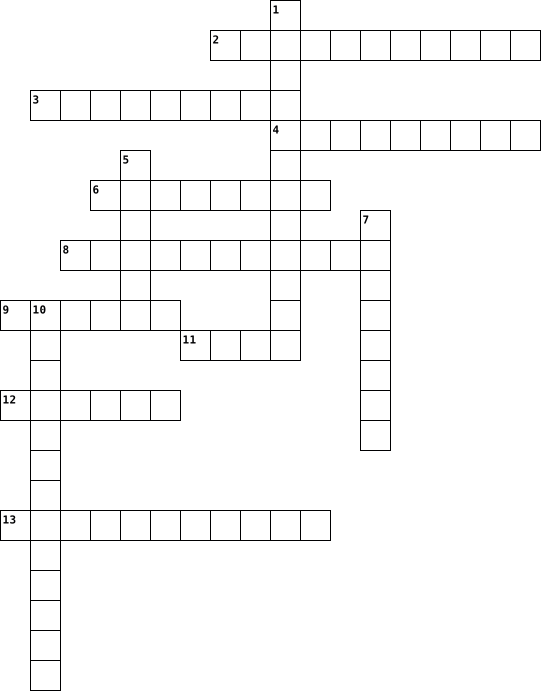
Match the adjectives with the appropriate nouns. 2022-06-21

Across
- teacher
- leader
- song
- baby
- tree
Down
- soldier
- animal
- fingers
- temple
- story
10 Clues: song • baby • tree • story • animal • leader • temple • soldier • fingers • teacher
Match the adjectives with the appropriate nouns. 2022-06-21

Across
- of t
- fingers
- soldier
- tree
- song
Down
- animal
- leader
- story
- someone who is kind and pleasant
- someone who is cute
10 Clues: of t • tree • song • story • animal • leader • fingers • soldier • someone who is cute • someone who is kind and pleasant
Match the adjectives with the appropriate nouns. 2022-06-21

Across
- of t
- fingers
- soldier
- tree
- song
Down
- animal
- leader
- story
- someone who is kind and pleasant
- someone who is cute
10 Clues: of t • tree • song • story • animal • leader • fingers • soldier • someone who is cute • someone who is kind and pleasant
Match the adjectives with the appropriate nouns. 2022-06-21

Across
- He is not ......of the dogs.
- The girl has .......hair.
- I have bought a .......dress.
- My new teacher is very ......I like her.
Down
- Gandhiji was a ........leader.
- The night is ........
- There are .......apples in the basket.
- There is .......milk in the fridge.
- It's..... here in summer.
- They have made the room........
10 Clues: The night is ........ • The girl has .......hair. • It's..... here in summer. • He is not ......of the dogs. • I have bought a .......dress. • Gandhiji was a ........leader. • They have made the room........ • There is .......milk in the fridge. • There are .......apples in the basket. • My new teacher is very ......I like her.
B2 QUIZ UNIT 8 CREATIVE QUALITIES (NOUNS) 2024-07-30

Across
- to carefully control the way that you work, live, or behave, especially to achieve a goal
- the ability to find quick and clever ways to overcome difficulties.
- the capacity to accept or tolerate delay, problems, or suffering without becoming annoyed or anxious.
- the introduction of something new. 2. : a new idea, method, or device
- the ability to make decisions quickly and effectively.
Down
- ability to think or express oneself in an independent and individual manner; creative ability. freshness or novelty, as of an idea, method, or performance.
- is the desire to act in service of a goal. It's the crucial element in setting and attaining our objectives.
- facts, information, and skills acquired through experience or education; the theoretical or practical understanding of a subject.
- a strong desire to know or learn something.
- Determination is the resolve and persistence to achieve goals despite obstacles.
10 Clues: a strong desire to know or learn something. • the ability to make decisions quickly and effectively. • the ability to find quick and clever ways to overcome difficulties. • the introduction of something new. 2. : a new idea, method, or device • Determination is the resolve and persistence to achieve goals despite obstacles. • ...
Rani y Sapi: Mi familia (Nouns Learned from Interactions) 2021-06-17

Across
- paper airplane
- bees
- fish
- waterlily flower
- plant
- snail
- letter
- log
Down
- water lily
- Hello
- firefly
- hat
- mailbox
- fly
- flower
- cane
16 Clues: hat • fly • log • bees • fish • cane • Hello • plant • snail • flower • letter • firefly • mailbox • water lily • paper airplane • waterlily flower
winter verbs and nouns PFAE 2022-07-27

Across
- ventisca, tormenta de nieve
- caer aguanieve
- helada, escarcha
Down
- helar, congelar
- granizar
- nevar
6 Clues: nevar • granizar • caer aguanieve • helar, congelar • helada, escarcha • ventisca, tormenta de nieve
Rani y Sapi: Mi escuela (Nouns Learned from Interactions), schoolhouse 2021-06-25

Across
- Poster
- Calendar
- Window
- Notebook
- Door
- Backpack
- Book
- Hat
- Shelf
- Ball
- Stool
- House
- Drawing
Down
- (yoga) mat
- Cylinder
- Hardhat
- Eraser
- Chimney
- Table
- Rug
- Cube
- HulaHoop
- Pillow
- Chalkboard
- Pencil
- Fence
- Clock
27 Clues: Rug • Hat • Cube • Door • Book • Ball • Table • Fence • Shelf • Clock • Stool • House • Poster • Eraser • Window • Pillow • Pencil • Hardhat • Chimney • Drawing • Cylinder • Calendar • HulaHoop • Notebook • Backpack • (yoga) mat • Chalkboard
Rani y Sapi: Clase de Arte (Nouns Learned from Interactions) 2021-06-21

Across
- hand
- sketchbook
- bat
- tail
- boots
- rug
- paperboat
- paint
Down
- hat
- apron
- paintbrush
- hexagon
- ear
- socks
- ladybug
- shell (turtle)
- sweater
- poncho
- wing
- ground
20 Clues: hat • ear • bat • rug • hand • tail • wing • apron • socks • boots • paint • poncho • ground • hexagon • ladybug • sweater • paperboat • sketchbook • paintbrush • shell (turtle)
Rani y Sapi: clase de arte (Nouns Learned from Text) 2021-06-21

Across
- background
- rectangle
- heart
- bats
- semicircle
- teacher
- sqaure
- art class
- lizard
- toad
Down
- pentagon
- shapes
- hexagon
- colors
- frog
- team
- oval
- triangle
- circle
- school
- star
- turtle
- friends
- rhombus
- ducks
25 Clues: frog • team • oval • bats • star • toad • heart • ducks • shapes • colors • circle • school • turtle • sqaure • lizard • hexagon • teacher • friends • rhombus • pentagon • triangle • rectangle • art class • background • semicircle
SG Int 2E. Compound nouns: sports venues and school facilities 2025-02-21

Across
- School _ are extracurricular classes for pupils who share a particular interest, e.g. in physics, chess or history.
- A large piece of ground with areas marked out for playing a team sport can also be called a playing _ .
- Professional runners run around a 400-metre athletics _ .
- If a band wants to release a CD with their music, they need to find a _ studio.
- A dance _ is a room (or set of rooms) where dancing lessons are given, or that dancers use to practice in.
- A _ school is not supported by government money. Education in this kind of school must be paid for by the children’s parents.
- A _ room contains exercise machines and equipment that helps you work out by lifting heavy objects.
- A safety _ is a type of fence or gate that prevents people from moving in a particular direction to protect them from danger.
- _facilities might include a swimming pool, an athletics track or a climbing wall.
- Playing board games, dancing or cycling are examples of leisure _ .
- _ activities are pleasant activities that you do to relax when you are not working or studying.
- You can listen to classical music in a concert _ .
- _ education is run by the government. It's free, so parents don't have to pay.
- Instead of going to the mountains, climbers can train on an artificial _ wall.
Down
- Football is played on a _ .
- You can do chemical experiments in a science _ .
- A _ school is a school for children between the ages of 11 and 16 (or 18).
- If you feel like bowling with your friends, you visit a bowling _ .
- Leisure _ might include a bowling alley, a barbecue area, a playground, a gym or a sauna.
- Boxers fight in a boxing _ .
- You play tennis and basketball on two very different types of a _ .
- The playing field is called 'court' in the sports of tennis and _ .
- If you want to swim, you go to a swimming _ .
- If you feel like ice skating, you have to find an ice _ .
- Golfers play their game on a golf _ .
- A _ room is a room where you eat meals in a house or hotel.
26 Clues: Football is played on a _ . • Boxers fight in a boxing _ . • Golfers play their game on a golf _ . • If you want to swim, you go to a swimming _ . • You can do chemical experiments in a science _ . • You can listen to classical music in a concert _ . • If you feel like ice skating, you have to find an ice _ . • Professional runners run around a 400-metre athletics _ . • ...
Vocabulary 1 Sustantivos (Nouns) II (use the article in Spanish) 2025-08-25

Across
- – country
- – tourist (female)
- – tourist
- – problem
- – youth; young person (female)
- – video
- – word
- – woman (female)
- – suitcase
- – number
- – nationality
- – hand
Down
- – pencil
- – passenger (female)
- – passenger
- – teacher (female)
- – teacher
- – youth; young person
- – program
- – map
- – lesson
21 Clues: – map • – word • – hand • – video • – pencil • – lesson • – number • – country • – tourist • – problem • – teacher • – program • – suitcase • – passenger • – nationality • – woman (female) • – tourist (female) • – teacher (female) • – passenger (female) • – youth; young person • – youth; young person (female)
convert verbs to nouns OR add the proper ING endings 2025-10-29

Across
- disappear
- guide
- forget
- excel
- prefer
- confide
- admit
- map
- differ
- play
- knit
- assist
- crunch
Down
- perform
- slip
- tolerate
- dominate
- scar
- jump
- perform
- refer
- persist
- endure
- fit
- plot
- listen
26 Clues: map • fit • slip • scar • jump • plot • play • knit • guide • excel • admit • refer • forget • prefer • endure • differ • listen • assist • crunch • perform • perform • confide • persist • tolerate • dominate • disappear
Tanya Family Trip Plural Nouns 2021-01-13

Across
- animal used for riding or racing on a track
- a pair of lenses set in a frame
- a large motor vehicle carrying passengers
Down
- used for carrying small articles in a pants
- shelter covering in front of the entrance of a building
- used for growing crops and rearing animals
6 Clues: a pair of lenses set in a frame • a large motor vehicle carrying passengers • used for growing crops and rearing animals • used for carrying small articles in a pants • animal used for riding or racing on a track • shelter covering in front of the entrance of a building
Nouns from Vocabulary List #3 2018-11-26

Across
- filia, filiae
- oculus, oculi
- ager, agri
Down
- nihil
- cura, curae
- magister, magistri
6 Clues: nihil • ager, agri • cura, curae • filia, filiae • oculus, oculi • magister, magistri
NOUNS WHICH HAVE BECOME VERBS 2015-11-07

Across
- TO SEND A MESSAGE VIA MOBILE PHONES
- TAKE AM ELECTRONIC FILE FROM THE INTERNET
- SEND AN ELECTRONIC MESSAGE VIA COMPUTER
Down
- COPY USING A COPY MACHINE
- SEARCH THE INTERNET
- SEND USING A FAX MACHINE
6 Clues: SEARCH THE INTERNET • SEND USING A FAX MACHINE • COPY USING A COPY MACHINE • TO SEND A MESSAGE VIA MOBILE PHONES • SEND AN ELECTRONIC MESSAGE VIA COMPUTER • TAKE AM ELECTRONIC FILE FROM THE INTERNET
MAKE NOUNS FROM THESE VEBRS 2023-08-22

Across
- DIVIDE
- INVENT
- DIRECT
Down
- EDUCATE
- EXPLOSION
- PERSUADE
6 Clues: DIVIDE • INVENT • DIRECT • EDUCATE • PERSUADE • EXPLOSION
MAKE NOUNS FROM THESE VERBS 2023-08-31

Across
- DEVIDE
- PERSUADE
- DIRECT
Down
- EXPLODE
- EDUCATE
- INVENT
6 Clues: INVENT • DEVIDE • DIRECT • EXPLODE • EDUCATE • PERSUADE
Animals: Translate the nouns from Danish to English 2024-11-21

Across
- gris
- due
- myre
- hjort
- hane
- abe
Down
- flodhest
- firben
- pindsvin
- bjørn
- ørred
- muldvarp
12 Clues: due • abe • gris • myre • hane • bjørn • ørred • hjort • firben • flodhest • pindsvin • muldvarp
Spotlight on Phonics 1 - Storybook 1-3 Nouns 2024-06-21

Across
- 이 동물은 개처럼 생겼어요. 큰 이빨과 뾰족한 코를 가지고 있습니다.
- 이 사람은 왕관을 쓰고 있습니다. 소녀입니다.
- 겉이 갈색이고 털로 뒤덮인 과일입니다. 안쪽은 초록색이에요.
- 이것은 일종의 자동차입니다. 지붕이 없습니다. 정사각형 모양입니다.
- 이것이 바로 당신과 함께 사는 동물이라고 부르는 것입니다.
- 발굽과 뿔이 있는 동물이다. 턱에 털이 있습니다. 그것은 황소가 아니다.
- 이 동물은 흑백입니다. 그것은 말처럼 보입니다.
Down
- 이것은 사람들이 선물로 주는 아름다운 꽃입니다.
- 이 물체는 담요와 비슷합니다.
- 냄새를 맡을 때 사용하는 것입니다.
- 숟가락으로 먹는 간식이에요. 부드럽고 크리미합니다.
- 이것은 씨앗의 또 다른 말입니다.
12 Clues: 이 물체는 담요와 비슷합니다. • 이것은 씨앗의 또 다른 말입니다. • 냄새를 맡을 때 사용하는 것입니다. • 이 사람은 왕관을 쓰고 있습니다. 소녀입니다. • 이것은 사람들이 선물로 주는 아름다운 꽃입니다. • 이 동물은 흑백입니다. 그것은 말처럼 보입니다. • 숟가락으로 먹는 간식이에요. 부드럽고 크리미합니다. • 이것이 바로 당신과 함께 사는 동물이라고 부르는 것입니다. • 겉이 갈색이고 털로 뒤덮인 과일입니다. 안쪽은 초록색이에요. • 이것은 일종의 자동차입니다. 지붕이 없습니다. 정사각형 모양입니다. • 이 동물은 개처럼 생겼어요. 큰 이빨과 뾰족한 코를 가지고 있습니다. • 발굽과 뿔이 있는 동물이다. 턱에 털이 있습니다. 그것은 황소가 아니다.
Cloak of the light nouns (ch.3-4) 2025-05-16

Across
- a very strong feeling of no respect for sb or sth
- an occasion when two or more similar things happen at the same tim
- a real or imagined line that marks the edge or limit of sth
- the quality of dressing or behaving
- the ability to protect against attack or harm
- a person's moral sense of right and wrong
- a feeling of nervousness or worry about sth in the future
Down
- a building or area of land, or both together
- the achieving of the results wanted
- a written or spoken message that reminds sb to do sth
- the act of trying to make sb else do sth by arguing, persuading, etc.
- the empty area outside Earth's atmosphere, where the planets and the stars are
12 Clues: the achieving of the results wanted • the quality of dressing or behaving • a person's moral sense of right and wrong • a building or area of land, or both together • the ability to protect against attack or harm • a very strong feeling of no respect for sb or sth • a written or spoken message that reminds sb to do sth • ...
Compound Nouns, Technology, (Unit 8, Compact First, 2nd Ed), (DPB) 2023-03-03

Across
- A copy of data that is kept in a secure place in case the original is lost or corrupted. (6)
- Glass used in phones that responds to being pushed. (11)
- A library of information which companies use to store information. (8)
- A tab or star to keep a record of a favourite site. (8)
- A machine that scans and replicates an image, and then prints it. (11)
- A type of label used for sth that is trending online. (7)
- A term for services such as YouTube, Facebook, InstaGram, TikToc etc; Social ….. (5)
- A computer which can be put in a bag. (6)
- A term for a mobile when it does not have a sim card in it. (7)
Down
- Sth you use to type words onto a computer. (8)
- These are put in the ears to let people listen to music privately. (9)
- An online connection that is very fast, and is measured in mega-bytes per second. (9)
- A security word used to access a computer or phone. (8)
- The main screen on a computer. (7)
- An online portal, such as Mango.com. (7)
- A modern phone. (10)
- A piece of music or tune a phone uses to alert you to a call. (8)
- A form of communication that uses sight and sound; video-….. (7)
- A phone that is portable; ….. phone. (6)
19 Clues: A modern phone. (10) • The main screen on a computer. (7) • An online portal, such as Mango.com. (7) • A phone that is portable; ….. phone. (6) • A computer which can be put in a bag. (6) • Sth you use to type words onto a computer. (8) • A security word used to access a computer or phone. (8) • A tab or star to keep a record of a favourite site. (8) • ...
unit 3 vocab (le/la/les included for nouns) 2024-01-08

Across
- because
- walking in French, noun form
- to run in French, verb form
- Messi/Mbappe
- dancing in French, noun form
- French verb 'to play'
- to dance in French, verb form
Down
- volleyball in French
- French game played in court with metal balls
- why
- hiking in French
- courir/jogging in French, noun form
- to walk in French, verb form
- game similar to american football
- French verb 'to do' or 'to make'
- dancing in french
16 Clues: why • because • Messi/Mbappe • hiking in French • dancing in french • volleyball in French • French verb 'to play' • to run in French, verb form • walking in French, noun form • to walk in French, verb form • dancing in French, noun form • to dance in French, verb form • French verb 'to do' or 'to make' • game similar to american football • courir/jogging in French, noun form • ...
Making nouns from verbs English File Int p.163 2019-06-13

Across
- A victory, win or goal met
- An answer, or a reaction to something
- The action of taking letters, parcels or goods to a place
- A document or image file typically sent with an email
- A thing done well with effort, skill, or courage.
- For example, a contract between two people
- A statement that makes something clear, or a reason for an action
- Money or something given to make up for a wrong done
- Money given for goods or services
Down
- Something that is lost
- A statement that something is unsatisfactory or unacceptable
- A protest, or to show how something works
- Something that has been bought from a shop or retailer
- Option or selection
- A discussion with two different points of view
15 Clues: Option or selection • Something that is lost • A victory, win or goal met • Money given for goods or services • An answer, or a reaction to something • A protest, or to show how something works • For example, a contract between two people • A discussion with two different points of view • A thing done well with effort, skill, or courage. • ...
Rani y Sapi: Mi familia (Nouns Learned from Text) 2021-06-17

Across
- baby
- sister
- pond
- family
- mom
- grandfather
- uncle
- frog
Down
- cousin (male)
- grandmother
- dad
- brother
- cousin (female)
- pet
- aunt
15 Clues: dad • pet • mom • baby • pond • aunt • frog • uncle • sister • family • brother • grandmother • grandfather • cousin (male) • cousin (female)
Revision, Countable and uncountable nouns (unit 2, 5th Grade) 2022-11-17

Across
- It's a bird that you can sea at the sea
- A ....... for pancakes is easy: you need: milk, flour and eggs!
- A pocket of .......
- .....of jam
- This cake looks horrible. You can ..... it with strawberries on top
- ...... of orange juice or milk
- Carrots, tomatoes, cucumbers
Down
- If something goes wrong, you can say: "It's a ...... !"
- You put it on bread to make a sandwich
- You eat it for breakfast with milk
- It's the last meal of the day
- ..... of soda
- A bar of chocolate or a bar of ........
- Type of fish
- Tom and Big Al love them
15 Clues: .....of jam • Type of fish • ..... of soda • A pocket of ....... • Tom and Big Al love them • Carrots, tomatoes, cucumbers • It's the last meal of the day • ...... of orange juice or milk • You eat it for breakfast with milk • You put it on bread to make a sandwich • It's a bird that you can sea at the sea • A bar of chocolate or a bar of ........ • ...
Adjectives crossword. What nouns do they go with? 2017-11-05

Across
- done without any plan or system
- not leading to a definite result
- lively
- done before or at the start
- forming the whole
Down
- not expected
- strongly affecting the situation
- stopping and stating again
- related to everyone
- temporary
- very important
- more than needed
12 Clues: lively • temporary • not expected • very important • more than needed • forming the whole • related to everyone • stopping and stating again • done before or at the start • done without any plan or system • strongly affecting the situation • not leading to a definite result
Adjectives crossword. What nouns do they go with? 2017-11-05

Across
- lively
- more than needed
- stopping and stating again
- strongly affecting the situation
- related to everyone
- done without any plan or system
Down
- not expected
- forming the whole
- temporary
- very important
- done before or at the start
- not leading to a definite result
12 Clues: lively • temporary • not expected • very important • more than needed • forming the whole • related to everyone • stopping and stating again • done before or at the start • done without any plan or system • not leading to a definite result • strongly affecting the situation
Life in a Shell (Plural form of nouns) 2014-04-20

Across
- knife
- flower
- beach
- butterfly
- shellfish
Down
- bench
- loaf
- creature
- family
- orange
- strawberry
- wife
12 Clues: loaf • wife • bench • knife • beach • family • flower • orange • creature • butterfly • shellfish • strawberry
Crossword Puzzle 1 - Text Nouns (La pluma elegante) 2025-08-27

Across
- pirate hat
- pants
- invitations
- bear
- feather
Down
- beard
- plans
- jacket
- eyepatch
- party
- clothes
- octopus
12 Clues: bear • beard • plans • pants • party • jacket • clothes • octopus • feather • eyepatch • pirate hat • invitations
parts of speech and more 2021-12-19
Across
- a word or phrase naming an attribute, added to or grammatically related to a noun to modify or describe it.
- a word or phrase naming an attribute, added to or grammatically related to a noun to modify or describe it.
- Pronouns A reflexive pronoun is a specific type of pronoun that is used for the object of a verb when it refers to the same noun as the subject of that verb. In English these are the pronouns that end with “self” or “selves”
- a,an,and,the
- adjectives A Superlative Adjective is a word that describes a noun by comparing it to two or more nouns to the highest or lowest degree. Superlative adjectives typically end in 'est' and are preceded by the word 'the'. Comparative and Superlative Adjectives are words we often see and use in our writing.
- a word or phrase that modifies or qualifies an adjective verb or other adverb or a word group expressing a relation of place time circumstance manner cause degree
- a word used to identify any of a class of people places or things verb a word used to describe action state or occurrence and forming the main part of the predicate of a sentence such as hear become happen pronoun a word that can function by itself as a noun phrase and that refers either to the participants in the discourse or to someone or something mentioned elsewhere in the discourse
- noun a noun denoting a class of objects or a concept as opposed to a particular individual.
- a word or phrase naming an attribute, added to or grammatically related to a noun to modify or describe it.
Down
- an abrupt remark, made especially as an aside or interruption.
- noun a noun denoting a class of objects or a concept as opposed to a particular individual.
- Pronouns each of the pronouns in English t comprising a set that shows contrasts of person, gender, number, and case.
- adjectives-Demonstrative adjectives are special adjectives or determiners used to identify or express the relative position of a noun in time or space. A demonstrative adjective comes before all other adjectives in the noun phrase. Some common demonstrative adjectives are this, that, these, and those.
13 Clues: a,an,and,the • an abrupt remark, made especially as an aside or interruption. • noun a noun denoting a class of objects or a concept as opposed to a particular individual. • noun a noun denoting a class of objects or a concept as opposed to a particular individual. • ...
Grammar and Figurative Language Terms 2023-03-23

Across
- Beginnings of words sound the same - often use the same letter
- giving human characteristics to nonhuman things.
- it provides information that further identifies or defines a noun
- the noun the pronoun will stand in for
- not a full sentence
- a group of words that contains a subject and a verb that have a relationship
- extreme exaggeration
- sounds the same as another word with a different meaning
- person, place, or thing
- represents intangible ideas—things you can't perceive with the five main senses. Such as time, beauty
- two or more independent clauses are connected improperly
- an abbreviation formed from the initial letters of other words and pronounced as a word
- starts with a preposition and ends with the object of the preposition
- sentence: asks a question
- the basic form of a verb
- a shortened version of a word or phrase
- modify a noun
- often a name
- modifies a verb for place (here)
- not literal expression that is not predictable from the arrangement of the words
- shows belonging
- used for combining words
- modifies a verb for manner (peacefully) - most common,
- connects two phrases
- writing that appeals to the five senses
- shows excitement
Down
- the use of symbols to represent ideas
- more than one noun
- shows if a noun is specific or general (a, an, the)
- main noun of the sentence
- makes a statement
- word meaning the opposite of another word
- uses an exclamation mark
- exceptions to the usual tense pattern
- modifies a verb for time (now)
- stand in for a noun
- describes an action (not passive)
- shows direction, time, place, location, spatial relationships, or introduces an object among nouns
- word two words used together to create new word
- small groups of words standing together a conceptual unit (not a full sentence)
- same or similar meaning
- a sentence with more than one subject or predicate
- gives a command
- used with the main verb and helps explain the verb’s tone, mood, or voice (am, is, are, was, were, being, been, will be. To Have: has, have, had, having, will have)
- a verbal form used as an adjective; think of “ing” or “ed” verb
- of a sentence
- sounds like…the word sounds like what it is associated with
- comparison of two unlike things
- a noun denoting a class of objects or a concept as opposed to a particular individual
- comparison of two unlike things using “like” or “as”
50 Clues: often a name • modify a noun • of a sentence • gives a command • shows belonging • shows excitement • makes a statement • more than one noun • not a full sentence • stand in for a noun • extreme exaggeration • connects two phrases • person, place, or thing • same or similar meaning • uses an exclamation mark • the basic form of a verb • used for combining words • main noun of the sentence • ...
AIRIN SYABELLA XII IBB 2023-10-29

Across
- The river outside the boundary is dangerous to cross. The prepositional phrases functions as
- Audrey found the story very amusing.
- The streets were filled with water … the rain.
- predicate that is not followed by an object or without an object in a sentence. including finite type?
- if + S+ Had + Verb 3, S+ Would Have + Verb 3 + Complement Is it a conditional Type?
- He is … handsome that many girls like him.
- woken up If we.. (wake up) earlier, we would have reached school.
- She took the shopping of the bags.
- If my brother.. (study) hard, he would have passed the exam well.
- She will stay at home … she does not have anything to do outside.
- Carol can make … beautiful dresses that she can sell them.
- I am planning to go to the party tonight but it is not raining. It’s raining very hard now. I wish...
- My dad said he would like to stop … for a healthy life forever.
- It was all … him that we got into trouble
- If + S + Verb 1, S + Verb 1 + Complement Is it conditional Type?
- We expected the money … he had promised it to us.
- adjectives that give us more information about the antecedent in a sentence, referred to as?
- Where, When, and Why can be used to combine sentences or clauses. referred to as?
- My mother would like …. at home during this pandemic until it’s over.
- adjective that defines the antecedent. referred to as?
Down
- The man has visited every country on earth.
- as a predicate in a sentence t hat can be followed by an object including finite types
- If + S+ Verb 2, Subject + Would + Verb 1 + My Complement is it a Conditional type
- Today I forgot … my homework to school. I left it on the bed.
- My father would buy me a new motorcycle.
- Don’t let it bother you.
- s+ modal (will, can, may, shall) + verb 1 Is it conditional sentence type?
- to connect two sentences, which explain nouns. referred to as?
- really don’t want to work every weekend.
- The weather will remain good the south.
- What is the function of the underlined phrase in the sentence below? Edy Yahya crept secretly behind the window.
- She has no control that dog!
- Constance might go to the library, … he might stay home
- Vina’s brother, … is extremely dilligent, named his new baby Tommy.
- have won They ….. (win) the match if the had trained harder.
- I will visit your hometown.
- If Risa … on time, I will be happy.
- He was somewhere Berlin and München.
- I’ll never meet the one …. you told me.
- Diana didn’t know … her parents come after going for the job.
40 Clues: Don’t let it bother you. • I will visit your hometown. • She has no control that dog! • She took the shopping of the bags. • If Risa … on time, I will be happy. • Audrey found the story very amusing. • He was somewhere Berlin and München. • The weather will remain good the south. • I’ll never meet the one …. you told me. • My father would buy me a new motorcycle. • ...
Grammar 2026-03-13

Across
- Ends in -self or -selves and refers back to the subject of the sentence (e.g., himself, themselves).
- The combination of a main verb and one or more helping verbs (e.g., might have been practicing).
- A grammatical error occurring when two independent clauses are joined by only a comma without a conjunction.
- Refers to a person or thing that is not specific (e.g., everyone, someone, neither, each, many).
- A general name for a person, place, thing, or idea (e.g., city, scientist).
- Refers to the one speaking (I), the one spoken to (you), or the one spoken about (he, she, it, they).
- Connects the subject to a word or word group that identifies or describes it (e.g., be, seem, remain, become, smell).
- Points out a specific person, place, or thing (this, that, these, those).
- A noun that shows ownership, usually marked by an apostrophe (e.g., dancer’s, boss’s, dogs’).
- Introduces a subordinate clause and joins it to an independent clause (e.g., because, although, if, provided that).
- Pairs of conjunctions used together to join words or groups of words (e.g., neither/nor, either/or, not only/but also).
Down
- A group of words with a subject and verb that can stand alone as a complete sentence.
- The specific noun (or group of words) to which a pronoun refers.
- Noun A noun that names a group of people or things (e.g., jury, faculty, flock).
- A single noun made up of two or more words (e.g., greenhouse, mother-in-law, Grand Canyon).
- A single word used to connect parts of a sentence that are of equal weight (FANBOYS: for, and, nor, but, or, yet, so).
- A noun naming something that can be touched, seen, heard, smelled, or tasted (e.g., desk, apple).
- A word used in place of one or more nouns or pronouns.
- Works with a main verb to create a verb phrase and express tense or mood (e.g., has, been, might, will).
- Expresses physical or mental activity (e.g., kick, believe, calculate).
- A specific name that is always capitalized (e.g., Atlanta, Dr. Smith).
- A noun naming a quality, state, or idea that cannot be perceived by the five senses (e.g., courage, tenacity, integrity).
- Introduces a subordinate clause and connects it to an antecedent (e.g., who, whom, whose, which, that).
- The primary noun in a compound phrase that determines the plural form (e.g., in mothers-in-law, "mothers" is the head noun).
- A word that modifies a verb, an adjective, or another adverb (Answers: How? When? Where? To what extent?).
- A word used to describe a noun or pronoun or to give it more specific meaning (Answers: What kind? Which one? How many?).
26 Clues: A word used in place of one or more nouns or pronouns. • The specific noun (or group of words) to which a pronoun refers. • A specific name that is always capitalized (e.g., Atlanta, Dr. Smith). • Expresses physical or mental activity (e.g., kick, believe, calculate). • Points out a specific person, place, or thing (this, that, these, those). • ...
TCAP Prep Crossword - 6th Grade CLUE ELA 2026-04-01

Across
- comparison using "like" or "as"
- this part of the plot is the problem of the story
- this is our acronym for writing a conclusion paragraph
- this is another term for "perspective" and it can refer to a narrator
- this is the first sentence or two of an introduction paragraph
- this part of the plot is the introduction
- giving human qualities to a non-human thing
- this is used in stories to help the reader understand characters better and to keep them interested
- this type of essay attempts to prove something or persuade the reader
- this is the part of speech that describes verbs, adjectives, and adverbs
- this type of essay merely explains or gives facts
- this means the time and place
- this is the overall message an author wants to leave the reader; it is a universal lesson
- this type of essay tells a story
- a word that represents a sound
- this is our acronym for writing an introduction paragraph
- this is the part of speech that describes nouns or pronouns
- this subgenre of nonfiction is a story about a person that was written by someone else
- this is the middle and the bulk of an intro paragraph
Down
- this is a part of speech that shows the relationship of a noun or pronoun to the rest of the sentence
- this genre is written in verses sometimes
- figurative language that uses exaggeration
- this part of the plot is the ending
- this is the reason an author writes a certain text
- this is the statement that tells what the entire essay will be about
- this is the genre word for a play
- this is what the 'S' stands for in our conclusion paragraph acronym and it ends the entire essay
- this type of fig. lang. is a saying that does not mean what it literally states
- this is the reason we cite evidence
- this subgenre of fiction is a story that could happen but didn't
- this is a group of words with a subject and verb; all sentences have at least one
- this subgenre of fiction uses magic and impossible things
- sound device that repeats beginning consonant sounds in two or more words of a line
- this is the term for words and phrases that are descriptive, using the five senses
- this subgenre of fiction uses real people or events from the past
- this part of the plot is the most exciting part or the turning point
- this is the author's attitude about the topic
37 Clues: this means the time and place • a word that represents a sound • comparison using "like" or "as" • this type of essay tells a story • this is the genre word for a play • this part of the plot is the ending • this is the reason we cite evidence • this genre is written in verses sometimes • this part of the plot is the introduction • figurative language that uses exaggeration • ...
Grammar Definitions - Parts of Speech and Functions of Nouns 2024-09-10

Across
- A noun that follows the direct object and remanes, explains, or defines it
- A word that is used to show the relationship between a noun and another word in the sentence
- A word used to modify a noun or pronoun
- A word that expresses excitement or emotion
- A word used to modify a verb, an adjective, or an adverb
- A word that is used to join other words, phrases, or clauses
- A noun that benefits from the action of a transitive verb
- A noun that follows a preposition and is in a relationship with another word in the sentence
Down
- A word that takes the place of a noun
- A person, place, thing, or idea
- A noun that follows a linking verb and renames the subject
- A word that expresses an action or state of being
- A noun that follows another noun and renames, explains, or defines it
- The noun about which the sentence is written
- A noun that receives the action of a transitive verb
15 Clues: A person, place, thing, or idea • A word that takes the place of a noun • A word used to modify a noun or pronoun • A word that expresses excitement or emotion • The noun about which the sentence is written • A word that expresses an action or state of being • A noun that receives the action of a transitive verb • ...
Week 3 - Making Nouns by Adding the -ship Suffix 2026-01-23

Across
- A person who works at a craft or skilled trade.
- A relationship based on a shared activity or goal.
- The period of service of an intern.
- The right to stay in a country and never have to go and live anywhere else.
- Someone who works for somebody else to learn that person's skill or trade.
- The legal right to possess a thing.
Down
- A country or government under dictatorial rule.
- The number of people in a particular group.
- the art, technique, skill, or practice of riding horses.
- The condition of being companions/friends.
- A connection with someone.
- The process or period of seeking the affection of someone.
- Having a difficult time.
- A contest to find out which team or person is the best at something.
- A person who takes responsibility for someone or something.
15 Clues: Having a difficult time. • A connection with someone. • The period of service of an intern. • The legal right to possess a thing. • The condition of being companions/friends. • The number of people in a particular group. • A country or government under dictatorial rule. • A person who works at a craft or skilled trade. • A relationship based on a shared activity or goal. • ...
Chapter 10 Crossword 2015-03-24

Across
- The stage in speech development, from about age 1 to 2, during which a child speaks mostly in single words.
- The inability to see a problem from a new perspective; an impediment to problem solving.
- Early speech stage in which a child speaks like a telegram—"go car"—using mostly nouns and verbs and omitting "auxiliary" words.
- The mental activities associated with thinking, knowing, remembering, and communicating.
- A methodical, logical rule or procedure that guarantees solving a particular problem. Contrasts with the usually speedier—but also more error-prone—use of heuristics.
- The way an issue is posed; how an issue is framed can significantly affect decisions and judgments.
- The tendency for one's preexisting beliefs to distort logical reasoning, sometimes by making invalid conclusions seem valid, or valid conclusions invalid.
- Whorf's hypothesis that language determines the way we think.
- The set of rules by which we derive meaning from morphemes, words, and sentences in a given language; also, the study of meaning.
- Beginning at 3 to 4 months, the stage of speech development in which the infant spontaneously utters various sounds at first unrelated to the household language.
Down
- In a spoken language, the smallest distinctive sound unit.
- Beginning about age 2, the stage in speech development during which a child speaks mostly two-word statements.
- A mental image or best example of a category. Matching new items to the prototype provides a quick and easy method for including items in a category (as when comparing feathered creatures to a prototypical bird, such as a robin).
- Our spoken, written, or signed words and the ways we combine them to communicate meaning.
- A mental grouping of similar objects, events, ideas, or people.
- A tendency to search for information that confirms one's preconceptions.
- The tendency to be more confident than correct—to overestimate the accuracy of one's beliefs and judgments.
- A sudden and often novel realization of the solution to a problem; it contrasts with strategy-based solutions.
- A simple thinking strategy that often allows us to make judgments and solve problems efficiently; usually speedier but also more error-prone than algorithms.
- A tendency to approach a problem in a particular way, especially a way that has been successful in the past but may or may not be helpful in solving a new problem.
- In a language, the smallest unit that carries meaning; may be a word or a part of a word (such as a prefix).
- The rules for combining words into grammatically sensible sentences in a given language.
- In a language, a system of rules that enables us to communicate with and understand others.
23 Clues: In a spoken language, the smallest distinctive sound unit. • Whorf's hypothesis that language determines the way we think. • A mental grouping of similar objects, events, ideas, or people. • A tendency to search for information that confirms one's preconceptions. • The inability to see a problem from a new perspective; an impediment to problem solving. • ...
David Bolen english 11 Unit 1 Vocab 2023-03-15

Across
- the quality of being logical and consistent:
- is when someone uses their own words to express another person’s message or information. Paraphrasing is a term used to describe a sentence or paragraph, and the paraphrased article must be understood correctly
- lacking in vitality, force, or conviction; uninspired or uninspiring
- necessary and absolutely needed
- the moving of something from its place or position
- the action or fact of persuading someone or of being persuaded to do or believe something
- put (thoughts, speech, or data) into written or printed form
- self-willed and obstinate
- not or no longer needed or useful; superfluous
- in addition, besides
- having great influence on someone or something
- relating to or denoting a case of nouns and pronouns used as the object of a transitive verb or a preposition
- make (a statement or situation) less confused and more clearly comprehensible
- a unit of grammatical organization next below the sentence in rank and in traditional grammar said to consist of a subject and predicate
- the process or a period of changing from one state or condition to another
- not having enough of a specified quality or ingredient
Down
- a person or thing that makes partial or minor changes to something
- the action of revising
- a refutation or contradiction
- the nature of something's ingredients or constituents; the way in which a whole or mixture is made up
- a particular order in which related events, movements, or things follow each other
- an alphabetical list of terms or words found in or relating to a specific subject, text, or dialect, with explanations; a brief dictionary
- a statement or theory that is put forward as a premise to be maintained or proved
- easily bent; flexible
- a comparison between two things, typically for the purpose of explanation or clarification
- reasoning conducted or assessed according to strict principles of validity
- in spite of that; nevertheless
- can be defined as speaking clearly, stating each word fully and distinctly .This is a function of how an individual speaks rather than how a word should be pronounced
- a part or element of a larger whole, especially a part of a machine or vehicle
- a short amusing or interesting story about a real incident or person
- intensify, increase, or further improve the quality, value, or extent of
- a general statement or concept obtained by inference from specific cases
- a mistaken belief, especially one based on unsound argument
- in particular; especially
- a temporary departure from the main subject in speech or writing
35 Clues: in addition, besides • easily bent; flexible • the action of revising • self-willed and obstinate • in particular; especially • a refutation or contradiction • in spite of that; nevertheless • necessary and absolutely needed • the quality of being logical and consistent: • not or no longer needed or useful; superfluous • having great influence on someone or something • ...
ENG 321 terms 2022-04-10

Across
- A word that can occur after a modal auxiliary
- Many adjectives occur in this form.
- "You ___ could get a job" is an example of the compound modal structure that expresses politeness in the South.
- A word that forms a constituent with a noun phrase that follows it
- Perfect aspect and passive voice both require this type of participle.
- The past tense form of "will"
- This word can occur as part of an existential structure or a main verb in progressive aspect.
- This word can be a demonstrative determiner or a demonstrative pronoun.
- It can be perfect or progressive.
- Perfect aspect requires this type of auxiliary.
- There is no __ tense in English.
- The constituent that follows the subject
- A prearticle
- A type of constituency test
- This type of verb requires an indirect object.
- An indefinite pronoun in the title of a song by U2
- This type of verb can have an adjective phrase after it.
- This modifies nouns, but it is not a determiner.
- This word can be both an auxiliary and a past participle at the same time.
- To check if a word is a noun, see if it can occur in this form.
- An imperative does not have this.
Down
- In English, present ___ can convey that an activity or event concluded so recently that its impact is still felt in the present moment.
- "There" and "did" can be used as this.
- The present tense form of "could".
- This is the only type of verb that does not require anything after it.
- The definite article
- It can be direct or indirect.
- It replaces a noun phrase.
- The main verb in "Spring has arrived" is ___ perfect.
- The first word in an existential structure
- Every phrase has one of these.
- "They ___ ate" is an example of a past as participle pattern, which occurs in many dialects.
- Multiple-word verbs (also called phrasal verbs) contain a verb ___.
- You may have been told it's a possessive pronoun, but it's actually not a pronoun at all.
- This is marked on the first element in a main verb.
- Words that modify adjectives, adverbs, verbs, or entire sentences have all been thrown into this lexical category.
- At the end of a reflexive pronoun
- At the end of a present participle
- The past tense and past participle forms are identical for this kind of verb.
- Passives and existentials are useful for placing this type of information later in a sentence.
- What you get when you move an auxiliary before the subject
- This is optional in a passive structure.
42 Clues: A prearticle • The definite article • It replaces a noun phrase. • A type of constituency test • The past tense form of "will" • It can be direct or indirect. • Every phrase has one of these. • There is no __ tense in English. • It can be perfect or progressive. • At the end of a reflexive pronoun • An imperative does not have this. • The present tense form of "could". • ...
The English Language (October 2024) 2024-09-18

Across
- Punctuation used to express a pause in one's thought within a sentence.
- Words used to convey description about a sentence's object (ex. Amy brought a large container of water).
- English author, whose work Le Morte d'Arthur (The Death of Arthur) is the first book printed in English and is the oldest surviving work that can be read by modern speakers of English untranslated.
- Characters used to construct words. In English, there are 26 of them.
- Words that have the same or nearly the same meaning as another word.
- Words that have the exact opposite meaning of another word.
- Mark of punctuation used at the end of sentences to convey inquiry or curiosity (?).
- Punctuation used at the end of sentence to express a thought's end.
- Term used to describe somebody who is an English speaker.
- Letters that (usually) express sound at the beginning and end of words. In English, there are twenty of them.
- Letters that express sound within a word. In English, they are A, E, I, O, U, (and sometimes Y).
- As a result of 400 years of Roman occupation in Britain, this dead language been a major influence over English, particularly relating to words involving law, science, and medicine.
- Words used to indirectly refer to a noun. He, She, It, and They are examples.
- Term used to describe somebody who is able to read and write.
- Words used to modify a noun or an adjective within a sentence (ex. Mark left school quietly).
- Words used to convey activity on the part of a sentence's subject (ex. Jack threw the football).
- Unique arrangement of letters, creating a single, distinct element of speech or writing. There were thirteen of them in the previous sentence.
Down
- Words used to connect words, phrases and clauses (ex. She is old enough to drive, but not old enough to vote).
- Name of English king associated with Bible he commissioned in 1604 and published in 1611. It is considered a great example of the English language.
- Shorted versions of a word (ex. cannot = can't).
- Words used to denote a person, place, or thing. Often such a word would be a sentence's focus.
- Units of sound within a word. All words have at least one, although many words can have multiple (Silent has two).
- Point of punctuation sometimes used at the end of sentences to convey excitement or intensity (!).
- A reference source containing words and their synonyms. Term rhymes with Tyrannosaurus.
- Adagio, Banjo, and Tsunami are examples of these kinds of words, taken from another language directly and used in place of creating an English equivalent.
- A reference source containing words along with information about their meaning, function, origin, and pronunciation.
26 Clues: Shorted versions of a word (ex. cannot = can't). • Term used to describe somebody who is an English speaker. • Words that have the exact opposite meaning of another word. • Term used to describe somebody who is able to read and write. • Punctuation used at the end of sentence to express a thought's end. • ...
AIRIN SYABELLA XII IBB 2023-10-29

Across
- The river outside the boundary is dangerous to cross. The prepositional phrases functions as
- Audrey found the story very amusing.
- The streets were filled with water … the rain.
- predicate that is not followed by an object or without an object in a sentence. including finite type?
- if + S+ Had + Verb 3, S+ Would Have + Verb 3 + Complement Is it a conditional Type?
- He is … handsome that many girls like him.
- woken up If we.. (wake up) earlier, we would have reached school.
- She took the shopping of the bags.
- If my brother.. (study) hard, he would have passed the exam well.
- She will stay at home … she does not have anything to do outside.
- Carol can make … beautiful dresses that she can sell them.
- I am planning to go to the party tonight but it is not raining. It’s raining very hard now. I wish...
- My dad said he would like to stop … for a healthy life forever.
- It was all … him that we got into trouble
- If + S + Verb 1, S + Verb 1 + Complement Is it conditional Type?
- We expected the money … he had promised it to us.
- adjectives that give us more information about the antecedent in a sentence, referred to as?
- Where, When, and Why can be used to combine sentences or clauses. referred to as?
- My mother would like …. at home during this pandemic until it’s over.
- adjective that defines the antecedent. referred to as?
Down
- The man has visited every country on earth.
- as a predicate in a sentence t hat can be followed by an object including finite types
- If + S+ Verb 2, Subject + Would + Verb 1 + My Complement is it a Conditional type
- Today I forgot … my homework to school. I left it on the bed.
- My father would buy me a new motorcycle.
- Don’t let it bother you.
- s+ modal (will, can, may, shall) + verb 1 Is it conditional sentence type?
- to connect two sentences, which explain nouns. referred to as?
- really don’t want to work every weekend.
- The weather will remain good the south.
- What is the function of the underlined phrase in the sentence below? Edy Yahya crept secretly behind the window.
- She has no control that dog!
- Constance might go to the library, … he might stay home
- Vina’s brother, … is extremely dilligent, named his new baby Tommy.
- have won They ….. (win) the match if the had trained harder.
- I will visit your hometown.
- If Risa … on time, I will be happy.
- He was somewhere Berlin and München.
- I’ll never meet the one …. you told me.
- Diana didn’t know … her parents come after going for the job.
40 Clues: Don’t let it bother you. • I will visit your hometown. • She has no control that dog! • She took the shopping of the bags. • If Risa … on time, I will be happy. • Audrey found the story very amusing. • He was somewhere Berlin and München. • The weather will remain good the south. • I’ll never meet the one …. you told me. • My father would buy me a new motorcycle. • ...
AIRIN SYABELLA XII IBB 2023-10-29

Across
- The river outside the boundary is dangerous to cross. The prepositional phrases functions as
- Audrey found the story very amusing.
- The streets were filled with water … the rain.
- predicate that is not followed by an object or without an object in a sentence. including finite type?
- if + S+ Had + Verb 3, S+ Would Have + Verb 3 + Complement Is it a conditional Type?
- He is … handsome that many girls like him.
- woken up If we.. (wake up) earlier, we would have reached school.
- She took the shopping of the bags.
- If my brother.. (study) hard, he would have passed the exam well.
- She will stay at home … she does not have anything to do outside.
- Carol can make … beautiful dresses that she can sell them.
- I am planning to go to the party tonight but it is not raining. It’s raining very hard now. I wish...
- My dad said he would like to stop … for a healthy life forever.
- It was all … him that we got into trouble
- If + S + Verb 1, S + Verb 1 + Complement Is it conditional Type?
- We expected the money … he had promised it to us.
- adjectives that give us more information about the antecedent in a sentence, referred to as?
- Where, When, and Why can be used to combine sentences or clauses. referred to as?
- My mother would like …. at home during this pandemic until it’s over.
- adjective that defines the antecedent. referred to as?
Down
- The man has visited every country on earth.
- as a predicate in a sentence t hat can be followed by an object including finite types
- If + S+ Verb 2, Subject + Would + Verb 1 + My Complement is it a Conditional type
- Today I forgot … my homework to school. I left it on the bed.
- My father would buy me a new motorcycle.
- Don’t let it bother you.
- s+ modal (will, can, may, shall) + verb 1 Is it conditional sentence type?
- to connect two sentences, which explain nouns. referred to as?
- really don’t want to work every weekend.
- The weather will remain good the south.
- What is the function of the underlined phrase in the sentence below? Edy Yahya crept secretly behind the window.
- She has no control that dog!
- Constance might go to the library, … he might stay home
- Vina’s brother, … is extremely dilligent, named his new baby Tommy.
- have won They ….. (win) the match if the had trained harder.
- I will visit your hometown.
- If Risa … on time, I will be happy.
- He was somewhere Berlin and München.
- I’ll never meet the one …. you told me.
- Diana didn’t know … her parents come after going for the job.
40 Clues: Don’t let it bother you. • I will visit your hometown. • She has no control that dog! • She took the shopping of the bags. • If Risa … on time, I will be happy. • Audrey found the story very amusing. • He was somewhere Berlin and München. • The weather will remain good the south. • I’ll never meet the one …. you told me. • My father would buy me a new motorcycle. • ...
20 Persuasive Language Techniques 2021-05-21

Across
- Is the ideas or feelings that a certain word invokes and is used to create certain emotional responses in an audience.
- (Ethos) Is the establishment of authority and reliability and is used to gain the confidence and trust of the audience.
- Is the inference that a claim is true for most people or a majority and is used to speak to prevailing belief or prejudices of an audience.
- Is the presentation of only one side of an issue or viewpoint and is used to subjectively influence an audience.
- Is the recurrence of certain words or phrases and it is used to emphasize certain ideas, and make them more memorable.
- Is special words or expressions used by profession or certain groups; it is used to signal expertise and establish credibility.
- Is the repetition of initial consonant sounds in order to emphasize certain words and make them more memorable.
- Descriptive words used to add emphasis and to create an emotional response.
- Are words that take the place of nouns and are used to create a sense of unity with the audience or distance from a common enemy.
- Words Are words charged with an underlying meaning or implication and are used to produce emotion in an audience.
Down
- Is the fact or information that indicate whether a view is true or valid and is used to give weight to an argument or belief.
- Are short personal stories used to connect with the audience and add evidence or credibility to an argument.
- of Three Is when groups of 3 adjectives or phrases are used to make ideas memorable.
- Language Is used to create imagery and express things non-literally; it can help to make an idea more emotive, vivid, and convincing.
- Is when an idea is presented as a fact without full explanation or evidence; it is used to assert authority and make claims sound factual.
- Questions Are statements which are voiced as questions but are not expected to be answered; they are used to imply certain answers and draw audiences to certain conclusions.
- Are when a speaker/writer addresses an opposing view or speaker and attacks their argument or character.
- Is the representation of something greater than is actually the case and is used to grab the attention of the audience and emphasize certain points.
- (Logos) Is the power of the mind to think and form judgements logically; it is used to appeal to the rationality of the audience.
- (Pathos) Is feelings accentuated by experiencing love, hate, fear, etc. An appeal to emotion is used to engage with an audience and create an emotional response.
20 Clues: Descriptive words used to add emphasis and to create an emotional response. • of Three Is when groups of 3 adjectives or phrases are used to make ideas memorable. • Are when a speaker/writer addresses an opposing view or speaker and attacks their argument or character. • ...
Rani y Sapi: Mi escuela (Nouns Learned from the Text) 2021-06-16

Across
- mice
- teacher
- differences
- snails
- classmates
- lizards
Down
- ducks
- swans
- friends
- beavers
- pond
- bats
- hide and seek
- recess
- swings
- trampolines
- school
- frogs
18 Clues: mice • pond • bats • ducks • swans • frogs • recess • swings • school • snails • friends • beavers • teacher • lizards • classmates • trampolines • differences • hide and seek
parts of speech and more 2021-12-19
Across
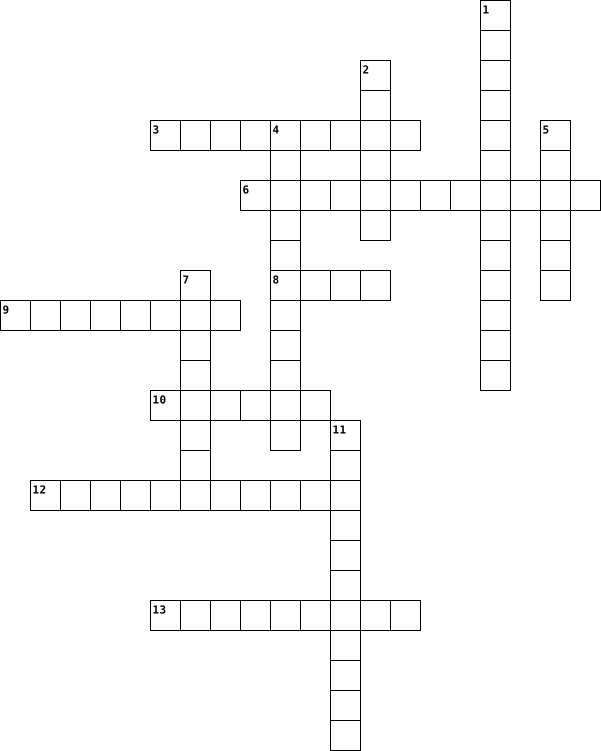
- a word or phrase naming an attribute, added to or grammatically related to a noun to modify or describe it.
- an abrupt remark, made especially as an aside or interruption.
- a word used to identify any of a class of people places or things verb a word used to describe action state or occurrence and forming the main part of the predicate of a sentence such as hear become happen pronoun a word that can function by itself as a noun phrase and that refers either to the participants in the discourse or to someone or something mentioned elsewhere in the discourse
- a,an,and,the
- noun a noun denoting a class of objects or a concept as opposed to a particular individual.
- adjectives A Superlative Adjective is a word that describes a noun by comparing it to two or more nouns to the highest or lowest degree. Superlative adjectives typically end in 'est' and are preceded by the word 'the'. Comparative and Superlative Adjectives are words we often see and use in our writing.
- Pronouns A reflexive pronoun is a specific type of pronoun that is used for the object of a verb when it refers to the same noun as the subject of that verb. In English these are the pronouns that end with “self” or “selves”
Down
- adjectives-Demonstrative adjectives are special adjectives or determiners used to identify or express the relative position of a noun in time or space. A demonstrative adjective comes before all other adjectives in the noun phrase. Some common demonstrative adjectives are this, that, these, and those.
- a word or phrase that modifies or qualifies an adjective verb or other adverb or a word group expressing a relation of place time circumstance manner cause degree
- a word or phrase naming an attribute, added to or grammatically related to a noun to modify or describe it.
- noun a noun denoting a class of objects or a concept as opposed to a particular individual.
- Pronouns each of the pronouns in English t comprising a set that shows contrasts of person, gender, number, and case.
- a word or phrase naming an attribute, added to or grammatically related to a noun to modify or describe it.
13 Clues: a,an,and,the • an abrupt remark, made especially as an aside or interruption. • noun a noun denoting a class of objects or a concept as opposed to a particular individual. • noun a noun denoting a class of objects or a concept as opposed to a particular individual. • ...
Word bak 2020-04-16

Across
- a comparison between one thing and another, typically for the purpose of explanation or clarification.
- exaggerated statements or claims not meant to be taken literally.
- the action of repeating something that has already been said or written.
- The intention of an article is what outcome does the writer want this piece to have on the reader.
- a short amusing or interesting story about a real incident or person.
- Adjectives with three or more syllables form the superlative by putting the word "most" or "least" in front of the adjective.
- Definition of expert opinion. : a belief or judgment about something given by an expert on the subject.
- The contention is the overall argument or opinion that they are expressing in an article or debate.
- In mathematics, computer science, and linguistics, a formal language consists of words whose letters are taken from an alphabet and are well-formed according to a specific set of rules. The alphabet of a formal language consist of symbols, letters, or tokens that concatenate into strings of the language.
Down
- Colloquialism or colloquial language is the linguistic style used for casual communication. It is the most common functional style of speech, the idiom normally employed in conversation and other informal contexts.
- A rhetorical question is a question someone asks without expecting an answer. The question might not have an answer, or it might have an obvious answer.
- a joke exploiting the different possible meanings of a word or the fact that there are words which sound alike but have different meanings.
- A target audience is the intended audience or readership of a publication, advertisement, or other message.
- Comparative adjectives are used to compare differences between the two objects they modify (larger, smaller, faster, higher). They are used in sentences where two nouns are compared, in this pattern
- Inclusive language is language that is free from words, phrases or tones that reflect prejudiced, stereotyped or discriminatory views of particular people or groups. It is also language that doesn't deliberately or inadvertently exclude people from being seen as part of a group.
- Statistical proof is the rational demonstration of degree of certainty for a proposition, hypothesis or theory that is used to convince others subsequent to a statistical test of the supporting evidence and the types of inferences that can be drawn from the test scores.
- special words or expressions used by a profession or group that are difficult for others to understand.
17 Clues: exaggerated statements or claims not meant to be taken literally. • a short amusing or interesting story about a real incident or person. • the action of repeating something that has already been said or written. • The intention of an article is what outcome does the writer want this piece to have on the reader. • ...
WORLD LEADERS AND LEADERSHIP - nouns+adjectives crossword 2022-01-24

Across
- politician
- pressure
- lure
Down
- ambitious
- morals
- capable, competent
- faithfulness, patriotism
- effect
- increases, profits
9 Clues: lure • morals • effect • pressure • ambitious • politician • capable, competent • increases, profits • faithfulness, patriotism
The 8 Parts of Speech 2016-10-05

Across
- the superlative form of “bad”
- past participle form of "laugh"
- adverb of time (ex: The movie is coming _____.)
- its forms are do, does, did
- an example of an adverb of frequency which means at all times
- words that take the place of nouns
- complete the sentence: We were planning to go on a picnic _____ it rained so it was canceled. (conjunction)
- plural form of "life"
- a kind of verb that does not need an object to complete its meaning (ex: She cried.)
- an example of an adjective which means containing nothing
- complete the sentence: Karen is arriving _____ Friday. (preposition)
- examples are oh!, ouch!, wow!
- "a", "an", "the": what do you call them?
- examples are at, on, in
- “I shall return.” this sentence is in what verb tense?
- its forms are is, are, am
- describes a noun or pronoun
- "The dog ran away from me." this sentence is in what verb tense?
- is a word or group of words that shows action
- an example of an interrogative pronoun that asks about a certain person
- the comparative form of "good"
- an example of an adverb of place which means "in that place" or "at that location"
- a demonstrative pronoun where the person speaking is pointing at an object far away from him (singular form)
Down
- plural form of "fish"
- examples are and, but, or
- past tense of "teach"
- a kind of pronoun where the pronoun is the subject and the object (ex: I will do this myself.)
- singular form of "mice"
- complete the sentence: My sister always cleans the house _____ washes the dishes. (conjunction)
- the past tense for bring
- is a naming word
- complete the sentence: _____ he or she will be the winner. (conjunction)
- an example of an interrogative pronoun that asks about a certain time
- a kind of pronoun that asks a question
- complete the sentence: She bought the books _____ Cebu. (preposition)
- an example of a compound noun which is a popular sports in the Philippines
- the past tense of "light"
- a kind of mood where the person speaking is making a command or request
- the second person pronoun and refers to the person being spoken to
- complete the sentence: I will stay here _____ one year. (preposition)
- the common noun for "Korea"
- describes a verb, an adjective or another adverb
- the past tense of "avoid"
- an example of an interrogative pronoun that asks about a certain place or location
- first person pronoun and is the plural form of "I"
- is an example of a collective noun which means a group of people who works together
46 Clues: is a naming word • plural form of "fish" • past tense of "teach" • plural form of "life" • singular form of "mice" • examples are at, on, in • the past tense for bring • examples are and, but, or • the past tense of "light" • its forms are is, are, am • the past tense of "avoid" • its forms are do, does, did • the common noun for "Korea" • describes a noun or pronoun • ...
What is GRAMMAR? 2014-01-29

Across
- A word phrase or clause that qualifies the sense of another word or word group.
- A part of speech comprising a class of words that modifies a verb.
- A sudden forceful utterance.
- Denoting a verb tense or form that expresses current time.
- A group of words having a subject and a predicate and forming part of a compound or complex sentence.
- A play on words, or different senses of the same word.
- A part of speech made up of exclamatory words or expressions capable of standing alone.
- An expression of inquiry that requires or invites an informative reply.
- A verbal form that functions as a noun.
- A verb form functioning as a substantive while retaining certain verbal characteristics as modification by adverbs, and that in English may be preceded by to.
- One of the inflected forms in the conjugation of a verb that indicates the time as well as the continuance or completion of the action or state.
- A word that functions as a substitute for nouns or noun phrases.
- A word or group of words read or spoken as a unit and separated by pauses or other junctures.
- The part of speech that expresses action or existence.
- A grammatical form that designates more than one of the things specified.
Down
- Any of a class or words used to modify a noun by limiting, qualifying, or specifying.
- A noun or substantive that receives or is affected by the action of a verb within a sentence.
- The parts of speech that connect other words, phrases, clauses, or sentences.
- The part of a sentence or clause that states something about the subject.
- A sentence containing one independent clause and one or more dependent clauses.
- A word that shows the relation between a substantive and a verb, an adjective, or another substantive.
- participle The verb part that is used with the helping verbs has, have, and had.
- A grammatical form that designates only one of the thing specified.
- The opposite of something positive.
- A word that is used to name a person, place, thing, quality, or action and can function as the subject or object.
- A word or phrase in a sentence that denotes the doer of the action.
- To put or fix before.
- An authoritative order or direction.
- An affix appended to the end of a word or stem, serving to form a new word or functioning as an inflectional ending.
- A grammatical unit consisting of a word or a group of words that is separate from any other grammatical construction and contains at least one subject with its predicate and a finite verb or verb phrase.
30 Clues: To put or fix before. • A sudden forceful utterance. • The opposite of something positive. • An authoritative order or direction. • A verbal form that functions as a noun. • A play on words, or different senses of the same word. • The part of speech that expresses action or existence. • Denoting a verb tense or form that expresses current time. • ...
AIRIN SYABELLA XII IBB 2023-10-29

Across
- The river outside the boundary is dangerous to cross. The prepositional phrases functions as
- Audrey found the story very amusing.
- The streets were filled with water … the rain.
- predicate that is not followed by an object or without an object in a sentence. including finite type?
- if + S+ Had + Verb 3, S+ Would Have + Verb 3 + Complement Is it a conditional Type?
- He is … handsome that many girls like him.
- woken up If we.. (wake up) earlier, we would have reached school.
- She took the shopping of the bags.
- If my brother.. (study) hard, he would have passed the exam well.
- She will stay at home … she does not have anything to do outside.
- Carol can make … beautiful dresses that she can sell them.
- I am planning to go to the party tonight but it is not raining. It’s raining very hard now. I wish...
- My dad said he would like to stop … for a healthy life forever.
- It was all … him that we got into trouble
- If + S + Verb 1, S + Verb 1 + Complement Is it conditional Type?
- We expected the money … he had promised it to us.
- adjectives that give us more information about the antecedent in a sentence, referred to as?
- Where, When, and Why can be used to combine sentences or clauses. referred to as?
- My mother would like …. at home during this pandemic until it’s over.
- adjective that defines the antecedent. referred to as?
Down
- The man has visited every country on earth.
- as a predicate in a sentence t hat can be followed by an object including finite types
- If + S+ Verb 2, Subject + Would + Verb 1 + My Complement is it a Conditional type
- Today I forgot … my homework to school. I left it on the bed.
- My father would buy me a new motorcycle.
- Don’t let it bother you.
- s+ modal (will, can, may, shall) + verb 1 Is it conditional sentence type?
- to connect two sentences, which explain nouns. referred to as?
- really don’t want to work every weekend.
- The weather will remain good the south.
- What is the function of the underlined phrase in the sentence below? Edy Yahya crept secretly behind the window.
- She has no control that dog!
- Constance might go to the library, … he might stay home
- Vina’s brother, … is extremely dilligent, named his new baby Tommy.
- have won They ….. (win) the match if the had trained harder.
- I will visit your hometown.
- If Risa … on time, I will be happy.
- He was somewhere Berlin and München.
- I’ll never meet the one …. you told me.
- Diana didn’t know … her parents come after going for the job.
40 Clues: Don’t let it bother you. • I will visit your hometown. • She has no control that dog! • She took the shopping of the bags. • If Risa … on time, I will be happy. • Audrey found the story very amusing. • He was somewhere Berlin and München. • The weather will remain good the south. • I’ll never meet the one …. you told me. • My father would buy me a new motorcycle. • ...
AIRIN SYABELLA XII IBB 2023-10-29

Across
- The river outside the boundary is dangerous to cross. The prepositional phrases functions as
- Audrey found the story very amusing.
- The streets were filled with water … the rain.
- predicate that is not followed by an object or without an object in a sentence. including finite type?
- if + S+ Had + Verb 3, S+ Would Have + Verb 3 + Complement Is it a conditional Type?
- He is … handsome that many girls like him.
- woken up If we.. (wake up) earlier, we would have reached school.
- She took the shopping of the bags.
- If my brother.. (study) hard, he would have passed the exam well.
- She will stay at home … she does not have anything to do outside.
- Carol can make … beautiful dresses that she can sell them.
- I am planning to go to the party tonight but it is not raining. It’s raining very hard now. I wish...
- My dad said he would like to stop … for a healthy life forever.
- It was all … him that we got into trouble
- If + S + Verb 1, S + Verb 1 + Complement Is it conditional Type?
- We expected the money … he had promised it to us.
- adjectives that give us more information about the antecedent in a sentence, referred to as?
- Where, When, and Why can be used to combine sentences or clauses. referred to as?
- My mother would like …. at home during this pandemic until it’s over.
- adjective that defines the antecedent. referred to as?
Down
- The man has visited every country on earth.
- as a predicate in a sentence t hat can be followed by an object including finite types
- If + S+ Verb 2, Subject + Would + Verb 1 + My Complement is it a Conditional type
- Today I forgot … my homework to school. I left it on the bed.
- My father would buy me a new motorcycle.
- Don’t let it bother you.
- s+ modal (will, can, may, shall) + verb 1 Is it conditional sentence type?
- to connect two sentences, which explain nouns. referred to as?
- really don’t want to work every weekend.
- The weather will remain good the south.
- What is the function of the underlined phrase in the sentence below? Edy Yahya crept secretly behind the window.
- She has no control that dog!
- Constance might go to the library, … he might stay home
- Vina’s brother, … is extremely dilligent, named his new baby Tommy.
- have won They ….. (win) the match if the had trained harder.
- I will visit your hometown.
- If Risa … on time, I will be happy.
- He was somewhere Berlin and München.
- I’ll never meet the one …. you told me.
- Diana didn’t know … her parents come after going for the job.
40 Clues: Don’t let it bother you. • I will visit your hometown. • She has no control that dog! • She took the shopping of the bags. • If Risa … on time, I will be happy. • Audrey found the story very amusing. • He was somewhere Berlin and München. • The weather will remain good the south. • I’ll never meet the one …. you told me. • My father would buy me a new motorcycle. • ...
Teachers Are All April Fools 2025-03-31

Across
- - Hottest room in the school. His wife is the real breadwinner
- - Fruit Snacks
- - Constantly sends silly videos of students to everyone. Like every week
- - “I’ve lost my head”. Only teaches Spanish so she can make students bring Mexican food to class
- - “Can we sleep in class?”
- - *sniffs* Something’s burning
- - Student in their class: “I will never use calculus in my life”
- - *Crickets*
- - Legs are weak, but the opposite. Probably kicks balls.
- - Tickles the ivories
- - Did you touch my drumset bro?
- - Offspring. Doesn’t like nouns or people, just actions
- - Fearless leader
- - Skips school like a student
- - Many students say they are a “chill teacher”
- - Students fear being called to his office. Probably means he’s good at his job
- - “This one can’t part the red sea”
- - Has an entire town named after her. Secretly pushes students when they aren’t looking
- - Probably regrets sponsoring the Junior Class, Prom’s a lot of work
- - His team plays basketball like a bunch of girls
- - “Fellas”
- - Keep batting, that breeze feels AWESOME.
- - Eats the crayons instead of coloring with them
- - Ernie
- - Plays with little toys and rolls dice
- - Traitor
- - student or teacher? Can’t tell, she's too short
- - “Hey yoooou guys”
- - Mrs. Clock (substitute teacher)
- - Plays with toy robots all day
- - “Do you want the good news or bad news?”
Down
- - Quagmire sound-alike. Probably shoots at kids with nail guns
- - Always eating cereal for dinner
- - Student quote: “D-”
- - “I’ll get retired soon”
- - Mrs. Bob
- - Breaks clipboards to threaten students. Mayor
- - “Three nice things”. Probably loves labyrinths
- - “Better Version” or “What the Freak” (substitute teacher)
- - Probably Merida but with an attitude
- - Darbz
- - Constantly yelling at students, telling them to “stop making meth in the lab”
- - Gone for “business trips”
- - Constantly has his students taking photos but really looking for blackmail
- - “Do you have a pass?”
- - “Goonson”. Probably should stop cutting things open to “see how they work”
- - Lets his “dogs” out - likes wearing Kanes
- - Student in their class: “I’m truly so bored”
- - Goes to bed at 8:30. “What a late night”
- - Donatella Versace
- - penny, dime, ____
- - Juuuuuuice
- - Why was the stegosaurus a great volleyball player? Fantastic spikes.
- Harrington - Husband of iconic news anchor & Mrs. Nebraska
- - Always talking in weird voices. Breaks your computer so you have to come talk to him
- - Probably just reads her phone while her 5 students play poker
- - Coldest room in the building. Teaches and probably remembers D-Day.
- - Student quote: “Great teacher lol”
- - CDE or LDE?
- - Never stops smiling. Maybe too much cocaine? Idk.
60 Clues: - Darbz • - Ernie • - Traitor • - Mrs. Bob • - “Fellas” • - *Crickets* • - Juuuuuuice • - CDE or LDE? • - Fruit Snacks • - Fearless leader • - Donatella Versace • - penny, dime, ____ • - “Hey yoooou guys” • - Student quote: “D-” • - Tickles the ivories • - “Do you have a pass?” • - “I’ll get retired soon” • - “Can we sleep in class?” • - Gone for “business trips” • - Skips school like a student • ...
Academic Language #4 2025-02-18

Across
- narrator is not a character in the story, but an outside observer, focuses on thoughts and feelings of one character
- when you read an unfamiliar word or phrase and you use the phrases before and after to figure out the meaning
- when the writer pauses in the story to remember something that has already happened; a memory
- words that names people, places, things, or ideas
- an association, idea, or emotion suggested by a word or phrase
- asks a question, ends with a question mark
- narrator is not a character in the story, but an all-knowing observer who describes all characters’ thoughts and feelings
- repetition of beginning consonant sounds
- comparing two things using like or as
- words that describe or modify nouns (size, color, number, etc.)
- a sentence where the subject is inferred, has a request or a command, ends in a period, but could end in an exclamation point!
- “same sound”- words that sound the same, but are spelled differently and have different meanings (to, too, two)
- a sound effect written out
- an expression that we don’t take for the words’ literal meaning
- an exaggeration
- references of a person, place, thing, or idea in literature or history
- comparing two things not using like or as
- “same write” -words that are spelled the same, but have different meanings and may be pronounced differently (bow/bow, wound/wound)
Down
- writing that has elements that are made up or come from someone’s imagination
- a sentence that has a subject, a verb, and a period; states a fact
- a word’s literal meaning
- modifies a verb, an adjective, or another adverb, often ends in “ly”- typically answers, how? When? To what degree?
- words that join other words or groups of words
- words that express an action or state of being
- Physical appearance, speech & actions, personality type
- language a writer uses to create a picture in your mind w/ the five senses- sight, smell, touch, taste, sound
- hints or clues about events that will happen later as the plot develops
- a nonhuman thing acts human
- words that show a relationship between a noun or a pronoun and the rest of the sentence
- expresses great emotion or excitement, ends with an exclamation mark
- “same name” same spelling, same pronunciation, different meaning.
- narrator is a character in the story telling the story, using words I, me, we, us
- a word that is used instead of a noun or noun phrase
- when the writer or character pauses in the story to tell the reader what happens in the future
34 Clues: an exaggeration • a word’s literal meaning • a sound effect written out • a nonhuman thing acts human • comparing two things using like or as • repetition of beginning consonant sounds • comparing two things not using like or as • asks a question, ends with a question mark • words that join other words or groups of words • words that express an action or state of being • ...
Vocabulary 1 Sustantivos (Nouns) (I use the article in Spanish) 2025-08-25

Across
- – conversation
- – community
- – driver
- – computer
- – school
- – (female)student
- – boy
Down
- – girl
- – student
- – day
- – thing
- – notebook
- –(female) driver
- – diary
- – bus
- – dictionary
- – photograph
- – man
18 Clues: – day • – bus • – man • – boy • – girl • – thing • – diary • – driver • – school • – student • – computer • – notebook • – community • – dictionary • – photograph • – conversation • –(female) driver • – (female)student
Scrabble Night 1 2019-11-23

Across
- a wide way leading from one place to another, especially one with a specially prepared surface which vehicles can use
- an event regarded as a portent of good or evil
- (used after a measurement of time) before the present; earlier
- an area of ground on which a town, building, or monument is constructed
- expressing location or arrival in a particular place or position
- used by a speaker to refer to himself or herself and one or more other people considered together
- a regularly updated website or web page, typically one run by an individual or small group, that is written in an informal or conversational style
- Scottish form of not, used after an auxiliary verb
- soft, thick material used to line garments or pack fragile items, especially absorbent cotton
- (of goods) sold direct from
- as a result or consequence of this
- an African wild horse with black-and-white stripes and an erect mane
- state that one refuses to admit the truth or existence of
- move along a smooth surface while maintaining continuous contact with it
- a long and distinct period of history with a particular feature or characteristic
- used to refer to a thing previously mentioned or easily identified
- a short, sharp cry or yelp, especially of excitement or delight
Down
- a long-handled gardening tool with a thin metal blade, used mainly for weeding and breaking up soil
- a revolution of an engine per minute
- perform (an action, the precise nature of which is often unspecified)
- refraining from speech or temporarily speechless
- annoy or irritate (a person) with persistent fault-finding or continuous urging
- physically in contact with and supported by (a surface)
- cut (something, especially wood or a tree) using a saw
- fall behind in movement, progress, or development; not keep pace with another or others
- a piece of cloth or similar material, typically oblong or square, attachable by one edge to a pole or rope
- the jaws or throat of a voracious animal
- someone or something that lifts or assists in lifting
- forming plurals of nouns ending in sibilant sounds
- toward a higher place or position
- To divide (data) into a different set of bins, or interval groupings
- change direction suddenly
- the form of the indefinite article used before words beginning with a vowel sound
- up until the present or a specified or implied time
- past and past participle of sit
- unpleasantly sticky
- a long poem, typically one derived from ancient oral tradition, narrating the deeds and adventures of heroic or legendary figures or the history of a nation
37 Clues: unpleasantly sticky • change direction suddenly • (of goods) sold direct from • past and past participle of sit • toward a higher place or position • as a result or consequence of this • a revolution of an engine per minute • the jaws or throat of a voracious animal • an event regarded as a portent of good or evil • refraining from speech or temporarily speechless • ...
Period 6, Words 21-44 2022-04-24

Across
- noun: the use of words to express something other than and especially the opposite of the literal meaning.
- noun: the repeating of a word or phrase. It is a common rhetorical device used to add emphasis and stress in writing and speech.
- noun: a literary work holding up human vices and follies to ridicule or scorn.
- noun: a category of artistic, musical, or literary composition characterized by a particular style, form, or content.
- noun: understatement in which an affirmative is expressed by the negative of the contrary (as in "not a bad singer" or "not unhappy").
- noun: a figure of speech by which a part is put for the whole (such as fifty sail for fifty ships), the whole for a part (such as society for high society), the species for the genus (such as cutthroat for assassin), the genus for the species (such as a creature for a man), or the name of the material for the thing made (such as boards for stage).
- noun: a deductive scheme of a formal argument consisting of a major and a minor premise and a conclusion (as in "every virtue is laudable; kindness is a virtue; therefore kindness is laudable").
- what the character or narrator telling the story can see (his or her perspective).
- noun: a combination of contradictory or incongruous words.
- noun: a literary or musical work in which the style of an author or work is closely imitated for comic effect or in ridicule.
- noun: In rhetoric and literary studies, the distinctive style or manner of expression of an author or narrator.
- noun: a sharp and often satirical or ironic utterance designed to cut or give pain.
Down
- style or manner of expression in speaking or writing.
- noun: extravagant exaggeration.
- noun: a conscious state of mind or predominant emotion : noun. feeling.
- noun: figurative language.
- noun: a figure of speech comparing two unlike things that is often introduced by like or as.
- noun: a figure of speech in which a word or phrase literally denoting one kind of object or idea is used in place of another to suggest a likeness or analogy between them.
- noun: any of a small set of words (such as I, she, he, you, it, we, or they) in a language that are used as substitutes for nouns or noun phrases and whose referents are named or understood in the context.
- noun: one (such as a person, situation, or action) having seemingly contradictory qualities or phases.
- noun: the naming of a thing or action by a vocal imitation of the sound associated with it.
21 Clues: noun: figurative language. • noun: extravagant exaggeration. • style or manner of expression in speaking or writing. • noun: a combination of contradictory or incongruous words. • noun: a conscious state of mind or predominant emotion : noun. feeling. • noun: a literary work holding up human vices and follies to ridicule or scorn. • ...
AIRIN SYABELLA XII IBB 2023-10-29

Across
- The river outside the boundary is dangerous to cross. The prepositional phrases functions as
- Audrey found the story very amusing.
- The streets were filled with water … the rain.
- predicate that is not followed by an object or without an object in a sentence. including finite type?
- if + S+ Had + Verb 3, S+ Would Have + Verb 3 + Complement Is it a conditional Type?
- He is … handsome that many girls like him.
- woken up If we.. (wake up) earlier, we would have reached school.
- She took the shopping of the bags.
- If my brother.. (study) hard, he would have passed the exam well.
- She will stay at home … she does not have anything to do outside.
- Carol can make … beautiful dresses that she can sell them.
- I am planning to go to the party tonight but it is not raining. It’s raining very hard now. I wish...
- My dad said he would like to stop … for a healthy life forever.
- It was all … him that we got into trouble
- If + S + Verb 1, S + Verb 1 + Complement Is it conditional Type?
- We expected the money … he had promised it to us.
- adjectives that give us more information about the antecedent in a sentence, referred to as?
- Where, When, and Why can be used to combine sentences or clauses. referred to as?
- My mother would like …. at home during this pandemic until it’s over.
- adjective that defines the antecedent. referred to as?
Down
- The man has visited every country on earth.
- as a predicate in a sentence t hat can be followed by an object including finite types
- If + S+ Verb 2, Subject + Would + Verb 1 + My Complement is it a Conditional type
- Today I forgot … my homework to school. I left it on the bed.
- My father would buy me a new motorcycle.
- Don’t let it bother you.
- s+ modal (will, can, may, shall) + verb 1 Is it conditional sentence type?
- to connect two sentences, which explain nouns. referred to as?
- really don’t want to work every weekend.
- The weather will remain good the south.
- What is the function of the underlined phrase in the sentence below? Edy Yahya crept secretly behind the window.
- She has no control that dog!
- Constance might go to the library, … he might stay home
- Vina’s brother, … is extremely dilligent, named his new baby Tommy.
- have won They ….. (win) the match if the had trained harder.
- I will visit your hometown.
- If Risa … on time, I will be happy.
- He was somewhere Berlin and München.
- I’ll never meet the one …. you told me.
- Diana didn’t know … her parents come after going for the job.
40 Clues: Don’t let it bother you. • I will visit your hometown. • She has no control that dog! • She took the shopping of the bags. • If Risa … on time, I will be happy. • Audrey found the story very amusing. • He was somewhere Berlin and München. • The weather will remain good the south. • I’ll never meet the one …. you told me. • My father would buy me a new motorcycle. • ...
AIRIN SYABELLA XII IBB 2023-10-29

Across
- The river outside the boundary is dangerous to cross. The prepositional phrases functions as
- Audrey found the story very amusing.
- The streets were filled with water … the rain.
- predicate that is not followed by an object or without an object in a sentence. including finite type?
- if + S+ Had + Verb 3, S+ Would Have + Verb 3 + Complement Is it a conditional Type?
- He is … handsome that many girls like him.
- woken up If we.. (wake up) earlier, we would have reached school.
- She took the shopping of the bags.
- If my brother.. (study) hard, he would have passed the exam well.
- She will stay at home … she does not have anything to do outside.
- Carol can make … beautiful dresses that she can sell them.
- I am planning to go to the party tonight but it is not raining. It’s raining very hard now. I wish...
- My dad said he would like to stop … for a healthy life forever.
- It was all … him that we got into trouble
- If + S + Verb 1, S + Verb 1 + Complement Is it conditional Type?
- We expected the money … he had promised it to us.
- adjectives that give us more information about the antecedent in a sentence, referred to as?
- Where, When, and Why can be used to combine sentences or clauses. referred to as?
- My mother would like …. at home during this pandemic until it’s over.
- adjective that defines the antecedent. referred to as?
Down
- The man has visited every country on earth.
- as a predicate in a sentence t hat can be followed by an object including finite types
- If + S+ Verb 2, Subject + Would + Verb 1 + My Complement is it a Conditional type
- Today I forgot … my homework to school. I left it on the bed.
- My father would buy me a new motorcycle.
- Don’t let it bother you.
- s+ modal (will, can, may, shall) + verb 1 Is it conditional sentence type?
- to connect two sentences, which explain nouns. referred to as?
- really don’t want to work every weekend.
- The weather will remain good the south.
- What is the function of the underlined phrase in the sentence below? Edy Yahya crept secretly behind the window.
- She has no control that dog!
- Constance might go to the library, … he might stay home
- Vina’s brother, … is extremely dilligent, named his new baby Tommy.
- have won They ….. (win) the match if the had trained harder.
- I will visit your hometown.
- If Risa … on time, I will be happy.
- He was somewhere Berlin and München.
- I’ll never meet the one …. you told me.
- Diana didn’t know … her parents come after going for the job.
40 Clues: Don’t let it bother you. • I will visit your hometown. • She has no control that dog! • She took the shopping of the bags. • If Risa … on time, I will be happy. • Audrey found the story very amusing. • He was somewhere Berlin and München. • The weather will remain good the south. • I’ll never meet the one …. you told me. • My father would buy me a new motorcycle. • ...
50 Terms from Grammar and Figurative Language 2023-03-17

Across
- giving human characteristics to nonhuman things.
- phrase: starts with a preposition and ends with the object of the preposition
- comparison of two unlike things
- shows excitement
- not a full sentence
- sounds the same as another word with a different meaning
- verbs (23): used with the main verb and helps explain the verb’s tone, mood, or voice (am, is, are, was, were, being, been, will be. To Have: has, have, had, having, will have)
- the noun the pronoun will stand in for
- connects two phrases
- not literal; expression that is not predictable from the arrangement of the words
- noun: often a name
- sentence: uses an exclamation mark
- sentence: gives a command
- that tell where: modifies a verb for place (here)
- Sentence: a sentence with more than one subject or predicate
- small groups of words standing together a conceptual unit (not a full sentence)
- word meaning the opposite of another word
- noun: more than one noun
- that tell when: modifies a verb for time (now)
- it provides information that further identifies or defines a noun
- Beginnings of words sound the same - often use the same letter
- with the five main senses. Such as time, beauty Action verb: describes an action (not passive)
- same or similar meaning
- sentence: asks a question
Down
- the use of symbols to represent ideas
- a shortened version of a word or phrase
- a verbal form used as an adjective; think of “ing” or “ed” verb
- an abbreviation formed from the initial letters of other words and pronounced as a word
- comparison of two unlike things using “like” or “as”
- word: two words used together to create new word
- used for combining words
- main noun of the sentence
- writing that appeals to the five senses
- (3): shows if a noun is specific or general (a, an, the)
- noun: represents intangible ideas—things you can’t
- verb: exceptions to the usual tense pattern
- modify a noun
- sounds like…the word sounds like what it is associated with
- verb of a sentence
- stand in for a noun
- the basic form of a verb
- shows direction, time, place, location, spatial relationships, or introduces an object among nouns
- sentence: makes a statement
- Noun: shows belonging
- a group of words that contains a subject and a verb that have a relationshipCommon noun: a noun denoting a class of objects or a concept as opposed to a particular individual
- extreme exaggeration
- that tell how: modifies a verb for manner (peacefully) - most common
- two or more independent clauses are connected improperly
- noun: person, place, or thing
49 Clues: modify a noun • shows excitement • noun: often a name • verb of a sentence • not a full sentence • stand in for a noun • connects two phrases • extreme exaggeration • Noun: shows belonging • same or similar meaning • used for combining words • the basic form of a verb • noun: more than one noun • main noun of the sentence • sentence: gives a command • sentence: asks a question • ...
BEOWULF VOCAB PUZZLE 2022-05-03

Across
- A narrative poem tells the story of an event in the form of a poem
- a break or pause in the middle of a line of verse
- the use of a combination of words with loud, harsh sounds
- the placement of two or more things side by side, often in order to bring out their differences
- a short story or fable which provides a simple moral lesson
- the repetition of the same or similar vowel sounds within words, phrases, or sentences
- gives the audience hints or signs about the future
- the process of drawing a conclusion from supporting evidence. It’s when you go beyond the evidence and reach some further conclusion.
- an idea, symbol, pattern, or character-type, in a story
- a short statement of a general truth, insight, or good advice
- Greek for “same sound”
- the repetition of the first letter in several words used to give writing a poetic sound
- a feeling or idea that a word has, in addition to its literal or main meaning
- a work created in honor of something or someone, generally to show one’s respect
- a difficult problem, one that is impossible or almost impossible to solve
- a lengthy narrative poem in grand language celebrating the adventures and accomplishments of a legendary or conventional hero
- when a writer repeats a word or phrase with one or more words in between
- extreme exaggeration used for emphasis and not meant to be taken literally.
Down
- meaning “cleansing” in Greek, refers to a literary theory first developed by the philosopher Aristotle, who believed that cleansing our emotions was the purpose of a good story, especially a tragedy
- a literary technique in which two unrelated objects are compared for their shared qualities
- the literary device in which one attacks or insults a person or thing through the use of abusive language and tone
- involves extending a sentence or phrase in order to further explain, emphasize, or exaggerate certain points of a definition, description, or argument
- descriptive compound words and phrases used often by Anglo-Saxon poets in place of simple nouns
- the combination of consistently copied consonants
- a word’ or thing’s literal or main definition
- an “Aha!” moment.
- the use of words that imitate or suggest a sound; example: hiss, buzz.
- a reference to something else.
- emotions; feelings elicited in the reader.
- a symbolic image or idea that appears frequently in a story
- the use of figurative language to paint a vivid picture.
- a story within a story
32 Clues: an “Aha!” moment. • Greek for “same sound” • a story within a story • a reference to something else. • emotions; feelings elicited in the reader. • a word’ or thing’s literal or main definition • a break or pause in the middle of a line of verse • the combination of consistently copied consonants • gives the audience hints or signs about the future • ...
ELA Terms (NO WORD BANK!) 2024-11-18

Across
- Figurative language- But soft, what light through yonder window breaks? It is the east, and "Juliet is the sun"
- Point of View- "Charles and Sarah decided to take over the world." is written in ____ person.
- Figurative language- "Peter Piper picked a peck of pickled peppers."
- Text features- A section or table containing additional content
- Parts of an essay- This paragraph starts with a hook and includes the thesis, and supports.
- Figurative language- Cold wind rushed against his skin, the piney scent of the woods filled his lungs.
- Figurative language- The bluebird "chirped" and "tweeted" softly in the tree.
- Figurative language- The sun smiled down upon them
- Figurative Language- I can't believe he killed that guy, it was just like "Tell-Tale Heart!"
- Point of View- "You've got to get your act together" is written in ______ person
- Parts of poems- AABBA would be an example of a ______ scheme
- Text Structures- Information is presented as a series of steps, or instructions.
- Text features- A brief explanation under a photo, a graph or an illustration
- Figurative language- Parting is such "sweet sorrow."
Down
- Text Structures- Facts, events, or details are listed in the order in which they occured in time.
- Text features- The name of an article, book or piece of text.
- Parts of poems- A group of lines is called this
- Parts of poems- A single row of a text in a poem
- Point of View- "I'm going to the store" is written in ____ person
- Text features- A note of reference at the bottom of a page
- Parts of Speech- A word used to replace a noun, or noun phrase, such as I, she, him, they.
- Figurative language- He told her who cheated? Looks like "the cat is out of the bag."
- Figurative language- I wandered "lonely as a cloud"...
- Text Structures- Central idea is followed by an elaboration of features, characteristics, or examples.
- Part of Speech- An action or state of being ex.- Throw
- Part of Speech- Word(s) that modify or qualify an adjective, or verb.
- Figurative Language- Did he see me trip? "I'm so embarrassed I could die!"
- Part of Speech- A word that describes or modifies nouns or pronouns.
- Parts of an essay- This paragraph is the "so what" portion, it sums up what the paper was about.
- Text features- A visual representation of data, such as pie ____
- Text features- A visual representation of data, such as line, or bar _____
- Part of Speech- A person place or thing ex.- School
32 Clues: Parts of poems- A group of lines is called this • Parts of poems- A single row of a text in a poem • Figurative language- The sun smiled down upon them • Part of Speech- A person place or thing ex.- School • Figurative language- Parting is such "sweet sorrow." • Figurative language- I wandered "lonely as a cloud"... • ...
terms for Lesson 3.2 2025-11-18

Across
- Chemistry., a compound usually having a sour taste and capable of neutralizing alkalis and reddening blue litmus paper, containing hydrogen that can be replaced by a metal or an electropositive group to form a salt, or containing an atom that can accept a pair of electrons from a base. Acids are proton donors that yield hydronium ions in water solution, or electron-pair acceptors that combine with electron-pair donors or bases.
- -a key used to identify a plant or animal in which each stage presents descriptions of two distinguishing characters, with a direction to another stage in the key, until the species is identified
- a seeking or request for truth, information, or knowledge.
- a logarithmic measure of how acidic or basic a solution is, ranging from 0 to 14
- is the act of classifying.
- a diagram representing a system of connections or interrelations among two or more things by a number of distinctive dots, lines, bars, etc.
- an act of predicting.
- not taking part or giving assistance in a dispute or war between others.
- that is or may be estimated by quantity.
- the method of discovery used by scientists from the Enlightenment onward, in which a question is identified, data are gathered through observation and research, a hypothesis is formulated and then tested through experimentation, and the results are analyzed to draw a conclusion: usually followed, in the scientific community, by sharing the results so that others can attempt to replicate and confirm them independently.
- a sheet exhibiting information in tabular form
- to exercise restraint or direction over; dominate: command.
- to arrange or organize by classes; order according to class.
- the bottom support of anything; that on which a thing stands or rests.a metal base for the table.
Down
- containing the hydroxyl group.
- to derive by reasoning; conclude or judge from premises or evidence.
- phase.
- the quality or state of being acid.
- pertaining to or concerned with quality or qualities.
- a proposition, or set of propositions, set forth as an explanation for the occurrence of some specified group of phenomena, either asserted merely as a provisional conjecture to guide investigation working hypothesis or accepted as highly probable in the light of established facts.
- a systematic way of investigating phenomena and acquiring knowledge, typically involving six steps: observation, asking a question, forming a hypothesis, conducting an experiment to test the hypothesis, analyzing the data, and drawing a conclusion
- a suffix, appearing in words of Latin origin, denoting action or condition, used in Latin and in English to form nouns from stems of Latin adjectives
- alkaline condition; the quality that constitutes an alkali.
- the science or technique of classification.
- apt or liable to vary or change; changeable:
25 Clues: phase. • an act of predicting. • is the act of classifying. • containing the hydroxyl group. • the quality or state of being acid. • that is or may be estimated by quantity. • the science or technique of classification. • apt or liable to vary or change; changeable: • a sheet exhibiting information in tabular form • pertaining to or concerned with quality or qualities. • ...
What is GRAMMAR? 2014-01-29

Across
- A grammatical unit consisting of a word or a group of words that is separate from any other grammatical construction and contains at least one subject with its predicate and a finite verb or verb phrase.
- A word that is used to name a person, place, thing, quality, or action and can function as the subject or object.
- An expression of inquiry that requires or invites an informative reply.
- A play on words, or different senses of the same word.
- A grammatical form that designates only one of the thing specified.
- A group of words having a subject and a predicate and forming part of a compound or complex sentence.
- A sudden forceful utterance.
- A noun or substantive that receives or is affected by the action of a verb within a sentence.
- A part of speech made up of exclamatory words or expressions capable of standing alone.
- A part of speech comprising a class of words that modifies a verb.
- A word phrase or clause that qualifies the sense of another word or word group.
- The part of speech that expresses action or existence.
- A grammatical form that designates more than one of the things specified.
- Denoting a verb tense or form that expresses current time.
Down
- A word that functions as a substitute for nouns or noun phrases.
- A verbal form that functions as a noun.
- The part of a sentence or clause that states something about the subject.
- A word that shows the relation between a substantive and a verb, an adjective, or another substantive.
- A word or phrase in a sentence that denotes the doer of the action.
- participle The verb part that is used with the helping verbs has, have, and had.
- A sentence containing one independent clause and one or more dependent clauses.
- Any of a class or words used to modify a noun by limiting, qualifying, or specifying.
- A word or group of words read or spoken as a unit and separated by pauses or other junctures.
- One of the inflected forms in the conjugation of a verb that indicates the time as well as the continuance or completion of the action or state.
- The parts of speech that connect other words, phrases, clauses, or sentences.
- A verb form functioning as a substantive while retaining certain verbal characteristics as modification by adverbs, and that in English may be preceded by to.
- The opposite of something positive.
- An authoritative order or direction.
- An affix appended to the end of a word or stem, serving to form a new word or functioning as an inflectional ending.
- To put or fix before.
30 Clues: To put or fix before. • A sudden forceful utterance. • The opposite of something positive. • An authoritative order or direction. • A verbal form that functions as a noun. • A play on words, or different senses of the same word. • The part of speech that expresses action or existence. • Denoting a verb tense or form that expresses current time. • ...
Verbs, Adjectives, & Parts of Speech/Language 2014-06-23

Across
- Prefix or Suffix attached to a word (E.g. Undesirable)
- Mood, shown in speaking or writing by intonation or choice of words (E.g. He's dreamy...tone is loving or affectionate)
- Action of illegally entering another's website or online information with the purpose of accessing or destroying info
- The sounds made by the combination of two vowel sounds (E.g. The two sounds after B in "boy" or "buy")
- Without imagination or creativity
- Attractive, exciting, or charming
- To say who is responsible for a bad action (E.g. John blamed the economy for the failure of his business)
- To punish, such as for a crime done
- The pattern of emphasizing one syllable in a word and not emphasizing others. The syllable that is stressed is usually louder and higher in pitch- 2 words
- A grammatical form where the object of the action is placed first in the sentence, the doer usually follows a preposition- 2 words (E.g. The cake was eaten by her...the cake is the object.)
- Able to withstand extremes (E.g. That is a resilient tree, it hasn't rained for months and it's still alive)
- A group of word found before nouns and pronouns that relates the noun to another part of the sentence and shows the place the action takes place- 3 words (E.g. "on" the 2nd floor, "at" the supermarket, "in" the shop, next to, between, under, on top of)
- To wear away or gradually remove
- A space before the first word of a paragraph
- Not having done wrong
Down
- A grammatical form where the subject or doer of the action is first in the sentence- 2 words (E.g. She ate the cake ...she is the doer)
- Left without the means to move form somewhere
- A word meaning the opposite of another (E.g. Hot and Cold)
- To hold steady, prevent form changing, or strengthen (E.g. The economy stabilized)
- Helping verbs that are needed in some tenses to make sentences grammatically correct- 2 words (E.g. am, is, are in present continuous, were in past continuous)
- a spoken or written statement which provides a shorter or restated version of the main ideas stated by another
- To check, confirm, or prove the truth of something
- A decision reasonably made based on evidence...logical conclusion
- To stop or put out, such as a fire
- Unusual or shocking
- The pattern of pitch used in a word or sentence. In English, most sentences used varied rather than monotonous intonation.
- Real or original (not a copy)
- Individual sounds which together make up the pronunciation of English shown in the Phonetic Chart (E.g. P is /p/ in the chart
28 Clues: Unusual or shocking • Not having done wrong • Real or original (not a copy) • To wear away or gradually remove • Without imagination or creativity • Attractive, exciting, or charming • To stop or put out, such as a fire • To punish, such as for a crime done • A space before the first word of a paragraph • Left without the means to move form somewhere • ...
Grammar and Figurative Language Terms 2023-03-23

Across
- exceptions to the usual tense pattern
- word two words used together to create new word
- a sentence with more than one subject or predicate
- modifies a verb for manner (peacefully) - most common,
- more than one noun
- the use of symbols to represent ideas
- of a sentence
- it provides information that further identifies or defines a noun
- not literal expression that is not predictable from the arrangement of the words Onomatopoeia sounds like…the word sounds like what it is associated with
- gives a command
- extreme exaggeration
- two or more independent clauses are connected improperly
- often a name
- a noun denoting a class of objects or a concept as opposed to a particular individual
- makes a statement
- describes an action (not passive)
- word meaning the opposite of another word
- modify a noun
- the basic form of a verb
- sentence: asks a question
- uses an exclamation mark
Down
- not a full sentence
- modifies a verb for place (here)
- same or similar meaning
- writing that appeals to the five senses
- Beginnings of words sound the same - often use the same letter
- shows if a noun is specific or general (a, an, the)
- connects two phrases
- shows belonging
- represents intangible ideas—things you can't perceive with the five main senses. Such as time, beauty
- used with the main verb and helps explain the verb’s tone, mood, or voice (am, is, are, was, were, being, been, will be. To Have: has, have, had, having, will have)
- a group of words that contains a subject and a verb that have a relationship
- shows excitement
- person, place, or thing
- giving human characteristics to nonhuman things.
- shows direction, time, place, location, spatial relationships, or introduces an object among nouns
- comparison of two unlike things
- the noun the pronoun will stand in for
- a shortened version of a word or phrase
- small groups of words standing together a conceptual unit (not a full sentence)
- starts with a preposition and ends with the object of the preposition
- modifies a verb for time (now)
- stand in for a noun
- used for combining words
- main noun of the sentence
- comparison of two unlike things using “like” or “as”
- a verbal form used as an adjective; think of “ing” or “ed” verb
- sounds the same as another word with a different meaning
- an abbreviation formed from the initial letters of other words and pronounced as a word
49 Clues: often a name • of a sentence • modify a noun • shows belonging • gives a command • shows excitement • makes a statement • more than one noun • not a full sentence • stand in for a noun • connects two phrases • extreme exaggeration • same or similar meaning • person, place, or thing • used for combining words • the basic form of a verb • uses an exclamation mark • main noun of the sentence • ...
Grammar and Figurative Language Vocabulary 2023-03-17

Across
- shows belonging
- modifies a verb for manner (peacefully) - most common
- describes an action (not passive)
- a group of words that contains a subject and a verb that have a relationship
- more than one noun
- connects two phrases
- same or similar meaning
- extreme exaggeration
- starts with a preposition and ends with the object of the preposition
- modifies a verb for time (now)
- modify a noun
- makes a statement
- comparison of two unlike things
- an abbreviation formed from the initial letters of other words and pronounced as a word
- the basic form of a verb
- shows direction, time, place, location, spatial relationships, or introduces an object among nouns
- uses an exclamation mark
- the use of symbols to represent ideas
- asks a question
- beginnings of words sound the same - often use the same letter
- giving human characteristics to nonhuman things
- the noun the pronoun will stand in for
Down
- gives a command
- sounds the same as another word with a different meaning
- a sentence with more than one subject or predicate
- represents intangible ideas—things you can’t perceive with the five main senses, such as time, beauty
- stand in for a noun
- modifies a verb for place (here)
- two words used together to create new word
- it provides information that further identifies or defines a noun
- not a full sentence
- a shortened version of a word or phrase
- comparison of two unlike things using “like” or “as”
- verb of a sentence
- sounds like the word sounds like what it is associated with
- small groups of words standing together a conceptual unit (not a full sentence)
- not literal; expression that is not predictable from the arrangement of the words
- noun a noun denoting a class of objects or a concept as opposed to a particular individual
- two or more independent clauses are connected improperly
- person, place, or thing
- shows if a noun is specific or general (a, an, the)
- exceptions to the usual tense pattern
- writing that appeals to the five senses
- used with the main verb and helps explain the verb’s tone, mood, or voice (am, is, are, was, were, being, been, will be. To Have: has, have, had, having, will have)
- often a name
- main noun of the sentence
- shows excitement
- word meaning the opposite of another word
- used for combining words
- a verbal form used as an adjective; think of “ing” or “ed” verb
50 Clues: often a name • modify a noun • gives a command • shows belonging • asks a question • shows excitement • makes a statement • more than one noun • verb of a sentence • stand in for a noun • not a full sentence • connects two phrases • extreme exaggeration • same or similar meaning • person, place, or thing • the basic form of a verb • uses an exclamation mark • used for combining words • ...
AP Unit 6: Memory pt 2 2021-10-11

Across
- a simple thinking strategy that often allows us to make judgments and solve problems efficiently; usually speedier but more error-prone than algorithms
- beginning about age 2, the stage in speech development during which a child speaks mostly in two-word statements
- the tendency to be more confident than correct - to overestimate the accuracy of our beliefs and judgments
- our spoken, written, or signed words and the ways we combine them to communicate meaning
- estimating the likelihood of events based on their availability in memory; if instances come readily to mind (perhaps because of their vividness), we presume such events are common
- in a language, the smallest unit that carries meaning; may be a word or a part of a word (such as a prefix)
- impairment of language, usually caused by left-hemisphere damage either to Brocas area (impairing speaking) or to Wernicke's area (impairing understanding)
- a sudden realization of a problem's solution; contrasts with strategy-based solutions
- early speech stage in which a child speaks like a telegram - "go car" - using mostly nouns and verbs
- controls language expression - an area of the frontal lobe, usually in the left hemisphere, that directs the muscle movements involved in speech
- Whorf's hypothesis that language determines the way we think
- controls language reception - a brain area involved in language comprehension and expression; usually in the left temporal lobe
- a tendency to approach a problem in one particular way, often a way that has been successful in the past
Down
- judging the likelihood of things in terms of how well they seem to represent, or match, particular prototypes; may lead us to ignore other relevant information
- clinging to one's initial conceptions after the basis on which they were formed has been discredited
- an effortless, immediate, automatic feeling or thought, as contrasted with explicit, conscious reasoning
- in a language, a system of rules that enables us to communicate with and understand others; in a given language, semantics is the set of rules for deriving meaning from sounds, and syntax is the set of rules for combining words into grammatically sensible sentences
- beginning at about 4 months, the stage of speech development in which the infant spontaneously utters various sounds at first unrelated to the household language
- in a language, the smallest distinctive sound unit
- the way an issue is posed; how an issue is framed can significantly affect decisions and judgments
- a tendency to search for information that supports our preconceptions and to ignore or distort contradictory evidence
- the stage in speech development, from about age 1 to 2, during which a child speaks mostly in single words
22 Clues: in a language, the smallest distinctive sound unit • Whorf's hypothesis that language determines the way we think • a sudden realization of a problem's solution; contrasts with strategy-based solutions • our spoken, written, or signed words and the ways we combine them to communicate meaning • ...
crosswords for Dwares 2023-01-26

Across
- (two words) a device attached to a camera that can make the person or object being photographed appear nearer: Western customs usually see the world through a zoom lens, whereas Asian customs see the world through a wide-angle lens.
- written artisitic work, especially those with a high and lasting artistic value: I had a brilliant English teacher who fired me with enthusiasm for literature at an early age.
- (used in question and negative) to be annoyed or worried by something: Would you mind turning your radio down a little please?
- quite, but not extremely: I’ve got a pretty good idea of how to get there.
- to be everywhere around something: She said that she wanted to die surrounded by the people she loves.
- being the form of a word used to talk about only one thing: Nouns can be either singular or plural. Singular (noun) means just one of the person, animal or thing which the noun refers to. Plual (noun) means more than one.
- the way in which two things are connected: Scientists have established the relationship between lung cancer and smoking.
Down
- to have or use something at the same time as someone else: No, I mean not sharing food when you’re with your friends.
- the way of life, especially the general customs and beliefs of a particular group of people at a particular time: This is one of the most ancient cultures in the world.
- a single person or thing, especially when compared to the group or set to which they belong: Every individual has right which must never be taken away.
- to give your full attention to what you are doing or to what is happening: Western people might say that there is a large elephant, whereas most Asian people would focus on the whole picture, saying there is an elephant walking in the jungle.
- to give food to a person, group, or animal: If you feed your dog on biscuits, it is not surprising he’s so fat.
- to ask yourself questions or express a wish to know about something: I wonder what it’s like to live in a warmer place.
- (adjective) not the same: He’s different now that he’s been to college.
14 Clues: (adjective) not the same: He’s different now that he’s been to college. • quite, but not extremely: I’ve got a pretty good idea of how to get there. • to be everywhere around something: She said that she wanted to die surrounded by the people she loves. • ...
ize - verbs from nouns and adjectives 2021-07-07

Across
- to make personal
- to understand completely
- to make stable
Down
- to frighten
- write with a capital letter
- to provide something special
- to eat someone
7 Clues: to frighten • to eat someone • to make stable • to make personal • to understand completely • write with a capital letter • to provide something special
6.1 Los Deportes NOUNS ONE M&M 20 21 2021-01-27

Across
- the swimming
- the helmet
- the in-line skates
- the glove
- the volleyball
- the racket
- the baseball
- the basketball
- the tennis
Down
- the ball
- the skates
- the football
- the bat
- the soccer
14 Clues: the bat • the ball • the glove • the skates • the helmet • the racket • the soccer • the tennis • the swimming • the football • the baseball • the volleyball • the basketball • the in-line skates
Forming “-ar” and “-ir” Spanish verbs from English nouns 2021-10-10

Across
- is the “ar” verb from the English word “march”
- is the “ar” verb from the English word “affect”
- is the “ar” verb from the English word “import”
- is the “ar” verb from the English word “affirm”
- is the “ar” verb from the English word “comport”
- is the “ar” verb from the English word “confirm”
- is the “ar” verb from the English word “adjust”
Down
- is the “ar” verb from the English word “present”
- is the “ar” verb from the English word “adapt”
- is the “ar” verb from the English word “assign”
- is the “ar” verb from the English word “adopt”
- is the “ar” verb from the English word “exalt”
- is the “ar” verb from the English word “comment”
- is the “ar” verb from the English word “deform”
14 Clues: is the “ar” verb from the English word “march” • is the “ar” verb from the English word “adapt” • is the “ar” verb from the English word “adopt” • is the “ar” verb from the English word “exalt” • is the “ar” verb from the English word “affect” • is the “ar” verb from the English word “assign” • is the “ar” verb from the English word “import” • ...
Crossword Puzzle 3 - Interaction Nouns (El baile del pulpo) 2025-06-04

Across
- shells
- invitation
- bottle
- handkerchief/bandana
- tail
- rock
- octopus
Down
- algae
- castle
- mermaid
- tentacles
- sea
- hair
- fish
14 Clues: sea • hair • fish • tail • rock • algae • shells • castle • bottle • mermaid • octopus • tentacles • invitation • handkerchief/bandana
Nikol-Unit 2 Ch. 6- Nouns 11 y 12 2023-03-15

Across
- estacion
- primavera
- pronostico
- caida de lluvia
- inundacion
- viento
- clima
Down
- nube
- temperatura
- invierno
- termometro
- caer
- clima
- nieve
- lluvia
15 Clues: nube • caer • clima • nieve • clima • lluvia • viento • invierno • estacion • primavera • termometro • pronostico • inundacion • temperatura • caida de lluvia
Viaje de su vida Cap. 4 Nouns and Adjectives 2020-10-25

Across
- pelo rizado
- antigua
- camisa
- pobre
- hacia
- ciudad
- bolsa
- hombros
- grandísima
Down
- qué lástima
- no es lo mismo
- tienda
- selva
- única
14 Clues: pobre • hacia • selva • bolsa • única • camisa • tienda • ciudad • antigua • hombros • grandísima • qué lástima • pelo rizado • no es lo mismo
Forming “-ar” and “-ir” Spanish verbs from English nouns 2021-10-10

Across
- the “ar” verb from the English word deform
- the “ar” verb from the English word affect
- the “ar” verb from the English word adjust
- the “ar” verb from the English word import
- the “ar” verb from the English word present
- the “ar” verb from the English word march
Down
- the “ar” verb from the English word adapt
- the “ar” verb from the English word assign
- the “ar” verb from the English word adopt
- the “ar” verb from the English word comport
- the “ar” verb from the English word comment
- the “ar” verb from the English word exalt
- the “ar” verb from the English word affirm
- the “ar” verb from the English word confirm
14 Clues: the “ar” verb from the English word adapt • the “ar” verb from the English word adopt • the “ar” verb from the English word exalt • the “ar” verb from the English word march • the “ar” verb from the English word assign • the “ar” verb from the English word deform • the “ar” verb from the English word affect • the “ar” verb from the English word adjust • ...
uncountable&countable nouns- interface and word features 2025-01-21

Across
- The process of moving through a system or document.
- The space at the beginning of a paragraph or line.
- A container used to organize files on a computer.
- A style of text used for displaying characters.
- The top section of a document, often with a title.
Down
- A small graphic symbol representing a program or file.
- The main screen area in an operating system where content is displayed.
- The use of various media types like text, images, and audio.
- The area where a user interacts with software or hardware.
9 Clues: A style of text used for displaying characters. • A container used to organize files on a computer. • The space at the beginning of a paragraph or line. • The top section of a document, often with a title. • The process of moving through a system or document. • A small graphic symbol representing a program or file. • ...
Cars and the Road: Compound Nouns 2025-06-24

Across
- a set of red, yellow and green lights that control the movement of vehicles
- the fastest you are legally allowed to drive on a road
Down
- a document you need to be able to legally drive: driving _____
- anger or violence between drivers
- a place next to the motorway where you can buy petrol and food
- cars are packed close together and can't move or can only move very slowly
- a large traffic accident where multiple vehicles hit each other
7 Clues: anger or violence between drivers • the fastest you are legally allowed to drive on a road • a document you need to be able to legally drive: driving _____ • a place next to the motorway where you can buy petrol and food • a large traffic accident where multiple vehicles hit each other • cars are packed close together and can't move or can only move very slowly • ...
Nouns Azealia Banks Has Beef With 2026-02-26

Across
- Iconic place in USA
- Musician
- A country in South America
- Time to Vote! (Aus)
Down
- Airline Company
- A group of people united by photocards
- Disney princess
7 Clues: Musician • Airline Company • Disney princess • Iconic place in USA • Time to Vote! (Aus) • A country in South America • A group of people united by photocards
Oleh ch 6 nouns 11 and 12 2023-03-15

Across
- пальто
- капелюх
- рукавиця
- светр
Down
- піджак
- купальний костюм
- плащ
- рукавичка
- парасолька
9 Clues: плащ • светр • піджак • пальто • капелюх • рукавиця • рукавичка • парасолька • купальний костюм
Irregular Nouns (Plural) Group 4-Imran,Zahin,Adam 2023-12-14

Across
- Plural for child
- Plural for Criterion
- Plural for alumnus
- Plural for dice
- Plural for ox
- Plural for bases
Down
- Plural for thesis
- Plural for datum
- Plural for index
- Plural for mouse.
- Plural for focus
11 Clues: Plural for ox • Plural for dice • Plural for child • Plural for datum • Plural for index • Plural for focus • Plural for bases • Plural for thesis • Plural for mouse. • Plural for alumnus • Plural for Criterion
Cloak of the light nouns (ch.1-2) 2024-11-20

Across
- a feeling of physical suffering caused by injury or illness
- time that never ends or that has no limits
- often experienced and so not considered to be special
- the act of trying to do something
- the power to have an effect on people or things
Down
- a situation or subject that is being dealt with
- a feeling or opinion about something or someone, or a way of behaving
- a ceremony for burying the body of a dead person
- the air, water, and land in or on which people, animals, and plants live
- something used to transport people or goods
- a damaged area of the body
11 Clues: a damaged area of the body • the act of trying to do something • time that never ends or that has no limits • something used to transport people or goods • a situation or subject that is being dealt with • the power to have an effect on people or things • a ceremony for burying the body of a dead person • often experienced and so not considered to be special • ...
Cars and the Road: Compound Nouns 2025-06-24

Across
- a set of red, yellow and green lights that control the movement of vehicles
- a place next to the motorway where you can buy petrol and food
- cars are packed close together and can't move or can only move very slowly
- a large traffic accident where multiple vehicles hit each other
Down
- a document you need to be able to legally drive: driving _____
- the fastest you are legally allowed to drive on a road
- anger or violence between drivers
7 Clues: anger or violence between drivers • the fastest you are legally allowed to drive on a road • a document you need to be able to legally drive: driving _____ • a place next to the motorway where you can buy petrol and food • a large traffic accident where multiple vehicles hit each other • cars are packed close together and can't move or can only move very slowly • ...
Nouns Azealia Banks Has Beef With 2026-02-26

Across
- Time to Vote! (Aus)
- Disney princess
Down
- Musician
- Airline Company
- Iconic place in USA
- A group of people united by photocards
- A country in South America
7 Clues: Musician • Airline Company • Disney princess • Iconic place in USA • Time to Vote! (Aus) • A country in South America • A group of people united by photocards
Nouns Azealia Banks Has Beef With 2026-02-26

Across
- Iconic place in USA
- Musician
- A country in South America
- Time to Vote! (Aus)
Down
- Airline company
- A group of people united by photocards
- Disney princess
7 Clues: Musician • Airline company • Disney princess • Iconic place in USA • Time to Vote! (Aus) • A country in South America • A group of people united by photocards
Identifying Poetic Devices 2021-09-13

Across
- when the writer replaces “a part for a part,” choosing one noun to describe a different noun. For example, in the phrase “the pen is mightier than the sword,” the pen is a __________ for writing and the sword is a _______ for fighting.
- Don’t confuse this with the punctuation mark for plural nouns. It describes any instance when the speaker talks to a person or object that is absent from the poem.
- It ranks among the most powerful literary devices in poetry. In any poetry, it can be employed by exploring any one metaphor in depth. For example, if matchsticks were to be used as a metaphor for love, it could explore love in all its intensity
- It repeats the same phrase at the beginning of each line.
- instead of “a part for a part,” the writer substitutes “a part for a whole.” In other words, they represent an object with only a distinct part of the object. If I described your car as “a nice set of wheels,” then I’m using it to refer to your car.
Down
- the occurrence of the same letter or sound at the beginning of adjacent or closely connected words. e.g., "Peter Piper picked a peck of pickled peppers".
- It is a fun little device you don’t see often in contemporary poetry. It occurs when one verb is used to mean two different things for two different objects. For example, I might say “He ate some pasta, and my heart out.” To eat pasta and eat someone’s heart out are two very different definitions for ate: one consumption is physical, the other is conceptual.
- It is the repetition of vowel sounds and along with rhyme and alliteration, it is a powerful poetic device that writers can use to make their words stand out. E.g., Go slow on the road.
8 Clues: It repeats the same phrase at the beginning of each line. • the occurrence of the same letter or sound at the beginning of adjacent or closely connected words. e.g., "Peter Piper picked a peck of pickled peppers". • ...
Plural form of nouns ending in -f or -fe 2023-10-18

Across
- thieves
- wives
- wharves
- scarves
- knives
- leaves
- loaves
- selves
Down
- halves
- elves
- Wolves
- shelves
- calves
- lives
14 Clues: elves • wives • lives • halves • Wolves • calves • knives • leaves • loaves • selves • thieves • wharves • shelves • scarves
Luis-Unit 2- Ch. 5 Nouns 11 and 12 2023-03-15

Across
- verano
- sombrero
- chaqueta
- sueter
- lluvia
- invierno
- guante
Down
- sombrilla
- abrigo
- huracan
- clima
- temperatura
- nieve
- impermeable
14 Clues: clima • nieve • verano • abrigo • sueter • lluvia • guante • huracan • sombrero • chaqueta • invierno • sombrilla • temperatura • impermeable
cline 2019-08-18

Across
- adj. at an angle to the horizontal or vertical position; (often followed by `to') having a preference, disposition, or tendency; used especially of the head or upper back; having made preparations
- v. cause to recline; lean in a comfortable resting position; move the upper body backwards and down
Down
- n. change toward something smaller or lower; a condition inferior to an earlier condition; a gradual falling off from a better state; a downward slope or bend; a gradual decrease; as of stored charge or current; verb grow smaller; inflect for number, gender, case, etc., "in many languages, speakers decline nouns, pronouns, and adjectives"; go down in value; go down; grow worse; show unwillingness towards; refuse to accept
- n. an armchair whose back can be lowered and foot can be raised to allow the sitter to recline in it
- n. an inclined surface connecting two levels; an elevated geological formation; verb lower or bend (the head or upper body), as in a nod or bow; bend or turn (one's ear) towards a speaker in order to listen well; make receptive or willing towards an action or attitude or belief; be at an angle; have a tendency or disposition to do or be something; be inclined
5 Clues: v. cause to recline; lean in a comfortable resting position; move the upper body backwards and down • n. an armchair whose back can be lowered and foot can be raised to allow the sitter to recline in it • ...
Crossword Puzzle 3 - Interaction Nouns (La botella verde) 2025-05-09

Across
- invitation
- sky
- cork
- seahorse
- bottle
Down
- tentacles
- jellyfish
- lightbulb
- sun
- sea
- algae
11 Clues: sky • sun • sea • cork • algae • bottle • seahorse • tentacles • jellyfish • lightbulb • invitation
Greek to GCSE Chapter 1 2nd Declension Nouns 2021-08-11

Across
- general
- river
- slave
- horse
Down
- teacher
- army
- god
- messenger
- stranger, foreigner
- ally
- word, reason, story
11 Clues: god • army • ally • river • slave • horse • teacher • general • messenger • stranger, foreigner • word, reason, story
Third Grade Language Test #8 2026-01-18

Across
- often used at the end of every declarative and most imperative sentences; use after initials of names; after abbreviated titles of respect; after abbreviations of days and months
- subject stays the same; verb must be singular or plural to match the subject
- helps the main verb express an action or a state of being; am, is, are, was, were, be, being, been, has, have, had, do, does, did, could, would, should, can, could, might, may, shall, will, must
- verb tense used to describe what has happened in the past, usually add -d or -ed to the verb
- used with a conjunction word to correct a run-on sentence; use after yes or no at the beginning of a sentence; use before and after the name of the person you are speaking to in a sentence, use only one if the name comes at the beginning or end of the sentence; use to separate words or groups of words in a series, a series is three or more similar words or groups of words written one after another; use to separate the name of a town or a city from the name of a state, place after the state, too, unless it comes at the end of a sentence; use to separate parts of a date
- the first word of every sentence; proper nouns; days of the week and the month of the year; holidays and special days; the names referring to God and the Bible; names, titles of respects, initials, and the word I; the first word, last word and every important word in the titles of books, stories, poems, and songs
Down
- verb tense used to express action that will take place in the future, usually has the word will before the verb
- verb tense used to describe situations that exist in the present time
- tells what the subject is or does
- who or what the sentence is about
- around titles of short stories, poems, songs, chapters, and magazine or newspaper articles; around direct quotations; the end punctuation goes inside the quotation makes in a direct quote
11 Clues: tells what the subject is or does • who or what the sentence is about • verb tense used to describe situations that exist in the present time • subject stays the same; verb must be singular or plural to match the subject • verb tense used to describe what has happened in the past, usually add -d or -ed to the verb • ...
Fourth Grade Language Test #7 2025-12-18

Across
- this is what type of quotation- a report of the exact words of an author or speaker
- around titles of short stories, poems, songs, chapters, and magazine or newspaper articles; around direct quotations
- first word of a sentence; first word of a direct quotation; proper nouns; holidays and special days; days of the week, months; words referring to God and the Bible; names, initials, titles of respect, the word I, and family titles used as names; cities, states, countries, rivers, oceans; first, last, and all important words in titles
Down
- titles of books, newspapers, magazines, names of ships, etc.
- after yes or no at the beginning of a sentence; around the name of the person you are speaking to in a sentence; to separate the words that tell who is speaking from the direct quotation; to correct a run-on sentence by adding a comma and a joining word; to separate a city and a state, separate the state from the rest of the sentence with a comma; to separate the parts of a date, place a comma after the year unless the date comes at the end of the sentence; to separate words or groups of words in a series; to separated adjectives describing the same noun, some combinations of adjectives do not need commas
- mark the sentence, diagram subjects on left of vertical line, diagram verb(s) on right side of vertical line
- at the end of a declarative sentence; at the end of most imperative sentences; after initials and abbreviated titles of respect; after abbreviated books of the Bible; after abbreviations
7 Clues: titles of books, newspapers, magazines, names of ships, etc. • this is what type of quotation- a report of the exact words of an author or speaker • mark the sentence, diagram subjects on left of vertical line, diagram verb(s) on right side of vertical line • ...
The Plural- Write the plural for the following nouns: 2018-03-05

Across
- foot
- fox
- tooth
- child
- goose
- sheep
- woman
Down
- mouse
- fish
- tomato
- man
- wife
- dress
13 Clues: fox • man • foot • fish • wife • mouse • tooth • child • dress • goose • sheep • woman • tomato
Crossword Puzzle 1 - Text Nouns (La fiesta del mar) 2025-11-15

Across
- world
- apple
- music
- pizza
- stories
- water
- friends
- cake
Down
- lemonade
- party
- book
- bird
- island
13 Clues: book • bird • cake • world • apple • party • music • pizza • water • island • stories • friends • lemonade
Viaje de su vida Cap. 2 nouns and adjectives 2020-10-15

Across
- simpatico
- antes
- noticiasmalas
- collar
- acerca de
- hombre
- triste
Down
- Cristóbal Colón
- gorda
- Chichen Itza
- mujer vieja
- pirámide
- tierra
13 Clues: antes • gorda • collar • hombre • tierra • triste • pirámide • simpatico • acerca de • mujer vieja • Chichen Itza • noticiasmalas • Cristóbal Colón
Singular and Plural Nouns (for Passage 1, Essential GCSE Latin - p118) 2013-03-11

Across
- him (accusative singular)
- sword (dative plural)
- them (accusative plural)
- sword (accusative plural)
- life (accusative plural)
- Syacusans (genitive plural)
- name (ablative plural)
- life (accusative singular)
- name (dative singular)
- tyrant (genitive singular)
Down
- joy (genitive singular)
- table (dative singular)
- life (accusative plural)
- joy (genitive plural)
- his (genitive singular)
- tyrant (genitive plural)
- tyrant (nominative singular)
- his men (accusative plural)
- Syracusans (accusative plural)
- life (accusative singular)
- his men (accusative singular)
- name (ablative singular)
- life (nominative plural)
- sword (accusative singular)
- life (nominative singular)
- food (ablative singular)
26 Clues: sword (dative plural) • joy (genitive plural) • name (ablative plural) • name (dative singular) • joy (genitive singular) • table (dative singular) • his (genitive singular) • life (accusative plural) • them (accusative plural) • tyrant (genitive plural) • life (accusative plural) • name (ablative singular) • life (nominative plural) • food (ablative singular) • him (accusative singular) • ...
Dolch Sight Words NOUNS 2020-10-24

Across
- 梨
- 家
Down
- 苹果
- 学校
4 Clues: 梨 • 家 • 苹果 • 学校
Nouns and its kinds 2021-06-08

Across
- verb
- adjective
Down
- propernoun
- Noun
4 Clues: verb • Noun • adjective • propernoun
Irregular verbs/nouns plural 2024-02-27

Across
- to catch
- to be
Down
- to put
- baby i flertal
4 Clues: to be • to put • to catch • baby i flertal