
states and capitals Crossword Puzzles
Firsts 2016-01-04

Across
- Home team of first basketball game together (with Allie & Andrew)
- First Halloween together - the morning activity (hint: Nathan's parents' charity)
- First date movie
- First family holiday together (in Dallas)
- First concert together
- City in Maryland of first date
- Home team of first football game together (and on the field)
- Attraction spot of first car trip in Nathan's new Land Rover
Down
- Month of Becca's first trip to Dallas
- Month of first date
- Destination airport of first flight together
- Main food item Nathan grilled for first dinner at home (2nd date, Nathan's house)
- First date restaurant
- Home team of first NHL game together (Rebecca's team)
- Opposing team of Rebecca's first Orioles game with Nathan (O's won!)
- Home team of first baseball game together (Nathan's team)
- City we celebrated Nathan's birthday, for the first time together
- City of first weekend trip together
- Month of first Facetime call & Becca's birthday month
- Home team of first hockey game together (3rd date)
20 Clues: First date movie • Month of first date • First date restaurant • First concert together • City in Maryland of first date • City of first weekend trip together • Month of Becca's first trip to Dallas • First family holiday together (in Dallas) • Destination airport of first flight together • Home team of first hockey game together (3rd date) • ...
Countries - Gigamon 2022-03-09

Across
- Their people are known as the Dutch
- One can find lots of vodka here
- Consumes the most amount of beer in the world
- Country with two capitals
- You can find the best coffee beans here
- Current chancellor is Angela Merkel
- Highest percentage of obese people
- Best chocolate in the world is made right in this country
- Where Lord of the Rings was filmed
- Where tango originated from
Down
- The Great Barrier Reef is found off of this country’s coast
- The best cigars in the world are found here
- Machu Pichu is located here
- Highest percentage of people who get plastic surgery
- USA gets a lot of its oil from here
- Apparently no snakes can be found in this country
- Produces the most cork in the world and has the highest percentage of high school graduates
- You can find the famous Pyramids here
- Has the best maple syrup
- is known for having the best education system in the world
20 Clues: Has the best maple syrup • Country with two capitals • Machu Pichu is located here • Where tango originated from • One can find lots of vodka here • Highest percentage of obese people • Where Lord of the Rings was filmed • Their people are known as the Dutch • USA gets a lot of its oil from here • Current chancellor is Angela Merkel • You can find the famous Pyramids here • ...
Hockey Crossword 2022-06-06

Across
- Wayne Gretzky's nickname
- Rookie of the year picked by the PWHA
- most outstanding player voted by the NHLPA
- oldest trophy in America
- player with the most points at the end of the season
Down
- NHL MVP in the playoffs
- writes gave to the best player on a team voted by the writers
- gave to the winner of the eastern conference finals
- Matthews' first name
- gave to the best goalie of the season
- Washington's hockey team name
- Minnesota's oldest team
- gave to the coach with the best team by record
13 Clues: Matthews' first name • NHL MVP in the playoffs • Minnesota's oldest team • Wayne Gretzky's nickname • oldest trophy in America • Washington's hockey team name • gave to the best goalie of the season • Rookie of the year picked by the PWHA • most outstanding player voted by the NHLPA • gave to the coach with the best team by record • ...
Chapter 2,3 Crossword Puzzle-Week 2 Activity 2019-08-28

Across
- Those who opposed the new proposed Constitution during the ratification period
- Powers retained by the states under the Constitution
- Government structure in which authority is divided among branches with each holding seperate and independent powers and areas of responsibility
- Meeting in 1787 at which twelve states intended to revise the Articles of Confederation but ended up proposing an entirely new Constitution
- Form of democracy in which political power is excerised directly by citizens
- Powers expressly granted to Congress by the Constitution
- Gives Congrress the power to tax to provide for the general welfare
- The 1776 document declaring American independence from Great Britain and calling for equality, human rights, and citizen participation
- Gives Congress the power to regulate commerce with foregin nations
- Form of government in which power derives from citizens but public officals make policy and govern according to existing law
- Authority of courts to declare laws passed by congress and acts of the executive branch to be unconstitutional
Down
- First ten amendments to the Constitution which provide basic political rights
- Process for selecting state judges whereby the original nomination is by appointment, and subsequent retention is by a retention election
- Systems of government in which ultimate authority rests in the national government
- Compromise on legislative representation whereby the lower chamber is based on population and the upper chamber provides equal representation to the states
- Formal process of changing the Constitution
- System of government in which sovereignty is constitutionally divided between national and state governments
- Authority of the president to block legislation passed by congress.
- Gives Congress the power to pass all laws necessary and proper to the powers enumerated
- Required states to return runaway slaves, 13th Amendment
- Powers not expressly granted to Congress but added through the necessary and proper clause
- Government structure that authorizes each branch of the government to share powers with other branches and can take control over the other branches
- Initial governing authority of the United States, 1781- 1788
- Makes federal law supreme over state laws
- Powers held by both the national and state govenments in a federal system
- Doctrine holding that state govenments and the federal government have almost completly seperate functions
- Document or set of documents that establish the basic rules and procedures for how a society shall be governed
- The presidential electors selected to represent the voters of their respective states to cast electoral votes for president and vice president
- States have strong independent authority to resist federal rules under the Consitution
- Rights of states to invalidate acts of Congress they believe to be illegal
- Supports of the Consitution during the raficiation period and later the political party established by Alexander Hamilton
31 Clues: Makes federal law supreme over state laws • Formal process of changing the Constitution • Powers retained by the states under the Constitution • Required states to return runaway slaves, 13th Amendment • Powers expressly granted to Congress by the Constitution • Initial governing authority of the United States, 1781- 1788 • ...
Naturalization Test Vocabulary 2025-07-17

Across
- Which president emancipated the slaves in the South?
- Which country does California share a border with?
- When is Presidents' Day?
- Canada is ________ of the United States.
- What is the largest city in the United States?
- What is the name of the second President of the United States?
- Who lived in the United States before colonists arrived?
- Woodrow Wilson was President during the _______ World War.
- Which holiday is often celebrated on the last Thursday of November?
- Which holiday is often called Indigenous peoples' day?
- Members of the legislative branch can ______ to pass laws.
- There are fifty stars on the American flag because the U.S. has fifty _________.
- When do U.S. citizens elect the President?
- Which holiday celebrates George Washington and Abraham Lincoln?
- Alaska is the ______ U.S. state, although it does not have many people.
- Martin Luther King, Jr. fought for racial equality ______ the Civil Rights Movement.
- How many stars are there on the American Flag?
- The ______ fought Germany, Japan, and Italy during WWII.
- Franklin Roosevelt was President during the Great Depression and the ________ World War.
- A _______ press is guaranteed by the First Amendment.
- The Confederacy was made up of states in the American __________.
- What was the war between the northern and southern states?
- The number of representatives each state gets in the House of Representatives depends on how many ______ there are in the state.
- When is Independence Day
- Harrisburg is the _________ of Pennsylvania
- Each state elects two _______.
- What is one right guaranteed by the Bill of Rights?
Down
- Where does the President live?
- Which national holiday is celebrated on the Fourth of July?
- Which national holiday celebrates the workers?
- Which state was the first to sign the Declaration of Independence?
- California is the most populous U.S. state, which means it has the ______ people.
- What piece of money has a picture of George Washington on it?
- Voting is both a _______ and a responsibility.
- Who is the chief executive?
- What are the colors of the American flag?
- ________ is the Father of our Country
- What is the capital of the United States?
- Which holiday celebrates the adoption of the American flag?
- ________ and Hawaii are not connected to the continental United States.
- Veterans' Day celebrates all past members of the U.S. military, while _________ only celebrates those who died in service.
- Before you chose to come to the United States, you ______ in another country.
- In total, how many U.S. Senators are there?
- _________ is on the east coast of the United States.
- We pay ________ to the U.S. government.
- George Washington is often called the________.
- Congress makes up the ___________ branch of the Federal government.
- _______ have the right to vote in the United States
- Washington state borders which country?
- Which part of the federal government makes the laws?
- When is Flag Day?
- In a democracy, the people can ______ their leaders.
52 Clues: When is Flag Day? • When is Presidents' Day? • When is Independence Day • Who is the chief executive? • Where does the President live? • Each state elects two _______. • ________ is the Father of our Country • We pay ________ to the U.S. government. • Washington state borders which country? • Canada is ________ of the United States. • What are the colors of the American flag? • ...
Mid term review 2022-01-03

Across
- limits presidents power to escalate military actions
- signed on july 4th
- Handing over someone convicted of crime
- first ten amendments
- stops states from interfering with the federal government
- Regulating immigration
- where branches check other branches
- implied in the Constitution
- agreement between two or more states
- money granted to states by federal government
- system of right or justices
Down
- privilege claimed by the president
- entities are accountable to law
- Legislative Judicial and Executive
- alteration made to a Constitution
- Derived from Judicial decision
- Not stated in the Constitution
- government with limited in power
- monarchs receive rule directly from God
- give up individual freedom for state protection
- Funds for specific states,local program
- Life Liberty and Property
- International agreement
- difficulty in passing a law in the peoples needs
24 Clues: signed on july 4th • first ten amendments • Regulating immigration • International agreement • Life Liberty and Property • implied in the Constitution • system of right or justices • Derived from Judicial decision • Not stated in the Constitution • entities are accountable to law • government with limited in power • alteration made to a Constitution • ...
grammar crossword 2016-06-01

Across
- to + verb
- a sentence that states a fact
- consists a gerund or any modifiers
- occurs when it is the beginning of a sentence
- consists of an infinitive and any modifiers
- a sentence that sates a hope
- describes something
- occers when evens happen at the same time in the past or in the future
- a verb that can be used as an adjective
- adding -ing to a word
Down
- expresses an action done by its subject
- a sentence that states a possibility
- helps the main verb express action
- a sentence that states a question
- consits of a participle and any modifiers
- a person place or a thing
- expresses action done to its subject
- a sentence that states a command
- an action
- a word that modifies a verb or an adjective
20 Clues: to + verb • an action • describes something • adding -ing to a word • a person place or a thing • a sentence that sates a hope • a sentence that states a fact • a sentence that states a command • a sentence that states a question • helps the main verb express action • consists a gerund or any modifiers • a sentence that states a possibility • expresses action done to its subject • ...
Government Vocab 2021-01-07

Across
- supporters of the new Constitution
- so no single branch becomes too powerful
- compromise to help small & large states
- 1st plan of government adopted in the US
- 4th president of the United States
- 1st ten amendments to the Constitution
- group of people who feared the new gov.
- belief that monarchs were chosen by God
- 1st president of the United States
Down
- the government is not all-powerful
- the people are the only source of power
- 3rd president of the US
- a representative democracy
- king/queen controls all aspect of life
- french writer who introduced ideas for US
- democracy, the protection of individual rights
- explains the purposes of the Constitution
- believed in natural rights- life, liberty and property
- sharing power between the gov. and states
- helped write the federalist papers
20 Clues: 3rd president of the US • a representative democracy • the government is not all-powerful • supporters of the new Constitution • 4th president of the United States • helped write the federalist papers • 1st president of the United States • king/queen controls all aspect of life • 1st ten amendments to the Constitution • the people are the only source of power • ...
States 2024-06-20

Across
- Capital of Tripura
- Shillong is the capital of this state
- It is the smallest state
- Capital of India
Down
- Most populous state of India
- Union territory with 2 capitals
- Number of Union territories in India
7 Clues: Capital of India • Capital of Tripura • It is the smallest state • Most populous state of India • Union territory with 2 capitals • Number of Union territories in India • Shillong is the capital of this state
International Laws 2024-04-22

Across
- Policy advocating for cooperation among multiple states.
- Adherence to rules or regulations
- Media coverage and attention
- Meetings where international agreements are negotiated.
- The intricate nature of international relations
- Formal agreements between two or more states.
- Oversight and management of international affairs.
- Acknowledgment of a state's existence by other states.
- Recognition of another state's sovereignty
- Agreements between countries to regulate their behavior.
Down
- Mutual trust and reliance between states
- Cooperation among nations without a central authority.
- Independent authority and control over territory.
- Legal documents governing relationships between nations.
- organizations responsible for enforcing international laws
- Geographic boundaries under a state's control.
16 Clues: Media coverage and attention • Adherence to rules or regulations • Mutual trust and reliance between states • Recognition of another state's sovereignty • Formal agreements between two or more states. • Geographic boundaries under a state's control. • The intricate nature of international relations • Independent authority and control over territory. • ...
US History xword 2026-05-11

Across
- Change Environmental issue frequently debated in modern politics
- Political ideology favoring limited government and traditional values
- Increasing political division between parties and ideologies
- The use of violence to achieve political goals
- Media Modern communication platforms heavily influencing politics and elections
- Economic policy focused on tax cuts and reduced government spending during the Reagan administration
- The political scandal that caused President Nixon to resign
- Social media app frequently discussed in national security debates
- Court Judicial branch institution that decides major constitutional cases
- Political ideology generally supporting greater government involvement in social programs
- The movement of jobs or production to other countries
- False or misleading information spread online or through media
- Trade agreement between the United States, Canada, and Mexico
- War The long period of tension between the United States and Soviet Union that ended in 1991
- Reduction Act Recent federal law focused on energy, healthcare, and inflation
Down
- College System used to officially elect the president
- Constitutional process used to formally accuse government officials of misconduct
- The easing of tensions between the United States and the Soviet Union during the 1970s
- Act Law passed after 9/11 expanding government surveillance powers
- 11th The 2001 terrorist attacks on the United States
- Security Department created after 9/11 to protect the United States from threats
- The increasing connection of economies and cultures around the world
- Energy Energy sources such as solar and wind power
- Security Current political issue involving immigration and the southern border
- Learning Type of education widely used during the pandemic
- Care Act Major healthcare reform law passed during Barack Obama’s presidency
- Hostage Crisis Event in which Americans were held captive in Iran for 444 days
- A rise in prices that decreases purchasing power
- Intelligence Rapidly developing technology affecting jobs, education, and politics
- Global pandemic that significantly impacted the United States beginning in 2020
30 Clues: The use of violence to achieve political goals • A rise in prices that decreases purchasing power • Energy Energy sources such as solar and wind power • 11th The 2001 terrorist attacks on the United States • College System used to officially elect the president • The movement of jobs or production to other countries • ...
history 2021-12-03

Across
- Pulitzer - a leading national figure in the Democratic Party
- Amendment - stipulated seven conditions for the withdrawal of United States troops remaining in Cuba at the end of the Spanish–American War
- Liliuokalani - queen of hawaii
- Cabot Lodge - an American Republican politician, historian, and statesman from Massachusetts
- Roosevelt- 26th president of the United States
- - prepare and issue
- - break or fail to comply
- Martí - a Cuban national hero because of his role in the liberation of his country
- T. Mahan - United States naval officer and historian
- - a state that is controlled and protected by another sovereign state
- Randolph Hearst - developing the nation's largest newspaper chain and media company
- - extreme patriotism, especially in the form of aggressive or warlike foreign policy
Down
- - a stock or supply
- C. Perry - commodore of the United States Navy who commanded ships
- Saxonism - the quality, qualities, traits, or outlook
- - the application of scientific knowledge for practical purposes
- - nearly; almost
- Door policy - called for a system of equal trade and investment and to guarantee the territorial integrity of China
- - a policy of extending a country's power and influence through diplomacy or military force.
- journalism - a style of newspaper reporting that emphasized sensationalism over facts
20 Clues: - nearly; almost • - a stock or supply • - prepare and issue • - break or fail to comply • Liliuokalani - queen of hawaii • Roosevelt- 26th president of the United States • T. Mahan - United States naval officer and historian • Saxonism - the quality, qualities, traits, or outlook • Pulitzer - a leading national figure in the Democratic Party • ...
Geometry CH7 Lessons 7.3 thru 7.5 Vocab 2026-04-02

Across
- states that if both pairs of opposite sides of a quadrilateral are congruent, then the quadrilateral is a parallelogram.
- states that a quadrilateral is a square if and only if it is a rhombus and a rectangle.
- states that if the diagonals of a quadrilateral bisect each other, then the quadrilateral is a parallelogram
- states that if both pairs of opposite angles of a quadrilateral are congruent, then the quadrilateral is a parallelogram.
- a parallelogram with four congruent sides.
- states that a parallelogram is a rhombus if and only if its diagonals are perpendicular to each other.
Down
- a parallelogram with four congruent sides and four right angles.
- states that a parallelogram is a rhombus if and only if it has diagonals that bisect a pair of opposite angles.
- states that a parallelogram is a rectangle if and only if its diagonals are congruent.
- states that a quadrilateral is a rhombus if and only if it has four congruent sides.
- states that a quadrilateral is rectangle if and only if it has four right angles.
- a parallelogram with four right angles.
12 Clues: a parallelogram with four right angles. • a parallelogram with four congruent sides. • a parallelogram with four congruent sides and four right angles. • states that a quadrilateral is rectangle if and only if it has four right angles. • states that a quadrilateral is a rhombus if and only if it has four congruent sides. • ...
Global Cold War 2024-04-19

Across
- Waterway that was a source of a Cold War conflict in 1956
- Claimed by the Soviet Union at the end of World War II
- After _____ years, United States forces withdrew from the conflict in Vietnam
- The United States aided the _____ as they fought against communist rebels and communist North Vietnam
- North American country that is a member of NATO
- Number of military casualties in the Korean War
- The United States organized a group of rebels, who attacked from neighboring _____ and overthrew the popular president of Guatemala
- First Cold War victory by the United States in 1948-1949
- The Korean War ended in this
Down
- Revolted and demanded the withdrawal of all Soviet troops in 1956
- One of the most violent conflicts of the Cold War
- Jacobo Arbenz Guzman was the president of this country in 1952
- North Vietnam had the assistance of China and the _____
- When Egypt’s president Nasser recognized communist _____ and improved relations with the Soviet Union, the United States dropped its offer to fund an important energy project in Egypt
- Its aim was containing communist expansion became the fundamental Cold War foreign policy of the United States
- Workers in Poland rioted against Communist rule because of the suppression of the Poles' strong _____ faith
- Ground zero of the Cold War
17 Clues: Ground zero of the Cold War • The Korean War ended in this • North American country that is a member of NATO • Number of military casualties in the Korean War • One of the most violent conflicts of the Cold War • Claimed by the Soviet Union at the end of World War II • North Vietnam had the assistance of China and the _____ • ...
Russian and the republics capitals 2025-12-03

Across
- Latvia
- Belarus
- Turkmenistan
- Estonia
- Armenia
- Tajikistan
- Russia
Down
- Moldova
- Kyrgyzstan
- Kazakhstan
- Lithuania
- Azerbaijan
- Uzbekistan
- Ukraine
- Georgia
15 Clues: Latvia • Russia • Moldova • Belarus • Ukraine • Estonia • Georgia • Armenia • Lithuania • Kyrgyzstan • Kazakhstan • Azerbaijan • Uzbekistan • Tajikistan • Turkmenistan
17th-18th Century Art Vocab Crossword 2023-03-07

Across
- using humour/irony to criticise something
- capitals that combine the volutes of the ionic order with the bottom of a corinthian column
- the cut out portion of a dome
- a pediment with a gap at its apex
- sprial, scroll-shaped ornament, characteristic of the ionic order
- a carved ornament showing fabric, fruit, and/or foliage tied together with a ribbons and hanging while drooping down in a curve
Down
- an especially pronounced/violent form of chiaroscuro, was fathered by Caravaggio
- a painting depicting ordinary scenes of everyday life
- a work of art showing inanimate objects
- French for deceives the eye, meaning an artwork is highly realistic
- similar to the style of Caravaggio, with dramatic lighting and heavy realism
- artwork used to symbolise a deeper moral meaning
12 Clues: the cut out portion of a dome • a pediment with a gap at its apex • a work of art showing inanimate objects • using humour/irony to criticise something • artwork used to symbolise a deeper moral meaning • a painting depicting ordinary scenes of everyday life • sprial, scroll-shaped ornament, characteristic of the ionic order • ...
U.S. History 2021-01-03

Across
- War, a war lead by Napoleon Bonaparte
- and Clark expedition, an expedition used to find a waterway from the US to the Pacific Ocean
- Hidalgo, a peace treaty that ended the war between the United States and Mexico
- American War, an armed conflict between the United States and Mexico
- annexation
- states, the 13 states that permitted slavery between 1820 and 1860
- treaty, a peace agreement made between two parties
- compromise, an agreement passed by the U.S. Congress in 1820
- a state in the southeastern region in the U.S.
Down
- War, a war that occurred in 1775 - 1783
- Purchase, a land deal that was made between the United States and France in the year 1803
- Canal, a waterway that was built to create a navigable water route from New York City and the Atlantic Ocean to the Great Lakes
- destiny, the belief that American settlers were destined to expand across North America
- the ability to move things from one place to another by boat
- York City, the most populous city in the United States
15 Clues: annexation • War, a war lead by Napoleon Bonaparte • War, a war that occurred in 1775 - 1783 • a state in the southeastern region in the U.S. • York City, the most populous city in the United States • treaty, a peace agreement made between two parties • the ability to move things from one place to another by boat • ...
Unit 4:AOC & The Constitution - Part I 2025-02-11

Across
- The crime of betraying one's country, defined in the U.S. Constitution as levying war against the United States or aiding its enemies
- The agreement at the Constitutional Convention that created a two-house Congress: the Senate, with equal representation for each state, and the House of Representatives, based on population
- To formally approve or confirm a decision, such as the ratification of amendments or treaties
- A 1786-1787 uprising by farmers in Massachusetts protesting high taxes and economic hardship. The rebellion highlighted the weaknesses of the Articles of Confederation and the need for a stronger national government
- A law passed by Congress that set up a system for dividing and selling land in the western territories to raise money and organize new settlements
- Clause A clause in the U.S. Constitution (Article IV, Section 1) requiring each state to recognize and respect the laws, records, and judicial decisions of other states
- A proposal made at the Constitutional Convention that suggested each state should have equal representation in Congress, regardless of population, to protect smaller states
- The first written plan of government for the United States, created in 1777. It gave most powers to the states and had a weak national government, which caused problems like an inability to collect taxes
- The first ten amendments to the U.S. Constitution, added in 1791, which protect individual freedoms like speech, religion, and the right to a fair trial
- A union of independent states where the central government has limited power, and the states keep most of the authority
- An agreement at the Constitutional Convention that counted each enslaved person as three-fifths of a person when determining a state’s population for representation and taxes
- 1787 A law that organized the Northwest Territory and established a process for admitting new states. It also banned slavery in the region and protected civil liberties
- A clause in the U.S. Constitution (Article VI, Clause 2) stating that federal law is the supreme law of the land and takes precedence over state laws
Down
- Opponents of the U.S. Constitution who feared that a strong national government would take away individual and state rights, and demanded the addition of a Bill of Rights
- The introduction to the U.S. Constitution, stating the goals and purposes of the government
- A proposal made at the Constitutional Convention that suggested a strong national government with three branches and representation in Congress based on state population
- A meeting in 1787 in Philadelphia where delegates from the states came together to write the U.S. Constitution, replacing the Articles of Confederation with a stronger federal government
- Compromise An agreement at the Constitutional Convention that allowed the importation of enslaved people to continue until 1808, after which Congress could ban it
- The process of returning a person accused or convicted of a crime to the state where the crime was committed for trial or punishment
- Supporters of the U.S. Constitution who believed in a strong central government and argued that the Constitution would provide stability and protect individual rights
20 Clues: The introduction to the U.S. Constitution, stating the goals and purposes of the government • To formally approve or confirm a decision, such as the ratification of amendments or treaties • A union of independent states where the central government has limited power, and the states keep most of the authority • ...
The beginning of the Cold War 2024-01-22

Across
- worldwide rivalry between the United States and Soviet Union
- military alliance by the soviet union and its satellite states
- prime minister of England who fought the Nazis in WWII and fought the communists after
- foreign policy that offered economic aid to Western countries after WWII
- military alliance formed by US and other western nations to counter the Soviet Union
- a proposal to achieve something
- a from of metal
- to describe the border of the soviet satellite states and the Western States
- policy of keeping communism contained within its existing borders
- preventing someone from receiving or sending things
- a covering of a door or window
Down
- program where US and british pilots flew supplies to West Berlin during Soviet Blockade
- something that is separate from something but is still reliant from it
- leader of Soviet Union after WWII and at beginning of Cold war
- President Truman's promise to help nations who are struggling against communist movements
- came up with US policy of containment
- a friendship between countries
- a stated policy from the US government
- independent nation under control of a more powerful nation
- President of US at the end of WWII and at beginning of Cold War
20 Clues: a from of metal • a friendship between countries • a covering of a door or window • a proposal to achieve something • came up with US policy of containment • a stated policy from the US government • preventing someone from receiving or sending things • independent nation under control of a more powerful nation • worldwide rivalry between the United States and Soviet Union • ...
states of matter vocabulary assignment 2024-09-03

Across
- an increase or decrease in the size of a substance when the temperature is changed
- a change in chemical properties or composition of a substance, resulting in the formation of at least one new substance.
- the force exerted per unit area
- when matter changes states from a liquid to solid form.
- when matter changes states from a solid to liquid form.
- when energy is taken in, and gains heat.
- The change of a substance from one physical state of another.
- the exact temperature that liquid matter changes states to a gas form
- Object still has the same composition, and is just represented in a different form.
- when matter changes states from a liquid to gas form.
Down
- the resistance of a fluid to flowing
- the exact temperature that liquid matter changes states into a solid matter.
- when matter changes states from a solid to liquid form
- when energy is released, and loses heat.
- matter that has enough energy to overcome not just the attractive forces between its particles, but also the attractive forces within its atoms.
- when matter changes states from a gas to liquid form
- the ability of a fluid liquid or gas to exact an upward force on an object immersed in it
- when matter changes states from a liquid to gas form.
18 Clues: the force exerted per unit area • the resistance of a fluid to flowing • when energy is released, and loses heat. • when energy is taken in, and gains heat. • when matter changes states from a gas to liquid form • when matter changes states from a liquid to gas form. • when matter changes states from a liquid to gas form. • ...
Crossword Puzzle 2024-05-07

Across
- Political scandal involving the Nixon administration's attempted cover-up of illegal activities, leading to President Nixon's resignation.
- President known for his economic policies and impeachment trial in the Modern Era.
- Competition between the United States and the Soviet Union to achieve advancements in space exploration during the Cold War.
- 37th President of the United States, resigned from office due to the Watergate scandal.
- Event that triggered the Great Depression, leading to widespread unemployment and economic hardship.
- Right to vote, a major focus of the Progressive Era and women's suffrage movements.
- 40th President of the United States, known for his conservative policies and role in ending the Cold War.
- Allied invasion of Normandy, France, marking a turning point in WWII.
Down
- First African American President of the United States, served from 2009 to 2017.
- Period of improved relations between the United States and the Soviet Union during the Cold War.
- Period of geopolitical tension between the United States and the Soviet Union.
- Economic policies implemented by President Ronald Reagan, emphasizing tax cuts, deregulation, and free market principles.
- Legislation passed in 1965 to protect the voting rights of minorities, a major achievement of the Civil Rights Movement.
- U.S. foreign policy strategy during the Cold War aimed at preventing the spread of communism.
- Cold War-era conflict between North Vietnam, supported by communist allies, and South Vietnam, supported by the United States and other anti-communist countries.
- Barrier constructed by East Germany to separate East Berlin from West Berlin during the Cold War.
16 Clues: Allied invasion of Normandy, France, marking a turning point in WWII. • Period of geopolitical tension between the United States and the Soviet Union. • First African American President of the United States, served from 2009 to 2017. • President known for his economic policies and impeachment trial in the Modern Era. • ...
Civics Test 2024-09-17

Across
- Who was President during World War I?
- How old do citizens have to be to vote?
- If both the President and the Vice President can no longer serve, who becomes President?
- Who wrote the Declaration of Independence?
- Who signs bills and vetoes bills?
- What is the economic system in the United States?*
- What is the name of the Speaker of the House of Representatives now?
- Who was President during the Great Depression and World War II?
- Who is the "Father of our country" and the first President?
- What do we call the first ten amendments to the Constitution?
- Who is the Chief Justice of the United States now?
- What are the two parts of the U.S. Congress?
- How many Supreme Court Justices are there?
- What is the last day to file taxes?
- What did Martin Luther King, Jr. fight for`?
- What ocean is on the East Coast of the United States?
- When was the Constitution written?
Down
- The idea of self-government is in the first three words of the Constitution. What are these words?
- What is the name of the national anthem?
- What stops one branch of government from becoming too powerful?
- Who makes federal laws?
- The House of Representatives has how many voting members?
- We elect a senator for how many years?
- How many senators are there?
- What is the capital of the United States?*
- Who is the Governor of AZ?
- When do we celebrate Independence Day?*
- Name the longest river in the United States.
- What is the supreme law of the land?
- During the Cold War, what was the main concern of the United States?
- How many amendments does the Constitution have?
- What is an amendment?
- Who is in charge of the executive branch?
- Name the U.S. war between the North and the South.
- What territory did the United States buy from France in 1803?
- What ocean is on the West Coast of the United States?
36 Clues: What is an amendment? • Who makes federal laws? • Who is the Governor of AZ? • How many senators are there? • Who signs bills and vetoes bills? • What is the last day to file taxes? • When was the Constitution written? • What is the supreme law of the land? • Who was President during World War I? • We elect a senator for how many years? • ...
🧩 Crossword Puzzle: Indian States & Capitals 2025-07-04

Across
- This cultural capital on the Hooghly River was once India’s capital. (7)
- The Bollywood city and capital of a western coastal state. (6)
- The capital of the southernmost state, with a long name and beaches. (14)
- This state is famous for its Jagannath Temple and Rath Yatra festival. (6)
Down
- This southern state is famous for Charminar and biryani. (9)
- This tech-savvy city is known as the “Silicon Valley of India.” (9)
- This city is home to Marina Beach and classical music. (7)
- This state is home to the Gir National Park and the Sabarmati River. (7)
- Known as the Pink City, this capital is full of forts and palaces. (6)
9 Clues: This city is home to Marina Beach and classical music. (7) • This southern state is famous for Charminar and biryani. (9) • The Bollywood city and capital of a western coastal state. (6) • This tech-savvy city is known as the “Silicon Valley of India.” (9) • Known as the Pink City, this capital is full of forts and palaces. (6) • ...
Court Cases 2023-10-10

Across
- a landmark United States Supreme Court case in which the Court ruled that it is unconstitutional for state officials to compose an official school prayer and encourage its recitation in public schools, due to violation of the First Amendment
- a landmark U.S. Supreme Court decision in which the Court ruled that the Sixth Amendment of the U.S. Constitution requires U.S. states to provide attorneys to criminal defendants who are unable to afford their own
- the First Amendment applied to public schools, and school officials could not censor student speech unless it disrupted the educational process
- a United States Supreme Court decision that upheld the Espionage Act of 1917
- established the principle of judicial review
- United States Supreme Court found that Amish children could not be placed under compulsory education past 8th grade
- signaled the end of legalized racial segregation in the schools of the United States, overruling the "separate but equal" principle
Down
- a landmark United States Supreme Court case in which the Court held that redistricting qualifies as a justiciable question under the equal protection clause of the Fourteenth Amendment
- a landmark decision of the Supreme Court of the United States that found that the right of an individual to "keep and bear arms", as protected under the Second Amendment, is incorporated by the Fourteenth Amendment and is thereby enforceable against the states
- a landmark case of the Supreme Court of the United States concerning affirmative action in student admissions
- United a landmark decision of the Supreme Court of the United States regarding campaign finance laws and free speech under the First Amendment to the U.S. Constitution
- the Constitution grants to Congress implied powers for implementing the Constitution's express powers
- a landmark decision by the Supreme Court of the United States that held that public school curricular student newspapers that have not been established as forums for student expression
- public school must conduct a hearing before subjecting a student to suspension. Also, a suspension without a hearing violates the Due Process Clause of the Fourteenth Amendment of the US Constitution
- a landmark United States Supreme Court case in the area of redistricting and racial gerrymandering
15 Clues: established the principle of judicial review • a United States Supreme Court decision that upheld the Espionage Act of 1917 • a landmark United States Supreme Court case in the area of redistricting and racial gerrymandering • the Constitution grants to Congress implied powers for implementing the Constitution's express powers • ...
AP US GOV Semester 1 Review Crossword 2024-12-05

Across
- an individual’s coherent set of beliefs about govern ment and politics.
- the idea that the government’s right to rule comes from the people.
- a governing document that created a union of thirteen sovereign states in which the states, not the union, were supreme
- people allow their governments to rule over them to ensure an orderly and functioning society
- the sharing of power between the national government and the states.
- a federal program that provides health care for the poo
- Outlines Executive branch & powers
- prohibits Congress and the states from imposing poll taxes as a condition for voting in federal elections.
- a federal program that provides health insurance to seniors and the disabled.
- a theory of democracy that emphasizes the role of groups in the policymaking process.
- Outlines balance of state & federal powers
- a design of government in which each branch has powers that can prevent the other branches from making policy.
- the theory that widespread political participation is essential for democratic government
- the total value of goods and services produced by an economy.
- allows those eighteen years old and older to vote.
- Women's suffrage
Down
- the experiences and factors that shape our political values, attitudes, and behaviors.
- Outlines Legislative branch & powers
- Outlines Judicial branch & powers
- Outlines the amendment process
- an economic system in which govern ment intrudes as little as possible in the transactions among citizens and businesses.
- constitutional amendment asserting that persons born in the United States are citizens and prohibits states from denying persons due process or equal protection under the law
- theory of democracy that the elites have a disproportionate amount of influence in the policymaking process.
- Includes the supremacy clause
- an ideology favoring less government control over social behavior and greater regulation of the economy.
- economic policy in which government dictates much of a nation’s economic activity, including the amount of production and prices for goods.
- a twohouse legislature.
- constitutional amendment that gave African Americans the right to vote.
- powers not given to the national government, which are retained by the states and the people.
- the increasing interconnectedness of people, businesses, and countries throughout the worl
- an ideology favoring very little government intervention beyond protecting private property and individual liberty.
- an ideology favoring more regulation of social behavior and less government interference in the economy
- rights the government cannot take away.
- powers granted to both states and the federal government in the Constitution.
- established Senate election via popular vote
- constitutional amendment that outlaws slavery.
36 Clues: Women's suffrage • a twohouse legislature. • Includes the supremacy clause • Outlines the amendment process • Outlines Judicial branch & powers • Outlines Executive branch & powers • Outlines Legislative branch & powers • rights the government cannot take away. • Outlines balance of state & federal powers • established Senate election via popular vote • ...
Civil War 2022-05-13

Across
- statement given by Abraham Lincoln during the Civil War freeing all slaves in the rebel states
- place where Lee surrendered to Grant
- first battle of the Civil War
- states that were slaves states but stayed with the Union
- president of the Confederate States
- president of the Union
- states that seceded the Union
Down
- led a march from Atlanta to Savannah and caused complete destruction along the way
- book written to explain the hardships of slavery
- bloodiest battle of the Civil War
- states that remained in the United States
- military leader for the Confederate States
- military leader for the Union
- famous abolitionist
14 Clues: famous abolitionist • president of the Union • first battle of the Civil War • military leader for the Union • states that seceded the Union • bloodiest battle of the Civil War • president of the Confederate States • place where Lee surrendered to Grant • states that remained in the United States • military leader for the Confederate States • ...
CHINA CROSSWORD 2016-02-15

Across
- The river that flows from the plateau of Tibet across central and southern China to the East China sea.
- What is the tallest peak in Asia?
- The plain upon which China's capital is located.
- The longest dynasty in China's history.
- The desert in northern China and southeast Mongolia.
- What body of water is between Korea and China?
- The mountain range in western China that separates China from Kirgizia.
- A wall also nicknamed as the longest cemetery.
- China named themselves the ______ kingdom.
- China's capital.
- The basin in central China that is south of the Qin Ling Mountains.
- A government about having punishments and rewards.
- Demons were believed to move only in a ______ line.
- One of the most important capitals during Shang.
Down
- The lowland region that is China's lowest point.
- A government about being respectful and has the 5 aspects.
- The body of water that is bounded by Japan, China, and Taiwan.
- Animal bones and tortoise shells which priests had scratched questions for the gods.
- a government closely connected to nature.
- The southern plateau where most of China's rice is grown.
- Chin Shih Huang Ti was China's first _______. He was a very evil cruel person.
- a supreme god, worshiped during Shang dynasty.
22 Clues: China's capital. • What is the tallest peak in Asia? • The longest dynasty in China's history. • a government closely connected to nature. • China named themselves the ______ kingdom. • What body of water is between Korea and China? • A wall also nicknamed as the longest cemetery. • a supreme god, worshiped during Shang dynasty. • ...
History Chapter 8 test 5 2023-12-14

Across
- – person who farmed for a landowner to receive part of the crop profit
- southerners who supported the Union and joined with dishonest carpetbaggers to make a profit
- of 1866 – law declaring that all people born in the United States except for Native Americans still living as tribes were citizens of the United States with full and equal benefits of all laws
- – U.S. Army General who died at the Battle of Little Bighorn
- – former slaves who were freed by the Emancipation Proclamation and the 13th Amendment
- a railroad that crosses the United States from Coast to Coast
- – law that broke up tribal lands into separates plots and offered them to any U.S. citizen or Native American family that would take up farming or ranching
- – men hired by a rancher to care for cattle
- – 17th president of the United States became president after Abraham Lincoln’s death
- – first former enslaved Black American to serve in Congress
- 19th president of the United States appointed because of the Compromise of 1877
- institute founded in Tuskegee Alabama to educate Black men and women
- – agreement in Congress that brought an end to the Reconstruction
- government department created to ensure fair treatment to newly freed slaves
- – rebuilding of Southern states after the Civil War
- – trail for cattle drives from Texas to Abilene, Kansas
- – the practice of separating people by skin color
- – mail delivery using a relay system of horses and riders that delivered mail between Missouri and California in only 10 days
- – first black American to serve in Congress
- – 1890 incident in which over 200 Native American men, women and children from the Lakota tribe led nu Chief Big Foot were killed by the Us Army
- Bill allowing a settler to claim up to 160 acres of land for a low price if they would improve the land and live on it for at least 5 years
- – place where a Union Pacific train traveling west and a Central Pacific train traveling east met; marking the completion of the Transcontinental Railroad
- – areas of Oklahoma Territory that were not assigned to Native American Tribes
- – central prairie area of the United States called the “Breadbasket of America” because of all the grain produced there
- – organization formed by Congress after the end of the Civil War designed to help provide freed slaves and any poor southern family for one year
- – laws in the Southern States that only Blacks had to obey
- Act – law that made large areas of land available to Native Americans
- – declared that freedman were citizens of the United States
Down
- – town with a railroad to transport cattle
- group within the Republican Party that wanted the government to control the recovery of the Southern states from the Civil War
- – unjust treatment of another person because of a category such as race or skin color
- – inventor of the Telegraph
- – western territory that was ready to be settled but had not yet become a state
- group within the Republican Party that wanted the southern states to make decisions on their own about recovery
- Northern businessmen named for the suitcases they carried who traveled to the South to help rebuild the Southern economy
- large sections of land set aside by the U.S. government for Native American tribes
- – fights between western farmers and ranchers over grazing and water rights
- – battle led by Chief Crazy Horse in which an entire unit of U.S. Soldiers died also called Custer’s Last Stand
- 18th president of the United States
- – rush to claim pieces of the Unassigned lands in the Oklahoma Territory
- America’s first National Park
- – to bring criminal charges against a public official
- – congressional bill that divided the Southern states into 5 military districts to aid in recovery
- – declared that no man could be kept from voting because of race, color, or previous servitude
- – leader of Sioux nation during the Battle of Little Bighorn
- – company that operated banks carried mail and offered travel in the west by stagecoach
- – process of herding cattle to the nearest Cowtown
- – educator and founder of Tuskegee Institute
48 Clues: – inventor of the Telegraph • America’s first National Park • 18th president of the United States • – town with a railroad to transport cattle • – men hired by a rancher to care for cattle • – first black American to serve in Congress • – educator and founder of Tuskegee Institute • – the practice of separating people by skin color • ...
States of Matter Vocabulary. 2024-09-04

Across
- When matter changes states from a gas to a liquid form.
- A change in chemical properties or composition of a substance, resulting in the formation of at least one new substance.
- When matter changes states from a solid to a gas form.
- Object still has the same composition, and is just represented in a different form.
- The exact temperature that liquid matter changes states into a solid matter.
- When matter changes states from a liquid to gas form.
- An increase or decrease in the size of a substance when the temperature is changed.
- When matter changes states from a liquid to solid form.
- The change of a substance from one physical state to another.
- The ability of a fluid, liquid, or gas to exact upward force on an object immersed in it.
- When energy is taken in, and gains heat.
Down
- When energy is released, and loses heat.
- The exact temperature that liquid matter changes states to gas form.
- The resistance of a fluid to flowing.
- When matter changes states from a liquid to gas form.
- When matter changes states from a solid to a liquid form.
- Matter that has enough energy to overcome not just the attractive forces between it's particles, but also the attractive forces within its atoms.
- The force exerted per unit area.
18 Clues: The force exerted per unit area. • The resistance of a fluid to flowing. • When energy is released, and loses heat. • When energy is taken in, and gains heat. • When matter changes states from a liquid to gas form. • When matter changes states from a liquid to gas form. • When matter changes states from a solid to a gas form. • ...
WWll 2023-05-11

Across
- The battle fought at the islands halfway between Japan and The United States
- Germany's chancellor during World War 2
- Labor Camps that held prisoners. Many German camps held Jews.
- Invasion of Normandy, France
- Japan, Germany, Italy, and Russia in beginning
- Political movement that is started with extreme nationalism and a dictator as their leader
- The mass genocide of Jews in Europe
- The bomb used on Nagasaki and Hiroshima to make Japan surrender
Down
- Italy's ruler during World War 2
- Creator of the Soviet Union and Russia's ruler during WW2
- Germany's Government during World War two
- United States, Great Britain, and Russia in the end
- Misleading information that persuades a group of people to do a certain thing
- Pride for one's country
- The event that made the U.S go into war
- Japan's Prime Minister during World War 2
- United States President at the begging of the war
- Great Britain's Prime Minister who decided not to just appease Hitler but fight back
- When the U.K gave Hitler land out of fear, and after he kept expecting land and receiving it (Giving a Mouse a Cookie)
- The planes of the United States that dropped the Atomic Bombs
20 Clues: Pride for one's country • Invasion of Normandy, France • Italy's ruler during World War 2 • The mass genocide of Jews in Europe • Germany's chancellor during World War 2 • The event that made the U.S go into war • Germany's Government during World War two • Japan's Prime Minister during World War 2 • Japan, Germany, Italy, and Russia in beginning • ...
He is Worthy to Be Praised 2023-08-14

Across
- He has shown His people the what of His works? (Psalm 111:6)
- The song of the Lamb states, "... for your righteous acts have been what? (Revelation 15:4)
- The LORD is what? (Psalm 111:4) (3 words)
- He sent what to His people? (Psalm 111:9)
- James 5:11, states that the Lord is what and merciful?
- The fear of the LORD is the beginning of what? (Psalm 111:10)
- I will give thanks with my whole what? (Psalm 111:1)
- He has caused His wondrous works to be what? (Psalm 111:4)
- Those who delight in the works of the Lord have _______ them. (Psalm 111:2)
- The LORD provides food for those who what Him? (Psalm 111:5)
- The works of His what are faithful and just? (Psalm 111:7)
- The song of the Lamb states, "For you alone are what? (Revelation 15:4)
Down
- 1 Peter 2:9 states that we should proclaim the __________ of Him who called us out of darkness into His marvelous light.
- Great are the what of the Lord? (Psalm 111:2)
- His what endures forever? (Psalm 111:10)
- The song of the Lamb states, "great and amazing are your what?" (Revelation 15:3)
- What of the LORD's endures forever? (Psalm 111:3)
- The song of the Lamb states, "Just and true are your what?" (Revelation 15:3)
- What is holy and awesome? (Psalm 111:9) (2 words)
- The LORD's work is full of what? (Psalm 111:3)
- His precepts are what? (Psalm 111:7)
21 Clues: His precepts are what? (Psalm 111:7) • His what endures forever? (Psalm 111:10) • He sent what to His people? (Psalm 111:9) • The LORD is what? (Psalm 111:4) (3 words) • Great are the what of the Lord? (Psalm 111:2) • The LORD's work is full of what? (Psalm 111:3) • What of the LORD's endures forever? (Psalm 111:3) • What is holy and awesome? (Psalm 111:9) (2 words) • ...
Chapter 10 Vocab Terms 2025-10-20

Across
- the appeal of art, writing, music and other forms of entertainment to a larger audience
- the right to vote
- movement that fought for more rights to vote for workers and other groups/ presented demands in the People's Charter of 1838
- one of the most popular English Queens/ gave up some power voluntarily
- four year period in the United States where the Northern States fought the Southern states over slavery
- the movement of Jewish people to reestablish their homeland
- separation of blacks and whites in the South following the Civil War
- the idea that over generations, species change through the process of natural selection
- self-governing regions in domestic affairs but still a part of a larger empire (Canada)
- name given to new energy source by Marie Curie
- the idea that the United States had the right and duty to rule the entire North American continent
- the study of human mind and behavior
- a spy controversy involving a Jewish officer in the French Army
- president during the American Civil War
Down
- declared all slaves in the Southern states were free
- line of workers that would put a single piece onto unfinished cars
- colonies where prisoners from England went to serve their sentences
- unofficial military force seeking independence for Ireland
- man who came up with the theory of evolution
- native groups that were scattered throughout Australia
- republic setup in France that lasted over 60 years
- Polynesian group that was settled in New Zealand
- the term used for states leaving the Union during the Civil War
23 Clues: the right to vote • the study of human mind and behavior • president during the American Civil War • man who came up with the theory of evolution • name given to new energy source by Marie Curie • Polynesian group that was settled in New Zealand • republic setup in France that lasted over 60 years • declared all slaves in the Southern states were free • ...
Jason Nguyen's Constitution Crossword 2021-12-13

Across
- The part of the Constitution that describes the process of changing the Constitution
- The part of the Constitution that states that a majority of the thirteen states must approve in order for the Constitution to take effect
- The process of how the head of the executive branch is selected
- One of the two houses in Congress that has two senators for every state
- The part of the Constitution that interprets and deals with federal laws
- The introduction of the Constitution that explains the purpose of the new government
- The part of the Constitution that declares United States laws and treaties supreme
- The longest part of the Constitution that creates the legislative branch and Congress
- The part of the Constitution that creates a branch that carries out laws
- An idea that states that a national government shares power with state governments
Down
- Ten amendments that list specific rights that are not named in the Constitution to satisfy citizens
- One of the two houses in Congress that has the numbers of senators based on population of each state
- The number of ratified changes made to the Constitution
- A type of democracy that elects citizens as leaders
- This court and federal courts deal with national laws and appoint judges
- The number of states needed to ratify for the Constitution to become official
- The head of the executive branch
- A change or addition to the Constitution
- The part of the Constitution that describes interactions between states
19 Clues: The head of the executive branch • A change or addition to the Constitution • A type of democracy that elects citizens as leaders • The number of ratified changes made to the Constitution • The process of how the head of the executive branch is selected • One of the two houses in Congress that has two senators for every state • ...
Italian 2026-03-02

Across
- Who was the major foreign power before Italian unification?
- Who got together the Southern Campaigns?
- What was the capital city added in 1870?
- Who was in charge of 1 of the 3 independent states (P)
- Why did Italians want unification?
- Outcome of Garibaldi?
- When did Italy unify?
- Who got Northern Italy to unify?
- Outcome of Mazzini ?
Down
- Early nationalism and revolutions was created by who?
- What was the impact on Europe?
- Outcome of Cavour?
- Who was in charge of 1 of the 3 independent states (F)
- When was Italy controlled by people and kings?
- What type of government did Italy have after unification?
- What was the role of Count Cavour?
- Who did they share Italian culture with?
- 3 independent states controlled by?
- What state led the unification movement?
- Who supported Garibaldi?
20 Clues: Outcome of Cavour? • Outcome of Mazzini ? • Outcome of Garibaldi? • When did Italy unify? • Who supported Garibaldi? • What was the impact on Europe? • Who got Northern Italy to unify? • What was the role of Count Cavour? • Why did Italians want unification? • 3 independent states controlled by? • Who got together the Southern Campaigns? • What was the capital city added in 1870? • ...
Our Puzzling Government #2 2022-11-18

Across
- Powers specifically given to the federal government by the US Constitution, for example, the authority to print money.
- Constitution's requirement that each state accept the public acts, records, and judicial proceedings of every other state
- Network of political, financial, and administrative relationships between units of the federal government and those of state and local governments.
- The surrender of an accused or convicted person by one state or country to another (usually under the provisions of a statute or treaty)
- powers that congress has that are specifically listed in the constitution spelled out expressly.
- An agreement among two or more states. Congress must approve most such agreements.
- The powers of the national government in foreign affairs that the Supreme Court has declared do not depend on constitutional grants but rather grow out of the very existence of the national government. (Power that belongs to the National Government because it is the government of the sovereign state within the world community)
- One type of federal grants-in-aid for some particular but broadly defined area of public policy
- An act creating a new state
- A system in which power is divided between the national and state governments
- Giving money back to the state and local government with no strings attached
- Powers that can be exercised by the National Government alone
- of powers Basic principle of federalism; the constitutional provisions by which governmental powers are divided on a geographic basis (in the United States, between the National Government and the States).
- Constitutional agreement by which the national government is created by and relies on subnational governments for its authority
Down
- Grants of federal money or other resources to the states or their cities, counties, and other local units.
- Thought that Government should be free of parties
- Grant for which Congress appropriates funds for a specific purpose
- Grants made to States, private agencies for projects
- No State can draw unreasonable distinctions between its own residents and those persons who happen to live in other States
- Powers not specifically mentioned in the constitution reasonably suggested.
- powers saved for the states
- Powers that are shared by both the Nationaly and state governments
- The first step in the state admission procedure which enables the people of a territory to prepare a constitution
- Passing down of responsibilities from the national government to the states.
24 Clues: powers saved for the states • An act creating a new state • Thought that Government should be free of parties • Grants made to States, private agencies for projects • Powers that can be exercised by the National Government alone • Grant for which Congress appropriates funds for a specific purpose • Powers that are shared by both the Nationaly and state governments • ...
Review crossword puzzle 2020-09-29

Across
- -a plan, unsuccessfully proposed at the Constitutional Convention, providing for a single legislative house with equal representation for each state.
- -contiguous railroad trackage that crosses a continental land mass
- -abolished slavery in the United States
- -a law passed in 1764
- -was an american abolitionist, emancipationist. a reformer who favors abolishing slavery.
- - an estate on wich crops such as coffee, sugar and tobacco are cultivated by resident labor.
- -a treaty signed with France in 1803
- - a person who favors the abolition of a practice or institution.
- - was a conflict between the united states and mexico.
- - a series of acts parliament
- -a small but pivotal battle during the American Revolutionary Wa
- - signed into law by President Abraham Lincoln on July 1, 1862.
- -1st President of the United States
- -was a political and mercantile protest by the Sons of Liberty in Boston
- -a law passed by the British gov. in 1765
- -The action of withdrawing formally from membership of a federation
- -was established in 1865 by Congress to help millions of former black slaves and poor whites in the South in the aftermath of the Civil War
- - granted citizenship to all persons born or naturalized in the United States
Down
- -was an American stage actor who assassinated President Abraham Lincoln at Ford's Theatre in Washington, D.C.,
- -a plan, unsuccessfully proposed at the Constitutional Convention, providing for a legislature of two houses with proportional representation in each house and executive and judicial branches to be chosen by the legislature.
- - were state and local laws that enforced racial segregation in the Southern United States
- -issued by King George III on October 7, 1763, following Great Britain's acquisition of French territory in North America after the end of the Seven Years' War.
- -was the U.S. Supreme Court's ruling on March 6, 1857, that having lived in a free state and territory did not entitle an slaved person
- - a list of the most important rights to the citizens of a country.
- - is the process of taking in and fully understanding information or ideas
- -3rd President of the United States
- - a conflict fought between the U.s and its allies against the united kingdom.
- - the U.S. Constitution granted African American men the right to vote by declaring that the "right of citizens of the United States to vote
- - was a series of forced relocations of approximately 60,000 Native Americans between 1830 and 1850 by the United States government.
29 Clues: -a law passed in 1764 • - a series of acts parliament • -3rd President of the United States • -1st President of the United States • -a treaty signed with France in 1803 • -abolished slavery in the United States • -a law passed by the British gov. in 1765 • - was a conflict between the united states and mexico. • ...
Civil war 2024-04-12

Across
- Period before the Civil War
- Turning point battle in the Civil War
- When a human was owned by another human
- Supreme Court ruling denying citizenship to African Americans
- Bloodiest single-day battle in U.S. history
- Southern states that seceded from the Union
- Decree by Lincoln to free slaves in Confederate states
Down
- 16th U.S. President during the Civil War
- Emancipation Proclamation
- Legislation addressing slavery in new territories
- Advocate for the abolition of slavery
- Large-caliber weapons used in warfare
- Sea fort in South Carolina.
- States between Union and Confederacy
- Group of artillery pieces
- Warship protected by iron or steel armor plates
- Person killed, wounded, or missing in action
- Withdrawal of states from the Union
- Preventing goods or people from entering or leaving
- Northern states during the Civil War
20 Clues: Emancipation Proclamation • Group of artillery pieces • Period before the Civil War • Sea fort in South Carolina. • Withdrawal of states from the Union • States between Union and Confederacy • Northern states during the Civil War • Turning point battle in the Civil War • Advocate for the abolition of slavery • Large-caliber weapons used in warfare • ...
Avi Karmacharyas Crossword 2024-02-12

Across
- Where was the 2d Continental congress held.(state)
- When a group of angry farmers(shays' Rebellion) revolted against the government of Massachusetts, who was there to stop them?
- Declaring ___ is was a power exclusively held by the national government, under the articles of confederation.
- When did the constitution go into effect.
- The United states had no ability to ___.
- The second continental congress was made up of representatives from the 13 ________.
- The Articles of Confederation were "______".
- How many votes (out of 13 states) did it take for bills to become laws.
- The Americans knew they could not beat with British without a ______ _____.
- The states started taxing goods and even had their own ________.
Down
- The continental congress chose a __________ from each state for the committee.
- A new country was established by the _________ __ __________ on August 2, 1776 after the American Revolutionary war.
- What was America's first constitution.
- One of the powers congress had was signing ______ with other nations.
- The army was disbanded because ________ could not tax the states so they had no money.
- The ___________ ____ is where a new constitution was written.
- _________ ________ hated three things, congress the world and himself.
- The time from when the united states became independent and the constitution went into effect was a ________ year gap.
- In article 1 of the articles of confederation it states "This ____________ shall be the USA".
- What month was Declaration of independence adopted.
20 Clues: What was America's first constitution. • The United states had no ability to ___. • When did the constitution go into effect. • The Articles of Confederation were "______". • Where was the 2d Continental congress held.(state) • What month was Declaration of independence adopted. • The ___________ ____ is where a new constitution was written. • ...
American civil war 2026-04-28

Across
- A system where human beings are owned as property.
- A term used for enslaved people who escaped to Union lines, deemed "property" confiscated from the enemy.
- To formally withdraw from the United States.
- Paper currency issued by the Union government.
- A soldier who was wounded, killed, captured, or went missing in action.
- States Slave states (Delaware, Kentucky, Maryland, Missouri) that did not secede from the Union.
- Loyalty to the interests of one's own region (North or South) rather than the nation as a whole.
- A 19th-century warship protected by iron armor plates.
- The period immediately after the Civil War (1865–1877) focused on rebuilding and reuniting the country.
- The period in American history before the Civil War.
Down
- The act of setting enslaved people free.
- A slang term for a Union soldier or someone from the North.
- A very hard, long-lasting biscuit eaten by soldiers.
- A person who strongly supported the immediate ending of slavery.
- Soldiers who fight on foot.
- War A military strategy that destroys the enemy's resources and civilian infrastructure to break their will.
- Mandatory enrollment for military service.
- The 11 Southern states that seceded from the Union and formed their own government.
- The use of naval forces to prevent ships from entering or leaving Southern ports.
- The United States of America, specifically the Northern states that remained loyal to the federal government.
20 Clues: Soldiers who fight on foot. • The act of setting enslaved people free. • Mandatory enrollment for military service. • To formally withdraw from the United States. • Paper currency issued by the Union government. • A system where human beings are owned as property. • A very hard, long-lasting biscuit eaten by soldiers. • ...
H5 Civil War Review 2024-11-14

Across
- Georgia city that was given to Lincoln as a Christmas present
- A POW prison camp to hold Union soldiers
- someone who strongly opposed slavery and worked to end it
- what South Carolina practiced when President Jackson put a tax on goods imported from Europe
- the immediate result of the Emancipation Proclamation
- a tax on imported goods
- what the North got out of the Compromise of 1850
- led the Atlanta campaign and the March to the Sea
- The location of the end of the Civil War
- A battle that was considered the turning point of the war
- event that happened in 1860 which led to the secession of Southern states
- an enslaved man whose court case led to the declaration that enslaved people were property, not citizens
- the idea that states should be able to make their own choices about laws in their states
- the battle that prompted Lincoln to write the Emancipation Proclamation
- The uniform color of the Confederates
- The northern states during the Civil War
- a military maneuver meant to prevent goods/soldiers from passing through
Down
- city integral to the war effort because of its economic importance and ability to supply goods to the army
- the month in which the end of slavery is celebrated
- the first state to secede from the Union
- The uniform color of the Union
- Sumter The location of the start of the Civil War
- the president of the US during the Civil War
- the EVENTUAL result of the Emancipation Proclamation
- the last state to free their slaves
- what the South got out of the Compromise of 1850
- The southern states during the civil war
- Major Southern general
- A compromise to make northern states free states and southern states free was named after this state in 1820
- Georgia's biggest export
- Major Norther general and the 18 US president
- Location of a major battle near the Georgia-Tennessee boarder
32 Clues: Major Southern general • a tax on imported goods • Georgia's biggest export • The uniform color of the Union • the last state to free their slaves • The uniform color of the Confederates • A POW prison camp to hold Union soldiers • the first state to secede from the Union • The southern states during the civil war • The location of the end of the Civil War • ...
Load up to the civil war 2025-10-20

Across
- the movement to end slavery
- system where enslaved people are treated as personal property
- a law that created the Kansas and Nebraska territories
- a simple machine that separates seeds from cotton fiber,
- an American statesman and a key figure in creating compromises
- the theory that a state has the right to declare a federal law unconstitutional
- a series of laws passed in the United States to settle disputes over slavery between free and slave states
- A war in the United States from 1861 to 1865 between the Union and the Confederacy, fought over the issue of slavery and states' rights.
- an escaped slave, abolitionist, and reformer who became a powerful voice against slavery
Down
- a secret network of abolitionists, both Black and white, who helped enslaved people escape to freedom
- a conflict between the United States and Mexico from 1846 to 1848
- a series of laws that required the return of escaped slaves
- a period of violent conflict between pro-slavery and anti-slavery settlers in the Kansas Territory
- the idea that the government's authority comes from its people
- 1857 Supreme Court ruling that denied citizenship to Black people
- a radical abolitionist who believed in using violence to end slavery
- the act of being freed from another's control or authority
- the formal act of a state withdrawing from a larger political union
- the belief that the Southern economy and political power were so dependent on cotton
- admitted Missouri as a slave state and Maine as a free state
20 Clues: the movement to end slavery • a law that created the Kansas and Nebraska territories • a simple machine that separates seeds from cotton fiber, • the act of being freed from another's control or authority • a series of laws that required the return of escaped slaves • admitted Missouri as a slave state and Maine as a free state • ...
Civil War Vocabulary 2024-06-06

Across
- State where slavery was allowed
- Figure that found a compromise
- Southern states did this when they left the Union
- The Union's strategy to prevent the Confederacy from selling goods to other countries
- Free African American and abolitionist
- The tax Southern's did not want
- Nickname given to the territory of Kansas
- States that had mixed feelings about the Civil War
- Enslaved man that sued for his freedom
- Author of Uncle Tom's Cabin
- The name of the Union's plan to win the Civil War
- General Jackson's nickname
Down
- President of the Confederacy during the Civil War
- First major battle of the Civil War
- The North and South liking their side more than the whole country
- Document written by President Lincoln that freed enslaved people in Confederate states
- Bloodiest day of the war
- People opposed to slavery
- General that Lincoln sought advice from
- Battle that started the war
- State where slavery was illegal
- Compromise set where enslaved people needed to be returned to the South if they escaped and states could vote on whether
- President of the United States during the Civil War
- Famous Massachusetts' infantry regiment
24 Clues: Bloodiest day of the war • People opposed to slavery • General Jackson's nickname • Battle that started the war • Author of Uncle Tom's Cabin • Figure that found a compromise • State where slavery was allowed • The tax Southern's did not want • State where slavery was illegal • First major battle of the Civil War • Free African American and abolitionist • ...
Sports Teams 2024-09-17

Across
- Angels Began as the Washington senators
- Won the NBA last year
- Jays Only MLB team in Canada now
- are the most local Basketball team
- First NFL team to win the super bowl
- Has Curry
- Cheifs The best team in the NFL last year
- Ravens the most local NFL team
- Bears Number 1 pick last year
Down
- Has Lebron James
- Share a stadium with the giants
- Brewers Had the CY Young award winner last year
- The only NFL team in NY
- Rangers Won the MLB
- Capitals The most local NHL team
- Orioles the most local MLB team
- Panthers worst team in the NFL by record last year
17 Clues: Has Curry • Has Lebron James • Rangers Won the MLB • Won the NBA last year • The only NFL team in NY • Bears Number 1 pick last year • Share a stadium with the giants • Ravens the most local NFL team • Orioles the most local MLB team • Jays Only MLB team in Canada now • Capitals The most local NHL team • are the most local Basketball team • First NFL team to win the super bowl • ...
The Age Of Jackson!! 2018-01-31

Across
- went all the way to the U.S. Suprem Court.
- Calhoun warned that states had the right to rebel if their rights were violated.
- "To the victor belong the valued goods of the enemy."
- Many people who backed president Adams began calling themselves National Republicans.
- these were a public meeting to select the party's presidential and vice presidential candidates.
- an American statesman and political theorist from South Carolina, and the seventh Vice President of the United States from 1825 to 1832.
- The members sometimes meet in the wight house kitchen.
- an American politician who twice served in the United States House of Representatives, representing New Hampshire and Massachusetts, served as a U.S. Senator from Massachusetts.
Down
- Not everyone gained greater political power, however.
- Was one of Jacksons strongest allies in his official cabinet.
- a protective tariff passed by the Congress of the United States on May 19, 1828, designed to protect industry in the northern United States.
- a general from the battle of tippecanoe.
- political powers reserved for the state governments rather than the federal government according to the United States Constitution, reflecting especially the enumerated powers of Congress and the Tenth Amendment.
- this crisis led to a severe economic depression.
- political party active in the middle of the 19th century in the United States. Four United States Presidents belonged to the party while in office.
15 Clues: a general from the battle of tippecanoe. • went all the way to the U.S. Suprem Court. • this crisis led to a severe economic depression. • Not everyone gained greater political power, however. • "To the victor belong the valued goods of the enemy." • The members sometimes meet in the wight house kitchen. • ...
States of Matter 2024-08-30

Across
- of State The change of a substance from one physical state to another
- When matter changes states from a solid to liquid form
- Matter that has enough energy to overcome not just the attractive forces between its particles, but also the attractive forces within its atoms
- An increase or decrease in the size of a substance when the temperature is changed.
- The resistance of a fluid to flowing
- When matter changes states from a gas to liquid form
- When matter changes states from a liquid to gas form
- The force exerted per unit area
- The exact temperature that liquid matter changes states to a gas form
- Change A change in chemical properties or composition of a substance, resulting in the formation of at least one new substance.
- Point The exact temperature that liquid matter changes states into a solid matter
Down
- When matter changes states from a liquid to gas form.
- When energy is released, and loses heat.
- The ability of a fluid, liquid, or gas to exact an upward force on an object immersed in it
- When matter changes states from a solid to gas form
- When energy is taken in, and gains heat
- Change Object still has the same composition, and is just represented in a different form
- When matter changes states from a liquid to solid form
18 Clues: The force exerted per unit area • The resistance of a fluid to flowing • When energy is taken in, and gains heat • When energy is released, and loses heat. • When matter changes states from a solid to gas form • When matter changes states from a gas to liquid form • When matter changes states from a liquid to gas form • ...
states of matter 2024-09-04

Across
- When matter changes states from a liquid to gas form.
- The force exerted per unit area
- A change in chemical properties or composition of a substance, resulting in the formation of at least one new substance.
- Expansion An increase or decrease in the size of a substance when the temperature is changed.
- The change of a substance from one physical state to another
- When energy is taken in, and gains heat
- The ability of a fluid, liquid, or gas to exact an upward force on an object immersed in it
- Point The exact temperature that liquid matter changes states to a gas form
Down
- Object still has the same composition, and is just represented in a different form
- When energy is released, and loses heat.
- Matter that has enough energy to overcome not just the attractive forces between its particles, but also the attractive forces within its atoms
- The exact temperature that liquid matter changes states into a solid matter
- When matter changes states from a solid to gas form
- When matter changes states from a gas to liquid form
- The resistance of a fluid to flowing
- When matter changes states from a solid to liquid form
- When matter changes states from a liquid to gas form
- When matter changes states from a liquid to solid form
18 Clues: The force exerted per unit area • The resistance of a fluid to flowing • When energy is taken in, and gains heat • When energy is released, and loses heat. • When matter changes states from a solid to gas form • When matter changes states from a gas to liquid form • When matter changes states from a liquid to gas form • ...
jääkiekko 2025-04-10

Across
- kuinka monta suomalaista jääkiekko pelaajaa pelaa florida pantersissa
- kuka voitti mm-kisat 2022
- floridan panhtersin kapteeeni.
- kuka voitti maailman mestaruuden2018
Down
- nhl:än paras maalivahti
- kuka on NHL pistepörssin ensimmäinen
- kuinka monta suomalaista jääkiekko pelaajaa pelaa Dallas starsissa
7 Clues: nhl:än paras maalivahti • kuka voitti mm-kisat 2022 • floridan panhtersin kapteeeni. • kuka on NHL pistepörssin ensimmäinen • kuka voitti maailman mestaruuden2018 • kuinka monta suomalaista jääkiekko pelaajaa pelaa Dallas starsissa • kuinka monta suomalaista jääkiekko pelaajaa pelaa florida pantersissa
Civil War 2021-11-11

Across
- War between the North and South.
- President of the United States of America during the Civil War`
- The southern states that seceded from the United States in 1861.
- When a person is murdered for political reasons.
- Condition of being owned by, and forced to work for someone else.
- Device that allowed messages to be sent by wires over long distances
- General for the South; got his nickname because he refused to retreat during battle
- A series of agreements passed by Congress in 1820-1821 to maintain the balance of power between slave states and free states.
- A person who wanted to eliminate or "abolish" slavery.
Down
- ship made of iron
- A long blade or knife attached to the end of a musket.
- Place in Virginia where John Brown led a raid on a federal arsenal
- people that are wounded or killed
- The march of an army of 62,000 men from Atlanta toward Savannah, Georgia
- Slave states that remained in the Union (Missouri, Kentucky, Maryland, and Delaware).
15 Clues: ship made of iron • War between the North and South. • people that are wounded or killed • When a person is murdered for political reasons. • A long blade or knife attached to the end of a musket. • A person who wanted to eliminate or "abolish" slavery. • President of the United States of America during the Civil War` • ...
Causes of The Civil War by Juan 2022-03-10

Across
- state that is against slavery
- something that involves ownership of someone else
- small war between pro slavery and anti slavery states fought in 1854-1859
- where you pick a side between the south and the north
- was an effort by abolitionist John Brown, from October 16 to 18, 1859, to initiate a slave revolt in Southern states by taking over the United States arsenal at Harpers Ferry, Virginia.
- repealed the Missouri Compromise, created two new territories, and allowed for popular sovereignty
- upheld slavery in United States territories, denied the legality of black citizenship in America, and declared the Missouri Compromise to be unconstitutional.
- moving west is known as...
Down
- best cash crop the south grew
- the withdrawal of eleven southern states from the Union in 1860
- factories vs agriculture
- states arguing about how much power the federal government should have
- state that supports slavery
- the 16th president
- the action or an act of abolishing a system, practice, or institution.
15 Clues: the 16th president • factories vs agriculture • moving west is known as... • state that supports slavery • best cash crop the south grew • state that is against slavery • something that involves ownership of someone else • where you pick a side between the south and the north • the withdrawal of eleven southern states from the Union in 1860 • ...
States 2022-07-12

Across
- "First in Flight"
- Its state flower is a rose
- Sunshine state
Down
- "The First State"
- Iowa's capital city
- Its capital is Lansing
- Home to Columbus, Athens, and Marietta
- A bear is on its flag
- Capital of Texas
- "The Garden State"
10 Clues: Sunshine state • Capital of Texas • "The First State" • "First in Flight" • "The Garden State" • Iowa's capital city • A bear is on its flag • Its capital is Lansing • Its state flower is a rose • Home to Columbus, Athens, and Marietta
States 2019-02-24

Across
- the contrary of "tight"
- positive a/c pitch attitude
- a synonym of "earthed"
- set to initial position
- cut off from the system
- computer operation protected
Down
- the contrary of "deployed"
- improved, made better
- tightened to a precise value
- a synonym of "memorized"
10 Clues: improved, made better • a synonym of "earthed" • the contrary of "tight" • set to initial position • cut off from the system • a synonym of "memorized" • the contrary of "deployed" • positive a/c pitch attitude • tightened to a precise value • computer operation protected
States 2021-03-24

Across
- Saint Paul
- Springfield
- Madison
- Lincoln
- Frankfort
Down
- Langsing
- Indianapolis
- Jefferson City
- Nashville
- Des moines
10 Clues: Madison • Lincoln • Langsing • Nashville • Frankfort • Saint Paul • Des moines • Springfield • Indianapolis • Jefferson City
States 2021-04-15

Across
- Land of Enchantment
- The biggest state
- Home of Disney World
- Show me state
- The last state to be a state
- Where Emily was born!
Down
- Boise is capital
- Home of Disneyland
- The most presidents born here
- The first state
10 Clues: Show me state • The first state • Boise is capital • The biggest state • Home of Disneyland • Land of Enchantment • Home of Disney World • Where Emily was born! • The last state to be a state • The most presidents born here
States 2023-04-13

Across
- in U.S
- in England
- in Australia NSW
- in Australia second largest state in Australia
- in the US (United States)
Down
- in
- in the US
- in Australia SA (southern Australia)
- in North America
- famous city in Australia
10 Clues: in • in U.S • in the US • in England • in North America • in Australia NSW • famous city in Australia • in the US (United States) • in Australia SA (southern Australia) • in Australia second largest state in Australia
States 2016-04-20

Across
- a country of East Europe bordered by the Baltic Sea, Russia, Estonia, and Lithuania; formerly a republic of the Soviet Union.
- a Scandinavian country comprising a peninsula and nearby islands, bordered by Germany and the North Sea
- a country of East Europe bordered by the Baltic Sea, Poland, Belarus, and Latvia; formerly a republic of the Soviet Union.
- a North American country south of the United States.
- a central European country, reunited in 1990, bordered by the Netherlands, Belgium, Luxembourg, France, Switzerland, Austria, the Czech Republic, and Poland.
Down
- a central European country on the Baltic Sea between Germany, Ukraine, and Belarus.
- the United States
- a European and Asian country extending from the Baltic Sea to the Pacific Ocean; formerly the largest republic of the Soviet Union
- a West European country between Spain and Belgium, and the Atlantic and Mediterranean.
- an island country in the Pacific off the coast of Korea and the Soviet Union; Nippon.
10 Clues: the United States • a North American country south of the United States. • a central European country on the Baltic Sea between Germany, Ukraine, and Belarus. • an island country in the Pacific off the coast of Korea and the Soviet Union; Nippon. • a West European country between Spain and Belgium, and the Atlantic and Mediterranean. • ...
states 2022-05-16

Across
- 1rst state in the union
- has the most golf courses of any state
- the first 3 mcdonalds were built here
- surfing was invented here
- largest state
- only state to be named after a president
Down
- dr pepper was invented here
- first rocket was built here
- has the most lakes of any state
- was the 19th state to enter the union
10 Clues: largest state • 1rst state in the union • surfing was invented here • dr pepper was invented here • first rocket was built here • has the most lakes of any state • was the 19th state to enter the union • the first 3 mcdonalds were built here • has the most golf courses of any state • only state to be named after a president
States 2022-05-12

Across
- Which state is known for potatoes
- Where Hollywood is located
- Which state grows the most corn
- The state where the Grand Canyon is located
- "sweet home ___"
- This state had the Battle of Yorktown take place
Down
- Where is The Old Fort from
- Which state has the most Great Lakes
- Which state is it best to see the Northern lights
- What was the last state added to the US
10 Clues: "sweet home ___" • Where is The Old Fort from • Where Hollywood is located • Which state grows the most corn • Which state is known for potatoes • Which state has the most Great Lakes • What was the last state added to the US • The state where the Grand Canyon is located • This state had the Battle of Yorktown take place • Which state is it best to see the Northern lights
states 2024-06-11

Across
- it's not actually a state
- It has a boot
- It really only has one city that people care about and it's not even the capital. The rest is just desert lol
- Home of the Opa Restaurant
- ____ guy about $10,000 because he sued me for killing his daughter
Down
- What SoCal really should mean
- ron desantis
- Add an -o and put it on your spaghetti
- Monosyllabic
- Jesus' Mom shoulda lived here
10 Clues: ron desantis • Monosyllabic • It has a boot • it's not actually a state • Home of the Opa Restaurant • What SoCal really should mean • Jesus' Mom shoulda lived here • Add an -o and put it on your spaghetti • ____ guy about $10,000 because he sued me for killing his daughter • ...
Hayden states 2022-05-24

Across
- known as the "Lone Star State" and is famous for its BBQ, live music, hot temperatures, and more.
- is world-renowned for its beach resorts, amusement parks, warm and sunny climate, and nautical recreation
- The state is known for its skiing, with the mountains near Salt Lake City collecting an average of 500 inches of snow per year,
- State is known for NYC, cultural diversity, and breathtaking sights like the Statue of Liberty, Niagara Falls, Adirondack Park, and historic covered bridges.
- magnolias, catfish, bluegrass music, and southern charm.
- is known for: American football. Oil. Tornadoes.
- famous for its lobsters and tree land
- is known for its lakes, rivers, and hot springs, extreme weather and frequent storms, rice and poultry production, and the only active diamond mine in the United States.
- is nicknamed “The Gem State” because almost every known type of gemstone has been found in the state, including the largest diamond discovered in the United States.
Down
- is known for Diverse landscape. Birthplace of the nuclear bomb. Ancient Pueblo People.
- is known for glaciers, national parks, the vast wilderness, Northern lights, midnight sun, and cruises.
- is the country's number-one producer of peanuts and pecans
- is known for Cedar Point, Rock and Roll Hall of Fame, and Pro Football Hall of Fame
- produces more sweet cherries, apples, pears, and red raspberries than any other state.
- is known for Cedar Point, Rock and Roll Hall of Fame, and Pro Football Hall of Fame.
- is known for the beaches, surfing, Hollywood, and wine, as well as its large economy and progressive politics.
- has long been known as "The Wheat State."
- is known for its beautiful beaches—some of them with unusual colors. Many beaches are filled with white sand,
18 Clues: famous for its lobsters and tree land • has long been known as "The Wheat State." • is known for: American football. Oil. Tornadoes. • magnolias, catfish, bluegrass music, and southern charm. • is the country's number-one producer of peanuts and pecans • is known for Cedar Point, Rock and Roll Hall of Fame, and Pro Football Hall of Fame • ...
Hayden states 2022-05-24

Across
- known as the "Lone Star State" and is famous for its BBQ, live music, hot temperatures, and more.
- is world-renowned for its beach resorts, amusement parks, warm and sunny climate, and nautical recreation
- The state is known for its skiing, with the mountains near Salt Lake City collecting an average of 500 inches of snow per year,
- State is known for NYC, cultural diversity, and breathtaking sights like the Statue of Liberty, Niagara Falls, Adirondack Park, and historic covered bridges.
- magnolias, catfish, bluegrass music, and southern charm.
- is known for: American football. Oil. Tornadoes.
- famous for its lobsters and tree land
- is known for its lakes, rivers, and hot springs, extreme weather and frequent storms, rice and poultry production, and the only active diamond mine in the United States.
- is nicknamed “The Gem State” because almost every known type of gemstone has been found in the state, including the largest diamond discovered in the United States.
Down
- is known for Diverse landscape. Birthplace of the nuclear bomb. Ancient Pueblo People.
- is known for glaciers, national parks, the vast wilderness, Northern lights, midnight sun, and cruises.
- is the country's number-one producer of peanuts and pecans
- is known for Cedar Point, Rock and Roll Hall of Fame, and Pro Football Hall of Fame
- produces more sweet cherries, apples, pears, and red raspberries than any other state.
- is known for Cedar Point, Rock and Roll Hall of Fame, and Pro Football Hall of Fame.
- is known for the beaches, surfing, Hollywood, and wine, as well as its large economy and progressive politics.
- has long been known as "The Wheat State."
- is known for its beautiful beaches—some of them with unusual colors. Many beaches are filled with white sand,
18 Clues: famous for its lobsters and tree land • has long been known as "The Wheat State." • is known for: American football. Oil. Tornadoes. • magnolias, catfish, bluegrass music, and southern charm. • is the country's number-one producer of peanuts and pecans • is known for Cedar Point, Rock and Roll Hall of Fame, and Pro Football Hall of Fame • ...
States 3 2014-10-25

Across
- The first slot machine was built here
- The home of the MLB’s Nationals
- NBA’s Milwaukee Bucks are home team when they play here
- NFL’s Dolphins live here
- The world's first nuclear powered submarine was built here
- The movie "Hard Rain" was filmed here
- This state is the coldest state
- The states bird is the Willow Goldfinch
- The most turkeys are raised here than any other state
Down
- The capitol of this state is Topeka
- ______ was the first state to give women the right to vote
- The world's largest shrimp is on display here
- Milk is the official state beverage
- NHL’s Devils call this place home
- The world's first installed parking meter was built here
- ______ is the only state in the United States whose name has one syllable.
- The first American chess tournament was held here
17 Clues: NFL’s Dolphins live here • The home of the MLB’s Nationals • This state is the coldest state • NHL’s Devils call this place home • The capitol of this state is Topeka • Milk is the official state beverage • The first slot machine was built here • The movie "Hard Rain" was filmed here • The states bird is the Willow Goldfinch • The world's largest shrimp is on display here • ...
States 2 2014-10-21

Across
- NFL’s ________ Vikings call this state home
- Where the Wright Brothers made the first powered flight
- The Show Me State
- “Rainbow Bridge” is here
- MLB’s Orioles are the home team when they play here
- The smallest state in the country
- The 9th state of the U.S.
- They are known for their potatoes
Down
- Walt Disney was born here
- The first baseball stadium was built here
- The Yellow-poplar is the state tree
- The first battle of the Civil War took place here
- The first school was opened here
- The Cornhusker State
- The home of NBA’s ______ Hawks
- The Camellia is this state’s official flower
- This state was the capitol of the Confederate
17 Clues: The Show Me State • The Cornhusker State • “Rainbow Bridge” is here • Walt Disney was born here • The 9th state of the U.S. • The home of NBA’s ______ Hawks • The first school was opened here • The smallest state in the country • They are known for their potatoes • The Yellow-poplar is the state tree • The first baseball stadium was built here • ...
Introspective States 2023-07-24

Across
- Look inward to examine thoughts
- Considerate and reflective
- Examining one's own behavior
- Lost in thought
- Engaged in contemplation
- Self-reflection
- Thoughtful and pensive
- Alone and secluded
- Deep thought
- Directed towards oneself
Down
- Inwardly focused
- Introspective self-examination
- Engaged in deep thought
- Conscious knowledge of oneself
- Calm and reflective
- Reflective and considerate
- Deeply absorbed in thought
- Dwelling on thoughts
- Thoughtfully considering
- Deeply thoughtful
20 Clues: Deep thought • Lost in thought • Self-reflection • Inwardly focused • Deeply thoughtful • Alone and secluded • Calm and reflective • Dwelling on thoughts • Thoughtful and pensive • Engaged in deep thought • Engaged in contemplation • Thoughtfully considering • Directed towards oneself • Considerate and reflective • Reflective and considerate • Deeply absorbed in thought • ...
U.S. States 2024-10-23

Across
- State where Rocky Mountains are located.
- Last state to join the United States.
- This state is home to Las Vegas.
- This state is located the furthest north and gets real cold.
- Where the Statue of Liberty is located (2 words).
- You cross the northern California border you're in this state.
- Seattle is located in this Pacific Northwest state.
- This state has 4 "I's" in it but can't see.
Down
- Where the Grand Canyon is located.
- Home state to Disney World.
- State located just north of Florida (look at a map).
- Its capital is Salt Lake City.
- This state is home to cities like Dallas and San Antonio.
- Its capital is Sacramento.
- Its capital is Chicago.
- Last state alphabetically.
- Its capital is Lansing but people think it's Detroit.
17 Clues: Its capital is Chicago. • Its capital is Sacramento. • Last state alphabetically. • Home state to Disney World. • Its capital is Salt Lake City. • This state is home to Las Vegas. • Where the Grand Canyon is located. • Last state to join the United States. • State where Rocky Mountains are located. • This state has 4 "I's" in it but can't see. • ...
The Constitution 2024-09-02

Across
- A political ideology centered on the belief that government should be based on the consent of the governed and that representatives should be elected to serve the people.
- The first ten amendments to the United States Constitution that guarantee individual liberties and rights, including freedom of expression (speech, religion, and the press), as well as property rights, due process protections, and rights of the accused.
- The first written constitution of the United States, which established a weak central government and was eventually replaced by the Constitution.
- The division of government responsibilities into distinct branches to prevent any one branch from exercising the core functions of another, typically into legislative (law-making), executive (law-enforcement), and judicial (law-interpretation) branches.
- A system that ensures that no one branch of government becomes too powerful by giving each branch some measure of influence over the other branches.
- A clause in the Constitution that grants Congress the power to pass all laws "necessary and proper" for carrying out its enumerated powers; also called the "elastic clause" and is used to justify giving the federal government more power than is directly stated in the Constitution.
- A constitutional agreement that counted three-fifths of the enslaved population for representation and taxation purposes, addressing the balance of power between slave and free states.
Down
- A series of 85 articles and essays written by Alexander Hamilton, James Madison, and John Jay promoting the ratification of the United States Constitution and explaining its principles.
- A political principle that restricts government powers to protect individual liberties and prevent governmental overreach.
- An armed uprising in 1786-1787 led by Daniel Shays and other farmers in Massachusetts protesting against economic injustices and the lack of government response to their debts and foreclosures.
- A gathering in Philadelphia in 1787 where delegates drafted the current United States Constitution, addressing the weaknesses of the Articles of Confederation. Created representative government influenced by Enlightenment ideas such as federalism, separation of powers, and checks and balances, and ratification was the result of many compromises.
- A system of government in which power is divided between a central authority and constituent political units, such as states. (i.e. national government and state governments).
- The legislative branch of the United States government, composed of two chambers: the House of Representatives and the Senate, responsible for making laws.
- An agreement during the Constitutional Convention that established a bicameral legislature, balancing the needs of states with large and small populations. Large states would have more law-makers in the House of Representatives, while small states would have equal representation in the Senate.
- A law passed in 1787 that established a method for admitting new states to the Union from the Northwest Territory and outlined the process of governance for these territories; Slavery was prohibited in the NW Territory, and the Ohio River became the boundary separating free and slave states
15 Clues: A political principle that restricts government powers to protect individual liberties and prevent governmental overreach. • The first written constitution of the United States, which established a weak central government and was eventually replaced by the Constitution. • ...
US crossword 2023-10-20

Across
- The Bureau of Indian Affairs' mission is to enhance the quality of life, to promote economic opportunity, and to carry out the responsibility to protect and improve the trust assets of American Indians, Indian tribes and Alaska Natives.
- The Treaty of Fort Laramie is an agreement between the United States and the Oglala, Miniconjou, and Brulé bands of Lakota people, Yanktonai Dakota, and Arapaho Nation, following the failure of the first Fort Laramie treaty, signed in 1851. The treaty is divided into 17 articles.
- The Ghost Dance is a ceremony incorporated into numerous Native American belief systems. According to the teachings of the Northern Paiute spiritual leader Wovoka, proper practice of the dance would
- Cultural assimilation is the process in which a minority group or culture comes to resemble a society's majority group or assimilate the values, behaviors, and beliefs of another group whether fully or partially.
- A cowboy is an animal herder who tends cattle on ranches in North America, traditionally on horseback, and often performs a multitude of other ranch-related tasks. The historic American cowboy of the late 19th century arose from the vaquero traditions of northern Mexico and became a figure of special significance and legend.[
- Thus, early peace treaties (often signed under conditions of duress or fraud), in which Native American nations surrendered large portions of their land to the United States, designated parcels which the nations
- American Plains Indians who fought against these soldiers referred to the black cavalry troops as "buffalo soldiers" because of their dark, curly hair, which resembled a buffalo's coat and because of their fierce nature of fighting.
- The Gadsden Purchase is a 29,640-square-mile region of present-day southern Arizona and southwestern New Mexico that the United States acquired from Mexico by the Treaty of Mesilla, which took effect on June 8, 1854.
- Boot Hill, or Boothill, is the given name of many cemeteries, chiefly in the Western United States. During the 19th and early 20th century it was a common name for the burial grounds of gunfighters, or those who "died with their boots on".
- The Homestead Acts were several laws in the United States by which an applicant could acquire ownership of government land or the public domain, typically called a homestead.
- A land run or land rush was an event in which previously restricted land of the United States was opened to homestead on a first-arrival basis. Lands were opened and sold first-come or by bid,
- Manifest destiny was a cultural belief in the 19th-century United States that American settlers were destined to expand across North America.
Down
- The Indian Removal Act was signed into law on May 28, 1830, by United States President Andrew Jackson. The law, as described by Congress, provided "for an exchange of lands with the Native Americans residing in any of the states or territories, and for their removal west of the river Mississippi
- Travel by wagon train occurred primarily between the 1840s–1880s, diminishing after completion of the first transcontinental railroad.
- The Chisholm Trail was a trail used in the post-Civil War era to drive cattle overland from ranches in Texas to Kansas railheads. The trail was established by Black Beaver, a Lenape guide and rancher, and his friend Jesse Chisholm,
- detectives were often hired as muscle for factory management during bitter labor strikes. It was the bloodshed during the srtike at Andrew Carnegie's Homestead Mill in 1892 that led to laws in 26 states that banned
- The Pony Express was an American express mail service that used relays of horse-mounted riders. It operated from April 3, 1860, to October 26, 1861, between Missouri and California. It was operated by the Central Overland California and Pikes Peak Express Company.
- The Dawes Act of 1887 regulated land rights on tribal territories within the United States. Named after Senator Henry L. Dawes of Massachusetts,
- A cattle drive is the process of moving a herd of cattle from one place to another, usually moved and herded by cowboys on horses
- The Trail of Tears was an ethnic cleansing and forced displacement of approximately 60,000 people of the "Five Civilized Tribes" between 1830 and 1850 by the United States government
20 Clues: A cattle drive is the process of moving a herd of cattle from one place to another, usually moved and herded by cowboys on horses • Travel by wagon train occurred primarily between the 1840s–1880s, diminishing after completion of the first transcontinental railroad. • ...
Cold War Crossword Puzzle 2021-12-01

Across
- Indirect war over political differences of the United States and the Soviet Union
- Soviet leader's American partner who died
- The United States and the Soviet Union joined together to keep peace
- Europe's division of Communist and Democratic countries
- What Eisenhower said would happen if one country was taken over my communism
- Young lawyer who led the Cuban revolution
- Independent countries
- Young Vietnamese nationalist who turned to the communists in his struggle
Down
- Chinese communist ruler
- Barrier between east and west Berlin to prevent its population from getting allies' support
- US strategic defense system against potential nuclear attacks
- Alliance between western European nations, the United States, and Canada
- The easing of hostility or strain especially between countries
- Foreign policy directed at preventing the spread of communism
- Support for countries who rejected communism
- Willingness to go to the brink of war
- Program to have the United States provide food, machinery, and other materials to rebuild Western Europe
- Standoff of sudden nuclear war
- Alliance between USSR and neighboring countries after seing nato as a threat
19 Clues: Independent countries • Chinese communist ruler • Standoff of sudden nuclear war • Willingness to go to the brink of war • Soviet leader's American partner who died • Young lawyer who led the Cuban revolution • Support for countries who rejected communism • Europe's division of Communist and Democratic countries • ...
Causes of The Civil War 2022-03-10

Across
- was an effort by abolitionist John Brown, from October 16 to 18, 1859, to initiate a slave revolt in Southern states by taking over the United States arsenal at Harpers Ferry, Virginia.
- the withdrawal of eleven southern states from the Union in 1860
- small war between pro slavery and anti slavery states fought in 1854-1859
- something that involves ownership of someone else
- where you pick a side between the south and the north
- state that is against slavery
- factories vs agriculture
Down
- state that supports slavery
- the action or an act of abolishing a system, practice, or institution.
- repealed the Missouri Compromise, created two new territories, and allowed for popular sovereignty
- states arguing about how much power the federal government should have
- moving west is known as...
- upheld slavery in United States territories, denied the legality of black citizenship in America, and declared the Missouri Compromise to be unconstitutional.
- the 16th president
- best cash crop the south grew
15 Clues: the 16th president • factories vs agriculture • moving west is known as... • state that supports slavery • best cash crop the south grew • state that is against slavery • something that involves ownership of someone else • where you pick a side between the south and the north • the withdrawal of eleven southern states from the Union in 1860 • ...
Causes of The Civil War 2022-03-10

Across
- was an effort by abolitionist John Brown, from October 16 to 18, 1859, to initiate a slave revolt in Southern states by taking over the United States arsenal at Harpers Ferry, Virginia.
- the withdrawal of eleven southern states from the Union in 1860
- small war between pro slavery and anti slavery states fought in 1854-1859
- something that involves ownership of someone else
- where you pick a side between the south and the north
- state that is against slavery
- factories vs agriculture
Down
- state that supports slavery
- the action or an act of abolishing a system, practice, or institution.
- repealed the Missouri Compromise, created two new territories, and allowed for popular sovereignty
- states arguing about how much power the federal government should have
- moving west is known as...
- upheld slavery in United States territories, denied the legality of black citizenship in America, and declared the Missouri Compromise to be unconstitutional.
- the 16th president
- best cash crop the south grew
15 Clues: the 16th president • factories vs agriculture • moving west is known as... • state that supports slavery • best cash crop the south grew • state that is against slavery • something that involves ownership of someone else • where you pick a side between the south and the north • the withdrawal of eleven southern states from the Union in 1860 • ...
School for Good and Evil crossword 2022-03-29

Across
- Who's the most beautiful Ever in the School of Good?
- The name of the pen that writes all the fairy tales.
- Tedros's nickname. Agatha and Sophie both call him this.
- The school Sophie and Agatha go to. (No spaces or capitals in the answer.)
- Which girl is the one who was put into the school of evil?
Down
- Where did Agatha and Sophie live before they went to the School of good and evil?
- Who's Tedros's best friend?
- The person who kidnaps all the students.
- What is the name of the boy that both Agatha and Sophie like?
- There are two of them on the school grounds. It is where all the students live.
10 Clues: Who's Tedros's best friend? • The person who kidnaps all the students. • Who's the most beautiful Ever in the School of Good? • The name of the pen that writes all the fairy tales. • Tedros's nickname. Agatha and Sophie both call him this. • Which girl is the one who was put into the school of evil? • What is the name of the boy that both Agatha and Sophie like? • ...
Topic 6 Test Review 2024-03-26

Across
- 1830 act that led to the relocation of Native American tribes to the West
- Agreement that temporarily resolved the issue of slavery in new states
- Pioneers traveled this route to settle in the Pacific Northwest
- 1832-1833 conflict over a southern state's refusal to enforce federal tariffs
- Political party that opposed President Jackson and the Democrats
- 1828 tariff that caused significant discord between northern manufacturers and southern planters
- Nickname for those who flocked to California in search of gold
- Nickname for Andrew Jackson, reflecting his tough and stubborn personality
- Agreement that led to the acquisition of Florida from Spain
- A severe economic downturn that began during Jackson's presidency
- President known for overseeing significant territorial expansion of the United States
- Texas' nickname after winning independence from Mexico in 1836
Down
- Mass migration to California following the discovery of gold in 1848
- 19th-century doctrine or belief that the expansion of the US throughout the American continents was both justified and inevitable
- Supreme Court case regarding Native American sovereignties
- The only Native American tribe that successfully resisted removal to the West
- Mission in San Antonio, site of a famous battle in the Texas Revolution
- War between Mexico and Texan colonists, resulting in Texan independence
- 1824 election controversy, hinting at an under-the-table deal
- Battle that secured Texas independence from Mexico
- Practice of rewarding political supporters with public office
- Seventh President of the United States, known for his populist policies
- Forced westward migration of Cherokee and other tribes
- Jackson's campaign against the Second Bank of the United States
- Early explorers of the Western United States, often fur trappers
- Sixth President of the United States, played a key role in the 'Corrupt Bargain'
26 Clues: Battle that secured Texas independence from Mexico • Forced westward migration of Cherokee and other tribes • Supreme Court case regarding Native American sovereignties • Agreement that led to the acquisition of Florida from Spain • 1824 election controversy, hinting at an under-the-table deal • Practice of rewarding political supporters with public office • ...
Literacy Vocab 2021-09-15

Across
- How a society decides on the ownership and distribution of their economic resources
- They do not show physical features, they show state and national boundaries, capitals, and major cities
- when a city grows bigger and spreads into nearby areas
- the average amount of people living in a square mile or kilometer
- a type of government run by the people
- A map of the locations of identifiable landmarks on chromosomes
- a person who flees a country because of violence, war,persecution, or disaster
- a map that shows specialized information
Down
- moving from one place to another to settle
- the system of government where a country is ruled by a king or queen
- A type of government ruled by one person that has absolute power to rule and control the economy, government, and people
- A natural feature found on land
- the arts, customs etc. of a particular nation,people, or other social group
- A natural feature found on land
- An area of the production, distribution and trade, as well as consumption of goods and services by different agents
15 Clues: A natural feature found on land • A natural feature found on land • a type of government run by the people • a map that shows specialized information • moving from one place to another to settle • when a city grows bigger and spreads into nearby areas • A map of the locations of identifiable landmarks on chromosomes • ...
AMENDMENTS 11-27 OF THE CONSTITUTION 2023-02-16

Across
- Abolished the sale or manufacture of alcohol in the United States. This amendment was later repealed (taken back/erased).
- Requires that any law that increases the pay of legislators may not take effect until after an election
- Ensures that race cannot be used as the criterion for voting.
- Even further clarifies the line of succession to the Presidency and establishes rules for a President who cannot perform his duties while in office.
- Redefines how the Electoral College chooses the President and Vice-President, making the two positions cooperative rather than first and second-highest vote-getters.
- Clearly defines the Supreme Court's original jurisdiction concerning a suit brought against a state by a citizen of another state.
- Abolished slavery in the United States.
- Limits the number of times a President could be elected - two four-year terms
- Ensured that all citizens of all states had not only rights on the federal level but on the state level, too. It removed the three-fifths counting of slaves in the census. It ensured that the United States would not pay the debts of rebellious states.
Down
- Authorizes the United States to collect income tax without regard to the states' population.
- Ensured no tax could be charged to vote for any federal office.
- Ensures that gender cannot be used as the criterion for voting. Simply said: women can now vote.
- Guarantees that any person 18 or over may vote.
- Repealed the 18th Amendment.
- Shifted the choosing of Senators from the state legislatures to the people of the states.
- Grants the District of Columbia (Washington D.C.) the right to three electors in Presidential elections.
- Set new start dates for the terms of the Congress and the President, and clarified how the deaths of Presidents before swearing-in would be handled.
17 Clues: Repealed the 18th Amendment. • Abolished slavery in the United States. • Guarantees that any person 18 or over may vote. • Ensures that race cannot be used as the criterion for voting. • Ensured no tax could be charged to vote for any federal office. • Limits the number of times a President could be elected - two four-year terms • ...
Difficult Capital Crossword Puzzle 2022-04-01

Across
- Capital of a southern South-American country and the birthplace for the tango dance.
- Mythology capital of the world and location of the Acropolis
- East Asian and beauty capital of the world.
- One of three capitals in the country that is home to the legislative branch of government
Down
- East European capital known for having a treaty named after it (mid-1950s)
- City containing a very famous wall that splits the city in half
- Ancient North African city known for its Phoenician historical sites
- Famous city know for its volcanic hills, also known as Tāmaki Makaurau
- Very populated capital that mainly lies in a massive valley
- Northern capital know for scenic views and Nordic cuisine
- Bilingual capital known for "Parliament Hill"
11 Clues: East Asian and beauty capital of the world. • Bilingual capital known for "Parliament Hill" • Northern capital know for scenic views and Nordic cuisine • Very populated capital that mainly lies in a massive valley • Mythology capital of the world and location of the Acropolis • City containing a very famous wall that splits the city in half • ...
Civil War Terms 2022-03-08

Across
- The final straw for the South was election of Abraham Lincoln to President of the United States. Abraham Lincoln was a member of the new anti-slavery Republican Party. He managed to get elected without even being on the ballot in ten of the southern states. The southern states felt that Lincoln was against slavery and also against the South.
- - The first fighting over the slavery issue took place in Kansas. In 1854, the government passed the Kansas-Nebraska Act allowing the residents of Kansas to vote on whether they would be a slave state or a free state. The region was flooded with supporters from both sides. They fought over the issue for years. Several people were killed in small skirmishes giving the confrontation the name Bleeding Kansas. Eventually Kansas entered the Union as a free state in 1861.
- A political party created in the 1850s to prevent the spread of slavery to the territories. Eventually Republicans came to oppose the entire existence of slavery. Abraham Lincoln was the first Republican president. Very few Southerners were Republicans.
- - the idea of states' rights was not new to the Civil War. Since the Constitution was first written there had been arguments about how much power the states should have versus how much power the federal government should have. The southern states felt that the federal government was taking away their rights and powers
- When Lincoln was elected, many of the southern states decided they no longer wanted to be a part of the United States. They felt that they had every right to leave. Starting with South Carolina, eleven states would eventually leave the United States and form a new country called the Confederate States of America. Abraham Lincoln said they did not have the right to leave the United States and sent in troops to force the Southern states to rejoin the Union. The Civil War had begun
- Someone who wishes to abolish or get rid of slavery.
- - At the heart of the divide between the North and the South was slavery. The South relied on slavery for labor to work the fields. Many people in the North believed that slavery was wrong and evil. These people were called abolitionists. They wanted slavery to be illegal throughout the United States. Abolitionists such as Frederick Douglass, John Brown, Harriet Tubman, and Harriet Beecher Stowe began to convince more and more people of the evil of slavery. This made wealthy landowners in the South fearful that their way of life would come to an end.
- This doctrine was prominent during the debate over slavery in the territories. Popular sovereignty said that the people of each territory should be able to decide for themselves if slavery should be allowed in their territory when it became a state.
- Eli Whitney changed the course of history in the southern United States with the invention of the cotton gin. It helped many southern plantation owners become rich off their cotton crops. However, it also increased the demand for slaves.
Down
- The major political party in America most sympathetic to states rights and willing to tolerate the spread of slavery to the territories. Democrats opposed a strong Federal government. Most Southern men were Democrats before the War.
- The officer who was responsible for supplying clothing, supplies and food for the troops.
- - In the mid-1800s, the economies of many northern states had moved away from farming to industry. A lot of people in the North worked and lived in large cities like New York, Philadelphia, and Boston. The southern states, however, had maintained a large farming economy and this economy was based on slave labor. While the North no longer needed slaves, the South relied heavily upon slaves for their way of life.
- - As the United States continued to expand westward, each new state added to the country shifted the power between the North and the South. Southern states began to fear they would lose so much power that they would lose all their rights. Each new state became a battleground between the two sides for power.
- The science of growing crops or raising livestock; farming.
- A branch of the military in which soldiers traveled and fought on foot.
15 Clues: Someone who wishes to abolish or get rid of slavery. • The science of growing crops or raising livestock; farming. • A branch of the military in which soldiers traveled and fought on foot. • The officer who was responsible for supplying clothing, supplies and food for the troops. • ...
All states Cameron and J.T. 2013-05-16

Across
- State tree Colorado blue spruce
- state bird Hermit brush
- largest city Las Vegas
- state Florida's nickname
- Capital Montgomery
- State flower Peony
- State tree Sitka spruce
- state tree Brown spruce
- Aloha State Hawaii's nickname
Down
- state bird Brown thrasher
- State bird Mountain blue bird
- state tree Sabel palm
- state flower dogwood flower
- State bird Blue hen chicken
- capital The Land of Lincoln
- state tree Kukui
- state flower Bitterroot
- state tree Pecan
- flower Florida orange blossom
19 Clues: state tree Kukui • state tree Pecan • Capital Montgomery • State flower Peony • state tree Sabel palm • largest city Las Vegas • state bird Hermit brush • state flower Bitterroot • State tree Sitka spruce • state tree Brown spruce • state Florida's nickname • state bird Brown thrasher • state flower dogwood flower • State bird Blue hen chicken • capital The Land of Lincoln • ...
Canada and the United States 2022-10-25

Across
- mountain range that runs along the eastern portion of the U.S.
- only island state in the U.S.
- capital of texas
- how many oceans are there
- most southeastern coastal state
- the latitude line at 66.5N
- how many continents are there
- state north of texas
Down
- longest navigable river in the U.S.
- something that makes people leave their home country
- something that attracts others to a new country
- florida and michigan are what kind of geographical feature
- most northeastern state in U.S.
- runs parallel to the equator
- smallest state in the U.S.
- region that includes alabama and mississippi
- the arctic circle runs through this state
- country north of the United States
- mountain range that runs through colorado
19 Clues: capital of texas • state north of texas • how many oceans are there • smallest state in the U.S. • the latitude line at 66.5N • runs parallel to the equator • only island state in the U.S. • how many continents are there • most northeastern state in U.S. • most southeastern coastal state • country north of the United States • longest navigable river in the U.S. • ...
HISTORY 2017-03-07
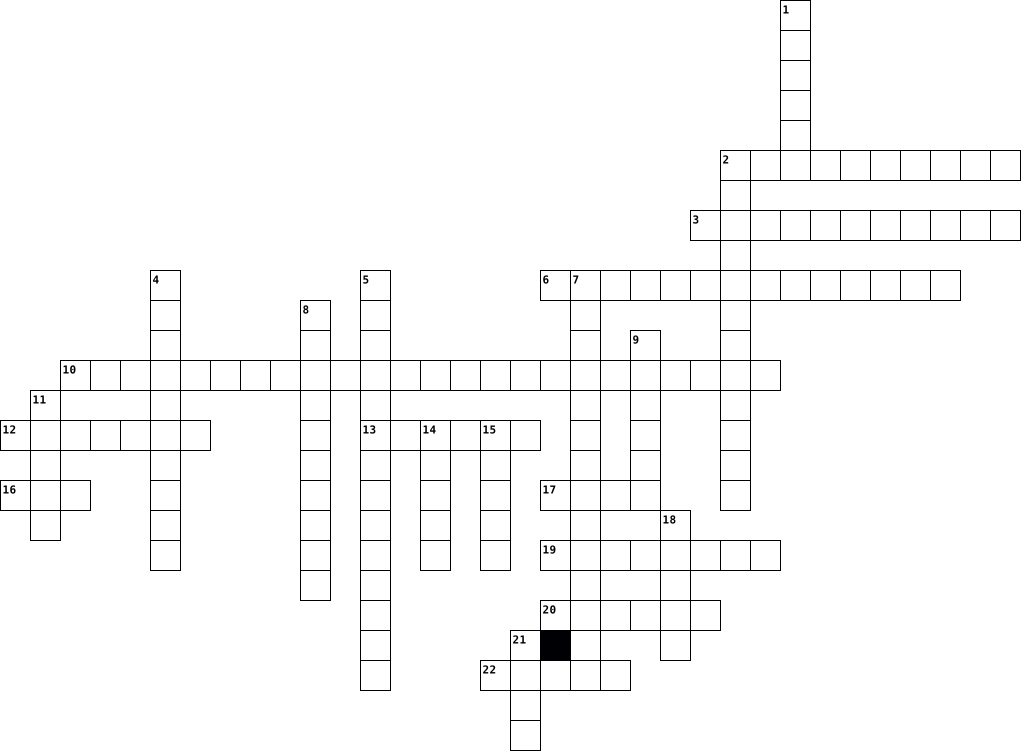
Across
- A TERM MEANING "BEFORE WAR"
- FOUGHT TO MAINTAIN SLAVERY
- A BOUNDARY OR BORDER THAT SEPARATED THE FREE AND SLAVE STATES
- SPEECH IN WHICH WAS STATED THAT SLAVES WERE TO BE SET FREE
- A TERM USED TO DESCRIBE PEOPLE WHO SUPPORTED THE NORTH
- WHEN THE SOUTHERN STATES CHOSE TO LEAVE THE UNITED STATES
- COMMANDING OFFICER OF THE SOUTH
- COLOR OF THE NORTH
- SOLDIERS THAT FIGHT AND TRAVEL BY FOOT
- DIPLOMACY THE IDEA THAT THE SOUTH COULD GET BRITAIN AND FRANCE TO HELP THEM
- COMMANDING OFFICER OF THE NORTH
Down
- A LONG GUN THAT SOLDIERS SHOT FROM THE SHOULDER
- A PERSON WHO WANTED TO ELIMINATE OR ABOLISH SLAVERY
- A LARGE FARM LOCATED IN THE SOUTHERN STATES
- REBUILDING OF THE WAR TORN STATES IN THE SOUTH
- PRESIDENT DURING THE CIVIL WAR
- ADDRESS FAMOUS SPEECH BY LINCOLN MEANT TO UNITE THE COUNTRY
- A NICKNAME FOR THE PEOPLE FROM THE NORTH
- A NICKNAME FOR PEOPLE IN THE SOUTH
- BARTON THE FOUNDER OF THE AMERICAN RED CROSS WHO TREATED SOLDIERS ON THE BATTLE FIELD
- A NICKNAME FOR THE SOUTH
- FOUGHT TO FREE THE SLAVES
- COLOR OF THE SOUTH
23 Clues: COLOR OF THE NORTH • COLOR OF THE SOUTH • A NICKNAME FOR THE SOUTH • FOUGHT TO FREE THE SLAVES • FOUGHT TO MAINTAIN SLAVERY • A TERM MEANING "BEFORE WAR" • PRESIDENT DURING THE CIVIL WAR • COMMANDING OFFICER OF THE SOUTH • COMMANDING OFFICER OF THE NORTH • A NICKNAME FOR PEOPLE IN THE SOUTH • SOLDIERS THAT FIGHT AND TRAVEL BY FOOT • A NICKNAME FOR THE PEOPLE FROM THE NORTH • ...
Noah's Gov project 2023-01-10

Across
- a tax on certain goods that people buy like alcohol, cigarettes, jewelry, and gasoline (2 words)
- The department of blank tries to enforce federal laws, prevent crime, and punish those convicted of crimes
- The department of blank provides funding to public schools and help students pay for colleges
- A tax taken to provide retired people with income
- The Department includes all parts of the us military to protect the us citizens
- the Department of blank is responsible for federal highways, the railroads and driver safety
- Under the virginia plan these states would have more power
- the branch that interprets laws
- Agreement with other nations
- an election to try to remove an elected official from office before his term has ended
- under the new jersey plan these states would have more power
- States sends these to congress
Down
- The document that replaced the Article of confederation
- Fraction of states that must agree to change the constitution
- The actual document that voters cast their vote on
- The Department of blank the makes money, tries to help the economy and collects taxes
- one problem was that states charged these goods from other states
- a tax on the income of businesses make (2 words)
- Actions towards other countries
- president's title as head of the military (3 words)
- when the government raises more money than it spends
- The branch that carries out laws
- the government’s plan for taxing and spending for the year
- A percentage tax on the money you earn. The more money you earn the more money you pay
- vote if the citizens to approve or reject of a law of the legislature
25 Clues: Agreement with other nations • States sends these to congress • Actions towards other countries • the branch that interprets laws • The branch that carries out laws • A tax taken to provide retired people with income • The actual document that voters cast their vote on • a tax on the income of businesses make (2 words) • ...
Compromise Review 2024-12-11

Across
- the idea that a state didn't have to listen to federal rules (particularly tariffs)
- the government wanted to create a __________ of power between slave and free states
- the nickname given to the Kansas-Nebraska act when violence broke out
- the idea that a state could decide on big issues themselves, southern states feared this would be taken away
- depended on manufacturing/factories
- the slave who sued for his freedom just to be told that slaves were not citizen and slaves everywhere
- the direction cotton expanded
- the idea that a state could vote on if they would allow slavery or not
- 5 parts that included the fugitive slave act, california being free, and two states getting popular sovereignty
- state that did not allow slavery
- the _______________ purchase we got from the French
- state that allowed slavery
Down
- what happened to slavery after the invention of the cotton gin
- the big issue dividing the nation in the antebellum period
- the idea that the United States had the right to expand west
- the new cash crop in the South
- last name of the person who won the election of 1860
- before the war
- depended on slavery/agriculture
- the land that asked to be a part of the United States
- a tax on imports
- the compromise that created a line where above the line did not allow slavery and below the line did allow slavery, missouri a slave state, and maine a free state
- the controversial act that required people to return runaway slaves
- the division of the United States into regions based on economy and ideas
24 Clues: before the war • a tax on imports • state that allowed slavery • the direction cotton expanded • the new cash crop in the South • depended on slavery/agriculture • state that did not allow slavery • depended on manufacturing/factories • the _______________ purchase we got from the French • last name of the person who won the election of 1860 • ...
First 5 Presidents 2024-12-13

Across
- 3rd President of the United States
- Monroe's Presidency was known as the "Era of ..." (no spaces)
- Jefferson's Foreign Policy that cut off trade with European countries(no spaces)
- Number of terms John Adams served as President
- 1st President of the United States
- The Alien and Sedition Acts made it a ___ for Americans to speak or write against the government.
- Madison was the first president to ask ___ to declare war
- The policy of separating and not participating in international relationships.
- John Adams' Foreign Policy (no spaces)
- Adams' position after the Election of 1789 (no spaces)
- The act of forcing someone into service for an organization or government
- The system that allows for small/personal businesses without government interference (no spaces)
Down
- The cost of the Louisiana Purchase
- The Alien and Sedition Acts allowed the U.S government to imprison or deport French ___.
- A statement that recognized Latin American countries in the Western Hemisphere as free and independent nations (no spaces)
- A political system in which representatives are responsible for governing
- The Louisiana Purchase ___ the size of the United States
- This supreme court case led to the establishment of the principle of Judicial Review (no spaces)
- Inciting people to rebel against authority.
- Washington warned ___ political parties
- The precedent established by Washington
- 5th President of the United States
- 2nd President of the United States
- Thomas Jefferson, Aaron Burr, and Charles Pinckney all considered themselves to be ___.
- Groups of people sharing a common political philosophy and support for candidates with that philosophy (no spaces)
- 4th President of the United States
- The role of a cabinet member is to ___ the president
27 Clues: The cost of the Louisiana Purchase • 3rd President of the United States • 5th President of the United States • 1st President of the United States • 2nd President of the United States • 4th President of the United States • John Adams' Foreign Policy (no spaces) • Washington warned ___ political parties • The precedent established by Washington • ...
SETTLEMENT OF THE WEST & IMPERIALISM 2022-04-05

Across
- California Gold Rush, Homestead Act, and the Completion of transcontinental railroad all factors that contributed to Westward _________________.
- The primary goal of the _________________ of 1887 regarding Native American Indians was to assimilate Native American Indians into mainstream American life.
- construction of the _________________ become more important to the United States after the Spanish-American War because the navy needed a faster way to move ships between the Atlantic and Pacific Oceans.
- The establishment of the Open Door policy (1899–1900) and the response to the _________________ Rebellion (1900) showed that the United States wanted to protect American trading interests in China
- Renewal of unrestricted _________________ warfare by Germany was one of the events that influenced President Woodrow Wilson’s decision to enter World War I
- President Theodore Roosevelt's __________________ strengthened the Monroe Doctrine by establishing the policy that the United States would intervene in Latin America to prevent European interference.
- President Theodore Roosevelt’s commitment to the proverb, “Speak softly and carry a big stick; you will go far,” was most clearly shown when he intervened in _________________ affairs
- As a result of low land prices and the Homestead Act many farmers moved West and the Native American Indians on the Great Plains were forced onto _________________.
- _________________ policy of unrestricted submarine warfare, interception of the Zimmermann Note, and American loans to Allied nations led to United States entry into World War I.
- Securing land for the Panama Canal and military interventions in Latin America are examples of Roosevelt's use of the "________________" diplomacy.
Down
- Exaggerated, sensational newspaper headlines and articles are often referred to as __________________ journalism.
- Secretary of State John Hay sent his Open Door Notes (1899–1900) to world powers to gain equal access to _________________ markets.
- _________________ companies sold land in the West for very low price.
- A major result of the _________________ War (1898) was that the United States assumed a more prominent role in world affairs.
- The United States tried to avoid involvement in World War I by following a policy of _________________.
- The disclosure of the Zimmerman document contributed to the entry of the United States into _________________.
- _________________ telegram was part of an effort to enlist Mexican support for Germany if the United States declared war.
- _________________ Offered free 160 acres of land in the West to anyone willing to live on it for 5 years.
- American newspapers used yellow journalism to build public support for the war against _________________ .
- Some of the major reasons for United States _________________ included: the desire for markets and raw materials; closing of the western frontier; missionary spirit; belief in the White Man's Burden.
- One of the major characteristics of American imperialism in the late 19th and early 20th centuries was acquiring _________________ to promote economic and strategic interests.
- The Homestead Act and grants of land to railroads were used to encourage settlement of the _________________.
- The federal government supported railroad construction by giving railroad companies _________________ grants.
23 Clues: _________________ companies sold land in the West for very low price. • The United States tried to avoid involvement in World War I by following a policy of _________________. • _________________ Offered free 160 acres of land in the West to anyone willing to live on it for 5 years. • ...
America's House 2014-12-09

Across
- worker
- Adams
- employed to provide social services (especially to the disadvantaged)
- act of evacuating; leaving a place in an orderly fashion; especially for protection
- by or founded upon law or official or accepted rules
- President of the United States (1735-1826)
- President of the United States; commander-in-chief of the Continental Army during the American Revolution (1732-1799)
Down
- Wilson
- (someone) to hold public office or some other position by voting
- vice president and succeeded as 30th President of the United States when Harding died in 1923 (1872-1933)
- Coolidge
- President of the United States; chief drafter of the Declaration of Independence; made the Louisiana Purchase in 1803 and sent out the Lewis and Clark Expedition to explore it (1743-1826)
- Jefferson
- politically organized body of people under a single government
- President of the United States; led the United States in World War I and secured the formation of the League of Nations (1856-1924)
- chief executive of a republic
16 Clues: Adams • Wilson • worker • Coolidge • Jefferson • chief executive of a republic • President of the United States (1735-1826) • by or founded upon law or official or accepted rules • politically organized body of people under a single government • (someone) to hold public office or some other position by voting • ...
Building a New Nation 2020-04-02

Across
- Served as the fourth president of the United States from 1809 to 1817.
- The battle of 1812 took place here.
- Tax that is paid on a particular class of imports or exports.
- Served as the seventh president of the United States from 1829 to 1837.
- Support for the political independence of a particular nation or people.
- Lemhi Shoshone woman who net and helped the Lewis and Clark Expedition.
- Spain controlled the peninsula of this state in 1812.
- The taking of men into military or naval force by compulsion.
- Writer of the Star Spangled Banner.
Down
- Served as the third president of the United States from 1801 to 1809.
- Served as the fourth Chief Justice of the United States.
- Admitted to the union in 1812.
- The National anthem of the United States, written on September 14,1814.
- First major improved highway built between 1811 and 1837.
- Treaty between the United States and the United Kingdom to limit naval armaments on the Great Lakes.
15 Clues: Admitted to the union in 1812. • The battle of 1812 took place here. • Writer of the Star Spangled Banner. • Spain controlled the peninsula of this state in 1812. • Served as the fourth Chief Justice of the United States. • First major improved highway built between 1811 and 1837. • Tax that is paid on a particular class of imports or exports. • ...
The Constitution 2023-02-14

Across
- protects freedom of speech,the press,assembly,and what else?
- name given to the first ten amendments to the constitution
- Abolished throughout the united states
- Lowered the voting age
- That person born or naturalized in the united states was a
- Prohibits denying the rights to vote based on their
- Clarifies the succession procedure if removed from office,dies,or resigns
- Prohibits the federal government from imposing excessive bail,fines, and cruel punishment
- Established presidential
- Protects the rights of the people to keep and bear
- Guarantees the right to speedy and public
- Guarantees the right to trial by
Down
- Protects individuals from having to testify against in a criminal court case
- Authorized a tax on
- Gave three electoral votes to the citizens of
- Protects against unreasonable
- Established the direct election of united states by the people
- Prohibits federal and state governments from placing any type of tax on the rights to the
- power not given to the federal government are reserved to states or the
- prevents members of congress from receiving an increase in
20 Clues: Authorized a tax on • Lowered the voting age • Established presidential • Protects against unreasonable • Guarantees the right to trial by • Abolished throughout the united states • Guarantees the right to speedy and public • Gave three electoral votes to the citizens of • Protects the rights of the people to keep and bear • ...
Kacey Krossword 2022-02-22

Across
- delicious hot beverage that Kacey would give her children in bowls
- queen who was nice enough to let me stay at her place
- term you like calling people, works well with finger guns
- one of the many drugs Scott recommends as a treat
- sport that you refuse to do, justin almost flew off a slope doing this
Down
- our relationship
- Kacey's favorite alcohol that tastes like angry sharpies
- soup :)
- best cat
- kacey's favorite genre of music
- best dog
- thing i hate
- favorite hockey team !
13 Clues: soup :) • best cat • best dog • thing i hate • our relationship • favorite hockey team ! • kacey's favorite genre of music • one of the many drugs Scott recommends as a treat • queen who was nice enough to let me stay at her place • Kacey's favorite alcohol that tastes like angry sharpies • term you like calling people, works well with finger guns • ...
Compromises & Principles 2025-10-29

Across
- In Limited Government, No one, even the President is above this
- Three-Fifths of all enslaved persons would count for this purpose
- Roger Sherman and Oliver Ellsworth came up with the Great Compromise to appease both Large and Small states and it was also known as this.
- This principle is all about sharing power between Federal and State Government
- This plan benefits smaller states
- The New Jersey plan is based on this concept
- This is the upper house that uses equal representation which addresses the concerns of the smaller states
Down
- This was the amount of enslaved persons that would be for representation purpose for the population count for their number for Congress
- The Virginia Plan benefited these type of states
- This was a major topic debated at the Constitutional Convention in 1781
- The smaller states feared the system based on population would leave them with this
- This is the lower house that bases representation off of population which satisfies the larger states
- Under the Great Compromise, it created this type of legislature, when means two houses.
- The Virginia Plan argued for this type of national government
- Large states, such as Virginia, liked the Virginia plan because they would gain more of this in Congress
- Under the Virginia Plan, representation would be based off of this
16 Clues: This plan benefits smaller states • The New Jersey plan is based on this concept • The Virginia Plan benefited these type of states • The Virginia Plan argued for this type of national government • In Limited Government, No one, even the President is above this • Three-Fifths of all enslaved persons would count for this purpose • ...
Federal system 2021-12-07

Across
- law allows for public meetings to be both audio and video recorded by attendees
- right position the national government is an agent of the states and its powers should be narrowly defined.
- and immunities The Privileges and Immunities Clause of Article IV, Section 2 of the Constitution states that "the citizens of each state shall be entitled to all privileges and immunities of citizens in the several states."
- powers powers which are shared by both the federal government and state governments
- act allowed the Reich government to issue laws without the consent of Germany's parliament
- powers powers directly stated in the Constitution
- tax a type of tax that governments impose on income generated by businesses and individuals within their jurisdiction.
- specific form of organization defined by complexity, division of labour, permanence, professional management, hierarchical coordination and control, strict chain of command, and legal authority.
- clause allows powers of congress to stretch
- compacts formal, legislatively enacted agreements between two or more states that bind them to the compacts' provisions.
- clause It prohibits states from interfering with the federal government's exercise of its constitutional powers
- powers powers the constitution grands
Down
- type of censorship in which speech or expression is reviewed and restricted before it occurs
- powers egulating immigration, acquiring territory, and ending labor strikes
- the idea that a higher authority of law will displace the law of a lower authority of law when the two authorities come into conflict.
- powers powers that are not specifically granted to the federal government by the Constitution
- laws agency will automatically be abolished on its Sunset date
- law A generic term for all non-criminal law
- position favors national government action in dealing with these matters.
- A nationalist Chief Justice; presided during McCulloch (John Marshall)
- the removal of a person from a requested state to a requesting state for criminal prosecution or punishment.
- grants a way the government funds your ideas and projects to provide public services and stimulate the economy.
- an authorization to act given to a representative accepted the mandate of the people.
- powers political powers granted to the United States government that aren't explicitly stated in the Constitution.
- a “higher” level of government
25 Clues: a “higher” level of government • powers powers the constitution grands • law A generic term for all non-criminal law • clause allows powers of congress to stretch • powers powers directly stated in the Constitution • laws agency will automatically be abolished on its Sunset date • A nationalist Chief Justice; presided during McCulloch (John Marshall) • ...
AP world semester review 2023-06-05

Across
- Attended by the big three
- United states vs soviet union
- Main cause of death in developed countries
- Five Year Plans
- Five Year Plans
- maintain international peace and security, develop friendly relations among nations
- Military alliance
- Former president of Ghana
- Civil rights leader in the United States
- Control of area outside of your country
- Cause of death in developing countries
- Change of political borders
- Cause of death in developed countries
- fought between Britain and China
- Organization of American States
- United States(Chinese) and Australia(white)
- wars that were not fought just a constant threat
- British government takes over India
- control of an organization or group by the majority of its members.
- defense treaty signed in Warsaw
Down
- Uneffective thing that the US would not join
- Formers president of South Africa
- Huge pandemic that happened in 1918
- a virus that attacks the body's immune system
- former president of Egypt
- confrontation between the United States and the Soviet Union during the Cold War
- Govern international trade
- ended WW1
- Economic Reforms in China
- Creole who created new independent countries in South America
- Member of INC
- property is publicly owned and each person works and is paid according
- Meeting about the scramble of Africa
- Favored revolts by the working class
- Domino theory
- trade and industry are controlled by private owners
- Pill that provided more safety and could control when you had a kid
- Dynasty in china
- fake news
39 Clues: ended WW1 • fake news • Member of INC • Domino theory • Five Year Plans • Five Year Plans • Dynasty in china • Military alliance • Attended by the big three • former president of Egypt • Economic Reforms in China • Former president of Ghana • Govern international trade • Change of political borders • United states vs soviet union • Organization of American States • ...
First Semester Crossword 2024-12-17

Across
- The main author of the Declaration of Independence.
- The supreme law of the United States, established in 1787.
- of Independence The 1776 document that announced America’s separation from Britain.
- Purchase The 1803 land deal that doubled the size of the United States.
- The shared beliefs, customs, and traditions of a society.
- A change or addition to a legal or statutory document, especially the Constitution.
- A supporter of the Constitution and a strong central government.
- Carta A 1215 document that limited the power of the king in England.
- Tea Party A 1773 protest where colonists dumped British tea into Boston Harbor to oppose taxation.
Down
- The first President of the United States and Revolutionary War general.
- War The conflict fought between Britain and the American colonies (1775-1783).
- The branch of government that makes the laws.
- The head of the executive branch in the United States.
- A settlement ruled by another country.
- The branch of government that interprets the laws and ensures justice.
- The upper house of the United States Congress with two members per state.
- The branch of government responsible for enforcing the laws.
- The practice of owning and forcing people to work without pay.
- Sense A pamphlet by Thomas Paine that urged independence from Britain.
- The first Secretary of the Treasury and a supporter of the Constitution.
- A system of government where power is held by the people.
- The legislative body made up of the Senate and House of Representatives.
22 Clues: A settlement ruled by another country. • The branch of government that makes the laws. • The main author of the Declaration of Independence. • The head of the executive branch in the United States. • The shared beliefs, customs, and traditions of a society. • A system of government where power is held by the people. • ...
Unit 3: New Nation 1800-1877 2025-12-08

Across
- President during the Civil War who issued the Emancipation Proclamation
- 1803 land deal that doubled the sized of the United States
- Lincoln ´ s order freeing enslaved people in rebel states
- When Southern states broke away from the Union to form the Confederacy
- Southern Laws that restricted the rights of freedmen
- The belief that states should have more power than the federal government
- New communication invention using electric signals
- One of the leaders of the expedition to explore the Louisiana Territory
- Conflict with Britain that boosted American nationalism
- Loyalty to a region rather than the whole nation
- ¨ Father of the constitution and president ¨ during the War of 1812
- Agreement that tried to balance free and slave states
Down
- Former president who fought strongly against slavery in Congress
- A major slave uprising in Virginia that increased Southern fear and stricter slave laws
- forced removal of Cherokee people from their land
- Wrote the Declaration of Independence
- Partner of Lewis on the western expedition
- Machine that increased cotton production and slavery
- Deal that included the Fugitive Slave Act
- War that led to the U.S. gaining the Southwest
- Major conflict between the Union and Confederacy from 1861-1865
- Improved river travel and trade
- Union general who later became president
- Belief that the U.S. was meant to expand west
- President known for the ¨common man¨
- Period of rebuilding the South after the Civil War
- President who created a doctrine warning Europe to stay out of the Americas
- Main Confederate general during the Civil War
- Movement to end slavery in the United States
- Major transportation system that expanded westward
30 Clues: Improved river travel and trade • President known for the ¨common man¨ • Wrote the Declaration of Independence • Union general who later became president • Deal that included the Fugitive Slave Act • Partner of Lewis on the western expedition • Movement to end slavery in the United States • Belief that the U.S. was meant to expand west • ...
Era 7 vocabulary 2026-02-09

Across
- a person who supported the United States cause during the American Civil War
- codes laws limiting the rights of African Americans passed by Southern governments
- a Northerner in the South working for a Reconstruction government
- focus on the interests of one’s region
- rights the position that the federal government should not interfere with the states
- the act of withdrawing from something, such as a nation
- to put an end to
- a white Southerner who supported Reconstruction
- the right for states to rule federal acts unconstitutional
Down
- the effort, after the American Civil War, to reorganize the seceded states and bring
- people who wanted to end slavery in the U.S.
- using naval vessels to prevent shipment of food and supplies into or out of ports
- to withdraw from something, such as a nation
- by the people
- their constitutional powers
- back into the Union
- to cancel
- to change a constitution or law
- the American Civil War
19 Clues: to cancel • by the people • to put an end to • back into the Union • the American Civil War • their constitutional powers • to change a constitution or law • focus on the interests of one’s region • people who wanted to end slavery in the U.S. • to withdraw from something, such as a nation • a white Southerner who supported Reconstruction • ...
Unit 6 Vocab 2024-04-19

Across
- - An influential abolitionist who founded the newspaper "The Liberator" and advocated for immediate and uncompensated emancipation.
- - An 1820 agreement that kept the balance of free and slave states.
- - A labor and production model used in textile mills, where young unmarried women worked in factory conditions.
- - An African American abolitionist and women's rights activist known for her powerful speeches on equality and freedom.
- - Founded as the anti-slavery political party.
- - A network of secret routes and safe houses used by enslaved people to escape to free states and Canada.
- - A network of federally funded roads and highways that improved transportation and trade between regions.
- - A method of manufacturing that brought workers and machines together under one roof, leading to increased production and the rise of industrial cities.
- - A prominent Southern politician and advocate for states' rights.
- - A period of rapid industrialization in the late 18th and early 19th centuries, characterized by technological advancements and the shift from agrarian to industrial economies.
- - The movement to resettle African Americans in Africa, particularly Liberia, as a solution to slavery and racial tensions in the United States.
- - Admitted California as a free state and enacted a strict fugitive slave law.
- - Identical components that can be easily substituted in the manufacturing of products, leading to standardization and mass production.
- - A political party in the United States that emerged in the 1830s, opposing Andrew Jackson's policies and advocating for a strong federal government.
- - An abolitionist who led violent raids against slavery.
- - The movement to completely end slavery in the United States.
- - Reinforced states' rights, and that only states could limit slavery.
- - Young women, that wanted more political/social rights, who worked in the textile mills during the Industrial Revolution, often living in company boardinghouses.
- - The use of technology and machinery to perform tasks with minimal human intervention, increasing productivity and efficiency.
- - A political party in the United States that was the champions of the "common man."
- - A waterway completed in 1825 that connected the Great Lakes to the Hudson River, significantly lowering transportation costs and spurring economic growth in the Midwest.
- - Presidential election won by Republican Abraham Lincoln, who opposed slavery's expansion. Southern states viewed his victory as a threat and seceded.
- - An African American leader who planned a major slave rebellion in Charleston, South Carolina, in 1822.
- - Scottish inventor known for his improvements to the steam engine, which played a key role in the Industrial Revolution.
- - Allowed settlers in a territory to decide whether to permit slavery through democratic vote.
- - The manufacturing of large quantities of standardized products using assembly lines and machinery to increase efficiency.
Down
- - Opposed slavery into new territories (mainly the West).
- - An American engineer and inventor who is credited with developing the first commercially successful steamboat.
- - An escaped slave who became a prominent abolitionist, writer, and orator, advocating for the end of slavery and civil rights.
- - Proposed amendment to an appropriations bill that would prohibit slavery in any territory acquired from Mexico.
- - An enslaved African American who led a violent slave rebellion in Virginia in 1831, resulting in stricter slave codes and surveillance.
- - Nickname for the steam locomotive due to its role in revolutionizing transportation and connecting distant regions in the 19th century.
- - A critical transportation innovation in the 19th century that revolutionized travel, trade, and communication across the United States.
- - The breakdown of production into specialized tasks, enabling workers to focus on specific roles and increase overall productivity.
- - A novel by Harriet Beecher Stowe that depicted the harsh realities of slavery and played a significant role in shaping public opinion towards abolition.
- - American inventor known for the cotton gin and the concept of interchangeable parts, revolutionizing manufacturing processes.
- - Supreme Court ruling declaring that enslaved people were not citizens and had no legal rights.
- - A prominent American statesman known as the "Great Compromiser."
- - Inventor of the telegraph and Morse code, transforming communication with long-distance messaging.
- - Congressional legislation that allowed settlers in Kansas and Nebraska territories to decide slavery's legality through popular sovereignty.
- - Federal armory that was raided.
- - Known as the "Father of the American Industrial Revolution," he brought British textile technology to the United States.
- - Various forms of energy utilized in industry, such as waterwheels, steam engines, and later, electricity, to drive machinery and power factories.
- - Violent conflict between pro-slavery and anti-slavery settlers fighting over whether the territory would permit slavery.
44 Clues: - Federal armory that was raided. • - Founded as the anti-slavery political party. • - An abolitionist who led violent raids against slavery. • - Opposed slavery into new territories (mainly the West). • - The movement to completely end slavery in the United States. • - A prominent Southern politician and advocate for states' rights. • ...
Federalism 2014-10-28

Across
- demands on a state to carry out certain policies
- a grant that can only be used for a specific reason
- power granted to the national government by the Constitution
- power that historically have been recognized as naturally belonging
- both state and national were equal authorities in their sphere
- the idea that states had the right to separate themselves
- power held by the national and state at the same time
- federalism of spending, taxing, and providing aid
- federalism under President Lyndon Johnson
- a grant that is given for a general purpose
- power that are logical extensions of expressed powers
Down
- Article IV of the Constitution
- money and other resources that the national government provides
- the idea that states had the right to cancel national laws
- the idea of returning powers to the states
- federalism under the New Deal
- authority is returned to the state government
- power that belong to the states
18 Clues: federalism under the New Deal • Article IV of the Constitution • power that belong to the states • federalism under President Lyndon Johnson • the idea of returning powers to the states • a grant that is given for a general purpose • authority is returned to the state government • demands on a state to carry out certain policies • ...
Civil War events 2023-10-16

Across
- and antislavery folks went to Kansas territory in 1854-1856.
- does the South seriously begin to think about if these states joined the Union as free states?
- slave act
- representative Preston Brooks entered the senate chamber and started beating sumner w/a cane
- Brown's Raid
- and 18 men seized arsenal w/o a fight; fell apart when no slaves rose up to assist the rebellion
- Toms Cabin
- Scott case.
- compromise
- not following the law would be charged w/a felony and fined
- allowed to choose states if they allowed slavery or not.
- U.S. Supreme Court stated that enslaved people were not citizens of the United States
- Railroad
- missouri applied for statehood
Down
- of 1850
- Carolina voted to secede from the Union on DEC 20, 1860. Between JAN 9-FEB 1, more states voted to secede from the union
- Slave Act Passed
- proposed the Missouri Compromise?
- in Congress
- Clay
- of 1860
- Kansas
- was popular w/northern abolitionists; southerners hated him- didn't even appear on most southern ballots
- act
- opponents squared off in the race for a senate seat to represent Illinois
- both the antislavery movement and the womans right movement
26 Clues: act • Clay • Kansas • of 1850 • of 1860 • Railroad • slave act • Toms Cabin • compromise • in Congress • Scott case. • Brown's Raid • Slave Act Passed • missouri applied for statehood • proposed the Missouri Compromise? • allowed to choose states if they allowed slavery or not. • not following the law would be charged w/a felony and fined • ...
Building a New Nation 2020-04-02

Across
- The Native American that helped Lewis and Clark on their journey
- He lead Native Americans and U.S. troops during the Creek Wars and later became the seventh president of the United States.
- The Shawnee Chief that united different Native American tribes and lead attacks on white settlers. He worked with the British during the War of 1812.
- The act that stopped exports to and imports from Europe
- The treaty that gave the U.S. Florida, created a border with Spain’s territory, and Spain gave up claims in Oregon Country.
- The first canal to connect the Great Lakes to the Atlantic Ocean.
- The man who wrote the Virginia plan and was the fourth president of the United States
Down
- A country in Europe that fought against the U.S. in the Revolutionary War and War of 1812. It was always in war with France
- The national anthem of the United States
- The person who penned the poem, Defense of Fort McHenry
- The United States capital
- The wife of James Madison and was the first First Lady, she was beloved by the country.
- The that created a border in the west between the United States and Canada
- The port city on the mouth of the Mississippi River that was a huge trading center
- The third President of the United States and was the president authorized the Louisiana purchase and Corps of Discovery
- A country in Europe that owned the Louisiana territory and was always in war with Great Britain.
- The action of taking sailors to work on one ship from another
17 Clues: The United States capital • The national anthem of the United States • The person who penned the poem, Defense of Fort McHenry • The act that stopped exports to and imports from Europe • The action of taking sailors to work on one ship from another • The Native American that helped Lewis and Clark on their journey • ...
Causes of and events leading to the Civil War 2023-10-12

Across
- - A soldier that is wounded or killed during bInfantry - Soldiers that fight and travel by foot
- - Large caliber firearms like cannons and mortars.
- - A term meaning "before war". It was often used to describe the United States before the Civil War.
- - A person who wanted to eliminate or "abolish" slavery.
- - When a person is murdered for political reasons.
- - An attempt to stop people and supplies from going in or out of a port.
- - The side of an army or military unit.
Down
- - A long blade or knife attached to the end of a musket. Soldiers would use it like a spear in close combat.
- - A large farm in the southern United States. Before the Civil War many of the workers on plantations were enslaved.
- - A nickname given to people in the South supporting the Confederate States.
- - The rebuilding of war torn southern states so they could be readmitted into the Union after the Civil War.
- - A nickname for southern whites who supported the Republican Party.
- - A long gun with a smooth bore that soldiers shot from the shoulder.
- Line - A boundary or border that split the free states from the slave states. It went between Pennsylvania to the north and Virginia, Maryland, and Delaware to the south.
- - The northern states of the United States, also called the Union.
15 Clues: - The side of an army or military unit. • - Large caliber firearms like cannons and mortars. • - When a person is murdered for political reasons. • - A person who wanted to eliminate or "abolish" slavery. • - The northern states of the United States, also called the Union. • - A nickname for southern whites who supported the Republican Party. • ...
Causes of The Civil War 2022-03-10

Across
- was an effort by abolitionist John Brown, from October 16 to 18, 1859, to initiate a slave revolt in Southern states by taking over the United States arsenal at Harpers Ferry, Virginia.
- the withdrawal of eleven southern states from the Union in 1860
- small war between pro slavery and anti slavery states fought in 1854-1859
- something that involves ownership of someone else
- where you pick a side between the south and the north
- state that is against slavery
- factories vs agriculture
Down
- state that supports slavery
- the action or an act of abolishing a system, practice, or institution.
- repealed the Missouri Compromise, created two new territories, and allowed for popular sovereignty
- states arguing about how much power the federal government should have
- moving west is known as...
- upheld slavery in United States territories, denied the legality of black citizenship in America, and declared the Missouri Compromise to be unconstitutional.
- the 16th president
- best cash crop the south grew
15 Clues: the 16th president • factories vs agriculture • moving west is known as... • state that supports slavery • best cash crop the south grew • state that is against slavery • something that involves ownership of someone else • where you pick a side between the south and the north • the withdrawal of eleven southern states from the Union in 1860 • ...
The Constitution of the United States of America 2023-10-03

Across
- The Senate and the House of Representatives is what we call ___.
- The____ on the United States flag represent the original 13 states.
- A change to the United States Constitution is called an ___.
- How many stripes are on the United States flag?
- The first president of the United States was George ____.
- How many branches are there in the government of the United States?
- It is the duty of Congress to make ___.
Down
- The ___ is the supreme law of the United States.
- Before the constitution, the 13 colonies had the ________ of Confederation.
- The Constitution was written in the state of ____________. (P)
- The stars on the United States flag are ____.
- The Bill of Rights has ___ amendments.
- The constitution is divided into _____ parts.
- The stripes on the United States flag is ___ and white.
14 Clues: The Bill of Rights has ___ amendments. • It is the duty of Congress to make ___. • The stars on the United States flag are ____. • The constitution is divided into _____ parts. • How many stripes are on the United States flag? • The ___ is the supreme law of the United States. • The stripes on the United States flag is ___ and white. • ...
Sec 4 crossword project 2023-09-25

Across
- law which benefited the Southern states to count 3/5s of every black slave
- An increased tax on import goods to raise the purchase of American products
- Three branches of the United States of america executive legislative and judicial in which they all monitor each other so no one has a higher power
- led a political group called the federalist who who favored a one national government
- divided the new land into five new state Wisconsin Illinois Michigan Indiana Ohio
- farmers who rebelled against the banks for taking the farms so they burned them down
- we’re not equal and only benefited big states with a large population like the south
- act put by John adams where he could deport immigrants who disliked or didn’t believe in the same views as him
Down
- The United States of America first set of laws which were weak and vague
- two states who disagreed with John adams alien and sedition act violating the 1st admendment
- General who fought in the revolution and was selected unanimously selected as the first president
- first 10 amendments to the new constitution which protected people from the government
- politicians who favored a strong national government and believed the wealthy were needed to rule
- A political party who believed in a strong state government common man
- third president of the United States of America in 1800 who was a dem/rep
- believed all states should be equal and have two representatives/Delegates represent them
16 Clues: A political party who believed in a strong state government common man • The United States of America first set of laws which were weak and vague • third president of the United States of America in 1800 who was a dem/rep • law which benefited the Southern states to count 3/5s of every black slave • ...