
states and capitals Crossword Puzzles
us history 2021-01-13
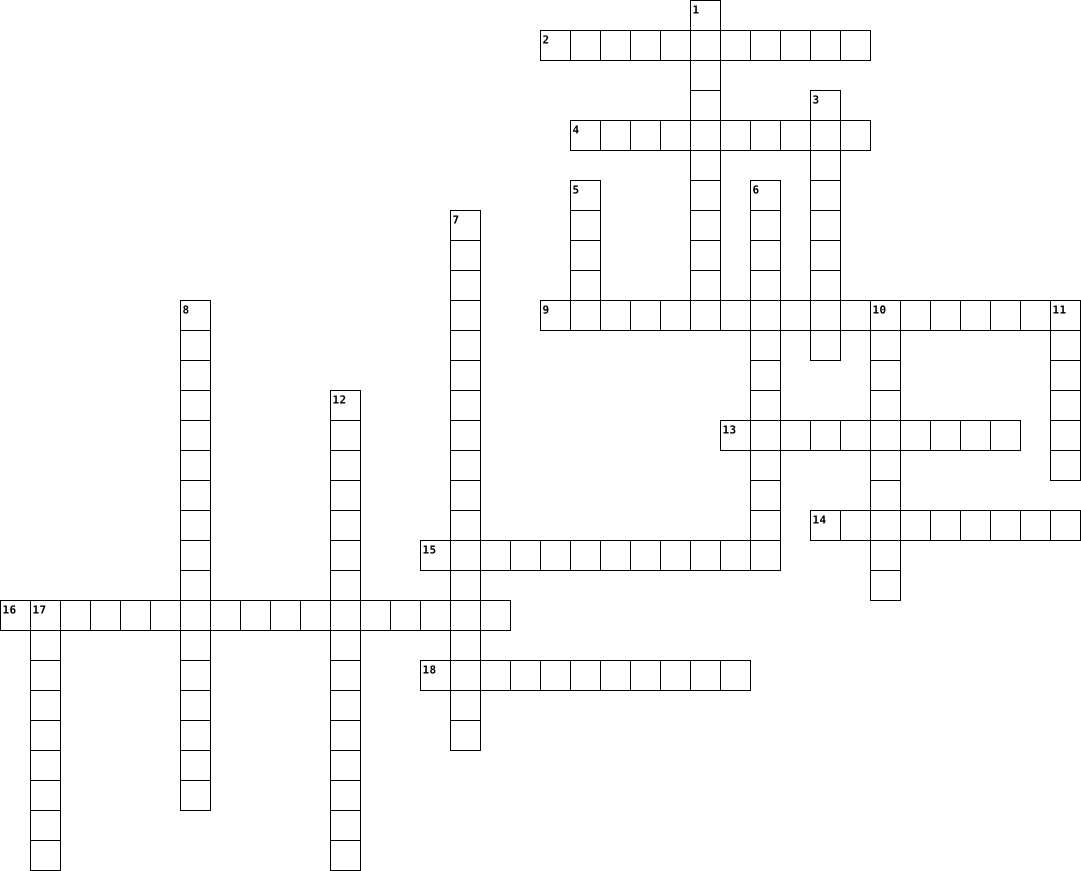
Across
- a policy of extending a country's power and influence through diplomacy or military force.
- a general vote by the electorate on a single political question which has been referred to them for a direct decision.
- an armed conflict between Spain and the United States in 1898.
- the ability to assess and initiate things independently.
- a 1906 novel by the American journalist and novelist Upton Sinclair (1878–1968).
- is a political philosophy in support of social reform.
- was an American statesman, conservationist, naturalist, historian, and writer, who served as the 26th president of the United States from 1901 to 1909.
- an artificial 82 km waterway in Panama that connects the Atlantic Ocean with the Pacific Ocean.
Down
- were state and local laws that enforced racial segregation in the Southern United States
- were reform-minded journalists in the Progressive Era in the United States who exposed established institutions and leaders as corrupt.
- s a civil rights organization in the United States, formed in 1909 as an interracial endeavor to advance justice for African Americans by a group including W. E. B. Du Bois, Mary White Ovington, Moorfield Storey and Ida B. Wells.
- a person favoring a policy of remaining apart from the affairs or interests of other groups, especially the political affairs of other countries.
- an addition to the Monroe Doctrine articulated by President Theodore Roosevelt in his State of the Union address in 1904 after the Venezuela Crisis of 1902–1903.
- was a peace agreement between Spain and the United States that ended the Spanish-American War.
- was an American writer, investigative journalist, biographer and lecturer. She was one of the leading muckrakers of the Progressive Era of the late 19th and early 20th centuries and pioneered investigative journalism.
- to call back
- was a landmark decision of the U.S. Supreme Court that upheld the constitutionality of racial segregation laws for public facilities as long as the segregated facilities were equal in quality, a doctrine that came to be known as "separate but equal"
- was a settlement house in Chicago, Illinois, United States that was co-founded in 1889 by Jane Addams and Ellen Gates Starr.
18 Clues: to call back • is a political philosophy in support of social reform. • the ability to assess and initiate things independently. • an armed conflict between Spain and the United States in 1898. • a 1906 novel by the American journalist and novelist Upton Sinclair (1878–1968). • ...
The Articles of Confederation 2026-03-06

Across
- who favored a weaker federal government and gave more power to the people and states
- who wanted a strong central government that had more power over the people and states
- author of the Declaration of Independence
- chosen to serve as a delegate of Massachusetts at the 1787 Constitutional Convention
- He wrote the Virginia Declaration of Rights
- Congress elected ____ to lead the Confederation Congress
- a talented inventor scientist diplomat and writer
- some delegates wanted to add a bill of rights to the constitution to protect _____
- economy of the south relied on enslaved people to keep farms and plantations running
Down
- American Indian Nations, Some states treated the American Indians fairly Other states did not
- With independence from____ came a new government for the new nation
- Roger Sherman came up with an idea that Congress be made up of two parts called houses
- in 1787 he was elected as a new york delegate for the constitutional convention
- the leader of the Continental Army during the American Revolution
- Plan, It said that each state no matter its size would have the same number of representatives in congress
- a plan that gave Congress more power over the states and provided executive branch of government
- known as the "Father of the Constitution
- Each state had the authority to ____ trade and taxes on imports and exports
18 Clues: known as the "Father of the Constitution • author of the Declaration of Independence • He wrote the Virginia Declaration of Rights • a talented inventor scientist diplomat and writer • Congress elected ____ to lead the Confederation Congress • the leader of the Continental Army during the American Revolution • ...
The Cold War Crossword 2023-12-07

Across
- House Un-American Activities Committee
- Resupply of West Berlin by U.S. in 1948 in response to a Soviet blockade of Berlin
- 13 day period when the USA and USSR came very close to nuclear war
- Man who led the Communist Revolution of China
- Communist dictator of Cuba who led a revolution in the late 1950s
- United States policy to stop the spread of Communism
- Period of tension between the United States and USSR
- List of people who Joe McCarthy said were Communists
- Program after WW2 to rebuild Europe by sending them money and economic aid
- Secret spy organization in the United States
Down
- United States foreign policy of sending aid to nations threatened by Communism
- Term used to describe territories taken over by the USSR
- War that was between North and South Korea, with the United States supporting the Democratic South
- Peacekeeping body of nations
- Term used to refer to accusing people without evidence
- The imaginary line that was said by Winston Churchill that separated Western and Eastern Europe
- Senator from Wisconsin who started the Red Scare and accused people of being loyal to Communism
17 Clues: Peacekeeping body of nations • House Un-American Activities Committee • Secret spy organization in the United States • Man who led the Communist Revolution of China • United States policy to stop the spread of Communism • Period of tension between the United States and USSR • List of people who Joe McCarthy said were Communists • ...
WH Topic 19: Cold War Conflicts 2023-05-08

Across
- a group of Communist guerrillas who fought against the South Vietnamese government in the Vietnam War
- U.S. President Richard Nixon's strategy for ending U.S. involvement in the Vietnam War
- a group of Communist rebels who seized power in Cambodia in 1975
- nations the independent countries that remained neutral in the Cold War competition between the United States and the Soviet Union
- in Communist China, a collective farm on which a great number of people work and live together
- militia units formed by young Chinese people in response to Mao Zedong's call for a social and cultural revolution
- a series of meetings in which leaders of the United States and the Soviet Union agreed to limit their nations' stocks of nuclear weapons
- during the Cold War, the developing nations not allied with either the United States or the Soviet Union
- the state of diplomatic hostility between the United States and the Soviet Union in the decades following World War II
- an uprising in China led by the Red Guards with the goal of establishing a society of peasants and workers in which all were equal
- the idea that if a nation falls under Communist control, nearby nations will also fall under Communist control
Down
- during the Cold War, the boundary separating the Communist nations of Eastern Europe from the mostly democratic nations of Western Europe
- a U.S. foreign policy in which the United States tried to stop the spread of communism by creating alliances and helping weak countries to resist Soviet advances
- a policy of reducing Cold War tensions that was adopted by the United States during the presidency of Richard Nixon
- a military alliance formed in 1955 by the Soviet Union and seven Eastern European countries
- a line of latitude that divided Korea into two nations after World War II
- a U.S. program of economic aid to European countries to help them rebuild after World War II
- a U.S. policy of giving economic and military aid to free nations threatened by internal or external opponents
- an international peacekeeping organization founded in 1945 to provide security to the nations of the world
- a policy of threatening to go to war in response to any enemy aggression
- a defensive military alliance formed in 1949 by ten Western European nations, the United States, and Canada
21 Clues: a group of Communist rebels who seized power in Cambodia in 1975 • a policy of threatening to go to war in response to any enemy aggression • a line of latitude that divided Korea into two nations after World War II • U.S. President Richard Nixon's strategy for ending U.S. involvement in the Vietnam War • ...
7th Grade History Culminating Crossword! 2023-06-04

Across
- 1820 compromise admitting Missouri as a slave state and Maine as a free state
- a shop employing workers at low wages, for long hours, and under poor conditions
- built to connect the center of the United States to the Atlantic Ocean
- law that prevented the manufacture, sale, and transporting of alcoholic drinks in the United States between 1919 and 1933
- Boss
- 1857 decision that stunned the nation. The United States Supreme Court upheld enslavement in United States territories, denied the legality of Black citizenship in U.S.A., and declared the Missouri Compromise to be unconstitutional.
- Renaissance
- largely responsible for the construction of the Erie Canal
- a merger; union
- activist and author of The Death and Life of Great American Cities
Down
- people who have only recently become rich and who have tastes and manners that some people consider vulgar
- someone who has influence in how power is distributed
- popular clothing item in 1900s
- "________________ of the 20,000"
- covered in a thin layer of gold
- "__________ of industry"
- time period after Stock Market crash in U.S.
- The process of campaigning in public or working for an organization in order to bring about political or social change.
- helped build the formidable American steel industry
- previously the head of the Triborough Bridge Authority
20 Clues: Boss • Renaissance • a merger; union • "__________ of industry" • popular clothing item in 1900s • covered in a thin layer of gold • "________________ of the 20,000" • time period after Stock Market crash in U.S. • helped build the formidable American steel industry • someone who has influence in how power is distributed • previously the head of the Triborough Bridge Authority • ...
India and it's states 2024-08-13

Across
- Union Territory in Bay of Bengal
- Capital of West Bengal
- Chennai
- Punjab and Haryana share the capital
- If you want to learn Bhangra
- Mumbai
Down
- Lakshadweep
- Capital of India
- Thiruvananthapuram
- Thar
- Northeastern State that starts with "N"
- Capital of Madhya Pradesh
- Summer capital of J&K
13 Clues: Thar • Mumbai • Chennai • Lakshadweep • Capital of India • Thiruvananthapuram • Summer capital of J&K • Capital of West Bengal • Capital of Madhya Pradesh • If you want to learn Bhangra • Union Territory in Bay of Bengal • Punjab and Haryana share the capital • Northeastern State that starts with "N"
Welcome ! 2023-09-24

Across
- The capital of the United Kingdom is ...
- Twenty + ten = ...
- It is the capital of New-Zealand
- One of the three capitals of South Africa is P...
Down
- It is the language spoken in: the UK, the USA, Ireland, India, South Africa, Australia...
- The capital of ... is Dublin
- The capital of ... is Edinburgh
- One hundred - ninety = ...
- One hundred fifty-three - one hundred fifty = ...
- The capital of ... is New Delhi
10 Clues: Twenty + ten = ... • One hundred - ninety = ... • The capital of ... is Dublin • The capital of ... is Edinburgh • The capital of ... is New Delhi • It is the capital of New-Zealand • The capital of the United Kingdom is ... • One hundred fifty-three - one hundred fifty = ... • One of the three capitals of South Africa is P... • ...
American Revolution 2022-10-16

Across
- Only white men with a certain amount of property were allowed to _______ in the United States.
- The United States showed that it was possible to put __________ ideas into practice.
- The United States Constitution established a _______ republic.
- One protest against taxation without representation was the ______ Tea Party.
- What branch of the United States government was the president?
Down
- The colonial army was led by George _______.
- ___________ was the legislative branch of the United States government.
- Citizens were considered to be free and ______ before the law in the United States.
- In the second stage of the American Revolution, France and ______ offered support to the colonies.
- The Battle of ______ was an important victory for the colonists, because it led other countries to offer support.
- American independence was recognised in the 1783 Treaty of __________.
- There were _________ colonies.
- The Declaration of ________ was proclaimed on 4 July 1776.
- What did George III increase to pay for his war debts?
- The Supreme Court was the __________ branch of the United States government.
15 Clues: There were _________ colonies. • The colonial army was led by George _______. • What did George III increase to pay for his war debts? • The Declaration of ________ was proclaimed on 4 July 1776. • The United States Constitution established a _______ republic. • What branch of the United States government was the president? • ...
Economic Impact of Animals 2024-09-04

Across
- overwhelmingly family-owned and managed, not vertical integration (owned by a company), produced in all 50 states.Top states: California, Wisconsin, Idaho
- one of the most important agricultural industries in the United States. top states Nebraska, texas, kansas
- percent of US households have at least one dog
- billion in pet products
- percent of US households have at least one cat
- industry of pets
- the U.s. poultry industry (largely vertically integrated) is the world’s largest producer of poultry meat. Top states: Georgia, North Carolina, Arkansas
- Raised for meat. Top states: North Carolina, Minnesota, Indiana
- billion dollars spent in the pet food manufacturing industry
- exports continue to be a major economic factor for processors (exceeding 7 billion pounds per year). industry has rapidly shifted to fewer and larger operations. Top states: Iowa, Minnesota, North Carolina
Down
- billion in vet care
- of all US households own at least one pet
- industry of animals raised for food
- egg production is widely distributed across the U.s. Top states: Iowa, Georgia, Ohio
- billion in pet services
15 Clues: industry of pets • billion in vet care • billion in pet products • billion in pet services • industry of animals raised for food • of all US households own at least one pet • percent of US households have at least one dog • percent of US households have at least one cat • billion dollars spent in the pet food manufacturing industry • ...
The Amendments 2023-02-14

Across
- Known as the lame__ amendment, it reduced the length of time between elections in November and the beginning of presidential and congressional terms.
- Established a prohibition of___ in the United States.
- Authorized a tax on___
- Prevents members of Congress from receiving an increase in__ until after the next election has been held.
- Established presidential__ limits.
- Abolished___ throughout the United States.
- Clarifies the succession procedure if the___ is removed from office, dies, or resigns.
- Prohibits denying the right to vote to any citizen based on their___
Down
- Established that every person born or naturalized in the United States was a__
- Established the direct election of United States__by the people.
- Prohibits the federal government from imposing excessive bail, fines, and cruel and___
- Guarantees the right to a speedy and public__
- Protects the right of the people to keep and bear__
- Protects freedom of speech, the press, assembly, and what else?
- States that powers not given to the federal government are reserved to the states or the___
15 Clues: Authorized a tax on___ • Established presidential__ limits. • Abolished___ throughout the United States. • Guarantees the right to a speedy and public__ • Protects the right of the people to keep and bear__ • Established a prohibition of___ in the United States. • Protects freedom of speech, the press, assembly, and what else? • ...
Teams & Players 2025-04-30

Across
- NBA team in Orlando
- MLB team with most world series championships
- NBA player wearing #6 & #23 on the Lakers
- MLB team in San Francisco
- Only NBA player to retire 2 numbers on same team
- NHL team in Anaheim
- currently wears #30 on the Warriors
Down
- 2024 world series champions
- wore #99 on the NHL teams Oilers & Kings
- Alexander Ovechkin current NHL team
- Darcy Kuemper is the goalie for this NHL team
- NBA team in Detroit
- Matthew Stafford is the QB for this NFL team
- #7 on the Portuguese national soccer team
14 Clues: NBA team in Orlando • NBA team in Detroit • NHL team in Anaheim • MLB team in San Francisco • 2024 world series champions • Alexander Ovechkin current NHL team • currently wears #30 on the Warriors • wore #99 on the NHL teams Oilers & Kings • NBA player wearing #6 & #23 on the Lakers • #7 on the Portuguese national soccer team • Matthew Stafford is the QB for this NFL team • ...
Diplomatic Crossword 2025-09-03

Across
- A nation’s handshake in human form.
- The conversation that happens where cameras are not.
- Private huddle before the public line appears.
- Diplomatic red card: officially unwelcome.
- Cold rivals turn the heat down, not up.
- Two capitals, one negotiation.
- Messenger who travels with more than a message.
Down
- Something for something, on purpose.
- Formal step that says “we noticed.”
- The right to say “we decide” inside our borders.
- Economic squeeze without a shot fired.
- The rulebook that tells the rulebook how to behave.
- When the home team makes a treaty real.
- A neutral judge ends a noisy dispute.
14 Clues: Two capitals, one negotiation. • Formal step that says “we noticed.” • A nation’s handshake in human form. • Something for something, on purpose. • A neutral judge ends a noisy dispute. • Economic squeeze without a shot fired. • When the home team makes a treaty real. • Cold rivals turn the heat down, not up. • Diplomatic red card: officially unwelcome. • ...
h 2025-03-11

Across
- People who are in favor of War.
- Second Bank of the United States.
- The election some thought was unfair.
- A famous Native American leader who resisted American expansion.
- Burning of ______.
- The political party of Thomas Jefferson.
- The purchase of a large territory from France.
- The fifth president of the United States.
- A big ditch for boats.
- When regular people get to have a say in government.
- A Tax on imported goods.
- War fought between the US and Britain in 1812.
- The name of the crop that was a major export of the southern states.
- The number of original states.
- An agreement between the US and Great Britain that postponed war between the two nations for 20 years.
- The name of the era where political parties started to change and grow.
- The act that Thomas Jefferson signed to stop trade with other countries.
- The era when there was only one major political party.
Down
- The capital of the United States.
- A message to Europe to stay out of the Americas.
- The first president of the United States.
- The name of the machine that increased the production of cotton.
- The second president of the United States.
- A war fought against Native Americans in Florida.
- The battle where Andrew Jackson became a war hero.
- How many terms did Washington serve as president?
- The president known as "Old Hickory."
- The third president of the United States.
- The act that made it illegal to speak out against the government.
- Inventor of the cotton gin.
- The act that Andrew Jackson signed that forced the removal of Native Americans.
- A financial crisis during Jackson's presidency.
- The political party that favored a strong central government.
- Closed US ports to all exports and restricted imports from Britain.
- The person who wrote the Star Spangled Banner.
- The seventh president of the United States.
- The treaty that ended the War of 1812.
- The name of the treaty that ended the war of 1812.
- The treaty that gave the US Florida.
39 Clues: Burning of ______. • A big ditch for boats. • A Tax on imported goods. • Inventor of the cotton gin. • The number of original states. • People who are in favor of War. • The capital of the United States. • Second Bank of the United States. • The treaty that gave the US Florida. • The election some thought was unfair. • The president known as "Old Hickory." • ...
Constitution 2021-12-08

Across
- Power of the Supreme Court to judge whether or not actions of other branches are unconstitutional
- First 10 amendments to the Constitution stating fundemental rights of citizens
- Powers that were not specifically defined by the Constitution, shall be entrusted to Congress
- A change or addition to the Constitution
- Powers are divided among different branches of government to make sure no one branch gets too much power
- the introduction to the Constitution
- Branch that makes laws
- To approve
- Freedom from unreasonable searches and seizures.
- Powers that belong only to the states
- Powers shared by States and the Federal Government
- Powers not stated belong to the people.
- Against ratifying constitution, wanted bill of rights
- Government with limited powers strictly defined by law, no person or group is above the law
- Right of trial by jury in civil cases.
- Freedom from excessive bail, cruel and unusual punishments.
- the SUPREME LAW OF THE LAND
- Right to due process of law, freedom from self-incrimination, double jeopardy.
- England's lawmaking body
Down
- Government type where people elect representatives to make laws
- Legislative, Executive, and Judicial
- Right to a speedy and public trial.
- Amendment that gives the freedom of religion, speech, press, assembly, and petition.
- Government of the people
- System in which each branch of government checks or limits other branches so no branch gets too powerful.
- Branch that enforces the laws.
- Branch that can declare laws unconstitutional
- Powers not delegated to the United States by the Constitution, nor prohibited by it to the States, are reserved to the States respectively, or to the people.
- Powers that belong only to the Federal Government
- Political theory that government is subject to the will of the people
- the sharing of powers between the national and state governments
- Movement that promoted the idea that knowledge, reason, and science could improve society.
- Amendment that states that citizens are not required to house soldiers
- Based on John Locke, basic rights and freedoms all humans are entitled to at birth
- Amendment that states that citizens have the right to bear arms
- supporters of constitution and strong national government, feared disorder without it
- Delegates of the Constitutional Convention who shaped Constitution
37 Clues: To approve • Branch that makes laws • Government of the people • England's lawmaking body • the SUPREME LAW OF THE LAND • Branch that enforces the laws. • Right to a speedy and public trial. • Legislative, Executive, and Judicial • the introduction to the Constitution • Powers that belong only to the states • Right of trial by jury in civil cases. • ...
Review crossword puzzle 2020-09-29

Across
- -a small but pivotal battle during the American Revolutionary Wa
- -abolished slavery in the United States
- - was a conflict between the united states and mexico.
- - a person who favors the abolition of a practice or institution.
- -A federal law intended to turn Native Americans into farmers and landowners by providing cooperating families with 160 acres of reservation land for farming or 320 acres for grazing.
- -a plan, unsuccessfully proposed at the Constitutional Convention, providing for a single legislative house with equal representation for each state.
- -a treaty signed with France in 1803
- - was a series of forced relocations of approximately 60,000 Native Americans between 1830 and 1850 by the United States government.
- - a series of acts parliament
- -1st President of the United States
- -The action of withdrawing formally from membership of a federation
- -a law passed in 1764
- - an estate on wich crops such as coffee, sugar and tobacco are cultivated by resident labor.
- - a list of the most important rights to the citizens of a country.
- - a conflict fought between the U.s and its allies against the united kingdom.
- -was the U.S. Supreme Court's ruling on March 6, 1857, that having lived in a free state and territory did not entitle an slaved person
Down
- - granted citizenship to all persons born or naturalized in the United States
- -was a political and mercantile protest by the Sons of Liberty in Boston
- -was an american abolitionist, emancipationist. a reformer who favors abolishing slavery.
- - were state and local laws that enforced racial segregation in the Southern United States
- -was established in 1865 by Congress to help millions of former black slaves and poor whites in the South in the aftermath of the Civil War
- - the U.S. Constitution granted African American men the right to vote by declaring that the "right of citizens of the United States to vote
- -contiguous railroad trackage that crosses a continental land mass
- -3rd President of the United States
- -a law passed by the British gov. in 1765
- - is the process of taking in and fully understanding information or ideas
- -was an American stage actor who assassinated President Abraham Lincoln at Ford's Theatre in Washington, D.C.,
- -issued by King George III on October 7, 1763, following Great Britain's acquisition of French territory in North America after the end of the Seven Years' War.
- - signed into law by President Abraham Lincoln on July 1, 1862.
- -a plan, unsuccessfully proposed at the Constitutional Convention, providing for a legislature of two houses with proportional representation in each house and executive and judicial branches to be chosen by the legislature.
30 Clues: -a law passed in 1764 • - a series of acts parliament • -3rd President of the United States • -1st President of the United States • -a treaty signed with France in 1803 • -abolished slavery in the United States • -a law passed by the British gov. in 1765 • - was a conflict between the united states and mexico. • ...
Civil War Word Puzzle 2021-02-09

Across
- Confederacy's first general officer
- Took over men's work, disguised as men in order to fight, etc.
- Capital of the Union
- Union naval ships and soldiers captured Port Royal
- President of the United States during the Civil War
- A war measure that isolates some area of importance to the enemy
- Former slave, traveled the country speaking out against slavery, newspaper called North Star
- A war between citizens of the same country
- The Southern states during the Civil War
Down
- African American unit in the Union ArmyU
- Former slave, freed himself and others during blockade
- Capital of the Confederacy
- The Northern States during the Civil War
- General of the Union
- The Union Navy cut off South's major port from trade
- General of the Confederate
- at fort sumter First battle of the Civil War
- Freed slaves
- Confederate submarine
- President of the Confederate States of America
20 Clues: Freed slaves • General of the Union • Capital of the Union • Confederate submarine • Capital of the Confederacy • General of the Confederate • Confederacy's first general officer • African American unit in the Union ArmyU • The Northern States during the Civil War • The Southern states during the Civil War • A war between citizens of the same country • ...
Civil War 2025-12-11

Across
- Technology that allowed almost instant communication over great distances
- Union plan aimed to "squeeze" the confederacy into submission
- Took place in Mississippi and was one of general Grant's most successful sieges
- First conflict of the Civil War
- Large metal warships
- Group of Southern States that wanted to preserve slavery
- Communication system using dots and dashes
- Southern States withdrawing from the Union
- Battle at which Lee surrendered the Army of Northern Virginia
Down
- 16th president of the United States
- Abolitionist who led the slave revolt at Harpers Ferry
- First battle between two ironclads
- More accurate version of a musket
- First major battle of the Civil War
- Bloodiest single day of battle in the Civil War
- Bloodiest battle of the Civil War
- 10 month siege in Virginia
- War tactic of destroying anything useful in enemy territory
- Collection of Northern States that opposed the spread of slavery
- Transportation system on tracks
20 Clues: Large metal warships • 10 month siege in Virginia • First conflict of the Civil War • Transportation system on tracks • More accurate version of a musket • Bloodiest battle of the Civil War • First battle between two ironclads • 16th president of the United States • First major battle of the Civil War • Communication system using dots and dashes • ...
Chapter 3 The Constitution 2023-10-12

Across
- branch of government that interprets the laws
- a promise to add this helped to ratify the Constitution
- large states wanted representation
- allows the Constitution to change
- dividing power between the states and national government
- clause that says the Constitution is highest law of the land
- nations first written government of the United states
- essays that argued for a strong national government
- number of states needed to ratify the constitution
- author of the constitution
- compromise on how the executive would be chosen
- the people run the government
- branch of government that enforces the laws
- rebellion that led to the Constitional Convention
Down
- branch of government to make the laws
- compromise that led solved the question of representation
- small states wanted representation
- first three words of the Constitution
- writers of the constitution
- ensures each branch doesn't assume too much power
- prevents the centralization of power
- bowers belonging to the national government
- powers kept by the states
- constitution location
- explains the reason why they wrote the constitution
- number of Articles in the Constitution
26 Clues: constitution location • powers kept by the states • author of the constitution • writers of the constitution • the people run the government • allows the Constitution to change • small states wanted representation • large states wanted representation • prevents the centralization of power • branch of government to make the laws • first three words of the Constitution • ...
27 Amendments crossword puzzle 2024-06-05

Across
- granted women the right to vote.
- Excessive bail shall not be required, nor excessive fines imposed, nor cruel and unusual punishments inflicted.
- forbids chattel slavery across the United States and in every territory under its control
- The right of citizens of the United States to vote shall not be denied or abridged by the United States or by any State on account of race, color, or previous condition of servitude
- The rights of citizens will be protected whether these rights are listed or not.
Down
- grant citizenship to “All persons born or naturalized in the United States,”
- Freedom of religion, speech, press, assembly, and petition.
- Protects the right for citizens to have a jury trial in federal courts.
- Rights to a fast and public trial by an impartial jury and to be aware of the criminal charges.
- Exercising their right to remain silent and not incriminate themselves.
- Restricts housing soldiers in private homes.
- Right to bear arms.
- Powers not specifically given to the federal government, nor withheld from the states, belong to the states.
- Protects against unreasonable search and seizure.
14 Clues: Right to bear arms. • granted women the right to vote. • Restricts housing soldiers in private homes. • Protects against unreasonable search and seizure. • Freedom of religion, speech, press, assembly, and petition. • Protects the right for citizens to have a jury trial in federal courts. • Exercising their right to remain silent and not incriminate themselves. • ...
27 Amendments crossword puzzle 2024-06-05

Across
- granted women the right to vote.
- Excessive bail shall not be required, nor excessive fines imposed, nor cruel and unusual punishments inflicted.
- forbids chattel slavery across the United States and in every territory under its control
- The right of citizens of the United States to vote shall not be denied or abridged by the United States or by any State on account of race, color, or previous condition of servitude
- The rights of citizens will be protected whether these rights are listed or not.
Down
- grant citizenship to “All persons born or naturalized in the United States,”
- Freedom of religion, speech, press, assembly, and petition.
- Protects the right for citizens to have a jury trial in federal courts.
- Rights to a fast and public trial by an impartial jury and to be aware of the criminal charges.
- Exercising their right to remain silent and not incriminate themselves.
- Restricts housing soldiers in private homes.
- Right to bear arms.
- Powers not specifically given to the federal government, nor withheld from the states, belong to the states.
- Protects against unreasonable search and seizure.
14 Clues: Right to bear arms. • granted women the right to vote. • Restricts housing soldiers in private homes. • Protects against unreasonable search and seizure. • Freedom of religion, speech, press, assembly, and petition. • Protects the right for citizens to have a jury trial in federal courts. • Exercising their right to remain silent and not incriminate themselves. • ...
Building a New Nation 2020-04-02

Across
- was an economic plan that played an important role in American policy
- former First Lady of the United States
- passed by Congress with an explicit function of protecting U.S. manufactured items from overseas competition
- the United States capital
- was the primary catalyst for the war of 1812 between Britain and the United States
- an organic act of Congress of the constitution of the United States
Down
- Vice President during another persons presidency and the third president
- the territory Lewis, Clark, and sacagwea were exploring
- the 4th US president, a founding father, and philosopher
- helped the Lewis and Clark expedition by exploring the Louisiana Territory
- was the first major improved highway in the United States built by the federal government.
- Taking of men into a military or navel force by compulsion
- the national anthem
- wrote the national anthem
- treaty that gave the native Americans 20,000 dollars and in return the U.S. was given the Northwest territory
15 Clues: the national anthem • the United States capital • wrote the national anthem • former First Lady of the United States • the territory Lewis, Clark, and sacagwea were exploring • the 4th US president, a founding father, and philosopher • Taking of men into a military or navel force by compulsion • an organic act of Congress of the constitution of the United States • ...
Unit 8 Crossword Puzzle 2025-05-05

Across
- Southern states were divided into districts governed by this type of authority during Reconstruction.
- The side that the Southern states seceded from during the Civil War.
- Laws passed in the South to limit the rights of freed slaves.
- Former slaves who were emancipated after the Civil War.
- The era of rebuilding the South and reintegrating it into the Union.
- This amendment granted citizenship and equal protection under the law.
- A Southern white who supported Reconstruction and the Republican Party.
- The group of seceded Southern states.
Down
- President who supported Reconstruction and civil rights protections.
- This amendment abolished slavery in the United States.
- Group in Congress that pushed for harsh Reconstruction policies.
- This amendment gave African American men the right to vote.
- President who opposed many Reconstruction policies and was impeached.
- What states had to do to the 13th, 14th, and 15th Amendments to be readmitted to the Union.
- Northerner who moved to the South during Reconstruction for political or economic gain.
15 Clues: The group of seceded Southern states. • This amendment abolished slavery in the United States. • Former slaves who were emancipated after the Civil War. • This amendment gave African American men the right to vote. • Laws passed in the South to limit the rights of freed slaves. • Group in Congress that pushed for harsh Reconstruction policies. • ...
Vietnam Crossword Puzzle 2017-01-03

Across
- An apparent difference between what is said or promised and what happens or is true.
- The name given to a secret Department of Defense study of U.S. political and military involvement in Vietnam from 1945 to 1967.
- American politician, poet, and a long-time Congressman from Minnesota.
- Those who advocate an aggressive foreign policy based on strong military power.
- One of the largest military campaigns of the Vietnam War, launched on January 30, 1968, by forces of the Viet Cong.
- American diplomat and political scientist.
- Where students protesting the bombing of Cambodia by United States military forces, clashed with Ohio National Guardsmen.
- A highly flammable sticky jelly used in incendiary bombs and flamethrowers, consisting of gasoline thickened with special soaps.
- American lawyer who served as an important political advisor to Democratic Presidents.
- United States Secretary of State from 1961 to 1969 under presidents John F. Kennedy and Lyndon B. Johnson.
- Political organization and army that operated in South Vietnam and Cambodia.
Down
- Where the platoon entered one of the village's four hamlets on a search-and-destroy mission on the morning of March 16.
- American politician who served as the 38th Vice President of the United States.
- A term used by President Richard Nixon to indicate his belief that the great body of Americans supported his policies.
- American politician from Massachusetts. He served as the United States junior senator from New York.
- political movement mainly in the 1960s and 1970s consisting of issues such as civil rights, gay rights, abortion, gender roles, and drugs.
- A defoliant chemical used by the US in the Vietnam War.
- Compulsory recruitment for military service.
- Try to resolve international conflicts without the threat of force.
- American politician who served as the 37th President of the United States.
20 Clues: American diplomat and political scientist. • Compulsory recruitment for military service. • A defoliant chemical used by the US in the Vietnam War. • Try to resolve international conflicts without the threat of force. • American politician, poet, and a long-time Congressman from Minnesota. • ...
lead up to the civil war 2025-10-21

Across
- a book talking about slavery written by harriet beecher stowe
- a law that tried to address growing sectional tensions over the issue of slavery
- including Henry Clay, Daniel Webster, and Stephen A. Douglas, reflecting a bipartisan effort to avoid civil war.
- a form of slavery, slaves could be sold, traded,bought
- a doctrine that says All political power is vested in and derived from the people
- a major religious revival movement in united states
- policial to repeal slavery and help the enslaved
- secret routes that would help the enslaved escape into freedom
- free states had to return slaves and could not help escaped slaves or they would be punished
- part of a country or union breaks off and becomes its own.
- auctions where they would sell slaves and trade them in horrible dehuminazing ways.
- African Americans whether enslaved or free, could not be U.S. citizens and therefore had no right to sue in federal court
- a former slave, abolitionist, fought for slave freedom and womens rights
- she was a enslaved women, she fought for women's rights, slavery freedom prison reforment and many other things.
- repealed the missouri compromise
Down
- invasion of mexico by an american army, leads to guadulupe purchace
- there were 11 slave states and 11 free states
- an agriculture product that increased slavery in the south
- machine designed to remove the seeds of of cotton which increased need for slaves.
- that states have the right to declare federal laws unconstitutionaland they do not have to stay on there land only
- being held as an slave as property of the owner
- An american abolitionist, he fought in bleeding kansas
- people who would track down and then return slaves to there owners
23 Clues: repealed the missouri compromise • there were 11 slave states and 11 free states • being held as an slave as property of the owner • policial to repeal slavery and help the enslaved • a major religious revival movement in united states • a form of slavery, slaves could be sold, traded,bought • An american abolitionist, he fought in bleeding kansas • ...
Government Vocabulary Crossword 2022-01-06

Across
- the government is not all powerful.
- belief that monarchs are chosen by God.
- article 1, section 8, clause 18 of the constitution.
- powers saved for the states.
- the distribution of power between the national government and the states with the union.
- first ten amendments to the constitution.
- in order for man to live in groups, he must give up some of his freedom.
- king/queen controls all aspects of life.
- division of the powers among the three branches.
- writing in the constitution that satisfies both small and large states
- the first U.S. president.
Down
- leading supporter of the constitution.
- third president of the united states.
- democracy based on the protection of individual rights.
- supporters who believed in a strong central government.
- power is held at the national level.
- group who feared the new government.
- explains the purpose of the constitution.
- the citizens have political authority.
- believed in natural rights
- father of the constitution and 4th president of the U.S.
- government is defined by law and serves the people.
22 Clues: the first U.S. president. • believed in natural rights • powers saved for the states. • the government is not all powerful. • power is held at the national level. • group who feared the new government. • third president of the united states. • leading supporter of the constitution. • the citizens have political authority. • belief that monarchs are chosen by God. • ...
Intro to Office Tech Ian Sabatine 2017-01-27

Across
- The act of signing in to an account that was previously created
- To start a show on the internet that people can join and watch (examples of apps: Instagram, Facebook, Live.ly etc)
- Tumblr has these
- Screaming online
- A way of sending things online (like the mail but online)
- An electronic device that is larger then a phone but lets you do the same things
- Behaving well online
Down
- What you leave on the internet when you post (permanent)
- Looking for something on the internet, specifically on an app
- The act of putting something online to excessively
- Putting something online for people to see
- Creating some sort of account on an app
- To share something online specifically a survey
- An online profile that you own
- To recreate something that a person made
15 Clues: Tumblr has these • Screaming online • Behaving well online • An online profile that you own • Creating some sort of account on an app • To recreate something that a person made • Putting something online for people to see • To share something online specifically a survey • The act of putting something online to excessively • ...
Midterm OL units 3-4 2024-12-17

Across
- created to declare the colonies were breaking away from Britain
- removal of the Cherokee from GA
- Gave away land to new settlers
- One of the main reasons they wanted Cherokee land is because they found
- This battle broke the british stronghold in the war
- Led to Great Britain having to tax the colonies to pay off war debt
- This system gave most of GA's land away
Down
- What is UGA the first of?
- One of the largest Native American nations in GA
- signed to prevent war from breaking out between Natives and Great Britain
- Also signed the US constitution from GA
- GA's western border as a result of the Yazoo Land Fraud
- Another large Native American nation in GA
- Why did GA's capitals keep moving west?
- Signed the US constitution from GA
15 Clues: What is UGA the first of? • Gave away land to new settlers • removal of the Cherokee from GA • Signed the US constitution from GA • Also signed the US constitution from GA • Why did GA's capitals keep moving west? • This system gave most of GA's land away • Another large Native American nation in GA • One of the largest Native American nations in GA • ...
Sub Work 1-9 2023-01-09

Across
- small oil refineries in the Cleveland area
- authorized the President to break up reservation land, which was held in common by the members of a tribe, into small allotments to be parceled out to individuals
- a business leader whose means of amassing a personal fortune contributed positively to the country in some way
- is a business strategy in which one company grows its operations at the same level in an industry
- period of gross materialism and blatant political corruption in U.S. history during the 1870s that gave rise to important novels of social and political criticism
- United States federal law signed by President Chester A. Arthur on May 6, 1882, prohibiting all immigration of Chinese laborers for 10 years
- argument advanced by historian Frederick Jackson Turner in 1893
- extremely wealthy Americans like himself had a responsibility to spend their money in order to benefit the greater good
- a massacre of Cheyenne and Arapaho people by the U.S. Army in the American Indian Wars that occurred on November 29, 1864
- among the first in the United States to conceive of photographic images as instruments for social change
Down
- organized unskilled and skilled workers, campaigned for an eight hour workday, and aspired to form a cooperative society in which laborers owned the industries in which they worked
- the aftermath of a bombing that took place at a labor demonstration on May 4, 1886, at Haymarket Square in Chicago, Illinois, United States
- insulate a company from competition by integrating every aspect of production into a single company, thus eliminating middlemen.
- financiers who made fortunes by monopolizing huge industries through the formation of trusts, engaging in unethical business practices, exploiting workers, and paying little heed to their customers or competition
- North American Indian religious cult of the second half of the 19th century, based on the performance of a ritual dance that, it was believed, would drive away white people and restore the traditional lands and way of life.
- speech delivered by William Jennings Bryan, a former United States Representative from Nebraska, at the Democratic National Convention in Chicago on July 9, 1896
- Hunkpapa Lakota leader who led his people during years of resistance against United States government policies.
- the theory that individuals, groups, and peoples are subject to the same Darwinian laws of natural selection as plants and animals
- federally owned island in New York Harbor, situated within the U.S. states of New York and New Jersey, that was the busiest immigrant inspection and processing station in the United States
- a massacre of nearly three hundred Lakota people by soldiers of the United States Army
20 Clues: small oil refineries in the Cleveland area • argument advanced by historian Frederick Jackson Turner in 1893 • a massacre of nearly three hundred Lakota people by soldiers of the United States Army • is a business strategy in which one company grows its operations at the same level in an industry • ...
Unit 2 Vocab 2023-02-01

Across
- provided for a bicameral legislature, with representation in the House of Representatives according to population and in the Senate by equal numbers for each state.
- He is the only person to sign four of the great state papers of the United States related to the founding: the Continental Association, Declaration of Independence, Articles of Confederation, and U.S. Constitution.
- An England-born political philosopher and writer who supported revolutionary causes in America and Europe.
- /Imposed a tax on all papers and official documents in the American colonies, though not in England.
- /A remarkable political philosopher, served as the second President of the United States
- One of the foremost of the Founding Fathers, he helped draft the Declaration of Independence and was one of its signers, he represented the United States in France during the American Revolution, and he was a delegate to the Constitutional Convention.
- /That the government should serve the will of the people had also been developing in England for several centuries.
- / a plan to place the British North American colonies under a more centralized government.
- /A union of sovereign groups or states united for purposes of common action.
- /A principal's approval of an act of its agent that lacked the authority to bind the principal legally.
- An agreement among the 13 states of the United States of America, formerly the Thirteen Colonies, that served as the nation's first frame of government.
- known as the Charter of 1606, is a document from King James I of England to the Virginia Company assigning land rights to colonists for the creation of a settlement
Down
- He was known as "The Chancellor" after the high New York state legal office he held for 25 years
- /set the terms for ratifying the Constitution.
- /The principle that the authority of a state and its government are created and sustained by the consent of its people, who are the source of all political power.
- / a person selected to represent a group of people in some political assembly of the United States.
- A legislature that consists of only one house
- Government is restricted in what it may do, and every individual has certain rights that the government cannot take away.
- a standing army in peace- time, except with the consent of Parliament.
- /made a clear case for independence and directly attacked the political, economic, and ideological obstacles to achieving it.
- An act of nonviolent, voluntary abstention from a product, person, organization, or country as an expression of protest.
- / Founding Father who served as the third president of the United States from 1801 to 1809.
- /Limited the king's power in several ways.
- /The Great Charter at Runnymede in 1215.
24 Clues: /The Great Charter at Runnymede in 1215. • /Limited the king's power in several ways. • /set the terms for ratifying the Constitution. • A legislature that consists of only one house • a standing army in peace- time, except with the consent of Parliament. • /A union of sovereign groups or states united for purposes of common action. • ...
APUSH Period 5 2024-12-19

Across
- An executive order issued by President Abraham Lincoln in 1863, declaring all slaves in Confederate-held territory to be free.
- The idea that political power resides with the people, who can determine the status of slavery in a territory through voting.
- A novel by Harriet Beecher Stowe that depicted the harsh realities of slavery and played a role in increasing anti-slavery sentiments.
- A political movement in the mid-19th century that opposed the expansion of slavery into new territories.
- A government agency established during Reconstruction to aid freed slaves in various aspects of life.
- A famous speech by President Abraham Lincoln, delivered in 1863 during the Civil War, emphasizing national unity and equality.
- The 17th President of the United States (1865-1869), who became president after Lincoln's assassination and faced challenges during Reconstruction.
- A landmark Supreme Court case that ruled enslaved individuals were property and not citizens, exacerbating sectional tensions.
- Granted the right to vote to all male citizens, regardless of race or color.
- A law passed in 1850 that required the return of escaped slaves to their owners, even if they were in free states.
- A system where landless farmers worked on land owned by others in exchange for a share of the crops.
- Formed in the 1850s, this political party opposed the spread of slavery into new territories.
- Laws passed by southern states during Reconstruction to restrict the rights of freed slaves.
- The 11th President of the United States known for his role in the Mexican-American War and the acquisition of Oregon territory.
Down
- A conflict between the United States and its southern neighbor, resulting in the U.S. gaining significant territory, including California and the Southwest.
- Legislation that allowed settlers in the Kansas and Nebraska territories to decide whether to allow slavery based on popular sovereignty.
- The 19th-century belief that the expansion of the United States across the continent was both God-ordained and inevitable.
- Granted citizenship and equal protection under the law to all persons born or naturalized in the United States.
- An abolitionist who believed in using violent means to end slavery and led the raid on Harpers Ferry in 1859.
- The constitutional amendment that abolished slavery in the United States.
- The act of breaking away from a larger body.
- A faction of the Republican Party during Reconstruction that advocated for more stringent measures against the South.
- Proposed legislation to prohibit slavery in territory acquired from Mexico, but it was never passed.
- The period after the Civil War aimed at rebuilding the South and integrating freed slaves into society.
24 Clues: The act of breaking away from a larger body. • The constitutional amendment that abolished slavery in the United States. • Granted the right to vote to all male citizens, regardless of race or color. • Laws passed by southern states during Reconstruction to restrict the rights of freed slaves. • ...
The Roaring Twenties 2024-02-19

Across
- American aviation pioneers credited with making the first succesful airplane
- international conference called by the United States to limit the naval arms race in the 20ś
- an American attorney and politician who served as the 50th United States attorney general from 1919 to 1921
- American gangster and businessman who attained notoriety during the Prohibition
- the 29th president
- a policy of remaining apart from the affairs or interests of other groups
- an American attorney and politician who served as the 30th president of the United States from 1923 to 1929
- the movement of six million African Americans out of the rural Southern United States to the urban Northeast, Midwest, and West between 1910 and 1970
- deregulation, civic engagement, and isolationism
- moral panic provoked by fear of the rise of leftist ideologies
- an American novelist, essayist, and short story writer, he also wrote the Great Gatsby
- murder trial in Massachusetts
- a subculture of young Western women in the 1920s who wore short skirts, bobbed their hair, listened to jazz, and flaunted their disdain for what was then considered acceptable behavior
- a trial on weather or not evolution should be taught in schools
- an American professional baseball player whose career in Major League Baseball spanned 22 seasons, from 1914 through 1935
- a Jamaican political activist. He was the founder and first President-General of the Universal Negro Improvement Association and African Communities League
Down
- limited the number of immigrants allowed entry into the United States
- founder of the Ford Motor Company,and business magnate
- an American novelist, short-story writer, and journalist
- legal prevention of the manufacture, sale, and transportation of alcoholic beverages in the United States from 1920 to 1933
- outlawed war as an instrument of national policy and the second called upon signatories to settle their disputes by peaceful means
- manufacturing process in which parts are added as the semi-finished assembly moves from workstation to workstation
- an American poet, social activist, novelist, playwright, and columnist from Joplin, Missouri
- a period in the 1920s and 1930s in which jazz music and dance styles gained worldwide popularity
- the development of the Harlem neighborhood in New York City as a Black cultural mecca in the early 20th Century
- he made the first nonstop flight from New York City to Paris
- a bribery scandal involving the administration of United States President Warren G. Harding from 1921 to 1923
27 Clues: the 29th president • murder trial in Massachusetts • deregulation, civic engagement, and isolationism • founder of the Ford Motor Company,and business magnate • an American novelist, short-story writer, and journalist • he made the first nonstop flight from New York City to Paris • moral panic provoked by fear of the rise of leftist ideologies • ...
Civil War - Celina Peter 2019-12-02

Across
- most of the fighting took place in the south, called "________ Advantage"
- north had this type of production as an advantage
- conflict between the union and the confederacy
- provided exemption for owners of 20+ slaves
- president of the union (the north)
- the south owned 25% of the nation's _____
- ensuing engagement was more deadly than that at shiloh; diplomatic victory
- freed slaves living in states rebelling against union
- important border state because it bordered washington d.c.
- created army of potomac
- slave states that remained loyal to the union
- these states waited for lincoln's call of volunteers to seceed
- were responsible for most of the fighting during war
- had the disadvantage due to 11 states, lower population and half being slaves
Down
- union forces against confederates; union was initially successful
- had the advantage of size and population, 23 states
- all men 20-45 eligible for draft, exemptions were allowed, substitutions
- lincoln morally opposed _______ and did not support its spread
- southern cotton was traded to european nations
- fighting took place over three days; bloodiest battle
- path of destruction 60 miles wide from atlanta to savannah
- south fought to preserve their way of life
- called for blockade of southern ports and capture mississippi river
- lee retreated from petersburg
- common form of medical care for civil war soldiers
- similar to the north's "enrollment act"
- this man's troops invaded maryland
- fell to union troops following a siege
- seven countries formed the ___________ states of america
- the south's main crop
- union forces led by grant; confederates staged surprise attack
31 Clues: the south's main crop • created army of potomac • lee retreated from petersburg • president of the union (the north) • this man's troops invaded maryland • fell to union troops following a siege • similar to the north's "enrollment act" • the south owned 25% of the nation's _____ • south fought to preserve their way of life • provided exemption for owners of 20+ slaves • ...
Jeremy Sheppard Chapter 3 Crossword 2017-09-24

Across
- of rights / the name of the first ten amendments
- amendment / amendment that states you have the right to a speedy trial
- sovereignty / the people are the only source for any and all governmental power
- / division of power among a central government and several regional governments
- amendment / amendment that sates the bail, fines, and jail time has to be fair
- / government must be conducted according to constitutional principles
- amendment / amendment that says yu have the right to remain silent
- amendment / amendment that states you have the right to bear arms
- / the president can react a law
- and balances / each branch is subject to a number of constitutional checks from the other branches
Down
- of law / government and its officers, in all they do, are always subject to - never above- the law.
- amendment / amendment that says that the enumeration in the Constitution, of certain rights, shall not be construed to deny or disparage others retained by the people.
- amendment / amendment that says you have freedom of speech
- of powers / when the power of the government is operated with three branches
- review / power of a court to determine the constitutionality of governmental action
- amendment / amendment that states that a trial has to be over twenty dollars
- government / no government is all powerful
- amendment / amendment that says you don't have to let a solider stay in your house
- amendment / amendment that says that the powers not delegated to the United States by the Constitution, nor prohibited by it to the States, are reserved to the States respectively, or to the people.
- amendment / amendment that says a police officer needs a warrant to search you or your house
20 Clues: / the president can react a law • government / no government is all powerful • of rights / the name of the first ten amendments • amendment / amendment that says you have freedom of speech • amendment / amendment that states you have the right to bear arms • amendment / amendment that says yu have the right to remain silent • ...
Reconstruction 2022-01-13

Across
- the election of this president essentially ended the period of Reconstruction
- the Supreme Court decision in Plessy v Ferguson upheld segregation and established the principle of --- but equal
- created by Congress in 1865 to assist African Americans with medical services, food, clothing, and education
- This president's plan to allow Southern states back into the Union required 10% of the voters in a state to take an oath of loyalty to the Union
- to end separation of different races
- requiring prospective voters to read and write at a specific level, used to prevent African Americans from voting
- to pardon
- this amendment gave black men the right to vote in the United States
- to formally charge a president for wrongdoing
- this Supreme Court decision in 1857 ruled that African Americans were not citizens
- crops sold for money
- a tax of a fixed amount per person that had to be paid before the person could vote
- laws that required the separation of people by race in nearly every public place
- putting to death a person by illegal action of a mob
Down
- this amendment guaranteed citizenship to all persons born or naturalized in the United States
- system of farming in which a farmer works land for an owner who provides equipment and seeds and receives a share of the crop
- the separation or isolation of a race, class, or group
- laws passed in 1866 meant to control the recently freed African Americans
- a northerner who moved to the South after the war
- first African American Senator
- this amendment abolished slavery in the United States
- plans for readmitting the Southern states back into the Union
- became President of the United States after the assassination of President Lincoln
- a scoundrel or worthless rascal
24 Clues: to pardon • crops sold for money • first African American Senator • a scoundrel or worthless rascal • to end separation of different races • to formally charge a president for wrongdoing • a northerner who moved to the South after the war • putting to death a person by illegal action of a mob • this amendment abolished slavery in the United States • ...
13th, 14th, 15th Amendment Crossword Puzzle 2022-05-06

Across
- / The Thirteenth, Fourteenth, and Fifteenth amendments to the United States Constitution.
- / Programs that offer job training to those who've dealt with discrimination in the past.
- / Amendment to the U.S. Constitution that prohibits all states from denying any person within its jurisdiction the equal protection of the laws.
- / An act that allowed anyone willing to commit to a full-time job, to get employed.
- / An organization set up by republicans to protect African Americans.
- / The enacting of laws.
- / A law issued by Abraham Lincoln that guaranteed the freedom of enslaved people from all States.
- / A phrase that meant people of all races could vote.
- / The first ten amendments made to the constitution until it was ratified for others to be added.
Down
- / The first United States federal law to define equal U.S. citizenship
- / Northern people who traveled to the South during Reconstruction to make money
- / The man who was elected vice president and succeeded Lincoln as President after he got assassinated.
- / A test of reading comprehension and writing skills that people were required to take to vote in southern states.
- To get rid of Slavery.
- / A war fought over Slavery between the North and the South.
- / A clan that had goals of achieving racial segregation and white supremacy.
- / Laws that kept African Americans from going about their daily lives in a normal manner.
- / The person who introduced a bill that supported the abolishment of slavery.
- / A legislation that ended racial discrimination in voting.
- / The process by which the supreme court applied the bill of rights to the states, through the 14th amendment.
20 Clues: To get rid of Slavery. • / The enacting of laws. • / A phrase that meant people of all races could vote. • / A legislation that ended racial discrimination in voting. • / A war fought over Slavery between the North and the South. • / An organization set up by republicans to protect African Americans. • ...
13th, 14th, 15th Amendment Crossword Puzzle 2022-05-06

Across
- / An organization set up by republicans to protect African Americans.
- / A legislation that ended racial discrimination in voting.
- / The Thirteenth, Fourteenth, and Fifteenth amendments to the United States Constitution.
- / A war fought over Slavery between the North and the South.
- / The enacting of laws.
- / A test of reading comprehension and writing skills that people were required to take to vote in southern states.
- / The process by which the supreme court applied the bill of rights to the states, through the 14th amendment.
- To get rid of Slavery.
Down
- / A clan that had goals of achieving racial segregation and white supremacy.
- / Northern people who traveled to the South during Reconstruction to make money
- / Programs that offer job training to those who've dealt with discrimination in the past.
- / The first ten amendments made to the constitution until it was ratified for others to be added.
- / The man who was elected vice president and succeeded Lincoln as President after he got assassinated.
- / The first United States federal law to define equal U.S. citizenship
- / The person who introduced a bill that supported the abolishment of slavery.
- / A law issued by Abraham Lincoln that guaranteed the freedom of enslaved people from all States.
- / An act that allowed anyone willing to commit to a full-time job, to get employed.
- / Laws that kept African Americans from going about their daily lives in a normal manner.
- / Amendment to the U.S. Constitution that prohibits all states from denying any person within its jurisdiction the equal protection of the laws.
- / A phrase that meant people of all races could vote.
20 Clues: To get rid of Slavery. • / The enacting of laws. • / A phrase that meant people of all races could vote. • / A legislation that ended racial discrimination in voting. • / A war fought over Slavery between the North and the South. • / An organization set up by republicans to protect African Americans. • ...
13th, 14th, 15th Amendments Crossword Puzzle 2022-05-06

Across
- / The man who was elected vice president and succeeded Lincoln as President after Lincoln got assassinated.
- / An organization set up by republicans to protect African Americans.
- / A clan that had goals of achieving racial segregation and white supremacy.
- / A war fought over Slavery between the North and the South.
- / The process by which the supreme court applied the bill of rights to the states, through the 14th amendment.
- / The first United States federal law to define equal U.S. citizenship
- / The enacting of laws.
- / To get rid of Slavery.
- / Northern people who traveled to the South during Reconstruction to make money
- / The Thirteenth, Fourteenth, and Fifteenth amendments to the United States Constitution.
Down
- / The person who introduced a bill that supported the abolishment of slavery.
- / A law issued by Abraham Lincoln that guaranteed the freedom of enslaved people from all States.
- / Programs that offered job training to those who’ve dealt with discrimination in the past.
- / Amendment to the U.S. Constitution that prohibits all states from denying any person within its jurisdiction the equal protection of the laws.
- / An act that allowed anyone willing to commit to a full-time job, to get employed.
- / Laws that kept African Americans from going about their daily lives in a normal manner.
- / A phrase that meant people of all races could vote.
- / The first ten amendments made to the constitution until it was ratified for others to be added.
- / A legislation that ended racial discrimination in voting.
- / A test of reading comprehension and writing skills that people were required to take to vote in southern states.
20 Clues: / The enacting of laws. • / To get rid of Slavery. • / A phrase that meant people of all races could vote. • / A legislation that ended racial discrimination in voting. • / A war fought over Slavery between the North and the South. • / An organization set up by republicans to protect African Americans. • ...
Virginia State Facts Crossword Puzzle Jamestown The first of the original 13 Colonies is what. Dogwood Virginia's state flower is a what. Dominion Virginia’s state nickname is old what. Richmond What is Virginia’s capital city. Stonewall Wh 2025-05-14

Across
- How many Presidents' wives were born in Virginia.
- What is Virginia’s capital city.
- How many Presidents were born in
- What is General Thomas Jefferson's nickname.
- How many capitals are there in Virginia
- Virginia’s state nickname is old what.
Down
- Virginia’s state bird is a what.
- How many Presidents were buried in Virginia.
- The first of the original 13 Colonies is what.
- Virginia's state flower is a what.
10 Clues: Virginia’s state bird is a what. • What is Virginia’s capital city. • How many Presidents were born in • Virginia's state flower is a what. • Virginia’s state nickname is old what. • How many capitals are there in Virginia • How many Presidents were buried in Virginia. • What is General Thomas Jefferson's nickname. • The first of the original 13 Colonies is what. • ...
Expressen 2025-11-27

Across
- Ett bär
- en insekt som finns i hela sverige
- Ett djur som är råst röd och har lång ludden svans
- spanskt öl på systembolaget
Down
- namnet på min fru
- pojk namn på P som slutar på er
- En ishockey spelare i nhl laget washington capitals heter detta i förnamn
- är ett träd
- en kille som gör fler hyss än dagar på året
- bokstaven finns med i tuggumit extra
10 Clues: Ett bär • är ett träd • namnet på min fru • spanskt öl på systembolaget • pojk namn på P som slutar på er • en insekt som finns i hela sverige • bokstaven finns med i tuggumit extra • en kille som gör fler hyss än dagar på året • Ett djur som är råst röd och har lång ludden svans • En ishockey spelare i nhl laget washington capitals heter detta i förnamn
Declaration of Independence #2 2019-02-12

Across
- / establish _______,
- / contract ______,
- / Assembled, appealing to the Supreme ________ of the world for the rectitude of our intentions, do,
- / we mutually pledge to each other our Lives, our Fortunes, and our sacred ____.
- / We, therefore, the ________ of the united States of America
- / That these united Colonies are, and of _______ ought to be Free and Independent States,
Down
- / conclude Peace,
- / solemnly publish and _______,
- / in General ___________,
- / and that all political connection between them and the State of Great Britain, is and ought to be totally ________;
- / —And for the support of this _______, with a firm reliance on the protection of Divine Providence,
- / and that as Free and ____________ States, they have full Power to levy War,
- / in the Name, and by Authority of the good People of these __________,
- / that they are Absolved from all _________ to the British Crown,
- / and to do all other Acts and _____ which Independent States may of right do.
15 Clues: / conclude Peace, • / contract ______, • / establish _______, • / in General ___________, • / solemnly publish and _______, • / We, therefore, the ________ of the united States of America • / that they are Absolved from all _________ to the British Crown, • / in the Name, and by Authority of the good People of these __________, • ...
1.8-1.10 vocab 2021-09-10

Across
- is a machine that is used to pull cotton fibers from the cotton seed.
- the withdrawal of 11 slave states (states in which slaveholding was legal) from the Union during 1860–61 following the election of Abraham Lincoln as president
- was a widely held cultural belief in the 19th-century United States that American settlers were destined to expand across North America.
- refers to the Supreme Court of the United States from 1801 to 1835
- that all territories were opened up to slavery once again
- practice in which the political party winning an election rewards its campaign workers and other active supporters by appointment to government posts
- system of manufacturing that began in the 18th century and is based on the concentration of industry into specialized
- an anti-slavery novel by American author Harriet Beecher Stowe
- attempt to start an armed revolt of enslaved people and destroy the institution of slavery
- was passed in 1820 admitting Missouri as a slave state and Maine as a free state
- American Civil War campaign that concluded Union operations in the Confederate state of Georgia
- plan called for a naval blockade of the Confederate littoral
- a speech that U.S. President Abraham Lincoln delivered during the American Civil War at the dedication of the Soldiers' National Cemetery in Gettysburg
- was a Protestant religious revival during the early 19th century in the United States
- an island fortification located in Charleston Harbor
- that all persons held as slaves within the rebellious states
- consists of five laws passed in September of 1850
- authorizing the president to grant lands west of the Mississippi in exchange for Indian lands within existing state borders
Down
- a volunteer Union regiment organized in the American Civil War
- was the first women's rights convention in the United States
- An Act to Organize the Territories of Nebraska and Kansas
- is one of the two major political parties in the United States
- a pair of federal laws that allowed for the capture and return of runaway enslaved people within the territory of the United States
- violent disturbances in Lower Manhattan
- riot in Richmond, Virginia, on April 2, 1863
- an exaggerated devotion to the interests of a region over those of a country as a whole.
- during the American Civil War, pejoratively, any citizen in the North who opposed the war policy and advocated restoration of the Union through a negotiated settlement with the South
- an organized effort to end the practice of slavery in the United States
28 Clues: violent disturbances in Lower Manhattan • riot in Richmond, Virginia, on April 2, 1863 • consists of five laws passed in September of 1850 • an island fortification located in Charleston Harbor • An Act to Organize the Territories of Nebraska and Kansas • that all territories were opened up to slavery once again • ...
Civil War and Reconstruction Review 2025-12-17

Across
- What was the document that President Lincoln signged that declared the freedom of enslaved people in the Confederate States?
- Who assassinated President Abraham Lincoln?
- Which amendment abolished slavery in the entire United States?
- What political party did Abraham Lincoln belong do?
- President Lincoln's 10% Plan required 10% of the state's population to pledge ______ to The United States.
- Who was a former slave who escaped and went on to make speeches advocating to end slavery in The United States?
- What was the name of the "rules" put into place that were meant to control slaves, including forbidding themt o read, write, or own a gun?
- What supreme court case ruled that racial segregation was constitutional?
- Which amendment granted citizenship to all persons "born or naturalized in the United States"?
- Among the South, who was the most feared and most wanted of the abolitionists due to her success with the Underground Railroad?
- What was the name of the northerners who were made up of states that fought to preserve the United States and prevent the expansion of slavery?
- In the Atlantic Slave Trade Triangle, what was the name of the journey that transported African people from Africa to the slave markets in The Americas?
Down
- The idea that the p eople living in a new territory or state should ahve the right to vote on whether or not to allow slavery was known as what?
- What word defined a person who engaged in the effort to stop slavery?
- The Civil was able to give people a front row seat to the atrocities of war because they now had what?
- What do we call the era after the Civil War where the nation was attempting to rebuild?
- What invention came from the Civil War and Reconstruction that made the harvesting of cotton greatly simplified
- What term means to have one part of a country wanting to become independent from or break away from the main country?
- What organization was created in the South to intimidate freed slaves and southern Republicans?
- Propaganda is _____ information intended to be misleading, used to promote or publicize a particular political agenda
- What forced northerners to assist in catching runaway slaves and return them to their southern owners?
- What is the name of the celebration of the emancipation of all enslaved people in The United States?
- The period in the U.S. after The Civil War was over where efforts were made to reintegrate former confederate states and newly freed slaves into The Union was known as what?
- President Lincoln's 10% Plan was not a __________ due to his assassination.
- Which amendment granted african American men the right to vote?
- What was the main crop grown in the South during the Civil War and Reconstruction?
- Who became especially outraged after learning of the truths of slavery from the novel, Uncle Tom's Cabin?
- What was the name of the southern states that seceded from the U.S.?
- What term defines the time between the formation of the United States all the way to the outbreak of The American Civil War?
29 Clues: Who assassinated President Abraham Lincoln? • What political party did Abraham Lincoln belong do? • Which amendment abolished slavery in the entire United States? • Which amendment granted african American men the right to vote? • What was the name of the southern states that seceded from the U.S.? • ...
Manifest Destiny and Westward Expansion 2023-12-04

Across
- over 400 different agreements made between various native American nations, the states' governments, and the federal government over land disputes prior to the Civil War
- a radical and militant abolitionist that led the Raid on Harpers Ferry Virginia and the Pottawatomie Massacre
- one of the ways Chief Sequoya of the Cherokee nation tried to preserve Cherokee culture
- first war since 1812 that the United States fought against another country - Mexico - over territory that is now part of the American Southwest and California
- characterized by universal white manhood suffrage, the spoils system, interest groups, and political campaigning
- term for all the land ceded by Mexico to the United States through the Treaty of Guadalupe Hidalgo and includes modern day states of Nevada, Utah, New Mexico, Arizona, California, and Colorado
- a violent event in 1854 where pro-slavery militants and anti-slavery militants fought over the vote regarding slavery in Kansas and Nebraska
- a political party that opposed the expansion of slavery in the west because of competition over labor
- fate of 40,000 American Indians who refused to relocate, therefore were forcibly removed by marching 800 miles in dire conditions
- first "common man" president and founder of the Democratic Party
- a term that means the forcible acquisition and assertion of legal title over one state's territory by another state, usually following military occupation of the territory
- the treaty that ended the Mexican-American War in 1848
- political party that supported policies that favored native-born Americans over foreign-born Americans
Down
- a term that means the people of s state can vote for the laws of their state
- a political party that supported the abolition of slavery for moral reasons, and believed in a strong national government
- the first long distance, over-land form of travel and transportation in the United States
- political party founded by Andrew Jackson which fought for westward territorial expansion and a limited government
- signed into law in 1830, President Andrew Jackson authorized the government to financially support the resettlement of specific Indian nations to territory in Oklahoma; the US Supreme Court declared it unconstitutional
- the largest Indian nation to be impacted by Indian Removal and the Trail of Tears
- a law passed by US Congress in 1820 that drew a boundary between slave states and free states in the Louisiana Territory
- popular belief that it was America's purpose to expand its territory across the continent
- formerly part of Mexico, declared independence and fought the famous Battle of the Alamo, became annexed by the United States in 1845
- a law passed by US Congress in 1854 that overturned the Missouri Compromise and allowed for "popular sovereignty" to determine whether future states would be slave or free
- political party formed in opposition to the Democratic Party, pro-business and believed the government should promote economic development
- a term that means "anti-immigrant", especially against Irish and German immigrants
- pivotal event and military engagement in the Texas Revolution. Following a 13-day siege, Mexican troops reclaimed the Alamo Mission, killing most of the occupants
- the most important cash crop in the Southern economy prior to the civil war, increased the demand for slave labor
27 Clues: the treaty that ended the Mexican-American War in 1848 • first "common man" president and founder of the Democratic Party • a term that means the people of s state can vote for the laws of their state • the largest Indian nation to be impacted by Indian Removal and the Trail of Tears • ...
Chapter 12 Vocabulary Worksheet 2013-02-25

Across
- law that states that equal volumes of gases at the same temperature and pressure contain equal numbers of molecules
- law that states that the pressur of a gas at a constant volume is directly proportional to the absolute temperature
- the ammount of force exerted per unit area of surface
- law that states that the volume of gases involved in a chemical change can be represented by the ration of small whole numbers
- the pressure of each gas in a mixture
- imaginary gas whose particles are infinitely small and do not interact with each other
- movement of particles from regions of higher density to regions of lower density
- Si Unit of pressure
- law that states that for a fixed amount of gas at a constant pressure the volume of the gas increases as the termpeature of the gas increases and the volume of the gas decreases as the temperature of the gas decreases
- Si unit for force
- passage of a gas under pressure through a tiny opening
Down
- the terperature of 0°C and 1 atm
- law that states that the total pressure of a mixture of gases is equal to the sum of the partial pressures of the component gases
- law that states that the rate of diffusion of a gas is inversely proportional to the square root of the gass density
- Law that states that for a fixed amount of gas at a constant temperature the volume of the gas increases as the pressure of the gas decreases and the volume of the gas decreases as the pressure of the gas increases
- theory that explains that the behavior of physical systems depends on the combined actions of the molecules constituting the system
- law that states the mathematical relationship of pressure volume temperature the gas constant and the number of moles of a gas
17 Clues: Si unit for force • Si Unit of pressure • the terperature of 0°C and 1 atm • the pressure of each gas in a mixture • the ammount of force exerted per unit area of surface • passage of a gas under pressure through a tiny opening • movement of particles from regions of higher density to regions of lower density • ...
Government Vocab 2021-01-06

Across
- government among the legislative, executive,and judicial branches
- the first president of the United States
- type of democracy based on the protection of individual rights from the tyranny of the majority and on the consent of the governed to establish political authority
- king/queen controls all aspect of life: social, economic, and political – often times tied to divine right of kings (authority from God)
- the citizens have political authority and are bound by social contract to obey laws with their rights guaranteed by a constitution citizens willingly subordinate their private,selfish interests to the common good
- Government is defined by law and serves the people the law is above everyone and it applies to everyone
- Belief that monarchs were chosen by God gave the monarch unlimited authority
- compromise reached in writing the Constitution to satisfy both small and large states by having one house of Congress
- distribution of power between the national government
Down
- First plan of government adopted in the United States after the revolution
- intelligent and decisive
- Compromise between slave states and free states to count three-fifths of the slave population in a state
- author of the Declaration of Independence
- Government defined by law and serves the people the law
- Article I, Section 8, Clause 18 of the Constitution that gives Congress the right to pass all laws “necessary and proper” to carry out the other powers listed in Article I
- First ten amendments to the Constitution
- government is subject to a number of constitutional restraints, or checks
- Explains the purposes of the Constitution
- "Father of the constitution"
- English political philosopher
20 Clues: intelligent and decisive • "Father of the constitution" • English political philosopher • the first president of the United States • First ten amendments to the Constitution • author of the Declaration of Independence • Explains the purposes of the Constitution • distribution of power between the national government • ...
civics (amendments 2024-12-13

Across
- income tax
- rights reserved to states or people
- right to vote not denied by race
- Freedom of speech
- presidential term and succession
- citizenship rights
- right to bear arms
- quartering soldiers
- jury trial in civil lawsuits
- right to speedy trial
Down
- no cruel and unusual punishment
- prohibition of liquor
- due process
- abolition of slavery
- women's right to vote
- suits against states
- popular election of senators
- search and seizure
- election of president and vice president
- non-enumerated rights
20 Clues: income tax • due process • Freedom of speech • search and seizure • citizenship rights • right to bear arms • quartering soldiers • abolition of slavery • suits against states • prohibition of liquor • women's right to vote • non-enumerated rights • right to speedy trial • popular election of senators • jury trial in civil lawsuits • no cruel and unusual punishment • ...
Civil War Search 2014-04-08

Across
- A method used to prevent African Americans from voting by requiring prospective voters to read and write at a specified level
- Racial segregation laws enacted between 1876 and 1965 in the United States at the state and local level
- A village were Robert E. Lee surrendered to Ulysses S. Grant in April of 1865, ending the war
- A controversial ruling made by the supreme court in 1857
- A United States federal law that was mainly intended to protect the civil rights of African-Americans
- An infantry assault ordered by Confederate General Lee on Major General George G.(Union). On the last day of Gettysburg
- Amendment of the United States Constitution that abolished slavery and involuntary servitude, except as punishment for a crime
- A series of debates between Abraham Lincoln and Stephen A. Douglas, campaigning for election, U.S. Senate from Illinois
- A speech by Lincoln, one of the best known in American History
- A plan carried out by John Wilkes Booth, in order to revive the Confederate cause
- An agency of the war department set up in the 1865 to assist freed slaves
Down
- The period of violence during the settling of the Kansas territory
- Major event leading to the American Civil War. Five bills proposed by Henry Clay
- A presidential proclamation issued by Lincoln, directed to all areas in rebellion and all segments of the Executive Branch
- Amendment of the United States Constitution that prohibits the federal and state governments from denying a citizen the right to vote based on that citizen's "race, color, or previous condition of servitude"
- A bill proposed for the reconstruction of the south written by two radical republicans
- Battle between the Union and the Confederate on July 1-3, 1863 (Union Won)
- Preserved the balance between slave and free states in the senate and brought about a lull in the bitter debate in congress over slavery. Banned slavery north of the 36 30 line
- A United States federal law, that was intended to restrict the power of the President of the United States to remove certain office-holders without the approval of the Senate
- A legal order for an inquiry to determine whether a person has been lawfully imprisoned
20 Clues: A controversial ruling made by the supreme court in 1857 • A speech by Lincoln, one of the best known in American History • The period of violence during the settling of the Kansas territory • An agency of the war department set up in the 1865 to assist freed slaves • Battle between the Union and the Confederate on July 1-3, 1863 (Union Won) • ...
The Antebellum Period 2020-12-03

Across
- Douglass, born a slave and was the national leader of the abolitionist movement
- Party, oldest voter-based political party in the US
- When people favor the interests of one region over the interests of the country as a whole
- Party,founded by anti-slavery activists in 1854 and led by Abraham Lincoln
- Rights, the rights and powers held by individual US states rather han by the federal government
- Slave Act, law that provided for harsh treatment for escaped slaves and those who helped them
- 1860, due to the dramatic sectionalism tearing the country apart four political parties emerged
- condition in which one human being was owned by another
- Compromise, a band aid solution with states being admitted into the Union in free & slave pairings
- States of America, 7 states who seceded from the Union
- Scott, US slave who sued for liberty after living in a non-slave state
Down
- when states have a right to invalidate a law which that state viewed as unconstitutional
- of 1850, abolished the slave trade in th District of Columbia
- withdrawal from the Union
- Period, Period befor the Civil War
- Kansas, another name given to the Kansas Territory because of the bloody violence there
16 Clues: withdrawal from the Union • Period, Period befor the Civil War • Party, oldest voter-based political party in the US • States of America, 7 states who seceded from the Union • condition in which one human being was owned by another • of 1850, abolished the slave trade in th District of Columbia • Scott, US slave who sued for liberty after living in a non-slave state • ...
World War II Vocabulary Crossword Puzzle 2023-05-15

Across
- major naval battle in the Pacific Theater of World War II that took place six months after Japan's attack on Pearl Harbor
- a vegetable garden planted to increase food production during a war.
- the last major German offensive campaign on the Western Front during World War II.
- United States detonated an atomic bomb over the Japanese city of Hiroshima.
- naval base and headquarters of the U.S. Pacific Fleet, Honolulu County, southern Oahu Island, Hawaii
- Series of acts passed by the US Congress in response to the growing threats and wars that led to World War II.
- nations first peactime draft and required all men between the ages of 21 and 35 to register for potential military service
Down
- United States detonated an atomic bomb over the Japanese city of Nagasaki.
- During World War II, the Supreme Court of the United States upheld the exclusion of Japanese Americans from the West Coast Military Area.
- a series of trials held in Nürnberg, Germany, in 1945 and 1946 following the end of World War II.
- major battle in which the United States Marine Corps and United States Navy landed on and eventually captured the island of Iwo Jima from the Imperial Japanese Army during World War II
- An Act to Promote the Defense of the United States, policy under which the United States supplied Allied nations with supplies
- research and development undertaking during World War II that produced the first nuclear weapons.
- Allied forces invaded northern France by means of beach landings in Normandy.
- bypassing heavily armed locations for islands and atolls where airstrips could be constructed.
- the act of satisfying someone or something
16 Clues: the act of satisfying someone or something • a vegetable garden planted to increase food production during a war. • United States detonated an atomic bomb over the Japanese city of Nagasaki. • United States detonated an atomic bomb over the Japanese city of Hiroshima. • Allied forces invaded northern France by means of beach landings in Normandy. • ...
Causes of the Civil war 2022-03-07

Across
- Suggested all lands from Mexican cession had no slaves.
- Some states thought they could leave the Union if they didn't like the laws.
- African American slaves worked on plantation in the South.
- The new states would vote if their state would be admitted as a free or slave state.
- President of the united states during the civil war.
- Abraham Lincoln became the 26th president campaigning on a platform opposing the spread of slavery.
- Five year long war.
Down
- northern abolitionist launched a slave revolt in 1859.
- Required all citizens to help catch runaway enslaved people.
- Greater loyalty to your own section rather than the country as a whole.
- He sued his owner for his freedom.
- Admitted Missouri as a slave state and Maine as a non-slave state, keeping the number slave free states equal.
- The southern states during the civil war.
- 11 southern states leave the Union and become The Confederacy.
- The northern states during the civil war.
15 Clues: Five year long war. • He sued his owner for his freedom. • The southern states during the civil war. • The northern states during the civil war. • President of the united states during the civil war. • northern abolitionist launched a slave revolt in 1859. • Suggested all lands from Mexican cession had no slaves. • ...
Civil War 2022-11-18

Across
- commanded the US Army garrison of Fort Sumter
- trained and commanded the First New Jersey Brig
- he escaped and helped others gain their freedom as a conductor of the Underground Railroad
- wife of the 16th President of the United States, Abraham Lincoln.
- led a revolt against his enslavers.
- led the South's attempt at secession during the Civil War.
Down
- an abolitionist who had fought against slave-owners in Kansas
- built the Republican Party, and served as the sixteenth president of the United States
- assisted and advised anti-slavery members of the United States Congress.
- requested that he be declared a free man
- served as the sixth president of the United States
- United States Armor Officer and was appointed on June 14, 1861 to brigadier general of volunteers by President Abraham Lincoln
- participation in the Battle of Gettysburg in July 1863
- he forged the Compromise of 1850 to maintain the Union
- led Union forces in crushing campaigns through the South, marching through Georgia and the Carolinas
15 Clues: led a revolt against his enslavers. • requested that he be declared a free man • commanded the US Army garrison of Fort Sumter • trained and commanded the First New Jersey Brig • served as the sixth president of the United States • participation in the Battle of Gettysburg in July 1863 • he forged the Compromise of 1850 to maintain the Union • ...
the civil war 2023-03-02

Across
- a period before war
- someone who wanted to end slavery
- the south's way of producing goods. they often used slaves for the labor
- corn,wheat,grain,ect.
- when a person is murdered for political reasons
- boundary or border that split free states from slave states. it passed through the north,Virginia,Pennsylvania, Maryland,Delaware, and then through the south
- 18th president of the union
- the name for the south after they ______(7 down) from the north
- meaning to break apart or split from one another
Down
- the name for those who supported the south
- name for the north after the south _____(7 down) from them
- when usually african-americans and sometimes native americans are owned by people (usually whites) and forced to do labor for them and sometimes sold/bidded for money to other people
- a large farm in the southern united states. before the war many of the people who worked on the land were enslaved
- president of the union during the civil war
- men who traveled and fought on the ground
- an attempt to stop people and/or supplies from coming and/or leaving a port
- manufacturing goods from raw materials used by the northern people to produce goods. there was no need for slavery for this type of production
- large caliber firearms such as cannons and mortars
- when a soldier is wounded or killed in battle
- states that left the union to form their own country after Abraham Lincoln was elected as the president of the united states
- men who fight on horseback
- loyal to the north
22 Clues: loyal to the north • a period before war • corn,wheat,grain,ect. • men who fight on horseback • 18th president of the union • someone who wanted to end slavery • men who traveled and fought on the ground • the name for those who supported the south • president of the union during the civil war • when a soldier is wounded or killed in battle • ...
Presidents 2026-09-16

Across
- War between the United States and Britain from 1812-1815
- Seventh president, associated with the expansion of voting rights for white men
- Purchase that doubled the size of the United States in 1803
- Court case that established the principle of judicial review
- Fourth president; president during most of the War of 1812
- Secretary of the Treasury under George Washington who supported a national bank
- Political movement associated with Andrew Jackson and increased participation by white men
- Fifth president who issued the Monroe Doctrine
- Third president of the United States who authorized the Louisiana Purchase
- Explorers sent by Thomas Jefferson to explore the newly acquired western territory
Down
- Foreign-policy statement warning European powers against further colonization in the Americas
- Forced removal of Cherokee people that resulted in thousands of deaths
- Political party associated with Alexander Hamilton and a strong national government
- Second president of the United States
- 1830 law that authorized the removal of Native Americans from lands in the Southeast
- First president of the United States
- Political party associated with Thomas Jefferson and James Madison
- A financial institution proposed by Hamilton to strengthen the national government
18 Clues: First president of the United States • Second president of the United States • Fifth president who issued the Monroe Doctrine • War between the United States and Britain from 1812-1815 • Fourth president; president during most of the War of 1812 • Purchase that doubled the size of the United States in 1803 • ...
AP Government chapter 3 2016-05-02

Across
- landmark decision in which the Supreme Court of the United States held that the power to regulate interstate commerce, granted to Congress by the Commerce Clause of the United States Constitution, encompassed the power to regulate navigation.
- list of items found in Article I, Section 8 of the U.S. Constitution that set forth the authority of Congress. In summary, Congress may exercise the powers that the Constitution grants it, subject to the individual rights listed in the Bill of Rights
- The Fourteenth Amendment's Privileges and Immunities Clause has virtually no significance in Civil Rights law. The clause states, "No state shall make or enforce any law which shall abridge the privileges or immunities of citizens of the United States."
- the federal principle or system of government
- grants, issued by the United States Congress, which may be spent only for narrowly defined purposes. Categorical grants are the main source of federal aid to state and local government, can be used only for specific purposes and for helping education or categories of state and local spending
- Project grants are a type of categorical grant. Projects are grants given by the federal government to state and local governments on the basis of merit. The other type of categorical grant is a formula grant.
- the transfer or delegation of power to a lower level, especially by central government to local or regional administration
- political arrangement in which power is divided between the federal and state governments in clearly defined terms, with state governments exercising those powers accorded to them without interference from the federal government.
- landmark decision by the Supreme Court of the United States. The state of Maryland had attempted to impede operation of a branch of the Second Bank of the United States by imposing a tax on all notes of banks not chartered in Maryland
- the action of extraditing a person accused or convicted of a crime
- quantifiable elements, such as population, amount of tax effort, proportion of population unemployed or below poverty level, density of housing, or rate of infant mortality
Down
- grant from a central government that a local authority can allocate to a wide range of services
- powers not explicitly named in the Constitution but assumed to exist due to their being necessary to implement the expressed powers that are named in Article I.
- an obligation under the U.S. Constitution of one state to recognize and give effect to the public acts, records, and judicial proceedings of her sister states
- concept of federalism in which national, state, and local governments interact cooperatively and collectively to solve common problems, rather than making policies separately but more or less equally
- model of spending, taxing, and providing grants in the federal government system. The national government's primary means of influencing state governments is giving money to states in the form of grants-in-aid.
- clause within Article VI of the U.S. Constitution which dictates that federal law is the "supreme law of the land".
- A unitary state is a state governed as one single power in which the central government is ultimately supreme and any administrative divisions (subnational units) exercise only powers that their central government chooses to delegate.
- a statement in the U.S. Constitution (Article I, Section 8) granting Congress the power to pass all laws necessary and proper for carrying out the enumerated list of powers.
- act of the United States Congress on July 10, 1953, to make recommendations for the solution of problems involving federal and state governments
- section of the Bill of Rights that basically says that any power that is not given to the federal government is given to the people or the states.
21 Clues: the federal principle or system of government • the action of extraditing a person accused or convicted of a crime • grant from a central government that a local authority can allocate to a wide range of services • clause within Article VI of the U.S. Constitution which dictates that federal law is the "supreme law of the land". • ...
Ultimate Countries and capitals - Europe Edition 2023-01-17

Across
- The capital of the Czech Republic.
- The capital of Sweden.
- The capital of Serbia, Yugoslavia and Vojvodina.
- The capital of Bosnia and Herzegovina.
- The capital of Estonia.
- The capital of Poland.
- The capital of Croatia.
- The capital of Moldova.
- The de-facto capital of Switzerland.
- The capital of Romania.
- The capital of Italy.
- The capital of Monaco.
- The capital of Belgium.
- The capital of Russia.
- The capital of Slovakia.
- The capital of Albania.
- The capital of the Republic of Georgia.
- The capital of Ukraine.
- The capital of Slovenia.
- The capital of the Netherlands.
- The capital of Denmark.
- The capital of Finland.
- The capital of San Marino.
Down
- The capital of Hungary.
- The capital of Norway.
- The capital of Spain.
- The capital of Armenia.
- The capital of Bulgaria.
- The capital of Luxembourg.
- The capital of Germany.
- The capital of Andorra.
- The capital of Lithuania.
- The capital of Turkey.
- The capital of Liechtenstein.
- The capital of Kosovo.
- The capital of Cyprus.
- The capital of France.
- The capital of Iceland.
- The capital of Montenegro.
- The capital of England.
- The capital of Belarus.
- The capital of Portugal.
- The capital of Scotland.
- The capital of Wales.
- The capital of Azerbaijan.
- The capital of Malta.
- The capital of the Republic of Ireland.
- The capital of Greece.
- The capital of North Macedonia.
- The capital of Holy See.
- The capital of Ireland (UK).
- The capital of Latvia.
- The capital of Austria.
53 Clues: The capital of Spain. • The capital of Italy. • The capital of Wales. • The capital of Malta. • The capital of Norway. • The capital of Sweden. • The capital of Turkey. • The capital of Kosovo. • The capital of Poland. • The capital of Cyprus. • The capital of France. • The capital of Monaco. • The capital of Russia. • The capital of Greece. • The capital of Latvia. • The capital of Hungary. • ...
Spanish speaking Countries and their capitals 2021-09-07

Across
- Capital of Paraguay
- Capital of Colombia
- Capital of Cuba
- Capital of El Salvador
- Capital of Nicaragua
- Capital of Mexico
- Capital of Bolivia
- Capital of Guatemala
- Capital of Espana
- Capital of Ecuador
Down
- Capital of Costa Rica
- Capital of Panama
- Capital of Honduras
- Capital of Peru
- Capital of Puerto Rico
- Capital of Uruguay
- Capital of Venezuela
- Capital of Argentina
- Capital of República Dominicana
- Capital of Chile
20 Clues: Capital of Cuba • Capital of Peru • Capital of Chile • Capital of Panama • Capital of Mexico • Capital of Espana • Capital of Uruguay • Capital of Bolivia • Capital of Ecuador • Capital of Paraguay • Capital of Colombia • Capital of Honduras • Capital of Nicaragua • Capital of Venezuela • Capital of Argentina • Capital of Guatemala • Capital of Costa Rica • Capital of El Salvador • ...
South America Countries and Capitals Crossword 2021-05-11

Across
- Peru Capital
- PY
- Guyana capital
- Bolivia Capital
- PE
- Brazil's Capital
- RCH
- SME
- EC
- ROU
- Paraguay Capital
- BOL
- BR
Down
- Chile Capital
- GUY
- Uruguay Capital
- Co
- YV
- Suriname Capital
- Venezuela Capital
- RA
- Ecuador Capital
22 Clues: PY • Co • YV • PE • EC • RA • BR • GUY • RCH • SME • ROU • BOL • Peru Capital • Chile Capital • Guyana capital • Uruguay Capital • Ecuador Capital • Bolivia Capital • Suriname Capital • Brazil's Capital • Paraguay Capital • Venezuela Capital
All Africa Country and Territory Capitals 2021-05-08

Across
- lesotho
- sao tome and principe
- somalia
- niger
- togo
- namibia
- ascension
- uganda
- algeria
- tunisia
- congo
- gambia
- mali
- south africa
- eswatini
- gabon
- abyei
- ethiopia
- reunion
- zimbabwe
- chad
- comoros
- benin
- canary islands
- tristan da cunha
- car
- french southern and antarctic lands
- seychelles
- mauritius
- mauritania
- madeira
Down
- sierra leone
- british indian ocean territory
- equatorial guinea
- mozambique
- libya
- ghana
- south africa
- rwanda
- guinea
- cape verde
- zanzibar
- eritrea
- morocco
- western sahara
- south sudan
- somaliland
- botswana
- melilla
- tanzania
- madagascar
- cameroon
- azores
- ivory coast
- nigeria
- ceuta
- mayotte
- kenya
- saint helena
- zaire
- sudan
- senegal
- eswatini capital 2
63 Clues: car • togo • mali • chad • niger • libya • ghana • congo • gabon • abyei • ceuta • kenya • zaire • benin • sudan • rwanda • guinea • uganda • gambia • azores • lesotho • somalia • namibia • eritrea • algeria • morocco • tunisia • melilla • nigeria • mayotte • reunion • comoros • senegal • madeira • zanzibar • botswana • tanzania • eswatini • cameroon • ethiopia • zimbabwe • ascension • mauritius • mozambique • cape verde • somaliland • madagascar • seychelles • mauritania • south sudan • ...
war of 1812 2023-02-03

Across
- Hull / an American politician and military commander who is best remembered for the surrender of Detroit during the War of 1812
- / that closed U.S. ports to all exports and restricted imports from Britain.
- / a 38-gun wooden-hulled, three-masted heavy frigate of the United States Navy.
- lane / Also known as the battle of Niagra Falls
- / is known throughout Canada as a heroine of the War of 1812 for her 20-mile journey to warn the British.
- / Shawnee chief and warrior who promoted resistance to the expansion of the United States onto Native American lands
- / was fought between American soldiers and Native American warriors
- / the oldest person to assume the American presidency, the ninth president
Down
- destiny / a phrase coined in 1845, is the idea that the United States is destined—by God
- / defeat Americans under General Stephen Van Rensselaer at the Battle of Queenstown Heights
- / seventh President of the United States
- / President of the United States during the
- perry / helped the US end the War of 1812 by beating the Royal Navy in the Battle of Lake Erie.
- Key / , American lawyer, best known as the author of the U.S. national anthem, “The Star-Spangled Banner.
- / ended the War of 1812 between the United States and Great Britain
- Heights / extensive hillside area on the Niagara escarpment
- / A university in Toronto
17 Clues: / A university in Toronto • / seventh President of the United States • / President of the United States during the • lane / Also known as the battle of Niagra Falls • Heights / extensive hillside area on the Niagara escarpment • / was fought between American soldiers and Native American warriors • ...
Period 3 2016-11-29

Across
- Compromise/ Roger Sherman introduces it to mend ideas
- Battle which washington Crosses the Delaware river
- plan/ Plan that favored large states
- Ordinance/ System for terrritories to become states
- Rights/ John Locke said everyone had..
- Sovereighty/ Power in the hands of the people
- Paine/ Author of Common sense
- Jersey plan/ Plan that favored small states
- The _______ convention is where they revise the articles
- Final Battle
- people who supported the constitution w/ a strong central gov
- Most states abolished slavery in the...
Down
- five essays/The federalist papers consisted of
- fifths/ Slaves were counted_________ of a person, when voting
- Trade/ allowed to continue untill 1808
- The constitution divided power between state and ...
- Rebellion/ Rebellion includes middle class, debts, jails & banks
- Power comes from the people
- in the Articles of Confederstion, most power lies w/ the...
19 Clues: Final Battle • Power comes from the people • Paine/ Author of Common sense • plan/ Plan that favored large states • Trade/ allowed to continue untill 1808 • Rights/ John Locke said everyone had.. • Most states abolished slavery in the... • Jersey plan/ Plan that favored small states • Sovereighty/ Power in the hands of the people • ...
History 2023-05-04

Across
- (served in Congress for more than 30 years)
- (punishments related to the return of escaped slaves to their owners)
- (attempted to resolve the issue of whether slavery would be legal in places)
- (powerful United States senator)
- (taxed both manufactured goods and raw materials that were imported from other countries)
- (a state would enter the United States as a free state or a slave state)
- (lawyer and member of Congress)
Down
- (laws or rules that forbid people from discussing)
- (theory that some states’ rights advocates held)
- ( the thought that political power comes from consent of the people)
- (states in which slavery was legal)
- (states that fought against the Confederacy)
- (People that liked slavery)
- (states that did not allow slavery)
14 Clues: (People that liked slavery) • (lawyer and member of Congress) • (powerful United States senator) • (states in which slavery was legal) • (states that did not allow slavery) • (served in Congress for more than 30 years) • (states that fought against the Confederacy) • (theory that some states’ rights advocates held) • (laws or rules that forbid people from discussing) • ...
Evaluation 2 theme 2 Power 2021-11-09

Across
- founder of this party was Thomas Jefferson
- interpretation strong national government
- new Chief Justice
- president can deport non citizens
- 1st president of United States
- no branch gets to much power
- pledge a certain area and change their promise they would do
- look back see if rules is constitutional or not
- fight for his job and sued for it
- found guilty of criticizing
- thomas Jefferson’s first cousin
- 3rd president of United States
- Secretary of State secretary of treasury, secretary of war, secretary of attorney
Down
- “necessary and proper”
- 2nd president of United States
- writer of the federalist papers
- move capital closer
- of people every 10 years
- last second judges
- unicameral 1 vote
20 Clues: new Chief Justice • unicameral 1 vote • last second judges • move capital closer • “necessary and proper” • of people every 10 years • found guilty of criticizing • no branch gets to much power • 2nd president of United States • 1st president of United States • 3rd president of United States • writer of the federalist papers • thomas Jefferson’s first cousin • ...
Chapter 2 Vocabulary 2022-09-07

Across
- Security through domination
- ability to wield power independently
- The fundamental rules and norms of politics
- weak states that breaks down
- The ability of a state to carry out actions
- Political power concentrated to authority
- Ability to wield power to make people work
- States that have strong sovereignty
- tendency toward decentralisation
- Federalism that is not uniform
Down
- Combined political entities of state, regime, gov
- Power that is distributed to regional bodies
- Something recognised as right and proper
- States that have weak sovereignty
- Appeals on the laws they offer
- Using customs and age to justify
- Organisation that maintains a monopoly of violence
- Appeals by power or ideas
- Security through cooperation
- The leadership that runs the state
20 Clues: Appeals by power or ideas • Security through domination • weak states that breaks down • Security through cooperation • Appeals on the laws they offer • Federalism that is not uniform • Using customs and age to justify • tendency toward decentralisation • States that have weak sovereignty • The leadership that runs the state • States that have strong sovereignty • ...
5.01 Graded Assignment: Cuban Missile Crisis_Asya_Yuksel 2025-04-21

Across
- Through aerial photographs, an American aircraft discovered Soviet missile installations in Cuba.
- Missiles with a long range capable of carrying nuclear warheads between continents.
- In the resolution, the United States agreed to remove missiles from Turkey as part of a secret agreement.
- Aiming for the most favorable outcome by pushing a situation to the brink of disaster.
- President of the United States during the Cuban Missile Crisis. He played an important role in resolving the conflict.
- Often referred to as "the most dangerous moment in history," this month marked the beginning of the crisis.
Down
- A nuclear war would result in total destruction on both sides, discouraging the use of nuclear weapons.
- This was a failed invasion of Cuba by Cuban exiles backed by the United States; it increased tensions and contributed to the missile crisis.
- A Communist leader of Cuba who allowed the Soviet Union to place nuclear missiles on the island.
- He was the leader of the Soviet Union during the crisis and agreed to remove the missiles from Cuba.
- This was the highest level of military alert for the United States during the crisis, just short of war.
- After the crisis, Washington and Moscow established a direct communication link in order to prevent future misunderstandings.
- An advisory group of Kennedy's top advisers who met during the crisis to discuss U.S. options.
- In response to the missile threat, President Kennedy ordered the U.S. Navy to prevent Soviet ships from delivering more weapons to Cuba.
- There was a 13-day confrontation between the United States and the Soviet Union over Soviet nuclear missiles in Cuba.
- To avoid the appearance of an act of war, the United States called its naval blockade a "quarantine."
- A period of geopolitical tension between the United States and the Soviet Union following World War II.
- During the Cuban missile crisis, the U.S. presented photographic evidence of missiles in Cuba to the United Nations.
- The Soviet Union placed weapons in Cuba that could strike most of the United States in minutes.
19 Clues: Missiles with a long range capable of carrying nuclear warheads between continents. • Aiming for the most favorable outcome by pushing a situation to the brink of disaster. • An advisory group of Kennedy's top advisers who met during the crisis to discuss U.S. options. • ...
Chapter 16 and 17 vocabulary 2020-05-11

Across
- the West, the major Union goal was to control the Mississippi River and the smaller rivers that fed it.
- Ruffians- people who used the border to vote illegally, make raids, and intimidate the antislavery settlers
- place of storage or a magazine containing arms and military equipment for land or naval service
- act by which a state left the Union
- Tactics or ways something is done
- act by which a state left the Union
- give up or discontinue any further interest in something
Down
- person who flees a country or location to escape danger such as slavery
- show (an act, claim,or statement) to be right
- enroll oneself in the armed forces
- person who voluntarily suffers death as the penalty of witnessing to and / or refusing to renounce a religion
- fixed or set
- States-Delaware, Maryland, Virginia, Kentucky and Missouri
- the underground railroad was an example of
- The states always compared and found the differences between each other
- Rights-political powers held for the state governments rather than the federal government
- War-The war fought in the United States between northern (Union) and southern (Confederate) states from 1861 to 1865,
- / to govern or direct according to rule
18 Clues: fixed or set • Tactics or ways something is done • enroll oneself in the armed forces • act by which a state left the Union • act by which a state left the Union • / to govern or direct according to rule • the underground railroad was an example of • show (an act, claim,or statement) to be right • give up or discontinue any further interest in something • ...
Constitution Crossword 2025-02-05

Across
- This was a plan to new add states and give land to people out west.
- This document gave the states all of the power and the national government none.
- He believed people were selfish and cruel.
- The Articles of Confederation gave no power to this type of government?
- He believed in natural rights and that all people were good.
- The national government could not collect ___ under the Articles.
- The national government could not settle problems because there was no __ system.
- Shays Rebellion proved the Articles were __ and a failure.
- How many states needed to agree for a law to be passed?
Down
- He believed in separation of powers and democracy.
- How many states needed to agree to make an amendment to the Articles?
- This rebellion from farmers could not be stopped by the national government.
- a system of government that the people have a say
- The Articles of Confederation gave all of the power to the __
- The Articles were replaced with the ______, giving the national government more power.
- He colonists made no chief executive because they feared another what?
16 Clues: He believed people were selfish and cruel. • a system of government that the people have a say • He believed in separation of powers and democracy. • How many states needed to agree for a law to be passed? • Shays Rebellion proved the Articles were __ and a failure. • He believed in natural rights and that all people were good. • ...
Jackson and Sectionalism 2020-05-13

Across
- In the 1828 election, there were more ______ because property requirements were eliminated
- Northern industrial states favored high ____ to protect manufacturers from foreign competition
- Anti-slavery newspaper published by William Lloyd Garrison
- Giving government jobs to loyal campaign supporters
- Compromises over slavery prior to the Civil War were meant to balance power between free and slave states in this branch of the national government
- This state opposed the Tariff of 1832 and threatened secession
- Southern states relied on this type of economy before and after the Civil War
- Nat Turner and Gabriel Prosser led slave revolts in this state
- The Know-Nothings and this political party were formed when the Federalist party died after the War of 1812—WHIGS
- Susan B. Anthony and Elizabeth Cady ______ were leaders of the women's suffrage movement
Down
- Event in which Native Americans were forced to march west; many died along the Way
- Modeled after the Declaration of Independence, the _______ Declaration outlined reasons to give women the right to vote
- America's victory in the Mexican War led to the U.S. acquisition of California,Nevada, Utah, New Mexico, and _____.
- Power given to the President to prevent passage of legislation
- When a new state joined the Union and if forbid slavery, it was called this
- This area entered the Union 9 years after fights for, and winning, independence from Mexico
- The Missouri Compromise's separation of free and slave state areas deals solely with this territory
- Westward expansion and admission of new states to the Union led to increased conflict over this issue
- This term means a state can invalidate (void) an act of Congress
- Battle where "Texans" were defeated by a superior Mexican army
- This person vetoed the re-chartering of the Bank of the United States
21 Clues: Giving government jobs to loyal campaign supporters • Anti-slavery newspaper published by William Lloyd Garrison • Power given to the President to prevent passage of legislation • This state opposed the Tariff of 1832 and threatened secession • Battle where "Texans" were defeated by a superior Mexican army • ...
Crossword Puzzle: Period 4 2023-04-12

Across
- act of 1801. expanded federal jurisdiction, eliminated Supreme Court justices' circuit court duties, and created 16 federal circuit court judgeships
- Burr. third Vice President of the United States
- Affair. a naval battle that took place off the coast of Norfolk, Virginia on June 22, 1807.
- Jefferson. third president of the United States
- A Native American woman who traveled with Lewis and Clark throughout the North America continent
- Marshall. served as Chief Justice of the United States Supreme Court for amor than three decades
- purchase. land deal between the United States and France
- forcing American seamen by British Navy in the late 18th and early 19th centuries
- Revolution. a slave revolt in the French colony of Saint Domingue
- v. Madison. established the principle of judicial review the power of the federal courts to declare legislative and executive acts unconstitutional
- Madison. fourth President of the United States
Down
- judges. commissioning Federalist Party members
- Livingston. early American leader who served as Continental Congress
- hawks. young politicians hailing from the West and South
- act. closed U.S ports to all exports and restricted imports from Britain
- of Discovery. a mission commissioned by President Thomas Jefferson in 1803 to explore and map the newly acquired western territory of the U.S
- with Tripoli. War between the U.S and the North African state of Tripoli, to which the U.S had been paying tribute, since 1784, for shipping access
- act. the act of Congress (1809) prohibiting all shipping and trade between the U.S and British or French ports
- Lewis & William Clark. expedition set out to find practical route across the western half of the continent
- review. the power of the federal courts to declare legislative and executive acts unconstitutional
20 Clues: Jefferson. third president of the United States • judges. commissioning Federalist Party members • Burr. third Vice President of the United States • Madison. fourth President of the United States • purchase. land deal between the United States and France • ...
US Citizenship 2026-02-13

Across
- Who wrote the Declaration of Independence?
- Who was President during the Great Depression and World War II?
- Name the U.S. war between the North and the South.
- Who lived in America before the Europeans arrived?
- What is the highest court in the United States?
- How many U.S. Senators are there?
- What is the supreme law of the land?
- During the Cold War, what was the main concern of the United States?
- When must all men register for the Selective Service?
Down
- What is the capital of the United States?
- What territory did the United States buy from France in 1803?
- We elect a President for how many years?
- Who signs bills to become laws?
- What ocean is on the West Coast of the United States?
- Who was the first President?
- We elect a U.S. Senator for how many years?
- In what month do we vote for President?
17 Clues: Who was the first President? • Who signs bills to become laws? • How many U.S. Senators are there? • What is the supreme law of the land? • In what month do we vote for President? • We elect a President for how many years? • What is the capital of the United States? • Who wrote the Declaration of Independence? • We elect a U.S. Senator for how many years? • ...
Jacksonian Democracy 2018-01-31

Across
- Cashier of the bank's branch in Maryland that was against the second bank of the united states.
- was secretary of state and one of Jacksons strongest allies in his official cabinet
- the rights and powers held by individual US states rather than by the federal government.
- American military officer, a principal contributor in the War of 1812, and the ninth President of the United States.
- dispute between the state and federal government
- He vowed "liberty and union, now and forever, one and inseparable"
- Jackson's informal group of trusted advisers that would meet up in the white house kitchen.
- an American soldier and statesman who served as the seventh President of the United States from 1829 to 1837
- Group formed by Jackson's opponents
Down
- senator from South Carolina jackson chose to be his vice presidential running mate
- Public meetings to select the party's presidential and vice presidential candidates
- practice of a successful political party giving public office to its supporters.
- Group that gathered together to make sure Andrew jackson would win the presidential election
- Financial crisis that Jacksons plan had made but Van Burren got the blame for
- a protective tariff passed by the Congress of the United States on May 19, 1828, designed to protect industry in the northern United States.
15 Clues: Group formed by Jackson's opponents • dispute between the state and federal government • He vowed "liberty and union, now and forever, one and inseparable" • Financial crisis that Jacksons plan had made but Van Burren got the blame for • practice of a successful political party giving public office to its supporters. • ...
The Cold War 2023-05-03

Across
- a system of government that is centralized or has total power and is led by a ruler that requires its members to serve the state
- a civil conflict that became a proxy war between superpowers clashing over communism and democracy
- a political system in which all property is owned by the state and each citizen works and is paid according to their abilities and needs.
- a competition between nations for power through the creation and buildup of weapons, especially nuclear weapons, between the United States and the Soviet Union during the Cold War.
- was an American politician and actor who served as the 40th president of the United States from 1981 to 1989.
- group of socialist states under the Union of Soviet Socialists Republics including Russia, Ukraine, Georgia, Belorussia, Uzbekistan, Armenia, Azerbaijan, Kazakhstan, Kyrgyzstan, Moldova, Turkmenistan, Tajikistan, Latvia, Lithuania, and Estonia
- to keep so-called Western “fascists” from entering East Germany and undermining the socialist state
Down
- Divided communist North Korea and Democratic South Korea.
- based on the assumption that both sides were equally interested in preventing nuclear war and any other use of nuclear weapons.
- an imaginary barrier separating the Soviet Union and its communist satellite states from Western Europe during the Cold War.
- the open yet limited competition that developed after World War II between the United States and the Soviet Union and their respective allies.
- force levels, control of the weapons, technology for delivering them, and the plans for targeting them.
- a Soviet and Russian politician who served as the eighth and final leader of the Soviet Union from 1985 to the country's dissolution in 1991.
- the United States of America.
- a destructive bomb that rapidly releases nuclear energy, causing damage through heat, blast, and radioactivity.
- the United States maintained a “triad” of ICBMs, SLBMs, and heavy bombers in a strategic nuclear arsenal of more than 10,000 warheads
- an economic system in which prices are determined by open competition between privately owned businesses.
- a system to organize society with the goal of spreading wealth more evenly and treating all people fairly. The government owns and regulates the means of trade and production rather than private ownership in a free market.
18 Clues: the United States of America. • Divided communist North Korea and Democratic South Korea. • a civil conflict that became a proxy war between superpowers clashing over communism and democracy • to keep so-called Western “fascists” from entering East Germany and undermining the socialist state • ...
Civil War 2018-04-19

Across
- President of the United States of America during the Civil War
- To leave or withdraw
- Turning point of the Civil War that made it clear the North would win
- Civil War battle in which 25,000 men were killed or wounded
- The fall of Vicksburg, Mississippi, to General Ulysses S. Grant's army on July 4th, 1863
- Union strategy for winning by "squeezing" on all sides
- The march of an army of 62,000 men from Atlanta toward Savannah
- Device that allowed messages to be sent by wires over long distances
- the United States
Down
- Union general
- Place where Civil War ended Lee surrendered to Grant
- Slave states that remained in the Union
- Union military post taken over by the Confederacy in 1861
- President of the Confederacy
- Document freeing slaves in Union-controlled Confederate states
- Speech given by Abraham Lincoln at the dedication of the Gettysburg National Cemetery
- ship made of iron
- General of the Confederacy
- The southern states that seceded from the United States
- Condition of being owned by, and forced to work for someone else
20 Clues: Union general • ship made of iron • the United States • To leave or withdraw • General of the Confederacy • President of the Confederacy • Slave states that remained in the Union • Place where Civil War ended Lee surrendered to Grant • Union strategy for winning by "squeezing" on all sides • The southern states that seceded from the United States • ...
Federalism 2015-09-29

Across
- what ensures that a political power is not in control over all governments?
- what is the basic principles stated in the constitution called?
- father of the constitution?
- this states the constitution is the supreme law of the land?
- who creates the laws?
- this power grants both implied and enumerated powers in the constitution?
- what is the division of power between a central and local governments?
Down
- this plan was known for favoring lager states?
- the branch that clarifies the laws?
- powers that belong to the states?
- which group supported the ratification of the constitution?
- was the compromise between the federalist and anti-Federalist?
- what is authority of the government that was created and sustained by the consent of its people?
- which group did not support the constitution till after the bill of rights was added?
- powers not expressed in the constitution?
- which article states the ratification process?
- which branch enforces the laws?
- what was the major issue of the constitutional convection?
- when national and state governments share the same power, what is this called?
- what kind of power prohibits state and nation governments?
20 Clues: who creates the laws? • father of the constitution? • which branch enforces the laws? • powers that belong to the states? • the branch that clarifies the laws? • powers not expressed in the constitution? • this plan was known for favoring lager states? • which article states the ratification process? • what was the major issue of the constitutional convection? • ...
U.S Constitution Crossword 2025-06-15

Across
- popular election of senators
- Specifying the ratification process for all nine states
- Establishes the Judicial branc
- suits against states
- guarantee to a jury trial
- Cruel and unusual punishment
- right to vote not denied by race
- The law makers blue print
- Two term limit on presidency
- women’s right to vote
- Quartering of soldiers
- protecting individuals from self incrimination
- income tax
- abolition of slavery
- search and seizure
- repeal of prohibition
Down
- election of president and vice president
- establishes The executive branch of the national government
- Freedom of religion/speech
- congressional compensation
- Non-Enumerated rights retained by people
- Establishes the relationships between states and the federal government
- citizenship rights , war debt , equal protection
- The process for amending the constitution
- addresses 3 topics ensuring the government will assume responsibility in debts, assert federal law over state laws , and Oaths/affirmations will take place for representatives
- Rights reserved to states or people
- prohibition of liquor
- abolition of poll taxes
- presidential vote for D.C
- Right to speedy trial
- presidential disability and succession
- Assembly of congress
- right to vote at age 18
- the right to bear arms
34 Clues: income tax • search and seizure • suits against states • Assembly of congress • abolition of slavery • prohibition of liquor • Right to speedy trial • women’s right to vote • repeal of prohibition • the right to bear arms • Quartering of soldiers • abolition of poll taxes • right to vote at age 18 • presidential vote for D.C • guarantee to a jury trial • The law makers blue print • ...
The Formative Years 2014-04-27

Across
- document formally ending the American Revolutionary War
- an armed uprising that took place in central and western Massachusetts in 1786 and 1787, caused by aggressive tax and debt collection
- battle of the American Revolution, which ended the war
- an agreement among the 13 founding states that established the United States of America as a confederation of sovereign states and served as its first constitution
- Supreme Court ruling, declaring the Judiciary Act of 1789 unconstitutional
- Eli Whitney invented this in 1793
Down
- chief justice appointed by John Adams
- invented the steamboat
- a collection of articles, written in opposition to the ratification of the 1787 United States Constitution
- prohibited slavery in the former Louisiana Territory north of the parallel 36°30′ north except within the boundaries of the proposed state of Missouri
- the collective name for the first ten amendments to the United States Constitution
- stated that further efforts by European nations to colonize land or interfere with states in North or South America would be viewed as acts of aggression, requiring U.S. intervention
- Rebellion a tax protest in the United States beginning in 1791, during the presidency of George Washington
- the acquisition by the United States of America in 1803 of 828,000 square miles of France's claim to the territory of Louisiana, more than doubling the current size of the United States
14 Clues: invented the steamboat • Eli Whitney invented this in 1793 • chief justice appointed by John Adams • battle of the American Revolution, which ended the war • document formally ending the American Revolutionary War • Supreme Court ruling, declaring the Judiciary Act of 1789 unconstitutional • ...
AP QUIZ 2022-02-14

Across
- to travel, What kind of Freedom that gives problem to the world like spreading of diseases?
- Cooperation, Two countries trading products, services and capitals between them eventually form cooperation of a political nature.
- Multinational corporation bring to our country not only material goods as well as their?
- Bank, This is also known as International Bank for Reconstruction and Development (IBRD).
- trade organization, Formerly known as GATT
- how many benefits of economic integration can be categorized?
- network, What is CNN, BBC and Al Jazeera?
- Revolution, This refers to extensive mechanization in the production system
- This includes call center.
- Air transportation, This kind of transportation was flourished including the use of telephone and postal mail.
- This is the result of all the activities of peoples and government around the world.
- Trade, What happened during Spaniards colonization year 1565-1815?
- A mentality deeply engraved in every Filipino as a result of country’s colonization
- This is one of the aspects of globalization which Information technology has paved the way to cultural globalization.
- One country that dominated WTO.
- America, Where did the catholic missionaries from Europe spread Catholicism in 1492?
- This refers to the advocacy system or theory of protecting domestic producers
- How many members does WTO has?
- What did the Filipinos harvested during the colonization of the Spaniards?
Down
- the great, He is the reasons behind hastening of globalization. In 334 B.C.
- War, World bank loans helped rebuild countries devastated by what war?
- Where did the Filipinos sent their harvested Tobacco?
- culture, Another aspect that influenced the activities and beliefs of people in other countries.
- an organization working to faster global monetary cooperation, secure financial stability
- Silk Road, This is the trade route between China and other countries during the 207 - 220 B.C.E.
- trade, What trade was expanded in the 21th century which ushered the Information Age?
- This is referred to as exchange of goods, services and capitals.
- benefits, Caused by the capital being brought to the country by the large foreign investors, a number of Filipinos became employed, being employed.
- Another aspect of globalization that focuses to the improvements of transportation.
- investors , Investors who lose a lot because they need to pay higher tax to the government.
- When did the catholic missionaries spread Catholicism in the Philippines?
- Nation, this started on October 24, 1945. Before they only have 51 members but now it has 193 member.
- trade, Creates employment and job opportunities.
- This aspect focuses on transnational Corporations or Multinational companies lead globalization.
- Who colonized the Philippines?
- One of the goals of of European was to bring and spread of what religion?
- Wiseman, Who wrote the book entitled “ Australia and the Politics of Globalization.”
- Hellenistic culture, What culture is the combination of the western and eastern culture?
- country, They have a lay of capital and have many corporations but only limited market for the large amount of product.
- What is the main source of fuel?
40 Clues: This includes call center. • Who colonized the Philippines? • How many members does WTO has? • One country that dominated WTO. • What is the main source of fuel? • trade organization, Formerly known as GATT • network, What is CNN, BBC and Al Jazeera? • trade, Creates employment and job opportunities. • Where did the Filipinos sent their harvested Tobacco? • ...
AP QUIZ 2022-02-14

Across
- culture, Another aspect that influenced the activities and beliefs of people in other countries.
- trade organization, Formerly known as GATT
- Silk Road, This is the trade route between China and other countries during the 207 - 220 B.C.E.
- Bank, This is also known as International Bank for Reconstruction and Development (IBRD).
- trade, Creates employment and job opportunities.
- This refers to the advocacy system or theory of protecting domestic producers
- Where did the Filipinos sent their harvested Tobacco?
- Another aspect of globalization that focuses to the improvements of transportation.
- When did the catholic missionaries spread Catholicism in the Philippines?
- Wiseman, Who wrote the book entitled “ Australia and the Politics of Globalization.”
- Revolution, This refers to extensive mechanization in the production system
- Trade, What happened during Spaniards colonization year 1565-1815?
- Hellenistic culture, What culture is the combination of the western and eastern culture?
- benefits, Caused by the capital being brought to the country by the large foreign investors, a number of Filipinos became employed, being employed.
- America, Where did the catholic missionaries from Europe spread Catholicism in 1492?
- trade, What trade was expanded in the 21th century which ushered the Information Age?
- Nation, this started on October 24, 1945. Before they only have 51 members but now it has 193 member.
- What did the Filipinos harvested during the colonization of the Spaniards?
- an organization working to faster global monetary cooperation, secure financial stability
- A mentality deeply engraved in every Filipino as a result of country’s colonization
- Who colonized the Philippines?
- What is the main source of fuel?
- How many members does WTO has?
Down
- One of the goals of of European was to bring and spread of what religion?
- Cooperation, Two countries trading products, services and capitals between them eventually form cooperation of a political nature.
- Multinational corporation bring to our country not only material goods as well as their?
- This is referred to as exchange of goods, services and capitals.
- investors , Investors who lose a lot because they need to pay higher tax to the government.
- how many benefits of economic integration can be categorized?
- the great, He is the reasons behind hastening of globalization. In 334 B.C.
- This is the result of all the activities of peoples and government around the world.
- network, What is CNN, BBC and Al Jazeera?
- One country that dominated WTO.
- country, They have a lay of capital and have many corporations but only limited market for the large amount of product.
- to travel, What kind of Freedom that gives problem to the world like spreading of diseases?
- War, World bank loans helped rebuild countries devastated by what war?
- This aspect focuses on transnational Corporations or Multinational companies lead globalization.
- This includes call center.
- This is one of the aspects of globalization which Information technology has paved the way to cultural globalization.
- Air transportation, This kind of transportation was flourished including the use of telephone and postal mail.
40 Clues: This includes call center. • Who colonized the Philippines? • How many members does WTO has? • One country that dominated WTO. • What is the main source of fuel? • trade organization, Formerly known as GATT • network, What is CNN, BBC and Al Jazeera? • trade, Creates employment and job opportunities. • Where did the Filipinos sent their harvested Tobacco? • ...
Government Crossword Review 2020-12-02

Across
- links people to government, gives voice to people.
- collection of people who share some common interest or attitude and seek to influence government for specific ends.
- who were dedicated to the concept of limited government.
- What is one of the three ways that makes interest groups powerful?
- this is of the Constitution ensures that States recognize the laws and, documents, and court proceedings of the other States.
- What is one of the three types of interest groups?
- the legal process by which a fugitive from justice in one State is returned to that State.
- a system of government in which a written constitution divides the powers of government between the national government and the State governments.
- a system where power is concentrated in a central government.
- agreements among states
- What powers levy and collect taxes?
- what branch proposes the laws?
Down
- 50% of people vote in this election.
- what branch writes the laws?
- keep people in office who are sympathetic to group wants and needs.
- the ___ and Immunities clause is when no State can draw unreasonable distinctions between its own residents and those persons who happen to live in other States.
- congressional elections take place every ___ years
- assigning certain powers to the National Government and certain powers to the States.
- what powers regulate trade and business within the state?
- what branch interprets the laws?
- the 4th branch of government.
- powers found directly within the constitution.
- What powers regulate foreign trade?
- an elector who does not vote for his state's popular vote would be considered a ___ elector
- has a weak central government and strong state governments
25 Clues: agreements among states • what branch writes the laws? • the 4th branch of government. • what branch proposes the laws? • what branch interprets the laws? • What powers regulate foreign trade? • What powers levy and collect taxes? • 50% of people vote in this election. • powers found directly within the constitution. • links people to government, gives voice to people. • ...
Government Vocab 2020-12-03

Across
- citizen participation level and awareness of government decisions.
- drive or effort put forth (single issue groups fall into this category).
- Labor unions, agricultural, Business, Professional.
- very expensive on TV, way to reach many voters, raising campaign costs.
- meets every 4 years, nominates President.
- and Immunities Clause no State can draw unreasonable distinctions its own residents and those persons who happen to live in other States.
- Institution links people and government, gives voice to people.
- powers are those powers that the Constitution does not grant to the National Government and does not, at the same time, deny to the States.
- powers are those found directly within the Constitution. (Most are in Article I Section
- powers are not expressly stated in the Constitution, but are reasonably suggested, or implied by, the expressed powers.
- Faith and Credit Clause of the Constitution ensures that States recognize the laws and, documents, and court proceedings of the other States.
- campaign committee supports party's candidates.
- effect Presidential popularity effecting congressional elections (or another popular candidate).
Down
- House Press Corp journalists whose sole job is to follow the President.
- is the legal process by which a fugitive from justice in one State is returned to that State (Article IV, Section 2, Clause 2 of the Constitution.
- public interest, environmental
- of federal money or other resources to the states and/or their cities, counties, or localities
- = an election system in which the candidate with the most votes wins.
- powers belong only because the U.S. is sovereign.
- Institution a structure within a society that connects the people to the government or other centralized authority.
- keep people in office who are sympathetic to group wants and needs.
- a system of gov't in which a written constitution divides the powers of government the national gov't (U.S.) and the State governments (50 States).
- and Justice racial issues, gender issues,minority issues.
- Groups A collection of people who share some common interest or attitude and seek to influence gov't for specific ends. They work w/in the framework of gov't and employ tactics such as lobbying to achieve their goals.
24 Clues: public interest, environmental • meets every 4 years, nominates President. • campaign committee supports party's candidates. • powers belong only because the U.S. is sovereign. • Labor unions, agricultural, Business, Professional. • and Justice racial issues, gender issues,minority issues. • Institution links people and government, gives voice to people. • ...
Civics Crossword 1 2021-11-16

Across
- Benjamin __________ was a statesman who helped arrange a military alliance with France and headed the American peace talks
- How many full terms can the president serve?
- George Washington was Commander-in-Chief of the __________ Army
- How many branches are there in the federal government of the United States?
- The destruction of a cargo of tea by colonists who were opposed to the tea tax is known as the ______ Tea Party
- The _________ Compact was the agreement made by the Pilgrims before landing at Plymouth to pass and obey laws for the good of the colony
- The Declaration of ________ was a proclamation of the former American colonies that they were no and henceforth free states
- How many stripes are there on the United States flag?
Down
- How many stars are there on the United States flag?
- Independence Day is on what date?
- The president following George Bush was Bill ______
- An addition/change to the Constitution is known as an _______
- The United States President is elected for ______ years
- It is the duty of Congress to make ____
- The 50th state added to our Union was
- There is one ____ for each state on the U.S. flag
- A Boston patriot, Paul ________ rode to warn Lexington and Concord that the British were marching their way
- The Senate and The House of Representatives together make up
- How many Supreme Court Justices are there?
- This British act levied an internal tax on various documents and articles in the American colonies
20 Clues: Independence Day is on what date? • The 50th state added to our Union was • It is the duty of Congress to make ____ • How many Supreme Court Justices are there? • How many full terms can the president serve? • There is one ____ for each state on the U.S. flag • How many stars are there on the United States flag? • The president following George Bush was Bill ______ • ...
Reconstruction Project Amenah 2022-05-31

Across
- Guaranteed African Americans equal rights in public places such as theaters, and public transportation
- A purpose to provide relief for all poor people, black and white, in the South
- These acts divided the south into five districts
- A vice president that was responsible for reconstruction
- process of reuniting the nation and rebuilding the southern states without slavery
- People who wanted the southern states to change much more than they had before so they could return to the Union
- Laws that greatly limited the freedom of African Americans
- An act that allowed former Confederates, except those who held high ranks, to hold public office
- This secret society opposed civil rights, and hid their identities
- Leader of Radical Republicans
- Marked the beginning of a severe economic downturn that soon put an estimated 3 million people out of work
- It made state laws subject to review by federal courts
Down
- Gave African American men throughout the United States to vote
- During a play, he sneaked into the president's theater box and shot him
- Gave African American men throughout the United States to vote
- Provided African Americans with the same legal rights as white Americans
- a bill of 1864proposed for the Reconstruction of the South
- a United States presidential proclamation issued on December8,1863
- Southern Democrats cared even less for white southern Republicans, they referred to them as a name
- Made slavery illegal throughout the United States
- He became an important Republican in Mississippi and was the first African American to serve a full term as a U.S. senator.
21 Clues: Leader of Radical Republicans • These acts divided the south into five districts • Made slavery illegal throughout the United States • It made state laws subject to review by federal courts • A vice president that was responsible for reconstruction • a bill of 1864proposed for the Reconstruction of the South • ...
Forming a New Government 2024-04-17

Across
- America's first constitution, which failed due to a weak national government.
- A compromise that allowed for equal state representation in the Senate, and representation based on state population in the House
- The first ten amendments of the Constitution
- A set of written laws
- College The body that elects the President of the United States
- An official document that allows a person's property to be searched, or for a person to be arrested
- Branch of government that makes laws
- Branch of government that executes laws, and is lead by the President
- The meeting of US delegates that drafted the United States Constitution
- When branches of government have a check on another branch in order to keep the government balanced
- A move from basing ideas off religion to basing ideas off of reason
- A compromise that lead to slaves being counted as three-fifths of a person
Down
- Papers written by Alexander Hamilton, John Jay, and James Madison aimed at persuading people to ratify the Constitution
- Branch of government that interprets laws
- A form of government where power is split between a central and regional governments
- Listed the steps for states to be admitted to the Union
- Territory that the United States owned, which eventually became Ohio, Michigan, Wisconsin, Indiana, and Illinois
- Transaction and transportation of goods between states
- To formally approve
- Where different branches of government have different powers, so on branch does not become too powerful.
20 Clues: To formally approve • A set of written laws • Branch of government that makes laws • Branch of government that interprets laws • The first ten amendments of the Constitution • Transaction and transportation of goods between states • Listed the steps for states to be admitted to the Union • College The body that elects the President of the United States • ...
13th, 14th, and 15th Amendments to the Constitution 2022-05-10

Across
- It was a set of laws that governed African Americans' behavior.
- The amendment in which Citizens of the United States and the state in which they reside are all persons born or naturalized in the United States and subject to its authority.
- Author of the 14th Amendment
- First ten amendments to the constitution
- They were state and local laws that enforced racial segregation in the southern united states.
- It is a relationship between a person and a government to which the person owes loyalty and is so entitled to protection.
- It is the condition in which one human being was owned by another.
- Author of the 13th Amendment
- The rebuilding of the South after the Civil War.
- The war fought between Americans from 1861-1865
- The state in which everyone gets treated the same.
Down
- The right to vote in public
- a U.S. secret group made up of white people who are opposed to people of
- president that assumed after Lincoln's death.
- Discussed rights that arise from national citizenship
- The amendment that abolished slavery in the United States
- The amendment in which guaranteed African-American men the right to vote
- Parts of the Bill of Rights have been made applicable to states using this doctrine.
- Government set up schools and hospitals for former slaves.
- The thing that enables Hayes to take office in return for the end of Reconstruction.
20 Clues: The right to vote in public • Author of the 14th Amendment • Author of the 13th Amendment • First ten amendments to the constitution • president that assumed after Lincoln's death. • The war fought between Americans from 1861-1865 • The rebuilding of the South after the Civil War. • The state in which everyone gets treated the same. • ...
13th, 14th, and 15th Amendments to the Constitution 2022-05-10

Across
- It is the condition in which one human being was owned by another.
- It was a set of laws that governed African Americans' behavior.
- Government set up schools and hospitals for former slaves.
- The war fought between Americans from 1861-1865
- The rebuilding of the South after the Civil War.
- The thing that enables Hayes to take office in return for the end of Reconstruction.
- The amendment in which guaranteed African-American men the right to vote
- First ten amendments to the constitution
- Discussed rights that arise from national citizenship
- Author of the 14th Amendment
Down
- a U.S. secret group made up of white people who are opposed to people of
- Author of the 13th Amendment
- president that assumed after Lincoln's death.
- The right to vote in public
- They were state and local laws that enforced racial segregation in the southern united states.
- The amendment that abolished slavery in the United States
- The state in which everyone gets treated the same.
- Parts of the Bill of Rights have been made applicable to states using this doctrine.
- The amendment in which Citizens of the United States and the state in which they reside are all persons born or naturalized in the United States and subject to its authority.
- It is a relationship between a person and a government to which the person owes loyalty and is so entitled to protection.
20 Clues: The right to vote in public • Author of the 13th Amendment • Author of the 14th Amendment • First ten amendments to the constitution • president that assumed after Lincoln's death. • The war fought between Americans from 1861-1865 • The rebuilding of the South after the Civil War. • The state in which everyone gets treated the same. • ...
The Cold War 2021-04-20

Across
- An economic system based on government ownership and control of resources.
- Purposely escalating a dangerous situation to the limit (brink), while giving the impression that you are willing to go to war, in the hope of pressuring your opponents to back down.
- North Atlantic Treaty Organization. It is an alliance of democratic and western countries including much of Western Europe, Canada, and the United States.
- A softening or easing of relations between the United States and the Soviet Union.
- The Union of Soviet Socialist Republics , also commonly called the Soviet Union, was a country that consisted of what is now Russia, Armenia, Azerbaijan, Belarus, Estonia, Georgia, Kazakhstan, Kyrgyzstan, Latvia, Lithuania, Moldova, Tajikistan, Turkmenistan, Ukraine, and Uzbekistan.
- A crossing point between West Berlin and East Berlin when the Berlin Wall divided the city.
- was a competition between the United States and the Soviet Union to explore space
- A term used by Mikhail Gorbachev to describe a reconstruction of the Soviet economy and industry.
- a policy introduced by Mikhail Gorbachev that allowed for more openness in the Soviet government as well as some level of freedom of speech.
- when two sides use third parties to fight rather than fighting each other directly
- Strategic Arms Limitation Talks. It was when the United States and the Soviet Union agreed to limit the number of nuclear weapons they made.
- the guarantee that if one superpower launched a massive nuclear attack, the other would reciprocate by also launching a massive nuclear attack, and both countries would be destroyed.
- A competition between the United States and the Soviet Union to manufacture the most nuclear weapons. They also tried to outdo each other in weapons technology and defense.
- An economic system based on private ownership (rather than government ownership) and the free market system.
Down
- a country that is significantly stronger, especially in regards to their military, than most other countries.
- an effort to stop the spread of communism. It said that the United States would help countries that were threatened by "armed minorities or outside pressures".
- a descriptive term or symbol used to describe the border between the communist and democratic countries of Europe.
- an economic and political philosophy named after its author German philosopher Karl Marx.
- The Eisenhower Doctrine stated that a country could ask for military support from the United States if it was threatened by another country.
- The Eastern Bloc was a name given to the Soviet Union and its communist controlled states in Eastern Europe such as Poland, East Germany, and Bulgaria.
- A direct line of communication between the White House and the Kremlin established in 1963. Often called the "red telephone."
- A nuclear weapon is a device that uses nuclear forces to create a huge explosion capable of destroying an entire city.
- This is the term given to accusations of treason or disloyalty without having evidence.
- U.S. President Ronald Reagan's plan to research, develop, and build a space-based system that could destroy incoming nuclear missiles
- a time of extreme anti-communism in the United States.
- an alliance between the Soviet Union and other Eastern Europe communist nations.
26 Clues: a time of extreme anti-communism in the United States. • An economic system based on government ownership and control of resources. • an alliance between the Soviet Union and other Eastern Europe communist nations. • was a competition between the United States and the Soviet Union to explore space • ...
Civil war crossword 2017-05-22

Across
- General for the confederacy (last name)
- union color
- month the civil war ended
- The president for the confederate states (Last name)
- This was the first battle of the civil war
- number of states in confederacy
- number of states in union
- This freed all slaves in the rebellious states
- used by abraham lincoln to communicate
- This battle was the turning point for the west
- transportation used for supplies and troops in the union
- confederate color
Down
- The states in the north fighting for abolition of slavery
- last battle of the civil war
- The southern states fighting for slavery
- The civil war ended here
- Commanding general for the union (last name)
- This battle was the turning point for the east
- first state to secede from the union
- Wrote uncle tom's cabin (last name)
- He was the 16th president (Last name)
- awarded medal of honor for keeping the flag flying
- month the civil war started
- awarded medal of honor for valor in combat
- Murdered lincoln (last name)
25 Clues: union color • confederate color • The civil war ended here • month the civil war ended • number of states in union • month the civil war started • last battle of the civil war • Murdered lincoln (last name) • number of states in confederacy • Wrote uncle tom's cabin (last name) • first state to secede from the union • He was the 16th president (Last name) • ...
Civil war crossword 2017-05-22

Across
- month the civil war started
- This battle was the turning point for the east
- Wrote uncle tom's cabin (last name)
- month the civil war ended
- last battle of the civil war
- This battle was the turning point for the west
- Commanding general for the union (last name)
- used by abraham lincoln to communicate
- The states in the north fighting for abolition of slavery
- The president for the confederate states (Last name)
- first state to secede from the union
- Murdered lincoln (last name)
- number of states in confederacy
- awarded medal of honor for valor in combat
Down
- awarded medal of honor for keeping the flag flying
- number of states in union
- confederate color
- This freed all slaves in the rebellious states
- General for the confederacy (last name)
- union color
- transportation used for supplies and troops in the union
- He was the 16th president (Last name)
- This was the first battle of the civil war
- The southern states fighting for slavery
- The civil war ended here
25 Clues: union color • confederate color • The civil war ended here • number of states in union • month the civil war ended • month the civil war started • last battle of the civil war • Murdered lincoln (last name) • number of states in confederacy • Wrote uncle tom's cabin (last name) • first state to secede from the union • He was the 16th president (Last name) • ...
Civil War 2018-04-19

Across
- Slave states that remained in the Union
- President of the United States of America during the Civil War
- Speech given by Abraham Lincoln at the dedication of the Gettysburg National Cemetery
- ship made of iron
- the United States
- Place where Civil War ended Lee surrendered to Grant
- Turning point of the Civil War that made it clear the North would win
- To leave or withdraw
- President of the Confederacy
- Union general
Down
- Device that allowed messages to be sent by wires over long distances
- General of the Confederacy
- Document freeing slaves in Union-controlled Confederate states
- Civil War battle in which 25,000 men were killed or wounded
- Condition of being owned by, and forced to work for someone else
- Union military post taken over by the Confederacy in 1861
- The fall of Vicksburg, Mississippi, to General Ulysses S. Grant's army on July 4th, 1863
- The march of an army of 62,000 men from Atlanta toward Savannah
- Union strategy for winning by "squeezing" on all sides
- The southern states that seceded from the United States
20 Clues: Union general • ship made of iron • the United States • To leave or withdraw • General of the Confederacy • President of the Confederacy • Slave states that remained in the Union • Place where Civil War ended Lee surrendered to Grant • Union strategy for winning by "squeezing" on all sides • The southern states that seceded from the United States • ...
Chapter 3 The Constitution 2023-10-12

Across
- compromise that led solved the question of representation
- author of the constitution
- prevents the centralization of power
- small states wanted representation
- branch of government to make the laws
- bowers belonging to the national government
- number of Articles in the Constitution
- ensures each branch doesn't assume too much power
- constitution location
- compromise on how the executive would be chosen
- the people run the government
- dividing power between the states and national government
- powers kept by the states
- rebellion that led to the Constitional Convention
- branch of government that interprets the laws
- number of states needed to ratify the constitution
Down
- large states wanted representation
- a promise to add this helped to ratify the Constitution
- first three words of the Constitution
- explains the reason why they wrote the constitution
- clause that says the Constitution is highest law of the land
- writers of the constitution
- nations first written government of the United states
- branch of government that enforces the laws
- allows the Constitution to change
- essays that argued for a strong national government
26 Clues: constitution location • powers kept by the states • author of the constitution • writers of the constitution • the people run the government • allows the Constitution to change • large states wanted representation • small states wanted representation • prevents the centralization of power • first three words of the Constitution • branch of government to make the laws • ...
Civil War 2025-05-10

Across
- Bloodiest battle of the war
- Era following the civil war
- Armored warships used in naval battles
- Southern states that seceded
- President of the Union during the civil war
- Slave states that stayed int he union
- North states in civil war
- Lincolns Assassin
- Where the First shots of the civil war were fired
- Founded Red Cross
- Movement to end slavery
- What southern states did to leave Union
Down
- System used to requiree men to join military
- Proclamation that freed slaves in Confederate states
- Site of confederate surrender
- Abolished Slavery in U.S.
- Union Strategy to squeeze the south
- Infamous confederate prison camp
- Union general who accepted surrender
- President of the Confederacy
- Confederate General who Surrendered
- Turning Point battle in Pennsylvania
- Spy for Union
- Union gained control of the Mississippi River
- Attempt to balance slave and free states
- Major confederate victory in Virginia
- Major cause of civil war
- Naval strategy used to stop southern trade
- March to the Sea
- Military Strategy targeting all resources
30 Clues: Spy for Union • March to the Sea • Lincolns Assassin • Founded Red Cross • Movement to end slavery • Major cause of civil war • Abolished Slavery in U.S. • North states in civil war • Bloodiest battle of the war • Era following the civil war • President of the Confederacy • Southern states that seceded • Site of confederate surrender • Infamous confederate prison camp • ...
Civil War 2025-05-10

Across
- Bloodiest battle of the war
- Era following the civil war
- Armored warships used in naval battles
- Southern states that seceded
- President of the Union during the civil war
- Slave states that stayed int he union
- North states in civil war
- Lincolns Assassin
- Where the First shots of the civil war were fired
- Founded Red Cross
- Movement to end slavery
- What southern states did to leave Union
Down
- System used to requiree men to join military
- Proclamation that freed slaves in Confederate states
- Site of confederate surrender
- Abolished Slavery in U.S.
- Union Strategy to squeeze the south
- Infamous confederate prison camp
- Union general who accepted surrender
- President of the Confederacy
- Confederate General who Surrendered
- Turning Point battle in Pennsylvania
- Spy for Union
- Union gained control of the Mississippi River
- Attempt to balance slave and free states
- Major confederate victory in Virginia
- Major cause of civil war
- Naval strategy used to stop southern trade
- March to the Sea
- Military Strategy targeting all resources
30 Clues: Spy for Union • March to the Sea • Lincolns Assassin • Founded Red Cross • Movement to end slavery • Major cause of civil war • Abolished Slavery in U.S. • North states in civil war • Bloodiest battle of the war • Era following the civil war • President of the Confederacy • Southern states that seceded • Site of confederate surrender • Infamous confederate prison camp • ...
clil 2014-11-26

Across
- elles n'ont pas de point d'intersection
- une petite lettre où 2 lettre capitals
- une droite qui partage l'angle en duex angles de même amplitude
- elles ont un point d'intersection
Down
- elles ont un point d'intersection
- divisible par 2
- deux extrémités
- une lettre capitale
8 Clues: divisible par 2 • deux extrémités • une lettre capitale • elles ont un point d'intersection • elles ont un point d'intersection • une petite lettre où 2 lettre capitals • elles n'ont pas de point d'intersection • une droite qui partage l'angle en duex angles de même amplitude
Unit 6 Vocabulary Definitions 2018-02-12

Across
- Canal the artificial waterway opened in 1825, linking Lake Erie to the Hudson River
- Road the first federally funded national road project, begun in 1811
- Henry Harrison was the ninth President of the United States. In 1841, he died of pneumonia after only a month in office
- Trail the route to the Oregon Country used by wagon trains in the 1800s
- an old Spanish mission building in Texas where Mexican forces under Santa Anna besieged Texans in 1836
- the right of states to limit the power of the federal government
- Tyler was the tenth President of the United States, serving from 1841-1845. He accomplished little during his presidency due to quarrels between Whigs and Democrats.
- Clay leading member of the House of Representatives for Kentucky under Presidents Madison and Monroe who spoke for the interests of the West, and who later served as a U.S. senator and Secretary of State.
Down
- Removal Act a law passed by Congress in 1830 setting up territories west of the Mississippi River where Native Americans living in existing states could be relocated
- of Tears the forced migration by the Cherokee and other Native American groups from their southeastern homelands to territories west of the Mississippi River
- Act an act passed by South Carolina that declared that the Tariff of 1832 unconstitutional
- of San Jacinto an 1836 battle between Texans and Mexicans during the Texas war for independence from Mexico
- the right to vote
- to add on or take over
- Party andrew jackson and his supporters called themselves the democratic party
- system they practice of giving supporters government jobs
- men a trapper who explored and hunted in the American West in the early 1800s
- Party a political party of national republicans
- Van Buren was the eighth President of the United States, serving from 1837 to 1841. He was blamed for the Panic of 1837 and the widespread unemployment and poverty that it brought and was not reelected for a second term.
- Houston a soldier, lawyer, and politician, was instrumental in Texan independence and its subsequent annexation by the United States.
20 Clues: the right to vote • to add on or take over • Party a political party of national republicans • the right of states to limit the power of the federal government • system they practice of giving supporters government jobs • Road the first federally funded national road project, begun in 1811 • ...
Post War America 2023-01-31

Across
- an American military officer and statesman who served as the 34th president of the United States from 1953 to 1961.
- an outlying district of a city, especially a residential one.
- a set of proposals put forward by U.S. President Harry S. Truman to Congress in 1945
- In economics and industrial design, planned obsolescence is a policy of planning or designing a product with an artificially limited useful life
- was the 37th president of the United States
- the protection or promotion of the interests of consumers.
- name of several large suburban housing developments created in the United States by William J. Levitt
- an American philosopher, psychologist, and educational reformer whose ideas have been influential in education and social reform.
- An enthusiasm for motor vehicles and motoring.
- is a bestselling book by William H. Whyte, originally published by Simon & Schuster in 1956
- a society in which the material benefits of prosperity are widely available.
- American pediatrician and left-wing political activist whose book Baby and Child Care is one of the best-selling books of the twentieth century
Down
- use a numbering scheme in which primary Interstates are assigned one- or two-digit numbers
- informs the development of national civil rights policy and enhances enforcement of federal civil rights laws.
- The States' Rights Democratic Party was a short-lived segregationist political party in the United States, active primarily in the South.
- 1946 – 1964
- governmental economy and decentralization of Federal projects through cooperation with State and local governments as well as private enterprise.
- method of distributing products or services involving a franchisor
- American virologist and medical researcher who developed one of the first successful polio vaccines
- a landmark decision by the U.S. Supreme Court, which ruled that U.S. state laws establishing racial segregation in public schools
- compliance with standards, rules, or laws.
- the national ethos of the United States, a set of ideals including representative democracy, rights, liberty, and equality
- multi-industry company – i.e., a combination of multiple business entities operating in entirely different industries under one corporate group,
- provides educational assistance to servicemembers, veterans, and their dependents.
24 Clues: 1946 – 1964 • compliance with standards, rules, or laws. • was the 37th president of the United States • An enthusiasm for motor vehicles and motoring. • the protection or promotion of the interests of consumers. • an outlying district of a city, especially a residential one. • method of distributing products or services involving a franchisor • ...
The Cold War 2024-04-25

Across
- Major Cold War confrontation in 1962 --> Soviets building missile bases on Cuba, atomic missiles could reach US within minutes.
- Treaty between the United States and the Soviet Union to limit the number of nuclear warheads and missiles.
- An alliance formed in 1949 by the United States and Western European nations to fight Soviet aggression.
- President Truman's policy of giving American aid to nations threatened by communist expansion.
- The dividing line between South and North Korea.
- Citizens of the United States who were sentenced to death because they passed atomic bomb secrets to the Soviets.
- A system of supply routes from the North, which ran through southern North Vietnam, through Cambodia, and into southern South Vietnam.
- Military alliance established in 1955 of the Soviet Union and other communist states in Europe.
- The person who led a revolution that set up a communist state in Cuba.
Down
- A general who Truman chose to command a force that was sent to Korea to attack after North Korea attacked Southern Korea.
- The senator of Wisconsin; he charged 205 State Department employees, and accused them of being communist party members, but they were never proven. Eventually he came across as a bully, and his popularity plunged.
- A competition for supremacy in nuclear weapons (between United States and Soviet Union)
- Vietnamese guerillas who opposed the noncommunist government of South Vietnam.
- After World War II, the long period of intense rivalry between the Soviet Union and the United States.
- President who had to decide whether to commit more forces to the struggle in Vietnam. He didn't think it was worth fighting for, and he didn't think they could get out. However, he sent more and more people into Vietnam causing the longest, most unpopular war in American history.
- Soviet Union leader in 1959 who had gained power a few years after Stalin died in 1953.
- Fighters who used hit and run attacks.
- A wall built by the communist East German government in 1961 to seal off East Berlin from West Berlin.
- Government agency that directs the American space program.
- The world's first artificial satellite launched by the Soviet Union.
20 Clues: Fighters who used hit and run attacks. • The dividing line between South and North Korea. • Government agency that directs the American space program. • The world's first artificial satellite launched by the Soviet Union. • The person who led a revolution that set up a communist state in Cuba. • ...
CH 7 Federalist Era Vocabulary test 2025-01-15

Across
- An agreement signed in 1794 between the US and Great Britain that aimed to resolve issues that remained after the American Revolutionary War. Ex: GB agreed to vacate the NW Territory (today’s Midwest)
- A government agency responsible for managing a country’s finances including the collection of taxes (revenue), issuance of currency, and the management (ideally payback) of public debt with a historical role dating back to its formation in the United States in 1789.
- Drafted by James Madison, the resolution argued that the Alien and Sedition Acts were unconstitutional because they infringed upon individual rights and states’ rights. Madison also asserted that states could nullify federal laws they deemed unconstitutional.
- A time period in American history from the late 1780s to the early 1800s defined by: Washington’s presidency, an economic plan for the US (Hamilton’s), political parties, and foreign affairs challenges.
- Jefferson argued that the federal government had no authority to enact the Alien and Sedition Acts because they violated the First Amendment’s protections for free speech and press. Simultaneously, Jefferson articulated the concept of nullification.
- Activities aimed at weakening an established government by inciting resistance or rebellion to authority. Is this legal in the US?
- The total amount of money a government borrows to cover expenses that exceed its revenue.
- Members of a major political party in the United States that typically advocates for conservative policies and principles.
- A diplomatic incident between the United States and France that occurred during the Federalists Era. Short story: American envoys (diplomats) negotiated a peace agreement to stop French attacks on American ships. But first, France was asking for money (a bribe) just to talk, which led to a breakdown in relations between. This affair contributed to rising tensions, eventually leading to the Quasi-War, an undeclared naval conflict between us and France.
- Something done or said that becomes an example for others to follow. Washington led the way on many of these (ex: cabinet secretaries).
- Title for the head of the United States Postal Service historically responsible for overseeing mail delivery, postal services, and mail security. Benjamin Franklin was our first official PMG.
- Senior government officials responsible for managing specific departments and advising the president.
- Signed in 1795 between the United States and Spain granted America navigation rights on the Mississippi River and defined the boundary between the U.S and Spanish territories.
- Laws passed in 1798. Allowed the federal government to deport foreign nationals and criminalize speech that was critical of the government. Federalists and John Adams loved these acts.
Down
- A person living (residing) in a country who is not a citizen of that country.
- July 1794! Farmers in western Pennsylvania protested against a federal tax on whiskey highlighting tension between rural communities and the federal government.
- Head of the Judicial Branch of the United States (Article 3 USC), responsible for presiding over Supreme Court proceeding, and leading the Supreme Court in interpreting the Constitution and constitutionality of federal laws. States have their own such court.
- U.S government agency that is responsible for handling the country’s foreign affairs and international relations.
- A group of top executive advisors to a president picked by the president!
- Colloquially "the press" or the "press gang", is a type of conscription of people into a military force. The Royal Navy impressed many US merchant sailors. People liable to ___________ were "eligible men of seafaring habits between the ages of 18 and 55 years".
- Signed in 1795,an agreement between the US and numerous Native American tribes, which settled territorial disputes in the Northwest Territory following the Northwest Indian War.
- A geographical region of the United States established after the American Revolution encompassing land that would later become the states of Ohio, Indiana, Michigan, Wisconsin, and part of Minnesota.
- A form of tax applied on imports from other countries. Hamilton had in mind protectionism, which has a lot to do with tariffs.
- Responsible for the administration of military affairs and the management of the Army during times of war from its establishment in 1789 until it was recognized into the Department of Defense in 1974.
- Supporters of a strong national government in the early United States, who believed in the ratification of the Constitution.
- The chief legal officer of a state or country responsible for overseeing legal affairs and representing the government in legal matters. Leads the Department of Justice these days.
- The highest federal court in the United States established in 1789 that has the authority to interpret the Constitution and review laws ensuring they are applied to every citizen while upholding the rule of law.
- Debt securities issued by a government to finance public projects and expenditures to raise cash while providing investors with a secure and steady return on investment. Hamilton loved them.
- A law in U.S history that established the process for granting citizenship to immigrants, initially allowing only free white immigrants should become citizens after a period of residency.
- A government strategy and dealing with other nations, focusing on diplomacy, trade, military actions, and alliances to achieve its national interests.
- A meeting of members of each US political party who choose candidates for upcoming national elections.
- this became a significant issue with the Virginia and Kentucky Resolutions of 1798 and 1799. In their resolutions, Jefferson and Madison are you that if the federal government passed the law that was unconstitutional, the states had the right to nullify (or refuse to enforce) that law within their own borders. They believed that the states, as parties to the Constitution, had the power to determine whether a federal law was in line with the Constitution.
- When a government’s expenditures exceed its revenues over a specific period leading to an accumulation of debt.
33 Clues: A group of top executive advisors to a president picked by the president! • A person living (residing) in a country who is not a citizen of that country. • The total amount of money a government borrows to cover expenses that exceed its revenue. • Senior government officials responsible for managing specific departments and advising the president. • ...
Chapter 30 crossword 2024-03-26

Across
- the global struggle for power and influence between the United States and the Soviet Union that followed World War II.
- an economic system based on private ownership of farms and businesses.
- ______ preparedness soon became part of daily life.
- For the next _______ years, the Berlin Wall served as a grim symbol of a divided Europe.
- What is the North Atlantic Treaty Organization’s abbreviation?
- In 1961, President Eisenhower warned _______ of the growing influence.
- close watch kept over someone or something, especially by a detective or investigator.
- _______ came into power hoping to reform the communist system and make it work better.
- to declare to be blameworthy or evil
- The Soviets set up a communist government in East Germany and demanded that the Western Allies leave______.
- More than _____ years, the Cold War was over.
- competition to develop and manufacture more and more powerful weapons.
Down
- The United States and the Soviet Union nearly came into direct conflict over____.
- To be noticeable within a group.
- Who was the second superpower that dominated world affairs besides the United States?
- In April 1949, 10 Western European countries, the United States, and Canada formed the_____.
- The _____________ inspired “ban the bomb” protests in both the United States and Europe.
- Which senator took advantage of Americans’ fears to gain political power.
- The Warsaw Pact (named after the capital of Poland) called for military cooperation among the Soviet Union, Albania, Bulgaria, Czechoslovakia, Hungary, Poland, Romania, and East ______.
- What was a war in which the superpowers backed different sides, which acted as substitutes (proxies) for the superpowers themselves.
20 Clues: To be noticeable within a group. • to declare to be blameworthy or evil • More than _____ years, the Cold War was over. • ______ preparedness soon became part of daily life. • What is the North Atlantic Treaty Organization’s abbreviation? • an economic system based on private ownership of farms and businesses. • ...
The Constitutional Convention 2024-03-13

Across
- A law passed by Congress in 1787 that specified how western lands would be governed
- A meeting held in Philadelphia in 1787 at which delegates from the states wrote the U.S. Constitution
- A basic set of ideas used to develop a larger plan
- To agree or pledge to support someone or something
- Opponents of ratifying the U.S. Constitution. They favored the loose association of states established under the Articles of Confederation.
- An agreement made at the Constitutional Convention stating that enslaved persons would be counted as three-fifths of a person when determining a state’s population for representation in the House of Representatives
- To formally approve a plan or an agreement. T
- A country governed by elected representatives
- A written plan that provides the basic framework of a government
- A strong disagreement.
Down
- The first written plan of government for the United States.
- The plan of government adopted at the Constitutional Convention that established a two-house Congress.
- A series of essays written by James Madison, Alexander Hamilton, and John Jay in support of the ratification of the Constitution by the states
- supporting Ideas of freedom, change, and progress
- A region of the United States bounded by the Ohio and Mississippi rivers and the Great Lakes.
- The group established by the Constitution to elect the president and vice president.
- A difference between two statements or situations that means they cannot both be true
- Supporters of ratifying the U.S. Constitution. They favored the creation of a strong federal government that shared power with the states.
- The “Age of Reason” in 17th- and 18th-century Europe.
19 Clues: A strong disagreement. • To formally approve a plan or an agreement. T • A country governed by elected representatives • supporting Ideas of freedom, change, and progress • A basic set of ideas used to develop a larger plan • To agree or pledge to support someone or something • The “Age of Reason” in 17th- and 18th-century Europe. • ...
State Capitals 2013-03-03

Across
- The state with the coldest temperatures has this capital
- Capital of the state named after a president
- Only capital named after a president (State = Nebraska)
- Capital of California
- This state has Cheyenne as it's Capital
- The Aloha State's capital
Down
- Capital of Montana
- Capital of the state that also has Las Vegas
- Capital of Colorado
- State named after a president
- Salem is this state's capital
- Lake City Utah's Capital
12 Clues: Capital of Montana • Capital of Colorado • Capital of California • Lake City Utah's Capital • The Aloha State's capital • State named after a president • Salem is this state's capital • This state has Cheyenne as it's Capital • Capital of the state that also has Las Vegas • Capital of the state named after a president • Only capital named after a president (State = Nebraska) • ...
World Capitals 2021-08-23

Across
- TOKYO
- CANBERRA
- NASSAU
- PARIS
- HAVANNA
- LONDON
Down
- ATHENS
- OTTAWA
- BEIJING
- ANKARA
- CAIRO
- NEW DELHI
12 Clues: TOKYO • PARIS • CAIRO • ATHENS • OTTAWA • ANKARA • NASSAU • LONDON • BEIJING • HAVANNA • CANBERRA • NEW DELHI