
greys anatomy Crossword Puzzles
Surface Anatomy 2023-03-09

Across
- "A" in SCALP is
- groove between lower lip and chin
- upper side of skull is ___ region
- region of pharynx behind oral cavity
- forms the roof of the oral cavity
- aka "stiff tongue"
- aka gums
- midpoint area above upper lip
- part of nose between the eyes
- ___ cartilage aka adam's apple
- flexible bone above adams apple
- aka nostrils
- facial structures closest to cheek are
- most superior part of ear
- cloudiness of the lens forms a___
- facial structures closest to tongue are
- aka tear gland
- gives eye its color
- aka pink eye
- facial structures close to lip are
- "L" in SCALP is loose ___ tissue
- cheek bone is
- region of pharynx behind nasal cavity
- midpoint of upper lip
- white part of the eye
- "S" in SCALP is
- aka chin region
Down
- most inferior part of ear
- darker part of the lips is ___ zone
- part of eye that responds to light & accommodation
- prominence of forehead is frontal ___
- aka voice box
- junction between alveola mucosa and gums is
- aka "white line"
- ear flap posterior to external acoustic meatus
- lower side of skull is ___ region
- where upper and lower eyelids meet
- refracts light on to retina
- neck muscle that divides neck into ant and post triangles
- bone of upper jaw
- "P" in SCALP is
- back of head is ___ region
- bone of lower jaw
- forehead is part of ___ region of head
- ear or ___ region
- ear flap anterior to external acoustic meatus
- "C" in SCALP is
- yellow spots sometimes found in cheek area
- aka tip of tongue
- delicate membrane that lines inside of eyelids
- major chewing muscle; enlarged in bruxism
51 Clues: aka gums • aka nostrils • aka pink eye • aka voice box • cheek bone is • aka tear gland • "A" in SCALP is • "P" in SCALP is • "C" in SCALP is • "S" in SCALP is • aka chin region • aka "white line" • bone of upper jaw • bone of lower jaw • ear or ___ region • aka tip of tongue • aka "stiff tongue" • gives eye its color • midpoint of upper lip • white part of the eye • most inferior part of ear • ...
volcano anatomy 2023-04-20

Across
- A spray of molten lava propelled a few tens to hundreds of feet (meters) into the air by rapid expansion of gas bubbles. They may erupt from vents or form in an active lava lake. Fire fountains most commonly occur in basaltic lavas erupted in Effusive (Hawaiian) eruptions. Also called a lava fountain.
- An accumulation of highly molten bombs that landed while still molten and welded together to form solid rock, spatter cones, or sometimes feed lava flows. Spatter is formed from fire fountains. Spatter deposits are typically only formed near a vent.
- The opening or place at Earth's surface through which magma, rock fragments, and/or volcanic gases are emitted.
- A steep-sided mass of viscous, commonly blocky, lava extruded from a vent; typically has a rounded top and covers a roughly circular area; may be isolated or associated with lobes or flows of lava from the same vent; typically silicic (rhyolite or dacite) in composition.
- A collective term used for all pyroclastic material, regardless of size, shape, or origin, ejected into the air during a volcanic eruption.
- A colloquial term for a small nut-size to fist-size, or larger, piece of red or black highly vesicular lava that cooled in air during flight after eruption from a vent. The term is roughly synonymous with scoria.
- An outpouring of molten rock from a vent onto Earth's surface during an effusive volcanic eruption; also the resulting solidified body of rock.
- A collective term covering a wide variety of slope-movement landforms and processes that involve the downslope transport of soil and rock material en masse under the influence of gravity. On volcanoes, landslides may occur during or soon after volcanic eruptions or at other times.
- A body of lava, consisting of one or more lava flows, that is the product of a single eruption.
- The channel way or passage, which may be pipe-shaped, that brings magma from a reservoir or chamber to the vent at the surface where it is erupted.
- A hazy mixture of sulfur dioxide (SO2) gas and aerosols of sulfuric acid and other sulfates created when volcanic gases interact with oxygen and moisture in the atmosphere and sunlight. Short for "volcanic smog."
- A new area or region of a lava flow formed where lava from the molten interior of a previously-formed lobe breaks out through its sides or upper margin to create a distinct lava flow advance.
- A white cloud of a mixture of condensed seawater steam, hydrochloric acid gas, and shards of volcanic glass produced when lava boils seawater to dryness. Short for "lava haze."
- A vent or opening at the surface where volcanic gases and vapors are emitted.
Down
- Molten rock beneath Earth's surface capable of intrusion and extrusion.
- A hill made up of cinders that is a fragment of a cinder cone that was carried away by a lava flow erupted from a side vent near the base of the cone.
- Pyroclastic flows are hot density currents of pumice, ash, blocks, and volcanic gas that rapidly move down the slopes of a volcano. They may be initiated by collapse of eruptive columns, by explosive eruptions that boil over, and by the collapse of lava domes.
- A cloud of volcanic ash, tephra, and gases that forms downwind of an erupting volcano.
- flow An outpouring of molten rock from a vent onto Earth's surface during an effusive volcanic eruption; also the resulting solidified body of rock.
- Fine fragments (less than 2-4 mm in diameter) of volcanic rock formed by a volcanic explosion or ejected from a volcanic vent.
- A pyroclast with a diameter greater than 64 mm (2.5 inches) with a rounded or ellipsoidal shape that indicates that it was wholly or partially molten during eruption and flight.
- Conduit through which lava travels beneath the surface of a lava flow; also, a cavernous segment of the conduit that remains after the flow of lava ceases.
- A vertical pillar of superheated volcanic ash, tephra, and gases ejected from a volcanic vent during an explosive eruption. Eruption columns usually spread laterally into eruption clouds higher in the atmosphere.
- Molten rock beneath Earth's surface capable of intrusion and extrusion.
24 Clues: Molten rock beneath Earth's surface capable of intrusion and extrusion. • Molten rock beneath Earth's surface capable of intrusion and extrusion. • A vent or opening at the surface where volcanic gases and vapors are emitted. • A cloud of volcanic ash, tephra, and gases that forms downwind of an erupting volcano. • ...
VN03 Anatomy 2023-04-18

Across
- The name of the additional lung lobe
- The lymphoid organ that is the first line of defence against micro-organisms
- The technical name for the eardrum
- The largest lymphatic duct
- The thin inner layer of the heart wall
- The type of gland that open into hair follicles
- The type of gland that releases lacrimal fluid onto the eye
- The technical name for the sense of touch
Down
- The type of valve that separates the atrium and ventricles
- The technical name for whiskers
- The technical name for ear wax
- The type of respiration where gaseous exchange occurs between the air and the blood
- The type of circulation that carried blood from the heart and around the body
- The technical name for the sense of taste
- The name of the lymph nodes found in the mandible
- The stratum layer where cells lose their nucleus
- The technical term for the sense of smell
- The largest type of blood vessel
- The type of immunity that is not specific and has no memory
- The specialised structures on the surface of the tongue
20 Clues: The largest lymphatic duct • The technical name for ear wax • The technical name for whiskers • The largest type of blood vessel • The technical name for the eardrum • The name of the additional lung lobe • The thin inner layer of the heart wall • The technical name for the sense of taste • The technical term for the sense of smell • The technical name for the sense of touch • ...
Pig Anatomy 2023-05-11

Across
- insulin
- blood to pig
- hard and makes up roof of mouth
- removes waste in urine
- stores food and digests
- produces eggs
- detoxifies posions
- holds spleen in place
- bile and pancreatic enzymes mix with food
- spiraled part of the colon
- stores bile
- carries oxygenated blood from lungs
- carries urine from kidney
- most nutrients are absorbed here
Down
- any fold that connects intestines to dorsal abdominal wall
- air between lungs and throat
- opening between vocal cords
- produces milk in female pigs
- feces released
- pouch between small intestine and colon
- extra blood cells
- fetus develops in here
- collect blood low in o2
- buds allow to taste
- voice box
25 Clues: insulin • voice box • stores bile • blood to pig • produces eggs • feces released • extra blood cells • detoxifies posions • buds allow to taste • holds spleen in place • removes waste in urine • fetus develops in here • stores food and digests • collect blood low in o2 • carries urine from kidney • spiraled part of the colon • opening between vocal cords • air between lungs and throat • ...
Anatomy Crossword 2012-01-23

Across
- The top side of a structure
- A flat solid organ that lies below the liver and the stomach
- A collapsible tube that extends from the pharynx to the stomach
- The body cavity that contains the major organs of digestion and excretion, Located above the pelvis
- In anatomy, a body part that appears on both sides of the midline
- Closer to the head
- The movement that brings the limb back to the median plane.
- Plane Cuts perpendicularly along the long axis of the body or organ
- Away from the midline of the body
- plane Divides the body into right and left halves
- On the outside
- Toward the midline of the body
- The movement of a limb away from the median plane of the body
- In front of; toward the front surface
- Region The areas between the temporal and occipital regions of the cranium
- The bottom side of a structure
- A large solid organ that lies in the right upper quadrant immediately below the diaphragm
- furthest from point of attachment to trunk
Down
- Plane Vertical plane that divides the body into left and right portions
- plain A verticle plane that divides the body into anterior and posterior parts
- Occurs in the sagittal plane, when the angle of a joint decreased
- E.g. Straightening of the leg
- Two retroperitoneal organs that excrete the en products of metabolism as urine and regulate the body’s salt and water content
- In back of; towards the back surface
- skeleton The portion of the skeletal system that comprises the arms, legs, pelivis, and shoulder girdle
- On the inside, underneath another structure
- At the belly side of the body
- A hollow muscular organ that pumps blood throughout the body
- intestine The portion of the digestive tube between the stomach and the cecum
- Closest to point of attachment to trunk
- A muscular dome that forms the undersurface of the thorax, separating the chest from the abdominal cavity
- Closer to the feet
- A small tubular structure that is attached to the lower border of the cecum in the lower right quadrant of the abdomen
- The controlling organ of the body and center of consciousness
- Intestine The portion of the digestive tube that encircles the abdomen around the small bowel
- At the back side of the body
- skeleton The part of the skeleton comprising the skull, spinal column, and rib cage
37 Clues: On the outside • Closer to the head • Closer to the feet • The top side of a structure • At the back side of the body • E.g. Straightening of the leg • At the belly side of the body • Toward the midline of the body • The bottom side of a structure • Away from the midline of the body • In back of; towards the back surface • In front of; toward the front surface • ...
Respiratory anatomy 2012-01-18

Across
- base
- diaphragm
- two
- three
- expiration
- bronchioles
- dioxide
- sacs
- hilum
Down
- oxygen
- inspiration
- carina
- bifurcation
- alveoli
- thorax
- apex
- pleura
- bronchus
- ducts
- lobe
20 Clues: two • base • apex • sacs • lobe • three • ducts • hilum • oxygen • carina • thorax • pleura • alveoli • dioxide • bronchus • diaphragm • expiration • inspiration • bifurcation • bronchioles
Anatomy 2 2013-10-11

Across
- the chief motor nerve of the face; also known as facial nerve.
- sensory-motor nerve that, with its branches, supplies impulses to the fingers
- the largest artery in the body
- the largest and most complex nerve tissue in the body; controls sensation, mucsles, activity of glands, and the power to think, sense, and feel.
- double-layered membranous sac that encloses the heart; made of epithelial tissue
- structures that temporarily close a passage or permit blood flow in only one direction
- an automatic reaction to a stimulus that involves the movement of an impulse from a sensory receptor along the sensory nerve to the spinal cord.
- sensory-motor nerve that is smaller than the ulnar and radial nerves and that, with its branches, supplies the arm and the hand.
- the valve between the right atrium and left ventricle of the heart; also known as bicuspid valve
- small vessel that connects the capillaries to the veins
- affects the muscles of the chin and lower lip.
- small vessel that connects the capillaries to the veins
- extension of a neuron through which impulses are sent away from the cell body to other neurons, glands, or muscles.
- sensory nerve endings located close to the surface of the skin.
- supplies blood to the muscles of the eye
- main arteries that supply blood to the face, head, and neck
- primary structural unit of the nervous system; also known as nerve cell
- complex iron protein that gives blood its color
- supplies blood to the side of the nose.
- tree-like branchings of nerve fibers extending from the nerve cell that carry impulses toward the cell and receive impulses from other neurons.
- a lower, thick-walled chamber that receives blood from the atrium
- supplies impulses to the skin on the outer side and back of the foot and leg.
- main blood supply to arms and hands
Down
- also known as leukocyte
- located in the back of the head; affects the scalp as far up as the top of the head
- controls the voluntary functions of the five senses
- its function is to carry impulses to and from the central nervous system
- the portion of the central nervous system that originates in the brain and extends down to the lower extremity of the trunk; protected by the spinal column.
- affects the skin of the lower lip and chin
- thin-walled blood vessel; less elastic and located closer to the skin's surface than arteries
- main blood supply to arms and hands
- flows from the body into the right atrium
- extends down the front of the leg; also known as anterior tibial nerve
- main nasal muscle of concern to cosmetologists
- largest cranial nerve; also known as trifacial or trigeminal nerve
- the largest and longest nerve in the body.
- the scientific study of the structure, function, and pathology of the nervous system
37 Clues: also known as leukocyte • the largest artery in the body • main blood supply to arms and hands • main blood supply to arms and hands • supplies blood to the side of the nose. • supplies blood to the muscles of the eye • flows from the body into the right atrium • affects the skin of the lower lip and chin • the largest and longest nerve in the body. • ...
eye anatomy 2013-10-16

Across
- fibers that hold the lense in place
- jellylike substance that fills the posterior chamber
- the number of major muscles responsible for eye movement
- contains rods and cones responsible for sight
- large area of the eye behind the lense
- near sightedness
- catch debris and shade the eyes
- secretes tears into the eyes
- fluid that is responsible for IOP
Down
- small openings near the cornea and sclera that drain aqueous humor
- responsible for eye color
- thin mucus membrane covering the cornea
- transmits nerve impulses to the brain for interpretation
- region of the eye in front of the lense
- bulged transparent cover that allows light into the eye
- the protective white portion of the eye
- increased interoccular pressure
- medical doctors who preform surgery
- color blindness
- disorder resulting from IOP
20 Clues: color blindness • near sightedness • responsible for eye color • disorder resulting from IOP • secretes tears into the eyes • increased interoccular pressure • catch debris and shade the eyes • fluid that is responsible for IOP • fibers that hold the lense in place • medical doctors who preform surgery • large area of the eye behind the lense • ...
Anatomy Fun 2013-11-28

Across
- Origin - posterior fibula and interosseous membrane
- Insertion - posterior medial tibia above soleal line
- Action - flexes knee, extends hip and medially rotates tibia
- Action - Bilaterally: Extend spine Unilaterally: Side bend to same side
- Run from SP to SP (generally)
- Origin - ischial spine
- Run from SP to TP (generally)
- Insertion of Obturator Internus, Obturator Externus, Gemellus Superior and Gemellus Inferior
- Insertion - superior aspect of GT
- Action - abducts and flexes hip
- Origin - outer surface of obturator membrane
- Insertion - anterior aspect of GT
- Insertion - TPs L1-L4 and 12th rib
- Action- plantar flexes ankle and assists knee flexion
- Action - everts foot and assists plantar flexion
- Run from Rib to rib (generally)
Down
- Origin - soleal line, medial tibia, head and proximal shaft of fibula
- Insertion - navicular, cuboid, all 3 cunieform, and 2-4 metatarsals
- The tendon of insertion for Gastrocnemius, Soleus and Plantaris
- Origin - pubis, ischium and internal surface of obturator foramen
- Insertion - medial condyle of tibia below semimembranosus
- Action - lateral rotation of femur and assists aBduction or aDduction
- Origin - posterior tibial shaft and interosseous membrane
- Origin of Gemellus Inferior, Quadratus Femoris, Biceps Femoris, Semitendinosus and Semimembranosus
- Action - extends, lateral rotation and assists abduction
- Insertion - lateral aspect of GT
- Origin - Sacrum, iliac crest and all TPs
- Action - flexes knee, extends hip and laterally rotates tibia
- Run from TP to TP (generally)
29 Clues: Origin - ischial spine • Run from SP to SP (generally) • Run from SP to TP (generally) • Run from TP to TP (generally) • Action - abducts and flexes hip • Run from Rib to rib (generally) • Insertion - lateral aspect of GT • Insertion - superior aspect of GT • Insertion - anterior aspect of GT • Insertion - TPs L1-L4 and 12th rib • Origin - Sacrum, iliac crest and all TPs • ...
Anatomy terms 2014-01-14

Across
- referring to the belly
- away from midline
- further from the point of attachment or trunk
- referring to the feet
- divides the body into upper and lower parts
- divided the body into right and left parts
- referring to the back
- towards the front
- referring to the head
- divides the body into front and back parts
- below or underneath
- rotation away from midline
Down
- towards the back
- center of body
- closer to midline
- away from midline
- reference point for all directions and movements
- above or on top of
- rotation towards midline
- towards midline
- closer to the point of attachment or trunk
- divides the body into equal right and left parts
22 Clues: center of body • towards midline • towards the back • closer to midline • away from midline • away from midline • towards the front • above or on top of • below or underneath • referring to the feet • referring to the back • referring to the head • referring to the belly • rotation towards midline • rotation away from midline • divided the body into right and left parts • ...
Plant Anatomy 2014-04-25

Across
- This type of flower has both a pistil and stamen and may or may not be missing petals or sepals.
- This type of flower would have petals, sepals, pistil, and stamen.
- This is the layer of the leaf wear the majority of photosynthesis takes place.
- A horizontal specialized stem that grows above ground such as would be found with strawberries.
- This structure protects the root as it grows through the course soil.
- A horizontal specialized stem that grows under ground such as would be found with Iris'.
- This type of flower could be missing any of the four main parts of the flower.
- This type of flower is missing either male or female parts.
- This type of root system has a series of even sized roots.
- This structure of the leaf is the waxy coating that allows the leaf to retain moisture.
- This part of the flower is a very thing stalk that holds up the anther.
- A short flat specialized stem that has fleshy leaves such as an onion.
- This part of the flower is found as green leaf like structures that protects the flower bud as it is developing.
Down
- This is the part of the stem where leaves are attached.
- This is the whole female structure of the flower.
- This is the point of growth in both roots and stems.
- This is the part of the flower that makes and stores the pollen.
- These structure greatly increase the surface area of the root allowing for more absorption.
- These are colorful leaf like structures that attract pollinators.
- This is a storage layer of the leaf that holds raw materials needed for photosynthesis.
- This is the whole male part of the flower.
- This part of the flower contains the ovules which will become seeds.
- This type of root system has one main root and several secondary roots.
- A specialized stem that has swollen tips that store food.
- This part of the flower catches the pollen.
- Flat structure of a leaf that catches the sunlight.
- A short flat specialized stem that does not have fleshy leaves such as the gladiolus.
- This part of the flower connects the stigma to the ovary.
- The reproductive part of the plant.
29 Clues: The reproductive part of the plant. • This is the whole male part of the flower. • This part of the flower catches the pollen. • This is the whole female structure of the flower. • Flat structure of a leaf that catches the sunlight. • This is the point of growth in both roots and stems. • This is the part of the stem where leaves are attached. • ...
Shoe Anatomy 2014-01-21

Across
- Rind- (adj.)
- zusammenfügen (v.)
- die Gelenkfeder
- die Einlegesohle
- die Bewegung
- das Steppen
- hochwertig (adj.)
- ersetzen(v.)
- die Fabrik
- berühren (v.)
- unterstützen (v.)
- der Schaft
Down
- die Abnutzung
- der Bereich
- die Form
- das Futter
- der Absatz
- anbringen/befestigen (v.)
- gewöhnlich (adj.)
- nützlich (adj.)
- die Hinterkappe
- nähen (v.)
- der Teil
- die Laufsohle
24 Clues: die Form • der Teil • das Futter • der Absatz • nähen (v.) • die Fabrik • der Schaft • der Bereich • das Steppen • Rind- (adj.) • die Bewegung • ersetzen(v.) • die Abnutzung • die Laufsohle • berühren (v.) • die Gelenkfeder • nützlich (adj.) • die Hinterkappe • die Einlegesohle • gewöhnlich (adj.) • hochwertig (adj.) • unterstützen (v.) • zusammenfügen (v.) • anbringen/befestigen (v.)
Anatomy & Physiology 2015-04-23

Across
- structure of an organism
- relating to the forearm
- relating to the cranium; superior
- study of causes of disease
- pertaining to the back
- front to back
- on the same side
- relating to the armpit
- near the surface
- relating to a rib
- relating to the head
Down
- near to the midline
- anterior to the elbow
- on the side
- opposite
- relating to the abdomen
- relating to the arm
- back; after
- relating to the buttocks
- relating to the femur or thigh
- front or before
- relating to the tail
22 Clues: opposite • on the side • back; after • front to back • front or before • on the same side • near the surface • relating to a rib • near to the midline • relating to the arm • relating to the head • relating to the tail • anterior to the elbow • pertaining to the back • relating to the armpit • relating to the forearm • relating to the abdomen • structure of an organism • relating to the buttocks • ...
Anatomy&Physiology 2016-01-22

Across
- Which plane splits the heart into anterior and posterior proportions?ch1,pg16
- Chemical compounds that speed up chemical reactions by lowering activation energy.ch2,pg36
- A fluid filled space that surrounds the heart.ch1,pg17
- What layer lines the abdominal wall?ch1,slide 30
- A body structure that sends input to a control center?ch1,pg9
- What are spaces that enclose internal organs?ch1,pg17
- Cranial bones form a hollow space of the head called?ch1,pg17
- Central part of the thoracic cavity.ch1,pg17
Down
- Imaginary flat surfaces that are used to divide the body.ch1,pg10
- What is the condition of equilibrium in the body's internal environment?ch1,pg8
- Which cavity surrounds the lungs?ch1,pg12
- What's the name of the cavity that wraps around the heart?ch1,pg18
- What is the science that deals with the effects of drugs in treatments?ch1,pg12
- The science that deals with why,when,and where diseases occur.ch1,pg17
- A cycle of events in which the status of a body condition is evaluated?ch1,pg8
- Force of attraction that holds together ions with opposite charges.ch2,pg32
- An atom or group of atoms with an unpaired electron.ch2,pg31
- An element's average mass of all its occurring isotopes.ch2,pg31
- What is an examination of the body to determine the cause of death?ch1,pg16
- smallest units of matter.Ch2,pg31
20 Clues: smallest units of matter.Ch2,pg31 • Which cavity surrounds the lungs?ch1,pg12 • Central part of the thoracic cavity.ch1,pg17 • What layer lines the abdominal wall?ch1,slide 30 • What are spaces that enclose internal organs?ch1,pg17 • A fluid filled space that surrounds the heart.ch1,pg17 • An atom or group of atoms with an unpaired electron.ch2,pg31 • ...
Anatomy Crossword 2016-06-02

Across
- directional term for above
- a structure where 2 part of the human skeleton are fitted together
- directional term for away from the midline of the body
- the most American sport
- no blood supply to an area causing the bone to die
- latin basis= base
- latin for hip bone
- relating to bodily structure
- directional term for away from the body
- directional term relation to the front of the body
- a rigid organ
Down
- of or relating to the thigh
- stretching or tearing of ligaments
- when a bone breaks
- directional term relating to the back
- the hip
- stretching or tearing of tendons
- damage of joints
- greek chondros for cartilage
- the fibrous tissue that connects bone to joint
- when a bone comes out its socket
- directional term for lower
- latin for head
- A limb on the human body
- tissue that connects bone and muscle
25 Clues: the hip • a rigid organ • latin for head • damage of joints • latin basis= base • when a bone breaks • latin for hip bone • the most American sport • A limb on the human body • directional term for above • directional term for lower • of or relating to the thigh • greek chondros for cartilage • relating to bodily structure • stretching or tearing of tendons • when a bone comes out its socket • ...
Anatomy Review 2017-04-03

Across
- this organ his major influence on the pH of blood
- the structure that protrudes from a bone
- emotional responses are mediated by this
- the heart is located
- what contains 23 chromosomes
- sperm maturation depends on this hormone
- which arteries supply the heart muscle with O2
- what is made by the liver
- is used to store O2 for muscle cells to use
Down
- if this is missing in the blood the heart can stop
- away
- sperm production is called
- most lymphs appear this colour
- the largest lymphatic organ
- IGM,IGA,IGD,IGG,IGE
- carbs are stored in the body as
- towards
- the muscular wall of the heart
- immunity created by our own immune system
- gamates produced by the ovaries
20 Clues: away • towards • IGM,IGA,IGD,IGG,IGE • the heart is located • what is made by the liver • sperm production is called • the largest lymphatic organ • what contains 23 chromosomes • most lymphs appear this colour • the muscular wall of the heart • carbs are stored in the body as • gamates produced by the ovaries • the structure that protrudes from a bone • ...
KNEE ANATOMY 2017-06-21

Across
- condyle The MCL attaches from the ____________ _____________ of the femur to the medial tibia (2 words)
- / provides stability to the inside of the knee
- Muscles are connected to bones by __________
- Therapy Specific exercises will restore function to your knee and strengthen the leg muscles that support it. This is called ________ _________ (2 words)
- Bones are connected to other bones by _________
- Ligaments These are found on the sides of your knee.
- femoral condyle A continuation of capsule forms a secondary bursa IT band and what?
- A fluid filled sac that minimizes friction between a tendon and a bone
- The thigh bone
- exercises Many knee injuries can be successfully treated with simple measures, such as ________ _________ (2 words)
- / provides stability to the outside of the knee
- A fluid filled sac that minimizes friction between a tendon and a bone
Down
- / prevents the tibia from moving backward on the femur
- medialis Quadriceps muscle that is the most medial (2 words)
- The most common bone broken around the knee is the _____
- The round ends at the distal femur
- / prevents the tibia from moving backward on the femur
- ligaments These are found inside your knee joint. They cross each other to form an "X" with the anterior cruciate ligament in front and the posterior cruciate ligament in back.
- Many fractures and injuries around the knee require ______ to fully restore function to your leg.
- Cartilage The ends of the femur and tibia, and the back of the patella are covered with ___________
- / When kicking a soccer ball, the knee moves into ________________
- The patellar tendon attaches the __________________________ muscle group to the tibal plateau
- / keeps the tibia from moving forward on the femur
- Movement of the heel to the buttocks is knee _________
- / provides stability to the inside of the knee
- femoris Quadriceps muscle that moves both the hip and the knee (2 words)
- Three _____ meet to form your knee joint: your thighbone (femur), shinbone (tibia), and kneecap (patella).
27 Clues: The thigh bone • The round ends at the distal femur • Muscles are connected to bones by __________ • Bones are connected to other bones by _________ • / provides stability to the inside of the knee • / provides stability to the inside of the knee • / provides stability to the outside of the knee • / keeps the tibia from moving forward on the femur • ...
Skull Anatomy 2017-09-14

Across
- Visual sense capsule
- Specialized embryonic cell type forming parts of skull (2 words)
- Derived from quadrate in mammals only
- Convergent evolution of mammals and crocodilia (2 words)
- Dorsal component of first visceral arch
- Origin of the stapes
- Lower jaw in early gnathostomes (2 words)
- Meckel's cartilage in vertebrates, except mammals
- Long bones, type
- Composed of visceral arches
- Bone group forming the foramen magnum
- Temporal series dermal bone
- Unique orbital bones of Aves
- Unpaired palatal dermal bone
- Lower jaw in mammals
- Jaw suspension of ray-finned fish
Down
- Toothed upper jaw of teleosts
- Jaw supporting synapomorphy of actinopterygians
- Loss of dermal and endodermal components of skull
- Most dorsal bone of branchial arch
- Zygomatic arch composed of jugal and ?
- Dermal bones of teleosts
- Jaw suspension of early gnathostomes
- Middle bone of branchial arch
- Skull floor
- Derived from articular in mammals only
- Jaw suspension of mammals
- 3 inner ear bones (vertebrate group)
- Auditory capsule
29 Clues: Skull floor • Long bones, type • Auditory capsule • Visual sense capsule • Origin of the stapes • Lower jaw in mammals • Dermal bones of teleosts • Jaw suspension of mammals • Composed of visceral arches • Temporal series dermal bone • Unique orbital bones of Aves • Unpaired palatal dermal bone • Toothed upper jaw of teleosts • Middle bone of branchial arch • ...
Skull Anatomy 2017-09-15

Across
- Lower jaw in mammals
- Convergent evolution of mammals and crocodilia (2 words)
- Most dorsal bone of branchial arch
- 3 inner ear bones (vertebrate group)
- Middle bone of branchial arch
- Auditory capsule
- Skull floor
- Loss of dermal and endodermal components of skull
- Meckel's cartilage in vertebrates, except mammals
- derived from articular bone
- Specialized embryonic cell type forming parts of skull (2 words)
Down
- Zygomatic arch composed of jugal and ?
- Jaw suspension of mammals
- lower jaw supportive bone of telosts
- Lower jaw in early gnathostomes (2 words)
- Composed of visceral arches
- Dermal bones of teleosts
- Dorsal component of first visceral arch
- derived from quadrate bone
- Temporal series dermal bone
- Unpaired palatal dermal bone
- Jaw suspension of early gnathostomes
- Origin of the stapes
- Visual sense capsule
- Bone group forming the foramen magnum
- Long bones, type
- Jaw suspension of fish
- Toothed upper jaw of teleosts
- unique orbital bones of birds
29 Clues: Skull floor • Auditory capsule • Long bones, type • Lower jaw in mammals • Origin of the stapes • Visual sense capsule • Jaw suspension of fish • Dermal bones of teleosts • Jaw suspension of mammals • derived from quadrate bone • Composed of visceral arches • Temporal series dermal bone • derived from articular bone • Unpaired palatal dermal bone • Middle bone of branchial arch • ...
External anatomy 2017-11-30

Across
- knee joint; located between thigh and foreleg
- chest, section between front legs
- front paw bones
- synonym for tarsus
- highest part of shoulder
- located between stifle and tarsus
- synonym for rump
- synonym for metatarsus/metacarpus
- ankle bone
- lower back
- chest cavity
- external ear structure
- structure between shoulder and elbow
- rear end section
- fingers/toes
- top of head
Down
- structure between elbow and wrist
- structure between withers and upperarm
- external extension of the lips extending from foreface downwards
- hind paw bones
- withers to floor measures the _________
- located before set of tail
- top of the muzzle; nose to stop
- wrist bones
- section between the foreface and crown
- web-like section located near groin and abdomen
- belly region
- fused back section of skull
- joint between upperarm and forearm
- upper leg
- top section of neck
31 Clues: upper leg • ankle bone • lower back • wrist bones • top of head • chest cavity • belly region • fingers/toes • hind paw bones • front paw bones • synonym for rump • rear end section • synonym for tarsus • top section of neck • external ear structure • highest part of shoulder • located before set of tail • fused back section of skull • top of the muzzle; nose to stop • structure between elbow and wrist • ...
Reprod - anatomy 2018-10-26

Across
- directional flow of blood in liver lobule
- upper region of stomach
- organ that produces large amounts of enzymes
- largest salivary gland
- inner layer of digestive containing the lamina propria
- material just beneath the tooth's enamel
- structure containing an artery, vein and bile duct in the liver
- layer that contains Peyer's patches
- wave-like contractions
- liver ligament that attaches to the anterior wall
- part of colon that comes after the ascending colon
- extrinsic tongue muscle
Down
- small liver lobe towards the back of the liver
- capillaries found in the liver
- folds in stomach
- first region of small intestine
- movement of food through digestive tract
- type of numerous lingual papillae with taste buds
- tube organ with stratified squamous epithelium
- chemical breakdown of large molecules
- move of molecules and ions into the body fluids
- organ that produces bile
- type of cell that secretes mucus
23 Clues: folds in stomach • largest salivary gland • wave-like contractions • upper region of stomach • extrinsic tongue muscle • organ that produces bile • capillaries found in the liver • first region of small intestine • type of cell that secretes mucus • layer that contains Peyer's patches • chemical breakdown of large molecules • movement of food through digestive tract • ...
Periodontal Anatomy 2022-03-12

Across
- The boundary where the epithelial and connective tissue meet.
- A type of epithelium that is comprised of flat cells arranged in several layers.
- Type of cementum that covers the cervical 2/3 of the root is devoid of cells and forms before teeth are in occlusion.
- Epithelium that is partially keratinized
- A thin layer of hard mineralized connective tissue that covers the surface of the root.
- Nerve supply
- A group of interconnected cells that perform a similar function within an organism.
- A clinically visible boundary where the pink attached gingiva meets the red shiny alveolar mucosa
- A valley-like depression in the portion of the interdental gingiva that lies directly apical to the contact area of two adjacent teeth and connects the facial and lingual papillae.
- A tough fibrous structural protein that occurs in the outer layer of the skin and the oral epithelium.
- The second branch of the trigeminal nerve.
- The bone that surrounds the roots of the teeth and forms the bony sockets that support and protect the roots of the teeth
- Cellular structures that mechanically attach a cell and its cytoskeleton to its neighboring cells or to the basal lamina.
- What is the primary function of root cementum?
- The portion of the gingiva that fills the interdental embrasure between two adjacent teeth apical to the contact area.
- Epithelium that faces the tooth surface without being in contact with the tooth surface.
- Function of the PDL in that it suspends and maintains the tooth in its socket.
- CN V2 provides what type of innervation.
- The tissue that covers the cervical portions of the teeth and the alveolar processes of the jaws
- The process by which cells on the surface of the skin become stronger and waterproof.
- A thin mat of extracellular matrix secreted by the epithelial cells that supports the epithelium.
- Epithelium that faces the oral cavity
- A specialized cell junction that connects the epithelial cells to the basal lamina.
- A thin layer of tissue visible with a light microscope beneath the epithelium. It is formed by the basal lamina and the reticular lamina.
- Gingiva continuous with the free gingiva and is part of the gingiva that is tightly bound to the underlying cementum on the cervical third of the root and to the periosteum of the alveolar bone.
- Function of the PDL in that it builds and maintains cementum and the alveolar bone of the tooth socket.
- A mesh-like material that surrounds the cells and holds them together while providing a framework within which cells can migrate and interact with one another.
- Where does CN V3 exit the skull through?
- The tissue of the free gingiva meets the tooth in a thin rounded edge
- The lattice-like inner layer of the bone that houses marrow which produces new blood cells and provides structural stability while allowing for the necessary flexibility to absorb physical shock/stress placed on the body.
- The combination of the junctional epithelium and the gingival fibers that act to provide structural support to the gingival tissue.
- The dimpled appearance similar to an orange peel that may be visible on the surface of the attached gingiva.
- Fluid that seeps from the underlying connective tissue into the sulcular space and is also known as gingival sulcular fluid
- Function of the PDL in that it can remodel the alveolar bone in response to pressure.
- Type of cementum that covers the apical 1/3 of the root and contains cementocytes.
- Also known as the alveolar bone and is the bone of the upper or lower jaw that surrounds and supports the roots of the teeth.
- The fibers that surround the root of the tooth and attach to the bone of the socket on one side and to the cementum of the root on the other side.
- A shallow linear depression that separates the free and attached gingiva
Down
- Tissue that fills the space between the tissues and organs in the body. It supports and binds other tissues. It consists of cells separated by abundant extracellular substance.
- Nerve that supplies the periodontium
- Finger-like extensions of connective tissue that project up and interlock with epithelium.
- abbreviation that explains the 3 possible arrangements of enamel and cementum.
- A specialized cell junction that connects 2 neighboring epithelial cells and their cytoskeletons together.
- To join together
- Deep extensions of the epithelium that reach down into the connective tissue and are also known as epithelial ridges.
- A layer of connective soft tissue covering the outer surface of bone that consists of an outer layer of collagenous tissue and an inner layer of fine elastic fibers
- Excess cementum deposit seen on the apical third of a tooth root.
- Protein fibers that form a dense network of strong rope-like cables that secure and hold the gingival connective tissues together.
- Innervation of the teeth and PDL of the maxillary arch is from what nerves?
- The functional system of tissues that surrounds the teeth and attaches them to the bone
- Function of the PDL in which in provides feeling to the tooth.
- The ends of the periodontal ligament fibers that are embedded in the cementum and alveolar bone.
- Two of these make up the interdental gingiva and are formed by the free gingiva and attached gingiva.
- A thin basal lamina between the junctional epithelium and the tooth surface.
- Where does CN V2 exit from the skull through?
- Small bean-shaped structure located on either side of the head neck armpits and groin which filter out and trap bacteria fungi,viruses and other unwanted substances to safely eliminate them from the body.
- A network of rope-like collagen fibers in the gingival connective tissue. They are located coronal to the crest of the alveolar bone and embedded in the extracellular matrix of the gingival connective tissue.
- The smallest structural unit of living matter capable of functioning independently.
- The unattached portion of the gingiva that surrounds the tooth in the region of the CEJ and is also known as Unattached gingiva or Marginal Gingiva
- The third branch of the trigeminal nerve.
- The tissue that makes up the outer surface of the body and lines the body cavities.
- The apical boundary or lower edge of the gingiva it can be distinguished easily from the gingiva by its dark red color and smooth shiny surface
- Epithelial cells that have nuclei and act as a cushion against mechanical stress and wear.
- A network of lymph nodes connected by lymphatic vessels that plays in an important role in the body's defense against infection.
- Function of the PDL in that it provides nutrients to cementum and bone.
- The coronal-most portion of the alveolar process.
- Alveolar Nerve, Innervation of the teeth and PDL of the mandibular arch is from what nerve?
- The first branch of the trigeminal nerve.
- The thin layer of bone that lines the socket that surrounds the root of the tooth.
- The bony socket or a cavity in the alveolar bone that houses the root of a tooth
- The V-shaped, shallow space around the neck of the tooth between the free gingiva and the tooth surface.
- A branch of anatomy concerned with the study of the microscopic features of tissues.
- bone, A layer of compact bone that forms the hard outer wall or the mandible and maxilla on the facial and lingual aspects.
- A thin basal lamina between the junctional epithelium and the gingival connective tissue
- Epithelial cells with no nuclei and form a tough, resistant layer on the surface of the skin.
- A specialized stratified squamous epithelium that functions well in the wet environment of the oral cavity
76 Clues: Nerve supply • To join together • Nerve that supplies the periodontium • Epithelium that faces the oral cavity • Epithelium that is partially keratinized • CN V2 provides what type of innervation. • Where does CN V3 exit the skull through? • The third branch of the trigeminal nerve. • The first branch of the trigeminal nerve. • The second branch of the trigeminal nerve. • ...
Anatomy Crossword 2022-03-25

Across
- covers outer surface of the heart
- tool used to listen for heartbeats
- lines inner surface of the heart
- this type of fibers move impulses to contractile cells of the ventricular myocardium
- relaxation
- the pointed tip of the heart
- backflow of blood
- area of dead tissue caused by interruption of blood flow
- muscular wall of the heart that has tissue, blood vessels, and nerves
- expandable extension of the atrium
- records electrical events in the body
- these cells are nodal cells that reach threshold first
Down
- lower chamber of the heart
- condition where heart rate is slower than normal
- pumps blood throughout the body
- contraction
- lining of pericardial cavity
- this type of artery carries deoxygenated blood to the lungs
- cavity or chamber that gets blood from veins and into ventricle
- condition where heart rate is faster than normal
20 Clues: relaxation • contraction • backflow of blood • lower chamber of the heart • lining of pericardial cavity • the pointed tip of the heart • pumps blood throughout the body • lines inner surface of the heart • covers outer surface of the heart • tool used to listen for heartbeats • expandable extension of the atrium • records electrical events in the body • ...
Plant anatomy 2021-12-08

Across
- petals
- produces and contains pollen
- leaf with many divisions
- small growth at tip or on side of plant
- reproductive body
- fleshy underground stem
- sepals
- sun catcher
- pod seed
- thickened part of stem where leaf starts
- stem with tendrils
- blossom
- slender creeping branch
- modified leaf
- produces seed
- flower
Down
- yellow dust that fertilize seeds
- division of plant stem
- long thin pointed leaf
- small flower
- organ that produces pollen
- stiff pointed process
- holds up plant
- specialized leaf that forms calyx
- green coloring
- vascular plant cell
- sharp leafless branch
- first leaf
- large branch
- product of flower
- holds up flower
31 Clues: petals • sepals • flower • blossom • pod seed • first leaf • sun catcher • small flower • large branch • modified leaf • produces seed • holds up plant • green coloring • holds up flower • reproductive body • product of flower • stem with tendrils • vascular plant cell • stiff pointed process • sharp leafless branch • division of plant stem • long thin pointed leaf • fleshy underground stem • slender creeping branch • ...
Flower Anatomy 2021-12-11

Across
- Sticky tissue on the pistil
- Colorful leaf-like structures that attract animals and insects
- A stalk-like structure on the stamen
- Has flowers in multiples of four or five
- A flower that is missing either sepals, petals, pistils or a stamen
- Eggs of the female structure
- A flower that is missing either male or female parts
- Flowers that only have male parts
- Flowers that only have female parts
- A sac-like structure that produces pollen
- Leaf-like structures that support the petals and protect the flower before it opens
Down
- When the sperm combines with the egg
- The female part of the flower
- The male part of the flower
- When pollen from one flower lands on the stigma of a compatible flower
- Has flowers in multiples of three
- The rod-shaped middle part of the pistil
- A flower that has sepals, petals, pistils and stamens
- When all the sepals are fused together
- A flower that contains both male and female parts
- When all the petals are fused together
21 Clues: Sticky tissue on the pistil • The male part of the flower • Eggs of the female structure • The female part of the flower • Has flowers in multiples of three • Flowers that only have male parts • Flowers that only have female parts • When the sperm combines with the egg • A stalk-like structure on the stamen • When all the sepals are fused together • ...
Plant Anatomy 2021-11-26

Across
- typically coloured and surround the reproductive structures of the plant
- plant vascular tissue that transports carbohydrates and organic material throughout the plant
- individual carpel or aggregate of carpels
- structure producing pollen
- part of the pistil, connects stigma to ovary
- a microspore containing a mature or immature (usually) microgametophytes
- outermost layer of the plants, waxy cuticle
- opening on the leaves responsible for gas exchange of H2O and CO2
- attachment of ovules inside the ovary
Down
- structure enclosing ovaries
- sepals, serve to cover flower before opening
- embryo sac, produces fertilized gametes
- provides support and is responsible for growth, the bottom is the oldest and top is youngest
- nourishing tissue in angiosperms (2n)
- plant vascular tissue that transports water and mineral throughout the plant
- Typically the upper most part of the stem where cell growth occurs
- where ovules develop and are fertilized
- the collection of vascular tissue in a variety of forms (protostele, eustele, siphonostele, atactostele)
- plant appendage containing stomates and where primary photosynthesis occurs
- part of the pistil, surface responsible for receiving pollen
20 Clues: structure producing pollen • structure enclosing ovaries • nourishing tissue in angiosperms (2n) • attachment of ovules inside the ovary • embryo sac, produces fertilized gametes • where ovules develop and are fertilized • individual carpel or aggregate of carpels • outermost layer of the plants, waxy cuticle • sepals, serve to cover flower before opening • ...
Plant Anatomy 2022-01-14

Across
- outer layer of tissue
- lateral growth of the plant after the first year
- Main structural axes of the vascular plant
- responsible for increase in diameter
- arrangement of veins in the leaf
- Found below ground level
- division of cells at the root and shoot tips
- stalk that attaches the leaf to the stem
- Below ground portion of plant
- kidney shaped cells
- Primary site of photosynthesis
Down
- photosynthetic middle layer of cells
- Ability of the ecosystem to be maintained
- flat part of the leaf
- include parenchyma, collenchyma, and sclerenchyma tissues
- undifferentiated cells
- most unique feature of all plants
- Above ground portion of plant
- outer protective layer of a plant
- transports water and nutrients through the plant
- growth throughout an entire plants life
- conducts sugar through the plant
- waxy coating
- opening in the epidermis
24 Clues: waxy coating • kidney shaped cells • outer layer of tissue • flat part of the leaf • undifferentiated cells • Found below ground level • opening in the epidermis • Above ground portion of plant • Below ground portion of plant • Primary site of photosynthesis • arrangement of veins in the leaf • conducts sugar through the plant • most unique feature of all plants • ...
Flower Anatomy 2022-05-03

Across
- flower flower with both male and female parts
- flowers with no female parts
- petals fused together
- Petals and sepals together
- rod shaped middle found below stigma
- flowers with no male parts
- supports flower from stem
- contains eggs
- contains sperm
- male part of a flower
- basic unit of female reproductive system in flowers
- sticky tissue that receives pollen
Down
- main stem of an inflorescence
- female part of a flower
- contains pollen
- colourful leaflike structures
- flower flower missing either male or female parts
- sepals fused together
- stem
- Protect flowers before blooming
20 Clues: stem • contains eggs • contains sperm • contains pollen • petals fused together • sepals fused together • male part of a flower • female part of a flower • supports flower from stem • Petals and sepals together • flowers with no male parts • flowers with no female parts • main stem of an inflorescence • colourful leaflike structures • Protect flowers before blooming • ...
Anatomy Crossword 2022-04-29

Across
- The "Little beams" that are found in spongy bone, that protect from compression.
- (3 words) The space between myelin sheaths.
- Bone cells that break down bone.
- The type of bone the patella is classified as.
- A doctor that specializes in the skin.
- The "control center" of a cell.
- A suffix that means "the study of", commonly paired with bio- or geo-.
- (2 words) The process that forms ATP.
- The nervous system made up of cranial and spinal nerves.
- The chamber at the top of the heart.
- The part of the brain that regulates breathing and sleep.
Down
- A shape classification for epithelial tissue that is tall and skinny.
- The word, relating to cardiac tissue, that means "striped".
- The name for epithelial tissue with multiple layers.
- (2 words) Another name for the bicuspid valve.
- The longest bone in the human body.
- Bone cells that produce new bone.
- The kind of tissue that adipose is.
- The muscle located on the shoulder.
- This measure of blood pressure should be at 120.
- When red bone marrow ages, it is replaced with this type of marrow.
- Through the use of a negative feedback loop, the body attempts to return itself to this state.
- A disease that causes rapid cell division.
- (2 words) The liquid inside of joint capsules.
- A small gland that commonly contains hairs.
- The thin, protective layer of tissue that surrounds the heart.
- Our anatomy teacher's last name!
- The layer of the skin that produces pigment.
- Another name for "skull".
29 Clues: Another name for "skull". • The "control center" of a cell. • Bone cells that break down bone. • Our anatomy teacher's last name! • Bone cells that produce new bone. • The longest bone in the human body. • The kind of tissue that adipose is. • The muscle located on the shoulder. • The chamber at the top of the heart. • (2 words) The process that forms ATP. • ...
Anatomy Crossword 2022-04-29

Across
- The kind of tissue that adipose is.
- The longest bone in the human body.
- A suffix that means "the study of", commonly paired with bio- or geo-.
- Bone cells that break down bone.
- The part of the brain that regulates breathing and sleep.
- The muscle located on the shoulder.
- The chamber at the top of the heart.
- The layer of the skin that produces pigment.
- Bone cells that produce new bone.
- (2 words) Another name for the bicuspid valve.
- (2 words) The process that forms ATP.
- (2 words) The space between two neurons, where neurotransmitters are released.
- The "control center" of a cell.
- Another name for "skull".
Down
- Our anatomy teacher's last name!
- The word, relating to cardiac tissue, that means "striped".
- The type of bone the patella is classified as.
- (2 words) The liquid inside of joint capsules.
- A doctor that specializes in the skin.
- (3 words) The space between myelin sheaths.
- The name for epithelial tissue with multiple layers.
- A disease that causes rapid cell division.
- Through the use of a negative feedback loop, the body attempts to return itself to this state.
- A shape classification for epithelial tissue that is tall and skinny.
- The nervous system made up of cranial and spinal nerves.
- The thin, protective layer of tissue that surrounds the heart.
- When red bone marrow ages, it is replaced with this type of marrow.
- The "Little beams" that are found in spongy bone, that protect from compression.
- This measure of blood pressure should be at 120.
- A small gland that commonly contains hairs.
30 Clues: Another name for "skull". • The "control center" of a cell. • Our anatomy teacher's last name! • Bone cells that break down bone. • Bone cells that produce new bone. • The kind of tissue that adipose is. • The longest bone in the human body. • The muscle located on the shoulder. • The chamber at the top of the heart. • (2 words) The process that forms ATP. • ...
FOOT ANATOMY 2022-03-31

Across
- where 2 bones attach
- inner arch
- number of bones in the foot
- key support: narvicular
- function of an arch
- outer arch
- a type of arch
- attachment sites
- irregular shaped tarsal bone
- found in hands and feet
- first toe
- number of tarsal bones in the foot
- also known as Chopart's joint
Down
- articulates with 3 cuneiforms
- a type of arch
- number of phalangeal bones in the foot
- joint formed by the junction of the bases of metatarsal bones with the cuboid
- abbreviation for metatarsophalangeal joints
- uppermost part of the talus
- largest tarsal bone
- group of tarsometatarsal joints
- designed for flexion and extension
- articulates posteriorly with calcaneus
- articulation between talus and calcaneus
24 Clues: first toe • inner arch • outer arch • a type of arch • a type of arch • attachment sites • largest tarsal bone • function of an arch • where 2 bones attach • key support: narvicular • found in hands and feet • uppermost part of the talus • number of bones in the foot • irregular shaped tarsal bone • articulates with 3 cuneiforms • also known as Chopart's joint • group of tarsometatarsal joints • ...
FOOT ANATOMY 2022-03-31

Across
- sliding joint
- key support: narvicular
- number of bones in the foot
- designed for flexion and extension
- articulates with 3 cuneiforms
- inner arch
- joint formed by the junction of the bases of metatarsal bones with the cuboid
- articulates posteriorly with calcaneus
- abbreviation for metatarsophalangeal joints
- found in hands and feet
- uppermost part of the talus
- outer arch
- number of tarsal bones in the foot
Down
- a type of arch
- also known as Chopart's joint
- function of an arch
- irregular shaped tarsal bone
- attachment sites
- number of phalangeal bones in the foot
- where 2 bones attach
- first toe
- a type of arch
- largest tarsal bone
- articulation between talus and calcaneus
- group of tarsometatarsal joints
25 Clues: first toe • inner arch • outer arch • sliding joint • a type of arch • a type of arch • attachment sites • function of an arch • largest tarsal bone • where 2 bones attach • key support: narvicular • found in hands and feet • number of bones in the foot • uppermost part of the talus • irregular shaped tarsal bone • also known as Chopart's joint • articulates with 3 cuneiforms • ...
Human Anatomy 2022-05-11

Across
- type of nerve instructing a muscle
- you chew with it
- thoracic vertebrae have the most
- not the posterior or anterior semicircular canal
- true, false, or floating?
- insects and clams are not included
- nociception allows us to feel this
- there are 4 in the appendicular skeleton
- type of mammal closely related to us
- muscle doing the opposite of the work
- anterior to the fibula
- longest bone
- humans have 12 of these bones
- blindness to blue
- bone that looks like it has wings
- anvil
- superior vertebral region
- spot your eye doesn't see
Down
- type of process
- bone called half of a diameter
- its muscle reflex causes circular expansion and contraction
- directly inferior to superior vertebra
- connects bone to bone
- sesamoid bone in inferior limb
- bone opening
- olfaction and thermoception are 2 of them
- on the back side
- stirrup
- inferior limb
- sense of touch
- superior vertebra
- muscle in the lower extremity
- they shrink during the day
- auditory part of the inner ear
- outer ear canal
- contains the ossicles
36 Clues: anvil • stirrup • bone opening • longest bone • inferior limb • sense of touch • type of process • outer ear canal • you chew with it • on the back side • superior vertebra • blindness to blue • connects bone to bone • contains the ossicles • anterior to the fibula • true, false, or floating? • superior vertebral region • spot your eye doesn't see • they shrink during the day • ...
Camera Anatomy 2023-09-26

Across
- prevents the main dial, quick control dial, and multi-controller from moving and changing a setting.
- Creative auto (very simplified camera settings)
- right side of a camera with a curved design intended for a comfortable hold on the camera
- measurement symbol that cuts the focus of the camera horizontally in half.
- represents sensitivity to light as a numerical value
- view through lens seeing exactly what’s going to be capture
- allows photographer to select the aperture
- electronic device that allows you to connect the camera to remote controls
- opens to capture a picture and closes allowing an exposure time as determined by shutter speed setting.
- the process of assigning the right shutter speed and aperture based on the light.
- allows you to detach lens and unlocks lens mount
- used to determine focus
Down
- allows you to lock your exposure settings and continue shooting without your ISO, Aperture and Shutter speeds constantly readjusting.
- dial through many menu items and to change focus points.
- allows you to adjust the aperture, shutter speed, exposure compensation, etc
- produces a burst of light when it is triggered when camera takes a picture.
- allows the exposure to be locked separately to the autofocus
- the process of how a camera decides to assign the right shutter speed and aperture based on the amount of light the camera can pick up
- opens a menu on the back of the camera allowing you to change general settings.
- used to choose focus point for autofocus
- small metal pins in the back of the lens. Convey aperture, focal length, and focus adjustments between lens and camera.
- the mounting point on the top of a camera to attach a flash unit and others compatibles.
- fully automatic mode
- button pushed to take photo
- to select the autofocus operation best suitable to shooting the condition or subject
- forces the flash to open before triggered
- the mechanical fitting that allows the lens to attach to the camera
- change between the modes: program, aperture, shutter priority, manual, etc.
- change mode like programmed autoexposure, shutter priority autoexposure, flash off, etc.
- allows you to shoot with preset settings in the scene
30 Clues: fully automatic mode • used to determine focus • button pushed to take photo • used to choose focus point for autofocus • forces the flash to open before triggered • allows photographer to select the aperture • Creative auto (very simplified camera settings) • allows you to detach lens and unlocks lens mount • represents sensitivity to light as a numerical value • ...
Poultry Anatomy 2023-11-30

Across
- #3
- #13
- #5
- #10
- #2
- #16
- #19
- #7
- #1
- #20
Down
- #4
- #18
- #15
- #9
- #12
- #22
- #11
- #14
- #8
- #17
- #21
- #6
22 Clues: #4 • #9 • #3 • #5 • #2 • #8 • #7 • #1 • #6 • #18 • #15 • #12 • #13 • #22 • #11 • #10 • #14 • #16 • #19 • #17 • #21 • #20
Dental Anatomy 2024-02-20

Across
- the surface that faces the lips
- soft tissue covering the bone of the jaw
- pulp in the root of the tooth
- the chewing surface of the molars and premolars
- the line where the crown and root meet
- the surface of the tooth towards the back of the mouth
- dense connective tissue
- Surfaces we floss
- makes up the largest part of the tooth
- the visible portion of the tooth
- the bone that holds the tooth in the jaw bone
- the portion of the tooth below the gingiva
Down
- pulp in the crown of the tooth
- teeth that are used for tearing food
- the surface of the tooth towards the midline of the mouth
- the surfaces that faces the cheeks
- is the hardest surface in the body
- the biting surface of the canines and incisors
- The tip of the root
- process of chewing and grinding food for digestion
- 4 equal parts of the mouth
- covers the outside of the root
- teeth that are used to bite food
- soft tissue inside the tooth that nourishes the tooth
24 Clues: Surfaces we floss • The tip of the root • dense connective tissue • 4 equal parts of the mouth • pulp in the root of the tooth • pulp in the crown of the tooth • covers the outside of the root • the surface that faces the lips • teeth that are used to bite food • the visible portion of the tooth • the surfaces that faces the cheeks • is the hardest surface in the body • ...
Anatomy Basics 2024-02-23

Across
- The study of the functions of body parts.
- Away from the surface or internal.
- This plane runs vertically through the body, separating it into right and left portions.
- The front of the body.
- This plane runs vertically from right to left and divides the body into anterior and posterior parts.
- Also called the median plane that passes through the midline of the body, dividing it into equal right and left halves.
- This cavity consists of two main cavities. It contains the stomach, small intestine, live, spleen, pancreas, kidneys, urinary bladder, and part of the large intestine.
- This plane runs parallel to the ground, dividing the body into superior and inferior portions.
- Farther from the point of attachment to the body than another surface.
Down
- Away from the midline of the body.
- Above
- This cavity is the space within the upper portion of the trunk and consists of the mediastinum that is made up of the heart, trachea, esophagus, and thymus.
- Closer to the point of attached to the body than another structure.
- This cavity is the front of the body trunk that contains the lungs, heart, stomach, intestines, and reproductive organs.
- The back of the body.
- The study of the body's structure and the relationships between the structure of a body part and its function.
- Toward the midline of the body.
- Below
- This cavity is made up a fluid-filled space which surrounds the brain and spinal cord.
- Toward or on the surface.
20 Clues: Above • Below • The back of the body. • The front of the body. • Toward or on the surface. • Toward the midline of the body. • Away from the midline of the body. • Away from the surface or internal. • The study of the functions of body parts. • Closer to the point of attached to the body than another structure. • ...
Horse Anatomy 2024-01-31

Across
- Helps measure body weight
- Extremely flexible joint, mostly used during racing or jumping
- helps transfer energy for thrust and power from the hindquarters.
- Cuticle of hoof where the wall is made
- Joint on front leg where belly meets the leg
- part of the spinal column that projects upwards between the shoulder blades of a horse
- Center section of the horse
- Area where tibia meets femur
- Muscle between stifle and hock
Down
- Joint in leg that bends
- Area of front leg between knee and elbow
- Joints on hind legs above cannons
- Large oval shaped bones
- Part that has the horses mouth,chin,lips,nose
- Upper surface of neck where mane starts
- large, muscular area of the legs
- point at which the windpipe meets the head at the underside of the jaw
- The spine of the horse
- Weakest point of back, right behind saddle
- From bottom of neck to top of front legs
20 Clues: The spine of the horse • Joint in leg that bends • Large oval shaped bones • Helps measure body weight • Center section of the horse • Area where tibia meets femur • Muscle between stifle and hock • large, muscular area of the legs • Joints on hind legs above cannons • Cuticle of hoof where the wall is made • Upper surface of neck where mane starts • ...
anatomy & physiology 2024-02-15

Across
- receives signals from CNS; releases hormones.
- bone responsible for the protection of the spinal cord.
- location in the bones to produce blood cells.
- a plane dividing the ventral and dorsal regions.
- hollow space that is lined with mucus to protect against infection and to humidify air before the lungs.
- flap of tissue over the trachea to prevent food from entering.
- main organ in animal's bodies to control respiration.
- indicating towards the head.
- where food enters, containing digestive enzymes.
- a plane showing division parallel to the median plane; away from the midline.
- a plane from an anterior view separating the right and left hemispheres.
- main pathway to transport oxygen in your lungs; windpipe
- located in brain; produces and stores hormones upon signal from hypothalamus.
- types of bones that are longer than its width (ex. femur, tibia, ulna)
Down
- indicating towards the body of an animal.
- these balance bodily functions to maintain homeostasis.
- system in the body that controls all the body systems.
- airways in lungs; moisturize air to and from lungs.
- the bottom region of an animal standing on four legs.
- the front view of an animal.
- bones that protect the internal organs; excludes the limbs; type of skeleton.
- a plane dividing cranial and caudal regions.
- holds food to become broken down in the digestive system; contains acid and enzymes to further digestion.
- passageway for food to reach the stomach.
24 Clues: the front view of an animal. • indicating towards the head. • indicating towards the body of an animal. • passageway for food to reach the stomach. • a plane dividing cranial and caudal regions. • receives signals from CNS; releases hormones. • location in the bones to produce blood cells. • a plane dividing the ventral and dorsal regions. • ...
Knee Anatomy 2023-12-12

Across
- A test for possible LCL Tear
- smaller bone next to the shin
- Also known as shin
- Acute injury caused by hyperflexion of the knee
- Joint that joins the tibiainflammationbula
- Acute injury caused by excessive varus force.
- Acute injury to the cartilage in the knee
- Shock absorber on the inner knee
- Knee cap bone
- A test for possible PCL Tear
- Acute injury caused by direct trauma to knee cap bone
- A test for possible MCL Tear
- Acute injury can be caused by a direct blow to a joint
Down
- inflammation in the knee cap bone, Also known as runner's knee
- Muscle group on the anterior side of the thigh
- Acute injury caused by hyperextending the knee
- Shock absorber on the outer knee
- A test for chondromalacia patella
- Joint that joins the the patella and the femur
- Chronic injury due to overuse, pain on the lateral side of the knee
- A test for joint line discomfort or catching
- A test for possible ACL Tear
- Muscle group on the posterior side of the thigh
- Acute injury caused by excessive valgus force.
- Also known as your thigh bone
25 Clues: Knee cap bone • Also known as shin • A test for possible LCL Tear • A test for possible ACL Tear • A test for possible PCL Tear • A test for possible MCL Tear • smaller bone next to the shin • Also known as your thigh bone • Shock absorber on the outer knee • Shock absorber on the inner knee • A test for chondromalacia patella • Acute injury to the cartilage in the knee • ...
Anatomy: Tissues 2024-01-08

Across
- flat, oblong nucleus, scale-like appearance
- group of tissues in the body that maintain the form of the body and its organs and provide cohesion and internal support
- single layer of cells
- electrically excitable cells that transmit signals throughout the body
- taller than wide, oval nucleus towards basal region of cell
- monitors and regulates the functions of the body
- a group of cells with similar structure working together to perfrom a similar job
- multiple layers of cells arranged neatly
- densely packed fibers that are not organized in a particular direction
- forms the covering on all internal and external surfaces of your body
- cells are able to change shape and stretch
Down
- a collection of similar specialized cells that serve particular functions
- composed of cells that have the special ability to shorten or contract in order to produce movement of the body parts.
- a connective tissue that is mainly composed of fat cells
- single layer of columnar cells, looks stratified due to irregular placement of nuclei
- cub-like, central located nucleus
- forms the hard, dense outer layer of bones throughout the human body
- the functional component of blood responsible for the transportation of gases and nutrients throughout the human body
- parallel, densely packed fibers that are organized
- a type of loose connective tissue that consists of a meshwork of collagen, elastic tissue, and reticular fibres
20 Clues: single layer of cells • cub-like, central located nucleus • multiple layers of cells arranged neatly • cells are able to change shape and stretch • flat, oblong nucleus, scale-like appearance • monitors and regulates the functions of the body • parallel, densely packed fibers that are organized • a connective tissue that is mainly composed of fat cells • ...
Anatomy PALIA 2024-01-30

Across
- What gland produces oil?
- Stratified squamous keratinized epithelium is found on this layer of the epidermis.
- This structure is made of elastic cartilage, closes over the larynx, and keeps food from entering the lungs.
- the thickest layer of the skin?
- What sits on CV1?
- There are 7 of what type of vertebrae in the axial skeleton?
- Which canal contains the cranial nerve II?
- What is the name for the cervical vertebrae, CV1?
- What part of the skin is avascular but contains nerve and nerve endings?
- Which bone is located in the tendons?
- The scapula is a bone expanded into 1 plane, what type of bone is the scapula?
- What is the layer deep to the epidermis with deep irregular connective tissue, is vascular,
Down
- What is the term used for the two ends of a long bone?
- Term for rib that does not have an anterior attachment
- cervical vertebrae have transverse foramen for the passage of an ____?
- What is avascular but contains nerves and nerve endings with 5 layers?
- The organ system that is composed with bones and cartilage: skeletal
- The fluid moved in and out of cartilage
- left parts.
- The epidermis and the dermis lie on top of what underlying tissue?
- What type of cartilage is found between the ribs and sternum?
- Any vertical plane that parallels the median plane and divides the body into unequal right
- What vertebrae have no transverse foramina and no costal facets?
- The thickest portion of the skin is on the ___ and is about 1/2 cm.
- What is composed of the 12 organ systems?
- Cells and tissues are structures that are seen with the aid of a microscope. What term is used to describe this?
26 Clues: left parts. • What sits on CV1? • What gland produces oil? • the thickest layer of the skin? • Which bone is located in the tendons? • The fluid moved in and out of cartilage • What is composed of the 12 organ systems? • Which canal contains the cranial nerve II? • What is the name for the cervical vertebrae, CV1? • What is the term used for the two ends of a long bone? • ...
Veterinary Anatomy 2024-02-29

Across
- The kneecap, this is what slips out of place in an MPL
- Intubation occurs here to enable breathing
- The most caudal part of the sternum
- Special mass of tissue in the heart that generates electrical impulses, (AKA "the pacemaker") - 2 words
- Most cranial part of the sternum
- Valve between the two right chambers of the heart
- One of the two bones between the elbow and the "wrist", is the pointy part of the elbow
- Tube connecting the throat to the stomach
- Lower, moveable half of the jaw
- Organ that regulates blood sugar and aids digestion
- Large bone between the elbow and shoulder
- One of two large veins in the neck
Down
- One of the two main bones between the knee and the hock
- Each kidney contain about half a million of these tiny, filtering units
- The smallest type of blood vessel
- Duct connecting the kidney and the bladder
- An alternative name for the C1 vertebrae
- Medical term for gums
- Valve between the two left chambers of the heart
- Knee joint
- The section of spinal vertebrae between the thoracic and the sacrum
- Typical location for a scratch or ulceration of the eye
- External, sometimes floppy part/flap of the ear
- The "wrist" joint
- Middle section of the small intestine
25 Clues: Knee joint • The "wrist" joint • Medical term for gums • Lower, moveable half of the jaw • Most cranial part of the sternum • The smallest type of blood vessel • One of two large veins in the neck • The most caudal part of the sternum • Middle section of the small intestine • An alternative name for the C1 vertebrae • Tube connecting the throat to the stomach • ...
Anatomy Project 2024-03-20

Across
- Long proteins that make up each muscle.
- Gaps in the myelin sheath.
- Smaller than neurons.
- A muscle cell made up of many myofibrils.
- Actin and Myosin; make up sarcomeres.
- The organ made up of fascicles.
- What the Peripheral Nervous System is divided into.
- Plasma membrane that surrounds each muscle fiber; below the endomysium.
- Rest and digest.
- One long projection on a neuron.
- Voluntary.
- Receive impulses from previous neurons; short and highly branched.
Down
- Sends Messages from the brain to muscles and glands using Motor Neurons; efferent.
- Connective tissue Sheath that surrounds each muscle fiber.
- Carries impulses away from the soma.
- Central Nervous System organs.
- Also known as the soma.
- Peripheral Nervous System organs.
- Connective tissue sheath that surrounds entire muscle.
- Delivers messages from the senses to the brain using sensory organs; afferent.
- Line up to form myofibrils; where contraction happens.
- Main cells of the nervous system.
- Connects skeletal muscle to bone.
- Fight or flight.
- Involuntary.
- Connective tissue sheath that surrounds entire fascicle.
26 Clues: Voluntary. • Involuntary. • Fight or flight. • Rest and digest. • Smaller than neurons. • Also known as the soma. • Gaps in the myelin sheath. • Central Nervous System organs. • The organ made up of fascicles. • One long projection on a neuron. • Peripheral Nervous System organs. • Main cells of the nervous system. • Connects skeletal muscle to bone. • ...
Dog anatomy 2025-09-25

Across
- 1
- 3
- 4
- 30
- 21
- 23
- 5 bones 19.
- 4 bones 18.
- 24
- 28
- 22
- 2
- singular bone
- 7
- 7 bones 13.
- bones 29
Down
- 25
- 9 bones 15.
- 6
- 11
- 12
- 5 bones 14.
- 10
- 27
- 5 bones 16.
- 4 bones 17.
- 26
- 8
- 5
- 20
- 9
31 Clues: 6 • 1 • 3 • 4 • 8 • 5 • 2 • 9 • 7 • 25 • 11 • 12 • 10 • 30 • 27 • 21 • 23 • 26 • 24 • 28 • 22 • 20 • bones 29 • 9 bones 15. • 5 bones 14. • 5 bones 16. • 4 bones 17. • 5 bones 19. • 4 bones 18. • 7 bones 13. • singular bone
Anatomy Vocabulary 2023-10-08

Across
- lack of proper nutrition
- breaks down bone
- a soft tissue inside the bone that produces blood cells
- firm but resilient shock absorbers
- tough fibrous protein of the bone
- thin membrane that covers a bone; outer layer of the bone
- area of thick hard skin
- composed of small needlelike pieces of bone and lots of open space
- protects the heart and lungs
- cells that make bone
- covers the surfaces of bones that form moving joints
- comes from whole-grains, cereals, fish, milk, and green veggies
- network of bones inside the body
Down
- stores lipids
- nutrients that occur naturally in rocks and soil and food that are necessary for health
- vitamin D deficiency that impacts bone growth
- dense, hard layers of bone tissue that lie underneath the periosteum
- produces blood cells
- mineral that is essential for bone growth, teeth development, and brain function
- means bone
- fats
- condition in which the body's bones become weak and break easily
- enables the body to properly absorb and use calcium, the element needed for proper bone development and maintenance; also called sunshine vitamin
- protects the brain
- mixed or combined
- where two bones meet and allows movement
26 Clues: fats • means bone • stores lipids • breaks down bone • mixed or combined • protects the brain • produces blood cells • cells that make bone • area of thick hard skin • lack of proper nutrition • protects the heart and lungs • network of bones inside the body • tough fibrous protein of the bone • firm but resilient shock absorbers • where two bones meet and allows movement • ...
Heart Anatomy 2024-05-17

Across
- T
- A
- L
- R
- Q
- P
- F
- S
- I
Down
- D
- M
- G
- J
- C
- O
- N
- B
- E
- H
- K
20 Clues: D • T • A • M • G • J • C • O • N • B • L • R • E • Q • P • H • F • K • S • I
Anatomy & Physiology 2024-06-06

Across
- System of bones, cartilages, and ligaments that provides support and protection to the body and allows movement.
- An organ located in the abdomen that filters blood, stores blood cells, and plays a role in the immune system.
- The vein that carries oxygenated blood from the lungs to the heart.
- The rhythmic expansion and contraction of arteries as blood is pumped through them.
- The number of heartbeats per minute.
- Organelles responsible for producing energy in the form of ATP through cellular respiration.
- One of the two lower chambers of the heart that pump blood out to the arteries.
- The double-layered membrane surrounding the heart.
- The ability of an organism to maintain internal stability despite external changes.
- Blood vessels that supply oxygen-rich blood to the heart muscle.
- System responsible for breaking down food and absorbing nutrients.
- 12 pairs of nerves that arise directly from the brain and control various sensory and motor functions of the head, neck, and organs.
- The study of the functions and processes of living organisms.
- Abnormal heart rhythm.
- Blood vessels that carry deoxygenated blood back to the heart.
- Blood vessels that carry oxygenated blood away from the heart.
- System responsible for producing offspring.
- Circulation of blood within the heart muscle itself.
- Another term for the cardiovascular system, referring specifically to the circulation of blood.
- System of the heart and blood vessels responsible for circulating blood throughout the body.
- The inner lining of the heart chambers and valves.
- The artery that carries deoxygenated blood from the heart to the lungs.
Down
- Tiny air sacs in the lungs where gas exchange (oxygen and carbon dioxide) occurs.
- Chemical messengers secreted by glands in the endocrine system, regulating various bodily functions.
- The force exerted by circulating blood against the walls of blood vessels.
- The phase of the cardiac cycle when the heart muscle contracts, pumping blood.
- System responsible for breathing, including the lungs and airways.
- Circulation of blood throughout the body, excluding the heart and lungs.
- One of the two upper chambers of the heart that receive blood from the veins.
- System of nerves and specialized cells that transmit signals between different parts of the body.
- Structures within the heart that prevent backflow of blood.
- The wall of tissue that separates the left and right sides of the heart.
- The sequence of events that occur during one heartbeat.
- The main artery of the body, originating from the left ventricle of the heart.
- A test that records the electrical activity of the heart.
- The phase of the cardiac cycle when the heart muscle relaxes and fills with blood.
- The study of the structure and organization of living organisms.
- A group of cells with similar structure and function.
- A structure composed of multiple tissues working together to perform specific functions.
- The muscular layer of the heart responsible for its pumping action.
- A structural abnormality of the heart present at birth.
- Tiny blood vessels that connect arteries and veins, allowing for the exchange of nutrients and waste products.
- The buildup of plaque in the arteries, narrowing them and restricting blood flow.
- System of glands that secrete hormones regulating various bodily functions.
- The basic structural and functional unit of all living organisms.
- The volume of blood ejected from the heart with each contraction.
- A muscular organ responsible for pumping blood throughout the body.
- A sudden blockage of blood flow to the heart muscle.
- System consisting of the skin, hair, and nails, providing protection and regulating temperature.
- System of lymph nodes, vessels, and organs involved in immune response and fluid balance.
- Endocrine glands located on top of the kidneys that produce hormones such as adrenaline and cortisol.
- The volume of blood pumped by the heart in one minute.
- The inability of the heart to pump enough blood to meet the body's needs.
- System responsible for filtering blood and producing urine.
- Small, bean-shaped structures distributed throughout the body that filter lymph and contain immune cells.
- System of muscles that enables movement and supports the structure of the body.
56 Clues: Abnormal heart rhythm. • The number of heartbeats per minute. • System responsible for producing offspring. • The double-layered membrane surrounding the heart. • The inner lining of the heart chambers and valves. • A sudden blockage of blood flow to the heart muscle. • Circulation of blood within the heart muscle itself. • ...
Brain Anatomy 2024-09-04

Across
- The long part of a neuron by which the cell sends information
- A portion of the brain involved in creating and filing new memories.
- The study of how environmental factors like diet, stress and post-natal care can change gene expression
- The boundary separating the inside contents of a cell from its surrounding environment.
- Is involved in attention, emotional responses, and many other functions.
- The brain’s “fear hub,”
- A change in the code for a gene, which may be harmless or even helpful, but sometimes give rise to disabilities or diseases.
- A structure within a cell that contains DNA and information the cell needs for growing, staying alive, and making new neurons.
- The substance filling a cell, containing all the chemicals and parts needed for the cell to work properly.
- neurotransmitter that regulates many functions, including mood, appetite, and sleep.
- nerve cell that is the basic, working unit of the brain and nervous system,
- Transmission of signal from the cell body to the synaptic terminal at the end of the cell’s axon.
- point of contact for receiving impulses on a neuron, branching off from the cell body.
- A chemical produced by neurons that carries messages to other neurons.
Down
- neurotransmitter involved in controlling movement, managing the release of hormones, and aiding the flow of information
- An electrical communication signal sent between neurons by which neurons communicate with each other.
- most common neurotransmitter in a person’s body, which increases neuronal activity,
- highly developed area at the front of the brain that, in humans, plays a role in executive functions
- A segment of DNA that codes to make proteins and other important body chemicals.
- axis A brain-body circuit which plays a critical role in the body’s response to stress.
- Contains the nucleus and cytoplasm of a cell.
- The “recipe of life,”
- imaging technique that uses magnetic fields to take pictures of the brain’s structure.
- tiny gap between neurons, where nerve impulses are sent from one neuron to another.
- network of neurons and their interconnections.
25 Clues: The “recipe of life,” • The brain’s “fear hub,” • Contains the nucleus and cytoplasm of a cell. • network of neurons and their interconnections. • The long part of a neuron by which the cell sends information • A portion of the brain involved in creating and filing new memories. • A chemical produced by neurons that carries messages to other neurons. • ...
Anatomy terminology 2025-06-04

Across
- Arm
- Ankle
- Abdomen
- Back
- Hand
- Foot
- Hip
- Neck
- Chest
- Humerus
- The body
Down
- Face
- Shoulder
- Tibia
- Leg
- Femur
- Forearm
- Mouth
- Finger
- Pelvis
- Elbow
- Wrist
22 Clues: Arm • Leg • Hip • Face • Back • Hand • Foot • Neck • Ankle • Tibia • Femur • Mouth • Elbow • Chest • Wrist • Finger • Pelvis • Abdomen • Forearm • Humerus • Shoulder • The body
Heart Anatomy 2025-05-20

Across
- ten
- type of blood that passes through the aorta
- eleven
- sixteen
- one
- three
- fifteen
- eighteen
- nine
- two
Down
- seven
- seventeen
- fourteen
- five
- six
- thirteen
- nineteen
- eight
- four
- type of blood that passes through the superior vena cava
- twelve
21 Clues: ten • six • one • two • five • four • nine • seven • eight • three • eleven • twelve • sixteen • fifteen • fourteen • thirteen • nineteen • eighteen • seventeen • type of blood that passes through the aorta • type of blood that passes through the superior vena cava
CVP Anatomy 2025-12-27

Across
- Supply oxygen and nutrients to the heart muscle itself
- Prevents backflow into the left atrium during ventricular contraction
- Major artery distributing oxygen-rich blood to systemic circulation
- Divides the left and right sides of the heart
- Prevents backflow of blood into the right atrium
- Pumps blood to the lungs via the pulmonary artery
- Receives deoxygenated blood from the body via the superior and inferior vena cava
- Tiny vessels enabling gas exchange between blood and tissues
- Receives oxygenated blood from the lungs
Down
- Moves blood between heart and lungs for oxygenation
- Delivers oxygenated blood from heart to body tissues
- Carries deoxygenated blood from the right ventricle to the lungs
- Muscle responsible for inspiration and expiration
- Airway connecting the larynx to the bronchi
- Pumps oxygenated blood through the aorta to the body
- Protective sac surrounding the heart
- Main airways that direct air into each lung
- Carry oxygenated blood from the lungs to the left atrium
- Microscopic sacs where oxygen diffuses into capillaries
- Site of gas exchange — oxygen enters blood, carbon dioxide is expelled
20 Clues: Protective sac surrounding the heart • Receives oxygenated blood from the lungs • Airway connecting the larynx to the bronchi • Main airways that direct air into each lung • Divides the left and right sides of the heart • Prevents backflow of blood into the right atrium • Muscle responsible for inspiration and expiration • ...
Speech Anatomy 2025-07-22

Across
- happens when sound bounces around and is modified in the spaces inside our head and neck
- holds the tongue and lower lip
- palate, part of the roof of the mouth underlain by bone
- area which is concerned with the possible sequences of sounds in language
- a term to refer to a part of the vocal tract that gives power and richness to the voice
- tubes that connect to the trachea
- a gap between the vocal folds
- A visual graph showing pitch over time
- when there are vibrations in the vocal cords as air passes through them, these sounds are created
- Latin for "little grape"
- a flap behind the tongue root
- tract, refers to all anatomical structures in the human body that facilitate airflow during speech production
- Movements of this part of the tongue radically change the shape of the vocal tract, a fact that is crucial in the production of distinct vowel sounds
Down
- root, rear surface of the tongue body
- other term for trachea
- its function is to push air upward as we speak
- the stage where the sound made by your vocal cords gets amplified and shaped by the spaces in your throat, mouth, and nose
- the three viewpoints form which sounds are studied include transmission, perception and?
- it is during this stage where specific sounds are produced
- in acoustic phonetics, it has to do with how high or low a sound is
- they store the air we breathe in
- abstract or mental aspect of the sounds in language
- the most flexible speech organ
- the tip of the tongue
- is the phase where raw sound is created that has yet to be shaped and modified
- phonetics, this field is concerned with how sounds are perceived via the ear
- for nasal sounds to be produced, this speech organ must be lowered
- colloquially known as the voice box
28 Clues: the tip of the tongue • other term for trachea • Latin for "little grape" • a gap between the vocal folds • a flap behind the tongue root • holds the tongue and lower lip • the most flexible speech organ • they store the air we breathe in • tubes that connect to the trachea • colloquially known as the voice box • root, rear surface of the tongue body • ...
Speech Anatomy 2025-07-22

Across
- other term for trachea
- the three viewpoints form which sounds are studied include transmission, perception and?
- area which is concerned with the possible sequences of sounds in language
- A visual graph showing pitch over time
- rear surface of the tongue body
- Latin for "little grape"
- happens when sound bounces around and is modified in the spaces inside our head and neck
- it is during this stage where specific sounds are produced
- a flap behind the tongue root
- this field is concerned with how sounds are perceived via the ear
- in acoustic phonetics, it has to do with how high or low a sound is
- colloquially known as the voice box
Down
- is the phase where raw sound is created that has yet to be shaped and modified
- Movements of this part of the tongue radically change the shape of the vocal tract, a fact that is crucial in the production of distinct vowel sounds
- part of the roof of the mouth underlain by bone
- refers to all anatomical structures in the human body that facilitate airflow during speech production
- the most flexible speech organ
- tubes that connect to the trachea
- a term to refer to a part of the vocal tract that gives power and richness to the voice
- they store the air we breathe in
- the tip of the tongue
- its function is to push air upward as we speak
- the stage where the sound made by your vocal cords gets amplified and shaped by the spaces in your throat, mouth, and nose
- abstract or mental aspect of the sounds in language
- when there are vibrations in the vocal cords as air passes through them, these sounds are created
- a gap between the vocal folds
- holds the tongue and lower lip
- for nasal sounds to be produced, this speech organ must be lowered
28 Clues: the tip of the tongue • other term for trachea • Latin for "little grape" • a gap between the vocal folds • a flap behind the tongue root • the most flexible speech organ • holds the tongue and lower lip • rear surface of the tongue body • they store the air we breathe in • tubes that connect to the trachea • colloquially known as the voice box • ...
anatomy terminology 2025-06-22

Across
- ระบบขับถ่ายปัสสาวะ
- ระบบหมุนเวียนเลือด
- ส่วนที่ลึกหรือไกลจากผิวภายนอก
- ระบบผิวหนัง
- ส่วนที่เกี่ยวข้องกับด้านบน
- ระบบประสาท
- ส่วนที่อยู่ไกลออกไปจาก Median line
- ส่วนที่เกี่ยวข้องภายใน
- ส่วนที่เกี่ยวข้องกับด้านหลัง
- ระนาบที่แบ่งร่างกายเป็นด้านซ้ายและขวา
- ท้อง
- ส่วนที่เกี่ยวข้องตามยาว
- ส่วนที่เกี่ยวข้องกับด้านหลัง
- ระบบโครงร่าง
- อก
- ส่วนที่อยู่ไกลลำตัวหรือส่วนปลายของอวัยวะ
- ระบบสืบพันธุ ์
- ส่วนที่เกี่ยวข้องตามขวาง
- ส่วนที่อยู่ใกล้เส้นผ่านศูนย์กลางของร่างกาย หรือ Median line
- ท้องน้อย
- ส่วนที่ค่อนไปทางหัว
Down
- ส่วนที่เกี่ยวข้องกับด้านล่าง
- ส่วนที่ค่อนไปทางเท้า
- ส่วนที่เกี่ยวข้องภายนอก
- ส่วนที่ไกลออกไปจากศูนย์กลาง
- ระบบย่อยอาหาร
- กระดูกสันหลัง
- ระบบน้ำเหลือง
- ส่วนที่เกี่ยวข้องกับด้านหน้า
- ระบบกล้ามเนื้อ
- ระนาบที่แบ่งร่างกายเป็นหน้ากับหลัง
- ระนาบที่แบ่งร่างกายเป็นบนกับล่าง
- ระบบหายใจ
- ระบบต่อมไร้ท่อ
- ส่วนที่ตื้นหรือใกล้กับผิวภายนอก
- ส่วนที่อยู่ไกลลำตัวหรือส่วนต้นของอวัยวะ
- ส่วนที่เป็นศูนย์กลาง
- ส่วนที่เกี่ยวข้องกับด้านหน้า
38 Clues: อก • ท้อง • ท้องน้อย • ระบบหายใจ • ระบบประสาท • ระบบผิวหนัง • ระบบโครงร่าง • ระบบย่อยอาหาร • กระดูกสันหลัง • ระบบน้ำเหลือง • ระบบกล้ามเนื้อ • ระบบต่อมไร้ท่อ • ระบบสืบพันธุ ์ • ระบบขับถ่ายปัสสาวะ • ระบบหมุนเวียนเลือด • ส่วนที่ค่อนไปทางหัว • ส่วนที่ค่อนไปทางเท้า • ส่วนที่เป็นศูนย์กลาง • ส่วนที่เกี่ยวข้องภายใน • ส่วนที่เกี่ยวข้องภายนอก • ส่วนที่เกี่ยวข้องตามยาว • ส่วนที่เกี่ยวข้องตามขวาง • ส่วนที่เกี่ยวข้องกับด้านบน • ...
Orbital Anatomy 2026-02-19

Across
- The short posterior ciliary arteries primarily supply the _____ and optic nerve head
- The infraorbital nerve exits the skull via the _____ orbital fissure
- The annulus of Zinn gives origin to all EXCEPT _____
- The central retinal artery is a branch of the _____
- The _____ ciliary arteries are branches of the posterior ciliary arteries
- Which structure passes through the optic canal?
- The inferior orbital fissure transmits the _____ nerve
- The anterior _____ artery is a branch of the Ophthalmic artery
- The lacrimal gland is located in the _____ orbit
- The lacrimal artery supplies the _____ gland
- The ophthalmic artery is a branch of the _____
Down
- The inferior rectus inserts on the globe _____ to equator
- The trochlea is attached to the _____ wall
- The annulus of Zinn is located at the _____
- The _____ nerve is a branch of CNV2
- Which nerve passes through the superior orbital fissure within the annulus of Zinn?
- The inferior orbital fissure connects the orbit to the _____ fossa
- The _____ duct drains into the inferior meatus
- The central retinal artery enters the eye through the
- The medial orbital wall is primarily formed by the _____ bone
- The superior ophthalmic vein drains into the _____ sinus
- The _____ artery enters the orbit via the optic canal
- The inferior oblique muscle inserts in the _____ globe
- The orbital roof is primarily formed by the _____ bone
- Structures passing through the superior orbital fissure outside the annulus include _____
- The inferior oblique muscle originates from the _____
26 Clues: The _____ nerve is a branch of CNV2 • The trochlea is attached to the _____ wall • The annulus of Zinn is located at the _____ • The lacrimal artery supplies the _____ gland • The _____ duct drains into the inferior meatus • The ophthalmic artery is a branch of the _____ • Which structure passes through the optic canal? • ...
Frog Anatomy 2024-06-03

Across
- Lower chamber of the heart.
- Blood vessels that carry blood away from the heart.
- An organ that produces, stores, and eliminates blood cells.
- Moves digested food out of the body.
- Where the eggs are carried in a female.
- A tube that carries food from the mouth to the stomach.
- Masses of fat in the body.
- Digestion and the uptake of sugar.
- A thin membrane that holds the coils of the small intestine.
- Hearing
- Largest digestive gland or organ in the body.
- A transparent cover that protects the eye.
- First part of chemical digestion.
- Air opening to exchange gases.
Down
- Stores Bile.
- Carry blood to the heart.
- Deliver oxygen to the body.
- Filter blood and make urine.
- The first part of the small intestine.
- Catches Prey
- Stores urine.
- Stores solid waste, sperm, and eggs.
- Where all the waste is collected.
- Two upper chambers of the heart.
24 Clues: Hearing • Stores Bile. • Catches Prey • Stores urine. • Carry blood to the heart. • Masses of fat in the body. • Lower chamber of the heart. • Deliver oxygen to the body. • Filter blood and make urine. • Air opening to exchange gases. • Two upper chambers of the heart. • Where all the waste is collected. • First part of chemical digestion. • Digestion and the uptake of sugar. • ...
frog anatomy 2024-06-04

Across
- the straight part of the small intestine
- extension of the stomach
- shiny black globe
- carries blood away from the heart
- is attached to the front of the mouth
- equalizes pressure when the frog dives
- underneath the liver
- protects the eye while swimming
- curly near the abdomen
Down
- flattened reddish organs lying along the spine
- use them to hold prey in place before swallowing them
- gives air to the body
- membrane with blood vessels inside
- is also known as the colon
- helps the frogs hear
- leads to the lungs this is how they take in air
- on the rim of the mouth
- has three parts and is right below the frogs head
- the holes on the outside of the head
- tube leads to the stomach
- has three lobes
21 Clues: has three lobes • shiny black globe • helps the frogs hear • underneath the liver • gives air to the body • curly near the abdomen • on the rim of the mouth • extension of the stomach • tube leads to the stomach • is also known as the colon • protects the eye while swimming • carries blood away from the heart • membrane with blood vessels inside • the holes on the outside of the head • ...
Frog anatomy 2024-06-03

Across
- delivers oxygen to the body
- takes blood away from the heart
- part of the excretory,reproductive, and digestive systems
- air opening to exchange gasses
- first part of the small intestine
- stores urine
- catchest prey
- first part of chemical digestion
- all waste is stored
- filters blood and makes urine
- stores, produces, and eliminates blood cells
Down
- carries eggs in female frogs
- uptake of sugar
- stores bile
- moves food out of body
- holds small intestine
- transparent, protects eye
- upper two chambers of the heart
- takes blood back to the heart
- lower chamber of the heart
20 Clues: stores bile • stores urine • catchest prey • uptake of sugar • all waste is stored • holds small intestine • moves food out of body • transparent, protects eye • lower chamber of the heart • delivers oxygen to the body • carries eggs in female frogs • takes blood back to the heart • filters blood and makes urine • air opening to exchange gasses • takes blood away from the heart • ...
Frog anatomy 2024-06-03

Across
- delivers oxygen to the body
- takes blood away from the heart
- part of the excretory,reproductive, and digestive systems
- air opening to exchange gasses
- first part of the small intestine
- stores urine
- catchest prey
- first part of chemical digestion
- all waste is stored
- filters blood and makes urine
- stores, produces, and eliminates blood cells
Down
- carries eggs in female frogs
- uptake of sugar
- stores bile
- moves food out of body
- holds small intestine
- transparent, protects eye
- upper two chambers of the heart
- takes blood back to the heart
- lower chamber of the heart
20 Clues: stores bile • stores urine • catchest prey • uptake of sugar • all waste is stored • holds small intestine • moves food out of body • transparent, protects eye • lower chamber of the heart • delivers oxygen to the body • carries eggs in female frogs • takes blood back to the heart • filters blood and makes urine • air opening to exchange gasses • takes blood away from the heart • ...
Frog Anatomy 2024-06-03

Across
- Filters blood, makes urine; part of the excretory system
- lower chamber of the heart;part of the circulatory system
- Carries eggs in female frog
- Digestion, uptake of sugar; part of the digestive system
- Stores solid waste part of multiple systems
- moves digested food out of the body; part of the digestive system
- Blood vessels that carry blood back to the heart; part of the circulatory system
- Organ near the stomach that produces, stores, and eliminates blood cells
- Stores bile; part of the digestive system
- the two upper chambers of the heart; part of the circulatory system
Down
- Hearing
- Transparent cover that protects the eye
- Blood vessels that carry blood away from the heart; part of the circulatory system
- All waste is collected; part of the digestive system
- air opening to exchange gases
- First site of chemical digestion; part of digestive system
- Thin membrane that holds the coils of the small intestinelungs Deliver oxygen to the body; part of the respiratory system
- largest digestive gland or organ in the body of the frog: part of the digestive systemlargest digestive gland or organ in the body of the frog: part of the digestive system
- Stores urine; part of the excretory system
- Deliver oxygen to the body; part of the respiratory system
20 Clues: Hearing • Carries eggs in female frog • air opening to exchange gases • Transparent cover that protects the eye • Stores bile; part of the digestive system • Stores urine; part of the excretory system • Stores solid waste part of multiple systems • All waste is collected; part of the digestive system • Filters blood, makes urine; part of the excretory system • ...
Latin anatomy 2022-05-17

Across
- belly
- heart
- kneecap
- face
- lower leg bone (safety pin)
- lower back
- kidney
- vein
- shin bone
- forehead
- vertebrae chest
- chest
- cheek
- brain
- to chew
- knee
- vertebrae lower back
- nail
- mouth
- very thin hair-like structures
- eyelid/eyelash
- hand
- tongue
- neck
- breast
- bone connected to thumb (spoke of a wheel,
- head
- vertebrae upper neck bones
Down
- upper arm bone
- flesh
- back
- collar bone
- hair
- heel bone
- thigh bone (strongest and longest bone
- navel (belly button)
- skin
- belly
- lip
- eye
- ear
- lung
- foot
- upper jaw
- tooth
- bone connected to elbow and little finger
- shoulder blade
- bladder
- finger/toes
- leg
- nose
- bone
- muscle
53 Clues: lip • eye • ear • leg • back • hair • face • skin • vein • lung • foot • knee • nail • hand • nose • neck • bone • head • flesh • belly • heart • belly • chest • cheek • brain • tooth • mouth • kidney • tongue • breast • muscle • kneecap • to chew • bladder • forehead • heel bone • shin bone • upper jaw • lower back • collar bone • finger/toes • upper arm bone • shoulder blade • eyelid/eyelash • vertebrae chest • navel (belly button) • vertebrae lower back • vertebrae upper neck bones • ...
Anatomy 101 2025-05-06

Across
- muscle cells
- nerve that innervates the muscles for chewing
- nerve that innervates the lacrimal glands
- below the back of the skull
- cranial nerve that moves your tongue
- sensory nerve located in back of the lower leg
- the most common torn ligament in the knee
- a funny bone
- hard on the outside, soft on the inside
- jaw bone
- nerve that travels through the carpal tunnel
- number of cervical nerve roots
- layman term for a finger joint
- a fold of peritoneum connecting the stomach with other abdominal organs
- abbreviated name for muscle innervated by cranial nerve 11
Down
- latin name for a small pan or dish
- latin word for thumb
- ridges on the brain separated by sulci
- connects a muscle to a bone
- bone that connects the tibia to the heel bone
- heel bone
- type of bone you would wear a ring on
- name of bony prominence at the elbow
- breast bone
- abbreviated name for tendon injured during a SLAP tear
- area of skin innervated by a single spinal nerve root
- bony cavity in the skull that houses your eyeball
- nerve that travels through Guyon's canal
- shock absorber and stabilizer in the knee
- bones that protect your chest cavity
- also known as the tailbone
31 Clues: jaw bone • heel bone • breast bone • muscle cells • a funny bone • latin word for thumb • also known as the tailbone • connects a muscle to a bone • below the back of the skull • number of cervical nerve roots • layman term for a finger joint • latin name for a small pan or dish • cranial nerve that moves your tongue • name of bony prominence at the elbow • ...
Human Anatomy 2024-10-11

Across
- Blood vessels that carry blood back to the heart after it has delivered oxygen and nutrients to tissues.
- The act of taking in oxygen and expelling carbon dioxide, an essential function of the respiratory system.
- A large organ that processes nutrients from food, produces bile for digestion, and detoxifies chemicals in the blood.
- Structures where two or more bones meet, allowing movement and flexibility in the skeletal system.
- Chemical messengers produced by glands that regulate bodily functions like growth, metabolism, and mood.
- The fluid that circulates through the body, transporting oxygen, nutrients, and waste. It’s essential for various bodily functions.
- The smallest structural units of life, which make up all body tissues and organs.
- A gas that the body needs to survive, essential for producing energy in cells through respiration.
- Rigid organs that make up the skeletal system, providing structure, protection, and support to the body.
- Bundles of fibers in the nervous system that transmit signals between the brain and other body parts, enabling sensation and movement.
Down
- A muscular organ that pumps blood throughout the body, supplying oxygen and nutrients to tissues and removing carbon dioxide and other wastes.
- Tissues that allow movement by contracting and relaxing. They are part of the muscular system.
- A hollow organ in the digestive system that breaks down food using digestive juices and enzymes.
- Refers to the body’s defense system that protects against infections, diseases, and foreign invaders.
- The process by which the body breaks down food into nutrients that can be absorbed and used for energy, growth, and repair.
- The body's largest organ, which acts as a protective barrier, regulates temperature, and provides sensation.
- The power derived from food and oxygen to fuel bodily functions, movement, and cellular processes.
- The organ that controls thoughts, memory, emotions, and bodily functions. It is the central component of the nervous system.
- Organs in the urinary system that filter blood, remove waste, and regulate fluid and electrolyte balance in the body.
- Organs in the respiratory system responsible for taking in oxygen and releasing carbon dioxide through the process of breathing.
20 Clues: The smallest structural units of life, which make up all body tissues and organs. • Tissues that allow movement by contracting and relaxing. They are part of the muscular system. • A hollow organ in the digestive system that breaks down food using digestive juices and enzymes. • ...
Human Anatomy 2024-10-11

Across
- Rigid organs that make up the skeletal system, providing structure, protection, and support to the body.
- Refers to the body’s defense system that protects against infections, diseases, and foreign invaders.
- The organ that controls thoughts, memory, emotions, and bodily functions. It is the central component of the nervous system.
- A hollow organ in the digestive system that breaks down food using digestive juices and enzymes.
- A muscular organ that pumps blood throughout the body, supplying oxygen and nutrients to tissues and removing carbon dioxide and other wastes.
- The process by which the body breaks down food into nutrients that can be absorbed and used for energy, growth, and repair.
- The power derived from food and oxygen to fuel bodily functions, movement, and cellular processes.
- Organs in the urinary system that filter blood, remove waste, and regulate fluid and electrolyte balance in the body.
- Organs in the respiratory system responsible for taking in oxygen and releasing carbon dioxide through the process of breathing.
Down
- Chemical messengers produced by glands that regulate bodily functions like growth, metabolism, and mood.
- A large organ that processes nutrients from food, produces bile for digestion, and detoxifies chemicals in the blood.
- A gas that the body needs to survive, essential for producing energy in cells through respiration.
- Blood vessels that carry blood back to the heart after it has delivered oxygen and nutrients to tissues.
- The act of taking in oxygen and expelling carbon dioxide, an essential function of the respiratory system.
- Tissues that allow movement by contracting and relaxing. They are part of the muscular system.
- The fluid that circulates through the body, transporting oxygen, nutrients, and waste. It’s essential for various bodily functions.
- Structures where two or more bones meet, allowing movement and flexibility in the skeletal system.
- The smallest structural units of life, which make up all body tissues and organs.
- The body's largest organ, which acts as a protective barrier, regulates temperature, and provides sensation.
- Bundles of fibers in the nervous system that transmit signals between the brain and other body parts, enabling sensation and movement.
20 Clues: The smallest structural units of life, which make up all body tissues and organs. • Tissues that allow movement by contracting and relaxing. They are part of the muscular system. • A hollow organ in the digestive system that breaks down food using digestive juices and enzymes. • ...
Human Anatomy 2024-07-06

Across
- Back part of lower leg
- Network of nerves carrying messages throughout the body, controlling movement, sensation, and other functions
- Absorbs water and eliminates waste
- Upper limb from shoulder to elbow
- Allow us to hear
- Pumps blood throughout the body
- Connect muscles to bones, transmitting force for movement
- Muscular sac breaking down food
- Front part of lower leg
- Controls thought,memory, movement
- Tastes, speaks, swallows
- Allow us to see
- Joint Connecting forearm to hand
- Joint Connecting arm to torso
- Connects head to torso
- Posterior part of torso from neck to buttocks
- Bony column for support and flexibility
- Bony framework protecting brain
- Muscular tube connecting mouth to stomach for swallowing
- Used for grasping and manipulating objects
- Tough bands of tissue connecting bones at joints
- Lower limb from elbow to wrist
- Five digits on the hand
- Upper torso with ribs, sternum, lungs
Down
- Absorbs most nutrients
- Tube carrying air from the throat to the lungs
- Cage protecting lungs and heart
- Flat bone in front of chest connecting ribs
- Filter waste and produce urine
- Tube carrying urine out of body
- Joint Connecting arm to forearm
- Stores urine before release
- Connective tissue providing flexibility and support (e.g., in ears and nose)
- Network of tubes carrying blood throughout the body (arteries carry blood away from heart, veins carry blood back)
- Joint Connecting leg to foot
- Produces digestive enzymes and blood sugar hormones
- Upper part of the leg
- Largest organ, performs many functions
- Used for eating, drinking, speaking
- Hard structures for chewing food
- Opposable digit for precise grasping
- Hairy skin on top of head
- Joint Connecting leg to thigh
- Stores and releases bile for fat digestion
- Allows us to smell
- Muscle separating chest and abdomen, aiding in breathing
- Tubes carrying urine to bladder
- Upper limb from hip to knee
- Spongy organs for gas exchange (oxygen in, carbon dioxide out)
- Joint Connecting leg to torso
50 Clues: Allow us to see • Allow us to hear • Allows us to smell • Upper part of the leg • Absorbs most nutrients • Back part of lower leg • Connects head to torso • Front part of lower leg • Five digits on the hand • Tastes, speaks, swallows • Hairy skin on top of head • Stores urine before release • Upper limb from hip to knee • Joint Connecting leg to foot • Joint Connecting arm to torso • ...
Laryngeal Anatomy 2024-09-12

Across
- structure made of elastic and collagenous fibers from the intermediate and deep layers of the lamina propria.
- Structure in the larynx responsible for healthy phonation.
- the space between the true vocal folds and the false vocal folds
- infrahyoid muscle that connects to the sternum and hyoid bone
- suprahyoid muscle that attaches to the mandible and hyoid bone
- anatomical structure that provides attachment to the vocal ligament
- The suprahyoid muscles _____ the larynx
- the space between the true vocal folds
- suprahyoid muscle that attaches to the styloid process and hyoid bone
- signet ring-shaped cartilage that is inferior to the thyroid cartilage
- muscle that abducts the vocal folds
- infrahyoid muscle that connects to the sternum and thyroid cartilage
- largest cartilage in the larynx
Down
- these are superior to the true vocal folds, aka ventricular folds
- muscle responsible for decreasing pitch
- The infrahyoid muscles _____ the larynx
- muscle that adducts the vocal folds
- muscle that assists in relaxation of the vocal folds
- muscle responsible for raising pitch
- infrahyoid muscle that connects to the scapula and hyoid bone
- suprahyoid muscle with two bellies that helps elevate the hyoid during swallowing and speech
- The anterior point where the vocal folds meet in the larynx
- infrahyoid muscle that connects to the thyroid cartilage and hyoid bone
- muscle that assists in adduction, decreases the length of the true vocal folds, and adds tension
- made up of the transverse and oblique arytenoid muscles, assist in vocal fold adduction
- suprahyoid muscle that attaches to the tongue and the hyoid bone
26 Clues: largest cartilage in the larynx • muscle that adducts the vocal folds • muscle that abducts the vocal folds • muscle responsible for raising pitch • the space between the true vocal folds • muscle responsible for decreasing pitch • The infrahyoid muscles _____ the larynx • The suprahyoid muscles _____ the larynx • muscle that assists in relaxation of the vocal folds • ...
ANATOMY TERMINOLOGY 2024-08-23

Across
- Lower left part of the abdomen, including the left side of the colon and, in females, the left ovary and fallopian tube.
- Upper right part of the abdomen, housing the liver, gallbladder, and part of the small intestine.
- Middle right area of the abdomen, near the lower ribs.
- Pertaining to the pelvis.
- Lower right part of the abdomen, containing the appendix, right ovary and fallopian tube (in females), and part of the intestines.
- Front of the body.
- Pertaining to the shoulder.
- Related to the head.
- Related to the back of the head.
- Pertaining to the kneecap.
- Closer to the surface.
- Upper left part of the abdomen, containing organs like the stomach, spleen, and part of the liver.
- Middle left area of the abdomen, near the lower ribs.
- A group of similar cells that perform a specific function.
- The component that carries out the response directed by the control center to restore balance.
- Pertaining to the spine.
- Related to the mouth.
- Pertaining to the sole of the foot.
- Related to the thigh.
- Related to the leg, particularly the lower leg.
- Above or higher.
- Related to the back of the knee.
- Related to the eye socket.
- Away from the midline.
- Closer to the point of attachment.
- Farther from the point of attachment.
- Pertaining to the back or posterior side.
- Pertaining to the hip.
- A process where the output reduces or counteracts the original stimulus, maintaining balance.
- Further from the surface.
- Horizontal plane dividing body into upper and lower parts.
- Lower left area of the abdomen, near the groin.
- Related to the membrane surrounding the lungs.
- Related to the hand.
- Central part of the abdomen, around the navel (umbilicus).
- A component that detects changes in the environment or body and sends information to the control center.
- Vertical plane dividing body into equal left and right halves.
- Related to the arm.
- Pertaining to the abdomen.
- Pertaining to the front or anterior side.
- Related to the heel.
Down
- Lower right area of the abdomen, near the groin.
- Related to the calf of the leg.
- Imaginary line dividing the body into left and right halves.
- Pertaining to the fingers or toes.
- Related to the chest.
- Below or lower.
- Pertaining to the walls of a body cavity
- Pertaining to the wrist.
- Pertaining to the navel (belly button).
- A process where the output enhances or amplifies the original stimulus.
- Pertaining to the internal organs.
- Pertaining to the cheek.
- Related to the shoulder blade.
- Pertaining to the skull
- the lower central area of the abdomen
- Pertaining to the front of the elbow.
- Related to the elbow.
- The basic unit of life.
- Related to the pubis (anterior part of the pelvic bone).
- Related to the ear.
- Upper right area of the abdomen, below the rib cage.
- Vertical plane dividing body into left and right.
- Vertical plane dividing body into front and back.
- Related to the ankle.
- Related to the forearm.
- The central compartment of the thoracic cavity between the lungs.
- Related to the sac surrounding the heart.
- The part of a feedback loop that receives information from sensors and coordinates the response.
- Upper left area of the abdomen, below the rib cage.
- Related to the palm of the hand.
- Central upper part of the abdomen, above the stomach.
- Pertaining to the neck.
- A group of organs that work together to perform a complex function in the body.
- Vertical plane parallel to sagittal, dividing body into unequal left and right parts.
- Related to the spine.
- A structure made of different tissues that work together to perform a specific function.
- Pertaining to the foot.
- Pertaining to the buttocks.
- Back of the body.
- Related to the groin area.
- Toward the midline.
82 Clues: Below or lower. • Above or higher. • Back of the body. • Front of the body. • Related to the ear. • Toward the midline. • Related to the arm. • Related to the head. • Related to the hand. • Related to the heel. • Related to the chest. • Related to the elbow. • Related to the ankle. • Related to the mouth. • Related to the thigh. • Related to the spine. • Closer to the surface. • ...
Anatomy Vocab 2024-10-30

Across
- small chambers in fully formed bone; location of osteocyte
- bone porous network of bone composed of trabeculae (small, flat pieces of bone) and open space (site of red bone marrow)
- a physiological process that stops bleeding from a blood vessel after an injury and allows the body to start repairing the injury
- above
- membrane layer of fat that anchors skin to rest of organs
- a membrane that covers the outer surface of all bones, except at articular surfaces
- thin layer of vascular connective tissue; lines the medullary cavities of bone
- near the surface
- gland glands that produce sweat
- Flat cell that looks like a fish scale under a microscope
- bluish coloration of mucous membranes and skin caused by deficient oxygenation of the blood
- tissue composed of two or more layers of cells
- forearm
- tissues tissues that cause movement
- small, flat pieces of bone
- concentric rings of bone around the central canal
- ear
- a lengthwise cut that divides the body into equal right and left sections
- ends of long bones
- below
- the whole sum of reactions that occur throughout the body within each cell that provide the body with energy
- mouth
- plate bar of hyaline cartilage; present in young bone; serves as an area of longitudinal bone growth
- cavity located in the center of the diaphysis; contains yellow bone marrow
- layer of skin located deep to the epidermis
- eye cavity
- gland glands that produce a variety of secretions, including sweat, fat droplets, and earwax
Down
- a type of epithelial cell that are shaped like columns and are taller than they are wide
- Bone calcified matrix with very few spaces
- tissue tissue that consists of a single layer of cells
- reddish connective tissue that forms on the surface of a wound; in initial stages of healing
- tissues that cover and line body surfaces
- growth bone growth in length
- type of tissue repair involving the replacement of destroyed tissue with scar (fibrous connective) tissue
- an accumulation of bile pigments in the blood producing a yellow color
- a type of epithelial cell that are shaped like a cube or square, with equal width, height, and depth
- point of the shoulder
- contains portions of the trachea, esophagus, and major blood vessels
- Growth bone growth in thickness / diameter
- membrane the skin
- an epidermal cell; produces keratin
- structures that connect the membranes of two adjacent cells
- away from the surface
- cells that support and maintain the environment of neurons in the nervous system
- line remnant of the epiphyseal plate; present in adult bone
- Cartilage layer of hyaline cartilage to cushion the bone ends
- back of the head
- arm
- type of tissue repair involving the replacement of destroyed tissue with the same type of tissue
- toward the midline
- in front of
- in between
- Capsule double layered membrane; encloses the joint cavity
- behind
- shaft of the long bone
- has the ability to metastasize (spread through the bloodstream to other organs)
56 Clues: ear • arm • above • below • mouth • behind • forearm • in between • eye cavity • in front of • near the surface • back of the head • membrane the skin • toward the midline • ends of long bones • point of the shoulder • away from the surface • shaft of the long bone • small, flat pieces of bone • growth bone growth in length • gland glands that produce sweat • an epidermal cell; produces keratin • ...
Patho anatomy 2025-10-12

Across
- Windpipe that connects the larynx to bronchi.
- Permanent dilation of alveoli with loss of elasticity.
- Process where cells engulf and destroy pathogens.
- Excess blood in vessels of an organ or tissue.
- Membrane surrounding and protecting the lungs.
- Thickening and scarring of connective tissue in lungs.
- Inflammation of the bronchi causing persistent cough and mucus.
- Microscopic hair-like projections that help clear mucus.
Down
- Fibrotic lung disease caused by inhalation of silica dust.
- Lack of adequate oxygen in body tissues.
- Mucus discharged from the respiratory tract by coughing.
- Degeneration of tissue due to poor nourishment.
- Tiny air sacs in the lungs where gas exchange takes place.
- Listening to internal sounds of the body with a stethoscope.
- Accumulation of pus within the pleural cavity.
- Difficulty or discomfort in breathing.
- Inflammation of the lung tissue caused by infection.
- aureus Bacterium responsible for lung abscesses and pneumonia.
- Main airway branch from the trachea into the lungs.
- Smallest airway passages leading to alveoli.
20 Clues: Difficulty or discomfort in breathing. • Lack of adequate oxygen in body tissues. • Smallest airway passages leading to alveoli. • Windpipe that connects the larynx to bronchi. • Accumulation of pus within the pleural cavity. • Excess blood in vessels of an organ or tissue. • Membrane surrounding and protecting the lungs. • ...
Path anatomy 2025-10-12

Across
- Inflammation of the bronchi, often with mucus production
- Iron-containing protein that carries oxygen in blood
- Leaf-shaped flap preventing food from entering the airway
- Chronic lung infection caused by Mycobacterium tuberculosis
- Lung infection causing alveolar inflammation and fluid
- Process of breathing air out of the lungs
- Inflammation of alveoli due to hypersensitivity or infection
- Disorder with airway inflammation and difficulty breathing
- Tiny air sacs where oxygen and carbon dioxide are exchanged
- dioxide Gas exhaled as a waste product of metabolism
Down
- Two main airways branching from the trachea into the lungs
- Process of taking air into the lungs
- Voice box located between the pharynx and trachea
- Destruction of alveolar walls leading to air trapping
- Double-layered membrane surrounding the lungs
- Windpipe that connects the larynx to the bronchi
- Gas inhaled into the lungs, vital for cellular respiration
- Dome-shaped muscle that helps in breathing
- cavity Entry passage that filters, warms, and moistens air
- Muscular tube connecting the nose and mouth to the larynx
20 Clues: Process of taking air into the lungs • Process of breathing air out of the lungs • Dome-shaped muscle that helps in breathing • Double-layered membrane surrounding the lungs • Windpipe that connects the larynx to the bronchi • Voice box located between the pharynx and trachea • Iron-containing protein that carries oxygen in blood • ...
Cell Anatomy 2025-12-02

Across
- Determined all plants are made of cells.
- All cells come from ______ cells.
- Gives structure to the cell and "tracks" for organelles to travel on.
- Control center of the cell that contains DNA.
- Stores food water and waste
- All cells are surrounded by a cell __________.
- Bacteria are also called _______.
- Takes food and turns it into energy.
- Came up with the term cell.
- This is another word for "tiny organ"
Down
- Cells are the most basic units of structure and ______
- Saw "animalcules" under the microscope.
- All living things are made of _______.
- Determined all cells come from other cells.
- Determined all animals are made of cells.
- Makes proteins.
- Packages and distributes things within and out of the cell.
- Jelly-like inner "filling" of the cell.
- Fibrous outer covering of plants, algae, and bacteria.
- Cells with a nucleus and organelles.
- Takes sunlight and turns it into food for plants.
- Cleans up worn out or dead cell parts and invaders.
- Series of passageways in the cell.
- Invention that led to the discovery of the cell.
- All cells contain ____.
25 Clues: Makes proteins. • All cells contain ____. • Stores food water and waste • Came up with the term cell. • All cells come from ______ cells. • Bacteria are also called _______. • Series of passageways in the cell. • Cells with a nucleus and organelles. • Takes food and turns it into energy. • This is another word for "tiny organ" • All living things are made of _______. • ...
Anatomy Vocab 2025-09-16

Across
- suture, Line of junction between the occipital and parietal bones.
- process, Process of the maxillary bones that extends upward to articulate with the zygomatic bone.
- Cells that resorb cementum.
- period, Stage of human development that occurs from the beginning of the second week to the end of the eighth week.
- Structures that surround, support, and are attached to the teeth.
- Small round opening in a bone through which blood vessels, nerves, and ligaments pass.
- crown, Portion of the tooth that is covered with enamel.
- magnum, Large opening in the occipital bone that connects the vertical canal and the cranial cavity.
- Wide, shallow depression on the lingual surfaces of anterior teeth.
- crown, That portion of the tooth that is visible in the oral cavity.
- Eight bones that cover and protect the brain.
Down
- Study of the structure and function of body tissues on a microscopic level.
- conchae, Projecting structures found in each lateral wall of the nasal cavity and extending inward from the maxilla.
- suture, Suture that is located at the midline of the skull, where the two parietal bones are joined.
- joint (TMJ), Joint on each side of the head that allows for movement of the mandible.
- papillae, Threadlike elevations that cover most of the tongue.
- Cells that form cementum.
- process, Process of the zygomatic bone that extends upward to articulate with the frontal bone at the outer edge of the orbit.
- Fiber, Fibers found in dentinal tubules
- Region of the head overlying the occipital bone and covered by the scalp.
20 Clues: Cells that form cementum. • Cells that resorb cementum. • Fiber, Fibers found in dentinal tubules • Eight bones that cover and protect the brain. • crown, Portion of the tooth that is covered with enamel. • papillae, Threadlike elevations that cover most of the tongue. • Structures that surround, support, and are attached to the teeth. • ...
Anatomy Final 2025-12-10

Across
- moving body part upward
- tissue that stretches for storage
- tissue that protects against friction
- thumb side bone
- broken in two places not shattered
- upper arm bone
- reduces friction between bones
- layer of skin the insulates and stores energy
- anatomical region for lower back
- anatomical region for chin
- connective tissue that hold bones to bones
- bundles of muscles fibers
- towards the floor
- outermost layer of skin that is dead
- stage of wound healing that takes about 3-4 weeks
- Knee cap bone
- Fingerprints
- skin catches on object while body continues in motion
- tissue that transports gas
- what muscles moves
- Lines inside of the bone
- closer to point of attachment
- Rib Cage Joint
- glands that open after puberty
- produce oil
- how muscles contract
- tissue that absorbs shock
Down
- rhythmic makes up heart
- reduce the angle between body parts
- heel bone
- Bone Builder
- Stress Fracture
- longest and largest bone in the body
- anatomical region for cheek
- produces skin color
- arm circles
- muscle fixed attachment
- anatomical region for fingers or toes
- Fat stored in bones
- anatomical region for head
- loss of distinct body part
- anaerobic
- process of making red blood cells
- mineral important for muscles and bones
- tissue that does secretion and absorption
- burn that destroys all layers of the skin and muscles
- away from the midline
- tissue type that stores energy
- nose bone
- function of the skeletal system
- aerobic
- bones forces out of alignment
- Growth Plate
- sweat gland
- front
- Point of sternum
- cheek bones
- Voluntary
- Point of the shoulder
- reduces overall weight of bone
- actin and myosin
- Holes that make up spongy bone
62 Clues: front • aerobic • heel bone • anaerobic • nose bone • Voluntary • arm circles • sweat gland • cheek bones • produce oil • Bone Builder • Fingerprints • Growth Plate • Knee cap bone • upper arm bone • Rib Cage Joint • Stress Fracture • thumb side bone • Point of sternum • actin and myosin • towards the floor • what muscles moves • produces skin color • Fat stored in bones • how muscles contract • away from the midline • ...
Anatomy: Skull 2026-09-19

Across
- True or False: The sphenoid is an irregular shaped cranial bone that resembles a bat. It articulates with some of the other cranial bones.
- All joints in the skull are called___________, EXCEPT for the temporomandibular joint (TMJ).
- The _________is a junction between the lambdoidal & sagittal sutures. In infants, it is called the posterior fontanel.
- The ___________suture is between the parietal bones & behind the coronal suture.
- Infant bones are thin and have __________, which are areas of incomplete ossification.
- A skull is usually full size by the age of ___________ years old.
- There are _____ facial bones.
- The ___________bone is not really a skull bone.
- The vertical portion of the ethmoid bone includes the _______ plate.
Down
- _________________sinuses are irregular shaped cavities on the frontal bone
- The average size is about ______" wide between the parietal bones.
- The _________ plate articulates with the ethmoidal notch of the frontal bone.
- There are ________ cranial bones.
- Cranial vault are bones with 2 compact layers with a spongy layer in between called ___________.
- Bregma is a junction of the coronal and sagittal sutures. In infants, it's called the _________ fontanel.
- The ________bone is a small, cube-shaped bone in the skull.
- _______________ foramen are holes in the margins above the orbits in frontal bone for vessels, nerves, etc.
- Parietal ______________is the widest portion of the parietal bone.
- The ethmoid bone articulates with the frontal and __________ bones.
- Cranial bones in the floor: ethmoid, __________, right temporal, and left temporal
- The superior and middle nasal ______ are scroll-shaped processes projecting off of each medial labyrinth wall on ethmoidal bone.
- The ________is a smooth area between the supercilliary arches.
22 Clues: There are _____ facial bones. • There are ________ cranial bones. • The ___________bone is not really a skull bone. • The ________bone is a small, cube-shaped bone in the skull. • The ________is a smooth area between the supercilliary arches. • A skull is usually full size by the age of ___________ years old. • ...
Anatomy & Physiology 2026-09-28

Across
- Forearm bone on the pinky side
- Forearm bone on the thumb side
- Muscle responsible for extending the forearm
- Muscle contraction with no change in muscle length
- Muscle involved in shoulder elevation/depression and head movement
- Major bone that protects the brain
- Five fused vertebrae at the base of the spine
- Individual bones that make up the spine
- Thigh bone
- Bones of the wrist
- Shin bone
- Bone commonly called the collarbone
- Flat bone at the front of the chest
- Long bone on the lateral side of the lower leg
Down
- Upper-arm bone
- Muscles that support the torso and help stabilize the body
- Muscle involved in elbow flexion and forearm supination
- Four fused vertebrae at the bottom of the spine
- Bones of the hand between carpals and phalanges
- Twelve vertebrae in the upper/mid-back region
- Five vertebrae in the lower back
- Kneecap
- Shoulder blade
- Seven vertebrae in the neck region
- Energy source that powers muscle contraction
25 Clues: Kneecap • Shin bone • Thigh bone • Upper-arm bone • Shoulder blade • Bones of the wrist • Forearm bone on the pinky side • Forearm bone on the thumb side • Five vertebrae in the lower back • Major bone that protects the brain • Seven vertebrae in the neck region • Bone commonly called the collarbone • Flat bone at the front of the chest • Individual bones that make up the spine • ...
Female Anatomy 2026-04-28

Across
- FSH encourages growth and maturation of the follicle into the mature egg
- a temporary, yellow, hormone-secreting endocrine gland that forms in the ovary from the remnants of a follicle after ovulation
- see a large increase in thickness of the endometrial lining
- purpose is to rupture mature follicle and release the oocyte for fertilization
- follicle ruptures to release egg
- inner lining of the uterus
- where the baby is housed during pregnancy
- endometrial lining sheds
- dialates to let the baby out
Down
- finger like structures sweep egg into fallopian tubes
- muscular layer of the uterus
- rebuilding the endometrial lining after menstruation
- helps progesterone levels stay elevated to sustain the placenta and uterine lining
- increases in levels once fertilization occurs and the embryo implants in the uterus; increases the thickness of the endometrial lining; declining levels cause endometrial lining to break down and menstrual shedding to occur
- purpose is the stimulate the follicle to mature and grow
- a white, fibrous scar on the ovary formed by the degeneration of the corpus luteum when pregnancy does not occur
- increasing levels of estrogen during the proliferative phase of the uterine cycle stimulate growth of the endometrial lining
- site of fertilization
- characterized by high progesterone, which prepares the uterus for pregnancy
- where the eggs are produced through cell division
20 Clues: site of fertilization • endometrial lining sheds • inner lining of the uterus • muscular layer of the uterus • dialates to let the baby out • follicle ruptures to release egg • where the baby is housed during pregnancy • where the eggs are produced through cell division • rebuilding the endometrial lining after menstruation • ...
Greek Anatomy 2024-03-04

Across
- flesh
- finger
- rib
- hand
- shoulder
- key
- lip
- chest
- nail
- tooth
- face
- breast
- heart
- kidney
- vein
- lung
- bladder
- eyelash
Down
- neck
- jaw
- bone
- leg
- hair
- chin
- arm
- forehead
- tongue
- ear
- mouth
- back
- nose
- head
- knee
- liver
- eye
- muscle
36 Clues: jaw • leg • arm • rib • ear • key • lip • eye • neck • bone • hair • chin • hand • nail • back • face • nose • head • knee • vein • lung • flesh • chest • mouth • tooth • heart • liver • finger • tongue • breast • kidney • muscle • bladder • eyelash • shoulder • forehead
Chicken Anatomy 2026-04-27

Across
- on the outer edge an d tip of the wing
- Usually Red, located on the top of the head
- the upper part of the leg
- Base of the neck connecting to the back
- Serving as the mouth and nose
- Located on the back of the lower leg just above the foot
- Located on the base of the lower leg/foot
- located on the rear,covering the base of the main tail feathers
- Just behind and bellow the beak
- at the base of the tail,covering the rear
Down
- long, curved, tail feathers
- Below the ear opening
- above and below the surface of teh wing
- lower part of the leg
- feathers located around the neck
- at the top of the breast
- The front underside of the bird
- Features the breast, back, and crop
- on the lower back, in front of the tail feathers
- The bony, top side area opposite of the breast
20 Clues: Below the ear opening • lower part of the leg • at the top of the breast • the upper part of the leg • long, curved, tail feathers • Serving as the mouth and nose • The front underside of the bird • Just behind and bellow the beak • feathers located around the neck • Features the breast, back, and crop • on the outer edge an d tip of the wing • ...
Basic Anatomy 2026-04-21

Across
- Location where two or more bones meet, at the joint
- A joint movement that increases the angle between two body parts or bones
- The back or upper surface of a part of the body
- Away from the surface or further inside the body
- Toward the head or upper part of the body
- The back of the human body
- Having to do with the sole of the foot
- A method of feeling with the fingers or hands during a physical examination
- A movement that decreases the angle between two bones in a joint
- Further away from the center of the body usually
- The place where two or more bones meet, allowing for movement
- The movement of a body part away from midline
- To the side of, or away from the middle of the body
- Below or lower than another part of the body
Down
- A strong, fibrous connective tissue that attaches bone to bone
- The front of the human body
- Closer to the center of the body or point of attachment usually regarding appendages
- The body's ability to maintain stable internal conditions, proper function
- On the surface or shallow
- Lying on the back with the face upward
- Lying on the front, face down
- A body part, such as an arm or leg, connected to the main part of the body
- The movement of a body part toward the body's midline
- A sheath of connective tissue that surrounds every part of the body
- Toward the middle or center of the body
- A strong, fibrous connective tissue attaching muscle to bone
- The branch of science concerning bodily structure of humans and other living organisms
27 Clues: On the surface or shallow • The back of the human body • The front of the human body • Lying on the front, face down • Lying on the back with the face upward • Having to do with the sole of the foot • Toward the middle or center of the body • Toward the head or upper part of the body • Below or lower than another part of the body • ...
Review Anatomy 2026-04-21

Across
- Diamond shape on upper back/neck
- Smallest living units of human body
- Consist of the rectus femoris, vastus lateralis, vastus medialis, vastus intermedius
- Contains the liver, pancreas, and gallbladder
- Contains the heart and blood vessels
- Contains the lungs, diaphragm, and windpipe
- Known as shoulder blade
- Study of the shape/structure of the body, its parts and relations to one another
- Smaller bone in the shin
- Muscles that function automatically
- Back of the head bone
- Top part of your shoulder
- Sides of the face/head
Down
- Consist of the biceps femoris, semimembranosus, semitendinosus
- Upper/lower extremities, shoulder and pelvic
- Contains the hair, nails, and skin
- Top of the head bone
- Forehead bone
- Contains the brain, spinal cord, and nerves
- Toughest bone in the shin
- Skull, Vertebral column, ribs and sternum
- Ability to maintain relatively stable internal conditions even though the external changes
- Thumb side bone in the lower arm
- Known as collarbone
- Muscles that we can control
- Upper bone in the arm
26 Clues: Forehead bone • Known as collarbone • Top of the head bone • Back of the head bone • Upper bone in the arm • Sides of the face/head • Known as shoulder blade • Smaller bone in the shin • Toughest bone in the shin • Top part of your shoulder • Muscles that we can control • Diamond shape on upper back/neck • Thumb side bone in the lower arm • Contains the hair, nails, and skin • ...
Foot Anatomy 2026-04-23

Across
- Front part of the foot
- Long bones in the middle of the foot
- A cube-shaped foot bone
- Tissue that connects bone to bone
- Curved part on the bottom of the foot
- Tissue that connects muscle to bone
- End part of the foot
- Joint that lets the foot move side to side
- Smooth tissue that helps joints move
- Bone that connects the foot to the leg
Down
- Middle part of the foot
- Word that means bottom of the foot
- Strong ligament on the inside of the ankle
- Bones in the toes
- The heel bone
- Joint that connects the foot and leg
- Place where two bones meet
- Back part of the foot
- Bones near the ankle
- A bone in the middle of the foot
20 Clues: The heel bone • Bones in the toes • End part of the foot • Bones near the ankle • Back part of the foot • Front part of the foot • Middle part of the foot • A cube-shaped foot bone • Place where two bones meet • A bone in the middle of the foot • Tissue that connects bone to bone • Word that means bottom of the foot • Tissue that connects muscle to bone • ...
Anatomy & Physiology 2026-05-02

Across
- necessary for life
- system using the kidneys
- bony framework
- relating to the heart
- system dealing with pregnancy and childbirth
- thin layer of tissue
- function of body parts
- system of vessels carrying lymph
- compound of carbon, hydrogen and oxygen
- shape and structure of a body
- system of neurology
Down
- skin
- cells grouped by size, shape and function
- have ability to contract and move
- fatty compounds
- deals with hormones
- system of the lungs
- basic unit of structure
- breaks down food to nutrients and waste
- system of the blood
20 Clues: skin • bony framework • fatty compounds • necessary for life • deals with hormones • system of the lungs • system of the blood • system of neurology • thin layer of tissue • relating to the heart • function of body parts • basic unit of structure • system using the kidneys • shape and structure of a body • system of vessels carrying lymph • have ability to contract and move • ...
Human anatomy 2026-05-07

Across
- – A living thing
- – Related to breathing
- – Parts of the cell that produce energy
- – A plane dividing the body into front and back parts
- – Cell parts that make proteins
- – The organ that filters blood and produces urine
- – Body parts that perform special functions
- – Lying flat on the back
- – The body’s bone framework
- – The control center of the cell
Down
- – The front side of the body
- – The study of embryo and baby development in the womb
- – Tiny chemical particles made of atoms
- – Visible to the naked eye
- – Nearer to the center or beginning of the body
- – Cell structures that help in cell division
- – Small specialized parts inside a cell
- – Upper part or above
- – The liquid part inside a cell
- – The organ that digests food
20 Clues: – A living thing • – Upper part or above • – Related to breathing • – Lying flat on the back • – Visible to the naked eye • – The body’s bone framework • – The front side of the body • – The organ that digests food • – Cell parts that make proteins • – The liquid part inside a cell • – The control center of the cell • – Tiny chemical particles made of atoms • ...
Anatomy Review 2026-05-10

Across
- The part of a neuron that transmits information through the cell
- The main organ in the cardiovascular system
- Part of the nervous system that is involuntary
- A classification of blood based on the presence/absence of antigens
- Small part of the brain that controls involuntary functions
- Gland that helps with sexual health in male-sexed bodies
- Organ of the body where blood receives oxygen
- Gland of the body that regulates stress/trauma response
- Lobe of the brain that helps with decision making
- Gland of the body that helps regulates other bodily processes
- Main large veins of the heart
- Two chambers of the inferior region of the heart
- Gland of the body stores and matures T-Cells
- This part of the neuron helps aid in fast transfers of information (insulation)
- This is the cell body of a neuron
- Lobe of the brain that processes what the eyes see
- Gland of the body in the brain that sends the first hormones to other parts of the body
- Proteins in the blood that act as identification markers
- The part of a neuron that receives information
Down
- System of the body that includes the heart and blood vessels
- System of the body that deals with processing information
- Gland that helps with sexual health in female-sexed bodies
- Part of the nervous system that includes the brain and spinal cord
- Part of the nervous system that includes nerves throughout the body
- Lobe of the brain that process what the ears hear
- Most apparent part of a human’s life where hormones change the body
- The main large artery of the heart
- System of the body that releases hormones to signal bodily function
- Gland of the body in the brain that helps to regulate sleep
- Modified cells that make up the nervous system
- Lobe of the brain that includes spatial awareness and body orientation
- Proteins in the blood that mark foreign proteins for the immune system
- Two chambers of the superior region of the heart
- Small part of the brain that includes motor learning
- Chemical messengers of the body
- Gland of the body that regulates blood sugar levels
- The main organ of the nervous system
37 Clues: Main large veins of the heart • Chemical messengers of the body • This is the cell body of a neuron • The main large artery of the heart • The main organ of the nervous system • The main organ in the cardiovascular system • Gland of the body stores and matures T-Cells • Organ of the body where blood receives oxygen • Part of the nervous system that is involuntary • ...
Alyssa 18 2024-03-03
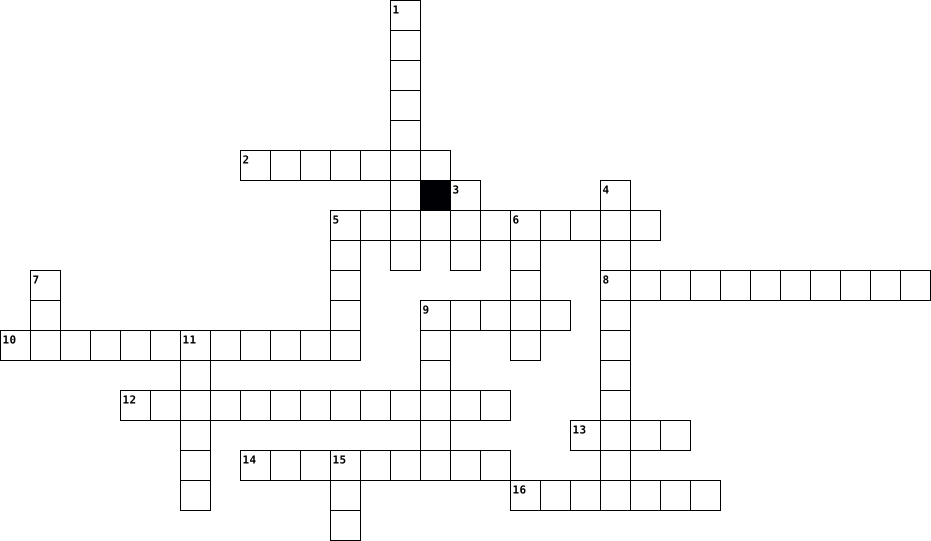
Across
- favorite tv show
- favorite disney character
- favorite color
- favorite childhood toy
- preferred reading
- worst school subject
- favorite shoe brand
- beloved snack
- best school subject
Down
- best past time
- beau
- music lover
- disney princess most like
- favorite store cookie
- how many hubcaps she owns
- favorite sis
- princess form at disney
- new favorite sandwich abbr.
18 Clues: beau • music lover • favorite sis • beloved snack • best past time • favorite color • favorite tv show • preferred reading • favorite shoe brand • best school subject • worst school subject • favorite store cookie • favorite childhood toy • princess form at disney • favorite disney character • disney princess most like • how many hubcaps she owns • new favorite sandwich abbr.
Melodikryss 2025-10-03

Across
- Antagnonist
- Gruppen
- Magiska ordet
- Originalartistens efternamn
- Koppens namn
- TV-serie
Down
- Melloartistens efternamn 2
- Huvudpersonens efternamn
- Melloartistens efternamn 1
- Reklam 1
- Andra ordet i seriens namn
- Reklam 2
12 Clues: Gruppen • Reklam 1 • Reklam 2 • TV-serie • Antagnonist • Koppens namn • Magiska ordet • Huvudpersonens efternamn • Melloartistens efternamn 2 • Melloartistens efternamn 1 • Andra ordet i seriens namn • Originalartistens efternamn
ชื่อวิชาชีววิทยา 2023-03-24

Across
- ศึกษาเกี่ยวกับพฤติกรรมของสัตว์
- การนำชีววิทยา มาประยุกต์ใช้
- ศึกษาเกี่ยวกับหนอนและพยาธิต่าง ๆ(Helminth=หนอน)
- ศึกษาเกี่ยวกับจุลชีพ คือ แบคทีเรีย ไวรัส
- ศึกษาเกี่ยวกับพยาธิ ปรสิตต่าง ๆ
- ศึกษาเกี่ยวกับสัตว์เลี้ยงลูกด้วยนม
- ศึกษาเกี่ยวกับวิวัฒนาการ
- ศึกษาเกี่ยวกับเนื้อเยื่อต่าง ๆ
- ศึกษาเกี่ยวกับการจัดจำพวกของสิ่งมีชีวิต
- ศึกษาเกี่ยวกับเห็ดรา
- ศึกษาเกี่ยวกับเห็บและไร
- ศึกษาเกี่ยวกับโพรโตซัว
- ศึกษาเกี่ยวกับปลา (มีนวิทยา ;Icthyo=ปลา)
- ศึกษาเกี่ยวกับสาหร่าย
Down
- ศึกษาเกี่ยวกับนก
- ศึกษาเกี่ยวกับระบบนิเวศ
- ศึกษาเกี่ยวกับการถ่ายทอดลักษณะทางพันธุกรรม
- ศึกษาเกี่ยวกับไวรัส
- ศึกษาเกี่ยวกับกายวิภาค โครงสร้างต่าง ๆ ของสิ่งมีชีวิต
- ศึกษาเกี่ยวกับตัวอ่อนของสิ่งมีชีวิตและการพัฒนาการ
- ศึกษาเกี่ยวกับสัตว์
- ศึกษาเกี่ยวกับแบคทีเรีย
- ศึกษาเกี่ยวกับหอย
- ศึกษาเกี่ยวกับสารชีวโมเลกุล และกระบวนการ Metabolism
- ศึกษาเกี่ยวกับการทางานของโครงสร้างร่างกายต่างๆ
- ศึกษาเกี่ยวกับเซลล์
- ศึกษาเกี่ยวกับโครงสร้างและสัณฐานของสิ่งมีชีวิต
- ศึกษาเกี่ยวกับซากดึกดาบรรพ์
- ศึกษาเกี่ยวกับแมลง
- ศึกษาเกี่ยวกับพืช
30 Clues: ศึกษาเกี่ยวกับนก • ศึกษาเกี่ยวกับหอย • ศึกษาเกี่ยวกับพืช • ศึกษาเกี่ยวกับแมลง • ศึกษาเกี่ยวกับไวรัส • ศึกษาเกี่ยวกับสัตว์ • ศึกษาเกี่ยวกับเซลล์ • ศึกษาเกี่ยวกับเห็ดรา • ศึกษาเกี่ยวกับสาหร่าย • ศึกษาเกี่ยวกับโพรโตซัว • ศึกษาเกี่ยวกับระบบนิเวศ • ศึกษาเกี่ยวกับแบคทีเรีย • ศึกษาเกี่ยวกับเห็บและไร • ศึกษาเกี่ยวกับวิวัฒนาการ • การนำชีววิทยา มาประยุกต์ใช้ • ศึกษาเกี่ยวกับซากดึกดาบรรพ์ • ...
Premed crossword 2024-04-01
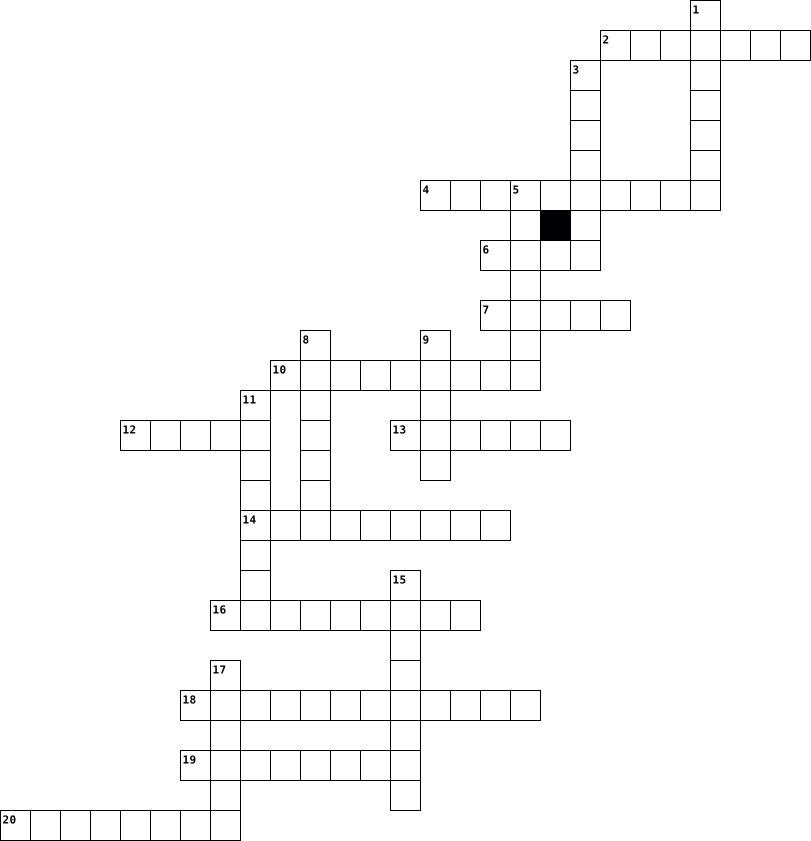
Across
- - Person receiving medical care
- - Body functions
- - Imaging technique
- - Elevated body temperature
- - Study of diseases
- - Needs to pass the NCLEX
- - Medical professional
- - Atomic composition
- - Study of the nervous system
- - Chemical processes in living organisms
- - Microscopic organisms
- - Inherited traits
Down
- - Study of life
- - Body structure
- - Medical operation
- - Immunization
- - Circulatory fluid
- - Treatment for illness
- - Medical facility
- - Set of: Heart rate, blood pressure, SpO2
20 Clues: - Immunization • - Study of life • - Body structure • - Body functions • - Medical facility • - Inherited traits • - Medical operation • - Imaging technique • - Circulatory fluid • - Study of diseases • - Atomic composition • - Medical professional • - Treatment for illness • - Microscopic organisms • - Needs to pass the NCLEX • - Elevated body temperature • - Study of the nervous system • ...
9 2024-09-05

Across
- Viral outbreak
- Monster attack
- Dark fantasy
- Foggy town
- Deadly fog
- Zombie comedy
- Cursed woman
- Japanese curse
- Killer plants
- Home invasion
- Alien parasites
Down
- Haunted house
- Torture tourism
- Outback killer
- Cave horror
- Vampire child
- Alaska vampires
- Cursed tape
- Rage virus
- Spanish ghosts
- Mike Enslin in 1408 movie
- Found footage
- Infected building
- Deadly anatomy
- Deadly traps
25 Clues: Foggy town • Deadly fog • Rage virus • Cave horror • Cursed tape • Dark fantasy • Cursed woman • Deadly traps • Haunted house • Vampire child • Zombie comedy • Found footage • Killer plants • Home invasion • Viral outbreak • Monster attack • Outback killer • Spanish ghosts • Japanese curse • Deadly anatomy • Torture tourism • Alaska vampires • Alien parasites • Infected building • Mike Enslin in 1408 movie
Pioneers in Medicine 2025-09-06

Across
- Anatomy pioneer
- Researched radiation
- Performed first heart transplant
- Father of psychoanalysis
- DNA structure discoverer
- DNA structure discoverer
- Discovered penicillin
- Founder of modern nursing
- Germ theory founder
- Discovered blood circulation
Down
- Introduced antiseptics
- Pathology pioneer
- Hand washing pioneer
- Discovered insulin
- Smallpox vaccine discoverer
- Discovered TB bacteria
- Father of medicine
- Ancient Roman doctor
18 Clues: Anatomy pioneer • Pathology pioneer • Discovered insulin • Father of medicine • Germ theory founder • Hand washing pioneer • Researched radiation • Ancient Roman doctor • Discovered penicillin • Introduced antiseptics • Discovered TB bacteria • Father of psychoanalysis • DNA structure discoverer • DNA structure discoverer • Founder of modern nursing • Smallpox vaccine discoverer • ...
Sammi's Post Birthday Crossword Puzzle 2026-08-04

Across
- Total number of siblings(Father)
- First love
- Sammi's age
- Related to favorite makeup product
- Favorite makeup product
- Recent Trip
- First degree
Down
- Siblings(Mother)
- Dream Job
- Favorite artist
- Concert i regret going to
- Number of degrees
- Last name
- Mother and Stepmother
- First concert
- Recent news about sibling
- First international Trip
17 Clues: Dream Job • Last name • First love • Sammi's age • Recent Trip • First degree • First concert • Favorite artist • Siblings(Mother) • Number of degrees • Mother and Stepmother • Favorite makeup product • First international Trip • Concert i regret going to • Recent news about sibling • Total number of siblings(Father) • Related to favorite makeup product
ANATOMY CROSSWORD 2019-03-12

Across
- / Nerve which supplies the bicep brachii muscle
- / The part of a bone that is covered with articular cartilage is the ________________
- / Number of cervical and lumbar vertebrae combined
- / Flexor of the forearm
- / The sternoclavicular joint is classified as a ________________ joint
- pollicis longus / Tendon which makes up part of the anatomical snuff box
- / A capsular ligament of the hip
- / Where is the sole line?
- / Acromioclavicular joint is classified as what type of joint
- / What canals transmit blood vessels to osteons deep inside the bone
- / Ligament connecting adjacent vertebra spinous processes
- Major / The insertion of this muscle is the lesser trochanter of the femur
- / What is the function of the rhomboid major?
- anterior / Which muscle protracts the scapula?
- medius / Which muscle originates on the external surface of the ilium between the anterior and posterior gluteal lines and inserts on the lateral surface of the greater trochanter?
- / The 11th and 12th ribs are known as?
- / The annular ligament surrounds the head of this bone
- / Gastrocnemius plantarflexes the foot and also ________________ the knee
Down
- / The origin of this muscle is the coracoid process
- / A muscle that crosses two joints
- / Muscle which opposes the prime mover
- Longus / The insertion of this muscle is the base of the 1st metatarsal and medial cuneiform
- The head of the femur articulates with what?
- / What muscle medially rotates the shoulder
- rotation / How can you identify the Greater Trochanter?
- / Which muscle runs through the greater sciatic foramen?
- / The gluteus maximus and ________________ muscle share an insertion, but have opposing actions
- / Immature cartilage cells are called
- / The sustentaculum tali is an attachment point of which ligament
- / Most commonly injured ligament of the ankle
- / Which muscle is described here: Origin- posterior surface of proximal tibia & Insertion- lateral femoral condyle
- / The bilateral upper fibres of trapezius do what to the head/neck
- oblique / Which muscle is described here: Origin – lower eight rib; Insertion – anterior part of iliac crest, abdominal aponeurosis to linea alba
- spinae / Which spinal muscle is made up of Iliocostalis, Longissimus and Spinalis components?
- Dorsi / Originates on T7 – L5 sacrum and iliac crest
- / The zona orbicularis are joint capsule fibres of which joint?
- / Cell type responsible for breaking down bone matrix
- plate / Bones grow in length here
- / The irregular folds of synovial membrane found in the knee joint are known as ________________
- abdominus / Which muscle originates on the crest of the pubis and Pubis Symphysis and inserts onto the Xiphoid process and 5th/6th and 7th ribs
- / Ligamentum Nuchae is specific to which area of the spine?
- / The patella is this type of bone
- The number of carpal bones in the hand
- / You would find this bony feature on a vertebrae
- / Muscle which aids in ulnar deviation of the wrist
- tubercle / You would find this bony feature on the clavicle
46 Clues: / Flexor of the forearm • / Where is the sole line? • / A capsular ligament of the hip • / A muscle that crosses two joints • plate / Bones grow in length here • / The patella is this type of bone • / Immature cartilage cells are called • The number of carpal bones in the hand • / Muscle which opposes the prime mover • / The 11th and 12th ribs are known as? • ...
Anatomy cruci 2019-03-14

Across
- Numero dei tessuti umani
- Controlla il tessuto muscolare liscio
- Accentuazione della curvatura fisiologica lombare
- Introflessione dell'epidermide
- Arteria con sangue privo di ossigeno
- Ossa del cranio
- Producono nuovo tessuto osseo
- Rotula
- Canale in cui passa il midollo
- Prodotti dalle ghiandole endocrine
- Presenta osso spugnoso
- Contenuti nei canali di Havers
- Molti nelle cellule muscolari
Down
- Articolazioni mobili
- Organo dell'apparato scheletrico
- Divide il tessuto epitelio dal connettivo
- Porzione terminale dello sterno
- Tessuto connettivo liquido
- Epitelio con cellule di diversa altezza
- Parte liquida del sangue
- Parte secernente della ghiandola
- Perone
- Privi di nucleo
- Posseggono movimenti ameboidi
- Membrana che riveste esternamente l'osso
- Ricevono l'impulso nervoso
- Numero delle stazioni linfatiche
27 Clues: Perone • Rotula • Ossa del cranio • Privi di nucleo • Articolazioni mobili • Presenta osso spugnoso • Numero dei tessuti umani • Parte liquida del sangue • Tessuto connettivo liquido • Ricevono l'impulso nervoso • Producono nuovo tessuto osseo • Posseggono movimenti ameboidi • Molti nelle cellule muscolari • Introflessione dell'epidermide • Canale in cui passa il midollo • ...
Anatomy Introduction 2022-01-23

Across
- tail bone
- meat of trunk/groin
- shoulder blade
- heal
- check
- process inside a human cell in which DNA makes a copy of itself
- chin
- another term similar to anterior for humans
- bottom of foot
- monomer of sugar
- term for the backside or “back” in the anatomical position
- thigh
- arm
Down
- head
- back of knee
- point of shoulder
- the skin is _________________ to the skeletal bones.
- muscle tissue that is voluntary
- cell part that makes energy
- shin
- a type of a protein
- anterior elbow
- thigh
- calf
- ankles
25 Clues: arm • head • heal • shin • chin • calf • check • thigh • thigh • ankles • tail bone • back of knee • shoulder blade • bottom of foot • anterior elbow • monomer of sugar • point of shoulder • meat of trunk/groin • a type of a protein • cell part that makes energy • muscle tissue that is voluntary • another term similar to anterior for humans • the skin is _________________ to the skeletal bones. • ...
Anatomy puzzles 2020-05-25

Across
- Largest carpal bone
- Strongest bone
- Larget tarsal bone
- Bone formed by fusion of 5 vertebra
- Part of sternum which possess suprasternalnotch
- Cervical vertebra with longest spinous process
- 1st cervical vertebra
- Bone which possess anterior oblique line
- Tuberocity is present on this part of hip bone
- Bone which resembles short sword
- The part of humerus where ulna articulates
- Upper border of hip bone
- Half moon Shaped Carpal bone
- Sacropelvic surface is present on this part of hip bone
Down
- A cavity where femur articulates
- Bone which possess anatomical neck
- Bone with tubercal & angle
- Bone which have head at its lower end
- Vertera with odontoid process
- Homologus bone of lower extrimity to ulna
- Boat shaped carpal bone
- Prismoid bone
- 1st bone in the body to ossify
- Bone which gives origin to biceps brachii muscle
- Longest & strongest bone
25 Clues: Prismoid bone • Strongest bone • Larget tarsal bone • Largest carpal bone • 1st cervical vertebra • Boat shaped carpal bone • Longest & strongest bone • Upper border of hip bone • Bone with tubercal & angle • Half moon Shaped Carpal bone • Vertera with odontoid process • 1st bone in the body to ossify • A cavity where femur articulates • Bone which resembles short sword • ...
Anatomy & Physiology 2020-09-03

Across
- study of structure of organisms and its parts
- study of function of living organisms and its parts
- produces bile,detoxifies drugs and alcohol
- inflammation of inner lining of uterus
- example of unicellular organism
- inflammation of stomach
- building blocks of life
- inflammation of urinary bladder
- small body in the cell concerned with protein synthesis
- liquid connective tissue
- exchange of gases happens here
- heart of the cell
- chromosomes are made of this chemical
Down
- gel like substance within a living cell
- infection/inflammation of lungs
- produces insulin and digestive enzymes
- complex molecules broken down to simple molecules with release of energy
- removes waste and helps control BP
- inflammation of the uterus
- how many valves in the heart
- membrane covering the heart
- produces hydrochloric acid
- power house of cell
- upper chamber of heart
- part of the body that helps in synthesis of vitamin d
- voice box
26 Clues: voice box • heart of the cell • power house of cell • upper chamber of heart • inflammation of stomach • building blocks of life • liquid connective tissue • inflammation of the uterus • produces hydrochloric acid • membrane covering the heart • how many valves in the heart • exchange of gases happens here • infection/inflammation of lungs • example of unicellular organism • ...
Anatomy & Physiology 2020-06-07

Across
- retinopathy, damage to the retina in diabetic patients from hemorrhage of vessels
- cell that forms bone tissue
- gland, one of 4 pea-shaped glands located or embedded in the thyroid that secrete parathyroid hormone, increasing blood levels of calcium
- pear-shaped sac located on the inferior surface of the liver; stores bile to aid in digestion and fat absorption
- involuntary discharge of urine
- the phase of metabolism in which cells are broken down
- bands of fibrous connective tissue connecting the articulating ends of bones to facilitate or limit movement
- air sacs at the ends of the bronchioles where the gas exchange occurs
- the upper portion of the large intestine; contains the appendix
- ringing in the ear
- first 30 days after birth
Down
- inferior portion of hip bones supporting the body weight when sitting
- node located in the upper wall of the atrium; pacemaker of the heart
- uncontrollable episodes of falling asleep; also known as sleep epilepsy
- a form of chronic obstructive pulmonary disease that blocks respiration
- phase of metabolism in which cells are built or repaired
- hardening of the arteries and loss of elasticity resulting from thickening of the vessel wall
- first female menses; usually occurs between 9 and 15 years of age
- nervosa, eating disorder characterized by binge eating and purging
- inflammation and pain, usually of the great toes or thumbs, caused by accumulation of uric acid crystals
20 Clues: ringing in the ear • first 30 days after birth • cell that forms bone tissue • involuntary discharge of urine • the phase of metabolism in which cells are broken down • phase of metabolism in which cells are built or repaired • the upper portion of the large intestine; contains the appendix • first female menses; usually occurs between 9 and 15 years of age • ...
anatomy vocabulary 2021-12-03

Across
- organelle used in protein synthesis, needed for translation
- “carriers” of rna that produces amino acids, brings needed amino acid to ribosome based on mRNA sequence
- strand DNA strand containing DNA triplets that specify amino acid order
- provide genetic information, x shaped distinct structures that coil during cell division, specifically prophase
- product of transcription, used to produce copies of genetic information that leave the nucleus and transfer to cytoplasm
- binds to codon, contains three bases
- part of the chromosome spindles attach to during mitosis
- activation the process by which a DNA molecule is uncoiled and histones are removed temporarily, at a specific gene
- regions that are eliminate when RNA processing occurs, does not contain code
- creates and stores proteins instructions, controls the order of amino acids, double helix
- damaged genes that alter genetic code, damaging nucleotide sequence
Down
- the process by which amino acids are formed, aka polypeptides, through the use of mRNA created by transcription
- strand DNA strand used as a model for the creation of mRNA, contains complementary triplets
- the protein that makes, x up the nuclei
- a specific location on chromosome, basic unit of heredity, contains DNA triplets
- messenger to cells, control segment located at the beginning of gene
- code the chemical instruction in DNA and RNA that determines amino acid sequence
- created through the loose coiling of nucleosomes, tangle of filaments
- polymerase an enzyme in which bonds to a protomer
- synthesis occurs in cytoplasm, the creation of amino acid chains (polypeptide)
- comprised of three bases, used for mRNA sequencing
- opposite of intron, contains code for proteins, spliced together as RNA processing takes place
- the process by which mRNA is produced from a template strand of DNA
23 Clues: binds to codon, contains three bases • the protein that makes, x up the nuclei • polymerase an enzyme in which bonds to a protomer • comprised of three bases, used for mRNA sequencing • part of the chromosome spindles attach to during mitosis • organelle used in protein synthesis, needed for translation • ...
Poultry Anatomy 2022-02-10

Across
- 42 bones
- only 1 bone
- bacterial activity, water absorption, and waste storage
- Bones No shafts: spongey bone with layers of compact bone.
- complex sugar molecule, broken down into glucose
- produced by the liver and breaks down ingested fats
- muscle responsible for voluntary movement and body shape. Attached to bones by tendons.
- Tibia and Fibula
- flight muscles, short bursts of movement, less myoglobin, fewer blood vessels, less fat, and less color
- simple sugar that is a main source of energy
- fatty or waxy organic compound involved in energy storage (e.g., cholesterol)
- common chamber for GI and urinary tracts
- Bones i.e. vertebrae.
- Connects from Duodenal Loop to Ileum. Receives bile from Liver or Gall Bladder to break down fats
- vertebrae that are fused to add support for wing movement
- common exit for GI and urinary tracts
- extends from the Ventriculus “Gizzard” to the Jejunum Enzymes convert digested food into amino acid and glucose
- a pair of bones that aid in wing movement and supplies additional support of the shoulder joint
Down
- iron- and oxygen-binding protein found in muscle tissue
- tube from mouth to stomach that is open at the mouth end
- Bones i.e. arm and leg bones.
- comprised of 23 bones
- muscles that form blood vessels, gizzard, intestines, organs, reproductive tract.
- muscular stomach; mechanical breakdown
- tarsoMetatarsus and phalanges
- glandular stomach (HCI and gastric juices); enzymatic
- vertebrae forms an “S” shape, which are designed to minimize landing impact stresses on the head
- specialized heart muscle
- Bones. They do not have a shaft, and do not increase dramatically in size
- Connects to Jejunum to the Large Intestine. Digestion ends here and end products (amino acids and fats) are absorbed for use by the blood stream
- The waste product of protein metabolism in other domestic livestock.
- Intestine enzymatic digestion and absorption
- Very similar to the human arm
- leg muscles, longer usage, more continuous usage, more myoglobin, more blood vessels, more fat, and more color
- feed storage and moistening
- The waste product of protein metabolism in the chicken
- 14 individual (or 7 pairs)
- gather and bread down food
- this bone is an important source of calcium when hens are laying eggs
- broken down into amino acids to be used as building blocks for the body
- Specialized protein that disassemble or assemble organic materials and are water soluble (dissolve in water)
- essentially non-functioning in monogastrics
42 Clues: 42 bones • only 1 bone • Tibia and Fibula • comprised of 23 bones • Bones i.e. vertebrae. • specialized heart muscle • 14 individual (or 7 pairs) • gather and bread down food • feed storage and moistening • Bones i.e. arm and leg bones. • tarsoMetatarsus and phalanges • Very similar to the human arm • common exit for GI and urinary tracts • muscular stomach; mechanical breakdown • ...