
plate tectonics Crossword Puzzles
Plate Tectonics 2017-10-17

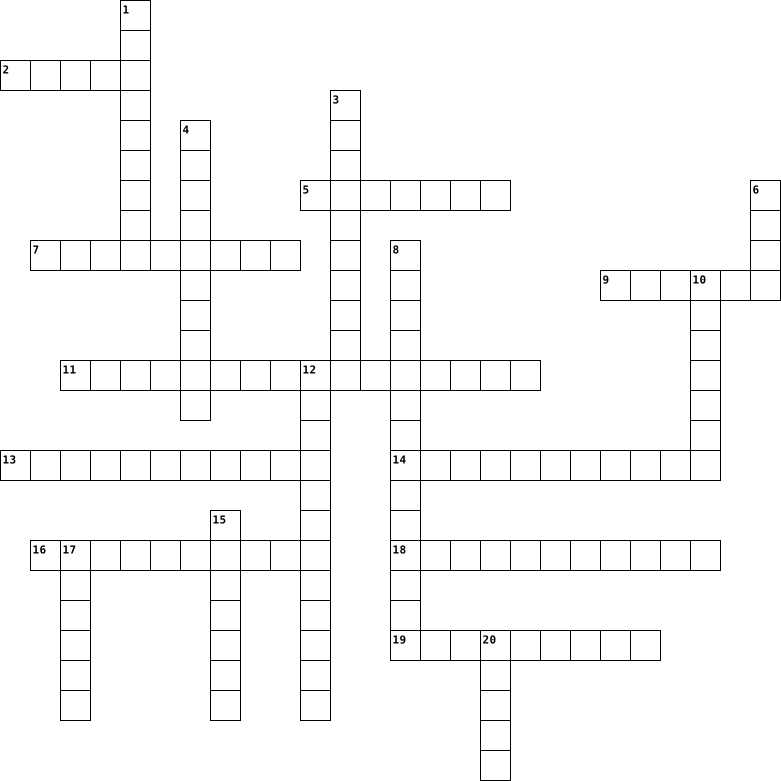
Across
- How scientists study the inside of Earth since we can’t drill down that far
- When plates move away from each other
- When oceanic crust sinks beneath a deep-ocean trench and back into the mantle
- Measure of how much mass there is in an object
- When plates come together
- A break in Earth’s crust where rocks slipped past each other
- When molten material is added to make new oceanic crust
- Theory of how the continents spread away from each other
- The theory that Earth’s plates are in a slow, constant motion
- The remains of a prehistoric organism
Down
- Scientist that came up with the theory of continental drift
- What scientists use to explore the ocean floor
- Valley along the ocean floor where oceanic crust sinks into the mantle
- Where seafloor spreading begins
- When pieces of Earth’s crust diverges on land
- When plates slip past each other
- Causes the plates to move
- 3rd layer of Earth that is very hot, yet solid where convection currents are
- Supercontinent that existed around 300 million years ago
- Produced when 2 continental plates collide
20 Clues: When plates come together • Causes the plates to move • Where seafloor spreading begins • When plates slip past each other • When plates move away from each other • The remains of a prehistoric organism • Produced when 2 continental plates collide • When pieces of Earth’s crust diverges on land • What scientists use to explore the ocean floor • ...
Plate Tectonics 2017-10-17

Across
- Earths deepest layer
- A type of heat transfer
- The ability to do work
- Earth's outer skin
- Forces that build up land
- Forces that break down land
- process where the ocean floor goes back into the mantle
- Plates slide past each other
- An ancient organism that's been preserved in rock
- Process that continuously adds new material to the ocean floor
- Super continent that Alfred Wegener named 250 million years ago
- Where pieces of of Earth’s crust diverge on land
Down
- Where the ocean floor goes back into the mantle
- Top layer of the mantle
- Tectonic Plates split apart
- Idea that continents slowly moved across Earth’s surface
- Happen when earthquakes occur
- Plates collide
- Underwater Mountain ranges
- Earth’s second layer
- What’s produced from a transform boundary
21 Clues: Plates collide • Earth's outer skin • Earths deepest layer • Earth’s second layer • The ability to do work • Top layer of the mantle • A type of heat transfer • Forces that build up land • Underwater Mountain ranges • Tectonic Plates split apart • Forces that break down land • Plates slide past each other • Happen when earthquakes occur • What’s produced from a transform boundary • ...
Plate Tectonics 2017-10-17

Across
- The crust is ________ dense farther from the mid- ocean ridge.
- What landform is made when two continental plates collide?
- ________ theorized the continents moved.
- These are created when magma cools immediately once erupted from the ridge.
- The ocean floor is brand new every 200 _____ years.
- Subduction and seafloor spreading act like a ______.
- This boundary divides.
- The supercontinent that formed about 200 million years ago.
- This boundary slides.
- ______ dense materials rise.
Down
- Stitched looking mountain ranges on the seafloor.
- Movement in a gas or liquid in which the warmer parts move up and the cooler parts move down.
- What did scientists use to map out the sea floor?
- The remains or impression of a prehistoric organism preserved in petrified form or as a mold or cast in rock.
- Where does oceanic crust bend downward in the ocean floor?
- A break in the Earth's crust.
- This part of the Earth contains our crust and the upper part of the mantle.
- Energy caused by the sudden breaking of rock within the earth or an explosion.
- Changes in what affect the ocean floor?
- The _______ has convection currents which cause continental drift.
20 Clues: This boundary slides. • This boundary divides. • ______ dense materials rise. • A break in the Earth's crust. • Changes in what affect the ocean floor? • ________ theorized the continents moved. • Stitched looking mountain ranges on the seafloor. • What did scientists use to map out the sea floor? • The ocean floor is brand new every 200 _____ years. • ...
Plate Tectonics 2017-11-22

Across
- ridge an undersea mountain chain where new ocean floor is produced (usually at a divergent boundary)
- current the movement of fluid, caused by differences in temperature, that transfers heat from one part of the fluid to another
- the transfer of heat within a material or between materials that are touching
- the name of the single land mass that broke apart and gave rise to today's continents
- boundary a plate boundary where two plates move away from each other
- Weak, partially melted layer composed of semi-molten rocks
- trench a deep valley along the ocean floor beneath which oceanic crust slowly sinks toward the mantle
- tectonics the theory that pieces of Earth's lithosphere are in constant motion, driven by convection currents in the mantle
- valley a deep valley where two plates move apart
- the transfer of heat by movement of fluid
Down
- core a dense sphere of solid iron (Fe) and nickel(Ni) at the center of the Earth
- A rigid layer made up of the uppermost part of the mantle and the crust.
- boundary a plate boundary where two plates move toward each other
- the layer of hot, solid material between Earth's crust and core.
- drift the hypothesis that the continents slowly move across Earth's surface
- a trace of an ancient organism that has been preserved in rock
- the transfer of energy through space
- the process by which molten materials add new oceanic crust to the ocean floor
- the layer of rock that forms Earth's outer surface.
- core a layer of molten iron (Fe) and nickel (Ni) that surrounds the inner solid core of the Earth
20 Clues: the transfer of energy through space • the transfer of heat by movement of fluid • valley a deep valley where two plates move apart • the layer of rock that forms Earth's outer surface. • Weak, partially melted layer composed of semi-molten rocks • a trace of an ancient organism that has been preserved in rock • ...
Plate Tectonics 2017-10-23

Across
- The uppermost layer in the Earth.
- Breaks in Earth's crust where rocks have slipped past each other.
- Two plates that slide past each other.
- A process where mid-ocean ridges add new material to the ocean floor.
- A theory that said the continents move.
- A German Scientist that had the theory of Continental Drift
- A device that uses sound waves to explore places far away.
- Evidence Evidence used to support the theory of Continental Drift
- A process where oceanic crust is pulled back into the mantle.
- A opening where oceanic crust sinks back into the mantle.
- A ridge in the ocean that releases molten rock from the mantle.
- A land form that forms when two convergent boundaries hit each other.
Down
- A famous volcano responsible for Pompeii.
- A super continent formed 240 million years ago.
- Two plates that move towards each other.
- A layer in the Earth that has molten rock.
- Two plates that move away from each other.
- The crust in the ocean
- A deep valley caused by diverging plates.
- Cracks in the Earth that move caused by convection currents.
20 Clues: The crust in the ocean • The uppermost layer in the Earth. • Two plates that slide past each other. • A theory that said the continents move. • Two plates that move towards each other. • A famous volcano responsible for Pompeii. • A deep valley caused by diverging plates. • A layer in the Earth that has molten rock. • Two plates that move away from each other. • ...
Plate Tectonics 2017-10-23

Across
- plates that rub against each other
- A former supercontinent on the Earth in the distant past a large landmass
- Wegener- the person that came up with the theory of Continental Drift
- drift- Continents slowly move on Earth's surface
- ocean ridge-a deep valley along the ocean floor beneath which oceanic crust slowly sinks toward the oceanic mantle.
- soft layer of the mantle on which the lithosphere floats
- core-the liquid layer of the Earth's core that lies beneath the Mantle and surrounds the inner Core
- valley-A deep valley that forms where two plates move apart.
- an ancient organisms that has been preserved in rock
Down
- - plates collide together to make mountains
- ocean ridge-an undersea mountain chain where new ocean floor is produced at a divergent plate boundary.
- middle of the ocean contribute to seafloor spreading
- the layer of the earth between the crust and the core
- solid part of the earth consisting of the crust and outer mantle
- tectonics-a section of the lithosphere that slowly moves over the asthenosphere, carrying pieces of continental and oceanic crust.
- core-a dense sphere of solid iron and nickel at the center of Earth
- the process by which oceanic crust sinks beneath a deep-ocean trench and back into the mantle at a convergent plate boundary.
- floor spreading- the process by which molten material adds new oceanic crust to the ocean floor.
- the outer layer of the Earth
- Fractures in rock
20 Clues: Fractures in rock • the outer layer of the Earth • plates that rub against each other • - plates collide together to make mountains • drift- Continents slowly move on Earth's surface • middle of the ocean contribute to seafloor spreading • an ancient organisms that has been preserved in rock • the layer of the earth between the crust and the core • ...
plate tectonics 2017-10-20

Across
- boundaries- What boundaries is where two plates slip past each other,moving past each other?
- is any trace of any trace of an ancient organism that has been preserved in rock.
- ocean ridge-When does sea floor spreading begin?
- drift-Wegener's idea that continents slowly moved over Earth's surface became known as?
- its when wegener made a what about the continents were once joined together in a single landmass and have since drifted apart?
- supercontinent,or single landmass,about 300 million years ago.
- thing did wegener infer lived on a single landmass
- oceans- what ocean is expanding?
- boundaries- what boundaries is two plates that move slowly away from each other?
- floor spreading-what adds more crust to the ocean floor?
Down
- boundaries-What boundaries is where two plates collide?
- the process by which the ocean floor sinks beneath a deep ocean trench and back into a mantle is called?
- was the name of the scientist?
- these pieces became the what?
- As the plates move what do they do?
- did scientist mapped mid ocean ridges using?
- floor- part of what sinks back into the mantle at deep ocean trench?
- and shape-the processes of subduction and sea floor spreading can change what?
- valley-where peices of Earth's crust diverge on land,a deep valley called a ?
- ocean trench-At what trench does the oceanic crust bend downward?
20 Clues: these pieces became the what? • was the name of the scientist? • oceans- what ocean is expanding? • As the plates move what do they do? • did scientist mapped mid ocean ridges using? • ocean ridge-When does sea floor spreading begin? • thing did wegener infer lived on a single landmass • boundaries-What boundaries is where two plates collide? • ...
Plate Tectonics 2017-03-19

Across
- a steep-sided mount that forms when lava is extruded viciously
- activity having to do with earthquakes
- the opening of a volcano
- point on the earth's surface directly above hypocenter
- a weak point in earth's crust
- the place where two or more plates meet
- one or a series of huge waves caused by an earthquake
- one of the sections that makes up earth's crust
- smoke over a volcano
- an area in the middle lithosphere
Down
- a primary wave that travels through the interior of the earth and is usually the first wave to be recorded
- seismic wave that travels through the earth
- thin layer of earth's surface
- magna once it has erupted
- erupting mountain
- shaking caused by sudden movement of plates
- innermost layer of earth
- layer of rock that lies between the crust and the outer layer
- an earthquake that follows a larger earthquake
- a movement of ash-sized particles
20 Clues: erupting mountain • smoke over a volcano • innermost layer of earth • the opening of a volcano • magna once it has erupted • thin layer of earth's surface • a weak point in earth's crust • a movement of ash-sized particles • an area in the middle lithosphere • activity having to do with earthquakes • the place where two or more plates meet • ...
Plate Tectonics 2017-07-23

Across
- focus of an earthquake
- molten rocks
- vibration of earth
- no significant movement
- underwater earthquake
- mountains formed in part
- concentration of heat
- a seismic wave that travels across the surface of the earth
- thin part of the earth’s crust
- plates that move toward each other
- one plate moves under another
- depression in the seafloor
- studies earth
- outer portion of the earth
- the rigid outer part of the earth
Down
- continuous mass
- fault are exactly the opposite of normal fault
- plates that moving apart each other
- the first type of seismic wave
- tectonics moving lithospheric plate
- chain of volcanoes
- rigid sections
- plates that slide past each other
- a line of mountains connected by high ground
- record earthquake wave
- movement has occurred
- thick part of the earth’s crust
- second type of earthquake wave
- record made
- consolidated mixture of minerals
30 Clues: record made • molten rocks • studies earth • rigid sections • continuous mass • vibration of earth • chain of volcanoes • underwater earthquake • concentration of heat • movement has occurred • focus of an earthquake • record earthquake wave • no significant movement • mountains formed in part • depression in the seafloor • outer portion of the earth • one plate moves under another • ...
Plate Tectonics 2017-07-23

Across
- thick part of the earth’s crust
- a seismic wave that travels across the surface of the earth
- movement has occurred
- continuous mass
- the rigid outer part of the earth
- mountains formed in part
- record earthquake wave
- tectonics moving lithospheric plate
- rigid sections
- plates that slide past each other
- the first type of seismic wave
- plates that moving apart each other
- second type of earthquake wave
- molten rocks
- outer portion of the earth
- no significant movement
- record made
Down
- concentration of heat
- underwater earthquake
- a line of mountains connected by high ground
- focus of an earthquake
- thin part of the earth’s crust
- vibration of earth
- depression in the seafloor
- plates that move toward each other
- chain of volcanoes
- studies earth
- one plate moves under another
- fault are exactly the opposite of normal fault
- consolidated mixture of minerals
30 Clues: record made • molten rocks • studies earth • rigid sections • continuous mass • vibration of earth • chain of volcanoes • concentration of heat • underwater earthquake • movement has occurred • focus of an earthquake • record earthquake wave • no significant movement • mountains formed in part • depression in the seafloor • outer portion of the earth • one plate moves under another • ...
Plate Tectonics 2018-02-14

Across
- hardened pieces of lava
- this occurs when rock layers bend under stress
- type of fault common along convergent boundaries
- materials that are made of hot ash and bits of rock
- any place where gas, ash, or melted rock come out of the ground
- the Appalachian Mountains are this kind of mountain
- type of stress that squeezes or pushes rock together
- type of boundary in which two plates move past each other horizontally
- type of volcano with a broad base and gently sloping sides
- type of stress that stretches or pulls rock apart
- directly above the focus on Earth’s surface
- the single large landmass that existed before the continents moved to their present-day location
- the outermost, rigid layer of Earth; divided up into pieces called tectonic plates
- a place within Earth along a fault at which the first motion of an earthquake occurs
- seafloor spreading takes place at mid-ocean ______________
- type of volcano that has alternating layers of hardened lava flows and pyroclastic material
- the crack that forms when large blocks of rock break and move past each other
- opening of a volcano
Down
- large basin-shaped depression that forms due to a collapsed magma chamber
- movement of material due to differences in density
- this national park has a hot spot on land
- region of hot, slow-flowing, solid rock; located between the core and the crust
- the process in which the shaking of an earthquake turns soft soil into liquid mud
- a series of long waves that can travel outward in all directions from the point where an earthquake occurred
- __________ eruptions happen when lava flows from giant cracks in Earth’s surface
- magma that has reached Earth’s surface
- the process by which rocks change shape when under stress
- in the late 1800, he proposed the hypothesis of continental drift
- substance found in magma that determines the force of an eruption
- _________ rebound is the return of rock to its original shape after elastic deformation
- the outermost solid layer of Earth
- type of stress that pushes rocks in parallel but opposite directions
- melted rock
33 Clues: melted rock • opening of a volcano • hardened pieces of lava • the outermost solid layer of Earth • magma that has reached Earth’s surface • this national park has a hot spot on land • directly above the focus on Earth’s surface • this occurs when rock layers bend under stress • type of fault common along convergent boundaries • ...
Plate Tectonics 2017-12-19

Across
- The Earth’s lithosphere is broken up into many _____________ plates.
- This is the thickest layer of the Earth.
- Rock formed from cooling magma.
- An tremor that causes the earth to shake.
- The area where two plates collide and one goes beneath the other and is destroyed.
- These are mainly formed at transform boundaries.
- This is the thinnest layer of the Earth.
- The first hundred kilometers of the Earth is called ______.
- These boundaries can cause subduction zones.
- Spews ash and magma.
Down
- Two plates moving apart makes a ______ boundary.
- Rock formed from Cementation and Compaction
- The ______ is the less dense plate.
- The center of the Earth.
- When two tectonic _______ collide they can cause earthquakes.
- Rock formed from heat and pressure.
- Earthquakes and faults are mainly made at this boundary.
- The _____ plate is denser than the continental plates.
- A formation where two plates fold and go up.
- Melted rock above ground.
20 Clues: Spews ash and magma. • The center of the Earth. • Melted rock above ground. • Rock formed from cooling magma. • The ______ is the less dense plate. • Rock formed from heat and pressure. • This is the thickest layer of the Earth. • This is the thinnest layer of the Earth. • An tremor that causes the earth to shake. • Rock formed from Cementation and Compaction • ...
Plate Tectonics 2018-01-17

Across
- The center of the earth
- Currents that transfer heat from one place to another
- A region where one tectonic plate dives under another
- An elastic wave produced by an earthquake
- Volcanic regions that are underlined by hot mantle
- Part of the earth between the core and the crust
- The upper layer of the earth's mantle
- Boundary where two plates move away from each other
- A tectonic boundary where two plates are moving towards each other
- Hot liquid in the earth's crust
Down
- The outer layer of the earth
- Movement of the continents across the earth
- The two sub-layers of the earth's crust
- _________ can be divergent,convergent, and transform
- The outer most shell that contains the crust
- A violet shaking of the ground
- An instrument that measures and records earthquakes
- Where plates slide sideways past each other
- A former supercontinent
- A crack in the earth's crust
20 Clues: The center of the earth • A former supercontinent • The outer layer of the earth • A crack in the earth's crust • A violet shaking of the ground • Hot liquid in the earth's crust • The upper layer of the earth's mantle • The two sub-layers of the earth's crust • An elastic wave produced by an earthquake • Movement of the continents across the earth • ...
Plate Tectonics 2018-02-26

Across
- Outermost layer of the earth
- The rigid, outermost shell of earth
- The upper layer of the earths mantle
- Type of excavation or depression in the ground
- The central, spherical part of the earth below the mantle
- Plates are moving away from one another
- Movement in a gas or liquid in which the warmer parts move up and the cooler parts move down
- A long, high sea wave
- Supercontinent
- The amount of force per unit of area that is put on a given material
- An extended break in a body of rock
Down
- A sudden and violent shaking of the ground
- A squeezing force
- A mountain or hill, typically conical, having a crater or vent
- Plates that are moving toward one another
- Sideways and downward movement of a plate beneath another plate
- Drift Theory that all of earths continents were once joined together into a single landmass
- Formulated the first complete statement of the continental drift hypothesis
- Plates are sliding past one another
- Layer between the crust and the core
20 Clues: Supercontinent • A squeezing force • A long, high sea wave • Outermost layer of the earth • The rigid, outermost shell of earth • Plates are sliding past one another • An extended break in a body of rock • The upper layer of the earths mantle • Layer between the crust and the core • Plates are moving away from one another • Plates that are moving toward one another • ...
PLATE TECTONICS 2013-01-15

Across
- A SUDDEN RELEASE OF ENERGY IN THE EARTH'S CRUST THAT CREATES SEISMIC WAVES.
- WHERE TWO CONTINENTS COLLIDE.
- WHERE TWO PLATES SLIDE PAST EACH OTHER IN A SIDEWAYS MOTION.
- WHAT MAKES UP 2/3S OF THE WORLD.
- A PLACE WHERE ON PLATE WITH LARGER MASS DIVES BENEATH ANOTHER WITH LESS MASS.
- A LARGE LAND FORM THAT IS MADE WHEN TWO PLATE COLLIDE AND THE LAND IS FORCED UPWARD.
- THE THOERY WHERE ALL THE CONTINENTS CREATED ONE BIG SUPER CONTINENT.
- THE RIGID OUTER MOST SHELL OF THE EARTH.
Down
- THE TRANSFER OF HEAT BY THE ACTUAL MOVEMENT OF THE HEATED MATERIAL.
- THE MECHANICALLY WEAK AND DUCTILELY-DEFORMING REGION OF THE UPPER MANTLE.
- THE TOP LAYER OF THE EARTHS CRUST.
- A THIN LAYER OF ROCK THAT SITS IN THE MANTLE.
- AN UNDERWATER MOUNTAIN SYSTEM.
- A PLANAR FRACTURE OR DICONTINUITY IN A VOLUME OF ROCK.
- AN OPENING OR RUPTURE IN A PLANETS SURFACE OR CRUST.
- WHERE TWO PLATES ARE MOVING AWAY FROM EACH OTHER.
- WHERE TWO PLATES COME TOGETHER.
- A TYPE OF EXCAVATION OR DEPRESSION IN THE GROUND CAUSED BY PLATES MOVING APART.
- VERY LARGE LLAND MASSES ON EARTH
- A PLACE WHERE OCEANIC CRUST IS MADE BY VOLCANIC ACTIVITY.
20 Clues: WHERE TWO CONTINENTS COLLIDE. • AN UNDERWATER MOUNTAIN SYSTEM. • WHERE TWO PLATES COME TOGETHER. • VERY LARGE LLAND MASSES ON EARTH • WHAT MAKES UP 2/3S OF THE WORLD. • THE TOP LAYER OF THE EARTHS CRUST. • THE RIGID OUTER MOST SHELL OF THE EARTH. • A THIN LAYER OF ROCK THAT SITS IN THE MANTLE. • WHERE TWO PLATES ARE MOVING AWAY FROM EACH OTHER. • ...
Plate Tectonics 2013-01-09

Across
- What is the innermost layer of the earth?
- The mesosphere underlies what?
- What is the study of the plates on earths surface and their movement called?(2 words)
- What do tectonic plates float on?
- What is it called when one plate is pushed under another plate?
- What lies directly beneath the crust?
- What are the silicate liquids beneath the earths surface?
Down
- The outer core is ______ dense than the mantle.
- How thick on average is oceanic crust (in km)?
- What causes magma to curculate in the mantle?(2 words)
- What is a common rock found in oceanic crust?
- The inner core is composed of _____ and ______.(2 words)
- What kind of clouds comes out of the top of a volcano with the lava?
- Who first proposed the theory of continential drift?
- What kind of natural disaster is produced whe to plates rub against eachother?
- The continential crust is _______ than oceanic crust.
- What is the outermost layer of the earth?
- The San Andreas fault is a _______ boundary.
- What is the super continent formed millions of years ago?
- The silicate liquids that have flowed out of the earths crust?
20 Clues: The mesosphere underlies what? • What do tectonic plates float on? • What lies directly beneath the crust? • What is the innermost layer of the earth? • What is the outermost layer of the earth? • The San Andreas fault is a _______ boundary. • What is a common rock found in oceanic crust? • How thick on average is oceanic crust (in km)? • ...
PLATE TECTONICS 2013-01-10
Across
- a break in a body of rock along which one block slides relative to another
- the bending of rock layers due to stress
- the solid, dense center of the Earth
- the layer of rock between the Earth's crust and core
- when Earth's magnetic pole changes places
- the solid outer layer of the Earth that consists of the crust and rigid upper part of the mantle
- stress that occurs when forces act to squeeze an object
- the sinking of regions of the Earth’s crust to lower elevations
- when rocks are pulled apart because of tension
- downward, trough-like folds of rock layers
Down
- the liquid layer of the Earth's core that lies beneath the mantle and surrounds the inner core
- the strong lower part of the mantle between the asthenosphere and the outer core
- upward-arching folds of rock layers
- the central part of the Earth below the mantle
- the theory that explains how large pieces of the Earth's outermost layer move and change shape
- stress that occurs when forces act to stretch an object
- when rocks are pushed together by compression
- a process in which areas rise without deforming
- the rising of regions of the Earth's crust to higher elevations
- the thin and solid outermost layer of the Earth above the mantle
20 Clues: upward-arching folds of rock layers • the solid, dense center of the Earth • the bending of rock layers due to stress • when Earth's magnetic pole changes places • downward, trough-like folds of rock layers • when rocks are pushed together by compression • the central part of the Earth below the mantle • when rocks are pulled apart because of tension • ...
Plate Tectonics 2013-02-19

Across
- The very center of the Earth.
- The 'super continent' that existed 200 billion years ago.
- The spot at a divergent boundary where hot magma rises from the mantle and cools on the surface.
- The layer of the Earth that contains the Upper Manlte and the Lower crust.
- The zone at a convergent boundary where a plate is being destroyed.
- The theory most scientists believe now where the Earth consists of several plates on it's crust that are always moving.
- The part of the mantle where convection currents occur.
- The type of plate that contains the planet's oceans.
- The type of boundary where two plates are moving away from one another.
- The type of plate that contains a continent.
Down
- The Earthquake intensity scale based on observation.
- The type of heat transfer used in the mantle.
- The type of boundary where two plates rub against one another, ofen causing an earthquake.
- The idea that the continents were once one but have gradually moved apart.
- Pieces of the Earth's Crust that float around on the mantle.
- The outer layer of Earth.
- The type of boundary where two plates are moving towards one another.
- The scientist who first proposed the idea of continental drift.
- The Earthquake intensity scale based on the measurement of instruments.
- The material that makes up most of the core.
20 Clues: The outer layer of Earth. • The very center of the Earth. • The type of plate that contains a continent. • The material that makes up most of the core. • The type of heat transfer used in the mantle. • The Earthquake intensity scale based on observation. • The type of plate that contains the planet's oceans. • The part of the mantle where convection currents occur. • ...
Plate Tectonics 2013-02-09

Across
- an opening in the earths crust that expels lava magma and other substances
- two boundaries that move toward each other.
- two boundaries that move away from each other.
- the molten rock inside the earth
- the section of earth beneath the earth's crust
- a ridge underneath the Atlantic ocean that expels magma
- caused by two continental convergent plates
- the super continent
Down
- two boundaries that slide against each other.
- his first name is Alfred, people made fun of his theory
- the molten rock exposed in earth's crust
- the pieces of the earths crust and lithosphere make up this
- caused by one continental plate and one oceanic plate.
- the spastic shaking of the earths crust.
- the scientist that confirmed the theory of sea floor spreading
- the crust and upper mantle make up this
- under water earthquakes can cause this.
- caused by divergent boundaries
- the center of the earth
- caused by transform boundaries
20 Clues: the super continent • the center of the earth • caused by divergent boundaries • caused by transform boundaries • the molten rock inside the earth • the crust and upper mantle make up this • under water earthquakes can cause this. • the molten rock exposed in earth's crust • the spastic shaking of the earths crust. • two boundaries that move toward each other. • ...
Plate Tectonics 2012-10-18

Across
- The amount of force per unit area.
- currents Circular movement of a substance due to changes in temperature and density.
- Convection currents occur in it.
- Boundary Two plates moving towards each other.
- When oceanic crust meets continental crust.
- A trace of an ancient organism that has been preserved in rock.
- boundary Sliding past each other horizontally.
- Wegener Credited with the theory of Continental Drift.
Down
- Tectonics Theory that crust is broken into plates and move around.
- Occurs when forces act to stretch an object.
- drift The theory that continents can drift apart from one another.
- boundary Plates moving away from each other.
- The central, spherical part of the Earth below the mantle.
- The thin, outermost layer of the Earth.
- Shakes the Earth.
- spreading The process by which new oceanic lithosphere is created at mid-ocean ridges.
- An ancient super-continent.
- Breaks in crust.
- Hess Credited with the theory of Plate Tectonics.
- valley Formed when two plates pull apart and land falls downard.
20 Clues: Breaks in crust. • Shakes the Earth. • An ancient super-continent. • Convection currents occur in it. • The amount of force per unit area. • The thin, outermost layer of the Earth. • When oceanic crust meets continental crust. • Occurs when forces act to stretch an object. • boundary Plates moving away from each other. • Boundary Two plates moving towards each other. • ...
Plate Tectonics 2013-03-06

Across
- the name of the single landmass that broke apart 225million years ago
- a dense sphere of solid iron and nickel in the center of the Earth (2wrds)
- amount of force pushing on an area
- a deep valley that forms where 2 plates move away from each other
- a well tested concept that explains a wide range of observations
- where the oceanic crust sinks beneath a deep ocean trench
- a boundary where 2 plates move toward each other
- a soft layer which floats on the lithosphere
- a system that determines the distance of an object under water.
- the layer of rock that forms Earths outer core
- a boundary where 2 plates slide past each other
Down
- the hypothesis that the continents slowly moved across the Earth’s surface
- the layer of hot solid material between the core and crust
- a ridge layer made up in the upper most part of the mantle
- a break in the lithosphere
- the movement of a fluid caused by difference in temperature (2wrds)
- a vibration that travels through Earth carrying energy released in an earthquake (2 wds)
- a layer of molten iron and nickel(2wrds0
- the amount of mass in a given space
- a boundary that moves away from each other
20 Clues: a break in the lithosphere • amount of force pushing on an area • the amount of mass in a given space • a layer of molten iron and nickel(2wrds0 • a boundary that moves away from each other • a soft layer which floats on the lithosphere • the layer of rock that forms Earths outer core • a boundary where 2 plates slide past each other • ...
Plate Tectonics 2013-03-06

Across
- a vibration that travels through Earth carrying energy released in an earthquake (2 wds)
- a mountain chain under water
- the hypothesis that the continents slowly moved across the Earth’s surface
- a layer of molten iron and nickel(2wrds0
- a well tested concept that explains a wide range of observations
- amount of force pushing on an area
- where the oceanic crust sinks beneath a deep ocean trench
- a boundary where 2 plates slide past each other
- a break in the lithosphere
- a boundary that moves away from each other
Down
- the name of the single landmass that broke apart 225million years ago
- the movement of a fluid caused by difference in temperature (2wrds)
- the layer of hot solid material between the core and crust
- a deep valley that forms where 2 plates move away from each other
- the layer of rock that forms Earths outer core
- a boundary where 2 plates move toward each other
- a dense sphere of solid iron and nickel in the center of the Earth (2wrds)
- a soft layer which floats on the lithosphere
- a ridge layer made up in the upper most part of the mantle
- the amount of mass in a given space
- a system that determines the distance of an object under water.
21 Clues: a break in the lithosphere • a mountain chain under water • amount of force pushing on an area • the amount of mass in a given space • a layer of molten iron and nickel(2wrds0 • a boundary that moves away from each other • a soft layer which floats on the lithosphere • the layer of rock that forms Earths outer core • a boundary where 2 plates slide past each other • ...
Plate Tectonics 2013-03-06

Across
- A line on a map that connects points that have the same age
- A mushroom shaped pluton
- A device that can detect small changes
- Bowl shaped depression
- The internal resistance to flow
- Where lava erups through; an opening
- Where the earthquake originates
- A Greek word "all the earth"
- Forces per unit area acting on a material
Down
- Intrusive igneous rock bodies
- Directly above the focus
- Largest plutons
- One of the two plates beneath the other
- Apluton that cuts across preexisting rocks
- Resulting fracture or system of fractures
- Larger depressions
- Smaller and irregular plutons
- Rock fragments thrown into the air during an volcanic eruption
- Deformation of materials in response to stress
- A pluton that forms when magma intrudes parallel layers of rock
20 Clues: Largest plutons • Larger depressions • Bowl shaped depression • Directly above the focus • A mushroom shaped pluton • A Greek word "all the earth" • Intrusive igneous rock bodies • Smaller and irregular plutons • The internal resistance to flow • Where the earthquake originates • Where lava erups through; an opening • A device that can detect small changes • ...
Plate Tectonics 2013-10-02

Across
- : All the continents that were all once together called
- : When 2 plates slide past another
- : Then outer part of Earth
- : The layer the tectonic plates slide on
- : Where two or more plates meet at Earths crust
- : A break or crack in Earth
- : When one plate goes down another plate
- Wegener: The scientist who had the theory that the continents were once together
- : When one plate goes down under another plate
- : Bounded by 2 or more faults
- : A pulling force
Down
- : A squeezing force
- : When 2 tectonic plates move away from another
- : Movement of hot fluids
- : A shaking movement on Earths surface
- plates : Lithosphere that moves over on the Asthenosphere
- : Central part of the Earth
- : The chain of mountains on the oceans floor
- : Where magma rises and erupts on Earths surface
- When a tectonic plate sinks below another plate
- : Whem rock layers bend
- core: Liquid layer of the Earth
22 Clues: : A pulling force • : A squeezing force • : Whem rock layers bend • : Movement of hot fluids • : A break or crack in Earth • : Central part of the Earth • : Bounded by 2 or more faults • core: Liquid layer of the Earth • : A shaking movement on Earths surface • : The layer the tectonic plates slide on • : When one plate goes down another plate • ...
Plate Tectonics 2014-04-25

Across
- A mound or mountain composed of extrusive igneous rock.
- Core The zone of Earth between the mantle and the inner core.
- The mostly solid part of Earth between the crust and the outer core.
- Waves Waves that only travel through solids and not liquids or gases.
- Raised up; as in mountain building.
- Wave The energy wave given off by an earthquake.
- The process by which one plate is pushed down and beneath the other.
- A supercontinent that existed on the Earth millions of years ago and covered about one-third of its surface.
- Core The innermost zone of Earth's core.
- The outermost portion of Earth's solid lithosphere.
Down
- Trench The long, steep, and narrow depression produced by the bending down of subducting plates, which warps the crust.
- The bends in layered rock due to movement in the lithosphere; a type of deformed rock.
- A crack in a mass of a rock or soil along which there has been displacement, shifting, or movement of the rock or soil on each side of the crack.
- Very fast large wavelength ocean wave or waves produced by impact events and disturbances of the ocean floor caused by earthquakes, volcanic eruptions, or landslides.
- The whole crust and the uppermost part of the mantle.
- The place on Earth's surface lying directly above the focus, or the origin of an earthquake.
- Ridge A mountain range at the bottom of the ocean; forms at zones of diverging plates.
- Plate Section of the lithosphere that moves around Earth's solid surface.
- Waves The fastest moving of all earthquake waves.
- Wegener Man who gave us Continental Drift Theory.
20 Clues: Raised up; as in mountain building. • Core The innermost zone of Earth's core. • Wave The energy wave given off by an earthquake. • Waves The fastest moving of all earthquake waves. • Wegener Man who gave us Continental Drift Theory. • The outermost portion of Earth's solid lithosphere. • The whole crust and the uppermost part of the mantle. • ...
Plate tectonics 2014-04-29

Across
- Single large landmass made up of all the continents connected together that broke apart 200 million years ago.
- Powerful seismic sea wave that can travel thousands of kilometers in all directions and that begins over an earthquake focus.
- Point of Earth's surface directly above an earthquake's focus.
- Earth's outermost layer.
- The point beneath Earth's surface where energy release occurs, in a earthquake.
- Waves that travel outward from an earthquake's focus and move through Earth by causing particles in rocks to vibrate at right angles to the direction of the wave.
- Waves Energy waves that are produced at and travel outward from the earthquake's focus.
- Waves of energy that reach Earth's surface during an earthquake, travel outward from the epicenter, and move rock particles up and down, and side to side.
- Largest layer inside Earth, lying directly above the outer core.
- Core Liquid core that surrounds Earth's solid inner core.
- Device used by seismologists to record primary, secondary, surface waves from earthquake.
Down
- Surface along which rocks break and move.
- Theory that Earth's crust and upper mantle are broken into sections that move around on a plastic-like layer of the mantle.
- Waves that travel outward from an Earthquake's focus and cause particles in rocks to move back and forth in the same direction the wave is moving.
- Core Earths innermost part.
- Rigid, outermost layer of Earth that is about 100km thick, and is composed of the crust and part of the upper mantle.
- A volcano formed by alternating layers of tephra and lava and that is found mostly where Earth's plates come together.
- Scientist who studies earthquakes and seismic wave.
- Large opening formed when the top of a volcano collapse.
- Cone Steep-sided volcano made of loosely packed tephra.
- A broad volcano with gently sloping sides.
21 Clues: Earth's outermost layer. • Core Earths innermost part. • Surface along which rocks break and move. • A broad volcano with gently sloping sides. • Scientist who studies earthquakes and seismic wave. • Cone Steep-sided volcano made of loosely packed tephra. • Large opening formed when the top of a volcano collapse. • ...
Plate Tectonics 2014-02-13

Across
- layer between the crust and the core
- boundary between two colliding plates
- Name of the hypothetical great continent
- the bending of rock layers
- a break in the Earth's crust
- theory that continents drift apart
- Movement of a fluid because of density differences.
- the central part of the Earth below the mantle
- Deep valley which runs down the middle of a mid-ocean ridge
- outermost layer of the Earth
- boundary between two plates moving away from each other
Down
- Long chain of underwater mountains
- a pulling force
- Large moving section of lithosphere that contains continents and seafloor
- a region where a an oceanic plate sinks down into the athenosphere
- outermost, rigid layer of the Earth
- boundary between two plates that are sliding past each other
- a squeezing force
- soft layer of the mantle
- plate piece of the lithosphere that moves on the asthenosphere
20 Clues: a pulling force • a squeezing force • soft layer of the mantle • the bending of rock layers • a break in the Earth's crust • outermost layer of the Earth • Long chain of underwater mountains • theory that continents drift apart • outermost, rigid layer of the Earth • layer between the crust and the core • boundary between two colliding plates • ...
Plate Tectonics 2013-11-26

Across
- A mountain range or long narrow hilltop.
- Wegner Created the Theory of Continental Drift.
- Plate A landmass consisting of the continents, Europe & Asia.
- Range a line of mountains connected by high ground.
- Located under the continents.
- The name for the Continents before they were seperated.
- 2 plates move away from each other.
- Occurs when two plates collide.
- The outermost rough shell of Earth.
Down
- Plate A tectonic plate which includes the continent of Africa.
- A line that marks the limits of an area.
- 2 plates slide/move past each other.
- 2 plates collide and one goes under the other plate.
- Movements in the earth's crust mostly by transform boundary.
- An individual part of the Earth's Crust.
- Plate One of three plates colliding with the Eurasian Plate.
- Any of the world's main continuous expanses of land.
- Located under the ocean floor.
- Occurs when two plates collide & lava erupts.
- Tectonics The movement of tectonic plates.
20 Clues: Located under the continents. • Located under the ocean floor. • Occurs when two plates collide. • 2 plates move away from each other. • The outermost rough shell of Earth. • 2 plates slide/move past each other. • A mountain range or long narrow hilltop. • A line that marks the limits of an area. • An individual part of the Earth's Crust. • ...
Plate Tectonics 2013-11-26

Across
- Wegner Created the Theory of Continental Drift.
- Occurs when two plates collide & lava erupts.
- Located under the continents.
- A line that marks the limits of an area.
- Plate A landmass consisting of the continents, Europe & Asia.
- 2 plates move away from each other.
- A mountain range or long narrow hilltop.
- Range a line of mountains connected by high ground.
- Plate One of three plates colliding with the Eurasian Plate.
- The outermost rough shell of Earth.
Down
- 2 plates collide and one goes under the other plate.
- Any of the world's main continuous expanses of land.
- Tectonics The movement of tectonic plates.
- 2 plates slide/move past each other.
- Movements in the earth's crust mostly by transform boundary.
- An individual part of the Earth's Crust.
- Plate A tectonic plate which includes the continent of Africa.
- The name for the Continents before they were seperated.
- Occurs when two plates collide.
- Located under the ocean floor.
20 Clues: Located under the continents. • Located under the ocean floor. • Occurs when two plates collide. • 2 plates move away from each other. • The outermost rough shell of Earth. • 2 plates slide/move past each other. • An individual part of the Earth's Crust. • A line that marks the limits of an area. • A mountain range or long narrow hilltop. • ...
Plate Tectonics 2014-10-09

Across
- most layer of earths surface
- layer of earths surface, composed mostly of silicon, oxygen, magnesium, and iron
- ridges/where new ocean crust is formed
- sea trenches/where ocean crust is destroyed
- magma forced upward mantle at mid-ocean ridges produce seafloor
- boundary/place where two plates move together
- tectonics/theory that states that earths crust and upper mantle are broken into sections, which move around on a special layer of the mantle
- large landmass hypothesized to have broken apart about 200 million years ago into continents
- layer of earths surface made up of the crust and a part of the upper mantle
- people to consider the moving of landmasses
- rate that south america is moving away from Africa
- current/cycle of heating, rising, cooling, and sinking
Down
- valley/long, narrow depression
- drift/hypothesis that the continents have moved slowly to their current locations
- wegner/his hypothesis was the continental drift
- the earth/pangaea means
- layer of earth's surface below the lithosphere
- boundary/boundary between two plates that are moving apart
- boundary/plate boundary that occurs when two plates slide past one another
- of earths crust and upper mantle
- Hess/proved Alferd Wegners hypothesis
21 Clues: the earth/pangaea means • most layer of earths surface • valley/long, narrow depression • of earths crust and upper mantle • Hess/proved Alferd Wegners hypothesis • ridges/where new ocean crust is formed • sea trenches/where ocean crust is destroyed • people to consider the moving of landmasses • boundary/place where two plates move together • ...
Plate Tectonics 2014-08-01

Across
- The outer layer of the earth
- Last name of the scientist who proposed the continental drift theory
- Carries heat from the inner mantle to the outer mantle
- Continental __________ Theory
- Mountain range thought to have formed when India drifted into Asia
- Occurs after a sudden movement in the Earth's crust
- Raised area or mountain range lying under the ocean
- Liquid rock found under the surface of the Earth
- The continent believed to fit perfectly into Africa
- Formed when magma rises to the Earth's surface
Down
- Crust that lays under the ocean
- ______________ plate is when two plates move away from each other
- Earth's crust and upper mantle are broken up into pieces known as ____________ _________
- When two plates mtle / ove towards each other and collide, they are known as _____________ plates
- A deep valley forming at the edge of a continent when subduction takes place
- A ____________ plate movement is when two plates slide past each other
- Name of the one continent before continental drift
- The portion of the Earth between the crust and the core
- When one plate is forced sideways and down into the mantle below another plate
- The centre of the Earth
20 Clues: The centre of the Earth • The outer layer of the earth • Continental __________ Theory • Crust that lays under the ocean • Formed when magma rises to the Earth's surface • Liquid rock found under the surface of the Earth • Name of the one continent before continental drift • Occurs after a sudden movement in the Earth's crust • ...
PLATE TECTONICS 2014-10-18

Across
- cone / A type of volcano formed by slow-flowing lava
- / A vast continental area or supercontinent comprising all the continental crust of the earth.
- / A slow flowing lava with a toothpaste like consistency.
- / When two tectonic plates converge they form a _____
- / A volcano ejects _____
- / Pahoehoe is _____
- chamber / A reservoir of magma within the earth beneath a volcano
- / The location where the earthquake begins.
- / A sliding movement that occurs when two tectonic plates meet.
- / The point of the earth’s surface vertically above the focus of an earthquake.
- / A type of volcano formed by fast-flowing lava
- / The consistency of lava refers to its _____
- / The theory of continental drift was discovered by Alfred _____
- / When the stiffness of soil is disturbed by an earthquake causing it to act like liquid.
- / A type of volcano formed by a combination of both slow and fast flowing lava
- / The instrument used to measure the force of an earthquake
- Scarp / A step on the ground surface where one side of a fault has moved vertically in respect to another.
- / A nation with its own government, occupying a particular territory.
- / Smaller tremors endured prior to a stronger earthquake
- / The process of two tectonic plates meeting and forming a volcano.
- / The southernmost subcontinent formed after the initial split of the super continent.
Down
- conduit/ The spout magma travels up to exit a volcano.
- / A mountain or hill created by molten material that rises from the earth’s mantle to the surface.
- / A fast flowing lava with a honey like consistency.
- / The force of an earthquake is measured in _____
- / A large ocean wave typically caused by an earthquake or volcanic eruption.
- scale / The scale used to measure the force of an earthquake.
- / The northernmost subcontinent formed after the initial split of the super continent.
- / The rigid outer part of the earth.
- / When two tectonic plates _____ they form mountains.
- / Relating to the structure of the earth’s crust and the large scale processes which take place within it.
- / When two tectonic plates _____ they cause seafloor spreading
- current / A fast moving current of hot gas and rock
- vibrations / The shaking of the ground during an earthquake is called _____
- / A volcano contains _____
- Spreading / a process that forms new oceanic crust.
- / Smaller tremors endured after a stronger earthquake
- / A sudden violent shaking of the ground as two tectonic plates meet.
- / Any of the world’s main expanses of land.
39 Clues: / Pahoehoe is _____ • / A volcano ejects _____ • / A volcano contains _____ • / The rigid outer part of the earth. • / The location where the earthquake begins. • / Any of the world’s main expanses of land. • / The consistency of lava refers to its _____ • / A type of volcano formed by fast-flowing lava • / The force of an earthquake is measured in _____ • ...
Plate tectonics 2014-10-16

Across
- earths outest most layer and earths thinnest layer.
- vibrations caused by the tectonic plates slipping against each other.
- an igneous rock having abundant light-colored minerals.
- a black or dark coloured volcanic glass, usually composed of rhyolite.
- A type of eruption consisting of the explosive ejection of incandescent fragments of new viscous lava, usually on the form of blocks.
- and area surrounded by a lava flow.
- a submarine volcano
- an opening formed by a collapse in the roof of a lava tube.
- a person who studies in earthquakes.
- plate/ It is the plate where the Australian main land sits.
- Term used to describe volcanic rock or magma composed chiefly of dark-coloured, iron- and magnesium-rich minerals.
- Igneous rocks made mostly of the mafic minerals hypersthene, augite, and/or olivine.
- it's a smaller earthquake which happens after a bigger one
- the sideways and downward movement of the edge of a plate of the earth's crust into the mantle beneath another plate.
- drift/ The theory, first advanced by Alfred Wegener, that Earth's continents were originally one land mass. Pieces of the land mass split off and migrated to form the continents.
- scale/ We use this type of scale to measure the strength of the earthquake.
- fine particles of pulverized rock blown from an explosion vent.
- boundaries/ the movement of two tectonic plates moving into each other.
- core/ a liquid core that surrounds the earths inner core.
- the process by which solid, liquid, and gaseous materials are ejected into the earth's atmosphere and onto the earth's surface by volcanic activity.
- core/ innest most layer and it is solid due to tremendous pressure.
- the reflection of light from the surface of a mineral.
- It’s the flow of lava that comes out and sets smooth and comes out slowly.
- volcanic ash that has fallen through the air from an eruption cloud.
- It's a molten, liquid rock found under the surface of the earth.
- a small earthquake.
- earths thickest layer
Down
- the solid matter in which a fossil or crystals embedded.
- single large landmass made up of all the continents connected together that broke apart 200 million years ago.
- a slop formed at the base of a steeper slope, made of fallen and disintegrated materials.
- Materials of all types and sizes that are erupted from a crater or volcanic vent and deposited from the air.
- a passage followed by magma in a volcano.
- boundaries/ the movement of two tectonic plates sliding past each other.
- the strength of an earthquake, measured with numbers 1 to 10.
- A crystal that resembles a phenocryst in igneous rock, but is a foreign to the body of rock in which it occurs.
- a person who studies in volcanoes
- A vertical conduit through the Earth's crust below a volcano, through which magmatic materials have passed. Commonly filled with volcanic breccia and fragments of older rock.
- The opening at the earth's surface through which volcanic materials issue forth.
- an instrument that is used for measuring the strength of earthquakes.
- It’s the name you call lava when it sets really rough.
- the force of an earthquake which effects places far away.
- A small air pocket or cavity formed in volcanic rock during solidification.
- boundaries/ the movement of two tectonic plates moving away from each other.
- A vertical conduit through the Earth's crust below a volcano, through which magmatic materials have passed. Commonly filled with volcanic breccia and fragments of older rock.
- the area of land directly over the centre of an earthquake.
- a word to describe an inactive volcano.
- a Hawaiian term for lava with a smooth, billowy, or ropy surface.
- a mountain or hill, typically conical, having a crater or vent through which lava, rock fragments, hot vapour, and gas are or have been erupted from the earth's crust.
- magma which has reached the surface through a volcanic eruption.
- A weak point in the Earth's crust and upper mantle where the rock layers have ruptured and slipped.
50 Clues: a submarine volcano • a small earthquake. • earths thickest layer • a person who studies in volcanoes • and area surrounded by a lava flow. • a person who studies in earthquakes. • a word to describe an inactive volcano. • a passage followed by magma in a volcano. • earths outest most layer and earths thinnest layer. • It’s the name you call lava when it sets really rough. • ...
Plate Tectonics 2014-12-11

Across
- landform at a divergent boundary
- sea-floor spreading expert
- one plate forced under another
- diverging on the ocean floor
- the crust and upper part of the mantle
- where plates move apart
- suggested Continental Drift
- type of crust made of granite
- type of crust made of basalt
Down
- mountains like the Himalayas
- what the tectonic plates ride on
- way heat is transferred in the mantle
- the process of tectonic plates sliding past each other
- example of an island chain formed by a hot spot
- said the plates move because of currents in the mantle
- where the edges of plates meet
- where plates come together
- where plates slide past each other
- deep hole in the ocean floor where plates meet
- found at divergent and convergent boundaries
20 Clues: where plates move apart • sea-floor spreading expert • where plates come together • suggested Continental Drift • mountains like the Himalayas • diverging on the ocean floor • type of crust made of basalt • type of crust made of granite • one plate forced under another • where the edges of plates meet • landform at a divergent boundary • what the tectonic plates ride on • ...
Plate Tectonics 2015-03-18

Across
- The layer of rock that forms Earth's outer surface
- __________ often occur when transform plates slide past each other
- A huge mass of ice and snow that moves slowly over the land
- _______ is where new ocean floor is produced
- ___________ happens when continents slowly move across Earth's surface
- A deep valley along the ocean floor
- Opposite of a normal fault
- There is approximately 12 major ______
- The ______ is between the crust and core
- The process that breaks down rock at the earth's surface
- Pushing against or going toward each other
Down
- Was called a supercontinent
- Moving away from each other
- The process by which molten material adds new oceanic crust to the ocean floor
- The rocks on either side of the fault slip past each other sideways, with little up or down motion
- Moves fragments of rock and soil
- Tension in Earth's crust pulls rock apart, causing _______
- The center of the earth
- Sliding by each other
- The process by which sediment settles out of the water or wind that is carrying it and is deposited in a new location
20 Clues: Sliding by each other • The center of the earth • Opposite of a normal fault • Was called a supercontinent • Moving away from each other • Moves fragments of rock and soil • A deep valley along the ocean floor • There is approximately 12 major ______ • The ______ is between the crust and core • Pushing against or going toward each other • ...
Plate Tectonics 2021-01-07

Across
- Tectonics, theory of structure of earths crust
- move away from each other
- science concerned with earthquakes
- one of 2 waves
- shear waves
- sideways and downwards movement of earth’s crust
- movement of magma inside a volcano
- waves, surface waves
- a long sea wave
- large scale model
Down
- sudden and violent shaking ground
- one slides beneath another
- waves, horizontal polarized surfaced waves
- points, initial rupture or focus
- connects to another plate
- ruptures in crust of mass object
- sliding down mass of earth and rock
- waves, elastic wave in earth produced by earthquakes
- geyser is a volcano
- hot lava and volcanic ash
20 Clues: shear waves • one of 2 waves • a long sea wave • large scale model • geyser is a volcano • waves, surface waves • connects to another plate • move away from each other • hot lava and volcanic ash • one slides beneath another • points, initial rupture or focus • ruptures in crust of mass object • sudden and violent shaking ground • science concerned with earthquakes • ...
Plate Tectonics 2021-01-07

Across
- Tectonics, theory of structure of earths crust
- move away from each other
- science concerned with earthquakes
- one of 2 waves
- shear waves
- sideways and downwards movement of earth’s crust
- movement of magma inside a volcano
- waves, surface waves
- a long sea wave
- large scale model
Down
- sudden and violent shaking ground
- one slides beneath another
- waves, horizontal polarized surfaced waves
- points, initial rupture or focus
- connects to another plate
- ruptures in crust of mass object
- sliding down mass of earth and rock
- waves, elastic wave in earth produced by earthquakes
- geyser is a volcano
- hot lava and volcanic ash
20 Clues: shear waves • one of 2 waves • a long sea wave • large scale model • geyser is a volcano • waves, surface waves • connects to another plate • move away from each other • hot lava and volcanic ash • one slides beneath another • points, initial rupture or focus • ruptures in crust of mass object • sudden and violent shaking ground • science concerned with earthquakes • ...
plate tectonics :) 2021-02-25

Across
- a theory explaining the structure of the earth's crust and many associated phenomena as resulting from the interaction of rigid lithospheric plates which move slowly over the underlying mantle.
- a sudden and violent shaking of the ground
- a long high sea wave caused by an earthquake
- solid bulk of Earth's interior
- any of the world's main continuous expanses of land (Africa, Antarctica, Asia, Australia, Europe, North America, South America).
- a supercontinent
- the upper layer of the earth's mantle
- the hypothesis that the Earth's continents have moved over geologic time
- hot fluid or semifluid material below or within the earth's crust
- the person whoformulated the first complete statement of the continental drift hypothesis
Down
- the formation of new areas of oceanic crust
- name of wegeners theory
- a mountain with magma inside
- the rigid outer part of the earth, consisting of the crust and upper mantle.
- a line of mountains connected by high ground.
- its lightest, most buoyant rock layer.
- the fraction of the pore space occupied by water
- the innermost geologic layer of the planet Earth.
- a fluid layer thick and composed of mostly iron and nickel that lies above Earth's solid inner core
- the state of the atmosphere at a place and time as regards heat
20 Clues: a supercontinent • name of wegeners theory • a mountain with magma inside • solid bulk of Earth's interior • the upper layer of the earth's mantle • its lightest, most buoyant rock layer. • a sudden and violent shaking of the ground • the formation of new areas of oceanic crust • a long high sea wave caused by an earthquake • a line of mountains connected by high ground. • ...
plate tectonics 2021-01-28

Across
- Zone, Where one tectonic plate is pushed under by another plate.
- what is another name for the layer of crust that we live on.
- waves, ____________ were used to map the bottom of the ocean floor, it also led to the discovery of the mid ocean ridge.
- what kind of plate can cause an Earthquake.
- plate, Less dense than the oceanic plate.
- what kind of landforms can be created by transform boundaries.
- What kind of plant fossils were used as proof of continental drift.
- the upper layer of the earth's mantle
- Hess, The person that proposed the theory of seafloor spreading
- ocean ridge, Is created by two oceanic plates moving away from one another.
Down
- The layer of Earth underneath the Crust.
- currents, What in the mantle powers the movement in the mantle.
- what was the name of the supercontinent?
- other word for lithosphere
- plates,These plates are more dense than the continental plate.
- The dividing line between two plates.
- A crustal feature is called a ____________?
- Challenger, What is the name of the boat that picked samples from the mid ocean ridge.
- _____ evidence helped prove Alfred Wengener's theory on continental drift.
- Himalayas, The mountain range that holds Mount Everest, and was created by two convergent plate boundaries.
- Wegener, The person that proposed the theory of continental drift.
21 Clues: other word for lithosphere • The dividing line between two plates. • the upper layer of the earth's mantle • The layer of Earth underneath the Crust. • what was the name of the supercontinent? • plate, Less dense than the oceanic plate. • what kind of plate can cause an Earthquake. • A crustal feature is called a ____________? • ...
Plate Tectonics 2020-12-18

Across
- ridge- an underwater mountain range that stretches along the center of much of Earth's ocean floor that forms when two oceanic plates diverge
- spreading- hot, less dense material below Earth's crust rises toward the surface at the mid-ocean ridges, flows sideways, carrying the seafloor away from the ridge in both directions leaving the youngest rocks at/near the ridge and the oldest farther away
- – all of the crust and the upper solid portion of the mantle
- – boundary that forms when two plates slide past each other; causes earthquakes
- – the plastic-like layer of the mantle located below the lithosphere
- Wegener- German scientist who proposed the hypothesis of continental drift; his ideas were initially rejected
- – reptile fossil found in South America and Africa
- – fossil plant found in Africa, Australia, India, South America, and Antarctica
- – boundary that forms when two plates collide; causes subduction, trenches, mountains, volcanoes
- a sensing device used to detect magnetic fields on the rocks on the ocean floor
Down
- Drift – Wegener’s hypothesis that continents have slowly moved to their present-day locations.
- – boundary that forms when two plates move apart; causes mid-ocean ridges, rift zones, earthquakes
- Hess- proposed the theory of seafloor spreading in the 1960s
- mountains- mountains similar to those in Greenland and Europe
- tectonics – the theory that Earth’s crust and part of the upper mantle are broken into sections called plates that move on a plastic-like layer of the mantle (asthenosphere)
- – sections of Earth’s crust and upper part of the mantle (the lithosphere)
- current – the cycle of heating, rising, cooling, and sinking that occurs in the mantle that is the driving force of plate tectonics
- valley - a valley that forms when two plates diverge
- – the process by which the ocean floor sinks into the mantle where the crust is melted and recycled
- ocean trench – feature formed where subduction occurs; island arcs and volcanic arcs can be created
- when Earth's magnetic force runs the opposite way. Recorded in the rocks along the mid-ocean ridge. Occurs over thousands or millions of years
21 Clues: – reptile fossil found in South America and Africa • valley - a valley that forms when two plates diverge • Hess- proposed the theory of seafloor spreading in the 1960s • – all of the crust and the upper solid portion of the mantle • mountains- mountains similar to those in Greenland and Europe • ...
Plate Tectonics 2021-05-14

Across
- plate boundary, Forms where two plates separate
- push, Rising mantle material at mid--ocean ridges creates the potential for plates to move away from the ridge with a force
- pull, As a slab sinks, it pulls on the rest of the plate with force
- A layer the is so hot that it behaves like a plastic material
- spot, Volcanoes that are associated with plate boundaries
- polarity, A state which magnetized objects would reverse direction and orient themselves to point south
- plate boundary, Forms where two plates slide past each other
- The circulation of material caused by differences in temperature and density
Down
- A graphical illustration of seismic waves
- The denser the plate sinks below the more buoyant plate
- plate boundaries, Form where two plates collide
- Measures and records ground motion and can be used to determine the distance seismic waves travel
- molten rock below the Earth's surface
- The cold and rigid outermost rock layer
- tectonics, Earths surface is made of rigid of rock, or plates, that move with respect to each other
- Molten rock that erupts onto Earth's surface
- The vibrations in the ground that result from movement along breaks in Earth's lithosphere
- polarity, A state in which magnetized objects, such as compass needles, will orient themselves to point north
- ocean ridges, The mountain range in the middle of the oceans
- A vent in Earth's crust through which melted or molten rock flows
20 Clues: molten rock below the Earth's surface • The cold and rigid outermost rock layer • A graphical illustration of seismic waves • Molten rock that erupts onto Earth's surface • plate boundaries, Form where two plates collide • plate boundary, Forms where two plates separate • The denser the plate sinks below the more buoyant plate • ...
Plate Tectonics 2021-03-09

Across
- Molten rock below Earth's surface
- The Earth's outermost layer
- When one plate sinks below another plate during a collision
- An opening in the Earth’s crust through which lava, volcanic ash, and gases escape.
- The point on Earth's surface directly above the hypocenter
- molten rock that has erupted onto Earth's surface
- The center of the Earth
- The process of new crust forming at the ocean ridges and spreading outwards
- The layer beneath Earth's crust
- Where two plates are moving apart from each other in opposite directions
- A huge wave caused by the displacement of water below the surface; usually caused by earthquakes
Down
- A layer of 'plastic' semi-solid rock in the lower mantle on which Earth's tectonic plates move
- The crust that forms the continents
- Where plates are colliding with each other
- The rigid outer part of the earth, consisting of the crust and upper mantle.
- The separating of continents by drifting across earth's surface
- A zone where Earth's crust and mantle are being torn apart
- The rapid movement of the ground, usually back and forth and up and down in a wave motion, due to the movement of tectonic plates
- The dense, watery crust
- the place below ground where the earthquake starts
20 Clues: The center of the Earth • The dense, watery crust • The Earth's outermost layer • The layer beneath Earth's crust • Molten rock below Earth's surface • The crust that forms the continents • Where plates are colliding with each other • molten rock that has erupted onto Earth's surface • the place below ground where the earthquake starts • ...
Plate tectonics 2021-03-09

Across
- a linear zone where the Earth's crust.
- A steep-sided mount that forms when very viscous lava is extruded from a volcanic vent.
- the solid outer layer of the earth.
- Pertaining to igneous rock bodies that form at great depth.
- The opening at the Earth's surface through which volcanic materials (lava, tephra, and gases) erupt. Vents can be at a volcano's summit or on its slopes; they can be circular (craters) or linear (fissures).
- the thin, almost liquid, layer under the hard rock that forms the outer layer of the earth.
- A written record of an earthquake, recorded by a seismograph.
- The term used for magma once it has erupted onto the Earth's surface.
- forms when blobs of gas-charged lava are thrown into the air during an eruption and cool in flight, falling as dark volcanic rockcontaining cavities created by trapped gas bubbles.
- Used loosely as a collective term for all consolidated pyroclastic rocks.
Down
- the part of the earth that surrounds the central core.
- the round hole at the top of a volcano, or a hole in the ground similar to this.
- the distance between the top and the bottom of a wave.
- a narrow hole that is dug into the ground.
- That point within the Earth from which originates the first motion of an earthquake and its elastic waves.
- To bend or change direction.
- To bounce back from a surface.
- One of the huge sections which make up the Earth's crust.
- Term used to describe volcanic rock or magma composed chiefly of dark-colored, iron- and magnesium-rich minerals.
- Molten rock containing liquids, crystals, and dissolved gases that forms within the upper part of the Earth's mantle and crust. When erupted onto the Earth's surface, it is called lava.
20 Clues: To bend or change direction. • To bounce back from a surface. • the solid outer layer of the earth. • a linear zone where the Earth's crust. • a narrow hole that is dug into the ground. • the part of the earth that surrounds the central core. • the distance between the top and the bottom of a wave. • One of the huge sections which make up the Earth's crust. • ...
Plate Tectonics 2021-10-12

Across
- Plate _____ is the theory that states there are large plates that slowly move around the globe.
- The science of the structure of the earth.
- Places where plates are pulling apart are called ______ boundaries.
- The region where an oceanic plate sinks into the asthenosphere at a convergent plate is known as a subduction _______.
- The crust of Earth is composed mainly of rocks that contain silicon and oxygen also known as ________.
- The process where new lithosphere is created at mid-ocean ridges is known as seafloor ________.
- The sinking of oceanic lithosphere into the asthenosphere is known as ________.
- Places where tectonic plates are coming together are called ______ boundaries
- The science that studies the history, structure, and natural processes of planet Earth.
Down
- The part of the Earth’s structure that contains the crust and the upper portion of the mantle.
- ______ boundaries are places where tectonic plates slide along beside one another as they move.
- The hypothesis that the world’s continent move slowly over Earth’s surface.
- has a density of 0.95 g/cm^3
- Alfred_____ was the theoristof continental drift and Pangea
- The deepest subduction trench in the world is called the ______ trench.
- Separate pieces of lithosphere that move on top of the asthenosphere are known as ________ plates.
- a global system of underwater mountains created by seafloor spreading is the ______ridge.
- Long, deep, steep troughs in the seafloor where an oceanic plate sinks below a plate. (think Nemo)
- The molten rock inside the earth.
- The most commonly found metal in the inner core.
20 Clues: has a density of 0.95 g/cm^3 • The molten rock inside the earth. • The science of the structure of the earth. • The most commonly found metal in the inner core. • Alfred_____ was the theoristof continental drift and Pangea • Places where plates are pulling apart are called ______ boundaries. • The deepest subduction trench in the world is called the ______ trench. • ...
Plate Tectonics 2021-10-10

Across
- The boundary between two colliding tectonic plates
- Vibration from underground movement along a fault plane
- A break or crack in the Earth's surface
- The branch of geology that studies earthquakes
- The soft layer of the mantle
- Molten rock in the Earth's crust
- The edges where two plates meet
- A crack in the Earth's crust through which gases escape
- The boundary where two tectonic plates move away from each other
- Type of volcano that is the biggest and has large gentle slopes
- Type of volcano that is big, round and shaped like a cauldron
- The movement of the edge of one tectonic plate under another
- Simplest type of volcano, conical with low, steep sides and often found on sides of other types of volcanoes
- The outermost layer of the Earth
- Region formed where two plates move apart and can be found on land or the bottom of the sea
- The study of the movement of Earth's crust
- The theory that continents drift apart
- Continental transform fault that extends through California
Down
- The science of the history of the Earth as recorded in rocks
- the layer between the crust and the core
- The boundary where two tectonic plates slide by each other
- The process that happens at mid-ocean ridges where new oceanic crust is formed through volcanoes and then gradually moves away from the ridge
- When magma erupts onto the surface it is called this
- Volcano that buried the ancient town of Pompeii in Italy
- A long, underwater ocean ridge created by divergent boundary
- The liquid layer of the Earth's core
- This is the region around much of the rim of the Pacific Ocean where many volcanic eruptions and earthquakes occur
- The outermost, rigid layer of the mantle
- Mountains created where two or more continental plates are pushed together. The Himalayan mountains are an example.
- Type of volcano that is large and has steep slopes, also called a composite volcano
- A long narrow depression in a surface
31 Clues: The soft layer of the mantle • The edges where two plates meet • Molten rock in the Earth's crust • The outermost layer of the Earth • The liquid layer of the Earth's core • A long narrow depression in a surface • The theory that continents drift apart • A break or crack in the Earth's surface • the layer between the crust and the core • ...
Plate Tectonics 2021-10-28

Across
- These occur at transform boundary faults and can cause tremendous devastation
- Layer of Earth with the lowest temperature
- When one tectonic plate moves underneath another one, it’s called this
- Type of plate boundary where two plates collide
- Earth’s thickest layer
- Theory that the lithosphere is divided into tectonic plates that move on the asthenosphere
- The bending and crumpling of rock. This happens at continental vs. continental convergent boundaries and results in the tallest mountains
- This is the process of creating new oceanic crust
- Theory that the continents were once joined as one large, single land mass
- Word used to describe the state of the mantle
- Type of plate boundary where two plates separate or move apart
Down
- Scientist that proposed Earth’s continents were once joined together in a single land mass
- The process of plates sliding past each other in opposite directions. This can be found at transform boundaries and results in faults.
- Layer of Earth that is composed of Fe & Ni and is solid
- Type of crust that is thick and contains granite
- This is a type of heat transfer (hint: lava lamp). Some scientists believe these are occurring in the mantle and moving the tectonic plates
- Areas along a transform boundary created by the shearing of two pieces of crust. There is a famous one in California
- This forms on land at divergent plate boundaries. There is a great one in eastern Africa
- These form under water (on the ocean floor) at most convergent boundaries
- Layer of Earth that is composed of Fe & Ni and is liquid
20 Clues: Earth’s thickest layer • Layer of Earth with the lowest temperature • Word used to describe the state of the mantle • Type of plate boundary where two plates collide • Type of crust that is thick and contains granite • This is the process of creating new oceanic crust • Layer of Earth that is composed of Fe & Ni and is solid • ...
Plate Tectonics 2021-11-04

Across
- A rift valley is a linear shaped lowland between several highlands or mountain ranges created by the action of a geologic rift
- molten rock that has been expelled from the earth
- the slipping motion of a plate into the upper mantle
- solid layer of core
- liquid layer of core
- a mountain range in the middle of the Atlantic Ocean that spurts lava
- zone of earth mantle below the
- molten rock in the earths crust
- theory on how major landforms are created
- part of the earth that contains the crust and upper mantle
- tectonic plates that spread apart
Down
- a type of natural disaster that is caused by divergent and convergent boundaries
- tectonic plates that slide against each other
- a type of landform caused by convergent bounderies
- the theory that states that continents move
- tectonic plates that collide
- scientist who discovered continental drift
- a type of natural disaster that is caused by transform boundary
- the process of tectonic plates splitting on the sea floor
- edge where two plates mean
- the movement of energy from one place to another
21 Clues: solid layer of core • liquid layer of core • edge where two plates mean • tectonic plates that collide • zone of earth mantle below the • molten rock in the earths crust • tectonic plates that spread apart • theory on how major landforms are created • scientist who discovered continental drift • the theory that states that continents move • ...
Plate Tectonics 2021-11-08

Across
- The _______ (crust and asthenosphere) is cracked and divided into tectonic plates.
- Two plates that slide past each other
- Tectonic plates have different size, ____, and thickness
- A break in a body of rock along which one block slides relative to another.
- Process where new oceanic lithosphere forms as magma rises toward the surface and hardens
- Which boundary moves in this direction ← →
- Earth's _____ is broken into about 19 pieces.
- The flow that transfers heat within a fluid
- Continents used to look like a giant _____ ____.
- PT.1 Tectonic plates move around Earth's surface at rates of ______
Down
- Formed by the collision of two lithospheric plates, EX: Himalaya Mountains
- A more dense oceanic plate slides under a less dense continental plate
- The bending of rock layers due to stress.
- Who discovered the theory of continental drfit
- 300 million years ago all of the continents were combined into one super-continent called _____
- Submerged mountain range extended from the Arctic Ocean to beyond the southern tip of Africa. One of the better known Divergent Boundaries
- Vibrations created by an earthquake.
- Zones of geologic activity at the surface of Earth
- PT.2 and _______ per year.
- The core is made up of mostly ____
20 Clues: PT.2 and _______ per year. • The core is made up of mostly ____ • Vibrations created by an earthquake. • Two plates that slide past each other • The bending of rock layers due to stress. • Which boundary moves in this direction ← → • The flow that transfers heat within a fluid • Earth's _____ is broken into about 19 pieces. • Who discovered the theory of continental drfit • ...
Plate Tectonics 2021-11-09

Across
- the middle layer and one of the thickest layers of the earth.
- solid rock that flows slowly.
- adjoins the crust to form the lithosphere.
- made mostly up of iron, very hot.
- two plates that are sliding past each other.
- outer layer.
- when the denser oceanic plate subducts under the continental plate.
- two plates that move apart or rift.
- the gradual movement as the continents drift apart over time.
- when the material pushes upward after the collision of two plates.
- a scientific theory that explains the earth's continental movements.
Down
- the collision of two plates.
- rigid outer layer (crust).
- apart of the middle layer and has a higher temperature and pressure than the upper mantle.
- liquid layer.
- process that occurs at mid-ocean ridges where oceanic crust is formed where volcanic activity has occurred.
- when the denser oceanic plate subducts under the other one.
- when a more dense oceanic plate slides under a less dense continental plate.
- solid very dense.
- a supercontinent that incorporated almost all of the continents together a few hundred years ago.
20 Clues: outer layer. • liquid layer. • solid very dense. • rigid outer layer (crust). • the collision of two plates. • solid rock that flows slowly. • made mostly up of iron, very hot. • two plates that move apart or rift. • adjoins the crust to form the lithosphere. • two plates that are sliding past each other. • when the denser oceanic plate subducts under the other one. • ...
Plate Tectonics 2021-11-08

Across
- vibrations that travel through Earth
- rigid crust
- a narrow long ditch
- partially molten
- supercontinent
- recycling plates
- material under the Earths surface
- moving apart
- plates moving apart from each other cause
- created theory of continental drift
Down
- skin of the Earth
- erupting pieces of Earths surface
- mountains rising through the ocean floor
- plates sliding together
- circularmotion of the liquid in the mantle due to uneven heating
- move on top of the asthenosphere
- move together
- valley that is diverting
- shaking of the Earths surface
- thickest layer of the Earth
20 Clues: rigid crust • moving apart • move together • supercontinent • partially molten • recycling plates • skin of the Earth • a narrow long ditch • plates sliding together • valley that is diverting • thickest layer of the Earth • shaking of the Earths surface • move on top of the asthenosphere • erupting pieces of Earths surface • material under the Earths surface • ...
Plate Tectonics 2022-03-09

Across
- plates there are 7 major plates and 8 _____
- which layer of the earth is broken into pieces called tectonic plates
- when the denser plate sinks below the other plate
- A boundary that forms where two plate slide past each other
- A boundary that forms where two plates move toward each other
- A boundary that forms where two plate move away from each other
- As a slab sinks, it pulls on the rest of the plate with a force
- the circulation of material caused by differences in temperature and density
- there are 7 _______ and 8 minor plates
- Happens when a transform boundary takes place
- what continent is on the Eurasian plate
Down
- the lithosphere is comprised of 15 of them
- happens when a divergent boundary takes place
- you will find he continent Asia on this plate
- The continent on the Indo-Australian plate
- form when a convergent boundary takes place
- the lower mantle
- rising mantle material at mid-ocean ridges creates the potential for plates to move away from the ridge
- you will find Houston Texas on this plate
- earth's surface is made of rigid slabs of rock, or plates, that move with respect to each other
20 Clues: the lower mantle • there are 7 _______ and 8 minor plates • what continent is on the Eurasian plate • you will find Houston Texas on this plate • the lithosphere is comprised of 15 of them • The continent on the Indo-Australian plate • plates there are 7 major plates and 8 _____ • form when a convergent boundary takes place • happens when a divergent boundary takes place • ...
Plate tectonics 2022-04-14

Across
- A deep depression in the ocean floor caused by the convergence of plates
- a form of stress produced by the action of equal and opposite forces
- One of two principal forms of tectonics, the other being orogenesis
- Deals with the large feature of the lithosphere and the forces that fashion them
- an abbreviation used by earth sciences, meaning "MILLION YEARS"
- an area of historical geology devoted to studying the direction and intensity of magnetic fields in the past
- the uppermost division of the solid earth
- the theory that seafloor crack open along the crests of mid-ocean ridges
- Hotter, weaker region in the mantle
- a split between two bodies that were once joined
Down
- an area of fracturing between rocks resulting from stress
- Sub marine mountain ridges where new seafloor is created by seafloor spreading
- Large movable segments of the lithosphere
- Plates move apart from each other, making oceanic crust
- the center of earth
- the theory that the configuration of Earth's continents was once different than it is today
- Plates move toward each other, making mountains or volcanoes
- in general terms, any attempt to deform a solid
- the thick, dense layer of rock
- the strong layer formed from the crust and uppermost mantle
- Plates grind past each other without making or destroying crust
- describing the phenomenon wherre certain materials are subject to a form of decay brought by radiation
- One of two principals forms of tectonism, the other being epeirogenesis
- a branch of the earth sciences that combines aspects of geology and physics
- an area of rock that has been bent by stress
25 Clues: the center of earth • the thick, dense layer of rock • Hotter, weaker region in the mantle • Large movable segments of the lithosphere • the uppermost division of the solid earth • an area of rock that has been bent by stress • in general terms, any attempt to deform a solid • a split between two bodies that were once joined • ...
Plate Tectonics 2022-03-23

Across
- earth processes that may lead to widespread damage or risk
- boundary where plates slide past each other
- instrument that measures and records details of earthquakes
- destructive mud flow on the slopes of a volcano
- great mass of falling snow and ice
- a crack in the earths crust
- wave caused by an earthquake
- 2nd wave, s shape, only travel through solids
- the point on earths surface directly above the focus
- the shaking that results from the movement of rock beneath earths surface
Down
- measure of the energy released during an earthquake
- record of an earthquake’s seismic waves produced by a seismograph
- 1st wave, push pull motion, move through solids liquids, and gases
- boundary where two plates move toward each other
- molten rock beneath the earths surface
- magma that reaches earths surface
- the sudden movement of rock and soil down a slope
- boundary where two plates move away from each other
- the point where an earthquake begins
- seismic waves that travel along the ground surface
20 Clues: a crack in the earths crust • wave caused by an earthquake • magma that reaches earths surface • great mass of falling snow and ice • the point where an earthquake begins • molten rock beneath the earths surface • boundary where plates slide past each other • 2nd wave, s shape, only travel through solids • destructive mud flow on the slopes of a volcano • ...
Plate Tectonics 2022-02-01

Across
- a preserved part of a long dead plant
- pieces of earth's crust and the top of the mantle
- what magma becomes when it spews out of a volcano
- hot liquid from inside earth that can be seen in volcanoes
- current in a liquid that results in convection
- energy released from a focus inside the earth that makes the ground shake and rumble
- the surface right above the focus
- the second deepest part of the earth, made from liquid iron
- where energy is released creating an earthquake
- thickest layer of the earth
Down
- outer part of the earth
- center of the earth, solid surface that only stays together due to the pressure
- where all countries and where we live are
- what makes the continents move 1-4 centimeters every year
- A Theory That All Continents Were Once Together
- A hole in the surface of the earth created from plates pushing against each other
- Creator Of The Pangea Theory
- top layer of the earth
- earth's tilt
- a tool used to show the magnitude of earthquakes
20 Clues: earth's tilt • top layer of the earth • outer part of the earth • thickest layer of the earth • Creator Of The Pangea Theory • the surface right above the focus • a preserved part of a long dead plant • where all countries and where we live are • current in a liquid that results in convection • A Theory That All Continents Were Once Together • ...
Plate Tectonics 2022-09-28

Across
- the layer of the earth made mostly of iron and contains small amounts of nickel
- type of stress that occurs when an object is squeezed
- tectonic plates fit together like pieces of this type of puzzle
- theory that the Earth's lithosphere is divided in tectonic plates that move around
- boundary between two plates moving horizontally past each other
- pieces of the lithosphere that move around
- made up of solid rock that flows very slowly
- the rising of regions of the Earth's crust due to high elevations
- process by which rock changes because of stress
- boundary formed by two plates moving away from each other
Down
- stress when forces act to stretch an object
- boundary formed by the collision of two plates
- Greek for "all earth"
- Spreading where the new ocean floor is formed by magam rising towards the surface and solidifies
- the theory that suggests the continents at one point were all one big land mass
- strong, lower part of the mantle
- layer of the earth that conists of the crust and upper part of the mantle
- the surface along where rocks break and slide past each other
- Sinking of the Earth's crust in lower elevations
- the outermost layer of the earth
- the types of waves that are produced by an earthquake
- the layer of the earth that contains most of the earth's mass
- bending of rock layers due to stress
23 Clues: Greek for "all earth" • strong, lower part of the mantle • the outermost layer of the earth • bending of rock layers due to stress • pieces of the lithosphere that move around • stress when forces act to stretch an object • made up of solid rock that flows very slowly • boundary formed by the collision of two plates • process by which rock changes because of stress • ...
plate tectonics 2021-06-17

Across
- volcano is currently active
- types of rock that are formed by the accumulation or deposition of mineral
- rigid outer part of the earth, consisting of the crust and upper mantle
- volcanoes that have not erupted in a long time but are expected to erupt again
- solid material found in the centre of some planets
- A theory explaining the structure of the earth's crust
- formed from the solidification of molten rock material
- he mostly-solid bulk of Earth's interior
- sideways and downward movement of the edge of a plate of the earth's crust
- upper layer of the earth's mantle, below the lithosphere
- the third layer of the Earth
Down
- volcanoes that wont erupt again
- two plates slide past one another
- current in a fluid that results from convection
- two tectonic plates move away from each other
- intensely hot area in the mantle below Earth's crust
- plate ________ theory
- mountain that has a crater or vent through which lava comes out
- large slabs of Earth's lithosphere—split apart from each other
- started out as some other type of rock, but have been substantially changed from their original igneous
20 Clues: plate ________ theory • volcano is currently active • the third layer of the Earth • volcanoes that wont erupt again • two plates slide past one another • he mostly-solid bulk of Earth's interior • two tectonic plates move away from each other • current in a fluid that results from convection • solid material found in the centre of some planets • ...
Plate Tectonics 2021-02-22

Across
- the point on Earth's surface directly above the focus of an earthquake
- mountains formed by crust crumpling upwards as plates collide
- an instrument that detects the seismic waves from an earthquake
- where plates are moving apart from each other in opposite directions
- a chain of islands formed at the edges of colliding tectonic plates that where one plate subducts
- molten rock that has erupted onto the Earth's surface
- the separating of the continents by drifting across Earth's surface
- isolated place away from plate boundaries where a lot of magma is collecting
- molten rock below the earth's surface
- the center of Earth
- layer beneath the earth's crust
Down
- name for the crust and the upper mantle together; Earth's tectonic plates
- a deep channel in the ocean floor where crust is sinking downwards
- the place below the ground where and earthquake starts
- when one plate sinks below another plate during collision
- a place where extremely hot material from inside the earth erupts at the surface
- a layer of 'plastic' semi-solid rock in the lower mantle on which Earth's tectonic plates move
- the rapid movement of the ground, usually back and forth and up and down in a wave motion, due to the movement of tectonic plates
- a huge wave caused by an earthquake occurring on the sea floor
- a zone where Earth's crust and mantle are being pulled apart
20 Clues: the center of Earth • layer beneath the earth's crust • molten rock below the earth's surface • molten rock that has erupted onto the Earth's surface • the place below the ground where and earthquake starts • when one plate sinks below another plate during collision • a zone where Earth's crust and mantle are being pulled apart • ...
Plate tectonics 2021-02-25

Across
- Transfer of energy through an empty space
- Vibrations that travel through the earth
- Movement of fluid that transfers heat from one part of the fluid to another
- Layer of molten metal that surrounds the inner core
- Plate boundary where two plates move away from each other
- Where tectonic plates move towards each other
- Movement of heat from a hot object to a cooler object
- Earths outermost layer
- break in earths crust
- Soft layer of the mantle
Down
- Transfer of heat through direct contact
- Layer of hot solid material between the earths crust and core
- German scientists who was curios about the relationships of continents
- Dense ball of metal
- Instrument used to detect and record seismic waves
- Theory that earth continents move over time
- how much mass is contained in a given volume
- Deep valley that forms when two plates move away from each other
- Rocky outer part of earth
- Name of continent that broke off 200 million years ago
20 Clues: Dense ball of metal • break in earths crust • Earths outermost layer • Soft layer of the mantle • Rocky outer part of earth • Transfer of heat through direct contact • Vibrations that travel through the earth • Transfer of energy through an empty space • Theory that earth continents move over time • how much mass is contained in a given volume • ...
Plate Tectonics 2021-05-11

Across
- a pulling force
- new lithosphere is created here
- outermost layer of the earth
- layer between the crust and the core
- capable of being molded or changing shape without breaking
- piece of the lithosphere that moves on the asthenosphere
- outer most, rigid layer of the Earth
- rising mantle material at mid-ocean ridges creates the potential for plates to move away from the ridge with a force
- the bending of rock layers
- boundary between two colliding plates
- theory that continents drift apart
Down
- a region where an oceanic plate sinks down into the athenosphere
- boundary between two plates moving away from each other
- as a slab sinks, it pulls on the rest of the plate with a force
- soft layer of the mantle
- the circulation of material caused by differences in temperature and density
- a squeezing force
- a break in the Earth's crust
- boundary between two plates that are sliding past each other
- the relatively thin part of the earth's crust which underlines the ocean basins
- the solid mineral material forming part of the surface of the earth and other similar planets, exposed on the surface or underlying the soil or oceans
21 Clues: a pulling force • a squeezing force • soft layer of the mantle • the bending of rock layers • outermost layer of the earth • a break in the Earth's crust • new lithosphere is created here • theory that continents drift apart • layer between the crust and the core • outer most, rigid layer of the Earth • boundary between two colliding plates • ...
plate tectonics 2022-10-06

Across
- the upper layer of the earth's mantle below the lithosphere
- the several large landmasses that make up the world
- form when plate motions generate magma that erupts on the earths surface
- a boundary where two plates move together
- the process by which new oceanic crust forms when magma rises up
- join together into a single large landmass and then started drifting
- a ring of volcanos on the edge of tectonic plates
- the impression of a prehistoric animals in rocks
- a process by which material is added to tectonic plates or landmass
- when two tectonic plates move away from each other and make room in the ocean floor is called
Down
- A rigid layer made up of the uppermost part of the matle crust
- where two tectonic plates are sliding against each other
- a sudden and violent shaking of the ground
- the study of magnetic minerals in rocks
- the lithosphere is divided into
- a long undersea mountain chain that has a steep narrow valley at its center
- crust beneath the ocean
- the single huge super continent that existed many years ago when all earths continents were joined together
- what element makes up most of earth's core
- when one tectonic plate sinks beneath another
20 Clues: crust beneath the ocean • the lithosphere is divided into • the study of magnetic minerals in rocks • a boundary where two plates move together • a sudden and violent shaking of the ground • what element makes up most of earth's core • when one tectonic plate sinks beneath another • the impression of a prehistoric animals in rocks • ...
Plate tectonics 2023-12-13

Across
- Plate boundary where two plates move apart
- Most common cause of tsunamis
- Surface of the earth
- super continent that once existed
- land-form formed at a divergent boundary
- Composite volcano in Washington State
- Bottom of a wave
- Boundary where two plates slide past each other
Down
- The force that drives wind and waves
- The exact age of something
- Boundary where 2 plates move towards each other
- Age based off something else
- Top of a wave
- Where the lava comes out of the volcano
- Sea floor ________
- Magma on the surface
- The word for volcanoes when they blow up
- Youngest and most active volcano in Hawaii
- Natural disaster as a result of an earthquake (shorline)
- Lava under the surface of the earth
20 Clues: Top of a wave • Bottom of a wave • Sea floor ________ • Surface of the earth • Magma on the surface • The exact age of something • Age based off something else • Most common cause of tsunamis • super continent that once existed • Lava under the surface of the earth • The force that drives wind and waves • Composite volcano in Washington State • Where the lava comes out of the volcano • ...
plate tectonics 2023-11-16

Across
- most destruction during an earthquake
- the plates start shaking
- pressing something into a smaller space or putting pressure on it from different sides until it gets smaller
- second wave of an earthquake
- the act of stretching or the state or degree of being stretched stress
- vertical fractures where the blocks have mostly moved horizontally
- recording of the ground shaking at the specific location of the instrument
- move on the crust
- first wave of an earthquake
- magma reaching the surface
Down
- great size of something
- past each other
- the force on earth changing its shape
- evidence of pangea
- ground shaking and damage
- fault the block above the fault moves up relative to the block below the fault
- above the epicenter
- where an earthquake begins underground
- fault block above the fault has moved downward relative to the block below
- crack in the earth
20 Clues: past each other • move on the crust • evidence of pangea • crack in the earth • above the epicenter • great size of something • the plates start shaking • ground shaking and damage • magma reaching the surface • first wave of an earthquake • second wave of an earthquake • the force on earth changing its shape • most destruction during an earthquake • ...
Plate tectonics 2023-11-15

Across
- someone who studies seismic waves
- An area in earths crust where magma is able to form and seep through
- a cycle of heat in which the hotter something is, the more it rises, and the colder something is, the more it sinks
- A large well known belt of bubbles
- Scientist that discovered Pangea's existence and presented the idea of continental drift
- The theory about all motion of plates
- Long mountain range that forms underwater
- the super continent that existed more than 200 million years
- The solid parts of the Earth lithosphere that are broken into pieces
Down
- An ancient specimen secured in rock
- An area where the ocean floor sinks into the mantle, forming a dipped area
- The process when Oceanic crust gets sucked underground into the mantle
- The idea of the continents slowly gliding over Earth
- a boundary in which two plates come together
- a boundary in which two plates scrape against each other in opposite direction
- Breaks in the Earths crust
- An area where Earth's crust diverges above water
- a boundary where two plates split away from each other
- heated material melted to a liquid state underground
- Magma after it gets to the surface
20 Clues: Breaks in the Earths crust • someone who studies seismic waves • A large well known belt of bubbles • Magma after it gets to the surface • An ancient specimen secured in rock • The theory about all motion of plates • Long mountain range that forms underwater • a boundary in which two plates come together • An area where Earth's crust diverges above water • ...
Plate Tectonics 2023-11-28

Across
- Primary, longitudinal, irrotational, push, pressure, dilatational, compressional, or push-pull wave (Plate Tectonic Dictionary, n.d.).
- An instrument that records the motions of the Earth, especially earthquakes (Plate Tectonic Dictionary, n.d.).
- A scientist who studies earthquakes (Plate Tectonic Dictionary, n.d.).
- Shaking of the Earth caused by a sudden movement of rock beneath its surface (Plate Tectonic Dictionary, n.d.).
- Molten rock containing liquids, crystals, and dissolved gases that forms within the upper part of the Earth's mantle and crust (Plate Tectonic Dictionary, n.d.).
- A written record of an earthquake, recorded by a seismograph (Plate Tectonic Dictionary, n.d.).
- The circular depression containing a volcanic vent (Plate Tectonic Dictionary, n.d.).
- The theory, first advanced by Alfred Wegener, that Earth's continents were originally one land mass (Plate Tectonic Dictionary, n.d.).
- A weak point in the Earth's crust and upper mantle where the rock layers have ruptured and slipped (Plate Tectonic Dictionary, n.d.).
- One of the huge moving sections which make up the Earth's crust (Plate Tectonic Dictionary, n.d.).
- A steep-sided volcano formed by the explosive eruption of cinders that form around a vent (Plate Tectonic Dictionary, n.d.).
Down
- The place where two or more plates in the Earth's crust meet (Plate Tectonic Dictionary, n.d.).
- That point on the Earth's surface directly above the hypocenter of an earthquake (Plate Tectonic Dictionary, n.d.).
- The process in which one lithospheric plate collides with and is forced down under another plate and drawn back into the Earth's mantle (Plate Tectonic Dictionary, n.d.).
- The theory that the Earth's crust and upper mantle (the lithosphere) is broken into a number of more or less rigid, but constantly moving, segments or plates (Plate Tectonic Dictionary, n.d.).
- Of or having to do with earthquakes (Plate Tectonic Dictionary, n.d.).
- The thin outer layer of the Earth's surface, averaging about 10 kilometers thick under the oceans and up to about 50 kilometers thick on the continents (Plate Tectonic Dictionary, n.d.).
- Shear, secondary, rotational, tangential, equivoluminal, distortional, transverse, or shake wave (Plate Tectonic Dictionary, n.d.).
- The layer of rock that lies between the crust and the outer core of the Earth (Plate Tectonic Dictionary, n.d.).
- The term used for magma once it has erupted onto the Earth's surface (Plate Tectonic Dictionary, n.d.).
20 Clues: A scientist who studies earthquakes (Plate Tectonic Dictionary, n.d.). • Of or having to do with earthquakes (Plate Tectonic Dictionary, n.d.). • The circular depression containing a volcanic vent (Plate Tectonic Dictionary, n.d.). • The place where two or more plates in the Earth's crust meet (Plate Tectonic Dictionary, n.d.). • ...
Plate Tectonics 2023-09-26

Across
- Tectonic plates can move less than a ___________a day
- Name of the biggest tectonic plate
- The layer in which earthquakes are most likely to occur
- The country where the largest earthquake occurred
- This is caused when two tectonic plates collide with teach other
- The movement of tectonic plates causes ____________ and volcanoes
- The plate tectonic theory was developed _________ years ago
- Name of the super continent, 300 million years ago
- The planet where the largest volcano is in the Solar System
- Scotland is located on this tectonic plate
- This action is when tectonic plates move into each other
- Layer of the Earth that is closet to the Earth's core
Down
- This action is when tectonic plates move apart
- Tectonic plate motion cause __________ to rise
- The number of major tectonic plates
- This action is when tectonic plates move against each other
- The state where the largest volcano is located
- The thickest layer of the Earth
- Name of the smallest tectonic plate
- Last name of the man who came up with the Theory of Continental Drift
20 Clues: The thickest layer of the Earth • Name of the biggest tectonic plate • The number of major tectonic plates • Name of the smallest tectonic plate • Scotland is located on this tectonic plate • This action is when tectonic plates move apart • Tectonic plate motion cause __________ to rise • The state where the largest volcano is located • ...
Plate Tectonics 2023-10-26

Across
- Plates colliding with each other.
- Seismic wave that travels along Earth's surface.
- Place where extremely hot material from inside Earth erupts at the surface.
- One plate sinks below another plate.
- Huge wave in the ocean caused by earthquakes or other disruptions.
- Separating of continents by drifting across Earth's surface.
- Molten rock that has erupted onto Earth's surface.
- Longitudinal seismic wave that travels fast through Earth.
- Point on Earth's surface directly above the focus of an Earthquake.
- Place below the ground where earthquake starts.
- Plates move apart from each other in opposite directions.
- Crust that forms continents.
- Molten rock below Earth's surface.
- Layer beneath Earth's crust.
Down
- Section of crust that moves about on the Earth's surface.
- New crust forms at ocean ridges and spreads outwards.
- Formed by crust crumpling upwards as plates collide.
- Isolated place away from plate boundaries where a lot of hot magma is collecting.
- Transverse seismic wave that travels through Earth.
- Rapid movement of the ground due to movement of tectonic plates.
- Deep channel in ocean floor where crust is sinking downwards.
- Plates sliding past each other in opposite directions.
- The centre of Earth.
- Zone where Earth's crust and mantle are being pulled apart.
24 Clues: The centre of Earth. • Crust that forms continents. • Layer beneath Earth's crust. • Plates colliding with each other. • Molten rock below Earth's surface. • One plate sinks below another plate. • Place below the ground where earthquake starts. • Seismic wave that travels along Earth's surface. • Molten rock that has erupted onto Earth's surface. • ...
Plate tectonics 2023-10-20

Across
- the innermost layer of the earth and hottest layer
- when plates move towards each other
- a sudden shaking of the earth's surface that often causes a lot of damage
- the preserved remains of organisms that lived many years ago
- the layer of the earth that lies below the lithosphere
- a denser plate is pushed downward beneath a less dense plate when plates converge
- magma from earth's mantle comes up at the mid-ocean ridge and create new oceanic crust
- a circular movement of fluids caused by the rising of hotter, less dense fluid and the falling of cooler,denser fluid
- when two tectonic plates move away from each other
- the thick of the earth beneath its outer crust
Down
- a lowland region that forms where earth's techtonic plates move apart, or rift
- continents were once connected but have drift apart
- the solid, outer part of earth
- the thin outermost layer of the earth
- the eruption of molten rock onto the surface of a planet
- the theory that the crust divided into large pieces
- the outer layer of the core that is made of liquid iron and nickel
- cracks in the earth's crust along which there is movement
- when two tectonic plates slide past each other
- deep and narrow depression in the seafloor where the subducted plate move into the asthenosphere
20 Clues: the solid, outer part of earth • when plates move towards each other • the thin outermost layer of the earth • when two tectonic plates slide past each other • the thick of the earth beneath its outer crust • the innermost layer of the earth and hottest layer • when two tectonic plates move away from each other • continents were once connected but have drift apart • ...
Plate Tectonics 2023-10-20

Across
- Studies the materials, processes, nature, and history of the Earth.
- begins beneath the crust.
- Right below the lithosphere.
- About 1500 miles in thickness and is the center core of the Earth.
- One edge of one lithospheric plate is forced below the edge of another plate.
- Created by a subducting plate beneath the other and shakes
- The transfer of heat by the movements of the heated part of a liquid/gas.
- Discovered Pangaea
- A mix of elements but mostly iron and nickel
- When plates slide across from each other
Down
- A generally large piece of the Earth's crust.
- Can be created by an oceanic plate that goes below a continental plate
- Name of the super continent.
- The act of colliding.
- When plates move away from each other
- Straight above the mantle.
- A crack in the Earth's crust where there has been movement.
- When plates collide
- Earthquakes are measured by the _____ scale.
- Occurs when two plates of similar thickness collide.
20 Clues: Discovered Pangaea • When plates collide • The act of colliding. • begins beneath the crust. • Straight above the mantle. • Name of the super continent. • Right below the lithosphere. • When plates move away from each other • When plates slide across from each other • Earthquakes are measured by the _____ scale. • A mix of elements but mostly iron and nickel • ...
Plate Tectonics 2023-10-30

Across
- slowest moving waves
- the theory that proposes that Earths outer shell consist of individual plates that interact in various ways
- how many types of surface waves
- the amount of layers Earth is made up of
- areas of low earthquake activity
- the lateral movement of continents resulting from the motion of crustal plates
- caused by a sudden release of energy when rocks move along a fault.
- measures ground motion and can be used to determine determine the distance seismic waves travel
- spot on surface above the focus
- fastest waves that travel through liquids or gases
- a long high sea wave caused by an earthquake
Down
- location of first motion in Earth
- what plates are made of
- the strength of an earthquake
- slower waves that travel through solids only
- areas where no body waves are detected
- refers to the deformation of the crust as a consequence of plate interaction
- where plates slide past each other
- small earthquakes that precede a large earthquake
- the layer of earth we live on
20 Clues: slowest moving waves • what plates are made of • the strength of an earthquake • the layer of earth we live on • how many types of surface waves • spot on surface above the focus • areas of low earthquake activity • location of first motion in Earth • where plates slide past each other • areas where no body waves are detected • the amount of layers Earth is made up of • ...
Plate Tectonics 2024-02-08

Across
- a break in a body of rock along which one block slides relative to another
- properties that involve a reaction to an applied load strength, ductility, hardness, impact resistance, and toughness
- tectonic plates collide and form mountains.
- the center of the earth
- tectonic plates slide past each other creating earthquakes
- the hypothesis that states the continents once formed a single landmass, broke up, and drifted to their present location
- stress that occurs when the forces act to squeeze an object
- the only liquid layer of the planet
- the middle layer of the earth which is also the largest
- the soft plastic-like layer of the mantle
Down
- the sinking of regions of the earth's crust to lower elevations
- solid outer layer that consists of the crust and the rigid upper part of the mantl
- the nature of something's ingredients or constituents
- tectonic plates move apart
- a block of lithosphere
- the thin, solid, rigid outermost layer of the earth
- the theory that explains how large pieces of the earth's crust move and change shape
- the inner most layer of the earth which is solid and made out of solid iron and nickel
- the strong, lower parts of the mantle
- the process by which new oceanic lithosphere forms and magma rises toward the surface and solidifies
20 Clues: a block of lithosphere • the center of the earth • tectonic plates move apart • the only liquid layer of the planet • the strong, lower parts of the mantle • the soft plastic-like layer of the mantle • tectonic plates collide and form mountains. • the thin, solid, rigid outermost layer of the earth • the nature of something's ingredients or constituents • ...
Plate Tectonics 2024-02-08

Across
- a break in a body of rock along which one block slides relative to another
- properties that involve a reaction to an applied load strength, ductility, hardness, impact resistance, and toughness
- tectonic plates collide and form mountains.
- the center of the earth
- tectonic plates slide past each other creating earthquakes
- the hypothesis that states the continents once formed a single landmass, broke up, and drifted to their present location
- stress that occurs when the forces act to squeeze an object
- the only liquid layer of the planet
- the middle layer of the earth which is also the largest
- the soft plastic-like layer of the mantle
Down
- the sinking of regions of the earth's crust to lower elevations
- solid outer layer that consists of the crust and the rigid upper part of the mantl
- the nature of something's ingredients or constituents
- tectonic plates move apart
- a block of lithosphere
- the thin, solid, rigid outermost layer of the earth
- the theory that explains how large pieces of the earth's crust move and change shape
- the inner most layer of the earth which is solid and made out of solid iron and nickel
- the strong, lower parts of the mantle
- the process by which new oceanic lithosphere forms and magma rises toward the surface and solidifies
20 Clues: a block of lithosphere • the center of the earth • tectonic plates move apart • the only liquid layer of the planet • the strong, lower parts of the mantle • the soft plastic-like layer of the mantle • tectonic plates collide and form mountains. • the thin, solid, rigid outermost layer of the earth • the nature of something's ingredients or constituents • ...
Plate Tectonics 2024-02-08

Across
- a theory that proves Alfred Wegners theory of continental drift. Made by Harry Hess
- a theory made by Alfred Wegner
- the earths crust is split into different parts of these
- The way the earth is set up
- squeezing stuff
- the innermost part in the earths composition and is solid due to immense
- Strong lower part of mantle
- the biggest part in the earths composition
- coming together and folding makes mountains and volcanos
- a boundary meaning moving apart
Down
- the outer part of the core
- it is all San Andreas Fault! A crack in the crust when a transform boundary takes place.
- a boundary where the heavier oceanic crust sinks under the lighter continental crust
- plates move side by side
- the innermost part of earth
- this mechanical properity includes the crust and upper mantle
- the earth is split into this way(lithosphere asthenosphere mesosphere core)
- a theory making fact that the tectonic plates are moving everyday
- The outer layer that we live on
- soft plastic like layer in the mechanical map of earth
20 Clues: squeezing stuff • plates move side by side • the outer part of the core • the innermost part of earth • The way the earth is set up • Strong lower part of mantle • a theory made by Alfred Wegner • The outer layer that we live on • a boundary meaning moving apart • the biggest part in the earths composition • soft plastic like layer in the mechanical map of earth • ...
Plate Tectonics 2024-02-08

Across
- what is the layer people call is like plastic
- What is the hole line in san andres
- in mantle and between asthenosphere and outer core
- what are the big peices of earths crust
- what consists of inner core and outer core
- squeezes rocks together
- what is the layer in the middle of the earth
- The thickest layer in earth
- the theory of tectonic plates
- boundaries that are diverging
- when one plate subducts under the other
Down
- when sea floor spreads
- what are the boundaries that are coming together
- what consists of upper mantle and crust
- layers of earth placed by how they behave
- what is the boundary when two tranform plates slide past each other
- Outer part of the core
- consists of lithosphere athenosphere lower mantle outer core and inner core
- The outermost layer
- what is the movement of plates
20 Clues: The outermost layer • when sea floor spreads • Outer part of the core • squeezes rocks together • The thickest layer in earth • the theory of tectonic plates • boundaries that are diverging • what is the movement of plates • What is the hole line in san andres • what consists of upper mantle and crust • what are the big peices of earths crust • ...
Plate Tectonics 2024-02-09

Across
- above the stratoshphere
- incress presure
- exsplains magir land forms
- slab of soild rock
- hot and the largest layer
- lithospheric plates collide.
- liquid upper layer
- Above the Astheosphere
- the inner layer
Down
- ocshanic and continal
- techonic plate move away
- alfred weggner
- beneth the lithosphere
- a crack in earths crust
- center
- reachoith to a laoded apill
- one plate gets wht under nethe eachother
- hennry hess
- thin sliver plate
- a thin plastic layer
20 Clues: center • hennry hess • alfred weggner • incress presure • the inner layer • thin sliver plate • slab of soild rock • liquid upper layer • a thin plastic layer • ocshanic and continal • beneth the lithosphere • Above the Astheosphere • above the stratoshphere • a crack in earths crust • techonic plate move away • hot and the largest layer • exsplains magir land forms • reachoith to a laoded apill • ...
Plate Tectonics 2024-02-05

Across
- Layer of Earth beneath the crust and above the core, composed of solid rock
- Earth's outermost layer, composed of solid rock, and divided into continental and oceanic types.
- Supercontinent that existed over 200 million years ago.
- Theory proposed by Alfred Wegener to explain the movement of continents.
- Point on Earth's surface directly above the focus of an earthquake.
- Fracture in Earth's crust along which movement has occurred.
- Type of mountain formed by the folding of rock layers due to tectonic forces.
- One of the major tectonic plates covering parts of Europe and Asia.
- Sudden shaking or trembling of the ground caused by the movement of tectonic plates.
Down
- Boundary where two tectonic plates collide.
- Vibrations that travel through Earth's crust during an earthquake.
- Boundary where two tectonic plates slide past each other horizontally.
- Boundary where two tectonic plates move apart.
- tectonics Theory that Earth's outer shell is divided into several plates that glide over the mantle.
- The number of major tectonic plates that make up Earth's lithosphere.
- Where the edges of tectonic plates interact
- Underwater mountain range formed by divergent plate boundaries.
- Jamaica, Haiti and Dominica Republic are located on this minor plate.
- Earth's innermost layer.
- Point within Earth where an earthquake originates.
20 Clues: Earth's innermost layer. • Boundary where two tectonic plates collide. • Where the edges of tectonic plates interact • Boundary where two tectonic plates move apart. • Point within Earth where an earthquake originates. • Supercontinent that existed over 200 million years ago. • Fracture in Earth's crust along which movement has occurred. • ...
Plate tectonics 2024-02-13

Across
- plates move past each other
- seafloor spreading occurs along
- the largest tectonic plate
- plates move toward each other
- Shield volcanoes are mostly made of
- ___ volcanoes are mostly at subduction convergent boundaries
- ____ spreading ridges form tall, narrow underwater cliffs/mountains
- there are ___ minor tectonic plates
- a fracture zone/fractures between two blocks of rock
- ___ spreading ridges have much more gentle slopes
- this plate includes the oceanic crust of the Indian Ocean
Down
- Tectonic plates are huge
- There are ___ major tectonic plates
- plates are similar in density and collide
- convergent boundaries can be classified as
- these mountains form a volcanic arc
- plates that move apart
- of (crust and upper mantle)
- the largest volcanoes on Earth
- describes earthquakes that occur at transform boundaries
20 Clues: plates that move apart • Tectonic plates are huge • the largest tectonic plate • plates move past each other • of (crust and upper mantle) • plates move toward each other • the largest volcanoes on Earth • seafloor spreading occurs along • There are ___ major tectonic plates • these mountains form a volcanic arc • Shield volcanoes are mostly made of • ...
Plate tectonics 2020-04-25

Across
- Pacific _____ __ ______. Zone of volcanically active mountain chains resulting from subduction on margins of Pacific Ocean.
- Plate ___________.
- Scientist who formalized theory of seafloor spreading.
- Section of the Earth below the crust.
- Seafloor __________.
- Hawaiian Islands were formed by a stationary ___ _______.
- Places where new seafloor is created.
- where two plates move forward
Down
- Largest plate.
- The Earth's ___________ field reverses from time to time.
- ___________ are formed via the process of collision.
- where two plates move apart
- where one plate slips laterally past another
- Scientist who first proposed the theory that the continents drifted.
- Fold in crust with an arch-like ridge.
- Earth's supercontinent 300 million years ago.
- ___________ continental margin does not coincide with a plate boundary.
- Solid plastic layer of the mantle beneath the lithosphere.
- Paleontologists noticed that these were the same on different continents even though the continents were separated by oceans.
- ___________ zones. Places where the seafloor is forced under continental plates.
20 Clues: Largest plate. • Plate ___________. • Seafloor __________. • where two plates move apart • where two plates move forward • Section of the Earth below the crust. • Places where new seafloor is created. • Fold in crust with an arch-like ridge. • where one plate slips laterally past another • Earth's supercontinent 300 million years ago. • ...
Plate Tectonics 2016-05-16

Across
- The weakest of the Earth's plates.
- Boundary where plates pull apart.
- These are formed in the ocean when two ocean plates come together.
- These are most common around transform faults.
- Area of solid and dense material, high concentration of iron.
- The mega continent when all of Earth's land was connected.
- Boundary where plates come together.
- The strongest of the Earth's plates.
- These are formed on land near subduction zones.
Down
- Area of solid iron and nickel.
- Large, flat region of an ocean basin.
- The gentle slope from an ocean basin, made of sediment.
- These are formed underwater where plates pull apart.
- Boundary where plates slide next to each other.
- The steep drop from a continent to an ocean basin.
- The theory that the Earth surface is comprised of moving masses riding on top of molten rock.
- These are formed where continental plates pull apart.
- Massive mountain range formed by a continental plate collision.
- These are formed off the coast of subduction zones.
- Area of liquid iron and nickel.
- Area of molten rock under the Earth's surface.
21 Clues: Area of solid iron and nickel. • Area of liquid iron and nickel. • Boundary where plates pull apart. • The weakest of the Earth's plates. • Boundary where plates come together. • The strongest of the Earth's plates. • Large, flat region of an ocean basin. • These are most common around transform faults. • Area of molten rock under the Earth's surface. • ...
Plate Tectonics 2019-09-23

Across
- Zone the process by which one tectonic plate sinks below another, returning to the mantle, where the rock is re-melted. Subduction takes place at convergent plate boundaries. Oceanic crust, which is denser, will always subduct under the less dense continental crust. It is also the process in which slab pull occurs.
- Waves vibrations that travel through Earth carrying the energy released during an earthquake
- Crust thinner, more dense,mostly basalt younger crust making ocean floor
- Crust Thicker, less dense, mostly granite, older crust that makes up the continents
- Push a tectonic process associated with convection currents in Earth's mantle that occurs when the weight of an elevated ridge pushes an oceanic plate towards a subduction zone
- a German meteorologist and geophysicist who originated the theory of continental drift.
- the single huge super continent that existed about 200 million years ago, when all of Earth's continents were joined together.
- A dark, dense, igneous rock with a fine texture, found in oceanic crust
- Boundary where two tectonic plates move away from each other.
- of Plate Tectonics the theory that Earth's lithosphere is broken into enormous slabs, or plates, that are in motion. Scientists use the theory of plate tectonics to explain how Earth's continents drift.
- Maps imaginary line on a map that shows points of the same age; formed at the same time
Down
- Current the convection currents in the mantle that occur because hot rock in the lower part of the mantle is less dense and rises, and cooler rock in the upper part of the mantle cools, becomes more dense, and sinks. Mantle convection is thought to be the mechanism driving the movement of tectonic plates.
- Canadian Scientist who developed Theory of Plate Tectonics
- Ridge a chain of mountains on the ocean floor. New ocean floor forms at the mid-ocean ridge where the seafloor is spreading and ridge push is initiated.
- an area around the Pacific Ocean where 75% of active and dormant volcanoes are located and 90% of earthquakes occur
- Valley a deep valley caused by the rifting (splitting) of a continental tectonic plate. The East African Rift Valley is an example of continental rifting in progress.
- Ocean Trench a deep valley along the ocean floor beneath which oceanic crust slowly sinks toward the mantle.
- Boundary where two tectonic plates move toward each other.
- Reversal the switching or changing of Earth's magnetic poles such that the north magnetic pole becomes located at the south magnetic pole's position and vice-versa. Scientists have found evidence of magnetic reversals in layers of rock along the ocean floor.
- A usually light colored igneous rock that is found in continental crust
- Spreading the process by which new oceanic crust is formed when magma rises up through fissures and solidifies at the mid-ocean ridges and thus pushing the older, adjacent seafloor towards trenches. This is why the age of the sea floor increases with distance away from the mid-ocean ridges.
- Hess an American geologist who studied mid-ocean ridges using echo-sounding surveys of the Pacific and ultimately developed the theory of sea-floor spreading.
- Boundary where two tectonic plates slip past each other, moving in opposite directions.
- Pull a convection current process that occurs at subduction zones when a denser tectonic plate sinks into the asthenosphere and "pulls" the trailing lithosphere along.
24 Clues: Canadian Scientist who developed Theory of Plate Tectonics • Boundary where two tectonic plates move toward each other. • Boundary where two tectonic plates move away from each other. • A usually light colored igneous rock that is found in continental crust • A dark, dense, igneous rock with a fine texture, found in oceanic crust • ...
plate tectonics 2020-01-03

Across
- Compositional layer below crust
- What Earth's layers are arranged by
- The center of Earth
- There are 7 of these and they were once connected
- When a tectonic plate is pulled beneath another
- Earth's outer layer
- When gravity pulls high and low dense materials
- Landmass, or known as supercontinent
- A large sheet of ice that is in cold areas
Down
- Caused the solar nebula to contract
- ideas explaining related observations in the world
- A rock fragment which another rock surrounds
- Bending, tilting, and breaking of rock
- Beneath the lithosphere
- Remains of a dead organism from a long time ago
- A cloud of gas and dust in space
- Earth's thin, outer shell
- Movement on the ground when rocks break and move
- When 2 objects hit
- Where magma erupts
20 Clues: When 2 objects hit • Where magma erupts • The center of Earth • Earth's outer layer • Beneath the lithosphere • Earth's thin, outer shell • Compositional layer below crust • A cloud of gas and dust in space • Caused the solar nebula to contract • What Earth's layers are arranged by • Landmass, or known as supercontinent • Bending, tilting, and breaking of rock • ...
Plate Tectonics 2020-03-21

Across
- Wave A longitudinal seismic wave that that travels fast through earth
- Push Older crust is pushed below new ocean crust and squeezes the plates sideways
- Trench A deep channel in the ocean floor where crust is sinking down
- A place where extremely hot material from inside Earth erupts at the surface
- Spreading Process of new crust forming at the ocean ridge and spreading
- A zone where Earth's crust and mantle are being pulled apart
- Layer beneath Earth's crust
- When one plate sinks below another during a collision
- The centre of Earth
- Drift The separating of continents
- An instrument that detects the seismic waves form an earthquake
Down
- The rapid movement of the ground,usually back and forth and up and down in a wave motion, due to the movement of tectonic plates
- Boundary Where plates are sliding parallel to each other, but in opposite directions
- The focus or middle point of an earthquake
- A huge wave caused by an earthquake on the sea floor
- mountain Mountains formed by crust crumpling upwards as plates collide
- Name for the crust and the upper mantle together; Earth's tectonic plates
- Earth's outermost solid layer
- A layer of plastic in the lower mantle
- Plate Section of Earth's crust that moves about on earth's surface
20 Clues: The centre of Earth • Layer beneath Earth's crust • Earth's outermost solid layer • Drift The separating of continents • A layer of plastic in the lower mantle • The focus or middle point of an earthquake • A huge wave caused by an earthquake on the sea floor • When one plate sinks below another during a collision • ...
Plate Tectonics 2020-03-21

Across
- The rapid movement of the ground,usually back and forth and up and down in a wave motion, due to the movement of tectonic plates
- An instrument that detects the seismic waves form an earthquake
- Section of Earth's crust that moves about on earth's surface
- Earth's outermost solid layer
- A huge wave caused by an earthquake on the sea floor
- Push Older crust is pushed below new ocean crust and squeezes the plates sideways
- Name for the crust and the upper mantle together; Earth's tectonic plates
- A place where extremely hot material from inside Earth erupts at the surface
- Trench A deep channel in the ocean floor where crust is sinking down
- Wave A longitudinal seismic wave that that travels fast through earth
- Layer beneath Earth's crust
Down
- Boundary Where plates are sliding parallel to each other, but in opposite directions
- Drift The separating of continents
- A layer of plastic in the lower mantle
- The focus or middle point of an earthquake
- When one plate sinks below another during a collision
- Mountains formed by crust crumpling upwards as plates collide
- Spreading Process of new crust forming at the ocean ridge and spreading
- The centre of Earth
- A zone where Earth's crust and mantle are being pulled apart
20 Clues: The centre of Earth • Layer beneath Earth's crust • Earth's outermost solid layer • Drift The separating of continents • A layer of plastic in the lower mantle • The focus or middle point of an earthquake • A huge wave caused by an earthquake on the sea floor • When one plate sinks below another during a collision • ...
Plate Tectonics 2020-11-23

Across
- This is an example of a volcanic island.
- A type of plate boundary where oceanic crust is pushed into the mantle.
- The name of the deepest oceanic trench.
- A movement caused when a liquid or a gas is heated.
- An area of weakness found between two transform plates.
- The main part of the earth, where magma is found.
- These are found underwater at divergent plate boundaries.
- A type of mountain found at a collision plate boundary.
- Formed at destructive plate boundaries, they are the deepest parts of the ocean
- An example of a fold mountain in Asia.
- The centre of the earth, the heat source.
Down
- A plate boundary where plates are divergent.
- A type of movement where plates slide past each other.
- A massive, irregularly shaped slab of solid rock, generally composed of both continental and oceanic rock.
- Type of crust where our continents are found.
- Solid rock, the outermost layer of the earth.
- A shaking of the ground caused by the movement of plates.
- The term for when oceanic crust is pushed under continental crust.
- A famous fault line in California
- A crater or vent through which lava, and gas have been erupted from the earth's crust.
20 Clues: A famous fault line in California • An example of a fold mountain in Asia. • The name of the deepest oceanic trench. • This is an example of a volcanic island. • The centre of the earth, the heat source. • A plate boundary where plates are divergent. • Type of crust where our continents are found. • Solid rock, the outermost layer of the earth. • ...
Plate Tectonics 2024-04-26

Across
- The amount of mass in a given volume
- Top layer of earth
- A crack in the Earth's crust
- Massive slab of solid rock made up of Earth's lithosphere
- The bending of rock layers
- Slide right past
- Earth shaking
- The tectonic plates are moving away from one another
- Movement of the edge of one tectonic plate under another.
Down
- Round 2
- Central point
- Eruption
- Boundary Where two plates move toward each other
- Now known as North America
- How intense something is
- The amount of force pushing on a surface or area.
- covers 70% of the Earth
- A cataclysm resulting from a destructive sea wave
- Wave A vibration that travels through Earth carrying the energy released during an earthquake.
- Result in failure to stop
20 Clues: Round 2 • Eruption • Central point • Earth shaking • Slide right past • Top layer of earth • covers 70% of the Earth • How intense something is • Result in failure to stop • Now known as North America • The bending of rock layers • A crack in the Earth's crust • The amount of mass in a given volume • Boundary Where two plates move toward each other • ...
Plate Tectonics 2024-04-26

Across
- The amount of mass in a given volume
- Top layer of earth
- A crack in the Earth's crust
- Massive slab of solid rock made up of Earth's lithosphere
- The bending of rock layers
- Slide right past
- Earth shaking
- The tectonic plates are moving away from one another
- Movement of the edge of one tectonic plate under another.
Down
- Round 2
- Central point
- Eruption
- Boundary Where two plates move toward each other
- Now known as North America
- How intense something is
- The amount of force pushing on a surface or area.
- covers 70% of the Earth
- A cataclysm resulting from a destructive sea wave
- Wave A vibration that travels through Earth carrying the energy released during an earthquake.
- Result in failure to stop
20 Clues: Round 2 • Eruption • Central point • Earth shaking • Slide right past • Top layer of earth • covers 70% of the Earth • How intense something is • Result in failure to stop • Now known as North America • The bending of rock layers • A crack in the Earth's crust • The amount of mass in a given volume • Boundary Where two plates move toward each other • ...
plate tectonics 2024-03-16

Across
- what can plate tectonics raise that is related to global warming
- who invented the continental drift theory
- what forms when tectonic plates move vertically towards each other
- what makes the plates move
- what is the name of the liquid layer of earth that pushes through the lithosphere
- what is a result of moving tectonic plates
- what is one type of plate boundary
- where are most of the worlds volcanoes
- what is the place where the sea floor submerges into the molten layer of the earth
- how many kilometers long is the lithosphere
Down
- what was the super continent called
- A famous place in America where a lot of earthquakes happen
- how many kilometers is the ring of fire
- how many inches do tectonic plates move each year
- how many active volcanoes there are
- the number of tectonic plates
- what was one piece of evidence he had
- what does the greek word asthenos mean
- how many years old do secular scientists think the world is
- when was the theory of continental drift invented
20 Clues: what makes the plates move • the number of tectonic plates • what is one type of plate boundary • what was the super continent called • how many active volcanoes there are • what was one piece of evidence he had • what does the greek word asthenos mean • where are most of the worlds volcanoes • how many kilometers is the ring of fire • ...
Plate Tectonics 2024-03-05

Across
- primary driving force for movement of tectonic plates, heating and cooling of material in mantle
- elevated area of the seafloor characterized by high heat flow & volcanism
- individual pieces of Earth’s shell that interact to produce earthquakes, volcanoes, etc.
- formed during continental-continental convergence; composed of deformed sedimentary and metamorphic rocks; ex. The Himalayas
- Older, denser portions of oceanic lithosphere that descend into mantle at a rate equal to seafloor production
- deep canyonlike structure along the crest of some ridge segments
- Lithosphere stretches, promotes mantle upwelling, thins lithosphere and breaks brittle crystal rocks, broken fragments sink generating an elongated depression
- theory that new oceanic crust is produced at the crests of mid-ocean ridges
- a plate boundary in which two plates move apart
- one descends beneath the other, initiating volcanic activity; produces volcanic island arcs
- crust folds and deforms the accumulation of sediments and sedimentary rocks along the continental margin; produces mountain belts
- a narrow, elongated depression of the seafloor
Down
- the buoyant continental crust remains “floating” while the denser oceanic crust sinks into the mantle; forms continental volcanic arcs
- a chain of volcanic islands generally located a few hundred km from a trench where there is active subduction of one oceanic plate beneath another
- linear zone of irregular topography on the deep-ocean floor that follows transform faults and their inactive extensions
- a plate boundary in which two plates slide past one another without creating or destroying lithosphere
- the theory that there was once a supercontinent and over time it broke into smaller continents which drifted to their present positions
- mountains formed in part by igneous activity associated w/ the subduction of oceanic lithosphere beneath a continent
- supports Continental drift theory, ancient climates, coastlines, matching fossils, etc.
- a plate boundary in which two plates move toward one another
20 Clues: a narrow, elongated depression of the seafloor • a plate boundary in which two plates move apart • a plate boundary in which two plates move toward one another • deep canyonlike structure along the crest of some ridge segments • elevated area of the seafloor characterized by high heat flow & volcanism • ...
plate tectonics 2024-04-23

Across
- lots of volcanos are on along this line
- the juan de fuca plate
- when 2 plates slide
- the plates that the world is made of.
- Hawaii is a blank in a plate
- what comes up from the earth when theres a gap
- under water divergent plate boundary
- which part of land goes under the plate when they smash into each other
- when a earth quake is under water
- a movie
Down
- a theory on how plates move
- when a plates pull apart what forms
- when 2 plates move away
- a mega continent
- when 2 plates push agents each other
- where plates meat
- the rubbing of plates can produce these
- these are made from plates pushing agenst another
- what the pates float on
- there's a lot of them near us.
20 Clues: a movie • a mega continent • where plates meat • when 2 plates slide • the juan de fuca plate • when 2 plates move away • what the pates float on • a theory on how plates move • Hawaii is a blank in a plate • there's a lot of them near us. • when a earth quake is under water • when a plates pull apart what forms • when 2 plates push agents each other • ...
Plate Tectonics 2024-09-25

Across
- Melted rock beneath the Earth’s surface.
- An opening in the earth's crust where gases erupt
- Continents have moved to a different place
- innermost layer of the earth, very hot
- The point of origin of an earthquake
- When plates crash into one another
- A break in the earth's crust
- A deep valley formed because of plate movement
Down
- Melted rock on Earth’s surface
- the layer of hot and solid material between Earth's crust and core
- How major landforms are created due to movement
- When molten adds new crust to the ocean floor
- Two tectonic plates are pulling apart
- When plates slide past each other
- bending of rock layers
- Huge wave caused by sudden plate movement
- The outermost layer of the earth
- Supercontinent
- Vibration from underground movement
- A person who studies the properties of the earth
20 Clues: Supercontinent • bending of rock layers • A break in the earth's crust • Melted rock on Earth’s surface • The outermost layer of the earth • When plates slide past each other • When plates crash into one another • Vibration from underground movement • The point of origin of an earthquake • Two tectonic plates are pulling apart • innermost layer of the earth, very hot • ...
Plate Tectonics 2023-02-20

Across
- major tectonic plate that includes much of the continent of Africa
- Thin plates that form the ocean floor; more dense than continental plates.
- An opening in the Earth's crust through which lava, ash, and gases erupt.
- Major tectonic plate which includes the continent of South America.
- A supercontinent containing all of Earth land.
- A theory stating that the earth's surface broken into plates that move.
- A German scientist
- Oceanic tectonic plate that lies beneath the Pacific Ocean.
- moving or extending in different directions from a common point.
- One plate going under another plate
Down
- The hypothesis that states that the continents once formed a single landmass, broke up, and drifted to their present.
- Is the mostly-solid bulk of Earth's interior.
- tectonic plate containing the continent of Antarctica.
- Change with time of the position or orientation of a body.
- Very hot, very dense center of our planet
- Tectonic Plate covering most of North America Cuba, the Bahamas.
- Deep valley in the ocean floor
- The edges of tectonic plates.
- A plate boundary where two plates move toward each other.
- tectonic plate that includes most of the continent of Eurasia.
20 Clues: A German scientist • The edges of tectonic plates. • Deep valley in the ocean floor • One plate going under another plate • Very hot, very dense center of our planet • Is the mostly-solid bulk of Earth's interior. • A supercontinent containing all of Earth land. • tectonic plate containing the continent of Antarctica. • ...
Plate Tectonics 2023-02-03

Across
- discovered sea floor spreading
- reveals rock of the same geological age
- seafloor mountain created by divergent boundaries
- created by convergent boundaries
- tectonic plates that lie under surface kind mass
- moving or dropping off of sediment
- The plates collide
- The plates slide
- giant super-continent 200 million years ago
- creates volcanoes and trenches
Down
- Cold rises and hot sinks
- map of earth taken from space
- tectonic plates that are at the bottom of the ocean
- created continetial drift theory
- removing or transportation of sediment
- breaking down of sediment
- The plates divide
- theory that all continents were once connected
- long crack in the surface
- shows elevation
20 Clues: shows elevation • The plates slide • The plates divide • The plates collide • Cold rises and hot sinks • breaking down of sediment • long crack in the surface • map of earth taken from space • discovered sea floor spreading • creates volcanoes and trenches • created by convergent boundaries • created continetial drift theory • moving or dropping off of sediment • ...
Plate tectonics 2023-02-03

Across
- Gaint super Continent 200 million years ago means all earth
- distance above sea level
- break rocks into smaller pieces
- Long crack on a surface where earthquakes usually occur
- Thicker line marking every 5th contour line of a map
- Different elevations between two adjacent contour lines of a topo map
- Physical features of earths surface
- Plates that are at the bottom of the ocean
- remove or transport sediment
- Formed by divergent boundaries, seafloor mountain
- when two plates slide past each other
- are moved and then dropped into a new place
Down
- Pattern of rock material located across he mid Atlantic
- tectonic plates that lie under surface land mass
- Plates moving away
- photos and images from taken of earths from space
- when a denser plate is pushed down
- When two tectonic plates move toward each other
- German meteorologist
- Shape and elevation of the land using contour line
- Lines on a map that connects points with the same elevation and show the shape of the land forms
21 Clues: Plates moving away • German meteorologist • distance above sea level • remove or transport sediment • break rocks into smaller pieces • when a denser plate is pushed down • Physical features of earths surface • when two plates slide past each other • Plates that are at the bottom of the ocean • are moved and then dropped into a new place • ...
Plate Tectonics 2023-03-08

Across
- how to measure earthquakes
- a valley
- 2nd wave to hit seismograph
- a narrow section on the ocean floor
- caused by transform boundary
- sinking
- moving plates
- gradual destruction
- above earthquake
- a numerical earthquake scale
- Move towards each other
Down
- Move past each other
- when new ocean crust forms
- ridge in the atlantic ocean
- first wave to hit seismograph
- Move away from each other
- straight line
- zone where plates meet
- above stratosphere
- supercontinent
20 Clues: sinking • a valley • straight line • moving plates • supercontinent • above earthquake • above stratosphere • gradual destruction • Move past each other • Move towards each other • Move away from each other • how to measure earthquakes • when new ocean crust forms • ridge in the atlantic ocean • 2nd wave to hit seismograph • caused by transform boundary • a numerical earthquake scale • ...
Plate Tectonics 2023-03-07

Across
- Stresses that cause rocks to shorten
- Boundary where two tectonic plates move horizontally against each other
- Lowland region that forms where Earth's tectonic plates move apart
- Compressed plates that fold upward
- Boundary where two tectonic plates collide together
- Hanging wall has moved upward above the foot wall
- Sudden shaking of the rock in the Earth's crust
- Super continent that incorporated almost all the landmasses on Earth
- Hanging wall and foot wall are even in height but moving horizontally
- Compressed plates that fold downward
Down
- Movements of circulation patterns made by differential heating
- Boundaries where two plates converge, and one plate is thrust beneath the other
- Boundary where two tectonic plates move away from each other
- Stresses that cause rocks to elongate
- Gigantic pieces of the Earth's crust and uppermost mantle
- Wave of acoustic energy that travels through the Earth
- The theory that Earth's land masses are in constant motion
- Hanging wall has moved downward below the foot wall
- Separates the earth into plates
- Stresses that cause rocks to slip past each other
20 Clues: Separates the earth into plates • Compressed plates that fold upward • Stresses that cause rocks to shorten • Compressed plates that fold downward • Stresses that cause rocks to elongate • Sudden shaking of the rock in the Earth's crust • Hanging wall has moved upward above the foot wall • Stresses that cause rocks to slip past each other • ...
Plate tectonics 2023-03-01

Across
- what moves the crust
- plates are moving towards one another.
- occurs when two tectonic plates move away from each other.
- the primary source of the movement of plates
- plates are moving up and down each other
- has a less density than oceanic crust
- elevated areas of the sea floor characterized by high heat flow and volcanism
- a hypothesis, first proposed in the 1960s by harry hess
- a continues elevated zone on the floor of all the major ocean basins
- made the hypothesis of the sea floor spreading
Down
- of irregular topography on the deep ocean floor
- what is the oceanic crust made of
- they are made by earthquakes
- a narrow elongated depression of the sea floor
- what does a convergent plates make
- two oceanic plates converge
- a chain of volcanic islands generally located a few hundred km from trench
- mountains formed in part igneous activity associated with the subduction of oceanic lithosphere beneath a continent
- has a greater density than continental crust
- older,denser portions of oceanic lithosphere descends
20 Clues: what moves the crust • two oceanic plates converge • they are made by earthquakes • what is the oceanic crust made of • what does a convergent plates make • has a less density than oceanic crust • plates are moving towards one another. • plates are moving up and down each other • has a greater density than continental crust • the primary source of the movement of plates • ...
Plate Tectonics 2023-03-06

Across
- where geological feature is cut in half
- study of magnetic fields frozen in rocks
- 1959, used ridge patterns
- more dangerous volcanic eruption
- releasing bend,can form depressions
- less deadly type of eruption
- used to create first detailed ocean floor map
- plates that spread away from each other
- measure of strength of earthquake
- when one plate slides beneath another
Down
- developed continental drift theory
- zone where plates split apart
- molten rock found within volcanic chambers
- compression added to shearing motion
- large but not steep volcano
- lava that forms tubes,smooth and ropy
- volcano,felsic to intermediate rock
- most dangerous volcano
- most typical volcano
- plates that come towards each other
- type of lava that erupts underwater
21 Clues: most typical volcano • most dangerous volcano • 1959, used ridge patterns • large but not steep volcano • less deadly type of eruption • zone where plates split apart • more dangerous volcanic eruption • measure of strength of earthquake • developed continental drift theory • volcano,felsic to intermediate rock • plates that come towards each other • ...
Plate Tectonics 2023-02-09

Across
- The transfer of heat through a fluid
- The lower layer of the crust
- an elevated region with a central valley on an ocean floor at the boundary between two diverging tectonic plates
- the formation of new areas of oceanic crust, which occurs through the upwelling of magma at mid ocean ridges
- A mountain formed by volcanic material
- Is the mostly-solid bulk of Earth's interior.
- A German meteorologist, geophysicist and polar researcher who outlined his theory of Continental Drift.
- Shaking and vibration at the surface of the earth
Down
- The gradual movement and formation of continents, as described by plate tectonics
- the sideways and downward movement of the edge of a plate of the earth's crust into the mantle beneath another plate.
- Rock formed from consolidated clay sediments
- A land mass that projects well above its surroundings
- Each of several large landmasses thought to have divided to form the present continents
- a hypothetical continent including all the landmasses of the earth put together
- the remains or impression of a prehistoric organism that's petrified
- The solid part of the earth consisting of the crust and outer mantle
- A science that deals with the history of the earth as recorded in rocks
- Molten rock in the earth's crust
- The branch of geology studying the folding and faulting of the earth's crust
- The outer layer of Earth
20 Clues: The outer layer of Earth • The lower layer of the crust • Molten rock in the earth's crust • The transfer of heat through a fluid • A mountain formed by volcanic material • Rock formed from consolidated clay sediments • Is the mostly-solid bulk of Earth's interior. • Shaking and vibration at the surface of the earth • A land mass that projects well above its surroundings • ...
Plate tectonics 2023-01-23

Across
- when all the continents were once joined together
- the number of stations required to locate and earthquake.
- volcano with runny magma. Formed at hot spots and divergent boundaries
- when one plate goes under another plate
- Second type of wave to reach a seismic station.
- Fastest Earthquake wave. First to reach a seismic station
- when two plates go in the opposite direction
- heat transfer process that takes place in the asthenosphere. The reason plates move.
- Volcano found along the Ring of Fire
- Fault found at strike-slip boundaries Example: San Andreas Fault.
- Type of fault in a divergent plate boundary
- an opening in the crust where lava and hot gases can erupt
- second layer from the crust. Plastic-like
- convergent plate boundaries produce along the ocean floor
- the center of the Earth
Down
- Uppermost part of the mantle. Weaker region in the mantle
- rigid layer of the uppermost mantle and crust
- last name of person who developed continental drift theory
- when two plates collide
- the study of earthquakes
- a plate made of basalt. Most dense
- When two plates slide past each other
- Type of fault found in a convergent boundary
- a plate made of granite. Least dense
- Ocean where the ring of fire is located
25 Clues: when two plates collide • the center of the Earth • the study of earthquakes • a plate made of basalt. Most dense • Volcano found along the Ring of Fire • a plate made of granite. Least dense • When two plates slide past each other • when one plate goes under another plate • Ocean where the ring of fire is located • second layer from the crust. Plastic-like • ...
Plate Tectonics 2023-01-24

Across
- - When subducting plates contain continental material, two continents collide
- – Deep faulted structures found along the axes of divergent plate boundaries
- – form as volcanoes emerge from the sea
- - At a______ ______ ______, plates grind past each other without destroying the lithosphere. (3 words)
- – The rigid outer part of the earth, consisting of the crust and upper mantle
- – Form in part by volcanic activity caused by the subduction of oceanic lithosphere beneath a continent
- - Fossil evidence for continental drift includes several fossil organisms found on different _______.
- – Where two plates move together
- – Margins where two plates grind past each other without the production or destruction of the lithosphere
- - Denser oceanic slab sinks into the asthenosphere
Down
- – Produces new oceanic lithosphere
- – One oceanic plate is forced down into the mantle beneath a second plate
- – The continents had once been joined to form a single supercontinent
- – Early aquatic relative of reptiles, found as fossils from the Early Permian Period in South Africa and South America
- – Extinct genus of about seven species of medium-sized heavily built animals that lived from the middle of the Permian Period until early in the Triassic Period
- – Genus of extinct advanced therapsids (mammals and their relatives) found as fossils in South Africa and South America
- – Continuous elevated zones on the floor of all major ocean basins
- – The supercontinent that began to break apart 200 million years ago and form the present landmasses
- – Genus of fossilized woody plants known from rocks that have been dated to the Permian and Triassic periods deposited on the southern supercontinent of Gondwana
- – Numerous rigid sections of the lithosphere that move as a unit over the material of the asthenosphere
- – The upper layer of the earth's mantle, below the lithosphere, in which there is relatively low resistance to plastic flow and convection is thought to occur
- – When spreading centers develop within a continent, the landmass may split into two or more smaller segments
- – The place where two plates move apart
- - Two oceanic slabs converge and one descends beneath the other
24 Clues: – Where two plates move together • – Produces new oceanic lithosphere • – form as volcanoes emerge from the sea • – The place where two plates move apart • - Denser oceanic slab sinks into the asthenosphere • - Two oceanic slabs converge and one descends beneath the other • – Continuous elevated zones on the floor of all major ocean basins • ...
Plate Tectonics 2023-01-30

Across
- theory where all of Earth's land was a supercontinent
- when 2 plates _____, mountains are formed
- causes the mantle to melt deep in the Earth
- petrified remains of prehistoric dead organisms
- Earth's surface cracked into large pieces
- a sudden shaking of the ground
- a flat dishes for food; tectonic ____
- piece of the ____
- movement of plates away or toward each other
- make a change in form or appearance
- Alfred ___, first proposed Pangaea
Down
- a dividing line that marks a border
- when two plates move away from each other
- a small bowl used for water
- land formations created by convergence
- thickest layer of the Earth
- mountains that erupt
- Pacific or Atlantic
- outermost shell of Earth
- solid, outer part of the Earth
20 Clues: piece of the ____ • Pacific or Atlantic • mountains that erupt • outermost shell of Earth • a small bowl used for water • thickest layer of the Earth • a sudden shaking of the ground • solid, outer part of the Earth • Alfred ___, first proposed Pangaea • a dividing line that marks a border • make a change in form or appearance • a flat dishes for food; tectonic ____ • ...