
radiation biology Crossword Puzzles
medical instruments and inventions 2024-10-10

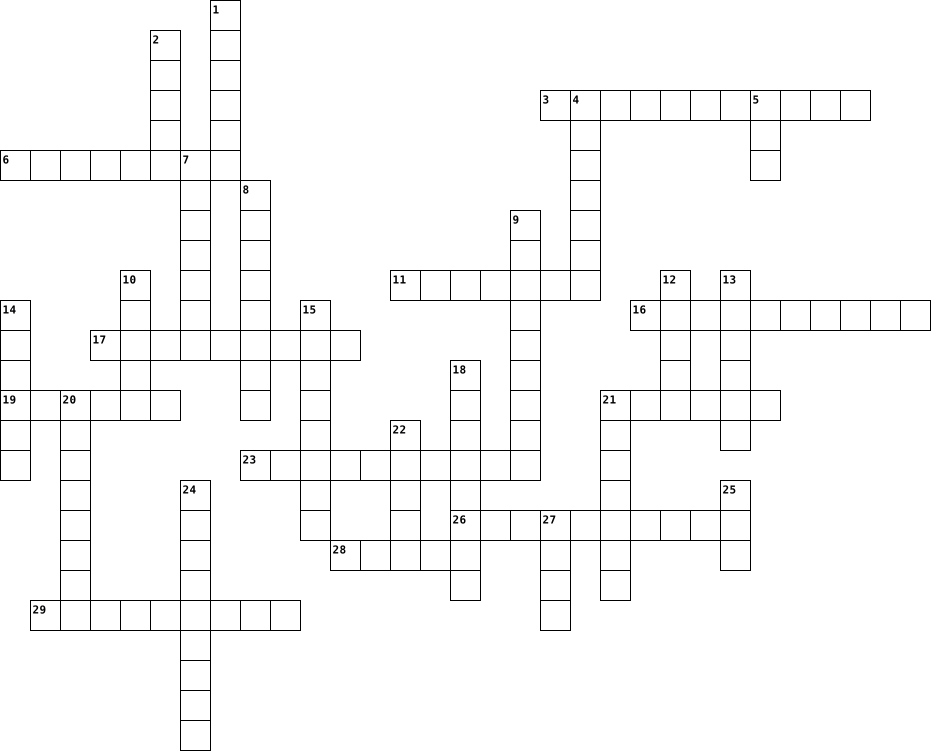
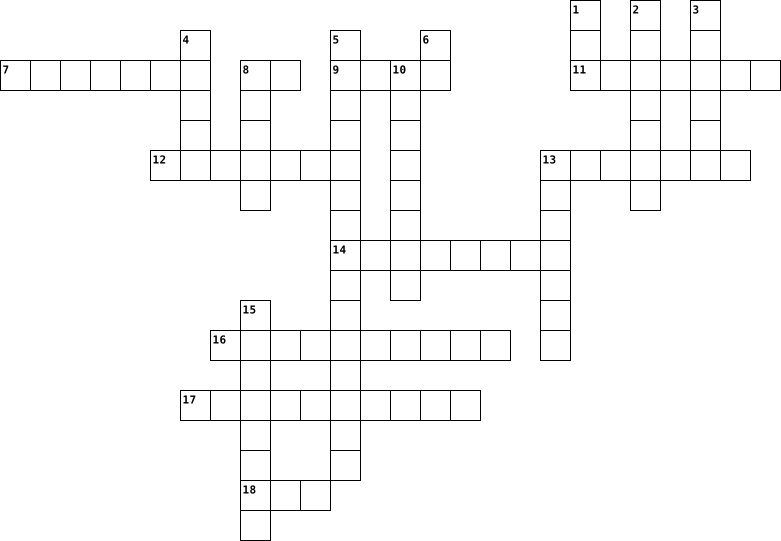
Across
- therapy A type of radiation therapy that uses high-energy X-rays
- A device used to measure the activity of a radioactive sample
- A unit of radiation dose
- A type of radiation therapy that uses a beam of electrons
- A medical imaging technique that uses positron-emitting isotopes
- A type of radiation therapy that uses a beam of neutrons
Down
- A medical imaging technique that uses X-rays to create images of bones and organs
- A unit of radioactive activity
- A type of radiation therapy that uses a beam of protons
- A medical imaging technique that uses X-rays to create images of blood vessels
- A type of radiation therapy that uses radioactive isotopes
- A device used to measure radiation exposure
- A unit of radioactive decay
- A medical imaging technique that uses sound waves
- A type of radiation used in imaging
- A medical imaging technique that uses magnetic fields and radio waves
16 Clues: A unit of radiation dose • A unit of radioactive decay • A unit of radioactive activity • A type of radiation used in imaging • A device used to measure radiation exposure • A medical imaging technique that uses sound waves • A type of radiation therapy that uses a beam of protons • A type of radiation therapy that uses a beam of neutrons • ...
Radiation Induced Toxicities 2025-03-27

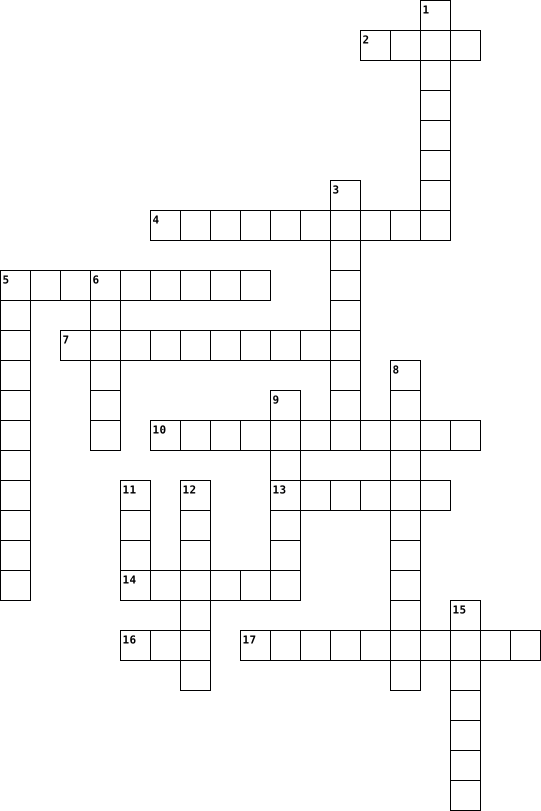
Across
- What is the term for radiation-induced lung inflammation?
- A long-term condition where lymphatic fluid builds up in the body
- A rare but severe late effect of radiation treatment involving or near the spinal cord
- What delayed effect can occur in the brain due to radiation exposure?
- A common side effect that can be experienced in most radiotherapy sessions
- A side effect caused by brachytherapy and/or EBRT to the pelvis for treatments of cervical, endometrial and/or vaginal, vulval cancers
- radiation-induced injury to the rectal mucosa following radiation therapy to the pelvic area
Down
- What is the term for radiation-induced brachial plexus injury?
- The condition of having a dry mouth due to a lack of sufficient saliva production
- A reaction caused by radiation to the skin
- What serious complication can occur in bones exposed to radiation?
- inflammation of the bladder and urethra caused by radiation therapy to the pelvic region
- What is the main acute side effect of abdominal radiation?
- A common side effect that patients receiving radiation therapy to the head and neck develop
- What is the term for radiation-induced oesophageal inflammation and pain?
15 Clues: A reaction caused by radiation to the skin • What is the term for radiation-induced lung inflammation? • What is the main acute side effect of abdominal radiation? • What is the term for radiation-induced brachial plexus injury? • A long-term condition where lymphatic fluid builds up in the body • What serious complication can occur in bones exposed to radiation? • ...
Unit 2 Vocab Crossword Puzzle- Mackenzie McClennen 2023-09-19

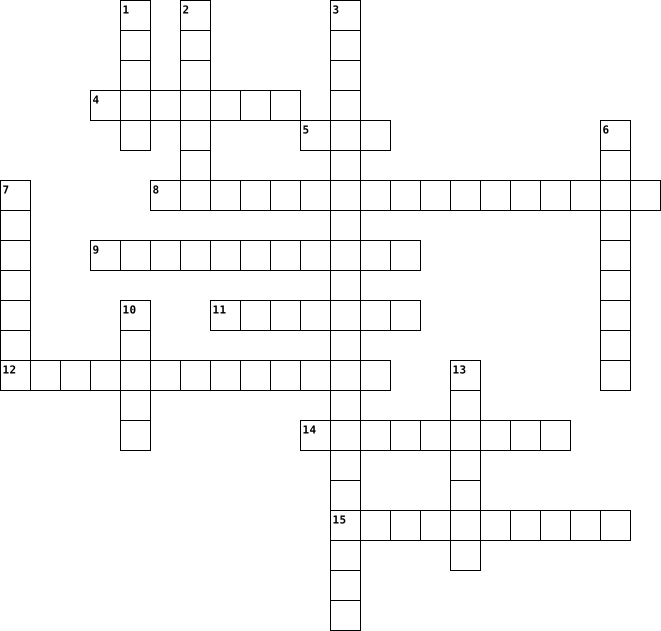
Across
- highspeed electron with a I- charge
- major energy levels of an atom
- a form of energy exhibiting wavelike behavior
- rays and particles emitted by radiation
- energy levels contained with a principal energy level
- arrangements of electrons in an atom
- postive charge
- postive and negative charges
- eight electrons in valence shell
- minimum amount of energy that can be gained or lossed
Down
- high-energy radiation that has no electrical charge and no mass
- valence shell electrons in a molecule
- particle with two protons and neutrons with a 2+ charge
- a particle of electromagnetic radiation with no mass
- electrons in outermost orbitals
- equation that shows the atomic and mass number of particles
- number of waves passing a given point
- lowest energy state of a atom
- a set of frequencies electromagnetic waves
- process in which subtances emit radiation
- negative charge
- shortest distance between equivalent polints on a wave
22 Clues: postive charge • negative charge • postive and negative charges • lowest energy state of a atom • major energy levels of an atom • electrons in outermost orbitals • eight electrons in valence shell • highspeed electron with a I- charge • arrangements of electrons in an atom • valence shell electrons in a molecule • number of waves passing a given point • ...
Emission and Absorption of Radiation 2025-10-28

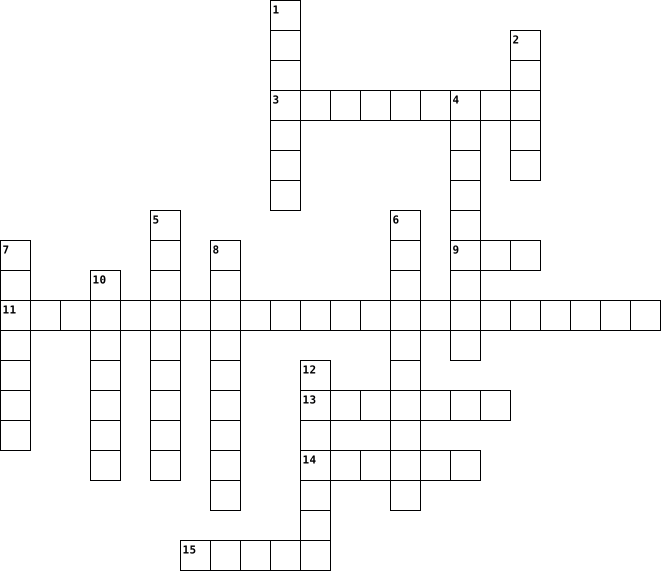
Across
- Term for outgoing infrared radiation (heat) emitted by the warmed Earth.
- The process where radiation bounces off a surface.
- A measure of a surface's effectiveness in emitting thermal radiation, compared to a perfect emitter.
- Type of longwave radiation (heat) that is emitted by the Earth's surface after it absorbs sunlight.
- Adjective describing a surface with high albedo, meaning it reflects most radiation.
- A common surface with a very high albedo. Example
- Adjective describing a surface with low albedo, meaning it absorbs most radiation.
- Part of the electromagnetic spectrum that we see as light; a component of shortwave solar radiation.
Down
- Energy transferred as electromagnetic waves
- The process where a body or surface releases energy as thermal radiation.
- A common surface with a very low albedo. Example
- The fraction of incident solar radiation that a surface reflects, expressed as a number between 0 and 1.
- Term for incoming solar radiation which includes ultraviolet, visible, and near-infrared light.
- The process where a surface takes in energy from incident radiation.
14 Clues: Energy transferred as electromagnetic waves • A common surface with a very low albedo. Example • A common surface with a very high albedo. Example • The process where radiation bounces off a surface. • The process where a surface takes in energy from incident radiation. • Term for outgoing infrared radiation (heat) emitted by the warmed Earth. • ...
Radiation Vocabulary 2023-04-24

Across
- the process of changing energy from one form to another.
- the process by which an unstable atomic nucleus loses energy by radiation.
- a path along which the whole current flows through each component.
- the result of the movement of tiny particles called atoms, molecules or ions in solids, liquids and gases.
- the emission of electrons or positrons
- comprises branches so that the current divides and only part of it flows through any branch.
- physical phenomenon produced by the motion of charge.
Down
- the amount of heat needed to raise the temperature of 1 gram of a substance 1 degree Celsius (°C).
- A measurement of the energy content of food.
- the flow of charge.
- occurs when the nucleus of an atom becomes unstable (the ratio of neutrons to protons is too low) and alpha particles are emitted to restore balance.
- the emission of energetic photons.
- the time taken for the radioactivity of a specified isotope to fall to half its original value.
13 Clues: the flow of charge. • the emission of energetic photons. • the emission of electrons or positrons • A measurement of the energy content of food. • physical phenomenon produced by the motion of charge. • the process of changing energy from one form to another. • a path along which the whole current flows through each component. • ...
Radiation Oncology 2023-08-02

Across
- VERSA CAPABILITY
- OUR FAVORITE RADIATION ONCOLOGIST
- A SUPERFICIAL DOSE OF RADIATION
- BUTTON PUSHER
- WEEKLY DOCTOR VISIT
- PHYSICIAN'S SIDEKICK
Down
- FRONT DESK FRUSTRATION
- MASTER OF QUALITY ASSURANCE
- TREATMENT PLANNING WIZARD
- CT PLANNING SESSION
- THREE TO FIVE FRACTIONS
- LINEAR ACCELERATOR BRAND
- COULD'VE BEEN AN EMAIL
13 Clues: BUTTON PUSHER • VERSA CAPABILITY • CT PLANNING SESSION • WEEKLY DOCTOR VISIT • PHYSICIAN'S SIDEKICK • FRONT DESK FRUSTRATION • COULD'VE BEEN AN EMAIL • THREE TO FIVE FRACTIONS • LINEAR ACCELERATOR BRAND • TREATMENT PLANNING WIZARD • MASTER OF QUALITY ASSURANCE • A SUPERFICIAL DOSE OF RADIATION • OUR FAVORITE RADIATION ONCOLOGIST
Radiation Protection 2025-10-11

Across
- Exposure duration
- protective barriers are typically 0.5mm thick of this material
- Restricts beam size
- a measure to quantify the potential biological damage from different types radiation
- Probability of these effects increases with dose
- Severity of these effects increases with dose
Down
- Kinetic energy released per unit mass
- Removes low-energy x-rays
- “As Low As Reasonably Achievable”
- A measure combining absorbed dose and weighting factors to estimate overall risk
- Protective barriers typically worn
- Energy absorbed by tissue
- increasing this between you and the source greatly reduces dose
13 Clues: Exposure duration • Restricts beam size • Removes low-energy x-rays • Energy absorbed by tissue • “As Low As Reasonably Achievable” • Protective barriers typically worn • Kinetic energy released per unit mass • Severity of these effects increases with dose • Probability of these effects increases with dose • protective barriers are typically 0.5mm thick of this material • ...
Radiation 2015-09-08

Across
- Solid to liquid
- Take in
- Bounce back
Down
- Bright and reflectant
- Gives off
- A warm energy
- Can travel through space
- Good absorber and emmiter
8 Clues: Take in • Gives off • Bounce back • A warm energy • Solid to liquid • Bright and reflectant • Can travel through space • Good absorber and emmiter
radiation 2015-09-08

Across
- liquid to solid
- type of energy
- gas to liquid
- energy that travels as a waves
Down
- make you gloss
- liquid to gas
- solid to liquid
- to give of
8 Clues: to give of • liquid to gas • gas to liquid • make you gloss • type of energy • liquid to solid • solid to liquid • energy that travels as a waves
Radiation 2023-11-10

Across
- transfer of heat
- waves are heat waves
- only type of electromagnetic radiation
- radiate heat energy in cold buildings
- radio waves and microwaves are examples of
Down
- communications and can penetrate cloud cover
- can give you a sun burn
- travels outward from heat source
8 Clues: transfer of heat • waves are heat waves • can give you a sun burn • travels outward from heat source • radiate heat energy in cold buildings • only type of electromagnetic radiation • radio waves and microwaves are examples of • communications and can penetrate cloud cover
Nuclear Physics and Radiation 2025-06-24

Across
- The most ionising type of radiation
- A common use of alpha radiation
- Contain Uranium in a nuclear reactor
- Material that will block alpha radiation
- Radiation is a ___ process
- A material that undergoes nuclear fission
- The time taken for a radioactive sample's activity to halve
- The process where radioactive particles are incident on an object
- Radiation made of an electron
- Negative charged sub atomic particle
- When unstable nuclei settle on an object
- The process of a large nucleus splitting into two smaller ones
- The most penetrating type of radiation
- Slows down neutrons in a nuclear reactor
Down
- Where one reaction leads to another in a continuous process
- The number of protons and neutrons
- Used as a moderator in nuclear reactors
- The unit of radioactive activity
- The left over products of a fission reaction
- Types of atom of the same element
- The number of radioactive counts per second
- The number of protons in a nucleus
- Absorb neutrons in a nuclear reactor
23 Clues: Radiation is a ___ process • Radiation made of an electron • A common use of alpha radiation • The unit of radioactive activity • Types of atom of the same element • The number of protons and neutrons • The number of protons in a nucleus • The most ionising type of radiation • Contain Uranium in a nuclear reactor • Negative charged sub atomic particle • ...
Science review 2023-12-07

Across
- Not good at transferring heat
- Type of container that keeps things hot
- Why we can stretch copper into wires
- Heat transferred by light waves
- Where we find protons but not electrons
- Substance made by combining elements
- A compound containing one carbon and two oxygen
- Type of radiation that can travel very far
- Can be damaged by radiation and cause mutations
- Substance made of different compounds
- Another name for proton number
- Subatomic particle
- We can tell something is hot by checking its...
- Atom with eight neutrons
- Type of heat transfer, think hot air rising
- Unit of energy
Down
- Using radiation to kill bacteria
- Non-metals (except diamonds)
- A compound of hydrogen and sulfur
- Benefit of radiation, noisy safety device
- Atom with one electron
- Radiation of an electron
- In the same period as oxygen
- number of protons and neutrons together
- A compound of potassium, carbon, and oxygen
- A hot object has a lot of thermal...
- Will let heat or electricity pass through
- Why we can bang and shape metals
- Radiation stopped by paper
- hot air rises because it is less...
30 Clues: Unit of energy • Subatomic particle • Atom with one electron • Radiation of an electron • Atom with eight neutrons • Radiation stopped by paper • Non-metals (except diamonds) • In the same period as oxygen • Not good at transferring heat • Another name for proton number • Heat transferred by light waves • Using radiation to kill bacteria • Why we can bang and shape metals • ...
Introduction Biology 2025-04-23

Across
- the study of bacteria
- the study of gross structure of organs
- technique of producing Silk by rising
- the study of structure and function of animal plant
- the science of transmission of body characters
- biology study of life in the sea
- the study of plants
- biology study of effects of radioactivity on living things
- the study of fungi
Down
- the study of animals
- the study of Geography kal distribution of plants and animal
- the study of chemicals and reaction that take place inside living things
- rising crops and livestok
- biology the study of Survival problems of living things in outer space
- practice of keeping base for the manufacture of honey and bee wax
- technique of growing fish
- the study of tiny bits
- study of origin and dissent of organism
- the study of metabolism of organism and their parts
- biology the study of humans
20 Clues: the study of fungi • the study of plants • the study of animals • the study of bacteria • the study of tiny bits • rising crops and livestok • technique of growing fish • biology the study of humans • technique of producing Silk by rising • the study of gross structure of organs • biology study of life in the sea • study of origin and dissent of organism • ...
Paper 1 - Radioactivity 2026-03-19

Across
- Radioactive decay is a ... process
- The most ionising radiation
- This wave of energy is electromagnetic radiation
- The activity of a sample ... over time
- Beta particles are used to control the thickness of aluminium ...
- This radiation is all around us, all of the time
- The time for the activity to halve
- Gamma rays are stopped by thick...
- Found in the nucleus of the cell and is damaged by radiation
- The part of an atom where radiation is emitted from
Down
- The least ionising radiation
- the dangerous ability to remove electrons
- Beta particles are this charge
- Alpha particles are used in a ... detector
- Alpha particles are stopped by this
- Radiotheraphy is used to treat
- Made of 2 protons and 2 neutrons
- A radioactive nucleus is
- This particle is also a fast electron
- This machine detects radiation
20 Clues: A radioactive nucleus is • The most ionising radiation • The least ionising radiation • Beta particles are this charge • Radiotheraphy is used to treat • This machine detects radiation • Made of 2 protons and 2 neutrons • Radioactive decay is a ... process • The time for the activity to halve • Gamma rays are stopped by thick... • Alpha particles are stopped by this • ...
Radioactivity Crossword 2016-03-17

Across
- Gamma rays have a very ________ frequency.
- Materials that are radioactive have nuclei that are ____________.
- Type of radiation that is made up of two protons and two neutrons.
- During alpha decay the _________ __________ of the element decreases by 2.
- In beta decay, a ________ changes into a proton and an electron.
- The release of radiation by unstable nuclei is known as __________ ____________.
- Nuclei that are ________ _______ are likely to release beta particles.
- The charge of an alpha particle
- Type of radiation that is a high energy electromagnetic wave.
- Emitting gamma rays causes a nucleus to ________ it's energy state.
- The time taken for half of the nuclei in a radioactive material to decay.
Down
- Gamma rays have a very ________ wavelength.
- During alpha decay, the __________ __________ of the element decreases by 4.
- Piece of equipment used to measure radiation.
- Type of radiation that is made up of a fast moving electron.
- Term used to describe materials that give out nuclear radiation
- The part of the atom that contains protons and neutrons
- Nuclei that are _______ _________ are likely to release alpha particles.
- The structure made from sub-atomic particles.
- An unstable nucleus will _________ (split up) during radiation.
- During beta decay, the atomic number increases by ______.
21 Clues: The charge of an alpha particle • Gamma rays have a very ________ frequency. • Gamma rays have a very ________ wavelength. • Piece of equipment used to measure radiation. • The structure made from sub-atomic particles. • The part of the atom that contains protons and neutrons • During beta decay, the atomic number increases by ______. • ...
Radioactivity Crossword 2016-03-17

Across
- Term used to describe materials that give out nuclear radiation
- Piece of equipment used to measure radiation.
- Gamma rays have a very ________ frequency.
- Materials that are radioactive have nuclei that are ____________.
- During alpha decay, the __________ __________ of the element decreases by 4.
- Emitting gamma rays causes a nucleus to ________ it's energy state.
- Type of radiation that is made up of a fast moving electron.
- In beta decay, a ________ changes into a proton and an electron.
Down
- Type of radiation that is made up of two protons and two neutrons.
- The charge of an alpha particle
- During alpha decay the _________ __________ of the element decreases by 2.
- Type of radiation that is a high energy electromagnetic wave.
- The part of the atom that contains protons and neutrons
- The release of radiation by unstable nuclei is known as __________ ____________.
- Nuclei that are ________ _______ are likely to release beta particles.
- During beta decay, the atomic number increases by ______.
- The time taken for half of the nuclei in a radioactive material to decay.
- Gamma rays have a very ________ wavelength.
- Nuclei that are _______ _________ are likely to release alpha particles.
- An unstable nucleus will _________ (split up) during radiation.
- The structure made from sub-atomic particles.
21 Clues: The charge of an alpha particle • Gamma rays have a very ________ frequency. • Gamma rays have a very ________ wavelength. • Piece of equipment used to measure radiation. • The structure made from sub-atomic particles. • The part of the atom that contains protons and neutrons • During beta decay, the atomic number increases by ______. • ...
Radioactivity Crossword 2016-03-17

Across
- The structure made from sub-atomic particles.
- An unstable nucleus will _________ (split up) during radiation.
- Type of radiation that is a high energy electromagnetic wave.
- Nuclei that are ________ _______ are likely to release beta particles.
- Materials that are radioactive have nuclei that are ____________.
- Gamma rays have a very ________ frequency.
- During beta decay, the atomic number increases by ______.
- The charge of an alpha particle
- Gamma rays have a very ________ wavelength.
- Type of radiation that is made up of a fast moving electron.
- Piece of equipment used to measure radiation.
- Emitting gamma rays causes a nucleus to ________ it's energy state.
- The part of the atom that contains protons and neutrons
- Nuclei that are _______ _________ are likely to release alpha particles.
Down
- During alpha decay, the __________ __________ of the element decreases by 4.
- Term used to describe materials that give out nuclear radiation
- During alpha decay the _________ __________ of the element decreases by 2.
- Type of radiation that is made up of two protons and two neutrons.
- The time taken for half of the nuclei in a radioactive material to decay.
- The release of radiation by unstable nuclei is known as __________ ____________.
- In beta decay, a ________ changes into a proton and an electron.
21 Clues: The charge of an alpha particle • Gamma rays have a very ________ frequency. • Gamma rays have a very ________ wavelength. • The structure made from sub-atomic particles. • Piece of equipment used to measure radiation. • The part of the atom that contains protons and neutrons • During beta decay, the atomic number increases by ______. • ...
Unit 3 : Solar Energy 2021-05-28

Across
- used to measure beam radiation.
- measures both direct and diffuse radiation.
- Infrared radiations gives energy.
- Visible radiations gives energy.
- Satellite source of energy is from
- most dangerous type of radiation.
- Plants convert solar energy into __energy.
- the angle known as solar altitude angle.
- The solar constant also called as
- life span is around 2-6 years.
Down
- In solar cells _________ material is used.
- radiation is called as a diffuse radiation.
- The energy which is stored as latent heat is called as energy.
- From the sun the solar energy is radiated in the form of waves.
- the disc having maximum efficiency.
- nuclear radiation unit is
- Solar energy can leads to generate the electricity through heat___.
- The less insolation occurs when the sun is
18 Clues: nuclear radiation unit is • life span is around 2-6 years. • used to measure beam radiation. • Visible radiations gives energy. • Infrared radiations gives energy. • most dangerous type of radiation. • The solar constant also called as • Satellite source of energy is from • the disc having maximum efficiency. • the angle known as solar altitude angle. • ...
Atomic Structure 2017-05-23

Across
- Using radiation to explore internal organs (7) T------ p104
- The number of protons in an atom (6,6) A----- N----- p89
- Total number of protons and neutrons in an atom (4,6) M--- N----- p89
- Negative part of an atom (8) E-------- p88
- Model of an atom with electrons embedded in positive sphere (4,7) P--- P------ p91
- The process of exposing an object to radiation (11) I---------- p105
- Unit for radioactive activity (Bq) (9) B-------- p99
- The time taken for half the radioactive nuclei to decay (4,4) H--- L--- p99
- Type of radiation consisting of 2 protons and 2 neutrons (Helium nucleus) (5,8) A---- P------- p94
- Absorption or emission of _______________ _________ may cause electrons to change energy levels (15,9) E-------------- R-------- p92
- Neutral part of the nucleus of an atom (7) N------- p88
- An atom that has a positive or negative charge (3) I-- p89
- The charge on an ion that has lost electrons (8) P------- P89
- 1/10,000th the radius of an atom where most of the mass is found (7) N------ p88
- Splitting large unstable nuclei (7) F------ p106
Down
- Source of background radiation from space (6,4) C----- R--- P97
- Used to slow nuclear fission in a power station (7,4) C------ R--- p107
- Positive part of the nucleus of an atom (6) P------ p88
- Unit for radiation dose (Sv) (7) S------ p102
- Type of radiation consisting electromagnetic radiation from the nucleus (5,3) G---- R-- p94
- Normal level of radiation that is around us all the time (10,9) B--------- R-------- p97
- Used to detect radiation (6,6,4) G----- M----- T--- p96
- A reaction that, once started, continues by itself (5,8) C---- R------- p107
- 1 sievert = 1000 _____________ (13) M------------ p102
- Type of radiation consisting of a high speed electron from the nucleus (Neutron changes to proton) (4,8) B--- P------- p94
- This occurs when radiation creates ions (10) I--------- p95
- The charge on an ion that has gained electrons (8) N------- P89
- Using radiation to find the age of organic material (6,6) C----- D----- p100
- Joining 2 light nuclei into a heavier nucleus (6) F----- p108
- Different form of an element with a different number of neutrons (7) I------ p90
30 Clues: Negative part of an atom (8) E-------- p88 • Unit for radiation dose (Sv) (7) S------ p102 • Splitting large unstable nuclei (7) F------ p106 • Unit for radioactive activity (Bq) (9) B-------- p99 • 1 sievert = 1000 _____________ (13) M------------ p102 • Positive part of the nucleus of an atom (6) P------ p88 • ...
School locations and class subjects 2023-09-17
Across
- photography
- computer
- biology
- government
- sophomore
- locker
- school
- university
- elementary
- class
- principal
Down
- junior
- front
- history
- art
- english
- freshman
- geography
- store
- coach
- senior
- health
- printing
- business
- counselor
- science
- drama
- chemistry
- gym
- math
30 Clues: art • gym • math • front • store • coach • drama • class • junior • senior • health • locker • school • history • english • biology • science • computer • freshman • printing • business • geography • sophomore • counselor • chemistry • principal • government • university • elementary • photography
BASIS Scottsdale Teachers Crossword Puzzle 2026-01-30

Across
- Computer Logic
- College Counseling
- Art
- Spanish
- Upper school Math
- French
- Lower school Physics
- Upper school English
- PE
Down
- History
- Latin
- Writing
- Lower school Biology
- 8th Chemistry
- 5th and Upper School English
- AP Human Geography
- Biology
- Upper school History
- Lower school Math
- Drama
20 Clues: PE • Art • Latin • Drama • French • History • Writing • Biology • Spanish • 8th Chemistry • Computer Logic • Lower school Math • Upper school Math • AP Human Geography • College Counseling • Lower school Biology • Upper school History • Lower school Physics • Upper school English • 5th and Upper School English
Climate and human health. The importance of solar radiation and its hygienic significance. 2026-05-02

Across
- Short-wave radiation causing sunburn and vitamin D synthesis
- Atmospheric moisture level affecting thermal comfort
- Atmospheric layer that filters harmful UV-C and UV-B rays
- Body's maintenance of stable internal temperature
- Day length that regulates biological rhythms and health
- Skin cancer linked to chronic UV overexposure
- Bone disease caused by vitamin D deficiency from lack of sunlight
- Long-wave thermal radiation from the sun felt as heat
- Protective agent blocking UV rays applied to skin
- Long-term pattern of weather influencing human health
Down
- Hormone regulated by light exposure controlling sleep cycles
- Skin pigment that protects against UV radiation damage
- SolaR UV-B triggers skin production of ___
- UV radiation's property of killing microorganisms
- Body's physiological adjustment to a new climate
- Medical treatment using controlled light exposure
- Solar radiation reaching Earth's surface
- Range of wavelengths in solar radiation (visible ___)
- Measurement of radiation dose received by the body
- Skin redness caused by overexposure to ultraviolet rays
20 Clues: Solar radiation reaching Earth's surface • SolaR UV-B triggers skin production of ___ • Skin cancer linked to chronic UV overexposure • Body's physiological adjustment to a new climate • UV radiation's property of killing microorganisms • Medical treatment using controlled light exposure • Body's maintenance of stable internal temperature • ...
Chemistry Unit 6 Vocabulary Review 2021-02-24

Across
- The radiation of electrons
- The atomic number of an alpha particle
- The spontaneous emission of radiation
- A particle with a mass of approximately 1 amu
- The abbreviation is amu
- For boron, its __ number is 5
- Gamma radiation is measured as ___ loss.
- Alpha radiation emits a __ atom.
- Same element, different mass
- ____ change the identity of the atoms.
Down
- Carbon is 99% carbon-12. Dividing 99% by 100 gives you the _____ of carbon-12.
- The mass number of a beta particle
- For potassium-40, it's ___ number is 40
- The average atomic mass of ___ is 79.904 amu.
- Massless radiation
- A particle with a mass of approximately 0.0005 amu
- A positively charged particle
- If thorium underwent alpha decay, it would become ___.
- If chromium underwent beta decay, it would become ___ .
- ____ rearrange the atoms.
- Find the average atomic mass by adding the ____ of each isotope.
- Rays of energy or particles
- For lithium, 6.94 is the ___ average of its isotopes
23 Clues: Massless radiation • The abbreviation is amu • ____ rearrange the atoms. • The radiation of electrons • Rays of energy or particles • Same element, different mass • A positively charged particle • For boron, its __ number is 5 • Alpha radiation emits a __ atom. • The mass number of a beta particle • The spontaneous emission of radiation • The atomic number of an alpha particle • ...
216-1 2025-09-05

Across
- how much radiation energy gets soaked up by something
- Consist of a small piece of special radiation-dosimetry film, similar to dental film, contained in a light-proof packet.
- person qualified through adequate training and experience.
- The annual effective dose for all other _____ is 50 rem (500 mSv).
- total effective dose limit for _________ = 0.5 rem (5 mSv);
- As Low As Reasonably Acheivable
- The annual effective dose limit for the lens of the ______ is 15 rem (150 mSv),
- _________ dosimeter contains fil-ters composed of aluminum, tin, and copper. It also houses a thin strip of aluminum oxide
- Measurement of ionizing radiation doses to personnel.
- radiographers under 18 years of age have an annual effective dose limit of 0.1 rem (1 mSv).
Down
- a ________may be a medical physicist, health physicist, radiologist, or
- devices that record external radiation doses.
- _______ must be submitted on a monthly basis
- ________ dosimeters contain lithium fluoride or calcium fluoride crystals
- a unit of radiation quantity. This term was created in 1928. The roentgen is a measure of the ionization of air that is created by x-ray and gamma-radiation
- radiation causes damage (cell response) that doesn’t show up until months or years later.
- radiation that causes changes (cell response) in the body within minutes, days, or weeks
- how much radiation a worker gets and how harmful it might be to their body.
- ________ dosimeters are a very sensitive type of personnel monitoring device.
19 Clues: As Low As Reasonably Acheivable • _______ must be submitted on a monthly basis • devices that record external radiation doses. • how much radiation energy gets soaked up by something • Measurement of ionizing radiation doses to personnel. • person qualified through adequate training and experience. • total effective dose limit for _________ = 0.5 rem (5 mSv); • ...
Evolution 2025-03-24

Across
- what you would call a species from which many others descend
- a group of organisms of the same species, living in the same location
- tailbones in humans, for example
- adaptive _________
- a branch of biology that studies evolutionary relationships between organisms, and might represent them on a "tree"
Down
- structures that are observed in comparative anatomy to study evolution
- the "father of evolution"
- type of evolution where separate species evolve similar traits
- the process by which the fittest organisms survive and reproduce most successfully
9 Clues: adaptive _________ • the "father of evolution" • tailbones in humans, for example • what you would call a species from which many others descend • type of evolution where separate species evolve similar traits • a group of organisms of the same species, living in the same location • structures that are observed in comparative anatomy to study evolution • ...
Biology Crossword 2025-04-19

Across
- The science of growing ornamental plants
- An instrument invented in the sixteenth century
- Study of man and human society
- The science which aims to improve human race through controlled heredity
- Cultivation of rice was first introduced here
- This was discovered in the nineteenth century
- The branch of biology which includes making artificial limbs
Down
- The use of microorganisms in industry and technology
- Father of Biology
- The verification of a person by the pattern of their iris
- A rapidly advancing branch of biotechnology
- The branch of biology that deals with life processes
- DNA Fingerprinting is an application of this branch of biology
- This is manufactured through apiculture
- The pioneers of an organized study of biology
15 Clues: Father of Biology • Study of man and human society • This is manufactured through apiculture • The science of growing ornamental plants • A rapidly advancing branch of biotechnology • Cultivation of rice was first introduced here • This was discovered in the nineteenth century • The pioneers of an organized study of biology • ...
Image Analysis Key Terms 2015-04-27

Across
- Outline of an anatomic structure
- Motion that patient is unable to control
- Kilovotage peak (kVp) that will provide adequate body part penetration and sufficient gray scale
- Determines maximum time that the AEC x-ray exposure will be allowed to continue
- Sthenic is example
- Foot end of patient
- Technique whereby object-image receptor distance (OID) is increased to reduce amount of scatter radiation reaching IR
- Decreased size of one axis of a structure
- Philosophy used to guide good radiation exposure practices
- How differently each tissue composition type will absorb photons
- Plane that divides the body into equal left and right halves
- Filter used to remove photons from the beam to produce uniform density
- Sharpness of structures
- Misrepresentation of size or shape of structure
- Absorbed dose to the most superficial layers of skin
- Results of poor central ray and grid alignment
- Number of gray shades used to represent different image structures
- Device used to reduce amount of scatter radiation reaching the image receptor (IR)
- Law used to adjust milliampere-second (mAs) to maintain density when source-image receptor distance (SID) is changed
- Preventing passage of x-radiation
- Diseases that cause the structure to be more radiolucent
- Movement that bends a joint
- Diseases that cause tissues to increase in mass density or thickness
Down
- Act of throwing a structure
- Contrast caused by x-ray attenuating characteristics of subject
- Device that receives radiation leaving patient
- Plane that divides the body into equal parts
- Head end of patient
- Biologic response of radiation exposure directly related to dose received
- Shortest exposure time to which the automatic exposure control (AEC) can respond
- Results of using an angled central ray while part and IR remain parallel
- Maximum permissible radiation dose limits
- System that automatically determines image density by stopping exposure
- Chamber in AEC system that collects radiation
- Radiation that has changed in direction from primary beam
- Allowing passage of x-radiation
- Ability to differentiate details from one another on an image
- Law that states that radiation intensity is inversely proportional to square of its distance from x-ray source
- Absorption of radiation in heel of anode, causing less radiation intensity at anode end of IR
- Gown snap on an image
- Position in which the patient lies on a cart and a horizontal beam is used
- Situated far from the source or beginning
42 Clues: Sthenic is example • Head end of patient • Foot end of patient • Gown snap on an image • Sharpness of structures • Act of throwing a structure • Movement that bends a joint • Allowing passage of x-radiation • Outline of an anatomic structure • Preventing passage of x-radiation • Motion that patient is unable to control • Decreased size of one axis of a structure • ...
Heat Transfer 2025-08-15

Across
- Type of wave that transfers thermal energy without needing particles.
- Colour that is the best absorber and emitter of radiation.
- Space without particles where radiation can travel.
- surface Reflects thermal radiation back into a container to keep contents warm.
- Energy transferred by radiation from hotter objects to cooler ones.
- Texture that is the best absorber and emitter of radiation.
- Transfer of thermal energy by movement of fluids (liquids or gases) caused by temperature differences.
- Colour that is the worst absorber and emitter of radiation.
- Texture that is the worst absorber and emitter of radiation.
Down
- __________ surface area increases emission and absorption of radiation.
- Type of solid, liquid, or gas that radiation can pass through.
- Poor conductor used between brick walls to prevent convection currents.
- flask Container designed to reduce conduction and radiation, keeping liquids hot or cold for long periods.
- Transfer of thermal energy through solids by direct contact of particles.
- To give out thermal energy as radiation.
15 Clues: To give out thermal energy as radiation. • Space without particles where radiation can travel. • Colour that is the best absorber and emitter of radiation. • Texture that is the best absorber and emitter of radiation. • Colour that is the worst absorber and emitter of radiation. • Texture that is the worst absorber and emitter of radiation. • ...
oml 2022-09-22
Across
- Data
- Hypothesis
- Inference
- experiment Controlled experiment
- Homeostasis
- Theory
- Reproduction Sexual Reproduction
- DNA
- Metabolism
Down
- Stimulus
- Variable Dependent Variable
- Variable Independent Variable
- Evolve
- Observation
- Group Control Group
- Bias
- Reproduction Asexual Reproduction
- Biology
18 Clues: DNA • Data • Bias • Evolve • Theory • Biology • Stimulus • Inference • Hypothesis • Metabolism • Observation • Homeostasis • Group Control Group • Variable Dependent Variable • Variable Independent Variable • experiment Controlled experiment • Reproduction Sexual Reproduction • Reproduction Asexual Reproduction
Radioactivity 2024-06-03

Across
- An electromagnetic wave
- Has two common isotopes 235 and 238
- Stops alpha radiation
- Nuclear power plant in Japan that suffered radiation leaks and damaged reactors
- The S.I unit of radiation
- The length of time it takes for half of the atoms of an isotope to decay
- Metal that stops Alpha and beta radiation but not gamma
- Atoms with the same number of protons but different number of neutrons
- when an atom spontaneously ejects a particle and changes into a different type of atom
Down
- used to detect radiation
- Won 2 nobel prizes and discovered Radium and Polonium
- The type of nuclear radiation with a +2 charge
- 1986 nuclear disaster
- A fast moving nuclear electron
- This nuclear particle changes into a proton and an electron to initiate beta decay
- The nucleus of this atom is the same as an alpha particle
- The name of the bomb dropped on Hiroshima
- Metal that stops alpha and beta and most of gamma radiation
18 Clues: 1986 nuclear disaster • Stops alpha radiation • An electromagnetic wave • used to detect radiation • The S.I unit of radiation • A fast moving nuclear electron • Has two common isotopes 235 and 238 • The name of the bomb dropped on Hiroshima • The type of nuclear radiation with a +2 charge • Won 2 nobel prizes and discovered Radium and Polonium • ...
Biology 2026-01-08

Across
- quantitive
- hypothesis
- adaptation
- observation
- theory
- inference
Down
- experimental
- homeostasis
- biology
- control
- qualitative
- dependent
- independent
- science
- cell
15 Clues: cell • theory • biology • control • science • dependent • inference • quantitive • hypothesis • adaptation • homeostasis • qualitative • independent • observation • experimental
Eva Noonan Crossword Puzzle weeks 3-4 2022-03-04

Across
- (of electromagnetic radiation) having a wavelength shorter than that of the violet end of the visible spectrum but longer than that of X-rays.
- a financial you receive from a sponsor.
- an ionized gas consisting of positive ions and free electrons in proportions resulting in more or less no overall electric charge, typically at low pressures (as in the upper atmosphere and in fluorescent lamps) or at very high temperatures (as in stars and nuclear fusion reactors).
- a notice or announcement in a public medium promoting a product, service, or event or publicizing a job vacancy.
- a ship or boat.
- drive, push, or cause to move in a particular direction, typically forward.
Down
- to begin or start.
- an area region of a spectrum.
- a malfunction or breakdown.
- something coming in contact with something else.
- the branch of science concerned with the nature and properties of matter and energy. The subject matter of physics, distinguished from that of chemistry and biology, includes mechanics, heat, light and other radiation, sound, electricity, magnetism, and the structure of atoms
- involving ellipsis,especially to be very hard to understand.
- something that moves that takes skill or care to do so.
- a person who builds or designs.
14 Clues: a ship or boat. • to begin or start. • a malfunction or breakdown. • an area region of a spectrum. • a person who builds or designs. • a financial you receive from a sponsor. • something coming in contact with something else. • something that moves that takes skill or care to do so. • involving ellipsis,especially to be very hard to understand. • ...
Die Facher 2025-05-08

Across
- deutsch
- philosophie
- franzosich
- chemie
- fach
- Biology
- englisch
- chor
Down
- latein
- geometrie
- naturwissenschaften
- physik
- musik
- Algebra
- gesundheitwesen
15 Clues: fach • chor • musik • latein • physik • chemie • deutsch • Algebra • Biology • englisch • geometrie • franzosich • philosophie • gesundheitwesen • naturwissenschaften
Die Facher 2025-05-08

Across
- Algebra
- geometry
- philosophy
- english
- chorus
- Biology
- science
Down
- chemistry
- latin
- french
- health
- physics
- subject
- german
- music
15 Clues: latin • music • french • health • chorus • german • Algebra • physics • english • Biology • subject • science • geometry • chemistry • philosophy
XRAY 2020-07-29

Across
- kVp alters the ___________ of the xray beam
- Contrast media that absorbs a great amount of radiation to give a white appearance on an xray image
- Who discovered x-rays
- In the 1920's xrays were used to remove what
- What was Radium paint used for during WWI
- Large amounts of radiation can cause _________ and/or Acute Radiation Syndrome
- Three Mile Island's partial meltdown occurred over how many days
- In the 50's and 60's xrays where used to determine what in beauty pageants sometimes for 50% of their score
- This results in less radiation on the anode side of the xray beam
- 10 days of naturally occurring background radiation is equal to this imaging exam
- When we are born was have 300 ____________ but when were an adult we have 206.
Down
- In the 60's and 70's what did many hospitals xray for the safety of the public
- This was used in items such as toothpaste, health tonics, candy and paint
- CT of the spine equals 2 years of background radiation how much does an xray of the spine equal
- What was used to fit shoes to children between the 1930's and 1970's
- During WWI who created the portable xray machine to aid doctors in the field
- Medical imaging does has _____________ by 20% in a 10 year time frame
- Rontgen used an area lined with lead and ____________ to protect his film from radiation
- __________ from East to West coast gives an individual 0.035 mSv of radiation; equivalent to a chest xray
- What was the first xray image of
- What is the largest source of natural environmental radiation
21 Clues: Who discovered x-rays • What was the first xray image of • What was Radium paint used for during WWI • kVp alters the ___________ of the xray beam • In the 1920's xrays were used to remove what • What is the largest source of natural environmental radiation • Three Mile Island's partial meltdown occurred over how many days • ...
Particles and Radiation 2021-08-22

Across
- A force that acts between nucleons in a nucleus to keep it stable. It is attractive at distances of up to 3fm and repulsive at separations less than 0.5fm.
- The number of protons present in the nucleus of a given element.
- A quantum number that is conserved in strong interactions but not in weak interactions. This reflects that strange particles are always produced in pairs.
- A group of elementary subatomic particles, consisting of electrons, muons and neutrinos.
- The minimum energy required to remove an electron from a metal’s surface.
- The process of a particle and its antiparticle colliding and being converted into energy. The energy is released in two photons to conserve momentum.
- The process of a sufficiently high-energy photon converting into a particle and its corresponding antiparticle. To conserve momentum, this usually occurs near a nucleus.
- The process of an unstable nucleus emitting an alpha particle (two protons and two neutrons) to become more stable.
- A packet of energy.
- The exchange particles that transmit the four fundamental interactions between particles.
- The process of a neutron inside a nucleus turning into a proton, and emitting a beta-minus particle (an electron) and a antineutrino.
- The sum of the number of protons and neutrons in a given nucleus.
- All particles have a corresponding antiparticle with the same mass but opposite charge and conservation numbers.
- A subatomic particle whose existence was hypothesised to maintain the conservation of energy in beta decay.
- A class of hadron, that is made up of three quarks. The proton is the only stable baryon.
- A proton or neutron.
- The minimum potential difference required to stop the highest kinetic energy electrons from leaving the metal plate in the photoelectric effect.
- A class of subatomic particle that experiences the strong nuclear interaction.
- The process of a proton inside a nucleus turning into a neutron, and emitting a beta-plus particle (a positron) and a neutrino.
- Particles that are produced through the strong interaction but decay through the weak interaction.
- The work done to accelerate an electron through a potential difference of 1V. 1eV is equal to the charge of an electron (E=qv).
Down
- The process of an electron taking in exactly the right quantity of energy to move to a higher energy level.
- Data from isotopes that can be used for a purpose, such as carbon dating.
- The most stable energy level that an electron can exist in.
- A type of meson and the exchange particle for the strong nuclear force.
- The process of an atom losing an orbital electron and becoming charged.
- A type of meson that decays into pions.
- The minimum frequency of photons required for photoelectrons to be emitted from the surface of a metal plate through the photoelectric effect. It is equal to the metal’s work function divided by Planck’s constant.
- A quantum number that is conserved in all particle interactions. Both electron lepton numbers and muon lepton numbers must be conserved.
- A quantum number that is conserved in all particle interactions. Baryons have a baryon number of +1 and non-baryons have a baryon number of 0.
- A positively charged particle that is the antiparticle of an electron.
- Defined and distinct energies at which electrons can exist in an atom. An electron cannot exist between energy levels.
- Same number of protons but different numbers of neutrons.
- The spreading of electrons as they pass through a gap similar to the magnitude of their de Broglie wavelength. It is evidence of the wave-like properties of particles.
- A class of hadron that is made up of a quark and antiquark pair. Muon A type of lepton that decays into electrons.
35 Clues: A packet of energy. • A proton or neutron. • A type of meson that decays into pions. • Same number of protons but different numbers of neutrons. • The most stable energy level that an electron can exist in. • The number of protons present in the nucleus of a given element. • The sum of the number of protons and neutrons in a given nucleus. • ...
SCHOOL SUBJECT 2024-04-25
Across
- Biology
- Art
- PhysicalEducation
- Mathematics
- Science
- SocialStudies
- Chemistry
- Literature
Down
- Music
- English
- InformationTechnology
- Geography
- Physics
- Drama
- History
15 Clues: Art • Music • Drama • English • Biology • Physics • Science • History • Geography • Chemistry • Literature • Mathematics • SocialStudies • PhysicalEducation • InformationTechnology
Heat and Temperature 2012-11-20

Across
- _________ best surface for absorbing heat radiation
- ____ transfers in three ways (Conduction,convection & radiation)
- Wood is an example of an _________
- ____ objects in a warmer room will heat up to room temperature.
- __________ best surface for reflecting heat radiation
- _________ travels in a straight line
- Radiation travels at the speed of _____
- _______ energy is equal to an Internal energy
Down
- Metal is an example of a _________
- Radiation doesn't require ________ to travel
- Heat energy reach the Earth from the ___ by radiation
- We measure temperature using a ___________
- ___ object cool in a cooler room will cool to room temperature.
- Heat transfer from a ______ place
- Particles that are closest to each other is _____
15 Clues: Heat transfer from a ______ place • Metal is an example of a _________ • Wood is an example of an _________ • _________ travels in a straight line • Radiation travels at the speed of _____ • We measure temperature using a ___________ • Radiation doesn't require ________ to travel • _______ energy is equal to an Internal energy • ...
IHP Chapter 8 2025-03-05

Across
- The sole governing document for Navy/Marine Corp Radiation Health Program.
- Receives an annual report of all personnel on board on Dec31 by APR1
- Examination given no more than 6 months prior to separation from radiation worker duties
- Annual Report or Situational Report
- Examination for individuals being considered or re-entering the radiation monitoring program.
- Personnel in #X are not required to complete RMEs or ____
- Calendar date that annual reports must be provided to individuals
- Radiologically monitored personnel that can receive up to 100 mrem per year
- Not to exceed the _th year anniversary date of your previous monitoring or radiation medical exam if you are under age 50
- Examination for personnel that exceed limits, internalize radionuclides, or are designated by a physician.
- Receives an annual report of all personnel monitored
- The exposure to the fetus from this date to the conclusion of the pregnancy is estimated when #2 is done.
Down
- Record of Occupational Exposure to Ionizing Radiation From Internally Deposited Radionuclides
- Validates transcription of dose to the personnel health record
- This is submitted to the medical department, for Radiation Health to estimate the fetal dose from #1's date to the pregnancy's completion
- Dose records are not classified because they have ____significance
- Record of Occupational Exposure to Ionizing Radiation
- Examination for personnel that have routine duties as radiation workers
- This program's limits are provided by the NAVSEA 389-0288.
- May be required when a dosimeter reading is not available.
- When personnel are found NPQ, they evaluate if the examinee is physically fit for radiation work.
- Report sent to NDC when monitored personnel transfer, retire, or terminate employment before Dec31
22 Clues: Annual Report or Situational Report • Receives an annual report of all personnel monitored • Record of Occupational Exposure to Ionizing Radiation • Personnel in #X are not required to complete RMEs or ____ • This program's limits are provided by the NAVSEA 389-0288. • May be required when a dosimeter reading is not available. • ...
_ology 2014-07-17

Across
- / The study of nerves
- / The study of human movement
- / The study of microscopic life
- / The study of Japan
- / The study of human beings
- / The study of volcanos
- / The study of images produced by radiation
- / The study of the Earth
- / The study of fossils
- / The study of the immune system
Down
- / The study of oceans
- / The study of unidentified flying objects
- / The study of alien life
- / The study of blood
- / The study of very old life
- / The study of bacteria
- / The study of life
- / The study of climates
- / The study of the interactions between living things
- / The study of animals
- / The study of human activity in the past through
- / The study of trees
- / The study of the development of embryos
- / The study of the heart
- / The study and use of tools and machines
- / The study of social behaviour
- / The study of stones and rocks
27 Clues: / The study of life • / The study of blood • / The study of Japan • / The study of trees • / The study of oceans • / The study of nerves • / The study of animals • / The study of fossils • / The study of bacteria • / The study of climates • / The study of volcanos • / The study of the heart • / The study of the Earth • / The study of alien life • / The study of human beings • ...
cruciverba science 2023-10-06

Across
- The central part of an atom where protons and neutrons are located.
- Pertaining to the moon.
- Atoms or molecules with a net electric charge.
- Relating to the structure of the Earth's crust.
- The largest planet in our solar system.
- A preparation used to provide immunity against diseases.
- A group of atoms bonded together.
- Process by which plants make food using sunlight.
- The study of living organisms.
- Any individual living thing.
Down
- The seventh planet from the sun.
- A group of living organisms consisting of similar individuals.
- The natural home of an organism.
- A discrete amount of energy proportional in magnitude to the frequency of the radiation it represents.
- When one celestial body moves into the shadow of another.
- The distance between successive crests of a wave.
- Earth's year-long elliptical orbit around the sun.
- Relating to motion.
- A system of millions or billions of stars, together with gas and dust.
- The basic unit of a chemical element.
20 Clues: Relating to motion. • Pertaining to the moon. • Any individual living thing. • The study of living organisms. • The seventh planet from the sun. • The natural home of an organism. • A group of atoms bonded together. • The basic unit of a chemical element. • The largest planet in our solar system. • Atoms or molecules with a net electric charge. • ...
Studies of Science 2025-05-07

Across
- The study of insects
- The study of the Earth
- The study of fossils of ancient life
- The study of the practical arts
- The study of the heart
- The study of life
- The study of water movement through the soil
- The study of the therapeutic use of plants
- The study of the climate
- The study of the skin
- The study of mental processes in living creatures
- The study of movement in relation to human anatomy
Down
- The study of past cultures
- The scientific study of crime
- The study of humans
- The study of society
- The study of micro-organisms
- The study of rays, usually ionizing radiation
- The study of machines at the molecular level
- The study of poisons
- The study of nerves
- The study of the relationships between living organisms and their environment
- The study of cancer
- The study of weather
- The study of animals
25 Clues: The study of life • The study of humans • The study of nerves • The study of cancer • The study of insects • The study of society • The study of poisons • The study of weather • The study of animals • The study of the skin • The study of the Earth • The study of the heart • The study of the climate • The study of past cultures • The study of micro-organisms • The scientific study of crime • ...
Tammy Pettyjohn MEA149 2021-06-22

Across
- a long term effect
- radiation burn
- if patient is pregnant who decides to proceed
- Unit of exposure
- 50msv
- Absorbed dose
- Patient dose calculated at what level
- as low as reasonably achievable
- 0.25mm
- reduce exposure amount by time, shielding ___
- radiation risk greatest during what trimester
- the radiation weighting factor for x-ray photons is
Down
- genetic changes or effects
- development of malignant disease
- greatest cause of unnecessary radiation___exposure
- prevents genetic effects
- equivalent dose
- shield consist of o.5-mm __
- Dose used for radiation protection purposes
- short term effect occurs in ___months
20 Clues: 50msv • 0.25mm • Absorbed dose • radiation burn • equivalent dose • Unit of exposure • a long term effect • prevents genetic effects • genetic changes or effects • shield consist of o.5-mm __ • as low as reasonably achievable • development of malignant disease • short term effect occurs in ___months • Patient dose calculated at what level • Dose used for radiation protection purposes • ...
Radioactivity 2022-01-18

Across
- where radiation comes from
- radiation used in thickness measurement
- a subatomic particle with a positive charge
- the radioactive element used in nuclear power
- these should be used in radioactivity experiments
- the most penetrating of the radiations
- a subatomic particle with a negative charge
Down
- radiation can be dangerous if it ..... atoms
- the radiation which is around us all the time
- gamma radiation is absorbed by thick .........
- carbon 12 and carbon 14 are ........ of carbon
- the most ionising of the radiations
- radioactivity is a ........ process
- the name of the counter used to detect radiation
- alpha radiation is absorbed by
15 Clues: where radiation comes from • alpha radiation is absorbed by • the most ionising of the radiations • radioactivity is a ........ process • the most penetrating of the radiations • radiation used in thickness measurement • a subatomic particle with a positive charge • a subatomic particle with a negative charge • radiation can be dangerous if it ..... atoms • ...
school 2026-06-02

Across
- break
- geography
- music
- assembly
- computing
- education PE
- history
Down
- french
- physics
- biology
- tutoring
- art
- english
- lunch
- maths
15 Clues: art • break • music • lunch • maths • french • physics • biology • english • history • tutoring • assembly • geography • computing • education PE
School subjects 2017-06-15
Across
- languages
- art
- information-technology
- history
- sports
- maths
Down
- biology
- music
- geography
- chemistry
- literature
- science
- metalwork
- cooking
- physics
15 Clues: art • music • maths • sports • biology • science • cooking • physics • history • languages • geography • chemistry • metalwork • literature • information-technology
All Crossword About Biology 2020-01-13
Across
- gradual increase in the complexity of the system
- test the validity of proposed theories and understand
- mathematical methods to formulate quantitative models
- from non-living matter about 4 billion years ago
- as homeostasis
- recognizes the cell as the basic unit of life genes
- processes molecular interactions physiological
- of the science there are certain unifying
- development and evolution Despite the
- mechanisms underlying life and how it appeared and
Down
- open systems that survive by transforming energy and decreasing
- the creation and extinction of species Living organisms
- organisms including their physical structure
- experimental biology performs empirical experiments
- of biology are defined by the research methods
- the basic unit of heredity and evolution as the engine that
- local entropy to maintain stable and vital condition
- and the kind of system studied: theoretical biology
- is the natural science that studies life and
- that consolidate it into single coherent field
20 Clues: as homeostasis • development and evolution Despite the • of the science there are certain unifying • is the natural science that studies life and • organisms including their physical structure • of biology are defined by the research methods • gradual increase in the complexity of the system • from non-living matter about 4 billion years ago • ...
Logan 2023-09-19

Across
- Diagram that represents valence electrons
- The shell or orbital in which the electron is located relative to the atom's nucleus
- Energy that comes from a source and travels at the speed of light.
- A positively charged ion
- The rate at which a wave vibrates
- Radiation including visible light, radio waves, gamma rays, and X-rays
- The lowest energy state of an atom or other particle
- A discrete quantity of energy
- The arrangement of electrons in orbitals around the nucleus
Down
- Particles consisting of two protons and two neutrons tightly bound together
- A spectrum of the electromagnetic radiation emitted by a source
- Emitting Radiation Spontaneously
- The tendency of atoms to prefer to have eight electrons in the valence shell
- A fast-moving electron emitted by radioactive decay of substances
- A particle representing a quantum of light or other electromagnetic radiation
- Represents the reactants and products in radioactive decay, nuclear fission, or nuclear fusion
- Electromagnetic radiation with the highest frequency
- The distance from one crest or trough to another
- An atom or molecule with a net electric charge
- An energy level defined by quantum theory
- The electrons in the outermost shell
- A negatively charged ion
22 Clues: A positively charged ion • A negatively charged ion • A discrete quantity of energy • Emitting Radiation Spontaneously • The rate at which a wave vibrates • The electrons in the outermost shell • Diagram that represents valence electrons • An energy level defined by quantum theory • An atom or molecule with a net electric charge • ...
Physics D Nuclear 2020-05-04

Across
- came up with modern atom
- two small nuclei join to make a long nucleus
- in the atom the amount of protons and___are the same
- admisión from unstable nucleus to stabilize atom
- exposing a object to nuclear radiation
- Alpha gamma and _____ types of ionizing radiation
- stopped by paper
- alpha radiation is the same as
Down
- beta radiation is_____ionising
- discovered the electron
- alpha radiation is most ionizing and ____to cells
- fission used in nuclear power cells
- contamination is unwanted presence of_________atoms
- same number of proton different number of neutron
- time taken too loose half of initial radioactivity
- gamma stoped by
16 Clues: gamma stoped by • stopped by paper • discovered the electron • came up with modern atom • beta radiation is_____ionising • alpha radiation is the same as • fission used in nuclear power cells • exposing a object to nuclear radiation • two small nuclei join to make a long nucleus • admisión from unstable nucleus to stabilize atom • ...
RAD - Week 12 (Ch. 2,3, etc.) 2022-04-06

Across
- Radiation that comes from any matter being struck by primary radiation is known as scatter or ____ radiation.
- Two mechanisms of radiation injury are possible; ionization or ____ ____ formation.
- Consists of central nucleus and orbiting electrons
- A cell that is resistant to radiation is termed ____.
- All cells in the body except the reproductive cells
- Basic unit of a chemical element, capable of combining with each other to form molecules
- Measures radiation by determining the amount of ionization that occurs in air.
- Two or more atoms joined by chemical bonds
Down
- The cells that are most sensitive to radiation are ____ cells.
- Energy contained by the X-rays that come from the target of the X-ray tube is ____ radiation.
- A cell that is sensitive to radiation is termed ____.
- Anything that occupies space, has mass, and composed of atoms
- Results in formation of a positive atom and dislodged negative electron
- Open-ended lead lined PID eliminates radiation ____.
- Tissues that are radioresistant are ____ tissues.
15 Clues: Two or more atoms joined by chemical bonds • Tissues that are radioresistant are ____ tissues. • Consists of central nucleus and orbiting electrons • All cells in the body except the reproductive cells • Open-ended lead lined PID eliminates radiation ____. • A cell that is sensitive to radiation is termed ____. • A cell that is resistant to radiation is termed ____. • ...
Chapter 1 Radiation 2022-03-08

Across
- first to make a dental radiograph in 1896
- discovered the long cone
- introduced digital radiography
- full jaw x
- first and earliest x-ray technique
- abbreviation for bitewing
- wrote 1st x-ray book and introduced bitewings in 1913 and 1924
- second and newer x-ray technique
- invented the hot cathode tube
- the making of radiographs by exposing an image receptor, either film or digital sensor
- may have taken the first radiograph on the living
- known for the paralleling technique
- allows for enhanced two and three dimensional images are being used in the diagnosis and treatment of dental conditions
- may have taken the first radiograph in the US on a living subject
- abbreviation for periapical
- study of x-rays and the techniques used to produce radiographic images
- known for the bisecting technique
Down
- first hand wrapped and machine wrapped film
- more descriptive of its function of directing the x-rays rather then its shape
- a single selected plane of tissue has been used to assist dentist with complex diagnosis and treatment planning
- color for posterior periapical XCP
- color for for anterior periapical XCP
- are capable of exposing the entire dentation and surrounding structures on a single image
- discovered the first x-ray in 11/8/1895
- color for bitewing XCP
25 Clues: full jaw x • color for bitewing XCP • discovered the long cone • abbreviation for bitewing • abbreviation for periapical • invented the hot cathode tube • introduced digital radiography • second and newer x-ray technique • known for the bisecting technique • first and earliest x-ray technique • color for posterior periapical XCP • known for the paralleling technique • ...
Paper 1 revision crossword 2022-06-13

Across
- the flow of electricity through a circuit
- this is emitted when alpha radiation occurs
- the piece of equipment you measure potential difference with
- the energy in something that is moving
- the most ionising type of radiation
- this created electricity via a dam of water falling downwards
- this is measured in coulombs
- The piece of equipment you measure current with
- radiation can cause mutations which may lead to...
- The unit for energy
- The symbol for this is a circle with a cross in it.
Down
- the energy store in something hot
- This counter is used to measure radioactivity by clicking
- the unit for power
- the unit for this is ohms
- alpha radiation is stopped by this or skin
- A measure of how well something does its job (can't be over 100%)
- energy that has been lost to its surroundings is said to have...
- the energy store in a battery and food
- this type of radiation emits an electron
- the name for energy that is not useful
- the unit for force
- this type of radiation travels in waves
- the most common type of wasted energy
- gamma radiation is dampened by thick...
- a battery is made up of two of these
26 Clues: the unit for power • the unit for force • The unit for energy • the unit for this is ohms • this is measured in coulombs • the energy store in something hot • the most ionising type of radiation • a battery is made up of two of these • the most common type of wasted energy • the energy in something that is moving • the energy store in a battery and food • ...
Chemistry Crossword 2022-09-21

Across
- Nonionizing, electromagnetic radiation with frequencies
- A periodic disturbance that moves through space
- A subatomic particle whose electric charge is negative
- Energies associated with electrons
- The disturbance between any given point and the same point in the next wave cycle
- Function describing the location and wave like behavior of an electron in an atom
- A fundamental constant, equal to the energy of a quantum of electromagnetic radiation divided by its frequency
- The number of times a point on a wave passes a fixed reference point in one second
Down
- Minimum amount of any physical entity involved in an interaction
- Displacement of a wave from zero
- The entire range of wavelengths or frequencies of electromagnetic radiation extending from gamma rays to the longest radio waves and including visible light
- The segment of electromagnetic spectrum that the human eye can view
- Phenomenon in which electrically charged particles are released from a material when absorbed
- the stationary state of lowest energy
- Capacity or power to do work
- The state that is higher in energy than the ground state
- Variety of frequencies of electromagnetic radiation emitted by electrons
- Science of applying microwave radiation to chemical reactions
- A tiny particle that comprises waves of electromagnetic radiation
- Electromagnetic radiation with wavelengths
20 Clues: Capacity or power to do work • Displacement of a wave from zero • Energies associated with electrons • the stationary state of lowest energy • Electromagnetic radiation with wavelengths • A periodic disturbance that moves through space • A subatomic particle whose electric charge is negative • Nonionizing, electromagnetic radiation with frequencies • ...
Britton Terry Chem Unit 2 Vocab 2023-09-19

Across
- diagram that represents valence electrons in a molecule
- the orbital in which the electron is located relative to the nucleus
- emission of energy as subatomic particles or electromagnetic waves
- ion with a positive charge
- the number of waves that pass at a certain point every second
- a type of radiation where electric and magnetic radiation fields vary simultaneously
- the lowest allowable energy level of an atom
- the amount of energy that can be gained or lost from an atom
- the arrangement of electrons in an atom
Down
- has a +2 charge and 4/2 HE
- a spectrum of electromagnetic radiation that is emitted
- substances emitting radiation
- ions either gain, lose, or share electrons to become stable
- high speed electron with -1 charge
- a particle with no mass that carries energy
- the reactant and product in radioactive decay or nuclear fission/fusion
- radiation with no electrical charge or mass
- the distance between two equal parts of a wave
- atom or group of atoms that have a charge
- a energy level defined by orbitals
- the electrons in an atoms outer most orbitals
- ion with a negative charge
22 Clues: has a +2 charge and 4/2 HE • ion with a positive charge • ion with a negative charge • substances emitting radiation • high speed electron with -1 charge • a energy level defined by orbitals • the arrangement of electrons in an atom • atom or group of atoms that have a charge • a particle with no mass that carries energy • radiation with no electrical charge or mass • ...
Introduction to Radiation Oncology 2025-03-19

Across
- What is the term for dividing radiation dose into multiple sessions?
- What is the term for the volume encompassing the visible tumour on imaging? ..... tumour volume
- Which type of radiation therapy implants radioactive sources inside the body?
- What is the standard fractionation dose per day in conventional radiation therapy (in Gy)?
- An oncological emergency
- What is added to the GTV to account for microscopic disease? ..... target volume
Down
- What is the most common type of radiation used in external beam therapy?
- What margin is added to account for treatment setup uncertainties? ..... target volume
- What's the term for radiation given to relieve symptoms?
- What is the term for radiation given before surgery?
- What's the unit of absorbed radiation dose?
- Which type of radiation therapy delivers a single high dose to a small tumour?
- What is the main mechanism of cell death induced by ionising radiation?
- What term describes healthy organs that need protection during radiation?
14 Clues: An oncological emergency • What's the unit of absorbed radiation dose? • What is the term for radiation given before surgery? • What's the term for radiation given to relieve symptoms? • What is the term for dividing radiation dose into multiple sessions? • What is the main mechanism of cell death induced by ionising radiation? • ...
Waves & Electromagnetic Radiation 2017-12-18

Across
- a cup appears to be red in white light; this color is being reflected
- the change in direction of a wave as it passes from one medium into another at an angle
- an example of an electromagnetic wave
- materials that do not let any light pass through them
- a measure of how far the particles in the medium move away from their original position
- the transfer of light energy to matter
- a type of wave in which particles move perpendicularly to the direction the wave travels
- a frog in white light appears green because it ________ green light
- matter that transmits light
- this is the wavelength for a wave with a speed of 75 m/s and a frequency of 15 Hz
- a type of wave that travel without a medium
- when the coils of a spring are squeezed close together
- an example of a longitudinal wave
- this occurs when light is sent in many directions as it passes through a medium
Down
- the points where the wave is lowest
- a type of wave that requires a medium
- the number of cycles in an amount of time
- the points where the wave is highest
- the bouncing of light off a surface
- wave ______ is equal to the frequency multiplied by the wavelength
- ripples on a pond are an example of a _________ wave
- the distance from any point on a wave to an identical point on the next wave
- a disturbance that transfer energy from one place to another
- materials that transmit light but do not let light travel straight through
- a wave in which particles move back and forth in the same direction that the wave travels
- electromagnetic waves do not require a medium so they travel in a __________
- the material through which a wave travels
- when the coils of a spring are spread apart
- waves travel faster in _______ than in liquids
- waves travel faster in ______ air than in cold air
- frequency is expressed using this unit
31 Clues: matter that transmits light • an example of a longitudinal wave • the points where the wave is lowest • the bouncing of light off a surface • the points where the wave is highest • a type of wave that requires a medium • an example of an electromagnetic wave • the transfer of light energy to matter • frequency is expressed using this unit • ...
Radiation and Radioactivity 2013-03-05

Across
- positively charged particle made of two protons and two neutrons
- energy emitted from an atom when an electron moves down energy levels
- wavelength that is just shorter than visible light
- an atom with an unstable nucleus
- two separate nuclei combine to form a larger nucleus
- type of reaction where neutron release triggers more reactions
- charged particles and energy that are emitted from the nuclei of radioisotopes
- a nuclear atom breaking apart releasing energy and neutrons
- type of test where colors of cations can be observed
- conversion of atoms from one element to another by nuclear means
- state of matter where the atoms have been stripped of electrons
- atomic number 92 atomic mass 235 one of the main sources of nuclear energy
- radiation that occurs naturally in the environment
- a penetrating ray of energy emitted by an unstable nucleus
Down
- a particle of light energy
- longest type of wave in the EMS
- radioactive product of spent nuclear reactions that is devastating to the environment
- process where uncharged nucleus emits charged particles
- wavelength that is just longer than visible light
- the time required for one half of a radioisotope to decay
- electron emitted by an unstable nucleus
- nuclear power plant disaster in Ukraine 1986
- atomic number 94 atomic mass 239 one of the main sources of nuclear energy
- elements with atomic numbers greater than 92
- subatomic particle theorized to be among the basic units of matter
- this is the smallest possible mass of fissionable material that can sustain a chain reaction
- acronym for the colors of visible light
27 Clues: a particle of light energy • longest type of wave in the EMS • an atom with an unstable nucleus • electron emitted by an unstable nucleus • acronym for the colors of visible light • nuclear power plant disaster in Ukraine 1986 • elements with atomic numbers greater than 92 • wavelength that is just longer than visible light • ...
Radiation Safety Crossword 2022-07-27

Across
- radiation monitoring devices
- most commonly used radioisotope
- agency that supports aviation with global standards for airline safety, security efficiency and sustainability
- test performed with activity that does not change with volume or configuration
- type of survey meter
- minimal detectable activity
- outgoing package reading at one meter
- used to reduce volatility
- used to analyze area wipes
- remote handling device
- dosimetry records retention
- the time taken for the activity of a specific isotope to fall to half its original value
- time, distance, shielding and ____________________ (2 words)
- device which produces electrical signals when exposed to radiation
Down
- class of radioactive materials
- air monitoring of restricted area (2 words)
- radiological postings are magenta, purple or __________ on yellow background
- performed on sealed sources over 100uCi
- as low as reasonably achievable
- personal protective equipment
- organ that uptakes Iodine
- blocking and _____________ secures outgoing packages
- packages of RAM are properly wiped, surveyed, labeled and ___________
- Radiation Protection Program completion frequency
- government agency managing radioactive materials
- Incoming RAM must be received within _________ hours of delivery
- most harmful radiation
- incident reporting program
28 Clues: type of survey meter • remote handling device • most harmful radiation • organ that uptakes Iodine • used to reduce volatility • used to analyze area wipes • incident reporting program • minimal detectable activity • dosimetry records retention • radiation monitoring devices • personal protective equipment • class of radioactive materials • most commonly used radioisotope • ...
AC Radiation Therapy 2024-07-26

Across
- Snowman
- UK
- Hugger
- Cocky
- Married
- Happy
- Badass
- Italian
- Scuba Diving
- Taylor Swift
- One night stand
- Summer Olympics
- Greeting Cards
- Reader
- Dancer
Down
- Energy
- Messy
- Friendly
- Blueberries
- Courtyard
- Chilliwack
- Anger
- March Madness
- Cyclist
- Blankets
- Giggly
- Vibes
- Unhinged
- Traveler
- Firefighting
- Singer
- Injured
32 Clues: UK • Messy • Cocky • Happy • Anger • Vibes • Energy • Hugger • Badass • Giggly • Singer • Reader • Dancer • Snowman • Married • Cyclist • Italian • Injured • Friendly • Blankets • Unhinged • Traveler • Courtyard • Chilliwack • Blueberries • Scuba Diving • Taylor Swift • Firefighting • March Madness • Greeting Cards • One night stand • Summer Olympics
Acute Radiation Syndrome 2023-01-25

Across
- Example of a late effect.
- DR curve; aka "deterministic". Probability and severity of effect depend on dose. (capital letters only).
- Whole-body dose greater than 6 Gy that will cause death without medical support. Estimated at 50/30.
- Example of an early effect of ARS.
- aka random, probabilistic, non-deterministic, and non-threshold.
- Results when the central nervous system and cardiovascular system receive doses of 50 Gy or more. Fatal in 1-3 days.
- Number of stories that related data to the formation of carcinogenesis from radioactive exposure at doses below 0.1 Gy.
- Type of ray used to treat ringworm.
- The most important and sensitive embryologic phase.
- aka "bone marrow syndrom" 1-10 Gy. The only form of ARS that is sometimes survivable.
- Occurs in humans after whole-body reception of large doses of ionizing radiation delivered over a short period (hours/days).
- aka beginning stage of ARS
- period of time at which outward symptoms disappear.
- aka hair loss
- The period when signs and symptoms involving Hematopoietic, Gi, and cerebrovascular systems become visible.
- Type of risk model; predicts that a specific number of excess cancers will occur.
- No injury occurs before a set dose amount.
Down
- Skin reddening and inflammation that occurs acutely after radiation exposures.
- aka "self". Damage to non-reproductive cells. May be an early or a late effect.
- Appears at 6 Gy and is fatal. Without medical support, these persons die in 3-10 days.
- Radiation dose that would cause the number of spontaneous mutations occurring naturally in a population to increase two times.
- Presumed to follow the QNT curve. A cancer of the bone marrow.
- The theory that small doses of radiation will provide either a benefit of therapeutic quality.
- Effects that are non-deterministic, non-threshold, stochastic, and probabilistic.
- DR curve that would represent ALARA or diagnostic radiology. (capital letters only).
- Chemically similar to calcium which incorporates itself into bone tissue.
- Risk Model used to show data from bomb survivors.
- Effects experienced by Radiation Therapy patients.
- The ONLY deterministic late effect.
- Type of risk model; predicts that the number of excess cancers will increase as the natural incidence of cancer.
30 Clues: aka hair loss • Example of a late effect. • aka beginning stage of ARS • Example of an early effect of ARS. • Type of ray used to treat ringworm. • The ONLY deterministic late effect. • No injury occurs before a set dose amount. • Risk Model used to show data from bomb survivors. • Effects experienced by Radiation Therapy patients. • ...
Radiation: Key Definitions 2019-03-19

Across
- A radiation detector often worn by people who work with radioactive materials to monitor the radiation dose that they are exposed to. It uses different filters which blacken or ‘fog’ when radiation hits them.
- The absorbed dose multiplied by the radiation weighting factor.
- The energy absorbed by a material per unit mass.
- An indicator of the relative biological effect of radiation on a material.
- Radiation that is all around us and is caused by both natural and artificial sources, e.g. radon gas.
- The time taken for the activity of a radioactive source to decrease to half its original value.
- A particle with neutral charge that exists in the nucleus of an atom.
- A positively charged particle in the nucleus of an atom.
- The equivalent dose per unit time.
- The addition or removal of an electron from a neutral atom.
- When unstable nuclei emit nuclear radiation in the form of an alpha particle, beta particle or gamma ray in an attempt to become more stable.
- The small, dense region containing protons and neutrons at the centre of an atom.
- A negatively charged particle that orbits the nucleus of an atom.
Down
- The process of small nuclei joining together to form a larger nucleus, with energy being released.
- An electromagnetic wave of very high frequency and energy.
- The use of powerful magnetic fields to prevent hydrogen plasma from physically touching any parts of a nuclear reactor.
- The act of placing a material between a person and a radioactive source to absorb radiation.
- A radiation detector that counts the flashes of light produced when radiation hits the scintillating material.
- A fast moving electron.
- An overall neutral particle consisting of a nucleus (protons and neutrons) and orbiting electrons.
- When neutrons released in nuclear fission reactions go on to hit other nuclei, causing further fission reactions, and the cycle repeats. The process may be controlled (nuclear reactors) or uncontrolled (nuclear bomb).
- A radiation detector that uses the ionisation of gas in the tube to count the number of times radiation hits it.
- The process in which an unstable, heavy atomic nucleus splits into two or more lighter nuclei (called fission fragments), with energy being released.
- A particle made up of 2 protons and 2 neutrons. It is also the nucleus of a helium atom.
- The number of nuclear decays (or disintegrations) per second.
25 Clues: A fast moving electron. • The equivalent dose per unit time. • The energy absorbed by a material per unit mass. • A positively charged particle in the nucleus of an atom. • An electromagnetic wave of very high frequency and energy. • The addition or removal of an electron from a neutral atom. • The number of nuclear decays (or disintegrations) per second. • ...
Radiation Physics Vocabulary 2021-08-13

Across
- Scale of radiosensitivity on CT scans
- Three principles of radiation protection
- Interaction of photon with inner-shell electron
- Replaces the flattening filter for electron treatments
- Monitors and samples the Linac beam for symmetry
- Abbreviation for imaging devices mounted on a Linac
- The change in the apparent position of an object when viewed from different points
- Source of microwave power for a Linac
- The weight of a particle when it is not moving
- Substance made up entirely of one kind of atom
- The amount of energy required to remove an electron from an atom
- Interaction of photon with outer-shell electron
- An electron has a -------- charge
- Discovered radioactivity in 1902
Down
- Photons emitted as electrons are slowed down by the electric field near a nucleus
- Reduction in intensity as an x-ray moves through matter
- Incorrect application or delivery of prescribed dose
- Smallest unit of an element that retains the properties of that element
- The number of protons in the nucleus, Z
- Shapes the x-ray beam in its cross-sectional dimension
- Time required for the activity of a radioisotope sample to decay to half of its initial value
- Elements that have the same number of Protons, but a different number of Neutrons
- Emission or transmission of energy in the form of waves or particles through space or material
- Energy deposited in matter by ionizing radiation per unit mass
- Force responsible for the interaction between electrically charged particles.
- Describes the relationship between intensity of a radiation beam and distance from the source
- The degree of darkening on an image
- Conveys microwave power to the accelerator structure in the gantry
- Three-dimensional representation of image information
29 Clues: Discovered radioactivity in 1902 • An electron has a -------- charge • The degree of darkening on an image • Scale of radiosensitivity on CT scans • Source of microwave power for a Linac • The number of protons in the nucleus, Z • Three principles of radiation protection • The weight of a particle when it is not moving • Substance made up entirely of one kind of atom • ...
All Crossword About Biology 2024-08-31

Across
- gradual increase in the complexity of the system
- test the validity of proposed theories and understand
- mathematical methods to formulate quantitative models
- from non-living matter about 4 billion years ago
- as homeostasis
- recognizes the cell as the basic unit of life genes
- processes molecular interactions physiological
- of the science there are certain unifying
- development and evolution Despite the
- mechanisms underlying life and how it appeared and
Down
- open systems that survive by transforming energy and decreasing
- the creation and extinction of species Living organisms
- organisms including their physical structure
- experimental biology performs empirical experiments
- of biology are defined by the research methods
- the basic unit of heredity and evolution as the engine that
- local entropy to maintain stable and vital condition
- and the kind of system studied: theoretical biology
- is the natural science that studies life and
- that consolidate it into single coherent field
20 Clues: as homeostasis • development and evolution Despite the • of the science there are certain unifying • is the natural science that studies life and • organisms including their physical structure • of biology are defined by the research methods • gradual increase in the complexity of the system • from non-living matter about 4 billion years ago • ...
DEN 109 2023-10-30

Across
- The image receptor in the intraoral sensor:
- The central beam that comes from the x-ray tube head is:
- connective tissue & growing bone are _ to radiation
- Shades of gray visible in an image is _ scale
- __ dental imaging shows more information than traditional dental x-rays or CT scans
- A small electronic or specially coated plate that is sensitive to x-rays; captures the radiographic image:
- X-ray film is sensitive to __ temperatures
- X-ray film is sensitive to __ radiation
- An x-ray is a black-and-white picture that also shows shades of gray. The difference between shades of gray is termed:
- The imaging system that is used mainly for diagnosis of TMJ disease. This technique uses low-energy electromagnetic radiation instead of ionizing radiation:
- X-ray film is sensitive to __.
- Which dental specialist mainly uses cephalometric radiographs?
- The radiation that is deflected from its path as it strikes matter is:
- The small spot on the tungsten target where the electrons hit is the __ spot
- ___ imaging system is used to plan implant surgery, and to locate and define lesions associated with the oral cavity:
- When a conventional x-ray machine is used with digital radiography, the x-ray machine should be capable of producing 70 __ or less
- During a ___ exposure, the patient should wear a lead apron without a thyroid collar.
- The MPD per year for radiation workers is __ rems
- mature bone, salivary glands and liver are _ sensitive to radiation
- The form of radiation that escapes in all directions from the tube or tubehead:
- The degree of darkness on an x-ray is termed:
- kidney, muscle and nerves are _ sensitive to radiation
Down
- The radiograph used to assess the patient's skeletal profile and structure is
- The discoverer of x-rays is William __
- ___ radiography is capable of capturing intraoral & extraoral images.
- ___ machines take a radiograph that shows the entire maxilla & mandible on one film.
- A filmless imaging system that uses a sensor and computer to capture an image and convert it into pixels (electronic data)is termed _ radiography
- The conversion of an x-ray film image into a digital image that can be processed by a computer:
- ___ seconds is the term for the amount or quantity of radiation exposure the patient receives
- skin, intestinal tract and oral mucosa are _ sensitive to radiation
- Oral surgeons and orthodontists are the specialties that routinely use __ radiographs
- A ___ badge should be worn at all time while in the office
- An image produced by traditional film, in which there is a continuous spectrum of gray shades between black and white is termed _ image
- What determines the quality or penetrating power of the central beam?
- lymphoid, reproductive cells, bone marrow, intestinal epithelium and thyroid are _ sensitive to radiation
- The radiation formed when the primary x-rays strike the patient is __ radiation
- The lead apron with the thyroid collar should be used for __ patients
- A __ can display over 200 shades of gray
- the human ___ can detect 32 shades of gray
39 Clues: X-ray film is sensitive to __. • The discoverer of x-rays is William __ • X-ray film is sensitive to __ radiation • A __ can display over 200 shades of gray • X-ray film is sensitive to __ temperatures • the human ___ can detect 32 shades of gray • The image receptor in the intraoral sensor: • Shades of gray visible in an image is _ scale • ...
Earth's Heat and Energy 2023-01-11

Across
- The process of the Earth's temperature rising due to the greenhouse effect
- heat from the sun that travels through space
- heat that moves through the Earth by direct contact
- The greenhouse gas that comes from cows
- the invisible "blanket" around Earth
- The radiation from the sun that has a wavelength longer than we can see and gives lots of heat
- The greenhouse gas that comes from factories and cars
- Earth's energy __ means that the radiation in equals the radiation out
Down
- Some of the radiation from the sun is ___ off the clouds or the Earth's surface
- Heat always moves from a __ place to a cold place
- The radiation from the sun that has a wavelength shorter than we can see and can cause sunburns
- The process that occurs when gases get trapped in the atmosphere and cause the Earth to get warmer
- Most of the radiation from the sun is __by the Earth's surface
- The source of radiation for Earth
- heat that moves through the Earth in currents that rise and fall
- Some of the radiation that enters the Earth does not make it to the surface because it is reflected off the ____
- The greenhouse gas that happens from the evaporation of the oceans
17 Clues: The source of radiation for Earth • the invisible "blanket" around Earth • The greenhouse gas that comes from cows • heat from the sun that travels through space • Heat always moves from a __ place to a cold place • heat that moves through the Earth by direct contact • The greenhouse gas that comes from factories and cars • ...
Eye Vocab 2023-10-23

Across
- The bundle of nerves that take signals from the eye to the brain
- Electromagnetic radiation with the lowest frequency and the longest wavelength
- Clear protective covering over your eyes
- Colorful muscle that regulates the pupil
- Electromagnetic radiation which has a longer wavelength than visible light
- Electromagnetic radiation at wavelengths longer than the red end of visible light
- Transparent structure that bends light
- Electromagnetic radiation that human eyes can see ranging from red (long wavelengths) to violet (short wavelengths)
- The highest energy, shortest wavelength electromagnetic radiations
- A spot in your vision where no image is formed
Down
- Provides blood to places like the eye
- The muscles that are in the front of your eye, near the lens
- The full range of frequencies, from radio waves to gamma rays, that characterizes forms of light
- Electromagnetic radiation at wavelengths shorter than the violet visible light
- The light-sensitive lining in the back of the eye
- The distance between peaks in a wave
- The adjustable opening in your eye
- The clear, gel-like substance that fills the middle of your eye
- Energy emitted in the form of waves (light) or particles (photons)
- Electromagnetic radiation of very short wavelength and high energy
- Tough, opaque (white) outer covering of the eye
21 Clues: The adjustable opening in your eye • The distance between peaks in a wave • Provides blood to places like the eye • Transparent structure that bends light • Clear protective covering over your eyes • Colorful muscle that regulates the pupil • A spot in your vision where no image is formed • Tough, opaque (white) outer covering of the eye • ...
Veterinary Diagnostic Imaging 2023-12-15

Across
- the quantity of radiation.
- portion of the x-ray image that is sharp and clearly collimated.
- produce a light beam that is coincident with the x-ray beam and covers the ROI.
- measures doses of radiation.
- radiation that reaches the film or detector.
- Structure or appearance that is not normally present on the radiograph and is produced by artificial means
- radiographs are best taken when the patient exhales.
- the smallest quantity of any type of electromagnetic radiation.
- best position for radiographs for patients with respiratory or cardiac issues.
- most equipment suppliers will supply a _________ with a new radiographic unit.
- a special heat-resistant glass enclosure that house a cathode and an anode.
- alternative method of developing a variable kV technique chart.
Down
- outside edge or shadow where the film has been imperfectly collimated.
- air/gas, fat, soft tissue, bone and metal are the
- where photons of energy are focused.
- the quality of radiation.
- important when a patient is thicker on one end of its anatomy than on the other.
- principle for the radiation dose to any creature.
- typically has a large and small filament.
- were developed to absorb scattered and secondary radiation.
- radiographs are best taken when the patient inhales.
21 Clues: the quality of radiation. • the quantity of radiation. • measures doses of radiation. • where photons of energy are focused. • typically has a large and small filament. • radiation that reaches the film or detector. • air/gas, fat, soft tissue, bone and metal are the • principle for the radiation dose to any creature. • radiographs are best taken when the patient exhales. • ...
Physical Geography: Chapter 4 2023-11-14

Across
- Radiation Solar radiation, visible light, ultraviolet, and short infrared radiation are examples of this type of radiation.
- The ability to do work.
- Process whereby electromagnetic waves pass completely through a medium.
- Heat Amount of energy required to increase the temperature of 1 gram of a substance by 1°C.
- Energy is transferred from one point to another by the vertical circulation of a fluid.
- Incoming solar radiation.
- When the dominant direction of energy transfer in a moving fluid is horizontal.
Down
- Energy Any type of energy generated from the Sun.
- Overall reflectivity of an object or surface.
- The transfer of heat from one molecule to another without changes in their relative positions.
- Ability of an object to repel electromagnetic waves that strike it.
- Process by which electromagnetic energy is emitted from an object.
- Scale for measuring temperature.
- When water vapor is converted to liquid water.
- When liquid water is converted to gaseous water vapor.
- Radiation Wavelengths of radiation just longer than the human eye can sense.
16 Clues: The ability to do work. • Incoming solar radiation. • Scale for measuring temperature. • Overall reflectivity of an object or surface. • When water vapor is converted to liquid water. • Energy Any type of energy generated from the Sun. • When liquid water is converted to gaseous water vapor. • Process by which electromagnetic energy is emitted from an object. • ...
Radioactivity 2023-05-15

Across
- the time it takes for the number of remaining nuclei to half in number
- when an atom emits radiation
- the unit for the activity( the number of decays per second)
- a type of radiation involving at Helium nucleus
- contains protons neutrons and electrons
- when an atom gains or loses an electron
- an uncharged particle
- a source of background radiation
- total number of protons and neutrons in an atom
- a positively charged particle
Down
- a type of radiation involving an electron
- a negatively charged particle
- the number of decays per second
- a state an atom can be when it may give out nuclear radiation
- total number of protons in an atom
- has 6 protons
- a type of radiation involving a high frequency elecromangetic wave
17 Clues: has 6 protons • an uncharged particle • when an atom emits radiation • a negatively charged particle • a positively charged particle • the number of decays per second • a source of background radiation • total number of protons in an atom • contains protons neutrons and electrons • when an atom gains or loses an electron • a type of radiation involving an electron • ...
BI 5 Day 1 and 2 2024-02-29

Across
- system of planets and other bodies that orbits a star
- type of radiation that has the longest wavelength and lowest energy
- collection of billions of starts and their planet systems
- large object in space that is made of gas and produces its own light
- type of radiation that causes sun burns or is also used in remote control devices
- smallest particle of matter or smallest part of an element
- type of radiation that carries or transports heat energy
Down
- type of radiation that the human eye can see
- type of radiation with the shortest wavelength and highest energy
- all frequencies and wavelengths of light radiation
- type of radiation cell phones and quick cooking ovens use
- average distance between the Earth and the Sun equal to about 93 million miles
- type of radiation we use to see our bones
- distance light travels in one year equal to about 6 trillion miles
- transfer of energy using waves and without a medium(through empty space)
15 Clues: type of radiation we use to see our bones • type of radiation that the human eye can see • all frequencies and wavelengths of light radiation • system of planets and other bodies that orbits a star • type of radiation that carries or transports heat energy • type of radiation cell phones and quick cooking ovens use • ...
Nuclear Test Review, Pt 2, 2021 2021-11-11

Across
- NUCLEI merging together to form one large nucleus to release energy, helium and a neutron in a nuclear reaction
- term for the specific type of background radiation that originates (comes from) the soil
- vocabulary term for the GENERAL type of radiation that is around us at all times, but normally at very low levels
- an example of a chain reaction that is __ is an atomic bomb!
- type of nuclear reaction used in nuclear power plants to make water vapor spin a turbine and create electricity for millions of people
- type of radiation that is LEAST dangerous to us
Down
- last name of the man who created the most famous equation in science that means that a TINY AMOUNT OF MASS can equal VAST, HUGE!!! AMOUNTS OF ENERGY!!!!
- cosmic objects that are CONSTANTLY undergoing FUSION reactions
- what hits a nucleus to START a fission reaction?
- most damaging type of radiation
- particle that gets emitted (spit out) every single time BETA DECAY/RADIATION occurs
- in nuclear medicine, a patient takes this, a ___, which is slightly radioactive in order for doctors to quickly diagnose any potential diseases.
- radioactive decay occurs because an unstable atom releases ____ and some sort of particle in order to become STABLE again
- a material that would block BETA radiation but not GAMMA radiation
- location in Japan of an unfortunate accident where a tsunami hit a nuclear power plant in 2011 and created a radiation leak that is still ongoing today
- particle that is emitted from the nucleus of an unstable atom every single time ALPHA radiation occurs
- last name of the first woman to be awarded two Nobel prizes and is also buried in a lead-lined coffin due to radiation hazards from her body
- term for the specific type of background radiation that is given off by the sun and galaxies
18 Clues: most damaging type of radiation • type of radiation that is LEAST dangerous to us • what hits a nucleus to START a fission reaction? • an example of a chain reaction that is __ is an atomic bomb! • cosmic objects that are CONSTANTLY undergoing FUSION reactions • a material that would block BETA radiation but not GAMMA radiation • ...
Chapter 4 Review 2020-05-09

Across
- - A cell resistant to radiation. Ex.) muscle, nerve, mature bone
- - Recognizes that different materials that receive the same exposure may not absorb the same amount of energy – amount of energy absorbed by a tissue. Measures the amount of radiation energy transferred to some mass of material, typically humans
- - More damage occurs when _______ quantities of radiation are absorbed by a tissue
- - The time that elapses between exposure and observable clinical signs. The damage is done but it is not visible yet
- - effects that are seen within minutes, days, or week following latent period. large amounts of radiation in a short period of time. do not apply to dentistry
- Produced through photoelectric effect or Compton scatter . Results in formation of a positive atom and a dislodged negative electron. Electron interacts with other atoms giving off kinetic energy and causing further ionizations
- - Consists of all other cells other than reproductive. Ex.) cells of skin, hair, blood, glands, bone, nerves, muscles. Do not undergo cell mutation; they are able to heal themselves up to a certain point
- - Primary means by which x-ray causes cell damage. Occurs when an x-ray photon ionizes water (primary component of living cells)
- another t
- in the (__same word___) body tissues have thinned, and the body is less capable of repair thus the (__same word___) are considered more radiosensitive than a middle-aged adult
- unit for for Roentgen (R)
- __________ instead of round collimation reduces absorbed dose by 60-70%
- - Reproductive cells (ova, sperm). Undergo cell mutation (ie: cannot repair themselves)
- - Randomly determined. Having a random probability distribution or pattern that may be analyzed statistically but may not be predicted precisely
- - Refers to the quantity of radiation received, or the total amount of radiation energy absorbed
- - Refers to rate at which exposure to radiation occurs and absorption takes place
- - measures the energy produced by gamma radiation in cubic centimeter of air. measures radiation exposure
- - A cell sensitive to radiation. Ex.) small lymphocyte, bone marrow, reproductive
- - The larger ________ (irradiated), the greater the injury to the individual. Damage occurs to the blood forming tissues
Down
- Chemical changes can occur within the cell thus causing ______ damage
- - Somatic effects that have a threshold. Increase in severity as absorbed dose increases. Caused by significant cell damage – then physical effects occur. EX)ERYTHEMA
- - Occur as a direct function of dose. Severity of the effects is not dependent on the magnitude of the absorbed dose. Due to effect of ionizing radiation chromosomes. Ex) CANCER
- ______ kVp reduces skin dose
- Long cone _________ technique and longer target-to-film distance reduces skin dose
- _____ ionization = hydrogen + hydroxyl free radicals
- Equal to the one one-thousandth of a Roentgen
- - The study of the effect of ionizing radiation on living tissue
- - A unit that relates the dose of any radiation to the biological effect of that dose – different types of radiation have different effects on tissues
- - small amounts of radiation absorbed repeatedly over a long period of time. apply to dentistry
- - There is evidence of cell damage as a result of ionizing radiation targeting critical areas. Occurs more infrequently. Most x-ray photons pass through the cell and cause little or no damage
- one Roentgen of gamma radiation exposure results in ______ rad of absorbed dose
- - More damage occurs in cells that are most sensitive to radiation – ex.) young cells
- ________ film instead of D-speed film – reduces the absorbed dose by 60%
- - X-ray photons are absorbed within cell causing toxins thus damaging the cell. . Damage is not a result of a direct “hit” by x-ray photons. Occurs frequently because of the high-water content in the cells (70-80%)
- Follows the latent period. Cellular damage may result
- Uncharged (neutral) atoms or molecules that exists with single, unpaired electron in its outermost orbit (shell). It possesses characteristics of instability and high reactivity
- another unit for Radiation Absorbed Dose (RAD)
37 Clues: another t • unit for for Roentgen (R) • ______ kVp reduces skin dose • Equal to the one one-thousandth of a Roentgen • another unit for Radiation Absorbed Dose (RAD) • _____ ionization = hydrogen + hydroxyl free radicals • Follows the latent period. Cellular damage may result • - A cell resistant to radiation. Ex.) muscle, nerve, mature bone • ...
Chapter 9 Key Terms 2022-08-19

Across
- Nongenetic consequences of radiation exposure that appear months or years afterward
- The point at which a response or reaction to an increasing stimulation first occurs
- Mutational or randomly occurring biologic changes, independent of dose, in which the chance of occurrence of the effect rather that the severity of the effect is proportional to the dose of ionizing radiation
- The radiation dose that causes the number of spontaneous mutations occurring in a given generation to increase to two times their original number
- Model predicting that the number of excess cancers will increase as the natural incidence of cancer increases with advancing age in a population
- Demonstrated graphically through a curve that maps the observed effects of radiation exposure in relation to the dose of radiation received
Down
- The production or origin on cataracts
- A nonstraightline model used to calculate the occurrence of cancer by extrapolating from information associated with high levels of radiation to determine the risk associated with low doses
- Model predicting that a specific number of excess cancers will occur as a result of exposure to ionizing radiation
- An extrapolated graph which implies that the chance of a biologic response to ionizing radiation is directly proportional to the dose received no matter how low the dose is
- Biologic effects of ionizing radiation on future generations due to irradiation of germ cells in previous generations
- Generally employed in radiation therapy to demonstrate high-dose cellular response
- Science that deals with the incidence, distribution, and control of disease in a population
- A radiation absorbed dose of any magnitude has the capability of producing a biologic effect
- Late effects that do not have a threshold, that occur in an arbitrary or probabilistic manner, whos severity does not depend on dose, and that occur months or years after high level and possibly even after low level radiation exposure
- Damage to an organism that occurs as a result of exposure to some agent during the embryonic stage of development
- The production or origin of cancer
- Period of gestation that corresponds to approximately 10 days to 12 weeks after conception
18 Clues: The production or origin of cancer • The production or origin on cataracts • Generally employed in radiation therapy to demonstrate high-dose cellular response • Nongenetic consequences of radiation exposure that appear months or years afterward • The point at which a response or reaction to an increasing stimulation first occurs • ...
UV Waves And Sunscreen 2025-05-05

Across
- - light tone
- - a level of ultraviolet radiation that poses a moderate risk of sunburn
- - the thin layer of tissue forming the natural outer covering of the body
- - a high risk of harm from unprotected sun exposure
- - a strong level of ultraviolet radiation from the sun
- - a type of electromagnetic radiation with wavelengths shorter than visible light but longer than X-rays
- - light from sun
- - a cream or lotion rubbed on to the skin to protect it from the sun
- - burn from being in the sun
- - a scale that measures the intensity of UV from the sun
Down
- - skin cancer when being exposed to too much sun
- - highest energy within the ultraviolet (UV) range
- - energy that travels through space or matter in the form of waves or particles
- - continuously applying sunscreen
- - dark tone
- - the state of being free from illness or injury
- - a type of electromagnetic radiation
- - ray of sunlight
- - the amount of time a person's skin or body is directly exposed to the sun's radiation
- - minimal risk of sunburn for the average person
20 Clues: - dark tone • - light tone • - light from sun • - ray of sunlight • - burn from being in the sun • - continuously applying sunscreen • - a type of electromagnetic radiation • - skin cancer when being exposed to too much sun • - the state of being free from illness or injury • - minimal risk of sunburn for the average person • - highest energy within the ultraviolet (UV) range • ...
Science (General) 2025-11-06

Across
- A large sea wave caused by an underwater earthquake or volcanic eruption. (Earth Science)
- Speed in a given direction. (Physics)
- Electric potential difference. (Physics)
- Protective layer in the stratosphere (O₃). (Earth Science)
- The part of Earth where life exists. (Earth Science/Biology)
- Molten rock found beneath the Earth's surface. (Earth Science)
- The outermost solid layer of the Earth. (Earth Science)
- Process of a gas turning into a liquid. (Weather/Chemistry)
- Layer of gases surrounding the Earth. (Earth Science)
- A biological catalyst. (Biology)
- Long-term average weather pattern. (Earth Science)
- Amount of water vapour in the air. (Weather)
- Mass per unit volume. (Physics/Chemistry)
- Breaking down food into smaller substances. (Biology)
- Substance that speeds up a reaction without being consumed. (Chemistry)
- A complete path for electricity. (Physics)
Down
- Process used by plants to make food. (Biology)
- Relating to earthquakes or other vibrations of the Earth. (Earth Science)
- Astronomical event where one object obscures another. (Planet/Space)
- Large molecule made of many repeating sub-units. (Chemistry)
- Loss of electrons in a chemical reaction. (Chemistry)
- Bending of light as it passes through different media. (Physics)
- Cell division for growth and repair. (Biology)
- Heat transfer in fluids by mass motion. (Physics/Weather)
- Substance that accepts hydrogen ions. (Chemistry)
- Any form of water falling from clouds (rain, snow, etc.). (Weather)
- Force that opposes motion. (Physics)
- One of two or more forms of a gene. (Biology)
- Substance that releases hydrogen ions. (Chemistry)
- Short-term state of the atmosphere. (Earth Science)
30 Clues: A biological catalyst. (Biology) • Force that opposes motion. (Physics) • Speed in a given direction. (Physics) • Electric potential difference. (Physics) • Mass per unit volume. (Physics/Chemistry) • A complete path for electricity. (Physics) • Amount of water vapour in the air. (Weather) • One of two or more forms of a gene. (Biology) • ...
Chemistry and more! 2025-07-03

Across
- an ancient branch of natural philosophy, a philosophical and protoscientific tradition
- a discrete quantity of energy proportional in magnitude to the frequency of the radiation it represents.
- the smallest unit of matter
- chemical compound with the chemical formula CH4
- a substance with a specific composition
- pure chemical substance composed of more than one element
Down
- said to have first made the atom theory
- a unit of measurement that denotes an amount of substance
- The rarest natural occurring element
- process that leads to the chemical transformation of one set of chemical substances to another.
- the scientific study of life and living organisms
- small, dense region consisting of protons and neutrons at the center of an atom
12 Clues: the smallest unit of matter • The rarest natural occurring element • said to have first made the atom theory • a substance with a specific composition • chemical compound with the chemical formula CH4 • the scientific study of life and living organisms • a unit of measurement that denotes an amount of substance • ...
Chapter 10 Review 2017-02-15

Across
- the colour formed by adding red and green light
- radiation with slightly lower frequency than red light
- _____ rays have higher energy than x-rays.
- an area of partial shadow formed by an extended light source
- the kind of reflection produced by a rough surface
- radiation with slightly shorter wavelengths than we can see
- high energy radiation used in medical imaging
Down
- _____ light is electromagnetic radiation we can see
- the kind of light produced by hot objects
- the distance from the crest of one wave to the crest of the next wave
- radiation used in radar and some kinds of ovens
- complete shadow
- does not transmit any light
- _____ waves have the longest wavelength of all the electromagnetic radiation we studied
- the number of waves per second
- the _____ model treats light as straight lines
- the colour with the highest frequency
- the colour with the longest wavelength
18 Clues: complete shadow • does not transmit any light • the number of waves per second • the colour with the highest frequency • the colour with the longest wavelength • the kind of light produced by hot objects • _____ rays have higher energy than x-rays. • high energy radiation used in medical imaging • the _____ model treats light as straight lines • ...
Chapter 1 Radiation 2022-03-08

Across
- the making of radiographs by exposing an image receptor, either film or digital sensor
- are capable of exposing the entire dentation and surrounding structures on a single image
- discovered the long cone
- known for the paralleling technique
- color for for anterior periapical XCP
- abbreviation for bitewing
- allows for enhanced two and three dimensional images are being used in the diagnosis and treatment of dental conditions
- more descriptive of its function of directing the x-rays rather then its shape
- second and newer x-ray technique
Down
- first to make a dental radiograph in 1896
- introduced digital radiography
- full jaw x
- a single selected plane of tissue has been used to assist dentist with complex diagnosis and treatment planning
- wrote 1st x-ray book and introduced bitewings in 1913 and 1924
- invented the hot cathode tube
- study of x-rays and the techniques used to produce radiographic images
- color for posterior periapical XCP
- first and earliest x-ray technique
- color for bitewing XCP
- abbreviation for periapical
- discovered the first x-ray in 11/8/1895
- may have taken the first radiograph in the US on a living subject
- first hand wrapped and machine wrapped film
- may have taken the first radiograph on the living
- known for the bisecting technique
25 Clues: full jaw x • color for bitewing XCP • discovered the long cone • abbreviation for bitewing • abbreviation for periapical • invented the hot cathode tube • introduced digital radiography • second and newer x-ray technique • known for the bisecting technique • color for posterior periapical XCP • first and earliest x-ray technique • known for the paralleling technique • ...
Production of Radiation 2025-10-16

Across
- starts the x-ray production process
- strength or energy of the x-ray beam
- center portion of the primary beam
- bundle of energy released during x-ray production
- main x-ray beam that exits the tubehead
- energy of motion of electrons moving toward the target
- release of electrons when the filament is heated
- group of electrons that form around the filament before exposure
- heated wire that produces electrons in the cathode
- controls the number or quantity of x-rays produced
- byproduct created when electrons strike the target
- radiation formed when an electron knocks out an inner-shell tungsten electron
Down
- negative electrode that supplies electrons
- controls the power and penetrating ability of the x-ray beam
- braking radiation created when electrons pass near the nucleus
- surface on the anode where electrons strike to produce x-rays
- length of time x-rays are produced
- x-rays produced when electrons slow down near the nucleus
- accelerates electrons from cathode to anode
- positive electrode that converts electrons into x-rays
20 Clues: center portion of the primary beam • length of time x-rays are produced • starts the x-ray production process • strength or energy of the x-ray beam • main x-ray beam that exits the tubehead • negative electrode that supplies electrons • accelerates electrons from cathode to anode • release of electrons when the filament is heated • ...
Introduction to Radiation 2026-03-10

Across
- This particle is a helium nucleus containing two protons and two neutrons.
- This scientist accidentally discovered radioactivity while studying phosphorescence.
- This physicist discovered the neutron in 1932.
- The Curies discovered this element which is more active than uranium.
- This process occurs when radiation removes electrons from neutral atoms.
- This property describes the ability of radiation to pass through matter.
- This particle has the mass of an electron but carries a positive charge.
- Henri Becquerel left this element on a photographic plate in a dark drawer.
- This scientist co invented the counter used to detect ionising radiation.
- This type of chamber makes the paths of ionising radiation visible to the eye.
Down
- This dense metal shields users from high energy gamma rays.
- This metal foil stops beta radiation but allows gamma rays to pass.
- This high energy electromagnetic radiation has zero mass and zero charge.
- This term describes the maximum distance a particle travels through a material.
- This word describes an unstable nucleus that spontaneously emits energy.
- This uranium rich mineral led to the discovery of radioactivity in 1896.
- The Curies isolated this radioactive element and named it after Poland.
- This neutral subatomic particle resides within the nucleus.
- This radiation consists of a fast moving electron or a positron.
- This physicist won two Nobel Prizes for her research into radioactive rays.
20 Clues: This physicist discovered the neutron in 1932. • This dense metal shields users from high energy gamma rays. • This neutral subatomic particle resides within the nucleus. • This radiation consists of a fast moving electron or a positron. • This metal foil stops beta radiation but allows gamma rays to pass. • ...
Subject integration 2026-06-06

Across
- or pull acting on an object. (Physics) — 5
- composition in verse. (English) — 4
- material in living organisms. (Biology) — 3
- for Information Technology. (IT) — 2
- Clues
- levy on income or goods. (Economics) — 3
- particle of an element. (Chemistry) — 4
- of exchange. (Economics) — 5
- unit of life. (Biology) — 4
- period that has already happened. (History) — 4
- microorganism. (Biology) — 5
Down
- needed for growth and repair of the body. (Biology) — 5 (PROTEIN shortened intersection variant may be adapted)
- and selling activity. (Commerce/Management) — 5
- used in place of a noun. (English Grammar) — 7
- Clues
- written for a computer. (IT) — 4
- body of a state. (Political Science/Hindi) — 5
17 Clues: Clues • Clues • unit of life. (Biology) — 4 • of exchange. (Economics) — 5 • microorganism. (Biology) — 5 • written for a computer. (IT) — 4 • composition in verse. (English) — 4 • for Information Technology. (IT) — 2 • particle of an element. (Chemistry) — 4 • levy on income or goods. (Economics) — 3 • or pull acting on an object. (Physics) — 5 • ...
Mol Bio intro 2020-01-20
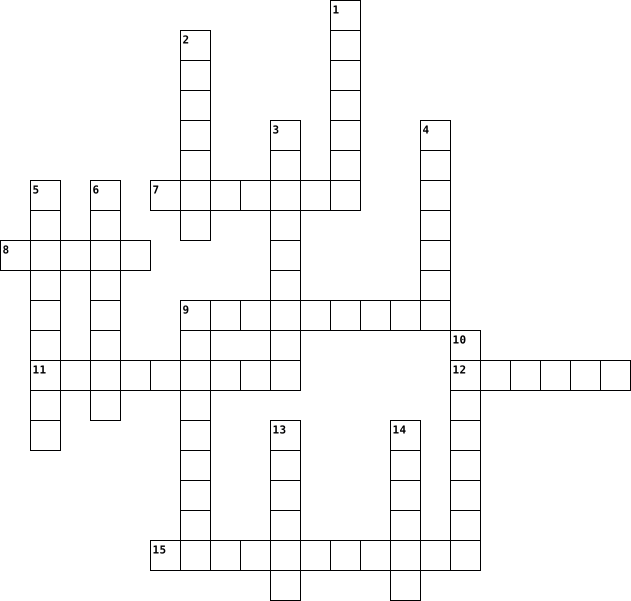
Across
- coined the term molecular biology
- and Monad- gene expression
- replication
- X-ray diffraction
- Mcleod and McCarty- DNA as genetic material
- model organism
Down
- laws of heredity
- and Chase- DNA of viruses
- Salmon sperm DNA
- chromosomes and heredity
- complementarity of DNA
- triplet code of life
- biology- study of molecules
- Helicall structure of DNA
- and Crick- central dogma of Biology
- and Tatum- relationship between genes and proteins
16 Clues: replication • model organism • laws of heredity • Salmon sperm DNA • X-ray diffraction • triplet code of life • complementarity of DNA • chromosomes and heredity • and Chase- DNA of viruses • Helicall structure of DNA • and Monad- gene expression • biology- study of molecules • coined the term molecular biology • and Crick- central dogma of Biology • ...
Waves and Electromagnetic Spectrum 2020-02-13

Across
- light is consumed while passing through an object
- a wave that vibrates perpendicularly
- light moves around an object
- a change in particles that carry energy
- light cannot travel through
- a wave that carries radiant energy through an electromagnetic field
- a wave that vibrates parallel
- electromagnetic wave with the shortest wavelength
- almost see through
- electromagnetic radiation with range of wavelengths
- radiation with the third shortest wavelength
- when particles in a longitudinal wave are far apart
- top of wave
- light passes through the material
Down
- see through
- height of wave
- radiation with second longest wavelength
- when particles in a longitudinal wave are close together
- a range of frequencies of electromagnetic radiation
- light waves change speed
- light hits object and spreads
- wave that requires medium to carry energy
- width between waves
- substance through which energy travels
- bottom of wave
- radiation with second shortest wavelength
- radiation with third longest wavelength
- light bounces of an object
- Electromagnetic wave with the longest wavelength
29 Clues: see through • top of wave • height of wave • bottom of wave • almost see through • width between waves • light waves change speed • light bounces of an object • light cannot travel through • light moves around an object • light hits object and spreads • a wave that vibrates parallel • light passes through the material • a wave that vibrates perpendicularly • ...
Nuclear Physics 2023-10-14

Across
- - Splitting of an atomic nucleus.
- - Emission of energy as particles or waves.
- - Type of radiation involving high-speed electrons.
- - Nearly massless subatomic particle.
- - Material capable of undergoing fission.
- - Type of radiation consisting of helium nuclei.
- - The minimum amount of fissile material.
- - Atoms with the same number of protons but different neutrons.
- - Isotope used for dating artifacts.
- - Neutrally charged subatomic particle.
- - Interaction between atomic nuclei.
- - Particles passing through energy barriers.
- - Emitting radiation due to unstable nuclei.
- - Time for half of a substance to decay.
- - Radiation with sufficient energy to remove electrons.
- - Process of nuclear fusion in stars.
- - Process in which nuclei fragment.
Down
- - Substances capable of sustaining a chain reaction.
- - A self-sustaining nuclear process.
- - Central core of an atom.
- - Attractive force between nucleons.
- - Energy holding atomic nuclei together.
- - Process of a nucleus transforming over time.
- - Combining of atomic nuclei.
- - Resulting nuclei from nuclear fission.
- - Type of radioactive decay.
- - Positively charged subatomic particle.
- - Counterpart to the neutrino.
- - Creates more fissile material than it consumes.
- - High-energy electromagnetic radiation.
30 Clues: - Central core of an atom. • - Type of radioactive decay. • - Combining of atomic nuclei. • - Counterpart to the neutrino. • - Splitting of an atomic nucleus. • - Process in which nuclei fragment. • - A self-sustaining nuclear process. • - Attractive force between nucleons. • - Isotope used for dating artifacts. • - Interaction between atomic nuclei. • ...
RAD Tech Week 2024 2024-07-11

Across
- Imaging technique using magnetic fields and radio waves
- Material worn for radiation protection.
- System for storage and review of radiology images (abbreviation).
- Traditional medium for capturing X-ray images.
- Imaging method using computed tomography.
- Energy emitted from X-rays.
- Side view positioning in radiography.
- Imaging technique using high-frequency sound waves.
- Common structure imaged in X-ray.
- Amount of radiation administered during an imaging procedure.
- Device to improve image quality by reducing scatter radiation.
- Short form for technologist.
Down
- Resulting visual from a radiology exam.
- Standard for handling, storing, and transmitting information in medical imaging (abbreviation).
- Form of electromagnetic radiation used to create images of the inside of the body.
- Type of imaging that does not use film.
- What a CT or MRI performs.
- Substance used to enhance the visibility of structures in imaging.
- Short form of fluoroscopy.
- Contrast ___, used to improve image quality.
- Imaging technique that displays a continuous X-ray image.
- Protective materials and devices used to minimize exposure to radiation.
22 Clues: What a CT or MRI performs. • Short form of fluoroscopy. • Energy emitted from X-rays. • Short form for technologist. • Common structure imaged in X-ray. • Side view positioning in radiography. • Resulting visual from a radiology exam. • Material worn for radiation protection. • Type of imaging that does not use film. • Imaging method using computed tomography. • ...
P1, P2, P3 & P4 2013-10-08

Across
- resistance is measured in these
- start of the electomagnetic spectrum
- the time is takes radiation to decrease in activity by half
- substances that give out radiation and know to be this
- was placed in a russian spys drink to kill him (type of radiation)
- nuclear radiation does this to materials
- used in hospitals
- the colour of the earth wire
- in wave form this made the hulk become the hulk
Down
- plastic is a poor one of these
- fuel tankers are this when they are fueling something
- generated by friction
- voltmeter measures these
- gamma radiation is used for this in hospitals
- the colour of the netural wire
- this is called an object that is within the earths gravitational field
- middle strenght radiation
17 Clues: used in hospitals • generated by friction • voltmeter measures these • middle strenght radiation • the colour of the earth wire • plastic is a poor one of these • the colour of the netural wire • resistance is measured in these • start of the electomagnetic spectrum • nuclear radiation does this to materials • gamma radiation is used for this in hospitals • ...
Crossword Puzzle Time 2026-05-12

Across
- Whatever is left over
- Half of what makes up a nucleus, the other half being protons
- Low energy radiation that CANNOT cause damage.
- The amount of time it takes for HALF of something to change.
- A giant wheel or fan that spins to generate power
- A type of radiation that can be stopped by thin plastic or metal
- More than one nucleus
- The cloud that surrounds the nucleus in an atom
- The splitting of the centre of an atom(The Nucleus)
Down
- The gas or vapour that water is turned into when it is heated enough
- Half of what makes up a nucleus, the other have being neutrons
- the type of radiation that we can see
- High energy radiation that CAUSES damage by knocking electrons out of atoms.
- The name for things that have tiny unstable parts that shake and shoot out energy or bits of themselves.
- A high energy type of radiation that can be stopped by thick concrete
- The centre of an atom, made of neutrons and protons
- A type of low energy radiation that can be stopped by skin or a piece of paper
- A tiny building block that makes up everything; A nucleus surrounded by a cloud of electrons
18 Clues: Whatever is left over • More than one nucleus • the type of radiation that we can see • Low energy radiation that CANNOT cause damage. • The cloud that surrounds the nucleus in an atom • A giant wheel or fan that spins to generate power • The centre of an atom, made of neutrons and protons • The splitting of the centre of an atom(The Nucleus) • ...
DeklanIsaccTori 2024-04-16

Across
- energy passes through a material
- how many times a wave repeats in a specific time intervals
- a scale used to classify things or ideas between opposing ends
- movement of energy
- fastest types of waves
- light that you can see
- object travels through
- slowest types of waves
- lowest point on a wavelength
- fourth lowest frequency on the EM radiation spectrum
- wave with second lowest frequency
- light
- energy bounces off a material
Down
- moves in a continuous stream
- all light that our eyes can procces
- second highest frequency on the EM radiation spectrum
- energy transmitted in a scattered
- to get better
- mid point of a wave
- like a wall
- distance from the midpoint of a wave
- fourth highest frequency on the EM radiation spectrum
- third lowest frequency on the EM radiation spectrum
- "stuff"
- change of direction in a wave
- highest point of a wavelength
- distance from crest to crest
- energy stays within a material
- third highest frequency on the EM radiation spectrum
- moves in a continuous pattern
30 Clues: light • "stuff" • like a wall • to get better • movement of energy • mid point of a wave • fastest types of waves • light that you can see • object travels through • slowest types of waves • moves in a continuous stream • lowest point on a wavelength • distance from crest to crest • change of direction in a wave • highest point of a wavelength • moves in a continuous pattern • ...
Jacob Veal 2023-09-19

Across
- Distance between points on a wave
- Energy levels within a principal energy level
- Positively charged ion
- High-energy radiation
- Lowest energy state of a particle
- Particle of electromagnetic radiation with no mass
- the flow of energy at the universal speed of light
- Electromagnetic waves
- Electron with a 1− charge
- The arrangement of electrons in an atom
Down
- The number of waves that pass a specific point per second
- Outermost electrons on a particle
- States that atoms lose, gain, or share electrons to acquire stable electron configuration
- Negatively charged atom
- Major energy levels or an atom
- Minimum amount of energy gained or lost by an atom
- A particle with two protons and two neutrons with a 2+ charge
- The emission of radiation
- A spectrum of the electromagnetic radiation emitted by a source
- Atom(s) with positive/negative charge
- Equation that shows the atomic number and mass number of a particle
- A way to show valence electrons
22 Clues: High-energy radiation • Electromagnetic waves • Positively charged ion • Negatively charged atom • The emission of radiation • Electron with a 1− charge • Major energy levels or an atom • A way to show valence electrons • Outermost electrons on a particle • Distance between points on a wave • Lowest energy state of a particle • Atom(s) with positive/negative charge • ...
Radiology 2023-08-30

Across
- the view is also called the skyline view
- builds up contrast slowly
- concerns the intensity of the radiation from a source
- represents the number of balls on the table
- is the power behind the cue stick
- the scientist discovered x-rays
- the portion of the x-ray image that is sharp and clearly
- the tube filament is composed of
- the outside edge that in imperfectly collimated
- when two films completely or partially stick together
Down
- device helps control the field of view and decrease potential scatter radiation
- process by which intensifying screens react to the incoming radiation
- denotes the pictorial element of the image
- an imaging plate replaces the conventional cassette
- intensity of radiation is greater on the cathode side than on the anode side
- radiation that is created by the photon stream outside the actual focal spot
- as low as reasonably achievable is the anagram for
- is a vacuum tube containing an anode and a cathode
- the height of the lead strips compared with the distance between them
- are used to remove low energy radiation
20 Clues: builds up contrast slowly • the scientist discovered x-rays • the tube filament is composed of • is the power behind the cue stick • are used to remove low energy radiation • the view is also called the skyline view • denotes the pictorial element of the image • represents the number of balls on the table • the outside edge that in imperfectly collimated • ...
Models of Atoms & The Electromagnetic Spectrum 2017-11-11

Across
- A negatively charged sub-atomic particle found orbiting the centre of the atom on shells.
- The type of electromagnetic radiation with the shortest wavelength (but highest frequency).
- The type of electromagnetic radiation with the longest wavelength.
- A neutrally charged sub-atomic particle found in the centre of the atom.
- All types of electromagnetic radiation can be found on the electromagnetic ___________________.
- The type of electromagnetic radiation that can cause skin cancer and which is emitted by the Sun.
- A positively charged sub-atomic particle found in the centre of the atom.
- The centre of the atom, containing most of the mass of an atom.
- A type of electromagnetic radiation used in hospitals to see inside the human body (Hint: Write in the form ___-______).
Down
- The modern model of the atom was proposed by the scientist called ____________.
- After radiation is emitted from a source, it is ____________________ through the atmosphere to its receiver.
- Once radiation reaches a receiver, it is __________________.
- A model of electromagnetic raadiation which suggests that all radiation is emitted in the form of 'ripples of waves' (from an oscillating source to an absorber/receiver).
- This happens when an atom absorbs a photon of energy with enough energy that electrons are lost from the atom.
- A model of electromagnetic radiation which suggests that all radiation is emitted in 'packets' of energy that are transferred from a source to absorber/receiver.
- The name given to the object giving out (emitting) radiation.
16 Clues: Once radiation reaches a receiver, it is __________________. • The name given to the object giving out (emitting) radiation. • The centre of the atom, containing most of the mass of an atom. • The type of electromagnetic radiation with the longest wavelength. • A neutrally charged sub-atomic particle found in the centre of the atom. • ...
crossword 1 2023-01-30

Across
- Minute eelworm that feeds on organisms that cause fermentation in e.g. vinegar
- A system of electronic equipment for recording or reproducing sound
- Obtain something that is wanted, needed or required
- A terminal/node where subways/rapid transit systems load and unload passengers
- Of an instrument of certain death
- Painful thrombosis of the femoral vein in the leg following childbirth
Down
- The branch of biology that studies the effects of radiation on living organisms
- Erect perennial of eastern and southern United States having showy orange flowers
- Brown oval fruit flesh makes excellent sherbet
- In a confused manner
- (heraldry) lying with head on paws as if sleeping
11 Clues: In a confused manner • Of an instrument of certain death • Brown oval fruit flesh makes excellent sherbet • (heraldry) lying with head on paws as if sleeping • Obtain something that is wanted, needed or required • A system of electronic equipment for recording or reproducing sound • Painful thrombosis of the femoral vein in the leg following childbirth • ...
Ionising Radiation 2012-12-05

Across
- Prolonged exposure to gamma rays, xrays or ultraviolet light can be ...
- Gamma rays and Xrays are very high energy electromagnetic waves. They have a short wavelength and a high...
- What type of radiation is made of two protons and two neutrons?
- Radio waves, microwaves, infrared and visible light are all examples of what type of radiation?
- Alpha particles are said to be the most .... type of radiation.
Down
- What type of radiation is made of high energy electrons?
- What type of radiation is made of high energy electromagnetic waves?
- What is the name of the spectrum that includes radio waves, microwaves and visible light?
- This type of electromagnetic radiation is often used to examine bones.
- To stop gamma rays you need 10cm of thick...
- Alpha particles can be stopped by a sheet of...
- What is the name for atoms that have become charged?
12 Clues: To stop gamma rays you need 10cm of thick... • Alpha particles can be stopped by a sheet of... • What is the name for atoms that have become charged? • What type of radiation is made of high energy electrons? • What type of radiation is made of two protons and two neutrons? • Alpha particles are said to be the most .... type of radiation. • ...
Electromagnetic Radiation 2024-09-17

Across
- the rate at which a vibration occurs that constitutes a wave
- confusion of a received radio signal due to the presence of noise (such as atmospherics) or signals from two or more transmitters on a single frequency
- a telescope in which a mirror is used to collect and focus light
- a type of optical telescope that uses a lens as its objective to form an image
- the process or action by which one thing absorbs or is absorbed by another.
Down
- In geometric optics, a deviation from rectilinear projection; a projection in which straight lines in a scene remain straight in an image.
- the distance between two corresponding points on a wave
- They have the shortest wavelengths and highest energy of any wave in the electromagnetic spectrum.
- the throwing back by a body or surface of light, heat, or sound without absorbing it.
- someone who uses the principles of physics to study the solar system, stars, galaxies, and the universe
- change in direction of propagation of any wave as a result of its traveling at different speeds at different points along the wave front.
- a band of colors, as seen in a rainbow, produced by separation of the components of light by their different degrees of refraction according to wavelength.
12 Clues: the distance between two corresponding points on a wave • the rate at which a vibration occurs that constitutes a wave • a telescope in which a mirror is used to collect and focus light • the process or action by which one thing absorbs or is absorbed by another. • a type of optical telescope that uses a lens as its objective to form an image • ...
Subject integration 2026-06-06

Across
- or pull acting on an object. (Physics) — 5
- composition in verse. (English) — 4
- material in living organisms. (Biology) — 3
- for Information Technology. (IT) — 2
- Clues
- levy on income or goods. (Economics) — 3
- particle of an element. (Chemistry) — 4
- of exchange. (Economics) — 5
- unit of life. (Biology) — 4
- period that has already happened. (History) — 4
- microorganism. (Biology) — 5
Down
- needed for growth and repair of the body. (Biology) — 5 (PROTEIN shortened intersection variant may be adapted)
- and selling activity. (Commerce/Management) — 5
- used in place of a noun. (English Grammar) — 7
- Clues
- written for a computer. (IT) — 4
- body of a state. (Political Science/Hindi) — 5
17 Clues: Clues • Clues • unit of life. (Biology) — 4 • of exchange. (Economics) — 5 • microorganism. (Biology) — 5 • written for a computer. (IT) — 4 • composition in verse. (English) — 4 • for Information Technology. (IT) — 2 • particle of an element. (Chemistry) — 4 • levy on income or goods. (Economics) — 3 • or pull acting on an object. (Physics) — 5 • ...
Thermal Processes IGCSE 2023-04-10

Across
- heat energy.
- convection results in .......... forming inside the liquids and gases.
- black, mat black are good .........
- is the best emitter of heat energy.
- is a good absorber of heat energy.
- cold air and cold gases are ......
- heat emitted from all matter even cold objects.
- is best reflector of heat energy.
- objects give off more radiation than cold objects.
Down
- radiation is given off by all objects.
- are good insulators.
- is a bad absorber of heat energy.
- infrared radiation is transmitted from object in form of .........
- sum of the potential and kinetic energy.
- are good conductors of thermal energy.
- infrared radiation can travel through the ......... of space.
- heat transfer in liquids and gases.
- heat transfer through contact only.
- warm air and warm gases are .....
19 Clues: heat energy. • are good insulators. • is a bad absorber of heat energy. • warm air and warm gases are ..... • is best reflector of heat energy. • is a good absorber of heat energy. • cold air and cold gases are ...... • black, mat black are good ......... • is the best emitter of heat energy. • heat transfer in liquids and gases. • heat transfer through contact only. • ...
Subject integration 2026-06-06

Across
- or pull acting on an object. (Physics) — 5
- composition in verse. (English) — 4
- material in living organisms. (Biology) — 3
- for Information Technology. (IT) — 2
- Clues
- levy on income or goods. (Economics) — 3
- particle of an element. (Chemistry) — 4
- of exchange. (Economics) — 5
- unit of life. (Biology) — 4
- period that has already happened. (History) — 4
- microorganism. (Biology) — 5
Down
- needed for growth and repair of the body. (Biology) — 5 (PROTEIN shortened intersection variant may be adapted)
- and selling activity. (Commerce/Management) — 5
- used in place of a noun. (English Grammar) — 7
- Clues
- written for a computer. (IT) — 4
- body of a state. (Political Science/Hindi) — 5
17 Clues: Clues • Clues • unit of life. (Biology) — 4 • of exchange. (Economics) — 5 • microorganism. (Biology) — 5 • written for a computer. (IT) — 4 • composition in verse. (English) — 4 • for Information Technology. (IT) — 2 • particle of an element. (Chemistry) — 4 • levy on income or goods. (Economics) — 3 • or pull acting on an object. (Physics) — 5 • ...
Radioactivity 2025-09-02

Across
- taken for half the radioactive nuclei in a sample to decay
- Central part of an atom where protons and neutrons are found
- High-energy electromagnetic radiation from the nucleus
- by which an unstable nucleus loses energy
- Atoms of the same element with different numbers of neutrons
- Radiation that is always present in the environment
- Type of radiation consisting of high-speed electrons or positrons
- Device used to detect radiation
Down
- Detector that shows visible tracks of charged particles
- Process of knocking electrons off atoms
- Detector that darkens when exposed to radiation
- Material used to block or reduce radiation
- gas from uranium decay
- Type of radiation consisting of helium nuclei
- Uncharged particle in the nucleus
15 Clues: gas from uranium decay • Device used to detect radiation • Uncharged particle in the nucleus • Process of knocking electrons off atoms • by which an unstable nucleus loses energy • Material used to block or reduce radiation • Type of radiation consisting of helium nuclei • Detector that darkens when exposed to radiation • ...
chemistry 2021-11-18

Across
- m
- jj
- w
- c
- f
- i
- gg
- g
- a
- u
- s
- p
- z
- aa
- ii
- v
- dd
- ff
- h
- e
- t
Down
- hh
- j
- bb
- mm
- k
- nn
- o
- kk
- n
- cc
- y
- q
- x
- l
- d
- ll
- r
- ee
- b
40 Clues: j • k • m • o • w • c • f • n • i • y • q • x • l • d • g • a • u • s • p • r • z • v • h • b • e • t • hh • bb • mm • nn • jj • kk • gg • cc • ll • ee • aa • ii • dd • ff
Ozone Layer 2020-03-20

Across
- Where is the hole of the Ozone layer?
- What does the word 'ozone' mean in Greek?
- When did the problems with the Ozone Layer started?
- What is happening to earth surface?
- In which sphere Ozone layer depletion is found?
- What is the Ozone layer problem?
- What is protecting us from the sun?
- How does radiation effect our bodies?
- how does radiation effect nature?
- How does radiation effect our skin?
- What is the problem of the Ozone know ss?
- What is the sun emitting?
Down
- Where is the Ozone layer?
- How long does Cfcs last?
- What other type of chemical was depleting the Ozone layer?
- What is the radiation known as?
- How much atoms does the Ozone layer have?
- Mention one appliance that spread CFCs
- What type of chemical was depleting the Ozone Layer?
- What is the Ozone layer issue?
20 Clues: How long does Cfcs last? • Where is the Ozone layer? • What is the sun emitting? • What is the Ozone layer issue? • What is the radiation known as? • What is the Ozone layer problem? • how does radiation effect nature? • What is happening to earth surface? • What is protecting us from the sun? • How does radiation effect our skin? • Where is the hole of the Ozone layer? • ...