
space Crossword Puzzles
Space 2025-04-03

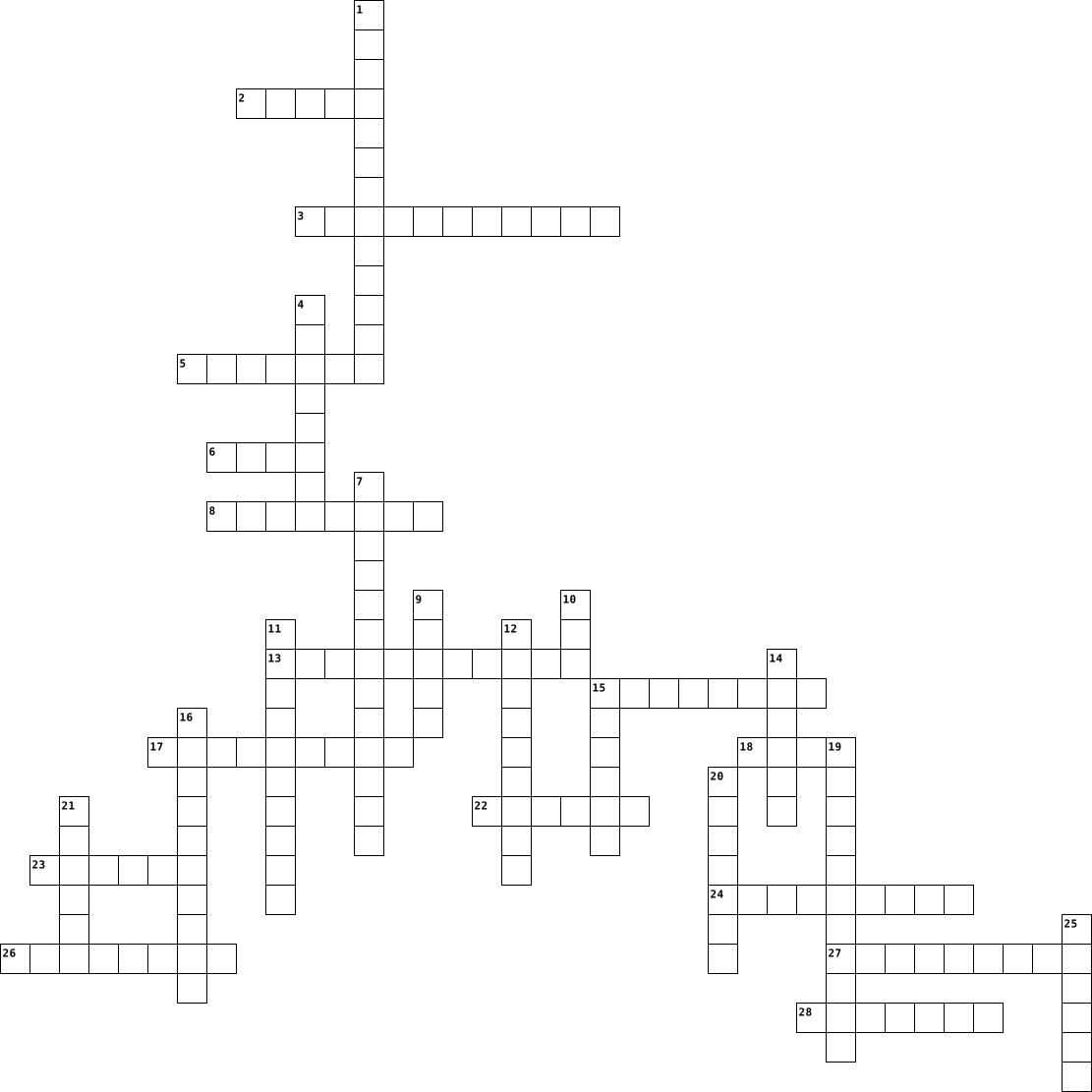
Across
- The fourth planet from the Sun, known as the "Red Planet."
- A small rocky body that orbits the Sun.
- A rock or particle that enters Earth's atmosphere.
- The star at the center of our solar system.
- A luminous ball of gas, like the Sun.
- The season when leaves fall from trees, also known as autumn.
- The seventh planet from the Sun, known for its tilted axis.
- The force that pulls objects toward one another, like the Earth pulls objects toward it.
- A large celestial body that orbits a star.
- Earth's natural satellite.
- The second planet from the Sun, often called Earth's "sister planet."
Down
- A vehicle designed for travel in outer space.
- The warmest season of the year.
- A tool used to observe distant objects in space.
- The season after winter and before summer.
- A vehicle used to travel in space.
- The path one object takes around another, like a planet around the Sun.
- A person trained to travel in space.
- A system of stars, gas, and dust held together by gravity.
- A small icy body that orbits the Sun.
20 Clues: Earth's natural satellite. • The warmest season of the year. • A vehicle used to travel in space. • A person trained to travel in space. • A luminous ball of gas, like the Sun. • A small icy body that orbits the Sun. • A small rocky body that orbits the Sun. • The season after winter and before summer. • A large celestial body that orbits a star. • ...
Space 2025-04-22

Across
- The universe seen as a well-ordered whole. (6 letters)
- The sixth planet from the sun, known for its prominent ring system. (6 letters)
- An imaginary line around the middle of a planet or other celestial body, dividing it into northern and southern hemispheres. (7 letters)
- The phenomenon in which one celestial body moves into the shadow of another celestial body. (7 letters)
- The action of rotating around an axis or center. (8 letters)
- The distance that light travels in one year. (9 letters)
- The second planet from the sun, known for its brightness and high surface temperatures. (5 letters)
- A system of millions or billions of stars, together with gas and dust, held together by gravitational attraction. (6 letters)
- A region of space having a gravitational field so intense that no matter or radiation can escape. (9 letters)
Down
- A celestial body moving in an elliptical orbit around a star. (6 letters)
- A small rocky body orbiting the sun, typically found in the belt between Mars and Jupiter. (8 letters)
- An artificial body placed in orbit around the earth or moon or another planet in order to collect information or for communication. (9 letters)
- An optical instrument designed to make distant objects appear nearer. (9 letters)
- Relating to or associated with the moon. (5 letters)
- The curved path of a celestial object around a star, planet, or moon. (5 letters)
- A celestial body moving in an elliptical orbit around a star. (6 letters)
- The force that attracts a body towards the centre of the earth, or towards any other physical body having mass. (7 letters)
- A giant cloud of dust and gas in space, sometimes becoming the birthplace of stars. (6 letters)
- The scientific study of celestial objects, space, and the universe as a whole. (9 letters)
- Relating to or determined by the sun. (5 letters)
- An icy small solar system body that, when passing close to the sun, warms and begins to release gases. (5 letters)
- An artificial body placed in orbit around the earth or moon or another planet in order to collect information or for communication. (9 letters)
22 Clues: Relating to or determined by the sun. (5 letters) • Relating to or associated with the moon. (5 letters) • The universe seen as a well-ordered whole. (6 letters) • The distance that light travels in one year. (9 letters) • The action of rotating around an axis or center. (8 letters) • A celestial body moving in an elliptical orbit around a star. (6 letters) • ...
Space 2025-05-16

Across
- the galaxy we live in
- what we live on
- a man made object that goes around earth
- a probe launched off earth to study the outer milkyway
- a non-glowing ball of mass
- belt a belt of asteroids outside the milkyway
- the earth does this around the sun
- h20
- space station the station in space that we use
- the amount of energy in something
Down
- a constellation of a princess in the sky
- a group of stars that forms a picture
- star system in the southern constellations
- the north star
- opposite of this is a white hill
- rhymes with bubble
- how far light travels in a year
- stars are bornn from this
- an hour and a half
- a glowing ball of mass
- the pull on earth
- the milky way _______
- an objects ability to move
23 Clues: h20 • the north star • what we live on • the pull on earth • rhymes with bubble • an hour and a half • the galaxy we live in • the milky way _______ • a glowing ball of mass • stars are bornn from this • a non-glowing ball of mass • an objects ability to move • how far light travels in a year • opposite of this is a white hill • the amount of energy in something • ...
Space 2025-05-16

Across
- a force that pulls objects together
- mass packed into a tiny volume
- our galaxy
- where we live
- a gas with diatomic molecules
- a large cloud of gas and dust
- minutes the amount of time it take satellites to orbit earth
- the amount of matter inside of an object
- spacestation a permanently crewed satellite in space
- a pattern of stars
- the natural tendency of objects in motion
- a space prob that we launched into space to orbit the earth
Down
- year the distance light travels in one year
- a star in the little dipper
- massive collection of gas planets dust and dark matter
- a celestial body that orbits a star
- one a space prob that left earth to discover other galaxy's
- triple star system located 4.37 light years from earth
- a space based observatory
- a giant ball of gas
- a region of the solar system located beyond the orbit of Neptune
- a constellation in the Andromeda Galaxy
- a repeating path that a planet makes
23 Clues: our galaxy • where we live • a pattern of stars • a giant ball of gas • a space based observatory • a star in the little dipper • a gas with diatomic molecules • a large cloud of gas and dust • mass packed into a tiny volume • a force that pulls objects together • a celestial body that orbits a star • a repeating path that a planet makes • a constellation in the Andromeda Galaxy • ...
SPACE!!! 2025-05-16

Across
- nasa's space probe
- this is know as the home in space
- how heavy/dens something is
- H is its sign on the peritoc table
- another word for our planet
- a large cloud of dust
- a very good snowmobile brand
- objects in motion stay in motion
- this is an old star that broke and turned into something that sucks stuff up
- this keeps us on earth
- how we travel in space aka how far something is
Down
- is how long it takes for a satellite to orbit us
- this makes cool figures in the night sky
- a region beyond neptune
- a consillation also know as (M31)
- this is the most know satellite
- these go around earth and give us information
- this is our galaxy
- a triple star in our solar system
- we do this around the sun
- the milky way
- what is earth also called there are lots more of these to
- the bright things in the night sky
23 Clues: the milky way • nasa's space probe • this is our galaxy • a large cloud of dust • this keeps us on earth • a region beyond neptune • we do this around the sun • how heavy/dens something is • another word for our planet • a very good snowmobile brand • this is the most know satellite • objects in motion stay in motion • a consillation also know as (M31) • ...
SPACE 2024-03-31

Across
- mrk
- satelit
- vesoljsko vozilo
- astronom
- črna luknja
- galaksija
- luna
- sončni sistem
- teleskop
- tirnica, kroženje
- plant
- komet
- astronavt
- Uran
- enakonočje
- gravitacija
Down
- Neptun
- vesoljska postaja
- Venera
- asteroid
- Merkur
- zvezda
- ozvezdje
- atmosfera
- zemlja
- Jupiter
- Rimska cesta
- revolucija
- Mars
- rotacija
- Saturn
31 Clues: mrk • luna • Mars • Uran • plant • komet • Neptun • Venera • Merkur • zvezda • zemlja • Saturn • satelit • Jupiter • asteroid • astronom • ozvezdje • teleskop • rotacija • galaksija • atmosfera • astronavt • revolucija • enakonočje • črna luknja • gravitacija • Rimska cesta • sončni sistem • vesoljsko vozilo • vesoljska postaja • tirnica, kroženje
space!!! 2024-04-03

Across
- 90% of stars are currently in this stage of their life cycle
- a star that is among the most massive and brightest of all stars.
- the pulling to the middle of the earth, causing things to fall
- a huge system of billions of stars together
- the extremely dense remains of a dead star, very small and desne
- a chart that graphs a star's brightness and temperatuer
- the planet in which we live on
- a ring-shaped nebula formed by an expanding shell of gas around an aging star
Down
- a young star in the early stages of formation; nuclear fussion
- a celestial body that orbits around the sun
- dwarf a dead star that no longer gives off light or heat
- a smooth, circular or oval shaped galaxy
- the name of the spiral shaped galaxy of which we live in
- a random, scattered type of galaxies
- a star that has exhausted all of its nuclear fuel; planet sized and very dense
- an extremely bright explosion of a star
- a flat, disk-shaped galaxy
- the stage after a main sequence for a small to medium mass star; fuel begins to run out.
- a main sequence star that lights up our earth
- a huge cloud of dust and gas in space held together by gravity
20 Clues: a flat, disk-shaped galaxy • the planet in which we live on • a random, scattered type of galaxies • an extremely bright explosion of a star • a smooth, circular or oval shaped galaxy • a celestial body that orbits around the sun • a huge system of billions of stars together • a main sequence star that lights up our earth • ...
Space 2024-02-26

Across
- A particular place or position.
- A spacecraft where people stay en work when being in space.
- A device designed for travel or opperation outside the earth's atmosphere.
- Getting to know an unfarmiliar area.
- A spacecraft designed to land on the surface of the moon.
- It include all of space and all the matter and energy that space contains.
- A tree-dimensional shape that looks like a circle.
- You have eight of them and they are floating in space.
- When something will always be there its.
- A group people that engage in and operate a business enterprise in a commercial capacity.
Down
- The total absence of light.
- A person responsible for carrying out the administration of a business.
- A device that can manage to control something form a long distance.
- When to company's work together.
- A machine that provide lunar surface acces and long distance communication.
- Relating to buying or selling products through advertisement.
- The nessesary items for a particular purpose.
- An important assignment given to a person or group.
- A volunteer sharing information on the current affairs of the space industry.
- A scientific test in witch you perform a series of action and observe what happens.
20 Clues: The total absence of light. • A particular place or position. • When to company's work together. • Getting to know an unfarmiliar area. • When something will always be there its. • The nessesary items for a particular purpose. • A tree-dimensional shape that looks like a circle. • An important assignment given to a person or group. • ...
Space 2024-04-12

Across
- the stage after main sequence for a small to medium mass star; fuel begins to run out
- an extremely bright explosion of a star
- No reflected light from the sun is visible
- Occurs directly after a third/last quarter, but before a new moon
- Occurs directly after a new moon, but before a first quarter
- A full moon is fully visible (100% illuminated) as viewed from Earth
- Occurs directly after a first quarter, but before a full moon
- a star that is among the most massive and brightest of all stars
- a young star in the early stages of formation; nuclear fusion begins (light and heat produced)
- 90% of stars are in this stage of their life cycle
Down
- Occurs directly after a waning gibbous, but before a waning crescent
- a star that has exhausted all of its nuclear fuel; planet sized and very dense
- a dead star that no longer gives off light or heat
- a gravitational field so strong that not even light can escape
- a ring-shaped nebula formed by an expanding shell of gas around an aging star
- the extremely dense remains of a dead star; very small and very dense
- Occurs directly after a full moon, but before a third/last quarter
- a huge cloud of dust and gas held together by gravity; star nursery
- Occurs directly after a waxing crescent, but before a waxing gibbous
- the distance light travels in a year – about 5.88 trillion miles
20 Clues: an extremely bright explosion of a star • No reflected light from the sun is visible • a dead star that no longer gives off light or heat • 90% of stars are in this stage of their life cycle • Occurs directly after a new moon, but before a first quarter • Occurs directly after a first quarter, but before a full moon • ...
space 2022-10-11

Across
- An Object that helps you look at sky
- Before the Space Shuttle this was used to travel to space
- A force that attracts one object to another
- Tunnels through spacetime
- First man on the Earth's natural satellite
- Saturn has these
- Country that launched the first man in space
- One name for collection of million of stars
- What has a tail?
- The English name for Earth's natural satellite
- Neme of the first artificial satellite
Down
- Nemo of the Nicolaus Copernicus discovery
- Smallest planet in the solar system
- The red planet
- A star's explosive finale
- The biggest planet in the solar system
- First month of summer
- Name of a person going to space
- hottest planet in the solar system
- The abbrevation of International Space Station
20 Clues: The red planet • Saturn has these • What has a tail? • First month of summer • Tunnels through spacetime • A star's explosive finale • Name of a person going to space • hottest planet in the solar system • Smallest planet in the solar system • An Object that helps you look at sky • The biggest planet in the solar system • Neme of the first artificial satellite • ...
SPACE 2022-11-16

Across
- the zodiac Most likely to become an inventor
- What is something that orbits the sun
- the zodisc Most likely to break a world record
- A formation of stars
- This planet is hot enough to melt metal
- the zodiac Most likely to become president
- This planet has the strongest winds in the solar system
- Contains galaxies and is always expanding
- the zodiac Most likely to marry their school sweetheart
- The largest planet
- A planet that rotates on its side
- A large object that is made of dust and ice bits
Down
- the zodiac Most likely to win a Nobel peace prize
- the zodiac Most likely never to be seen again
- The light of our world
- Known as the red planet
- the zodiac Most likely to cure a disease
- A planet Famous for its rings
- The zodiac Most likely to become a billionaire
- the zodiac Most likely to travel the world
- Star signs
- the zodiac Most likely to rule the world
- The smallest planet
- the zodiac Most likely to become famous
- The force with which a planet can move
- The only planet containing life
- The thing that orbits around our planet
- No longer considered a planet
28 Clues: Star signs • The largest planet • The smallest planet • A formation of stars • The light of our world • Known as the red planet • A planet Famous for its rings • No longer considered a planet • The only planet containing life • A planet that rotates on its side • What is something that orbits the sun • The force with which a planet can move • This planet is hot enough to melt metal • ...
Space 2022-02-07
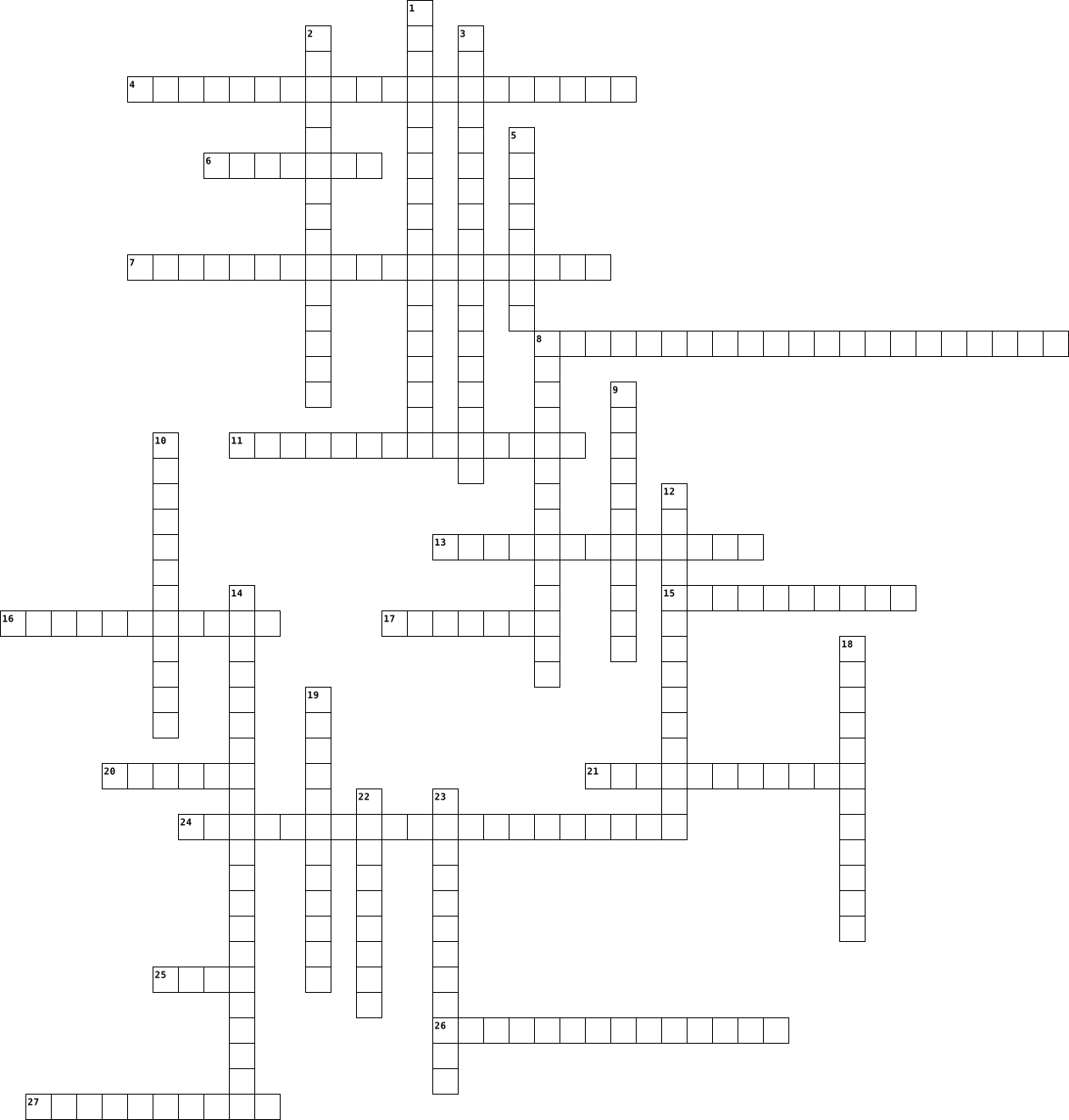
Across
- Empty regions between bodies in the universe.
- round space object that travels around a star but has not cleared its own orbit.
- The force of attraction between two objects. Keeps all planets in orbit around the sun.
- Giant balls of hot gas, giving out huge amounts of heat and light.
- A rocky object that orbits a star. Found in the asteroid belt.
- skipping a state of matter. E.g. ice changing to a gas.
- Name of our galaxy
- A meteor that passes through the Earth's atmosphere and hits the Earth.
- The amount of matter in an object.
- Unit used to measure weight
- A planet with large rings.
- A device used to observe the universe.
- Object composed of dust, rock and metal. Also orginate in the asteroid belt. Some come from mercury or mars.
- A body in orbit around a planet.
- The nearest planet to the sun.
Down
- A natural body outside the Earth's atmosphere.
- Everything that exists, including stars, planets, galaxies and empty space.
- A group of stars forming a recogisable pattern.
- Object composed of frozen gases, rock, dust and has an icy sheel which orbits the sun.
- The name of our star.
- A person who studies space.
- Unit of distance in space.
- Collection of many millions of stars, dust, gas and dark matter held together by gravity.
- Meteoroid that hits the Earth's atmossphere. Also known as shooting star.
- model Ptolemy's model of the universe with the Earth in the centre.
- Composed of a star and all the objects orbiting around it.
- The largest planet in our solar system.
- A large round object that has enough gravity to clear its orbit around the sun.
- Mass which takes into account of the force of gravity.
29 Clues: Name of our galaxy • The name of our star. • Unit of distance in space. • A planet with large rings. • A person who studies space. • Unit used to measure weight • The nearest planet to the sun. • A body in orbit around a planet. • The amount of matter in an object. • A device used to observe the universe. • The largest planet in our solar system. • ...
space 2022-04-22

Across
- the US orbital navigation satellites
- the first satellite to orbit the earth
- the repurposed ICBM whose second version launched Gemini
- the Russian space agency
- the series of probes to use a once-in-a-lifetime planetary alignment to do flybys of a ton of outer planets and leave the solar system
- US probes that went to mercury, venus, mars, and that did first flybys and orbits of planets
- soviet program to land on the moon, went from before the US did it to after apollo
- russia's current manned capsule
- the atlas used a stage and a ____ design
- JFK's ____ speech, famous for declaring america will go to the moon before the 1960's end
- the most recent US rover to land on mars's nickname
- what did allan Shepard play on the moon?
- the oldest satellite in orbit
Down
- intercontenital _________ missile
- the rocket that launched the first US satellite
- repurposed Saturn V third stage, first US space station
- the US's program to return to the moon
- the mars helicopter's nickname
- first working rover, first wheeled rover, and first rover to not be attached to its lander
- a type of rocket that does not enter orbit
- Boeings still-being-tested capsule
21 Clues: the Russian space agency • the oldest satellite in orbit • the mars helicopter's nickname • russia's current manned capsule • intercontenital _________ missile • Boeings still-being-tested capsule • the US orbital navigation satellites • the US's program to return to the moon • the first satellite to orbit the earth • the atlas used a stage and a ____ design • ...
space 2022-09-12

Across
- The force that pulls objects towards each other.
- the planet that is seventh in order of distance from the sun and has a diameter of about 32,000 miles
- The distance light travels in one year (nearly 6 trillion miles)
- a heavenly body with such strong gravity that light cannot escape it and that is thought to be caused by the collapse of a massive star
- A scientist who studies the universe.
- the planet that is second in order of distance from the sun and has a diameter of about 7,500 miles
- the planet that is sixth in distance from the sun and has a diameter of about 75,000 miles
- the planet that is eighth in order of distance from the sun and has a diameter of about 31,000 miles
- the planet that is nearest the sun and has a diameter of about 3000 miles
- any large heavenly body that orbits a star
- The area of air and gas that envelopes Earth and other astronomical objects
- Everything that exists in space.
- any of the heavenly bodies except planets which are visible at night and look like fixed points of light
Down
- the planet that is fourth in order of distance from the sun, is known for its redness, and has a diameter of about 4200 miles
- A person trained to travel in a spacecraft.
- Particles thought to exist in space that don’t absorb, reflect or emit light, and thus can’t be observed.
- Basic units of matter that every solid, liquid, gas and plasma is composed of
- A body in space that resembles a small planet but lacks criteria to class it as such.
- a smaller body that revolves around a planet
- the planet that is thirds in distance from the sun. The planet that we live on.
- the heavenly body in our solar system whose light makes our day and around which the planets revolve
- An instrument that allows us to see into space.
- the sun and the planets, asteroids, comets, and meteors that revolve around it
- the planet that is fifth in order of distance from the sun and is the largest of the planets with a diameter of about 89,000 miles
- A regular and repeating circuit that one celestial object takes around another.
25 Clues: Everything that exists in space. • A scientist who studies the universe. • any large heavenly body that orbits a star • A person trained to travel in a spacecraft. • a smaller body that revolves around a planet • An instrument that allows us to see into space. • The force that pulls objects towards each other. • ...
Space 2025-12-18

Across
- Small planet-like object not officially called a planet
- Explosion from a dying star
- Flying asteroid like object made mostly of ice
- What caused the dinosaurs to die out
- What Earth is
- Massive object created from dead stars that has the most powerful gravity
- What is in the center of our solar system
- What Jupiter, Earth, and Venus is part of
- Largest planet in our solar system
- The most powerful class of radiation
Down
- Space cryptids
- Hidden matter in space
- A collection of stars that show something, normally from myths
- Massive expanse of matter that stars are born in
- Person whose job is to go into space
- Rocket that carries people
- Massive objects circling suns in deep space
- Human made object flying around in space that provides internet to remote areas
- what our galaxy is named
- The red planet
- A massive collection of objects
21 Clues: What Earth is • Space cryptids • The red planet • Hidden matter in space • what our galaxy is named • Rocket that carries people • Explosion from a dying star • A massive collection of objects • Largest planet in our solar system • Person whose job is to go into space • What caused the dinosaurs to die out • The most powerful class of radiation • ...
SPACE 2025-12-11

Across
- ATTERRISSAGE
- POSSESSION
- SOLAIRE
- ACCOMPLISSEMENT/REUSSITE
- INVESTIR
- RAMPE-DE-LANCEMENT
- FUSEE
- ORBITE
- LA-TERRE
- PIONNIER
- PERCEE/DECOUVERTE
- INHABITABLE
- RESSOURCE
- NAVETTE
Down
- GRAVITE
- VAISSEAU-SPATIAL
- COSTUME-SPATIAL
- ASTEROIDE
- TRAITE
- INEXPLOITE
- INSTALLATION/IMPLANTATION
- FRONTIERE
- ACCORD/TRAITE
- LIMITES
- APESANTEUR
- CELESTE
- EXPLOITATION-MINIERE
- S'ETENDRE
- TRAJET/VOYAGE
- CONQUERIR
30 Clues: FUSEE • TRAITE • ORBITE • GRAVITE • SOLAIRE • LIMITES • CELESTE • NAVETTE • INVESTIR • LA-TERRE • PIONNIER • ASTEROIDE • FRONTIERE • S'ETENDRE • CONQUERIR • RESSOURCE • POSSESSION • INEXPLOITE • APESANTEUR • INHABITABLE • ATTERRISSAGE • ACCORD/TRAITE • TRAJET/VOYAGE • COSTUME-SPATIAL • VAISSEAU-SPATIAL • PERCEE/DECOUVERTE • RAMPE-DE-LANCEMENT • EXPLOITATION-MINIERE • ACCOMPLISSEMENT/REUSSITE • INSTALLATION/IMPLANTATION
SPACE 2026-02-24

Across
- Relating to the Moon. (l)
- A streak of light seen when space rock burns in Earth’s atmosphere. (m)
- The spinning of a planet on its axis. (r)
- A region of space with almost no air or matter. (v)
- The distance light travels in one year. (l)
- A rocky object that travels through space. (a)
- Relating to the Sun. (s)
- The amount of matter in an object. (m)
- A person trained to travel in space. (a)
- A superheated state of matter found in stars. (p)
- A massive system of stars, gas, and dust held together by gravity. (g)
- The part of a spacecraft that carries astronauts. (c)
- The line where Earth’s surface appears to meet the sky. (h)
- An imaginary line through the center of a planet that it spins around. (a)
- The force that pulls objects toward one another. (g)
- A large cloud of gas and dust in space where stars can form. (n)
- An unmanned spacecraft sent to explore space. (p)
- A natural satellite that orbits a planet. (m)
- All of space and everything in it. (u)
- An icy object that forms a glowing tail when near the Sun. (c)
Down
- An object that orbits a planet. (s)
- A vehicle designed to travel into space. (r)
- A robotic vehicle designed to move across the surface of another planet. (r)
- A bowl-shaped hole formed by an impact. (c)
- A term used to describe a small star or small planet like Pluto. (d)
- A pattern of stars that forms a recognizable shape. (c)
- An event when one object in space blocks the light of another. (e)
- The galaxy that contains our solar system. (m)
- The measure of how strongly gravity pulls on an object. (w)
- The force responsible for keeping planets in orbit. (g)
- Another word for the universe. (c)
- A massive ball of hot gas that produces light and energy. (s)
- The process that powers the Sun by joining atoms together. (f)
- The range of different wavelengths of light. (s)
- The curved path a planet follows as it travels around a star. (o)
- The layer of gases surrounding a planet. (a)
- The movement of a planet around the Sun. (r)
- The act of sending a spacecraft into space. (l)
- An instrument used to observe distant objects in space. (t)
- A large object that orbits a star and does not produce its own light. (p)
40 Clues: Relating to the Sun. (s) • Relating to the Moon. (l) • Another word for the universe. (c) • An object that orbits a planet. (s) • The amount of matter in an object. (m) • All of space and everything in it. (u) • A person trained to travel in space. (a) • The spinning of a planet on its axis. (r) • A bowl-shaped hole formed by an impact. (c) • ...
space! 2026-03-27

Across
- WAY The galaxy containing our solar system, named for its appearance as a dim glowing band in the sky.
- The star at the center of our solar system that provides energy to Earth.
- The force that pulls objects toward each other and keeps planets in orbit around the sun.
- A high-powered tool used by astronomers to see distant objects in the sky.
- A streak of light in the sky produced by a burning meteoroid entering Earth's atmosphere.
- A large, glowing ball of gas that generates light and heat through nuclear fusion.
- An icy body that releases gas or dust, often forming a long tail when passing near the sun.
- A person who is trained to travel in a spacecraft and work in outer space.
- A rocky object that orbits the sun, mostly found in a belt between Mars and Jupiter.
- The largest planet in our solar system, famous for its Great Red Spot and many moons.
Down
- HOLE A region of space where gravity is so strong that nothing, not even light, can escape.
- The fourth planet from the sun, known as the Red Planet due to iron oxide on its surface.
- The path one celestial body takes as it revolves around another in space.
- Everything that exists, including all matter, energy, planets, stars, and galaxies.
- The sixth planet from the sun, known for its extensive and bright ring system.
- A massive system of stars, gas, and dust held together by gravitational attraction.
- The explosion of a star that has reached the end of its life, briefly outshining an entire galaxy.
- A large, rocky or gaseous body that orbits a star and has cleared its neighborhood of debris.
- A natural satellite that orbits a planet, often visible in the night sky by reflected sunlight.
- YEAR The distance light travels in one year, used to measure vast stretches of space.
20 Clues: The path one celestial body takes as it revolves around another in space. • The star at the center of our solar system that provides energy to Earth. • A high-powered tool used by astronomers to see distant objects in the sky. • A person who is trained to travel in a spacecraft and work in outer space. • ...
Space 2026-03-10

Across
- scientists consider this not a planet
- The hottest fire color is ____
- Believed by some
- first planet discovered through a telescope
- Blood moon is also known as a _____ _______
- orbits earth
- center of our solar system
- in-between Mars and Jupiter
- hottest planet
- these are made of ice, co2 or methane mixed with dust
Down
- when the moon goes in front the sun
- Amount of moons Saturn has (spelling form)
- known as red planet
- the sun is a _____ star
- Neil Armstrong was a _________
- has 64 moons
- coldest planet
- has rings of ice
- Our galaxy’s name
- number of planets in our solar system
- has living things
21 Clues: has 64 moons • orbits earth • coldest planet • hottest planet • Believed by some • has rings of ice • Our galaxy’s name • has living things • known as red planet • the sun is a _____ star • center of our solar system • in-between Mars and Jupiter • The hottest fire color is ____ • Neil Armstrong was a _________ • when the moon goes in front the sun • scientists consider this not a planet • ...
Space 2026-05-20

Across
- ISS full name
- James Webb Space Telescope
- 9.8m\s\s is Earth's _______
- things orbiting planets
- red giant in Bootes constellation
- NASA probe launched in 1977
- the moon _____s us
- Super Mario ______
- the ring outside of Neptune
- the north star
- the lion zodiac
- our home galaxy
- Ursa Major is a ___________
- the closest galaxy to the Milky Way
- a constellation is made of ____
Down
- the mount of matter in an object
- the ISS orbits us in _____________
- our home planet
- a cloud of gas and dust
- 3(10^8)
- the resistance a force has to a change in motion
- ______ Space Telescope
- ______s revolve around stars
- the aftermath of a collapsed star
- the little dipper
- _____ Malfoy
- closest star to our solar system
- the first element
28 Clues: 3(10^8) • _____ Malfoy • ISS full name • the north star • our home planet • the lion zodiac • our home galaxy • the little dipper • the first element • the moon _____s us • Super Mario ______ • ______ Space Telescope • a cloud of gas and dust • things orbiting planets • James Webb Space Telescope • 9.8m\s\s is Earth's _______ • NASA probe launched in 1977 • the ring outside of Neptune • ...
Space 2026-05-08

Across
- how many planet is make with gas.
- what is the asteroids made up.
- how many moons have jupiter.
- which planet is the smallest.
- which planet is the more cold.
- which have a big ring.
- what the sun prodvies.
- Earth have ________ moon
- which planet the humans live.
Down
- how many planet have on the system solar.
- the meteors are short or big.
- who is the first man to steps on the moon.
- which planet is bigger than other.
- _________is about 13 billons years old.
- what is the matter of Uranus and Nepturne.
- how many planet is make with stones.
- how many people have put their feet on the moon.
- what matter is the Earth.
- do Mars have a ring.
- what is the Sun .
20 Clues: what is the Sun . • do Mars have a ring. • which have a big ring. • what the sun prodvies. • Earth have ________ moon • what matter is the Earth. • how many moons have jupiter. • the meteors are short or big. • which planet is the smallest. • which planet the humans live. • what is the asteroids made up. • which planet is the more cold. • how many planet is make with gas. • ...
space 2026-05-08

Across
- I turn around the earth.
- I shine in space.
- All the planet turn around.
- I have 1 moon.
- I can travel astronaut to the moon.
- You can see me shouting across the sky.
- My shape is like a spiral.
- What is the type of saturn ?
- What planet have the biggest rings ?
- Large chunk made of métal float around in space.
Down
- What is the biggest planet ?
- I have 14 moon.
- What is the littlest planet ?
- I have no ring no moon and i am the hottest planet.
- I am the second person have walk on the moon.
- I can watch the moon with ?
- I have 8 planets.
- I am similar to asteroid but they are also made of ice.
- My rings is just have ice.
- This planet is red.
20 Clues: I have 1 moon. • I have 14 moon. • I shine in space. • I have 8 planets. • This planet is red. • I turn around the earth. • My shape is like a spiral. • My rings is just have ice. • All the planet turn around. • I can watch the moon with ? • What is the biggest planet ? • What is the type of saturn ? • What is the littlest planet ? • I can travel astronaut to the moon. • ...
Space 2026-06-21

Across
- – The angle at which a planet's axis leans, which stays constant as it travels along its orbital path.
- – The specific period of early morning just before sunrise when Matariki is observed rising.
- Shape** – A perfect, round ball shape achieved by massive objects due to the strength of their own gravity.
- Belt** – A cold, icy ring of space debris and dwarf planets located beyond the orbit of Neptune.
- – Weather and temperature patterns throughout the year caused by the changing direction a hemisphere leans relative to the Sun.
- – The prominent star cluster whose reappearance marks the start of the Māori New Year.
- – The line where the Earth's surface meets the sky, where stars and the Sun appear to rise.
- – The imaginary line that runs through the middle of a planet from pole to pole, around which it spins.
- Effect** – The process where a dense atmosphere traps solar heat on a planet's surface and keeps it from escaping.
- Belt** – The large ring of small, rocky space debris orbiting the Sun between Mars and Jupiter.
Down
- – The spinning of a planet on its imaginary axis, which takes 24 hours on Earth and causes day and night.
- – The exact compass direction observers must look toward to find Matariki rising in the winter sky.
- – The thick layer of gases that surrounds a planet, holding in heat or protecting its surface.
- – The path a space object takes as it travels completely around another object, such as a planet moving around the Sun.
- – The traditional Māori lunar calendar used to track months, planting cycles, and the New Year.
- – One half of the Earth, usually divided by the equator into Northern and Southern halves.
- Planet** – A round space object orbiting the Sun that has not cleared other debris from its surrounding orbital path, like Pluto.
- Giants** – The four large planets outer planets made primarily of hydrogen and helium gas: Jupiter, Saturn, Uranus, and Neptune.
- is a vocabulary list of **20 key terms** taken directly from your Year 9 Space Test and its assessment schedule, excluding *Wellington* and *New York*:
- – The invisible pull or force of attraction that draws massive space bodies into a round shape.
- Dioxide** – The specific gas that makes up the bulk of Venus's heavy atmosphere.
21 Clues: Dioxide** – The specific gas that makes up the bulk of Venus's heavy atmosphere. • – The prominent star cluster whose reappearance marks the start of the Māori New Year. • – One half of the Earth, usually divided by the equator into Northern and Southern halves. • – The line where the Earth's surface meets the sky, where stars and the Sun appear to rise. • ...
SPACE 2026-06-04

Across
- A robotic space exploration vehicle designed to move across the surface of a planet
- A massive, gravitationally bound system of stars, like our own Milky Way
- The windiest planet in our solar system, known for its deep blue color
- A rocky airless remnant orbiting the Sun, mostly found between Mars and Jupiter
- The celestial alignment where one space body temporarily blocks the light of another
- The "Red Planet" currently explored by rovers like Perseverance
- A person trained to travel in a spacecraft (called a cosmonaut in Russia)
- The famous dwarf planet reclassified from "major planet" status in 2006
- An artificial object placed in orbit to relay data, weather, or GPS signals
- The small, detachable section of a rocket where the crew lives during launch and re-entry
- The curved, repeating path that an object takes around a star, planet, or moon
Down
- A "dirty snowball" of ice and dust that develops a glowing tail near the Sun
- NASA's reusable spacecraft program that flew from 1981 to 2011
- The invisible force that pulls objects toward each other and keeps planets in orbit
- A giant cloud of dust and gas in space, often a nursery for new stars
- Earth's natural satellite, responsible for our ocean tides
- region of space where gravity is so strong that not even light can escapeQUASARAn extremely luminous galactic core powered by a supermassive black holeVACUUMThe soundless, airless void that characterizes most of outer spaceCORONAThe outermost part of the Sun's atmosphere, visible during a total solar eclipse
- An instrument used to see distant stars, like the Hubble or James Webb
- The vehicle used to launch payloads and humans past Earth's atmosphere
- The colossal, brilliant explosion of a dying star at the end of its life
- The gas giant famous for its spectacular, icy ring system
- A streak of light caused by a space rock burning up in Earth's atmosphere
22 Clues: The gas giant famous for its spectacular, icy ring system • Earth's natural satellite, responsible for our ocean tides • NASA's reusable spacecraft program that flew from 1981 to 2011 • The "Red Planet" currently explored by rovers like Perseverance • A giant cloud of dust and gas in space, often a nursery for new stars • ...
space 2021-05-31

Across
- race, competition between the US and the Soviet Union in the 1950s and 60s to be the first to explore space
- turn or cause to turn quickly
- an artificial body placed in orbit round the earth or moon or another planet in order to collect information or for communication.
- , a system of millions or billions of stars, together with gas and dust, held together by gravitational attraction. (ex : The Milky Way)
- a creature from a different planet
- , an important job that someone is sent somewhere to do
- a celestial body moving in an elliptical orbit round a star.
- , a usually tubular optical instrument for viewing distant objects
- a person who has been trained for travelling in space
Down
- a vehicle used for travel in space (also known as spacecraft or rocket)
- the force that attracts objects towards one another, makes objects fall toward the earth, or toward some other large object such as a planet or a star
- A group of stars forming a recognizable pattern that is traditionally named after its apparent form or identified with a mythological figure.
- The curved path of a celestial object or spacecraft round a star, planet, or moon, especially a periodic elliptical revolution.
- , It stands for National Aeronautics and Space Administration: the US government organization that is responsible for space travel and the scientific study of space
- move or cause to move in a circle round an axis or centre
- a natural luminous body visible in the sky especially at night
- It stands for unidentified flying object: an object seen in the sky that is thought to be a spacecraft from another planet
- conquest , the act of conquering the empty area outside Earth's atmosphere, where the planets and the stars are
- an object that moves around the sun, usually at a great distance from it, that is seen on rare occasions from the earth as a bright line in the sky
- system , the sun and the group of planets that move around it
- one of many large rocks that circle the sun
21 Clues: turn or cause to turn quickly • a creature from a different planet • one of many large rocks that circle the sun • a person who has been trained for travelling in space • , an important job that someone is sent somewhere to do • move or cause to move in a circle round an axis or centre • a celestial body moving in an elliptical orbit round a star. • ...
space 2022-09-22

Across
- the system that includes all our planets and the sun
- this planet heats up to 1400 degrees
- we have labeled jupiter and saturn this because of how the terrain is
- organisms that we believe live in space and that they are green and short
- it has 14 moons and is known for being super blue
- this spaceship brought Neil armstrong to the moon
- the biggest planet in our solar system made of gas
- the largest moon of saturn
Down
- a region of spacetime where gravity is so strong that nothing can escape from getting sucked into it
- we sent these to the moon and mars to explore the rocky terrain
- this planet has rings and is a gas planet
- floating pieces of rock that travel through space
- a day in this planet is a year on earth and it is the 2nd planet to the sun
- the planet we are trying to live on
- the galaxy that our solar system is in
- humans have landed on this and it is considered a satellite for earth
- it is no longer considered a planet
- the energy source of all planets
- is the home to 7 billion organisms
- known for its funny name and it has small rings
20 Clues: the largest moon of saturn • the energy source of all planets • is the home to 7 billion organisms • the planet we are trying to live on • it is no longer considered a planet • this planet heats up to 1400 degrees • the galaxy that our solar system is in • this planet has rings and is a gas planet • known for its funny name and it has small rings • ...
Space 2022-11-14

Across
- Most likely to become president
- A formation of stars
- Most likely to cure a disease
- Most likely to become an inventor
- The largest planet
- A ball of gas and light
- The smallest planet
- Known as the red planet
- Most likely to become a billionaire
- The thing that orbits around our planet
- Most likely to win a nobel peace prize
- No longer considered an official planet
- Star signs
- Most likely to break a world record
- Most likely to marry their school sweetheart
- Most likely to rule the world
Down
- Most likely to win the lottery but lose the ticket
- This planet has the strongest winds in the solar system
- The force with which a planet can move
- What is something that orbits the sun
- A planet that rotates on its side
- This planet is hot enough to melt metal
- The only planet containing life
- Most likely never to be seen again
- The light of our world
- Most likely to become famous
- Contains galaxies and is always expanding
- A large object that is made of dust and ice
- Famous for its rings
- Most likely to travel the world
30 Clues: Star signs • The largest planet • The smallest planet • A formation of stars • Famous for its rings • The light of our world • A ball of gas and light • Known as the red planet • Most likely to become famous • Most likely to cure a disease • Most likely to rule the world • Most likely to become president • The only planet containing life • Most likely to travel the world • ...
Space 2022-12-10

Across
- Batas-batas wilayah atau kesatuan masyarakat hukum yang mempunyai batas wilayah
- Usaha untuk menilai kemajuan kegiatan pemanfaatan ruang dalam mencapai tujuan rencana tata ruang disebut.
- Cara penentuan batas terluar suatu wilayah untuk tujuan tertentu.
- Sektor ekspor ekspor berperan penting dalam pertumbuhan wilayah karena sektor ekspor dapat memberikan kontribusi penting tidak hanya kepada ekonomi wilayah tapi juga ekonomi nasional merupakan teori.
- Desa yang paling maju perkembangannya, dan memiliki kemandirian yang tunggi baik dalam bidang sosial maupun bidang ekonomi.
- Desa adalah hasil perpaduan antara kegiatan sekelompok manusia dengan lingkungannya.
- Suatu wilayah yang dilihat dari beberapa aspek memiliki ciri-ciri atau sifat yang cukup sama merupakan pengertian wilayah..
- Komponen alam dan lingkungan, termasuk Sumber Daya Alam (SDA) disebut komponen
- Fase dimana kota telah dianggap mati atau sudah tidak mampu berkembang atau sudah mencapai titik puncaknya disebut fase
- Proses kenaikan proporsi jumlah penduduk yang tinggal di kota
- Unsur yang terdiri atas sumber daya alam, sejarah, lokasi, agen perubahan dan pengambilan kebijakan.
- Teori ini dikemukakan oleh Ernest W. Burgess dalam Suparmini (2012) perkembangan kota-kota di suatu wilayah dimulai dari pusat atau inti kotanya.
- Suatu jenis kegiatan produksi yang berlandaskan pada proses pertumbuhan dan tumbuh-tumbuhan dan hewan.
- Wilayah yang mempunyai kegiatan utama bukan pertanian dengan susunan fungsi sebagai tempat pemukiman perkotaan, pemusatan dan distribusi pelayanan jasa pemerintahan, pelayanan sosial, dan kegiatan ekonomi.
- Kegiatan mengamati, mengawasi, dan memeriksa dengan cermat perubahan kualitas tata ruang dan lingkungan yang tidak sesuai dengan tata ruang.
Down
- Wilayah yang lokasinya dekat pusat kota atau inti kota.
- Ciri-ciri desa adalah segala sifat atau pun kondisi yang dimiliki oleh desa sehingga menunjukkan adanya perbedaan antara desa dengan kota, siapakah yang mengemukakannya
- Jumlah penduduk 100.000 hingga ≤ 800.000 jiwa
- Klasifikasi kota berfungsi untuk mengelompokkan atau menggolongkan kota-kota tertentu berdasarkan karakteristik tertentu, siapa yang mengemukakannya
- Desa yang paling terbelakang, kehidupan tradisional dan sangat terikat oleh adat istiadat disebut
- Letak suatu daerah dilihat dari kenyataand di permukaan bumi.
- Keadaan dimana penduduk di suatu negara sebagian besar berprofesi sebagai petani.
- Distribusi peruntukan ruang dalam suatu wilayah yang meliputiperuntukan ruang untuk fungsi lindung dan peruntukan ruang untuk fungsi budi daya
- Proses memanusiakan manusia (Rustiadi dkk)
- Tahap perkembangan kota sudah mengarah ke sektor industri.
- Fase yang mencerminkan adanya perkembangan yang terjadi di wilayah pedesaan yang semakin maju, meskipun kondisi kehidupan masyarakatnya masih didasarkan pada kegiatan pertanian, pertambangan, maupun perikanan.
- Gerakan berpindah-pindah atau kesiapsiagaan untuk bergerak.
- Perangkat penataan ruang wilayah yang disusun berdasarkan pendekatan wilayah administratif yang secara hierarki.
- Teori yang dikemukakan oleh K.J Kansky. Teori ini di gunakan untuk mengetahui besar indeks konektivitas (kekuatan interaksi) antar kota dalam suatu wilayah yang di tekankan pada jaringan jalan.
- Wilayah yang penduduknya memiliki mata pencaharian nonpertanian, tetapi lebih mengarah pada berdagangan jasa disebut
30 Clues: Proses memanusiakan manusia (Rustiadi dkk) • Jumlah penduduk 100.000 hingga ≤ 800.000 jiwa • Wilayah yang lokasinya dekat pusat kota atau inti kota. • Tahap perkembangan kota sudah mengarah ke sektor industri. • Gerakan berpindah-pindah atau kesiapsiagaan untuk bergerak. • Letak suatu daerah dilihat dari kenyataand di permukaan bumi. • ...
space 2022-10-13
Across
- a year
- ,we only have it on earth it keeps us from not floating
- quarter is in front of it
- nearthe sun spots
- are billions of them
- is in front
- around objects
- are made up of dust ice and rock
- ,a cool spot in the suns surface
- they are daily rises and fall of the earths ocean
- astronauts to look at the moon
- data that's not backed by numbers
- ,they are in the night sky
- belt of astroid
- is in front of it
Down
- you something to compare with
- collects data with numbers and measuring
- of a white whole
- a ball in the sky at night
- is in front of it
- holds billions and trillions of things
- made everything
- that float in space
- is behind it
- is in front
- are all lined up in our solar system
- refractory dust grains that condensed from cooling ejected gases from individual presolar stars
- of astroid or comet
28 Clues: a year • is in front • is in front • is behind it • made everything • around objects • belt of astroid • of a white whole • nearthe sun spots • is in front of it • is in front of it • that float in space • of astroid or comet • are billions of them • quarter is in front of it • a ball in the sky at night • ,they are in the night sky • you something to compare with • astronauts to look at the moon • ...
Space 2020-05-15

Across
- A spherical shell of cometary bodies believed to surround the sun far behind the orbits.
- bang theory An explanation of the origin of the universe stating that it started small and expanded over billions of years.
- An object that contains ice and dust.
- A natural or artificial object that orbits the space.
- an invisible line around an object that rotates
- Sysytem The collection of 8 planets that orbit the sun.
- Calendar : The most widely accepted and used civil calendar internationally
- An optical instrument that makes distant objects appear larger and brighter using lens or curved mirrors.
- An invisible part of the electromagnetic spectrum that has a wavelength longer than the visible light. Most thermal, or heat, radiation is emitted from objects infrared spectrum.
- A torus- shaped region that is located between Jupiter and Mars.
Down
- The branch of science that deals with space and the universe of a whole.
- all of space and their contents
- The amount of matter in an object.
- A fixed point in the sky that emits light.
- A body moving elliptical that orbits around the sun.
- Factor A method for reducing all measurements by the same amount to achieve proportions of the scale model.
- Model Modern view of the universe that places the Sun at the center and the planets and their moons revolve around the sun.
- Collection in gas, dust, and stars and their solar system.
- The distance that light travels in one year.
- The curved path of one object, such as the planet or the moon, around a central object, such as a star or planet.
- A satellite from the Earth that is reflected by the light from the sun.
21 Clues: all of space and their contents • The amount of matter in an object. • An object that contains ice and dust. • A fixed point in the sky that emits light. • The distance that light travels in one year. • an invisible line around an object that rotates • A body moving elliptical that orbits around the sun. • A natural or artificial object that orbits the space. • ...
Space 2020-10-09

Across
- Closest star apart from the sun
- Smallest moon
- How many dwarf planet are there in our solar sysytem
- Between Mars and Jupiter
- First person in space
- Hottest planet in our solar system
- Trash in space
- The best planet
- Smallest dwarf planet
- The planet that have the clearest ring
- Location of Pluto
- Temperature of the Sun core
- We just learn this for Crit D
Down
- First person to play golf on the moon
- Distance from neptune to sun
- biggest star in the universe
- Biggest galaxy
- How Long does it take light from sun to reach earth
- The number of ring that Saturn has
- black thing in space
- First man to step on the moon
- Biggest dwarf planet
- The first dog in space
- Biggest moon in our solar system
- How long it take neptune to orbit sun
- Number of moon in our solar system
26 Clues: Smallest moon • Biggest galaxy • Trash in space • The best planet • Location of Pluto • black thing in space • Biggest dwarf planet • First person in space • Smallest dwarf planet • The first dog in space • Between Mars and Jupiter • Temperature of the Sun core • Distance from neptune to sun • biggest star in the universe • First man to step on the moon • We just learn this for Crit D • ...
Space 2020-09-17

Across
- užtemimas
- last but one planet of the solar system
- a planet and a god of war
- northern star
- meteoras
- the brightest star in the night sky
- our galaxy
- žvaigždynas
- northern lights
- asteroidas
- explosion that created the universe
Down
- a planet and a god of the sea
- a planet and a god of sky and thunder
- a former planet and a god of underworld
- a planet and a chemical element
- dangiškas
- a planet and a goddess of love
- Juodoji skylė
- our planet
- a planet with rings
20 Clues: meteoras • užtemimas • dangiškas • our planet • our galaxy • asteroidas • žvaigždynas • northern star • Juodoji skylė • northern lights • a planet with rings • a planet and a god of war • a planet and a god of the sea • a planet and a goddess of love • a planet and a chemical element • the brightest star in the night sky • explosion that created the universe • a planet and a god of sky and thunder • ...
space 2021-01-13

Across
- a space laboratory where astronauts live and running lots of science experiments.
- the galaxy we live within.
- the closest planet to our Sun and the smallest planet in the Solar System.
- Earth passes between the Moon and the Sun, the Moon becomes completely cloaked in shadow.
- an object in the Solar System that is bigger than a comet or asteroid but smaller than a planet.
- is a small rock travelling through space.
- are huge groups of stars bound together by gravity.
- a cloud of gas and dust in space.
- spiral galaxies are disc shaped, like a CD with the bulge at the centre.
- form when a massive star dies and is squashed down into an incredibly tiny space.
- a natural satellite that orbits a planet.
Down
- a gigantic collection of stars, along with cosmic gas, dust and other stuff.
- 14 billion years ago the entire Universe was inside a bubble thousands of times smaller than a pinhead.
- sometimes a ‘shooting star’.
- a unit for measuring distance (like a mile or a kilometre).
- made up of tiny solid particles in space, sometimes called stardust.
- also known as The Red Planet.
- the biggest planet in our Solar System, over 100 times bigger than Earth.
- chunks of rock and metal left over from when our Solar System formed.
- a force that attracts all objects that have mass.
- the path along which cosmic objects, satellites and even spacecraft travels.
- an envelope of blisteringly hot gas surrounding the Sun.
- our beautiful home planet; the only place in the Universe where life exists
- made of ice, dust and rock, so they are sometimes called “dirty snowballs”.
- a layer of gases surrounding a planet or a moon.
25 Clues: the galaxy we live within. • sometimes a ‘shooting star’. • also known as The Red Planet. • a cloud of gas and dust in space. • is a small rock travelling through space. • a natural satellite that orbits a planet. • a layer of gases surrounding a planet or a moon. • a force that attracts all objects that have mass. • are huge groups of stars bound together by gravity. • ...
space 2021-03-29

Across
- planet closest to the sun
- planet that is tilted on it's side
- one trip around the sun is called a ____
- used to measure distance in space
- humans that go into space
- government agency that studies space
- name of the star in our galaxy
- the "Great Red Spot" is a ____ on Jupiter
- a group of stars that create a shape
- a star with orbiting planets
- invisible force that keeps humans on earth
- humans live here
- ball of rock that orbits a planet
Down
- also called the "red planet"
- travel through space and send information back to Earth
- astronauts use these to go to space
- name of our galaxy
- a supernova is the ____ of a star
- life forms from other planets
- biggest planet in the solar system
- dwarf planet in our solar system
- hottest planet in the solar system
- has rings around it
- balls of frozen gas/rock that orbit the Sun
- planets ___ the sun
- light shows in the sky by south/north poles
- big balls of gas that create light and heat
- number of planets in our solar system
- study of the universe
- planet farthest from the sun
30 Clues: humans live here • name of our galaxy • has rings around it • planets ___ the sun • study of the universe • planet closest to the sun • humans that go into space • also called the "red planet" • a star with orbiting planets • planet farthest from the sun • life forms from other planets • name of the star in our galaxy • dwarf planet in our solar system • ...
space 2023-02-02

Across
- elhockey
- cocinar
- caminar
- viajar
- escribir
- dormir
- elviolin
- elpiano
- canatar
- dibujar
- elfutbol
- iralcine
- acampar
Down
- escucharmuscia
- patinar
- sacarfotos
- correr
- jugarvideojuegos
- estudiar
- comer
- elgolf
- bailar
- lagutarra
- trabajar
- leer
- nadar
26 Clues: leer • comer • nadar • correr • viajar • dormir • elgolf • bailar • patinar • cocinar • caminar • elpiano • canatar • dibujar • acampar • elhockey • estudiar • escribir • elviolin • trabajar • elfutbol • iralcine • lagutarra • sacarfotos • escucharmuscia • jugarvideojuegos
space 2023-03-02

Across
- next planet we are going to and near earth and red.
- studied all 4 of the solar systems giant planets
- Astronauts go in it
- known for being a good satelite
- it has rings on it
- billnye
- first person on the moon
Down
- gas giant
- hot flaming balls of fire
- what we are
- we live on this planet.
- Comes up at night
- big rock in space
- space myth green things
- farthest planet to the sun.
- biggest space station
- Closet planet to the sun.
- large star provides most of the light on earth
- go in rocket ships
- swallows everything in its path
20 Clues: billnye • gas giant • what we are • Comes up at night • big rock in space • it has rings on it • go in rocket ships • Astronauts go in it • biggest space station • we live on this planet. • space myth green things • first person on the moon • hot flaming balls of fire • Closet planet to the sun. • farthest planet to the sun. • known for being a good satelite • swallows everything in its path • ...
Space 2023-03-29

Across
- observe space
- planets made of rock and metal
- travels in Earths atmosphere
- orbits planets sending signals
- massive objects orbiting the Sun
- 4.88 billion miles from the Sun
- launches to get to space
- science lab orbiting Earth
- investigates planets
- spinning on an axis
- moving around another object
- travels in space
Down
- largest planet
- windiest planet
- once it hits the ground
- ball of ice, gas, and dust
- used telescope to prove the Sun was the center of the solar system
- planet with life
- the RED planet
- natural satellite orbiting planets
- planet with the most rings
- closest planet to the Sun
- between Mars and Jupiter
- ball of gas at the center of our solar system
- 93 million miles from the Sun
- "space potato"
- coldest planet
- reusable space craft
- investigates terrestrial planets
- the hottest planet
30 Clues: observe space • largest planet • the RED planet • "space potato" • coldest planet • windiest planet • planet with life • travels in space • the hottest planet • spinning on an axis • investigates planets • reusable space craft • once it hits the ground • between Mars and Jupiter • launches to get to space • closest planet to the Sun • ball of ice, gas, and dust • planet with the most rings • ...
SPACE 2023-04-27

Across
- - unequal forces on an object that may result in a change in position, direction, or motion.
- - the spinning of an object on an axis
- - ring of icy objects out past our planets
- - the force that causes objects with mass to attract one another.
- - next planet to hopefully land a human on
- - planet covered in an acidic atmosphere
- - missions to land humans on the moon
- - the revolving of one object around another in an oval-shaped path called an ellipse. The planets in the solar system orbit the sun in elliptical orbits.
- - this planet has over 85 moons
- - a push or a pull that can result in a change in the motion of an object.
- - the way in which a whole or mixture is made up.
- - Third largest planet in our solar system
- - a small object that enter Earth’s atmosphere from space and burns due to friction, causing light to be released.
- - large and small rocks or metallic masses orbiting the sun; made up of materials similar to those that formed the planets.
Down
- - a characteristic of matter that you can observe and measure without changing the identity of the matter.
- - last planet in our solar system
- - the gravitationally curved path of an object around a point in space.
- - the force that pulls two objects towards each other. The greater the mass of an object, the greater its attraction force; the further apart the objects are from one another, the weaker the attraction force.
- - First artificial satellite
- The first planet from the sun
- - the Sun together with the group of planets and other celestial objects that are held by its (the Sun’s) gravitational attraction and revolve around it.
- - Io and Titan for example
- - the way in which a whole or mixture is made up.
- - a celestial body of ice, dust, and rock with an elongated and elliptical orbit.
- - the movement of an object in an elliptical path around a center.
- - only planet with liquid water
- - Has Rings
- - An engine that provides thrust directly through the burning of its fuel without requiring the intake of air.
28 Clues: - Has Rings • - Io and Titan for example • - First artificial satellite • The first planet from the sun • - this planet has over 85 moons • - only planet with liquid water • - last planet in our solar system • - missions to land humans on the moon • - the spinning of an object on an axis • - planet covered in an acidic atmosphere • - ring of icy objects out past our planets • ...
space 2023-05-03

Across
- of Universal all masses (like sun, moon, earth or a car)
- fixed luminous point in the night sky which is a large, remote incandescent body like the sun.
- observation characteristics of a phenomenon
- the rarefied gaseous envelope of the sun and other stars.
- body of facts or information
- a spot or patch appearing from time to time on the sun's surface
- light travels in one year
- year that is distinguished by special climate conditions
- the light from one celestial body by the passage of another
- In celestial mechanics, an orbit is the curved trajectory of an object such as the trajectory of a planet
Down
- solving a problem or dealing with a difficult situation.
- planet mass to assume a nearly round shape
- scale of temperature on which water freezes at 0° and boils at 100°
- flare large eruptions of electromagnetic
- superseded description of the Universe with Earth at the center
- typically for purposes of explanation and interpretation.
- A comet is an icy, small Solar System body that warms
- The Moon is Earth's only natural satellite.
- based on the meter as a unit of length; relating to the metric system.
- a sudden, radical, or complete change
- chemical properties, such as volume, density, or mass.
- matter or the form of matter that holds or clings together in one body
- the planet on which we live; the world.
23 Clues: light travels in one year • body of facts or information • a sudden, radical, or complete change • the planet on which we live; the world. • flare large eruptions of electromagnetic • planet mass to assume a nearly round shape • The Moon is Earth's only natural satellite. • observation characteristics of a phenomenon • ...
space 2023-05-09

Across
- An object's orbital motion around another object
- largest planet on the solar system
- Space vehicle meant to travel in outer space at high speeds
- Spacecraft manufactured from America called Space Exploration Technologies Corporation
- The fully shaded region of a shadow that is casted by an opaque object
- Stars and the solar system held together by gravity
- An object placed in orbit to capture information about things happening in space
- A curved path of a spacecraft around the earth or moon
- National Aeronautics and Space Administration
- Phase when the moon is getting bigger and gets completely illuminated
Down
- planet with disney character name
- The partially shaded region of a shadow that is casted by an opaque object
- A luminous celestial object made out of gas and shines
- smallest planet on the solar system
- The time or date that happens each twice a year when the sun is measured it’s maximum and minimum declination
- Cloud of dust and ice floating in space
- The action of rotating around a center or an axis
- Instrument used to see things nearer
- The time or date that happens each twice a year when the sun crosses the celestial equator
- Phase when the moon is getting smaller, this happens between the full moon and the new moon
20 Clues: planet with disney character name • largest planet on the solar system • smallest planet on the solar system • Instrument used to see things nearer • Cloud of dust and ice floating in space • National Aeronautics and Space Administration • An object's orbital motion around another object • The action of rotating around a center or an axis • ...
SPACE 2023-06-03

Across
- Red planet
- Twinkling celestial object
- Center of our solar system
- Vehicle that travels to space
- Cloud of gas and dust in space
- Earth's natural satellite
- Artificial object in orbit around a planet
- Prominent constellation
- Second planet from the sun
- Huge collection of stars
- Largest planet in our solar system
Down
- Planet with rings
- Rocky object orbiting the sun
- Person who explores space
- Spacecraft for launching and landing
- Optical instrument for stargazing
- Icy object with a tail
- Closest planet to the sun
- Unidentified flying object
- Force that keeps objects grounded
20 Clues: Red planet • Planet with rings • Icy object with a tail • Prominent constellation • Huge collection of stars • Person who explores space • Earth's natural satellite • Closest planet to the sun • Twinkling celestial object • Center of our solar system • Unidentified flying object • Second planet from the sun • Rocky object orbiting the sun • Vehicle that travels to space • ...
SPACE 2012-11-28

Across
- this is another name for the study of space
- the lighter part of a shadow
- a group of stars in the sky that make a picture
- a device that uses radio waves to locate objects and determine their speeds
- a meteoroid that does not completely burn up in the atmosphere and lands on Earth's surface
- this planet is closet to the sun
- a theatre that simulates space and the objects in space
- the valleys on the surface of the moon
- the path of an object in space around another object
- the load carried by an aircraft or spacecraft
Down
- the air or gases surrounding a planet
- the movement of one object around another object
- in space, when there is so little gravity you feel weightless
- an imaginary line extending through Earth from the North Pole to the South Pole around which Earth rotates
- the vast plains on the moon covered with dark-coloured dust
- height above ground level
- scientists who study space
- a large, bowl-shaped hole with a rim on the surface of a moon or planet caused by an impact
- these are loose collections of rocks and frozen gases that orbit between the planets
- the area around the edge of a crater basin
- a very bright meteor
- the streak of light in the night sky that results from a meteoroid entering Earth's atmosphere;a shooting star
- a small rocky object orbiting the sun;most asteroids are found between the orbits of Mars and Jupiter
- this body travels around Earth. It is known as Earth's satellite
24 Clues: a very bright meteor • height above ground level • scientists who study space • the lighter part of a shadow • this planet is closet to the sun • the air or gases surrounding a planet • the valleys on the surface of the moon • the area around the edge of a crater basin • this is another name for the study of space • the load carried by an aircraft or spacecraft • ...
SPACE 2013-06-15

Across
- a trip
- like identification, know, find
- The red planet
- Next to you, next to your house
- From A to B (e.g., 345,000 km)
- A thing that helps you to do something (e.g., a hammer, a screwdriver)
- Bigger than a galaxy, it's where everything is
- A way to do something
- A person who studies science
- permit, let
- All, 100%, complete, total
Down
- You can do it yourself, by yourself, not needing help
- Not near, far
- The name of the most famous telescope
- A scientist who studies about the planets, stars, galaxies, etc.
- Ours is called the Milky Way. There are many.
- live, not die
- A person who goes into space in a spaceship/rocket
- Words, I got an email m________ from my friend
- A tool for looking at planet and stars or galaxies
- good points
- A good point, something that helps you
22 Clues: a trip • good points • permit, let • Not near, far • live, not die • The red planet • A way to do something • All, 100%, complete, total • A person who studies science • From A to B (e.g., 345,000 km) • like identification, know, find • Next to you, next to your house • The name of the most famous telescope • A good point, something that helps you • ...
Space 2013-06-08

Across
- Minor Planets that are not comets
- A small particle from a comet or asteroid
- An area in the Earth's upper atmosphere which absorbs many of the lethal radiations coming from space
- Second planet closest to the sun
- When our view of one object in the sky is blocked by either another object or the Earth's shadow
- The distance which a ray of light would travel in one year. This is about 6,000,000,000,000 (6 trillion) miles.
- The star that it is in the centre of the solar system
- Second biggest planet, also a gas giant and is surrounded with icy rings
- A group of stars, gas and dust held together by gravity
- Described as the "Red Planet", named after the Roman God of war
Down
- A cloud of gas and dust
- Negative particle which orbits an atom
- Biggest planet and is a gas giant
- Scientists that study about space and astronomy
- Smallest and closest planet to the Sun
- The planet that can sustain living creatures
- Icy small Solar System Body
- A special kind of elongated circle. The orbits of the solar system planets form ellipses.
- A dwarf planet that used to be a part of the solar system
- Seventh planet from the sun
20 Clues: A cloud of gas and dust • Icy small Solar System Body • Seventh planet from the sun • Second planet closest to the sun • Biggest planet and is a gas giant • Minor Planets that are not comets • Negative particle which orbits an atom • Smallest and closest planet to the Sun • A small particle from a comet or asteroid • The planet that can sustain living creatures • ...
space 2013-10-30

Across
- is a dwarf planet that lies at the outer reaches of our
- the people who gose to space
- Ship a vehicle that takes astronuat's to space
- the foruth largest planet
- famous for it's rings
- the red plant
- closest to the sun
- sun
- radiation
- hole the collapsed core of a massive star
- Moon is the fifth largest moon in our solar system
Down
- chunck of frozen gasses,ice, and rocky debris that orbits
- system
- the largest plant
- the study of the nuiverse
- very hot,fluid rock
- it is named after a roman goddess of love and beauty
- the little blue plant
- we live on
- the star at the center of our solar system
- we live in a galaxy called
- got 8 moons and it's the seventh planet from the sun
- a giant ball of hot gas that creates and emits its
23 Clues: sun • system • radiation • we live on • the red plant • the largest plant • closest to the sun • very hot,fluid rock • the little blue plant • famous for it's rings • the study of the nuiverse • the foruth largest planet • we live in a galaxy called • the people who gose to space • hole the collapsed core of a massive star • the star at the center of our solar system • ...
Space 2013-07-08

Across
- Hottest planet in the Solar System
- Number of moons on Mars
- A belt of rocks between Mars and Jupiter
- A gas needed for life
- The time taken for the Moon to orbit the Earth once
- 365 days
- Name given to planets orbiting other stars
- The name of our galaxy
- A plant that has a ring aound it
- No longer called a planet
- Name given to a star exploding
- We need this for life
- A planet that looks like a red star from Earth
- They once ruled the Earth
- An icy object that has a long tail
- You have mass but no ______ in space
- Largest moon of Saturn
- Two probes that were sent to the outer planets
- Motion of planets around the Sun
Down
- When the Moon covers the Sun completely
- Superman gets his powers frm this
- An object that orbits a planet
- Third rock from the Sun
- Where you can find the Sea of Tranquility
- Billions of stars form this structue
- A rock from space
- A metal only created in exploding stars
- An object in space in which light cannot even escape from its gravitational pull
- A group of stars seen in the night sky are given names
- Unidentified flying objects
- A film which had two Suns
- The name of the space project that landed man on the Moon
- The planet with a giant red spot
- The brightest star seen from Earth
- A metal at the cor of the Earth
- The force that keeps planets in orbit
- A moon of Jupiter
37 Clues: 365 days • A rock from space • A moon of Jupiter • A gas needed for life • We need this for life • The name of our galaxy • Largest moon of Saturn • Third rock from the Sun • Number of moons on Mars • No longer called a planet • A film which had two Suns • They once ruled the Earth • Unidentified flying objects • An object that orbits a planet • Name given to a star exploding • ...
Space 2013-10-10

Across
- A rocky ball that orbits earth
- The 7th planet
- The red planet
- The god of the sea
- Something in the night sky
- The object in the middle of all galaxy's
- A object in orbit around the earth or another planets in order to collect information
- I'm no longer a planet
- The planet we live on
Down
- The hottest planet
- A system of millions or billions of stars
- The largest planet
- The objects that orbits around Saturn
- A tool to see objects in space
- Our star
- The mode of transport to the moon
- The force that keeps us on the ground
- A person that goes to outer space
- the things that orbit the sun
- The galaxy we live in
20 Clues: Our star • The 7th planet • The red planet • The hottest planet • The largest planet • The god of the sea • The galaxy we live in • The planet we live on • I'm no longer a planet • Something in the night sky • the things that orbit the sun • A rocky ball that orbits earth • A tool to see objects in space • The mode of transport to the moon • A person that goes to outer space • ...
Space 2013-11-06

Across
- the dwarf planet
- the planet famous for its rings
- a suction hole in space
- the name of our galaxy
- the name of someone in space
- the form of transport in space
- the planet that rains diamonds
- the piece of debris with a firey tail
- the bright orb that emits light
- the planet we live on
Down
- the planet with very faint rings
- the biggest planet
- very long years in space
- a white round orb that orbits the earth
- the planet named after the god of love and beauty
- a piece of debris without a tail
- the endless area in space
- the planet closest to the sun
- the 9 round things that are in our solar system
- the planet with our rover on it
20 Clues: the dwarf planet • the biggest planet • the planet we live on • the name of our galaxy • a suction hole in space • very long years in space • the endless area in space • the name of someone in space • the planet closest to the sun • the form of transport in space • the planet that rains diamonds • the planet famous for its rings • the planet with our rover on it • ...
Space 2014-03-31

Across
- – large piece of rock that orbits the Sun
- – has a tail as it gets closer to the Sun
- – where Chris Hadfield lived in space
- – the largest planet
- – center of the solar system
- – when an asteroid enters Earth’s atmosphere, also known as a shooting star
- – a meteor that touches the Earth’s surface
- – orbit around the sun takes 365 days
Down
- – divides inner and outer planets
- – takes one month to orbit the Earth
- – the closest planet to the Sun
- – the North Star
- – number of planets in our solar system
- – when the moon passes in front of the Sun
- – person trained to be on a spacecraft
- – the sixth planet from the Sun
- – first planet discovered with a telescope
- – the hottest planet
- – small piece of rock, before entering Earth’s atmosphere
- – our galaxy
20 Clues: – our galaxy • – the North Star • – the largest planet • – the hottest planet • – center of the solar system • – the closest planet to the Sun • – the sixth planet from the Sun • – divides inner and outer planets • – takes one month to orbit the Earth • – where Chris Hadfield lived in space • – orbit around the sun takes 365 days • – number of planets in our solar system • ...
space 2014-08-05

Across
- Monday is a (...) of the week.
- Summer, autumn, winter and spring are all (...)
- What orbit is shaped like an oval?
- What is the model where the earth is the orbital centre.
- What is the eclipse called when the moon passes directly behind the earth.
- When the sun passes over the equator this is known as the (...).
- What motion is the backward motion of planets?
- What is the path called that an object takes in space when it circles the planet?
- The moon goes through many different (....) in a month.
- What is the imagery line about which a body rotates on.
Down
- The amount of matter in a object is its (....).
- What is it called when the sun is between the moon and the earth?
- Ocean and the moons have these
- What is an object in orbit called?
- What theory places the sun as the centre of the universe?
- What is the complete orbit around a object called?
- What is the force that pulls you down?
- What is a satellite called that is man made?
- 365 days in a (....)
- There are 366 days in a (....) year
20 Clues: 365 days in a (....) • Ocean and the moons have these • Monday is a (...) of the week. • What is an object in orbit called? • What orbit is shaped like an oval? • There are 366 days in a (....) year • What is the force that pulls you down? • What is a satellite called that is man made? • What motion is the backward motion of planets? • ...
space 2015-02-24

Across
- everything that physically exists, the total space, galaxies, star etc…
- the outer most layer of the sun.
- Most chemical elements are made in a ………….
- In about 3000 years a total eclipse will be impossible because of the ……… theory.
- some ………… orbit black holes.
- Large Magellanic Cloud is the fourth largest …….. in the Local Group.
- ……….. was discovered on February 13-15 in 1974, by astronomers Bruce Balick and Robert Brown using the baseline interferometer of the National Radio Astronomy Observatory.
- the Soviet Union threw Sputnik 1 which was the world's first artificial …….. to be sent into space orbit, In October 1957.
- an astronomer who discovered that there is other galaxies out there
- Huge bubbles of hot plasma rise up toward the surface, carrying energy.
- ……… is the fifth largest natural satellite in the Solar System.
- The only month that can occur without a ……. is February.
- ……… doesn't cooperate with baryonic matter and it's totally invisible to light and radiation.
- ……… is the largest galaxy in the Local Group Cluster because it contains many dark matter that makes it the most massive.
- a quantity of gas which is an early stage in the formation of a star.
- …….. keeps earth and the other planets in orbit around the sun, and the moon in orbit around earth.
- The longest a ……….. can last is 7.5 minutes.
- Omega Centauri is the largest ………. Its stars are 12 billion years old.
- the …….. occurs twice yearly, at the beginning of spring (around March 21) and the beginning of fall (around September 23)
- planet that was discovered in 1781 by William Herschel.
- the distance of a planet from the sun determines the period of its ………
- Some ……. are more visible in the southern hemisphere, while others are more visible in the northern hemisphere.
- all ………. Form inside a nebula
- gases that surround a planet or a star.
- planet that the ancient didn’t know about, was discovered in 1846.
- a star that is incredibly dense and its rotation is very fast.
- it’s the second densest planet.
Down
- ………… has a short lifetime because it uses its fuel much faster than any type of stars.
- a star that has twice the mass of our sun.
- …… is a solar system small body made of ice and small parts of dust.
- the …. Is named after the astronomer Gerard who theorized that there is a disk lies after our solar system planets.
- at the speed of …….. you could travel from earth to the sun in around 10 -11 minutes.
- the universe was formed from one point called …………… that suddenly expanded.
- the hottest planet in the solar system.
- companies began stating their plans for upcoming mining operations to find (metals such as iron, nickel and even water) in the …. …..
- ………. Are the smallest type of galaxies and are full of gas and dust.
- …….. is the largest dwarf planet.
- ……… are pieces of rock or metal that are smaller than asteroids
- the winter ……. doesn't always occur on Dec. 21 sometimes it comes on dec.22.
- regions on the sun’s surface that has a high magnetic field
- a theory that states there was a smaller planet “the moon” orbiting the sun and it came close to earth therefore earth sucked it in.
- …….. release ten million times more energy than a volcano.
- the name of anyone who studies space.
- the ………. Is a spiral arm that measures around 3,500 light-years across and approximately 10,000 light-years in length.
- light from the ….. takes eight minutes to reach earth.
45 Clues: some ………… orbit black holes. • all ………. Form inside a nebula • it’s the second densest planet. • the outer most layer of the sun. • …….. is the largest dwarf planet. • the name of anyone who studies space. • the hottest planet in the solar system. • gases that surround a planet or a star. • a star that has twice the mass of our sun. • ...
SPACE 2014-10-13

Across
- How many planets are in our solar system?
- Which planet is well known for it's rings?
- The sun is a star, true or false?
- What do we call it when the moon moves directly between the sun and the Earth?
- Which planet has the longest day?
- No longer recognised as a planet?
- The Earth orbits the sun twice every year, true or false?
- What is the largest planet?
- Who was the first person to walk on the moon?
- What is the third planet from the sun?
Down
- What colour are the hottest stars?
- When it is day in Australia, it is what in America?
- What is the name of our galaxy?
- Most of the planets in our solar system orbit the sun in which direction?
- Closest planet to the sun?
- Which is not a moon phase? Gibbous, new, sliver or crescent?
- The Earth and all the other planets orbit what?
- Farthest planet from the sun?
- The sun provides Earth with heat and what?
- Known as the red planet?
20 Clues: Known as the red planet? • Closest planet to the sun? • What is the largest planet? • Farthest planet from the sun? • What is the name of our galaxy? • The sun is a star, true or false? • Which planet has the longest day? • No longer recognised as a planet? • What colour are the hottest stars? • What is the third planet from the sun? • How many planets are in our solar system? • ...
SPACE 2015-12-12

Across
- hoes3
- plant2
- planet6
- tv1
- Thema2
- Disco5
- hoes7
- rock3
- thema10
- hoes1
- Thema3
- thema6
- hoes6
- planet4
- thema5
- Disco3
- thema7
- hoes2
- tv3
- planet7
- Thema1
Down
- planet3
- thema9
- planet9
- Disco4
- thema4
- planet8
- Disco1
- planet5
- Disco2
- tv5
- rock5
- rock4
- rock1
- rock2
- thema8
- hoes5
- tv4
- planet1
- hoes4
- tv2
41 Clues: tv1 • tv5 • tv4 • tv3 • tv2 • hoes3 • rock5 • rock4 • rock1 • hoes7 • rock3 • rock2 • hoes1 • hoes6 • hoes5 • hoes2 • hoes4 • thema9 • Disco4 • thema4 • Disco1 • plant2 • Thema2 • Disco2 • Disco5 • Thema3 • thema6 • thema8 • thema5 • Disco3 • thema7 • Thema1 • planet3 • planet9 • planet8 • planet5 • planet6 • thema10 • planet4 • planet1 • planet7
space 2015-12-12

Across
- rock3
- Disco4
- rock1
- hoes6
- planet10
- hoes5
- Thema2
- rock4
- Disco2
- planet2
- Disco5
- hoes7
- hoes9
- planet7
- Disco1
- tv2
- Thema1
- thema9
- tv4
- plant3
- planet9
- hoes1
- planet8
- planet5
Down
- tv1
- hoes4
- thema5
- Thema3
- thema8
- rock5
- planet1
- tv3
- hoes8
- rock2
- thema7
- hoes10
- tv5
- planet4
- thema6
- Disco3
- thema10
- planet6
- hoes3
- thema4
- hoes2
45 Clues: tv1 • tv3 • tv5 • tv2 • tv4 • rock3 • hoes4 • rock1 • rock5 • hoes6 • hoes5 • hoes8 • rock2 • rock4 • hoes7 • hoes9 • hoes3 • hoes2 • hoes1 • Disco4 • thema5 • Thema3 • thema8 • Thema2 • thema7 • Disco2 • hoes10 • Disco5 • thema6 • Disco3 • Disco1 • Thema1 • thema9 • thema4 • plant3 • planet1 • planet2 • planet4 • planet7 • thema10 • planet6 • planet9 • planet8 • planet5 • planet10
Space 2015-10-25

Across
- What is the Milky Way
- What is the disk-shaped region found in outer space past the orbit of Neptune
- What planet is a beautiful pale blue colour
- What is the galaxy Earth is part of
- What is the third planet from the sun
- What does something go in and disappears forever.
- What is the type of planet that Pluto is called
- What planet looks like the colour of the sea
- What comes out almost everyday at night time
- What flies through the sky during a starry night
- The star that is very, very, very hot
Down
- What is the belt made up of asteroids between the planets Mars and Jupiter
- What is the planet closest to the sun
- What planets colour looks like sand
- What is the biggest planet
- What is Micky Mouse's dog called
- What sort of rock can create natural disasters
- What happens to the moon when it turns black
- What planet has rings that are visible
- What is the planet that is also called a chocolate bar
20 Clues: What is the Milky Way • What is the biggest planet • What is Micky Mouse's dog called • What planets colour looks like sand • What is the galaxy Earth is part of • What is the planet closest to the sun • What is the third planet from the sun • The star that is very, very, very hot • What planet has rings that are visible • What planet is a beautiful pale blue colour • ...
Space 2016-04-06

Across
- a rock that orbits the sun
- the dark part of the moon
- fall: falling without anything
- it rotates around the sun
- of rocks that fall to the earth sometimes
- energy:energy that is stored
- object in space that studies the earth and space
- what the planets do to the sun
- how much you weigh
- law of universal gravitation:all objects pull on each other
Down
- energy: energy that is in motion
- hole:nothing can escape not even light
- of space all of everything
- of the earth
- motion:an object that falls side ways
- effect: use energy from gravitation fields to slingshot an object
- dwarf: a small star with lots of density
- planets attraction because of their masses
- comet:fast objects to train astronauts
- gravity: you are weightless
- nova:a ball of light that is a exploding of a big star
- how much is in an object
- laws:how the plants move
23 Clues: of the earth • how much you weigh • how much is in an object • laws:how the plants move • the dark part of the moon • it rotates around the sun • of space all of everything • a rock that orbits the sun • gravity: you are weightless • energy:energy that is stored • fall: falling without anything • what the planets do to the sun • energy: energy that is in motion • ...
Space 2016-05-02

Across
- 2nd planet
- I used to be a planet
- the 8th planet
- when the moon is becoming more and more lit
- the shortest and longest days happen on the ____________
- a system of organizing time, using days and months
- when 3/4 of the moon is lit
- the 7th planet
- the movement of one object around another, Earth's takes 365 days
- an object orbiting a star and is large enough to be rounded by its own gravity
- a small object that burns up in our atmosphere
- when 1/4 of the moon is lit
- the red planet
Down
- the 6th planet
- mixture of ice and dust that has a long tail as it approaches the Sun
- the biggest planet
- when the moon is becoming less and less lit
- a body that orbits a planet
- Earth spins on its axis, this motion is called a ________.
- a giant ball of hot gas
- the day when there is exactly 12 hours of day and 12 hours of night
- a pattern of stars that are imagined to look like people, animals, or things
- only planet with discovered life
- 1st planet
- when the moon is completely in the dark
25 Clues: 2nd planet • 1st planet • the 6th planet • the 8th planet • the 7th planet • the red planet • the biggest planet • I used to be a planet • a giant ball of hot gas • a body that orbits a planet • when 3/4 of the moon is lit • when 1/4 of the moon is lit • only planet with discovered life • when the moon is completely in the dark • when the moon is becoming less and less lit • ...
SPACE 2018-05-09

Across
- planet a celestial body resembling a small planet but lacking certain technical criteria that are required for it to be classed as such
- a unit of measurement equal to 149.6 million kilometers, the mean distance from the center of the earth to the center of the sun
- Allen belt each of two regions of intense radiation partly surrounding the earth at heights of several thousand kilometers
- the stabilizing and guiding unit of a model rocket, an aerodynamic surface projecting from the rocket body for the purpose of giving the rocket directional stability
- the path of a celestial body in its revolution about another
- an optical instrument designed to make distant objects appear nearer, containing an arrangement of lenses, or of curved mirrors and lenses, by which rays of light are collected and focused and the resulting image magnified
- any celestial body orbiting around a planet or star
- a compartment for the pilot and sometimes also the crew in an aircraft or spacecraft
- movement, or a tendency to move, toward a center of attractive force, as in the falling of bodies to the earth
- lacking a crew
- cargo of rocket
Down
- a space entirely devoid of matter
- a celestial body moving in an elliptical orbit around a star
- a group of stars forming a recognizable pattern that is traditionally named after its apparent form or identified with a mythological figure
- a small celestial body composed of rock and metal
- recovery rocket recovery system in which the engine's ejection charge causes it to convert into a glider which creates lift as it flies through the air
- a jet engine containing its own propellant and driven by reaction propulsion
- each of a series of Soviet artificial satellites, the first of which was the first satellite to be placed in orbit
- a person trained to travel in space
- the federal agency that built and operated the space shuttles from 1981 through 2012
20 Clues: lacking a crew • cargo of rocket • a space entirely devoid of matter • a person trained to travel in space • a small celestial body composed of rock and metal • any celestial body orbiting around a planet or star • a celestial body moving in an elliptical orbit around a star • the path of a celestial body in its revolution about another • ...
Space 2022-01-19

Across
- the time it takes for an object to orbit another object; Earth’s revolution around the Sun is 365.24 days
- a celestial body made of hot gases, mainly hydrogen and some helium
- a huge collection of stars, planets, gas, and dust that is held together by gravity
- an object in space that ranges in size from a tiny speck, like a grain of sand, to 500 km wide; most asteroids originate in the asteroid belt between Mars and Jupiter
- an object composed of rocky material, ice, and gas; comes from the Kuiper Belt or Oort Cloud
- the turning of an object around an imaginary axis running through it; Earth’s rotation around its axis is 24 h
- a piece of rock moving through space
- a small, dim, hot star
- a star’s total energy output per second; its power in joules per second (J/s)
- a meteoroid that is large enough to pass through Earth’s atmosphere and reach the ground, without being totally burned up
Down
- a scientist who studies astronomy
- a massive explosion in which the entire outer portion of a star is blown off
- the monthly progression of changes in the appearance of the Moon that result from different portions of the Moon’s sunlit side being visible from Earth
- an artificial (human-made) object or vehicle that orbits Earth, the Moon, or other celestial bodies; also, a celestial body that orbits another body of larger size (for example, the Moon is Earth’s natural satellite)
- the distance that light travels in one year, about 9.5 × 10¹² km The 12 is supposed to be on the top right corner of 10
- a group of planets that circle one or more stars
- an object that orbits one or more stars (and is not a star itself), is spherical, and does not share its orbit with another object
- the galaxy that includes the solar system; appears as a hazy white band in the night sky
- a way of showing days, organized into a schedule of larger units of time such as weeks, months, seasons, or years; usually a table or a chart
- a meteoroid that hits Earth’s atmosphere and burns up
20 Clues: a small, dim, hot star • a scientist who studies astronomy • a piece of rock moving through space • a group of planets that circle one or more stars • a meteoroid that hits Earth’s atmosphere and burns up • a celestial body made of hot gases, mainly hydrogen and some helium • a massive explosion in which the entire outer portion of a star is blown off • ...
Space 2022-02-10

Across
- the Furthest planet ever dicsoved in history 13,000 lightyears away
- big red
- the name of a yellow dog from micky mouse(small blue planet)
- it had a halo but you cant directly see it
- the closest planet to earth
- i guess its orange so the other red planet
- its made up of extraterrestrial bodies
- most known for its rings
- big bang made...
- its made up of other galaxys
- the closest planet to earth that is most likely inhabiting life (my favorite planet)
Down
- super cool and livable
- livable
- rather not say the name of this planet
- small white
- redplanet
- how hot is the sun
- star
- ringed planet
- theory that life on the earth originated from microorganisms or chemical precursors of life present in outer space and able to initiate life on reaching a suitable environment
- this name sounds cool
21 Clues: star • livable • big red • redplanet • small white • ringed planet • big bang made... • how hot is the sun • this name sounds cool • super cool and livable • most known for its rings • the closest planet to earth • its made up of other galaxys • rather not say the name of this planet • its made up of extraterrestrial bodies • it had a halo but you cant directly see it • ...
Space 2022-04-23

Across
- synonym of to orbit
- unidentified flying object
- the phase of the moon in which its whole disc is illuminated
- to establish a colony
- a theoretical passage through space creating a shortcut through time and space
- a spaceship used to travel from Earth to space several times
- an eclipse in which the moon appears darkened as it passes into the earth's shadow
- when moon closes the sun
- an equipment to operate in open space
- a resident of another planet
- a large artificial satellite used as a long-term base for manned operations in space
- a small rocky body orbiting the sun
- a celestial object consisting of a nucleus of ice and dust
- a ship used to travel in space
- an optical instrument used to watch stars
Down
- a professional who flies onto space for scientific or other strategical purposes
- a group of stars, such as the Milky way
- the phase of the moon when it first appears as a slender crescent, shortly after its conjunction with the sun
- a satellite of the Earth
- to set a ship or rocket into motion by pushing it
- The Sun and other 8 planets as a system
- a machine used to launch spaceships into space
- synonym of to move around
- a person who travels into space for fun
- to move around a bigger object
- huge, glowing balls of gases
- a star in the centre of the solar system
- to adjust a planet so that people could live there
- Venus, Mercury, Jupiter in one word
- the practice of travelling into space for recreational purposes
- a space machine which operates without pilots
- any flying object used to fly into space
- a group of stars
- an artificial body or object which orbits a bigger palnet
34 Clues: a group of stars • synonym of to orbit • to establish a colony • a satellite of the Earth • when moon closes the sun • synonym of to move around • unidentified flying object • huge, glowing balls of gases • a resident of another planet • to move around a bigger object • a ship used to travel in space • Venus, Mercury, Jupiter in one word • a small rocky body orbiting the sun • ...
Space 2024-01-16

Across
- ___________ is the sixth planet from the sun
- A _________ is a curved path followed by a body in space as it moves around another Larger body
- __________ is the smallest planet
- _______ Known as the red planet, and is fourth from the sun
- A ___________ is an occasion when the moon passes between the earth and the sun so that you cannot see all or part of the sun for a time
- A ____________ is any one of the many small bodies that orbit around the sun
- __________ is the furthest known planet from the sun
- A _________ is a piece of rock from outer space that makes a bright line across the night sky as it burns up while falling through the earth’s atmosphere
- The ________ is the center of our solar system
- ____________ is the hottest planet
Down
- A ___________ is an occasion when the earth passes between the moon and the sun so that you cannot see all or part of the moon for a time
- ____________ is a planet with the conditions for life to exist
- __________ is the largest planet
- A __________ is the amount of time it takes a body to complete one full orbit
- The ___________ _________ is located between Mars and Jupiter
- A ________ is the amount of time it takes for a body in space to make a complete rotation on it's axis
- A __________ is a small icy object in our solar system that develops a long, bright tail when it passes near the sun
- A __________ is a large ball of burning gas in space that we see as a point of light in the sky at night
- A ___________ is affected by the tilt in Earths axis
- ___________ is a planet that rotates on a axis which is perpendicular to that of earths
- __________ Earth's only natural satellite
21 Clues: __________ is the largest planet • __________ is the smallest planet • ____________ is the hottest planet • __________ Earth's only natural satellite • ___________ is the sixth planet from the sun • The ________ is the center of our solar system • A ___________ is affected by the tilt in Earths axis • __________ is the furthest known planet from the sun • ...
Space 2023-09-20

Across
- color of a star that is the hottest
- has big rings
- big ball of gases
- biggest planet in solar system
- a really small (not really) planet
- people who go to space
- closest star
- sucks stuff in it
- a star goes boom
- pulling the universe into it
- ball that orbits planets
- one of Jupiter's moons
- everything
Down
- galaxy that will crash into ours
- telescope in space
- noticable black hole in the middle, type of galaxy
- black hole twice the size of milky way
- force that holds solar system
- swirly type of galaxy
- emptiness in space, just a hypothesis
- we live on
- blue has rings
- first moon trip name
- super big red star
24 Clues: we live on • everything • closest star • has big rings • blue has rings • a star goes boom • big ball of gases • sucks stuff in it • telescope in space • super big red star • first moon trip name • swirly type of galaxy • people who go to space • one of Jupiter's moons • ball that orbits planets • pulling the universe into it • force that holds solar system • biggest planet in solar system • ...
Space 2023-09-20

Across
- closest star
- a really small 'planet'
- blue, sideways, noticable rings
- one of Jupiter's moons
- biggest planet in solar system
- first moon trip name
- everything
- people who go to space
- force that holds solar system
- emptiness in space, just a hypothesis
- a star goes boom
- we live on
Down
- blue
- noticable black hole in the middle, type of galaxy
- ball that orbits planets
- sucks stuff in it
- swirly type of galaxy
- telescope in space
- pulling the universe into it
- black hole twice the size of milky way
- big ball of gases
- galaxy that will crash into ours
- has big rings
- super big red star
- color of a star that is the hottest
25 Clues: blue • everything • we live on • closest star • has big rings • a star goes boom • sucks stuff in it • big ball of gases • telescope in space • super big red star • first moon trip name • swirly type of galaxy • one of Jupiter's moons • people who go to space • a really small 'planet' • ball that orbits planets • pulling the universe into it • force that holds solar system • ...
Space 2024-03-26
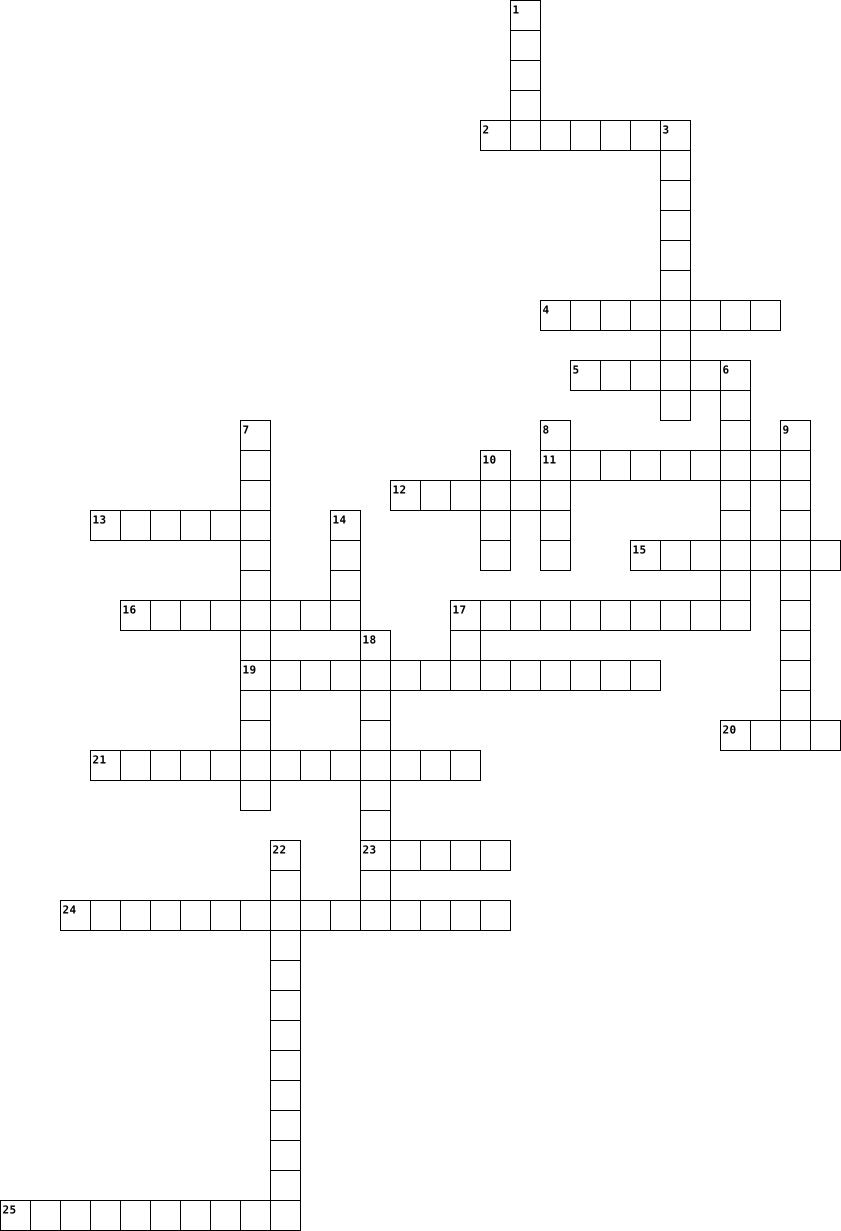
Across
- Our current North Star
- The point in a planet´s orbit farthest from the Sun
- the ´supercontinent´ land mass that was present 200 million years ago
- the layer of earth atmosphere immediately before space
- the planet with the largest most visible rings
- The type of planet that includes jupiter,Saturn, Uranus, and Neptune
- The largest planet in the solar system
- The most abundant gas in earth atmosphere
- particles found in the outer van allen belt
- the process by which life produced oxygen
- the month in which the earth is closest to the sun
- the radio frequency that has the ability to reflect off the ionosphere
- The only planet with liquid water on the surface
- is the closest star to earth, other than the sun
- the layer of earth´s atmosphere that contains highly charged particles
Down
- Once considered a planet, this object is now dwarf out in the kuiper belt
- the study of seismic waves
- The theorized source of water on earth
- the region around earth influenced by earth magnectic field
- the hottest planet in the solar system
- the type of planet that includes mercury that includes mercury, venus, earth, and mars
- The month in which the Earth is closest to the Sun
- the closest celestial object to the earth
- the largest thing in the solar system
- type of fault
- the average distance of plate movement in a year
26 Clues: type of fault • Our current North Star • the study of seismic waves • the largest thing in the solar system • The theorized source of water on earth • the hottest planet in the solar system • The largest planet in the solar system • the closest celestial object to the earth • The most abundant gas in earth atmosphere • the process by which life produced oxygen • ...
Space 2025-01-29

Across
- Balls of ice.
- The sideways planet.
- The smallest planet.
- A huge collection of gas, dust and billions of stars and their solar systems held together by gravity.
- Planet of life.
- Hole Space vacuum.
- The failed planet.
- The force that pulls objects towards each other.
- Stars that make a figure.
- The biggest space rocks.
- A failed star.
- Red planet.
- Second biggest planet.
Down
- Balls of energy.
- Collect information about space.
- Bang How the universe was created.
- belt The region between Mars and Jupiter that contains the largest population of asteroids in our solar system.
- A person wearing a spacesuit.
- Way Our galaxy that contains over 200 billion stars.
- Hot planet.
- System Planets are going around a star.
- The universe.
- The last planet.
- Orbits around the earth.
- The most well known star.
25 Clues: Hot planet. • Red planet. • Balls of ice. • The universe. • A failed star. • Planet of life. • Balls of energy. • The last planet. • The failed planet. • The sideways planet. • The smallest planet. • Hole Space vacuum. • Second biggest planet. • Orbits around the earth. • The biggest space rocks. • Stars that make a figure. • The most well known star. • A person wearing a spacesuit. • ...
Space 2025-02-13

Across
- process of establishing occupation of or control over foreign territories or peoples
- event causing great and usually sudden damage or suffering; a disaster
- catastrophic conflict resulting in widespread destruction, loss of life, and devastation
- destroy something completely
- gas produced by burning organic compounds and by breathing
- succeed in dealing with (a problem or difficulty)
- a stock or amount of something available for use
- to be able to buy or do something because you have enough money or time
- group of people of one nationality or race living in a foreign place
- period of one hundred years
- countless, innumerable.
- the human race
Down
- designed to absorb the sun's rays as a source of energy for generating electricity or heating
- frontier outer space, especially from the perspective of space colonization
- examination of a subject
- curved path of a spacecraft round a star, planet, or moon
- move quickly and suddenly
- a stock or supply of money, materials, staff
- needing no outside help in satisfying one's basic needs, especially with regard to the production of food.
- unpleasantly rough, difficult
- period or cycle of thousand years
- to cover or reach a large area
22 Clues: the human race • countless, innumerable. • examination of a subject • move quickly and suddenly • period of one hundred years • destroy something completely • unpleasantly rough, difficult • to cover or reach a large area • period or cycle of thousand years • a stock or supply of money, materials, staff • a stock or amount of something available for use • ...
Space 2024-12-28

Across
- A big vehicle used to carry heavy things.
- Water that falls from clouds.
- A two-wheeled vehicle you pedal.
- Something you write with that has an eraser.
- A fruit that can be red green or yellow.
- A striped animal that roars.
- A large building where kings and queens live.
- A yellow fruit that is long and sweet.
- A tall natural structure with a peak.
- A machine that can move and do tasks.
- It floats when filled with air.
- A giant reptile from millions of years ago.
- A large body of salty water.
- A large object that orbits the sun.
- A triangular building made by ancient Egyptians.
- A jumping animal that starts life as a tadpole.
Down
- Sounds made with instruments or singing.
- A vehicle that travels into space.
- A portable light you carry in the dark.
- A black and white striped animal.
- A piece of land surrounded by water.
- A bright light you see in the night sky.
- A mountain that erupts with lava.
- A funny performer with a painted face.
- A sweet treat often found at Halloween.
- A colorful arc in the sky after rain.
- A food with cheese and toppings like pepperoni.
- A large bird that soars high in the sky.
- A person who uses magic spells.
- The tallest animal on Earth.
30 Clues: A striped animal that roars. • A large body of salty water. • The tallest animal on Earth. • Water that falls from clouds. • It floats when filled with air. • A person who uses magic spells. • A two-wheeled vehicle you pedal. • A black and white striped animal. • A mountain that erupts with lava. • A vehicle that travels into space. • A large object that orbits the sun. • ...
Space! 2025-09-04

Across
- Has two moons, wind, and is called "the red planet"
- The name of our galaxy
- The combination of hydrogen atoms to form helium and release energy
- The smallest planet
- Stars are sorted in a graph by brightness and temperature
- The reason we have a year (365 days)
- Distance that light travels in one year
- The small core of a star that is very hot, but also very dim
- Stars that are still going through nuclear fusion
- Looks like a dirty snowball. Has a tail that always points away from the sun
Down
- The brightness of a star
- The reason some planets appear blue
- The reason we have day and night (24 hours)
- The explosion of a massive star that could result in a black hole
- A group of millions or billions of stars held together by gravity
- Made of rock and orbits the sun in a belt between Mars and Jupiter
- A cloud of gas and dust where new stars are formed
- Nicknamed "Earth's Twin"
- Rocky planets, the inner four
- First telescope put into orbit by NASA around earth
- The reason some planets appear red
- The largest planet
- The name of NASA's missions to the moon.
- Model of the solar system proposed by Copernicus in which the sun is the center
- Giants The outer four planets
- Exists in three states and is the reason Earth supports life
- The first man-made satellite put into orbit by Russia
27 Clues: The largest planet • The smallest planet • The name of our galaxy • The brightness of a star • Nicknamed "Earth's Twin" • Rocky planets, the inner four • Giants The outer four planets • The reason some planets appear red • The reason some planets appear blue • The reason we have a year (365 days) • Distance that light travels in one year • The name of NASA's missions to the moon. • ...
Space 2025-06-13

Across
- and disappears.
- brightness: How bright a star would be if it were the
- on its own body that orbits a star and does not have light. Year: A unit that measures distance in time.
- A hot, gaseous body that emits light and heat.
- system: A system that includes the sun and all the planets that orbit it.
- it light? Does not emit light, only reflect it.
- distance from Earth. Gas giants: Large planets made of gas.
- The rotation of a planet around itself.
- Cluster: A group of stars that appear as if the planet has a large
- shines on its own, like the sun.
- A small, stellar rock that floats in space
- A huge home for stars and planets, such as the Milky Way.
- A motaroid that hits Earth's surface. Comet-luminous toril.
Down
- Moons that orbit planets.
- The vast space that contains everything. Constellation: A stellar pattern visible in the sky.
- Objects that orbit planets, such as the moon or satellites.
- A large hody that orbits a star and does hot shihe oh its own
- The revaluation of a planet around the Sun in
- A large rock in space that orbits the sun.
- The circular path flollowed by planets.
- Plants: Small, stellar planets close to the sun. An object in space with a
- The reason things fall down.
- A ball of fire that suddenly appears in the
- a year.
24 Clues: a year. • and disappears. • Moons that orbit planets. • The reason things fall down. • shines on its own, like the sun. • The circular path flollowed by planets. • The rotation of a planet around itself. • A large rock in space that orbits the sun. • A small, stellar rock that floats in space • A ball of fire that suddenly appears in the • ...
Space 2025-06-10

Across
- something that orbits a planet
- the revolution of a planet around the sun
- an icy body in space with a luminous tail
- the reason things fall down
- a small piece of rock that floats in space
- planets small, rocky planets close to the sun
- a large rock in space that orbits the sun
- a meteoroid that hits earth's surface
- shines on its own like the sun
- giants large planets made of gas
- objects that orbit planets such as the moon
- brightness how bright a star would be if it were the same distance from the earth
Down
- a large body that orbits a star and does not shine on its own
- the circular path followed by planets
- a huge home for stars and planets
- The vast space that contains everything
- a ball of fire that suddenly appears in the sky
- a hot, gaseous body that emits light and heat
- does not emit light; only reflects light
- year a unit that measures distance in space and time
- the rotation of a planet around itself
- system a system that includes the sun and all the planets that orbit it
- a stellar pattern visible in the sky
- cluster a group of stars that appear
24 Clues: the reason things fall down • something that orbits a planet • shines on its own like the sun • a huge home for stars and planets • giants large planets made of gas • a stellar pattern visible in the sky • the circular path followed by planets • a meteoroid that hits earth's surface • the rotation of a planet around itself • cluster a group of stars that appear • ...
Space 2025-06-01

Across
- A powerful stellar explosion.
- An object that orbits a planet or star.
- A cloud of gas and dust in space.
- The branch of astronomy dealing with the physics of celestial bodies.
- A small body from space that enters Earth's atmosphere, creating a streak of light.
- A group of stars forming a recognizable pattern.
- A celestial body of ice, dust, and rock with a glowing coma.
- A highly magnetized rotating neutron star that emits beams of electromagnetic radiation.
- The study of celestial objects and phenomena.
Down
- The universe seen as a well-ordered whole.
- A celestial body orbiting a star, large enough to be rounded by its gravity.
- A massive system of stars, gas, and dust held together by gravity.
- All existing matter and space as a whole.
- A region of space with a gravitational pull so strong that nothing can escape.
- The study of the origin and development of the universe.
- A small rocky body orbiting the Sun.
- A highly luminous and active galactic nucleus.
- A luminous sphere of plasma held together by gravity.
- The curved path of an object around a star, planet, or moon.
- A planet outside our solar system.
20 Clues: A powerful stellar explosion. • A cloud of gas and dust in space. • A planet outside our solar system. • A small rocky body orbiting the Sun. • An object that orbits a planet or star. • All existing matter and space as a whole. • The universe seen as a well-ordered whole. • The study of celestial objects and phenomena. • A highly luminous and active galactic nucleus. • ...
Space 2025-05-13

Across
- A region with no air or atmosphere
- The red planet
- A vehicle designed for travel in space
- A person trained to travel in space
- The closest star to Earth
- A large body orbiting a planet
- The term for human-made object orbiting Earth
- The only planet known to support life
- The first person to walk on the Moon
- The process of a spacecraft entering Earth’s atmosphere
Down
- A telescope in space
- The force that keeps planets in orbit
- The largest planet in our solar system
- The planet known for its rings Saturn
- The boundary of Earth’s atmosphere and outer space
- The phase when the Moon is completely visible
- The galaxy that contains our solar system
- A rock from space that hits Earth
- The path an object takes as it revolves
- The planet known for its tilt and blue color
20 Clues: The red planet • A telescope in space • The closest star to Earth • A large body orbiting a planet • A rock from space that hits Earth • A region with no air or atmosphere • The first person to walk on the Moon • The force that keeps planets in orbit • The planet known for its rings Saturn • A person trained to travel in space • The only planet known to support life • ...
Space 2025-08-13

Across
- freddo
- gennaio
- molto freddo
- pioggia
- luglio
- aprile
- ombrello
- vento
- sole
- maggio
- neve
- molto caldo
- estate
- fiume
Down
- primavera
- lago
- autunno
- giugno
- inverno
- febbraio
- nuvole
- grandine
- caldo
- marzo
- settembre
- cielo
26 Clues: lago • sole • neve • vento • caldo • marzo • cielo • fiume • freddo • giugno • nuvole • luglio • aprile • maggio • estate • autunno • gennaio • inverno • pioggia • febbraio • grandine • ombrello • primavera • settembre • molto caldo • molto freddo
Space 2026-03-05

Across
- человечество
- футуристическое сообщество
- преодолеть
- производить
- ядерная война
- подогреть что-либо
- самодостаточный
- извлекать
- распространение
- тысячелетия
- атмосфера
- двуокись углерода
- солнечная панель
Down
- столетия
- припасы
- колония
- позволить себе
- метеор
- колонизация
- орбита
- ресурсы
- катастрофа
- строить
- уничтожить
- исследование
- суровый
- последняя граница
- бесконечный
- скачок
29 Clues: метеор • орбита • скачок • припасы • колония • ресурсы • строить • суровый • столетия • извлекать • атмосфера • преодолеть • катастрофа • уничтожить • колонизация • производить • тысячелетия • бесконечный • человечество • исследование • ядерная война • позволить себе • самодостаточный • распространение • солнечная панель • последняя граница • двуокись углерода • подогреть что-либо • футуристическое сообщество
Space 2026-02-04

Across
- – small piece of rock, before entering Earth’s atmosphere
- – the closest planet to the Sun
- – our galaxy
- – takes one month to orbit the Earth
- – where Chris Hadfield lived in space
- – the hottest planet
- – the sixth planet from the Sun
- – the North Star
- – the largest planet
- – when an asteroid enters Earth’s atmosphere, also known as a shooting star
Down
- – divides inner and outer planets
- – a meteor that touches the Earth’s surface
- – has a tail as it gets closer to the Sun
- – first planet discovered with a telescope
- – person trained to be on a spacecraft
- – number of planets in our solar system
- – large piece of rock that orbits the Sun
- – when the moon passes in front of the Sun
- – center of the solar system
- – orbit around the sun takes 365 days
20 Clues: – our galaxy • – the North Star • – the hottest planet • – the largest planet • – center of the solar system • – the closest planet to the Sun • – the sixth planet from the Sun • – divides inner and outer planets • – takes one month to orbit the Earth • – where Chris Hadfield lived in space • – orbit around the sun takes 365 days • – person trained to be on a spacecraft • ...
Space 2024-05-23

Across
- from the sun
- fifth planet from the sun
- natural/manmade object orbiting a planet
- layers of gas
- one who travels to space
- 29.5 Earth years to orbit sun
- go around
- icy, dusty celestial object
- bright lights at the poles of Earth
- when light shines back
Down
- crash
- hottest planet in solar system
- a celestial body orbiting sun
- a space rock
- only planet with known life
- natural satellite around a planet
- small pieces rock in solar system
- a gas
- in the middle
- made from collisions
20 Clues: crash • a gas • go around • from the sun • a space rock • layers of gas • in the middle • made from collisions • when light shines back • one who travels to space • fifth planet from the sun • only planet with known life • icy, dusty celestial object • a celestial body orbiting sun • 29.5 Earth years to orbit sun • hottest planet in solar system • natural satellite around a planet • ...
Space 2023-06-06

Across
- Has super strong gravity
- Thing made of gas and dust
- When the Sun,Moon,And Earth are all in a line
- One of 2 Exoplanets first discovered
- A black hole that is about the mass of a star
- _____ the Hunter
- Thing that we live on
- One of which we live in
- Peers into space
- An independent space travel company
- Started our Universe
- A capsule used to transport supplies to the ISS
- US space Agency
- Invisible lines connecting stars
- Sideways Planet
- ___________ Look through telescopes
- A _________ is a thing that landed on Earth
- Radio waves come from it at regular intervals
- An orbiting body around an object
- The death planet
- Thing that blasts into space
- First dwarf planet
- Biggest man made object in space
- Extraterrestrial
- Planet closest to the Sun
- Explosion that could shake Earth apart
- A ______ shower
- Core of liquid H that might behave like a solid
Down
- Wiped out the Dinosaurs
- A star with a very strong magnetic field
- Where life can exist in space
- Name of our star
- The Red Planet
- Thing with a long tail
- Things that always appear during the night
- Zodiac sign in the shape of a scorpion
- Extremely big explosion from a star
- Made of Photons
- North star
- Egg shaped dwarf planet
- Shortest name for a moon
- Person in space
- Planet farthest from the Sun
- Capsule for the Soviet Space Agency
- Planets _____ the Sun
- Zodiac sign for most of August
- A ______ of stars and planets
- Goes on other planets to collect data
- Our atmosphere is 21% ______
- The thing that we see in our sky every night
- "Blue Planet"
- Planet with prettiest rings
- Time it takes for the photons to travel
- Closest part of the atmosphere to Earth
- Farthest part of the atmosphere from Earth
- Forth country to land on the moon
56 Clues: North star • "Blue Planet" • The Red Planet • Made of Photons • Person in space • US space Agency • Sideways Planet • A ______ shower • Name of our star • _____ the Hunter • Peers into space • The death planet • Extraterrestrial • First dwarf planet • Started our Universe • Thing that we live on • Planets _____ the Sun • Thing with a long tail • Wiped out the Dinosaurs • One of which we live in • ...
Space 2025-03-28

Across
- Rockey object
- Ice and rock.
- Natural Satellite
- Astronaut garments
- Celestial study
- Gas cloud
- Ringed giant
- obscuring of the light from one celestial body
- Orbiting Habitant
- Luminous sphere.
- Universe study
- Star explosion
- Moon exploration vehicle
- Life-supporting planet
- Invisible substance.
- No weight condition
Down
- Free fall condition
- Gravitational region
- Space Station, Research laboratory
- Life essential
- Gas Layer
- Propulsion vehicle
- Red planet
- sun's domain
- A space travel vehicle
- Star system.
- Attractive force
- Outside solar system
- Light energy
- Dwarf planet
- Orbiting object
- Extravehicular activity
- Totality of existence
33 Clues: Gas Layer • Gas cloud • Red planet • sun's domain • Star system. • Ringed giant • Light energy • Dwarf planet • Rockey object • Ice and rock. • Life essential • Universe study • Star explosion • Celestial study • Orbiting object • Attractive force • Luminous sphere. • Natural Satellite • Orbiting Habitant • Propulsion vehicle • Astronaut garments • Free fall condition • No weight condition • Gravitational region • ...
Space 2025-04-03

Across
- The fourth planet from the Sun, known as the "Red Planet."
- A small rocky body that orbits the Sun.
- A rock or particle that enters Earth's atmosphere.
- The star at the center of our solar system.
- A luminous ball of gas, like the Sun.
- The season when leaves fall from trees, also known as autumn.
- The seventh planet from the Sun, known for its tilted axis.
- The force that pulls objects toward one another, like the Earth pulls objects toward it.
- A large celestial body that orbits a star.
- Earth's natural satellite.
- The second planet from the Sun, often called Earth's "sister planet."
Down
- A vehicle designed for travel in outer space.
- The warmest season of the year.
- A tool used to observe distant objects in space.
- The season after winter and before summer.
- A vehicle used to travel in space.
- The path one object takes around another, like a planet around the Sun.
- A person trained to travel in space.
- A system of stars, gas, and dust held together by gravity.
- A small icy body that orbits the Sun.
20 Clues: Earth's natural satellite. • The warmest season of the year. • A vehicle used to travel in space. • A person trained to travel in space. • A luminous ball of gas, like the Sun. • A small icy body that orbits the Sun. • A small rocky body that orbits the Sun. • The season after winter and before summer. • A large celestial body that orbits a star. • ...
Space 2024-10-15

Across
- A type of rock that's called minor planet.
- What a person is when they're in space.
- A planet that's the only known planet to support life. It has liquid water with oceans.
- A planet that is red because of its orange-red surface.
- A gaseous ice giant planet with rings that's made up with water, ammonia, and methane.
- What an astronaut needs to have on over it's head when he's outside of his spaceship.
- The Earth's only natural satellite, orbiting at a distance.
- Something an astronaut isinside fly.
- Something an astronaut can land on.
- A terrestrial planet that's the smallest in the solar system.
Down
- A type of hole that hails anything that goes near it.
- A planet known as the blue giant, and is made of gases, and has ices beneath its atmosphere.
- Something that looks like a a bright light streaking across the sky.
- A word What space can be called.
- A gas giant planet with rings around it.
- Two words What space can be called.
- A planet that is often called Earth's twin. It is also the hottest planet in the solar system.
- Something that is called a shooting star.
- The central star of our Solar system meaning it is the massive object around all planets, and other things. It provides light and heat.
- Something swirly that looks very shiny in the middle.
- A gas giant planet that is the largest in the solar system with a diameter, and with a mass greater than 2.5 times.
- Things What an astronaut flies towards.
22 Clues: A word What space can be called. • Two words What space can be called. • Something an astronaut can land on. • Something an astronaut isinside fly. • What a person is when they're in space. • Things What an astronaut flies towards. • A gas giant planet with rings around it. • Something that is called a shooting star. • A type of rock that's called minor planet. • ...
Space 2024-07-11

Across
- a group of stard,dust,gas and dark matters
- has 64 Moons
- orbits the Earth
- are things that float in space
- is the smallest moon on Mars
- are sent into space
- is one of our largest stars
- are believed to live on other planets
- get sent to planets and back
- known as the red planet
- is the hottest planet
Down
- is a planet full of methane
- is the closet to the Sun
- is White/Grey colour
- are made of ice,co2 or methane mixed with dust
- has living things on it
- all our planets and stars are in it
- has rings made of ice
- is the largest moon on Mars
- rains diamonds
- is prat on a Rocketship
21 Clues: has 64 Moons • rains diamonds • orbits the Earth • are sent into space • is White/Grey colour • has rings made of ice • is the hottest planet • has living things on it • is prat on a Rocketship • known as the red planet • is the closet to the Sun • is a planet full of methane • is the largest moon on Mars • is one of our largest stars • is the smallest moon on Mars • ...
Space 2024-10-22

Across
- Something we see shining at night that makes Earth more livable.
- A planet that is made up of water, ammonia, and methane, which astromony calls "ice" or volatiles.
- A type of hole that hails anything that goes near it.
- A word what space can be called.
- A planet that is called Earth's twin. It is also the hottest planet in the solar system.
- A swirly thing that looks shiny in the middle.
- Two words what space can be called.
- A planet that is nicknamed the "Red Planet" because of it's orange-red surface.
- A planet with liquid surface water which is the only one to support life.
- A hot glowing ball of hydrogen and helium at the center of the solar system.
- Something an astronaut uses to fly.
- Something that looks like a shooting star.
Down
- A terrestrial planet with a surface gravity.
- A planet that is a gas giant made up of hydrogen, helium, and methane. It is also known as the blue giant.
- Something shiny that is a meteor that streaks across the sky.
- Something an astronaut needs to have on over his head when he's out of his spaceship.
- Something an astronaut can land it's spaceship on.
- A planet that is a gas giant with a diameter eleven times, and with a mass greater than 2.5 times.
- A person wearing a suit in space.
- Things an astronaut flies towards.
- A type of rock that floats in the space.
- A planet with rings that is a gas giant with a radius nine times.
22 Clues: A word what space can be called. • A person wearing a suit in space. • Things an astronaut flies towards. • Two words what space can be called. • Something an astronaut uses to fly. • A type of rock that floats in the space. • Something that looks like a shooting star. • A terrestrial planet with a surface gravity. • A swirly thing that looks shiny in the middle. • ...
SPACE 2025-12-02

Across
- (5) Massive, luminous spheres of plasma held together by gravity, producing light and heat through nuclear fusion
- (8) A small rocky body orbiting the Sun, mostly found in the asteroid belt between Mars and Jupiter
- (8) The totality of space, time, matter, and energy; everything that exists
- (6) A massive system of stars, planets, gas, and dust bound by gravity; e.g., the Milky Way
- (6) A small object from space that burns up upon entering Earth's atmosphere, creating a streak of light
- (5) Solid mineral material found on planets, moons, and asteroids in space
- (6) A region devoid of matter; outer space is a near perfect vacuum
- Year (10) A unit of distance equal to the distance light travels in one year (about 9.46 trillion km)
- (8) Basic chemical substances like hydrogen and helium that make up stars and planets
- Hole (9) A region in space with gravity so strong that nothing, not even light, can escape
Down
- (6) The orderly, harmonious system of the universe as a whole
- (9) An object that orbits a planet or star, either natural (like moons) or artificial (man made)
- (5) The curved path of an object around a star, planet, or moon due to gravity
- (7) The force that attracts objects toward one another; it keeps planets in orbit around stars
- (4) A natural satellite that orbits a planet; Earth's moon influences tides and has phases
- (6) A vehicle propelled by engines that expel exhaust gases at high speed, used for space travel
- (5) An icy body that releases gas and dust, forming a glowing tail when near the Sun
- (9) A planet that orbits a star outside our solar system
- (6) A vast cloud of gas and dust in space, often a birthplace for stars
- (5) The vast, seemingly infinite expanse beyond Earth's atmosphere where celestial bodies exist
20 Clues: (9) A planet that orbits a star outside our solar system • (6) The orderly, harmonious system of the universe as a whole • (6) A region devoid of matter; outer space is a near perfect vacuum • (6) A vast cloud of gas and dust in space, often a birthplace for stars • (5) Solid mineral material found on planets, moons, and asteroids in space • ...
Space 2025-11-22

Across
- A word meaning ‘related to the Sun.’
- When two spacecraft connect in space.
- A Russian astronaut.
- A dwarf planet far from the Sun.
- The first person to walk on the Moon.
- A giant ball of burning gas that gives off heat and light.
- A ball of ice and dust that orbits the Sun with a glowing tail.
- The force that pulls things down or keeps planets in place.
- The planet we live on.
- A person who studies how things work in the world or space.
- A person trained to travel into space.
- A spacecraft used to travel to and from space.
- Way The galaxy our solar system belongs to.
- A creature that might live on another planet.
Down
- hole A place in space where gravity is so strong that nothing can escape.
- The path something takes as it circles a planet or star.
- Everything that exists: planets, stars, and galaxies.
- The U.S. space agency that sends rockets and astronauts into space.
- A huge group of stars, gas, and dust.
- A word meaning ‘related to the Moon.’
- An outfit astronauts wear to stay safe in space.
- A machine that can do tasks or explore places like Mars.
- The star at the centre of our solar system.
- A story genre about space, the future, or advanced technology.
- A pattern of stars forming a shape in the sky.
- The distance light travels in one year.
- An early scientist who used a telescope to study space.
- A machine or moon that orbits a planet.
- A round object in space that orbits a star.
- A rocky object that orbits the Sun, smaller than a planet.
- The 'red planet' in our solar system.
31 Clues: A Russian astronaut. • The planet we live on. • A dwarf planet far from the Sun. • A word meaning ‘related to the Sun.’ • When two spacecraft connect in space. • A huge group of stars, gas, and dust. • A word meaning ‘related to the Moon.’ • The first person to walk on the Moon. • The 'red planet' in our solar system. • A person trained to travel into space. • ...
Space 2025-12-12

Across
- A ball of frozen dust and rock that orbits the sun and has a tail that glows
- to go around something in a circle; to turn around in a circle
- The name often given to the four inner planets: Mercury, Venus, Earth, and Mars
- A region of the solar system that is just beyond the orbit of Neptune and that contains small bodies made mostly of ice
- a celestial body resembling a small planet but lacking certain technical criteria that are required for it to be classed as such.
- sun, planets, and all the other objects that revolve around the sun
- A chunk of rock or dust in space, generally smaller than an asteroid.
- closest planet to the sun; shortest period of revolution (88 days
- Earth's twin due to similar density, mass size, and gravity
- a rotating cloud of gas and dust from which the sun and planets formed
Down
- Occurs when the Moon passes directly between the Sun and Earth and casts a shadow over part of Earth
- a meteroid that passes through the atmosphere and hits earths surface
- A natural satellite that revolves around a planet.
- the very darkest part of the moon's shadow
- the lighter part of a shadow where light is partially blocked
- A streak of light in the sky produced by the burning of a meteoroid in Earth's atmosphere.
- Large, gaseous planets that are very cold at their surfaces, have ring systems, many moons, and lack solid surfaces—Jupiter, Saturn, Uranus, and Neptune.
- to spin on an axis
- The path of an object as it revolves around another object in space
- the blocking of sunlight to the moon that occurs when Earth is directly between the sun and the moon
20 Clues: to spin on an axis • the very darkest part of the moon's shadow • A natural satellite that revolves around a planet. • Earth's twin due to similar density, mass size, and gravity • the lighter part of a shadow where light is partially blocked • to go around something in a circle; to turn around in a circle • ...
space 2026-04-29

Across
- The total or partial obscuring of one celestial body by another
- A large celestial body that orbits a star and has cleared its neighborhood
- A massive system of stars, gas, and dust held together by gravity.
- The curved path of a celestial object around a star or planet.
- High-energy particles or waves emitted by stars
- A retired NASA spacecraft designed for reusable orbital missions
- A greenhouse gas found in the clouds of Uranus and Neptune
- A "dirty snowball" that develops a tail near the Sun
- A rocky body orbiting the Sun, mostly found between Mars and Jupiter.
- The oval-like shape of certain galaxies or planetary paths.
- The whole of all space, time, matter, and energy.
- diagram A proportional drawing showing relative sizes or distances
- The force of attraction that keeps planets in their paths
- The lightest and most abundant element in space
Down
- A massive, glowing sphere of plasma held together by gravity
- The branch of science that studies the physical universe
- The envelope of gases surrounding a planet or moon
- A pattern of stars named after a mythological figure or object
- A unit of astronomical distance equal to about 6 trillion miles
- An object, natural or man-made, that circles a planet
- dust: Fine particles of matter scattered throughout space
- A recurring arrangement, like the cycle of lunar phases
- A vast interstellar cloud of gas and dust
- A streak of light caused by a space rock burning in the air
- The imaginary line a planet rotates around
- A group of interacting celestial bodies, like our Solar one
- An uncrewed vehicle used to gather data from deep space
27 Clues: A vast interstellar cloud of gas and dust • The imaginary line a planet rotates around • High-energy particles or waves emitted by stars • The lightest and most abundant element in space • The whole of all space, time, matter, and energy. • The envelope of gases surrounding a planet or moon • A "dirty snowball" that develops a tail near the Sun • ...
Space 2026-04-13

Across
- Large pieces of rock and metal orbiting the sun
- First human to walk on the moon
- Path of the Earth going around the sun
- Star closest to Earth
- Smallest planet and closest to the sun
- Gigantic balls of burning gases
- Holds us to Earth
- Gathers info from space and sends back to us
- Farthest planet from the sun
- Groups of stars
- Planet with 27 moons
Down
- Biggest planet
- Planet with rings of ice and dust
- Large rock that orbits a planet
- What the sun is the center of
- Third planet from the sun
- Planet with temps over 800 degrees
- Number of minutes for sun's light to reach Earth
- Looks like a red star
- People who study space
- As Earth moves around its orbit the ____ change
- Composed of gas, dust and stars
- Number of times Earth spins each day
23 Clues: Biggest planet • Groups of stars • Holds us to Earth • Planet with 27 moons • Star closest to Earth • Looks like a red star • People who study space • Third planet from the sun • Farthest planet from the sun • What the sun is the center of • Large rock that orbits a planet • First human to walk on the moon • Gigantic balls of burning gases • Composed of gas, dust and stars • ...
Space 2026-05-20

Across
- the thing that takes up space or how much something weights that we cant see
- the earth ____ around the sun
- the thing we live on is a what
- the things we send up to space so we have communication and direction
- a robot send to space to study te solar system
- one of the starsin the big dipper
- the constilation the is a scorpion
- the closest major spiral galaxy to the Milky Way
- located in the little dipper
- they doc there spceship on to this and it is the most famous
- a giant, glowing cloud of gas and dust in interstellar space
- it is icy bodies and dwarf planets located beyond the orbit of Neptune
- an objects resist to movement
- a type of gas used to make stars
- what we use to mesure how far away something is
- a place in space with a gravitational pull so intense that nothing—not even light—can escape it
- the thing that a group of stars make and they have names mostly from greek
Down
- they milkyway is apart of the what
- What is in the sky at night that glows
- a constlation that includes Betelgeuse
- the closest star stystem to our solar systeam
- the constlation that looks like a bull
- the thing that holds us down but we cant feel is
- the part of the galaxy the planet is a part of
- the costalation of the two twins
- large observatory orbiting Earth
- the amount of time it takes the international space station to orbit around the earth
- The constlation that looks like a lion
- the planet we live on
29 Clues: the planet we live on • located in the little dipper • the earth ____ around the sun • an objects resist to movement • the thing we live on is a what • the costalation of the two twins • large observatory orbiting Earth • a type of gas used to make stars • one of the starsin the big dipper • they milkyway is apart of the what • the constilation the is a scorpion • ...
Space 2026-05-08

Across
- i orbit the Earth each 27 days.
- im called "the red planet".
- im the planet with the biggest ring.
- Amstrong im the first person who walk on the moon.
- im the smallest planet in the solar system.
- im the hottest planet in the solar system.
- my shape is like a spiral.
- im made with ice and i have 27 moons.
- i have 14moons.
- i can watch the moon and the stars.
Down
- im similar to asteroid but im made with ice.
- im the most biggest planet of the solar system.
- during the day time i give heat and light.
- space vehicule are blasted in the air.
- im an object in space circle around a big object.
- it is a massive ball with gas.
- system i have moons and space rock.
- im a large chunks with metal.
- Aldrin im the second person who walk on the moon.
- im the only planet that we know of the live.
20 Clues: i have 14moons. • my shape is like a spiral. • im called "the red planet". • im a large chunks with metal. • it is a massive ball with gas. • i orbit the Earth each 27 days. • system i have moons and space rock. • i can watch the moon and the stars. • im the planet with the biggest ring. • im made with ice and i have 27 moons. • space vehicule are blasted in the air. • ...
Space 2026-05-15

Across
- the round belt in between Mars and Jupiter
- The first planet from the sun
- Patterns of stars in the sky
- The Planet with most wind
- former planet
- The galaxy we live in
- A ball of boiling gas
- The coldest planet from the sun
- What the planets orbit
Down
- The biggest planet
- A hole in the middle of space that sucks up
- The robot that landed on Mars
- When a star explodes
- A natural satellite the orbits a planet
- The Red Planet
- The hottest planet
- The cooler gas giants
- The only planet with life
- A ball made of dust ice and has a tail
- Known for its rings
20 Clues: former planet • The Red Planet • The biggest planet • The hottest planet • Known for its rings • When a star explodes • The cooler gas giants • The galaxy we live in • A ball of boiling gas • What the planets orbit • The Planet with most wind • The only planet with life • Patterns of stars in the sky • The robot that landed on Mars • The first planet from the sun • ...
Space 2026-05-13

Across
- A object that is big and hot
- A mashup of stars and other celestial objects
- The farthest planet to the sun
- A small object made of rocks
- The sideways planet
- What we live on
- A object so small, yet so strong gravity and magnetic field
- A star we orbit
- Pretty similar to gas giants, but much colder
- The biggest planet in the solar system
- The closest planet to the Sun
- The only planet with VISIBLE rings
- A object with so strong gravity that not even light escapes
- The most famous Dwarf Planet we know of
- A failed star
Down
- A big planet made up of gas, and has no surface except the core
- A small object made of dust and ice orbiting in a elliptical orbit
- A star with similar mass to the sun nearing the end of its life
- A neighborhood of galaxies that are about twice as big as a normal cluster
- A neighborhood of galaxies
- Our future home
- A star with 10x the mass of the sun or more nearing the end of its life
- The hottest planet in the solar system
- Our moon
- A big object that varies in size and structure
- A corpse of stars not massive enough to go supernova
26 Clues: Our moon • A failed star • Our future home • What we live on • A star we orbit • The sideways planet • A neighborhood of galaxies • A object that is big and hot • A small object made of rocks • The closest planet to the Sun • The farthest planet to the sun • The only planet with VISIBLE rings • The biggest planet in the solar system • The hottest planet in the solar system • ...
Space 2026-05-13

Across
- Planets and stars in space rotate around a bigger object called____
- The object is for travel into space.
- The temperature of the surface on the sun is_______
- The planet where we live.
- It's a place for astronauts to live and work.
- It's smaller than asteroids or comets.
- The planet with more than fifty moons.
Down
- The second person to walk on the moon is_____
- The object we use to watch closer the planets.
- The moon turn around the Earth in______ days
- This time, we can see the sun.
- One star is extremely important.
- The type of the planets:Mercury, Venus, Earth and Mars.
- The shape of The Milky Way.
- One planet with rings.
- The rings of Jupiter is made of _____
- It's large chunks of metal and rock that float around all in space.
- It's similar to asteroids but made up of ice.
- The type Of composition Uranus.
- This is to go outside spacecraft.
20 Clues: One planet with rings. • The planet where we live. • The shape of The Milky Way. • This time, we can see the sun. • The type Of composition Uranus. • One star is extremely important. • This is to go outside spacecraft. • The object is for travel into space. • The rings of Jupiter is made of _____ • It's smaller than asteroids or comets. • The planet with more than fifty moons. • ...
Space 2026-05-12

Across
- The solar system have____ planets.
- Te star the most important
- The rings of Uranus are made of___.
- Jupiter and Saturn are made of_____.
- The first planetof salor system.
- Every 27 days,____orbit our planet.
- The temperature of Sun is hotter than____.
- Galaxy is shaped like____.
- Jupiter and Saturne are the___ planets of the solar system.
- Mars have___ moons.
- Stars give of_____.
Down
- Moons orbit____.
- The first person to walk on Moon is Neil___.
- Buzz Aldrin is the ___ to walk on the moon.
- We see the Sun in _____.
- Mercury is the___planet of solar system.
- Sun husrt your____.
- Two planets of solar system have____.
- Universe is ____ getting bigger.
- The type off Earth is ____.
20 Clues: Moons orbit____. • Sun husrt your____. • Mars have___ moons. • Stars give of_____. • We see the Sun in _____. • Te star the most important • Galaxy is shaped like____. • The type off Earth is ____. • The first planetof salor system. • Universe is ____ getting bigger. • The solar system have____ planets. • The rings of Uranus are made of___. • Every 27 days,____orbit our planet. • ...
Space 2026-08-26

Across
- regions of space with a gravity that is so intense, not even light can escape
- a concentration of stars
- a photon of light
- a massive explosion on the sun
- a natural light display in Earth's upper atmosphere that emits greenish and redish light
- the galaxy in which we live
- the outside most layer of the sun
- a natural satelite that revolves around the Earth
- our sun and the planets that orbit it
- any naturally occurring physical entity, structure, or association that exists in outer space
- hypothetical type of matter that cannot be seen or detected directly
- a temporary darker, and cooler, patch on the surface of the sun
- the spinning motion of a celestial object around its own internal axis
- when the entire face of the moon is brightly lit
Down
- the creation of the universe, and a television series
- buzz __________
- this mission was the first mission to the moon
- a powerful and luminous explosion of a star that marks the end of its life
- the orbital movement of one celestial body around another object
- a giant, diffuse cloud of gas and dust in outer space
- the large telescope that is orbiting the Earth
- the study of space
- a luminous body in the sky
- the people that explore space
- everything that we can observe; includes all matter, energy, planets, stars, and galaxies
- when the entire face of the moon is invisible to the Earth
- a group of stars that from Earth resembles a recognizable form
- we live in the milky way ________
- a system with 2 stars
- an optical instrument used to separate and measure the visible light spectrum
- a celestial body that orbits a star
31 Clues: buzz __________ • a photon of light • the study of space • a system with 2 stars • a concentration of stars • a luminous body in the sky • the galaxy in which we live • the people that explore space • a massive explosion on the sun • the outside most layer of the sun • we live in the milky way ________ • a celestial body that orbits a star • our sun and the planets that orbit it • ...
Space 2022-03-15

Across
- all of them are bigger and brighter than our sun
- it gets colder as it grows
- it has rings and is the second biggest planet
- it's power is measured in thrust
- they orbit the sun the same way planets do
- it is the coldest planet and it orbits the sun on it's side
- it is the farthest planet from the sun
- is the third planet from the sun
- it is a hollowed out area produced by the impact of a meteorite
Down
- it helps stabilize our planet's wobble and moderate our climate.
- red and the fourth planet from the sun
- people that travel to space in a rocket
- biggest planet and made of gas
- belt, it is located between the orbits of Mars and Jupiter
- it is hotter than Mercury
- hole, when a star dies it becomes this
- it is a dwarf star
- closest planet to the sun
- there are over 170 billion of these in the observable universe
19 Clues: it is a dwarf star • it is hotter than Mercury • closest planet to the sun • it gets colder as it grows • biggest planet and made of gas • it's power is measured in thrust • is the third planet from the sun • red and the fourth planet from the sun • it is the farthest planet from the sun • people that travel to space in a rocket • hole, when a star dies it becomes this • ...
Space 2022-09-19

Across
- Universal force of attraction for all matter.
- A group of stars that allow astronomers to study the age/evolution of stars.
- An imaginary rotating sphere where all of the night sky’s objects sit
- An area with such intense gravitational pull that even light cannot escape.
- A configuration of stars that form patters in the sky.
- A sphere of gas held together by its own gravity, consisting mostly of hydrogen and helium.
- Everything, the space in which, matter, energy, planets, life, stars and more exist.
- Study of everything within the physical universe.
Down
- Unit of distance, measures how far light moves in an Earth year
- Particles that cannot be seen, have no reactivity with light.
- The theory of how the universe began, involving the rapid growth of something small.
- A large mass that orbits a planet, or other objects that are not stars.
- The galaxy that we live in, containing planets such as Earth, Mars, Uranus, etc.
- (Abbr.) Radiation left after the Big Bang.
- Word used to describe the brightness of stars.
- Tool used to magnify and view distant objects in space.
- Explosion where a stars outer portion gets blown off.
- The star located at the centre of our galaxy, the point that our planets revolve around.
- A vast collection of gasses, dust, stars and other interstellar matter gravitationally bound together.
19 Clues: (Abbr.) Radiation left after the Big Bang. • Universal force of attraction for all matter. • Word used to describe the brightness of stars. • Study of everything within the physical universe. • Explosion where a stars outer portion gets blown off. • A configuration of stars that form patters in the sky. • Tool used to magnify and view distant objects in space. • ...
Space 2023-06-22

Across
- Vehicle used to travel into space
- All of space and everything in it
- Bright object in the night sky
- Path followed by a celestial body around another
- Pertaining to the sun
- Extraterrestrial being from another planet
- Person who travels and explores space
- Huge collection of stars, gas, and dust
- Helmet-wearing space explorer
Down
- Icy object that leaves a trail of gas and dust
- Optical instrument used to observe distant objects in space
- Bowl-shaped hole on the surface of a celestial body
- Cloud of gas and dust in space
- Explosive death of a star
- Vehicle designed for travel in outer space
- Man-made object sent into space to orbit the Earth
- Earth's natural satellite
- Force that attracts objects towards each other
- Bright streak of light in the sky caused by a burning rock
- Heavenly body that orbits the sun
20 Clues: Pertaining to the sun • Explosive death of a star • Earth's natural satellite • Helmet-wearing space explorer • Cloud of gas and dust in space • Bright object in the night sky • Vehicle used to travel into space • All of space and everything in it • Heavenly body that orbits the sun • Person who travels and explores space • Huge collection of stars, gas, and dust • ...
Space 2023-06-25

Across
- A celestial object consisting of a nucleus and a tail
- The path followed by an object around a celestial body
- The natural satellite of the Earth, visible in the night sky
- A luminous celestial body composed of hot gases
- The force that attracts objects towards each other
- A celestial body that orbits a star and shines by reflected light
- The star at the center of our solar system, providing light and heat
- An object orbiting a planet or star for various purposes
- A vehicle that launches into space
- A person trained to travel and work in outer space
- The partial or total blocking of light from one celestial body by another
Down
- A group of stars forming a recognizable pattern in the sky
- A small celestial body that enters Earth's atmosphere and burns up
- A system of millions or billions of stars, dust, and gas
- The whole of space, including all matter and energy
- A vehicle designed for space travel
- An optical instrument for viewing distant objects in space
- An optical instrument for viewing distant objects in space
- A scientist who studies celestial bodies and the universe
- system A collection of planets and other celestial objects orbiting a star
20 Clues: A vehicle that launches into space • A vehicle designed for space travel • A luminous celestial body composed of hot gases • The force that attracts objects towards each other • A person trained to travel and work in outer space • The whole of space, including all matter and energy • A celestial object consisting of a nucleus and a tail • ...
Space 2024-11-21

Across
- A word what space can be called.
- A planet that is a gas giant with a mass that's more than 2.5 times the mass of all the other planets combined.
- A spiral thing that looks shiny in the middle.
- Something an astronaut flies inside.
- Something that is a streak of light that is like a meteoroid.
- A planet that is a terrestrial planet, which means its small and rocky.
- A person wearing a spacesuit and flies in a spaceship.
- Something an astronaut needs to have on when he's out of his spaceship.
- A planet that is the Blue Giant for its large size and vivid colo
- Things what an astronaut flies towards.
Down
- Two words what space can be called.
- A planet with liquid surface water that is the only known astronomical object to support life.
- A planet that is an ice giant made up of a thick soup water, methane, and ammonia.
- Something that that falls and can make there be a shower of more falling.
- A type of hole that hails things that goes near it.
- Something that is like a rock in space.
- A planet that's called the Red Planet and is covered in iron oxide dust giving it its orange red color.
- A planet named after the Roman goddess of love and beauty that is called Earth's twin.
- A planet that is a gas giant with rings and is made up mostly of hydrogen and helium.
19 Clues: A word what space can be called. • Two words what space can be called. • Something an astronaut flies inside. • Something that is like a rock in space. • Things what an astronaut flies towards. • A spiral thing that looks shiny in the middle. • A type of hole that hails things that goes near it. • A person wearing a spacesuit and flies in a spaceship. • ...