chemistry Crossword Puzzles

Study Guide: Chemistry 2016-02-11

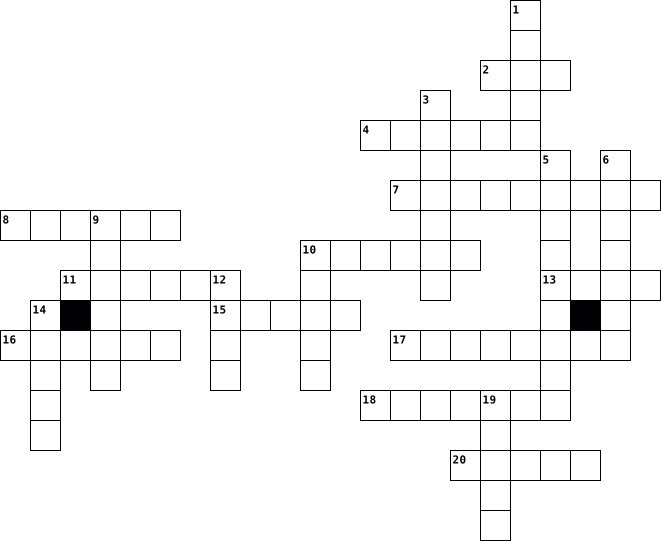
Study Guide: Chemistry crossword puzzle
Across
  1. Something mixed to get a reaction
  2. Matter can be changed from one form into another
  3. Mass of atomic particle
  4. Releasing
  5. Smallest particle of a substance
  6. Absorbing
  7. No electrical charge, apart of the nucleus
  8. Formulated periodic law, chemist, and inventor
  9. Substance formed from two elements
  10. Brittle, poor heat conductors
Down
  1. Has negative charge of electricity, travels around nucleus
  2. Putting thin coat of metal around
  3. Number of protons
  4. Electrons in the outer shell of an atom
  5. 2,8,8,2
  6. Part of the nucleus of an atom
  7. Partially conduct electricity
  8. Column of elements
  9. Outcome of chemical reaction
  10. He, Ne, Ar, Kr, Xe, Rn, Uuo
  11. Left hnadside, 1-7
  12. Positively charged central portion of an atom, atomic mass consists of protons and neutrons
  13. Subdivision of a nuclear shell containing zero, one, or two electrons
  14. Smallest particle in chemical element

24 Clues: 2,8,8,2ReleasingAbsorbingNumber of protonsColumn of elementsLeft hnadside, 1-7Mass of atomic particleHe, Ne, Ar, Kr, Xe, Rn, UuoOutcome of chemical reactionPartially conduct electricityBrittle, poor heat conductorsPart of the nucleus of an atomSmallest particle of a substancePutting thin coat of metal aroundSomething mixed to get a reaction...

Classroom Chemistry Vocabulary 2016-02-01

Classroom Chemistry Vocabulary crossword puzzle
Across
  1. Two or more materials mixed together
  2. What you start with in a reaction
  3. Everything is made of this
  4. pH value of around 7
  5. Higher pH number
  6. You cannot get it back to the way it was
  7. A new substance is formed and you may see a colour change
  8. Material looks different, but it is still the same substance
Down
  1. What you end up with after a reaction
  2. When a substance is mixed with a liquid
  3. The solid that is dissolved
  4. You can return the material to its initial state
  5. Low pH number
  6. Particles are close together, moving more slowly
  7. Particles are very spread apart, moving very fast
  8. Can be used to determine the pH of a substance
  9. The liquid that does the dissolving
  10. Particles are spaced further apart, moving faster than a solid
  11. Scale used to show how acidic or basic a substance is
  12. Type of paper that shows if a substance is acid or base only

20 Clues: Low pH numberHigher pH numberpH value of around 7Everything is made of thisThe solid that is dissolvedWhat you start with in a reactionThe liquid that does the dissolvingTwo or more materials mixed togetherWhat you end up with after a reactionWhen a substance is mixed with a liquidYou cannot get it back to the way it was...

Chemistry Study Guide 2016-02-10

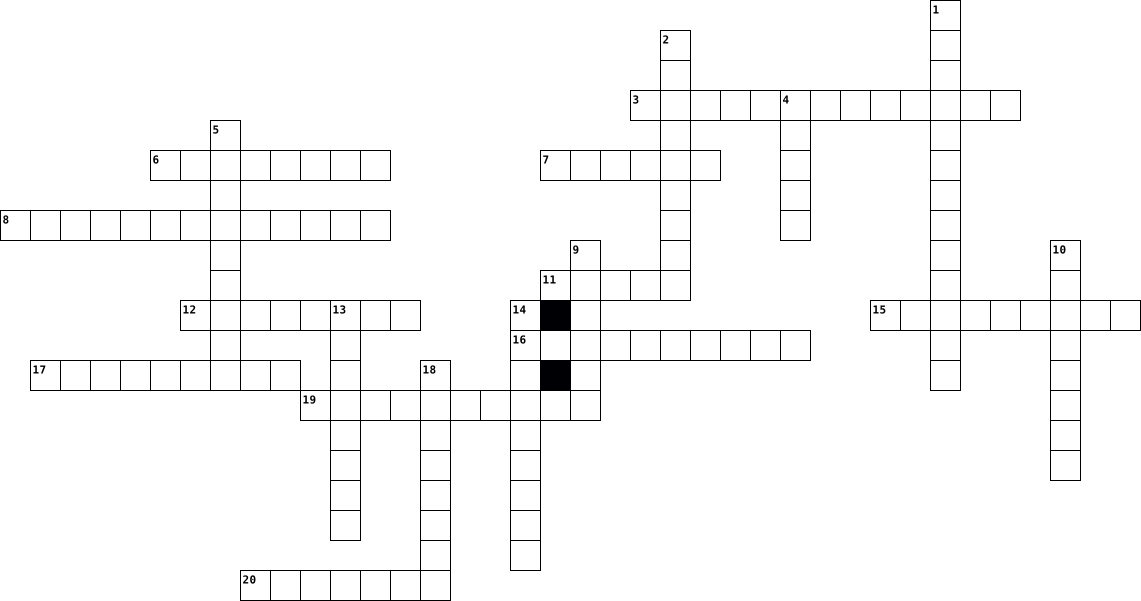
Chemistry Study Guide crossword puzzle
Across
  1. any group of rare gases that include helium, neon, etc.
  2. regions of space outside the nucleus of an atom.
  3. a pure substance that has only one kind of atom in it.
  4. mass is an isolated system, is neither created nor destroyed by chemical reactions or physical transformations.
  5. an element intermediate in properties between the typical metal and nonmetal.
  6. when two atoms of different elements combine.
  7. no electric charge, part of the nucleus of all atoms except hydrogen atoms.
  8. Russian chemist who created the periodic table.
  9. atomic particles that move around the nucleus of an atom, carry negative charge.
  10. the substance(s) that made the change.
  11. when two or more atoms combine.
  12. the mass of an atom usually expressed in these units.
  13. (on the P.T.) row of elements.
Down
  1. the ______ used to show what an element is.
  2. a small particle of matter that is part of the nucleus of an atom.
  3. occurred when energy is absorbed making the object cooler.
  4. the positively charged center of the atom.
  5. smallest particle with a positive chard.
  6. a chemical element that lacks the characters of a metal.
  7. the electrons in the outer most orbital.
  8. represents the numbers of protons in the nucleus.
  9. the resulting substance from the reactant.
  10. a substance that usually has a shiny apperance, good conductor of electricity and heat.
  11. occurred when energy is released in the form of heat.
  12. (on the P.T.) column of elements.
  13. is a reaction that occurred in which a layer of metal is bonded to the surface of another substance, which is usually another metal.

26 Clues: (on the P.T.) row of elements.when two or more atoms combine.(on the P.T.) column of elements.the substance(s) that made the change.smallest particle with a positive chard.the electrons in the outer most orbital.the positively charged center of the atom.the resulting substance from the reactant.the ______ used to show what an element is....

Chemistry Study Crossword 2016-02-10

Chemistry Study Crossword crossword puzzle
Across
  1. usually the number of electrons or protons
  2. a neutrally charged piece of an atom
  3. coating a metal with a metal
  4. on the far right of the table
  5. takes in energy
  6. electrons in the outer orbital
  7. a positively charged piece of an atom
  8. two atoms bonded together
  9. created the first periodic table
  10. weight of an element
  11. center of an atom
Down
  1. one type of atom- a pure substance
  2. Na is sodium's ____________.
  3. you can't create or destroy matter.
  4. what goes into an experiment
  5. a column on the table
  6. a "string" of atoms,
  7. what comes out of an experiment
  8. a level of electrons in an atom
  9. usually shiny, ductile.
  10. releases energy
  11. a horizontal line on the table
  12. does not conduct electricity well.
  13. both a metal and a non metal
  14. a negatively charged piece of an atom
  15. smallest piece of matter

26 Clues: takes in energyreleases energycenter of an atoma "string" of atoms,weight of an elementa column on the tableusually shiny, ductile.smallest piece of mattertwo atoms bonded togetherNa is sodium's ____________.what goes into an experimentcoating a metal with a metalboth a metal and a non metalon the far right of the table...

Organic Chemistry Crossword 2016-03-27

Organic Chemistry Crossword crossword puzzle
Across
  1. an addition reaction in which the two substituents to be added are added to the same side of the molecule
  2. a bond formed as a result of side to side overlap of P orbitals
  3. a compound with two halogen atoms bonded to the same carbon
  4. a substance that increases the rate of a reaction
  5. non-superimposable mirror image molecule
  6. the 3D shape of a molecule at a given point in time
  7. delocalization of electrons by the overlap of a sigma orbital with an empty orbital
  8. the group that is displaced or replaced in a substitution reaction
  9. the rearrangement of a carboncation to a more stable carboncation
  10. the tendency of an atom to pull electrons towards itself
  11. an electron deficient atom or molecule, electron loving molecule
  12. the interconversion of tautomers
  13. a molecule or object that contains symmetry. An achiral molecule is superimposable on its mirror image
  14. a solvent that has a hydrogen bonded to an oxygen or a nitrogen atom
  15. a measure of how easily a compound gives up a proton
  16. a species that accepts an electron pair
Down
  1. a one step, nucleophilic substitution reaction
  2. addition of Hydrogen in a reaction
  3. a molecule that rotates the plane of polarization of plane polarized light
  4. an atom that is bonded to four different substituents
  5. a state of the molecule where old bonds are partially broken and new bonds are partially formed
  6. description of step by step process of how the reactants are changed into products
  7. the tendency of distortion of the electron cloud of an atom by another ion
  8. addition of water to a compound in a reaction
  9. the interaction between a solvent and another molecule or ion
  10. reaction with a solvent
  11. having delocalized electrons

27 Clues: reaction with a solventhaving delocalized electronsthe interconversion of tautomersaddition of Hydrogen in a reactiona species that accepts an electron pairnon-superimposable mirror image moleculeaddition of water to a compound in a reactiona one step, nucleophilic substitution reactiona substance that increases the rate of a reaction...

CLINICAL CHEMISTRY 3 2016-03-20

CLINICAL CHEMISTRY 3 crossword puzzle
Across
  1. Term used to distinguish neuroendocrine tumors carcinomas of GI tract.
  2. Disorder due to malabsorption of nutrients due to sensitivity to gliadin.
  3. Overlooked as a cause of chronic diarrhea
  4. Results from mucosal and neuromuscular infiltration.
  5. In acute infectious diarrhea, glucagon concentrations, PYY and motilin are____?
  6. Also called blind loop syndrome.
  7. Pathologic state of Impared nutrient absorption in the intestinal tract.
  8. ___ maldigestion results from competition of bacteria or altered bacterial flora.
  9. Rare tumor that secretes glucagon.
  10. Detects blood in the stool.
  11. Term typically reserved for Clostridium dificcile.
  12. ____ adenocarcinoms that are malignant epithelial tumors composed of mucin producing glandular structures.
  13. Also known as migratory thrombophlebitis.
  14. Tumor marker for colorectal and pancreatic carcinoma.
  15. Stain for fat in the microscopic examination.
Down
  1. A gastrin-secreting non-B cell pancreatic tumor that cause peptic ulcer disease.
  2. First group of tumor markers identified for cancer.
  3. Rare tumors that secrete vasoactive intestinal polypeptide.
  4. RAre multisystem disease that presents with arthralgias, diarrhea, malabsorption amd wheightloss.
  5. Disorder characterized by defective assembly and secretion of apolipoprotein B.
  6. Help distinguish abdominal pain seen in irritable bowel syndrome from inflammatory bowel syndrome.
  7. Provides a presumptive diagnosis of lactase deficiency.
  8. Severe secretory diarrhea produces by VIPomas.
  9. ___ maldigestion occurs from interference or obstruction of bile flow.
  10. Optimal diagnostic test for Antibiotic Associated Diarrhea
  11. Acute painless dilation of the bile duct obstruction by tumor in most cases.
  12. Early diagnosis of pancreatic carcinoma is unusual.
  13. Derived from B cells and produce insulin that induces hypoglycemia.
  14. _____ examination is the gold standard for celiac disease.
  15. Results from an intraluminal defect that leads to the incomplete breakdown of nutrients.

30 Clues: Detects blood in the stool.Also called blind loop syndrome.Rare tumor that secretes glucagon.Overlooked as a cause of chronic diarrheaAlso known as migratory thrombophlebitis.Stain for fat in the microscopic examination.Severe secretory diarrhea produces by VIPomas.Term typically reserved for Clostridium dificcile....

CLINICAL CHEMISTRY 3 2016-03-20

CLINICAL CHEMISTRY 3 crossword puzzle
Across
  1. Term used to distinguish neuroendocrine tumors carcinomas of GI tract.
  2. Disorder due to malabsorption of nutrients due to sensitivity to gliadin.
  3. Overlooked as a cause of chronic diarrhea
  4. Results from mucosal and neuromuscular infiltration.
  5. In acute infectious diarrhea, glucagon concentrations, PYY and motilin are____?
  6. Also called blind loop syndrome.
  7. Pathologic state of Impared nutrient absorption in the intestinal tract.
  8. ___ maldigestion results from competition of bacteria or altered bacterial flora.
  9. Rare tumor that secretes glucagon.
  10. Detects blood in the stool.
  11. Term typically reserved for Clostridium dificcile.
  12. ____ adenocarcinoms that are malignant epithelial tumors composed of mucin producing glandular structures.
  13. Also known as migratory thrombophlebitis.
  14. Tumor marker for colorectal and pancreatic carcinoma.
  15. Stain for fat in the microscopic examination.
Down
  1. A gastrin-secreting non-B cell pancreatic tumor that cause peptic ulcer disease.
  2. First group of tumor markers identified for cancer.
  3. Rare tumors that secrete vasoactive intestinal polypeptide.
  4. RAre multisystem disease that presents with arthralgias, diarrhea, malabsorption amd wheightloss.
  5. Disorder characterized by defective assembly and secretion of apolipoprotein B.
  6. Help distinguish abdominal pain seen in irritable bowel syndrome from inflammatory bowel syndrome.
  7. Provides a presumptive diagnosis of lactase deficiency.
  8. Severe secretory diarrhea produces by VIPomas.
  9. ___ maldigestion occurs from interference or obstruction of bile flow.
  10. Optimal diagnostic test for Antibiotic Associated Diarrhea
  11. Acute painless dilation of the bile duct obstruction by tumor in most cases.
  12. Early diagnosis of pancreatic carcinoma is unusual.
  13. Derived from B cells and produce insulin that induces hypoglycemia.
  14. _____ examination is the gold standard for celiac disease.
  15. Results from an intraluminal defect that leads to the incomplete breakdown of nutrients.

30 Clues: Detects blood in the stool.Also called blind loop syndrome.Rare tumor that secretes glucagon.Overlooked as a cause of chronic diarrheaAlso known as migratory thrombophlebitis.Stain for fat in the microscopic examination.Severe secretory diarrhea produces by VIPomas.Term typically reserved for Clostridium dificcile....

Chemistry Bonding Puzzle 2016-04-25

Chemistry Bonding Puzzle crossword puzzle
Across
  1. energy/ the energy required to break a chemical bond and form neutral isolated atoms
  2. covalent bond/ a bond in which two atoms share two pairs of electrons
  3. unit/ the simplest collection of atoms from which an ionic compound's formula can be established
  4. the simplest structural unit of an element or compound
  5. bonding/ results from the sharing of electron pairs between two atoms
  6. ions/ They consist of a single atom with a positive or negative charge resulting from the loss or gain of electrons.
  7. bonding/ the chemical bonding that results from the attraction between metal atoms and the surrounding sea of electrons
  8. formula/ a chemical formula showing the ratio of elements in a compound rather than the total number of atoms
  9. bonding/ the intermolecular force in which a hydrogen atom that is bonded to a highly electronegative atom is attracted to an unshared pair of electrons of an electronegative atom in a nearby molecule
Down
  1. covalent bond/ a covalent bond in which electrons are not shared equally
  2. valence/ atoms gain more than 8 valence electrons
  3. numbers/ Shows how many electrons can be shared, lost or gained to become stable; you cancel out the valence numbers to make the compound
  4. polarity/ the uneven distribution of molecular charge
  5. ions/ ions that are made of more than one atom
  6. structures/ formulas in which atomic symbols represent nuclei and inner-shell electrons, dot-pairs or dashes between two atomic symbols represent electron paris in covalent bonds, and dots adjacent to only one atomic symbol represent unshared electrons
  7. formula/ a representation of a substance using symbols for its constituent elements
  8. covalent bond/ a bond formed by sharing three pairs of electrons
  9. covalent bond/ a covalent bond in which the bonding electrons are shared equally by the bonded atoms, resulting in a balanced distribution of electrical charge
  10. covalent bond/ a bond formed when two atoms share a pair of electrons
  11. molecular compounds/ Non metal and a non metal has charges in the name
  12. compound/ a compound that consists of positive and negative ions

21 Clues: ions/ ions that are made of more than one atomvalence/ atoms gain more than 8 valence electronspolarity/ the uneven distribution of molecular chargethe simplest structural unit of an element or compoundcovalent bond/ a bond formed by sharing three pairs of electronscompound/ a compound that consists of positive and negative ions...

Chemistry of Biology 2016-10-04

Chemistry of Biology crossword puzzle
Across
  1. positive charge
  2. basic unit of matter
  3. any compound that forms H+ ions in a solution
  4. no charge
  5. bond where electrons are transferred from 1 atom to another
  6. proteins that speed up chemical reactions of cell
  7. bond where electrons are shared between atoms
  8. substance that does the dissolving
  9. parts are unevenly mixed
  10. mixture of water and undissolved materials
  11. attraction between molecules of different substances
  12. pure substance consisting of all the same type of atom
Down
  1. Cl- ion
  2. the charge if an atom gains electrons
  3. the charge if an atom loses electrons
  4. substance that is dissolved
  5. when electrons are gained or lost what are formed
  6. parts are very evenly mixed
  7. negative charge
  8. homogeneous mixture
  9. chemical combination of 2 or more elements
  10. Na+ ion
  11. attraction between molecules of same substance
  12. H20
  13. any compound that forms OH- ions in a solution

25 Clues: H20Cl- ionNa+ ionno chargepositive chargenegative chargehomogeneous mixturebasic unit of matterparts are unevenly mixedsubstance that is dissolvedparts are very evenly mixedsubstance that does the dissolvingthe charge if an atom gains electronsthe charge if an atom loses electronschemical combination of 2 or more elements...

Chemistry Vocabulary Crossword 2016-10-13

Chemistry Vocabulary Crossword crossword puzzle
Across
  1. Negative orbital
  2. (2 words)Fixed amount of energy
  3. Hertz(hZ)
  4. (2 words) Nuclear Decay
  5. Makes up everything
  6. (2 words)Nobel Prize 1922 for this model
  7. does not have an equal number of positive and negative charges
  8. (2 words)Electron distribution
  9. Combining
  10. (2 words)Number that organizes the periodic table
  11. Example lightning
  12. A certain amount
  13. Has a negative charge
  14. Dividing
  15. Has a positive charge
Down
  1. (2 words)X-rays
  2. The center
  3. (2 words)Total Number of protons and neutrons
  4. "what goes aroung comes around"
  5. Example-light particle
  6. (2 words)Cloud of negative energy in Bohr model
  7. Example-soundwaves
  8. (2 words) Time it takes to divide in half
  9. (2 words) Radioactive Decay
  10. (2 words)Atomic Rainbow
  11. (3 words)Helium's *blank* is 4.003
  12. Candium's *blank* is 1.81g
  13. Has no charge

28 Clues: DividingHertz(hZ)CombiningThe centerHas no charge(2 words)X-raysNegative orbitalA certain amountExample lightningExample-soundwavesMakes up everythingHas a negative chargeHas a positive chargeExample-light particle(2 words) Nuclear Decay(2 words)Atomic RainbowCandium's *blank* is 1.81g(2 words) Radioactive Decay(2 words)Electron distribution...

Fun with Chemistry 2016-10-13

Fun with Chemistry crossword puzzle
Across
  1. Sum of protons and Neutrons on the periodic table
  2. introduced by Niels Bohr and Ernest Rutherford in 1913
  3. the action of dividing or splitting something into two or more parts
  4. It is used to describe where electrons are when they go around the nucleus of an atom.
  5. the basic unit of a chemical element.
  6. is an electron orbital.
  7. the distance between successive crests of a wave
  8. you need this to keep you moving throughout the day
  9. each of two or more forms of the same element that contain equal numbers of protons but different numbers of neutrons
  10. Halfway living is refered to as a........
  11. Negative charge in an atom
  12. kind of radiation including visible light, radio waves, gamma rays, and X-rays
  13. number on the top left box on every element on the periodic table
  14. Nickelodeon's Brainiac- "Jimmy......."
Down
  1. process by which the nucleus of an unstable atom loses energy by emitting radiation,
  2. gives the atom or molecule a net positive or negative electrical charge
  3. is the distribution of electrons of an atom or molecule.
  4. Located in the center of an atom
  5. a spectrum of the electromagnetic radiation emitted by a source.
  6. the act of something circling around an object.....(add "al" at the end of that word)
  7. the fixed amount of energy that a system described by quantum mechanics, such as a molecule, atom, electron, or nucleus, can have.
  8. The spontaneous transformation of an unstable atomic nucleus into a lighter one
  9. Symbolized AMU
  10. a particle representing a quantum of light or other electromagnetic radiation. A photon carries energy proportional to the radiation frequency but has zero rest mass.
  11. process or result of joining two or more things together to form a single entity.
  12. plural of quantum
  13. usually how often something occurs is called the......
  14. An Electrons' archnemesis.

28 Clues: Symbolized AMUplural of quantumis an electron orbital.Negative charge in an atomAn Electrons' archnemesis.Located in the center of an atomthe basic unit of a chemical element.Nickelodeon's Brainiac- "Jimmy......."Halfway living is refered to as a........the distance between successive crests of a wave...

Chemistry revision crossword 2023-10-31

Chemistry revision crossword crossword puzzle
Across
  1. A substance which exists in the solid-state, which is one of the four fundamental states of matter.
  2. Are made up of neutrons, protons and electrons
  3. A substance that can be dissolved by a solvent to create a solution
  4. A silvery-white metallic chemical element in the periodic table, with atomic number 92.
  5. A substance made up of two or more different chemical elements combined in a fixed ratio.
  6. Are the simplest forms of matter.
  7. Is made up of atoms
  8. A chemical process in which a substance reacts rapidly with oxygen and gives off heat.
  9. A colourless, odourless, highly flammable gas, the chemical element of atomic number 1
  10. An atom or group of atoms that has an electric charge.
  11. The process by which green plants and some other organisms use sunlight to synthesize nutrients from carbon dioxide and water.
  12. A transition metal and a group 11 element.
  13. A chemical process in which a substance reacts rapidly with oxygen and gives off heat.
  14. Are opaque, lustrous elements that are good conductors of heat and electricity.
  15. The particle in the atomic nucleus with a mass = 1 and charge = 0.
Down
  1. One of the alkaline-earth metals of Group 2 (IIa) of the periodic table, and the lightest structural metal.
  2. A substance that speeds up a chemical reaction, or lowers the temperature or pressure needed to start one, without itself being consumed during the reaction.
  3. A physical combination of two or more substances that aren't chemically joined.
  4. The chemical element of atomic number 2, an inert gas which is the lightest member of the noble gas series
  5. A substance that is in a gaseous, or vaporous, state of matter.
  6. A negatively charged subatomic particle that can be either bound to an atom or free (not bound).
  7. A subatomic particle with a positive electric charge.
  8. A chemical element with the symbol He and atomic number 2.
  9. Any substance, usually liquid, which is capable of dissolving one or several substances, thus creating a solution.
  10. The processes by which chemicals interact to form new chemicals with different compositions.
  11. A soft metal, reactive and with a low melting point, with a relative density of 0,97 at 20ºC
  12. Any hydrogen-containing substance that is capable of donating a proton (hydrogen ion) to another substance.
  13. The chemical process by which organic compounds release energy.
  14. A type of matter with specific properties that make it less rigid than a solid but more rigid than a gas.

29 Clues: Is made up of atomsAre the simplest forms of matter.A transition metal and a group 11 element.Are made up of neutrons, protons and electronsA subatomic particle with a positive electric charge.An atom or group of atoms that has an electric charge.A chemical element with the symbol He and atomic number 2....

CHEMISTRY OF LIFE 2023-11-15

CHEMISTRY OF LIFE crossword puzzle
Across
  1. What enzyme helps digest carbohydrates?
  2. Salt farming is based on what separation principle?
  3. What type of food should Thalassemia eat?
  4. Which gas is the most toxic to the body?
  5. Where can glycogen be found in?
  6. Sodium hypochloride is an ______ in bleach.
  7. Which element is most commonly found in the human body?
  8. Carbonic acid can remove rust stains from ____.
  9. Subunits of carbohydrates include ____sugar molecule
  10. What is the common household name for sucrose?
Down
  1. What type of alcohol drinks is used?
  2. Materials that can be used to make water bottles?
  3. Vinegar is made by_____grains, fruit, or sugar with yeast.
  4. Where does digestion occur first?
  5. Carbohydrates provide the most____.
  6. Factories, cars, and fires are some of the causes of____ problems.
  7. The substance that gives the most energy is_____.
  8. What is the chemical name for table salt?
  9. Water molecules are held together by_____bonds?
  10. What is the substance used in the reaction called?

20 Clues: Where can glycogen be found in?Where does digestion occur first?Carbohydrates provide the most____.What type of alcohol drinks is used?What enzyme helps digest carbohydrates?Which gas is the most toxic to the body?What type of food should Thalassemia eat?What is the chemical name for table salt?Sodium hypochloride is an ______ in bleach....

Chemistry Crossword Puzzle 2023-12-12

Chemistry Crossword Puzzle crossword puzzle
Across
  1. Properties Does not depend on the amount of matter present.
  2. A positive charge that causes the atom to lose valence electrons.
  3. Mixture Components that are evenly mixed.
  4. Properties Describes how a substance changes into new substances by either combining or breaking apart from other elements.
  5. Ions Groups of atoms that stay together and have an overall charge. and one name.
  6. Metals Metals that use roman numerals to indicate their charge.
  7. A substance that is made up of only one type of atom.
  8. Atoms or groups of atoms that either have a positive or negative charge.
  9. Two or more pure substances that are combined together.
  10. A number that indicates the number of atoms of an element.
Down
  1. Electrons Electrons on the outermost shell of an element.
  2. Properties Characteristics that can be seen without changing the identity.
  3. Substance Matter that has only one of chemical and physical properties.
  4. A measure of tendency of an atom to attract electrons towards itself.
  5. Two or more elements chemically combining together.
  6. Properties Depends on the amount of matter present.
  7. A combination of symbols that represent a compound.
  8. Energy The energy required to remove electrons from a neutral atom of an element.
  9. A negative charge that causes the atom to gain valence electrons.
  10. Mixture Components that are unevenly distributed.

20 Clues: Mixture Components that are evenly mixed.Mixture Components that are unevenly distributed.Two or more elements chemically combining together.Properties Depends on the amount of matter present.A combination of symbols that represent a compound.A substance that is made up of only one type of atom....

Chemistry Crossword Puzzle 2023-12-12

Chemistry Crossword Puzzle crossword puzzle
Across
  1. Characteristics that can be seen without changing the identity.
  2. Groups of atoms that stay together and have an overall charge. and one name.
  3. Atoms or groups of atoms that either have a positive or negative charge.
  4. A combination of symbols that represent a compound.
  5. A negative charge that causes the atom to gain valence electrons.
  6. A substance that is made up of only one type of atom.
  7. A number that indicates the number of atoms of an element.
  8. Components that are unevenly distributed.
  9. Does not depend on the amount of matter present.
  10. Matter that has only one of chemical and physical properties.
  11. Two or more elements chemically combining together.
  12. Depends on the amount of matter present.
  13. A positive charge that causes the atom to lose valence electrons.
Down
  1. Two or more pure substances that are combined together.
  2. A measure of tendency of an atom to attract electrons towards itself.
  3. Components that are evenly mixed.
  4. Metals that use roman numerals to indicate their charge.
  5. The energy required to remove electrons from a neutral atom of an element.
  6. Describes how a substance changes into new substances by either combining or breaking apart from other elements.
  7. Electrons on the outermost shell of an element.

20 Clues: Components that are evenly mixed.Depends on the amount of matter present.Components that are unevenly distributed.Electrons on the outermost shell of an element.Does not depend on the amount of matter present.A combination of symbols that represent a compound.Two or more elements chemically combining together....

Chemistry Unit 1 2023-12-19

Chemistry Unit 1 crossword puzzle
Across
  1. Number of __ is the atomic number of an element
  2. Made up of more than one type of atom
  3. Columns in the periodic table are called __
  4. __ of an atom = Protons - Electrons
  5. Lower level to Higher level __ energy
  6. Small jumps release __ light (color)
  7. __ are versions of the same element but with different masses
  8. Higher level to Lower level __ energy
  9. __'s equation = 6.62 x 10^-34 J-s
  10. Speed of __ = 3.0 x 10^8 m/s
Down
  1. Atoms are made up of this, positive
  2. Long wavelength = low frequency = __ energy
  3. __ number = number of protons
  4. A particle of light
  5. Short wavelength = high frequency = __ energy
  6. Atoms are made up of this, neutral
  7. Rows in the periodic table are called __
  8. Protons + Neutrons = __
  9. Atoms are made up of this, negative
  10. Big jumps release __ light (color)
  11. There are __ energy levels
  12. Made up of only one type of atom

22 Clues: A particle of lightProtons + Neutrons = __There are __ energy levelsSpeed of __ = 3.0 x 10^8 m/s__ number = number of protonsMade up of only one type of atom__'s equation = 6.62 x 10^-34 J-sAtoms are made up of this, neutralBig jumps release __ light (color)Atoms are made up of this, positive__ of an atom = Protons - Electrons...

Chemistry Unit 2 2024-01-29

Chemistry Unit 2 crossword puzzle
Across
  1. Mass in grams of one mole of a substance
  2. Introduced the idea of the atom around 400 BC
  3. credited with discovering the Neutron
  4. One electron must occupy each orbital before pairing
  5. electrons fill up the lowest available energy levels first
  6. Atoms of the same element with different numbers of neutrons
  7. use quantum numbers to show likely locations of electrons in atoms
  8. These are important because they help hold protons together in the nucleus
  9. electrons orbit the nucleus, much like planets orbit the sun
  10. 6.022x10^23
  11. used a magnet to determine the charge on the beam
  12. When the nucleus of an atom is unstable, it releases particles and/or energy to become stable
  13. Model of the atom that is accepted today
Down
  1. assumed electrons were embedded in a positive ball
  2. "No two electrons in the same atom can have the same set of quantum numbers
  3. Number of moles of a solute divided by liters of solution
  4. Atoms with a charge
  5. combined ideas of others to form an atomic theory
  6. a way to easily convert between units in an organized manner
  7. He discovered the electron
  8. This explained why electrons don't crash into the nucleus: electrons can only exist at certain energy levels around the nucleus- their energies are quantized
  9. These have the smallest mass
  10. He discovered the positively charged proton in the nucleus
  11. a unit of measurement that is the amount of a pure substance containing the same number of chemical units

24 Clues: 6.022x10^23Atoms with a chargeHe discovered the electronThese have the smallest masscredited with discovering the NeutronMass in grams of one mole of a substanceModel of the atom that is accepted todayIntroduced the idea of the atom around 400 BCcombined ideas of others to form an atomic theoryused a magnet to determine the charge on the beam...

Chemistry Unit 1 2023-12-20

Chemistry Unit 1 crossword puzzle
Across
  1. What is made in a chemical reaction
  2. Can be bent and shaped without breaking
  3. Sub-atomic particle with -1 charge
  4. Dangerous gas produced during incomplete combustion
  5. Centre of the atom
  6. Element symbol is Na
  7. Chemical used to test for carbon dioxide
  8. Sub-atomic particles with +1 charge
  9. Gas needed for combustion
  10. Shells surrounding the nucleus
Down
  1. Element symbol is Zn
  2. The scientific term for burning
  3. Element symbol is C
  4. Splint used to test for oxygen
  5. Sub-atomic particle with no charge
  6. Metal + Oxygen --> _______________
  7. A substance containing 2 or more elements chemically joined together
  8. Solid Carbon
  9. Found on the periodic table
  10. Makes a ringing sound when hit
  11. What you start with in a chemical reaction
  12. Can be stretched out into wires without breaking
  13. Splint used to test for hydrogen

23 Clues: Solid CarbonCentre of the atomElement symbol is CElement symbol is ZnElement symbol is NaGas needed for combustionFound on the periodic tableSplint used to test for oxygenMakes a ringing sound when hitShells surrounding the nucleusThe scientific term for burningSplint used to test for hydrogenSub-atomic particle with no charge...

Chemistry Unit 2 2023-12-22

Chemistry Unit 2 crossword puzzle
Across
  1. Bonding between non-metal atoms
  2. _______ shells where electrons are found in an atom
  3. Formed when an atom loses or gains an electron
  4. ________ electrons that are free to move and carry a charge
  5. How covalent bonds are formed - _________ pairs of electrons
  6. Property of fullerene which allows them to transport drugs
  7. _________ forces between molecules
  8. Property of group 0 elements because they have a full outer shell of electrons
  9. First fullerene discovered
  10. Structure of carbon nanotube
  11. Describe strong covalent bonds
Down
  1. Property of graphite because of its layers
  2. Charge of a non-metal ion
  3. Charge of a metal ion
  4. Giant covalent structure has 3 bonds per carbon atoms
  5. State when ions are free to move in an ionic structure and carry a charge
  6. Graphite is arranged in _________________
  7. state symbol is (l)
  8. Giant covalent structure has 4 bonds per carbon atoms
  9. Bonding between metals and non-metals
  10. Forces between oppositely charged ions
  11. Shape of the buckminsterfullerene
  12. A single layer of graphite
  13. state symbol is (g)
  14. _________ gases - name of group 0 elements
  15. Centre of the atom

26 Clues: Centre of the atomstate symbol is (l)state symbol is (g)Charge of a metal ionCharge of a non-metal ionA single layer of graphiteFirst fullerene discoveredStructure of carbon nanotubeDescribe strong covalent bondsBonding between non-metal atomsShape of the buckminsterfullerene_________ forces between moleculesBonding between metals and non-metals...

Chemistry Crossword Puzzle 2023-12-07

Chemistry Crossword Puzzle crossword puzzle
Across
  1. meaning one
  2. a negatively charged ion
  3. a positively charged ion
  4. electrons are delocalized among metal atoms
  5. orbit the nucleus in stated areas or energy levels
  6. positively charged particles and controls the identity of the atom
  7. how much matter occupies a given amount of space
  8. the elements found in group 17 are called
  9. attraction an atom has for a shared pair of electrons
  10. an element that has properties that are intermediate between those of metals and nonmetals
  11. a chemical bond that involves the sharing of electrons to form electron pairs between atoms
Down
  1. negligible particles and controls the mass of an atom
  2. the central part of the atom
  3. a set of rules to generate systematic names for chemical compounds
  4. anything that can occupy a space and has mass
  5. atoms of the same element but having different mass
  6. attraction between atoms or ions that enables the formation of molecules, crystals, and other structures
  7. electrons are transferred from metal to nonmetal
  8. smallest particle of an element
  9. meaning two

20 Clues: meaning onemeaning twoa negatively charged iona positively charged ionthe central part of the atomsmallest particle of an elementthe elements found in group 17 are calledelectrons are delocalized among metal atomsanything that can occupy a space and has masshow much matter occupies a given amount of space...

Matter and Chemistry 2023-12-04

Matter and Chemistry crossword puzzle
Across
  1. different things in a mixture
  2. Alkali metals,Alkalin earth metals,Transition metals, boon, carbon,nitrogen,oxygen,Halogens,and noble gases
  3. electrons on the outer ring of the electron cloud
  4. solids,liquids,and gases
  5. positive,determines the identy of a element
  6. state of matter the is a solid object
  7. the protons plus neutrons
  8. zero charge,found in nuclues
  9. the point at wich something melts
  10. satate of matter the takes the shape of its contaner
  11. two or more substances combine
Down
  1. two or more different elements
  2. the same amount of indergents like salt to water
  3. the abuilty to dissolve
  4. things that cannot be separate into simpler substances by phiscal or chemical means
  5. the point at wich something boils
  6. negative charged, in electron cloud
  7. the table of elements
  8. the number of electron shells
  9. the building blocks of matter that make up everything
  10. state of matter the floats freely in a container
  11. the number of protons in the period table of elements
  12. the center of an atom

23 Clues: the table of elementsthe center of an atomthe abuilty to dissolvesolids,liquids,and gasesthe protons plus neutronszero charge,found in nucluesdifferent things in a mixturethe number of electron shellstwo or more different elementstwo or more substances combinethe point at wich something boilsthe point at wich something melts...

Cooking with chemistry 2024-02-06

Cooking with chemistry crossword puzzle
Across
  1. base and acid combining to release Co2
  2. water spreading through chicken
  3. yeast eating sugars and producing Co2
  4. yeast is an agent of it
  5. dulce de leche
  6. what happens to pasta
  7. found in the sea
Down
  1. lemons & limes
  2. seasonings spreading evenly
  3. goes from one to fourteen
  4. browning and nutty flavors
  5. air giving lift
  6. egg whites going from clear to white
  7. mustard
  8. alcohol, salt, heat, & acid cause it
  9. heat transferring from one object to another
  10. olive oil & butter
  11. fire
  12. Kneading cases it
  13. cold water molecules moving to warm areas and vice versa

20 Clues: firemustardlemons & limesdulce de lecheair giving liftfound in the seaKneading cases itolive oil & butterwhat happens to pastayeast is an agent of itgoes from one to fourteenbrowning and nutty flavorsseasonings spreading evenlywater spreading through chickenegg whites going from clear to whitealcohol, salt, heat, & acid cause it...

SOL 6.5 Chemistry 2024-02-04

SOL 6.5 Chemistry crossword puzzle
Across
  1. Subatomic particle with a negative charge that orbits the nucleus
  2. Atoms of the same element but have a different number of neutrons
  3. Its chemical symbol is O
  4. This element has 8 protons
  5. This element has 6 protons
  6. This element has 9 protons
  7. Atoms are ___ when they have the same number of protons and electrons
  8. Represents the number of protons in an element
  9. Its chemical symbol is Na
  10. Positive subatomic particle found in the nucleus of an atom
  11. Subatomic particle in the nucleus with no charge
  12. This element has 1 proton
  13. The maximum number of electrons that the 2nd shell can hold
  14. The basic building blocks of all matter
Down
  1. The sum of protons + neutrons
  2. This element has 2 protons
  3. Elements are organized on this by atomic number
  4. The element that has 10 protons
  5. The one or two letter abbreviation for an element
  6. This element has 3 protons
  7. This element has 7 protons
  8. The part of an atom that contains the protons and neutrons
  9. Anything that has mass and takes up space

23 Clues: Its chemical symbol is OIts chemical symbol is NaThis element has 1 protonThis element has 2 protonsThis element has 8 protonsThis element has 6 protonsThis element has 3 protonsThis element has 9 protonsThis element has 7 protonsThe sum of protons + neutronsThe element that has 10 protonsThe basic building blocks of all matter...

Chemistry of Life 2022-10-17

Chemistry of Life crossword puzzle
Across
  1. the attraction of particles of the same substance
  2. compounds that form extra hydroxide ions when dissolved in water
  3. an enzyme that attaches to a substrate
  4. a substance that reacts to prevent pH changes in a solution
  5. a group of atoms held together by covalent bonds
  6. substance made of bonded atoms of two or more different elements
  7. an organic molecule that acts as the main energy source for cell processes
  8. material that contains the information that determines inherited characteristics
  9. a substance made up of atoms with the same number of protons
  10. an atom or group of atoms that have an electric charge because it has gained or lost electrons
  11. molecule that acts as a catalyst in biochemical reactions
  12. another class of biomolecules that include fats, etc
  13. a substance that forms a chemical reaction
  14. the minimum amount of energy required to start a chemical reaction
Down
  1. molecule of amino acids, building blocks that link to form proteins
  2. the outermost level or shell of an atom are called valence electrons
  3. an organic compound that consist of a sugar, a phosphate, and a nitrogenous base
  4. a natural polymer that is present in all living cells and that plays a role in protein synthesis
  5. the reactant in reactions catalyzed by enzymes
  6. a substance or molecule that participates in chemical reaction
  7. an organic compound, whose molecules are made up of one or two chains of nucleotides
  8. the attraction of particles of the same substance
  9. the capacity to do work
  10. a mixture in which ions or molecules of one or more substances are evenly distributed in another substance
  11. compounds that form extra hydronium ions when dissolved in water
  12. the smallest unit of matter that cannot be broken down by chemical means
  13. sugar molecules
  14. measure of how acidic or bacis a solution is

28 Clues: sugar moleculesthe capacity to do workan enzyme that attaches to a substratea substance that forms a chemical reactionmeasure of how acidic or bacis a solution isthe reactant in reactions catalyzed by enzymesa group of atoms held together by covalent bondsthe attraction of particles of the same substance...

Chemistry of life 2022-10-21

Chemistry of life crossword puzzle
Across
  1. The form of carbohydrate storage in animals.
  2. diffusion of water molecules across a selectively permeable membrane.
  3. basic structural units of nucleic acid. Each unit is composed of a five-carbon sugar, a phosphate, and a nitrogenous base.
  4. synthesis- A series of chemical reactions that allow two molecules to bond by the formation of a water molecule.
  5. that use energy, usually light, to synthesize their own food from inorganic compounds.
  6. process by which an mRNA molecule is built using the sequence of nucleotides in DNA as a template.
  7. Consists of nutrients made up of a single sugar molecule. Contains only carbon, hydrogen, and oxygen.
  8. large carbohydrate molecule used by plants to store energy.A large carbohydrate molecule used by plants to store energy.
  9. lipid composed of glycerol and three fatty acids which are bonded together.
  10. transport- The movement of materials across a cell membrane without the use of energy from the cell.
Down
  1. molecules that are made by joining several separate units, such as joining several sugar units to form a starch molecule.
  2. lipid vesicles.
  3. form of endocytosis in which solid particles are engulfed by cells.
  4. carbohydrates that forms the cell walls of plant cells.
  5. loss of electrons from an atom or molecule.
  6. three-carbon chain molecule containing three hydroxyl groups.
  7. movement of molecules from an area of higher concentration to an area of lower concentration.
  8. main components of cell membranes. They are composed of a phosphate group and two fatty acids attached to the glycerol backbone.
  9. acids- Long chains of carbon and hydrogen joined together.
  10. raw materials needed for cell metabolism.

20 Clues: lipid vesicles.raw materials needed for cell metabolism.loss of electrons from an atom or molecule.The form of carbohydrate storage in animals.carbohydrates that forms the cell walls of plant cells.acids- Long chains of carbon and hydrogen joined together.three-carbon chain molecule containing three hydroxyl groups....

Chemistry Review Crossword 2023-03-23

Chemistry Review Crossword crossword puzzle
Across
  1. Table salt is also known as sodium __________
  2. This rule says that atoms want a full valence shell
  3. Dissolved in water
  4. A _________ cylinder is used to measure liquids
  5. Bonds that occur between a metal and a nonmetal
  6. This element's symbol is Kr
  7. An atom of this element has 26 protons
  8. Neutral (no charge) subatomic particle
  9. The inputs (on the left side) of a chemical reaction
  10. This type of flask has slanted sides and can be used to swirl liquids
  11. The number of Phosphorus atoms in a single Ca3(PO4)2 Compound
  12. The outputs (on the right side) of a chemical reaction
Down
  1. This element is in period 4 and group 15.
  2. Bonds that occur between two nonmetals
  3. A Magnesium atom _________ two VE to form an ion
  4. a chemical ____________ is a way of writing out a chemical reaction to show the change from reactants to products
  5. Negatively charged subatomic particle
  6. This type of model shows all of an atom's electrons
  7. Always wear these in the lab to protect your eyes.
  8. Atoms of the same element with different atomic masses are called __________
  9. These electrons are in the outermost energy level
  10. Positively charged subatomic particle
  11. An ion is an atom with a net _____________
  12. The weight of an atom is the sum of the number of protons and the number of ______________

24 Clues: Dissolved in waterThis element's symbol is KrNegatively charged subatomic particlePositively charged subatomic particleBonds that occur between two nonmetalsAn atom of this element has 26 protonsNeutral (no charge) subatomic particleThis element is in period 4 and group 15.An ion is an atom with a net _____________...

Chemistry: Nomenclature Review 2023-03-16

Chemistry: Nomenclature Review crossword puzzle
Across
  1. Ion with a positive charge
  2. SO3
  3. Compounds composed of a metal and a nonmetal
  4. Compound composed of two elements that can either be ionic or molecular
  5. MgBr2
  6. The only positively charged polyatomic ion
  7. Ion with a negative charge
  8. Lithium Hydroxide
  9. Potassium Chloride
  10. Used to notate the charge of a transition metal cation. Put in parentheses.
  11. Used in names of binary molecular compounds to indicate how many atoms there are
Down
  1. Compounds composed of two or more nonmetals
  2. group of atoms that has a charge and behaves as a unit
  3. Lithium Fluoride
  4. CO
  5. A covalent compound is composed of two or more ___
  6. NaCl
  7. Describing a single atom with a positive or negative charge
  8. ending of anion names
  9. Prefix for 5

20 Clues: COSO3NaClMgBr2Prefix for 5Lithium FluorideLithium HydroxidePotassium Chlorideending of anion namesIon with a positive chargeIon with a negative chargeThe only positively charged polyatomic ionCompounds composed of two or more nonmetalsCompounds composed of a metal and a nonmetalA covalent compound is composed of two or more ___...

Chemistry Vocab Crossword 2023-03-28

Chemistry Vocab Crossword crossword puzzle
Across
  1. chemicals produced from a reaction
  2. solid to gas
  3. a specific counting number
  4. liquid to solid
  5. liquid to gas
  6. homogeneous mixture
  7. gas to solid
  8. when dissolved, properties sometimes change
  9. formula for new compounds
  10. chemicals that react with each other
  11. how much product was actually produced in real life in exp
  12. amount of substance in a space for mixture
Down
  1. reactant that is left over
  2. chemical being dissolved
  3. fire
  4. chemical doing the dissolving
  5. solid to liquid
  6. moles of solute/liters of solution
  7. sometimes reactions do not go to completion
  8. sometimes, the reactants do not get fully used up

20 Clues: firesolid to gasgas to solidliquid to gassolid to liquidliquid to solidhomogeneous mixturechemical being dissolvedformula for new compoundsreactant that is left overa specific counting numberchemical doing the dissolvingmoles of solute/liters of solutionchemicals produced from a reactionchemicals that react with each other...

Basics of Chemistry 2023-02-20

Basics of Chemistry crossword puzzle
Across
  1. measures the acidity and alkalinity of a substance; ranges from 0-14
  2. any substance that occupies space and has mass (weight)
  3. oil droplets emulsified in water
  4. a chemical combination of a single type of matter
  5. physical combination of matter in any proportions
  6. the separation of an atom or molecule into positive and negative ions
  7. a change in the formor physical properties of a substance without the formation of a new substance
  8. a solution that has a pH above 7.0; turns litmus paper from red to blue
  9. substance often used as an emulsifier; acts as a bridge to allow oils and water to mix and form an emulsion
  10. molecules combinations of two or more atoms of different elements united together chemically
  11. a measure of the acidity or alkalinity of a substance
  12. an unstable mixture of two or more immiscible substances united with the aid of a binder or emulsifier
  13. characteristics that can only be determined by a chemical reaction and a chemical change in the substance
  14. the science that deals with the composition, structures, and properties of matter and how matter changes under different conditions
  15. VOCs;compounds containing carbon (organic); evaporate very quickly (volatile) and easily
  16. water droplets emulsified in oil
  17. the study of substances that do not contain carbon but may contain hydrogen
  18. a solution that has pH below 7.0; turns litmus paper from blue to red
Down
  1. two or more atoms joined chemically
  2. chemical reactions that produce heat
  3. water-loving
  4. not capable of being mixed
  5. easily evaporating
  6. the simplest form of matter, which cannot be broken down into a simpler substance without a loss of identity
  7. an unstable mixture of undissolved particles in a liquid
  8. a liquid that has evaporated into a “gas-like” state but not gas
  9. a special form of matter that behaves like gas, but unlike gases, plasma conducts electricity
  10. substance that is dissolved in a solution
  11. the study of substances that contain carbon
  12. those characteristics that can be determined without a chemical reaction and that do not cause a chemical change in the substance
  13. brings two normally incompatible materials together and bonds them into a uniform and fairly stable blend; the materials eventually separate, but very slowly over time
  14. a stable uniform blend of two or more mixable substances
  15. a sweet, colorless, ouly substance used as a moisturizing ingredient in cosmetic products
  16. chemical combinations of atoms of the same element
  17. substance that dissolves the solute in a solution
  18. ion with a positive electrical charge
  19. an atom or molecule that carries an electrical charge
  20. a special type of ingredient used in nail polish dryers and skin protectants
  21. change in the chemical & physical properties of a substance by a chemical reaction that creates a new substance or substances
  22. ion with a negative electrical charge
  23. the smallest particle of an element that still retains the properties of that element
  24. oil-loving
  25. mutually solable liquids, can be mixed together to form stable solutions, which cannot be easily separated

43 Clues: oil-lovingwater-lovingeasily evaporatingnot capable of being mixedoil droplets emulsified in waterwater droplets emulsified in oiltwo or more atoms joined chemicallychemical reactions that produce heation with a positive electrical chargeion with a negative electrical chargesubstance that is dissolved in a solution...

Chemistry Unit Review 2024-04-10

Chemistry Unit Review crossword puzzle
Across
  1. Energy carried by light and other types of electromagnetic radiation
  2. An example of a __ change is cooking food
  3. The phase change from a gas to a liquid
  4. A substance that has a pH of 7
  5. The positively charged subatomic particle found in the center of an atom
  6. Anything that has mass and takes up space
  7. Energy of an object or a particle due to its motion or movement
  8. An example of a _ change is melting ice
  9. A substance is an _ if it has a pH of 0-6 on the pH scale
  10. The phase change from solid to a gas
  11. Energy that can be heard by the human ear and is transferred through a medium
Down
  1. The law of _ of energy states that energy is not created or destroyed, only transformed
  2. Energy of an object due to the kinetic energy of its atoms
  3. The phase change from a liquid to a solid
  4. Energy stored in the bonds of chemical compounds such as food or fuel
  5. The phase change from solid to a liquid
  6. A substance is an _ if it has a pH of 8-14 on the pH scale
  7. EnergY an object has due to its position or its stored energy
  8. The phase change from a liquid to a gas
  9. The ability to do work or cause change
  10. A state of matter that has a medium amount of energy and molecules flow against each other
  11. The phase change from a gas to a solid
  12. A state of matter that has a low amount of energy with molecules tightly packed together
  13. A state of matter that has a high amount of energy with molecules very far away from each other
  14. The basic building block of all matter

25 Clues: A substance that has a pH of 7The phase change from solid to a gasThe ability to do work or cause changeThe phase change from a gas to a solidThe basic building block of all matterThe phase change from solid to a liquidThe phase change from a gas to a liquidThe phase change from a liquid to a gasAn example of a _ change is melting ice...

Chemistry Grade 10 2024-03-13

Chemistry Grade 10 crossword puzzle
Across
  1. alat di laboratorium yang digunakan untuk memindahkan zat cair, tool in the laboratory used to transfer liquids
  2. kalsium merupakan senyawa alkali tanah yang memiliki biloks, calcium is an alkaline compound that has a oxidation state
  3. jika unsur-unsur disusun berdasarkan kenaikan nomor massa atom, sifat unsur tersebut akan berulang pada unsur kedelapan merupakan hukum oktaf yang dikemukakan oleh,if the elements are arranged based on increasing atomic mass number, the properties of these elements will repeat in the eighth element which is the octave law proposed by
  4. ilmuwan yang melakukan percobaan spektrum hidrogen untuk teori atom, scientist who conducted experiments on the spectrum of hydrogen for atomic theory
  5. litium merupakan senyawa alkali yang memiliki biloks, lithiumis an alkaline compound that has a oxidation state
  6. golongan VIII A atau gas mulia dikenal dengan golongan yang sangat ... dibandingkan dengan golongan lainnya, groupVIII A or the noble gases are known as groups that are very... compared to other groups
  7. reaksi pengikatan oksigen oleh suatu zat, a reaction of releasing oxygen by a substance
  8. zat yang dalam reaksi redoks menyebabkan zat lain mengalami reduksi, in a redox reaction causes another substance to be reduced
  9. gabungan dari dua unsur atau lebih, a combination of two or more elements
  10. alat di laboratorium yang membantu untuk memasukkan larutan ke tempat yang berisi sampel bahan kecil,tool in the laboratory that helps to put the solution into a container that contains small samples of material
  11. unsur yang berbeda dengan jumlah neutron yang sama disebut,different elements with the same number of neutrons are called
  12. C adalah lambang atau singkatan dari unsur, is the symbol or abbreviation of the element
  13. alat di laboratorium untuk mengambil zat yang berbentuk padat dan berukuran kecil, tool in the laboratory to take substances that are solid and small
  14. suatu reaksi redoks ada zat yang mengoksidasi dan mereduksi dirinya sendiri, in a redox reaction there is a substance that oxidizes and reduces itself
  15. TIDAK ADA dua elektron dalam orbital yang sama memiliki empat bilangan kuantum yang sama merupakan larangan dari, NO two electrons in the same orbital having the same four quantum numbers is a prohibition from
  16. unsur yang memiliki elektron valensi 5 maka termasuk kedalam golongan, elementsthat have 5 valence electrons are included in group
  17. types of compounds in the form of melts and solutions are conductors
  18. campuran yang tidak dapat dibedakan antara zat-zat yang tercampur di dalamnya,mixture that cannot be distinguished between the substances mixed in it
  19. jenis ikatan senyawa dalam bentuk lelehan dan larutan bersifat konduktor
Down
  1. determinant number to determine the position of the electron in the atom
  2. zat yang dalam reaksi redoks menyebabkan zat lain mengalami reaksi oksidasi, in a redox reaction causes another substance to undergo an oxidation reaction
  3. reaksi pelepasan oksigen oleh suatu zat, areaction by the binding of oxygen a substance
  4. bilangan determinan untuk menentukan posisi elektron dalam atom
  5. sebutan untuk golongan IA yang terletak di paling kiri dari tabel periodik, the designation for group IA which is located on the left of the periodic table
  6. larutan yang dapat menghantarkan listrik A solution that can conduct electricity
  7. minyak dan air adalah contoh campuran ini yang disebut sebagai,oil and water are examples of these mixtures which are referred to
  8. reaksi oksidasi cenderung bermuatan positif dan reduksi bermuatan negatif adalah konsep transfer yang melibatkan, oxidation reactions tend to be positively charged and reductions to be negatively charged are transfer concepts that involve
  9. unsur sama (jumlah proton sama), tetapi massa berbeda (jumlah neutron berbeda) disebut,same element (same number of protons) but different masses (different number of neutrons) are called
  10. Be adalah lambang atau singkatan dari unsur, Be is the symbol or abbreviation of the element
  11. unsur yang memiliki kulit terluar 2 maka termasuk kedalam periode ke,elements that have an outer shell of 2 are included in period
  12. jika jumlah proton > jumlah elektron karena pelepasan elektron kondisi ini disebut,if the number of protons > the number of electrons due to the release of electrons this condition is called
  13. jika jumlah elektron > jumlah proton karena penerimaan elektron kondisi ini disebut,if the number of electrons > the number of protons due to the acceptance of electrons this condition is called

32 Clues: bilangan determinan untuk menentukan posisi elektron dalam atomtypes of compounds in the form of melts and solutions are conductorsdeterminant number to determine the position of the electron in the atomjenis ikatan senyawa dalam bentuk lelehan dan larutan bersifat konduktorgabungan dari dua unsur atau lebih, a combination of two or more elements...

Konstantinos Chemistry Vocab 2024-05-06

Konstantinos Chemistry Vocab crossword puzzle
Across
  1. two or more atoms held together by bonds
  2. man made
  3. ability of a material to let heat or electricity flow through them
  4. vertical column on Periodic Table
  5. ability to react chemically with others elements
  6. number Infront of a chemical formula
  7. horizontal row on Periodic Table
  8. ability of substances to be turned into thin sheets
  9. particle with a positive charge
  10. characteristic of a substance that cannot be observed without changing the identity of the substance
  11. attraction between two opposite poles
Down
  1. substance that is doing the dissolving
  2. particle with a neutral charge
  3. simple substances
  4. temperature a substance has to be to change from liquid to solid
  5. total number of protons and neutrons
  6. particle with a negative charge
  7. ability to dissolve into another substance
  8. temperature that is needed to turn a substance from a solid to liquid
  9. smallest particle
  10. element in the first group the the periodic table

21 Clues: man madesimple substancessmallest particleparticle with a neutral chargeparticle with a negative chargeparticle with a positive chargehorizontal row on Periodic Tablevertical column on Periodic Tabletotal number of protons and neutronsnumber Infront of a chemical formulaattraction between two opposite polessubstance that is doing the dissolving...

Chemistry EOG Vocab 2024-05-08

Chemistry EOG Vocab crossword puzzle
Across
  1. The ability to dissolve in another substance.
  2. The movement of deep, cold, and nutrient rich water to the surface.
  3. Point The temperature at which a liquid turns into a gas.
  4. a measure of how acidic a substance is.
  5. The area drained by a river and its tributaries.
  6. Free-swimming animals that can move throughout the water columns.
  7. Nitrogen compounds that are used for growth by plants and algae.
  8. Term that describes an animal that lives on land.
  9. The ability for a substance to be hammered into smaller thin sheets.
  10. Small river or stream that flows into a large stream; it is a branch of a river.
Down
  1. The tendency of water molecules that allows them to stick together.
  2. The quality of water that allows it to dissolve more substances than any other solvent can.
  3. The temperature that solids turn into liquids.
  4. The tendency of water to stick to other substances.
  5. Term that describes an animal that lives in the ocean.
  6. Simple substance that cannot be broken down into a simpler substance.
  7. The amount of mass in a given volume.
  8. The measure of the clarity of the water; how clear the water is. High= low visibility.
  9. Attraction between opposite poles.
  10. water that fills cracks in underground soil and rock layers.

20 Clues: Attraction between opposite poles.The amount of mass in a given volume.a measure of how acidic a substance is.The ability to dissolve in another substance.The temperature that solids turn into liquids.The area drained by a river and its tributaries.Term that describes an animal that lives on land.The tendency of water to stick to other substances....

Chemistry Crossword Puzzle 2024-05-08

Chemistry Crossword Puzzle crossword puzzle
Across
  1. A substance that forms ions when dissolved in a solvent.
  2. A substance that neutralizes acids
  3. The process by which solutes precipitate out of a solution; forming a solid.
  4. A table containing all of the elements.
  5. A process that results in a chemical change.
  6. A solution which the solvent is water.
  7. The temperature at which a solid turns into a liquid.
  8. An acid that contains a hydrogen atom and can give a hydrogen ion or proton.
  9. A relationship between variables which one increases and the other increases, so on and so forth.
Down
  1. The study of different elements and different chemical compounds.
  2. The ability of a substance to dissolve in a substance.
  3. A base that turns red when put on a solution.
  4. The temperature at which a liquid turns into a gas.
  5. A quantity that is calculated other than measured.
  6. The relationship between reactants and products before, during, and after a reaction.
  7. A group of atoms bonded into each other.
  8. The stirring or mixing of a solution to increase the movement of the solute particles in a solution.
  9. The transfer of valence electrons in atoms.
  10. Containing the maximum amount of solute.
  11. A substance that does not form ions when dissolved in a solvent.

20 Clues: A substance that neutralizes acidsA solution which the solvent is water.A table containing all of the elements.A group of atoms bonded into each other.Containing the maximum amount of solute.The transfer of valence electrons in atoms.A process that results in a chemical change.A base that turns red when put on a solution....

Chemistry Vocab Crossword 2024-05-08

Chemistry Vocab Crossword crossword puzzle
Across
  1. a group of atoms bonded together
  2. the sum of protons and neutrons of an element on the periodic table
  3. represents the amount of protons and electrons of an element on the periodic table
  4. the ability for metal to be flexible
  5. the thing that does the dissolving
  6. rows in the periodic table
  7. the amount of space and object occupies
  8. the thing being dissolved
  9. a way to filter liquids
  10. liquid with a pH less than 7
  11. substances that go into a reaction
  12. liquids with a pH more than 7
Down
  1. one type of atom that cannot be broken down
  2. ability to be molded into shape or bend
  3. something produced from a reaction
  4. ability to be dissolved
  5. two or more atoms chemically bonded
  6. rusting
  7. the amount of matter within an object
  8. the basic unit of a chemical element

20 Clues: rustingability to be dissolveda way to filter liquidsthe thing being dissolvedrows in the periodic tableliquid with a pH less than 7liquids with a pH more than 7a group of atoms bonded togethersomething produced from a reactionthe thing that does the dissolvingsubstances that go into a reactiontwo or more atoms chemically bonded...

Chemistry Unit 8 2024-06-07

Chemistry Unit 8 crossword puzzle
Across
  1. Amount of substance to create a saturated solution at a specific temp, amount of solvent
  2. A separation of ions that occurs when a ionic compound dissolves
  3. Composition is uniform throughout the mixture
  4. On the line
  5. Distribution of electrical charge among the atoms connected by a chemical bond
  6. opposite of concentrated
  7. Capable of being dissolved
  8. Insoluble solid that emerges from a liquid solution
  9. A homogeneous mixture that has two or more substances in one phase
  10. Intermediate size particles
  11. When the particles in a solvent settle out unless constantly being stirred
Down
  1. An example would be air
  2. Solution process with water as a solvent
  3. The number of moles of solute in one liter of solution
  4. Composition is not uniform throughout the mixture
  5. An example would be a rock
  6. Process of molecules surround and interact with solute ions or molecules
  7. the measure of the amount of solute in a amount of solvent or solution
  8. liquids that aren't soluble in each other
  9. An example would be water

20 Clues: On the lineAn example would be airopposite of concentratedAn example would be waterAn example would be a rockCapable of being dissolvedIntermediate size particlesSolution process with water as a solventliquids that aren't soluble in each otherComposition is uniform throughout the mixtureComposition is not uniform throughout the mixture...

Science 7 (Chemistry) 2024-06-18

Science 7 (Chemistry) crossword puzzle
Across
  1. a mixture where the substances are so evenly distributed that it is difficult to distinguish one from another
  2. a reaction that releases energy, usually in the form of heat; feels hot
  3. a reaction that absorbs energy; feels cold
  4. amount of matter in an object; measured in grams (g)
  5. a change that alters the form or appearance of a material but does not make the material into another substance
  6. the temperature at which a liquid goes from the liquid state to the gas
  7. group of atoms that are joined by sharing electrons
  8. substance that takes part in and undergoes change during a reaction
  9. the thing(s) the scientist keeps the same
  10. no distinct shape or volume; made up of electrically charged particles
  11. the outcome the scientist measures; the responding variable
Down
  1. system of knowledge and the methods you use to find that knowledge
  2. researched prediction; "if...,then..." statement
  3. made from two or more simpler elements
  4. has no definite shape and no definite volume
  5. a change in which one or more substances combine or break apart to form new substances
  6. substance(s) formed as the result of a chemical reaction
  7. a mixture with parts that are noticeably different from one another
  8. has a definite volume, but NO definite shape
  9. equal mass divided by volume
  10. the thing the scientist changes; manipulated variable
  11. has a definite shape and definite volume
  12. point temperature at which a substance changes from a solid to a liquid
  13. anything that has mass and volume
  14. smallest particle of an element

25 Clues: equal mass divided by volumesmallest particle of an elementanything that has mass and volumemade from two or more simpler elementshas a definite shape and definite volumethe thing(s) the scientist keeps the samea reaction that absorbs energy; feels coldhas no definite shape and no definite volumehas a definite volume, but NO definite shape...

Chemistry Key Terms 2024-08-14

Chemistry Key Terms crossword puzzle
Across
  1. The change in the state from gas to solid is called ______.
  2. The state of matter which moves in random or Brownian motion.
  3. The process of change of state from liquid to gas over a range of temperatures.
  4. The melting point and ________ point of any substance are both the same temperature.
  5. Every substance around us is made up of incredibly small particles known as _____.
  6. The process of conversion of solid to liquid.
  7. A substance formed by the chemical combination of two or more elements in fixed proportions.
  8. Electrons are present in energy levels or electron ______.
  9. An uncharged subatomic particle.
Down
  1. ______ have a fixed volume but no definite shape.
  2. A substance that cannot be further divided into simpler substances by chemical methods.
  3. The direct change of state from solid to gas.
  4. The _______ point increases in an impure substance.
  5. Anything that occupies space, has mass and can be perceived by our senses is known as ______.
  6. Atoms with same proton number but a different atomic mass.
  7. The movement of particles from higher concentration to lower concentration.
  8. This state of matter has the highest intermolecular forces.
  9. The central region of an atom made up of protons and neutrons.
  10. A subatomic particle with negligible mass.
  11. A positively charged subatomic particle.

20 Clues: An uncharged subatomic particle.A positively charged subatomic particle.A subatomic particle with negligible mass.The direct change of state from solid to gas.The process of conversion of solid to liquid.______ have a fixed volume but no definite shape.The _______ point increases in an impure substance....

Chemistry Lab Equipment 2024-08-15

Chemistry Lab Equipment crossword puzzle
Across
  1. Used for holding and organizing test tubes on the counter of the lab station.
  2. Used to measure substances to a known volume, they can only measure to one specific volume.
  3. Used to retrieve and dispense powder or solid chemicals for weighing or transferring to flasks or beakers.
  4. Used to measure the temperature of solutions recorded in celsius.
  5. Used for handling hot crucibles; also used to pick up other hot objects but NOT to be used to pick up beakers.
  6. Connect to a ringstand and provide stable, elevated platforms for the reaction.
  7. Something worn to protect your eyes during all lab exercises.
  8. Used to hold a test tube that may be too hot to handle.
  9. Used to hold a small amount of a solid, such as a product of a reaction.
  10. Sits on top of an iron ring to provide a place to stand a beaker.
  11. Used to close containers to avoid spillage or contamination, substances should never be heated with this on.
  12. Safe and convenient way to perform reactions that require heating over a Bunsen burner.
  13. Used to aid in the transfer of liquid from one vessel to another.
  14. Used to attach rods to ring stand for certain experiments.
  15. Used to pickup small objects.
Down
  1. Used to perform many small scare reactions at one time.
  2. Used for precise measurements (mass).
  3. Used to clean out test tubes and graduated Cylinders.
  4. Used to heat certain solids, more specifically metals to very high temperatures.
  5. Used to measure volumes of liquids (varying volumes, and used often in labs in here).
  6. Measures and delivers exact volumes of liquids (typically used in college labs).
  7. Used to grind up substances into fine powder.
  8. Used as a support for porcelain crucibles when being heated over a Bunsen burner.
  9. Delivers a wash solution (typically distilled water) to a specific area.
  10. Used to move beakers that contain hot liquids.
  11. Used to hold substances during lab activities, and hold small amounts of materials and can easily be held over a flame.
  12. Paper used to separate solids and liquids.
  13. Used to manually stir solutions or transfer a single drop of a solution.
  14. Used to hold both solids and liquids and help to stir or heat a solution that are unlikely to splatter.
  15. Used to hold solids or liquids that could release gases during a reaction or that are likely to splatter if stirred or heated.
  16. Used to weigh solids that will be later transferred to another vessel.
  17. Used to light bunsen burners.
  18. Used for the heating of nonvolatile liquids and solids.
  19. Used to transfer a small volume of a liquid (We use instead of a glass eyedroper).

34 Clues: Used to light bunsen burners.Used to pickup small objects.Used for precise measurements (mass).Paper used to separate solids and liquids.Used to grind up substances into fine powder.Used to move beakers that contain hot liquids.Used to clean out test tubes and graduated Cylinders.Used to perform many small scare reactions at one time....

Alvin's Chemistry Crossword 2024-09-06

Alvin's Chemistry Crossword crossword puzzle
Across
  1. What box’s subshell on the periodic table can only hold 3 up to orbitals?
  2. What does the equation: 6.626 x 10^-34 Js represent?
  3. Lowest Point on a wave
  4. The Lower the Frequency, The _______ the wavelength
  5. Write True or False: Sulfur [S] is a Noble Gas
  6. Lowest energy orbitals are filled _____
  7. Write True or False: Light at a certain frequency causes metals to eject their electrons, but below a certain frequency, no electrons will eject no matter the brightness of the light
  8. Minimum amount of energy that can be gained or lost by an atom
  9. What color has the most amount of energy in the Visible Light Spectrum?
  10. What color has the least amount of energy in the Visible Light Spectrum?
  11. Atoms become ______ when they absorb energy
  12. Shorthand way of writing an element's electron configuration by using the symbol of the preceding noble gas in brackets to represent the core electrons
  13. What are the electrons in the outermost energy level called?
  14. What unit is used to measure Energy?
  15. What unit is used to measure frequency?
  16. What box’s subshell on the periodic table can only hold 7 up to orbitals?
  17. Type of electromagnetic radiation that is present in sunlight
  18. A space where an electron is most likely to be found within an atom
  19. What does the equation: 3.00 x 10^8 m/s represent?
  20. What unit is used to measure wavelengths?
  21. The way in which electrons are arranged in various orbitals around the nuclei of atoms are called ________ __________ (Ex: 1s2 2s2 2p6)
Down
  1. What acronym is used to show the lowest to highest energy on the visible light spectrum?
  2. The distance from the center line to the top of the Crest of a Wave
  3. Highest point on a wave
  4. What box’s subshell on the periodic table can only hold 1 orbital?
  5. What does the λ in the Wave formula represent?
  6. Write Yes or No: Is Neon [Ne] a Noble Gas
  7. The last group of elements in the periodic table with full subshells
  8. ______ light can be seen by the human eye and falls in between Infrared and Ultraviolet on the electromagnetic spectrum
  9. A tiny particle that comprises waves of electromagnetic radiation
  10. What are the electrons in the inner, or lower energy shells called?
  11. How many electrons are allowed to be in one orbital?
  12. Highest energy orbitals are filled ____
  13. What box’s subshell on the periodic table can only hold up to 5 orbitals?
  14. Electrons tend to ____ when next to each other
  15. Electrons must spin ________ from each other to occupy the same orbital
  16. What does the E in E=hv represent?
  17. What does the v in the Wave formula represent?
  18. The Higher the Frequency, The _______ the wavelength
  19. Type of electromagnetic radiation that is invisible to the human eye but can be detected as heat

40 Clues: Lowest Point on a waveHighest point on a waveWhat does the E in E=hv represent?What unit is used to measure Energy?Lowest energy orbitals are filled _____Highest energy orbitals are filled ____What unit is used to measure frequency?Write Yes or No: Is Neon [Ne] a Noble GasWhat unit is used to measure wavelengths?...

Chapter 6 chemistry 2024-06-12

Chapter 6 chemistry crossword puzzle
Across
  1. subatomic particles with a no charge.
  2. substance that occupies space and has mass/weight
  3. The head of a surfactant molecule
  4. substances that allow oil and water to mix, or emulsify.
  5. substance that causes or is believed to cause cancer
  6. A liquid that is ____________ is easy to ignite and has a flashpoint below 100 degrees Fahrenheit.
  7. ion with a negative electrical charge.
  8. an atom or molecule that carries an electrical charge
  9. sweet, colorless, oily substance used as a solvent and as a moisturizer.
  10. substance that dissolves the solute and makes the solution.
  11. a stable, uniform mixture of two or more substances
  12. how a substance is used and how much of it is used and is determined by overexposure.
Down
  1. simplest form of chemical matter and contains only one type of atom.
  2. substance may cause cancer but not always.
  3. subatomic particles with a positive charge.
  4. A pH BELOW 7
  5. an ion with a positive electrical charge.
  6. substance that is dissolved in a solution.
  7. separation of an atom or molecule into positive and negative ions.
  8. colorless gas composed hydrogen and nitrogen that has a pungent odor. It is used to raise the pH in hair products.
  9. unstable physical mixtures of undissolved particles in a liquid.
  10. A pH ABOVE 7
  11. The tail of a surfactant molecule

23 Clues: A pH BELOW 7A pH ABOVE 7The head of a surfactant moleculeThe tail of a surfactant moleculesubatomic particles with a no charge.ion with a negative electrical charge.an ion with a positive electrical charge.substance may cause cancer but not always.substance that is dissolved in a solution.subatomic particles with a positive charge....

Chemistry S1 Revision 2023-06-14

Chemistry S1 Revision crossword puzzle
Across
  1. A solution with a pH of below 7
  2. How you separate a soluble solid from a liquid
  3. A solution with a pH of above 7
  4. The solid which is dissolved to make a solution
  5. How you separate a mixture of liquids
  6. The liquid which dissolves a substance is the _____
  7. The colour which means alkali
Down
  1. When a liquid becomes a solid
  2. When you add an acid to an alkali
  3. When a solid becomes a liquid
  4. How you separate an insoluble solid from a liquid
  5. When you add water to an acid
  6. When a substance is able to dissolve it is ______
  7. The colour which means acidic
  8. A piece of equipment that turns a gas into a liquid
  9. A solution with a pH of exactly 7
  10. State with a fixed shape and volume
  11. State that changes volume and shape to fill the space
  12. State with a fixed volume but changes shape
  13. The colour which means neutral

20 Clues: When a liquid becomes a solidWhen a solid becomes a liquidWhen you add water to an acidThe colour which means acidicThe colour which means alkaliThe colour which means neutralA solution with a pH of below 7A solution with a pH of above 7When you add an acid to an alkaliA solution with a pH of exactly 7State with a fixed shape and volume...

Chemistry of Life 2023-06-08

Chemistry of Life crossword puzzle
Across
  1. A polymer of many amino acids linked by peptide bonds
  2. An essential element in making DNA and RNA. It is also found in ATP
  3. Describes the appearance of double-stranded DNA
  4. A basic molecule that can covalently bond to other monomers to form long chains called polymers.
  5. A class of lipids whose molecule has a hydrophilic head and two hydrophobic tails
  6. The overall protein structure that results from the aggregation of the polypeptide subunits
  7. A very large molecule important to biophysical processes
  8. This biological molecule is often nonpolar and insoluble in water
  9. Any substance that resists water
  10. An organic molecule possessing both an amino group and a carboxyl group
  11. The end-to-end chemical orientation of a single strand of nucleic acid
  12. The property of water that refers to water molecules sticking to another surface
  13. Polypeptide chains lying side by side are connected by hydrogen bonds between parts of two parallel polypeptide backbones
  14. A functional group in amino acids that ionizes to release hydrogen ions. Consists of a hydroxyl group and carbonyl groups
  15. A measure of how difficult it is to stretch or break the surface of a liquid
  16. Arises from the hydrogen bonds formed between atoms of the polypeptide backbone
Down
  1. The overall shape of a polypeptide resulting from interactions between the side chains of the various amino acids
  2. A delicate coil held together by hydrogen bonding between every fourth amino acid
  3. Organic molecules composed of a nitrogenous base, a pentose sugar and a phosphate
  4. The chemical backbone of all life on Earth, makes molecules organic
  5. Any substance that has an affinity for water
  6. Elements that an organism needs to live a healthy life and reproduce
  7. The sequence of amino acids in a polypeptide chain
  8. Includes both sugars and polymers of sugars
  9. Refers to when the two sugar-phosphate backbones run in opposite 5’ to 3’ directions from each other
  10. A nucleic acid that acts as a messenger carrying instructions from DNA for controlling the synthesis of proteins
  11. Polymers are broken down into monomers through a reaction due to the addition of water
  12. Elements that are required by an organism in only minute quantities
  13. The property of water that refers to water molecules sticking to each other
  14. This biological macromolecule consists of one or more polypeptides

30 Clues: Any substance that resists waterIncludes both sugars and polymers of sugarsAny substance that has an affinity for waterDescribes the appearance of double-stranded DNAThe sequence of amino acids in a polypeptide chainA polymer of many amino acids linked by peptide bondsA very large molecule important to biophysical processes...

Chemistry Final Review 2023-06-07

Chemistry Final Review crossword puzzle
Across
  1. A _______ formula refers to a formula containing the actual number of atoms in a compound.
  2. A ______ formula refers to the simplest ratio of atoms in a compound.
  3. The periodic table is made up of lots of different _______.
  4. The boiling and condensing of a liquid to separate it from other substances.
  5. London-dispersion forces are an example of this type of force.
  6. The careful pouring of a liquid to separate it from a solid.
  7. The elements/compounds that go into a reaction.
  8. A bond is considered to be _______ if the electronegativity difference is less than 0.4.
  9. Polar covalent bonds are an example of this type of force.
  10. _____'s law says that there is a direct relationship between the number of particles and the pressure in a container.
Down
  1. Boron has an ionic ________ of +3.
  2. As the size of a container decreases, the _____ will increase.
  3. A ______ is made up of several types of elements or several types of compounds.
  4. These types of bonds primarily occur between hydrogen atoms and nitrogen, oxygen, or fluorine atoms.
  5. To find the ______ mass of a compound, you add together all of the atomic masses of the elements in the compound.
  6. A _____ mixture contains a uniform composition of particles.
  7. A _____ is equal to 6.02x10^23 of something.
  8. These types of bonds occur between metals and nonmetals.
  9. A bond is considered to be _____ if the electronegativity difference is greater than 0.4.
  10. There are 3 states of matter. Solid, _____, and gas.
  11. The elements/compounds that come out of a reaction.
  12. At the end of the year, we have been learning how to _______ chemical equations.
  13. These types of bonds occur between nonmetals and nonmetals.
  14. A ______ mixture contains a non-uniform composition of particles.
  15. How much space something takes up.

25 Clues: Boron has an ionic ________ of +3.How much space something takes up.A _____ is equal to 6.02x10^23 of something.The elements/compounds that go into a reaction.The elements/compounds that come out of a reaction.There are 3 states of matter. Solid, _____, and gas.These types of bonds occur between metals and nonmetals....

History of Chemistry 2023-06-24

History of Chemistry crossword puzzle
Across
  1. Modern developed version of Crooke’s tube.
  2. Used by Millikan by creating a known electrical charge on a drop of oil with known mass.
  3. Concerned with transforming base elements into gold from the time of Aristotle until first half of 1700s.
  4. The negatively charged particle of an atom located outside of the nucleus.
  5. Established that the periodic table is arranged by atomic number not atomic mass.
  6. Discovered oxygen by heating mercury(II) oxide in 1774.
  7. Discovered that atoms contained smaller negative particles, electrons, using a Crooke’s or cathode ray tube.
  8. Experimental setup used by Rutherford, shooting alpha particles through a gold foil.
  9. Determined that an atom has a small dense positively charge center and is mostly empty space, 1911.
  10. Discovered radioactivity.
  11. Named oxygen. Established the law of conservation of mass.
  12. Thought everything was made of four elements, earth, fire, water, and air.
  13. Discovered the neutron.
Down
  1. (Geber) Arabic alchemist who developed many tools and procedures used by early chemists.
  2. A particle made up of two protons and two neutrons, in other words, the necleus of a helium atom.
  3. The positively charged particle of an atom located in the nucleus.
  4. Established that science should be based on experimentation, observation, and measurements.
  5. John Dalton’s model of the atom, small, indivisible, solid particles.
  6. Thomson’s model of the atom. A cloud of positive charge with electrons embedded in it.
  7. Rutherford’s model of the atom. A small, dense, positive core surrounded by electrons in orbits.
  8. Vacuum tube used to investigate electrical discharges in gas.
  9. Discovered polonium and radium, radium in 1898. The ONLY person to receive Nobel prizes in two sciences.
  10. The number of protons in the nucleus of an atom.
  11. Introduced the word, atomos, meaning uncuttable. Thought matter was made of atomos particles.
  12. Established the law of multiple proportions. Proposed the atomic theory in 1804.
  13. First modern chemist. Discovered the relationship between pressure and volume of gases – Boyle’s Law.
  14. The small dense core of an atom where all of the positive charge exists.
  15. Established the law of definite proportions.
  16. Discovered and isolated the nobel gases. Discovered alpha particles.
  17. Created the modern periodic table in 1869.
  18. Determined the mass of an electron using the oil drop experiment.

31 Clues: Discovered the neutron.Discovered radioactivity.Modern developed version of Crooke’s tube.Created the modern periodic table in 1869.Established the law of definite proportions.The number of protons in the nucleus of an atom.Discovered oxygen by heating mercury(II) oxide in 1774.Named oxygen. Established the law of conservation of mass....

Chemistry Crossword Puzzle 2023-04-21

Chemistry Crossword Puzzle crossword puzzle
Across
  1. When a solution of H+ ions is more concentrated, it's pH will be ______
  2. A substance that is dissolved by the solvent
  3. A solution with more OH- ions than H+ ions.
  4. When equal strength of equal amounts of an acid and a base combine.
  5. Ionic compounds ________ when dissolved.
  6. A measure of how acidic or basic a solution is. Higher than 7 is basic, lower than 7 is acidic.
  7. OH-, PO4-, CO3^2- are all examples of _________ ions.
  8. A solution with more H+ ions than OH- ions.
  9. A compound that dissolves but does not dissociate.
Down
  1. When a solution of H+ ions is less concentrated, it's pH will be ______
  2. A substance (usually a liquid) that dissolves the solute
  3. A substance that produces OH- ions when dissociated in water.
  4. A homogenous mixture of solute and solvent
  5. A solution with a pH of 7 is __________
  6. A substance that produces H+ ions when dissociated in water
  7. In a neutralization reaction, OH- and H+ react to produce _________
  8. A chemical equation that shows all of the ions when dissolved in water is called a ________ ionic equation.
  9. A measure of concentration expressed as moles/Liter
  10. An ion that does not change form or participate in the reaction is called a _______ ion.
  11. Adding water to a stock solution in order to get a solution of a new concentration
  12. A chemical equation that does not include the spectator ions is called a ____ ionic equation.

21 Clues: A solution with a pH of 7 is __________Ionic compounds ________ when dissolved.A homogenous mixture of solute and solventA solution with more OH- ions than H+ ions.A solution with more H+ ions than OH- ions.A substance that is dissolved by the solventA compound that dissolves but does not dissociate....

Chemistry Crossword Puzzle 2023-04-25

Chemistry Crossword Puzzle crossword puzzle
Across
  1. the ratio of solute to solvent in a solution
  2. transfers of electrons between atoms, resulting in cations and anions
  3. a neutral particle having equal numbers of p+ and e-
  4. negatively charged ion
  5. a small amount of solute per solvent quantity
  6. a mixture that is not uniform
  7. atoms will gain, lose, or share valence e- to attain a 8 valence electrons
  8. the sharing of two pairs of electrons
  9. the sharing of a single pair of electrons
Down
  1. the sharing of three pairs of electrons
  2. the mass of an atom given in amu
  3. positively charged ion
  4. an atom or group of atoms that has either gained or lost e- so that it is no longer electrically neutral
  5. Sharing of electrons by atoms so that all atoms involved achieve a filled valence level
  6. substances that can be dissolved
  7. substance that does the dissolving
  8. a lot of solute per solvent quantity
  9. substance that is dissolved
  10. substances that are volatile vaporize easily
  11. substances that cannot be dissolved to form a solution

20 Clues: positively charged ionnegatively charged ionsubstance that is dissolveda mixture that is not uniformthe mass of an atom given in amusubstances that can be dissolvedsubstance that does the dissolvinga lot of solute per solvent quantitythe sharing of two pairs of electronsthe sharing of three pairs of electrons...

We've got CHEMISTRY 2023-04-25

We've got CHEMISTRY crossword puzzle
Across
  1. liquid to gas
  2. solid to gas
  3. number of protons in the nucleus
  4. absorbs heat
  5. gas to solid
  6. a mixture that is not uniform
  7. when two liquids do not mix
  8. pressure is constant
  9. atoms with different numbers of neutrons
  10. microscopic particles are dispersed evenly
  11. point at the end of a curve
Down
  1. the process of burning something
  2. gas to liquid
  3. sum of protons and neutrons
  4. numbers being accuracy
  5. a combination of two substances
  6. temperature is constant
  7. volume is constant
  8. releases heat
  9. a mixture containing particles that settle out

20 Clues: solid to gasabsorbs heatgas to solidgas to liquidliquid to gasreleases heatvolume is constantpressure is constantnumbers being accuracytemperature is constantsum of protons and neutronswhen two liquids do not mixpoint at the end of a curvea mixture that is not uniforma combination of two substancesthe process of burning something...

We've got CHEMISTRY 2023-04-25

We've got CHEMISTRY crossword puzzle
Across
  1. liquid to gas
  2. solid to gas
  3. number of protons in the nucleus
  4. absorbs heat
  5. gas to solid
  6. a mixture that is not uniform
  7. when two liquids do not mix
  8. pressure is constant
  9. atoms with different numbers of neutrons
  10. microscopic particles are dispersed evenly
  11. point at the end of a curve
Down
  1. the process of burning something
  2. gas to liquid
  3. sum of protons and neutrons
  4. numbers being accuracy
  5. a combination of two substances
  6. temperature is constant
  7. volume is constant
  8. releases heat
  9. a mixture containing particles that settle out

20 Clues: solid to gasabsorbs heatgas to solidgas to liquidliquid to gasreleases heatvolume is constantpressure is constantnumbers being accuracytemperature is constantsum of protons and neutronswhen two liquids do not mixpoint at the end of a curvea mixture that is not uniforma combination of two substancesthe process of burning something...

VOCABULARY IN CHEMISTRY 2023-04-25

VOCABULARY IN CHEMISTRY crossword puzzle
Across
  1. Type of elements in the left side of the periodic table
  2. Unit to measure mass
  3. The conditions in which a gas occupies 22.7L at 25C and 1 atm.
  4. Last part of the chemical reaction
  5. Is the mass that appears in the periodic table.
  6. Negative particle of the atom
  7. Is the number of protons of an atom.
  8. Energy that needs to have a molecule to react
  9. Type of elements in the right side of the periodic table
  10. Chemical property that describes the tendency of an atom or a functional group to attract electrons toward itself.
  11. Type of element in the last group of the periodic table
Down
  1. Fist part of the chemical reaction
  2. Ion with positive charge
  3. Part of chemistry that studies changes in a chemical reaction
  4. Ion with negative charge
  5. Process that involves rearrangement of atoms
  6. An atom with charge is called...
  7. Positive particle of the atom
  8. Element with symbol K
  9. Unit for the amount of substance
  10. Neutral particle of the atom

21 Clues: Unit to measure massElement with symbol KIon with positive chargeIon with negative chargeNeutral particle of the atomPositive particle of the atomNegative particle of the atomAn atom with charge is called...Unit for the amount of substanceFist part of the chemical reactionLast part of the chemical reactionIs the number of protons of an atom....

Chemistry Bonus Puzzle 2023-04-24

Chemistry Bonus Puzzle crossword puzzle
Across
  1. mixture that is not uniform
  2. individual particles cannot mix
  3. shiny
  4. solution is boiled to separate liquids
  5. speeds up chemical reactions
  6. easily bent
  7. ratio of solute to solvent in a solution
  8. sharing of a single pair of electrons
  9. sharing of electrons between atoms
  10. moles solute / liter solution
  11. biological catalysts
Down
  1. a mixture where particles settle out after not being disturbed
  2. when 2 liquids do not mix
  3. transfer of electrons between atoms
  4. releasing energy
  5. substances that can be dissolved
  6. total amount of energy
  7. ratio of the error to the actual value multiplied by 100
  8. All matter is made up of this
  9. absorbing energy
  10. Atoms of the same elements with different numbers of neutrons
  11. smallest particle of a covalently bonded compounds

22 Clues: shinyeasily bentreleasing energyabsorbing energybiological catalyststotal amount of energywhen 2 liquids do not mixmixture that is not uniformspeeds up chemical reactionsAll matter is made up of thismoles solute / liter solutionindividual particles cannot mixsubstances that can be dissolvedsharing of electrons between atoms...

Chemistry and Energy 2023-04-11

Chemistry and Energy crossword puzzle
Across
  1. Refers to the heat content of a system.
  2. _______ is a measure of energy and is represented by a J.
  3. Δ this symbol means ________.
  4. Amount of energy needed for a reaction to progress.
  5. Graphs that show the potential energy of a system as a reaction progresses.
  6. When atoms lose electrons.
  7. ΔH is _______ in exothermic reactions.
  8. In an endothermic reaction, the energy of the reactants is ________ than the energy of the products.
  9. _______ energy: The energy stored in the bonds of a substance.
  10. To calculate the enthalpy of a reaction, you take the ____ of the enthalpy of the products and subtract it from the sum of the enthalpy of the reactants.
  11. The flow of electrons.
  12. ΔH is _______ in endothermic reactions.
  13. The half cell of a battery where atoms are oxidized.
  14. In an exothermic reaction, the energy of the reactants is _______ than the energy of the products.
Down
  1. Reactions or processes that absorb energy from the surroundings.
  2. In-between of the reactants and products. Has high energy and is unstable.
  3. Energy is _________ when bonds form.
  4. This law states that matter cannot be created or destroyed, it can only be transferred or transformed.
  5. Reactions or processes that release energy to the surroundings.
  6. Batteries convert chemical potential energy into _______ energy.
  7. ΔH is always ________ for combustion reactions.
  8. When ions gain electrons.
  9. The half cell of a battery where ions are reduced.
  10. Energy is _________ when bonds break.

24 Clues: The flow of electrons.When ions gain electrons.When atoms lose electrons.Δ this symbol means ________.Energy is _________ when bonds form.Energy is _________ when bonds break.ΔH is _______ in exothermic reactions.Refers to the heat content of a system.ΔH is _______ in endothermic reactions.ΔH is always ________ for combustion reactions....

Chemistry Crossword Bonus 2023-04-24

Chemistry Crossword Bonus crossword puzzle
Across
  1. most straightforward unit of a covalent bond
  2. a flexible bottle with a bent tube used to wash chemicals
  3. When atoms have very different ENs, they form __ ionic bonds.
  4. used to protect your eyes from fumes or chemicals
  5. equal amounts of gases at the same temperature and pressure
  6. Strong electrolytes produce a __ concentration of ions when they dissolve.
  7. requiring the absorption of heat
  8. __ gas collisions and lower pressure
  9. What is the sum of protons and neutrons in an atom?
  10. Solids __ into liquids.
  11. positive ion
Down
  1. Gas velocity __ as temperature increases.
  2. T (K) = T (°C) + 273.15
  3. Where are metals located on the periodic table?
  4. Atoms with __ electronegativity are more likely to lose electrons.
  5. SI unit of energy
  6. a cylindrical glass with a lip that allows for poring use in the lab
  7. accompanied by the release of heat
  8. the transfer of energy between two objects that are of different temperatures
  9. chemical combination of a substance with oxygen, involving heat and light

20 Clues: positive ionSI unit of energyT (K) = T (°C) + 273.15Solids __ into liquids.requiring the absorption of heataccompanied by the release of heat__ gas collisions and lower pressureGas velocity __ as temperature increases.most straightforward unit of a covalent bondWhere are metals located on the periodic table?...

BOC Chemistry Study 2023-04-27

BOC Chemistry Study crossword puzzle
Across
  1. An increase in serum acetone is indicative of a defect in the metabolism of?
  2. Most of the carbon dioxide present in the blood stream is in the form of?
  3. The conversion of glucose or other hexoses into lactate or pyruvate is called?
  4. The most labile fraction of alkaline phosphatase is obtained from?
  5. Aspartate amino transferase (AST) is characteristically elevated in diseases of the?
  6. Regan isoenzyme has the same properties as alkaline phosphatase that originates in the?
  7. The majority of thyroxine (T4) is converted into the more biologically active hormone______
  8. Pellagra is associated with deficiency of what vitamin?
  9. The identification of Bence Jones protein is best accomplished by?
  10. A 5-year old child was evaluated for abdominal pain and anorexia by a physician. A CBC revealed a hemoglobin of 9.8 g/dL and basophilic stippling of the RBCs. The doctor should order tests to check for poisoning from ___
  11. Total iron-binding capacity measures the serum iron transporting capacity of?
  12. High levels of which lipoprotein class are associated with decreased risk of accelerated atherosclerosis?
  13. A test which evaluates renal tubular function
  14. Urobilinogen is formed in the?
  15. Turbidity in serum suggests an elevation of?
  16. The most specific enzyme test for acute pancreatitis is?
  17. In electrophoresis, at a pH of 8.6 the gamma globulins move toward the cathode- despite the fact that they are negatively charged. What is this phenomenon called?
  18. The solute that contributes the most to the total serum osmolality is?
  19. Phenobarbital is a metabolite of _________
Down
  1. The protein portion of an enzyme complex is called the?
  2. In electrophoresis, which protein has the highest dye-binding capacity?
  3. The regulation of calcium and phosphorous metabolism is accomplished by which gland?
  4. Bromcresol purple at a pH of 5.2 is used in a colorimetric method to measure ______
  5. Cocaine is metabolized to _____
  6. The biologically most active, naturally occurring androgen is ______
  7. Which hemoglobin has glucose-6-phosphate on the amino-terminal valine of the beta chain?
  8. Which disease results from a familial absence of high density lipoprotein?
  9. The enzyme, which exists chiefly in skeletal muscle, heart, and brain, is grossly elevated in active muscular dystrophy, and rises early in myocardial infarction is? (2 words together)
  10. What substance gives feces its normal color?
  11. In the Jendrassik-Grof reaction for total bilirubin, bilirubin reacts with diazotized sulfanilic acid to form _____
  12. 90% of the copper present in the blood is bound to?
  13. During pregnancy, the form of estrogen measured in urine is mostly___
  14. Which electrolyte is the chief plasma cation whose main function is maintaining osmotic pressure?
  15. Fasting serum phosphate concentration is controlled primarily by?
  16. Beriberi is associated with deficiency of which vitamin?
  17. A hospitalized patient is experiencing increased neuromuscular irritability (tetany). Which test should be ordered immediately?
  18. The principle excretory form of nitrogen is?
  19. A carbonate salt used to control manic-depressive disorders is _____
  20. What common substrate is used in the biosynthesis of adrenal steroids, including androgens and estrogens?
  21. Pregnant women with symptoms of thirst, frequent urination, or unexplained weight loss should have which test performed?
  22. The buffering capacity of blood is maintained by a reversible exchange process between bicarbonate and?

41 Clues: Urobilinogen is formed in the?Cocaine is metabolized to _____Phenobarbital is a metabolite of _________What substance gives feces its normal color?The principle excretory form of nitrogen is?Turbidity in serum suggests an elevation of?A test which evaluates renal tubular function90% of the copper present in the blood is bound to?...

Chemistry crossword puzzle 2023-07-14

Chemistry crossword puzzle crossword puzzle
Across
  1. Two or more atoms joined together by a chemical bond
  2. Studies all matter that is not alive and has never been alive
  3. The most important side bond to cosmetology; sulfur containing
  4. A change in a substance that creates a new substance with chemical characteristics different from those of the original substance
  5. Based on the theory that atomic groups prefer an environment with other groups that have similar structures.
  6. Hair is a form of this protein
  7. Different atoms joined together
  8. Matter with definite weight, volume and shape
  9. Have a positive electrical charge and identify the atom
  10. Anything that occupies space and has weight
  11. Basic substances that cannot be broken down; same atoms throughout into simpler substances.
  12. The negative charge in one amino acid grouping attracts the positive charge in another
Down
  1. The linking together of amino acids end to end
  2. Compounds consisting of carbon, oxygen, hydrogen, and nitrogen
  3. A change in the physical characteristics of substance without creating a new substance
  4. Matter with definite weight and volume but no definite shape
  5. Have negative electrical charge
  6. Have no electrical charge
  7. The scientific stud of matter and the physical and chemical changes of matter.
  8. Bond Takes place when they hydrogen atom in one molecule is attracted to an atom of another molecule
  9. Matter with definite weight but indefinite volume and shape
  10. Connects thousands of amino acids lengthwise to form a chain.
  11. Deals with all matter that is now living or was alive at one time
  12. The smallest complete unit of an element

24 Clues: Have no electrical chargeHair is a form of this proteinHave negative electrical chargeDifferent atoms joined togetherThe smallest complete unit of an elementAnything that occupies space and has weightMatter with definite weight, volume and shapeThe linking together of amino acids end to endTwo or more atoms joined together by a chemical bond...

Chemistry year 8 2023-07-19

Chemistry year 8 crossword puzzle
Across
  1. two or more different elements chemically joined
  2. joins elements together
  3. how the "a" in the symbol for sodium should be
  4. where non metals are found in the periodic table
  5. contains genetic information.
  6. when there are different elements and/or compounds not chemically combined
  7. what the "2" in H20 should be shown in
  8. a common acid
  9. the most abundant gas in the air
  10. found on the periodic table
Down
  1. combines with iron to make rust
  2. the number of atoms in a hydrogen molecule
  3. found in group 0
  4. a method of burning wax to create light
  5. the smallest atom
  6. has two hydrogens and an oxygen
  7. an element that is liquid at room temperature
  8. the number of atoms in methane
  9. nitrogen,oxygen and hydrogen like to be in a...
  10. has an atomic number of 86
  11. number of atoms in a sulphur dioxide molecule
  12. found on the left hand side of the periodic table
  13. ______ elements are either solids or gases.
  14. how many oxygen atoms in a molecule of carbon dioxide

24 Clues: a common acidfound in group 0the smallest atomjoins elements togetherhas an atomic number of 86found on the periodic tablecontains genetic information.the number of atoms in methanecombines with iron to make rusthas two hydrogens and an oxygenthe most abundant gas in the airwhat the "2" in H20 should be shown in...

High School Chemistry 2022-11-06

High School Chemistry crossword puzzle
Across
  1. a group of atoms bonded together
  2. long term, repeated exposure effects
  3. a table that shows the elements, their atomic number, symbol, and average atomic mass
  4. characteristic patterns of bright lines produced when atoms created in high-temperature flames or electrical discharges
  5. the ability to dissolve in another substance
  6. stored energy
  7. a subatomic particle that has no charge and that is found in the nucleus of an atom
  8. a group of parts that function together as a whole
  9. the weighted average of the masses of the isotopes of an element
  10. energy that is stored in chemical bonds between atoms
  11. an element that is malleable and usually conducts heat and electricity well
  12. electrons on the outermost energy level of an atom
  13. each element emits specific colors of light that correspond to specific wavelengths
  14. the tendency to erode or eat away
  15. an element that is generally a poor conductor of heat and electricity
  16. a horizontal row in the periodic table, numbered from 1 - 7
  17. a state of matter that has a definite shape and a definite volume
  18. an atomic model that describes the electrons as moving in circular orbits around the nucleus
  19. an electrically charged atom that has gained or lost one or more electrons
  20. the ability to do work or cause change
  21. a cancer-causing substance
  22. a discrete region of space within the electron cloud where electrons are most likely to be found
  23. a three-dimensional representation of a molecule
  24. the change in energy that occurs when an electron is added to a neutral atom
  25. a predictable pattern in the periodic table
  26. circular orbits around the nucleus
Down
  1. a strong force of attraction that holds two atoms together
  2. the energy needed to remove an electron from an atom or ion
  3. anything that has mass and takes up space
  4. A one or two letter representation of an element
  5. pertaining to density
  6. a unit of energy
  7. the number of protons in the nucleus of an atom
  8. an area around the nucleus where an electron can be found
  9. the distance from the nucleus to the outermost edge of the electron cloud
  10. smallest unit of an element
  11. vertical column in the periodic table
  12. an atom with the same number of protons and a different number of neutrons from other atoms of the same element
  13. a subatomic particle that has a positive charge and that is found in the nucleus of an atom
  14. The total energy of motion in the particles of a substance
  15. a state of matter with no definite shape or volume
  16. the positively charged, dense central core of an atom
  17. a state of matter that has no definite shape but has a definite volume
  18. adverse effects occur within a short period after exposure to a poisonous substance
  19. center of an atom
  20. the energy of motion
  21. lowest temperate at which materials combust
  22. safety data sheet
  23. the region occupied by fast-moving electrons that surrounds the nucleus of an atom
  24. a chemical or physical agent that interacts with DNA and causes a mutation
  25. a metric unit of length equal to one trillionth of a meter
  26. a subatomic particle that has a negative charge
  27. a substance that causes malformation of an embryo

53 Clues: stored energya unit of energycenter of an atomsafety data sheetthe energy of motionpertaining to densitya cancer-causing substancesmallest unit of an elementa group of atoms bonded togetherthe tendency to erode or eat awaycircular orbits around the nucleuslong term, repeated exposure effectsvertical column in the periodic table...

Chemistry Review Crossword 2023-01-18

Chemistry Review Crossword crossword puzzle
Across
  1. # of protons + # of neutrons
  2. Elements combine in such a way that each atom has a complete outer energy level, which is 8 for many elements.
  3. Has properties of both metals and Nonmetals
  4. Measure of the distance between the center of the nuclei of 2 ions that barely touch each other
  5. When electrons move to a higher energy level they ____ energy
  6. negatively charged particle in an atom
  7. atoms of a given element that differ in the number of neutrons and consequently, in mass
  8. The typical distance from the center of the nucleus to the outermost electron
  9. First group of elements on the periodic table, they are extremely reactive with only one valence electron
  10. When electrons move to a lower energy level they ____ energy.
  11. electrons in the outermost energy level
  12. If an atom gains electrons it becomes negatively charged
  13. Number of protons in an element.
  14. This elemental group has seven valence electrons and wants to gain an electron. The word means ‘salt formers’
  15. chemical bond that involves the attraction between oppositely charged ions
  16. subatomic particle that has a neutral charge
  17. positively charged particle in an atom
Down
  1. this elemental group has eight valence electrons and rarely react with other substances
  2. Good conductors of heat and electricity, Shiny, Ductile and Malleable
  3. measure of an atom’s attraction for another atom’s electrons
  4. An atom that gains or loses an electron
  5. anions are named by taking the root of the element name and applying what three letter suffix to the ending
  6. __________ energy is the energy required to remove an electron from an atom
  7. chemical bond that involves the sharing of electrons
  8. the building blocks of all matter.
  9. A fictional element, mined only in Wakanda, that is associated with the Black Panther
  10. blends of two or more metals; also man-made materials
  11. If the atom loses electrons, it becomes positively charged
  12. Poor conductors of heat and electricity, Not ductile or malleable, Brittle and break easily, and Dull
  13. model of small dense nucleus surrounded by orbiting electrons

30 Clues: # of protons + # of neutronsNumber of protons in an element.the building blocks of all matter.negatively charged particle in an atompositively charged particle in an atomAn atom that gains or loses an electronelectrons in the outermost energy levelHas properties of both metals and Nonmetalssubatomic particle that has a neutral charge...

UNIT 2 CHEMISTRY 2023-01-24

UNIT 2 CHEMISTRY crossword puzzle
Across
  1. Number of wave cycles that pass a give point per unit of time
  2. Discovered the neutron
  3. Stated that electrons can be found in specific circular paths orbiting the nucleus
  4. The time required for one half of the nuclei in a radioisotope sample to decay
  5. Fixed energies of an electron
  6. Atoms that have the same number of protons but a different number of neutrons
  7. Number of protons in the nucleus of an atom
  8. Region of space in which there is a high probability of finding an electron
  9. Total number of protons and neutrons in the nucleus of an atom
  10. Electrons occupy orbitals of lowest energy first
  11. Discovered electrons using a cathode ray tube
Down
  1. Proposed that atoms were indestructible and indivisble
  2. Ion with a positive charge (loses electrons)
  3. Smallest particle of an element that retains its identity in a chemical reaction
  4. A wave's height from zero to crest
  5. Discovered the nucleus of an atom
  6. Distance between crests
  7. Determined the electron's charge and mass using the oil drop experiment
  8. The way electrons are arranged in various orbitals around the nucleus of an atom
  9. Attractive force that holds the nucleus together

20 Clues: Discovered the neutronDistance between crestsFixed energies of an electronDiscovered the nucleus of an atomA wave's height from zero to crestNumber of protons in the nucleus of an atomIon with a positive charge (loses electrons)Discovered electrons using a cathode ray tubeAttractive force that holds the nucleus together...

Block Chemistry Review 2022-12-13

Block Chemistry Review crossword puzzle
Across
  1. came up with the plum pudding model and discovered electrons
  2. negatively charged subatomic particle
  3. an atom with a charge
  4. the elements or compounds that are found on the left side of a chemical equation
  5. these elements are ductile, malleable, shiny, and are good conductors
  6. gas used to fill balloons
  7. has a definite volume but takes the shape of its container
  8. outermost electrons
  9. an atom with a negative charge
  10. takes the shape and volume of its container
  11. these are the groups or columns on the periodic table
  12. energy due to motion
  13. came up with the idea that there was a solid positively charged nucleus
  14. has only one proton
  15. elements or compounds that are found on the right side of a chemical equation
  16. aqueous (aq)
  17. type of compound that occurs between two nonmetals
  18. reaction type produces a salt and water
  19. temperature scale that has boiling water at 100 and freezing water at 0
  20. has a different number of neutrons than normal
  21. has a definite shape and volume
  22. temperature scale used here in the US
  23. equation that only shows the participating elements in a precipitation reaction
  24. reaction where reactants are broken down into smaller parts
  25. type of reaction that produces a solid
  26. these elements have no charge
  27. 6.022x10^23
  28. an atom with a positive charge
  29. represents the number of protons
  30. set of elements that have varying charges
  31. 79 protons in its nucleus
  32. neutrally charged subatomic particle
Down
  1. the end result is different than the start
  2. these elements have a negative 1 charge
  3. reaction type that produces carbondioxide and water
  4. this table contains all the known elements
  5. energy due to position
  6. liquid metal at room temperature
  7. symbolic representation of a chemical reaction
  8. series of steps used to solve problems
  9. the measure of energy in molecules
  10. group one on the periodic table
  11. these elements have properties of both metals and nonmetals
  12. element has the chemical symbol B
  13. protons plus neutrons
  14. father of the periodic table of the elements
  15. produces hydroxide ions when dissolved in water
  16. has a molar mass of 16g
  17. system of writing numbers where the first number has to be between 1 and 10 and is multiplied by 10^x
  18. these are the rows on the periodic table
  19. group two on the periodic table
  20. type of compound that occurs between a metal and a nonmetal
  21. reaction that puts two or more things together to make something new
  22. temperature scale that stars from absolute 0
  23. mass per unit of volume unit g/cm^3
  24. the flow of energy
  25. number equal to 6.022x10^23
  26. positively charged subatomic particle
  27. produces hydrogen atoms when dissolved in water

59 Clues: 6.022x10^23aqueous (aq)the flow of energyoutermost electronshas only one protonenergy due to motionan atom with a chargeprotons plus neutronsenergy due to positionhas a molar mass of 16ggas used to fill balloons79 protons in its nucleusnumber equal to 6.022x10^23these elements have no chargean atom with a negative charge...

Chemistry Vocab Crossword 2023-01-30

Chemistry Vocab Crossword crossword puzzle
Across
  1. The dissolved particles.
  2. When an electron is placed in water, it's ions are free-floating.
  3. A solution where water is the solvent.
  4. Compound that conducts electric currents when dissolved in an aqueous solution.
  5. Highly polar water molecules that are strongly attracted to each other.
  6. They don't dissolve in water.
  7. The process of ion capture by the solvent.
  8. An equilibrium state of solute change.
  9. Contains more solute than is can hold at a specific temperature.
  10. How water changes in density as it changes in states.
  11. Contains the maximum amount of solute for a given quantity of solvent.
Down
  1. Water molecules remove solute ions from the crystal.
  2. The rate at which a solute dissolves.
  3. The amount of solute that dissolves in a given quantity of solvent.
  4. The dissolving medium.
  5. Compound that does not conduct an electric current in a solution.
  6. Unbalanced forces pulling inwards on a drop of water.
  7. A solid, crystal structure that contains water molecules within the crystal structure.
  8. An inward force that creates tension along the surface, acts like a membrane around water.
  9. Where the electrons are shared unevenly between the atoms.
  10. Areas within the ocean where animal life suffocates because the oxygen concentration is so low.
  11. Graph of the solubility as a function of the temperature.

22 Clues: The dissolving medium.The dissolved particles.They don't dissolve in water.The rate at which a solute dissolves.A solution where water is the solvent.An equilibrium state of solute change.The process of ion capture by the solvent.Water molecules remove solute ions from the crystal.Unbalanced forces pulling inwards on a drop of water....

Valentine's Day Chemistry 2023-02-08

Valentine's Day Chemistry crossword puzzle
Across
  1. SI unit of energy
  2. Used for storing and pouring liquids
  3. Regard with respect
  4. The flow of heat at constant pressure
  5. Pick 'em, Pluck 'em, Give 'em
  6. Symbols of love and peace
  7. The most celebrated love symbol in ancient Egypt
  8. The basic unit of length
  9. The molecule on the bag
  10. Recognition of gratitude
  11. Represents a lover's emblem in China and Japan
  12. During the middle ages, Europeans used this fruit in love rituals
  13. An organ and a symbol of love
  14. Numbers known and given to us
  15. Any substance consumed
Down
  1. Eros pricked himself with this
  2. "Will you go out with me?"
  3. A flower meaning forever thine to Victorians
  4. Feel deep affection for
  5. What has happened to this once dark celebration
  6. changing numbers to appropriate sig figs
  7. An instrument used to deliver a known amount of liquid
  8. Most famous Valentine's candy
  9. The deceptive displacement of the meniscus in at graduated cylinder
  10. To zero out an analytical balance
  11. Symbol of valentine's day
  12. God of Desire in classical mythology

27 Clues: SI unit of energyRegard with respectAny substance consumedFeel deep affection forThe molecule on the bagThe basic unit of lengthRecognition of gratitudeSymbols of love and peaceSymbol of valentine's day"Will you go out with me?"Pick 'em, Pluck 'em, Give 'emMost famous Valentine's candyAn organ and a symbol of loveNumbers known and given to us...

Chemistry Lab Equipment 2022-08-05

Chemistry Lab Equipment crossword puzzle
Across
  1. finds the mass of substances
  2. securely holds various glasswear over bunsen burners when connected to a ring stand
  3. organizes test tubes
  4. used to close containers: usually conical flasks
  5. used to safely dispense liquids from pipettes
  6. used to heat nonvolatile substances at an even temperature
  7. used to support funnels and crucibles on a ring stand
  8. delivers small volumes of chemicals during a titration
  9. used to accurately measure liquids to .1 cm3
  10. delivers distilled water
  11. light bunsen burner
  12. usded for heating liquids that could possibly release gases or splatter
  13. uses gas to produce a flame to heat nonvolatile substances
  14. used to pick up small objects
  15. used for pulverizing solids
Down
  1. used to deliver a fixed volume of liquid
  2. used to cover beakers or to hold small amounts of product
  3. transfers small amounts of liquid and are thrown away after use
  4. identifies acids and bases
  5. used for heating certain solids to very high temperatures
  6. collects gases
  7. used to dispense solid chemicals from their containers
  8. used to clean test tubes and other lab apparatuses
  9. used for holding test tubes which are too hot to handle
  10. suspends glass over bunsen burner
  11. used for heating liquids that will not release gasses or splatter
  12. spreads flame out evenly beneath glasswear
  13. used for evaporating liquids from solids
  14. used to move hot items
  15. used to weigh solids on an electronic balance
  16. used to heat and hold small amounts of chemicals for viewing or chemical reactions
  17. used to measure the temperature of substances
  18. used to agitate chemicals and transfering a single drop of a solution

33 Clues: collects gaseslight bunsen burnerorganizes test tubesused to move hot itemsdelivers distilled wateridentifies acids and basesused for pulverizing solidsfinds the mass of substancesused to pick up small objectssuspends glass over bunsen burnerused to deliver a fixed volume of liquidused for evaporating liquids from solids...

Chemistry Crossword Puzzle 2022-09-09

Chemistry Crossword Puzzle crossword puzzle
Across
  1. sub-atomic particle with a positive charge
  2. chemical in the salts used for the salt flame experiment
  3. the element and nutrient that we first think of in bananas
  4. an atom that has gained or lost electrons
  5. what we were hitting together during the gold foil experiment to replicate a nucleus and an alpha particle
  6. the order of colors from lowest frequency to highest frequency
  7. the charge a neutron emits
  8. the sub-atomic particle with no charge that lies in the nucleus
  9. the class you got this puzzle from
  10. the charge that an electron emits
  11. particles that are smaller than atoms
  12. all the mass in the universe is made out of it
  13. creator of the gold foil experiment
  14. the length between 2 peaks in a wave
  15. atoms with the same number of protons, but different amount of neutrons
  16. particle of light
  17. noble gas before argon
  18. the independent variable of the flame lab
  19. Na
  20. shape of the s orbital
Down
  1. the tool we used to hold the cotton swabs over the unsen burner
  2. the first element in the periodic table
  3. used to protect your eyes
  4. the core of an atom
  5. color of cesium if it was based off the color of the sky
  6. the unit of energy we have used in Planck's constant
  7. Si
  8. the thing that determined the color of a flame in the salt experiment
  9. [Xe]5s^2 3f^14 4d^10
  10. gem that rubidium is based off of
  11. gave off green flame during flame lab and has the atomic number: 29
  12. FE
  13. when atoms absorb energy they become _____
  14. the model of atom we believed was true until rutherford's gold experiment
  15. the sub-atomic particle responsible for an atom's negative charge
  16. the charge that a proton emits
  17. the unit of measurement used to measure the visible light spectrum (not meters)
  18. negatively charged ion
  19. 1s^2 2s^1
  20. the number that is above an atomic symbol in the periodic table
  21. positively charged ion
  22. number of protons that hydrogen has
  23. the amount of electrons in each orbital
  24. Sn
  25. 2nd element found in the periodic table
  26. Atomic Number of 79

46 Clues: SiFESnNa1s^2 2s^1particle of lightthe core of an atomAtomic Number of 79[Xe]5s^2 3f^14 4d^10negatively charged ionpositively charged ionnoble gas before argonshape of the s orbitalused to protect your eyesthe charge a neutron emitsthe charge that a proton emitsgem that rubidium is based off ofthe charge that an electron emits...

Chemistry Crossword Puzzle 2022-09-09

Chemistry Crossword Puzzle crossword puzzle
Across
  1. What element is Ga
  2. Most particles in rutherford's gold foil experiment were ____
  3. What type of test is the flame test?
  4. ____ electrons are normally at the ground states.
  5. An atom that has gained or lost one or more electrons.
  6. Minimum amount of energy that can be gained or lost by an atom
  7. Atoms that have a given number of protons.
  8. A particle of light emitted when an electron shifts energy level.
  9. Subatomic particles with a +1 charge.
  10. Conducted the gold foil experiment.
  11. Atoms with fewer electrons than protons.
  12. An element that has one proton and electron
  13. Subatomic particles with zero charge.
  14. Smaller subatomic particles with -1 charge.
  15. Which salt had a red flame color?
  16. Atoms with more electrons than protons.
  17. A tiny object made of protons and neutrons.
  18. The relationship between frequency and wavelength is ___ proportional.
  19. wavelength x frequency (two words)
  20. What atoms are made up of (two words)
  21. Light at a certain frequency causes metal to ___ their electrons.
  22. When energy is absorbed, electrons go from ground state to ___ state
  23. Color of flame when copper was burned.
Down
  1. 7 chemical elements on the far right of the periodic table. (two words)
  2. Mass number of nitrogen
  3. Upper right number on atomic symbol. (two words)
  4. Below a certain frequency, no electrons will eject no matter the ___ of the light.
  5. Number of orbitals
  6. Lower left number on atomic symbol. (two words)
  7. Maximum amount of electrons the f shell can hold
  8. The measurement that wavelength should be calculated in
  9. The color visible when wavelength is around 400 nm
  10. ___ =hv
  11. 6.626 x 10^-34 (two words)
  12. Number of sig figs in 3.48
  13. Atomic number of Ne
  14. protons - neutrons (two words)
  15. What does a graduated cylinder measure?
  16. When energy is emitted, electrons go from excited state to ___ state
  17. Upper left number on atomic symbol. (two words)
  18. What electrons give off after their energy is emitted
  19. Electrons occupy the lowest energy orbital available. (two words)
  20. Shape of s orbital
  21. Atoms with the same number of protons but different numbers of neutrons.
  22. Atomic number 45
  23. ____ table method (used for configuration writing)

46 Clues: ___ =hvAtomic number 45What element is GaNumber of orbitalsShape of s orbitalAtomic number of NeMass number of nitrogen6.626 x 10^-34 (two words)Number of sig figs in 3.48protons - neutrons (two words)Which salt had a red flame color?wavelength x frequency (two words)Conducted the gold foil experiment.What type of test is the flame test?...

Chemistry, Chapter 2 2022-09-20

Chemistry, Chapter 2 crossword puzzle
Across
  1. substance that dissolves in water to form hydroxide ions
  2. the smallest part of a covalent compound
  3. the things you get at the end of the reaction
  4. substance that dissolves in water to form hydrogen ions
  5. one substance splits a substance up in smaller pieces
  6. a pure substance made of 2 or more elements
  7. molecules that have a central carbon bonded to 4 groups
  8. the immortal stuff anything needs to do something
  9. the speed at which particles move
  10. changes that do not change a matter identity
  11. the physical stuff that makes up the universe
  12. stored chemical energy that holds 2 atoms together
  13. attraction of water molecules for each other
  14. the things you begin a reaction with
  15. dispersion of a substance through Brownian motion alone
  16. organic compounds made of carbons, hydrogens and oxygens
  17. simple carbohydrates
Down
  1. special catalysts, naturally occurs in living things
  2. areas of charge are asymmetrical
  3. changes that change a matter identity
  4. process of water to attract other substances
  5. nonpolar liquids
  6. provides an alternative route from reactants to products that divides less energy
  7. molecules that contain carbon covalently bonded to other elements
  8. living things depend on energy`s tendency to disperse
  9. pure substances made of only one kind of atom
  10. another key molecular building block made of 3 parts
  11. substance to reduce a catalysts undesirable affects
  12. basic building blocks of matter

29 Clues: nonpolar liquidssimple carbohydratesbasic building blocks of matterareas of charge are asymmetricalthe speed at which particles movethe things you begin a reaction withchanges that change a matter identitythe smallest part of a covalent compounda pure substance made of 2 or more elementsprocess of water to attract other substances...

Chemistry Unit One 2022-08-19

Chemistry Unit One crossword puzzle
Across
  1. the number of digits in a value, often a measurement, that contribute to the degree of accuracy of the value
  2. SI unit for length
  3. a room or building equipped for scientific experiments, research, or teaching, or for the manufacture of drugs or chemicals.
  4. the closeness of a result to the true value
  5. a bottle, usually of glass, having a rounded body and a narrow neck, used especially in laboratory experimentation.
  6. a metal stand consisting of a long upright rod attached to a heavy rectangular base that is used with rings and clamps for supporting laboratory apparatus.
  7. the amount of 3D space a substance or object occupies.
  8. a way of writing very large or very small numbers
  9. a unit of measurement obtained by multiplication or division of the base units of a system
  10. a scientific procedure undertaken to make a discovery, test a hypothesis, or demonstrate a known fact.
  11. king who tragically died by drinking chocolate milk
  12. the scientific study of the properties and behavior of matter
Down
  1. when an object is largely immersed in a fluid, pushing it out of the way and taking its place
  2. a common piece of laboratory glassware consisting of a finger-like length of glass or clear plastic tubing, open at the top and closed at the bottom.
  3. a measure of the amount of matter in an object.
  4. the SI unit of mass
  5. a thin glass vessel, with a lip for pouring, used as containers for liquids.
  6. the process of changing or causing something to change from one form to another.
  7. a scale of temperature on which water freezes at 32° and boils at 212° under standard conditions.
  8. the scale of temperature in which water freezes at 0° and boils at 100° under standard conditions.
  9. the intellectual and practical activity encompassing the systematic study of the structure and behaviour of the physical and natural world through observation and experiment.
  10. refinement in a measurement, calculation, or specification, especially as represented by the number of digits given.
  11. roughly calculate or judge the value, number, quantity, or extent of.
  12. large pincers for grasping and lifting vessels of heat-resistant material used in high temperature chemical reactions.
  13. the SI unit of volume
  14. a tall narrow container with a volume scale used especially for measuring liquids.
  15. a quantity chosen as a standard in terms of which other quantities may be expressed.
  16. base unit of thermodynamic temperature measurement in the International System of Units (SI)
  17. the force acting on the object due to gravity.
  18. the measure of how much “stuff” is in a given amount of space

30 Clues: SI unit for lengththe SI unit of massthe SI unit of volumethe closeness of a result to the true valuethe force acting on the object due to gravity.a measure of the amount of matter in an object.a way of writing very large or very small numbersking who tragically died by drinking chocolate milkthe amount of 3D space a substance or object occupies....

Chemistry Crossword Review 2022-09-01

Chemistry Crossword Review crossword puzzle
Across
  1. Separating components of a liquid mixture based on how fast the parts travel up a special paper.
  2. Separating components of a mixture based on the difference in density of the parts of the mixture. Can be two liquids or solids and liquids. What gravity would do, but faster.
  3. Made of TWO OR MORE TYPES of atoms
  4. Made up of charged particles of ions and electrons interacting.
  5. the smallest unit of an element OR a compound.
  6. Those substances that CANNOT be separated by PHYSICAL means.
  7. The amount of space an object takes up.
  8. Separating a liquid from another liquid where both have different boiling points.
  9. The smallest unit of an element that has the same chemical properties of that element.
  10. Separating a liquid from a solid that has been dissolved.
  11. What is being dissolved
  12. When two or more different substances are physically mixed, but NOT chemically combined.
Down
  1. Has an indefinite shape AND indefinite volume.
  2. The mixture does not look uniform… you can see the parts that make up the mixture.
  3. A measure of the amount of matter an object has.
  4. When two liquids have different densities you can remove the liquid underneath from the liquid that settled on top.
  5. Has an indefinite shape AND definite volume.
  6. What is dissolving the solute.
  7. The composition is uniform… you cannot see the parts that make up the mixture.
  8. Separating two solids, one of which is magnetic.
  9. Has a definite shape AND definite volume.
  10. Separating smaller solids from liquids using filter paper.
  11. Made of only ONE TYPE of atom
  12. Separating larger solids from smaller solids using a sieve.
  13. Anything with mass and takes up space

25 Clues: What is being dissolvedMade of only ONE TYPE of atomWhat is dissolving the solute.Made of TWO OR MORE TYPES of atomsAnything with mass and takes up spaceThe amount of space an object takes up.Has a definite shape AND definite volume.Has an indefinite shape AND definite volume.Has an indefinite shape AND indefinite volume....

Chemistry Matter Review 2022-09-01

Chemistry Matter Review crossword puzzle
Across
  1. 2+ substances that are physically mixed
  2. Charged particles of ions and electrons
  3. Separating cream from milk
  4. Smallest unit of element w/ same prop.
  5. Matter with definite shape and volume
  6. The amount of space an object takes up
  7. Separating oil and water
  8. Anything that has mass and take up space
  9. Separating two solids, one is magnetic
  10. What's being dissolved
  11. Coffee beans & water do this for coffee
  12. Matter with indefinite shape and volume
  13. Do this to get salt from salt water
  14. Substance with 2 or more types of atoms
  15. Mixture looks uniform (can't see parts)
  16. Homogeneous mixture with two main parts
Down
  1. The smallest unit of an element/compound
  2. What's dissolving the solute
  3. Used to separate beads from flour
  4. The ink in a marker does this to work
  5. Mixture doesn't look uniform (see parts)
  6. Sep. 2 liquids w/different boil points
  7. Measures the amount of matter of object
  8. Substance with 1 type of atom
  9. Has indefinite shape & definite volume

25 Clues: What's being dissolvedSeparating oil and waterSeparating cream from milkWhat's dissolving the soluteSubstance with 1 type of atomUsed to separate beads from flourDo this to get salt from salt waterMatter with definite shape and volumeThe ink in a marker does this to workSmallest unit of element w/ same prop.The amount of space an object takes up...

Chemistry Matter Review 2022-09-01

Chemistry Matter Review crossword puzzle
Across
  1. 2+ substances that are physically mixed
  2. Charged particles of ions and electrons
  3. Separating cream from milk
  4. Smallest unit of element w/ same prop.
  5. Matter with definite shape and volume
  6. The amount of space an object takes up
  7. Separating oil and water
  8. Anything that has mass and take up space
  9. Separating two solids, one is magnetic
  10. What's being dissolved
  11. Coffee beans & water do this for coffee
  12. Matter with indefinite shape and volume
  13. Do this to get salt from salt water
  14. Substance with 2 or more types of atoms
  15. Mixture looks uniform (can't see parts)
  16. Homogeneous mixture with two main parts
Down
  1. The smallest unit of an element/compound
  2. What's dissolving the solute
  3. Used to separate beads from flour
  4. The ink in a marker does this to work
  5. Mixture doesn't look uniform (see parts)
  6. Sep. 2 liquids w/different boil points
  7. Measures the amount of matter of object
  8. Substance with 1 type of atom
  9. Has indefinite shape & definite volume

25 Clues: What's being dissolvedSeparating oil and waterSeparating cream from milkWhat's dissolving the soluteSubstance with 1 type of atomUsed to separate beads from flourDo this to get salt from salt waterMatter with definite shape and volumeThe ink in a marker does this to workSmallest unit of element w/ same prop.The amount of space an object takes up...

Basic Chemistry Terms 2022-09-12

Basic Chemistry Terms crossword puzzle
Across
  1. A group of elements organized up and down on the periodic table. They react / behave similarly
  2. This change occurs when a substance changes forms but it is chemically the same thing
  3. A strong force or attraction between atoms
  4. The substance being dissolved by the solvent
  5. Two or more elements bonded together into one substance
  6. The electrons in the outer shell
  7. When atoms or molecules are rearranged to form new substances. The result of a chemical change.
  8. A pure substance that cannot be chemically or physically broken down by any further means
  9. This is how many protons are in the element
  10. This is the average of the total protons and neutrons in an element
  11. The simplest unit of matter that retains chemical properties
Down
  1. The stuff on the left-hand side of the arrows in a chemical reaction
  2. The substance in greater amount that is dissolving the solute
  3. When an element has different number of neutrons but the same number of protons
  4. This is an element's attraction to electrons (when participating in a covalent bond)
  5. Two or more atoms bonded together into one
  6. This type of chemical bond results from a sharing of electrons between two atoms
  7. The stuff on the right-hand side of the arrows in a chemical reaction
  8. This change occurs when a substance is transformed into another
  9. This type of chemical bond results from the attraction of opposite charges (positive and negative)

20 Clues: The electrons in the outer shellTwo or more atoms bonded together into oneA strong force or attraction between atomsThis is how many protons are in the elementThe substance being dissolved by the solventTwo or more elements bonded together into one substanceThe simplest unit of matter that retains chemical properties...

Chemistry Crossword 1 2022-08-29

Chemistry Crossword 1 crossword puzzle
Across
  1. shoes need to be _______-toed
  2. 0.001 of something
  3. One milliliter is equally to one centimeter_____
  4. "It's so hot out! It's over 25 degrees ____"
  5. what you should do at the end of lab
  6. in lab, we don't sniff we _____
  7. CER: _____, evidence, reasoning
  8. energy phones use
  9. "kg" means
  10. what you need to bring for lab
  11. 1000 of something
  12. the type of energy we give off when we get hot
  13. a measure of volume
  14. When you write down a measurement, you need the number and the ____
Down
  1. the unit scientists use for energy
  2. What a scale measures when you stand on it
  3. one hundredth of something
  4. feet, inches, and kilometers all measure this
  5. the energy in food and fuel
  6. Unit of mass
  7. a measure of length
  8. what we measure with a watch and a calendar
  9. Kelvin, Fahrenheit, and Celsius all measure this
  10. energy of motion
  11. eye protection in lab

25 Clues: "kg" meansUnit of massenergy of motionenergy phones use1000 of something0.001 of somethinga measure of lengtha measure of volumeeye protection in labone hundredth of somethingthe energy in food and fuelshoes need to be _______-toedwhat you need to bring for labin lab, we don't sniff we _____CER: _____, evidence, reasoning...

science chemistry matter 2023-09-12

science chemistry matter crossword puzzle
Across
  1. a combination of different qualities in which the component elements are individually distinct
  2. to make different
  3. a substance that takes part in and undergoes change during a reaction.
  4. a component or constituent of a whole
  5. extend by inferring unknown values from trends in the known data.
  6. describe the characteristic of a substance
  7. a liquid mixture
  8. characterized by ions
  9. a stable positive subatomic particle present in the nucleus of every atom.
Down
  1. a particular kind of matter with uniform properties
  2. the species formed from chemical reactions
  3. a rigorous, systematic endeavor that builds and organizes knowledge in the form of testable explanations and predictions about everything
  4. an electron of an atom, located in the outermost shell, that can be transferred or shared with other atoms
  5. the loss of electrons during a reaction by a molecule, atom or ion
  6. a stable subatomic particle with a negative electrical charge
  7. a group of atoms bonded together in a specific ratio
  8. present in the nucleus of every atom with a neutral charge
  9. the number of electrons associated with an atom or a group of atoms is increased.
  10. the smallest building block of all matter
  11. a chemical bond that involves the sharing of electrons

20 Clues: a liquid mixtureto make differentcharacterized by ionsa component or constituent of a wholethe smallest building block of all matterthe species formed from chemical reactionsdescribe the characteristic of a substancea particular kind of matter with uniform propertiesa group of atoms bonded together in a specific ratio...

Chemistry of Life 2023-09-05

Chemistry of Life crossword puzzle
Across
  1. subatomic particles with a negative charge
  2. consists of 3 to 100 monomers (sometimes attaches to a protein, glycoprotein)
  3. the smallest possible "piece" of an element
  4. a solution with a pH less than 7
  5. the type of bond that links amino acids to their neighbors
  6. three long hydrocarbon chains (fat)
  7. a solution with a pH greater than 7 (basic)
  8. a pure substance that cannot be broken down by chemical means into other substances
  9. substances which are polar and readily dissolve in water (sugar, salt)
  10. nonpolar molecules that do not dissolve in water ("water-fearing")
  11. the type of fatty acid which contains all the hydrogens it possibly can
  12. made of monomers that are linked together
  13. subatomic particle with a neutral charge
  14. the tendency of water molecules to stick together
  15. a chain of monomers called amino acids
  16. formed by protons and neutrons together
  17. any material that takes up space
Down
  1. two or more chemically joined atoms
  2. "two sugars", two monosaccharides joined
  3. "many sugars" huge molecules of hundreds or thousands of monosaccharide monomers
  4. one ore more solutes dissolved in a liquid solvent
  5. the type of atomic bond that results from electrical attraction between two ions with opposite charges
  6. the ability to move matter (heat, light, chemical bonds)
  7. different "forms" of the same element
  8. organic molecule, Carbon, Hydrogen and Oxygen together commonly in the proportion of 1:2:1
  9. the most likely location for an electron relative to its nucleus
  10. subatomic particle with a positive charge
  11. smallest carbohydrate, usually containing five or six C
  12. weak acids or bases which resist pH changes
  13. measure of how acidic or basic a solution is
  14. the type of atomic bond where two atoms share electrons
  15. the tendency to form hydrogen bonds with substances other than water
  16. the conversion of a liquid into a vapor
  17. the type of atomic bond where opposite partial charges on adjacent molecules attract each other (the positive charge is always H)
  18. three-carbon molecule that forms the main structure of a triglyceride
  19. a molecule composed of two or more different elements
  20. a chemical in which other substances dissolve

37 Clues: a solution with a pH less than 7any material that takes up spacetwo or more chemically joined atomsthree long hydrocarbon chains (fat)different "forms" of the same elementa chain of monomers called amino acidsthe conversion of a liquid into a vaporformed by protons and neutrons together"two sugars", two monosaccharides joined...

Chemistry naming conventions 2023-09-05

Chemistry naming conventions crossword puzzle
Across
  1. Formula Simplest whole-number ratio
  2. Outermost electron shell
  3. Number Charge of an atom in compound
  4. Without water
  5. Positively charged ion
  6. Formula Actual number of atoms in molecule
  7. Reagent Reactant that runs out first
  8. Bond Bond between cation and anion
  9. Formula Shows arrangement of atoms
  10. Yield Maximum amount of product possible
  11. Compound with water molecules
Down
  1. Ion Ion made of multiple atoms
  2. Reagent Reactant in surplus
  3. Study of reactant-product ratios
  4. Yield Amount of product actually obtained
  5. Bond Bond formed by sharing electrons
  6. 6.022 x 10^23 units of substance
  7. Negatively charged ion
  8. Same atoms, different arrangement
  9. Same element, different neutrons

20 Clues: Without waterPositively charged ionNegatively charged ionOutermost electron shellReagent Reactant in surplusCompound with water moleculesIon Ion made of multiple atomsStudy of reactant-product ratios6.022 x 10^23 units of substanceSame element, different neutronsSame atoms, different arrangementBond Bond between cation and anion...

Chemistry Chapter 1 2023-08-24

Chemistry Chapter 1 crossword puzzle
Across
  1. A state of matter at extremely high temperatures where electrons are removed (e.g. sun)
  2. Substance from which something is made, the origin or source
  3. Elements combined by physical processes and either homogeneous(air, stainless steel) or heterogeneous(granite, blood, lemonade).
  4. Different kind.
  5. The knowledge obtained by observing the natural world.
  6. A state of matter with a definite volume and shape.
  7. A pure substance that cannot be subdivided without losing its properties or essence.
  8. Initial substances before a chemical change
  9. Same kind.
  10. A branch of science concerned with the composition, structure, and properties of matter, the processes that matter undergo,es and the energy changes associated with those processes.
  11. A state of matter with neither adefinite volume or shape.
  12. A change to a substance that does not transform its chemical identity (e.g. cutting, melting, boiling)
Down
  1. A property which depends upon the amount of matter(e.g. volume and mass)
  2. Elements combined by chemical processes (water, salt).
  3. A property which does not depend upon th amount of matter(e.g.. boiling point, density)
  4. A state of matter with a definite volume.
  5. A substance that can be subdivided into two or more elements.
  6. Reactants yield products (similar to an equation equal sign).
  7. Secondary substances before a chemical change.
  8. The smallest unit of an element that maintains the chemical identity of the element.
  9. A change to a substance that transforms its chemical identity(e.g. burning, fission, baking)

21 Clues: Same kind.Different kind.A state of matter with a definite volume.Initial substances before a chemical changeSecondary substances before a chemical change.A state of matter with a definite volume and shape.Elements combined by chemical processes (water, salt).The knowledge obtained by observing the natural world....

Chemistry of Life 2022-10-19

Chemistry of Life crossword puzzle
Across
  1. The carbohydrate found in fruits
  2. The main energy source of our bodies
  3. A carbohydrate made up of 3 or more sugar molecules
  4. this hormone is used to regulate blood sugar, many diabetic people have to get shots of this hormone
  5. A carbohydrate made up of a single sugar molecule
  6. The storage form of glucose in animals
  7. This carbohydrate is used in the fermentation of beer
Down
  1. This carbohydrate links together using phosphates to form the back bone of DNA, is a monosaccharide
  2. A carbohydrate made up of 2 sugar molecules
  3. This carbohydrate links together using phosphates to form the back bone of DNA
  4. this is the only organ that solely relies on glucose for energy except when fasting
  5. Disaccharides are broken down into mono saccharides though ___________
  6. This carbohydrate forms cell walls, cannot be digested by humans, and is commonly referred to as fibre
  7. Disaccharides are formed by __________ synthesis
  8. the process that plants use to create glucose and oxygen using only sunlight, water, and carbon dioxide
  9. The carbohydrate used in cellular respiration
  10. A portion of the population cannot digest this carbohydrate found in dairy.
  11. This complex carbohydrate is stored in amyloplasts
  12. When a glucose molecule bonds with this carbohydrate it forms lactose, and this carbohydrate is said to be involved in brain development
  13. Table sugar, made from glucose and fructose

20 Clues: The carbohydrate found in fruitsThe main energy source of our bodiesThe storage form of glucose in animalsA carbohydrate made up of 2 sugar moleculesTable sugar, made from glucose and fructoseThe carbohydrate used in cellular respirationDisaccharides are formed by __________ synthesisA carbohydrate made up of a single sugar molecule...

Mx. Mapel Chemistry 2022-10-12

Mx. Mapel Chemistry crossword puzzle
Across
  1. How close a measured value is to the accepted value
  2. The amount of kinetic energy contained in a substance
  3. in chemistry class you must never eat, drink, or chew _____
  4. the base units for mass in metric units are _____
  5. trailing zeros are significant figures if there is a ___________ present
  6. a common piece of lab equipment used to measure mass
  7. what is a common abbreviation for significant figures?
  8. a common piece of lab equipment used to measure temperature
  9. used to measure length
  10. a way to measure how wrong a measurement is is expressed in terms of percent _________
Down
  1. the stuff almost everything is made of
  2. changing a number in one unit to another by multiplying a series of ratios
  3. metric base units for volume
  4. a temperature scale where 0 is the freezing point of water and 100 is the boiling point of water
  5. during labs you must always wear your safety _____ to protect your eyes
  6. A measure of how close together measurements are
  7. sandwiched zeros are _________ significant
  8. a temperature scale that starts at absolute zero
  9. The distance from one end to the other
  10. The amount of matter within a given volume. Hint: (g/mL)
  11. leading zeros are _________ significant
  12. a common piece of lab equipment used to measure volume
  13. metric base units for length

23 Clues: used to measure lengthmetric base units for volumemetric base units for lengththe stuff almost everything is made ofThe distance from one end to the otherleading zeros are _________ significantsandwiched zeros are _________ significantA measure of how close together measurements area temperature scale that starts at absolute zero...

Chemistry Crossword Puzzle 2022-12-07

Chemistry Crossword Puzzle crossword puzzle
Across
  1. change-new substance
  2. change-no new substance is made.
  3. divided by time
  4. up and down
  5. electricity and heat pass through it
  6. and electricity dont pass
  7. left to right
  8. can be bent
  9. right side of periodic table
  10. or emit a glow
Down
  1. not by a outside source
  2. part of element
  3. solid
  4. on the left side of the periodic table
  5. -is a change
  6. shatters easily
  7. be pulled into a wire
  8. reflects light (shiny)
  9. shiny
  10. or steaming

20 Clues: solidshinyup and downor steamingcan be bent-is a changeleft to rightor emit a glowpart of elementshatters easilydivided by timechange-new substancebe pulled into a wirereflects light (shiny)not by a outside sourceand electricity dont passright side of periodic tablechange-no new substance is made.electricity and heat pass through it...

chemistry crossword puzzle 2022-06-01

chemistry crossword puzzle crossword puzzle
Across
  1. any of a class of chemical reactions in which an atom or group of atoms is added to a molecule
  2. the lowest energy state of an atom or other particle
  3. the transition of a substance directly from the solid phase to the gas phase without passing through the intermediate liquid phase
  4. a stable subatomic particle with a charge of negative electricity, found in all atoms and acting as the primary carrier of electricity in solids
  5. expresses the amount of a substance present in a mixture
  6. made up of one or more atoms
  7. a substance that has a bitter taste and reacts with an acid to form a salt
  8. a covalent linkage in which two atoms share three pairs of electrons
  9. something formed by a union of elements or parts
  10. any substance that cannot be decomposed into simpler substances by ordinary chemical processes
  11. any atom or group of atoms that bears one or more positive or negative electrical charges
Down
  1. the quantity of matter contained in an atom of an element
  2. atom or group of atoms that bears a positive electric charge
  3. a substance that enters into and is altered in the course of a chemical reaction
  4. a dynamic state where the concentration of all reactants remains constant
  5. the mass of one mole of a substance
  6. a chemical property that describes the tendency of an atom or a functional group to attract electrons toward itself
  7. stable subatomic particle that has a positive charge equal in magnitude to a unit of electron charge
  8. elements on the right of the periodic table
  9. a measure of the average kinetic energy of the atoms or molecules in the system
  10. any of the five elements fluorine, chlorine, bromine, iodine, and astatine
  11. the number of a chemical element in the periodic system, whereby the elements are arranged in order of increasing number of protons in the nucleus

22 Clues: made up of one or more atomsthe mass of one mole of a substanceelements on the right of the periodic tablesomething formed by a union of elements or partsthe lowest energy state of an atom or other particleexpresses the amount of a substance present in a mixturethe quantity of matter contained in an atom of an element...

Chemistry Crossword Puzzle 2022-06-01

Chemistry Crossword Puzzle crossword puzzle
Across
  1. synthesis always forms solids
  2. Most reactive nonmetals
  3. elements tend to be stable with eight valence electrons
  4. Conduct electricity and heat
  5. ion with a negative charge e- are gained
  6. used in a balanced chemical equation
  7. Columns on the periodic table
  8. most comment element in the universe
  9. ion with a positive charge e- are lost
  10. allows us to change/convert between two units
  11. atom or molecule that has a charge becasue it has gained or lost electrons
  12. Rows on the periodic table
  13. Very reactive
  14. subatomic particles that have a negative charge
Down
  1. electrons are shared
  2. another name for percent yield
  3. the smallest particle thats made up of matter
  4. is a unit of concentration for solutions that is frequently used in chemistry
  5. shows only the substances that undergo a change
  6. 1/12 the mass of a carbon-12 isotope
  7. properties of elements repeat as a result of being ordered by atomic number
  8. an atom with the same number of protons but a different number of neutrons

22 Clues: Very reactiveelectrons are sharedMost reactive nonmetalsRows on the periodic tableConduct electricity and heatsynthesis always forms solidsColumns on the periodic tableanother name for percent yieldused in a balanced chemical equation1/12 the mass of a carbon-12 isotopemost comment element in the universeion with a positive charge e- are lost...

IGCSE Organic chemistry 2022-05-27

IGCSE Organic chemistry crossword puzzle
Across
  1. Alkane with 4 carbons
  2. Alcohol containing 5 carbons
  3. Hydrocarbon containing 14 hydrogen
  4. Contains a -COOH functional group
  5. Hydrocarbon with only single bonds
  6. Type of bond in hydrocarbons
  7. Consumed in taverns
  8. Used to make textiles used in clothing
  9. Largest product of fractional distilation
  10. Most common hydrocarbon
  11. Made in incomplete combustions
Down
  1. Small repeating unit polymers are made of
  2. Process combining carboxylic acids and alcohols
  3. Has a mass number of 12
  4. Polarisation of Alkenes
  5. Used as air craft fuel
  6. Standard formula for alkenes
  7. Contains 3 carbons and 1 C=C bond
  8. Unsaturated hydrocarbon (similar to alkanes)
  9. Has an atomic number of 1
  10. Process used to make more useful hydrocarbons
  11. Standard formula for alkanes

22 Clues: Consumed in tavernsAlkane with 4 carbonsUsed as air craft fuelHas a mass number of 12Polarisation of AlkenesMost common hydrocarbonHas an atomic number of 1Alcohol containing 5 carbonsType of bond in hydrocarbonsStandard formula for alkenesStandard formula for alkanesMade in incomplete combustionsContains a -COOH functional group...

Chemistry Vocab Review 2022-05-19

Chemistry Vocab Review crossword puzzle
Across
  1. elements that are poor conductors of heat and electricity; located on right side of periodic table
  2. a number in front of the chemical formula
  3. a substance made up of atoms of two or more different elements
  4. an electrically neutral (uncharged) particle in the nucleus of an atom
  5. a table of elements, arranged by atomic number, that shows the patterns in their properties
  6. a positively charged particle in the nucleus of an atom
  7. substances that are reacting in a chemical reaction; found on the left of a chemical equation
  8. a type of mixture where different substances are visible
  9. shells or "rings" around the nucleus of an atom where electrons are found
  10. a number used to indicate the number of atoms in the formula for a compound
  11. elements that are good conductors of electricity and heat; located on left side of periodic table
  12. a pure substance that is made up of only one kind of atom and cannot be broken down
  13. the smallest component of an element having the same chemical properties of the element
  14. a change in a substance that does not involve a change in the appearance of the substance
  15. a unique number for each element that equals the number of protons in an atom of that element
Down
  1. the elements or compounds produced by a chemical reaction; found on the right of a chemical equation
  2. a formula that gives the elements in a compound and the ratio (number) of atoms
  3. a type of mixture that looks the same throughout
  4. a negatively charged, fast moving particle found outside of the nucleus
  5. a column going up and down on the periodic table
  6. elements with properties that fall between those of metals and nonmetals; along the bold staircase
  7. horizontal (left to right) row on the periodic table
  8. the ease and speed with which an element combines, or reacts, with other elements and compounds
  9. a one or two letter representation of an element
  10. a change in matter that produces one or more new substances
  11. number of electrons in the outer shell of an atom
  12. number of protons and neutrons added together

27 Clues: a number in front of the chemical formulanumber of protons and neutrons added togethera type of mixture that looks the same throughouta column going up and down on the periodic tablea one or two letter representation of an elementnumber of electrons in the outer shell of an atomhorizontal (left to right) row on the periodic table...

Yr 9 Chemistry 2022-05-15

Yr 9 Chemistry crossword puzzle
Across
  1. carbon dioxide is made when an acid reacts with a ---------
  2. acids have a --- pH
  3. a process in which reactants form products
  4. the new substances produced in a reaction
  5. a reaction that absorbs heat
  6. acids and alkalis reaction to make ---- and water
  7. a pure substance made of two or more elements bonded in a specific ratio
  8. a change in ------ is a sign of a chemical reaction
  9. in exothermic reactions, the mixture gets ------
  10. a substance made of two or more elements/compounds mixed together
  11. changes colour to show pH levels
Down
  1. the name of the reaction between an acid and an alkali
  2. a gas made when a metal and an acid react
  3. in endothermic reactions, the mixture gets ------
  4. a reaction that releases heat
  5. when a gas is made in a reaction you will see -------
  6. the smallest particle of any element
  7. a particle made of two or more atoms chemically bonded together
  8. a pure substance made of atoms of the same type
  9. shows reactants, and arrow and products
  10. the test used for hydrogen gas
  11. alkalis have a --- pH
  12. substances with a pH of 7 are -------
  13. the substances that are used in a reaction

24 Clues: acids have a --- pHalkalis have a --- pHa reaction that absorbs heata reaction that releases heatthe test used for hydrogen gaschanges colour to show pH levelsthe smallest particle of any elementsubstances with a pH of 7 are -------shows reactants, and arrow and productsa gas made when a metal and an acid react...

Chemistry Project Crossword 2023-10-01

Chemistry Project Crossword crossword puzzle
Across
  1. An importance use of electrolysis which can be done when the electrodes are not inert.
  2. Liquid which undergoes electrolysis
  3. synthetic insulator
  4. The type of reaction electrolysis is
  5. A fuel cell used to produce electricity where the only chemical product is water
  6. The charge of an Anode
  7. Least reactive metal in reactivity series
  8. An equation which shows the electron transfer at an electrode.
  9. Stream of electrons
  10. Most reactive metal in reactivity series
  11. Used over the option of steel in power cables' inside
Down
  1. Loss of electrons in electrolysis
  2. Solid non-metal which conducts electricity
  3. Element other than carbon which makes for inert electrodes
  4. Where reduction occurs
  5. Gain of electrons in electrolysis
  6. Carry currents in liquid in electrolysis (plural)
  7. Carry current through wires and electrodes (plural)
  8. Common acronym for redox
  9. The kind of energy given out in a great deal during the burning of hydrogen in oxygen
  10. Where oxidation occurs

21 Clues: synthetic insulatorStream of electronsWhere reduction occursThe charge of an AnodeWhere oxidation occursCommon acronym for redoxLoss of electrons in electrolysisGain of electrons in electrolysisLiquid which undergoes electrolysisThe type of reaction electrolysis isMost reactive metal in reactivity seriesLeast reactive metal in reactivity series...

Chemistry Vocab Crossword 2023-09-29

Chemistry Vocab Crossword crossword puzzle
Across
  1. A substance made up of only one type of particle
  2. Descriptive information
  3. Something that is of different things
  4. A substance made by mixing other substances together
  5. The bonds that hold chemicals together
  6. How close something is to its goal
  7. An idea on why something happens
  8. A property that results in a change with the same structure
  9. A process that increases heat
  10. The purest form something can get
  11. A process that releases heat
  12. A way of writing big and small numbers
  13. How consistent something is to itself
  14. A change that keeps the same structure before and after
  15. How much heat something can hold
  16. A change that results in something different
  17. Statistical information
  18. Something that is formed from the combination of two or more elements
Down
  1. The coldest temperature possible
  2. When an element can have multiple forms
  3. A mixture that is varied and can be told apart
  4. A well substantiated explanation of something in the world
  5. The important digits in a number
  6. A Curve that shows the properties of something at different temperatures
  7. Something that is the same thing
  8. A property that keeps the same structure before and after
  9. A ____ that exists in the world and is absolute
  10. How compact a substance is
  11. A mixture that is uniform and can’t be told apart
  12. A method that is used to answer questions you might have

30 Clues: Descriptive informationStatistical informationHow compact a substance isA process that releases heatA process that increases heatThe coldest temperature possibleThe important digits in a numberSomething that is the same thingAn idea on why something happensHow much heat something can holdThe purest form something can get...

Chemistry Unit 2 2023-09-28

Chemistry Unit 2 crossword puzzle
Across
  1. Particle that is positively charged
  2. The abbreviated word of atomic mass unit
  3. A particle that has 0 charge
  4. Crystals that contain water vapor trapped inside their solid structure
  5. A standard scientific unit for measuring large quantities of very small particles such as atoms or molecules
  6. The process of heating a crystal that contains water to vaporize and remove the water.
  7. A particle that consists of a nucleus of protons and neutrons surrounded by electrons
  8. An element that has a molar mass of 63.55g
  9. What formula that is a whole number multiple of the empirical formula
  10. Elements that have an unequal # of protons & neutrons
  11. Formula that defies the lowest whole number ratio of parts in a compound
  12. Particle that is found outside the nucleus
Down
  1. A group of two or more atoms chemically bonded together
  2. Elements that have the same number of protons, but a different number of neutrons
  3. The neutron is found within the ____ of an atom
  4. A Crystal that has water vapor removed from its solid structure
  5. Element that has an atomic # of 10
  6. Protons, neutrons, and electrons are all _____ particles
  7. The compound of H2O is called
  8. Electrons are _____ charged
  9. A Crystal that still contains H2O within its structure

21 Clues: Electrons are _____ chargedA particle that has 0 chargeThe compound of H2O is calledElement that has an atomic # of 10Particle that is positively chargedThe abbreviated word of atomic mass unitAn element that has a molar mass of 63.55gParticle that is found outside the nucleusThe neutron is found within the ____ of an atom...

chemistry revision GCSE 2025-03-21

chemistry revision GCSE crossword puzzle
Across
  1. the smallest part of an element that can exist
  2. method for finding the neutralising point of bases
  3. subatomic particle with a positive charge
  4. the process where a gas turns into a liquid
  5. the pH of water
  6. the most common element in wire
  7. a chemical compound formed by a base and acid reaction
  8. the process where a liquid gets so much kinetic energy it turns into a gas
  9. the most common tool to very quickly heat something up
Down
  1. a material that has a pH of over 7
  2. a material with a pH less than 7
  3. burners get fuel via:
  4. the first element on the periodic table
  5. the liquid that dissolves a substance
  6. the material that dissolves in a liquid
  7. common lab acid
  8. the element that forms diamonds
  9. the substance that tells you the pH of a material
  10. subatomic particle with a neutral charge
  11. a state of matter; sturdy bonds

20 Clues: common lab acidthe pH of waterburners get fuel via:the element that forms diamondsa state of matter; sturdy bondsthe most common element in wirea material with a pH less than 7a material that has a pH of over 7the liquid that dissolves a substancethe first element on the periodic tablethe material that dissolves in a liquid...

Chemistry Review Puzzle 2024-09-18

Chemistry Review Puzzle crossword puzzle
Across
  1. the h in tbh
  2. burning
  3. a chemical that changes colour at different pH levels
  4. largest mammal in the world
  5. number of stars on the New Zealand flag
  6. a soluble base
  7. the three different physical forms that substances can exist in, such as solids, liquids, and gases.
  8. a process that absorbs heat or energy from the surroundings.
  9. state of matter with a fixed shape and volume, where particles are tightly packed and vibrate in place.
  10. first letter in the greek alphabet
Down
  1. safety gear for your face
  2. uniform mixture formed when a solute dissolves in a solvent.
  3. substance that dissolves the solute to form a solution.
  4. the amount of solute dissolved in a given amount of solvent or solution.
  5. the chemicals that are produced/made in the reaction (on the right hand side of the arrow)
  6. the measure of hydrogen ions in a substance, determines if something is an acid/base or neutral
  7. when a solid changes directly into a gas without becoming a liquid first.
  8. place where all the books live
  9. substances that have a pH less than 7 and taste sour
  10. substances that have a pH greater than 7 and taste bitter
  11. the chemicals you start with in a reaction (on the left hand side of the arrow)
  12. a process that releases heat or energy into the surroundings.
  13. when equal amounts of acid and base are added together resulting in a neutral product.
  14. substance that is dissolved in a solvent to form a solution.

24 Clues: burningthe h in tbha soluble basesafety gear for your facelargest mammal in the worldplace where all the books livefirst letter in the greek alphabetnumber of stars on the New Zealand flagsubstances that have a pH less than 7 and taste soura chemical that changes colour at different pH levelssubstance that dissolves the solute to form a solution....

Chemistry of Materials 2024-09-16

Chemistry of Materials crossword puzzle
Across
  1. Any representation of a suystem used to help one understand and communicate how it works.
  2. Two or moreatoms held together by a chemical bond.
  3. A substance made from more than one element joined by a chemcial bond.
  4. The stuff that makes up all living things.
  5. The ratio of the size of a real object and a model, map, diagram, or other representation of the object.
  6. Compounds made of long chains of smaller repeating molecular subunits called monomers.
  7. The basic building block of mattter.
  8. Information that supports or refutes a claim.
  9. Mass of a substance per unit of volume.
  10. energy The energy an object has because of its motion.
  11. Small structures that make up all matter.
  12. The ability of a substance to dissolve in another substance.
  13. A state of matter eith no fixed shape.
  14. energy The total energy of motion of the particles in a sample of a substance, often referred to as a heat in everyday use.
Down
  1. structure A varied number of one or more kinds of atoms bonded together to form a large network.
  2. property A property that can be identified, observed, or measuerd and does not rely on testing if the material reacts with another substance.
  3. property Describes howo a maerial reacts with another substance.
  4. The flexibility of a material.
  5. The amount of space that an object or subject occupies.
  6. A single molecular subunit.
  7. Particular characteristics of materials.
  8. A type of solid matter used to make things.
  9. The simplest pure substances.
  10. The amount of matter in an object.
  11. A desirable outcome given up to gain another desirable outcome.
  12. A state of matter with relatively fixed volume and shape.
  13. A state of matter with a specific volume but not a specific shape.
  14. Favoring one thing over another in an unfair way.
  15. The physcial form of matter - solid, liquid or gas.

29 Clues: A single molecular subunit.The simplest pure substances.The flexibility of a material.The amount of matter in an object.The basic building block of mattter.A state of matter eith no fixed shape.Mass of a substance per unit of volume.Particular characteristics of materials.Small structures that make up all matter....

Basic Chemistry Puzzle 2024-09-13

Basic Chemistry Puzzle crossword puzzle
Across
  1. The energy that is possessed by an object due to its motion or due to its position.
  2. Atoms combining to form chemical compounds and bring stability to the resulting product.
  3. molecules that have a dipole or an uneven distribution of charge across their geometry resulting in one side being positive and the other side negative.
  4. Energy stored in the bonds of chemical compounds.
  5. Electrically positive protons and electrically neutral neutrons held together by the strongest known fundamental force.
  6. Subatomic particle that is emitted from the nucleus of an atom during radioactive decay.
  7. The mutual sharing of one or more pairs of electrons between two atoms.
  8. The starting materials in a reaction that undergo a chemical change to form a product.
  9. A mixture in which very small particles of one substance are distributed evenly throughout another substance.
  10. A substance that is being dissolved.
  11. Positively charged ions.
  12. A unit of measurement that is the amount of a pure substance containing the same number of chemical units.
  13. The tendency of an atom to donate electrons and form positively charged cations.
  14. A state of matter with particles closely packed.
  15. A gaseous, liquid or solid mixture that has the same proportions of its components throughout a given sample.
  16. A set of quantum states of the negatively charged electrons trapped in the electrical field generated by the positively charged nucleus.
  17. The movement of electrically charged particles.
  18. The ability to do work.
  19. The bond formed by the complete transfer of valence electron to attain stability.
  20. the positively charged central core of an atom, consisting of protons and neutrons and containing nearly all its mass.
  21. Energy that travels in waves and spans a broad spectrum from very long radio waves to very short gamma rays.
  22. The tendency of an atom to attract electrons in a molecule.
  23. The number of particles in 1 mole (or mol) of a substance.
  24. A type of heterogeneous mixture where solid particles do not dissolve in a liquid solution.
  25. Molecules that do not have any electrical charges or partial charges.
Down
  1. A combination of two or more pure substances in which each pure substance retains its individual chemical properties.
  2. The outermost shell of any atom.
  3. Subatomic particle with a negative charge.
  4. A state of matter which takes the shape of its container.
  5. The number of protons in a nucleus.
  6. Atoms with the same number of protons but different numbers of neutrons.
  7. Composite particles consisting of two protons and two neutrons tightly bound together.
  8. Anything that has mass and takes up space
  9. The smallest particle of a substance that has all of the physical and chemical properties of that substance.
  10. The sum of the weights of the individual atoms that make up the molecule.
  11. A state of matter in which the particles are far apart, fast-moving and not organised in any particular way.
  12. A homogeneous mixture of one or more solutes dissolved in a solvent.
  13. The total number of protons and neutrons in an atom.
  14. An unstable form of a chemical element that releases radiation as it breaks down and becomes more stable.
  15. A unit of concentration expressed as the number of moles of dissolved solute per liter of solution.
  16. Subatomic particles with a positive electrical charge.
  17. A substance made from two or more different elements that have been chemically joined.
  18. The total weight of an atom.
  19. Regions surrounding the atomic nucleus containing a specific number of electrons.
  20. states that atoms are most stable when their outermost shell is filled with 8 electrons.
  21. The smallest part of a substance that cannot be broken down chemically.
  22. Subatomic particle with a neutral charge.
  23. A form of electromagnetic radiation similar to X-rays emitted from an excited nucleus.
  24. Negatively charged ions.
  25. A chemical substance that cannot be broken down into other substances by chemical reactions.
  26. Any substance, usually liquid, which is capable of dissolving one or several substances, thus creating a solution.

51 Clues: The ability to do work.Positively charged ions.Negatively charged ions.The total weight of an atom.The outermost shell of any atom.The number of protons in a nucleus.A substance that is being dissolved.Anything that has mass and takes up spaceSubatomic particle with a neutral charge.Subatomic particle with a negative charge....

Basic Chemistry Puzzle 2024-09-13

Basic Chemistry Puzzle crossword puzzle
Across
  1. The energy that is possessed by an object due to its motion or due to its position.
  2. Atoms combining to form chemical compounds and bring stability to the resulting product.
  3. molecules that have a dipole or an uneven distribution of charge across their geometry resulting in one side being positive and the other side negative.
  4. Energy stored in the bonds of chemical compounds.
  5. Electrically positive protons and electrically neutral neutrons held together by the strongest known fundamental force.
  6. Subatomic particle that is emitted from the nucleus of an atom during radioactive decay.
  7. The mutual sharing of one or more pairs of electrons between two atoms.
  8. The starting materials in a reaction that undergo a chemical change to form a product.
  9. A mixture in which very small particles of one substance are distributed evenly throughout another substance.
  10. A substance that is being dissolved.
  11. Positively charged ions.
  12. A unit of measurement that is the amount of a pure substance containing the same number of chemical units.
  13. The tendency of an atom to donate electrons and form positively charged cations.
  14. A state of matter with particles closely packed.
  15. A gaseous, liquid or solid mixture that has the same proportions of its components throughout a given sample.
  16. A set of quantum states of the negatively charged electrons trapped in the electrical field generated by the positively charged nucleus.
  17. The movement of electrically charged particles.
  18. The ability to do work.
  19. The bond formed by the complete transfer of valence electron to attain stability.
  20. the positively charged central core of an atom, consisting of protons and neutrons and containing nearly all its mass.
  21. Energy that travels in waves and spans a broad spectrum from very long radio waves to very short gamma rays.
  22. The tendency of an atom to attract electrons in a molecule.
  23. The number of particles in 1 mole (or mol) of a substance.
  24. A type of heterogeneous mixture where solid particles do not dissolve in a liquid solution.
  25. Molecules that do not have any electrical charges or partial charges.
Down
  1. A combination of two or more pure substances in which each pure substance retains its individual chemical properties.
  2. The outermost shell of any atom.
  3. Subatomic particle with a negative charge.
  4. A state of matter which takes the shape of its container.
  5. The number of protons in a nucleus.
  6. Atoms with the same number of protons but different numbers of neutrons.
  7. Composite particles consisting of two protons and two neutrons tightly bound together.
  8. Anything that has mass and takes up space
  9. The smallest particle of a substance that has all of the physical and chemical properties of that substance.
  10. The sum of the weights of the individual atoms that make up the molecule.
  11. A state of matter in which the particles are far apart, fast-moving and not organised in any particular way.
  12. A homogeneous mixture of one or more solutes dissolved in a solvent.
  13. The total number of protons and neutrons in an atom.
  14. An unstable form of a chemical element that releases radiation as it breaks down and becomes more stable.
  15. A unit of concentration expressed as the number of moles of dissolved solute per liter of solution.
  16. Subatomic particles with a positive electrical charge.
  17. A substance made from two or more different elements that have been chemically joined.
  18. The total weight of an atom.
  19. Regions surrounding the atomic nucleus containing a specific number of electrons.
  20. states that atoms are most stable when their outermost shell is filled with 8 electrons.
  21. The smallest part of a substance that cannot be broken down chemically.
  22. Subatomic particle with a neutral charge.
  23. A form of electromagnetic radiation similar to X-rays emitted from an excited nucleus.
  24. Negatively charged ions.
  25. A chemical substance that cannot be broken down into other substances by chemical reactions.
  26. Any substance, usually liquid, which is capable of dissolving one or several substances, thus creating a solution.

51 Clues: The ability to do work.Positively charged ions.Negatively charged ions.The total weight of an atom.The outermost shell of any atom.The number of protons in a nucleus.A substance that is being dissolved.Anything that has mass and takes up spaceSubatomic particle with a neutral charge.Subatomic particle with a negative charge....

Chemistry comes alive 2024-09-12

Chemistry comes alive crossword puzzle
Across
  1. chemical reaction where a compound breaks down unto simpler substances(36)
  2. ability of antibodies to block sites on bacteria(40)
  3. reactant molecules change partners(36)
  4. dissolve in fats but not water(43)
  5. region around nucleus(26)
  6. acts as an electrolyte(39)
  7. smallest unit resulting from the chemical bonding of two or more atoms(28)
  8. the dissolving medium(29)
  9. ability to remove a proton from weak acid(41)
  10. common waste product of protein breakdown(40)
  11. large molecules made by bonding(42)
  12. specific degree of hotness or coldness in the body(37)
  13. gives off hydrogen ions in water and form salt(39)
  14. substance that enhances the action of an enzyme(52)
  15. gives the total number of atoms in each element(36)
  16. shell outermost energy level(31)
  17. ability to do work(24)
  18. basic building block of nucleic acid(53)
  19. substance being dissolved(29)
  20. the unit is amino acid(47)
  21. changes the rate of chemical reaction leaving permanent change(38)
Down
  1. lipoids and protein-based substances that transport fatty acid(46)
  2. amount of substance in a mixture(37)
  3. no net electric charge(42)
  4. study of biology and application of chemistry(38)
  5. one or more solutes in solvent(29)
  6. chemical change that involves transfer of electrons or oxygen among atoms(36)
  7. isotopes that are unstable(28)
  8. hydrophilic head, glycerol molecule, two hydrophobic fatty acid tail(47)
  9. acquires a net – charge(32)
  10. two poles of charge(34)
  11. large particle size (lotions, muddy water)(30)
  12. does not fully dissociate into ion solutions(41)
  13. acquires a net + charge(32)
  14. when + and – charge is lost(32)
  15. 2 or more different kinds of atoms that binds(28)
  16. acid largest molecule in the body which has two major classes, RNA and DNA(53)
  17. surface on which an organism grows(52)
  18. helps maintain the pH of a solution(41)
  19. most abundant compound in the body(38)
  20. bond when atom share electrons(32)
  21. anything that takes up space(24)
  22. 2 or more structural variations(27)
  23. composed of 2 or more components physically intermixed(29)
  24. proton donor in water(39)
  25. bond transfer from one atom to the next(32)
  26. element with the symbol O(26)
  27. equal to atomic weight(29)
  28. composed of more or less identical particles(25)
  29. dispersed or suspended particles(30)

50 Clues: ability to do work(24)two poles of charge(34)region around nucleus(26)the dissolving medium(29)proton donor in water(39)no net electric charge(42)acts as an electrolyte(39)equal to atomic weight(29)the unit is amino acid(47)acquires a net – charge(32)acquires a net + charge(32)element with the symbol O(26)substance being dissolved(29)...

Chemistry comes alive 2024-09-13

Chemistry comes alive crossword puzzle
Across
  1. Energy directly involved in moving matter(pg24)
  2. Heterogenous mixtures also called emulsions (pg30)
  3. capacity or ability to do work or put matter into motion (pg24)
  4. Energy in action (pg24)
  5. The key to chemical reactivity (pg31)
  6. Energy that results from movement of charges particles. (pg24)
  7. Net positive charge (pg32)
  8. Modified triglycerides. (pg47)
  9. Component of protein and nucleic acids (genetic material)(pg26)
  10. Identical particles or building blocks (pg25)
  11. Polymers of simple sugars linked together by dehydration synthesis (pg43)
  12. Happens when acids and bases are mixed (pg40)
  13. Substance on which enzymes acts (pg52)
  14. Energy that travels in waves. (pg24)
  15. Substances composed of 2 or more components physically intermixed (pg29)
  16. Energy absorbing reaction containing more potential energy in their chemical bonds than did the reactions (pg37)
  17. Net negative charge. (pg32)
  18. State of matter that has definite volume, but conform to the shape of its container
  19. Compact, spherical protein that have at least tertiary structure (pg50)
  20. Double sugar (pg43)
  21. Resist abrupt and large swings in the pH of the body fluids by releasing hydrogen ions when pH begins to rise and by binding hydrogen when pH drops (pg41)
  22. Heavy unstable isotopes (pg28)
  23. Reaction that releases energy (pg 37)
  24. Structural basis for manufacture of all body steroids (pg46)
  25. Group of molecules that includes sugars and starches. (pg43)
  26. Component of all organic molecules, As an ion (proton). It influences the pH of the body fluids. (pg26)
  27. Homogenous mixtures of components that may be solids, liquids or gases (pg 29)
  28. Take up hydrogen ions in detectable amounts (pg39)
  29. Neutral fats (pg46)
Down
  1. Biological catalysts (pg38)
  2. Layers formed by water molecules (pg38)
  3. type of energy stored in the bonds of chemical substances (pg24)
  4. Substances that increase the rate of chemical reaction without themselves becoming chemically changed o part of the product (pg38)
  5. Formed when 2 or more molecules are combined.
  6. Stored/ inactive energy that has capability to do work. (pg24)
  7. Heterogenous mixtures with large, often viable solutes that tend to settle out pg30
  8. Simple sugars (pg43)
  9. Fatty acid that contains on or more double bonds between carbon atoms (pg46)
  10. Element need to make functional thyroid hormones.
  11. Protein that is extended and strand-like (pg50)
  12. Insoluble in water but readily dissolve in organic solvents (pg43)
  13. Unique substances that cannot be broken down into simpler substances by ordinary chemical methods (pg25)
  14. anything that occupies space and has mass (pg24)
  15. Substance that releases hydrogen ions in detectable amounts (pg39)
  16. The study of chemical composition and reactions of living matter (pg38)
  17. Most abundant and important organic compound in living cells (pg38)
  18. Lipid and protein- based substances that transport fatty acid and cholesterol in the blood stream (pg46)
  19. Chainlike molecules made of many similar or repeating units (pg42)
  20. Flat molecules made of 4 interlocking hydrocarbon rings (pg47)
  21. Component of proteins, particularly muscle proteins.
  22. Reaction that occurs when molecule is broken down into smaller molecules or its constituent atoms (pg36)

51 Clues: Double sugar (pg43)Neutral fats (pg46)Simple sugars (pg43)Energy in action (pg24)Net positive charge (pg32)Biological catalysts (pg38)Net negative charge. (pg32)Modified triglycerides. (pg47)Heavy unstable isotopes (pg28)Energy that travels in waves. (pg24)The key to chemical reactivity (pg31)Reaction that releases energy (pg 37)...

Chemistry U3 Vocab 2024-09-17

Chemistry U3 Vocab crossword puzzle
Across
  1. double bond
  2. hardness
  3. heat absorbed when a liquid vaporizes
  4. dissociate
  5. molecular polarity
  6. covalent network
  7. amount of energy added to a molecule of solid at constant pressure to turn it directly into a gas
  8. lone pairs
  9. alloy
  10. crystallattices
  11. coulombic attraction
  12. temporary dipole
  13. dipole
  14. pressure vapor pressure
  15. triple bond
  16. bonding site
  17. latticeenergy
  18. covalent bond
  19. interparticle forces
  20. dipole arrow
  21. ionize
  22. electron domain
  23. partial charge
Down
  1. the point when material changes from solid to liquid
  2. octet rule
  3. symmetric
  4. luster
  5. temperature when liquid is converted into vapour
  6. conductivity thermal conductivity
  7. vsepr
  8. polarity bond polarity
  9. malleability
  10. polar
  11. ionic bond
  12. ductility
  13. asymmetric
  14. sigma bond
  15. pi bonds
  16. induced dipole
  17. polarizable
  18. lewis structure
  19. intermolecular forces
  20. conductivity electrical conductivity
  21. molecular geometry
  22. polar nonpolar
  23. single bond
  24. polarity

47 Clues: vseprpolaralloylusterdipoleionizehardnesspi bondspolaritysymmetricductilityoctet ruledissociateionic bondlone pairsasymmetricsigma bonddouble bondpolarizabletriple bondsingle bondmalleabilitybonding sitedipole arrowlatticeenergycovalent bondinduced dipolepolar nonpolarpartial chargecrystallatticeslewis structureelectron domaincovalent network...

Chapter 2 Chemistry 2025-01-31

Chapter 2 Chemistry crossword puzzle
Across
  1. #1 energy source for cells
  2. Strongest chemical bond (plural)
  3. Pure form of matter
  4. An atom's ability to attract electrons in a bond
  5. Number of protons
  6. The capacity to do work
  7. Middle chemical bond (plural)
  8. Same element, different number of neutrons
  9. Surround nucleas and has negative charge
  10. stored energy in electrons
Down
  1. Positive charge
  2. Building blocks of nucleic acids
  3. A liquid that dissolves other substances
  4. energy in motion
  5. Weakest chemical bond (plural)
  6. Composed of protiens (plural)
  7. Building block of living things
  8. Attractive forces holding atoms together
  9. Anything that has mass and occupies space
  10. Neutral charge
  11. Number of proton & neutrons
  12. Unstable isotopes

22 Clues: Neutral chargePositive chargeenergy in motionNumber of protonsUnstable isotopesPure form of matterThe capacity to do work#1 energy source for cellsstored energy in electronsNumber of proton & neutronsComposed of protiens (plural)Middle chemical bond (plural)Weakest chemical bond (plural)Building block of living things...

Chemistry Crossword Puzzle 2025-03-25

Chemistry Crossword Puzzle crossword puzzle
Across
  1. the person who discovered the proton
  2. an atom with a positive charge
  3. tells how large an element is
  4. a word that means a compound is dissolved in water
  5. this person said that atoms combine in whole number ratios
  6. involves a transfer of electrons
  7. anions are formed by electrons being___
  8. elements in group 2
  9. an atom with a negative charge
  10. atoms will gain or lose enough electrons to become isoelectronic with a noble gas
  11. involves a sharing of electrons
Down
  1. the person who gave the atom its name
  2. indicates the smallest whole number ratio of positive to negative ions within an ionic compound
  3. atomic mass is an average of the elements___
  4. the elements in group 17
  5. electrons are shared equally between two atoms
  6. bonds where the electron are shared unequally between atoms
  7. electrons are arranged in this around the nucleus
  8. a way to show the number of valence electrons in an atom
  9. the electrons in an atom's outermost shell is called___

20 Clues: elements in group 2the elements in group 17tells how large an element isan atom with a positive chargean atom with a negative chargeinvolves a sharing of electronsinvolves a transfer of electronsthe person who discovered the protonthe person who gave the atom its nameanions are formed by electrons being___...

Organic Chemistry Fun! 2025-02-10

Organic Chemistry Fun! crossword puzzle
Across
  1. it is the chemical blueprint for our cells and is the genetic code of life
  2. it is found in table sugar, candy, and many tasty Valentine's day treats!
  3. is the chemical that gives blueberries their color
  4. it is a simple 6 ringed sugar made by plants during photosynthesis
  5. it is the chemical that gives lemons their sour flavor
  6. is the chemical pigment in leaves that makes them colorful!
  7. it is the chemical that makes people cry when cutting onions
  8. it is the energy molecule made by the mitochondria in our cells
  9. it is the chemical in coffee that is a stimulant and also found in chocolate and soda
  10. it is the chemical found in plant fertilizer and also urine
  11. is the chemical found in fuel used for barbeques
  12. it is the chemical made in cow farts!
Down
  1. it is the chemical that makes bacon taste so good!
  2. it is the chemical found in nail polish remover
  3. it is the chemical that makes soap so foamy & found in shampoo
  4. it is the chemical in our cotton clothes, soft yet strong and made by plants
  5. it is the chemical that makes chili peppers so spicy
  6. it is a chemical that makes aches and fevers go away
  7. they are the chemicals in milk, eggs, and meat to make our muscles stronger
  8. it is the chemical that gives carrots their color and found in pumpkins & many fruits

20 Clues: it is the chemical made in cow farts!it is the chemical found in nail polish removeris the chemical found in fuel used for barbequesit is the chemical that makes bacon taste so good!is the chemical that gives blueberries their colorit is the chemical that makes chili peppers so spicyit is a chemical that makes aches and fevers go away...

Chemistry Comes Alive 2024-09-13

Chemistry Comes Alive crossword puzzle
Across
  1. Number, Number of protons in an atom.
  2. Bonds, Formed when electrons are transferred between atoms.
  3. Composed of linked monosaccharides.
  4. Compounds, Lack carbon.
  5. Bonds, Formed when atoms share electrons.
  6. Negatively charged ion.
  7. Produces hydroxide ions (OH⁻) in water.
  8. Substances formed by a chemical reaction.
  9. Positively charged ion.
  10. A substance that can't be broken down chemically.
  11. The force gravity exerts on an object.
  12. Weight, Average mass of all isotopes of an element.
  13. Energy (PE), Energy due to an object's position.
  14. Strong intermolecular attraction between particles.
  15. Positively charged particle in the nucleus.
  16. Repeating unit of a polymer.
  17. Insoluble in water, dissolve in lipids/organic solvents.
  18. Atomic mass minus atomic number.
  19. Takes the shape of its container.
  20. Energy, Travels in waves.
  21. The study of matter and its changes.
  22. Two or more atoms held by chemical forces.
  23. Starting materials in a chemical reaction.
  24. Basic unit of nucleic acids.
  25. Universal energy compound of cells.
Down
  1. Produces hydrogen ions (H⁺) in water.
  2. The amount of matter in an object.
  3. Substance with two or more elements chemically bonded in fixed proportions.
  4. Region around the nucleus where electrons are likely found.
  5. Combination of substances retaining their identities.
  6. Compounds, Contain carbon.
  7. Inorganic compound making up 60-80% of cell volume.
  8. Unstable isotopes that decay spontaneously.
  9. Ionic compound without H⁺ or hydroxyl ions.
  10. The basic unit of an element.
  11. Negatively charged particle equal in magnitude to the proton's charge.
  12. Number, Total number of protons and neutrons in an atom.
  13. Mixture with non-uniform composition.
  14. Rays, High-energy radiation.
  15. Energy (KE), Energy of a moving object.
  16. Written above the normal line.
  17. The capacity to do work.
  18. Biological catalyst that speeds up reactions by lowering activation energy.
  19. Single-stranded nucleic acid.
  20. The substance in larger quantity in a solution.
  21. Has no definite shape or volume.
  22. Mixture with uniform composition.
  23. The substance in smaller quantity in a solution.
  24. Atoms with the same atomic number but different mass numbers.
  25. Dense core of an atom.

50 Clues: Dense core of an atom.Compounds, Lack carbon.Negatively charged ion.Positively charged ion.The capacity to do work.Energy, Travels in waves.Compounds, Contain carbon.Rays, High-energy radiation.Repeating unit of a polymer.Basic unit of nucleic acids.The basic unit of an element.Single-stranded nucleic acid.Written above the normal line....

Chemistry Comes Alive 2024-09-13

Chemistry Comes Alive crossword puzzle
Across
  1. Number, Total number of protons and neutrons in an atom.
  2. Unstable isotopes that decay spontaneously.
  3. Negatively charged particle equal in magnitude to the proton's charge.
  4. The capacity to do work.
  5. Universal energy compound of cells.
  6. Bonds, Formed when electrons are transferred between atoms.
  7. Energy (PE), Energy due to an object's position.
  8. Has no definite shape or volume.
  9. Mixture with non-uniform composition.
  10. Ionic compound without H⁺ or hydroxyl ions.
  11. The substance in larger quantity in a solution.
  12. Substance with two or more elements chemically bonded in fixed proportions.
  13. Combination of substances retaining their identities.
  14. Produces hydrogen ions (H⁺) in water.
  15. The substance in smaller quantity in a solution.
  16. Starting materials in a chemical reaction.
  17. Number, Number of protons in an atom.
  18. The amount of matter in an object.
  19. Composed of linked monosaccharides.
  20. Positively charged ion.
  21. Weight, Average mass of all isotopes of an element.
  22. Basic unit of nucleic acids.
  23. Strong intermolecular attraction between particles.
  24. Insoluble in water, dissolve in lipids/organic solvents.
Down
  1. Biological catalyst that speeds up reactions by lowering activation energy.
  2. Repeating unit of a polymer.
  3. Written above the normal line.
  4. Atomic mass minus atomic number.
  5. Energy (KE), Energy of a moving object.
  6. Region around the nucleus where electrons are likely found.
  7. Inorganic compound making up 60-80% of cell volume.
  8. Dense core of an atom.
  9. Bonds, Formed when atoms share electrons.
  10. Atoms with the same atomic number but different mass numbers.
  11. The study of matter and its changes.
  12. Positively charged particle in the nucleus.
  13. Produces hydroxide ions (OH⁻) in water.
  14. Single-stranded nucleic acid.
  15. Negatively charged ion.
  16. The force gravity exerts on an object.
  17. Substances formed by a chemical reaction.
  18. Energy, Travels in waves.
  19. Rays, High-energy radiation.
  20. Compounds, Lack carbon.
  21. A substance that can't be broken down chemically.
  22. Compounds, Contain carbon.
  23. Two or more atoms held by chemical forces.
  24. Takes the shape of its container.
  25. The basic unit of an element.

49 Clues: Dense core of an atom.Negatively charged ion.Compounds, Lack carbon.Positively charged ion.The capacity to do work.Energy, Travels in waves.Compounds, Contain carbon.Repeating unit of a polymer.Rays, High-energy radiation.Basic unit of nucleic acids.Single-stranded nucleic acid.The basic unit of an element.Written above the normal line....