
plate Crossword Puzzles
What a disaster! 2020-11-13

Across
- Second layer of the earth, molten rock.
- The edge of plates, where you tend to get earthquakes and volcanoes.
- machine for monitoring earth movements.
- Plate boundary where fold mountains like the Himalayas are formed.
- Type of volcano that is 'sleeping' but may erupt again in the future.
- Scale on which the strength of an earthquake is placed.
- Plate boundary where plates move away from each other.
- Machine for monitoring volcanoes.
- the inner core is made of this.
- Plate boundary where plates move alongside each other.
- type of volcano with gentle sides, that erupts with runny lava.
- Someone who studies volcanoes.
- abbreviation for countries that are not as well off.
Down
- Disease spread in water.
- Capital city of Haiti.
- World's largest concentration of earthquakes along the edge of the Pacific plate.
- Point beneath the earth's surface where the plates actually move in an earthquake.
- Type of crust which is permanent, older and less dense.
- Huge type of volcano beneath the ground that if it erupts, could cover up to 1000km away.
- Word that describes the strength of the earthquake.
- Point on the earth's surface where shockwaves are strongest and damage is worst.
- Includes things like toilets, clean running water etc.
- Plate boundary where you find mid-ocean trenches
- Name for the world when it was believed to be one large land mass.
- Smaller quakes after the main quake.
- large section of the earth's crust that floats on the mantle.
- Circular motions in the mantle that move the plates.
27 Clues: Capital city of Haiti. • Disease spread in water. • Someone who studies volcanoes. • the inner core is made of this. • Machine for monitoring volcanoes. • Smaller quakes after the main quake. • Second layer of the earth, molten rock. • machine for monitoring earth movements. • Plate boundary where you find mid-ocean trenches • ...
Volcano Vocab Crossword 2026-01-13

Across
- Molten rock located beneath Earth’s surface.
- The process by which crystals form as molten material cools and solidifies.
- Volcano A volcano where lava erupts from long cracks in Earth’s crust instead of a single opening.
- A tall, steep-sided volcano made of alternating layers of lava and ash; eruptions are often explosive.
- A large bowl-shaped depression formed when a volcano collapses after a massive eruption.
- Plate A tectonic plate made of thicker, less dense rock that forms continents.
- Plate A large piece of Earth’s lithosphere that moves slowly over the mantle.
- The thick layer of hot, semi-solid rock beneath the crust.
- Volcano A wide, gently sloping volcano formed by many flows of thin, runny lava.
- The release of magma (lava), ash, gas, and rock from a volcano onto Earth’s surface.
Down
- Ridge A boundary where tectonic plates move apart and new crust forms as magma rises.
- The process where solid rock becomes molten due to heat.
- A number that measures the amount of energy released by an earthquake.
- A state in which rock is melted due to high temperature.
- Earth’s thin, outermost layer where continents and oceans are located.
- Period The length of time a volcano actively erupts.
- Spot A fixed area of unusually hot mantle that melts through the crust and forms volcanoes.
- Plate A tectonic plate made of dense basalt rock that forms the ocean floor.
- A solid material whose particles are arranged in a repeating, organized pattern.
- Magma that has reached Earth’s surface.
- Zone A boundary where one tectonic plate sinks beneath another into the mantle.
21 Clues: Magma that has reached Earth’s surface. • Molten rock located beneath Earth’s surface. • Period The length of time a volcano actively erupts. • The process where solid rock becomes molten due to heat. • A state in which rock is melted due to high temperature. • The thick layer of hot, semi-solid rock beneath the crust. • ...
Plate Tectonics Vocabulary Review 2018-03-01

Across
- A deep depression of the sea floor caused by the subduction of one plate under another
- Type of plate boundary where plates move away from each other
- Makes up the crust and upper mantle; what the tectonic plates are composed of
- Caused when two transform plates slide past each other
- A __ valley is caused by divergent continental plates
- Formed when two continental convergent plates collide and the crust crumbles.
- Elevations along a contour line are ___.
Down
- Plastic-like layer below the lithosphere. Convection currents here cause the tectonic plates to move.
- Type of plate boundary where two plates collide
- A crack in the Earth's crust where rocks slide past one another
- Type of plate boundary where two plates slide past each other
- Convergent boundary where an oceanic plate is pushed beneath a continental plate forming a trench.
- Forms above and near subduction zones.
- Supercontinent
14 Clues: Supercontinent • Forms above and near subduction zones. • Elevations along a contour line are ___. • Type of plate boundary where two plates collide • A __ valley is caused by divergent continental plates • Caused when two transform plates slide past each other • Type of plate boundary where plates move away from each other • ...
Plate Tectonics Vocabulary Review 2018-03-01

Across
- Supercontinent
- A crack in the Earth's crust where rocks slide past one another
- Type of plate boundary where two plates slide past each other
- Type of plate boundary where plates move away from each other
- A deep depression of the sea floor caused by the subduction of one plate under another
- Plastic-like layer below the lithosphere. Convection currents here cause the tectonic plates to move.
Down
- Formed when two continental convergent plates collide and the crust crumbles.
- Makes up the crust and upper mantle; what the tectonic plates are composed of
- Type of plate boundary where two plates collide
- Convergent boundary where an oceanic plate is pushed beneath a continental plate forming a trench.
- Caused when two transform plates slide past each other
- A __ valley is caused by divergent continental plates
- Elevations along a contour line are ___.
- Forms above and near subduction zones.
14 Clues: Supercontinent • Forms above and near subduction zones. • Elevations along a contour line are ___. • Type of plate boundary where two plates collide • A __ valley is caused by divergent continental plates • Caused when two transform plates slide past each other • Type of plate boundary where two plates slide past each other • ...
Plate Tectonics 1 2021-11-22

Across
- amount of techtonic plates
- plate under South America
- plate under the pacific ocean
Down
- plate under Europe and Asia
- where plates float
- plate under North America
- plate under Australia
- thinnest layer of the earth
- super continent
- plate under India
10 Clues: super continent • plate under India • where plates float • plate under Australia • plate under North America • plate under South America • amount of techtonic plates • plate under Europe and Asia • thinnest layer of the earth • plate under the pacific ocean
Marcus Earth Dynamic vocabulary test 2026-02-03

Across
- when two plates move away from each other
- when one plate slides over the other plate
- The outside layer of the earth
- The earth layers that are stack upon each other
- When earth changes it magnetic field
- very slowly moving plates of solid rock
- It is more dense than Continental crust
- A chain of island formed due to volcanos
- This is created when two ocean plate are separated
- a rock that is dark and fined
- The bottom of the seafloor stretching out on both sides
Down
- It is less dense than Oceanic crust
- A shaking of the earth plates
- When Oceanic and Continental plates collide
- Hot melted rock
- The section and pieces of the Earth crust
- The third layer of earth atmosphere
- When two plates slide past each other
- This layer forms Earth's outer layer
- created a theory on continental drift
- This layer is below the Lithosphere
- When one plate slides under the other plate
- A bunch of volcanos in a curved line
- A layer of hot rock
- The inside layer of the earth
- This is the Earth's magnetic polarity study
- A device that is used to measure sound waves
- A crack in the Earth's surface
- When all the continents join together
29 Clues: Hot melted rock • A layer of hot rock • A shaking of the earth plates • The inside layer of the earth • a rock that is dark and fined • The outside layer of the earth • A crack in the Earth's surface • It is less dense than Oceanic crust • The third layer of earth atmosphere • This layer is below the Lithosphere • When earth changes it magnetic field • ...
Tectonic Plates and Plate Boundaries 2015-01-13

Across
- Violent trembling that occurs a lot at conservative plate margins
- The type of mountain created at a destructive plate margin, when two continental plates collide into each other and buckle
- The type of plate boundary/margin where plates slide along each other
- The type of crust on which most land is situated on
- The circular currents that occur below the Earth, which move the plates
Down
- The process by which the heavier oceanic plate sinks below a continental plate
- The type of plate boundary/margin where plates move away from each other
- Britain sits on this tectonic plate
- The layer of the Earth in which convection currents occur
- One of the secondary effects of an earthquake that occurs at sea
- The area where two or more plates meet; also known as a 'plate margin'
- The inner-most layer of the Earth
12 Clues: The inner-most layer of the Earth • Britain sits on this tectonic plate • The type of crust on which most land is situated on • The layer of the Earth in which convection currents occur • One of the secondary effects of an earthquake that occurs at sea • Violent trembling that occurs a lot at conservative plate margins • ...
The Restless Earth 2014-01-26

Across
- Sleeping volcano that can still erupt
- Type of volcano that forms at hot spots
- When the oceanic plate is forced beneath the continental plate into the mantle
- Plate margin where two plates move parallel to one another
- Landform that always forms above a subduction zone when magma from a melting plate rises
- Molten rock when it is underground
- A volcano that frequently erupts
- Magma when it reaches the earth's surface
Down
- Large pieces of the Earth's crust
- Plate margin where plates move apart
- The innermost part of the earth
- Trench Forms above a subduction zone where the plates converge
- The outermost part of the earth
- Earth's layer where convection currents occur
14 Clues: The innermost part of the earth • The outermost part of the earth • A volcano that frequently erupts • Large pieces of the Earth's crust • Molten rock when it is underground • Plate margin where plates move apart • Sleeping volcano that can still erupt • Type of volcano that forms at hot spots • Magma when it reaches the earth's surface • ...
The Restless Earth 2014-01-26

Across
- Large pieces of the Earth's crust
- Forms above a subduction zone where the plates converge
- Molten rock when it is underground
- Landform that always forms above a subduction zone when magma from a melting plate rises
- Plate margin where two plates move parallel to one another
Down
- When the oceanic plate is forced beneath the continental plate into the mantle
- Plate margin where plates move apart
- The innermost part of the earth
- Type of volcano that forms at hot spots
- Sleeping volcano that can still erupt
- Magma when it reaches the earth's surface
- A volcano that frequently erupts
- Earth's layer where convection currents occur
- The outermost part of the earth
14 Clues: The innermost part of the earth • The outermost part of the earth • A volcano that frequently erupts • Large pieces of the Earth's crust • Molten rock when it is underground • Plate margin where plates move apart • Sleeping volcano that can still erupt • Type of volcano that forms at hot spots • Magma when it reaches the earth's surface • ...
The Earth's Structure - Geography 2025-04-08

Across
- A massive wave caused by an earthquake.
- Outermost layer of the Earth - the surface.
- A large slab of the Earth's crust.
- PLate boundary when two plates slide by one another.
- When magma rises to the surface of the Earth through an opening in the crust.
- Circular movements in the mantle that move the plates.
- Shaking of the Earth's crust.
Down
- Molten/Semi-molten rock found in the mantle.
- When one plate sinks beneath another into the mantle.
- Plate boundary when two plates separate.
- What magma is called when it reaches the Earth's surface.
- Layer of molten rock found beneath the crust.
- Plate boundary when two plates collide.
- The centre of the Earth.
14 Clues: The centre of the Earth. • Shaking of the Earth's crust. • A large slab of the Earth's crust. • A massive wave caused by an earthquake. • Plate boundary when two plates collide. • Plate boundary when two plates separate. • Outermost layer of the Earth - the surface. • Molten/Semi-molten rock found in the mantle. • Layer of molten rock found beneath the crust. • ...
Volcanoes 2024-09-24

Across
- fast-moving mudflow
- formed where two oceanic plates diverge
- collapsed volcanic chamber
- liquid's resistance to flow
- belt of volcanoes along edge of Pacific Plate
Down
- magma that flow onto Earth's surface
- wide, flat volcanoes
- zone where oceanic plate is forced below continental plate
- a mix of liquid rock, gas , and water formed in mantle
- boundary where plates move apart
- boundary where plates slide past one another
- boundary where plates collide
- valley form where two continental plate diverge
- small cone-shaped volcano made of ash and debris
- most common type of volcano
15 Clues: fast-moving mudflow • wide, flat volcanoes • collapsed volcanic chamber • most common type of volcano • liquid's resistance to flow • boundary where plates collide • boundary where plates move apart • magma that flow onto Earth's surface • formed where two oceanic plates diverge • boundary where plates slide past one another • belt of volcanoes along edge of Pacific Plate • ...
Physical Geography Review (Troop) 2018-04-10

Across
- A 'misfit' boulder
- Precipitation caused due to a mountainous landscape
- The exterior layer of the earth's lithosphere
- A glacier that moves through mountain valleys
- Igneous rock that forms inside the earth
- Climate that is located in-land, away from water
- Established theory of continental drift
- A well known divergent plate boundary
- Igneous rock that forms above the earth's surface
- Scrape marks on the landscape from glacial movement
- Molten rock above the earth's surface
- Rock that forms from cooled magma/lava
- Fastest moving plate (at least according to our note)
- The flexible, semi-molten layer of the earth, below the crust
Down
- Created by a convergent plate interaction
- Rock made of layers of tiny rock particles
- Acronym for remembering climate factors
- Plates moving towards eachother
- When one plate descends under another
- Used to compare the size of earthquakes
- When a piece of a glacier breaks off into water
- Plates moving away from eachother
- Climate that is moderated by water
- Rock that has been changed under intense heat and pressure
- Established theory of plate tectonics
- The movement of heat through a material
- Plates scraping sideways against eachother
- An ancient supercontinent
- Molten rock below the earth's surface
29 Clues: A 'misfit' boulder • An ancient supercontinent • Plates moving towards eachother • Plates moving away from eachother • Climate that is moderated by water • When one plate descends under another • A well known divergent plate boundary • Established theory of plate tectonics • Molten rock above the earth's surface • Molten rock below the earth's surface • ...
Geology Crossword Puzzle 2024-11-05

Across
- Mountain created by volcanic activity
- Outer layer of Earth
- Hot spot where magma reaches Earth's surface
- Tectonic plate boundary where plates pull apart
- Type of earthquake waves that move through solids and liquids
- Liquid layer surrounding Earth's inner core
- Term for large landmasses formed by Earth's tectonic activity
- Layer of Earth composed of iron and nickel
- The process by which one tectonic plate is forced under another
- Seismic waves that travel through solids only
- Theory that Earth's continents were once joined
- Large, destructive ocean wave caused by underwater disturbance
- Supercontinent before it split apart
- Scientist who developed the theory of plate tectonics
Down
- Boundary where two plates collide
- Term for Earth's crust and upper mantle
- Volcano type known for explosive eruptions
- A geological feature formed by divergent plate boundaries
- Long crack in Earth's crust where movement occurs
- Earth's layer responsible for tectonic movements
- Type of volcano formed by gentle eruptions
- Earthquake's point of origin beneath the surface
- Violent shaking of the Earth's surface
- The study of Earth's physical structure
- Solid, innermost layer of Earth
- Fault line in California known for earthquakes
- Plate boundary where plates move apart
- Volcanic eruption's release of molten rock
- Plate boundary where plates slide past each other
- A natural disaster caused by seismic activity
- Volcanic material ejected from a volcano
31 Clues: Outer layer of Earth • Solid, innermost layer of Earth • Boundary where two plates collide • Supercontinent before it split apart • Mountain created by volcanic activity • Violent shaking of the Earth's surface • Plate boundary where plates move apart • Term for Earth's crust and upper mantle • The study of Earth's physical structure • ...
Plate Tectonics 2023-09-18

Across
- where plates slide sideways past each other
- the mechanically weak and ductile region of the upper mantle of Earth.
- relating to earthquakes or other vibrations of the earth and its crust.
- the outermost shell of a terrestrial planet.
- formed from the cooling and solidification of molten (melted) rock.
- the rigid, outermost rocky shell of a terrestrial planet or natural satellite.
- study the materials, processes, and history of the Earth.
- a tectonic plate covering most of North America, Cuba, the Bahamas, extreme northeastern Asia,
- the molten or semi-molten natural material from which all igneous rocks are formed.
- the science that deals with the earth's physical structure and substance, its history, and the processes that act on it.
- an oceanic tectonic plate that lies beneath the Pacific Ocean.
Down
- The process in which one lithospheric plate collides with and is forced down under another plate
- an oceanic tectonic plate in the eastern Pacific Ocean basin off the west coast of South America.
- linear feature that exists between two tectonic plates that are moving away from each other.
- the floor of a sea or ocean
- hot molten or semifluid rock erupted from a volcano or fissure, or solid rock resulting from cooling of this.
- When two plates come together,
- a large plume of hot mantle material rising from deep within the Earth.
- a tectonic plate that includes most of the continent of Eurasia,
19 Clues: the floor of a sea or ocean • When two plates come together, • where plates slide sideways past each other • the outermost shell of a terrestrial planet. • study the materials, processes, and history of the Earth. • an oceanic tectonic plate that lies beneath the Pacific Ocean. • a tectonic plate that includes most of the continent of Eurasia, • ...
Crossword puzzle 2021-10-28

Across
- Fissure in the ocean floor that releases heated water
- Creates new oceanicmcrust
- Boundaries that crash against each other
- Plate created by divergent boundaries
- Continents moving away from each other over time
- Narrow depressions located in the ocean floor.
- Boundaries that spread apart each other
Down
- Theory that states lithosphere is split into parts that move
- Underwater mountain range created by plate tectonics
- Plate sinks into the mantle
- Supercontinent
- Consists of the crust and upper mantle
- Creator of Continental Drift Theory
- Plate created by convergent boundaries
- Boundaries that slide against each other
15 Clues: Supercontinent • Creates new oceanicmcrust • Plate sinks into the mantle • Creator of Continental Drift Theory • Plate created by divergent boundaries • Consists of the crust and upper mantle • Plate created by convergent boundaries • Boundaries that spread apart each other • Boundaries that crash against each other • Boundaries that slide against each other • ...
Mini Unit 4/5 Study Guide 2023-12-06

Across
- must always be present for a scientific explanation to be true
- formed by pieces of sediment
- formed when magma cools
- theory before the theory of plate tectonics
- formed by extreme heat and pressure
- a layer of the earth with the greatest density
- sliding plate boundaries
Down
- the type of wave that produces earthquakes
- dividing plate boundaries
- this theory states that
- rapid change in the earth's surface
- largest transform fault
- colliding plate boundary
- has caused the creation of more erosion and sediment
- supercontinent/ all landmasses together at one point in time
15 Clues: this theory states that • largest transform fault • formed when magma cools • colliding plate boundary • sliding plate boundaries • dividing plate boundaries • formed by pieces of sediment • rapid change in the earth's surface • formed by extreme heat and pressure • the type of wave that produces earthquakes • theory before the theory of plate tectonics • ...
Chapter 10 Vocabulary 2022-01-25

Across
- abnormal condition that occurs hen the skin is stretched by the nail plate
- living tissue surrounding the nail plate splits or tears
- hemorrhage caused by trauma of injury to the nail bed that damages the capillaries and allow small amounts of blood flow
- whitish discolorations of the nails, usually caused by injury to the matrix area
- blood clot forms under the nail plate, usually due to injuries to the nail bed
Down
- noticeably thin, white nail plates that are more flexible than normal and can curve over free edge
- visible depressions running across the width of the natural nail plate
- split of brittle nails that have a series of lengthwise ridges giving a rough appearance to the surface of the nail
- increased crosswise curvature throughout the nail plate caused by an increased curvature of the matrix
- vertical depressions running across the nail plate
- shallower than beau's lines
- darkening of the fingernails or toenails
- a type of highly curved nail, usually caused by injury to the matrix
- result of a habit of chewing the nails or chewing the hardened skin surrounding the nail plate
14 Clues: shallower than beau's lines • darkening of the fingernails or toenails • vertical depressions running across the nail plate • living tissue surrounding the nail plate splits or tears • a type of highly curved nail, usually caused by injury to the matrix • visible depressions running across the width of the natural nail plate • ...
Chapter 7 Vocabulary 2021-10-13

Across
- is the denser plate sinks below the more buoyant plate.
- is the circulation of material caused by differences in temperature and density.
- plate boundaries form where two plate collide.
- plate boundary forms where two plates separate
- drift suggested that continents are in constant motion on the surface of Earth.
- is the cold and rigid outermost rock layer.
- reversal occurs in the magnetic field reverses directions.
Down
- plate boundary forms where two plates slide past each other.
- polarity a state in which magnetized objects would reverse direction and orient themselves to point south.
- ridges the mountain ranges in the middle of the oceans.
- continents were once part of a super continent.
- polarity is a state in which magnetized objects, such a compass needles, will orient themselves to point north.
- tectonics is Earth's surface is made of rigid slabs of rock, or plates, that move with respect to each other.
- spreading is the process by which new oceanic crust forms along a mid-ocean ridge and older oceanic crust moves away from the ridge.
14 Clues: is the cold and rigid outermost rock layer. • plate boundaries form where two plate collide. • plate boundary forms where two plates separate • continents were once part of a super continent. • is the denser plate sinks below the more buoyant plate. • ridges the mountain ranges in the middle of the oceans. • reversal occurs in the magnetic field reverses directions. • ...
Plate Motion CrossWordPuzzle 2023-10-23

Across
- Evidence of life from the past, such as fossilized bones, footprints, or leaf prints.
- This is the Hard solid/Soft solid rock underneath a plate boundary.
- A long deep indentation in the ocean floor formed when two plates move together.
- An under water mountain range formed when two plates move apart.
- The outside or top layer of something.
- A diagram that shows what the inside of something looks like.
- Something we observe to be similar over and over again.
- Any of Earth’s main continuous areas of land, such as Africa, Asia, and North America.
- This Plate boundary happens when rock gets added on the edges of two plate.
- This plate boundary happens when One plate sinks under the other.
- The place where two plates meet.
Down
- Any of the many processes (such as eruptions and lava flows) which gas and lava are pushed out on the surface of Earth.
- One of the very large sections of hard solid rock that make up Earths outer layer.
- An extinct reptile that lived about 300 million years ago
- Earths outermost layer of hard, solid rock that is underneath the soil vegetation outer and water layer.
- The sudden pushing out of something. Such as lava from a volcano.
- A sudden shake on earths surface.
- Hot liquid rock on the surface of earth.
18 Clues: The place where two plates meet. • A sudden shake on earths surface. • The outside or top layer of something. • Hot liquid rock on the surface of earth. • Something we observe to be similar over and over again. • An extinct reptile that lived about 300 million years ago • A diagram that shows what the inside of something looks like. • ...
Plate Motion CrossWordPuzzle 2023-10-18

Across
- Evidence of life from the past, such as fossilized bones, footprints, or leaf prints.
- The place where two plates meet.
- Earths outermost layer of hard, solid rock that is underneath the soil vegetation outer and water layer.
- The sudden pushing out of something. Such as lava from a volcano.
- A diagram that shows what the inside of something looks like.
- A sudden shake on earths surface.
- Hot liquid rock on the surface of earth.
- This Plate boundary happens when rock gets added on the edges of two plate.
- The outside or top layer of something.
- Any of Earth’s main continuous areas of land, such as Africa, Asia, and North America.
- This is the Hard solid/Soft solid rock underneath a plate boundary.
Down
- An under water mountain range formed when two plates move apart.
- Any of the many processes (such as eruptions and lava flows) which gas and lava are pushed out on the surface of Earth.
- A long deep indentation in the ocean floor formed when two plates move together.
- An extinct reptile that lived about 300 million years ago.
- Something we observe to be similar over and over again.
- This plate boundary happens when One plate sinks under the other.
- One of the very large sections of hard solid rock that make up Earths outer layer.
18 Clues: The place where two plates meet. • A sudden shake on earths surface. • The outside or top layer of something. • Hot liquid rock on the surface of earth. • Something we observe to be similar over and over again. • An extinct reptile that lived about 300 million years ago. • A diagram that shows what the inside of something looks like. • ...
Plate Tectonics 2020-12-13

Across
- A vent in the Earths surface
- The area where one plate is being pulled under another
- a vibration from underground movement along a fault plane
- layer between the crust and the core
- A break in the Earths crust resulting from dipslacement
- horizontal plate boundary
- Solid dense layer of the Earth
- outermost,rigid layer of Earth
- Outermost layer of the Earth
- an instrument for measuring movement
Down
- the gradual movement of very large land masses
- Molten rock, gases, and solid crystals
- Liquid layer of Earth
- A dropped zone where plates are pulling apart
- Spreading Goelogical process in which the Lithosphere splits apart
- relating to or associated with heat
- Soft layer of mantle
- a crack in Earths crust
- Plates moving apart
- Moving towards each other
20 Clues: Plates moving apart • Soft layer of mantle • Liquid layer of Earth • a crack in Earths crust • horizontal plate boundary • Moving towards each other • A vent in the Earths surface • Outermost layer of the Earth • Solid dense layer of the Earth • outermost,rigid layer of Earth • relating to or associated with heat • layer between the crust and the core • ...
plate tectonics 2021-06-17

Across
- the remains or impression of a prehistoric plant or animal embedded in rock and preserved in petrified form.
- volcano is currently active
- a mudflow formed of water and volcanic ash
- current in a fluid that results from convection
- intensely hot area in the mantle below Earth's crust
- the third layer of the Earth
- lava and other igneous rock is formed on cooling.
- mountain that has a crater or vent through which lava comes out
- rigid outer part of the earth, consisting of the crust and upper mantle
- the envelope of gases surrounding the earth or another planet.
- breakdown of rock by the action of bacteria, plants and animals.
- he mostly-solid bulk of Earth's interior
- two tectonic plates move away from each other
- started out as some other type of rock, but have been substantially changed from their original igneous
- the point on the earth's surface vertically above the focus of an earthquake.
Down
- large slabs of Earth's lithosphere—split apart from each other
- types of rock that are formed by the accumulation or deposition of mineral
- upper layer of the earth's mantle, below the lithosphere
- two plates slide past one another
- plate ________ theory
- volcanoes that wont erupt again
- solid material found in the centre of some planets
- volcanoes that have not erupted in a long time but are expected to erupt again
- A theory explaining the structure of the earth's crust
- sideways and downward movement of the edge of a plate of the earth's crust
- ground shaking caused by the energy that is released when rock on either side of a fault suddenly moves.
- formed from the solidification of molten rock material
27 Clues: plate ________ theory • volcano is currently active • the third layer of the Earth • volcanoes that wont erupt again • two plates slide past one another • he mostly-solid bulk of Earth's interior • a mudflow formed of water and volcanic ash • two tectonic plates move away from each other • current in a fluid that results from convection • ...
plate tectonic 2021-06-17

Across
- sideways or downward movement of tectonic plates
- rigid, outermost shell of a terrestrial-type planet
- a person who studies the properties of the earth
- A microscopic single-celled plan
- An instrument that detects Earth motions.
- a common type of carbonate sedimentary rock
- a natural science about the earth
- A vertical section of water from the surface to the bottom of a body of water.
- A measure of the strength of an earthquake.
- sample of sediment
- period during which thick ice sheets cover vast areas of land
- An extremely fine-grained sedimentary rock
- seven massive plates
- fine-grained extrusive igneous rock
- Said of sediments disturbed by organisms.
- scientist that formulates the theory of tectonic plates
Down
- outer layer of the earth
- coarse-grained igneous rock
- device that measures the speed and direction of ocean currents.
- An apparatus used to take sections of sediment from the seafloor
- liquid layer of the earth
- solidified lava
- mostly-solid bulk of Earth's interior
- hot liquid
- Aquatic animals, mostly microscopic, that have a planktonic lifestyle.
- the system to measure the strength of an earthquake
- A gravitational sea wave
- a supercontinent that incorporated almost all the landmasses on Earth
- process in which plants make organic compounds from carbon dioxide and water using the energy of sunlight
- The horizontal or vertical flow of water
- solid layer of the earth
31 Clues: hot liquid • solidified lava • sample of sediment • seven massive plates • outer layer of the earth • A gravitational sea wave • solid layer of the earth • liquid layer of the earth • coarse-grained igneous rock • A microscopic single-celled plan • a natural science about the earth • fine-grained extrusive igneous rock • mostly-solid bulk of Earth's interior • ...
Plate tectonics 2021-06-21

Across
- molten rock under the surface
- the top layer of rocks on the Earth, the crust and the uppermost mantle
- a boundary between tectonic plates or a weak spot on a plate, where earthquakes occur and the relative position of the ground changes
- All of the living things on Earth
- rock formed from layers of dirt, silt or sand
- rock rock that has been changed without completely melting by high temperature and pressure
- type of fault where the plates move towards each other
- type of rock formed from cooled molten rock
- exact point where an earthquake originated (under the ground)
- the middle layer of molten hot rock of the Earth
Down
- type of fault where the ground separates
- the solid layer on the outside of the Earth
- All the rocks and minerals, molten and solid, making up the Earth
- All of the gases surrounding the Earth
- type of fault where two plates moves along each other in opposite directions
- tectonics study of the movement of the Earth’s crust as a series of large slabs moving in different directions
- molten rock that has erupted onto the surface
- one plate moves under another
- point on the ground where an earthquake originated
- the movement of magma into other layers of rock
- centre of the Earth, extremely hot and dense with high iron content
- the bending of rock into anticlines and synclines as the rock gets compressed
22 Clues: molten rock under the surface • one plate moves under another • All of the living things on Earth • All of the gases surrounding the Earth • type of fault where the ground separates • the solid layer on the outside of the Earth • type of rock formed from cooled molten rock • molten rock that has erupted onto the surface • rock formed from layers of dirt, silt or sand • ...
PLATE TECTONICS 2022-09-08

Across
- A device used to record earthquake
- A continuous mass on the ocean floor.
- Vibration of Earth
- The science that studies Earth.
- The outer portion of the earth.
- Consolidated mixture of minerals.
- A record made by a seismograph.
- two plates slide past each other.
- A theory
- Mountains formed by igneous activity
Down
- two plates move
- thick part of the Earth’s crust
- Second type of earthquake wave
- Rigid sections of the lithosphere
- The thin part of the Earth’s crust
- A mass of molten rock
- moving apart.
- A slab of rock thrusts into the mantle.
- A break in a rock
- A depression in the seafloor
- A concentration of heat in the mantle
21 Clues: A theory • moving apart. • two plates move • A break in a rock • Vibration of Earth • A mass of molten rock • A depression in the seafloor • Second type of earthquake wave • thick part of the Earth’s crust • The science that studies Earth. • The outer portion of the earth. • A record made by a seismograph. • Rigid sections of the lithosphere • Consolidated mixture of minerals. • ...
Plate Tectonic 2022-10-11

Across
- makes minerals.
- Something that is big
- Earths ____ separates sometimes.
- things that changeover are ___.
- how many major plates are there?
- Area shakes in certain place.
- Most are at the bottom of the oceans.
- Storie that not everyone agrees with.
- If you are outside find shade.
- plotting the locations of earthquakes.
Down
- created by humans.
- The cracks will get bigger.
- Make force.
- Study’s and finds important information.
- Shifts throughout the time.
- Have life to live in.
- A place
- solid that turns into liquid.
- Outer most shell.
- Moves a lot.
20 Clues: A place • Make force. • Moves a lot. • makes minerals. • Outer most shell. • created by humans. • Something that is big • Have life to live in. • The cracks will get bigger. • Shifts throughout the time. • Area shakes in certain place. • solid that turns into liquid. • If you are outside find shade. • things that changeover are ___. • Earths ____ separates sometimes. • ...
plate tectonics 2022-12-13

Across
- a way plates move to move away from each other
- the only core created out of water
- what holds north america
- created by a convergent boundary
- the plates holding the crust of the earth
- convergen is when it creates seafloor spreading
- what the tectonic plates hold up
- a natural disaster caused by transform boundary
- the supercontinent before they all split up
- has the crust and upper mantle
- the crust under the ocean
- the smoke out of a volcano
Down
- holds the south american plate
- a rocky liquid that can get up to 1,300 degrees celsius
- when divergen plates spread apart making trenches
- is most of the earths weight
- holds europe and asia
- a trench that is under water
- is the inner core of the earth
- a direction the plates go so it makes a mountain
- a movement plates take to create faults, and earthquakes
- the upper part of the mantle
- huge rock filled with magma
23 Clues: holds europe and asia • what holds north america • the crust under the ocean • the smoke out of a volcano • huge rock filled with magma • is most of the earths weight • a trench that is under water • the upper part of the mantle • holds the south american plate • is the inner core of the earth • has the crust and upper mantle • created by a convergent boundary • ...
Plate Tectonics 2022-12-14

Across
- an example of a convergent boundary
- convection currents move through it to power tectonic plates
- top layer of the tectonic plates it has a high density and results from the cooling of magma
- earths largest plate and formed a part of a series of islands near North America
- transform boundaries cause when energy is released
- it is a plate that covers the entirety of a country, and it also covers a part of Asia
- lies above the fault plane
- Earth's lithosphere is recycled into earths mantle at convergent boundaries
- break in earth's crust
- are mostly found underwater
- the rigid outer part of the earth
Down
- can be between continental plates
- occurs at mid-ocean ridges,new oceanic crust is formed
- is the most important source of magma and is directly below the lithosphere
- it is a layer of rock that forms below the continents, and has a low density
- form deep trenches
- Earth's thin outer shell of rock
- drive the movement of tectonic plates
- two tectonic plates collide to form
- the theory that earth's continents moved over time, but they were on tectonic plates so they slowly moved away
- ocean to continent example of a transform boundary
21 Clues: form deep trenches • break in earth's crust • lies above the fault plane • are mostly found underwater • Earth's thin outer shell of rock • can be between continental plates • the rigid outer part of the earth • an example of a convergent boundary • two tectonic plates collide to form • drive the movement of tectonic plates • transform boundaries cause when energy is released • ...
Plate Tectonics 2022-12-12

Across
- the amount per unit size.
- is a large continuous extent of land.
- someone who studies the history of Earth's rocks and fossils.
- crash together with violent impact.
- a rigid layer of the Earth's crust that is believed to drift slowly.
- relating to or occurring or living in or frequenting the open ocean.
- the circular motion of hot minerals being heated up and cooled down beneath Earth's crust.
- relating to eruptions of gas and lava from the earth's crust.
- any long ditch cut in the ground.
- a solid inorganic substance occurring in nature.
Down
- a person with advanced knowledge of empirical fields.
- The bottom of the sea or ocean.
- an underwater mountain
- one of the large landmasses of the earth.
- pertaining to the structure or movement of the earth's crust.
- The study of rocks and fossils and their history on Earth.
- downward movement of the edge of a plate of the Earth's crust into the mantle beneath another plate.
- rock that in its molten form issues from volcanos.
- subject to or caused by an earthquake or earth vibration.
- molten rock in the Earth's crust.
20 Clues: an underwater mountain • the amount per unit size. • The bottom of the sea or ocean. • any long ditch cut in the ground. • molten rock in the Earth's crust. • crash together with violent impact. • is a large continuous extent of land. • one of the large landmasses of the earth. • a solid inorganic substance occurring in nature. • ...
plate motion 2022-11-17

Across
- drift:the movement of continents resulting from the motion of tectonic plates
- type of fault in which two tectonic plates slide past one another.
- extremely hot center of Earth, another planet, or a star
- on the surface of the Earth that is directly above the underground point (called the focus) where fault rupture commences, producing an earthquake.
- release of energy through the earth's crust in the form of seismic waves.
- where two plates move away from each other
- a measurement of earthquakes.
- boundary: A tectonic boundary where two plates are moving toward each other.
- mostly-solid bulk of Earth's interior.
- the place inside Earth's crust where an earthquake originates.
- an oceanic plate runs into a continental plate and slides beneath it.
Down
- used to record the motion of the ground during an earthquake.
- view or drawing that shows what the inside of something looks like after a cut has been made across it.
- all the Earth.
- large continuous mass of land conventionally regarded as a collective region.
- the study of the structure of the earth's crust and mantle with reference to the theory that the earth's lithosphere is divided into large rigid blocks.
- measure of the size of an earthquake based on observation of the effects of the shock at the earth's surface.
- tectonic boundary where two plates are moving toward each other.
- or zone of fractures between two blocks of rock.
- plate:massive slab of solid rock made up of Earth's lithosphere (crust and upper mantle)
- outermost shell of a terrestrial planet.
- super massive wave
- wave:shock waves in solid rock generated by earthquakes or underground explosions.
23 Clues: all the Earth. • super massive wave • a measurement of earthquakes. • mostly-solid bulk of Earth's interior. • outermost shell of a terrestrial planet. • where two plates move away from each other • or zone of fractures between two blocks of rock. • extremely hot center of Earth, another planet, or a star • used to record the motion of the ground during an earthquake. • ...
Plate Tectonics 2022-12-16

Across
- Volcano
- Transform
- Tectonic
- Crust
- Asthenosphere
- OuterCore
- Divergent
- Plates
- Valley
- LowerMantle
- Boundary
- UpperMantle
Down
- Subduction
- Collide
- Continental
- Mountains
- InnerCore
- Convergent
- Lithosphere
- Earthquake
- Wegener
- MountEverest
- Oceanic
- Magma
24 Clues: Crust • Magma • Plates • Valley • Collide • Volcano • Wegener • Oceanic • Tectonic • Boundary • Mountains • InnerCore • Transform • OuterCore • Divergent • Subduction • Convergent • Earthquake • Continental • Lithosphere • LowerMantle • UpperMantle • MountEverest • Asthenosphere
Plate Tectonics 2022-10-04

Across
- continent that includes brazil
- occurs as tectonic plates are pushed together and the crust becomes shorter and thicker
- where two plates move away from each other
- continent under eurasia
- continent that includes australia and surrounding ocean
- when two plates slide past each other
- continent that includes canada and america
- continental made up of europe and asia
- continent farthest north
- the outer shell on the earth
- the rigid outer part of the earth, consisting of the crust and upper mantle
Down
- natural disaster that shakes the ground
- plate in the pacific ocean
- the gradual movement of the continents across the earth's surface through time.
- hot, dense, center of our planet
- when plates move towards each other and collide
- energy waves travelling out from an earthquake
- earth's layer made out of solid rock
- large-scale processes affecting the structure of the earth's crust.
- long, narrow depressions on the seafloor that form at the boundary of tectonic plates
20 Clues: continent under eurasia • continent farthest north • plate in the pacific ocean • the outer shell on the earth • continent that includes brazil • hot, dense, center of our planet • earth's layer made out of solid rock • when two plates slide past each other • continental made up of europe and asia • natural disaster that shakes the ground • ...
Plate tectonics 2020-03-23

Across
- are formed when lava flows underwater
- a sudden volent shaking of the ground
- the most common volcano
- erupt regularly, but not enough to be classified as active
- how fast a point on the ground is shaking
- the number of times something happens in a certain amount of time
- the gradual movement of the continents across the earths surface
- a tube formed by cooling of lava walls while fluid lava contiues to flow
- induced by the movement of magma
- outer layer of the earth
- the size of an earhtquake
- Moltern Rock outside of the earths surface
- found mainly under the ocean
- the place where two convergent plates come togther
- a mountain or hill that has a vent through which lava and rock fragments can erupt from.
- sleeping volcano, can erupt but hasnt in a very long time
- the point on the earths surface vertically above the focus of an earthquake
- lava with a ropelike surface texture, low viscosity
- made up of iron and nickel
Down
- Magma rock underneath the earths surface
- moving apart
- theory of the continental drift by ________
- Make up the larger land masses we live on
- solids and gases in the air after a volcano erupts
- made up of magma, very thick
- a way to express the magnitued of an earthquake
- earthquake poduced by the detonation of chemicals or nuclear devices
- the main vent in a volcano
- can erupt at any time
- the world is made up of these
- earthquake is small, happen underground and in mines.
- the rock that comes out of a vocano
- volcano built from layers of cooled lava
- sliding
- Block lava, has high viscosity
- volcano has no magma chamber
- pushing together
- least explosive volcano
- a zone of volcanoes surrounding the pacific ocean
- center of the earth
- the largest earthquake in a sequence
41 Clues: sliding • moving apart • pushing together • center of the earth • can erupt at any time • the most common volcano • least explosive volcano • outer layer of the earth • the size of an earhtquake • the main vent in a volcano • made up of iron and nickel • made up of magma, very thick • volcano has no magma chamber • found mainly under the ocean • the world is made up of these • ...
Plate Tectonics 2019-04-28

Across
- Measures earthquakes.
- A scale measures intensity of earthquakes.
- Vent in the Earth's surface through which magma and gases erupt.
- Earth's crust that makes up continents.
- Sudden violent shaking of the ground, sometimes causing great destruction.
- One plate is being pulled under the edge of another.
- ________plates collide.
- Scientist that developed the Continental Drift Theory.
- Steep-sided depression in the ocean floor.
- All the continents where one.
- Transform boundaries tectonic plates are not moving directly toward.
Down
- Rigid outer part of the earth.
- best studied strike-slip fault
- Convergent boundaries tectonic plates.
- Arc-shaped chain of volcanoes formed above a subduction zone.
- How many major plates.
- What plate boundary causes earthquakes.
- Liquid layer of the Earth.
- Place where two plates meet.
- Divergent boundaries tectonic plates are moving -------- from each other.
20 Clues: Measures earthquakes. • How many major plates. • ________plates collide. • Liquid layer of the Earth. • Place where two plates meet. • All the continents where one. • Rigid outer part of the earth. • best studied strike-slip fault • Convergent boundaries tectonic plates. • Earth's crust that makes up continents. • What plate boundary causes earthquakes. • ...
Plate Tectonics 2019-10-16

Across
- A theory about seafloor spreading, Earth’s plates and the plates motion
- The part of the ocean floor that lava comes out of
- The part of the crust made of basalt
- Part of the pattern created on the ocean floor
- One of the items in the earth that helped prove that Pangea existed
- The idea that continents slowly move over the Earth’s surface
- What oceanic and continental plates create on a convergent boundary
- Type of plate boundary that destroys things
- The part of the crust made of granite
Down
- What Ocean floor sinks into back to the mantle
- A deep valley formed by plates moving away from each other
- When subduction takes place it happens at a __________ boundary
- The one continent that existed millions of years ago
- The adding and widening of Earth’s oceans
- This boundary can form a rift valley
- What happens at a transform boundary
- The pieces of earth’s lithosphere
- The process of one plate sinking underneath another
- Cracks in Earth’s crust after plates rub against each other
- What two continental plates create on a convergent boundary
20 Clues: The pieces of earth’s lithosphere • The part of the crust made of basalt • This boundary can form a rift valley • What happens at a transform boundary • The part of the crust made of granite • The adding and widening of Earth’s oceans • Type of plate boundary that destroys things • What Ocean floor sinks into back to the mantle • ...
Plate Tectonics 2020-07-24

Across
- continents moved slowly to their current location
- the layer of earth on which the crust floats
- seven great land masses on the globe
- supercontinent that incorporated almost all of Earth's landmasses in early geologic time
- is a region where plates meet
- the strong, lower part of the mantle between the asthenosphere and the outer core
- the plastic-like layer below the lithosphere
- the thin, outer surface of the earth
- is the process in which the ocean floor is extended when two plates move apart
- when denser rock is pushed down into the mantle so that it melts back into magma
- very dense type of crust
Down
- it is the largest of all tectonic plates
- boundary where plates slide past each other horizontally along transform faults
- plates that move apart
- current in Earth's mantle that transfers heat in earths interior and is the driving force for plate tectonics
- plate boundaries where two plates come together
- it is made up of two parts – the crust and the rigid upper part of the mantle
- the innermost layer of the earth
- Earth's crust and part of the upper mantle are broken into sections
- portion of the Earth's crust that lies beneath the ocean floor
20 Clues: plates that move apart • very dense type of crust • is a region where plates meet • the innermost layer of the earth • seven great land masses on the globe • the thin, outer surface of the earth • it is the largest of all tectonic plates • the layer of earth on which the crust floats • the plastic-like layer below the lithosphere • ...
Plate Tectonics 2021-08-27

Across
- when two plates under the ocean diverge and move apart they create a mid-ocean what
- last name of scientist who discovered sea-floor spreading
- the solid outer layer of the Earth
- plate boundary where plates are colliding
- the coal fields of North America and this continent match up
- scientist who proposed the continental drift theory
- oceanic crust is mainly this type of rock
- pangaea broke apart 175 what years ago
- supercontinent
- South America and this continent look like they actually fit together
- Ring of Fire is a long chain of what in the pacific ocean
- scratches in rocks that are created by glaciers moving
Down
- crust is neither created or what (only cycled on the planet)
- overall long-term weather of a certain area
- when two continental plates diverge and move away from each other they create a rift what
- fossils of the same what are found on separate continents
- caused when plates move and the earth shakes
- Type of current in the mantle where magma moves up and down dragging the plates across the Earth
- mountain chain that consists of the same rocks as the British Isles
- plate boundary where plates are moving away from each other
20 Clues: supercontinent • the solid outer layer of the Earth • pangaea broke apart 175 what years ago • plate boundary where plates are colliding • oceanic crust is mainly this type of rock • overall long-term weather of a certain area • caused when plates move and the earth shakes • scientist who proposed the continental drift theory • ...
Plate Tectonics 2021-02-11

Across
- The sinking of regions of the of the Earth's crust to lower elevations
- The process my which new oceanic lithosphere forms as magma, and rises toward the surface and solidifies
- Stress that occurs when forces act to squeeze an object
- The layer of rock between the Earth's crust and core
- Global Positioning System
- The thin and solid outermost layer of he Earth above the mantle
- A break in a body of rock along which one block slides relative to another
- When rocks are pushed together by compression
- The soft layer of the mantle on which the tectonic plates move
- The bending of rock layers due to stress
- The rising of regions of the Earth's crust to higher elevations
Down
- A thinner and denser crust than continental crust
- The strong, lower part of the mantle between the asthenosphere and the outer core
- The solid, outer layer of the Earth that consists of the crust and the rigid upper part of the mantle
- Stress that occurs when forces act to stretch an object
- A block of lithosphere that consists of the crust and the rigid, outermost part of the mantle
- When rocks are pulled apart because of tension
- The hypothesis that states that the continents once formed a single landmass, broke up, and drifted to their present locations
- A thicker and less dense crust than oceanic crust
- The central part of the Earth below the mantle
20 Clues: Global Positioning System • The bending of rock layers due to stress • When rocks are pushed together by compression • When rocks are pulled apart because of tension • The central part of the Earth below the mantle • A thinner and denser crust than continental crust • A thicker and less dense crust than oceanic crust • ...
Plate Tectonics 2021-03-03

Across
- The crust that forms the ocean floor
- When plates are pulled apart at mid-ocean ridges
- The layer beneath the Earth's crust
- When older crust is pushed below new ocean crust and squeezes the plates sideways
- When one plate sinks below another during a collision
- The place below the ground where the earthquake begins
- An instrument that detects the seismic waves caused by an earthquake
- A chain of islands formed at the edges of plate boundaries where one plate subducts
- A place where extremely hot material from inside the Earth erupts at the surface
- Where plates are moving apart in opposite directions
- A section of the Earth's crust that moves about on the Earth's surface
- Rapid movement of the ground, usually up and down
- crust Crust that forms the ocean floor
Down
- Where plates are colliding with each other
- Where plates are sliding parallel to each other but in opposite directions
- A huge wave in the ocean caused by an earthquake on the sea floor
- mountain Mountains formed by crust crumpling upwards as plates collide
- The point on the Earth's surface directly above the focus of an earthquake
- When continents separate by moving across the Earth's surface
- An isolated place away from plate boundaries where lots of magma is collected
- The centre of the Earth
- Transverse seismic waves that travels through the Earth
- A zone where Earth's crust and mantle and being pulled apart
- Patterns of magnetism trapped in rocks on each side of plate boundaries
- The Earth's crust AND upper mantle, it's tectonic plates
- A longitudinal seismic wave that travels fast through the Earth
- The layer beneath the Earth's crust
- Molten rock that has erupted onto the Earth's surface
- Molten rock below the Earth's surface
- A depression in the ocean floor
30 Clues: The centre of the Earth • A depression in the ocean floor • The layer beneath the Earth's crust • The layer beneath the Earth's crust • The crust that forms the ocean floor • Molten rock below the Earth's surface • crust Crust that forms the ocean floor • Where plates are colliding with each other • When plates are pulled apart at mid-ocean ridges • ...
Plate Tectonics 2021-10-10

Across
- outermost, rigid later of the Earth
- type of volcano also called a composite volcano, which is large and has steep slopes
- the layer between the crust and the core
- liquid layer of the Earth's core
- type of volcano that is the biggest and has large gentle slopes
- simplest type of volcano, conical with low, steep sides and often found on sides of other types of volcanoes
- this is the region around much of the rim of the Pacific cean where many volcanic eruptions and earthquakes occur
- boundary where two tectonic plates move away from each other
- when magma erupts onto the surface it is called this
- mountains created where two or more continental plates are pushed together. The Himalayan mountains are an example.
- a long narrow depression in a surface
- molten rock in the Earth's crust
- the science of the history of the Earth as recorded in rocks
- volcano that buried the ancient town of Pompeii in Italy
- the study of the movement of Earth's crust
- continental transform fault that extends through California
Down
- vibration from underground movement along a fault plane
- type of volcano that is big, round and shaped like a cauldron
- a crack in the Earth's crust through which gases escape
- boundary where two tectonic plates slide by each other
- outermost layer of the Earth
- the movement of the edge of one tectonic plate under another
- region formed where two plates move apart and can be found on land or the bottom of the sea
- process the happens at mid-ocean ridges where new oceanic crust is formed through volcanoes and then gradually moves away from the ridge
- the theory that continents drift apart
- the edges where two plates meet
- a long, underwater ocean ridge created by divergent boundary
- the branch of geology that studies earthquakes
- boundary between two colliding tectonic plates
- a break or crack in the Earth's surface
- soft later of the mantle
31 Clues: soft later of the mantle • outermost layer of the Earth • the edges where two plates meet • liquid layer of the Earth's core • molten rock in the Earth's crust • outermost, rigid later of the Earth • a long narrow depression in a surface • the theory that continents drift apart • a break or crack in the Earth's surface • the layer between the crust and the core • ...
Plate Tectonics 2021-10-11

Across
- A crack in rock formations.
- This type of fault is when plates slide past each other.
- The theory that the surface of the Earth is made of moving pieces. (5,9)
- These currents keep the magma moving.
- The layer of magma below the lithosphere.
- Area where land is being torn apart by tectonic forces (4,6).
- Caused by plates suddenly moving.
- The Earths plates fit together like this (6,6).
- The area where plates meet.
- Rocks that are being bent.
Down
- The outer layer of the Earth.
- Area where one plate slides under another (10,4)
- Plates that move apart.
- Molten rock coming from a volcano.
- Area where plates under the sea are moving apart (3,5,5)
- A fold that bends upwards.
- Plates that move together.
- A fold that bends downwards.
- Caused by earthquakes under the sea.
- Molten rock below a volcano.
20 Clues: Plates that move apart. • A fold that bends upwards. • Plates that move together. • Rocks that are being bent. • A crack in rock formations. • The area where plates meet. • A fold that bends downwards. • Molten rock below a volcano. • The outer layer of the Earth. • Caused by plates suddenly moving. • Molten rock coming from a volcano. • Caused by earthquakes under the sea. • ...
Plate Tectonics 2021-10-20

Across
- the process that results when a dense oceanic plate sinks beneath a more buoyant plate along a subduction zone , pulling the rest of the plate that trails behind it
- a slice of lithosphere that has been added to the margin of a continent during plate collision.
- plates split new land forms
- plates collide
- the process by which supercontinentsform and break apart over time
- a driving force that cause tectonic plates to move around
- a molten mixture of rock forming substances,gases, and water from the mantle
- large hole formed by the collapse of a volcano's magma chamber.
- The location within Earth along a fault at which the first motion of an earthquake occurs.
- spot an area where
- Zone A region of numerous, closely spaced faults.
- plates are pushed apart through mantle convection
- the shaking and trembling that results from the movement of rock beneath Earth's surface
- A measure of the strength of an earthquake.
- In geology, a seismic wave that travels along the surface of a medium and that has a stronger effect near the surface of the medium than it has in the interior.
- An instrument that records vibrations in the ground.
- a seismic water wave
- the process that results when magma rises at a mid ocean ridge and pushes oceanic plates in two different directions away from the ridge
- a force that acts on rock to change its shape or volume.
- wave The energy released by the earthquake travels in all directions from the focus.
- The point on Earth's surface directly above an earthquake's starting point (or focus).
- fragments of rock that form during a volcanic eruption
- process by which new crust forms at midocean ridges
- Wave like ripples formed in rocks caused by compressional stress that raise the height of rock
- P waves are seismic waves that cause particles of rock to move in a back-and-forth direction that is parallel to the direction in which the waves are traveling.
- a mountain that forms in earths crust when molten material, or magma, reaches the surface
- a scientific theory describing the large scale motion of earths plates
- plates slide past each other, forming faults and causing earthquakes
- any activity that includes the movement of magma toward or onto earth's surface.
Down
- In geology, a seismic wave that travels through the body of a medium.
- A crack in the Earth's surface where slabs of crust slip past each other
- form as blocks of rock move up or down along normal fault
- Zone An area of Earth's surface where no direct seismic waves form a particular earthquake can be detected.
- changes in shape or size of rock body cause by stress.
- Large ocean that used to surround Pangaea
- Deformation resulting from stress
- the motion of the continents over time
- the process that occurs when one tectonic plate moves under another tectonic plate
- magma when it reaches the surface
- The sudden return of elastically deformed rock to its undeformed shape.
- A supercontinent containing all of Earth's land that existed about 225 million years ago
- mountain that forms as continental crust crumples and bends into folds
- the study of changes in Earth's magnetic field
- S waves are the second-fastest seismic waves and arrive at detection sites right after the P waves come in.
- a gently sloping, shallow area of the ocean floor that extends outward from the edge of a continent.
- an undersea mountain chain where new ocean floor is produced at a divergent plate boundary
- A tracing of an earthquake motion that is recorded by a seismograph.
- The rock that makes up Earth's crust is slightly less dense than the rock in the mantle, so it floats.
- Gap An area along a fault where relatively few earthquakes have occurred recently but where strong earthquakes are known to have occurred in the past.
- formed when magma pushes up on layers of rocks
- long line of mountains that were formed at about same time and by same processes
51 Clues: plates collide • spot an area where • a seismic water wave • plates split new land forms • Deformation resulting from stress • magma when it reaches the surface • the motion of the continents over time • Large ocean that used to surround Pangaea • A measure of the strength of an earthquake. • the study of changes in Earth's magnetic field • ...
Plate Tectonics 2021-04-29

Across
- 1 continental and 1 oceanic plate collide
- is located at the center of the Earth
- exemplified by the North American Plate
- consisting of the crust and upper
- the edges where two plates meet
- an elevated region with a central valley on an ocean floor
- the liquid inner layer of the earth
- 2 continental plates collide
- thin shell on the outside of Earth
- the structure of the earth's crust
- 2 plates move away from each other
Down
- What causes Earth’s tectonic plates to move
- formed by divergent plate boundaries
- 2 plates slide in the opposite direction
- third layer of the Earth
- very thick layer of rock inside the planet
- Earth's lithosphere—split apart from each other
- the result of collision between two landmasses
- the upper layer of the earth's
- The ball-shaped and very hot
20 Clues: third layer of the Earth • 2 continental plates collide • The ball-shaped and very hot • the upper layer of the earth's • the edges where two plates meet • consisting of the crust and upper • thin shell on the outside of Earth • the structure of the earth's crust • 2 plates move away from each other • the liquid inner layer of the earth • formed by divergent plate boundaries • ...
plate tectonics 2021-11-05

Across
- the layer of rock that forms earth's outer surface
- created by two pieces of continental crust converging
- a boundary where two plates are moving apart - hint: create new crust
- the supercontinent that existed millions of years ago
- the solid, outer layer of the earth that consists of the crust and the upper part of the mantle
- where two or more plates meet
- the process by which Earth's crust breaks apart
- a vent on the earths surface where magma and gases are expelled
- an underwater chain of mountains.
- boundary between two plates that are sliding past each other
- the man who came up with the theory of plate tectonics
- creates midocean ridges, earthquakes, and volcanic activity
Down
- boundary between two colliding plates - keywords: ocean trench
- when one tectonic plates dives under another
- layer that the tectonic plates slide on, also before the crust
- Alfred Wegner's hypothesis that the continents were once a supercontinent
- a deep valley that forms on land at a divergent boundary where two plates move apart
- a theory proposed by Alfred Wegener that explains how large pieces of land called plates move and change shape of the earth.
- the deepest layer of the earth with an inner and outer version
- currents in the mantle from the magma being heated by the core of the earth
20 Clues: where two or more plates meet • an underwater chain of mountains. • when one tectonic plates dives under another • the process by which Earth's crust breaks apart • the layer of rock that forms earth's outer surface • created by two pieces of continental crust converging • the supercontinent that existed millions of years ago • ...
plate tectonics 2021-11-05

Across
- boundary between two colliding plates - keywords: ocean trench
- the supercontinent that existed millions of years ago
- the solid, outer layer of the earth that consists of the crust and the upper part of the mantle
- an underwater chain of mountains.
- currents in the mantle from the magma being heated by the core of the earth
- the layer of rock that forms earth's outer surface
- the deepest layer of the earth with an inner and outer version
- created by two pieces of continental crust converging
- where two or more plates meet
Down
- a deep valley that forms on land at a divergent boundary where two plates move apart
- the man who came up with the theory of plate tectonics
- a boundary where two plates are moving apart - hint: create new crust
- Alfred Wegner's hypothesis that the continents were once a supercontinent
- a vent on the earths surface where magma and gases are expelled
- boundary between two plates that are sliding past each other
- layer that the tectonic plates slide on, also before the crust
- the process by which Earth's crust breaks apart
- when one tectonic plates dives under another
- a theory proposed by Alfred Wegener that explains how large pieces of land called plates move and change shape of the earth.
- region around much of the rim of the Pacific Ocean where volcanoes and earthquakes occur frequently
- creates midocean ridges, earthquakes, and volcanic activity
21 Clues: where two or more plates meet • an underwater chain of mountains. • when one tectonic plates dives under another • the process by which Earth's crust breaks apart • the layer of rock that forms earth's outer surface • the supercontinent that existed millions of years ago • created by two pieces of continental crust converging • ...
Plate tectonics 2023-01-22

Across
- A break or crack in the Earth's lithosphere along which rocks move
- Dense ball of solid material at the center of he Earth
- Theory that pieces of the Earth's lithosphere are in motion,driven by convection currents in the mantle
- A deep valley where two plates move apart
- The layer of rock that forms the Earth's outer surface
- A deep canyon on the ocean floor
- The process by which oceanic crust sinks beneath a deep-ocean trench and back into the mantle at a convergent plate boundary
- The undersea mountain mountain chain where new ocean floor is produced; a divergent plate boundary
- German Scientist who developed the Theory of the Continental Drift in 1912.
Down
- The name of the single landmass that broke apart about 225 million years ago
- A plate boundary where two plates move toward each other
- A layer of molten iron and nickel that surrounds the inner core of the Earth
- A plate boundary where two plates grind against each other, moving it different directions
- A soft layer of the mantle on which the lithosphere floats
- Thickest layer of the Earth; it consists of two layers - the lithosphere and the asthenosphere
- A rigid layer made up of the uppermost part of the mantle and the crust
- The process by which molten material adds new oceanic crust to the ocean floor
- Cause the plates to move; between the lithosphere and the asthenosphere
- A plate boundary where two plates move away from each other
- Alfred Wegener's hypothesis that the continents were once one huge land mass but have since then drifted apart
20 Clues: A deep canyon on the ocean floor • A deep valley where two plates move apart • Dense ball of solid material at the center of he Earth • The layer of rock that forms the Earth's outer surface • A plate boundary where two plates move toward each other • A soft layer of the mantle on which the lithosphere floats • ...
Plate Tectonics 2023-01-28

Across
- the supercontinent that existed millions of years ago
- Current, the driving force of plate tectonics in which hot plastic like material sinks back to the mantle
- breaks in Earth’s crust where rocks have slipped past each other
- a deep valley in a wide area
- any trace of an ancient organism that has been preserved in rock
- part of the ocean floor sinks back into the mantle
- created by two pieces of continental crust converging or coming together
- continents were once joined together in a single landmass andhave slowly moved apart
- can up with PANGEAE
- the boundaries between two plates that are diverging
- older strips or rock move outward from either side of the ridge
Down
- the idea that the Earth’s crust and upper mantle are broken intosections called plates that move around on the mantle
- the boundaries between two plates that are sliding
- caused by plate tectonics
- the crust and part of the upper mantle
- the plastic-like layer below the lithosphere
- all the continents were once joined together in a single landmass
- the boundaries between two plates that are converging
- major tectonic plates in pieces
- ocean floor sinks beneath a deep-ocean trench and back into themantle again
20 Clues: can up with PANGEAE • caused by plate tectonics • a deep valley in a wide area • major tectonic plates in pieces • the crust and part of the upper mantle • the plastic-like layer below the lithosphere • the boundaries between two plates that are sliding • part of the ocean floor sinks back into the mantle • the boundaries between two plates that are diverging • ...
Plate Tectonics 2023-02-07

Across
- Is the mostly-solid bulk of Earth's interior.
- consisting of the crust and outer mantle
- The gradual movement and formation of continents, as described by plate tectonics
- A land mass that projects well above its surroundings
- the remains or impression of a prehistoric organism that's petrified
- Each of several large landmasses thought to have divided to form the present continents
- The solid part of the earth consisting of the crust and outer mantle
- an elevated region with a central valley on an ocean floor at the boundary between two diverging tectonic plates
- a hypothetical continent including all the landmasses of the earth put together
- A science that deals with the history of the earth as recorded in rocks
- The lower layer of the crust
Down
- Shaking and vibration at the surface of the earth
- The transfer of heat through a fluid
- A mountain formed by volcanic material
- The branch of geology studying the folding and faulting of the earth's crust
- the formation of new areas of oceanic crust, which occurs through the upwelling of magma at mid ocean ridges
- The outer layer of Earth
- Rock formed from consolidated clay sediments
- A German meteorologist, geophysicist and polar researcher who outlined his theory of Continental Drift.
- Molten rock in the earth's crust
20 Clues: The outer layer of Earth • The lower layer of the crust • Molten rock in the earth's crust • The transfer of heat through a fluid • A mountain formed by volcanic material • consisting of the crust and outer mantle • Rock formed from consolidated clay sediments • Is the mostly-solid bulk of Earth's interior. • Shaking and vibration at the surface of the earth • ...
plate tectonics 2023-02-09

Across
- parallel pattern of rock material found at identical locations across the Mid-Atlantic Ridge
- the amount of matter in a given space or volume
- when a denser plate is pushed down and beneath a less dense plate
- solid fragments of weathered rock are eroded and then dropped into a new place
- when two tectonic plates move toward each other and collide
- mechanical or chemical processes that break rocks into smaller pieces
- process by which water, ice, wind, and gravity remove and transport sediments
- tectonic plates that lie under surface land masses
- seafloor mountain system formed by divergent boundaries
Down
- 1st theory describing the history of Earth's Surface
- Supercontinentat that incorporated most all of the landmasses on Earth
- long crack in the surface of the Earth
- 2nd theory describing the history of the Earth's surface
- when two plates move away from each other
- photos or images taken of Earth from space
- circular movement of fluids caused by the rising of hotter, less dense fluid and the falling of cooler, denser fluid
- huge pieces of lithosphere that slowly move on the asthenosphere
- Tectonic plates that are at the bottom of the ocean
- distance above sea level
- when twon plates slide past each other
20 Clues: distance above sea level • long crack in the surface of the Earth • when twon plates slide past each other • when two plates move away from each other • photos or images taken of Earth from space • the amount of matter in a given space or volume • tectonic plates that lie under surface land masses • Tectonic plates that are at the bottom of the ocean • ...
My Plate 2023-02-17

Across
- Kidney ___
- Known as greens
- Some people have a ___ allergy and can’t consume it
- Opposite of vegetables
- smaller section
- Used in making wraps
- Helps maintain healthy bones and teeth
- This helps carry oxygen throughout your body
- Idaho mainly grows them
- maintain healthy blood sugar
- Your body needs these to thrive
Down
- Swiss is a kind of ___
- Smaller types of beans and starts with L
- referred to as “the sunshine vitamin”
- Have hard shells on the outside
- have many variations popular is Granny smith
- One way that people with dairy allergies get their nutrients
- Chickens lay these
- Mostly meat contains this
- Keeps eyes and skin healthy
- Orange vegetable that is crunchy
- Heals cuts and wounds
- Orange with hard shell
- Small green vegetables in a pod
- Cows produce this
25 Clues: Kidney ___ • Known as greens • smaller section • Cows produce this • Chickens lay these • Used in making wraps • Heals cuts and wounds • Swiss is a kind of ___ • Opposite of vegetables • Orange with hard shell • Idaho mainly grows them • Mostly meat contains this • Keeps eyes and skin healthy • maintain healthy blood sugar • Have hard shells on the outside • Small green vegetables in a pod • ...
Plate tectonics 2023-03-01

Across
- mountains formed in part igneous activity associated with the subduction of oceanic lithosphere beneath a continent
- of irregular topography on the deep ocean floor
- the primary source of the movement of plates
- a narrow elongated depression of the sea floor
- plates are moving towards one another.
- occurs when two tectonic plates move away from each other.
- older,denser portions of oceanic lithosphere descends
- has a greater density than continental crust
- a continues elevated zone on the floor of all the major ocean basins
Down
- two oceanic plates converge
- plates are moving up and down each other
- what does a convergent plates make
- what is the oceanic crust made of
- elevated areas of the sea floor characterized by high heat flow and volcanism
- has a less density than oceanic crust
- what moves the crust
- a chain of volcanic islands generally located a few hundred km from trench
- a hypothesis, first proposed in the 1960s by harry hess
- made the hypothesis of the sea floor spreading
- they are made by earthquakes
20 Clues: what moves the crust • two oceanic plates converge • they are made by earthquakes • what is the oceanic crust made of • what does a convergent plates make • has a less density than oceanic crust • plates are moving towards one another. • plates are moving up and down each other • the primary source of the movement of plates • has a greater density than continental crust • ...
Plate tectonics 2023-03-01

Across
- they are made by earthquakes
- a chain of volcanic islands generally located a few hundred km from trench
- the primary source of the movement of plates
- mountains formed in part igneous activity associated with the subduction of oceanic lithosphere beneath a continent
- two oceanic plates converge
- what moves the crust
- plates are moving up and down each other
- a hypothesis, first proposed in the 1960s by harry hess
- of irregular topography on the deep ocean floor
Down
- what is the oceanic crust made of
- older,denser portions of oceanic lithosphere descends
- a narrow elongated depression of the sea floor
- elevated areas of the sea floor characterized by high heat flow and volcanism
- a continues elevated zone on the floor of all the major ocean basins
- what does a convergent plates make
- occurs when two tectonic plates move away from each other.
- has a greater density than continental crust
- has a less density than oceanic crust
- made the hypothesis of the sea floor spreading
- plates are moving towards one another.
20 Clues: what moves the crust • two oceanic plates converge • they are made by earthquakes • what is the oceanic crust made of • what does a convergent plates make • has a less density than oceanic crust • plates are moving towards one another. • plates are moving up and down each other • the primary source of the movement of plates • has a greater density than continental crust • ...
Plate Tectonics 2023-02-15

Across
- One high and low tide each day.
- The planet we live on.
- The season made up of orange, brown, red, and green leaves.
- Gigantic pieces of the Earth's crust and uppermost mantle.
- Coldest season of the year.
- Made up of the crust and the uppermost solid layer of the mantle.
- A solar eclipse that is visible from a small area on Earth.
- These were what made up the Pangea and contains countries.
- What the continents made up 250 years ago.
- Above South America.
- Includes Columbia and under its northern counterpart.
- The thinnest layer of the earth.
- Two high and low tides each day.
- When two plates collide.
Down
- Two high and low tides each day of different heights.
- A hot liquid which moves through the earth's mantle.
- The smallest of the seven continents.
- The transfer of thermal energy by particles moving through a fluid or gas.
- When two plates move away from each other.
- When two plates slide past each other.
- when an oceanic plate runs into a continental plate and slides beneath it.
- This happens when the Sun, Moon, and Earth are not precisely aligned during an eclipse.
- The biggest part of the Pangea.
- the border between two plates.
- The coldest continent.
- An eclipse that happens when the Moon is farthest from Earth.
- Hottest season of the year
- This is the best season for planting, gardening, and collecting vegetables.
- The second largest part of the Pangea.
- The thickest layer of the earth.
- Narrow depressions caused by convergent boundaries form at the boundary of tectonic plates where one plate is subducted beneath another plate.
31 Clues: Above South America. • The planet we live on. • The coldest continent. • When two plates collide. • Hottest season of the year • Coldest season of the year. • the border between two plates. • One high and low tide each day. • The biggest part of the Pangea. • The thickest layer of the earth. • The thinnest layer of the earth. • Two high and low tides each day. • ...
Plate Tectonics 2023-03-16

Across
- when an oceanic plate runs into a continental plate and slides beneath it.
- Discovered that the continent's movement was caused by the seafloor spreading.
- a continuous body of salt water that is contained in enormous basins on Earth's surface.
- extremely hot liquid and semi-liquid rock located under Earth's surface.
- the solid, outer part of Earth.
- Two tectonic plates that are moving away from each other.
- the process of deformation that produces the earth's continents, ocean basins, mountains, folds, and faults.
- a massive, irregularly shaped slab of solid rock.
- a continuous slow movement from one place to another.
- Creator of the continental drift theory.
Down
- an opening in the earth's crust through which lava, volcanic ash, and gases escape.
- long-term shifts in temperatures and weather patterns.
- any sudden shaking of the ground caused by the passage of seismic waves through Earth's rocks.
- a fracture or zone of fractures between two blocks of rock.
- a landform that rises prominently above its surroundings.
- Two plates sliding past each other.
- one of Earth's seven main divisions of land.
- massive bodies of slowly moving ice.
- the movement of the plates that make up Earth's crust.
- a supercontinent that incorporated almost all the landmasses on Earth.
20 Clues: the solid, outer part of Earth. • Two plates sliding past each other. • massive bodies of slowly moving ice. • Creator of the continental drift theory. • one of Earth's seven main divisions of land. • a massive, irregularly shaped slab of solid rock. • a continuous slow movement from one place to another. • long-term shifts in temperatures and weather patterns. • ...
Plate Tectonics 2023-03-15

Across
- Result of Tectonic plates pushing together
- Type of scientists that study the earth
- Form along the edge of Tectonic plates
- The Tectonic plate theory was developed
- Mountain Building Process
- The theory preceding the tectonic plate theory
- What does the slipping of tectonic plates cause?
- Plates of earth that move over the liquid layer
- Region on earth with a lot of tectonic activity, located around the Pacific Ocean
Down
- South America and Africa are a ___________
- What Tectonic Plate is Canada on?
- Two plates moving towards each other
- All the continents used to be a
- The ______ also has tectonic plates
- _______ found in the ground support the theory
- Layer under the tectonic plates
- Came up with the Theory of Continental Drift
- What is the zone between two tectonic plates called?
- Two plates moving away from each other
- Name of the supercontinent
20 Clues: Mountain Building Process • Name of the supercontinent • All the continents used to be a • Layer under the tectonic plates • What Tectonic Plate is Canada on? • The ______ also has tectonic plates • Two plates moving towards each other • Form along the edge of Tectonic plates • Two plates moving away from each other • Type of scientists that study the earth • ...
PLATE TECTONICS 2023-06-22

Across
- When new material at mid-ocean ridges pushes older material aside, tectonic plates shift.
- The belief that the Earth's continents have been in the same place since the Earth's formation.
- The process of denser crust of a tectonic plate sliding beneath less dense crust of another plate; occurs at convergent plate boundaries and produces deep sea trenches.
- A ground-shaking release of energy caused by a break in the crust.
- Mountain ridges run along the seafloor.
- An opening in earths surface where magma and other materials are released.
- A layer of earth between the crust and outer core, which is divided into upper and lower sections.
- The process by which magma rises to the surface at mid-ocean ridges and forms new ocean crust.
- Occurs when two rocks are pressed together and one block rides up to overlay the other.
- For earthquakes, a number that represents strength.
- The point on earths surfaces above where an earthquake starts.
- Is the separation of two tectonic plates.
- A large break in a rock.
- Two tectonic plates slide horizontally past each other.
Down
- An instrument that measures and records ground vibration.
- Is the point at which two tectonic plates collide.
- Deep valleys on the seafloor.
- The lithosphere is divided into large plates that interact with one another and cause geological activity.
- A devastating catastrophe caused by geological processes
- WAVES The vibration caused by the release of energy during an earthquake.
- Is a current in the mantle that occurs when cooler, denser material sinks and warmer, less dense material rises.
- In mid ocean ridges a valley that runs along the centre of the ridge.
- is the gravitational and subduction-induced pulling of a tectonic plate.
- In earth science, the location within earth where an earthquake starts.
24 Clues: A large break in a rock. • Deep valleys on the seafloor. • Mountain ridges run along the seafloor. • Is the separation of two tectonic plates. • Is the point at which two tectonic plates collide. • For earthquakes, a number that represents strength. • Two tectonic plates slide horizontally past each other. • A devastating catastrophe caused by geological processes • ...
PLATE TECTONICS 2023-06-22

Across
- The lithosphere is divided into large plates that interact with one another and cause geological activity.
- When new material at mid-ocean ridges pushes older material aside, tectonic plates shift.
- The belief that the Earth's continents have been in the same place since the Earth's formation.
- Mountain ridges run along the seafloor.
- A large break in a rock.
- Deep valleys on the seafloor.
- WAVES The vibration caused by the release of energy during an earthquake.
- A layer of earth between the crust and outer core, which is divided into upper and lower sections.
- A ground-shaking release of energy caused by a break in the crust.
- A devastating catastrophe caused by geological processes
- Is the separation of two tectonic plates.
- Occurs when two rocks are pressed together and one block rides up to overlay the other.
Down
- Is a current in the mantle that occurs when cooler, denser material sinks and warmer, less dense material rises.
- In earth science, the location within earth where an earthquake starts.
- Two tectonic plates slide horizontally past each other.
- The process of denser crust of a tectonic plate sliding beneath less dense crust of another plate; occurs at convergent plate boundaries and produces deep sea trenches.
- An opening in earths surface where magma and other materials are released.
- An instrument that measures and records ground vibration.
- In mid ocean ridges a valley that runs along the centre of the ridge.
- Is the point at which two tectonic plates collide.
- The process by which magma rises to the surface at mid-ocean ridges and forms new ocean crust.
- is the gravitational and subduction-induced pulling of a tectonic plate.
- The point on earths surfaces above where an earthquake starts.
- For earthquakes, a number that represents strength.
24 Clues: A large break in a rock. • Deep valleys on the seafloor. • Mountain ridges run along the seafloor. • Is the separation of two tectonic plates. • Is the point at which two tectonic plates collide. • For earthquakes, a number that represents strength. • Two tectonic plates slide horizontally past each other. • A devastating catastrophe caused by geological processes • ...
PLATE TECTONICS 2023-06-22

Across
- The lithosphere is divided into large plates that interact with one another and cause geological activity.
- When new material at mid-ocean ridges pushes older material aside, tectonic plates shift.
- The belief that the Earth's continents have been in the same place since the Earth's formation.
- Mountain ridges run along the seafloor.
- A large break in a rock.
- Deep valleys on the seafloor.
- WAVES The vibration caused by the release of energy during an earthquake.
- A layer of earth between the crust and outer core, which is divided into upper and lower sections.
- A ground-shaking release of energy caused by a break in the crust.
- A devastating catastrophe caused by geological processes
- Is the separation of two tectonic plates.
- Occurs when two rocks are pressed together and one block rides up to overlay the other.
Down
- Is a current in the mantle that occurs when cooler, denser material sinks and warmer, less dense material rises.
- In earth science, the location within earth where an earthquake starts.
- Two tectonic plates slide horizontally past each other.
- The process of denser crust of a tectonic plate sliding beneath less dense crust of another plate; occurs at convergent plate boundaries and produces deep sea trenches.
- An opening in earths surface where magma and other materials are released.
- An instrument that measures and records ground vibration.
- In mid ocean ridges a valley that runs along the centre of the ridge.
- Is the point at which two tectonic plates collide.
- The process by which magma rises to the surface at mid-ocean ridges and forms new ocean crust.
- is the gravitational and subduction-induced pulling of a tectonic plate.
- The point on earths surfaces above where an earthquake starts.
- For earthquakes, a number that represents strength.
24 Clues: A large break in a rock. • Deep valleys on the seafloor. • Mountain ridges run along the seafloor. • Is the separation of two tectonic plates. • Is the point at which two tectonic plates collide. • For earthquakes, a number that represents strength. • Two tectonic plates slide horizontally past each other. • A devastating catastrophe caused by geological processes • ...
PLATE TECTONICS 2023-06-29

Across
- The process of denser crust of a tectonic plate sliding beneath less dense crust of another plate; occurs at convergent plate boundaries and produces deep sea trenches.
- When new material at mid-ocean ridges pushes older material aside, tectonic plates shift.
- The process by which magma rises to the surface at mid-ocean ridges and forms new ocean crust.
- In mid ocean ridges a valley that runs along the centre of the ridge.
- The point on earths surfaces above where an earthquake starts.
- Two tectonic plates slide horizontally past each other.
- Occurs when two rocks are pressed together and one block rides up to overlay the other.
- An opening in earths surface where magma and other materials are released.
- Deep valleys on the seafloor.
- is the gravitational and subduction-induced pulling of a tectonic plate.
- An instrument that measures and records ground vibration.
- The lithosphere is divided into large plates that interact with one another and cause geological activity.
- WAVES The vibration caused by the release of energy during an earthquake.
Down
- Is the point at which two tectonic plates collide.
- Is the separation of two tectonic plates.
- Is a current in the mantle that occurs when cooler, denser material sinks and warmer, less dense material rises.
- A layer of earth between the crust and outer core, which is divided into upper and lower sections.
- A devastating catastrophe caused by geological processes
- For earthquakes, a number that represents strength.
- Mountain ridges run along the seafloor.
- A ground-shaking release of energy caused by a break in the crust.
- In earth science, the location within earth where an earthquake starts.
- A large break in a rock.
- The belief that the Earth's continents have been in the same place since the Earth's formation.
24 Clues: A large break in a rock. • Deep valleys on the seafloor. • Mountain ridges run along the seafloor. • Is the separation of two tectonic plates. • Is the point at which two tectonic plates collide. • For earthquakes, a number that represents strength. • Two tectonic plates slide horizontally past each other. • A devastating catastrophe caused by geological processes • ...
Plate Tectonics 2012-02-08
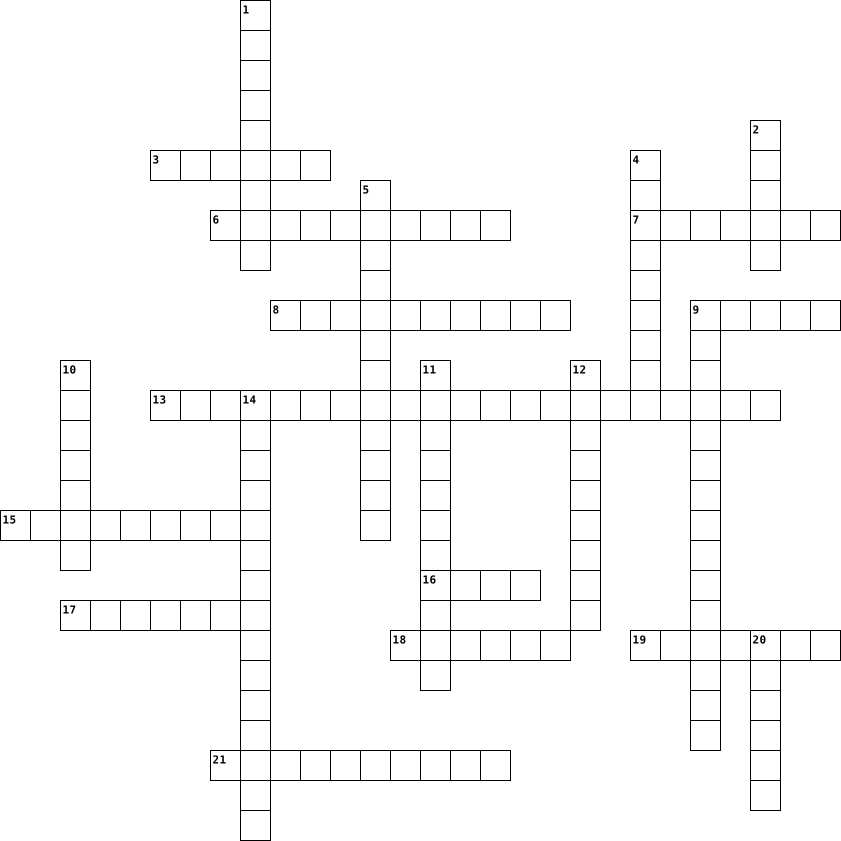
Across
- The remains or impression of a prehistoric organism preserved in petrified form or as a mold or cast in rock.
- Boundary moving towards each other.
- A mountain that opens downward to a pool of molten rock.
- A sudden and violent shaking of the ground.
- A living organism; tree, shrub, herb, grass, and flower.
- name of Wegener's theory.
- Example of Convergent Boundary.
- Relatively hard, naturally formed mineral or petrified matter; stone.
- Proposed the theory of the Plate Tectonics.
- The layer of the Earth between the crust and the core.
- The separation of the continents by plate tectonics.
- This occurs in Continental Boundary (Ocean vs. Continent).
Down
- This happens in a Convergent Boundary (Continent vs. Continent).
- A person.
- Boundary moving apart from each other.
- sudden occurrence of a violent discharge of steam and volcanic material.
- The crustal plates are moving over the mantle.
- A long high sea wave caused by an earthquake or other disturbance.
- Example of Transform-Fault Boundary (Hint: It is a fault).
- Example of Divergent Boundary (Hint: It is a ridge).
- Boundary moving side by side.
- A living organism that feeds on organic matter; fish, deer, snake, bird, and coyote.
22 Clues: A person. • name of Wegener's theory. • Boundary moving side by side. • Example of Convergent Boundary. • Boundary moving towards each other. • Boundary moving apart from each other. • A sudden and violent shaking of the ground. • Proposed the theory of the Plate Tectonics. • The crustal plates are moving over the mantle. • ...
Plate Tectonics 2012-10-02

Across
- The Thinnest layer of the Earth
- Caused by two plates rubbing against each other
- Formed by subduction
- Includes the crust and the upper most part of the mantle
- The result of two plates separating
- Magma rotating in a circular motion due to temperature
- Directly above the focus of an earthquake
- The result of two plates colliding
- In which boundary do two plates collide
- Magma coming directly from the mantle and forming volcanoes
Down
- The deepest layer of the Earth
- The thickest layer of the Earth
- Includes the upper mantle
- In which boundary do two plates separate
- In which boundary do two plates rub against each other
- The liquid layer below the mantle
- The area between two ridges
- When the oceanic plate goes underneath the continental plate
- Formed by the friction of subduction
- When two ridges separate
20 Clues: Formed by subduction • When two ridges separate • Includes the upper mantle • The area between two ridges • The deepest layer of the Earth • The thickest layer of the Earth • The Thinnest layer of the Earth • The liquid layer below the mantle • The result of two plates colliding • The result of two plates separating • Formed by the friction of subduction • ...
plate tectonics 2012-12-05

Across
- is magma older or younger away from the mid ocean ridge?
- when plates move past each other.
- is magma older or younger toward the mid ocean ridge?
- beneath this layer is a plastic like substance.
- where 2 oceanic plates collide.
- when earth's plates collide they form volcanoes and_.
- differences in the rock in the asthenosphere.
- the great rift valley in africa is _.
- where is the asthenosphere located.
- what is hawaii made of?
- composed of the crust and a part of the upper mantle.
Down
- the crust and upper mantle.
- the result of plate movement can be seen at.
- active volcanoes are most likely found at _ plates.
- an example of a transform boundary.
- magma's cycle of heating, rising, cooling, and sinking.
- in order to complete a convection current the rising material must_ back into earth.
- when oceanic plates collide what landforms are made.
- what is magma called after it explodes out of the volcano.
- what was the big continent called.
20 Clues: what is hawaii made of? • the crust and upper mantle. • where 2 oceanic plates collide. • when plates move past each other. • what was the big continent called. • an example of a transform boundary. • where is the asthenosphere located. • the great rift valley in africa is _. • the result of plate movement can be seen at. • differences in the rock in the asthenosphere. • ...
Plate Techtonics 2012-12-17

Across
- rock that changes shape
- layer of very hot rock
- stress that pushes rock in two different directions
- heat through two objects that are touching
- good tested concept
- who first discovered Continental Drift
- breaks the Earth’s crust where the rocks has slipped past each other
- a supercontinent discover by Wagener
Down
- force that pulls on crust
- metals like iron and nickel
- energy that travels through space
- ocean crust plunging below continental crust
- a thing that bounces waves off of under water objects
- a ball of solid metal Crust earths outer skin
- force that squeezes rock together
- layer of molten metal
- any trace of something in preserved rock
- occurs at deep valleys shaped like a V
- caused from the heat from the core
- like an egg shell that is broken into different parts
20 Clues: good tested concept • layer of molten metal • layer of very hot rock • rock that changes shape • force that pulls on crust • metals like iron and nickel • energy that travels through space • force that squeezes rock together • caused from the heat from the core • a supercontinent discover by Wagener • occurs at deep valleys shaped like a V • who first discovered Continental Drift • ...
plate tectonic 2013-03-03

Across
- magma once it has erupted onto the earths surface.
- a vent in the surface of earth through which nagma erupts.
- a weak point in the earths crust.
- used to measure the strength of an earthquake.
- a region in which earthquakes.
- the place where two or more plates in the earth crust meet.
- the maximum height of a wave crest or depth of a trough.
- an isstrument that records the motions of the earth.
- earthquake activity.
- the opening of the earth.
Down
- a measure of the strength of an earthquake.
- the innermost layers of the earth.
- a scientist who studies earthquakes.
- huge sea waves caused by earthquake.
- huge section which makes up the earths crust.
- movement of soil and rock downhill
- the point on the earths surface.
- shaking of the earth.
- volcanic rock.
- the thin outer layer of the earths surface.
20 Clues: volcanic rock. • earthquake activity. • shaking of the earth. • the opening of the earth. • a region in which earthquakes. • the point on the earths surface. • a weak point in the earths crust. • the innermost layers of the earth. • movement of soil and rock downhill • a scientist who studies earthquakes. • huge sea waves caused by earthquake. • ...
Plate Tectonics 2013-03-02

Across
- Measurement of angular distance on the Earth east or west of the prime meridian
- Melted rock beneath Earth's surface
- plate boundaries Where two tectonic plates move away from each other
- currents Movement within hot fluids, when the heat source is on the bottom, such as in a boiling pot of soup on the stove
- Opening in Earth's crust where melted rock reaches Earth's surface
- ("all land") the single huge supercontinent that existed 245 million years ago, when all of Earth's continents were joined together
- scale Numerical description of the size of seismic waves produced by an earthquake
- The rigid, brittle layer made up of the crust and the uppermost part of the mantle. It is broken up into pieces called tectonic plates
- plates Large pieces of the lithosphere that slowly move on top of the asthenosphere
- Imaginary east-west line that circles Earth halfway between geographic poles
Down
- The process by which one tectonic plate sinks below another, returning to the mantle, where the rock is re-melted
- wave Vibration produced by an earthquake
- convection Convection currents in the mantle that occur because hot rock in the lower part of the mantle is less dense and rises, and cooler rock in the upper part of the mantle cools, becomes more dense, and sinks
- drift The theory that all of Earth's continents were once joined together into a single large landmass, and then moved apart, forming the continents we see today
- plate boundaries Where two tectonic plates move toward each other
- Measurement of angular distance on the Earth north or south of the equator
- plate boundary Where two tectonic plates slip past each other, moving in opposite direction
- Instrument that measures and records seismic waves
- Point on Earth's surface directly above an earthquakes focus
- The true location of an earthquake and source of seismic waves
20 Clues: Melted rock beneath Earth's surface • wave Vibration produced by an earthquake • Instrument that measures and records seismic waves • Point on Earth's surface directly above an earthquakes focus • The true location of an earthquake and source of seismic waves • plate boundaries Where two tectonic plates move toward each other • ...
Plate Tectonics 2013-02-19

Across
- The Earthquake intensity scale based on observation.
- Pieces of the Earth's Crust that float around on the mantle.
- The idea that the continents were once one but have gradually moved apart.
- The scientist who first proposed the idea of continental drift.
- The type of plate that contains a continent.
- The type of boundary where two plates rub against one another, ofen causing an earthquake.
- The type of heat transfer used in the mantle.
- The zone at a convergent boundary where a plate is being destroyed.
- The part of the mantle where convection currents occur.
- The type of boundary where two plates are moving away from one another.
- The layer of the Earth that contains the Upper Manlte and the Lower crust.
- The outer layer of Earth.
Down
- The type of boundary where two plates are moving towards one another.
- The theory most scientists believe now where the Earth consists of several plates on it's crust that are always moving.
- The material that makes up most of the core.
- The type of plate that contains the planet's oceans.
- The 'super continent' that existed 200 billion years ago.
- The spot at a divergent boundary where hot magma rises from the mantle and cools on the surface.
- The very center of the Earth.
- The Earthquake intensity scale based on the measurement of instruments.
20 Clues: The outer layer of Earth. • The very center of the Earth. • The material that makes up most of the core. • The type of plate that contains a continent. • The type of heat transfer used in the mantle. • The Earthquake intensity scale based on observation. • The type of plate that contains the planet's oceans. • The part of the mantle where convection currents occur. • ...
Plate Tectonic 2013-04-10

Across
- Valley when continental crust begins to separate, the stretched crust forms a long narrow depression
- Boundary two tectonic plates are moving toward each other
- Boundary a region where two plates slide horizontally past each other, crust is neither destroyed nor formed
- basalt rock of sea floor records changing of earth’s magnetic field
- He knew that the continents moved but, did not show how they continents moved.
- the study of the alignment of magnetic minerals in rock, specifically relating to the reversals of Earth's magnetic poles
- Boundary regions where two tectonic plates are moving apart. Most are found along the seafloor in rift valleys
- the outer layer of the Earth
- Spreading the theory that explains how new ocean crust is formed at ocean ridges and destroyed at deep-sea trenches
Down
- an imaginary line on a map that shows points that have the same age
- Arc as oceanic crust of the sinking plate melts, magma rises through the top plate, over time the flows build up a series of islands
- Drift continents can move away from each other and have done so in the past.
- The zone of the mantle beneath the lithosphere that consists of slowly flowing solid rock
- Reversal process in which Earth's north and south magnetic poles have switched places many times throughout Earth's history
- Push the process when the older portion of the seafloor sinks and the weight of the uplifted ridge is thought to push the oceanic plate toward the trench formed at the subduction zone
- the solid part of the earth consisting of the crust and outer mantle
- All lands named for super continent.
- the process when two plates collide and the denser plate, eventually descends below the other, less-dense plate, three types are oceanic-oceanic, oceanic-continental and continental-continental
- long, narrow ditch.
- Pull the weight of a subducting plate pulls the trailing slab into the subduction zone much like a table cloth slipping off the table can pull articles off with it
20 Clues: long, narrow ditch. • the outer layer of the Earth • All lands named for super continent. • Boundary two tectonic plates are moving toward each other • an imaginary line on a map that shows points that have the same age • basalt rock of sea floor records changing of earth’s magnetic field • the solid part of the earth consisting of the crust and outer mantle • ...
Plate tectonics 2013-04-06

Across
- theory that continents drift apart
- the sinking of regions of earth's crust to lower elevations
- solid dense center of the earth
- a squeezing force
- boundary between two plates that are sliding past each other
- new lithosphere is created here
- the rising of regions of earth's crust to higher elevations
- the strong lower part of the mantle between the asthenosphere and outer core
- piece of the lithosphere that moves on the asthenosphere
- a region where a an oceanic plate sinks down into the asthenosphere
- liquid layer of the earth's core
Down
- outermost,rigid layer of the earth
- a break in the earths crust
- boundary between two colliding plates
- the bending of rock layers
- a pulling force
- layer between the crust and core
- soft layer of the mantle
- boundary between two plates moving away from each other
- outermost layer of the earth
20 Clues: a pulling force • a squeezing force • soft layer of the mantle • the bending of rock layers • a break in the earths crust • outermost layer of the earth • solid dense center of the earth • new lithosphere is created here • layer between the crust and core • liquid layer of the earth's core • outermost,rigid layer of the earth • theory that continents drift apart • ...
Plate Tectonics 2013-10-30

Across
- the mantle is the ____ layer of earth
- seeds of an apple is like this part of the earth
- liquid that rises from the core that creates ocean ridges
- a fossil plant found all over the world
- when magma comes up and creates new ridges
- people accepted wegeners theory after his ____
- the bounderie where plates move part
- the force that represents the divergent bounderies
- the man who found evidence of seafloor spread
Down
- the man that discovered pangea
- a huge wave caused by a earthquake in the ocean
- the ____ dense material sank to the core of earth
- the word that means all land
- the bounderie where two plates slide past eachother
- the earth is _____ under continental mountain ranges
- the peel of an apple is like this to the earth
- we live in this era
- the bounderie where two plates collide
- when the ocean shakes; usally on faults
- places in earth where two plates move
20 Clues: we live in this era • the word that means all land • the man that discovered pangea • the bounderie where plates move part • the mantle is the ____ layer of earth • places in earth where two plates move • the bounderie where two plates collide • a fossil plant found all over the world • when the ocean shakes; usally on faults • when magma comes up and creates new ridges • ...
Plate Tectonics 2013-09-13

Across
- breaks in the earths crust where rocks have slipped past each other to form along these boundaries
- Any Trace of an ancient organism that has been preserved in rock.
- Who made the hypothesis of continents plowed across the ocean floors?
- an undersea mountain chain where new ocean floor is produced.
- The continents drifting together to form the supercontinent
- where two plates come together, or converge is called a
- pieces of the earths lithosphere are in a slow, constant motion, driven by convection currents in the mantle.
- where two plates move apart, or diverge
- a fernlike plant that lived 250 million years ago.
- What often occur along the transform boundaries?
- the process by which the ocean floor sinks beneath a deep-ocean trench and back into the mantle is called
Down
- adds new material to the ocean floor.
- is a place where two plates slip past each other, moving in opposite directions
- in a process taking tens of millions of years, part of the sinks back into the mantle at deep ocean trenches
- is a well tested concept that explains a wide range of observations
- a deep valley
- the ocean floor plunging into deep under water canyons called
- a device that bounces sound waves off underwater objects and then records the echoes of these soundwaves.
- the hypothesis that the continents slowly moved across Earth's surface.
- the ocean floor is renewed every
- the lithosphere broken into separate sections is called
21 Clues: a deep valley • the ocean floor is renewed every • adds new material to the ocean floor. • where two plates move apart, or diverge • What often occur along the transform boundaries? • a fernlike plant that lived 250 million years ago. • where two plates come together, or converge is called a • the lithosphere broken into separate sections is called • ...
Plate Tectonics 2013-09-22

Across
- /a large volcanic crater
- /also called P wave
- /a numerical scale expressing the magnitude of an earthquake on the basis of seismograph oscillations
- /An example of Transformation Fault Boundary
- /a type of seismic wave
- /mark sites of convection downwelling of Earth's lithosphere
- /is the belt or zone of the continental lithosphere where the extensional deformation is occurring
- /A type of volcano
- /also called S wave
- /is an isolated region of the earth that produces lava
- /a sudden and violent shaking of the ground, as a result of movement
Down
- /the crust that takes place in the ocean
- /Also known as Seafoor Spreading
- /is directly below the epicenter in the earthquake
- /the point on the earth's surface vertically above the focus of an earthquake
- /a destructive mudflow on the slopes of a volcano
- /a fracture along which the blocks of crust on either side have moved to one another parallel to the fracture
- /a geophysicist who studies earthquakes
- /a smaller earthquake following the main shock of a large earthquake
- /a mild tremor preceding the violent shaking movement of an earthquake
20 Clues: /A type of volcano • /also called P wave • /also called S wave • /a type of seismic wave • /a large volcanic crater • /Also known as Seafoor Spreading • /a geophysicist who studies earthquakes • /the crust that takes place in the ocean • /An example of Transformation Fault Boundary • /a destructive mudflow on the slopes of a volcano • ...
Plate Tectonics 2013-12-10

Across
- Continent
- Spreading/Material continually being added
- Plate
- De Fuca/Smallest Plate
- of boundary where plates rub against each other
- Tectonics/Theory of plates in motion
- Scientist
Down
- of an ancient organism that has been preserved
- that uses sound waves to measure distance
- Drift/Wegener's Theory
- Andreas Fault/Transform boundary in California
- of the lithosphere
- of boundary where plates push together
- floor sinking into mantle
- Trench/Underwater canyons
- of boundary where plates pull apart
- America/Africa and what other continent appear to fit together like puzzle pieces
- Ridge/Long, underwater mountain chains
- in the crust where plates slip past each other
- of tectonic plates there are
20 Clues: Plate • Continent • Scientist • of the lithosphere • Drift/Wegener's Theory • De Fuca/Smallest Plate • floor sinking into mantle • Trench/Underwater canyons • of tectonic plates there are • of boundary where plates pull apart • Tectonics/Theory of plates in motion • of boundary where plates push together • Ridge/Long, underwater mountain chains • ...
Plate Tectonics 2014-09-12

Across
- Molten rock stored beneath Earth's surface
- The process that results when a dense oceanic plate sinks beneath a more buoyant plate
- The type of rock that forms when lava crystallizes and cools
- The thick middle layer of the Earth
- The process by which new oceanic crust forms along a mid-ocean ridge and older crust moves away
- The type of boundary between two plates that move toward each other
- The circulation of particles within a material caused by differences in thermal energy and density
- The dense metallic center of the Earth
- The rigid outermost layer of the Earth that includes the upper mantle and crust
- The type of boundary between two plates that slide past one another
Down
- Name given to a supercontinent that began to break apart 200 million years ago
- Magma that erupts onto Earth's surface
- The process that occurs when one tectonic plate moves under another tectonic plate
- The partially melted portion of the mantle below the lithosphere
- the rigid slabs of rock that make up the Earth's surface
- The movement of Earth's continents over time
- Long, narrow mountain range on the ocean floor
- The process that results when magma rises and pushes oceanic plates in two different directions
- The brittle, rocky outer layer of Earth
- The type of boundary between two plates that move away from each other
20 Clues: The thick middle layer of the Earth • Magma that erupts onto Earth's surface • The dense metallic center of the Earth • The brittle, rocky outer layer of Earth • Molten rock stored beneath Earth's surface • The movement of Earth's continents over time • Long, narrow mountain range on the ocean floor • the rigid slabs of rock that make up the Earth's surface • ...
Plate Tectonics 2014-03-03

Across
- the force exerted on a surface divided by the total area over which the force is exerted
- Vibrations that travel through Earth carrying the energy released during an earthquacke
- the layer of rock that forms Earth's outer surface
- a plate boundary where two plates move toward each other
- a large stream of moving water that flows through the oceans
- a break or crack in Earth's lithosphere along which the rocks move
- a rigid layer made up of the uppermost part of the mantle and the crust
- the soft layer of the mantle on which the lithosphere floats
- the theory that pieces of Earth's lithosphere are in constant motion, driven by continental currents in the mantle
- a dark, dense, igneous rock with a fine texture, found in oceanic crust
- the amount of mass of a substance in a given volume; mass per unit volume
- a well-tested concept that explains a wide range of observations
- the layer of hot, solid material between Earth's surface and core
- a usually light-colored rock that is found in continental crust
Down
- a plate boundary where two plates move past each other in opposite directions
- the name of the single landmass that broke apart 200 million years ago and broke into today's continents
- the process by which molten material adds new oceanic crust to the ocean floor
- a plate boundary where two plates move away
- the direct transfer of energy through space by electromagnetic waves
- the hypothesis that the continent slowly move across Earth's surface
- the direct transfer of thermal energy from one substance to another substance that it's touching
21 Clues: a plate boundary where two plates move away • the layer of rock that forms Earth's outer surface • a plate boundary where two plates move toward each other • a large stream of moving water that flows through the oceans • the soft layer of the mantle on which the lithosphere floats • a usually light-colored rock that is found in continental crust • ...
Plate Tectonics 2014-03-03

Across
- a rigid layer made up of the uppermost part of the mantle and the crust
- the soft layer of the mantle on which the lithosphere floats
- a break or crack in Earth's lithosphere along which the rocks move
- the direct transfer of energy through space by electromagnetic waves
- the hypothesis that the continent slowly move across Earth's surface
- the layer of hot, solid material between Earth's surface and core
- a plate boundary where two plates move toward each other
- a plate boundary where two plates move past each other in opposite directions
- a plate boundary where two plates move away
- a well-tested concept that explains a wide range of observations
- the amount of mass of a substance in a given volume; mass per unit volume
- a usually light-colored rock that is found in continental crust
Down
- the theory that pieces of Earth's lithosphere are in constant motion, driven by continental currents in the mantle
- the direct transfer of thermal energy from one substance to another substance that it's touching
- a large stream of moving water that flows through the oceans
- Vibrations that travel through Earth carrying the energy released during an earthquacke
- the force exerted on a surface divided by the total area over which the force is exerted
- a dark, dense, igneous rock with a fine texture, found in oceanic crust
- the name of the single landmass that broke apart 200 million years ago and broke into today's continents
- the process by which molten material adds new oceanic crust to the ocean floor
- the layer of rock that forms Earth's outer surface
21 Clues: a plate boundary where two plates move away • the layer of rock that forms Earth's outer surface • a plate boundary where two plates move toward each other • a large stream of moving water that flows through the oceans • the soft layer of the mantle on which the lithosphere floats • a usually light-colored rock that is found in continental crust • ...
Plate Tectonics 2014-08-08

Across
- An area of rock bent as a result of stress.
- A Mountain or hill, typically conical that contains a vent of lava.
- A large movement of water as a result of an earthquake or tectonic activity.
- A depression in the Earth's crust.
- The theory that the layout of the earths continents changes.
- A large mass of land risen from the crust as a result of tectonic activity.
- The centre of the Earth.
- The thick, dense layer of earth between The Earth's core and crust
- Geology/ the study of the earths physical history.
- The process of tectonic plates moving apart.
- Large moveable sections of the lithosphere.
- The deformation of the lithosphere.
- Interaction between two or more plates resulting in a plate to get pushed/pulled down.
- A Split between two bodies.
Down
- An area of fracturing between rocks resulting from stress.
- A depression in the oceans floor caused when two plates converge causing one plate to get pushed downwards.
- The process of two or more tectonic plates moving toward each other.
- Sublayers of the earths crust that move, collide and cause earthquakes, volcanoes, and tsunamis.
- The study of tectonism
- The outer layer of earth.
20 Clues: The study of tectonism • The centre of the Earth. • The outer layer of earth. • A Split between two bodies. • A depression in the Earth's crust. • The deformation of the lithosphere. • An area of rock bent as a result of stress. • Large moveable sections of the lithosphere. • The process of tectonic plates moving apart. • Geology/ the study of the earths physical history. • ...
Plate Tetonics 2014-02-28

Across
- any trace of an ancient organism that has been preserved in rock
- layer of rock that forms Earth's outer skin
- when magma reaches the surface
- a fold in rock that bends upward into an arch
- the process by which molten material adds new oceanic crust to the ocean floor
- stress that stretches rock so that it becomes thinner in the middle
- is a rock that usually is a light color and has a coarse texture
- stress that squeezes rock until it folds or breaks
- a device that records ground movement caused by seismic waves as they move through earth
- a large area of flat land elevated high above sea level
Down
- a fold in rock that bends downward to form a valley
- the molten mixture of rock-forming substances, gases, and water from the mantle
- a weak spot in the crust where molten material, or magma, comes o the surface
- an undersea mountain chain where new ocean floor is produced
- a giant wave usually caused by an earthquake beneath the ocean floor
- a fountain of water and steam the erupts from the ground
- stress that pushes masses of rock in opposite directions
- a huge hole left by the collapse of a volcanic mountain
- a layer of hot rock in the earth's interior
- supercontinent
20 Clues: supercontinent • when magma reaches the surface • layer of rock that forms Earth's outer skin • a layer of hot rock in the earth's interior • a fold in rock that bends upward into an arch • stress that squeezes rock until it folds or breaks • a fold in rock that bends downward to form a valley • a huge hole left by the collapse of a volcanic mountain • ...
Plate tectonics 2014-04-29

Across
- Tectonics Theory that Earth's crust and upper mantle are broken into sections that move around on a plastic-like layer of the mantle.
- Cone Steep-sided volcano made of loosely packed tephra.
- Core Liquid core that surrounds Earth's solid inner core.
- The point beneath Earth's surface where energy release occurs, in a earthquake.
- scientist who studies earthquakes and seismic wave.
- Earth's outermost layer.
- Rigid, outermost layer of Earth that is about 100km thick, and is composed of the crust and part of the upper mantle.
- powerful seismic sea wave that can travel thousands of kilometers in all directions and that begins over an earthquake focus.
- Single large landmass made up of all the continents connected together that broke apart 200 million years ago.
- Largest layer inside Earth, lying directly above the outer core.
Down
- core Earths innermost part.
- surface along which rocks break and move.
- Wave waves of energy that reach Earth's surface during an earthquake, travel outward from the epicenter, and move rock particles up and down, and side to side.
- point of Earth's surface directly above an earthquake's focus.
- Waves Waves that travel outward from an Earthquake's focus and cause particles in rocks to move back and forth in the same direction the wave is moving.
- A volcano formed by alternating layers of tephra and lava and that is found mostly where Earth's plates come together.
- Device used by seismologists to record primary, secondary, surface waves from earthquake.
- A broad volcano with gently sloping sides.
- waves Waves that travel outward from an earthquake's focus and move through Earth by causing particles in rocks to vibrate at right angles to the direction of the wave.
- Waves Energy waves that are produced at and travel outward from the earthquake's focus.
- Large opening formed when the top of a volcano collapse.
21 Clues: Earth's outermost layer. • core Earths innermost part. • surface along which rocks break and move. • A broad volcano with gently sloping sides. • scientist who studies earthquakes and seismic wave. • Cone Steep-sided volcano made of loosely packed tephra. • Large opening formed when the top of a volcano collapse. • ...
plate tectonics 2015-03-06

Across
- person who studies earthquakes
- break in earth's crust
- squeezing force
- boundary between two colliding plates
- solid dense center of the earth
- outermost rigid layer
- the point directly above the focus
- theory proposed by Alfred Wegner
- piece of the lithosphere that moves on the asthenosphere
- boundary between two plates moving away
- bending of rock layers
- measure of energy released in an e-quake
Down
- layer between the crust and core
- where energy is being released from an earthquake
- where an oceanic plate sinks down into the asthenosphere
- layer of the mantle
- pulling force
- boundary between two plates sliding past each other
- liquid layer of earth's core
- outermost layer of the earth
20 Clues: pulling force • squeezing force • layer of the mantle • outermost rigid layer • break in earth's crust • bending of rock layers • liquid layer of earth's core • outermost layer of the earth • person who studies earthquakes • solid dense center of the earth • layer between the crust and core • theory proposed by Alfred Wegner • the point directly above the focus • ...
Plate Tectonics 2015-01-20

Across
- A scientist who studies earthquakes
- A seismic wave that can travel through the interior of the earth
- An instrument that records the motions of the Earth especially earthquakes
- An earthquake that comes after a larger one
- Magma that flows out onto Earths surface from a volcano
- move more slowly than P waves but in an earthquake they are usually bigger
- A shaking or movement of Earths surface
- A super continent existing 200 million years ago
- The theory of pangea and the landmass coming apart
- The innermost densest layer of Earth
Down
- The fastest body waves that arive befor S waves
- The ability to cause change
- A point within earth that originates the first movement of an earthquake
- A site at which one or more seismographs are set up and routinely monitored
- The layer of the Earth between the crust and the core
- The process in which a solid takes on the characteristics of a thick heavy liquid
- The ability to cause change
- The transfer of heat energy through liquids and gases, fluids, by moving particals
- the point on the Earths surface that is the center of the earth quake
- A break in rock along where slabs are moved
- Earths outer layer
21 Clues: Earths outer layer • The ability to cause change • The ability to cause change • A scientist who studies earthquakes • The innermost densest layer of Earth • A shaking or movement of Earths surface • An earthquake that comes after a larger one • A break in rock along where slabs are moved • The fastest body waves that arive befor S waves • ...
Plate Tectonics 2015-01-25

Across
- The outermost part of Earth that is mostly made up of granite.
- Steep-walled depression around a volcano's vent.
- The point of Earth's surface directly above an earthquake's focus.
- A device used by scientists to record primary, secondary, surface waves from earthquakes.
- The theory that explains how and why continents move
- Rigid, outermost layer of the earth that is about 100km thick.
- A common rock type within the oceanic crust.
- The large opening formed when the top of a volcano collapses.
- A scientist who studies earthquakes and seismic waves.
- Surface along which rocks break and move?
- There are ___ primary plates that form Earth's crust.
Down
- The name Alfred Wegener gave to the super-continent.
- A geological process in which one edge of one crustal plate is forced below the edge of another.
- A common rock type found within the continental crust.
- A sudden movement along the boundary of a tectonic plate is called?
- Tectonic plates float on the _?
- Seismic sea wave
- What lies directly beneath the crust?
- Opening in the earth's surface that often forms a mountain when layers of lava and volcanic ash erupt and build up.
- Measure of the energy released by an earthquake.
20 Clues: Seismic sea wave • Tectonic plates float on the _? • What lies directly beneath the crust? • Surface along which rocks break and move? • A common rock type within the oceanic crust. • Steep-walled depression around a volcano's vent. • Measure of the energy released by an earthquake. • The name Alfred Wegener gave to the super-continent. • ...
Plate Tectonic 2015-01-26

Across
- where crust is neither produced nor destroyed as the plates slide horizontally past each other.
- It is a layer at the top of the Earth's surface.
- where new crust is generated as the plates pull away from each other.
- The weight of a subducting plate helps pull the trailing lithosphere into subduction zone.
- Study of Earth's magnetic record using data gathered from iron-bearing minerals in rocks.
- a series of vibration induced in the Earth's cru
- The weight of the uplifted ridge is thought to push an oceanic plate toward the trench formed at the subduction zone.
- Hess's theory that new ocean crust is formed at mid-ocean ridges and destroyed at deep-sea trenches
- It is the rigid, outermost shell of a rocky planet
- process by which one tectonic plate slips beneath another tectonic plate.
Down
- Changes in Earth's magnetic field over geologic time.
- a vent in the earth's crust through which lava, steam, ashes, etc., are expelled
- States that Earth's crust and upper mantle are broken into plates.
- It is a layer under the crust.
- Wegener's hypothesis that Earth's continents were joined as a single land mass about 200 million years ago.
- Line on a map that connects points of the same age.
- Device used to map the ocean floor that detects small changes in magnetic fields.
- A person who introduced a plate tectonic theory.
- Ancient landmass made up of all the continents that began to break apart about 200 million years ago.
- It is hot regions of Earth's mantle where high-temperature plumes of mantle material rise toward the surface.
20 Clues: It is a layer under the crust. • It is a layer at the top of the Earth's surface. • A person who introduced a plate tectonic theory. • a series of vibration induced in the Earth's cru • It is the rigid, outermost shell of a rocky planet • Line on a map that connects points of the same age. • Changes in Earth's magnetic field over geologic time. • ...
Plate Tectonics 2015-03-09

Across
- Earthquakes cause the ground to turn to liquid.
- Cracks in the planet's surface.
- A mechanism which defines the magnitude of seismic waves.
- The status of New York City if an earthquake hits it.
- A city in Japan that has large earthquakes.
- The expression of the internal and external processes and events that affect a planetary body.
- The U.S. state that has the San Andres Fault in it.
- A shaking or vibrating movement.
- The result of a sudden release of energy in the Earth's crust.
- A piece of land surrounded by water that can be formed by earthquakes.
Down
- Engaged in action.
- A home made to withstand an earthquake.
- A statement or event that indicates a possible or impending danger, problem, or other unpleasant situation.
- The smaller movements after a quake as the Earth re-adjusts itself.
- Large-scale processes affecting the structure of the earth's crust.
- An area that refers to the frequency, type and size of earthquakes experienced over a period of time.
- When somethings falls.
- Pressure or tension exerted on a material object.
- A recognizable, naturally formed feature on the Earth's surface.
- A type of fault that has the two plates move paste each other.
20 Clues: Engaged in action. • When somethings falls. • Cracks in the planet's surface. • A shaking or vibrating movement. • A home made to withstand an earthquake. • A city in Japan that has large earthquakes. • Earthquakes cause the ground to turn to liquid. • Pressure or tension exerted on a material object. • The U.S. state that has the San Andres Fault in it. • ...
Plate tectonicts 2016-01-04

Across
- the outer most layer of the earth it's what we live on
- a plastic like layer that is weak
- the second layer of the earth and the biggest
- what is made of basalt
- a ridged layer made up of the uppermost mantel and crust
- plates moving away
- what happens when two plates collide
- What continental plates are made of
- breaks in the crust
- the scientist that got the idea of continental dift
Down
- the outer layer of the center of the earth
- what can come from any plate boundary
- what is made of granite
- what happens when theres subduction
- what happens when oceanic plates and continental plates collide
- what oceanic plates are made of
- What is the center of the earth
- what happens when two plates slide past each other
- a ring that is bordered with volcanos
- what is a super continent called
20 Clues: plates moving away • breaks in the crust • what is made of basalt • what is made of granite • what oceanic plates are made of • What is the center of the earth • what is a super continent called • a plastic like layer that is weak • what happens when theres subduction • What continental plates are made of • what happens when two plates collide • ...
plate tectonics 2016-08-02

Across
- – largest type of crust
- – the spot underground where rock breaks causing an earthquake
- – when the earths crust is pushed up from its sides
- – the earths thickest layer
- – the super continent
- - the largest recorded shock
- – what layer of the earth is liquid state due to extremely high temperatures
- – most common type of volcano, explosive eruptions and lava flow
- – semi rigid part of the mantle
- – plates sliding against each other
- – debris thrown from volcanos with viscous magma
- – lava with a high viscosity, blocky and rough
- – the area on the ground directly above where an earthquake occurs
- – the north side of Pangaea
- – an earthquake that occurs after a larger seismic event
- – the south side of Pangaea
- - an opening in the side of a volcano through which volcanic materials (like lava, gases, and pyroclastic debris) erupt.
- – lava that is parcially cooled, low viscosity, thin (like water)
- – what layer of the earth is solid due to tremendous pressure
Down
- – areas of the earths surface through which magma and volcanic gases pass
- – a volcano that is not very steep but can be big with non- explosive eruptions
- – occurs in the middle of the plate tectonics
- waves – waves trapped near the surface, they are the slowest and most destructive
- - hot molten or semi-fluid rock erupted from a volcano or fissure, or solid rock resulting from cooling of this.
- – a volcano small in size with steep slopes, moderately explosive with shot eruptions
- – smallest type of crust
- – A point source of the Earth's surface through which lavas, pyroclastics, and gas are erupted.
- – a tube formed by cooling and solidifying of the lava walls while fluid lava continued to flow inside
- – plates pulling away from each other
- – the line which rocks break and move
- – the scale which measures the magnitude of earthquakes
- – plates pushing together
- – waves that travel along the worlds outer layers
- – a form of closed lava tube (with a bulbous end) that forms when lava flows into water (e.g. a lake) and cools very rapidly
- - a large underground pool of liquid rock found beneath the surface of the Earth.
- – occurs on the tectonic plate boundaries
- - hot fluid or semi-fluid material below or within the earth's crust from which lava and other igneous rock is formed on cooling.
- – all material ejected from a volcano
- – scientist behind the theory of the continental drift
- – the fastest travel waves with the greatest velocity
- – an earthquake that occurs before a larger seismic event
- – the earths thinnest layer
42 Clues: – the super continent • – largest type of crust • – smallest type of crust • – plates pushing together • – the earths thickest layer • – the north side of Pangaea • – the south side of Pangaea • – the earths thinnest layer • - the largest recorded shock • – semi rigid part of the mantle • – plates sliding against each other • – the line which rocks break and move • ...
Plate Tectonics 2017-01-04

Across
- Several large slabs of the lithosphere that hold the continents and oceans and are slowly but constantly moving around the earth.
- A layer of the earth's crust that lies under the seven continents. It is about 20 to 40 miles (35 to 70 km) thick and very old.
- BOUNDARY The boundary that occurs where two plates slide past each other.
- Molten rock that flows beneath the earth's surface and is made up of gases, liquids, and crystals. When it reaches the surface, it is called lava.
- The place where one plate is getting bent and pulled under the edge of another plate.
- The innermost layer of the earth, an extremely hot, solid sphere of mostly iron and nickel. It is 3,200 to 3,960 miles (5,150 to 6,378 km) below the surface and about 750 miles (1,200 km) thick.
- A deep valley that forms at the edge of a continent when an oceanic plate sinks underneath a continental plate.
- Made up of the crust and a tiny bit of the upper mantle, this zone is divided into several constantly (very slowly) moving plates of solid rock that hold the continents and oceans.
- A trembling and shaking of the earth's surface resulting from the sudden release of energy in the crust, either along fault lines or from volcanic activity.
- The boundary that occurs where two plates are moving apart from each other.
Down
- The process that forms new ocean floor and oceanic crust. Magma oozes up from the mantle through a crack in the ocean floor, filling in the space between the plates and spreading out from the plate boundary.
- Hard and rigid, the earth's outermost and thinnest layer. It is only a few miles (5 km) thick under the oceans and averages 20 miles (30 km) thick under the continents.
- This layer of the earth lies between the mantle and the solid inner core. It is the only liquid layer, a sea of mostly iron and nickel about 1,400 miles (2,300 km) thick.
- A dropped zone where two continental tectonic plates are pulling apart.
- The type of crust lying under the oceans of the world. It is only 4 to 6 miles (7 to 10 km) thick and usually younger than continental crust.
- A crack or fracture in Earth's crust where two tectonic plates grind past each other in a horizontal direction.
- A hot, malleable semiliquid zone in the upper mantle, on which the plates of the lithosphere move (or float).
- This dense layer of the earth is made of hot, semisolid rock and is located directly below the crust. It is about 1,800 miles (2,900 km) thick.
- A raised area or mountain range under the oceans formed when magma fills the space between two tectonic plates that are spreading apart.
- The place where a collision between two continental plates crunches and folds the rocks at the boundary, lifting them up and leading to mountain formation.
- The boundary that occurs where two plates are pushing toward each other.
- The border between two tectonic plates.
- The name given to the supercontinent that existed more than 225 million years ago, in which the present-day continents were joined together in one large landmass.
- A huge ocean wave caused by a sudden, powerful shift on the ocean floor, like an undersea earthquake, landslide, or volcanic eruption.
24 Clues: The border between two tectonic plates. • A dropped zone where two continental tectonic plates are pulling apart. • The boundary that occurs where two plates are pushing toward each other. • BOUNDARY The boundary that occurs where two plates slide past each other. • The boundary that occurs where two plates are moving apart from each other. • ...
Plate Tetonics 2016-05-24

Across
- when oceanic plates diverge and magma rises through the crust and forms new crust
- A deep valley along the ocean floor
- the theory that the continents have drifted away from each other
- the original super continent
- the process in which 2 plates are diverging forming new crust along the Mid Atlantic ridge
- plates situated throughout the lithosphere
- Molten rock
- when 2 continental plates slide horizontally past each other
- Soft layer of the mantle
- when 2 continental plates collide with each other
Down
- Outermost, rigid layer of the Earth
- The longest mid ocean ridge on the planet
- Usually near tectonic plates a tremor in the Earths surface
- when 2 plates collide with each other
- Came up with the theory of Continental Drift
- fractures in the earths crust
- formed when 2 continental plates diverge
- Line of volcanic islands formed by plates colliding and one plate sliding under the other
- when 2 plates diverge from each other
- when an oceanic plate slides under a continental plate
20 Clues: Molten rock • Soft layer of the mantle • the original super continent • fractures in the earths crust • Outermost, rigid layer of the Earth • A deep valley along the ocean floor • when 2 plates collide with each other • when 2 plates diverge from each other • formed when 2 continental plates diverge • The longest mid ocean ridge on the planet • ...
Plate Tectonics 2016-01-26

Across
- liquid layer of the Earth's core
- outermost, rigid layer of the Earth
- layer between the crust and the core
- new lithosphere is created here
- outermost layer of the Earth
- theory that continents drift apart
- solid, dense center of the Earth
- piece of the lithosphere that moves on the asthenosphere
- the bending of rock layers
Down
- soft layer of the mantle
- a pulling force
- a squeezing force
- boundary between two colliding plates
- A chain of mountains on the ocean floor where the sea floor is spreading.
- a region where a an oceanic plate sinks down into the athenosphere
- a break in the Earth's crust
- The pathway along which energy travels through a fluid
- boundary between two plates moving away from each other
- boundary between two plates that are sliding past each other
- A supercontinent that existed about 200 million years ago but broke apart into several continents.
20 Clues: a pulling force • a squeezing force • soft layer of the mantle • the bending of rock layers • a break in the Earth's crust • outermost layer of the Earth • new lithosphere is created here • liquid layer of the Earth's core • solid, dense center of the Earth • theory that continents drift apart • outermost, rigid layer of the Earth • layer between the crust and the core • ...
Plate Tectonics 2017-03-07

Across
- A large supercontinent which formed millions of years ago
- Violent shaking of the Earth which is caused by rocks breaking under stress
- A fracture in rock where the tectonic plates have moved
- The layer of molten rock located beneath the Earth's crust
- A mountain with a vent where magma have or are erupted
- A thin part of the crust that which lays under the oceans
- A series of underwater mountains that form as a result of tectonic plates moving apart and allowing magma to rise to the surface
- The boundary between two tectonic plates that are moving together
- The current or flow of air or liquid that results from the transfer of thermal energy through convection
- A theory that the middle of the ocean is spreading apart, forming new oceanic crust
- The continual movement of the continents over time
- The transfer of the thermal energy by the movement of molecules in air or liquid from one place to another
- The boundary between two tectonic plates that are moving apart
- Lithosphere; the outer layer of the Earth
Down
- the geologist which first thought of the thoery of continental drift
- A deep valley that forms as a result of tectonic plates moving apart on land
- A series of large waves that result from an underwater earthquake
- The movement of one tectonic plate under another tectonic plate
- Underwater cliffs between the beach and the ocean
- A large leyer of solid rock that covers part of the surface of the Earth; Movement of tectonic plates can cause earthquakes
- A deep ditch under the ocean along a tectonic plate boundary
- A place where two tectonic plates colided which causes a large land mass to elevate
- Core The layer of the Earth which is responsible for the magnectic field
- The boundary between two tectonic plates that are sliding past each other
- Molten rocks which appear on the surface of the Earth
- Semiliquid rock found beneath the Earth's surface
- A place in the mantle that melts rocks into magma
- The theory that the surface of the Earth is divided into a series of plates that are continually moving
- Something that acts like a liquid but is a solid
- The centre of the Earth
30 Clues: The centre of the Earth • Lithosphere; the outer layer of the Earth • Something that acts like a liquid but is a solid • Underwater cliffs between the beach and the ocean • Semiliquid rock found beneath the Earth's surface • A place in the mantle that melts rocks into magma • The continual movement of the continents over time • ...
Plate Tectonics 2017-10-23

Across
- a break in the Earth's crust where sediment (rock and other things) have slipped past each other.
- when plates move away from each other.
- older crust is ____ _____ than newer crust.
- a scientist who discovered pangea
- the temperature of newer crust is _____ than older crust.
- when the ocean floor goes into a canyon, what are the canyons called?
- when plates slide on top or past each other.
- Where the ocean spreads.
- plates movement into a theory.
- new crust is ____ ______ than old crust.
- the sideways and downward movement of the edge of a plate of the earth's crust into the mantle beneath another plate is called what?
Down
- the remains of a historic thing molded in a form or as a mold in rock?
- when plates come together.
- the name of the most popular supercontinent.
- when the mid-ocean ridge adds more sea floor.
- pieces separated by cracks.
- a system for the detection of objects under water and for measuring the water's depth by radiating waves is called a?
- peices of Earth’s crust diverge on land.
- When continents moved slowly over Earth's surface is called?
- the temperature of older crust is ______ than newer crust.
20 Clues: Where the ocean spreads. • when plates come together. • pieces separated by cracks. • plates movement into a theory. • a scientist who discovered pangea • when plates move away from each other. • peices of Earth’s crust diverge on land. • new crust is ____ ______ than old crust. • older crust is ____ _____ than newer crust. • the name of the most popular supercontinent. • ...
Plate Tectonics 2017-10-23

Across
- the earth's motion into a single theory
- mountains under water
- separating of the plates
- wegeners idea that the continents move is called
- supercontinent
- force pressing on something
- when somthing goes back into the mantle
- the last layer in our earth
- a device that shows us down far below the ocean
- a dark fined grained rock
Down
- colliding of the plates
- breaks in earths crust
- any trace of anything ancient
- when the oceanic crust bends down
- a deep valley
- generates earthquakes
- the pieces called what?
- a part of the earths inner
- outer skin of the earth
- a rock that is normally light colored
20 Clues: a deep valley • supercontinent • mountains under water • generates earthquakes • breaks in earths crust • colliding of the plates • the pieces called what? • outer skin of the earth • separating of the plates • a dark fined grained rock • a part of the earths inner • force pressing on something • the last layer in our earth • any trace of anything ancient • ...
plate tectonics 2017-10-23

Across
- breaks in the earth's crust
- a large body of water
- the uppermost part of the mantle
- a mountain that erupts
- heat transfer from air currents
- any trace of an ancient organism preserved in rock
- earth's plates that are in slow constant motion
- deep underwater canyons
- plates collide
- german scientist who discovered that the continents were together at one point
- pieces of earth separated by cracks
- plates slip past eachother
Down
- a process where the ocean floor sinks in the mantle
- how much mass there is in a given amount of volume
- a process that adds new material to the ocean floor
- a layer of hot rock
- forms when pieces of earth's crust diverge on land
- plates come together
- - an idea that continents slowly move
- underwater ocean ranges
- a supercontinent that existed 2 million years ago
21 Clues: plates collide • a layer of hot rock • plates come together • a large body of water • a mountain that erupts • deep underwater canyons • underwater ocean ranges • plates slip past eachother • breaks in the earth's crust • heat transfer from air currents • the uppermost part of the mantle • pieces of earth separated by cracks • - an idea that continents slowly move • ...
plate tectonics 2017-10-23

Across
- pieces of earth separated by cracks
- heat transfer from air currents
- underwater ocean ranges
- breaks in the earth's crust
- the uppermost part of the mantle
- how much mass there is in a given amount of volume
- plates collide
- plates slip past eachother
Down
- any trace of an ancient organism preserved in rock
- a layer of hot rock
- earth's plates that are in slow constant motion
- a large body of water
- a supercontinent that existed 2 million years ago
- deep underwater canyons
- - an idea that continents slowly move
- german scientist who discovered that the continents were together at one point
- a process where the ocean floor sinks in the mantle
- a process that adds new material to the ocean floor
- plates come together
- a mountain that erupts
- forms when pieces of earth's crust diverge on land
21 Clues: plates collide • a layer of hot rock • plates come together • a large body of water • a mountain that erupts • deep underwater canyons • underwater ocean ranges • plates slip past eachother • breaks in the earth's crust • heat transfer from air currents • the uppermost part of the mantle • pieces of earth separated by cracks • - an idea that continents slowly move • ...
plate tectonics 2017-10-20

Across
- what type of rock is found farther away from a ridge
- where dose sea floor spreading begin
- where pieces of earths crust diverge on land, a deep valley forms
- what type of belt does seafloor spreading and subduction make when working together
- what is created when along a mid ocean ridge and is destroyed at a deep ocean trench
- what boundary slips past each other
- the theory that earths plate slow constant motion is called
- what boundary colloid together
- what did scientist really find at the bottom of the ocean
- what is the thickest layer of the earth
- when the ocean floor sinks beneath the deep ocean trench is called
- when two continental plates colloid what do they make
Down
- when two plates move away from each other is called
- when the oceanic crust bends downward is called
- who thought of continental drift
- what did scientist use to find things at the bottom of the ocean
- when it adds more material is called
- what pulls the older,denser oceanic crust down beneath the trench and back into the mantle
- what idea did wegner come up with
- super continent 300 million years ago
20 Clues: what boundary colloid together • who thought of continental drift • what idea did wegner come up with • what boundary slips past each other • where dose sea floor spreading begin • when it adds more material is called • super continent 300 million years ago • what is the thickest layer of the earth • when the oceanic crust bends downward is called • ...
Plate Tectonics 2017-10-17

Across
- What scientists use to explore the ocean floor
- Produced when 2 continental plates collide
- A break in Earth’s crust where rocks slipped past each other
- Valley along the ocean floor where oceanic crust sinks into the mantle
- Scientist that came up with the theory of continental drift
- When plates slip past each other
- Causes the plates to move
- 3rd layer of Earth that is very hot, yet solid where convection currents are
- Where seafloor spreading begins
- When pieces of Earth’s crust diverges on land
Down
- Supercontinent that existed around 300 million years ago
- How scientist study the inside of Earth since we can’t drill down that far
- The theory that Earth’s plates are in a slow, constant motion
- When plates move away from each other
- When oceanic crust sinks beneath a deep-ocean trench and back into the mantle
- When molten material is added to make new oceanic crust
- Theory of how the continents spread away from each other
- The remains of a prehistoric organism
- When plates come together
- Measure of how much mass there is in an object
20 Clues: Causes the plates to move • When plates come together • Where seafloor spreading begins • When plates slip past each other • When plates move away from each other • The remains of a prehistoric organism • Produced when 2 continental plates collide • When pieces of Earth’s crust diverges on land • What scientists use to explore the ocean floor • ...
Plate Tectonics 2017-10-17

Across
- The layer of Earth under the crust
- Solid but bendable metal
- A measure of how much mass there is in a given volume of water
- Plates collide
- This forms where pieces of Earth’s crust diverge on land
- Wegener’s idea that the continents slowly moved over Earth’s surface
- This begins at a mid-ocean ridge
- Supercontinent about 300 million years ago
- Plates slip past each other
Down
- This forms long chains of mountains that rise up from the ocean floor
- A deep underwater canyon
- The theory of this states that Earth’s plates are in slow, constant motion, driven by convection currents in the mantle
- Layer of rock that forms Earth’s outer skin
- Plates divide
- The crust and uppermost mantle
- Any trace of an ancient organism that has been preserved in rock
- Breaks in Earth’s crust where rocks have slipped past each other
- When the ocean floor sinks beneath a deep-ocean trench and back into the mantle again
- Caused at a transform boundary
- These are broken into pieces separated by cracks
20 Clues: Plates divide • Plates collide • A deep underwater canyon • Solid but bendable metal • Plates slip past each other • The crust and uppermost mantle • Caused at a transform boundary • This begins at a mid-ocean ridge • The layer of Earth under the crust • Supercontinent about 300 million years ago • Layer of rock that forms Earth’s outer skin • ...
plate tectionces 2017-10-17

Across
- mostly iron
- system mesurement
- the crust and upper mantle
- a type of rock
- to strech
- oceanic trench
- geologic faults
- soild ball of hot iron and nickel
- geologic process
- bad jugement
Down
- scientist
- interdepent elements
- is more then two thousand miles thick
- move across the eaths surface
- supercontint
- comboined with three types of rocks
- is usually mass
- a rock
- doing something active
- dark color rock
20 Clues: a rock • scientist • to strech • mostly iron • supercontint • bad jugement • a type of rock • oceanic trench • is usually mass • geologic faults • dark color rock • geologic process • system mesurement • interdepent elements • doing something active • the crust and upper mantle • move across the eaths surface • soild ball of hot iron and nickel • comboined with three types of rocks • ...
Plate Tectonics 2017-10-18

Across
- old man made item
- beginning of seafloor spreading
- 300 million years ago this supercontinent existed
- land slides together
- land converges
- what continents rest on
- causes movement of our plates
- uses sound waves to measure distance
- mass/volume
- diverging on land
Down
- where subduction occurs
- geologists theory of...
- crust falling into the mantle
- what our plates sit on
- Earth’s largest layer
- conveyor belt
- divides land
- famous scientist who discovered Pangaea
- continents moving slowly over Earth’s surface
- San Andreas …
20 Clues: mass/volume • divides land • conveyor belt • San Andreas … • land converges • old man made item • diverging on land • land slides together • Earth’s largest layer • what our plates sit on • where subduction occurs • geologists theory of... • what continents rest on • crust falling into the mantle • causes movement of our plates • beginning of seafloor spreading • ...
plate tect 2017-10-18

Across
- supercontinent
- geologic faults
- is usually mass
- combined with three types of rocks
- interdependent elements
- system measurement
- oceanic trench
- doing something active
Down
- dark color rock
- move across the earth's surface
- the crust and upper mantle
- bad judgement
- a type of rock
- a rock
- to stretch
- geologic process
- is more than two thousand miles thick
- solid ball of hot iron and nickel
- mostly iron
- scientist
20 Clues: a rock • scientist • to stretch • mostly iron • bad judgement • supercontinent • a type of rock • oceanic trench • dark color rock • geologic faults • is usually mass • geologic process • system measurement • doing something active • interdependent elements • the crust and upper mantle • move across the earth's surface • solid ball of hot iron and nickel • combined with three types of rocks • ...
Plate Tectonics 2018-02-14

Across
- super continent proposed by Wegener
- one plate will move under the other.
- Ridge located near the center of the Atlantic Ocean pulls apart each year.
- a point on the Earth's surface, not where the earthquake originates.
- are mantle materials that are hotter than normal.
- theory that explains how mountains form, why crustal plates move and where great earthquakes are likely to strike.
- largest plate on Earth.
- portion of the mantle that consists of extremely hot, plastic-like rock that is partially melted.
- when oceanic crust sinks into the mantel and pulls the lithosphere
- outermost and thinnest layer of the Earth's three zones
Down
- plates move in opposite but parallel directions along a fracture.
- There are large and small plates that cover the Earth. Subduction zones form where these plates are recycled.
- natural remnant magnetism in rock bodies
- surrounds the core and is mostly solid rock.
- believed to be what helps keep the plates moving.
- It has a subduction zone, transform fault, and triple junction.
- These faults occur where large blocks of land can be forced over the top of another block of land at a low angle.
- motion of matter resulting in changes of temperature
- when gravity causes the oceanic lithosphere to slide down the oceanic ridges
- concentration of heat in the mantle that produces magma
20 Clues: largest plate on Earth. • super continent proposed by Wegener • one plate will move under the other. • natural remnant magnetism in rock bodies • surrounds the core and is mostly solid rock. • are mantle materials that are hotter than normal. • believed to be what helps keep the plates moving. • motion of matter resulting in changes of temperature • ...