
world war 2 Crossword Puzzles
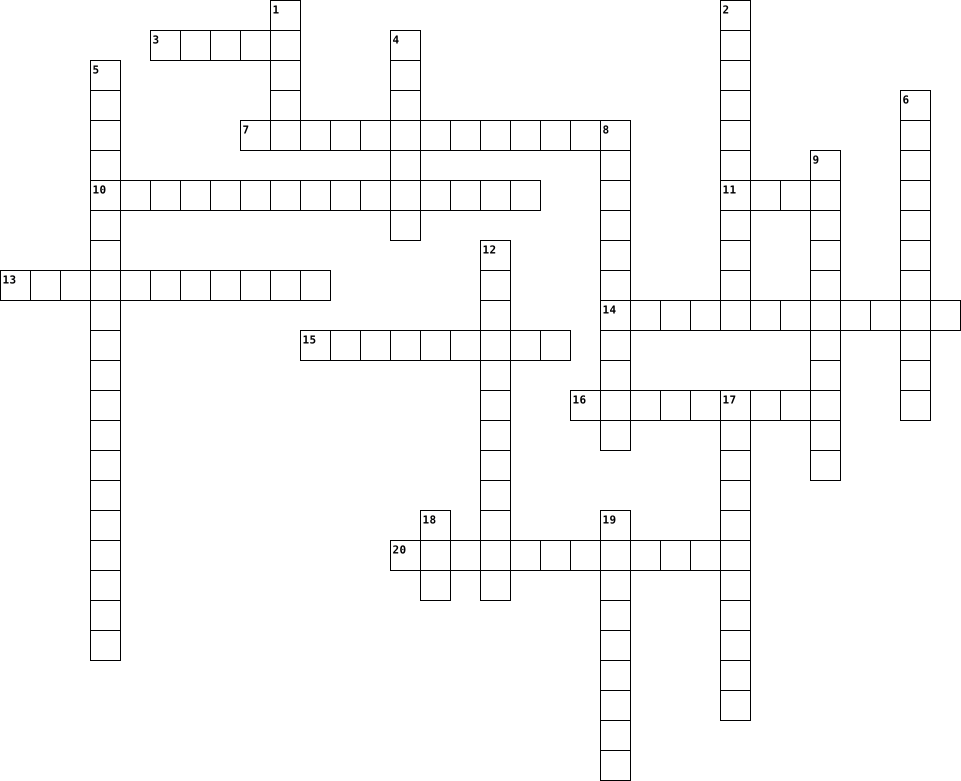
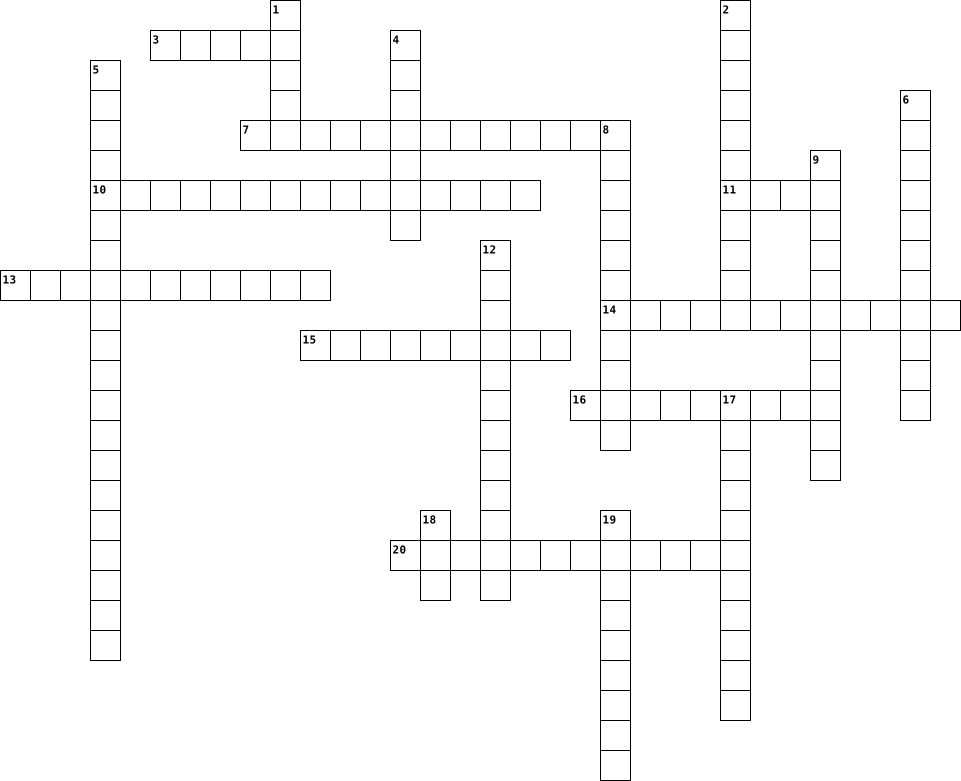
Year Dates 2024-05-09

Across
- The start date of the Crimean War
- The year the Persian Gulf War began
- The start date of the War of Independence for India
- The year the Gulf of Tonkin Incident occurred, leading to increased U.S. involvement in the Vietnam War
- The end date of the American Civil War
- The start date of World War I
- The year World War II began
- The year the Iraq War began
- The end date of the Napoleonic Wars
- The year the Korean War began
Down
- The start date of the Seven Years' War
- The end date of the Persian Gulf War
- The start date of the Vietnam War
- The year the American Revolutionary War began
- The year the War of the Roses began
- The start date of the War of 1812
- The year the Falklands War began
- The end date of the Gulf War
- The end date of the Vietnam War
- The end date of the Spanish-American War
20 Clues: The year World War II began • The year the Iraq War began • The end date of the Gulf War • The start date of World War I • The year the Korean War began • The end date of the Vietnam War • The year the Falklands War began • The start date of the Crimean War • The start date of the Vietnam War • The start date of the War of 1812 • The year the Persian Gulf War began • ...
World War 1 2013-02-13

Across
- A conflict in which the participating countries devote all their resources to the war effort.
- Germanys military plan at the outbreak of world war I according to which German troops would rapidly defeat France and then move east to attack Russi.central Powers In world war I, the nations of Germany and Austria-Hungary, along with the other nations that fough on their side
- A military alliance between Great Britain, France and Russia in the years preceding world war I
- The limiting of the amounts of goods people can buy
- the use of submarines to sink without warning any ship
- A form of warfare in which opposing armies fight each other from trenches dug in the battlefield.Eastern Front In world war I. the region along the German Russian border where Russians and Serbs battle Germans Austrians and Turks
Down
- The peace treaty signed by Germany and the Allied powers after World War 1.
- Front in World War I, the region of northern France where the forces of the allies and the central powers battled each other. Trench warfare A form of warfare in which opposing armies fight each other from trenches dug in the battlefield
- Information or material spread to advance a cause or to damage an opponent’s cause.
- An international association formed after World War 1 with the goal of keeping peace among nations.
- The freedom of a people to decide under what form of government they wish to live.
- A military alliance between Germany Austria- Hungary, and Italy in the years preceding word war i.
- A policy of glorifying military power and keeping a standing army always prepared
- In world war I. the region along the German Russian border where Russians and Serbs battle Germans Austrians and Turks
- An agreement to stop fighting
- A series of proposals in which U.S. president Woodrow Wilson outlined a plan for achieving a lasting peace after World War 1.
- In world war I, the nations of great Britain, France, and Russia, along with the other nations that fought on their side; also the group of nations-including great Britain the soviet union and the united states that opposed the axis powers in world war ii.
17 Clues: An agreement to stop fighting • The limiting of the amounts of goods people can buy • the use of submarines to sink without warning any ship • The peace treaty signed by Germany and the Allied powers after World War 1. • A policy of glorifying military power and keeping a standing army always prepared • ...
Puzzle 1 2023-12-14

Across
- What does Stalin mean?
- What was the name of the General that, because of his numbers, bested the Desert Fox?
- What was the mass bombing raid on Britain by Germany called?
- How did the Desert Fox suicide?
- Who was the Prime Minister of Britain during the first part of World War 2?
Down
- What was the difference between World War 1 and World War 2
- What color of hair did Adolf Hitler believe should be on the hair of everybody in the “Great Race of Germans”?
- Who saw through Hitler in 1938 and 1939?
- What was the people of religion that Hitler targeted?
9 Clues: What does Stalin mean? • How did the Desert Fox suicide? • Who saw through Hitler in 1938 and 1939? • What was the people of religion that Hitler targeted? • What was the difference between World War 1 and World War 2 • What was the mass bombing raid on Britain by Germany called? • Who was the Prime Minister of Britain during the first part of World War 2? • ...
Interwar years and World War Two 2023-12-12

Across
- Allowed Hitler to expand Germany territory unchecked
- Meant no German military
- Countries including the U.S., the U.K., and the Soviet union, who opposed the Axis powers during WWII
- International organization to keep world peace
- Global conflict from 1939 to 1945 involving major countries and major events like the Holocaust
- Hitler was an example of this
- Conference site where allied leaders met in February 1945 to plan post-World War II
- After World War I and before World War II
Down
- Purge Soviet union repression of political freedom led by Stalin resulting in mass arrests and executions
- Policy of building a strong military, contributing to tensions before World War II
- WWII military alliance including Germany, Italy, and Japan
- Made Germany pay war reparations
- Intense pride in one's home country, heightening tensions pre-World War II conflicts
- The want of powerful nations to expand their territory, which led to global conflicts
- City where a crucial post-world war II conference was held in July of 1945
- Benito Mussolini's rule was based upon it
16 Clues: Meant no German military • Hitler was an example of this • Made Germany pay war reparations • Benito Mussolini's rule was based upon it • After World War I and before World War II • International organization to keep world peace • Allowed Hitler to expand Germany territory unchecked • WWII military alliance including Germany, Italy, and Japan • ...
Post World War 2 2025-04-17

Across
- a person who is not strict in observance of traditional or established forms, ways, or beliefs
- a restriction or ban on the sale of a good to another country
- the process of changing, or redrawing, legislative district lines to reflect changes in population
- the publishing of statements known to be false about someone in order to damage his or her reputation
- a form of action in favor of a cause that involves marches, boycotts, and possibly deliberately breaking the law to highlight opposition to that law
- a small device that controls the flow of electricity in electronic equipment
- legal action in which a person charges that an individual or organization has violated his or her rights or injured him or her in some way
- to refuse to buy or use particular goods or services as a form of protest
Down
- integrated bus rides that went through segregated areas in order to draw attention to civil rights
- to include people of all races
- an open water storage area used to meet the water needs of one or more communities
- a form of protest in which activists sit down inside or in front of a business, thus interfering with the business's normal work
- a collection of social and economic programs initiated by President Lyndon B. Johnson
- a person who is strict in observance of traditional or established forms, ways, or beliefs
- a person who flees for safety, especially to a foreign country
- an exam to show whether a person can read or write
- the post–World War II struggle between the United States and Soviet Union for power and influence; the struggle did not involve direct fighting between those two superpowers
17 Clues: to include people of all races • an exam to show whether a person can read or write • a restriction or ban on the sale of a good to another country • a person who flees for safety, especially to a foreign country • to refuse to buy or use particular goods or services as a form of protest • ...
World War One Crossword 2025-10-12

Across
- the 28th U.S. president that was in charge during world war one
- when one country extends its control over another country or territory to gain economic or political advantages
- the selective service that chooses who has to join the army to fight
- the 1919 treaty that ended world war one
- an agreement nations make to defend and support each other
- german submarines that terrorized the seas
- the victim of the spark to world war one
- this country declared war on austria hungary after it had declared war on serbia
- this country did not join the war until 1917
- the ideology that emphasizes loyalty to one group or nation and a belief in its intrests
Down
- the process of building a strong military to protect yourself or defeat other countries
- this plan took german armies through belguim
- the nations that fought against the allies in world war one
- poison ____ was used during the second battle of ypres
- the longest battle of the war
- the largest naval battle
- the serbian terrorist group that trained gavrilo princip
- great britain, france, and russia made up the ___ powers
- temporary suspension of hostility in a war
- a type of warfare where each side digs long lines in the ground for protection
20 Clues: the largest naval battle • the longest battle of the war • the 1919 treaty that ended world war one • the victim of the spark to world war one • german submarines that terrorized the seas • temporary suspension of hostility in a war • this plan took german armies through belguim • this country did not join the war until 1917 • ...
World War Two Vocab 2022-04-28

Across
- The end of World War One
- Maintain a strong army
- World War Two Normandy landings date
- Member of Hitler's master race
- First battle fought in the air
- Make someone less angry by giving them what they want
- Ruler with total power
- Great Britain, the United States, and the Soviet Union
Down
- Germany, Austria-Hungary, and Italy, from 1882-1915
- The spark/start of world war one
- The spark/start of world war two
- Allied Powers vs. Central Powers
- Process by which a government gains control over a territory
- Japan, Germany and Italy
- Wiping out an entire group of people
- Brought the United states into World War Two
16 Clues: Maintain a strong army • Ruler with total power • The end of World War One • Japan, Germany and Italy • Member of Hitler's master race • First battle fought in the air • The spark/start of world war one • The spark/start of world war two • Allied Powers vs. Central Powers • World War Two Normandy landings date • Wiping out an entire group of people • ...
2025 Xmas Bella 2025-12-21

Across
- ________ Jackson
- to try out for something
- How plants make food
- A letter for an unknown number
- Town of Jesus's birth
- Bird that can't fly
- Where theater originated
- longest river in the world
- The continent where Sahara Desert is located
- Related by blood
- Ancient China's dynasty that created the silk road
- to lie
- Farthest planet from the sun
- soccer's name outside of the U.S.
- largest animal in the world (2 words)
- A ____ in headlights
- Thank you in Spanish
Down
- Water to gas
- Kpop _____ Hunters
- Mickey Mouse's dog
- National sport of Canada
- team leader
- to be fair or equal
- Speak 2 languages
- only bird that can fly backwards
- Greek god of war
- "There's no place like _______"
- 2 angles that add up to 90 degrees
- main character in Home Alone
- Most viewed video on Youtube (2 words)
- fastest land animal
- Santa's helper
- amount of mass in a certain volume
33 Clues: to lie • team leader • Water to gas • Santa's helper • ________ Jackson • Greek god of war • Related by blood • Speak 2 languages • Kpop _____ Hunters • Mickey Mouse's dog • to be fair or equal • Bird that can't fly • fastest land animal • How plants make food • A ____ in headlights • Thank you in Spanish • Town of Jesus's birth • National sport of Canada • to try out for something • ...
World War Two Vocab 2022-04-28

Across
- World War Two Normandy landings date
- The end of World War One
- Make someone less angry by giving them what they want
- Maintain a strong army
- Ruler with total power
- The spark/start of world war one
- First battle fought in the air
- Allied Powers vs. Central Powers
Down
- The spark/start of world war two
- Brought the United states into World War Two
- Japan, Germany and Italy
- Wiping out an entire group of people
- Germany, Austria-Hungary, and Italy, from 1882-1915
- Member of Hitler's master race
- Great Britain, the United States, and the Soviet Union
- Process by which a government gains control over a territory
16 Clues: Maintain a strong army • Ruler with total power • Japan, Germany and Italy • The end of World War One • Member of Hitler's master race • First battle fought in the air • The spark/start of world war two • The spark/start of world war one • Allied Powers vs. Central Powers • World War Two Normandy landings date • Wiping out an entire group of people • ...
Year Dates 2024-05-09

Across
- The start date of the Crimean War
- The year the Persian Gulf War began
- The start date of the War of Independence for India
- The year the Gulf of Tonkin Incident occurred, leading to increased U.S. involvement in the Vietnam War
- The end date of the American Civil War
- The start date of World War I
- The year World War II began
- The year the Iraq War began
- The end date of the Napoleonic Wars
- The year the Korean War began
Down
- The start date of the Seven Years' War
- The end date of the Persian Gulf War
- The start date of the Vietnam War
- The year the American Revolutionary War began
- The year the War of the Roses began
- The start date of the War of 1812
- The year the Falklands War began
- The end date of the Gulf War
- The end date of the Vietnam War
- The end date of the Spanish-American War
20 Clues: The year World War II began • The year the Iraq War began • The end date of the Gulf War • The start date of World War I • The year the Korean War began • The end date of the Vietnam War • The year the Falklands War began • The start date of the Crimean War • The start date of the Vietnam War • The start date of the War of 1812 • The year the Persian Gulf War began • ...
Rylee WWI 2025-03-19

Across
- a type of combat in which the opposing sides attack
- information,often biased or misleading, spread to influence public opinion or promote a particular viewpoint or cause
- the belief or desire of a government
- last German Emperor and King of Prussia
- a controlled distribution of scarce resources, goods, or services
- the wartime military alliance of Germany, Austria-Hungary, Bulgaria and the Ottoman Empire
- Wilson's ideas regarding nations' conduct of foreign policy
- the western side of territory under the control of Germany, which was also fighting on its eastern flank for most of the conflict
- an agreement made by opposing sides in a war to stop fighting for a certain time
- the peace treaty that officially ended World War I
- a union or association between three powers or states
- major theatre of combat during World War I that included operations on the main Russian front
- best known for his leadership during World War I, his role in creating the League of Nations
Down
- the process by which a country determines its own statehood and forms its own allegiances and government.
- a war that is unrestricted in terms of the weapons use
- Prime Minister of France during World War One
- the group of nations including the United States, Britain, the Soviet Union
- a watercraft capable of independent operation underwater
- a diplomatic alignment of Great Britain, France, and Russia in the decade leading up to World War I
- in case of the outbreak of war, Germany would attack France first and then Russia.
- created after the First World War to provide a forum for resolving international disputes.
21 Clues: the belief or desire of a government • last German Emperor and King of Prussia • Prime Minister of France during World War One • the peace treaty that officially ended World War I • a type of combat in which the opposing sides attack • a union or association between three powers or states • a war that is unrestricted in terms of the weapons use • ...
WWII 2024-02-23

Across
- - A system where goods or resources are distributed in limited amounts to ensure a fair share for everyone, commonly practiced during times of war, including World War II.
- A military tactic used by the Germans during World War II that involved quick and intense attacks to rapidly defeat the enemy.
- - Information, often biased or misleading, used to promote a particular political cause or point of view, widely used by various countries during World War II.
- - A ruler who has complete power over a country and often maintains this power by force, such as Adolf Hitler in Germany or Benito Mussolini in Italy during World War II.
- Powers The coalition of countries led by Germany, Italy, and Japan during World War II.
- Powers The group of countries, including the United States, United Kingdom, and Soviet Union, that opposed the Axis Powers during World War II.
- Bomb - A powerful explosive weapon that uses the energy released by the splitting of atoms, notably used by the United States on Hiroshima and Nagasaki in Japan during World War II.
- Gardens - Gardens planted by civilians during wartime to supplement their food supply, reduce the pressure on the public food system, and boost morale, a common practice during World War II.
Down
- - The state of not supporting or helping either side in a conflict or disagreement, as seen in the stance of some countries at the beginning of World War II.
- - Japanese pilots who deliberately crashed their planes into enemy ships during World War II as a suicidal attack.
- - The imprisonment or confinement of people, especially of a specific group, in military-controlled areas, as seen with Japanese Americans in the United States during World War II.
- The systematic and state-sponsored persecution and murder of six million Jewish people by the Nazis during World War II.
- - The deliberate killing of a large number of people from a particular nation or ethnic group with the aim of destroying that group, exemplified by the Holocaust during World War II.
- - June 6, 1944, the day on which the Allied forces invaded France during World War II.
- A formal agreement or partnership between countries to work together towards a common goal.
15 Clues: - June 6, 1944, the day on which the Allied forces invaded France during World War II. • Powers The coalition of countries led by Germany, Italy, and Japan during World War II. • A formal agreement or partnership between countries to work together towards a common goal. • ...
Imperialism and World War 1 2026-02-10

Across
- The group of nations, including Britain, France, and later the United States, that fought against the Central Powers.
- The group of nations, including Germany and Austria-Hungary, that fought against the Allies.
- An agreement to stop fighting, ending World War I on November 11, 1918.
- Strong pride in one’s nation or ethnic group that can lead to conflict with others.
- The alliance of Great Britain, France, and Russia before World War I.
- The part of the Treaty of Versailles that blamed Germany for starting World War I.
- A German submarine used during World War I.
- The belief that a country should build up its military and be ready to use force.
- A type of fighting where soldiers lived and fought from long ditches to protect themselves.
- A policy in which a nation seeks to control other lands for resources, power, or influence.
- The pre-World War I alliance between Germany, Austria-Hungary, and Italy.
Down
- A secret message in which Germany asked Mexico to join the war against the United States.
- A naval strategy in which submarines sank ships without warning, including civilian ships.
- A situation in which neither side in a conflict can gain an advantage or win.
- Money a defeated country is required to pay for damages caused during a war.
- The planned killing of a public or political figure.
- An international organization created to promote peace and prevent future wars.
- The peace treaty that officially ended World War I and punished Germany.
- A strategy in which each side tries to wear down the enemy through continuous losses.
- Agreements between countries to support each other, especially in times of war.
20 Clues: A German submarine used during World War I. • The planned killing of a public or political figure. • The alliance of Great Britain, France, and Russia before World War I. • An agreement to stop fighting, ending World War I on November 11, 1918. • The peace treaty that officially ended World War I and punished Germany. • ...
Smith USH Unit 1 2025-05-22

Across
- The type of policy a President has relating to issues in the USA
- The __________ Era saw new laws including improving working conditions, and women's suffrage
- The type of policy a President has relating to other nations
- The Great__________ was when many African Americans moved north for work
- Where the treaty ending World War 1 was signed
- "Beefing up" your military even when not at war
- This President is the only to also be a Supreme Court Justice
- The _________ was good during the war due to high demand from allies
- This side won World War 1
- The President that said "Walk softly, Carry a big stick"
Down
- A strong sense of love for your country
- This country was offered aid to attack the USA if they helped the Germans
- Taking land that is not your own
- The USA started as this when war broke out in Europe
- Groups of country that "have each others back"
- The country that had to pay reparations after the war
- The __________ of nations was thought of by the US, though we never joined
- The ability to vote
- The President during World War 1
- The acronym used to describe why the world went to war
- The archduke that was assassinated, starting the war
21 Clues: The ability to vote • This side won World War 1 • Taking land that is not your own • The President during World War 1 • A strong sense of love for your country • Groups of country that "have each others back" • Where the treaty ending World War 1 was signed • "Beefing up" your military even when not at war • The USA started as this when war broke out in Europe • ...
Criss Crossing the Ocean Blue 2023-05-28

Across
- (3) the lands of the Jumblies are ______________
- best thing about the Titanic
- a great spelling bee
- (2) should stick to steam
- make bed making easy
- the lady
- never believe the testimony of children
- (2) should not be a war-zone
- (4) largest room afloat in the history of the world
Down
- asleep in the deep
- hope on the horizon
- (2) a fuss pot
- (3) trial to be borne
- (2) celebrates Dominion Day his way
- Ironic material to be loading on MCKAY-BENNETT
- small boat that delivers passengers between shore and ship
- (2) a place Dorothy felt comfortable and loved
17 Clues: the lady • (2) a fuss pot • asleep in the deep • hope on the horizon • a great spelling bee • make bed making easy • (3) trial to be borne • (2) should stick to steam • best thing about the Titanic • (2) should not be a war-zone • (2) celebrates Dominion Day his way • never believe the testimony of children • Ironic material to be loading on MCKAY-BENNETT • ...
US History (Puzzle #1) 2023-12-15

Across
- Name of father and son who were both Presidents
- Second President
- He began WW1
- First American in space
- Shot Lincoln
- Leader of Japan during WW2
- First man on the moon
- Bombed Pearl Harbor
Down
- JFK fought in this war
- America's ally in World War 2
- First city attacked by an atomic bom
- Replaced FRD
- Second city attacked by an atomic bom
- President for 4 terms
- Shot JFK
- First man in space
16 Clues: Shot JFK • He began WW1 • Shot Lincoln • Replaced FRD • Second President • First man in space • Bombed Pearl Harbor • President for 4 terms • First man on the moon • JFK fought in this war • First American in space • Leader of Japan during WW2 • America's ally in World War 2 • First city attacked by an atomic bom • Second city attacked by an atomic bom • ...
Period 7 - WWII 2025-05-21

Across
- giving someone something to get them to trying to get more
- leased equipment to countries (2 words)
- Media used by the government to gain support for the war effor
- a whole nation working for the war effort (2 words)
- US naval base attacked by Japan (2 words)
- opposing forces including germany
- The side of the war the US was on
- leader of the allies military
- gardens in backyards to support the war effort (2 words)
- Naval battle between the US and Japan over an island
Down
- native Americans language used for communicate (2 words)
- US general in charge of the Pacific theater of war
- the act of saving food and gasoline for the war effort
- Helped establish airfields on islands (2 words)
- Top secret to develop nuclear weapon (2 words)
- Citizens by military bonds and get there money back with interest (2 words)
- what the United States dropped on Japan (2words)
- The Allied invasion of france on Normandy beach
- represented working women during WWII
- president of the US during WWII
- nationalistic government led by dictator
21 Clues: leader of the allies military • president of the US during WWII • opposing forces including germany • The side of the war the US was on • represented working women during WWII • leased equipment to countries (2 words) • nationalistic government led by dictator • US naval base attacked by Japan (2 words) • Top secret to develop nuclear weapon (2 words) • ...
Unit 4 Test Review [NO SPACES] 2025-02-14
![Unit 4 Test Review [NO SPACES] crossword puzzle](/image/15945830.svg?size=30&stroke_width=1)
Across
- The European powers came up with something called the __________ System after the defeat of Napoleon.
- This document, originally passed in 1823, stated that the U.S. would fight any acts of European imperialism in the Americas.
- President during the Annexation of Hawaii and the Spanish-American War (last name only).
- This country became independent as a result of the Spanish-American War.
- The Roosevelt Corollary was also known as ____________ Diplomacy.
- The Roosevelt Corollary was primarily focused on this region of the world.
- President that supported environmental conservationism and American imperialism (last name only).
- The Treaty of ____________ officially ended World War I.
- The sinking of this battleship led to American public opinion turning against Spain.
- What is the acronym for remembering the causes of World War I?
- The _____________ Telegram was the "last straw" that caused the United States to declare war on Germany.
- The idea that the more land or colonies you controlled, the more powerful you were.
- Germany, Austria-Hungary, and the Ottoman Empire made up the _______________ Powers.
Down
- Passed in 1904, this was an amendment to the Monroe Doctrine.
- The _______________ of Franz Ferdinand was the "spark" that started World War I.
- This was a conflict between the United States and a European power from April to December of 1898.
- This was the nickname for when newspaper prioritized exaggerated stories over telling the truth.
- This was the idea that it was "cool" to have a big and strong military.
- This country emerged as a global power after the Spanish-American War.
- The idea that "my country is cooler than your country."
- President during World War I (last name only).
- What was the name of Woodrow Wilson's plan for when the Allies won World War I?
- According to the Treaty of Versailles, this country was responsible for starting World War I, and had to pay for it.
- According to this document, the primary purpose of the Spanish-American War was to ensure Cuban independence.
- Britain, France, Russia, Italy, and the United States made up the ______________ Powers.
25 Clues: President during World War I (last name only). • The idea that "my country is cooler than your country." • The Treaty of ____________ officially ended World War I. • Passed in 1904, this was an amendment to the Monroe Doctrine. • What is the acronym for remembering the causes of World War I? • The Roosevelt Corollary was also known as ____________ Diplomacy. • ...
World War 1 Crossword 2017-04-05

Across
- A very useful weapon, but its mechanical unreliability limited it's use.
- Australian and New Zealand forces.
- The name used for rifles that could be set up at random - used by the ANZAC's when they were evacuating Gallipoli.
- A small town in Northen Belgium that was a focus in the war.
- The place where world war 1 was fought - France + Belgium.
- The Australian Prime Minister who called for conscription.
- What World War 1 was called at that period in time.
- Germany,Austria-Hungary and Italy's alliance.
- A cause of world war 1 - People were strong supporters of their country.
- Germans used these in an air raid against England in 1915, but were eventually replaced by multi-engine bomber planes.
Down
- Germany introduced this gas in April 1915.
- A British ship that was sunk by German submarines which had 128 Americans on it.
- There was a naval attack through this place in March 1915.
- The name of the aerial fights in world war 1.
- The place where the war was fought - Germany + Russia.
- Britain, France and Russia's alliance.
- Soldiers had to dig and live in these, there were horrible conditions in these.
- Australia's first major battle in World War 1.
- These types of weapons could fire shells over large distances, but they were heavy and often got stuck in mud.
- Countries taking over other places and making them subject to their rule.
- A cause of world war 1 - Army + military forces were given a high profile by the government.
21 Clues: Australian and New Zealand forces. • Britain, France and Russia's alliance. • Germany introduced this gas in April 1915. • The name of the aerial fights in world war 1. • Germany,Austria-Hungary and Italy's alliance. • Australia's first major battle in World War 1. • What World War 1 was called at that period in time. • ...
marvel crossword 2024-05-20

Across
- who was a soilder in world war 2
- who saved the world twice and sacraficed himself in endgame
- who was the first female avenger
Down
- who did toby maguire,andrew garfeild and tom holland play in the MCU
- who was kidnapped by hydra during world war 2
- luader of the X force
- odins youngest son
- the name of thanoses cyborge daughter
8 Clues: odins youngest son • luader of the X force • who was a soilder in world war 2 • who was the first female avenger • the name of thanoses cyborge daughter • who was kidnapped by hydra during world war 2 • who saved the world twice and sacraficed himself in endgame • who did toby maguire,andrew garfeild and tom holland play in the MCU
WWII 2026-03-02

Across
- - A system where goods or resources are distributed in limited amounts to ensure a fair share for everyone, commonly practiced during times of war, including World War II.
- A military tactic used by the Germans during World War II that involved quick and intense attacks to rapidly defeat the enemy.
- - Information, often biased or misleading, used to promote a particular political cause or point of view, widely used by various countries during World War II.
- - A ruler who has complete power over a country and often maintains this power by force, such as Adolf Hitler in Germany or Benito Mussolini in Italy during World War II.
- Powers The coalition of countries led by Germany, Italy, and Japan during World War II.
- Powers The group of countries, including the United States, United Kingdom, and Soviet Union, that opposed the Axis Powers during World War II.
- Bomb - A powerful explosive weapon that uses the energy released by the splitting of atoms, notably used by the United States on Hiroshima and Nagasaki in Japan during World War II.
- Gardens - Gardens planted by civilians during wartime to supplement their food supply, reduce the pressure on the public food system, and boost morale, a common practice during World War II.
Down
- - The state of not supporting or helping either side in a conflict or disagreement, as seen in the stance of some countries at the beginning of World War II.
- - Japanese pilots who deliberately crashed their planes into enemy ships during World War II as a suicidal attack.
- - The imprisonment or confinement of people, especially of a specific group, in military-controlled areas, as seen with Japanese Americans in the United States during World War II.
- The systematic and state-sponsored persecution and murder of six million Jewish people by the Nazis during World War II.
- - The deliberate killing of a large number of people from a particular nation or ethnic group with the aim of destroying that group, exemplified by the Holocaust during World War II.
- - June 6, 1944, the day on which the Allied forces invaded France during World War II.
- A formal agreement or partnership between countries to work together towards a common goal.
15 Clues: - June 6, 1944, the day on which the Allied forces invaded France during World War II. • Powers The coalition of countries led by Germany, Italy, and Japan during World War II. • A formal agreement or partnership between countries to work together towards a common goal. • ...
World War I 2016-03-01

Across
- Heir apparent to the Austrian emperor, the assassination of him and his wife led to the beginning of World War 1.
- An increase in the importance of the military of a country
- A coalition of governments designed to find peaceful solutions to disagreements, proposed by Woodrow Wilson
- A telegram from Germany to Mexico offering Mexico a return of territory in exchange for declaring war on the US.
- A truce or cease-fire agreement between warring nations
- Loans to the government that aided its ability to prepare for World War 1.
- A government agency organized to help settle disputes between workers and employers in war industries
- The coalition of nations in World War 1 that included the German, Austrio-Hungary, and Ottoman empires
- A new kind of warfare in WW1 that involved troops digging and fighting from deep holes.
- Unbiased, not favoring either side in a conflict
Down
- law that allowed the president to draft soldiers in times of war
- US military forces sent to Europe during WW1 and led by General John J Pershing.
- German submarines
- Brought an end to World War 1, but was never ratified by the United States
- A situation in which neither side can win a victory
- A plan for fighting a battle or war
- US Senator from Massachusetts who was opposed to President Wilson’s plan for the League of Nations, fearing it would draw the US into wars not in the nation’s interest.
- A passenger ship bombed by Germany.
- People who believe in the political system in which all resources are shared equally
- Financial payments by the loser of a war
- To prepare for war.
- A group of nations that allied to fight the Central Powers in World War 1
22 Clues: German submarines • To prepare for war. • A plan for fighting a battle or war • A passenger ship bombed by Germany. • Financial payments by the loser of a war • Unbiased, not favoring either side in a conflict • A situation in which neither side can win a victory • A truce or cease-fire agreement between warring nations • ...
Italia Presentation June 01, 2023 2023-05-30

Across
- Celebration of the end of World War II, 04/25 (2 words)
- Unified Italian government in 1922 (last name)
- Something that the average Italian watches daily
- Focus of economy by 1940
- Prominent religion in Italy today (2 words)
- Country that Italy took land from as a part of the treaty of Versailles in 1919
Down
- Approximate population (in millions) of Italy in 2023
- Approximate population (in millions) of Italy in 1986
- Country that Italy declared war on in 1943
- Foreign relations group that Italy joined in 1958 (2 words)
- Most women did not receive this in 1945 (2 words)
- Country that Italy invaded in 1939
- Celebration of springtime, Easter Monday
- Former Italian Prime Minister, resigned July 21, 2022 (last name)
- Prime Minister of Italy who was caught being a part of a bribery scandal (last name)
- Celebration of the dead, November 1 (2 words)
16 Clues: Focus of economy by 1940 • Country that Italy invaded in 1939 • Celebration of springtime, Easter Monday • Country that Italy declared war on in 1943 • Prominent religion in Italy today (2 words) • Celebration of the dead, November 1 (2 words) • Unified Italian government in 1922 (last name) • Something that the average Italian watches daily • ...
Country crossword 2 2023-11-14

Across
- Secretly has a land border with Canada
- loves number 2
- Largest country without Lakes
- Lagos is not it’s capital it’s Abuja
- Has more then 1M soldiers
- Has their own version of The Simpsons
- Won the Football War
- One of the largest wheat producers
- Won 5 world cups
- Most Valuable Currency
- Lost the Football War
Down
- Tricky to draw and spell
- Resisted the Europeans the longest
- Has 3 Capitals
- Won in the Vietnam war against USA
- American-African Colony
- 4th biggest population
- Inventor of Guinness Beer
- Most Military Bases are in this nation
- Biggest population
- Been invaded a lot
- Changed Flags 21 Times
- 2nd most isolated country on Earth
23 Clues: Has 3 Capitals • loves number 2 • Won 5 world cups • Biggest population • Been invaded a lot • Won the Football War • Lost the Football War • 4th biggest population • Changed Flags 21 Times • Most Valuable Currency • American-African Colony • Tricky to draw and spell • Inventor of Guinness Beer • Has more then 1M soldiers • Largest country without Lakes • Resisted the Europeans the longest • ...
KOREAN WAR PUZZLE 2024-04-19
Across
- Country that had a civil War
- An international peace-keeping organization established after World War II
- Reason for firing MacArthur
- North Korea army Abbreviation
- Nationalist's revolutionary leader
- Part of the Allies
- US general commander
- Free market, equal classes
- US house minority leader
Down
- Country that controlled the Korean border
- Korean President
- Intense tension between U.S(capitalism) and USSR(communism)
- A numbered amount of boats that protected Taiwan
- Signed pact between 2 or more countries that agree peaceful terms
- Part of the Axis
- US President during the Korean War
- Line that divides North and South Korea
- Person who is very supportive of their own nation
- Military use, Active battles
- Communist's revolutionary leader
20 Clues: Korean President • Part of the Axis • Part of the Allies • US general commander • US house minority leader • Free market, equal classes • Reason for firing MacArthur • Country that had a civil War • Military use, Active battles • North Korea army Abbreviation • Communist's revolutionary leader • US President during the Korean War • Nationalist's revolutionary leader • ...
My Social Studies learning crossword puzzle 2013-11-13

Across
- Henry the Navigator / son of Portigal king he financed expidition down the west coast of Africa
- / an economic conduction charecterized by substation and protected uneployment low input and imustment
- / a nazis effoer to wi[e uoy the jewish people in war world 2 when six million jews throught Europe were killed tryiny to attack and take down
- / voluntary association of independence state that have joined together to form a coalition for specific purpose , such as trade or comman defence
- / a limit on the quantity of imports
- of Versailles / a final peace settlment of world war 1
- / a form of goverment in which all power is vested in a few people or in a dominit class
- / goverment by the people a form of the goverment in which the supreme power is vested in the people and exercised directly a free electional system
Down
- / a form of goverment in which the power is divided between a central goverment and several regional authorities
- War / period of mistrust and and rivally after world war 2 between the soviat union and the western world especially the uniformed states
- / member of the national sociolist German workers party of Germany that sued politition control of Germany and established a dictator ship under Adolt Hittler
- / an extreamlly powrefull nation capible of influencing international eventsand less powerfull nations
- / the proccess of a country taking over controlling and using the recorcess of other lands
- / a tax on imported goods
- / form of goverment a central goverment operates held by one central authority
- / has a single ruler with unlimited power
- Resolution / uprising in russia in which the czar was overthrown and the communist party came to power under the leadership of Lenin
- of Exploration / a period in hisory in which European nations searched for new trade routs colinized other lands
- / a goverment order restricted or prhibiting trade with a particullar nations
19 Clues: / a tax on imported goods • / a limit on the quantity of imports • / has a single ruler with unlimited power • of Versailles / a final peace settlment of world war 1 • / a goverment order restricted or prhibiting trade with a particullar nations • / form of goverment a central goverment operates held by one central authority • ...
KOREAN WAR PUZZLE 2024-04-19
Across
- Country that had a civil War
- An international peace-keeping organization established after World War II
- Reason for firing MacArthur
- North Korea army Abbreviation
- Nationalist's revolutionary leader
- Part of the Allies
- US general commander
- Free market, equal classes
- US house minority leader
Down
- Country that controlled the Korean border
- Korean President
- Intense tension between U.S(capitalism) and USSR(communism)
- A numbered amount of boats that protected Taiwan
- Signed pact between 2 or more countries that agree peaceful terms
- Part of the Axis
- US President during the Korean War
- Line that divides North and South Korea
- Person who is very supportive of their own nation
- Military use, Active battles
- Communist's revolutionary leader
20 Clues: Korean President • Part of the Axis • Part of the Allies • US general commander • US house minority leader • Free market, equal classes • Reason for firing MacArthur • Country that had a civil War • Military use, Active battles • North Korea army Abbreviation • Communist's revolutionary leader • US President during the Korean War • Nationalist's revolutionary leader • ...
Second World War 2020-11-17

Across
- Which country denied border access to the Soviets, thus finding itself at war with the Red Army?
- The war ended on ... 8, 1945
- Who was the first country to stop Germany in its Russia What country started with the Axis but changed to the Allies?
- Italian political party led by Benito Mussolini President of Italy who was beheaded
- Hitler married with...
- Started the holocaust movement
- The second world war originated in ...
- Where did Germany invade for the first time and make the start of the war official?
- What was the name of the atomic bomb project that ended the bombing of Hiroshima and Nagasaki?
Down
- In which city was the atomic bomb first dropped?
- What was the name of the german air force?
- What was the country that suffered the highest number of military and civilian casualties?
- By what name was the non-aggression pact between the Germans and the Soviets known?
- Treaty that ended the First World War and sowed some of the disturbances that would later conclude in the Second World War
- conference What was the last great attempt at a peaceful resolution with Germany before the outbreak of World War II?
- The decisive battle of the city of the Eastern European Front was?
- What is the name of the machine that the Germans used to encrypt their messages and that the Allies did not know what to say?
- Where was the second world war?
- last country to surrender from Second World War
19 Clues: Hitler married with... • The war ended on ... 8, 1945 • Started the holocaust movement • Where was the second world war? • The second world war originated in ... • What was the name of the german air force? • last country to surrender from Second World War • In which city was the atomic bomb first dropped? • ...
World War 1 Crossword 2013-01-30

Across
- In World War I, the region of northern France where the forces of the Allies and the Central Powers battled each other.
- The peace treaty signed by Germany and the Allied powers after World War I.
- A form of warfare in which opposing armies fight each other from trenches dug in the battlefield.
- A military alliance between Great Britain, France, and Russia in the years preceding World War I.
- A military alliance between Germany, Austria-Hungary, and Italy in the years preceding World War I.
- A conflict in which the participating countries devote all their resources to the war effort
- Germany’s military plan at the outbreak of World War I, according to which German troops would rapidly defeat France and then move east to attack Russia.
Down
- In World War I, the nations of Great Britain, France, and Russia, along with the other nations that fought on their side; also, the group of nations, including Great Britain, the Soviet Union, and the United States.
- The use of submarines to sink without warning any ship found in an enemy’s waters.
- An international association formed after World War I with the goal of keeping peace among nations.
- The limiting of the amounts of goods people can buy—often imposed by governments during wartime, when goods are in short supply.
- A series of proposals in which U.S. president Woodrow Wilson outlined a plan for achieving a lasting peace after World War I.
- In World War I, the region along the German-Russian border where Russians and Serbs battled Germans, Austrians, and Turks.
- In World War I, the nations of Germany and Austria-Hungary, along with the other nations that fought on their side.
- A policy of glorifying military power and keeping a standing army always prepared for war
15 Clues: The peace treaty signed by Germany and the Allied powers after World War I. • The use of submarines to sink without warning any ship found in an enemy’s waters. • A policy of glorifying military power and keeping a standing army always prepared for war • A conflict in which the participating countries devote all their resources to the war effort • ...
World War I Review Crossword 2021-04-23

Across
- An international association formed after World War I with the goal of keeping peace among nations.
- The use of submarines to sink without warning any ship found in an enemy’s waters.
- A military alliance between Germany, Austria-Hungary, and Italy in the years preceding World War I.
- A policy of glorifying military power and keeping a standing army always prepared for war
- A conflict in which the participating countries devote all their resources to the war effort.
- A form of warfare in which opposing armies fight each other from trenches dug in the battlefield.
- The limiting of the amounts of goods people can buy—often imposed by governments during wartime, when goods are in short supply.
Down
- A series of proposals in which U.S. President Woodrow Wilson outlined a plan for achieving a lasting peace after World War I.
- Germany’s military plan at the outbreak of World War I, according to which German troops would rapidly defeat France and then move east to attack Russia.
- In World War I, the nations of Germany and Austria-Hungary, along with the other nations that fought on their side.
- A military alliance between Great Britain, France, and Russia in the years preceding World War I.
- In World War I, the region of northern France where the forces of the Allies and the Central Powers battled each other.
- In World War I, the region along the German-Russian border where Russians and Serbs battled Germans, Austrians, and Turks.
- The peace treaty signed by Germany and the Allied powers after World War I.
- In World War I, the nations of Great Britain, France, and Russia, along with the United States.
15 Clues: The peace treaty signed by Germany and the Allied powers after World War I. • The use of submarines to sink without warning any ship found in an enemy’s waters. • A policy of glorifying military power and keeping a standing army always prepared for war • A conflict in which the participating countries devote all their resources to the war effort. • ...
Allison Crossword week #4 2021-11-17

Across
- A European country with the famous city of Paris.
- Largest country in the world.
- A person who studies science.
- The capital city of Italy.
- International sports event held every 2 years.
- Someone illegally hunts and kills animals.
- A famous white monument in India.
Down
- A outbreak of a disease across the world.
- A type of animal that lives in the mountains of Asia and are being protected.
- The most southern country in Africa.
- The place where the Japanese bombed the U.S. during World war 2.
- The country that is located below the U.S.
- The island state.
- A agreement or deal between countries.
- A island country in the Pacific ocean close to China.
15 Clues: The island state. • The capital city of Italy. • Largest country in the world. • A person who studies science. • A famous white monument in India. • The most southern country in Africa. • A agreement or deal between countries. • A outbreak of a disease across the world. • The country that is located below the U.S. • Someone illegally hunts and kills animals. • ...
Mallory World War 1 and Jews 2021-05-19

Across
- each country wanted more ______ than their neighbors
- this many countries took part in World War 1
- people don't care about anyone but their own self/country
- Germany did not ______ their military up due to all the debt they were in with France and England.
- To single out and mistreat.
- Jews can't _______ non-jews.
- make an agreement to help your allies in the event of trouble
- number 2 most powerful in Austria/Hungary
- to influence public opinion
- the action of being against jews.
- this many people wound up dead after the war
Down
- Grabbing land for resources and using factories to produce weapons and things.
- a "contract" of rules set up to make sure Germany would pay for their damage in the war and make sure another war wouldn't start.
- a set of rules that affected the jews greatly but not the non-jews.
- Belief your country is the best.
- these people watched abuse happen, instead of taking action and protecting people.
- He wrote to the president in search of protection. In return he would give over his project on how to split the atom.
- World War 1 began by Germany _______ war on Russia
- Germany _____ millions to England and France.
- the Jews had to wear a yellow badge in the shape of a ______ to make it clear that they were a jew.
20 Clues: To single out and mistreat. • to influence public opinion • Jews can't _______ non-jews. • Belief your country is the best. • the action of being against jews. • number 2 most powerful in Austria/Hungary • this many countries took part in World War 1 • this many people wound up dead after the war • Germany _____ millions to England and France. • ...
U.S. Civics Review 2023-02-21

Across
- Wrote the Declaration of Independence
- Ocean on the East Coast
- President during World War 2
- Current Speaker of the House
- Current President
- five Number of Representiatives
- President during the Civil War
- State that borders Texas
- Group taken and sold as slaves
- Highest Court in the United States
- Made up of the House and the Senate
- U.S. Territory
- War fought in the 1900s
- Current Governor
- Age you can vote
- Election Day is in this month
- Branch that enforces laws
- Branch that makes laws
- President during World War 1
Down
- Branch that reviews laws
- Advises the President
- Current Female Senator
- Current Tucson Representative
- Term Limit for President
- Independence Day is in this month
- Current Vice President
- State that borders Canada
- Current Tucson Representative
- Tax Day is in this month
- Second largest river in the United States
- Co-wrote the Federalists Papers
- War fought in the 1800s
- Number of Senators
- Current Chief Justice
- Current Male Senator
- Approves or Vetos Bills
- Political Party in the White House
- Ocean on the West Coast
- Term Limit for a member of the House
- Term Limit for a member of the Senate
40 Clues: U.S. Territory • Current Governor • Age you can vote • Current President • Number of Senators • Current Male Senator • Advises the President • Current Chief Justice • Current Female Senator • Current Vice President • Branch that makes laws • Ocean on the East Coast • War fought in the 1800s • Approves or Vetos Bills • War fought in the 1900s • Ocean on the West Coast • Branch that reviews laws • ...
AP World History 2022-06-07

Across
- made it cheaper and easier for goods to be transported around the world (2 words)
- separatist movement in Canada, based on proximity to French culture
- “powder keg”, where World War 1 started (2 words)
- a group of countries who did not support the United States or the Soviet Union during the Cold War (2 words)
- type of music that originated in Jamaica but spread worldwide
- a type of colony in which people from the imperial country live in the colonized region. Examples include Canada, Australia, and South Africa.
- United States president that supported a free market economy (2 words)
- a global organization that aims to reduce conflict through diplomacy (2 words)
- South African leader who ended apartheid and used nonviolence (2 words)
- meeting where European leaders carved up Africa with no input from the people living there. Led by Otto van Bismark (3 words)
- a type of conflict where the global powers are not directly fighting, but lending support to groups that are (2 words)
- peaceful resistance movement by indigenous peoples against the United States (2 words)
- after the partition of India, this is where the Muslims lived
- resource from Amazon River Basin and Congo
- a disease that kills many people in less developed countries, particularly in Africa, every year. It emerged in the 70s and was originally associated with gay men.
- economic group that controlled India before the Sepoy rebellion (4 words)
- medical advancement that led to the eradication of polio
- discriminatory migration law in the United States (3 words)
- justification for imperialism based on the theory of natural selection (2 words)
- when Indians working in the army of the British East India company fought back. This resulted in direct control by Britain, as well as growing nationalism among Indians (2 words)
- justification for imperialism that suggests that the European were helping people by colonizing them (two words)
Down
- group in India who wanted an independent state for Muslims (2 words)
- Ruler of Ghana who led the fight against the British (Golden Stool) (2 words)
- an economic system in which the government owns and controls what is produced
- Egyptian leader that wanted to nationalize the Suez Canal
- a group that used nonviolence to support Indian independence from Britain. Led by Mahatma Gandhi. (3 words)
- when the United States told the world that creating colonies in the Americas would be considered an attack against the United States of America (2 words)
- diesease spread by mosquitos
- revolt in China, led by a man who thought he was Jesus’s brother, against the economic conditions. It killed 20 million people and was ultimately unsuccessful (two words)
- a leader from Ghana, part of the nonaligned movement (2 words)
- Christians in Nigeria wanted an independent state, but the land they wanted was rich in resources so they were denied (2 words)
- British politician who supported free market policies, often compared with Reagan (2 words)
- United States leader who fought for civil rights using nonviolence
- an alliance of countries that sided with the United States during the Cold War
- the idea that when one country ‘fell’ to communism, the others would follow. It was used as a justification for the Korean and Vietnam Wars (2 words)
- a type of environmental degradation where the soil dries up and loses nutrients
- the Jewish state created in Palestine following World War II
- Indonesian leader who founded the non-aligned movement along with Nkrumah
- a movement of technological advancements that led to increases in agricultural output (2 words)
- a precursor to the United Nations, failed because the United States did not join(3 words)
- an alliance of countries that sided with the USSR during the Cold War (2 words)
- a group of people who killed their cattle in hopes that their ancestors would return and drive out the British
- economic union in South East Asia
- Indian Prime Minister, part of the nonaligned movement but leaned towards socialism (2 words)
- conflict between Britain and China that resulted in unequal treaties in which Britain controlled Chinese ports (2 words)
- allowed women to decide when they had kids, resulting in increased power (2 words)
- natural resources used as fertilizer that came from South America
- Ruler of Belgium who abused workers in the Congo for rubber (2 words)
- leader of North Vietnam who invaded South Vietnam to spread communism (3 words)
- movement working against globalization, particularly the globalization of the economy
50 Clues: diesease spread by mosquitos • economic union in South East Asia • resource from Amazon River Basin and Congo • “powder keg”, where World War 1 started (2 words) • medical advancement that led to the eradication of polio • Egyptian leader that wanted to nationalize the Suez Canal • discriminatory migration law in the United States (3 words) • ...
vocab crossword 2023-01-12

Across
- jonas is hardstuck ____
- marple's favorite team
- joe biden can be ______
- the thing we take next year like the psat
- what every league player needs
- afk champ
- the game that should not be played
- ten of these at the start of the season
- who sells sat tests
- bitterness
- fire can be described as ______
- the poor can often be described as ______
- first of 2 big wars
- needy
- 1/7 deadly sins
- who went 1/15 on yone top
- applaud
Down
- strong love can be ______
- 黑管
- it would ____ my teammates not to be braindead
- he had a ____ look
- teachers can often be ______
- david's main in lol
- joshua's last name
- auto chess lol
- having abilities at an earlier age
- my teammate's contribution every game
- riot's fps
- riot's hearthstone
- something lol players need to touch
- ___master darius
- life is always _____
- no ap of these other than sylas mord
- second of 2 big wars
- adj version of the anti-cc stat from lol
35 Clues: 黑管 • needy • applaud • afk champ • riot's fps • bitterness • auto chess lol • 1/7 deadly sins • ___master darius • he had a ____ look • joshua's last name • riot's hearthstone • david's main in lol • who sells sat tests • first of 2 big wars • life is always _____ • second of 2 big wars • marple's favorite team • jonas is hardstuck ____ • joe biden can be ______ • strong love can be ______ • ...
World War I 2021-02-05

Across
- Around 8 ___________ soldiers in total lost their lives in the war.
- to stay out of other countries' affairs.
- ____________ declared war on Russia and its ally, France.
- a policy in which a country builds up its troops and makes plans for war.
- Soldiers decided to "dig in", they dug ___________
- Nationalism ____________ the war.
- Germany, Austria-Hungary, and the Ottoman Empire were the _____________.
- To survive chemical warfare, soldiers began wearing protective clothing and gas __________.
- an agreement among nations to defend each other
- World War I pilots fought air battles called ______ fights.
- The Treaty of ____________ punished Germany for its role in starting the war.
- A coded telegram that asked Mexico to join the Central Powers.
- The _________ also called for creating a League of Nations, the members would work together for peace.
- Armistice Day is remembered as _____________
- __________ events finally persuaded Americans to join the Allied Powers.
Down
- a rifle with a long knife attached to a tip
- a fee for small loans
- On November 11, 1918, the Central Powers ____________,ending the war.
- On April 2, 1917, U.S. _________ Woodrow Wilson called for a declaration of war.
- the day the war ended
- A passenger ship sank by German submarine in 1915.
- Great Britain, France, and Russia were the _________________.
- the policy of trying to take control of other lands and peoples.
- In 1914, __________ the Allied Powers and the Central Powers were imperialists.
- Archduke Franz Ferdinand and Countess Sophie was _____________ by a Serb nationalist.
- In World War I, the ___________ alliances were the Allied Powers and the Central Powers.
- The U.S. ______ did not approve the Treaty of Versailles.
- to avoid taking sides
- a strong feeling of pride in one's nation or culture.
29 Clues: a fee for small loans • the day the war ended • to avoid taking sides • Nationalism ____________ the war. • to stay out of other countries' affairs. • a rifle with a long knife attached to a tip • Armistice Day is remembered as _____________ • an agreement among nations to defend each other • A passenger ship sank by German submarine in 1915. • ...
World War II 2013-02-18

Across
- the German air force
- British prime minister; he supported the policy of appeasement
- government by a leader or group that holds unchallenged power and authority
- giving in to the demands of uncompromising powers to avoid war
- Totalitarian dictator of Germany; his invasion of European countries led to World War II.
- a system of government that focuses on the good of the state rather than on the individual citizens
- British prime minister; he opposed the policy of appeasement and led Great Britain through World War II
- June 6, 1944, the first day of the Allied invasion of Normandy in World War II
Down
- a German word meaning “lightning war”
- Fascist dictator of Spain; he led the nationalists to victory in the Spanish Civil War in the 1930s
- a bomb which uses energy released by splitting atoms to create an enormous explosion
- form of government in which the person or party in charge has absolute control over all aspects of life
- Japanese invasion on the United States December 7, 1941
- French military and political leader; he led the Free French government and army in World War II.
- law that allowed countries at war to purchase American goods as long as they paid cash and picked up their orders in American ports
- 32nd President of US; elected president 4 times and led the U.S during WWII
- Italian Fascist leader; he ruled as Italy’s dictator for more than 20 years beginning in 1922
- Japanese nationalist and general; he took control of Japan during World War II.
- Totalitarian dictator of the Soviet Union; he led the Soviet Union through World War II
19 Clues: the German air force • a German word meaning “lightning war” • Japanese invasion on the United States December 7, 1941 • British prime minister; he supported the policy of appeasement • giving in to the demands of uncompromising powers to avoid war • government by a leader or group that holds unchallenged power and authority • ...
Healing the Wounds of War 2025-02-05

Across
- Happened after the Berlin Blockade
- Employers would do this over unfair pay, working conditions etc
- To help businesses and hurt unions
- Nato
- Truman made new programs that tradition of the New Deal
Down
- The generation after world war 2 when the Veterans came home
- A general shortage of goods and materials that hurt the citizens
- It was a democratic political party
- Americans wanted to do this after World War 2 was over
- Publishers predicted a Republican Party
- Soviet Union tried to take over Berlin so they put this up to prevent anything from happening
- Took care of the veterans and let them go to school
12 Clues: Nato • Happened after the Berlin Blockade • To help businesses and hurt unions • It was a democratic political party • Publishers predicted a Republican Party • Took care of the veterans and let them go to school • Americans wanted to do this after World War 2 was over • Truman made new programs that tradition of the New Deal • ...
Mrs. Curtis Homeroom 2022-04-26

Across
- Parents own a resturant
- likes animae
- likes to read
- likes soccer
- The russian
- has red hair
- is a very logical person
- moved here from washington state
- plays soccer
- is 5 foot six inches
Down
- likes to relax and play games outside of school
- has a strange last name
- is the taller one
- his mom works at the school
- has 2 names
- gets angry easily
- likes world war 2
- is the shorter one
18 Clues: has 2 names • The russian • likes animae • likes soccer • has red hair • plays soccer • likes to read • is the taller one • gets angry easily • likes world war 2 • is the shorter one • is 5 foot six inches • Parents own a resturant • has a strange last name • is a very logical person • his mom works at the school • moved here from washington state • likes to relax and play games outside of school
Vocab #5 2022-02-10

Across
- an African-American infantry unit in WWI.
- North and South America were no longer open to colonization.
- not helping or supporting either side in a conflict, disagreement, etc.
- a constructed waterway that connects the Atlantic and Pacific oceans across the Isthmus of Panama.
- World War I coalition that consisted primarily of the German Empire and Austria-Hungary.
- An agreement between 2 or more countries to help each other out in war.
- a British passenger ship that was owned by the Cunard Line.
- A United States battleship which exploded in Havana harbor due to unknown causes in 1898.
- loyalty and devotion to a nation.
- a style of newspaper reporting that emphasized sensationalism over facts.
- policy of extending a country's power and influence through diplomacy or military force.
- a political unit (such as a nation or state) powerful enough to affect the entire world by its influence or actions.
Down
- Germany proposed a Mexican-German alliance in the case of war between the United States and Germany.
- Theodore Roosevelt's policy symbolizes his power and readiness to use military force if necessary.
- general objectives that guide the activities and relationships of one state in its interactions with other states.
- a statement of principles for peace that was to be used for peace negotiations in order to end World War I.
- served as the 26th president of the United States from 1901 to 1909.
- It stated that the U.S. would intervene in Latin American countries where European powers sought to collect debts or whose governments were thought to be unstable.
- a philosophy or system that emphasizes the importance of military power.
- an international diplomatic group developed after World War I as a way to solve disputes between countries before they erupted into open warfare.
- The victorious allied nations of World War I include Britain, France, Italy, Russia, and the United States.
- American politician and academic who served as the 28th president of the United States from 1913 to 1921.
22 Clues: loyalty and devotion to a nation. • an African-American infantry unit in WWI. • a British passenger ship that was owned by the Cunard Line. • North and South America were no longer open to colonization. • served as the 26th president of the United States from 1901 to 1909. • not helping or supporting either side in a conflict, disagreement, etc. • ...
McKinley and Roosevelt expanding America's role in the World 2021-03-06

Across
- Roosevelt wanted to ____ a canal across Panama.
- Panama Canal kept people from having to sail around ___ America
- The Panama Canal created a ____ from the Atlantic to the Pacific
- _______ Canal was a shortcut between two oceans.
- The Panama Canal made trade easier.
- ____ raged between the Filipinos for 2 years.
- The Columbia did not want to _____ the land.
- expansion was believed to produce ___.
- The Panama _____ was built in Panama.
- citizens wanted resources of ___ territories.
- Imperialist wanted to keep the Philippines for its ______ resources
- citizens wanted to expand America's _ in the world.
- was assasinated in 1901.
Down
- people who are against expansion.
- President during the building of the Panama Canal
- Philippines are located in Southeast ___.
- Amendment that gave U.S. a say in how Cuba ran.
- The Spanish American War helped this country gain independence
- The Spanish ___ War.
- the USS Maine exploded in a Cuban ____.
- U.S. had control of 2 Cuban ____ bases.
- Philippines became an "unorganized ____".
22 Clues: The Spanish ___ War. • was assasinated in 1901. • people who are against expansion. • The Panama Canal made trade easier. • The Panama _____ was built in Panama. • expansion was believed to produce ___. • the USS Maine exploded in a Cuban ____. • U.S. had control of 2 Cuban ____ bases. • Philippines are located in Southeast ___. • Philippines became an "unorganized ____". • ...
Contemporary crossword 2023-05-30

Across
- also known as the great war
- an instrument designed for the simultaneous transmission and reception of the human voice
- famous for his "I have a dream" speech
- served as the paramount leader of the People's Republic of China from December 1978 to November 1989
- A war fought between north and south korea
- The final leader of the Soviet Union
- type of land warfare using occupied lines largely comprising military trenches
- Terrorist attack on the World Trade Center
- usually four-wheeled vehicle designed primarily for passenger transportation
- he served as President of Vietnam from 1945 until his death in 1969
- used to treat syphilis and other infections
- an armored fighting vehicle intended as a primary offensive weapon in front-line ground combat.
- the founder of the People's Republic of China
- leader of the Indian nationalist movement against British rule
Down
- a civil war fought between the Algerian government and various Islamist rebel groups
- a war fought between the Kuomintang-led government of the Republic of China and forces of the Chinese Communist Party
- a portable telephone
- a period of geopolitical tension between the United States and the Soviet Union
- a mode of air transportation
- The second of the indonesian wars fought between north and south vietnam
- he served as the first president of South Africa
- an economic shock that impacted most countries across the world
- Terrorist leader of Germany during World War ll
- His death was a major cause of World War l
- The deadliest weapon first used in world war ll
- the genocide of European Jews during World War II
- the technology of signaling and communicating using radio waves
- led the Soviet Union from 1924 until his death in 1953.
- The war in which hitler was in charge of germany and caused the holocaust
- a vast network that connects computers all over the world
30 Clues: a portable telephone • also known as the great war • a mode of air transportation • The final leader of the Soviet Union • famous for his "I have a dream" speech • A war fought between north and south korea • His death was a major cause of World War l • Terrorist attack on the World Trade Center • used to treat syphilis and other infections • ...
WW1 Vocab 2024-03-16

Across
- US president at the time of World War 1 and one of the leaders of the "Big Four" nations
- Heir to the throne of Austria-Hungary who's death started World War 1
- A type of warfare fought from trenches to protect soldiers from gunfire and artillery
- England France Russia-Serbia US (1917)
- German Submarines
- A British cargo & passenger ship that was sunk by German submarines
- A law that required unmarried men & men without dependents that were of fighting age to enlist in the draft
- Woodrow Wilson's plan for enduring world peace after the horror of World War 1
- Identifying with one's own nation and supporting its interests even if it negatively impacts other nations
- The peace treaty that was signed on June 28, 1919 that officially ended World War 1
- A telegram sent by German Foreign Minister Arthur Zimmermann to the German Ambassador in Mexico
- The state of not supporting or helping either side in a conflict
- War bonds sold to American citizens as a means to finance the US participation in World War 1
Down
- The unrestricted use of submarines during the war by the Germans, beginning February 1st, 1917
- Countries with the same beliefs siding with each other
- Germany Austria-Hungary Ottoman Empire Italy
- Supreme Court ruled that individuals' rights could be legally limited when there is a clear and present danger to the nation
- Biased and misleading information used to promote a particular cause or point of view
- International organization of world nations that resolve disagreements to avoid future warfare between nations
- A stronger country taking over a weaker country
- Countries building strong militaries
- Law that made it illegal to convey information intended to interfere with the war effort
- Law made to crack down on wartime activities considered dangerous or disloyal
- Using less of valuable resources like wheat, meat, sugar, fats, coal, and oil so more was available for the war
24 Clues: German Submarines • Countries building strong militaries • England France Russia-Serbia US (1917) • Germany Austria-Hungary Ottoman Empire Italy • A stronger country taking over a weaker country • Countries with the same beliefs siding with each other • The state of not supporting or helping either side in a conflict • ...
World War 11 2013-05-15

Across
- What was the name of Germany, Italy, and Japan's alliance? (2 Words)
- What was the name of Britain, France, Soviet Union, and, eventually, America's alliance? (2 Words)
- What was the name of the acts passed preventing America from selling arms to warring countries in 1935-1940? (2 Words)
- Who does Japan declare war on in 1937?
- The US broke code to discover a plan of invasion of Australia at the Battle of the ______ ___? (2 Words)
- Who was the Emperor of Japan?
- How many sections was Germany split into after the war was over?
- Executive Order 9066 sent ________ Americans to internment camps.
Down
- During World War 2 and the Holocaust, who did Germany blame for their economic conditions?
- What was the Final Solution?
- What was the name of the bombing in Hawaii By Japan on December 7, 1941? This also was the last even before America officially joined the war. (2 Words)
- A ruler who as complete control of a country.
- The conference between Germany, Italy, France, and Britain where Germany argued they'd no longer seek for new lands. (2 Words)
- What was the series of concrete bunkers that the French built to keep Germans out of France? (2 Words)
- What act acted as a loop hole for the Neutrality Act, making it legal to trade, lend, and lease arms to any country if it is vital to our defense? (3 words)
15 Clues: What was the Final Solution? • Who was the Emperor of Japan? • Who does Japan declare war on in 1937? • A ruler who as complete control of a country. • How many sections was Germany split into after the war was over? • Executive Order 9066 sent ________ Americans to internment camps. • What was the name of Germany, Italy, and Japan's alliance? (2 Words) • ...
World War 2023-11-20

Across
- stuff to keep you hydrated
- has a magazine size of 600
- a place that was involved in the war
- people on your team
- the picking of people to fight
- people you are fighting against
- stuff to keep you going
- a type of weapon that was first used in war
Down
- most popular weapon used in the war
- a group of people ready to fight
- an explosive that people throw
- large weapon
- places on a map
- things to keep you warm
- stuff you put in your gun
- the first war
16 Clues: large weapon • the first war • places on a map • people on your team • things to keep you warm • stuff to keep you going • stuff you put in your gun • stuff to keep you hydrated • has a magazine size of 600 • an explosive that people throw • the picking of people to fight • people you are fighting against • a group of people ready to fight • most popular weapon used in the war • ...
World War 2022-02-03

Across
- a person who supports or believes in the principles of communism.
- a line separating two political or geographical areas, especially countries.
- happening or continuing after (a specified time or event).
- a formally concluded and ratified agreement between countries.
- a state of armed conflict between different nations or states or different groups within a nation or state.
- is a large organized group of people who are armed and trained to fight on land in a war.
- of an armed force or its commander enter a country or region so as to subjugate or occupy it.
- a formal agreement between individuals or parties.
- to an undesirably great or intense degree.
Down
- a picturesque region of Germany around the Rhine river.
- a gesture or action used to convey information or instructions.
- put an end to the existence of (something) by damaging or attacking it.
- become or make larger or more extensive.
- the action or process of appeasing.
- the process of equipping military forces with a new supply of weapons.
- the capacity or ability to direct or influence the behavior of others or the course of events.
16 Clues: the action or process of appeasing. • become or make larger or more extensive. • to an undesirably great or intense degree. • a formal agreement between individuals or parties. • a picturesque region of Germany around the Rhine river. • happening or continuing after (a specified time or event). • a formally concluded and ratified agreement between countries. • ...
Latin Roots Lesson 4 Quiz 2022-02-22

Across
- a synonym of negotiator
- an antonym of important
- the flat earth theory
- what ET stands for
Down
- World War 2 is ______ to World War 1
- the avatar from Avatar: The Last Airbender
- as God's followers, we are supposed to be ___________
- a people person
- In Star Wars, Luke Skywalker ______ed himself from everyone else.
- a normal person
10 Clues: a people person • a normal person • what ET stands for • the flat earth theory • a synonym of negotiator • an antonym of important • World War 2 is ______ to World War 1 • the avatar from Avatar: The Last Airbender • as God's followers, we are supposed to be ___________ • In Star Wars, Luke Skywalker ______ed himself from everyone else.
History Review 2026-06-12

Across
- PM during the Great Depression
- From the early 1830s to 1996, thousands of First Nation, Inuit, and Métis children, some as young as four years old, were forced to attend __________ schools
- Capture Paris quickly (2 words)
- First poison gas used by the Germans at Ypres during WWI
- Prize for bringing about peace in the Suez Crisis
- Canada supplied the uranium for the _________ dropped on Hiroshima and Nagasaki (2 words)
- __________ was the first time all four Canadian divisions fought together as one army during WWI (2 words)
- Empire building, expanding your territory
- USA declares war on Japan when Japan strikes _________ (2 words)
Down
- Considered one of the most significant domestic events in Canadian history during World War l (2 words)
- This gas was worse than Chlorine
- Increased security
- The League of _______ did not stand up to Hitler and took no military action
- Discrimination against Jews
- The Two Row ____________ was a treaty was made in 1613 between the Dutch and the Haudenosaunee
- Soldiers dug long, narrow ditches called _____________ for protection during WWI
- Deep loyalty and pride for your country and people
- Since 2015, Canada has been working with Indigenous partners to respond to the Truth and Reconciliation Commission's 94 Calls to _______
- Lightning War
- Treaty of _________ punished and humiliated Germany
- A young women who dressed and acted unconventionally
21 Clues: Lightning War • Increased security • Discrimination against Jews • PM during the Great Depression • Capture Paris quickly (2 words) • This gas was worse than Chlorine • Empire building, expanding your territory • Prize for bringing about peace in the Suez Crisis • Deep loyalty and pride for your country and people • Treaty of _________ punished and humiliated Germany • ...
Changes in America 2021-02-10

Across
- the new program President Truman presented to Congress
- putting to much emphasis on having things money can buy
- the era in which american families grew
Down
- the president after world war 2
- who was glad world war 2 was over?
- who were coming home all over the nation
- builders created these with the help of Federal Housing Administration
- brought benefits to veterans following the war
8 Clues: the president after world war 2 • who was glad world war 2 was over? • the era in which american families grew • who were coming home all over the nation • brought benefits to veterans following the war • the new program President Truman presented to Congress • putting to much emphasis on having things money can buy • ...
airplanes part 2 2025-12-11

Across
- A380 biggest commercial plane
- the most famous bomber of World War 2
- the first flight of the 747
- the most popular airplane in the world
Down
- the fastest plane
- who invented the first missiles
- most successful bomber of World War 2
7 Clues: the fastest plane • the first flight of the 747 • who invented the first missiles • A380 biggest commercial plane • the most famous bomber of World War 2 • most successful bomber of World War 2 • the most popular airplane in the world
World War 1 and Nationalism 2026-04-02

Across
- economic collaspe occured in 1920's
- deal- federal government efforts to reform business practices and to stimulate the economy
- 1807-1882 Italian military and political leader led movement for Italian unification
- 1870-1924- Russian revolutionary leader
- the idea that a country should use a strong military
- June 28, 1919- peace treaty that ended world war 1
- self governing countries
- pieces of companies
- deliberate killing of a large group of people
- 1818-1883- German philosopher called on workers to over throw capitalism
Down
- 1815-1898- prussian empire priminister led unification of Germany
- 1882-1945- 32nd president of the US served during great depression and world War 2
- a system in which there is no privately owned property
- a devotion and loyalty to ones country
- organization in which countries would try to solve their problems peacefully
- payments for war damages
- 1868-1918- last azar if Russia forced to give up power
17 Clues: pieces of companies • payments for war damages • self governing countries • economic collaspe occured in 1920's • a devotion and loyalty to ones country • 1870-1924- Russian revolutionary leader • deliberate killing of a large group of people • June 28, 1919- peace treaty that ended world war 1 • the idea that a country should use a strong military • ...
Family 2020-04-06
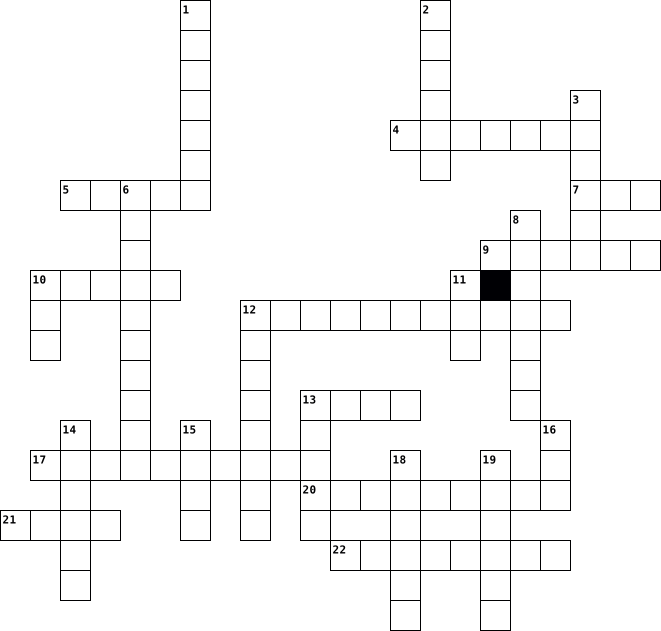
Across
- First granddaughter
- favourite jewellery
- Parent of Crumpet and Martini
- Born in 1942
- they are green and jump
- Lived in this location for a year
- First grandson
- Currently live in this street
- Used to work in a...
- Had the nickname conehead
- Youngest grandchild
Down
- used to swim a lot
- Best daughter in the world
- Bride to be
- Crazies over the road
- Friend from school
- Sister
- Brother
- First born
- Mother of Pam
- Loves animals
- Fought in world war 2
- Sister of Joyce
- first husband
- Their birthday is good Friday
25 Clues: Sister • Brother • First born • Bride to be • Born in 1942 • Mother of Pam • Loves animals • first husband • First grandson • Sister of Joyce • used to swim a lot • Friend from school • First granddaughter • favourite jewellery • Youngest grandchild • Used to work in a... • Crazies over the road • Fought in world war 2 • they are green and jump • Had the nickname conehead • Best daughter in the world • ...
World War One 2021-12-21

Across
- offical treaty to end the war
- _______ of alliances, the fourth reason world war one started
- the space between opposite sides trenches
- the style of warfare that was fought during world war one
- the most famous american ace
- a disease that the soldiers could get in, involving feet
- the name of the group that the United States joined
- american soldiers were called this
- the title of the person who started it all
- the death count number caused by world war one
- a ocean cruiser that contained u.s citizens
- the most famous ace of world war one
- where two armies collide of face each other
- peace agreement made by germany and russia
- a type of plane with three sets of wings
- last name of the president of the US during world war one
- a type of plane with one set of wings
- the ability of a country to get it's military ready for war
- a type of plane with two sets of wings
- the name of the organization that the assassin
- the name of the plan that germany made
- the taking over of another country in order to become a empire
- the hour the war ended
- the month the US entered world war one
- the last name of the person who started it all, who got assassinated
Down
- the note sent by germany to mexico, eventually causing the US to go to war
- germans will stop unrestricted submarine warfare
- the ism that starts about who goes to war in the name of the country
- the country where the majority of the war would be fought
- the oceans between great britain and france was called this
- silva's other additonal name to the war due to most countries were empires
- the ruler that made most of the royals fighting the war related
- thinking that your country(nation) is better than everyone else
- the country the Germans invaded to get to french
- the group of countries including Germany
- the day the war offically ended
- new style of warfare involving chemicals
- the month the war offically ended
- the country where the archduke was from
- the name that Silva gave the war due to the royals being related
- anything that could help the war effort
41 Clues: the hour the war ended • the most famous american ace • offical treaty to end the war • the day the war offically ended • the month the war offically ended • american soldiers were called this • the most famous ace of world war one • a type of plane with one set of wings • a type of plane with two sets of wings • the name of the plan that germany made • ...
Complete The Crossword Puzzle Below! 2020-04-17

Across
- Top leaders of PPKI.
- Icon Jakarta.
- Southern Switzerland's Valais canton.
- Leader of German fascism?
- Providing humanitarian and developmental aid to childreen worldwide.
- Father of electricity
- The political system in place in Indonesia from 1957-1965?
- Reog from?
- Red planet.
- Landlocked country in Southeast Asia.
- German allies in Asia during world war 2?
Down
- Other names of COVID-19.
- rackets and shuttlerock.
- Martial arts from Indonesia?
- The longest river in the world?
- Monalisa painter?
- The dance of a thousand hands.
- First city infected by COVID-19?
- Salt lake in Asia.
- Synonym fiddle.
20 Clues: Reog from? • Red planet. • Icon Jakarta. • Synonym fiddle. • Monalisa painter? • Salt lake in Asia. • Top leaders of PPKI. • Father of electricity • Other names of COVID-19. • rackets and shuttlerock. • Leader of German fascism? • Martial arts from Indonesia? • The dance of a thousand hands. • The longest river in the world? • First city infected by COVID-19? • ...
Chapter 11 Review Crossword 2013-02-27

Across
- satisfying demands of dissatisfied powers in an effort to maintain peace and stability
- a suicide mission in which young Japanese pilots intentionally flew their airplanes into U.S. fighting ships at sea
- British politician during World War 2
- prime minister of japan from 1941-1944
- a major industrial center on the Volga
- a camp where prisoners of war, political prisoners, or members of minority groups are confined , typically under harsh conditions
- the process of assembling troops and supplies and making them ready for war
- people who assisted the enemy
- the deliberate mass murder of a particular racial,political, or cultural group
Down
- head of the SS's security service
- president of the United States from 1933-1945
- a restriction intended to enforce international law
- head of the S.S.
- resistance fighters
- a swift and sudden military attack used by Germans in World War
15 Clues: head of the S.S. • resistance fighters • people who assisted the enemy • head of the SS's security service • British politician during World War 2 • prime minister of japan from 1941-1944 • a major industrial center on the Volga • president of the United States from 1933-1945 • a restriction intended to enforce international law • ...
Iron Curtain 2022-05-18

Across
- allying itself with Germany, Italy and Japan
- war start in March 12, 1947 – December 26, 1991
- Former Prime Minister of the United Kingdom
- Got it freedom and end the period of Iron Curtain
- Was bombed in 1981 by terrorists underwritten by the Romanian government
- Control the Iron Curtain
- A mass protest that tear down the Iron Curtain
- take the first hit that open up world war 2
- Lead by Hitler
Down
- President at the time of Great Depression and helped the American people regain faith in themselves.
- Venezuelan militant
- Ruled and lead the Soviet Union on the Allies side
- The political, military, and ideological barrier erected by the Soviet Union after World War II
- built by the German Democratic Republic during the Cold War to prevent its population from escaping Soviet-controlled East Berlin to West Berlin
- a continent that is located entirely in the Northern Hemisphere and mostly in the Eastern Hemisphere
15 Clues: Lead by Hitler • Venezuelan militant • Control the Iron Curtain • Former Prime Minister of the United Kingdom • take the first hit that open up world war 2 • allying itself with Germany, Italy and Japan • A mass protest that tear down the Iron Curtain • war start in March 12, 1947 – December 26, 1991 • Got it freedom and end the period of Iron Curtain • ...
Cold War 2024-05-12

Across
- In June 1950, the Communists tried to expand into
- The United States and the Soviet Union used ______ against one another in their cold war
- In 1948, the Soviets tried to blockade
- Who led the NATO alliance?
- The Cold War began after World War ______
- As many as ______ million people died in World War 2
Down
- The Cold War was mostly a political and ______ struggle
- Stalin signed the ______ Pact with Germany that upset the United States
- President Truman adopted a foreign policy called the ______ Policy
- Union The Cold War ended in 1999 with the break up of the ______
10 Clues: Who led the NATO alliance? • In 1948, the Soviets tried to blockade • The Cold War began after World War ______ • In June 1950, the Communists tried to expand into • As many as ______ million people died in World War 2 • The Cold War was mostly a political and ______ struggle • Union The Cold War ended in 1999 with the break up of the ______ • ...
Savannah World War 1 and Jews 2021-05-19

Across
- A list of laws that was formed against Jews.
- Each country wanted more than the other.
- A treaty that was made after World War 1.
- Belief your country is the best
- Grabbing land for resources and using factories to produce weapons and things.
- Hitler built a Gov. Policy of --------- against Jews.
- ------ watched Jews being abused but didn't do anything.
- Country's that agreed to help eachother.
Down
- Germany paid -------- to France and England.
- A Jew that escaped very early and is very famous today.
- Germany was not supposed to build a --------.
- Assassination of -------------------------lit the spark for World War One.
- Against Jews.
- -------- million people died in World War 1.
- A symbol that Jews wore so people knew they where Jews.
- The amount of country's that were in World War 1.
- Germany Declares --- on Russia.
- Don't want people to not care about anyone else.
- Jews weren't allowed to ----- non Jews.
19 Clues: Against Jews. • Belief your country is the best • Germany Declares --- on Russia. • Jews weren't allowed to ----- non Jews. • Each country wanted more than the other. • Country's that agreed to help eachother. • A treaty that was made after World War 1. • Germany paid -------- to France and England. • A list of laws that was formed against Jews. • ...
US History Timeline Crossword 2024-10-30

Across
- The president of the United States during the duration of World War 2
- The crash of the stock market that led to a worldwide economic breakdown from 1929-39
- The creation of the Atomic bomb
- A city in Japan that had gotten nuked by the United States
Down
- Chancellor of Germany from 1933-1945
- The peacekeeping organization created at the end of World War 2
- Pact that was broken when Hitler invaded the Soviet Union
- The genocide against the Jewish among others
- To be set free
- The nuke that was dropped on Hiroshima to force a quick surrender by the Japenese
- Where the appeasement conference was held
- Attack on US Naval Base in 1941
- Political ideology of dictators
- The normandy landings/invasion of Germany in 1944
14 Clues: To be set free • Attack on US Naval Base in 1941 • The creation of the Atomic bomb • Political ideology of dictators • Chancellor of Germany from 1933-1945 • Where the appeasement conference was held • The genocide against the Jewish among others • The normandy landings/invasion of Germany in 1944 • Pact that was broken when Hitler invaded the Soviet Union • ...
World War I 2015-12-11

Across
- Movement of 6 million African-Americans our of rural southern united states to urban cities northeast, midwest, and west.
- A British luxury liner sunk by German submarine in the north Atlantic on May 7, 1915 one of the events leading to U.S. entry into world war I.
- Government agency created during world war I to encourage Americans to support the war.
- Authorized the federal government to raise a national army for the American entry into world war I through the compulsory enlistment of people.
- The process by which a country determines its own statehood and forms its own allegiances and government.
- A German submarine used in world war I or world war II.
- A group of ships or vehicles accompanied by armed troops, warships or other vehicles for protection.
Down
- Telegram sent from German official in Germany to a German official in Mexico asking him to join an alliance with Germans.
- 29th president serving from March 4, 1921 until death.
- An association of countries established in 1919 by the treaty of Versailles to promote international cooperation and achieve international peace and security.
- United states government agency established on July 28,1917 to coordinate the purchase of war supplies encouraged companies to use mass-production techniques to increase efficiency.
- A U.S. federal law passed on June 15, 1917 shortly after U.S. entry into world war I it allowed punishment to spying and other related crimes.
- Rounding up and deportation of several hundred immigrants of radical political views by federal government.
- The belief or desire of a government or people that a country should remain a strong military capability and be prepared to use it aggressively to defend or promote national interests.
- A general increase in prices and fall in the purchasing value of money.
- Series of raids in late 1919 and early 1920 by U.S. department of justice intended to capture arrest and deport radical lettists, especially anarchists from U.S.
- A person who for reasons of conscience objects to serving in the armed force.
- The zone of fighting in western Europe in world war I in which the German army engaged the armies to its west, France, the UK, and its dominions.
- A nation whose investments abroad exceed in value the investments made in it by foreign countries.
- Blue print for world peace that was to be used for peace negotiations after world war I.
20 Clues: 29th president serving from March 4, 1921 until death. • A German submarine used in world war I or world war II. • A general increase in prices and fall in the purchasing value of money. • A person who for reasons of conscience objects to serving in the armed force. • Government agency created during world war I to encourage Americans to support the war. • ...
World War 2 2023-04-28

Across
- The genocide of European Jews during World War II.
- The aggressive nationalistic movement
- The man that led the Soviet Union
- The act of setting someone free from imprisonment
- The "master race" that hitler called germans that had blonde hair and blue eyes
Down
- The president during WW2
- Naval submarines operated by Germany
- An italian dictator
- One of america's biggest allies in WW2
- The man that hated jewish people
- The american harbor that japan had bombed
11 Clues: An italian dictator • The president during WW2 • The man that hated jewish people • The man that led the Soviet Union • Naval submarines operated by Germany • The aggressive nationalistic movement • One of america's biggest allies in WW2 • The american harbor that japan had bombed • The act of setting someone free from imprisonment • ...
World War 2 2023-05-07

Across
- Author of Grenade
- Main character of Grenade
- Invaded Okinawa
- Largest Japanese battleship and was sunk by the Americans
- Father of Hideki
- Theme of the book Grenade
Down
- Where the boys hide
- Main American solider
- The boy who bullies him and takes his metal grenades
- Ancestor thought to be a coward but was brave
- Sister of Hideki who was a nurse
11 Clues: Invaded Okinawa • Father of Hideki • Author of Grenade • Where the boys hide • Main American solider • Main character of Grenade • Theme of the book Grenade • Sister of Hideki who was a nurse • Ancestor thought to be a coward but was brave • The boy who bullies him and takes his metal grenades • Largest Japanese battleship and was sunk by the Americans
World War 2 2025-03-28

Across
- / This country was invaded and this started WW2
- / Leader in Italy who promoted violence
- / Country who invaded Poland from the west
- / Treaty that aligned Japan, Germany, and Italy with a similar goal
- / 10,000 bombs were dropped on this city in September alone by Germany
Down
- / Leader of Germany
- / Great Britain,France,America
- / Country that aided Great Britain after the Battle of Brittain
- / Country who invaded Poland from the East
- / Leader of Japan
- / Axis power who built their military on the principle of honor from the ancient samurai
11 Clues: / Leader of Japan • / Leader of Germany • / Great Britain,France,America • / Leader in Italy who promoted violence • / Country who invaded Poland from the west • / Country who invaded Poland from the East • / This country was invaded and this started WW2 • / Country that aided Great Britain after the Battle of Brittain • ...
airplanes part 2 2025-12-11

Across
- A380 biggest commercial plane
- the most famous bomber of World War 2
- the first flight of the 747
- the most popular airplane in the world
Down
- the fastest plane
- who invented the first missiles
- most successful bomber of World War 2
7 Clues: the fastest plane • the first flight of the 747 • who invented the first missiles • A380 biggest commercial plane • the most famous bomber of World War 2 • most successful bomber of World War 2 • the most popular airplane in the world
Changes in America 2021-02-09

Across
- the new program President Truman presented to Congress
- putting to much emphasis on having things money can buy
- the era in which american families grew
Down
- the president after world war 2
- who was glad world war 2 was over?
- who were coming home all over the nation
- builders created these with the help of Federal Housing Administration
- brought benefits to veterans following the war
8 Clues: the president after world war 2 • who was glad world war 2 was over? • the era in which american families grew • who were coming home all over the nation • brought benefits to veterans following the war • the new program President Truman presented to Congress • putting to much emphasis on having things money can buy • ...
DSI Crossword Challenge 2023-01-27

Across
- loves cats and Meghan
- BBQ
- loves fairies and pirates
- loves trucks
- california transplant
- professional traveler
- calm presence
- quietly confident
Down
- artist
- Domer
- newest member of the team
- knows everything there is to know about watches
- the architect
- giggler extraordinaire
- life of the party
- absent minded professor
- whirling dervish
- bossy boots
- world war 2 contributor
19 Clues: BBQ • Domer • artist • bossy boots • loves trucks • the architect • calm presence • whirling dervish • life of the party • quietly confident • loves cats and Meghan • california transplant • professional traveler • giggler extraordinaire • absent minded professor • world war 2 contributor • newest member of the team • loves fairies and pirates • knows everything there is to know about watches
World War 1 2025-10-27

Across
- - role for women in the military during WW1
- - to pay for a wrongdoing as an apology
- – Germany, Austria-Hungary, Ottoman Empire.
- – His assassination sparked WWI.
- – Dangerous, muddy wartime conditions.
- – Germany urged Mexico to attack U.S.
- - Countries cooperating instead of going to war
- – President who proposed Fourteen Points.
- - major pandemic during World War 1 that killed more people than the actual war
- – Britain, France, Russia, U.S.
- - Britain, France, U.S., and Italy
- - Wilson's Plan for World Peace
- – Europe divided Africa, 1884.
Down
- - Millions of African Americans moved from the South to major American cities
- – German submarines in WWI.
- - November 11th, 1918 at 11am soldiers stopped fighting
- – Sold to fund war effort.
- - Right for a country or people to rule themselves
- - Treaty to End World War 1
- – Deadly area between trenches.
- – Law against spying in war.
- – Ship sunk by German submarine.
- – Law banning criticism of government.
23 Clues: – Sold to fund war effort. • – German submarines in WWI. • - Treaty to End World War 1 • – Law against spying in war. • – Europe divided Africa, 1884. • – Deadly area between trenches. • – Britain, France, Russia, U.S. • - Wilson's Plan for World Peace • – His assassination sparked WWI. • – Ship sunk by German submarine. • - Britain, France, U.S., and Italy • ...
David Puzzle 2026-06-12

Across
- Armored vehicles first used extensively in World War I
- International organization created to promote peace
- Severe worldwide economic downturn beginning in 1929
- Agreement to stop fighting
- Political system associated with Mussolini's Italy
- Policy of gaining colonies and foreign territories
- German strategy for fighting a two-front war
- Information used to influence public opinion during war
- Long World War I battle fought mainly by British forces
- Major World War I battle with massive casualties
Down
- Underwater vessels used to attack ships
- Treaty that officially ended the war with Germany
- Strong pride in one's nation that can lead to rivalry
- Fighting from long defensive ditches
- Agreements between nations for mutual support
- Radical Russian group led by Lenin
- Chinese Nationalist Party led by Chiang Kai-shek
- Building large armed forces and glorifying military power
- Planned destruction of an entire people group
- Political party led by Hitler in Germany
20 Clues: Agreement to stop fighting • Radical Russian group led by Lenin • Fighting from long defensive ditches • Underwater vessels used to attack ships • Political party led by Hitler in Germany • German strategy for fighting a two-front war • Agreements between nations for mutual support • Planned destruction of an entire people group • ...
World War 1 Crossword! 2022-05-05

Across
- armored vehicle with treads first introduced during World War 1
- long ditches used as the basis of warfare for world war 1
- when countries extend their powers and Influence onto other lands
- a heavier and fast shooting gun
- american president during world war 1
- Location of the first battle of World War 1
Down
- archduke of Austria Hungary
- fighter pilots who shoot down 5 planes
- devotion to the interests and culture of One's nations
- conflict between nations or a peole
- name for leader Wilhelm II of the German Empire
- british ship that brought american Involvement into World War 1
- name of american troops in Europe
- name of the german submarine
- destroyers escorting merchant ships to protect from U-boats
15 Clues: archduke of Austria Hungary • name of the german submarine • a heavier and fast shooting gun • name of american troops in Europe • conflict between nations or a peole • american president during world war 1 • fighter pilots who shoot down 5 planes • Location of the first battle of World War 1 • name for leader Wilhelm II of the German Empire • ...
WWI 2026-06-02

Across
- German naval strategy of sinking ships without warning, which pushed the United States closer to entering the war.
- British ship sunk by Germany that included American passengers.
- Law passed to draft and recruit soldiers for World War I.
- Fierce pride and loyalty toward one’s country, especially seen in the Balkans.
- Countries built large militaries and new weapons because of the Industrial Revolution and wanted to protect overseas investments.
- American general who trained inexperienced U.S. troops into an effective fighting force during World War I.
- President Wilson’s plan promoting peace, self-rule, and freedom of the seas.
- Type of fighting using deep ditches that often led to stalemates.
- Investments purchased by citizens to help finance the war.
Down
- Secret agreements between countries formed because of grudges and conflicts with other nations.
- America’s policy under President Wilson of staying out of foreign wars at the beginning of World War I.
- Competition among nations to colonize and control overseas territories.
- Movement of African Americans from the South to northern cities during the war era.
- Secret German telegram asking Mexico to join the war against the United States.
- The killing of Archduke Franz Ferdinand that sparked World War I in June 1914.
- Payments Germany was required to make for damages caused during the war under the Treaty of Versailles.
- Government agency created to coordinate supplies and production for the war effort.
- Agreement that stopped the fighting and ended World War I.
18 Clues: Law passed to draft and recruit soldiers for World War I. • Agreement that stopped the fighting and ended World War I. • Investments purchased by citizens to help finance the war. • British ship sunk by Germany that included American passengers. • Type of fighting using deep ditches that often led to stalemates. • ...
World War One 2021-12-21

Across
- offical treaty to end the war
- the country the Germans invaded to get to french
- american soldiers were called this
- the day the war offically ended
- the note sent by germany to mexico, eventually causing the US to go to war
- a ocean cruiser that contained u.s citizens
- the most famous ace of world war one
- the last name of the person who started it all, who got assassinated
- silva's other additonal name to the war due to most countries were empires
- a type of plane with two sets of wings
- new style of warfare involving chemicals
- the space between opposite sides trenches
- peace agreement made by germany and russia
- thinking that your country(nation) is better than everyone else
- where two armies collide of face each other
- a type of plane with three sets of wings
- the country where the majority of the war would be fought
- a type of plane with one set of wings
- the oceans between great britain and france was called this
- the name of the plan that germany made
- the hour the war ended
Down
- the group of countries including Germany
- last name of the president of the US during world war one
- the name of the organization that the assassin
- the ability of a country to get it's military ready for war
- germans will stop unrestricted submarine warfare
- anything that could help the war effort
- the month the US entered world war one
- the taking over of another country in order to become a empire
- the country where the archduke was from
- the most famous american ace
- the ruler that made most of the royals fighting the war related
- the ism that starts about who goes to war in the name of the country
- the death count number caused by world war one
- _______ of alliances, the fourth reason world war one started
- the name that Silva gave the war due to the royals being related
- a disease that the soldiers could get in, involving feet
- the month the war offically ended
- the title of the person who started it all
- the style of warfare that was fought during world war one
- the name of the group that the United States joined
41 Clues: the hour the war ended • the most famous american ace • offical treaty to end the war • the day the war offically ended • the month the war offically ended • american soldiers were called this • the most famous ace of world war one • a type of plane with one set of wings • the month the US entered world war one • a type of plane with two sets of wings • ...
countrys 2023-02-21

Across
- country that has very cold
- the smartest country in world
- invented pizza
- alot of maple syrup
Down
- which country has the most kangaroo
- baltics middle country
- what country has the strongest country in world war 2
- the dumbest country in world
- the strongest country in the world
- city the smalest country in world
10 Clues: invented pizza • alot of maple syrup • baltics middle country • country that has very cold • the dumbest country in world • the smartest country in world • city the smalest country in world • the strongest country in the world • which country has the most kangaroo • what country has the strongest country in world war 2
Countries in the world 2023-10-10

Across
- The country has pesos in their currency and the name of the capital is Manila
- The name of the capital is Kuala Lumpur and the name of the currency is ringgit
- The country with the largest population in the world and the name of the capital is New Dehli
- The country has the most islands in the world and the name of the capital is Stockholm
- The country with the cheapest cost of living in the world and the name of the capital is Islamabad
- The country with the best military in the world and the name of the capital is Washington D.C.
- The name of the capital is London and the currency of the country is poundsterling
- The northernmost country and the name of the capital is Nuuk
- The name of the capital is Athens and this country is popular by the mythology
- The name of the capital is Vienna and it was involved in world war 1
- The name of the capital is Ankara and its biggest city is Istanbul
- The country is the largest tea producer in the world and the name of the capital is Beijing
- The country that has the longest river in the world and the name of the capital is Brasilia
Down
- The largest country in the world and the name of the capital is Moscow
- The country that wanted to take over indonesia because it wanted to get raw materials and fuel and the name of the capital is Tokyo
- The oldest country to conquer Indonesia and the name of the capital is Amsterdam
- The smallest country in the world and the country is ruled by a pope
- the easternmost ASEAN country and the name of the capital is Jakarta
- The name of the capital is Kiev and it has a conflict
- The cleanest country in the world and the name of the capital is Copenhagen
- The name of the capital is Paris and this country has a Eiffel tower
- The name of the capital is Dublin and the mother tongue is Gaeilge
- The name of the capital is Brussels and this country is involved in world war 1
- The name of the capital is Lisbon and this country is popular because of Christiano Ronaldo
- The name of the capital is Berlin and it was involved in world war 1 and world war 2
25 Clues: The name of the capital is Kiev and it has a conflict • The northernmost country and the name of the capital is Nuuk • The name of the capital is Dublin and the mother tongue is Gaeilge • The name of the capital is Ankara and its biggest city is Istanbul • The smallest country in the world and the country is ruled by a pope • ...
Crossword 15.2: World War II Begins (pages 703-708) 2026-05-14

Across
- Fascist leader of Italy during World War II
- dictator of the Soviet Union during World War II
- a leader with absolute power that rules a nation buy force
- the country the Nazis invaded without a fight at the start of World War II
- a surprise attack at this location pulled America into World War II
- the policy of giving in to the demands of others in an effort to keep the peace
- British prime minister during nearly all of World War II
Down
- Hitler made a surprising deal with this country to share control of Poland after Hitler invaded it
- An area of mostly ethnically German people in Czechoslovakia that the Nazis invaded in the years leading up to World War II
- the German word that literally translates as "lightning war" that describes a type of warfare that uses a series of fast surprise attacks
- British prime minister who signed the Munich Agreement with Hitler
- location of the rescue of nearly all of the remaining French and British troops after they were surrounded and bombarded by the luftwaffe for 3 days during World War II
- the American president during most of World War II
- World War II officially began after Hitler invaded this country
14 Clues: Fascist leader of Italy during World War II • dictator of the Soviet Union during World War II • the American president during most of World War II • British prime minister during nearly all of World War II • a leader with absolute power that rules a nation buy force • World War II officially began after Hitler invaded this country • ...
Year 6 crossword 2026-04-17

Across
- national survey
- was a planet before being downgraded
- collective name for the fascist powers in the second world war
- social protest movement that boycotted national survey
- in the cold war there were 2 races; the space race and...
- the German city that was heavily bombed by the allies towards the end of WW2
- the country's government that recruited Mr Wood for the weather station
Down
- nearest galaxy to the milky way
- midland city that was heavily bombed in the second world war
- Bear's home
- Germany's eastern ally during WW2
- April's friend from the boat journey to Bear Island
12 Clues: Bear's home • national survey • nearest galaxy to the milky way • Germany's eastern ally during WW2 • was a planet before being downgraded • April's friend from the boat journey to Bear Island • social protest movement that boycotted national survey • in the cold war there were 2 races; the space race and... • midland city that was heavily bombed in the second world war • ...
Leaders of the United States - A Journey Through Our Presidents 2026-02-12

Across
- This president improved the U.S. economy by creating trade agreements with other nations.
- This president signed the Emancipation Proclamation.
- This man was the president during the Great Depression.
- This president encouraged the development of the U.S. Space Program.
- This man was president during the terrorist attacks on September 11, 2001.
- This man became president in 2021 during COVID.
- This president helped create economic growth during the 1990's.
- This president believed that the power of the government should belong to the people, not a king.
- This president made the difficult decision to use the atomic bombs in order to end World War 2.
- This president made some controversial decisions during his time in office.
- This president completed the Louisiana Purchase that doubled the size of the United States.
- This man was the president during the War of 1812.
Down
- This president led the Continental Army during the Revolutionary War.
- This president loved nature. Therefore, he created national parks.
- This man was the president during World War 1.
- The person who leads the country and carries out the laws.
- This president worked hard to end segregation in the United States.
- This president served during the Cold War.
- This president outlawed slavery in the United States.
- This president developed the Affordable Care Act.
20 Clues: This president served during the Cold War. • This man was the president during World War 1. • This man became president in 2021 during COVID. • This president developed the Affordable Care Act. • This man was the president during the War of 1812. • This president signed the Emancipation Proclamation. • This president outlawed slavery in the United States. • ...
World History Crossword Review 2024-05-31

Across
- "Lightning War"
- Political movement that emphasized loyalty to a country and its leader
- An agreement to stop fighting
- Government control over every aspect of public and private life
- Germany, Austria-Hungary, Ottoman Empire
- Original leader of the Bolshevik Party
- Information intended to advance a cause or damage an opponent
- U.S program to help European countries after WWII
- Defense military alliance between US and other European nations
Down
- British Prime Minister during World War II
- "Night of Broken Glass"
- Acronym for the causes of World War I
- Made the decision to drop atomic bombs
- Boundary between Communist and Democratic nations in Europe
- Policy of trying to reduce tensions during the Cold War
- Making concessions to avoid war
- The Father of Communism
- Policy where a strong nation seeks to dominate other countries
- Where the Japanese bombed America
- Ship with Americans aboard that led to US joining World War I
20 Clues: "Lightning War" • "Night of Broken Glass" • The Father of Communism • An agreement to stop fighting • Making concessions to avoid war • Where the Japanese bombed America • Acronym for the causes of World War I • Made the decision to drop atomic bombs • Original leader of the Bolshevik Party • Germany, Austria-Hungary, Ottoman Empire • British Prime Minister during World War II • ...
World War I Crossword Puzzle 2024-01-09

Across
- What is the use of posters, movies, newspapers to "dehumanize and demonize" the enemy?
- What was another name for the U.S. troops?
- What was planes shooting each other in the air called?
- What was Wilson's last point?
- What was the U.S. position?
- Who was the president of Britain?
- Who was the leader of Germany during World War 1?
- Who appealed to Wilson because of Southeast Asia beginning to rebel?
- What was another name for ww1?
Down
- What was the name of the treaty that ended World War 1
- What was the name of the treaty that ended the war between Russia and Germany?
- Which country declared war on Germany on August 4, 1914?
- Who was the president of Italy?
- Which country withdrew from World War 1 in 1917?
- What lands were given to Czechoslovakia?
- Which country entered World War 1 on the side of the Allies in 1915?
- Who was the president of U.S.?
- Where was the Treaty of Versailles signed
- What was Eugene Debs position on the war?
- What was the name of the British passenger liner that was sunk by a German U-boat?
20 Clues: What was the U.S. position? • What was Wilson's last point? • Who was the president of U.S.? • What was another name for ww1? • Who was the president of Italy? • Who was the president of Britain? • What lands were given to Czechoslovakia? • Where was the Treaty of Versailles signed • What was Eugene Debs position on the war? • What was another name for the U.S. troops? • ...
World History Part B Units 2026-02-19

Across
- A ceasefire or agreement to end fighting.
- A territory settled and ruled by people from another land.
- Muslim ruler considered a successor to Muhammad.
- Use of biased information to influence public opinion during war
- German city divided during the Cold War.
- Competition among European nations to control Africa.
- System of racial segregation in South Africa.
- The holy city Muslims face when they pray.
- Political and economic system where the government controls property and industry.
- Trade route connecting China to the Mediterranean
- System in which stronger nations dominate weaker ones politically or economically.
Down
- Social class of industrial workers according to Marx.
- The 1917 Russian revolution led by Lenin’s party.
- Economic system in which private property and businesses are owned by individuals.
- Alliance formed after World War II to counter Soviet power.
- Trading group traveling together for protection across deserts.
- Territories governed by another country after World War I (often in the Middle East).
- Author of The Communist Manifesto.
- The mass murder of six million Jews during World War II.
- Intense pride in one’s country; a cause of World War I.
20 Clues: Author of The Communist Manifesto. • German city divided during the Cold War. • A ceasefire or agreement to end fighting. • The holy city Muslims face when they pray. • System of racial segregation in South Africa. • Muslim ruler considered a successor to Muhammad. • The 1917 Russian revolution led by Lenin’s party. • Trade route connecting China to the Mediterranean • ...
World War I Review 2026-03-13

Across
- Many people were arrested for anti-war speech during World War I including radical labor leader Eugene V. ______.
- Germany, Austria-Hungary, and the Ottoman Empire were the major _______ Powers.
- Germany asked _______ to attack the US in the Zimmerman Telegram.
- Wilson told Congress the US needed to enter the war to make the world "safe for _______."
- President Woodrow _______ was in office during World War I.
- The ____________ Act established a military draft during World War I.
Down
- Many senators believed that joining the ________ would force the US into future conflicts.
- During the _________, many African Americans left the South and moved to northern cities.
- The Treaty of ________ ended World War I.
- President Wilson's plan for peace was known as the __________.
- When World War I began, the US chose to remain _______.
- Millions of _______ took jobs in factories while men were overseas fighting the war.
- German U-Boats attacked merchant ships and passenger ships like the _______.
- In ________ v. US, the Supreme Court ruled that antiwar speech could be restricted.
- The Committee on Public Information created _______ to raise support for the war effort.
15 Clues: The Treaty of ________ ended World War I. • When World War I began, the US chose to remain _______. • President Woodrow _______ was in office during World War I. • President Wilson's plan for peace was known as the __________. • Germany asked _______ to attack the US in the Zimmerman Telegram. • ...
Week Nine Crossword 2024-10-07

Across
- Sensationalized news reporting that helped stir public support for the Spanish-American War.
- Volunteer cavalry regiment led by Theodore Roosevelt in the Spanish-American War.
- Policy of expanding a nation's power through acquiring territories.
- Information used to influence public opinion during the war.
- A change or addition to the Constitution.
- U.S. policy of avoiding foreign entanglements, especially after World War I.
- Refers to civilian efforts and contributions during wartime, especially during World War I.
- Sold to finance military operations during World War I.
Down
- The 1898 agreement that ended the Spanish-American War.
- Agreement to stop fighting; ended World War I.
- Legislation that promised the U.S. would not annex Cuba after the Spanish-American War.
- Territory acquired by the U.S. after the Spanish-American War.
- The right to vote, especially important after the Nineteenth Amendment.
- Women in the 1920s who challenged traditional social norms.
- Spying to gather information, often used during wartime.
- Caribbean territory gained by the U.S. in 1898.
16 Clues: A change or addition to the Constitution. • Agreement to stop fighting; ended World War I. • Caribbean territory gained by the U.S. in 1898. • The 1898 agreement that ended the Spanish-American War. • Sold to finance military operations during World War I. • Spying to gather information, often used during wartime. • ...
Hitler's Lightning War 2026-03-27

Across
- The battle that illustrated that Hitler and his military forces could be defeated
- The German strategy that contributed to France's fall
- One of the regions Hitler/Mussolini were interested in to expand their territories and establish dominance
Down
- The early months of World War 2 were referred to as this
- The joint declaration which served as the allies' peace plan at the end of World War 2
- The president who wanted to help the allies during the war
- The place where the allies became stranded
- Germany's air force
- The place that Germany invaded that sparked a new war in Europe
9 Clues: Germany's air force • The place where the allies became stranded • The German strategy that contributed to France's fall • The early months of World War 2 were referred to as this • The president who wanted to help the allies during the war • The place that Germany invaded that sparked a new war in Europe • ...
Christmas 2018 2018-12-12

Across
- Big Guy
- French pastry anyone
- Alabama
- a business mixer
- Italian jails suck
- a desired street
- Cloth
- World War 2
- 1313
- Diamonds on the soles of her feet
- List
- a house flipper
Down
- Chaunuka
- a house stripper
- Matriach
- corazon lleno
- Saint
- and the man
- doop doop
- Molan Rouge
- Walter
- Pro G!
- D.C.
- put syrip on these
24 Clues: 1313 • D.C. • List • Saint • Cloth • Walter • Pro G! • Big Guy • Alabama • Chaunuka • Matriach • doop doop • and the man • Molan Rouge • World War 2 • corazon lleno • a house flipper • a house stripper • a business mixer • a desired street • Italian jails suck • put syrip on these • French pastry anyone • Diamonds on the soles of her feet
World Geography 2021-05-17

Across
- The state that you live in.
- The country you live in.
- River that runs through Egypt and
- Brazil is in the continent.
- The town that you live in.
- One of the Countries that the U.S. fought against during World War II.
- how a country makes money
Down
- Leader of Germany during World War II.
- Person that was assassinated which begun World War I.
- anything to do with the government
- One of the places where most of the migrants are going to.
- River that runs through the United States
- This ocean lies in between the United States and Europe.
- The county that you live in.
- Place where Japan bombed the U.S., which brought the U.S. into the war.
- Leader of Italy during World War II.
- The Ring of Fire is located in this ocean.
- River that runs through Brazil in South America.
- Place where the Roman Colosseum is located at.
19 Clues: The country you live in. • how a country makes money • The town that you live in. • The state that you live in. • Brazil is in the continent. • The county that you live in. • River that runs through Egypt and • anything to do with the government • Leader of Italy during World War II. • Leader of Germany during World War II. • River that runs through the United States • ...
cr2_2_2 2022-10-22

Across
- How the french give you head
- illusion of truth
- eight legs
- work of plato
- painting of the tragedies of war and the suffering
- the reason for world war 2
Down
- censorship of a form
- lowest level of motivation
- the network of intolerance
- First move in chess
- Julian asange
- Mussolini
12 Clues: Mussolini • eight legs • Julian asange • work of plato • illusion of truth • First move in chess • censorship of a form • lowest level of motivation • the network of intolerance • the reason for world war 2 • How the french give you head • painting of the tragedies of war and the suffering
World War I 2016-11-16

Across
- Nation that signed the armistice that ended the war in November 1918
- Country that was excluded from the peace conference
- Forced Germany to admit sole responsibility for World War I
- Organized the No Conscription League and was fined $10,000
- Proposed the convoy system
- Act passed in June 1917
- Led the American Expeditionary Force
- Speech given by Wilson that presented his plan for world peace
- This ship was sunk by German U-Boats in response to the British blockade
Down
- Biased communication used to influence people's thoughts and actions
- People who spoke about everything related to the war
- War damages
- Germany's method of invading Belgium
- One of the two most innovative weapons of World War I
- Large-scale movement of hundreds of thousands of Southern blacks to cities in the North
- Often required amputation of the foot or toes from rotting
- Won the Presidential election for the U.S. in 1916
- This country never joined the League of Nations but remained an unofficial observer at League Meetings
- This person's assassination led to World War I
- France, Britain, and Russia
20 Clues: War damages • Act passed in June 1917 • Proposed the convoy system • France, Britain, and Russia • Germany's method of invading Belgium • Led the American Expeditionary Force • This person's assassination led to World War I • Won the Presidential election for the U.S. in 1916 • Country that was excluded from the peace conference • ...
war 2025-11-22

Across
- – An agreement between countries to help each other.
- – A ship that travels underwater.
- – Fighting in a war; the way wars are fought.
- – The armed forces of a country (army, navy, etc.).
- – A disease outbreak that spreads across many countries.
- – A country involved in both World War I and World War II.
- – Farming; growing crops and raising animals.
- – Countries that are strong and influential in world affairs.
- – When a country avoids involvement in other nations’ affairs.
- – The place in France where the WWI peace treaty was signed.
- – A long, deep ditch soldiers hide and fight in during war.
- – Large, heavy guns used in war.
Down
- – Information used to persuade people to think a certain way.
- – A ship sunk by a German submarine in World War I.
- – A place that has many factories and machines to make goods.
- – Large groups of countries ruled by one powerful nation.
- – A serious disagreement or fight between groups or nations.
- – A government where people vote to choose their leaders.
- – Soldiers.
- – A friendly agreement or understanding between countries.
20 Clues: – Soldiers. • – Large, heavy guns used in war. • – A ship that travels underwater. • – Fighting in a war; the way wars are fought. • – Farming; growing crops and raising animals. • – A ship sunk by a German submarine in World War I. • – The armed forces of a country (army, navy, etc.). • – An agreement between countries to help each other. • ...
Unit 1 Review 2019-09-23

Across
- The came to the New World in 1620 in search of religious freedom and started the Plymouth Colony
- An area politically controlled by another country and occupied by settlers from that country
- The Declaration of Independence was officially approved on ____ 4, 1776.
- This short book was the most influential propaganda that supported the idea of independence from Britain (2)
- The ship the Pilgrims travelled to the New World on was called this
- The Mayflower Compact was one example of a _____ (2)
- This group organized boycotts on British goods, harassed tax collectors, and anyone else who cooperated with the new British laws (3)
- One of the three unalienable rights described in the Declaration of Independence (7 letters long)
- Information that is used to influence people to support a particular idea
- Being recognized by Britain and the world was the main _____ for the United States in the Revolutionary War (see #27 on the Study Guide)
- The region of colonies that had lied between the other two regions
- From 1754-1763, Britain accumulated a lot of debt while forcing the French out of North America in the ________ War(3)
- By the end of the 1750s, Britain, France, and _____ had a strong presence in North America
- One of the three unalienable rights described in the Declaration of Independence (3 words)
- The region of colonies where agriculture and slavery dominated its economy
- During the colonial crisis in the 1770s, this group was organized in Philadelphia with delegates from each of the colonies who tried to solve the crisis (2)
- He wrote the influential propaganda book called Common Sense (2)
- One of the consequences of the Revolutionary War was “concerns over the distribution of ______” (Slide 16 in 1-5 Slideshow)
- The northernmost region of colonies
- A government that, by law, has its power limited and checked for abuses of power (2)
- A crop that is grown to be sold for profit (2)
- One of the consequences of the Revolutionary War was the creation of the _______” (Slide 14 in 1-5 Slideshow) (3)
- The ____ Trade System was the trade route that connected North America, Britain, and West Africa
- An American who stayed loyal to Britain during the Revolution
- Many colonists supported the idea of “No taxation without ______” in Parliament
- The Declaration of Independence listed 27 complaints against King ______ III
- One of the consequences of the Revolutionary War was the “birth of an ____ republican government” (Slide 13 in 1-5 Slideshow)
- This Enlightenment philosopher described new ideas about government that would eventually influence the colonists and the Declaration of Independence (2)
- Britain ultimately created how many colonies on the Atlantic Coast of North America? (Spell out the number)
Down
- In Virginia, this was the first elected group of representatives in the colonies and influenced colonists to expand the idea to other colonies (3)
- To refuse to buy the goods and services of a certain business or country in an act of protest
- A complaint after being treated unfairly; The are 27 of them against the king in the Declaration of Independence
- By the end of the 1750s, Britain, Spain, and _____ had a strong presence in North America
- The Pilgrims signed this influential social compact to create a self-government that would better unite them (2)
- Facts that are obvious and don’t need to be explained are called _____ truths (2)
- According to the Declaration of Independence, when a government is ______, it is the responsibility of the people to “alter or abolish” it (see # 22 on the Study Guide)
- The route slaves travelled on in the Triangular Trade System was called this. (2)
- The Treaty of _____ was the formal end to the war with Britain
- The first shots of the Revolutionary War were at ________ and Concord in Massachusetts
- Signed by King John in 1215, this influential document marked the first time the English king would have limited power (2)
- Rights that are granted to all people by nature or god that can’t be denied or restricted by any government (2)
- The principle that the authority of government is created and maintained by the consent of the people (2)
- The Declaration of Independence says that governments are “instituted” to make sure the rights of the ____ are protected (See Slide #22 in the 1-4 Slideshow)
- An American who supported the fight for independence during the Revolution
- This influential 1689 document further limited the power of the monarchy and guaranteed basic rights to all British citizens (4)
- Unable to be taken away
- One of the three unalienable rights described in the Declaration of Independence (4 letters long)
- The United States ______ the Revolutionary War (“won” or “lost”)
- This influential era started the trend of using science, knowledge, and reasoning to explain the world us
- A formal agreement between two countries - to conclude a war, for example
- This principle says that every person is subject to the law regardless of their status (3)
- One of the consequences of the Revolutionary War was our “changing views on freedom and ______” (Slide 15 in 1-5 Slideshow)
52 Clues: Unable to be taken away • The northernmost region of colonies • A crop that is grown to be sold for profit (2) • The Mayflower Compact was one example of a _____ (2) • An American who stayed loyal to Britain during the Revolution • The Treaty of _____ was the formal end to the war with Britain • He wrote the influential propaganda book called Common Sense (2) • ...
VUS.15 Review 2026-05-20

Across
- The Soviet Union’s economic system that the U.S. was afraid would spread to other parts of the world.
- During the Cold War the U.S. and the Soviet Union competed with each other through an arms race, the space race and _____ ______.
- A crisis began when these were placed in Cuba.
- Truman’s policy of stopping the spread of communism to other parts of the world.
- The name of the theory that said if one country fell to communism, more countries would follow.
- The economic system of the United States that values private industry and maximizing profit.
- The U.S. successfully stopped the spread of communism here.
Down
- The _______ Doctrine was the guiding principle of American Cold War foreign policy.
- U.S. president during the Cuban Missile Crisis.
- led a communist revolution in Cuba.
- The United States tried to have a positive relationship with this communist country during the 1970s.
- The U.S. entered into an unsuccessful 20-year war trying to stop the spread of communism here.
- Americans who were poor, undereducated and black served in the Vietnam War in higher numbers because of this.
- Fear of ______________ attacks led families to build bomb shelters and students to learn “duck and cover” drills at school.
- This war between the United States and the Soviet Union started at the end of World War 2.
15 Clues: led a communist revolution in Cuba. • A crisis began when these were placed in Cuba. • U.S. president during the Cuban Missile Crisis. • The U.S. successfully stopped the spread of communism here. • Truman’s policy of stopping the spread of communism to other parts of the world. • The _______ Doctrine was the guiding principle of American Cold War foreign policy. • ...
Historical 2022-10-05

Across
- A famous person that wrote "All too Well"
- The first black president in America
- A war that happened between 1947 - 1991
- Where is the Leaning Tower of Pisa located?
- What is the name of the famous tower in France?
- A famous person that has a hit song called "Baby"
- A famous monument in Egypt
Down
- The genocide of European Jews during World War 2
- Where is the famous building Monas located?
- A war involving many large nations in all different parts of the world
- The country that colonized Indonesia for 3 years
- A famous person that debuted with a song called "Ocean Eyes"
- A famous building in Rome, Italy
- The city in Japan that got bombed by the United States
- Who fought against apartheid?
15 Clues: A famous monument in Egypt • Who fought against apartheid? • A famous building in Rome, Italy • The first black president in America • A war that happened between 1947 - 1991 • A famous person that wrote "All too Well" • Where is the famous building Monas located? • Where is the Leaning Tower of Pisa located? • What is the name of the famous tower in France? • ...
Veterans Day Crossword 2023-11-10

Across
- took place on November 11, 1918
- the year the war ended
- the number of veterans that are business owners
- Changed from Armistice Day to Veterans Day
- the year the war began
- The United States were on this "team" for World War 1
- the length of World War 1 in years
- Month of the holiday
- Military musical piece
- The "team" the United States were fighting during World War 1
- Encouraged to display these on Veterans Day in the U.S
Down
- First parade organizer
- the president who renamed the holiday
- The number of veterans in the US Census
- What is World War 1 also known as according to the passage
- The treaty to end the war was named after the city it was signed it
- Congressman that sponsored the bill to change the holiday to veterans day
- the day the treaty of Versailles was signed
- The day of the holiday
- First president to create the holiday
- The holiday celebrated on November 11
- who is on constant guard at the Tomb of The Unknown Soldier
- the person who lays a wreath at the Tomb of the Unknown Soldier on Veterans Day
- Holiday is rooted in this War
24 Clues: Month of the holiday • First parade organizer • the year the war ended • the year the war began • The day of the holiday • Military musical piece • Holiday is rooted in this War • took place on November 11, 1918 • the length of World War 1 in years • the president who renamed the holiday • First president to create the holiday • The holiday celebrated on November 11 • ...
World War 1 2022-05-09

Across
- Who represented France at the Paris Peace Conference
- A defense tactic which involved soldiers fighting and defending in dug trenches
- Germany, Austria-Hungary, Ottomen Empire
- An association of countries that join together for protection or common goals
- President of the United States during World War I
- Who represented Great Britain at the Paris Peace Conference
- Woodrow Wilson’s plan for the post-war world was called the
- Banned after its use in WWI
- What did the Ottomen Empire become after WWI
- Main theme of 14 points
- The treaty to end World War I
Down
- How much did Germany have to pay in reparations
- Payments made to compensate for money spent fighting a war
- Germany’s plan to invade France by going through Belgium was known as the
- Agreement to stop fighting in a war
- Who represented Italy at the Paris Peace Conference
- Used for Airstrikes and supply drops
- Who fought Germany on the Western Front
- Who fought Germany on the Eastern Front
- Leader of Germany during WWI
- France,Great Britain,Russia
- “Powder keg of Europe”
- Whose assassination was the spark that ignited World War I?
- The ship whos sinking made the US join the War
- Which country switched sides halfway through the War
25 Clues: “Powder keg of Europe” • Main theme of 14 points • France,Great Britain,Russia • Banned after its use in WWI • Leader of Germany during WWI • The treaty to end World War I • Agreement to stop fighting in a war • Used for Airstrikes and supply drops • Who fought Germany on the Western Front • Who fought Germany on the Eastern Front • Germany, Austria-Hungary, Ottomen Empire • ...
Unit 1 Review 2019-09-23

Across
- Signed by King John in 1215, this influential document marked the first time the English king would have limited power (2)
- The region of colonies that had lied between the other two regions
- This Enlightenment philosopher described new ideas about government that would eventually influence the colonists and the Declaration of Independence (2)
- The region of colonies where agriculture and slavery dominated its economy
- The United States ______ the Revolutionary War (“won” or “lost”)
- The ____ Trade System was the trade route that connected North America, Britain, and West Africa
- This short book was the most influential propaganda that supported the idea of independence from Britain (2)
- The Declaration of Independence says that governments are “instituted” to make sure the rights of the ____ are protected (See Slide #22 in the 1-4 Slideshow)
- Many colonists supported the idea of “No taxation without ______” in Parliament
- Being recognized by Britain and the world was the main _____ for the United States in the Revolutionary War (see #27 on the Study Guide)
- The route slaves travelled on in the Triangular Trade System was called this. (2)
- A government that, by law, has its power limited and checked for abuses of power (2)
- A formal agreement between two countries - to conclude a war, for example
- The came to the New World in 1620 in search of religious freedom and started the Plymouth Colony
- An area politically controlled by another country and occupied by settlers from that country
- An American who supported the fight for independence during the Revolution
- The Mayflower Compact was one example of a _____ (2)
- To refuse to buy the goods and services of a certain business or country in an act of protest
- From 1754-1763, Britain accumulated a lot of debt while forcing the French out of North America in the ________ War(3)
- This group organized boycotts on British goods, harassed tax collectors, and anyone else who cooperated with the new British laws (3)
- Unable to be taken away
- A crop that is grown to be sold for profit (2)
- This influential 1689 document further limited the power of the monarchy and guaranteed basic rights to all British citizens (4)
- The Declaration of Independence listed 27 complaints against King ______ III
- Information that is used to influence people to support a particular idea
- The first shots of the Revolutionary War were at ________ and Concord in Massachusetts
- One of the consequences of the Revolutionary War was our “changing views on freedom and ______” (Slide 15 in 1-5 Slideshow)
- The Declaration of Independence was officially approved on ____ 4, 1776.
- According to the Declaration of Independence, when a government is ______, it is the responsibility of the people to “alter or abolish” it (see # 22 on the Study Guide)
- In Virginia, this was the first elected group of representatives in the colonies and influenced colonists to expand the idea to other colonies (3)
- Rights that are granted to all people by nature or god that can’t be denied or restricted by any government (2)
- Britain ultimately created how many colonies on the Atlantic Coast of North America? (Spell out the number)
Down
- The ship the Pilgrims travelled to the New World on was called this
- The Pilgrims signed this influential social compact to create a self-government that would better unite them (2)
- A complaint after being treated unfairly; The are 27 of them against the king in the Declaration of Independence
- This principle says that every person is subject to the law regardless of their status (3)
- One of the consequences of the Revolutionary War was “concerns over the distribution of ______” (Slide 16 in 1-5 Slideshow)
- One of the consequences of the Revolutionary War was the “birth of an ____ republican government” (Slide 13 in 1-5 Slideshow)
- By the end of the 1750s, Britain, France, and _____ had a strong presence in North America
- Facts that are obvious and don’t need to be explained are called _____ truths (2)
- This influential era started the trend of using science, knowledge, and reasoning to explain the world us
- One of the consequences of the Revolutionary War was the creation of the _______” (Slide 14 in 1-5 Slideshow) (3)
- One of the three unalienable rights described in the Declaration of Independence (4 letters long)
- The principle that the authority of government is created and maintained by the consent of the people (2)
- During the colonial crisis in the 1770s, this group was organized in Philadelphia with delegates from each of the colonies who tried to solve the crisis (2)
- An American who stayed loyal to Britain during the Revolution
- One of the three unalienable rights described in the Declaration of Independence (3 words)
- By the end of the 1750s, Britain, Spain, and _____ had a strong presence in North America
- One of the three unalienable rights described in the Declaration of Independence (7 letters long)
- He wrote the influential propaganda book called Common Sense (2)
- The northernmost region of colonies
- The Treaty of _____ was the formal end to the war with Britain
52 Clues: Unable to be taken away • The northernmost region of colonies • A crop that is grown to be sold for profit (2) • The Mayflower Compact was one example of a _____ (2) • An American who stayed loyal to Britain during the Revolution • The Treaty of _____ was the formal end to the war with Britain • The United States ______ the Revolutionary War (“won” or “lost”) • ...
Allison Emig, Killing Patton Crossword puzzle 2025-04-10

Across
- Famous World War 2 general
- The Prime Minister of USA in WW2
- The Bad guys in WW2's group name
- The good guys in WW2's group name
- the position where soldiers charge first
- Leader of Axis in WW2
- constituent battle in the 1944 Battle of Metz
Down
- Famous German General, known as The Desert Fox
- German fortification system during World War II
- Leader of Allies in WW2
- Soldiers trained on foot, ready for the front line
- a tactical unit of artillery
- The leader of Germany in WW2
13 Clues: Leader of Axis in WW2 • Leader of Allies in WW2 • Famous World War 2 general • a tactical unit of artillery • The leader of Germany in WW2 • The Prime Minister of USA in WW2 • The Bad guys in WW2's group name • The good guys in WW2's group name • the position where soldiers charge first • constituent battle in the 1944 Battle of Metz • ...
HaleyGehoskyWW1 2021-03-15

Across
- a type of combat in which opposing troops fight from trenches facing each other
- one of the two main coalitions that fought World War I.
- a theatre of conflict between the European Axis powers against the Soviet Union, Poland and other Allies
- a 400-plus mile stretch of land weaving through France and Belgium from the Swiss border to the North Sea, was the decisive front during the First World War.
- the controlled distribution of scarce resources, goods, services, or an artificial restriction of demand.
- the countries that together opposed the Axis powers during the Second World War.
- a leader of the Progressive Movement, led America into war in order to “make the world safe for democracy.”
- the most important of the peace treaties that brought World War I to an end.
- the process by which a country determines its own statehood and forms its own allegiances and government.
- belief or desire of a government or people that a country should maintain a strong military
- involved the governments, economies and populations of participating nations to an extent never seen before in history.
- an international diplomatic group developed after World War I as a way to solve disputes between countries before they erupted into open warfare.
Down
- information, especially of a biased or misleading nature, used to promote or publicize a particular political cause or point of view.
- he operational plan for a designated attack on France once Russia, in response to international tension, had started to mobilise her forces near the German border
- naval warfare in which submarines sink vessels such as freighters and tankers without warning
- was a statement of principles for peace that was to be used for peace negotiations in order to end World War I.
- association between Great Britain, France, and Russia, the nucleus of the Allied Powers in World War I.
- the last German Emperor and King of Prussia
- He inspired the French people and stopped at nothing until the war was won.
- a secret agreement between Germany, Austria-Hungary, and Italy that was formed on the 20th of May 1882.
- a formal agreement of warring parties to stop fighting.
21 Clues: the last German Emperor and King of Prussia • one of the two main coalitions that fought World War I. • a formal agreement of warring parties to stop fighting. • He inspired the French people and stopped at nothing until the war was won. • the most important of the peace treaties that brought World War I to an end. • ...
Social 20-1 Review 2023-06-12

Across
- (3 words) a peace treaty Germany was forced to sign ending the state of war between Germany and most of the Allied Powers.
- World War I became a war of …
- (2 words) the name given to the event where two important French-Canadian officials were kidnapped, and one was murdered
- (2 words) Created the “Dominion of Canada”; Gave Canada control over its domestic affairs only
- (8 words) A statement made up by the National Assembly of democratic principles that are common in many democratic countries today; based on the Enlightenment
- (2 words) Stated “If you harm the royal family, then we will harm the citizens of Paris”
- any non-profit, voluntary citizens' group which is organized on a local, national or international level; two types: advocacy and operational
- American colonists claimed “no taxation without…”
- The merchant middle class
- (abbreviation) A group of radical activists planned and carried out terrorist activities in the name of French Canadian nationalism.
- knowing Hitler wasn’t going to win the “great race war” he implemented "the final solution to the Jewish question” which was …
- (2 words) avoid fighting a 2 front war; invade western front first, then move to the eastern front
- (3 words) a bond through industrialization, militarism, and ethnicity; coined by Otto von Bismarck
- (2 words) the desire of people to control their own lives and govern themselves.
- the ability to make your own decisions, to be free of control by others.
- (abbreviation) a group of 31 countries from Europe and North America that exists to protect the people and territory of its members
- The National Assembly’s first meeting had members declaring “we will not disband until we have a …”
- Borden called an election on the issue of …; mandated military enlistment in WWI as volunteer rates were dropping but the war was far from over
- equality, liberty, and …; ideals of civic nationalism
- the destruction of a nation or of an ethnic group.
- a cease fire agreement that ended the first world war
- contained 317 laws which reserved civil rights for 5 million whites and denied them to 25 million blacks; means 'separateness’ or ‘apartness’
- valuable little island rich in iron deposits; France always considered it as their land even when they lost it in wars
- (3 words) confirmed Britain will dominate the seas with their unbeatable navy
- extreme nationalism that promotes the interests of one state or people above all others.
- (2 words) a supranational political and economic union of 27 member states located in Europe
- (3 words) aimed to build a lasting peace in Europe by restoring the balance of power Napoleon had thrown off
- (2 words) the belief that the United States is either distinctive, unique, or exemplary compared to other nations; the “pick me girl” of the world
- (2 words) a way to destroy england economically, cut them off from trade with Napoleonic nations; ultimately failed
Down
- (5 words) the spark that ignited the causes of the first world war
- Was deemed responsible for the entire Reign of Terror as he gave the angry Parisian mob what they wanted, swift justice
- a policy of remaining apart from the affairs or interests of other groups
- the ideal or practice of cooperation and understanding between nations
- (2 words) The King needed to raise taxes but the second estate refused so he called the … for the first time in 175 years
- the idea of being judged on your own skills and abilities, not what class you were born into
- the policy of acceding to the demands of a potentially hostile nation in the hope of maintaining peace
- nation states agreeing to abide by decisions made by an international organization; give an outside body the power to make decisions for them; Ex: the EU
- (2 words) an intergovernmental organization where the world's nations can gather together, discuss common problems, and find shared solutions.
- (3 words) Canada no longer had to follow British foreign policy; became sovereign
- Nobles who fled France in hopes of gathering support of other European leaders to help restore the old regime
- (3 words) put down a pro-royalist riot;made the French government aware that Napoleon was a man of action
- radical group that formed to take down the monarchy once and for all; incited the revolution; Robespierre, Marat, Danton, and Desmoulins were the leaders
- (2 words) American president who proposed 14 points for a peaceful revolution
- given to 5 powerful countries; used to effectively prevent th e UN from doing anything that might counter the interests of any of the Permanent Members.
- (2 Words) Granted Francophones land, French civil law, freedom of religion, and promoted the role of the church. Appeased the French speaking majority and angered an Anglophone minority.
- (3 words) created to prevent war from breaking out, only using force as a last resort; ultimately a failure
- an ideology that emphasizes loyalty, devotion, or allegiance to a nation; not the same as patriotism.
- (2 words) made Czechoslovakia give up control of the Sudetenland without their involvement; signed by Britain, France, Germany, and Italy
- (2 words) an attack on one is an attack on all
- type of message aimed at serving an agenda
50 Clues: The merchant middle class • World War I became a war of … • type of message aimed at serving an agenda • (2 words) an attack on one is an attack on all • American colonists claimed “no taxation without…” • the destruction of a nation or of an ethnic group. • equality, liberty, and …; ideals of civic nationalism • a cease fire agreement that ended the first world war • ...
ww1 2022-12-09

Across
- is a type of land warfare
- weapon used in ww1
- mccrae soldier during World War I
- War fought from 5 to 12 September 1914
- enemies
- First World War to German war plans
- a leader of the Progressive Movement
- it demanded financial restitution for the whole thing
Down
- small city in northeast France
- battle fought between Britain and German
- introduced in World War I as a chemical warfare agent
- was a word for German war plans
- different countries and there people
- a sudden change
- series of attacks
- intended to force Germany's ally
16 Clues: enemies • a sudden change • series of attacks • weapon used in ww1 • is a type of land warfare • small city in northeast France • was a word for German war plans • intended to force Germany's ally • mccrae soldier during World War I • First World War to German war plans • different countries and there people • a leader of the Progressive Movement • ...
World war 2 2026-04-28

Across
- How many parties were there before Hitler took over
- The Soviet leader during WW2
- Who did the Germans have to delete before they invaded Britain
- Who was Britains Prime Minister
- Where did Stalin put the people who defied him
- Where was Hitler originally from
Down
- The alliance between Germany and Italy
- What was Hitlers book called
- Who was attacking eastern China
- The Italian leader during WW2
- The German leader during WW2
- Who joined the Rome-Berlin Axis two years later
12 Clues: What was Hitlers book called • The Soviet leader during WW2 • The German leader during WW2 • The Italian leader during WW2 • Who was attacking eastern China • Who was Britains Prime Minister • Where was Hitler originally from • The alliance between Germany and Italy • Where did Stalin put the people who defied him • Who joined the Rome-Berlin Axis two years later • ...
World War 2 2013-06-09

Across
- Place where genocide took place
- the place where the famous raising flag photo was taken
- the major battle between Russia and Germany
- how many bombs where dropped on japan
- the german dictator durring world war 2
Down
- people who lived throughout the war
- the one of the final, major battles of the pacific (america vs japan)
- German group that had power durring ww2
- the main religion that was killed in concentration camps
- rebuilding after the war
- the nickname given to the invasion at omaha beach
11 Clues: rebuilding after the war • Place where genocide took place • people who lived throughout the war • how many bombs where dropped on japan • German group that had power durring ww2 • the german dictator durring world war 2 • the major battle between Russia and Germany • the nickname given to the invasion at omaha beach • ...
World War 2 2023-11-27

Across
- Repeated bombing of London and other cities
- Jewish people were put into ___ camps
- The Fat Boy was dropped here
- Coalition formed by Germany, Japan and Italy.
- Country invaded by Germany, which sparked the outbreak of the war
Down
- Winston __________
- Earthy vegetables that were never rationed
- Leader of Germany
- The Person who dropped the bomb on Hiroshima
- The Australian city which was bombed in February 1942
- Name given to a member of the Womens Land Army
11 Clues: Leader of Germany • Winston __________ • The Fat Boy was dropped here • Jewish people were put into ___ camps • Earthy vegetables that were never rationed • Repeated bombing of London and other cities • The Person who dropped the bomb on Hiroshima • Coalition formed by Germany, Japan and Italy. • Name given to a member of the Womens Land Army • ...