
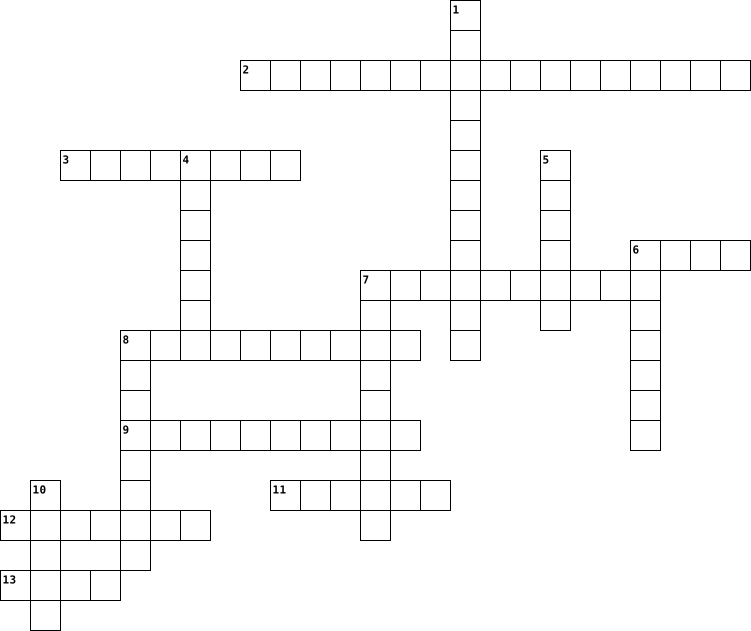
solar sy… Crossword Puzzles
Solar Eclipse 2024-04-08

Across
- A luminous celestial body made up of hot gases, like our sun
- Related to the sun or derived from it, like solar energy
- The star at the center of our solar system that provides light and heat
- Earth's natural satellite that orbits around it at night
- A vast system of stars, gas, and dust held together by gravity
- A soft, radiant light emitted by an object or substance
- A dark area caused by an object blocking light from a source
- The planet we live on, known as the "Blue Planet"
- An optical instrument used for observing distant objects in space
- A circular band or loop shape, like Saturn's rings
- The period of light between sunrise and sunset
- A celestial object composed of ice, dust, and gas that develops a glowing tail
- Electromagnetic radiation that allows us to see and brightens our world
- A recurring sequence or pattern that repeats over time
- The different stages or appearances of the moon or a celestial body
Down
- The study of celestial objects, space, and the universe
- Complete or whole, as in a total eclipse
- The path followed by a celestial object around another object
- The vast, seemingly infinite expanse that contains all celestial objects
- Related to the moon, like lunar phases or lunar landings
- The expanse above us that contains the sun, moon, stars, and clouds
- Incomplete or not whole, as in a partial eclipse
- The period of darkness when the sun is below the horizon
- A facility equipped for observing
- When one celestial body blocks the light from another, like a solar or lunar eclipse
25 Clues: A facility equipped for observing • Complete or whole, as in a total eclipse • The period of light between sunrise and sunset • Incomplete or not whole, as in a partial eclipse • The planet we live on, known as the "Blue Planet" • A circular band or loop shape, like Saturn's rings • A recurring sequence or pattern that repeats over time • ...
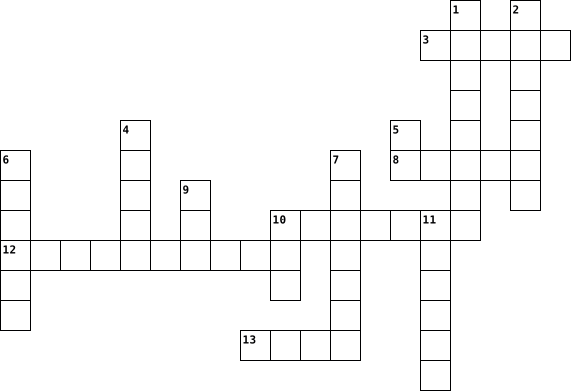
Solar Eclipse 2024-04-16

Across
- block or hide
- the degree that people can see things.
- particular, far from normal
- living things
- it covers the Earth and make creatures survive.
- able to observe when things happen
- event things that happen above our head.
- dark
- the outer layer of the sun
- only active at night.
Down
- happens when the moon covers the sun. People can only see part of the sun. people will see the sky turn dark.
- forest, flower and grass, places that animals live in.
- very far/high up from sea
- simply
- one in a kind
- they are people that study planets, stars, or outer space.
- seeing things in purpose
- impact, influence, things change because others did something else
- they can help us feel things.
- happen
- see in a long time
21 Clues: dark • simply • happen • block or hide • living things • one in a kind • see in a long time • only active at night. • seeing things in purpose • very far/high up from sea • the outer layer of the sun • particular, far from normal • they can help us feel things. • able to observe when things happen • the degree that people can see things. • event things that happen above our head. • ...
Sistema Solar 2025-07-09

Across
- Fuerza que atrae a los objetos entre sí.
- Octavo planeta desde el Sol, muy frío.
- Segundo planeta desde el Sol, muy caliente.
- Cuarto planeta desde el Sol, conocido como el planeta rojo.
- Cuerpo celeste que orbita alrededor de una estrella.
- Línea imaginaria alrededor de la cual gira la Tierra.
- Satélite natural de la Tierra.
- Instrumento que se usa para observar objetos distantes.
- Quinto planeta desde el Sol, el más grande.
- Ciencia que estudia los cuerpos celestes.
- Trayectoria que sigue un cuerpo celeste alrededor de otro.
- Fragmento de roca espacial que llega a la Tierra.
- Pequeño cuerpo rocoso que orbita alrededor del Sol.
- Depresión en la superficie de un planeta o luna.
- Séptimo planeta desde el Sol, inclinado de lado.
- Grupo de estrellas que forman una figura imaginaria.
- Extensión infinita donde se encuentran los cuerpos celestes.
Down
- Capa de gases que rodea un planeta.
- Cuerpo celeste que orbita alrededor de un planeta.
- Sexto planeta desde el Sol, conocido por sus anillos.
- Cuerpo de hielo y polvo que orbita alrededor del Sol.
- Fenómeno que ocurre cuando un cuerpo celeste oculta a otro.
- Láctea Galaxia en la que se encuentra el Sistema Solar.
- Movimiento de la Tierra sobre su propio eje.
- Cuerpo celeste que emite luz y calor.
- Tercer planeta desde el Sol, donde vivimos.
- Conjunto de estrellas, gas y polvo.
- Todo lo que existe.
- Movimiento de la Tierra alrededor del Sol.
- lunar Cambios en la apariencia de la luna a medida que orbita la Tierra.
- Solar Conjunto de planetas que giran alrededor del Sol.
- Planeta más cercano al Sol.
- Estrella que proporciona luz y calor a la Tierra.
33 Clues: Todo lo que existe. • Planeta más cercano al Sol. • Satélite natural de la Tierra. • Capa de gases que rodea un planeta. • Conjunto de estrellas, gas y polvo. • Cuerpo celeste que emite luz y calor. • Octavo planeta desde el Sol, muy frío. • Fuerza que atrae a los objetos entre sí. • Ciencia que estudia los cuerpos celestes. • Movimiento de la Tierra alrededor del Sol. • ...
Solar System 2022-05-04

Across
- q23
- q12
- q10
- q24
- q6
- q21
- q13
- q1
- q5
- q25
- q17
- q22
Down
- q18
- q14
- q15
- q7
- q26
- q9
- q20
- q3
- q11
- q16
- q2
- q4
- q27
- q19
- q8
27 Clues: q7 • q9 • q3 • q6 • q2 • q4 • q1 • q5 • q8 • q18 • q14 • q15 • q23 • q26 • q20 • q12 • q10 • q11 • q24 • q21 • q16 • q13 • q27 • q19 • q25 • q17 • q22
solar system 2023-02-09

Across
- Day time is the_____in summer and the shortest in winter and spring and fall have the same number of daylight hours
- Stars shine by giving off ______ that spreads in different directions.
- We have weight depending on how much____of gravity is on us
- As the moon moves around the earth the sunlight and that's why we have different moon phases
- In the winter the sun is more______so the shadows point more north.
- What color are hot stars?
- The moon_____always has one side dark and one side light.
- The to sun from the earth is not the cause of the seasons.
- What color are cold stars
Down
- As the earth rotates around on it's_____it takes 24 hours which makes the day and night.
- the sun is brighter than other stars because it's ____.
- The moon changes_______depending on how much light from the sun is blocked out from the earth.
- At______an object's shadow is shortest but as the sun moves the sun makes the shadows get longer.
- The sun has a gravity that gravity is keeps the earth in the ____ of the sun's.
- What is the GD mascot
- Gravity pulls us to the _____ of the earth's
- Seasons are by indirect or direct sunlight.
- Different parts of the earth are______to the sun during different when one side is closer it’s summer.
- Shawdos in the summer point to the east and .
- There are 6 time zones in the USA each time zone is based on the of the sun.
20 Clues: What is the GD mascot • What color are hot stars? • What color are cold stars • Gravity pulls us to the _____ of the earth's • Seasons are by indirect or direct sunlight. • Shawdos in the summer point to the east and . • the sun is brighter than other stars because it's ____. • The moon_____always has one side dark and one side light. • ...
THE SOLAR SYSTEM 2024-04-20
Across
- The moon is held onto Earth by its gravitational pull
- Our Solar Systems largest moon
- This celestial object is slightly lemon-shaped
- The part of the universe we can see is called the _________ universe
- The layer of Earth's atmosphere where meteorites burn up
- Included in our solar system, located past Neptunes orbit
- These planet's rings are 90% water
- This is the most accepted theory about how the solar system began
- The largest volcano in our solar system called "Olympus Mons" is located on this planet
Down
- The region in space between Mars and Jupiter
- These are what many people call "Shooting Stars"
- The shape of our galaxy
- This planet has a small tail made of sodium
- The is a spherical shell that surronds our solar system
- Our solar system orbits the center of this
- Saturn's biggest moon, is the only moon that has an atmosphere.
16 Clues: The shape of our galaxy • Our Solar Systems largest moon • These planet's rings are 90% water • Our solar system orbits the center of this • This planet has a small tail made of sodium • The region in space between Mars and Jupiter • This celestial object is slightly lemon-shaped • These are what many people call "Shooting Stars" • ...
Erik 2023-11-30

Across
- 'n Vorm wat geen hoeke het nie
- 82+18=
- die grootste akkedis
- 14+6=
- Waarmee is Jesus geslaan toe hy gekruisig is?
- Die kleur wat ek kry as ek blou en rooi meng
- Die land waar tannie Karlien bly
- Die dag wat die Here die son, maan en sterre gemaak het
- Die provinsie waarin ons bly
- Die planeet derde van die son af
Down
- Die grootste planeet
- 'n tipe kar
- Wanneer het Jesus opgestaan?
- 'n Giftige slang
- 11+5+14=
- Wat is sy in engels?
- 'n Voël wat baie vinnig hardloop
- Die eerste mens
18 Clues: 14+6= • 82+18= • 11+5+14= • 'n tipe kar • Die eerste mens • 'n Giftige slang • Die grootste planeet • die grootste akkedis • Wat is sy in engels? • Wanneer het Jesus opgestaan? • Die provinsie waarin ons bly • 'n Vorm wat geen hoeke het nie • 'n Voël wat baie vinnig hardloop • Die land waar tannie Karlien bly • Die planeet derde van die son af • Die kleur wat ek kry as ek blou en rooi meng • ...
Our Solar System 2022-03-09

Across
- the coldest planet in our solar system
- the most distant planet from the sun
- the hottest planet in our solar system
- the flattest planet
- commonly known as shootings stars
- closest planet to the sun
Down
- the largest planet in our solar system
- the only planet known to harvest life
- the only star in our solar system
- rocks ejected from comets
- a force that impedes each object's existence
- rocky objects revolving around the sun
- the largest dwarf planet
- the fourth planet from the sun
- Fifth largest moon in our solar system
15 Clues: the flattest planet • the largest dwarf planet • rocks ejected from comets • closest planet to the sun • the fourth planet from the sun • the only star in our solar system • commonly known as shootings stars • the most distant planet from the sun • the only planet known to harvest life • the largest planet in our solar system • the coldest planet in our solar system • ...
The Solar system 2014-10-19

Across
- the only planet that has an atmosphere containing 21 percent oxygen
- occurs when the Moon is between the Sun and the Earth.
- The second largest planet in the solar system
- The seventh planet from the sun
- meteoroid that survives falling through the Earth’s atmosphere and colliding with the Earth’ surface
- the largest moon in the Solar System
- sun over 300000 times larger than earth
- an artificial object that is deliberately sent into orbit in space
- made up of everything that exists, including planets, stars, galaxies and all forms of matter and energy
- First planet of the gas planets
- system includes the Sun and all the objects that orbit around it due to its gravity
- sphere of very hot gas called plasma which is held together by its own gravity
Down
- a relatively small solar system body that orbits the Sun
- The brightest planet in the solar system
- a massive group of stars, star clusters, interstellar gas and dust, and dark matter which is all gravitationally bound together
- cannot be seen without a large telescope and was first seen in 1846 from the observatory in Berlin
- a person trained by a spaceflight program to lead, pilot or be a crew member of an expedition to space on a spacecraft
- orbits the Earth every 27.3 days
- spiral galaxy where our Solar System and Earth are located
- The planet closest to the sun
- a small rock or particle of debris in our solar system
- also known as planetoids or minor planets
- The red planet
23 Clues: The red planet • The planet closest to the sun • The seventh planet from the sun • First planet of the gas planets • orbits the Earth every 27.3 days • the largest moon in the Solar System • sun over 300000 times larger than earth • The brightest planet in the solar system • also known as planetoids or minor planets • The second largest planet in the solar system • ...
astronomy 2023-05-14

Across
- The force that attracts everything with mass
- The forth state of matter (not gas, solid,liquid)
- used to be a planet but not anymore :(
- the black hole in the middle of the Milky Way
- the gravity is so strong that light can't escape
- the closest galaxy to the Milky Way
- a collection of asteroids orbiting between mars and Jupiter
- The hottest planet in the solar system
- a collapsed core of a star with 10-25 solar masses
- (easy)the third planet from the sun
Down
- the universe expanded quickly from a singularity
- a collection of comets and asteroids beyond Neptune
- the closest star to the solar system
- made up mostly by hydrogen and helium
- a group of planets orbiting a star
- The biggest moon in the solar system (bigger than mercury)
- The galaxy we live in
- a yellow dwarf star that's in the middle of the solar system
18 Clues: The galaxy we live in • a group of planets orbiting a star • the closest galaxy to the Milky Way • (easy)the third planet from the sun • the closest star to the solar system • made up mostly by hydrogen and helium • used to be a planet but not anymore :( • The hottest planet in the solar system • The force that attracts everything with mass • ...
Sistema Solar 2 2022-05-10
Across
- é o planeta mais quente do sistema solar;
- é apelidado de “planeta vermelho”;
- é o planeta que tem “anéis” ao seu redor, formados de partículas de gelo?
- o movimento que os planetas fazem em torno do Sol?
- Há _______ planetas há no Sistema Solar? o terceira O Planeta Terra ocupa a a_________ no Sistema Solar?
Down
- é o planeta mais próximo do Sol;
- é o maior planeta do Sistema Solar?
- é popularmente conhecido como “Estrela Dalva”;.
- O Planeta Terra leva ______ ano para fazer seu movimento de translação;
- é o menor planeta do Sistema Solar;
- é o movimento que os planetas fazem sobre seu próprio eixo?
- é o satélite natural do Planeta Terra;
- é a estrela que é o centro do Sistema Solar;
- o último planeta do Sistema Solar;
14 Clues: é o planeta mais próximo do Sol; • é apelidado de “planeta vermelho”; • o último planeta do Sistema Solar; • é o maior planeta do Sistema Solar? • é o menor planeta do Sistema Solar; • é o satélite natural do Planeta Terra; • é o planeta mais quente do sistema solar; • é a estrela que é o centro do Sistema Solar; • é popularmente conhecido como “Estrela Dalva”;. • ...
Astronomy 101 Chapter 12 Crossword 2019-01-12

Across
- The crater from the impact that killed the dinosaurs is located in this country
- Part of comet pushed by solar wind
- Shooting star
- These meteorites are unchanged from when the solar system formed
- Another name for a comet
- Part of comet pushed by sunlight
- The impact that killed the dinosaurs left a worldwide layer of this
- A dwarf planet
- An impact killed them
- Rock from space that has landed on Earth
Down
- Nearby home of comets
- Icy leftover from formation of the solar system
- Moon of Pluto
- Comets cause these events
- Center of a comet
- Far away home of comets
- What we call a catastrophic impact event
- Rocky leftover from formation of solar system
- Pluto is a _______________
- Younger meteorites
20 Clues: Moon of Pluto • Shooting star • A dwarf planet • Center of a comet • Younger meteorites • Nearby home of comets • An impact killed them • Far away home of comets • Another name for a comet • Comets cause these events • Pluto is a _______________ • Part of comet pushed by sunlight • Part of comet pushed by solar wind • What we call a catastrophic impact event • ...
solar system 2017-03-16

Across
- a low and marshy or frequently flooded area of land.
- unsteady lost of senses
- Something Gross
- Refuse to do something
- sing softly
- means to sing or hum a song quietly
- Into conflict or difficulty with.
- a vivid crimson color.
- to strike or hit hard, with or as if with the hand, a stick, or other weapon.
- of, like, or covered with tar.
- a small group of trees
Down
- a boil or other swelling or growth on the skin
- Avoid ignore or refuse something
- some distance in a direction
- Any of various long-eared, short-tailed, burrowing mammals of the family Leporida
- greatly dismay or horrify.
- into conflict or difficulty with.
- (of a body of water or the atmosphere of a confined space) having no current or flow and often having an unpleasant smell as a consequence.
- rude in a mean-spirited and surly way.
- strike with a firm blow
- Something that spends time wandering
21 Clues: sing softly • Something Gross • Refuse to do something • a vivid crimson color. • a small group of trees • unsteady lost of senses • strike with a firm blow • greatly dismay or horrify. • some distance in a direction • of, like, or covered with tar. • Avoid ignore or refuse something • into conflict or difficulty with. • Into conflict or difficulty with. • ...
Solar System 2013-04-10

Across
- The closest planet to the Sun, has no atmosphere
- One of the four gas giants, mainly known for its Great Red Spot
- Brief streaks of light created by the friction of a meteorite
- Small, rocky bodies that orbit the Sun, mostly iregular shape
- The largest star in the Solar System
- A space object that has reaches Earth
- One of the inner rocky planets, knonw for its sulfuric acid cloud
- A icy space object that creates a tail called coma as it gets near the Sun
- A moon phae just before the Full Moon
- The second largest plaent in the Solar System, known for its amazing icy rings
Down
- One of the four gas giants, the furthest planet from the Sun
- The side of the Moon that is not visible to the Earth
- Large holes that are created due to mostly space impacts
- Our natural satellite
- The planet that is roughly half the size of Earth. Red coloured from oxide iron
- A large space area where asteroids are being held together by Jupiter's gravity
- The only planet that can foster life
- One of the four gas giants, with a thick atmosphere out of helium, hydrogen and methane
- The high and light areas of the Moon
- The dark and shallow areas of the Moon
20 Clues: Our natural satellite • The largest star in the Solar System • The only planet that can foster life • The high and light areas of the Moon • A space object that has reaches Earth • A moon phae just before the Full Moon • The dark and shallow areas of the Moon • The closest planet to the Sun, has no atmosphere • The side of the Moon that is not visible to the Earth • ...
Solar System 2013-08-05

Across
- Asteroid that has its own moon
- Planet that is the giant of the solar system
- 7 of the planets……around the sun
- First person that stepped on the moon
- Romans called the moon ....
- Planet that has 21% of oxygen
- One of Mars moons
- Planet that is the brightest
- Largest object in the solar system
- Number of dwarf planets in the solar system
- One of the planets that cannot be seen without using a telescope
Down
- Space between Mars and Jupiter where most asteroids are found
- Type of planets that are made out of mostly rock and metal
- Type of planets that are made out of much larger and made mostly of hydrogen, helium and other gases.
- Moon of Jupiter
- Number of planets in the solar system
- Planet that is closest to the sun
- Planet that was discovered in 1946
- Planet that is surrounded by rings which may be composed by ice
- Former planet that is no longer a planet
20 Clues: Moon of Jupiter • One of Mars moons • Romans called the moon .... • Planet that is the brightest • Planet that has 21% of oxygen • Asteroid that has its own moon • 7 of the planets……around the sun • Planet that is closest to the sun • Planet that was discovered in 1946 • Largest object in the solar system • Number of planets in the solar system • ...
Solar System 2014-03-23

Across
- a small,frozen cluster of dust which orbits the sun
- Meaning equal day and equal night
- the study of the universe
- famous for its rings
- center of solar system
- beautiful lights seen over the polar regions
- closest planet to the sun
- a meteorite that is stoney
- known as our twin
- the distance in which a ray of light would travel in one year
- dwarf planet
- shortest days of the year (June22 and December22)
- when our view of an object is blocked by either another object or the Earths shadow
- an imaginary line on which an object rotates
- a group of stars, gas and dust that is held together by gravity
- a shooting star
- when an object is spinning it is said to be rotating
Down
- farthest planet from the sun
- when the moon is more than half full but less than completley full
- our galaxy
- a group of stars given names by ancient astronomers
- darkening of the moon
- a self-luminous object
- a brief eruption of intense high-energy radiation from the sun's surface
- fifth planet from the sun
- a small rocky body orbiting the sun
- dark spots on the sun
- when something is moving in a circle around another object
- an object moving around a star
- takes about 365 days to orbit the sun
- known as the red planet
31 Clues: our galaxy • dwarf planet • a shooting star • known as our twin • famous for its rings • darkening of the moon • dark spots on the sun • center of solar system • a self-luminous object • known as the red planet • the study of the universe • fifth planet from the sun • closest planet to the sun • a meteorite that is stoney • farthest planet from the sun • an object moving around a star • ...
Solar System 2020-12-31

Across
- What is the name given to the full moon night
- The word ‘planet’ has been derived from the word ‘planetai’ which is
- Asteroids are found between the orbits of Jupiter and
- The celestial bodies which do not have their own heat and light but are lit by the light of the stars are named as
- What is the total number of planets in our solar system
- apart from stars, planets, and satellites, there are numerous bodies which also move around the sun, what are these called
- Meteoroids are made up of
- Coldest planet in the Universe
- The earth is called a blue planet because of the presence of
- Which is the most recognisable constellation
Down
- The star which indicates the north is called
- Why does the moon not have conditions favourable for life
- Hottest planet in our Universe
- What makes the universe
- Shape of the earth
- Sun is also a
- What is called a cluster of millions of stars, shining white in the starry sky
- Biggest planet in our Universe
- Smallest planet in our Universe
- Which of the following name is given to the new moon
- All the planets move around the sun in a fixed elliptical path, these paths are called
21 Clues: Sun is also a • Shape of the earth • What makes the universe • Meteoroids are made up of • Hottest planet in our Universe • Biggest planet in our Universe • Coldest planet in the Universe • Smallest planet in our Universe • The star which indicates the north is called • Which is the most recognisable constellation • What is the name given to the full moon night • ...
Solar System 2022-04-13

Across
- planet furthest from the sun
- National Aeronautics and Space Administration
- first four planets
- the amount of dwarf planets as of now
- only planet with known living life
- people who go to space
- large collection of stars,dust, and gas
- planet most known for its rings
- celestial body moving around a star
- all planets rotate around it
Down
- something that is a part of the milkyway
- planet that looks to spin on its side
- a small rocky body orbiting the sun
- planet closest to the sun
- planet 2nd closest to the sun
- dwarf planet that used to be a planet
- what the sun is
- one of these orbits earth
- space rock that fell on earth
- the number of planets in the solar system
- largest planet in the solar system
- type of planet that you can not stand on
- the amount of stars in the solar system
- known as the "red planet"
24 Clues: what the sun is • first four planets • people who go to space • planet closest to the sun • one of these orbits earth • known as the "red planet" • planet furthest from the sun • all planets rotate around it • planet 2nd closest to the sun • space rock that fell on earth • planet most known for its rings • largest planet in the solar system • only planet with known living life • ...
Solar System 2022-02-28

Across
- : only natural satellite
- belt
- :all existing matter and space considered as a whole
- :the fourth planet from the sun
- :a minor planet of the inner Solar System
- :a planet whose orbit lies outside the
- :a celestial body resembling a small planet but lacking certain technical criteria that are required for it to be classed as such
- :A planet whose orbit lies within the
- :relating to the earth
- : the biggest star seen to the human eye
- :a system of millions or billions of stars, together with gas and dust, held together by gravitational attraction
Down
- :the sixth planet from the sun
- :the second planet from the sun
- :the fifth planet from the sun
- :a large planet of relatively low density consisting predominantly of hydrogen and helium
- :a cloud of comets and other objects.
- :the only known planet that can support
- :any of the large bodies that revolve around the sun in the solar system
- planets Jupiter and Mars
- belt
- : located roughly between the orbits of
- :the closet planet to the sun
- :the seventh planet from the sun
23 Clues: belt • belt • :relating to the earth • : only natural satellite • planets Jupiter and Mars • :the closet planet to the sun • :the sixth planet from the sun • :the fifth planet from the sun • :the second planet from the sun • :the fourth planet from the sun • :the seventh planet from the sun • :a cloud of comets and other objects. • :A planet whose orbit lies within the • ...
solar system 2022-02-15

Across
- natural satellite
- the path a satellite follows as it revolves
- a whole because of impact from an object
- named after the greek god of the sky
- the distance light travels in one yearnebula a cloud of gas and dust in space
- every galaxy come together form this
- the planet we are living on
- a dwarf planet that used to be considered a main planet
- the center of an object
- our solar system
- has the largest mass by far
- minor planet of the inner Solar System
- hottest star
- large bodies in space that orbit the sun
Down
- next closest solar system
- closest planet to the sun
- an envelope of gas surrounding a body in space
- farthest planet from the sun
- planets that are rocky and Earthlike in size
- body of gas that shines by radiation in the sky also called the celestial sphere
- cosmic clumps of frozen gases, rocks or debris orbiting the sun
- referred as the red planet
- areas on the sun that give off less energy
- an force attraction between to objects revolution the movement of one object in its orbit around another object in space
- named after a roman goddess meaning love and beauty
- known as the gas giant
26 Clues: hottest star • our solar system • natural satellite • known as the gas giant • the center of an object • next closest solar system • closest planet to the sun • referred as the red planet • the planet we are living on • has the largest mass by far • farthest planet from the sun • named after the greek god of the sky • every galaxy come together form this • ...
Solar System 2022-10-19

Across
- The coldest planet in our Solar system is ...
- The Sun and a group planets and other space objects that move around the Sun is called as ...sun Sol is the other name to mention the ...
- A circular movement of a Planet around its axis is called ...
- A ring of light around the sun during total solar eclipse is called....
- Earth ... is the movement of the earth around the sun.
- Jupiter has four large moons. The biggest moons of Jupiter is ...
- The moon looks bright at night because it...the sunlight.
- The name of the bigest satellites in Saturn is ...
- Mars is also name as the Red Planet. It is because most of its surface are covered by red ...
Down
- Venus and Mercury are moonless. The reason is because it has a very week ... force.
- Asteroids belt is located between Mars and ...
- The darker shadow which becomes smaller as it reaches the Earth is called...
- The name of Earth's satellite is ...
- sun is a giant blowing gas which consists of ..., Helium, and other element.
- The inner planets are made mostly of ....
- A large body in space that moves around a star is called ...
- When the sun and moon are not aligned, the gravitational forces cancel each other out, and the tides are not as dramatically high and low, it is called....
- A year that consists of 366 days is called ... year
- the bright and hottest planet is ...
- ... happen because of moon's gravity
20 Clues: The name of Earth's satellite is ... • the bright and hottest planet is ... • ... happen because of moon's gravity • The inner planets are made mostly of .... • The coldest planet in our Solar system is ... • Asteroids belt is located between Mars and ... • The name of the bigest satellites in Saturn is ... • A year that consists of 366 days is called ... year • ...
Solar System 2023-11-14

Across
- 300-600 million year old on Mercury
- Mercury Venus Earth Mars
- A Roman Venus Name
- Name of object that hit earth
- Sun Cell
- Planet Criteria; __________ Shape
- Protoplanetary __________
- Craters of eternal ________________
- Type of collapse that started the formation of the solar system
- Hottest part of Sun
- Sun atmosphere; Color orb
- Late ______ Bombardment
- Type of moon that we can't see
- Moon pulls the ocean
- 2004 - 2015 Mercury studier
- abbreviation; Ejection of the Sun
- Soviet Mercury Program
- Type of orbits planets move in
- Past Neptune
- "There's a little black _______ on the Sun today"
- Where the sun's energy comes from
- Neither a star or its remnant
- Eclipse; Sun Moon Earth
- Not just the moon has these
- Martian Volcanic area
- The type of cloud where are solar system is from
- Type of Core Mars has
- 3 letter abbreviation for theory of how the solar system was created
- Dark feautre on Mars, thought to be a sea
- Belt 30 - 50 AU
- Grains -> _________ -> Planetesimals
- Eclipse; Sun Earth Moon
- Boundary between us and interstellar space
- This super event caused the formation of our solar system
- Mercury's favorite element
- First Martian Period
- Symbols for the 3 elements that primarily make up the 98% of the mass that formed the sun
- Mercury's Continent
- Nasa Martian Program searches for life
- Sun Geyer
- Cloud beyond Heliosphere
- Something Mars once had
- Icy Small Solar System body
- Pluto Eris Gonggong
- Mars Ground Shaking
- coldest sphere of the sun
- Compound found in molecular clouds
- Plural Natural Satellites
- Failed Stars Giants Jupiter and Saturn
- Sun's protective Sphere
Down
- The line after which volatile chemicals can be found
- Disk beyond Pluto
- Grand Canyon got nothing on this Valles
- Process that signals the birth of a star
- Largest Volcanoes in the Solar System
- Maybe on Mercury says Phosphine
- Magnetic _________ protect earth from solar winds
- Damage shows up everywhere Moon Venus Mercury
- Official Astronomy Body
- System bound by gravity
- Abbreviation Theory that something hit the Earth to get the moon
- Planet forming process
- zone that is unstable
- a volatile chemical
- Sun's "gen" by mass
- Comet and Asteriod
- Sulfuric acid on Mercury Water on Earth
- Do not come closer than Kuiper
- Between Mars and Jupiter
- Volatiles like water ammonia and methane
- Mercury Photobombs the Sun
- Alot of on Mercury like lava
- Mar's first in 1840
- What prominences do
- zone where light travels slowly
- Center of System
- NASA's Mercury mapper
- Outer core
- Type of Mercury atmosphere
- Group that sent the Akatsuki to
- Greek Mercury Name
- Martian Storm
- Type of "pre" star
- Planet Criteria; ___________ Orbit No Neighbors
- House effect on Mercury
- Ancient Lunar Magma Oceans
- Heat source of earth
- Objects not affected by planet's gravity
- First to mercury
- Smooth Mercury surfaces
- ESA and JSA Mission to Mercury
- Currently Roving Mars
- planet criteria; _______ around the sun
- Covection __________ produce magnetic field on Earth
- Much Larger than Earth
- Neptune and Uranus
- Comet Cloud
- Small Mars Moon
- Found in the shadows on the moon
- Future Lunar Missions
- Type of planets that form in the middle of the solar system
- Past Lunar Missions
- Type of world Earth is 71% water
103 Clues: Sun Cell • Sun Geyer • Outer core • Comet Cloud • Past Neptune • Martian Storm • Belt 30 - 50 AU • Small Mars Moon • Center of System • First to mercury • Disk beyond Pluto • A Roman Venus Name • Comet and Asteriod • Greek Mercury Name • Type of "pre" star • Neptune and Uranus • Hottest part of Sun • a volatile chemical • Sun's "gen" by mass • Mar's first in 1840 • What prominences do • Mercury's Continent • ...
sistema solar 2023-11-22

Across
- Com o solo rico em óxido de ferro, é conhecido como o planeta vermelho.
- Planeta joviano que possui uma grande mancha vermelha que é uma tempestade.
- É o conjunto de corpos celestes que se movimentam em torno do Sol.
- São objetos constituídos essencialmente por gelo de materiais voláteis como o gás carbônico e por rochas sendo resquícios da formação do Sistema Solar.
- Quando o meteoro resiste à entrada da atmosfera chegando ao solo ele é chamado de...
- Meteoroide que é vaporizado deixando um rastro no céu ele recebe o nome de (...) ou estrela cadente.
- Exemplo de corpo celeste menos coesos ou composta de vários corpos.
- Planeta que tem o eixo de rotação bem inclinado, é o mais frio dos planetas.
- Planeta que possui um alto teor de metano em sua atmosfera.
- É qualquer corpo astronômico que orbite um planeta, um planeta anão ou um asteroide.
- Planeta mais denso e mais achatado do sistema solar com anéis brilhantes.
- As estrelas são constituídas de...
Down
- São corpos celestes que possuem luz própria que produzem e emitem energia.
- É um planeta telúrico que não possui satélites e não tem atmosfera, por isso sua superfície é coberta de crateras.
- Um dos cinco planetas-anões do sistema solar que possui 5 luas.
- Um corpo celeste que orbita outra Estrela que não seja o Sol é chamado de...
- Asteroides pequenos que estejam orbitando o Sol e entram na atmosfera terrestre.
- É um corpo celeste que orbita uma estrela e tem massa suficiente para que sua gravidade o deixe com formato esférico.
- É o planeta mais quente do Sistema Solar e tem o tamanho quase igual ao da Terra.
- São objetos rochosos pequenos demais para manter uma atmosfera.
- No núcleo das estrelas cujas temperaturas ultrapassam vários milhões de graus Celsius ocorrem reações...
21 Clues: As estrelas são constituídas de... • Planeta que possui um alto teor de metano em sua atmosfera. • Um dos cinco planetas-anões do sistema solar que possui 5 luas. • São objetos rochosos pequenos demais para manter uma atmosfera. • É o conjunto de corpos celestes que se movimentam em torno do Sol. • ...
Solar System 2023-10-10

Across
- Sideways Rings.
- Has 2 moons.
- Floating in space and a lot are between Mars and Jupiter.
- Closest planet to the sun.
- Crashed down to Earth.
- You use it to look into space.
- Earth takes 365 days to finish.
- Has the biggest rings.
- Center of the Solar System.
Down
- Earth's "Sister" Planet.
- What made the Sun.
- Closest to the Kuiper Belt.
- How a planet or anything goes around something else.
- Has the most moons.
- The name of our galaxy.
- We know the most about it.
- Also known as a shooting star.
- Also has a dark spot.
- Earth's friend.
- There are 3 types.
20 Clues: Has 2 moons. • Sideways Rings. • Earth's friend. • What made the Sun. • There are 3 types. • Has the most moons. • Also has a dark spot. • Crashed down to Earth. • Has the biggest rings. • The name of our galaxy. • Earth's "Sister" Planet. • Closest planet to the sun. • We know the most about it. • Closest to the Kuiper Belt. • Center of the Solar System. • Also known as a shooting star. • ...
Solar System 2024-02-29

Across
- A small reddish planet that is fourth from the Sun
- The smallest plane in our solar system and the closet to the Sun
- An irregulary shaped rock that orbits the Sun
- A large planet that is mainly made up of gases
- A single turn of something around an axis or a fixed point;spinning
- The center of an object
- Earth's only natural satellite
- A large blue planet that is eighth from the Sun
- The largest planet in our system and the fifth from the Sun
- The are in space between Mars and Jupiter where most asteroids orbit together
- An are of our solar system beyond the orbit of Neptune where a group of minor planets and other objects orbit the Sun
- The third planet from the Sun
- system A group of objects in space that orbit a Star
- A dwarf planet that was discovered in 1930 and was once considered a planet
- A single journey along an orbital path
Down
- A nearly rounded object that orbits, a star, and not big enough to be a planet
- A space object made of ice and dust that orbits a star and develops a long, bright tail as it nears its star
- A large bluish-green planet that is seventh from the Sun
- A planet with large rings around it that is sixth from the Sun
- A layer of gases surrounding a planet star, or moon
- A body in outer space made of hot gasses
- The force that pulls all objects toward each other
- A hole in the ground caused by the impact of an object from space
- This means to revolve around another object
- planets Rocky Earth sized planets
25 Clues: The center of an object • The third planet from the Sun • Earth's only natural satellite • planets Rocky Earth sized planets • A single journey along an orbital path • A body in outer space made of hot gasses • This means to revolve around another object • An irregulary shaped rock that orbits the Sun • A large planet that is mainly made up of gases • ...
Solar system 2020-05-20

Across
- natural satellite of earth
- small pieces of rocks around the sun
- largest planet of solar system
- many galaxies make a
- twinkles in the sky at night
- don't have thier own heat and light
- night with no moon
- type of shape of earth
- group of stars
- largest star in solar system
- full moon
- our galaxy
Down
- the other name is north star
- belts around Jupiter, Saturn and Uranus
- all the objects shining g in the sky is known as
- earth's twin
- ultimate source of heat and light
- star indicates direction to North
- third planet from the sun
- planet known for its rings
- which belt is between Mars and Jupiter
- smallest planet of solar system.
22 Clues: full moon • our galaxy • earth's twin • group of stars • night with no moon • many galaxies make a • type of shape of earth • third planet from the sun • natural satellite of earth • planet known for its rings • the other name is north star • twinkles in the sky at night • largest star in solar system • largest planet of solar system • smallest planet of solar system. • ...
Solar System 2019-04-15

Across
- system our Sun rotates around it
- planet that rotates on its side
- third planet from the sun; only planet people have walked on
- the red planet; humans have sent robots here
- to turn on an axis
- large planet known for the Great Red Spot
- number of stars in our solar system
- an American space traveler
- furthest planet from the sun
- dwarf planet with two moons
- Saturn, Jupiter, Uranus and Neptune have ___ around them
Down
- station place where astronauts live and work in space
- planet with the brightest rings
- planet closest to the sun
- the star closest to earth
- instrument used for seeing stars and planets clearly
- Neil Armstrong was the first person to walk on the...
- Warmest planet; cloudy planet
- the force pulls the center of a planet or star
- number of planets in our solar system
- it takes 365 days for the Sun to around the Earth
21 Clues: to turn on an axis • planet closest to the sun • the star closest to earth • an American space traveler • dwarf planet with two moons • furthest planet from the sun • Warmest planet; cloudy planet • planet that rotates on its side • planet with the brightest rings • system our Sun rotates around it • number of stars in our solar system • number of planets in our solar system • ...
SOLAR SYSTEM 2020-03-17

Across
- Oval shaped with two points
- Red planet
- Elliot Scientist who studied the uranian atmosphere
- Small robot used to explore the Martian landscape
- Essential to living things
- Mars belongs to this group
- Blue planet
- Largest moon
- Backward rotation
- Mass of swirling storm of clouds
- Comes from decaying plants and animals, as well as, from volcanic eruptions
- Cloudlike mass that surrounds the nucleus
- Newton English mathematician and physicist
- Small fragments and dust
- Shooting stars
- Beautiful planet with its system of rings
- Evening and morning star
Down
- Smaller moon
- Robotic spacecraft sent by NASA to orbit the planet Mercury
- Orbits the sun but too small to be considered planets
- Landed on Mars on July 4, 1997
- Fastest planet
- Venus
- Another term for the four moons
- Thick clouds that surround planet Venus
- Greek term for comet
- Largest planet
- Moves in elliptical orbit around the sun
- Planets that are much bigger but less dense than the rocky planets
- Formed from some materials left from the formation of the planets
- Star at the center of the solar system
- One possible mission to Mars
32 Clues: Venus • Red planet • Blue planet • Smaller moon • Largest moon • Fastest planet • Largest planet • Shooting stars • Backward rotation • Greek term for comet • Small fragments and dust • Evening and morning star • Essential to living things • Mars belongs to this group • Oval shaped with two points • One possible mission to Mars • Landed on Mars on July 4, 1997 • Another term for the four moons • ...
Solar System 2020-11-18

Across
- the closest planet to the sun; smallest planet
- the third planet from the sun; the only planet people have walked on
- planet with the brightest rings; also less dense than any other planet
- place where astronauts live and work in space
- the closest star to Earth
- the red planet; humans have sent robots there.
- instrument used for seeing the planets and stars clearly
- hottest planet; deadly gases cover the planet's surface
- an American space traveler.
- number of stars in our solar system
Down
- Large planet known for the giant storm called the Great Red Spot
- Saturn, Jupiter, Uranus, and Neptune all have _______ around them
- it takes Earth 365 days to ______ the sun
- planet that rotates on its side
- to turn on an axis
- dwarf planet with two moons; used to be qualified as a planet
- our sun and the objects that orbit around it
- Neil Armstrong was the first human to walk on this
- the furthest planet form the sun
- The force that pulls you towards the center of the planet
- number of planets in our solar system
21 Clues: to turn on an axis • the closest star to Earth • an American space traveler. • planet that rotates on its side • the furthest planet form the sun • number of stars in our solar system • number of planets in our solar system • it takes Earth 365 days to ______ the sun • our sun and the objects that orbit around it • place where astronauts live and work in space • ...
Solar System 2024-05-15

Across
- the fourth planet from the sun
- a place in space where gravity pulls so much that even light cannot get out
- the second planet from the sun
- the seventh planet from the sun
- the sun being obscured by the moon
- large objects made of dust and ice that orbit the sun
- a solid piece of debris from an object
- small rocky objects that orbit the sun
Down
- a rocky terrestrial planet
- the eighth planet from the sun
- giant ball of hot gas
- the closest planet to the sun
- fifth planet from the sun
- The hottest in our solar system
- a group of stars forming a pattern
- the sixth planet from the sun
- a giant spherical shell surrounding our solar system
- a streak of light in the sky caused by a meteoroid crashing through Earth's atmosphere
- a huge collection of gas ,dust and billions of stars and their solar systems all held together by gravity
- an object that orbits a planet
20 Clues: giant ball of hot gas • fifth planet from the sun • a rocky terrestrial planet • the closest planet to the sun • the sixth planet from the sun • the fourth planet from the sun • the eighth planet from the sun • the second planet from the sun • an object that orbits a planet • The hottest in our solar system • the seventh planet from the sun • a group of stars forming a pattern • ...
Solar System 2023-03-10

Across
- first planet from the sun
- the abbreviation for this is AU
- fifth planet from the sun
- Mercury, Venus, Earth, and Mars are all classified as these planets
- this is a small body of ice, rock or dust in space
- this is the force of attraction between objects due to their masses
- No longer considered a planet, but it used to be our ninth planet.
- sixth planet from the sun
- this is the term used to describe the apparent shift in position of an object when it is viewed from different places
- seventh planet from the sun
- this is the shape of the galaxy where we live
- this is an instrument used to collect and concentrate light from distant objects to make them more visible
Down
- this is space and all of the energy and matter in it
- this terms is the path that a particular object follows as it travels around another body in space
- second planet from the sun
- third planet from the sun
- this scientist came up with three laws of motion of objects on Earth and in space
- this is the distance that light travels in a vacuum in one year
- eighth planet from the sun
- this is the name of a small, rocky or metallic body that may be debris left over from when the solar system was formed
- Jupiter, Saturn, Uranus, and Neptune are all classified as these planets
- fourth planet from the sun
- this is the name of the closest star to us
- this is the name of the galaxy we live in
- this is a small, irregularly shaped rocky and metallic body that usually orbit the sun in the asteroid belt
25 Clues: first planet from the sun • third planet from the sun • fifth planet from the sun • sixth planet from the sun • second planet from the sun • eighth planet from the sun • fourth planet from the sun • seventh planet from the sun • the abbreviation for this is AU • this is the name of the galaxy we live in • this is the name of the closest star to us • ...
Solar System 2023-05-05
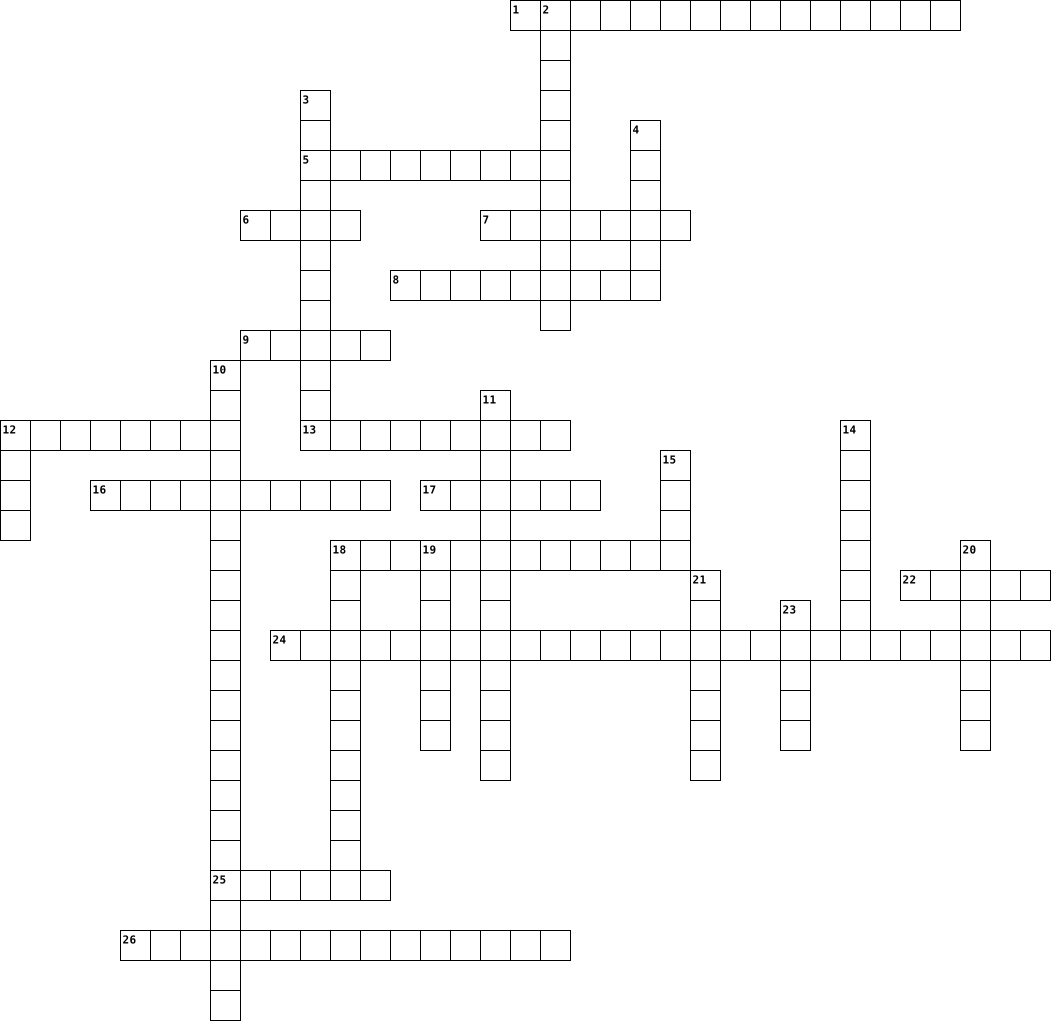
Across
- Mercury is the
- Most of these objects are found in the asteroid belt
- on it Earth is the only planet to have
- Uranus has
- How many moons does Pluto have
- 3rd brightest planet in the sky
- This planet is known to be what
- When comets are frozen they are the size of a
- Can also at times be known as fireballs
- This planet has 62 moons
- Saturn has
- This dwarf planet can be closer to the sun than Neptune
- Mereoroids are
- 3,871 is the current known munber of
- Jupiter has
Down
- Ganymede is what
- Some of these kinds of planets can be found in the Kuiper belt
- This planet is known as the sideways planet
- What are Dwarf plantes named after
- Venus is the
- Astroids are mostly made of
- Neptune is know as
- This planet has the highest volcano in our solar system
- Mars is known as
- This planet is the fastest to orbit the sun
- This planet has a rageing storm that has been going on for more than 300 years
- This moon orbits in the opposite direction of the others around it
- This is the only planet to have large bodies of cool water
28 Clues: Uranus has • Saturn has • Jupiter has • Venus is the • Mercury is the • Mereoroids are • Ganymede is what • Mars is known as • Neptune is know as • This planet has 62 moons • Astroids are mostly made of • How many moons does Pluto have • 3rd brightest planet in the sky • This planet is known to be what • What are Dwarf plantes named after • 3,871 is the current known munber of • ...
Solar Energy 2024-03-25

Across
- A typical star that is the source of light and heat for the planets in the solar system.
- The partial or total blocking of one object in space by another
- The part of a shadow surrounding the darkest part
- earth is tilted in space by about 23.5 degrees on average and is responsible for earth's seasons.
- a line of latitude about 23 degrees South of the equator
- An imaginary circle around the middle of the earth, halfway between the North Pole and the South Pole
- An imaginary line that passes through Earth's center and the North and South poles, about which Earth rotates
- a line of latitude about 23 degrees North of the equator
- shortest day of the year
- the blocking of sunlight to the moon that occurs when Earth is directly between the sun and the moon
- The day of the year that marks the beginning of fall in the Northern hemisphere
- Refers to the spinning of our planet on its axis which takes 24 hours.
Down
- longest day of the year
- Either of the two times of the year when the sun is at its greatest distance from the equator
- The blocking of sunlight to Earth that occurs when the moon is directly between the sun and Earth.
- Sunlight that strikes Earth from straight overhead; vertical rays.
- The darkest part of a shadow
- The two days of the year on which neither hemisphere is tilted toward or away from the sun
- 66.5 degrees north latitude
- This is the elliptical orbit of the Earth around the Sun. It takes 365.25 days to complete one orbit.
- continuous daylight, a time when the sun is visible at midnight during the summer in either the Arctic or Antarctic Circle
- Period in the polar regions in winter when the sun does not rise
- 66.5 degrees south latitude
- light rays that do not hit the Earth straight on
- the day of the year that marks the beginning of spring in the northern hemisphere
25 Clues: longest day of the year • shortest day of the year • 66.5 degrees north latitude • 66.5 degrees south latitude • The darkest part of a shadow • light rays that do not hit the Earth straight on • The part of a shadow surrounding the darkest part • a line of latitude about 23 degrees South of the equator • a line of latitude about 23 degrees North of the equator • ...
Solar System 2025-03-11

Across
- force by which a planet or other body draws objects toward its center
- the time needed for one revolution
- the belief that the sun was in the center of the solar system
- a flattened nebula; shaped like a fried egg; thicker in the center; thin at the edge
- property of matter that stays at rest or stays in motion until acted on by a force
- point where a planet is closest from the Sun in its orbit
- the belief that the Earth was in the center of the universe
- the speed at which a planet revolves around a central more massive object
- a large, thin cloud of gas and dust; spins when it was hit with the shockwave of a supernova
- planets composed mostly of hydrogen or helium
- backward motion of a planet
- a curved path of an object as it revolves around a star, planet or moon
- Law of Universal Gravitation (all objects attract due to gravity)
- Laws that explain planetary motion
Down
- colliding and clumping of matter - due to gravity. Smaller pieces form larger pieces
- point where a planet is farthest away from the Sun in its orbit
- planets that have a compact, rocky surface
- an oval shape
- moon-sized planetesimals
- the solar system formed from a solar nebula
- an object in orbit (natural or human-made)
- asteroid-like bodies combine (by colliding) to form initial planets
22 Clues: an oval shape • moon-sized planetesimals • backward motion of a planet • the time needed for one revolution • Laws that explain planetary motion • planets that have a compact, rocky surface • an object in orbit (natural or human-made) • the solar system formed from a solar nebula • planets composed mostly of hydrogen or helium • ...
SOLAR SYSTEM 2025-04-25

Across
- / Second closest star.
- / Discovered Jupiter’s moons.
- / Space equilibrium points.
- / Proposed heliocentric theory.
- / Largest constellation.
- / Planet with rings and 146 moons.
- / Earth’s radiation belts.
- / Polar lights.
- / Morning Star; hottest planet.
- / Belt beyond Neptune.
- / Farthest and windiest planet.
- / Another name for universe.
- / Neptune’s largest moon.
Down
- / Universe origin theory.
- / The Hunter constellation.
- / Longest or shortest day.
- / Biggest planet.
- / Dwarf planet with moon Charon.
- / Outer gas layer of Moon.
- / Cross-shaped constellation.
- / Nearest galaxy to Milky Way.
- / Largest moon of Saturn.
- / Equal day and night.
- / Icy body with a tail.
- / Belt between Mars and Jupiter.
25 Clues: / Polar lights. • / Biggest planet. • / Second closest star. • / Equal day and night. • / Belt beyond Neptune. • / Icy body with a tail. • / Largest constellation. • / Universe origin theory. • / Largest moon of Saturn. • / Neptune’s largest moon. • / Longest or shortest day. • / Outer gas layer of Moon. • / Earth’s radiation belts. • / The Hunter constellation. • ...
sistema solar 2025-05-14

Across
- É o planeta mais distante que pode ser observado da Terra a olho nu
- A cor azulada brilhante de Urano e Netuno resulta da elevada quantidade de (...) na atmosfera.
- Pela presença de óxido de ferro, Marte é conhecido como planeta...
- Assim como Plutão, é um dos 5 planetas anões.
- O sistema solar surgiu a partir de uma (...) de gás e poeira.
- Marte recebeu esse nome em homenagem ao deus romano da...
- Plutão é o nome do deus romano do...
- Saturno recebeu esse nome em homenagem ao deus romano da...
- Um dos quatro planetas telúricos que está há quase 150 milhões de quilômetros de distância do Sol.
- O Sistema Solar tem origem há 4,6 (...) de anos.
- A Terra é o único planeta que apresenta água em estado...
- Planeta com a duração do dia parecido com o da Terra, 24 horas e 35 minutos.
- Júpiter recebeu esse nome em homenagem ao governante do...
- Vênus é chamado também de Estrela d’Alva por seu (...) no céu.
- O nome do nosso sistema planetário.
- Mercúrio é constituído basicamente por...
- O maior satélite de Saturno e o segundo maior do sistema solar é...
- Vênus recebeu esse nome em homenagem à Vênus, a deusa da beleza e do...
- O Sol é uma enorme esfera de (...) incandescente
Down
- É o planeta com o diâmetro mais parecido com o da Terra.
- É o terceiro maior planeta, e a superfície a mais fria do Sistema Solar.
- A única estrela do Sistema Solar.
- Planeta com o dia mais curto, dura 9 horas e 50 minutos
- Vênus é o planeta mais...
- Na superfície a (...) do Sol é de 6.000 graus Celsius.
- Com 25 quilômetros de altura o maior vulcão do sistema solar é o...
- São 8 e todos eles realizam movimento de translação em torno do Sol.
- Já foi o 9º planeta do sistema solar. Desde 2006 é um "planeta anão”.
- Planeta rochoso, com movimento de translação de 87 dias e o de rotação de 59 dias.
- Urano é o nome do deus grego do...
- O movimento de (...) da Terra dura 24 horas.
- Mercúrio recebeu o nome do deus do comércio, por ser o planeta mais...
- Júpiter é o quarto corpo celeste mais (...) no céu, os demais são o Sol, a Lua e Vênus.
- Júpiter possui o maior satélite do Sistema Solar chamado...
- É um planeta gasoso e leva 164 anos terrestres para dar uma volta em torno do Sol.
- Netuno recebeu o nome do deus romano do...
36 Clues: Vênus é o planeta mais... • A única estrela do Sistema Solar. • Urano é o nome do deus grego do... • O nome do nosso sistema planetário. • Plutão é o nome do deus romano do... • Mercúrio é constituído basicamente por... • Netuno recebeu o nome do deus romano do... • O movimento de (...) da Terra dura 24 horas. • Assim como Plutão, é um dos 5 planetas anões. • ...
Solar system 2023-01-22

Across
- … are believed as fragments of meteoroids that enter the Earth’s atmosphere and reach the ground.
- … technology brings many benefits into our life in many aspects, such as new source of energy and engineering.
- Venus is the … planet due to its highest temperature.
- … are found between the orbits of Mars and Jupiter.
- … are made up of similar material as asteroids but are smaller than them.
- … cars are one of space technology adaptations in transportation industry.
- Some planets have rings of rocks and ice which are called … rings.
- When a comet comes close to the Sun, it produces a visible … .
Down
- Meteorites that reach the Earth’s ground may create craters, known as …, which are cool and become solid.
- By studying space technology, climatologists can adapt the technique in forecasting the ... on the Earth.
- Mercury and Venus don’t have moons or natural … .
- The … from the Sun is one related possibility of the period of planet’s revolution.
- The planet known as the largest one in the Solar system is called ….
- … planets are dominantly made up of gas and ice.
- Scientists believe that asteroids contain traces of … acids and other organic compounds.
- Only the four … planets have planetary rings surrounding them.
- … system puts the Sun as the core of the system.
- Solar flares in huge amount of energy can increase the amount of … radiation reaching the Earth’s surface.
- … is a celestial body for which the nucleus is smaller than a planet.
- The second largest planet in the Solar system.
20 Clues: The second largest planet in the Solar system. • … planets are dominantly made up of gas and ice. • … system puts the Sun as the core of the system. • Mercury and Venus don’t have moons or natural … . • … are found between the orbits of Mars and Jupiter. • Venus is the … planet due to its highest temperature. • ...
Solar System 2025-01-24

Across
- known as the red planet, because of iron oxide
- Know as a "dirty snowball"
- Largest planet in the solar system
- force that governs the motion of objects in Earth's solar system
- Orbits a planet
- Inner planets are known as
- last planet in our solar system
- Located in a band between Mars and Jupiter
- zone that allows life to exist
Down
- Known for its beautiful rings
- Burning object located in Earth's atmosphere
- allows life to exist
- the revolution length of mercury compared to neptune
- to spin on an axis
- outer planets are made of this
- physical state of water needed for life to exist
- to move around an object
- happens to temperature when a planet is further away from the sun
- composed of hydrogen and helium
- an inner planet, known as being "blue"
20 Clues: Orbits a planet • to spin on an axis • allows life to exist • to move around an object • Know as a "dirty snowball" • Inner planets are known as • Known for its beautiful rings • outer planets are made of this • zone that allows life to exist • last planet in our solar system • composed of hydrogen and helium • Largest planet in the solar system • ...
Sistema Solar 2025-02-11

Across
- – O maior planeta do sistema solar.
- – Instrumento usado para observar astros distantes.
- – Nome dado ao caminho que os planetas seguem ao redor do Sol.
- – Nome do planeta mais próximo do Sol.
- – Satélite natural da Terra.
- – Corpo artificial colocado em órbita para comunicação e observação.
- – Planeta que tem ventos extremamente fortes e é azul.
- – Conjunto de estrelas que formam figuras no céu.
- – Nome do planeta com anéis famosos.
Down
- – Planeta-anão que já foi considerado o nono planeta do sistema solar.
- Láctea – Galáxia onde está o nosso sistema solar.
- – Corpo celeste que deixa um rastro brilhante ao passar perto do Sol.
- – Estrela do nosso sistema solar.
- – Profissional que viaja para o espaço.
- de asteroides – Nome do cinturão cheio de rochas espaciais entre Marte e Júpiter.
- – Nome do planeta conhecido como "gigante de gelo".
- – Corpo celeste que brilha ao entrar na atmosfera terrestre, chamado de "estrela cadente".
- – Planeta considerado "irmão gêmeo" da Terra, mas com uma atmosfera quente e densa.
- – O planeta conhecido como "Planeta Vermelho".
- – Planeta-anão semelhante a Plutão, localizado no cinturão de Kuiper.
20 Clues: – Satélite natural da Terra. • – Estrela do nosso sistema solar. • – O maior planeta do sistema solar. • – Nome do planeta com anéis famosos. • – Nome do planeta mais próximo do Sol. • – Profissional que viaja para o espaço. • – O planeta conhecido como "Planeta Vermelho". • Láctea – Galáxia onde está o nosso sistema solar. • ...
Solar System 2025-02-27

Across
- fourth planet from the sun
- loose balls of rock and ice that have long narrow orbits
- fifth planet from the sun
- third planet from the sun
- a meteoroid that comes through Earth's atmosphere and strikes Earth's surface
- The _______ planets are made mostly of rock and metal.
- planet closest to the sun
- seventh planet from the sun
- outer layer of the sun's atmosphere
- one of the five known dwarf planets in our solar system
- natural satellite
- one of the 2 main gases that make up the sun
- this is round and orbits the sun
- dark areas on the sun
Down
- inner layer of the sun's atmosphere
- average distance from the center of the sun to the center of the Earth
- accounts for 99.85% of the mass in our solar system
- streak of light from meteoroid coming through Earth's atmosphere
- chunk of rock or dust smaller than an asteroid
- The ______ planets are made mostly of gas and liquid.
- second planet from the sun
- sixth planet from the sun
- outer layer of the sun's interior - _______ zone
- furthest planet from the sun
- sun,planets,their moons,and a variety of other smaller objects
- Many of these are found between the orbits of Mars and Jupiter.
26 Clues: natural satellite • dark areas on the sun • fifth planet from the sun • third planet from the sun • sixth planet from the sun • planet closest to the sun • fourth planet from the sun • second planet from the sun • seventh planet from the sun • furthest planet from the sun • this is round and orbits the sun • inner layer of the sun's atmosphere • outer layer of the sun's atmosphere • ...
Solar System 2024-10-31

Across
- the hottest planet
- has life
- 365 days
- 6th planet
- Mercury is the _______ planet in order from the sun
- Jupiter is the _________ planet in order from the sun
- Mars has a lot of _______
- 30 times further away from the sun than earth
- Mercury is the ____ planet
- Earth is the ______ planet in order from the sun
- orbits around planets
Down
- Uranus is the ______ planet in order from the sun
- Saturn is the ________ planet in order from the sun
- the closest planet to the sun
- the biggest planet
- 24 hours
- red planet
- Neptune is the ________ planet in order from the sun
- Venus is the _______ planet in order from the sun
- Mars is the _______ planet in order from the sun
- Jupiter can fit ___ ____ _____ inside of it
- 4 times bigger than the earth
- the ___ ___ is what all the planets are in
23 Clues: has life • 24 hours • 365 days • red planet • 6th planet • the hottest planet • the biggest planet • orbits around planets • Mars has a lot of _______ • Mercury is the ____ planet • the closest planet to the sun • 4 times bigger than the earth • the ___ ___ is what all the planets are in • Jupiter can fit ___ ____ _____ inside of it • 30 times further away from the sun than earth • ...
solar system 2024-11-07

Across
- a huge rock that orbits the earth
- small non planets
- gas planets
- the far group of astroids beyond neptune
- the planet to have life
- biggest moon in the solar systeme
- a dwarf planet in between planets
- 2nd smallest planet
- the planet with the most rings
- hottest planet
Down
- the biggest planet
- smallest planet
- rocky planets
- the planet that smells horrible
- the belt that is between Mars and jupiter
- a huge ball of gas
- a dwarf planet that was a classified as a planet
- farthest planet from the sun
- a force of one thing pulling another
- big rocks in space
20 Clues: gas planets • rocky planets • hottest planet • smallest planet • small non planets • the biggest planet • a huge ball of gas • big rocks in space • 2nd smallest planet • the planet to have life • farthest planet from the sun • the planet with the most rings • the planet that smells horrible • a huge rock that orbits the earth • biggest moon in the solar systeme • ...
Solar System 2025-11-04

Across
- the eight planet from the sun
- of or pertaining to sun
- a system of stars
- object made of ice and dust
- the planet that holds life
- Way, the one we live in
- Biggest Planet
- Earth Evil Twin
- bowl shaped on a planet or moon cause by an object
- famous for all its rings
- a rock that burns up in earth atmosphere.
- when one body moves another,
Down
- of or pertaining to moon
- Giant, large red star
- the path around an object
- rocky object found between Mars and Jupiter
- natural satellite
- the force that pulls an object towards another.
- the layer of gases surrounding a planet
- the red planet
- Dwarf, very dense star
- only planet that spins upside down
- Formally a planet but now a dwarf planet.
- The star at the center of our solar system
- First Planet in solar system
25 Clues: the red planet • Biggest Planet • Earth Evil Twin • a system of stars • natural satellite • Giant, large red star • Dwarf, very dense star • of or pertaining to sun • Way, the one we live in • of or pertaining to moon • famous for all its rings • the path around an object • the planet that holds life • object made of ice and dust • First Planet in solar system • when one body moves another, • ...
Solar System 2025-11-05

Across
- – The star at the center of the Solar System
- – Small rocky object orbiting the Sun, mostly in a belt
- – Gas giant famous for its prominent ring system
- – Stream of charged particles released from the Sun
- – A circular depression caused by an impact on a surface
- – A vehicle designed for travel or operation in space
- – Natural satellite orbiting a planet
- – Our home planet, third from the Sun
- – When one celestial body blocks the light of another
- – The farthest planet from the Sun in our system
Down
- – The largest planet with a famous Great Red Spot
- – Planet known for its thick, toxic atmosphere
- – A meteoroid that burns up entering Earth's atmosphere
- – The path a planet or object takes around the Sun
- – An instrument for observing distant objects in space
- – The Red Planet, known for iron oxide on its surface
- – Ice giant that spins on its side
- – Icy body that develops a glowing tail near the Sun
- – The force that attracts objects toward each other
- – The smallest and closest planet to the Sun
20 Clues: – Ice giant that spins on its side • – Natural satellite orbiting a planet • – Our home planet, third from the Sun • – The star at the center of the Solar System • – The smallest and closest planet to the Sun • – Planet known for its thick, toxic atmosphere • – Gas giant famous for its prominent ring system • – The farthest planet from the Sun in our system • ...
Solar System 2025-12-04

Across
- The Red Planet
- Which planet has the Great Red Spot
- Earth’s only natural satellite
- Where do we live
- Closest to the Sun
- An elliptical path around a celestial body
- Where comets come from
- Beyond Neptune
- Known for it’s icy tail
- A rocky object floating in space
Down
- between Mars and Jupiter
- An asteroid that lands on the ground
- The Ice Giant
- Known for it’s thick atmosphere
- Known for it’s rings
- Many on the moon
- An asteroid that is in the atmosphere
- Astronomer who found the moons of Jupiter
- At the center of the Solar System
- A force that attracts objects together
- Farthest from the Sun
- An Ex-Planet
22 Clues: An Ex-Planet • The Ice Giant • The Red Planet • Beyond Neptune • Many on the moon • Where do we live • Closest to the Sun • Known for it’s rings • Farthest from the Sun • Where comets come from • Known for it’s icy tail • between Mars and Jupiter • Earth’s only natural satellite • Known for it’s thick atmosphere • A rocky object floating in space • At the center of the Solar System • ...
Markus 2023-04-05

Across
- N disiepel
- Judas die ... (mar.14:5-10)
- N plek se naam (MAR.1:21 )
- Ons luister daarmee ?
- Hy het die twaalf...... uitgestuur ( Mar.6:7)
- JESUS,Seun van die ...GOD (mar.5:7)
- Nadat hulle oorgevaar het, het hulle by die land ... aangekom (Mar.6:50-55)
- Wees opjulle hoede vir die.... van die fariseers(Mar.8:14-20)
- Daar is my ... en my broers (Mar. 3:32-35 )
- N groot ...het opgekom( Mar.4:35-38)
- Die saaier saai die ?
- Die het hom gered. (Mar.10:52)
- Johannes die ... het uit die dode opgestaan
- Elke keer as die .... HOM sien( Twee Woorde ) (Mar.3: 11 )
- Die haan het ? (Mar.14:68)
Down
- ....... Die Hoepriester (Mar 1:27-28)
- Hulle het JESUS aan ... oorgelewer(Mar.15:1)
- JESUS maak sy dogtertjie gesond.(Mar.5)
- Hy noem JESUS (twee worde) Mar.10:17)
- Die seun van Alfeus (Mar.2:12-16)
- Hy het hulle baie dinge geleer deur ....(Mar. 4:2)
- Die moder van joses. (Mar.15:45-47)
- Hy sal sy .... verloor nie(Mar.9:41 )
- Die wat gesond is het hom nie nodig nie.( Mar. 2: 17)
- Die begin van die ( Mar.10:4-8)
- ..... was bang vir Johannes ( Mar.6:15-22)
- By GOD is alle dinge ? (Mar.10:26-29)
- Almal is deur hom gedoop in die.....(MAR 1:4-8 )
- Golgota, Plek van ... (Mar.15:21-23)
- Die het uit die dogter uitgevaar (Mar.7: 29)
30 Clues: N disiepel • Ons luister daarmee ? • Die saaier saai die ? • N plek se naam (MAR.1:21 ) • Die haan het ? (Mar.14:68) • Judas die ... (mar.14:5-10) • Die het hom gered. (Mar.10:52) • Die begin van die ( Mar.10:4-8) • Die seun van Alfeus (Mar.2:12-16) • Die moder van joses. (Mar.15:45-47) • JESUS,Seun van die ...GOD (mar.5:7) • N groot ...het opgekom( Mar.4:35-38) • ...
Nuwe Testament 2025-06-08

Across
- Die gevangenisstad waar Paulus en Silas lofliedere gesing het. (Hand. 16:25)
- Een van die vroue wat in Lukas 8 Jesus gevolg het – haar sewe duiwels is uitgedryf. (Luk. 8:2)
- Die stad met 'n "onbekende god" – Paulus het daar gepreek op Mars-heuwel. (Hand. 17:22-23)
- Die stad waar die eerste Christene die naam "Christene" ontvang het. (Hand. 11:26)
- Apostel wat as dokter bekend was. (Kol. 4:14)
- Stad waar die heilige Gees op Pinksterdag uitgestort is. (Hand. 2:1-4)
- Romeinse keiser tydens Jesus se geboorte. (Luk. 2:1)
- Die engel wat Maria besoek het. (Luk. 1:26-27)
- Die eerste wonderwerk van Jesus – verander water in ___. ((Joh. 2:1-11)
Down
- Waar Jesus Sy heel eerste wonderwerk verrig het. (Joh. 2:1)
- Paulus se metgesel op sy eerste sendingreis – later het hulle geskei. (Hand. 13:2)
- Jesus het hierdie boom vervloek omdat dit nie vrugte gedra het nie. (Mar. 11:12-14, 20-21)
- Boek geskryf aan ’n man wat in Kreta gewoon het. 😬
- Stad wat Jesus weggesit het as Hy nie baie wonders daar kon doen nie – gebrek aan geloof. (Matt. 2:23)
- ' 'n Johannes se noemnaam, later 'n evangelieskrywer. (Hand. 12:12)
- Die apostel wat die meeste briewe geskryf het. (Rom.- Fil.)
- Jesus het hom "die rots" genoem. (Matt. 16:18)
- Jesus se bergpredikasie was gelewer op hierdie tipe terrein. (Matteus 5:1)
- Hierdie dissipel het eers getwyfel aan Jesus se opstanding. (Joh. 20:24-29)
- Boek van die Bybel geskryf i.v.m. 'n slaaf. 😬
20 Clues: Apostel wat as dokter bekend was. (Kol. 4:14) • Boek van die Bybel geskryf i.v.m. 'n slaaf. 😬 • Jesus het hom "die rots" genoem. (Matt. 16:18) • Die engel wat Maria besoek het. (Luk. 1:26-27) • Boek geskryf aan ’n man wat in Kreta gewoon het. 😬 • Romeinse keiser tydens Jesus se geboorte. (Luk. 2:1) • Waar Jesus Sy heel eerste wonderwerk verrig het. (Joh. 2:1) • ...
Solar System 2020-05-29

Across
- named after the goddess of love
- a machine that is taking photos of far off planets
- cold, rocky, and close to the sun
- a yellow star at the center of our solar system
- first country in space
- stars, planets, moons, etc.
- name of a planet that supports life
- the brain of the rover
- rotates around the Earth
- what your hair does in space
Down
- a job that uses math and creativity
- telescope orbiting our planet
- first country with a man on the moon
- a planet with a huge continuous storm
- a machine that is exploring Mars
- abreviation for the international space station
- a planet with large rings
- dwarf planet
- animal that orbited the Earth
- the red planet
20 Clues: dwarf planet • the red planet • first country in space • the brain of the rover • rotates around the Earth • a planet with large rings • stars, planets, moons, etc. • what your hair does in space • telescope orbiting our planet • animal that orbited the Earth • named after the goddess of love • a machine that is exploring Mars • cold, rocky, and close to the sun • ...
solar system 2022-02-15

Across
- cosmic clumps of frozen gases, rocks or debris orbiting the sun
- closest planet to the sun
- named after a roman goddess meaning love and beauty
- our solar system
- known as the gas giant
- named after the greek god of the sky
- farthest planet from the sun
- next closest solar system
- a dwarf planet that used to be considered a main planet
- hottest star
- an envelope of gas surrounding a body in space
- minor planet of the inner Solar System
- the planet we are living on
- the path a satellite follows as it revolves
Down
- referred as the red planet
- natural satellite
- the center of an object
- large bodies in space that orbit the sun
- areas on the sun that give off less energy
- an force attraction between to objects revolution the movement of one object in its orbit around another object in space
- every galaxy come together form this
- body of gas that shines by radiation in the sky also called the celestial sphere
- a whole because of impact from an object
- the distance light travels in one yearnebula a cloud of gas and dust in space
- has the largest mass by far
25 Clues: hottest star • our solar system • natural satellite • known as the gas giant • the center of an object • closest planet to the sun • next closest solar system • referred as the red planet • has the largest mass by far • the planet we are living on • farthest planet from the sun • every galaxy come together form this • named after the greek god of the sky • ...
SISTEMA SOLAR 2022-03-30

Across
- los hay naturales como la luna y artificiales como los que sirven en las telecomunicaciones
- situado a continuación de la órbita de Neptuno
- le llaman también el planeta azul.
- llamado así este planeta a la deidad griega del cielo
- astrónomo que formulo la teoría heliocéntrica del sistema solar
- cuerpo celeste formado por rocas y partículas de hielo
- abarca todos los astros en el firmamento
- planeta más cercano al sol y el más pequeño
- constituye la mayor fuente de radiación y ocupa el centro el sistema solar
- pudo calcular la distancia Tierra-luna a Tierra-sol
- fenómeno u objeto relacionado con el universo físico
Down
- es uno de los gigantes helados
- planeta más grande del sistema solar
- investigan las estrellas, los planetas y galaxias
- totalidad de formas de materia, espacio y tiempo
- estos cuerpos celestes orbitan entre marte y júpiter
- recibe su nombre en honor a la diosa romana del amor
- conjunto de estrellas, planetas, polvo cósmico, materia oscura y energía
- este cometa grande y brillante orbita alrededor del sol cada 75 años
- el único con un sistema de anillos visibles desde Tierra
- lugar donde se observan panorámicamente los astros
- su modelo del universo propuesto fue geocéntrico
22 Clues: es uno de los gigantes helados • le llaman también el planeta azul. • planeta más grande del sistema solar • abarca todos los astros en el firmamento • planeta más cercano al sol y el más pequeño • situado a continuación de la órbita de Neptuno • totalidad de formas de materia, espacio y tiempo • su modelo del universo propuesto fue geocéntrico • ...
solar system 2014-03-23

Across
- the distance in which a ray of light would travel in one year
- when the moon is more than half full but less than completley full
- dark spots on the sun
- darkening of the moon
- Meaning equal day and equal night
- when an object is spinning it is said to be rotating
- closest planet to the sun
- known as our twin
- farthest planet from the sun
- a group of stars given names by ancient astronomers
- an imaginary line on which an object rotates
- a group of stars, gas and dust that is held together by gravity
- a small,frozen cluster of dust which orbits the sun
- a self-luminous object
- a meteorite that is stoney
- a brief eruption of intense high-energy radiation from the sun's surface
Down
- our galaxy
- dwarf planet
- famous for its rings
- fifth planet from the sun
- a shooting star
- shortest days of the year (June22 and December22)
- beautiful lights seen over the polar regions
- center of solar system
- an object moving around a star
- known as the red planet
- when our view of an object is blocked by either another object or the Earths shadow
- the study of the universe
- when something is moving in a circle around another object
- takes about 365 days to orbit the sun
- a small rocky body orbiting the sun
31 Clues: our galaxy • dwarf planet • a shooting star • known as our twin • famous for its rings • dark spots on the sun • darkening of the moon • center of solar system • a self-luminous object • known as the red planet • fifth planet from the sun • closest planet to the sun • the study of the universe • a meteorite that is stoney • farthest planet from the sun • an object moving around a star • ...
Solar cooking 2014-01-11

Across
- is a meeting of people to lean more about a particular subject.
- either one of the two organs that people and animals use to breathe air
- oe of the people who started an organisation; the first in group
- a piece of kitchen equipment, usually containing an oven, used to cook food.
- the degree of thickness, softness, etc.
- turn from a solid into something soft or liquid.
- slowly take in
- a scientist who studies very small living things, such as bacteria.
- very thick paper that is usually used for making boxed.
- is a hard, black substance that is burned for energy.
- to cause (someone) to stop breathing by squeezing the throat
Down
- a nation that is economically weak but growing.
- movable; capable of being carried or moved around.
- a soft substance used in candles.
- refers to something that is of or related to the sun
- to heat something at a controlled temperature in order to kill disease-causing elements is to......
- the way something feels according to sense of taste or touch.
- substances that release energy when burned
- the cutting down of trees in large areas.
- to be carried or transferred by water
- a piece of equipment that is used to cook food.
- an agency of the United Nations that works to improve global health conditions.
22 Clues: slowly take in • a soft substance used in candles. • to be carried or transferred by water • the degree of thickness, softness, etc. • the cutting down of trees in large areas. • substances that release energy when burned • a nation that is economically weak but growing. • a piece of equipment that is used to cook food. • turn from a solid into something soft or liquid. • ...
Solar cooking 2014-01-11

Across
- a piece of kitchen equipment, usually containing an oven, used to cook food.
- to cause (someone) to stop breathing by squeezing the throat
- to be carried or transferred by water
- turn from a solid into something soft or liquid.
- oe of the people who started an organisation; the first in group
- the degree of thickness, softness, etc.
- a piece of equipment that is used to cook food.
- very thick paper that is usually used for making boxed.
- movable; capable of being carried or moved around.
- is a hard, black substance that is burned for energy.
- is a meeting of people to lean more about a particular subject.
Down
- the way something feels according to sense of taste or touch.
- the cutting down of trees in large areas.
- to heat something at a controlled temperature in order to kill disease-causing elements is to......
- a nation that is economically weak but growing.
- refers to something that is of or related to the sun
- either one of the two organs that people and animals use to breathe air
- a scientist who studies very small living things, such as bacteria.
- substances that release energy when burned
- an agency of the United Nations that works to improve global health conditions.
- a soft substance used in candles.
- slowly take in
22 Clues: slowly take in • a soft substance used in candles. • to be carried or transferred by water • the degree of thickness, softness, etc. • the cutting down of trees in large areas. • substances that release energy when burned • a nation that is economically weak but growing. • a piece of equipment that is used to cook food. • turn from a solid into something soft or liquid. • ...
Solar cooking 2014-01-11

Across
- a piece of equipment that is used to cook food.
- a piece of kitchen equipment, usually containing an oven, used to cook food.
- very thick paper that is usually used for making boxed.
- a soft substance used in candles.
- a nation that is economically weak but growing.
- movable; capable of being carried or moved around.
- a scientist who studies very small living things, such as bacteria.
- to cause (someone) to stop breathing by squeezing the throat
- slowly take in
- refers to something that is of or related to the sun
Down
- the degree of thickness, softness, etc.
- to be carried or transferred by water
- is a meeting of people to lean more about a particular subject.
- turn from a solid into something soft or liquid.
- oe of the people who started an organisation; the first in group
- substances that release energy when burned
- the cutting down of trees in large areas.
- to heat something at a controlled temperature in order to kill disease-causing elements is to......
- the way something feels according to sense of taste or touch.
- either one of the two organs that people and animals use to breathe air
- an agency of the United Nations that works to improve global health conditions.
- is a hard, black substance that is burned for energy.
22 Clues: slowly take in • a soft substance used in candles. • to be carried or transferred by water • the degree of thickness, softness, etc. • the cutting down of trees in large areas. • substances that release energy when burned • a piece of equipment that is used to cook food. • a nation that is economically weak but growing. • turn from a solid into something soft or liquid. • ...
Solar System 2012-02-04

Across
- imaginary line Earth turns on
- Planet closest to the Sun
- Uranus and Saturn have these
- Jupiter, Saturn, Uranus, Neptune
- huge ball of gas that gives off light, heat, and other energy
- System of stars, galaxies, planets, moons
- The Earth is between the Sun and Moon
- large body of rock or gas
- When the moon is between Sun and Earth
- Mercury,Venus, Earth, Mars
- the force that keeps planets in orbit
Down
- Sun,9 planets, and other bodies that orbit the sun
- orbits around Earth
- A group of stars
- The path Earth follows are the Sun
- largest planet
- Earth's twin planet
- Earth's star
- huge group of stars held together by gravity
- dwarf planet
- One turn of Earth's axis
- Our planet
22 Clues: Our planet • Earth's star • dwarf planet • largest planet • A group of stars • orbits around Earth • Earth's twin planet • One turn of Earth's axis • Planet closest to the Sun • large body of rock or gas • Mercury,Venus, Earth, Mars • Uranus and Saturn have these • imaginary line Earth turns on • Jupiter, Saturn, Uranus, Neptune • The path Earth follows are the Sun • ...
Solar Billing 2021-01-21

Across
- (abbr.) another name for loan payoff statement
- reduces monthly payment (discount)
- team who handles setting up automatic payments
- pays for equipment use and energy it produces
- a type of solar system (abbr. "PV")
- can only be added by customer or billing team
- type of payment ECS team can process
- loan from third party
- annual bill to make energy costs true, equal, or correct for annual cycle
- amount diminishing or decreasing the effect of another
- sent to MyPower customers who want to pay balance in full
- billing unit for energy delivered
- the energy produced by a PV system
Down
- a monthly service like Netflix for solar
- service for only energy produced
- another name for subscription
- name of billing tool (also the measurement of pressure from an electrical circuit's power source)
- another name for usage
- incentives offered by authorities to go solar
- where a customer can see their PPA, Lease or Mypower billing
- where a customer can see their subscription billing
- offered by government for purchasing solar (abbr.)
- loan serviced by Tesla
- energy consumed in home
- team who handles check reissues and research requests
- protects customer financially from under-production
26 Clues: loan from third party • another name for usage • loan serviced by Tesla • energy consumed in home • another name for subscription • service for only energy produced • billing unit for energy delivered • reduces monthly payment (discount) • the energy produced by a PV system • a type of solar system (abbr. "PV") • type of payment ECS team can process • ...
SOLAR SYSTEM 2021-04-06

Across
- The biggest natural satellite in Jupiter
- Solar eclipse where it's look like a ring
- Planet with great red spot
- Star with tail
- Gases that made up of Sun (make nuclear reaction)
- Morning or evening star / Earth's sister planet
- obscuration of light
- Planetary companion
- Dwarf planet
- Planet that rotate on its side
- Planet with biggest ring
- Planet with rusty iron
Down
- Saturn's biggest satellite
- The first animal that go to space
- Lunar eclipse where it's look so red
- Meteroid when enter atmosphere
- Planets spin on their own axis
- Planet with slowest revolution time
- The biggest star in solar system
- Minor planet
- Blue planet that support living thing to live
- The smallest planet
- The path where planet turn around the Sun
- the closest neighbour of Earth
24 Clues: Minor planet • Dwarf planet • Star with tail • The smallest planet • Planetary companion • obscuration of light • Planet with rusty iron • Planet with biggest ring • Saturn's biggest satellite • Planet with great red spot • Meteroid when enter atmosphere • Planets spin on their own axis • the closest neighbour of Earth • Planet that rotate on its side • The biggest star in solar system • ...
Solar System 2022-10-14

Across
- The only mission to do a fly-by of all the outer planets
- Largest moon of our solar system
- space mission to saturn
- Only moon in solar system to have a thick atmosphere and a rock surface
- Which of the following is not a greenhouse gas? Methane, water vapor, Helium and Carbon Dioxide
- The most abundant element in the molecular cloud
- Only planet in our solar system which was first discovered theoretically
- Long range comets originate from this cloud which is beyond Kuiper Belt Object
- This planet has a retrograde rotation similar to Venus
- Which of the following is not a Galilean moon? Phobos, Io, Ganymede and Callisto
- This space mission observed collision of a comet on planet Jupiter
- Closest space mission to planet Jupiter
Down
- Water geyser on this moon
- The following is not a dwarf planet, Pluto, Ceres, UltimaThule, Makemake, Haumea, Eris
- This element gives the distinct red color to planet mars
- The most common unit of temperature used by astronomers
- This gas give the distinct blue color to planet Uranus and Neptune
- Pluto is not a planet because it has not cleared its ___________
- The only dwarf planet in the main asteroid belt
- Space mission to this Galilean moon
- Hottest planet in the solar system
- The hypothesis in the formation of the solar system
- This rocky planet has almost the same axial tilt as the earth
23 Clues: space mission to saturn • Water geyser on this moon • Largest moon of our solar system • Hottest planet in the solar system • Space mission to this Galilean moon • Closest space mission to planet Jupiter • The only dwarf planet in the main asteroid belt • The most abundant element in the molecular cloud • The hypothesis in the formation of the solar system • ...
Solar System 2018-01-31

Across
- planet with the brightest rings
- Earth does this as it revolves around the Sun
- furthest planet from the sun
- dwarf planet with two moons
- Saturn, Jupiter, Uranus and Neptune have these around them
- place where astronauts live and work in space
- Armstrong was the first person to walk on the...
- the force that pulls you towards the center of the planet
- planet closest to the sun
- an American space traveler
- the star closest to Earth
- number of stars in our solar system
Down
- large planet known for the Great Red Spot
- instrument used for seeing stars and planets clearly
- our sun is in the center of it
- number of planets in our solar system
- third planet from the sun; only planet people have walked on
- planet that rotates on its side
- Warmest plant; cloudy planet
- the red planet; humans have sent robots here
- to turn on an axis
21 Clues: to turn on an axis • planet closest to the sun • the star closest to Earth • an American space traveler • dwarf planet with two moons • furthest planet from the sun • Warmest plant; cloudy planet • our sun is in the center of it • planet with the brightest rings • planet that rotates on its side • number of stars in our solar system • number of planets in our solar system • ...
Solar System 2019-08-20

Across
- This planet needs 3 earth months to revolve
- panets made of rocks, ice and a liquid mixture
- Solid planets
- _____is the only planet that sustains life
- Is the center of the solar system
- Gas and ice giants
- Is a planet associated with blood and war
- Planet's orbit around the sun
- is located in kuiper belt
- King of the gods
- Has extensive lava flows
Down
- God of sky and heavens
- Planet's movement around it's axis
- Orbits the Jovian planets
- planets made of helium and hydrogen
- Flat of rocky objects
- God of farming and agriculture
- Dwarf planet as big as Texas
- Edge of the solar system
- Where the solar system is located
- God of the sea
21 Clues: Solid planets • God of the sea • King of the gods • Gas and ice giants • Flat of rocky objects • God of sky and heavens • Edge of the solar system • Has extensive lava flows • Orbits the Jovian planets • is located in kuiper belt • Dwarf planet as big as Texas • Planet's orbit around the sun • God of farming and agriculture • Is the center of the solar system • ...
Solar System 2023-11-06

Across
- number of days after new moon you will see a full moon
- tide when Earth, moon & sun are at a 90 degree angle
- eclipse occurs during full moon phase
- tide when Earth, moon & sun are in a line
- imaginary line connecting the poles of a planet
- darker shadow that does not allow light through
- name of the latest mission to the moon
- shape of the orbit of all planets
- object that makes up 99.8% of solar system's mass
- sun is directly over this line during equinox
- Earth's tilted axis gives us these
- a rock that descends through the Earth's atmosphere and lands on Earth
- rock that orbits the sun with a trailing tail of dust & gas
- gas that makes up 80-90% of the sun
- hours of day equal hours of night
- the water planet
- the difference between high & low tide
- classification of Pluto
Down
- the lighter shadow cast during an eclipse; allows some light through
- only planet that would float in water
- phases of the moon with increasing light
- hottest planet with lots of volcanoes
- planet that is tilted on its side; also coldest planet
- the highest winds in the solar system are here
- has the big red spot storm
- phases of the moon with decreasing light
- eclipse occurs during new moon phase
- what is at the center of every galaxy
- rocks that are too small to be considered a planet
- shape of moon right before and after full moon
- outer band of icy rocks that orbit the sun
- the longest & shortest days of the year
- planet with the largest mountain in the solar system
- place with the biggest tidal range
- shape of the moon right before and after new moon
- planet with no atmosphere; most cratered
- the spinning of a object on its axis
- number of Americans that have walked on the moon
- path a planet follows around a star
- type of galaxy the Milky Way is
- the complete cycle of a planet on its orbit
41 Clues: the water planet • classification of Pluto • has the big red spot storm • type of galaxy the Milky Way is • shape of the orbit of all planets • hours of day equal hours of night • place with the biggest tidal range • Earth's tilted axis gives us these • gas that makes up 80-90% of the sun • path a planet follows around a star • eclipse occurs during new moon phase • ...
Solar System 2023-11-17

Across
- Icy Small Solar System body
- Compound found in molecular clouds (Symbol + number)
- First Martian Period
- Soviet Venus Program
- Disk beyond Pluto
- Comet and Asteriod
- Cloud beyond Heliosphere
- System bound by gravity
- Sun's "gen" by mass
- Pluto Eris Gonggong
- Between Mars and Jupiter
- Abbreviation; Official Astronomy Body
- Abbreviation; Past Neptune
- Sulfuric acid on Venus Water on Earth
- Group that sent the Akatsuki to
- Belt 30 - 50 AU
- Martian Volcanic area
- Nasa Martian Program searches for life
- Maybe on Venus says Phosphine
- ESA and JSA Mission to Mercury
- Planet Criteria; __________ Shape
- zone that is unstable
- Martian Earthquake
- Type of Mercury atmosphere
- 2004 - 2015 Mercury studier
- Venus Photobombs the Sun by crossing in front of it
- The type of cloud where are solar system is from
- House effect on Venus
- A Roman Venus Name
- First to mercury
- Type of collapse that started the formation of the solar system
- Mercury's favorite element
- Boundary between us and interstellar space
- The line after which volatile chemicals can be found, in a picture
- planet criteria; _______ around the sun
- 3 letter abbreviation for theory of how the solar system was created
- Magnetic _________ protect earth from solar winds
- Plural Natural Satellites
- "There's a little black _______ on the Sun today" Feature on the sun
- Dark feautre on Mars, thought to be a sea
- Process that signals the birth of a star
- Phase of moon that we can't see
- Something Mars once had
- Smooth Mercury surfaces
- Failed Stars Giants Jupiter and Saturn
- zone where light travels slowly
- Neptune and Uranus
- Sun Cell
- Type of orbits planets move in
Down
- Objects not affected by planet's gravity
- Where the sun's energy comes from
- Mar's first in 1840
- Type of "pre" star
- Eclipse; Sun Earth Moon
- Sun atmosphere; Color orb
- Type of planets that form in the middle of the solar system
- 300-600 million year old on Venus
- Past Lunar Missions
- Currently Roving Mars
- Eclipse; Sun Moon Earth
- Sun's protective Sphere
- Mercury Venus Earth Mars
- Found in the shadows on the moon
- Small Mars Moon
- Neither a star or its remnant
- Future Lunar Missions
- coldest sphere of the sun
- Moon pulls the ocean
- Hottest part of Sun
- abbreviation; Ejection of the Sun
- What prominences do
- NASA's Venus mapper
- Venus's Continent
- Damage shows up everywhere Moon Venus Mercury
- Greek Mercury Name
- Ancient Lunar Magma Oceans
- Grand Canyon got nothing on this Valles
- Center of System
- Not just the moon has these
- Planet Criteria; ___________ Orbit No Neighbors
- Planet forming process
- Late ______ Bombardment
- Covection __________ produce magnetic field on Earth
- Volatiles like water ammonia and methane
- Type of Core Mars has
- Largest Volcanoes in the Solar System
- Symbols for the 3 elements that primarily make up the 98% of the mass that formed the sun
- Heat source of earth
- Type of world Earth is, 71% water
- Erupting on Venus,
- Do not come closer than Kuiper
- Sun Geyser
- a volatile chemical
- Much Larger than Earth
- This super event caused the formation of our solar system
- Name of object that hit earth
- Protoplanetary __________
- Abbreviation; Theory that something hit the Earth to get the moon
98 Clues: Sun Cell • Sun Geyser • Small Mars Moon • Belt 30 - 50 AU • Center of System • First to mercury • Disk beyond Pluto • Venus's Continent • Type of "pre" star • Comet and Asteriod • Martian Earthquake • Greek Mercury Name • A Roman Venus Name • Erupting on Venus, • Neptune and Uranus • Mar's first in 1840 • Past Lunar Missions • Sun's "gen" by mass • Pluto Eris Gonggong • Hottest part of Sun • ...
Solar System 2023-12-21

Across
- the path of one object in space around another object
- Express mail service that ran from April 1860 to October 1861
- Fourth planet from the sun, known as the "Red Planet", has many volcanoes
- Grierson leader of the Buffalo soldiers
- Act of 1862 Gave any head of a household, widowed women, or any man over 21 the right to claim one 160-acre portion of land
- railroad act In 1862 President Abraham Lincoln signed the Pacific Railway Act. Two companies began building a transcontinental (across the continent) railroad, linking East with the West.
- Removal Act Law passed in 1830 to tive Andrew Jackson the power to move American Indians west of the Mississippi River
- The second planet from the sun and the hottest planet in the solar system, which has gasses that cause a "greenhouse like effect"
- planets Known as the "Gas Giants", these planets orbit the sun further away and include primarily planets with no rocky surface
- Black Kettle Southern Cheyenne Chief who moved his tribe twice in 1861 and in 1867 in accordance with treaties. Remembered for his efforts to make peace with settlers
Down
- Soldiers African American soldiers who fought during the Civil War and after, keeping peace between American Indians and settlers, led by Benjamin Grierson
- Colonel George Armstrong Custer Led the battle of Washita River, in which Chief Black Kettle was killed.
- a large, round body that revolves around a star
- system a star and all the planets and other bodies that revolve around it
- A small planet closest to the sun with a dense rocky surface and no atmosphere
- small natural objects that revolve around other objects
- Expansion migration and settlement from the East to the West
- free roaming animal on the plains, important to the survival of Native Americans, threatened by western settlers
- and Clark Explorers who set out in 1804 to find a water route to the Pacific ocean. Covered 8,000 miles of land from St. Louis to the Oregon coast
- planets Known as "Terrestrial Planets", these planets orbit closest to the sun and feature hard rocky surface
- the star at the center of the Solar System. It is a massive, hot ball of plasma, inflated and heated by energy produced by nuclear fusion reactions at its core.
- Third planet from the sun with the only liquid water on the surface and one moon
22 Clues: Grierson leader of the Buffalo soldiers • a large, round body that revolves around a star • the path of one object in space around another object • small natural objects that revolve around other objects • Expansion migration and settlement from the East to the West • Express mail service that ran from April 1860 to October 1861 • ...
Solar Eclipse 2024-04-08

Across
- A luminous celestial body made up of hot gases, like our sun
- Related to the sun or derived from it, like solar energy
- The star at the center of our solar system that provides light and heat
- Earth's natural satellite that orbits around it at night
- A vast system of stars, gas, and dust held together by gravity
- A soft, radiant light emitted by an object or substance
- A dark area caused by an object blocking light from a source
- The planet we live on, known as the "Blue Planet"
- An optical instrument used for observing distant objects in space
- A circular band or loop shape, like Saturn's rings
- The period of light between sunrise and sunset
- A celestial object composed of ice, dust, and gas that develops a glowing tail
- Electromagnetic radiation that allows us to see and brightens our world
- A recurring sequence or pattern that repeats over time
- The different stages or appearances of the moon or a celestial body
Down
- The study of celestial objects, space, and the universe
- Complete or whole, as in a total eclipse
- The path followed by a celestial object around another object
- The vast, seemingly infinite expanse that contains all celestial objects
- Related to the moon, like lunar phases or lunar landings
- The expanse above us that contains the sun, moon, stars, and clouds
- Incomplete or not whole, as in a partial eclipse
- The period of darkness when the sun is below the horizon
- A facility equipped for observing
- When one celestial body blocks the light from another, like a solar or lunar eclipse
25 Clues: A facility equipped for observing • Complete or whole, as in a total eclipse • The period of light between sunrise and sunset • Incomplete or not whole, as in a partial eclipse • The planet we live on, known as the "Blue Planet" • A circular band or loop shape, like Saturn's rings • A recurring sequence or pattern that repeats over time • ...
Solar Eclipse 2024-04-08

Across
- A huge ball of hot glowing gas
- term referring to the Sun
- the brightness of a star as seen from Earth
- everything found everywhere
- different appearances of the moon through its cycle
- this may drop during a Solar Eclipse, especially in the shadow
- Moon phase that can coincide with a lunar eclipse
- term referring to the Moon
- Moon phase that can coincide with a solar eclipse
- the act of spinning on an axis
- extremely powerful explosion near the end of a large star's life cycle
- Singer of "Total Eclipse of the Heart".
- our home
Down
- to travel in a circular orbital path
- Travel in a circular path
- the brightness of a star
- path an object takes around another
- A rock or chunk of metal streaking through Earth's atmosphere
- Writer of "Total Eclipse of the Heart" who also wrote songs for Meat Loaf
- lighter outer portion of the shadow
- shadow cast upon another
- dark center portion of the shadow
- the true brightness of a star
- force that is caused by the mass of an object
- easiest camera method to observe a Solar eclipse
25 Clues: our home • the brightness of a star • shadow cast upon another • Travel in a circular path • term referring to the Sun • term referring to the Moon • everything found everywhere • the true brightness of a star • A huge ball of hot glowing gas • the act of spinning on an axis • dark center portion of the shadow • path an object takes around another • ...
Solar Eclipse 2024-04-08

Across
- A recurring sequence or pattern that repeats over time
- A soft, radiant light emitted by an object or substance
- The vast, seemingly infinite expanse that contains all celestial objects
- The layer of gases surrounding a planet or celestial body, held in place by gravity.
- A luminous celestial body made up of hot gases, like our sun
- A group of stars that form a recognizable pattern or shape in the night sky.
- A circular band or loop shape, like Saturn's rings
- The study of celestial objects, space, and the universe
- The planet we live on, known as the "Blue Planet"
- Earth's natural satellite that orbits around it at night
- The path followed by a celestial object around another object
- The period of darkness when the sun is below the horizon
- The expanse above us that contains the sun, moon, stars, and clouds
- Electromagnetic radiation that allows us to see and brightens our world
- A facility equipped with telescopes and instruments for observing celestial objects and phenomena.
Down
- When one celestial body blocks the light from another, like a solar or lunar eclipse
- The different stages or appearances of the moon or a celestial body
- Related to the moon, like lunar phases or lunar landings
- A facility equipped for observing
- A celestial object composed of ice, dust, and gas that develops a bright tail as it approaches the sun.
- The period of light between sunrise and sunset
- A small celestial body that enters Earth's atmosphere and burns up, creating a streak of light in the sky.
- A vast system of stars, gas, and dust held together by gravity
- The star at the center of our solar system that provides light and heat
- Related to the sun or derived from it, like solar energy
- A celestial object composed of ice, dust, and gas that develops a glowing tail
- Incomplete or not whole, as in a partial eclipse
- An optical instrument used for observing distant objects in space
- A dark area caused by an object blocking light from a source
- Complete or whole, as in a total eclipse
30 Clues: A facility equipped for observing • Complete or whole, as in a total eclipse • The period of light between sunrise and sunset • Incomplete or not whole, as in a partial eclipse • The planet we live on, known as the "Blue Planet" • A circular band or loop shape, like Saturn's rings • A recurring sequence or pattern that repeats over time • ...
Solar System 2024-04-11

Across
- The outer planets are this.
- This planet has dark-colored storms, and many moons, and is the eighth/farthest planet from the sun.
- This planet has iron oxide, and polar ice caps, and is the fourth planet from the sun.
- This is when the Moon moves completely into Earth's umbra.
- This is the turning of Earth on its axis.
- This is the basic shape of every planet’s orbit.
- This is what causes the Earth's tides.
- Moon phase in which none of the lighted surfaces of the Moon can be seen from Earth is called this.
- This planet is the seventh planet from the sun.
Down
- These are caused by the direction Earth’s rotational axis is pointed with respect to the Sun.
- This planet has no atmosphere and is also the first planet from the sun.
- This planet is the largest planet and the fifth planet from the sun.
- This used to be a planet but now is a dwarf planet.
- The inner planets are this.
- This planet has the most complex ring system and is the sixth planet from the sun.
- The yearly orbit of Earth around the Sun is called this.
- This is when the Sun's rays strike Earth directly at the equator.
- This planet is the second planet from the sun.
- The basic astronomical unit is the distance Earth, the planet the scientists live on is from this place.
- Moon phases are the changing appearances of the Moon from this place and this is the third planet from the sun.
20 Clues: The outer planets are this. • The inner planets are this. • This is what causes the Earth's tides. • This is the turning of Earth on its axis. • This planet is the second planet from the sun. • This planet is the seventh planet from the sun. • This is the basic shape of every planet’s orbit. • This used to be a planet but now is a dwarf planet. • ...
Solar system 2024-06-27

Across
- latin word for solar system
- UV full form
- The small pieces of rocks which move around the sun
- farthest planet from the sun
- period when the shape of moon grows
- Largest asteroid
- celestial body that moves aroundthe planets in the sameway as the planets movearound the sun.
- fixed elongated path in which planet revolve around the sun
- Amavasya in English
- period when the shape of moon reduces
Down
- various patterns formed by different groups of stars
- When a meteor reaches the earth surface and create large hollow in the ground
- Latin word for satellite
- comet comet famous comet
- The sun, the moon and all those objects shining in the night sky are called ______bodies.
- ice giant
- Poornima in English
- earth-like shape
- Earth's twin
- smallest particleS of elemental matter
- Our solar system is a part ofthis galaxy.
21 Clues: ice giant • UV full form • Earth's twin • earth-like shape • Largest asteroid • Poornima in English • Amavasya in English • Latin word for satellite • latin word for solar system • farthest planet from the sun • comet comet famous comet • period when the shape of moon grows • period when the shape of moon reduces • smallest particleS of elemental matter • ...
Solar system 2024-05-03

Across
- Often called the "Red Planet."
- The smallest planet in our solar system.
- A small body of matter from outer space that enters the Earth's atmosphere.
- Small rocky bodies that orbit the sun.
- System: The collection of planets and other objects orbiting the sun.
- Known for its beautiful rings.
- The force that pulls objects towards each other.
- Known as the "Morning Star" or the "Evening Star."
- The farthest planet from the sun.
Down
- The largest planet in our solar system.
- A group of stars forming a recognizable pattern.
- A small rocky or metallic body traveling through space.
- A small celestial object that orbits the sun and develops a tail when it passes close to the sun.
- The coldest planet in our solar system.
- Earth's natural satellite.
- The path that a planet takes around the sun.
- A system of stars, dust, and gas held together by gravity.
- The only planet known to have life.
- The star at the center of our solar system.
- The movement of one object around another in space.
20 Clues: Earth's natural satellite. • Often called the "Red Planet." • Known for its beautiful rings. • The farthest planet from the sun. • The only planet known to have life. • Small rocky bodies that orbit the sun. • The largest planet in our solar system. • The coldest planet in our solar system. • The smallest planet in our solar system. • ...
Solar System 2024-05-07

Across
- Ilmuwan yang menemukan hukum gerak planet
- Ilmuwan yang melakukan penemuan awal tentang Tata Surya
- asteroid Daerah di antara Mars dan Jupiter
- Dwarf planet yang pernah dianggap planet kesembilan
- Planet terdekat dengan Matahari
- Jalur yang dilalui benda langit saat mengelilingi Matahari
- Lapisan gas yang mengelilingi planet
- Wilayah medan magnetik yang melindungi planet
- Planet dengan cincin yang terlihat jelas
- Benda langit yang terbakar saat masuk ke atmosfer Bumi
- Gerakan berputar suatu benda langit pada porosnya sendiri
- Satelit alami yang mengelilingi planet
- Ilmu yang mempelajari Tata Surya dan alam semesta
- Benda langit kecil yang berada di sabuk asteroid
- Alat yang digunakan dalam pengamatan astronomi
- Teleskop yang digunakan untuk mengamati Tata Surya
Down
- Wilayah pengaruh Matahari
- Planet yang berotasi miring
- Benda langit yang bergerak mengelilingi Matahari
- Planet terbesar di Tata Surya
- Planet merah
- Kuiper Daerah di luar orbit Neptunus
- Planet yang paling mirip dengan Bumi
- Cloud Wilayah yang berada di pinggiran Tata Surya
- Gerakan mengelilingi Matahari
- Bintang pusat
- Planet terjauh dari Matahari
- Profesi yang melakukan perjalanan antariksa
- Benda langit yang mengelilingi Matahari
- Planet tempat tinggal kita
30 Clues: Planet merah • Bintang pusat • Wilayah pengaruh Matahari • Planet tempat tinggal kita • Planet yang berotasi miring • Planet terjauh dari Matahari • Planet terbesar di Tata Surya • Gerakan mengelilingi Matahari • Planet terdekat dengan Matahari • Lapisan gas yang mengelilingi planet • Kuiper Daerah di luar orbit Neptunus • Planet yang paling mirip dengan Bumi • ...
Solar System 2025-02-03

Across
- Discovery caused the demotion of Pluto
- Has the fastest winds in the Solar System
- Least dense major moon
- Has the smoothest known surface
- Planet with coldest average temperature
- Planet with the most eccentric orbit
- Most heavily cratered object
- Largest object with a retrograde orbit
- Largest irregular shaped moon
- Edge of solar system
- Potential dwarf planet with a highly elliptical orbit
- One of Saturn’s moons, it’s the smallest spherical body
- Creates ones of Saturn’s rings
- Square shaped moon
- Moon that is half the size of the object it orbits
- Comprised 92% of hydrogen
- Hypothetical planet beyond Neptune
- Planet with the largest magnetic field
Down
- First object to be named an asteroid
- Closest star to the Sun
- Planet with the highest light reflectivity
- Object expected to spiral away from Mars
- Hypothetical moon of Venus
- Only moon with a thick atmosphere
- Least dense planet
- Object with an orbit that crosses paths with Neptune’s
- One of the moons most distant from it’s planet
- Only moon with a significant magnetosphere
- Object expected to be destroyed by Mars
- The most geologically active object
- Second largest moon of Uranus
- Object with wildly varying albedos
- Has four hour long days
- Most dense planet
- Largest moon in the inner solar system
- Hypothetical planet that impacted Earth
- Has the biggest volcano in the Solar System
- Third fastest object in the Solar System
- Also named the “Easter Bunny”
39 Clues: Most dense planet • Least dense planet • Square shaped moon • Edge of solar system • Least dense major moon • Closest star to the Sun • Has four hour long days • Comprised 92% of hydrogen • Hypothetical moon of Venus • Most heavily cratered object • Second largest moon of Uranus • Largest irregular shaped moon • Also named the “Easter Bunny” • Creates ones of Saturn’s rings • ...
Solar System 2025-03-10

Across
- the name often given to the four inner planets.
- smallest planet
- a model of the universe in which Earth is at the center of the revolving planets and stars.
- The name often give to the outer planets
- an object that orbits the sun and has enough gravity to be spherical, but has not cleared the area of its orbit.
- a region where many small objects orbit the the sun and that stretches from beyond the orbit of Neptune
- hottest planet
- blue and has clouds
- region of the solar system between Mars and Jupiter
- the system consisting of the Sun and the planets and other objects that revolve around it.
Down
- called the red planet
- A thin disk of small ice and rock particles surrounding a planet.
- the average distance between Earth and the Sun.
- largest planet
- not quite a circle, but an oval shape; the shape of the planet’s orbit.
- an object that orbits a star and is large enough to have become rounded by it’s own gravity, and cleared the area of its orbit.
- known for its rings
- a model of the solar system in which Earth and the other planets revolve around the Sun.
- coldest planet
- planet with one moon
20 Clues: largest planet • hottest planet • coldest planet • smallest planet • known for its rings • blue and has clouds • planet with one moon • called the red planet • The name often give to the outer planets • the average distance between Earth and the Sun. • the name often given to the four inner planets. • region of the solar system between Mars and Jupiter • ...
Solar System 2025-02-19

Across
- Benda langit yang mengorbit di antara Mars dan Jupiter
- Yang menyebabkan terjadinya gerak semu harian matahari
- Planet yang gerakan orbitnya berlawan arah dengan planet lain
- Titik tetap atas termometer Celcius
- Pecahan meteoroid yang bertahan melewati atmosfer dan mendarat di bumi
- Planet paling jauh dari matahari
- Pusat tata surya
- Satelit alami Bumi
- Ciri khas planet Saturnus adalah memiliki…
Down
- Memiliki ekor yang selalu menjauhi matahari
- Lapisan terluar matahari
- Bebatuan meteoroid yang terbakar
- Planet merah
- Perbedaan lamanya siang dan malam adalah dampak dari peristiwa ini
- Sebutan untuk planet-planet yang berukuran besar
- Nama lain fase bulan penuh
- Planet terbesar
- Urutan planet ketujuh
- bulan Bumi berada di antara matahari dan bulan
- Planet biru
20 Clues: Planet biru • Planet merah • Planet terbesar • Pusat tata surya • Satelit alami Bumi • Urutan planet ketujuh • Lapisan terluar matahari • Nama lain fase bulan penuh • Bebatuan meteoroid yang terbakar • Planet paling jauh dari matahari • Titik tetap atas termometer Celcius • Ciri khas planet Saturnus adalah memiliki… • Memiliki ekor yang selalu menjauhi matahari • ...
SOLAR SYSTEM 2025-05-28

Across
- planet dekat dengan matahari
- Tempat terjadinya reaksi fusi nuklir(sumber energi Matahari)
- memiliki ciri mengorbit matahari,memiliki gaya gravitasi sendiri, tidak menghasilkan cahaya sendiri, dan telah membersihkan orbitnya dari benda langit kecil lain
- planet dengan ukuran yang paling besar
- planet paling panas
- planet yang memiliki warna biru kehijauan karena gas metana.
- planet yang memiliki cincin
- posisi matahari bumi dan bulan terletak dalam satu garis, disebut dengan gerhana ...
- berputar mengelilingi matahari
- pusat tata surya adalah ...
- Lapisan berwarna merah muda yang terlihat saat gerhana Matahar
- planet yang mendukung adanya kehidupan
- meteoroid masuk ke atmosfer bumi dan terbakar
- meteoroid yang berhasil melewati atmosfer dan jatuh di Bumi
Down
- dampak dari adanya rotasi yaitu terjadi perbedaan
- Gaya yang menyebabkan planet-planet tetap berada pada orbitnya mengelilingi Matahari adalah gaya
- posisi matahari bulan dan bumi terletak dalam satu garis disebut dengan gerhana..
- bayangan kabur yang remang-remang dalam peristiwa gerhana
- planet terjauh dari matahari
- berputar pada porosnya
- planet merah
- satelit alami bumi
- bayangan inti gelap dalam peristiwa gerhana
- benda langit yang berputar mengelilingi planet.
- batu luar angkasa disebut dengan ...
25 Clues: planet merah • satelit alami bumi • planet paling panas • berputar pada porosnya • planet yang memiliki cincin • pusat tata surya adalah ... • planet dekat dengan matahari • planet terjauh dari matahari • berputar mengelilingi matahari • batu luar angkasa disebut dengan ... • planet dengan ukuran yang paling besar • planet yang mendukung adanya kehidupan • ...
Solar System 2025-10-21

Across
- Third largest planet in our solar system
- Planet closest to the sun
- A star and the planets orbiting around it
- 365 1/4 days on Earth
- Nicknamed "the red planet"
- The process of Earth "letting out gasses" helped create out atmosphere
- When a planet is turning on its axis
- Covers 70% of the Earth's surface
- The shapte of the orbital path of planets
- Layer of gas surrounding a planet
Down
- Force that keeps planets moving in orbit
- Region just beyond Neptunes orbit
- Out solar system is part of this galaxy
- Another name for the outer planets
- Planet named after Roman god of Agriculture
- Planet named after the Roman goddess of love and beauty
- Largest planet in our solar system
- Planet farthest from the sun
- A rotating cloud of gas and dust from which our solar system was formed
- Now called a dwarf planet
- Jupiters great red spot is this
21 Clues: 365 1/4 days on Earth • Planet closest to the sun • Now called a dwarf planet • Nicknamed "the red planet" • Planet farthest from the sun • Jupiters great red spot is this • Region just beyond Neptunes orbit • Covers 70% of the Earth's surface • Layer of gas surrounding a planet • Another name for the outer planets • Largest planet in our solar system • ...
The Solar System 2022-06-27

Across
- falling rocks on earth
- Icy planet.
- Earth Satelite
- giant star in the solar solar system
- galaxy where we are.
- Hot plannet in the solar system.
- planet where life exists.
Down
- he discovered moons and planets.
- smallest planet in the solar system.
- second largest planet in the solar system.
- substance that exists only on Earth.
- fourth planet of the solar system
12 Clues: Icy planet. • Earth Satelite • galaxy where we are. • falling rocks on earth • planet where life exists. • he discovered moons and planets. • Hot plannet in the solar system. • fourth planet of the solar system • smallest planet in the solar system. • substance that exists only on Earth. • giant star in the solar solar system • second largest planet in the solar system.
Solar System Crossword 2025-04-30

Across
- The smallest moon in our solar system that belongs to Mars
- This is what keeps our planets in orbit
- This planet is farthest away from the sun
- This planet has visible rings we can see from Earth
- Pluto wasn't able to keep this moon in orbit
- This planet is the biggest in our solar system
- This planet has the most moons
- Earth has a 23.5 degree ____
- This planet is the closest to the sun
- This moon belongs to Jupiter and is the biggest moon in the solar system
Down
- Pluto was called this after August 24, 2006
- There are 8 of these in our solar system
- The center of the solar system
- These are all over the moon
- The only known planet to support life
- When you look up, you see these in the night sky
- The solar system which contains our 8 planets
17 Clues: These are all over the moon • Earth has a 23.5 degree ____ • The center of the solar system • This planet has the most moons • The only known planet to support life • This planet is the closest to the sun • This is what keeps our planets in orbit • There are 8 of these in our solar system • This planet is farthest away from the sun • ...
E&E 2022 2022-08-15
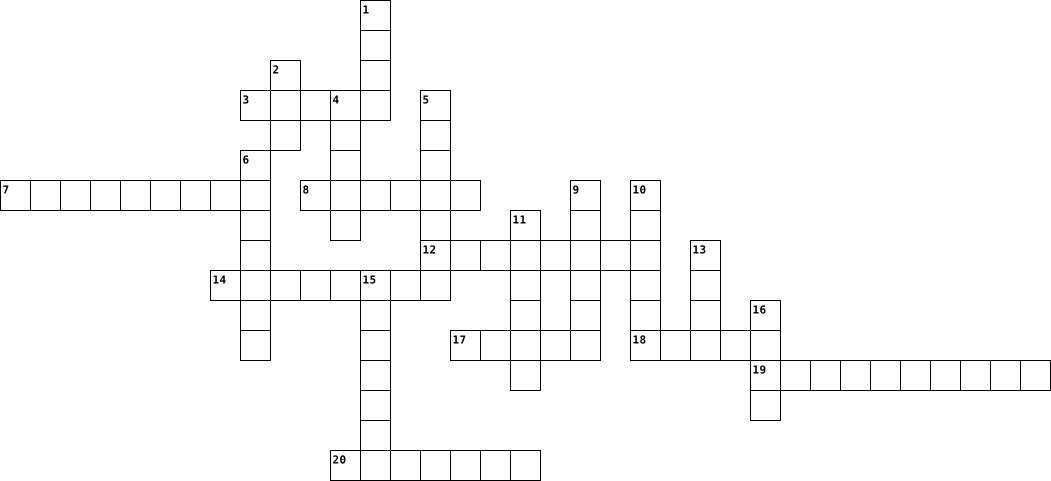
Across
- what is the third planet from the sun?
- flies
- is used to draw
- has a trunk
- is the favourite car
- what is the hottest planet in the solar system?
- is the fastest moving bike
- is the luxurias car
- what is the smallest planet in the solar system?
Down
- August Independence day is celebrated
- rotates for air
- is the national animal
- what is the largest planet in the solar system?
- is the national bird
- the chemical element uranium was named after what planet?
- the sixth planet from the sun features an expensive ringsystem?
- is the Costly phone
- the king of jungle
- what planet in the solar system is farthest from the sun?
- what planet is nick named red planet?
20 Clues: flies • has a trunk • rotates for air • is used to draw • the king of jungle • is the Costly phone • is the luxurias car • is the national bird • is the favourite car • is the national animal • is the fastest moving bike • August Independence day is celebrated • what planet is nick named red planet? • what is the third planet from the sun? • what is the largest planet in the solar system? • ...
Space Adventures 2016-06-06

Across
- Brightest star in the Solar System
- Dwarf planet between Mars and Jupiter
- Famous British astronaut
- Largest planet in the Solar System
- The planet has 14 moons
- Coldest planet in the Solar System
Down
- Hottest planet in the solar system
- Also called the Red Planet
- First astronaut to land on Moon
- Name of our Galaxy
- Has the biggest astroid belt in the solar system
- Orbits the sun at the fastest speed
- Is considered a dwarf planet no
- Only planet where life forms exist
14 Clues: Name of our Galaxy • The planet has 14 moons • Famous British astronaut • Also called the Red Planet • First astronaut to land on Moon • Is considered a dwarf planet no • Hottest planet in the solar system • Brightest star in the Solar System • Largest planet in the Solar System • Only planet where life forms exist • Coldest planet in the Solar System • ...
Hoe om 'n superheld te wees - Bubele Retshe 2024-04-15

Across
- Teenoorgestelde van 'op'.
- Sy lees vir Timo stories.
- Sinoniem van 'onmiddelik'.
- Timo eet dit wanneer hy huis toe kom.
- Noma het dit in haar rugsak.
Down
- Timo se beste plek.
- Kan jou baie dinge leer.
- Timo wil dit wees.
- Teenoorgestelde van 'nadat'.
- Wat wil Noma eendag wees?
10 Clues: Timo wil dit wees. • Timo se beste plek. • Kan jou baie dinge leer. • Teenoorgestelde van 'op'. • Sy lees vir Timo stories. • Wat wil Noma eendag wees? • Sinoniem van 'onmiddelik'. • Teenoorgestelde van 'nadat'. • Noma het dit in haar rugsak. • Timo eet dit wanneer hy huis toe kom.
Deuternomium 25 2023-04-27

Across
- Doen so in swaer se gesig
- 'n Broer sluit met 'n skoonsuster so 'n huwelik
- Hy moet uitgeroei word
- Regter doen so
- Ook die stene moet eenders wees
- Amalek het Hom nie gevrees
Down
- Ind die agterhoede is hul verslaan
- Twis tussen hulle
- Van sy voete aftrek
- Gryp 'n man aan die dele en verloor jou hand
- Volle en regte gewig
- Maksimum aantal slae
12 Clues: Regter doen so • Twis tussen hulle • Van sy voete aftrek • Volle en regte gewig • Maksimum aantal slae • Hy moet uitgeroei word • Doen so in swaer se gesig • Amalek het Hom nie gevrees • Ook die stene moet eenders wees • Ind die agterhoede is hul verslaan • Gryp 'n man aan die dele en verloor jou hand • 'n Broer sluit met 'n skoonsuster so 'n huwelik
Solar Energy Crossword Puzzle 2025-05-16

Across
- Measure of electrical power
- Solar panels are usually placed on this part of a house
- the bright star in the middle of our solar system that
- The type of energy solar panels convert sunlight into
- created the first solar cell in 1883 using selenium
- Radiant energy from the sun
- The material that is commonly used in solar cells.
Down
- What does AC stand for?
- The movement of heat from the sun to Earth
- Devices that are used to absorb the sun's heat and convert it into electricity
- The science of energy from the sun
- The process of converting sunlight to electricity
- The transparent part of the solar panel that protects the cells
- A kind of energy that can be replenished naturally
- What does DC stand for?
15 Clues: What does AC stand for? • What does DC stand for? • Measure of electrical power • Radiant energy from the sun • The science of energy from the sun • The movement of heat from the sun to Earth • The process of converting sunlight to electricity • A kind of energy that can be replenished naturally • The material that is commonly used in solar cells. • ...
Solar System 2020-09-30

Across
- Saturn's largest moon
- fastest moving planet around the Sun
- large storm on Jupiter more than 400 years old is called the ____ ____ spot (two words)
- first dwarf planet ever discovered
- another name for a moon. Also could be artificial and used for GPS navigation
- planet who's orbit is crossed by Pluto
- giant storm that was detected on Neptune was the ___ ___ spot (two words)
- number of dwarf planets in the solar system
- largest crater on Mercury. (two words)
- planet with more mass than the rest combined
- name of the newest large rover on the surface of Mars
- this belt is located beyond Neptune (two words)
- largest canyon on Mars. (two words)
- largest volcano in the Solar System (two words)
- one of the moons of Mars
- planet most likely to be visited by humans
- only planet with liquid water on its surface
Down
- this belt of objects is located between Mars and Jupiter (two words)
- moon of Saturn with tiger stripes and ice geysers
- dwarf planet with 2 moons
- number of planets with rings
- dwarf planet with a repetitive name
- he discovered Jupiter's four largest moons
- number of ice giant planets
- the average distance between the Earth and the Sun (two words)
- largest moon in the Solar System
- Neptune's largest moon
- moon of Uranus that looks like it shattered
- planet that is greatly tilted
- name of the helicopter on Mars
- most heavily cratered moon of Jupiter
- dwarf planet with 5 moons
- dwarf planet whose discovery led to Pluto's demotion
- source of light for the Solar system
- one of the moons of Mars
- name of the division in Saturn's rings
- hottest planet in the Solar System
- the most volcanically active moon in the solar system
- moon of Jupiter that might have life
- planet less dense than water
40 Clues: Saturn's largest moon • Neptune's largest moon • one of the moons of Mars • one of the moons of Mars • dwarf planet with 2 moons • dwarf planet with 5 moons • number of ice giant planets • number of planets with rings • planet less dense than water • planet that is greatly tilted • name of the helicopter on Mars • largest moon in the Solar System • first dwarf planet ever discovered • ...
Solar System 2020-11-24

Across
- A burst of brilliant light from a black hole
- Mercury, Venus, Earth, and Mars
- the seventh planet from the sun
- A lump of ice, rock, frozen gas, and dust that orbits the sun
- The center of our solar system
- The planet on which we live
- Used to measure distance in space; equal to the distance light travels in one year
- A cloud of dust and gas that becomes a star
- A group of stars, gases, and dust held together by gravity and that travels through space
- Curved path of a satellite around another body in space
- Massive star that has collapsed and pulls everything in, even light.
- The planet closest to the sun
- Planet recently downgraded to a dwarf planet
- Dark area on the sun that is cooler than its surroundings
Down
- Jupiter, Saturn, Uranus, Neptune, Pluto
- Usually the eighth planet from the sun
- A small meteroid that burns up in Earth’s atmosphere
- The sixth planet from the sun
- Our home in space
- A ball of gases that gives off light and heat
- The largest planet
- Nicknamed the “red planet”
- Between Mars and Jupiter, where most asteroids are found
- The second planet from the sun
- Groups of stars that form patterns in the sky
25 Clues: Our home in space • The largest planet • Nicknamed the “red planet” • The planet on which we live • The sixth planet from the sun • The planet closest to the sun • The center of our solar system • The second planet from the sun • Mercury, Venus, Earth, and Mars • the seventh planet from the sun • Usually the eighth planet from the sun • Jupiter, Saturn, Uranus, Neptune, Pluto • ...
Solar System 2021-10-05

Across
- The act of force between 2 objects
- Earth centered model
- Made up of ice, rock, and cosmic dust
- The path of an object as it revolves around another object in space
- Beautiful rings
- The study of moon, stars, and other objects in space
- Meteoroid that has entered earth's atmosphere
- Largest planet in the solar system
- Rocky debris that revolves around the sun
Down
- Any object that revolves around another object in space
- The Red Planet
- Space rock
- Meteoroid that hit the earth's surface
- A scientist that studies the universe beyond earth
- Sun centered model
- Changed to a dwarf planet in 2016
- Has small dark spots and many moons
- Hottest planet
- Only planet with life
- Orbits the sun on its side
- Closest planet to the sun
21 Clues: Space rock • The Red Planet • Hottest planet • Beautiful rings • Sun centered model • Earth centered model • Only planet with life • Closest planet to the sun • Orbits the sun on its side • Changed to a dwarf planet in 2016 • The act of force between 2 objects • Largest planet in the solar system • Has small dark spots and many moons • Made up of ice, rock, and cosmic dust • ...
Solar System 2022-03-25

Across
- a natural or artificial body that revolves around a planet
- a small, rocky object that orbits the sun, usually in a band between the orbit of Jupiter and Mars
- Any of the nine primary bodies that orbit the sun; a similar body that orbits another star
- an object so massive and dense that not even light can escape its gravity
- a accumulation of matter
- a model for the formation of the solar system in which the sun and planets condense from a cloud (or nebula) of gas and dust
- a collection of stars, dust and gas bound together by gravity
- a gigantic explosion in which a massive star collapses and throws its outer layers into space; plural supernovae
- a large celestial body that is composed of gas and emits light; the sun is a typical star
- one of the highly dense planets nearest to the sun; Mercury, Venus, Earth, and Mars
- the distance that light travels in one year; about 9.5 trillion kilometers
Down
- a small, hot, dim star that us the leftover center of an old star
- the change in the illuminated area of one celestial body as seen from another celestial body;phases of the moon are caused by the position of Earth,the sun,and the moon
- a planet that has a deep, massive atmosphere, such as Jupiter, Saturn, Uranus, or Neptune
- an event in which the shadow of one celestial body falls on another
- contains the sun and all of the planets and other bodies that travel around in it
- a large, reddish star late in it's life cycle
- a group of stars bound by gravity
- the portion of Earth that is water
- a small body of ice, rock, and cosmic dust loosely packed together that follows an elliptical orbit and that gives off gas and dust in the form of a tail as it passes close to the sun
- a large cloud of dust and gas in interstellar space; a region in space where stars are born or where stars explode at the end of their lives
21 Clues: a accumulation of matter • a group of stars bound by gravity • the portion of Earth that is water • a large, reddish star late in it's life cycle • a natural or artificial body that revolves around a planet • a collection of stars, dust and gas bound together by gravity • a small, hot, dim star that us the leftover center of an old star • ...
solar system 2021-12-02

Across
- largest moon of mars
- on its side
- the earths only moon (english name)
- largest planet
- most distant dwarf planet currently
- shaped like an oval
- has very noticeable rings
- most famous eTNO
- volcanically active moon
- hottest planet
- jupiters moon that might have life
- known as the red planet
Down
- first planet from the sun
- has a heart thing on its surface
- smallest moon of mars
- dwarf planet in the asteroid belt
- farthest spacecraft from the earth
- farthest planet
- planet we live on
- largest moon
- most cratered object
- red dwarf planet
22 Clues: on its side • largest moon • largest planet • hottest planet • farthest planet • most famous eTNO • red dwarf planet • planet we live on • shaped like an oval • largest moon of mars • most cratered object • smallest moon of mars • known as the red planet • volcanically active moon • first planet from the sun • has very noticeable rings • has a heart thing on its surface • ...
solar energy 2022-01-19

Across
- or the electromagnetic radiation emitted by the sun
- you can make a bomb out of it
- something that can be polluted
- a type of electric plant
- something that gets rid of the dark
- a type of strength
- a compound or substance that has been purified or prepared, especially artificially.
- something that can pollute the sky
- a type of energy
- something that absorbents energy
- type of thing to power something
- heat within the earth
Down
- relating to or denoting the generation of electricity using flowing water
- something that can power a water wheel
- it powers a wind wheel
- a type of of good gas from the environment
- it is in the sky
- it comes with hot and cold
- it comes from lightning
- an energy source that cannot be depleted and are able to supply a continuous source of clean energy.
- outside
- a type of thing that can fill up your car
- the wheel of a wind wheel
- energy from the sun
24 Clues: outside • it is in the sky • a type of energy • a type of strength • energy from the sun • heat within the earth • it powers a wind wheel • it comes from lightning • a type of electric plant • the wheel of a wind wheel • it comes with hot and cold • you can make a bomb out of it • something that can be polluted • something that absorbents energy • type of thing to power something • ...
Solar System 2022-02-28

Across
- : only natural satellite
- belt
- :all existing matter and space considered as a whole
- :the fourth planet from the sun
- :a minor planet of the inner Solar System
- :a planet whose orbit lies outside the
- :a celestial body resembling a small planet but lacking certain technical criteria that are required for it to be classed as such
- :A planet whose orbit lies within the
- :relating to the earth
- : the biggest star seen to the human eye
- :a system of millions or billions of stars, together with gas and dust, held together by gravitational attraction
Down
- :the sixth planet from the sun
- :the second planet from the sun
- :the fifth planet from the sun
- :a large planet of relatively low density consisting predominantly of hydrogen and helium
- :a cloud of comets and other objects.
- :the only known planet that can support
- :any of the large bodies that revolve around the sun in the solar system
- planets Jupiter and Mars
- belt
- : located roughly between the orbits of
- :the closet planet to the sun
- :the seventh planet from the sun
23 Clues: belt • belt • :relating to the earth • : only natural satellite • planets Jupiter and Mars • :the closet planet to the sun • :the sixth planet from the sun • :the fifth planet from the sun • :the second planet from the sun • :the fourth planet from the sun • :the seventh planet from the sun • :a cloud of comets and other objects. • :A planet whose orbit lies within the • ...
solar system 2022-02-15

Across
- a dwarf planet that used to be considered a main planet
- named after a roman goddess meaning love and beauty
- an force attraction between to objects revolution the movement of one object in its orbit around another object in space
- an envelope of gas surrounding a body in space
- known as the gas giant
- natural satellite
- closest planet to the sun
- named after the greek god of the sky
- every galaxy come together form this
- the planet we are living on
Down
- has the largest mass by far
- next closest solar system
- hottest star
- body of gas that shines by radiation in the sky also called the celestial sphere
- minor planet of the inner Solar System
- our solar system
- large bodies in space that orbit the sun
- cosmic clumps of frozen gases, rocks or debris orbiting the sun
- the path a satellite follows as it revolves
- referred as the red planet
- farthest planet from the sun
21 Clues: hottest star • our solar system • natural satellite • known as the gas giant • next closest solar system • closest planet to the sun • referred as the red planet • has the largest mass by far • the planet we are living on • farthest planet from the sun • named after the greek god of the sky • every galaxy come together form this • minor planet of the inner Solar System • ...
solar system 2022-02-15

Across
- next closest solar system
- the path a satellite follows as it revolves
- an envelope of gas surrounding a body in space
- referred as the red planet
- the planet we are living on
- has the largest mass by far
- named after a roman goddess meaning love and beauty
- areas on the sun that give off less energy
- the distance light travels in one yearnebula a cloud of gas and dust in space
- hottest star
- our solar system
- known as the gas giant
Down
- farthest planet from the sun
- every galaxy come together form this
- cosmic clumps of frozen gases, rocks or debris orbiting the sun
- an force attraction between to objects revolution the movement of one object in its orbit around another object in space
- natural satellite
- large bodies in space that orbit the sun
- a dwarf planet that used to be considered a main planet
- closest planet to the sun
- minor planet of the inner Solar System
- body of gas that shines by radiation in the sky also called the celestial sphere
- named after the greek god of the sky
23 Clues: hottest star • our solar system • natural satellite • known as the gas giant • next closest solar system • closest planet to the sun • referred as the red planet • the planet we are living on • has the largest mass by far • farthest planet from the sun • every galaxy come together form this • named after the greek god of the sky • minor planet of the inner Solar System • ...
Solar System 2022-02-24

Across
- no longer classified as a planet
- called “the red planet”
- one of mars’ moons
- god of water
- bright fire ball that planets revolve around
- has a red spot
- smallest planet
- Neptune’s most famous moon
- our solar system
- object that orbits a planet
- international space station
Down
- a planet made out of gas
- the star in the middle of our solar system
- went between Neptune and Uranus in 1989
- only planet named after a female god
- second largest planet
- a type of planet that is made of rock
- discovered that the planets orbit the sun
- Saturn’s largest moon
- 8th planet from the sun
- the only planet that supports life
21 Clues: god of water • has a red spot • smallest planet • our solar system • one of mars’ moons • second largest planet • Saturn’s largest moon • called “the red planet” • 8th planet from the sun • a planet made out of gas • Neptune’s most famous moon • object that orbits a planet • international space station • no longer classified as a planet • the only planet that supports life • ...
Solar System 2017-05-03

Across
- Our solar system is part of this galaxy
- Planet named after the Roman goddess of love and beauty
- A planet with large rings around it that is sixth from the Sun.
- The Blue planet
- The Earth____ on its axis
- Closest star to Earth
- A single turn of something around an axis or a fixed point; spinning.
- Now called a dwarf planet
- A single journey along an orbital path. It takes Earth 365 1/4 days to do this around the sun.
- Layer of gas that surrounds a planet
- Distance traveled by light in a vacuum in one tropical year
- The Earth is the ______ planet from the Sun
Down
- A small reddish planet that is fourth from the Sun; a terrestrial planet,
- A large blue-green planet that is seventh from the Sun
- must be round, orbit the sun, and have cleared the region of the solar system along its orbit
- Covers 70 percent of the Earth's surface
- Planet farthest from the sun
- Force that keeps a planet moving in orbit
- small bodies formed by rock and ice
- Smaller bodies in orbit around the Sun
- Caused by the Gravitational pull of the sun and moon on the Earth
- Largest planet in the Solar System
- Earth's only natural satellite
- This means to revolve around another object. Our Moon does this to Earth.
24 Clues: The Blue planet • Closest star to Earth • The Earth____ on its axis • Now called a dwarf planet • Planet farthest from the sun • Earth's only natural satellite • Largest planet in the Solar System • small bodies formed by rock and ice • Layer of gas that surrounds a planet • Smaller bodies in orbit around the Sun • Our solar system is part of this galaxy • ...
Solar System 2017-06-16

Across
- Saturns rings are made of dust, rock, and _____
- has two moons called Phobos and Deimos
- a small dwarf planet found beyond Neptune's orbit
- _____ planets - four planets furthest from the sun
- One year on this planet lasts 88 days
- type of planet found outside our solar; not orbiting a sun
- The centre of our solar system
- _____ planets are also known as 'Gas Giants'
- small rocky bodies floating in space, smaller than Earth' moon
- Earth's natural satellite
- the biggest planet and has a big red eye
- Ceres Pluto Haumea and Eris are these small type of planets
- _____ planets - four planets found inside the asteroid belt
Down
- a dwarf planet found in the asteroid belt
- Asteroid _____ a region of space between Mars and Jupiter
- Second largest planet. It has large rings.
- A dirty snowball made of ice, dust, dirt with a bright tail
- A US spacecraft visiting Jupiter and Saturn
- the coldest of all the planets
- _____ Comet - revisits our solar system every 75 years
- 10m wide, rocky body, traveling through outer space.
- ______ Moons are the 4 largest moons of Jupiter
- has 167 large volcanoes and is the hottest of all planets
- a planet with 13 moons and a icy atmosphere
- _______ Huygens is an orbiter that takes pictures of Saturn
- this planet is 70% water
26 Clues: this planet is 70% water • Earth's natural satellite • the coldest of all the planets • The centre of our solar system • One year on this planet lasts 88 days • has two moons called Phobos and Deimos • the biggest planet and has a big red eye • a dwarf planet found in the asteroid belt • Second largest planet. It has large rings. • A US spacecraft visiting Jupiter and Saturn • ...
Solar System 2012-11-21

Across
- is a physical model,of an object that is larger or smaller than the actual size of the object, which seeks to maintain the relative proportions of the physical size of the original object.
- the clockwise spin of a planet or moon as seen from above the planet's North Pole
- a gigantic explosion in which a massive star collapses and throws its outer layers into space
- the average distance between the earth and the sun approximately 150 million km
- a large spherical celestial body that regularly rotates around a star
- the counterclockwise spin of a planet or moon as seen from above the planet's North Pole
- rough measurement using depth perception as how something far something far from the viewer looks small
- a small, rocky object that orbits the sun, usually in a band between the orbits of Mars and Jupiter
- The distance that light travels in one year; 9.46 trillion km
- a natural or artificial body tht revolves around a planet
- area of the solar system between the orbits of Mars and Jupiter filled with astroids.
- a relatively small,rocky body that travels through space
Down
- a large,reddish star late in its life cycle
- a region in space where stars are born or where stars explode at the end of their lives
- The distance that light travels in one minute;18,000,000km
- a small,hot,dim star that is the leftover center of an old star
- a small body of ice, rock, and cosmic dust that follows an elliptical orbit around the sun and that gives off gas and dust in the form of a tail as it passes close to the sun
- one of highly dense planets nearest the sun:Mercury,Venus,Earth,and Mars
- a planet that has a deep,massive atmosphere,such as Jupiter,Saturn,Uranus,or Neptune
- celestial body that is nearly spherical but doesn't meet requirement to be a planet
- a meteoroid that reaches the Earth's surface without burning up completely
- a bright streak of light that results when a meteoroid burns up in the Earth's atmosphere
- a collection of stars,dust,and gas bound together by gravity
- a mixture of gasses that surrounds a planet or moon
- the sun, the planets,and many more small objects
- width of a circle
26 Clues: width of a circle • a large,reddish star late in its life cycle • the sun, the planets,and many more small objects • a mixture of gasses that surrounds a planet or moon • a relatively small,rocky body that travels through space • a natural or artificial body tht revolves around a planet • The distance that light travels in one minute;18,000,000km • ...
Solar Crossword 2012-05-15

Across
- 3D semi circle
- ovel type shape
- hand widths
- 1 year
- zenith highest point in the sky
- invisible model in the sky
- 90°
- meridian A.M.
- Happens twice a year when the sun reaches its highest point in the sky
- maths term for average
- 180°
- the motion of the Earth
- 0° and 360°
- A ........ of time
Down
- 270°
- the path of the sun
- the plane passing through the equator of the Earth
- compass points
- north, south, east, west
- the closest point towards the Earth
- the sun and the seasons
- slow top wobbling on top of the Earth
- 24hours
- meridian P.M.
- the furtherest point away from the Earth
- The seasons are caused by the Earth's .......
26 Clues: 90° • 270° • 180° • 1 year • 24hours • hand widths • 0° and 360° • 3D semi circle • compass points • meridian P.M. • meridian A.M. • ovel type shape • A ........ of time • the path of the sun • maths term for average • the sun and the seasons • the motion of the Earth • north, south, east, west • invisible model in the sky • zenith highest point in the sky • the closest point towards the Earth • ...
Solar cooking 2014-01-11

Across
- very thick paper that is usually used for making boxed.
- slowly take in
- a piece of kitchen equipment, usually containing an oven, used to cook food.
- a nation that is economically weak but growing.
- to cause (someone) to stop breathing by squeezing the throat
- a piece of equipment that is used to cook food.
- either one of the two organs that people and animals use to breathe air
- movable; capable of being carried or moved around.
- refers to something that is of or related to the sun
- to be carried or transferred by water
- the way something feels according to sense of taste or touch.
Down
- a scientist who studies very small living things, such as bacteria.
- an agency of the United Nations that works to improve global health conditions.
- a soft substance used in candles.
- to heat something at a controlled temperature in order to kill disease-causing elements is to......
- is a hard, black substance that is burned for energy.
- is a meeting of people to lean more about a particular subject.
- one of the people who started an organisation; the first in group
- the cutting down of trees in large areas.
- the degree of thickness, softness, etc.
- turn from a solid into something soft or liquid.
- substances that release energy when burned
22 Clues: slowly take in • a soft substance used in candles. • to be carried or transferred by water • the degree of thickness, softness, etc. • the cutting down of trees in large areas. • substances that release energy when burned • a nation that is economically weak but growing. • a piece of equipment that is used to cook food. • turn from a solid into something soft or liquid. • ...
solar earth 2014-09-05

Across
- something in 360 degrees
- plane a circle on the same as the planes.
- sphere an imaginary sphere of an investigation
- a session or time
- when day and night time are the same duration
- apsis
- an instrument for direction
- a round vault
- a measurement of a sphere
- a period of a turning axis
- a the opposite of north
Down
- a point or least greatest in body
- a turn
- day a time between meridian transits and the sun
- orientation of a rotational axis
- the line that goes horizontally in an east to west direction
- an event twice a year
- a half imaginary line
- meridian of or pertaining to afternoon
- a a direction easterly
- a curve on a plane
- a very small rotation
- a straight direction
23 Clues: apsis • a turn • a round vault • a session or time • a curve on a plane • a straight direction • an event twice a year • a half imaginary line • a very small rotation • a a direction easterly • a the opposite of north • something in 360 degrees • a measurement of a sphere • a period of a turning axis • an instrument for direction • orientation of a rotational axis • ...
solar system 2014-03-23

Across
- when our view of an object is blocked by either another object or the Earths shadow
- when the moon is more than half full but less than completley full
- takes about 365 days to orbit the sun
- shortest days of the year (June22 and December22)
- beautiful lights seen over the polar regions
- an object moving around a star
- a meteorite that is stoney
- a small,frozen cluster of dust which orbits the sun
- known as the red planet
- a self-luminous object
- a shooting star
- the study of the universe
- farthest planet from the sun
- fifth planet from the sun
- Meaning equal day and equal night
- center of solar system
Down
- an imaginary line on which an object rotates
- the distance in which a ray of light would travel in one year
- our galaxy
- famous for its rings
- a group of stars given names by ancient astronomers
- a small rocky body orbiting the sun
- when something is moving in a circle around another object
- darkening of the moon
- a brief eruption of intense high-energy radiation from the sun's surface
- when an object is spinning it is said to be rotating
- closest planet to the sun
- dwarf planet
- dark spots on the sun
- a group of stars, gas and dust that is held together by gravity
- known as our twin
31 Clues: our galaxy • dwarf planet • a shooting star • known as our twin • famous for its rings • darkening of the moon • dark spots on the sun • a self-luminous object • center of solar system • known as the red planet • closest planet to the sun • the study of the universe • fifth planet from the sun • a meteorite that is stoney • farthest planet from the sun • an object moving around a star • ...
Solar System 2023-03-12

Across
- made of ice rock and dust
- hottest planet due to its thick CO2 atmosphere
- the planet most like Earth
- robot explorers
- farthest planet from the sun
- closest planet to the sun
- large chunks of rock and metal mostly between Mars and Jupiter
- the only planet that can support life
- a meteoroid that enters Earth's atmosphere aka shooting star
- manned spacecraft that leaves for long time
- satellites that orbit sun
Down
- manned spacecraft for shorter stays
- largest collection of telescopes found here
- the largest planet and has bands of blowing winds
- small pieces of rock and metal that break off comets or asteroids
- sideways tilted planet with unusual color of gases
- tool made by Galileo to look into space
- planet with rings of rock and ice
- best known dwarf planet
- unmanned spacecraft
- a meteor that reaches Earth's surface
- how planets stay in orbit
- tendency to keep moving in a straight line
- object that orbits around another object
24 Clues: robot explorers • unmanned spacecraft • best known dwarf planet • made of ice rock and dust • closest planet to the sun • how planets stay in orbit • satellites that orbit sun • the planet most like Earth • farthest planet from the sun • planet with rings of rock and ice • manned spacecraft for shorter stays • a meteor that reaches Earth's surface • ...