
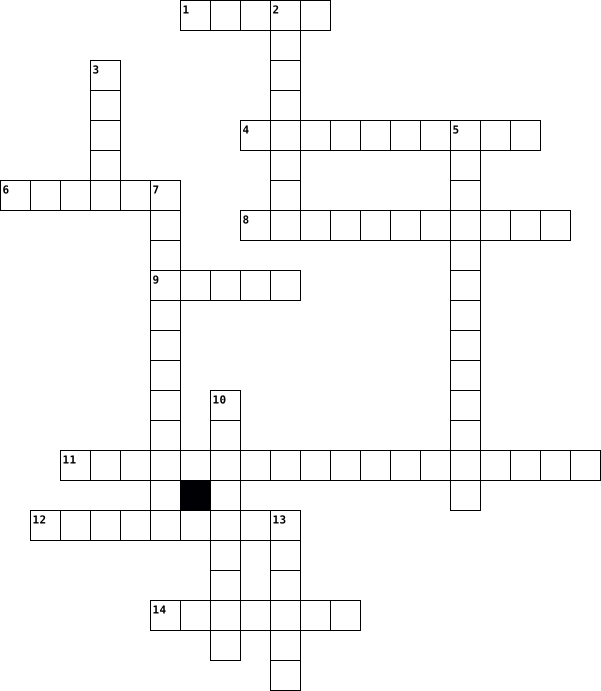
plate tectonics Crossword Puzzles
Plate tectonics 2025-03-05

Across
- How many boundaries are
- When two plates blank
- The earth’s crust and upper mantle are broken
- The less dense plate slides under the more dense plate
- When two oceanic plates are pulling apart
- plates Found at the bottom of the ocean
- it never stops moving
- Sliding past each other
- plates found at the bottom of a continents
- the plastic layer
Down
- The famous trench in the western pacific
- The famous fault
- A hot area in the Earth's mantle
- When ocean plates colliding
- How many plates are there
- Two plates continental plates colliding
- the earth’s crust and upper mantle
- A oceanic plate and a continental plate colliding
- When two continental plates slide
- Something that cracks the earth
20 Clues: The famous fault • the plastic layer • When two plates blank • it never stops moving • How many boundaries are • Sliding past each other • How many plates are there • When ocean plates colliding • Something that cracks the earth • A hot area in the Earth's mantle • When two continental plates slide • the earth’s crust and upper mantle • Two plates continental plates colliding • ...
Plate tectonics 2024-12-17

Across
- mountain or hill, typically conical, has a crater or vent through which lava, rock fragments, hot vapor, and gas are being or have been erupted from the earth's crust.
- bigger eruption then a normal volcano and way bigger too
- any sudden shaking of the ground caused by the passage of seismic waves through Earth's rocks
- the location where two plates meet
- the first layer of earths layers
- the fourth and final layer in earths layers
- crust, mantle, outer core, and inner core
- the pull away between two plates
- formed over convergent boundaries
- the second layer in earths layers
- a fracture or zone of fractures between two blocks of rock.
- a supercontinent
- an elastic wave in the earth produced by an earthquake or other means.
Down
- the rigid outer part of the earth, consisting of the crust and upper mantle.
- when two plates rub against each other
- the third layer in earths layers
- the push against two plates
- is a long high sea wave caused by an earthquake, submarine landslide, or other disturbance.
- tectonics a plate underneath earths surface
- formed when divergent boundaries erupt in the ocean
20 Clues: a supercontinent • the push against two plates • the third layer in earths layers • the first layer of earths layers • the pull away between two plates • formed over convergent boundaries • the second layer in earths layers • the location where two plates meet • when two plates rub against each other • crust, mantle, outer core, and inner core • ...
Plate tectonics 2024-12-16

Across
- The sliding down of rock or earth from a cliff or mountain
- earthquakes under the ocean cause this
- Coming together
- When stress builds, then releases, violently shaking the plates
- Magma exploding through the surface
- Super continent
- When lots of stress builds up, causing rock to break
- A massive slide of mud and earth
- An above average sized volcano
- Dividing
- A force that acts on rock to change shape or volume
Down
- The size of an earthquake or other things
- A big plume of hot mantle, rising from deep in the earth
- Vibrations traveling through earth, carrying energy.
- Volcanoes that are constantly erupting or are going to in the furture
- Magma once it reaches the earths surface
- The point on earths surface directly above the focus of the earthquake
- Melted rock beneath the earths surface
- under water, where 2 plate diverge create this
- Sliding
20 Clues: Sliding • Dividing • Coming together • Super continent • An above average sized volcano • A massive slide of mud and earth • Magma exploding through the surface • earthquakes under the ocean cause this • Melted rock beneath the earths surface • Magma once it reaches the earths surface • The size of an earthquake or other things • under water, where 2 plate diverge create this • ...
plate tectonics 2024-12-16

Across
- caused by all types of faults
- coming together
- how earthquakes are measured
- when a supervolcano erupts leaving this because it blew it's top off
- formed by a hotspot with plate shifting
- mountain of lava
- the law that states that older rock is found below younger rock
- plates what all continents and oceans sit on
Down
- super volcano found in Montana+Wyoming
- south America looks like it could fit into this continent
- ocean crust
- caused by underwater earthquake
- waves some energy released from earthquakes
- volcano very very big volcano
- supercontinent
- dividing
- plume of magma in the ground
- how volcanoes are measured
- sliding
- land crust
20 Clues: sliding • dividing • land crust • ocean crust • supercontinent • coming together • mountain of lava • how volcanoes are measured • how earthquakes are measured • plume of magma in the ground • caused by all types of faults • volcano very very big volcano • caused by underwater earthquake • super volcano found in Montana+Wyoming • formed by a hotspot with plate shifting • ...
Plate Tectonics 2025-09-25

Across
- continental crust containing silica and aluminum
- a sudden violent shaking of the crust
- a vent or opening in the crust from which magma can reach the surface
- a more specific term for the subduction zone
- oceanic crust containing silica and magnesium
- landforms created when continental plates collide
- a force causing plate movement as plates are pulled into subduction zones
- the supercontinent that existed billions of years ago
- scientist who first proposed theory of plate tectonics
- the central layer of the earth formed of iron and nickel
- a layer of the earth containing the crust
- the longest mountain range in the world
- a force causing plates to move away from ocean ridges
- a deep sea landform located where subduction occurs
- the act of one plate being forced under another due to higher density
Down
- an intense area of heat in the mantle that burns through the lithosphere
- Hess' theory that was proved by paleomagnetism
- a ductile layer of the earth in which convection occurs
- a landform created by oceanic-oceanic subduction
- the magnetic alignment of minerals
- the study of ancient magnetism in rock
- a plate boundary where plates move parallel to one another
- found at right angles to ocean ridges- like discs in a spine
- when a recumbent fold collapses on itself
- a landform created when continental plates diverge
- valleys found between horsts
- a large wave caused by underwater tectonic activity
- a block shaped landform created as plates separate
28 Clues: valleys found between horsts • the magnetic alignment of minerals • a sudden violent shaking of the crust • the study of ancient magnetism in rock • the longest mountain range in the world • when a recumbent fold collapses on itself • a layer of the earth containing the crust • a more specific term for the subduction zone • oceanic crust containing silica and magnesium • ...
Plate Tectonics 2026-03-17

Across
- The sudden, violent shaking of the ground caused by the release of energy when teconic plates grind, collid, or slide past one another.
- The gravitational equilibrium between the Earth's crust and the denser, plastic mantle, where the crust "floats" at an elevation determined by its thickness and density.
- The alteration in shape, position, or volume of rocks caused by tectonic stresses, compression, tension, or shear; resulting from plate movement.
- Bends or wraps in layered rock strata resulting from extreme compressional stress, typically occurring at convergent plate boundaries.
- A hot, plastic, and partially molten layer of the upper mantle.
- Large-scale, bowl-shaped depressions in the Earth's crust formed by subsidence related to plate tectonic movements.
- The deformation, change in shape, or change in volume of rock bodies resulting from stress.
- Arch-shaped, convex-upward fold in geological rock layers, with the oldest rocks at the center and younger layers dipping away from the crest.
- The ability of rocks and materials within the Earth's interior to bend, flow, or deform permanently under high pressure and temperature without breaking.
- Concave, U-shaped geological folds formed by tectonic compression, where rock layers dip inward towards a central trough or axis.
- The rigid, brittle, outer shell of the Earth- comprising the crust and upper mantle- divided into 7-8 major and several minor tectonic plates.
Down
- Molten or semi-molton rock located beneath Earth's surface, acting as the primary driver of tectonic activity and new crust formation.
- The force per unit area applied to rocks within the Earth's crust, resulting from plate movements.
- A type of stress that pushes rock masses together, primarily occurring at convergent plate boundaries.
- A fracture or zone of fractures in the Earth's crust along which movement has occurred, typically acting as a boundary between tectonic plates or within a plate.
- The scientific theory that Earth's rigid outer shell is divided into several large and small moving plates.
- The mass per unit volume of rock, determining how plates float on the mantle and interact at boundaries.
- The preserved remains, traces, or impressions of ancient life found in rock layers.
- A type of stress that pulls rocks apart, causing them to lengthen, thin, or break.
- Massive, rigid, irregularly shaped slabs of solid rock composing Earth's outer shell.
20 Clues: A hot, plastic, and partially molten layer of the upper mantle. • A type of stress that pulls rocks apart, causing them to lengthen, thin, or break. • The preserved remains, traces, or impressions of ancient life found in rock layers. • Massive, rigid, irregularly shaped slabs of solid rock composing Earth's outer shell. • ...
plate tectonics 2026-03-12

Across
- A string of volcanoes that form as the result of subduction of one oceanic plate beneath another.
- A deep depression in the ocean floor caused by subduction.
- Wegener's hypothesis that continents slowly move across Earth's surface.
- The rigid outer part of the earth, consisting of the crust and upper mantle.
- The semi-fluid layer of the mantle that tectonic plates move on.
- A plate boundary where two plates move away from each other.
- A deep valley that forms where two continental plates move apart.
- An area where magma from deep within the mantle melts through the crust above it (e.g., Hawaii).
- Molten rock that reaches the Earth's surface.
- The name of the supercontinent that existed 250 million years ago
Down
- An underwater mountain range formed by plate tectonics.
- Molten rock beneath the Earth's surface.
- The process of one plate sinking beneath another into the mantle.
- A plate boundary where two plates move toward each other.
- The point on Earth's surface directly above an earthquake's focus.
- The transfer of heat by the movement of fluid (driving force of plate motion).
- The process that creates new oceanic crust at mid-ocean ridges.
- A plate boundary where two plates slide past each other horizontally.
- Large ocean waves often triggered by underwater earthquakes.
- A break in the Earth's crust where rocks have slipped past each other.
20 Clues: Molten rock beneath the Earth's surface. • Molten rock that reaches the Earth's surface. • An underwater mountain range formed by plate tectonics. • A plate boundary where two plates move toward each other. • A deep depression in the ocean floor caused by subduction. • A plate boundary where two plates move away from each other. • ...
Plate Tectonics 2026-03-20

Across
- oceanic under continental
- chunk of crust
- Where plates meet
- no waves zone
- Silly putty layer
- Second wave
- Location on surface for Earthquakes
- hottest solid core
- thick, granite crust
- exact point of movement
- moving apart
Down
- liquid core
- hot rises, cold sinks
- creator of continental drift
- bottom of ocean
- First wave
- moving together
- top layer
- thin, dense crust
- move past each other
20 Clues: top layer • First wave • liquid core • Second wave • moving apart • no waves zone • chunk of crust • bottom of ocean • moving together • Where plates meet • thin, dense crust • Silly putty layer • hottest solid core • move past each other • thick, granite crust • hot rises, cold sinks • exact point of movement • oceanic under continental • creator of continental drift • ...
Plate Tectonics 2025-10-20

Across
- massive slabs of rock that form the Earth's outer shell
- A long, narrow depression on the seafloor formed due to subduction.
- Where the edge of one plate slides under another denser plate
- a weak to violent shaking of the ground due to tectonic plate movements
- an opening in the Earth's crust where magma, ash, and gas escape from deep within the planet
- the rigid, outermost layer of Earth
- linear zone where the Earth's lithosphere is being pulled apart
- Two plates collide
- a fracture or zone of fractures in the Earth's crust where there has been displacement between two blocks of rock
- Large waves of water due to tectonic plate movements.
Down
- Two plates moving away from each other
- the slow, circular movement of hot rock in the Earth's mantle that drives the movement of tectonic plates.
- Two plates slide beside each other
- A thick layer of rock between the Earth's crust and core that drives the movement of tectonic plates.
- The central part of the Earth
- The supercontinent
- a tectonic belt of volcanoes and earthquakes
- Molten rock that has erupted on to earth's surface
- a theory that the continents were together in a supercontinent, but drifted to different places overtime.
- the molten rock mixture found beneath the Earth's surface
- the solid, rocky outer shell of the Earth that is broken into tectonic plates
21 Clues: The supercontinent • Two plates collide • The central part of the Earth • Two plates slide beside each other • the rigid, outermost layer of Earth • Two plates moving away from each other • a tectonic belt of volcanoes and earthquakes • Molten rock that has erupted on to earth's surface • Large waves of water due to tectonic plate movements. • ...
Plate Tectonics 2025-11-04

Across
- proposed the theory of plate tectonics
- boundary where plates slide past each other
- these cause earthquakes
- the layer that s-waves stop at
- when oceanic plate plunges underneath continental crust
- Earth's supercontinent
- boundary where plates move apart
- pipes of hot rock that rise through mantle
- movement of the plates over earth's surface
Down
- the outermost mechanical layer
- caused by convection currents in the mantle
- the first supercontinent
- the layer that makes up 68% of earth's mass
- the layer that makes up less than 1% of Earth's mass
- heat is transferred through rapid collisions of atoms
- Activity that occurs within a plate
- Waves that cannot travel through liquid
- worlds most notorious transform fault
- boundary where plates collide
- Fastest waves that move at 4 miles per second
20 Clues: Earth's supercontinent • these cause earthquakes • the first supercontinent • boundary where plates collide • the outermost mechanical layer • the layer that s-waves stop at • boundary where plates move apart • Activity that occurs within a plate • worlds most notorious transform fault • proposed the theory of plate tectonics • Waves that cannot travel through liquid • ...
PLATE TECTONICS 2026-01-21

Across
- Plates pulling apart
- Stationary volcanic source
- Fossil used for dating
- Molten rock underground
- Plates pushing together
- Continental drift scientist
- Earth's rocky outer layer
- Plate sinks below another
- Molten rock aboveground
- Oldest layers on bottom
Down
- Theory of plate movement
- Rock containing fossils
- Layer below the crust
- Deepest ocean feature
- Preserved ancient remains
- Folded crustal uplift
- Sudden crustal movement
- Single giant landmass
- Plates sliding past
- Underwater mountain chain
20 Clues: Plates sliding past • Plates pulling apart • Layer below the crust • Deepest ocean feature • Folded crustal uplift • Single giant landmass • Fossil used for dating • Rock containing fossils • Molten rock underground • Plates pushing together • Sudden crustal movement • Molten rock aboveground • Oldest layers on bottom • Theory of plate movement • Preserved ancient remains • ...
Plate Tectonics 2026-04-27

Across
- The outer most part of the Earth's geosphere.
- New crust is created here.
- Type of plate boundary where the plates are moving towards each other and colliding.
- Wegener used evidence of ________ on the continents of South America and Africa to show that they were once next to each other.
- Plastic-like layer of the mantle in which the tectonic plates float on top of.
- The term for the super continent that all current continents broke apart from.
- The theory that the youngest rock is created in the middle of the ocean and then gets pushed to the outer part of the ocean and then destroyed.
- Type of plate boundary where the tectonic plate slide passed each other.
- When two oceanic crusts converge, the older and ______ plate subducts under the younger plate.
- The process of one piece of crust sinking under the less sense piece of crust.
- The type of crust that is the least dense.
Down
- Circulation of material where the hotter material rises and the colder material sinks, creating movement.
- Type of plate boundary where the plates are moving away from each other.
- Locations in the ocean where the oceanic crust is subducting under continental crust.
- Land formation that is created when two pieces of continental crust are diverging.
- The scientist who proposed that the continents have moved from their original places.
- The theory of Continental _______ is the theory that the land on Earth has moved and will continue to move. That the land was not always where it is seen today.
- The lithosphere is broken into different pieces that are called _____.
- Land formations that are typically found on the land near and oceanic - continental crust convergent boundary.
- The crust and top part of the mantle are collectively known as the ______.
- The technology used to map the bottom of the ocean floor.
- When two oceanic crusts converge, volcanic ______ can form over time as the magma is forces back up through the crust and cooled.
- When tectonic plates move at transform boundaries it results in what events?
- Type of crust that is the most dense and sinks.
24 Clues: New crust is created here. • The type of crust that is the least dense. • The outer most part of the Earth's geosphere. • Type of crust that is the most dense and sinks. • The technology used to map the bottom of the ocean floor. • The lithosphere is broken into different pieces that are called _____. • ...
Plate Tectonics 2026-02-18

Across
- The rule stating that in layers of rock, the oldest are at the bottom and the youngest are at the top.
- This principle suggests that Earth's features were formed by the same forces—like wind and water—that we observe today.
- The ancient supercontinent that contained all of Earth’s landmasses before they drifted apart
- A plate boundary where crust is neither created nor destroyed, but instead scrapes along its neighbor.
- This phenomenon occurs at divergent boundaries under the ocean, making the Atlantic Ocean wider every year (2 words)
- The scientific theory explaining how Earth’s "puzzle pieces" shift and slide.(2 words)
- The specific area where a denser oceanic plate sinks beneath a lighter continental plate. (2 words)
- Alfred Wegener’s famous idea that the world’s landmasses have slowly shifted across the ocean floor over millions of years (2 words)
- When hot, molten rock squeezes into existing rock layers and cools.
- The raw materials—like mud, sand, and pebbles—that get squeezed together to form new rock layers
Down
- When these massive pieces of Earth's crust collide, pull apart, or grind past each other, they create mountains and volcanoes (2 words)
- The solid, outer layer of Earth consisting of the crust and the very top of the mantle
- A fossil used as a "time stamp" to help scientists identify the specific age of a rock layer. (2 words)
- Often compared to the "pages" of Earth's history book, these are the individual layers of sedimentary rock.
- The type of boundary where tectonic plates divide or move in opposite directions.
- A method used to determine if a rock layer is older or younger than the ones around it without giving a specific age (2 words)
- Unlike relative dating, this method provides a specific number for how many years ago a rock formed
- Unlike weathering, which breaks rocks, this process transports the pieces to a new location.
- Whether it's pulling apart or sliding, this is the physical break where tectonic plates meet and shift.
- This boundary is a "mountain builder," created when two plates push against each other
- This is the only rock type where you are likely to find fossils tucked between its layers.
21 Clues: When hot, molten rock squeezes into existing rock layers and cools. • The type of boundary where tectonic plates divide or move in opposite directions. • The solid, outer layer of Earth consisting of the crust and the very top of the mantle • The scientific theory explaining how Earth’s "puzzle pieces" shift and slide.(2 words) • ...
Plate Tectonics 2026-05-19

Across
- This is the name of the landmass that used to exist, meaning "all earth" in Greek.
- The "trough" of a landform.
- Stress that pushes a mass of rock in two opposite directions.
- A huge hole left by the collapse of a volcanic mountain.
- These were found in both Africa and South America, and supported Wegener's theory of continental drift.
- The point on earth's surface that is directly above the focus.
- This type of plate boundary is caused by ocean floor spreading and creates mid-ocean ridges and volcanic mountains.
- The balance between the crust and the mantle.
- A molten mixture of rock-forming substances, gases, and water from the mantle.
- The "hill" of a landform.
- These volcanoes are currently erupting.
- The innermost layer of the earth, made mostly of iron and nickel.
- This type of volcano is unlike to erupt again.
- This measures and records the magnitude and location of an earthquake using ground movement.
- Located in the Pacific Ocean where numerous earthquakes and volcanoes are located.
- This type of plate boundary is caused by subduction, earthquakes, or volcanoes, and creates trenches and mountains.
Down
- This is the name of the scientist that originally proposed the idea of continental drift.
- A break in the earth's crust where slabs of rock slip past each other.
- The origination of an earthquake inside the earth.
- This type of boundary causes neither new land to be formed or existing land to be subducted.
- This measures the strength of an earthquake in terms of 1.0 to 10.0.
- Lava collects here, the bowl-shaped area that forms around the volcano's vent.
- A mountain that forms where a normal fault uplifts a block of rock.
- The second outermost layer of the earth.
- This is what we call pieces of earth's lithosphere broken into separate sections.
- Volcanic material that has reached the surface.
- These types of waves shake violently back and forth.
27 Clues: The "hill" of a landform. • The "trough" of a landform. • These volcanoes are currently erupting. • The second outermost layer of the earth. • The balance between the crust and the mantle. • This type of volcano is unlike to erupt again. • Volcanic material that has reached the surface. • The origination of an earthquake inside the earth. • ...
SRM 1 / Plate Tectonics 2017-10-22
Across
- Molten rock inside the earth
- A violent shaking of the ground caused by plate tectonics
- These large, flat, pieces of the crust rub together to create earthquakes
- The layer above the asthenosphere. It is composed of the crust and the hard upper mantle
- A large crack in the earth at a plate boundary. They are the results of earthquakes
- The rising and falling of material in the asthenosphere, these cause plate tectonics
- Earthquakes happen at these types of plate boundaries
- This logarithmic scale measures the amount of energy released in an earthquake
Down
- This is a qualitative scale that is based on observations; measures the effects and damage of earthquakes
- The thin, rocky outer layer of the earth above the mantle
- The layer below the lithosphere located in the mid-upper mantle. Convection currents take place here
- These are also known as L-Waves; They travel slower than body waves and cause the most damage
- Plate __________ are the study of the earth's plates and their movements
- The layer below the crust; this layer is the majority of the earth's mass
14 Clues: Molten rock inside the earth • Earthquakes happen at these types of plate boundaries • The thin, rocky outer layer of the earth above the mantle • A violent shaking of the ground caused by plate tectonics • Plate __________ are the study of the earth's plates and their movements • These large, flat, pieces of the crust rub together to create earthquakes • ...
Plate Tectonics 2017-10-17

Across
- These are created when magma cools immediately once erupted from the ridge.
- Movement in a gas or liquid in which the warmer parts move up and the cooler parts move down.
- The remains or impression of a prehistoric organism preserved in petrified form or as a mold or cast in rock.
- What landform is made when two continental plates collide?
- This part of the Earth contains our crust and the upper part of the mantle.
- ________ theorized the continents moved.
- What did scientists use to map out the sea floor?
Down
- A break in the Earth's crust.
- ______ dense materials rise.
- Stitched looking mountain ranges on the seafloor.
- This boundary slides.
- Changes in what affect the ocean floor?
- The ocean floor is brand new every 200 _____ years.
- The supercontinent that formed about 200 million years ago.
- Subduction and seafloor spreading act like a ______.
- Energy caused by the sudden breaking of rock within the earth or an explosion.
- The _______ has convection currents which cause continental drift.
- The crust is ________ dense farther from the mid- ocean ridge.
- Where does oceanic crust bend downward in the ocean floor?
- This boundary divides.
20 Clues: This boundary slides. • This boundary divides. • ______ dense materials rise. • A break in the Earth's crust. • Changes in what affect the ocean floor? • ________ theorized the continents moved. • Stitched looking mountain ranges on the seafloor. • What did scientists use to map out the sea floor? • The ocean floor is brand new every 200 _____ years. • ...
plate tectonics 2017-10-20

Across
- layer of rock on earth's outer skin
- coarse grains with a light color
- Boundary plates come together
- a group of crust and the uppermost mantle in a single layer
- dark, fine, rock
- Boundary plates move apart
- a supercontinent
- Floor Spreading mid ocean ridges add new material all the time and it spreads
- an ancient organism that has been preserved in rock
- a layer of hot rock
Down
- Core molten metal around the inner core
- Core dense ball of hard metal
- the upper layer of the earth's mantle, below the lithosphere
- Drift movement of the continents across the earth's surface
- a break in earths crust where rocks go past each other
- locating objects underwater and measuring the water's depth by sound
- Ocean Ridge mountain ranges
- Boundary plates slip past each other
- Valley pieces of earths crust come together to form a deep valley
- Ocean Trench ocean floor goes into the floor into underwater canyons
20 Clues: dark, fine, rock • a supercontinent • a layer of hot rock • Boundary plates move apart • Ocean Ridge mountain ranges • Core dense ball of hard metal • Boundary plates come together • coarse grains with a light color • layer of rock on earth's outer skin • Boundary plates slip past each other • Core molten metal around the inner core • ...
Plate Tectonics 2017-10-20

Across
- any trace of anything ancient
- a rock that is normally light colored
- supercontinent
- outer skin of the earth
- when somthing goes back into the mantle
- the last layer in our earth
- a deep valley
- the pieces called what?
- wegeners idea that the continents move is called
- mountains under water
- colliding of the plates
Down
- a dark fined grained rock
- generates earthquakes
- force pressing on something
- the earth's motion into a single theory
- separating of the plates
- when the oceanic crust bends down
- a part of the earths inner
- breaks in earths crust
- a device that shows us down far below the ocean
20 Clues: a deep valley • supercontinent • generates earthquakes • mountains under water • breaks in earths crust • outer skin of the earth • the pieces called what? • colliding of the plates • separating of the plates • a dark fined grained rock • a part of the earths inner • force pressing on something • the last layer in our earth • any trace of anything ancient • ...
Plate Tectonics 2018-02-12

Across
- Largest plate in the world.
- A tectonic process when plates move toward each other.
- Boundaries between plates.
- An area of rock that has been bent by stress.
- Soft layer of the mantle.
- Sub marine mountain ridges where new sea floor is created by sea floor spreasing.
- The slope between the outer edge of the continental shelf and teh deep ocean floor.
- A rock formation that is broken.
- When one tectonic plate slides under another causing earthquakes and volcanic eruptions.
- Large movable segments of the lithosphere.
- Outermost layer of earth.
Down
- A layer of earth that is between the crust and the core.
- A tectonic process when plates move away from each other.
- Super continent.
- A form of pressure.
- The rigid outer part of the earth, consisting of the crust and the upper matle.
- German scientist who first proposed the theory of continental drift.
- The theory that continents are in constant motion on the surface of earth.
- The center of earth.
- Underwater landmass which extends from a continent.
20 Clues: Super continent. • A form of pressure. • The center of earth. • Soft layer of the mantle. • Outermost layer of earth. • Boundaries between plates. • Largest plate in the world. • A rock formation that is broken. • Large movable segments of the lithosphere. • An area of rock that has been bent by stress. • Underwater landmass which extends from a continent. • ...
Plate Tectonics 2022-01-12

Across
- the chemistry of the earth's crust
- evidence
- the earliest eon in the history of the Earth from the first accretion of planetary material (around 4,600 million years ago) until the date of the oldest known rocks (about 3,800 million years ago); no evidence of life
- the phenomena associated with volcanic activity
- relating to or occurring or living in or frequenting the open ocean
- movement of the edge of one tectonic plate under another
- a salt or ester derived from silicic acid
- molten rock in the earth's crust
- the longest unit of geological time
- relating to ocean depths from 2000 to 5000 meters
- subject to or caused by an earthquake or earth vibration
Down
- a geologist who uses physical principles to study the properties of the earth
- relating to the earliest known rocks formed during the Precambrian Eon
- the branch of geology studying the folding and faulting of the earth's crust
- the regions of the Earth where living organisms exist
- use again after processing
- a grey tetravalent metallic element that resembles zirconium chemically and is found in zirconium minerals; used in filaments for its ready emission of electrons
- a specialist in the history of the Earth recorded in rocks
- the process of covering the earth with glaciers or masses of ice
- relating to or characteristic of the crust of the earth or moon
- atom with same atomic number, different number of neutrons
21 Clues: evidence • use again after processing • molten rock in the earth's crust • the chemistry of the earth's crust • the longest unit of geological time • a salt or ester derived from silicic acid • the phenomena associated with volcanic activity • relating to ocean depths from 2000 to 5000 meters • the regions of the Earth where living organisms exist • ...
Plate tectonics 2021-12-17

Across
- The type of crust lying under the oceans of the world
- the outermost layer of Earth.
- A dropped zone where two tectonic plates are pulling apart
- The innermost layer of the earth, an extremely hot, solid sphere of mostly iron and nickel
- A raised area or mountain range under the oceans formed
- separate
- one plate going under another
- It is the only liquid layer, a sea of mostly iron and nickel
- continents were joined together in one large landmass
- A layer of the earth's crust that lies under the seven continents
Down
- the solid outer part of Earth that includes the crust and upper mantle
- two tectonic plates grind past each other in a horizontal direction
- The border between two tectonic plates
- when an oceanic plate sinks underneath a
- a slowly flowing layer of solid and melted rock formed by heat and pressure
- collide
- molten hot rock
- melted rock on Earth’s surface
- two plates slide against each other
- The process that forms new ocean floor and oceanic crust
20 Clues: collide • separate • molten hot rock • the outermost layer of Earth. • one plate going under another • melted rock on Earth’s surface • two plates slide against each other • The border between two tectonic plates • when an oceanic plate sinks underneath a • The type of crust lying under the oceans of the world • continents were joined together in one large landmass • ...
Plate tectonics 2021-12-17

Across
- ‐ An area where oceanic crust and continental crust are colliding
- when an oceanic plate sinks underneath a
- one plate going under another
- a slowly flowing layer of solid and melted rock formed by heat and pressure
- melted rock on Earth’s surface
- molten hot rock
- collide
- the outermost layer of Earth.
- A dropped zone where two tectonic plates are pulling apart
- the solid outer part of Earth that includes the crust and upper mantle
- The process that forms new ocean floor and oceanic crust
Down
- The border between two tectonic plates
- It is the only liquid layer, a sea of mostly iron and nickel
- The type of crust lying under the oceans of the world
- separate
- A raised area or mountain range under the oceans formed
- two tectonic plates grind past each other in a horizontal direction
- continents were joined together in one large landmass
- two plates slide against each other
- A layer of the earth's crust that lies under the seven continents
- The innermost layer of the earth, an extremely hot, solid sphere of mostly iron and nickel
21 Clues: collide • separate • molten hot rock • one plate going under another • the outermost layer of Earth. • melted rock on Earth’s surface • two plates slide against each other • The border between two tectonic plates • when an oceanic plate sinks underneath a • The type of crust lying under the oceans of the world • continents were joined together in one large landmass • ...
Plate Tectonics 2020-05-19

Across
- a thicker but less dense crust making up the earth's land
- a supercontinent that existed about 550 milion years ago
- the rising of oceanic crust caused by a convergent boundary
- an invisible field surrounding the earth which is responsible for electromagnetic activity on the planet
- the second and thickest layer of the earth which is made up of magma
- a common metal believed to be found inside of the earth's outer core
- a common metal found inside of the earth's cores
- molten rock found upon the earth's surface
- the final and innermost layer of the earth which is made up of solid metals
- a type of volcano distinguised by a large and flat dome-like base
- the shaking of the earth's crust due to tectonic movements
- a type of volcano distinguished by a standard base but cone-shaped peak
- molten rock found within the earth's crust and mantle
- the outermost and thinnest layer of the earth which is made up of solid rocks
- a boundary in which two tectonic plates collide
- the area between two tectonic plates
- a large and devastating wave caused by tectonic activity
- the separation and spreading of oceanic crust found upon a divergent boundary
Down
- a boundary in which two tectonic plates move apart
- a thin and dense crust found below the earth's oceans
- a boundary in which two tectonic plates slide against eachother
- a supercontinent that existed about 335 million years ago
- a fracture between sets of rock or plates
- the movement of earth's crust due to the movement of tectonic plates
- large rocks that move around underneath the earth's crust
- a scale to measure the severity of an earthquake
- the upper section of the earth's mantle and the crust
- a type of volcano distuinguished by a recognisable and extremely tall cone shape
- currents found within the mantle caused by the rising and falling of heat in the magma
- the third layer of the earth which is made up of liquid metals
- a mountainous-like mound of varying shapes and sizes that connect to magma chambers below the earth through vents
- a lowland often found between montainous regions at divergent boundaries
- an event in which crust or a tectonic plate slides underneath another
33 Clues: the area between two tectonic plates • a fracture between sets of rock or plates • molten rock found upon the earth's surface • a boundary in which two tectonic plates collide • a scale to measure the severity of an earthquake • a common metal found inside of the earth's cores • a boundary in which two tectonic plates move apart • ...
Plate Tectonics 2022-03-02

Across
- primary driving force for movement of tectonic plates.
- the broken crustal fragments sink, generating an elongated depression.
- a continuous elevated zone on the floor of all the major ocean basins and varying in widths from 500 to 5,000km.
- Divergent plate boundary can also be called this.
- supercontinent containing all of the existing continents.
- a hypothesis which suggested that all
- Ascends through the crust
- a boundary in which two plates move together, resulting in oceanic lithosphere being thrust beneath an overriding plate.
- a hypothesis, first proposed in the 1960s by Harry Hess, which suggested that new oceanic crust is produced at the crests of mid-ocean ridges, which are the sites of divergence.
- a narrow, elongated depression of the sea floor.
- a chain of cola nice islands generally located a few hundred km from a trench where there is active subduction of one oceanic plate beneath another.
- Less likely to subduct due to it’s buoyancy.
Down
- a well-tested theory proposing that Earth’s outer shell consists of individual plates that interact in various ways and thereby produce earthquakes, volcanoes, mountains, and the crust itself.
- Along the crest of some ridge segments is a deep canyon like structure called what?
- Linear zones of irregular topography on the deep-ocean floor that follows transform faults and their inactive extensions.
- mountains formed in part by igneous activity associated with the subduction of oceanic lithosphere beneath a continent.
- occurs when igneous rocks melt over a temp range.
- German meteorologist and geophysicist
- a boundary in which two plates move aboard, resulting in upwelling of material from the mantle to create new sea floor.
- processes that deform Earth’s crust to create major structural features, such as mountains, continents, and ocean basins.
- elevated areas of the sea floor characterized by high heat flow and volcanism.
- continents once existed as a single supercontinent.
22 Clues: Ascends through the crust • German meteorologist and geophysicist • a hypothesis which suggested that all • Less likely to subduct due to it’s buoyancy. • a narrow, elongated depression of the sea floor. • occurs when igneous rocks melt over a temp range. • Divergent plate boundary can also be called this. • continents once existed as a single supercontinent. • ...
Plate Tectonics 2022-03-10

Across
- a tectonic plate covering most of North America
- made from transform plate boundaries
- a tectonic plate containing the continent of Antarctica
- the crust and the uppermost mantle into a rigid layer
- Forms when two plates separate
- forms where 2 plates collide
- the denser plate sinks below the other plate
- made from convergent plate boundaries
- forms where two plates slide past each other
- Earths surface, made of rigid slabs of rocks or plates.
Down
- a tectonic plate which includes most of the continent of Eurasia
- plastic layer in the mantle
- a major tectonic plate in the eastern and, largely, southern hemispheres.
- made of lithosphere and asthenosphere
- formed by divergent plate boundaries
- an oceanic tectonic plate that lies beneath the Pacific Ocean.
- a major tectonic plate which includes the continent of South America
- a major tectonic plate straddling the Equator as well as the prime meridian.
- As a slab sinks, it pulls on the rest of the plate with a force
- The least dense layer
20 Clues: The least dense layer • plastic layer in the mantle • forms where 2 plates collide • Forms when two plates separate • made from transform plate boundaries • formed by divergent plate boundaries • made of lithosphere and asthenosphere • made from convergent plate boundaries • the denser plate sinks below the other plate • forms where two plates slide past each other • ...
Plate Tectonics 2022-02-15

Across
- The regions of Earth where living organisms exist
- Science of the history of the Earth as recorded in rocks
- Molten rock in the Earth's surface
- The branch of geology studying the folding and faulting of the earth's crust
- A geologist who uses physical principles to study the properties of the Earth
- The phenomena associated with volcanic activity
- The movement or study of the movement of earth's crust
- Of or relating to or characteristics of the crust or moon
- Having undergone transformation by pressure, heat, etc.
- Movement of the edge of one tectonic plate under another
Down
- Organisms interacting with their physical environment
- Relating to or occurring or living in or frequenting open ocean
- Crash together with violent impact
- Use again after processing
- A specialist in the history
- The chemistry of the Earth's crust
- A rigid layer of Erath's crust that is believed to drift slowly
- The bottom of a sea or ocean
- Subject to or caused by an earthquake or Erath vibration
- A celestial body that revolves around the sun
20 Clues: Use again after processing • A specialist in the history • The bottom of a sea or ocean • Crash together with violent impact • Molten rock in the Earth's surface • The chemistry of the Earth's crust • A celestial body that revolves around the sun • The phenomena associated with volcanic activity • The regions of Earth where living organisms exist • ...
Plate Tectonics 2022-02-08

Across
- The most central part of the Earth
- When two plates move away from each other
- The most upper part of the mantle, but it is below the lithosphere
- A high sea wave caused by an underwater earthquake
- Relating to earthquakes and other vibrations
- When two plates collide
- An instrument that measures the details of an earthquake
- The very top of Earth's crust
- A mountain created by convergent plates that erupts with magma
- wegener A german climatologist, geologist, geophysicist, meteorologist, and polar researcher
Down
- The ground turns to quicksand due to the shaking of the Earth
- scale A numerical scale that expresses the magnitude of an earthquake
- A sudden and violent shaking of the ground
- The supercontinent that existed 200 million years ago
- When two plates move past each other
- The point on Earth's surface directly above the focus
- Seismic waves that move up and down through solids, liquids, and gases
- Seismic waves that move side to side only through solids
- The place in Earth's crust where an earthquake originates
- The layer between the core and the crust
20 Clues: When two plates collide • The very top of Earth's crust • The most central part of the Earth • When two plates move past each other • The layer between the core and the crust • When two plates move away from each other • A sudden and violent shaking of the ground • Relating to earthquakes and other vibrations • A high sea wave caused by an underwater earthquake • ...
Plate Tectonics 2021-11-09

Across
- the middle layer and one of the thickest layers of the earth.
- solid rock that flows slowly.
- adjoins the crust to form the lithosphere.
- made mostly up of iron, very hot.
- two plates that are sliding past each other.
- outer layer.
- when the denser oceanic plate subducts under the continental plate.
- two plates that move apart or rift.
- the gradual movement as the continents drift apart over time.
- when the material pushes upward after the collision of two plates.
- a scientific theory that explains the earth's continental movements.
Down
- the collision of two plates.
- rigid outer layer (crust).
- apart of the middle layer and has a higher temperature and pressure than the upper mantle.
- liquid layer.
- process that occurs at mid-ocean ridges where oceanic crust is formed where volcanic activity has occurred.
- when the denser oceanic plate subducts under the other one.
- when a more dense oceanic plate slides under a less dense continental plate.
- solid very dense.
- a supercontinent that incorporated almost all of the continents together a few hundred years ago.
20 Clues: outer layer. • liquid layer. • solid very dense. • rigid outer layer (crust). • the collision of two plates. • solid rock that flows slowly. • made mostly up of iron, very hot. • two plates that move apart or rift. • adjoins the crust to form the lithosphere. • two plates that are sliding past each other. • when the denser oceanic plate subducts under the other one. • ...
Plate Tectonics 2021-11-08

Across
- A type of plate boundary in which two plates are sliding against each other
- The layer below the Asthenosphere, and encompasses the Outer and Inner Core, and is responsible for the Magnetic Field.
- The process in which when two plates collide, the more dense plate will sink beneath the other less dense plate.
- A large wave of energy in the water released by an earthquake underwater
- A vent in which molten rock will erupt from the vent due to pressure from the mantle.
- A layer of the crust and small part of the mantle in which tectonic plates are.
- A vent in the Earth's crust in which hot water is being erupted due to pressure in the crust.
- A type of Plate boundary in which two plates are colliding into each other, causing one to subduct.
- The movement of Tectonic Plates on the Athenosphere
Down
- molten rock
- The innermost layer of the Earth
- The energy released from movement of plates sliding against each other.
- The largest layer of the Earth, and is mostly liquid with a solid part at the very top.
- A hole or opening in the crust
- A type of plate boundary in which two plates are spreading apart from each other
- The cycle of heated rock in the Mantle.
- liquid magma above the surface
- The only liquid layer of the Earth
- The outermost/thinnest layer of the Earth
- A seismic event in which pressure from a magma/steam chamber is being released through a vent
- The layer which includes the upper mantle and the lithosphere floats on and is responsible for tectonic plates.
21 Clues: molten rock • A hole or opening in the crust • liquid magma above the surface • The innermost layer of the Earth • The only liquid layer of the Earth • The cycle of heated rock in the Mantle. • The outermost/thinnest layer of the Earth • The movement of Tectonic Plates on the Athenosphere • The energy released from movement of plates sliding against each other. • ...
Plate Tectonics 2021-10-23

Across
- Earthquakes occur along _____ _____, cracks in Earth's crust where tectonic plates meet.
- As the plates continue to _____, mountains will get taller and taller.
- Earths' crust and upper part of the mantle are broken into large pieces called _____ _____.
- Magma that has cooled on the surface is known as _____ rock.
- _____ rocks are formed by magma from the molten interior of the Earth.
- Most limestone is obtained by _____, where the rock is blasted out of the ground in huge pits.
- The theory of continental drift was proposed by the German scientist _____.
- Scientists describe the intensity of an earthquake using the _____ _____.
- Earth's _____ is the rigid outer layer that is made up of the crust and the part of the mantle just below it.
- An _____ is the sudden movement of Earth's crust.
- _____ trapped in the rocks in this plate gets squeezed out. This causes some of the rocks to melt. The melted rock, or magma, is lighter than the surrounding rock and rises up.
- What sedimentary rock is a valuable resource from the Earth's crust?
- _____ are vents, or openings in Earth's crust, that release ash, gases and steam, and hot liquid rock called lava.
Down
- The deposited rocks build up in layers, called sediments. This process is called _____.
- _____ _____ cause the tectonic plates to move.
- When enough _____ builds up in the magma chamber, it forces its way up to the surface and erupts, often causing volcanic eruptions.
- In the ocean, volcanoes erupt along cracks that are opened in the ocean floor by the spreading of two plates called a _____ _____ _____.
- _____ is a large circle of explosive volcanoes around the Pacific Ocean.
- _____form where two continental plates collide.
- Innermost layer of Earth.
- What was the supercontinent called?
21 Clues: Innermost layer of Earth. • What was the supercontinent called? • _____ _____ cause the tectonic plates to move. • _____form where two continental plates collide. • An _____ is the sudden movement of Earth's crust. • Magma that has cooled on the surface is known as _____ rock. • What sedimentary rock is a valuable resource from the Earth's crust? • ...
Plate Tectonics 2021-11-21

Across
- oceanic
- granite
- lava
- convergent
- mesosphere
- asthenosphere
- continental
Down
- outercore
- volcano
- earthquakes
- lithosphere
- crust
- fossils
- divergent
- iron
- pacificplate
- Wegener
- puzzles
- richter
- normal
20 Clues: lava • iron • crust • normal • volcano • oceanic • granite • fossils • Wegener • puzzles • richter • outercore • divergent • convergent • mesosphere • earthquakes • lithosphere • continental • pacificplate • asthenosphere
Plate Tectonics 2021-11-29

Across
- The scientist who invented the theory of plate tectonics.
- the dense central region of a planet, especially the nickel-iron inner part of the earth.
- when a section of land has too much pressure, it might...
- the upper layer of the earth's mantle, below the lithosphere, in which there is relatively low resistance to plastic flow and convection is thought to occur.
- sudden and violent shaking of the ground, sometimes causing great destruction, as a result of movements within the earth's crust or volcanic action.
- the outermost layer of rock of which a planet consists, especially the part of the earth above the mantle.
- a long, narrow ditch.
- (of a rock formation) be broken by a fault or faults.
- a long high sea wave caused by an earthquake, submarine landslide, or other disturbance.
- In structural geology, a syncline is a fold with younger layers closer to the center of the structure, whereas an anticline is the inverse of a syncline. A synclinorium (plural synclinoriums or synclinoria) is a large syncline with superimposed smaller folds.
Down
- the sideways and downward movement of the edge of a plate of the earth's crust into the mantle beneath another plate.
- the movement caused within a fluid by the tendency of hotter and therefore less dense material to rise, and colder, denser material to sink under the influence of gravity, which consequently results in transfer of heat
- an area on Earth where two or more lithospheric plates collide.
- the formation of new areas of oceanic crust, which occurs through the upwelling of magma at mid-ocean ridges and its subsequent outward movement on either side.
- occurs when two tectonic plates move away from each other.
- was a supercontinent that existed during the late Paleozoic and early Mesozoic eras
- the region of the earth's interior between the crust and the core, believed to consist of hot, dense silicate rocks (mainly peridotite).
- places where plates slide sideways past each other.
- the rigid outer part of the earth, consisting of the crust and upper mantle.
- large landmass
20 Clues: large landmass • a long, narrow ditch. • places where plates slide sideways past each other. • (of a rock formation) be broken by a fault or faults. • The scientist who invented the theory of plate tectonics. • when a section of land has too much pressure, it might... • occurs when two tectonic plates move away from each other. • ...
Plate tectonics 2021-11-30

Across
- when two plates slide past each other
- the largest measurement of time
- the preserved remains of an organism
- when the faults halves move away from each other
- when scientists measure the levels of an isotopic element in an object
- The large supercontinent that was made up of all our contienets
- The theory that all the continents used to be together
- the area with active volcanoes being common,
- footprints, claw marks
- the principle that states that the newer rock layers will be on the top
Down
- when halves of a fault move towards each other
- when the faults halves slide past each other
- happens in the asthenosphere below the surface
- every fossil we have discovered
- when two plates move towards one another
- old seafloor in destroyed in a
- seafloor spreading begins at
- an animal that appeared for a short time but was widespread
- WHen two plates move away from each other
- the time scale that is smaller that periods era and eons
20 Clues: footprints, claw marks • seafloor spreading begins at • old seafloor in destroyed in a • every fossil we have discovered • the largest measurement of time • the preserved remains of an organism • when two plates slide past each other • when two plates move towards one another • WHen two plates move away from each other • when the faults halves slide past each other • ...
Plate Tectonics 2021-12-02

Across
- plates slide past each other in opposite directions
- Name of the giant supercontinent
- normal faults occur when rocks are
- The Hawaiian Islands formed over a
- The name of the fault in Missouri
- The process by which new ocean crust is being formed
- Sea Floor Spreading begins at
- Reverse faults occur when rocks are
- Plates spread apart at what boundaries
- Who created the theory of continental drift
Down
- The driving force behind plate tectonics
- Plates collide at what boundaries
- The theory that the plates were once a large landmass that has moved to where they are now
- old ocean floor gets destroyed in
- A break in the Earth’s crust
- Can form at convergent boundaries
- Whats happening to the size of the Pacific ocean
- What can occur from earthquakes in the ocean
- The area around the Pacific Ocean plate known for its volcanic activity is the
- What caused the Mississippi river to flow backwards
20 Clues: A break in the Earth’s crust • Sea Floor Spreading begins at • Name of the giant supercontinent • Plates collide at what boundaries • old ocean floor gets destroyed in • Can form at convergent boundaries • The name of the fault in Missouri • normal faults occur when rocks are • The Hawaiian Islands formed over a • Reverse faults occur when rocks are • ...
plate tectonics 2021-12-02

Across
- The deepest parts of the oceans.
- In this boundary plates slide past each other.
- Paleontologists noticed that these were the same on different continents even though the continents were separated by oceans.
- The most outer solid portion of the planet Earth.
- Plate _____________.
- alfred Wegener noticed that the coast of South America seemed to fit into the coast of this continent, just like a jigsaw puzzle.
- The primary force that causes the seafloor to spread and continents to drift.
- Seafloor ______________.
- The zone below the lithosphere. It is more 'plastic' than the lithosphere so it is easier to bend and move.
- The Theory of Continental _____________.
Down
- The outer part of the Earth's crust. it is composed of solid rock.
- Places where new seafloor is being created.
- the process by which Earth's crust breaks apart; can occur within continental crust or oceanic crust
- The Earth's ______________ field reverses from time to time.
- the theory that explains how large pieces of the lithosphere, called plates, move and change shape the topography of the earth.
- Source of heat in the mantle.
- A _____ boundary creates mountains.
- Section of the Earth below the crust.
- ______________ zones. Places where the seafloor is forced under continental plates.
- A _____ boundary creates new ocean floor.
- Scientist who first proposed the theory that the continents drifted.
21 Clues: Plate _____________. • Seafloor ______________. • Source of heat in the mantle. • The deepest parts of the oceans. • A _____ boundary creates mountains. • Section of the Earth below the crust. • The Theory of Continental _____________. • A _____ boundary creates new ocean floor. • Places where new seafloor is being created. • In this boundary plates slide past each other. • ...
Plate Tectonics 2021-11-27

Across
- the layer of soft, solid rock underneath Earth's plates.
- an object, diagram, or computer program that helps us understand by making it simpler or easier to see
- hot liquid rock on the surface of earth
- moving towards the same place
- an underwater mountain formed when two plate's move apart
- something we observe to be similar over and over again.
- moving apart in different directions
Down
- evidence of life from the past, such as fossilized bones, footprints or leaf prints
- the slow pulling apart of land that is caused by plate movement.
- Activity any of the many processes (such as eruptions and lava flows) in which gas, and lava and ash are pushed out on the surface of Earth
- Section- a diagram that shows what the inside of something looks like.
- one of the very large sections of hard, solid rock that make up Earth's outer layer
- - to examine in detail for a purpose
- A set of interacting parts forming a complex whole.
- the sudden pushing out of something such as lava from a volcano
- a natural spring that sends hot water and steam suddenly into the air from a hole into the ground.
- how often or fast something happens
- layer Earth's outermost layer of hard, solid rock that is underneath the soil vegetation, and water
- hot liquid rock below the surface of Earth
- a long deep indentation in the ocean floor when two plate moves together
20 Clues: moving towards the same place • how often or fast something happens • - to examine in detail for a purpose • moving apart in different directions • hot liquid rock on the surface of earth • hot liquid rock below the surface of Earth • A set of interacting parts forming a complex whole. • something we observe to be similar over and over again. • ...
Plate Tectonics 2013-11-26

Across
- Any of the world's main continuous expanses of land.
- The name for the Continents before they were seperated.
- 2 plates move away from each other.
- A landmass consisting of the continents, Europe & Asia.
- 2 plates slide/move past each other.
- A tectonic plate which includes the continent of Africa.
- 2 plates collide and one goes under the other plate.
- Occurs when two plates collide.
- Occurs when two plates collide & lava erupts.
- A line of mountains connected by high ground.
- A mountain range or long narrow hilltop.
- Movements in the earth's crust mostly by transform boundary.
Down
- An individual part of the Earth's Crust.
- One of three plates colliding with the Eurasian Plate.
- The movement of tectonic plates.
- Created the Theory of Continental Drift.
- Located under the continents.
- Located under the ocean floor.
- The outermost rough shell of Earth.
- A line that marks the limits of an area.
20 Clues: Located under the continents. • Located under the ocean floor. • Occurs when two plates collide. • The movement of tectonic plates. • 2 plates move away from each other. • The outermost rough shell of Earth. • 2 plates slide/move past each other. • An individual part of the Earth's Crust. • Created the Theory of Continental Drift. • A mountain range or long narrow hilltop. • ...
PLATE TECTONICS 2013-08-22

Across
- an opening in the earth's crust through which molten lava, ash, and gases are ejected
- an earthquake wave in which rock particles vibrate at right angles to the direction of wave travel. It can travel through solids but not through liquids
- denoting a region free of earthquakes
- vibrations caused by breaking rocks along fault lines
- plastic-like layer below the lithosphere
- large opening formed when the top of a volcano collapses
- a scientist who studies earthquakes
- an earthquake wave in which rock particles vibrate parallel to the direction of wave travel. It can travel through solids and liquids
- the dynamics of plate movement/theory of how continental drift happened
- an earth vibration generated by an earthquake or explosion
- thickest layer of the Earth
- Earths inner layer
- an earthquake which follows a larger earthquake or main shock and originates in or near the rupture zone of the larger earthquake
- steep-walled depression around a volcanoes vent
- cycle of heating, rising, cooling and sinking
- an area of intense heat, radiation, or activity
- measure of energy released by an earthquake
- the fine material that is generated by a pyroclastic flow and rises above it
- a device used to record earthquake waves
- an opening in the Earths surface where magma flows out as lava
Down
- largest intrusive igneous rock bodies/formed from cooled magma
- a rock body formed when magma is squeezed into a horizontal crack
- bits of rock or solified lava dropped from the air
- break in rock due to compression forces
- point where energy release occurs
- a steep-sided mount that forms when very viscous lava is extruded from a volcanic vent
- lava fragments around 1 centimetre in diameter
- magma forced upwards, cracking and making a new seafloor
- waves of energy that reach the Earths surface
- point of Earths centre above earthquakes focus
- rigid outermost layer/composed of the crust and mantle
- most common volcano
- a power seismic sea wave thats born from an earthquake
- earths outermost layer
- surface along which rocks break and move
- movement of the continents
- break in rock due to tension forces
- liquid layer surrounding the inner core
- gaps in the rock layers due to erosion, nondeposition, or both
- surface along which rocks break and move
- a rock formed when magma is squeezed into a vertical crack
- landmass 200 million years ago
42 Clues: Earths inner layer • most common volcano • earths outermost layer • movement of the continents • thickest layer of the Earth • landmass 200 million years ago • point where energy release occurs • a scientist who studies earthquakes • break in rock due to tension forces • denoting a region free of earthquakes • break in rock due to compression forces • ...
plate tectonics 2014-01-21

Across
- the layer of rock between earths crust and core
- rising of regions of earts crust to higher elevations
- the strong lower part of mantle between asthenosphere and outer core
- drift the hypothesis that states that continents once formed a single landmass broke up and drifted to their present locations
- the central part of earth below the mantle
- the solid outer layer of earth that consists of the crust and rigid upper part of mantle
- boundary the boundary formed by the collision of two lithospheric plates
- a break in a body of rock along which one block slides relative to another
- single large landmass made up of all the continents connected together that broke apart 200 million years ago
- boundary the boundary between two tectonic plates that are moving away from each other
- floor spreading the process by which new oceanic lithosphere forms as magma rises toward the surface and solidifies
Down
- boundary the boundary between tectonic plates that are sliding past each other horizontally
- tectonics the theory that explains how large pieces of earths outermost layer called tectonic plates move and change shape
- the sinking of regions of earths crust to lower elevations
- the soft layer on which the tectonic plates move
- the bending of rock layers due to stress
- stress that occurs when forces act to squeeze an object
- the thin and solid outermost layer of Earth above the mantle.
- plate a block of lithosphere that consists of the crust and rigid outermost par of mantle
- stress that occurs when forces act to stretch an object
20 Clues: the bending of rock layers due to stress • the central part of earth below the mantle • the layer of rock between earths crust and core • the soft layer on which the tectonic plates move • rising of regions of earts crust to higher elevations • stress that occurs when forces act to squeeze an object • stress that occurs when forces act to stretch an object • ...
Plate Tectonics 2014-03-03

Across
- the direct transfer of energy through space by electromagnetic waves
- a large stream of moving water that flows through the oceans
- a rigid layer made up of the uppermost part of the mantle and the crust
- a usually light-colored rock that is found in continental crust
- the theory that pieces of Earth's lithosphere are in constant motion, driven by continental currents in the mantle
- the process by which molten material adds new oceanic crust to the ocean floor
- a dark, dense, igneous rock with a fine texture, found in oceanic crust
- the amount of mass of a substance in a given volume; mass per unit volume
- a plate boundary where two plates move past each other in opposite directions
- the direct transfer of thermal energy from one substance to another substance that it's touching
- the layer of hot, solid material between Earth's surface and core
Down
- the hypothesis that the continent slowly move across Earth's surface
- a plate boundary where two plates move away
- the force exerted on a surface divided by the total area over which the force is exerted
- a plate boundary where two plates move toward each other
- Vibrations that travel through Earth carrying the energy released during an earthquacke
- the soft layer of the mantle on which the lithosphere floats
- a break or crack in Earth's lithosphere along which the rocks move
- the name of the single landmass that broke apart 200 million years ago and broke into today's continents
- a well-tested concept that explains a wide range of observations
- the layer of rock that forms Earth's outer surface
21 Clues: a plate boundary where two plates move away • the layer of rock that forms Earth's outer surface • a plate boundary where two plates move toward each other • a large stream of moving water that flows through the oceans • the soft layer of the mantle on which the lithosphere floats • a usually light-colored rock that is found in continental crust • ...
Plate Tectonics 2014-03-23

Across
- Heat transfers by movement of currents in liquids and gases; caused by differences in temperature and density
- Plate Boundary that spreads apart or goes opposite directions
- a series of water waves caused by the displacement of a large volume of a body of water, generally an ocean or a large lake.
- A shaking of a part of the earth's surface that often causes great damage
- Plate Boundary that come together
- Evidence that fossils of the same plants and animals are found today on widely separated continents (including Africa, South America, Antarctica, Australia, and Asia - India)
- Plate Boundary that rub together, they do not go up in elevation but slide opposite directions
- Heat transfers through space
- Evidence of glaciers on the equator and tropical forests in the Arctic Ocean
- Wegener German scientist who proposed (in 1915) that the continents were slowly drifting apart
- Hess American geologist, was a scientist who studied mid-ocean ridges
Down
- Heat transfers by touching (within a material or between materials)
- The mantle just below the lithosphere
- Tectonics A scientific theory that the Earth's surface is made of very large sections that move very slowly; also the movements of the large sections that form the Earth's surface
- Wegener said that all of the continents were once joined together in a supercontinent
- An area of land that rises very high above the land around it and that is higher than a hill
- Science that deals with the history of the earth and its life especially as recorded in rocks
- in Continents The coastline of Africa and South America looked like they fit together
- Molten rock from a volcanic flowing on Earth's surface
- spreading The divergence at mid-ocean ridges of the tectonic plates underlying the oceans that is due to upwelling from the earth's interior of magma which solidifies and adds to the spreading plates
- Molten rock beneath earth's surface
21 Clues: Heat transfers through space • Plate Boundary that come together • Molten rock beneath earth's surface • The mantle just below the lithosphere • Molten rock from a volcanic flowing on Earth's surface • Plate Boundary that spreads apart or goes opposite directions • Heat transfers by touching (within a material or between materials) • ...
Plate Tectonics 2014-01-15

Across
- usually occur at transform boundaries
- outer shell of earth
- place between plates
- ridgid but moving pieces of the earths surface
- broken parts of the upper mantle
- very center of earth
- plates coming together
- earth before continents moved
- suggested seafloor spreading
- rocks in crust move and break
Down
- layer of mantel that underlies the lithosphere
- the formation of new areas of oceanic crust
- plates pulling apart
- theory of formation and movment of the earths plates
- plates sliing past one another
- evidence of continental drift- ________ fit of all continents
- theory that all continents are fragments of pangaea
- came up with theory of continental drift
- on earths surface
- inside earth
20 Clues: inside earth • on earths surface • outer shell of earth • place between plates • plates pulling apart • very center of earth • plates coming together • suggested seafloor spreading • earth before continents moved • rocks in crust move and break • plates sliing past one another • broken parts of the upper mantle • usually occur at transform boundaries • ...
Plate Tectonics 2012-12-11

Across
- The deformation of the lithosphere
- Margins/ boundaries between plates
- thick dense layer of rock, 1,429 miles thick, between earth's crust and its core
- abbreviation used by earth scientists, meaning "million years"
- a region of extremely high pressure underlying the lithosphere, where rocks are deformed by enormous stress
- and area of rock that has been bent by stress
- a split between two bodies, (two plates), that once were joined
- the upper layer of earth's interior, including the crust and the brittle portion at the top of the mantle
- the uppermost division of the solid earth
- The study of tectonism, including its causes and effects, most notably mountain building
- Large movable segments of the lithosphere
Down
- Trench/ a deep depression in the ocean floor caused by the convergence of plates and the resulting subduction of one plate
- Geology/ the study of earth's physical history
- A general statement derived from a hypothesis that has withstood sufficient testing
- an area of fracturing between rocks resulting from stress
- a branch of the earth sciences that combines aspects of geology and physics
- a form of stress produced by the action of equal and opposite forces, the effect of which is to reduce the length of a material
- Ridges/ sub marine mountain ridges where new seafloor is created by seafloor spreading
- a depression in earth's crust
- A form of stress produced by a force that acts to stretch a material
20 Clues: a depression in earth's crust • The deformation of the lithosphere • Margins/ boundaries between plates • the uppermost division of the solid earth • Large movable segments of the lithosphere • and area of rock that has been bent by stress • Geology/ the study of earth's physical history • an area of fracturing between rocks resulting from stress • ...
Plate Tectonics 2013-04-06

Across
- ______________________ are also created from tectonic plates coliding.
- It records #4
- The number of major tectonic plates
- A vibrant moving of the ground caused by tectonic plates
- If 2 tectonic plates collide theseare created
- The ____________________ plate is what plate Antartica is on
- The theroy all the tectonic plates and continents were once joined together as one
- The topic of this puzzle
- _____________________ create new land
- The tectonic plates are in the _____________________ (a layer in the mantle)
Down
- _____________ plates slide past eachother
- The _______________________ plate is where Australia is on
- ____________________ plates move away from eachother
- ______________________ is the creation of new oceanic crust
- If #8 is created underwater, and becomes tall enough it will create these
- The plate America's on:__________________ plate
- Oceananic plates are more __________________ than Continental plates
- The plate most of Europe is on
- _________________ plates move towards eachother
- What #6 writes up
20 Clues: It records #4 • What #6 writes up • The topic of this puzzle • The plate most of Europe is on • The number of major tectonic plates • _____________________ create new land • _____________ plates slide past eachother • If 2 tectonic plates collide theseare created • The plate America's on:__________________ plate • _________________ plates move towards eachother • ...
Plate Tectonics 2015-02-15

Across
- Volcanoes make these
- lava that is in the volcano
- a theory that the earth's plates shift over time
- plates that come apart from each other
- A mountain range that stretches from India, Tibet and China
- A super volcano in this very region
- a mountain that spews lava
- A planet with water and land and life
Down
- California has lots of these
- these form from Convergent plates
- plates that come together
- an idea without a real evidence
- Kids still sat in their desks when this happened
- Convection ________
- A GIGANTIC body of saltwater
- a place where one plate is forced below another
- Cooled lava/magma is this kind of rock
- plates that rub against each other
- the location where 2 tectonic plates meet
- Molten rock that is out of the volcano
20 Clues: Convection ________ • Volcanoes make these • plates that come together • a mountain that spews lava • lava that is in the volcano • California has lots of these • A GIGANTIC body of saltwater • an idea without a real evidence • these form from Convergent plates • plates that rub against each other • A super volcano in this very region • A planet with water and land and life • ...
Plate Tectonics 2014-12-07

Across
- occurs when denser plate is pushed under less dense plate
- thinnest layer of Earth
- proposed continental drift theory in 1900s
- formed at divergent boundaries
- theory of tectonics plate movement and shape changes
- name of single landmass 245 million years ago
- formed from movement and slips of boundaries
- deepest part of Earth's layers
- 2 plates going in different directions
- hot fluid within or below Earth's crust
- movement of continents across Earth's surface
- found mostly in the core
- formed at ocean-ocean boundaries
Down
- 2nd layer of Earth doing down
- consists of the crust and upper mantle
- process where magma rises to surface and solidify
- 2 plates moving towards each other
- name of many volcanoes surrounding the Pacific plate
- formed at continental-continental boundaries
- formed at continental-ocean boundaries
- 3rd layer of Earth doing down
- 2 plates sliding pass each other
22 Clues: thinnest layer of Earth • found mostly in the core • 2nd layer of Earth doing down • 3rd layer of Earth doing down • formed at divergent boundaries • deepest part of Earth's layers • 2 plates sliding pass each other • formed at ocean-ocean boundaries • 2 plates moving towards each other • consists of the crust and upper mantle • formed at continental-ocean boundaries • ...
Plate Tectonics 2015-03-22

Across
- Sliding by each other
- The process by which the ocean floor sinks into the mantle
- A huge mass of ice and snow that moves slowly over the land
- The center of the Earth
- The process by which sediment settles out of the water or wind that is carrying it and is deposited in a new location
- A German scientist that noticed that the continents were once connected
- It is between the core and the crust
- New crust is being made at the __________
- The outer layer of the Earth
Down
- Pushing against each other
- A device that scientists use to map the ocean floor
- The super continent
- There are 12 major _____
- The rocks on either side of the fault slip past each other sideways, with little up or down motion
- The process by which water, ice, wind or gravity moves fragments of rock and soil
- A _________ has the same structure as a normal fault, but the blocks move in the opposite direction
- Is the process that allows plates to be in motion
- The physical or chemical process that breaks down rock at the earth's surface
- Tension in Earth's crust pulls rock apart, causing a ________
- Moving away from each other
- A _______ often occur when transform plates slide past each other
21 Clues: The super continent • Sliding by each other • The center of the Earth • There are 12 major _____ • Pushing against each other • Moving away from each other • The outer layer of the Earth • It is between the core and the crust • New crust is being made at the __________ • Is the process that allows plates to be in motion • A device that scientists use to map the ocean floor • ...
Plate Tectonics 2015-01-08

Across
- When a volcano erupts frequently it is _____
- Large pieces of rock that float on the mantle and form Earth's crust
- A destructive volcanic landslide or mudflow.
- When energy is released from the earthds crust in the form of S and P waves.
- the study of the physical features of the earth and its atmosphere, and of human activity as it affects and is affected by these, including the distribution of populations and resources and political and economic activities.
- _______ ________ due to radioactive decay in the mantle causes plates to move.
- The action of one plate sliding beneath another due to a difference in densities.
- A logarithmic scale used to measure the impact of earthquakes.
- A boundary in which plates move away from each other.
- The most amazing, beautiful person that you have ever met.
- A boundary in which plates move towards each other.
- When a volcano is temporarily inactive but isn't fully extinct.
Down
- The point inside the crust where the pressure is released from an earthquake.
- The point directly above the focus, on the surface, of an earthquake.
- A mixture of hot steam, ash, rock and dust.
- Small tremors or mini earthquakes that follow from a major earthquake.
- A boundary in which plates slide past each other.
- A machine that measures seismic waves
- A region under earths surface where hot magma collects.
- Molten rock
20 Clues: Molten rock • A machine that measures seismic waves • A mixture of hot steam, ash, rock and dust. • When a volcano erupts frequently it is _____ • A destructive volcanic landslide or mudflow. • A boundary in which plates slide past each other. • A boundary in which plates move towards each other. • A boundary in which plates move away from each other. • ...
Plate Tectonics 2015-11-29

Across
- The point on the surface of the Earth directly above the focus of an earthquake.
- The place within the crust where the energy of an earthquake is centred.
- A place where extremely hot material from within the Earth erupts to the surface.
- The process whereby continents break up, subside, and eventually form a new sea.
- The crust that forms the continents.
- A transverse seismic wave that fails to pass through the outer-core of the Earth.
- A seismic wave that travels along the surface of the Earth.
- Molten rock that has erupted onto the surface of the Earth.
- Where plates are sliding parallel to each other.
- Molten rock below the surface of the Earth.
- The separating and combining of continents by movement across the surface of the Earth.
- A chain of islands formed at the edges of colliding plates where one plate subducts.
- A deep channel in the ocean floor where crust is forced downwards.
- The theory that the crust of the Earth exists as many large pieces that move on the asthenosphere.
- A layer of plastic semi-solid rock in the lower mantle.
- The movement of kinetic energy through the Earth.
Down
- An instrument that measures the seismic waves.
- The process by which new crust forms to give ocean ridges.
- Where plates are moving apart from each other.
- A longitudinal seismic wave that travels fast through the Earth.
- Isolated areas away from plate boundaries where magma collects within the upper crust.
- The rapid back-and-forth movement of the ground.
- Where plates are colliding with each other.
- A receiver that can detect satellite signals and calculate its position on the Earth's surface.
- Alternating patterns of magnetism set within rocks.
- When one plate is forced below another plate during a collision.
- The crust that forms the ocean floor.
- A huge wave in the ocean caused by the sudden movement of the sea floor.
28 Clues: The crust that forms the continents. • The crust that forms the ocean floor. • Where plates are colliding with each other. • Molten rock below the surface of the Earth. • An instrument that measures the seismic waves. • Where plates are moving apart from each other. • The rapid back-and-forth movement of the ground. • Where plates are sliding parallel to each other. • ...
Plate Tectonics 2015-11-04

Across
- hard, outermost layer of the earth
- an act of changing physical location
- a line that marks the limits of an area
- region of the interior of the earth between the core and the crust
- the rigid outer part of the earth, consisting of the crust and upper mantle
- a thin, flat sheet or strip of a material
- a section of the crust of the earth that moves relative to each other
- upper layer of the earth's mantle
- a system of ideas intended to explain something
- a mountain or hill having a vent which lava is being erupted from the earth's crust
Down
- a long high sea wave caused by an earthquake, submarine landslide, or other disturbance
- to go in a different direction
- the hypothetical landmass that existed when all continents were joined
- oceanic tectonic plate that lies beneath the Pacific Ocean
- to slide past
- a sudden and violent shaking of the ground
- coming closer together
- long, narrow hilltop, or mountain range
- the remains of a prehistoric organism preserved in petrified form
- the central portion of the earth
20 Clues: to slide past • coming closer together • to go in a different direction • the central portion of the earth • upper layer of the earth's mantle • hard, outermost layer of the earth • an act of changing physical location • a line that marks the limits of an area • long, narrow hilltop, or mountain range • a thin, flat sheet or strip of a material • ...
Plate Tectonics 2014-09-28
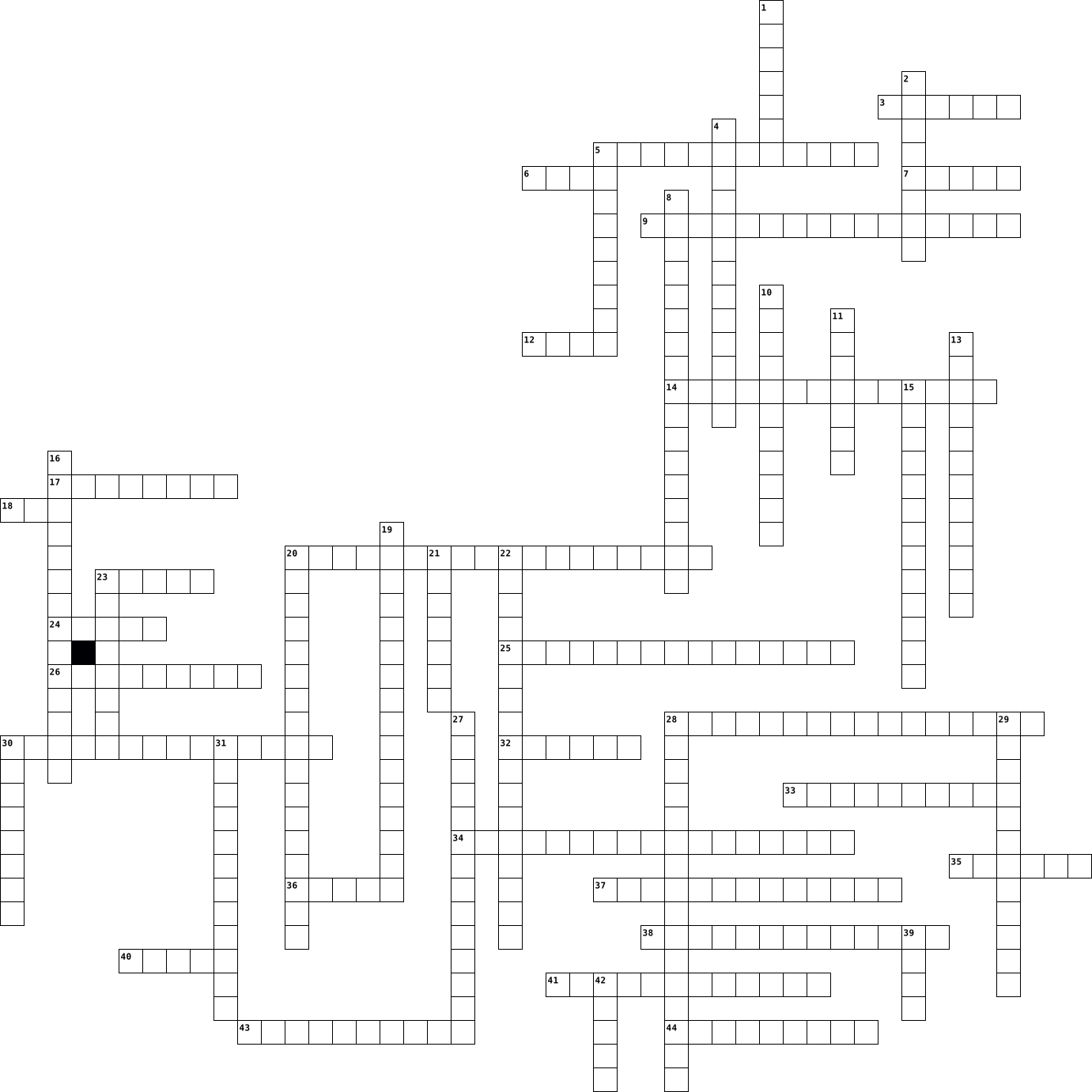
Across
- When oceanic plate subducts under continental plate
- One of the two original continents that Pangaea split into.
- Innermost layer of Earth.
- Waves that are sent out and are timed coming back to map out objects
- Longest mountain chain
- The valley between two diverging plates
- Chunks of the Earth that float on the lithosphere.
- The other of the two continents that Pangaea split into.
- It means “millions of years ago”
- When two plates float toward each other.
- Melted rock
- Outer layer of Earth.
- Fault the runs through California.
- Layer of molten metal that covers the inner core.
- Crust that makes up the continents.
- smaller, less important plates
- Thickest layer of Earth.
- The seven major land masses on the planet Earth.
- Where hot rocks rise, and cool rocks fall creating a flowing circle
- First living organism
- When a divergent boundary occurs and the magma helps create a new part of the plate.
- String of mountains
- Produced by the inner core spinning within the outer core.
- Molten rock.
- Created theory of continental drift
- Immense forces that are sent up through the Earth.
- Solid ball of iron in the center of the Earth.
Down
- Earth’s supercontinent from over 200 MYA.
- Amount of force pressing on an object.
- Deepest trench in the world.
- One who studies geology.
- When two plates float apart.
- Upper layer of the mantle.
- Where lava erupts of out the earth
- Crust located under the ocean.
- Lower layer of the mantle.
- The study of tectonic plates.
- Forces that destroy landmasses.
- Forces that build landmasses.
- The study of the planet Earth.
- When two plates grind against each other.
- The landmass that is created when two plates come together along a Upper
- When one plate slides underneath the other.
- The theory of how the continents got where they are today.
- Vibrations that travel through the Earth.
- Where geology was first founded
- Larger, more important plate
- Magma that has come out of the earth
- A place where move relative to each other
49 Clues: Melted rock • Molten rock. • String of mountains • Outer layer of Earth. • First living organism • Longest mountain chain • One who studies geology. • Thickest layer of Earth. • Innermost layer of Earth. • Upper layer of the mantle. • Lower layer of the mantle. • Deepest trench in the world. • When two plates float apart. • Larger, more important plate • The study of tectonic plates. • ...
Plate Tectonics 2014-09-28

Across
- Deepest trench in the world.
- The seven major land masses on the planet Earth.
- The landmass that is created when two plates come together along a Upper
- Forces that build landmasses.
- A place where move relative to each other
- Lower layer of the mantle.
- Where hot rocks rise, and cool rocks fall creating a flowing circle
- Crust located under the ocean.
- When a divergent boundary occurs and the magma helps create a new part of the plate.
- Solid ball of iron in the center of the Earth.
- One of the two original continents that Pangaea split into.
- When two plates float toward each other.
- Produced by the inner core spinning within the outer core.
- Waves that are sent out and are timed coming back to map out objects
- Fault the runs through California.
- Layer of molten metal that covers the inner core.
- Outer layer of Earth.
- The study of tectonic plates.
- Where geology was first founded
- Amount of force pressing on an object.
- Longest mountain chain
- Created theory of continental drift
- Earth’s supercontinent from over 200 MYA.
- When oceanic plate subducts under continental plate
- Molten rock.
Down
- One who studies geology.
- String of mountains
- When two plates float apart.
- Where lava erupts of out the earth
- Innermost layer of Earth.
- Crust that makes up the continents.
- The valley between two diverging plates
- Melted rock
- Larger, more important plate
- Thickest layer of Earth.
- Forces that destroy landmasses.
- The theory of how the continents got where they are today.
- Immense forces that are sent up through the Earth.
- When two plates grind against each other.
- Upper layer of the mantle.
- When one plate slides underneath the other.
- Vibrations that travel through the Earth.
- Chunks of the Earth that float on the lithosphere.
- smaller, less important plates
- First living organism
- The study of the planet Earth.
- The other of the two continents that Pangaea split into.
- Magma that has come out of the earth
- It means “millions of years ago”
49 Clues: Melted rock • Molten rock. • String of mountains • Outer layer of Earth. • First living organism • Longest mountain chain • One who studies geology. • Thickest layer of Earth. • Innermost layer of Earth. • Lower layer of the mantle. • Upper layer of the mantle. • Deepest trench in the world. • When two plates float apart. • Larger, more important plate • Forces that build landmasses. • ...
Plate Tectonics 2016-03-30

Across
- a sudden and violent shaking of the ground sometimes causing great destruction
- a long elongated depression with steep walls formed by the downward displacement of a block of the earth's surface between nearly faults or fault systems
- thick part of the earth's crust that forms the large land masses
- thin part of the earth's crust that underlines the ocean basins
- continental transform fault that extends roughly 1300 km through California. It forms the tectonic boundary between the pacific-plate and the north american plate, and its motion is right-lateral strike slip
- an elevated region with a central valley on an ocean floor at the boundary between two diverging tectonic plates when new crust forms from upwelling magma
- Fracture in a volume of rock, across which there has been significant displacement as a result of rock mass movement
- Theory that the outer rigid layer of the earth (lithosphere) is divided into a couple of dozen "plates" that move around across the earth's surface relative to each other
- a mountain or hill, having a crater or vent through which lava and gas are being erupted from the earth's crust
- two or more tectonic plates move away from each other
Down
- layer of hot rock material that is located beneath the crust
- an area in the basin of the pacific ocean whee a large number of earthquakes and volcanic eruptions occur
- sideways and downward movement of the edge of a plate of the earth's crust into the mantle beneath another plate
- mid-ocean ridge, a divergent tectonic plate or constructive plate boundary located along the floor of the atlantic ocean and part of the longest mountain range in the world
- two or more tectonic plates move towards each other
- a long, narrow ditch
- a line of mountains connected by high ground
- places where plates slide sideways past each other
- layer of earth that forms the outer skin
- Currents current in a fluid that results from convection
20 Clues: a long, narrow ditch • layer of earth that forms the outer skin • a line of mountains connected by high ground • places where plates slide sideways past each other • two or more tectonic plates move towards each other • two or more tectonic plates move away from each other • Currents current in a fluid that results from convection • ...
Plate tectonics 2016-03-31

Across
- a long, narrow hole that is dug in the ground; ditch
- a mountain with a hole in the top or side that sometimes sends out rocks,ash,lava, etc.
- the action or process in plate tectonics of the edge of one crustal plate descending below the edge of another
- actively deforming region where two or more tectonic plates more toward one another and collide
- a current in a fluid that results from convection
- a long, steep valley formed when two parallel rift form in the Earth's crust and the land between them sink
- when 2 plates slide or move away from one another
- a divergent tectonic plate located along the floor of the Atlantic Ocean
- a shaking of a part of the Earth's surface that often causes great damage
- relatively thick part of the Earth's crust that forms the large landmasses
Down
- a super continent that exist during the early ages
- places where plates slide sideways past each other
- a split or crack in the ground
- an elevated region with a central valley on an ocean floor at the boundary between two diverging tectonic plates where new crust is formed
- theory that states the lithosphere of the Earth is divided into small numbers of plates
- a line of mountains connected by high grounds
- each of several large landmasses thought to have divided to form the present continent
- an area in the basin of the Pacific Ocean where several of earthquakes and volcanic eruptions occurs
- an active strike-slip fault in West U.S. extending from San Franciso to South California
- relatively thin part of the Earth's crust that underlies the ocean basins
20 Clues: a split or crack in the ground • a line of mountains connected by high grounds • a current in a fluid that results from convection • when 2 plates slide or move away from one another • a super continent that exist during the early ages • places where plates slide sideways past each other • a long, narrow hole that is dug in the ground; ditch • ...
Plate Tectonics 2016-07-26

Across
- : old inert volcano
- : push pull waves that travel in the directon that the waves travel
- : the supercontinent
- : a source of unpredictable, unplanned danger to people
- : how thick a substance is
- : the southern half of pangea
- : what magma becomes once it reaches the earths surface
- : lava with a rope like surface
- : a form of closed lava tube that flows into water
- : a channel that conveys a fluid
- : A physical quantity characterized by measurement of both magnitude and direction.
- : the boundries between plates
- : a spot in the earth where volcanoes are more likely to form
- : a fracture in the earths curst
- : shows P waves, S waves and surface waves
- : hottest layers of the earth
- : the general term for all pyroclastic material
- : cracks in the volcanoes crust
- : non explosive eruptions volcano
- : semi-rigid part of the middle mantle
- : a tube formed by lava cooling and solidifying
- : lava with a blocky rough surface
- : top layer of the earth
- : the point a earthquake originates from
- : A black or dark-colored volcanic glass, usually of rhyolitic (felsic) composition.
- : what happens when the earth plates move
- : debris formed by a volcanic eruption
- : what is made form melted rock
- : plates pushing together
- : where a plate sinks and slide under another plate
- : crust and upper layer of the mantle
- : the measure of the strength of and earthquake
- : a volcano that is not active or inactive
- : Roman God of fire and the forge, after whom volcanoes are named.
- : Fine grained, dark, mafic igneous rock composed largely of plagioclase feldspar and pyroxene.
Down
- : plates sliding horizontally past each other
- : A large, circular depression in a volcanic area formed by eruption or collapse.
- : 'lava' inside the volcano
- : used to measure shaking amplitude of earth quakes
- : most common type of volcano
- : plates moving apart
- : the study of earthquakes, seismic waves, and their propagation through the Earth.
- : what comes after a earthquake
- : The shape of the land surface.
- : The pattern of elevation of the land surface.
- : the gradual movement of earth continents
- : the state a volcano erupts regularly
- : the movement of a fluid, caused by different temperatures
- : the northern half of pangea
- : seismic waves that travel along the earth crust
- : what the earth crust is sitting on
- : A depression between two plates
- ; moderately explosive volcano
- : Point on Earth's surface directly above an earthquakes focus.
- : areas of earths surface that magma and volcanic gasses pass through
- : Solidified mass of rock where lava has cooled in vent
- : bigger layer of the earth
57 Clues: : old inert volcano • : the supercontinent • : plates moving apart • : top layer of the earth • : plates pushing together • : how thick a substance is • : 'lava' inside the volcano • : bigger layer of the earth • : most common type of volcano • : the southern half of pangea • : the northern half of pangea • : hottest layers of the earth • : the boundries between plates • ...
Plate Tectonics 2016-06-09

Across
- Astronomer who discovered continental drift theory
- Outermost layer of the Earth
- Layer beneath the mantle
- The region where two tectonic plates come into contact
- Type of plate boundary that the plates push against eachother
- Area where molten rock rises to the Earths surface
- Earth's thickest layer
- Partly molten layer in the upper mantle
- A sudden ground breaking release of built up energy under the Earths surface
- Type of evidence that supported Wegener's theory involving types of animals that lived there
Down
- Earths centre, that has a radius of about 1200km
- Opening in Earths surface that when active spews out gases chunks of rock and melted rock
- Deep underwater valley formed when an oceanic plates subduct under a continental
- Type of plate boundary that the plates push away from eachother
- Plates that move and then re-join on the lithosphere
- The big wave that is caused by the displacement of water after an earthquake
- Type of plate boundary that the plates slide by eachother
- formed by plate tectonics in the crust and upper mantle
- Wegener's name for the "super continent"
- Transform fault in California
20 Clues: Earth's thickest layer • Layer beneath the mantle • Outermost layer of the Earth • Transform fault in California • Partly molten layer in the upper mantle • Wegener's name for the "super continent" • Earths centre, that has a radius of about 1200km • Astronomer who discovered continental drift theory • Area where molten rock rises to the Earths surface • ...
Plate Tectonics 2016-02-27

Across
- Created when two continental plates hit each other
- Area under the crust
- This tectonic plate holds North America
- Thin crust under the ocean
- Plates move apart
- Rocky,rigid upper mantle
- Outermost layer of the Earth
- Thick layer of the Earth's suface
- Collide to create volcanoes and mountain ranges
- Plates scrape against each other
- A peson who specializes in rocks
- This tectonic plate holds india
- Gaps between tectonic plates
- Caused by seismic activity
- It is formed when one plate slips under another and there is a dip
- Below the lithosphere and it is more fluid
- Ring of volcanoes in the Pacific Ocean
- This tectonic plate holds the Pacific ocean and island too
Down
- Current carrying the heat from the inside of the Earth to the Crust
- Creates trenches and underwater volcanoes
- A group of continents
- A rupture in the Earth's surface
- Two plates meet and one slides under
- Plates push into each other
- This tectonic plate holds South America
- This tectonic plate holds Austrialian
- This tectonic plate has Antarctica on it
- It disassembled Pangea
- Downward pull on a plate because it has heated up
- This tectonic plate has Europe and Asia on it
- Discovered tectonic plates
- When something is pushed together
- This tectonic plate holds Africa
- Friction between Lithosphere and Asthenosphere
34 Clues: Plates move apart • Area under the crust • A group of continents • It disassembled Pangea • Rocky,rigid upper mantle • Thin crust under the ocean • Discovered tectonic plates • Caused by seismic activity • Plates push into each other • Outermost layer of the Earth • Gaps between tectonic plates • This tectonic plate holds india • A rupture in the Earth's surface • ...
Plate Tectonics 2016-03-01

Across
- Property, a property used to characterize materials in reactions that change their identity
- remains or traces of a once living organism reserved by rock
- Waves, waves that travel outward from an earthquake's focus and move through Earth by causing particles in rocks to vibrate at right angles to the direction of the wave
- Core, liquid core that surrounds Earth's solid inner core, and that is made mostly of iron
- fossil formed when an organism is buried, decays, and leaves behind a hollow place in rock
- the branch of geology studying the folding and faulting of the earth's crust
- Waves, energy waves that are produced at and travel outward from the earthquake's focus
- surface along which rocks break and move
- Core, very dense, solid center od the Earth that is made of mostly iron with smaller amounts of oxygen, silicon, sulfur, or nickel
Down
- opening in Earth's surface that often forms a mountain when layers of lava and volcanic ash erupt and build up
- Waves, waves that travel outward from an Earthquake's focus and cause particles in rocks to move back and forth in the same direction the wave is moving
- powerful seismic sea wave that can travel thousands of kilometers in all directions and that begins over an earthquake focus
- vibrations caused by breaking rocks along faults
- measure of the energy released by an earthquake
- intrusive igneous rock body formed when magma is squeezed into a horizontal crack that cuts across rock layers and hardens
- fossil formed when sediments fill in a mold and harden into rock
- single large landmass made up of all the continents connected together that broke apart 200 million years ago
- Earth's outermost layer, which varies in thickness from about 5km to 60km and is separated from the mantle by the Moho Discontinuity
- in an earthquake, the point beneath Earth's surface where energy release occurs
- Tectonics, branch of geology studying the earth's crust
20 Clues: surface along which rocks break and move • measure of the energy released by an earthquake • vibrations caused by breaking rocks along faults • Tectonics, branch of geology studying the earth's crust • remains or traces of a once living organism reserved by rock • fossil formed when sediments fill in a mold and harden into rock • ...
Plate tectonics 2023-03-01

Across
- elevated areas of the sea floor characterized by high heat flow and volcanism
- what moves the crust
- of irregular topography on the deep ocean floor
- mountains formed in part igneous activity associated with the subduction of oceanic lithosphere beneath a continent
- a chain of volcanic islands generally located a few hundred km from trench
- older,denser portions of oceanic lithosphere descends
- what is the oceanic crust made of
- a hypothesis, first proposed in the 1960s by harry hess
Down
- what does a convergent plates make
- occurs when two tectonic plates move away from each other.
- has a greater density than continental crust
- plates are moving towards one another.
- plates are moving up and down each other
- a narrow elongated depression of the sea floor
- two oceanic plates converge
- the primary source of the movement of plates
- a continues elevated zone on the floor of all the major ocean basins
- has a less density than oceanic crust
- made the hypothesis of the sea floor spreading
- they are made by earthquakes
20 Clues: what moves the crust • two oceanic plates converge • they are made by earthquakes • what is the oceanic crust made of • what does a convergent plates make • has a less density than oceanic crust • plates are moving towards one another. • plates are moving up and down each other • has a greater density than continental crust • the primary source of the movement of plates • ...
Plate Tectonics 2023-03-06

Across
- lava that forms tubes,smooth and ropy
- where geological feature is cut in half
- most dangerous volcano
- type of lava that erupts underwater
- large but not steep volcano
- plates that come towards each other
- used to create first detailed ocean floor map
- releasing bend,can form depressions
- developed continental drift theory
- zone where plates split apart
Down
- volcano,felsic to intermediate rock
- less deadly type of eruption
- scientist that first looked at ridge patterns, 1959
- compression added to shearing motion
- study of magnetic fields frozen in rocks
- most typical volcano
- measure of strength of earthquake
- more dangerous volcanic eruption
- molten rock found within volcanic chambers
- plates that spread away from each other
20 Clues: most typical volcano • most dangerous volcano • large but not steep volcano • less deadly type of eruption • zone where plates split apart • more dangerous volcanic eruption • measure of strength of earthquake • developed continental drift theory • volcano,felsic to intermediate rock • type of lava that erupts underwater • plates that come towards each other • ...
Plate Tectonics 2023-03-06

Across
- lava that forms tubes,smooth and ropy
- where geological feature is cut in half
- most dangerous volcano
- type of lava that erupts underwater
- large but not steep volcano
- plates that come towards each other
- used to create first detailed ocean floor map
- releasing bend,can form depressions
- developed continental drift theory
- zone where plates split apart
Down
- volcano,felsic to intermediate rock
- less deadly type of eruption
- scientist that first looked at ridge patterns, 1959
- compression added to shearing motion
- study of magnetic fields frozen in rocks
- most typical volcano
- measure of strength of earthquake
- more dangerous volcanic eruption
- molten rock found within volcanic chambers
- plates that spread away from each other
20 Clues: most typical volcano • most dangerous volcano • large but not steep volcano • less deadly type of eruption • zone where plates split apart • more dangerous volcanic eruption • measure of strength of earthquake • developed continental drift theory • volcano,felsic to intermediate rock • type of lava that erupts underwater • plates that come towards each other • ...
Plate Tectonics 2023-03-06

Across
- lava that forms tubes,smooth and ropy
- where geological feature is cut in half
- most dangerous volcano
- type of lava that erupts underwater
- large but not steep volcano
- plates that come towards each other
- used to create first detailed ocean floor map
- releasing bend,can form depressions
- developed continental drift theory
- zone where plates split apart
Down
- volcano,felsic to intermediate rock
- less deadly type of eruption
- 1959, used ridge patterns
- compression added to shearing motion
- study of magnetic fields frozen in rocks
- most typical volcano
- measure of strength of earthquake
- more dangerous volcanic eruption
- molten rock found within volcanic chambers
- plates that spread away from each other
20 Clues: most typical volcano • most dangerous volcano • 1959, used ridge patterns • large but not steep volcano • less deadly type of eruption • zone where plates split apart • more dangerous volcanic eruption • measure of strength of earthquake • developed continental drift theory • volcano,felsic to intermediate rock • type of lava that erupts underwater • ...
Plate Tectonics 2023-03-17

Across
- where magma comes to the surface
- one plate going under another
- where we first feel an earthquake on the surface
- the crust of the ocean floor
- fastest seismic wave
- created by a divergent boundary on land
- created by a divergent boundary under the ocean
- plates that move away from each other
- plates moving past each other
- the place underground where an earthquake begins
- a peice of Earth's lithosphere
- a break in the Earth's crust
- slower seismic wave
Down
- where 2 plates meet
- the crust of the land
- wave created by earthquakes underwater
- deep canyon on the ocean floor where subduction occurs
- plates that move toward each other
- currents in the mantle that move the plates
- earthquake waves
- the solid crust and upper mantle
- pushed up when continents collide
- type of volcanoe that created Hawaii
- energy released from plate movement
24 Clues: earthquake waves • where 2 plates meet • slower seismic wave • fastest seismic wave • the crust of the land • the crust of the ocean floor • a break in the Earth's crust • one plate going under another • plates moving past each other • a peice of Earth's lithosphere • where magma comes to the surface • the solid crust and upper mantle • pushed up when continents collide • ...
Plate Tectonics 2023-03-20

Across
- A powerful and often dramatic force of nature that changes the earth’s surface and atmosphere; includes earthquakes, volcanoes, and intense storms such as hurricanes and Volcano A landform, usually cone-shaped, produced by a collection of erupted material around a vent, or opening, on the surface of the earth and through which gas and erupted material pass.
- A wave generated by earthquake vibrations.
- The tendency to resist flowing; a property of liquids.
- A small (less than 400 meters high), cone-shaped volcano made of broken rocks or blobs of hardened lava, called “cinders,” that accumulate around the volcanic vent.
- Magma that has reached the surface of the earth.
- A solid earth material that forms when magma or lava cools and crystallizes on or below the earth’s surface.
- A theory that the lithosphere is broken into segments, or
- The cool, solid outer shell of the earth. It consists of the crust and the rigid uppermost part of the mantle and isbroken up into segments, or plates.
- A primary (compressional) earthquake wave that travels through the body of the earth; so named because it is the first wave to reach a seismograph station during an earthquake.
- A series of sea waves caused by underwater earthquakes or, more rarely, by volcanoes.
- The earth’s outer layer; the coolest and least dense layer of the earth.
- A mountain-like landform that develops when plates separate and new ocean lithosphere forms.
- The process by which earth materials transform from one rock type into another.
- that “float” on the asthenosphere, and that interactions among these plates are associated with earthquakes and volcanic activity and form mid-ocean ridges, trenches, mountains, and chains of volcanic
- An earthquake wave that travels on or near the surface of the earth
- A wide, broadly sloping volcano that forms from runny lava. It is the largest of volcanoes.
- Describes objects that bend, stretch, or flow when a force is applied to them.
- A zone of intense earthquake and volcanic activity that encircles the Pacific Ocean basin; also called the Circum-PacificBelt.
- A zone of intense earthquake and volcanic activity that runsdown the middle of the Atlantic Ocean floor.
- A deep, narrow depression in the seafloor.
- A place where pieces of the broken lithosphere meet. Boundary types include convergent, divergent, and
Down
- A circulating flow of air or water resulting from temperature differences; also called a convection current.
- A solid earth material that forms when any rock type is changed by the earth’s high temperature and pressure.
- A scientist who studies volcanoes and volcanic phenomena.
- The layer of the mantle that lies directly below the lithosphere and flows, like taffy.
- An instrument that detects, records, and measures the vibrations produced by an earthquake.
- The movement of a tectonic plate beneath another plate.
- Igneous rock that forms from magma cooling inside the earth.
- Vibrations in the earth caused by the sudden release of energy, usually as a result of the movement of rocks along a
- A physical feature of the earth’s surface, such as a mid-ocean ridge, a trench, or a mountain.
- An earthquake wave that travels on or near the surface of the earth.
- A volcano that forms from alternating eruptions of viscous lava and broken rock. It is steep near the summit and flat toward the base.
- The layer of the earth beneath the crust. It is about 2900 km thick, and it makes up about 83 percent of the earth’s
- A scientist who studies earthquakes.
- The time between the arrival of P-waves and S-waves at a location where an earthquake occurs.
- An earthquake wave that follows the main shock of an earthquake.
- The earth’s innermost layers, consisting of a liquid iron outer core and a solid iron-nickel inner core.
- A large, mobile segment of the earth’s lithosphere.
- The process by which heat moves efficiently through air or water.
- A localized zone of melting in the mantle that is fixed under a plate.
- A solid earth material composed of compacted and cemented sediments or of particles of various sizes.
- A fracture in bedrock, along which blocks of rock on opposite sides of the fracture move.
- A secondary earthquake wave; so named because it travels slower than a primary wave and is the second wave to reach the seismograph station after an earthquake. It travels through the body of the earth as a series of crests and troughs.
- A deep gorge formed on the ocean floor when an oceanic plate moves beneath a continental plate.
- Hot, molten rock inside the earth.
45 Clues: Hot, molten rock inside the earth. • A scientist who studies earthquakes. • A wave generated by earthquake vibrations. • A deep, narrow depression in the seafloor. • Magma that has reached the surface of the earth. • A large, mobile segment of the earth’s lithosphere. • The tendency to resist flowing; a property of liquids. • ...
Plate Tectonics 2022-08-23

Across
- The point on the earth's surface directly above the focus
- This occur when water mix with volcanic materials
- The smallest and finest fragments of lava or rock that are ejected by volcanic eruptions
- A scale that measures the damage caused by an earthquake
- The zone where plates meet is called plate ...
- The broken pieces of earth's crust
- Constant rising and sinking of magma results in convection current causing plates to move is called plate ...
- A lava that has high temperature, cools and solidifies slowly, has low viscosity and low silica content. So the lava flows quickly
- A lava that has low temperature, cools and solidifies quickly, has high viscosity and high silica content. So the lava flows slowly
- A plate boundary when two plates move away from each other
- A plate boundary when two plates slide past each other
- Plates move as a result of ... current generated in the mantle
Down
- A crack in the earth's crust where the rock stressed by plate movements breaks and moves
- A volcano that has a broad base with gentle slopes formed from basic lava
- This flow occurs when gases mix with volcanic materials
- A sudden vibration or tremor of the earth's surface
- A volcano that consists of alternating layers of lava, ash and cinder. It has gentle slopes at its base and steeper slopes near its top
- A machine used to detect and record earthquake
- The source of the earthquake
- A scale that measures the magnitude of an earthquake
- A plate boundary when two plates move towards each other
21 Clues: The source of the earthquake • The broken pieces of earth's crust • The zone where plates meet is called plate ... • A machine used to detect and record earthquake • This occur when water mix with volcanic materials • A sudden vibration or tremor of the earth's surface • A scale that measures the magnitude of an earthquake • ...
Plate Tectonics 2022-10-04

Across
- Knowledge on which to base belief
- The bottom of a sea or ocean
- Cause to change; make different
- Plates that pull apart
- Zones where mass of the crust is moving under another
- A single thickness of some substance or material
- The branch of geology studying the folding and faulting of the earth's crust
- Area of land that existed 245 million years ago
- A large continuous extent of land
- One of the large landmasses of the earth
Down
- a specialist in the history of the Earth recorded in rocks
- A scientist devoted to systematic investigation
- Crash together with violent impact
- Pertaining to the structure or movement of the earth's crust
- Long narrow depression on the sea floor
- Incapable of or resistant to bending
- Plates that push together
- Of or relating to or characteristic of the crust of the earth or moon
- Pushes magma up through a thin hole
- Caused by an earthquake or earth vibration
20 Clues: Plates that pull apart • Plates that push together • The bottom of a sea or ocean • Cause to change; make different • Knowledge on which to base belief • A large continuous extent of land • Crash together with violent impact • Pushes magma up through a thin hole • Incapable of or resistant to bending • Long narrow depression on the sea floor • ...
Plate Tectonics 2022-12-14

Across
- an example of a convergent boundary
- convection currents move through it to power tectonic plates
- top layer of the tectonic plates it has a high density and results from the cooling of magma
- earths largest plate and formed a part of a series of islands near North America
- transform boundaries cause when energy is released
- it is a plate that covers the entirety of a country, and it also covers a part of Asia
- lies above the fault plane
- Earth's lithosphere is recycled into earths mantle at convergent boundaries
- break in earth's crust
- are mostly found underwater
- the rigid outer part of the earth
Down
- can be between continental plates
- occurs at mid-ocean ridges,new oceanic crust is formed
- is the most important source of magma and is directly below the lithosphere
- it is a layer of rock that forms below the continents, and has a low density
- form deep trenches
- Earth's thin outer shell of rock
- drive the movement of tectonic plates
- two tectonic plates collide to form
- the theory that earth's continents moved over time, but they were on tectonic plates so they slowly moved away
- ocean to continent example of a transform boundary
21 Clues: form deep trenches • break in earth's crust • lies above the fault plane • are mostly found underwater • Earth's thin outer shell of rock • can be between continental plates • the rigid outer part of the earth • an example of a convergent boundary • two tectonic plates collide to form • drive the movement of tectonic plates • transform boundaries cause when energy is released • ...
Plate Tectonics 2022-12-12

Across
- the center of the earth
- the only habitable planet
- Appears when continental plates collide
- the rock material which lies below the fault plane
- a fracture between two blocks of rock
- A process moving around rocks and minerals below earth's surface
- when two sides of a fault slide into each other
- the bottom of the sea
- A long narrow ditch
- slabs of oceanic lithosphere descend into the mantle
Down
- when two plate move towards each other
- A mountain or hill that erupts
- the mostly solid bulk of the earth's interior
- a very very large mass of land
- moltin rock and earths crust
- when two plates move away from each other
- Alfred Wegner came up with this theory
- when plates slide past each other
- the outer layer of the earth
- a person who studies rocks and earth's landforms
20 Clues: A long narrow ditch • the bottom of the sea • the center of the earth • the only habitable planet • moltin rock and earths crust • the outer layer of the earth • A mountain or hill that erupts • a very very large mass of land • when plates slide past each other • a fracture between two blocks of rock • when two plate move towards each other • Alfred Wegner came up with this theory • ...
Plate tectonics 2022-12-12

Across
- a horse shaped area of volcanoes across the continents
- the rock material which lies below the fault plane
- the direction the hanging block wall moves in a normal fault
- type of convergent boundary the Ring of fire is
- the rock material which lies above the fault plane
- when two plates move towards each other
- type of convergent boundary left after the other questions
- the plane along which the the rock or crustal material has fractured
- a _______ is a break in Earth’s crust where slabs of crust slip past each other
- created by shearing along transform boundaries
- two plates sliding past each other
Down
- _________ are formed by divergent boundaries
- type of convergent boundary that the Andes mountains is.
- best known example of a divergent boundary
- Earthquakes, Trenches,Mountains, and _________ are results of convergent boundaries
- the direction the hanging block wall moves in a reverse fault
- Caused by tension forces where plates diverge
- ___________ is formed by transform Boundaries
- Caused by compression forces along convergent plates boundaries
- When two plates move away from each other
20 Clues: two plates sliding past each other • when two plates move towards each other • When two plates move away from each other • best known example of a divergent boundary • Caused by tension forces where plates diverge • ___________ is formed by transform Boundaries • created by shearing along transform boundaries • type of convergent boundary the Ring of fire is • ...
Plate Tectonics 2023-01-28

Across
- the supercontinent that existed millions of years ago
- Current, the driving force of plate tectonics in which hot plastic like material sinks back to the mantle
- breaks in Earth’s crust where rocks have slipped past each other
- a deep valley in a wide area
- any trace of an ancient organism that has been preserved in rock
- part of the ocean floor sinks back into the mantle
- created by two pieces of continental crust converging or coming together
- continents were once joined together in a single landmass andhave slowly moved apart
- Founded PANGEAE
- the boundaries between two plates that are diverging
- older strips or rock move outward from either side of the ridge
Down
- the idea that the Earth’s crust and upper mantle are broken into sections called plates that move around on the mantle
- the boundaries between two plates that are sliding
- caused by plate tectonics
- the crust and part of the upper mantle
- the plastic-like layer below the lithosphere
- all the continents were once joined together in a single landmass
- the boundaries between two plates that are converging
- major tectonic plates in pieces
- ocean floor sinks beneath a deep-ocean trench and back into themantle again
20 Clues: Founded PANGEAE • caused by plate tectonics • a deep valley in a wide area • major tectonic plates in pieces • the crust and part of the upper mantle • the plastic-like layer below the lithosphere • the boundaries between two plates that are sliding • part of the ocean floor sinks back into the mantle • the boundaries between two plates that are diverging • ...
Plate Tectonics 2023-01-13

Across
- ridge The undersea mountain mountain chain where new ocean floor is produced; a divergent plate boundary
- boundary A plate boundary where two plates grind against each other, moving it different directions
- boundary A plate boundary where two plates move away from each other
- A soft layer of the mantle on which the lithosphere floats
- zone The process by which oceanic crust sinks beneath a deep-ocean trench and back into the mantle at a convergent plate boundary
- A break or crack in the Earth's lithosphere along which rocks move
- A rigid layer made up of the uppermost part of the mantle and the crust
- boundary A plate boundary where two plates move toward each other
- Thickest layer of the Earth; it consists of two layers - the lithosphere and the asthenosphere
- spreading The process by which molten material adds new oceanic crust to the ocean floor
- The layer of rock that forms the Earth's outer surface
Down
- currents Cause the plates to move; between the lithosphere and the asthenosphere
- Wegener German Scientist who developed the Theory of the Continental Drift in 1912.
- core Dense ball of solid material at the center of he Earth
- The name of the single landmass that broke apart about 225 million years ago
- valley A deep valley where two plates move apart
- Drift Alfred Wegener's hypothesis that the continents were once one huge land mass but have since then drifted apart
- A deep canyon on the ocean floor
- core A layer of molten iron and nickel that surrounds the inner core of the Earth
- of Plate Tectonics Theory that pieces of the Earth's lithosphere are in motion,driven by convection currents in the mantle
20 Clues: A deep canyon on the ocean floor • valley A deep valley where two plates move apart • The layer of rock that forms the Earth's outer surface • A soft layer of the mantle on which the lithosphere floats • core Dense ball of solid material at the center of he Earth • boundary A plate boundary where two plates move toward each other • ...
plate tectonics 2023-03-01

Across
- rigid layer of the Earth's crust that is believed to drift slowly
- is the phenomenon associated with volcanic activity
- the regions of the Earth where living organisms exist
- a fissure in the earth's crust through which gases erupt
- crash together with a violent impact
- use again after processing
- movement of the edge of one tectonic plate under another
- is the chemistry of the earth's crust
- is the branch of geology studying the folding and faulting of the earth's crust
- subject to or caused by an earthquake or earth vibration
- a specialist in the history of the Earth recorded in rocks
Down
- is a person with advanced knowledge of empirical fields
- any state or process known through the senses
- molten rock in the earth's crust
- rock that in its molten form issues from volcanos
- a scientist devoted to systematic investigation
- a geologist who uses physical principles to study the properties of the earth
- relating to eruptions of gas and lava from the earth's crust
- reduce or cause to be reduced from a solid to a liquid state
- organisms interacting with their physical environment
- science of the history of the earth as recorded in rocks
21 Clues: use again after processing • molten rock in the earth's crust • crash together with a violent impact • is the chemistry of the earth's crust • any state or process known through the senses • a scientist devoted to systematic investigation • rock that in its molten form issues from volcanos • is the phenomenon associated with volcanic activity • ...
Plate tectonics 2023-02-21

Across
- seafloor spreading
- when two plates move away from each other
- Hot magma rises and cool magma sinks
- happens during transform boundaries
- when a oceanic and a continental plate collide
- there are 3 types of these
- caused by a transform boundary
- when two oceanic plates collide
- when two continental plates collide
- Part of the lithosphere that breaks down
Down
- plates that chill under the continent
- Below the lithosphere
- every type of convergent boundary has one
- the thing that rises in a convection current
- two plates sliding past each other
- the upper mantle and crust
- what every convergent boundary does
- the plates that chill under the ocean
- when two plates collide
- the thing that sinks in a convection current
20 Clues: seafloor spreading • Below the lithosphere • when two plates collide • the upper mantle and crust • there are 3 types of these • caused by a transform boundary • when two oceanic plates collide • two plates sliding past each other • what every convergent boundary does • happens during transform boundaries • when two continental plates collide • Hot magma rises and cool magma sinks • ...
Plate Tectonics 2023-02-28

Across
- Below the Lithosphere in the mantle
- When two plates slide past each other and release energy
- A ridge in the middle of the ocean
- A super continent that split apart over time
- Where you live in the solar system
- Right below the crust
- Movment causes within a liquid
- The bottom of the ocean
- A super continent
- What is motion
- A high piece of land
Down
- A large land form that is connected
- A part of land going under another
- In the mantle and above the asthenosphere
- A plate that is under a large body of water
- Lava before it reaches the surface
- The study of earth
- Causes earthquakes
- Controls earths crust structure
- A rock that has been displaced
20 Clues: What is motion • A super continent • The study of earth • Causes earthquakes • A high piece of land • Right below the crust • The bottom of the ocean • Movment causes within a liquid • A rock that has been displaced • Controls earths crust structure • A part of land going under another • Lava before it reaches the surface • A ridge in the middle of the ocean • ...
Plate Tectonics 2023-02-28

Across
- Below the Lithosphere in the mantle
- When two plates slide past each other and release energy
- A ridge in the middle of the ocean
- A super continent that split apart over time
- Where you live in the solar system
- Right below the crust
- Movment causes within a liquid
- The bottom of the ocean
- A super continent
- What is motion
- A high piece of land
Down
- A large land form that is connected
- A part of land going under another
- In the mantle and above the asthenosphere
- A plate that is under a large body of water
- Lava before it reaches the surface
- The study of earth
- Causes earthquakes
- Controls earths crust structure
- A rock that has been displaced
20 Clues: What is motion • A super continent • The study of earth • Causes earthquakes • A high piece of land • Right below the crust • The bottom of the ocean • Movment causes within a liquid • A rock that has been displaced • Controls earths crust structure • A part of land going under another • Lava before it reaches the surface • A ridge in the middle of the ocean • ...
Plate Tectonics 2023-02-15

Across
- Molten rock containing liquids, crystals, and dissolved gases that forms within the upper part of the Earth's mantle and crust. When erupted onto the Earth's surface, it is called lava.
- A depression in the earths crust
- A deep depression in the ocean floor caused by the convergence of plates and the resulting subduction of one plate
- A tectonic process that results when plates converge and one plate forces the other down into Earth's mantle. As a result, the subducted plate eventually undergoes partial melting
- The term used for magma once it has erupted onto the Earth's surface.
- An area of rock that has been bent by stress.
- An abrupt movement of soil and bedrock downhill in response to gravity. Landslides can be triggered by an earthquake or other natural causes. Undersea landslides can cause tsunamis.
- A form of stress resulting from equal and opposite forces that do not act along the same line. If a thick, hard-bound book is lying flat and one pushes the front cover from the side so that the covers and pages are no longer perfectly aligned, this is an example of shear.
- The uppermost division of the solid earth, representing less than 1% of its volume and varying in depth from 3-37 mi.(5-60 km). Below the crust is the mantle.
- The center of Earth, an area constituting about 16% of the planet's volume and 32% of its mass. Made primarily of iron and another, lighter element (possibly sulfur), it is divided between a solid inner core with a radius of about 760 mi.(1,220 km) and a liquid outer core about1,750 mi. (2,820 km) thick.
- Large movable segments of the lithosphere.
Down
- An area of fracturing between rocks resulting from stress.
- The thick, dense layer of rock, approximately 1,429 mi. (2,300 km) thick, between Earth's crust and its core.
- Fragments less than 2 millimeters (about 1/8 inch) in diameter of lava or rock blasted into the air by volcanic explosions.
- A form of stress produced by the action of equal and opposite forces, the effect of which is to reduce the length of a material. Compression is a form of pressure.
- One or a series of huge sea waves caused by earthquakes or other large-scale disturbance of the ocean floor. (Referred to incorrectly by many as a tidal wave, but these waves have nothing to do with tides.) The word tsunami is Japanese, meaning "harbor wave."
- The flowing mixture of water and debris (intermediate between a volcanic avalanche and a water flood) that forms on the slopes of a volcano.
- The theory that the configuration of Earth's continents was once different than it is today; that some of the individual landmasses of today once were joined in other continental forms; and that these landmasses later separated and moved to their present locations.
- A vent (opening) in the surface of the Earth through which magma erupts; it is also the landform that is constructed by the erupted material.
- An earthquake which follows a larger earthquake or main shock and originates in or near the rupture zone of the larger earthquake. Generally, major earthquakes are followed by a larger number of aftershocks, decreasing in frequency with time.
- In general terms, any attempt to deform a solid. Types of stress include-tension, compression, and shear. More specifically, stress is the ratio of force to unit area F/A, where F is force and A area. A tectonic process that results when plates converge and one plate forces the other down into Earth's mantle. As a result, the subducted plate eventually undergoes partial melting
- split between two bodies (for example, two plates) that once were joined.
22 Clues: A depression in the earths crust • Large movable segments of the lithosphere. • An area of rock that has been bent by stress. • An area of fracturing between rocks resulting from stress. • The term used for magma once it has erupted onto the Earth's surface. • split between two bodies (for example, two plates) that once were joined. • ...
Plate Tectonics 2023-02-15

Across
- This effects how uch something weighs with the same voume and surface area
- What average americans have a lot of
- pizza or maggie
- The sinking of continents below sea level
- one of the plate boundaries that creates crust
- has riz
- 0
- Everybody SHOULD have this (not everyone has it)
- Liquid flow that cirrculates and is affected by heat
- The guy that is famous for a theory that then was used to make another thory by a different group of guys because the original theory didn't work
- The theory that was based on the thory by Wegner.
- korean
- what americans don't have a lot of
Down
- what asians have
- Something that americans like to eat by itself and usually comes in jars
- Large rodent that swims
- Plate boundary that neither desroys crust or generates crust
- what americans don't have
- The plate boundary that desroys crust
- dissapointment\
- Asian
- The theory proposed by Allfred Wegner (V-e-gn-r)
- healthier version than burger (the thing amercans eat a lot of)
- Large rodent that issimilar to mouse
24 Clues: 0 • Asian • korean • has riz • pizza or maggie • dissapointment\ • what asians have • Large rodent that swims • what americans don't have • what americans don't have a lot of • What average americans have a lot of • Large rodent that issimilar to mouse • The plate boundary that desroys crust • The sinking of continents below sea level • one of the plate boundaries that creates crust • ...
Plate Tectonics 2017-05-10

Across
- Process of gaining lithospheric bits
- Important fossil
- Opened during break up of Pangaea
- rides over asthenosphere
- Pangaea
- Volcanic chain formed by Subduction
- Name of navy oceanographer discovered seafloor spreading
- Divergent boundary in East Africa
- Plate motion along San Andreas Fault
- Plate motion at subduction zone
Down
- Geologically unique pieces of lithosphere
- Found at the center of a midocean ridge
- Primary rock of oceanic crust
- Study of Earth's ancient magnetic field
- Primary rock of continental crust
- Process taking place at deep ocean trenches
- Father of Continental Drift
- plastic layer of upper mantle
- Responsible for Hot Spots like Hawaii/Yellowstone
- Formed by continental collision
- Plate motion at midocean ridges
- Lassen Peak and Shasta are part of this volcanic arc
22 Clues: Pangaea • Important fossil • rides over asthenosphere • Father of Continental Drift • Primary rock of oceanic crust • plastic layer of upper mantle • Formed by continental collision • Plate motion at midocean ridges • Plate motion at subduction zone • Primary rock of continental crust • Opened during break up of Pangaea • Divergent boundary in East Africa • ...
Plate Tectonics 2017-06-07

Across
- / the name of the super continent 200 million years ago
- / occurs when continental and oceanic plates converge creating pressure and heat erupting on the surface
- / huge amounts of water displaced onto land due to movement of plates carrying debris onto land
- / the malleable layer of which tectonic plates can drift above it
- / the name of the active volcano located in Italy Naples famous for the destruction of Pompeii in 79 AD
- / the earth is layered according to ____________
- / the boundary in which two plates move away from each other
- / the point on the earth's surface vertically above the focus of an earthquake
- / the uppermost thinnest layer of the earth
- / the boundary in which earthquakes happen the most
Down
- / the name of the Californian fault line
- / the molten rock from beneath the surface of the earth within the asthenosphere
- / the number scale of how powerful or catastrophic an earthquake is
- / contains the crust and a part of the upper mantle
- / the boundary of which two tectonic plates move towards each other
- / the scientist who developed the theory of continental drift
- / the thickest layer of earth, contains the asthenosphere and part of the lithosphere
- / the process of the oceanic plate sliding under an continental plate
- / the very middle of the earth
- / _____________ waves measure the frequency of an earthquake
20 Clues: / the very middle of the earth • / the name of the Californian fault line • / the uppermost thinnest layer of the earth • / the earth is layered according to ____________ • / contains the crust and a part of the upper mantle • / the boundary in which earthquakes happen the most • / the name of the super continent 200 million years ago • ...
Plate Tectonics 2020-03-20

Across
- Long, deep, steep troughs in the seafloor where an oceanic plate sinks beneath an overlying plate.
- One of Earth’s structural layers—a layer of weak, warm rock that flows slowly over geologic time.
- The shaking of the ground that results when rock under Earth’s surface moves or breaks.
- The process by which new lithosphere is created at midocean ridges as older lithosphere moves away.
- The thick layer of dense, hot rock between Earth’s crust and core.
- The study of the history, structure, and natural processes of planet Earth.
- The Earth science that is concerned with the composition and structure of Earth.
- Separate pieces of lithosphere that move on top of the asthenosphere.
- Places where tectonic plates pull apart.
- One of Earth’s structural layers—a shell of hot, liquid metal beneath the mantle and above the inner core.
- Earth’s innermost layer, which is mostly iron and includes the inner core and outer core.
- The region where an oceanic plate sinks into the asthenosphere at a convergent plate boundary.
- Earth’s outermost structural layer, consisting of cool, rigid rock.
Down
- The hypothesis that the world’s continents move slowly over Earth’s surface.
- Earth’s surface layer, consisting of oceanic and continental crust.
- The sinking of oceanic lithosphere into the mantle.
- The process by which Earth formed layers according to density.
- Places where tectonic plates come together.
- Molten rock in Earth’s interior.
- One of Earth’s structural layers—a solid sphere of hot metal, mostly iron, at the center of Earth.
- The theory that Earth’s lithosphere is divided into large plates that move slowly around the globe.
- Places where tectonic plates slide along beside one another as they move.
- A global system of underwater mountains created by seafloor spreading.
- The study of seismic waves, waves that travel through Earth as a result of an earthquake or other disturbance.
- One of Earth’s structural layers—the lowest portion of the mantle, a zone of strong, rigid rock.
25 Clues: Molten rock in Earth’s interior. • Places where tectonic plates pull apart. • Places where tectonic plates come together. • The sinking of oceanic lithosphere into the mantle. • The process by which Earth formed layers according to density. • The thick layer of dense, hot rock between Earth’s crust and core. • ...
Plate Tectonics 2020-02-02

Across
- When two plates collide at a convergent boundary, and one plate is driven beneath the other back into the Earth’s interior
- This forms at the place when the plates collide
- Which state is the San Andreas fault located in
- Close to the mantle
- Split apart
- Continental Drift ______
- Plates slip sideways past each other creating...
- Oceanic is mainly made out of this rock
- Hard rock that makes up the Continental crust
- The _____ is the second layer of the Earth
Down
- This crust is very young
- Oceanic and Continental and two types of
- The top of the mantle
- Mountains are created at this type of boundary
- Two continental crusts diverge and create a ____ Valley
- This crust is very old
- The Rift Valley is located in the continent of ______
- This mountain range is located in Asia and was created by convergence
- Moving sideways causing earthquakes
- The most famous transform boundary is the San _______ fault in California
20 Clues: Split apart • Close to the mantle • The top of the mantle • This crust is very old • This crust is very young • Continental Drift ______ • Moving sideways causing earthquakes • Oceanic is mainly made out of this rock • Oceanic and Continental and two types of • The _____ is the second layer of the Earth • Hard rock that makes up the Continental crust • ...
Plate tectonics 2020-04-25

Across
- Pacific _____ __ ______. Zone of volcanically active mountain chains resulting from subduction on margins of Pacific Ocean.
- Plate ___________.
- Scientist who formalized theory of seafloor spreading.
- Section of the Earth below the crust.
- Seafloor __________.
- Hawaiian Islands were formed by a stationary ___ _______.
- Places where new seafloor is created.
- where two plates move forward
Down
- Largest plate.
- The Earth's ___________ field reverses from time to time.
- ___________ are formed via the process of collision.
- where two plates move apart
- where one plate slips laterally past another
- Scientist who first proposed the theory that the continents drifted.
- Fold in crust with an arch-like ridge.
- Earth's supercontinent 300 million years ago.
- ___________ continental margin does not coincide with a plate boundary.
- Solid plastic layer of the mantle beneath the lithosphere.
- Paleontologists noticed that these were the same on different continents even though the continents were separated by oceans.
- ___________ zones. Places where the seafloor is forced under continental plates.
20 Clues: Largest plate. • Plate ___________. • Seafloor __________. • where two plates move apart • where two plates move forward • Section of the Earth below the crust. • Places where new seafloor is created. • Fold in crust with an arch-like ridge. • where one plate slips laterally past another • Earth's supercontinent 300 million years ago. • ...
Plate Tectonics 2020-05-06

Across
- a part of the earth in between the crust and mantle.
- a theory that all continents were once joined.
- Alfred _______ had a theory that all continents were once joined.
- a part of the earth that forms the oceans.
- large mountain in which lava and gas can escape from.
- underground hot volcanic areas.
- a massive wave.
- when two plates gradually move away from each other.
- a collection of ideas used to explain something that has not been confirmed.
- a collection of trustworthy facts.
Down
- the slow, gradual movement of continents.
- a theory involving the movement and structure of plates.
- a part of the earth that is in between the core and the crust.
- when two continents slide across each other.
- a hot fluid occurring beneath the surface of earth.
- movement in plate tectonics causing a violent shaking.
- a naturally occurring land feature.
- what remains of a prehistoric animal or plant.
- a part of the earth that forms the land masses.
- when two plates gradually move towards each other.
20 Clues: a massive wave. • underground hot volcanic areas. • a collection of trustworthy facts. • a naturally occurring land feature. • the slow, gradual movement of continents. • a part of the earth that forms the oceans. • when two continents slide across each other. • a theory that all continents were once joined. • what remains of a prehistoric animal or plant. • ...
Plate Tectonics 2021-01-27

Across
- supercontinent
- minor supercontinent in the south
- hottest layer
- seafloor spreading theory
- crack on crust
- harbor wave
- layer of mantle able to flow
- thicker type of crust
- evidence of Plate Tectonic Theory
- made up of crust and upper mantle
Down
- denser crust
- colliding plates
- plates moving apart
- narrow depression on the ocean floor
- minor supercontinent in the north
- plates sliding past each other
- remains of organisms
- proposed Continental Drift
- pieces of crust
- underwater mountain range
- heat transfer
- where oceanic crust sinks
- above focus
- earthquake
- layer underneath the crust
25 Clues: earthquake • above focus • harbor wave • denser crust • hottest layer • heat transfer • supercontinent • crack on crust • pieces of crust • colliding plates • plates moving apart • remains of organisms • thicker type of crust • underwater mountain range • seafloor spreading theory • where oceanic crust sinks • proposed Continental Drift • layer underneath the crust • layer of mantle able to flow • ...
plate tectonics 2020-10-22

Across
- another type of plate
- number of major plates
- when plate rub up against each other
- the crust and mantle together
- the second layer of earth from the outside
- expanding
- piece of land
- the study of earths landmasses and
- San Andreas
- the moving pieces of the lithosphere
- shakers
- surface
Down
- erupting mountains
- molten rock
- landmasses
- related to earthquakes
- one of the types of plates
- the man who first proposed plate tectonics
- explode lava
- zone of mantle below lithosphere
- slow movement
21 Clues: shakers • surface • expanding • landmasses • molten rock • San Andreas • explode lava • piece of land • slow movement • erupting mountains • another type of plate • related to earthquakes • number of major plates • one of the types of plates • the crust and mantle together • zone of mantle below lithosphere • the study of earths landmasses and • when plate rub up against each other • ...
Plate Tectonics 2021-02-24

Across
- name for the crust and the upper mantle together, earth's tectonic plates.
- transverse seismic wave that travels through earth
- molten rock that has erupted onto earth's surface.
- plate boundary where lithosphere is destroyed.
- the centre of earth.
- a zone where earth's crust and mantle are being pulled apart.
- section of earth's crust that moves
- where plates are moving apart from each other in opposite directions.
- layer beneath earth's crust.
- the separating of continents by drifting across earth's surface.
- a layer of 'plastic' semi-solid rock in the lower mantle on which earth's tectonic plates move.
Down
- when one plate sinks below another plate during collision.
- a depression in the ocean floor.
- plate boundary where new crust is formed.
- a deep channel in the ocean floor where crust is sinking downwards.
- patterns of magnetism trapped in rocks on each side of plate boundaries.
- crust that forms the ocean floor.
- earth's outermost solid layer.
- on earth's surface.
- the process of continents breaking up, subsiding and allowing in water from the sea.
- molten rock below earth's surface.
21 Clues: on earth's surface. • the centre of earth. • layer beneath earth's crust. • earth's outermost solid layer. • a depression in the ocean floor. • crust that forms the ocean floor. • molten rock below earth's surface. • section of earth's crust that moves • plate boundary where new crust is formed. • plate boundary where lithosphere is destroyed. • ...
Plate Tectonics 2021-02-11

Across
- Global Positioning System
- A break in a body of rock along which one block slides relative to another
- A thinner and denser crust than continental crust
- The central part of the Earth below the mantle
- When rocks are pushed together by compression
- The thin and solid outermost layer of he Earth above the mantle
- The strong, lower part of the mantle between the asthenosphere and the outer core
- A block of lithosphere that consists of the crust and the rigid, outermost part of the mantle
- Stress that occurs when forces act to stretch an object
- The bending of rock layers due to stress
- The rising of regions of the Earth's crust to higher elevations
- A thicker and less dense crust than oceanic crust
- The solid, outer layer of the Earth that consists of the crust and the rigid upper part of the mantle
Down
- The soft layer of the mantle on which the tectonic plates move
- The hypothesis that states that the continents once formed a single landmass, broke up, and drifted to their present locations
- The process my which new oceanic lithosphere forms as magma, and rises toward the surface and solidifies
- The sinking of regions of the of the Earth's crust to lower elevations
- Stress that occurs when forces act to squeeze an object
- When rocks are pulled apart because of tension
- The layer of rock between the Earth's crust and core
20 Clues: Global Positioning System • The bending of rock layers due to stress • When rocks are pushed together by compression • The central part of the Earth below the mantle • When rocks are pulled apart because of tension • A thinner and denser crust than continental crust • A thicker and less dense crust than oceanic crust • ...
Plate tectonics 2021-03-09

Across
- To bounce back from a surface.
- the part of the earth that surrounds the central core.
- A written record of an earthquake, recorded by a seismograph.
- The term used for magma once it has erupted onto the Earth's surface.
- forms when blobs of gas-charged lava are thrown into the air during an eruption and cool in flight, falling as dark volcanic rockcontaining cavities created by trapped gas bubbles.
- The opening at the Earth's surface through which volcanic materials (lava, tephra, and gases) erupt. Vents can be at a volcano's summit or on its slopes; they can be circular (craters) or linear (fissures).
- Used loosely as a collective term for all consolidated pyroclastic rocks.
- A steep-sided mount that forms when very viscous lava is extruded from a volcanic vent.
- a linear zone where the Earth's crust.
Down
- the thin, almost liquid, layer under the hard rock that forms the outer layer of the earth.
- One of the huge sections which make up the Earth's crust. The plates are continuously moving.
- Molten rock containing liquids, crystals, and dissolved gases that forms within the upper part of the Earth's mantle and crust. When erupted onto the Earth's surface, it is called lava.
- the solid outer layer of the earth.
- Pertaining to igneous rock bodies that form at great depth.
- To bend or change direction.
- the distance between the top and the bottom of a wave.
- the round hole at the top of a volcano, or a hole in the ground similar to this.
- That point within the Earth from which originates the first motion of an earthquake and its elastic waves.
- Term used to describe volcanic rock or magma composed chiefly of dark-colored, iron- and magnesium-rich minerals.
- a narrow hole that is dug into the ground.
20 Clues: To bend or change direction. • To bounce back from a surface. • the solid outer layer of the earth. • a linear zone where the Earth's crust. • a narrow hole that is dug into the ground. • the part of the earth that surrounds the central core. • the distance between the top and the bottom of a wave. • Pertaining to igneous rock bodies that form at great depth. • ...
Plate Tectonics 2021-04-12

Across
- The pieces of the Earth's lithosphere that are broken into pieces
- The scientist who made the theory of continental drift
- A deep valley formed when pieces of crust diverge on land
- Two plates slide against each other at
- A device that uses sound waves to measure the distance to an object
- A fernlike plant
- The longest mountain range in North America
- Two plates pull apart at
- The hypothesis that the continents once were joined together in a single landmass and have since drifted apart
Down
- The process that continually adds new material to the ocean floor
- Underwater canyons
- The submarine used by scientists to explore the ocean floor
- When two plates collide and one is pushed under the other
- Underwater mountain ranges
- Two plates collide at
- Changes that affect the ocean floor
- The supercontinent that existed 300 million years ago
- Any trace of an ancient organism that has been preserved in rock
- The theory that the plates are in slow constant motion driven by convection currents in the mantle
- The longest mountain range in South America
- A break in Earth's crust where rocks have slipped past each other
21 Clues: A fernlike plant • Underwater canyons • Two plates collide at • Two plates pull apart at • Underwater mountain ranges • Changes that affect the ocean floor • Two plates slide against each other at • The longest mountain range in South America • The longest mountain range in North America • The supercontinent that existed 300 million years ago • ...
Plate Tectonics 2021-09-17
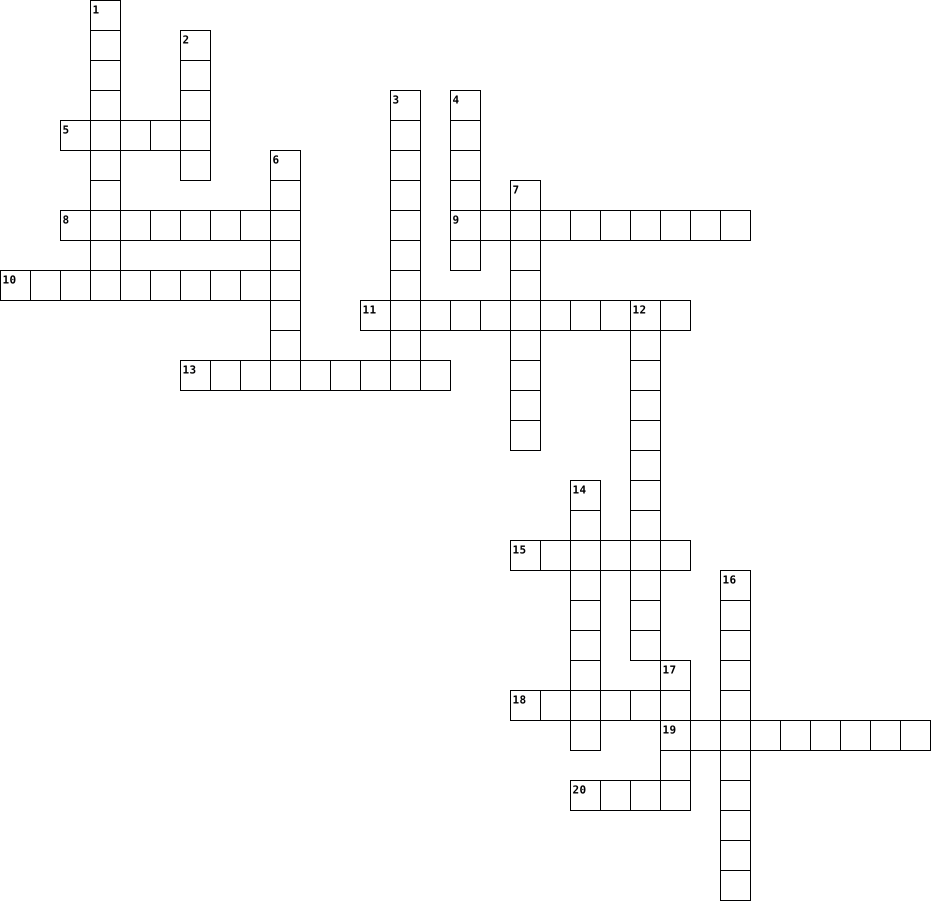
Across
- covers the earth surface
- Something formed from two plates converging.
- A event that happens when two plates Collide, transform, or diverge.
- This layer is the second hottest layer.
- This layer is made up of the crust and the mantle
- Two plates spreading apart
- The biggest layer of earth
- A supercontinent
- A person who studies rocks
- Hot substance that comes out of a volcano.
Down
- The innermost layer of the earth.
- A thing that you eat on
- what happens in the mantle
- A German scientist who came up with the idea of plate Techtonics.
- two plates colliding
- Two plates that slide against each other.
- The most common event during a diverging plate.
- There are 7 of them that make up the world
- Something that measures earthquakes.
- How gas and liquid inside the core
20 Clues: A supercontinent • two plates colliding • A thing that you eat on • covers the earth surface • what happens in the mantle • Two plates spreading apart • The biggest layer of earth • A person who studies rocks • The innermost layer of the earth. • How gas and liquid inside the core • Something that measures earthquakes. • This layer is the second hottest layer. • ...
Plate Tectonics 2021-05-11

Across
- capable of being molded or changing shape without breaking
- piece of the lithosphere that moves on the asthenosphere
- outermost layer of the earth
- boundary between two colliding plates
- as a slab sinks, it pulls on the rest of the plate with a force
- a pulling force
- drift theory that continents drift apart
- layer between the crust and the core
- rising mantle material at mid-ocean ridges creates the potential for plates to move away from the ridge with a force
- the solid mineral material forming part of the surface of the earth and other similar planets, exposed on the surface or underlying the soil or oceans
Down
- outer most, rigid layer of the Earth
- a region where an oceanic plate sinks down into the athenosphere
- a break in the Earth's crust
- boundary between two plates that are sliding past each other
- the circulation of material caused by differences in temperature and density
- the bending of rock layers
- soft layer of the mantle
- a squeezing force
- the relatively thin part of the earth's crust which underlines the ocean basins
- boundary between two plates moving away from each other
- new lithosphere is created here
21 Clues: a pulling force • a squeezing force • soft layer of the mantle • the bending of rock layers • a break in the Earth's crust • outermost layer of the earth • new lithosphere is created here • outer most, rigid layer of the Earth • layer between the crust and the core • boundary between two colliding plates • drift theory that continents drift apart • ...
Plate Tectonics 2021-06-16

Across
- Plate boundary in which plates rub against each other
- The point in the crust where a seismic rupture begins
- A chain of mountains caused by convergent boundaries
- The movement of the Earth's crust
- Soil, sand and dirt are all s________
- Large waves in the water, often caused by underwater earthquakes
- Molten rock on the surface of Earth
- The outermost layer of the earth
- The study of the Earth
- A sudden intense shaking of the Earth's surface caused by transform boundaries
- A plate thinner than a continental plate
- A structure formed by convergent plate boundaries
- A scientist that formulated the theory of plate tectonics
- Molten rock under the surface of Earth
- The liquid layer of the earth
- Contain convection currents
- Waves that move through rocks and fluids
- An opening in the Earth's crust allowing magma to escape
- Creation of rotation in a liquid caused by rapid heating and cooling
- The world's greatest earthquake belt
- Quartz, marble and slate are all m_________
Down
- A tectonic plate _ _ _ _ _ _ _ _ _ _
- The rigid outer part of the earth made of the crust and upper mantle
- Plate boundary in which plates merge
- Plate boundary in which plates separate
- The study of earthquakes
- Scale to measure the intensity of earthquakes
- Numerical scale to express the magnitude of an earthquake
- A reservoir of magma under a volcano
- A plate that makes up the Earth's lithosphere
- When one plate moves under another and is forced to sink
- Granite,obsidian and basalt are all i_____
- The upper layer of the mantle under the lithosphere
- Long narrow chasms on the sea floor
- Hottest part of the earth made of solid nickel and iron
- Theory that the continents were all once united as one super continent
- Vibrations that only move along the surface of Earth
- Instruments used to record the motion of the ground during an earthquake
- Vibrations that travel through the earth's inner layers
- How three basic rock types relate to each other
40 Clues: The study of the Earth • The study of earthquakes • Contain convection currents • The liquid layer of the earth • The outermost layer of the earth • The movement of the Earth's crust • Molten rock on the surface of Earth • Long narrow chasms on the sea floor • A tectonic plate _ _ _ _ _ _ _ _ _ _ • Plate boundary in which plates merge • A reservoir of magma under a volcano • ...
Plate Tectonics 2021-10-10

Across
- The boundary between two colliding tectonic plates
- Vibration from underground movement along a fault plane
- A break or crack in the Earth's surface
- The branch of geology that studies earthquakes
- The soft layer of the mantle
- Molten rock in the Earth's crust
- The edges where two plates meet
- A crack in the Earth's crust through which gases escape
- The boundary where two tectonic plates move away from each other
- Type of volcano that is the biggest and has large gentle slopes
- Type of volcano that is big, round and shaped like a cauldron
- The movement of the edge of one tectonic plate under another
- Simplest type of volcano, conical with low, steep sides and often found on sides of other types of volcanoes
- The outermost layer of the Earth
- Region formed where two plates move apart and can be found on land or the bottom of the sea
- The study of the movement of Earth's crust
- The theory that continents drift apart
- Continental transform fault that extends through California
Down
- The science of the history of the Earth as recorded in rocks
- the layer between the crust and the core
- The boundary where two tectonic plates slide by each other
- The process that happens at mid-ocean ridges where new oceanic crust is formed through volcanoes and then gradually moves away from the ridge
- When magma erupts onto the surface it is called this
- Volcano that buried the ancient town of Pompeii in Italy
- A long, underwater ocean ridge created by divergent boundary
- The liquid layer of the Earth's core
- This is the region around much of the rim of the Pacific Ocean where many volcanic eruptions and earthquakes occur
- The outermost, rigid layer of the Earth
- Mountains created where two or more continental plates are pushed together. The Himalayan mountains are an example.
- Type of volcano that is large and has steep slopes, also called a composite volcano
- A long narrow depression in a surface
31 Clues: The soft layer of the mantle • The edges where two plates meet • Molten rock in the Earth's crust • The outermost layer of the Earth • The liquid layer of the Earth's core • A long narrow depression in a surface • The theory that continents drift apart • A break or crack in the Earth's surface • The outermost, rigid layer of the Earth • ...
Plate Tectonics 2021-10-10

Across
- The boundary between two colliding tectonic plates
- Vibration from underground movement along a fault plane
- A break or crack in the Earth's surface
- The branch of geology that studies earthquakes
- The soft layer of the mantle
- Molten rock in the Earth's crust
- The edges where two plates meet
- A crack in the Earth's crust through which gases escape
- The boundary where two tectonic plates move away from each other
- Type of volcano that is the biggest and has large gentle slopes
- Type of volcano that is big, round and shaped like a cauldron
- The movement of the edge of one tectonic plate under another
- Simplest type of volcano, conical with low, steep sides and often found on sides of other types of volcanoes
- The outermost layer of the Earth
- Region formed where two plates move apart and can be found on land or the bottom of the sea
- The study of the movement of Earth's crust
- The theory that continents drift apart
- Continental transform fault that extends through California
Down
- The science of the history of the Earth as recorded in rocks
- the layer between the crust and the core
- The boundary where two tectonic plates slide by each other
- The process that happens at mid-ocean ridges where new oceanic crust is formed through volcanoes and then gradually moves away from the ridge
- When magma erupts onto the surface it is called this
- Volcano that buried the ancient town of Pompeii in Italy
- A long, underwater ocean ridge created by divergent boundary
- The liquid layer of the Earth's core
- This is the region around much of the rim of the Pacific Ocean where many volcanic eruptions and earthquakes occur
- The outermost, rigid layer of the mantle
- Mountains created where two or more continental plates are pushed together. The Himalayan mountains are an example.
- Type of volcano that is large and has steep slopes, also called a composite volcano
- A long narrow depression in a surface
31 Clues: The soft layer of the mantle • The edges where two plates meet • Molten rock in the Earth's crust • The outermost layer of the Earth • The liquid layer of the Earth's core • A long narrow depression in a surface • The theory that continents drift apart • A break or crack in the Earth's surface • the layer between the crust and the core • ...
Plate Tectonics 2022-04-19

Across
- a sudden and violent shaking of the ground, sometimes causing great destruction
- the most outer layer of the earth
- a planar structure or discontinuity in a volume of rock
- the formation of new areas of oceanic crust, which occurs through the upwelling of magma at midocean ridges
- a fault-bounded area or region with a distinctive stratigraphy, structure, and geological history
- scientific theory that explains how major landforms are created as a result of Earth's subterranean movements
- the splitting apart of a single tectonic plate into two or more tectonic plates separated by divergent plate boundaries.
- a stack of originally planar surfaces, that are bent or curved during permanent deformation
- an elevated region with a central valley on an ocean floor at the boundary between two diverging tectonic plates
- hot fluid or semifluid material below or within the earth's crust
- the hypothesis that the Earth's continents have moved over geologic time relative to each other
- a mountain range resulting from dissection of a structure
Down
- A tectonic boundary where two plates are moving toward each other
- a fault along a plate boundary where the motion is predominantly horizontal.
- the rigid outer part of the earth, consisting of the crust and upper mantle.
- the upper layer of the earth's mantle, below the lithosphere
- two plates are moving away from each other
- the quasi-periodic aggregation and dispersal of Earth's continental crust
- the equilibrium that exists between parts of the earth's crust
- the process which affects the shape, size, or volume of an area of the crust of the earth
- a change in shape or size resulting from applied forces
- the central, innermost, or most essential part
- ancient super-continent that included most of earth's land mass
23 Clues: the most outer layer of the earth • two plates are moving away from each other • the central, innermost, or most essential part • a planar structure or discontinuity in a volume of rock • a change in shape or size resulting from applied forces • a mountain range resulting from dissection of a structure • the upper layer of the earth's mantle, below the lithosphere • ...
Plate Tectonics 2022-05-25

Across
- the shaking of the surface of the earth resulting from a sudden release of energy in the earth's lithosphere that creates seismic waves
- a rupture in the crust of a planetary-mass object, such as earth, that allows hot lava, volcanic ash, and gases to escape from a magma chamber below the surface
- continental transform fault that extends roughly 1,200 kilometers through california
- valley, a valley formed by the separation of tectonic plates
- magma rises on the sea floor causing it to spread
- heat energy transfer between two parts of a fluid of different temperatures. When hot fluids rise and cold fluids sink
- a feature of convergent plate boundaries, where two or more tectonic plates meet
- oceanic-continental convergent plate boundary
- a seafloor mountain system formed by plate tectonics
- convergent plate boundaries
- mountain range in asia
- earth’s crust located under the ocean
- the place where two lithospheric plates come together, one riding over the other
Down
- an area on earth where two or more lithospheric plates collide
- a plate boundary where two plates move away from each other
- pieces of earths crust
- mid-ocean ridge located along the floor of the atlantic ocean, and part of the longest mountain range in the world
- a major belt of volcanoes that rims the pacific ocean
- a place where there is a significant change in the velocity (speed or direction) of motion of one lithospheric plate relative to the adjacent lithospheric plate
- boundary between tectonic plates that are sliding past each other
- portion of the Earth’s crust that primarily contains granite, is less dense than oceanic crust, and his 20-50 km thick
21 Clues: pieces of earths crust • mountain range in asia • convergent plate boundaries • earth’s crust located under the ocean • oceanic-continental convergent plate boundary • magma rises on the sea floor causing it to spread • a seafloor mountain system formed by plate tectonics • a major belt of volcanoes that rims the pacific ocean • ...
Plate Tectonics 2022-10-25

Across
- deep valley in an ocean subduction zone
- plates coming apart
- plates sliding against each other
- plates move on top of this plastic layer
- where convection currents happen
- innermost layer of the earth
- where two plates meet
- where hot rock rises from the mantle and erupts onto the surface of the earth
- one plate sinking below another
- divergent plate boundary on land
- convergent plate boundary
Down
- divergent plate boundary below water
- chunk of lithosphere that moves around
- molten rock beneath the earth's surface
- upper layer of earth
- plates coming together
- thinner and denser than continental
- thicker and less dense than Oceanic
- outermost layer of earth layers
- liquid layer of ion and nickel
20 Clues: plates coming apart • upper layer of earth • where two plates meet • plates coming together • convergent plate boundary • innermost layer of the earth • liquid layer of ion and nickel • outermost layer of earth layers • one plate sinking below another • where convection currents happen • divergent plate boundary on land • plates sliding against each other • ...
Plate Tectonics 2022-11-14

Across
- heated lower rock that rises toward the top because it is less dense than the surrounding mantle rock.
- Greek for "All Land"
- cause the plates to move from the heat going up and cooling down
- lava flows underwater
- two plates slide past one another
- valley on the ocean floor
- - plates come together
- rock moving against rock along a fault causing the rock surface to become polished
- Idea that continents move around on Earth's Surface
Down
- theory explaining how the pieces of Earth's Surface move
- striped patterns that are formed in patterns as magnetic materials in the new rocks cool
- long chain of undersea mountains
- large pieces of Earth's lithosphere that move other the asthenosphere
- plates move apart
- thin lithospheric plates that dense
- thick lithospheric plates that are less dense
- German Scientist and Arctic Explorer who suggested the concept of continental drift
- geophysicist and naval officer mapped the ocean floor
- hypothesis that new floor is created and continents are pushed apart from each other
- process that involves plates sinking into the mantle
20 Clues: plates move apart • Greek for "All Land" • lava flows underwater • - plates come together • valley on the ocean floor • long chain of undersea mountains • two plates slide past one another • thin lithospheric plates that dense • thick lithospheric plates that are less dense • Idea that continents move around on Earth's Surface • ...
Plate Tectonics 2017-02-13

Across
- 1st landmasses
- Convergent boundaries cause
- Divergent boundaries cause
- When the plate splits
- Most Dense Layer of Earth
- Age of Continental
- Less dense layer
- Transform boundaries cause
- More dense layer
Down
- What is within the mantle?
- When the plates rub together
- Age of Oceanic
- causes collisions, to pull apart and/or scrape against
- Number of Layers of the earth
- When Plates Come together
- Refers to deformation of crust
- Events caused by plates
- Least Dense Layer of Earth
- Types of plates
- where we live
20 Clues: where we live • 1st landmasses • Age of Oceanic • Types of plates • Less dense layer • More dense layer • Age of Continental • When the plate splits • Events caused by plates • When Plates Come together • Most Dense Layer of Earth • What is within the mantle? • Divergent boundaries cause • Least Dense Layer of Earth • Transform boundaries cause • Convergent boundaries cause • ...
Plate Tectonics 2017-01-31

Across
- This is the most inner layer, it is made out of solid metal, and is surrounded by the Outer Core.
- The biggest layer of the Earth.
- This layer is molten metal surrounding the Inner Core.
- This theory explains the formation, movement, and subduction of The Earth's plates.
- The theory that stated that the current continents were once one whole super-continent.
- Convergent boundaries ______ crust.
- Transform boundaries ______ destroys or create crust.
- The person that made the Continental Drift Theory.
- Divergent boundaries ______ crust.
- The outer layer of the Earth.
Down
- The boundary that can make the plates collide or subsidize.
- The boundary that can make plates glide against each other.
- A landform made from the divergent boundary.
- The landform that is created from convergent boundaries.
- The process that occurs at the mid-ocean ridges (where new oceanic crust is formed by volcanoes)
- The thing that is created by the transform boundaries.
- When two plates collide and one plate goes under the other.
- These are in the mantle and they move the lithosphere in a constant slow motion.
- The name of the super-continent that was stated in the Continental Drift Theory.
- The boundary that can make the plates divide.
20 Clues: The outer layer of the Earth. • The biggest layer of the Earth. • Divergent boundaries ______ crust. • Convergent boundaries ______ crust. • A landform made from the divergent boundary. • The boundary that can make the plates divide. • The person that made the Continental Drift Theory. • This layer is molten metal surrounding the Inner Core. • ...