
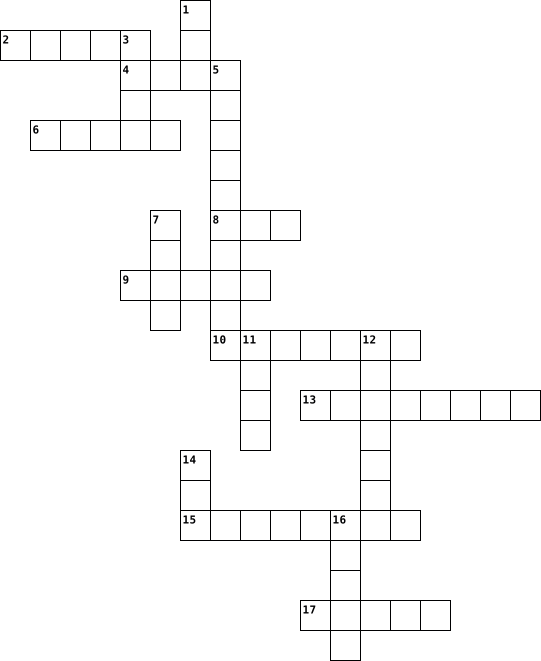
criminal minds Crossword Puzzles
EXE crossword 2026-05-18

Across
- chud
- super sonic
- favorite toy
- infinite
- false god
- who am I?
- our minds
Down
- faker
- the most powerful energy source
- crystals
- home of the Hog Hotel
- rotten boy
- what's sinister?
13 Clues: chud • faker • crystals • infinite • false god • who am I? • our minds • rotten boy • super sonic • favorite toy • what's sinister? • home of the Hog Hotel • the most powerful energy source
Christmas 2018 2018-12-19

Across
- Something with cheese inside
- Gwen’s 50th birthday (2 words)
- Greg and Brianne’s former Tuesday night outing (2 words)
- Mothers’ and Fathers’ days
- Frequent fliers
- “Elephant” in Swahili
- Number of species of birds that pass through Riverwood each year (3 words)
- Known as the ”Sunshine City”
- The forth Laverty
- A quiet hobby
- Winner of the inaugural NHL season
- What you say to the dress
- Place to buy birthday cake
- Moon Palace activity
- Brianne’s first European country
- Sport practiced at the park
Down
- Packed lunch
- Ship taken to Russia
- Summer get-away
- Summer lake
- Group on “Criminal Minds”
- Cottage appetizer (2 words)
- Outdoor living
- Brianne’s jersey number
- Christmas snack
- Sport you taught me
- Nature in Mississauga
- Where we practice our cha cha
- Alcohol for a sour drink
- Animal spotted on the last day in Tanzania
- Slow method of travel
- Weekly education
32 Clues: Summer lake • Packed lunch • A quiet hobby • Outdoor living • Summer get-away • Christmas snack • Frequent fliers • Weekly education • The forth Laverty • Sport you taught me • Ship taken to Russia • Moon Palace activity • “Elephant” in Swahili • Nature in Mississauga • Slow method of travel • Brianne’s jersey number • Alcohol for a sour drink • Group on “Criminal Minds” • What you say to the dress • ...
Laverty Crossword Christmas 2018 2018-12-19

Across
- Winner of the inaugural NHL season
- Known as the ”Sunshine City”
- The forth Laverty
- Ship taken to Russia
- Greg and Brianne’s former Tuesday night outing (2 words)
- Where we practice our cha cha
- Moon Palace activity
- Cottage appetizer (2 words)
- Alcohol for a sour drink
- Number of species of birds that pass through Riverwood each year (3 words)
- Packed lunch
- Sport you taught me
- Sport practiced at the park
- A quiet hobby
- Animal spotted on the last day in Tanzania
- “Elephant” in Swahili
- Weekly education
Down
- Group on “Criminal Minds”
- What you say to the dress
- Christmas snack
- Frequent fliers
- Gwen’s 50th birthday (2 words)
- Summer get-away
- Summer lake
- Nature in Mississauga
- Outdoor living
- Mothers’ and Fathers’ days
- Brianne’s first European country
- Brianne’s jersey number
- Something with cheese inside
- Slow method of travel
- Place to buy birthday cake
32 Clues: Summer lake • Packed lunch • A quiet hobby • Outdoor living • Christmas snack • Frequent fliers • Summer get-away • Weekly education • The forth Laverty • Sport you taught me • Ship taken to Russia • Moon Palace activity • Nature in Mississauga • Slow method of travel • “Elephant” in Swahili • Brianne’s jersey number • Alcohol for a sour drink • Group on “Criminal Minds” • What you say to the dress • ...
crimes and criminals 2023-03-09

Across
- hurtar
- secuestro
- criminal who holds someone by force
- someone who steals from bags or pockets
- criminal who steals
- criminal who steals from houses
- someone who steals personal information
- someone ho assaults and rob
- criminal who set things on fire
- chantaje
- person who treats or manipulates
- vandalizar
Down
- criminal who steals from stores
- criminal who destroys others property
- hackeo
- saqueo de bolsillos
- incendio provocado
- other way to call a thief
- asalto
- robar
- robo a tienda
- saquear
22 Clues: robar • hurtar • hackeo • asalto • saquear • chantaje • secuestro • vandalizar • robo a tienda • incendio provocado • saqueo de bolsillos • criminal who steals • other way to call a thief • someone ho assaults and rob • criminal who steals from stores • criminal who steals from houses • criminal who set things on fire • person who treats or manipulates • criminal who holds someone by force • ...
Suspicious Minds 2022-09-20
Across
- ποτέ
- μάτια
- χτίζω
- κλαίω
- συνεχίζω
- πάω κάπου για λίγο
- φεύγω
- μαζί
- δάκρυα
Down
- βλέπω
- αληθινά
- καχύποπτος
- γνωρίζω
- παγίδα
- πιστεύω
- αφήνω
- γλυκιά μου
17 Clues: ποτέ • μαζί • βλέπω • μάτια • χτίζω • κλαίω • φεύγω • αφήνω • παγίδα • δάκρυα • αληθινά • γνωρίζω • πιστεύω • συνεχίζω • καχύποπτος • γλυκιά μου • πάω κάπου για λίγο
Thought Life 2025-03-11

Across
- Those who live according to the flesh have their minds set on what the ____ ____;Rom8:5-7
- if anything is ____ or ____ – think about such thingsPhili4:8
- Whatever is ____Phili4:8
- Therefore, with minds that are ____ and fully ____,1Pet1:13
- and we take captive every thought to make it ____ to Christ.2Cor10:5
- May my meditation be ____ to him,Ps104:34
Down
- Whatever is ____ Phili4:8
- Whatever is ____Phili4:8
- the mind governed by the Spirit is ____ and ____.Rom8:5-7
- The mind governed by the flesh is ____,Rom8:5-7
- Set your minds on ____ ____, not on earthly things.Col3:2
- be made new in the ____ of your minds;Eph4:23
- Do not conform to the pattern of this world, but be _____ by the renewing of your mind.Rom12:2
- Lean not on your own.Prov3:5
14 Clues: Whatever is ____Phili4:8 • Whatever is ____Phili4:8 • Whatever is ____ Phili4:8 • Lean not on your own.Prov3:5 • May my meditation be ____ to him,Ps104:34 • be made new in the ____ of your minds;Eph4:23 • The mind governed by the flesh is ____,Rom8:5-7 • the mind governed by the Spirit is ____ and ____.Rom8:5-7 • Set your minds on ____ ____, not on earthly things.Col3:2 • ...
Healthy Minds 2024-10-20

Across
- upsetting thoughts (obsessions), which then causes an urge to do a behaviour (compulsions)
- health conditions that have resulted in changes in emotion, thinking or behaviour
- feeling manic and is the opposite of feeling depressed.
- your opinion of yourself and your abilities
- when you experience intense anxiety about social situations.
- a habit of thinking in a particular way, using particular assumptions.
- An organisation that aims to assist youths’ mental health
Down
- how you perceive, think and feel about your body.
- living in the present moment by having your mind focus on what you are doing
- a belief in one's self and one's ability to succeed
- a mood disorder that affects how you feel about yourself
- periods of depression and periods of mania, with periods of normal mood in between.
- the ability of the mind or brain to think and process information
- when you think negatively (bad) about yourself and your surroundings
- when anxious feelings don't go away and don’t have a clear cause.
- the body's way of responding to demand or pressures
16 Clues: your opinion of yourself and your abilities • how you perceive, think and feel about your body. • a belief in one's self and one's ability to succeed • the body's way of responding to demand or pressures • feeling manic and is the opposite of feeling depressed. • a mood disorder that affects how you feel about yourself • ...
Legal Leaders 2022-10-03

Across
- Conflict of Laws, 6d
- Alberta Rules of Court Annotated
- Canadian Criminal Procedure & Criminal Trial Handbook
- Canadian Extradition Law Practice
- Canadian Criminal Code Offences & Criminal Law Evidence, Practice and Procedure
- Sentencing
- Canadian Labour Law
- The Law of Evidence in Canada
- Bankruptcy and Insolvency Law of Canada (duo)
- Law of Damages
- Canadian Tort Law
- Civil Procedure & Practice in Alberta
- Sexual Offences in Canadian Law
- Injunctions and Specific Performance
- Canadian Employment Law
- Law of Vendor & Purchaser
- Criminal Law Evidence, Practice and Procedure
- Disclosure and Production in Criminal Cases
- The Doctrine of Res Judicata
- Criminal Pleadings & Practice in Canada
- Construction of Statutes
- Canadian Contract Law
- Criminal Procedure in Canada
- Canadian Law of Unjust Enrichment & Restitution
- The Law of Costs
- Martin's Annual Criminal Code
Down
- Constitutional Remedies in Canada
- Wrongful Dismissal
- Tremeear's Annotations (duo)
- Law of Limitations
- Aboriginal Law in Canada
- Judicial Review of Administrative Action in Canada
- Law of Bail in Canada
- Practitioner's Criminal Code
- Supreme Court of Canada Practice
- Child Support Guidelines: Law and Practice
- Solicitor-Client Privilege, Dodek
- Remedies in Tort
- Canadian Divorce Law and Practice
- Crankshaw's Criminal Code of Canada
- Impaired Driving in Canada
- Portable Guide to Witnesses (aka Law of Witnesses & Evidence in Canada)
42 Clues: Sentencing • Law of Damages • Remedies in Tort • The Law of Costs • Canadian Tort Law • Wrongful Dismissal • Law of Limitations • Canadian Labour Law • Conflict of Laws, 6d • Law of Bail in Canada • Canadian Contract Law • Canadian Employment Law • Aboriginal Law in Canada • Construction of Statutes • Law of Vendor & Purchaser • Impaired Driving in Canada • Tremeear's Annotations (duo) • ...
Philippians 4:5-7 2025-12-01

Across
- | What we present to God in prayer
- | What God's peace guards inside us
- | What we should pray about instead of worrying
- | We should not be anxious about this
- | How we bring our requests to God
- | What believers are told to do always before this passage (Phil. 4:4 context)
- | A humble request made to God
- | What God's peace will do for our hearts and minds
- | The attitude we should have when making requests to God
Down
- | What we should NOT be about anything
- | What God's peace surpasses
- | What we should let be known to everyone
- | Our reasonableness and requests should be made this to others and to God
- | Who should know our reasonableness
- | What surpasses all understanding
- | The One in whom our hearts and minds are guarded
- | What God's peace also guards
- | What surpasses all understanding
- | Who is at hand
- | Another word for "at hand" – describing the Lord
- | The posture in which we pray
21 Clues: | Who is at hand • | What God's peace surpasses • | What God's peace also guards • | A humble request made to God • | The posture in which we pray • | What we present to God in prayer • | What surpasses all understanding • | How we bring our requests to God • | What surpasses all understanding • | What God's peace guards inside us • | Who should know our reasonableness • ...
Healthy Minds 2024-10-20

Across
- the body's way of responding to demand or pressures
- living in the present moment by having your mind focus on what you are doing
- An organisation that aims to assist youths’ mental health
- upsetting thoughts (obsessions), which then causes an urge to do a behaviour (compulsions)
- feeling manic and is the opposite of feeling depressed.
- the ability of the mind or brain to think and process information
- when you experience intense anxiety about social situations.
- your opinion of yourself and your abilities
- when you think negatively (bad) about yourself and your surroundings
- how you perceive, think and feel about your body.
Down
- a habit of thinking in a particular way, using particular assumptions.
- health conditions that have resulted in changes in emotion, thinking or behaviour
- periods of depression and periods of mania, with periods of normal mood in between.
- a belief in one's self and one's ability to succeed
- when anxious feelings don't go away and don’t have a clear cause.
- a mood disorder that affects how you feel about yourself
16 Clues: your opinion of yourself and your abilities • how you perceive, think and feel about your body. • the body's way of responding to demand or pressures • a belief in one's self and one's ability to succeed • feeling manic and is the opposite of feeling depressed. • a mood disorder that affects how you feel about yourself • ...
Happiest Minds Puzzle 2023-04-11

Across
- After acquisition of Sri Mookambika Infosolutions (SMI), we have added SMILES 8 at “________”. (Hint: Refer Location part on our website)
- Who is the Executive Chairman of Happiest Minds?(Hint: Refer the Leadership Team on our website)
- Happiest Minds is among Top 10 India’s Best Workplaces in “_____________” 2022. (Hint: Refer Awards section in our website)
- Who inaugurated Happiest Minds Development Centre at Bhubaneshwar? (Hint: Refer the Press Releases on our website)
- Our Mission statement is Happiest People . Happiest “_________”.(Hint: Refer the Culture part on our website)
Down
- Happiest Minds wins Golden Peacock “__________________” Award 2022. (Hint: Refer the 1st newsletter)
- Happiest Minds Technologies is headquartered in?
- Happiest Minds is positioned as “_____________” in Everest Group’s of Managed Detection & Response(MDR) services PEAK Matrix. (Hint: Refer the Press Releases on our website)
- The acronym “________” describes our ethos & stands for our core values. (Hint: Refer the Culture part on our website)
- One of our vision statement is Design Happiest Minds for “_________”.(Hint: Refer the Culture part on our website)
10 Clues: Happiest Minds Technologies is headquartered in? • Who is the Executive Chairman of Happiest Minds?(Hint: Refer the Leadership Team on our website) • Happiest Minds wins Golden Peacock “__________________” Award 2022. (Hint: Refer the 1st newsletter) • ...
TV Crossword 2023-10-03
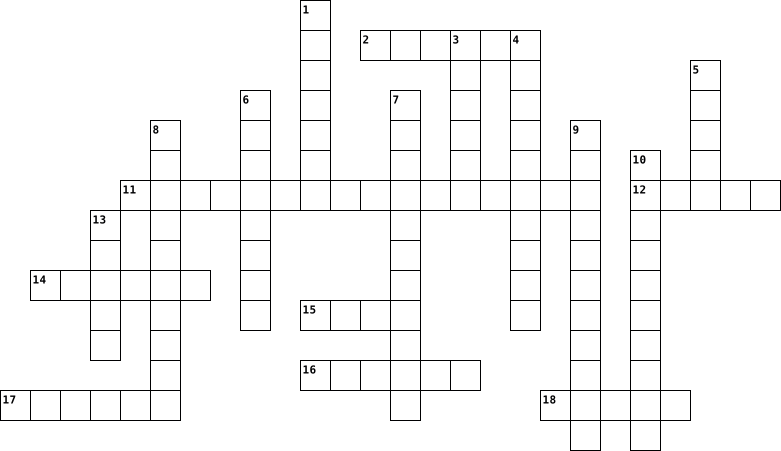
Across
- What is Ms. Schemmenti favorite football team?
- What is Garcia's role on Criminal Minds? (Two Words)
- Who is the BAU searching for every episode?
- "I cannot do another dinner at a restaurant that does small ___ with a unique flare!" (Gregory's reason for breaking up with Taylor)
- Jake can't stop snacking on this while taking Santiago on the worst date ever
- Employees favorite restaurant from the office?
- Philly mascot who guest-starred on Abbott Elementary
- This now president appeared in parks and rec twice (last name)
Down
- Jake's beloved car is ______ Bandit
- Nikolaj is from what country?
- Andy Bernards unpopular musical (Two Words)
- Jim's Favorite Basketball team
- Virginia location of the FBI Academy
- Tom and Donna have a special day where they say? (Three Words)
- Stanley's favorite day of the year (Two Words)
- What book was surrounded in controversy in Abbott Elementary? (Two words)
- Ron Swanson plays jazz under this name (Two Words)
- Terry says this about cupcakes
18 Clues: Nikolaj is from what country? • Jim's Favorite Basketball team • Terry says this about cupcakes • Jake's beloved car is ______ Bandit • Virginia location of the FBI Academy • Andy Bernards unpopular musical (Two Words) • Who is the BAU searching for every episode? • What is Ms. Schemmenti favorite football team? • Stanley's favorite day of the year (Two Words) • ...
Lesson 2. Criminal Profiler 2025-03-06

Across
- v. to cause something like a bomb or fireworks to explode
- adj. before in time or order
- adj. necessary; important
- adj. committing a crime many times
- n. a document showing that higher education has been finished
- n. who a person is
- adj. being able to do things on your own without help from other people
- n. someone who repairs the engines of cars or machines
- adj. successful
- n. a division within a larger organization
Down
- v. to tell someone that something is certainly true
- n. the system of using laws to judge people in court and punish criminals
- n. a doctor who studies people’s minds
- adj. having the training, knowledge, and experience that is needed to do something
- n. a person who police think might have committed a crime
- n. things used to prove something
- n. a person who commits a crime
- n. one who knows a lot about a particular subject
18 Clues: adj. successful • n. who a person is • adj. necessary; important • adj. before in time or order • n. a person who commits a crime • adj. committing a crime many times • n. things used to prove something • n. a doctor who studies people’s minds • n. a division within a larger organization • ...
Open Minds 2020-05-27

Across
- A person who can control other people's minds
- The main character's name
- The equivalent of a text message
- Leader of the Clan
- A person who can not read minds
- A person who can read minds
Down
- Secret group of jackers
- The main character's love interest
- The man who held jackers hostage
- Color of the gas used to drug jackers
- The boy who taught the main character her powers
- Little girl at the desert camp
12 Clues: Leader of the Clan • Secret group of jackers • The main character's name • A person who can read minds • Little girl at the desert camp • A person who can not read minds • The man who held jackers hostage • The equivalent of a text message • The main character's love interest • Color of the gas used to drug jackers • A person who can control other people's minds • ...
CLU3M - The Nature of Crime 2026-03-24

Across
- changed or updated; the Criminal Code has been this almost every year since 1892
- A prior court ruling used as a legal guide; Canadian courts relied on British ones before Confederation
- The federal statute containing the majority of Canada's criminal laws
- the goal of helping offenders reintegrate; mentioned in the Insite analysis questions
- Increasingly organized criminal activity carried out via computers or the internet
- One of the standards criminal law aims to preserve; relates to moral and social norms in society
- A written law passed by Parliament; the Criminal Code is one of these
- The failure to act when required; some offences under the Criminal Code are based on this
- The federal body that has exclusive power to create and amend criminal law in Canada
- Provincial or municipal laws covering less serious offences, usually punishable by fines
- The body of laws that prohibit and punish acts that injure people, property, and society as a whole
- The death penalty; removed from the Criminal Code in 1976
Down
- the level of government with exclusive jurisdiction over criminal law in Canada
- The 1867 political union that gave the federal government exclusive power to enact criminal law in Canada
- The authority of a government body to make or administer laws in a particular area
- A specific act that breaks a law; crimes are listed as these in the Criminal Code
- Any act or omission prohibited and punishable by federal statute
- the punishment prescribed by law for committing an offence
- to cancel or remove an outdated law
- This level of government appoints its own judges and administers its own court system in Canada
- the most local level of government; can receive jurisdiction from provinces for quasi-criminal matters
21 Clues: to cancel or remove an outdated law • The death penalty; removed from the Criminal Code in 1976 • the punishment prescribed by law for committing an offence • Any act or omission prohibited and punishable by federal statute • The federal statute containing the majority of Canada's criminal laws • ...
new romantic club hits 2021-03-14

Across
- japan
- visage
- soft cell
- roxy
- minds
- duran duran
- ultravox
Down
- david bowie
- action
- spandau ballet
10 Clues: roxy • japan • minds • visage • action • ultravox • soft cell • david bowie • duran duran • spandau ballet
DIRTY MINDS 2024-08-20

Across
- - "Used to attach a trailer."
- - "A quick back and forth motion."
- - "Makes things run smoother."
- - "Hold onto something."
- - "Used to catch fish."
- - "A small squeeze."
- - "A quick hit."
- - "A warm embrace."
Down
- - "Used to water the garden."
- - "Don’t swallow too fast."
- - "Turn something over."
- - "Hit something hard."
- - "A sound of discomfort."
- - "Stuff something in."
- - "A handsome guy."
15 Clues: - "A quick hit." • - "A handsome guy." • - "A warm embrace." • - "A small squeeze." • - "Hit something hard." • - "Used to catch fish." • - "Stuff something in." • - "Turn something over." • - "Hold onto something." • - "A sound of discomfort." • - "Don’t swallow too fast." • - "Used to attach a trailer." • - "Used to water the garden." • - "Makes things run smoother." • ...
Death by Scrabble 2021-08-09

Across
- The weather gets _______ in the summer
- What a lot of teenagers do on tests
- the color of roses
- Popular 2000's child's toy
- What an electric fence does if touched
- Used for boiling water efficiently
- Somebody would be in _____ if they found out they won the lottery
- When the weather should be 23 but feels like 30
- An annoying insect
- The show criminal minds is based on
- People who overthink often ______ themselves
- California often suffers from
Down
- Signs at construction sites say
- The start of a game
- What people would "die" without in a heatwave
- What wild animals do to get food
- Common motion for a knife
- Celebrities have
- The motion of a bomb
- Famous big mountain
- A popular drink in england
- When alone, we a stuck with our
- The sky on a clear day is
- We drink out of a
- What funerals are held for
- The first color in the rainbow
- People who have had to work all day go to
27 Clues: Celebrities have • We drink out of a • the color of roses • An annoying insect • The start of a game • Famous big mountain • The motion of a bomb • Common motion for a knife • The sky on a clear day is • Popular 2000's child's toy • A popular drink in england • What funerals are held for • California often suffers from • The first color in the rainbow • Signs at construction sites say • ...
Criminal Minds: Spring 23 Final Exam 2023-05-15

Across
- General description of a criminal type which includes details such as their gender, race, age, and mental status
- Serial killer who killed 29+ young men and buried their bodies in the crawl space under his house
- The type of killer who seeks to in a single location, kill as many people as possible
- A type of journalism that attempts to make something public by making it visible to the public
- A person who commits murder in several locations in a short amount of time
Down
- A person born with chronic mental health issues and anti-social behavior
- 18-year-old young man charged and convicted of killing his ex-girlfriend, Hae-Min Lee
- Raped and murdered 50+ people and avoided capture for 40+ years but was eventually caught due to DNA evidence
- The race of most serial killers
- The gender of most serial killers
- A person who due to inflicted trauma has mental health issues and anti-social behavior
11 Clues: The race of most serial killers • The gender of most serial killers • A person born with chronic mental health issues and anti-social behavior • A person who commits murder in several locations in a short amount of time • 18-year-old young man charged and convicted of killing his ex-girlfriend, Hae-Min Lee • ...
The Lions Den Crossword Puzzle 2021-03-22

Across
- How daring decisions are made
- The portrait guarding the common room (Two Words)
- The House Ghost (Three Words)
- Our amazing angst queen
- A true Disney princess, as described in her name
- The House correlates with this natural element
- Our metallic House Color
- The known relic of Gryffindor
- Loves many shades of red and NottPott
- Wario! Need I say more
- Our fierce teacher's aid
- Head of House in the series, not the forum (Last Name)
- Another word for a group of lions; also the emotion Angel's feels at the House's efforts
- The lionized wizarding family of redheads
- What we call our rare pair fic recs (Two Words)
Down
- that loves a good HP/Criminal Minds crossover
- A former housemate that loves triads and the character Ginny Weasley
- Canonically, Arthur and Molly have at least ____ grandchildren altogether
- The House symbol
- Term 14 Head Girl
- Location of the common room (Two Words)
- House of the nerve, ____, and chivalrous
- House Founder (First Name)
- 'AlScor for the win' says this housemate
- Infamous group of Gryffindor pranksters
- One of the House colors
- ____ of the den
27 Clues: ____ of the den • The House symbol • Term 14 Head Girl • Wario! Need I say more • Our amazing angst queen • One of the House colors • Our metallic House Color • Our fierce teacher's aid • House Founder (First Name) • How daring decisions are made • The House Ghost (Three Words) • The known relic of Gryffindor • Loves many shades of red and NottPott • ...
Who is it? 2025-05-09

Across
- I have gone to a tea party :)!
- I love Warhammer!
- I am "okay" at soccer, but getting better everyday!
- I dislike school a lot.
- I do not like Halloween!
- I almost died in a car accident when I was 3 years old.
- I like cake.
- I love pickles!
- I have 37 skins in Fortnite.
- I am playing on a soccer team.
- I am a pro at Zelda games.
- I have 2 boy cousins and 1 girl cousin in this class.
- I love Takis and I love to read.
Down
- I almost got into a very bad bike crash on someones bike.
- I always read the "Dogman" books.
- I love Ronaldo and soccer.
- I have 20 pet frogs in a bucket at the property.
- I have 5 dogs and 4 cats.
- I have six siblings.
- I love animals
- I like the book "Dogman".
- I have watched all of the "Lord of the Ring" movies.
- I have a twin
- I know how to do an ollie out of 16 stairs.
- My uncle was in "Criminal Minds".
25 Clues: I like cake. • I have a twin • I love animals • I love pickles! • I love Warhammer! • I have six siblings. • I dislike school a lot. • I do not like Halloween! • I have 5 dogs and 4 cats. • I like the book "Dogman". • I love Ronaldo and soccer. • I am a pro at Zelda games. • I have 37 skins in Fortnite. • I have gone to a tea party :)! • I am playing on a soccer team. • ...
6B 2024-04-05

Across
- Ella___una directora
- la policia____el criminal
- la ladrona quiere____ el detective
- el_____es un hombre muy guapo
- la criminal hizo_____
- que tal es la nueva _____ de accion?
- criminal fue___por la policia
- el hombre____con la mujer
- la___es muy interesante
Down
- los____era muy grande
- el____facina el gente
- El fue____en la pelicula de Accion
- yo quiero____una pelicula manana
- la persona fue la_____ de la violencia
- el____robar la tienda
- yo____la pelicula de accion
- ___roba la tienda
- el___fue muy bueno
- la pelicula_______en vida real
- el _____fue un fracaso a capturar la criminal
20 Clues: ___roba la tienda • el___fue muy bueno • Ella___una directora • los____era muy grande • el____facina el gente • el____robar la tienda • la criminal hizo_____ • la___es muy interesante • la policia____el criminal • el hombre____con la mujer • yo____la pelicula de accion • el_____es un hombre muy guapo • criminal fue___por la policia • la pelicula_______en vida real • ...
Creative Minds 2023-12-07

Across
- Gunung Tertinggi di Semenanjung Malaysia
- Sports event that started in Greece
- Adat di Negeri Sembilan
- Negara terbesar di dunia
- National car of Malaysia
- "Betul,Betul,Betul"
- Bahan berwarna hijau pada tumbuh-tumbuhan
Down
- King of fruits
- Sauce that goes along with roti canai
- Fourth colour in the rainbow
- Superhero bitten by a spider
- Biggest planet in the solar system
- Which planet has 27 moons?
- Indonesian currency
- Menara Berkembar Di Malaysia
15 Clues: King of fruits • Indonesian currency • "Betul,Betul,Betul" • Adat di Negeri Sembilan • Negara terbesar di dunia • National car of Malaysia • Which planet has 27 moons? • Fourth colour in the rainbow • Superhero bitten by a spider • Menara Berkembar Di Malaysia • Biggest planet in the solar system • Sports event that started in Greece • Sauce that goes along with roti canai • ...
For Mom 2019-05-06

Across
- Split's country
- city in which Anna, Beth, and Neil have resided
- former residence of Jason and Rachel
- Neil's position at Kirkland
- Foster's ex-husband
- the Greatest Showman and Tufts trustee
- Anna's favorite clothing brand
- Neil's major
- location of Jason's first apartment
- Papa Shel's (and Anna's?) career
- ABBA's ______ Queen
- Jason's business partners
- actor in Sunday in the Park with George and Criminal Minds
Down
- Anna's favorite form of exercise
- Rachel's thesis advisor
- a dog that was very difficult to train, though we still loved him
- where Grammy teaches old people how to use technology
- why Rachel is still in school
- Stanford quarterback
- number of Mother's Days you've celebrated
- a well-trained, adorable dog
- Rachel's soccer number
- former Stanford president
- Jason's high school nemesis
- kickass fictional Israeli spy
- Olivia of Broadchurch
- LaBelle's Lady ______
- actress Neil does not like because of Kramer vs. Kramer
- December holiday we used to host
- Ashley's homeland
- Anna's middle name
- for whom Lebron left Cleveland the first time
32 Clues: Neil's major • Split's country • Ashley's homeland • Anna's middle name • Foster's ex-husband • ABBA's ______ Queen • Stanford quarterback • Olivia of Broadchurch • LaBelle's Lady ______ • Rachel's soccer number • Rachel's thesis advisor • former Stanford president • Jason's business partners • Neil's position at Kirkland • Jason's high school nemesis • a well-trained, adorable dog • ...
Relaxing Words - Active Minds, Healthy Minds 2025-11-18

Across
- Something that comforts or soothes.
- Comfortably warm and snug.
- Completely untroubled; tranquil.
- Free from turmoil; calm.
- To release tension and rest.
- A state of quiet and harmony.
- To focus the mind for relaxation.
- Freedom from pain or difficulty.
- To ease pain or calm agitation.
- To drift lightly on water or air.
- A quiet place for relaxation.
- Pleasantly smooth or delicate.
- A state of calm attentiveness.
Down
- A pleasing combination of elements.
- Free from noise or commotion.
- A light, refreshing wind.
- A place offering relaxation treatments.
- Peaceful and free from disturbance.
- Motionless and silent.
- To immerse in liquid for relaxation.
- Calmed into a peaceful state.
- To make less tense or anxious.
- Absence of sound.
- To move slowly without effort.
- To cease work and relax.
- A smooth, continuous movement.
- Pleasantly smooth or soft in tone or mood.
- Soft and mild in nature.
- A pleasant, soothing scent.
- A short, restful sleep.
30 Clues: Absence of sound. • Motionless and silent. • A short, restful sleep. • Free from turmoil; calm. • To cease work and relax. • Soft and mild in nature. • A light, refreshing wind. • Comfortably warm and snug. • A pleasant, soothing scent. • To release tension and rest. • Free from noise or commotion. • Calmed into a peaceful state. • A state of quiet and harmony. • ...
Memoirs of Us 2024-02-05

Across
- What was our hamster's name?
- What kind of ring did I get you for our 1 year?
- What month did we make things official?
- What is our favorite pizza buffet in Winchester?
- What is your favorite double meal to get from Mcdonalds?
- What was your first bigfoot squishmallow?
- What is your favorite character from Criminal Minds?
- What size would you like to get your iced matcha with strawberry cold foam but always settle for grande?
- What is our panda's name?
- What part of your foot did you break when at the beach?
Down
- What three words did you say before you slept the other night?
- What arcade did you win the jackpot at several times?
- What did I make you in high school in cooking class all the time? (Hint: It's a drink)
- What cat word have you been saying recently?
- What was our favorite country we visited last year?
- What is your favorite llama's name?
- How long do I want to be with you?
17 Clues: What is our panda's name? • What was our hamster's name? • How long do I want to be with you? • What is your favorite llama's name? • What month did we make things official? • What was your first bigfoot squishmallow? • What cat word have you been saying recently? • What kind of ring did I get you for our 1 year? • What is our favorite pizza buffet in Winchester? • ...
NATHANIEL ESTRADA BSC-1 CRIMINAL INVESTIGATION AND INTELLIGENCE 2024-05-23

Across
- How do investigators handle cases involving domestic violence? (Intervention)
- How do investigators handle cases involving arson? (Investigation)
- What is the process of conducting background checks on potential suspects? (Screening)
- What is the process of analyzing digital evidence in criminal cases? (Examination)
- How do investigators analyze surveillance footage in criminal cases? (Observation)
- What is the role of forensic accounting in criminal investigations? (Analysis)
- How do investigators handle cases involving environmental crimes? (Investigation)
- How do investigators handle cases involving cybercrime? (Technology)
- What is the role of psychological profiling in criminal investigations? (Analysis)
- How do investigators handle cases involving terrorism? (Prevention)
- What is the significance of analyzing handwriting in criminal investigations? (Identification)
- What techniques do investigators use to track down missing persons? (Search)
- What is the process of conducting psychological evaluations in criminal cases? (Assessment)
- What is the significance of analyzing toxicology reports in criminal investigations? (Identification)
- How do investigators handle cases involving cyberbullying? (Prevention)
Down
- What is the role of intelligence analysis in criminal investigations? (Assessment)
- What is the significance of analyzing patterns in criminal investigations? (Detection)
- How do investigators handle cases involving child exploitation? (Protection)
- How do investigators handle cases involving identity theft?(Fraud)
- How do investigators handle cases involving political corruption? (Investigation)
- What techniques do investigators use to track down stolen property? (Recovery)
- How do investigators handle cases involving hate crimes? (Investigation)
- How do investigators handle cases involving drug trafficking? (Surveillance)
- How do investigators handle cases involving white-collar crime? (Investigation)
- What is the process of obtaining confessions in criminal cases? (Interrogation)
- What is the significance of analyzing ballistics in criminal investigations? (Identification)
- What techniques do investigators use to track down illegal firearms? (Seizure)
- How do investigators handle cases involving human trafficking? (Rescue)
- How do investigators handle cases involving corruption? (Investigation)
- What is the role of surveillance technology in criminal investigations? (Monitoring
30 Clues: How do investigators handle cases involving arson? (Investigation) • How do investigators handle cases involving identity theft?(Fraud) • How do investigators handle cases involving terrorism? (Prevention) • How do investigators handle cases involving cybercrime? (Technology) • How do investigators handle cases involving human trafficking? (Rescue) • ...
VISWAS CROSSWORD PUZZLE ON WORLD DAY FOR INTERNATIONAL JUSTICE - 17 JULY 2021 2021-07-16

Across
- The judges of the International Criminal Court are elected by the Assembly of ………….. to the Rome Statute, the founding instrument of the Court
- International Court of Justice settles arguments between ……….
- The International Criminal Court is composed of ……………. Judges.
- One of the major countries which has neither signed nor ratified the Roman Statute which was instrumental in the establishment of ICC.
- The crime of genocide, crimes against humanity, ………….., the crime of aggression are the crimes within the jurisdiction of the International Criminal Court, as set out in its Statute.
- The World Day for International Justice was observed for the first time in the year two thousand …………..
- Acronym of Victims Information, Sensitization, Welfare Assistance Society.
- The World Day for International Justice is celebrated to commemorate the historic adoption of the …………………. and establishment of the new system of international criminal justice in the year 1998.
- On 17 July Nineteen ………… , member States adopted a statute in Rome - known as the Rome Statute of the International Criminal Court establishing the International Criminal Court.
- The International Criminal Court was created on 1 July Two thousand …..
- The British national who is the current Chief Prosecutor in the International Criminal Court.
- The International Criminal Court prosecutes ......................... accused of committing the most serious crimes of concern to the international community as a whole, namely the crime of genocide, crimes against humanity, war crimes and the crime of aggression
- In which Ugandan city the Review Conference of the Rome Statute was held on 1 June 2010 which decided to celebrate the International Criminal Justice Day on 17 July?
Down
- The ICC is composed of four organs: the Presidency, the …………..., the Office of the Prosecutor and the Registry. Each of these organs has a specific role and mandate
- Tenure of the President of International Criminal Court.
- World Day for International Justice, also referred to as Day of International …………... Justice or International Justice Day.
- The ICC is an independent body whose mission is to try individuals for crimes within its jurisdiction without the need for a special mandate from the …………….
- The Polish national who is the current President of the International Criminal Court Judge
- The first State to ratify the Rome Statute?.
- The judges of the International Criminal Court are elected for terms of office of ……... Years.
- The city in which the Headquarters of the International Criminal Court is located.
- The aim of World Day of International Justice is to unite everyone who wants to support justice as well as promote rights of ………..…..
22 Clues: The first State to ratify the Rome Statute?. • Tenure of the President of International Criminal Court. • International Court of Justice settles arguments between ………. • The International Criminal Court is composed of ……………. Judges. • The International Criminal Court was created on 1 July Two thousand ….. • ...
legal crossword 2024-11-14

Across
- a punishment of the CJS
- innocent till proven guilty
- judge made law
- a proposed law
- a type of compensation
- someone who has suffered a loss during a criminal case
- governor general gives permission
- another term for legislation
Down
- legislation made for Australia to become a nation
- a type of criminal punishment
- a court specialising in indigenous court cases
- of probabilities, standard in a civil case
- group of 12 people empannelled to hear evidence in court
- where criminal and civil cases are heard
- an offence heard in the Magistrates court
- a very serious criminal offence
- supreme law making body in Australia
- a sum paid to restore a
- someone accused and charged with a criminal offence
- highest court of appeal in Australia
- reasonable doubt, standard in criminal case
21 Clues: judge made law • a proposed law • a type of compensation • a punishment of the CJS • a sum paid to restore a • innocent till proven guilty • another term for legislation • a type of criminal punishment • a very serious criminal offence • governor general gives permission • supreme law making body in Australia • highest court of appeal in Australia • ...
Innovative minds 2023-10-08

Across
- 1 beer >>> Infinity
- I am lovingly known as Tor Zur Welt.
- Check whatsapp
- From the host! for being such great participants!
- Systems applications and products, High performance analytic appliance simple four
Down
- The time all of us wait for!
- Origin of Latte!
- It Starts with YOU!
- You cant stop him talk
- we dont have a Jerry, but we do have___
- Governance on Toes- makes it green!
- Who said this in the Indian Mythology-The mind alone is one’s friend as well as one’s enemy..!!
- Used as a medicine for Centuries but harms our body currently. Resist if you can!
- Kazakhstan, Morroco, Jakarta, Mumbai- Been there done that
14 Clues: Check whatsapp • Origin of Latte! • 1 beer >>> Infinity • It Starts with YOU! • You cant stop him talk • The time all of us wait for! • Governance on Toes- makes it green! • I am lovingly known as Tor Zur Welt. • we dont have a Jerry, but we do have___ • From the host! for being such great participants! • Kazakhstan, Morroco, Jakarta, Mumbai- Been there done that • ...
Chapter 3 Definitions 2024-01-09

Across
- The FBI uniform crime reports reporting scheme, the practice whereby only the most serious offense of several that are committed during a criminal act is reported by the police.
- Explains crime as an outcome of conflicting interests between groups in society.
- Contending that labeling a person as a deviant or criminal makes that person more likely to engage in future criminal behavior.
- Crime reporting system where police describes each offense that occurs during a crime event as well as characteristics of the offender.
- Describes that criminal behavior as a natural outcome of peoples desire to seek pleasure in the absence of effective social controls.
- A random survey of U.S households that measures crimes committed against victims; includes crimes not reported to the police.
Down
- Explains the elements necessary for a crime to occur, as well as the types of controllers who can block criminal opportunities.
- Describes the nature of crime as reported by law enforcement agencies.
- Explains how gender inequality affects female offending and justice system responses to crimes committed by females.
- Framework consisting of a group of territories that propose similar explanations for a particular type of behavior or event.
- Number of reported crimes divided by the population of the jurisdiction, and multiplied by 100,000 persons.
- Approach to crime that is grounded in the concept of rational choice.
- Theory maintaining that crimes will occur if crime opportunities are easy to commit.
- Theory maintaining that neighborhood characteristics, including poverty, racial heterogeneity, break down social controls and lead to criminal behavior.
- Argument that people are most likely to engage in criminal behavior if they (1) have traits associated with crime and (2) are raised in environments conductive to criminal behavior.
- School of thought that argues science can be used to discover the true causes of a crime.
- Asserting that criminal behaviors are learned from associating with others.
- Criminological research that looks at whether adopted children share criminal tendencies with their biological or adoptive parents.
- Perspective indication that people have free will to choose between criminal and lawful behavior.
- So called criminal chromosome.
- Argues criminal behavior is caused by feelings of strain.
21 Clues: So called criminal chromosome. • Argues criminal behavior is caused by feelings of strain. • Approach to crime that is grounded in the concept of rational choice. • Describes the nature of crime as reported by law enforcement agencies. • Asserting that criminal behaviors are learned from associating with others. • ...
criminal 2023-09-24

Across
- spiritual and moral degeneration, abandomment of honesty
- thief who steal mostly begs
- take advantage of the lover state of a person
- sexual acts performed on a woman without her consent
- imitate documents for malicious purposes
- offend other’s people reputations
Down
- habitually commit minor theft
- internet crime
- hold a child without parental consent
- activities for the purpose of collecting private informations about a person, a company ecc
- when a person cause the death of another person
- secret union of people to fight a political situation
12 Clues: internet crime • thief who steal mostly begs • habitually commit minor theft • offend other’s people reputations • hold a child without parental consent • imitate documents for malicious purposes • take advantage of the lover state of a person • when a person cause the death of another person • sexual acts performed on a woman without her consent • ...
Twisted Minds 2024-06-22

Across
- ⚽️🎮🥅
- Twisted ReMind
- 🏎️⚽️
- PUBG ⌨️
- 🇸🇦⛏️🌲
- Regularly sends emails about Elite weekly finals
- OW🐐
- 🧠
Down
- we made it
- 📱🧞♂️
- 1ST Edition PUBGM SEL MVP
- 🇵🇰🦸♂️🥊
- OW🧠
- 🐵🪦
14 Clues: 🧠 • 🐵🪦 • OW🧠 • OW🐐 • ⚽️🎮🥅 • 🏎️⚽️ • 📱🧞♂️ • 🇸🇦⛏️🌲 • PUBG ⌨️ • 🇵🇰🦸♂️🥊 • we made it • Twisted ReMind • 1ST Edition PUBGM SEL MVP • Regularly sends emails about Elite weekly finals
Great Minds 2023-04-29

Across
- This invention brought artificial light into our daily lives, greatly improving our ability to work and live AFTER DARK.
- New or improved objects or processes created through research and experimentation.
- He invented the light bulb and the phonograph.
- Location and navigation are made possible thanks to this invention.
- He was an artist, inventor, and scientist who is known for works such as the Mona Lisa and the flying machine.
- He is known for his theory of relativity.
- Different abilities individuals possess such as verbal-linguistic, logical-mathematical, and bodily-kinesthetic.
Down
- This invention allows us to stay in touch with people ANYTIME and ANYWHERE, making communication more convenient than ever before.
- This discovery changed the way we live and work, powering everything from our homes to our factories.
- This invention allows people to connect and share information INSTANTLY and EASILY from anywhere in the world.
- He formulated the laws of motion and universal gravitation.
- Revolutionary invention for electronic data processing
- This invention revolutionized transportation by allowing people to fly through the air, greatly reducing travel times.
- He made significant contributions to the design of the modern alternating current (AC) electricity supply system.
14 Clues: He is known for his theory of relativity. • He invented the light bulb and the phonograph. • Revolutionary invention for electronic data processing • He formulated the laws of motion and universal gravitation. • Location and navigation are made possible thanks to this invention. • New or improved objects or processes created through research and experimentation. • ...
Deviant Behavior Final Exam 2021-04-18

Across
- Merged concepts to explain criminal behavior
- Attempt to explain criminal behavior through a single approach
- An individual who has a personality disorder, especially one manifesting in aggression and antisocial behavior
- Worst schedule (highest potential for abuse) of controlled substances
- Name for criminal defense for when the offender had to much sugar (hyperglycemia)
- Criminal acts in other parts of the world
- Phrase that refers to offenders getting the punishment they receive
- Not violation of drug; however, are crimes in which drugs contribution of the offense
- Criminal homicide that is unplanned and is often described as a crime of passion
- Associated with the above theory; refers to as the attempt to the "American Dream"
- Study of the relationship between human physical characteristics and criminality
- Manufacturing, distributing, dispensing, importing, exporting of a controlled substance
Down
- Criminal law committed by person of responsibility and highly social statues in the course of their occupation
- Criminologist perspective that states crime was a result of an individual choice and free will
- Who stated that criminal behavior may result from a poorly developed superego
- Forcibly entering an occupied residence
- Willful killing of one human by another
- Study of crime and criminal behavior
- human activity that violates social norms
- Theory that falls under the social theory; has five zones
- Criminal homicide that involves a killing of several victims in three or more separate events
- Seek to change the entire political, social, economic system to an extreme right or ultra-conservative model
- Cross-national study of crime
- Term used to describe individuals who behavioral patterns bring them repeatedly into conflict with society; impulsive
- Who termed the phrase "Born Criminals"
- Criminal homicide that is planned or involved premeditation
26 Clues: Cross-national study of crime • Study of crime and criminal behavior • Who termed the phrase "Born Criminals" • Forcibly entering an occupied residence • Willful killing of one human by another • human activity that violates social norms • Criminal acts in other parts of the world • Merged concepts to explain criminal behavior • ...
Criminal Defences 2020-05-12

Across
- being rendered incapable of forming criminal intent by alcohol or drugs; this condition may be used to disprove the existence of mens rea necessary for some crimes or as a mitigating factor in sentencing
- a principle of sentencing allowing a judge to consider a sentence that is not excessively harsh or long when an offender is ordered to serve a consecutive sentence
- sentence, A penalty that has no fixed length but is subject to periodic review.
- an alleged criminal act whereby an accused had the necessary mens rea was supposed defending himself or herself property or others.
- of probabilities, Standard of proof required in a civil action showing that it is more likely than not that something occurs.
- Justice, The concept that true justice is concerned with more than simply the punishment of offenders, it strives to meet victim’s needs medical care, counseling, rehabilitation.
- punishment defense, A defense permitting a parent, or one who acts in place of a parent, to physically discipline a child as long as the discipline is reasonable and falls within the supreme court’s guideline
- Deterrence, And the objective of sentencing that aims to prevent an individual offender from committing again.
- a disciplinary: Action imposed by a court restriction, suspension, or termination of normal privilege may be used in labor or international disputes and by the legal system.
- a form of release, subject to conditions, into the community for offenders after they have sewed part of their sentence.
- disorder defense, a defense that in 1992, replaced the insanity defense with the verdict changing from nit guilty by reason of insanity to not criminally responsible by reason of mental disorder.
- factors, elements that increase the offender’s responsibility for his or her actions and are considered by the judge in imposing more severe sentence evidence that the offender was motivated by ethnicity.
- A defense arguing hat an accused was induced by a government agent into committing a crime he or she would not otherwise have committed
- Intent, The mental purpose to accomplish a specific act prohibited by law The defendants must intense not only to commit the ACT charged, but also to violate the law. law
- discharge, A sentencing option used by a judge whereby no conviction is recorded and n conditions are etched.
- A fundamental principle of sentencing that allows the judge to weigh the seriousness of the offense when selecting an appropriate sentence.
- an objective of sentencing provides for the treatment or correction of the offender.
- of law, Addison sometimes used if an accused has made every effort to conform to the law and has been provided with professional, and incorrect.
- the state in which a person has no conscious control over a defense used so that people in this stage cannot be found criminally responsible self-defense
- Used to describe a sentence that allows for one sentence term to follow another, may be imposed in circumstances where the offender has been charged and convicted of multiple offenses
Down
- The concept that there is no defense, false is not an issue, and the accused is converted based on the guilty.
- Circles, a system of restorative justice, rooted in aboriginal cultures whereby the community helps to determine an appropriate sentence for an offender who is willing to participate and accept responsibility for his or her activity.
- A defense that reduces the charge of murder to manslaughter if it can be proven that the accused acted in the heat of the passion and was sufficiently provoked such that any reasonable person may have reacted
- serving a term on weekends or evenings, which is sometimes allowed in short term sentences.
- women syndrome, A condition of for fearfulness and hopelessness experienced by women who have been abused
- offender, A Criminal Code classification given to someone who has committed an offense for which there was serious personal injury and who continues to pose a threat to society.
- rules, the test this is applied to the defense of insanity whereby an accused is not held criminally responsible if, at the rime of committing the act, there was a disease Of the mind that made him or incapable of knowing nature and quality the form that was wrong
- Payments of money compensation for harm or injury, compensations for damage incurred during war paid by defeated countries to victorious countries.
- Deterrence, An objective of sentencing that aims to deter or discourage other members of society from committing the same crime.
- Intent, The goal of committing an illegal act, with no illegal purpose beyond that.
- A defense arguing that an accused was forced to commit act under threat of personal injuring or death
- crime or the character of a particular accused.
- A principle of sentencing that allows a judge to consider imposed on similar offenders committing similar offenses in similar circumstances.
- an objective of sentencing that allows a judge to consider society’s revulsion for a
- That which render and actor criminal and deserving of more blame or punishment
- A principle of sentencing that allows judges to consider options other than imprisonment when imposing a sentence.
- Factors, factors that decrease the offender’s responsibility for his or her actions and are considered by the judge in imposing a less severe sentence.
- discharge, a sentencing option used by a judge whereby no conviction is entered but are attached to a probation order.
- a defense that may excuse a person from criminal liability if it can be shown that he or she acted to protect life or limb in a reasonable manner
39 Clues: crime or the character of a particular accused. • That which render and actor criminal and deserving of more blame or punishment • sentence, A penalty that has no fixed length but is subject to periodic review. • Intent, The goal of committing an illegal act, with no illegal purpose beyond that. • ...
Criminal Law 2022-03-11

Across
- _____ is generally not a defense to homicide
- voluntary intoxication can only negate the mental state for _____ intent crimes
- conscious disregard of a substantial and unjustifiable risk
- conscious disregard of a risk that is practically certain to occur
- generally, to fulfill the act requirement, the act must be _____
- crimes without a mental state are usually called public ____ offenses
- majority of jurisdictions use this test for insanity
- when the law is so vague that a reasonable person must guess as to its meaning, it invites arbitrary enforcement, and fails to give fair notice, the law is void for _____
- mental state of purpose, knowledge, or recklessness
- when one consciously desires the result
- someone can be held responsible for a crime when they do nothing but have a legal ____ to act
- these crimes only require an act and a mental state
Down
- In order to claim self-defense, one's actions must be reasonable, necessary, and ________
- body of government that creates crimes
- to be convicted of depraved heart murder, one must have the mental state of high _____
- doctrine that applies the Bill of Rights to the states
- interprets statutes and applies the law
- almost all crimes require ____, result, and mental state
- branch of government that enforces the law
- two types of affirmative defenses - 1) justifications and 2) _____
- mistake in ____ is generally not a defense to a crime
- to claim self-defense, you cannot be the ____
- a crime is morally _______ behavior against society
- trespassory taking and carrying away personal property of another with the intent to deprive them permanently
24 Clues: body of government that creates crimes • interprets statutes and applies the law • when one consciously desires the result • branch of government that enforces the law • _____ is generally not a defense to homicide • to claim self-defense, you cannot be the ____ • a crime is morally _______ behavior against society • mental state of purpose, knowledge, or recklessness • ...
Criminal Law 2017-04-23

Across
- A criminal act where a person will attempt to get money from another person by threats.
- Term given to a group of drugs that includes morphine and heroin that reduce pain and produce sleep or stupor.
- Printed or visual material containing the explicit description or display of sexual organs or activity.
- A tube with a nozzle and piston or bulb for sucking in and ejecting liquid in a thin stream.
- An injection administered for the purposes of euthanasia or as a means of capital punishment.
- The act of public officers where they lure a suspected criminal into doing a criminal act.
- The unlawful carnal knowledge of a woman by a man forcibly and against her will.
- A promise given by a prisoner of war, when he has leave to depart from custody, that he will return at the time appointed.
- The aggregate of measures taken to protect the existing state and social structure and the territorial integrity and independence of the state.
- The action or crime of making a false spoken statement damaging to a person's reputation.
- murder When a person has planned to kill another person and was unsuccessful.
- It’s a block set up by a server or website that blocks requests originating from particular IP addresses or ranges of addresses.
- To cut off a limb.
Down
- The intent to commit a crime: malice, as evidenced by a criminal act.
- A highly addictive analgesic drug derived from morphine.
- A party who agrees to a crime as the main criminal or in accessory.
- The quality of corresponding in size or amount to something else
- Involves improper or unauthorized collection, use, disclosure, retention or disposal of personal information.
- The crime against nature, or against the order of nature, by man with man.
- The term that describes having sexual intercourse with a person who is younger than the legal age of consent.
- Term with several meanings used to describe sensual acts that are in excess of normal behaviour.
- The act of beheading. A mode of capital punishment by cutting off the head.
- Goods exported from or imported into a country against its laws.
- A piece of code which is capable of copying itself and typically has a detrimental effect, such as corrupting the system or destroying data.
- The voluntary sexual intercourse of a married person with a person other than the offender's husband or wife.
25 Clues: To cut off a limb. • A highly addictive analgesic drug derived from morphine. • The quality of corresponding in size or amount to something else • Goods exported from or imported into a country against its laws. • A party who agrees to a crime as the main criminal or in accessory. • The intent to commit a crime: malice, as evidenced by a criminal act. • ...
Criminal Activity 2018-08-02

Across
- Intentionally saying something untrue in court after taking an oath or vow of truth.
- A more serious crime is called a ________.
- Hiding illegally obtained money by transferring through foreign banks or other businesses.
- This is a story used to defend someone and explain their whereabouts during the time of a crime.
- A violent crowd of people.
- An action of illegally taking things from a person or place by force.
- Admitting to something, like a crime.
- A large sum of money used to release a criminal and guarantee their appearance in court.
- Taking someone illegally by force, usually for personal gain.
- Stealing from a store.
- If a crime happens to someone, that person is a ________.
- Another word for death.
- A fake copy of money or a product that is used to deceive.
- Capturing and restraining someone.
- If a court decides someone did not commit a crime, the person is ________.
- Money or other form of payment demanded for release of a prisoner.
- A collection of things intended to prove that a crime has been committed is called _______.
- Questioning of someone by law enforcement about a crime.
- Sneaking into a building without permission and stealing things.
- Carelessness, which usually has a negative result.
- A criminal must go to _______ before a punishment can be decided.
- A person whose job is to decide the punishment for a criminal.
- Someone who is accused or thought to have committed a crime.
- Damaging or destroying something belonging to someone else for personal advantage.
Down
- Destroying or damaging public or private property is called ________.
- A pair of metal rings police lock on the wrists of criminals.
- Paying law enforcement officials to allow illegal activity.
- These are people who are chosen randomly from society to decide on a court case.
- The act of attacking and stealing from someone in a public place.
- This is the place where criminal activity has happened.
- A criminal may try to ensure their safety and demands by holding someone called a ______.
- Illegally producing a copy of a signature, artwork, or document.
- Someone who is under the legal age of adulthood.
- A punishment decided in court is called a ________.
- This invisible thing is left behind when you touch things with your hands.
- An order from a court that allows police to enter a private place or detain someone.
- Aggressive actions intended to cause harm is called _________.
- This is the court decision of whether someone committed a crime or not.
- Another word for a murder is a _________.
- An active examination or research into something, like a crime.
- A partner in crime.
- This is another word for a lawyer.
- Illegally moving goods into or out of a country.
- A department of specialists who find small traces of things to prove a crime is called _______.
- Someone with an extreme psychological condition who kills 3 or more people.
- To take legal action against someone.
- Taking control of a larger vehicle (ship, plane, etc) while in motion is called _______.
- Intentionally setting fire to property is called _______.
- Someone who has seen illegal activity.
- If a court proves that someone committed a crime, the person is _______.
- Illegally cheating or deceiving others for personal gain.
51 Clues: A partner in crime. • Stealing from a store. • Another word for death. • A violent crowd of people. • This is another word for a lawyer. • Capturing and restraining someone. • Admitting to something, like a crime. • To take legal action against someone. • Someone who has seen illegal activity. • Another word for a murder is a _________. • ...
Criminal Activity 2018-08-02

Across
- A large sum of money used to release a criminal and guarantee their appearance in court.
- An order from a court that allows police to enter a private place or detain someone.
- The act of attacking and stealing from someone in a public place.
- Illegally cheating or deceiving others for personal gain.
- Another word for death.
- Stealing from a store.
- If a court proves that someone committed a crime, the person is _______.
- A department of specialists who find small traces of things to prove a crime is called _______.
- This is the court decision of whether someone committed a crime or not.
- This invisible thing is left behind when you touch things with your hands.
- Damaging or destroying something belonging to someone else for personal advantage.
- Taking someone illegally by force, usually for personal gain.
- Questioning of someone by law enforcement about a crime.
- Admitting to something, like a crime.
- A person whose job is to decide the punishment for a criminal.
- Another word for a murder is a _________.
- Sneaking into a building without permission and stealing things.
- A punishment decided in court is called a ________.
- A criminal must go to _______ before a punishment can be decided.
- To take legal action against someone.
- Intentionally saying something untrue in court after taking an oath or vow of truth.
- Intentionally setting fire to property is called _______.
Down
- A more serious crime is called a ________.
- If a court decides someone did not commit a crime, the person is ________.
- A pair of metal rings police lock on the wrists of criminals.
- Illegally moving goods into or out of a country.
- Someone who is accused or thought to have committed a crime.
- A criminal may try to ensure their safety and demands by holding someone called a ______.
- An active examination or research into something, like a crime.
- This is a story used to defend someone and explain their whereabouts during the time of a crime.
- Paying law enforcement officials to allow illegal activity.
- Taking control of a larger vehicle (ship, plane, etc) while in motion is called _______.
- Illegally producing a copy of a signature, artwork, or document.
- A partner in crime.
- A collection of things intended to prove that a crime has been committed is called _______.
- A fake copy of money or a product that is used to deceive.
- Carelessness, which usually has a negative result.
- Hiding illegally obtained money by transferring through foreign banks or other businesses.
- These are people who are chosen randomly from society to decide on a court case.
- Money or other form of payment demanded for release of a prisoner.
- This is another word for a lawyer.
- This is the place where criminal activity has happened.
- Destroying or damaging public or private property is called ________.
- If a crime happens to someone, that person is a ________.
- An action of illegally taking things from a person or place by force.
- Someone who has seen illegal activity.
- Capturing and restraining someone.
47 Clues: A partner in crime. • Stealing from a store. • Another word for death. • This is another word for a lawyer. • Capturing and restraining someone. • Admitting to something, like a crime. • To take legal action against someone. • Someone who has seen illegal activity. • Another word for a murder is a _________. • A more serious crime is called a ________. • ...
Criminal Law 2018-05-11

Across
- The case that sets out the tests for strict liability
- A case in which transmitting HIV can be GBH
- Form of Liability that does not require Mens Rea
- Also means 'really serious' for s.20 OAPA 1861
- Application of unlawful force to another
- A case in which the defendant held the victim hostage in a police shoot out
- Leading case on intention
- A case in which an on-duty police officer let a man be kicked to death
- A case in which the victim was subject to silent phone calls
- Also known as 'but for' causation
- A failure to do something
- A case in which the victim died from rare complications after surgery
- Victim jumped from a car to escape defendant's advances
- Form of recklessness no longer part of criminal law (overruled by G)
- A case in which a 15 year old boy left sulphuric acid in a hand dryer
- Type of recklessness where the defendant knows there is a risk of the consequence happening but takes that risk
- Can only be the mens rea for s.18 OAPA
Down
- A case in which the defendant parked on a policeman's foot without realising it but refused to move
- What the jury are entitled to do if they are sure that death or serious bodily harm was a virtual certainty and the defendant appreciated this was the case
- Is transferred when defendant intends to commit a crime against one person, but inadvertently commits a crime against another person
- An act causing victim to fear infliction of unlawful force
- Has to be more than a 'slight' or trifling link
- Break of the skin for s.20 OAPA
- A case in which the railway keeper did not shut the gate
- A case in which the defendant fell asleep with a lit cigarette and did not put it out
- Also known as indirect intent
- Fault Element of a Crime
- The burden of proof is on this person
- What the Actus Reus and Mens Rea must do for a crime to take place
- Mental Element of a Crime
- A case in which a pharmacy dispensed medicines without a prescription
31 Clues: Fault Element of a Crime • Leading case on intention • Mental Element of a Crime • A failure to do something • Also known as indirect intent • Break of the skin for s.20 OAPA • Also known as 'but for' causation • The burden of proof is on this person • Can only be the mens rea for s.18 OAPA • Application of unlawful force to another • A case in which transmitting HIV can be GBH • ...
Criminal Justice 2013-02-20

Across
- Entitlements which a person has and which are protected by the government and the courts
- To ask a higher court to reverse the decision of a trial court after final judgment or other legal ruling.
- To take or hold a suspected criminal with legal authority, as by a law enforcement officer
- The cases on a court calendar
- A prison in which prisoners a locked up for roughly 23 hours a day.
- To examine another's premises (including a vehicle) to look for evidence of criminal activity.
- Someone you are suspicious of causing a crime, and is brought in for questioning.
- The taking by law enforcement officers of potential evidence in a criminal case.
- A person legally appointed or empowered to represent another at trial.
- An official with the authority and responsibility to preside over court cases.
- The punishment given to a person convicted of a crime.
- Use of force or intimidation to obtain compliance.
- Someone under legal age, which is generally 18
- Issued by a magistrate, authorizing an officer to make an arrest, seize property or conduct a search.
- The practice or policy of creating separate facilities within the same society for the use of a minority group.
- Justification against denial or censure.
- A violation of a law in which there is injury to the public or a member of the public and a term in jail, prison, or receive fines.
- A lesser crime punishable by a fine and/or county jail time for up to one year.
- The specific area in which police have authority.
- Adopted in convention on September 17, 1787, ratified by the states in 1788
- Not guilty of committing a crime.
- Unfair treatment of a person, racial group, or minority.
- The act of considering, discussing and, hopefully, reaching a conclusion, such as a jury's discussions, voting and decision-making.
- Tests run and analyzed on recovered evidence.
- The act of a court in making an order, judgment, or decree.
- The sworn testimony of a witness taken outside of court in the presence of the prosecution and defense attorneys.
- Private visits which spouses can have sexual relations.
- Your genetic code.
- To find guilty of a crime after a trial.
- someone who assists in the commission of a crime and, unlike a mere accessory, is usually present or directly aids in the crime.
- Since 1930, the FBI has administered this report.
- Obtaining money or property by threat to a victim's property or loved ones, intimidation, or blackmail.
- Carrying out a death sentence
- A chance to remain free or serve only a short time, provided the person is good.
- To slip or get away, as from confinement or restraint.
- The crime of creating a false document, altering a document, or writing a false signature.
- The party who initiates a lawsuit by filing a complaint
- A lie detector device.
- A conscious, intentional wrongdoing, state of mind.
- Confirmation of a fact by evidence
- A document written by an officer and signed by a judge in order to get a search warrant.
- Second-hand evidence in which the witness is not telling what he/she knows personally, but what others have said to him/her.
- The killing of a human being due to the act or omission of another
- Freedom from restraint and the power to follow one's own will
- The decision of a jury after a trial, which must be accepted by the trial judge to be final.
- a system of regulations to govern the conduct of the people of a community, society or nation,
- A group of citizens called to hear a trial of a criminal prosecution or a lawsuit.
- A trick or some dishonest means to deprive another of his/her/its money, property or a legal right.
- To beat severely with a whip or rod.
Down
- A central nervous system stimulant, also widely used as an illicit drug.
- A person who testifies under oath in a trial.
- Indicates a reason to overlook, forget, or wipe out the offenses.
- A national survey published by the bureau of Justice Statistics.
- A punishment imposed or incurred for a violation of law or rule.
- Strength or power exerted upon an object, power to influence, affect, or control.
- an organized civil force for maintaining order, preventing and detecting crime, and enforcing the laws.
- Returning to the proper owner property or the monetary value of loss.
- A break in a trial or other court proceedings or a legislative session until a certain date and time.
- The felony crime of intentionally burning a house or other building.
- The verdict meaning you have been convicted of a crime or having admitted the commission of a crime.
- To serve a sentence one after another.
- Planning, plotting or deliberating before committing a crime.
- Every type of proof legally presented at trial.
- A person held in custody.
- When people work together by agreement to commit an illegal act.
- A person who takes property from someone through direct force, threat or intimidation.
- To treat in a harmful, injurious, or offensive way.
- A writ requiring a person to be brought before a judge or court, especially for investigation of a restraint of the person's liberty, used as a protection against illegal imprisonment.
- A sum of money imposed as a penalty for an offense or dereliction.
- To plead no contest.
- Payback for another’s actions.
- A crime sufficiently serious to be punishable by death or a term in state or federal prison.
- The rights that are read to you when you are arrested.
- A person who is confined in a prison.
- The examination of facts and law presided over by a judge
- Encouraging or inducing another to commit a crime or join in the commission of a crime, or sexual acts for pay.
- The unlawful killing of another person without premeditation or so-called "malice aforethought".
- The act of arresting; seizure.
- A device that secures the head and hands used as a form of punishment.
- Any lawsuit or other resort to the courts to determine a legal question or matter.
- The release of a convicted criminal defendant after he/she has completed part of his/her prison sentence.
- A statement of claimed fact contained in a complaint, a written pleading filed to begin a lawsuit
- A place where inmates are held for minor offenses.
- To discourage members of society from committing criminal acts out of fear of punishment.
- The need to prove the simultaneous occurrence of both actus reus and mens rea.
- Failure to exercise the care toward others which a reasonable or prudent person would do in the circumstances.
- A notice to appear in court due to the probable commission of a minor crime such as a traffic violation.
- What an accused criminal defendant receives if he/she is found not guilty.
- mental desire and will to act in a particular way.
- the probable reason a person committed a crime, such as jealousy, greed, revenge or part of a theft.
- A small room that inmates are locked in.
- Used to obtain testimony from a witness at both depositions and at trial.
- The person being charged with a crime.
- The crime of intentionally lying after being duly sworn
- An object or instrument used in an attack or for defense like a knife or gun.
- A second-string player who helps in the commission of a crime, such as driving a getaway car.
- A court official, usually a deputy sheriff, who keeps order in the courtroom.
- An alteration of or addition to a motion, bill, or the constitution.
- To take something that isn’t yours.
- A name used to hide someone’s identity.
- An excuse of being in another place, used by a person accused or suspected of a crime.
101 Clues: Your genetic code. • To plead no contest. • A lie detector device. • A person held in custody. • The cases on a court calendar • Carrying out a death sentence • Payback for another’s actions. • The act of arresting; seizure. • Not guilty of committing a crime. • Confirmation of a fact by evidence • To take something that isn’t yours. • To beat severely with a whip or rod. • ...
Criminal Justice 2013-02-20

Across
- The need to prove the simultaneous occurrence of both actus reus and mens rea.
- Freedom from restraint and the power to follow one's own will
- A place where inmates are held for minor offenses.
- Justification against denial or censure.
- Adopted in convention on September 17, 1787, ratified by the states in 1788
- A national survey published by the bureau of Justice Statistics.
- Your genetic code.
- Unfair treatment of a person, racial group, or minority.
- The sworn testimony of a witness taken outside of court in the presence of the prosecution and defense attorneys.
- mental desire and will to act in a particular way.
Down
- A conscious, intentional wrongdoing, state of mind.
- Since 1930, the FBI has administered this report.
- To plead no contest.
- Carrying out a death sentence
- To beat severely with a whip or rod.
- The specific area in which police have authority.
- The act of arresting; seizure.
- The rights that are read to you when you are arrested.
- An excuse of being in another place, used by a person accused or suspected of a crime.
- A prison in which prisoners a locked up for roughly 23 hours a day.
- Encouraging or inducing another to commit a crime or join in the commission of a crime, or sexual acts for pay.
- A device that secures the head and hands used as a form of punishment.
22 Clues: Your genetic code. • To plead no contest. • Carrying out a death sentence • The act of arresting; seizure. • To beat severely with a whip or rod. • Justification against denial or censure. • Since 1930, the FBI has administered this report. • The specific area in which police have authority. • A place where inmates are held for minor offenses. • ...
Criminal Justice 2012-09-16

Across
- sting operations to test whether or not police officers will make honest choices
- ethical system that claims that the greatest good is which results in the greatest happiness for greatest numbers
- vengeance-oriented justice concerned with equal retribution
- exploitation of one'e role
- form of justice that allows compensation
- concept that all decisions should be made according to absolute rules
- authority to make a decision between 2 or more choices
- what people ought to do
- ideas and principles of morals and rights are inherent in nature not human-made
Down
- ethical system that defines the pursuit of self-interest as a moral good
- question as to whether police should use immoral means to reach a desired moral end
- theory or study of moral obligations
- appropriate amount of punishment for a crime
- voluntarily breaking laws based on one's moral beliefs
- structured set of principles that defines what is moral
- component of justice that concerns the determination and methods of punishment
- difficult social questions that include controversy over right and wrong
- principle of right and wrong
- required behaviors or actions
- judgments of desirability, worth or importance
20 Clues: what people ought to do • exploitation of one'e role • principle of right and wrong • required behaviors or actions • theory or study of moral obligations • form of justice that allows compensation • appropriate amount of punishment for a crime • judgments of desirability, worth or importance • voluntarily breaking laws based on one's moral beliefs • ...
Criminal Law 2014-10-28

Across
- The court official who assists the Judge.
- Information that tends to prove or disprove the elements of an offence.
- Indirect evidence that leads to a reasonable inference of the defendant's guilt.
- The court official who records everything said in court during a trial.
- The court official who assists the sheriff.
- A jury that cannot reach a unanimous verdict.
- A mini-trial in which jurors are excluded while the admissibility of evidence is discussed.
- An application to a higher court to review the decision made by a lower court.
- A lawyer who defends an accused person on trial.
Down
- The second questioning of a witness to test the accuracy of the testimony; performed by the opposing counsel.
- In a criminal court, the person charged with committing a criminal offence.
- Persons who give evidence while under oath or affirmation in a court of law.
- A judicial inquiry to determine whether there is sufficient evidence to put the accused person on trial.
- The large group of randomly selected citizens from which jury members are chosen.
- Testimony given by a witness to prove an alleged fact.
- The first questioning of a witness to determine what he or she observed about the crime.
- The Crown's obligation to prove the guilt of the accused beyond a reasonable doubt.
- The lawyer representing the government, responsible for instituting legal proceedings against the accused.
- The court official responsible for jury management.
- The court official appointed to try cases in a court of law and to sentence convicted persons.
20 Clues: The court official who assists the Judge. • The court official who assists the sheriff. • A jury that cannot reach a unanimous verdict. • A lawyer who defends an accused person on trial. • The court official responsible for jury management. • Testimony given by a witness to prove an alleged fact. • ...
Criminal Justice 2023-11-14

Across
- the person who commits the crime
- a less serious crime
- a more serious crime
- "father of forensic toxicology"
- who established the comparison microscope as the indispensable tool of the modern firearms examiner
- trying a defendant twice for the same offense
- violation of criminal law
- the person who is affected by the crime
- a written code or regulation that protects citizen's rights
- the transfer of evidence principle was theorized by who
- money bond or property posted by the accused to allow pretrial release from jail
- information in the form of testimony, documents, or physical objects
- maintains the largest crime laboratory in the world
- who devised a technique for determining the blood group of a dried bloodstain
Down
- who undertook the first definitive study of fingerprints as a method of personal identification
- a defense to prove that a defendant was at another place at the time of the alleged crime
- court order authorizing a search or arrest
- forcing a defendant to testify or provide information against himself
- reasonable grounds for a search
- oldest forensic laboratory in the United States
- requirement by the government to be fair in its actions
- the creator of the field of criminalities
- the fictional character of sherlock holmes was created by
- developed the system known as anthropometry
- the final evaluator of forensic evidence
25 Clues: a less serious crime • a more serious crime • violation of criminal law • reasonable grounds for a search • "father of forensic toxicology" • the person who commits the crime • the person who is affected by the crime • the final evaluator of forensic evidence • the creator of the field of criminalities • court order authorizing a search or arrest • ...
Criminal Procedure 2023-12-01

Across
- Final statements by attorneys summarizing their case. (2 words)
- Requests to the court before trial to shape the case. (2 words)
- Legal challenge by the opposing party in an appeal. (2 words)
- Authority of a court to hear a case. (2 words)
- Defendant's first court appearance, informed of charges and rights. (2 words)
- Jury review of evidence to decide on indictments. (3 words)
- Alternative to imprisonment, with specified conditions. (1 word)
- Defendant's court appearance to enter a plea. (1 word)
- Formal charge issued by a grand jury, indicating enough evidence for trial. (1 word)
- Imprisonment as a penalty for criminal conviction. (2 words)
- Review of a prisoner's eligibility for early release. (2 words)
- Defendant's formal response to criminal charges. (2 words)
- Initial statements by attorneys outlining their case. (2 words)
- Government-provided legal assistance for those unable to afford it. (2 words)
- Court-ordered compensation to victims by the convicted. (2 words)
- Individual transcribing court proceedings. (2 words)
- Legal rights read to a person in custody, including the right to remain silent. (2 words)
- Recording personal information and charges after arrest. (2 words)
- Surrendering an accused individual to another jurisdiction. (1 word)
- Protection against being tried twice for the same offense. (2 words)
- Process of choosing individuals to serve on a jury. (2 words)
Down
- Questioning of witnesses by the opposing party. (2 words)
- Systematic rules governing legal processes in criminal cases. (2 words)
- Legal principles regarding law enforcement actions. (3 words)
- Legal procedure for exchanging evidence between parties. (2 words)
- Legal order requiring a person's release from unlawful detention. (2 words)
- Court session to determine if there's enough evidence for a trial. (2 words)
- Questioning of witnesses by the party that called them. (2 words)
- Legal procedure to challenge a court decision. (2 words)
- Formal demand for evidence from the opposing party. (2 words)
- Guidelines given by the judge to the jury before deliberation. (2 words)
- Legal proceeding where evidence is presented to determine guilt or innocence. (1 word)
- Legal process for handling cases involving minors. (2 words)
- Jury's decision on guilt or innocence. (1 word)
- Reasonable belief a crime has been committed, justifying legal action. (2 words)
- Court session to determine bail conditions for release. (2 words)
- Formal request or proposal made by attorneys during legal proceedings. (2 words)
- Court session to determine the punishment for the convicted. (2 words)
- Legal authorization to search a specific location for evidence. (2 words)
- Court order authorizing the arrest of an individual. (2 words)
40 Clues: Authority of a court to hear a case. (2 words) • Jury's decision on guilt or innocence. (1 word) • Individual transcribing court proceedings. (2 words) • Defendant's court appearance to enter a plea. (1 word) • Legal procedure to challenge a court decision. (2 words) • Questioning of witnesses by the opposing party. (2 words) • ...
Criminal Justice 2024-02-12

Across
- Being tried for the same crime twice.
- Suspicion supported by facts.
- Court case- Schools are allowed to drug test all students in extracurricular activities.
- Eighth. Hurting people already arrested for no reason.
- Questioning what is private and what isn’t.
- Fifth. Protects from testifying against oneself.
- Right to an attorney, fair and speedy trial.
- Court case- People must tell police officers their names.
Down
- Something that would be discovered and used in court eventually.
- People getting arrested for victimless crimes, generally for things they didn’t know was a crime.
- Court case- Schools are allowed to drug test athletes.
- Used to search any place at any time. No specifications.
- Court case- No monitoring/recording conversations.
- The order in which things after arrests happen.
- Court case- Evidence found illegally cannot be used in the court of law.
- Court case- Trial questioning if police searching trash was constitutional.
- What’s paid before trial and gets paid back.
- No cruel and unusual punishment.
- Need for a specific warrant.
- Double jeopardy, self-incrimination.
- Police can’t use evidence collected unlawfully.
21 Clues: Need for a specific warrant. • Suspicion supported by facts. • No cruel and unusual punishment. • Double jeopardy, self-incrimination. • Being tried for the same crime twice. • Questioning what is private and what isn’t. • What’s paid before trial and gets paid back. • Right to an attorney, fair and speedy trial. • The order in which things after arrests happen. • ...
Criminal Justice 2024-02-12

Across
- suspicion, supported by facts, which leads police to believe a person committed a crime
- being tried more than once for the same incident of crime
- Amendment states homes, papers, and effects are protected against unreasonable searches and seizures
- Ensure that all those charged with a crime receive their 6th amendment right to representation by a lawyer
- After a sentence is served, we should restore all rights to youthful and nonviolent offenders
- percent of people entering prison that are poor
- police need to make sure that their warrant is completed, but also correct and specific
- money paid to the court for an accused person’s temporary release, ensuring they will return to court for trial
- refers to punishments that are excessively harsh, including torture
- Address prosecutorial abuses
- when the police find evidence illegally, that evidence may not be used against the defendant in court
- Do no harm
- Excessive bail shall not be required
- Type of discovery that….permits admission of evidence obtained through illegal means
Down
- Using electronic devices to search for something in someone else’s home is unreasonable without a warrant
- the search of any place at any time
- end unduly harsh sentences; eliminating mandatory minimum sentences
- bans use of illegally obtained evidence
- No Person shall be held to answer for a capital, unless on a presentment or indictment of a Grand Jury
- court case stating people have the right to privacy
- Clue needed
- Amendment that guarantees a speedy and public trial
- the courts states that it’s legal to do drug tests, including all extra-curricular activities
- court case saying you must give your name to the police with reasonable suspicion to ensure public safety
- jury decides only if a person should be accused of a crime or not
- being forced to testify against yourself during a trial
- court case states that it’s legal to do drug tests to determine drug use and safety
27 Clues: Do no harm • Clue needed • Address prosecutorial abuses • the search of any place at any time • Excessive bail shall not be required • bans use of illegally obtained evidence • percent of people entering prison that are poor • court case stating people have the right to privacy • Amendment that guarantees a speedy and public trial • ...
CRIMINAL LAW 2024-05-16

Across
- Refers to a person who induces an innocent agent to commit the crime.
- Implies that a deed may be ascribed to a person as its owner or author.
- Defined as hostile and violent on the basis of several factors pertaining to the performer.
- Connected with heresy and apostasy it is a form of treason against the divene will.
- Vulgar, low, foul, or mean.
- The willful killing of the fetus in the uterus.
- Refers to the act of introducing any dangerous drug into the body.
- Means to determine judicially.
- Refers to any bodily, movement tending to produce some effect in the external world.
- Is the moving power which implies one to action for a definite result.
- To act with treachery.
- Refers to the act of taking away a woman from her house or other place.
- It includes any kind of structure used for storage of safekeeping.
- Refers to more than three armed malefactors acting together in the commission of an offense.
- Refers to the intention to do an injury to another.
- Refers to the imitation of a genuine or legal coin.
- Refers to the act of confinement or restraint upon persons.
- Is the suffering that is afflicted by the state for the transgression of a law.
- Is meant the obligation of fidelity and obedience.
- The annulment or destruction of another law.
Down
- Refers to the killing of an individual by treacherous means or design.
- Resorting to any devices to councel identity.
- A name other than one's own name, an assumed name.
- Having knowledge to the commission of the crime and without having participated.
- Are person who not being included in Art 17.
- Malicious and willful destruction of property by fire.
- Person who manages or carries on the gambling.
- Refers to one's inability to copulate.
- Refers to an act committed or omitted in violation of a public law.
- A belief system promulgated by a group.
- Acts or omissions punishable by the Revised Penal Code.
- Refers to a "public and malicious imputation" of a crime.
- Pertains to malice.
- Include every right or interest in the land.
- Includes any offensive or antagonistic movement or action of any kind.
- Refers to anything that occur outside the sway of man's will.
- Means to dwell together in the manner as husband and wife, for some period of time.
- Refers to unlawful fighting which terrifies others of a reasonably firm character.
- Willful desertion or forsaking of parental duties.
- Involves intellectual thickery and cunning on the part of the accused.
- Act of inducing another to commit a crime.
- Refers to a sworn statement in writing.
- Refers to a piece of metal stamped with certain marks and made current at a certain value.
43 Clues: Pertains to malice. • To act with treachery. • Vulgar, low, foul, or mean. • Means to determine judicially. • Refers to one's inability to copulate. • A belief system promulgated by a group. • Refers to a sworn statement in writing. • Act of inducing another to commit a crime. • Are person who not being included in Art 17. • Include every right or interest in the land. • ...
Criminal Justice 2024-08-09

Across
- An order authorizing the arrest and detention of an individual
- Information that is intended to remain secret
- The diameter dimension of the barrel of a firearm
- The tendency of a convicted criminal to reoffend
- Civil action against a party for a wrong committed against them
- A broken bone
- Taking into custody
- Acts of criminal behavior involving gambling, prostitution, pornography, and drugs
- The head of the shire and forerunner to the county sheriff
- Keeper of the stable
- Brusing of the skin
Down
- Items that are illegal or prohibited
- London police officers
- A sterile cotton tipped collection tool
- Fingerprint
- Planning a crime before it happens
- The first ten amendments
- Acting with or showing careful thought for the future
- Application to a higher court to dispute a lower court's decision
- Physical readiness program
- A material used to bind or protect an injured body part
- A place of confinement for people convicted of serious crimes
- Medical examination of a deceased body
23 Clues: Fingerprint • A broken bone • Taking into custody • Brusing of the skin • Keeper of the stable • London police officers • The first ten amendments • Physical readiness program • Planning a crime before it happens • Items that are illegal or prohibited • Medical examination of a deceased body • A sterile cotton tipped collection tool • Information that is intended to remain secret • ...
CRIMINAL LAW 2024-05-16

Across
- Applying to a higher court for a reversal of the decision of a lower court.
- A claim or piece of evidence that one was elsewhere when an act, typically a criminal one, is alleged to have taken place.
- A serious crime usually punishable by imprisonment for more than one year or by death.
- The actual physical impact on another person.
- The crime of falsely making or altering a document.
- A formal written or spoken statement, especially one given in a court of law.
- Deliberate destruction or damage to property.
- Money or property given as surety that a person released from custody will return at an appointed time.
- A formal declaration that someone is guilty of a criminal offense.
- The formal reading of criminal charges in the presence of the defendant.
- The crime of killing a human being without malice aforethought, or in circumstances not amounting to murder.
- A person who helps another commit a crime.
- Jury A jury, normally of twenty-three jurors, selected to examine the validity of an accusation before trial.
- The criminal act of deliberately setting fire to property.
- A document ordering a person to attend a court.
- A lesser criminal act punishable by less than a year of imprisonment.
- The restoration of something lost or stolen to its proper owner.
- Jeopardy The prosecution of a person twice for the same offense.
- Obtaining something, especially money, through force or threats.
- The state of being confined in prison; imprisonment.
- A period of supervision over an offender, ordered by the court instead of serving time in prison.
Down
- of Limitations A law that sets the maximum time the parties involved have to initiate legal proceedings from the date of the alleged offense.Verdict A decision on a disputed issue in a civil or criminal case or an inquest.
- A judgment that a person is not guilty of the crime with which they have been charged.
- Theft of personal property.
- Taking property from a person by force or threat of force.
- The process of delivering a person from one jurisdiction to another.
- A formal charge or accusation of a serious crime.
- An intentional act that causes another person to fear imminent bodily harm.
- A legal document authorizing a police officer or other official to enter and search premises, make an arrest, or carry out some other action relating to the administration of justice.
- A person who gives testimony concerning something of which they have direct knowledge.
- Bargain An agreement in a criminal case between the prosecutor and defendant whereby the defendant agrees to plead guilty to a particular charge in return for some concession from the prosecutor
- The killing of one person by another.
- The release of a prisoner temporarily (for a special purpose) or permanently before the completion of a sentence, on the promise of good behavior.
- The institution and conducting of legal proceedings against someone in respect of a criminal charge.
- Lying under oath.
- An individual, company, or institution sued or accused in a court of law.
- Theft or misappropriation of funds placed in one's trust.
- Taking someone away illegally by force, typically to obtain a ransom.
- The unlawful entry into a building with intent to commit a crime, especially theft.
39 Clues: Lying under oath. • Theft of personal property. • The killing of one person by another. • A person who helps another commit a crime. • The actual physical impact on another person. • Deliberate destruction or damage to property. • A document ordering a person to attend a court. • A formal charge or accusation of a serious crime. • ...
CRIMINAL LAW 2024-05-16

Across
- Theft of personal property.
- The unlawful entry into a building with intent to commit a crime, especially theft.
- The formal reading of criminal charges in the presence of the defendant.
- The release of a prisoner temporarily (for a special purpose) or permanently before the completion of a sentence, on the promise of good behavior.
- A serious crime usually punishable by imprisonment for more than one year or by death.
- The restoration of something lost or stolen to its proper owner.
- A formal written or spoken statement, especially one given in a court of law.
- Lying under oath.
- Bargain An agreement in a criminal case between the prosecutor and defendant whereby the defendant agrees to plead guilty to a particular charge in return for some concession from the prosecutor
- An intentional act that causes another person to fear imminent bodily harm.
- A person who gives testimony concerning something of which they have direct knowledge.
- The state of being confined in prison; imprisonment.
- The actual physical impact on another person.
- The crime of falsely making or altering a document.
- A lesser criminal act punishable by less than a year of imprisonment.
- An individual, company, or institution sued or accused in a court of law.
- Taking someone away illegally by force, typically to obtain a ransom.
- Jury A jury, normally of twenty-three jurors, selected to examine the validity of an accusation before trial.
Down
- A document ordering a person to attend a court.
- The killing of one person by another.
- A person who helps another commit a crime.
- The process of delivering a person from one jurisdiction to another.
- Taking property from a person by force or threat of force.
- The crime of killing a human being without malice aforethought, or in circumstances not amounting to murder.
- The institution and conducting of legal proceedings against someone in respect of a criminal charge.
- Deliberate destruction or damage to property.
- A formal charge or accusation of a serious crime.
- A formal declaration that someone is guilty of a criminal offense.
- A period of supervision over an offender, ordered by the court instead of serving time in prison.
- The criminal act of deliberately setting fire to property.
- of Limitations A law that sets the maximum time the parties involved have to initiate legal proceedings from the date of the alleged offense.Verdict A decision on a disputed issue in a civil or criminal case or an inquest.
- Theft or misappropriation of funds placed in one's trust.
- Obtaining something, especially money, through force or threats.
- A claim or piece of evidence that one was elsewhere when an act, typically a criminal one, is alleged to have taken place.
- Applying to a higher court for a reversal of the decision of a lower court.
- A legal document authorizing a police officer or other official to enter and search premises, make an arrest, or carry out some other action relating to the administration of justice.
- Jeopardy The prosecution of a person twice for the same offense.
- A judgment that a person is not guilty of the crime with which they have been charged.
- Money or property given as surety that a person released from custody will return at an appointed time.
39 Clues: Lying under oath. • Theft of personal property. • The killing of one person by another. • A person who helps another commit a crime. • Deliberate destruction or damage to property. • The actual physical impact on another person. • A document ordering a person to attend a court. • A formal charge or accusation of a serious crime. • ...
Criminal Crossword 2022-09-02

Across
- _________ is when a person is tricked by a police officer into committing a crime.
- ________ is taking property through violence or threat of violence.
- This is betraying one's own country
- This is an act that violates the rules of the law.
- This is a false signature on a check or other document.
- of Court This is being disrespectful in court.
- This is committing something unreasonable, the attempt to use such force.
- This is to give something in exchange for something else.
- This is an actual physical force.
Down
- ____________ is killing another person without intending to do so.
- ______ is breaking into a house to take property.
- This is the wrongful taking of another person's property who is entrusted with that property.
- _____ is the intentional killing of another person.
- A ___________ is a less serious crime. It is punishable by a fine, imprisonment, or both, but not as severe as a felony.
- _______ is not telling the truth under oath
- ________ is malicious damage to property.
- An __________ is a minor offense. It is punishable by a fine, but not imprisonment.
- A ______ is a major crime. It is punishable by a fine, imprisonment, or both.
- ______ is taking property without intending to return it.
- What is another category of crime that is motor vehicle violations?
20 Clues: This is an actual physical force. • This is betraying one's own country • ________ is malicious damage to property. • _______ is not telling the truth under oath • of Court This is being disrespectful in court. • ______ is breaking into a house to take property. • This is an act that violates the rules of the law. • _____ is the intentional killing of another person. • ...
Criminal Justices 2022-11-28

Across
- theft of something on property
- persuading someone
- taking something without paying
- burning of anothers property
- Excuse from a problem
- something you need
- Mental Excuse
- destuction of property
- Protecting a client
- A suspision with reason
- taken money that someone was entrusted to
Down
- A paper form a reasonable arrest
- to go to jail for a crime
- A paper that allows a search of a property
- the cause for your arrest
- stealing from someone by force
- a state of drunkeness
- to put presure on someone
- Biological evidence
- to make fake documents to commit a fraud
20 Clues: Mental Excuse • persuading someone • something you need • Biological evidence • Protecting a client • Excuse from a problem • a state of drunkeness • destuction of property • A suspision with reason • to go to jail for a crime • the cause for your arrest • to put presure on someone • burning of anothers property • theft of something on property • stealing from someone by force • ...
criminal justice 2025-04-29

Across
- document authorizing an arrest
- into criminal behavior
- forum for legal proceedings
- of restoring to a useful life
- presented in court
- law enacted by a legislature
- who commits a crime
- order to appear and testify
- to commit an unlawful act
- side in a legal case
- court appearance for a defendant
- statement under oath
- something to influence
- punishable by law
- or property pledged for release
- team for the accused
- statement of guilt or innocence
- in legal proceedings
- accusation by a grand jury
Down
- facility for short-term detention
- officer in a courtroom
- for a higher court review
- of citizens deciding a case
- of being elsewhere
- for confining offenders
- in a jail or prison
- serious offense than a felony
- release from prison
- someone into custody
- crime punishable by imprisonment
- setting of fire
- professional
- imposed by a court
33 Clues: professional • setting of fire • punishable by law • of being elsewhere • presented in court • imposed by a court • in a jail or prison • release from prison • who commits a crime • someone into custody • side in a legal case • statement under oath • team for the accused • in legal proceedings • officer in a courtroom • into criminal behavior • something to influence • for confining offenders • ...
Criminal Justice 2025-09-18

Across
- eye for an eye
- document with the powers of the federal government
- Chinese used it to identify people
- the first ten amendments
- law code written for Athens and greese
- crime that involves embezzlement, and fraud
- Man who killed his wife
- a machine that will tell if you say the truth
- what they call London police force
Down
- crime that involves terrorism, gangs,and trafficking
- crime that involves jaywalking, and drugs
- rights you get read to you before you get arrested
- doing crime because of your beliefs and worship
- figuring out how a person died
- getting influenced by a group of people
- novel about a detective
- a substance that is bad for you
- bad living conditions
- any act that is contrary to legal code or laws
- The beginning of mugshots
20 Clues: eye for an eye • bad living conditions • novel about a detective • Man who killed his wife • the first ten amendments • The beginning of mugshots • figuring out how a person died • a substance that is bad for you • Chinese used it to identify people • what they call London police force • law code written for Athens and greese • getting influenced by a group of people • ...
Final Challenge Crossword 2023-11-22

Across
- Sent complex codes and ciphers to the media during a killing spree starting in the late 60s.
- Fictional sleuth living in St. Mary Mead.
- Criminal Minds characters are members of this government agency.
- Leroy Jethro Gibbs, played by Mark Harmon, was the main character in this show.
- Public officers may conduct ______ checks during an investigation.
- Dr. Hannibal ___________.
- The Helter Skelter scenario was an apocalyptic vision embraced by this cult leader and his family.
- In the movie Seven, John Doe (played by Kevin Spacey) was guilty of this sin.
- American Rapper Ice-T appears on this detective drama under the Law & Order franchise.
Down
- Bibliotherapy usually involves the use of this form of literature.
- Author of “Fall of the House of Usher” and “Annabel Lee”.
- Dr. Temperance Brennan from Bones is a forensic ___________.
- Nineteenth century female axe murderer.
- ______ of mind OR condition.
- Hesitant.
- Nickname of serial killer who claimed his neighbor's dog was giving him orders to kill.
16 Clues: Hesitant. • Dr. Hannibal ___________. • ______ of mind OR condition. • Nineteenth century female axe murderer. • Fictional sleuth living in St. Mary Mead. • Author of “Fall of the House of Usher” and “Annabel Lee”. • Dr. Temperance Brennan from Bones is a forensic ___________. • Criminal Minds characters are members of this government agency. • ...
Final Challenge 2023-11-22

Across
- The Helter Skelter scenario was an apocalyptic vision embraced by this cult leader and his family.
- Public officers may conduct ______ checks during an investigation.
- Author of “Fall of the House of Usher” and “Annabel Lee”.
- In the movie Seven, John Doe (played by Kevin Spacey) was guilty of this sin.
- ______ of mind OR condition.
- Sent complex codes and ciphers to the media during a killing spree starting in the late 60s.
- Leroy Jethro Gibbs, played by Mark Harmon, was the main character in this show.
- Nineteenth century female axe murderer.
- Nickname of serial killer who claimed his neighbor's dog was giving him orders to kill.
Down
- Fictional sleuth living in St. Mary Mead.
- American Rapper Ice-T appears on this detective drama under the Law & Order franchise.
- Dr. Hannibal ___________.
- Criminal Minds characters are members of this government agency.
- Dr. Temperance Brennan from Bones is a forensic ___________.
- Hesitant.
- Bibliotherapy usually involves the use of this form of literature.
16 Clues: Hesitant. • Dr. Hannibal ___________. • ______ of mind OR condition. • Nineteenth century female axe murderer. • Fictional sleuth living in St. Mary Mead. • Author of “Fall of the House of Usher” and “Annabel Lee”. • Dr. Temperance Brennan from Bones is a forensic ___________. • Criminal Minds characters are members of this government agency. • ...
Chapter 4 Key Terms Crossword Puzzle 2013-04-23

Across
- Assisting someone to commit a criminal offence.
- The act of deliberately choosing to ignore certain facts or information.
- Fairness in the processes that resolve disputes.
- A minor criminal offence with less severe punishment, which is usually tried soon after the charge is laid (summarily) without a preliminary hearing or jury.
- To pass a proposed law into legislation.
- A Latin phrase meaning "a wrongful deed"; the physical or guilty act, omission, or state of being that constitutes a crime.
- Encouraging or urging another person to commit a crime.
- the state of the mind of a person who commits an action deliberately and on purpose.
- A Latin phrase meaning "a guilty mind"; the mental element of ones criminal actions.
- An act done with the intent to commit a criminal offence but without success.
- A criminal offence proceeding by way of a summary conviction or an indictable offence; the Crown decides which way to proceed.
- Wanton and reckless disregard for the lives and safety of other people.
Down
- A principle that judicial decisions should be based on objective criteria and be free from bias or conflict of interest.
- To make a behavior a criminal offence in the Criminal Code or other criminal statutes.
- An action, omission, or state of being that is considered a crime, as defined in the Criminal Code or other criminal statutes.
- A time limit imposed by law within which a specific action must be taken.
- To initiate and carry out a legal action.
- A state of acting carelessly without regard for the consequences of one's actions.
- To make a behavior that was illegal punishable only by fines.
- To make an act completely legal by removing it from the Criminal Code or other criminal statutes.
- Someone who knows that a crime has been committed and who helps the person who committed the crime to hide or escape from the police.
- A serious criminal offence with a severe penalty, proceeding by way of a formal court document called an indictment.
- To change existing legislation (laws).
- The body of public law that defines crimes and prescribes punishment.
- An agreement between two or more people to commit an unlawful act.
- The reason for committing a certain act.
26 Clues: To change existing legislation (laws). • To pass a proposed law into legislation. • The reason for committing a certain act. • To initiate and carry out a legal action. • Assisting someone to commit a criminal offence. • Fairness in the processes that resolve disputes. • Encouraging or urging another person to commit a crime. • ...
Chapter 4 Key Terms 2026-02-26

Across
- to make a behaviour a criminal offence in the Criminal Code or other criminal statute
- an action, omission, or state of being that is considered a crime, as defined in the Criminal Code or other criminal statute
- to pass a proposed law into legislation
- the reason for committing a certain act
- a serious criminal offence with a severe penalty, proceeding by way of a formal court document called an indictment
- a criminal offence proceeding by way of a summary conviction or am indictable offence; the Crown decide which way to proceed
- the physical or guilty act, omission, or state of being that constitutes a crime
- a state of acting carelessly without regard for the consequences of one’s actions
- to initiate and carry out a legal action
- a principle that judicial decisions should be based on objective criteria and be free from bias or conflicts of interest
- assisting someone to commit a criminal offence
- a minor criminal offence with less severe punishments, which is usually tried soon after the charge is laid (summarily) without a preliminary hearing or jury
- an agreement between two or more people to commit an unlawful act
Down
- fairness in the processes that resolve disputes
- to make a behaviour that was illegal punishable only by fines
- to make an act completely legal by removing it from the Criminal Code or other criminal statute
- wanton and reckless disregard for the lives and safety of other people
- encouraging or urging another person to commit a crime
- the body of public law that defines crimes and prescribes punishments
- a time limit imposed by law within which a specific action must be taken
- an act done with the intent to commit a criminal offence but without success
- the act of deliberately choosing to ignore certain facts or information
- someone who knows that crime has been committed and who helps the person who committed the crime to hide or escape from the police
- a Latin phrase meaning “a guilty mind”; the mental element of one’s criminal actions
- the state of mind of a person who commits an action deliberately and on purpose
- to change existing legislation (laws)
26 Clues: to change existing legislation (laws) • to pass a proposed law into legislation • the reason for committing a certain act • to initiate and carry out a legal action • assisting someone to commit a criminal offence • fairness in the processes that resolve disputes • encouraging or urging another person to commit a crime • ...
YPLC Staff- Fun Facts 2023-10-08

Across
- I have two dogs, a cat, a gecko, a snake and 3 saltwater tanks
- I own land on the moon
- I’ve rewatched the criminal minds series 6 times
- I am 3d: my 3 faves for life are dachshunds, diet coke and disney
- I played club volleyball for 8 years as a setter and a middle hitter
- I've swam with manatees !
- I have performed in the Nutcracker 6 times
- I have white water rafted down the whole Grand Canyon
- I come from a family of farmers
- I can prob fix your car if something breaks as long as it's not the transmission or engine
- I have never been out of the country
- I have lived inside of 3 national parks
Down
- I ran the highest elevation trail marathon in the United States
- I use to play in a band
- I have two middle names
- I won a limbo contest while I was on vacation in Aruba
- love animals and insects and studied them in college
- I have a pet snake
- My ringtone is The Office theme song
- My dream vacation would be to attend Athens, Greece and visit all the historic sites and ruins of Ancient Greece.
- I’m usa Olympic certified to coach gymnastics
- I’ve been to 10 different countries
- I love live music
- I want to be a criminal investigator or an emergency services dispatcher
- I ran into Billie Eilish once in Seattle before she was famous
- I think deep dish pizza is the best kind
- I’m a Disney adult and a Hogwarts Alumni
27 Clues: I love live music • I have a pet snake • I own land on the moon • I use to play in a band • I have two middle names • I've swam with manatees ! • I come from a family of farmers • I’ve been to 10 different countries • My ringtone is The Office theme song • I have never been out of the country • I have lived inside of 3 national parks • I think deep dish pizza is the best kind • ...
Criminal Vocabulary 2021-04-18

Across
- Legal term for the killing of a human.
- a synonym for kidnapping.
- Term for the planning of a crime in advance.
- The unlawful taking of property from a person by use of force or intimidation
- Crime for someone who asked or commanded another person to commit a crime.
- The (optional) fifth step in a trial.
- Degree of a murder charge when there was no advanced preparation or planning.
- willful and malicious burning of another person's property.
- Term for an individual who helps someone commit a crime.
- Form of assault that includes repetitive harassment and/or threats
- Charge that would be applied to a witness who lied under oath.
Down
- The unlawful taking of a person against their will.
- the act of using threats or intimidation to convince someone to part with their property.
- Delivered by the jury as the final step of a trial
- Term for the process by which jurors are selected for a trial.
- An agreement between two or more people who intend to commit a crime.
- The person accused of committing a crime.
- Willful destruction of, or damage to, another person's property
- class of larceny when the stolen item is worth less than $100.
- The unlawful entering of another person's property with the intention of committing a crime.
20 Clues: a synonym for kidnapping. • The (optional) fifth step in a trial. • Legal term for the killing of a human. • The person accused of committing a crime. • Term for the planning of a crime in advance. • Delivered by the jury as the final step of a trial • The unlawful taking of a person against their will. • Term for an individual who helps someone commit a crime. • ...
Criminal Crossword 2022-09-02

Across
- A less serious crime. It is punishable by a fine, imprisonment or both, but not as severely as a felony.
- is malicious damage to property
- Killing another person without intending to do so.
- obtaining benefit through coercion
- done to protect yourself or others
- The wrongful taking of another person’s property by a person who is entrusted with that property.
- not telling the truth under oath
- breaking into a house to take property
- to give something in exchange for something else
- mental disorder defense
- a nonviolent crime often characterized by deceit or concealment to obtain or avoid losing money
- when a person is tricked by a police officer into committing a crime
Down
- Betraying one’s own country
- committing something unreasonable, the attempt to use such force
- the actual physical force
- Is the intentional killing of another person
- taking property without intending to return it
- False signature on a check or other document
- A major crime. It can be punishable by a fine, imprisonment, or both.
- Minor offense. It is punishable by a fine, but not imprisonment.
20 Clues: mental disorder defense • the actual physical force • Betraying one’s own country • is malicious damage to property • not telling the truth under oath • obtaining benefit through coercion • done to protect yourself or others • breaking into a house to take property • Is the intentional killing of another person • False signature on a check or other document • ...
Criminal Crossword 2022-09-02

Across
- Encourages victims to invest. Pays old investors with the new investors money
- Breaking into a place to take property
- Offer the victim the opportunity to make money (but not really)
- Peron trusted with the property taking it for themselves
- Use of force to protect self from others
- killing without intent
- minor crime; Speeding, Jaywalking
- betraying one's own country
- False signature on official document
- not telling the truth under oath
Down
- intentional killing
- In between minor and major crimes; Minor theft, assault
- A major crime; Murder, Kidnapping
- being disrespectful in court
- Attempting to use force
- Tricked by a police officer into committing the crime
- Damaging property
- Taking property
- Giving something in exchange for something else illegally
- Fancy people crimes; Money laundering, Ponzi scheme
- using mental illness as a defense against full sentencing for a crime
- obtaining property through violence or threats
- Actually using force
- Taking property through violence or threat of violence
24 Clues: Taking property • Damaging property • intentional killing • Actually using force • killing without intent • Attempting to use force • betraying one's own country • being disrespectful in court • not telling the truth under oath • A major crime; Murder, Kidnapping • minor crime; Speeding, Jaywalking • False signature on official document • Breaking into a place to take property • ...
Criminal Activity 2018-08-02

Across
- An action of illegally taking things from a person or place by force.
- This is a story used to defend someone and explain their whereabouts during the time of a crime.
- Money or other form of payment demanded for release of a prisoner.
- Paying law enforcement officials to allow illegal activity.
- Intentionally saying something untrue in court after taking an oath or vow of truth.
- To take legal action against someone.
- Taking someone illegally by force, usually for personal gain.
- The act of attacking and stealing from someone in a public place.
- This is the court decision of whether someone committed a crime or not.
- Someone who has seen illegal activity.
- A collection of things intended to prove that a crime has been committed is called _______.
- Admitting to something, like a crime.
- This is the place where criminal activity has happened.
- If a court decides someone did not commit a crime, the person is ________.
- A pair of metal rings police lock on the wrists of criminals.
- Questioning of someone by law enforcement about a crime.
- A criminal may try to ensure their safety and demands by holding someone called a ______.
- A department of specialists who find small traces of things to prove a crime is called _______.
- Capturing and restraining someone.
Down
- A more serious crime is called a ________.
- A large sum of money used to release a criminal and guarantee their appearance in court.
- An order from a court that allows police to enter a private place or detain someone.
- Intentionally setting fire to property is called _______.
- Sneaking into a building without permission and stealing things.
- Someone who is accused or thought to have committed a crime.
- A partner in crime.
- Illegally cheating or deceiving others for personal gain.
- Destroying or damaging public or private property is called ________.
- A person whose job is to decide the punishment for a criminal.
- Hiding illegally obtained money by transferring through foreign banks or other businesses.
- Carelessness, which may result in breaking the law.
- Illegally producing a copy of a signature, artwork, or document.
- An active examination or research into something, like a crime.
- Another word for a murder is a _________.
- A fake copy of money or a product that is used to deceive.
- Stealing from a store.
- Taking control of a larger vehicle (ship, plane, etc) while in motion is called _______.
- A punishment decided in court is called a ________.
- This invisible thing is left behind when you touch things with your hands.
- Damaging or destroying something belonging to someone else for personal advantage.
- A criminal must go to _______ before a punishment can be decided.
- If a court proves that someone committed a crime, the person is _______.
- Illegally moving goods into or out of a country.
- If a crime happens to someone, that person is a ________.
- Another word for death.
- This is another word for a lawyer.
- These are people who are chosen randomly from society to decide on a court case.
47 Clues: A partner in crime. • Stealing from a store. • Another word for death. • This is another word for a lawyer. • Capturing and restraining someone. • To take legal action against someone. • Admitting to something, like a crime. • Someone who has seen illegal activity. • Another word for a murder is a _________. • A more serious crime is called a ________. • ...
Criminal Law 2019-11-13

Across
- ____ is the killing of a human by another
- An example of ______ manslaughter is when a person is texting and driving and hit a person crossing the street in a crosswalk
- Police may search a persons car during a stop if they have _______
- _____ is another term when a women decides to terminate her pregnancy
- Penal code for Disorderly Conduct
- PC 415
- When a person asks another to commit or join in a crime even if they don't respond
- Police rely in ______ on a defective warrant
- Crime that is punished through fines, not jail time
- Unlawful use of force or violence on another person
- Someone commits _____ when they knowingly makes a false oral or written statement
Down
- Offense that may be prosecuted as a felony or as a misdemeanor
- When someone is taken into custody authorized by the law
- PC 407
- Criminal offenses that carry up to a year in jail
- ______ is carried upon your person and carried for lawful purpose
- Police can authorize a ________ when they believe any crime has been committed
- Type of battery committed against a former/present spouse
- Someone found guilty of ________ degree murder may be sentenced to 25 years to life and may be sentenced to death
- Most serious type of criminal offense
- _____ manslaughter is when someone kills another in the heat of passion
- The _____ Amendment protects people from unreasonable searches and seizures
22 Clues: PC 407 • PC 415 • Penal code for Disorderly Conduct • Most serious type of criminal offense • ____ is the killing of a human by another • Police rely in ______ on a defective warrant • Criminal offenses that carry up to a year in jail • Crime that is punished through fines, not jail time • Unlawful use of force or violence on another person • ...
CRIMINAL CROSSWORD 2023-12-04

Across
- of the fittest
- Has a trunk
- Man's best friend
- Was once united, now can be called confederate
- Mother of two well known
- Soldiers for evil
- Erupting sapient
- Flying mammal
- Site of the tank engine's demise
- Large marsupial
- The Valley Frolicker
- Sanctuary and sisterhood of love
Down
- Who What and Where of Sanctuary
- The smoking sanctuary
- The reason for need of sanctuary
- Likes to chase mice
- Gatekeeper unnamed
- A place nobody can call home anymore
- Valley
- Lost a dear dearly
- The Love Train
- You cross, and your free
- The shady train to safety
- Gone too soon
- HIDE IN THE FOILS, THERE'S ____ IN THE AIR!
25 Clues: Valley • Has a trunk • Flying mammal • Gone too soon • of the fittest • The Love Train • Large marsupial • Erupting sapient • Man's best friend • Soldiers for evil • Gatekeeper unnamed • Lost a dear dearly • Likes to chase mice • The Valley Frolicker • The smoking sanctuary • Mother of two well known • You cross, and your free • The shady train to safety • Who What and Where of Sanctuary • ...
Criminal law 2024-05-16

Across
- 11. Means to determine judicially.
- 40.unlawfully seizing or confining a person by force.
- 14. Refers to a sworn statement in writing; declaration in writing made under oath before an authorized officer.
- 22. The person who manages or carries on the gambling.
- 17. A name other than one's own name, an assumed name.
- 3. Refers to violent expulsion of the embryo from the material womb which results in death of the fetus.
- 35.Circumstances where an individual is not liable for a crime, like insanity or being under nine years of age.
- 36.The act of killing another person
- 39. Committing a crime ensuring excusion without risk
- 19. Malicious and willful destruction of property by fire.
- 20. Refers to more than three armed malefactors acting together in the commission of an
- 8. Those who take a direct part in the execution of the act
- 10. Refers to any bodily, movement tending to produce some effect in the external world.
- 15. Refers to unlawful fighting which terrifies others of a reasonably firm character. A fight consisting of twO or more persons in a public place.
- 16.destructive and injurious behavior that is socially defined as hostile and violent on the basis of several factors pertaining to the performer and the person making the evaluation.
- 29.Planning and deliberating a crime before committing it
- 32.Taking property from another using violence or intimidation
- 25. Refers to an act committed or omitted in violation of a public law forbidding and commanding it.
- 27.Law-punishable acts or omissions
- 2. Willful desertion or forsaking of parental duties.
- 34.Deliberate alteration of body parts
- 6. those who, having knowledge of the commission of the crime, and without having participated therein
- 31.Threatening behavior intended to make another person fearful or apprehensive
Down
- 5. The annulment or destruction of another law.
- 12. Refers to the act of introducing any dangerous drug into the body.
- 26. Means to desire or wish in common thing.
- 30.Serious spoken defamation, leading to jail time or fines. Less severe slander incurs
- 24. Involves intellectual trickery and cunning on the part of the accused.
- 4. Refers to the act of taking away a woman from her house or other place where she may be for the purpose of carrying her to another place with intent to corrupt or marry her
- 37.Forcing sexual activity against someone's will.
- 33.Taking property from another using violence or intimidation
- 1. the act of inducing another to commit a crime.
- 23. Refers to the unlawful act of any person who shall Contract a second or subsequent marriage before the former marriage has been legally dissolved.
- 38. Factors that lessen the severity of a crime or punishment.
- 28.When the offender performs all acts to commit the felony, but it does not occur due to causes independent of their will
- 9. Refers to anything that occur outside the sway of man's will.
- 21. Means to desire or wish in common thing
- 7. person who not being included in Art 17.
- 18. To act with treachery
- 13. A private offense committed by any married woman who shall have sexual intercourse with a man not her husband and by the man who has carnal knowledge of her
40 Clues: 18. To act with treachery • 11. Means to determine judicially. • 27.Law-punishable acts or omissions • 36.The act of killing another person • 34.Deliberate alteration of body parts • 21. Means to desire or wish in common thing • 7. person who not being included in Art 17. • 26. Means to desire or wish in common thing. • 5. The annulment or destruction of another law. • ...
Criminal Offences 2025-12-10

Across
- Intentionally causing damage by starting a fire or explosion.
- Communicating for the purpose of offering or obtaining sexual services for payment.
- Intentionally ending someone’s life to relieve suffering (legal only under strict medical-assistance-in-dying rules).
- Applying force—or attempting or threatening to apply force—to someone without consent.
- Intentionally causing the death of another person.
- Wounding, maiming, disfiguring, or endangering the life of another person.
- Violence or threats used to intimidate the public or government to achieve political or ideological goals.
- Intentionally deceiving someone to cause a loss of money, property, or service.
- Selling, giving, transporting, or delivering illegal drugs.
- Using someone else’s personal information without permission, usually for fraudulent purposes.
- Intentional killing that is not planned or deliberate.
- A death where no one is legally at fault (such as self-defence or unavoidable accidents).
- Repeatedly following, watching, or communicating with someone in a way that causes them to fear for their safety.
- A mother causing the death of her newborn due to the effects of childbirth or mental disturbance.
- A death caused by unlawful or blameworthy actions (includes murder and manslaughter).
- Causing death through an unlawful act, negligence, or heat-of-the-moment behaviour without intent to kill.
Down
- Assault where the victim suffers injuries that interfere with their health or comfort.
- Touching someone in a sexual way without consent.
- Taking someone’s property without permission, permanently or temporarily.
- Using reasonable force to protect oneself or another from an immediate threat.
- Illegally entering a place with intent to commit an offence inside.
- Stealing property while using or threatening violence.
- A planned and deliberate killing, or a killing committed during certain serious crimes (like kidnapping).
- Having illegal drugs or prohibited substances under your control.
- An unintended event causing harm where no reasonable person would be held responsible.
- An honest belief that you own or have permission to use the property in question.
- Taking a person away against their will, especially a child.
27 Clues: Touching someone in a sexual way without consent. • Intentionally causing the death of another person. • Stealing property while using or threatening violence. • Intentional killing that is not planned or deliberate. • Selling, giving, transporting, or delivering illegal drugs. • Taking a person away against their will, especially a child. • ...
Criminal Law 2026-03-02

Across
- A less serious crime, usually with lighter punishment
- Taking someone else’s property without permission
- Taking a suspect into legal custody
- Intentional unlawful killing of another person
- Creating or altering a document to deceive
- Court process to decide guilt or innocence
- Person accused of a crime in court
- A serious crime, typically punishable by over a year in prison
- Robbing someone in public using violence or threats
- Illegally entering a building to commit a crime
- Taking property from a person by force or threat
- Taking and holding someone against their will
- Repeatedly following or harassing someone to frighten them
- The killing of one person by another
Down
- An illegal act; a violation of the law
- Punishment ordered by a court after conviction
- Legally responsible for committing a crime
- Threatening to reveal information unless demands are met
- Offering or accepting something of value to influence an action
- Court official who presides and makes legal decisions
- Stealing goods from a store without paying
- Taking a vehicle without permission for a short time
- Violence used to intimidate for political or ideological aims
- Non-consensual sexual act
- Unauthorized access to a computer system or network
- Intentionally setting fire to property
- Lawyer who represents the state and brings charges
- Illegal movement of goods or people across a border
- Using deception to get money or an advantage illegally
- Deliberately damaging or defacing property
30 Clues: Non-consensual sexual act • Person accused of a crime in court • Taking a suspect into legal custody • The killing of one person by another • An illegal act; a violation of the law • Intentionally setting fire to property • Legally responsible for committing a crime • Stealing goods from a store without paying • Creating or altering a document to deceive • ...
Criminal Crosswords 2026-03-18

Across
- In manslaughter cases, an intervening act will not break the chain of causation if it is connected to the accused's actions and of the same general character
- Harm to others is not a principle of fundamental justice
- There must be an air of reality to raise the defence of provocation
- A “public place” is any place to which the public has physical access to
- The personal characteristics of the accused, aside from incapacity, are irrelevant in assessing objective mens rea
- The mens rea required for attempted murder is specific intent to kill
- There is no consent between adults who intentionally apply force causing serious hurt or non-trivial bodily harm
- Absolute liability offences cannot have a penalty of imprisonment
- The quantitative threshold for a valid criminal law purpose is a reasonable apprehension of harm
- A "duty imposed by law” includes a duty which arises at common law
- Child abandonment requires subjective mens rea
Down
- Where the statutory language requires proof of an ulterior purpose, recklessness cannot be the standard of mens rea
- Subjective foresight of death is the minimum fault requirement for murder
- In manslaughter cases, even if the unlawful act alone would not have caused the death, it is still a legal cause so long as it contributed in some way
- A momentary act of negligent driving does not amount to dangerous driving
- Condom use is a part of the “sexual activity in question”
- The "beyond de minimis" test is applicable for all forms of culpable homicide
- Judicial notice of social context evidence is admissible in sentencing
- When dealing with true crimes, start with the presumption that there is a subjective fault element required
- An "undertaking" in S. 217 CCC requires a clearly made commitment with binding intent
- The law authorizing the use of corrective force on children is constitutional
- Failure to comply with a bail conditions requires subjective mens rea
- The courts may reconsider a prior decision from a higher court when a new legal issue is raised
23 Clues: Child abandonment requires subjective mens rea • Harm to others is not a principle of fundamental justice • Condom use is a part of the “sexual activity in question” • Absolute liability offences cannot have a penalty of imprisonment • A "duty imposed by law” includes a duty which arises at common law • ...
Criminal law 2025-05-12

Across
- this offence is heard in the Magistrate's court
- purpose of criminal law
- rea, planning to commit a crime
- offender, actually committing the offence
- age of criminal responsibility
- offence against the person
- law made by judges
- withholding evidence of a crime
Down
- offence against property
- when a crime is committed whilst your sleep walking
- a most serious offence
- law made by Parliament
- burden of proof
- reasonable doubt, standard of proof
- reus, committing the criminal act
- the person charged with a criminal offence
- liability, this is an offence where you are automatically guilty
- when a minor doesn't fully understand what they are doing
- an offence against society
- defence, using equal force to defend ones self
20 Clues: burden of proof • law made by judges • a most serious offence • law made by Parliament • purpose of criminal law • offence against property • offence against the person • an offence against society • age of criminal responsibility • rea, planning to commit a crime • withholding evidence of a crime • reus, committing the criminal act • reasonable doubt, standard of proof • ...
Criminal Investigations 2025-10-08

Across
- The legal power or authority a court or agency has to make decisions or handle certain cases in a specific area.
- Conversations with witnesses, victims, and even a potential suspect that are used to obtain information.
- Tiny scratch marks left on a bullet that show the unique pattern of the gun barrel it was fired from.
- Commonly, but not exclusively, seen in burglaries.
- The improper transfer of material between two or more sources of physical evidence.
- The diameter of a gun barrel interior between its opposing high sides (the lands).
- A condition in which an officer has suspicion about an individual and knowledge of facts and circumstances that would lead a reasonable person to believe that a crime has been, is being, or is about to be, committed.
- The study of how bullets or other objects move through the air after being fired.
- Provides a genomic-based, probabilistic estimation of the image of a person of interest.
- A technique used to record measurements for crime scene sketches, measuring the location of the evidence (X, Y) from fixed points (A, B)
- A Latin term meaning “guilty mind”; it refers to the intent or knowledge of wrongdoing when someone commits a crime.
- Fingerprints created when friction ridges deposit body perspiration and oil on surfaces they touch; typically invisible to the naked eye.
- The process of looking for evidence of a crime.
- It’s the study of family history; finding out who your ancestors are and how you’re related.
- The identification of individuals based on the pattern of wrinkles on their lips, which has individual characteristics.
- The diameter of a bullet; somewhat larger than the bore of the weapon from which the bullet is fired.
- The preferred method of effecting an arrest.
- In a firearm’s rifled bore, the low cuts that separate the higher lands.
- The time after death.
- Evidence that is extremely small or microscopic in size or is present only in limited amounts.
Down
- An exception to the requirement that law enforcement officers have a search warrant; occurs when there is a compelling need for official action and there is no time to get a warrant.
- Two-dimensional impressions, having a length and width and lacking any appreciable height.
- The title of clauses appearing in both the Fifth and Fourteenth amendments to the Constitution of the United States.
- The alignment of the edges of two items of evidence, thereby showing that both items were previously joined together.
- Whether an individual’s actions, decisions, or statements were made freely and by their choice.
- Provides that evidence obtained from an unreasonable search and seizure cannot be used as the basis for learning about or collecting new admissible evidence not known about before.
- A detailed list of items or evidence that have been collected, stored, or taken during an investigation.
- A limited pat down of the outer clothing of a person encountered by a law enforcement officer when the person is acting suspiciously, and the officer, concerned about safety, seeks to determine if the person has a weapon.
- The right of law enforcement officers to search people who have been arrested without a warrant.
- The long metal tube of a gun that the bullet travels through when it’s fired.
- The witnessed, unbroken, written chronological record of everyone who had an item of evidence, and when each person had it; also accounts for any changes in the evidence.
- The formal questioning of a suspect to obtain information and are therefore inherently adversarial in nature.
- A specialty that relates dental evidence to criminal investigation.
- Can be created by shoes and tires.
- The pattern of blood drops or stains that shows how and where an injury or violent act happened.
- When law enforcement takes property or evidence because they believe it’s connected to a crime.
- The study and comparison of fingerprints as a means of criminal identification.
- A complete unit of ammunition; it includes the bullet, gunpowder, casing, and primer all in one package.
- Wounds inflicted by blunt objects such as clubs, pipes, and pistols; typically open and irregularly shaped, bruised around the edges, and bleeding freely.
- The process of taking a person into legal custody to answer a criminal charge.
40 Clues: The time after death. • Can be created by shoes and tires. • The preferred method of effecting an arrest. • The process of looking for evidence of a crime. • Commonly, but not exclusively, seen in burglaries. • A specialty that relates dental evidence to criminal investigation. • In a firearm’s rifled bore, the low cuts that separate the higher lands. • ...
Criminal Psychology 2025-08-06

Across
- - Irresistible urge to act
- - Questioning technique used by police
- - Person with antisocial personality
- - Specific way crime is committed
- - Event that causes violent behavior
- - Psychological control over others
- - Mental images driving criminal acts
- - Power to influence or direct
- - Psychological description of offender
Down
- - Psychological injury from experience
- - Person lacking empathy or remorse
- - Psychological reason for crime
- - Unique personal mark of criminal
- - Mental condition affecting behavior
- - One who hunts or exploits others
- - Actions that reveal personality
- - Treatment for psychological issues
- - Repeated method or sequence
- - Repeated ceremonial behavior
- - Mental pressure affecting behavior
20 Clues: - Irresistible urge to act • - Repeated method or sequence • - Repeated ceremonial behavior • - Power to influence or direct • - Psychological reason for crime • - Actions that reveal personality • - Specific way crime is committed • - Unique personal mark of criminal • - One who hunts or exploits others • - Person lacking empathy or remorse • ...
BATTLEFIELD OF THE MIND 2020-09-27

Across
- The brain is an
- A condition of the mind
- It means to restore to its original state
- What creature does mind control resemble
Down
- They are challenged by our thoughts feelings beliefs
- Be it unto you according to your
- It shields our minds
- Spiritual forces do this to our minds
- We build them in our minds
- The number of stages to challenging thoughts
10 Clues: The brain is an • It shields our minds • A condition of the mind • We build them in our minds • Be it unto you according to your • Spiritual forces do this to our minds • What creature does mind control resemble • It means to restore to its original state • The number of stages to challenging thoughts • They are challenged by our thoughts feelings beliefs
VOCAB 2013-09-19

Across
- I hope when I am older I am very _.
- A lot of _ writers aren't very popular or well known.
- The show criminal minds show crazy people who get a thrill from _ behavior.
- My teammates and I have a great _ and are very supportive of each other.
- My mom has a very _ personality and that is why everyone loves her.
Down
- My little nephew hides in _ places when we play hide n seek.
- I am not in _ to share my room with my little sister.
- A lot of _ people tend to be more shy and timid.
- She was forgiven of her crime because of _ circumstances.
- The _ insect struggeld to make it up the big hill.
10 Clues: I hope when I am older I am very _. • A lot of _ people tend to be more shy and timid. • The _ insect struggeld to make it up the big hill. • I am not in _ to share my room with my little sister. • A lot of _ writers aren't very popular or well known. • She was forgiven of her crime because of _ circumstances. • ...
Criminology Chapter 1 2022-08-31

Across
- Type of theory is one that attempts to explain all or most types of criminal behavior through one basic overarching approach
- perspective emphasizes agreement among members of society as to what behaviors should be considered criminal
- an important feature because the FBI will use the system to collect detailed data on the circumstances surrounding each serious criminal incident
- Evidence-based criminology is an increasingly popular form of contemporary
- The type of behavior that is human activity violating social norms or what is socially acceptable
- type of criminology that attempts to develop explanations for criminal behavior
- Not all deviant behavior is _______
- interviewers ask questions about crimes that affected household members over the past 6 months
- violations of the criminal law and other misbehavior committed by young people
- perspective suggests that societies are diverse and behaviors become criminalized through a political process involving considerable debate
- someone who studies crime, criminals, and criminal behavior
- Type of theories do not attempt to explain all criminality but attempt to merge concepts drawn from different sources
- type of policy needs to be linked to the objective findings of well-conducted criminological research
Down
- every crime has a unique set of causes, _____, and participants
- Not all criminal behavior is ______
- Type of crime that is considered the dark figure of crime
- Criminal justice professionals include police and correctional officers, probation and parole officers, and ______
- a reporting program – only crimes reported to the police are included in the statistics compiled by the program
- Type of theories suggest only once source for all serious deviant and criminal behavior
- human conduct that violates the criminal laws of a state,the federal government, or a local jurisdiction that has the power to make and enforce the laws
- a perspective that recognizes that laws are social products
- criminology is a _____ profession built on scientific study of crime and criminal behavior
- a specialist in the collection and examination of the physical evidence of crime
- that is founded on the ______ method.
24 Clues: Not all criminal behavior is ______ • Not all deviant behavior is _______ • that is founded on the ______ method. • Type of crime that is considered the dark figure of crime • a perspective that recognizes that laws are social products • someone who studies crime, criminals, and criminal behavior • every crime has a unique set of causes, _____, and participants • ...
title 2014-02-19

Across
- rrrrrr
- hhhhh
- iiiiiii
- cccccc
- jjjjjjj
- dddddddd
- ppppp
- qqqqq
Down
- mmmmmmm
- ffffff
- kkkkkkk
- eeeeeeee
- oooooo
- nnnnnnnn
- aaaaaa
- bbbbbbb
- lllllll
- ggggggg
18 Clues: hhhhh • ppppp • qqqqq • ffffff • rrrrrr • oooooo • cccccc • aaaaaa • mmmmmmm • kkkkkkk • iiiiiii • jjjjjjj • bbbbbbb • lllllll • ggggggg • eeeeeeee • nnnnnnnn • dddddddd
spanish 6b 2024-04-11

Across
- el___fue muy bueno
- la policia____el criminal
- el_____fue un fracaso a capturar la criminal
- el hombre____con la mujer
- los____era muy grande
- pelicula_______en vida real
- la tienda
- la ladrona quiere____ el detective
Down
- la___es muy interesante
- ___roba la tienda
- el_____es un hombre muy guapo
- el____facina el gente
- la criminal hizo_____
- que tal es la nueva _____ de accion?
- criminal fue___por la policia
- la persona fue la_____ de la violencia
- yo quiero____una pelicula manana
- Ella___una directora
- El fue____en la pelicula de Accion
- pelicula de accion
20 Clues: la tienda • pelicula de accion • ___roba la tienda • Ella___una directora • la criminal hizo_____ • el____facina el gente • la___es muy interesante • la policia____el criminal • el hombre____con la mujer • pelicula_______en vida real • el___fue muy bueno • criminal fue___por la policia • los____era muy grande • el_____es un hombre muy guapo • ...
Los dos Heroes 2014-10-02

Across
- ¿Adónde camina Ana?
- Goes fast.
- Looks for.
- ¿Adónde va el Criminal?
- Ana es una ___________ chica.
- Has a computer.
- Grabs.
- Wants.
- Una persona brava.
Down
- Flies.
- El héroe que se sienta en Espeedy.
- ¿Cómo está Ana cuando camina a la escuela con su Macintosh?
- ¿Qué animal es Espeedy?
- Problem.
- Una persona que busca a víctimas.
- Goes to.
- La chica que tiene el Macintosh.
- Takes.
- ¿Cómo está el criminal en la Prisión?
- In the air.
- She walks.
- Un criminal es ________ .
- Throws.
23 Clues: Flies. • Takes. • Grabs. • Wants. • Throws. • Problem. • Goes to. • Goes fast. • Looks for. • She walks. • In the air. • Has a computer. • Una persona brava. • ¿Adónde camina Ana? • ¿Qué animal es Espeedy? • ¿Adónde va el Criminal? • Un criminal es ________ . • Ana es una ___________ chica. • La chica que tiene el Macintosh. • Una persona que busca a víctimas. • El héroe que se sienta en Espeedy. • ...
LAUREN 2026-04-21

Across
- Your title on June 27th: Maid of ____
- The North Campus dorm where we first met
- How many years of friendship we have so far!
- The 26.2 mile accomplish you recently crushed!
- The commute I'd take to see you for dinner after work when I lived in Chicago (and often have to run to catch!)
- The duration of our friendship -- no expiration date!
- The party where I'll see you next!
- There will be 27 of these on your cake this year
Down
- The kind of Nashville bar where we danced in our cowboy boots
- Your star sign
- Your favorite summer sanctuary at your mom's house
- Your boyfriend's name
- The only way to describe the kind of friend you are
- Spencer ______, our favorite Criminal Minds genius
- The street in Ann Arbor where we lived together for 3 years
- Something you'll be unwrapping as part of this gift!
- The movie we watched together during your recent visit to help me wedding dress shop
- Our shared status at the University of Michigan (Go Blue!)
18 Clues: Your star sign • Your boyfriend's name • The party where I'll see you next! • Your title on June 27th: Maid of ____ • The North Campus dorm where we first met • How many years of friendship we have so far! • The 26.2 mile accomplish you recently crushed! • There will be 27 of these on your cake this year • Your favorite summer sanctuary at your mom's house • ...
vocabulary p72 2024-04-17

Across
- = when you catch the criminal
- =when you follow a person
- =when you discover the criminal and you take he or she
- =a person who protect people
- =are finger marks that identify a person
- =look for the clues of the case to find the criminal
- = act of kiling someone
- =when you look at the evidence
Down
- =They are traces of foots on the ground
- =They are clues that reveal the criminal
- =someone who investigate a crime
- =when someone takes something from another person
- = a person who prevent the crimes
- = when you discover the criminal
- = a place where the criminals stay
- =the person who kill other
- = the act of rob
- =It's the tool you use to kill someone.
18 Clues: = the act of rob • = act of kiling someone • =when you follow a person • =the person who kill other • =a person who protect people • = when you catch the criminal • =when you look at the evidence • =someone who investigate a crime • = when you discover the criminal • = a person who prevent the crimes • = a place where the criminals stay • =They are traces of foots on the ground • ...
Criminal Crossword 2022-10-19

Across
- Defence where the act becomes lawful
- Wrong but denial in culpability
- Intoxication
- Gross Negligence Manslaughter
- Prior to loss of self control
- R v Cunningham (1957)
- unintentional killing
- complete loss of self control
- Failure to act
- 2016 ruling that changed complicity
- Test for Duress
- S.20 OAPA 1861
- Devlin J defining Disease of the Mind
- William ______
- Goal or Objective
- arrested outside post office
Down
- _______ Manslaughter
- R v G (2004)
- No NAI if V's act is reasonable
- _____ Criminal Damage
- ________ burden
- Inflict is to be interpreted as caused
- Co-Defendants
- More than merely preparatory
- disease of the mind
- Homicide
- Necessary for Result Crimes
- Test for Dangerous
- duty to avert danger
- defence for bodily privacy invasion
- Re A (2001)
- Reasonable for self defence
32 Clues: Homicide • Re A (2001) • R v G (2004) • Intoxication • Co-Defendants • Failure to act • S.20 OAPA 1861 • William ______ • ________ burden • Test for Duress • Goal or Objective • Test for Dangerous • disease of the mind • _______ Manslaughter • duty to avert danger • _____ Criminal Damage • R v Cunningham (1957) • unintentional killing • Necessary for Result Crimes • Reasonable for self defence • ...
Criminal Law 2020-07-19

Across
- The case that sets out the tests for strict liability
- A failure to do something
- A case in which the railway keeper did not shut the gate
- Is transferred when defendant intends to commit a crime against one person, but inadvertently commits a crime against another person
- Form of Liability that does not require Mens Rea
- A case in which an on-duty police officer let a man be kicked to death
- A case in which the defendant held the victim hostage in a police shoot out
- A case in which a 15 year old boy left sulphuric acid in a hand dryer
- A case in which the defendant parked on a policeman's foot without realising it but refused to move
- A case in which the defendant fell asleep with a lit cigarette and did not put it out
- The burden of proof is on this person
- Leading case on intention
- Also means 'really serious' for s.20 OAPA 1861
- Type of recklessness where the defendant knows there is a risk of the consequence happening but takes that risk
- An act causing victim to fear infliction of unlawful force
- What the Actus Reus and Mens Rea must do for a crime to take place
Down
- Mental Element of a Crime
- Also known as 'but for' causation
- Victim jumped from a car to escape defendant's advances
- What the jury are entitled to do if they are sure that death or serious bodily harm was a virtual certainty and the defendant appreciated this was the case
- Application of unlawful force to another
- A case in which transmitting HIV can be GBH
- A case in which a pharmacy dispensed medicines without a prescription
- Has to be more than a 'slight' or trifling link
- A case in which the victim was subject to silent phone calls
- Can only be the mens rea for s.18 OAPA
- Break of the skin for s.20 OAPA
- Fault Element of a Crime
- Also known as indirect intent
- A case in which the victim died from rare complications after surgery
- Form of recklessness no longer part of criminal law (overruled by G)
31 Clues: Fault Element of a Crime • Mental Element of a Crime • A failure to do something • Leading case on intention • Also known as indirect intent • Break of the skin for s.20 OAPA • Also known as 'but for' causation • The burden of proof is on this person • Can only be the mens rea for s.18 OAPA • Application of unlawful force to another • A case in which transmitting HIV can be GBH • ...
Criminal Law 2021-02-16

Across
- intentional or unintentional killing conducted with malice aforethought
- type of intent nullified by honest but unreasonable mistake of fact or voluntary intoxication
- type of intent nullified by honest and reasonable mistake of fact
- malicious burning of a structure
- trespassory taking and carrying away of another's personal property with intent to permanently deprive
- type of manslaughter that is intentional, but mitigated by adequate provocation or other circumstances negating malice aforethought
- attempted battery, or intentionally causing victim to fear immediate battery
- duty to do this before using deadly force
- plaintiff must prove the act was set in motion by the requisite state of mind
- defendant reasonably believes force is necessary to avoid a greater harm that is immediate, and defendant is not responsible for causing the harm
- aids, abets, or facilitates criminal acts of another, provided the criminal consequences are foreseeable in relation to the acts
- intentional or reckless application of unlawful force to the victim's person
- obtaining property by threat of future harm
- rule regarding liability where police or victim kills the co-felon
Down
- doctrine that makes co-conspirators guilty of crimes that are a foreseeable outgrowth of a conspiracy and are done in furtherance of the conspiracy
- agreement to commit a crime coupled with a significant overt act in furtherance of the agreement
- unlawful conversion of property lawfully in defendant's possession with intent to permanently deprive
- breaking and entering the dwelling of another with the intent to commit a felony therein
- type of manslaughter that is unintentional, caused by recklessness, criminal negligence, or during the commission of an unlawful act
- timely repudiation plus sufficient steps to neutralize any assistance provided before commission of the crime
- independent and inherently dangerous felonies mnemonic
- guilty mind
- guilty act
- specific intent to bring about a criminal result and a significant overt act in furtherance of that intent
- defendant seeks to induce another to commit a crime
- larceny by force
- defendant was laboring under defect of reason from a disease of the mind as to not know the nature and quality of the act or that what he was doing was wrong
27 Clues: guilty act • guilty mind • larceny by force • malicious burning of a structure • duty to do this before using deadly force • obtaining property by threat of future harm • defendant seeks to induce another to commit a crime • independent and inherently dangerous felonies mnemonic • type of intent nullified by honest and reasonable mistake of fact • ...
Criminal Justice 2023-02-28

Across
- to bother, irritate, or intimidate
- demanding money and keeping a secret in return
- using deceit for personal gain
- a physical attack
- a crime usually punishable by prison
- a minor crime, usually punishable by a fine
- tampering with a legal document or faking a signature
- destroying evidence
- trying to overthrow your own government
- paying someone off
- damaging or destroying property
- trying to destroy an entire group of people
Down
- spying to gain military or political information
- stealing from a store
- illegal entry with crime, usually stealing
- murder of an important political person
- lying under oath
- setting property on fire
- misusing someone's investment money
- to take over a plane, boat, or vehicle
- an unplanned murder
21 Clues: lying under oath • a physical attack • paying someone off • destroying evidence • an unplanned murder • stealing from a store • setting property on fire • using deceit for personal gain • damaging or destroying property • to bother, irritate, or intimidate • misusing someone's investment money • a crime usually punishable by prison • to take over a plane, boat, or vehicle • ...
CRIMINAL LAW 2014-05-14

Across
- the share of responsibility among criminals for the additional crimes committed over the course of the crime they originally intended to commit
- a deliberate closing of one’s mind to the possible consequences of one’s actions
- wanton or reckless disregard for the lives and safety of others, sometimes causing serious injury or death
- the person who actually commits the crime
- someone who knowingly receives, comforts, or assists a perpetrator in escaping from the police
- an awareness of certain facts that can be used to establish mens rea
- offences that do not require mens rea but to which the accused can offer the defence due diligence
- defence used to prove that the accused took every reasonable precaution to prevent committing a particular crime
- the body of laws that prohibit and punish acts that injure people, property, and society as a whole
- the intention to commit a crime even though it may not be carried out
- the state of mind in which someone desires to carry out a wrongful action, knows what the results will be, and is recklessly regarding the consequences
- the crime of encouraging the perpetrator to commit crime
Down
- legal responsibility for wrongful action
- offences that do not require mens rea to which the accused can offer no defence
- an act or omission of an act that is prohibited and punishable by federal statute
- Rea the guilty mind = deliberate intention to commit a wrongful act, with reckless disregard for the consequences
- the guilty act = the voluntary action, omission, or state of being that is forbidden by the Code
- the reason a person commits a crime
- the desire to commit a wrongful act, with no ulterior motive or purpose
- consciously taking an unjustifiable risk that a reasonable person would not take
- a criminal offence that involves helping a perpetrator commit a crime
- an agreement between 2 or more people to carry out an illegal act, even if that act does not actually occur
- laws covering less serious offences at the provincial or municipal level; most punishable by fines
- federal/provincial statutes meant to protect public welfare
- a crime that involves advising, recommending, or persuading someone into committing an offence
- the desire to commit one wrongful act for the sake of accomplishing another
26 Clues: the reason a person commits a crime • legal responsibility for wrongful action • the person who actually commits the crime • the crime of encouraging the perpetrator to commit crime • federal/provincial statutes meant to protect public welfare • an awareness of certain facts that can be used to establish mens rea • ...
Criminal Activity 2018-08-02

Across
- Illegally cheating or deceiving others for personal gain.
- To take legal action against someone.
- Stealing from a store.
- Admitting to something, like a crime.
- Aggressive actions intended to cause harm is called _________.
- A more serious crime is called a ________.
- Someone who is under the legal age of adulthood.
- An active examination or research into something, like a crime.
- Someone who is accused or thought to have committed a crime.
- A criminal must go to _______ before a punishment can be decided.
- This invisible thing is left behind when you touch things with your hands.
- Hiding illegally obtained money by transferring through foreign banks or other businesses.
- If a court proves that someone committed a crime, the person is _______.
- If a court decides someone did not commit a crime, the person is ________.
- This is a story used to defend someone and explain their whereabouts during the time of a crime.
- Sneaking into a building without permission and stealing things.
- A person whose job is to decide the punishment for a criminal.
- Illegally moving goods into or out of a country.
- Paying law enforcement officials to allow illegal activity.
- A collection of things intended to prove that a crime has been committed is called _______.
- A pair of metal rings police lock on the wrists of criminals.
- A department of specialists who find small traces of things to prove a crime is called _______.
- Someone who takes something that is not theirs without permission.
- This is the court decision of whether someone committed a crime or not.
- An order from a court that allows police to enter a private place or detain someone.
- Money or other form of payment demanded for release of a prisoner.
- Intentionally saying something untrue in court after taking an oath or vow of truth.
Down
- A partner in crime.
- Questioning of someone by law enforcement about a crime.
- Another word for a murder is a _________.
- Someone with an extreme psychological condition who kills 3 or more people.
- A fake copy of money or a product that is used to deceive.
- Someone who has seen illegal activity.
- Taking someone illegally by force, usually for personal gain.
- A criminal may try to ensure their safety and demands by holding someone called a ______.
- This is the place where criminal activity has happened.
- Destroying or damaging public or private property is called ________.
- Another word for death.
- The act of attacking and stealing from someone in a public place.
- Carelessness, which usually has a negative result.
- If a crime happens to someone, that person is a ________.
- Intentionally setting fire to property is called _______.
- Capturing and restraining someone.
- These are people who are chosen randomly from society to decide on a court case.
- Taking control of a larger vehicle (ship, plane, etc) while in motion is called _______.
- A large sum of money used to release a criminal and guarantee their appearance in court.
- An action of illegally taking things from a person or place by force.
- This is another word for a lawyer.
- A punishment decided in court is called a ________.
- Damaging or destroying something belonging to someone else for personal advantage.
- Illegally producing a copy of a signature, artwork, or document.
- A violent crowd of people.
52 Clues: A partner in crime. • Stealing from a store. • Another word for death. • A violent crowd of people. • Capturing and restraining someone. • This is another word for a lawyer. • To take legal action against someone. • Admitting to something, like a crime. • Someone who has seen illegal activity. • Another word for a murder is a _________. • ...
Criminal Activity 2018-08-02

Across
- An action of illegally taking things from a person or place by force.
- Capturing and restraining someone.
- The act of attacking and stealing from someone in a public place.
- A partner in crime.
- Someone who is under the legal age of adulthood.
- A fake copy of money or a product that is used to deceive.
- Money or other form of payment demanded for release of a prisoner.
- This is the court decision of whether someone committed a crime or not.
- Taking control of a larger vehicle (ship, plane, etc) while in motion is called _______.
- If a court decides someone did not commit a crime, the person is ________.
- An active examination or research into something, like a crime.
- This is the place where criminal activity has happened.
- Intentionally saying something untrue in court after taking an oath or vow of truth.
- Damaging or destroying something belonging to someone else for personal advantage.
- Someone who has seen illegal activity.
- Illegally moving goods into or out of a country.
- Stealing from a store.
- Destroying or damaging public or private property is called ________.
- A criminal may try to ensure their safety and demands by holding someone called a ______.
- This invisible thing is left behind when you touch things with your hands.
- An order from a court that allows police to enter a private place or detain someone.
- Aggressive actions intended to cause harm is called _________.
- Another word for a murder is a _________.
- A person whose job is to decide the punishment for a criminal.
- A criminal must go to _______ before a punishment can be decided.
- Someone who is accused or thought to have committed a crime.
- A more serious crime is called a ________.
Down
- If a crime happens to someone, that person is a ________.
- To take legal action against someone.
- Paying law enforcement officials to allow illegal activity.
- Hiding illegally obtained money by transferring through foreign banks or other businesses.
- Questioning of someone by law enforcement about a crime.
- A punishment decided in court is called a ________.
- Illegally producing a copy of a signature, artwork, or document.
- If a court proves that someone committed a crime, the person is _______.
- Taking someone illegally by force, usually for personal gain.
- Someone with an extreme psychological condition who kills 3 or more people.
- A violent crowd of people.
- Admitting to something, like a crime.
- A pair of metal rings police lock on the wrists of criminals.
- Carelessness, which usually has a negative result.
- Sneaking into a building without permission and stealing things.
- A large sum of money used to release a criminal and guarantee their appearance in court.
- A department of specialists who find small traces of things to prove a crime is called _______.
- This is another word for a lawyer.
- Intentionally setting fire to property is called _______.
- Illegally cheating or deceiving others for personal gain.
- Another word for death.
- A collection of things intended to prove that a crime has been committed is called _______.
- These are people who are chosen randomly from society to decide on a court case.
- This is a story used to defend someone and explain their whereabouts during the time of a crime.
51 Clues: A partner in crime. • Stealing from a store. • Another word for death. • A violent crowd of people. • Capturing and restraining someone. • This is another word for a lawyer. • To take legal action against someone. • Admitting to something, like a crime. • Someone who has seen illegal activity. • Another word for a murder is a _________. • ...
Criminal Law 2022-03-08

Across
- the degree or extend to which a case must be proved in court
- are criminal offence that are committed using computers
- when lower courts must follow decisions of a higher court
- an independent group of people chosen at random to decide evidence in a legal case
- an act of omission that is against existing law, harmful to an individual or society as a whole and punishable by law
- law made by judges through decisions made in cases
- the release of an accused person from custody on a condition that they will attend a court hearing to answer charges
- a penalty imposed by a court
- the body that creates legislation
- the highest court in Victoria
- when an indictable offence is heard as a summary offence
- a serious offence generally heard before a judge and jury in the County Court or Supreme Court
- where the mens rea for a crime is not required
- a term used to describe the willingness of members of a society to cooperate which each other in order to survive and prosper
- are criminal offences undertaken in a planned and ongoing manner by organised criminal syndicates or gangs
Down
- a Latin term meaning 'incapable of evil'; the principle that a child aged between 10 and 13 years i presumed to be incapable of forming a mens rea
- a minor offence generally heard in the Magistrates court
- the party bringing the case in criminal law
- a Latin term meaning 'guilty mind'
- another terms for the difference between two things
- a person who knowingly assists another person who has committed a serious indictable offence to avoid being apprehended, prosecuted, convicted or punished
- a Latin term meaning 'a guilty act; the physical element of a crime
- a person charged with a criminal offence
- are criminal offences motivated by prejudice and bias against another person or group of people based on personal characteristics
- the standard of proof in a criminal case
- the obligation of a party to prove a case
- the offender who commits an offences and has carred out the actus reus
27 Clues: a penalty imposed by a court • the highest court in Victoria • the body that creates legislation • a Latin term meaning 'guilty mind' • a person charged with a criminal offence • the standard of proof in a criminal case • the obligation of a party to prove a case • the party bringing the case in criminal law • where the mens rea for a crime is not required • ...
Criminal Crosswords 2022-03-09

Across
- A defense to a criminal charge alleging that the accused was somewhere other than at the scene of the crime at the time it occurred.
- The act of condemning a person or property.
- One human being unlawfully kills another human being.
- The inchoate offense of offering money to someone with the specific intent of inducing that person to commit a crime.
- In a civil matter, the party sued by the plaintiff; in a criminal matter, the party who is prosecuted.
- A crime at common law defined as unlawful sexual intercourse with someone without their consent and by means of fear or force.
- In a civil matter, the party who initiates a lawsuit (against the defendant).
- Person younger than age of 18.
- The crime of stealing something from a person or place.
- Anything (physical or intangible) that can be owned by a person or entity.
- The offense of betraying one’s own country by attempting to overthrow the government through waging war against the state or materially aiding its enemies.
Down
- The crime of demanding money from a person by threatening to tell somebody else a secret about them.
- An ADR method with a neutral person helping the parties find a solution to their dispute.
- A civil or criminal proceeding. May be called an action, suit, or controversy, depending on the jurisdiction and nature of the dispute.
- An appointed or elected official who decides legal disputes in court.
- The process of making an official decision about who is right when two groups or organizations disagree; the decision that is made.
- Any charge of money or property that imposed by a government upon individuals or entities that are within the government's authority to collect.
- The official transcript of a trial or public hearing, including in the case of a trial all evidence introduced.
- A person with first-hand knowledge of an event, that testifies to that knowledge during a trial or other legal proceeding.
- An order issued by a legal authority with administrative or judicial powers, typically a court.
20 Clues: Person younger than age of 18. • The act of condemning a person or property. • One human being unlawfully kills another human being. • The crime of stealing something from a person or place. • An appointed or elected official who decides legal disputes in court. • Anything (physical or intangible) that can be owned by a person or entity. • ...
Criminal Process 2021-02-16

Across
- evidence is so distant from initial illegality that poisonous tree no longer infects the evidence
- requires reasonable suspicion that suspect has a weapon
- direct questioning or words that a reasonable officer would anticipate were likely to elicit an incriminating response
- police in lawful vantage point to see illegality that is readily apparent, and they have lawful access to the illegality
- warrant exception mnemonic
- must be based on probable cause, describe with particularity the thing to be seized or searched, and be issued by neutral and detached magistrate
- right to this if defendant is subject to a penalty of more than 6 months confinement
- imminent flight, destruction of evidence, danger to others; for example
- search of arrestee and area within immediate control (abbrev.)
- must be ambiguous and unequivocal
- facts and circumstances that lead a reasonable officer to conclude that an individual committed a crime or that specific items related to criminal activity can be found at a particular location
- prosecution for the same charge by the same sovereign after a ruling on the merits
- subjective expectation of privacy that is objectively reasonable (abbrev.)
- arrest for this requires it to occur in officer's presence, or a warrant
Down
- coercion makes this involuntary
- cannot be unnecessarily suggestive and conducive to irreparable mistaken identification
- seeking evidence by physically trespassing or intruding on reasonable expectation of privacy
- type of tip that can establish probable cause if it contains specific details and is confirmed by independent police investigation
- defendant has ownership or possessory interest in place searched or item seized, or is a social guest in someone else's residence
- brief stop and question of suspect if police reasonably believe that criminal activity may be afoot
- must be voluntary and intelligent
- arises upon custodial interrogation
- tainted evidence may still be used for this purpose
- reasonable person would believe they are not free to leave
- meaningful interference with possessory interest
- type of search that may be done without any cause
26 Clues: warrant exception mnemonic • coercion makes this involuntary • must be voluntary and intelligent • must be ambiguous and unequivocal • arises upon custodial interrogation • meaningful interference with possessory interest • type of search that may be done without any cause • tainted evidence may still be used for this purpose • ...
Criminal Procedure 2023-12-11

Across
- Defendant’s first court appearance, informed of charges and rights. (2 words)
- Legal procedure for exchanging evidence between parties. (2 words)
- Reasonable belief a crime has been committed, justifying legal action. (2 words)
- Jury review of evidence to decide on indictments. (3 words)
- Court session to determine bail conditions for release. (2 words)
- Systematic rules governing legal processes in criminal cases. (2 words)
- Requests to the court before trial to shape the case. (2 words)
- Court order authorizing the arrest of an individual. (2 words)
- Court session to determine if there’s enough evidence for a trial. (2 words)
- Formal charge issued by a grand jury, indicating enough evidence for trial. (1 word)
Down
- Questioning of witnesses by the opposing party. (2 words)
- Recording personal information and charges after arrest. (2 words)
- Legal authorization to search a specific location for evidence. (2 words)
- Initial statements by attorneys outlining their case. (2 words)
- Final statements by attorneys summarizing their case. (2 words)
- Process of choosing individuals to serve on a jury. (2 words)
- Defendant’s court appearance to enter a plea. (1 word)
- Questioning of witnesses by the party that called them. (2 words)
- Legal proceeding where evidence is presented to determine guilt or innocence. (1 word)
- Legal rights read to a person in custody, including the right to remain silent. (2 words)
20 Clues: Defendant’s court appearance to enter a plea. (1 word) • Questioning of witnesses by the opposing party. (2 words) • Jury review of evidence to decide on indictments. (3 words) • Process of choosing individuals to serve on a jury. (2 words) • Court order authorizing the arrest of an individual. (2 words) • ...
Criminal Profiling 2024-03-11

Across
- The injured party in a crime
- First modern case to use profiling occurred in this northwest state
- Careful study
- Violent Criminal Apprehension Program, for short (VICAP)
- Study of injured parties
- Information bank
- Mindhunter John Edward ________
- The Roadside Strangler’s __________ was to strangle women between the ages of 14–25 (signature)
- A suspect’s makeup
- _______-based case
- How an offender commits a crime (two words)
- Oversight
- Skill
- Bloodhound, for example
Down
- Federal Bureau of Investigation, for short
- John Douglas’s name for the 12 FBI profilers who worked with him on cases(two words)
- Where evidence is gathered (two words)
- _________ in traits, ages, habits, and other demographic details help construct accurate profiles of criminals
- Singled out
- Work backward from an observed crime (two words)
- How J. Edgar Hoover described the study of the criminal mind (hokum)
- The study of one’s mind and behavior (psychology)
- This killer’s case was the first time a victim profile was used to warn the general public (two words)
- Error in judgement
- ______ killers
- The case of this NYC serial killer gave birth to criminal profiling (two words)
- FBI’s _________ Analysis Unit
- Unidentified person of interest, abbr.
- Restrict
- Working hypothesis
30 Clues: Skill • Restrict • Oversight • Singled out • Careful study • ______ killers • Information bank • Error in judgement • A suspect’s makeup • _______-based case • Working hypothesis • Bloodhound, for example • Study of injured parties • The injured party in a crime • FBI’s _________ Analysis Unit • Mindhunter John Edward ________ • Where evidence is gathered (two words) • ...
Criminal Justice 2025-01-17

Across
- a fingerprint classification where the friction ridges enter from one side of the finger pad and exit the other side
- The violent meeting of two objects where one is a vehicle
- Focused on future actions or the avoidance of
- the money put up to secure the release of a person who has been charged with a crime.
- the diameter dimension of a bullet or the barrel of a firearm
- An event that causes unintentional injury
- actions by individuals or society
- Variety of community and institutional organizations, treatment programs, and services used to manage criminal offenders
- Application to a higher court to dispute a lower court’s decision.
- Medical examination of a deceased body.
- A scale to show progression of values/elements by varying degrees.
- A material used to bind or protect an injured body part.
- Any item that is physical or ideal that is owned by a corporation, business or private person that has a monetary value or not.
Down
- Taking into custody
- Bruising of the skin.
- Items that are or illegal or prohibited
- a progressive mental condition where multiple cognitive functions begin to break down (memory, organizational ability etc.)
- A bond provided by an insurance company through a bail bondsman acting as agent for the company, to secure the release from jail of an accused defendant pending trial.
- Fingerprint
- Officers assigned to follow-up crimes and respond to crime scenes for the detection and collection of evidence.
- Information that is a secret or is intended to remain secret.
- is a collection of information that is organized so that it can be easily accessed, managed and updated.
22 Clues: Fingerprint • Taking into custody • Bruising of the skin. • actions by individuals or society • Items that are or illegal or prohibited • Medical examination of a deceased body. • An event that causes unintentional injury • Focused on future actions or the avoidance of • A material used to bind or protect an injured body part. • ...
CRIMINAL LAW 2024-05-16

Across
- Refers to more than three armed malefactors acting together in the commission of an offense.
- Refers to a person who induces an innocent agent to commit the crime.
- The willful killing of the fetus in the uterus.
- Is meant the obligation of fidelity and obedience.
- Malicious and willful destruction of property by fire.
- Involves intellectual thickery and cunning on the part of the accused.
- Refers to the killing of an individual by treacherous means or design.
- Refers to one's inability to copulate.
- Refers to a "public and malicious imputation" of a crime.
- Defined as hostile and violent on the basis of several factors pertaining to the performer.
- Refers to the act of confinement or restraint upon persons.
- Are person who not being included in Art 17.
- Vulgar, low, foul, or mean.
- Is the moving power which implies one to action for a definite result.
- Connected with heresy and apostasy it is a form of treason against the divene will.
- A belief system promulgated by a group.
- Refers to any bodily, movement tending to produce some effect in the external world.
- Resorting to any devices to councel identity.
- Refers to the intention to do an injury to another.
- Refers to an act committed or omitted in violation of a public law.
- To act with treachery.
- The annulment or destruction of another law.
Down
- Having knowledge to the commission of the crime and without having participated.
- It includes any kind of structure used for storage of safekeeping.
- Person who manages or carries on the gambling.
- Refers to the act of taking away a woman from her house or other place.
- A name other than one's own name, an assumed name.
- Implies that a deed may be ascribed to a person as its owner or author.
- Means to determine judicially.
- Willful desertion or forsaking of parental duties.
- Refers to a sworn statement in writing.
- Refers to a piece of metal stamped with certain marks and made current at a certain value.
- Means to dwell together in the manner as husband and wife, for some period of time.
- Acts or omissions punishable by the Revised Penal Code.
- Includes any offensive or antagonistic movement or action of any kind.
- Refers to the act of introducing any dangerous drug into the body.
- Is the suffering that is afflicted by the state for the transgression of a law.
- Pertains to malice.
- Refers to unlawful fighting which terrifies others of a reasonably firm character.
- Include every right or interest in the land.
- Act of inducing another to commit a crime.
- Refers to anything that occur outside the sway of man's will.
- Refers to the imitation of a genuine or legal coin.
43 Clues: Pertains to malice. • To act with treachery. • Vulgar, low, foul, or mean. • Means to determine judicially. • Refers to one's inability to copulate. • Refers to a sworn statement in writing. • A belief system promulgated by a group. • Act of inducing another to commit a crime. • Include every right or interest in the land. • Are person who not being included in Art 17. • ...
Criminal Terminology 2025-06-03

Across
- – Declaration of guilt.
- – Money/property to ensure defendant returns for trial.
- – Request to a higher court to review a decision.
- Rights – Rights read at arrest about silence and counsel.
- – Jury or judge’s decision on guilt.
- – Items or testimony to prove facts in court.
- Bond – Promise or payment ensuring a defendant appears in court.
- – Supervised release instead of jail.
- – Serious crime punishable by over one year in prison.
- Jury – Citizens deciding if charges should proceed.
- – Less serious crime, punishable by less than one year.
Down
- Warrant – Judge-issued order for arrest.
- – Lawyer who prosecutes on behalf of the government.
- – Formal criminal charge by a grand jury.
- – Formal reading of charges and plea entry.
- – Official who presides over court.
- – Written statement made under oath.
- – Person accused of a crime.
- Bargain – Agreement to plead guilty for lesser charge or sentence.
- Attorney – Lawyer representing the defendant.
- – Formal accusation of a crime.
- – Court order to testify or produce evidence.
- – Legal judgment that a defendant is not guilty.
- – Citizens deciding guilt or innocence.
- – Process of sharing evidence before trial.
25 Clues: – Declaration of guilt. • – Person accused of a crime. • – Formal accusation of a crime. • – Official who presides over court. • – Written statement made under oath. • – Jury or judge’s decision on guilt. • – Supervised release instead of jail. • – Citizens deciding guilt or innocence. • Warrant – Judge-issued order for arrest. • – Formal criminal charge by a grand jury. • ...
Criminal law 2024-05-15

Across
- means that the wrongful act resulted from either imprudence,negligence,lack of foresight or lack of skills
- Those who take a direct part in the execution of the act
- waters - all bodies of water that connect all the islands such as lakes, bay, rivers, and streams.
- is frustrated when the offender performs all the acts of execution which would produce the felony as a consequence but which, nevertheless, do not produce it by reason of causes independent of the will of the perpetrator.
- refers to one's inability to copylate
- is that branch or division of law which defines crime,treats of their nature,and provides for their punishment
- refers to more than three armed malefactors acting together in the commission of an offense
- acts or omissions punishable by revised penal
- That advantage be taken by the offender of his public position.
- to act with treachery
- Anyone who acts in defense of his person or rights, provided that the following circumstances concur;
- Those mentioned in the preceding chapter, when all the requisites necessary to justify or to exempt from criminal liability in the respective cases are not attendant.
- refers to a nation or power which takes no part in a contest of arms between others
- means to desire or wish in common things
- a belief system promulgated by a group
- - Accomplices are those persons who, not being included in Article 17, cooperate in the execution of the offense by previous or simultaneous acts.
- refers to a person given intoxication by excessive use of intoxicating drinks
- the object of punishment in criminal cases id to correct and reform the offender
- refers to the act of lopping or the clipping off of some parts of the body
Down
- - Accessories are those who, having knowledge of the commission of the crime, and without having participated therein, either as principals or accomplices,
- those infractions of law or the commission of which the penalty of arresto menor or a fine not exceeding Forty thousand pesos (₱40,000) or both is provided
- are those which must be taken into consideration as aggravating or mitigating according to the nature and effects of the crime and the other conditions attending its commission.
- By any person committing a felony (delito) although the wrongful act done be different from that which he intended.
- (WHEN) is a characteristic of criminal law which means that no person can be punished for his act which; at the time he did it is not yet punishable by law However, penal laws may be given retroactive effect when it is favorable to the accused who is not habitual delinquent
- involves intellectual trickery and cunning on the part of the accused
- it refers to a public and malicious imputation of a crime
- refer to any waters on the sea coast which are without the boundaries of low watermark. Or the portion of the ocean which is beyond the territorial jurisdiction of any country.
- refers to visible and conspicuous physical ugliness,permanent and definite abnormality
- this usually involves lack of foresight
- it refers to the failure to perform a positive duty which one is bound todo otherwise known as inaction
- refers to any bodily,movementvtending to produce some effect in the external world
- – It extends to the air space which covers its territory, subject to the right of way or easement in favor of foreign aircrafts
- LAW Defined. It is the division or branch of public law which defines crimes treats of its nature and provides for its punishment.
- (WHO) is a characteristic of criminal law which means that the provisions of the criminal or penal law must be applied uniformly to all persons within the territory irrespective of nationality, gender, age and other personal circumstances,
- zone - the three (3) mile limit beyond our shore measured at low tide.
- when all the elements necessary for its execution and accomplishment are present; and it is frustrated when the offender performs all the acts of execution which would produce the felony
- (WHERE) a responsibility of the right of a state to self preservation, each dependent country has the right to promulgate laws enforceable within its territorial authority subject only to the limitations imposed by treaties of preferential applications and by the operation of international law of natios.
- is the suffering that id afflicted by the state for the transgressions of a law
- means that the act is dine with deliberate intent
- felonies are those to which the law attaches the capital punishment or penalties which in any of their periods are afflictive
- - Acts and omissions punishable by law are felonies (delitos
41 Clues: to act with treachery • refers to one's inability to copylate • a belief system promulgated by a group • this usually involves lack of foresight • means to desire or wish in common things • acts or omissions punishable by revised penal • means that the act is dine with deliberate intent • Those who take a direct part in the execution of the act • ...
Criminal investigation 2024-08-08

Across
- used to reprimand thugs
- the president that was almost assassinated
- persuade (someone) to act in one's favor, typically illegally or dishonestly, by a gift of money or other inducement
- what do the cops work for?
- what you go to court for
- a medicine or other substance which has a physiological effect when ingested or otherwise introduced into the body
- reason trump almost died
- is a body fluid in the circulatory system of humans
- central intelligence agency
- a handheld weapon that electrocutes people
- decide if a criminal is guilty
Down
- an impression or mark made on a surface by a person's fingertip, especially as used for identifying individuals from the unique pattern of whorls and lines
- an action or omission that constitutes an offense that may be prosecuted by the state and is punishable by law
- the best military branch
- federal bureau of investigation
- the available body of facts or information indicating whether a belief or proposition is true or valid:
- where a trial is held
- your teacher
- the class you take
- drug enforcement admin
20 Clues: your teacher • the class you take • where a trial is held • drug enforcement admin • used to reprimand thugs • the best military branch • what you go to court for • reason trump almost died • what do the cops work for? • central intelligence agency • decide if a criminal is guilty • federal bureau of investigation • the president that was almost assassinated • ...