
plate tectonics Crossword Puzzles
tectonics 2022-10-07
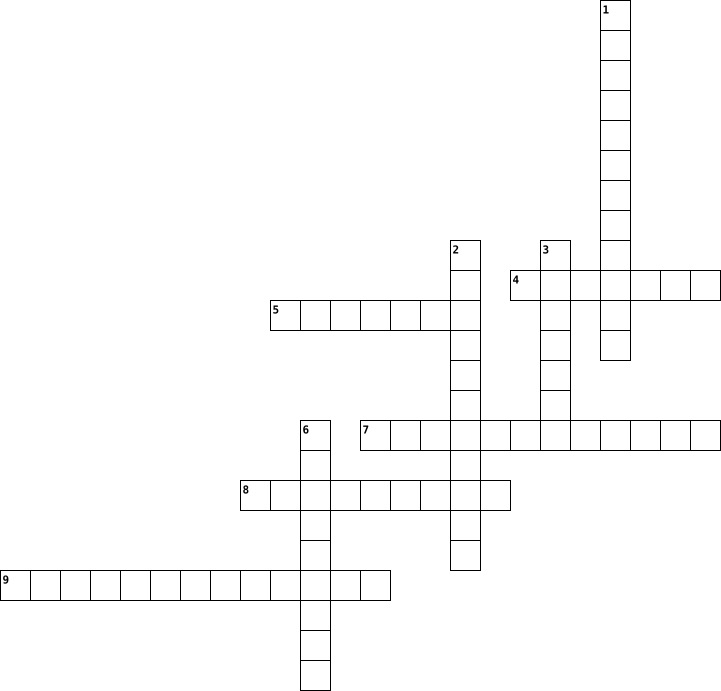
Across
- melted rock inside the mantle
- top layer of the earth
- plate boundary when 1 plate goes under another
- waves what causes an earthquake
- out side of the earth
Down
- causing of 2 plate tectonics sliding past each other
- large scale processes effecting the structure of earth's crust
- tectonics a theory explaining the structure of earth's crust
- where do you go to learn about tectonics
9 Clues: out side of the earth • top layer of the earth • melted rock inside the mantle • waves what causes an earthquake • where do you go to learn about tectonics • plate boundary when 1 plate goes under another • causing of 2 plate tectonics sliding past each other • tectonics a theory explaining the structure of earth's crust • ...
tectonics 2022-10-07

Across
- melted rock inside the mantle
- top layer of the earth
- plate boundary when 1 plate goes under another
- waves what causes an earthquake
- out side of the earth
Down
- causing of 2 plate tectonics sliding past each other
- large scale processes effecting the structure of earth's crust
- tectonics a theory explaining the structure of earth's crust
- where do you go to learn about tectonics
9 Clues: out side of the earth • top layer of the earth • melted rock inside the mantle • waves what causes an earthquake • where do you go to learn about tectonics • plate boundary when 1 plate goes under another • causing of 2 plate tectonics sliding past each other • tectonics a theory explaining the structure of earth's crust • ...
Landforms 2024-02-16

Across
- a long crack in the surface of the earth
- The super continent
- the result of plate tectonics
- Layer of melted iron and nickel
- This process moves broken down rocks
- rock formed from the cooling and solidification of molten (melted) rock
- Rock made by sediment under immense pressure
- the thickest layer
- This process breaks down rocks
Down
- where convection currents occurs
- Proposed the idea that continents sat on large crustal plates
- Is most commonly found in sedimentary rock
- tectonics the Earth's surface is cracked into large pieces
- Earths first layer
- Most earthquakes and volcanoes are here
- When two plates come together
- places where plates slide sideways past each other
- when two tectonic plates move away from each other
- Tectonics The scientific theory that Earth’s crust is divided up into massive plates that float on top of the mantle and can move around
- Rock made by heat, pressure, and mineral rich liquids
20 Clues: Earths first layer • the thickest layer • The super continent • When two plates come together • the result of plate tectonics • This process breaks down rocks • Layer of melted iron and nickel • where convection currents occurs • This process moves broken down rocks • Most earthquakes and volcanoes are here • a long crack in the surface of the earth • ...
Plate Tectonics 2017-03-25
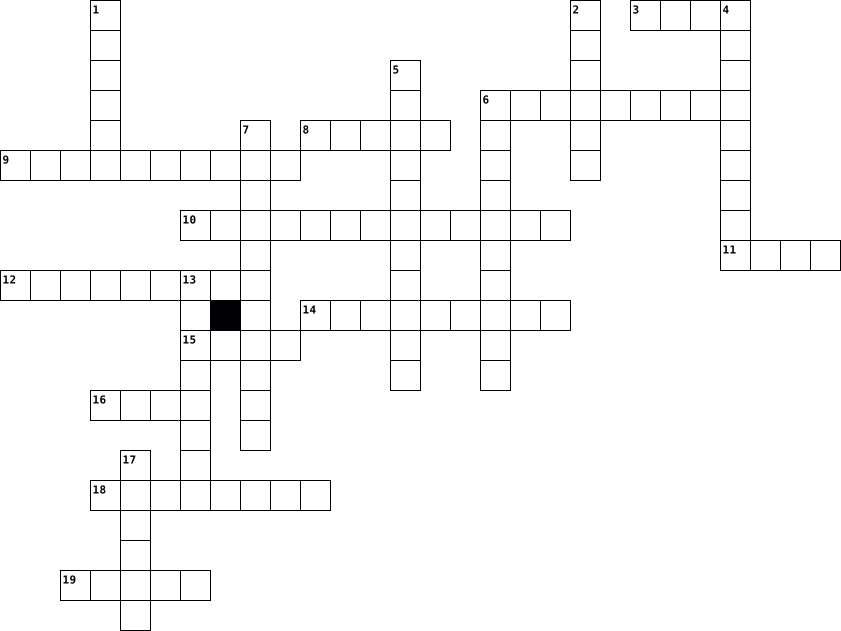
Across
- Zone When the ocean floor is spreading
- When continental crusts push inward and up
- tectonics How the earth has been shaped
- Tectonic plates that slide under each other
- A thick liquid and made mostly of silicate minerals
- When things cool off they become ____ dense
- ridge Oceanic crust also known as ____
- When plates move away from each other
- of Fire Area around the Pacific ocean
- Warm things become ____ dense
- poles Changed locations several times in earth’s history
- Crust Lithosphere or ____ is made of basalt
Down
- Wegener A meteorologist that developed the theory of continental drift
- How many plates make up the earth's surface
- When plates are sliding beside each other
- Plate tectonics are made of what part of the earth
- When plates move toward each other
- Crust Lithosphere or ____ is made of granite
- plate The plate that India slammed into 50 million years ago
- When all the plates were together it made a place called...
20 Clues: Warm things become ____ dense • When plates move toward each other • When plates move away from each other • of Fire Area around the Pacific ocean • Zone When the ocean floor is spreading • ridge Oceanic crust also known as ____ • tectonics How the earth has been shaped • When plates are sliding beside each other • When continental crusts push inward and up • ...
tectonics 2022-10-07
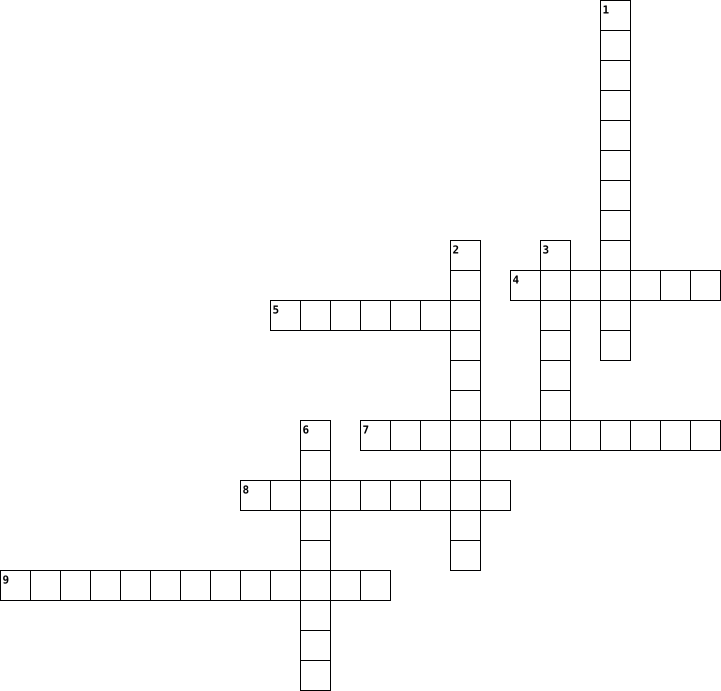
Across
- melted rock inside the mantle
- top layer of the earth
- plate boundary when 1 plate goes under another
- waves what causes an earthquake
- out side of the earth
Down
- causing of 2 plate tectonics sliding past each other
- large scale processes effecting the structure of earth's crust
- tectonics a theory explaining the structure of earth's crust
- where do you go to learn about tectonics
9 Clues: out side of the earth • top layer of the earth • melted rock inside the mantle • waves what causes an earthquake • where do you go to learn about tectonics • plate boundary when 1 plate goes under another • causing of 2 plate tectonics sliding past each other • tectonics a theory explaining the structure of earth's crust • ...
tectonic plates 2022-03-11

Across
- sideways and dawn
- there are seven major ones
- ocean
- africa
- lava go boom
- study of rock
- antartica
- urope and asia
- circulation of material
Down
- is not a pull slab but a
- soth amarica
- north amarica
- Earth layer
- simalar to lava
- plates move away from each other
- convergent
- where plates slide past each other
- brakes with a fult line
- plates move towards each other each other
19 Clues: ocean • africa • antartica • convergent • Earth layer • soth amarica • lava go boom • north amarica • study of rock • urope and asia • simalar to lava • sideways and dawn • brakes with a fult line • circulation of material • is not a pull slab but a • there are seven major ones • plates move away from each other • where plates slide past each other • plates move towards each other each other
Earth 2023-04-28

Across
- a mineral that is a useful substance
- made by weathering and erosion
- made by melting then cooling
- moving those smaller bits
- when plate tectonics collide with each other
Down
- made by heat and pressure
- breaking rocks into smaller bits and pieces
- when plate tectonics slide against each other
- Have igneous, metamorphic and sedimentary rocks in it
- when plate tectonics break apart from each other
10 Clues: made by heat and pressure • moving those smaller bits • made by melting then cooling • made by weathering and erosion • a mineral that is a useful substance • breaking rocks into smaller bits and pieces • when plate tectonics collide with each other • when plate tectonics slide against each other • when plate tectonics break apart from each other • ...
tectonics 2022-10-07

Across
- melted rock inside the mantle
- top layer of the earth
- plate boundary when 1 plate goes under another
- waves what causes an earthquake
- out side of the earth
Down
- causing of 2 plate tectonics sliding past each other
- large scale processes effecting the structure of earth's crust
- tectonics a theory explaining the structure of earth's crust
- where do you go to learn about tectonics
9 Clues: out side of the earth • top layer of the earth • melted rock inside the mantle • waves what causes an earthquake • where do you go to learn about tectonics • plate boundary when 1 plate goes under another • causing of 2 plate tectonics sliding past each other • tectonics a theory explaining the structure of earth's crust • ...
Plate Tectonics & Tsunamis 2022-01-30
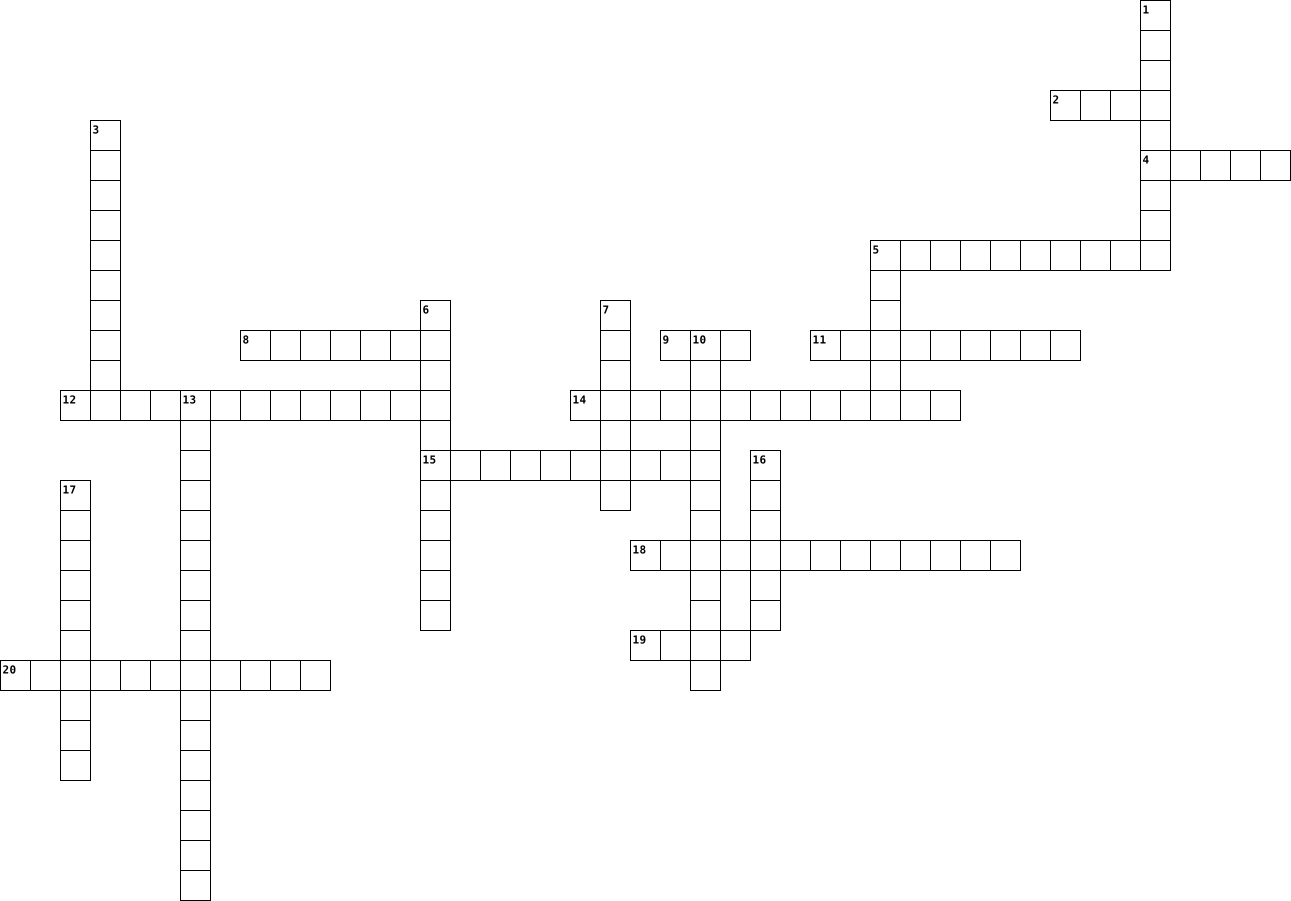
Across
- nickel and iron composition
- granite or basalt outermost earth layer
- middle behavioral layer,
- giant seawave from underwater earthquake
- density of new, hot lithosphere
- liquid metal circulates here
- old, cold, dense basalt subducts here
- plastic "lubricating" layer that flows slowly
- dense seafloor lithosphere sinks into earth
- ocean buoys that alert of tsunami
- density of old, cold lithosphere
- comprises the tectonic plates
Down
- solid because expansion is not possible
- "circle" with many earthquakes and volcanoes
- exhibits radioactive decay and convection
- crust plus uppermost mantle
- mass per unit volume
- where new, hot, buoyant basalt forms
- plate tectonics mechanism
- ocean in which 2004 tsunami occurred
- plate tectonics driving force
21 Clues: mass per unit volume • middle behavioral layer, • plate tectonics mechanism • nickel and iron composition • crust plus uppermost mantle • liquid metal circulates here • plate tectonics driving force • comprises the tectonic plates • density of new, hot lithosphere • density of old, cold lithosphere • ocean buoys that alert of tsunami • where new, hot, buoyant basalt forms • ...
Plate tectonics 2022-02-03
Across
- To create mountains
- Magma rises and creates a
- When a plate goes underneath one
- Separates from each other
Down
- Collides meaning to come together
- When two plates collide it forms a
- when plate tectonic divorce it makes a
- Slides and creates earthquakes
- When a plate tectonics cracks
- to create a volcano
- When plate tectonics slide it forms a
11 Clues: To create mountains • to create a volcano • Magma rises and creates a • Separates from each other • When a plate tectonics cracks • Slides and creates earthquakes • When a plate goes underneath one • Collides meaning to come together • When two plates collide it forms a • When plate tectonics slide it forms a • when plate tectonic divorce it makes a
Earth Science Crossword 2022-11-17
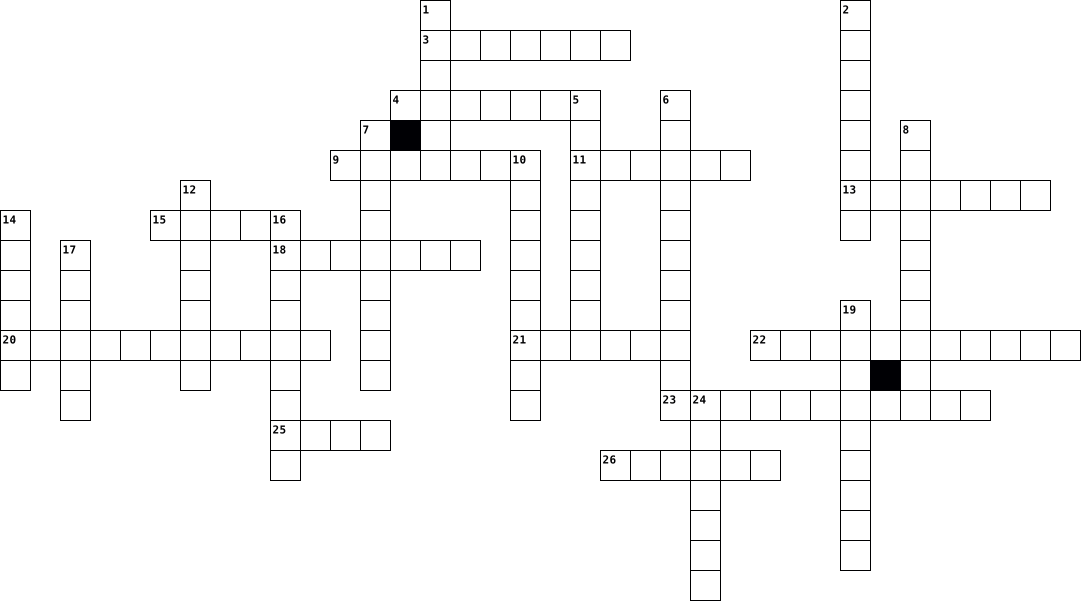
Across
- Underground reservoir
- Earthquake waves
- Light igneous rock
- Layer beneath crust
- Lava-made rocks
- Surface of Earth
- Wearing down by water
- Like boiling, but slow
- Deep ocean feature
- Water-made rocks
- Land crust
- Inner & Outer _____
- Flat volcano
Down
- Earliest Earth period
- First life on Earth
- Steep volcano
- Rocks changed by heat
- Sliding plate boundary
- Colliding plate boundary
- Earthquake center (on crust)
- Period after Hadean
- Photosynthesis product
- Theory of Plate ________
- Dense igneous rock
- Separating plate boundary
- Sea crust
26 Clues: Sea crust • Land crust • Flat volcano • Steep volcano • Lava-made rocks • Earthquake waves • Surface of Earth • Water-made rocks • Light igneous rock • Dense igneous rock • Deep ocean feature • First life on Earth • Layer beneath crust • Period after Hadean • Inner & Outer _____ • Earliest Earth period • Underground reservoir • Rocks changed by heat • Wearing down by water • Sliding plate boundary • ...
PLATE TECTONICS CROSSWORD 2019-07-02

Across
- PLATES 2
- 17
- 5
- 4
- 6
- 11
- 9
- 19
- 16
Down
- 15
- 20
- 8
- 3
- 7
- 14
- 18
- TECTONICS 1
- 13
- 12
19 Clues: 8 • 3 • 7 • 5 • 4 • 6 • 9 • 15 • 20 • 17 • 14 • 18 • 11 • 13 • 12 • 19 • 16 • PLATES 2 • TECTONICS 1
Plate Tectonics 2021-05-11
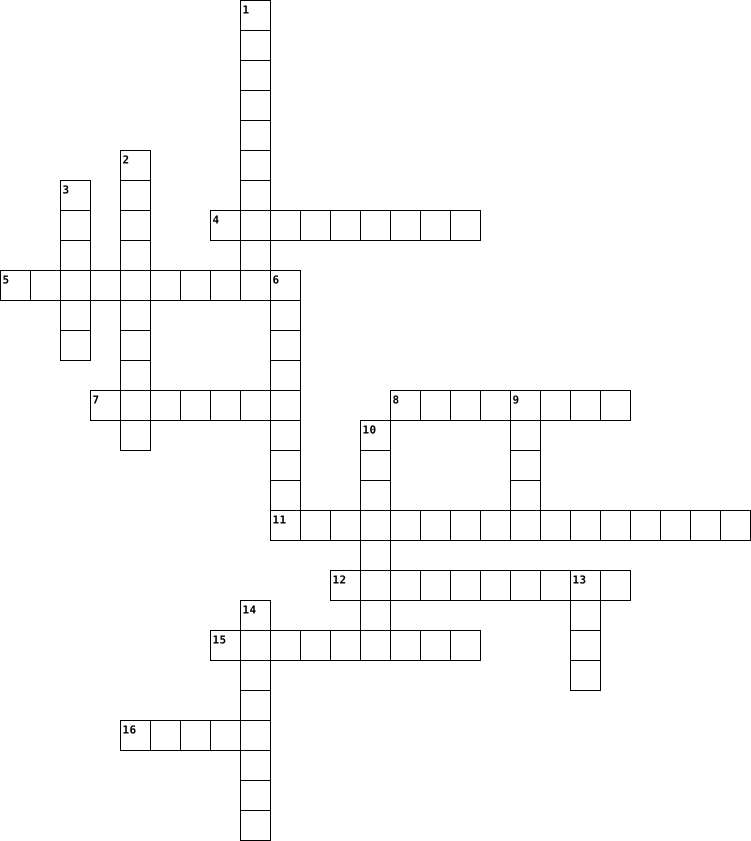
Across
- A place where two plates move away from each other is called a ______ boundary
- A place where two plates move towards each other is called a ________ boundary
- The Indian Australian plate is moving _____ the Eurasian plate.
- Place where two plates meet
- The ___________________ is at a divergent plate boundary, where new ocean is being created
- The _______ fault in California is an example of a transform boundary
- When two continental plates collide, it can form _________
- The ____ plate is between the pacific and south american plates
Down
- When one plate moves under another, it is called _______
- Plate tectonics is driven by _______ in the mantle, which interacts with the crust of the Earth
- When oceanic crust sinks underneath continental crust, one of these can form under water
- A place where two plates slide next to each other is called a _______ boundary
- Plate tectonics builds upon Alfred Wegener's theory of continental _______
- The _______'s are an example of what can form at a convergent plate boundary
- the pacific plate is moving ______ from the Nazca plate
- These can form at convergent plate boundaries. This is why we have the Ring of Fire around the pacific ocean.
16 Clues: Place where two plates meet • the pacific plate is moving ______ from the Nazca plate • When one plate moves under another, it is called _______ • When two continental plates collide, it can form _________ • The Indian Australian plate is moving _____ the Eurasian plate. • The ____ plate is between the pacific and south american plates • ...
Earthquake Crossword 2023-10-08

Across
- The printout from a seismograph that0020
- Plate boundary where plates slide side by side.
- Person who first proposed a theory on Plate Tectonics.
- Location of largest Earthquake of all time.
- Type of Curst that is light in color and is not as dense.
- The major mechanism for plate tectonics.
- Location of largest Earthquake in North America.
- An area around Pacific Ocean wherre most Earthquakes and Volcanoes occur.
- Another name for size.
- Instrument that records earthquakes.
- The height of a wave.
- Another name for a P-Wave.
- Plate boundary where plates collide or move together.
- Strongest evidence for plate tectonics.
- Type of Curst that is dark in color and is the most dense.
- Earthquake wave that cannot travel through liquids.
- Sudden movement in the earth’s crust that produces Earthquakes.
- Earthquake waves that occur in the Earth.
- Location on the Earth’s surface directly above the focus.
Down
- Earthquake waves that occur on the Earth’s Surface.
- Structural layer that plates float on.
- Another name for a S-Wave.
- Scientist who studies earthquakes.
- Earthquake scale based on calculations.
- Another name for a Tidal Wave or large wave.
- Movement along a fracture in the Earth where earthquakes are formed
- The name of Alfred Wegner’s Theory.
- Structural layer that plates are made of.
- Plate boundary where plates separate or move apart.
- When Earth’s Magnetic Field reverses.
- Earthquake’s Point of origin beneath the Earth’s surface where movement occurs along a fault.
- Earthquake scale based on visual observations.
- Divergent boundary on continents.
- Theory that decribes tectonic plate material, & mechanism/effects of plate movement.
- Fastest Earthquake wave and first to arrive.
- Vibration of the Earth produced by the rapid release of energy.
- Divergent boundary on ocean floors.
- The study of earthquakes.
38 Clues: The height of a wave. • Another name for size. • The study of earthquakes. • Another name for a S-Wave. • Another name for a P-Wave. • Divergent boundary on continents. • Scientist who studies earthquakes. • The name of Alfred Wegner’s Theory. • Divergent boundary on ocean floors. • Instrument that records earthquakes. • When Earth’s Magnetic Field reverses. • ...
Plate Tectonics 2015-03-11
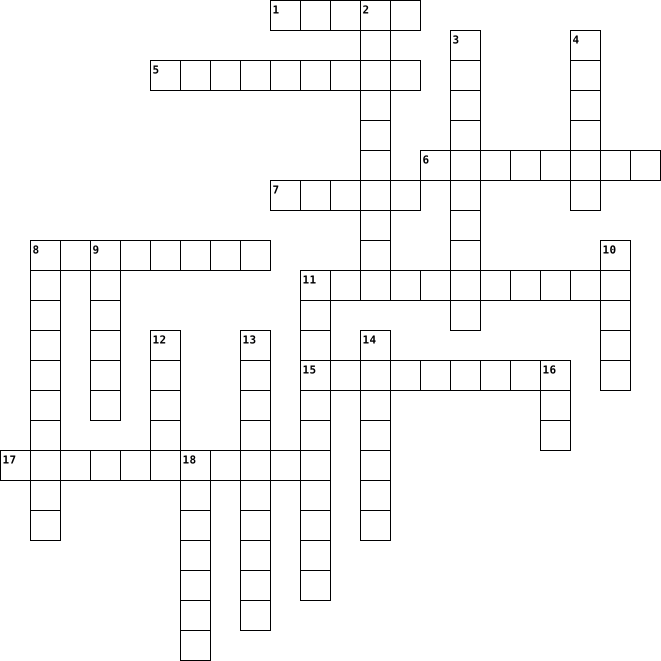
Across
- A trench is a ? in the ocean
- When two plates go away from each other
- Alfred Wegener's theory was first ____
- tectonics causes earthquakes
- spreading at the mid-ocean ridge a new sea floor is built
- crust One of the two crusts
- 2 plates slide past each other
- Plates are located here
Down
- Currents the power of moving the continents
- 2 plates come together
- there are two types of ? one is oceanic
- happens in trenches
- Wegener Scientist who proposed of the theory of the continental drift
- boundaries three types divergent,convergent and transform
- Drift Theory of the continents moving
- Recent discovery of the plate tectonics happened in the mid
- ? happens in the asthenosphere
- One super continent
- ocean ridge seafloor spreading takes place
- Biggest plate out of the 7 major plates
20 Clues: happens in trenches • One super continent • 2 plates come together • Plates are located here • A trench is a ? in the ocean • tectonics causes earthquakes • crust One of the two crusts • ? happens in the asthenosphere • 2 plates slide past each other • Drift Theory of the continents moving • Alfred Wegener's theory was first ____ • there are two types of ? one is oceanic • ...
PLATE TECTONICS CROSSWORD 2019-07-02
Across
- 16
- 8
- 17
- TECTONICS 1
- 18
- 4
- 5
- 6
- 13
- 11
Down
- 14
- 15
- 3
- 12
- 7
- 19
- 9
- 20
- PLATES 2
19 Clues: 3 • 8 • 7 • 9 • 4 • 5 • 6 • 14 • 16 • 15 • 12 • 17 • 19 • 18 • 20 • 13 • 11 • PLATES 2 • TECTONICS 1
PLATE TECTONICS CROSSWORD 2019-07-02
Across
- 3
- 7
- 5
- 19
- 16
- 15
- 11
- 17
- 8
- PLATES 2
Down
- TECTONICS 1
- 4
- 14
- 9
- 18
- 20
- 13
- 6
- 12
19 Clues: 4 • 9 • 3 • 7 • 5 • 6 • 8 • 14 • 18 • 20 • 19 • 16 • 13 • 15 • 11 • 12 • 17 • PLATES 2 • TECTONICS 1
PLATE TECTONICS CROSSWORD 2019-07-02
Across
- 16
- 8
- 7
- 13
- TECTONICS 1
- 3
- 15
- 6
- 12
- 19
Down
- 17
- 20
- 5
- 9
- PLATES 2
- 4
- 18
- 11
- 14
19 Clues: 8 • 7 • 5 • 9 • 4 • 3 • 6 • 16 • 17 • 20 • 13 • 18 • 15 • 11 • 14 • 12 • 19 • PLATES 2 • TECTONICS 1
PLATE TECTONICS CROSSWORD 2019-07-02
Across
- 20
- 9
- 18
- 13
- 5
- 3
- PLATES 2
- 6
Down
- 4
- 8
- 7
- 12
- 11
- 16
- 15
- TECTONICS 1
- 17
- 19
- 14
19 Clues: 4 • 8 • 7 • 9 • 5 • 3 • 6 • 20 • 18 • 12 • 13 • 11 • 16 • 15 • 17 • 19 • 14 • PLATES 2 • TECTONICS 1
Continental Drift and Plate Tectonics 2021-12-01
Across
- that at once all continents were joined
- not caused by convergent boundaries
- structures on Earths crust moving over the mantle
- rigid outer part of Earth, consisting of the crust and upper mantle
- made the speculations that the continents might have drifted
- plates sliding past each other
- proposed theory of continental drift
- caused by divergent boundaries
- causes seafloor spreading
- caused by convergent boundaries
Down
- Father of Plate Tectonics
- changing climates during the past
- layers of rocks across continents
- places certain fossils are found
- supercontinent
- plates moving away
- plates colliding
- ocean floor sinks under
- underwater mountain range
19 Clues: supercontinent • plates colliding • plates moving away • ocean floor sinks under • Father of Plate Tectonics • underwater mountain range • causes seafloor spreading • plates sliding past each other • caused by divergent boundaries • caused by convergent boundaries • places certain fossils are found • changing climates during the past • layers of rocks across continents • ...
Plate Tectonics 2014-03-27
Across
- is caused when new crust pushes the rest of the plate out of the way
- is a bunch of volcanoes in a ring shape
- plate tectonics float on these
- are caused when plate tectonics rub against each other
- the top layer where tectonic plates move about
Down
- where old cold plates fall into
- collisions of plate tectonics create these
- the Earths surface is split into many
- is recycled when magma erupts out of a volcano
- the hotter, rocky layer under the crust
10 Clues: plate tectonics float on these • where old cold plates fall into • the Earths surface is split into many • is a bunch of volcanoes in a ring shape • the hotter, rocky layer under the crust • collisions of plate tectonics create these • is recycled when magma erupts out of a volcano • the top layer where tectonic plates move about • ...
Unit 2 Science Rocks! 2023-12-03

Across
- What kind of plate boundary results in the formation of rift valleys & mid-ocean ridges as the plates separate?
- What is made up of Earth’s crust & upper mantle?
- What crustal feature do both convergent oceanic-oceanic & Convergent oceanic-continental boundaries form?
- What crustal feature is created when tectonic plates slide past each other at transform boundaries?
- South America and what other continent have a “Puzzle like Fit”?
- What two types of convergent plate boundary causes the formation of folded mountains?
- Which tectonic plate is made of the continent of Antarctica & its surrounding oceanic crust?
- What movement do two continental plates do at the meeting point of a convergent boundary?
- Which tectonic plate is composed of the continent South America & a large portion of the Atlantic Ocean?
- What is the name of the tectonic plate that includes all of Europe & Asia as well as a large chunk of the Arctic Ocean?
- What is the name of the “Plastic Layer” of Earth?
- At transform boundaries what motion takes place?
- Both divergent and convergent boundaries can lead to what type of landform?
- What two kinds of convergent plate boundary results in trench subduction and the formation of Island Volcanos & Arcs?
- Which types of plate boundary causes the formation of faults?
Down
- Which tectonic plate contains the continent of North America & a portion of the Pacific Ocean?
- At convergent continental-continental boundaries, what type of mountains form?
- Which meteorologist first hypothesized the theory of plate tectonics in 1912?
- What happens when continental and oceanic plates meet at a convergent boundary?
- Was the theory accepted as a success or a failure during Wegner’s time by other scientists?
- Which tectonic plate contains the continent of Africa & the surrounding crust of the Atlantic Ocean?
- What major disaster may happen when tectonic plates slide past each other?
- Oceanic-Continental _________ boundaries create volcano mountains such as The Andes Mountains.
- What is another name for the deepest parts of the mantle?
- What was the name of the supercontinent Wegner hypothesized?
- Which tectonic plate combines the Australian & Indian Plates into one major plate?
- Which scientist discovered sea floor spreading which supported the theory of plate tectonics?
- What type of current keeps the plate tectonics moving according to the theory?
- What is the name of the largest tectonic plate which underlies the Pacific Ocean?
- What land feature is formed when tectonic plates move apart?
30 Clues: What is made up of Earth’s crust & upper mantle? • At transform boundaries what motion takes place? • What is the name of the “Plastic Layer” of Earth? • What is another name for the deepest parts of the mantle? • What was the name of the supercontinent Wegner hypothesized? • What land feature is formed when tectonic plates move apart? • ...
Unit 2: Science Rocks! 2023-12-06

Across
- What kind of plate boundary results in the formation of rift valleys & mid-ocean ridges as the plates separate?
- What is made up of Earth’s crust & upper mantle?
- What crustal feature do both convergent oceanic-oceanic & Convergent oceanic-continental boundaries form?
- What crustal feature is created when tectonic plates slide past each other at transform boundaries?
- South America and what other continent have a “Puzzle like Fit”?
- What two types of convergent plate boundary causes the formation of folded mountains?
- Which tectonic plate is made of the continent of Antarctica & its surrounding oceanic crust?
- What movement do two continental plates do at the meeting point of a convergent boundary?
- Which tectonic plate is composed of the continent South America & a large portion of the Atlantic Ocean?
- What is the name of the tectonic plate that includes all of Europe & Asia as well as a large chunk of the Arctic Ocean?
- What is the name of the “Plastic Layer” of Earth?
- At transform boundaries what motion takes place?
- Both divergent and convergent boundaries can lead to what type of landform?
- What two kinds of convergent plate boundary results in trench subduction and the formation of Island Volcanos & Arcs?
- Which types of plate boundary causes the formation of faults?
Down
- Which tectonic plate contains the continent of North America & a portion of the Pacific Ocean?
- At convergent continental-continental boundaries, what type of mountains form?
- Which meteorologist first hypothesized the theory of plate tectonics in 1912?
- What happens when continental and oceanic plates meet at a convergent boundary?
- Was the theory accepted as a success or a failure during Wegner’s time by other scientists?
- Which tectonic plate contains the continent of Africa & the surrounding crust of the Atlantic Ocean?
- What major disaster may happen when tectonic plates slide past each other?
- Oceanic-Continental _________ boundaries create volcano mountains such as The Andes Mountains.
- What is another name for the deepest parts of the mantle?
- What was the name of the supercontinent Wegner hypothesized?
- Which tectonic plate combines the Australian & Indian Plates into one major plate?
- Which scientist discovered sea floor spreading which supported the theory of plate tectonics?
- What type of current keeps the plate tectonics moving according to the theory?
- What is the name of the largest tectonic plate which underlies the Pacific Ocean?
- What land feature is formed when tectonic plates move apart?
30 Clues: What is made up of Earth’s crust & upper mantle? • At transform boundaries what motion takes place? • What is the name of the “Plastic Layer” of Earth? • What is another name for the deepest parts of the mantle? • What was the name of the supercontinent Wegner hypothesized? • What land feature is formed when tectonic plates move apart? • ...
Plate Tectonics 2011-09-15

Across
- Imaginary lines on a map that show points of the same age formed at the same time
- Huge pieces of earth's crust that cover it's surface and fit together at their edges
- Man who first hypothisized that there was once a super continent
- When two plates are moving away from one another
- When two plate slide past eachother
- Device used to decdect small charges in the magnetic field
- Where when converging, one plate goes underneath another plate
- The Hyp. that new ocean crust is formed at mid ocean ridges and recycled at deep sea trenches
Down
- Wegener's Hyp. that earths continents were joined into a single supercontinent
- Name of the Class
- Where two plates are moving towards one another
- The force that drives the tectonic plates in there direction
- The formation that occurs at a continental convergent boundary
- Study of earth's magnetic record using data gathered from iron bearing minerals
- The formation that occurs at an oceanic divergent boundary
- When earth's magnetic field changes polarity between normal and reversed
- Long narrow valley that forms at a divergent boundary
- Wieght of an elevated ridge pushes an oceanic plate towards a subduction zone
- Process that determines tectonic movement
- The very first supercontinent that has been recorded
- Ancient landmass made up of all the continents that began to break apart 200 MYA
21 Clues: Name of the Class • When two plate slide past eachother • Process that determines tectonic movement • Where two plates are moving towards one another • When two plates are moving away from one another • The very first supercontinent that has been recorded • Long narrow valley that forms at a divergent boundary • ...
Plate Tectonics 2012-02-17

Across
- The forces per unit area acting on a material.
- The internal resistance flow.
- Of the two plates is decending beneath the other.
- Larger depressions.
- Intrusive igneous rock bodies.
- A devicew that can detect small small changes in magnetic fields.
- The resulting fracture or system of fractures.
- Where an earthquake originates.
- The process that forms all mountain ranges.
- The study of a magnetic record.
Down
- An equilibrium that causes the displacement of the mantle by Earth's continental and oceanic crust.
- It forms when material ejected high into the air falls back to Earth and piles up around the vent.
- A mountain with broad, gently sloping sides and a nearly circular base.
- A pluton that forms when magma intrudes paralell to layers of rock.
- Unusually hot regions of Earth's mantle where high-temperature plumes of mantle material rise toward the surface.
- A bowl shaped depression.
- Supercontinent
- A large ocean wave generated by vertical motions of the seafloor during an earthquake.
- Lava that erupts through an opening in the crust.
- The amount of energy released during an earthquake is measured by ____________
20 Clues: Supercontinent • Larger depressions. • A bowl shaped depression. • The internal resistance flow. • Intrusive igneous rock bodies. • Where an earthquake originates. • The study of a magnetic record. • The process that forms all mountain ranges. • The forces per unit area acting on a material. • The resulting fracture or system of fractures. • ...
plate tectonics 2012-04-30

Across
- the chemical and physical process that breaks down rock at the earths surface.
- the force that occurs at a transform boundary.
- the theory that the continents slowly move across earths surface
- A line on a topographic map that connects points of equal elevation.
- the study of the solid earth.
- The process by which sediments are pressed together under the own weight.
- a break or crack in the earth’s lithosphere along which rocks move.
- Small, solid particles of material from rocks or organisms that are moved by water or wind, resulting in erosion and deposition.
- A series of processes on the surface and inside Earth that slowly changes rocks from one kind to another.
- the type of rock that is formed when heat & pressure is applied to it.
- The process by which water, ice, wind, or gravity moves fragments of rock and soil.
Down
- a plate boundary where two plates move away from each other
- the process when oceanic crust sinks beneath a continental crust.
- a plate boundary where two plates move towards each other.
- Stress that squeezes rock until it folds or breaks
- The layer of hot, solid materials between Earth’s crust and core.
- the layer of rock that forms earths outer surface.
- a plate boundary where two plates move past other in opposite dirctions.
- the transfer of thermal energy by movements of a fluid.
- a type of map usually using contour lines that shows natural features on the earth’s surface.
- a type of rock that forms from the cooling of molten rock at or below the surface.
- the force that occurs at a divergent boundary
- the process by which sediment settles out of the water or wind the is carrying it and is deposited in a new location.
23 Clues: the study of the solid earth. • the force that occurs at a divergent boundary • the force that occurs at a transform boundary. • Stress that squeezes rock until it folds or breaks • the layer of rock that forms earths outer surface. • the transfer of thermal energy by movements of a fluid. • a plate boundary where two plates move towards each other. • ...
Plate Tectonics 2012-12-09

Across
- fresh water reptile found in Antarctica and South America
- the process of ocean floor sinking beneath a deep-ocean trench and back into the mantle
- the outermost layer of ther Earth
- no crust is created or destroyed at this type of boundary
- undersea mountian chain where new ocean floor is produced
- the middle layer of out Earth
- the flow that transfers heat within a fluid
- upper part of the mantle
- one component of the outer core
- part of the mantle that bends like plastic
Down
- the innermost layer of the Earth
- the supercontinent that connected all the continents
- the kind of crust that is found under the ocean
- scientist that realized the continents fit together like puzzle pieces
- type of convergent boundary that forms mountians
- rocks on the continents have been found to be ___________ years old
- fresh water reptile found in Africa, Antarctica, and India
- the oceanis crust bends downward and sinks back into the mantle
- the plates that move together
- the device the maps the ocean floor
20 Clues: upper part of the mantle • the plates that move together • the middle layer of out Earth • one component of the outer core • the innermost layer of the Earth • the outermost layer of ther Earth • the device the maps the ocean floor • part of the mantle that bends like plastic • the flow that transfers heat within a fluid • the kind of crust that is found under the ocean • ...
Plate Tectonics 2013-01-09

Across
- the rising of regions to higher elevations
- upward arching folds
- stress that occurs when forces stratch an object
- the strong lower part of the mantle between the asthenosphere and the outer core
- the surface along which rocks break and slide past each other
- the outermost thin layer of the Earth above the mantle
- the solid outer layer that consists of the crust and upper rigid mantle
- stress that occurs when forces squeeze an object
- a system of satellites used to measure plate tectonic movement
- the central part of Earth
Down
- the layer of rock between the Earth's crust and core
- the soft layer of the mantle on which tectonic plates move
- rock layers folded so that rock layers are horizontal
- a huge body of water that existed along with Pangaea
- the proces in which rock changes shape through states
- the sinking of regions of Earth's crust to lower elevations
- when crust slowly springs back to its original position
- the bending of rock layers due to stress
- a supercontinent that existed 245 million years ago
- downward troughlike folds
20 Clues: upward arching folds • downward troughlike folds • the central part of Earth • the bending of rock layers due to stress • the rising of regions to higher elevations • stress that occurs when forces stratch an object • stress that occurs when forces squeeze an object • a supercontinent that existed 245 million years ago • ...
Plate Tectonics 2013-01-09

Across
- the layer of rock between the Earth's crust and core
- a huge body of water that existed along with Pangaea
- upward arching folds
- the proces in which rock changes shape through states
- a system of satellites used to measure plate tectonic movement
- the solid outer layer that consists of the crust and upper rigid mantle
- rock layers folded so that rock layers are horizontal
- the sinking of regions of Earth's crust to lower elevations
- the rising of regions to higher elevations
- the central part of Earth
Down
- a supercontinent that existed 245 million years ago
- the soft layer of the mantle on which tectonic plates move
- stress that occurs when forces squeeze an object
- the surface along which rocks break and slide past each other
- the strong lower part of the mantle between the asthenosphere and the outer core
- stress that occurs when forces stratch an object
- downward troughlike folds
- the bending of rock layers due to stress
- when crust slowly springs back to its original position
- the outermost thin layer of the Earth above the mantle
20 Clues: upward arching folds • downward troughlike folds • the central part of Earth • the bending of rock layers due to stress • the rising of regions to higher elevations • stress that occurs when forces squeeze an object • stress that occurs when forces stratch an object • a supercontinent that existed 245 million years ago • ...
Plate Tectonics 2013-02-04

Across
- happens when divergent boundary occur(land)
- an area where a large number of earthquakes and volcanic eruptions occur in the basin of the pacific ocean
- where 2 plates slide past each other
- Theory by J. Tuzo Wilson
- where 2 plates collide
- single landmass or supercontinent
- rocks that make up the ocean floor lies in patterns of this
Down
- convection currrents under the lithosphere push new crust that forms at the mid-ocean ridge away from the ridge and towrd this
- happens when transform boundary occur
- happens when collision boundary occur
- any trace of an ancient organism that has been preserved in rock
- the rigid, rocky outer surface of the Earth
- break in Earth's crust where rocks have slipped past each other
- where 2 plates move away
- Crust broken up into
- Theory by Alfred Wegener
- under the Athenosphere
- Theory by Harry Hess
- device that bounces sound waves off underwater objects than back
- a fern like plant
20 Clues: a fern like plant • Crust broken up into • Theory by Harry Hess • under the Athenosphere • where 2 plates collide • where 2 plates move away • Theory by J. Tuzo Wilson • Theory by Alfred Wegener • single landmass or supercontinent • where 2 plates slide past each other • happens when transform boundary occur • happens when collision boundary occur • ...
Plate Tectonics 2013-03-03

Across
- we get _________ volcanoes mountain ranges and deep-sea trenches
- this boundary occurs when 2 plate come together and forms either a mountain or a volcano
- the first wave in an earthquake
- magma rises because it is ______ dense
- the San Andreas fault is this many miles long
- this boundary occurs when 2 plates move apart
- is a machine that measure the magnitude of an eathquake
- the second wave in an earthquake
- the earth has ___ this many plates
- place where the earth slips
Down
- can carry either the ocean floor of a continent sometime both
- the layer we live on
- there are this many boundaries
- __________ is how many earthquakes happen a year
- this person job is to build more stable buildings
- no plate can________ without another _________
- plates move this many inches a year
- this boundary happens when 2 plates slip past each other moving in the opposite direction
- this is a wave of energy that is released when an earthquake occurs
- this moves plates
20 Clues: this moves plates • the layer we live on • place where the earth slips • there are this many boundaries • the first wave in an earthquake • the second wave in an earthquake • the earth has ___ this many plates • plates move this many inches a year • magma rises because it is ______ dense • the San Andreas fault is this many miles long • ...
Plate Tectonics 2014-03-03

Across
- a motion that transfers heat energy in a material.
- occurs where two plates carrying continental crust push together.
- energy transfer by the movement of a material.
- huge underwater mountain ranges.
- large and small slabs of rock made of the lithosphere.
- when one plate sinks beneath another.
- a thin layer of cool rock.
- Earth's thickest layer.
- occurs where plates move apart.
Down
- occurs where plats scrape past each other.
- Alfred Wegener's hypothesis.
- occurs where one plate with oceanic crust sinks, or subducts, under another plate.
- a layer of hotter, softer rock in the upper mantle.
- a switch in direction caused by changes in Earth.
- where heated rock rises in plumes, or thin columns,from the mantle.
- occurs when ocean crust sinks under continental crust.
- occurs where plates push together.
- geologists combined knowledge of Earth's plates, the sea floor, and the asthenosphere.
- a ball of hot, solid metals.
- a layer of liquid metals that surrounds the inner core.
- a gap made by the ridges widening.
- a combination of Earth's crust and very top of the mantle.
22 Clues: Earth's thickest layer. • a thin layer of cool rock. • Alfred Wegener's hypothesis. • a ball of hot, solid metals. • occurs where plates move apart. • huge underwater mountain ranges. • occurs where plates push together. • a gap made by the ridges widening. • when one plate sinks beneath another. • occurs where plats scrape past each other. • ...
Plate Tectonics 2014-03-03

Across
- the direct transfer of energy through space by electromagnetic waves
- the hypothesis that the continent slowly move across Earth's surface
- the force exerted on a surface divided by the total area over which the force is exerted
- the amount of mass of a substance in a given volume; mass per unit volume
- the process by which molten material adds new oceanic crust to the ocean floor
- a rigid layer made up of the uppermost part of the mantle and the crust
- Vibrations that travel through Earth carrying the energy released during an earthquacke
- the layer of rock that forms Earth's outer surface
- a dark, dense, igneous rock with a fine texture, found in oceanic crust
- a break or crack in Earth's lithosphere along which the rocks move
- a usually light-colored rock that is found in continental crust
- the layer of hot, solid material between Earth's surface and core
Down
- the theory that pieces of Earth's lithosphere are in constant motion, driven by continental currents in the mantle
- a large stream of moving water that flows through the oceans
- a well-tested concept that explains a wide range of observations
- a plate boundary where two plates move past each other in opposite directions
- a plate boundary where two plates move toward each other
- the soft layer of the mantle on which the lithosphere floats
- a plate boundary where two plates move away
- the name of the single landmass that broke apart 200 million years ago and broke into today's continents
- the direct transfer of thermal energy from one substance to another substance that it's touching
21 Clues: a plate boundary where two plates move away • the layer of rock that forms Earth's outer surface • a plate boundary where two plates move toward each other • a large stream of moving water that flows through the oceans • the soft layer of the mantle on which the lithosphere floats • a usually light-colored rock that is found in continental crust • ...
Plate Tectonics 2014-02-23

Across
- a number of rigid but moving pieces of the Earth's surface
- forms when two plates slide past each other
- a theory suggesting that continents move
- zone of weak, plastic like material in the mantle
- forms when two plates come together
- slippage along a fault
- theory that explains changes in Earth's crust by internal forces
- movement along break in rock
- states that youngest rocks of ocean floor are at diverging boundaries, moving outward
- force behind earthquakes
Down
- rigid blocks of Earth's crust and upper mantle
- forms when two plates move apart
- produced as a plate moves deeper into the mantle
- boundaries at which plates move past one another horizontally
- point directly above an earthquake
- slow-moving seismic action
- energy of motion
- region where a plate descends
- area of rigid blocks of Earth's crust and upper mantle
- fast-moving seismic wave
20 Clues: energy of motion • slippage along a fault • fast-moving seismic wave • force behind earthquakes • slow-moving seismic action • movement along break in rock • region where a plate descends • forms when two plates move apart • point directly above an earthquake • forms when two plates come together • a theory suggesting that continents move • ...
PLATE TECTONICS 2014-02-24

Across
- the process by which earths crust breaks apart; can occur with continental crust or oceanic crust
- a break in a body of rock along with one block sides relative to another; a form of brittle strain
- an instrument that records vibrations in the ground
- any change in rocks shape or volume caused by stress
- the process by which new oceanic lithosphere forms when magma rises to earths surface at mid ocean ridges and solidifies, as older, existing sea floor moves away from the ridge
- in earths science,the amount of damage caused by an earthquake
- the supercontinent that formed 300 million years ago and that and that began to break up 200 million years ago
- a movement or trembling of the ground that is caused by a sudden release of energy when rocks along a fault move
- a tracing of earthquake motion that is recorded by a seismograph
- a seismic wave that travels along the surface of a medium and that has a stronger effect near the surface of the medium than it has in the interior
Down
- a region of numerous closely spaced faults
- a series of mountain that are closely related in orientation, age, and mode of formation
- the location within earth along a fault at which the first motion of an earthquake occurs
- a seismic wave that travels through the body of a medium
- the sudden return of elastically deformed
- a mountain that forms when rocks layers are squeezed together and uplifted
- the theory that explains how large pieces of the lithosphere, called plates, move and change shape
- magma that flows onto earths surface, the rock that forms when lava cools and solidifies
- the amount of force per unit area that acts on a rock
- liquid rock produced under earths surface
- to its undeformed shape
21 Clues: to its undeformed shape • the sudden return of elastically deformed • liquid rock produced under earths surface • a region of numerous closely spaced faults • an instrument that records vibrations in the ground • any change in rocks shape or volume caused by stress • the amount of force per unit area that acts on a rock • ...
Plate Tectonics 2013-11-30

Across
- Rock, basalt under the ocean
- Plates that move or pull apart from each other
- Thin layer in comparison to other three layers
- Cycle of heating, rising, cooling, and sinking
- Plates that slide past each other
- The crust and upper mantle are combined
- Less dense than oceanic crust
- Plastic like layer below the lithosphere
- When rock breaks and moves along surfaces
- They occur when hot magma, solids,and gas erupt onto Earths surface
Down
- All land
- Portion of the Earths crust that lies beneath ocean waters
- A movement of the ground that occurs when rocks inside the Earth break suddenly
- Continents have slowly moved to their current locations
- Oceanic crust is destroyed
- earths surface rising, a large steep hill
- Earths crust and upper mantle are broken into sections
- Plates that come together or collide
- Theory that combined continental drift and seafloor spreading
- Largest layer of the Earth
20 Clues: All land • Oceanic crust is destroyed • Largest layer of the Earth • Rock, basalt under the ocean • Less dense than oceanic crust • Plates that slide past each other • Plates that come together or collide • The crust and upper mantle are combined • Plastic like layer below the lithosphere • earths surface rising, a large steep hill • When rock breaks and moves along surfaces • ...
Plate Tectonics 2014-03-23

Across
- Heat transfers through space
- Wegener said that all of the continents were once joined together in a supercontinent
- Tectonics A scientific theory that the Earth's surface is made of very large sections that move very slowly; also the movements of the large sections that form the Earth's surface
- spreading The divergence at mid-ocean ridges of the tectonic plates underlying the oceans that is due to upwelling from the earth's interior of magma which solidifies and adds to the spreading plates
- A shaking of a part of the earth's surface that often causes great damage
- Heat transfers by touching (within a material or between materials)
- Heat transfers by movement of currents in liquids and gases; caused by differences in temperature and density
- Wegener German scientist who proposed (in 1915) that the continents were slowly drifting apart
- Evidence that fossils of the same plants and animals are found today on widely separated continents (including Africa, South America, Antarctica, Australia, and Asia - India)
- Science that deals with the history of the earth and its life especially as recorded in rocks
- An area of land that rises very high above the land around it and that is higher than a hill
- Plate Boundary that rub together, they do not go up in elevation but slide opposite directions
Down
- Plate Boundary that spreads apart or goes opposite directions
- Molten rock beneath earth's surface
- Hess American geologist, was a scientist who studied mid-ocean ridges
- The mantle just below the lithosphere
- Evidence of glaciers on the equator and tropical forests in the Arctic Ocean
- Plate Boundary that come together
- a series of water waves caused by the displacement of a large volume of a body of water, generally an ocean or a large lake.
- in Continents The coastline of Africa and South America looked like they fit together
- Molten rock from a volcanic flowing on Earth's surface
21 Clues: Heat transfers through space • Plate Boundary that come together • Molten rock beneath earth's surface • The mantle just below the lithosphere • Molten rock from a volcanic flowing on Earth's surface • Plate Boundary that spreads apart or goes opposite directions • Heat transfers by touching (within a material or between materials) • ...
Plate Tectonics 2013-11-26

Across
- A single landmass that broke apart 200 million years ago
- Transfer of heat between a material
- The transfer of heat by movement of a fluid
- vibrations that carry the energy released in an earthquake
- Rigid layer made up of the upper part of the mantle and crust
- Valley that forms where plates move apart.
- Transfer of heat through space
- sinks beneath a deep-ocean trench and back into the mantle at a convergent plate boundary
- A trace of an ancient organism that has been preserved in a rock
- Layer of molten iron and nickel that surrounds the inner core of Earth
- A break in Earth's crust where masses of rock slip past each other
Down
- A section of the lithosphere that slowly moves over the
- carrying pieces of continental and oceanic crust
- A dense sphere of iron and nickel at the middle of earth
- The process by which oceanic
- A device that determines the distance of an object under water by recording echos of sound waves
- Layer of hot,solid material between Earth's crust and core
- Hypothesized that Earths continents moved
- The amount in a given space
- force pressing on an area
20 Clues: force pressing on an area • The amount in a given space • The process by which oceanic • Transfer of heat through space • Transfer of heat between a material • Hypothesized that Earths continents moved • Valley that forms where plates move apart. • The transfer of heat by movement of a fluid • carrying pieces of continental and oceanic crust • ...
Plate Tectonics 2014-04-01

Across
- Longitudinal waves that travel fast.
- Oceanic plate sinks below the continental plate.
- Waves Slowes waves that cause the most destruction.
- An opening in the surface of the Earth through which magma erupts.
- Boundaries Two plates move- away from each other.
- The thin outer layer of the Earth's surface
- Shaking of the Earth caused by a sudden movement of rock beneath its surface.
- Boundaries Two plates slide past each other.
- wave The shaking of the ground in an earthquake.
- Crust Crust that forms the ocean floor.
Down
- Stripping Magnetism trapped in rocks on each side of plate boundaries.
- It detects seismic waves from an earthquake
- Sea waves caused by earthquakes.
- Boundaries Plates collide with each other.
- The innermost layers of the Earth.
- Currents Movement of heat through a liquid.
- Molten rock.
- Theory Continental Drift
- Waves Transverse waves that are slower than P-waves.
- The layer of rock that lies between the crust and the outer core of the Earth.
20 Clues: Molten rock. • Theory Continental Drift • Sea waves caused by earthquakes. • The innermost layers of the Earth. • Longitudinal waves that travel fast. • Crust Crust that forms the ocean floor. • It detects seismic waves from an earthquake • Boundaries Plates collide with each other. • The thin outer layer of the Earth's surface • ...
plate tectonics 2013-10-22

Across
- ball of hot solid metals
- area of a volcanic activity
- two plates converging together
- thin layer of rock
- system of rising cooling and sinking
- two plates moving past each other in different directions
- earths thickest layer
- super continent
- upper mantle
- when plates move apart
Down
- the plates drifted apart
- layer of liquid that surrounds inner core
- bottom part of mantle
- the switch in direction of earths magnetic north and south poles
- huge underwater mountain
- earth crust and mantle combined
- a gap that forms as plates move apart
- a hypothesis made by alfred wegner
- transfer of heat within a material
- one plate sinking beneath another
20 Clues: upper mantle • super continent • thin layer of rock • bottom part of mantle • earths thickest layer • when plates move apart • ball of hot solid metals • the plates drifted apart • huge underwater mountain • area of a volcanic activity • two plates converging together • earth crust and mantle combined • one plate sinking beneath another • a hypothesis made by alfred wegner • ...
Plate Tectonics 2014-12-10

Across
- layer of rock between the crust and core
- hypothesis that states that the continents once formed a single land mass
- soft layer of the mantle on which the tectonic plates move
- set of deep cracks that form between two tectonic plates
- where sea floor spreading takes place
- boundary formed by collision of two lithospheric plates
- theory that explains how large pieces of the earth's outermost layer
- boundary between two tectonic plates
- rim of volcano
Down
- thin and solid outermost layer of the earth above the mantle
- strong lower part of the mantle between the asthenosphere and outer core
- fault when rocks are pulled apart because of tension
- earth's magnetic poles change places
- stress occurs when forces act to stretch an object
- bending of rock layers due to stress
- solid outer layer of the earth that consists of the crust and the rigid upper part of the mantle
- block of lithosphere that consists of the crust and rigid outermost part of the mantle
- fault when rocks are pushed together by compression
- central part of the earth below the mantle
- rising regions of earth's crust to higher elevation
- boundary between two tectonic plates sliding past each other horizontally
- stress occurs when forces act to squeeze an object
- sinking of regions of earth's crust to lower elevation
- break in a body of rock where one rock slides relative to another
24 Clues: rim of volcano • earth's magnetic poles change places • bending of rock layers due to stress • boundary between two tectonic plates • where sea floor spreading takes place • layer of rock between the crust and core • central part of the earth below the mantle • stress occurs when forces act to stretch an object • stress occurs when forces act to squeeze an object • ...
Plate Tectonics 2014-12-07

Across
- 2 plates sliding pass each other
- 3rd layer of Earth doing down
- movement of continents across Earth's surface
- thinnest layer of Earth
- proposed continental drift theory in 1900s
- 2 plates moving towards each other
- hot fluid within or below Earth's crust
- found mostly in the core
- occurs when denser plate is pushed under less dense plate
- formed at divergent boundaries
- 2nd layer of Earth doing down
Down
- consists of the crust and upper mantle
- process where magma rises to surface and solidify
- deepest part of Earth's layers
- theory of tectonics plate movement and shape changes
- formed from movement and slips of boundaries
- name of single landmass 245 million years ago
- formed at continental-continental boundaries
- formed at ocean-ocean boundaries
- name of many volcanoes surrounding the Pacific plate
- 2 plates going in different directions
- formed at continental-ocean boundaries
22 Clues: thinnest layer of Earth • found mostly in the core • 3rd layer of Earth doing down • 2nd layer of Earth doing down • deepest part of Earth's layers • formed at divergent boundaries • 2 plates sliding pass each other • formed at ocean-ocean boundaries • 2 plates moving towards each other • consists of the crust and upper mantle • 2 plates going in different directions • ...
Plate Tectonics 2015-02-09

Across
- a giant ocean wave that forms after a volcanic eruption, submarine earthquake, or landslide
- a large landmass that was made up of continents
- the location within earth along a fault at which the first motion of an earthquake occurs
- a measure of the strength of an earthquake
- the sudden return of elastically-deformed rock to its undeformed shape
- the theory about how plates changed position over time
- the plastic-like layer of Earth's surface where continental plates move
- an area along a fault where relatively few earthquakes have occurred recently but where strong earthquakes have occurred in the past
- a movement of trembling of the ground that is caused by a sudden release of energy when rocks along the fault move
- in Earth science, the amount of damage caused by an earthquake
Down
- the crust and part of the upper mantle
- a wave of energy that travels through the earth and away from an earthquake in all directions
- a break in a body of rock along which one block slides relative to another
- sections of Earth's crust and part of the upper mantle
- scientist who created the Continental Drift theory
- the process that occurs at mid-ocean ridges (new oceanic crust is created through volcanic activity, and slowly moves away from the ridge)
- the bending of rock layers due to stress
- the process where one plate sinks below the other
- the point on Earth's surface directly above an earthquake's starting point, or focus
- the [blank] scale is one of the ways you can find an earthquake's magnitude
20 Clues: the crust and part of the upper mantle • the bending of rock layers due to stress • a measure of the strength of an earthquake • a large landmass that was made up of continents • the process where one plate sinks below the other • scientist who created the Continental Drift theory • sections of Earth's crust and part of the upper mantle • ...
Plate tectonics 2015-03-03

Across
- waves which can travel through solids, liquids or gases
- father of plate tectonics.
- vibrations or small earthquake felt after the major earthquake
- device used to detect P-waves and S-waves
- action of plate boundaries where new crust is formed
- fracture in the crust where the movement has occurred.
- hypothesis that all the continents fit together as one mass, which began to drift apart 200 million years ago.
- slowest type of earthquake
- produced by the movement of continental or oceanic plates
- action of plate boundaries where they grind past each other
Down
- theory describes the formation, movement and interactions of plates
- staring point of earthquake below earth's surface
- they are created when the ground moves downhill from the vibrations
- action of plate boundaries where crust is destroyed
- when soil becomes saturated with water and cannot support buildings
- vibrations or small earthquake felt before the major earthquake
- volcanic mudflow of water and ash
- the point directly above the focus on the earth's surface
- type of fault where the plates are moving past one another
- caused when the ocean floor is moved upward, creating large waves
20 Clues: father of plate tectonics. • slowest type of earthquake • volcanic mudflow of water and ash • device used to detect P-waves and S-waves • staring point of earthquake below earth's surface • action of plate boundaries where crust is destroyed • action of plate boundaries where new crust is formed • fracture in the crust where the movement has occurred. • ...
Plate Tectonics 2015-02-18

Across
- Movement along strike slip faulting is not up and down, but
- Outer, thinnest layer of the Earth
- Molten rock from within the earth
- Type of scale to describe an earthquake in terms of the amount of damage done
- What the outer core of the Earth is composed of
- Type of faulting is common at divergent plate boundaries
- The theory of crustal movement was introduced in 1915 by Alfred
- The upper,"plastic" mantle that is made up of partially melted material
- Formed from a hot spot in the Earth's Crust
- Type of plate boundary when two plates move opposite of each other
Down
- Type of scale to describe the amount of energy released by an earthquake
- The continental crust is mostly made of
- Type of plate boundary where an ocean trench will typically form
- Layer found below the crust
- The crust and outermost part of the mantle
- Waves that ripple the surface of the Earth, causing most of the damage of an earthquake
- Type of fault when two plates slide horizontally past each other
- Type of plate boundary when two plates move together
- In an earthquake the point on the surface directly above the focus
- Rock layers get warped, or bent as a result of compression
20 Clues: Layer found below the crust • Molten rock from within the earth • Outer, thinnest layer of the Earth • The continental crust is mostly made of • The crust and outermost part of the mantle • Formed from a hot spot in the Earth's Crust • What the outer core of the Earth is composed of • Type of plate boundary when two plates move together • ...
Plate Tectonics 2015-11-05
Across
- Scientists who made the theory of seafloor spreading
- Creator to the theory of Pangea
- a current in a fluid that results from convection.
- The theory that Earth's outer shell is divided into several plates that glide over the mantle
- The upper layer of the earth’s mantle
- When all the continents fell apart from each other
- All Land
- An elongated valley formed by the depression of a block of the earth's crust between two faults or groups of faults of approximately parallel orientation.
Down
- The rigid outer part of the earth
- The upper part of the mantle is composed mostly of peridotite
- Theory that seafloor is formed when magma is forced upward
- The middle of the earth
- The boundary where two plates come together
- It is composed mostly of silicate rocks rich in magnesium and iron.
- The boundary between two plates moving apart
- Occur where two plates slide past one another in opposite or same direction
- a large landform that stretches above the surrounding land in a limited area, usually in the form of a peak.
- The area where one plate goes under another
- The two sub-layers of the Earth that move and float and can cause earthquakes
- A mountain that Explodes
20 Clues: All Land • The middle of the earth • A mountain that Explodes • Creator to the theory of Pangea • The rigid outer part of the earth • The upper layer of the earth’s mantle • The boundary where two plates come together • The area where one plate goes under another • The boundary between two plates moving apart • a current in a fluid that results from convection. • ...
Plate tectonics 2016-09-06

Across
- are formed when lava flows underwater
- a sudden volent shaking of the ground
- the most common volcano
- erupt regularly, but not enough to be classified as active
- how fast a point on the ground is shaking
- the number of times something happens in a certain amount of time
- the gradual movement of the continents across the earths surface
- a tube formed by cooling of lava walls while fluid lava contiues to flow
- induced by the movement of magma
- outer layer of the earth
- the size of an earhtquake
- Moltern Rock outside of the earths surface
- found mainly under the ocean
- the place where two convergent plates come togther
- a mountain or hill that has a vent through which lava and rock fragments can erupt from.
- sleeping volcano, can erupt but hasnt in a very long time
- the point on the earths surface vertically above the focus of an earthquake
- lava with a ropelike surface texture, low viscosity
- made up of iron and nickel
Down
- Magma rock underneath the earths surface
- moving apart
- theory of the continental drift by ________
- Make up the larger land masses we live on
- solids and gases in the air after a volcano erupts
- made up of magma, very thick
- a way to express the magnitued of an earthquake
- earthquake poduced by the detonation of chemicals or nuclear devices
- the main vent in a volcano
- can erupt at any time
- the world is made up of these
- earthquake is small, happen underground and in mines.
- the rock that comes out of a vocano
- volcano built from layers of cooled lava
- sliding
- Block lava, has high viscosity
- volcano has no magma chamber
- pushing together
- least explosive volcano
- a zone of volcanoes surrounding the pacific ocean
- center of the earth
- the largest earthquake in a sequence
41 Clues: sliding • moving apart • pushing together • center of the earth • can erupt at any time • the most common volcano • least explosive volcano • outer layer of the earth • the size of an earhtquake • the main vent in a volcano • made up of iron and nickel • made up of magma, very thick • volcano has no magma chamber • found mainly under the ocean • the world is made up of these • ...
Plate Tectonics 2018-02-12

Across
- Innermost part of a core
- Earth's surface is divided into large pieces of rigid rock which move over Earth's hot and semi-plastic mantle
- The person who proposed that continents move
- The boundary between two plates that move toward each other
- Happens at subduction zones where one plate is pulled down into the mantle
- Supercontinent
- When one tectonic plate moves under another tectonic plate
- The process by which new oceanic crust forms along a mid-ocean ridge and older oceanic crust moves away from the ridge
- Heat is higher up, cold sinks
- Second to last layer of the Earth
Down
- When magnetized objects orient themselves to point north
- Part of the Earth between the core and the crust
- When magnetized objects reverse direction and orient themselves to point south
- Hypothesis which suggests that the continents are in constant motion
- Mountain range on the ocean floor, formed by magma at divergent plate boundaries
- An event that causes a magnetic field to reverse direction
- The boundary between two plates that slide past each other
- The rigid outer part of the earth, consisting of the crust and upper mantle
- The process that results when magma rises at a mid-ocean ridge and pushes oceanic plates in two different directions away from the ridge
- Outermost layer of a planet
20 Clues: Supercontinent • Innermost part of a core • Outermost layer of a planet • Heat is higher up, cold sinks • Second to last layer of the Earth • The person who proposed that continents move • Part of the Earth between the core and the crust • When magnetized objects orient themselves to point north • An event that causes a magnetic field to reverse direction • ...
Plate Tectonics 2019-10-16

Across
- Type of plate boundary that destroys things
- This boundary can form a rift valley
- The pieces of earth’s lithosphere
- The part of the crust made of granite
- What happens at a transform boundary
- The idea that continents slowly move over the Earth’s surface
- One of the items in the earth that helped prove that Pangea existed
- The adding and widening of Earth’s oceans
Down
- The process of one plate sinking underneath another
- What Ocean floor sinks into back to the mantle
- The part of the ocean floor that lava comes out of
- The part of the crust made of basalt
- What oceanic and continental plates create on a convergent boundary
- What two continental plates create on a convergent boundary
- Cracks in Earth’s crust after plates rub against each other
- A theory about seafloor spreading, Earth’s plates and the plates motion
- When subduction takes place it happens at a __________ boundary
- Part of the pattern created on the ocean floor
- A deep valley formed by plates moving away from each other
- The one continent that existed millions of years ago
20 Clues: The pieces of earth’s lithosphere • The part of the crust made of basalt • This boundary can form a rift valley • What happens at a transform boundary • The part of the crust made of granite • The adding and widening of Earth’s oceans • Type of plate boundary that destroys things • What Ocean floor sinks into back to the mantle • ...
Plate Tectonics 2019-12-28

Across
- sideways and downward movement of the edge of a plate of the earth's crust into the mantle beneath another plate
- any movement of matter that is caused by different densities
- the change of the magnetic poles
- the formation of new areas of oceanic crust which occurs through the upwelling of magma at midocean ridges
- sudden release of stored energy in the Earth's crust that creates seismic waves
- tectonic plates at the bottom of the ocean
- Earth’s outer layer made up of tectonic plates
- geologist that proposed the theory of sea-floor spreading
- moving slabs that make up Earth’s surface
- ideas that explain various related observations of the natural world
Down
- theory that Earth’s surface is made of moving slabs
- idea or explanation that you then test through study and experimentation
- A tectonic boundary where two plates are moving away from each other and new crust is forming
- when the force of gravity moves a plate downward and away from a ridge
- hypothesis that today’s continents were a single landmass before becoming continents
- layer of Earth below lithosphere that has differences in pressure and temperature causing the plates to move
- name of the theorized supercontinent that
- opening in the crust where molten rock, hot rock fragments, and hot gases erupt from
- German geophysicist who proposed the theory of continental drift
- the pulling of a tectonic plate as its edge subducts deep into the mantle
20 Clues: the change of the magnetic poles • name of the theorized supercontinent that • moving slabs that make up Earth’s surface • tectonic plates at the bottom of the ocean • Earth’s outer layer made up of tectonic plates • theory that Earth’s surface is made of moving slabs • geologist that proposed the theory of sea-floor spreading • ...
Plate Tectonics 2020-04-18

Across
- A thin interface that separates the mantle and the crust
- plate convergence that results in the growth of young mountains ranges
- Ridge A basaltic mountain range at the bottom of the ocean that is composed mostly of volcanoes and lava flows
- The outer most part of Earth below the atmosphere or hydrosphere
- a type of plate boundary where plates collide by sliding past each other
- a type of plate boundary where two plates separate
- The whole crust and the rigid together that is divided into plates
- Currents these are believed to drag or push the plates apart at places where plates diverge
- Spots major regions of volcanic activity in the interior parts of plates away from plate boundaries
- Arc A series of volcanoes and volcanic islands
- Tectonic Theory The theory that Earth's lithosphere is broken up into sections or plates and their movement and interaction produce major changes in Earth's surface
Down
- a type of plate boundary where two plates collide
- Mountains Relatively new mountain ranges
- Ocean Basin Formed when the crust at the margin of the continent becomes bent down; it is the site of much deposition of sediments
- the process where two plates converge and the denser of the two plates sinks under the other plate
- Earth's thickest zone that contains approximately 80 percent of Earth's volume
- A plastic-like portion of the upper mantle that is at least partly molten
- Trench A long, steep, and narrow depression formed by the bending down of the subducting plate warping the crust
- Crust Makes up the continents and larger islands; mostly made up of granite
- Crust Makes up most of the crust beneath the oceans; mostly made up of basalt
20 Clues: Mountains Relatively new mountain ranges • Arc A series of volcanoes and volcanic islands • a type of plate boundary where two plates collide • a type of plate boundary where two plates separate • A thin interface that separates the mantle and the crust • The outer most part of Earth below the atmosphere or hydrosphere • ...
plate tectonics 2021-02-05

Across
- The layer of hot, solid material between Earth'scrust and core.
- Great landmasses surrounded by oceans
- A trace of an ancient organism that has been preserved in rock.
- The layer of rock that forms the Earth's outer surface.
- A plate boundary where two plates move away from each other.
- The amount of mass in a given space; mass per unit volume.
- The movement of a fluid, caused by differences in temperature, that transfers heat from one part of the fluid to another.
- spreading, The process by which molten material adds new oceanic crust to the ocean floor.
- A plate boundary where two plates move toward each other.
- A rigid layer made up of the uppermost part of the mangle and the crust.
- Scientist who hypothesized that all the continents were one joined together in a single land mass.
Down
- The hypothesis that the continents slowly move across the Earth's surface.
- A plate boundary where two plates move past each other in opposite directions.
- A dense sphere of solid iron and nickel in the center of Earth.
- The process by which oceanic crust sinks beneath a deep-ocean trench and back into the mantle at a convergent plate boundary.
- A layer of molten iron and nickel that surrounds the inner core of Earth.
- The soft layer of the mantle on which the lithosphere forms.
- The study of planet Earth.
- A section of the lithosphere that slowly moves over the asthenosphere, carrying pieces of continental and oceanic crust.
- The material that forms the Earth's hard surface.
20 Clues: The study of planet Earth. • Great landmasses surrounded by oceans • The material that forms the Earth's hard surface. • The layer of rock that forms the Earth's outer surface. • A plate boundary where two plates move toward each other. • The amount of mass in a given space; mass per unit volume. • The soft layer of the mantle on which the lithosphere forms. • ...
Plate Tectonics 2020-05-07

Across
- a theory that the middle of the ocean is spreading apart, forming new oceanic crust
- a deep valley that forms as a result of tectonic plates moving apart on land
- two plates moving apart
- tiny currents that carry thermal energy
- an instrument that records the motions of the Earth, especially earthquakes
- relating to earthquakes
- the maximum height of a wave crest or depth of a trough
- an area in the middle of a lithospheric plate where magma rises from the mantle and erupts at the Earth's surface
- an abrupt movement of soil and bedrock downhill in response to gravity
- the opening at the Earth's surface through which volcanic materials erupt
- rock that in its molten form issues from volcanos
- the supercontinent that existed 335 million years ago
- the place where two or more plates in the Earth's crust meet
- a sudden violent shaking of the ground
- a scientist who studies earthquakes
- a written record of an earthquake, recorded by a siesmograph
- the man who established the theory of continental drift
- semiliquid rock found beneath the earth's surface
- a deep ditch under the ocean along a tectonic plate boundary
- two plates moving towards each other
- a geologist that uses physical principles to study the properties of the earth
- a fracture in rock where movement has occurred
- the gradual movement of the continents across the earth's surface as a result of the movement of the plates they lie on
Down
- the layer of the earth below the crust
- an exceptionally large ocean wave, especially one caused by an underwater earthquake or volcanic eruption
- one plate sliding against another
- a region in which earthquakes are known to occur
- the regions of the Earth where living organisms exist
- stream of molten rock that erupts relatively nonexplosively from a volcano and moves slowly downslope.
- the system used to measure the strength of an earthquake
- the movement of one tectonic plate under another tectonic plate
- underwater cliffs between the beach and ocean
- relating to eruptions of gas and lava from the Earth's crust
- one of the large landmasses of the earth
- a single thickness of some substance or material
- an active volcano that is in repose but is expected to erupt in the future.
- the degree of hotness or coldness
- an underwater earthquake
- the strength of an earthquake
- outer layer of the earth
- a landform where molten rock erupts through the surface of the planet
- a risk
- pieces of the earth's crust
- the centre of the earth
- a measure of the effects of an earthquake at a particular place on humans, structures and (or) the land itself
- a series of underwater mountains that form as a result of tectonic plates moving apart and allowing magma to rise to the surface
46 Clues: a risk • two plates moving apart • relating to earthquakes • the centre of the earth • an underwater earthquake • outer layer of the earth • pieces of the earth's crust • the strength of an earthquake • one plate sliding against another • the degree of hotness or coldness • a scientist who studies earthquakes • two plates moving towards each other • ...
Plate Tectonics 2020-05-07

Across
- an abrupt movement of soil and bedrock downhill in response to gravity
- an active volcano that is in repose but is expected to erupt in the future.
- a deep valley that forms as a result of tectonic plates moving apart on land
- pieces of the earth's crust
- one of the large landmasses of the earth
- one plate sliding against another
- tiny currents that carry thermal energy
- semiliquid rock found beneath the earth's surface
- a form of stress produced by the action of equal and opposite forces
- an exceptionally large ocean wave, especially one caused by an underwater earthquake or volcanic eruption
- the man who established the theory of continental drift
- the bottom of the ocean
- of or relating to the ocean
- the movement of one tectonic plate under another tectonic plate
- the place where two or more plates in the Earth's crust meet
- a measure of the effects of an earthquake at a particular place on humans, structures and (or) the land itself
- the opening at the Earth's surface through which volcanic materials erupt
- sometimes sedimentary and igneous rocks are subject to pressures so intense or heat so high that they are completely changed
- a geologist that uses physical principles to study the properties of the earth
- the centre of the earth
- the strength of an earthquake
- stream of molten rock that erupts relatively nonexplosively from a volcano and moves slowly downslope.
- two plates moving towards each other
- a landform where molten rock erupts through the surface of the planet
- the degree of hotness or coldness
- a single thickness of some substance or material
- the layer of the earth below the crust
- an underwater earthquake
- a series of underwater mountains that form as a result of tectonic plates moving apart and allowing magma to rise to the surface
- the supercontinent that existed 335 million years ago
- relating to earthquakes
Down
- a theory that the middle of the ocean is spreading apart, forming new oceanic crust
- the layer of the Earth that lies below the lithosphere
- the area of the Earth through which faulting occurred during an earthquake
- rock that in its molten form issues from volcanos
- the maximum height of a wave crest or depth of a trough
- an area in the middle of a lithospheric plate where magma rises from the mantle and erupts at the Earth's surface
- the deformation of the lithosphere
- a sudden violent shaking of the ground
- relating to eruptions of gas and lava from the Earth's crust
- the regions of the Earth where living organisms exist
- the system used to measure the strength of an earthquake
- a fracture in rock where movement has occurred
- outer layer of the earth
- a written record of an earthquake, recorded by a siesmograph
- the gradual movement of the continents across the earth's surface as a result of the movement of the plates they lie on
- the upper layer of Earth's interior, including the crust and the brittle portion at the top of the mantle.
- an instrument that records the motions of the Earth, especially earthquakes
- underwater cliffs between the beach and ocean
- a scientist who studies earthquakes
- to bend or change direction
- a region in which earthquakes are known to occur
- an area of rock that has been bent by stress
- two plates moving apart
- a naturally occuring solid made of minerals
- a risk
- a deep ditch under the ocean along a tectonic plate boundary
57 Clues: a risk • the bottom of the ocean • two plates moving apart • the centre of the earth • relating to earthquakes • outer layer of the earth • an underwater earthquake • pieces of the earth's crust • of or relating to the ocean • to bend or change direction • the strength of an earthquake • one plate sliding against another • the degree of hotness or coldness • ...
Plate Tectonics 2020-06-01

Across
- At a convergent boundary two plates move _________________each other.
- The name of the theory that describes how Earth’s surface changes today.
- At a transform boundary two plates ______ past each other.
- The underwater mountain range formed at a divergent boundary.
- The name of the fault that is an example of a transform boundary.
- The place where a convergent plate slides back down into the mantle is called a _______________zone.
- The last name of a volcano in the U.S. that formed at a convergent boundary.
- The transfer of heat by the movement of a heated fluid is called________________.
- The type of plate boundary where two plates separate from each other.
- The force that helps to pull plates back into the mantle.
- The lithosphere is broken up into pieces called_______________.
Down
- Plates are broken up pieces of the ___________________.
- The theory states that the plates move by _______ _________ in the mantle.
- The theory of plate tectonics states that the plates are in constant slow_____________.
- The type of landform that erupts lava and can happen at all boundaries except transform.
- At a divergent boundary two plates _________from each other.
- The type of plate boundary where two plates move towards each other.
- The place where two plates meet.
- The type of plate boundary where two plates slide past each other.
- The shaking action that can happen at all types of boundaries is called an _______________.
- The mountain range formed at a convergent boundary.
21 Clues: The place where two plates meet. • The mountain range formed at a convergent boundary. • Plates are broken up pieces of the ___________________. • The force that helps to pull plates back into the mantle. • At a transform boundary two plates ______ past each other. • At a divergent boundary two plates _________from each other. • ...
plate tectonics 2020-08-16

Across
- when rocks are slowly pulled apart
- is where two plates slip sideways next to eachother
- the upper layer of earths mantle
- an elastic wave produced by earthquakes
- a process that occurs at mid ocean ridges that create new crust and moves away from the ridge
- when two plates collide and one dives under the other
- was the previous supper continent
- center of an earthquake
- when rock solidifies while lined up with earths magnetic field
- the center of earth (really hot)
Down
- came up with the theory of seafloor spreading
- a volcanic rock
- a point on earths surface above the focus of an earthquake
- a system of detection of objects under water
- the remains of a prehistoric plant or animal
- a mountain made of cooled magma
- outer part of earth consist of crust and mantle
- when two plates move away from each-other
- violent sacking of the ground
- when rocks are squashed together
- hot fluid within the earths crust
21 Clues: a volcanic rock • center of an earthquake • violent sacking of the ground • a mountain made of cooled magma • the upper layer of earths mantle • when rocks are squashed together • the center of earth (really hot) • was the previous supper continent • hot fluid within the earths crust • when rocks are slowly pulled apart • an elastic wave produced by earthquakes • ...
Plate Tectonics 2020-12-21

Across
- eat off it
- there is a class in school about it
- a line that marks the limits of an area
- the rigid outer part of the earth, consisting of the crust and upper mantle.
- ground moves
- another layer of the core in the earth
- The top layer of earth
- it's the children movies about cars that turn into robots
- you get it in a test
- you need it to prove a fact
- its what tectonic plates are made of
Down
- its how we know when the next earthquake is
- it can cause one if there's an earthquake on the ocean floor
- you stand on it
- a layer on earth
- ... plates
- the upper layer of the earth's mantle, below the lithosphere, in which there is relatively low resistance to plastic flow and convection is thought to occur
- its one of the 2 core the earth has
- it has the ocean in the word
- area with a ¨Z¨
20 Clues: eat off it • ... plates • ground moves • you stand on it • area with a ¨Z¨ • a layer on earth • you get it in a test • The top layer of earth • you need it to prove a fact • it has the ocean in the word • there is a class in school about it • its one of the 2 core the earth has • its what tectonic plates are made of • another layer of the core in the earth • ...
plate tectonics 2021-01-12

Across
- can be explosive or non-explosive
- formed by subduction zones
- formed by divergent boundry
- type of stress where things are being pushed together
- stress moving past eachother
- soliod iron and nickle
- stress moving away from eachother
- can be normal, reverse, or strike slip
- layers of the earth based of states of matter
- plates moving towards eachother
Down
- the point on the surface directly above the focus
- occur on plate boundaries
- when magma comes out of a mid ocean ridge
- moves plates
- tectonic plates moving away from eachother
- layer of the earth
- tecttonic plates sliding past eachother
- above the mantle
- where a rock ruptures in an earthquake
- liquid
20 Clues: liquid • moves plates • above the mantle • layer of the earth • soliod iron and nickle • occur on plate boundaries • formed by subduction zones • formed by divergent boundry • stress moving past eachother • plates moving towards eachother • can be explosive or non-explosive • stress moving away from eachother • where a rock ruptures in an earthquake • ...
Plate Tectonics 2021-01-13

Across
- the type of stress that occurs when an object is squeezed
- The third layer of earth, under the mantle
- When oceanic crust sinks below continental crust
- the theory that the Earth's crust is split up into pieces that move around on top of the mantle
- When two tectonic plates move past each other.
- When two tectonic plates spread apart
- A fault in which the hanging wall moves down relative to the footwall.
- A fault in which the hanging wall moves up relative to the footwall
- the type of stress that occurs when forces act to stretch an object
- The part of the mantle which parts of the lithosphere move.
- The Core of earth, The fourth layer.
- the bending of rock layers due to stress in the Earth's crust
- When two tectonic plates collide.
Down
- The theory that continents can drift apart from one another and have in the past.
- The top layer of earth, where we live.
- The outermost, layer of the Earth that has the crust and also the upper part of the mantle.
- A break in the Earth's crust along which two blocks of the crust slide.
- The amount of force/pressure put on a certain material.
- The lower part of the mantle between the asthenosphere and the outer core.
- When two fault pieces move past eachother.
- The second layer of earth, under the crust
21 Clues: When two tectonic plates collide. • The Core of earth, The fourth layer. • When two tectonic plates spread apart • The top layer of earth, where we live. • The third layer of earth, under the mantle • When two fault pieces move past eachother. • The second layer of earth, under the crust • When two tectonic plates move past each other. • ...
Plate Tectonics 2021-02-25

Across
- record of an earthquake’s seismic waves
- shaking floors making disasters
- two plates move towards each other
- molten rocks under the earths surface
- plates slide past each other
- Greta mass of falling snow and ice
- magma that reaches earths surface
- point where earthquake begins
- measure of the energy released during an earthquake
Down
- 2en wave, S shape, only travel through solids
- seismic wave that travel ground surface
- waves cause by an earthquake
- 1st wave push pull motion, move through solids, liquids, and gases
- two plates move away from each other
- earths surface directly above the focus
- a type of fault where the hanging wall slides upwards
- something bad happening to earth
- destructive mudflow on the slopes of a volcano
- rocks and soil down a slope
- crack in Earths crust
20 Clues: crack in Earths crust • rocks and soil down a slope • waves cause by an earthquake • plates slide past each other • point where earthquake begins • shaking floors making disasters • something bad happening to earth • magma that reaches earths surface • two plates move towards each other • Greta mass of falling snow and ice • two plates move away from each other • ...
Plate Tectonics 2021-03-03

Across
- wave, Transverse seismic waves that travels through the Earth
- boundary, Where plates are colliding with each other
- A zone where Earth's crust and mantle and being pulled apart
- The Earth's crust AND upper mantle, it's tectonic plates
- The layer beneath the Earth's crust
- pull, When plates are pulled apart at mid-ocean ridges
- A huge wave in the ocean caused by an earthquake on the sea floor
- plate, A section of the Earth's crust that moves about on the Earth's surface
- spot, An isolated place away from plate boundaries where lots of magma is collected
- The point on the Earth's surface directly above the focus of an earthquake
- The centre of the Earth
- The layer beneath the Earth's crust
- Molten rock that has erupted onto the Earth's surface
- crust, Crust that forms the ocean floor
- Molten rock below the Earth's surface
Down
- A place where extremely hot material from inside the Earth erupts at the surface
- The place below the ground where the earthquake begins
- arc, A chain of islands formed at the edges of plate boundaries, where one plate subducts
- An instrument that detects the seismic waves caused by an earthquake
- When one plate sinks below another during a collision
- Rapid movement of the ground, usually up and down
- push, When older crust is pushed below new ocean crust and squeezes the plates sideways
- mountain, Mountains formed by crust crumpling upwards as plates collide
- wave, A longitudinal seismic wave that travels fast through the Earth
- crust, The crust that forms the ocean floor
- A depression in the ocean floor
- drift, When continents separate by moving across the Earth's surface
- boundary, Where plates are sliding parallel to each other but in opposite directions
- striping, Patterns of magnetism trapped in rocks on each side of plate boundaries
- boundary, Where plates are moving apart in opposite directions
30 Clues: The centre of the Earth • A depression in the ocean floor • The layer beneath the Earth's crust • The layer beneath the Earth's crust • Molten rock below the Earth's surface • crust, Crust that forms the ocean floor • crust, The crust that forms the ocean floor • Rapid movement of the ground, usually up and down • boundary, Where plates are colliding with each other • ...
Plate tectonics 2021-03-09

Across
- a narrow hole that is dug into the ground.
- The opening at the Earth's surface through which volcanic materials (lava, tephra, and gases) erupt. Vents can be at a volcano's summit or on its slopes; they can be circular (craters) or linear (fissures).
- Molten rock containing liquids, crystals, and dissolved gases that forms within the upper part of the Earth's mantle and crust. When erupted onto the Earth's surface, it is called lava.
- A written record of an earthquake, recorded by a seismograph.
- Used loosely as a collective term for all consolidated pyroclastic rocks.
- One of the huge sections which make up the Earth's crust.
- That point within the Earth from which originates the first motion of an earthquake and its elastic waves.
- To bounce back from a surface.
- To bend or change direction.
- The term used for magma once it has erupted onto the Earth's surface.
- the part of the earth that surrounds the central core.
Down
- the round hole at the top of a volcano, or a hole in the ground similar to this.
- the solid outer layer of the earth.
- A steep-sided mount that forms when very viscous lava is extruded from a volcanic vent.
- Term used to describe volcanic rock or magma composed chiefly of dark-colored, iron- and magnesium-rich minerals.
- the distance between the top and the bottom of a wave.
- the thin, almost liquid, layer under the hard rock that forms the outer layer of the earth.
- a linear zone where the Earth's crust.
- forms when blobs of gas-charged lava are thrown into the air during an eruption and cool in flight, falling as dark volcanic rockcontaining cavities created by trapped gas bubbles.
- Pertaining to igneous rock bodies that form at great depth.
20 Clues: To bend or change direction. • To bounce back from a surface. • the solid outer layer of the earth. • a linear zone where the Earth's crust. • a narrow hole that is dug into the ground. • the distance between the top and the bottom of a wave. • the part of the earth that surrounds the central core. • One of the huge sections which make up the Earth's crust. • ...
Plate Tectonics 2017-05-18

Across
- spreading A process that occurs at mid-ocean ridges where new crust is formed by volcanic activity
- A huge wave in the ocean caused by an earthquake occurring on the sea floor
- Earthquakes are measured with this instrument
- Plates that move away from each other
- Supercontinent with all the continents joined together and structured 600 to 530 million years ago
- Crust that ‘carries’ the ocean and tends to subduct
- Plates that slide past each other
- Transform boundaries can cause _______
- What time period did the supercontinent break up
- push Process where new ocean crust forms at the ridges above the rest of the crust and so gravity pulls the new crust downwards
Down
- One of the main evidence to continental drift was that the continents fit together like a _____ -
- Crust that ‘carries’ the continents and do not subduct
- Plates that move towards each other
- Wegener Person that proposed the idea of continental drift
- spot Isolated place away from plate boundaries where a lot of hot magma is collecting
- The sea that surrounded Pangaea
- Name for the crust and the upper mantle together; Earth’s tectonic plates.
- We live on the Earth’s outer layer
- waves The waves in Earth are called ______
- Supercontinent that existed millions of years ago
20 Clues: The sea that surrounded Pangaea • Plates that slide past each other • We live on the Earth’s outer layer • Plates that move towards each other • Plates that move away from each other • Transform boundaries can cause _______ • waves The waves in Earth are called ______ • Earthquakes are measured with this instrument • What time period did the supercontinent break up • ...
Plate Tectonics 2018-10-21

Across
- boundary where plates are colliding
- one large super continent
- flattest feature under the ocean
- boundary where plates are moving away from each other
- what causes tectonic plates to move
- result of transform boundary
- area where magma exits the Earth
- Small melting areas within the mantle where thermal plates cause manga columns to push up intensely, breaking through the crust
- North America and Europe
Down
- deep ravine in the seafloor
- one sea that surrounds super continent
- South America and Africa
- underwater mountain
- result of divergent boundary
- the Earth's outer shell is divided into several plates that glide over the mantle
- result of convergent boundary
- deep valleys running through center of mid-ocean ridges
- father of plate tectonics
- flat topped sea mount
- boundary where plates slide past each other
20 Clues: underwater mountain • flat topped sea mount • South America and Africa • North America and Europe • one large super continent • father of plate tectonics • deep ravine in the seafloor • result of divergent boundary • result of transform boundary • result of convergent boundary • flattest feature under the ocean • area where magma exits the Earth • boundary where plates are colliding • ...
Plate Tectonics 2019-05-13

Across
- We live here
- All igneous rocks are formed by this
- We are on it (literally)
- Caused by Volcanoes
- High rocky tops
- He discovered pangea
- They discover new things
- Sideways and Downward movement
- Located in Africa
- Mountains are made out of this
Down
- When you go closer to the bottom of a pool this builds up
- Hot lava comes out of this
- There are 7
- Where we are
- You eat off this
- A popular tectonic boundary
- One of earths layers
- We are surrounded by this
- Grassy High Tops
- We drink this
20 Clues: There are 7 • We live here • Where we are • We drink this • High rocky tops • You eat off this • Grassy High Tops • Located in Africa • Caused by Volcanoes • One of earths layers • He discovered pangea • We are on it (literally) • They discover new things • We are surrounded by this • Hot lava comes out of this • A popular tectonic boundary • Sideways and Downward movement • ...
Plate Tectonics 2019-05-14

Across
- Large Movable Segments of Earths Crust
- floor The Bottom of a Sea Ocean
- Caused By Earthquake or Earth Vibration
- drift The Theory of Plate Separation
- One Large Landmass of the Earth
- mass A Large Continues Extent of Land
- The Structure or Movement of Earths Crust
- A Split Between Two Bodies
- Any Way to Deform a Solid
- A Vent In the Surface of The Earth
Down
- An Area of Fracturing Between Rocks Due to Stress
- An Area of Rock That Has Been Bent by Stress
- A Large Wave Caused by an Earthquake in the Ocean
- The Process Where Plates Converge and Push One Under the Mantle
- The Uppermost Division of the Earth
- A Thick, Dense Layer of Rock Under Earths Crust
- trench A Deep Depression in the Ocean Floor
- The Point in Earth Directly Above the Hypocenter
- A Form of Stress Produced by A Force Onto Another
- The Center of the Earth
- Molten Rock in the Earths Crust
21 Clues: The Center of the Earth • Any Way to Deform a Solid • A Split Between Two Bodies • floor The Bottom of a Sea Ocean • One Large Landmass of the Earth • Molten Rock in the Earths Crust • A Vent In the Surface of The Earth • The Uppermost Division of the Earth • drift The Theory of Plate Separation • mass A Large Continues Extent of Land • Large Movable Segments of Earths Crust • ...
Plate Tectonics 2017-01-10

Across
- the upper layer of the earth's mantle, below the lithosphere, in which there is relatively low resistance to plastic flow and convection is thought to occur
- an elastic wave in the earth produced by an earthquake or other means.
- Where two tectonic plates are moving away from each other ←→
- a hypothetical supercontinent that included all current land masses, believed to have been in existence before the continents broke apart during the Triassic and Jurassic Periods. Also the name of Ms. Dauphin’s dalmatian puppy!
- an actively deforming region where two (or more) tectonic plates or fragments of the lithosphere move toward one another and collide. -><-
- the outermost layer of a planet. The crust of the Earth is composed of a great variety of igneous, metamorphic, and sedimentary rocks.
- a type of fault whose relative motion is predominantly horizontal plate moving alongside one another
- was a theory that explained how continents shift position on Earth's surface
- an area of the Earth's surface where seismographs can only barely detect an earthquake after its seismic waves have passed through the Earth
- layer between the crust and the outer core. The mantle makes up about 84% of Earth's volume.
Down
- a process in which a section of the earth's crust is folded and deformed by compression to form a mountain range.
- a sudden and violent shaking of the ground, sometimes causing great destruction, as a result of movements within the earth's crust or volcanic action.
- a geographic region with a characteristic geomorphology,each having a specific character, relief, and environment which contributes to its uniqueness.
- the sideways and downward movement of the edge of a plate of the earth's crust into the mantle beneath another plate
- the rigid outer part of the earth, consisting of the crust and upper mantle.
- The central or innermost portion of the Earth, lying below the mantle and probably consisting of iron and nickel.
- the movement caused within a fluid by the tendency of hotter and therefore less dense material to rise, and colder, denser material to sink under the influence of gravity, which consequently results in transfer of heat.
- theory explaining the structure of the earth's crust and many associated phenomena as resulting from the interaction of rigid lithospheric plates that move slowly over the underlying mantle.
- a mountain or hill, typically conical, having a crater or vent through which lava, rock fragments, hot vapor, and gas are being or have been erupted from the earth's crust.
- a numerical scale for expressing the magnitude of an earthquake
- is a crack in the Earth's crust. Typically, faults are associated with, or form, the boundaries between Earth's tectonic plates.
21 Clues: Where two tectonic plates are moving away from each other ←→ • a numerical scale for expressing the magnitude of an earthquake • an elastic wave in the earth produced by an earthquake or other means. • the rigid outer part of the earth, consisting of the crust and upper mantle. • was a theory that explained how continents shift position on Earth's surface • ...
Plate Tectonics 2017-07-23

Across
- thin part of the earth’s crust
- focus of an earthquake
- chain of volcanoes
- record earthquake wave
- depression in the seafloor
- a line of mountains connected by high ground
- fault are exactly the opposite of normal fault
- plates that slide past each other
- thick part of the earth’s crust
- outer portion of the earth
- no significant movement
- record made
- vibration of earth
- the rigid outer part of the earth
- second type of earthquake wave
- molten rocks
Down
- continuous mass
- one plate moves under another
- mountains formed in part
- plates that moving apart each other
- underwater earthquake
- a seismic wave that travels across the surface of the earth
- concentration of heat
- the first type of seismic wave
- studies earth
- plates that move toward each other
- movement has occurred
- tectonics moving lithospheric plate
- rigid sections
- consolidated mixture of minerals
30 Clues: record made • molten rocks • studies earth • rigid sections • continuous mass • chain of volcanoes • vibration of earth • underwater earthquake • concentration of heat • movement has occurred • focus of an earthquake • record earthquake wave • no significant movement • mountains formed in part • depression in the seafloor • outer portion of the earth • one plate moves under another • ...
Plate Tectonics 2017-07-23

Across
- plates that move toward each other
- second type of earthquake wave
- plates that moving apart each other
- the rigid outer part of the earth
- vibration of earth
- record earthquake wave
- molten rocks
- movement has occurred
- fault are exactly the opposite of normal fault
- no significant movement
- underwater earthquake
- the first type of seismic wave
- studies earth
- one plate moves under another
Down
- focus of an earthquake
- mountains formed in part
- outer portion of the earth
- chain of volcanoes
- plates that slide past each other
- a line of mountains connected by high ground
- consolidated mixture of minerals
- tectonics moving lithospheric plate
- a seismic wave that travels across the surface of the earth
- rigid sections
- record made
- concentration of heat
- thick part of the earth’s crust
- continuous mass
- depression in the seafloor
- thin part of the earth’s crust
30 Clues: record made • molten rocks • studies earth • rigid sections • continuous mass • chain of volcanoes • vibration of earth • concentration of heat • movement has occurred • underwater earthquake • focus of an earthquake • record earthquake wave • no significant movement • mountains formed in part • outer portion of the earth • depression in the seafloor • one plate moves under another • ...
Plate Tectonics 2017-08-07

Across
- What evidence led him to believe the continents may have fit together
- Place where two plates are moving apart is called a _____ boundary
- Islands form when a plate moves over a stationary what in the mantle
- Instrument used to detect vibrations in the Earth
- The strain when two plates are pushing together
- Layer below the crust that is mostly solid but can move like silly putty due to great heat and pressure
- Deep underwater depression
- The man who discovered the continents may have fit together
- Underwater volcanic mountain chains
- Liquid part of the center (Second layer from center)
- The strain when two plates are pulling apart
- Two plates pulling apart can create what
- The outermost layer of the Earth (You walk on it!)
Down
- The point directly above the focus during an earthquake
- Center of the Earth made of metals like iron and nickel
- Layer below the crust that is cooler and more brittle (Upper portion of the Mantle)
- Under the ocean, the process when plates diverge and new crust is formed is called
- Name for the supercontinent
- California has many earthquakes because it sits on a
- Seismic waves are measured using which scale
- The process where heat rises from the bottom, spreads and then cools
- The structure that is created when the plates move and release pressure from within the Earth
- What happens when two plates slide and grind past each other
- Place where two plates are moving together is called a ____ boundary.
- Waves of energy that travel through the ground
- Two plates colliding can create what
- The point that the earthquake originated
- An earthquake in the ocean can cause this
- The strain when plates are moving sideways
29 Clues: Deep underwater depression • Name for the supercontinent • Underwater volcanic mountain chains • Two plates colliding can create what • The point that the earthquake originated • Two plates pulling apart can create what • An earthquake in the ocean can cause this • The strain when plates are moving sideways • Seismic waves are measured using which scale • ...
plate tectonics 2017-10-23

Across
- how much mass there is in a given amount of volume
- a layer of hot rock
- underwater ocean ranges
- earth's plates that are in slow constant motion
- the uppermost part of the mantle
- breaks in the earth's crust
- plates slip past eachother
- a process where the ocean floor sinks in the mantle
- heat transfer from air currents
- plates come together
- plates collide
Down
- forms when pieces of earth's crust diverge on land
- german scientist who discovered that the continents were together at one point
- a mountain that erupts
- deep underwater canyons
- - an idea that continents slowly move
- a supercontinent that existed 2 million years ago
- pieces of earth separated by cracks
- a process that adds new material to the ocean floor
- any trace of an ancient organism preserved in rock
- a large body of water
21 Clues: plates collide • a layer of hot rock • plates come together • a large body of water • a mountain that erupts • deep underwater canyons • underwater ocean ranges • plates slip past eachother • breaks in the earth's crust • heat transfer from air currents • the uppermost part of the mantle • pieces of earth separated by cracks • - an idea that continents slowly move • ...
plate tectonics 2017-10-24

Across
- slowly movecontinentaldrift - an idea that
- deep underwater canyons
- german scientist who discovered that the continents were together at one point
- plates collide
- plates slip past eachother
- underwater ocean ranges
- any trace of an ancient organism preserved in rock
- a large body of water
- plates come together
- the uppermost part of the mantle
- heat transfer from air currents
Down
- a mountain that erupts
- breaks in the earth's crust
- forms when pieces of earth's crust diverge on land
- a layer of hot rock
- a process that adds new material to the ocean floor
- a supercontinent that existed 2 million years ago
- a process where the ocean floor sinks in the mantle
- pieces of earth separated by cracks
- earth's plates that are in slow constant motion
- how much mass there is in a given amount of volume
21 Clues: plates collide • a layer of hot rock • plates come together • a large body of water • a mountain that erupts • deep underwater canyons • underwater ocean ranges • plates slip past eachother • breaks in the earth's crust • heat transfer from air currents • the uppermost part of the mantle • pieces of earth separated by cracks • slowly movecontinentaldrift - an idea that • ...
Plate Tectonics 2017-10-18

Across
- where part of the ocean floor goes into the mantle and creates new ocean material
- part of the crust and upper mantle
- supercontinent 300 million years ago
- slide past
- earthquakes
- has the convection current
- in the mantle, warms the earth
- an instrument used to locate mid ocean ridges
- divide
Down
- organism preserved in rock
- force that builds up, volcanoes
- breaks in earths crust, San Andreas _____
- the act of material spreading out from the mid ocean ridges
- result of a force pushing on an object
- the theory that the continents once were together and the drifted apart
- collide
- where pieces of land diverges
- where new ocean floor material comes up from the mantle
- pieces on the lithosphere that are broken into pieces
- underwater canyons
20 Clues: divide • collide • slide past • earthquakes • underwater canyons • organism preserved in rock • has the convection current • where pieces of land diverges • in the mantle, warms the earth • force that builds up, volcanoes • part of the crust and upper mantle • supercontinent 300 million years ago • result of a force pushing on an object • breaks in earths crust, San Andreas _____ • ...
plate tectonics 2017-10-20

Across
- what type of rock is found farther away from a ridge
- what idea did wegner come up with
- what is created when along a mid ocean ridge and is destroyed at a deep ocean trench
- who thought of continental drift
- the theory that earths plate slow constant motion is called
- when the ocean floor sinks beneath the deep ocean trench is called
- when it adds more material is called
- what did scientist really find at the bottom of the ocean
- when the oceanic crust bends downward is called
- where pieces of earths crust diverge on land, a deep valley forms
Down
- what pulls the older,denser oceanic crust down beneath the trench and back into the mantle
- what type of belt does seafloor spreading and subduction make when working together
- when two continental plates colloid what do they make
- when two plates move away from each other is called
- what boundary colloid together
- where dose sea floor spreading begin
- super continent 300 million years ago
- what boundary slips past each other
- what is the thickest layer of the earth
- what did scientist use to find things at the bottom of the ocean
20 Clues: what boundary colloid together • who thought of continental drift • what idea did wegner come up with • what boundary slips past each other • where dose sea floor spreading begin • when it adds more material is called • super continent 300 million years ago • what is the thickest layer of the earth • when the oceanic crust bends downward is called • ...
Plate Tectonics 2017-10-17

Across
- A theory that the Earths plates are driven in slow constant motion from convection currents in the mantle.
- Idea the continents slowly moved over the Earth’s surface.
- Process by which the plates separate from each other.
- When new material is added onto the Ocean floor.
- Only boundary that forms mountains.
- Breaks in Earth’s crust.
- A deep valley that is formed by divergent boundaries.
- rock that is very hard but solid but also part of Earth’s system.
- Mountains that are formed in the middle of Oceans from seams.
- conditions of weather also helped Wegener learn more about Pangaea.
Down
- Process that works with the sea floor spreading as if they were a giant conveyor belt.
- Remains left from organisms that have died out.
- A land feature that is formed by convergent boundaries and was used to support Wegener’s idea of Pangaea.
- German scientist who hypothesized that the Earth’s continents fit together like a puzzle.
- Process by which the plates move past each other.
- An idea that the continents were together at one point into a supercontinent.
- Process by which the oceanic crust bends downwards.
- Equipment that helps scientists map the ocean floor.
- transfer of heat from a fluid.
- Belongings of Earths 3 boundaries.
20 Clues: Breaks in Earth’s crust. • transfer of heat from a fluid. • Belongings of Earths 3 boundaries. • Only boundary that forms mountains. • Remains left from organisms that have died out. • When new material is added onto the Ocean floor. • Process by which the plates move past each other. • Process by which the oceanic crust bends downwards. • ...
plate tectonics 2017-10-20

Across
- An underwater canyon
- A large break in Earth’s crust
- Scientist who discovered continental drift
- remains of ancient organisms that prove the continental drift theory
- The place where mountains form
- Scientist who discovered sea-floor spreading
- A super continent before Pangaea
- The adding of new material to the ocean floor
- When the ocean floor sinks into the mantle
Down
- The most recent supercontinent
- Broken pieces of Earth’s crust
- The theory that the plates are moving
- The bottom of an ocean or sea
- The place where a rift valley forms
- All of the different landmasses put together
- The place where faults form
- Underwater mountain chains
- A deep valley in Earth’s crust
- Device that uses sound waves
- The top layer of Earth
20 Clues: An underwater canyon • The top layer of Earth • Underwater mountain chains • The place where faults form • Device that uses sound waves • The bottom of an ocean or sea • The most recent supercontinent • Broken pieces of Earth’s crust • A large break in Earth’s crust • The place where mountains form • A deep valley in Earth’s crust • A super continent before Pangaea • ...
Plate Tectonics 2017-10-18

Across
- Tectonics: The theory that pieces of Earth's
- Boundary: A plate boundary where two plates move past each other in opposite directions.
- Boundary: A boundary where two plates move toward each other.
- trenches: A deep valley along the ocean floor beneath which oceanic crust slowly sinks toward the mantle.
- Boundary: lithosphere are in constant motion, driven by convection currents in the mantle.
- The process by which oceanic trench and back into the mantle at a convergent plate boundary.
- The layer of hot, solid material between Earth’s crust and core.
- The transfer of heat by the movement of a fluid.
- A rigid layer made up of the uppermost part of the uppermost part of the mantle and the crust.
- The transfer of energy by electromagnetic waves.
Down
- Valleys: A deep valley that forms where two plates move apart.
- The name of the single landmass that began to break apart 200 million years ago and gave rise to today's continents.
- Core: A dense sphere of solid iron and nickel at the center of Earth.
- Current: The movement of a fluid, caused by differences in temperature that transfer heat from one part of the fluid to another.
- Core: A layer of molten iron and nickel that surrounds the inner core of Earth.
- The transfer of heat from one particle of matter to another.
- The measurement of how much mass of a substance is contained in a given volume.
- The layer of rock that forms Earth’s outer surface.
- The soft layer of the mantle on which the lithosphere floats.
- Drift: The hypothesis that the continents slowly move across Earth's surface
20 Clues: Tectonics: The theory that pieces of Earth's • The transfer of heat by the movement of a fluid. • The transfer of energy by electromagnetic waves. • The layer of rock that forms Earth’s outer surface. • The transfer of heat from one particle of matter to another. • Boundary: A boundary where two plates move toward each other. • ...
Plate Tectonics 2017-10-18

Across
- the pieces called what?
- generates earthquakes
- wegeners idea that the continents move is called
- outer skin of the earth
- a deep valley
- a dark fined grained rock
- mountains under water
- a device that shows us down far below the ocean
- a part of the earths inner
- supercontinent
- breaks in earths crust
Down
- the earth's motion into a single theory
- any trace of anything ancient
- when somthing goes back into the mantle
- when the oceanic crust bends down
- force pressing on something
- colliding of the plates
- a rock that is normally light colored
- the last layer in our earth
- separating of the plates
20 Clues: a deep valley • supercontinent • generates earthquakes • mountains under water • breaks in earths crust • the pieces called what? • outer skin of the earth • colliding of the plates • separating of the plates • a dark fined grained rock • a part of the earths inner • force pressing on something • the last layer in our earth • any trace of anything ancient • ...
Plate Tectonics 2017-10-18

Across
- the layer of rock that forms Earth's surface
- 300 million years
- below the lithosphere
- a certain force of pressing
- a rock that is a light color with coarse grains
- an boundary in which plates move apart
- a force in which destroys
- a wake in which earthquakes occur
- an boundary in which plates slide past each other
Down
- an boundary in which plates come together
- forms Earth's outer layer
- the crust and uppermost mantle into a single layer called what
- a force in which shapes the land
- the parts of Earth that contains living organisms
- tectonics a theory of plate motions
- a rock that is dark and is fine-grained
- a system that uses sound pulses to detect the deep sea water
- they are formed around transform boundaries
- a process where the ocean floor sinks in deep-ocean trenches
- an ancient organism that has been preserved in rock
20 Clues: 300 million years • below the lithosphere • forms Earth's outer layer • a force in which destroys • a certain force of pressing • a force in which shapes the land • a wake in which earthquakes occur • tectonics a theory of plate motions • an boundary in which plates move apart • a rock that is dark and is fine-grained • an boundary in which plates come together • ...
Plate Tectonics 2016-10-24

Across
- use convection currents to move on the asthenosphere
- two plates coming together
- outer layer of the earth under the continents
- two plates separating
- the portion of the earth between the crust and the core
- difference between high and low elevations
- atmosphere layer that includes the ozone layer
- model of earth's surface using contour lines
- magma like liquid layer under the mantle
- gaseous envelope surrounding the earth
Down
- the outer shell of the earth
- a solid sphere in the middle of the fluid core
- how plates move on the asthenosphere
- outer layer of the earth under the oceans
- plastic-like layer plates move on
- lateral movement of the continents
- supercontinent of 200 million years ago
- sliding plates
- atmosphere layer above the stratosphere layer
- lowest layer of the atmosphere
20 Clues: sliding plates • two plates separating • two plates coming together • the outer shell of the earth • lowest layer of the atmosphere • plastic-like layer plates move on • lateral movement of the continents • how plates move on the asthenosphere • gaseous envelope surrounding the earth • supercontinent of 200 million years ago • magma like liquid layer under the mantle • ...
Plate Tectonics 2018-02-24

Across
- The way scientists mapped mid-ocean ridges in the mid-1900s.
- The theory that pieces of Earth's lithosphere are in constant motion, driven by convection currents in the mantle.
- A deep valley that forms where two plates move apart.
- German scientist who became curious about why some continents look as though they could fit together.
- Reptile fossil that has been found in places now separated by oceans.
- A plate boundary where two plates move away from each other.
- The process by which oceanic crust sinks beneath a deep-ocean trench and back into the mantle at a convergent plate boundary.
- Mid-Ocean ridges that are continually adding new material to the ocean floor.
- A deep valley along the ocean floor beneath which oceanic crust slowly sinks toward the mantle.
- A book published by Alfred Wegener.
Down
- A section of the lithosphere that slowly moves over the asthenosphere, carrying pieces of continental and oceanic crust.
- Any trace of an ancient organism that has been preserved in rock.
- Mountain ranges that run along the middle of some ocean floors.
- Another reptile fossil that has been found in places now separated by oceans.
- The theory that the continents slowly drifted over Earth's surface.
- A break in Earth's crust along which rocks move.
- A plate boundary where two plates move past each other in opposite directions.
- A plate boundary where to plates move toward each other.
- A fernlike plant that lived 250 million years ago.
- A supercontinent or single landmass.
20 Clues: A book published by Alfred Wegener. • A supercontinent or single landmass. • A break in Earth's crust along which rocks move. • A fernlike plant that lived 250 million years ago. • A deep valley that forms where two plates move apart. • A plate boundary where to plates move toward each other. • The way scientists mapped mid-ocean ridges in the mid-1900s. • ...
Plate Tectonics 2018-03-03

Across
- Scale A scale used to measure the magnitude of an earthquake
- The base of the volcano which contains molten rock
- Two plates moving towards each other
- Located at the top of the volcano where the main explosion will take place if it erupts
- Large lumps of lava and rock that can be very destructive
- The action of water rising from the ground to the surface due to the movement of wet land
- A sudden and violent shaking of the ground caused by the movements of the plates
- Regions thought to be fed by underlying mantle that is anomalously hot compared with the surrounding mantle
- Two plates either moving in the same direction or different direction but at different speed
- The point inside the crust where the pressure is released
Down
- A number to quantify the size of an earthquake
- Hot fluid below or within the earth's crust
- when two plates moving away from each other causing magma to come out between the plate
- A mixture of molten or semi-molten rock within the earth
- Red hot stream of ash and debris that dashes down the side of the volcano
- The outer solid layer of the earth
- When an oceanic plate is forced to go underneath a continental plate
- This is created at collision plate
- The point on the Earth's surface above the focus
- The passage where most of the magma and gases travel up to the surface
20 Clues: The outer solid layer of the earth • This is created at collision plate • Two plates moving towards each other • Hot fluid below or within the earth's crust • A number to quantify the size of an earthquake • The point on the Earth's surface above the focus • The base of the volcano which contains molten rock • A mixture of molten or semi-molten rock within the earth • ...
Plate Tectonics 2018-04-04

Across
- Scientist that proposed the continental drift theory.
- Occurred when rocks that formed millions of years ago show the location of the magnetic poles at the time of their formation.
- Weaker region in the mantle over which Earth's outer shell lies.
- Surface feature created by a descending plate.
- Earth's largest plate according to the plate tectonic theory.
- Land consisting of an arc-shaped island chain.
- The name of the super continent imagined by Wegener based on his theory.
- The theory that continents changed position on Earth's surface.
- A destructive plate margin that occurs when an oceanic plate is forced down into the mantle beneath a second plate.
- Boundary that occurs when two plates move towards each other.
Down
- Elevated areas of the seafloor that occur ALONG well-developed divergent plate boundaries.
- Deep faulted structure found along a divergent boundary
- No earthquake has ever been recorded below ______ km.
- Boundary that occurs when two plates grind past each other.
- The theory that Earth is divided into several different plates that move through mantle convection.
- Thought to be the primary downward arm of convective flow in the mantle.
- Boundary that occurs when two plates move away from each other.
- Rigid layer of the uppermost mantle and crust.
- Process that explains how plate tectonics produces new oceanic lithosphere.
- A volcanic area of rising mantle material. It's located below the island of Hawaii.
20 Clues: Rigid layer of the uppermost mantle and crust. • Surface feature created by a descending plate. • Land consisting of an arc-shaped island chain. • Scientist that proposed the continental drift theory. • No earthquake has ever been recorded below ______ km. • Deep faulted structure found along a divergent boundary • ...
Plate Tectonics 2019-01-04

Across
- / a section of a lithosphere that slowly moves over the asthenosphere carrying pieces of continental and oceanic crust
- Transfer / the movement of energy from a warmer object to a cooler object
- / a plate boundary where two plates move away from each other
- waves / A vibration that travels through Earth carrying the energy released during an earthquake.
- / transfer of heat by movements of a fluid
- / a plate boundary where two plates move toward each other
- / soft layer of the mantle which the lithosphere floats on.
- / a system that determines the distance of an object underwater by recording echoes of soundwaves
- / a plate boundary where two plates move past each other in opposite directions
Down
- / the layer of rock that forms Earth's outer surface
- / the layer of hot, solid material between Earth's crust and core.
- / the process by which oceanic crust sinks beneath a deep ocean trench and back into mantle
- core / solid part of the core
- / direct transfer of energy through empty space through electromagnetic waves
- / name of the single landmass that broke apart 225 million years ago
- Drift / hypothesis that the continents slowly move across Earth's surface
- / a rigid layer made up of the uppermost part of the mantle and the crust
- Tectonics / the theory that pieces of Earth's lithosphere are in constant motion driven by convection currents in the mantle
- / Amount of force pushing on a surface or area.
- core / this part is the molten part of the Earth's core.
20 Clues: core / solid part of the core • / transfer of heat by movements of a fluid • / Amount of force pushing on a surface or area. • / the layer of rock that forms Earth's outer surface • / a plate boundary where two plates move toward each other • core / this part is the molten part of the Earth's core. • ...
Plate Tectonics 2021-06-16

Across
- In chemistry, there are three definitions in the common use of the word base, known as Arrhenius bases, Brønsted bases and Lewis bases. All definitions agree that bases are substances that react with acids as originally proposed by G.-F. Rouelle in the mid-18th century.
- focused and intense. a concentrated effort to stay in touch.
- The Outside of the Earth
- Human-computer interaction (HCI) is a multidisciplinary field of study focusing on the design of computer technology and, in particular, the interaction between humans (the users) and computers. While initially concerned with computers, HCI has since expanded to cover almost all forms of information technology design.
- Substance Broader definitions of a base, to include substances that exhibit typical basic behaviour as pure compounds or when dissolved in solvents other than water, are given by the Brønsted-Lowry theory and the Lewis theory. Bases are chemical compounds that, in solution, are soapy to the touch and turn red
- make (something) ineffective by applying an opposite force or effect.
- the process of wearing or being worn by long exposure to the atmosphere.
- tectonics is the theory that Earth's outer shell is divided into large slabs of solid rock, called “plates,” that glide over Earth's mantle, the rocky inner layer above Earth's core. ... It lubricates the undersides of Earth's tectonic plates, allowing the lithosphere to move around.2
- is the chemical element with the symbol H and atomic number 1. With a standard atomic weight of 1.008, hydrogen is the lightest element in the periodic table. Hydrogen is the most abundant chemical substance in the universe, constituting roughly 75% of all baryonic mass.
- Core Hottest Part on the Earth
- In the Middle of the Earth
- Core Below the Outer Core
- Water: Seawater, water that makes up the oceans and seas, covering more than 70 per cent of Earth's surface. Seawater is a complex mixture of 96.5 per cent water, 2.5 per cent salts, and smaller amounts of other substances, including dissolved inorganic and organic materials, particulates, and a few atmospheric gases.
Down
- The basic sciences are defined as the scientific disciplines of mathematics, physics, chemistry, and biology. They are called basic sciences because they provide a fundamental understanding of natural phenomena and the processes by which natural resources are transformed.
- An acid is any hydrogen-containing substance that is capable of donating a proton (hydrogen ion) to another substance. A base is a molecule or ion able to accept a hydrogen ion from an acid. Acidic substances are usually identified by their sour taste.
- acid, also known as muriatic acid, is an aqueous solution of hydrogen chloride. It is a colourless solution with a distinctively pungent smell. It is classified as a strong acid. It is a component of the gastric acid in the digestive systems of most animal species, including humans.
- But in chemistry, salt is a term used to describe a compound made by joining a positively charged acid with a negatively charged base. Table salt is the compound sodium chloride. It's composed of a positively charged sodium atom and a negatively charged chlorine atom.
- An ion (/ˈaɪɒn, -ən/) is a particle, atom or molecule with a net electrical charge. The charge of the electron is considered negative by convention. The negative charge of an ion is equal and opposite to charged proton(s) considered positive by convention.
- Hydrogen chloride (HCl), a compound of the elements hydrogen and chlorine, a gas at room temperature and pressure. A solution of the gas in water is called hydrochloric acid.
- molecules like to stick together. ... Soap is able to break down the surface tension of water—that's part of what makes the soap a good cleaner. As the soap moves into the water, and the surface tension changes, the pepper no longer floats on top.
- is a diatomic anion with the chemical formula OH−. It consists of an oxygen and hydrogen atom held together by a single covalent bond and carries a negative electric charge. It is an important but usually minor constituent of water.
- Having neither acid nor basic properties; unable to turn red litmus blue or blue litmus red; said of certain salts or other compounds. Contrasted with acid, and alkaline.
- is essentially a dilute solution of acetic (ethanoic) acid in water. Acetic acid is produced by the oxidation of ethanol by acetic acid bacteria, and, in most countries, commercial production involves a double fermentation where the ethanol is produced by the fermentation of sugars by yeast.
23 Clues: The Outside of the Earth • Core Below the Outer Core • In the Middle of the Earth • Core Hottest Part on the Earth • focused and intense. a concentrated effort to stay in touch. • make (something) ineffective by applying an opposite force or effect. • the process of wearing or being worn by long exposure to the atmosphere. • ...
Plate Tectonics 2021-06-16

Across
- The liquid layer deep within the earth
- A large wave caused by an earthquake or another disturbance
- a supercontinent that incorporated all the land on Earth
- The mostly solid interior of the Earth and the largest layer
- a fast moving mud flow that destroys everything
- the scale that measures the magnitude of an earthquake
- when the magma heats within the mantle it uses a process to move the plates
- The deepest layer, solid and is very hot
- a large slab of rock or parts of the crust which moves slowly, they interact with other plates differently
- a well established explanation with a lot of backing evidence
- deadly ash produced from a volcano, can kill crops
- a highly viscous, weak and ductile region of the upper crust
- a storage of magma within a volcano
- when two plates move away from each other
Down
- path along the Pacific Ocean with many active volcanoes and frequent earthquakes
- deadly gases produced from an eruption, can damage the lungs
- hot molten rock on the surface of the crust
- A sudden violent shaking of the ground caused by the sudden release of energy along a fault of a plate
- fast moving flow os solidified lava pieces
- when two plates slide across each other
- vents or openings in the Earth's crust, that release ash, gas, steam and hot liquid rock called lava
- when two or more plates collide
- can produce sediment through the weather
- Thin shell on the outside of the Earth
- hot molten rock beneath the Earth's surface
- when volcanic gases mix with the rain it creates rain that can kill crops
- the rocky outer part of the Earth, made up of the brittle crust
- an opening in the volcano where the magma can exit
- scientist who proposed the theory of plate tectonics
- when a plate move under another
30 Clues: when two or more plates collide • when a plate move under another • a storage of magma within a volcano • The liquid layer deep within the earth • Thin shell on the outside of the Earth • when two plates slide across each other • can produce sediment through the weather • The deepest layer, solid and is very hot • when two plates move away from each other • ...
Plate Tectonics 2021-06-17

Across
- a rupture in the crust
- relating to or involving volcanic or plutonic processes.
- the outermost shell of a terrestrial planet.
- a layer of silicate rock between the crust and the outer core.
- type of rock made by mineral particles
- the breaking down or dissolving of rocks
- sudden violent shaking of the ground,
- It is primarily a solid ball
- places where plates slide sideways past each other.
- when two tectonic plates move away from each other
Down
- a dark-coloured igneous rock
- a measure of the strength of earthquakes
- a series of waves
- rock that has undergone transformation by heat
- an area on Earth where two or more lithospheric plates collide.
- the theory that Earth's outer shell is divided into large slabs of solid rock
- a record of the ground motion
- the third layer of the Earth.
- zone of a celestial body
- a supercontinent that incorporated almost all the landmasses on Earth
20 Clues: a series of waves • a rupture in the crust • zone of a celestial body • a dark-coloured igneous rock • It is primarily a solid ball • a record of the ground motion • the third layer of the Earth. • sudden violent shaking of the ground, • type of rock made by mineral particles • a measure of the strength of earthquakes • the breaking down or dissolving of rocks • ...
Plate Tectonics 2024-06-20

Across
- The thin outer layer of the Earth's surface, averaging about 10 kilometers thick under the oceans and up to about 50 kms thick on the continents. This is the only layer of the Earth that humans have actually seen.
- A steep-sided mount that forms when very viscous lava is extruded from a volcanic vent.
- The term used for magma once it has erupted onto the Earth's surface.
- The opening at the Earth's surface through which volcanic materials (lava, tephra, and gases) erupt. Vents can be at a volcano's summit or on its slopes; they can be circular (craters) or linear (fissures).
- The circular depression containing a volcanic vent.
- The innermost layers of the Earth. It is solid and has a radius of about 1300 kms. (The radius of the Earth is about 6371 kms.) The outer core is fluid and is about 2300 kilometers thick. S-waves cannot travel through the outer core.
- The process in which one lithospheric plate collides with and is forced down under another plate and drawn back into the Earth's mantle.
- (Plate) The theory that the Earth's crust and upper mantle (the lithosphere) is broken into a number of more or less rigid, but constantly moving, segments or plates.
- A vent (opening) in the surface of the Earth through which magma erupts; it is also the landform that is constructed by the erupted material.
- Shaking of the Earth caused by a sudden movement of rock beneath its surface.
- A volcano that has erupted in the past, still active and is expected to erupt in the future.
- One of the huge sections which make up the Earth's crust. The plates are continuously moving.
Down
- (Plate) The place where two or more plates in the Earth's crust meet.
- The layer of rock that lies between the crust and the outer core of the Earth. It is approximately 2900 kms thick and is the largest of the Earth's major layers.
- A weak point in the Earth's crust and upper mantle where the rock layers have ruptured and slipped. Faults are caused by earthquakes, and earthquakes are likely to reoccur on pre-existing faults.
- (Volcano) A volcano that is not expected to erupt again.
- A risk. An object or situation that has the possibility of injury or damage.
- That point on the Earth's surface directly above the hypocentre of an earthquake.
- (Drift) The theory, first advanced by Alfred Wegener, that they were originally one land mass. Pieces of the land mass split off and migrated to form the continents.
- (Volcano) A volcano that resembles an inverted warrior's shield. It has long gentle slopes produced by multiple eruptions of fluid lava flows.
- (Subduction) An elongated region along which a plate descends relative to another plate, for example, the descent of the Nazca plate beneath the South American plate along the Peru-Chile Trench.
- A steep-sided volcano formed by the explosive eruption of cinders that form around a vent.
- Molten rock containing liquids, crystals, and dissolved gases that forms within the upper part of the Earth's mantle and crust. When erupted onto the Earth's surface, it is called lava.
23 Clues: The circular depression containing a volcanic vent. • (Volcano) A volcano that is not expected to erupt again. • (Plate) The place where two or more plates in the Earth's crust meet. • The term used for magma once it has erupted onto the Earth's surface. • A risk. An object or situation that has the possibility of injury or damage. • ...
Plate tectonics 2023-09-28

Across
- lithosphere broken into sections that move
- when all the continentals were one making a super continent
- 1 continental and oceanic plates colliding
- originator of continental drift hypothesis
- When two plates collide or converge
- divergent convergent and transform are know as
- Plastic layer below the lithosphere
- A place where folded and thrust faulted mountains form
- crust and upper part of mantle
- 2 continental plates colliding
Down
- where the less dense plate slides under the more dense plate
- found below the continent
- plates sliding past each other causing earthquakes
- 2 oceanic plates colliding
- heat rising and cooling causing it to sink and reheat again causing it to rise
- found below the ocean
- caused when 2 plates slide past each other
- sea floor spreading
- the movement of continents resulting from the motion of tectonic plates
- 2 plates separating rifting valley or widening of ocean basins
20 Clues: sea floor spreading • found below the ocean • found below the continent • 2 oceanic plates colliding • crust and upper part of mantle • 2 continental plates colliding • When two plates collide or converge • Plastic layer below the lithosphere • lithosphere broken into sections that move • 1 continental and oceanic plates colliding • caused when 2 plates slide past each other • ...
Plate tectonics 2023-09-25

Across
- the crust made up of mostly granite
- heat transferred without contact
- Layer of the mantle that does not melt
- Mass per unit volume
- waves that are useful in analyzing the Earth's interior surface
- the second layer of the Earth
- The type of waves that move along the Earth's surface
- when ocean and continent come together at this boundary
- the reason boats float on top of the water and doesn't sink
- the lose of energy through radiation
- these plate boundaries slide past each other
Down
- Weak layer of the mantle that is partially melted
- the name of the super continent
- the theory that all the Earth's land was once joined into a super continent.
- cool and rigid outer layer of the mantle
- Ocean basins form at this
- uppermost layer of the Earth
- heat transferred by contact
- the reason the Lower mantle does not melt
- the crust that is made up of mostly basalt
- what is in the center of the Earth?
21 Clues: Mass per unit volume • Ocean basins form at this • heat transferred by contact • uppermost layer of the Earth • the second layer of the Earth • the name of the super continent • heat transferred without contact • the crust made up of mostly granite • what is in the center of the Earth? • the lose of energy through radiation • Layer of the mantle that does not melt • ...
plate tectonics 2023-11-20

Across
- the outer layer of earth
- a single number that scientests assign to an earthquake based on the size
- a recored of sesmic waves
- a force on rock for change or volume
- when earths mantle rises through the crust and mets to form magma
- when magma reaches the surface
- energy that is carried in rays like light
Down
- the point on the surface directley above
- heat transfer by the movement of a fluid is called
- some of them become surface waves
- when two tectonic plates pull apart
- a mesure of how much mass there is in an given volume of substance
- the amount of space that occupies
- a large area of that land elivated high above sea level
- the measure of the amount of matter in an object
- a mountain that formes in earths crust
- to push or pull an object
- when two plates pull apart
- a moltin mixture of rock forming substances from the mantle
- the shaking that results in moving rock
20 Clues: the outer layer of earth • a recored of sesmic waves • to push or pull an object • when two plates pull apart • when magma reaches the surface • some of them become surface waves • the amount of space that occupies • when two tectonic plates pull apart • a force on rock for change or volume • a mountain that formes in earths crust • the shaking that results in moving rock • ...
Plate tectonics 2023-11-21

Across
- a plate boundary where two plates move away from each other
- a plate boundary where two plates move past each other in opposite directions
- a section of the lithosphere that slowly moves over the asthenosphere, carrying pieces of continental and oceanic crust
- the molten mixture of rock forming, substaces, gases, and water from the mantle
- a device that uses sound waves to measure the distance to an object
- the force that two surfaces exert on each rock forming they rub against each other
- a plate boundary where two plates move toward each other
- a deep valley that forms where two plates move apart
- the theory that pieces of earths lithosphere are in constant motion, driven by convection currents in the mantle
- the movement of a fluid, caused by differences in temperature that transfers heat from one part of the fluid to another
Down
- stress that stretches rock so that it becomes thinner in the middle
- a weak spot in the crust where magma has come to the surface
- an undersea mountain chain where new ocean floor produced; a divergent plate boundary under the ocean
- the process by which oceanic crust sinks beneath a deep ocean trench and back into the mantle at a convergent plate boundary
- adds more crust to the ocean floor
- liquid magma that reaches the surface
- a deep valley along the ocean floor beneath which oceanic crust slowly sinks toward the mantle
- the shaking that results from the movement of rock beneath earth
- a break in earths crust along which rocks move
- the layer of hot,solid material between earths crust and core
20 Clues: adds more crust to the ocean floor • liquid magma that reaches the surface • a break in earths crust along which rocks move • a deep valley that forms where two plates move apart • a plate boundary where two plates move toward each other • a plate boundary where two plates move away from each other • a weak spot in the crust where magma has come to the surface • ...
Plate Tectonics 2023-11-13

Across
- a process where one piece of rock goes under at a convergent boundary
- giant pieces of rock that make Earth's crust
- when magma reaches the surface of Earth
- the transfer of energy when two materials touch
- an unexpected, violent, shaking of the ground
- supercontinent that was on earth 200-300 million years ago
- a force that acts of rock to change its shape or volume
- any trace of an organism that is preserved in rock
- the transfer of energy in rays of light
- type of stress that squeezes rock
Down
- a mountain that is formed when magma reaches the surface
- a boundary where plates move together
- type of stress that pushes a rock in two opposite directions.
- a boundary where plates move apart
- the edges of Earth's plates
- the transfer of energy by the movement of fluids
- a boundary where plates slip past each other
- an instrument that measures earthquakes
- type of stress that pulls on the rock
- a measure of how much mass is in a given substance
20 Clues: the edges of Earth's plates • type of stress that squeezes rock • a boundary where plates move apart • a boundary where plates move together • type of stress that pulls on the rock • when magma reaches the surface of Earth • an instrument that measures earthquakes • the transfer of energy in rays of light • giant pieces of rock that make Earth's crust • ...
Plate tectonics 2023-11-15

Across
- a large dip in a mid ocean ridge
- a large range of mountains that spread across the ocean floor
- magma on the surface
- when one plate sinks below another
- transfering heat from materials that are touching
- plates that move towards each other
- a break in earth's crust
- the process in which hot fluids become LESS dense and rise and colder fluids become MORE dense and sink
- the process in which a mid ocean ridge releases magma onto the ocean floor making it expand
- plates that move away from each other
- the name of the super-continent
- traces of ancient organisms preserved in rock
- how much mass is measured to be in an object
Down
- heat being transfered by a fluid
- a string of islands created by volcanoes
- the idea that the continents slowly drift
- an area in earth's crust where material rises through and melts creating magma
- the large crack that runs through a mid ocean ridge
- a molten mixture of rock gases and water from the mantle
- plates that slide past each other
20 Clues: magma on the surface • a break in earth's crust • the name of the super-continent • heat being transfered by a fluid • a large dip in a mid ocean ridge • plates that slide past each other • when one plate sinks below another • plates that move towards each other • plates that move away from each other • a string of islands created by volcanoes • ...
Plate tectonics 2023-11-15

Across
- The theory about all motion of plates
- A large well known belt of bubbles
- someone who studies seismic waves
- Long mountain range that forms underwater
- heated material melted to a liquid state underground
- An area where the ocean floor sinks into the mantle, forming a dipped area
- Scientist that discovered Pangea's existence and presented the idea of continental drift
- An area where Earth's crust diverges above water
Down
- The idea of the continents slowly gliding over Earth
- a cycle of heat in which the hotter something is, the more it rises, and the colder something is, the more it sinks
- a boundary where two plates split away from each other
- An area in earths crust where magma is able to form and seep through
- the super continent that existed more than 200 million years
- The process when Oceanic crust gets sucked underground into the mantle
- a boundary in which two plates scrape against each other in opposite direction
- Magma after it gets to the surface
- The solid parts of the Earth lithosphere that are broken into pieces
- a boundary in which two plates come together
- An ancient specimen secured in rock
- Breaks in the Earths crust
20 Clues: Breaks in the Earths crust • someone who studies seismic waves • A large well known belt of bubbles • Magma after it gets to the surface • An ancient specimen secured in rock • The theory about all motion of plates • Long mountain range that forms underwater • a boundary in which two plates come together • An area where Earth's crust diverges above water • ...
Plate Tectonics 2023-11-14

Across
- A person who studies geologic materials and features of Earth
- the layer of igneous, metamorphic, and sedimentary rocks that forms land features and
- The woman who helped confirm the hypothesis of Continental Drift
- A mountain range formed by seams that are underwater and rises up from the ocean floor
- The process in which old crust sinks back into the mantle
- The transfer of heat from direct contact
- When two plates move apart from each other
- The device used to measure an objects distance
- The cracks in the lithosphere that separate pieces of the outer shell
Down
- The process that creates new ocean crust
- When two plates come together and collide
- A crack in the Earth's crust usually where earthquakes occur
- When two plates slip past each other in opposite directions
- A person who studies Earth's seismic waves in geologic materials
- Crust beneath the ocean floor made up of different types of basalts
- The transfer of heat that is carried in rays similar to light
- A deep underwater canyon where subduction usually occurs
- A shaking disruption in the Earth's crust caused by a sudden release of energy in the lithosphere which creates seismic waves
- A record of an earthquake created by a seismograph after the earthquake occurs
- Where pieces of Earth's crust are coming apart on land
20 Clues: The process that creates new ocean crust • The transfer of heat from direct contact • When two plates come together and collide • When two plates move apart from each other • The device used to measure an objects distance • Where pieces of Earth's crust are coming apart on land • A deep underwater canyon where subduction usually occurs • ...
Plate Tectonics 2023-11-15

Across
- What is constantly being moved out from the mid ocean ridge
- what is created when magma cools in water
- what is an area were material from the mantle rises through the crust and forms magma
- what forms where pieces of the earths crust diverge on land
- what is the theory that earths pates are constantly moving
- what plate boundary has two plates moving into each other?
- what was the supercontinent called
- Where does subduction occur
- What plate boundary has two plates sliding past each other?
- what is the transfer of heat through touch
- where is new parts of the ocean floor created
- what is the process were rock turns back into magma?
Down
- What is the process that makes more of the ocean floor
- breaks in the earths crust
- what shoots out lava?
- what is the transfer of heat through rays
- what are the pieces of the earths crust separated by cracks
- what is the transfer of heat through the movement of fluids
- What comes out of the mid ocean ridge to create the ocean floor
- What plate boundary has two plates moving out from each other?
20 Clues: what shoots out lava? • breaks in the earths crust • Where does subduction occur • what was the supercontinent called • what is created when magma cools in water • what is the transfer of heat through rays • what is the transfer of heat through touch • where is new parts of the ocean floor created • what is the process were rock turns back into magma? • ...
Plate Tectonics 2023-11-16

Across
- The earth's crust being pushed back into the mantle due to new material forming
- A valley caused by two tectonic plates diverging
- A deep part of the ocean that pulls down the old seafloor into the mantle
- A cycle of liquids where the cold liquid sinks, reheats, and then rises to cool back down.
- A break in the earth's crust that usually results as a center for seismic activity
- A boundary that consists of pulling away from each other
- A pocket of magma that forms under the surface to later form a volcano
- Molten rock (after it reaches surface)
- The movement of liquid in the earth that drives the plates to move
- The major circle of volcanoes around the Pacific Ocean
- A massive chunk of the earths crust that are moved by convection currents
- A natural event that occurs when two plates collide
- Molten rock (below the surface)
Down
- The idea that says that all continents are slowly moving back together
- A string of islands formed by convergent boundaries
- The process of the seafloor being replaced by a new layer
- A split in the sea floor that forms between two plates. They push out new material constantly and are the reason sea floor spreading occurs
- A boundary that consists of pushing together
- A pattern of magnetic fields in strips of rock
- A mountain that forms when magma reaches the su
- A boundary that consists of sliding against each other horizontally
- A preserved piece of bone or plant encased in rock or clay
- A supercontinent originally thought of by Alfred Wegener
23 Clues: Molten rock (below the surface) • Molten rock (after it reaches surface) • A boundary that consists of pushing together • A pattern of magnetic fields in strips of rock • A mountain that forms when magma reaches the su • A valley caused by two tectonic plates diverging • A string of islands formed by convergent boundaries • ...
Plate Tectonics 2023-11-16

Across
- The earth's crust being pushed back into the mantle due to new material forming
- A valley caused by two tectonic plates diverging
- A deep part of the ocean that pulls down the old seafloor into the mantle
- A cycle of liquids where the cold liquid sinks, reheats, and then rises to cool back down.
- A break in the earth's crust that usually results as a center for seismic activity
- A boundary that consists of pulling away from each other
- A pocket of magma that forms under the surface to later form a volcano
- Molten rock (after it reaches surface)
- The movement of liquid in the earth that drives the plates to move
- The major circle of volcanoes around the Pacific Ocean
- A massive chunk of the earths crust that are moved by convection currents
- A natural event that occurs when two plates collide
- Molten rock (below the surface)
Down
- The idea that says that all continents are slowly moving back together
- A string of islands formed by convergent boundaries
- The process of the seafloor being replaced by a new layer
- A split in the sea floor that forms between two plates. They push out new material constantly and are the reason sea floor spreading occurs
- A boundary that consists of pushing together
- A pattern of magnetic fields in strips of rock
- A mountain that forms when magma reaches the su
- A boundary that consists of sliding against each other horizontally
- A preserved piece of bone or plant encased in rock or clay
- A supercontinent originally thought of by Alfred Wegener
23 Clues: Molten rock (below the surface) • Molten rock (after it reaches surface) • A boundary that consists of pushing together • A pattern of magnetic fields in strips of rock • A mountain that forms when magma reaches the su • A valley caused by two tectonic plates diverging • A string of islands formed by convergent boundaries • ...
Plate Tectonics 2023-11-16

Across
- rates small earthquakes based on its wave recorded
- the stress force that pulls on the crust and thins rock in the middle part
- force that squeezes rock until it folds or breaks
- where rocks on each side of the fault slip past eachother
- a point directly above the focus
- rates the total energy released in an earthquake
- a area beneath earths surface under stress
- seismic waves that move back and forth
- fault where a hanging wall moves up and a footwall moves down
- a large area of flat land elevated high above sea level
Down
- rates the amount of shaking from an eartquake
- seismic waves that move in a cirle
- a single number that geologists use to assign to an earthquake based on the earthquakes size
- a fold in rock that bends upwards
- fault where rock is pulled apart by tension in earths crust
- seismic waves that vibrate side to side
- is an instrument that records earthquakes seismic waves
- is the record of earths seismic waves produced by an seismograph
- stress that pushes a mass of rock in two oppisite directions
- shaking of earths tectonic plates
20 Clues: a point directly above the focus • a fold in rock that bends upwards • shaking of earths tectonic plates • seismic waves that move in a cirle • seismic waves that move back and forth • seismic waves that vibrate side to side • a area beneath earths surface under stress • rates the amount of shaking from an eartquake • rates the total energy released in an earthquake • ...