
planets Crossword Puzzles
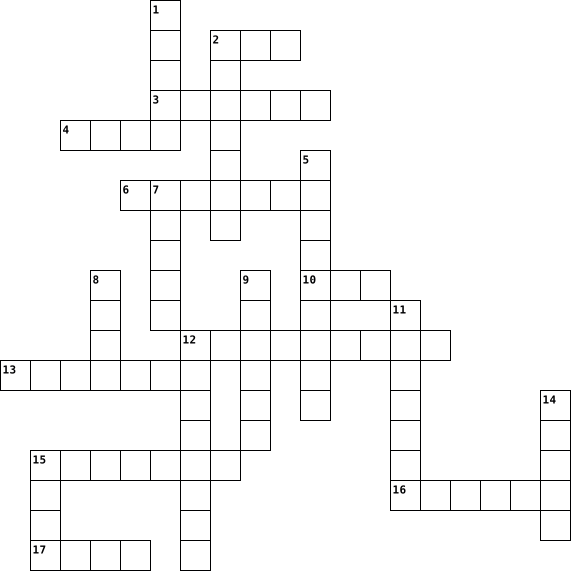
Inner and Outer Planets 2024-11-05

Across
- type of planet that is rocky
- Second Planet from the Sun
- Mars, Mercury, Venus, Mars are called ____ planets
- The largest moon in the solar system
- Planet with the longest day
- Neptune's moons are named after water deity's from _____ mythology
- Jupiter, Saturn, Uranus, Neptune are called ____ planets
- planet with a moon named Titan
Down
- planet with the Great Red Spot
- Number of planets in our solar system
- Uranus's moons were named after this author
- Another name for the outer planets
- largest volcano in the solar system
- Only planet to support life
- Smallest planet in the solar system
- only planet whose moon orbits opposite
- known as the "Red Planet"
- planet that rotates on its side
18 Clues: known as the "Red Planet" • Second Planet from the Sun • Only planet to support life • Planet with the longest day • type of planet that is rocky • planet with the Great Red Spot • planet with a moon named Titan • planet that rotates on its side • Another name for the outer planets • largest volcano in the solar system • Smallest planet in the solar system • ...
Space Exploration Unit Vocabulary- Topic 1 and 2 2014-04-11

Across
- A change of direction of a ray of light, sound or heat in passing through one medium into another.
- A model of the universe that places the Earth at the center with the sun, moon and planets revolving around it.
- Another word for ocular lens.
- Angle measured clockwise from north.
- Used to locate a celestial body relative to a fix Earth.
- Determines the fineness of detail a telescope can produce of an object.
- A model of the universe that places the sun at the center with the planets and moon revolving around it.
- Objects seen in the sky like the sun and the planets.
- Grouping of stars that form patterns and are given names.
- To cast back light, heat or sound from a surface.
- Large lens at the front of a telescope.
Down
- Angle measured from above the horizon in degrees.
- A set of axes of any kind used to determine a position or motion of things.
- Another word for heliocentric.
- Newton’s law that states all objects attract other objects and provided an explanation for the planets' orbit.
- Another word for earth-centered.
- Device used to measure the altitude of an object.
- Figure that looks like a squashed circle. Planets in the solar system travel in a similar manner.
- Lens from where you view a magnified object using a telescope.
- Celestial bodies in our solar system that orbits the sun.
- Device used to measure the azimuth of an object.
21 Clues: Another word for ocular lens. • Another word for heliocentric. • Another word for earth-centered. • Angle measured clockwise from north. • Large lens at the front of a telescope. • Device used to measure the azimuth of an object. • Angle measured from above the horizon in degrees. • Device used to measure the altitude of an object. • ...
the planet and solar system! 2023-12-15

Across
- system is a super seeded astron model in winch the earth an d planets.
- the fifth closest inner planet.
- galaxy are small gaxies composed of a few billions of stars.
- a hydrogen and helium.
- is a thing that starts with a o and has all the planets.
- is a cold dusty dersert
- cosmic snowballs of frozen gases and full of dust and is a big rock one.
Down
- is and bright star.
- a member of Norse group of moons.
- is a picture of how the planets are in oder.
- is a beautiful place full of stars.
- intercuts 41 lyncis system
- planets the inner planets are Mercurey Venus and Mars.
- star is a star and has fuel.
- want we live on
15 Clues: want we live on • is and bright star. • a hydrogen and helium. • is a cold dusty dersert • intercuts 41 lyncis system • star is a star and has fuel. • the fifth closest inner planet. • a member of Norse group of moons. • is a beautiful place full of stars. • is a picture of how the planets are in oder. • planets the inner planets are Mercurey Venus and Mars. • ...
the inner planets 2012-11-19

Across
- in the 1600s, saw planets moving in ellispse
- to wander
- earth at center
- second closest to the sun
- the red planet
- divides inner planets from outer planets
- another word for earth
Down
- cloud of gas, ice,hydrogen, helium, and dust
- hotter than mercury due to greenhouse effect
- first to write about a heliocentric solar system
- associated with the geocentric model of the solar system
- sun at center
- only planet known to have life
- planets in orbit around other stars
- with telescopes saw evidence to support Copernicus
15 Clues: to wander • sun at center • the red planet • earth at center • another word for earth • second closest to the sun • only planet known to have life • planets in orbit around other stars • divides inner planets from outer planets • cloud of gas, ice,hydrogen, helium, and dust • hotter than mercury due to greenhouse effect • in the 1600s, saw planets moving in ellispse • ...
Inner Solar System 2024-01-31

Across
- hottest planet, but it is not closest to the sun
- this profession, or job, discovered a new planet that they believe one day might be able to support life
- made of ice and rock
- the effect of gravity is similar to this playground game
- keeps the planets pulling towards the sun, prevents them from floating away
- when building a model or looking at a model of our solar system, planets look ______ compared to the sun
- located in the center of our solar system
- has the thinnest atmosphere of the inner planets, closest to the sun
Down
- Mercury, Earth, Venus, and Mars are the four planets closest to the sun. They are called ______ _______.
- body of matter, travels around the sun. Our solar system has eight
- this planet has two moons, and forms rust on the surface, due to iron-rich materials
- system of eight planets, sun, moon, asteroids, and comets
- the curved path around a star, planet, or moon
- true or false: planets orbit the sun, and moons orbit planets
14 Clues: made of ice and rock • located in the center of our solar system • the curved path around a star, planet, or moon • hottest planet, but it is not closest to the sun • the effect of gravity is similar to this playground game • system of eight planets, sun, moon, asteroids, and comets • true or false: planets orbit the sun, and moons orbit planets • ...
Planets 2021-08-09

Across
- the coldest planet in the solar system
- named after the Roman god of love and beauty
- no oxygen, most studied planet besides earth
- discovered many of our planets in 1610
- te reo name is Tangaroa
- closest planet to the sun
Down
- closest moon to Jupiter
- much heat
- ocean levels are rising
- has 82 moons
- the biggest planet in the solar system
- orbits earth
12 Clues: much heat • has 82 moons • orbits earth • closest moon to Jupiter • ocean levels are rising • te reo name is Tangaroa • closest planet to the sun • the coldest planet in the solar system • the biggest planet in the solar system • discovered many of our planets in 1610 • named after the Roman god of love and beauty • no oxygen, most studied planet besides earth
planets 2021-10-03

Across
- second planet from the sun
- second largest planet
- the smallest planet
- mickey's dog
- an icy, small Solar System body
Down
- second smallest planet
- farthest away from the sun
- hot plasma sphere
- reference to the greek god of the sky
- alternative names Gaia, Terra, and Tellus
- largest planet
- earths natural satellite
12 Clues: mickey's dog • largest planet • hot plasma sphere • the smallest planet • second largest planet • second smallest planet • earths natural satellite • second planet from the sun • farthest away from the sun • an icy, small Solar System body • reference to the greek god of the sky • alternative names Gaia, Terra, and Tellus
planets 2022-03-28

Across
- It's a blue gas giant planet
- the only planet that can harbor life
- We see that star every day
- the biggest planet in The Solar System
- Spaceship engineered by SpaceX(To carry humans to Mars)
Down
- Earth's natural Satellite
- The smallest planet in The Solar System
- Named after the Roman God of beauty
- In Greek it's called Πωσειδώνας
- Has the most moons
- Was a planet
- We have plans to colonize that planet
12 Clues: Was a planet • Has the most moons • Earth's natural Satellite • We see that star every day • It's a blue gas giant planet • In Greek it's called Πωσειδώνας • Named after the Roman God of beauty • the only planet that can harbor life • We have plans to colonize that planet • the biggest planet in The Solar System • The smallest planet in The Solar System • ...
planets 2023-10-02

Across
- saturns rings are made of 90% of what?
- is the most scarce resource in the universe
- time it takes for light to travel from the sun to earth
- how many pare planets in the solar system?
- rings like a bell when hit hard
- known as a dwarf planet
Down
- does not have a red sky
- is the hottest planet in the solar system
- last planet to be discovered in the solar system
- how many months does it take mercury to orbit the sun
- icy planetesimals surrounding the Sun
- it rains this on Neptune
12 Clues: does not have a red sky • known as a dwarf planet • it rains this on Neptune • rings like a bell when hit hard • icy planetesimals surrounding the Sun • saturns rings are made of 90% of what? • is the hottest planet in the solar system • how many pare planets in the solar system? • is the most scarce resource in the universe • last planet to be discovered in the solar system • ...
Planets 2024-08-12

Across
- Our Star
- big pressure and mass
- What Saturn and neptune have around tem
- What Was The first vehichle to be used in space travel
- What doesnt travel in The void
- First moon of Saturn
Down
- Most famous astronaut
- Fastest Thing in The universe
- What happens when a star dias
- Until 2006 He Was a Planet
- sixth Planet
- seventh Planet
12 Clues: Our Star • sixth Planet • seventh Planet • First moon of Saturn • Most famous astronaut • big pressure and mass • Until 2006 He Was a Planet • Fastest Thing in The universe • What happens when a star dias • What doesnt travel in The void • What Saturn and neptune have around tem • What Was The first vehichle to be used in space travel
Planets 2026-10-08

Across
- A planet with bright rings, named after the Roman god of time.
- To find or learn something for the first time.
- The planet named after the Roman goddess of love and beauty.
- Someone who carries a message from one person to another.
- The planet named after the Roman god of the sea.
Down
- The largest planet in our solar system.
- Someone who moves from place to place without a plan.
- A planet named after the Roman god of the sky.
- A scientist who studies stars, planets, and space.
- A tool that makes faraway things look closer.
- The planet closest to the Sun, named after a messenger.
- To look at something steadily for a while.
12 Clues: The largest planet in our solar system. • To look at something steadily for a while. • A tool that makes faraway things look closer. • A planet named after the Roman god of the sky. • To find or learn something for the first time. • The planet named after the Roman god of the sea. • A scientist who studies stars, planets, and space. • ...
VOCAB 2021-04-29

Across
- third planet from the sun, allows civilization
- sixth planet from the sun, has rings
- outer planets nickname
- eighth planet from the sun
- called red planet, fourth planet from sun
- inner planets have no _____
- closest planet to the sun
- mercury, venus, earth, mars
- jupiter, saturn, uranus, neptune
Down
- another nickname for outer planets
- second planet from the sun has no moons
- center of solar system
- inner planets nickname
- largest planet, fifth planet from the sun
- seven planet from the sun was discovered in 1781
15 Clues: center of solar system • outer planets nickname • inner planets nickname • closest planet to the sun • eighth planet from the sun • inner planets have no _____ • mercury, venus, earth, mars • jupiter, saturn, uranus, neptune • another nickname for outer planets • sixth planet from the sun, has rings • second planet from the sun has no moons • ...
Ou solar system ! 2024-09-24

Across
- mixture of frozen gases and dust
- small rocky bodies that orbit around the sun.
- what is between the rocky planets and gas giants .
- what are the inner planets called
- what are the outer planets called .
- natural satellites of planets .
- the biggest planet .
- the main dwarf planet .
- the center of our solar system
Down
- where we live .
- The closest to the the sun.
- objects of rock, metal , and ice.
- a piece of rock from space that turns into
- the planet with the most rings .
- the most farthest from the sun .
15 Clues: where we live . • the biggest planet . • the main dwarf planet . • The closest to the the sun. • the center of our solar system • natural satellites of planets . • mixture of frozen gases and dust • the planet with the most rings . • the most farthest from the sun . • objects of rock, metal , and ice. • what are the inner planets called • what are the outer planets called . • ...
the planet and solar system! 2023-12-15

Across
- system is a super seeded astron model in winch the earth an d planets.
- the fifth closest inner planet.
- galaxy are small gaxies composed of a few billions of stars.
- a hydrogen and helium.
- is a thing that starts with a o and has all the planets.
- is a cold dusty dersert
- cosmic snowballs of frozen gases and full of dust and is a big rock one.
Down
- is and bright star.
- a member of Norse group of moons.
- is a picture of how the planets are in oder.
- is a beautiful place full of stars.
- intercuts 41 lyncis system
- planets the inner planets are Mercurey Venus and Mars.
- star is a star and has fuel.
- want we live on
15 Clues: want we live on • is and bright star. • a hydrogen and helium. • is a cold dusty dersert • intercuts 41 lyncis system • star is a star and has fuel. • the fifth closest inner planet. • a member of Norse group of moons. • is a beautiful place full of stars. • is a picture of how the planets are in oder. • planets the inner planets are Mercurey Venus and Mars. • ...
the planet and solar system! 2023-12-15

Across
- system is a super seeded astron model in winch the earth an d planets.
- the fifth closest inner planet.
- galaxy are small gaxies composed of a few billions of stars.
- a hydrogen and helium.
- is a thing that starts with a o and has all the planets.
- is a cold dusty dersert
- cosmic snowballs of frozen gases and full of dust and is a big rock one.
Down
- is and bright star.
- a member of Norse group of moons.
- is a picture of how the planets are in oder.
- is a beautiful place full of stars.
- intercuts 41 lyncis system
- planets the inner planets are Mercurey Venus and Mars.
- star is a star and has fuel.
- want we live on
15 Clues: want we live on • is and bright star. • a hydrogen and helium. • is a cold dusty dersert • intercuts 41 lyncis system • star is a star and has fuel. • the fifth closest inner planet. • a member of Norse group of moons. • is a beautiful place full of stars. • is a picture of how the planets are in oder. • planets the inner planets are Mercurey Venus and Mars. • ...
Complete the cross word 2022-05-07

Across
- Wolf
- Stars
- Planets
- Bear
- Princess
- Giant
Down
- Flush
- Whale
- Ship
- Moon
- Sleep
- Sun
- River
- Bread
- Sky
15 Clues: Sun • Sky • Wolf • Ship • Moon • Bear • Flush • Whale • Stars • Sleep • River • Bread • Giant • Planets • Princess
The Galaxy and The Solar System 2017-12-20

Across
- Made of Dust, Ice, and Rocks
- Year Distance light travels in one year.
- Larger and made up of Gas and Dust ( Rings Only)
- The Red Planet.
- Equipment use to view moon, stars, planets, and etc.
- Our Galaxy.
- Blue colored planets with more rings than others.
- Consist of gas, dust, and many stars.
- Small, rocky planet with varity of life.
- Not a planet and make its own energy.
Down
- Dwarf Planet.
- Bright planet and have rings that are not easy to see.
- Number of planets in the solar system (Not including the dwarf planet)
- Space Rocks
- The Great Red Spot.
- Smaller and made up of Rocky surface. (No Rings)
- Look like a moon, with many craters on its surface.
- Second largest planet with very bright rings.
- Second planet of the inner planets.
19 Clues: Space Rocks • Our Galaxy. • Dwarf Planet. • The Red Planet. • The Great Red Spot. • Made of Dust, Ice, and Rocks • Second planet of the inner planets. • Consist of gas, dust, and many stars. • Not a planet and make its own energy. • Small, rocky planet with varity of life. • Year Distance light travels in one year. • Second largest planet with very bright rings. • ...
the planet and solar system! 2023-12-15

Across
- system is a super seeded astron model in winch the earth an d planets.
- the fifth closest inner planet.
- galaxy are small gaxies composed of a few billions of stars.
- a hydrogen and helium.
- is a thing that starts with a o and has all the planets.
- is a cold dusty dersert
- cosmic snowballs of frozen gases and full of dust and is a big rock one.
Down
- is and bright star.
- a member of Norse group of moons.
- is a picture of how the planets are in oder.
- is a beautiful place full of stars.
- intercuts 41 lyncis system
- planets the inner planets are Mercurey Venus and Mars.
- star is a star and has fuel.
- want we live on
15 Clues: want we live on • is and bright star. • a hydrogen and helium. • is a cold dusty dersert • intercuts 41 lyncis system • star is a star and has fuel. • the fifth closest inner planet. • a member of Norse group of moons. • is a beautiful place full of stars. • is a picture of how the planets are in oder. • planets the inner planets are Mercurey Venus and Mars. • ...
Solar System 2023-12-01

Across
- This is the farthest planet that you can see without a telescope
- These are the outer planets.
- This is the largest planet in our solar system.
- All planets and moons orbit this star.
- The nickname for this object is "Luna".
- These are the inner planets.
- This is the hottest planet.
- This planet orbits around the Sun the fastest.
- This is a dwarf planet.
Down
- The name for our Sun together with all the planets, moons, and other bodies that orbit it
- This is the farthest planet from the Sun.
- You can find these rocks between Jupiter and Mars.
- This planet is called the "Red Planet".
- We live on this planet.
- This planet rotates the opposite way as other planets.
15 Clues: We live on this planet. • This is a dwarf planet. • This is the hottest planet. • These are the outer planets. • These are the inner planets. • All planets and moons orbit this star. • The nickname for this object is "Luna". • This planet is called the "Red Planet". • This is the farthest planet from the Sun. • This planet orbits around the Sun the fastest. • ...
planets 2021-12-06

Across
- second hottest planet
- highest mountain in our solar system
- closest dwarf planet to the sun
- form of rocks in space
- 4 rings
Down
- Second closest to the sun
- furthest rock form from the sun
- closest to the kuiper belt
- highest planet from the sun
- furthest dwarf planet from the sun
- most rings
- dwarf planet in the kuiper belt
12 Clues: 4 rings • most rings • second hottest planet • form of rocks in space • Second closest to the sun • closest to the kuiper belt • highest planet from the sun • furthest rock form from the sun • closest dwarf planet to the sun • dwarf planet in the kuiper belt • furthest dwarf planet from the sun • highest mountain in our solar system
Planets 2022-03-26

Across
- self
- transformation
- limitations, lessons, restrictions
- wounded healer
- emotions, mother, intuition, psyche
- change, rebellion
- romance, love
Down
- luck, expansion (your gifts)
- past lives and Destiny
- dreams, illusion, spirit
- thinking, communication
- drive, ambition, energy (your super power)
12 Clues: self • romance, love • transformation • wounded healer • change, rebellion • past lives and Destiny • thinking, communication • dreams, illusion, spirit • luck, expansion (your gifts) • limitations, lessons, restrictions • emotions, mother, intuition, psyche • drive, ambition, energy (your super power)
Planets 2024-09-27

Across
- – Once considered the ninth planet
- – Rocky body orbiting the sun
- – Ice giant that rotates on its side
- – Known as the red planet
- – Closest planet to the sun
- – Second planet from the sun, often called Earth’s twin
Down
- – Largest planet in our solar system
- – Related to the sun
- – Earth’s natural satellite
- – The planet we live on
- – Famous for its rings
- – Furthest planet from the sun
12 Clues: – Related to the sun • – Famous for its rings • – The planet we live on • – Known as the red planet • – Earth’s natural satellite • – Closest planet to the sun • – Rocky body orbiting the sun • – Furthest planet from the sun • – Once considered the ninth planet • – Largest planet in our solar system • – Ice giant that rotates on its side • ...
planets 2025-09-29

Across
- the red plane
- dwarf planet
- planet with life
- ice giant
- another dwarf planet
- a big star in our solar system
Down
- hottest planet
- the biggest planet
- a small like planet that obits around earth
- smallest planet
- gyatt
- ice and rocks particles
12 Clues: gyatt • ice giant • dwarf planet • the red plane • hottest planet • smallest planet • planet with life • the biggest planet • another dwarf planet • ice and rocks particles • a big star in our solar system • a small like planet that obits around earth
Universal Forces 2023-10-04

Across
- When a planet moves SLOWEST because it's far away.
- Holds the nucleus together.
- Kepler's 3rd Law describes RELATIONSHIP of planets.
- When a planet moves FASTEST because it's closer.
- Strong & Weak nuclear forces act over ___ distances.
- Force that allows us to see all visible light.
- Kepler's 1st Law that describes the PATH of planets.
Down
- Increasing this property INCREASES the Gravitation.
- Electromagnetic & Gravitation act over ___ distances.
- Strong Nuclear and Electromagnetic are both __ forces.
- Weak Nuclear and Gravitational are both ___ forces.
- Orbit in a circle
- Force that holds the planets in orbit.
- Increasing this property DECREASES the Gravitation.
- Kepler's 2nd Law that describes the SPEED of planets.
- Any force that causes objects to move in a circle.
- Allows things to decay.
- Spinning in place
18 Clues: Orbit in a circle • Spinning in place • Allows things to decay. • Holds the nucleus together. • Force that holds the planets in orbit. • Force that allows us to see all visible light. • When a planet moves FASTEST because it's closer. • When a planet moves SLOWEST because it's far away. • Any force that causes objects to move in a circle. • ...
Planets Project Crossword 2021-05-05

Across
- This planet is tilted at nearly a right angle
- This planet has rings of ice and dust surrounding it
- This planet is the only one in the solar system that can currently support life
- planets These planets are made of rock and metallic materials, they also have a solid outer layer
- This is a frozen mixture of ice and dust, that has a tail
- This planet is known for its giant red spot
- This planet has 0 moons
Down
- This is a bright streak of light from a shooting star
- giants These planets are mostly made of hydrogen and helium
- planets These planets consist of Mercury, Venus, Earth, and Mars
- planets These plants consist of Jupiter, Saturn, Uranus and Neptune
- This planet is the farthest away from the sun in the solar system
- This planet is similar to earth in size
- This planet is surrounded by greenhouse gases
- This is a rocky fragment that orbits the sun in a belt, in between Mars and Jupiter
15 Clues: This planet has 0 moons • This planet is similar to earth in size • This planet is known for its giant red spot • This planet is tilted at nearly a right angle • This planet is surrounded by greenhouse gases • This planet has rings of ice and dust surrounding it • This is a bright streak of light from a shooting star • ...
Planets 2021-04-28

Across
- travel
- to harm
- to watch something or someone carefully
- near
- to search and discover
- extremely large
Down
- shining
- to blow up
- to save
- to pace
- a curved path around a planet or star
- to start off
12 Clues: near • travel • shining • to save • to harm • to pace • to blow up • to start off • extremely large • to search and discover • a curved path around a planet or star • to watch something or someone carefully
Planets 2022-01-18

Across
- radiation from the sun has burned off most of Mercury's ___
- Known as earth's twin
- mars has frozen ___ under a layer of frozen carbon dioxide
- TV signal part
- Neptune is the smallest of the ___
Down
- Venus is the ____ planet in the sky.
- Mar's length of _____(daylength) is almost the same as planet earth's.
- filters slowly
- uranus was the first new planet discovered since ___ times
- largest of the terrestrial planets
- Uranus has ___ like saturn
- noted literary pseudonym
12 Clues: filters slowly • TV signal part • Known as earth's twin • noted literary pseudonym • Uranus has ___ like saturn • largest of the terrestrial planets • Neptune is the smallest of the ___ • Venus is the ____ planet in the sky. • uranus was the first new planet discovered since ___ times • mars has frozen ___ under a layer of frozen carbon dioxide • ...
Planets 2024-04-12

Across
- a space ice ball with a tail
- red planet
- The 7th planet that has narrow rings
- the densest giant planet
- where we live
- giant balls of burning gas
Down
- planet closest to the sun
- has a red spot
- causes high and low tides
- the closest star to Us.
- the atmosphere is very cloudy
- has rings
12 Clues: has rings • red planet • where we live • has a red spot • the closest star to Us. • the densest giant planet • planet closest to the sun • causes high and low tides • giant balls of burning gas • a space ice ball with a tail • the atmosphere is very cloudy • The 7th planet that has narrow rings
Planets 2023-06-12

Across
- A dwarfplanet in our Solar System.
- The galaxy we live in.
- A machine used to travel in space.
- closest planet to the Sun.
- Planets orbit around this star.
- Small object mostly made out of ice, rocks, dust and frozen gases.
Down
- Biggest planet in Solar System.
- A meteroid that hit the Earth.
- Fourth planet in the Solar System.
- The planet with a ring around it.
- The planet we live on.
- The satellite of Earth.
12 Clues: The galaxy we live in. • The planet we live on. • The satellite of Earth. • closest planet to the Sun. • A meteroid that hit the Earth. • Biggest planet in Solar System. • Planets orbit around this star. • The planet with a ring around it. • A dwarfplanet in our Solar System. • Fourth planet in the Solar System. • A machine used to travel in space. • ...
Planets 2025-02-05

Across
- Planet closest to replicate the earth
- Largest moon of Jupiter
- The distance between the earth and the sun (not in number form)
- This was last seen in 1986 and will return in 2061 (hint: not a planet)
- Hottest planet
- The belt that separates the terrestrial planets from the gas giants
Down
- True/false Venus is hotter than the sun
- when the sun casts earth shadow onto the moon
- The planet that was classified as a Dwarf Planet in 2006
- The middle of the solar system
- 2 things that Make a planet become eligible for life
- When the moon passes between the earth and the sun
12 Clues: Hottest planet • Largest moon of Jupiter • The middle of the solar system • Planet closest to replicate the earth • True/false Venus is hotter than the sun • when the sun casts earth shadow onto the moon • When the moon passes between the earth and the sun • 2 things that Make a planet become eligible for life • The planet that was classified as a Dwarf Planet in 2006 • ...
Planets 2025-05-12

Across
- Hottest thing
- What is the sun?
- Closest to the sun
- Has the most moon's
- Non-existing planet anymore
- Ice giant
- What planet can you live on?
Down
- Biggest planet, 5th from the sun
- Spins clockwise
- 4th from the sun
- Coldest planet
- Revolves around the earth
12 Clues: Ice giant • Hottest thing • Coldest planet • Spins clockwise • What is the sun? • 4th from the sun • Closest to the sun • Has the most moon's • Revolves around the earth • Non-existing planet anymore • What planet can you live on? • Biggest planet, 5th from the sun
planets 2025-05-13

Across
- biggest planet in the solar system
- reddish brown, dusty plane.
- The nearest planet to earth
- A planet with knowledge of living organisms
- the 'ice giant'
- Dwarf planet, which was recognized as a planet once before
- planets too small to be recognized as a planet
Down
- aircraft used to jet proplusion into space
- The outermost planet in our solar system
- green hypothetical organisms with UFOS
- the second planet from the sun
- International Space Administration
12 Clues: the 'ice giant' • reddish brown, dusty plane. • The nearest planet to earth • the second planet from the sun • biggest planet in the solar system • International Space Administration • green hypothetical organisms with UFOS • The outermost planet in our solar system • aircraft used to jet proplusion into space • A planet with knowledge of living organisms • ...
Planets 2025-07-05

Across
- It spins on its side and looks pale blue.
- Hotter than any other, even though it’s not closest.
- You live here—it has oceans, trees, and people.
- It’s the smallest world closest to the sun.
- It used to be a planet, but now it's not.
- Like space rocks that zoom between planets fast.
Down
- This windy, blue world is farthest from the sun.
- The one with shiny rings made of ice and rock.
- The opposite of night – hot, bright, and golden.
- This giant has stripes and a swirling red storm. It’s the biggest one, with rings and many moons. A huge red spot spins in its stormy sky.
- ( ) shines at night and changes its shape.
- This place is red, dusty, and might have life.
12 Clues: It spins on its side and looks pale blue. • It used to be a planet, but now it's not. • It’s the smallest world closest to the sun. • ( ) shines at night and changes its shape. • The one with shiny rings made of ice and rock. • This place is red, dusty, and might have life. • You live here—it has oceans, trees, and people. • ...
Planets 2026-02-24

Across
- Another name for gas giants.
- Is made up of gases that surround it.
- Spinning around something repeatedly.
- Thinnest atmosphere,shortest orbit.
- The only star in our solar system.
Down
- Known as the red planet.
- The 4 planets further from the Sun.
- Like Earth.
- The 4 planets closest to the Sun.
- The only planet with known life.
- The hottest planet in our solar system.
- An object in space that orbits around a planet.
12 Clues: Like Earth. • Known as the red planet. • Another name for gas giants. • The only planet with known life. • The 4 planets closest to the Sun. • The only star in our solar system. • The 4 planets further from the Sun. • Thinnest atmosphere,shortest orbit. • Is made up of gases that surround it. • Spinning around something repeatedly. • The hottest planet in our solar system. • ...
Solar System- Part 1 2021-09-22

Across
- Created the telescope and provided proof that planets orbit the sun in our solar system.
- All of the contents of outer space.
- The ______ planets are large gas and ice giants. They have ring systems and a large amount of moons.
- Seventh planet from the sun.
- The _____ belt is the region of the solar system between the orbits of Mars and Jupiter, where many asteroids are found.
- The _____ belt is the region of the solar system that is just beyond the orbit of Neptune. Contains rock and ice, as well as many of the dwarf planets in our solar system.
- A large spiral galaxy that is home to Earth and the rest of our solar system, and about a trillion stars.
- The ________ unit is used to measure the distances between the sun and planets in the solar system.
- First planet from the sun; One of the terrestrial planets; smallest of the 8 planets.
- The theory that proposes that the universe is the same as it has always been.
- Second planet from the sun.
- The scientific study of stars, planets, and other things in space.
- A massive collection of matter that revolves around a star.
- The theory that the universe originated in a huge explosion that released all matter and energy.
- Fifth planet from the sun. This is the largest known planet in the solar system.
Down
- The first scientist to propose that planets orbit the sun.
- Third planet from the sun.
- An smaller type of planet that orbits the sun.
- The ___ planets are small and rocky. They have few moons and lack rings.
- The sun and all objects that are gravitationally bound to the sun.
- Eighth planet from the sun.
- A swarm of billions of stars, clouds, and dust rotating around a central point. The universe is made up of billions of these swarms.
- A large object that gives off its own light.
- A possible ice giant planet that would exist far past Neptune.
- The theory that proposes that the universe was created by God, or a higher power.
- A scientist that proposed that the Earth was the center of the solar system.
- Fourth planet from the sun. Possibly contained water and life in the past.
- A planetary _______ is any smaller object that orbits a planet. An example of this would be a moon.
- Sixth planet from the sun. Has large rings.
- An object that orbits a planet. This object is always smaller than the planet it orbits.
30 Clues: Third planet from the sun. • Eighth planet from the sun. • Second planet from the sun. • Seventh planet from the sun. • All of the contents of outer space. • Sixth planet from the sun. Has large rings. • A large object that gives off its own light. • An smaller type of planet that orbits the sun. • The first scientist to propose that planets orbit the sun. • ...
Space 2014-09-22
Across
- Jupiter and Saturn are made of this
- Ice giant with 27 moons
- The Earth spins on one of these
- Ice giant with 14 moons
- Planets revolve around this
- Person who explores space
- There are eight of these and one dwarf planet
- Planet closest to the sun
- Blasts off into space
- Twinkles in the sky
Down
- Second from the sun
- Keeps us on the ground
- Used to view the moon
- Planet we live on
- Comes out at night
- Planet with rings
- The largest planet
- Flies through space and could hit the planets
- Dwarf planet
- The red planet
20 Clues: Dwarf planet • The red planet • Planet we live on • Planet with rings • Comes out at night • The largest planet • Second from the sun • Twinkles in the sky • Used to view the moon • Blasts off into space • Keeps us on the ground • Ice giant with 27 moons • Ice giant with 14 moons • Person who explores space • Planet closest to the sun • Planets revolve around this • ...
space 2023-10-16

Across
- planets orbiting the earth
- dirty snowballs
- burning rock
- large chunks
- planets celestial bodies
- formed by debris
Down
- planets orbiting the sun
- the hunter
- first planet from the sun
- last planet from the sun
- the queen
- biggest planet
- leftover rock
- floating rock
14 Clues: the queen • the hunter • burning rock • large chunks • leftover rock • floating rock • biggest planet • dirty snowballs • formed by debris • planets orbiting the sun • last planet from the sun • first planet from the sun • planets celestial bodies • planets orbiting the earth
Planets 2020-03-08

Across
- Second largest planet
- Fourth planet from the sun
- Farthest planet from the sun
- The smallest of Mars's two moons
- What planet sits between Mars and Jupiter
- Is the coldest planet in our solar system
Down
- Is 93 million mile from earth
- This comet corbits the sun every 75-76 years
- Known for its rings
- Closest planet to the Sun
- Closest in size to the earth
- The path a planet takes
12 Clues: Known for its rings • Second largest planet • The path a planet takes • Closest planet to the Sun • Fourth planet from the sun • Farthest planet from the sun • Closest in size to the earth • Is 93 million mile from earth • The smallest of Mars's two moons • What planet sits between Mars and Jupiter • Is the coldest planet in our solar system • ...
planets 2022-05-05

Across
- Is a gas giant
- Has nice rings
- A really big star
- Not a confirmed planet
- Closet to the sun
- It is next to us
Down
- Close to the asteroid belt
- Second closest to the sun
- It is next to Neptune
- Very far away from us
- Rock that fly around space
- Planet with water
12 Clues: Is a gas giant • Has nice rings • It is next to us • A really big star • Planet with water • Closet to the sun • It is next to Neptune • Very far away from us • Not a confirmed planet • Second closest to the sun • Close to the asteroid belt • Rock that fly around space
planets 2023-05-07

Across
- what are the outer planets called
- what is the exact number of the stars in our solar system
- what planet rotates on its side
- what planet is the closest from the sun
- how many planets are in the solar system
- what else are the outer planets called
- what planets/planet have humans walked on
- which planet has a ¨ big red spot ¨
Down
- what is after Neptune in our solar system
- which planet is called Earths sister
- what planet is the farthest from the sun
- what are some of the outer planets called
12 Clues: what planet rotates on its side • what are the outer planets called • which planet has a ¨ big red spot ¨ • which planet is called Earths sister • what else are the outer planets called • what planet is the closest from the sun • what planet is the farthest from the sun • how many planets are in the solar system • what is after Neptune in our solar system • ...
Planets 2023-10-11

Across
- a large object with its own gravity that orbits the sun
- the star at the center of the solar system
- the planet where we live
- the sun and itsprilanets
- the number of planets
- the largest planet
Down
- the second planet from the sun; the hottest planet
- the furthest planet from the sun
- the fourth planet from the sun; the red planet
- the seventh planet from the sun; has rings
- the fifth planet from the sun; has rings
- a big ball of burning gas
- the closest planet to the sun
13 Clues: the largest planet • the number of planets • the planet where we live • the sun and itsprilanets • a big ball of burning gas • the closest planet to the sun • the furthest planet from the sun • the fifth planet from the sun; has rings • the star at the center of the solar system • the seventh planet from the sun; has rings • the fourth planet from the sun; the red planet • ...
Planets 2026-04-01

Across
- which planet has rings?
- what causes days and nights?
- which is the last planet?
- which planet has 62 moons
- who told Galileo to say he was lying about the sun being the center of the universe?
- which planet is the hottest?
Down
- how many plants are there?
- which planet is called the red planet?
- why do we have seasons?
- which planet rotates while lying on it's side?
- which planet has life?
- which planet has 88 day in it's year?
12 Clues: which planet has life? • which planet has rings? • why do we have seasons? • which is the last planet? • which planet has 62 moons • how many plants are there? • what causes days and nights? • which planet is the hottest? • which planet has 88 day in it's year? • which planet is called the red planet? • which planet rotates while lying on it's side? • ...
planets 2024-11-21

Across
- The furthermost planet from the sun
- The hottest planet
- Amount of moons Jupiter has
- the planet Elon Musk is trying to colonise.
- The planet humans come from
- The sun
Down
- The only planet with rings
- Orbit the Earth
- Ice giant, cyan colouring
- Planet similar to earth, 587.1 light years
- the biggest planet
- planet closest to the sun
12 Clues: The sun • Orbit the Earth • the biggest planet • The hottest planet • Ice giant, cyan colouring • planet closest to the sun • The only planet with rings • Amount of moons Jupiter has • The planet humans come from • The furthermost planet from the sun • Planet similar to earth, 587.1 light years • the planet Elon Musk is trying to colonise.
PLANETS 2025-05-01

Across
- THE FARTHEST PLANET FROM THE SUN
- THE RED GIANT
- THE PLANET WHICH SPINS ON ITS SIDE
- THIS CONSTELLATION IS SHAPED LIKE A HUNTER
- THE GALAXY WE LIVE IN
- THE ONLY NATURAL SATELLITE OF EARTH
Down
- LARGEST PLANET IN SOLAR SYSTEM
- THE HOTTEST PLANET IN OUR SOLAR SYSTEM
- THE CLOSEST PLANET TO THE SUN
- EARTH REVOLVES AROUND THIS STAR
- WAS ONCE A PLANET
- THE PLANET WE LIVE ON
12 Clues: THE RED GIANT • WAS ONCE A PLANET • THE PLANET WE LIVE ON • THE GALAXY WE LIVE IN • THE CLOSEST PLANET TO THE SUN • LARGEST PLANET IN SOLAR SYSTEM • EARTH REVOLVES AROUND THIS STAR • THE FARTHEST PLANET FROM THE SUN • THE PLANET WHICH SPINS ON ITS SIDE • THE ONLY NATURAL SATELLITE OF EARTH • THE HOTTEST PLANET IN OUR SOLAR SYSTEM • THIS CONSTELLATION IS SHAPED LIKE A HUNTER
Solar System 2022-03-30

Across
- axis tilted on its side
- the envelope of gases surrounding the Earth or another planet
- the elliptical path of planets
- the largest planet
- planets are mostly made up of gas
- the period of time it takes a planet to go around the sun
- the spinning of a planet on its axis
- closet planet to the sun
- hottest planet
- great dark spot
Down
- 2/3 of the surface covered by water
- another word for a moon orbiting a planet
- "the Red Planet"
- gas planet with visible rings
- planets are also called terrestrial planets
- a natural force of attraction exerted by one object on another object
- bowl-shaped cavity on the surface of the planet
17 Clues: hottest planet • great dark spot • "the Red Planet" • the largest planet • axis tilted on its side • closet planet to the sun • gas planet with visible rings • the elliptical path of planets • planets are mostly made up of gas • 2/3 of the surface covered by water • the spinning of a planet on its axis • another word for a moon orbiting a planet • ...
The Solar System 2012-10-03

Across
- Venus have vigorous convection that cause the surface to ______
- Both Earth and Mars experience ________ due to their axial tilt
- this planet has an axis of rotation in its orbital plane around the Sun
- existance can determine if geologic activity is present of planet
- All planets orbit in the same __________.
- mecchanizm which causes magnetic fields on planets or moons
- Most planets have orbits that are very close to a _________.
- magnetic fields on terrestrial planets produced from this material in liquid state
- the strong magentic field of Jupiter is a result of this material
- Method by which terrestrial planets formed
- a satellite of Neptune that has a Nitrogen atmosphere
- reside in a belt between Mars and Jupiter
- Approximate age of the Solar System (rounded)
- Saturn, Jupiter, Uranus and Neptune all have ____ that surround them
- Both Venus and Mars have ________ produced by hot spots
Down
- the gas element that colors Uranus and Neptune Blue/Green
- The most widely accepted theory for the formation of our Solar System
- Europa is covered with a smooth layer of ______ ice over a rocky interior
- this was once considered a planet, but is now considered a Trans-Neptunian Object
- The speed at which gas in atmospheres of planets must have to permanently leave the planet
- Term for a "pre-sun" before nuclear reactions begin in the core
- Gas Giant with a long lived storm (100's of years!)
- The four inner planets
- The nebular gas cloud from which the Solar System formed was thought to be composed of mainly this element
- Galilean satellite that has a lot of on-going volcanic activity
- Both Venus and Mar have atmospheres that are 95% of what molecule?
- Would float in your bath tub
- This planet rotates almost at the same rate as Earth, but takes twice as long to orbit the Sun
- This planet rotates in a retrograde direction
- sometimes referred to as "dirty snowballs"
30 Clues: The four inner planets • Would float in your bath tub • All planets orbit in the same __________. • reside in a belt between Mars and Jupiter • Method by which terrestrial planets formed • sometimes referred to as "dirty snowballs" • Approximate age of the Solar System (rounded) • This planet rotates in a retrograde direction • ...
Galaxy 2024-04-22

Across
- Small rocky or metallic debris in space, typically smaller than asteroids, that can become meteors when entering Earth's atmosphere.
- Natural satellites that orbit planets, ranging from small rocky bodies to large icy worlds.
- The curved path followed by an object around a celestial body, such as a planet orbiting the Sun or a moon orbiting a planet.
- A region between the orbits of Mars and Jupiter populated by numerous small rocky objects called asteroids.
- Tiny particles of matter that float in the air or space. In space, dust can be made up of tiny solid particles like rock or ice.
- Inner planets of the solar system, including Mercury, Venus, Earth, and Mars, which are primarily composed of rock and metal.
- A region of the solar system beyond the orbit of Neptune, containing icy bodies and dwarf planets such as Pluto.
- A bright streak of light produced by a meteoroid burning up in Earth's atmosphere; also called a shooting star.
- The force of attraction between objects with mass, such as planets, stars, and galaxies, which causes them to pull each other toward one another.
- Giant balls of glowing gas that produce heat and light through nuclear reactions happening in their cores. They are the most visible objects in the night sky and are the basic building blocks of galaxies like our Milky Way.
- Celestial bodies that orbit the Sun and are spherical in shape but have not cleared their orbits of other debris.
Down
- Natural objects in space, including stars, planets, moons, asteroids, comets, and other cosmic entities.
- A meteoroid that survives its passage through Earth's atmosphere and lands on the planet's surface.
- Small rocky objects that orbit the Sun, mostly found in the asteroid belt between Mars and Jupiter.
- Thin bands of rock, dust, and ice particles that encircle certain planets in the solar system, such as Saturn and Uranus.
- Icy bodies that orbit the Sun in elongated paths, often developing a visible coma and tail when they approach the Sun closely.
- Outer planets of the solar system, including Jupiter, Saturn, Uranus, and Neptune, which are primarily composed of hydrogen, helium, and other gases.
- Large celestial bodies that orbit around the Sun and do not produce light of their own.
- The star at the center of our solar system, which provides light and heat to the planets orbiting around it.
- the nearest spiral galaxy to the Milky Way, located about 2.537 million light-years away.
20 Clues: Large celestial bodies that orbit around the Sun and do not produce light of their own. • the nearest spiral galaxy to the Milky Way, located about 2.537 million light-years away. • Natural satellites that orbit planets, ranging from small rocky bodies to large icy worlds. • ...
Maddi Carter-Space Review 2019-02-21

Across
- The thing in between the Inner and Outer Planets
- Parts that work together
- What traps heat in the atmosphere?(Hint:Type of Element)
- How would you describe what the Outer planets are made up of?
- Area of the Solar System where Sun's energy supports liquid water
- Is the Sun hot?
- The planet closest to the Sun
- Protects Earth from radiation
- Another word for livable
Down
- A rock that leaves a icy dust behind
- Having the Earth as the center
- Having the Sun as the center
- A sphere that captures harmful charged particles at the Sun
- The force that attracts a body towards the center of Earth
- Which row of planets come first gas or terrestrial?
- What happens when a planet is too far from the Sun?
- What do you need in a spacecraft?(Hint:ELEMENT)
- Helps reduce radiation from the head
- Does the Sun orbit planets?
19 Clues: Is the Sun hot? • Parts that work together • Another word for livable • Does the Sun orbit planets? • Having the Sun as the center • The planet closest to the Sun • Protects Earth from radiation • Having the Earth as the center • A rock that leaves a icy dust behind • Helps reduce radiation from the head • What do you need in a spacecraft?(Hint:ELEMENT) • ...
Chapter 11 : The Solar System and The Stars 2012-11-01

Across
- What is a chunk of rocky material covered with ice called?
- What are the four outer planets called?
- What is the common unit used to measure large distances?
- What are the paths that the planets revolve around the sun in called?
- What are the objects that travel around our sun called?
- What is another word for spacecraft?
- What is the imaginary line called that objects spin around?
- What do we call groups of stars?
- What do we call the belief that objects in the sky influence people's lives?
- What distance does light travel at?
- What is a lump of rock that falls from space called?
Down
- What are the four planets closest to the sun known as?
- What is the method of measuring distances indirectly by drawing a scale diagram of a triangle called?
- What are irregular, rock objects called?
- How many planets are there?
- What is the motion of one object around another called?
- What is the spinning of an object around an imaginary line called?
- What is the device that splits light energy into a series of colours?
18 Clues: How many planets are there? • What do we call groups of stars? • What distance does light travel at? • What is another word for spacecraft? • What are the four outer planets called? • What are irregular, rock objects called? • What is a lump of rock that falls from space called? • What are the four planets closest to the sun known as? • ...
vocab 2026-01-09

Across
- the four giant outer planets of our solar system
- system for detecting the presence
- Jupiter's four largest moons
- Ishtar Terra is the second largest of the three continental terrae regions on the planet Venus
- Saturn's largest moon
- astronomical rings around planets
- the smaller, outermost moon of Mars
- Neptune's largest moon
Down
- the inner four planets of our solar system
- the largest canyon system in the Solar System, a massive rift on Mars
- the largest volcano and tallest mountain in the solar system, located on Mars
- the minimum distance at which a celestial body held together by its own gravity
- the process where a molecule breaks apart (dissociates) after absorbing light energy (a photon), leading to the cleavage of chemical bonds, forming smaller fragments like atoms or radicals
- narrow, fast-flowing air currents in the upper atmosphere
- the planet's largest impact basin and one of the largest recognized basins in the Solar System.
- Jupiter's largest moon
- Steep slope or cliff
- the inner, larger moon of Mars
18 Clues: Steep slope or cliff • Saturn's largest moon • Jupiter's largest moon • Neptune's largest moon • Jupiter's four largest moons • the inner, larger moon of Mars • system for detecting the presence • astronomical rings around planets • the smaller, outermost moon of Mars • the inner four planets of our solar system • the four giant outer planets of our solar system • ...
the planets 2012-12-19

Across
- surface is almost like earth
- going around something
- spining on its axis
- mercury has none
- gsses make up earth's ______________.
- path of a revolution
- called "red" planet
- the planets with gaseous surface
- form of water found on mars
- what caused our solar system.
Down
- not considered a planet
- only planet suitable for us to live on
- largest planet
- the gas git wth the longest rotation period
- planets with rocky surfaces
- famous for its rings
- closest planet to the sun
- liquid ______ only found on earth
- name of roman god of sea
- 3 planets have these
20 Clues: largest planet • mercury has none • spining on its axis • called "red" planet • famous for its rings • path of a revolution • 3 planets have these • going around something • not considered a planet • name of roman god of sea • closest planet to the sun • planets with rocky surfaces • form of water found on mars • surface is almost like earth • what caused our solar system. • ...
Basic Astronomy 2021-11-04

Across
- ball of ice
- darkest part of a shadow
- the planet we live on
- a place in a galaxy filled with planets
- planets farthest to the sun
- the moon between the sun and earth
- lightest part of a shadow
- not full eclipse
- ball of rock
- what we see in the sky
Down
- full eclipse
- smaller than a meteor
- our type of galaxy
- our galaxy
- the object that orbits the earth
- who receives the shadow in a lunar eclipse
- the earth between the sun and moon
- who receives the shadow during a solar eclipse
- planets closest to the sun
- what killed the dinosaurs
- can be total or partial
21 Clues: our galaxy • ball of ice • full eclipse • ball of rock • not full eclipse • our type of galaxy • smaller than a meteor • the planet we live on • what we see in the sky • can be total or partial • darkest part of a shadow • lightest part of a shadow • what killed the dinosaurs • planets closest to the sun • planets farthest to the sun • the object that orbits the earth • ...
Space Crossword - use the clues to put words in the boxes 2014-09-22

Across
- Jupiter and Saturn are made of this
- Comes out at night
- Ice giant with 27 moons
- The Earth spins on one of these
- Used to view the moon
- Twinkles in the sky
- Planet with rings
- Planet closest to the sun
- There are eight of these and one dwarf planet
- The largest planet
- Planet we live on
Down
- Second from the sun
- Dwarf planet
- Flies through space and could hit the planets
- The red planet
- Person who explores space
- Ice giant with 14 moons
- Planets revolve around this
- Keeps us on the ground
- Blasts off into space
20 Clues: Dwarf planet • The red planet • Planet with rings • Planet we live on • Comes out at night • The largest planet • Second from the sun • Twinkles in the sky • Used to view the moon • Blasts off into space • Keeps us on the ground • Ice giant with 27 moons • Ice giant with 14 moons • Person who explores space • Planet closest to the sun • Planets revolve around this • ...
Space crossword puzzle 2022-01-26

Across
- planets inside of the asteroid belt
- big hot and its what gives us light
- orbits us
- outer planer and blue
- belt-It separates the outer planets from the inner planets
- has a log tail and orbits the sun
- outer planet blue and spines upside down
- has different tempters and sizes
Down
- red yellow and bigger then mercury but smaller then Earth
- the biggest planet is our solar system
- smallest planet
- where we live
- the red planet
- planets outside of the asteroid belt
14 Clues: orbits us • where we live • the red planet • smallest planet • outer planer and blue • has different tempters and sizes • has a log tail and orbits the sun • planets inside of the asteroid belt • big hot and its what gives us light • planets outside of the asteroid belt • the biggest planet is our solar system • outer planet blue and spines upside down • ...
earth's place in space 2013-08-21

Across
- what white thing do we see in the night sky
- what planet rains diamonds
- what is it called when the moon crosses over the sun
- what's planets gases make it turn blue
- what planet is difficult to see
- ship what do we go into space in
- what do we use to see the sky with
- what is the fifth planet from the sun
- newton who discovered gravity
- who went on the leaning tower of Pisa
- what planet is a dwarf planet
Down
- what planet is the second from the sun
- giants what are the planets outside our planets called
- belt what belt keeps the planets together
- what are big pieces of asteroids.
- the planet with the great red spot
- star what do we rarely see shooting across the night sky
- what star is burning hot
- what planet can only human life live on
19 Clues: what star is burning hot • what planet rains diamonds • newton who discovered gravity • what planet is a dwarf planet • what planet is difficult to see • ship what do we go into space in • what are big pieces of asteroids. • the planet with the great red spot • what do we use to see the sky with • what is the fifth planet from the sun • who went on the leaning tower of Pisa • ...
EPS 3 - 6: Vocabulary Review 2024-11-15

Across
- This planet and Mercury do not have moons
- Downward force of gravity on an object
- When enters the Earth's atmosphere it burns up
- True or False: All planets have an atmosphere
- Something that causes a change in motion
- Metallic, rocky objects that move independently around the sun
- Earth has this many layers
- These planets are larger in size
- Resembles a small planet but can not be considered one
- Average weather conditions over a long period of time
Down
- Rocky metallic object that lands on Earth's surface
- Metric unit of force and weight
- Force of attraction based on object's mass
- Rocky metallic object floating around in space
- day to day conditions of Earth's atmosphere
- Amount of matter in an object
- These planets are more dense and are close together
- Mass of frozen gas, dust and ice crystals
- All planets must orbit this
19 Clues: Earth has this many layers • All planets must orbit this • Amount of matter in an object • Metric unit of force and weight • These planets are larger in size • Downward force of gravity on an object • Something that causes a change in motion • This planet and Mercury do not have moons • Mass of frozen gas, dust and ice crystals • Force of attraction based on object's mass • ...
Asteroids, Comets and Meteorids 2020-03-16

Across
- A trillion more comets live in an area known as the
- When the Earth travels through the burning particles from a comet, it creates
- Comets are also known as this
- The coldest of the planets
- First asteroid discovered in 1801.
- Metallic, rocky objects in space.
- When the bright streak of light appears as a meteoroid enters the atmosphere, it is called a ________
- A mass of frozen gas, cosmic dust and ice crystals
Down
- The planet demoted to a "Dwarf Planet" status
- Tens of thousands of asteroids found between the orbits of mars and Jupiter
- When a meteoroid enters a planets atmosphere, it burns up due to ___________
- Comets orbit the sun in this area beyond Neptune
- Because asteroids are too small to be classified as planets, they are known as?
- Pieces of rocks and metal dislodged from comets, planets, asteroids or moons.
- A small satellite near the asteroid Ida. (captions are useful)
- One of the many large asteroids found in the main belt.
- The Dead Red Planet
- The first of the outer planets
- When a large meteoroid enters an atmosphere and a piece of it lands on the planet it is called _________
19 Clues: The Dead Red Planet • The coldest of the planets • Comets are also known as this • The first of the outer planets • Metallic, rocky objects in space. • First asteroid discovered in 1801. • The planet demoted to a "Dwarf Planet" status • Comets orbit the sun in this area beyond Neptune • A mass of frozen gas, cosmic dust and ice crystals • ...
Outer Planets 2013-12-06

Across
- Jupiter is the ___ planet from the sun.
- Jupiter was named ___ by the Greeks.
- Uranus' moons are named after characters from the works of ___ ___.
- A swirling oval of clouds almost twice as wide as Earth, observed for more than 300 years.
- Jupiter's appearance is a tapestry of colorful cloud ___ and spots.
- Jupiter contains more than ___ the amount of material of the other bodies orbiting our sun combined.
- Like Jupiter, Saturn is made mostly of ___ and helium.
- Saturn is named for the Roman god of ___.
- Jupiter's fast rotation creates strong __ streams, smearing its clouds into bands across the planet.
- The ___2 is the only spacecraft to have visited Uranus.
- Like the other gas giants, Neptune does not have a ___ surface.
- Jupiter's four largest moons were observed by ____.
- Neptune has ___ rings.
- Neptune's winds can be ___ times stronger than Jupiter's.
- The ___ mission will arrive at Jupiter in 2016 to investigate the planet's atmosphere, deep structure, etc.
- The inner rings are ___ and dark.
Down
- Has one hemisphere darker than asphalt and the other as bright as snow.
- Neptune is the ___ planet from the sun.
- The ___ spacecraft continues to explore the Saturn and its moon, rings, and magnetosphere since 2004.
- Neptune's blue-green color is also the result of atmospheric ___.
- Astronomers observed as pieces of comet ___-___9 collided with Jupiter's southern hemisphere.
- ___ shows evidence of recent (and ongoing) surface changes.
- Uranus' rotation axis is tilted almost parallel to its orbital plane.
- The largest moon in the solar system (larger than Mercury).
- Neptune has ___ known moons (Triton the largest moon).
- Uranus was named for the Greek god of the ___.
- Saturn ___ support life.
- The ___ probe descended through Titan's atmosphere in 2005.
- Jupiter has a faint ___ system.
- Uranus is a ___ giant.
- Surface extremely heavily cratered and ancient.
- ___ in the upper atmosphere reach 500 meters per second in the equatorial region.
- Most visible clouds are composed of ___.
- Most volcanically active body in the solar system.
34 Clues: Uranus is a ___ giant. • Neptune has ___ rings. • Saturn ___ support life. • Jupiter has a faint ___ system. • The inner rings are ___ and dark. • Jupiter was named ___ by the Greeks. • Jupiter is the ___ planet from the sun. • Neptune is the ___ planet from the sun. • Most visible clouds are composed of ___. • Saturn is named for the Roman god of ___. • ...
The Planets 2014-09-25

Across
- Famous for its rings
- Airless rocks revolving around the sun that are too small to be called planets.
- The largest planet
- The name of our solar system
- Furthest planet from the Sun
- Closest Planet to the Sun
- There are 8 of these in our solar system
- The Planet that humans live on
- A bright object in the night sky
- known as the “Red Planet”
Down
- Coldest planet in our solar system
- We can see these twinkle in the night sky
- Is the star at the center of our solar system?
- The time it takes for light to travel in a year
- These people go to space
- No longer considered a planet
- ball of hot, burning gas
- The force that holds us to planet earth
- Closest planet to Earth
- Have humans ever set foot on planet mars?
20 Clues: The largest planet • Famous for its rings • Closest planet to Earth • These people go to space • ball of hot, burning gas • Closest Planet to the Sun • known as the “Red Planet” • The name of our solar system • Furthest planet from the Sun • No longer considered a planet • The Planet that humans live on • A bright object in the night sky • Coldest planet in our solar system • ...
The Planets 2014-10-29

Across
- Every planet rotates around the _____
- Has rings around it
- Humans have sent robots to walk on this planet
- The only planet with human life on it
- You may see this flying through the night sky, if you are looking hard enough
- Without ____ we would float away up in the sky
- The closest planet to the sun is ____
- Neil Armstrong was the first human to ever walk on the ___
- They twinkle in the night sky
- Something made up from millions of stars
- ______ no longer counts as a planet anymore
Down
- _____ travel to the moon in a spaceship
- The 'Ice giant'
- This planet is big and blue
- They are also known as minor planets
- The biggest planet
- There are 8 ____ in our solar system
- Aliens travel in this
- This planet is nearly the same size as Earth
- Without this space travel isn't possible
20 Clues: The 'Ice giant' • The biggest planet • Has rings around it • Aliens travel in this • This planet is big and blue • They twinkle in the night sky • They are also known as minor planets • There are 8 ____ in our solar system • Every planet rotates around the _____ • The only planet with human life on it • The closest planet to the sun is ____ • ...
The Planets 2014-10-15

Across
- THE EARTH IS MADE UP OF ABOUT 71% OF THIS
- NO LONGER CLASSIFIED AS A PLANET
- THE PLANETS ARE PART OF OUR ....
- SEVENTH PLANET FROM THE SUN
- AMOUNT OF PLANETS IN OUR SOLAR SYSTEM
- THE FIRST ROCK PLANET IN OUR SOLAR SYSTEM
- MARS WILL OFTEN HAVE ..... STORMS
- MERCURY IS A .... PLANET
- THIS ORBITS THE EARTH IN ABOUT 27 DAYS
Down
- SECOND PLANET FROM THE SUN
- THE BIGGEST PLANET
- THE AMOUNT OF GAS PLANETS IN OUR SOLAR SYSTEM
- THE RED PLANET
- CLOSEST PLANET TO THE SUN WITH RINGS
- OUR SOLARSYSTEM IS LOCATED IN AN OUTRIGHT SPIRAL OF THIS GALAXY
- EARTH SLOWLY REVOLVES AROUND THIS
- THE ONLY PLANET PROVEN TO SUPPORT HUMAN LIFE
- LAST KNOWN PLANET IN OUR SOLAR SYSTEM
- VENUS' ATMOSPHERE MAINLY CONSISTS OF ..... DIOXIDE
- THE AMOUNT OF KNOWN MOONS EARTH HAS
20 Clues: THE RED PLANET • THE BIGGEST PLANET • MERCURY IS A .... PLANET • SECOND PLANET FROM THE SUN • SEVENTH PLANET FROM THE SUN • NO LONGER CLASSIFIED AS A PLANET • THE PLANETS ARE PART OF OUR .... • EARTH SLOWLY REVOLVES AROUND THIS • MARS WILL OFTEN HAVE ..... STORMS • THE AMOUNT OF KNOWN MOONS EARTH HAS • CLOSEST PLANET TO THE SUN WITH RINGS • AMOUNT OF PLANETS IN OUR SOLAR SYSTEM • ...
The Planets 2014-10-23

Across
- The closest planet to the sun
- A small, frozen mass of dust and gas revolving around the sun
- Famous for its ring system
- The system of planets and other objects orbiting the sun
- A small object orbiting a larger one. There are many electronic objects that orbit the Earth
- The only planet to support life
- The distance which a ray of light would travel in one year
- The path a planet takes around the sun
- 1 year on this planet lasts 165 Earth years
- The "red planet"
Down
- An object from Outer Space that falls into the Earth and lands on its surface
- Has the shortest day out of all the planets
- The brightest planet, also known as the sister planet to earth
- smallest of the "Four Giants"
- A grouping of stars which have been given names by astronomers
- The "Dwarf planet"
- A rock, or Minor Planet orbiting the Sun
- Our Galaxy
- A group of stars, gas and dust held together by gravity
- A cloud of gas and dust
20 Clues: Our Galaxy • The "red planet" • The "Dwarf planet" • A cloud of gas and dust • Famous for its ring system • The closest planet to the sun • smallest of the "Four Giants" • The only planet to support life • The path a planet takes around the sun • A rock, or Minor Planet orbiting the Sun • Has the shortest day out of all the planets • 1 year on this planet lasts 165 Earth years • ...
Planets Crossword 2014-10-26

Across
- The only planet in the Solar System that has life
- Everything that exists including planets, stars, galaxies and all forms of matter and energy
- The smallest planet in the Solar System, which has now become a dwarf planet
- The galaxy of where our Solar System belongs
- A planet that is surrounded by rings and is the second biggest planet
- A planet that is too small to be considered a regular planet
- A huge bright ball of burning gas held together by gravity. The sun is one
- The biggest planet,300 times the mass of Earth
- A small object that is part of the solar system, it orbits the sun and is made up of ice, dust and small rocky particles
- The number of planets in our Solar System
- One of the four gas only planets, it is the second last planet away from the Sun and appears blue in colour
- Known as the red planet and sits next to Earth and also has similar time to Earth
Down
- The planet that is closest to the Sun
- The first person to step foot on the Moon in 1969
- The seventh planet from the Sun and cannot be seen from Earth without a telescope
- The study of objects and matter outside the Earth's surface
- A person trained to be a member of a spacecraft, a space travel professional
- The star that gives life to Earth and which all planets orbit around
- The planet that is second closest to the Sun and sits in between Mercury and Earth
- Orbits the Earth and is made up of craters. Can be seen from the Earth during the day and night
20 Clues: The planet that is closest to the Sun • The number of planets in our Solar System • The galaxy of where our Solar System belongs • The biggest planet,300 times the mass of Earth • The only planet in the Solar System that has life • The first person to step foot on the Moon in 1969 • The study of objects and matter outside the Earth's surface • ...
The Planets 2014-09-08

Across
- Nicknamed the Red Planet
- The second planet from the sun
- The galaxy our Solar System is in
- An object which moves around a star
- A person trained to travel in a spacecraft
- The planet we live on
- The seventh planet from the sun
- A vehicle that launches into space
- Revolves around the Earth
- The smallest planet in our Solar System
Down
- Four planets in our Solar System are known as _ Planets
- Balls of gas held together by gravity
- Billions of stars, gas and dust held together by gravity
- Made up of the sun and the planets which orbit it
- The furthest planet from the sun
- Known for its rings
- The star in the centre of the Solar System
- No longer considered a planet in our Solar System
- The force that attracts people to the Earth
- The largest planet in our Solar System
20 Clues: Known for its rings • The planet we live on • Nicknamed the Red Planet • Revolves around the Earth • The second planet from the sun • The seventh planet from the sun • The furthest planet from the sun • The galaxy our Solar System is in • A vehicle that launches into space • An object which moves around a star • Balls of gas held together by gravity • ...
The Planets 2014-09-03

Across
- the largest planet
- known as the 'Red' planet
- a collection of stars
- 75% of our planet is covered with it
- path of a planet: circular path
- space rock
- the furthest planet from the sun
- coldest planet in the solar system
- closest planet to Earth
- an astronaut is sometimes known as a 'what' man
- hottest star in our solar system
Down
- no longer officially a planet
- the galaxy containing our solar system
- takes approximately 365 days to orbit the sun
- famous for its rings
- everything that exists everywhere
- man has been able to land and walk on it
- closest planet to the sun
- people on Earth are known as 'what' beings
- balls of gas seen in the night sky
20 Clues: space rock • the largest planet • famous for its rings • a collection of stars • closest planet to Earth • known as the 'Red' planet • closest planet to the sun • no longer officially a planet • path of a planet: circular path • the furthest planet from the sun • hottest star in our solar system • everything that exists everywhere • coldest planet in the solar system • ...
The planets 2014-09-05

Across
- A red planet
- This planet rotates on its side
- A planet with rings around it
- The galaxy we live in (two words joined together)
- The huge space that contains all of the matter and energy in existence
- The earth goes around it
- This planet is sometimes called the evening or morning star
- All the gases that surround a star or a planet
- A big ball of dirty ice and snow in outer space
- The biggest planet in the solar system
- Our planet
Down
- Also known as a shooting star
- The closet planet to the sun
- There are billions of these in the night sky
- Astronauts have visited this place
- A piece of equipment used to see stars and planets clearly
- A person that has visited the moon
- A scientist who studies space
- Was once a planet but is now a dwarf planet
- The eighth planet from the sun
20 Clues: Our planet • A red planet • The earth goes around it • The closet planet to the sun • Also known as a shooting star • A planet with rings around it • A scientist who studies space • The eighth planet from the sun • This planet rotates on its side • Astronauts have visited this place • A person that has visited the moon • The biggest planet in the solar system • ...
the planets 2016-04-17

Across
- salah satu prinsip dasar pencegahan risiko low cost (b. indonesi)
- keputusan untuk menerima risiko
- kondisi yang dapat menimbulkan bahaya
- salah satu jenis bahaya listrik
- effectiveness (B. indonesia)
- kontak secara langsung
- key Risk Indicator
- peluang terjadinya kejadian
- salah satu jenis bahaya mekanis
- konsep dasar manajemen risiko yang pertama
- proses untuk melihat sejauh mana suaru keberhasilan
- tingkat keparahan atau kerugian mungkin terjadi dari suatu kecelakaan
- menghilangkan suatu bahan/tahapan proses berbahaya
- keadaan barang yang menyebabkan kerugian
- risiko yang dapat di asuransikan
- aman/selamat (B. inggris)
- ukuran yang dipakai sebagai patokan
- mengukur dan mengkaji hasil kerja
- pengendalian suatu sistem
- Safe Work Load
Down
- salah satu jenis bahaya psikolog
- Penyakit Akibat Hubungan Kerja
- kesehatan (B. inggris)
- rentan waktu terjadinya suatu kejadian
- kejadian yang tidak diinginkan
- keselamatan (B. inggris)
- Penyakit Akibat Kerja
- kemungkinan terjadinya kecelakaan
- kejadian yang tidak diharapkan
- alat pelindung diri
- membahayakan (B. inggris)
- serangkaian upaya untuk mengurangi risiko
- pelaksanaan dari sebuah rencana yang telah disusun
- probability risk assessment
- salah satu manfaat manajemen risiko
- Analisis Kesehatan Kerja
- nama lain dari keterpajanan
- kemungkinan terjadinya kecelakaan ketika terpajan dengan suatu bahaya
- biaya (anonim)
- pemeriksaan ulang dalam suatu program atau penelitian
40 Clues: biaya (anonim) • Safe Work Load • key Risk Indicator • alat pelindung diri • Penyakit Akibat Kerja • kesehatan (B. inggris) • kontak secara langsung • keselamatan (B. inggris) • Analisis Kesehatan Kerja • membahayakan (B. inggris) • aman/selamat (B. inggris) • pengendalian suatu sistem • peluang terjadinya kejadian • probability risk assessment • nama lain dari keterpajanan • ...
The planets 2021-11-28

Across
- is my friend
- is not a planet
- loves me
- is the coldest planet
- is my name
- loves dogs
- is dead
- is the biggest planet
- loves Aaliyah
- is mean
- close to the earth
- Aaliyah is funny
- the sun is really hot
- is a planet
- George loves word searches
- loves cats
- likes me
- a guibeapig
- is zzz
- likes pans
- loves pandas
Down
- is my teacher
- isn't moms duck
- has slot of volcanoes
- loves swings
- is my duck
- has rings
- has me
- is dumb
- is my bed
- loves tv
- is nice
- is pretty cold
- is on my bus
- people visit mars
- is a dad
- people live on earth
- Ava isn't here
- is a dog
- is mean
- loves you
41 Clues: has me • is zzz • is dumb • is dead • is mean • is nice • is mean • loves me • loves tv • is a dad • likes me • is a dog • has rings • is my bed • loves you • is my duck • is my name • loves dogs • loves cats • likes pans • is a planet • a guibeapig • is my friend • loves swings • is on my bus • loves pandas • is my teacher • loves Aaliyah • is pretty cold • Ava isn't here • is not a planet • isn't moms duck • Aaliyah is funny • ...
The planets 2021-11-28

Across
- loves tv
- is nice
- is dumb
- is my bed
- loves cats
- loves me
- is the biggest planet
- likes pans
- George loves word searches
- has slot of volcanoes
- a guibeapig
- has me
- is the coldest planet
- is zzz
- has rings
- Ava isn't here
- people visit mars
- is a dog
- Aaliyah is funny
- is mean
- loves dogs
- the sun is really hot
Down
- is my name
- is a dad
- close to the earth
- is a planet
- loves pandas
- is my teacher
- loves you
- is dead
- is on my bus
- is not a planet
- is mean
- is my duck
- loves Aaliyah
- people live on earth
- is pretty cold
- loves swings
- likes me
- is my friend
- its my road I live on
- isn't moms duck
42 Clues: has me • is zzz • is nice • is dumb • is dead • is mean • is mean • loves tv • is a dad • loves me • likes me • is a dog • is my bed • loves you • has rings • is my name • loves cats • likes pans • is my duck • loves dogs • is a planet • a guibeapig • loves pandas • is on my bus • loves swings • is my friend • is my teacher • loves Aaliyah • is pretty cold • Ava isn't here • is not a planet • isn't moms duck • Aaliyah is funny • ...
The planets 2021-11-28

Across
- has Cheyenne
- has providence
- is on my bus
- George loves word searches
- has Pierre
- has littlerock
- has Sacramento
- is a planet
- has batonrouge
- has Tallahassee
- has Boston
- has me
- is a island
- is my friend
- has Olympia
- has Montgomery
- people live on earth
- loves dogs
- has Helena
- has Columbia
- has Bismarck ?
- has Denver
- is zzz
- has saltlakecity
- likes pans
- has concord
- loves Aaliyah
- is not a planet
- is a road
- is my place
- is my duck
- has Lincoln
- has Juneau
- loves me
- loves you
- has santafe
- is the biggest planet
- is my name
- has trails
- Aaliyah is funny
- has Indianapolis
- the sun is really hot
- has Jeffersoncity
- has Raleigh
- a guibeapig
- has Augusta
- has rings
- has Nashville
- I've visit it
Down
- has Madison
- has hartford
- has Austin
- has Harrisburg
- its my road I live on
- is the coldest planet
- has Trenton
- is dead
- has Annapolis
- is dumb
- has Phoenix
- is dumb
- has Salem
- has carsoncity
- is a dog
- has Oklahomcity
- has Albany
- is pvt
- has Springfield
- has desmoines
- has Charleston
- has Topeka
- is a dad
- is my teacher
- has Lansing
- has Dover
- is mean
- has Columbus
- is long
- close to the earth
- is mean
- loves tv
- is fun
- has Frankfort
- Ava isn't here
- is small
- isn't moms duck
- has Jackson
- likes me
- is a bet
- has Richmond
- has Montpellier
- has Atlanta
- is nice
- loves cats
- is a place you can walk on
- is a hammer
- has slot of volcanoes
- is my bed
- loves swings
- has Boise
- is pretty cold
- loves pandas
- has Honolulu
- people visit mars
104 Clues: has me • is pvt • is zzz • is fun • is dead • is dumb • is dumb • is mean • is long • is mean • is nice • is a dog • is a dad • loves tv • is small • likes me • is a bet • loves me • has Salem • has Dover • is a road • loves you • is my bed • has Boise • has rings • has Austin • has Pierre • has Boston • has Albany • has Topeka • loves dogs • has Helena • has Denver • likes pans • is my duck • has Juneau • loves cats • is my name • has trails • has Madison • ...
Outer Planets 2022-03-09

Across
- Used to be a planet, but isn't anymore
- Named after the Greek god of the sky
- Describes the poles of Saturn
- Outer planets are made of this
- Largest planet
- Atmospheric pressure on Jupiter is a ___________ X that on Earth
- Pluto is not a planet because it doesn't follow the __________ for a planet
- Saturn's moons may be made of a destroyed ______
- Moon of Neptune that has geysers of liquid Nitrogen
- Pluto is now called a ______ planet
- Neptune has the strongest _________ of any planet in the solar system
Down
- Nickname for the outer planets
- Man who discovered the 4 largest moons of Jupiter
- There is an ocean of liquid ________ on the surface of Jupiter
- Saturn is less dense than water, it could float in a ___________________
- What the great red spot on Jupiter is
- Planet known for its famous rings
- Saturn is the ___________ largest planet
- One of the moons of Jupiter
- One of the elements in the core of Jupiter
- Uranus is tilted, so its poles face the ______
- Length in hours of a Jupiter day
22 Clues: Largest planet • One of the moons of Jupiter • Describes the poles of Saturn • Nickname for the outer planets • Outer planets are made of this • Length in hours of a Jupiter day • Planet known for its famous rings • Pluto is now called a ______ planet • Named after the Greek god of the sky • What the great red spot on Jupiter is • Used to be a planet, but isn't anymore • ...
Science Crossword 2022-11-29

Across
- responsible for making proteins
- inner planets
- a system of the sun & planets
- organize all info
- negative electric charge
- finding all info about your question
- neutral electric charge
Down
- prediction or guess on the observation
- cold planets
- vast body of water
- steps of observations
- outer cell membrane
- smallest living thing
- positive electric charge
- testing hypothesis
15 Clues: cold planets • inner planets • organize all info • vast body of water • testing hypothesis • outer cell membrane • steps of observations • smallest living thing • neutral electric charge • positive electric charge • negative electric charge • a system of the sun & planets • responsible for making proteins • finding all info about your question • prediction or guess on the observation
Gravity and the Formation of the Solar System 2024-11-07

Across
- sun centered solar system
- force where a more massive object puts a big dent in the fabric of space
- the inner rocky planets
- ancient Greek astronomer who developed the first model of the solar system
- the outer planets made mostly of atmosphere
- the shape of a planet's orbit around the sun
- during nuclear fusion hydrogen gets fused into this element
- movement of one object around a more massive object
- astronomer who developed the 3 laws of planetary motion
Down
- described gravity and created 3 laws of motion
- when gas and dust collapse at the beginning of the formation of the solar system
- force that is combined with gravity to keep planets in orbit
- force is a measurement of mass times this force
- as a nebula collapses it flattens into this
- astronomer that explained the geocentric model by saying planets move in circles on circles
- earth centered solar system
- proved that Copernicus was correct by discovering 4 moons of Jupiter and phases of Venus
- first astronomer to create a true heliocentric model with planets orbiting in perfect circles
18 Clues: the inner rocky planets • sun centered solar system • earth centered solar system • as a nebula collapses it flattens into this • the outer planets made mostly of atmosphere • the shape of a planet's orbit around the sun • described gravity and created 3 laws of motion • force is a measurement of mass times this force • movement of one object around a more massive object • ...
Unit 2 2023-05-16

Across
- planets – Jupiter, Saturn, Uranus & Neptune
- (about 5000 years old) – Celtic 3-dimensional calendar
- – a meteor that makes it to Earth’s surface
- – also called “minor planets” are small rocky/metallic debris left over from the beginning of the solar system
- is Latin for “earth” or “land”
- – meteoroids burning up in Earth’s atmosphere
- Planetology – comparing & contrasting properties of worlds to understand how they evolved
Down
- (1000 years old) – Mayan temple that was much more sophisticated than Stonehenge
- Belt - region of the solar system past Neptune's orbit which contain minor & dwarf planets
- – orbits the Sun; not a satellite; cleared out its orbit of debris & is round
- – relatively small “dirty snowballs” that orbit the Sun in highly elongated orbits
- – natural satellite orbiting a larger body
- – the amount of the “compactness” of matter
- – smaller pieces (<100m) of asteroids resulting from collisions
- One star (the Sun); 8 major planets
- Planet – massive enough to be a round body; has not cleared its orbit of debris
- Belt – groups of asteroids between Mars & Jupiter
- planets – Mercury, Venus, Earth & Mars
- cloud - an immense spherical cloud surrounding the planetary system and extending approximately 3 light years from the Sun
19 Clues: is Latin for “earth” or “land” • One star (the Sun); 8 major planets • planets – Mercury, Venus, Earth & Mars • – natural satellite orbiting a larger body • planets – Jupiter, Saturn, Uranus & Neptune • – the amount of the “compactness” of matter • – a meteor that makes it to Earth’s surface • – meteoroids burning up in Earth’s atmosphere • ...
q 2013-05-05

Across
- this is a dwarf planet
- there are a bunch of these in front of jupiter
- all the planets do this to the sun
- this is the only known planet to contain life
- this is our star
- this planet is known for beautiful
- the red planet rovers have only been sent here
- tbhis is a huge storm on Jupiter
- these sometimes crash into the earth
- this is a ball of hot glowing gases
Down
- the largest planet in the solar system
- there are nine of these in our solar system
- this planet has a rocky terrain
- this is one of Saturns moon
- this flies around space with its tail
- this has space junk in it and 9 planets
- this is one of the coldest planets
- thjis planets axis is where our eqatour is
- this planet has clouds of acid
19 Clues: this is our star • this is a dwarf planet • this is one of Saturns moon • this planet has clouds of acid • this planet has a rocky terrain • tbhis is a huge storm on Jupiter • all the planets do this to the sun • this planet is known for beautiful • this is one of the coldest planets • this is a ball of hot glowing gases • these sometimes crash into the earth • ...
Planet Crossword Puzzle 2020-04-28

Across
- Has its axis tilted on its side
- The envelope of gases surrounding the Earth or another planet
- The elliptical path of the planets
- The largest planet
- Planets that are mostly made up of gas
- The period of time it takes a planet to go around the Sun
- The spinning of a planet on its axis
- Closest planet to the Sun
- Hottest planet
- Has a great dark spot
Down
- Has ⅔ of the surface covered by water
- Another word for a moon orbiting a planet
- “The Red Planet”
- Gas planet with visible rings
- Planets that are also called terrestrial planets.
- A natural force of attraction exerted by one object on another object
- Bowl-shaped cavity on the surface of a planet
17 Clues: Hottest planet • “The Red Planet” • The largest planet • Has a great dark spot • Closest planet to the Sun • Gas planet with visible rings • Has its axis tilted on its side • The elliptical path of the planets • The spinning of a planet on its axis • Has ⅔ of the surface covered by water • Planets that are mostly made up of gas • Another word for a moon orbiting a planet • ...
Our Solar System 2019-08-06

Across
- The line from north to south pole
- The force that keeps the planets and moons in orbit
- The hottest of all the planets
- When the sun does down at night
- Another name for our galaxy
- The biggest star in the solar system
- Orbits some planets
- When the sun comes up in the morning
- The season with the longest days
Down
- The season with the shortest days
- Another word for orbit
- The line in the middle of Earth
- There are four ________ in the year
- The oldest of the planets
- The planet with Rings of ice and rock
15 Clues: Orbits some planets • Another word for orbit • The oldest of the planets • Another name for our galaxy • The hottest of all the planets • The line in the middle of Earth • When the sun does down at night • The season with the longest days • The season with the shortest days • The line from north to south pole • There are four ________ in the year • ...
Earth, Moon, and Sun Crossword 2025-02-19

Across
- What is the seventh planet from the Sun?
- The Earth takes ______ ____ to revolve around the Sun.
- Days that have an equal amount of daylight and night are called _______.
- The Earth rises in the east because it spins ________________.
- The United States and Australia have opposite seasons because they are in different ___________.
- What is the eighth planet from the Sun?
- What is the closest planet to the Sun?
- What is the second planet from the Sun?
- The Earth is the largest of the inner planets. True or False?
Down
- The shortest day of the year is called the ______ _______.
- The Sun's radiation from nuclear ______ warms our planet.
- What is the sixth planet from the Sun?
- We have day and night because the Earth rotates on it's ____.
- Our Sun is a huge ball of ______.
- What is the third planet from the Sun?
- The Earth is the only planet that is known to have ____.
- What is the fifth planet from the Sun?
- The outer planets are called the ___ Giants.
- All of the planets _______ around the Sun.
- The four inner planets are called the _____ planets
- The Earth orbits the Sun in this shape.
- Earth's seasons are caused by the ____ on it's axis.
- What is the fourth planet from the Sun?
23 Clues: Our Sun is a huge ball of ______. • What is the sixth planet from the Sun? • What is the third planet from the Sun? • What is the fifth planet from the Sun? • What is the closest planet to the Sun? • What is the eighth planet from the Sun? • The Earth orbits the Sun in this shape. • What is the second planet from the Sun? • What is the fourth planet from the Sun? • ...
Science vocabulary 2 2024-09-11

Across
- The star at the center of our solar system.
- hole A place in space where gravity is so strong that not even light can escape.
- Celestial body that orbits a star.
- Oval shape that describes planetary orbits.
- planets Planets farthest from the Sun (Jupiter, Saturn, Uranus, Neptune).
- Small rocky object that orbits the Sun.
- Path an object follows around another in space.
- Icy, dusty object that orbits the Sun with a bright tail.
- Imaginary line that a planet spins around.
- Group of stars that form a recognizable pattern in the sky.
- Massive collection of stars, planets, and dust bound by gravity.
Down
- Cloud of gas and dust where stars are born.
- Movement of one object around another, like Earth’s orbit around the Sun.
- Small piece of rock or metal that travels through space.
- year Distance light travels in a year.
- Spinning of a body on its axis.
- Explosion of a large star at the end of its life.
- Natural object that orbits a planet.
- system The Sun and all objects that orbit it.
- planets Planets closest to the Sun (Mercury, Venus, Earth, Mars).
- Way The galaxy containing our solar system.
- Giant ball of hot gas that produces light.
22 Clues: Spinning of a body on its axis. • Celestial body that orbits a star. • Natural object that orbits a planet. • year Distance light travels in a year. • Small rocky object that orbits the Sun. • Imaginary line that a planet spins around. • Giant ball of hot gas that produces light. • The star at the center of our solar system. • Cloud of gas and dust where stars are born. • ...
Outer planets 2022-05-13

Across
- The action of moving around an object
- gas giants or the outer planets
- The gases that surround the planet
- Celestial body the orbits a planet
- each jovian has it and they are different levels in the atmosphere
Down
- Jupiter, Saturn, Uranus, Neptune
- is farther than Neptune where there are dwarf planets like Pluto
- the atmospheres on the gas giants that have clouds that get colder the farther they are from the sun
- the center of outer planets
- jovian planets or the outer planets
- the collection of asteroids in between the inner and outer planets
11 Clues: the center of outer planets • gas giants or the outer planets • Jupiter, Saturn, Uranus, Neptune • The gases that surround the planet • Celestial body the orbits a planet • jovian planets or the outer planets • The action of moving around an object • is farther than Neptune where there are dwarf planets like Pluto • ...
Space Crossword 2026-08-11

Across
- The same thing as a star
- A collection of solar systems
- They orbit in between the inner and outer planets
- A star exploding
- Has mass, it's dark
- Everything ever
- The most famous dwarf planet
Down
- A star with planets and dwarf planets going around it
- Something which goes around a star
- Our sun will become one of these
- A dust cloud in space
- The four outer planets are these
- What's left behind after a supernova
- Something which goes around a planet
14 Clues: Everything ever • A star exploding • Has mass, it's dark • A dust cloud in space • The same thing as a star • The most famous dwarf planet • A collection of solar systems • Our sun will become one of these • The four outer planets are these • Something which goes around a star • What's left behind after a supernova • Something which goes around a planet • ...
Space Test 2 2024-05-05

Across
- cosmic snowballs of frozen gasses, rock and dust that orbit the Sun
- small objects made of rock or metal that orbits the Sun
- Planets inside the asteroid belt (terrestrial)
- Suitable or good enough to live in/on
- translucent material for protection against infrared antennae used on heat-seeking missile trackers
- allows us to see without interference of Earth's atmosphere
- satellite where multiple countries collaborate to learn more about space
- vehicle (manned or unmanned) that can travel with wheels and bring back samples
- the purpose of these missions is to create a place where scientist can live for a long time and study on the moon
- Planets outside the asteroid belt (gas)
Down
- objects in space that have entered a planet’s atmosphere that burn due to traveling at high speeds.
- now used in fireproof clothing
- Planets made of land (inner planets) Mercury, Venus, Earth, Mars
- protect people and spacecraft against radiation, now used in homes
- is a unit of measurement for distance used to measure large distances in space. 1 AU is 150 million miles. Earth is 1 AU away from the Sun
- Planets made of mostly ice (Uranus and Neptun is arfplanet a smaller spherical object in space, that resembles a small planet but lacks certain technical criteria required to be classified as such.
- telescope with mirrors to help gather more light from distant objects
- Planets made of gas (outer planets) Jupiter, Saturn,
- the perfect distance from the sun so that it is not to hot and not to cold.
- a NASA technology originally developed for space communications and to protect people and spacecraft against radiation
- originally designed for cushioned pilot seats in spacecraft
- satellites transmit signals and information to Earth now used for navigation and phones
- Layer of gases surrounding a planet
23 Clues: now used in fireproof clothing • Layer of gases surrounding a planet • Suitable or good enough to live in/on • Planets outside the asteroid belt (gas) • Planets inside the asteroid belt (terrestrial) • Planets made of gas (outer planets) Jupiter, Saturn, • small objects made of rock or metal that orbits the Sun • ...
Asteroids, Comets and Meteorids 2014-02-17

Across
- A trillion more comets live in an area known as the
- When the Earth travels through the burning particles from a comet, it creates
- Comets are also known as this
- The coldest of the planets
- First asteroid discovered in 1801.
- Metallic, rocky objects in space.
- When the bright streak of light appears as a meteoroid enters the atmosphere, it is called a ________
- A mass of frozen gas, cosmic dust and ice crystals
Down
- The planet demoted to a "Dwarf Planet" status
- Tens of thousands of asteroids found between the orbits of mars and Jupiter
- When a meteoroid enters a planets atmosphere, it burns up due to ___________
- Comets orbit the sun in this area beyond Neptune
- Because asteroids are too small to be classified as planets, they are known as?
- Pieces of rocks and metal dislodged from comets, planets, asteroids or moons.
- A small satellite near the asteroid Ida. (captions are useful)
- One of the many large asteroids found in the main belt.
- The Dead Red Planet
- The first of the outer planets
- When a large meteoroid enters an atmosphere and a piece of it lands on the planet it is called _________
19 Clues: The Dead Red Planet • The coldest of the planets • Comets are also known as this • The first of the outer planets • Metallic, rocky objects in space. • First asteroid discovered in 1801. • The planet demoted to a "Dwarf Planet" status • Comets orbit the sun in this area beyond Neptune • A mass of frozen gas, cosmic dust and ice crystals • ...
Solar System 2025-09-05

Across
- icy bodies that orbit the Sun.
- the force of attraction between all objects in the universe.
- an oval.
- system a star and the objects that orbit it.
- dust, small asteroids, comets, or moons.
- belt a belt that orbits the sun outside of the solar system.
- meteors that reach the ground; comprised of rock, iron, and nickel.
- the layers of gasses surrounding a planet, moon, or sun.
- belt a group of asteroids that orbit the sun.
Down
- an object orbiting a star that is round, not itself a star, and large enough to have cleared the orbital path of small space objects.
- rocky bodies orbiting the Sun.
- cloud a collection of comets that surround the solar system in a spherical shape.
- giants the 2 outermost planets; large planets comprised primarily of frozen gasses.
- the path of one body around another body, such as the path of Earth around the Sun or the Moon around the Earth, or stars around the galactic center.
- giant 5th and 6th planets from the sun; large planets composed mainly of gas.
- visible part of the atmosphere of gas giants is considered part of the planet itself.
- planet any of the four planets farthest from the Sun (Jupiter, Saturn, Uranus, and Neptune).
- planet any of the four planets closest to the Sun (Mercury, Venus, Earth, and Mars). Also called “terrestrial planet.”
- a space object that enters the Earth’s atmosphere and usually burns up before reaching the ground.
19 Clues: an oval. • rocky bodies orbiting the Sun. • icy bodies that orbit the Sun. • dust, small asteroids, comets, or moons. • system a star and the objects that orbit it. • belt a group of asteroids that orbit the sun. • the layers of gasses surrounding a planet, moon, or sun. • the force of attraction between all objects in the universe. • ...
The Planets 2014-09-03

Across
- Our planet is called (5)
- I am the closest to the sun (7)
- I am a red planet (4)
- A small rock body orbiting the sun (8)
- The planets are apart of a ..... system (5)
- Earth, Venus and Mars are all (7)
- I am a gas giant (7)
- Way Our galaxy is called..(8)
- I am the second planet from the sun (5)
- An object of ice and dust in space (5)
- The planets revolve around me (3)
Down
- I am the seventh planet from the sun (6)
- You need to look through me to see into space (9)
- Outer..... (5)
- I shine in the night sky (5)
- I am the largest planet in the solar system (7)
- The subject involving planets (7)
- I am often not considered a main planet (5)
- You see me most at night (4)
19 Clues: Outer..... (5) • I am a gas giant (7) • I am a red planet (4) • Our planet is called (5) • I shine in the night sky (5) • You see me most at night (4) • Way Our galaxy is called..(8) • I am the closest to the sun (7) • Earth, Venus and Mars are all (7) • The subject involving planets (7) • The planets revolve around me (3) • A small rock body orbiting the sun (8) • ...
uint 7 space review 2023-04-18

Across
- What is the basic astronomical unit based on? the dissonance between the earth and ___
- Unlike the inner planets, the outer planets are NOT rock planets and do not have _ cores.
- Moon phases are the changing appearances of the _______ from the sun.
- The seasons are caused by the direction Earth’s _ ___ is pointed with respect to the sun.
- The yearly orbit of Earth around the Sun is called a _______.
- What is the basic shape of every planet’s orbit? - ___________
- What causes earth's tides. - The pull of the oceans as the earth rotates on its axis.
- A lunar eclipse occurs when Earth is between the moon and the sun, and the Moon moves into the __ of Earth.
- What planet has the most complex ring system? - ______
Down
- What is the largest planet in our solar system? - _________
- Describe a total lunar eclipse. - When the moves into Earth's shadow
- What planet has dark-colored storms and many moons? - ____
- What planet has iron oxide and polar ice caps? - ___ __
- An ___ _ is when the Sun's rays strike Earth directly at the equator
- Moon phase in which none of the lighted surface of the Moon can be seen from Earth is called a _________ .
- This planet has no atmosphere. - _______ ____
- The order of all 8 planets outward from the Sun is mercury venus ___ mars jupiter saturn uranus neptune
- Revolution is the Earth's yearly ______ around the Sun.
- Unlike the outer planets, the inner planets are NOT made up of gass and not all of them have __ __.
- A____ ____ is the turning of Earth on its axis.
20 Clues: This planet has no atmosphere. - _______ ____ • A____ ____ is the turning of Earth on its axis. • What planet has the most complex ring system? - ______ • What planet has iron oxide and polar ice caps? - ___ __ • Revolution is the Earth's yearly ______ around the Sun. • What planet has dark-colored storms and many moons? - ____ • ...
Space 2019-05-13
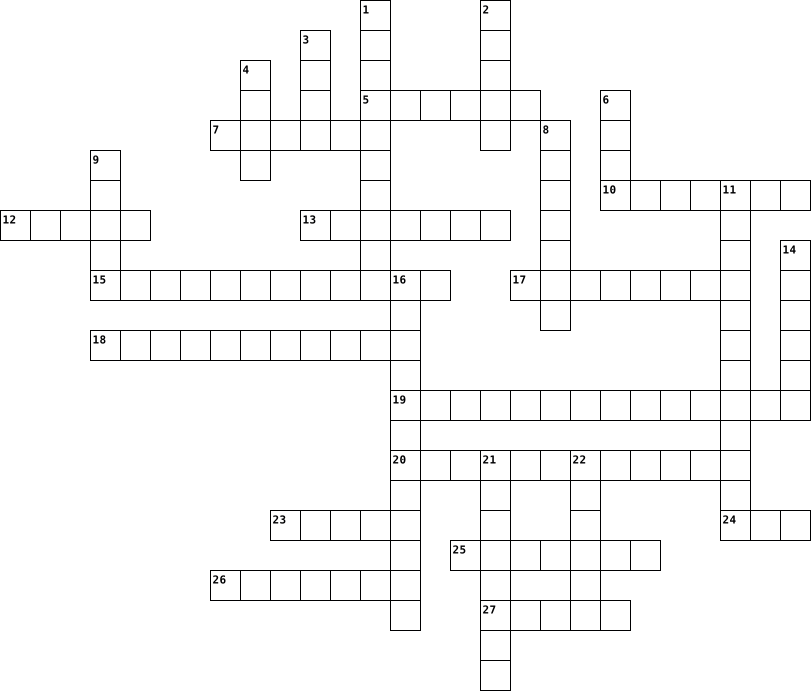
Across
- air that we breathe
- the 7th planet from the sun (very cold and far)
- force of heaviness (Newton's apple)
- the hottest planet 2nd from the sun
- what keeps the planets moving and not stopping
- planets made of gas (gas giants)
- the whole entire place that galaxies and stars and planets are in
- the layer we live in
- our galaxy that our solar system is in
- the second layer that has another layer in it that protects us
- planet that we live on 3rd from the sun
- a star
- the first planet from the sun
- fifth planet from the sun (gas giant)
- layer that traps sun's harmful rays
Down
- the third layer that burns up meteorites
- an object in space that orbits the sun
- an object that orbits our earth and all other outer planets
- 4th planet from the sun
- something that Saturn is very famous for
- the last planet 8th from the sun
- the smallest planet (dwarf planet)
- planets made of rock
- stars that are bounded tightly by gas
- the fourth layer into space, area of satellites
- belt the large space between mars and jupiter that asteroids are in
- sixth planet from the sun (made of gas, gas giant)
27 Clues: a star • air that we breathe • planets made of rock • the layer we live in • 4th planet from the sun • the first planet from the sun • the last planet 8th from the sun • planets made of gas (gas giants) • the smallest planet (dwarf planet) • force of heaviness (Newton's apple) • the hottest planet 2nd from the sun • layer that traps sun's harmful rays • ...
Planets Study Guide 2023-05-05

Across
- The Dwarf Planet That Was Promoted To A Planet And Then Demoted To A Dwarf Planet.
- Dwarf Planet With No Atmosphere And A Day Close In Time To Earth's.
- Second Largest Planet And Has 7 Rings.
- Nicknamed "The Red Planet" Because Of Oxidized Iron Within The Rocks.
- First Planet From Sun, And The Second Hottest Planet.
- The Coldest Planet And It Is On It's Side.
- Not A Planet, But An Asteroid With Rings.
- The Inner Planets Are Sometimes Referred To As The __________ Planets.
- 1 AU Is Equal To ______ Million Miles.
- This Is The Hottest Planet And Earth's Sister.
- At First, It Appeared To Be Larger Than Pluto.
- The ______ Separates The Inner And Outer Planets.
Down
- Largest Planet.
- One Of The Fastest Moving Objects In The Solar System.
- The ________ Is Where Most Dwarf Planets Are Located, Beyond Orbit Of Neptune.
- 1 AU Is The ______ Between Earth And The Sun.
- Has Windstorms That Blow 3 Times As Fast As Earth's Hurricanes.
- Huge Windstorm Located On Jupiter.
- The Gas Giants Are Also Referred To As The ______ Planets.
- Our Home Planet.
- Only Dwarf Planet Located In The Inner Solar System, Specifically The Asteroid Belt.
- Uranus And Neptune Are Also Known As ________.
22 Clues: Largest Planet. • Our Home Planet. • Huge Windstorm Located On Jupiter. • Second Largest Planet And Has 7 Rings. • 1 AU Is Equal To ______ Million Miles. • Not A Planet, But An Asteroid With Rings. • The Coldest Planet And It Is On It's Side. • 1 AU Is The ______ Between Earth And The Sun. • This Is The Hottest Planet And Earth's Sister. • ...
Space 2024-11-28

Across
- Everything we can touch, feel,sense...
- What is the biggest planet?
- _______ is the closest planet to the sun?
- Chunks of rock/metal in outer space that is in orbit around the Sun.
- Tiny particles or chunks of metal/rock. When they enter a planet's atmosphere, they burn up and look like shooting stars in the sky.
- The heart of our solar system is the ___. It provides warmth and light.
- Jupiter, ______, Neptune and Uranus all have rings around them.
- ___ giant planets are made of gas.
- A massive collection of gas, dust, and billions of stars and their solar systems
Down
- Force of attraction that pulls together all matter.
- What planet do we live on?
- A regular, repeating path that one object take around another.
- Mercury is this kind of planet.
- What planet is the hottest?
- There are eight _______ in our solar system.
- together by gravity.
- Our solar system is a collection of _________ bodies orbiting the Sun.
- Natural objects that orbit planets. Scientists call them "natural satellites".
- Made up of ice, rock, and dust, they develop a bright tail when they get close to the Sun.
- ____ is known for its red colour?
- _____ planets are like regular planets but smaller with debris floating around them.
21 Clues: together by gravity. • What planet do we live on? • What planet is the hottest? • What is the biggest planet? • Mercury is this kind of planet. • ____ is known for its red colour? • ___ giant planets are made of gas. • Everything we can touch, feel,sense... • _______ is the closest planet to the sun? • There are eight _______ in our solar system. • ...
Chapter 12 Vocab 2023-01-12

Across
- largest planet that has giant red spot and over 61 moons
- small pieces of comet when they move throughout space
- closest planet to the sun that has many craters and cliffs
- planet that is similar to Earth in size and mass that has an extremely dense atmosphere of clouds
- small meteoroid that burns up in Earth's atmosphere
- area between mars and jupiter where most asteroids lie
- Planet known for its rings
- this happens when Earth's orbit passes through a group of meteoroids that enter the atmosphere
- category of planets that are large and lighweight
- meteoroid that strikes Earth
Down
- this planet is large and gaseous with a moon called Triton
- sun centered model of the solar system
- earth centered model of the solar system
- Now known as a dwarf planet
- This planet has an axis nearly parallel to its plane of orbit
- German mathematician that discovered that the planets' orbits were elliptical
- rocks similar to the ones that formed planets
- This planet has the largest volcano in the solar system and is the last of the inner planets
- more than 70% of this planet's surface is covered in water
- category of planets that are small and rocky with iron cores
20 Clues: Planet known for its rings • Now known as a dwarf planet • meteoroid that strikes Earth • sun centered model of the solar system • earth centered model of the solar system • rocks similar to the ones that formed planets • category of planets that are large and lighweight • small meteoroid that burns up in Earth's atmosphere • ...
Space crossword puzzle 2022-01-26

Across
- belt-It separates the outer planets from the inner planets
- biggest planet is our solar system
- orbits us
- smallest planet
- big hot and its what gives us light
- has a log tail and orbits the sun
- has different tempters and sizes
Down
- planets inside of the asteroid belt
- where we live
- planets outside of the asteroid belt
- red yellow and bigger then mercury but smaller then Earth
- outer planet blue and spines upside down
- outer planer and blue
- the red planet
14 Clues: orbits us • where we live • the red planet • smallest planet • outer planer and blue • has different tempters and sizes • has a log tail and orbits the sun • biggest planet is our solar system • planets inside of the asteroid belt • big hot and its what gives us light • planets outside of the asteroid belt • outer planet blue and spines upside down • ...
Astronomy crossword 2022-03-09

Across
- Something related to the moon
- More known as solar eclipse
- We are on earth's
- Most planets have at least 1
- It keeps us on earth
- All the planets are in it
Down
- One is known as the milky way
- The atmosphere is heated by it
- Theres 8 of them
- You do it to find information about planets
- When you leave earth your in it
- objects, space, and the physical universe as a whole.
- When the moon moves its in a new???
- energy from the suns rays
- Gravity is a force that creates them
15 Clues: Theres 8 of them • We are on earth's • It keeps us on earth • energy from the suns rays • All the planets are in it • More known as solar eclipse • Most planets have at least 1 • One is known as the milky way • Something related to the moon • The atmosphere is heated by it • When you leave earth your in it • When the moon moves its in a new??? • Gravity is a force that creates them • ...
Space Words Puzzle 2022-03-30

Across
- Initials of Optimists International.
- First name of moon hero.
- A sphere or globe
- Same thing as stars.
- Heavenly bodies
- Initials of Underwater Battery.
- What makes a rocket go.
- I went ___ the store.
Down
- Opposite of "yes."
- Opposite of "out."
- Chores.
- One of the planets.
- Do, re, mi, fa, so, ___, ti, do.
- Abbrev. for East Indies
- Number of planets in the solar system.
- Abbrev. for "no good."
16 Clues: Chores. • Heavenly bodies • A sphere or globe • Opposite of "yes." • Opposite of "out." • One of the planets. • Same thing as stars. • I went ___ the store. • Abbrev. for "no good." • Abbrev. for East Indies • What makes a rocket go. • First name of moon hero. • Initials of Underwater Battery. • Do, re, mi, fa, so, ___, ti, do. • Initials of Optimists International. • ...
The solar system 2025-11-23

Across
- Our Galaxy
- Used to describe inner Gaseous planets
- the number of planets in our solar system
- Acts as a buffer zone protecting earth from large asteroids
- Planet with thick atmosphere that traps heatthe solar system
Down
- Located mainly in the Kuiper Belt beyond neptune and the Asteroid belt
- Orbits the sun
- A natural satellite with no light of its own
- Process by which planets are formed from particles
- Used to describe rocky inner planets
- Farthest planet from the Sun
- Closest planet to the sun
- Provides Vitamin D that helps with bone health and immune system support
13 Clues: Our Galaxy • Orbits the sun • Closest planet to the sun • Farthest planet from the Sun • Used to describe rocky inner planets • Used to describe inner Gaseous planets • the number of planets in our solar system • A natural satellite with no light of its own • Process by which planets are formed from particles • Acts as a buffer zone protecting earth from large asteroids • ...
planets vocabulary 2021-04-30

Across
- planet , is a planet that is ,small .
- ,is when the ,earth spins or when anything spins .
- ,when something that, goes around something.
- ,are cold rocks that's hit earth or, other places.
- planets , these are the planets ,that are rocky and are not bigger than gas giants.
- position ,When you set, the position relative to an element,
- Unit ,the mean, distance from the center of the earth to the center of the sun.
- plant , a planet whose orbit lies within the asteroid belt, Mercury, Venus, Earth, or Mars
- ,is a rock that finds it ,way out of space and comes crashing into earth or other places.
- planets ,The four gas giants in our solar system are Neptune, Uranus, Saturn, and Jupiter.
- planet , The outer planets are gas giants Jupiter and Saturn and ice giants Uranus and Neptune.
- effect, the trapping of the sun's, warmth in a planet's lower atmosphere, due to the greater transparency of the atmosphere to visible radiation
Down
- ,a small body of matter, from outer space that enters the earth's atmosphere, becoming incandescent as a result of friction and appearing as a streak of light.
- , is like earth or Mars, Saturn, Venus.
- temperature ,Surface temperature is the temperature at or near a surface
- ,are made ,of dust and gases mostly hydrogen and helium
- is ,a rock that's stays ,on the asteroid belt.
- ,a sudden, radical or complete change
- ,helps people stay, on there feet.
- the ground.
- Way Galaxy , the milky way, galaxy contains our Solar System.
- , it come out at night and the sun shines on it to give it light.
- , the degree of compactness ,of a substance.
- ,a meteor that survives its passage ,through the earth's atmosphere such that part of it
- belt, where asteroids, float on the line the looks like a belt.
25 Clues: the ground. • ,helps people stay, on there feet. • ,a sudden, radical or complete change • planet , is a planet that is ,small . • , is like earth or Mars, Saturn, Venus. • ,when something that, goes around something. • , the degree of compactness ,of a substance. • is ,a rock that's stays ,on the asteroid belt. • ,is when the ,earth spins or when anything spins . • ...
PLANETS CROSSWORD 2014-08-31

Across
- a ball of ice and rock that has a tail
- the number of planets in our solar system
- this is a dwarf planet
- this is the planet we live in
- someone who travels into space
- this planet spins on its side
- we see this at night. It can be full, quarter, half..
- this planet is the hottest and is close to the sun
- this planet is smallest and closest to the sun
- this planet has rings around it
Down
- this is the largest planet
- our galaxy - also the name of a chocolate bar
- the name of the system planet earth is in
- what we use to look closely at the stars
- this planet is furthest away from the sun
- we see this in the daytime and all the planets circle this planet
- what astronauts travels in
- this planet is sometimes called the red planet
- these look like they twinkle at night
- the best time to look at stars
20 Clues: this is a dwarf planet • this is the largest planet • what astronauts travels in • this is the planet we live in • this planet spins on its side • someone who travels into space • the best time to look at stars • this planet has rings around it • these look like they twinkle at night • a ball of ice and rock that has a tail • what we use to look closely at the stars • ...
The Planets 2014-09-02

Across
- Astronauts have visited this place
- The biggest planet in the solar system
- A piece of equipment used for seeing stars and planets clearly
- A man person that visited the moon
- All the gases that surround a star or a planet
- The huge space which contains all of the matter and energy in existence
- A big ball of dirty ice and snow in outer space
- Was once a planet but is now a dwarf planet
- A red planet
- Our planet
Down
- This planet rotates on its side
- The eighth planet from the sun
- The galaxy we live in (two words joined together)
- Also known as a shooting star
- A scientist who studies stars and planets
- This planet is sometimes called the evening or morning star
- Is the smallest planet
- The Earth goes around it
- There are billions of these in the night sky
- A planet with rings around it
20 Clues: Our planet • A red planet • Is the smallest planet • The Earth goes around it • Also known as a shooting star • A planet with rings around it • The eighth planet from the sun • This planet rotates on its side • Astronauts have visited this place • A man person that visited the moon • The biggest planet in the solar system • A scientist who studies stars and planets • ...
The Planets 2014-10-29

Across
- Known as the dwarf planet
- There is lots of it floating around in outer space
- Made up of water, ice, rock, dust and organic compounds
- The second largest planet in the Solar System
- Can vary from extremely hot to extremely cold on the planets
- Jupiter is commonly known for its _____
- The largest planet
- the collection of eight planets and their moons
- The smallest and fastest moving planet
- helps us receive information about the planets and the Solar System
Down
- Comes out during the night
- The only planet that spins on its side
- The hottest planet
- The people that fly in outer space
- Small, rocky, metallic matter found all over the Solar System
- Gives us light during the day
- There is a chocolate named after this T__ M____ W__
- Referred to as the Red Planet
- The planet we live on
- The machine that enables astronauts to go into space
- Helps keep the moon moving around the sun and helps us in everyday life
21 Clues: The hottest planet • The largest planet • The planet we live on • Known as the dwarf planet • Comes out during the night • Gives us light during the day • Referred to as the Red Planet • The people that fly in outer space • The only planet that spins on its side • The smallest and fastest moving planet • Jupiter is commonly known for its _____ • ...
The Planets 2014-10-07

Across
- Second planet from the sun
- The Red Planet
- Name of our galaxy
- The planet with the rings
- Largest planet in our Solar System
- A large group of stars, gas and dust
- Mercury, Venus, Earth and Mars are ____________ planets
- Saturn, Jupiter, Uranus and Neptune have ____ around them
- Made up of water ice, rock, dust and organic compounds
Down
- The centre of our Solar System
- Our planet
- Planet that spins on its side
- Planet closest to the sun
- A piece of rocky and/or metallic debris that travels in outer space
- Pluto is called a ______ planet
- Named after a Roman god of the sea
- We are held on earth by...
- Jupiter and Saturn are ____ giants
- Uranus and Neptune are ____ giants
- Neil Armstrong was the first person to walk on the...
20 Clues: Our planet • The Red Planet • Name of our galaxy • Planet closest to the sun • The planet with the rings • Second planet from the sun • We are held on earth by... • Planet that spins on its side • The centre of our Solar System • Pluto is called a ______ planet • Largest planet in our Solar System • Named after a Roman god of the sea • Jupiter and Saturn are ____ giants • ...
Planets Crossword 2014-10-06

Across
- A group of stars, dust and gas held together by gravity
- We can use this to see the stars?
- Our galaxy
- We live on ______
- The red planet
- An alien's spaceship
- A rock that orbits the Sun
- The Sun gives ________
- Halley's________
- There are billions of these in the universe
Down
- Who says "to infinity and beyond"?
- Amount of time it takes the Earth to spin once on its axis
- Furthest away from the Sun
- a chocolate bar
- The closest planet to the Sun
- Can fly to the moon
- A planet with rings
- Who can walk on the moon?
- It comes out at night
- The moon is covered in these
20 Clues: Our galaxy • The red planet • a chocolate bar • Halley's________ • We live on ______ • Can fly to the moon • A planet with rings • An alien's spaceship • It comes out at night • The Sun gives ________ • Who can walk on the moon? • Furthest away from the Sun • A rock that orbits the Sun • The moon is covered in these • The closest planet to the Sun • We can use this to see the stars? • ...